
Salaries of HIM Professionals
|
|
|
- Griselda Nicholson
- 10 years ago
- Views:
Transcription
1 Salaries of HIM Professionals

2 DATA FOR DECISIONS: THE HIM WORKFORCE AND WORKPLACE Salaries of HIM Professionals This workforce research study is funded through AHIMA's Foundation of Research and Education (FORE). It is supported in part by a generous leadership grant from 3M Health Information Systems. Additional grant support has been provided by MedQuist, Inc. and by contributions to the Fast FOREward campaign from AHIMA's Component State Associations and member gifts. Anticipate Educate Innovate Copyright 2004 by the American Health Information Management Association. All rights reserved. No part of this publication may be reproduced, reprinted, stored in a retrieval system, or transmitted, in any form or by any means, electronic, photocopying, recording, or otherwise, without the prior written permission of the association.

3 Salaries of HIM Professionals December 2003 Prepared by The Center for Health Workforce Studies University at Albany State University of New York School of Public Health One University Place Rensselaer, NY Phone: (518) Fax: (518) Web:

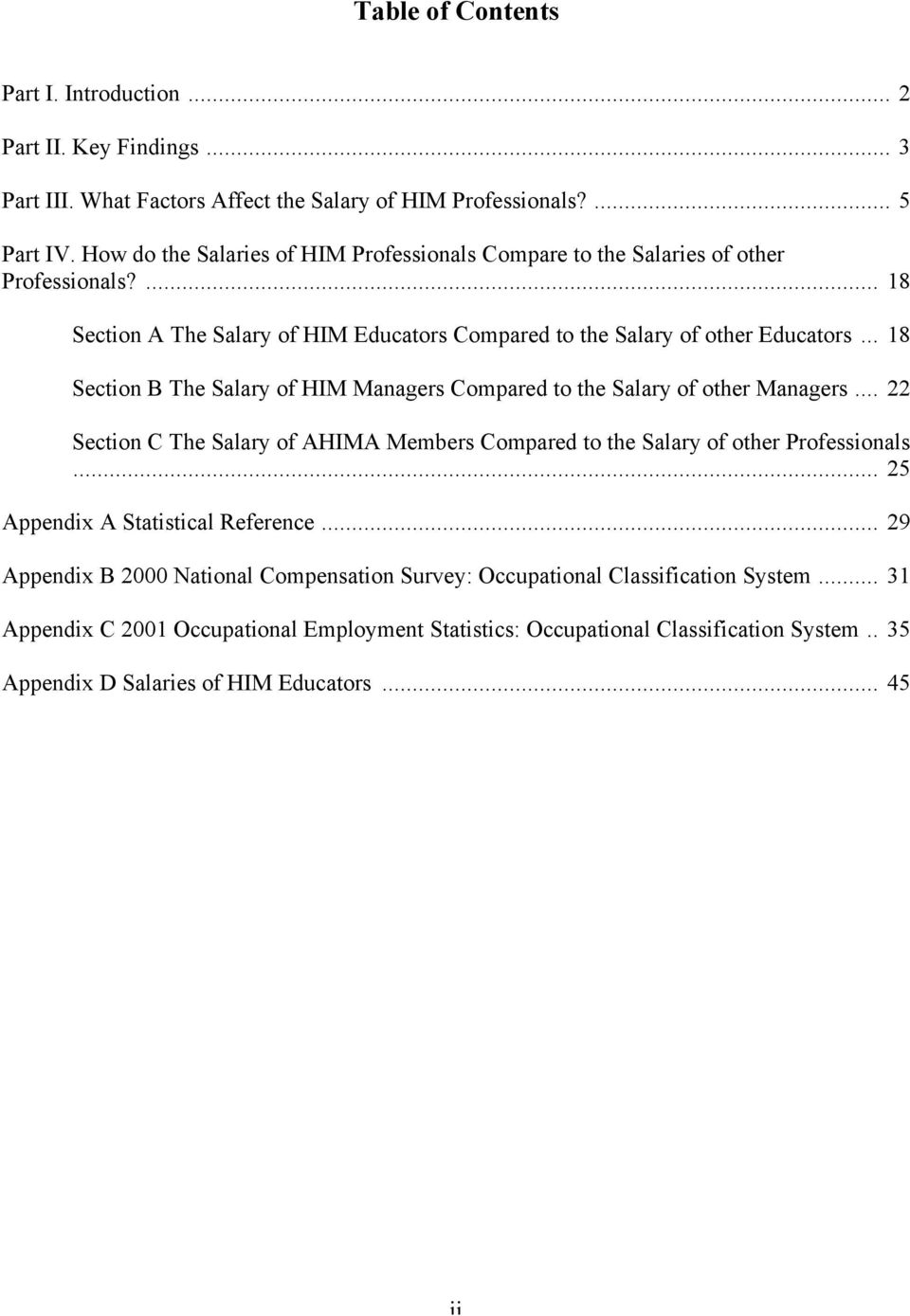
4 Table of Contents Part I. Introduction... 2 Part II. Key Findings... 3 Part III. What Factors Affect the Salary of HIM Professionals?... 5 Part IV. How do the Salaries of HIM Professionals Compare to the Salaries of other Professionals? Section A The Salary of HIM Educators Compared to the Salary of other Educators Section B The Salary of HIM Managers Compared to the Salary of other Managers Section C The Salary of AHIMA Members Compared to the Salary of other Professionals Appendix A Statistical Reference Appendix B 2000 National Compensation Survey: Occupational Classification System Appendix C 2001 Occupational Employment Statistics: Occupational Classification System.. 35 Appendix D Salaries of HIM Educators ii
5 Part I Introduction This report provides data and insights on the salaries of HIM professionals in the US To be more specific this study attempts to answer two questions in regards to the salary of HIM professionals. First, what factors affect the salaries of HIM professionals? And second, how do the salaries of HIM professionals compare to the salaries of other professionals? The next part of this report presents the key finding. And Parts III and IV specifically address the aforementioned questions specifically. 1

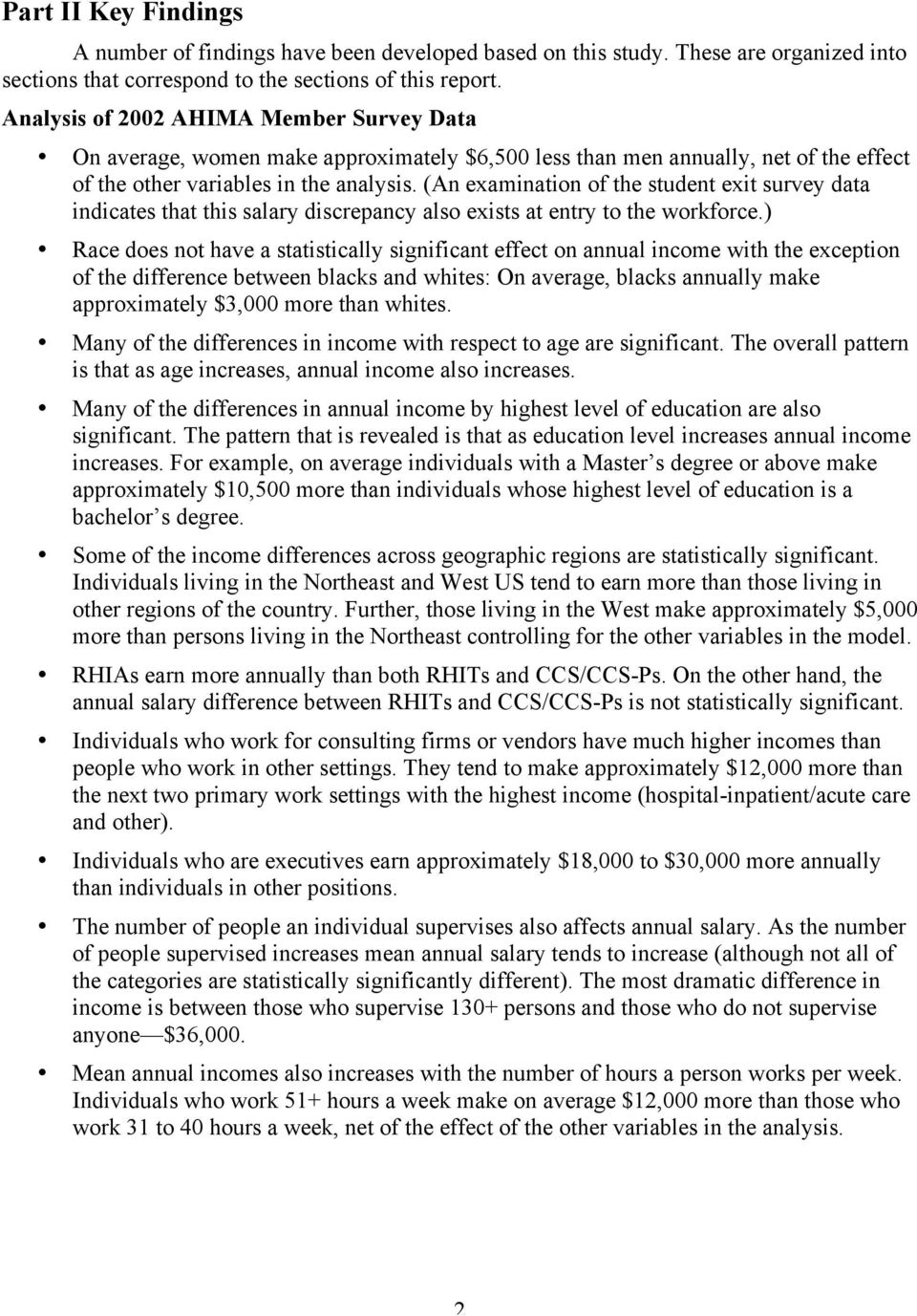
6 Part II Key Findings A number of findings have been developed based on this study. These are organized into sections that correspond to the sections of this report. Analysis of 2002 AHIMA Member Survey Data On average, women make approximately $6,500 less than men annually, net of the effect of the other variables in the analysis. (An examination of the student exit survey data indicates that this salary discrepancy also exists at entry to the workforce.) Race does not have a statistically significant effect on annual income with the exception of the difference between blacks and whites: On average, blacks annually make approximately $3,000 more than whites. Many of the differences in income with respect to age are significant. The overall pattern is that as age increases, annual income also increases. Many of the differences in annual income by highest level of education are also significant. The pattern that is revealed is that as education level increases annual income increases. For example, on average individuals with a Master s degree or above make approximately $10,500 more than individuals whose highest level of education is a bachelor s degree. Some of the income differences across geographic regions are statistically significant. Individuals living in the Northeast and West US tend to earn more than those living in other regions of the country. Further, those living in the West make approximately $5,000 more than persons living in the Northeast controlling for the other variables in the model. RHIAs earn more annually than both RHITs and CCS/CCS-Ps. On the other hand, the annual salary difference between RHITs and CCS/CCS-Ps is not statistically significant. Individuals who work for consulting firms or vendors have much higher incomes than people who work in other settings. They tend to make approximately $12,000 more than the next two primary work settings with the highest income (hospital-inpatient/acute care and other). Individuals who are executives earn approximately $18,000 to $30,000 more annually than individuals in other positions. The number of people an individual supervises also affects annual salary. As the number of people supervised increases mean annual salary tends to increase (although not all of the categories are statistically significantly different). The most dramatic difference in income is between those who supervise 130+ persons and those who do not supervise anyone $36,000. Mean annual incomes also increases with the number of hours a person works per week. Individuals who work 51+ hours a week make on average $12,000 more than those who work 31 to 40 hours a week, net of the effect of the other variables in the analysis. 2
7 Comparisons of Member Salaries with Salaries from Other Sources The salaries of HIM educators are lower than the salaries of several comparison groups of educators. Many of the differences are statistically significant. The mean salary of HIM managers is $57,445 approximately $10,000 more than HIM teachers. Furthermore, the mean salary of HIM managers is comparable to other professional managers. Only financial managers and managers and administrators make significantly more money annually than HIM managers. The mean salary of AHIMA members compares favorably with a variety of other professionals from the 2000 National Compensation Survey. Only the mean salary of computer systems analysts and scientist is significantly higher than that of AHIMA members. 3

8 Part III What Factors Affect the Salaries of HIM Professionals? Data Source Data for this analysis is obtained from the 2002 AHIMA Member Survey collected by the Center for Health Workforce Studies located at the University at Albany State University of New York, School of Public Health. The sample size of the 2002 AHIMA member survey is 5,333. The proportion of females in the sample is.96, the proportion of whites in the sample is.87, and the mean annual salary of HIM professionals is $47,822. After a listwise deletion of missing cases on the variables included in the analysis the, final sample size is 3,601. And the proportion of females in the sample is.96, the proportion of whites in the sample is.88, and the mean annual salary of HIM professionals is $46,780. Given the similarity of the descriptive statistics prior to and after the deletion of cases there is reason to believe that the final sample is representative of the larger data file. 4

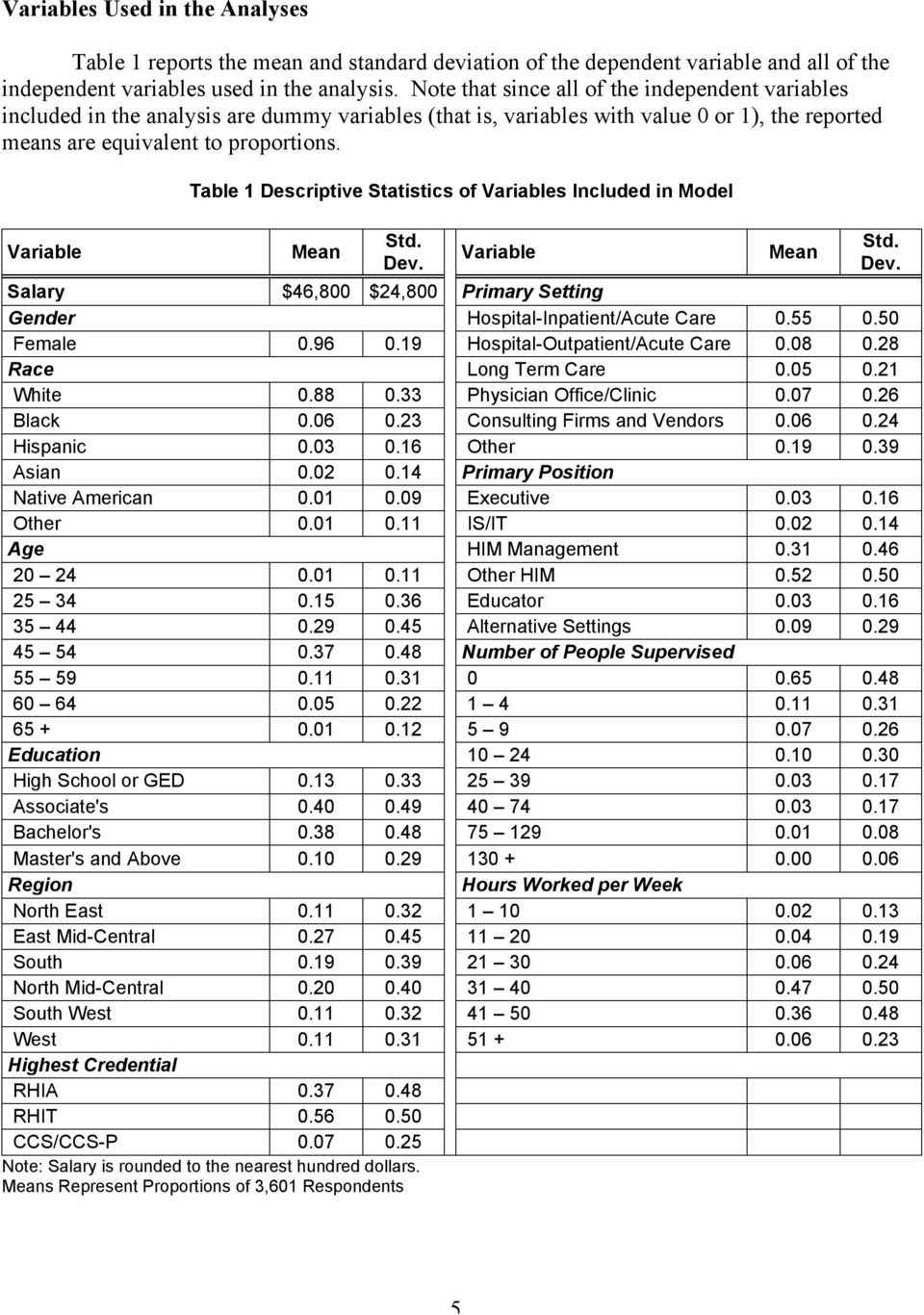
9 Variables Used in the Analyses Table 1 reports the mean and standard deviation of the dependent variable and all of the independent variables used in the analysis. Note that since all of the independent variables included in the analysis are dummy variables (that is, variables with value 0 or 1), the reported means are equivalent to proportions. Variable Table 1 Descriptive Statistics of Variables Included in Model Mean Std. Dev. Variable Mean Std. Dev. Salary $46,800 $24,800 Primary Setting Gender Hospital-Inpatient/Acute Care Female Hospital-Outpatient/Acute Care Race Long Term Care White Physician Office/Clinic Black Consulting Firms and Vendors Hispanic Other Asian Primary Position Native American Executive Other IS/IT Age HIM Management Other HIM Educator Alternative Settings Number of People Supervised Education High School or GED Associate's Bachelor's Master's and Above Region Hours Worked per Week North East East Mid-Central South North Mid-Central South West West Highest Credential RHIA RHIT CCS/CCS-P Note: Salary is rounded to the nearest hundred dollars. Means Represent Proportions of 3,601 Respondents 5
10 Statistical Techniques The key statistical technique used in these analyses is multiple linear regression, a technique that estimates the effect on the dependent variable of interest (in this case annual salaries of HIM professionals) on a series of independent, explanatory variables (shown in Table 1). This technique has the desirable feature that the estimates for each of the independent variables control the effect of all other variables in the statistical model. Results Table 2, which spans several pages, reports the results of the regression analysis. This table displays the estimated difference in salary between two categories of a variable net of the effect of the other variables included in the analysis, the standard error of the estimate, and a 95 percent confidence interval. An asterisk indicates statistically significant differences in salary between two categories, allowing for a 5 percent error rate (for information concerning the statistics reported see Appendix A). The R 2 for the linear model is In other words, the explanatory variables in the model explain 45 percent of the variation in salaries among HIM professionals. 6

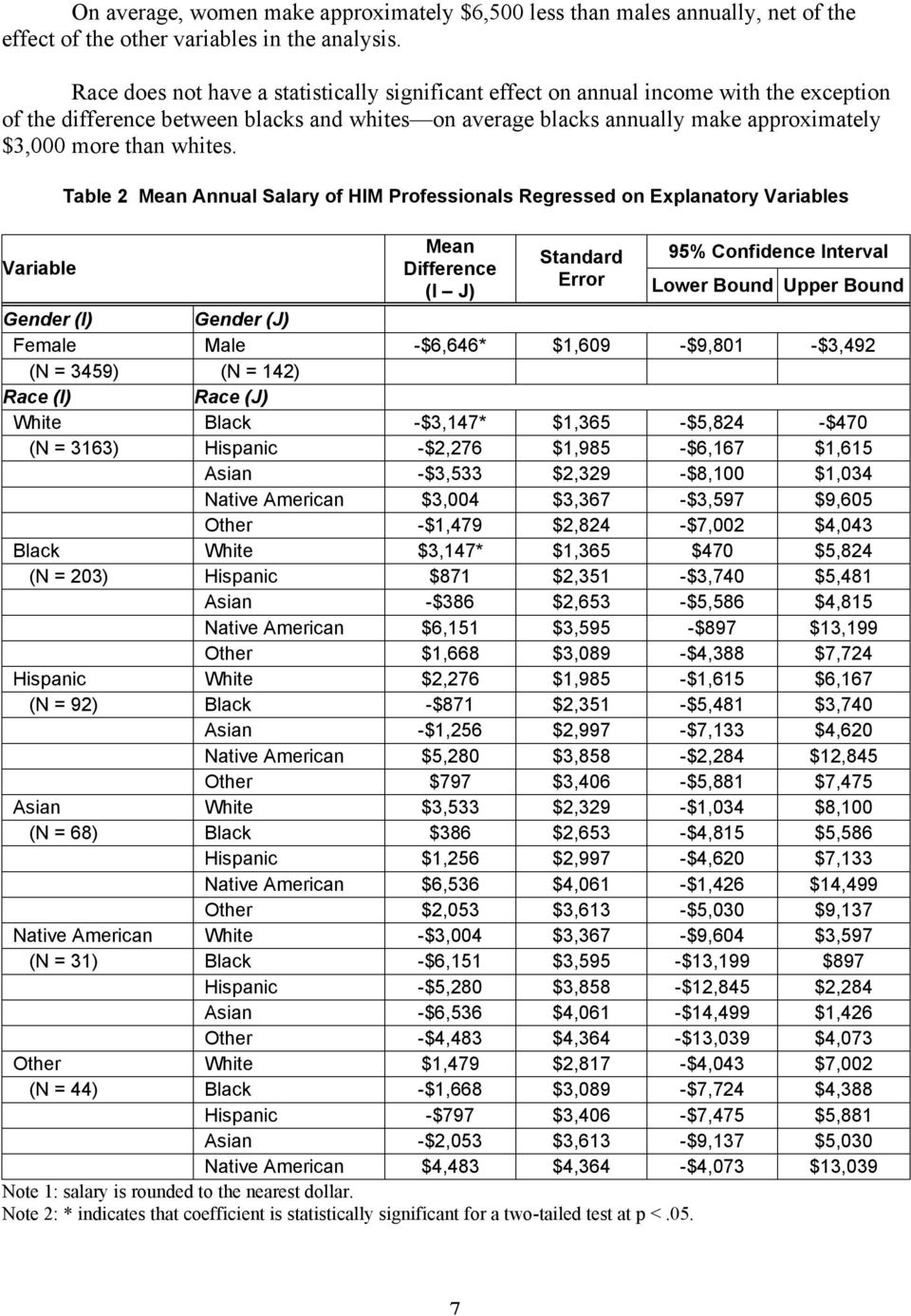
11 On average, women make approximately $6,500 less than males annually, net of the effect of the other variables in the analysis. Race does not have a statistically significant effect on annual income with the exception of the difference between blacks and whites on average blacks annually make approximately $3,000 more than whites. Variable Table 2 Mean Annual Salary of HIM Professionals Regressed on Explanatory Variables Mean Difference (I J) Standard Error 95% Confidence Interval Lower Bound Upper Bound Gender (I) Gender (J) Female Male -$6,646* $1,609 -$9,801 -$3,492 (N = 3459) (N = 142) Race (I) Race (J) White Black -$3,147* $1,365 -$5,824 -$470 (N = 3163) Hispanic -$2,276 $1,985 -$6,167 $1,615 Asian -$3,533 $2,329 -$8,100 $1,034 Native American $3,004 $3,367 -$3,597 $9,605 Other -$1,479 $2,824 -$7,002 $4,043 Black White $3,147* $1,365 $470 $5,824 (N = 203) Hispanic $871 $2,351 -$3,740 $5,481 Asian -$386 $2,653 -$5,586 $4,815 Native American $6,151 $3,595 -$897 $13,199 Other $1,668 $3,089 -$4,388 $7,724 Hispanic White $2,276 $1,985 -$1,615 $6,167 (N = 92) Black -$871 $2,351 -$5,481 $3,740 Asian -$1,256 $2,997 -$7,133 $4,620 Native American $5,280 $3,858 -$2,284 $12,845 Other $797 $3,406 -$5,881 $7,475 Asian White $3,533 $2,329 -$1,034 $8,100 (N = 68) Black $386 $2,653 -$4,815 $5,586 Hispanic $1,256 $2,997 -$4,620 $7,133 Native American $6,536 $4,061 -$1,426 $14,499 Other $2,053 $3,613 -$5,030 $9,137 Native American White -$3,004 $3,367 -$9,604 $3,597 (N = 31) Black -$6,151 $3,595 -$13,199 $897 Hispanic -$5,280 $3,858 -$12,845 $2,284 Asian -$6,536 $4,061 -$14,499 $1,426 Other -$4,483 $4,364 -$13,039 $4,073 Other White $1,479 $2,817 -$4,043 $7,002 (N = 44) Black -$1,668 $3,089 -$7,724 $4,388 Hispanic -$797 $3,406 -$7,475 $5,881 Asian -$2,053 $3,613 -$9,137 $5,030 Native American $4,483 $4,364 -$4,073 $13,039 Note 1: salary is rounded to the nearest dollar. Note 2: * indicates that coefficient is statistically significant for a two-tailed test at p <.05. 7
12 Many of the differences in income with respect to age are significant. The overall pattern is that as age increases annual income also increases. Table 2 Mean Annual Salary of HIM Professionals Regressed on Explanatory Variables (cont.) Mean Standard 95% Confidence Interval Variable Difference Error (I J) Lower Bound Upper Bound Age (I) Age (J) $3,948 $2,824 -$9,485 $1,588 (N = 47) $8,275* $2,782 -$13,729 -$2, $8,616* $2,775 -$14,057 -$3, $9,704* $2,897 -$15,383 -$4, $6,727 $3,078 $12,761 -$ $13,296* $3,811 -$20,768 -$5, $3,948 $2,824 -$1,588 $9,485 (N = 543) $4,327* $993 -$6,273 -$2, $4,668* $971 -$6,571 -$2, $5,756 $1,270 -$8,246 $3, $2,779 $1,631 -$5,977 $ $9,347* $2,771 -$14,781 -$3, $8,275* $2,782 $2,820 $13,729 (N = 1046) $4,327* $993 $2,380 $6, $341 $775 -$1,860 $1, $1,429 $1,124 -$3,634 $ $1,548 $1,517 -$1,426 $4, $5,021 $2,699 -$10,314 $ $8,616 $2,775 $3,175 $14,057 (N = 1348) $4,668* $971 $2,764 $6, $341 $775 -$1,177 $1, $1,088 $1,076 -$3,198 $1, $1,889 $1,482 -$1,016 $4, $4,680 $2,676 -$9,927 $ $9,704* $2,897 $4,025 $15,383 (N = 386) $5,756* $1,270 $3,266 $8, $1,429 $1,124 -$775 $3, $1,088 $1,076 -$1,022 $3, $2,977 $1,677 -$311 $6, $3,592 $2,782 -$9,047 $1, $6,727* $3,078 $693 $12,761 (N = 180) $2,779 $1,631 -$420 $5, $1,548 $1,517 -$4,522 $1, $1,889 $1,482 -$4,794 $1, $2,977 $1,677 -$6,265 $ $6,569* $2,959 -$12,370 -$ $13,296* $3,811 $5,823 $20,768 (N = 51) $9,347* $2,771 $3,914 $14, $5,021 $2,699 -$272 $10, $4,680 $2,676 -$568 $9, $3,592 $2,782 -$1,863 $9, $6,569* $2,959 $767 $12,370 Note 1: salary is rounded to the nearest dollar. Note 2: * indicates that coefficient is statistically significant for a two-tailed test at p <.05. 8

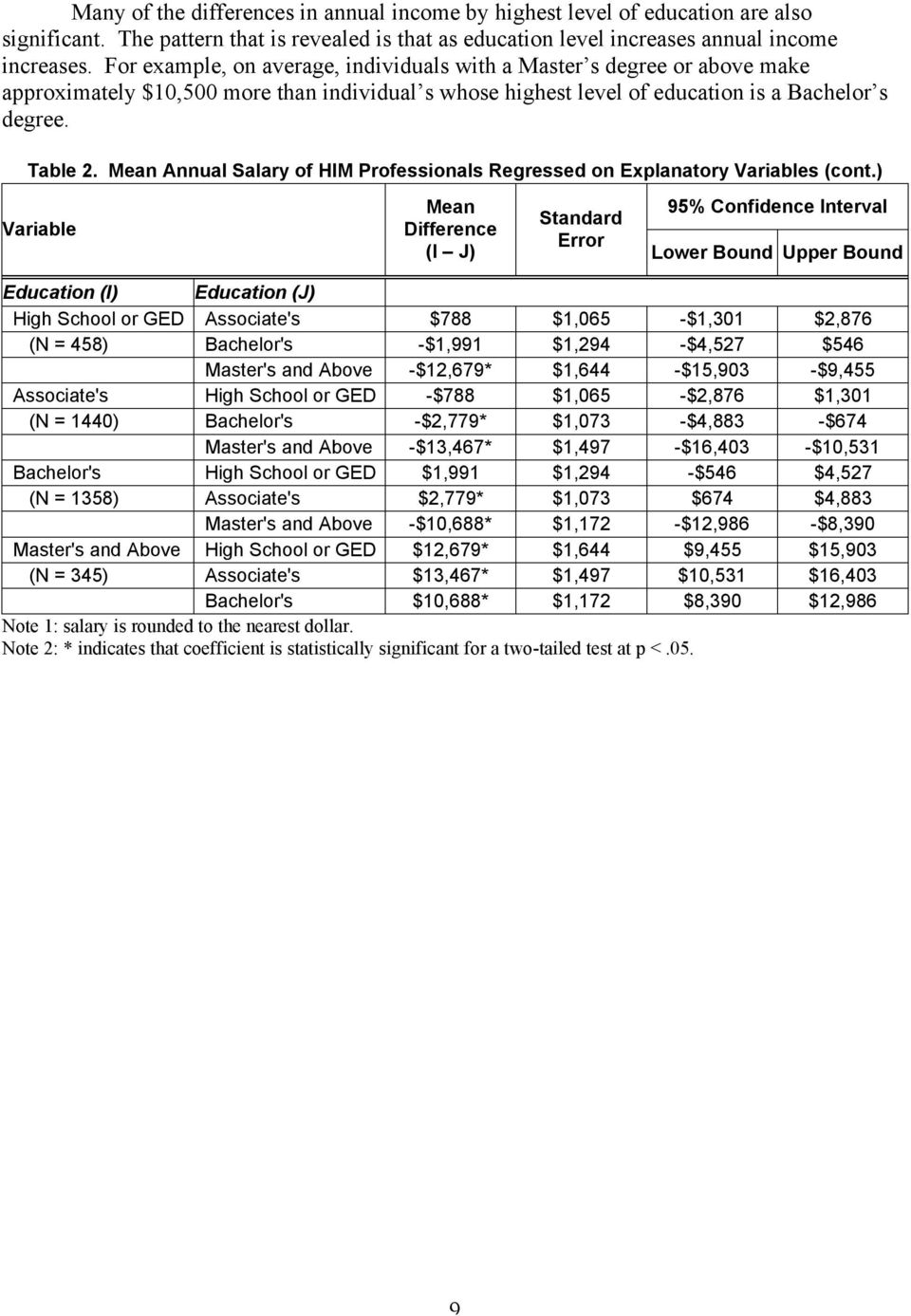
13 Many of the differences in annual income by highest level of education are also significant. The pattern that is revealed is that as education level increases annual income increases. For example, on average, individuals with a Master s degree or above make approximately $10,500 more than individual s whose highest level of education is a Bachelor s degree. Table 2. Mean Annual Salary of HIM Professionals Regressed on Explanatory Variables (cont.) Variable Mean Difference (I J) Standard Error 95% Confidence Interval Lower Bound Upper Bound Education (I) Education (J) High School or GED Associate's $788 $1,065 -$1,301 $2,876 (N = 458) Bachelor's -$1,991 $1,294 -$4,527 $546 Master's and Above -$12,679* $1,644 -$15,903 -$9,455 Associate's High School or GED -$788 $1,065 -$2,876 $1,301 (N = 1440) Bachelor's -$2,779* $1,073 -$4,883 -$674 Master's and Above -$13,467* $1,497 -$16,403 -$10,531 Bachelor's High School or GED $1,991 $1,294 -$546 $4,527 (N = 1358) Associate's $2,779* $1,073 $674 $4,883 Master's and Above -$10,688* $1,172 -$12,986 -$8,390 Master's and Above High School or GED $12,679* $1,644 $9,455 $15,903 (N = 345) Associate's $13,467* $1,497 $10,531 $16,403 Bachelor's $10,688* $1,172 $8,390 $12,986 Note 1: salary is rounded to the nearest dollar. Note 2: * indicates that coefficient is statistically significant for a two-tailed test at p <.05. 9
14 Some of the income differences across geographic regions are statistically significant. Individuals living in the Northeast and West tend to earn more than those living in other regions of the country. Further, those living in the West make approximately $5,000 more than persons living in the Northeast controlling for the other variables in the model. Table 2. Mean Annual Salary of HIM Professionals Regressed on Explanatory Variables (cont.) Variable Mean Difference (I J) Standard Error 95% Confidence Interval Lower Bound Upper Bound Region (I) Region (J) Northeast East Mid-Central $4,448* $1,103 $2,286 $6,611 (N = 412) South $5,719* $1,178 $3,411 $8,028 North Mid-Central $4,875* $1,170 $2,580 $7,169 Southwest $3,332* $1,314 $756 $5,909 West -$5,010* $1,317 -$7,592 -$2,428 East Mid Central Northeast -$4,448* $1,103 -$6,611 -$2,286 (N = 982) South $1,271 $932 -$556 $3,098 North Mid-Central $426 $923 -$1,384 $2,236 Southwest -$1,116 $1,111 -$3,294 $1,062 West -$9,459* $1,125 -$11,665 -$7,252 South Northeast -$5,719* $1,178 -$8,028 -$3,411 (N = 680) East Mid-Central -$1,271 $932 -$3,098 $556 North Mid-Central -$845 $1,015 -$2,835 $1,145 Southwest -$2,387* $1,176 -$4,693 -$80 West -$10,730* $1,204 -$13,090 -$8,369 North Mid Central Northeast -$4,875* $1,170 -$7,169 -$2,580 (N = 720) East Mid-Central -$426 $923 -$2,236 $1,384 South $845 $1,015 -$1,145 $2,835 Southwest -$1,542 $1,180 -$3,856 $772 West -$9,885* $1,196 -$12,230 -$7,540 Southwest Northeast -$3,332* $1,314 -$5,909 -$756 (N = 406) East Mid-Central $1,116 $1,111 -$1,062 $3,294 South $2,387* $1,176 $80 $4,693 North Mid-Central $1,542 $1,180 -$772 $3,856 West -$8,343* $1,326 -$10,942 -$5,744 West Northeast $5,010* $1,317 $2,428 $7,592 (N = 401) East Mid-Central $9,459* $1,125 $7,252 $11,665 South $10,730* $1,204 $8,369 $13,090 North Mid-Central $9,885* $1,196 $7,540 $12,230 Southwest $8,343* $1,326 $5,744 $10,942 Note 1: salary is rounded to the nearest dollar. Note 2: * indicates that coefficient is statistically significant for a two-tailed test at p <

15 RHIA s earn more annually than both RHIT s and CCS/CCS-P s. On the other hand, the annual salary difference between RHITs and CCS/CCS-Ps is not statistically significant. Table 2 Mean Annual Salary of HIM Professionals Regressed on Explanatory Variables (cont.) Variable Mean Difference (I J) Standard Error 95% Confidence Interval Lower Bound Upper Bound High. Credential (I) High. Credential (J) RHIA RHIT $5,376* $1,090 $3,238 $7,514 (N = 1331) CCS/CCS-P $4,068* $1,555 $1,020 $7,117 RHIT RHIA -$5,376* $1,090 -$7,514 -$3,238 (N = 2033) CCS/CCS-P -$1,307 $1,350 -$3,954 $1,339 CCS/CCS-P RHIA -$4,068* $1,555 -$7,117 -$1,020 (N = 237) RHIT $1,307 $1,350 -$1,339 $3,954 Note 1: salary is rounded to the nearest dollar. Note 2: * indicates that coefficient is statistically significant for a two-tailed test at p <

16 Individuals who work for consulting firms or vendors have much higher incomes than people who work in other settings. For example, they tend to make approximately $12,000 more than the next two primary work settings with the highest income (hospital-inpatient/acute care and other). Table 2 Mean Annual Salary of HIM Professionals Regressed on Explanatory Variables (cont.) Variable Mean Difference (I J) Standard Error 95% Confidence Interval Lower Bound Upper Bound Primary Setting (I) Primary Setting (J) Hospital-In./Acute Hospital-Out./Acute $3,159* $1,182 $841 $5,476 (N = 1973) Long-Term Care $7,048* $1,538 $4,032 $10,064 Physician Office $5,063* $1,233 $2,646 $7,479 Consulting/Vendors -$12,268* $1,460 -$15,130 -$9,405 Other -$94 $902 -$1,863 $1,675 Hospital-Out./Acute Hospital-In./Acute -$3,159* $1,182 -$5,476 -$841 (N = 298) Long-Term Care $3,889* $1,848 $265 $7,513 Physician Office $1,904 $1,579 -$1,192 $5,000 Consulting/Vendors -$15,426* $1,769 -$18,894 -$11,959 Other -$3,253* $1,344 -$5,889 -$617 Long Term Care Hospital-In./Acute -$7,048* $1,538 -$10,064 -$4,032 (N = 174) Hospital-Out./Acute -$3,889* $1,848 -$7,513 -$265 Physician Office -$1,985 $1,862 -$5,637 $1,667 Consulting/Vendors -$19,316* $2,021 -$23,277 -$15,354 Other -$7,142* $1,652 -$10,382 -$3,902 Physician Office Hospital-In./Acute -$5,063* $1,233 -$7,479 -$2,646 (N = 267) Hospital-Out./Acute -$1,904 $1,579 -$5,000 $1,192 Long-Term Care $1,985 $1,862 -$1,667 $5,637 Consulting/Vendors -$17,330* $1,770 -$20,800 -$13,861 Other -$5,157* $1,378 -$7,858 -$2,456 Consulting/Vendors Hospital-In./Acute $12,268* $1,460 $9,405 $15,130 (N = 220) Hospital-Out./Acute $15,426* $1,769 $11,959 $18,894 Long-Term Care $19,316* $2,021 $15,354 $23,277 Physician Office $17,330* $1,770 $13,861 $20,800 Other $12,173* $1,530 $9,175 $15,172 Other Hospital-In./Acute $94 $902 -$1,675 $1,863 (N = 669) Hospital-Out./Acute $3,253* $1,344 $617 $5,889 Long-Term Care $7,142* $1,652 $3,902 $10,382 Physician Office $5,157* $1,378 $2,456 $7,858 Consulting/Vendors -$12,173* $1,530 -$15,172 -$9,175 Note 1: salary is rounded to the nearest dollar. Note 2: * indicates that coefficient is statistically significant for a two-tailed test at p <

17 Individuals who are executives earn approximately $18,000 to $30,000 more annually than individuals in other positions. Table 2 Mean Annual Salary of HIM Professionals Regressed on Explanatory Variables (cont.) Variable Mean Difference (I J) Standard Error 95% Confidence Interval Lower Bound Upper Bound Primary Position (I) Primary Position (J) Executive IS/IT $20,939* $2,944 $15,167 $26,710 (N = 94) HIM Management $26,966* $2,064 $22,919 $31,012 Other HIM $30,257* $2,089 $26,161 $34,353 Educator $30,507* $2,805 $25,007 $36,007 Alternative Settings $18,805* $2,235 $14,422 $23,188 IS/IT Executive -$20,939* $2,944 -$26,710 -$15,167 (N = 74) HIM Management $6,027* $2,312 $1,493 $10,561 Other HIM $9,318* $2,220 $4,965 $13,672 Educator $9,568* $2,952 $3,781 $15,356 Alternative Settings -$2,134 $2,430 -$6,898 $2,630 HIM Management Executive -$26,966* $2,064 -$31,012 -$22,919 (N = 1128) IS/IT -$6,027* $2,312 -$10,561 -$1,493 Other HIM $3,291* $986 $1,358 $5,225 Educator $3,541 $2,200 -$773 $7,855 Alternative Settings -$8,161* $1,414 -$10,934 -$5,388 Other HIM Executive -$30,257* $2,089 -$34,353 -$26,161 (N = 1878) IS/IT -$9,318* $2,220 -$13,672 -$4,965 HIM Management -$3,291* $986 -$5,225 -$1,358 Educator $250 $2,087 -$3,843 $4,342 Alternative Settings -$11,452* $1,216 -$13,836 -$9,069 Educator Executive -$30,507* $2,805 -$36,007 -$25,007 (N = 96) IS/IT -$9,568* $2,952 -$15,356 -$3,781 HIM Management -$3,541 $2,200 -$7,855 $773 Other HIM -$250 $2,087 -$4,342 $3,843 Alternative Settings -$11,702* $2,258 -$16,129 -$7,275 Alternative Settings Executive -$18,805* $2,235 -$23,188 -$14,422 (N = 331) IS/IT $2,134 $2,430 -$2,630 $6,898 HIM Management $8,161* $1,414 $5,388 $10,934 Other HIM $11,452* $1,216 $9,069 $13,836 Educator $11,702* $2,258 $7,275 $16,129 Note 1: salary is rounded to the nearest dollar. Note 2: * indicates that coefficient is statistically significant for a two-tailed test at p <

18 The number of people an individual supervises also affects annual salary. As the number of people supervised increases, mean annual salary tends to increase (although not all of the categories are statistically significantly different). The most dramatic difference in income is between those who supervise persons and those who do not supervise anyone $36,000. Table 2 Mean Annual Salary of HIM Professionals Regressed on Explanatory Variables (cont.) Mean Standard 95% Confidence Interval Variable Difference Error (I J) Lower Bound Upper Bound # Supervised (I) # Supervised (J) $1,314 $1,140 -$3,550 $922 (N = 2354) 5 9 -$7,566* $1,361 -$10,234 -$4, $7,759* $1,271 -$10,251 -$5, $8,028* $1,987 -$11,924 -$4, $14,999* $2,091 -$19,100 -$10, $24,778* $4,071 -$32,759 -$16, $35,931* $5,710 -$47,126 -$24, $1,314 $1,140 -$922 $3,550 (N = 386) 5 9 -$6,252* $1,518 -$9,229 -$3, $6,446* $1,407 -$9,204 -$3, $6,714* $2,058 -$10,748 -$2, $13,685* $2,157 -$17,915 -$9, $23,464* $4,108 -$31,518 -$15, $34,617* $5,732 -$45,856 -$23, $7,566* $1,361 $4,899 $10,234 (N = 253) 1 4 $6,252* $1,518 $3,276 $9, $193 $1,527 -$3,186 $2, $461 $2,133 -$4,643 $3, $7,433* $2,228 -$11,801 -$3, $17,212* $4,147 -$25,343 -$9, $28,365* $5,766 -$39,670 -$17, $1,314* $1,140 $5,268 $10,251 (N = 363) 1 4 $6,446* $1,407 $3,688 $9, $193 $1,527 -$2,800 $3, $268 $2,017 -$4,223 $3, $7,240* $2,113 -$11,382 -$3, $17,019* $4,087 -$25,033 -$9, $28,172* $5,724 -$39,395 -$16, $8,028* $1,987 $4,132 $11,924 (N = 111) 1 4 $6,714* $2,058 $2,680 $10, $461 $2,133 -$3,720 $4, $268 $2,017 -$3,686 $4, $6,971* $2,553 -$11,977 -$1, $16,750* $4,330 -$25,240 -$8, $27,903* $5,894 -$39,459 -$16, $14,999* $2,091 $10,899 $19,100 (N = 101) 1 4 $13,685* $2,157 $9,456 $17, $7,433* $2,228 $3,065 $11, $7,240* $2,113 $3,098 $11,382 14

19 25 39 $6,971* $2,553 $1,966 $11, $9,779* $4,367 -$18,340 -$1, $20,932* $5,909 -$32,517 -$9, $24,778* $4,071 $16,797 $32,759 (N = 22) 1 4 $23,464* $4,108 $15,411 $31, $17,212* $4,147 $9,081 $25, $17,019* $4,087 $9,005 $25, $16,750* $4,330 $8,261 $25, $9,779* $4,367 $1,218 $18, $11,153 $6,862 -$24,608 $2, $35,931* $5,710 $24,736 $47,126 (N = 11) 1 4 $34,617* $5,732 $23,379 $45, $28,365* $5,766 $17,060 $39, $28,172* $5,724 $16,948 $39, $27,903* $5,894 $16,348 $39, $20,932* $5,909 $9,347 $32, $11,153 $6,862 -$2,302 $24,608 Note 1: salary is rounded to the nearest dollar. Note 2: * indicates that coefficient is statistically significant for a two-tailed test at p <

20 Mean annual income also increases with the number of hours a person works increases. Individuals who work 51 plus hours a week make on average $12,000 more than those who work 31 to 40 hours a week, net of the effect of the other variables in the analysis. Table 2 Mean Annual Salary of HIM Professionals Regressed on Explanatory Variables (cont.) Variable Mean Difference (I J) Standard Error 95% Confidence Interval Lower Bound Upper Bound Hours per Week (I) Hours per Week (J) $10,554* $2,913 -$16,264 -$4,844 (N = 59) $15,664* $2,732 -$21,020 -$10, $25,529* $2,476 -$30,385 -$20, $32,292* $2,501 -$37,196 -$27, $44,564* $2,804 -$50,061 -$39, $10,554* $2,913 $4,844 $16,264 (N = 132) $5,110* $2,053 -$9,135 -$1, $14,975* $1,690 -$18,290 -$11, $21,738* $1,741 -$25,151 -$18, $34,010* $2,170 -$38,263 -$29, $15,664* $2,732 $10,308 $21,020 (N = 217) $5,110* $2,053 $1,085 $9, $9,865* $1,350 -$12,512 -$7, $16,628* $1,399 -$19,371 -$13, $28,899* $1,900 -$32,625 -$25, $25,529* $2,476 $20,674 $30,385 (N = 1699) $14,975* $1,690 $11,661 $18, $9,865* $1,350 $7,218 $12, $6,763* $734 -$8,202 -$5, $19,034* $1,484 -$21,944 -$16, $32,292* $2,501 $27,388 $37,196 (N = 1292) $21,738* $1,741 $18,325 $25, $16,628* $1,399 $13,884 $19, $6,763* $734 $5,323 $8, $12,272* $1,450 -$15,115 -$9, $44,564* $2,804 $39,067 $50,061 (N = 202) $34,010* $2,170 $29,756 $38, $28,899* $1,900 $25,174 $32, $19,034* $1,484 $16,125 $21, $12,272* $1,450 $9,428 $15,115 Note 1: salary is rounded to the nearest dollar. Note 2: * indicates that coefficient is statistically significant for a two-tailed test at p <

21 Part IV How Do the Salaries of HIM Professionals Compare to the Salaries of other Professionals? This part of the report disaggregates HIM professionals into three categories HIM educators, HIM managers, and AHIMA members who are neither HIM educators nor HIM managers and then compares their mean annual salary to the mean annual salary of other professionals. Salary information for HIM professionals is obtained from the 2002 AHIMA Member Survey collected by the Center for Health Workforce Studies located at the University at Albany State University of New York, School of Public Health. The sample size of the 2002 AHIMA member survey is 5,333, and after omitting cases that did not provide information on salary the final sample size is 5,031. Of these respondents 142 are classified as educators, 1,750 are classified as managers, and 3,139 are classified as members. Respondents are classified as educators if they indicate that their primary position is Educator/Instructor (see question Part I. B. 5) and respondents are classified as managers if they indicate that they supervise at least one person (see question Part III. A. 2). When a respondent can be classified into both of these categories they are considered an educator. Respondent who are neither classified as educators or managers are considered members. Salary information for the other professions considered in this analysis is obtained from multiple sources of data. These sources include the 2000 National Compensation Survey (NCS) collected by the Office of Compensation and Working Conditions a part of the US Department of Labor s Bureau of Labor Statistics, the 2001 Occupational Employment Statistics (OES) provided by the US Department of Labor s Bureau of Labor Statistics, and the Faculty Salary Survey by Discipline conducted by Oklahoma State University. The latter survey is only used for comparing the salaries of HIM Educators to the salaries of other Educators. Section A The Salary of HIM Educators Compared to the Salary of other Postsecondary Educators. In this section the salary of HIM educators is compared to the salary of other postsecondary educators. Salary information for HIM educators reported in this section is from the 2002 AHIMA Member Survey. Salary information for other educators is obtained from multiple sources. Table 1 uses data obtained from the 2000 National Compensation Survey (NCS), Table 2 uses data from the 2001 Occupational Employment Statistics (OES), and Table 3 uses data from the Faculty Salary Survey by Discipline. Tables 1 and 2 each report the mean annual salary of educators, the standard error, and a 95 percent confidence interval. Figures 1 and 2 correspond directly to Tables 1 and 2. These figures graphically depict the 95 percent confidence intervals reported in the tables. Table 3 reports the mean annual salary of educators and the sample size. Standard errors are not available for this data source (for information concerning the statistics reported see Appendix A). Results 17
22 In Table 1 the salary of HIM educators are lower than the salaries of selected comparison groups form the 2000 National Compensation Survey. Of the eight categories included in the analysis the mean salary of five of the categories (medical science, natural science, biology science, health specialties, and social science) is significantly higher than the mean salary of HIM teachers. The difference between the salaries of HIM teachers, social work teachers, and business, commerce and marketing teachers are not statistically significant. Table 1 The Annual Salary of HIM Educators Compared to Other Post-secondary Educators 95% Confidence Interval Position Mean Std. Error Lower Bound Upper Bound Medical Science Teachers $93,082 $7,074 $79,216 $106,947 Natural Science Teachers, n.e.c. $73,077 $3,362 $66,489 $79,666 Biology Science Teachers $67,728 $5,621 $56,710 $78,746 Health Specialties Teachers $61,882 $5,260 $51,572 $72,191 Social Science Teachers $59,380 $3,088 $53,328 $65,432 Business, Commerce, and Marketing Teach. $58,162 $4,827 $48,700 $67,624 Social Work Teachers $48,126 $4,283 $39,731 $56,521 HIM Teachers $47,008 $1,956 $43,175 $50,841 Note 1: data for other post-secondary educators is obtained from 2000 National Compensation Survey. Note 2: see appendix B for definitions of the NCS categories included in the table. 18
23 The salaries of HIM Educators are also lower than the salaries of selected educators from the 2001 Occupational Employment Statistics System as presented in Table 2. The difference between the salaries of HIM teachers, social work teachers, and nursing instructors and teachers are not statistically significant. Table 2 The Annual Salary of HIM Educators Compared to Other Post-secondary Educators 95% Confidence Interval Position Mean Std. Error Lower Bound Upper Bound Health Specialties Teachers $66,850 $1,872 $63,181 $70,519 Economics Teachers $65,620 $787 $64,077 $67,163 Biological Science Teachers $64,410 $1,675 $61,128 $67,692 Business Teachers $59,090 $532 $58,048 $60,132 Computer Science Teachers $53,790 $538 $52,736 $54,844 Library Science Teachers $53,520 $749 $52,051 $54,989 Nursing Instructors and Teachers $51,290 $308 $50,687 $51,893 Social Work Teachers $50,460 $454 $49,570 $51,350 HIM Teachers $47,008 $1,956 $43,175 $50,841 Note 1: data for other post-secondary educators is obtained from 2001 Occupational Employment Statistics. Note 2: see appendix C for definitions of the OES categories included in the table. 19
24 Table 3 provides additional comparisons of HIM teachers to other health-related teachers. Standard errors are not available for this data source, so readers should be careful when drawing conclusions from this table. With that stated, HIM teachers once more are at the bottom of the table indicating that their estimated mean annual salary is lower than the mean annual salary of the other categories included in the analysis. A possible explanation for why the salary of HIM educators does not compare favorably with the salary of other teachers is the education level of HIM educators. While the majority of other post-secondary teachers presumably have PhDs, only 6.4 percent of the HIM teachers included in the present analysis have a PhD or JD. The majority of the HIM teachers have only a Bachelor s (33.6 percent) or a Master s (42.9 percent). Table 3 The Annual Salary of HIM Educators Compared to Other Health Related Post-secondary Educators Position Mean N Health Systems/Health Services Administration Teachers $83, Nursing, Maternal/Child Health (Post-RN) Teachers $81, Hospital/Health Facilities Administration Teachers $75, Nursing Other, Teachers $74, Public Health Education and Promotion Teachers $73, Health and Medical Administrative Services, Other Teachers $68, Rehabilitation/Therapeutic Services, Other Teachers $63, Physical Therapy Teachers $62, Occupational Therapy Teachers $61, Speech-Language Pathology and Audiology Teacher $60, Nursing (RN Training) Teachers $58,502 1,395 Health and Medical Assistants, Other Teachers $56, HIM Teachers $47, Note 1: data for other health related post-secondary educators is obtained from Faculty Salary Survey by Discipline. 20
25 Section B The Salary of HIM Managers Compared to other Managers In this section of the report the salary of HIM managers is examined. All salary information for HIM managers reported in this section is obtained from the 2002 AHIMA Member Survey. To obtain salary information on other managers, two sources of data are used: the 2000 National Compensation Survey (NCS) and the 2001 Occupational Employment Statistics (OES). Tables 1 and 2 each report the mean annual salary of managers, the standard error, and a 95 percent confidence interval. Figures 3 and 4 correspond directly to Tables 4 and 5. These figures graphically depict the 95 percent confidence intervals reported in the tables (for information concerning the statistics reported see Appendix A). 21
26 Results The mean salary of HIM managers is $57,445 approximately $10,000 more than HIM Teachers, which is comparable to other professional managers. Only Financial Managers and Managers and Administrators have significantly higher salaries than HIM managers. The annual average salary of HIM managers is not statistically different from any of the other managerial categories included in Table 4. Table 4 Average Annual Salary of HIM Managers Compared to Other Managers 95% Confidence Interval Position Mean Std. Error Lower Bound Upper Bound Financial Managers $71,161 $6,049 $59,305 $83,016 Managers and Administrators, n.e.c. $70,731 $2,617 $65,601 $75,860 Managers, Medicine and Health $62,309 $2,430 $57,546 $67,072 HIM Managers $57,445 $657 $56,158 $58,732 Managers, Service Organizations, n.e.c. $56,120 $4,433 $47,431 $64,810 Management Analyst $52,610 $2,315 $48,073 $57,148 Management Related Occupations, n.e.c. $50,592 $3,137 $44,444 $56,740 Note 1: data for other educators is obtained from 2000 National Compensation Survey. Note 2: see appendix B for definitions of the NCS categories included in the table. 22
27 HIM managers do not compare as favorably in this table as they do in Table 4. This is not especially surprising given the additional managerial categories in the table. Note especially the annual income of computer information systems managers their income is significantly greater than all other managerial categories. Indeed, computer information systems managers typically make $9,000 more than the next highest managerial category in income (financial managers). One alarming aspect of this table, however, is that the annual income HIM managers on average is less than the annual income of medical and health services managers. Table 5 The Annual Salary of HIM Managers Compared to Other Managers 95% Confidence Interval Position Mean Std. Error Lower Bound Upper Bound Computer Information Systems Managers $83,890 $336 $83,232 $84,548 Financial Managers $75,430 $453 $74,543 $76,317 Human Resource Managers $66,330 $265 $65,810 $66,850 Medical and Health Services Managers $64,550 $258 $64,044 $65,056 Management Analysts $64,470 $580 $63,333 $65,607 HIM Managers $57,445 $657 $56,158 $58,732 Administrative Services Managers $55,460 $222 $55,025 $55,895 Social and Community Service Managers $44,540 $445 $43,667 $45,413 Note 1: data for other educators is obtained from 2001 Occupational Employment Statistics. Note 2: see appendix C for definitions of the OES categories included in the table. 23
28 Section C The Salary of AHIMA Members (Non-manager/Non-educators) Compared to other Professionals In this section of the report the salary of AHIMA members is considered. All salary information for AHIMA members reported in this section is obtained from the 2002 AHIMA Member Survey. To obtain salary information on other professionals two sources of data are used: the 2000 National Compensation Survey (NCS) and the 2001 Occupational Employment Statistics (OES). Tables 1 and 2 each report the mean annual salary of members, the standard error, and a 95 percent confidence interval. Figures 5 and 6 correspond directly to Tables 6 and 7. These figures graphically depict the 95 percent confidence intervals reported in the tables (for information concerning the statistics reported see Appendix A). Results The mean salary of AHIMA members compares favorably with other professionals from the 2000 National Compensation Survey. Only the mean salary of computer systems analysts and scientist is significantly higher than that of AHIMA members. On the other hand, the mean salary of AHIMA members is significantly higher than 6 of the other 9 professional groups included in the analysis. The average salary of AHIMA members is not statistically different from the salary of RNs and Librarians. Table 6 The Annual Salary of AHIMA Members (Non-managers/Non-educators) Compared to other Professionals 95% Confidence Interval Position Mean Std. Error Lower Bound Upper Bound Computer Systems Analysts and Scientist $61,186 $1,713 $57,828 $64,544 Registered Nurses $43,662 $568 $42,549 $44,774 AHIMA Members $42,494 $408 $41,694 $43,294 Librarians $42,126 $1,601 $38,989 $45,264 Health Technologists and Technicians, n.e.c. $30,217 $1,330 $27,611 $32,823 Administrative Support Occupations, n.e.c. $25,478 $484 $24,529 $26,427 Records Clerk, n.e.c. $24,887 $548 $23,814 $25,960 Bookkeepers, Accounting, and Auditing Clerks $24,602 $1,255 $22,143 $27,061 Bills and Account Collectors $24,301 $1,045 $22,253 $26,350 Health Record Technologists and Technicians $22,841 $2,261 $18,409 $27,273 Note 1: data for other educators is obtained from 2000 National Compensation Survey. Note 2: see appendix B for definitions of the NCS categories included in the table. 24
29 25
30 The average annual salary of AHIMA members is significantly higher than the salary of most of the other occupations included in the analysis in Table 7 including medical records and health information technicians. What stands out about this analysis is the annual salary of the IS/IT related occupations. These occupations are grouped at top of the table indicating a high annual income compared to many of the other professional occupations considered. Table 7 The Annual Salary of HIM Members (Non-managers/Non-Educators) Compared to other Professionals 95% Confidence Interval Position Mean Std. Error Lower Bound Upper Bound Computer Systems Analysts $63,710 $446 $62,836 $64,584 Financial Analysts $62,440 $749 $60,971 $63,909 Network Systems and Data Communication Analysts $60,300 $482 $59,355 $61,246 Database Administrators $58,420 $351 $57,733 $59,107 Network and Computer Systems Administrator $56,440 $282 $55,887 $56,993 Registered Nurse $48,240 $96 $48,051 $48,429 Librarians $43,750 $263 $43,236 $44,265 Medical and Clinical Laboratory Technologists $43,060 $172 $42,722 $43,398 AHIMA Members $42,494 $408 $41,694 $43,294 Computer Support Specialist $41,920 $293 $41,345 $42,495 Radiologic Technologists and Technicians $38,860 $194 $38,479 $39,241 Occupational Therapist Assistance $36,170 $217 $35,745 $36,595 Physical Therapist Assistants $35,740 $214 $35,320 $36,160 Respiratory Therapy Technicians $35,220 $669 $33,908 $36,532 Licensed Practical and Licensed Vocational Nurses $31,490 $94 $31,305 $31,675 Insurance Claims and Policy Processing Clerks $30,730 $184 $30,369 $31,091 Medical and Clinical Laboratory Technicians $30,200 $121 $29,963 $30,437 Bookkeeping, Accounting, and Auditing Clerks $27,820 $56 $27,711 $27,929 Bills and Account Collectors $27,390 $110 $27,175 $27,605 Medical Transcriptionists $27,020 $135 $26,755 $27,285 Medical Secretaries $26,000 $312 $25,388 $26,612 Medical Records and Health Information Technicians $25,370 $76 $25,221 $25,519 Library Technicians $25,060 $200 $24,667 $25,453 Occupational Therapist Aides $24,340 $389 $23,577 $25,103 Physical Therapist Aides $21,730 $196 $21,347 $22,113 Receptionist and Information Clerks $21,450 $64 $21,324 $21,576 Note 1: data for other educators is obtained from 2001 Occupational Employment Statistics. Note 2: see appendix C for definitions of the OES categories included in the table. 26
31 27
32 Appendix A Statistical Reference All data sources used in this analysis are scientifically selected probability samples. And all statistics reported are estimates of their corresponding population values. Part III. Table 1 This table reports the descriptive statistics of the variables used in the linear regression analysis of HIM salaries. Note that all variables included in this table are dummy variables with the exception of the dependent variable salary. The dummy variables are coded 1 and 0. They are coded 1 if a respondent has a particular characteristic (for example, if they are female) and 0 if they do not (for example, they are not female). As a result, the mean of the dummy variables is equivalent to a proportion. For example, the mean of the dummy variable female is 0.96 in other words the proportion of the sample that is female is 0.96 (or 96%). Besides reporting the mean, Table 1 also reports the standard deviation. The standard deviation is an indicator of dispersion or how much the value of a variable varies from one observation to another across the entire sample. Part III Table 2 This table reports the results of the regression analysis. Three statistics are reported in this table: the estimated mean difference in salary between two categories of a variable, the standard error, and a 95 percent confidence interval. To be more specific the mean difference represent the mean difference in salary between category I and category J. For example, the first variable reported in Table 2 is gender. Category I represents females and category J represent males. Here, the estimated mean difference in salary represents the mean difference in salary between females and males. In other words, females on average make $6,646 less than males annually net of the effect of the other variables included in the analysis. The standard error reported in the table is an indicator of the reliability of the estimated mean difference in salary as an estimate of the population mean difference in salary between two categories. As the standard error increases the estimated mean difference in salary becomes a less reliable estimate, and as the standard error decreases the estimate becomes a more reliable estimate of the mean difference in salary for the population. To take into account the varying degrees of reliability, a 95 percent confidence interval is reported. Note that the estimated difference in salary between two categories is statistically significant (allowing for a 5 percent error rate) if the both the lower bound and upper bound of the confidence interval are either positive or negative in value. If the interval includes zero, the estimate is not statistically significant. Part IV There are three statistics reported in this part in the various tables and figures: the mean annual salary, the standard error, and a 95 percent confidence interval. The standard error is indicator of the reliability of the sample mean as an estimate of the population mean. And in order to take into account the varying degrees of reliability a 95 percent confidence interval is reported (for more information see Appendix A. Part II. Table 2). Note in the tables, that as the standard error increases the width of the confidence interval as indicated by the lower and upper bounds also increases. Further, when a confidence interval overlaps with another confidence interval the respective sample means are not significantly different. But when two confidence intervals do not overlap the two sample means are statistically significantly different. For 28
33 example, in Part III, Section A, Table 1 the 95 percent confidence interval for medical science teachers and natural science teachers overlap. Hence, the estimated means of $93,000 for medical science teachers and $73,000 for natural science teachers are not significantly different. On the other hand, since the confidence interval for the mean annual salary of medical science teachers and the confidence interval for the mean annual salary of biology science teachers do not overlap the difference in the estimated means is statistically significant allowing for a 5 percent error rate. 29
34 Appendix B 2000 National Compensation Survey: Occupational Classification System Definitions are taken (copied) directly from the NCS Web site at Definitions for Other Educators Categories (see Table 1/Figure 1, Section A, Part I) A113-A154 TEACHERS, COLLEGE AND UNIVERSITY Exclude Deans and Department Heads. Conduct college or university courses for undergraduate or graduate students. Teach one or more subjects within prescribed curriculum. Prepare and deliver lectures to students. Stimulate class discussions. Compile bibliographies of specialized materials for outside reading assignments. Compile, administer, and grade examinations, or assign this work to others. Direct research of other teachers or graduate students working for advanced academic degrees. Conduct research in particular field of knowledge and publish findings in professional journals. Perform related duties such as advising students on academic and vocational curricula, acting as adviser to student organizations, and serving on faculty committees providing professional consulting services. May be designated according to faculty rank as Associate Professor, Professor, and so forth. Include: research assistants, teaching assistants, and teachers in community (two-year) colleges. Teachers are classified by the subject taught as follows (only relevant classifications shown): Medical Science Teachers, Natural Science Teachers, nec, Biology Science Teachers, Health Specialties Teachers, Social Science Teachers, Business, Commerce, and Marketing Teachers, and Social Work Teachers. Definitions for other Managers Categories (see Table 1/Figure 1, Section B, Part I) FINANCIAL MANAGERS Management and management related occupations in the financial field of banking, trust companies, credit agencies, investment agencies etc. Workers in this occupation are concerned with the management of financial affairs. Include the following 12 occupations: Bank Cashier Branch Manager Credit Union Manager Treasurer Investment Manager Accounts Supervisor Branch Manager Comptroller Controller Financial Director Accounting Department Manager Auditing Department Manager 30
35 MANAGERS AND ADMINISTRATORS, NEC Exclude Public Administration Officials, Administrators, and Managers. Exclude Managers, Service Organizations, NEC. Managers and administrators not specifically listed in MOG B. Include Corporation Officers, National Secretaries, Plant Superintendents, Construction Managers, Estimators. MANAGERS, MEDICINE AND HEALTH Exclude Nursing Supervisors below the Director level. Administer and direct the activities of health institutions, such as hospitals, clinics, and laboratories, or health services, and programs within or outside such institutions, such as nursing, research, or volunteer services. May have title of Director, Administrator, Manager, or the like. MANAGERS, SERVICE ORGANIZATIONS, NEC Direct agency or function of an organization which provides social, recreational, or cultural programs or services in the fields of psychology, sociology, welfare, and social work. Also manage, direct, and coordinate activities of professional trade, business, or other membership organization. Include managerial and administrator occupations not elsewhere classified that maintain the distinction of providing entertainment and recreation, administering membership organization activities, and/or other services to individuals or groups. Include Membership Secretary, Social Service Director, Director of Recreation, and so forth. MANAGEMENT ANALYSTS Exclude Industrial Engineers, Operations Researchers, Computer Systems Analysts, and Time and Motion Analysts. Analyze business or operating procedures to advise most efficient methods of accomplishing work. May install new systems and train personnel in application. May conduct operational effectiveness reviews. May develop or update functional or operating manuals outlining established methods of performing work in accordance with organizational policy. MANAGEMENT RELATED OCCUPATIONS, NEC Exclude Managers and Officials, Public Administration, Managers, Service Organizations NEC, Managers and Administrators, NEC, and Purchasing Agents and Buyers, NEC. Include all management related occupations not specifically listed in MOG B who perform specialized functions in support of management. Include the following occupations: Administrative Analyst Campaign Worker Claims Agent (except Insurance) Administrative Assistant Liaison Officer 31
36 Definitions for Other Professionals Categories (see Table 1/Fig. 1, Section C, Part I) COMPUTER SYSTEMS ANALYSTS AND SCIENTISTS Exclude Computer Programmers, Operations and Systems Researchers and Analysts and Management Analysts. Utilize the computer in the analysis and solution of business problems such as development of integrated production and inventory control and cost analysis systems, to refine their formulation and convert them to programmable forms of application for electronic data processing systems. Perform logical analysis of scientific, engineering, and other technical problems and formulate mathematical models of problems for solution by digital computer. REGISTERED NURSES Exclude Licensed Practical Nurses and Nursing Administrators. Provide general medical care and carry out medical treatment plans prescribed by physicians; administer medications and treatment; observe, evaluate, and record symptoms, reactions, and progress of patients; and perform other duties involving care of the sick and injured. May instruct auxiliary personnel or students. A license is required to practice professional nursing. Include Student Nurses and Head Nurses. LIBRARIANS Exclude Library Clerks. Maintain library collection of books, serial publications, audiovisual, periodicals, documents, films, recordings and other materials and assist groups and individuals to locate and obtain these materials. May furnish reference information or organize collections. May be designated according to specialized function such as Law Librarian, Medical Librarian, and so forth. HEALTH TECHNOLOGISTS AND TECHNICIANS, NEC Exclude Clinical Laboratory Technologists and Technicians, Health Record Technologists and Technicians, and Radiologic Technicians. Persons concerned primarily with performing technological functions in the fields of medicine, dentistry, environmental, or public health. The necessary knowledge is usually, at the minimum, acquired through study at a technical institute, junior college, or equivalent on-the-job training or experience. Include such occupations as EKG Technician, Health Sanitarians, EMTs, and so on. ADMINISTRATIVE SUPPORT OCCUPATIONS, NEC Workers performing clerical duties who do not match any of the census occupation definitions in MOG D. Exclude workers in the following occupations: Information Clerks, NEC Records Clerks, NEC Office Machine Operators NEC Communications Equipment Operators, NEC Material Recording, Scheduling and Distributing Clerks, NEC RECORDS CLERKS, NEC Include clerks not elsewhere classified in MOG D who compile, record, file, check, or verify current records of information. Include Media Clerk, Invoice Coder, Probate Clerk. 32
37 BOOKKEEPERS, ACCOUNTING, AND AUDITING CLERKS Classify, record, and summarize numerical and financial data to compile and keep financial records. May require knowledge of bookkeeping principles. BILL AND ACCOUNT COLLECTORS Locate customers to collect installment payments or overdue accounts or rents, damage claims, or nonpayable checks. Notify customers, including tenants, of delinquencies and attempt to secure payment, using postal service or telephone. May keep records of account. HEALTH RECORD TECHNOLOGISTS AND TECHNICIANS Compile and maintain medical records of patients to document patient condition and treatment. Review medical records for completeness and accuracy. Code diseases, operations, diagnoses, and treatments. Compile medical care and census data for statistical reports. Transcribe medical reports. 33
38 Appendix C 2001 Occupational Employment Statistics: Occupational Classification System Definitions are taken (copied) directly from the OES Web site at Definitions for other Educators Categories (see Table 2/Figure 2, Section A, Part I) Health Specialties Teachers, Postsecondary Teach courses in health specialties, such as veterinary medicine, dentistry, pharmacy, therapy, laboratory technology, and public health. Exclude "Nursing Instructors and Teachers, Postsecondary" and "Biological Science Teachers, Postsecondary" who teach medical science. Economics Teachers, Postsecondary Teach courses in economics. Include both teachers primarily engaged in teaching and those who do a combination of both teaching and research. Biological Science Teachers, Postsecondary Teach courses in biological sciences. Include both teachers primarily engaged in teaching and those who do a combination of both teaching and research. Business Teachers, Postsecondary Teach courses in business administration and management, such as accounting, finance, human resources, labor relations, marketing, and operations research. Include both teachers primarily engaged in teaching and those who do a combination of both teaching and research. Computer Science Teachers, Postsecondary Teach courses in computer science. May specialize in a field of computer science, such as the design and function of computers or operations and research analysis. Include both teachers primarily engaged in teaching and those who do a combination of both teaching and research. Library Science Teachers, Postsecondary Teach courses in library science. Include both teachers primarily engaged in teaching and those who do a combination of both teaching and research. Nursing Instructors and Teachers, Postsecondary Demonstrate and teach patient care in classroom and clinical units to nursing students. Include both teachers primarily engaged in teaching and those who do a combination of both teaching and research. Social Work Teachers, Postsecondary Teach courses in social work. Include both teachers primarily engaged in teaching and those who do a combination of both teaching and research. 34
39 Definitions for other Managers Categories (see Table 2/Figure 2, Section B, Part I) Computer and Information Systems Managers Plan, direct, or coordinate activities in such fields as electronic data processing, information systems, systems analysis, and computer programming. Exclude "Computer Specialists." Financial Managers Plan, direct, and coordinate accounting, investing, banking, insurance, securities, and other financial activities of a branch, office, or department of an establishment. Human Resources Managers This broad occupation includes the following three detailed occupations: Compensation and Benefits Managers Plan, direct, or coordinate compensation and benefits activities and staff of an organization. Include job analysis and position description managers. Training and Development Managers Plan, direct, or coordinate the training and development activities and staff of an organization. Human Resources Managers, All Other All Human Resources Managers not listed separately. Medical and Health Services Managers Plan, direct, or coordinate medicine and health services in hospitals, clinics, managed care organizations, public health agencies, or similar organizations. Social and Community Service Managers Plan, organize, or coordinate the activities of a social service program or community outreach organization. Oversee the program or organization's budget and policies regarding participant involvement, program requirements, and benefits. Work may involve directing social workers, counselors, or probation officers. Management Analysts Conduct organizational studies and evaluations, design systems and procedures, conduct work simplifications and measurement studies, and prepare operations and procedures manuals to assist management in operating more efficiently and effectively. Include program analysts and management consultants. Exclude "Computer Systems Analysts" and "Operations Research Analysts." Administrative Services Managers Plan, direct, or coordinate supportive services of an organization, such as record keeping, mail distribution, telephone operator/receptionist, and other office support services. May oversee facilities planning and maintenance and custodial operations. Exclude "Purchasing Managers. 35
40 Definitions for Other Professionals Categories (see Table 2/Fig. 2, Section C, Part I) Computer Systems Analysts Analyze science, engineering, business, and all other data processing problems for application to electronic data processing systems. Analyze user requirements, procedures, and problems to automate or improve existing systems and review computer system capabilities, workflow, and scheduling limitations. May analyze or recommend commercially available software. Exclude persons working primarily as "Engineers, "Mathematicians," or "Scientists. May supervise computer programmers. Financial Analysts Conduct quantitative analyses of information affecting investment programs of public or private institutions. Network Systems and Data Communications Analysts Analyze, design, test, and evaluate network systems, such as local area networks (LAN), wide area networks (WAN), Internet, intranet, and other data communications systems. Perform network modeling, analysis, and planning. Research and recommend network and data communications hardware and software. Include telecommunications specialists who deal with the interfacing of computer and communications equipment. May supervise computer programmers. Database Administrators Coordinate changes to computer databases, test and implement the database applying knowledge of database management systems. May plan, coordinate, and implement security measures to safeguard computer databases. Network and Computer Systems Administrators Install, configure, and support an organization's local area network (LAN), wide area network (WAN), and Internet system or a segment of a network system. Maintain network hardware and software. Monitor network to ensure network availability to all system users and perform necessary maintenance to support network availability. May supervise other network support and client server specialists and plan, coordinate, and implement network security measures. Exclude "Computer Support Specialists." Registered Nurses Assess patient health problems and needs, develop and implement nursing care plans, and maintain medical records. Administer nursing care to ill, injured, convalescent, or disabled patients. May advise patients on health maintenance and disease prevention or provide case management. Licensing or registration required. Include advance practice nurses such as: nurse practitioners, clinical nurse specialists, certified nurse midwives, and certified registered nurse anesthetists. Advanced practice nursing is practiced by RNs who have specialized formal, postbasic education and who function in highly autonomous and specialized roles. Librarians Administer libraries and perform related library services. Work in a variety of settings, including public libraries, schools, colleges and universities, museums, corporations, government agencies, law firms, non-profit organizations, and healthcare providers. Tasks may include selecting, 36
41 acquiring, cataloguing, classifying, circulating, and maintaining library materials; and furnishing reference, bibliographical, and readers' advisory services. May perform in-depth, strategic research, and synthesize, analyze, edit, and filter information. May set up or work with databases and information systems to catalogue and access information. Medical and Clinical Laboratory Technologists Perform complex medical laboratory tests for diagnosis, treatment, and prevention of disease. May train or supervise staff. Computer Support Specialists Provide technical assistance to computer system users. Answer questions or resolve computer problems for clients in person, via telephone or from remote location. May provide assistance concerning the use of computer hardware and software, including printing, installation, word processing, electronic mail, and operating systems. Exclude "Network and Computer Systems Administrators." Radiologic Technologists and Technicians Take X-rays and CAT scans or administer non-radioactive materials into patient's blood stream for diagnostic purposes. Include technologists who specialize in other modalities, such as computed tomography and magnetic resonance. Include workers whose primary duties are to demonstrate portions of the human body on X-ray film or fluoroscopic screen. Occupational Therapist Assistants Assist occupational therapists in providing occupational therapy treatments and procedures. May, in accordance with state laws, assist in development of treatment plans, carry out routine functions, direct activity programs, and document the progress of treatments. Generally requires formal training. Physical Therapist Assistants Assist physical therapists in providing physical therapy treatments and procedures. May, in accordance with state laws, assist in the development of treatment plans, carry out routine functions, document the progress of treatment, and modify specific treatments in accordance with patient status and within the scope of treatment plans established by a physical therapist. Generally requires formal training. Respiratory Therapy Technicians Provide specific, well-defined respiratory care procedures under the direction of respiratory therapists and physicians. Licensed Practical and Licensed Vocational Nurses Care for ill, injured, convalescent, or disabled persons in hospitals, nursing homes, clinics, private homes, group homes, and similar institutions. May work under the supervision of a registered nurse. Licensing required. Insurance Claims and Policy Processing Clerks Process new insurance policies, modifications to existing policies, and claims forms. Obtain information from policyholders to verify the accuracy and completeness of information on claims forms, applications and related documents, and company records. Update existing policies 37
42 and company records to reflect changes requested by policyholders and insurance company representatives. Exclude "Claims Adjusters, Examiners, and Investigators." Medical and Clinical Laboratory Technicians Perform routine medical laboratory tests for the diagnosis, treatment, and prevention of disease. May work under the supervision of a medical technologist. Bookkeeping, Accounting, and Auditing Clerks Compute, classify, and record numerical data to keep financial records complete. Perform any combination of routine calculating, posting, and verifying duties to obtain primary financial data for use in maintaining accounting records. May also check the accuracy of figures, calculations, and postings pertaining to business transactions recorded by other workers. Bill and Account Collectors Locate and notify customers of delinquent accounts by mail, telephone, or personal visit to solicit payment. Duties include receiving payment and posting amount to customer's account; preparing statements to credit department if customer fails to respond; initiating repossession proceedings or service disconnection; keeping records of collection and status of accounts. Medical Transcriptionists Use transcribing machines with headset and foot pedal to listen to recordings by physicians and other healthcare professionals dictating a variety of medical reports, such as emergency room visits, diagnostic imaging studies, operations, chart reviews, and final summaries. Transcribe dictated reports and translate medical jargon and abbreviations into their expanded forms. Edit as necessary and return reports in either printed or electronic form to the dictator for review and signature, or correction. Medical Secretaries Perform secretarial duties utilizing specific knowledge of medical terminology and hospital, clinic, or laboratory procedures. Duties include scheduling appointments, billing patients, and compiling and recording medical charts, reports, and correspondence. Medical Records and Health Information Technicians Compile, process, and maintain medical records of hospital and clinic patients in a manner consistent with medical, administrative, ethical, legal, and regulatory requirements of the healthcare system. Process, maintain, compile, and report patient information for health requirements and standards. Library Technicians Assist librarians by helping readers in the use of library catalogs, databases, and indices to locate books and other materials; and by answering questions that require only brief consultation of standard reference. Compile records; sort and shelve books; remove or repair damaged books; register patrons; check materials in and out of the circulation process. Replace materials in shelving area (stacks) or files. Include bookmobile drivers who operate bookmobiles or light trucks that pull trailers to specific locations on a predetermined schedule and assist with providing services in mobile libraries. 38
43 Occupational Therapist Aides Under close supervision of an occupational therapist or occupational therapy assistant, perform only delegated, selected, or routine tasks in specific situations. These duties include preparing patient and treatment room. Physical Therapist Aides Under close supervision of a physical therapist or physical therapy assistant, perform only delegated, selected, or routine tasks in specific situations. These duties include preparing the patient and the treatment area. Receptionists and Information Clerks Answer inquiries and obtain information for general public, customers, visitors, and other interested parties. Provide information regarding activities conducted at establishment; location of departments, offices, and employees within organization. Exclude "Switchboard Operators, Including Answering Service." Management Analysts Conduct organizational studies and evaluations, design systems and procedures, conduct work simplifications and measurement studies, and prepare operations and procedures manuals to assist management in operating more efficiently and effectively. Include program analysts and management consultants. Exclude "Computer Systems Analysts" and "Operations Research Analysts." Administrative Services Managers Plan, direct, or coordinate supportive services of an organization, such as record keeping, mail distribution, telephone operator/receptionist, and other office support services. May oversee facilities planning and maintenance and custodial operations. Exclude "Purchasing Managers. 39
44 Definitions for other Professionals Categories (see Table 2/Fig. 2, Section C, Part I) Computer Systems Analysts Analyze science, engineering, business, and all other data processing problems for application to electronic data processing systems. Analyze user requirements, procedures, and problems to automate or improve existing systems and review computer system capabilities, workflow, and scheduling limitations. May analyze or recommend commercially available software. Exclude persons working primarily as "Engineers, "Mathematicians," or "Scientists. May supervise computer programmers. Financial Analysts Conduct quantitative analyses of information affecting investment programs of public or private institutions. Network Systems and Data Communications Analysts Analyze, design, test, and evaluate network systems, such as local area networks (LAN), wide area networks (WAN), Internet, intranet, and other data communications systems. Perform network modeling, analysis, and planning. Research and recommend network and data communications hardware and software. Include telecommunications specialists who deal with the interfacing of computer and communications equipment. May supervise computer programmers. Database Administrators Coordinate changes to computer databases, test and implement the database applying knowledge of database management systems. May plan, coordinate, and implement security measures to safeguard computer databases. Network and Computer Systems Administrators Install, configure, and support an organization's local area network (LAN), wide area network (WAN), and Internet system or a segment of a network system. Maintain network hardware and software. Monitor network to ensure network availability to all system users and perform necessary maintenance to support network availability. May supervise other network support and client server specialists and plan, coordinate, and implement network security measures. Exclude "Computer Support Specialists." Registered Nurses Assess patient health problems and needs, develop and implement nursing care plans, and maintain medical records. Administer nursing care to ill, injured, convalescent, or disabled patients. May advise patients on health maintenance and disease prevention or provide case management. Licensing or registration required. Include advance practice nurses such as: nurse practitioners, clinical nurse specialists, certified nurse midwives, and certified registered nurse anesthetists. Advanced practice nursing is practiced by RNs who have specialized formal, postbasic education and who function in highly autonomous and specialized roles. Librarians Administer libraries and perform related library services. Work in a variety of settings, including public libraries, schools, colleges and universities, museums, corporations, government agencies, 40
45 law firms, non-profit organizations, and healthcare providers. Tasks may include selecting, acquiring, cataloguing, classifying, circulating, and maintaining library materials; and furnishing reference, bibliographical, and readers' advisory services. May perform in-depth, strategic research, and synthesize, analyze, edit, and filter information. May set up or work with databases and information systems to catalogue and access information. Medical and Clinical Laboratory Technologists Perform complex medical laboratory tests for diagnosis, treatment, and prevention of disease. May train or supervise staff. Computer Support Specialists Provide technical assistance to computer system users. Answer questions or resolve computer problems for clients in person, via telephone or from remote location. May provide assistance concerning the use of computer hardware and software, including printing, installation, word processing, electronic mail, and operating systems. Exclude "Network and Computer Systems Administrators." Radiologic Technologists and Technicians Take X-rays and CAT scans or administer nonradioactive materials into patient's blood stream for diagnostic purposes. Include technologists who specialize in other modalities, such as computed tomography and magnetic resonance. Include workers whose primary duties are to demonstrate portions of the human body on X-ray film or fluoroscopic screen. Occupational Therapist Assistants Assist occupational therapists in providing occupational therapy treatments and procedures. May, in accordance with State laws, assist in development of treatment plans, carry out routine functions, direct activity programs, and document the progress of treatments. Generally requires formal training. Physical Therapist Assistants Assist physical therapists in providing physical therapy treatments and procedures. May, in accordance with State laws, assist in the development of treatment plans, carry out routine functions, document the progress of treatment, and modify specific treatments in accordance with patient status and within the scope of treatment plans established by a physical therapist. Generally requires formal training. Respiratory Therapy Technicians Provide specific, well defined respiratory care procedures under the direction of respiratory therapists and physicians. Licensed Practical and Licensed Vocational Nurses Care for ill, injured, convalescent, or disabled persons in hospitals, nursing homes, clinics, private homes, group homes, and similar institutions. May work under the supervision of a registered nurse. Licensing required. Insurance Claims and Policy Processing Clerks Process new insurance policies, modifications to existing policies, and claims forms. Obtain information from policyholders to verify the accuracy and completeness of information on 41
46 claims forms, applications and related documents, and company records. Update existing policies and company records to reflect changes requested by policyholders and insurance company representatives. Exclude "Claims Adjusters, Examiners, and Investigators." Medical and Clinical Laboratory Technicians Perform routine medical laboratory tests for the diagnosis, treatment, and prevention of disease. May work under the supervision of a medical technologist. Bookkeeping, Accounting, and Auditing Clerks Compute, classify, and record numerical data to keep financial records complete. Perform any combination of routine calculating, posting, and verifying duties to obtain primary financial data for use in maintaining accounting records. May also check the accuracy of figures, calculations, and postings pertaining to business transactions recorded by other workers. Bill and Account Collectors Locate and notify customers of delinquent accounts by mail, telephone, or personal visit to solicit payment. Duties include receiving payment and posting amount to customer's account; preparing statements to credit department if customer fails to respond; initiating repossession proceedings or service disconnection; keeping records of collection and status of accounts. Medical Transcriptionists Use transcribing machines with headset and foot pedal to listen to recordings by physicians and other healthcare professionals dictating a variety of medical reports, such as emergency room visits, diagnostic imaging studies, operations, chart reviews, and final summaries. Transcribe dictated reports and translate medical jargon and abbreviations into their expanded forms. Edit as necessary and return reports in either printed or electronic form to the dictator for review and signature, or correction. Medical Secretaries Perform secretarial duties utilizing specific knowledge of medical terminology and hospital, clinic, or laboratory procedures. Duties include scheduling appointments, billing patients, and compiling and recording medical charts, reports, and correspondence. Medical Records and Health Information Technicians Compile, process, and maintain medical records of hospital and clinic patients in a manner consistent with medical, administrative, ethical, legal, and regulatory requirements of the health care system. Process, maintain, compile, and report patient information for health requirements and standards. Library Technicians Assist librarians by helping readers in the use of library catalogs, databases, and indexes to locate books and other materials; and by answering questions that require only brief consultation of standard reference. Compile records; sort and shelve books; remove or repair damaged books; register patrons; check materials in and out of the circulation process. Replace materials in shelving area (stacks) or files. Include bookmobile drivers who operate bookmobiles or light trucks that pull trailers to specific locations on a predetermined schedule and assist with providing services in mobile libraries. 42
47 Occupational Therapist Aides Under close supervision of an occupational therapist or occupational therapy assistant, perform only delegated, selected, or routine tasks in specific situations. These duties include preparing patient and treatment room. Physical Therapist Aides Under close supervision of a physical therapist or physical therapy assistant, perform only delegated, selected, or routine tasks in specific situations. These duties include preparing the patient and the treatment area. Receptionists and Information Clerks Answer inquiries and obtain information for general public, customers, visitors, and other interested parties. Provide information regarding activities conducted at establishment; location of departments, offices, and employees within organization. Exclude "Switchboard Operators, Include Answering Service." 43
48 Appendix D Salaries of HIM Educators The goal of this supplement is to provide a more in-depth look at the salaries of HIM educators compared to other educators. To do this HIM educators are first divided between those who teach at HIA programs and those who teach at HIT programs. The salaries of these professionals are then compared to the salaries of faculty at different types of public and private schools (see Tables 2 and 3). And, in the case of HIA educators, to similar education programs at four-year public and private schools (see Tables 4 and 5). This latter comparison is not done for HIT educators because similar salary data are not available for two-year schools. Data for this analysis were obtained from the 2002 AHIMA Member Survey, The Chronicle of Higher Education s Almanac Issue , and a list of HIM educators from the AHIMA Member Database (provided by AHIMA). Unfortunately, comparative data for faculty in non-him disciplines were not available by rank and discipline. Only individuals who are included on the list of HIM educators are included in the analysis. Not all of these individuals indicated that their primary position is education on the 2002 survey. Hence, this distinction is made in the following tables for both HIA and HIT educators. Table 1 presents the breakdown of the number of HIM educators included in the analysis from across the entire US Table 1 Number of HIM Educators Included in Analysis HIM Educators N HIA (primary position is not education) 30 HIA (primary position is education) 26 HIT (primary position is not education) 57 HIT (primary position is education) 42 Total 228 HIA educators have a noticeably higher average income than HIT educators, while Faculty at Doctoral Institutions and Institutions with Academic Ranks have the highest income in Tables 2 and 3. Further, HIM educators whose primary position is not education have higher incomes than their counterparts whose primary position is education. This likely reflects the situation that salary from teaching is a supplement to their primary source of income. Table 2 Salaries of HIM Educators and Faculty at Selected Educational Institutions (Public Schools ) Education Program Income Doctoral Institutions $70,357 Institutions with Academic Ranks $63,974 HIA (primary position is not education) $61,533 Master's Institutions $58,440 HIA (primary position is education) $55,212 Baccalaureate Institutions $52,841 Two-year Institutions with Academic Ranks $51,824 Institutions without Academic Ranks $49,762 HIT (primary position is not education) $48,842 HIT (primary position is education) $46,314 44
49 Table 3 Salaries of HIM Educators and Faculty at Selected Educational Institutions (Private Schools) Education Program Income Doctoral Institutions $89,630 Institutions with Academic Ranks $74,359 HIA (primary position is not education) $61,533 Master's Institutions $61,422 Baccalaureate Institutions $60,817 HIA (primary position is education) $55,212 HIT (primary position is not education) $48,842 HIT (primary position is education) $46,314 Two-year Institutions with Academic Ranks $36,667 In both Tables 4 and 5, HIA educators whose primary position is not education fall in the middle to high end of the income distribution, whereas HIA educators whose primary position is education fall in the lower end of the income distribution. In both tables Accounting, Business Administration, Computer and Information Sciences, and Public Health are at the high end of the distribution (though not in the same order for both tables). Table 4 Salaries of HIM Educators and Selected Education Programs at Four-Year Schools (Public Schools) Education Program Income Accounting $79,141 Business Administration $75,689 Computer and Information Sciences $72,227 Public Health $65,048 Nursing $61,703 HIA (primary position is not education) $61,533 Biological and Biomedical Sciences $61,252 Science Technologies/Technicians $61,204 Physical Therapy $60,887 Health and Medical Administration $59,896 Library Science $56,922 HIA (primary position is education) $55,212 Audiology and Related Areas $54,312 Occupational Therapy $53,785 45
50 Table 5 Salaries of HIM Educators and Selected Education Programs at 4-Year Schools (Private Schools) Education Program Income Business Administration $78,217 Accounting $75,964 Public Health $69,320 Computer and Information Sciences $66,170 HIA (primary position is not education) $61,533 Audiology and Related Areas $59,511 Biological and Biomedical Sciences $58,290 Physical Therapy $57,474 Health and Medical Administration $56,259 HIA (primary position is education) $55,212 Occupational Therapy $53,785 Science Technologies/Technicians $53,515 Nursing $52,470 Library Science $47,464 46
Choosing a Career: A Look at Employment Statistics. Student Activities: Choosing a Career: A Look at Employment Statistics
 Lynda R. Wiest College of Education University of Nevada, Reno October 2002 Choosing a Career: A Look at Employment Statistics Suggested Grade Levels: 7 and up Possible Subject Area(s): Occupational Education;
2015 Colleges Job Titles
 220010 Academic Records Assistant I Academic Affairs 220020 Academic Records Assistant II (Senior) Academic Affairs 221675 Associate Dean - Career Development Academic Affairs 220460 Box Office/Ticket
Faculty compensation is a vital issue,
 THE NEA 2002 ALMANAC OF HIGHER EDUCATION 11 Faculty Salaries: Recent Trends by Suzanne B. Clery and John B. Lee Suzanne B. Clery is a senior research associate at JBL Associates, Inc., a Bethesda, Maryland,
Health Care Employment Projections:
 Health Care Employment Projections: An Analysis of Bureau of Labor Statistics Occupational Projections 2010-2020 March 2012 The Center for Health Workforce Studies School of Public Health, University at
EMPLOYMENT PROJECTIONS 2012-2022
 For release 10:00 a.m. (EST) Thursday, December 19, 2013 USDL-13-2393 Technical information: (202) 691-5700 [email protected] www.bls.gov/emp Media contact: (202) 691-5902 [email protected] EMPLOYMENT
Future. Embracing. the. New Times, New Opportunities for Health Information Managers. Summary Findings. from the HIM.
 The Future of Health Information Management Summary Findings from the HIM Workforce Study Embracing the Future New Times, New Opportunities for Health Information Managers The workforce research study
Employment and Wages for Alberta Workers with a Post-Secondary Education
 Employment and Wages for Alberta Workers with a Post-Secondary Education Abstract Between 2013 and 2017, Alberta s economy is expected to add approximately 163,000 new jobs. 1 In addition, approximately
http://www.bls.gov/oco/ocos151.htm Secretaries and Administrative Assistants
 http://www.bls.gov/oco/ocos151.htm Secretaries and Administrative Assistants * Nature of the Work * Training, Other Qualifications, and Advancement * Employment * Job Outlook * Projections Data * Earnings
Occupations by Educational Attainment and Classification
 Occupations by Educational Attainment and Classification September 2006 Southern Alleghenies Workforce Investment Board 541 58 th Street Altoona, PA 16602 (814) 949-6507 Acknowledgements: The Occupations
Allied Health Professions
 Allied Health Professions Presented By: Dorothy M. Hendrix Assistant Dean College of Science and Health Charles R. Drew University of Medicine and Science HEALTH CAREERS THE ALLIED HEALTH PROFESSIONS The
COMP2000 Pilot Survey Raleigh-Durham-Chapel Hill, NC Metropolitan Statistical Area July August 1996
 COMP2000 Pilot Survey Raleigh-Durham-Chapel Hill, NC Metropolitan Statistical Area July August 1996 U.S. Department of Labor Robert B. Reich, Secretary Bureau of Labor Statistics Katharine G. Abraham,
OFFICE OF HUMAN RESOURCES MANAGEMENT CODE OF PRACTICE REGARDING INSTRUCTIONAL STAFF TITLES: TITLE DESCRIPTIONS AND MINIMUM QUALIFICATIONS
 OFFICE OF HUMAN RESOURCES MANAGEMENT CODE OF PRACTICE REGARDING INSTRUCTIONAL STAFF TITLES: TITLE DESCRIPTIONS AND MINIMUM QUALIFICATIONS PREAMBLE INDEX I. ADMINISTRATIVE POSITIONS 1. SENIOR VICE PRESIDENT
Careers in. Healthcare. North Country Planning Region. Your gateway to New Hampshire workforce and career information
 Careers in Healthcare North Country Planning Region Your gateway to New Hampshire workforce and career information State of New Hampshire John H. Lynch, Governor New Hampshire Employment Security Tara
Wages in Profit and Nonprofit Hospitals and Universities
 Wages in and Hospitals and Universities by Karen P. Shahpoori and James Smith Bureau of Labor Statistics Originally Posted: June 29, 2005 Do for-profit establishments pay higher wages than nonprofit establishments?
Health Care Employment Projections:
 Health Care Employment Projections: An Analysis of Bureau of Labor Statistics Settings and Occupational Projections, 2012-2022 May 2014 The Center for Health Care Workforce Studies School of Public Health,
Salary Schedules 2015-2016
 Salary Schedules 2015-2016 Approved by the Board of Trustees Effective 12/09/2015 HCC-District Office HILLSBOROUGH COMMUNITY COLLEGE 2015-2016 SALARY SCHEDULES Table of Contents Page GENERAL PROVISIONS
THE U.S. HEALTH WORKFORCE CHARTBOOK. Part IV: Behavioral and Allied Health
 THE U.S. HEALTH WORKFORCE CHARTBOOK Part IV: Behavioral and Allied Health U.S. Department of Health and Human Services Health Resources and Services Administration National Center for Health Workforce
Revising the Standard Occupational Classification
 Revising the Standard Occupational Classification Information about occupations employment levels and trends, pay and benefits, demographic characteristics, skills required, and many other items is widely
Community Colleges: Preparing America s Workforce in the 21 st Century
 Community Colleges: Preparing America s Workforce in the 21 st Century Presented by: Dr. Jesus Jess Carreon Chancellor, Dallas County Community College District What s Changing? Demographics Nature of
Health Information Management
 Health Information Management I chose the field of Health Information Management because it was the perfect blend of health sciences and technology. -Cody Caplinger, HIM Student I personally chose the
Health Information Administration
 Health Information Administration The Profession The Health Information Management profession is dedicated to improving the quality of healthcare through quality information. HIM professionals work across
What Do Masters Graduates Do? 2007
 What Do Masters Graduates Do? 2007 Overview The Higher Education Careers Service Unit (HECSU) produces an annual web-based resource, looking at postgraduate destinations, What Do Postgraduates Do? The
Sex, Race, and Ethnic Diversity of U.S. Health Occupations (2010-2012)
 Sex, Race, and Ethnic Diversity of U.S. Health Occupations (2010-2012) January 2015 U.S. Department of Health and Human Services Health Resources and Services Administration Bureau of Health Workforce
20/20 Vision? Overview of the Latest Workforce Projections for 2010-2020
 20/20 Vision? Overview of the Latest Workforce Projections for 2010-2020 Stephen N. Collier, Ph.D. Director and Professor Office of Health Professions Education and Workforce Development School of Health
Professionals in the Workplace: Community and Social Service Professionals
 Community and Social Service Professionals Updated February 2015 Community and social service professionals perform challenging, yet rewarding work. These counselors, social workers, and others working
Allied Health Professions. PRESENTED BY: Harry E. Douglas, III, DPA Interim President Charles R. Drew University of Medicine and Science
 Allied Health Professions PRESENTED BY: Harry E. Douglas, III, DPA Interim President Charles R. Drew University of Medicine and Science November 5, 2004 HEALTH CAREERS THE ALLIED HEALTH PROFESSIONS The
Florida Workforce Trends and Demands STATE BOARD OF EDUCATION WORKFORCE WORKSHOP
 Florida Workforce Trends and Demands STATE BOARD OF EDUCATION WORKFORCE WORKSHOP Adrienne Johnston, Chief, Labor Market Statistics Florida Department of Economic Opportunity June 21, 2016 Florida s Labor
An Examination of the Graduation Rates and Enrollment Trends in Industrial Technology Baccalaureate Programs from 1988-1998
 Volume 17, Number 3 - May 21 to July 21 An Examination of the Graduation Rates and Enrollment Trends in Industrial Technology Baccalaureate Programs from 1988-1998 By Dr. Tao C. Chang & Dr. John C. Dugger
African Americans Among Degree Recipients in Physics and Geoscience Roman Czujko and Starr Nicholson
 www.aip.org/statistics One Physics Ellipse College Park, MD 20740 301.209.3070 [email protected] October 2010 African Americans Among Degree Recipients in Physics and Geoscience Roman Czujko and Starr Nicholson
The Gender Wage Gap by Occupation 2014
 IWPR # C431 April 2015 The Gender Wage Gap by Occupation 2014 and by Race and Ethnicity Women s are lower than men s in nearly all s, whether they work in s predominantly done by women, s predominantly
Psychology Faculty Salaries for the 2014-2015 Academic Year
 Psychology Faculty Salaries for the 2014-2015 Academic Year Results from the 2015 CUPA-HR Survey for Four- Year Colleges and Universities American Psychological Association Center for Workforce Studies
Update. Part-Time Faculty: A Look at Data and Issues RESEARCH CENTER NEA HIGHER EDUCATION
 Update volume 11 number 3 september 20 07 Part-Time Faculty: A Look at Data and Issues The explosion in the use of part-time faculty has become one of the most controversial issues in higher education,
Health Information Technology and Management
 Health Information Technology and Management CHAPTER 2 Health Information Professionals Pretest (True/False) The American Health Information Management Association was originally called the Association
The Gender Wage Gap by Occupation 2015
 IWPR #C440 April 2016 The Gender Wage Gap by Occupation 2015 and by Race and Ethnicity Women s median are lower than men s in nearly all s, whether they work in s predominantly done by women, s predominantly
Lesson 2: Health Professions
 Glossary 1. Bachelor s Degree: a 4-year degree from a college or university 2. Certification: some jobs require you to complete a training program or pass an exam to show that you have the knowledge to
Gender and Academic Institutions of Health Sciences -Gender statistics in the University of the Ryukyus -
 Gender and Academic Institutions of Health Sciences -Gender statistics in the University of the Ryukyus - Tomiko Hokama, Koichi Naka and Miyoko Uza School of Health Sciences, Faculty of Medicine, University
Analysis of State of Vermont. Employee Engagement Survey Results 2013. January 2014
 Analysis of State of Vermont Employee Engagement Survey Results 2013 January 2014 Prepared by: Douglas Pine, Ph.D. Vermont Department of Human Resources Table of Contents Introduction... 5 Methodology...
Total employment in Minnesota is projected
 Minnesota Job Outlook to 2016 Total employment in Minnesota is projected to increase by 291,000 jobs between 2006 and 2016 reaching almost 3.3 million jobs by 2016 according to recently released 2006 2016
What is Sports Medicine and Exercise Science? What Can I Do With a Degree in Sports Medicine or Exercise Science?
 Careers in Sports Medicine and Exercise Science Career decisions are often difficult to make. The fields of sports medicine and exercise science are developing so rapidly that choosing the right career
Bachelor s. four Year. Degree. Get ahead by working for the State of California! BACHELOR DEGREE. Why not use your
 Why not use your four Year Bachelor s Degree Get ahead by working for the State of California! If you are beginning to think about your career why not go on line and check out the specification describing
DOISY COLLEGE OF HEALTH SCIENCES
 Health Information Management is a specialized discipline that combines medical science and information technology with legal concepts and business administration. The health information manager is an
2014 Teacher/Staff and Salary Survey as of October 2013-2014
 2013-2014 2014 Teacher/Staff and Salary Survey as of October 1, 2013 Reporting Instructions Due No Later Than December 2, 2013 School Finance 802-828-0289 TABLE OF CONTENTS WHAT S NEW... 1 GENERAL INSTRUCTIONS...
The Gender Wage Gap by Occupation
 IWPR #C350a Updated April 2012 The Gender Wage Gap by Occupation Women s are lower than men s in nearly all s, whether they work in s predominantly done by women, s predominantly done by men, or s with
Immigrant Workers in the U.S. Labor Force
 Immigrant Workers in the U.S. Labor Force By Audrey Singer, March 15, 2012 Debates about illegal immigration, border security, skill levels of workers, unemployment, job growth and competition, and entrepreneurship
2013 Regional Wage Survey GUIDE - Job Type/Family and Job Title Listings
 2013 Regional Wage Survey GUIDE - Job Type/Family and Job Title Listings The following is a list of job types or families you will be asked to choose from. It is important that you look through the job
http://www.bls.gov/oco/ocos252.htm
 http://www.bls.gov/oco/ocos252.htm Pharmacy Technicians Nature of the Work Training, Other Qualifications, and Advancement Employment Job Outlook Projections Data Earnings OES Data Related Occupations
C a r e e r C l u s t e r s F o c u s i n g education on the future. Preparing for Career Success in Business Management and Administration CC9004
 C a r e e r C l u s t e r s F o c u s i n g education on the future Preparing for Career Success in Business and Administration CC9004 Career Clusters Focusing Career Clusters Prepare All Students for
Career Readiness in the United States 2015
 ACT Insights in Education & Work Career Readiness in the United States 2015 Mary LeFebvre Mary LeFebvre is a principal research scientist at ACT specializing in workforce research, policy evaluation, and
THE U.S. HEALTH WORKFORCE CHARTBOOK. Part II: Clinicians and Health Administration
 THE U.S. HEALTH WORKFORCE CHARTBOOK Part II: Clinicians and Health Administration U.S. Department of Health and Human Services Health Resources and Services Administration National Center for Health Workforce
OVERVIEW OF CURRENT SCHOOL ADMINISTRATORS
 Chapter Three OVERVIEW OF CURRENT SCHOOL ADMINISTRATORS The first step in understanding the careers of school administrators is to describe the numbers and characteristics of those currently filling these
Preparing for Career Success in Business, Management and Administration
 Preparing for Career Success in Business, Management and Administration CC9004 Career Clusters Prepare All Students for College, Technical Training and Careers Career Clusters prepare learners of all ages
What It s Worth: Field of Training and Economic Status in 2009
 What It s Worth: Field of Training and Economic Status in 2009 Household Economic Studies Issued February 2012 P70-129 INTRODUCTION The relationship between educational attainment and economic outcomes
Business Methodology Education Methodology
 Business Methodology All 365 accredited master's programs in business were surveyed (284 responded; 165 provided the data needed to calculate rankings based on a weighted average of the eight quality indicators
In order to maintain its position as a global economic leader and
 A Report from the California Business Roundtable and the Campaign for College Opportunity E X E C U T I V E S U M M A RY Embargoed until 10am PST April 26th 2006 Keeping California s Edge The Growing Demand
Educational Attainment of Veterans: 2000 to 2009
 Educational Attainment of Veterans: to 9 January 11 NCVAS National Center for Veterans Analysis and Statistics Data Source and Methods Data for this analysis come from years of the Current Population Survey
Hot Programs at Community Colleges By Maryam M. Nock and Christopher Shults
 R E S E A R C H B R I E F AACC-RB-01-4 Hot Programs at Community Colleges By Maryam M. Nock and Christopher Shults EXECUTIVE SUMMARY The American Association of Community Colleges (AACC) periodically conducts
Health Information Technology A.S. Admission Packet
 Health Information Technology A.S. Admission Packet Contact Information: Dr. Christa G. Ruber Allied Health Department Head [email protected] Health Programs Admissions Office 850-484-2210 [email protected]
2009 Hay Group Healthcare Industry Jobs
 Chief Executive Officer Executive Management Corporate Executives Chief Operating Officer Executive Management Corporate Executives Chief Administrative Officer Executive Management Corporate Executives
February 8, 2011. Presented by: Kim Puhala Director, Institutional Research
 February 8, 2011 Presented by: Kim Puhala Director, Institutional Research Goals Research data on job projections What are the available data sources? Local: Massachusetts Office of Labor and Workforce
KNOX COUNTY BOARD OF EDUCATION SALARY SCHEDULE ADMINISTRATIVE SECRETARY I (C060) 7762 2010-2011 EFFECTIVE 7/1/2010
 KNOX COUNTY BOARD OF EDUCATION ADMINISTRATIVE SECRETARY I (C060) 7762 Experience Hourly Rate Annual Salary 0 10.45 17,564 1 10.66 17,915 2 10.88 18,274 3 11.10 18,640 4 11.32 19,010 5 11.54 19,391 6 11.77
Working Towards Equity in Benefits and Pay: Does Race or Gender Matter More to Your Paycheck? Deborah P. Ashton, Ph.D.
 Working Towards Equity in Benefits and Pay: Does Race or Gender Matter More to Your Paycheck? Deborah P. Ashton, Ph.D. About the Speaker Deborah Ashton, Ph.D. President Planet Perspective 1 Experience
Leander Independent School District 2013 2014 Counselor Hiring Salary Schedule
 2013 2014 Counselor Hiring Salary Schedule Years Experience 195 Days 207 Days 210 Days 215 Days 0 $49,793 $52,857 $53,623 $54,900 1 $50,299 $53,394 $54,168 $55,457 2 $50,778 $53,903 $54,684 $55,986 3 $51,300
Academic Adviser: A member of faculty who helps and advises students purely on academic matters.
 GLOSSARY OF TERMS IN HIGHER EDUCATION Academic Adviser: A member of faculty who helps and advises students purely on academic matters. Academic Year: Usually extends from late August/early September through
Appendix D: Professional Occupations Education and Training Categories
 Appendix D: Professional Occupations Education and Categories Definition 1 First professional degree. Completion of the academic program usually requires at least 6 years of full time equivalent academic
Montana State Government's Pay Audit
 Montana State Government Leading by Example Montana State Government's Pay Audit Executive Summary, Report and 2014 Contents Introduction... 3 Pay Audit Overview... 3 Agency Distribution... 3 Figure 1...
National Center for Education Statistics
 National Center for Education Statistics IPEDS Data Center Rensselaer Polytechnic Institute UnitID 194824 OPEID 00280300 Address 110 8th St, Troy, NY, 12180-3590 Web Address www.rpi.edu Institution Characteristics
Sample career paths for psychology majors
 Workshop: Is grad school right for me? 11/3/2010 Sample career paths for psychology majors Psychiatrist Environment: Psychiatrists may work with patients in private offices or in hospitals or clinics.
Women s Participation in Education and the Workforce. Council of Economic Advisers
 Women s Participation in Education and the Workforce Council of Economic Advisers Updated October 14, 214 Executive Summary Over the past forty years, women have made substantial gains in the workforce
What can I do with a major in Education?
 Lewis-Clark State College offers a Bachelor of Arts or Science Degree in Elementary Education and Secondary Education Programs through the Education and Kinesiology Division. You can learn more about the
THE PROFESSIONAL AND TECHNICAL WORKFORCE
 Fact Sheet 2013 THE PROFESSIONAL AND TECHNICAL WORKFORCE Introduction The professional and technical workforce is defined to include all workers in the U.S. Bureau of Labor Statistics (BLS) category management,
Steve and Clint Marchant Data Based Insights, Inc. on behalf of the ACS Department of Research & Market Insights. March 5, 2015
 Starting Salaries of Chemists And Chemical Engineers: 2014 Analysis of the American Chemical Society's Survey Of New Graduates in Chemistry and Chemical Engineering Steve and Clint Marchant Data Based
Fastest Growing Occupations 2008 2018
 Fastest Growing Occupations Fifty five percent of the top 20 fastest growing occupations pay over $15.00 an hour. Almost all of the top 20 fastest growing occupations require some type of education or
The Great Hunt in Health Information Technology: Finding the Talent to Win the Race. William J. Rudman, PhD, RHIA
 The Great Hunt in Health Information Technology: Finding the Talent to Win the Race William J. Rudman, PhD, RHIA AHIMA 71,000 Members; HIMSS 51,000 Members; AAPC 70,000 Members Q1: How many SOC codes are
Healthcare Sector Profile for the Baton Rouge RLMA Parishes. Employment and Wage Trends 1 St Quarter 2013 for the Healthcare Sector by Parish
 Healthcare Sector Profile for the Baton Rouge RLMA es The Labor Market information (LMI) division of Research and Statistics helps provide information on various sectors in the regional economy. Reports
ST. JOHNS RIVER STATE COLLEGE ADMINISTRATIVE SALARY SCHEDULE 2015-2016
 ADMINISTRATIVE SALARY SCHEDULE ADMINISTRATIVE - 12 MONTH CONTRACT Twelve (12) month administrative salaries are determined by formal education, teaching or administrative experience, job responsibilities,
DOLE Vacancies As of 01 March 2012
 DOLE Vacancies As of 01 March 2012 Attention: 1. Applicants must at least meet the minimum requirements of the vacant position(s). 2. Applicants must submit the following: Application letter indicating
State University of New York ALLOWABLE EDUCATIONAL PROGRAMS COVERED BY AFFILIATION INSURANCE:
 Revised 5/14/15 State University of New York ALLOWABLE EDUCATIONAL PROGRAMS COVERED BY AFFILIATION INSURANCE: Accounting and Finance Agriculture Engineering Allied Health Sciences Anesthesia Technology
EAST AVENUE MEDICAL CENTER LIST OF VACANT POSITIONS FOR THE THIRD TRANCHE AS OF FEBRUARY 3, 2015
 EAST AVENUE MEDICAL CENTER LIST OF VACANT POSITIONS FOR THE THIRD TRANCHE AS OF FEBRUARY 3, 05 POSITION Administrative Assistant III Administrative Assistant II Administrative Assistant I Administrative
Field of Degree and Earnings by Selected Employment Characteristics: 2011
 Field of Degree and Earnings by Selected Employment Characteristics: 0 American Community Survey Briefs By Camille Ryan Issued October 0 ACSBR/-0 INTRODUCTION This brief provides information about the
Motivators for Obtaining Advanced Degrees in Today s Society. Caroline Mulhall and Cassandra Rehmel. Hanover College
 Motivators for Obtaining Advanced Degrees in Today s Society Caroline Mulhall and Cassandra Rehmel Hanover College 2 Abstract 2 Graduate school involves a significant commitment of time and money and often
`SEC. 428K. LOAN FORGIVENESS FOR SERVICE IN AREAS OF NATIONAL NEED.
 SEC. 429. LOAN FORGIVENESS FOR TEACHERS EMPLOYED BY EDUCATIONAL SERVICE AGENCIES. Section 428J (20 U.S.C. 1078-10) is amended-- (1) in subsection (b)(1)(a)-- (A) by inserting `or location' after `a school';
Survey of Nursing Education Programs: 2005 2006 School Year
 Survey of Nursing Education Programs: EXECUTIVE SUMMARY In the fall of 2006, the Michigan Center for Nursing conducted a survey of nursing education programs in Michigan to collect information on the types
TN-1 NAFTA: A U.S. IMMIGRATION PERMIT FOR CANADIANS
 TN-1 NAFTA: A U.S. IMMIGRATION PERMIT FOR CANADIANS Main procedural step: Apply at the U.S./Canadian border. Initial duration of status: Three year maximum. Total time-limit cap on category: No time limitation.
Further information on when to use each job role is available in Appendix B
 Appendix C Job Role Staff Group Alphabetical List Further information on when to use each job role is available in Appendix B Job Role Staff Group Accountant Advanced Practitioner Advanced Practitioner
MASSACHUSETTS HEALTHCARE CHARTBOOK
 MASSACHUSETTS HEALTHCARE CHARTBOOK 2013 Commonwealth Corporation 1 Commonwealth Corporation strengthens the skills of Massachusetts youth and adults by investing in innovative partnerships with industry,
SOCIAL SERVICE WORKERS: AN OCCUPATIONAL OVERVIEW
 Fact Sheet 2012 SOCIAL SERVICE WORKERS: AN OCCUPATIONAL OVERVIEW Social service workers serve on the front lines in our communities, providing public services and much needed social assistance. They work