
Research in Your Backyard
|
|
|
- Kristian Carter
- 10 years ago
- Views:
Transcription
1 Research in Your Backyard Developing Cures, Creating Jobs Pharmaceutical Clinical Trials in South Carolina Dots show locations of clinical trials in the state.

2 Executive Summary Clinical Trials in South Carolina Biopharmaceutical research companies are conducting or have conducted more than 3,200 clinical trials of new medicines in collaboration with the state s clinical research centers, university medical schools and hospitals (1999 to present). Of the more than 3,200 clinical trials, 1,679 target the nation s six most debilitating chronic diseases asthma, cancer, diabetes, heart disease, mental illnesses and stroke. Economic Benefits of Clinical Trials in South Carolina Biopharmaceutical research companies have been an important source of jobs, tax revenue and research spending in South Carolina. A study by Battelle Technology Partnership Practice found that in 2011 the industry supported more than 18,000 jobs throughout the state. Wages and benefits for employees working directly for the biopharmaceutical sector were estimated to be $352 million in 2011, resulting in about $51 million in federal taxation and $5.3 million in state taxation. Biopharmaceutical research companies directly generated $2.4 billion in economic output in the state and supported another $1.8 billion in products and services through its vendors and suppliers. Biopharmaceutical companies have conducted more than 3,200 clinical trials of new medicines in South Carolina since 1999 and that has provided a steady source of revenue for such local institutions as the Medical University of South Carolina Hospitals and Clinics in Charleston, McLeod Regional Medical Center in Florence, Bon Secours St. Francis Hospital in Greenville and the Cancer Centers of the Carolinas in Easley, Greenville and Spartanburg. Equally as important, the trials have given local researchers an opportunity to be engaged in cutting-edge biomedical science research. The biopharmaceutical companies are collaborating on these clinical tests of new medications with the state s university medical schools and science centers, local hospitals and private clinical research facilities. Wayne Roper President SCBIO (South Carolina Biotechnology Industry Organization) Company employees in South Carolina include life sciences researchers, management executives, office and administrative support workers, production workers, engineers, architects, computer and math experts and sales representatives. 2 PhRMA Pharmaceutical Clinical Trials in South Carolina

3 The trials conducted in South Carolina have benefited patients because biopharmaceutical companies and their local research collaborators have targeted disease wisely more than 1,600 of their trials conducted over the last 13 years have been aimed at the nation s six most debilitating chronic diseases asthma, heart disease, stroke, cancer, diabetes and mental illnesses. These are the medical conditions that account for more than 75 percent of all health care costs throughout the United States. These diseases have certainly been devastating in the Palmetto State diabetes alone afflicts nearly 10 percent of South Carolinians and heart disease and stroke are the second and fourth leading causes of death in the state. Otis Rawl President and CEO South Carolina Chamber of Commerce About Clinical Trials In the development of new medicines, clinical trials are conducted to prove therapeutic safety and effectiveness and compile the evidence needed for the Food and Drug Administration (FDA) to approve treatments. Clinical tests of new drugs are conducted in three phases and account for an average of seven of the 10 to 15 years it takes to bring a new drug from development to patients. Clinical trials for a given drug or treatment involve thousands of volunteer patient participants, and the generation of tens of thousands of pages of technical and scientific data. Clinical trials are responsible for 45 to 75 percent of the $1.2 billion average cost of developing one new cutting-edge biotechnology medicine. For patients, the trials offer another potential therapeutic option. Clinical tests may provide a new avenue of care for some chronic disease sufferers who are still searching for the medicines that are best for them. Some trials are also conducted to compare existing treatments and some are done to learn if a drug is appropriate for a different patient population, such as children. Still others are conducted to find ways to make existing approved drugs more effective and easier to use with fewer side effects. All clinical trials must be reviewed and approved by an Institutional Review Board (IRB), an independent committee of physicians, statisticians, local community advocates and others to ensure a trial is ethically conducted and patient rights are protected. Clinical trial progress reports must be submitted at least annually to the FDA and IRB. All facilities that conduct or support biomedical research involving patients must comply with federal regulations and have an IRB. Clinical Trials in South Carolina since 1999 Completed and Active All Clinical Trials Six Major Chronic Diseases 3,247 1,679 Source: Note: Search criteria = South Carolina, United States; Phase 0, 1, 2, 3; industry only. Search performed 7/23/2013. Research in Your Backyard Developing Cures, Creating Jobs 3

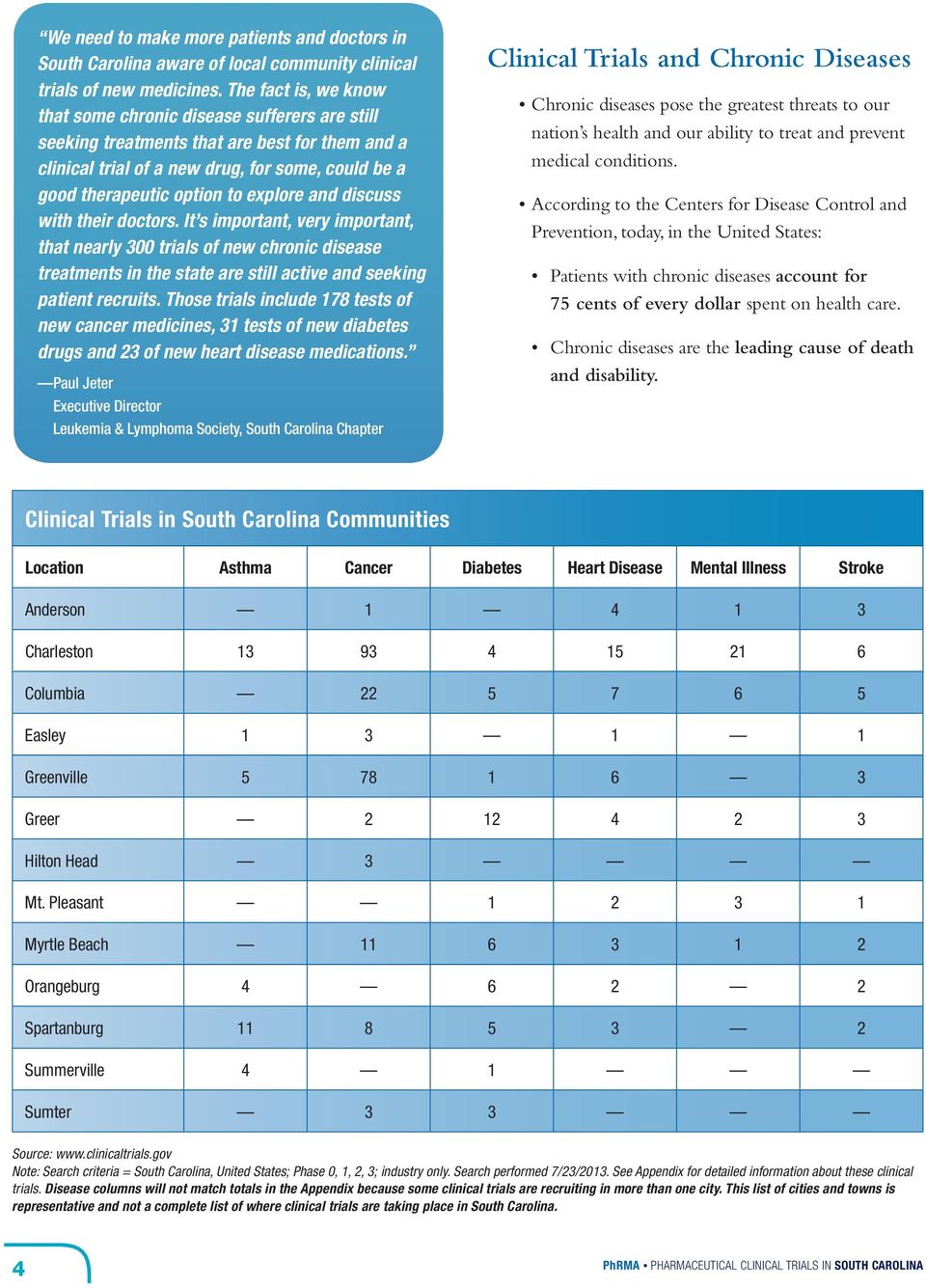
4 We need to make more patients and doctors in South Carolina aware of local community clinical trials of new medicines. The fact is, we know that some chronic disease sufferers are still seeking treatments that are best for them and a clinical trial of a new drug, for some, could be a good therapeutic option to explore and discuss with their doctors. It s important, very important, that nearly 300 trials of new chronic disease treatments in the state are still active and seeking patient recruits. Those trials include 178 tests of new cancer medicines, 31 tests of new diabetes drugs and 23 of new heart disease medications. Paul Jeter Executive Director Leukemia & Lymphoma Society, South Carolina Chapter Clinical Trials and Chronic Diseases Chronic diseases pose the greatest threats to our nation s health and our ability to treat and prevent medical conditions. According to the Centers for Disease Control and Prevention, today, in the United States: Patients with chronic diseases account for 75 cents of every dollar spent on health care. Chronic diseases are the leading cause of death and disability. Clinical Trials in South Carolina Communities Location Asthma Cancer Diabetes Heart Disease Mental Illness Stroke Anderson Charleston Columbia Easley Greenville Greer Hilton Head 3 Mt. Pleasant Myrtle Beach Orangeburg Spartanburg Summerville 4 1 Sumter 3 3 Source: Note: Search criteria = South Carolina, United States; Phase 0, 1, 2, 3; industry only. Search performed 7/23/2013. See Appendix for detailed information about these clinical trials. Disease columns will not match totals in the Appendix because some clinical trials are recruiting in more than one city. This list of cities and towns is representative and not a complete list of where clinical trials are taking place in South Carolina. 4 PhRMA Pharmaceutical Clinical Trials in South Carolina
5 Chronic diseases are a leading driver of rising health care costs with expenses totaling billions of dollars every year. Biopharmaceutical research companies are developing new medicines to help treat those conditions that are taking an unprecedented toll on American lives, and many of these medicines are being tested today in clinical trials throughout South Carolina. Since 1999, biopharmaceutical research companies are sponsoring or have sponsored 1,679 clinical trials of potential new medicines in South Carolina alone for asthma, cancer, heart disease, stroke, diabetes and mental illnesses. Of these trials, 290 are either not yet recruiting or are just now seeking South Carolina patients. Many of the state s clinical tests involve collaborations with such respected local institutions as the Medical University of South Carolina, the Charleston VA Medical Center, Bon Secours St. Francis Hospital, Spartanburg Regional Medical Center, Sisters of Charity Providence Hospital, McLeod Health and the Wm. Jennings Bryan Dorn VA Medical Center. Many of the medicines being clinically tested here are new-generation biotechnology treatments. Clinical Trials for Top Chronic Diseases Chronic Disease All Clinical Trials Clinical Trials Still Recruiting Asthma Cancer Diabetes Heart Disease Mental Illness Stroke 29 7 Total 1, Source: Note: Search criteria = South Carolina, United States; Phase 0, 1, 2, 3; industry only. Search performed 7/23/2013. Some clinical trials appear in more than one disease category. Research in Your Backyard Developing Cures, Creating Jobs 5

6 Clinical Trials in South Carolina Clinical tests of new medicines are a vitally important part of the drug development and approval process they account for 45 to 75 percent of the $1.2 billion average cost of developing a new drug and are conducted to determine the safety and effectiveness of that treatment in patients. Some trials are also conducted to compare existing treatments and some are done to learn if a drug is appropriate for a different patient population, such as children. Still others are conducted to find ways to make existing approved drugs more effective and easier to use with fewer side effects. It s essential that trials be conducted properly so that clinicians and drug reviewers can develop accurate assessments of the efficacy and safety of medicines when used by patients. The FDA is a vigilant regulatory agency and its pharmaceutical review officers are effective in detecting flawed information. Questionable or confusing data can lead to lengthy delays in product approval or outright FDA rejection of a new drug. Biopharmaceutical research companies are looking for the best physicians and research institutions to meticulously help design and conduct their clinical trials to determine whether a medicine is safe and effective. Side effects must be painstakingly documented and a determination made as to whether they occur too often and are dangerous. Clinical tests involve three phases and thousands of volunteer patients and are often conducted at multiple sites around the country. In South Carolina, biopharmaceutical Clinical Trials for Top Chronic Diseases Chronic Disease All Clinical Trials Clinical Trials Still Recruiting Asthma Cancer Diabetes Heart Disease Mental Illness Stroke 29 7 Total 1, Source: Note: Search criteria = South Carolina, United States; Phase 0, 1, 2, 3; industry only. Search performed 7/23/2013. Some clinical trials appear in more than one disease category. companies are providing funds to have trials conducted at the states well-respected university medical schools and science centers, local hospitals and clinical research organizations. According to U.S. News and World Report, the Medical University of South Carolina ranked 59th and the University of South Carolina ranked 85th among this year s top 100 research-oriented medical schools in the United States. 6 PhRMA Pharmaceutical Clinical Trials in South Carolina

7 Asthma is a debilitating condition for more than 25 million Americans, including 7.1 million children under the age of 18. The toll is also severe in South Carolina, with 293,200 adults and 90,005 children suffering from asthma, according to the South Carolina Department of Health and Environmental Control. Currently, 22 clinical trials of new asthma medicines are recruiting patients in South Carolina. Trials are being conducted at Greenville Pharmaceutical Research, Inc. in Greenville and CU Pharmaceutical Research in Rock Hill. Cancer, the second leading cause of death in the United States, now afflicts nearly 14 million Americans, according to the National Cancer Institute. In South Carolina, nearly 28,000 new cancer cases will be diagnosed this year and 9,800 victims in the state will die, according to the American Cancer Society. Currently, 176 clinical trials of new cancer medicines are recruiting patients in South Carolina. Biopharmaceutical companies are collaborating on the tests with such prominent institutions as the Hollings Cancer Center at the Medical University of South Carolina in Charleston, the Greenville Hospital System in Greenville, Cancer Centers of the Carolinas in Easley, the Carolina Urologic Research Center in Myrtle Beach, the Institute of Translational Oncology Research (ITOR) in Greenville, the Spartanburg Regional Medical Center in Spartanburg and the Wm. Jennings Bryan Dorn VA Medical Center in Columbia. Diabetes affects more than 25 million Americans more than 8 percent of the U.S. population including 7 million people who are unaware they have the disease. In South Carolina, nearly 10 percent of residents have been diagnosed with diabetes, according to the South Carolina Department of Health and Environmental Control. In 2011, 1,085 South Carolinians died from diabetes. Currently, 35 diabetes clinical tests are seeking patients in South Carolina. The trials are being conducted at the Carolina Musculoskeletal Institute in Aiken, Palmetto Clinical Trial Services in Simpsonville, Southeastern Research Associates in Anderson and TLM Medical Services in Columbia. Heart disease and stroke are the first and fourth leading disease causes of death in the United States and the second and fourth in South Carolina. According to the American Heart Association, more than 82 million Americans are affected by these diseases. In South Carolina, in 2011, more than 9,000 residents died from some form of heart disease and 2,285 died from a stroke, according to the South Carolina Department of Health and Environmental Control. Currently, 21 heart disease and seven stroke clinical tests are seeking patients in South Carolina. The trials are being conducted at AnMed Health in Anderson, Greenville Hospital System in Greenville, McLeod Health/Pee Dee Cardiology in Florence, the Medical University of South Carolina in Charleston, Sisters of Charity Providence Hospital in Columbia and the South Carolina Heart Center in Columbia. Mental illness affects nearly 60 million Americans who suffer from some form of the disease from anxiety to depression to schizophrenia to eating disorders. In South Carolina, about 170,000 adults live with serious mental illness and about 48,000 children live with serious mental health conditions, according to the National Alliance on Mental Illness. Currently, 29 clinical trials for mental illness are recruiting patients in South Carolina. The trials are taking place at the Charleston VA Medical Center in Charleston, the Coastal Carolina Research Center in Mount Pleasant and Radiant Research in Greer. Physicians and patients can find out about clinical trials being conducted all over the state in collaboration with local institutions by accessing a database sponsored by the National Institutes of Health. Information on medicines in development is also available on the website of the Pharmaceutical Research and Manufacturers of America (PhRMA), under Related Content in the Innovation section. Research in Your Backyard Developing Cures, Creating Jobs 7

8 What is the Clinical Trial Experience? Clinical trials are research studies which grant participants early access to new drugs, treatments and therapies that are being developed to help combat chronic, serious and life-threatening diseases. By volunteering for a clinical trial, patients take an active role in their healthcare by helping researchers test new medical treatments, and helping to find better ways of using existing treatments so they will be more effective, easier to use and result in fewer or more tolerable side effects. In South Carolina alone, thousands of clinical trials are being conducted to study diseases like asthma, cancer, diabetes, heart disease, mental illness, and stroke. Phases of Clinical Trials There are three phases of testing used to evaluate new drugs and treatments: Phase I This phase is designed to test the safety of a new drug or treatment. Researchers test the drug on a small group of people (20-80) and evaluate safety aspects of the drug, such as safe dosage range, the best way of administering the treatment (pill form vs. a shot, for example) and identifying what, if any, side effects present themselves. Phase II This phase is designed to test efficacy and to further measure safety. The treatment is given to a larger group of people ( ) to make sure the treatment works correctly and to try to identify any less-common side effects, which may appear when more people are tested. This phase is usually placebo-controlled and double-blinded; meaning neither the patient nor the doctor knows whether the patient is getting the placebo or the real treatment. Phase III This phase is meant to confirm efficacy and safety information, monitor known side effects and compare the experimental treatment to commonly used ones to see which work better. A large group (1,000-3,000) receives this treatment, and like Phase II, it is usually placebo-controlled and double-blinded. Learning About and Accessing Clinical Trials There are several ways patients can access information about clinical trials. Healthcare providers are aware of clinical trials being conducted at hospitals, universities and other leading healthcare facilities, and these institutions can be valuable sources of information for patients looking to participate. Patients can also turn to hospitals and universities websites to see what studies are being conducted in their area, and what the eligibility criteria are for each trial. More information about clinical trials and volunteering can be found at a PhRMA-recommended website. 8 PhRMA Pharmaceutical Clinical Trials in South Carolina
9 What to Expect Treatments for clinical trials usually occur in a doctor s office. Patients may need to devote more time to doctor s visits and physical exams than they would normally. They may also have additional responsibilities, like keeping a daily log of their health. All prospective participants must sign an informed consent document saying they understand that the clinical trial is research, and that they can leave the trial at any time. Once they have consulted with their healthcare providers, patients can reach out via phone or to express interest in participating, at which point a pre-screening interview will take place. If the patient matches the trial s criteria, they will then be able to enroll in the study. Patient Expenses Patients should always ask during their pre-screening interviews what it will cost them to participate in a clinical trial. Clinical trial sponsors usually pay for all researchrelated costs and any additional testing or doctors visits the trial requires. Patients or their insurance companies may be asked to pay for any routine treatments that they would normally undergo for their disease. However, some health plans do not pay for these costs once a patient joins the trial. Patients should be sure to check with the clinic conducting the trial to find out if they or their insurance companies will be charged with any fees, and should make sure their insurance companies will cover the costs of routine exams if they join a trial. Non-local patients should be sure to look into the sponsoring clinic s policy on patient living arrangements. The National Cancer Institute, for example, makes patients responsible for their own travel costs for the initial screening visits. Once a patient is enrolled, the Institute will pay for transportation costs for all subsequent trial-related visits. These patients will receive a small per diem for food and lodging. The policy will differ from clinic to clinic. Research in Your Backyard Developing Cures, Creating Jobs 9

10 New Generation Medicines in Development Some of the medicines that have been tested in South Carolina are cutting-edge biotechnology drugs. America s biopharmaceutical research companies are using biotechnology to develop hundreds of new medicines and vaccines today. And South Carolina is one of the states where this research and development work is being done. Through biotechnology, new ways are being developed to not only more effectively treat disease, but also to predict it and even prevent it. Biotechnology medicines are developed through biological processes using living cells or organisms, rather than traditional chemical synthesis, the mainstay of pharmaceutical development for decades. Such novel treatments use a variety of new approaches to treat disease. For example, a monoclonal antibody is a laboratory-made version of the naturally occurring immune system protein that binds to and neutralizes foreign invaders. Interferons are proteins that interfere with the ability of a cell to reproduce. Antisense drugs, meanwhile, are medicines that interfere with the communication process that tells a cell to produce an unwanted protein. In addition, nanotechnology is being used in biotechnology research to provide drugdelivery systems, new treatments and diagnostics. Many of the medicines in clinical testing at South Carolina medical schools and research centers feature these technologies. For example: A genetically-modified virus-based vaccine to treat melanoma, with clinical trials conducted at the Medical University of South Carolina in Charleston and the Institute for Translational Oncology Research in Greenville. A recombinant fusion protein to treat diabetic macular edema and other types of macular edema with trials taking place at the Carolina Retina Center and the Palmetto Retina Center, both in Columbia. Clinicians at research facilities in Charleston, Myrtle Beach, and Simpsonville are testing a monoclonal antibody that targets lupus and different types of cancer. A therapeutic vaccine, designed to jump-start the immune system to fight disease, is in development for lung cancer and melanoma, with clinical trials underway in Charleston and Columbia. A gene therapy for the treatment of Alzheimer s disease is being studied at the Medical University of South Carolina in Charleston. An engineered human antibody to reduce inflammation in psoriasis is in clinical trials in Anderson and Greer. A monoclonal antibody for rheumatoid arthritis that may block the inflammatory process is being studied in Charleston and Columbia. These are only a portion of the examples of new ways the nation s biopharmaceutical companies and South Carolina research institutions are working together to attack disease. The biotechnology medicines and vaccines in development are helping to expand the frontiers of science and potentially bring more and better treatments to patients. 10 PhRMA Pharmaceutical Clinical Trials in South Carolina

11 Conclusion Biopharmaceutical companies close collaboration with clinicians and research institutions in South Carolina benefits patients, the state s economy and the advancement of science and patient care. Clinical trials provide stimulating biopharmaceutical research work and a reliable source of revenue for the states medical schools, hospitals and local contract research organizations, and the medicines being tested are often cutting-edge cell and protein treatments with the potential to be safer and more effective than older chemical compound drugs. What s more, South Carolinians considering participation in clinical trials have a wide range of choices, including 290 tests of new medicines for the six most debilitating chronic diseases. Research in Your Backyard Developing Cures, Creating Jobs 11

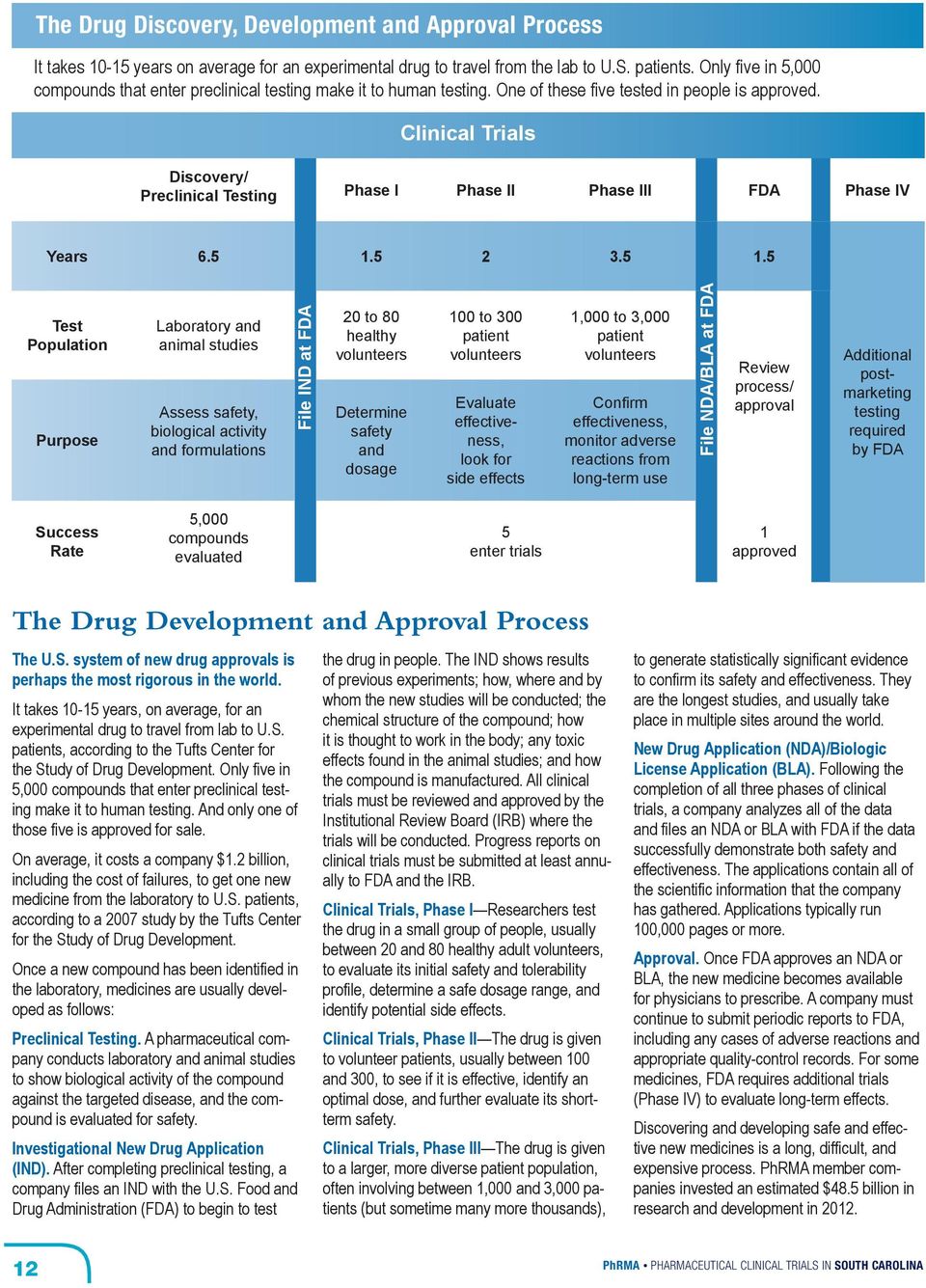
12 The Drug Discovery, Development and Approval Process It takes years on average for an experimental drug to travel from the lab to U.S. patients. Only five in 5,000 compounds that enter preclinical testing make it to human testing. One of these five tested in people is approved. Clinical Trials Discovery/ Preclinical Testing Phase I Phase II Phase III FDA Phase IV Years Test Population Purpose Laboratory and animal studies Assess safety, biological activity and formulations File IND at FDA 20 to 80 healthy volunteers Determine safety and dosage 100 to 300 patient volunteers Evaluate effectiveness, look for side effects 1,000 to 3,000 patient volunteers Confirm effectiveness, monitor adverse reactions from long-term use File NDA/BLA at FDA Review process/ approval Additional postmarketing testing required by FDA Success Rate 5,000 compounds evaluated 5 enter trials 1 approved The Drug Development and Approval Process The U.S. system of new drug approvals is perhaps the most rigorous in the world. It takes years, on average, for an experimental drug to travel from lab to U.S. patients, according to the Tufts Center for the Study of Drug Development. Only five in 5,000 compounds that enter preclinical testing make it to human testing. And only one of those five is approved for sale. On average, it costs a company $1.2 billion, including the cost of failures, to get one new medicine from the laboratory to U.S. patients, according to a 2007 study by the Tufts Center for the Study of Drug Development. Once a new compound has been identified in the laboratory, medicines are usually developed as follows: Preclinical Testing. A pharmaceutical company conducts laboratory and animal studies to show biological activity of the compound against the targeted disease, and the compound is evaluated for safety. Investigational New Drug Application (IND). After completing preclinical testing, a company files an IND with the U.S. Food and Drug Administration (FDA) to begin to test the drug in people. The IND shows results of previous experiments; how, where and by whom the new studies will be conducted; the chemical structure of the compound; how it is thought to work in the body; any toxic effects found in the animal studies; and how the compound is manufactured. All clinical trials must be reviewed and approved by the Institutional Review Board (IRB) where the trials will be conducted. Progress reports on clinical trials must be submitted at least annually to FDA and the IRB. Clinical Trials, Phase I Researchers test the drug in a small group of people, usually between 20 and 80 healthy adult volunteers, to evaluate its initial safety and tolerability profile, determine a safe dosage range, and identify potential side effects. Clinical Trials, Phase II The drug is given to volunteer patients, usually between 100 and 300, to see if it is effective, identify an optimal dose, and further evaluate its shortterm safety. Clinical Trials, Phase III The drug is given to a larger, more diverse patient population, often involving between 1,000 and 3,000 patients (but sometime many more thousands), to generate statistically significant evidence to confirm its safety and effectiveness. They are the longest studies, and usually take place in multiple sites around the world. New Drug Application (NDA)/Biologic License Application (BLA). Following the completion of all three phases of clinical trials, a company analyzes all of the data and files an NDA or BLA with FDA if the data successfully demonstrate both safety and effectiveness. The applications contain all of the scientific information that the company has gathered. Applications typically run 100,000 pages or more. Approval. Once FDA approves an NDA or BLA, the new medicine becomes available for physicians to prescribe. A company must continue to submit periodic reports to FDA, including any cases of adverse reactions and appropriate quality-control records. For some medicines, FDA requires additional trials (Phase IV) to evaluate long-term effects. Discovering and developing safe and effective new medicines is a long, difficult, and expensive process. PhRMA member companies invested an estimated $48.5 billion in research and development in PhRMA Pharmaceutical Clinical Trials in South Carolina
13 The Good News Many Clinical Trials are Still Recruiting There are 290 clinical trials of new chronic disease drugs recruiting patients in South Carolina. These trials target the top most debilitating chronic conditions cancer, heart disease, stroke, asthma, diabetes and mental illness. Clinical Trials in South Carolina Communities Location Asthma Cancer Diabetes Heart Disease Mental Illness Stroke Anderson Charleston Columbia Easley Greenville Greer Hilton Head 3 Mt. Pleasant Myrtle Beach Orangeburg Spartanburg Summerville 4 1 Sumter 3 3 Source: Note: Search criteria = South Carolina, United States; Phase 0, 1, 2, 3; industry only. Search performed 7/23/2013. See Appendix for detailed information about these clinical trials. Disease columns will not match totals in the Appendix because some clinical trials are recruiting in more than one city. This list of cities and towns is representative and not a complete list of where clinical trials are taking place in South Carolina. Research in Your Backyard Developing Cures, Creating Jobs 13

14 The Good News Many Clinical Trials are Still Recruiting (continued) Asthma Leading Institutions Conducting Clinical Trials CU Pharmaceutical Research, Rock Hill Greenville Pharmaceutical Research, Inc., Greenville Cancer Leading Institutions Conducting Clinical Trials AnMed Health Cancer Center, Anderson Bon Secours St. Francis Hospital, Greenville Cancer Centers of the Carolinas, Easley, Greenville, Spartanburg Carolina Hematology Oncology, Sumter Carolina Urologic Research Center, Myrtle Beach Charleston Hematology Oncology Associates PA, Charleston Greenville Hospital System, Greenville Gynecologic Oncology Research and Development, LLC, Greenville Hollings Cancer Center at the Medical University of South Carolina, Charleston Institute of Translational Oncology Research (ITOR), Greenville Liberty Hematology Oncology, Columbia McLeod Regional Medical Center, Florence Medical University of South Carolina Hospitals and Clinics, Charleston Roper Hospital and Medical Associates, Charleston Saint Francis Hospital, Greenville Santee Hematology/Oncology, Sumter South Carolina Cancer Specialists, Hardeeville, Hilton Head South Carolina Oncology Associates, Columbia Spartanburg Regional Medical Center, Spartanburg Upstate Carolina-Community Clinical Oncology Program, Spartanburg Upstate Oncology Associates, Greenville Wm. Jennings Bryan Dorn VA Medical Center, Columbia Diabetes Leading Institutions Conducting Clinical Trials Carolina Musculoskeletal Institute, Aiken Palmetto Clinical Trial Services, LLC, Simpsonville Southeastern Research Associates, Inc., Anderson, Taylors TLM Medical Services, Columbia Heart Disease Leading Institutions Conducting Clinical Trials AnMed Health, Anderson Columbia Cardiology Consultants, Columbia Greenville Hospital System, Greenville McLeod Health/Pee Dee Cardiology, Florence 14 PhRMA Pharmaceutical Clinical Trials in South Carolina

15 Medical University of South Carolina, Charleston Sisters of Charity Providence Hospital, Columbia South Carolina Heart Center, Columbia Spartanburg Regional Medical Center, Spartanburg Coastal Carolina Research Center, Mount Pleasant Medical University of South Carolina, Charleston Radiant Research, Greer SleepMed of South Carolina, Columbia Upstate Cardiology, Greenville Mental Illness Leading Institutions Conducting Clinical Trials Carolina Clinical Research Services, Columbia Stroke Leading Institutions Conducting Clinical Trials Medical University of South Carolina, Charleston Palmetto Health Richland, Columbia Charleston VA Medical Center, Charleston Research in Your Backyard Developing Cures, Creating Jobs 15

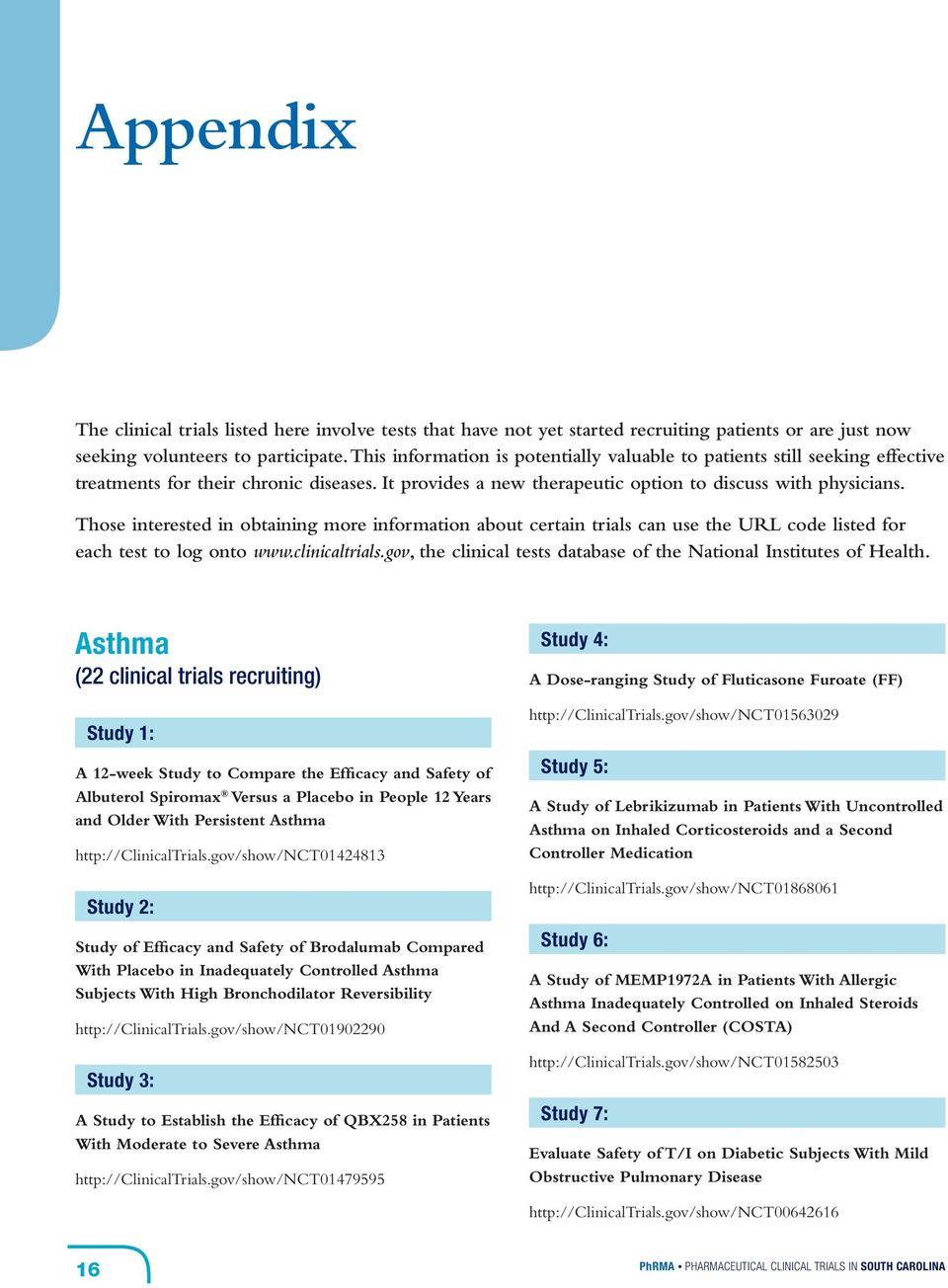
16 Appendix The clinical trials listed here involve tests that have not yet started recruiting patients or are just now seeking volunteers to participate. This information is potentially valuable to patients still seeking effective treatments for their chronic diseases. It provides a new therapeutic option to discuss with physicians. Those interested in obtaining more information about certain trials can use the URL code listed for each test to log onto the clinical tests database of the National Institutes of Health. Asthma (22 clinical trials recruiting) Study 1: A 12-week Study to Compare the Efficacy and Safety of Albuterol Spiromax Versus a Placebo in People 12 Years and Older With Persistent Asthma Study 2: Study of Efficacy and Safety of Brodalumab Compared With Placebo in Inadequately Controlled Asthma Subjects With High Bronchodilator Reversibility Study 3: A Study to Establish the Efficacy of QBX258 in Patients With Moderate to Severe Asthma Study 4: A Dose-ranging Study of Fluticasone Furoate (FF) Study 5: A Study of Lebrikizumab in Patients With Uncontrolled Asthma on Inhaled Corticosteroids and a Second Controller Medication Study 6: A Study of MEMP1972A in Patients With Allergic Asthma Inadequately Controlled on Inhaled Steroids And A Second Controller (COSTA) Study 7: Evaluate Safety of T/I on Diabetic Subjects With Mild Obstructive Pulmonary Disease 16 PhRMA Pharmaceutical Clinical Trials in South Carolina
17 Study 8: Open-Label Assessment of the Albuterol Spiromax Dry Powder Inhaler (DPI) Study 9: A Study of the Effectiveness and Safety of Different Doses of Fluticasone Propionate Taken From a Dry Powder Inhaler (Puffer) in Adolescents and Adults Who Have Asthma That is Not Controlled by High Dose Inhaled Corticosteroid Asthma Medications Study 10: Efficacy and Safety of 2 Doses of Tiotropium Respimat Compared to Placebo in Children With Severe Persistent Asthma Study 11: Evaluate the Safety, Efficacy and Dose Response of GSK in Combination With Fluticasone Furoate in Subjects With Asthma Study 12: An Efficacy and Safety Study of Fluticasone Furoate/ Vilanterol (FF/VI) 200/25 Microgram (Mcg), FF/VI 100/25 Mcg, and FF 100 Mcg in Adults and Adolescents With Persistent Asthma Study 13: Efficacy and Safety of 2 Doses of Tiotropium Respimat Compared to Placebo in Children With Moderate Persistent Asthma Study 14: Efficacy and Safety of 2 Doses of Tiotropium Respimat Compared to Placebo in Adolescents With Severe Persistent Asthma Study 15: Evaluation of Tiotropium 2.5 and 5 Mcg Once Daily Delivered Via the Respimat Inhaler Compared to Placebo in 1 to 5 Year Old Patients With Persistent Asthma Study 16: Efficacy and Safety of QGE031 versus Placebo and Omalizumab in Patients Aged Years With Asthma Study 17: Efficacy of Inhaled Albuterol Spiromax in Subjects With Persistent Asthma Study 18: Dose Finding Study for QAW039 in Asthma Study 19: 12-Week Study in Adult Subjects With Asthma Study 20: A 12-Week Study in Adult Subjects With Asthma Study 21: Dose-ranging Study of Vilanterol (VI) Inhalation Powder in Children Research in Your Backyard Developing Cures, Creating Jobs 17

18 Study 22: Long-Term Efficacy and Safety Study of SCH / MK-8237 in Children and Adults With House Dust Mite-Induced Allergic Rhinitis/Rhinoconjunctivitis (P05607) Study 5: A Study of Perjeta (Pertuzumab) in Combination With Herceptin (Trastuzumab) and Chemotherapy in Patients With HER2-Positive Metastatic Gastroesophageal Junction or Gastric Cancer Study 6: Cancer (176 clinical trials recruiting) Study 1: Efficacy and Safety of Zoledronic Acid (Every 4 Weeks vs. Every 12 Weeks) in Patients With Documented Bone Metastases From Bone Cancer Study 2: Study of Denosumab in Subjects With Giant Cell Tumor of Bone Study 3: Phase 1 Study of PLX7486 as Single Agent and With Gemcitabine Plus Nab-Paclitaxel in Patients With Advanced Solid Tumors Study 4: A Study of Trastuzumab Emtansine Versus Trastuzumab as Adjuvant Therapy in Patients With HER2-Positive Breast Cancer Who Have Residual Tumor in the Breast or Axillary Lymph Nodes Following Preoperative Therapy (KATHERINE) Study of GDC-0068 Or GDC-0980 With Abiraterone Acetate Versus Abiraterone Acetate in Patients With Castration-Resistant Prostate Cancer Previously Treated With Docetaxel Chemotherapy Study 7: FOLFOX6m Plus SIR-Spheres Microspheres vs. FOLFOX6m Alone in Patients With Liver Mets From Primary Colorectal Cancer Study 8: Comparison of Neoadjuvant Chemotherapy With Weekly Paclitaxel or Eribulin Followed by A/C in Women With Locally Advanced HER2-Negative Breast Cancer Study 9: Phase Ib Study of PI3 (Phosphoinositol 3)-Kinase Inhibitor BAY With MEK (Mitogen-activated Protein Kinase) Inhibitor BAY in Patients With Advanced Cancer Study 10: Everolimus Plus Best Supportive Care vs. Placebo Plus Best Supportive Care in the Treatment of Patients With Advanced Neuroendocrine Tumors (GI or Lung Origin) 18 PhRMA Pharmaceutical Clinical Trials in South Carolina

19 Study 11: S0820, Adenoma and Second Primary Prevention Trial Study 12: Phase I Study to Evaluate the Effect of LDE225 on the Pharmacokinetics of Bupropion and Warfarin in Patients Study 13: Phase II, Open Label, Single Arm Study of SAR In Myelofibrosis Patients Previously Treated With Ruxolitinib Study 14: A Phase 2 of GS-9973 in Combination With Idelalisib in Subjects With Relapsed or Refractory Hematologic Malignancies Study 15: Fosaprepitant + 5HT3 Receptor Antagonists + Dexamethasone in Germ Cell Tumors Study 16: DN24-02 as Adjuvant Therapy in Subjects With High Risk HER2+ Urothelial Carcinoma Study 17: Nilotinib Treatment-free Remission Study in CML (Chronic Myeloid Leukemia) Patients Study 18: Safety and Efficacy of Pomalidomide, Bortezomib and Low-dose Dexamethasone in Subjects With Relapsed or Refractory Multiple Myeloma Study 19: First-line Everolimus +/- Paclitaxel for Cisplatin-ineligible Patients With Advanced Urothelial Carcinoma Study 20: ADAM-Afatinib Diarrhea Assessment and Management Study 21: Phase 3 Study of Nivolumab or Nivolumab Plus Ipilimumab Versus Ipilimumab Alone in Previously Untreated Advanced Melanoma Study 22: Study to Compare the Effect of Ipilimumab Retreatment With Chemotherapy in Advanced Melanoma Study 23: A Study of Two Vismodegib Regimens in Patients With Multiple Basal Cell Carcinomas Study 24: A Study Of Inotuzumab Ozogamicin Versus Investigator s Choice Of Chemotherapy In Patients With Relapsed Or Refractory Acute Lymphoblastic Leukemia Research in Your Backyard Developing Cures, Creating Jobs 19

20 Study 25: A Randomized, Controlled Study Evaluating the Efficacy and Safety of GS-1101 (CAL-101) in Combination With Ofatumumab for Previously Treated Chronic Lymphocytic Leukemia Study 26: Study of Brentuximab Vedotin Combined With Bendamustine in Patients With Hodgkin Lymphoma Study 27: CNDO-109-AANK for AML in First Complete Remission (CR1) Study 28: A Study of the Bruton s Tyrosine Kinase Inhibitor Ibrutinib Given in Combination With Bendamustine and Rituximab in Patients With Newly Diagnosed Mantle Cell Lymphoma Study 29: Study of Efficacy and Safety of LDE225 in Adult Patients With Relapsed/Refractory Acute Leukemia Study 30: Efficacy of Oral Azacitidine Plus Best Supportive Care as Maintenance Therapy in Subjects With Acute Myeloid Leukemia in Complete Remission Study 31: Phase II Phosphatidylinositol 3-Kinase (PI3K) Inhibitor in Relapsed, Indolent or Aggressive Non-Hodgkin s Lymphomas (NHL) Study 32: Safety and Efficacy of CML Patients Who Switch to Nilotinib and Stop Treatment After Achieving and Sustaining MR4.5 Study 33: Phase III Study of CPX-351 Versus 7+3 in Patients Years Old With Untreated High Risk (Secondary) Acute Myeloid Leukemia Study 34: Efficacy and Safety of Oral Rigosertib in Transfusion-dependent, Low or Int-1 or Trisomy 8 Int-2 Myelodysplastic Syndrome Study 35: Combination Study of Deferasirox and Erythropoietin in Patients With Low- and Int-1-risk Myelodysplastic Syndrome Study 36: Oral Pacritinib Versus Best Available Therapy to Treat Myelofibrosis Study 37: Anemia Treatment for Advanced Non-Small Cell Lung Cancer (NSCLC) Patients Receiving Chemotherapy Study 38: TRINOVA-3: A Study of AMG 386 or AMG 386 Placebo in Combination With Paclitaxel and Carboplatin to Treat Ovarian Cancer 20 PhRMA Pharmaceutical Clinical Trials in South Carolina

21 Study 39: Comparison of Cabazitaxel/Prednisone Alone or in Combination With Custirsen for 2nd Line Chemotherapy in Prostate Cancer Study 40: Safety and Efficacy Study of Enzalutamide Versus Bicalutamide in Men With Prostate Cancer Study 41: Denosumab Compared to Zoledronic Acid in the Treatment of Bone Disease in Subjects With Multiple Myeloma Study 42: A Phase 1 Study Evaluating AMG 232 in Advanced Solid Tumors Study 43: A Study of Onartuzumab (MetMAb) in Combination With Tarceva (Erlotinib) in Patients With Met Diagnostic-Positive Non-Small Cell Lung Cancer Who Have Received Chemotherapy For Advanced or Metastatic Disease (MetLung) Study 44: A Study of Pertuzumab in Addition to Chemotherapy and Herceptin (Trastuzumab) as Adjuvant Therapy in Patients With HER2-Positive Primary Breast Cancer Study 46: Study for Women With Platinum Resistant Ovarian Cancer Evaluating EC145 in Combination With Doxil (PROCEED) Study 47: IMAAGEN: Impact of Abiraterone Acetate in Prostate-Specific Antigen Study 48: A Trial of Preoperative MM-121 With Paclitaxel in HER2-negative Breast Cancer Study 49: A Study of Necitumumab and Chemotherapy in Participants With Stage IV Squamous Non-Small Cell Lung Cancer Study 50: A Study to Test Safety and Efficacy of IMGN901 in Combination With Carboplatin/Etoposide in Patients With Advanced Solid Tumors and Extensive Stage Small Cell Lung Cancer Study 51: Trial in Squamous Non Small Cell Lung Cancer Subjects Comparing Ipilimumab Plus Paclitaxel and Carboplatin Versus Placebo Plus Paclitaxel and Carboplatin Study 45: A Phase 3 Efficacy Study of a Recombinant Vaccinia Virus Vaccine to Treat Metastatic Prostate Cancer Research in Your Backyard Developing Cures, Creating Jobs 21
22 Study 52: VTX-2337 and Pegylated Liposomal Doxorubicin (PLD) in Patients With Recurrent or Persistent Epithelial Ovarian, Fallopian Tube or Primary Peritoneal Cancer Study 53: Study of Cabozantinib (XL184) Versus Prednisone in Men With Metastatic Castration-resistant Prostate Cancer Previously Treated With Docetaxel and Abiraterone or MDV Study 54: A Phase II Study to Evaluate the Efficacy of TKI258 for the Treatment of Patients With FGFR2 Mutated or Wild-type Advanced and/or Metastatic Endometrial Cancer Study 55: A Phase 1b/2 Study of OMP-59R5 in Combination With Gemcitabine in Subjects With Previously Untreated Stage IV Pancreatic Cancer Study 56: Tivozanib Hydrochloride in Combination With Paclitaxel Versus Placebo With Paclitaxel in Patients With Locally Recurrent or Metastatic Triple Negative Breast Cancer Study 57: Study of PX-866 and Docetaxel in Solid Tumors Study 58: The BEACON Study (Breast Cancer Outcomes With NKTR-102) Study 59: Dose Finding Study of RAD001 (Everolimus, Afinitor ) in Combination With BEZ235 in Patients With Advanced Solid Tumors Study 60: Study of a Drug [DCVax -L] to Treat Newly Diagnosed GBM Brain Cancer Study 61: A Study of AMG 820 in Subjects With Advanced Solid Tumors Study 62: M402 and Gemcitabine in Pancreatic Cancer Part A Study 63: Phase 1b/2 Trial of AMG386 With Pemetrexed and Carboplatin in Non-Small Cell Lung Cancer Study 64: A Study That Provides Long-term Safety Follow-up and Examines Long-term Exposure to Abiraterone Acetate 22 PhRMA Pharmaceutical Clinical Trials in South Carolina
23 Study 65: Study of Imprime PGG in Combination With Cetuximab in Subjects With Recurrent or Progressive KRAS Wild Type Colorectal Cancer Study 66: Two-Dose Level Evaluation of NX-1207 for the Treatment of Low Risk, Localized (T1c) Prostate Cancer Study 67: Study With TMX-101 in Patients With Carcinoma In Situ (CIS) Bladder Cancer Study 68: Study Assessing Safety, Pharmacokinetics and Efficacy of CC-223 With Either Erlotinib or Oral Azacitidine in Advanced Non-Small Cell Lung Cancer Study 69: Study of MM-398 With or Without 5-Fluorouracil and Leucovorin, Versus 5-Fluorouracil and Leucovorin in Patients With Metastatic Pancreatic Cancer Study 70: Immunotherapy Study for Surgically Resected Pancreatic Cancer Study 71: Intravesical Administration of INSTILADRIN (rad-ifn With Syn3) in Patients With Bladder Cancer Study 72: A 2 Part Phase 2 Trial of Galeterone in the Treatment of Castration Resistant Prostate Cancer Study 73: A Study in Second Line Metastatic Colorectal Cancer Study 74: Sativex for Relieving Persistent Pain in Patients With Advanced Cancer Study 75: AZD2014 and Fulvestrant in Patients With ER+ Advanced Metastatic Breast Cancer Study 76: The Study Evaluating Efficacy And Tolerability Of Veliparib in Combination With Temozolomide or In Combination With Carboplatin and Paclitaxel Versus Placebo in Subjects With BRCA1 and BRCA2 Mutation and Metastatic Breast Cancer Study 77: Efficacy & Safety of ODSH (2-0, 3-0 Desulfated Heparin) in Patients With Metastatic Pancreatic Cancer Treated With Gemcitabine & Abraxane Study 78: Trial Evaluating Dovitinib Combined With Fulvestrant, in Postmenopausal Patients With HER2- and HER+ Breast Cancer Research in Your Backyard Developing Cures, Creating Jobs 23
24 Study 79: A Phase 2 Diagnostic Imaging Study With 99mTc-MIP-1404 in Men With High-Risk Prostate Cancer Scheduled for Radical Prostatectomy (RP) and Extended Pelvic Lymph Node Dissection (EPLND) Compared to Histopathology Study 80: Phase III Study of BKM120/Placebo With Fulvestrant in Postmenopausal Patients With Hormone Receptor Positive HER2-negative Locally Advanced or Metastatic Breast Cancer Refractory to Aromatase Inhibitor Study 81: Early Switch From First-Line Docetaxel/Prednisone to Cabazitaxel/Prednisone and the Opposite Sequence, Exploring Molecular Markers in Men With Metastatic Castration-Resistant Prostate Cancer (mcrpc) Study 82: A Phase II Clinical Study of BBI608 in Adult Patients With Advanced Colorectal Cancer Study 83: A Study of PSMA ADC in Subjects With Metastatic Castration-resistant Prostate Cancer (mcrpc) Study 84: Safety and Efficacy of BKM120 in Patients With Metastatic Non-small Cell Lung Cancer Study 85: Erlotinib Plus Tivantinib (ARQ 197) Versus Single Agent Chemotherapy in Locally Advanced or Metastatic Non-Small Cell Lung Cancer Study 86: A Study of Paclitaxel With GDC-0941 Versus Paclitaxel With Placebo in Patients With Locally Recurrent or Metastatic Breast Cancer Study 87: Anamorelin HCl in the Treatment of Non-Small Cell Lung Cancer-Cachexia (NSCLC-C): An Extension Study (ROMANA 3) Study 88: Safety and Efficacy of Anamorelin HCl in Patients With Non-Small Cell Lung Cancer-Cachexia (ROMANA 2) Study 89: Study of BMS Compared to Docetaxel in Previously Treated Advanced or Metastatic Squamous Cell Non-small Cell Lung Cancer (NSCLC) Study 90: A Phase I Clinical Study of BBI503 in Adult Patients With Advanced Solid Tumors Study 91: A Phase I Clinical Study of BBI608 in Adult Patients With Advanced Malignancies 24 PhRMA Pharmaceutical Clinical Trials in South Carolina
25 Study 92: Study To Evaluate the Efficacy and Safety Of Bevacizumab, and Associated Biomarkers, In Combination With Paclitaxel Compared With Paclitaxel Plus Placebo as First-line Treatment Of Patients With Her2-Negative Metastatic Breast Cancer Study 93: A Study in Advanced Cancer Study 94: Study of GDC-0941 or GDC-0980 With Fulvestrant Versus Fulvestrant in Advanced or Metastatic Breast Cancer in Patients Resistant to Aromatase Inhibitor Therapy Study 95: Safety, Pharmacokinetics and Pharmacodynamics of BKM120 Plus MEK162 in Selected Advanced Solid Tumor Patients Study 96: An Investigational Drug, Crizotinib (PF ), Is Being Studied In Tumors, Except Non-Small Cell Lung Cancer, That Are Positive For Anaplastic Lymphoma Kinase (ALK) Study 97: Efficacy and Safety of GS-6624 With FOLFIRI as Second Line Treatment in Colorectal Adenocarcinoma Study 98: Study Of Dacomitinib In Advanced NSCLC Patients (Post Chemo Or Select First Line) To Evaluate Prophylactic Intervention On Derm And GI AEs And PRO Study 99: A Study of MM-121 Combination Therapy in Patients With Advanced Non-Small Cell Lung Cancer Study 100: A Study of Herceptin (Trastuzumab) in Combination With Cisplatin/Capecitabine Chemotherapy in Patients With HER2-Positive Metastatic Gastric or Gastro-Esophageal Junction Cancer Study 101: A Phase 3 Study to Evaluate Efficacy and Safety of Masitinib in Comparison to Imatinib in Patients With Gastro-Intestinal Stromal Tumour in First Line Medical Treatment Study 102: Brentuximab Vedotin in Patients With CD30-positive Nonlymphomatous Malignancies Study 103: A Study in Head and Neck Cancer Study 104: Gemcitabine and ON Na in Previously Untreated Metastatic Pancreatic Cancer Research in Your Backyard Developing Cures, Creating Jobs 25
26 Study 105: Study of BMS Compared to Docetaxel in Previously Treated Advanced or Metastatic Non-squamous NSCLC Study 106: A Rollover Study to Provide Continued Treatment With GSK to Subjects With BRAF Mutation-Positive Tumors Study 107: A Study of LY in Participants With Myeloproliferative Neoplasms Study 108: A Study of VGX-3100 DNA Vaccine With Electroporation in Patients With Cervical Intraepithelial Neoplasia Grade 2/3 or 3 Study 109: Phase II Randomized Trial Evaluating Neoadjuvant Therapy With Neratinib and/or Trastuzumab Followed by Postoperative Trastuzumab in Women With Locally Advanced HER2-positive Breast Cancer Study 110: A Clinical Study of BBI608 Administered With Paclitaxel in Adult Patients With Advanced Malignancies Study 111: A Study to Evaluate the Safety and Efficacy of Inactivated Varicella-zoster Vaccine (VZV) as a Preventative Treatment for Herpes Zoster (HZ) and HZ-related Complications in Adult Participants With Solid Tumor or Hematologic Malignancy (V AM3) Study 112: A Phase 1 Study of CC-486 as a Single Agent and in Combination With Carboplatin or ABI-007 in Subjects With Relapsed or Refractory Solid Tumors Study 113: Trial of Poor Performance Status Patients (ToPPS) Study 114: A Study of Pemetrexed & Carboplatin/Cisplatin or Gemcitabine & Carboplatin/Cisplatin With or Without IMC-1121B in Patients Previously Untreated With Recurrent or Advanced Non-small Cell Lung Cancer (NSCLC) Study 115: Study of Panobinostat in Combination With Sorafenib in Kidney or Lung Cancers Study 116: A Study of MEHD7945A Versus Cetuximab in Patients With Recurrent/Metastatic Squamous Cell Carcinoma of The Head And Neck 26 PhRMA Pharmaceutical Clinical Trials in South Carolina
27 Study 117: Everolimus Versus Placebo in Head and Neck Cancer Study 118: A Study of LY in Small Cell Lung Cancer Study 119: Study of LY Testing Alternative Dosing in Participants With Myeloproliferative Neoplasms Study 120: Preoperative Pemetrexed and Carboplatin for Select Stage IB, II, and III Non-Squamous Non-Small-Cell Lung Cancer Study 121: Trial of Eribulin/Cyclophosphamide or Docetaxel/ Cyclophosphamide as Neoadjuvant Therapy in Locally Advanced HER2-Negative Breast Cancer Study 122: Trial of Eribulin in Patients Who Do Not Achieve Pathologic Complete Response (pcr) Following Neoadjuvant Chemotherapy Study 123: Study With SAR in Patients With Polycythemia Vera or Essential Thrombocythemia Study 124: Feasibility and Safety Study in Patients With Metastatic Pancreatic Adenocarcinoma Study 125: HepaSphere/Quadrasphere Microspheres for Delivery of Doxorubicin for the Treatment of Hepatocellular Cancer Study 126: A Phase II Evaluation of Docetaxel and Carboplatin Followed by Tumor Volume Directed Pelvic Irradiation Study 127: A Study of MM-111 in Combination With Multiple Treatments in Patients With HER2 Positive Cancer Study 128: Safety and Efficacy Study for Solid Tumor Patients Treated With Eltrombopag Study 129: Study of Ramucirumab or IMC-18F1 With Docetaxel or Docetaxel Alone as Second-Line Therapy in Participants With Bladder, Urethra, Ureter, or Renal Pelvis Carcinoma Study 130: Study of Bortezomib and Dexamethasone With or Without Elotuzumab to Treat Relapsed or Refractory Multiple Myeloma Research in Your Backyard Developing Cures, Creating Jobs 27
28 Study 131: Phase III Study of Lenalidomide and Dexamethasone With or Without Elotuzumab to Treat Newly Diagnosed, Previously Untreated Multiple Myeloma Study 132: Phase III Study of Rindopepimut/GM-CSF in Patients With Newly Diagnosed Glioblastoma Study 133: A Phase 3 Study Comparing Oral MLN9708 Plus Lenalidomide and Dexamethasone Versus Placebo Plus Lenalidomide and Dexamethasone in Adult Patients With Relapsed and/or Refractory Multiple Myeloma Study 134: Phase 3 Study With Carfilzomib and Dexamethasone Versus Velcade and Dexamethasone for Relapsed Multiple Myeloma Patients Study 135: A Study of Siltuximab (Anti-IL 6 Monoclonal Antibody) in Patients With High-risk Smoldering Multiple Myeloma Study 136: Phase 3 Trial of Autologous Dendritic Cell Immunotherapy (AGS-003) Plus Standard Treatment of Advanced Renal Cell Carcinoma (RCC) Study 138: Study of Vosaroxin or Placebo in Combination With Cytarabine in Patients With First Relapsed or Refractory Acute Myeloid Leukemia (AML) Study 139: Ponatinib in Newly Diagnosed Chronic Myeloid Leukemia (CML) (EPIC) Study 140: Ofatumumab Versus Rituximab Salvage Chemoimmunotherapy Followed by Autologous Stem Cell Transplant in Relapsed or Refractory Diffuse Large B Cell Lymphoma Study 141: Carfilzomib + High Dose Melphalan as Preparative Regimen for Autologous Hematopoietic Stem Cell Transplantation Study 142: Phase II Study for the Evaluation of Bendamustine, Bortezomib and Dexamethasone (BBD) in the First-Line Treatment of Patients With Multiple Myeloma Who Are Not Candidates for High Dose Chemotherapy Study 143: Neoadjuvant Pazopanib in Renal Cell Carcinoma Study 137: A Phase 2 Study of ASONEP to Treat Unresectable and Refractory Renal Cell Carcinoma 28 PhRMA Pharmaceutical Clinical Trials in South Carolina
29 Study 144: A Study of Trabectedin or Dacarbazine for the Treatment of Patients With Advanced Liposarcoma or Leiomyosarcoma Study 145: A Study of E7080 Alone, and in Combination With Everolimus in Subjects With Unresectable Advanced or Metastatic Renal Cell Carcinoma Following One Prior Vascular Endothelial Growth Factor (VEGF)-Targeted Treatment Study 146: Study of BMS vs. Everolimus in Pre-Treated Advanced Or Metastatic Clear-cell RCC Study 147: Safety and Efficacy of LEE011 and LGX818 in Patients With BRAF Mutant Melanoma Study 148: A Study of Vemurafenib Adjuvant Therapy in Patients With Resected Cutaneous BRAF Mutant Melanoma Study 149: A Study to Provide Access to Trabectedin in Patients With Non L-type Soft Tissue Sarcoma Who Have Persistent or Recurrent Disease and Who Are Not Expected to Benefit From Currently Available Standard of Care Treatment Study 150: A Trial of TH-302 in Combination With Doxorubicin Versus Doxorubicin Alone to Treat Patients With Locally Advanced Unresectable or Metastatic Soft Tissue Sarcoma Study 151: Safety and Efficacy Study of TPI-287 in Neuroblastoma and Medulloblastoma Study 152: A Study of Ibrutinib in Combination With Bendamustine and Rituximab in Patients With Relapsed or Refractory Chronic Lymphocytic Leukemia or Small Lymphocytic Lymphoma Study 153: Study of Nifurtimox to Treat Refractory or Relapsed Neuroblastoma or Medulloblastoma Study 154: Preventative Trial of DFMO in Patients With High Risk Neuroblastoma in Remission Study 155: Phase III Study of RAD001 Adjuvant Therapy in Poor Risk Patients With Diffuse Large B-Cell Lymphoma (DLBCL) of RAD001 Versus Matching Placebo After Patients Have Achieved Complete Response With First-line Rituximab-chemotherapy Research in Your Backyard Developing Cures, Creating Jobs 29
30 Study 156: Comparison of Pixantrone + Rituximab With Gemcitabine + Rituximab in Patients With Aggressive B-cell Non-Hodgkin Lymphoma or Follicular Grade 3 Lymphoma Who Have Relapsed After Therapy and Are Not Eligible for Stem Cell Transplant Study 157: A Study to Evaluate the Efficacy and Safety of Lenalidomide as Maintenance Therapy for Patients With B-Cell Chronic Lymphocytic Leukemia (CLL) Following Second Line Therapy Study 158: A Phase Ib/IIb, Open-label, Multi-center, Study of Oral Panobinostat Administered With 5-Azacitidine in Adult Patients With Myelodysplastic Syndromes (MDS), Chronic Myelomonocytic Leukemia (CMML), or Acute Myeloid Leukemia (AML) Study 159: Ofatumumab and Bendamustine Followed by Maintenance Ofatumumab for Rituximab Relapsed Indolent B-cell Non-Hodgkin s Lymphoma (B-NHL) Study 160: Phase II Study Evaluating the Role of Pazopanib in Angiosarcoma Study 161: Phase 3 Frontline Therapy Trial in Patients With Advanced Classical Hodgkin Lymphoma Study 162: A Randomized, Double-Blind and Placebo-Controlled Study of Idelalisib in Combination With Rituximab for Previously Treated Chronic Lymphocytic Leukemia (CLL) Study 163: Study Combining SAR With Bendamustine and/ or Rituximab in Subjects With Indolent Lymphoma, Mantle Cell Lymphoma & Chronic Lymphocytic Leukemia Study 164: Safety and Efficacy of BKM120 in Relapsed and Refractory NHL Study 165: Study to Assess the Effectiveness of RCHOP With or Without VELCADE in Previously Untreated Non-Germinal Center B-Cell-like Diffuse Large B-Cell Lymphoma Patients Study 166: A Study Being Conducted at Multiple Locations to Compare the Safety and Effectiveness of Three Different Treatment Regimens: 1) Lenalidomide, 2) Lenalidomide + Azacitidine, or 3) Azacitidine Alone in Newly Diagnosed Acute Myeloid Leukemia in Elderly Subjects 65 Years of Age Study 167: A Study of Obinutuzumab (RO ) in Combination With CHOP Chemotherapy Versus MabThera/Rituxan (Rituximab) With CHOP in Patients With CD20-Positive Diffuse Large B-Cell Lymphoma (GOYA) 30 PhRMA Pharmaceutical Clinical Trials in South Carolina
31 Study 168: Alisertib (MLN8237) or Investigator s Choice in Patients With Relapsed/Refractory Peripheral T-Cell Lymphoma Study 169: A Study of Brentuximab Vedotin in Relapsed or Refractory CD30-positive Non-Hodgkin Lymphoma Study 170: Safety & Efficacy Study of Oral Panobinostat (LBH589) With Chemotherapy in Patients < 65 Years Old With Acute Myeloid Leukemia (AML) Study 171: Ofatumumab Maintenance Treatment vs. No Further Treatment in Relapsed CLL Responding to Induction Therapy Study 172: Study of Zevalin Versus Observation in Patients at Least 60 Yrs Old With Newly Diagnosed Diffuse Large B-cell Lymphoma in PET-negative Complete Remission After R-CHOP or R-CHOP-like Therapy Study 173: A Extension Study of Idelalisib for Patients With Chronic Lymphocytic Leukemia Who Participated in GS-US Study 174: A Randomized, Double-Blind and Placebo-Controlled Study of Idelalisib in Combination With Bendamustine and Rituximab for Previously Treated Chronic Lymphocytic Leukemia (CLL) Study 175: Treosulfan/Fludarabine/Low Dose TBI as a Preparative Regimen for Children With AML/MDS Undergoing Allo HCT Study 176: A Moderate to Severe Rheumatoid Arthritis Study Diabetes (35 clinical trials recruiting) Study 1: Safety and Efficacy of Combination Saxagliptin & Dapagliflozin Added to Metformin to Treat Subjects With Type 2 Diabetes Study 2: A Study to Evaluate ITCA 650 for the Treatment of Type 2 Diabetes Study 3: Evaluate Safety of T/I on Diabetic Subjects With Mild Obstructive Pulmonary Disease Research in Your Backyard Developing Cures, Creating Jobs 31
32 Study 4: A Study to Evaluate the Safety, Tolerability, and Efficacy of the Addition of MK-3102 to Participants With Type 2 Diabetes Mellitus Who Have Inadequate Glycemic Control on Metformin Therapy (MK AM4) Study 5: A Trial Comparing Efficacy and Safety of Insulin Degludec and Insulin Glargine in Insulin naïve Subjects With Type 2 Diabetes Study 6: A Randomised Trial Comparing Efficacy and Safety After Intensification With Either Insulin Aspart Once Daily as add-on or Changing to Basal Bolus Treatment With Insulin Degludec and Insulin Aspart in Subjects With Type 2 Diabetes Previously Treated With Insulin Degludec/Insulin Aspart Twice Daily Study 7: Multicenter Trial to Evaluate the Effect of Dapagliflozin on the Incidence of Cardiovascular Events Study 8: Dose-finding Study of LIK066 Compared With Placebo or Sitagliptin to Evaluate Change in HbA1c in Patients With Diabetes Study 9: A Study to Evaluate Cardiovascular Outcomes in Patients With Type 2 Diabetes Treated With ITCA Study 10: A Study to Compare a New Long-Acting Insulin (LY ) and Human Insulin NPH in Participants With Type 2 Diabetes Study 11: A Study of LY in Participants With Type 1 Diabetes Mellitus Study 12: A Study to Assess the Safety and Efficacy of MK-3102 in Participants With Type 2 Diabetes Mellitus (T2DM) and Inadequate Glycemic Control (MK AM2) Study 13: Study to Evaluate the Effects of BMS on Protein Loss in the Urine of Subjects With Type 2 Diabetes and Diabetic Kidney Disease Study 14: Safety and Efficacy of Different Oral Doses of BAY in Subjects With Type 2 Diabetes Mellitus and the Clinical Diagnosis of Diabetic Nephropathy Study 15: Phase III Study to Evaluate Efficacy and Safety of DSC127 in Diabetic Foot Ulcers Study 16: Open-Label Study in Diabetic Foot Ulcers (DFU), to Evaluate Safety of 0.03% DSC127 Topical Gel in Chronic Use 32 PhRMA Pharmaceutical Clinical Trials in South Carolina
33 Study 17: A Long-term, Randomised, Double-blind, Placebo-controlled, Multinational, Multi-centre Trial to Evaluate Cardiovascular and Other Long-term Outcomes With Semaglutide in Subjects With Type 2 Diabetes Study 18: Safety and Efficacy Study of Empagliflozin and Metformin for 24 Weeks in Treatment Naive Patients With Type 2 Diabetes Study 19: Exenatide Study of Cardiovascular Event Lowering Trial (EXSCEL): A Trial To Evaluate Cardiovascular Outcomes After Treatment With Exenatide Once Weekly In Patients With Type 2 Diabetes Mellitus Study 20: Study of TAK-875 in Adults With Type 2 Diabetes and Cardiovascular Disease or Risk Factors for Cardiovascular Disease Study 21: Efficacy and Safety of TAK-875 Compared to Glimepiride When Used With Metformin in Participants With Type 2 Diabetes Study 22: A Study to Assess Cardiovascular Outcomes Following Treatment With MK-3102 in Participants With Type 2 Diabetes Mellitus (MK AM5) Study 23: Efficacy and Safety of Liraglutide in Combination With Metformin Compared to Metformin Alone, in Children and Adolescents With Type 2 Diabetes Study 24: The Efficacy of Insulin Degludec/Liraglutide in Controlling Glycaemia in Adults With Type 2 Diabetes Inadequately Controlled on GLP-1 Receptor Agonist and Metformin Therapy Study 25: Researching Cardiovascular Events With a Weekly Incretin in Diabetes (REWIND) Study 26: Ranolazine Monotherapy in Subjects With Type 2 Diabetes Mellitus Study 27: Ranolazine When Added to Glimepiride in Subjects With Type 2 Diabetes Mellitus Study 28: A Study Comparing Dulaglutide With Insulin Glargine on Glycemic Control in Participants With Type 2 Diabetes (T2D) and Moderate or Severe Chronic Kidney Disease (CKD) Study 29: A Phase 2, Placebo-Controlled Study To Evaluate The Efficacy And Safety Of PF In Patients With Type 2 Diabetes And Overt Nephropathy Research in Your Backyard Developing Cures, Creating Jobs 33
34 Study 30: A Phase 2 Multi-Center Study To Evaluate The Efficacy And Safety Of A Chemokine CCR2/5 Receptor Antagonist In Adults With Type 2 Diabetes And Overt Nephropathy Study 31: A Study on The Potential of Aleglitazar to Reduce Cardiovascular Risk in Patients With Stable Cardiovascular Disease and Glucose Abnormalities Study 32: A Study in Patients With Diabetic Kidney Disease Study 33: Evaluation of CureXcell in Treating Lower Extremity Chronic Ulcers in Adults With Diabetes Study 34: Evaluation of Cardiovascular Outcomes in Patients With Type 2 Diabetes After Acute Coronary Syndrome During Treatment With AVE0010 (Lixisenatide) Study 35: A Study to Test Safety and Efficacy of Baricitinib in Participants With Diabetic Kidney Disease Heart Disease (21 clinical trials recruiting) Study 1: Multicenter Trial to Evaluate the Effect of Dapagliflozin on the Incidence of Cardiovascular Events Study 2: A Study Exploring Two Strategies of Rivaroxaban and One of Oral Vitamin K Antagonist in Patients With Atrial Fibrillation Who Undergo Percutaneous Coronary Intervention Study 3: Efficacy and Safety of Aliskiren and Aliskiren/Enalapril Combination on Morbi-mortality in Patients With Chronic Heart Failure Study 4: Evaluation of Cardiovascular Outcomes After an Acute Coronary Syndrome During Treatment With Alirocumab SAR (REGN727) (ODYSSEY Outcomes) Study 5: Vest Prevention of Early Sudden Death Trial and VEST Registry Study 6: A Study of the Safety and Efficacy of Two Different Regimens of Mipomersen in Patients With Familial Hypercholesterolemia and Inadequately Controlled Low-Density Lipoprotein Cholesterol 34 PhRMA Pharmaceutical Clinical Trials in South Carolina
35 Study 7: A Study of Genetically Targeted Enzyme Replacement Therapy for Advanced Heart Failure Study 8: Clinical Evaluation of the Blazer Open-Irrigated Catheter for Treatment of Type 1 Atrial Flutter Study 9: ST Monitoring to Detect Acute Coronary Syndrome Events in Implantable Cardioverter Defibrillator Patients Study 10: Evaluation of Cardiovascular Outcomes in Patients With Type 2 Diabetes After Acute Coronary Syndrome During Treatment With AVE0010 (Lixisenatide) Study 11: AngelMed for Early Recognition and Treatment of STEMI Study 12: A Study Comparing Cardiovascular Effects of Ticagrelor and Clopidogrel in Patients With Peripheral Artery Disease Study 13: Cardiovascular Risk Reduction Study (Reduction in Recurrent Major CV Disease Events) Study 14: A Phase 3 Multi-center Study to Assess PET Imaging of Flurpiridaz F 18 Injection in Patients With CAD Study 15: The EVOLVE II Clinical Trial To Assess the SYNERGY Stent System for the Treatment of Atherosclerotic Lesion(s) Study 16: CANARY: Coronary Assessment by Near-infrared of Atherosclerotic Rupture-prone Yellow Study 17: INcrease Of VAgal TonE in CHF Study 18: The PARTNER II Trial: Placement of AoRTic TraNscathetER Valves Study 19: Pivotal Clinical Study of the CardioFocus Endoscopic Ablation System Adaptive Contact (EAS-AC) (HeartLight) in Patients With Paroxysmal Atrial Fibrillation (PAF) Study 20: A Study on the Pharmacokinetics and Safety of Valcyte (Valganciclovir) in Pediatric Heart Transplant Recipients Less Than 4 Months of Age Research in Your Backyard Developing Cures, Creating Jobs 35
36 Study 21: Cardiovascular Safety of Febuxostat and Allopurinol in Patients With Gout and Cardiovascular Comorbidities Study 6: The Safety and Efficacy of AF-219 in Female Subjects With Interstitial Cystitis/Bladder Pain Syndrome Study 7: Mental Illness (29 clinical trials recruiting) Study 1: Open Label Extension in Adults With Binge Eating Disorder (BED) Study 2: Study to Evaluate Safety & Efficacy of WC3011 in Postmenopausal Women With Dyspareunia Study 3: An Efficacy and Safety Trial of MK-8931 in Mild to Moderate Alzheimer s Disease (P07738 AM3) Study 4: AC Week Long Term Efficacy Response Trial With Optional Open-label Ext Study 5: Efficacy and Safety of Ramelteon Sublingual as Adjunctive Therapy for Maintenance Treatment of Bipolar I Disorder in Adult Patients An Extension of a Long-term Safety Study of ALKS 9072 (Also Known as ALKS 9070) Study 8: Study to Assess OX219 (Buprenorphine/Naloxone) for the Induction of Treatment of Opioid Dependence Study 9: Efficacy and Safety of TV-1380 as Treatment for Facilitation of Abstinence in Cocaine-Dependent Subjects Study 10: Efficacy and Safety of Asenapine Treatment for Pediatric Bipolar Disorder {P06107 Has an Extension (P05898; NCT )}(P06107 AM3) Study 11: Study of Paliperidone Palmitate 3 Month and 1 Month Formulations for the Treatment of Patients With Schizophrenia Study 12: Long-term Safety and Tolerability of BMS in the Treatment of Patients With Treatment Resistant Major Depression 36 PhRMA Pharmaceutical Clinical Trials in South Carolina
37 Study 13: Safety and Efficacy Study of IPX159 in Restless Legs Syndrome (RLS) Study 14: Trial of Aripiprazole Intramuscular Depot (OPC-14597, Lu AF41155) in the Acute Treatment of Adults With Schizophrenia Study 15: Efficacy and Safety of Ramelteon Sublingual in Adult Patients With Acute Depressive Episodes Associated With Bipolar I Disorder Study 16: A Study of LY in Participants With Alcohol Dependency Study 17: Tasimelteon for the Treatment of Non-24-hour Sleep-Wake Disorder (N24HSWD) in Blind Individuals With no Light Perception Study 18: Study of the Effectiveness of Three Different Doses of OPC in the Treatment of Adults With Acute Schizophrenia Study 19: A Long-Term Safety Extension Study of Studies ABE4869g And ABE4955g in Patients With Mild To Moderate Alzheimer s Disease Treated With Crenezumab Study 20: A Phase 3b Multicenter Study of Pregabalin in Fibromyalgia Subjects Who Have Comorbid Depression Study 21: Efficacy, Safety and Tolerability Study of AVP-923 (Dextromethorphan/Quinidine) for Treatment of Symptoms of Agitation in Alzheimer s Patients Study 22: MAyflOwer RoAD Study: A Study of RO in Patients With Moderate Severity Alzheimer Disease on Background Donepezil or Rivastigmine Therapy Study 23: Efficacy and Safety Study of SPD489 in Combination With an Antidepressant in the Treatment of Adults With Major Depressive Disorder Study 24: Efficacy of LuAA21004 on Cognitive Dysfunction in Major Depressive Disorder Study 25: ARTDeCo Study: A Study of RO in Patients With Major Depressive Disorder And Inadequate Response to Ongoing Antidepressant Treatment Study 26: A Study of Ketamine in Patients With Treatment-resistant Depression Research in Your Backyard Developing Cures, Creating Jobs 37
38 Study 27: Safety and Tolerability Study of Oral OPC as Maintenance Treatment in Adults With Schizophrenia Study 28: Ganaxolone in Posttraumatic Stress Disorder (PTSD) Study 29: Safety and Efficacy Study of Deep Transcranial Magnetic Stimulation in Bipolar Depression Study 3: Multicenter Trial to Evaluate the Effect of Dapagliflozin on the Incidence of Cardiovascular Events Study 4: Efficacy and Safety Study of Desmoteplase to Treat Acute Ischemic Stroke (DIAS-4) Study 5: A Study Comparing Cardiovascular Effects of Ticagrelor and Clopidogrel in Patients With Peripheral Artery Disease Stroke (7 clinical trials recruiting) Study 1: Glyburide Advantage in Malignant Edema and Stroke Remedy Pharmaceuticals Study 2: Study 6: Cardiovascular Safety of Febuxostat and Allopurinol in Patients With Gout and Cardiovascular Comorbidities Study 7: Cardiovascular Risk Reduction Study (Reduction in Recurrent Major CV Disease Events) Implant for Augmentation of Cerebral Blood Flow Trial, Effectiveness and Safety in a 24 Hour Window 38 PhRMA Pharmaceutical Clinical Trials in South Carolina
39
40 Please place union bug here Pharmaceutical Research and Manufacturers of America 950 F Street, NW, Washington, DC
Treating Patients with Hormone Receptor Positive, HER2 Positive Operable or Locally Advanced Breast Cancer
 Breast Studies Adjuvant therapy after surgery Her 2 positive Breast Cancer B 52 Docetaxel, Carboplatin, Trastuzumab, and Pertuzumab With or Without Estrogen Deprivation in Treating Patients with Hormone
Breast Clinical Trials ADJUVANT, HER2+ BRE- 186 (Cohort A & B closed) Phase II Therapeutic Eribulin provided
 FOR MORE ABOUT OR TO REFER A PATIENT TO ANY OF OUR CLINICAL TRIALS, PLEASE CONTACT THE OHC RESEARCH DEPARTMENT AT 1.800.710.4678. Breast Clinical Trials ADJUVANT, HER2+ BRE- 186 (Cohort A & B closed) Eribulin
Inspira (Vineland/Woobury) Open Clinical Trials as of December 16, 2015
 Inspira (Vineland/Woobury) Open Clinical Trials as of December 16, 2015 Advanced Refractory Solid Tumors or Lymphomas ECOG-ACRIN EAY131 (NCI CIRB) Targeted Therapy Directed by Genetic Testing in Treating
MOH Policy for dispensing NEOPLASTIC DISEASES DRUGS
 MOH Policy for dispensing NEOPLASTIC DISEASES DRUGS All prescriptions for antineoplastic drugs must be accompanied by the MOH special form. All the attachments mentioned on this form shall be submitted
Research in Your Backyard
 Research in Your Backyard Developing Cures, Creating Jobs PHARMACEUTICAL CLINICAL TRIALS IN FLORIDA Dots show locations of clinical trials in the state. Executive Summary Clinical Trials in Florida Biopharmaceutical
2014-06-10 Approved Bendamustine - Treatment of relapsed low grade NHL in patients unable to receive standard therapy 2014-05-
 Sub. Sub. Status -06-16 Approved Lenalidomide - 2nd line treatment of multiple myeloma in patients who have contraindications to the use of bortezomib -06-16 Approved Lenalidomide - 2nd line treatment
Prostate Cancer Studies
 Prostate Cancer Studies STUDIES CURRENTLY RECRUITING MDV3100-14 A multinational, Phase 3, Randomized, Double- Blind, Placebo-Controlled, Efficacy and Safety Study of Enzalutamide in Patients With Nonmetastic
Avastin in breast cancer: Summary of clinical data
 Avastin in breast cancer: Summary of clinical data Worldwide, over one million people are diagnosed with breast cancer every year 1. It is the most frequently diagnosed cancer in women 1,2, and the leading
REFERENCE CODE GDHC256CFR PUBLICAT ION DATE SEPTEMBER 2014 HER2-POSITIVE BREAST CANCER CHINA DRUG FORECAST AND MARKET ANALYSIS TO 2023
 REFERENCE CODE GDHC256CFR PUBLICAT ION DATE SEPTEMBER 2014 HER2-POSITIVE BREAST CANCER CHINA DRUG FORECAST AND MARKET ANALYSIS TO 2023 Executive Summary Sales for HER2-Positive Breast Cancer in China Market
Avastin in breast cancer: Summary of clinical data
 Avastin in breast cancer: Summary of clinical data Worldwide, over one million people are diagnosed with breast cancer every year 1. It is the most frequently diagnosed cancer in women 1,2, and the leading
Recruiting now. Could you help by joining this study?
 Non-Small Cell Lung Cancer Recruiting now AstraZeneca is looking for men and women with locally advanced or metastatic non-small cell lung cancer (NSCLC) to join ATLANTIC, a clinical study to help investigate
Update in Hematology Oncology Targeted Therapies. Mark Holguin
 Update in Hematology Oncology Targeted Therapies Mark Holguin 25 years ago Why I chose oncology People How to help people with possibly the most difficult thing they may have to deal with Science Turning
Everolimus plus exemestane for second-line endocrine treatment of oestrogen receptor positive metastatic breast cancer
 LONDON CANCER NEWS DRUGS GROUP RAPID REVIEW Everolimus plus exemestane for second-line endocrine treatment of oestrogen receptor positive metastatic breast cancer Everolimus plus exemestane for second-line
The Clinical Trials Process an educated patient s guide
 The Clinical Trials Process an educated patient s guide Gwen L. Nichols, MD Site Head, Oncology Roche TCRC, Translational and Clinical Research Center New York DISCLAIMER I am an employee of Hoffmann-
Metastatic Breast Cancer 201. Carolyn B. Hendricks, MD October 29, 2011
 Metastatic Breast Cancer 201 Carolyn B. Hendricks, MD October 29, 2011 Overview Is rebiopsy necessary at the time of recurrence or progression of disease? How dose a very aggressive treatment upfront compare
Clinical Trials Currently Open At Genesis Health System
 A Multicenter, Randonmized, Double-Blind, Placebo-Controlled, Parallel-Group Study to Evaluate the Efficacy, Safety and Pharmacokinetics of SUN13837 Injection in Adult Subjects with Acute Spinal Cord Injury.
Not All Clinical Trials Are Created Equal Understanding the Different Phases
 Not All Clinical Trials Are Created Equal Understanding the Different Phases This chapter will help you understand the differences between the various clinical trial phases and how these differences impact
Estimated New Cases of Leukemia, Lymphoma, Myeloma 2014
 ABOUT BLOOD CANCERS Leukemia, Hodgkin lymphoma (HL), non-hodgkin lymphoma (NHL), myeloma, myelodysplastic syndromes (MDS) and myeloproliferative neoplasms (MPNs) are types of cancer that can affect the
POLICY A. INDICATIONS
 Alimta (pemetrexed) Line(s) of Business: HMO; PPO; QUEST Integration Akamai Advantage Original Effective Date: 09/01/2007 Current Effective Date: 10/01/2015 POLICY A. INDICATIONS The indications below
Cancer Treatments Subcommittee of PTAC Meeting held 2 March 2012. (minutes for web publishing)
 Cancer Treatments Subcommittee of PTAC Meeting held 2 March 2012 (minutes for web publishing) Cancer Treatments Subcommittee minutes are published in accordance with the Terms of Reference for the Pharmacology
Genomic Medicine The Future of Cancer Care. Shayma Master Kazmi, M.D. Medical Oncology/Hematology Cancer Treatment Centers of America
 Genomic Medicine The Future of Cancer Care Shayma Master Kazmi, M.D. Medical Oncology/Hematology Cancer Treatment Centers of America Personalized Medicine Personalized health care is a broad term for interventions
CheckMate -057, a Pivotal III Opdivo (nivolumab) Lung Cancer Trial, Stopped Early
 April 21, 2015 CheckMate -057, a Pivotal III Opdivo (nivolumab) Lung Cancer Trial, Stopped Early Opdivo Demonstrates Superior Overall Survival Compared to Docetaxel in Patients with Previously-Treated
What You Need to Know About Lung Cancer Immunotherapy
 What You Need to Know About Lung Cancer Immunotherapy Lung.org/immunotherapy What is immunotherapy? Immunotherapy for cancer, sometimes called immune-oncology, is a type of medicine that treats cancer
If you were diagnosed with cancer today, what would your chances of survival be?
 Q.1 If you were diagnosed with cancer today, what would your chances of survival be? Ongoing medical research from the last two decades has seen the cancer survival rate increase by more than 40%. However
Cancer patients waiting for potentially live-saving treatments in UK
 Cancer patients waiting for potentially live-saving treatments in UK 29 May 2005 UK patients are waiting too long for new treatments, according to a 'Dossier of Delay' compiled by information charity CancerBACUP.
BNC105 CANCER CLINICAL TRIALS REACH KEY MILESTONES CLINICAL PROGRAM TO BE EXPANDED
 ASX ANNOUNCEMENT 3 August 2011 ABN 53 075 582 740 BNC105 CANCER CLINICAL TRIALS REACH KEY MILESTONES CLINICAL PROGRAM TO BE EXPANDED Data from renal cancer trial supports progression of the trial: o Combination
targeted therapy a guide for the patient
 targeted therapy FOR LUNG CANCER a guide for the patient TABLE OF CONTENTS lung cancer basics... 2-3 Gene changes... 4-5 Testing... 7-8 Targeted therapy... 9-11 Drugs Targeting EGFR... 12 Drugs Targeting
IF AT FIRST YOU DON T SUCCEED: TRIAL, TRIAL AGAIN
 + IF AT FIRST YOU DON T SUCCEED: TRIAL, TRIAL AGAIN Rena Buckstein MD FRCPC Head Hematology Site Group Sunnybrook Odette Cancer Center (OCC) Head of Hematology Clinical Trials Group at OCC + Outline Start
CLINICAL TRIALS SHOULD YOU PARTICIPATE? by Gwen L. Nichols, MD
 CLINICAL TRIALS SHOULD YOU PARTICIPATE? by Gwen L. Nichols, MD Gwen L. Nichols, M.D., is currently the Oncology Site Head of the Roche Translational Clinical Research Center at Hoffman- LaRoche. In this
TAKING PART IN CANCER TREATMENT RESEARCH STUDIES
 For more infomation about Cancer Clinical Trials at Upstate Cancer Center please call Upstate Connect 1.800.464.8668 TAKING PART IN CANCER TREATMENT RESEARCH STUDIES Information provided by: National Cancer
Ovarian Cancer and Modern Immunotherapy: Regulatory Strategies for Drug Development
 Ovarian Cancer and Modern Immunotherapy: Regulatory Strategies for Drug Development Sanjeeve Bala, MD, MPH Ovarian Cancer Endpoints Workshop FDA White Oak September 3, 2015 Overview Immune agents from
National Cancer Drugs Fund List (Updated 13 February 2014)
 National Cancer Drugs Fund List (Updated 13 February 2014) DRUG Abiraterone Aflibercept Axitinib Bendamustine NCDF APPROVED CRITERIA The treatment of metastatic castration resistant prostate cancer where
What is New in Oncology. Michael J Messino, MD Cancer Care of WNC An affiliate of Mission hospitals
 What is New in Oncology Michael J Messino, MD Cancer Care of WNC An affiliate of Mission hospitals Personalized Medicine Personalized Genomics Genomic Medicine Precision Medicine Definition Application
Report series: General cancer information
 Fighting cancer with information Report series: General cancer information Eastern Cancer Registration and Information Centre ECRIC report series: General cancer information Cancer is a general term for
Your Immune System & Lung Cancer Treatment
 Your Immune System & Lung Cancer Treatment Immunotherapy and Lung Cancer Immunotherapy is quickly developing as an important approach to treating many forms of cancer, including lung cancer. Immunotherapy
EVIDENCE IN BRIEF OVERALL CLINICAL BENEFIT
 perc also deliberated on the alignment of bendamustine with patient values. perc noted that bendamustine has a progression-free survival advantage, may be less toxic than currently available therapies
FDA approves Rituxan/MabThera for first-line maintenance use in follicular lymphoma
 Media Release Basel, 31 January 2011 FDA approves Rituxan/MabThera for first-line maintenance use in follicular lymphoma Approval provides option that improves the length of time people with incurable
Understanding CA 125 Levels A GUIDE FOR OVARIAN CANCER PATIENTS. foundationforwomenscancer.org
 Understanding CA 125 Levels A GUIDE FOR OVARIAN CANCER PATIENTS foundationforwomenscancer.org Contents Introduction...1 CA 125................................... 1 The CA 125 Test...2 The Use of the CA
Corporate Medical Policy
 Corporate Medical Policy Ado-Trastuzumab Emtansine (Trastuzumab-DM1) for Treatment of File Name: Origination: Last CAP Review: Next CAP Review: Last Review: ado_trastuzumab_emtansine_(trastuzumab-dm1)_for_treatment_of_her-2_positivemalignancies
TABLE OF CONTENTS. Introduction...1. Chapter1 AdvancesinTreatment...2. Chapter2 MedicinesinDevelopment...11. Chapter3 ValueandSpending...
 CANCER TABLE OF CONTENTS Introduction...1 Chapter1 AdvancesinTreatment...2 Chapter2 MedicinesinDevelopment......11 Chapter3 ValueandSpending......15 Chapter4 Conclusion...22 INTRODUCTION Researchers and
CLINICAL POLICY Department: Medical Management Document Name: Opdivo Reference Number: CP.PHAR.121 Effective Date: 07/15
 Page: 1 of 6 IMPORTANT REMINDER This Clinical Policy has been developed by appropriately experienced and licensed health care professionals based on a thorough review and consideration of generally accepted
Understanding series. new. directions. 1-800-298-2436 LungCancerAlliance.org. A guide for the patient
 Understanding series LUNG CANCER: new treatment directions 1-800-298-2436 LungCancerAlliance.org A guide for the patient TABLE OF CONTENTS What s New in lung cancer? Advancements...4 Changes in genes that
GENETIC PROFILES AND TARGETED TREATMENT OF CANCER - PERSONALIZED MEDICINE
 GENETIC PROFILES AND TARGETED TREATMENT OF CANCER - PERSONALIZED MEDICINE Branko Zakotnik MD, PhD Department of Medical Oncology Institute of Oncology Ljubljana 1 I have no conflict of interest to declare
What is a Stem Cell Transplantation?
 What is a Stem Cell Transplantation? Guest Expert: Stuart, MD Associate Professor, Medical Oncology www.wnpr.org www.yalecancercenter.org Welcome to Yale Cancer Center Answers with Drs. Ed and Ken. I am
Treatment of Metastatic Non-Small Cell Lung Cancer: A Systematic Review of Comparative Effectiveness and Cost Effectiveness
 Treatment of Metastatic Non-Small Cell Lung Cancer: A Systematic Review of Comparative Effectiveness and Cost Effectiveness Investigators: Paul G. Shekelle, MD, PhD, Director Alicia R. Maher, MD Clinical
National Horizon Scanning Centre. Vandetanib (Zactima) for advanced or metastatic non-small cell lung cancer. December 2007
 Vandetanib (Zactima) for advanced or metastatic non-small cell lung cancer December 2007 This technology summary is based on information available at the time of research and a limited literature search.
Lauren Berger: Why is it so important for patients to get an accurate diagnosis of their blood cancer subtype?
 Hello, I m Lauren Berger and I m the Senior Director of Patient Services Programs at The Leukemia & Lymphoma Society. I m pleased to welcome Dr. Rebecca Elstrom. Dr. Elstrom is an Assistant Professor in
Ask Us About Clinical Trials
 Ask Us About Clinical Trials Clinical Trials and You. Our specialists and researchers are at the forefront of their fields and are leading the way in developing new therapies and procedures for diagnosing
Anti-PD1 Agents: Immunotherapy agents in the treatment of metastatic melanoma. Claire Vines, 2016 Pharm.D. Candidate
 + Anti-PD1 Agents: Immunotherapy agents in the treatment of metastatic melanoma Claire Vines, 2016 Pharm.D. Candidate + Disclosure I have no conflicts of interest to disclose. + Objectives Summarize NCCN
REFERENCE CODE GDHC212DFR PUBLICAT ION DATE JUNE 2013 GSK1572932A (NON-SMALL CELL LUNG CANCER) FORECAST AND MARKET ANALYSIS TO 2022
 REFERENCE CODE GDHC212DFR PUBLICAT ION DATE JUNE 2013 GSK1572932A (NON-SMALL CELL LUNG CANCER) GSK1572932A (NON-SMALL CELL LUNG CANCER) - Executive Summary GSK1572932A (MAGE-A3): Key Metrics in NSCLC Markets
Cancer Clinical Trials
 Cancer Clinical Trials The Basic Workbook National Institutes of Health National Cancer Institute The National Cancer Institute Clinical Trials Education Series Cancer Clinical Trials Books Cancer Clinical
Co-pay assistance organizations offering assistance
 Acromegaly Acute Exacerbations of Multiple Sclerosis Acute Porphyrias Advanced Idiopathic Parkinson' s Disease Age-Related Macular Degeneration www.theassistancefund.org Alcohol Dependence Alpha-1 Antitrypsin
Targeted Therapy What the Surgeon Needs to Know
 Targeted Therapy What the Surgeon Needs to Know AATS Focus in Thoracic Surgery 2014 David R. Jones, M.D. Professor & Chief, Thoracic Surgery Memorial Sloan Kettering Cancer Center I have no disclosures
The Cancer Patient Journey. Dr. Jaco Fourie
 The Cancer Patient Journey Dr. Jaco Fourie The Cancer Patient Journey Prevention and health promotion Screening Diagnosis and staging Treatment Surveillance and survivorship End of life care The Cancer
Avastin: Glossary of key terms
 Avastin: Glossary of key terms Adenocarcinoma Adenoma Adjuvant therapy Angiogenesis Anti-angiogenics Antibody Antigen Avastin (bevacizumab) Benign A form of carcinoma that originates in glandular tissue.
Understanding Clinical Trials for Blood Cancers. Blood Cancer Treatment Series
 Understanding Clinical Trials for Blood Cancers Blood Cancer Treatment Series Revised 2012 Table of Contents 1 Introduction 1 Here to Help 3 Talk with Your Doctor 4 How Is a Clinical Trial Planned and
January 2013 LONDON CANCER NEW DRUGS GROUP RAPID REVIEW. Summary. Contents
 LONDON CANCER NEW DRUGS GROUP RAPID REVIEW Paclitaxel albumin (Abraxane ) as a substitute for docetaxel/paclitaxel for cancer Paclitaxel albumin (Abraxane ) as a substitute for docetaxel/ paclitaxel for
The Treatment of Leukemia
 The Treatment of Leukemia Guest Expert: Peter, MD Associate Professor of Hematology Director, Yale Cancer Center Leukemia Program www.wnpr.org www.yalecancercenter.org Hi, I am Bruce Barber and welcome
Achievements Report CURING CANCER. Of all the questions addressed to CPRIT, the toughest is: When are you going to find a cure for
 Achievements Report August 2015 CURING CANCER Of all the questions addressed to CPRIT, the toughest is: When are you going to find a cure for cancer? Since cancer is complex and comes in many forms, its
Protein kinase C alpha expression and resistance to neo-adjuvant gemcitabine-containing chemotherapy in non-small cell lung cancer
 Protein kinase C alpha expression and resistance to neo-adjuvant gemcitabine-containing chemotherapy in non-small cell lung cancer Dan Vogl Lay Abstract Early stage non-small cell lung cancer can be cured
ALCHEMIST (Adjuvant Lung Cancer Enrichment Marker Identification and Sequencing Trials)
 ALCHEMIST (Adjuvant Lung Cancer Enrichment Marker Identification and Sequencing Trials) 3 Integrated Trials Testing Targeted Therapy in Early Stage Lung Cancer Part of NCI s Precision Medicine Effort in
The following information is only meant for people who have been diagnosed with advanced non-small cell
 Important information for people with advanced non-small cell lung cancer The following information is only meant for people who have been diagnosed with advanced non-small cell lung cancer (NSCLC). NSCLC
GI CP20-0801 (Imclone) A Study of IMC-1121B or IMC-18F1 in Colorectal Cancer Open to accrual NCT01111604
 Breast ALTENS(Hot Flash Study) A Phase II Study of Acupuncture-like trancutaneous electrical nerve stimulation in the management of vasomotor symptoms induced by breast cancer treatments. Breast Cardiac
News Release. Merck KGaA, Darmstadt, Germany, and Pfizer Receive FDA Breakthrough Therapy Designation for Avelumab in Metastatic Merkel Cell Carcinoma
 Your Contacts News Release Merck KGaA, Darmstadt, Germany Media: Markus Talanow +49 6151 72 7144 Investor Relations +49 6151 72 3321 Pfizer Inc., New York, USA Media: Sally Beatty +1 212 733 6566 Investor
REPORT ASCO 2002 ORLANDO : LUNG CANCER Johan F. Vansteenkiste, MD, PhD, Univ. Hospital and Leuven Lung Cancer Group
 REPORT ASCO 2002 ORLANDO : LUNG CANCER Johan F. Vansteenkiste, MD, PhD, Univ. Hospital and Leuven Lung Cancer Group In the 2002 edition of the ASCO meeting, a total of 315 abstracts in the field of respiratory
Corporate Medical Policy
 Corporate Medical Policy File Name: Origination: Last CAP Review: Next CAP Review: Last Review: hematopoietic_stem-cell_transplantation_for_epithelial_ovarian_cancer 2/2001 11/2015 11/2016 11/2015 Description
Fulfilling the Promise
 Fulfilling the Promise Advancing the Fight Against Cancer: America s Medical Schools and Teaching Hospitals For more than a century, the nation s medical schools and teaching hospitals have worked to understand,
Metastatic Breast Cancer...
 DIAGNOSIS: Metastatic Breast Cancer... What Does It Mean For You? A diagnosis of metastatic breast cancer can be frightening. It raises many questions and reminds us of days past when cancer was such a
Mesothelioma. Information for Patients and Families. identifying and evaluating experimental
 Mesothelioma CLINICAL TRIALS Information for Patients and Families identifying and evaluating experimental treatments table of contents Pg. 2... Phases of a Clinical Trial Pg. 3... Mesothelioma and Clinical
Recognizing Value in Oncology Innovation. Thomas F. Goss, PharmD, Emilie H. Picard, MS, and Andrew Tarab, MHA
 White Paper JUNE 2012 Recognizing Value in Oncology Innovation Thomas F. Goss, PharmD, Emilie H. Picard, MS, and Andrew Tarab, MHA Boston Healthcare Associates, Inc., Boston, MA, and Washington, DC Recognizing
Tumour Markers. What are Tumour Markers? How Are Tumour Markers Used?
 Dr. Anthony C.H. YING What are? Tumour markers are substances that can be found in the body when cancer is present. They are usually found in the blood or urine. They can be products of cancer cells or
Clinical Trials: The Crux of Cancer Innovation
 Clinical Trials: The Crux of Cancer Innovation Even as medical science is transforming cancer care, major deficiencies in the way cancer clinical trials are designed, carried out, regulated and funded
IMMUNOMEDICS, INC. February 2016. Advanced Antibody-Based Therapeutics. Oncology Autoimmune Diseases
 IMMUNOMEDICS, INC. Advanced Antibody-Based Therapeutics Oncology Autoimmune Diseases February 2016 Forward-Looking Statements This presentation, in addition to historical information, contains certain
Cancer Clinical Trials: In-Depth Information
 Cancer Clinical Trials: In-Depth Information The Drug Development and Approval Process 1. Early research and preclinical testing 2. IND application filed with FDA 3. Clinical trials (phases 1, 2, and 3)
Guidance for Industry
 Guidance for Industry Cancer Drug and Biological Products Clinical Data in Marketing Applications U.S. Department of Health and Human Services Food and Drug Administration Center for Drug Evaluation and
Disease Modifying Therapies for MS
 Disease Modifying Therapies for MS The term disease-modifying therapy (DMT) means a drug that can modify or change the course of a disease. In other words a DMT should be able to reduce the number of attacks
Glossary of Clinical Trial Terms
 Glossary of Clinical Trial Terms ADVERSE REACTION: (Adverse Event): Also known as side effects, adverse reactions include any undesired actions or effects of the experimental drug or treatment. Experimental
DECEMBER 2015 Volume 4, Issue 9
 Karmanos offers clinical trials for many different forms of cancer. Below are the most current clinical trials open to new participants as of this publication's issue date. If you have any questions regarding
Cancer Treatments Subcommittee of PTAC Meeting held 18 September 2015. (minutes for web publishing)
 Cancer Treatments Subcommittee of PTAC Meeting held 18 September 2015 (minutes for web publishing) Cancer Treatments Subcommittee minutes are published in accordance with the Terms of Reference for the
This presentation may contain forward-looking statements, which reflect Trillium's current expectation regarding future events. These forward-looking
 Q1/2016 This presentation may contain forward-looking statements, which reflect Trillium's current expectation regarding future events. These forward-looking statements involve risks and uncertainties
An Introduction to PROSTATE CANCER
 An Introduction to PROSTATE CANCER Being diagnosed with prostate cancer can be a life-altering experience. It requires making some very difficult decisions about treatments that can affect not only the
New Treatment Options for Breast Cancer
 New Treatment Options for Breast Cancer Brandon Vakiner, PharmD., BCOP Clinical Pharmacy Specialist - Oncology The University of Iowa Hospitals and Clinics Assistant Professor (Clinical) University of
18.5 Percent Overall Response Rate Observed in Pembrolizumab-Treated Patients with this Aggressive Form of Breast Cancer
 News Release Media Contacts: Annick Robinson Investor Contacts: Joseph Romanelli (514) 837-2550 (908) 740-1986 Stephanie Lyttle NATIONAL Public Relations (514) 843-2365 Justin Holko (908) 740-1879 Merck
Cellular, Molecular, and Biochemical Targets in Breast Cancer
 Cellular, Molecular, and Biochemical Targets in Breast Cancer Kristy Kummerow Ingrid Meszoely December 12, 2012 VUMC Resident Bonus Conference One size fits all surgical treatment of breast cancer Wilhelm
MOLOGEN AG. Q1 Results 2015 Conference Call Dr. Matthias Schroff Chief Executive Officer. Berlin, 12 May 2015
 Q1 Results 2015 Conference Call Dr. Matthias Schroff Chief Executive Officer Berlin, 12 May 2015 V1-6 Disclaimer Certain statements in this presentation contain formulations or terms referring to the future
Rotation Specific Goals & Objectives: University Health Network-Princess Margaret Hospital/ Sunnybrook Breast/Melanoma
 Rotation Specific Goals & Objectives: University Health Network-Princess Margaret Hospital/ Sunnybrook Breast/Melanoma Medical Expert: Breast Rotation Specific Competencies/Objectives 1.0 Medical History
Transgene Presents Additional Positive Clinical Data from Phase 2b Part of TIME Trial with TG4010 at ESMO
 Transgene Presents Additional Positive Clinical Data from Phase 2b Part of TIME Trial with TG4010 at ESMO Statistically significant difference in progression-free survival continues to be seen in non-squamous