
Information Folder for the Investors Group Guaranteed Investment Funds
|
|
|
- Marjorie McKinney
- 10 years ago
- Views:
Transcription
1 Information Folder for the Investors Group Guaranteed Investment Funds Individual Variable Annuity Policy June 2015 Issued by The guaranteed investment funds described in this Information Folder invest in underlying funds promoted by Investors Group Financial Services Inc. and its affiliates. Distributed by: I.G. Insurance Services Inc. (in Quebec a financial services firm) The Guaranteed Investment Funds Information Folder ( Information Folder ) is published by The Great-West Life Assurance Company ( Great-West Life ) for information purposes. The Great-West Life Assurance Company is the sole issuer of the individual variable annuity policy described in this information folder. This information folder is not an insurance or annuity contract.

2

3 This information folder is not an insurance contract. The information in this folder is subject to change from time to time. If there is a difference between this information folder and your contract, your contract will apply. In this information folder, you and your mean the potential or actual policyowner of the Investors Group Guaranteed Investment Funds individual variable annuity policy. We, us, our and Great-West Life generally refer to The Great-West Life Assurance Company but may also refer to Investors Group Inc. or its subsidiaries (collectively referred to as Investors Group ) acting on Great- West Life s behalf. About Great-West Life Great-West Life was incorporated on Aug. 28, 1891 by a Special Act of the Parliament of Canada. Great-West Life carries on business under the Insurance Companies Act (Canada). The terms and conditions of the policies issued by Great-West Life and the distribution of the policies are governed by the insurance acts of the provinces and territories in Canada where Great-West Life carries on business. Investors Group is a Canadian leader in personal financial services, dedicated to building lasting client relationships. Its primary objective is to assist Canadians to plan for financial security by providing quality financial planning advice and products through a network of over 4,500 professional Consultants. Investors Group offers financial planning, a unique family of mutual funds and a comprehensive range of other investment products and financial services, including Registered Retirement Savings Plans, Registered Retirement Income Funds, life and disability insurance, Registered Education Savings Plans, Guaranteed Investment Certificates and mortgages. Investors Group Securities Inc., a subsidiary of Investors Group Inc., is an investment brokerage service that offers a wide range of investments. Client service for the Investors Group Guaranteed Investment Funds is provided by Investors Group on Great-West Life s behalf pursuant to an agreement between the companies. Investors Group Administrative Head Office is located at; 447 Portage Avenue Winnipeg, Manitoba, Canada R3B 3H5 The Great-West Life Assurance Company and Investors Group Inc. are members of the Power Financial Corporation group of companies Certification This information folder contains brief and plain disclosure of all material facts relating to the Investors Group Guaranteed Investment Funds individual variable annuity policy issued by Great-West Life. March 30, 2015 J. Dave Johnston Douglas A. Berberich President and Chief Operating Officer, Canada Vice President and Associate General Counsel, Canada The Great-West Life Assurance Company The Great-West Life Assurance Company 1

4 Key facts about the Investors Group Guaranteed Investment Funds individual variable annuity policy This summary provides a brief description of the basic things you should know before you apply for this individual variable insurance contract. This summary is not your contract. A full description of all the features and how they work is contained in this information folder and your contract. You should review these documents and discuss any questions you have with your Consultant. References to different sections below mean sections in this information folder. What am I getting? You are getting an insurance contract between you and The Great-West Life Assurance Company. It gives you a choice of segregated funds and provides certain guarantees. You can: Pick a registered or non-registered contract Choose a guarantee Choose one or more segregated funds Name a person to receive the death benefit Withdraw money from your contract Receive regular payments now or later The choices you make may affect your taxes see the section Income tax considerations. They could also affect the guarantees, see the section Example of how redeeming units affects the guarantee amount. Ask your Consultant to help you make these choices. The value of your contract can go up or down subject to the guarantees. What guarantees are available? You get maturity and death benefit guarantees. These help protect your fund investments. You have a choice of three guarantee levels. You pay fees for this protection and the fees are different for each level. The guarantee levels are: 75/75 Guarantee (75 per cent maturity and death benefit guarantees) 75/100 Guarantee (75 per cent maturity guarantee and 100 per cent maximum death benefit guarantee) 100/100 Guarantee (100 per cent maximum maturity guarantee and 100 per cent maximum death benefit guarantee) For full details about each of the guarantee levels see the Guaranteed benefits section. For details on the cost see the Fees and expenses section. You may also get added protection from reset and lifetime income benefit options. There are extra fees for any options you select. Any withdrawals you make will reduce your maturity and death benefit guarantees and may reduce your life income amount. For full details please see the Example of how redeeming units affects the guarantee amount section and Excess redemptions in the Lifetime income benefit option section. Maturity guarantee This protects the value of your investment at one or more specific dates in the future. These dates are explained in the Guaranteed benefits section. On these dates, you will receive the greater of: The market value of the funds, or 75 per cent of the money you put in the funds You can get up to a 100 per cent maturity guarantee. This will cost you more. For details about the 100 per cent maturity guarantee see the 100/100 guarantee policy section. For details of the costs see the Fees and expenses section. 2

5 Death benefit guarantee This protects the value of your investment if the insured person dies. It is paid to someone you name. The death benefit applies if the insured person dies before the maturity date. It pays the greater of: The market value of the funds, or 75 per cent of the money you put in the funds You can get up to a 100 per cent death benefit guarantee. This will cost you more. For details about the 100 per cent death benefit guarantee see the 75/100 guarantee policy and the 100/100 guarantee policy sections. For details of the costs see the Fees and expenses section. Reset options A death benefit guarantee reset option is available on the 75/100 Guarantee policy and 100/100 Guarantee policy. A maturity guarantee reset option is available on the 100/100 Guarantee policy. These options reset the amount of the death benefit and maturity guarantee amounts. These options cost extra. For full details see the Guaranteed benefits section. The fees are described in the Fees and expenses section. Lifetime income benefit option This option guarantees income payments. These payments can last for a period of time or for as long as you or your spouse lives. This option costs extra and is available on the 75/75 Guarantee policy and 75/100 Guarantee policy. Only certain segregated funds are available with this option. How much you invest and how old you are will affect the payments you receive. You may be able to increase this amount through bonuses and resets. You will decrease this amount if you take out extra payments. For full details see the Lifetime income benefit option section. The fees are described in the Fees and expenses section. What investments are available? You can only invest in the funds described in the Fund Facts section. Other than any maturity and death benefit guarantees, Great-West Life does not guarantee the performance of the segregated funds. Carefully consider your tolerance for risk when you select a fund. How much will this cost? The funds you select affect your costs. The funds are available on a deferred sales charge option or no-load load option. For full details, see the section Sales charge options and the Fund Facts for each fund. Fees and expenses are deducted from the funds. They are shown as management expense ratios or MERs on the Fund Facts for each fund. If you select a reset option or the lifetime income benefit option additional fees apply. If you make certain transactions or other requests, you may be charged separately for them and this includes a short-term trading fee. For full details, see the section Fees and expenses and the Fund Facts for each segregated fund. What can I do after I purchase this contract? If you wish, you can do any of the following: Switches You may switch from one fund to another. See the section How to switch segregated fund units. Withdrawals You can withdraw money from your contract. If you decide to, this will affect your guarantees. You may also need to pay a fee or taxes. See the section How to redeem segregated fund units. 3

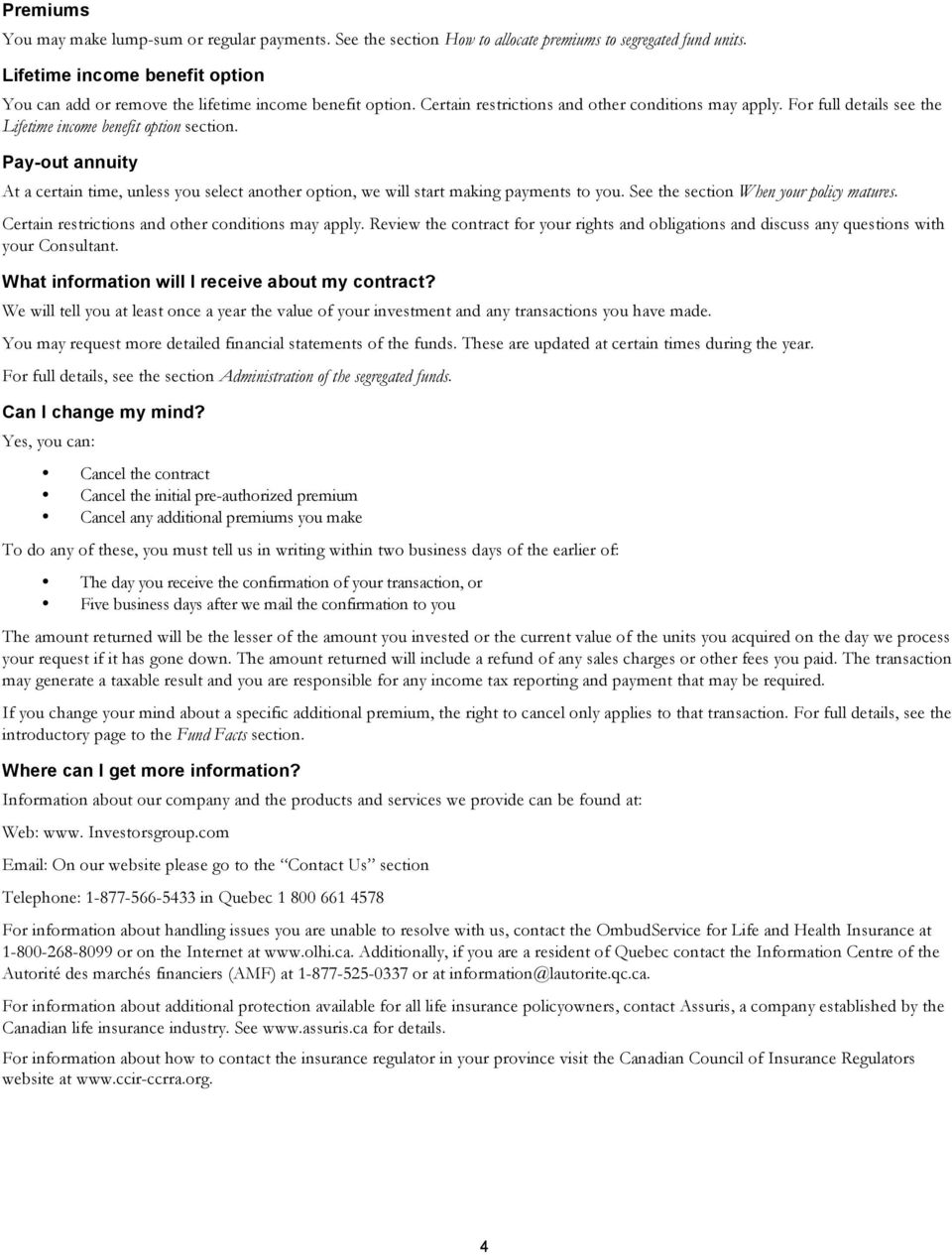
6 Premiums You may make lump-sum or regular payments. See the section How to allocate premiums to segregated fund units. Lifetime income benefit option You can add or remove the lifetime income benefit option. Certain restrictions and other conditions may apply. For full details see the Lifetime income benefit option section. Pay-out annuity At a certain time, unless you select another option, we will start making payments to you. See the section When your policy matures. Certain restrictions and other conditions may apply. Review the contract for your rights and obligations and discuss any questions with your Consultant. What information will I receive about my contract? We will tell you at least once a year the value of your investment and any transactions you have made. You may request more detailed financial statements of the funds. These are updated at certain times during the year. For full details, see the section Administration of the segregated funds. Can I change my mind? Yes, you can: Cancel the contract Cancel the initial pre-authorized premium Cancel any additional premiums you make To do any of these, you must tell us in writing within two business days of the earlier of: The day you receive the confirmation of your transaction, or Five business days after we mail the confirmation to you The amount returned will be the lesser of the amount you invested or the current value of the units you acquired on the day we process your request if it has gone down. The amount returned will include a refund of any sales charges or other fees you paid. The transaction may generate a taxable result and you are responsible for any income tax reporting and payment that may be required. If you change your mind about a specific additional premium, the right to cancel only applies to that transaction. For full details, see the introductory page to the Fund Facts section. Where can I get more information? Information about our company and the products and services we provide can be found at: Web: www. Investorsgroup.com On our website please go to the Contact Us section Telephone: in Quebec For information about handling issues you are unable to resolve with us, contact the OmbudService for Life and Health Insurance at or on the Internet at Additionally, if you are a resident of Quebec contact the Information Centre of the Autorité des marchés financiers (AMF) at or at [email protected]. For information about additional protection available for all life insurance policyowners, contact Assuris, a company established by the Canadian life insurance industry. See for details. For information about how to contact the insurance regulator in your province visit the Canadian Council of Insurance Regulators website at 4
7 Table of contents Key facts about the Investors Group Guaranteed Investment Funds individual variable annuity policy... 2 How an Investors Group Guaranteed Investment Fund policy works... 6 Introduction... 6 Non-registered policies... 7 Registered policies... 8 Beneficiaries... 9 How our segregated funds work... 9 How we value segregated fund units Fundamental changes to the segregated funds Allocating premiums, redeeming and switching segregated fund units How to allocate premiums to segregated fund units Sales charge options How to redeem segregated fund units Free redemption amount Automatic redemptions How to switch segregated fund units Short-term trading When the redemption or switch of your units may be delayed When your policy matures Policy maturity date What happens to your policy on the policy maturity date. 15 Guaranteed benefits A. 75/75 guarantee policy Maturity guarantee Death benefit B. 75/100 guarantee policy Maturity guarantee Death benefit Death benefit guarantee reset option C. 100/100 guarantee policy Maturity guarantee Maturity guarantee reset option Death benefit Death benefit guarantee reset option Example of how redeeming units affects the guaranteed amount Lifetime income benefit option Lifetime income benefit values Bonus and automatic resets Excess redemptions Subsequent premiums Scheduled and unscheduled redemptions Lifetime income benefit option illustrations Lifetime income benefit eligible funds Lifetime income benefit monthly charge Lifetime income benefit payments Options on the policy maturity date Naming a beneficiary and/or successor annuitant Removal of the joint life Death of an annuitant while the single-life income election is in effect Death of an annuitant and/or joint life while the joint-life income election is in effect Termination of the lifetime income benefit option Fees and expenses Fees and expenses paid from the segregated fund Investment management fees, management expense ratios, reset fees and lifetime income benefit fees Fees and expenses paid directly by you Income tax considerations Tax status of the segregated funds Non-registered policies TFSAs RRSPs RRIFs Administration of the segregated funds Keeping you informed Requests for Fund Facts, financial statements and other documents Material contracts Material transactions Assuris protection Investment policy Fund risks Fund Facts IG/GWL Alto Conservative GIF IG/GWL Alto Moderate Conservative GIF IG/GWL Alto Moderate GIF IG/GWL Alto Moderate Aggressive GIF IG/GWL Alto Aggressive GIF IG/GWL Allegro Conservative GIF IG/GWL Allegro Moderate Conservative GIF IG/GWL Allegro Moderate GIF IG/GWL Allegro Moderate Aggressive GIF IG/GWL Allegro Aggressive GIF IG/GWL Income Focus GIF IG/GWL Income Growth GIF IG/GWL Balanced GIF IG/GWL Money Market GIF IG/GWL Fixed Income Flex GIF IG/GWL Canadian Balanced GIF IG/GWL Dividend GIF IG/GWL Canadian Equity GIF IG/GWL U.S. Large Cap Value GIF IG/GWL Global GIF Glossary of terms

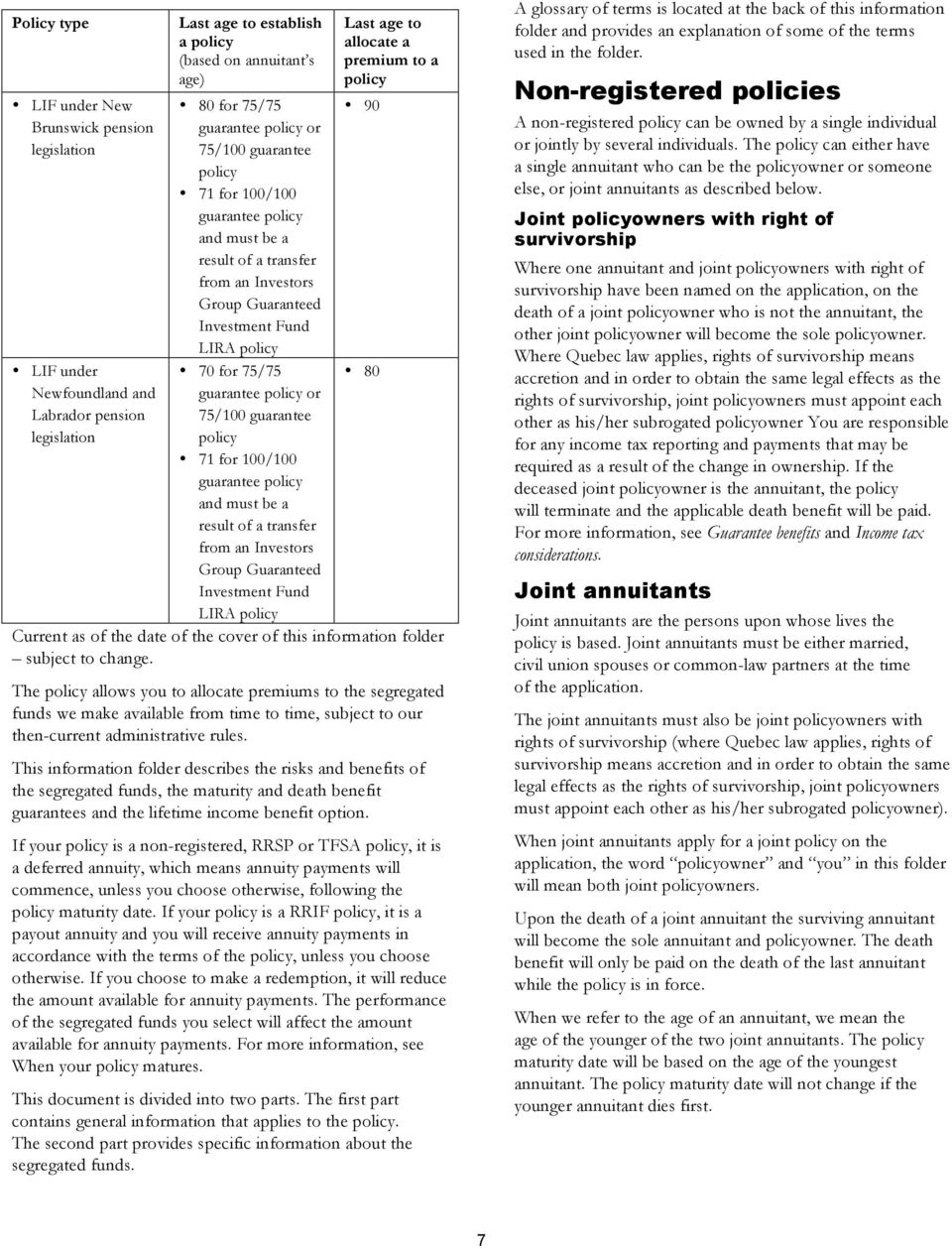
8 How an Investors Group Guaranteed Investment Fund policy works Introduction The Investors Group Guaranteed Investment Funds policy is an individual variable insurance contract based on the life of the insured person(s), also known as the annuitant (or if two insured persons, the joint annuitants ), which you name on the application form. Great-West Life is the issuer of the policy and maintains the segregated funds. Great-West Life s head office address is 100 Osborne Street North, Winnipeg, Manitoba R3C 3A5. Investors Group has been appointed to provide management and administrative services for the policy and the segregated funds. In this information folder, our, we and us includes Investors Group as administrator on behalf of Great-West Life. The policy may be purchased only through Investors Group Consultants ( Consultants ) who are life insurance licensed and who are authorized to offer it to you. The policy is available in four ways: Non-registered Registered retirement savings plan (RRSP) Registered retirement income fund (RRIF) Tax-free savings account (TFSA) Spousal RRSPs, locked-in RRSPs (LRRSP), locked-in retirement accounts (LIRAs) and restricted locked-in savings plans (RLSP) are four specific types of RRSPs. Since all RRSPs work the same way, whether or not they are LRRSPs, LIRAs or RLSPs, we will simply refer to them as RRSPs throughout the rest of this information folder unless we say otherwise. Spousal RRIFs, prescribed retirement income funds (PRIF), life income funds (LIF), restricted life income funds (RLIF) and locked-in retirement income funds (LRIF) are five specific types of RRIFs. Unless we say otherwise, when we refer to features of a RRIF, they also apply to a PRIF, LIF, RLIF and LRIF. When making your initial investment into a policy, other than a TFSA, we consider whether the amount of your purchase, together with other investments you have in Investors Group Guaranteed Investment Funds is less than $15,000. If the total of all of your investments in Investors Group Guaranteed Investment Funds is $15,000 or more, then you can invest in any Fund. If the total is less than $15,000 you cannot invest in the following Funds; IG/GWL U.S. Large Cap Value GIF IG/GWL Global GIF Additional premiums must be at least $50 including allocating premiums through pre-authorized chequing, Under a RRIF policy the minimum initial premium is $5,000 and additional premiums must be at least $50. The minimum amount that must remain in a policy is $250. We reserve the right to change the minimum and maximum amounts from time to time The last age to establish, pay premiums or transfer to (as applicable) a policy is dependent on the policy type and is based on the annuitant s age. The following table summarizes this information. Policy type Non-registered TFSA RRSP (except LIRAs/LRRSPs under Newfoundland and Labrador pension legislation) LIRA/LRRSPs under Newfoundland and Labrador pension legislation RRIF (except LIFs under New Brunswick or Newfoundland and Labrador pension legislation) Last age to establish a policy (based on annuitant s age) for 75/75 guarantee policy or 75/100 guarantee policy 64 for 100/100 guarantee policy 90 for 75/75 guarantee policy or 75/100 guarantee policy 71 for 100/100 guarantee policy and must be a result of a transfer from an Investors Group Guaranteed Investment Fund RRSP, policy Last age to allocate a premium to a policy IG/GWL Canadian Balanced GIF IG/GWL Dividend GIF IG/GWL Canadian Equity GIF 6

9 Policy type LIF under New Brunswick pension legislation LIF under Newfoundland and Labrador pension legislation Last age to establish a policy (based on annuitant s age) 80 for 75/75 guarantee policy or 75/100 guarantee policy 71 for 100/100 guarantee policy and must be a result of a transfer from an Investors Group Guaranteed Investment Fund LIRA policy 70 for 75/75 guarantee policy or 75/100 guarantee policy 71 for 100/100 guarantee policy and must be a result of a transfer from an Investors Group Guaranteed Investment Fund LIRA policy Last age to allocate a premium to a policy Current as of the date of the cover of this information folder subject to change. The policy allows you to allocate premiums to the segregated funds we make available from time to time, subject to our then-current administrative rules. This information folder describes the risks and benefits of the segregated funds, the maturity and death benefit guarantees and the lifetime income benefit option. If your policy is a non-registered, RRSP or TFSA policy, it is a deferred annuity, which means annuity payments will commence, unless you choose otherwise, following the policy maturity date. If your policy is a RRIF policy, it is a payout annuity and you will receive annuity payments in accordance with the terms of the policy, unless you choose otherwise. If you choose to make a redemption, it will reduce the amount available for annuity payments. The performance of the segregated funds you select will affect the amount available for annuity payments. For more information, see When your policy matures. This document is divided into two parts. The first part contains general information that applies to the policy. The second part provides specific information about the segregated funds. A glossary of terms is located at the back of this information folder and provides an explanation of some of the terms used in the folder. Non-registered policies A non-registered policy can be owned by a single individual or jointly by several individuals. The policy can either have a single annuitant who can be the policyowner or someone else, or joint annuitants as described below. Joint policyowners with right of survivorship Where one annuitant and joint policyowners with right of survivorship have been named on the application, on the death of a joint policyowner who is not the annuitant, the other joint policyowner will become the sole policyowner. Where Quebec law applies, rights of survivorship means accretion and in order to obtain the same legal effects as the rights of survivorship, joint policyowners must appoint each other as his/her subrogated policyowner You are responsible for any income tax reporting and payments that may be required as a result of the change in ownership. If the deceased joint policyowner is the annuitant, the policy will terminate and the applicable death benefit will be paid. For more information, see Guarantee benefits and Income tax considerations. Joint annuitants Joint annuitants are the persons upon whose lives the policy is based. Joint annuitants must be either married, civil union spouses or common-law partners at the time of the application. The joint annuitants must also be joint policyowners with rights of survivorship (where Quebec law applies, rights of survivorship means accretion and in order to obtain the same legal effects as the rights of survivorship, joint policyowners must appoint each other as his/her subrogated policyowner). When joint annuitants apply for a joint policy on the application, the word policyowner and you in this folder will mean both joint policyowners. Upon the death of a joint annuitant the surviving annuitant will become the sole annuitant and policyowner. The death benefit will only be paid on the death of the last annuitant while the policy is in force. When we refer to the age of an annuitant, we mean the age of the younger of the two joint annuitants. The policy maturity date will be based on the age of the youngest annuitant. The policy maturity date will not change if the younger annuitant dies first. 7
10 Following the policy maturity date, if an annuitant is living and has not previously indicated an alternative preference, annuity payments will commence. If both annuitants are living, the annuity will be based on and be guaranteed for the life of both annuitants. Otherwise, the annuity will be based on and be guaranteed for the life of the surviving annuitant. Contingent policyowner If you are not the annuitant you may name a contingent policyowner (subrogated policyowner in Quebec) and may revoke or change a contingent policyowner. In the event of your death, the contingent policyowner, if living, becomes the new policyowner. When joint policyowners were named on the application with right of survivorship (subrogated policyowner in Quebec), your death means the death of the last surviving policyowner. If you have not named a contingent policyowner, or if they are not living on your death, then your estate will become the policyowner. Assignment Subject to applicable laws, you may assign a non-registered policy; however, this does not apply if the lifetime income benefit option is selected (for details, see Lifetime income benefit option). The rights of the assignee take precedence over the rights of any person claiming a death benefit. An assignment may restrict or delay certain transactions otherwise permitted. An assignment is not recognized until the original or a true copy is received and recorded by us. Neither Great-West Life or Investors Group is responsible for the validity of any assignment. An absolute assignment of a policy will make the assignee the policyowner; a collateral assignment or movable hypothec in Quebec will not. The rights of any policyowner or revocable, designated beneficiary, or irrevocably designated beneficiary, who has consented, are subject to the rights of any assignee. Registered policies A registered policy can only be owned by a single individual who must also be the annuitant. RRSPs, spousal RRSPs, LIRAs, LRRSPs and RLSPs An RRSP is a policy registered under the Income Tax Act (Canada) as a registered retirement savings plan. You can only open LRRSPs, LIRAs and RLSPs with money transferred directly from pension plans, where federal or provincial pension laws allow you to. Pension laws place certain restrictions on them. Generally contributions that you make to your RRSP and spousal RRSPs are tax deductible and there is a maximum amount you can contribute each year under the Income Tax Act (Canada). You can also transfer money directly from an RRSP at another financial institution or from a pension plan, if federal or provincial pension laws allow you to. There are no limits on the amount of transfers from RRSPs. There are limits under the Income Tax Act (Canada) for transfers from defined benefit pension plans. RRIFs, spousal RRIFs, PRIFs, LIFs, RLIFs and LRIFs A RRIF is a policy that gives you regular income and is registered under the Income Tax Act (Canada) as a registered retirement income fund. You can only open a RRIF with money transferred directly from an RRSP or another RRIF. You can only open PRIFs, LIFs, RLIFs and LRIFs with money transferred directly from a pension plan, from a LRRSP, LIRA and RLSP or from another PRIF, LIF, RLIF or LRIF, where federal or provincial pension laws allow you to. We currently offer RRIFs and LIFs across Canada, and PRIFs in Saskatchewan and Manitoba. RLIFs are only available where the money transferred is administered under federal pension legislation. Under the Income Tax Act (Canada), you must redeem a minimum amount each year from these policies. For LIFs, RLIFs and LRIFs there is also a maximum amount you may redeem each year. You can name your spouse as the sole beneficiary and successor annuitant of your RRIF or spousal RRIF. On your death the policy will pass to your surviving spouse, and payments may continue to your surviving spouse. The only person who can be appointed as your successor annuitant is your spouse. TFSA policies A TFSA is a policy registered under the Income Tax Act (Canada) as a tax-free savings account. Premiums you allocate to your TFSA policy are not tax deductible and there is a maximum amount you can contribute each year under the Income Tax Act (Canada). You can also transfer money directly from a TFSA at another financial institution. There are no limits on the amount of the transfers from TFSAs. You may assign a TFSA as security for a loan. The rights of the assignee take precedence over the rights of any person claiming a death benefit. An assignment may restrict or delay certain transactions otherwise permitted. An assignment is not recognized until the original or a true copy is received and recorded by us. You can name your spouse as the successor holder of your TFSA. On your death your surviving spouse will become annuitant and policyowner of the TFSA policy. The only person who can be appointed as your successor holder is your spouse. 8

11 Beneficiaries You may designate one or more beneficiaries to receive any death benefit payable under the policy. You may revoke or change the designation prior to the policy maturity date, subject to applicable law. If the designation is irrevocable, you cannot revoke or change it or exercise certain other specific rights without the written consent of the irrevocable beneficiary in accordance with applicable law. If the policy is a LIRA, LRSP, RLSP, PRIF, LIF, RLIF or LRIF, the interest of your spouse, civil union spouse or common-law partner can take priority over a beneficiary designated by you, depending on applicable pension legislation. While the lifetime income benefit option is in force, you should consider carefully who you wish to name as beneficiary or successor annuitant. The individual named will have an effect on how the policy is administered on the death of an annuitant. For further details, see the Naming a beneficiary and/or successor section. How our segregated funds work Each of our segregated funds is a pool of investments that is kept separate, or segregated, from the general assets of Great- West Life. The segregated funds invest solely in securities of mutual funds managed by Investors Group (the underlying funds ). Each segregated fund is divided into different classes which may be divided into unlimited series. Each series can be subdivided into an unlimited number of notional units of equal value. Currently you can allocate premiums to three classes of the segregated funds reflecting the applicable guarantee levels and two series known as the no-load option and the deferred sales charge option. For more information, see Guarantee benefits and Sales charge options. When you allocate money to segregated funds, units are allocated to your policy, but you do not actually own, buy or sell any part of the segregated funds or any units. Instead, we hold the assets of the segregated funds. This also means that you don t have any voting rights associated with the segregated funds. We calculate the value and the benefits to which you are entitled based on the value of the units allocated to your policy on a particular date less any applicable fees and charges. Neither your policy nor your units give you an ownership interest in Great-West Life or voting rights in connection with Great-West Life. As the segregated fund invests in units of a mutual fund, you will not be a unitholder of the mutual fund. We have the right to subdivide or consolidate the units of a segregated fund. If we subdivide the units of a segregated fund, there will be a decrease in the unit value. If we consolidate the units of a segregated fund, there will be an increase in the unit value. If we subdivide or consolidate the units of a segregated fund, the market value of the segregated fund and the market value of your policy will not change. We will give you advance written notice if we have decided to do so. We have the right to add, restrict the allocation of premiums or switches, close and terminate an existing segregated fund. If we do close a segregated fund, you cannot allocate a premium or switch to the segregated fund. If we do close a segregated fund, it may be re-opened for investment at our discretion. We will notify you in writing 60 days before we terminate a segregated fund or make a material change to the fundamental investment objectives of a segregated fund. For more information, see Fundamental changes to the segregated funds. If we terminate a segregated fund completely, you have the right to switch the value of your units to another segregated fund. We may automatically switch the units in the terminated segregated fund to another segregated fund of our choosing. Our written notice to you will specify the segregated fund(s) that will be terminated, the proposed segregated fund that will receive the automatic switch and the date the automatic switch will occur if we do not receive other instructions from you five (5) business days prior to the date the segregated fund is to be terminated. A shortterm trading fee will not apply. The redemption of units in a non-registered policy because of termination of a segregated fund may produce a taxable capital gain or loss. The investment strategy of the underlying funds may be changed without notice to you. Where the segregated fund invests in multiple underlying funds we may remove or substitute underlying funds without notice to you. It s important to diversify, which means investing in segregated funds that have a variety of assets and investment styles. For more information about the risks involved in segregated funds, see Fund risks. Depending on which guarantee level you select, you can choose from up to 20 different Investors Group Guaranteed Investment Funds and this broad choice provides a good opportunity for you to diversify. All the segregated funds currently available are described in detail later in this information folder; see the Fund Facts section. 9

12 How we value segregated fund units Generally, the value of each segregated fund is determined as at the close of business on each day that The Toronto Stock Exchange is open for business and a value is available for any applicable underlying fund. We refer to any day that we value the segregated funds as a valuation day. On each valuation day we calculate a separate unit value for each class of a segregated fund. When we value units, we calculate the unit value by dividing the total market value of that segregated fund class by the number of units in that segregated fund class. The market value of a class of a segregated fund is the total market value of the assets of the segregated fund attributable to that class, less the applicable investment management fees and other expenses. For more information about investment management fees and other expenses, see Fees and expenses. We have the right to change how often we value our segregated fund units. We will tell you in writing 60 days before we decrease the valuation frequency. For more information, see Fundamental changes to the segregated funds. If we subdivide the units of a segregated fund, there will be a decrease in the unit value. If we consolidate the units of a segregated fund, there will be an increase in the unit value. If we subdivide or consolidate the units of a segregated fund, the market value of the segregated fund and the market value of your policy will not change. The assets of segregated funds consist of units of the underlying funds. The unit value of the underlying fund is calculated by or on behalf of the underlying fund on each valuation day. If a unit value is not available, we will determine the fair market value of the asset. The IG/GWL Money Market GIF credit their net income to us on a daily basis. This net income is automatically reinvested in the segregated funds, and the units acquired will retain the characteristics of the units on which the net income was made. As a result, the unit value of those segregated funds is expected to remain constant at $10. Any amount that is allocated to a segregated fund is invested at your risk and may increase or decrease in value. Fundamental changes to the segregated funds If we make any of the following changes to a segregated fund, we will notify you in writing 60 days before the change occurs. The notice will be sent by regular mail to the most recent address for this policy we have for you in our records. Increase the investment management fee Material change to the investment objective Decrease the frequency with which the fund is valued; If applicable, an increase by more than the greater of 0.50 per cent per year or 50 per cent of the current fee charged for the maturity guarantee reset option, the death benefit guarantee reset option or the lifetime income benefit option. For more information, see the Death benefit guarantee reset option fee under the 75/100 guarantee policy section and 100/100 guarantee policy section, Maturity guarantee reset fee under the 100/100 guarantee policy section and Lifetime income benefit monthly charge under the Lifetime income benefit option section. During the notice period, you will have the right to switch the value of your units from the affected segregated fund to a similar segregated fund that is not subject to the fundamental change without charge provided you advise us at least five business days prior to the change happening. We will advise you of similar segregated funds that are available to you at that time. A similar fund is a fund within the same segregated fund category that has a comparable investment objective and the same or lower investment management fee. The switch of your units from one segregated fund to another in a non-registered policy may produce a taxable capital gain or loss. For information about tax implications, see Income tax considerations. If we do not offer a similar segregated fund, you may have the right to redeem the segregated fund units without incurring a redemption charge or similar fee provided you advise us at least five business days prior to the change happening. We will advise you if this applies to you. Any redemption of units from a non-registered policy may produce a taxable capital gain or loss. For information about tax implications, see Income tax considerations. During the transition period between the announcement and the effective date of the fundamental change, you will not be permitted to allocate premiums to or switch into the affected segregated fund unless you agree to waive your rights under this fundamental change provision. 10

13 Allocating premiums, redeeming and switching segregated fund units Although you do not own the segregated fund units, you are directing how we should allocate your premium amongst the segregated funds. You can allocate your premium to a segregated fund up to the earlier of the day prior to the annuitant attaining age 91, subject to applicable legislation, or the commencement of annuity payments. Premiums allocated to the policy are subject to such minimum and maximum amounts in accordance with our then current administrative rules. You can request to redeem or switch units prior to the commencement of annuity payments. Requests to redeem or switch segregated fund units may be delayed in unusual circumstances. For more information, see When the redemption or switch of your units may be delayed. We only process allocations, redemptions or switches on a valuation day and subject to our then-current administrative rules. We have the right to limit or refuse allocations and switches to, and redemptions from, segregated funds. If we receive your request to allocate your premium to a segregated fund, redeem or switch units at our administrative office before 3 p.m. central time or before the Toronto Stock Exchange closes, whichever is earlier, on a valuation day (the cut-off time ), we will process the request on that day using that day s unit value. If we receive your request after that time, we will process it on the next valuation day using the next day s unit value. For more information, see How we value segregated fund units. When you ask us to allocate your premium to a segregated fund, redeem or switch units, your instructions must be complete and in a manner acceptable to us, otherwise we will not be able to complete the transaction for you. If the investment instructions or accompanying documentation is incomplete, the premium will be held in accordance with our then-current administrative rules until we receive complete documentation. On receipt of complete instructions or documentation, we will process the request on that day using that day s unit value if received at our administrative office prior to the cut-off time. If we receive your request after that time, we will process it on the next valuation day using the next day s unit value. How to allocate premiums to segregated fund units When you apply a premium to a segregated fund, we allocate units to your policy. We determine the number of units to allocate to your policy by dividing the net amount of the premium by the appropriate unit value of the segregated fund. For more information, please see How we value segregated fund units. Pre-authorized chequing (PAC) You can also allocate premiums to a non-registered, RRSP or TFSA policy by having money transferred automatically from your bank account. The amount allocated to a segregated fund must be at least $50. You can select the frequency of your contributions (i.e. weekly, bi-weekly, monthly, bi-monthly, quarterly or annually). Pre-authorized chequing is not available under LRRSPs, LIRAs or RLSPs policies. If the selected redemption date falls on a non valuation day, the redemption will be processed on the next valuation day. If any lump sum or PAC is not honoured for any reason, we reserve the right to recover any investment losses and charge you a returned cheque fee to cover our expenses. The recovery of any investment losses and returned cheque fee would be collected by redeeming units and you are responsible for any income tax reporting and payments that may be required. For information on the returned cheque fee, see Returned cheque fee. Sales charge options You may choose from two sales charge options when allocating premiums to the segregated funds: no-load option and deferred sales charge option. If you switch or redeem units, you may be subject to a shortterm trading fee and any applicable taxes or other charges. For more information, see Short-term trading fee and How to redeem segregated fund units. Some segregated funds may not be available under all sales charge options. We may add or remove a segregated fund from a sales charge option. If we remove a segregated fund, we will give you written notice if you hold units of that segregated fund. If a segregated fund is removed, you cannot allocate any additional premiums or make switches to a segregated fund under the applicable sales charge option. A segregated fund can be re-added at our discretion without notice to you. To find out if a segregated fund is available under a sales charge option, see the Fund Facts. We have the right to change any minimum amounts that are given in this information folder. 11
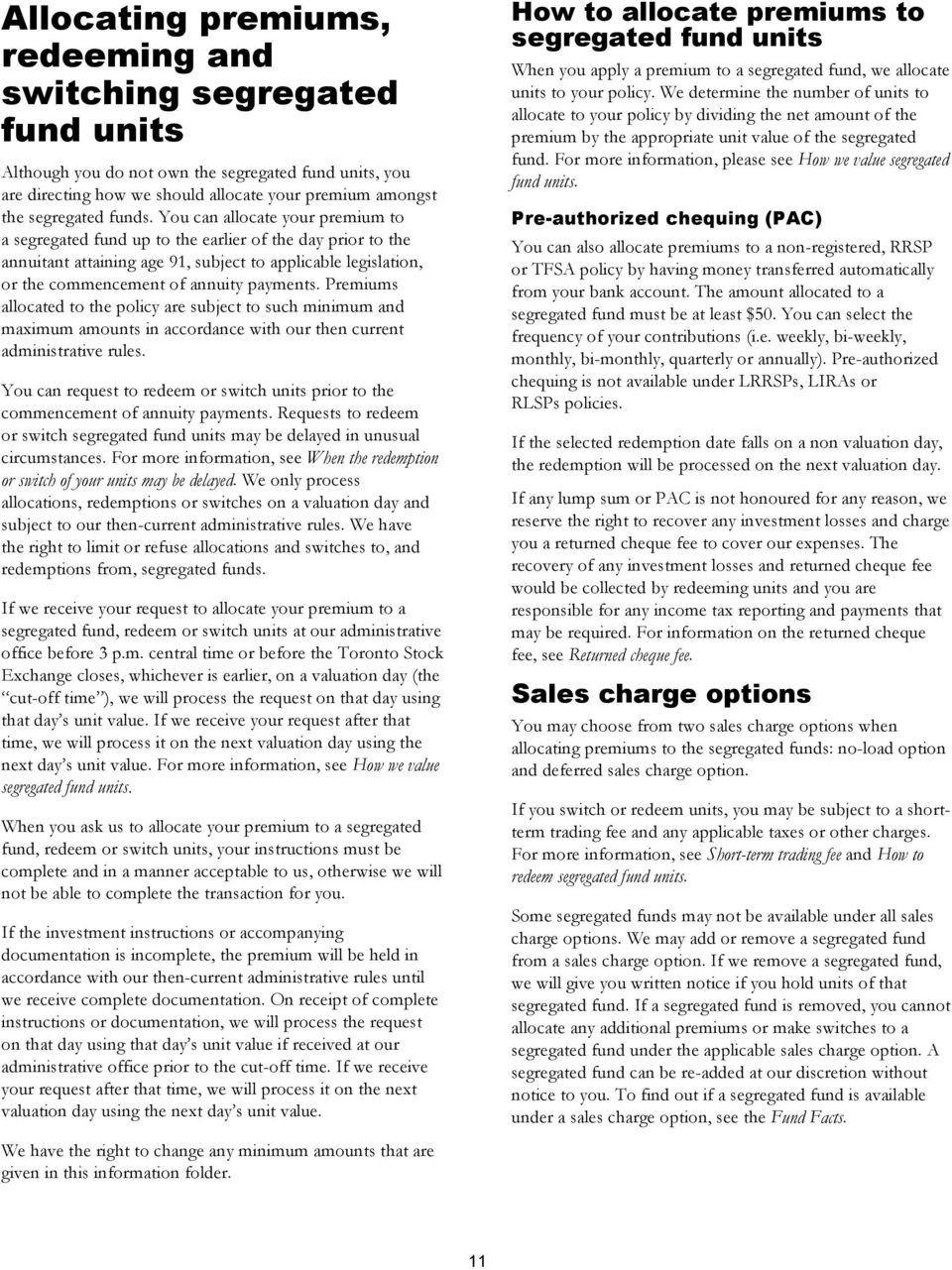
14 Deferred sales charge option (Series A) If you choose the deferred sales charge option, you don t pay a fee when you allocate a premium to a segregated fund. If you redeem units within seven years of allocating a premium to this option, you will have to pay a redemption charge, any applicable short-term trading fee, withholding taxes and other charges. For more information on the redemption charge, see Redemption charges. Deferred sales charge option units may have lower investment management fees than no load units. For information, see Fees and expense. No load option (Series B) If you choose the no load option you will not pay a redemption charge when you redeem units but you will have to pay any applicable short-term trading fee, withholding taxes and other charges. However, investment management fees for no load units may be higher than for deferred sales charge option units. For information, see Fees and expense. How to redeem segregated fund units You can redeem segregated fund units on any valuation day by sending appropriate documentation acceptable to us at our administrative office. The value of your guarantees will be proportionally reduced when you redeem units. For more information, see Examples of how redeeming units affects the guaranteed amount. When you request money from your policy, we will redeem the number of units required to fulfill your redemption request. A cheque for the proceeds, less any applicable withholding taxes, fees or charges, will be mailed or the proceeds will be directly deposited to your bank account once all documentation required to process your request is received in a form acceptable to us. If we do not receive everything we require to process your request within ten valuation days after we receive your request, we will reverse the transaction based on the unit values on the day we process the reversal. If the unit value has decreased, the segregated fund will keep the excess. If the unit value has increased, you will have to pay the segregated fund the deficiency. We will redeem units based upon the age of the units held in the applicable segregated funds, with the oldest units being redeemed first. Deferred sales charge option units older than seven years may be redeemed without a redemption charge. For more information, see Redemption charges. When you redeem units under the no-load option, there is no redemption charge. We will charge a short-term trading fee on any redemption where the units have not been held in the segregated fund for the applicable period of time. For more information, see Short-term trading fee. Redemption requests involving transfers to or from registered plans may be delayed until all administrative procedures involved with registered plans are complete. When you redeem segregated fund units, the value of those units is not guaranteed because it fluctuates with the market value of the assets in the segregated fund. Under unusual circumstances, we may have to delay redemptions. For more information, see When the redemption or switch of your units may be delayed. There may be income tax consequences if you redeem units. For more information, see Income tax considerations. Free redemption amount You will not have to pay a redemption charge for making regular redemptions by Systematic Withdrawal Plan (SWP) if you: redeem units under the no-load option; or redeem units under the deferred sales charge option and the redemption charge schedule that applies to those units has expired; or redeem units from the deferred sales charge option and the total amount redeemed during a calendar year under all your SWPs is equal to or less than 12 per cent of the market value as at December 31 of the previous year. We call this the free redemption amount. The free redemption amount will be adjusted during any calendar year where premiums are allocated to deferred sales charge units and will be pro-rated based on the number of SWP redemptions remaining in the calendar year relative to the number of redemptions scheduled during the full calendar year. In the calendar year the initial premium is paid the free redemption amount under a SWP will be based on the amount of the premium allocated to deferred sales charge units and will be pro-rated based on the number of SWP redemptions remaining in the calendar year. Only units under the deferred sale charge option will be considered when determining the free redemption amount you may receive under your SWP. You may have to pay short-term trading fees and any applicable taxes or other charges when you redeem units. You cannot carry forward any unused portion of the free redemption amount to another year. We may change the free redemption amount at any time on written notice to you. 12

15 Automatic redemptions You may request an automatic regular redemption by Systematic Withdrawal Plan (SWP) in your non-registered or TFSA policy. You can not set up a SWP from a RRSP, LRRSP, LIRA or RLSP. You can receive scheduled income redemptions from an Investors Group Guaranteed Investment Fund RRIF, LIF, LRIF, PRIF, or RLIF policy to allow at least for the minimum prescribed amount required to be paid out to you each year. If units are redeemed from the deferred sales charge option, any amount in excess of the free redemption amount will be subject to a redemption charge. For more information, see Free redemption amount and Redemption charges. SWP and scheduled income redemption requests must be received at least 30 days prior to the requested start date. You can choose when to redeem in accordance with our then-current administrative rules (currently SWPs can be monthly and quarterly and scheduled income redemptions can be monthly, semi-monthly, bi-monthly, quarterly or annually), how much to redeem each time and the segregated fund units to be redeemed. Regular redemptions will eventually deplete the market value of your policy and each redemption will reduce your death benefit guarantee and maturity guarantee and may reduce your lifetime income amount. You may, subject to our administrative rules and applicable legislation, change the amount or discontinue redemptions by advising us in writing. If we cannot redeem sufficient units from a segregated fund or the segregated fund has been closed to redemptions under the suspension and postponement rights, we will redeem units in accordance with our then-current administrative rules. For more information, see When the redemption or switch of your units may be delayed. If the selected redemption date falls on a non valuation day, the redemption will be processed on the next valuation day, unless the next valuation day occurs in the next calendar month in which case we will process the redemption on the valuation day before the scheduled redemption day. There may be income tax consequences when units are redeemed to make your automatic redemption. For more information, see Income tax considerations. When you redeem segregated fund units, the value of those units is not guaranteed because it fluctuates with the market value of the assets in the segregated fund. the oldest units of the segregated fund that are switched first. Units of the new segregated fund will be given the same issue date as the units of the old segregated fund for purposes of any guarantee. The value of the maturity and death benefit guarantees will not change when you switch units. You cannot switch units between the deferred sales charge option and the no-load option. We will charge a short-term trading fee on any switch when the units to be redeemed have not been held in the segregated fund for the applicable period of time. For more information, see Short-term trading fee. You can switch units of one segregated fund in your policy for units of another segregated fund. Switches within the same sales charge option will not incur a redemption charge and the new units will have the same redemption charge schedule as your old units (as applicable). In a non-registered policy, switches will result in a capital gain or capital loss since the switch creates a taxable disposition. For more information, see Income tax considerations. Automatic Switching by Systematic Transfer and Exchange Plan (STEP) Upon request and subject to our administrative rules, you can establish a scheduled switch of a set amount from one segregated fund to another or multiple segregated funds in the policy. The switch will occur in the amount and frequency (monthly or quarterly) specified by you subject to our thencurrent administrative rules. If the day selected by you is not a valuation day, then the switch will occur on the next valuation day. When the day specified is a month-end date and this day is not a valuation day, the switch will occur on the valuation day immediately prior to the specified date. Scheduled switches are not allowed if the policy is a LRRSP, LIRA, RLSP, PRIF, LIF, RLIF or LRIF. Please remember that the value of the segregated fund units held in your policy is only guaranteed at maturity and death. At other times, including when you switch segregated fund units, the value of those units is not guaranteed because it fluctuates with the market value of the underlying assets held in the segregated fund. Under unusual circumstances, we may have to delay switches. For more information, please see When the redemption or switch of your units may be delayed. How to switch segregated fund units Upon request and subject to our administrative rules, you can switch units of one segregated fund in your policy for units of another segregated fund. When you switch units, it is 13

16 Short-term trading Using segregated funds to time the market or trading on a frequent basis is not consistent with a long-term investment approach based on financial planning principles. In order to limit such activities, we will charge a short-term trading fee as outlined below. The short-term trading fee is retained in the segregated fund as compensation for the costs associated with the switch or redemption request. We will take such additional actions as we consider appropriate to prevent further similar activity by you. These actions may include the delivery of a warning, placing you on a watch list to monitor activity, declining to accept allocations to and switch and redemption requests from the segregated funds, delay trades by one valuation day and suspend trading under the policy. We reserve the right to change our administrative practices or introduce new ones when we determine it is appropriate. We will charge a short-term trading fee of up to two percent of the amount switched or redeemed if you allocate premiums to a segregated fund for less than 90 consecutive days. The fee is subject to change. This right is not affected by the fact that we may have waived it at any time previously. We reserve the right to increase the period of time a premium must remain in a segregated fund. We will give you written notice of our intent to increase the time period at least 60 days in advance. Our notice to you will specify the affected segregated fund(s) and the new period of time. We will send the notice to your most recent address on our records for this policy. When the redemption or switch of your units may be delayed Under unusual circumstances, we may have to delay redeeming units or postpone the date of a switch or payment. This may happen if: Normal trading is suspended on a stock exchange where the segregated fund or underlying fund has a significant percentage of its assets, or We believe it s not practical to dispose of investments held in a segregated fund or underlying fund or that it would be unfair to other policyowners During such a delay, we will administer the redemption of units according to the applicable rules and laws and in a manner that we consider fair. We may have to wait until there are enough assets in the fund that can be easily converted to cash. If there are more requests to redeem units than we can accommodate, we will redeem as many units as we think is appropriate and allocate the proceeds proportionally among the investors who asked to redeem units. We will redeem any remaining units as soon as we can. When your policy matures Policy maturity date The policy maturity date is the date on which the policy matures and depends on the type of policy you have. For a policy which is a RRSP, spousal RRSP, LIRA, LRRSP or RLSP (subject to applicable pension legislation) payment will commence on a RRIF, spousal RRIF, PRIF, LIF or RLIF basis (as applicable) on or about the fourth last valuation day of the year you attain the maximum age, and the policy maturity date will be the policy maturity date for a RRIF, spousal RRIF, PRIF, LIF, RLIF or LRIF (as applicable). Maximum age means the date and the maximum age stipulated for a maturing RRSP as set out in the Income Tax Act (Canada) as amended from time to time. As of the date of this information folder, the date and the maximum age stipulated in the Income Tax Act (Canada) is Dec. 31 of the year the annuitant attains age 71. The policy maturity date for a non-registered, a RRIF, spousal RRIF, PRIF, RLIF, LRIF or TFSA policy is Dec. 28 of the year the annuitant attains age 105. If Dec. 28 is not a valuation day, then the policy maturity date will be the next valuation day after Dec. 28 in that year. Policies, other than a TFSA policy, issued to Quebec residents may be annuitized at age 80 or 90 as set out in the policy, but no maturity guarantee will apply. If no election is made, the policy will annuitize on Dec. 28 of the year the annuitant attains age 105, and a maturity guarantee may apply. If the policy is a LIF, the policy maturity date is dependent on the jurisdiction that regulates it. When applicable pension legislation requires that you receive payments from a life annuity, the policy maturity date will be Dec. 28 of the year in which you attain the age stipulated in the applicable pension legislation. Otherwise, the policy maturity date will be Dec. 28 of the year in which you attain age 105. If Dec. 28 is not a valuation day, then the policy maturity date will be the next valuation day after Dec. 28 in that year. Currently redemptions from a LIF under New Brunswick pension legislation must exhaust the policy no later than Dec. 28 of the year you attain age 90. Currently Newfoundland and Labrador pension legislation requires a LIF to mature in the year you attain age 80 and annuity payments to commence. Over time, regulators may change the rules that govern LIFs. We will change the terms of your LIF in accordance with any change in the regulations. 14

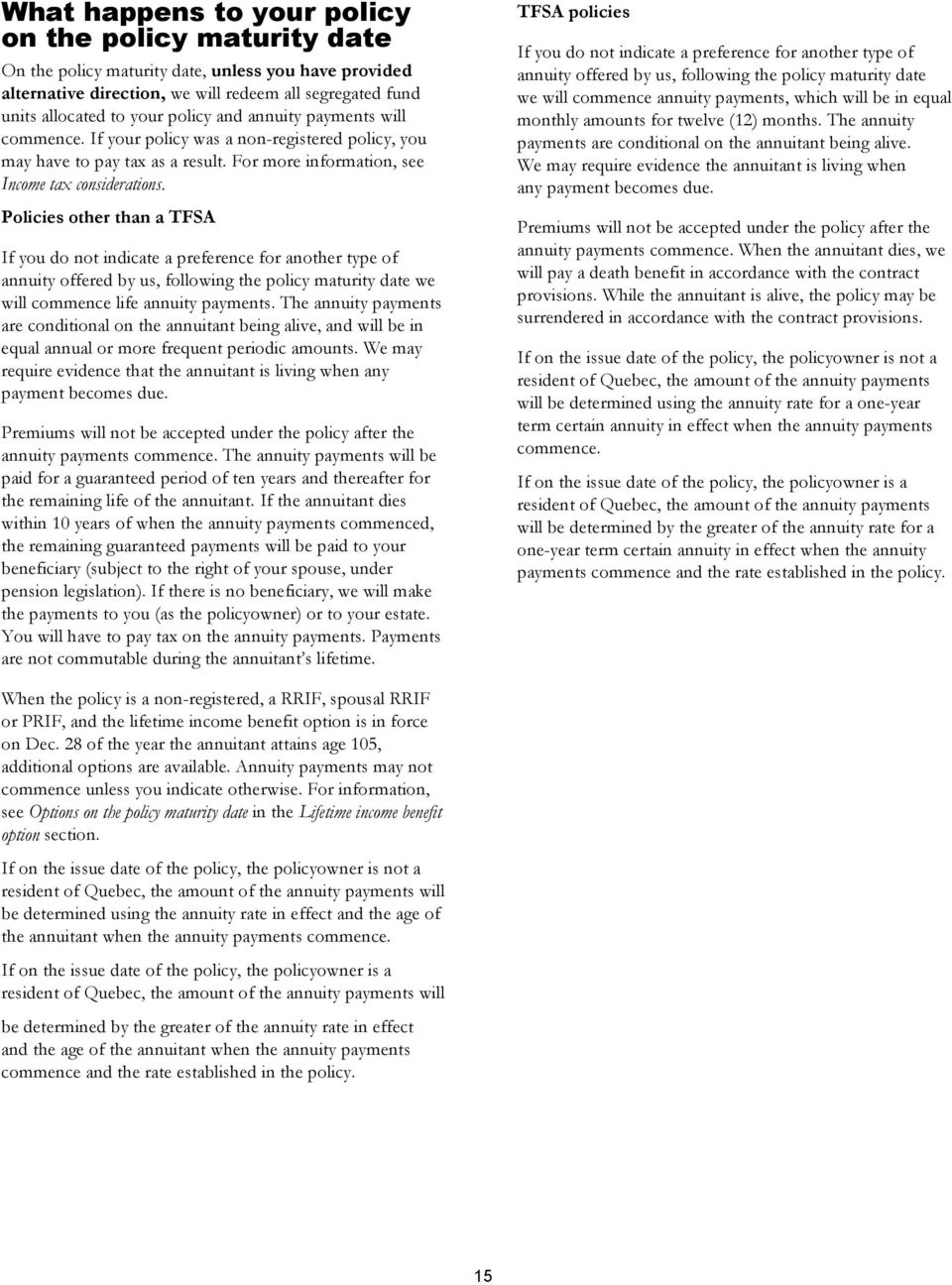
17 What happens to your policy on the policy maturity date On the policy maturity date, unless you have provided alternative direction, we will redeem all segregated fund units allocated to your policy and annuity payments will commence. If your policy was a non-registered policy, you may have to pay tax as a result. For more information, see Income tax considerations. Policies other than a TFSA If you do not indicate a preference for another type of annuity offered by us, following the policy maturity date we will commence life annuity payments. The annuity payments are conditional on the annuitant being alive, and will be in equal annual or more frequent periodic amounts. We may require evidence that the annuitant is living when any payment becomes due. Premiums will not be accepted under the policy after the annuity payments commence. The annuity payments will be paid for a guaranteed period of ten years and thereafter for the remaining life of the annuitant. If the annuitant dies within 10 years of when the annuity payments commenced, the remaining guaranteed payments will be paid to your beneficiary (subject to the right of your spouse, under pension legislation). If there is no beneficiary, we will make the payments to you (as the policyowner) or to your estate. You will have to pay tax on the annuity payments. Payments are not commutable during the annuitant s lifetime. TFSA policies If you do not indicate a preference for another type of annuity offered by us, following the policy maturity date we will commence annuity payments, which will be in equal monthly amounts for twelve (12) months. The annuity payments are conditional on the annuitant being alive. We may require evidence the annuitant is living when any payment becomes due. Premiums will not be accepted under the policy after the annuity payments commence. When the annuitant dies, we will pay a death benefit in accordance with the contract provisions. While the annuitant is alive, the policy may be surrendered in accordance with the contract provisions. If on the issue date of the policy, the policyowner is not a resident of Quebec, the amount of the annuity payments will be determined using the annuity rate for a one-year term certain annuity in effect when the annuity payments commence. If on the issue date of the policy, the policyowner is a resident of Quebec, the amount of the annuity payments will be determined by the greater of the annuity rate for a one-year term certain annuity in effect when the annuity payments commence and the rate established in the policy. When the policy is a non-registered, a RRIF, spousal RRIF or PRIF, and the lifetime income benefit option is in force on Dec. 28 of the year the annuitant attains age 105, additional options are available. Annuity payments may not commence unless you indicate otherwise. For information, see Options on the policy maturity date in the Lifetime income benefit option section. If on the issue date of the policy, the policyowner is not a resident of Quebec, the amount of the annuity payments will be determined using the annuity rate in effect and the age of the annuitant when the annuity payments commence. If on the issue date of the policy, the policyowner is a resident of Quebec, the amount of the annuity payments will be determined by the greater of the annuity rate in effect and the age of the annuitant when the annuity payments commence and the rate established in the policy. 15
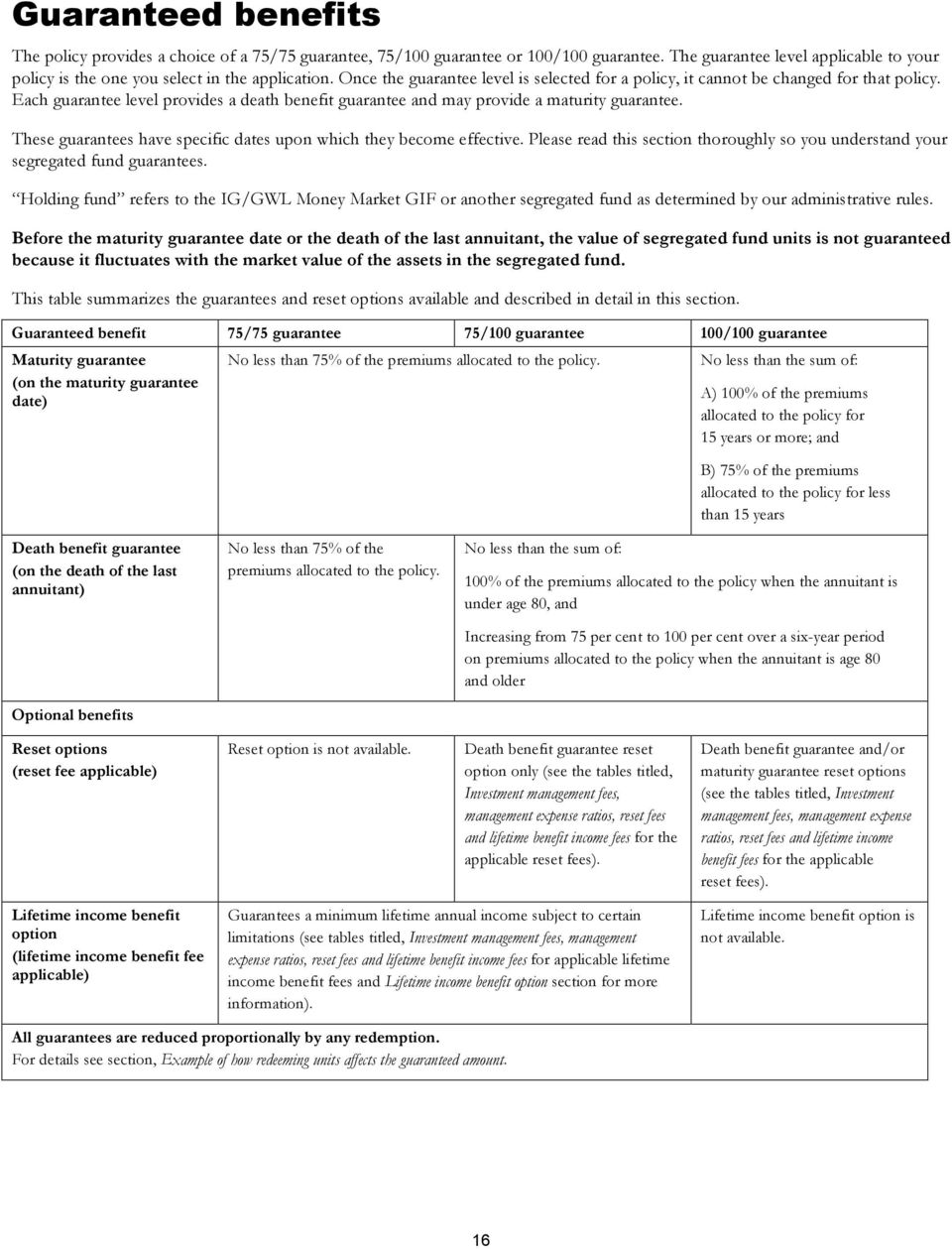
18 Guaranteed benefits The policy provides a choice of a 75/75 guarantee, 75/100 guarantee or 100/100 guarantee. The guarantee level applicable to your policy is the one you select in the application. Once the guarantee level is selected for a policy, it cannot be changed for that policy. Each guarantee level provides a death benefit guarantee and may provide a maturity guarantee. These guarantees have specific dates upon which they become effective. Please read this section thoroughly so you understand your segregated fund guarantees. Holding fund refers to the IG/GWL Money Market GIF or another segregated fund as determined by our administrative rules. Before the maturity guarantee date or the death of the last annuitant, the value of segregated fund units is not guaranteed because it fluctuates with the market value of the assets in the segregated fund. This table summarizes the guarantees and reset options available and described in detail in this section. Guaranteed benefit 75/75 guarantee 75/100 guarantee 100/100 guarantee Maturity guarantee (on the maturity guarantee date) No less than 75% of the premiums allocated to the policy. No less than the sum of: A) 100% of the premiums allocated to the policy for 15 years or more; and B) 75% of the premiums allocated to the policy for less than 15 years Death benefit guarantee (on the death of the last annuitant) Optional benefits No less than 75% of the premiums allocated to the policy. No less than the sum of: 100% of the premiums allocated to the policy when the annuitant is under age 80, and Increasing from 75 per cent to 100 per cent over a six-year period on premiums allocated to the policy when the annuitant is age 80 and older Reset options (reset fee applicable) Reset option is not available. Death benefit guarantee reset option only (see the tables titled, Investment management fees, management expense ratios, reset fees and lifetime benefit income fees for the applicable reset fees). Death benefit guarantee and/or maturity guarantee reset options (see the tables titled, Investment management fees, management expense ratios, reset fees and lifetime income benefit fees for the applicable reset fees). Lifetime income benefit option (lifetime income benefit fee applicable) Guarantees a minimum lifetime annual income subject to certain limitations (see tables titled, Investment management fees, management expense ratios, reset fees and lifetime benefit income fees for applicable lifetime income benefit fees and Lifetime income benefit option section for more information). Lifetime income benefit option is not available. All guarantees are reduced proportionally by any redemption. For details see section, Example of how redeeming units affects the guaranteed amount. 16
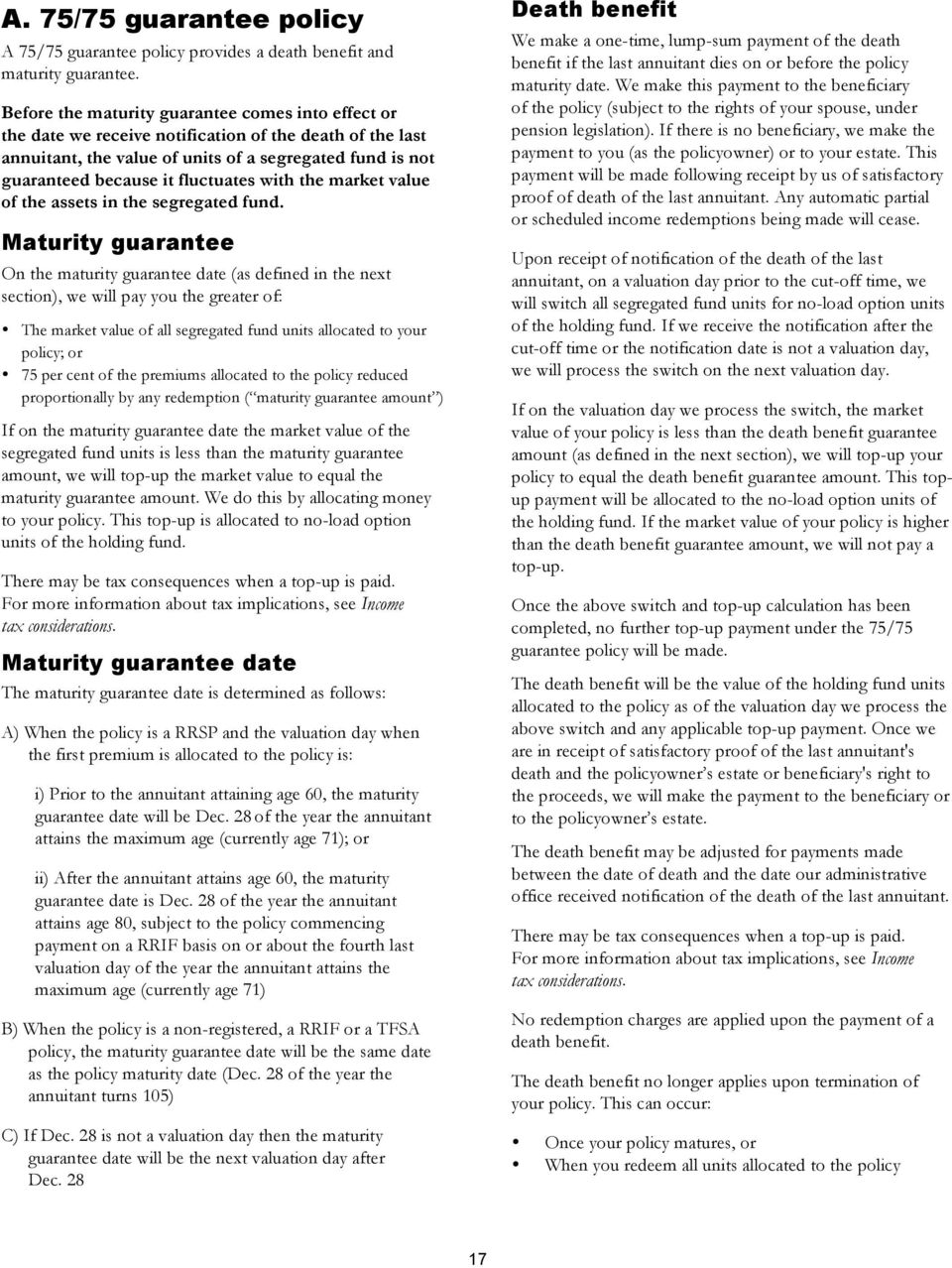
19 A. 75/75 guarantee policy A 75/75 guarantee policy provides a death benefit and maturity guarantee. Before the maturity guarantee comes into effect or the date we receive notification of the death of the last annuitant, the value of units of a segregated fund is not guaranteed because it fluctuates with the market value of the assets in the segregated fund. Maturity guarantee On the maturity guarantee date (as defined in the next section), we will pay you the greater of: The market value of all segregated fund units allocated to your policy; or 75 per cent of the premiums allocated to the policy reduced proportionally by any redemption ( maturity guarantee amount ) If on the maturity guarantee date the market value of the segregated fund units is less than the maturity guarantee amount, we will top-up the market value to equal the maturity guarantee amount. We do this by allocating money to your policy. This top-up is allocated to no-load option units of the holding fund. There may be tax consequences when a top-up is paid. For more information about tax implications, see Income tax considerations. Maturity guarantee date The maturity guarantee date is determined as follows: A) When the policy is a RRSP and the valuation day when the first premium is allocated to the policy is: i) Prior to the annuitant attaining age 60, the maturity guarantee date will be Dec. 28 of the year the annuitant attains the maximum age (currently age 71); or ii) After the annuitant attains age 60, the maturity guarantee date is Dec. 28 of the year the annuitant attains age 80, subject to the policy commencing payment on a RRIF basis on or about the fourth last valuation day of the year the annuitant attains the maximum age (currently age 71) B) When the policy is a non-registered, a RRIF or a TFSA policy, the maturity guarantee date will be the same date as the policy maturity date (Dec. 28 of the year the annuitant turns 105) C) If Dec. 28 is not a valuation day then the maturity guarantee date will be the next valuation day after Dec. 28 Death benefit We make a one-time, lump-sum payment of the death benefit if the last annuitant dies on or before the policy maturity date. We make this payment to the beneficiary of the policy (subject to the rights of your spouse, under pension legislation). If there is no beneficiary, we make the payment to you (as the policyowner) or to your estate. This payment will be made following receipt by us of satisfactory proof of death of the last annuitant. Any automatic partial or scheduled income redemptions being made will cease. Upon receipt of notification of the death of the last annuitant, on a valuation day prior to the cut-off time, we will switch all segregated fund units for no-load option units of the holding fund. If we receive the notification after the cut-off time or the notification date is not a valuation day, we will process the switch on the next valuation day. If on the valuation day we process the switch, the market value of your policy is less than the death benefit guarantee amount (as defined in the next section), we will top-up your policy to equal the death benefit guarantee amount. This topup payment will be allocated to the no-load option units of the holding fund. If the market value of your policy is higher than the death benefit guarantee amount, we will not pay a top-up. Once the above switch and top-up calculation has been completed, no further top-up payment under the 75/75 guarantee policy will be made. The death benefit will be the value of the holding fund units allocated to the policy as of the valuation day we process the above switch and any applicable top-up payment. Once we are in receipt of satisfactory proof of the last annuitant's death and the policyowner s estate or beneficiary's right to the proceeds, we will make the payment to the beneficiary or to the policyowner s estate. The death benefit may be adjusted for payments made between the date of death and the date our administrative office received notification of the death of the last annuitant. There may be tax consequences when a top-up is paid. For more information about tax implications, see Income tax considerations. No redemption charges are applied upon the payment of a death benefit. The death benefit no longer applies upon termination of your policy. This can occur: Once your policy matures, or When you redeem all units allocated to the policy 17
20 Death benefit guarantee amount The death benefit guarantee amount is 75 per cent of the premiums allocated to the policy reduced proportionally by any redemption. B. 75/100 guarantee policy A 75/100 guarantee policy provides a death benefit and maturity guarantee. Before the maturity guarantee comes into effect or the date we receive notification of the death of the last annuitant, the value of units of a segregated fund is not guaranteed because it fluctuates with the market value of the assets in the segregated fund. Maturity guarantee On the maturity guarantee date (as defined in the next section), we will pay your policy the greater of: The market value of all segregated fund units allocated to your policy; or 75 per cent of the premiums allocated to the policy reduced proportionally by any redemptions ( maturity guarantee amount ) If on the maturity guarantee date the market value of the segregated fund units is less than the maturity guarantee amount, we will top-up the market value to equal the maturity guarantee amount. We do this by allocating money to your policy. This top-up payment is allocated to no-load option units of the holding fund. There may be tax consequences when a top-up is paid. For more information about tax implications, see Income tax considerations. Maturity guarantee date The maturity guarantee date is determined as follows: A) When this policy is a RRSP and the valuation day when the first premium is allocated to the policy ( fund entry date ) is: i) Prior to the annuitant attaining age 60, the maturity guarantee date will be Dec. 28 of the year the annuitant attains the maximum age (currently age 71); or ii) After the annuitant attains age 60, the maturity guarantee date is Dec. 28 of the year the annuitant attains age 80, subject to the policy commencing payment on a RRIF basis on or about the fourth last valuation day of the year the annuitant attains the maximum age (currently age 71) B) When this policy is a non-registered, a RRIF or a TFSA policy, the maturity guarantee date will be the same date as the policy maturity date (Dec. 28 of the year the annuitant turns 105). C) If Dec. 28 is not a valuation day then the maturity guarantee date will be the next valuation day after Dec. 28. Death benefit We make a one-time, lump-sum payment of the death benefit if the last annuitant dies on or before the policy maturity date. We make this payment to the beneficiary of the policy (subject to the rights of your spouse, under pension legislation). If there is no beneficiary, we make the payment to you (as the policyowner) or to your estate. This payment will be made upon receipt by us of satisfactory proof of death of the last annuitant. Any automatic partial or scheduled income redemptions being made will cease. Upon receipt of notification of the death of the last annuitant, on a valuation day prior to the cut-off time, we will switch all segregated fund units for no-load option units of the holding fund. If we receive the notification after the cut-off time or the notification date is not a valuation day, we will process the switch on the next valuation day. If on the valuation day we process the switch the market value of your policy is less than the death benefit guarantee amount (as defined in the next section), we will top-up your policy to equal the death benefit guarantee amount. This topup payment will be allocated to the no-load option units of the holding fund. If the market value of your policy is higher than the death benefit guarantee amount, we will not pay a top-up. Once the above switch and top-up calculation has been completed, no further top-up payment under the 75/100 guarantee policy will be made. The death benefit will be the value of the holding fund units allocated to the policy as of the valuation day we process the above switch and any applicable top-up payment. Once we are in receipt of satisfactory proof of the last annuitant's death and the policyowner s estate or beneficiary's right to the proceeds, we will make the payment to the beneficiary or to the policyowner s estate. The death benefit may be adjusted for payments made between the date of death and the date our administrative office received notification of the death of the last annuitant. There may be tax consequences when a top-up is paid. For more information about tax implications, see Income tax considerations. 18

21 No redemption charges are applied upon the payment of a death benefit. The death benefit no longer applies upon termination of your policy. This can occur: Once your policy matures, or When you redeem all units allocated to your policy Death benefit guarantee amount The death benefit guarantee amount varies according to the age of the annuitant at the time a premium is allocated to the policy and the length of time the premium is in the policy. The death benefit guarantee amount is the sum of: 100 per cent of the premiums allocated to the policy for all premium years when the annuitant is age 79 or younger at the start of the premium year, and The following percentages of the premiums allocated to the policy for each applicable premium year when the annuitant is age 80 or older at the start of the premium year: 75 per cent during the premium year the premium is allocated 80 per cent during the second premium year following the year the premium is allocated 85 per cent during the third premium year following the year the premium is allocated 90 per cent during the fourth premium year following the year the premium is allocated 95 per cent during the fifth premium year following the year the premium is allocated 100 per cent in sixth and subsequent premium years following the year the premium is allocated The death benefit guarantee amount will be proportionally reduced by redemptions. Premium year is the 12-month period between each anniversary of the fund entry date. Anniversary of the fund entry date refers to the calendar anniversary of the fund entry date. If the calendar anniversary of the fund entry date is not a valuation day, then the anniversary of the fund entry date will be the next valuation day. Fund entry date refers to the valuation day when the first premium is allocated to the policy. Death benefit guarantee reset option This option is only available if the youngest annuitant is 68 years of age or younger at the time you complete the application. If you apply for the death benefit guarantee reset option on the application, you must pay a reset fee. This fee is known as the death benefit guarantee reset fee (see below). Once selected this option cannot be terminated. Annual resets If, on the anniversary of the fund entry date, the market value of the segregated fund units allocated to your policy is greater than the death benefit guarantee amount, we will increase the death benefit guarantee amount to the market value. This is called an annual reset of the death benefit guarantee amount. These annual resets will occur up to and including the last anniversary of the fund entry date prior to the annuitant attaining the age of 70. After this date, no further annual resets will occur. If the market value of the segregated fund units allocated to your policy on the anniversary of the fund entry date is less than the death benefit guarantee amount, the death benefit guarantee amount will not be changed. Death benefit guarantee reset fee The amount of the death benefit guarantee reset fee varies for each segregated fund and from time to time. For more information about the fee see the table, Investment management fee and death benefit guarantee reset fee for segregated funds in a 75/100 guarantee policy, in the Investment management fees, management expense ratios, reset fees and lifetime income benefit fees section. The death benefit guarantee reset fee ( reset fee ) is a percentage of the market value of the segregated fund units allocated to your policy. We calculate the reset fee for each segregated fund and deduct the reset fee as one amount by redeeming units once a year on each anniversary of the fund entry date. The reset fee will cease after the last anniversary of the fund entry date prior to the annuitant turning age 70. You may elect which segregated fund the reset fee is to be charged otherwise the reset fee will be taken from a fund based on our then-current administrative rules. When the units redeemed are deferred sales charge option any applicable redemption fee will be charged. For a nonregistered policy, any redemption, including the reset fee, may result in a taxable capital gain or loss. You are responsible for any income tax reporting and payments that may be required. 19
22 The reset fee will not proportionally reduce the maturity or death benefit guarantee amount. We have the right to change the death benefit guarantee reset fee at any time. If we increase the reset fee by more than the greater of 0.50 per cent per year or 50 per cent of the current reset fee, it will be considered a fundamental change and you will have certain rights. If we increase the reset fee, we will notify you in writing before we make the change. For more information see Fundamental changes to the segregated funds. C. 100/100 guarantee policy A 100/100 guarantee policy provides a death benefit guarantee and may provide a maturity guarantee. All segregated funds may not be available under the 100/100 guaranteed policy. For a list of segregated funds available, see the 100/100 guarantee policy table under Management fee, management expense ratios, reset option fees and lifetime income benefit fees. A 100/100 guarantee policy is only available as a nonregistered, RRSP or TFSA and only as a RRIF when the premium is received from a 100/100 guarantee RRSP policy. For purpose of calculating the maturity guarantee amount and any applicable resets under the 100/100 guarantee policy the maturity guarantee date will be the most recent maturity guarantee date as recorded at our administrative office. Before the maturity guarantee comes into effect or the date we receive notification of the death of the last annuitant, the value of units of a segregated fund is not guaranteed because it fluctuates with the market value of the assets in the segregated fund. Maturity guarantee A 100/100 guarantee policy may provide a maturity guarantee on the maturity guarantee date. If there is no maturity guarantee date there is no maturity guarantee. On the maturity guarantee date the maturity guarantee is the greater of the: Market value of all segregated fund units allocated to your policy; or The maturity guarantee amount Maturity guarantee amount The maturity guarantee amount on the maturity guarantee date is the sum of: A) 100 per cent of the premiums allocated to the policy for at least 15 years; and B) 75 per cent of the premiums allocated to the policy for less than 15 years The maturity guarantee amount will be proportionally reduced by redemptions. If on the maturity guarantee date the market value of the segregated fund units is less than the maturity guarantee amount, we will top-up the market value to equal the maturity guarantee amount. We do this by allocating money to your policy. This top-up amount is allocated to no-load option units of the holding fund. There may be tax consequences when a top-up is paid. For more information about tax implications, see Income tax considerations. Maturity guarantee date A) Initial maturity guarantee date You may select the initial maturity guarantee date provided: The date is at least 15 years after the fund entry date, and It does not exceed the policy maturity date Fund entry date refers to the valuation day when the first premium is allocated to the policy. Anniversary of the fund entry date refers to the calendar anniversary of the fund entry date. If the calendar anniversary of the fund entry date is not a valuation day, then the anniversary of the fund entry date will be the next valuation day. If an initial maturity guarantee date is not selected, the default initial maturity guarantee date will be 15 years from the fund entry date. If the initial maturity guarantee date is not a valuation day, then the date will be adjusted to the next valuation day following the maturity guarantee date. When the policy is a RRSP and the initial maturity guarantee date is beyond the maximum age, the initial maturity guarantee date is subject to the policy commencing payment on a RRIF basis on or about the fourth last valuation day of the year the annuitant attains the maximum age (currently age 71). If the policy maturity date is less than 15 years from the fund entry date, there will be no maturity guarantee. You may change the initial maturity guarantee date by providing us with written notification to the administrative office, in a form acceptable to us. The revised initial maturity guarantee date: Must be at least 15 years from the next anniversary of the fund entry date Can exceed the maximum age when the policy is a RRSP, subject to the policy commencing payment on a RRIF basis on or about the fourth last valuation day of the year the annuitant attains the maximum age (currently age 71) 20
23 Cannot exceed the policy maturity date Complies with applicable legislation It has been at least 12 months since you selected it or, last requested to change it B) Subsequent maturity guarantee date A subsequent maturity guarantee date is a maturity guarantee date that occurs after the initial maturity guarantee date. You may, prior to or on a maturity guarantee date, select a subsequent maturity guarantee date provided: The date is at least 15 years from the next anniversary of the fund entry date that is on or after a maturity guarantee date It does not exceed the policy maturity date It complies with applicable legislation It has been at least 12 months since the last request to change it When the policy is a RRSP and a subsequent maturity guarantee date is selected, which is beyond the maximum age, the subsequent maturity guarantee date is subject to the policy commencing payment on a RRIF basis on or about the fourth last valuation day of the year the annuitant attains the maximum age (currently age 71). If the policy reaches a maturity guarantee date and the policy is a RRIF, you cannot select a subsequent maturity guarantee date and we will not establish one. If no alternate direction is received prior to or on a maturity guarantee date, a subsequent maturity guarantee date will be established as follows: I) When the policy is a RRSP or spousal RRSP, and When the maturity guarantee date and the anniversary of the fund entry date are the same date, the subsequent maturity guarantee date will be 15 years from the maturity guarantee date; or When the maturity guarantee date is not the same date as the anniversary of the fund entry date, the subsequent maturity guarantee date will be 15 years from the next anniversary of the fund entry date that is after the maturity guarantee date If the subsequent maturity guarantee date is beyond the maximum age, the subsequent maturity guarantee date is subject to the policy commencing payment on a RRIF or spousal RRIF basis (as applicable) on or about the fourth last valuation day of the year the annuitant attains the maximum age (currently age 71). II) When the policy is a LRRSP, LIRA or RLSP and administered in accordance with applicable pension legislation: Which does not require you to receive payments from a life annuity at a specified age, and When the maturity guarantee date and the anniversary of the fund entry date are the same date, the subsequent maturity guarantee date will be 15 years from the maturity guarantee date; or When the maturity guarantee date is not the same date as the anniversary of the fund entry date, the subsequent maturity guarantee date will be 15 years from the next anniversary of the fund entry date that is after the maturity guarantee date Which requires you to receive payments from a life annuity at a specified age and When the maturity guarantee date and the anniversary of the fund entry date are the same date and there are at least 15 years to the date when payments are required to commence from a life annuity, the subsequent maturity guarantee date will be 15 years from the maturity guarantee date; or When the maturity guarantee date is not the same date as the anniversary of the fund entry date and there are less than 15 years from the next anniversary of the fund entry date to the date when payments are required to commence from the life annuity, a subsequent maturity guarantee date will not be established and there will be no maturity guarantee If the subsequent maturity guarantee date is beyond the maximum age, the subsequent maturity guarantee date is subject to the policy commencing payment on a PRIF, LIF, RLIF or LRIF basis (as applicable) on or about the fourth last valuation day of the year the annuitant attains the maximum age (currently age 71). III) When the policy is non-registered or TFSA policy and When the maturity guarantee date and the anniversary of the fund entry date are the same date and there are at least 15 years to the policy maturity date, the subsequent maturity guarantee date will be 15 years from the maturity guarantee date When the maturity guarantee date is not the same date as the anniversary of the fund entry date, the subsequent maturity guarantee date will be 15 years from the next anniversary of the fund entry date that is after the maturity guarantee date If there are fewer than 15 years to the policy maturity date, a subsequent maturity guarantee date will not be established and there will be no maturity guarantee. 21
24 Maturity guarantee reset option If you apply for the maturity guarantee reset option on the application, you must pay a reset fee. This fee is known as the maturity guarantee reset fee (see below). Once selected this option cannot be terminated. When the initial, revised initial or subsequent maturity guarantee date is exactly 15 years from the fund entry date or anniversary of the fund entry date, as applicable, on the maturity guarantee date if the market value of the segregated fund units allocated to your policy is greater than the maturity guarantee amount and there are 15 years or more to the policy maturity date, we will increase the maturity guarantee amount to equal the market value. If the market value of the segregated fund units allocated to your policy is less than the maturity guarantee amount, the maturity guarantee amount will not change. When the policy is a RRIF and reaches a maturity guarantee date a subsequent maturity guarantee date cannot and will not be established. The maturity guarantee reset fee will cease at this point. Annual resets When the initial maturity guarantee date is more than 15 years from the fund entry date or a revised initial or subsequent maturity guarantee date is more than 15 years from the next anniversary of the fund entry date, on each anniversary of the fund entry date if the market value of the segregated fund units allocated to your policy is greater than the maturity guarantee amount, we will increase the maturity guarantee amount to equal the market value. This is called an annual reset of the maturity guarantee amount. Annual resets only occur up to and including the last anniversary of the fund entry date that is 15 years prior to the maturity guarantee date. If on the anniversary of the fund entry date the market value of the segregated fund units allocated to your policy is less than the maturity guarantee amount, the maturity guarantee amount will not change. If the anniversary of the fund entry date is not a valuation day, the applicable processing will occur on the next valuation day. Maturity guarantee reset fee The amount of the maturity guarantee reset fee varies for each segregated fund and from time to time. For information about the reset fee see the table, Investment management fee, Maturity guarantee reset fee and death benefit guarantee reset fee for segregated funds in a 100/100 guarantee policy. The maturity guarantee reset fee is a percentage of the market value of the segregated fund units allocated to your policy. We calculate the reset fee for each segregated fund and deduct the reset fee as one amount by redeeming units once a year on the anniversary of the fund entry date until the last anniversary of the fund entry date prior to the maturity guarantee date. The reset fee is payable throughout the guarantee period even if resets are not occurring. You may elect which segregated fund the reset fee is to be charged otherwise the reset fee will be taken from a segregated fund based on our then-current administrative rules. When the units redeemed are deferred sales charge option any applicable redemption charge will be charged. For a non-registered policy these redemptions may result in a taxable capital gain or loss. You are responsible for any income tax reporting and payments that may be required. The reset fee will not proportionally reduce the maturity or death benefit guarantee amount. We have the right to change the maturity guarantee reset fee at any time. If we increase the reset fee by more than the greater of 0.50 per cent per year or 50 per cent of the current reset fee, it will be considered a fundamental change and you will have certain rights. For more information see Fundamental changes to the segregated funds. If we increase the reset fee, we will tell you in writing before we make the change. For example: Let s assume that you establish your 100/100 guarantee policy with a premium of $8,000 allocated to the IG/GWL Canadian Balanced GIF on Feb. 5, 2014 and no further premiums are added. The annuitant of the policy is 40 years old. The date the first premium is allocated to the policy ( fund entry date ) is Feb. 5, You select June 1, 2033 as the maturity guarantee date. You have also selected the maturity guarantee reset option. On the first anniversary of the fund entry date, Feb. 5, 2015, the market value of the segregated fund units allocated to your policy is compared to the existing maturity guarantee amount and the guarantee is reset to the market value of your segregated fund units, as it is higher, as shown below. Anniversary of the fund entry date Market value on the anniversary of the fund entry date Existing maturity guarantee amount New maturity guarantee amount Feb. 5, 2015 $8,500 $8,000 $8,500 On Feb. 5, 2015, we would also determine the amount of the maturity guarantee reset fee. The maturity guarantee reset fee is a percentage of the market value of the segregated fund 22
25 units allocated to your policy. In this example, on Feb. 5, 2015, the market value of the IG/GWL Canadian Balanced GIF units allocated to your policy was $8,500. Assume the maturity guarantee reset fee for the IG/GWL Canadian Balanced GIF is 0.25 per cent. The reset fee equals $21.25 ($8,500 x 0.25 per cent) and is deducted by redeeming units from the IG/GWL Canadian Balanced GIF on the anniversary of the fund entry date. Throughout the rest of this example we will not show the calculation of the reset fee on each anniversary of the fund entry date; however, the reset fee is collected annually until the last anniversary of the fund entry date prior to the maturity guarantee date. Continuing this example, on the next anniversary, Feb. 5, 2016, we find that the market value of the segregated fund units allocated to your policy is $8,300, which is lower than the existing maturity guarantee amount of $8,500. Since the maturity guarantee amount is higher than the market value, the maturity guarantee amount will not change and remains at $8,500. This annual comparison continues as indicated in the table below. Anniversary of the fund entry date Market value on the anniversary of the fund entry date Existing maturity guarantee amount New maturity guarantee amount Feb. 5, 2016 $8,300 $8,500 $8,500 Feb. 5, 2017 $8,900 $8,500 $8,900 Feb. 5, 2018 $9,400 $8,900 $9,400 On June 1, 2018, there are 15 years until the maturity guarantee date. This means that Feb. 5, 2018 was the last anniversary of the fund entry date when a reset could occur. During the next 15 year period, there will be no further resets of the maturity guarantee amount; however, the reset fee is collected annually until the last anniversary of the fund entry date prior to the policy maturity date. On June 1, 2033, the maturity guarantee date, the market value of the segregated fund units allocated to your policy is $12,500 and the maturity guarantee amount is $9,400. As the market value is greater than the maturity guarantee amount of $9,400, we would not top up the policy. Alternatively, if on June 1, 2033, the market value was $8,800 and your maturity guarantee amount was $9,400, we would top up the policy to $9,400 by adding $600 to it. A subsequent maturity guarantee date of Feb. 5, 2049 will be established unless you select a later date which does not exceed Dec. 28, 2079, the policy maturity date. Continuing this example, we assume the maturity guarantee date will be Feb. 5, So, on the next anniversary of the fund entry date, Feb. 5, 2034, there are 15 years until the maturity guarantee date. This means that Feb. 5, 2034 is the last anniversary of the fund entry date when a reset could occur. On the anniversary date, Feb. 5, 2034, the market value is $13,450, which is higher than the existing maturity guarantee amount of $9,400. Since the maturity guarantee amount is lower than the market value, the maturity guarantee amount will increase to $13,450. During the 15 year period between Feb. 6, 2034 and the established maturity guarantee date, Feb. 5, 2049, no further resets of the maturity guarantee amount will be made. However, the reset fee is collected annually until the last anniversary of the fund entry date prior to the maturity guarantee date. On Feb. 5, 2049, the subsequent maturity guarantee date, we will once again compare the market value of the segregated fund units allocated to your policy to the maturity guarantee amount and will determine if a top-up or reset of the maturity guarantee amount is applicable. Death benefit We make a one-time, lump-sum payment of the death benefit if the last annuitant dies on or before the policy maturity date. We make this payment to the beneficiary of the policy (subject to the rights of your spouse, under pension legislation). If there is no beneficiary, we make the payment to you (as the policyowner) or to your estate. This payment will be made upon receipt by us of satisfactory proof of death of the last annuitant. Any automatic partial or scheduled income redemptions being made will cease. Upon receipt of notification of the death of the last annuitant, on a valuation day prior to the cut-off time, we will switch all segregated fund units for no-load option units of the holding fund. If we receive the notification after the cut-off time or the notification date is not a valuation day, we will process the switch on the next valuation day. If on the valuation day we process the switch the market value of your policy is less than the death benefit guarantee amount (as defined in the next section), we will top-up your policy to equal the death benefit guarantee amount. This topup payment will be allocated to the no-load option units of the holding fund. If the market value of your policy is higher than the death benefit guarantee amount, we will not pay a top-up. Once the above switch and top-up calculation has been completed, no further top-up payment under the 100/100 guarantee policy will be made. 23
26 The death benefit will be the value of the holding fund units allocated to the policy as of the valuation day we process the above switch and any applicable top-up payment. Once we are in receipt of satisfactory proof of the last annuitant's death and the policyowner s estate or beneficiary's right to the proceeds, we will make the payment to the beneficiary or to the policyowner s estate. The death benefit may be adjusted for payments made between the date of death and the date our administrative office received notification of the death of the last annuitant. There may be tax consequences when a top-up is paid. For more information about tax implications, see Income tax considerations. No redemption charges are applied upon the payment of a death benefit. The death benefit no longer applies upon termination of your policy. This can occur: Once your policy matures, or When you redeem all units allocated to the policy Death benefit guarantee amount The death benefit guarantee amount varies according to the age of the annuitant at the time a premium is allocated to the policy and the length of time the premium is in the policy. The death benefit guarantee amount is the sum of: 100 per cent of the premiums allocated to the policy for all premium years when the annuitant is age 79 or younger at the start of the premium year, and The following percentages of the premiums allocated to the policy for each applicable premium year when the annuitant is age 80 or older at the start of the premium year: 75 per cent during the premium year the premium is allocated 80 per cent during the second premium year following the year the premium is allocated 85 per cent during the third premium year following the year the premium is allocated 90 per cent during the fourth premium year following the year the premium is allocated 95 per cent during the fifth premium year following the year the premium is allocated 100 per cent in sixth and subsequent premium years following the year the premium is allocated The death benefit guarantee amount will be proportionally reduced by redemptions. Premium year is the 12-month period between each anniversary of the fund entry date. Anniversary of the fund entry date refers to the calendar anniversary of the fund entry date. If the calendar anniversary of the fund entry date is not a valuation day, then the anniversary of the fund entry date will be the next valuation day. Fund entry date refers to the valuation day when the first premium is allocated to the policy. Death benefit guarantee reset option This option is only available if the youngest annuitant is 68 years of age or younger at the time you complete the application. If you apply for the death benefit guarantee reset option on the application, you must pay a reset fee. This fee is known as the death benefit guarantee reset fee (see below). Once selected this option cannot be terminated. Annual resets If, on the anniversary of the fund entry date, the market value of the segregated fund units allocated to your policy is greater than the death benefit guarantee amount, we will increase the death benefit guarantee amount to the market value. This is called an annual reset of the death benefit guarantee amount. These annual resets will occur up to and including the last anniversary of the fund entry date prior to the annuitant attaining the age of 70. After this date no further annual resets will occur. If the market value of the segregated fund units allocated to your policy on the anniversary of the fund entry date is less than the death benefit guarantee amount, the death benefit guarantee amount will not be changed. Death benefit guarantee reset fee The amount of the death benefit guarantee reset fee varies for each segregated fund and from time to time. For more information about the fee see the table, Investment management fee, Maturity guarantee reset fee and death benefit guarantee reset fee for segregated funds in a 100/100 guarantee policy, in the Investment management fees, management expense ratios, reset fees and lifetime income benefit fees. The death benefit guarantee reset fee is a percentage of the market value of the segregated fund units allocated to your policy. We calculate the reset fee for each segregated fund and deduct the fee as one amount by redeeming units once a year on each anniversary of the fund entry date. The reset fee will cease after the last anniversary of the fund entry date prior to the annuitant turning age 70. You may elect which segregated fund the reset fee is to be charged otherwise the reset fee will be taken from a fund based on our then-current administrative rules. When the units redeemed are deferred sales charge option units any applicable redemption charge 24
27 will apply. For a non-registered policy, these redemptions may result in a taxable capital gain or loss. You are responsible for any income tax reporting and payments that may be required. The reset fee will not proportionally reduce the death benefit or maturity guarantee amount. of the fund entry date. The reset fee is collected on each anniversary of the fund entry date up to and including the last anniversary of the fund entry date prior to the annuitant attaining the age of 70. After this date no further annual resets will occur and the reset fee is not collected. We have the right to change the death benefit guarantee reset fee at any time. If we increase the reset fee by more than the greater of 0.50 per cent per year or 50 per cent of the current reset fee, it will be considered a fundamental change and you will have certain rights. If we increase the reset fee, we will tell you in writing before we make the change. For more information see Fundamental changes to the segregated funds. For example: Let s assume that you establish your 100/100 guarantee policy with a premium of $8,000 allocated to the IG/GWL Canadian Balanced GIF on Feb. 5, 2014 and no further premiums are added. The annuitant of the policy is 40 years old. The date the first premium is allocated to the policy ( fund entry date ) is Feb. 5, You have selected the death benefit guarantee reset option. On the first anniversary of the fund entry date, Feb. 5, 2015, the market value of your segregated fund units allocated to your policy is compared to the existing death benefit guarantee amount and the guarantee is reset to the market value of your segregated fund units, as it is higher, as shown below. Anniversary of the fund entry date Market value on the anniversary of the fund entry date Existing death benefit guarantee amount New death benefit guarantee amount Feb 5, 2015 $8,500 $8,000 $8,500 This annual comparison will occur up to and including the last anniversary of the fund entry date prior to the annuitant attaining the age of 70. After this date no further annual resets will occur. Also on Feb. 5, 2015, we will determine the amount of the annual death benefit guarantee reset fee. The death benefit guarantee reset fee is a percentage of the market value of the segregated fund units allocated to your policy. In this example, on Feb. 5, 2015 the market value of the IG/GWL Canadian Balanced GIF units allocated to your policy was $8,500. Assume the death benefit guarantee reset fee for the IG/GWL Canadian Balanced GIF is 0.15 per cent. The reset fee equals $12.75 ($8,500 x 0.15 per cent) and is deducted by redeeming units from the IG/GWL Canadian Balanced GIF on the anniversary 25
28 Example of how redeeming units affects the guaranteed amount When you make a redemption from a policy, it affects the amounts that are used to calculate any applicable death benefit guarantee or maturity guarantee amounts. Any applicable reset fees under a 75/100 guarantee or 100/100 guarantee policy do not affect the death benefit guarantee or maturity guarantee amounts. The following example explains how redemptions affect the guarantees under a 75/75 guarantee, 75/100 guarantee or 100/100 guarantee policy. It only applies to maturity and death benefit guarantee amounts when the policyowner has not paid any premiums to the policy on or after age 80 and has not selected a reset option under a 75/100 guarantee or 100/100 guarantee policy. For premiums paid on or after age 80, the death benefit guarantee amount percentage will change, see the Death benefit guarantee sections under 75/100 guarantee policy and 100/100 guarantee policy. For example: A 55 year-old individual establishes a 75/100 guarantee policy on June 15, 2014 and has allocated a total of $5,000 in premiums to two segregated funds. If the market value is less than the amount used to calculate maturity and death benefit guarantees Assume the individual requests a redemption of $1,200 on July 31, 2015 when the market value of all segregated funds units allocated to your policy is $4,800. The redemption will reduce the market value of all segregated funds in the policy by 25 per cent ($1,200 / $4,800). The maturity and death benefit guarantee amounts will be reduced proportionately by the same 25 per cent, as shown in the following table. Amount used to calculate the guarantees (G) Maturity guarantee amount (75% x G) Death benefit guarantee amount (100% x G) Current market value of those premiums (M) Redemption amount (R) Redemption amount as a percentage of the current market value (P=R/M) G reduced by this amount, a proportional reduction (D=P x G) New amount used to calculate the guarantees (NA = G - D) New maturity guarantee amount (75% x NA) New death benefit guarantee amount (100% x NA) $5,000 $3,750 $5,000 $4,800 $1,200 25% $1,250 $3,750 $2, $3,750 If the market value is greater than the amount used to calculate maturity and death benefit guarantees Assume the individual requests a redemption of $1,200 on July 31, 2015 when the market value of all segregated funds units allocated to your policy is $6,000. The redemption will reduce the market value of all segregated funds in the policy by 20 per cent ($1,200 / $6,000). The maturity and death benefit guarantee amounts will be reduced proportionately by the same 20 per cent, as shown in the following table. Amount used to calculate the guarantees (G) Maturity guarantee amount (75% x G) Death benefit guarantee amount (100% x G) Current market value of those premiums (M) Redemption amount (R) Redemption amount as a percentage of the current market value (P=R/M) G reduced by this amount, a proportional reduction (D=P x G) New amount used to calculate the guarantees (NA=G-D) New maturity guarantee amount (75% x NA) New death benefit guarantee amount (100% x NA) $5,000 $3,750 $5,000 $6,000 $1,200 20% $1,000 $4,000 $3,000 $4,000 26
29 Lifetime income benefit option The lifetime income benefit option is an optional benefit that guarantees a lifetime income amount subject to certain limitations. It offers features that may increase the lifetime income amount as you age, through growth in the value of the policy, bonuses and automatic resets. The lifetime income amount will decrease if you make an excess redemption and may decrease on the death of an annuitant. If you apply for the lifetime income benefit option, you must pay a monthly charge. This monthly charge is known as the lifetime income benefit monthly charge. The initial premium or market value of the segregated fund units allocated to the policy must be at least $25,000 at the time the lifetime income benefit option is selected. Once selected, the lifetime income benefit option applies to all premiums in the policy. The lifetime income benefit option can be selected at any time when all annuitants, successor annuitant and joint life (as defined below) are between the minimum and maximum issue ages. Currently, the minimum age is 50 and the maximum age 90. The lifetime income benefit option can only be selected if the segregated fund policy has either the 75/75 guarantee or 75/100 guarantee. The following table shows the policy types where the lifetime income benefit option is available and the payout election which can be selected with that policy type. Policy type Single-life income election available Non-registered Yes Yes RRSP / Spousal RRSP Yes Yes RRIF / Spousal RRIF Yes Yes LIRA (where administered under Saskatchewan pension legislation) Yes No PRIF Yes No Joint-life income election available At the time you choose the lifetime income benefit option, you must elect a payout election and you will not be able to change this payout election unless you terminate the lifetime income benefit option and re-apply once you have waited the applicable time; see the Termination of the lifetime income benefit option section. The available payout elections are; Single-life income Joint-life income The single-life income election provides a guaranteed income stream while the annuitant is alive. The guaranteed income stream, (which is known as the lifetime income amount) for the single-life income election is determined by the applicable income percentage based on the age of the primary annuitant (as defined below). The joint-life income election provides a guaranteed income stream while at least one of the annuitant and joint life is alive, subject to certain conditions. The lifetime income amount for the joint-life income election is determined by the applicable income percentage based on the age of the younger of the annuitant and the joint life. The maturity guarantee and death benefit guarantees associated with the 75/75 guarantee policy and 75/100 guarantee policy are independent of the income guarantees and features associated with the lifetime income benefit option. Any increase in the lifetime income amount as a result of a reset or bonus does not have any impact on the underlying maturity and death benefit guarantees or market value of the policy. All redemptions (scheduled, unscheduled and excess) will proportionally reduce the value of the maturity benefit and death benefit guarantees. You may defer making redemptions from a non-registered policy for any length of time. You may defer making redemptions under a RRSP policy until age 71 at which time the market value must be converted to a RRIF policy. When the policy is a RRSP or spousal RRSP, to receive a scheduled redemption, you must convert your policy to a RRIF or spousal RRIF. You must receive a minimum income amount each year from a RRIF and PRIF. 27
30 Policies with the lifetime income benefit option may only select from eligible segregated funds (LIB eligible funds). For a list of the LIB eligible funds, see Lifetime income benefit eligible funds and lifetime income benefit monthly charge. The LIB eligible funds are described in detail later in the information folder; see the section Fund Facts. There are additional limitations on your ability to add premiums to the policy when the lifetime income benefit option is in effect. For more information, see Subsequent premiums. The lifetime income benefit option may terminate on the death of the annuitant. For more information, see Death of an annuitant while the single-life income election is in effect and Death of an annuitant and/or joint life while the joint-life income election is in effect. Any lifetime income benefit values (prior to the commencement of lifetime income benefit (LIB) payments) and the RRIF minimum amount must be based on the age of the youngest annuitant or joint life, as applicable. Primary annuitant means under the Single-life income election, the annuitant, when only one annuitant is named on the application and the youngest annuitant when joint annuitants are named on the application. Joint-life income election, the younger of the annuitant and joint life. Joint life means the Joint annuitant under a non-registered policy Sole beneficiary, successor annuitant and spouse of the annuitant under a RRIF/Spousal RRIF policy Sole beneficiary and spouse of the annuitant, under a RRSP/Spousal RRSP policy The joint life is not a policyowner or annuitant where the policy is a RRSP or RRIF. The policy is non-assignable while the lifetime income benefit option is effective. The lifetime income benefit option cannot be selected if the policy has been assigned. We can refuse any request for the lifetime income benefit option and restrict premiums or limit subsequent premiums being applied to the policy while the lifetime income benefit option is in force in accordance with our then-current administrative rules. For the lifetime income benefit option, we can change the minimum and maximum issue ages, the types of policies and/or guarantee levels required, and the minimum required premium or market value without notice. Any such change will not affect a policy when the lifetime income benefit option is in force on the date we make the change. While the lifetime income benefit option is in force you should consider carefully who you wish to name as a beneficiary or successor annuitant. For further details, see the Naming a beneficiary and/or successor annuitant section. Lifetime income benefit values If we receive your request for the lifetime income benefit option in good order at our administrative office on or before the cut-off time, your initial lifetime income benefit values are calculated as of that date but if it is received after the cut-off time, the values will be calculated as of the next valuation day. This date is known as the LIB effective date. Lifetime income withdrawal base (LIWB) Prior to determining the initial lifetime income amount, we must first establish the lifetime income withdrawal base. The establishment of the lifetime income withdrawal base is different depending on when the lifetime income benefit option is effective; When the lifetime income benefit option is selected at policy issue, the initial lifetime income withdrawal base is equal to the initial premium (LIB premium) allocated to the policy. When the lifetime income benefit option is selected after the policy has been issued, the initial lifetime income withdrawal base is equal to the market value of the segregated funds in the policy on the LIB effective date. The lifetime income withdrawal base is only used for the purpose of determining the lifetime income amount and the lifetime income benefit monthly charge. The lifetime income withdrawal base has no market value and does not apply to maturity or death benefit guarantees. It can only decrease when an excess redemption is made or the primary annuitant dies. Subsequent premiums, bonuses and automatic resets will increase the lifetime income withdrawal base, resulting in an increase in the lifetime income amount. 28
31 Lifetime income amount (LIA) The lifetime income amount is the annual income amount you are guaranteed to receive under the lifetime income option. The initial lifetime income amount is equal to the applicable income percentage (see Income percentages below), which corresponds to the age of the primary annuitant multiplied by the lifetime income withdrawal base. The initial lifetime income amount will be effective for the current and following calendar year. Any redemption exceeding the lifetime income amount or RRIF minimum amount, if higher, will be considered an excess redemption and will lower your future lifetime income amount. You cannot carry forward any portion of the lifetime income amount that you did not withdraw in a calendar year to another calendar year. Base for income bonus (BIB) The base for income bonus is used for the calculation of bonuses, which are allocated to the lifetime income withdrawal base. When the lifetime income benefit option is selected at policy issue, the initial base for income bonus is equal to the initial LIB premium. When the lifetime income benefit option is selected after the policy has been issued, the initial base for income bonus is equal to the market value of the LIB eligible funds in the policy on the LIB effective date. The base for income bonus is only used to calculate bonuses. It has no market value and does not apply to maturity or death benefit guarantees. Recalculations The lifetime income withdrawal base and base for income bonus will be recalculated from time to time. These recalculations can increase your lifetime income amount in the following ways: Bonus Three per cent bonus builds the lifetime income withdrawal base used to determine the lifetime income amount Automatic resets Increases in the market value of your policy reset the lifetime income amount every three years Income percentages As you age your income can automatically increase Subsequent premiums Added to your lifetime income withdrawal base The lifetime income amount will decrease as a result of excess redemptions and may decrease on the death of an annuitant. For more information, see Bonuses and automatic resets, Excess redemptions, Subsequent premiums and Death of an annuitant while the single-life income election is in effect and Death of an annuitant and/or joint life while the joint-life income election is in effect. Income percentages The income percentages are used in determining the lifetime income amount. The following table provides the applicable income percentages at each age. Attained age of the primary annuitant at the applicable time Income percentage under the single-life income election % 2.50% % 2.90% % 3.30% % 3.70% % 4.10% % 4.50% Income percentage under the joint-life income election For example: A 61 year-old individual applies for a non-registered 75/75 guarantee policy with the lifetime income benefit option and the single-life income election on May 1, A premium of $100,000 is allocated to a LIB eligible fund under the deferred sales charge option. 29
32 In this example, May 1, 2014 is the LIB effective date. The initial lifetime income withdrawal base and base of income bonus is equal to the amount of the initial premium of $100,000. The initial lifetime income amount is calculated by multiplying the initial lifetime income withdrawal base by the income percentage applicable to the annuitant at that time, 3.80 per cent, and equals $3,800 ($100,000 x 3.80 per cent). Bonus and automatic resets Bonus With the lifetime income benefit option, you are eligible to receive an increase in your lifetime income withdrawal base every LIB anniversary date until you make a redemption. The amount of the increase is three per cent of the base for income bonus on the LIB anniversary date. This will increase your lifetime income amount. Bonuses do not increase the market value of your policy. They have no cash value and do not increase any applicable maturity or death benefit guarantees. Once a redemption occurs, you are no longer eligible for a bonus. You will only become eligible for a bonus again when the market value exceeds your lifetime income withdrawal base on an applicable LIB anniversary date and you continue to defer making redemptions. LIB anniversary date refers to the calendar anniversary of the LIB effective date. Automatic resets The lifetime income benefit option also provides for automatic resets of the lifetime income withdrawal base every three years as described below. On a LIB anniversary date, we will establish if any redemptions were made in a previous LIB year and if the LIB anniversary date is also a triennial LIB anniversary date. LIB year is the 12-month period between each LIB anniversary date. A LIB triennial anniversary date is the third anniversary of the LIB effective date and every third anniversary thereafter. References to redemptions in this section do not include excess redemptions. The following explains the steps taken to determine if a policy is eligible for a bonus, recalculation of the lifetime income amount and/or automatic reset on a LIB anniversary date. a) If you have never made a redemption and; i) The LIB anniversary date is not a LIB triennial anniversary date If the LIB anniversary date is not a LIB triennial anniversary date, we will: Allocate a bonus of three per cent of the base for income bonus to the lifetime income withdrawal base, which will be effective Jan. 1 of the calendar year Recalculate the lifetime income amount by multiplying the lifetime income withdrawal base, including the bonus amount by the applicable income percentage on the LIB anniversary date Compare the recalculated lifetime income amount to the existing lifetime income amount and: If the recalculated lifetime income amount is greater than the current lifetime income amount, the lifetime income amount is increased to the recalculated lifetime income amount effective Jan. 1 of the next calendar year. If the recalculated lifetime income amount is less than or equal to the current lifetime income amount, the lifetime income amount is not changed for the next calendar year. ii) The LIB anniversary date is a LIB triennial anniversary date If the LIB anniversary date is a LIB triennial anniversary date, we will: Allocate a bonus of three per cent of the base for income bonus to the lifetime income withdrawal base Calculate any reset of the lifetime income withdrawal base: If the market value of the policy is greater than the lifetime income withdrawal base, including the bonus amount, the lifetime income withdrawal base is reset to equal the market value. If the market value of the policy is equal to or lower than the lifetime income withdrawal base, the lifetime income withdrawal base does not change. Calculate any reset of the base for income bonus only if: The lifetime income withdrawal base was reset; 30
33 The market value of the policy is greater than or equal to the base for income bonus on the LIB triennial anniversary date; and An excess redemption has never been made. The lifetime income withdrawal base, including the bonus amount and the base for income bonus (reset lifetime income withdrawal based and base for income bonus if applicable) will be effective on Jan. 1 of the next calendar year. Recalculate the lifetime income amount by multiplying the lifetime income withdrawal base, including the bonus amount and reset (or if reset was not applicable, the lifetime income withdrawal base, including the bonus amount only) by the applicable income percentage on the LIB triennial anniversary date Compare the recalculated lifetime income amount to the existing lifetime income amount and: If the recalculated lifetime income amount is greater than the current lifetime income amount, the lifetime income amount is increased to the recalculated lifetime income amount effective Jan. 1 of the next calendar year. If the recalculated lifetime income amount is less than or equal to the current lifetime income amount, the lifetime income amount for the next calendar year will not change. For example: A 61 year-old individual applies for a 75/75 guarantee policy with the lifetime income benefit option and the single-life income election on May 1, 2014 and allocates a premium of $100,000 to a LIB eligible fund. No additional premiums are applied after the initial premium and no redemptions are made. The table below shows the lifetime income benefit values on the applicable dates. In this example, May 1, 2014 is the LIB effective date. The initial lifetime income withdrawal base and base for income bonus is the amount of the initial LIB premium of $100,000. The lifetime income amount is calculated by multiplying the initial lifetime income withdrawal base by the income percentage applicable to the annuitant at that time, which is 3.80 per cent. The lifetime income amount is $3,800 ($100,000 x 3.80 per cent). Date Attained age (applicable income percentage) May 1, (3.80%) Jan 1, 2015 n/a LIB values for new calendar year Transaction Market value Base for income bonus (BIB) Bonus Lifetime income withdrawal base (LIWB) Initial premium $100,000 $100,000 - $100,000 $3,800 $103, 469 $100,000 - $100,000 $3,800 Lifetime income amount (LIA) First LIB anniversary On the first LIB anniversary date, May 1, 2015, since no redemptions were made during any LIB year a bonus is calculated. The bonus is three per cent of the base for income bonus or $3,000 ($100,000 x three per cent). The bonus is added to the lifetime income withdrawal base and the new lifetime income withdrawal base will be $103,000 ($100,000 + $3,000). The new lifetime income withdrawal base is effective Jan. 1, May 1, 2015, the LIB anniversary date, is not a LIB triennial anniversary date. Since no redemptions have been made, a recalculation of the lifetime income amount is permitted. The lifetime income amount is recalculated by using the lifetime income withdrawal base after the bonus has been applied multiplied by the applicable income percentage on the LIB anniversary date. The recalculated lifetime income amount is $3,914 ($103,000 x 3.80 per cent) and is greater than the current lifetime income amount of $3,800. The new lifetime income amount of $3,914 will be effective Jan. 1, Date Attained age (applicable income percentage) May 1, (3.80%) Transaction Market value Base for income bonus (BIB) LIB anniversary date Jan 1, 2016 n/a LIB values for new calendar year Bonus $105,123 $100,000 $3,000 (BIB x 3%) Lifetime income withdrawal base (LIWB) $103,000 (Effective Jan 1, 2016) Lifetime income amount (LIA) $3,914 ($103,000 x 3.80% and effective Jan 1, 2016) $106,095 $100,000 - $103,000 $3,914 31
34 Second LIB anniversary On the second LIB anniversary date, May 1, 2016, since no redemptions were made during any LIB year, a bonus is calculated. The bonus again is calculated as three per cent of the base for income bonus or $3,000 ($100,000 x three per cent). The bonus is added to the lifetime income withdrawal base and the new lifetime income withdrawal base will be $106,000 ($103,000 + $3,000). The new lifetime income withdrawal base is effective Jan. 1, May 1, 2016, the LIB anniversary date is not a LIB triennial anniversary date. No redemptions have been made so a re-calculation of the lifetime income amount is permitted. The lifetime amount is recalculated by using the lifetime income withdrawal base after the bonus has been applied multiplied by the applicable income percentage on the LIB anniversary date. The recalculated lifetime income amount is $4,028 ($106,000 x 3.80 per cent) and is greater than the current lifetime income amount of $3,914. The new lifetime income amount of $4,028 will be effective Jan. 1, Date Attained age (applicable income percentage) May 1, (3.80%) Transaction Market value Base for income bonus (BIB) LIB anniversary date Jan. 1, 2017 n/a LIB values for new calendar year Bonus $106,954 $100,000 $3,000 (BIB x 3%) Lifetime income withdrawal base (LIWB) $106,000 (Effective Jan. 1, 2017) Lifetime income amount (LIA) $4,028 ($106,000 x 3.80% and effective Jan ) $110,195 $100,000 - $106,000 $4,028 Third LIB anniversary The third LIB anniversary date, May 1, 2017, is a LIB triennial anniversary date and as no redemptions have been made during any LIB year, a bonus is calculated. The bonus is calculated as three per cent of the base for income bonus or $3,000 ($100,000 x three per cent). The bonus is added to the lifetime income withdrawal base and the new lifetime income withdrawal base will be $109,000 ($106,000 + $3,000). The bonus is applied prior to any triennial lifetime income withdrawal base and base for income bonus resets being calculated and is effective Jan. 1, As the LIB anniversary date is a LIB triennial anniversary date, a reset of the lifetime income withdrawal base may occur. A reset occurs if the market value is greater than the lifetime income withdrawal base after the bonus has been applied. In this example, the market value ($111,500) is greater than the lifetime income withdrawal base so it is reset to equal $111,500. The reset lifetime income withdrawal base is effective Jan. 1, As the lifetime income withdrawal base was reset and an excess redemption has not occurred and the market value is greater than the base for income bonus, the base for income bonus is also reset to equal the market value. The reset base for income bonus is effective Jan. 1, Alternatively, if the market value had been equal to or lower than the lifetime income withdrawal base ($109,000), the lifetime income withdrawal base and base for income bonus would not have changed. 32
35 Now the lifetime income amount is recalculated. The lifetime income amount is recalculated using the reset lifetime income withdrawal base multiplied by the applicable income percentage on the LIB triennial anniversary date. The recalculated lifetime income amount is $4,237 ($111,500 x 3.80 per cent) and is greater than the current lifetime income amount of $4,028. The new lifetime income amount will be effective Jan. 1, Date Attained age (applicable income percentage) Transaction Market value Base for income bonus (BIB) Bonus Lifetime income withdrawal base (LIWB) Lifetime income amount (LIA) May 1, (3.80%) LIB triennial anniversary date Apply bonus first $111,500 $100,000 $3,000 (BIB x 3% and is based on the BIB amount prior to any reset) $109,000 (Effective Jan. 1, 2018). $4,142 ($109,000 x 3.80% and effective Jan. 1, 2018) Apply reset, if applicable $111,500 (As the LIWB was reset, the market value is greater than the BIB ($109,000) and no excess withdrawal has been taken the BIB is reset) - $111,500 (As the market value is greater than the LIWB ($109,000) the LIWB is reset) $4,237 (As LIWB was reset the LIA is re-calculated based on the reset LIWB amount ($111,500) and is effective on Jan Jan. 1, 2018 n/a LIB values for new calendar year $111,849 $111,500 - $111,500 $4,237 Fourth LIB anniversary On the fourth LIB anniversary date, May 1, 2018, since no redemptions were made during any LIB year, a bonus is calculated. The bonus is calculated as three per cent of the base for income bonus or $3,345 ($111,500 x three per cent.) The bonus is added to the lifetime income withdrawal base and the new lifetime income withdrawal base will be $114,845 ($111,500 + $3,345). The new lifetime income withdrawal base is effective Jan. 1, May 1, 2018, the LIB anniversary date is not a LIB triennial anniversary date. Since no redemptions have been made, a recalculation of the lifetime income amount is permitted. The lifetime amount is recalculated by using the lifetime income withdrawal base after the bonus has been applied multiplied by the applicable income percentage on the LIB anniversary date. The recalculated lifetime income amount is $4, ($114,845 x three per cent) and is greater than the current lifetime income amount of $4,237. The new lifetime income amount of $4, will be effective Jan. 1, As the annuitant has attained age 65, the applicable income percentage is now 4.20 per cent. Date Attained age (applicable income percentage) May 1, (4.20%) Transaction Market value Base for income bonus (BIB) Bonus Lifetime income withdrawal base (LIWB) $114,845 (Effective Jan. 1, 2019) Lifetime income amount (LIA) $4, ($114,845 x 4.20% and effective Jan ) LIB anniversary date $111,780 $111,500 $3,345 (BIB x 3%) 33
36 b) If you made a redemption in the immediately previous LIB year: If a redemption was made during the 12-month period immediately prior to the LIB anniversary date (LIB year), you are not eligible for a bonus. Even though you are not eligible for a bonus, you may be eligible for an automatic reset and recalculation of the lifetime income amount if it is the LIB triennial anniversary date. The following describes what happens on a LIB anniversary date when a redemption was made in the 12-month period immediately prior to the LIB anniversary date. i) The LIB anniversary date is not a LIB triennial anniversary date If the LIB anniversary date is not a LIB triennial anniversary date, a bonus is not allocated to the lifetime income withdrawal base and the lifetime income amount does not change for the next calendar year. ii) The LIB anniversary date is a LIB triennial anniversary date If the LIB anniversary date is a LIB triennial anniversary date, we will: Not calculate or not apply a bonus to the lifetime income withdrawal base Calculate any reset of the lifetime income withdrawal base: If the market value of the policy is greater than the lifetime income withdrawal base, the lifetime income withdrawal base is reset to equal the market value. If the market value of the policy is equal to or lower than the lifetime income withdrawal base, the lifetime income withdrawal base does not change. Calculate any reset of the base for income bonus only if : The lifetime income withdrawal base was reset; The market value of the policy is greater than or equal to the base for income bonus on the LIB triennial anniversary date; and An excess redemption has never been made. If the lifetime income withdrawal base and/or base for income bonus is reset, the reset amounts will be effective on Jan. 1 of the next calendar year. Recalculate the lifetime income amount by multiplying the market value of the policy by the applicable income percentage on the LIB triennial anniversary date. Compare the recalculated lifetime income amount to the existing lifetime income amount and: If the recalculated lifetime income amount is greater than the current lifetime income amount the lifetime income amount is increased to the recalculated lifetime income amount effective Jan. 1 of the next calendar year, If the recalculated lifetime income amount is less than or equal to the current lifetime income amount, the lifetime income amount for the next calendar year will not change. For example: Using the details from the example in a) above, assume the values are the same up to and including Jan. 1, On Feb. 5, 2017 the individual makes a redemption of $2,000 and it is the first redemption made from the policy. In this situation on the LIB anniversary date, the following would occur. The table below shows the lifetime income benefit values on the applicable dates from Jan. 1, 2017 onward. Third LIB anniversary The third LIB anniversary date, May 1, 2017, is a LIB triennial anniversary. As a redemption was made during the immediately previous LIB year, you are not eligible for a bonus and one is not added to lifetime income withdrawal base. As the LIB anniversary date is a LIB triennial anniversary date, a reset of the lifetime income withdrawal base may occur. A reset occurs if the market value of the policy is greater than the lifetime income withdrawal base. In this example, the market value ($109,250) is greater than the lifetime income withdrawal base so it is reset to equal $109,250. The reset lifetime income withdrawal base is effective Jan. 1, As the lifetime income withdrawal base was reset, the base income bonus is less than the market value and an excess redemption has not occurred the base for income bonus is also reset to equal the market value. The reset base for income bonus is effective Jan. 1 of the next calendar year. 34
37 Now the lifetime income amount is recalculated using the market value of the policy multiplied by the applicable income percentage on the LIB triennial anniversary date. The recalculated lifetime income amount is $4, ($109,250 x 3.80 per cent) and is greater than the current lifetime income amount of $4,028. The new lifetime income amount will be effective Jan. 1, Date Jan. 1, 2017 Feb. 5, 2017 May 1, 2017 Attained age Transaction Market value Base for income bonus (BIB) Bonus Lifetime income withdrawal base (LIWB) n/a LIB values for new $110,195 $100,000 - $106,000 $4,028 calendar year n/a Redemption $2000 $108,195 $100,000 - $106,000 $4, (3.80%) LIB Triennial anniversary date A bonus is not applicable due to a withdrawal in the last 12 months Apply reset, if applicable $109,250 $100,000 - $106,000 $4,028 $109,250 (As the LIWB was reset the market value is greater than the BIB ($100,000) and no excess withdrawal has been taken the BIB is reset) - $109,250 (As the market value is greater than the LIWB ($106,000) the LIWB is reset) Lifetime income amount (LIA) $4, (As it is a triennial anniversary and the LIA is recalculated based on the market value of the policy ($109,250) and is effective on Jan ) Jan. 1, 2018 n/a LIB values for new calendar year $111,845 $109,250 - $109,250 $4, c) If you have not made a redemption in the last LIB year but made one in the prior LIB year When no redemption was made during the last 12-month period prior to the LIB anniversary date but a redemption was made in the previous LIB year (a redemption was made in the last 24-month period), you are not eligible for a bonus on this LIB anniversary date. The following describes what happens on a LIB anniversary date in this situation. i) The LIB anniversary date is not a LIB triennial anniversary date If the LIB anniversary date is not a LIB triennial anniversary date, a bonus is not allocated to the lifetime income withdrawal base; however, the lifetime income amount may change for the next calendar year. If the market value is greater than or equal to the lifetime income withdrawal base, we recalculate the lifetime income amount by multiplying the lifetime income withdrawal base by the applicable income percentage on the LIB anniversary date. We compare the recalculated lifetime amount to the existing lifetime income amount and: If the recalculated lifetime income amount is higher than the current lifetime income amount, the lifetime income amount is increased to the recalculated lifetime income amount effective Jan. 1 of the next calendar year. Also on the next LIB anniversary date the provisions of a) If you have never made a redemption will apply and will continue to apply as long as another redemption is not made. If the recalculated lifetime income amount is less than or equal to the current lifetime income amount, the lifetime income amount is not changed for the next calendar year but on the next LIB anniversary date the provisions of a) If you have never made a redemption will apply and will continue to apply as long as another redemption is not made. If the market value is less than the lifetime income withdrawal base, the lifetime income amount is not recalculated. 35
38 ii) The LIB anniversary date is a LIB triennial anniversary date If the LIB anniversary date is a LIB triennial anniversary date, a bonus is not allocated to the lifetime income withdrawal base however a reset and recalculation of the LIA may occur: We calculate any reset of the lifetime income withdrawal base: If the market value of the policy is greater than the lifetime income withdrawal base, the lifetime income withdrawal base is reset to equal the market value. If the market value of the policy is equal to or lower than the lifetime income withdrawal base, the lifetime income withdrawal base does not change. We calculate any reset of the base for income bonus only if: The lifetime income withdrawal base was reset The market value of the policy is greater than or equal to the base for income bonus on the LIB triennial anniversary date An excess redemption has never been made If the lifetime income withdrawal base and the base for income bonus were reset, the reset values will be effective on Jan. 1 of the next calendar year We recalculate the lifetime income amount as follows: If the market value is greater than or equal to the lifetime income withdrawal base prior to the reset, the lifetime income amount is recalculated using the lifetime income withdrawal base and the applicable income percentage on the LIB triennial anniversary date. If the recalculated lifetime income amount is greater than the current lifetime income amount, it will be recalculated effective Jan. 1 of the next calendar year. If the recalculated lifetime income amount is less than or equal to the current lifetime income amount, the lifetime income amount for the next calendar year will not change. On the next LIB anniversary date the provisions of a) If you have never made a redemption will apply and will continue to apply as long as another redemption is not made. If the market value is less than the lifetime income withdrawal base prior to the reset, the lifetime income amount is recalculated by multiplying the market value of the policy by the applicable income percentage on the LIB triennial anniversary date. If the recalculated lifetime income amount is greater than the current lifetime income amount, the lifetime income amount will be recalculated and will be effective Jan. 1 of the next calendar year. If the recalculated lifetime income amount is less than or equal to the current lifetime income amount, the lifetime income amount for the next calendar year will not change. For example: Continuing the example from b) If you made a redemption in the immediately previous LIB year, assume after you make the redemption on Feb. 5, 2017 and have not made any other redemptions from the policy. In this situation, on the May 1, 2018 LIB anniversary date, no bonus is added to the lifetime income withdrawal base; however the lifetime income amount is recalculated as the market value is greater than or equal to the lifetime income withdrawal base. The following occurs where the market value is greater than or equal to the lifetime income withdrawal base. The lifetime income amount is recalculated using the lifetime income withdrawal base multiplied by the applicable income percentage on the LIB anniversary date ($109,250 x 4.20 per cent = $4, ) The recalculated lifetime income amount is compared to the existing lifetime income amount and: If the recalculated lifetime income amount ($4,588.50) is greater than the current lifetime income amount ($4,151.50), the lifetime income amount is increased to the recalculated lifetime income amount effective the next calendar year Alternatively, if the recalculated lifetime income amount is less than or equal to the current lifetime income amount, the lifetime income amount is not changed for the next calendar year 36
39 Date Attained age (applicable income percentage) Transaction Jan. 1, 2018 n/a LIB values for new calendar year May 1, (4.20%) LIB anniversary date Market value Base for income bonus (BIB) Bonus Lifetime income withdrawal base (LIWB) Lifetime income amount (LIA) $111,845 $109,250 - $109,250 $4, $112,850 $109,250 No bonus as a redemption occurred in the last 24 months however as the market value ($112,850) is greater than LIWB ($109,250) the policy may be eligible for a bonus on the next LIB anniversary date $109,250 (Effective Jan. 1, 2019) $4, (The LIA is recalculated using the LIWB amount. $109,250 x 4.20% and effective Jan. 1, 2019 d) If no redemption was made in the last two LIB years and the policy has not become eligible again for a bonus Where a redemption has previously been made on the policy but not within the last 24 months and where the policy has not yet become eligible for a bonus, the following will apply. i) The LIB anniversary date is not a LIB triennial anniversary If the market value was greater than or equal to the lifetime income withdrawal base on a previous LIB anniversary after the last withdrawal was made, the provisions of a) If you have never made a redemption will apply and will continue to apply as long as another redemption is not made. If the market value has not been greater than or equal to the lifetime income withdrawal base on a previous LIB anniversary after the last withdrawal was made but is greater than or equal to the lifetime income withdrawal base on this LIB anniversary, no bonus is applicable but the lifetime income amount is recalculated by multiplying the lifetime income withdrawal base by the applicable income percentage. If the recalculated lifetime income amount is greater than the current lifetime income amount, the recalculated lifetime income amount will be effective Jan. 1 of the next calendar year. If the recalculated lifetime income amount is less than or equal to the current lifetime income amount, the lifetime income amount for the next calendar year will not change. On the next LIB anniversary date, the provisions of a) If you have never made a redemption will apply and will continue to apply as long as another redemption is not made. If the market value is less than the lifetime income withdrawal base on this LIB anniversary, no bonus is applicable and no recalculation of the lifetime income amount is made. ii) The LIB anniversary date is a LIB triennial anniversary date If the market value was greater than or equal to the lifetime income withdrawal base on a previous LIB anniversary after the last withdrawal was made, the provisions of a) If you have never made a redemption will apply and will continue to apply as long as another redemption is not made. If the market value has not been greater than or equal to the lifetime income withdrawal base on a previous LIB anniversary date after the last withdrawal was made but is greater than or equal to the lifetime income withdrawal base on this LIB anniversary date, no bonus is applicable. On the next LIB anniversary date, the provisions of a) If you have never made a redemption will apply and will continue to apply as long as another redemption is not made. If the market value is less than the lifetime income withdrawal base on this LIB anniversary date, no bonus is applicable We calculate any reset of the lifetime income withdrawal base: If the market value of the policy is greater than the lifetime income withdrawal base with bonus included (if applicable), the lifetime income withdrawal base is reset to equal the market value. If the market value of the policy is equal to or lower than the lifetime income withdrawal base with bonus included (if applicable), the lifetime income withdrawal base does not change. 37
40 We calculate any reset of the base for income bonus only if: The lifetime income withdrawal base was reset The market value of the policy is greater than or equal to the base for income bonus on the LIB triennial anniversary date An excess redemption has never been made The lifetime income withdrawal base including the bonus amount, if applicable, and the base for income bonus (reset lifetime income withdrawal base and base for income bonus if applicable) will be effective on Jan. 1 of the next calendar year We recalculate the lifetime income amount as follows: If a reset was applicable, the lifetime income amount is recalculated using the reset lifetime income withdrawal base and the applicable income percentage on the LIB triennial anniversary date. If the recalculated lifetime income amount is greater than the current lifetime income amount, the recalculated lifetime income amount will be effective Jan. 1 of the next calendar year. If the recalculated lifetime income amount is less than or equal to the current lifetime income amount, the lifetime income amount for the next calendar year will not change. On the next LIB anniversary date the provisions of a) If you have never made a redemption will apply and will continue to apply as long as another redemption is not made. If a reset was not applicable, the lifetime income amount is recalculated by multiplying the market value of the policy by the applicable income percentage on the LIB triennial anniversary date. If the recalculated lifetime income amount is greater than the current lifetime income amount, the recalculated lifetime income amount will be effective Jan. 1 of the next calendar year. If the recalculated lifetime income amount is less than or equal to the current lifetime income amount, the lifetime income amount for the next calendar year will not change. For example: Continuing the example from c) above, on the May 1, 2019 LIB anniversary date, as no redemptions were made in the last 24- months and the market value at was greater than the lifetime income withdrawal base on a previous LIB anniversary, a bonus is added to the lifetime income withdrawal base. The following occurs: Allocate a bonus of three per cent of the BIB to the lifetime income withdrawal base ($109,250 x three per cent = $3,277.50) The lifetime income amount is recalculated using the lifetime income withdrawal base with bonus included multiplied by the applicable income percentage on the LIB anniversary date [($109,250 + $3,277.50) x 4.20 per cent = $4,726.16] The recalculated lifetime income amount is compared to the existing lifetime income amount and: If the recalculated lifetime income amount ($4,726.16) is greater than the current lifetime income amount ($4,588.50), the lifetime income amount is increased to the recalculated lifetime income amount effective the next calendar year Alternatively, if the recalculated lifetime income amount was less than or equal to the current lifetime income amount, the lifetime income amount is not changed for the next calendar year 38
41 Date Attained age (applicable income percentage) Transaction Market value Base for income bonus (BIB) Bonus Lifetime income withdrawal base (LIWB) Lifetime income amount (LIA) Jan. 1, 2019 n/a LIB values for new calendar year $113,125 $109,250 $109,250 $4, May 1, (4.20%) LIB anniversary date $113,775 $109,250 $3, (BIB x 3%, as no redemptions were made in the last 24- months and market value at the previous LIB anniversary date (May 1, 2018) was greater than the LIWB on May 1, 2018) $112, (Effective Jan. 1, 2020) $4, ($112, x 4.20% and effective Jan. 1, Jan. 1, 2020 n/a LIB values for new calendar year $113,140 $109,250 $112, $4, Excess redemptions Excess redemptions will have a negative impact on your lifetime income benefit values. It is important that you understand how the lifetime income benefit values are affected by an excess redemption. Once the lifetime income benefit is in effect and an excess redemption occurs, you are no longer eligible for any further bonuses. An excess redemption is any amount that is withdrawn that is above the annual guaranteed income amount. The annual guaranteed income amount is the greater of the lifetime income amount or the RRIF minimum amount, as applicable. Excess redemptions are also subject to applicable redemption charges, short-term trading fees and withholding taxes. When the policy is a RRIF or PRIF and the legislated RRIF minimum amount exceeds the lifetime income amount, the legislated minimum will be payable. In this situation, withdrawal of the RRIF minimum is not treated as an excess redemption. For example: A 61 year-old individual applies for a non-registered 75/75 guarantee policy with the lifetime income benefit option and the singlelife income election on May 1, 2014 with a premium of $100,000 and takes income immediately. Based on the income percentage at age 61 of 3.80 per cent, his lifetime income amount is $3,800. In this example, an excess redemption would be created if any amount over $3.800 is redeemed in The impact of excess redemptions On the valuation day an excess redemption occurs, the following adjustments are made. The lifetime income withdrawal base is immediately reduced: To the market value after the excess redemption, if the market value before the excess redemption was less than the lifetime income withdrawal base Dollar for dollar by the gross redemption amount, if the market value before the excess redemption was greater than or equal to the lifetime income withdrawal base 39
42 The lifetime income amount is recalculated and the new lifetime income amount comes into effect immediately The new lifetime income amount is determined using the lesser of the lifetime income withdrawal base, as determined above, and the market value immediately after the excess redemption multiplied by the applicable income percentage The base for income bonus is changed to zero, effective immediately If an excess redemption results in the lifetime income withdrawal base equalling zero, the lifetime income benefit option is terminated Any scheduled or unscheduled redemptions processed in the remainder of the calendar year will also be deemed an excess redemption. If you do not want multiple excess redemptions, you must notify us to stop any scheduled redemptions for the remainder of the calendar year. For example: Excess redemption when the market value is less than the lifetime income withdrawal base at the time of the excess redemption A 61 year-old individual applies for a non-registered 75/75 guarantee policy with the lifetime income benefit option and the singlelife income election on May 1, 2014 with a premium of $100,000. Based on the income percentage at age 61 of 3.80 per cent, the lifetime income amount is $3,800. An excess redemption would be created if any amount over $3,800 is redeemed prior to Dec. 31, A $10,000 unscheduled redemption occurs on Nov. 1, 2014, which exceeds the lifetime income amount of $3,800 creating an excess redemption The lifetime income withdrawal base is immediately reduced to match the market value of $86,000 after the excess redemption has occurred, since the market value immediately prior to the request was less than the lifetime income withdrawal base The lifetime income amount is immediately recalculated to $3,268 ($86,000 multiplied by 3.80 per cent) Date Attained age Transaction May 1, Initial premium - $100,000 Market value Base of income bonus (BIB) Lifetime income withdrawal base (LIWB) Lifetime income amount (LIA) $100,000 $100,000 $100,000 $3,800 Nov. 1, 2014 n/a Unscheduled redemption - $10,000 $86,000 (after the redemption) $0 $86,000 $3,268 Excess redemption when the market value is greater than the lifetime income withdrawal base at the time of the excess redemption Alternatively, if the market value immediately prior to the redemption request is greater than the lifetime income withdrawal base when the excess redemption is made, the following would occur: A $10,000 unscheduled redemption occurs on Nov. 1, 2014, which exceeds the lifetime income amount of $3,800 creating an excess redemption The lifetime income withdrawal base is immediately reduced by the amount of the excess redemption since the market value immediately prior to the request was greater than the lifetime income withdrawal base The lifetime income amount is immediately recalculated to $3,420 ($90,000 multiplied by 3.80 per cent) 40
43 Date Attained age Transaction May 1, Initial premium - $100,000 Market value Base for income bonus (BIB) Lifetime income withdrawal base (LIWB) Lifetime income amount (LIA) $100,000 $100,000 $100,000 $3,800 Nov. 1, 2014 n/a Unscheduled redemption - $10,000 $102,000 (after the redemption) $0 $90,000 $3,420 Subsequent premiums Subsequent premiums cannot be added if all annuitants and the joint life are age 91 or older, LIB payments are being received, the lifetime income withdrawal base equals zero as a result of an excess redemption or you terminate the lifetime income benefit option or the policy. The lifetime income amount is recalculated after each subsequent premium is added. On the valuation day, a subsequent premium is received if it arrives before the cut-off time or on the next valuation day if received after that time, we will: Increase the lifetime income withdrawal base by the amount of the LIB premium effective on the next valuation day. Increase the lifetime income amount as indicated below, effective on the next valuation day. Increase the base for income bonus by adding the amount of the LIB premium to the base for income bonus effective on the second LIB anniversary date following the above valuation day. The subsequent premium is multiplied by the income percentage applicable on the most recent of the last LIB anniversary date or the LIB effective date. This amount is added to the current lifetime income amount to obtain the new lifetime income amount. If you have selected the lifetime income amount scheduled redemption option and the scheduled redemption is to occur on the same day a subsequent premium is allocated to the policy, the new lifetime income amount will not be reflected until the following scheduled redemption. You will not become eligible for a bonus by adding a subsequent premium to your policy if you have made an excess redemption. For example: A 61 year-old individual applies for a 75/75 guarantee policy with the lifetime income benefit option and the single-life income election on May 1, 2014 with a premium of $100,000. The lifetime income withdrawal base is set to $100,000 and the lifetime income amount is $3,800 ($100,000 times 3.80 per cent). On August 1, 2014 the individual adds a subsequent premium of $50,000. The lifetime income withdrawal base is increased by the amount of the premium to $150,000. The new lifetime income amount is calculated as follows: Previous lifetime income amount + (additional LIB premium x applicable income percentage) = new lifetime income amount $3,800 + ($50,000 x 3.80 per cent) = $5,700 The base for income bonus will be increased by the amount of the subsequent LIB premium but this is not effective until the second LIB anniversary date, May 1, On this LIB anniversary date, the amount of the two premiums will be eligible for a bonus. Scheduled and unscheduled redemptions You may request scheduled or unscheduled redemptions subject to our then-current administrative rules and applicable legislation. If you make a redemption, no bonus will be applied on the following LIB anniversary date. However, there is an opportunity to have the bonus eligibility reinstated. For more information, see If you have made a redemption but not in the two immediately previous LIB years in the Bonus and automatic resets section. 41
44 You can establish or stop scheduled redemptions in your non-registered, RRIF, spousal RRIF or PRIF policy and re-commence them by giving us notice in accordance with our then-current administrative rules and subject to applicable legislation. Scheduled redemptions are not available from an RRSP, spousal RRSP or LIRA policy. All payments from a registered policy will be net of any applicable withholding taxes. A redemption from a non-registered policy may result in a taxable capital gain or loss and the entire amount of a redemption from a registered policy is taxable income. You are responsible for any income tax reporting and payments that may be required. In a calendar year when a redemption results in the cumulative scheduled and unscheduled redemptions exceeding the annual guaranteed income amount (greater of the lifetime income amount or RRIF minimum amount, as applicable,) an excess redemption will have occurred and a reduction will occur to the lifetime income withdrawal base, base for income bonus and the lifetime income amount. For more information, see Excess redemptions. Redemptions up to the annual guaranteed income amount are not subject to a redemption charge. Excess redemptions are subject to a redemption charge, a short-term trading fee and applicable withholding taxes. If your policy is non-registered the following scheduled redemption options are available: Lifetime income amount (LIA); Specified amount The annual amount received must be less than or equal to the lifetime income amount If the specified amount is less than the lifetime income amount, any unused portion of the lifetime income amount cannot be carried forward to another calendar year If your policy is a RRIF, spousal RRIF or PRIF, the following scheduled redemption options are available: RRIF minimum amount Lifetime income amount (LIA) Specified amount The annual amount received must be at least equal to the RRIF minimum amount and may be equal to the lifetime income amount if greater than the RRIF minimum amount If the specified amount is less than the lifetime income amount, any unused portion of the lifetime income amount cannot be carried forward to another calendar year If the policy is a RRIF, spousal RRIF or PRIF and the lifetime income amount or specified amount is less than the RRIF minimum amount, we will automatically set the amount of the scheduled redemption to equal the RRIF minimum amount. Your scheduled redemption amount will be updated when the lifetime income amount changes if you have selected the lifetime income amount redemption option. If the scheduled redemption is to occur on a non-valuation day, we will move it to the next valuation day so long as that valuation day is part of the same LIB year. If the next valuation day is not part of the same LIB year then the scheduled redemption will occur on the valuation day immediately prior to the date the scheduled redemption was to occur. You cannot carry forward any portion of the lifetime income amount that you did not receive in a current calendar year to another calendar year. We can add, delete or modify the scheduled redemption options available without notice. The value of the maturity guarantee and death benefit guarantee will be proportionally reduced by any redemption. Lifetime income benefit option illustrations These simple illustrations are meant to show how the lifetime income benefit option with the single-life income election can provide a lifetime income. They do not show the effect of excess redemptions or additional premiums. Income now An individual age 65 allocates an initial premium of $500,000 to the policy. They are guaranteed to receive an annual lifetime income amount of $21,000 (4.20 per cent of $500,000). The illustration assumes income starts immediately and no excess redemptions are made. 42
45 Taking income in a down market Even if the market value of the policy is reduced because of a market downturn and the receipt of the annual lifetime income amount, the lifetime income benefit option still guarantees an income for life in this situation. After 16 years, the policy market value reduces to zero. However, with the lifetime income benefit option $21,000 a year will continue to be paid until the annuitant s death. Taking income in an up market When markets and the segregated funds in the policy perform well, the lifetime income benefit option allows you to take advantage of automatic resets and higher income percentages to increase the lifetime income amount. Although, the annual lifetime income amount starts at $21,000 every three years on the LIB triennial anniversary date the lifetime income amount can reset to a higher amount if the policy market value on that date multiplied by the applicable income percentage results in a higher lifetime income amount. In this example, by year 18, the policy market value (lifetime income withdrawal base) grows to $842,000. As the income percentage has increased to five per cent the annual lifetime income amount is now $42,100 (five per cent of $842,000). 43
46 Income later An individual age 50 allocates an initial premium of $200,000 to the policy. The initial premium establishes a lifetime income withdrawal base of $200,000. For every year until a redemption occurs a three per cent bonus is applied to the lifetime income withdrawal base. Once a redemption is made the policy is not eligible for the bonus but may become eligible again when redemptions are not made during two lifetime income benefit years and the lifetime income withdrawal base resets to a higher amount on an applicable anniversary date. The illustration assumes no excess redemptions are made. Deferring income in a down market Even in down markets the lifetime income amount is guaranteed and it can grow through bonuses. Through bonuses of $6,000 accumulated over 20 years, the lifetime income withdrawal base grows to $320,000. The lifetime income amount available at age 70 is $14,720 (4.60 per cent of $320,000). Income could be deferred even longer because there is no maximum deferral period. 44
47 Deferring income in an upmarket When markets and the segregated funds in the policy perform well and you defer making redemptions you can benefit from both bonuses and automatic resets. Automatic resets can occur as often as every three years. They can lock-in market growth and increase the lifetime income amount. They can also increase the amount of the bonuses received. 45
48 In this example, at age 70 the lifetime income withdrawal base is $985,000 because of bonuses and automatic resets. The annual lifetime income amount is $45,310 (4.60 per cent of $985,000) and would be paid every year until death. Lifetime income benefit eligible funds You may only select from a specific group of eligible segregated funds known as LIB eligible funds. If the lifetime income benefit option is added to an existing policy, it will be necessary to switch units of ineligible segregated funds to units of LIB eligible funds. The current LIB eligible funds are shown below. We can add or remove a segregated fund from the list of LIB eligible funds from time to time. If we remove a LIB eligible fund from the list, we will notify you in writing. If a LIB eligible fund is removed from the list, you are not able to allocate any additional premiums or make switches to it. If we remove a segregated fund from the LIB eligible funds list and your policy includes units of that segregated fund, you may switch the value of the units to another LIB eligible fund. If we do not receive your instructions during the notice period, we will switch the value of your units in the affected LIB eligible fund to the IG/GWL Money Market GIF or another LIB eligible fund of our choosing on the valuation day indicated in the notice. A switch in a non-registered policy may result in a taxable capital gain or loss. You are responsible for any income tax reporting and payments that may be required. IG/GWL Money Market GIF IG/GWL Income Focus GIF IG/GWL Income Growth GIF IG/GWL Balanced GIF 46
49 Lifetime income benefit monthly charge The lifetime income benefit option is subject to a monthly fee known as the lifetime income benefit monthly charge (LIB monthly charge). The amount you pay varies depending on the LIB eligible funds you have selected in your policy but is charged as a single, consolidated fee. The lifetime income benefit fee for each eligible segregated fund is set out as an annual percentage in the applicable tables in the Investment management fees, management expense ratios, reset fees and lifetime income benefit fees section. The LIB monthly charge is calculated as a percentage of the lifetime income withdrawal base and is not charged as a percentage of the market value. The LIB monthly charge is in addition to the other fees associated with the segregated fund policy. The LIB monthly charge is collected by redeeming segregated fund units allocated to the policy. For a non-registered policy, these redemptions may result in a taxable capital gain or loss. You are responsible for any income tax reporting and payments that may be required. You can select the LIB eligible fund from which the LIB monthly charge is to be redeemed. If an election is not made or the LIB eligible fund you selected does not have sufficient value, we will redeem units from a LIB eligible fund in accordance with our thencurrent administrative rules. When the units redeemed are from the deferred sales charge option, any applicable redemption charge will not be collected. The LIB monthly charge is not considered a redemption for purposes of determining if an excess redemption is made in a calendar year and will not proportionally reduce any applicable maturity or death benefit guarantees. When there are multiple LIB eligible funds within the policy, the proportion of each fund to the overall market value determines the proportion of that segregated fund s lifetime income benefit fee within the LIB monthly charge. The LIB monthly charge will be calculated and deducted on: The first valuation day after the lifetime income benefit option is effective The first valuation day after each monthly anniversary of the LIB effective date The LIB monthly charge is calculated as follows: The proportional percentage allocation of each LIB eligible fund s market value to the total market value of the policy is calculated and the applicable market value percentage for each LIB eligible fund is then multiplied by the lifetime income benefit fee for the applicable LIB eligible fund and divided by 12 The results are summed and multiplied by the lifetime income withdrawal base We can change the lifetime income benefit fee at any time. If we increase the lifetime income benefit fee by more than the greater of 0.50 per cent per year or 50 per cent of the current lifetime income benefit fee, it will be considered a fundamental change and you will have certain rights as set out in the section, Fundamental Changes to a Segregated Fund. If we increase the lifetime income benefit fee, we will tell you in writing 60 days before we make the change. For example: Initial LIB monthly charge A 61 year-old individual applies for a 75/75 guarantee policy with the lifetime income benefit option and the single-life income election on May 1, 2014 and allocates a premium of $75, 000 to two LIB eligible funds under the deferred sales charge option. The lifetime income benefit option is selected as of May 1, The initial LIB monthly charge is calculated on the next valuation day using the values applicable on May 1, First the proportional percentage allocation of each LIB eligible fund s market value to the total market value is determined. In this example, Fund A represents 20 per cent of the policy s value and Fund B, 80 per cent. Next, the monthly LIB charge factor is determined for each fund. This is determined by taking the annual LIB fee associated with the segregated fund times the portion of each fund to the total market value and then dividing the result by 12. For Fund A, the monthly charge factor is [(0.50 per cent x 20 per cent) / 12]. Once all the monthly charge factors are calculated, they are added together and multiplied by the amount of the lifetime income withdrawal base as of the LIB effective date. In this example, the total monthly charge factor, times the lifetime income withdrawal base, equals $41.25 ( x $75,000). This represents the monthly charge for the first month and will be collected by redeeming units. 47
50 Eligible LIB fund LIB fee as an annual percentage Market value on May 1, 2014 Portion of each fund to the total market value Monthly LIB charge factor A 0.50% $15,000 20% B 0.70% $60,000 80% Lifetime income withdrawal base (LIWB) LIB monthly charge Totals $75, % $75,000 $41.25 ( times $75,000) The same approach will be taken for each following month. Impact of changes in the lifetime income withdrawal base and market value on the LIB monthly charge As the LIB monthly charge is calculated as a percentage of the lifetime income withdrawal base and is not charged as a percentage of the market value, a change in the lifetime income withdrawal base will have an impact on the amount of the LIB monthly charge. An increase or decrease in the market value does not impact the LIB monthly charge. The lifetime income withdrawal base increases when a subsequent premium is added, a bonus is allocated to it, an automatic reset occurs on a LIB triennial anniversary date. The lifetime income withdrawal base can only decrease if an excess redemption is made. For example: Continuing the example from above, assume a bonus was allocated to the lifetime income withdrawal base on May 1, This will increase the lifetime income withdrawal base from $75,000 to $77,250. Also assume the market values of the segregated funds have declined. The proportional percentage allocation of each LIB eligible fund s market value to the total market value continues to be 20 per cent for Fund A and 80 per cent for Fund B. In this example, even as the market value declined from $75,000 to $70,000, the increase in the lifetime income benefit withdrawal base from $75,000 to $77,250 results in the monthly charge increasing from $41.25 to $42.49 as shown in the following table. Eligible LIB fund LIB fee as an annual percentage Market value on May 2, 2015 Portion of each fund to the total market value Monthly LIB charge factor A 0.50% $14,000 20% B 0.70% $56,000 80% Lifetime income withdrawal base (LIWB) LIB monthly charge Totals $70, % $77,250 $42.49 ( times $77,250) 48
51 Lifetime income benefit payments If the market value is reduced to zero, lifetime income benefit payments (LIB payments) begin provided the reduction in market value is not a result of an excess redemption. LIB payments are equal to the lifetime income amount in place at the time. If the lifetime income withdrawal base decreases to zero due to an excess redemption, the lifetime income benefit option is terminated and LIB payments will not be made. If the policy is a RRIF, spousal RRIF or PRIF and the RRIF minimum amount is greater than the lifetime income amount in the year the market value becomes zero, a LIB payment may be made in that calendar year but will not exceed the then-current LIA. For a policy which is a RRSP, spousal RRSP or LIRA, the LIB payment will begin once the policy is converted to a RRIF, spousal RRIF or PRIF, as applicable. Once a LIB payment is made: The lifetime income amount will not be recalculated and does not change Bonus and tri-annual calculations on a LIB anniversary date cease No further premiums may be allocated to the policy Maturity and death benefit guarantees no longer apply The LIB monthly charge ceases LIB payments may cease on the death of the primary annuitant and/or joint life The LIB payment will be made on the date and frequency already established for the scheduled redemptions and cannot be changed. Options on the policy maturity date When the policy is non-registered, RRIF, spousal RRIF or PRIF and the lifetime income benefit option is effective on the policy maturity date, we will determine if a top-up payment is required as set out in the maturity guarantee section of the 75/75 guarantee or 75/100 guarantee sections, as applicable. If a top-up payment is made, it will not increase the lifetime income withdrawal base or base for income bonus and is not treated as an additional LIB premium. The redemption of any top-up payment is treated like any other redemption under the lifetime income benefit option. For more information, see Bonus and automatic resets and Excess redemptions. As of the policy maturity date when LIB payments are not being received, you have three options: Surrender the policy and receive its market value Annuitize any remaining market value (for more information, see What happens to your policy on the policy maturity date) Allow the policy to remain in force and, if applicable, continue to receive your scheduled lifetime income amount If no instructions are received, the lifetime income benefit option stays in effect and will continue past the policy maturity date until the earliest of the date we receive at our administrative office notification of the death of the last annuitant or termination of the option by the policyowner. The LIB monthly charge will continue. If the lifetime income benefit option continues past the policy maturity date, on the policy maturity date the applicable death benefit guarantee amount under the 75/75 guarantee policy or 75/100 guarantee policy section, as applicable, are set to zero. We will continue to determine if any bonus and automatic reset is applicable while the annuitant is alive. For more information, see Bonus and automatic resets. If the lifetime income benefit option is terminated after the policy maturity date, the policy must be surrendered. 49
52 Naming a beneficiary and/or successor annuitant while the lifetime income benefit option is in effect The following table sets out who should be named as beneficiary for each policy type and income election. Type of policy Single-life income election Joint-life income election Non-registered RRSP / Spousal RRSP RRIF / Spousal RRIF LIRA (where administered under Saskatchewan pension legislation) PRIF You may name any individual(s) as a beneficiary to receive any applicable death benefit on the death of the last annuitant. You may name any individual(s) as a beneficiary to receive any applicable death benefit on the death of the annuitant. You may name any individual(s) including your spouse as beneficiary to receive any applicable death benefit on the death of the last annuitant. If you name your spouse as the sole beneficiary, you may also name him or her as the successor annuitant. In this case, the contract may continue after your death. For further details, see the Death of an annuitant while the single-life income election is in effect section. You may name any individual to receive any applicable death benefit. Currently under applicable pension legislation if your spouse is alive at the time of your death and has not waived his or her right, the death benefit will be paid to your spouse and not to your beneficiary. You may name any individual to receive any applicable death benefit. Currently under applicable pension legislation if your spouse is alive at the time of your death and has not waived his or her right, the death benefit will be paid to your spouse and not to your beneficiary. You may name any individual(s) as a beneficiary to receive any applicable death benefit on the death of the last annuitant. For the LIB option benefits to continue to your spouse, you must name the joint life, who is your spouse at the time you elect the lifetime income benefit option, as the sole beneficiary. If the joint life is not named as your sole beneficiary or is not your spouse at the time of your death, the LIB option will not continue after your death and the applicable death benefit will be paid to the named beneficiary. For further details, see the Death of an annuitant and/or joint life while the joint-life income election is in effect section. If you remove the joint life, you may name any individual as a beneficiary to receive any applicable death benefit on the death of the annuitant. For the LIB option benefits to continue to your spouse, you must name the joint life, who must be your spouse at the time you elect the lifetime income benefit option, as the sole beneficiary and successor annuitant in which case the contract will continue after your death. If the joint life is not named as your sole beneficiary and successor annuitant or is not your spouse at the time of your death, the contract will not continue after your death. For further details, see the Death of an annuitant and/or joint life while the joint-life income election is in effect. If you remove the joint life, you may name any individual as a beneficiary to receive any applicable death benefit on the death of the last annuitant. Not applicable Not applicable 50
53 Removal of the joint life This section is only applicable when the policy is a RRSP, Spousal RRSP, RRIF or Spousal RRIF. You may remove the joint life but it will affect how the policy is administered on the death of the annuitant. If you remove the joint life, you can continue to have the LIB option remain in force by advising us in writing, in a form acceptable to us, at our administrative office. We will continue to use the age of the primary annuitant for all calculations under the lifetime income benefit option even if the joint life was the primary annuitant prior to his or her removal. Once you have removed the joint life, you may name another beneficiary and successor annuitant. Once removed you cannot add to the policy unless you terminate the lifetime income benefit option and re-apply for it once you have waited the applicable time; see the Termination of the lifetime income benefit option section. Death of an annuitant while the single-life income election under the lifetime income benefit option is in effect You or your representative must advise us of the death of an annuitant as soon as reasonably possible following the date of the death. All redemptions and LIB payments, if applicable, will cease on the date we receive at our administrative office notification of the last annuitant s death. Any payments made after the date of death and before the date of notification will be deducted by us from any further redemptions, from any applicable death benefit or must be returned to us, all in accordance with our then-current administrative rules. i) Policy with a single annuitant Upon receipt of notification at our administrative office on a valuation day prior to the cut-off time, when the policy has a market value and the only annuitant dies prior to the policy maturity date, the death benefit process set out in the 75/75 guarantee policy or 75/100 guarantee policy sections, as applicable, will apply. ii) Policy with a joint or successor annuitant Provided LIB payments have not started, the joint or successor annuitant will continue to receive scheduled redemptions from the policy. However, the lifetime income benefit values will be recalculated and may result in an increase or decrease to the lifetime income amount. Upon receipt of notification at our administrative office of the death of the primary annuitant and there is a surviving joint or successor annuitant, we will, as of the valuation day we receive the notice if received prior to the cut-off time, or the next valuation day if received after the cut-off time: Re-calculate the lifetime income withdrawal base and base for income bonus to equal the market value Re-calculate the lifetime income amount using the joint or successor annuitant s age and the market value of the policy. This can increase or decrease the lifetime income amount depending on the age of the joint or successor annuitant and the market value. The new amount is effective on the next valuation day. The joint or successor annuitant s attained age will be used to determine the applicable income percentage used in calculating the lifetime income amount going forward Set the cumulative year to date redemptions to zero Not change the LIB anniversary date We will determine on future LIB anniversary dates if any bonus and automatic reset is applicable. Any excess redemption made prior to the death of the primary annuitant is not considered in making this determination. When joint annuitants were named in the application and the death of the annuitant is not the primary annuitant, no re-calculations take place and any scheduled redemptions continue in the existing amount. For example: John, age 65, and Jane, age 62, apply for a non-registered joint segregated fund policy with the lifetime income benefit option and the single-life income election. They apply a $500,000 premium. As Jane is the youngest annuitant, she will be the primary annuitant. The lifetime income amount of $22,500 starts immediately. 51
54 Nine years later, Jane passes away. At the time of her death, the market value of the policy is $300,000. As John is the joint annuitant, the lifetime income withdrawal base is changed to match the market value and the lifetime income amount is recalculated using the new lifetime income withdrawal base and 4.60 per cent income percentage, which corresponds to John s current age of 74. The new lifetime income amount is changed to $13,800, which will be received for his lifetime. If John was to die first, the amount of the lifetime income amount would not change from $22,500. iii) Policy in LIB payment phase When LIB payments are being received, upon receipt of notification of the death of the primary annuitant, the policy will terminate, no further payment will be made to any surviving annuitant and no death benefit will be paid. Any LIB payments made after the date of death must be returned to us. iv) Policy where the lifetime income benefit option continues past the policy maturity date If the lifetime income benefit option continues past the policy maturity date, on the policy maturity date the applicable death benefit guarantee amount under the 75/75 guarantee policy or 75/100 guarantee policy section, as applicable, is set to zero. Upon receipt of notification at our administrative office of the death of the last annuitant, When the policy has a market value, we will pay to a beneficiary or if there is no surviving beneficiary to you or your estate, the death benefit, subject to the rights of the spouse under pension legislation. The death benefit equals the market value of the units allocated to the policy on the valuation day we are notified of the death of the last annuitant if we receive the notice prior to the cut-off time, or the next valuation day if received after the cut-off time. We will pay the death benefit once receipt of satisfactory proof of the last annuitant s death and the estate or a beneficiary s right to the proceeds have been received, or If LIB payments are being received, the policy will terminate and our obligations under it will cease. Any LIB payments made after the date of death must be returned to us. Death of an annuitant and/or joint life while the joint-life income election under the lifetime income benefit option is in effect You or your representative must advise us of the death of either an annuitant or joint life as soon as reasonably possible following the date of the death. All redemptions and LIB payments, if applicable, will cease on the date we receive, at our administrative office, notification of the last annuitant s death. Any payments made after the date of death and before the date of notification will be deducted by us from any further redemptions, from any applicable death benefit or must be returned to us, all in accordance with our then-current administrative rules. i) RRSP policy a) Death of the annuitant when there is a surviving joint life When the annuitant dies and there is a surviving joint life, who is the sole beneficiary and spouse of the annuitant at the time of the annuitant s death, the joint life must elect either to: i) Receive the death benefit as set out in 75/75 guarantee policy or 75/100 guarantee policy sections, as applicable; or ii) Transfer the market value to a new RRSP or RRIF policy in the name of the joint life in accordance with our-then current administrative rules and applicable legislation. Any death benefit under the deceased annuitant s policy will not be applicable. The death benefit guarantee amount, maturity guarantee amount and lifetime income benefit values and the primary annuitant s information, which includes the age used to calculate the lifetime income benefit values, will be carried over to the new policy. b) Death of the annuitant when the joint life either predeceased the annuitant, or is neither the sole beneficiary nor the spouse of the annuitant at the time of the annuitant s death In this situation, the death benefit process set out in the 75/75 guarantee policy or 75/100 guarantee policy sections, as applicable, will apply. 52
55 c) Death of a joint life If the joint life predeceases the annuitant, we will revise our records to reflect the death and no re-calculations take place. ii) Non-registered policy with a joint annuitant a) Death of an annuitant prior to the policy maturity date When the annuitant dies prior to the policy maturity date and the policy has a market value: If there is a surviving annuitant, no changes take place and any scheduled redemptions continue in the existing amount to the surviving annuitant. If the deceased annuitant was the last surviving annuitant, the death benefit process set out in the 75/75 guarantee policy or 75/100 guarantee policy sections, as applicable, will apply. b) Death of the annuitant after the policy maturity date If the lifetime income benefit option continues past the policy maturity date, on the policy maturity date the applicable death benefit guarantee amount under the 75/75 guarantee policy or 75/100 guarantee policy sections, as applicable, is set to zero. When the annuitant dies after the policy maturity date and the policy has a market value: If there is a surviving annuitant no changes take place and any scheduled redemptions continue in the existing amount to the surviving annuitant. If the deceased annuitant was the last surviving annuitant, we will pay to the beneficiary (or if there is no surviving beneficiary to you or your estate) a death benefit. The death benefit equals the market value of the units allocated to the policy on the valuation day we are notified, at our administrative office, of the last annuitant s death if we receive the notice prior to the cut-off time, or the next valuation day if received after the cut-off time. We will pay the death benefit once receipt of satisfactory proof of the last annuitant s death and the beneficiary s right to the proceeds have been received. c) Policy in LIB payment phase When LIB payments are being received upon the death of an annuitant, while there is a surviving annuitant, no changes take place and LIB payments continue in the existing amount to the surviving annuitant. On the death of the last annuitant, the policy will terminate; no further payment will be made and a death benefit will not be paid. Any LIB payments made after the date of death must be returned to us. iii) RRIF policy a) Death of the annuitant prior to the policy maturity date when there is a surviving joint life When the annuitant dies prior to the policy maturity date and the policy has a market value and there is a surviving joint life who is the sole beneficiary and successor annuitant at the time of the annuitant s death, the benefits continue unchanged to the successor annuitant. b) Death of the annuitant prior to the policy maturity date when the joint life either predeceased the annuitant, or is neither the sole beneficiary nor the spouse of the annuitant at the time of the annuitant s death In this situation, the death benefit process set out in the 75/75 guarantee policy or 75/100 guarantee policy sections, as applicable, will apply. c) Death of the annuitant after the policy maturity date If the lifetime income benefit option continues past the policy maturity date, on the policy maturity date the applicable death benefit guarantee amount under the 75/75 guarantee policy or 75/100 guarantee policy sections, as applicable, is set to zero. When the annuitant dies after the policy maturity date and the policy has a market value: If there is a successor annuitant no changes take place and any scheduled redemptions continue in the existing amount to the successor annuitant. 53
56 If there is no successor annuitant we will pay to a beneficiary or if there is no surviving beneficiary to you or your estate, a death benefit. The death benefit equals the market value of the units allocated to the policy on the valuation day we are notified, at our administrative office, of the last annuitant s death if we receive the notice prior to the cut-off time, or the next valuation day if received after the cut-off time. We will pay the death benefit once receipt of satisfactory proof of the last annuitant s death and a beneficiary s right to the proceeds have been received. d) Death of a joint life If the joint life predeceases the annuitant we will revise our records to reflect the death and no re-calculations take place. e) Policy in LIB payment phase i) Death of the annuitant prior to the policy maturity date when there is a surviving joint life When the annuitant dies prior to the policy maturity date and LIB payments are being received and there is a surviving joint life who is the sole beneficiary and successor annuitant at the time of the annuitant s death, the LIB payments will continue unchanged to the successor annuitant. ii) Death of the annuitant when the joint life either predeceased the annuitant, or is neither the sole beneficiary nor the spouse of the annuitant at the time of the annuitant s death In this situation, the policy will terminate; no further payment will be made and no death benefit will be paid. Any LIB payments paid after the date of death must be returned to us. iii) Death of the last annuitant after the policy maturity date and LIB payments are being received In this situation, the policy will terminate; no further payment will be made and no death benefit will be paid. Any LIB payments paid after the date of death must be returned to us. Termination of the lifetime income benefit option You can terminate the lifetime income benefit option at any time by providing us with a written request. On receipt of the written request, benefits of the lifetime income benefit option will cease immediately. The LIB monthly charge ceases but no fees previously collected will be refunded. The policy remains in force unless you also provide written notice to surrender the policy. If the lifetime income benefit option is terminated, you may only re-select it after the passage of the period of time as set out in our then-current administrative rules and the maximum issue ages have not been exceeded. The current period that must pass before the lifetime income benefit option can be re-selected is six months. This period is subject to change without notice. The lifetime income benefit option cannot be terminated if LIB payments are being received 54
57 Fees and expenses This section explains the fees and expenses that you pay to us for managing the segregated fund and paying for the guarantees under the 75/75 guarantee, 75/100 guarantee and 100/100 guarantee levels (see Fees and expenses paid from segregated fund, below). What you have to pay depends on the features and options you select. First, you decide which level of guarantee 75/75 guarantee, 75/100 guarantee or 100/100 guarantee is most appropriate to your needs. The total cost of investing in a segregated fund (known as the management expense ratio or MER) is the sum of the investment management fee and the expenses to operate the fund. This is further explained below, but in order to find out how much each segregated fund will cost you to hold in your policy, you want to look at the MER. If you decide to add one or more reset options to your 75/100 guarantee or 100/100 guarantee policy, you will have to pay an additional fee on top of the MER. You will need to add that fee to the MER to get the cost of holding that segregated fund with those options. For example, if you selected the 100/100 guarantee policy and hold units of the IG/GWL Canadian Balanced GIF, you would pay an MER of 3.08 per cent as shown in the 100/100 guarantee policy table below. If you only wanted the maturity guarantee reset option, you would be charged an additional fee of 0.11 per cent, resulting in a total annual cost of 3.19 per cent (3.08 per cent plus 0.11 per cent). If you only wanted the death benefit guarantee reset option, you would be charged an additional fee of 0.11 per cent, resulting in a total annual cost of 3.19 per cent (3.08 per cent plus 0.11 per cent). If you wanted both the maturity guarantee reset option and the death benefit guarantee reset option, you would be charged a fee for each option, as shown above, resulting in a total cost of 3.30 per cent (3.08 per cent plus 0.11 per cent plus 0.11 per cent). If you decide to add the lifetime income benefit option to your 75/75 guarantee policy or 75/100 guarantee policy, you will have to pay an additional fee on top of the MER and the death benefit guarantee reset option fee (if added). This fee is known as the LIB monthly charge. You cannot select the lifetime income benefit option under a 100/100 guarantee policy. This fee is further explained in the section, Lifetime income benefit monthly charge. While the death benefit guarantee reset option fee is calculated based on the market value of the policy, the LIB monthly charge is calculated based on the lifetime income withdrawal base amount. For example, if the LIB fee is 1.10 per cent and the market value of the policy is $50,000 but the lifetime income withdrawal base is $100,000, the LIB monthly charge is calculated as 1.10 per cent times $100,000 and then divided by 12. In this example, the LIB monthly charge would be $ The MERs for each applicable segregated fund available under each of the 75/75 guarantee, 75/100 guarantee and 100/100 guarantee policies, and the fees for the reset and lifetime income benefit options for each applicable segregated fund are shown in the applicable tables under Investment management fees, management expense ratios, reset fees and lifetime income benefit fees. You may also have to pay other fees and expenses as described under Fees and expenses paid directly by you, but these are generally costs that depend on actions taken by you, and will not be imposed unless you do something specific (for example, redeeming your deferred sales charge option units prematurely), or request a specific additional service (for example, extra copies of annual statements). Fees and expenses paid from the segregated fund Management expense ratio (MER) The management expense ratio (MER) is made up of the investment management fee and operating expenses, including the administration fee and Fund Costs (see below) and any fees and expenses of the underlying funds (see Fund of funds below), expressed as an annualized percentage of the segregated fund s average net assets for the year. You do not directly pay the MER. The management fee and operating expenses are paid from the segregated fund before the unit value is calculated. 55
58 The updated MER is published in the annual audited financial statements, which are available on or about April 30 of each year. For more information on how to obtain these statements, see Requests for annual audited and semi-annual unaudited financial statements and other documents. The MER of a fund is subject to change without prior notice. Investment management fees An investment management fee, which is a percentage of the market value of each segregated fund, plus applicable taxes, is deducted from each segregated fund on a valuation day before we calculate that segregated fund s unit value. The amount of the investment management fee varies depending on the segregated fund and whether or not the units are no-load or deferred sales charge units. The current investment management fees for each of the segregated funds available under each policy type 75/75 guarantee, 75/100 guarantee or 100/100 guarantee are shown in the applicable tables below. Deferred sales charge option units may have lower investment management fees than no load units, but a redemption charge may apply. When a segregated fund invests in an underlying fund, there is no duplication of investment management fees. See Fund-of-funds below. Operating expenses As administrator of the segregated funds, Investors Group directly provides the majority of the services required for each class to operate, although Investors Group retains third parties to provide certain services. Each segregated fund pays an administration fee calculated as an annual percentage (accrued and payable daily) of the net asset value of each series of each segregated fund. In exchange for this fee, Investors Group will pay the costs and expenses required to operate the segregated funds including audit, accounting, legal, record-keeping, transfer agency, regulatory filing fees and custody safekeeping fees that are not otherwise included in the management fee, except for Fund Costs. When a segregated fund invests in an Underlying Fund, there is no duplication of administration fees. See Fund-of-funds below. Fund Costs are allocated among all segregated funds, or among series of the segregated funds as applicable, on a fair and reasonable basis. Each segregated fund or series will bear, separately, any expense that can be specifically attributed to that segregated fund or series. Common expenses will be allocated among all segregated funds or series in a manner which we determine to be the most appropriate based on the nature of the expense. Fund costs include, but are not limited to, the following fees and expenses: any regulatory fee increases and costs of complying with new regulatory requirements; taxes and interest and borrowing costs; The death benefit guarantee reset fee, maturity guarantee reset fee and lifetime income benefit fee are separate fees, and are not included in the investment management fees and other expenses. For more information, see Fees and expenses paid directly by you, Death benefit guarantee reset fee and Maturity guarantee reset fee and Lifetime income benefit monthly charge. Fund of funds Each segregated fund invests in one or more underlying fund(s). Any fees and expenses payable in connection with the management, operation and administration of the underlying fund are in addition to those payable by the segregated fund. As a result, the segregated fund pays its own fees and expenses and its proportionate share of the fees and expenses of the underlying fund(s) based on the number of units of the underlying fund(s) owned by the segregated fund. However, there will be no duplication in the payment of any fees or expenses payable in connection with the management, operation or administration of the funds in such circumstances. The investment management fees and administration fees shown in the table below and/or on each segregated fund page are the total of the investment management fees paid by the segregated fund and the underlying fund(s). 56
59 Investment management fees, management expense ratios, reset fees and lifetime income benefit fees 75/75 guarantee policy Investment management fee and lifetime income benefit fee for segregated funds in a 75/75 guarantee policy Segregated Fund Name Alto Portfolios Series A (DSC) GIF Management Fee Management Expense Ratio Series B (No-Load) GIF Management Fee Management Expense Ratio IG/GWL Alto Conservative GIF n/a IG/GWL Alto Moderate Conservative GIF n/a IG/GWL Alto Moderate GIF n/a IG/GWL Alto Moderate Aggressive GIF n/a IG/GWL Alto Aggressive GIF n/a Allegro Portfolios IG/GWL Allegro Conservative GIF n/a IG/GWL Allegro Moderate Conservative GIF n/a IG/GWL Allegro Moderate GIF n/a IG/GWL Allegro Moderate Aggressive GIF n/a IG/GWL Allegro Aggressive GIF n/a Portfolios with Lifetime Income Benefit (LIB) Option IG/GWL Income Focus GIF IG/GWL Income Growth GIF IG/GWL Balanced GIF Income Funds IG/GWL Money Market GIF ** 1.12* 0.97* * * 0.50 IG/GWL Fixed Income Flex GIF *** 1.65* 2.37* * * n/a Equity and Balanced Funds IG/GWL Canadian Balanced GIF n/a IG/GWL Dividend GIF n/a IG/GWL Canadian Equity GIF n/a IG/GWL US Large Cap Value GIF n/a IG/GWL Global GIF n/a * Single series with DSC and NL options Lifetime Income Benefit (LIB) Option ** The MER includes a portion of the MERs of the underlying fund. The MER excludes any management or other fees that have been waived by the underlying fund. Certain expenses of the underlying fund were waived in There is no assurance that this will occur in the future and it may cease at any time without notice. *** Prior to July 2014, the IG/GWL Fixed Income Flex GIF was called IG/GWL Income GIF The lifetime income benefit fee is not included in the management expense ratio. Any applicable redemption charge will not apply to units redeemed to pay the lifetime income benefit fee and will not proportionally reduce any applicable maturity or death benefit guarantees. We have the right to change the investment management fees and lifetime income benefit fee at any time. If we increase them, we will notify you in writing 60 days before we make the change. For more information, see Fundamental changes to the segregated funds. 57
60 75/100 guarantee policy Investment management fee, death benefit guarantee reset fee and lifetime income benefit fee for segregated funds in a 75/100 guarantee policy Segregated Fund Name Series A (DSC) GIF Management Fee Management Expense Ratio Series B (No-Load) GIF Management Fee Management Expense Ratio Death Benefit Guarantee Reset Option Fee Lifetime Income Benefit (LIB) Option Alto Portfolios TM IG/GWL Alto Conservative GIF n/a IG/GWL Alto Moderate Conservative GIF n/a IG/GWL Alto Moderate GIF n/a IG/GWL Alto Moderate Aggressive GIF n/a IG/GWL Alto Aggressive GIF n/a Allegro Portfolios TM IG/GWL Allegro Conservative GIF n/a IG/GWL Allegro Moderate Conservative GIF n/a IG/GWL Allegro Moderate GIF n/a IG/GWL Allegro Moderate Aggressive GIF n/a IG/GWL Allegro Aggressive GIF n/a Portfolios with Lifetime Income Benefit (LIB) Option IG/GWL Income Focus GIF IG/GWL Income Growth GIF IG/GWL Balanced GIF Income Funds IG/GWL Money Market GIF ** 1.12* 0.97* * * IG/GWL Fixed Income Flex GIF *** 1.74* 2.47* * * 0.11 n/a Equity and Balanced Funds IG/GWL Canadian Balanced GIF n/a IG/GWL Dividend GIF n/a IG/GWL Canadian Equity GIF n/a IG/GWL US Large Cap Value GIF n/a IG/GWL Global GIF n/a * Single series with DSC and NL options ** The MER includes a portion of the MERs of the underlying fund. The MER excludes any management or other fees that have been waived by the underlying fund. Certain expenses of the underlying fund were waived in There is no assurance that this will occur in the future and it may cease at any time without notice. *** Prior to July 2014, the IG/GWL Fixed Income Flex GIF was called IG/GWL Income GIF The death benefit guarantee reset fee and lifetime income benefit fee are not included in the management expense ratio. The redemption of units to pay the lifetime income benefit fee will not result in redemption charges. Any applicable redemption charges will apply on the redemption of units to pay the death benefit reset fee. The death benefit reset fee and the lifetime income benefit fee will not proportionally reduce any maturity or death benefit guarantees. See Death benefit guarantee reset option and Lifetime income benefit option sections for details. We have the right to change the investment management fees, lifetime income benefit fees and death benefit guarantee reset option fees at any time. If we increase them, we will notify you in writing 60 days before we make the change. For more information, see Fundamental changes to the segregated funds. 58
61 100/100 guarantee policy Investment management fee, maturity guarantee reset fee and death benefit guarantee reset fee for segregated funds in an 100/100 guarantee policy Segregated Fund Name Alto Portfolios TM Series A (DSC) Series B (No-Load) Death GIF Management Fee Management Expense Ratio GIF Management Fee Management Expense Ratio Benefit Guarantee Reset Option Fee IG/GWL Alto Conservative GIF IG/GWL Alto Moderate Conservative GIF IG/GWL Alto Moderate GIF IG/GWL Alto Moderate Aggressive GIF Allegro Portfolios TM IG/GWL Allegro Conservative GIF IG/GWL Allegro Moderate Conservative GIF IG/GWL Allegro Moderate GIF IG/GWL Allegro Moderate Aggressive GIF Income Funds IG/GWL Money Market GIF ** 1.17* 1.02* * * IG/GWL Fixed Income Flex GIF *** 1.79* 2.53* * * Balanced Funds IG/GWL Canadian Balanced GIF IG/GWL Dividend GIF Maturity Guarantee Reset Option Fee * Single series with DSC and NL options ** The MER includes a portion of the MERs of the underlying fund. The MER excludes any management or other fees that have been waived by the underlying fund. Certain expenses of the underlying fund were waived in There is no assurance that this will occur in the future and it may cease at any time without notice. *** Prior to July 2014, the IG/GWL Fixed Income Flex GIF was called IG/GWL Income GIF The maturity guarantee reset fee and death benefit guarantee reset fee are not included in the management expense ratio. Any applicable redemption charges will apply on the redemption of units to pay the maturity guarantee and death benefit guarantee reset fees. The reset fees will not proportionally reduce any maturity or death benefit guarantees. See Maturity guarantee reset option and Death benefit guarantee reset option for details. We have the right to change the investment management fees, death benefit guarantee reset option fees and maturity guarantee reset fees at any time. If we do, we will tell you in writing 60 days before we make the change. For more information, see Fundamental changes to the segregated funds. 59
62 Fees and expenses paid directly by you You may have to pay the following fees and expenses directly when you invest in a policy: Redemption charges Death benefit guarantee reset fee Maturity guarantee reset fee Lifetime income benefit option fee (LIB monthly charge) Charge for duplicate RRSP receipts and tax slips Policy research fee Short-term trading fee Returned cheque fee Charge for unscheduled redemptions and cheque processing and courier fee Fees for additional services These fees and charges are explained in more detail below. You do not pay for the following services: Establishing a policy Pre-authorized chequing SWPs and scheduled income redemptions (other than any applicable redemption charges) Redemption charges If you choose to allocate premiums to the deferred sales charge option you will pay a redemption charge as set out below if you redeem units. We do not deduct redemption charges when we pay the death benefit. We have the right to change the amount or the nature of the redemption charge at any time. We will notify you in writing before we increase the charge. For more information about redeeming units, see How to redeem segregated fund units. When you redeem segregated fund units, the value of those units is not guaranteed because it fluctuates with the market value of the assets in the segregated fund. Deferred sales charge option You will pay a redemption charge to us as set out in this section if you redeem deferred sales charge option units, including redemptions for the maturity guarantee reset fee, death benefit guarantee reset fee and short-term trading fee, within seven years of each date that you allocate the premium to the deferred sales charge option. You may also have to pay a short-term trading fee and any applicable withholding taxes or other charges. The redemption charge is a percentage of the amount redeemed and declines over time as indicated in the table. Length of time after you allocate a premium to deferred sales charge option units Less than 1 year 5.5% 1 year to less than 2 years 5.5% 2 years to less than 3 years 5.0% 3 years to less than 4 years 4.5% 4 years to less than 5 years 4.0% 5 years to less than 6 years 3.0% 6 years to less than 7 years 1.5% Thereafter 0.0% Redemption charge as a percentage of the amount redeemed from deferred sales charge option units Death benefit guarantee reset fee and maturity guarantee reset fee If you choose to add the death benefit guarantee reset option under a 75/100 guarantee or 100/100 guarantee policy or the maturity guarantee reset option under a 100/100 guarantee policy, you must pay an additional fee for each option. The applicable option must be selected on the application and once selected cannot be terminated. The amount of the reset fee under the applicable reset option varies for each segregated fund and from time to time. For more details about each option see Death benefit guarantee reset option and Maturity guarantee reset option in the guaranteed benefits section. For a listing of these fees, see the applicable table in the Investment management fees, management expense ratios, reset fees and lifetime income benefit fees section. Lifetime income benefit monthly charge If you choose to add the lifetime income benefit option under a 75/75 guarantee or 75/100 guarantee policy, you must pay an additional monthly fee for the option. The option can be selected on the application or at a later date. The amount of the lifetime income benefit fee varies for each applicable segregated fund and from time to time. For more details about the option, see Lifetime income benefit option. For a listing of the lifetime income benefit fees, see the applicable table in the Investment management fees, management expense ratios, reset fees and lifetime income benefit fees section. Charge for duplicate RRSP receipts or tax slips We will give you one duplicate RRSP receipt or a tax slip for the current tax year without charge, if you ask for it. We may charge $25 for duplicates for RRSP receipts and tax slips issued in all prior years. 60
63 Policy research fee We may charge up to $15 per year of policy history or $35 per hour for researching your policy. You will be advised of the fee before the research begins. Short-term trading fee We will charge a short-term trading fee of up to two per cent of the amount switched or redeemed if you invest in a segregated fund for less than the applicable period. The fee is subject to change. For more information, see Short-term trading. Returned cheque fee If your scheduled pre-authorized cheque is returned by your financial institution, we may charge up to $20 to cover the cost of our processing. Charge for unscheduled redemptions and cheque processing and courier fee You are allowed two unscheduled redemptions each calendar year without an administrative fee. For any additional requests within the same calendar year, we may charge up to $50 per redemption request. If you request a cheque be sent by courier, we may charge a courier fee for this service. Fees for additional services We reserve the right to charge fees for additional services from time to time. We reserve the right to change the amount or the nature of the fees and expenses paid by you at any time. Income tax considerations This is a general summary of income tax considerations for Canadian residents. It is based on the current Income Tax Act (Canada) and does not take into account any provincial or territorial tax laws. The summary does not include all possible tax considerations. The taxation of certain benefits available with these annuities is not certain at this time. You are responsible for the proper reporting of all taxable income and payment of all related taxes. You are responsible for any tax liabilities arising from any change in law, interpretation or Canada Revenue Agency (CRA) assessing practices. This summary is not intended to offer you tax advice. You should consult your tax advisor about the tax treatment of these annuities for your personal circumstances. Tax status of the segregated funds The segregated funds are not separate legal entities. They fall under the definition of segregated funds in the Income Tax Act (Canada). For tax purposes, our segregated funds are deemed to be trusts that are separate entities from Great- West Life. The assets of the segregated funds are kept separate from our general assets. The segregated funds generally do not pay income tax because, throughout the year, all their income and realized capital gains and losses are allocated to you and other segregated fund policyowners. Non-registered policies For income tax purposes, you must report the following investment income that is allocated to you by the segregated funds: Interest Dividends from taxable Canadian companies Taxable capital gains or losses Any other investment income When you redeem units of a segregated fund you will realize a capital gain or a capital loss, which you must report. Your capital gain (loss) generally will be the amount by which the value of the redemption exceeds (is less than) the adjusted cost base of the units being redeemed. Death of the annuitant or transfer of the ownership of the policy may create capital gains that must be reported. Once a year, we will send you tax reporting slips that show the amounts that must be reported in your tax return for income tax purposes. These slips will include the capital gain or loss on the redemption or switch of your units as well as allocations from 61
64 the segregated funds. The slips will also include any capital gain or loss arising from the rebalancing of fund assets, fund discontinuance or underlying fund substitution. The tax information we provide to you will not include adjustments for transactions that generate superficial losses under the Income Tax Act (Canada). To avoid the creation of superficial losses that will be denied for income tax purposes, we recommend that you avoid allocating premiums to a fund within 30 days before or after redeeming units of that same fund if the redemption produced a capital loss. Any premiums allocated to a non-registered policy are not tax deductible. The tax treatment of a top-up, maturity or death benefit guarantee payment is not certain at this time. We recommend that you contact your tax advisor regarding the tax treatment of top-up payments in your particular circumstances. We will report top-up guarantee payments based on our understanding of the tax legislation and the CRA assessing practices at that time. You are responsible for any tax liabilities arising from any change in law, interpretation or CRA assessing practices. The taxation of LIB payments is not certain at this time. We recommend that you contact your tax advisor regarding the tax treatment of such payments. We will report LIB payments based on our understanding of the tax legislation and the CRA assessing practices at that time. TFSAs When you open a TFSA, if you ask us to file an election to register your policy, it will be registered as a tax-free savings account under the Income Tax Act (Canada). Any premiums allocated to a TFSA policy are not tax deductible and you can make contributions up to a certain limit as determined under the Income Tax Act (Canada). Generally you do not have to report investment income allocated to you by the segregated funds and redemptions and switches you make generally are not taxable. Amounts redeemed from a TFSA policy may not be eligible to be re-contributed until the following calendar year. Generally, payment of top-up, maturity or death benefit guarantees into the policy are not taxable. The policy ceases to be a TFSA on the death of the last policyowner (referred to in the Income Tax Act (Canada) as the holder). In certain circumstances, an amount paid to a beneficiary may be taxable. RRSPs An RRSP is registered under the Income Tax Act (Canada) as a registered retirement savings plan. Generally contributions you make to your RRSP are tax deductible up to a certain limit. You do not have to report investment income that is allocated to you by the segregated funds in the year that the income is earned. However, for income tax purposes, you must report any redemption you make, unless the money is transferred directly to another plan registered under the Income Tax Act (Canada). Tax will be withheld on redemptions. Payment of top-up maturity or death benefit guarantees into the policy are not taxable. All amounts withdrawn from the registered policy are taxable. RRIFs A RRIF is registered under the Income Tax Act (Canada) as a registered retirement income fund. You can only open a RRIF with money transferred from another plan registered under the Income Tax Act (Canada). You do not have to report investment income that is allocated to you by the segregated funds in the year that it s earned. However, all redemptions are taxable each year and tax may be withheld on these payments. Current income tax regulations require us to withhold income tax on any amount redeemed that is in excess of the required minimum amount. Generally transfers you make to a RRIF are not tax deductible. Payment of top-up, maturity or death benefit guarantees into the policy is not taxable. All amounts withdrawn from the registered policy are taxable. Lifetime income benefit payments from the registered policy are taxable. 62
65 Administration of the segregated funds Keeping you informed You will be sent a statement as at the end of June and December each year. This statement will give you the following information: The total number of units, unit value and market value for all the segregated funds allocated to your policy on the statement date Dollar amount and number of units transferred to and from each segregated fund for the statement period; and Any redemption charges for deferred sales charge option units for the statement period Any fees for additional options that you have selected Any written communications will be sent to the most recent address in our records for this policy. Please tell us promptly if your address changes. Please review your statement and advise your Investors Group Consultant or our administrative office, at the address located on the inside front cover, if they do not agree with your records. Any discrepancies must be reported in writing within 60 days of the statement date. We may change the frequency or content of your statement, subject to applicable laws. Requests for Fund Facts, financial statements and other documents The most current Fund Facts for each segregated fund is available upon request to Investors Group at the address on the inside front cover or by visiting our website at The most recent annual audited financial statements and semi-annual unaudited financial statements for the segregated funds are available upon request from your Investors Group Consultant or by writing to our administrative office, at the address located on the inside front cover. In addition, copies of the simplified prospectus, annual information form, unaudited semi-annual financial statements, audited financial statements, and interim and annual management reports of fund performance of the underlying funds are available upon request from your Investors Group Consultant. Material contracts Great-West Life has appointed I.G. Insurance Services Inc. and I.G. Investment Management Ltd. as the distributor and administrator respectively to the Investors Group Guaranteed Investment Funds policy and segregated funds. In this capacity, they perform transfer agent, marketing, fund administration, investment management and all other services necessary for the proper administration and investment management of the policies and segregated funds, in consultation with and in a manner agreed to with Great-West Life. There are no material facts of which Great-West Life is aware which relate to the policy that are not disclosed in this information folder. The auditor of the segregated funds is Deloitte & Touche LLP. Deloitte is located at 360 Main Street, Suite 2300, Winnipeg, Manitoba, R3C 3Z3. Material transactions In the last three years, no director, senior officer, associate or affiliate of Great-West Life has had any material interest, direct or indirect, in any transaction or in any proposed transaction that would materially affect the segregated funds. Assuris protection Assuris is a not-for-profit corporation, funded by the life insurance industry that protects Canadian policyowners against loss of benefits due to the financial failure of a member company. Details about the extent of Assuris s protection are available at or in its brochure, which can be obtained from your Investors Group Consultant, life insurance company, or by contacting Assuris at [email protected] or by calling The annual audited financial statements for the current financial year will be made available to you after April 30 and the semi-annual unaudited financial statements will be available after Sept. 30 of each year. 63
66 Investment policy We have established investment and lending polices that we believe are reasonable and prudent. The investment policies comply with: Federal and provincial pension benefit standards laws. Canadian Life and Health Insurance Association Inc. (CLHIA) Guidelines on Individual Variable Insurance Contracts Relating to Segregated Funds, as amended, and approved by the CHLIA Board of Directors and the Canadian Council of Insurance Regulators. Autorité des marches financiers (AMF) Guideline on Individual Variable Insurance Contracts Relating to Segregated Funds, as amended, and approved by Autorité des marches financiers. all as may be amended from time to time. The Investors Group Guaranteed Investment Funds invest in securities of their respective underlying fund(s), which are governed by investment limitations set out in securities laws, their simplified prospectus, and other offering and governing documents. The fundamental investment objectives of the underlying funds cannot be changed unless approved by their securityholders. If such changes are approved, we will give you notice of the change. The segregated funds do not borrow money except for the purpose of funding redemptions (and only to the extent permitted by applicable regulatory requirements). The earnings of each segregated fund are reinvested in the same segregated fund. For a summary of a segregated fund s investment policy, see the Fund Facts section. A detailed description of each segregated fund s investment objective and strategies is available upon request from Investors Group or Great-West Life at the address on page 5. In addition, you may request information about the underlying funds, including audited financial statements of the underlying funds by contacting your Investors Group Consultant. Performance of segregated funds and underlying funds Although each segregated fund invests in an underlying mutual fund, the performance of the two will not be identical as a result of different fees and expenses that apply to the policy and the segregated funds. Fund risks All segregated funds hold different types of investments stocks, bonds, other funds, cash depending on what the fund invests in. Different kinds of segregated funds are subject to different risks. The value of the segregated funds will vary from day to day because of various factors including changes in interest rates, economic conditions, and market and company news. As a result, the value of segregated fund units may go up and down, and the value of your investment may have increased or decreased when you redeem it. Although you can never eliminate risk, you can reduce the risk through diversification, which means investing in a variety of different investments. You can achieve diversification by investing in an asset allocation fund or investing in several segregated funds with different risks. In certain circumstances, a segregated fund may suspend redemptions. For more information, see When the redemption of your units may be delayed. On each Fund Facts page the section Who is this fund for? can help you decide if the segregated fund might be suitable for you. As well, on each Fund Facts page the segregated funds have been rated as to how risky they are very low to high in the section How risky is it? This rating, where applicable, has been determined using historical volatility risk as measured by the standard deviation of fund performance. Other types of risk, both measurable and non-measurable, may exist and a segregated fund s historical volatility may not capture all potential risks or be indicative of its future volatility. For example, a segregated fund with a very low or low risk level would be more appropriate for an investor with a short time horizon and seeking capital preservation. A segregated fund with a high risk level would be more appropriate for a long term investor seeking to grow their capital and can tolerate the up and downs of the stock market. These ratings are meant as a general guide only. You should consult with your Consultant who can help you determine your appropriate risk level. Below is a summary of the various types of risks that may apply to the segregated funds. 64
67 Concentration Risk A mutual fund that has invested a large portion of its net assets in any single issuer may be less diversified and may experience larger fluctuations in value which result from the price volatility of that issuer. In addition, a mutual fund may not be able to sell its full investment in that issuer at current prices if there is a shortage of buyers willing to purchase those securities. Consequently, it could be more difficult for the underlying mutual fund to obtain a reasonable price for that issuer s securities. This risk may not necessarily apply where a mutual fund invests in over-night deposit receipts or notes which are sometimes held by a mutual fund as a means to enhance the yield on its cash. Credit risk This risk is associated with the possibility that the issuer of fixed income securities (including a special purpose vehicle) may not make interest payments as required by their securities or even pay back the mutual fund s original investment. There is also the risk that the value of debt securities (especially lower rated debt securities) may fall if the market determines that a higher return is necessary to compensate for the increased risk of owning those securities. A downgrade in an issuer s credit rating or other adverse news about the issuer can also reduce the value of its fixed income securities. In addition, the value of certain investments (including asset-backed and mortgage-backed securities) may be influenced by the market s perception of the creditworthiness of these securities, the parties involved in structuring the investment, or in the underlying assets themselves. Credit risk may also apply to some derivatives. Please see Derivatives risk below. Derivatives risk All mutual funds may use derivatives, but only in the ways allowed by Canadian securities regulators. For example, a mutual fund may use derivatives to: protect against losses caused by changes in the prices of securities, stock markets, interest rates, currency exchange rates or other risks; serve as an alternative to investing in actual shares and bonds. This can reduce transaction costs, achieve greater Liquidity, increase or decrease exposure to certain financial markets, or make it easier to adjust a mutual fund s investments; reduce risk by accepting a more certain lower return instead of a less certain higher return; effectively increase or decrease the maturity of bonds and other fixed income securities, if any, in the mutual fund s investments; position the mutual fund so that it may profit from declining markets; and enhance returns. There s no guarantee that the use of derivatives will be effective. The most common risks include: a derivative may not always produce the same result as it has in the past; depending on market conditions or other factors, a mutual fund may not be able to buy or sell a derivative to make a profit or limit a loss; derivatives don t prevent changes in the market value of the investments in a mutual fund s portfolio or prevent losses if the market value of the investments falls; derivatives can prevent the mutual fund from making a gain if there is an unexpected change in currency exchange rates, stock markets, or interest rates; derivatives traded on foreign markets may have a higher risk of default and may be harder to sell than similar derivatives traded on North American markets; there is no guarantee that the other party in a contract will meet its obligations; if the other party in a contract or the dealer goes bankrupt, the mutual fund could lose any deposit and unpaid gains on the contract; and the mutual fund might not be able to purchase derivatives if other investors are expecting the same change, such as changes in interest rates, market prices or currency exchange rates. Dilution risk When a mutual fund is new or is relatively small in size, or has significant cash flows relative to its size, it may be difficult for the portfolio manager to fully invest its assets pursuant to the mutual fund s investment strategy. This could result in the mutual fund holding a larger than expected proportion of its assets in cash. This could decrease relative performance of any mutual fund in a rising market. Equity investment risk The value of an investment in any company may change if that company s stock falls with the rest of the stock market, regardless of the fundamental merits of investing in that particular company. If there is negative news or speculation about a company in which a mutual fund invests, the company s securities may lose value, regardless of the direction of the market. The value of a company s equity securities may be also affected by general financial, political and economic conditions in places where the company conducts its business. Also, liquidity may change from time to time based on prevailing market conditions, and perceptions about the issuer or other recent events (such as market disruptions, company takeover, and changes in tax policy or regulatory requirements). A mutual fund may also be exposed to greater risk to the extent that it invests in smaller companies because they are often relatively new, do not have an extensive earnings record, and they may not have the financial and other 65
68 resources or market share as larger more established companies. This may make their securities more volatile. A mutual fund may also be exposed to greater risk if it is more exposed to companies engaged in a specific sector or industry. For example, if a mutual fund has a large exposure to companies engaged in a commodity-focused industry, the value of its securities may be affected by changes in commodity prices which can fluctuate significantly over short periods of time. Fixed income investment risk There are certain general investment risks applicable to fixed income investments in addition to Credit risk and Interest rate risk. The value of fixed income securities may be affected by developments relating to the issuer as well as by general financial, political and economic conditions (aside from changes in the general level of interest rates), and by conditions in the fixed income markets. If a mutual fund purchases investments that represent an interest in a pool of assets (for example, mortgages in the case of mortgagebacked securities), then changes in the market s perception of the issuers of these investments (or in the value of the underlying assets) may cause the value of these investments to fall. The ability of a mutual fund to sell a particular fixed income security at its fair value may change from time to time based on prevailing market conditions, and perceptions about the issuer or other recent events (such as market disruptions, company takeover, and changes in tax policy or regulatory requirements). This can result in the mutual fund not being able to sell that fixed income security, or having to sell it at a reduced price. In addition, given that most fixed income securities may have a predetermined maturity date, there is a risk that a mutual fund may have to reinvest the principal at lower prevailing market interest rates at maturity. There also exists the risk that certain fixed income securities (including asset-backed securities) may be prepaid unexpectedly prior to maturity. In either event, this could result in less income and a lower potential for capital gains. Foreign currency risk If a mutual fund invests in foreign currency or buys investments that are priced in foreign currency, changes in the value of the Canadian dollar compared to the value of foreign currencies may affect the value of the mutual fund. Foreign investment risk Mutual funds that hold foreign investments may be affected by the following risks: changing economic conditions in a particular foreign country may adversely affect the mutual fund; there is often less information available about foreign companies and governments, and many of these companies and governments have different accounting, auditing and reporting standards than exist in Canada; some foreign stock markets have less trading volume, making it more difficult to buy or sell investments, or potentially causing more price volatility; the country may impose withholding or other taxes that could reduce the return on the investment or it may have foreign investment or exchange laws that make it difficult to sell an investment; and political or social instability and diplomatic developments may adversely affect the investments held by the mutual fund. Interest rate risk The price of fixed income debt securities fluctuates with movements in market interest rates. Therefore, if interest rates change, some mutual funds (and in particular income and balanced funds) are affected, and the value of their investments may change. Generally, the values of debt securities fall when interest rates increase (and debt securities with longer maturities will have a greater interest rate risk than investments with shorter maturities). Large order risk This is the risk of lower fund performance associated with a possible redemption requested by a large unitholder of a mutual fund, which may be more likely to occur if a unitholder (such as another investment fund) holds more than 10% of a mutual fund s units, such as may occur when, for example, a Portfolio GIF invests in mutual funds. This could result in some of the Portfolio GIFs (individually or collectively) holding a large percentage of the securities of some mutual funds. If investors in a Portfolio GIF make significant redemptions, the mutual funds might have to sell a significant portion of their investments. This could result in the mutual funds being forced to sell investments at unfavorable prices or to keep a larger amount of their assets in cash than would otherwise be the case. These conditions could reduce their performance. Multi-class and corporate risk Some mutual funds (such as the Corporate Class Funds) are established as a separate class of a corporation with their own investment objective, and each class has its own fees and expenses which are tracked separately. Those expenses will be deducted in calculating the share value for that mutual fund, thereby reducing its share value. If any class of that corporation is unable to pay its expenses, the corporation is legally responsible to pay those expenses and, as a result, the share price of the remaining classes may be reduced. Further, if the corporation was to be found liable to any party for any damage not directly attributable to one or more classes, the share price of all classes may be reduced. This risk may apply 66
69 to some of the mutual funds held by underlying funds if the mutual funds are established as classes of Investors Group Corporate Class Inc., which is a mutual fund corporation. Multi-series risk Most of the mutual funds offer more than one Series of units to retail purchasers and some mutual funds offer one or more additional Series for institutional investors (such as other Investors Group Funds). Each Series will have its own fees and expenses which are specifically attributable to it. Those expenses will be deductible in calculating the unit price only for that Series thereby reducing the value of a mutual fund s assets attributable to that Series. Those expenses, however, continue to be liabilities of the mutual fund as a whole. Accordingly, the investment performance, expenses or liabilities of one Series may affect the value of the securities of another Series. For example, as the Alto and Allegro Portfolios invest only in Series Z units issued by mutual funds, the fees and expenses of another Series issued by those mutual funds may affect the value of the Series Z units held by each Portfolio. Real property investment risk Some mutual funds invest a portion of their assets in Investors Real Property Fund. The Investors Real Property Fund invests directly in real property. All real property investments are subject to a degree of risk and are affected by various factors, including changes in general economic conditions (such as the availability of long-term mortgage funding) and in local conditions (such as the supply and demand for real estate in the area), the attractiveness of the properties to tenants, competition from other available space and the ability of the owner to provide adequate maintenance. Furthermore, investments in real property are relatively illiquid. This illiquidity will tend to limit the ability of the Investors Real Property Fund to respond promptly to changing economic or investment conditions and may also affect its ability to redeem its units. As a result, these mutual funds could experience a similar delay when acting upon redemption requests if redemptions must be funded from the redemption of their holdings in Investors Real Property Fund. These mutual funds, however, intend to maintain sufficient cash to cover all redemptions in a timely manner so that no such delays are experienced under normal circumstances. Securities lending, repurchase and reverse repurchase transaction risk Securities lending transactions are agreements where a mutual fund lends its securities through an agent to a Counterparty that agrees to return them to the mutual fund with interest. Repurchase transactions are agreements where a mutual fund sells securities through an agent to a Counterparty, and at the same time agrees to buy the same securities back from the Counterparty at a lower price, usually within a few days. A reverse repurchase transaction is where the mutual fund buys securities from a Counterparty for cash and agrees to sell the securities back to the Counterparty at a later date at a higher price. These transactions allow the mutual fund to earn a higher return on the securities in its portfolio. All mutual funds are allowed by the Canadian securities regulators to enter into securities lending, repurchase and reverse repurchase transactions in accordance with the Rules. The most common risk of these arrangements is if the Counterparty goes bankrupt, or does not fulfill its obligation to return the securities with interest (in the case of a securities lending transaction), or does not fulfill its obligation to sell the securities (in the case of a repurchase transaction) or buy back the securities (in the case of a reverse repurchase transaction). If this happens, the mutual fund may suffer a loss. Mutual funds try to reduce this risk in the following ways: the Counterparties we deal with are required to have an Approved Credit Rating; the Counterparties must place with the mutual fund collateral to support their obligations that is at least 102% of the market value of the securities that are loaned to them, or the securities they have agreed to sell back, under a securities lending transaction or a repurchase transaction, respectively; the value of this collateral is checked and reset daily; for securities lending transactions the collateral may include cash and the following qualified securities : (i) Fixed income or money market instruments issued or guaranteed by: the Government of Canada or the Government of a Province of Canada; the U.S. Government, a U.S. State, a foreign government or a supranational agency if, in each case, they have an Approved Credit Rating; a financial institution that is not the Counterparty or an affiliate of the Counterparty if it has an Approved Credit Rating; and (ii) commercial paper of a company that has a term to maturity of less than 365 days and which has an Approved Credit Rating; in addition, for securities lending transactions, the collateral may also include irrevocable letters of credit issued by a Canadian financial institution other than the Counterparty or an affiliate of the Counterparty if the financial institution has an Approved Credit Rating; for a reverse repurchase transaction, the securities purchased by the mutual fund must have a market value of at least 102% of the cash paid for them by the mutual 67
70 fund, and must be only qualified securities as described above; each securities lending transaction cannot be for a period of more than 90 days, but the mutual fund may terminate the transaction at any time and recall the loaned securities; each repurchase or reverse repurchase transaction cannot be for a period of more than 30 days; the value of all repurchase transactions and securities lending arrangements cannot exceed 50% of the mutual fund s net assets, not including the value of the collateral for loaned securities or the cash for sold securities. Specialization risk If a mutual fund invests only in specific countries outside Canada or the United States, or in particular types of investments, commodities, markets or sectors, that mutual fund s ability to diversify its investments may be limited. This may mean that the mutual fund can t avoid poor market conditions, causing the value of its investments to fall. This may also mean that the mutual fund may not be able to sell its investments at their current market price. Tax policy risk All mutual funds may be affected by changes in the tax legislation that affect the entities in which the funds invest or the taxation of mutual funds. 68
71 Fund Facts This section of the information folder contains individual Fund Facts for each segregated fund available to you. You can choose to invest in one or more of these segregated funds The individual Fund Facts give you an idea of what each segregated fund invests in, how it has performed and what fees or charges may apply. The description of each Fund in the individual Fund Facts is not complete without the following description of What if I change my mind? and For more information. WHAT IF I CHANGE MY MIND? You can change your mind and cancel the segregated fund policy, the initial pre-authorized premium or any subsequent premiums you apply to the policy by telling us in writing within two business days of the earlier of the date you received confirmation of the transaction or five business days after it was mailed to you. Your cancellation request has to be in writing, which can include , fax or letter. The amount returned will be the lesser of the amount of the premium being cancelled or the value of the applicable units acquired on the day we process your request. The amount returned only applies to the specific transaction and will include a refund of any sales charges you paid. FOR MORE INFORMATION The Fund Facts may not contain all the information you need. Please read the contract and the information folder or you may contact Investors Group at the following administrative office: Investors Group 447 Portage Avenue Winnipeg, MB, R3B 3H if you live in Quebec: 2001 Robert-Bourassa Boulevard, Suite 2000 Montreal, Quebec H3A 2A
72 INVESTORS GROUP GUARANTEED INVESTMENT FUNDS (GIFs) Alto PortfoliosTM IG/GWL Alto Conservative GIF IG/GWL Alto Moderate Conservative GIF IG/GWL Alto Moderate GIF IG/GWL Alto Moderate Aggressive GIF IG/GWL Alto Aggressive GIF Allegro PortfoliosTM IG/GWL Allegro Conservative GIF IG/GWL Allegro Moderate Conservative GIF IG/GWL Allegro Moderate GIF IG/GWL Allegro Moderate Aggressive GIF IG/GWL Allegro Aggressive GIF Portfolios with Lifetime Income Benefit (LIB) Option IG/GWL Income Focus GIF IG/GWL Income Growth GIF IG/GWL Balanced GIF Income Funds IG/GWL Money Market GIF IG/GWL Fixed Income Flex GIF Equity and Balanced Funds IG/GWL Canadian Balanced GIF IG/GWL Dividend GIF IG/GWL Canadian Equity GIF IG/GWL U.S. Large Cap Value GIF IG/GWL Global GIF 70
73 Quick facts Date fund available: November 2009 Managed by: I.G. Investment Management, Ltd. Total fund value: $57,872,118 Portfolio turnover rate: 12.87% All information as at Dec. 31, 2014 IG/GWL Alto Conservative GIF The Great-West Life Assurance Company FUND FACTS: Investors Group Guaranteed Investment Funds DSC units No-load units Guarantee Policy Management expense ratio (MER) (%) Net asset value per unit ($) Units outstanding Management expense ratio (MER) (%) Net asset value per unit ($) Units outstanding 75% maturity and 75% death benefit guarantee ,116, ,685 75% maturity and 100% death benefit guarantee ,423, , % maturity and 100% death benefit guarantee , ,235 Minimum investment - $50 initial, $50 additional. A minimum of $5000 is required to establish a RRIF. What does the fund invest in? This fund, through investments in other funds, invests primarily in fixed-income securities but also includes Canadian and foreign equities. It currently targets an asset mix of 60 per cent fixed income, 30 per cent equities and 10 per cent in real estate. Top 10 investments % Assets 1. Investors Mortgage and Short Term Income Fund 20.0% 2. IG Mackenzie Income Fund 15.0% 3. Investors Core Canadian Equity Fund 13.0% 4. Investors Canadian Corporate Bond Fund 10.0% 5. Investors Real Property Fund 10.0% 6. Investors U.S. Large Cap Value Fund 7.0% 7. Investors Canadian Bond Fund 5.0% 8. Investors Canadian High Yield Income Fund 5.0% 9. Investors Global Bond Fund 5.0% 10. IG Mackenzie Ivy European Fund 5.0% Total investments 1 The top 10 investments make up 95% of the fund. Investment segmentation % Assets n Income funds 55% n International equity funds 22% n Canadian equity funds 13% n Other 10% How has the fund performed? This section tells you how the fund has performed over the past 5 years for a policyowner who chooses the 75/75 guarantee policy. Returns are after the MER has been deducted. It s important to note that this does not tell you how the fund will perform in the future. Also, your actual return will depend on the guarantee policy you choose and on your personal tax situation. Average return A person who invested $1,000 in the fund 5 years ago and chose the 75/75 guarantee policy would have $1,177 as of December 31, This works out to an average of 3.2 per cent a year. Year-by-year returns (%) This chart shows how the fund would have performed in the past 5 years for a person who chose the 75/75 guarantee policy. In the past 5 years the fund was up in value % How risky is it? The value of your investments can go down. Please see the section Fund risks of the information folder for further details. Very low Low Low to moderate Moderate Moderate to high High Are there any guarantees? Who is this fund for? This fund is for a person who is investing for the medium to longer term, wants exposure to a variety of funds that invest in fixed income and equity securities, and is comfortable with low risk. Since the underlying funds invest in stocks and bonds their value is affected by changes in interest rates and by stock prices, which can rise and fall in a short period of time. This fund is being offered under an insurance contract. It comes with guarantees that may protect your investment if the markets go down. The MER includes the insurance cost for the guarantee. For details, please refer to the guarantee section of the information folder and contract. 71
74 How much does it cost? One or more of the following sales charge options will apply. For details refer to the information folder and discuss with your Consultant. Sales charges: Sales charge option Deferred sales charge (DSC) option What you pay If you redeem units within: 1 year of investing, you pay 5.5% 2 years of investing, you pay 5.5% 3 years of investing, you pay 5.0% 4 years of investing, you pay 4.5% 5 years of investing, you pay 4.0% 6 years of investing, you pay 3.0% 7 years of investing, you pay 1.5% After 7 years, you pay 0.0% How it works When you invest a commission of up to 4.20% is paid. The DSC is a set rate. It is deducted from the amount you withdraw. Any DSC you pay goes to Investors Group. The DSC schedule is based on the date you invested the premium. You will not have to pay a redemption charge for making regular redemptions by Systematic Withdrawal Plan (SWP) where the: redemption charge schedule that applies to those units has expired; or total amount redeemed during a calendar year under all your SWPs is equal to or less than 12 per cent of the market value as at December 31 of the previous year. No-load option There is no fee to invest or redeem units. You can redeem units without paying a deferred sales charge. Ongoing expenses: The MER includes the management fee and operating expenses of the fund. The MER also includes the insurance cost for the guarantee. You do not pay these expenses directly. They affect you because they reduce the return you get on your investment. The cost of any additional guarantee option is not included in the MER. You have to pay for these as set out below. For details about how the guarantees work, see the applicable guarantee section of your insurance contract. Available additional guarantee options are subject to the following fees. For details please refer to the guarantee section of your information folder and contract. Guarantee Policy MER Annual rate as a % of the fund s value DSC units No-load units Death benefit guarantee reset option Additional Guarantee Options Maturity guarantee reset option Lifetime income benefit option 75% maturity and 75% death benefit guarantee % maturity and 100% death benefit guarantee % maturity and 100% death benefit guarantee Trailing commission The trailing commission is paid to your Consultant by Investors Group out of fees received from the fund for services provided to you for as long as you hold the fund. The commission is based on the value of your investments and is paid as follows: Deferred sales charge Up to 0.47% per year. No-load Up to 0.60% per year. Other fees: You may have to pay other fees. What if I Change My Mind? You can change your mind and cancel the segregated fund contract, the initial pre-authorized chequing premium or any lump-sum premium you apply to the policy by telling us in writing within two business days of the earlier of the date you received confirmation of the transaction or five business days after it is mailed to you. Your cancellation request has to be in writing, which can include , fax or letter. The amount returned will be the lesser of the amount of the premium being cancelled or the value of the applicable units acquired on the day we process your request. The amount returned only applies to the specific transaction and will include a refund of any sales charges or other fees you paid. Fee Short term trading fee What you pay Up to 2% of the value of units you redeem or switch within 90 days of investing in the fund. This fee goes to the fund. For more information The Fund Facts may not contain all the information you need. Please read the contract and the information folder or you may contact us at: Investors Group if you live in Québec: 447 Portage Avenue 2001 Robert-Bourassa Boulevard, Winnipeg, Manitoba, R3B 3H5 suite 2000, Montreal QC, H3A 2A Copyright Investors Group Inc. 05/2015 Trademarks, including Investors Group, are owned by IGM Financial Inc. and licensed to its subsidiary corporations. Great-West Life and the key design are trademarks of The Great-West Life Assurance Company. 72
75 Quick facts Date fund available: November 2009 Managed by: I.G. Investment Management, Ltd. Total fund value: $39,312,770 Portfolio turnover rate: 6.27% All information as at Dec. 31, 2014 IG/GWL Alto Moderate Conservative GIF The Great-West Life Assurance Company FUND FACTS: Investors Group Guaranteed Investment Funds DSC units No-load units Guarantee Policy Management expense ratio (MER) (%) Net asset value per unit ($) Units outstanding Management expense ratio (MER) (%) Net asset value per unit ($) Units outstanding 75% maturity and 75% death benefit guarantee , ,893 75% maturity and 100% death benefit guarantee ,445, , % maturity and 100% death benefit guarantee , ,330 Minimum investment - $50 initial, $50 additional. A minimum of $5000 is required to establish a RRIF. What does the fund invest in? This fund, through investments in other funds, invests primarily in fixed income securities and Canadian and foreign equities. It currently targets an asset mix of 45 per cent fixed income, 45 per cent equities and 10 per cent in real estate. Top 10 investments % Assets 1. Investors Mortgage and Short Term Income Fund 20.0% 2. Investors Canadian Bond Fund 15.0% 3. IG Mackenzie Canadian Equity Growth Fund 15.0% 4. Investors Real Property Fund 10.0% 5. Investors U.S. Large Cap Value Fund 10.0% 6. Investors Canadian Corporate Bond Fund 5.0% 7. Investors Canadian High Yield Income Fund 5.0% 8. Investors Canadian Small Cap Fund 5.0% 9. IG Mackenzie Ivy European Fund 5.0% 10. Investors Pan Asian Equity Fund 5.0% Total investments 1 The top 10 investments make up 95% of the fund. Investment segmentation % Assets n Income funds 45% n Canadian equity funds 20% n International equity funds 25% n Other 10% How has the fund performed? This section tells you how the fund has performed over the past 5 years for a policyowner who chooses the 75/75 guarantee policy. Returns are after the MER has been deducted. It s important to note that this does not tell you how the fund will perform in the future. Also, your actual return will depend on the guarantee policy you choose and on your personal tax situation. Average return A person who invested $1,000 in the fund 5 years ago and chose the 75/75 guarantee policy would have $1,255 as of December 31, This works out to an average of 4.5 per cent a year. Year-by-year returns (%) This chart shows how the fund would have performed in the past 5 years for a person who chose the 75/75 guarantee policy. In the past 5 years the fund was up in value 4 years and down in value 1 year of the % (0.2) How risky is it? The value of your investments can go down. Please see the section Fund risks of the information folder for further details. Very low Low Low to moderate Moderate Moderate to high High Who is this fund for? This fund is for a person who is investing for the medium to longer term, wants exposure to a variety of funds that invest in fixed income and equity securities, and is comfortable with low to moderate risk. Since the underlying funds invest in stocks and bonds their value is affected by changes in interest rates and by stock prices, which can rise and fall in a short period of time. Are there any guarantees? This fund is being offered under an insurance contract. It comes with guarantees that may protect your investment if the markets go down. The MER includes the insurance cost for the guarantee. For details, please refer to the guarantee section of the information folder and contract. 73
76 How much does it cost? One or more of the following sales charge options will apply. For details refer to the information folder and discuss with your Consultant. Sales charges: Sales charge option Deferred sales charge (DSC) option What you pay If you redeem units within: 1 year of investing, you pay 5.5% 2 years of investing, you pay 5.5% 3 years of investing, you pay 5.0% 4 years of investing, you pay 4.5% 5 years of investing, you pay 4.0% 6 years of investing, you pay 3.0% 7 years of investing, you pay 1.5% After 7 years, you pay 0.0% How it works When you invest a commission of up to 4.20% is paid. The DSC is a set rate. It is deducted from the amount you withdraw. Any DSC you pay goes to Investors Group. The DSC schedule is based on the date you invested the premium. You will not have to pay a redemption charge for making regular redemptions by Systematic Withdrawal Plan (SWP) where the: redemption charge schedule that applies to those units has expired; or total amount redeemed during a calendar year under all your SWPs is equal to or less than 12 per cent of the market value as at December 31 of the previous year. No-load option There is no fee to invest or redeem units. You can redeem units without paying a deferred sales charge. Ongoing expenses: The MER includes the management fee and operating expenses of the fund. The MER also includes the insurance cost for the guarantee. You do not pay these expenses directly. They affect you because they reduce the return you get on your investment. The cost of any additional guarantee option is not included in the MER. You have to pay for these as set out below. For details about how the guarantees work, see the applicable guarantee section of your insurance contract. Available additional guarantee options are subject to the following fees. For details please refer to the guarantee section of your information folder and contract. Guarantee Policy MER Annual rate as a % of the fund s value DSC units No-load units Death benefit guarantee reset option Additional Guarantee Options Maturity guarantee reset option Lifetime income benefit option 75% maturity and 75% death benefit guarantee % maturity and 100% death benefit guarantee % maturity and 100% death benefit guarantee Trailing commission The trailing commission is paid to your Consultant by Investors Group out of fees received from the fund for services provided to you for as long as you hold the fund. The commission is based on the value of your investments and is paid as follows: Deferred sales charge Up to 0.47% per year. No-load Up to 0.60% per year. Other fees: You may have to pay other fees. What if I Change My Mind? You can change your mind and cancel the segregated fund contract, the initial pre-authorized chequing premium or any lump-sum premium you apply to the policy by telling us in writing within two business days of the earlier of the date you received confirmation of the transaction or five business days after it is mailed to you. Your cancellation request has to be in writing, which can include , fax or letter. The amount returned will be the lesser of the amount of the premium being cancelled or the value of the applicable units acquired on the day we process your request. The amount returned only applies to the specific transaction and will include a refund of any sales charges or other fees you paid. Fee Short term trading fee What you pay Up to 2% of the value of units you redeem or switch within 90 days of investing in the fund. This fee goes to the fund. For more information The Fund Facts may not contain all the information you need. Please read the contract and the information folder or you may contact us at: Investors Group if you live in Québec: 447 Portage Avenue 2001 Robert-Bourassa Boulevard, Winnipeg, Manitoba, R3B 3H5 suite 2000, Montreal QC, H3A 2A Copyright Investors Group Inc. 05/2015 Trademarks, including Investors Group, are owned by IGM Financial Inc. and licensed to its subsidiary corporations. Great-West Life and the key design are trademarks of The Great-West Life Assurance Company. 74
77 Quick facts Date fund available: November 2009 Managed by: I.G. Investment Management, Ltd. Total fund value: $44,122,460 Portfolio turnover rate: 8.47% All information as at Dec. 31, 2014 IG/GWL Alto Moderate GIF The Great-West Life Assurance Company FUND FACTS: Investors Group Guaranteed Investment Funds Guarantee Policy Management expense ratio (MER) (%) DSC units Net asset value per unit ($) Units outstanding Management expense ratio (MER) (%) No-load units Net asset value per unit ($) Units outstanding 75% maturity and 75% death benefit guarantee , ,701 75% maturity and 100% death benefit guarantee ,019, , % maturity and 100% death benefit guarantee , ,261 Minimum investment - $50 initial, $50 additional. A minimum of $5000 is required to establish a RRIF. What does the fund invest in? This fund, through investments in other funds, invests primarily in Canadian and foreign equities but also includes fixed-income securities. It currently targets an asset mix of 30 per cent fixed income, 60 per cent equities and 10 per cent in real estate. Top 10 investments % Assets 1. Investors Mortgage and Short Term Income Fund 20.0% 2. Investors Canadian Large Cap Value Fund 10.0% 3. Investors Canadian Small Cap Growth Fund 10.0% 4. IG Mackenzie Canadian Equity Growth Fund 10.0% 5. IG Mackenzie Income Fund 10.0% 6. Investors Real Property Fund 10.0% 7. Investors U.S. Large Cap Value Fund 9.0% 8. Investors Pan Asian Equity Fund 6.0% 9. Investors European Mid-Cap Equity Fund 5.0% 10. IG Mackenzie Ivy European Fund 5.0% Total investments 1 The top 10 investments make up 95% of the fund. Investment segmentation % Assets n Income funds 30% n Canadian equity funds 30% n International equity funds 30% n Other 10% How has the fund performed? This section tells you how the fund has performed over the past 5 years for a policyowner who chooses the 75/75 guarantee policy. Returns are after the MER has been deducted. It s important to note that this does not tell you how the fund will perform in the future. Also, your actual return will depend on the guarantee policy you choose and on your personal tax situation. Average return A person who invested $1,000 in the fund 5 years ago and chose the 75/75 guarantee policy would have $1,210 as of December 31, This works out to an average of 3.8 per cent a year. Year-by-year returns (%) This chart shows how the fund would have performed in the past 5 years for a person who chose the 75/75 guarantee policy. In the past 5 years the fund was up in value 4 years and down in value 1 year of the % How risky is it? Very low (8.5) Low Low to moderate Moderate Moderate to high High The value of your investments can go down. Please see the section Fund risks of the information folder for further details. Who is this fund for? This fund is for a person who is investing for the medium to longer term, wants exposure to a variety of funds that invest in fixed income and equity securities, and is comfortable with low to moderate risk. Since the underlying funds invest in stocks and bonds their value is affected by changes in interest rates and by stock prices, which can rise and fall in a short period of time. Are there any guarantees? This fund is being offered under an insurance contract. It comes with guarantees that may protect your investment if the markets go down. The MER includes the insurance cost for the guarantee. For details, please refer to the guarantee section of the information folder and contract. 75
78 How much does it cost? One or more of the following sales charge options will apply. For details refer to the information folder and discuss with your Consultant. Sales charges: Sales charge option Deferred sales charge (DSC) option What you pay If you redeem units within: 1 year of investing, you pay 5.5% 2 years of investing, you pay 5.5% 3 years of investing, you pay 5.0% 4 years of investing, you pay 4.5% 5 years of investing, you pay 4.0% 6 years of investing, you pay 3.0% 7 years of investing, you pay 1.5% After 7 years, you pay 0.0% How it works When you invest a commission of up to 4.20% is paid. The DSC is a set rate. It is deducted from the amount you withdraw. Any DSC you pay goes to Investors Group. The DSC schedule is based on the date you invested the premium. You will not have to pay a redemption charge for making regular redemptions by Systematic Withdrawal Plan (SWP) where the: redemption charge schedule that applies to those units has expired; or total amount redeemed during a calendar year under all your SWPs is equal to or less than 12 per cent of the market value as at December 31 of the previous year. No-load option There is no fee to invest or redeem units. You can redeem units without paying a deferred sales charge. Ongoing expenses: The MER includes the management fee and operating expenses of the fund. The MER also includes the insurance cost for the guarantee. You do not pay these expenses directly. They affect you because they reduce the return you get on your investment. The cost of any additional guarantee option is not included in the MER. You have to pay for these as set out below. For details about how the guarantees work, see the applicable guarantee section of your insurance contract. Available additional guarantee options are subject to the following fees. For details please refer to the guarantee section of your information folder and contract. Guarantee Policy MER Annual rate as a % of the fund s value DSC units No-load units Death benefit guarantee reset option Additional Guarantee Options Maturity guarantee reset option Lifetime income benefit option 75% maturity and 75% death benefit guarantee % maturity and 100% death benefit guarantee % maturity and 100% death benefit guarantee Trailing commission The trailing commission is paid to your Consultant by Investors Group out of fees received from the fund for services provided to you for as long as you hold the fund. The commission is based on the value of your investments and is paid as follows: Deferred sales charge Up to 0.47% per year. No-load Up to 0.60% per year. Other fees: You may have to pay other fees. What if I Change My Mind? You can change your mind and cancel the segregated fund contract, the initial pre-authorized chequing premium or any lump-sum premium you apply to the policy by telling us in writing within two business days of the earlier of the date you received confirmation of the transaction or five business days after it is mailed to you. Your cancellation request has to be in writing, which can include , fax or letter. The amount returned will be the lesser of the amount of the premium being cancelled or the value of the applicable units acquired on the day we process your request. The amount returned only applies to the specific transaction and will include a refund of any sales charges or other fees you paid. Fee Short term trading fee What you pay Up to 2% of the value of units you redeem or switch within 90 days of investing in the fund. This fee goes to the fund. For more information The Fund Facts may not contain all the information you need. Please read the contract and the information folder or you may contact us at: Investors Group if you live in Québec: 447 Portage Avenue 2001 Robert-Bourassa Boulevard, Winnipeg, Manitoba, R3B 3H5 suite 2000, Montreal QC, H3A 2A Copyright Investors Group Inc. 05/2015 Trademarks, including Investors Group, are owned by IGM Financial Inc. and licensed to its subsidiary corporations. Great-West Life and the key design are trademarks of The Great-West Life Assurance Company. 76
79 Quick facts Date fund available: November 2009 Managed by: I.G. Investment Management, Ltd. Total fund value: $17,092,861 Portfolio turnover rate: 14.20% All information as at Dec. 31, 2014 IG/GWL Alto Moderate Aggressive GIF The Great-West Life Assurance Company FUND FACTS: Investors Group Guaranteed Investment Funds Guarantee Policy Management expense ratio (MER) (%) DSC units Net asset value per unit ($) Units outstanding Management expense ratio (MER) (%) No-load units Net asset value per unit ($) Units outstanding 75% maturity and 75% death benefit guarantee , % maturity and 100% death benefit guarantee , , % maturity and 100% death benefit guarantee , ,682 Minimum investment - $50 initial, $50 additional. A minimum of $5000 is required to establish a RRIF. What does the fund invest in? This fund, through investments in other funds, invests primarily in Canadian and foreign equities but also includes fixed-income securities. It currently targets an asset mix of 20 per cent fixed income and 80 per cent equities. Top 10 investments % Assets 1. Investors Canadian Large Cap Value Fund 15.0% 2. IG Mackenzie Income Fund 15.0% 3. Investors U.S. Large Cap Value Fund 15.0% 4. Investors Canadian Growth Fund 10.0% 5. Investors European Mid-Cap Equity Fund 10.0% 6. Investors Canadian Small Cap Fund 8.0% 7. IG Putnam U.S. Growth Fund 7.0% 8. Investors Canadian High Yield Income Fund 5.0% 9. IG Mackenzie Canadian Equity Growth Fund 5.0% 10. Investors Pacific International Fund 5.0% Total investments 1 The top 10 investments make up 95% of the fund. Investment segmentation % Assets n International equity funds 42% n Canadian equity funds 38% n Income funds 20% How has the fund performed? This section tells you how the fund has performed over the past 5 years for a policyowner who chooses the 75/75 guarantee policy. Returns are after the MER has been deducted. It s important to note that this does not tell you how the fund will perform in the future. Also, your actual return will depend on the guarantee option you choose and on your personal tax situation. Average return A person who invested $1,000 in the fund 5 years ago and chose the 75/75 guarantee policy would have $1,305 as of December 31, This works out to an average of 5.3 per cent a year. Year-by-year returns (%) This chart shows how the fund would have performed in the past 5 years for a person who chose the 75/75 guarantee policy. In the past 5 years the fund was up in value 4 years and down in value 1 year of the % How risky is it? Very low (11.0) Low Low to moderate Moderate Moderate to high High The value of your investments can go down. Please see the section Fund risks of the information folder for further details. Who is this fund for? This fund is for a person who is investing for the medium to longer term, wants exposure to a variety of funds that invest in fixed income and equity securities, and is comfortable with low to moderate risk. Since the underlying funds invest in stocks and bonds their value is affected by changes in interest rates and by stock prices, which can rise and fall in a short period of time. Are there any guarantees? This fund is being offered under an insurance contract. It comes with guarantees that may protect your investment if the markets go down. The MER includes the insurance cost for the guarantee. For details, please refer to the guarantee section of the information folder and contract. 77
80 How much does it cost? One or more of the following sales charge options will apply. For details refer to the information folder and discuss with your Consultant. Sales charges: Sales charge option Deferred sales charge (DSC) option What you pay If you redeem units within: 1 year of investing, you pay 5.5% 2 years of investing, you pay 5.5% 3 years of investing, you pay 5.0% 4 years of investing, you pay 4.5% 5 years of investing, you pay 4.0% 6 years of investing, you pay 3.0% 7 years of investing, you pay 1.5% After 7 years, you pay 0.0% How it works When you invest a commission of up to 4.20% is paid. The DSC is a set rate. It is deducted from the amount you withdraw. Any DSC you pay goes to Investors Group. The DSC schedule is based on the date you invested the premium. You will not have to pay a redemption charge for making regular redemptions by Systematic Withdrawal Plan (SWP) where the: redemption charge schedule that applies to those units has expired; or total amount redeemed during a calendar year under all your SWPs is equal to or less than 12 per cent of the market value as at December 31 of the previous year. No-load option There is no fee to invest or redeem units. You can redeem units without paying a deferred sales charge. Ongoing expenses: The MER includes the management fee and operating expenses of the fund. The MER also includes the insurance cost for the guarantee. You do not pay these expenses directly. They affect you because they reduce the return you get on your investment. The cost of any additional guarantee option is not included in the MER. You have to pay for these as set out below. For details about how the guarantees work, see the applicable guarantee section of your insurance contract. Available additional guarantee options are subject to the following fees. For details please refer to the guarantee section of your information folder and contract. Guarantee Policy MER Annual rate as a % of the fund s value DSC units No-load units Death benefit guarantee reset option Additional Guarantee Options Maturity guarantee reset option Lifetime income benefit option 75% maturity and 75% death benefit guarantee % maturity and 100% death benefit guarantee % maturity and 100% death benefit guarantee Trailing commission The trailing commission is paid to your Consultant by Investors Group out of fees received from the fund for services provided to you for as long as you hold the fund. The commission is based on the value of your investments and is paid as follows: Deferred sales charge Up to 0.63% per year. No-load Up to 0.80% per year. Other fees: You may have to pay other fees. What if I Change My Mind? You can change your mind and cancel the segregated fund contract, the initial pre-authorized chequing premium or any lump-sum premium you apply to the policy by telling us in writing within two business days of the earlier of the date you received confirmation of the transaction or five business days after it is mailed to you. Your cancellation request has to be in writing, which can include , fax or letter. The amount returned will be the lesser of the amount of the premium being cancelled or the value of the applicable units acquired on the day we process your request. The amount returned only applies to the specific transaction and will include a refund of any sales charges or other fees you paid. Fee Short term trading fee What you pay Up to 2% of the value of units you redeem or switch within 90 days of investing in the fund. This fee goes to the fund. For more information The Fund Facts may not contain all the information you need. Please read the contract and the information folder or you may contact us at: Investors Group if you live in Québec: 447 Portage Avenue 2001 Robert-Bourassa Boulevard, Winnipeg, Manitoba, R3B 3H5 suite 2000, Montreal QC, H3A 2A Copyright Investors Group Inc. 05/2015 Trademarks, including Investors Group, are owned by IGM Financial Inc. and licensed to its subsidiary corporations. Great-West Life and the key design are trademarks of The Great-West Life Assurance Company. 78
81 Quick facts Date fund available: November 2009 Managed by: I.G. Investment Management, Ltd. Total fund value: $1,280,878 Portfolio turnover rate: 15.17% All information as at Dec. 31, 2014 IG/GWL Alto Aggressive GIF The Great-West Life Assurance Company FUND FACTS: Investors Group Guaranteed Investment Funds Guarantee Policy Management expense ratio (MER) (%) DSC units Net asset value per unit ($) Units outstanding Management expense ratio (MER) (%) No-load units Net asset value per unit ($) Units outstanding 75% maturity and 75% death benefit guarantee , ,956 75% maturity and 100% death benefit guarantee , % maturity and 100% death benefit guarantee Minimum investment - $50 initial, $50 additional. A minimum of $5000 is required to establish a RRIF. What does the fund invest in? This fund, through investments in other funds, invests primarily in Canadian and foreign equities. It currently targets an asset mix of 100 per cent equities. Top 10 investments % Assets 1. Investors Canadian Growth Fund 20.0% 2. Investors U.S. Large Cap Value Fund 20.0% 3. Investors Canadian Large Cap Value Fund 15.0% 4. IG Mackenzie Emerging Markets Class 10.0% 5. IG Putnam U.S. Growth Fund 10.0% 6. Investors European Equity Fund 5.0% 7. Investors European Mid-Cap Equity Fund 5.0% 8. IG Mackenzie Canadian Equity Growth Fund 5.0% 9. Investors Pan Asian Equity Fund 5.0% 10. Investors U.S. Opportunities Fund 5.0% Total investments 1 The top 9 investments make up 100% of the fund. Investment segmentation % Assets n Canadian equity funds 40% n International equity funds 60% How has the fund performed? This section tells you how the fund has performed over the past 5 years for a policyowner who chooses the 75/75 guarantee policy. Returns are after the MER has been deducted. It s important to note that this does not tell you how the fund will perform in the future. Also, your actual return will depend on the guarantee policy you choose and on your personal tax situation. Average return A person who invested $1,000 in the fund 5 years ago and chose the 75/75 guarantee policy would have $1,387 as of December 31, This works out to an average of 6.6 per cent a year. Year-by-year returns (%) This chart shows how the fund would have performed in the past 5 years for a person who chose the 75/75 guarantee policy. In the past 5 years the fund was up in value 4 years and down in value 1 year of the % (12.2) How risky is it? Very low Low Low to moderate Moderate Moderate to high High Who is this fund for? This fund is for a person who is investing for the medium to longer term, wants exposure to a variety of funds that invest in equity securities, and is comfortable with moderate risk. Since the underlying funds invest in stocks their value is affected by stock prices, which can rise and fall in a short period of time. The value of your investments can go down. Please see the section Fund risks of the information folder for further details. Are there any guarantees? This fund is being offered under an insurance contract. It comes with guarantees that may protect your investment if the markets go down. The MER includes the insurance cost for the guarantee. For details, please refer to the guarantee section of the information folder and contract. 79
82 How much does it cost? One or more of the following sales charge options will apply. For details refer to the information folder and discuss with your Consultant. Sales charges: Sales charge option Deferred sales charge (DSC) option What you pay If you redeem units within: 1 year of investing, you pay 5.5% 2 years of investing, you pay 5.5% 3 years of investing, you pay 5.0% 4 years of investing, you pay 4.5% 5 years of investing, you pay 4.0% 6 years of investing, you pay 3.0% 7 years of investing, you pay 1.5% After 7 years, you pay 0.0% How it works When you invest a commission of up to 4.20% is paid. The DSC is a set rate. It is deducted from the amount you withdraw. Any DSC you pay goes to Investors Group. The DSC schedule is based on the date you invested the premium. You will not have to pay a redemption charge for making regular redemptions by Systematic Withdrawal Plan (SWP) where the: redemption charge schedule that applies to those units has expired; or total amount redeemed during a calendar year under all your SWPs is equal to or less than 12 per cent of the market value as at December 31 of the previous year. No-load option There is no fee to invest or redeem units. You can redeem units without paying a deferred sales charge. Ongoing expenses: The MER includes the management fee and operating expenses of the fund. The MER also includes the insurance cost for the guarantee. You do not pay these expenses directly. They affect you because they reduce the return you get on your investment. The cost of any additional guarantee option is not included in the MER. You have to pay for these as set out below. For details about how the guarantees work, see the applicable guarantee section of your insurance contract. Available additional guarantee options are subject to the following fees. For details please refer to the guarantee section of your information folder and contract. Guarantee Policy MER Annual rate as a % of the fund s value DSC units No-load units Death benefit guarantee reset option Additional Guarantee Options Maturity guarantee reset option Lifetime income benefit option 75% maturity and 75% death benefit guarantee % maturity and 100% death benefit guarantee % maturity and 100% death benefit guarantee Trailing commission The trailing commission is paid to your Consultant by Investors Group out of fees received from the fund for services provided to you for as long as you hold the fund. The commission is based on the value of your investments and is paid as follows: Deferred sales charge Up to 0.63% per year. No-load Up to 0.80% per year. Other fees: You may have to pay other fees. What if I Change My Mind? You can change your mind and cancel the segregated fund contract, the initial pre-authorized chequing premium or any lump-sum premium you apply to the policy by telling us in writing within two business days of the earlier of the date you received confirmation of the transaction or five business days after it is mailed to you. Your cancellation request has to be in writing, which can include , fax or letter. The amount returned will be the lesser of the amount of the premium being cancelled or the value of the applicable units acquired on the day we process your request. The amount returned only applies to the specific transaction and will include a refund of any sales charges or other fees you paid. Fee Short term trading fee What you pay Up to 2% of the value of units you redeem or switch within 90 days of investing in the fund. This fee goes to the fund. For more information The Fund Facts may not contain all the information you need. Please read the contract and the information folder or you may contact us at: Investors Group if you live in Québec: 447 Portage Avenue 2001 Robert-Bourassa Boulevard, Winnipeg, Manitoba, R3B 3H5 suite 2000, Montreal QC, H3A 2A Copyright Investors Group Inc. 05/2015 Trademarks, including Investors Group, are owned by IGM Financial Inc. and licensed to its subsidiary corporations. Great-West Life and the key design are trademarks of The Great-West Life Assurance Company. 80
83 Quick facts Date fund available: November 2009 Managed by: I.G. Investment Management, Ltd. Total fund value: $40,652,804 Portfolio turnover rate: 12.24% All information as at Dec. 31, 2014 IG/GWL Allegro Conservative GIF The Great-West Life Assurance Company FUND FACTS: Investors Group Guaranteed Investment Funds Guarantee Policy Management expense ratio (MER) (%) DSC units Net asset value per unit ($) Units outstanding Management expense ratio (MER) (%) No-load units Net asset value per unit ($) Units outstanding 75% maturity and 75% death benefit guarantee ,215, ,387 75% maturity and 100% death benefit guarantee ,306, , % maturity and 100% death benefit guarantee , ,763 Minimum investment - $50 initial, $50 additional. A minimum of $5000 is required to establish a RRIF. What does the fund invest in? This fund, through investments in other funds, invests primarily in fixed-income securities but also includes Canadian and foreign equities. It currently targets an asset mix of 60 per cent fixed income, 30 per cent equities and 10 per cent in real estate. Top 10 investments % Assets 1. Investors Canadian Bond Fund Investors Mortgage and Short Term Income Fund Investors Canadian Corporate Bond Fund IG Mackenzie Canadian Equity Growth Fund Investors Real Property Fund IG AGF Global Equity Fund IG AGF U.S. Growth Fund Investors Global Bond Fund IG Mackenzie Income Fund IG Mackenzie Ivy European Fund 5.0 Total investments 1 The top 10 investments make up 90% of the fund. Investment segmentation % Assets How has the fund performed? This section tells you how the fund has performed over the past 5 years for a policyowner who chooses the 75/75 guarantee policy. Returns are after the MER has been deducted. It s important to note that this does not tell you how the fund will perform in the future. Also, your actual return will depend on the guarantee policy you choose and on your personal tax situation. Average return A person who invested $1,000 in the fund 5 years ago and chose the 75/75 guarantee policy would have $1,214 as of December 31, This works out to an average of 3.9 per cent a year. Year-by-year returns (%) This chart shows how the fund would have performed in the past 5 years for a person who chose the 75/75 guarantee policy. In the past 5 years the fund was up in value. How risky is it? n Income funds 60% n Canadian equity funds 10% n International equity funds 20% n Other 10% Very low Low % Low to moderate Moderate Moderate to high High The value of your investments can go down. Please see the section Fund risks of the information folder for further details. Who is this fund for? This fund is for a person who is investing for the medium to longer term, wants exposure to a variety of funds that invest in fixed income and equity securities, and is comfortable with low risk. Since the underlying funds invest in stocks and bonds their value is affected by changes in interest rates and by stock prices, which can rise and fall in a short period of time. Are there any guarantees? This fund is being offered under an insurance contract. It comes with guarantees that may protect your investment if the markets go down. The MER includes the insurance cost for the guarantee. For details, please refer to the guarantee section of the information folder and contract. 81
84 How much does it cost? One or more of the following sales charge options will apply. For details refer to the information folder and discuss with your Consultant. Sales charges: Sales charge option Deferred sales charge (DSC) option What you pay If you redeem units within: 1 year of investing, you pay 5.5% 2 years of investing, you pay 5.5% 3 years of investing, you pay 5.0% 4 years of investing, you pay 4.5% 5 years of investing, you pay 4.0% 6 years of investing, you pay 3.0% 7 years of investing, you pay 1.5% After 7 years, you pay 0.0% How it works When you invest a commission of up to 4.20% is paid. The DSC is a set rate. It is deducted from the amount you withdraw. Any DSC you pay goes to Investors Group. The DSC schedule is based on the date you invested the premium. You will not have to pay a redemption charge for making regular redemptions by Systematic Withdrawal Plan (SWP) where the: redemption charge schedule that applies to those units has expired; or total amount redeemed during a calendar year under all your SWPs is equal to or less than 12 per cent of the market value as at December 31 of the previous year. No-load option There is no fee to invest or redeem units. You can redeem units without paying a deferred sales charge. Ongoing expenses: The MER includes the management fee and operating expenses of the fund. The MER also includes the insurance cost for the guarantee. You do not pay these expenses directly. They affect you because they reduce the return you get on your investment. The cost of any additional guarantee option is not included in the MER. You have to pay for these as set out below. For details about how the guarantees work, see the applicable guarantee section of your insurance contract. Available additional guarantee options are subject to the following fees. For details please refer to the guarantee section of your information folder and contract. Guarantee Policy MER Annual rate as a % of the fund s value DSC units No-load units Death benefit guarantee reset option Additional Guarantee Options Maturity guarantee reset option Lifetime income benefit option 75% maturity and 75% death benefit guarantee % maturity and 100% death benefit guarantee % maturity and 100% death benefit guarantee Trailing commission The trailing commission is paid to your Consultant by Investors Group out of fees received from the fund for services provided to you for as long as you hold the fund. The commission is based on the value of your investments and is paid as follows: Deferred sales charge Up to 0.47% per year. No-load Up to 0.60% per year. Other fees: You may have to pay other fees. What if I Change My Mind? You can change your mind and cancel the segregated fund contract, the initial pre-authorized chequing premium or any lump-sum premium you apply to the policy by telling us in writing within two business days of the earlier of the date you received confirmation of the transaction or five business days after it is mailed to you. Your cancellation request has to be in writing, which can include , fax or letter. The amount returned will be the lesser of the amount of the premium being cancelled or the value of the applicable units acquired on the day we process your request. The amount returned only applies to the specific transaction and will include a refund of any sales charges or other fees you paid. Fee Short term trading fee What you pay Up to 2% of the value of units you redeem or switch within 90 days of investing in the fund. This fee goes to the fund. For more information The Fund Facts may not contain all the information you need. Please read the contract and the information folder or you may contact us at: Investors Group if you live in Québec: 447 Portage Avenue 2001 Robert-Bourassa Boulevard, Winnipeg, Manitoba, R3B 3H5 suite 2000, Montreal QC, H3A 2A Copyright Investors Group Inc. 05/2015 Trademarks, including Investors Group, are owned by IGM Financial Inc. and licensed to its subsidiary corporations. Great-West Life and the key design are trademarks of The Great-West Life Assurance Company. 82
85 Quick facts Date fund available: November 2009 Managed by: I.G. Investment Management, Ltd. Total fund value: $34,506,741 Portfolio turnover rate: 8.51% All information as at Dec. 31, 2014 IG/GWL Allegro Moderate Conservative GIF The Great-West Life Assurance Company FUND FACTS: Investors Group Guaranteed Investment Funds Guarantee Policy Management expense ratio (MER) (%) DSC units Net asset value per unit ($) Units outstanding Management expense ratio (MER) (%) No-load units Net asset value per unit ($) Units outstanding 75% maturity and 75% death benefit guarantee , ,689 75% maturity and 100% death benefit guarantee , , % maturity and 100% death benefit guarantee , ,473 Minimum investment - $50 initial, $50 additional. A minimum of $5000 is required to establish a RRIF. What does the fund invest in? This fund, through investments in other funds, invests primarily in fixed income securities and includes Canadian and foreign equities. It currently targets an asset mix of 45 per cent fixed income, 45 per cent equities and 10 per cent in real estate. Top 10 investments % Assets 1. Investors Canadian Bond Fund 15.0% 2. Investors Mortgage and Short Term Income Fund 15.0% 3. IG AGF U.S. Growth Fund 14.0% 4. IG Mackenzie Canadian Equity Growth Fund 10.0% 5. Investors Real Property Fund 10.0% 6. Investors European Equity Fund 6.0% 7. IG AGF Global Equity Fund 5.0% 8. Investors Canadian Corporate Bond Fund 5.0% 9. IG FI Canadian Equity Fund 5.0% 10. IG Mackenzie Income Fund 5.0% Total investments 1 The top 10 investments make up 90% of the fund. How has the fund performed? This section tells you how the fund has performed over the past 5 years for a policyowner who chooses the 75/75 guarantee policy. Returns are after the MER has been deducted. It s important to note that this does not tell you how the fund will perform in the future. Also, your actual return will depend on the guarantee policy you choose and on your personal tax situation. Average return A person who invested $1,000 in the fund 5 years ago and chose the 75/75 guarantee policy would have $1,287 as of December 31, This works out to an average of 5.0 per cent a year. Year-by-year returns (%) This chart shows how the fund would have performed in the past 5 years for a person who chose the 75/75 guarantee policy. In the past 5 years the fund was up in value 4 years and down in value 1 year of the Investment segmentation % Assets % (1.5) n Income funds 45% How risky is it? n Canadian equity funds 15% n International equity funds 30% n Other 10% Very low Low Low to moderate Moderate Moderate to high High The value of your investments can go down. Please see the section Fund risks of the information folder for further details. Who is this fund for? This fund is for a person who is investing for the medium to longer term, wants exposure to a variety of funds that invest in fixed income and equity securities, and is comfortable with low to moderate risk. Since the underlying funds invest in stocks and bonds their value is affected by changes in interest rates and by stock prices, which can rise and fall in a short period of time. Are there any guarantees? This fund is being offered under an insurance contract. It comes with guarantees that may protect your investment if the markets go down. The MER includes the insurance cost for the guarantee. For details, please refer to the guarantee section of the information folder and contract. 83
86 How much does it cost? One or more of the following sales charge options will apply. For details refer to the information folder and discuss with your Consultant. Sales charges: Sales charge option Deferred sales charge (DSC) option What you pay If you redeem units within: 1 year of investing, you pay 5.5% 2 years of investing, you pay 5.5% 3 years of investing, you pay 5.0% 4 years of investing, you pay 4.5% 5 years of investing, you pay 4.0% 6 years of investing, you pay 3.0% 7 years of investing, you pay 1.5% After 7 years, you pay 0.0% How it works When you invest a commission of up to 4.20% is paid. The DSC is a set rate. It is deducted from the amount you withdraw. Any DSC you pay goes to Investors Group. The DSC schedule is based on the date you invested the premium. You will not have to pay a redemption charge for making regular redemptions by Systematic Withdrawal Plan (SWP) where the: redemption charge schedule that applies to those units has expired; or total amount redeemed during a calendar year under all your SWPs is equal to or less than 12 per cent of the market value as at December 31 of the previous year. No-load option There is no fee to invest or redeem units. You can redeem units without paying a deferred sales charge. Ongoing expenses: The MER includes the management fee and operating expenses of the fund. The MER also includes the insurance cost for the guarantee. You do not pay these expenses directly. They affect you because they reduce the return you get on your investment. The cost of any additional guarantee option is not included in the MER. You have to pay for these as set out below. For details about how the guarantees work, see the applicable guarantee section of your insurance contract. Available additional guarantee options are subject to the following fees. For details please refer to the guarantee section of your information folder and contract. Guarantee Policy MER Annual rate as a % of the fund s value DSC units No-load units Death benefit guarantee reset option Additional Guarantee Options Maturity guarantee reset option Lifetime income benefit option 75% maturity and 75% death benefit guarantee % maturity and 100% death benefit guarantee % maturity and 100% death benefit guarantee Trailing commission The trailing commission is paid to your Consultant by Investors Group out of fees received from the fund for services provided to you for as long as you hold the fund. The commission is based on the value of your investments and is paid as follows: Deferred sales charge Up to 0.47% per year. No-load Up to 0.60% per year. Other fees: You may have to pay other fees. What if I Change My Mind? You can change your mind and cancel the segregated fund contract, the initial pre-authorized chequing premium or any lump-sum premium you apply to the policy by telling us in writing within two business days of the earlier of the date you received confirmation of the transaction or five business days after it is mailed to you. Your cancellation request has to be in writing, which can include , fax or letter. The amount returned will be the lesser of the amount of the premium being cancelled or the value of the applicable units acquired on the day we process your request. The amount returned only applies to the specific transaction and will include a refund of any sales charges or other fees you paid. Fee Short term trading fee What you pay Up to 2% of the value of units you redeem or switch within 90 days of investing in the fund. This fee goes to the fund. For more information The Fund Facts may not contain all the information you need. Please read the contract and the information folder or you may contact us at: Investors Group if you live in Québec: 447 Portage Avenue 2001 Robert-Bourassa Boulevard, Winnipeg, Manitoba, R3B 3H5 suite 2000, Montreal QC, H3A 2A Copyright Investors Group Inc. 05/2015 Trademarks, including Investors Group, are owned by IGM Financial Inc. and licensed to its subsidiary corporations. Great-West Life and the key design are trademarks of The Great-West Life Assurance Company. 84
87 Quick facts Date fund available: November 2009 Managed by: I.G. Investment Management, Ltd. Total fund value: $44,101,228 Portfolio turnover rate: 10.38% All information as at Dec. 31, 2014 IG/GWL Allegro Moderate GIF The Great-West Life Assurance Company FUND FACTS: Investors Group Guaranteed Investment Funds Guarantee Policy Management expense ratio (MER) (%) DSC units Net asset value per unit ($) Units outstanding Management expense ratio (MER) (%) No-load units Net asset value per unit ($) Units outstanding 75% maturity and 75% death benefit guarantee , ,962 75% maturity and 100% death benefit guarantee ,461, , % maturity and 100% death benefit guarantee , ,553 Minimum investment - $50 initial, $50 additional. A minimum of $5000 is required to establish a RRIF. What does the fund invest in? This fund, through investments in other funds, invests primarily in Canadian and foreign equities but includes fixed-income securities. It currently targets an asset mix of 30 per cent fixed income, 60 per cent equities and 10 per cent in real estate. Top 10 investments % Assets 1. Investors Mortgage and Short Term Income Fund 15.0% 2. Investors Core Canadian Equity Fund 10.0% 3. IG FI Canadian Equity Fund 10.0% 4. IG Mackenzie Income Fund 10.0% 5. IG Mackenzie Ivy Foreign Equity Class 10.0% 6. Investors Real Property Fund 10.0% 7. Investors Core U.S. Equity Fund 7.0% 8. IG FI U.S. Large Cap Equity Fund 7.0% 9. Investors Pan Asian Equity Fund 6.0% 10. Investors Canadian High Yield Income Fund 5.0% Total investments 1 The top 10 investments make up 90% of the fund. Investment segmentation % Assets How has the fund performed? This section tells you how the fund has performed over the past 5 years for a policyowner who chooses the 75/75 guarantee policy. Returns are after the MER has been deducted. It s important to note that this does not tell you how the fund will perform in the future. Also, your actual return will depend on the guarantee policy you choose and on your personal tax situation. Average return A person who invested $1,000 in the fund 5 years ago and chose the 75/75 guarantee policy would have $1,236 as of December 31, This works out to an average of 4.2 per cent a year. Year-by-year returns (%) This chart shows how the fund would have performed in the past 5 years for a person who chose the 75/75 guarantee policy. In the past 5 years the fund was up in value 4 years and down in value 1 year of the % (5.0) n Income funds 30% n Canadian equity funds 20% How risky is it? n International equity funds 40% n Other 10% Very low Low Low to moderate Moderate Moderate to high High The value of your investments can go down. Please see the section Fund risks of the information folder for further details. Who is this fund for? This fund is for a person who is investing for the medium to longer term, wants exposure to a variety of funds that invest in fixed income and equity securities, and is comfortable with low to moderate risk. Since the underlying funds invest in stocks and bonds their value is affected by changes in interest rates and by stock prices, which can rise and fall in a short period of time. Are there any guarantees? This fund is being offered under an insurance contract. It comes with guarantees that may protect your investment if the markets go down. The MER includes the insurance cost for the guarantee. For details, please refer to the guarantee section of the information folder and contract. 85
88 How much does it cost? One or more of the following sales charge options will apply. For details refer to the information folder and discuss with your Consultant. Sales charges: Sales charge option Deferred sales charge (DSC) option What you pay If you redeem units within: 1 year of investing, you pay 5.5% 2 years of investing, you pay 5.5% 3 years of investing, you pay 5.0% 4 years of investing, you pay 4.5% 5 years of investing, you pay 4.0% 6 years of investing, you pay 3.0% 7 years of investing, you pay 1.5% After 7 years, you pay 0.0% How it works When you invest a commission of up to 4.20% is paid. The DSC is a set rate. It is deducted from the amount you withdraw. Any DSC you pay goes to Investors Group. The DSC schedule is based on the date you invested the premium. You will not have to pay a redemption charge for making regular redemptions by Systematic Withdrawal Plan (SWP) where the: redemption charge schedule that applies to those units has expired; or total amount redeemed during a calendar year under all your SWPs is equal to or less than 12 per cent of the market value as at December 31 of the previous year. No-load option There is no fee to invest or redeem units. You can redeem units without paying a deferred sales charge. Ongoing expenses: The MER includes the management fee and operating expenses of the fund. The MER also includes the insurance cost for the guarantee. You do not pay these expenses directly. They affect you because they reduce the return you get on your investment. The cost of any additional guarantee option is not included in the MER. You have to pay for these as set out below. For details about how the guarantees work, see the applicable guarantee section of your insurance contract. Available additional guarantee options are subject to the following fees. For details please refer to the guarantee section of your information folder and contract. Guarantee Policy MER Annual rate as a % of the fund s value DSC units No-load units Death benefit guarantee reset option Additional Guarantee Options Maturity guarantee reset option Lifetime income benefit option 75% maturity and 75% death benefit guarantee % maturity and 100% death benefit guarantee % maturity and 100% death benefit guarantee Trailing commission The trailing commission is paid to your Consultant by Investors Group out of fees received from the fund for services provided to you for as long as you hold the fund. The commission is based on the value of your investments and is paid as follows: Deferred sales charge Up to 0.47% per year. No-load Up to 0.60% per year. Other fees: You may have to pay other fees. What if I Change My Mind? You can change your mind and cancel the segregated fund contract, the initial pre-authorized chequing premium or any lump-sum premium you apply to the policy by telling us in writing within two business days of the earlier of the date you received confirmation of the transaction or five business days after it is mailed to you. Your cancellation request has to be in writing, which can include , fax or letter. The amount returned will be the lesser of the amount of the premium being cancelled or the value of the applicable units acquired on the day we process your request. The amount returned only applies to the specific transaction and will include a refund of any sales charges or other fees you paid. Fee Short term trading fee What you pay Up to 2% of the value of units you redeem or switch within 90 days of investing in the fund. This fee goes to the fund. For more information The Fund Facts may not contain all the information you need. Please read the contract and the information folder or you may contact us at: Investors Group if you live in Québec: 447 Portage Avenue 2001 Robert-Bourassa Boulevard, Winnipeg, Manitoba, R3B 3H5 suite 2000, Montreal QC, H3A 2A Copyright Investors Group Inc. 05/2015 Trademarks, including Investors Group, are owned by IGM Financial Inc. and licensed to its subsidiary corporations. Great-West Life and the key design are trademarks of The Great-West Life Assurance Company. 86
89 Quick facts Date fund available: November 2009 Managed by: I.G. Investment Management, Ltd. Total fund value: $20,340,618 Portfolio turnover rate: 16.95% All information as at Dec. 31, 2014 IG/GWL Allegro Moderate Aggressive GIF The Great-West Life Assurance Company FUND FACTS: Investors Group Guaranteed Investment Funds Guarantee Policy Management expense ratio (MER) (%) DSC units Net asset value per unit ($) Units outstanding Management expense ratio (MER) (%) No-load units Net asset value per unit ($) Units outstanding 75% maturity and 75% death benefit guarantee , ,076 75% maturity and 100% death benefit guarantee , , % maturity and 100% death benefit guarantee , ,202 Minimum investment - $50 initial, $50 additional. A minimum of $5000 is required to establish a RRIF. What does the fund invest in? This fund, through investments in other funds, invests primarily in Canadian and foreign equities but includes fixed-income securities. It currently targets an asset mix of 20 per cent fixed income and 80 per cent equities. Top 10 investments % Assets 1. Investors U.S. Large Cap Value Fund 16.0% 2. IG Mackenzie Income Fund 15.0% 3. IG AGF Global Equity Fund 10.0% 4. Investors Canadian Large Cap Value Fund 10.0% 5. Investors European Mid-Cap Equity Fund 10.0% 6. IG AGF Canadian Growth Fund 8.0% 7. Investors Canadian Small Cap Fund 8.0% 8. IG Putnam U.S. Growth Fund 8.0% 9. Investors Canadian High Yield Income Fund 5.0% 10. Investors Pacific International Fund 5.0% Total investments 1 The top 10 investments make up 95% of the fund. Investment segmentation % Assets n Income funds 20% n Canadian equity funds 26% n International equity funds 54% How has the fund performed? This section tells you how the fund has performed over the past 5 years for a policyowner who chooses the 75/75 guarantee policy. Returns are after the MER has been deducted. It s important to note that this does not tell you how the fund will perform in the future. Also, your actual return will depend on the guarantee policy you choose and on your personal tax situation. Average return A person who invested $1,000 in the fund 5 years ago and chose the 75/75 guarantee policy would have $1,332 as of December 31, This works out to an average of 5.8 per cent a year. Year-by-year returns (%) This chart shows how the fund would have performed in the past 5 years for a person who chose the 75/75 guarantee policy. In the past 5 years the fund was up in value 4 years and down in value 1 year of the % 7.2 (9.4) How risky is it? The value of your investments can go down. Please see the section fund risks of the information folder for further details. Very low Low Low to moderate Moderate Moderate to high High Who is this fund for? This fund is for a person who is investing for the medium to longer term, wants exposure to a variety of funds that invest in fixed income and equity securities, and is comfortable with low to moderate risk. Since the underlying funds invest in stocks and bonds their value is affected by changes in interest rates and by stock prices, which can rise and fall in a short period of time. Are there any guarantees? This fund is being offered under an insurance contract. It comes with guarantees that may protect your investment if the markets go down. The MER includes the insurance cost for the guarantee. For details, please refer to the guarantee section of the information folder and contract. 87
90 How much does it cost? One or more of the following sales charge options will apply. For details refer to the information folder and discuss with your Consultant. Sales charges: Sales charge option Deferred sales charge (DSC) option What you pay If you redeem units within: 1 year of investing, you pay 5.5% 2 years of investing, you pay 5.5% 3 years of investing, you pay 5.0% 4 years of investing, you pay 4.5% 5 years of investing, you pay 4.0% 6 years of investing, you pay 3.0% 7 years of investing, you pay 1.5% After 7 years, you pay 0.0% How it works When you invest a commission of up to 4.20% is paid. The DSC is a set rate. It is deducted from the amount you withdraw. Any DSC you pay goes to Investors Group. The DSC schedule is based on the date you invested the premium. You will not have to pay a redemption charge for making regular redemptions by Systematic Withdrawal Plan (SWP) where the: redemption charge schedule that applies to those units has expired; or total amount redeemed during a calendar year under all your SWPs is equal to or less than 12 per cent of the market value as at December 31 of the previous year. No-load option There is no fee to invest or redeem units. You can redeem units without paying a deferred sales charge. Ongoing expenses: The MER includes the management fee and operating expenses of the fund. The MER also includes the insurance cost for the guarantee. You do not pay these expenses directly. They affect you because they reduce the return you get on your investment. The cost of any additional guarantee option is not included in the MER. You have to pay for these as set out below. For details about how the guarantees work, see the applicable guarantee section of your insurance contract. Available additional guarantee options are subject to the following fees. For details please refer to the guarantee section of your information folder and contract. Guarantee Policy MER Annual rate as a % of the fund s value DSC units No-load units Death benefit guarantee reset option Additional Guarantee Options Maturity guarantee reset option Lifetime income benefit option 75% maturity and 75% death benefit guarantee % maturity and 100% death benefit guarantee % maturity and 100% death benefit guarantee Trailing commission The trailing commission is paid to your Consultant by Investors Group out of fees received from the fund for services provided to you for as long as you hold the fund. The commission is based on the value of your investments and is paid as follows: Deferred sales charge Up to 0.63% per year. No-load Up to 0.80% per year. Other fees: You may have to pay other fees. What if I Change My Mind? You can change your mind and cancel the segregated fund contract, the initial pre-authorized chequing premium or any lump-sum premium you apply to the policy by telling us in writing within two business days of the earlier of the date you received confirmation of the transaction or five business days after it is mailed to you. Your cancellation request has to be in writing, which can include , fax or letter. The amount returned will be the lesser of the amount of the premium being cancelled or the value of the applicable units acquired on the day we process your request. The amount returned only applies to the specific transaction and will include a refund of any sales charges or other fees you paid. Fee Short term trading fee What you pay Up to 2% of the value of units you redeem or switch within 90 days of investing in the fund. This fee goes to the fund. For more information The Fund Facts may not contain all the information you need. Please read the contract and the information folder or you may contact us at: Investors Group if you live in Québec: 447 Portage Avenue 2001 Robert-Bourassa Boulevard, Winnipeg, Manitoba, R3B 3H5 suite 2000, Montreal QC, H3A 2A Copyright Investors Group Inc. 05/2015 Trademarks, including Investors Group, are owned by IGM Financial Inc. and licensed to its subsidiary corporations. Great-West Life and the key design are trademarks of The Great-West Life Assurance Company. 88
91 Quick facts Date fund available: November 2009 Managed by: I.G. Investment Management, Ltd. Total fund value: $2,974,676 Portfolio turnover rate: 17.79% All information as at Dec. 31, 2014 IG/GWL Allegro Aggressive GIF The Great-West Life Assurance Company FUND FACTS: Investors Group Guaranteed Investment Funds Guarantee Policy Management expense ratio (MER) (%) DSC units Net asset value per unit ($) Units outstanding Management expense ratio (MER) (%) No-load units Net asset value per unit ($) Units outstanding 75% maturity and 75% death benefit guarantee , % maturity and 100% death benefit guarantee , % maturity and 100% death benefit guarantee Minimum investment - $50 initial, $50 additional. A minimum of $5000 is required to establish a RRIF. What does the fund invest in? This fund, through investments in other funds, invests primarily in Canadian and foreign equities. It currently targets an asset mix of 100 per cent equities. Top 10 investments % Assets 1. IG Mackenzie Ivy Foreign Equity Class 15.0% 2. Investors European Equity Fund 12.0% 3. Investors Canadian Small Cap Fund 10.0% 4. Investors Canadian Large Cap Value Fund 10.0% 5. IG Mackenzie Emerging Markets Class 10.0% 6. Investors U.S. Large Cap Value Fund 10.0% 7. IG AGF U.S. Growth Fund 8.0% 8. IG Beutel Goodman Canadian Equity Fund 5.0% 9. IG FI Canadian Equity Fund 5.0% 10. Investors Pan Asian Equity Fund 5.0% Total investments 1 The top 10 investments make up 90% of the fund. Investment segmentation % Assets Income funds 25% Canadian equity funds 75% How has the fund performed? This section tells you how the fund has performed over the past 5 years for a policyowner who chooses the 75/75 guarantee policy. Returns are after the MER has been deducted. It s important to note that this does not tell you how the fund will perform in the future. Also, your actual return will depend on the guarantee policy you choose and on your personal tax situation. Average return A person who invested $1,000 in the fund 5 years ago and chose the 75/75 guarantee policy would have $1,347 as of December 31, This works out to an average of 6.0 per cent a year. Year-by-year returns (%) This chart shows how the fund would have performed in the past 5 years for a person who chose the 75/75 guarantee policy. In the past 5 years the fund was up in value 4 years and down in value 1 year of the % 9.6 (12.8) How risky is it? Very low Low Low to moderate Moderate Moderate to high High The value of your investments can go down. Please see the section Fund risks of the information folder for further details. Who is this fund for? This fund is for a person who is investing for the medium to longer term, wants exposure to a variety of funds that invest in equity securities, and is comfortable with moderate risk. Since the underlying funds invest in stocks their value is affected by stock prices, which can rise and fall in a short period of time. Are there any guarantees? This fund is being offered under an insurance contract. It comes with guarantees that may protect your investment if the markets go down. The MER includes the insurance cost for the guarantee. For details, please refer to the guarantee section of the information folder and contract. 89
92 How much does it cost? One or more of the following sales charge options will apply. For details refer to the information folder and discuss with your Consultant. Sales charges: Sales charge option Deferred sales charge (DSC) option What you pay If you redeem units within: 1 year of investing, you pay 5.5% 2 years of investing, you pay 5.5% 3 years of investing, you pay 5.0% 4 years of investing, you pay 4.5% 5 years of investing, you pay 4.0% 6 years of investing, you pay 3.0% 7 years of investing, you pay 1.5% After 7 years, you pay 0.0% How it works When you invest a commission of up to 4.20% is paid. The DSC is a set rate. It is deducted from the amount you withdraw. Any DSC you pay goes to Investors Group. The DSC schedule is based on the date you invested the premium. You will not have to pay a redemption charge for making regular redemptions by Systematic Withdrawal Plan (SWP) where the: redemption charge schedule that applies to those units has expired; or total amount redeemed during a calendar year under all your SWPs is equal to or less than 12 per cent of the market value as at December 31 of the previous year. No-load option There is no fee to invest or redeem units. You can redeem units without paying a deferred sales charge. Ongoing expenses: The MER includes the management fee and operating expenses of the fund. The MER also includes the insurance cost for the guarantee. You do not pay these expenses directly. They affect you because they reduce the return you get on your investment. The cost of any additional guarantee option is not included in the MER. You have to pay for these as set out below. For details about how the guarantees work, see the applicable guarantee section of your insurance contract. Available additional guarantee options are subject to the following fees. For details please refer to the guarantee section of your information folder and contract. Guarantee Policy MER Annual rate as a % of the fund s value DSC units No-load units Death benefit guarantee reset option Additional Guarantee Options Maturity guarantee reset option Lifetime income benefit option 75% maturity and 75% death benefit guarantee % maturity and 100% death benefit guarantee % maturity and 100% death benefit guarantee Trailing commission The trailing commission is paid to your Consultant by Investors Group out of fees received from the fund for services provided to you for as long as you hold the fund. The commission is based on the value of your investments and is paid as follows: Deferred sales charge Up to 0.63% per year. No-load Up to 0.80% per year. Other fees: You may have to pay other fees. What if I Change My Mind? You can change your mind and cancel the segregated fund contract, the initial pre-authorized chequing premium or any lump-sum premium you apply to the policy by telling us in writing within two business days of the earlier of the date you received confirmation of the transaction or five business days after it is mailed to you. Your cancellation request has to be in writing, which can include , fax or letter. The amount returned will be the lesser of the amount of the premium being cancelled or the value of the applicable units acquired on the day we process your request. The amount returned only applies to the specific transaction and will include a refund of any sales charges or other fees you paid. Fee Short term trading fee What you pay Up to 2% of the value of units you redeem or switch within 90 days of investing in the fund. This fee goes to the fund. For more information The Fund Facts may not contain all the information you need. Please read the contract and the information folder or you may contact us at: Investors Group if you live in Québec: 447 Portage Avenue 2001 Robert-Bourassa Boulevard, Winnipeg, Manitoba, R3B 3H5 suite 2000, Montreal QC, H3A 2A Copyright Investors Group Inc. 05/2015 Trademarks, including Investors Group, are owned by IGM Financial Inc. and licensed to its subsidiary corporations. Great-West Life and the key design are trademarks of The Great-West Life Assurance Company. 90
93 Quick facts Date fund available: November 2009 Managed by: I.G. Investment Management, Ltd. Total fund value: $101,857,766 Portfolio turnover rate: 31.76% All information as at Dec. 31, 2014 IG/GWL Income Focus GIF The Great-West Life Assurance Company FUND FACTS: Investors Group Guaranteed Investment Funds Guarantee Policy Management expense ratio (MER) (%) DSC units Net asset value per unit ($) Units outstanding Management expense ratio (MER) (%) No-load units Net asset value per unit ($) Units outstanding 75% maturity and 75% death benefit guarantee ,841, ,820 75% maturity and 100% death benefit guarantee ,077, , % maturity and 100% death benefit guarantee Minimum investment - $50 initial, $50 additional. A minimum of $5000 is required to establish a RRIF. What does the fund invest in? This fund, through investments in other funds, invests primarily in fixed-income securities but includes Canadian and foreign equities. It currently targets an asset mix of 75 per cent fixed income and 25 per cent equities. Top 10 investments % Assets 1. Investors Canadian Bond Fund 35% 2. IG Mackenzie Income Fund 20% 3. Investors Mortgage and Short Term Income Fund 20% 4. Investors Canadian Equity Fund 6% 5. IG FI Canadian Equity Fund 5% 6. IG Putnam U.S. Growth Fund 4% 7. Investors European Equity Fund 4% 8. Investors Pan Asian Growth Fund 3% 9. Investors U.S. Large Cap Value Fund 3% Total investments 9 The top 9 investments make up 100% of the fund. How has the fund performed? This section tells you how the fund has performed over the past 5 years for a policyowner who chooses the 75/75 guarantee policy. Returns are after the MER has been deducted. It s important to note that this does not tell you how the fund will perform in the future. Also, your actual return will depend on the guarantee policy you choose and on your personal tax situation. Average return A person who invested $1,000 in the fund 5 years ago and chose the 75/75 guarantee policy would have $1,180 as of December 31, This works out to an average of 3.3 per cent a year. Year-by-year returns (%) This chart shows how the fund would have performed in the past 5 years for a person who chose the 75/75 guarantee policy. In the past 5 years the fund was up in value Investment segmentation % Assets n Income funds 75% n Canadian equity funds 11% n International equity funds 14% % How risky is it? Very low Low Low to moderate Moderate Moderate to high High The value of your investments can go down. Please see the section Fund risks of the information folder for further details. Are there any guarantees? Who is this fund for? This fund is for a person who is investing for the medium to longer term, wants exposure to a variety of funds that invest in fixed income and equity securities, and is comfortable with low risk. Since the underlying funds invest in stocks and bonds their value is affected by changes in interest rates and by stock prices, which can rise and fall in a short period of time. This fund is being offered under an insurance contract. It comes with guarantees that may protect your investment if the markets go down. The MER includes the insurance cost for the guarantee. For details, please refer to the guarantee section of the information folder and contract. 91
94 How much does it cost? One or more of the following sales charge options will apply. For details refer to the information folder and discuss with your Consultant. Sales charges: Sales charge option Deferred sales charge (DSC) option What you pay If you redeem units within: 1 year of investing, you pay 5.5% 2 years of investing, you pay 5.5% 3 years of investing, you pay 5.0% 4 years of investing, you pay 4.5% 5 years of investing, you pay 4.0% 6 years of investing, you pay 3.0% 7 years of investing, you pay 1.5% After 7 years, you pay 0.0% How it works When you invest a commission of up to 4.20% is paid. The DSC is a set rate. It is deducted from the amount you withdraw. Any DSC you pay goes to Investors Group. The DSC schedule is based on the date you invested the premium. You will not have to pay a redemption charge for making regular redemptions by Systematic Withdrawal Plan (SWP) where the: redemption charge schedule that applies to those units has expired; or total amount redeemed during a calendar year under all your SWPs is equal to or less than 12 per cent of the market value as at December 31 of the previous year. No-load option There is no fee to invest or redeem units. You can redeem units without paying a deferred sales charge. Ongoing expenses: The MER includes the management fee and operating expenses of the fund. The MER also includes the insurance cost for the guarantee. You do not pay these expenses directly. They affect you because they reduce the return you get on your investment. The cost of any additional guarantee option is not included in the MER. You have to pay for these as set out below. For details about how the guarantees work, see the applicable guarantee section of your insurance contract. Available additional guarantee options are subject to the following fees. For details please refer to the guarantee section of your information folder and contract. Guarantee Policy MER Annual rate as a % of the fund s value DSC units No-load units Death benefit guarantee reset option Additional Guarantee Options Maturity guarantee reset option Lifetime income benefit option 75% maturity and 75% death benefit guarantee % maturity and 100% death benefit guarantee % maturity and 100% death benefit guarantee Trailing commission The trailing commission is paid to your Consultant by Investors Group out of fees received from the fund for services provided to you for as long as you hold the fund. The commission is based on the value of your investments and is paid as follows: Deferred sales charge Up to 0.32% per year. No-load Up to 0.40% per year. Other fees: You may have to pay other fees. What if I Change My Mind? You can change your mind and cancel the segregated fund contract, the initial pre-authorized chequing premium or any lump-sum premium you apply to the policy by telling us in writing within two business days of the earlier of the date you received confirmation of the transaction or five business days after it is mailed to you. Your cancellation request has to be in writing, which can include , fax or letter. The amount returned will be the lesser of the amount of the premium being cancelled or the value of the applicable units acquired on the day we process your request. The amount returned only applies to the specific transaction and will include a refund of any sales charges or other fees you paid. Fee Short term trading fee What you pay Up to 2% of the value of units you redeem or switch within 90 days of investing in the fund. This fee goes to the fund. For more information The Fund Facts may not contain all the information you need. Please read the contract and the information folder or you may contact us at: Investors Group if you live in Québec: 447 Portage Avenue 2001 Robert-Bourassa Boulevard, Winnipeg, Manitoba, R3B 3H5 suite 2000, Montreal QC, H3A 2A Copyright Investors Group Inc. 05/2015 Trademarks, including Investors Group, are owned by IGM Financial Inc. and licensed to its subsidiary corporations. Great-West Life and the key design are trademarks of The Great-West Life Assurance Company. 92
95 Quick facts Date fund available: November 2009 Managed by: I.G. Investment Management, Ltd. Total fund value: $131,248,731 Portfolio turnover rate: 39.29% All information as at Dec. 31, 2014 IG/GWL Income Growth GIF The Great-West Life Assurance Company FUND FACTS: Investors Group Guaranteed Investment Funds Guarantee Policy Management expense ratio (MER) (%) DSC units Net asset value per unit ($) Units outstanding Management expense ratio (MER) (%) No-load units Net asset value per unit ($) Units outstanding 75% maturity and 75% death benefit guarantee ,354, ,456 75% maturity and 100% death benefit guarantee ,905, , % maturity and 100% death benefit guarantee Minimum investment - $50 initial, $50 additional. A minimum of $5000 is required to establish a RRIF. What does the fund invest in? This fund, through investments in other funds, invests primarily in fixed-income securities but includes Canadian and foreign equities. It currently targets an asset mix of 55 per cent fixed income and 45 per cent equities. Top 10 investments % Assets 1. Investors Canadian Bond Fund 25% 2. IG Mackenzie Income Fund 15% 3. Investors Mortgage and Short Term Income Fund 15% 4. IG FI Canadian Equity Fund 10% 5. Investors Canadian Equity Fund 10% 6. IG Putnam U.S. Growth Fund 7% 7. Investors U.S. Large Cap Value Fund 7% 8. IG Templeton International Equity Fund 4% 9. Investors European Equity Fund 4% 10. Investors Pan Asian Growth Fund 3% Total investments 10 The top 10 investments make up 100% of the fund. Investment segmentation % Assets How has the fund performed? This section tells you how the fund has performed over the past 5 years for a policyowner who chooses the 75/75 guarantee policy. Returns are after the MER has been deducted. It s important to note that this does not tell you how the fund will perform in the future. Also, your actual return will depend on the guarantee policy you choose and on your personal tax situation. Average return A person who invested $1,000 in the fund 5 years ago and chose the 75/75 guarantee policy would have $1,250 as of December 31, This works out to an average of 4.5 per cent a year. Year-by-year returns (%) This chart shows how the fund would have performed in the past 5 years for a person who chose the 75/75 guarantee policy. In the past 5 years the fund was up in value 4 years and down in value 1 year of the % (1.7) n Income funds 55% n Canadian equity funds 20% How risky is it? n International equity funds 25% Very low Low Low to moderate Moderate Moderate to high High The value of your investments can go down. Please see the section Fund risks of the information folder for further details. Who is this fund for? This fund is for a person who is investing for the medium to longer term, wants exposure to a variety of funds that invest in fixed income and equity securities, and is comfortable with low to moderate risk. Since the underlying funds invest in stocks and bonds their value is affected by changes in interest rates and by stock prices, which can rise and fall in a short period of time. Are there any guarantees? This fund is being offered under an insurance contract. It comes with guarantees that may protect your investment if the markets go down. The MER includes the insurance cost for the guarantee. For details, please refer to the guarantee section of the information folder and contract. 93
96 How much does it cost? One or more of the following sales charge options will apply. For details refer to the information folder and discuss with your Consultant. Sales charges: Sales charge option Deferred sales charge (DSC) option What you pay If you redeem units within: 1 year of investing, you pay 5.5% 2 years of investing, you pay 5.5% 3 years of investing, you pay 5.0% 4 years of investing, you pay 4.5% 5 years of investing, you pay 4.0% 6 years of investing, you pay 3.0% 7 years of investing, you pay 1.5% After 7 years, you pay 0.0% How it works When you invest a commission of up to 4.20% is paid. The DSC is a set rate. It is deducted from the amount you withdraw. Any DSC you pay goes to Investors Group. The DSC schedule is based on the date you invested the premium. You will not have to pay a redemption charge for making regular redemptions by Systematic Withdrawal Plan (SWP) where the: redemption charge schedule that applies to those units has expired; or total amount redeemed during a calendar year under all your SWPs is equal to or less than 12 per cent of the market value as at December 31 of the previous year. No-load option There is no fee to invest or redeem units. You can redeem units without paying a deferred sales charge. Ongoing expenses: The MER includes the management fee and operating expenses of the fund. The MER also includes the insurance cost for the guarantee. You do not pay these expenses directly. They affect you because they reduce the return you get on your investment. The cost of any additional guarantee option is not included in the MER. You have to pay for these as set out below. For details about how the guarantees work, see the applicable guarantee section of your insurance contract. Available additional guarantee options are subject to the following fees. For details please refer to the guarantee section of your information folder and contract. Guarantee Policy MER Annual rate as a % of the fund s value DSC units No-load units Death benefit guarantee reset option Additional Guarantee Options Maturity guarantee reset option Lifetime income benefit option 75% maturity and 75% death benefit guarantee % maturity and 100% death benefit guarantee % maturity and 100% death benefit guarantee Trailing commission The trailing commission is paid to your Consultant by Investors Group out of fees received from the fund for services provided to you for as long as you hold the fund. The commission is based on the value of your investments and is paid as follows: Deferred sales charge Up to 0.47% per year. No-load Up to 0.60% per year. Other fees: You may have to pay other fees. What if I Change My Mind? You can change your mind and cancel the segregated fund contract, the initial pre-authorized chequing premium or any lump-sum premium you apply to the policy by telling us in writing within two business days of the earlier of the date you received confirmation of the transaction or five business days after it is mailed to you. Your cancellation request has to be in writing, which can include , fax or letter. The amount returned will be the lesser of the amount of the premium being cancelled or the value of the applicable units acquired on the day we process your request. The amount returned only applies to the specific transaction and will include a refund of any sales charges or other fees you paid. Fee Short term trading fee What you pay Up to 2% of the value of units you redeem or switch within 90 days of investing in the fund. This fee goes to the fund. For more information The Fund Facts may not contain all the information you need. Please read the contract and the information folder or you may contact us at: Investors Group if you live in Québec: 447 Portage Avenue 2001 Robert-Bourassa Boulevard, Winnipeg, Manitoba, R3B 3H5 suite 2000, Montreal QC, H3A 2A Copyright Investors Group Inc. 05/2015 Trademarks, including Investors Group, are owned by IGM Financial Inc. and licensed to its subsidiary corporations. Great-West Life and the key design are trademarks of The Great-West Life Assurance Company. 94
97 Quick facts Date fund available: November 2009 Managed by: I.G. Investment Management, Ltd. Total fund value: $261,994,810 Portfolio turnover rate: 40.96% All information as at Dec. 31, 2014 IG/GWL Balanced GIF The Great-West Life Assurance Company FUND FACTS: Investors Group Guaranteed Investment Funds Guarantee Policy Management expense ratio (MER) (%) DSC units Net asset value per unit ($) Units outstanding Management expense ratio (MER) (%) No-load units Net asset value per unit ($) Units outstanding 75% maturity and 75% death benefit guarantee ,101, ,539 75% maturity and 100% death benefit guarantee ,450, , % maturity and 100% death benefit guarantee Minimum investment - $50 initial, $50 additional. A minimum of $5000 is required to establish a RRIF. What does the fund invest in? This fund, through investments in other funds, invests primarily in Canadian and foreign equities but includes fixed-income securities. It currently targets an asset mix of 40 per cent fixed income and 60 per cent equities. Top 10 investments % Assets 1. Investors Canadian Bond Fund 20% 2. Investors Canadian Equity Fund 20% 3. IG FI Canadian Equity Fund 10% 4. IG Mackenzie Income Fund 10% 5. Investors Mortgage and Short Term Income Fund 10% 6. Investors U.S. Large Cap Value Fund 10% 7. IG Putnam U.S. Growth Fund 5% 8. IG Templeton International Equity Fund 5% 9. Investors European Equity Fund 5% 10. Investors Pan Asian Growth Fund 5% Total investments 10 The top 10 investments make up 100% of the fund. Investment segmentation % Assets n Income funds 40% n Canadian equity funds 30% n International equity funds 30% How has the fund performed? This section tells you how the fund has performed over the past 5 years for a policyowner who chooses the 75/75 guarantee policy. Returns are after the MER has been deducted. It s important to note that this does not tell you how the fund will perform in the future. Also, your actual return will depend on the guarantee policy you choose and on your personal tax situation. Average return A person who invested $1,000 in the fund 5 years ago and chose the 75/75 guarantee policy would have $1,255 as of December 31, This works out to an average of 4.5 per cent a year. Year-by-year returns (%) This chart shows how the fund would have performed in the past 5 years for a person who chose the 75/75 guarantee policy. In the past 5 years the fund was up in value 4 years and down in value 1 year of the % (4.5) How risky is it? Very low Low Low to moderate Moderate Moderate to high High The value of your investments can go down. Please see the section Fund risks of the information folder for further details. Who is this fund for? This fund is for a person who is investing for the medium to longer term, wants exposure to a variety of funds that invest in fixed income and equity securities, and is comfortable with low to moderate risk. Since the underlying fund invests in stocks and bonds its value is affected by changes in interest rates and by stock prices, which can rise and fall in a short period of time. Are there any guarantees? This fund is being offered under an insurance contract. It comes with guarantees that may protect your investment if the markets go down. The MER includes the insurance cost for the guarantee. For details, please refer to the guarantee section of the information folder and contract. 95
98 How much does it cost? One or more of the following sales charge options will apply. For details refer to the information folder and discuss with your Consultant. Sales charges: Sales charge option Deferred sales charge (DSC) option What you pay If you redeem units within: 1 year of investing, you pay 5.5% 2 years of investing, you pay 5.5% 3 years of investing, you pay 5.0% 4 years of investing, you pay 4.5% 5 years of investing, you pay 4.0% 6 years of investing, you pay 3.0% 7 years of investing, you pay 1.5% After 7 years, you pay 0.0% How it works When you invest a commission of up to 4.20% is paid. The DSC is a set rate. It is deducted from the amount you withdraw. Any DSC you pay goes to Investors Group. The DSC schedule is based on the date you invested the premium. You will not have to pay a redemption charge for making regular redemptions by Systematic Withdrawal Plan (SWP) where the: redemption charge schedule that applies to those units has expired; or total amount redeemed during a calendar year under all your SWPs is equal to or less than 12 per cent of the market value as at December 31 of the previous year. No-load option There is no fee to invest or redeem units. You can redeem units without paying a deferred sales charge. Ongoing expenses: The MER includes the management fee and operating expenses of the fund. The MER also includes the insurance cost for the guarantee. You do not pay these expenses directly. They affect you because they reduce the return you get on your investment. The cost of any additional guarantee option is not included in the MER. You have to pay for these as set out below. For details about how the guarantees work, see the applicable guarantee section of your insurance contract. Available additional guarantee options are subject to the following fees. For details please refer to the guarantee section of your information folder and contract. Guarantee Policy MER Annual rate as a % of the fund s value DSC units No-load units Death benefit guarantee reset option Additional Guarantee Options Maturity guarantee reset option Lifetime income benefit option 75% maturity and 75% death benefit guarantee % maturity and 100% death benefit guarantee % maturity and 100% death benefit guarantee Trailing commission The trailing commission is paid to your Consultant by Investors Group out of fees received from the fund for services provided to you for as long as you hold the fund. The commission is based on the value of your investments and is paid as follows: Deferred sales charge Up to 0.55% per year. No-load Up to 0.70% per year. Other fees: You may have to pay other fees. What if I Change My Mind? You can change your mind and cancel the segregated fund contract, the initial pre-authorized chequing premium or any lump-sum premium you apply to the policy by telling us in writing within two business days of the earlier of the date you received confirmation of the transaction or five business days after it is mailed to you. Your cancellation request has to be in writing, which can include , fax or letter. The amount returned will be the lesser of the amount of the premium being cancelled or the value of the applicable units acquired on the day we process your request. The amount returned only applies to the specific transaction and will include a refund of any sales charges or other fees you paid. Fee Short term trading fee What you pay Up to 2% of the value of units you redeem or switch within 90 days of investing in the fund. This fee goes to the fund. For more information The Fund Facts may not contain all the information you need. Please read the contract and the information folder or you may contact us at: Investors Group if you live in Québec: 447 Portage Avenue 2001 Robert-Bourassa Boulevard, Winnipeg, Manitoba, R3B 3H5 suite 2000, Montreal QC, H3A 2A Copyright Investors Group Inc. 05/2015 Trademarks, including Investors Group, are owned by IGM Financial Inc. and licensed to its subsidiary corporations. Great-West Life and the key design are trademarks of The Great-West Life Assurance Company. 96
99 Quick facts Date fund available: November 2009 Managed by: I.G. Investment Management, Ltd. Total fund value: $14,158,492 Portfolio turnover rate: n/a All information as at Dec. 31, 2014 IG/GWL Money Market GIF The Great-West Life Assurance Company FUND FACTS: Investors Group Guaranteed Investment Funds Guarantee Policy Management expense ratio (MER) (%) DSC units Net asset value per unit ($) Units outstanding Management expense ratio (MER) (%) No-load units Net asset value per unit ($) 75% maturity and 75% death benefit guarantee , % maturity and 100% death benefit guarantee , % maturity and 100% death benefit guarantee , Units outstanding Minimum investment - $50 initial, $50 additional. A minimum of $5000 is required to establish a RRIF. The MER includes a portion of the MERs of the underlying fund. The above MER excludes any management or other fees that have been waived by the underlying fund. Certain expenses of the underlying fund were waived in There is no assurance that this will occur in the future and it may cease at any time without notice. What does the fund invest in? This fund invests primarily in Canadian money market instruments such as high-quality commercial paper and short-term government debt securities currently through the Investors Canadian Money Market Fund. Top 10 investments % Assets 1. Government of Canada % 8.9% 2. Government of Canada % 8.5% 3. Royal Bank of Canada % 7.4% 4. Government of Canada % 5.3% 5. Government of Canada % 4.7% 6. Canadian Imperial Bank of Commerce F/R % 7. Royal Bank of Canada F/R % 8. The Bank of Nova Scotia F/R % 9. Government of Canada % 4.3% 10. Government of Canada % 4.3% Total investments 1 The top 10 investments make up 56.3% of the fund. Investment segmentation % Assets Corporate 30.5% Federal Government 39.3% Provincial Governments 30.2% How has the fund performed? This section tells you how the fund has performed over the past 5 years for a policyowner who chooses the 75/75 guarantee policy. Returns are after the MER has been deducted. It s important to note that this does not tell you how the fund will perform in the future. Also, your actual return will depend on the guarantee policy you choose and on your personal tax situation. Average return A person who invested $1,000 in the fund 5 years ago and chose the 75/75 guarantee policy would have $1,008 as of December 31, This works out to an average of 0.2 per cent a year. Year-by-year returns (%) This chart shows how the fund would have performed in the past 5 years for a person who chose the 75/75 guarantee policy. In the past 5 years the fund was up in value % How risky is it? Very low Low Low to moderate Moderate Moderate to high High The value of your investments can go down. Please see the section Fund risks of the information folder for further details. Are there any guarantees? Who is this fund for? This fund is for a person seeking short-term safety and planning to hold their investment for a short period of time. This fund is being offered under an insurance contract. It comes with guarantees that may protect your investment if the markets go down. The MER includes the insurance cost for the guarantee. For details, please refer to the guarantee section of the information folder and contract. 97
100 How much does it cost? One or more of the following sales charge options will apply. For details refer to the information folder and discuss with your Consultant. Sales charges: Sales charge option Deferred sales charge (DSC) option What you pay If you redeem units within: 1 year of investing, you pay 5.5% 2 years of investing, you pay 5.5% 3 years of investing, you pay 5.0% 4 years of investing, you pay 4.5% 5 years of investing, you pay 4.0% 6 years of investing, you pay 3.0% 7 years of investing, you pay 1.5% After 7 years, you pay 0.0% How it works When you invest a commission of up to 4.20% is paid. The DSC is a set rate. It is deducted from the amount you withdraw. Any DSC you pay goes to Investors Group. The DSC schedule is based on the date you invested the premium. You will not have to pay a redemption charge for making regular redemptions by Systematic Withdrawal Plan (SWP) where the: redemption charge schedule that applies to those units has expired; or total amount redeemed during a calendar year under all your SWPs is equal to or less than 12 per cent of the market value as at December 31 of the previous year. No-load option There is no fee to invest or redeem units. You can redeem units without paying a deferred sales charge. Ongoing expenses: The MER includes the management fee and operating expenses of the fund. The MER also includes the insurance cost for the guarantee. You do not pay these expenses directly. They affect you because they reduce the return you get on your investment. The cost of any additional guarantee option is not included in the MER. You have to pay for these as set out below. For details about how the guarantees work, see the applicable guarantee section of your insurance contract. Available additional guarantee options are subject to the following fees. For details please refer to the guarantee section of your information folder and contract. Guarantee Policy MER Annual rate as a % of the fund s value DSC units No-load units Death benefit guarantee reset option Additional Guarantee Options Maturity guarantee reset option Lifetime income benefit option 75% maturity and 75% death benefit guarantee % maturity and 100% death benefit guarantee % maturity and 100% death benefit guarantee Trailing commission No trailing commission is paid to your Consultant by Investors Group. Other fees: You may have to pay other fees. Fee Short term trading fee What you pay Up to 2% of the value of units you redeem or switch within 90 days of investing in the fund. This fee goes to the fund. What if I Change My Mind? You can change your mind and cancel the segregated fund contract, the initial pre-authorized chequing premium or any lump-sum premium you apply to the policy by telling us in writing within two business days of the earlier of the date you received confirmation of the transaction or five business days after it is mailed to you. Your cancellation request has to be in writing, which can include , fax or letter. The amount returned will be the lesser of the amount of the premium being cancelled or the value of the applicable units acquired on the day we process your request. The amount returned only applies to the specific transaction and will include a refund of any sales charges or other fees you paid. For more information The Fund Facts may not contain all the information you need. Please read the contract and the information folder or you may contact us at: Investors Group if you live in Québec: 447 Portage Avenue 2001 Robert-Bourassa Boulevard, Winnipeg, Manitoba, R3B 3H5 suite 2000, Montreal QC, H3A 2A Copyright Investors Group Inc. 05/2015 Trademarks, including Investors Group, are owned by IGM Financial Inc. and licensed to its subsidiary corporations. Great-West Life and the key design are trademarks of The Great-West Life Assurance Company. 98
101 Quick facts Date fund available: November 2009 Managed by: I.G. Investment Management, Ltd. Total fund value: $66,066,080 Portfolio turnover rate: % All information as at Dec. 31, 2014 IG/GWL Fixed Income Flex GIF* The Great-West Life Assurance Company FUND FACTS: Investors Group Guaranteed Investment Funds * Prior to July 2014, the IG/GWL Fixed Income Flex GIF was called IG/GWL Income GIF Guarantee Policy Management expense ratio (MER) (%) DSC units Net asset value per unit ($) Units outstanding Management expense ratio (MER) (%) No-load units Net asset value per unit ($) 75% maturity and 75% death benefit guarantee ,185, % maturity and 100% death benefit guarantee ,905, % maturity and 100% death benefit guarantee , Units outstanding Minimum investment - $50 initial, $50 additional. A minimum of $5000 is required to establish a RRIF. What does the fund invest in? This fund, through investments in other funds, invests primarily in Canadian fixed-income securities. It currently targets an asset mix of 90 per cent fixed income and 10 per cent in real estate. Top 10 investments % Assets 1. Investors Mortgage and Short Term Income Fund Investors Canadian Bond Fund Investors Premium Money Market Fund Investors Real Property Fund Investors Canadian High Yield Income Fund IG Putnam U.S. High Yield Income Fund 5.0 Total investments 1 The top 6 investments make up 100% of the fund. Investment segmentation % Assets n Income funds 90% n Investors Real Property Fund 10% How has the fund performed? This section tells you how the fund has performed over the past 5 years for a policyowner who chooses the 75/75 guarantee policy. Returns are after the MER has been deducted. It s important to note that this does not tell you how the fund will perform in the future. Also, your actual return will depend on the guarantee policy you choose and on your personal tax situation. Average return A person who invested $1,000 in the fund 5 years ago and chose the 75/75 guarantee policy would have $1,104 as of December 31, This works out to an average of 1.9 per cent a year. Year-by-year returns (%) This chart shows how the fund would have performed in the past 5 years for a person who chose the 75/75 guarantee policy. In the past 5 years the fund was up in value 4 years and down in value 1 year of the % (0.9) How risky is it? Very low Low Low to moderate Moderate Moderate to high High Who is this fund for? This fund is for a person who is investing for the medium to longer term, wants exposure to a variety of funds that invest in fixed income securities, and is comfortable with low risk. Since the underlying fund invests in bonds its value is affected by changes in interest rates, which can rise and fall in a short period of time. The value of your investments can go down. Please see the section Fund risks of the information folder for further details. Are there any guarantees? This fund is being offered under an insurance contract. It comes with guarantees that may protect your investment if the markets go down. The MER includes the insurance cost for the guarantee. For details, please refer to the guarantee section of the information folder and contract. 99
102 How much does it cost? One or more of the following sales charge options will apply. For details refer to the information folder and discuss with your Consultant. Sales charges: Sales charge option Deferred sales charge (DSC) option What you pay If you redeem units within: 1 year of investing, you pay 5.5% 2 years of investing, you pay 5.5% 3 years of investing, you pay 5.0% 4 years of investing, you pay 4.5% 5 years of investing, you pay 4.0% 6 years of investing, you pay 3.0% 7 years of investing, you pay 1.5% After 7 years, you pay 0.0% How it works When you invest a commission of up to 4.20% is paid. The DSC is a set rate. It is deducted from the amount you withdraw. Any DSC you pay goes to Investors Group. The DSC schedule is based on the date you invested the premium. You will not have to pay a redemption charge for making regular redemptions by Systematic Withdrawal Plan (SWP) where the: redemption charge schedule that applies to those units has expired; or total amount redeemed during a calendar year under all your SWPs is equal to or less than 12 per cent of the market value as at December 31 of the previous year. No-load option There is no fee to invest or redeem units. You can redeem units without paying a deferred sales charge. Ongoing expenses: The MER includes the management fee and operating expenses of the fund. The MER also includes the insurance cost for the guarantee. You do not pay these expenses directly. They affect you because they reduce the return you get on your investment. The cost of any additional guarantee option is not included in the MER. You have to pay for these as set out below. For details about how the guarantees work, see the applicable guarantee section of your insurance contract. Available additional guarantee options are subject to the following fees. For details please refer to the guarantee section of your information folder and contract. Guarantee Policy MER Annual rate as a % of the fund s value DSC units No-load units Death benefit guarantee reset option Additional Guarantee Options Maturity guarantee reset option Lifetime income benefit option 75% maturity and 75% death benefit guarantee % maturity and 100% death benefit guarantee % maturity and 100% death benefit guarantee Trailing commission The trailing commission is paid to your Consultant by Investors Group out of fees received from the fund for services provided to you for as long as you hold the fund. The commission is based on the value of your investments and is paid as follows: Deferred sales charge Up to 0.32% per year. No-load Up to 0.40% per year. Other fees: You may have to pay other fees. What if I Change My Mind? You can change your mind and cancel the segregated fund contract, the initial pre-authorized chequing premium or any lump-sum premium you apply to the policy by telling us in writing within two business days of the earlier of the date you received confirmation of the transaction or five business days after it is mailed to you. Your cancellation request has to be in writing, which can include , fax or letter. The amount returned will be the lesser of the amount of the premium being cancelled or the value of the applicable units acquired on the day we process your request. The amount returned only applies to the specific transaction and will include a refund of any sales charges or other fees you paid. Fee Short term trading fee What you pay Up to 2% of the value of units you redeem or switch within 90 days of investing in the fund. This fee goes to the fund. For more information The Fund Facts may not contain all the information you need. Please read the contract and the information folder or you may contact us at: Investors Group if you live in Québec: 447 Portage Avenue 2001 Robert-Bourassa Boulevard, Winnipeg, Manitoba, R3B 3H5 suite 2000, Montreal QC, H3A 2A Copyright Investors Group Inc. 05/2015 Trademarks, including Investors Group, are owned by IGM Financial Inc. and licensed to its subsidiary corporations. Great-West Life and the key design are trademarks of The Great-West Life Assurance Company. 100
103 Quick facts Date fund available: November 2009 Managed by: I.G. Investment Management, Ltd. Total fund value: $44,499,903 Portfolio turnover rate: 9.62% All information as at Dec. 31, 2014 IG/GWL Canadian Balanced GIF The Great-West Life Assurance Company FUND FACTS: Investors Group Guaranteed Investment Funds Guarantee Policy Management expense ratio (MER) (%) DSC units Net asset value per unit ($) Units outstanding Management expense ratio (MER) (%) No-load units Net asset value per unit ($) Minimum investment - $50 initial, $50 additional. A minimum of $5000 is required to establish a RRIF. * If the total of all of your investments in Investors Group Guaranteed Investment Funds is $15,000 or less, then you can not invest in the fund. See the Information Folder. Units outstanding 75% maturity and 75% death benefit guarantee , ,075 75% maturity and 100% death benefit guarantee ,848, , % maturity and 100% death benefit guarantee ,028, ,726 What does the fund invest in? This fund invests primarily in Canadian equity and fixed income securities currently through the Investors Canadian Balanced Fund. Top 10 investments % Assets 1. The Toronto-Dominion Bank 5.7% 2. Royal Bank of Canada 5.1% 3. The Bank of Nova Scotia 4.9% 4. Manulife Financial Corp. 2.7% 5. Canadian National Railway Co. 2.6% 6. Power Financial Corp. 2.5% 7. Suncor Energy Inc. 2.3% 8. Sysco Corp. 2.2% 9. Loblaw Companies Ltd. 2.2% 10. Valeant Pharmaceuticals International Inc. 1.8% Total investments 1 The top 10 investments make up 32.0% of the fund. Investment segmentation % Assets n Cash and cash equivalents 1.2% n Canadian bonds 34.2% n Canadian equity 64.6% How has the fund performed? This section tells you how the fund has performed over the past 5 years for a policyowner who chooses the 75/75 guarantee policy. Returns are after the MER has been deducted. It s important to note that this does not tell you how the fund will perform in the future. Also, your actual return will depend on the guarantee policy you choose and on your personal tax situation. Average return A person who invested $1,000 in the fund 5 years ago and chose the 75/75 guarantee policy would have $1,074 as of December 31, This works out to an average of 1.4 per cent a year. Year-by-year returns (%) This chart shows how the fund would have performed in the past 5 years for a person who chose the 75/75 guarantee policy. In the past 5 years the fund was up in value 3 years and down in value 2 of the % (15.7) How risky is it? 2012 (1.3) Very low Low Low to moderate Moderate Moderate to high High The value of your investments can go down. Please see the section Fund risks of the information folder for further details. Who is this fund for? This fund is for a person who is investing for the medium to longer term and seeking exposure to fixed income and equity securities, and is comfortable with moderate risk. Since the underlying fund invests in stocks and bonds its value is affected by changes in interest rates and by stock prices, which can rise and fall in a short period of time. Are there any guarantees? This fund is being offered under an insurance contract. It comes with guarantees that may protect your investment if the markets go down. The MER includes the insurance cost for the guarantee. For details, please refer to the guarantee section of the information folder and contract. 101
104 How much does it cost? One or more of the following sales charge options will apply. For details refer to the information folder and discuss with your Consultant. Sales charges: Sales charge option Deferred sales charge (DSC) option What you pay If you redeem units within: 1 year of investing, you pay 5.5% 2 years of investing, you pay 5.5% 3 years of investing, you pay 5.0% 4 years of investing, you pay 4.5% 5 years of investing, you pay 4.0% 6 years of investing, you pay 3.0% 7 years of investing, you pay 1.5% After 7 years, you pay 0.0% How it works When you invest a commission of up to 4.20% is paid. The DSC is a set rate. It is deducted from the amount you withdraw. Any DSC you pay goes to Investors Group. The DSC schedule is based on the date you invested the premium. You will not have to pay a redemption charge for making regular redemptions by Systematic Withdrawal Plan (SWP) where the: redemption charge schedule that applies to those units has expired; or total amount redeemed during a calendar year under all your SWPs is equal to or less than 12 per cent of the market value as at December 31 of the previous year. No-load option There is no fee to invest or redeem units. You can redeem units without paying a deferred sales charge. Ongoing expenses: The MER includes the management fee and operating expenses of the fund. The MER also includes the insurance cost for the guarantee. You do not pay these expenses directly. They affect you because they reduce the return you get on your investment. The cost of any additional guarantee option is not included in the MER. You have to pay for these as set out below. For details about how the guarantees work, see the applicable guarantee section of your insurance contract. Available additional guarantee options are subject to the following fees. For details please refer to the guarantee section of your information folder and contract. Guarantee Policy MER Annual rate as a % of the fund s value DSC units No-load units Death benefit guarantee reset option Additional Guarantee Options Maturity guarantee reset option Lifetime income benefit option 75% maturity and 75% death benefit guarantee % maturity and 100% death benefit guarantee % maturity and 100% death benefit guarantee Trailing commission The trailing commission is paid to your Consultant by Investors Group out of fees received from the fund for services provided to you for as long as you hold the fund. The commission is based on the value of your investments and is paid as follows: Deferred sales charge Up to 0.55% per year. No-load Up to 0.70% per year. Other fees: You may have to pay other fees. What if I Change My Mind? You can change your mind and cancel the segregated fund contract, the initial pre-authorized chequing premium or any lump-sum premium you apply to the policy by telling us in writing within two business days of the earlier of the date you received confirmation of the transaction or five business days after it is mailed to you. Your cancellation request has to be in writing, which can include , fax or letter. The amount returned will be the lesser of the amount of the premium being cancelled or the value of the applicable units acquired on the day we process your request. The amount returned only applies to the specific transaction and will include a refund of any sales charges or other fees you paid. Fee Short term trading fee What you pay Up to 2% of the value of units you redeem or switch within 90 days of investing in the fund. This fee goes to the fund. For more information The Fund Facts may not contain all the information you need. Please read the contract and the information folder or you may contact us at: Investors Group if you live in Québec: 447 Portage Avenue 2001 Robert-Bourassa Boulevard, Winnipeg, Manitoba, R3B 3H5 suite 2000, Montreal QC, H3A 2A Copyright Investors Group Inc. 05/2015 Trademarks, including Investors Group, are owned by IGM Financial Inc. and licensed to its subsidiary corporations. Great-West Life and the key design are trademarks of The Great-West Life Assurance Company. 102
105 Quick facts Date fund available: November 2009 Managed by: I.G. Investment Management, Ltd. Total fund value: $252,308,188 Portfolio turnover rate: 3.09% All information as at Dec. 31, 2014 IG/GWL Dividend GIF The Great-West Life Assurance Company FUND FACTS: Investors Group Guaranteed Investment Funds Guarantee Policy Management expense ratio (MER) (%) DSC units Net asset value per unit ($) Units outstanding Management expense ratio (MER) (%) No-load units Net asset value per unit ($) Units outstanding 75% maturity and 75% death benefit guarantee ,368, ,893 75% maturity and 100% death benefit guarantee ,560, , % maturity and 100% death benefit guarantee ,279, ,172 Minimum investment - $50 initial, $50 additional. A minimum of $5000 is required to establish a RRIF. * If the total of all of your investments in Investors Group Guaranteed Investment Funds is $15,000 or less, then you can not invest in the fund. See the Information Folder. What does the fund invest in? This fund invests primarily in Canadian equity and fixed income securities currently through the Investors Dividend Fund. Top 10 investments Who is this fund for? % Assets 1. The Bank of Nova Scotia 7.0% 2. Royal Bank of Canada 6.9% 3. Bank of Montreal 6.3% 4. Canadian Imperial Bank of Commerce 5.3% 5. TELUS Corp. 5.2% 6. CI Financial Corp. 5.0% 7. Manulife Financial Corp. 5.0% 8. Power Financial Corp. 4.8% 9. TransCanada Corp. 4.4% 10. Sun Life Financial Inc. 4.1% Total investments 1 The top 10 investments make up 54.0% of the fund. Investment segmentation % Assets n Cash and cash equivalents 3.5% n Canadian bonds 8.7% n Canadian preferred shares 7.6% n Canadian equity 80.2% This fund is for a person who is investing for the medium to longer term and seeking exposure to fixed income and equity securities and is comfortable with low to moderate risk. Since the underlying fund invests in stocks and bonds its value is affected by changes in interest rates and by stock prices, which can rise and fall in a short period of time. How has the fund performed? This section tells you how the fund has performed over the past 5 years for a policyowner who chooses the 75/75 guarantee policy. Returns are after the MER has been deducted. It s important to note that this does not tell you how the fund will perform in the future. Also, your actual return will depend on the guarantee policy you choose and on your personal tax situation. Average return A person who invested $1,000 in the fund 5 years ago and chose the 75/75 guarantee policy would have $1,454 as of December 31, This works out to an average of 7.6 per cent a year. Year-by-year returns (%) This chart shows how the fund would have performed in the past 5 years for a person who chose the 75/75 guarantee policy. In the past 5 years the fund was up in value 4 years and down in value 1 year of the % How risky is it? Very low (3.1) Low Low to moderate The value of your investments can go down. Please see the section Fund risks of the information folder for further details. Are there any guarantees? Moderate Moderate to high High This fund is being offered under an insurance contract. It comes with guarantees that may protect your investment if the markets go down. The MER includes the insurance cost for the guarantee. For details, please refer to the guarantee section of the information folder and contract. 103
106 How much does it cost? One or more of the following sales charge options will apply. For details refer to the information folder and discuss with your Consultant. Sales charges: Sales charge option Deferred sales charge (DSC) option What you pay If you redeem units within: 1 year of investing, you pay 5.5% 2 years of investing, you pay 5.5% 3 years of investing, you pay 5.0% 4 years of investing, you pay 4.5% 5 years of investing, you pay 4.0% 6 years of investing, you pay 3.0% 7 years of investing, you pay 1.5% After 7 years, you pay 0.0% How it works When you invest a commission of up to 4.20% is paid. The DSC is a set rate. It is deducted from the amount you withdraw. Any DSC you pay goes to Investors Group. The DSC schedule is based on the date you invested the premium. You will not have to pay a redemption charge for making regular redemptions by Systematic Withdrawal Plan (SWP) where the: redemption charge schedule that applies to those units has expired; or total amount redeemed during a calendar year under all your SWPs is equal to or less than 12 per cent of the market value as at December 31 of the previous year. No-load option There is no fee to invest or redeem units. You can redeem units without paying a deferred sales charge. Ongoing expenses: The MER includes the management fee and operating expenses of the fund. The MER also includes the insurance cost for the guarantee. You do not pay these expenses directly. They affect you because they reduce the return you get on your investment. The cost of any additional guarantee option is not included in the MER. You have to pay for these as set out below. For details about how the guarantees work, see the applicable guarantee section of your insurance contract. Available additional guarantee options are subject to the following fees. For details please refer to the guarantee section of your information folder and contract. Guarantee Policy MER Annual rate as a % of the fund s value DSC units No-load units Death benefit guarantee reset option Additional Guarantee Options Maturity guarantee reset option Lifetime income benefit option 75% maturity and 75% death benefit guarantee % maturity and 100% death benefit guarantee % maturity and 100% death benefit guarantee Trailing commission The trailing commission is paid to your Consultant by Investors Group out of fees received from the fund for services provided to you for as long as you hold the fund. The commission is based on the value of your investments and is paid as follows: Deferred sales charge Up to 0.55% per year. No-load Up to 0.70% per year. Other fees: You may have to pay other fees. What if I Change My Mind? You can change your mind and cancel the segregated fund contract, the initial pre-authorized chequing premium or any lump-sum premium you apply to the policy by telling us in writing within two business days of the earlier of the date you received confirmation of the transaction or five business days after it is mailed to you. Your cancellation request has to be in writing, which can include , fax or letter. The amount returned will be the lesser of the amount of the premium being cancelled or the value of the applicable units acquired on the day we process your request. The amount returned only applies to the specific transaction and will include a refund of any sales charges or other fees you paid. Fee Short term trading fee What you pay Up to 2% of the value of units you redeem or switch within 90 days of investing in the fund. This fee goes to the fund. For more information The Fund Facts may not contain all the information you need. Please read the contract and the information folder or you may contact us at: Investors Group if you live in Québec: 447 Portage Avenue 2001 Robert-Bourassa Boulevard, Winnipeg, Manitoba, R3B 3H5 suite 2000, Montreal QC, H3A 2A Copyright Investors Group Inc. 05/2015 Trademarks, including Investors Group, are owned by IGM Financial Inc. and licensed to its subsidiary corporations. Great-West Life and the key design are trademarks of The Great-West Life Assurance Company. 104
107 Quick facts Date fund available: November 2009 Managed by: I.G. Investment Management, Ltd. Total fund value: $7,443,180 Portfolio turnover rate: 14.52% All information as at Dec. 31, 2014 IG/GWL Canadian Equity GIF The Great-West Life Assurance Company FUND FACTS: Investors Group Guaranteed Investment Funds Guarantee Policy Management expense ratio (MER) (%) DSC units Net asset value per unit ($) Units outstanding Management expense ratio (MER) (%) No-load units Net asset value per unit ($) Units outstanding 75% maturity and 75% death benefit guarantee , ,143 75% maturity and 100% death benefit guarantee , , % maturity and 100% death benefit guarantee Minimum investment - $50 initial, $50 additional. A minimum of $5000 is required to establish a RRIF. * If the total of all of your investments in Investors Group Guaranteed Investment Funds is $15,000 or less, then you can not invest in the fund. See the Information Folder. What does the fund invest in? This fund invests primarily in Canadian equities currently through the Investors Canadian Equity Fund. Top 10 investments % Assets 1. Royal Bank of Canada 7.1% 2. The Toronto-Dominion Bank 6.3% 3. The Bank of Nova Scotia 5.7% 4. Suncor Energy Inc. 3.8% 5. Canadian National Railway Co. 2.9% 6. Potash Corp. of Saskatchewan Inc. 2.6% 7. Valeant Pharmaceuticals International Inc. 2.5% 8. Cenovus Energy Inc. 2.3% 9. Manulife Financial Corp. 2.2% 10. United Technologies Corp. 2.2% Total investments 1 The top 10 investments make up 37.6% of the fund. Investment segmentation % Assets How has the fund performed? This section tells you how the fund has performed over the past 5 years for a policyowner who chooses the 75/75 guarantee policy. Returns are after the MER has been deducted. It s important to note that this does not tell you how the fund will perform in the future. Also, your actual return will depend on the guarantee policy you choose and on your personal tax situation. Average return A person who invested $1,000 in the fund 5 years ago and chose the 75/75 guarantee policy would have $1,155 as of December 31, This works out to an average of 2.9 per cent a year. Year-by-year returns (%) This chart shows how the fund would have performed in the past 5 years for a person who chose the 75/75 guarantee policy. In the past 5 years the fund was up in value 4 years and down in value 1 year of the n Canada equity 71.9% n Foreign equity 27.7% n Cash and cash equivalents 0.4% % 5.0 (13.7) How risky is it? Very low Low Low to moderate Moderate Moderate to high High Who is this fund for? This fund is for a person who is investing for the longer term, seeking the growth potential of equity securities, and is comfortable with moderate risk. Since the fund invests in stocks its value is affected by stock prices, which can rise and fall in a short period of time. The value of your investments can go down. Please see the section Fund risks of the information folder for further details. Are there any guarantees? This fund is being offered under an insurance contract. It comes with guarantees that may protect your investment if the markets go down. The MER includes the insurance cost for the guarantee. For details, please refer to the guarantee section of the information folder and contract. 105
108 How much does it cost? One or more of the following sales charge options will apply. For details refer to the information folder and discuss with your Consultant. Sales charges: Sales charge option Deferred sales charge (DSC) option What you pay If you redeem units within: 1 year of investing, you pay 5.5% 2 years of investing, you pay 5.5% 3 years of investing, you pay 5.0% 4 years of investing, you pay 4.5% 5 years of investing, you pay 4.0% 6 years of investing, you pay 3.0% 7 years of investing, you pay 1.5% After 7 years, you pay 0.0% How it works When you invest a commission of up to 4.20% is paid. The DSC is a set rate. It is deducted from the amount you withdraw. Any DSC you pay goes to Investors Group. The DSC schedule is based on the date you invested the premium. You will not have to pay a redemption charge for making regular redemptions by Systematic Withdrawal Plan (SWP) where the: redemption charge schedule that applies to those units has expired; or total amount redeemed during a calendar year under all your SWPs is equal to or less than 12 per cent of the market value as at December 31 of the previous year. No-load option There is no fee to invest or redeem units. You can redeem units without paying a deferred sales charge. Ongoing expenses: The MER includes the management fee and operating expenses of the fund. The MER also includes the insurance cost for the guarantee. You do not pay these expenses directly. They affect you because they reduce the return you get on your investment. The cost of any additional guarantee option is not included in the MER. You have to pay for these as set out below. For details about how the guarantees work, see the applicable guarantee section of your insurance contract. Available additional guarantee options are subject to the following fees. For details please refer to the guarantee section of your information folder and contract. Guarantee Policy MER Annual rate as a % of the fund s value DSC units No-load units Death benefit guarantee reset option Additional Guarantee Options Maturity guarantee reset option Lifetime income benefit option 75% maturity and 75% death benefit guarantee % maturity and 100% death benefit guarantee % maturity and 100% death benefit guarantee Trailing commission The trailing commission is paid to your Consultant by Investors Group out of fees received from the fund for services provided to you for as long as you hold the fund. The commission is based on the value of your investments and is paid as follows: Deferred sales charge Up to 0.63% per year. No-load Up to 0.80% per year. Other fees: You may have to pay other fees. What if I Change My Mind? You can change your mind and cancel the segregated fund contract, the initial pre-authorized chequing premium or any lump-sum premium you apply to the policy by telling us in writing within two business days of the earlier of the date you received confirmation of the transaction or five business days after it is mailed to you. Your cancellation request has to be in writing, which can include , fax or letter. The amount returned will be the lesser of the amount of the premium being cancelled or the value of the applicable units acquired on the day we process your request. The amount returned only applies to the specific transaction and will include a refund of any sales charges or other fees you paid. Fee Short term trading fee What you pay Up to 2% of the value of units you redeem or switch within 90 days of investing in the fund. This fee goes to the fund. For more information The Fund Facts may not contain all the information you need. Please read the contract and the information folder or you may contact us at: Investors Group if you live in Québec: 447 Portage Avenue 2001 Robert-Bourassa Boulevard, Winnipeg, Manitoba, R3B 3H5 suite 2000, Montreal QC, H3A 2A Copyright Investors Group Inc. 05/2015 Trademarks, including Investors Group, are owned by IGM Financial Inc. and licensed to its subsidiary corporations. Great-West Life and the key design are trademarks of The Great-West Life Assurance Company. 106
109 Quick facts Date fund available: November 2009 Managed by: I.G. Investment Management, Ltd. Total fund value: $12,490,735 Portfolio turnover rate: 12.07% All information as at Dec. 31, 2014 IG/GWL U.S. Large Cap Value GIF The Great-West Life Assurance Company FUND FACTS: Investors Group Guaranteed Investment Funds Guarantee Policy Management expense ratio (MER) (%) DSC units Net asset value per unit ($) Units outstanding Management expense ratio (MER) (%) No-load units Net asset value per unit ($) Units outstanding 75% maturity and 75% death benefit guarantee , ,068 75% maturity and 100% death benefit guarantee , , % maturity and 100% death benefit guarantee Minimum investment - $50 initial*, $50 additional. A minimum of $5000 is required to establish a RRIF. * If the total of all of your investments in Investors Group Guaranteed Investment Funds is $15,000 or less, then you can not invest in the fund. See the Information Folder. What does the fund invest in? This fund invests primarily in U.S equities currently through the Investors U.S. Large Cap Value Fund. Top 10 investments Who is this fund for? % Assets 1. Berkshire Hathaway Inc. Class A 4.1% 2. Pfizer Inc. 4.0% 3. United Technologies Corp. 3.9% 4. JPMorgan Chase & Co. 3.8% 5. Citigroup Inc. 3.8% 6. Eaton Corp. PLC 3.4% 7. American Express Co. 3.3% 8. The Boeing Co. 3.3% 9. EMC Corp. 3.2% 10. Wells Fargo & Co. 3.2% Total investments 1 The top 10 investments make up 36.0% of the fund. Investment segmentation % Assets n Financials 24.6% n Industrials 16.0% n Energy 11.8% n Consumer Discretionary 10.9% n Other sectors 24.4% n Cash and cash equivalents 0.3% n Health Care 12.0% This fund is for a person who is investing for the longer term, seeking the growth potential of U.S. equity securities and is comfortable with moderate risk. Since the fund invests in stocks its value is affected by stock prices, which can rise and fall in a short period of time. How has the fund performed? This section tells you how the fund has performed over the past 5 years for a policyowner who chooses the 75/75 guarantee policy. Returns are after the MER has been deducted. It s important to note that this does not tell you how the fund will perform in the future. Also, your actual return will depend on the guarantee policy you choose and on your personal tax situation. Average return A person who invested $1,000 in the fund 5 years ago and chose the 75/75 guarantee policy would have $1,794 as of December 31, This works out to an average of 12.1 per cent a year. Year-by-year returns (%) This chart shows how the fund would have performed in the past 5 years for a person who chose the 75/75 guarantee policy. In the past 5 years the fund was up in value % How risky is it? Very low Low Low to moderate The value of your investments can go down. Please see the section Fund risks of the information folder for further details. Are there any guarantees? Moderate Moderate to high High This fund is being offered under an insurance contract. It comes with guarantees that may protect your investment if the markets go down. The MER includes the insurance cost for the guarantee. For details, please refer to the guarantee section of the information folder and contract. 107
110 How much does it cost? One or more of the following sales charge options will apply. For details refer to the information folder and discuss with your Consultant. Sales charges: Sales charge option Deferred sales charge (DSC) option What you pay If you redeem units within: 1 year of investing, you pay 5.5% 2 years of investing, you pay 5.5% 3 years of investing, you pay 5.0% 4 years of investing, you pay 4.5% 5 years of investing, you pay 4.0% 6 years of investing, you pay 3.0% 7 years of investing, you pay 1.5% After 7 years, you pay 0.0% How it works When you invest a commission of up to 4.20% is paid. The DSC is a set rate. It is deducted from the amount you withdraw. Any DSC you pay goes to Investors Group. The DSC schedule is based on the date you invested the premium. You will not have to pay a redemption charge for making regular redemptions by Systematic Withdrawal Plan (SWP) where the: redemption charge schedule that applies to those units has expired; or total amount redeemed during a calendar year under all your SWPs is equal to or less than 12 per cent of the market value as at December 31 of the previous year. No-load option There is no fee to invest or redeem units. You can redeem units without paying a deferred sales charge. Ongoing expenses: The MER includes the management fee and operating expenses of the fund. The MER also includes the insurance cost for the guarantee. You do not pay these expenses directly. They affect you because they reduce the return you get on your investment. The cost of any additional guarantee option is not included in the MER. You have to pay for these as set out below. For details about how the guarantees work, see the applicable guarantee section of your insurance contract. Available additional guarantee options are subject to the following fees. For details please refer to the guarantee section of your information folder and contract. Guarantee Policy MER Annual rate as a % of the fund s value DSC units No-load units Death benefit guarantee reset option Additional Guarantee Options Maturity guarantee reset option Lifetime income benefit option 75% maturity and 75% death benefit guarantee % maturity and 100% death benefit guarantee % maturity and 100% death benefit guarantee Trailing commission The trailing commission is paid to your Consultant by Investors Group out of fees received from the fund for services provided to you for as long as you hold the fund. The commission is based on the value of your investments and is paid as follows: Deferred sales charge Up to 0.63% per year. No-load Up to 0.80% per year. Other fees: You may have to pay other fees. What if I Change My Mind? You can change your mind and cancel the segregated fund contract, the initial pre-authorized chequing premium or any lump-sum premium you apply to the policy by telling us in writing within two business days of the earlier of the date you received confirmation of the transaction or five business days after it is mailed to you. Your cancellation request has to be in writing, which can include , fax or letter. The amount returned will be the lesser of the amount of the premium being cancelled or the value of the applicable units acquired on the day we process your request. The amount returned only applies to the specific transaction and will include a refund of any sales charges or other fees you paid. Fee Short term trading fee What you pay Up to 2% of the value of units you redeem or switch within 90 days of investing in the fund. This fee goes to the fund. For more information The Fund Facts may not contain all the information you need. Please read the contract and the information folder or you may contact us at: Investors Group if you live in Québec: 447 Portage Avenue 2001 Robert-Bourassa Boulevard, Winnipeg, Manitoba, R3B 3H5 suite 2000, Montreal QC, H3A 2A Copyright Investors Group Inc. 05/2015 Trademarks, including Investors Group, are owned by IGM Financial Inc. and licensed to its subsidiary corporations. Great-West Life and the key design are trademarks of The Great-West Life Assurance Company. 108
111 Quick facts Date fund available: November 2009 Managed by: I.G. Investment Management, Ltd. Total fund value: $11,448,875 Portfolio turnover rate: 11.25% All information as at Dec. 31, 2014 IG/GWL Global GIF The Great-West Life Assurance Company FUND FACTS: Investors Group Guaranteed Investment Funds Guarantee Policy Management expense ratio (MER) (%) DSC units Net asset value per unit ($) Units outstanding Management expense ratio (MER) (%) No-load units Net asset value per unit ($) Units outstanding 75% maturity and 75% death benefit guarantee , ,872 75% maturity and 100% death benefit guarantee , , % maturity and 100% death benefit guarantee Minimum investment - $50 initial, $50 additional. A minimum of $5000 is required to establish a RRIF. * If the total of all of your investments in Investors Group Guaranteed Investment Funds is $15,000 or less, then you can not invest in the fund. See the Information Folder. What does the fund invest in? This fund invests primarily in global equities currently through the Investors Global Fund. Top 10 investments % Assets 1. American Express Co. 3.0% 2. Twenty-First Century Fox Inc. 2.8% 3. Samsung Electronics Co. Ltd. 2.5% 4. Wells Fargo & Co. 2.3% 5. JPMorgan Chase & Co. 2.3% 6. Harley-Davidson Inc. 2.1% 7. Gilead Sciences Inc. 2.1% 8. Roche Holding AG Genusscheine 2.0% 9. Pfizer Inc. 1.8% 10. Philip Morris International Inc. 1.8% Total investments 1 The top 10 investments make up 22.7% of the fund. Investment segmentation % Assets n United States 60.1% n Europe ex U.K. 18.5% n Pacific ex Japan 7.7% n Japan 6.3% n Other regions 6.7% n Cash and cash equivalents 0.7% How has the fund performed? This section tells you how the fund has performed over the past 5 years for a policyowner who chooses the 75/75 guarantee policy. Returns are after the MER has been deducted. It s important to note that this does not tell you how the fund will perform in the future. Also, your actual return will depend on the guarantee option you choose and on your personal tax situation. Average return A person who invested $1,000 in the fund 5 years ago and chose the 75/75 guarantee policy would have $1,360 as of December 31, This works out to an average of 6.2 per cent a year. Year-by-year returns (%) This chart shows how the fund would have performed in the past 5 years for a person who chose the 75/75 guarantee policy. In the past 5 years the fund was up in value 4 years and down in value 1 year of the % How risky is it? Very low (15.5) Low Low to moderate Moderate Moderate to high High The value of your investments can go down. Please see the section Fund risks of the information folder for further details. Who is this fund for? This fund is for a person who is investing for the longer term, seeking the growth potential of foreign equity securities, and is comfortable with moderate risk. Since the fund invests in stocks its value is affected by stock prices, which can rise and fall in a short period of time. Are there any guarantees? This fund is being offered under an insurance contract. It comes with guarantees that may protect your investment if the markets go down. The MER includes the insurance cost for the guarantee. For details, please refer to the guarantee section of the information folder and contract. 109
112 How much does it cost? One or more of the following sales charge options will apply. For details refer to the information folder and discuss with your Consultant. Sales charges: Sales charge option Deferred sales charge (DSC) option What you pay If you redeem units within: 1 year of investing, you pay 5.5% 2 years of investing, you pay 5.5% 3 years of investing, you pay 5.0% 4 years of investing, you pay 4.5% 5 years of investing, you pay 4.0% 6 years of investing, you pay 3.0% 7 years of investing, you pay 1.5% After 7 years, you pay 0.0% How it works When you invest a commission of up to 4.20% is paid. The DSC is a set rate. It is deducted from the amount you withdraw. Any DSC you pay goes to Investors Group. The DSC schedule is based on the date you invested the premium. You will not have to pay a redemption charge for making regular redemptions by Systematic Withdrawal Plan (SWP) where the: redemption charge schedule that applies to those units has expired; or total amount redeemed during a calendar year under all your SWPs is equal to or less than 12 per cent of the market value as at December 31 of the previous year. No-load option There is no fee to invest or redeem units. You can redeem units without paying a deferred sales charge. Ongoing expenses: The MER includes the management fee and operating expenses of the fund. The MER also includes the insurance cost for the guarantee. You do not pay these expenses directly. They affect you because they reduce the return you get on your investment. The cost of any additional guarantee option is not included in the MER. You have to pay for these as set out below. For details about how the guarantees work, see the applicable guarantee section of your insurance contract. Available additional guarantee options are subject to the following fees. For details please refer to the guarantee section of your information folder and contract. Guarantee Policy MER Annual rate as a % of the fund s value DSC units No-load units Death benefit guarantee reset option Additional Guarantee Options Maturity guarantee reset option Lifetime income benefit option 75% maturity and 75% death benefit guarantee % maturity and 100% death benefit guarantee % maturity and 100% death benefit guarantee Trailing commission The trailing commission is paid to your Consultant by Investors Group out of fees received from the fund for services provided to you for as long as you hold the fund. The commission is based on the value of your investments and is paid as follows: Deferred sales charge Up to 0.63% per year. No-load Up to 0.80% per year. Other fees: You may have to pay other fees. What if I Change My Mind? You can change your mind and cancel the segregated fund contract, the initial pre-authorized chequing premium or any lump-sum premium you apply to the policy by telling us in writing within two business days of the earlier of the date you received confirmation of the transaction or five business days after it is mailed to you. Your cancellation request has to be in writing, which can include , fax or letter. The amount returned will be the lesser of the amount of the premium being cancelled or the value of the applicable units acquired on the day we process your request. The amount returned only applies to the specific transaction and will include a refund of any sales charges or other fees you paid. Fee Short term trading fee What you pay Up to 2% of the value of units you redeem or switch within 90 days of investing in the fund. This fee goes to the fund. For more information The Fund Facts may not contain all the information you need. Please read the contract and the information folder or you may contact us at: Investors Group if you live in Québec: 447 Portage Avenue 2001 Robert-Bourassa Boulevard, Winnipeg, Manitoba, R3B 3H5 suite 2000, Montreal QC, H3A 2A Copyright Investors Group Inc. 05/2015 Trademarks, including Investors Group, are owned by IGM Financial Inc. and licensed to its subsidiary corporations. Great-West Life and the key design are trademarks of The Great-West Life Assurance Company. 110
113 Glossary of terms This section provides an understanding of some of the terms used in this information folder. Annuitant The annuitant is the individual on whose life the policy is based. The annuitant can be you, the policyowner, or an individual whom you designate and must be no older than 90 years of age at the issue date. Beneficiary The beneficiary is the person, persons or entity appointed to receive any amounts payable after the last annuitant s death. If there is no living beneficiary, we will pay the death benefit to the policyowner s estate. Capital gains The profit that results when units of a segregated fund is redeemed for more than its adjusted cost base. Capital loss The loss that results when units of a segregated fund is redeemed for less than its adjusted cost base. Diversification Investing in a number of different securities, companies, industries or geographic locations in an attempt to reduce the risks inherent in investing. Death benefit guarantee amount The minimum amount to be received by a beneficiary or, if there is no beneficiary, by the policyowner s estate upon the death of the last annuitant. Guarantee level Guarantee level means the 75/75 guarantee, 75/100 guarantee or 100/100 guarantee you selected on the application. Holding fund Holding fund refers to the IG/GWL Money Market GIF or another segregated fund as determined by our administrative rules. Investment management fee The amount charged for supervising a portfolio and administering its operations. This fee is a component of the MER. Life income fund (LIF) or restricted LIF A LIF is established by the transfer from a pension plan, a locked-in RSP, a LIRA or a RLSP. Lifetime income benefit option An optional benefit that guarantees a lifetime income subject to certain limitations. Locked-in plans When used in reference to an RSP or pension plan, locked-in means a policy in which the monies come directly or indirectly from a pension plan and can only be used to purchase retirement income as specified by pension regulations. Locked-in retirement account (LIRA) A LIRA, also known as a locked-in RSP, is a registered retirement savings plan from which, generally, funds cannot be redeemed except for the purchase of a life annuity, LIF, PRIF (where available) or a LRIF (where available). A LIRA is only available until the end of the year in which you turn 71 (or such other age as the tax legislation then in effect may provide). Locked-in retirement income fund (LRIF) A plan available only in certain provinces for locked-in pension funds. These plans work the same way as a RIF, but there are maximum and minimum annual payment requirements. A LRIF may be converted to a life annuity at any age, but it is not necessary to do so. Management expense ratio (MER) The MER is the total of the annual investment management fee and operating expenses paid by the segregated fund, and is expressed as an annualized percentage of daily average net assets during the year. Maturity guarantee The maturity guarantee is the minimum value of the policy on a specified date (the maturity guarantee date). Maximum age Maximum age means the maximum age stipulated for a maturing RRSP as set out in the Income Tax Act (Canada) as amended from time to time. As of the date of this information folder, the date and the maximum age stipulated in the Income Tax Act (Canada) is Dec. 31 of the year the annuitant attains age 71. Policyowner The policyowner is the individual who is the legal owner of the policy. An individual or several individuals may own nonregistered policies. Registered and TFSA policies can only be owned by one individual. All policy information is sent to the policyowner. 111
114 Prospectus A document that contains a wide variety of information about a mutual fund's investment objectives, the fund managers, how income is distributed, costs, rights, tax issues and risk factors. It is important to read the prospectus carefully to gain a thorough understanding of an underlying fund. Policy maturity date The contractual date the policy matures. Prescribed retirement income fund (PRIF) A PRIF is available in certain provinces and is a prescribed retirement arrangement that can be established with funds locked-in by pension legislation. These work the same way as a RIF, with a legislated minimum amount that must be redeemed each year. Retirement income fund (RIF or RRIF) A tax deferral vehicle available to RRSP holders. The policyowner invests the funds in the RRIF and must redeem at least a minimum amount each year. All amounts redeemed are taxable. Retirement savings plan (RSP or RRSP) A vehicle available to individuals to defer tax on a specified amount of money to be used for retirement. The policyowner invests money in one or more segregated funds in the annuity contract. Income tax on contributions and earnings within the plan is deferred until the money is redeemed. RRSPs can be transferred into Registered Retirement Income Funds. A RRSP is only available until the end of the year in which you turn 71 (or such other age as the tax legislation then in effect may provide). Sales charge option The fee option you elect when you allocate a premium to a segregated fund. Spouse Spouse means the person recognized as your spouse or common-law partner by the Tax Act or as a civil-union spouse under Quebec legislation. Underlying fund An underlying fund is one or more mutual fund(s) and/or other pooled funds in which our segregated funds invest. You do not become an investor of the underlying fund. 112
115 Great-West Life and the key design are trademarks of The Great-West Life Assurance Company. Trademarks, including Investors Group, are owned by IGM Financial Inc. and licensed to its subsidiary corporations. Information Folder for the Investors Group Guaranteed Investment Funds Copyright Investors Group Inc C3712 (06/2015-PW)
INFORMATION FOLDER October 2015
 GREAT-WEST LIFE SEGREGATED FUND POLICIES PREFERRED SERIES 2 INFORMATION FOLDER October 2015 The Great-West Life Assurance Company is the sole issuer of the individual variable annuity policy described
JUNE 2016. Great-West Life investment plans Information folder. Program MANAGED-MONEY. This document is not an insurance contract.
 JUNE 2016 Great-West Life investment plans Information folder Program MANAGED-MONEY This document is not an insurance contract. This information folder is not an insurance contract. The information in
Investment funds information folder
 Investment funds information folder Great-West Life investment plans Investment funds information folder October 2015 This document is not an insurance contract. This information folder is not an insurance
LONDON LIFE ESTATE PROTECTION FUNDS POLICY
 LONDON LIFE ESTATE PROTECTION FUNDS POLICY INFORMATION FOLDER OCTOBER 2015 London Life Insurance Company. This document is not an insurance contract. This information folder is not an insurance contract.
Information folder October 2015 CANADA LIFE GENERATIONS TM. The Canada Life Assurance Company
 Information folder October 2015 The Canada Life Assurance Company is the sole issuer of the individual variable annuity policy described in this information folder. This document is not an insurance contract.
October 2015. The Canada Life Assurance Company Information folder ESTATE PROTECTION
 The Canada Life Assurance Company Information folder October 2015 The Canada Life Assurance Company is the sole issuer of the individual variable annuity policy described in this information folder. This
EMPIRE LIFE GUARANTEED INVESTMENT FUNDS 75/75 AND GUARANTEED INVESTMENT FUNDS 75/100 INFORMATION FOLDER AND CONTRACT PROVISIONS
 THE EMPIRE LIFE INSURANCE COMPANY EMPIRE LIFE GUARANTEED INVESTMENT FUNDS 75/75 AND GUARANTEED INVESTMENT FUNDS 75/100 INFORMATION FOLDER AND CONTRACT PROVISIONS This document contains the information
EMPIRE CLASS SEGREGATED FUNDS INFORMATION FOLDER AND POLICY PROVISIONS THE EMPIRE LIFE INSURANCE COMPANY
 THE EMPIRE LIFE INSURANCE COMPANY EMPIRE CLASS SEGREGATED FUNDS INFORMATION FOLDER AND POLICY PROVISIONS This document contains the information folder and the contract provisions for the Empire Class Segregated
Sun Life Assurance Company of Canada
 Sun Life Assurance Company of Canada Sun Guaranteed Investment Fund Solutions Income Series supplement Information folder and individual variable annuity contract issued by Sun Life Assurance Company of
Sun Life Assurance Company of Canada
 Sun Life Assurance Company of Canada Sun Guaranteed Investment Fund Solutions Information folder and individual variable annuity contract issued by Sun Life Assurance Company of Canada May 2015 Life s
Information Folder and Contract (Including Fund Facts)
 RBC Guaranteed Investment Funds Information Folder and Contract (Including Fund Facts) April 2015 RBC Life Insurance Company The Information Folder part of this document is published by RBC Life Insurance
EFFECTIVE OCTOBER 2015. ivari TM Guaranteed Investment Funds INFORMATION FOLDER. This Information Folder is not complete without the Fund Facts.
 EFFECTIVE OCTOBER 2015 ivari TM Guaranteed Investment Funds INFORMATION FOLDER This Information Folder is not complete without the Fund Facts. Effective October 2015 ivari TM ivari Guaranteed Investment
VERSATILE PORTFOLIOS NAVIGATOR KEY FACTS
 information folder This information folder is not an insurance contract. Versatile Portfolios Navigator Individual Variable Insurance Contracts are issued by Co-operators Life Insurance Company. VERSATILE
Sun Life Assurance Company of Canada
 Sun Life Assurance Company of Canada Sun Lifetime Advantage Guaranteed Investment Fund Information folder and individual variable annuity contract issued by Sun Life Assurance Company of Canada May 2016
COMMON SENSE FUNDS INFORMATION FOLDER
 COMMON SENSE FUNDS INFORMATION FOLDER This is not an insurance contract Asset Builder Funds II* VII Cash Management Fund Strategic Retirement Income Fund Offered by: Primerica Life Insurance Company of
Annuity Policy. issued by Transamerica Life Canada
 issued by Transamerica Life Canada Annuity Policy ANY AMOUNT THAT IS ALLOCATED TO A SEGREGATED FUND IS INVESTED AT THE RISK OF THE OWNER AND MAY INCREASE OR DECREASE IN VALUE. TRANSAMERICA LIFE CANADA
Contract and Information Folder
 GUARANTEED INVESTMENT FUNDS OCTOBER 2015 Contract and Information Folder Financial information as of December 31, 2014 This document contains the Contract, a description of the investments, terms applicable
Reuter Benefits Group Plan Member Newsletter September 2009
 Reuter Benefits Group Plan Member Newsletter September 2009 Accessing Your Retirement Savings As you approach retirement, you will need to turn your Pension and RRSP, as well as any nonregistered savings,
1.1 How can I plan for my retirement income?... 1. 1.2 Your retirement income needs... 1. 1.3 Converting your RSP... 1
 R e t i r e m e n t I n c o m e F u n d s I n f o r m a t i o n B o o k l e t. This booklet is intended to address questions commonly asked about Retirement Income Funds (RIFs). The booklet is not intended
Segregated funds or mutual funds
 Segregated funds or mutual funds Do you know the differences? Although there are many similarities between these two investment products, there are also some important ways in which they differ. One important
Investor Guide. RRIF Investing. Managing your money in retirement
 Investor Guide RRIF Investing Managing your money in retirement 1 What s inside It s almost time to roll over your RRSP...3 RRIFs...4 Frequently asked questions...5 Manage your RRIF...8 Your advisor...10
LONDON LIFE S VOLUNTARY RETIREMENT SAVINGS PLAN POLICY. Plan administrator: London Life Insurance Company
 LONDON LIFE S VOLUNTARY RETIREMENT SAVINGS PLAN POLICY Plan administrator: London Life Insurance Company Autorité des marchées financiers authorization number: LRVER000004 Régie des rentes du Québec plan
nvestmen UARANTEE GUIDE Investments ADVISOR GUARANTEED Life s brighter under the sun
 un UARANTEE Sun GUARANTEED Investments nvestmen GUIDE ADVISOR WHAT S INSIDE Superflex/Income Master (Insurance GIC) Sun GIC Max non-redeemable (Trust GIC) SLF Trust GIC redeemable (Trust GIC) Life s brighter
Information Folder and Annuity Policy Client Document Package M.V.P. - RIF. insured by Sun Life Assurance Company of Canada
 Information Folder and Annuity Policy Client Document Package Sun Life Assurance Company of Canada M.V.P. - RIF managed by CI Investments Inc. insured by Sun Life Assurance Company of Canada Important
my plan Simplified Pension Plan for Employees of Bishop s University Member Booklet
 my plan Simplified Pension Plan for Employees of Bishop s University Member Booklet Client ID 2RT-01 May 2015 Table of Contents Introduction... 1 What type of plan do I have?... 1 What are my responsibilities?...
MEMBER RETIREMENT INCOME OPTIONS Achieve Your Retirement Dreams
 MEMBER RETIREMENT INCOME OPTIONS Achieve Your Retirement Dreams Achieve Your Retirement Dreams With a Registered Retirement Income Fund (RRIF) Wise Ways to Make the Most of Your Money Now that you re getting
EMPIRE LIFE GUARANTEED INVESTMENT FUNDS 75/100 APPLICATION FOR A NOMINEE/INTERMEDIARY ACCOUNT
 VERSION DATE: NOVEMBER 2014 EMPIRE LIFE GUARANTEED INVESTMENT FUNDS 75/100 APPLICATION FOR A NOMINEE/INTERMEDIARY ACCOUNT Upon receiving confirmation of your contract purchase please record your contract
I request a refund in accordance with paragraph 7(b); or
 CIBC RETIREMENT SAVINGS PLAN AGREEMENT 1. ESTABLISHMENT OF PLAN: Canadian Imperial Bank of Commerce ( CIBC ) agrees to hold on deposit in a CIBC Retirement Savings Plan (the Plan ) contributions received
Lifetime income benefit
 Canada life segregated Funds Lifetime income benefit Guarantee your income for life Grow income don t allow it to decrease Financial strength and stability Canada Life, founded in 1847, was Canada s first
TAX, RETIREMENT & ESTATE PLANNING SERVICES. Registered Retirement Savings Plan (RRSP) THE FACTS
 TAX, RETIREMENT & ESTATE PLANNING SERVICES Registered Retirement Savings Plan (RRSP) THE FACTS Table of contents What is an RRSP?... 3 Why should I contribute to an RRSP?... 4 When can I contribute?...
How To Invest In A Tax Free Savings Account
 INVESTMENTS Tax-Free Savings Account Your guide to the Tax-Free Savings Account An important part of any financial plan is savings. Short-term goals such as a vacation or long-term goals like retirement
Plan at a glance: University of Saskatchewan Group Retirement Fund Prescribed Retirement Income Fund PRIF Registered Retirement Income Fund RRIF
 Plan at a glance: Group Retirement Prescribed Retirement Income PRIF Registered Retirement Income RRIF Your plan at a glance We know how hard you have saved for your future. Now it s time for you to make
For advisor use only Advisor Guide
 For advisor use only Advisor Guide RBC Payout Annuities 2 RBC Payout Annuities: Advisor guide What you and your clients need to know about payout annuities In an uncertain financial world where guarantees
Sun Life Financial Advisor Administration Guide
 Sun Life Financial Advisor Administration Guide managed by CI Investments Inc. issued by Sun Life Assurance Company of Canada How to complete a SunWise Essential Series Signature Form........................................
Retirement Income Options
 Retirement Income Options How will you spend your retirement? Table of Contents Introduction...4 Retirement Considerations...5 Other Considerations...8 Entering Retirement...9 Retirement Income Options...10
Group Retirement Savings Plan for Ryerson University CUPE 3904 PT&S
 Group Retirement Savings Plan for Ryerson University CUPE 3904 PT&S Prepared June 2009 Policy/Plan Number 42745 Ryerson Group Retirement Pension Plan Table of Contents An Introduction to your Group Plan,
Early Retirement Strategies
 If you or a member of your family is facing a permanent lay-off, voluntary early retirement or forced early retirement, there are many important decisions to be made decisions that can have a significant
GROUP LIFE INCOME FUND (LIF) FOR MCGILL FACULTY & STAFF
 GROUP LIFE INCOME FUND (LIF) FOR MCGILL FACULTY & STAFF MY GROUP LIF/RIF PLAN... IN BRIEF At the earlier of your retirement date and attaining age 65, you will be eligible to start receiving a retirement
my plan Husky Oil Operations Limited Retirement Program Defined Contribution Pension Plan Group Registered Retirement Savings Plan Member Booklet
 my plan Husky Oil Operations Limited Retirement Program Defined Contribution Pension Plan Group Registered Retirement Savings Plan Member Booklet For Manitoba permanent employees Client ID 16R-01 Prepared
Table of Contents. Page 2 of 10
 Page 1 of 10 Table of Contents What is an RRSP?... 3 Why should you put money into an RRSP?... 3 When should you start an RRSP?... 3 The convenience of regular RRSP deposits... 3 How much can you contribute?...
Lifetime income benefit
 Lifetime income benefit Guarantee your income for life Great-West Life segregated fund policies Segregated fund policy information Investments tailored to protect you Table of contents Financial strength
Planning Retirement. Information for BCGEU Pension Plan Members
 Planning Retirement Information for BCGEU Pension Plan Members January 2012 PAGE ONE PAGE TWO PAGE THREE PAGE FOUR PAGE FIVE PAGE SIX PAGE SEVEN PAGE EIGHT PAGE NINE PAGE TWELVE TABLE OF CONTENTS Preparing
issued by Sun Life Assurance Company of Canada
 Sun Life Assurance Company of Canada Application Form - January 2015 SunWise Essential Series 2 is an individual variable annuity contract issued by Sun Life Assurance Company of Canada, a member of the
Choose the right investment. Segregated fund policies versus mutual funds
 Choose the right investment Segregated fund policies versus mutual funds Choose the best option for your clients investment needs Segregated fund policies and mutual funds provide clients: Professional
Allstate ChoiceRate Annuity
 Allstate ChoiceRate Annuity Allstate Life Insurance Company P.O. Box 80469 Lincoln, NE 68501-0469 Telephone Number: 1-800-203-0068 Fax Number: 1-866-628-1006 Prospectus dated May 1, 2008 Allstate Life
Chapter 20. Segregated Funds and Other Insurance Products CSI GLOBAL EDUCATION INC. (2013) 20 1
 Chapter 20 Segregated Funds and Other Insurance Products 20 1 20 Segregated Funds and Other Insurance Products CHAPTER OUTLINE What are the Different Segregated Fund Features? Maturity Guarantees Death
Single Premium Immediate Annuities (SPIA)
 Transamerica LIFE CANaDA Single Premium Immediate Annuities (SPIA) For Advisor Use only One of the biggest fears your clients can face is outliving their retirement savings. Unlike banks and trust companies
Registered Retirement Income Funds
 Registered Retirement Income Funds The Income Tax Act states that a Registered Retirement Savings Plan (RRSP) matures by December 31 of the year in which the planholder (annuitant) reaches age 69. At the
A p p l i c a t i o n f o r a S i n g l e P r e m i u m Pa y o u t A n n u i t y Po l i cy
 A p p l i c a t i o n f o r a S i n g l e P r e m i u m Pa y o u t A n n u i t y Po l i cy Registered and Non-Registered In this application, the terms you and your mean the owner of The Canada Life Payout
1999 Academic Pension Plan
 1999 Academic Pension Plan TABLE OF CONTENTS Introduction... 3 Eligibility... 3 Enrolling in the Plan... 3 Contributions... 3 Defined Benefit Component:... 3 Defined Contribution Component:... 4 Other
GUIDELINE NO.X DEFINED CONTRIBUTION PENSION PLANS GUIDELINE
 GUIDELINE NO.X DEFINED CONTRIBUTION PENSION PLANS GUIDELINE JULY 13, 2012 Table of Contents PURPOSE... 3 EXISTING CAPSA GUIDANCE RELATED TO DC PENSION PLANS... 3 APPLICATION OF THE DC PENSION PLANS GUIDELINE...
Transfer Authorization for Registered Investments
 2033IE 2013/08 Page 1 of 5 *indicates mandatory fields This form must be used for Registered Investments (RRSP, LIRA, LRSP, RRIF, LRIF, LIF, PRIF, Restricted LSP, Restricted LIF and TFSA) Handling Instructions
Lifetime income benefit
 Canada life segregated Funds Lifetime income benefit Guarantee your income for life Grow income don t allow it to decrease Financial strength and stability Founded in 1847, Canada Life TM was Canada s
How To Get A Pension In Canada
 Easy Guide to Retirement Income Options Contents PAGE 1: Your retirement income choices... 2 1. Convert your RSP into an annuity... 2 a. Life Annuity... 2 b. Term Certain Annuity to Age 90... 2 2. Convert
Solut!ons for financial planning
 Understanding your options this RRSP season 16 Solut!ons for financial planning Consider mutual funds and segregated fund contracts You ve likely heard it before: you should regularly contribute to a Registered
(CLICK ON JURISDICTION FOR ADDENDUM) FEDERAL LIRA ALBERTA LIRA BRITISH COLUMBIA LRRSP MANITOBA LIRA NEWFOUNDLAND AND LABRADOR LIRA NOVA SCOTIA LIRA
 Addendum To CANADIAN SHAREOWNER INVESTMENTS INC. Retirement Savings Plan Declaration of Trust for Locked-In Pension Transfers to a Locked-In Registered Retirement Savings Plan or a Locked-In Registered
MUTUAL FUND TAX GUIDE. For your 2013 Tax Return
 MUTUAL FUND TAX GUIDE For your 2013 Tax Return LESS = MORE THE LESS TAX YOU PAY, THE MORE YOUR INVESTMENTS WILL EARN February 2014 Did you know that taxes are probably the biggest expense you ll face over
SIMPLIFIED PROSPECTUS JUNE 30, 2015. Mutual Fund RDSP Series Units. of Eligible Investors Group Unit Trust Funds
 SIMPLIFIED PROSPECTUS JUNE 30, 2015 Mutual Fund RDSP Series Units of Eligible Investors Group Unit Trust Funds 1 Simplified Prospectus for the Mutual Fund RDSP Series Units* of the following Investors
issued by Sun Life Assurance Company of Canada
 Sun Life Assurance Company of Canada Electronic Signature Form - May 2009 - Updated with CPA requirements Only to be used in conjunction with the Sun Life Financial Electronic Application Including SunWise
Registered Retirement Income Funds
 Registered Retirement Income Funds Registered Retirement Income Funds Most Canadians are familiar with registered retirement savings plans (RSPs). Many spend decades accumulating wealth in these tax deferred
AFAdvantage Variable Annuity
 AFAdvantage Variable Annuity from May 1, 2013 AFAdvantage Variable Annuity issued by American Fidelity Separate Account B and American Fidelity Assurance Company PROSPECTUS May 1, 2013 American Fidelity
Pension Plan Benefits on Retirement
 Pension Plan Benefits on Retirement MARCH 2014 What is inside How is Your Pension Benefit Determined? Assumptions used in Preparing a Pension Estimate... 2 Formula Pension...............................................................................
Preparing for Retirement. A Guide for Employees. Human Resources
 Preparing for Retirement A Guide for Employees 010 Human Resources Contents Introduction... 3 Canada Pension Plan Retirement Benefits... 4 Old Age Security... 6 Employment Insurance Benefits at Retirement...
THE EMPIRE LIFE INSURANCE COMPANY LIFE INCOME FUND ENDORSEMENT QUÉBEC SUPPLEMENTAL PENSION PLANS ACT AND REGULATIONS
 Policy Number: THE EMPIRE LIFE INSURANCE COMPANY LIFE INCOME FUND ENDORSEMENT QUÉBEC SUPPLEMENTAL PENSION PLANS ACT AND REGULATIONS Owner/Annuitant: The Policy Number indicated above is amended as described
Application for Fixed and Life Annuity For registered and non registered contract
 POU Client Services Tel. 506-853-6040/1-888-577-7337 Fax 506-853-9369/1-855-577-3864 [email protected] Application for Fixed and Life Annuity For registered and non registered contract 1.
PEPP Talk... on Variable Pension Benefit
 PEPP Talk... on Variable Pension Benefit This PEPP Talk provides members with information about PEPP s Variable Pension Benefit (VPB). When you are retired and ready to begin receiving income, you must
The Quebec Voluntary Retirement Savings Plan (VRSP) An overview of the newly announced workplace retirement savings plan
 The Quebec Voluntary Retirement Savings Plan (VRSP) An overview of the newly announced workplace retirement savings plan Use this summary of Quebec s recently-introduced Voluntary Retirement Savings Plan
Life s brighter under the sun (and so is your retirement)
 Life s brighter under the sun (and so is your retirement) Key topics Your retirement options Understanding your plan Choosing your investments Managing your account Take action 2 YOUR RETIREMENT OPTIONS
GROUP RETIREMENT SAVINGS PLAN
 GROUP RETIREMENT SAVINGS PLAN (the "Group Plan") The individual Retirement Savings Plans (the "Plans") established under the Group Plan will be issued by Sun Life Assurance Company of Canada ("Sun Life")
SELF-DIRECTED RETIREMENT SAVINGS PLAN APPLICATION
 SELF-DIRECTED RETIREMENT SAVINGS PLAN APPLICATION CALEDON TRUST COMPANY LIRA Locked in Retirement Account* LRSP Locked in Retirement Savings Plan* RSP - Retirement Savings Plan - Member Plan RSP - Retirement
Payout Annuity. product guide
 Table of contents What is a Single Premium Annuity?............................................................................. 2 Who will benefit from a Payout Annuity?.......................................................................
For advisor use only Advisor Guide
 For advisor use only Advisor Guide RBC Guaranteed Investment Funds Table of Contents RBC Guaranteed Investment Funds: Simplicity, strength, trust 3 Meeting your clients needs for growth and protection
Your Payout Annuity policy
 64075528 Your Payout Annuity policy In this document, "you" and "your" means the owner of this policy, or the policyholder. "We", "our", "us" and the "Company" means Sun Life Assurance Company of Canada.
Group Retirement Savings Plan for the Province of New Brunswick
 All Members Group Retirement Savings Plan for the Province of New Brunswick Dear plan member, To help you* achieve financial security during your retirement years, the Province of New Brunswick has established
MEMBER RETIREMENT SERVICES RRSP 08/09 RRSP, RRIF, LIF, LRIF, ANNUITY
 RRSP MEMBER RETIREMENT SERVICES 08/09 Understanding Defend Yourself All The from Basics Fraud RRSP, RRIF, LIF, LRIF, ANNUITY This booklet is provided to you courtesy of a credit union. It is written in
LAKEHEAD UNIVERSITY EMPLOYEE PENSION PLAN MEMBER BOOKLET
 LAKEHEAD UNIVERSITY EMPLOYEE PENSION PLAN MEMBER BOOKLET 2011 1 TABLE OF CONTENTS Introduction... 3 Eligibility... 4 Contributions... 5 Individual Account... 8 Short Term Account... 8 Retirement Dates...
Strategies For Dealing With An Early Retirement Package
 If you or a member of your family is facing a permanent lay-off, voluntary early retirement or forced early retirement, there are many important decisions to be made decisions that can have a significant
Investment Planning Counsel
 Investment Planning Counsel Client Information Booklet Relationship Disclosure & Other Information Please review and retain this booklet. Introduction Thank you for choosing to be a client of IPC Investment
Participant Distributions
 City of Los Angeles Deferred Compensation Plan Participant Distributions considering your options living your dreams Severance of Employment Table of Contents Introduction... 1 What Are My Choices?...
How Can You Reduce Your Taxes?
 RON GRAHAM AND ASSOCIATES LTD. 10585 111 Street NW, Edmonton, Alberta, T5M 0L7 Telephone (780) 429-6775 Facsimile (780) 424-0004 Email [email protected] How Can You Reduce Your Taxes? Tax Brackets.
ADDENDUM TO THE RETIREMENT SAVINGS PLAN DECLARATION OF TRUST ESTABLISHING A LOCKED-IN RETIREMENT ACCOUNT. Saskatchewan (LIRA)
 ADDENDUM TO THE RETIREMENT SAVINGS PLAN DECLARATION OF TRUST ESTABLISHING A LOCKED-IN RETIREMENT ACCOUNT Saskatchewan (LIRA) 1. What the Words Mean: Please remember that in this Addendum, I, me and my
Sample retirement plan prepared with. The Canadian Retirement Planner s Software. For information visit http://www.gobeil.ca/
 RETIREMENT PLAN PROVINCE OF ONTARIO AS AT JANUARY 1, 2012 PREPARED BY DAVID GOBEIL, CA, CFP NOVEMBER 14, 2011 VERSION DRAFT Sample retirement plan prepared with The Canadian Retirement Planner s Software
Addendum. Addendum. for Nova Scotia LIFs. Scotia Self-Directed Life Income Fund (LIF)
 Addendum Addendum for Nova Scotia LIFs This Addendum sets out further provisions that apply to LIFs which are subject to the Pension Benefits Act of the province of Nova Scotia (the Act ). 1. Definitions
Financial Services Commission of Ontario Commission des services financiers de l Ontario. Life Income Fund/Locked-In Retirement Account
 Financial Services Commission of Ontario Commission des services financiers de l Ontario SECTION: Life Income Fund/Locked-In Retirement Account INDEX NO.: L050-100 TITLE: APPROVED BY: Requirements of the
Lincoln Benefit Life Company A Stock Company
 Lincoln Benefit Life Company A Stock Company Home Office Address: 2940 South 84 th Street, Lincoln, NE 68506-4142 Single Premium Immediate Annuity This Contract is issued to the Owner(s) in consideration
MANITOBA TELECOM SERVICES INC. DIVIDEND REINVESTMENT AND SHARE PURCHASE PLAN
 MANITOBA TELECOM SERVICES INC. DIVIDEND REINVESTMENT AND SHARE PURCHASE PLAN MAY 12, 2010 SUMMARY Manitoba Telecom Services Inc. Dividend Reinvestment and Share Purchase Plan This is a summary of the features
Annuity Election. Instructions. Section A. Employer Information. Section B. Participant Information. Section C. Distribution Information
 Annuity Election Instructions To elect an annuity, complete all applicable sections of this form, obtain any required signatures, and return the form to Diversified at the above address. The following
ADDENDUM TO THE RETIREMENT INCOME FUND DECLARATION OF TRUST ESTABLISHING A LIFE INCOME FUND. Nova Scotia (LIF)
 ADDENDUM TO THE RETIREMENT INCOME FUND DECLARATION OF TRUST ESTABLISHING A LIFE INCOME FUND Nova Scotia (LIF) 1. What the Words Mean: Please remember that in this Addendum, I, me and my mean the individual
Taxation of Personally Owned Non-Registered Prescribed Annuities
 Taxation of Personally Owned Non-Registered Prescribed Annuities This document explains the unique features of non-registered prescribed annuities. For a detailed discussion of non-registered non-prescribed
Financial Services Commission of Ontario Commission des services financiers de l Ontario
 Financial Services Commission of Ontario Commission des services financiers de l Ontario SECTION: Life Income Fund/Locked-In Retirement Account INDEX NO.: L050-500 TITLE: LIF Explanation and Tables for