
EMIRATES COLLEGE FOR MANAGEMENT AND INFORMATION TECHNOLOGY. Academic Catalog
|
|
|
- Basil Rich
- 10 years ago
- Views:
Transcription
1 EMIRATES COLLEGE FOR MANAGEMENT AND INFORMATION TECHNOLOGY Academic Catalog

2 Academic Catalog ECMIT 2 Academic Catalog

3 Message from President It is my great pleasure to welcome you to Emirates College for Management and Information Technology (ECMIT). It is a private institution of higher education that offers affordable and value based degree programs in business administration and information technology. Studies in any of these areas will allow you to develop a solid understanding of the business disciplines, critical thinking, communication and analytical skills that employers will be looking for the 21st century. ECMIT continues to grow and develop in order to meet the educational needs of the growing population of the UAE. Its mission is to develop well educated professionals through teaching, learning, scholarship and community services. To fulfill this mission, the college offers high quality degrees programs in business and information technology that are accessible, convenient and affordable for students who vary in age, background, and ability. These degree programs build on a sound sequence of coursework that integrate general education, core areas, professional skills, and career focused education, empowering students to develop and achieve their personal and career potentials. ECMIT has played a significant role in the economic development of the UAE. Over a period of more than one decade, the college has graduated a large number of students who today occupy senior positions in government and private sectors. Over the years, ECMIT has followed the ideal of practical independent thinking by teaching students the skills and knowledge they need to be successful in life. The College has nurtured this commitment in an academic environment responsive to the changing needs of the workplace and by providing strong career planning support and attention to the needs of each student. ECMIT is an institution where students come first. It is with the students on their academic journey from the first day of classes to the day of their graduation. With a team of well qualified faculty, ECMIT remains well prepared to continue with its tradition. Prof. AbdulSattar Ahmad Al-Alusi, PhD, FCQI CQP President & CEO ECMIT 3 Academic Catalog

4 Contents Introduction Institutional Overview Philosophy of the Institution Vision Mission Core Values Institutional Licensure and Accreditation Institutional Goals and Objectives Institutional Resources and Physical Setting Institutional Organization Structure Academic Administration Structure... Error! Bookmark not defined Academic Calendar Admissions Admission Requirements Associate of Science Degree Programs Bachelor of Business Administration (BBA) Program Master of Business Administration (MBA) Program Admission Procedures Admission Procedures for Degree Programs Admission Procedures for Non-Degree Students Admission Procedure for Foundation Program Transfer of Credits Admissions Office Academic Policies and Procedures Registration Late Registration Registration Discrepancies Add/Drop Withdrawal from Course(s) Withdrawal from Semester/College Change of Schedule Classification of Students Course Load Attendance Attendance Policy and Procedures Academic Dishonesty Policy and Procedures Policy Penalties for Academic Dishonesty Procedures Verification Tardiness Grading Criteria Letter Grades and Grade Point Average (GPA) Calculation of GPA Grade Calculation INP Grade ECMIT 4 Academic Catalog

5 3.8. Grade Appeal Grade Change Policy Grade Forgiveness Incomplete Coursework Policy for Incomplete Grade I Re-Sit Examination Re-Sitting a Missed Examination Good Academic Standing Academic Probation Academic Suspension Readmission of Academically Suspended Students Final Academic Dismissal Academic Honors Dean's and President s List Graduation Honors Academic Advising Auxiliary Provision Academic Instruction Graduation Requirements Foundation Program Associate Degree Programs BBA Program Degree Conferral Student s Permanent Record Academic Transcripts Policy on Release of Student Records Change of Address Financial Information and Policies Tuition and Fees Associate of Science in Business (ASB) Program Associate of Science in Information Technology (ASIT) Program Bachelor of Business Administration (BBA) Program Master of Business Administration (MBA) Program Foundation Program Remedial Program English at ECMIT Application and Admission Fees Visa Charges Financial Policies Fresh applicants Refund policy Financial Aid Student Services Student Affairs Mission Goals of the Student Affairs New Student Orientation Student Counseling Peer Tutoring Student Activities Health Services Urgent Care Services Professional or Personal Conduct Policy, Procedure and Penalty ECMIT 5 Academic Catalog

6 5.7.1 Student and Employee Rights Student and Employee Obligations and Responsibilities Professional and Personal Misconducts Disciplinary Action Non-Academic Grievance & Appeals Policy and Procedures Disciplinary Committees Student Disciplinary and Grievances Committee (Academic) Institutional Disciplinary and Grievances Committee (Non-Academic) Academic Programs Associate of Science in Business (ASB) Program Goals Program Learning Outcomes ASB Curriculum Structure (for students on regular admission) Graduation requirements: General Education (GE) Curriculum (25 credits required) Core Business Courses (30 credits required) Business Electives (6 Credit hours required) Suggested Study Plan Bachelor of Business Administration (BBA) Program Goals Program Learning Outcomes BBA Program Structure Concentration Tracks Transition from ASB to BBA Degree Completion Requirements Prerequisites for BBA Courses Suggested Study Plan Associate of Science in Information Technology (ASIT) Program Goals Learning Outcomes ASIT Program Structure Degree Requirements Required Courses Prerequisites for ASIT Courses Suggested Study plan for ASIT Foundation Program Aims of the Program Program Duration Program Completion Requirement Remedial Program for Provisionally/Conditionally Admitted Students English at ECMIT General English Program TOEFL and IELTS Training Programs Training for TOEFL Training for IELTS Proposed Master of Business Administration (Draft) Program Mission Program Goals and Learning Outcomes Program Delivery Mode Program Structure The Study Plan Program Completion Requirements MBA Bridge Program Course Descriptions General Education Courses ECMIT 6 Academic Catalog

7 7.2. Core Business Courses Management Concentration Marketing Concentration Human Resources Management Concentration Business Electives Associate of Science in Information Technology Courses Foundation Program Remedial Program Master of Business Administration (Draft) Core Courses Specialization Courses MBA Foundation Courses Faculty at ECMIT ECMIT 7 Academic Catalog

8 Introduction 1.1. Institutional Overview Emirates College for Management and Information Technology (ECMIT) was originally established and licensed by the UAE Ministry of Education in 1998 as Emirates Center for Management and Information Technology. In 2004, the Center became Emirates College for Management and Information Technology, and a set of five mission driven goals was developed which was to shape the future course of the College. In 2003, the College proposed to the Ministry of Higher Education and Scientific Research (MOHESR) of the UAE its own 2-year AS degree programs in interdisciplinary sciences with majors in business and IT which were given initial accreditation in ECMIT's has developed its first 5-Year Strategic Plan in 2006, which identified seven strategies for development. The Plan served as a foundation upon which the entire planning, assessment, and evaluation cycles of the college were built over the years. ECMIT underwent a series of evaluation by the Commission for Academic Accreditation (CAA) that led to the full accreditation of all its associate academic programs and initial accreditation of the 124 credit BBA program. Since its establishment as a college, ECMIT has graduated over 2000 students. Today these students occupy senior positions in government and private sectors making significant contributions to the national economy. The College has nurtured this commitment in an academic environment responsive to the changing needs of the workplace and by providing strong career planning support and attention to the needs of each student. The constant emphasis at ECMIT has been to build a community network through its connections with potential employers, and to deliver a supportive environment in which students can achieve their goals. ECMIT 8 Academic Catalog

9 1.2. Philosophy of the Institution Vision Emirates College for Management & Information Technology (ECMIT) will be a premier, licensed and accredited institution of higher education which is recognized, respected, and valued in the region for its excellence in education, and for its accessibility and affordability to high quality academic and professional programs Mission ECMIT is a private institution of higher education. Its mission is to develop well educated professionals through teaching, learning, scholarship and community services. To fulfill this mission, the college offers high quality degrees programs in business and information technology that are accessible, convenient and affordable for students who vary in age, background, and ability. These degree programs build on a sound sequence of coursework that integrate general education, core areas, professional skills, and career focused education, empowering students to develop and achieve their personal and career potentials Core Values To value the well-being of ECMIT students. To value the well-being of ECMIT faculty and staff. To value the quality and integrity of academic programs. To value the personal and professional development of students to highest standard. To value and recognize our responsibilities to develop well qualified graduates who will contribute to UAE s socio-economic and cultural development. To value honesty and fairness, and not to tolerate corruption. To value collaboration and partnership with academic institutions, business and government organizations with in the UAE and abroad. To value open and honest communication, and transparent and accountable decision making. To value the reputation and integrity of institution within the UAE and beyond. To value human life and dignity irrespective of their nationality, religion and gender Institutional Licensure and Accreditation Emirates College for Management and Information Technology (ECMIT), located in the Emirate of Dubai, is officially re-licensed from October 2012, by the Ministry of Higher Education and Scientific Research of the United Arab Emirates to award Bachelor of Business Administration and Associate of Science degrees in higher education. ECMIT 9 Academic Catalog

10 1.3. Institutional Goals and Objectives In order to achieve its mission, ECMIT has developed a set of four Goals and objectives as follows: Goal 1 Develop qualified citizens through teaching, learning and scholarship in Business and Information Technology who will be equipped for professional success. Objectives 1a. Offer broad based world class degree programs in core areas of Business and Information Technology that prepare students for responsible leadership in an evolving global environment and for higher studies. 1b. Offer a curriculum, for each program, with an appropriate mixes of general education, core, major/specialization/concentration and elective courses. 1c. Offer a program of study that contains opportunities for students to obtain current and practical knowledge, skills, and values that encourage a culture of scholarship. 1d. Establish an integrated review system that ensures quality of academic programs, curriculum, instructions and support systems. Goal 2 Provide accessible and affordable higher educational opportunity for traditional and nontraditional students. Objectives 2a. Offer day, evening and weekend classes to accommodate working adults as well as traditional students for full time and/or part time studies. 2b. Provide learning opportunities for academically under-prepared students by offering Remedial programs in relevant courses. 2c. Provide learning opportunities for students securing below 60% marks in the UAE secondary school examination by offering a Foundation Program in appropriate courses so as to prepare them for higher education. 2d. Keep the tuition fee structure affordable and offer a flexible payment plan. 2e. Offer a substantial set of courses in the summer to permit year-long study. 2f. Engage high schools and businesses to create awareness of post-secondary educational opportunities at ECMIT. 2g. Align admission and placement standards and beginning coursework with the academic preparation of prospective students. ECMIT 10 Academic Catalog

11 Goal 3 Contribute to the UAE s economic development by providing continuing education and outreach programs for lifelong learning. professional Objectives: 3a. Respond to a need for developing a professional workforce with practical hands-on knowledge, abilities, skills and technical expertise. 3b. Collaborate with businesses to offer career enhancement non-degree professional development programs in Business, Marketing, Accounting, Finance, Hospitality & Tourism, Interior Design, Information Technology and Information Management Systems. 3c. Offer vocational programs for adult learners in Computer Literacy, Information Technology and Language Proficiency. Goal 4 Maintain a high level of quality in the students overall educational experience and in all aspects of the institution s operations. Objectives 4a. Build a well-qualified teaching faculty. 4b. Provide quality learning facilities and educational support resources. 4c. Maintain a state-of-the-art technology infrastructure in support of instruction and operations. 4d. Create a campus culture that is student-oriented which promotes strong personal concern for the welfare, development and success of all students. 4e. Create and maintain an effective advising system which assists students with their educational goals and objectives. 4f. Design policies and procedures to facilitate transfer of credits. 4g. Secure and maintain all appropriate MOHESR licensures and accreditations. ECMIT 11 Academic Catalog

12 1.4. Institutional Resources and Physical Setting Campus and Classrooms ECMIT has adequate physical and IT facilities to support its academic programs and instructions. There are 18 classrooms, one seminar hall, three computer laboratories, one language laboratory and one Open Computing Laboratory that adequately support the delivery of the academic programs. There are three additional classrooms located in the basement which can be prepared if enrolment shows improvement. The college had 15 faculty offices. Three more offices have since been added in the second floor, and five more offices will be created in the basement. The college has a Technology Committee which plans and assesses technology resources and needs. Library ECMIT library is a central information resource center on the campus which uses print, nonprint, and electronic resources to satisfy the needs of students and faculty members in learning and instructions. The library occupies 5,500 square feet of attractive, spacious, and climate- controlled space within the campus facility. It contains a large reading room that seats 50 students. There are 10 computer workstations with internet connections. Library provides a free Wi-Fi access to help students to use their smart phones and laptop computers for their online research. At present there are about 8000 books available in the library. Lending services on books, journals and e-materials are free for all students, faculty, and staff for a period of about 15 days. The library resources include text and reference books; journals, magazines, newspaper archives, and video and compact disk collections. The library provides two major orientation seminars to students and faculty on how to use the library resources and technology in which, collections, uses policy, online catalog access, research and browsing e-books are discussed. Computer Labs ECMIT has 3 computer laboratories to support its academic programs and courses. The student -computer ratio is 3:1. Laboratory 1 has a capacity of 20 computers with high memory and latest processors, and is equipped with multimedia projector for computer assisted instruction. Laboratory 2 has a capacity of 30 computers with high memory and latest processors, and is equipped with latest hardware and software such as Microsoft Windows 7, Microsoft Office, programming tools, Adobe studio etc. and multimedia projector connected with faculty terminal. All the computer laboratories are network enabled with Wi-Fi internet access. The library has open computing Lab which is mainly used by students for internet browsing and project research purpose. Canteen Canteen Facility is located in the basement of the building. Recently the canteen facility has been renovated and furnished. This facility has been rented out to a third party on contractual basis. Two female staff members serve the students. Student Council office Student Council office is a well-furnished place for student council meetings which has offices, a meeting room and a large student gathering area. ECMIT 12 Academic Catalog

13 1.5. Institutional Organization Structure ECMIT 13 Academic Catalog

14 1.6. Academic Calendar Fall 2015 Date August 30, 2015 (Sunday) Event Faculty and Staff returns after Break Orientation for New Faculty English Pro iciency Exam August 31 to September 5, 2015 (Mon-Sat) Registrations for Fall 2015 September 6, 2015 (Sun) September 6-12, 2015 (Sun-Thu) Fall 2015 semester classes begin Late Registrations for Fall 2015 Period (with Late Registration Fee of AED 500/-); Add/Drop Period September 12, 2015 (Thu) Transfer Students Application Deadline for Fall 2015 September 22-24, 2015 (Tue-Thu) October 5, 2015 (Mon) October 25-31, 2015 (Sun-Sat) Eid Al Adha Holidays Last date for removal of previous Semester I (Incomplete) Grade Mid-Term Examinations Period December 1 17, 2015 (Tue-Thu) Advising and Registrations Period for Spring December 2-3, 2015 (Wed-Thu) November 29, 2015 (Sun) UAE National Holiday Deadline to Withdraw from a Course with W Grade December 17, 2015 (Thu) Last day of Classes for Fall 2015 Last date for Withdrawal (WF) from Course December 20, 2015 To January 9, 2016 December 24, 2015 (Thu) Study Break for Students The Prophet's Birthday January (Sun-Sat) January 19, 2016 (Tue) January 21, 2016 (Thu) February 4, 2016 (Thu) Final Examinations Exam Board / Program Effectiveness Committee Meeting Fall 2015 Results Declaration Last date for iling Grade Appeal This calendar may be revised on account of unforeseen circumstances. **Islamic holidays are determined after sighting the moon. Thus, actual dates may not coincide with the dates in this calendar. In the event of loss of teaching days due to unscheduled closings, the semester(s) may be extended. ECMIT 14 Academic Catalog

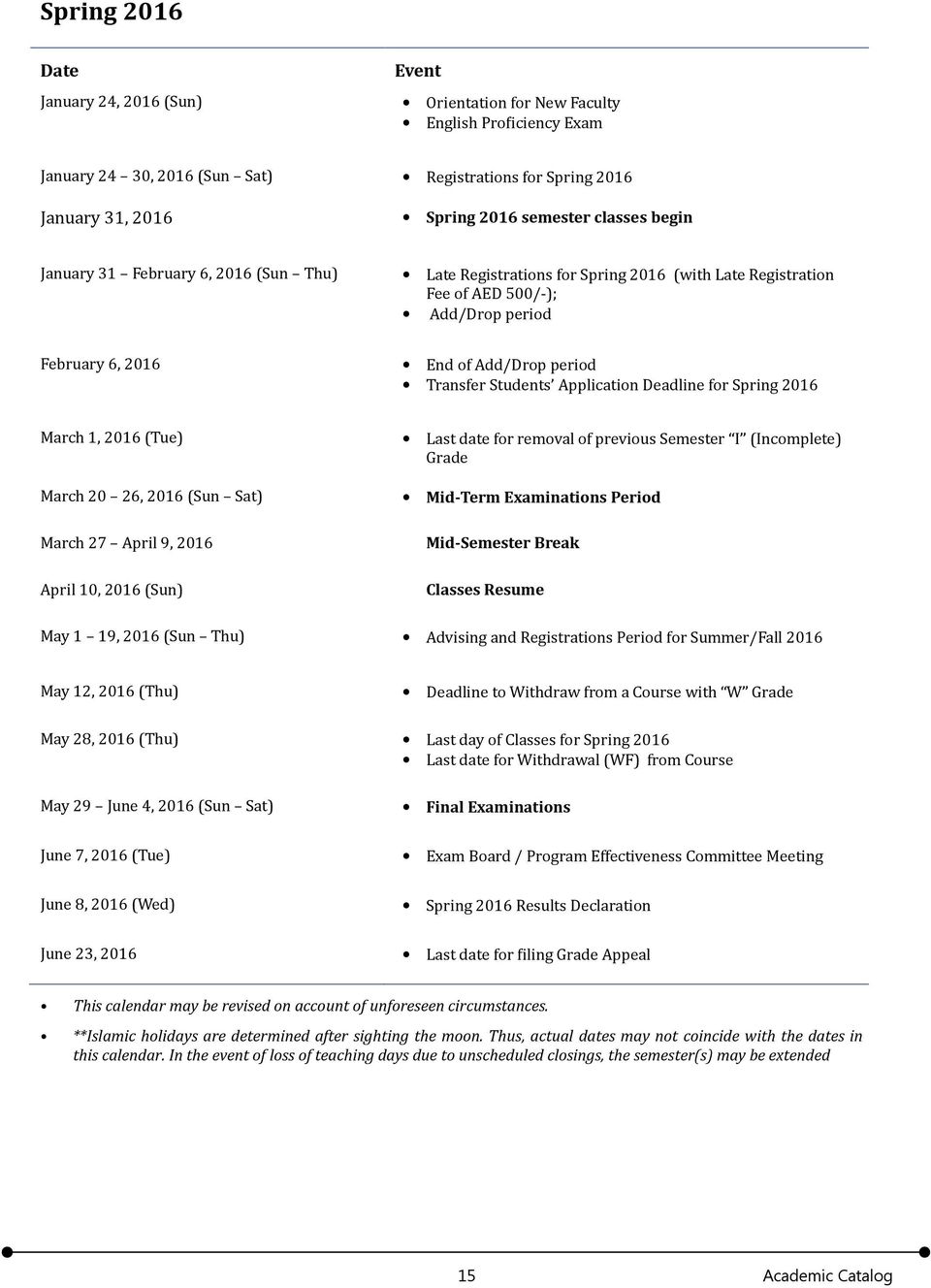
15 Spring 2016 Date January 24, 2016 (Sun) Event Orientation for New Faculty English Pro iciency Exam January 24 30, 2016 (Sun Sat) Registrations for Spring 2016 January 31, 2016 Spring 2016 semester classes begin January 31 February 6, 2016 (Sun Thu) Late Registrations for Spring 2016 (with Late Registration Fee of AED 500/-); Add/Drop period February 6, 2016 End of Add/Drop period Transfer Students Application Deadline for Spring 2016 March 1, 2016 (Tue) March 20 26, 2016 (Sun Sat) March 27 April 9, 2016 April 10, 2016 (Sun) Last date for removal of previous Semester I (Incomplete) Grade Mid-Term Examinations Period Mid-Semester Break Classes Resume May 1 19, 2016 (Sun Thu) Advising and Registrations Period for Summer/Fall 2016 May 12, 2016 (Thu) Deadline to Withdraw from a Course with W Grade May 28, 2016 (Thu) Last day of Classes for Spring 2016 Last date for Withdrawal (WF) from Course May 29 June 4, 2016 (Sun Sat) Final Examinations June 7, 2016 (Tue) Exam Board / Program Effectiveness Committee Meeting June 8, 2016 (Wed) Spring 2016 Results Declaration June 23, 2016 Last date for iling Grade Appeal This calendar may be revised on account of unforeseen circumstances. **Islamic holidays are determined after sighting the moon. Thus, actual dates may not coincide with the dates in this calendar. In the event of loss of teaching days due to unscheduled closings, the semester(s) may be extended ECMIT 15 Academic Catalog
16 Summer 2016 Date Event June 8 11, 2016 (Wed Sat) Registration Period for Summer 2016 June 12, 2016 (Sun) June 12 14, 2016 June 26, 2016 (Sun) Summer 2016 classes begin Late Registrations for Summer 2016 (with Late Registration Fee of AED 300/-); Add/Drop period Deadline to withdraw from a course with W Grade July 7 9, 2016 (Thu Sat) Mid-Term Examinations Period August 3, 2016 Last day of Classes for Summer 2016 August 4 6, 2016 (Thu Sat) August 8, 2016 (Mon) August 9, 2016 (Tue) August 23, 2016 (Tue) Final Examinations Exam Board / Program Effectiveness Committee Meeting Summer 2016 Results Declaration Last date for iling Grade Appeal This calendar may be revised on account of unforeseen circumstances. **Islamic holidays are determined after sighting the moon. Thus, actual dates may not coincide with the dates in this calendar. In the event of loss of teaching days due to unscheduled closings, the semester(s) may be extended ECMIT 16 Academic Catalog

17 SECTION 2 Admissions 2.1. Admission Requirements Associate of Science Degree Programs ECMIT employs several criteria and routes for admission to its Associate of Science Degree in Business and Information Technology programs as follows: a. Regular Admission for UAE and International Students. b. Conditional/Provisional Admission for UAE and International Students. c. Foundation Program: Access route for UAE Secondary School students who do not meet the Regular Admission and/or Provisional admission criteria. a. Regular admissions In order to be admitted to the degree programs offered by ECMIT, the following conditions need to be met by the student: A pass in the UAE General Secondary School Certificate (all streams are acceptable) with an average score of 60% or higher (or equivalent Emirati and International qualifications attested by the MOHESR of the UAE are acceptable). A minimum TOEFL equivalent score of 500 (Cambridge English Advanced 47, Pearson PTE Academic 47, 61 IBT) conducted at ECMIT or IELTS of band 5.0 or any equivalent standardized English language test approved by the MOHESR. A score of 60% or above in the ECMIT Mathematics Placement Test. Equivalency certificate of high school certificate earned outside the UAE education Board system. Attend an interview with the Program Admissions Committee. b. Conditional/Provisional admissions A student who has a pass with an average score of 60% or higher in the UAE General Secondary High School Certificate or its Emirati and/or International equivalent but does not meet the conditions for regular admissions, can be provisionally admitted to the college without taking the placement tests at the entry point. However the student will be required to take up two preparatory courses, Basic Mathematics and General English. These two courses will academically prepare the students to be able to meet the regular admission criteria, including the English Proficiency requirement. In addition, to the two preparatory courses, a provisionally admitted student can register for not more than 9 credits in General Education Courses in the first semester. A student can be exempted from taking the preparatory courses if s/he passes the college Mathematics placement test with a score of 60% and above and submit a passing score of 500 in TOEFL at the entry point. If the student succeeds in passing the two required courses (e.g. Basic Mathematics and General English) and providing a TOEFL score of 500 in the first semester, s/he will be granted a regular student status and the Provisional Status will be removed from the following semester. ECMIT 17 Academic Catalog

18 If any student does not succeed in passing the two required courses and secure TOEFL score of 500 or more in the first semester, he/she is asked to repeat the remedial courses to be able to meet the regular admission criteria and they cannot register for any core courses from Business or IT. Admission is cancelled for any student who fails to pass the remedial courses and secure 500 or more in TOEFL within the second semester of study. c. Foundation Program: Access route for UAE Secondary School students not meeting the admission criteria The Foundation program provides an access route to national and non-national students who wish to progress into non-federal Higher Education or post-secondary Vocational Training Institutions but do not have appropriate credentials (students with scores below 60% on the UAE Higher Secondary exams) of an approved High School Certificate. Foundation Program prepares students for success in these endeavors. The Program involves basic studies in five areas: English, Mathematics, Arabic, Information Technology and Study Skills. For successful completion of this Program, a student is required to obtain a Pass (60%) in each of the subjects mentioned, and a final Completion Certificate is awarded to student who successfully complete and pass all these requirements. After obtaining a Foundation Program Certificate from ECMIT, students are prepared to pursue higher education at ECMIT and at other MOHESR accredited institutions of higher education in the UAE. However, students who may like to seek admission to ECMIT S degree programs must take TOEFL Examination in which the minimum passing score must be 500. There is no need to sit for the mathematics entrance test Bachelor of Business Administration (BBA) Program Because the BBA program is offered in conjunction with ECMIT s Associate of Science in Business (ASB) program which constitute the lower division studies (LDS) of the BBA program designed for high school graduates, standard admission requirements and criteria for the ASB program as stated in sections 1, 2 and 3 shall apply to the BBA program. The admission can be regular or provisional depending on the outcomes in the ECMIT s admission tests. Students, at the time of the admission are given options for both ASB and BBA programs. a. Transition from ASB program to the Upper Division Studies (UDS) of the BBA program Students who exit or graduate from the ASB program with a minimum cumulative GPA of 2.00 and have scored 500 or above in TOEFL will be awarded a diploma for the ASB program. If they wish to continue with the upper level studies (UDS) of the BBA program, they will be granted full transfer of credits for those courses with a minimum grade of D or above. No further admission test is required. However, the students will be required to complete a standard admissions application form and pay required admission fees. If a student does not have an acceptable TOEFL score at the time of entry into UDS, he/she will have to achieve a score of 500 or more in TOEFL within the first semester of admissions, failing this requirement; he/she will not be allowed to register for any new course in subsequent semesters. Students failing to achieve a minimum cumulative GPA of 2.00 after completing the 61 credit ASB program may be eligible for a provisional admission to the UDS of the BBA program. In such cases, students will be required to repeat certain LDS/ASB courses at the advice of a faculty advisor and the Program Director until a cumulative GPA of 2.00 for the LDS/ASB program is reached. ECMIT 18 Academic Catalog

19 Students will also have the option to study continuously towards the BBA degree without having to exit or graduate from the ASB program, in which event the students can take courses from both LDS and UDS levels that meet prerequisite conditions. The conditions associated with BBA studies and graduation requirements shall be maintained throughout the duration of their studies. Each student who formally applies to the College will receive a letter from the Admissions and Registration Department informing him/her whether he/she has been accepted or not. b. International students who have other than the UAE General Secondary School Certificate The student must have passed the relevant secondary/high school certificate that enables him/her to be admitted to accredited universities in their own countries. The duration of the study at school must NOT be 10 years only and in those countries that have two levels of secondary/high school education then the student must have successfully completed level 2. The student must have passed at least six subjects at the secondary/high school level, English language is a must. Students who studied at schools that follow the British system must have passed at least 7 subjects at the Ordinary and Advanced Levels (GCSE/IGCSE) with a minimum grade C in the O Level subjects, grade E in the A Level, and grade D in the AS Level. The school where the student has completed his/her high school studies must be an accredited school by the relevant state/government/or accreditation body. The student must submit the original certificate (and a copy of the original attested by the appropriate authority in the country where the certificate is issued (such as the Ministry of Education), the UAE Embassy in that country (or the country s Embassy in the UAE) and the UAE Ministry of Foreign Affairs. The student needs to fulfill all the requirements of the Ministry of Higher Education and Scientific Research regarding high schools certificates at the time of application. c. Process for awarding credits to students for prior academic achievements at institutions other than ECMIT Non-ECMIT students with an associate degree from other recognized institutions or with an evidence of advanced course works can be considered for advanced placement and credit transfers. Such students will submit official transcripts, course outlines and credit transfer request-form indicating the courses for credit transfers. The Admissions office will process the request and supporting documents and forward the file to the College Credit Transfer Committee. This committee will assess and evaluate each case and will make recommendation to the Program Director or the Head of Academic Affairs. After the approval of these officers, the files shall be returned to the Admission Officer who will inform the students in writing. Thereafter, the files are sent to the Registrar for record and implementation. Up to 61 credits for transfer shall be allowed. ECMIT 19 Academic Catalog

20 2.1.3 Master of Business Administration (MBA) Program (Proposed) Admissions to the MBA Program will be considered on the basis of a combination of four key factors: Academic background of the applicant English proficiency Demonstrated potential to succeed in the program regardless of race, nationality, gender, religion, age or ethnic backgrounds. Candidate s work and industrial experience. There will be two types of admissions: a. Regular admissions without any preconditions b. Provisional or conditional admissions a. Regular Admissions Applicants must meet the following criteria for regular admissions: A Bachelor s Degree in Business or in an allied area from a MOHESR recognized institution in the UAE or overseas with a minimum GPA of 3.00 or equivalent. TOEFL score of 550 (213 CBT, ibt) OR 6.0 IELTS or another standardized, internationally-recognized test that is approved by the Commission for Academic Accreditation. Student interview with the Program Director for a formal evaluation At least one year work experience in business organizations (preferable but nonbinding) A completed application for admission Exception to the Language Requirements Anyone who has completed his/her undergraduate education from any of the native English speaking countries. A native speaker of English who has completed his/her undergraduate education in an English-medium institution in a country where English is the official language. b. Conditional Admissions For students who don t possess appropriate GPA in an earned baccalaureate degree or language requirements for regular admission as mentioned above, conditional admissions are granted with following terms and conditions: 1. Has the appropriate GPA of 3.00, but has not met the English Language requirement: a. Must achieve a TOEFL score of 550, or equivalent, by the end of the student s first semester of study, failing this requirement; the admission and registration will stand cancelled. b. Cannot take more than 6 credit hours in the first semester of study, not including intensive English courses; ECMIT 20 Academic Catalog

21 c. Must achieve an overall grade point average of 3.00 on a 4.0 scale, or its equivalent, in the first 6 hours of credit-bearing courses studied for the Master s program. d. If condition (c) is not met, students can only take a maximum of 9 credit hours in the following semester in which the student must achieve an overall GPA of 3.00 on a 4.00 scale. 2. Has the English Language proficiency but has GPA of less than 3.00 at baccalaureate level: a. A student may take maximum of 9 credit hours in the first semester of study. b. Must achieve an overall GPA of 3.00 on a scale of 4.00 in these 9 credit hours. c. If the condition (b) is not met, the student will continue with his/her conditional status, and will not be allowed to take more than 9 credit hours in subsequent semesters until the condition (b) is met. 3. Access route for students who do not meet Regular or Conditional Admissions ECMIT has developed a MBA Bridge Program for students who either do not possess strong undergraduate background in business education or lack adequate knowledge of management concepts. The 18 credit MBA Bridge Program consists of six courses. The credits earned in this program will not be counted towards the MBA completion requirement. Each course is of weight that will not be counted towards the program GPA. Admission to the Bridge Program will be determined by the MBA Admission Committee after a thorough evaluation of the students academic portfolio. Each student s background will be evaluated on individual basis, and depending on the student background and past achievement, courses may be exempted. Students who will be required to undertake three or more bridge courses will not be allowed to offer any courses from main MBA curriculum until these courses are completed successfully. c. Transfer Admissions ECMIT does not have any articulation agreement with any other institution in relation to the MBA program at this stage. It may be considered if and when the approval is obtained. Transfer admissions will apply to students who are already studying at graduate business programs at institutions in the UAE and overseas recognized by the MOHESR. Only the courses with grades of C or above at graduate level will be considered for credit awards. The institution has a four member credit transfer committee that evaluates all cases. ECMIT 21 Academic Catalog
22 2.2. Admission Procedures Admission Procedures for Degree Programs A student seeking admission to ECMIT must contact the College s Admission Office. Several stages of admission follow thereafter. Stage 1: The Student fills in the Admission Application Form and files it with the Admission Office with following documents: A completed application form in English An original and attested copy of the General Secondary School or equivalent qualification certificate. An equivalency certificate from the Ministry of Education in the relevant emirate for all other streams of education. Result of TOEFL or IELTS. Copy of Passport / Copy of residence Visa 2 Passport size photographs Copy of National ID/Emirates ID Stage 2: A student pays non-refundable admission application related fees to Accounts Department and gets a copy of the receipt. The Admissions Office creates a personal file both physical and electronic for the student with student ID. The student is informed of the options of sitting for the ECMIT Admission Tests in Mathematics and English at the entry point or at the end of the first semester study. If the admission tests are conducted at the entry point and passed successfully, ECMIT offers the student regular admission in writing. If the student chooses to defer the admission tests, provisional admission is offered in writing with conditions clearly stated. Stage 3: Students are invited to register with the help of a Faculty Advisor and Registrar and are advised to pay the tuition fees according to the Tuition Payment Plan. Students are invited to attend a student Orientation Session. Students are introduced to classes according to their class schedule Admission Procedures for Non-Degree Students The procedures and stages mentioned for the Associate Degree Programs are also followed for the non-degree students, except that there are no admission tests for this category of students, and ECMIT does not require any TOLEFL score. A Student is asked to clearly indicate the courses h/she interested in the Application Form. Once the eligibility and prerequisite levels are determined by a faculty committee, an acceptance letter is issued to the student Admission Procedure for Foundation Program Students with less than average 60% in the UAE General School Certificate Examination are admitted to this Program. The procedures and stages for filing admission application form, documents, payment of tuition and other fees, registration and orientation as stated for the Associate Degree Programs apply to these students as well. ECMIT 22 Academic Catalog
23 The Academic Affairs of Emirates College for Management & Information Technology formulates all admissions policies and recommends them for approval by the ECMIT President s Council. The standards employed are consistent with the admission standards prescribed by the Ministry of Higher Education and Scientific Research (MOHESR), UAE and those adopted by leading accredited universities and colleges in the United Arab Emirates and Overseas. The student is required to submit the following documents to the Admissions and Registration Department: An original and attested copy of the general secondary school Copy of Passport/visa 2 Passport size photographs Completed application form National ID copy/ Emirates ID Completed application form Transfer of Credits Transfer students are students who apply to join ECMIT and asking for credit transfers. The applicant must be from the MOHESR accredited previous institution. Transfer of credits may be given when at least 75% of the content of the proposed transfer courses are deemed to be equivalent to the ECMIT course by the Transfer committee. Credits to be transferred to any program should be at least C grade. The maximum approved credits must not exceed 50% of the total credits of the program for which transfer of credit is sought at ECMIT. Students should submit official transcripts as well as official course descriptions or syllabi from the previous institution to the Admission department in order to process the transfer of credits Admissions and Registration Department The Office of Admissions and Registration follows and enforces the admission policies stated above for all applicants. This includes both regular and provisional admission to the College. In fulfillment of commitments made in the Purpose Statement, the College considers itself an agent of opportunity. Accordingly, the admission standards and policies of the College have been designed to identify students who show potential for academic success. All admission policies and policies regarding academic dismissal, suspension and readmissions of students are stated in the Student Handbook which is given to each student at the time of enrollment at Emirates College for Management & Information Technology. All these policies are consistent with the academic policies of the institution. Clearly defined policies regarding undergraduate academic status are provided in the College Student Handbook. ECMIT 23 Academic Catalog
24 SECTION 3 Academic Policies and Procedures 3.1. Registration Students are scheduled into classes on a one-to-one basis through their Academic Advisor according to pre-registration and registration records. The student must apply for registration on the prescribed form stating the subjects to be studied during the semester. The last date for registration is posted by the Registrar. Registration will not be considered complete until the tuition fees due and all other outstanding debts have been settled. Students will not receive credits for courses in which they are not registered. Inquiries regarding registration should be directed to the Registrar s office Late Registration Registration is necessary within the dates specified on the academic calendar. Students will not be admitted to a course after the 1st week of class. A late registration fine will be imposed on all students who register after the last date Registration Discrepancies If a student finds that he or she is not listed in the official class list or if a student s schedule does not reflect the class being attended he or she should report to the Registrar s office immediately in order to clarify and / or rectify the discrepancies. Only the Registrar s office is authorized to make changes in a student s registration status Add/Drop Students may make course changes without financial penalty during each term s Add/Drop period, which is the first week of the semester to add a course and the first two weeks of the semester to drop a course. Adding or dropping of courses is not allowed outside this period, and there are no refunds for classes dropped after the end of the Add/Drop period. Each Add/Drop form requires a processing fee. Courses may be added or dropped with the permission of the student s Course Advisor Withdrawal from Course(s) There is no academic penalty for withdrawing from courses prior to the 11th week of a course (in a 16-week course) or prior to the 6th week of the course (in a 8-week course). In these cases, the letter W will be noted in the student's file alongside the course. In this case, the student's cumulative point average (CGPA) will not be affected. However, if a student withdraws after the 2nd week, the tuition fee already paid will not be refunded; the student will have to pay the full amount of fee for repeating the course whenever he/she decides to take the course again. If a student withdraws from a course after the 11th or 4th week, he or she shall be a given a mark of WP or WF, which shall mean that the student would have achieved either a pass or fail score at the date on which he or she withdrew from the course. A score of WP shall have no influence on the grade point average, but a score of WF shall count as an F (0.0 grade point). Thus, the decision of timing the withdrawal from a course is important if it should become apparent to the student that he or she is failing the course. ECMIT 24 Academic Catalog
25 A student leaving a course must fill out the Withdrawal form, failing to meet this requirement, it will be assumed that the student is continuing in the course and will be graded as per the academic policies. The form must be signed by the student, hi/her academic advisor, and handed to the Registrar s office on time. Aside from voluntary withdrawal from a course as set out above, an Advisor or a Lecturer might require a student to withdraw from a course as a result of poor performance, harmful conduct or failure to complete assignments. As in the case of voluntary withdrawal, a mark of W, WP, or WF shall be awarded in accordance with the date of withdrawal and the student's achievement Withdrawal from Semester/College A student who wishes to withdraw from the academic program for a semester or leave College must indicate this intent by filling out the Withdrawal form and submitting it to the Registrar s office. If the student wishes to have a transcript showing the academic work completed up to the date of withdrawal, he or she must fill out the Transcript Request form and pay the applicable fee. Transcripts, grade reports or other official documents will be released to the student only after all financial dues have been cleared. If the student does not enroll for classes for two consecutive semesters, he or she will in due course be withdrawn from his or her selected program of study. To continue the program, the student will have to re-activate enrollment by filling out the Enrollment Reactivation form Change of Schedule Students making changes that affect their full-time status should first check with the Accounting Office for Administration and Financial Services to determine the financial effect of such changes. A student who wishes to change his or her class schedule must fill out a Change of Schedule form that is available in the Registrar s office, before doing so. Schedule changes from one section to another of the same course are made routinely during the first week of class, after which written permission from the faculty member and appropriate division chairperson is required for changing sections Classification of Students A student s level of standing is based upon the number of credit hours completed. A student with fewer than 30 credit hours is a Freshmen; A student with credit hours is a Sophomore, a student with credit hours is a Junior and a student with credit hours is a Senior undergraduate student. A Full-Time student is one who takes ten or more credits in a semester. A Part-Time student is one who takes less than ten credits in a semester Course Load The maximum accepted course load for students in a 16-week semester is 15 credit hours. Students with a CGPA of at least 3.0 may enroll for a maximum of 18 credit hours in a semester by seeking prior written permission from the Academic Head. Except in extraordinary situations, a student will not be allowed to attempt more than 18 credits hours in a semester. ECMIT 25 Academic Catalog
26 3.4. Attendance We expect students to come to all classes and participate in all class activity. Students are required to attend a minimum of 70% of all classes for every course. Students who do not fulfill this requirement endanger their academic success. The teaching staff is under an obligation to check attendance and to report absences. A student must fill out a Leave Application Form and submit to the Dean s office for missing classes. If the cause of absence is illness, accident, or other mitigating circumstance, the student must provide supporting evidence along with the Leave Application Form. The Dean informs the instructors and the respective Division Chair, and makes arrangements with the lecturer for the student to catch up on missed material Attendance Policy and Procedures Regular attendance is compulsory for all students in every course of their study. Faculty members should record course attendance online in class using their usernames and passwords in the College s ERP system as per timetable. The relevant Program Directors are responsible for monitoring that the attendance policy is implemented properly and effectively, through the use of online ERP system at the college. Procedures 1. If student's absence exceeds 10% of the total hours of the course, the Course Faculty member issues a FIRST warning to the student in consultation with the student s Academic Advisor & Program Director, a copy of which should be sent to the registration for filing and to the student s Academic Advisor. 2. If student's absence exceeds 20% of the total hours of the course, the course faculty member issues a SECOND warning to the student in consultation with the student s Academic Advisor & Program Director, a copy of which should be sent to the registration for filing and to the student s Academic Advisor. 3. If student's absence reaches 30% of the total hours of the course, the course faculty member issues a FINAL warning to the student in consultation with the student s Academic Advisor, Program Director, and with the approval of Dean of Academic Affairs. A copy of which should be sent to the registration for filing and to the student s Academic Advisor. 4. If student's absence exceeds 30% of the total hours of the course, he/she, based on the Dean of Academic Affairs decision, will be academically dismissed (Failure due to attendance). A letter to the student should be signed by the Dean of Academic Affairs assigning him/her a FA grade as a final course grade in the relevant course. A copy of which should be sent to the registration for filing and to the student s Academic Advisor. 5. If a student absence exceeds 30% of the total hours of the course due to compelling reasons acceptable to the Dean of Academic Affairs, he/she will be considered withdrawn from that course and assigning him/her a W grade as a final course grade in the relevant course. Documents proving compelling reasons of absence should be submitted to the Dean of Academic Affairs not later than one week after the circumstances cease to exist. In case of illness, medical reports should be certified by the official medical authority in the Emirate. ECMIT 26 Academic Catalog
27 3.5. Academic Dishonesty Policy and Procedures Policy Faculty members are expected to maintain the good reputation and the integrity of Emirates College for Management & Information Technology and of their own profession by guarding against scholastic dishonesty in students. Students are expected to maintain the integrity of the College by avoiding dishonesty in their own and by expecting honest behavior from their fellow students. One of the requirements for passing the courses students take at ECMIT is that students do their own work. Meeting this requirement means avoiding plagiarism, collusion, and cheating in home work, assignments, quizzes, presentations, examinations, admission and diagnostic tests, etc. It is an offence for a student to: 1. infringe willfully, or attempt to infringe, the regulations connected with examinations. 2. engage willfully, or attempt to engage, in conduct for the purpose of gaining for himself/herself, or for another student, an unfair advantage. Examples of such misconduct are: copying illegally in any form in an exam, class tests, quizzes, etc.; copying work undertaken for assessment by another student; and collusion 3. Steal and use the ideas and works of others and present as his/her own. Examples include: Submitting work with high similarity to other students work and/or using the work of someone else, or changing some words and keeping the same structure and the same meaning without acknowledging the source(s), and submitting it as your own work. Copying texts from different sources and pasting them as one document and submitting it as your own work, without acknowledging the source(s). Downloading information, pictures or charts from the Internet, inserting that material into your own document and submitting it as your own work without acknowledging the source(s) Penalties for Academic Dishonesty One of the following penalties may be imposed in case of Academic Dishonesty by any student in coordination with his/her academic advisor: If a student is found in violation of Academic Honesty Policy: First Offence Second Offence Third Offence Fourth Offence Fifth Offence A 50% deduction from the marks obtained by the student in the relevant assessment component. A zero mark will be given for the relevant assessment component. F grade will be assigned to the relevant course. F grades will be assigned to all courses registered by him/her in that semester. He/she will be suspended from the college for subsequent semester. ECMIT 27 Academic Catalog
28 Procedures 1. When an incident of academic dishonesty occurs, the faculty or staff member should respond to the situation immediately upon becoming aware of the dishonesty. The Proctor or the concerned Instructor has to submit an incident report to the chair of Academic Disciplinary Committee (ADC). 2. Upon receiving the incident report, the chair of the ADC schedules a meeting. The Committee evaluates the evidence, determines whether or not academically dishonest actions have occurred and determines an appropriate penalty. If further investigation is necessary the committee may meet several times in order to determine the outcome of a case. The committee may call the accused student to appear before the committee. 3. The committee should examine the student s record of academic dishonesty (whether first time offender or repeater) to determine an appropriate penalty. Once a decision has been reached, the Disciplinary Committee must report the findings to the Dean of Academic Affairs and the concerned Faculty member within three working days (excluding holiday and break periods). 4. Student has right to file an appeal to the Dean of Academic Affairs within the next five working days. The appeal will be dealt with as follows: For a first, second and third offenses, the Dean of Academic Affairs decide upon the recommendation of the committee. For a fourth offense type, the Dean of Academic Affairs makes his recommendations to the Dean s Council for approval. For a fifth offense type (Academic Suspension for subsequent semester), the Dean s Council should report its recommendations to the President for approval Verification If the student denies dishonesty, the student must reconstruct or reproduce the work in a way which is agreeable to the teacher, and under his/her supervision to prove that no dishonesty has occurred. If the student declines the opportunity to reconstruct or reproduce the work, the teacher may impose one or more of the penalties listed above. If the student produces what he or she believes constitutes proof that the work is indeed his or her own work, and the teacher disagrees, the student may file a grievance Tardiness Half absences will be recorded for students who come to class more than 5 minutes late. Students are expected to return from the 10 minute break between classes on time. Penalty for tardiness following the break is left to the discretion of the instructor. The instructor will be responsible for informing students about the tardiness policy on the first day of class. The policy for handing in projects late is to be determined by the instructor and is also stated on the course syllabus. ECMIT 28 Academic Catalog
29 3.7. Grading Criteria Letter Grades and Grade Point Average (GPA) ECMIT follows a letter grade system for both associate and bachelor level courses. The equivalency between classroom marks and the letter grades, and the corresponding points scored for each grade called Grade Points are shown in the following table. The Grade Points are used to compute the GPA earned by a student. Letter Range Level of Achievement Grade Points Grade A Excellent 4.00 B Very Good 3.50 B Good 3.00 C Satisfactory 2.50 C Satisfactory 2.00 D Pass 1.50 D Pass 1.00 F 0-59 Fail 0.00 I Incomplete Not computed INP In Progress Not computed WP Withdrawal-Pass Not computed WF Withdrawal-Fail 0.00 W Withdrawal Not computed Calculation of GPA The Grade Point Average (GPA) is calculated by following a two-step procedure; Multiply grade points for each grade by the number of credits for the course for all attempted credit courses completed to date at ECMIT. Sum up the results for all courses included in the calculation. The total is called the Credit-Hour Value (CHV). Divide the CHV by the total number of credits earned. The result is the GPA for the courses under consideration. The following is an example: GE 1101 English Composition:, grade scored B (for B) x = 9.00 MGT 1202 Organizational Behavior,, grade scored A 4.00 (for A) x = 12 HRM 3206 Human Resources Management,, grade scored C 2.00 (for C) x = 6 Total Credit-Hour Vale (CHV) = = 27; credits earned = 9 GPA= 27/9= 3.00 There are two kinds of GPAs: Semester GPA and Cumulative GPA (CGPA). The Semester GPA is calculated based on grades of courses taken in a particular semester. The CGPA is based on grades from all courses taken from the beginning of study. ECMIT 29 Academic Catalog
30 3.7.3 Grade Calculation Final grading will be the average of a minimum of three individual exams and/or assignments earned by the student during the course. These grades could include a combination of grades/marks for: class presentations; homework assignments; class participation; course research papers; regular exams; final exams. The combination of these items that make up the final determination of the course grade is at the discretion of the instructor as long as it includes (but is not limited to) at least three graded items INP Grade INP (In Progress) - indicates course work is in progress and requires at least one more semester of formal course enrollment and study for completion (e.g. for thesis which takes more than one semester). The designation INP is not included in calculating the grade point average, neither as a credit nor as a failed course. The INP grade remains on the student's transcript till a final grade is assigned for the subsequent enrollment when course work has been completed Grade Appeal A student has a period of only fifteen days from the date of publication of the scores to file an appeal regarding the grade. No appeal will be accepted after such date. The student must fill out a grade appeal form and submit it to the accounting office along with the grade appeal fee. The Accounting office after receipt of completed forms with applicable fee, forwards it to Dean. Upon receiving the form the Dean constitutes a 3-member faculty committee within three working days, of which the concerned teacher cannot be a member. The committee has the rights to demand the complete information regarding the student s performance from the concerned instructor. The committee will evaluate the performance of the student and if required will meet with the concerned faculty before deciding on the grades, which shall be final. The Committee must submit its final decision within next three working days to the Dean. The revised grades, if any, shall be sent to the Registrar together with the committee s report for records purpose by the Dean. The Registrar will enter the new grades in the system and announce the same to the student Grade Change Policy Grade changes can ONLY occur owing to the one or combination of the following reasons: Correction of human errors Re-sit outcomes of the assessment elements Grade appeal For a grade change necessitated by one of the above, the following must be ensured: 1. The reason or the rationale must be clearly explained in the Grade Change Form with supporting evidence. 2. The Dean of Academic Affairs must check the evidence before approval. 3. The Registrar must not accept any grade change request without the Dean s approval. 4. Any non-compliance or exception must be reported to the President by the Registrar. 5. Grade change due re-sit must be re-calibrated to 75% of the marks, as outlined in the Re-sit Policy. ECMIT 30 Academic Catalog
31 3.9. Grade Forgiveness The Grade Forgiveness Policy at ECMIT allows a student to repeat a course in which he or she earns a grade of D+ or lower, only once after the first attempt. In such cases, only the final grade will be included in the cumulative Grade Point Average (CGPA) calculation. The maximum number of courses that a student can repeat under the "Grade Forgiveness Policy" is limited to three. A student who desires to improve his/her grade will be required to fill out the "Grade Forgiveness Request" form and submit it to the Registration department, two weeks before the registration period starts for the semester in which he/she wishes to reattempt the course. Students applying for a Grade Forgiveness are subject to the following conditions and requirements: Students who receive a grade of D+ or lower (grades of D+, D, F, and WF) may repeat the course to improve the overall grade point average. A course may be repeated only once with grade forgiveness applied. The Grade Forgiveness Policy will not be applied to courses for which a grade of C or higher was ever earned. Additional courses that are not eligible for grade forgiveness include courses for which a grade of W was the only grade awarded, or courses that currently are incomplete (I grade). Under this policy, only the last grade earned, whether higher or lower than the original grade, will be calculated in the grade point average for the purposes of continuance, graduation, and/or any other purpose. All grades will remain on the student s permanent record, but the record of a previous grade in the course will be marked to indicate that the course has been repeated. Academic suspensions will not be removed from student transcripts and Dean s List status will not be added after grade forgiveness is applied to the student record in cases where the grade point average is improved sufficiently to change the student s status for the semester in question. Students may request application of grade forgiveness for no more than three different courses. In each case, a Grade Forgiveness Request Form (available at the Office of Advising and Registration) must be completed and submitted to the Registrar two-weeks prior to registering to repeat the course. Registration for the course should be done during the regular registration period for each semester. All registration policies as stated in this handbook apply to registering to repeat a course for grade forgiveness. The Grade Forgiveness Policy applies only to repeats of the same course (same number, same title, same credit value, and, for topic courses, same subtitle and same credit value). Exceptions will be made only where the course numbers changes and the change is documented in the Catalog and approved for grade forgiveness by the Registrar. The Grade Forgiveness Policy will not be extended to courses originally taken elsewhere. In addition, courses repeated at other institutions will not be used to forgive ECMIT courses. Students may not be able to repeat a course in the following cases: enrollment is restricted, the student no longer qualifies for admission to a course, the prerequisites are enforced, major or sequence requirements have been changed, or the curriculum has been revised. In such cases, the decision of the Registrar in consultation with the appropriate academic department will prevail. Exceptions are granted only in rare instances. In any course or program where enrollment demand exceeds the resources to offer sufficient openings or sections to meet that demand, the academic unit may give registration priority to students taking the course for the first time. ECMIT 31 Academic Catalog
32 Students who have graduated may not use the provisions of this policy to repeat for forgiveness a course taken prior to the date of graduation. Once the Associate of Science in Business and Information Technology degree has been awarded, a student may not raise the grade point average by repeating a course taken as a student at ECMIT. In cases where the student repeats a course in which a grade of C or better was awarded, all grades received, including the original grade, and all hours earned will be used for calculation of grade point averages. The course will count only one time toward graduation certification and degree completion. Students must pay for every course repeated. The prevalent tuition fee per credit will apply to all courses repeated under this policy. Students receiving financial aid should consult with the Office of Administration and Business Services to determine how use of this policy may affect financial aid status Incomplete Coursework A lecturer may award a grade of I (incomplete) during the penultimate class of a semester, in accordance with the following procedures: Where the reason for non-completion of the course is illness, accident, etc., the appropriate certificates must be provided by the student and be attached to the application for an Incomplete. A grade of I (incomplete) may only be awarded if the student has the possibility of passing the course anyway. A lecturer who awards a score of I (incomplete) shall write a memorandum to the student, and shall send a copy of it to the Registrar, to be filed in the student s personal file. The memorandum shall set out the reasons for granting the score, the work that needs to be done to complete the course, and the manner of handing the work in to the lecturer. Responsibility for handing the material required to complete the course to the lecturer falls on the student. If the work is not completed within the following semester, the student's score in the course will automatically be changed to Fail (F) Policy for Incomplete Grade I Faculty members have certain freedom to set grade I based on student chances of passing a course provided that such practice will not compromises the academic integrity. ECMIT believe that I grade is related to the final exam because all other assessment instruments are dealt with during the course as it is illustrated in the following two categories: Final Exam 1. If a student miss a scheduled FINAL Exam only due to compelling and convincing reasons (in cases such as accident, Illness, or Death of close relative) accepted by the Dean of Academic Affairs, the term INCOMPLETE ( I grade) is written beside the student's name in the grade records of that course. 2. The reasons must be clearly explained in a legible manner when reporting the I grade with documents attested by the relevant authorities. 3. Students will have only one chance to sit the missed FINAL exam. There is no second chance for a missed exam. 4. The missed exam must be conducted within the first month of the following semester as per the academic calendar. 5. Depending on the outcomes of the exam, the I grade is converted to a letter grade with a clear justification together with the evidence of the exam paper. ECMIT 32 Academic Catalog
33 Other Assessments 1. The missed mid-term exam may be re-sited if a student has a genuine excuse such as accident, illness, or Death of close relative. It can be arranged with the instructor so long as the reason is approved by the dean of academic affairs, and must be conducted before the start of Final Examinations otherwise Zero mark is assigned. 2. Any other assessment component not submitted on time can be considered separately and its submission time may be changed according to an arrangement with the instructor so long as the instructor accepts the reason of not submitting the assessment on-time. The instructor may extend the submission date to an extra week, otherwise Zero mark is assigned. 3. All assessment components apart from Final Examinations must be graded before commencement of Final Examinations Re-Sit Examination Student who failed in one course in his/her graduation semester may be allowed to re-sit elements of post mid-term assessments, including Final exam, of that course in the semester when a student is expected to graduate according to the following conditions: There should not be any other non-achieved graduation requirements i.e. passing the course will lead to graduation. His/her failing is not a disciplinary decision. Student has to submit a Re-sit Form, listing assessments elements to be re-sit, signed by his/her academic advisor, course instructor and approved by the Dean of Academic Affairs. The re-sit of the relevant elements of assessment should be within the following two weeks of the final results announcement. Any assessment component in which the student has attained 70% or higher marks cannot be re-sit. The Final marks obtained by a student through re-sit assessment should be recalibrated to 75% of the total marks of that assessment i.e. if a student gets 10 marks, it will be entered as 7.5 in the record. The marks should be recorded in the student record using Grade Change Form as re-sit. The student should pay the re-sit fee for the relevant elements of assessment as below: - Any other elements of Assessments AED 350/- per element - Final Exam AED 1,000/ Re-Sitting a Missed Examination If circumstances beyond the student's control cause the student to miss taking a scheduled exam, the lecturer of the course will permit the student to re-sit the missed examination if sufficient evidence and documentation are provided attesting to the student's inability to take the exam as originally scheduled. The student is expected to re-sit a missed exam within two weeks of the originally scheduled test. Re-sitting a missed exam carries financial penalty Good Academic Standing A student will be considered to be in good academic standing if he/she maintains at least a 2.0 cumulative grade point average for all degree-credit courses attempted at ECMIT. A cumulative GPA of 2.00 or higher is required for graduation. ECMIT 33 Academic Catalog
34 3.13. Academic Probation A student whose cumulative GPA falls below 2.0 will be placed on academic probation and will remain on probation until his/her cumulative GPA improves to at least 2.0 or he/she is academically suspended or dismissed Academic Suspension A student who begins the semester on academic probation and whose cumulative GPA at the end of that semester is not at least 1.5 after 18 attempted semester credits or at least 1.7 after 33 attempted semester credits or at least 1.9 after 48 attempted semester credits will be academically suspended from registering at ECMIT for at least one semester Readmission of Academically Suspended Students A suspended student may apply to the Office of Academic Affairs for a one-time readmission by submitting a letter detailing his/her activities since the suspension took effect and providing a rationale for why the student believes his/her academic performance will improve in the future. If the Head of Academic Affairs is convinced of the student's potential to succeed, a one-time readmission will be granted for an upcoming semester's registration. Readmitted students will be reinstated on academic probation Final Academic Dismissal If after a one-time readmission, a student who is on academic probation at the beginning of a semester completes that semester with a cumulative GPA that is not at least 1.5 after 18 attempted semester credits or at least 1.7 after 33 attempted semester credits, or at least 1.9 after 48 attempted semester credits, that student will receive a final academic dismissal and will not be readmitted to ECMIT in the future Academic Honors Dean's and President s List Full-time students earning a semester GPA of 3.5 or better with no course grade below a "B" will be named to the Dean's List. Full-time students earning a semester GPA of 4.0 will be named to the President s List Graduation Honors Cum Laude honors are given to graduating students with the following Cumulative Grade Point Averages (CGPA): Summa Cum Laude: CGPA : 3.80 Magna Cum Laude: CGPA : 3.65 Cum Laude: CGPA : Academic Advising Every student is assigned an Academic Advisor for the duration of his or her degree program. The Advisor assists the students in selecting courses for each semester. In addition, the advisor is available to the student on a daily drop-in or appointment basis. He or she ECMIT 34 Academic Catalog
35 discusses professional goal setting, answers questions about academic programs, registers students for classes and makes referral to College and off-campus resources as needed. Students can also meet the Student Counselor for academic and personal problems. The Counselor works in collaboration with the teaching faculty and is informed of the students unsatisfactory academic status, reporting either excessive absences or poor academic performance. The Advisor also addresses other student concerns such as change of major, withdrawal from a course, transfer of credits, and career development Auxiliary Provision A student who encounters difficulties during his or her studies may make an application to the academic counselor for individual treatment Academic Instruction Instructors of each course will hand out on the first day of classes standard course outlines which detail the following aspects of the course: goals, objectives, requirements, nature of course content, methods of evaluation and grading, course specific policies etc. Every instructor understands the need to accommodate the varying capabilities of his or her students and attain the academic goals of his or her courses. Methods of instruction differ accordingly, predicated on such factors as the academic level of the course being taught, the constraints of the academic discipline, the size of the class, the amount of content that must be covered, the balance of theory to practice, the appropriateness of using technological resources, and the teaching philosophy of the individual instructor. Some courses must, by their very nature, be primarily taught through lectures; these include the large sections of courses taught in the Freshman Year. But instructors of these sections ensure that the methods of instruction are stimulating to the students and conducive to learning. Most make use of several teaching aids: they play music, show films, use powerpoint presentations and/or web pages to outline important concepts, engage students in debate, invite in guest lecturers, break sessions up into shorter sections of different activities, and so on Graduation Requirements Foundation Program To be able to graduate from ECMIT s Foundation Program, a student must meet both of the following requirements: 1. Attain a pass score (60% or higher) in the following Foundation Program Courses; Foundation Math Study Skills Communication in Arabic Language Foundation IT 2. Score 60% or more in Foundation English, or 500 or above in TOEFL as the exit criteria for the Foundation English Course. ECMIT 35 Academic Catalog
36 Associate Degree Programs To be eligible for an Associate of Science degree in Business or for an Associate of Science degree Information Technology, a student must meet all of the following requirements: Earn at least 61 credit hours with a minimum grade of D in each course, 30 of which must be earned at Emirates College for Management & Information Technology. Successfully complete 25 Credits General Education Program. Achieve an overall cumulative grade point average of at least 2.0 in courses completed at the Emirates College for Management & Information Technology. Successfully complete 30 Credits in Business Core and 6 Credits from Business Electives for the Associate of Science in Business Degree; Successfully complete 30 Credits in Information Technology Core and 6 Credits from Information Technology Electives for the Associate of Science in Information Technology Degree BBA Program In order to complete and earn a BBA degree with a Concentration from ECMIT, a student must: Earn 124 credits with a minimum passing grade of D in each of General Education, Core, concentration and elective courses of the program. Have a cumulative GPA of at least 2.00 Complete at least 6 at ECMIT Complete the 43 Credit General Education Courses Meet all financial obligations to the College Degree Conferral A student who has fulfilled all of the academic requirements of the program and has settled all of his/her monetary and administrative obligations with ECMIT will receive a student copy of his/her academic transcript. However formal ministry approved transcript and degree can be obtained after the attestation of the documents. This will occur only after all scores and relevant materials for graduation have been provided to the Office of Admissions and Registration of Emirates College for Management & Information Technology Student s Permanent Record Each student's permanent record at ECMIT includes: basic identification information of the student; a listing of all coursework accepted by ECMIT for transfer; a semester-by-semester listing of all ECMIT courses attempted and completed; all grades, credits, and grade point averages earned each semester; any necessary notations concerning academic probation, suspension, or dismissal; and a notation of degree completion for a graduate student. This student record is considered to be permanent in that it will be kept as an active record in perpetuity and will never be disposed of by the institution. It is the permanent and official record of all grades, credits, and certificates earned by the student at ECMIT. ECMIT 36 Academic Catalog
37 3.20. Academic Transcripts An official transcript is a copy of the student's permanent record, printed on ECMIT transcript form, bearing the official seal or stamp of Emirates College for Management & Information Technology and mailed directly to the individual who needs official confirmation of the student's academic achievements at ECMIT. Official transcripts are typically sent to a college or university, a state authority, an employer, or to an organization providing financial aid. Students may request a copy of the official transcript to be sent directly to them. This should be done using a transcript request form. The copy of the official transcript given directly to students will be marked as a Student Copy Policy on Release of Student Records With the exception of authorized personnel at ECMIT who will have access to courses completed and grades earned by the student in order to fulfill their administrative responsibilities and assist students with registration, advisement, degree completion and career direction, no one shall have access to, nor will the institution disclose, any information from a student's permanent academic record without the written consent of the concerned student Change of Address It is the responsibility of the student to contact the Reception immediately in the event of any address or name change. The information will then be disseminated to all the concerned departments. ECMIT 37 Academic Catalog
38 Section 4 Financial Information and Policies 4.1. Tuition and Fees ECMIT is committed to providing students in the U.A.E. with an opportunity to pursue an accredited post-secondary qualification that is affordable and that offers a flexible payment plan. In order to be consistent with this policy it strives to keep its fees low and thereby affordable to students from most economic backgrounds. In fact, its fee structure is one of the most economical amongst U.A.E Higher Education institutions offering similar degree programs at the present time Associate of Science in Business (ASB) Program Tuition fee differs in accordance with the classification of students as full-time or part-time. The 61 credit ASB program consists of 25 credit General education courses, 30 credit Business core courses and 6 credits Business elective courses. Full time students The 25 credit General Education courses are charged at AED 690/- per credit., however, if a student pays the entire semester fees in one installment the applicable rate would be AED 600/- per credit, for 2 installments, the applicable rate would be AED 630/- per credit, for 3 installments, the applicable rate would be AED 660/- per credit, and for 4 installments the regular rate of AED 690/- is applicable. 36 credits consisting of the business core and business electives courses are charged at AED 890/- per credit, however, if a student pays the entire semester fees in one installment the applicable rate would be AED 770/- per credit, for 2 installments, the applicable rate would be AED 810/- per credit, for 3 installments, the applicable rate would be AED 850/- per credit, and for 4 installments the regular rate of AED 890/- is applicable. Part-Time Students The 25 credit General Education courses are charged at AED 760/- per credit, however, if a student pays the entire semester fees in one installment the applicable rate would be AED 660/- per credit, for 2 installments, the applicable rate would be AED 710/- per credit, and for 3 installments the regular rate of AED 760/- is applicable. 36 credits consisting of the 30 credit business core and 6 credit business electives courses are charged at AED 990/- per credit, however, if a student pays the entire semester fees in one installment the applicable rate would be AED 900/- per credit, for 2 installments, the applicable rate would be AED 950/- per credit, and for 3 installments the regular rate of AED 990/- is applicable Associate of Science in Information Technology (ASIT) Program Tuition fee differs in accordance with the classification of students as full-time or part-time. The 61 credit ASIT program consists of 25 credit General education courses, 30 credits IT core courses and 6 credits IT elective courses. All courses are charged at AED 690/- per credit. ECMIT 38 Academic Catalog
39 Full time students (who register for 10 or more credits in a semester) The tuition fee for a Full time student is AED 690/- per credit. Following discount scheme applies: Pay the entire semester fee in 1 installment at the discounted rate of AED 600/- per credit. Pay the semester fee in 2 installments at the discounted rate of AED 630/- per credit. Pay the semester fee in 3 installments at the regular rate of AED 660/- per credit. Pay the semester fee in 4 installments at the regular rate of AED 690/- per credit. Part time students (who register for less than 10 credits in a semester) The tuition fee for a part time student is AED 760/- per credit. Following discount scheme applies: Pay the entire semester fee in 1 installment at the discounted rate of AED 660/- per credit. Pay the semester fee in 2 installments at the discounted rate of AED 710/- per credit. Pay the semester fee in 3 installments at the regular rate of AED 760/- per credit Bachelor of Business Administration (BBA) Program The tuition fee for this program is divided in two categories: fees for basic level General Education courses consisting of 25 credits, and fees for the remaining advanced level courses consisting of 99 credits. Basic General Education (25 Credits) General Education courses consisting of 25 credits are common to the ASB program. These courses are charged at the rate of AED 690/- per credit for full time students and at the rate of AED 760/- for part time students with following discounts: Full time students (who register for 10 or more credits in a semester) The 25 credit General Education courses are charged at AED 690/- per credit., however, if a student pays the entire semester fees in one installment the applicable rate would be AED 600/- per credit, for 2 installments, the applicable rate would be AED 630/- per credit, for 3 installments, the applicable rate would be AED 660/- per credit, and for 4 installments the regular rate of AED 690/- is applicable. Part time students (who register for less than 10 credits in a semester) The 25 credit General Education courses are charged at AED 760/- per credit, however, if a student pays the entire semester fees in one installment the applicable rate would be 660/- per credit, for 2 installments, the applicable rate would be AED 710/- per credit, and for 3 installments the regular rate of AED 760/- is applicable. Advanced Courses (99 Credits) The remaining 99 credits of the program consisting of advanced level 18 credit GE courses, and core, concentration and elective courses at the rate of AED 890/- per credit for full time and AED 990/- per credit for part time students with usual discounts as mentioned below: Full time students (who register for 10 or more credits in a semester) Pay the entire semester fee in 1 installment at the discounted rate of AED 770/- per credit. Pay the semester fee in 2 installments at the discounted rate of AED 810/- per credit. Pay the semester fee in 3 installments at the regular rate of AED 850/- per credit. Pay the semester fee in 4 installments at the regular rate of AED 890/- per credit. ECMIT 39 Academic Catalog
40 Part- time students (who register for less than 10 credits in a semester) Pay the entire semester fee in 1 installment at the discounted rate of AED 900/- per credit. Pay the semester fee in 2 installments at the discounted rate of AED 950/- per credit. Pay the semester fee in 3 installments at the regular rate of AED 990/- per credit. BBA / ASB Fee Structure (Effective from Spring, 2013) 124 Credit Hours 25 Credit Hours in General Education charged at AED 690/- Per Credit 99 Credit Hours AED 890/- Per Credit GE 1101 English Composition GE 1102 College Mathematics GE 1103 Software Applications GE 1104 Public speaking GE 1105 Essential Skills for College Success 1 credit GE 1201 Effective Reading and Writing General Education Core Business Concentration 18 Credits 48 Credits 18 Credits GE 1202 Essentials of Economics Electives 15 Credits GE 1203 Environmental Science Total 99 Credits GE 2101 Islam and the Middle East Total 25 Credits Admission Fee for Lower Level BBA (ASB) AED 3,000/- Application Fee 700/- Placement Test (Math) 150/- TOEFL 600/- Activity Fee 500/- Student ID Card 50/- Registration Fee (Per Semester) 500/- Internet, LMS and Library Fees 500/- Admission Fee for Lower Level BBA (ASB) AED 3,000/- Application Fee 700/- Placement Test (Math) 150/- TOEFL 600/- Activity Fee 500/- Student ID Card 50/- Registration Fee (Per Semester) 500/- Internet, LMS and Library Fees 500/- ECMIT 40 Academic Catalog
41 4.1.4 Master of Business Administration (MBA) Program (This Program is subject for approval of CAA of the MOHESR, Abu Dhabi) Tuition Fee All 12 Core and Specialization courses (36 Credits) are charged at AED 1,500/- per credit. Foundation Courses are charged at AED 810/- per credit. Application and Admission Fees (Application and Admission Fees is Non-refundable) Administration Service Charges AED 5,000/- Application Fee AED 1,250/- Registration Fee (per semester) AED 750/- Admission Test AED 450/- TOEFL AED 750/- Activity Fee AED 850/- Internet, LMS and Library Fees AED 900/- Identity Card AED 50/ Foundation Program Total cost of the program AED 12,000/- (AED 6,000/- per semester) Foundation program fee for students with ICDL scores AED 11,000/- (AED 5,500/- per semester) Foundation program fee for students with TOEFL score above 500 AED 9,600/- (AED 4,800/- per semester) Foundation program fee for students with both ICDL & TOEFL AED 17,200/- score below 500 : (AED 8,600/- per semester) Remedial Program Remedial English AED 3,600/- Remedial Mathematics AED 1,800/ English at ECMIT Beginner Level Tuition Fees (including Text & Workbooks) AED 1,750/- Elementary Level Tuition Fees (including Text & Workbooks) AED 1,850/- Pre-Intermediate Level Tuition Fees (including Text & Workbooks) AED 1,950/- Intermediate Level Tuition Fees (including Text & Workbooks) AED 2,050/- Upper Intermediate Tuition Fees (including Text & Workbooks) AED 2,200/- Advanced Level Tuition Fees (including Text & Workbooks) AED 2,400/- ECMIT 41 Academic Catalog
42 4.2. Application and Admission Fees Application and Admission Fees AED 3,000/- (Only TOEFL fee AED 600/- will be reimbursed if a student withdraws within 7 days of taking admission. The rest is non-refundable) Application Fee AED 700/- Registration Fee (per semester) AED 500/- Diagnostic Test Mathematics AED 150/- TOEFL AED 600/- Activity Fee AED 500/- Internet, LMS and Library Fees AED 500/- Identity Card AED 50/- Service Charges Library fine (per day) AED 1/- Misc. Student Letters (per letter) - Within hours AED 25/- - Urgent (Same Day) AED 100/- Visa Letter (per letter) AED 100/- Grade Appeal AED 100/- Re-Sit / Missed Exams (Per Course) AED 350/- Late Payment of Tuition Fee for Regular semesters (Per Semester) AED 500/- for Summer Sessions (Per Semester) AED 300/- Late Registration Penalty Fees (Per Semester) AED 500/- Change of Concentration Fees AED 1,000/- Bounced Check fee AED 200/- File reactivation fee AED 1,000/- Application for Credit Transfer Evaluation AED 250/- Request for evaluation of prior learning AED 500/- Credit Transfer Fee (Per Credit) AED 150/- Graduation Fee AED 400/- Diploma Processing Fee AED 300/- Transcript Fee AED 50/- ECMIT 42 Academic Catalog
43 4.3. Visa Charges Category 1: International students who are not resident in the UAE at the time of admission, and who don t hold any visa of the UAE. Fees: AED 4500/-. This fee includes a AED 1,000/- deposit which is refundable after cancellation of the visa. In addition, a student has to pay tuition fees for 30 credits as follows: 15 credit tuition fees in advance at the time of admission and visa application. The remaining 15 credit tuition fees in postdated checks Category 2: international students who already hold a UAE visa, and requires a change of visa status to student visa, the student has to exit out of UAE and obtain visa on ECMIT support. The cost of travel is borne by the student. In this case a student has to pay AED 3,750/-, and Tuition fees as mentioned in (a) and (b) applies. If the student does not want to exit, the status will have to be changed in-country, in this case a student has to pay an additional amount of AED 1,500/- which is non-refundable. Category 3: A students holding parents visa under parents sponsorship, and asking for NOC from ECMIT to renew his/her parents sponsorship visa as a student of ECMIT, has to pay AED 100/- for NOC. Cancellation and/or renewal: Cancellation: ECMIT will cancel visa under following circumstances: A student has not reported to ECMIT and not attending classes. Visa will be cancelled after a waiting period of one month from the date of first class. No refund will be made. Visa can be cancelled by the request of the student. If the request is made before classes start, all tuition fees and the deposit will be refunded. The administrative fees, however, will not be refunded. If the request is made within two weeks after the classes have started, 50% tuition fees will be refunded. After the second week, no refund will be made. In any case, a student has to pay AED 250 visa cancellation fee. in case the visa is denied by the UAE authorities, tuition fees and the deposit money will be refunded. However, the administrative cost/fee will not be refunded. Student is responsible for all visa renewal and medical fees. These amounts are determined by the visa authorities. Registration fee AED 500/- Visa charge AED 1,750/- (medical not included) Deposit (refundable) AED 1,000/- Visa cancellation AED 500/- International student visa total fee AED 4,500/- ECMIT 43 Academic Catalog
44 4.4. Financial Policies The following financial policies will apply to all students of all programs: Fresh applicants Every new student is required to make the payment for first semester s fees, along with the submission of his application for admission to ECMIT. If the student subsequently decides not to join, no refund will be made Refund policy Refund of tuition fees will be based on submission of withdrawal within the stipulated time frame of two weeks for a regular semester and one week for Summer semester. To request a refund in case of excess payment, the student must make an application to the Finance & Accounting Office. Where a student is asked to withdraw ECMIT as a result of a disciplinary action, unused tuition fees will not be refunded Financial Aid ECMIT recognizes the financial investment students and families make when enrolling in college and take a personal approach to helping them plan to meet the costs of attending college. Financial aid has two main categories:: Scholarships Tuition discounts Scholarships A limited number of scholarships are available which are distributed to entering students based on their academic performance in the high school as follows: Students who have scored 80-85% in the High School Certificate will receive 5% of the total tuition fee of the first semester. Students who have scored % in the High School Certificate will receive 10 % of the total tuition fee of the first semester. Students who have scored 90% and above in the High School Certificate will receive 15 % of the total tuition fee of the first semester. The scholarship is valid for the first entering semester only, and it may be extended based on the academic performance at ECMIT and by the decision of the ECMIT Scholarship Committee. Tuition Discount ECMIT allows tuition fee discounts under certain conditions as follows: If more than one child of the same parents study at ECMIT, one child pays the full tuition fee and the rest receive(s) a 10% discount each on the tuition fees. Students paying the entire semester tuition fees in one payment will get a discount of 9.06%. Students who preregisters in time will get a 3% discount on the semester tuition fees Students claiming multiple discounts will be entitled for which has the highest discount. ECMIT 44 Academic Catalog
45 Section 5 Student Services 5.1. Student Affairs Mission Provide student services, campus activities, and co-curricular programs that contribute to a valued collegiate and campus life experience for students within a highly personalized and supportive institutional culture that promotes student success Goals of the Student Affairs The primary goals of this department are to:- Create a campus culture that is student-oriented and which promotes strong personal concern for the welfare, development, and success of all students; Create and maintain an effective advising system which assists students with their elective educational decisions and career choices; and provide personal counseling services for students; coordinate an effective internship program; provide career development services for students and alumni; organize and coordinate an appropriate student activities program including student government; oversee student publications; administer student conduct policies and related disciplinary and grievance procedures; establish a wellness program for students; and coordinate alumni relations New Student Orientation Student orientation programs are designed to aid freshmen, transfer, and nontraditional students in adjusting to the academic and social life of the College. The primary purpose of the College orientation program is to help students understand the nature of the College, the educational opportunities available to them, the values and functions of the College community, and the central objective of the College as an academic enterprise. It is also intended to permit students to participate in the testing program; to participate in academic advisement; and to inform them about matters relating to student registration, campus activities, and other aspects of College life. Prospective students attending an orientation program are subject to the rules and regulations governing student discipline and conduct set out in the Student Handbook and this catalog. ECMIT 45 Academic Catalog
46 5.3. Student Counseling The Student Counseling Center has a private office space with sufficiently private access. It is the first room on the right side of the reception lounge. The Student Counseling Center is to help students resolve personal concerns and acquire the skills, attitudes, abilities, and insight that will enable them to meet the challenges of student life. The transitions and stresses of life affect all students to a greater or lesser degree and may require the help of a qualified professional. Counselors are available to provide services to a wide range of concerns in a trusting and confidential setting. The Student Development Office provides a list of professional counselors in the greater Dubai vicinity if students need or request outside or additional counseling. Faculty and staff are reminded throughout the year of the student counseling services provided by The Student Development Office. Students are often referred by a member of the faculty or staff for counseling when academic difficulties appear to be related to personal issues. However, all students are seen on a voluntary basis, and are never required to attend counseling sessions. Students are also referred by others who have had positive experiences in utilizing the student counseling services offered by the Student Development Office. The Student Development Office, sometimes in conjunction with the Academic Advising Office offers counseling services to all currently enrolled students at the Emirates College for Management & Information Technology Peer Tutoring The Peer Tutoring Program utilizes student tutors to assist new students in making a successful transition to academic and student life. Peer Tutors are successful students who share their personal college experiences and strategies to promote the success of new students and even other students who require academic help. They offer support, friendship, assistance in obtaining answers to questions, and assistance in utilizing college resources. Opportunities are available throughout the year for students to interact with one another and with their Peer Tutors Student Activities Emirates College for Management & Information Technology encourages students to expand their horizons outside the classroom by participating in student activities. Simply put, Emirates College for Management & Information Technology offers the student a first-rate education that empowers him/her for lifelong success. Student Activities such as participating in student governing or taking an active role in Community Services, or excursions and parties, help the student break loose from the day-today grind. Student activities not only provide an invigorating change of pace from the coursework, but also help to develop warm friendships and valuable contacts that could last for years. The Student Development Office provides opportunities for development of student interests, which empower students both academically and socially. The needs and desires of students are the basis for the types of activities presented at the institution. ECMIT 46 Academic Catalog
47 These activities allow students to acquire skills, which enhance their personal growth through their involvement in planning activities and programs, establishing interpersonal relationships and developing leadership qualities. Student Council Committees assist in the planning, selection, and evaluations of student cultural, educational, and social entertainment in the Emirates College for Management & Information Technology campus. ECMIT encourages the students to setup organizations/clubs and emphasizing that participating in organizations/clubs is an effective means of establishing interpersonal relationships, developing leadership skills, and generally enhancing the academic program. ECMIT encourages student advocacy, within the limits necessary to accommodate academic needs and ensure public safety, and welcomes its students' involvement with the cultural and social issues of the day. Recreation involves taking an individualized approach, which allows students to participate for fun and fitness. Facilities at ECMIT for recreational use by students include: Table Tennis Pool Table Playing Nets for Cricket The sports program at ECMIT provides structured, competitive and non-competitive sport opportunities for men, women, and co-ed teams. An individual s playing ability is not considered as important as his or her desire to enter the true spirit of competition and good sportsmanship. At present, competitions include the following sports: Football Table Tennis Bowling Volleyball Basketball Cricket Badminton Other sports may be added in the future for a complete athletic and competitive experience Health Services Health services exists primarily to maintain the optimum physical and emotional health of students Toward that end, ECMIT provides information on health prevention and information through workshops and information sessions provided by professional counselors who are invited to the campus. The Manager of Student Development Affairs is responsible for all counseling, health promotion, and wellness education programs of the college Urgent Care Services In case of a medical emergency that cannot be treated on campus, the nearby medical facility (New Medical Center and Zulekha Hospital in close vicinity of the college) would be contacted. Students will bear the cost of any professional service or emergency treatment. In ECMIT 47 Academic Catalog
48 addition, the cost of hospitalization or treatment in the emergency room or as an outpatient is the responsibility of the student. A college official may provide escort service on campus when a sudden illness or injury occurs Professional or Personal Conduct Policy, Procedure and Penalty This Policy is designed to inform the students and employees of the College's requirements and of the rights. The Policy is an attempt to protect the freedom of the individual while protecting the essential demands of the College. Freedom of the individual means, inter alia, personal responsibility. Thus, when a student chooses to study at ECMIT or an employee chooses to work at ECMIT, he or she accepts the Conduct Policy, which is intended to advance the good of the institution and all of the people in and around it. This policy is applicable to all students and employees of ECMIT. This policy is used in order that students and employees be afforded equal protection and that all practices and actions be applied equally and in a nondiscriminatory manner. Therefore, students and employees neither lose their personal freedom or rights, nor do they escape the duties of a legal UAE resident or citizen while enjoying significant educational and professional opportunities at the college. Students and employees have a responsibility to themselves, to their fellow colleagues, to the laws of the UAE, and to policies of the College in which, by their own choice, they enroll and/or work. Student and employee rights and responsibilities include but are not limited to: Student and Employee Rights 1. The right to exercise the privileges of a legal resident in a college setting. 2. The right to inquire about and to recommend improvements in policies, regulations, and procedures affecting the welfare of the ECMIT community. This right is best exercised to the fullest use of the appropriate facilities provided through campus organizations. 3. The right to counsel, to a fair hearing, and to an appeal when a disciplinary action is applied to the student and employee as an individual or as a group member Student and Employee Obligations and Responsibilities 1. The obligation to be fully acquainted with published rules, regulations, and policies of the College and to comply with them in the interest of maintaining an orderly and productive College community. 2. The obligation to follow the tenets of common decency and acceptable behavior commensurate with the aspiration implied by a college education. 3. The obligation to respect the rights and property of others Professional and Personal Misconducts The following are types of misconduct which, if established, will result in appropriate disciplinary action: Furnishing false information to the College or filing or making known false charges against the College and/or a member of its faculty, student or staff. Destruction, damage, unauthorized possession, or misuse of College property, including Library and laboratory materials and equipment, or of private property on the campus. ECMIT 48 Academic Catalog
49 Forgery, alteration, unauthorized possession, or misuse of College documents, records, or identification cards. Physical or verbal abuse of another person in the College community. Any verbal threat or abuse or physical action against any College employee and/or student is considered sufficient grounds for suspension from the College, subject to a disciplinary hearing. Any act considered offensive and /or unauthorized by UAE law; Use, distribution, or possession of alcoholic beverages dangerous drugs or controlled substances, while on College property or at any authorized activity sponsored by or for any College-related organization, whether on or off campus. Disorderly conduct which inhibits or interferes with the educational responsibility of the College community or which disrupts the administrative or service functions of the College to include social-educational activities. Actions which violate Federal law and/or the laws of the Emirate of Dubai. Malfeasance or misuse of elected or appointed office in a student organization, or endangering its members, or the welfare of the College community. Incorrigible or persistently irresponsible behaviour. Gambling on campus or on College property. Possession of any weapon that can lead to an injury or cause death on campus or on College property or at any activity sponsored by the College or in any vehicle owned by the College Personality problems which disrupt teaching with detrimental effects upon other students. Any disruption of on-going educational activities of the College which warrants disciplinary action. Sexual harassment of an employee, student, or applicant for a position or program at the College, or retaliation against a person for complaining of sexual harassment or for cooperating in a investigation of alleged sexual harassment Disciplinary Action Any one or more of the following disciplinary actions may be imposed by the ECMIT Disciplinary and Grievance Committee: 1. Admonition and warning. 2. Disciplinary probation for a specified period of time. The violation of the terms of disciplinary probation or the infraction of any College rule during the disciplinary action will result in automatic suspension. 3. Suspension from the College for a definite period. 4. Removal from elective or appointive office. 5. Loss of such other privileges which may be consistent with the offense committed and the rehabilitation of the student. 6. Expulsion from the College. ECMIT 49 Academic Catalog
50 Procedure: Professional and Personal Misconducts are handled by the Institutional Disciplinary and Grievance Committee (IDGC). Any incident or evidence of any kind of misconduct must be reported to the Manager of Administration orally or in writing as promptly as possible. In the event of the Manager himself/herself involved in the misconduct, the matter must be reported to the President directly. In the event that the President himself/herself is involved in the misconduct, the matter must be reported to the Manager of Administration who promptly informs the Chair of the Board of Governors for appropriate action. It is the responsibility of the security personal and each member of the college community to report such matter promptly to the management if and when they witness one. The Manager of the Administration informs the President and a meeting of the IDGC is called on urgency basis. The Committee invites the party or the individual involved for a hearing. The Committee or the accused will have the right to invite witnesses to give evidence. The Committee shall conduct a thorough investigation after which a recommendation shall be made to the President. The President may accept or overturn the decision of this Committee at the recommendation of the President s Council. ECMIT reserves the right to seek assistance from the Law Enforcing Authority of Dubai incase of a serious offence that requires such assistance. Penalties Appropriate penalties will be determined by IDGC. Following is a guideline on misconduct and punishment: Behavioral Misconduct Includes: Suggested Punishment Behavioral Misconduct Includes: 1. Furnishing false admission documents and qualifications 2. Filing or making proven false charges against college, and/or faculty, student or staff 3. Physically Assaulting another Student or Faculty/Staff Member with a Weapon 4. Physically Fighting or Displaying Physical Aggressiveness & Contact Towards Another Student, staff or a faculty 5. Verbally Threatening/Using Abusive Language Towards Another Student or Faculty/Staff Member With Harmful Intent 6. Being found in possession of any kind of weapon (for example a knife, firearm, or club). 7. Threatening bodily harm to another person with a knife, firearm, club, or another object that could be construed as a weapon. Suggested Punishment Immediate expulsion from the College Expulsion from the college 1st Offense: Immediate & Permanent Dismissal from ECMIT. Law Enforcement Authority informed 1st Offense: Disciplinary Probation 2nd Offense: Immediate & Permanent Dismissal from ECMIT. Law Enforcement Authority informed 1st Offense: Mandatory Counseling & Disciplinary Probation 2nd Offense: Immediate & Permanent Dismissal from ECMIT. Law Enforcement Authority informed 1st Offense: Disciplinary Probation 2nd Offense: Immediate & Permanent Expulsion from ECMIT. Law Enforcement Authority informed. 1st Offense: Immediate & Permanent Expulsion from ECMIT. Law Enforcement Authority informed. ECMIT 50 Academic Catalog
51 Behavioral Misconduct Includes: 8. Use, distribution, or possession of alcoholic beverages, dangerous drugs, or controlled substances while on college property, or at any authorized activity sponsored by the college whether off or on campus 9. Smoking anywhere within ECMIT buildings (this includes, classrooms, bathrooms, and hallways) 10. Stealing, forgery, and alteration of documents 11. Vandalism or deliberate damage to ECMIT property or the property of other individuals 12. Any act considered offensive and/or authorized by UAE l 13. Offensive/disorderly behavior in the classroom or corridors of the college (For example: spitting, shouting, offensive behavior towards classmates/faculty members along with ethnic, religious or racial slurs, etc.) 14. Sexual Harassment of a student or an employee 15. Misuse of elected or appointed office in a student organization, or endangering its members, or the welfare of the College community 16. The playing of cards and/or gambling on campus grounds Suggested Punishment 1st Offense: Disciplinary Probation 2nd Offense: Automatic Suspension or Dismissal. Law Enforcement Authority informed 1st Offense: Oral warning 2nd Offense: Written warning & academic suspension for one semester 3rd Offense: Dismissal from ECMIT Immediate Suspension or Dismissal from ECMIT 1st Offense: Disciplinary Probation 2nd Offense: Dismissal from ECMIT 1st offense: Written warning 2nd offense: Suspension or dismissal from ECMIT 1st Offense: Disciplinary Probation 2nd Offense: Automatic Suspension or Dismissal 1 st minor offence: A written warning 2 nd minor offence: Disciplinary Probation A serious offence at any time: Immediate expulsion from college, Police informed. Misuse: Removal from the Office Endangering other members: Immediate suspension for one semester Repeat offense: Expulsion from College 1st Offense: Verbal warning & immediate confiscation of cards by Official 2nd Offense: Disciplinary Probation 3rd Offense: Automatic Suspension or Dismissal Non-Academic Grievance & Appeals Policy and Procedures Policy Non-Academic Grievance and Appeals policy is designed to provide reasonable assurance to the students and employees of ECMIT that all practices and actions are pertinent and realistic and are applied in a non-discriminatory manner. The policy is designed to help maintain good academic and working environment on a spirit of trust and transparency, to handle grievances efficiently at the level closest to the problem, and to establish a problem-solving environment with full student and employee participation. Confidentiality: All grievances and complaints are confidential. ECMIT 51 Academic Catalog
52 Reprisal A student or an employee may enter a complaint or grievance without fear of interference, retaliation, or harassment from college administration. General non-academic Grievance: A general non-academic grievance is any dissatisfaction or feelings of injustice a student or an employee may have which is not of academic nature while associated with ECMIT. A grievance may result from any personal, financial or professional disagreement. Procedure Using the appropriate form, which may be obtained from the Office of the Manager of Student Development (for students) and from Business & Admin Office (for employees), the grievant shall address only one subject in any one grievance. A written grievance shall contain a clear and concise statement of the grievance, the date the incident took place, the issue involved, and the remedy sought. The following steps shall be followed in an effort to reconcile a grievance. Step One: The grievant shall discuss the nature of the grievance with the Source of the problem within five (5) working days after the date of the grievant s awareness of the occurrence. If the problem is mutually resolved, no further action would be necessary. Step Two: The grievant, if dissatisfied with the Source s decision, may appeal to the next higher level of supervision in writing within five (5) working days following the Step One decision. A written decision shall then be made by this supervisor within five (5) working days following the receipt of the grievant's written statement. Step Three: If the grievant remains dissatisfied after Step Three, the grievant may then appeal, within five (5) working days of the receipt of the Step Two decision to the IDGC. The Committee shall hold hearings, assure due process, determine the facts, produce a record, and make a written recommendation to the President. The President may accept or over turn the recommendation at the recommendation of the President s Council. Time Limits: If the grievant fails to meet the time limits at any step, the grievance is automatically considered dropped; if the administration or College personnel, at any step, fail to meet the time limits, the grievance is automatically advanced to the next step. Extension of time limits for any step may be authorized through the President Disciplinary Committees Student Disciplinary and Grievances Committee (Academic) Student disciplinary issues and grievances are dealt by the Student Disciplinary and Grievances Committee of the Faculty Senate. This Committee is composed of five voting members: Four faculty members and one student. Faculty members are nominated by the Faculty senate, the student is nominated by the Student Council. The chair is elected by the members at the beginning of the Academic Year and serves for one year. The chair is a faculty member. This Committee deals with issues that affect academic integrity such as: cheating, plagiarism and Collusion etc. In addition it deals with student grade appeals and academic grievances. The Committee reports to the Dean. The decision of this Committee can only be over turned by the Dean at the recommendation of the Dean s Council. Only cases that involve academic ECMIT 52 Academic Catalog
53 suspension for one academic year or more and/or permanent expulsion from ECMIT can be appealed to the ECMIT Disciplinary and Grievance Committee Institutional Disciplinary and Grievances Committee (Non-Academic) This committee serves as the appeals committee for students of ECMIT involving issues of academic dishonesty leading to academic suspension or expulsion for one academic year or more. In addition, the Committee broadly deals with all kind of professional and personal misconducts and non-academic grievances of both students and employees. The Committee is composed of five members: 1 faculty, 1 student, Manager of Student Affairs, Manager of IPE and DEAN. The chair is elected from this group at the beginning of the Academic Year and serves for one year. The chair does not vote, except in cases of a tie. The Committee makes recommendations to the President. Faculty and students elected to this committee cannot serve on the Student Disciplinary Committee at academic level. If a member of this committee is involved in the disciplinary action as either the initiator or alleged violator, then he/she will be replaced by an alternative representative as appointed by respective unit (s). The decision of this committee can only be over turned by the President at the recommendation of the President s Council. ECMIT 53 Academic Catalog
54 Section 6 Academic Programs 6.1. Associate of Science in Business (ASB) The ASB curriculum is designed to equip students with a broad based exposure to all aspects of business administration. The diverse range of courses offered in the program is intended to introduce students to expertise and knowledge in General Education, business functional areas and business electives. The personal development that is needed for a student to become a rounded citizen is achieved through the study of 25 credit General Education courses; competence in business is achieved through the study of 30 credit core business courses. The 6 credit business elective courses are designed to broaden students knowledge and perspective of business education Program Goals The program goals are developed within the framework of the institutional goals to achieve the central purpose of the program as stated above. The goals mentioned below are closely aligned with those of the BBA goals. Goal 1: Goal 2: Goal 3: Goal 4: Goal 5: Prepare Students to be effective communicators Prepare Students to be competent in the application of Information Technology and quantitative skills. Educate students to be able to recognize the influence of human behavior, culture, and the environment on business operations. Prepare students to develop a basic understanding of functional areas of business, and its ethical applications in the contemporary work place. Prepare students to develop problem solving and analytical skills to deal with dynamic business situations Program Learning Outcomes Each program goal as mentioned above has a set of learning outcomes. completing the ASB program, students will be able to: Thus, after Communicate efficiently orally and in writing in a business setting. Demonstrate proficiency in the use of Information Technology and quantitative methods. Interpret and apply key business theories in organizational contexts. Demonstrate knowledge of various functional business areas Acquire and apply knowledge of human behavior, Culture and environmental factors in solving business problems Recognize ethical challenges facing business organizations, and act appropriately Research, evaluate and interpret information to make business decisions ASB Curriculum Structure (for students on regular admission) The ASB curriculum structure is composed of 30 credits core business courses, 25 credits general education courses and 6 credits business elective courses. In total 61 credits are required for graduation in ASB. ECMIT 54 Academic Catalog
55 Requirements Credit Hours Required 1. General Education Requirements Business Core Requirements Business Electives 6 Total Graduation requirements: To graduate from the program, a student must satisfy the following: Complete 61 semester credit hours with cumulative grade point average of at least 2.00 Complete the 25 credit general education courses with a minimum grade of D in each course. Complete the 30 credit core and 6 credit business elective courses with a minimum grade of D for each course. Meet all financial obligations General Education (GE) Curriculum (25 credits required) The General Education curriculum encourages integration of students anticipated careers within larger, more encompassing and multiple contexts. The breadth of General Education requirements reflects ECMIT s mission to impart students with well-rounded personalities, and the curriculum facilitates the acquisition of a working knowledge of a broad range of scholarly methods, from the arts and humanities to the sciences. Through this program, student will be exposed to different values, perspectives, and cultural traditions, providing them a valuable preparation for their future. Learning Outcomes of the General Education Curriculum: After completing the General Education Program the students will be able to: Communicate correctly and proficiently in English. Use and apply computer skills to daily life situations and academic tasks. Use and apply mathematical and quantitative skills to sharpen their numerical abilities. Demonstrate and apply knowledge of human behavior in practical situations and demonstrate ability to understand and relate issues of cultural diversity. Demonstrate and apply critical thinking skills. Demonstrate ability to effectively communicate in business environment. General Education Courses Humanities Courses (10 credits) GE 1105 Essential Skills for College Success 1 credit GE 1101 English Composition GE 1201 Effective Reading and Writing GE 1104 Public speaking Social Science Courses (6 credits) GE 2101 Islam and the Middle East GE 1202 Essentials of Economics Mathematics & IT Courses (6 credits) GE 1102 College Mathematics GE 1103 Software Applications Natural Sciences Courses () GE 1203 Environmental Science ECMIT 55 Academic Catalog
56 Core Business Courses (30 credits required) The Business Courses have been carefully chosen to give students both a holistic view of Business, and a thorough knowledge of the functional Business areas. MGT 1101 Principles of Management ACCT 1201 Financial Accounting MGT 1202 Organizational Behavior MGT 2102 International Business MKT 2101 Principles of Marketing MIS 2101 Management Information Systems OPM 2201 Operations & Logistics Management MGT 2201 Business Policy and Strategy QM 2101 Business Statistics FIN 2201 Financial Management Business Electives (6 Credit hours required) The ASB Curricula offers students a choice of 2 electives to choose from, providing students to mold the program to their interests. MGT 2002 Change Management MGT 2003 Interpersonal Skills MGT 2004 Managing Family Business OPM 2003 Supply Chain Management Suggested Study Plan Semester 1 16 Credits GE 1101 English Composition GE 1102 College Mathematics GE 1103 Software Applications GE 1104 Public Speaking GE 1105 Essentials Skills for College Success 1 credit MGT 1101 Principles of Management Semester 2 15 Credits GE 1201 Effective Reading & Writing GE 1202 Essentials of Economics ACCT 1201 Financial Accounting QM 2101 Business Statistics MGT 1202 Organizational Behavior Semester 3 15 Credits GE 2101 Islam & the Middle East MIS 2101 Management Information System MGT 2102 International Business MKT 2101 Principles of Marketing GE 1203 Environmental Science Semester 4 15 Credits FIN 2201 Financial Management OPM 2201 Operations & Logistics Management MGT 2201 Business Policy & Strategy xxx xxxx Business Elective 1 xxx xxxx Business Elective 2 ECMIT 56 Academic Catalog
57 6.2. Bachelor of Business Administration (BBA) The mission of the 124 credit 4-year (2+2) BBA Program is designed to provide students with the business, management and leadership expertise and skills that are necessary to meet the current demands of today s business and corporate world. The curriculum is designed to equip the students with a broad based exposure to all aspects of business administration while focusing on specific concentration areas for a rewarding career in business, industry and public sector. In addition to career growth, the program serves as a stepping stone for the students to pursue graduate studies in business. Through an active collaboration and relationships with the business community and employers, the program will be continuously updated to meet the fast changing demands of the business and corporate community in the UAE and neighboring countries Program Goals Following sets of program goals and the learning outcomes are developed to cover the central purpose of the program as stated above. Goal 1: Goal 2: Goal 3: Goal 4: Goal 5: Prepare students to be effective communicators, competent in the application of information technology and quantitative skills. Educate students to recognize the influence of human behavior, culture, the environment and law on business operations. Students will develop a broad understanding of key concepts in functional areas of business, while gaining in depth knowledge in a chosen area of specialization, and their ethical applications in the contemporary work place. Students will develop critical thinking, problem solving and analytical skills to deal with dynamic business situations. Students will apply effective teamwork and leadership skills in dynamic business situations Program Learning Outcomes Each program goal has a set of learning outcomes. Thus, after completing the BBA program, students will be able to: Acquire skills to communicate effectively orally and in writing. Possess information technology and quantitative skills to use them in business and real life situations. Identify the cultural differences and the manner in which they influence management processes. Apply knowledge of human behavior, environmental and legal factors in solving complex business problems. Interpret and apply key business theories in organizational contexts. Acquire and apply advanced concepts in a chosen stream of business and be ethical in all aspects of business operations. Analyze, evaluate and interpret information to make informed business decisions. Demonstrate knowledge, critical thinking and analytical skills to deal with business problems and formulating appropriate strategic responses. Demonstrate an ability to collaborate and work effectively in teams in dynamic business situations. Possess leadership skills and knowledge to deal with business problems and formulate appropriate responses. ECMIT 57 Academic Catalog
58 BBA Program Structure The 124 credit American style BBA curriculum is designed to equip students with a broad based exposure to all aspects of business administration while focusing on specific concentration areas for rewarding careers in business, industries and public sector. The diverse range of courses offered in the program is intended to introduce students to a wide range of expertise and knowledge in General Education, business functional areas and business electives. The personal development that is needed for a student to become a rounded citizen is achieved through the study of 43 credit General Education courses, competence in business is achieved through the study of 48 credit core business courses, and competence in a specific business area is achieved through the study of 18 credit concentration courses. The 15 credit business elective courses are designed to broaden students knowledge and perspective of business education outside their field of concentration. Course Classifications 1. General Education Requirements Business Core Requirements Concentration Business Electives 15 Credit Hours Required Total 124 BBA Program Structure for Provisionally admitted Students Provisionally admitted students are required to undertake two non-credit courses viz. Basic English and Basic Math, in addition to the regular BBA Curriculum mentioned above. General Education The mission of the General Education (GE) Program is to develop well rounded and well educated citizens who would be active, responsible and who would be able to communicate, express and respond thoughtfully and critically to issues that we face in our lives. In setting the learning goals and objectives of the program, ECMIT faculty has considered the question of what students need to learn, beyond the scope of their specialized study, to become responsible citizens who would be engaged in building a better community, better family and a better world. The faculty members also reflected on the issue of what else should be offered in the GE Program that would support and give meaning to specialized studies. GE Program Learning Outcomes Graduate students will be able to communicate correctly and proficiently in English Use and apply computer skills to daily life situations and academic tasks Use and apply mathematical and quantitative skills to sharpen their numerical abilities. Demonstrate and apply knowledge of human behavior in practical situations. Demonstrate ability to understand and relate issues of cultural diversity Demonstrate and apply critical thinking skills. Demonstrate ability to use acquired skills and knowledge to bring changes to the community Demonstrate ability to effectively communicate in business environment Use and apply interpersonal skills Develop skills to work collaboratively in teams ECMIT 58 Academic Catalog
59 General Education Courses (43 credit hours required) Humanities Courses (19 credits) GE 1105 Essential Skills for College Success 1 credit GE 1101 English Composition GE 1201 Effective Reading and Writing GE 1104 Public speaking GE 3103 Business Communication GE 3202 Critical Thinking GE 4201 Senior Seminar Social Science Courses (12 credits) GE 2101 Islam and the Middle East GE 1202 Essentials of Economics GE 3101 Psychology GE 3102 Fundamentals of Public Administration Mathematics & IT Courses (9 credits) GE 1102 College Mathematics GE 1103 Software Applications GE 3203 Informatics Natural Sciences Courses () GE 1203 Environmental Science Core Business Courses (48 Credit hours required) MGT 1101 Principles of Management ACCT 1201 Financial Accounting MGT 1202 Organizational Behavior MGT 2102 International Business MKT 2101 Principles of Marketing MIS 2101 Management Information Systems OPM 2201 Operations & Logistics Management MGT 2201 Business Policy and Strategy QM 2101 Business Statistics FIN 2201 Financial Management ECON 3102 Business Economics ACCT 3102 Managerial Accounting MGT 3201 Research methods LAW 3201 Business Law MGT 4104 Conflict Management BUS 4101 Leadership Management Concentration Tracks ECMIT offers three concentration tracks a student can choose from. These are:- Marketing Management Human Resources Management Management Information Systems (subject to CAA approval) Marketing Concentration The Marketing Major provides students with an in-depth knowledge and skills of marketing and market research that is necessary for a company to develop a competitive edge. This concentration prepares students with creativity, analytical and public relations skills required for rewarding careers as marketing managers, marketing researchers, sales and product ECMIT 59 Academic Catalog
60 development managers, marketing communication managers, brand and advertising managers. MKT 4101 Strategic Marketing Management MKT 3206 Consumer Behavior MKT 4103 Services Marketing MKT 4201 International Marketing MKT 4104 Marketing Research MKT 4202 Marketing Communication Management Concentration The Management concentration provides students with business and management knowledge and skills required to function effectively in a wide range of entry and mid-level business positions such as manager, supervisor and director. The curriculum provides a solid foundation in all areas of business management that enables students to develop management, organizational and leadership abilities, and to think strategically in a dynamically driven environment. MGT 4101 Strategic Management MGT 4102 Project Management MGT 4103 Organizational Development MGT 4201 Managing Decision Making MGT 3206 Entrepreneurship MGT 4205 Team Building Human Resources Management This concentration prepares students to pursue careers as human resource managers, supervisors, planners, analysts and specialists in business, public and private organizations. The curriculum provides a solid foundation of the business administration education with a thorough grinding in HRM subject areas such as human resources planning, management, recruitment, training & development, labor relations & legislations, compensation and benefit design, employee and organizational research, employee relations and use of modern information systems. HRM 3206 Human Resources Management HRM 4102 Staffing & Techniques for Employee Selection HRM 4103 Employee Training & Development HRM 4101 Strategic Human Resources Management HRM 4201 Performance Management LAW 4104 UAE Labor Law and Relations Proposed MIS Concentration (subject to CAA approval) The MIS concentration has been designed to equip students with contemporary IT knowledge to meet the fast changing demand of today s complex business world. The concentration is particularly suitable for students who would like to pursue careers in fields that would require integrated knowledge of management, quantitative analysis and information technology. A focused study in MIS combined with core business studies can achieve these objectives In particular, a MIS concentration coupled with management knowledge can prepare students for a variety of mid-level careers such as business systems analysts, IT support specialist, e- commerce/e-business coordinators, database professionals and network administrators etc. ECMIT 60 Academic Catalog
61 MIS concentration learning outcomes By completing the MIS concentration, students will be able to acquire focused knowledge and skills to: recognize and reiterate the integration of IT into successful conduct of business identify specific IT tools used to solve business problems. identify and formulate technical solutions to support business operations in a multidimensional business environment apply integrated business and information system models to management decisions and effective management practices. MIS Concentration Courses MIS 3206 E- Commerce and E- Business MGT 4102 Project Management MIS 4103 Networks and System Administration MIS 4104 Cloud Computing Technologies MIS 4201 Business Intelligence MIS 4202 Decision Management Systems Following three additional elective courses are proposed to be included in the business elective category: Additional Electives to be introduced MIS 2001 Business Systems Analysis MIS 2002 Business Data Communication MIS 2003 Web Designing Business Electives (15 credits required) MGT 2002 Change Management MGT 2003 Interpersonal Skills MGT 2004 Managing Family Business OPM 2003 Supply Chain Management MKT 4003 Brand Management HRM 4004 Employee Relations MKT 4004 Marketing Strategies HRM 4001 Human Resource Development HRM 4002 Group Effectiveness and Communication MGT 4001 Managing Professional Development MGT 4005 Managing Financial Resources MKT 4005 Sales Management HRM 4006 Compensation Management HRM 4005 International Human Resources Transition from ASB to BBA The BBA degree is offered in conjunction with the associate of science degree in business (ASB) The first two years of the BBA program will be the Lower Division Studies (LDS) in which students complete 61 credits consisting of a sequence of 25 credit general education courses, 30 credits of core fundamental of business courses, respectively, and 6 credits of business electives. This study leads to the Associate of Science Degree in Business as offered currently at ECMIT. Students who wish to continue their studies towards completing the BBA program can be granted transfer of credits up to 60 credits for those courses with a minimum grade of D or above. No further admission test is required. ECMIT 61 Academic Catalog
62 Transfer of Credits for other institutions Non-ECMIT students with an associate degree from a licensed UAE institutions or a foreign institution that is recognized by the UAE Ministry of Higher Education and Scientific Research can be considered for admission to the BBA program with appropriate transfer of credits or advanced placement for courses with a minimum grade of C. Upper Division Structure of the BBA program Students with a GPA of 2.00 in the LDS/ASB will be allowed to continue with remaining two years of 63 credit Upper Division Studies (UDS). In this level, students complete 18 additional credits in General Education courses, 18 credits of core advanced business courses, 18 credits of concentration courses and 9 credits of business electives. Students will be allowed to declare a concentration in the 5th semester e.g. in the beginning semester of this Upper Division Studies (UDS). BBA UD Course Classifications Credit Hours Required General Education Requirements 18 - Mathematics & IT 3 - Humanities 9 - Social Science 6 Business Core Requirements 18 Concentration 18 Business Electives 9 Total Degree Completion Requirements In order to complete and earn a BBA degree with a Concentration from ECMIT, a student must: 1. Earn 124 credits with a minimum passing grade of D in each of General Education, Core, concentration and Business Elective courses 2. Have cumulative GPA of at least Complete at least 6 at ECMIT 4. Complete all 43 credit general education courses 5. Meet all financial obligations to the College ECMIT 62 Academic Catalog
63 Prerequisites for BBA Courses General Education Requirements Humanities Courses Course Code Course Title Prerequisites Credits GE 1105 Essential Skills for College Success None 1 credit GE 1101 English Composition None GE 1201 Effective Reading and Writing GE 1101 GE 1104 Public speaking None GE 3103 Business Communication GE 1201 GE 3202 Critical Thinking None GE 4201 Senior Seminar MGT 3201, MGT 1202, GE 3103 Social Sciences Courses GE 2101 Islam and the Middle East None GE 1202 Essentials of Economics None GE 3101 Psychology None GE 3102 Fundamentals of Public Administration None Mathematics and IT Courses GE 1102 College Mathematics None GE 1103 Software Applications None GE 3203 Informatics GE 1103, MIS 2101 Natural Sciences Courses GE 1203 Environmental Science None Core Business Courses Course Code Course Title Prerequisites Credits MGT 1101 Principles of Management None ACCT 1201 Financial Accounting None MGT 1202 Organizational Behavior MGT 1101 QM 2101 Business Statistics GE 1102 MGT 2102 International Business GE 1202, MGT 1101 MKT 2101 Principles of Marketing None MIS 2101 Management Information Systems MGT 1101, GE 1103 FIN 2201 Financial Management ACCT 1201 OPM 2201 Operations & Logistics Management QM 2101, MGT 1101 MGT 2201 Business Policy & Strategy FIN 2201, MKT 2101 OPM 2201, MIS 2101 ACCT 3102 Managerial Accounting ACCT 1201 ECON 3102 Business Economics GE 1202 MGT 3201 Research Methods QM 2101 LAW 3201 Business Law MGT 2102 BUS 4101 Leadership Management MGT 2201 MGT 4104 Conflict Management MGT 1202 Concentration Requirements Management Concentration MGT 4101 Strategic Management MGT 2201 MGT 4102 Project Management OPM2201, QM 2101 MGT 4103 Organizational Development MGT 1202 MGT 4205 Team Building MGT 1202 MGT 4201 Managing Decision Making MGT 2201, QM 2101 MGT 3206 Entrepreneurship MGT 1202 ECMIT 63 Academic Catalog
64 Marketing Concentration MKT 3206 Consumer Behavior MKT 2101 MKT 4101 Strategic Marketing Management MKT 2101 MKT 4103 Services Marketing MKT 2101 MKT 4201 International Marketing MKT 2101 MKT 4104 Marketing Research MKT 2101, MGT 3201 MKT 4202 Marketing Communication MKT 2101 Human Resource Management Concentration HRM 3206 Human Resource Management MGT 1202 HRM 4101 Strategic Human Resource Management HRM 3206 HRM 4102 Staffing & Tech. for employee selection HRM 3206 HRM 4103 Employee Training & Development HRM 3206 LAW 4104 UAE Labor Law & Relations HRM 3206 HRM 4201 Performance Management HRM 3206 Business Electives Course Code Course Title Prerequisites Credits MGT 2002 Change Management MGT 1202 MGT 2003 Interpersonal Skills GE 1105 MGT 2004 Managing Family Business MGT 1101 OPM 2003 Supply Chain Management OPM 2201 MKT 4003 Brand Management MKT 2101 HRM 4004 Employee Relations HRM 3206 MKT 4004 Marketing Strategies MKT 2101, MGT 2201 HRM 4001 Human Resource Development HRM 3206 HRM 4002 Group Effectiveness & Communication MGT1202, GE 3103 MGT 4001 Managing Professional Development GE 3103 MGT 4005 Managing Financial Resources FIN 2201 MKT 4005 Sales Management MKT 2101 HRM 4005 International Human Resources HRM 3206 HRM 4006 Compensation Management HRM 3206 ECMIT 64 Academic Catalog
65 Suggested Study Plan Semester 1 16 Credits GE 1101 English Composition GE 1102 College Mathematics GE 1103 Software Applications GE 1104 Public Speaking GE 1105 Essentials Skills for College Success 1 credit MGT 1101 Principles of Management Semester 2 15 Credits GE 1201 Effective Reading & Writing GE 1202 Essentials of Economics ACCT 1201 Financial Accounting QM 2101 Business Statistics MGT 1202 Organizational Behavior Semester 3 15 Credits GE 2101 Islam & the Middle East MIS 2101 Management Information System MGT 2102 International Business MKT 2101 Principles of Marketing GE 1203 Environmental Science Semester 4 15 Credits FIN 2201 Financial Management OPM 2201 Operations & Logistics Management MGT 2201 Business Policy & Strategy Elec. 1 Business Elective 1 Elec. 2 Business Elective 2 Semester 5 15 Credits GE 3101 Psychology GE 3102 Fundamentals of Public Administration GE 3103 Business Communication ACCT 3102 Managerial Accounting ECON 3102 Business Economics Semester 6 15 Credits GE 3202 Critical Thinking GE 3203 Informatics MGT 3201 Research Methods LAW 3201 Business Law Conc.1 Concentration/MGT/HRM/MKT Semester 7 18 Credits BUS 4101 Leadership Management MGT 4104 Conflict Management Conc. 2 Concentration/MGT/HRM/MKT Conc. 3 Concentration/MGT/HRM/MKT Conc. 4 Concentration/MGT/HRM/MKT Conc. 5 Concentration/MGT/HRM/MKT Semester 8 15 Credits GE 4201 Senior Seminar Conc.6 Concentration/MGT/HRM/MKT Elec. 3 Business Elective 3 Elec. 4 Business Elective 4 Elec. 5 Business Elective 5 ECMIT 65 Academic Catalog
66 6.3. Associate of Science in Information Technology (ASIT) The ASIT is a two year degree program that is designed to provide knowledge and skills used for processing information through hardware and software applications to solve business problems. The program offers a sequence of required studies in general education consisting of 25 semester credits and core IT courses consisting of 30 credits and elective coursework consisting of 6 credits. Upon successful completion of the program, graduates will be awarded an Associate of Science degree in Information Technology degree. The program prepares the students for a career in Information Technology or to pursue higher education Program Goals The program goals and learning outcomes are developed to meet the central purpose of the program as mentioned above. Goal 1 Goal 2 Goal 3 Goal 4 Goal 5 Goal 6 Students will be effective and proficient communicators. Students will be knowledgeable in concepts and applications of Information Technology and quantitative skills. Students will be able to use logical, analytical and critical thinking skills for problem solving. Students will understand and utilize cultural and ethical principles. Students will acquire competencies for personal and professional development. Students will understand and relate technology practices in global environment Learning Outcomes Each program goal has a set of learning outcomes. Thus, after completing the ASIT program, students will be able to: communicate effectively in a IT business environment and relate IT concepts to global environment. demonstrate knowledge of Computer hardware, software, networking and quantitative methods. plan, analyze and design computer-based solution. understand and evaluate cultural and ethical issues. demonstrate the ability to work in teams and apply knowledge of human behavior ASIT Program Structure Course Classifications Credit Hours Required General Education Requirements 25 - Mathematics & IT 6 - Humanities 10 - Social Science 6 Information Technology Core Requirements 30 Electives 6 Total 61 ECMIT 66 Academic Catalog
67 Degree Requirements In order to complete and earn the ASIT degree, a student must: Earn 61 credits with a minimum passing grade of D in each of core, general education and elective course Have a cumulative GPA of at least 2.00 Complete the 25 credit general education courses Meet all financial obligations to the College Required Courses General Education Courses (25 Credit Hours Required) Humanities Courses (10 credits) GE 1105 Essential Skills for College Success 1 credit GE 1101 English Composition GE 1201 Effective Reading and Writing GE 1104 Public speaking Social Science Courses (6 credits) GE 2101 Islam and the Middle East GE 1202 Essentials of Economics Mathematics & IT Courses (6 credits) GE 1110 Discrete Mathematics GE 1103 Software Applications Natural Sciences Courses () GE 1203 Environmental Sciences Core Information Technology Courses (30 Credit Hours Required) COSC 1101 Fundamentals of Information Technology COSC 1201 Introduction to Programming COSC 1202 Computer Architecture & Operating Systems COSC 2101 Data Communication COSC 2102 Data Structures & Algorithms COSC 2103 Object Oriented Programming COSC 2104 Website Development COSC 2201 System Analysis & Design COSC 2202 Visual Programming.NET COSC 2203 Database Concepts Information Technology Electives (6 Credit Hours required) COSC 2250 Essentials of Computer and Network Security COSC 2251 Graphic Design MGT 1101 Principles of Management MGT 1202 Organizational Behavior ECMIT 67 Academic Catalog
68 Prerequisites for ASIT Courses General Education Courses GE 1101 English Composition None GE 1110 Discrete Mathematics None GE 1103 Software Applications None GE 1104 Public Speaking GE 1101 GE 1105 Essentials Skills for College Success None 1 credit GE 1201 Effective Reading & Writing GE 1101 GE 1202 Essentials of Economics GE 1101 GE 1203 Environmental Sciences None GE 2101 Islam & the Middle East GE 1101 Core Information Technology Courses COSC 1101 Fundamentals of Information Technology None COSC 1201 Introduction to Programming None COSC 1202 Computer Architecture & Oper. Systems COSC credit COSC 2101 Data Communication COSC 1101 COSC 2102 Data Structures & Algorithms COSC 1201, GE 1110 COSC 2103 Object Oriented Programming COSC 1201 COSC 2104 Website Development COSC 1101 COSC 2201 System Analysis & Design COSC 1101 COSC 2202 Visual Programming.NET COSC 1101 COSC 2203 Database Concepts COSC 1101 Information Technology Electives COSC 2250 Essentials of Computer & Network Security COSC 1101 COSC 2251 Graphic Design COSC 1101 MGT 1101 Principles of Management None MGT 1202 Organizational Behavior MGT Suggested Study plan for ASIT Semester 1 16 Credits GE 1101 English Composition GE 1110 Discrete Mathematics GE 1103 Software Applications GE 1104 Public Speaking GE 1105 Essentials Skills for College Success 1 credit COSC 1101 Fundamentals of Information Technology Semester 2 15 Credits GE 1201 Effective Reading & Writing GE 1202 Essentials of Economics COSC 1201 Introduction to Programming GE 1203 Environmental Sciences COSC 1202 Computer Architecture & Operating Systems Semester 3 15 Credits COSC 2101 Data Communication COSC 2102 Data Structures & Algorithms COSC 2103 Object Oriented Programming COSC 2104 Website Development Elective IT Elective 1 Semester 4 15 Credits COSC 2201 System Analysis & Design COSC 2202 Visual Programming.NET COSC 2203 Database Concepts GE 2101 Islam & the Middle East Elective IT Elective 2 ECMIT 68 Academic Catalog
69 6.4. Foundation Program The aim of this program is to provide an access route to national and non-national students who wish to progress into non-federal Higher Education or post-secondary Vocational Training Institutions but do not have the appropriate credentials of an approved High School Certificate (Minimum of 60% required for direct entry to Higher Education). Along with its components of English Language, Arabic Language and Mathematics, the Foundation Program will also prepare students for success in Higher Education through tuition in Information Technology and Foundation Study Skills (Personal Professional Development). The ECMIT Foundation program is designed with a view to enable progression into ECMIT s own Associate degree programs, as well as providing an award which can be used by students for transfer to other institutions Aims of the Program The ECMIT Foundation Program is designed to meet the following aims: To provide a route to UAE undergraduate degree programs for students with scores below 60% on the UAE Higher Secondary exams. To provide an opportunity for students to develop the knowledge, understanding and skills to enable them to progress to their intended undergraduate degree program at the ECMIT. To foster a positive approach to the acquisition of knowledge and skills in order to promote lifelong learning. The Foundation Program comprises Five Core Components, as follows: 1. Foundation English 1 and Foundation English 2 (FENGL 001 & FENGL 002) 2. Core Mathematics, Foundation Mathematics 1 and Foundation Mathematics 2 (FM 090, FM 001 & FM 002) 3. Communication in Arabic language (FA 001) 4. Foundation IT (FIT 001) 5. Foundation Study Skills (FSS 001) A final certificate will be awarded by ECMIT to students successfully completing all courses Program Duration The ECMIT Foundation Program is so designed that it can be delivered in full-time mode within two semesters in its complete form. No extension on this time-frame will be allowed. This design also enables students who do not attain required standards on certain components the first semester a chance of repeating those modules and attaining required levels in the second semester. Students entering with appropriate levels of TOEFL scores and ICDL passes may even be able to complete the program in one semester. ECMIT 69 Academic Catalog
70 6.4.3 Program Completion Requirement In order to complete the program, the student will need to satisfy the following requirements within 2 semesters: 1. Attain a score of 500 or more in TOEFL or 60% or more in Foundation English. 2. Attain a Pass mark on each of the ECMIT courses in Core Math( FM090), Foundation Math 1 (FM001) & Foundation Math 2 (FM002) 3. Pass the ECMIT course in Arabic (FA001) 4. Pass modules (2, 3, 4, 6, and 7) on the ICDL exam or pass equivalent ECMIT Foundation IT course (FIT001). 5. Pass the ECMIT Foundation Study Skills course (FSS001). Minimum passing grades will be benchmarked at 60% for each of the courses. The final grade for each course/ component will be classified using the following ranges. Weighted average calculated using all components of the assessment system Marks Grade 0 59 Fail (F) Pass (P) 6.5. Remedial Program for Provisionally/Conditionally Admitted Students The College offers two non-credit pre-collegiate remediation courses of study in English and another in Mathematics for applicants who show sufficient promise for academic success at ECMIT, but who are judged to be deficient in their achievement and readiness to begin collegiate studies. Such applicants for admission will be granted provisional admission to ECMIT. Full admission will be contingent upon the successful completion of the prescribed remedial requirements in one or both of these courses. Students granted provisional admission are required to successfully complete one or both of the remedial courses and must pass the exit exams in Mathematics with 60% or better and in English a TOEFL equivalent score of 500 before they can register for core courses. If they fail to do so after one semester of remedial study, those students will be given the opportunity to register for the same remedial course(s) for a second semester. Failure to pass the exit exam of a remedial course after the second attempt will result in academic dismissal from ECMIT. The syllabi for the remediation courses Remedial Courses in English and Math, titled BE 090 Basic English, and MATH 090 Basic Math, can be found under the section titled Course Descriptions. The remedial course in English focuses on the development of pre-collegiate writing skills in preparation for GE 1101, English Composition. The remedial course in mathematics focuses on the development of pre-collegiate mathematical skills in preparation for GE 1102, College Mathematics. Although the fees charged for registering for each of these remedial courses will be equivalent to the cost of taking a three-credit course, successful completion of a remedial course will not yield any degree credit and grades earned in remedial courses will not be calculated in the student's cumulative grade point average. ECMIT 70 Academic Catalog
71 6.6. English at ECMIT English is a universal language and one needs to be well versed in it so as to enhance the chances for a successful and bright career. Keeping in mind the recurring demand for candidates well versed in English in UAE and the global market, ECMIT offers a range of English Language programs designed to help students achieve their best in both academic programs and work life. English at ECMIT consists of two categories: A. For ECMIT students to improve their language skills in order to follow a university education. 1. Foundation English as part of ECMIT s Foundation Program. For details please refer to page Remedial English for students who don t meet ECMIT s admission policy regarding TOEFL, for details please refer to page 63. B. The General English program is designed to improve English proficiency of the public at large who wish to improve their English communication skills. This Program consists of the following components:- Level 1 - Beginner Level Level 2 - Elementary Level Level 3 - Pre-Intermediate Level Level 4 - Intermediate Level Level 5 - Upper Intermediate Level 6 - Advanced Level Training for TOEFL and IELTS General English Program As English is the preferred language of business, and is seen as a prerequisite for most international companies in the UAE, ECMIT offers a series of courses that prepares students for effective communication in English. This course is designed to develop the four key language skills, namely reading, listening, speaking, and writing in English. Purpose of the General English Program 1. Motivate learners through interesting texts 2. Present and practice vocabulary, expressions and idiomatic language 3. Provide receptive and productive pronunciation work 4. Focus on oral fluency 5. Encourage self-learning, including tips and advice 6. Tackle simple and practical aspects of structure 7. Develop the skills in an integrated way in context 8. Practice functional language in social situations Learning Outcomes of General English Students will Learn to be effective communicators Prepare for university level entrance exams such as TOEFL and IELTS ECMIT 71 Academic Catalog
72 Students will take a Diagnostic Test that will determine the level of the student and this will facilitate the learning process. There are six levels. Program Structure Program Level Description Duration Beginner Elementary Pre-intermediate Intermediate Upper intermediate Advanced It is designed to help students get the basics of the language with much focus on the oral communication skill. The Elementary Level of the course is designed to build up a solid base for both oral and written communication skills. The Pre-Intermediate Level is designed to develop both oral and written communication skills. The Intermediate Level course is designed to develop the students ability to handle oral and written communication skills. The upper intermediate level is designed to develop the students ability to deal with a wide range of speaking situations, use more complex structures and appropriate linking language in more extended passages, explore their own interests in more reading passages or even short stories and novels. The advanced level is designed to develop the students' ability to express themselves with ease and feel capable of speaking in challenging situation, to write complex structures and use a wide range of linking language, to enjoy reading in their own interests areas and when they come across challenging vocabulary, they have little problem in understanding the contextual meaning and to comprehend almost any conversation. Total Hours Fee AED 6 weeks 60 1,500/- 6 weeks 60 1,500/- 6 weeks 60 1,500/- 6 weeks 60 1,500/- 6 weeks 60 1,750/- 6 weeks 60 2,000/ TOEFL and IELTS Training Programs Training for TOEFL TOEFL is a universal test that evaluates the ability of an individual to use and understand English for academic purposes. It has now become an admission requirement for students from non-english speaking countries at colleges and universities where English is the medium of instruction. There are two versions of TOEFL the ITP and ibt. The ITP version is relevant only for a particular institution. These scores cannot be transferred to another institution. Score required is 500 and above. The ibt version is internationally recognized. Scores required range from 80 to 100 depending on the institution and study opted for. TOEFL ibt test uses integrated tasks to measure all the four skills students need to communicate reading, listening, speaking and writing. It measures the student's ability to understand English at the university level. It evaluates how well a student combines his/her listening, reading, speaking and writing skills to perform academic tasks. ECMIT uses the integrated-skills approach because it is highly motivating for students and it lets them participate in authentic tasks that challenge them to practice communicating in English. With ECMIT 72 Academic Catalog
73 this approach, learners gain a true understanding of the richness and complexity of the English language and build their confidence in their communication skills. Total program duration is 8 weeks with 80 hours of coaching. Tuition fee for this program is AED 3,000/- Reading The reading section tests the ability of the students to read and answer questions. ECMIT lecturers make sure that the following reading skills of the students are developed: Scanning for details Using context clues to understand the meaning of vocabulary Drawing inferences Recognizing coherence Understanding how the author explains certain points Understanding the author's use of certain examples or details Recognizing paraphrases and sentence simplifications Distinguishing between important ideas and minor ones Analyzing and categorizing information to complete summaries and charts Listening The listening section tests the student's understanding of spoken material and ability to answer questions about the conversations and lectures that he/she hears. The following listening skills of the students are developed: Understanding the main idea or topic of the conversation or lecture Understanding supporting ideas and details of the conversation or lecture, draw inferences Identifying the speaker s purpose method and attitude Recognizing relationship between parts of a lecture (cause and effect, comparison and contrast, chronological order, etc. ) Understanding how the speaker s intonation affects meaning Analyzing and categorizing information in order to complete summaries and charts Speaking The speaking section measures the test taker s ability to communicate in English orally. As it involves integrating two or three language skills, students develop the following skills: Understanding and taking notes on readings Understanding the questions and what the ask you to do Brainstorming ideas and taking notes on ideas that you come up with during the preparation time Organizing your ideas into a simple outline Summarizing and reporting key ideas form the reading and lectures and conversations Supporting your ideas with examples, reasons, and details from the reading and lectures and conversations Delivering a clear, well organized response based upon the information in the readings, and lectures and conversations Writing The writing section tests the ability to produce clear, well organized academic writing. Students become well versed in: 1. Independent Writing: Students develop their ability to state their opinions or express their comments on topics which are based on their personal knowledge and experience, supporting their ideas and opinions with examples or details. ECMIT 73 Academic Catalog
74 2. Integrated Writing: Students develop the ability to demonstrate that they have understood material coming from different sources (reading and listening), that they can combine the information from those sources in a coherent, well organized, summarized written form, and can compare the information from those sources and draw conclusions from them Training for IELTS IELTS is designed to assess the language ability of candidates who need to stud or work where English is the language of communication. IELTS is recognized by universities and employers in many countries including Australia, Canada, New Zealand, the UK, and the US. It is also recognized by professional bodies, immigration authorities and government agencies. The IELTS Preparation course is designed to efficiently qualify applicants to sit to the IELTS Test and this achieved through the process of explaining the required test procedures, nature and type of question and intensively practicing on the skills of Listening, Speaking, Reading and Writing. Total program duration is 8 weeks with 80 hours of coaching. Tuition fee for this program is AED 3,000/- Listening The listening section evaluates the ability of the students to understand spoken English in several voices and native accents. Students increase their chances of a very good score through the development of: Reading Note completion Multiple choice Labeling a Map, diagram, plan Table completion Short answers/lists Matching Summary completion Classifications Flow chart completion The reading section evaluates the student s ability to read well, interpret the given data, draw inferences, comprehending the details, etc. Students learn the techniques of answering the questions that include: Multiple choice Matching lists or phrases Matching heading to sections and paragraphs Classification Identification of information True,/False/Not given Identification of Writer s Views Yes/No/Not Given Location information in sections /paragraphs Short answer Questions and lists Note/Table/Flow Chart completion Sentence completion Summary completion Labeling a diagram, map or plan ECMIT 74 Academic Catalog
75 Writing The writing section judges the candidate s ability to communicate in the written form. It evaluates how well the candidate is able to structure and frame his thoughts and how clearly he is able to express them. Students are prepared for the two Writing Tasks. Task 1: Students learn to describe information from A graph, chart or table A flow chart or process diagram A plan or map A diagram showing how something works A diagram showing or comparing objects A set of small diagrams Task 2: Students learn to Speaking Give and justify opinions Compare opposing opinions Evaluate advantages and disadvantages Compare arguments for /against Analyze problems and suggest solutions Answer direct questions on an issue The speaking section tests the candidate s ability to converse with another person in the English language. It tests sentence structure, use of grammar diction, thought process, intonations, clarity and audibility, etc. Students are prepared for the three speaking tasks. Task 1: Introduction and Interview Task 2: Individual long turn Task 3: Two-way discussion ECMIT 75 Academic Catalog
76 6.8. Proposed Master of Business Administration (Draft) This is a proposed program, subject to approval from CAA of the MOHESR, Abu Dhabi Program Mission The mission of the 36 credit 3 semester MBA Program is designed to provide students with advanced business, management and leadership expertise and skills that are necessary to meet the current demands of today s business and corporate world. We achieve our mission through offering a multi-dimensional curriculum that is designed to equip students with a broad based knowledge of multi-dimensional business operations with a focus on specific business discipline. The mission is further achieved through a set of expected learning outcomes that are carefully linked to the course learning outcomes Program Goals and Learning Outcomes The 36 credit MBA program is an advanced extension of the current BBA program. It is a broad-based program designed to enhance students' management and analytical decisionmaking skills necessary to function in a globally diverse and challenging business environment. The diverse range of courses offered in the MBA Program is intended to introduce students to a wide range of expertise and knowledge in advanced level business functional areas. The objective is to broaden the extent and develop the intensity of learning in order to enhance their management, analytical and leadership skills required by today s UAE and Global job markets. MBA Program Goals have been developed to achieve these objectives. The program goals and the associated learning outcomes are outlined below: The Learning goals of the MBA program are developed to impart knowledge in four Key areas: a. Core Business Knowledge b. Leadership, Management & Problem Solving skills c. Current business issues awareness d. Focus on specialized areas Core Business Knowledge Learning Goal: To provide strong integrated skills in the theory and practices of core functional business areas. Learning Outcomes: 1A. Demonstrate broad based knowledge of key business areas. 1B. Demonstrate ability to apply ethical standards in real-life business situation Leadership, Management & Problem solving skills Learning Goal: To prepare students for a leadership role in corporate and business world by enhancing their leadership, management, problem solving and analytical skills. Learning outcomes: 2A. Students will develop analytical skills to generate, collect, analyze and interpret data for making decisions as leaders. 2B. Students will demonstrate effective communication skills that will influence and improve performance of teams and organizations. ECMIT 76 Academic Catalog
77 Current Business Issue Awareness Learning Goal: To equip students with an awareness of contemporary business challenges, problems and opportunities. Learning Outcomes: 3A. Students will develop insightful understanding of complex and diverse issues that pervade today s business world and how it affects business decisions. 3B. Students develop ability to analyze market conditions and evaluate competitors that will enable them to design and develop successful competitive strategies. Focus on Specialized areas Learning Goal: To provide students with an opportunity to concentrate on a specialized area that enables them to develop skills in the theory and practices of a focused area. Learning Outcomes 4A. Demonstrate critical business thinking, sufficient knowledge and analytical understanding of a specialized discipline. 4B. Demonstrate analytical skills to generate, collect, analyze and interpret data for better decision making in a focused area Program Delivery Mode Regular mode: In this mode, the proposed MBA program will be delivered through face to face classroom teaching. It is expected that the full time studies of the program will take three regular semesters with a classroom workload of 12 credits per week. Students studying on part time basis with a load of 6 credit hours per week will take 6 regular semesters to complete the program. The classes will be conducted during the weekdays from Sunday to Thursday. Accelerated mode: The program may also be offered in an accelerated weekend mode for working class adult students. In this mode, students will be offered the option of completing the entire program through intensive studies over the weekends- Fridays and Saturdays Program Structure The 36 credit MBA program consists of three major components of studies: (i) Core courses, (ii) specialization courses, and (iii) capstone course/project. Through its core and specialization courses, the program is expected to cover the breadth and depth of management theory & practice. It was decided that the normal length of the program would be one full academic year consisting of three regular semesters of studies: Fall, Spring and Summer. The development of leadership and management competencies are achieved through the completion of 21 credit core courses and the development of professional skills in a specific area is achieved through 12 credit concentration courses. Further, the development of collective competencies is ensured through the completion of a 3 credit capstone course/project that will be offered in the final semester. The following table summarizes the credit structure of the program. Requirement Number of Credits Core Courses 21 Specialization 12 Capstone course/project 3 Total 36 ECMIT 77 Academic Catalog
78 Core Courses (21 Credit Hours are required) The core courses are common to all specializations that are designed to cover the breadth of business management concepts across the major domains of Human Resource Management, Finance, Marketing, Economics, Strategy, and Quantitative techniques. Course Code Course Title Credit hours MGT 5101 Managing People In Organizations 3 MGT 5102 Strategic Management 3 MKT 5101 Advanced Marketing Management 3 FIN 5101 Managerial Finance 3 MGT 5201 Management Decision Making 3 ECON 5201 Business Economics and Environment 3 OPM 5301 Operations Management 3 Total 21 Specialization (12 credits are required to be completed in a specialized area) Five specialization areas have been chosen based on student opinion survey that allow students to complement their core knowledge with advanced knowledge of a specific business area. The specialized areas are the following: Leadership & Organizational Development Human Resource Management Finance Marketing Strategic Management Leadership & Organization Development specialization (choose any four) MGT 5204 Organizational Development & Change Management MGT 5302 Conflict Management and Negotiations MGT 5303 Team Effectiveness MGT 5205 Leadership and Ethics MGT 5304 Managing organizational diversity Human Resource Management specialization (choose any four) HRM 5303 Performance Management & Reward System HRM 5302 Learning & Development HRM 5201 International HRM HRM 5301 Strategic Human Resource Management HRM 5202 HR Analytics Finance specialization (choose any four) FIN 5202 Strategic Financial Management FIN 5301 Corporate Finance FIN 5302 Investment Management FIN 5203 International Finance FIN 5303 Financial Economics FIN 5201 Risk Management ECMIT 78 Academic Catalog
79 Marketing specialization (choose any four) MKT 5201 Global Marketing MKT 5302 Services Marketing MKT 5202 Marketing Strategies MKT 5301 Marketing Research MKT 5303 Advertising and Brand Management Strategic Management specialization MGT 5305 Strategy and Competitive Advantage MGT 5206 Mergers & Acquisitions MGT 5203 Management of Innovation and Technology MGT 5304 Strategic Modeling and Business Dynamics BUS 5900: Capstone Course/Project (3 Credit hours required) The capstone course is a culminating project undertaken by each student in the MBA program. It is expected that the student will utilize learning, knowledge and skills acquired from core, specialization and elective courses to propose and complete a research project in the field of business administration. Specifically, it is will be required that the students demonstrate original research skills and submit a written report that will demonstrate significant contribution to both management theory and practice The Study Plan The Study Plan of the program arranges course offerings over a period of three semesters in order of course hierarchy, cognitive understanding and progress of learning outcomes in an ascending manner. Most of the core courses are covered in the first and second semesters that prepare the students for focused-area studies. The capstone course is offered in the final semester that would require culminating knowledge of core and concentration courses. The following road map is typical for a student who enters the program in semester - 1, and successfully completes it in semester - 3. The number of courses to be taken in each semester is as follows: Semester-1 (Fall, 4 courses), Total Number of Weeks: 15 (45 Hours / Course) Semester-2 (Spring, 4 Courses), Total Number of Weeks :15 (45 Hours / Course) Semester-3 (Summer, 4 Courses), 10 Intensive Weeks: (45 Hours / Course) Any deviation from the study plan must be first approved by the faculty advisor and finally by the Dean of Academic Affairs. Semester 1 MGT 5101 MGT 5102 MKT 5101 FIN 5101 Semester 2 Managing People in Organizations (Core) Strategic Management (Core) Advanced Marketing Management (Core) Managerial Finance (Core) MGT 5201 Management Decision Making (core) ECON 5201 Business Economics and Environment (core) Leadership & Organizational Development Specialization MGT 5204 Organizational Development and Change Management (specialization) MGT 5205 Leadership and Ethics (specialization) ECMIT 79 Academic Catalog
80 Strategic Management Specialization MGT 5203 Management of Innovation and Technology (specialization) MGT 5206 Mergers and Acquisition (specialization) Human Resource Management Specialization HRM 5201 International Human Resource Management (specialization) HRM 5202 Human Resource Analytics (specialization) Finance Specialization (to chose any two on rotation basis) FIN 5201 Risk Management (specialization) FIN 5202 Strategic Financial Management (specialization) FIN 5203 International Finance Marketing Specialization MKT 5201 Global Marketing (specialization) MKT 5202 Marketing Strategies (specialization) Semester 3 OPM 5301 Operations Management (core) BUS 5900 Capstone Project Leadership and Organizational Development (to choose any two) MGT 5302 Conflict Management and Negotiations MGT 5303 Team Effectiveness MGT 5304 Managing Organizational diversity Strategic Management MGT 5304 Strategic Modeling and Business Dynamics MGT 5305 Strategy and Competitive Advantage Human Resource Management (choose any two) HRM 5301 Strategic Human Resource Management HRM 5302 Learning and Development HRM 5303 Performance Management & Reward System Finance (Choose any two) FIN 5301 Corporate Finance FIN 5302 Investment Management FIN 5303 Financial Economics Marketing (choose any two) MKT 5301 Marketing Research MKT 5302 Services Marketing MKT 5303 Advertising & Brand Management ECMIT 80 Academic Catalog
81 Program Completion Requirements In order to complete and earn an MBA degree with a Specialization from ECMIT, a student with a Bachelor degree in business must: Earn 36 credits with a cumulative GPA of 3 or above Minimum passing grade of each course is C. A maximum of 3 C-grades are allowed in the whole program. Courses with grades below C must be repeated following the resit and grade forgiveness policies (Please refer to Academic Catalog). Complete all 21 credit core courses Complete all 12 credit specialization courses Complete the 3 credit capstone project Complete at least 18 credits at ECMIT including the capstone project Furthermore, a student with a Bachelor degree in allied areas (not directly in business administration) or a student who does not possess strong formal business educational background, must complete the 18-credit MBA Bridge Program before being allowed to offer courses from the main curriculum MBA Bridge Program ECMIT has developed a MBA Bridge Program for students who either do not possess strong undergraduate background in business education or lack adequate knowledge of management concepts. The 18 credit MBA Bridge Program consists of six courses. The credits earned in this program will not be counted towards the MBA completion requirement. Each course is of weight that will not be counted towards the program GPA. The six courses of the program are the following: Admission 1. MGT 1101 Principles of Management (3 Cr) 2. ACCT 1201 Financial Accounting (3 Cr) 3. GE 1202 Essentials of Economics (3 Cr) 4. COSC 1101 Fundamentals of Information Technology (3 Cr) 5. MKT 2101 Principles of Marketing (3 Cr) 6. QM 2101 Business Statistics (3 Cr) Admission to the Bridge Program will be determined by the MBA Admission Committee after a thorough evaluation of the students academic portfolio. Each student s background will be evaluated on individual basis, and depending on the student background and past achievement, courses may be exempted. Students who will be required to undertake three or more bridge courses will not be allowed to offer any courses from main MBA curriculum until these courses are completed successfully. Completion For a student to graduate from the Bridge Program, the student must complete a total of 18 credits with a minimum passing score of 60% in each course. Courses that are exempted will be shown on the transcript with equivalent credits awarded and will be considered towards completion. ECMIT 81 Academic Catalog
82 Section 7 Course Descriptions 7.1. General Education Courses GE 1105 Essentials Skills for College Success Pre-requisite: None 1 Credit Essential skills for college Success is an obligatory foundation course for Semester I. This course will enable the students to develop the basic skills required to succeed in college. The course is designed to be a very active and lively experience, with activities and exercises to illustrate all major learning points. GE1101 English Composition Pre-requisite: TOEFL 500 or above English Composition helps the student to 1.) Develop his/her reading skills with an above average comprehension; 2.) Evaluate the reading passages as to their relevance to his/her life as a college student; and to 3.) Critically evaluate in writing how these concepts tie up with the outside world where he/she belongs. This course will encourage the student to explore topics more critically and to express himself/herself more fluently in order to become a better writer. Basically this class will give him/her writing practice in communicating his/her ideas and feelings. The student will be given extensive practice in generating and inventing writing topics, drafting, revising, assessing and editing writing; the class will be run as a writing workshop. He/she will learn techniques for written and oral critiquing because the class will be conducted in a collaborative environment with students working closely in peer group situations. Students are expected to be responsible and to make a significant time commitment. Expect this class to be fun, interesting, challenging, and a lot of productive work. GE1201 Effective Reading and Writing Pre-requisite: GE 1101 This is a lower level composition course which focuses on integrating reading, writing and critical thinking. It introduces writing as a response to readings from across the disciplines on varied topics. The multidisciplinary nature of the topics will take the students naturally through a writing sequence from reflective to persuasive types of writing. The course will further develop on the skills taught in English Composition I, with emphasis on critical reading and writing, analytical skills, vocabulary, and complex grammatical structures at the sentence level to improve comprehension, paraphrasing and summary writing. In addition, the course will focus on the techniques of research writing. GE 1104 Public Speaking Pre-requisite: None Public Speaking introduces the student to skills and strategies needed for effective public speaking in academic and professional settings. A student is taught to research, collect and organize materials for delivering speeches in a coherent manner. Students will learn and deliver the different types of speeches such as informative, persuasive, impromptu speeches. The students are taught how to critique and evaluate oral speeches. The course is meant to help the students to become confident communicators. ECMIT 82 Academic Catalog
83 GE 2101 Islam and the Middle East Pre-requisite: GE 1101, GE 1201 The course aims to develop the students understanding of the Islamic culture and thought. It familiarizes students with the Islamic vocabulary, concepts and values. It will provide student as well with a clear and detailed background on the religion of Islam. This course discusses the concept of culture, introduction to Islam, Islamic faith and beliefs, sources of legislation, and characteristics of Islam and also deals with some contemporary topics such as the concept of human rights in Islam, woman status, globalization and Environment. GE 1202 Essentials of Economics Pre-requisite: None This course provides an introduction to the stud of economics. It is designed for students to familiarize themselves with the basics of economics. This course provides an introduction to the theory of how consumers and business firms behave in the market economy. The topics include demand and supply in a competitive market, optimal consumption choice by the individual household given its budget constraint, the producer s costs and output decisions, the demand for labor and other inputs, and economic outcomes under product demand structures ranging from perfect competition to pure monopoly. GE 1203 Environmental Science Pre-requisite: None Environmental Science is a course which systematically studies human interaction with the environment. The course is designed to introduce students to environmental issues focusing on population, eco-systems, energy, natural resources required to understand the interrelationships of the natural world and humans. Topics include current environmental issues, conservation of plants and animals, basic ecological and technological concerns, analysis and solutions to environmental problems. GE 3101 Psychology Pre-requisite: None An introductory course related to the field of psychology. Topics addressed include the history of psychology, research methodology, areas in which the psychologists work, physiological of behavior, sensation, perception, learning, memory intelligence, motivation, stress personality and various other areas of psychology. GE 3102 Fundamentals of Public Administration Pre-requisite: None This course traces the evolution and development of public administration in various countries. Public Administration is concerned with the organization of government policies and programs as well as the officials responsible for their conduct. It examines the management of people and running administration as per laws. Professional methods of public administration are examined. Growth of executive branch in central and state governments is discussed. Public service in democratic, legal, ethical, and political environment is discussed and economic considerations and constraints are evaluated. GE 3103 Business Communication Pre-requisite: GE 1101, GE 1201 Business Communication focuses on learning the dynamics of business communication: the skills and competencies needed to be successful in the workplace. Business Communication introduces communication strategies for a various dynamic business situations, including memo, letters, meetings, presentations, proposals, reports, and technology-based communications. ECMIT 83 Academic Catalog
84 GE 3201 Senior Seminar Pre-requisite: MGT 1101, MGT 1202, GE 3103 The Senior Seminar is an interdisciplinary course designed around topics which integrate a broad range of intellectual perspectives. The senior seminar course consists of two components: the Seminar component and the Project component. The Seminar component deals with exploration of current trends, literature, personal interests and developments in the business world. Students will discuss, compare, analyze and write about ideas generated by assigned readings, videos and other issues of contemporary significance. The Project component deals with individual research or creation by the student who will present his/her findings in both oral and written form to the other members of the seminar. A student, regardless of his/her major, may choose seminars dealing with subjects outside their major field of concentration. GE3202 Critical Thinking Pre-requisite: None The course is designed to develop thinking skills as reasoning, practical or classical logic, informal reasoning or argumentation. This course is a systematic preparation for more effective and improved cognitive skills. It works to develop those intellectual dispositions which are essential for effective evaluation of arguments made by others in real life situations. It prepares students to tackle problems and answer questions that do not allow a definitive answer. It includes practice in inductive and deductive reasoning, presentation of arguments in oral and written form. This course shows the method of dealing with the complexity of life and language under the constraints of our limited knowledge and resources. Mathematics and IT Courses (General Education) GE 1102 College Mathematics Pre-requisite: None This course is designed to provide an introduction to the basic mathematical and statistical tools, topics and techniques essential for success in business and economics today. This course starts with a basic review of high school algebra in the beginning and is followed by higher mathematical concepts and techniques needed in day to day life, in business and many other fields in the later stages of the course. GE 1103 Software Applications Pre-requisite: None Software Application is an Information Technology course that provides knowledge on the windows-based application software. The course covers document processing, spreadsheet, presentations and database applications. Software Application introduces in detail all the concepts of commonly used application software, which helps the students to use the technology for all the subjects learned. GE 1110 Discrete Mathematics Pre-requisite: None This course provides an introduction to the discrete mathematical concepts that play a key role in the area of computing. This course helps the students relate the knowledge gained in these areas to particular areas of computing as verifying the correctness of algorithms, database management systems, programming languages, sorting and searching, communication networks and logical circuits. This course provides the necessary mathematical background to study all the subsequent courses in the curriculum. GE 3203 Informatics Pre-requisite: GE 1103, MIS 2101 Informatics is seen as an exciting and emerging discipline that will continue to become integral in the field of business. This course provides the students with an overview of the field of informatics in a business context. The main objective is to provide the students with basic concepts and terminology in the domain of Integrated Communication Technology in business. This course introduces students to the systems and ECMIT 84 Academic Catalog
85 applications of business based on computer technology. There is an emphasis on principles, applications and ethical considerations of electronically mediated business. The course examines information systems and computer concepts relevant to structures of interactive technologies, decision-making, strategic thinking, and web applications. Skills in the use of software packages and web applications are also examined Core Business Courses MGT 1101 Principles of Management Prerequisite: None Principles of Management introduces different thoughts of management, functions and process of management, the role of managers, management techniques and development of teams and groups within an organization. Students are taught to understand the decision making process, organizational structure, and practice of management with emphasis on social responsibility and ethics ACCT 1201 Financial Accounting Prerequisite: None Financial accounting is an introductory course to the theory and practice of accounting and financial reporting. This course is designed to give an understanding of the concepts of accounting and its International Standards, and to train students in the process of recording/journalizing, posting/classifying, summarizing reports through the use of Financial Statements, using the Generally Accepted Accounting Principles (GAAP). MGT Organizational Behavior Prerequisite: MGT 1101 Organizational Behavior introduces concepts of management, perception, motivational techniques, the role of managers, and the development of teams and groups within an organization. Students will be taught to understand the decision making process, organizational structure, and practice of management with emphasis on multiculturalism, social responsibility and ethics. QM 2101 Business Statistics Prerequisite: GE 1102 This course provides an introduction to concepts of probability and statistics with applications for students who would like to have careers in information intensive fields. Topics include: describing data and summarizing descriptive relationships; probability and its postulates; probability distributions for discrete random variables; probability distributions for continuous random variables, sampling distributions and general principles for statistical inference and measurement. The course provides many examples of most common statistical methods and assumptions leading to useful comprehension of business and economic problems. MKT 2101 Principles of Marketing Prerequisite: None Principles of Marketing is designed to enable students understand the concept of marketing and the role marketing plays in business. The course encourages students to study various marketing practices in the Gulf (apart from the global perspective in marketing) in order to understand the various possible marketing strategies available for different conditions. Students develop an understanding of the terminologies and tools used to study consumer and business markets and the significance of marketing principles used to understand and analyze them. ECMIT 85 Academic Catalog
86 MIS 2101 Management Information Systems Prerequisite: MGT 1101, GE 1103 Continuous innovation in information technology is changing the business environment around the world. New business models based on the Internet are empowering customers to demand products and services of their choices at their prices. Today business firms have to invest in information systems and technologies as they are necessities of doing business. This course attempts to help students, as managers, to make informed decisions about information technology investments in their organization so as to maximize the competitive advantage gained with information systems. MGT 2102 International Business Prerequisite: GE 1202, MGT 1101 This course introduces the students to the challenges of being real world managers- doing business in a globally integrated market place. It covers trade, tariff and legislative policies and actions that companies and industries adopt and implement. It introduces students to the world of international business and the complexities affecting the same. The course deals with the impact of globalization, environmental factors shaping global businesses, an overview of international trade and investment, market entry strategies and international business strategies. The course focuses on the key disciplines of business, as they adapt to cultural, political, legal, economic and logistical dimensions of operating an enterprise in an international milieu. OPM 2201 Operations and Logistics Management Prerequisite: GE 1102, QM 2101, MGT 1101 Operations and logistics management (OLM) is the science and art of ensuring that goods and services are created and delivered effectively and efficiently to customers. OLM skills are needed in businesses as diverse as health care, retailing, education, banking, consulting, and manufacturing. Topics include strategy and forecasting; process selection, design, and analysis; scheduling and sequencing; lean operating systems; quality control; facility and work design; performance measurement and supply chain models; project, inventory, and capacity planning; spreadsheets and software. FIN 2201 Financial Management Prerequisite: ACCT 1201 This course provides an overview of the financial management basics that students will examine and understand financial issues in order to make financial decisions. It will introduce some of the basic terms, as well as the role that finance plays in the firm and markets today. The main topics that will be covered are; the role of the financial manager; the different types of business organizations; examine how the financial market works; understand accounting income versus cash flows and book values versus market values; the role interest rates play in our economy; interpret financial ratios; the concept of time value of money. MGT 2201 Business Policy & Strategy Prerequisite: FIN 2201, MKT 2101, OPM 2201, MIS 2101 To provide students with the knowledge to integrate core business functions and implement sound strategic decisions. Students will become familiar with the terms, concepts and theories associated with business policy and strategy. During and after this course, it is hoped that students will understand and appreciate that strategic decisions affect the entire organization, and thus learn the importance of integrating disciplines such as economics, accounting, finance, etc. Emphasis will be placed on the development of analytical skills, critical thinking, and written and oral communication skills. ECON 3102 Business Economics Prerequisite: GE 1202 The objective of this course is to introduce students to techniques and tools to deal with the economics of managerial decision making. It seeks to build on the basic knowledge of Economics, and deals with the ECMIT 86 Academic Catalog
87 application of economic principles and methodologies to the decision-making process of the firm operating under conditions of risk and uncertainty. Managers solve their decision problems with the aid of basic economics principles, concepts and methods. Based on the principles of microeconomics, Business Economics offers theories to explain the behavior of consumers, producers and suppliers of inputs of production. ACCT Managerial Accounting Prerequisite: ACCT 1201 Managerial Accounting is an introduction to the use of accounting information by the managers. Topics cover different tools for financial analysis such as cost volume profit relationship, special order decisions, budgeting and measurement of profitability that sharpen manager s ability to make good economic decisions. MGT 3201 Research Methods Prerequisite: QM 2101 This course focuses on the role of research in business, qualities of good research, creating the research proposal, types of research and research ethics. This course gives a comprehensive introduction to the subject of business research methods. Acquainting students with all modern and universally applied research concepts, tools and techniques, and encouraging them to apply their acquired theoretical knowledge to real-life situations. The course prepares the students to use qualitative and quantitative statistical methods to solve specific business problems and write research reports. LAW 3201 Business Law Prerequisite: MGT 2102 This course provides an introduction to the institutions, doctrines and methodology of law in a business context and comparison with UAE/GCC federal legal system sources and courts. It encompasses a selection of topics in business law such as the law relating to contract, torts, agency, employment and the sale of goods. Business law is at the core of commerce; hence this course also deals with the study of various aspects of business and personal law, focusing on areas that have significance in students everyday lives, such as employment law, consumer protection, installment loans and contracts, etc. BUS 4101 Leadership Management Prerequisite: MGT 2101 This course strives to develop the knowledge and skills needed for working with and leading others at the same time. Students will understand the importance of recruiting the right people for the job using recruitment, selection and retention procedures. They will be introduced to the different styles of leadership and understand their impact. They will learn how to operate effectively in a team. Students will also learn to assess the work and development needs of individuals. The key factor of motivation and how to deal with negative attitude is highlighted. MGT 4104 Conflict Management Prerequisite: MGT 1202 Whether in business or personal life everyone at some stage has to deal with conflict, this course will help students understand and identify the key stages of conflict and various techniques to resolve such situations positively. Conflicts have always been an integral part of life in organizations and take up a larger part of a manager's time. Therefore, it is crucial to understand how individuals behave in conflict situations, as well as to identify the contextual factors that may be involved in increased prevalence of conflict at work. The course will provide students with a greater understanding of how to make those potential conflict situations productive rather than destructive ones. This course will examine different concepts and possible application of the different approaches to handling conflicts. ECMIT 87 Academic Catalog
88 7.3. Management Concentration MGT 3206 Entrepreneurship Prerequisite: MGT 1202 This course is designed for the study of all aspects of starting a business. Students identify their potential for creating a business or marketable product/idea. It explores the role of entrepreneurial business and its impact on the national and global economy. It evaluates the skills, attitude, and commitment necessary to successfully operate and entrepreneurial venture and emphasizes the challenges and rewards of entrepreneurship as a career choice and provides training on key elements of a business plan. (This course is designed to give students the opportunity to launch a small business during the semester and learn from operating it.) MGT Strategic Management Prerequisite: MGT 1202, MGT 2201 This course will familiarize students with the decision making tasks of top management. Students will learn how to analyze business situations that arise in an organization from the perspective of top management where the overall responsibility of the firm rests with them. The course teaches students to make effective, strategic decisions in a dynamic and complex environment. In addition, they will learn how to integrate business functions and processes to meet the overall organizational goals and objectives. MGT 4102 Project Management Prerequisite: OPM2201, QM 2101 This course introduces the student to Project Management. It explains the nature and constraints of a project, its identification and life cycle. The student will learn how to plan and initiate the project and take it to the implementation stage. The concepts currently being used in the emerging professional field of Project Management will be introduced. The student will learn that Project Management is designed to build and expand the foundation of knowledge needed by successful managers. MGT 4103 Organizational Development Prerequisite: MGT 1202 Organizational Development is a collection of concepts that focuses on how people function with and within organizations, and how to make the working relationship function best. The course consists of established OD theories and topics like self directed teams, centers of excellence, and learning organizations. MGT 4205 TEAM BUILDING Prerequisite: MGT 1202 Teamwork is an essential operational tool that is now more crucial to producing results and organizations rely on teams to accomplish a wide variety of objectives, from day-to-day operations to development of a new product. Teams are the heart of an organization. This course will guide students about formation of teams to create a high performing work system in an organization and acquire skills needed to manage any team at a level of high performance. It is significant to understand the characteristics of effective teams and how they can affect an organization s performance. This course will help students understand the concepts of how to effectively design, build, and manage teams to enhance the organization s success. ECMIT 88 Academic Catalog
89 MGT 4201 Managing Decision Making Prerequisite: MGT 2201, QM 2101 The purpose of the course is to teach students the decision-making theory and to improve their decisionmaking and negotiating skills, both as individuals and in teams. Decision-making is the main responsibility and function of the manager, and managers are regarded and evaluated in term of success in making decisions. The course utilizes lectures, independent reading, Assignment and Case Studies, management simulation on computers, in addition to Final Exam Marketing Concentration MKT 3206 Consumer Behavior Prerequisite: MKT 2101 Consumer Behavior studies the buying behavior of consumers and the exchange process involved in acquiring, consuming and disposing of goods, services, experiences and ideas. In this course students learn to deal with an unstructured situation by the usage of buyer decision - making model and buyer behavior concepts enabling them to identify important considerations and their possible resolutions. MKT 4101 Strategic Marketing Management Prerequisite: MKT 2101 The course focuses on formulating and implementing marketing management and its policies, a task undertaken in most companies at the strategic business unit level. The marketing management process is important at all levels of the organization, regardless of the title applied to the activity. Typically, it is called corporate marketing, strategic marketing, or marketing management. For our purposes they all involve essentially the same process, even though the actors and activities may differ. The course will provide a systematic framework for understanding marketing management and strategy. MKT 4103 Services Marketing Prerequisite: MKT 2101 The marketing of services poses unique challenges because of the intangible, heterogeneous nature of the product and the critical role of customer contact with service providers in the service delivery process. This course introduces the student to the various aspects of services marketing. Specifically, the course examines the unique characteristics of services marketing, management and evaluation of service quality, techniques for service recovery and improvement, and service marketing in global environments. Particular emphasis is placed on analyzing the service encounter and the perception of service quality by service recipients and the service providers. MKT 4104 Marketing Research Prerequisite: MKT 2101, MGT 3201 This course examines the application of research methodology to address marketing problems. It introduces the student to tools used in marketing research which are both quantitative and qualitative. Quantitative tools used are questionnaires, experiments, and conjoint analysis and qualitative tools used are focus groups and interviews. In the process, both primary and secondary research may be used. The course emphasizes problem formulation skills and takes a managerial perspective on research methodology that focuses on the kinds of decisions that each method can support. Available data is examined to determine pertinent information in order to design an effective marketing strategy MKT 4201 INTERNATIONAL MARKETING Prerequisite: MKT 2101 This course is designed to analyze International marketing problems arising from various degrees of foreign involvement. The focus of the course is on International marketing problems, marketing research, project ECMIT 89 Academic Catalog
90 planning and development, pricing, promotion, distribution, and organization. Emphasis is on International management marketing. Students would be able to realize Ethical and Legal responsibilities of International or multinational market context. An important objective of teaching an international course is to introduce and to encourage students to read current business periodicals and journals. Their interest increases when they read current articles which relate to class material. Using this as an assignment throughout the semester provides several advantages. MKT 4202 MARKETING COMMUNICATION Prerequisite: MKT 2101 This course is designed to develop an understanding about the role of communications in the marketing mix. The course covers different types of promotional tools, media and methodologies of integrated marketing communication process. Students will learn an analytical approach to the study of marketing communications including how to integrate all of the marketing communication elements and how this is critical to an organization s success. This course focuses on the major marketing communication decisions made by brand managers. These decisions include mass media advertising, public relations, sales promotion, direct response marketing, sponsorship and events, packaging, and personal selling. This course is designed to provide students with both a theoretical and applied understanding of how marketing communication messages are created to positively impact customer relationships and brands Human Resources Management Concentration HRM Human Resource Management Prerequisite: MGT 1101 This course helps students to develop an understanding of the fundamentals of HRM theory and practice especially through critical analysis of the existing practices in the industry. The study involves selection, placement, performance appraisal, salary management, career planning and training of employees in organizations. The world of employment as we know it is changing rapidly. Today Human Resource professionals must understand the effects of globalization, technological advances, work-force diversity, changing employee skill-requirement, and decentralized work-sites. This course aims at providing the students with an overview of HRM practices in a global business environment. Focus is also given to HRM practices, policies and Labor laws in UAE. HRM 4101 Strategic Human Resources Management Prerequisite: HRM 3206 Strategic Human Resources Management (SHRM) course provides an insight into the various aspects of an organization like direct employment or outsourcing of activities, investment in human capital development; employee engagement, organizational culture, work systems design etc. SHRM course will also critically examine the process of change in an organization. Prior knowledge of HRM processes is assumed in this course. HRM 4102 Staffing & Techniques for Employee Selection Prerequisite: HRM 3206 Staffing and Techniques for Employee Selection provides students with a comprehensive look at the current issues and methodologies that are used in the recruitment and selection process. Emphasis is placed on how to align the recruitment and selection functions with the overall business strategy of the firm. Students learn how to integrate organizational and job analyses as the foundation of excellence in the recruitment and selection system. ECMIT 90 Academic Catalog
91 HRM 4103 Employee Training & Development Prerequisite: HRM 3206 Employee Training and Development provides students with a solid background in the fundamentals of training and development such as needs assessment, transfer of training, learning environment design, methods, and evaluation. LAW 4104 UAE Labor Law and Relations Prerequisite: HRM 3206 This course addresses UAE labor law and how it regulates the legal aspects of employer-employee relations. It attempts to identify the economic and regulatory influences that have shaped UAE labor laws and focuses on the legal regulation of collective worker activity. It strives to identify values that inform the legislative, judicial, administrative, arbitral, contractual and informal rules and norms through which law regulates the current diverse management-labor environment. HRM 4202 Performance Management Prerequisite: HRM 3206 Performance Management course covers the theory and practices in organizations to monitor, measure and improve performance of employees. The course covers topics such as planning for performance, performance measurements, performance appraisals and performance management. The course will also cover motivations and challenges in performance of an employee Business Electives MGT 2002 Change Management Prerequisite: MGT 1202; Change Management Course is aimed at preparing students for attaining a working knowledge of the industry s best practices used in Change Management to work in technical, operational, supervisory or managerial level jobs. This course aims to help students learn how to develop the skills to proactively address change and meet the challenges of transition in the workplace. Students will also learn how to develop the ability to effectively handle organizational changes by examining the transition process and understanding their own, and others, needs and responses for organizational development. MGT 2003 Interpersonal Skills Prerequisite: GE 1105, GE 1201 Interpersonal skills course is to facilitate and expand a student s understanding of what constitute an effective communication. This course covers the principles and practices of oral communication, emphasizing message formation and delivery, listening, perception, awareness of verbal and nonverbal codes, and managing conflict. It teaches the student interpersonal communication Skills in the workplace highlighting active listening, giving and receiving criticism, dealing with different personality types, and nonverbal communication. It explains basic communication theory as it applies to the workplace, and offers "real-life" scenarios that demonstrate the use of effective interpersonal communication. MGT 2004 Managing Family Business Prerequisite: MGT 1101 The course develops a student s understanding of Small, Family owned organizations, as well as the skills needed to address the challenges family companies and business-owning families face. This course will cover the real world topics such as the dynamics of family-business-ownership systems, managing family work and shareholder relationships, achieving professionalism in the family business, encouraging change in the family business system, managing leadership and ownership succession, designing effective family ECMIT 91 Academic Catalog
92 business boards and family governance and practices and principles of successful family companies and business families. OPM 2003 Supply Chain Management Prerequisite: OPM 2201 This course addresses basic concepts and strategies adopted in the Supply Chain Management. The primary focus is to develop a good understanding of strategic, tactical and operational issues of Supply Chain Management and become familiar with the integration of its various entities, including inventory management. The student will study Purchasing Operations and Structure, Strategic sourcing including process, critical supply chain elements and future directions in purchasing and supply strategy trends. HRM 4201 Compensation Management Prerequisite: HRM 3206 Compensation Management course focuses on the theories underlying direct compensation and reward systems in organizations, and the practical administrative practices used to implement such systems. Compensation management practices, including the analysis and evaluation of jobs, criteria and procedures for determining wage levels, individual wage determination, forms of pay, and incentive systems will be covered. MKT 4003 Brand Management Prerequisite: MKT 2101 This course introduces students to basic brand information, such as common branding terms, the importance of brand value, characteristics of a good brand name and brand mark, and the responsibilities of a brand manager. The three ingredients required for a successful brand are a capable brand manager, an appealing brand, and the consumer. Also discussed are details of the role brand management plays in the strategic marketing process and the steps of the consumer adoption process, the different types of branding strategies and the signs indicating a troubled branding strategy. The student will be exposed to a brief history of branding and its intended purpose which includes current trends in branding and he/she will learn how to appeal to the ideal consumer and how this consumer dictates brand equity. HRM 4002 Employee Relations Prerequisite: HRM 3206 Employee Relations is not about utilization of human resources but the experiences and expectations of labor in workplace. This course covers all aspects of employee relations including labor unions, collective bargaining and various employee relations practices in countries around the world. MKT 4005 Marketing Strategies Prerequisite: MKT 2101, MGT 2201 This course explores and discusses the strategic and tactical methods which organizations employ to create awareness of their company and products in non-traditional audiences. This is achieved through exploration of models, case studies and strategies utilized by industry experts. Marketing strategies have become essential due to the splintering of many markets, where organizations have used new technologies, products, and communication methods resulting in the emergence of prominent niche markets in place of traditional customers. Students will learn that mainstream media (MSM) is no longer sufficient to reach customers and build lasting relationships with stakeholders. Guerilla marketing is now an important element in marketing strategies. The course stresses the analysis, planning, and implementation issues managers encounter when they develop market strategies in competitive environments. Topics include a focused review of competitor analysis, buyer analysis, market segmentation, and assessing business competitive advantages. Product portfolio issues are identified and marketing strategies developed, assessed and implemented. ECMIT 92 Academic Catalog
93 HRM 4001 Human Resource Development Prerequisite: HRM 3206 Human Resource Development provides students with a solid background in the fundamentals of HRD such as needs assessment, transfer of training, learning environment design, methods, evaluation, career management, organization development and organization change. HRM Group Effectiveness and Communication Prerequisite: MGT1202, GE 3103 Group Effectiveness and Communication course is designed to help students communicate and work effectively in groups by building on the foundations of communication skills and the understanding of group dynamics. The course will study in-depth about formation and activities of small-groups and communication within a small group. MGT 4001 Managing Professional Development Prerequisite: GE 3103 This course strives to enable students to assess and develop a full range of personal skills with a view to improving the professional skills required in the workforce. It will also help to develop the student s knowledge of how to improve execution of the roles required to be played by employees organizing and managing. It will further help to improve on-the-job performance of an individual to promote self enhancement in terms of both personal and professional knowledge. MGT 4005 Managing Financial Resources Prerequisite: FIN 2201 This course will give students an overview of the ways in which finance is managed within a business organization. Students will be taught how to evaluate the different sources of finance, make a comparison of the ways in which these are used and will learn how to apply financial information to make appropriate decisions. In addition students will learn how to make decisions in relation to pricing, investment and budgeting. Students will also learn techniques for evaluating financial performance. MKT 4005 Sales Management Prerequisite: MKT 2101 This course provides the student with an overview of the sales management functions of sales force planning, implementation and control and provides exposure to many of the problems faced by the modern day sales manager. It covers the managerial topics of sales planning, staffing, training and directing, as well as analyzing and evaluating the sales force. HRM 4005 International Human Resources Prerequisite: HRM 3206 International Human Resource course is designed to give the students an idea about the impact of globalization has on human resource management. It will help the student develop an understanding about the functions of HRM in different national and cultural environment Associate of Science in Information Technology Courses COSC 1101: Fundamentals of Information Technology Perquisite: None This course gives a basic grounding in the ideas underlying information technology, the use of computers in the workplace and will be introduced to appropriate terminology. This course covers different kinds of systems and hardware components so that the student gets basic skills required to use a computer. This ECMIT 93 Academic Catalog
94 course also teaches the students to understand the different software, hardware, internet, communications, information systems, future trends of Information Technology, challenges of the digital age society and ethics. COSC 1201: Introduction to Programming Perquisite: None This course provides an introduction to basic computer programming terminology, structured programming concepts and good programming practices using C++ language. This course aims to develop problemsolving skills, design, write, debug and test simple programs using the top-down design approach. Beginning with the elementary concepts, this course covers in detail a variety of programming concepts such as control structures, functions, arrays and records. COSC 1202: Computer Architecture and Operating Systems Perquisite: COSC 1101 This course introduces the fundamentals of the structure and operations of computers. It is concerned with the operational methods of the hardware with the services provided by operating systems software with the acquisition processing, storage and output of data, and with the interaction between computers. This course will enable the student to understand each new development, assess its value and place it in the context of their knowledge of computer systems. COSC 2101: Data Communication Perquisite: COSC 1101 This course is a modern introduction to computer networks, technology and control mechanisms, underlying local area and wide area networks including wireless networks, the fundamentals of information transmission, coding, and the protocols that allow diverse networks to inter-operate so that messages are forwarded. Students will learn how to control the path and flow of data such that network performance is enhanced. COSC 2102: Data Structures and Algorithms Perquisite: COSC 1201, GE 1110 This course provides the student a basic understanding of fundamental algorithms and data structures. Students understand the importance of solving a problem in a computationally efficient way. Students are introduced to the different ways of organizing data using data structures. Students analyze the different methods of solving problems based on the time and space complexity and are able to select the best algorithm to solve a problem. COSC 2103: Object Oriented Programming Perquisite: COSC 1201 This course provides an introduction to object-oriented programming which is today s key programming methodology. Students learn to develop programs using classes and objects. Students understand the importance of the features of an object-oriented language like encapsulation, polymorphism and inheritance and learn to use these features in developing flexible, modular and reusable software. COSC 2104: Website Development Perquisite: COSC 1101 This course will provide a practical approach to web technologies and programming. This course covers the fundamental concepts necessary for the construction of web pages using Hypertext Markup Language (HTML). The students are introduced to web authoring tool for creating simple to intermediate web applications with user interactivity. This course covers both client-side and server-side scripting languages needed for developing an interactive data-driven website. ECMIT 94 Academic Catalog
95 COSC 2201: Systems Analysis and Design Perquisite: COSC 1101 This course introduces methodologies for the analysis, design and development of an information system. This course helps the students to understand the system development life cycle (SDLC), information gathering, prototyping and object oriented UML concepts and diagrams. After completing this course students will be able to analyze a problem and design an appropriate solution using a combination of tools and techniques. COSC 2202: Visual Programming.NET Perquisite: COSC 1101 Visual Programming.NET is designed to be the easiest and most productive tool for creating.net applications. Visual Basic.NET Programming will enable the students to develop application software using.net platform. It develops an appreciation of the importance of user interface and skills in its design and the ability to use Visual Programming in the customization and linking of suitable software applications. It provides sufficient expertise and knowledge to continue to develop their own skills in the application of Visual Programming using.net platform and related techniques. COSC 2203: Database Concepts Perquisite: COSC 1101 Database concepts provide a comprehensive foundation for designing, building and working with relational databases, enabling students to understand and use commercially available relational DBMS products effectively. The course aims to give practical experience of building a database from the beginning, with the use of the RDBMS software, designing forms, queries, which includes constructing a database and using all the controls like forms, queries and generating reports, SQL, interfacing to standard programming languages, and database administration. COSC 2250: Essentials of Computer Network Security Perquisite: COSC 1101 This course introduces the fundamentals of the structure and operations of computers. It is concerned with the operational methods of the hardware with the services provided by operating systems software with the acquisition processing, storage and output of data, and with the interaction between computers. This course will enable the student to understand each new development, assess its value and place it in the context of their knowledge of computer systems. COSC 2251: Graphic Design Perquisite: COSC 1101 This course is all about the visual communication of ideas, in which student will develop design skills, needed to structure and organize complex visual communication in digital environment. This course introduces the basic principles and elements of graphic design, the history, typography, color theory and provide students with hands on experience on conceptual development, structural organization of information to effectively communicate ideas. Students will learn to think critically and become familiar with a variety of tools and techniques used to produce professional work in the fields of graphic design, advertising and illustration. ECMIT 95 Academic Catalog
96 7.8. Foundation Program FENGL 001 & FENGL Foundation English 1 and Foundation English 2 Foundation English is a course in English language that allows students to identify their problem areas and learn the tools and skills for improvement. This course is intended for students lacking preparation for college-level courses. The course will provide students with practice over the basic skills of English language: Reading, speaking, writing and listening. Students will learn how to deal with ESL problems, and the grammatical conventions of Standard English. FM 090, FM 001 & FM Core Math, Foundation Math 1 and Foundation Math 2 The aim of this course is to equip students with the numerical and mathematical skills required to undergo any higher education course demands. FA 001 Communication in Arabic language This is a course in Arabic language that allows students to identify their problem areas and learn the tools and skills for improvement. The course will provide students with practice over the basic skills of Arabic language: Reading, speaking, writing and listening. Students will learn how to deal with the grammatical conventions of Arabic Language. This course aims at preparing students for higher education through a thorough development of written and verbal communication in Arabic. FIT 001 Foundation IT The course covers the fundamental understanding of the basics of computer hardware, file management and software packages in Windows based operating system and sufficient expertise and knowledge, so that all concepts learned can be applied to further studies or in the workplace. Students will develop competency in accessing, inputting, retrieving, storing, calculating, presenting information and sending s. FSS 001 Foundation Study Skills The twofold objective of this course is to prepare students to take up higher education with any institute of their choice, as well as to offer an alternate route of entry to students into AS course of the Institution. In this regard the major anticipated outcome of the course is to enable the students to develop the basic skills required to succeed in college, through specific tools, skill set and overall personal development. The course is designed to be a very active and a lively experience, with activities and exercises to illustrate all major learning points. It will ease the transition of students, especially weaker ones, from school to higher education in college Remedial Program MATH 090 Basic Mathematics This is a remedial course intended for students who need assistance in math skills. It is a non-transfer course intended for students lacking preparation for college-level math courses. Students are introduced to basic arithmetic and algebra which will help and enable them to further their Math studies at the college level. Strategies for dealing with common mathematical problem areas and ways for improvement are taught. ENGL 090 Basic English This remedial Course in English allows students to identify their problem areas and learn the tools and skills for improvement. It is a non-transfer course intended for students lacking preparation for college-level courses. The students are introduced to various phases of writing, generating ideas, organizing, outlining, drafting, revising, and editing. They learn how to deal with ESL problems, and the grammatical conventions of Standard English. ECMIT 96 Academic Catalog
97 7.10. Master of Business Administration (Draft) Core Courses OPM 5301 Operations Management Prerequisite: OPM Operations and Logistics Management Operations Management (OM) is concerned with the management of resources and activities that produce and deliver goods and services for customers. Efficient and effective operations can provide an organization with major competitive advantages since the ability to respond to customer and market requirements quickly, at a low cost, and with high quality, is vital to attaining profitability and growth through increased market share. As competition becomes fiercer in an increasingly open and global marketplace, a company's survival and growth become greatly contingent on its ability to run its operations efficiently and to exploit its resources productively. MGT 5101 Managing People in Organizations Prerequisite: MGT Organizational Behavior or equivalent This course provides future leaders and managers with extensive understanding of theories and principles of Organizational Behavior (OB) and their practical applications in critical Human Resource Management (HRM) responsibilities for the effective management of employees, teams, and organizations. Included are key and socially responsible management practices in planning, organizing, and controlling for achieving organizational goals and objectives, as well as in creating a high quality work environment for attracting, developing, and retaining human talent. FIN 5101 Managerial Finance Prerequisite: FIN Financial Management or Equivalent Managerial Finance introduces students to the major financial concepts, principles, and analytical tools of corporate finance. The course introduces students to the topics of financial statement analysis, forecasting, the risk/return trade off, the time value of money concept, valuation, the cost of capital, and the capital budgeting process. The course helps students understand how to utilize these concepts, principles, and techniques so that they, as managers, can make well-reasoned decisions. MKT 5101 Advanced Marketing Management Prerequisite: MKT Principles of Marketing or Equivalent This course is designed to enable students understand the strategic and tactical concepts of marketing which would help in their decision makers role. The course encourages students to study various marketing practices in the Gulf (apart from the global perspective in marketing) in order to understand the various possible marketing strategies available for different conditions. Students develop an understanding of the strategic concepts and tools used will help the students to target the market, create value to its target customers and differentiate themselves in the competitive market. The students will study the process of translating the strategic marketing planning into integrated marketing programs. Also study consumer and business markets and the significance of marketing mix used to understand and analyze them. MGT 5201 Management Decision making Prerequisite: QM Business Statistics or Equivalent Management is a combination of art and science. The aim of this course is to study the use of a scientific approach to managerial problems to assist managerial decision making. As business problems become increasingly complex, managers need to approach decision making systematically and analytically. The methods covered in this course provide such a useful framework and techniques for structuring and solving a variety of decision problems. The focus of the course will be on model building and analysis. The use of computer based solution tools will be emphasized throughout the course. Students will be expected to structure business problems as decision models, solve models using the prescribed software and interpret ECMIT 97 Academic Catalog
98 the computer-generated solutions. Topics covered in the course include optimization models for business decisions, inventory control, waiting line management, and decision making under uncertainty and risk, etc. Examples and cases drawn from accounting, finance, marketing, operations management, and other management functions will be widely used during the course MGT 5102 Strategic Management Prerequisite: MGT 2201 Business Policy and Strategy or Equivalent Unlike other business courses that concentrate narrowly on a particular function or piece of the business accounting, finance, marketing, production, human resources, or information systems, strategic management is a big picture course. It cuts across the whole spectrum of business and management. The center of attention is the total enterprise -the industry and competitive environment in which it operates, its long-term direction and strategy, its resources and competitive capabilities, and its prospects for success. The course teaches students to make effective, strategic decisions in a dynamic and complex environment. In addition, they will learn how to integrate business functions and processes to meet the overall organizational goals and objectives. ECON 5201 Business Economics & Environment Prerequisite: ECON 3102.Business Economics or Equivalent The purpose of this course is to introduce the students to advanced concepts in economics, and methods of analysis, particularly as they support management decision making. Furthermore, the students will also understand how the policies related to the macro environment in which the business operates, affects the management of business, and the outcomes as they affect the stakeholders. Specialization Courses Leadership and Organizational Development Specialization MGT 5302 Conflict Management and Negotiations Prerequisite: Pre requisite: MGT Managing People in Organizations The purpose of this course is to help the students develop ability to analyze conflicts at workplace, and identify suitable negotiation techniques to overcome these conflicts successfully. Specifically, we will explore the types of conflict (inter-personal, inter-group, and intra-group), factors leading to such conflicts (structural & psychological), and negotiation strategies (win/win and win/lose) to overcome such conflicts. In doing this, the students will be able to discern between functional and dysfunctional conflicts, and also gain practical experience in conflict management, and negotiation strategies. MGT 5205 Leadership & Ethics Prerequisite: Pre requisite: MGT Managing People in Organizations The purpose of this course is to familiarize the students with leadership and managerial styles that focus not only on maintaining highest standards for an organization but also delivering new ideas and business concepts grounded in strong values and ethics. This course also focuses on the ethical dilemmas that the leaders of modern organizations confront, and how to deal with such situations MGT 5204 Organizational Development and Change Management Prerequisite: Pre requisite: MGT Managing People in Organizations This course will examine the important theories, concepts, and tools of OD in the organization, and managing planned change. These will relate to fundamental structures which have to be put in place prior to undertaking the organizational development intervention (ODI), ODI operating at the intra-team, interteam, and organizational levels, and assessment of ramifications of ODI. ECMIT 98 Academic Catalog
99 MGT 5303 Team Effectiveness Prerequisite: Pre requisite: MGT Managing People in Organizations The purpose of this course is to impart the students with the necessary knowledge, skills, and ability necessary to be a part of an effective team. Furthermore, the students will be equipped to lead high performance work teams. This course will address topics such as interpersonal effectiveness, decision making in groups, problem solving, and team member motivation. MGT 5304 Managing Organizational Diversity Pre requisite: MGT Managing People in Organizations This course emphasizes the application of knowledge, the relationship between theory and practice, the understanding of values that guide people's behavior in organizations, and the diversity of people within the workforce. The course is based upon experiential learning principles. It will focus on group dynamics in terms of class membership and the people s experience as organizational members. Thus, students will learn through a series of intensive experiences that develop self-awareness and organizational diagnostic skills in a supportive environment. The course develops students knowledge of and skills in practicing: principles for optimizing human performance in organizations, cultural intelligence, human diversity, and leading and managing intercultural organizations. Global cultures, subcultures, and domestic cultures are considered. The ethical implications of managing cultures and diversity are examined. Human Resource Management Specialization HRM 5302 Learning & Development Pre requisite: MGT Managing People in Organizations This course will enable the students to design, organize, execute, and evaluate the training programs in accordance with the individual s and the organization s needs. It also familiarizes the students about various tools and techniques available for making the training/ development programs more effective HRM 5201 International Human Resource Management Pre requisite: MGT Managing People in Organizations The purpose of this course is to familiarize the students with human resource management practices and issues globally. Specific emphasis will be on juxtaposition of these practices between countries, and how it affects the overall performance of the individual and the organizations. This course will refer to the standard human resource practices of recruitment & selection, employee training & development, performance management, reward management, and managing labor relations as a framework for case and class room discussions. HRM 5301 Strategic Human Resource Management Pre requisite: MGT Managing People in Organizations The purpose of this course is to familiarize the students with the relationship between human resource management practices, and the organization s performance. Specifically, the students will examine the traditional human resource functions- recruitment & selection, training & development, performance management, and employee compensation from a strategic perspective to see how they support the firm s strategy and corporate objectives. HRM 5202 Human Resource Analytics Pre requisite: MGT Managing People in Organizations The purpose of this course is to help the students understand how human resource practices are able to contribute to the organization s performance. Specifically, the course will show how human resource management metrics will align with the organizations and the HR strategy, and use this evidence-based framework for decision making. ECMIT 99 Academic Catalog
100 HRM 5303 Performance Management and Reward Systems Pre requisite: MGT Managing People in Organizations Performance Management course covers the theory and practices in organizations to monitor, measure and improve performance of employees. The course covers topics such as planning for performance, performance measurements, performance appraisals and performance management. The course will also cover motivations and challenges in performance of an employee. Strategic Management Specialization MGT 5206 Mergers and Acquisitions Prerequisite: MGT Strategic Management The purpose of this course is to help the students understand, and experience strategies that lead to implementation, and framing of successful mergers and acquisitions. More specifically, the course will discuss how to develop a corporate merger/acquisition strategy, to value target organizations, and to handle post-merger/ acquisition phase so as to maximize the value for shareholder and provide the organization a competitive advantage. MGT 5304 Strategic Modeling and Business Dynamics Prerequisite: MGT Strategic Management This course introduces you to system dynamics modeling for the analysis of business policy and strategy. You will learn to visualize a business organization in terms of the structures and policies that create dynamics and regulate performance. System dynamics draws on feedback theory and techniques of mathematical modeling and computer simulation to explain the relationships between structure in systems and the patterns of dynamic behavior they exhibit over time. A common theme that runs through the course is the search for connections between the behavior of people (and groups) in organizations and the organizational routes they generate. During the course you will use several simulation models to explore such strategic issues as sales, production and earnings; market growth and stagnation; the diffusion of new technologies; the use and reliability of forecasts; and the rationality of business decision making. MGT 5203 Management of Innovation and Technology Prerequisite: MGT Strategic Management This course aims at providing students with a better understanding of the field of technology and innovation management, with particular emphasis on strategic and international aspects. The course will cover three core topics: the strategic planning of technology and innovation management, main functions of technology and innovation management, and key dimensions of the implementation of technology and innovation strategies. The participants of this course will work through text readings, discussions, and work on case studies. This course is appropriate for all students interested in innovation and design as necessary components of new businesses today. MGT 5305 Strategy and Competitive Advantage Prerequisite: MGT Strategic Management Strategy and Competitive Advantage sharpens the students ability to think strategically by assessing and matching internal competences to opportunities in the external business environment. The course integrates perspectives of the chief executive, senior management and the entire management structure, gaining and sustaining competitive advantage. It aims in creating analytical frameworks to identify sources of competitive advantage, the impact of change and other important environmental forces on the opportunities for establishing & sustaining competitive advantage. The course integrates the diverse knowledge required in business involves developing a clear sense of the firm's strategic direction and making decisions designed to move the firm toward achieving its objectives. Managers must rely heavily on analytic and conceptual skills, hard work, and a keen devotion to survival of the organization. ECMIT 100 Academic Catalog
101 Finance Specialization FIN 5202 Strategic Financial Management Prerequisite: FIN Managerial Finance This course will enhance students understanding of how financial decisions create value for a firm. Students are introduced to the areas of business valuations, mergers and acquisitions, leverage buyouts, and corporate financing and capital structure. The course will enable students to build an understanding of how strategic financial decisions are taken and how the outcomes are quantified. Additionally the course aims at enabling students to assess and manage corporate risks. FIN 5301 Corporate Finance Prerequisite: FIN Managerial Finance This course focuses on the financial management of both publicly held and private corporations. Students are presented with a conceptual framework for understanding and addressing problems commonly faced by corporate decision makers and are provided opportunities to apply these concepts to contemporary business situations. Topics covered include, but are not limited to: time value of money, the relationship between risk and return including the capital asset pricing model, the valuation and role of debt and equity, capital budgeting/project evaluation techniques, cost of capital, cash flow estimation, project risk analysis, real options, company valuation, and capital structure decisions. FIN 5203 International Finance Prerequisite: FIN Managerial Finance This course focuses on international finance management, and international trade. Topics in financial management will be understood from the perspective of managers doing business overseas. In this, issues such as foreign exchange exposure, foreign direct investment, and manage capital budgeting will be primarily discussed. Other related topics such as trends in international banking, balance of payments, determination of exchange rate, the LDC crisis, and the Asian meltdown will also be covered. FIN 5301 Investment Banking Prerequisite: FIN Managerial Finance The course develops an understanding of the models and concepts of profitable investing, relying on theoretical development and consideration of observed pricing, market, and participant behavior. It examines the markets through which investment funds are channelled and the motivations of the investing and borrowing communities. The course describes the investment environment, the various developments in investment theory, and the principles and practices of valuation. The analyses of fixed-income securities, equity securities, derivative securities, together with other securities such as unit trusts, will be discussed. The theories, principles, and techniques of portfolio management will also be presented. Throughout the course, a global perspective will be emphasized. FIN 5201 Risk Management Prerequisite: FIN Managerial Finance This course examines modern techniques for managing financial risks. Financial risks are generally classified into market risks, due to movement in financial prices or volatilities, credit risks, due to fact that counterparties are unwilling or unable to fulfill their contractual obligations, liquidity risks, when transactions cannot be conducted at prevailing market prices, perhaps due to cash flow constraints, and operational risks, which arise from human or technical problems. The course will cover measurement techniques for different types of financial risks (equity, fixed income, currency, commodity) and instruments. It will cover tools such as duration, portfolio beta, factor sensitivities, portfolio distribution analysis, and value at risk (VAR). It will also discuss how risk measurement tools can be used for active management of the risk/return profile of financial institutions. ECMIT 101 Academic Catalog
102 FIN 5303 Financial Economics Prerequisite: FIN Managerial Finance This course provides you with the analytical tools needed to understand the issue of security valuation and hence to make the appropriate investment decisions. It is an introductory course in the portfolio theory and asset pricing which form the foundation of investment. The main topics covered in this course include valuation in the world with certainty, individual, risk and return, arbitrage, and market equilibrium. More specifically, we cover the basics of valuation applied to bonds and stocks, the mean-variance analysis, the Capital Asset Pricing Model (CAPM), factor portfolios and Arbitrage Pricing Theory (APT), as well as Arrow- Debreu state prices followed by market efficiency as well as option pricing. Marketing Specialization MKT 5201 Marketing Strategies Prerequisite: MKT Marketing Management This course focuses on the decision-making role of the marketing manager who is responsible for formulating the strategic marketing plan. The analysis and planning of market segment, target market for the company s product and/or services and the development of the strategies related to the marketing mix (product, price, promotion, distribution, process, people and physical evidence) with the aid of market research is covered. MKT 5302 Services Marketing Prerequisite: MKT Marketing Management The marketing of services poses unique challenges because of the intangible, heterogeneous nature of the product and the critical role of customer contact with service providers in the service delivery process. This course educates the student to the various aspects of services marketing. Specifically, the course examines the unique characteristics of services marketing, management and evaluation of service quality, techniques for service recovery and improvement, and service marketing in global environments. Particular emphasis is placed on analyzing the service encounter and the perception of service quality by service recipients and the service providers. MKT 5201 Global Marketing Prerequisite: MKT Marketing Management This course is designed to analyze global marketing problems arising from various degrees of foreign involvement. The focus of the course is on global marketing problems, marketing research, project planning and development, pricing, promotion, distribution, and organization. Emphasis is on International management marketing. Students would be able to realize Ethical and Legal responsibilities of International or multinational market context. An important objective of teaching an international course is to introduce and to encourage students to read current business periodicals and journals. Their interest increases when they read current articles which relate to class material. Using this as an assignment throughout the semester provides several advantages. MKT 5301 Marketing Research Prerequisite: MKT Marketing Management This course examines the application of research methodology to address marketing problems. It introduces the student to tools used in marketing research which are both quantitative and qualitative. Quantitative tools used are questionnaires, experiments, and conjoint analysis and qualitative tools used are focus groups and interviews. In the process, both primary and secondary research may be used. The course emphasizes problem formulation skills and takes a managerial perspective on research methodology that focuses on the kinds of decisions that each method can support. Available data is examined to determine pertinent information in order to design an effective marketing strategy. ECMIT 102 Academic Catalog
103 MKT 5303 Advertising & Brand Management Prerequisite: MKT Marketing Management This course is provides the students with a complete understanding of the key areas of advertising and brand management as part of an integrated approach to marketing communications. Students will develop the ability to determine specific promotional activities in response to target audience and other stakeholders characteristics, and to apply and justify appropriate promotional mixes within a strategic and tactical framework. Details of the role brand management plays in the strategic marketing process and the steps of the consumer adoption process, the different types of branding strategies and the signs indicating a troubled branding strategy are also discussed. The student will be exposed to a brief history of branding and its intended purpose which includes current trends in branding and he/she will learn how to appeal to the ideal consumer and how this consumer dictates brand equity. BUS 5900 Capstone Project The capstone course provides the direct evidence that the student has mastered the intended learning outcomes that comprehensively indicate his/her understanding of the knowledge and incorporation of the global learning outcomes and professionalism. MBA Foundation Courses MGT 1101 Principles of Management Prerequisite: None Principles of Management introduces different thoughts of management, functions and process of management, the role of managers, management techniques and development of teams and groups within an organization. Students are taught to understand the decision making process, organizational structure, and practice of management with emphasis on social responsibility and ethics COSC 1101 Information Technology for Business Perquisite: None This course gives a basic grounding in the ideas underlying information technology, the use of computers in the workplace and will be introduced to appropriate terminology. This course covers different kinds of systems and hardware components so that the student gets basic skills required to use a computer. This course also teaches the students to understand the different software, hardware, internet, communications, information systems, future trends of Information Technology, challenges of the digital age society and ethics. ACCT 1201 Financial Accounting Prerequisite: None Financial accounting is an introductory course to the theory and practice of accounting and financial reporting. This course is designed to give an understanding of the concepts of accounting and its International Standards, and to train students in the process of recording/journalizing, posting/classifying, summarizing reports through the use of Financial Statements, using the Generally Accepted Accounting Principles (GAAP). GE 1202 Essentials of Economics Pre-requisite: None This course provides an introduction to the stud of economics. It is designed for students to familiarize themselves with the basics of economics. This course provides an introduction to the theory of how consumers and business firms behave in the market economy. The topics include demand and supply in a competitive market, optimal consumption choice by the individual household given its budget constraint, the producer s costs and output decisions, the demand for labor and other inputs, and economic outcomes under product demand structures ranging from perfect competition to pure monopoly. ECMIT 103 Academic Catalog
104 QM 2101 Business Statistics Prerequisite: GE 1102 This course provides an introduction to concepts of probability and statistics with applications for students who would like to have careers in information intensive fields. Topics include: describing data and summarizing descriptive relationships; probability and its postulates; probability distributions for discrete random variables; probability distributions for continuous random variables, sampling distributions and general principles for statistical inference and measurement. The course provides many examples of most common statistical methods and assumptions leading to useful comprehension of business and economic problems. MKT 2101 Principles of Marketing Prerequisite: None Principles of Marketing is designed to enable students understand the concept of marketing and the role marketing plays in business. The course encourages students to study various marketing practices in the Gulf (apart from the global perspective in marketing) in order to understand the various possible marketing strategies available for different conditions. Students develop an understanding of the terminologies and tools used to study consumer and business markets and the significance of marketing principles used to understand and analyze them. ECMIT 104 Academic Catalog
105 Section 8 Faculty at ECMIT President & CEO Prof. Abdul Sattar Al Alusi [email protected] Dean of Academic Affairs Dr Ismail Ibrahim Al Ani [email protected] Business Division P. Radhakrishnan, BBA Program Director Ph.D. in Management Science Jawaharlal Nehru Technological University, India, [email protected] Lee Wan Ling Ph.D. in Corporate Finance University of Toulouse, France, [email protected] Lakshmi C Radhakrishnan Ph.D. in Business Administration Manonmaniam Sundaranar University, India [email protected] Padma Yallapragada Ph. D. in Business Management Osmania University, India, [email protected] Panchali Das Ph.D. in Business Administration and Marketing Gauhati University. India, [email protected] Doaa Wafik Nada Ph.D. in Economics Ain Sham University, Egypt [email protected] General Education and English Studies Division Edmund Chritopher, Chair Ph.D in Commerce Manonmaniam Sundaranar Unversity, India, [email protected] Maryam Salari M.A. TESOL American University of Sharjah, UAE, [email protected] Souwed Abdul Mouti Ph.D. in Philosophy, Sorobonne University, Paris, France [email protected] Maher Ibrahim Mikhael Ph.D. in Mathematics Suez Canal University, Egypt, [email protected] ECMIT 105 Academic Catalog
106 Information Technology Division Dr. Ismail Ibrahim Khalil Al-Ani Ph.D in Computer Science University of Kent at Canterbury, UK. Juveriya Khan M.E. in Computer Science Anna University, India, Nazia Hussein M.Phil in Computer Science Anna University, India Mohamed Iqbal MBA in Computer Information Systems Southeastern University, Washington D.C, Administration Contact Jatheesh Kumar, Chief Financial Officer, Janvi Bangera, Accounts Officer, Eliza Geluz, Registrar, Muraleedharan Nair, Government Relations Officer, Abheesh Antony, IT Administrator, Shyvya Sreesan, Librarian, Nithya Ballur, Executive Assistant to Dean of Academic Affairs, Abbas Al Hamood, Assistant Registrar, Noor AlKhanji, Admissions Officer, Heam Sulaiman, Receptionist, Sameeta Majeed, OPIE Assitant, ECMIT 106 Academic Catalog
ADMISSION REQUIREMENTS AND PROCEDURES
 ADMISSION REQUIREMENTS AND PROCEDURES Changes to some admission requirements have occurred, edits are indicated below in red. Santa Fe University of Art and Design is an academically challenging institution
MBA Program Highlights (Pending approval of the Commission for Academic Accreditation)
 MBA Program Highlights (Pending approval of the Commission for Academic Accreditation) 1. Program Mission 2. Program Goals and Learning Outcomes 3. Program Delivery Mode 4. Program Structure 5. Study Plan
GIRNE AMERICAN UNIVERSITY TEACHING AND EXAMINATION BY LAW FOR ASSOCIATE AND BACHELOR S DEGREES
 GIRNE AMERICAN UNIVERSITY TEACHING AND EXAMINATION BY LAW FOR ASSOCIATE AND BACHELOR S DEGREES Name 1. This by law is referred to as the Girne American University Teaching and Examination By law for Associate
Coastal Carolina University Catalog 2004/2005 ADMISSIONS
 ADMISSIONS 25 ADMISSION INFORMATION The Office of Admissions is committed to marketing the University and attracting students who seek to attend a comprehensive liberal arts institution. As a team, we
Procedures of Policy No. (3) - Undergraduate Registration and Enrollment
 Undergraduate Registration and Pages of these Procedures 1 of 10 Procedures of Policy No. (3) - Undergraduate Registration and 1. Eligibility a) Students who have not been admitted to the University are
Admissions ADMISSION REQUIREMENTS
 Admissions Admission to Northwest University is granted to applicants meeting the University admissions requirements without regard to sex, race, color, age, national or ethnic origin, or physical disability.
Undergraduate Admission
 Undergraduate Admission ADMISSION PHILOSOPHY The Office of Undergraduate Admission and University Registrar supports the mission of the University of Kentucky. Consistent with the University s mission
UNDERGRADUATE PROGRAM UNDERGRADUATE PROGRAM. Undergraduate Admission Traditional Programs
 UNDERGRADUATE PROGRAM Undergraduate Admission Traditional Programs 800.422.4101 Institutional Codes 574.807.7600 ACT 1178 574.807.7650 (fax) SAT 1079 [email protected] TOEFL 1079 Bethel College
GEDIZ UNIVERSITY UNDERGRADUATE EDUCATION AND EXAMINATION REGULATIONS PART ONE
 GEDIZ UNIVERSITY UNDERGRADUATE EDUCATION AND EXAMINATION REGULATIONS PART ONE Aim, Scope, Basis and Definitions Aim ARTICLE 1 (1) The aim of these regulations is to stipulate the procedure and principles
Please refer to www.ubalt.edu/gradadmission for the current address to which all application supporting materials should be mailed.
 ADMISSION Office of Graduate Admission Academic Center, Room 117 Tel: 410.837.6565, 1.877.ApplyUB (toll free) Fax: 410.837.4793 Email: [email protected] Web: www.ubalt.edu/gradadmission Office of
Chapter 3 Admissions. Application Deadlines. Admission Standards. Standards for Freshmen. Table 3.1 Idaho College Admission Core
 The Admissions Office responds to prospective and newly admitted students. The primary functions are: To provide information about Boise State To host campus tours and other on-campus events To conduct
Department of Computer Science Academic Policies
 Department of Computer Science Academic Policies Version 4 August 2008 This manual describes the academic policies for the Master of Science Degree in Computer Science, Master of Science Degree in Computer
Department of Computer Science Academic Policies
 Department of Computer Science Academic Policies January 2012 This manual describes the academic policies for the Master of Science Degree in Computer Science, Master of Science Degree in Computer Information
Akita International University Professional Graduate School Institutional Policies and Regulations
 Akita International University Professional Graduate School Institutional Policies and Regulations CHAPTER I. GENERAL PRINCIPLES Section 1. OBJECTIVES Article 1. Nature and Scope These Institutional Policies
POLICY FOR APPLICANTS FOR UNDERGRADUATE ADMISSION: Degree and Non-Degree 11/16/2015. Policy Statement
 OFFICIAL POLICY 12.1.6 POLICY FOR APPLICANTS FOR UNDERGRADUATE ADMISSION: Degree and Non-Degree 11/16/2015 Policy Statement Undergraduate Admissions Policy Statement: In support of the statement of institutional
ADMISSION REQUIREMENTS BY PROGRAM
 ADMISSION REQUIREMENTS BY PROGRAM MASTER OF ARTS IN COUNSELING Candidates for admission to the Master of Arts in Counseling program must meet the following criteria: 1. Have earned an undergraduate degree
Graduate Programs Manual Shawnee State University
 Graduate Programs Manual Shawnee State University INTRODUCTION The following is a guide to graduate programs at Shawnee State University (SSU). SSU retains the right to change its course offerings, academic
Doctorate Degree Program (DBA) Objectives. Doctoral Program Committee. Applicant Qualifications. Application Material
 Doctorate Degree Program (DBA) The School of Business and Information Technology offers one professionally-oriented doctorate degree program: Doctor of Business Administration (DBA) The doctorate degree
Admissions. Campus Visits and Admission Application
 Admissions Campus Visits and Admission Application Several opportunities are available for prospective students to gain a personal view of life on the Hannibal-LaGrange University campus. Tours, entertainment,
Academic Policies. Grading Guidelines
 Academic Policies Grading Guidelines Ashesi s grading system is modeled after University of Cape Coast as required by the National Accreditation Board. Student work is evaluated throughout the semester
EASTERN MEDITERRANEAN UNIVERSITY GRADUATE PROGRAMS, REGISTRATION AND ADMISSION BY-LAW
 In case of absence of mutual agreement between two parties regarding the English version of these regulations, Turkish version regulations are valid and will be applied. EASTERN MEDITERRANEAN UNIVERSITY
IPEK UNIVERSITY UNDERGRADUATE EDUCATION, TRAINING AND EXAMINATION REGULATIONS SECTION ONE. Purpose, Scope, Basis and Definitions
 From Ipek University IPEK UNIVERSITY UNDERGRADUATE EDUCATION, TRAINING AND EXAMINATION REGULATIONS SECTION ONE Purpose, Scope, Basis and Definitions Purpose ARTICLE 1 (1) The purpose of this Regulation
Graduate Programs. Bunce School of Education Emerson E. Evans School of Business College of Professional and Applied Studies
 Anniversary Hall 740.245.7167 office; 740.245.7175 fax Bob Evans Farms Hall 740.245.7167 office; 740.245.7175 fax 740.245.7352 office; 740.245.7123 fax Graduate Programs Bunce School of Education Emerson
Requirements for Admission
 Requirements for Admission 25 Requirements for Admission Admissions Office Cope Administration Building 208 Application Filing Deadlines The deadline for Fall Semester applications is July 1. The deadline
Laralee Davenport. Students who do not meet one or more of the above requirements may be admitted as non-degree seeking.
 Dixie State University 1 Admissions Assistant Director: Office: Laralee Davenport Phone: (435) 652-7777 FAX: (435) 879-4060 Email: Website: Hours: Level 1, Holland Centennial Commons [email protected]
Admissions. Admissions Application Procedures. Visiting Campus. English Language Competency Requirement for All Applicants
 University of Illinois at Chicago 1 Admissions Mailing Address: Office of Undergraduate Admissions (MC 018) University of Illinois at Chicago Suite 1100 Student Services Building 1200 West Harrison Street
Undergraduate Admissions Policy
 Undergraduate Admissions Policy STATEMENT OF POLICY: Winston-Salem State University (WSSU) is committed to equality of educational opportunity. Admission to the university is based on merit and there is
Policies and Procedures
 1 Policies and Procedures Observance of Bulletin Requirements A student, except a classified graduate student, who remains in continuous attendance in regular sessions and continuing in the same curriculum
Admission Requirements and Academic Regulations for Degree, Diploma and Certificate Studies
 2012-2013 Admission Requirements and Academic Regulations for Degree, Diploma and Certificate Studies 1. Admission... 5 July 20, 2012 Page 1 of 40 1.1 Admission Requirements for Postsecondary Certificate
ADMISSION POLICIES ENROLLMENT MANAGEMENT
 ADMISSION POLICIES ENROLLMENT MANAGEMENT The Division of Enrollment Management exists to identify, enroll, and retain motivated and qualified students who are committed to leadership, the liberal arts,
Admission to Undergraduate Study
 Admissions 29 Admissions The American University of Beirut seeks students of sound character and demonstrated academic achievement and promise. In accordance with the policies of its founders and with
METU Undergraduate Education Regulation (Northern Cyprus Campus)*
 METU Undergraduate Education Regulation (Northern Cyprus Campus)* Part I Aim, Scope, Basis and Definitions of Terms Aim ARTICLE 1 (1) The aim of this Regulation is to lay out the rules for student admissions
Graduate Admission. Application Process
 Graduate Admission Students are admitted into graduate study at Sacred Heart University using a portfolio approach. This allows the University to review an application using a variety of factors such as
Admission to Keystone College
 Admission to Keystone College Keystone College accepts applicants on a rolling admissions basis; however, priority is given to applications received by May 1 for fall semester applications and December
Tuition and Fees 2014-2015. Academic and Registration Info
 Tuition and Fees 2014-2015 Academic and Registration Info North Idaho College 31 2014-2015 REGISTRATION Registration is the official process of enrolling in classes. NIC is on a 16-week Fall/Spring Semester,
Graduate Studies Policies Manual. Overview Outlines the framework that governs students pathway to graduation from a Master s degree program.
 Graduate Studies Policies Manual Policy Number 02-Mar-2014 Responsible Office: DVC Research & Grad. Studies Page of this Policy 1 of 1 2. Overview Outlines the framework that governs students pathway to
The Undergraduate Study and Examinations Regulations and the KFUPM Rules for Their Implementations
 بسم الرحمن الرحيم Kingdom of Saudi Arabia Ministry of Higher Education King Fahd University of Petroleum & Minerals The Undergraduate Study and Examinations Regulations and the KFUPM Rules for Their Implementations
AFFIRMATION OF COMMUNITY RESPONSIBILITY
 AFFIRMATION OF COMMUNITY RESPONSIBILITY Illinois College is committed to the development and welfare of every member of our community: students, faculty, staff, and administration. To achieve the working
Online Programs Enrollment Agreement Graduate Programs
 Online Programs Enrollment Agreement Graduate Programs This entire form must be completed and submitted as part of your Kaplan University record and should be faxed to your Admissions Advisor s e-fax number.
50 / ADMISSION: TRANSFER STUDENTS CALIFORNIA STATE UNIVERSITY, SACRAMENTO
 ADMISSION TO THE UNIVERSITY: TRANSFER STUDENTS Pre-Enrollment Assistance CAN Numbering System Admission Requirements International Students TOEFL Requirement Special Admission Catalog Rights Auditors Transfer
Glossary of College Terms
 Glossary of College Terms Academic Advisor: Member of student services who helps and advises students on what classes to take, what major to pursue, etc. He or she also assists students during the registration
ACADEMIC REGULATIONS FOR MASTER'S DEGREE PROGRAMS
 Additional Requirements 1. At least six hours of electives must be completed to present a minimum total of 120 semester hours. 2. A cumulative grade point average of 2.0, including a minimum of 2.0 in
Masters Program Handbook
 Masters Program Handbook Last Edited: November, 2014 Table of Contents I. Overview and VCU Graduate Bulletin 1 II. Mandatory Orientation 2 III. Registration 2 A. VCU e-services 2 B. Advising Requirements
Deanship of Admissions and Registration. STUDENT GUIDE Summary of Academic Regulations 1435-1436 H. 2014-2015 G.
 Deanship of Admissions and Registration STUDENT GUIDE Summary of Academic Regulations 1435-1436 H. 2014-2015 G. Contents INTRODUCTION... 3 DEFINITION OF TERMS... 3 THE PREPARATORY YEAR PROGRAM (PYP) GOALS...
Dear Parents, We wish your student much success here at Bergen Community College and trust this information is helpful. Sincerely,
 Dear Parents, Making the transition from high school to college may be challenging and sometimes difficult. Students must adjust to new academic standards, make new friends, and make appropriate decisions
Admission to the College
 Admission to the College Admission of Curriculum Students College of The Albemarle follows the open door admissions policy of the State Board of Community Colleges. This policy provides for the admission
OUTDATED. 1. A completed University of Utah admission application and processing fee.
 Policy 9-6 Rev 12 Date October 14, 2002 Subject: FACULTY REGULATIONS - Chapter VI UNDERGRADUATE ADMISSION SECTION 1. APPLICATION FOR ADMISSION All prospective undergraduate students must apply through
ANTALYA INTERNATIONAL UNIVERSITY DIRECTIVE REGARDING ASSOCIATE AND UNDERGRADUATE DEGREE PROGRAMS. CHAPTER 1 Objective, Scope, Grounds and Definitions
 ANTALYA INTERNATIONAL UNIVERSITY DIRECTIVE REGARDING ASSOCIATE AND UNDERGRADUATE DEGREE PROGRAMS CHAPTER 1 Objective, Scope, Grounds and Definitions Objective ARTICLE 1 (1) The objective of this directive
Florida Gulf Coast University General Graduate Academic Policies
 I. Graduate Admission Policies Florida Gulf Coast University General Graduate Academic Policies A. Graduate Admission Requirements Applicants to graduate degree programs or post-baccalaureate professional
graduate academic policies and procedures
 graduate academic policies and procedures These pages contain information on policies, procedures, and regulations that are specific to graduate study at Columbia College Chicago. Students should check
ADMISSIONS Mr. Walter Peacock Director of Admissions and Enrollment Management 1413 North Patterson Street
 ADMISSIONS Mr. Walter Peacock Director of Admissions and Enrollment Management 1413 North Patterson Street The admission policy of Valdosta State University is designed to admit those students whose academic
Admission to the College of Graduate Studies
 30 Admission to the College of Graduate Studies Admission to the College of Graduate Studies The University welcomes applications from individuals qualified for graduate study. Admission to graduate studies
The Masters of Arts Program in Politics The Wilf Family Department of Politics Graduate School of Arts & Science New York University.
 The Masters of Arts Program in Politics The Wilf Family Department of Politics Graduate School of Arts & Science New York University Student Handbook Last Revised August 2014 Welcome to the Wilf Family
Admissions ADMISSIONS PROCESS FOR FULL-TIME STUDY. International Admissions. Freshman Admissions. Transfer Admissions
 Admissions 2011-2012 Sacred Heart University Undergraduate Catalog Admissions ADMISSIONS PROCESS FOR FULL-TIME STUDY The Office of Undergraduate Admissions coordinates the admission of prospective students
Admission Information and Requirements
 Admission Information and Requirements Admission Contacting the Office of Admission Office of Admission Butler University 4600 Sunset Ave. Indianapolis, IN 46208-3485 Local: (317) 940-8100 Fax: (317) 940-8150
Researching and Choosing a School
 Researching and Choosing a School Updated July, 2015 This section is to help you determine what school best suits your learning style and training needs. It is your responsibility to investigate all of
Researching and Choosing a School
 Researching and Choosing a School Updated May, 2015 This section is to help you determine what school best suits your learning style and training needs. It is your responsibility to investigate all of
Department of Education School of Education & Human Services Master of Arts in Teaching Policy Manual
 Department of Education School of Education & Human Services Master of Arts in Teaching Policy Manual Prepared by: Dr. Stacey Brown Hobbs, PDS Liaison AY 2015-2016 TABLE OF CONTENTS Introduction... 2 Program
College. Of Education
 College Of Education Contact Us 00971-2-5993111 (Abu Dhabi) 00971-4-4021111 (Dubai) 00971-2- 5993783 (College of Education) @Zayed_U www.facebook.com/zayeduniversity www.zu.ac.ae Introduction and Mission
Researching and Choosing a School
 Researching and Choosing a School Updated November, 2015 This section is to help you determine what school best suits your learning style and training needs. It is your responsibility to investigate all
Study Regulations for the Master of Science Programs at MODUL University Vienna
 Study Regulations for the Master of Science Programs at MODUL University Vienna 24 June 2015 Due to the accreditation as a private university (decision of the Austrian Accreditation Council on 12 July
College. Of Education COLLEGE OF EDUCATION
 College Of Education COLLEGE OF EDUCATION Contact Us 00971-2-5993111 (Abu Dhabi) 00971-4-4021111 (Dubai) 00971-4-4021278 (College of Education) @Zayed_U www.facebook.com/zayeduniversity www.zu.ac.ae Introduction
Course registration Students may register for courses of study and drop or add courses only with the approval of the MLS director.
 Master of Liberal Studies (MLS) graduate students must meet the following minimums, deadlines and course or grade requirements to graduate in good standing from the university. These policies are based
UTAH VALLEY UNIVERSITY Policies and Procedures
 Page 2 of 6 POLICY TITLE Section Subsection Responsible Office Graduate Admissions and Continuation Student Affairs Admissions, Enrollment, Tuition, and Commencement Office of the Vice President of Student
Regulation of Florida A&M University
 Regulation of Florida A&M University 2.015 Admissions. (1) General Policies. (a) Florida A&M University (FAMU) uses the common application form for undergraduate admission to any one of the state universities.
Mechanical Engineering Program. Policies and Procedures
 Mechanical Engineering Program Policies and Procedures For M.S. and Ph.D. Degrees in Mechanical Engineering At the University of California, Merced Submitted by: Ashlie Martini Chair of the Mechanical
Academic Adviser: A member of faculty who helps and advises students purely on academic matters.
 GLOSSARY OF TERMS IN HIGHER EDUCATION Academic Adviser: A member of faculty who helps and advises students purely on academic matters. Academic Year: Usually extends from late August/early September through
Bahrain Polytechnic Quality Management System Policy Section: Academic
 Bahrain Polytechnic Quality Management System Policy Section: Academic English Version Student Policy A/AB/010 - Applying to a Bahrain Polytechnic Programme Procedure P/A/AB/010.1 - Entry/ Selection Assessments
ADMISSION POLICY. Documents required to start the admission process are:
 ADMISSION POLICY The UAA welcomes applications from students who choose to combine intellectual integrity with spiritual goals in their efforts to obtain a profession. The Admission Committee reviews applications
Academic Policies and Procedures
 Academic Policies and Procedures Academic policies can be changed at any time by the University of North Texas Health Science Center School of Public Health (UNTHSC-SPH). Students should review the Student
Researching and Choosing a School
 Researching and Choosing a School Updated May, 2015 This section is to help you determine what school best suits your learning style and training needs. It is your responsibility to investigate all of
Admission Policies and Selective Colleges
 Admission Philosophy The Office of Undergraduate Admission and University Registrar supports the mission of the University of Kentucky. Consistent with the University s mission of research, service and
Graduate Studies Policies Manual
 Graduate Studies Policies Manual Policy Number GP-03 02-Mar-2014 Responsible Office: DVC Research & Grad. Studies Page of this Policy 1 of 1 3. Overview Outlines the framework that governs students pathway
Program Policies & Regulations. Class of 2016
 Program Policies & Regulations Class of 2016 January 2015 December 2016 Professional MBA Office Brad Vierig Associate Dean and Director Kristal Kareh Associate Director Laura Craven Program Coordinator
IŞIK UNIVERSITY UNDERGRADUATE EDUCATION AND EXAM REGULATION
 Official Gazette - Issue: 28058 REGULATION From Işık University: IŞIK UNIVERSITY UNDERGRADUATE EDUCATION AND EXAM REGULATION PART ONE Aim, Scope, Basis and Definitions Aim ARTICLE 1 - (1) Aim of this Regulation
College Of Communication. and Media Sciences
 College Of Communication and Media Sciences Contact Us 00971-2-5993111 (Abu Dhabi) 00971-4-4021111 (Dubai) 00971-4-4021270 (College of Communication and Media Sciences) @Zayed_U www.facebook.com/zayeduniversity
General Academic Information
 General Academic Information Academic Honors Academic Load Transcript Evaluation Academic Standards of Progress Cancellation of Previous Academic Record Class Attendance Policy Final Grades and Records
Link 1P4-2. Transfer and Admission Guidelines. Transfer students are degree-seeking students who have enrolled in an accredited
 Link 1P4-2 Transfer and Admission Guidelines Transfer students are degree-seeking students who have enrolled in an accredited college or university after graduating from secondary school and have not interrupted
2015-2016 Articulation Manual
 2015-2016 Articulation Manual Ringling College of Art and Design For more information please visit: www.ringling.edu Mission Ringling College of Art and Design recognizes that artists and designers play
Inquiries concerning admission should be mailed or phoned to:
 Coleman University Undergraduate Admission Requirements Coleman University s accelerated undergraduate programs provide students with the qualifications necessary to begin and advance in a career in information
How To Get A Master Degree In Adult Education
 August 2014 Master of Science Adult and Continuing Education Master of Science in Adult and Continuing Education Kansas State University College of Education This graduate program meets program curricular
Academic Policies & Standards
 Academic Policies & Standards ACADEMIC POLICIES & STANDARDS Academic Year The academic year consists of three semesters: fall, spring, and summer. Fall and spring semesters are each made up of 15 weeks
Admission ADMISSION. Requirements for Admission
 ADMISSION T he admission of graduate students to the College of Graduate Studies of the University of Toledo Health Science Campus is determined by the recommendation of the program Admissions Committees
Graduate Study in History
 Graduate Study in History Degrees and Options The History Program in the Department of History and Social Sciences at Pittsburg State University offers a graduate program leading to the MASTER OF ARTS
ACADEMIC POLICIES. Academic Appeals. Academic Progress. Academic Support Services. Attendance Audit CLAST GPA. Grading Policies
 Academic Policies Academic Appeals Academic Progress Academic Support Services Attendance Audit CLAST GPA Grading Policies ACADEMIC POLICIES A C A D E M I C P O L I C I E S 65 Academic Policies Academic
What are the Program and Course Regulations
 What are the Program and Course Regulations (GWC) 2 General Program Time Limits The Offer of Admission will define the program term time limits for the Ph.D. programs. The number of terms specified in
Master of Library and Information Science (MLIS)
 St. Catherine University 1 Master of Library and Information Science (MLIS) Mission The Master of Library and Information Science (MLIS) program at St. Catherine educates students in the principles, practices
Sciences Center New Orleans
 Louisiana State University Health Catalog/Bulletin 2013 2014 Sciences Center New Orleans [ARCHIVED CATALOG] Nursing, MN Delete this section RN to MN and MSN Track 1. Submit a completed application. 2.
Researching and Choosing a School
 Researching and Choosing a School Updated May, 2015 This section is to help you determine what school best suits your learning style and training needs. It is your responsibility to investigate all of
Study Regulations for the Bachelor of Science in International Management
 Study Regulations for the Bachelor of Science in International Management 24 June 2015 Due to the accreditation as a private university (decision of the Austrian Accreditation Council on 12 July 2007 according
Transfer Dictionary Academic Advisor Academic Affairs Academic Program Admissions Advanced Placement Courses (AP) Application Applied Degree
 Transfer Dictionary Academic Advisor Academic advisors assist students in defining and reaching their academic and career goals. All degree-seeking, undergraduate students are assigned to an academic advisor.
Nagoya University International Programs for AY2016 Civil and Environmental Engineering Graduate Program (Doctoral Program)
 Nagoya University International Programs for AY2016 Civil and Environmental Engineering Graduate Program (Doctoral Program) Admission Requirements for International Students (October Admission) Nagoya
HANDBOOK. Educational Specialist Students. fv{ééä Éy Xwâvtà ÉÇ. for. TÇwÜxãá hç äxüá àç UxÜÜ xç fñü Çzá? ` v{ ztç
 HANDBOOK for Educational Specialist Students fv{ééä Éy Xwâvtà ÉÇ TÇwÜxãá hç äxüá àç UxÜÜ xç fñü Çzá? ` v{ ztç SPECIALIST CANDIDATE HANDBOOK INTRODUCTION This Handbook has been published to help students
UNDERGRADUATE APPLICATION AND REQUIREMENTS
 www.nku.edu E-Mail: [email protected] Office of Admissions, Lucas Administrative Center 400 Nunn Drive, Highland Heights, KY 41099 UNDERGRADUATE APPLICATION AND REQUIREMENTS Northern Kentucky University
Program Research Guide Paralegal Education 2150-1 (formerly Court and Tribunal Agent)
 Program Research Guide Paralegal Education 2150-1 (formerly Court and Tribunal Agent) About the School Name of school/institution: Humber Institute of Technology and Advanced Learning Location (address,