
Certification of Masters Degrees Providing a General, Broad Foundation in Cyber Security
|
|
|
- Osborne Newton
- 10 years ago
- Views:
Transcription
1 Certified Masters in Cyber Security Certification of Masters Degrees Providing a General, Broad Foundation in Cyber Security Call for Applications Closing Date: 20 June 2014, 16:00 Briefing Meeting: 14 April 2014, 13:00 Portions of this work are copyright The Institute of Information Security Professionals. All rights reserved. The copyright of this document is reserved and vested in the Crown. Document History Issue Date Comment March 2014 First issue May 2014 Minimum percentage of cyber security in taught element of Masters changed from 80% to 70%; number of Skills Groups covered reduced from 10 to 9. Page 1 of 39

2 1 Introduction Reflecting the aims of the National Cyber Security Programme, UK Government and its delivery partners are working to increase the UK s academic capability in all fields of Cyber Security. Together BIS, EPSRC, GCHQ, CPNI and OCSIA have developed a joint approach and strategy for reaching this goal. As part of that strategy, GCHQ intends to certify Masters degrees in cyber security subjects taught at UK Higher Education Institutions (HEIs). This Call for Applications is for the certification of Masters degrees that provide a general, broad foundation in cyber security and which have cyber security as a sole or main focus please see section 3 for more details. Masters degrees in cyber security subjects can provide a number of benefits, providing for example: a deeper understanding of cyber security concepts, principles, technologies and practices a bridge between undergraduate degrees and careers in cyber security a platform for further research at Doctoral level an effective way for people in mid-career to enhance their knowledge of the subject or to move into cyber security as a change of career path There are now a significant number of Masters degrees run by UK HEIs with cyber security content. However, it can be difficult for students and employers alike to navigate the variety of Masters that is available in order to: understand the extent to which such degrees really have cyber security as their main or sole focus assess the quality of the degrees on offer identify which degrees best suit someone s career path. This Call (and any subsequent calls) will enable HEIs, should they wish, to apply to have their cyber security Masters degrees considered for certification. There will be two types of certification (please see section 3 for further details): Full Certification and Provisional Certification. Certifications of individual Masters degrees by GCHQ will be subject to a set of terms and conditions (T&Cs) see Appendix E. Although applications for certification in response to this Call will be made directly to GCHQ, it is envisaged that future Calls may require applications to be made to a third party appointed by GCHQ to certify individual degrees against the GCHQ criteria for Masters certification. HEIs should note that Masters certification (Full or Provisional) is anticipated to be one of the requirements for future recognition as an Academic Centre of Excellence in Cyber Security Education please see section 2.3. Page 2 of 39

3 1.1 Organisation of this document The remainder of this document is organised as follows: Section 2: General background information Section 3: Guidance on the scope of the call Section 4: Eligibility of applicants Section 5: How to apply Section 6: Assessment process Section 7: Key dates Appendix A: Cyber terminology the National Technical Authority view Appendix B: Topics to be covered in a Masters degree providing a general, broad foundation in cyber security Appendix C: Required structure of application for Full certification Appendix D: Required structure of application for Provisional certification Appendix E: Terms and conditions associated with certification 2 Background 2.1 UK Cyber Security Strategy Objective 4 The vision of the UK Cyber Security Strategy is 1 : for the UK in 2015 to derive huge economic and social value from a vibrant, resilient and secure cyberspace, where our actions, guided by our core values of liberty, fairness and transparency and the rule of law, enhance prosperity, national security and a strong society Objective 4 of the UK Cyber Security Strategy requires: the UK to have the cross-cutting knowledge, skills and capability it needs to underpin all our cyber security objectives Working in partnership over the past few years, BIS, EPSRC, GCHQ, CPNI and OCSIA have initiated a number of programmes across academia designed to address the knowledge, skills and capability requirements for cyber security research in Objective 4, including: Academic Centres of Excellence in Cyber Security Research Academic Research Institutes in Cyber Security Centres for Doctoral Training in Cyber Security Research In the next two steps of the academic programme under Objective 4, GCHQ intends to establish: Certified Masters in Cyber Security 1 Page 3 of 39
4 Academic Centres of Excellence in Cyber Security Education 2.2 Aims, benefits and vision of Certified Masters in Cyber Security The overall aim is to identify and recognise Masters degrees run by UK HEIs that provide well defined and appropriate content and that are delivered to an appropriate standard. The anticipated key benefits include: providing guidance to prospective students and employers on the content and quality of such degrees providing Masters students who have completed their certified degree with an additional form of recognition i.e., that they have successfully completed a GCHQ certified degree helping to further enhance the quality, focus and relevance of Masters degrees helping universities with certified Masters degrees to attract additional numbers / higher quality students both from the UK and abroad helping employers (in industry, government and academia) during the recruitment process to better understand, and distinguish between, the Masters qualifications of job applicants 2.3 Academic Centres of Excellence in Cyber Security Education (ACE-CSEs) GCHQ and its government partners intend to set up a separate application process to recognise ACE- CSEs. It is anticipated that invitations for ACE-CSE applications will be issued to the academic community in autumn It is likely that one of the assessment criteria that will have to be met for an HEI to become a recognised ACE-CSE is that it has, and continues to have, at least one GCHQ certified (Full or Provisional) Masters degree in cyber security. Further details will be issued in due course. 3 Scope of this Call for applications This Call is for the certification of Masters degrees that provide a general, broad foundation in cyber security and which have cyber security as a sole or main focus see Appendices A, B, C and D. This Call is for post-graduate cyber security Masters degrees (including distance learning degrees) delivered, examined and awarded in the UK by UK HEIs and which typically take one year of fulltime study (or equivalent for part-time students). 3.1 In scope For a Masters degree to be in scope for this Call, each of the requirements i, ii and iii below must be met: i. at least one of options a and b must be met: a. at least 70% of the taught modules in the Masters must be able to be mapped to Security Disciplines A to H shown in Appendix B Page 4 of 39
5 ii. iii. b. for Masters degrees that comprise a broad set of optional modules from which students can choose, it must be the case that students can select a set of taught modules in which at least 70% of the modules in the set can be mapped to Security Disciplines A to H shown in Appendix B 2 for a Masters providing a general, broad foundation in cyber security, the taught modules must cover at least 9 of the Skills Groups i to xiii shown in Appendix B there must be a substantial original research component and associated dissertation (corresponding to Security Discipline I and Skill Group xiv) expected to account for 25% to 45% of the available credits. If the percentage of credits associated with the original research dissertation is higher than 45%, then an HEI will need to clarify how the taught modules of the degree adequately cover the required number of Skills Groups. If the percentage is less than 25% then an HEI will need to clarify how students are able to gain sufficient understanding and experience of undertaking original research Full certification To be in scope, applications for Full certification require: a cohort of students to have successfully completed the Masters degree in academic year the external examiner s report to be available for academic year the Masters degree to be running in academic year Provisional certification To be in scope, applications for Provisional certification require one of the following to be met: the Masters degree to be running in academic year , though a cohort of students did not complete the degree in academic year the new/revised Masters degree has not yet started but will start by (up to and including) October Out of scope The following Masters degrees are out of scope for this Call: Integrated Masters which typically take 4 years of study starting at undergraduate level Masters degrees which are predominantly carried out by research leading to MRes degrees Masters degrees focusing on, for example, computer science or software engineering where cyber security is covered in only a small percentage of modules Masters degrees with a narrow focus on a particular area of cyber security such as, by way of example only, digital forensics 2 If option b is chosen, then the T&Cs associated with certification will require that the set of modules for which certification applies is identified. It will be the responsibility of the HEI to inform students that this is the set of modules for which the Masters degree is certified and that other combinations of modules are not certified. Page 5 of 39

6 Masters degrees that are planned to start later than October Scope of future calls It is anticipated that future calls may address Masters degrees focusing on narrower, well defined areas of cyber security such as digital forensics, ethical hacking and risk management. 4 Eligibility This Call is open to all UK Higher Education Institutions. Applicants should note that there will be no funding associated with successful certification of Masters degrees. 5 How to apply 5.1 Submitting applications Applications should be ed to [email protected] by 16:00 on 20 June Applicants are solely responsible for ensuring that any application that they submit reaches GCHQ and for all costs of preparation of their applications. To help with the administration of submissions, please put Masters certification application - <Name of your HEI> on the subject line. 5.2 Guidance on writing applications Applicants will be solely responsible for the content and accuracy of their applications Applications for Full certification Applicants should note that their applications should be structured to follow the guidance in Appendix C. Applicants should also refer to Appendices A and B. If successful, Full applications will be awarded Certified status for a period of five years, subject to the HEI agreeing the T&Cs which will document the ongoing requirements for the HEI and GCHQ Applications for Provisional certification Applicants should note that their applications should be structured to follow the guidance in Appendix D. Applicants should also refer to Appendices A and B. If successful, Provisional applications will be awarded a Certification Pending status. This will be conditional on the applicant agreeing the T&Cs associated with Provisional applications, which will include a limit on the length of time a Certification Pending status can be held without obtaining Full Certification. 5.3 Briefing meeting and points of clarification A briefing meeting is planned for potential applicants on the afternoon of 14 April 2014 at BCS headquarters in London. Please [email protected] by 16:00 on 09 April 2014 Page 6 of 39

7 to register attendance. To help with administration, please put Masters certification briefing day - <Name of your HEI> on the subject line. Please include the following information in the the details of the primary contact in your HEI for cyber security education the names and contact details of those wishing to attend the briefing meeting maximum of 3 per HEI the interest your HEI has in Masters Certification and the title(s) of any cyber security degrees that your HEI runs GCHQ will acknowledge s within two working days. Please contact Graeme Dykes on xtn if an acknowledgement has not been received. A list of points of clarification regarding the application process will be maintained at: Applicants are advised to check this Web page regularly for any updates to the application process. 6 Assessment Applications within scope will be assessed by an Assessment Panel that will include representatives from GCHQ, wider government, industry, professional bodies and academia. Each application will be read and scored independently by a minimum of three members of the Assessment Panel. At the Assessment Panel meeting, Panel members will present their scores and the rationale for their scores. The Assessment Panel will agree a consensus score for each application. The Panel s decision is final. There is no maximum number of successful applications for certification. 6.1 Full certification Each application will be assessed within the six areas shown below, and further described in Appendix C, against the set of assessment criteria also shown in Appendix C. i. HEI s letter of support for the application ii. Description of the applicant iii. Description of the Masters degree in cyber security iv. Assessment materials and external examiner s report v. Original research dissertations vi. Student numbers and grades achieved 6.2 Provisional certification Each application will be assessed within the five areas shown below, and further described in Appendix D, against the set of assessment criteria also shown in Appendix D. i. HEI s letter of support for the application ii. Description of the applicant Page 7 of 39

8 iii. Description of the Masters degree in cyber security iv. Assessment materials v. Original research dissertations 7 Moving forwards 7.1 Key dates Activity Proposed Date Call issued 26 March 2014 Briefing meeting 14 April 2014 Draft of T&Cs to be made available April 2014 Proposals due to be submitted 20 June 2014 Assessment of proposals June July 2014 Announcement of results anticipated: July After the assessment process All applicants will be notified individually whether their applications have been successful. 7.3 Successful applications The certification (whether Full or Provisional) of each individual Masters degree is conditional upon the HEI agreeing to thet&cs of certification to be provided by GCHQ. The T&Cs will describe the terms of use of the branding associated with certification such as in advertising/promotional material and the award documents given to students who have successfully completed the degree. The T&Cs will also describe the ongoing requirements that the HEI must satisfy in order for the certification to remain valid. 7.4 Unsuccessful applications Applications that are not successful in this Call will be given feedback and, where appropriate, such applicants will be encouraged to submit in future calls. 8 Contact details Graeme Dykes GCHQ Hubble Road Cheltenham GL51 0AX Tel: xtn [email protected] Page 8 of 39

9 Appendix A: Cyber terminology the National Technical Authority view 1 Introduction Today the term Cyber is used by everyone, and everyone has a different understanding as to what it means. This is causing confusion, inefficiency and misunderstanding. Whilst you can never control how others use this term, in this Appendix GCHQ as the National Technical Authority (NTA) for Information Assurance 3 clarifies the use of cyber terminology and the scope of cyber security both for the UK and this Call. In particular, the terms Information Assurance, Cyber Space, Cyber Security are described and a working definition of Cyber Security is presented that sets the scene for the Indicative Topic Coverage of Masters degrees described in Appendix B. 2 Information Assurance Information Assurance (IA) is a discipline that seeks to manage (e.g. reduce as necessary) the risks and impacts to information and information-based systems. It is also known as Information Security. IA is carried out by the owner of the information or information system supported by organisations such as GCHQ and CPNI that provide many of the tools they need. The term Information Assurance was coined to emphasise the need for confidence (or assurance) that risks are being effectively managed. IA considers the full set of risks to information and information-based systems and includes the following activities: Protect reduces information risk through the reduction of vulnerabilities (whether physical, personnel, process or technical) Prepare enables the harm to be reduced when a risk is realised, i.e. contingency planning Detect identifies when a risk changes (new vulnerability discovered, change in threat level, etc.) or is realised, i.e. situation awareness Respond reduces the impact when a risk is realised, e.g. incident management GCHQ provides the overall framework for managing risks to information and information systems, as well as guidance on how technical risks can be mitigated. CPNI is responsible for providing guidance on mitigating physical and personnel vulnerabilities. All three aspects have to be addressed if an organisation is to effectively manage its information risks, even in cyber space. 3 Cyber Space The Cyber Security Strategy of the United Kingdom 4, dated June 2009, describes cyber space as encompassing all forms of networked, digital activities; this includes the content of and actions conducted through digital networks. It also states that the physical building blocks of cyber space 3 Technical areas within the scope of the NTA include: cryptography, key management and security protocols; information risk management; IA Science; hardware engineering and security analysis; information assurance methodologies; operational assurance techniques; strategic technologies and products; control systems; electromagnetic physics and security. 4 Page 9 of 39

10 are individual computers and communication systems [which] fundamentally support much of our national infrastructure and information. Cyber space is a key enabler for the UK and therefore a critical asset. In The UK Cyber Security Strategy 5, dated November 2011, this is picked up as a Tier 1 risk: namely, hostile attacks upon UK cyberspace by other states and large scale crime. These strategies effectively say that we need to put in place measures to reduce the risk and impact of such attacks, i.e. we need to defend ourselves in cyber space. 4 Cyber Security 4.1 General description The Cyber Security Strategy of the United Kingdom 6, dated June 2009, states that Cyber security embraces both the protection of UK interests in Cyber Space and also the pursuit of wider UK security policy through exploitation of the many opportunities that cyber space offers. Cyber security should be considered as an activity covering all aspects of UK well-being as they relate to cyber space. The complexity of cyber space and its relationship to the well-being of the UK means that cyber security includes a number of inter-related activities. At a general level, for the purposes of this Call, cyber security refers to those activities that relate to the defence of UK cyber space and are largely carried out by information and system owners in order to defend (reduce risk and impact) UK cyber space. Organisations operating in cyber space are responsible for managing their risks and impacts by undertaking Protect, Prepare, Detect and Respond through applying the discipline of Information Assurance. Part of GCHQ s role as the National Technical Authority for Information Assurance is to provide definitive, authoritative and expert-based guidance on all aspects of IA. However, it is absolutely clear that raising cyber security levels in the UK has to be a joint effort between government, industry and academia. Establishing Certified Masters degrees in cyber security is an example of this joint effort aimed at supporting the goals of the UK s Cyber Security Strategy. It should be noted that the Cyber Security Strategy considers national level risks that largely stem from malicious action or environmental hazard. Information risks also stem from accidental actions such as the loss of a laptop, inappropriate or loss of storage devices (as in recent well publicised security breaches). This is the broader scope of Information Assurance Page 10 of 39

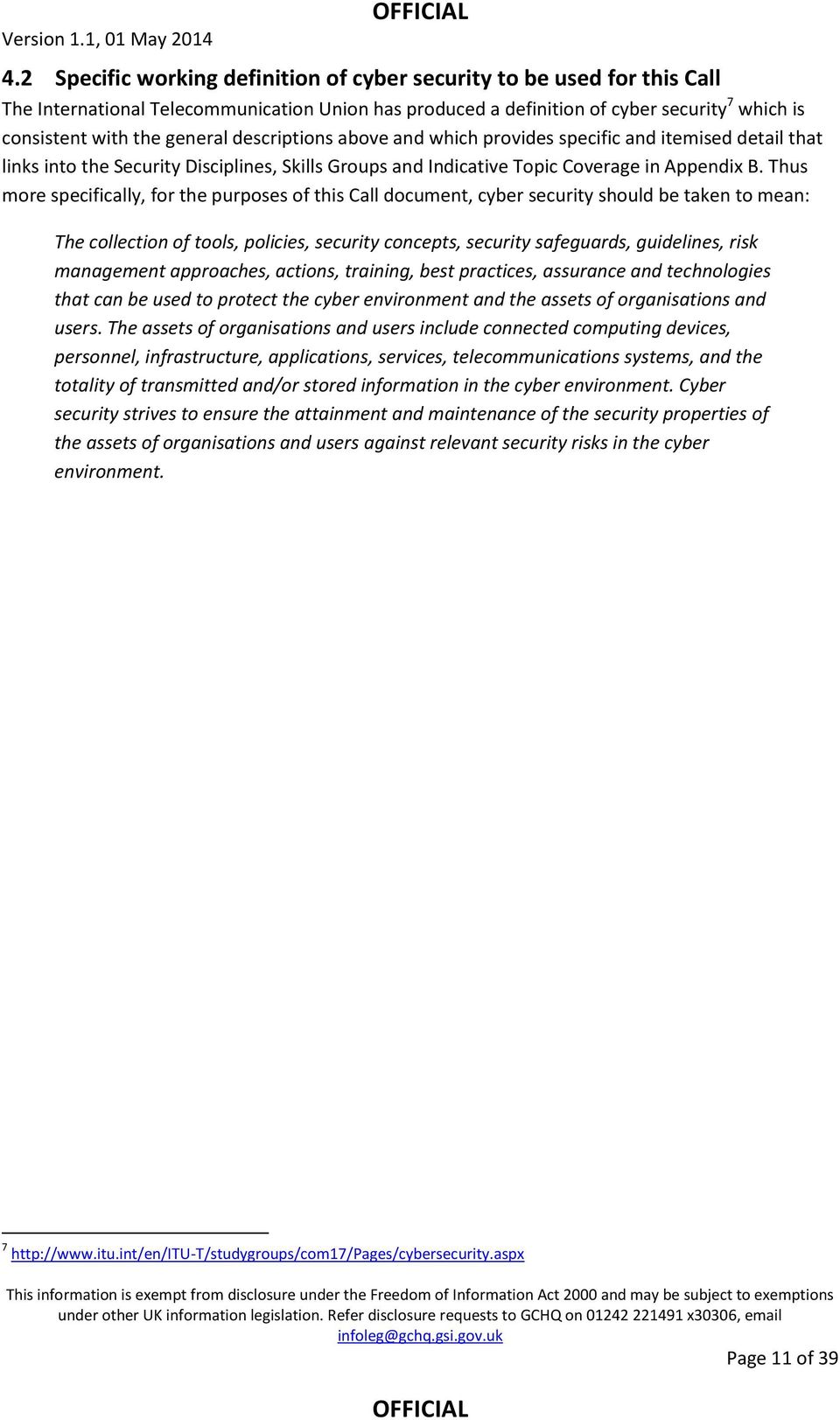
11 4.2 Specific working definition of cyber security to be used for this Call The International Telecommunication Union has produced a definition of cyber security 7 which is consistent with the general descriptions above and which provides specific and itemised detail that links into the Security Disciplines, Skills Groups and Indicative Topic Coverage in Appendix B. Thus more specifically, for the purposes of this Call document, cyber security should be taken to mean: The collection of tools, policies, security concepts, security safeguards, guidelines, risk management approaches, actions, training, best practices, assurance and technologies that can be used to protect the cyber environment and the assets of organisations and users. The assets of organisations and users include connected computing devices, personnel, infrastructure, applications, services, telecommunications systems, and the totality of transmitted and/or stored information in the cyber environment. Cyber security strives to ensure the attainment and maintenance of the security properties of the assets of organisations and users against relevant security risks in the cyber environment. 7 Page 11 of 39
12 Appendix B: Topics to be covered in Masters degrees providing a general, broad foundation in cyber security The Security Discipline Principles and Skills Groups that form part of the tables in this Appendix A are derived from the IISP Information Security Skills Framework and are copyright The Institute of Information Security Professionals. All rights reserved. The information within the tables in this Appendix is intended to provide an indicative mapping of potential Masters topic coverage to the IISP Skills Framework 8. The tables are structured on the basis of Security Disciplines that lead to a series of Indicative Topics: a. The set of Security Disciplines and Principles has been taken from the IISP Skills Framework, along with summary versions of the associated Knowledge Requirements expressed in CESG s June 2013 document on Certification for IA Professionals b. The Skills Groups are based upon those expressed in the IISP framework, but with some of the groups having been merged together where appropriate (e.g., where Masters programmes would be unlikely to be focusing their coverage or where the treatment of the Skills Groups would essentially encompass the same topics). A new Skills Group on Control Systems has been added to reflect the growing importance of this subject area. c. To help with later referral, the Skills Groups have been numbered i to xiv. The IISP Skills Groups to which they refer are also shown (e.g., A2, A5, etc.). d. The Indicative Topic Coverage highlights examples of the specific topics that one would expect to see represented within the syllabi of Masters modules in order for broad coverage of the related Skills Group to be achieved. Given that they are indicative topics, programmes would not be required to cover all of them explicitly (and indeed other topics may additionally be relevant), but there would be expected to be sufficient weight of coverage within each area if the Skills Group was to be satisfactorily addressed. 8 IISP Skills Framework: 77a6f e-aa7b ec4 9 CESG is the Information Security arm of GCHQ: 10 CESG Certification for IA Professionals: Page 12 of 39

13 Security Discipline Skills Group Indicative Topic Coverage A. Information Security Management Principle: Capable of determining, establishing and maintaining appropriate governance of (including processes, roles, awareness strategies, legal environment and responsibilities), delivery of (including polices, standards and guidelines), and cost-effective solutions (including impact of third parties) for information security within a given organisation). CESG Knowledge Requirements include: i. Policy, Strategy, Awareness and Audit (A1, A2, A3, A5, G1) The role and function of security policy Types of security policy Security standards (e.g. ISO/IEC 27000) Security concepts and fundamentals Security roles and responsibilities Security professionalism Governance and compliance requirements in law Third party management Security culture Awareness raising methods Acceptable use policies Security certifications Understanding auditability The internal audit process Management frameworks such as ISO series Legislation such as Data Protection Act Common management Frameworks such as ISO 9000 ii. Legal & Regulatory Environment (A6) Computer Misuse legislation Data Protection law Intellectual property and copyright Employment issues Regulation of security technologies under other UK information legislation. Refer disclosure requests to GCHQ on x30306, Page 13 of 39

14 Security Discipline Skills Group Indicative Topic Coverage B. Information Risk Management Principle: Capable of articulating the different forms of threat to, and vulnerabilities of, information systems and assets. Comprehending and managing the risks relating to information systems and assets. CESG Knowledge Requirements include: Information risk management methodologies such as ISO Information Security Risk Management Generic risk management methodologies such as ISO Risk Management; Principles & Guidelines Key concepts such as threats, vulnerabilities, business impacts, and risk tolerance iii. Risk Assessment and Management (B1, B2) Threat, vulnerability and risk concepts Threat landscape, adversarial thinking Asset valuation and management Risk analysis methodologies Handling risk and selecting countermeasures/controls to mitigate risk Understanding impacts and consequences Security economics under other UK information legislation. Refer disclosure requests to GCHQ on x30306, Page 14 of 39

15 Security Discipline Skills Group Indicative Topic Coverage C. Implementing Secure Systems Principle: Comprehends the common technical security controls available to prevent, detect and recover from security incidents and to mitigate risk. Capable of articulating security architectures relating to business needs and commercial product development that can be realised using available tools, products, standards and protocols, delivering systems assured to have met their security profile using accepted methods CESG Knowledge Requirements include: Security Architectures and Patterns Secure Development processes Business requirements Skills frameworks (e.g. SFIA) Architectural frameworks (e.g. The Open Group Architecture Framework TOGAF) Range of core security technologies (e.g. Access control models, encryption, Authentication techniques) and how to apply them iv. Security Architecture (C1) v. Secure Development (C2) vi. Control Systems Design and development considerations: trusted computing base, security architecture and patterns, security models and design principles (e.g., principle of least privilege, fail-safe defaults), software (program) security, emission security Selecting and applying core technologies: authentication, access control, privacy controls, security protocols Recognising security needs across platforms: operating system security, Web security, embedded security, cloud and virtualisation security, security as a service Cryptography: cipher and algorithm types, applications to confidentiality, integrity and authentication, PKI Network security: Internet security protocols, tunnelling, VPNs, network attack and defence, TLS Human factors: usable security, psychology of security, insider threat Security systems development: managing secure systems development, principles of secure programming, formal approaches, understanding implementation errors and exploits. SCADA and SMART Systems, cyber system of systems (from abstract to physical effect), non-ip protocols and standards (e.g., WiFi, Bluetooth, GSM, CAN, MODBUS), cyber-physical systems analysis, embedded systems, assurance of control systems hardware and software, design/implementation methodologies to minimise the risk of vulnerabilities, risk modelling and risk-based decision making under other UK information legislation. Refer disclosure requests to GCHQ on x30306, Page 15 of 39

16 Security Discipline Skills Group Indicative Topic Coverage D. Information Assurance Methodologies and Testing Principle: Develops and applies standards and strategies for verifying that measures taken mitigate identified risks. CESG Knowledge Requirements include: Assessment Methodologies (e.g. Common Criteria) Information Risk Management Frameworks Assessment services or standards (e.g. CHECK) Governance aspects and Management responsibilities Testing strategies and methodologies (e.g., TEMPEST testing) vii. Information Assurance Methodologies (D1) viii. Security Testing (D2) Assessment methodologies (e.g series and Common Criteria) Understanding security vulnerabilities and related mitigation measures System and software testing Penetration testing Security metrics Static and dynamic analysis of products and systems under other UK information legislation. Refer disclosure requests to GCHQ on x30306, Page 16 of 39

17 Security Discipline Skills Group Indicative Topic Coverage E. Operational Security Management Principle: Capable of managing all aspects of a security programme, including reacting to new threats and vulnerabilities, secure operational and service delivery consistent with security polices, standards and procedures, and handling security incidents of all types according to common principles and practices, consistent with legal constraints and obligations. CESG Knowledge Requirements include: Governance and Management responsibilities IT Service Management processes (e.g. ITIL) Existing and Emerging Vulnerabilities Use of penetration testing and vulnerability testing Risk Assessment and Monitoring Operating Procedures and accountability Continuous improvement ix. Secure Operations Management and Service Delivery (E1, E2) x. Vulnerability Assessment (E3) Internet threats: common attacks (human and technical), malicious code, situational awareness, threat trends, threat landscape, CERTs, adversarial thinking Cryptography: AES and RSA, key management, digital signatures Network security: networking fundamentals, firewalls and traffic filtering, intrusion detection and prevention systems, intrusion analysis, network monitoring, mobile and wireless network security System security: authentication (secrets, tokens, biometrics), access control (MAC, DAC, RBAC) and privilege management, mobile device security and BYOD, anti-virus technologies Application security: , Web, social networks, DRM, database security, big data security, identity management Physical security: physical and environmental controls, physical protection of IT assets Malware analysis: static and dynamic analysis, detection techniques, host-based intrusion detection, kernel rootkits System and network-level vulnerabilities and their exploitation Vulnerability analysis and management Penetration testing Social Engineering Dependable/resilient/survivable systems under other UK information legislation. Refer disclosure requests to GCHQ on x30306, Page 17 of 39

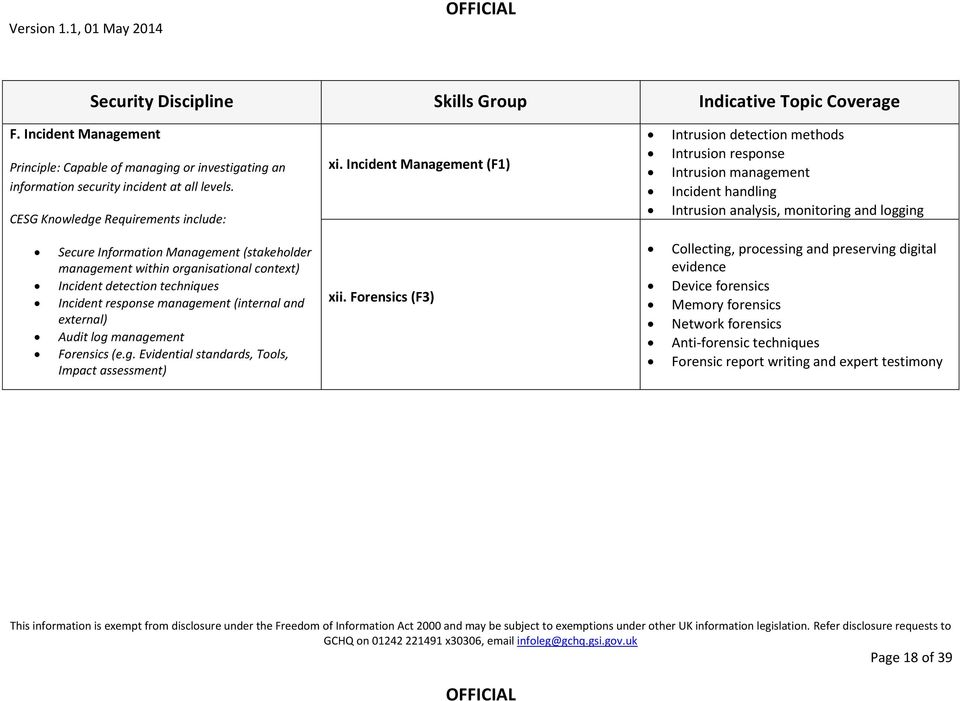
18 Security Discipline Skills Group Indicative Topic Coverage F. Incident Management Principle: Capable of managing or investigating an information security incident at all levels. CESG Knowledge Requirements include: xi. Incident Management (F1) Intrusion detection methods Intrusion response Intrusion management Incident handling Intrusion analysis, monitoring and logging Secure Information Management (stakeholder management within organisational context) Incident detection techniques Incident response management (internal and external) Audit log management Forensics (e.g. Evidential standards, Tools, Impact assessment) xii. Forensics (F3) Collecting, processing and preserving digital evidence Device forensics Memory forensics Network forensics Anti-forensic techniques Forensic report writing and expert testimony under other UK information legislation. Refer disclosure requests to GCHQ on x30306, Page 18 of 39
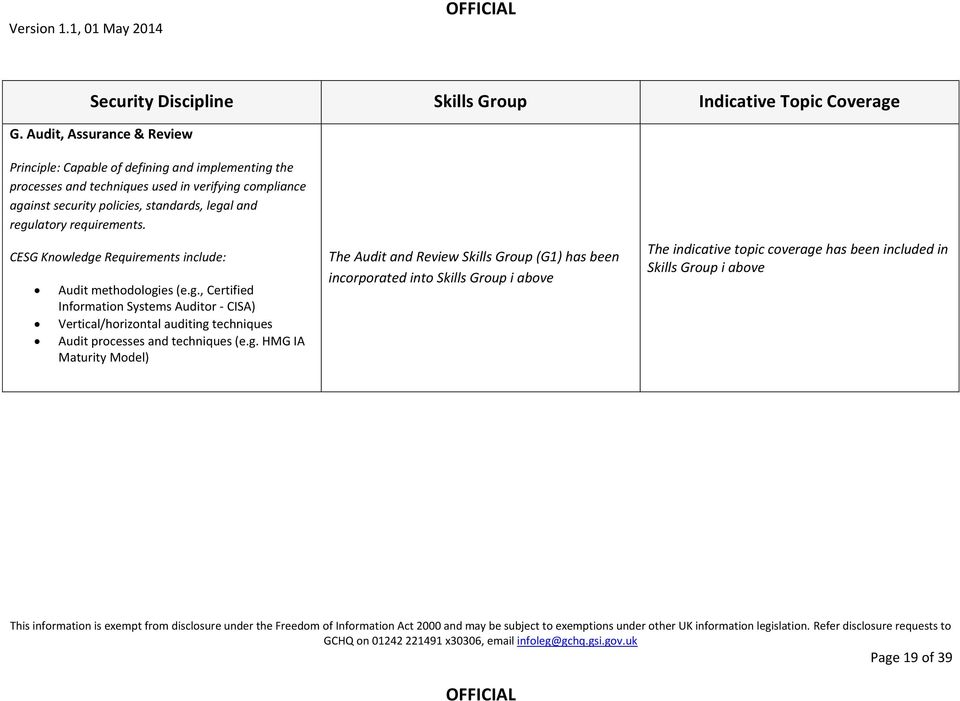
19 Security Discipline Skills Group Indicative Topic Coverage G. Audit, Assurance & Review Principle: Capable of defining and implementing the processes and techniques used in verifying compliance against security policies, standards, legal and regulatory requirements. CESG Knowledge Requirements include: Audit methodologies (e.g., Certified Information Systems Auditor - CISA) Vertical/horizontal auditing techniques Audit processes and techniques (e.g. HMG IA Maturity Model) The Audit and Review Skills Group (G1) has been incorporated into Skills Group i above The indicative topic coverage has been included in Skills Group i above under other UK information legislation. Refer disclosure requests to GCHQ on x30306, Page 19 of 39
20 Security Discipline Skills Group Indicative Topic Coverage H. Business Continuity Management Principle: Capable of defining the need for, and of implementing processes for, establishing business continuity. CESG Knowledge Requirements include: Business continuity management lifecycle Business Impact Analysis process Related standards (e.g. ISO 22301, ISO 27001, BS 25999, BS 27031) xiii. Business Continuity Planning and Management (H1, H2) Continuity planning Backup Disaster recovery under other UK information legislation. Refer disclosure requests to GCHQ on x30306, Page 20 of 39

21 Security Discipline Skills Group Indicative Topic Coverage I. Information Systems Research Principle: Original investigation in order to gain knowledge and understanding relating to information security, including the invention and generation of ideas, performances and artefacts where these lead to new or substantially improved insights; and the use of existing knowledge in experimental development to produce new or substantially improved devices, products and processes. xiv. Research (I2) This aspect is likely to be reflected via the inclusion of a substantial research dissertation component within the Masters degree. Students would be expected to conduct research that is clearly focused upon one or more of the Security Disciplines (A to H) listed above. under other UK information legislation. Refer disclosure requests to GCHQ on x30306, Page 21 of 39
22 Security Discipline Skills Group Indicative Topic Coverage J. Professional Skills These aspects are likely to be crosscutting within a programme and/or represented by a dedicated skills module. Overall, there should be evidence of the programme giving attention towards: teamworking, leadership, communication skills, decision making. under other UK information legislation. Refer disclosure requests to GCHQ on x30306, Page 22 of 39
23 Appendix C: Required structure of application for Full certification This appendix provides details of the information that applicants should provide with their application along with the criteria that will be applied. Please note that an HEI should submit one application per Masters degree. An HEI can submit more than one Masters degree for certification if the HEI believes that more than one of its Masters degrees meet the criteria below. Each application should comprise six sections, each section submitted as an attachment to the same but as a separate document. The documents should be clearly identified under the following headings: 1. Institution s letter of support for the application (up to one side of A4). 2. Description of the applicant (up to five sides of A4, excluding CVs) 3. Description of the Masters degree in cyber security (up to ten sides of A4, excluding the module descriptions) 4. Assessment materials and external examiner s report (up to three sides of A4, excluding copies of examination papers, copies of information provided for coursework and copy of external examiner s report) 5. Original research dissertations (up to three sides of A4, excluding list of dissertation titles and copies of dissertations) 6. Student numbers and grades achieved (up to five sides of A4) Documents should be in Word or pdf format with the font size no smaller than 10pt. Unless specifically asked for, additional pages and other material in addition to that outlined above will not be read and will not therefore form part of the assessment for certification. All information provided will be treated confidentially and used only for the purposes of assessing applications. 1 HEI s letter of support for the application Please provide a signed letter from the Vice Chancellor (or equivalent) showing support for the HEI s application to have a Masters degree in cyber security considered for certification by GCHQ. 2 Description of the applicant Please ensure that you cover the following points: a. The names and structure of the department(s)/group(s)/school(s) responsible for the Masters degree together with the names, seniority and roles of the members of staff responsible for delivering the degree content, setting and marking examinations, supervising dissertations, etc. b. For each member of staff named above please provide a CV (up to 2 pages in length) which provides details of academic background, evidence of areas of expertise in cyber security Page 23 of 39
24 (e.g. references to recent publications, working with industry and/or government), esteem indicators (e.g. editorships, invited talks, etc.). c. Please describe any recent investments from the HEI, government, industry etc. in the groups running the Masters degree programme. d. Please describe any external linkages that add value to the Masters degree: e.g., visiting lecturers with specialist knowledge from other academic departments, government or industry; projects suggested, and monitored, by industry; etc. e. Please describe the process used to review and re-new the course content in order to keep it up to date, for example: how often is the course content reviewed, by whom, and what external advice is taken (e.g., industrial advisory boards). f. Please describe the facilities available to Masters students, for example: computer laboratories, library (access to text-books), on-line journal subscription (for research dissertations), etc. 2.1 Criteria to be applied i. There should be a coherent team responsible for delivering the Masters, with clear roles and responsibilities. ii. The team members delivering the modules, setting the examinations and marking papers should have the appropriate technical knowledge and skills. iii. The team should be well supported by the HEI. It would be desirable to see that the Masters degree programme has valuable external linkages. iv. There should be a well-defined process for keeping the Masters degree up to date that takes account of appropriate internal and external advice. v. Students undertaking the Masters should have access to well-equipped modern computer laboratories with easy access to information on the latest developments in cyber security. 3 Description of the Masters degree in cyber security Please ensure that you cover the following points: a. Please provide a high-level description of the Masters degree. This should include: the name of the degree and the specific degree awarded (e.g., MSc etc.) the objectives and expected learning outcomes of the degree as a grounding for a Masters qualification how the degree satisfies the QAA qualification framework for Masters level the number of academic years the degree has been running and whether it is being delivered in academic year the overall structure of the degree e.g., the set of taught modules, which modules are core and which are optional, the number of credits awarded for each module, the number of credits awarded for the original research dissertation Page 24 of 39
25 Table 3.1 a description of how the degree is structured to accommodate part-time students, if applicable please provide a table (Table 3.1) that shows for each taught module: o o the member(s) of staff delivering the module which Security Discipline(s) (Appendix B) the module covers if it does not cover a Security Discipline please make this clear Module Member(s) of staff Security Discipline(s) covered Module 1.. Module n for each module that addresses a Security Discipline, please provide a module description to include the syllabus/topics covered and the expected learning outcomes b. With reference to Appendix B, please provide an overview of how the topic coverage required for a general cyber security Masters degree is achieved by completing a table (Table 3.2) of the following form covering Security Disciplines A to H and Skills Groups i to xiii: Page 25 of 39
26 Security Discipline Skills Group Module(s) in which topics in Skills Group are covered A. Information Security Management B. Information Risk Management i. Policy, Strategy, Awareness and Audit ii. Legal and Regulatory Environment iii. Risk Assessment and Management iv. Security Architecture C. Implementing Secure Systems v. Secure Development vi. Control Systems D. Information Assurance Methodologies and Testing vii. Information Assurance Methodologies viii. Secure Testing E. Operational Security Management ix. Secure Operations Management and Service Delivery x. Vulnerability Assessment F. Incident Management xi. Incident Management xii. Forensics G. Audit, Assurance and Review Audit and Review Included in Skills Group i above Please provide information under Skills Group i above H. Business Continuity Management xiii. Business Continuity Planning and Management Table 3.2 c. For Masters degrees with core and optional modules please identify: either, the permitted combinations of core and optional taught modules that DO cover at least 9 of the Skills Groups in Table 3.2 or, the permitted combinations of core and optional modules that DO NOT cover at least 9 of the Skills Groups in Table 3.2 d. For Masters degrees in which the original research dissertation accounts for more than 45% of the credits available, please clarify how the remainder of the degree adequately covers the required number of Skills Groups. Page 26 of 39
27 e. Please describe how Security Discipline J, Professional Skills (Appendix B), is addressed in the Masters degree. By way of example, describe how team-working, communication skills etc. are covered within the degree programme as a whole it is not a requirement to have a separate dedicated module covering Professional Skills. 3.1 Criteria to be applied i. The objectives and anticipated learning outcomes for students undertaking the Masters should be clearly articulated. ii. The degree must have had a cohort of students successfully complete the degree in academic year and it must be currently active in academic year iii. The degree satisfies the QAA qualification framework for Masters level. iv. Part-time students should cover the same breadth and depth of content as one-year, full time students. v. The completed Table 3.1 must show that at least one of the following options is met: at least 70% of the taught modules in the Masters must be able to be mapped to Security Disciplines A to H for Masters degrees that comprise a broad set of optional modules from which students can choose, it must be the case that students can select a set of taught modules in which at least 70% of the modules in the set can be mapped to Security Disciplines A to H vi. The completed Table 3.2 must show that the taught modules provide coverage of at least 9 of the Skills Groups i to xiii listed in Table 3.2. vii. Permitted combinations of core and optional modules that DO or DO NOT cover at least 9 of the Skills Groups listed in Table 3.2 must be clearly identified. There must be at least one combination of core and optional modules that covers at least 9 of the Skills Groups listed in Table 3.2. viii. For the case of Masters degrees where the original research dissertation accounts for more than 45% of the credits available, it must be clear that the remainder of the degree is able to adequately cover the required number of Skills Groups. ix. Under the Professional Skills Security Discipline (Discipline J, Appendix A), the Masters degree should address the following topics: team-working, communication skills, leadership and decision making. 4 Assessment materials and external examiner s report Please ensure you cover the following: a. For academic year , for each of the modules identified in section 3 that address Security Disciplines A to H please describe the process used for assessment (e.g., examination, coursework, practical exercises, etc.). Please provide a copy of the examination paper(s) that students sat. For assessed coursework, please provide copies of the information provided to students and the assessment criteria used by the HEI. Page 27 of 39
28 b. For academic year , please provide a copy of the external examiner s report. Please describe the process for engagement with the external examiner. Please describe the technical background and experience of the external examiner. c. For academic year , please provide a copy of the HEI s response to the external examiner s report and any follow up actions that have been undertaken in response to the report. 4.1 Criteria to be applied i. The examination and assessment process must rigorously test students understanding of the topics shown in Appendix B. ii. The external examiner should have the appropriate technical background and his/her report must provide a positive picture of the Masters Degree under assessment. iii. The progress to any follow-on actions suggested by the external examiner should be made clear. 5 Original research dissertations Please ensure that you cover the following points: a. Please describe the guidance the HEI provides to Masters students before they embark on their dissertations, for example: research methods, undertaking literature reviews, etc. b. Please describe the process for allocation of dissertation topics to students, for example: is it up to students to come up with topic ideas? do members of staff identify possible topics? does the HEI have links with industry partners who suggest topics? c. Please describe the process for monitoring the progress of students on their dissertations. d. Please describe the process for assessing dissertations. Please indicate whether the HEI provides students with guidance on what is expected in a dissertation to achieve distinction, merit or pass 11. e. For Masters degrees in which the original research dissertation accounts for less than 25% of the available credits, please describe how students are able to gain sufficient understanding and experience of undertaking original research. f. For each of academic years and (if any), please provide a list of Masters dissertations undertaken by students. This should include the dissertation title, a short (one paragraph) abstract, an identification of the area(s) in Appendix B to which the dissertation applies, and if appropriate whether there was any external involvement in the dissertation (e.g., from industry). Where there were more than 20 students undertaking dissertations in an academic year, please provide information for a representative sample of 20 dissertations only. 11 Where the classifications of distinction / merit / pass are not used, please refer to the grades that are used by the HEI. Page 28 of 39
29 g. For academic year , please provide one anonymised and representative copy (or URL from which the dissertation can be downloaded) of a dissertation for each of 12 : a dissertation that achieved a distinction (if none in , try ; else state none) a dissertation that achieved a merit (if none in , try ; else state none) a dissertation that achieved a pass (if none in , try ; else state none) 5.1 Criteria to be applied i. There needs to be a well-defined process for the allocation of dissertation topics to students and for monitoring the progress of students. ii. There needs to be a well-defined and rigorous process for the assessment of dissertations. iii. For Masters degrees in which the original research dissertation accounts for less than 25% of the available credits, it should be clear that students are still able to gain sufficient understanding and experience of undertaking original research. iv. It should be clear that the dissertation topics are within the scope of Security Disciplines A to H listed in Appendix B. v. The award of distinction, merit or pass for the representative dissertations should be appropriate. 6 Student numbers and grades achieved Where the data are available, for each of academic years and please provide the following information: a. for students with UK nationality the required entry qualifications the number of UK students please indicate the number of full-time and part-time students the number with an upper-second class (or higher) degree in a STEM subject the number without the degree qualification above but who have relevant experience e.g., people from industry/government undertaking the course the number without a STEM background or relevant experience b. for students with EU nationality (excluding UK nationals) the required entry qualifications 12 Where the classifications of distinction / merit / pass are not used, please provide representative dissertations for each of the classifications that are used by the HEI. Page 29 of 39
30 the number of EU students please indicate the number of full-time and part-time students the number with an upper-second class (or higher) degree in a STEM subject from a UK HEI the number with the equivalent of an upper-second class (or higher) degree in a STEM subject from a non-uk HEI the number without the degree qualification above but who have relevant experience the number without a STEM background or relevant experience c. for students without EU nationality the required entry qualifications the number of non-eu students please indicate the number of full-time and parttime students the number with an upper-second class (or higher) degree in a STEM subject from a UK HEI the number with the equivalent of an upper-second class (or higher) degree in a STEM subject from a non-uk HEI the number without the degree qualification above but who have relevant experience the number without a STEM background or relevant experience d. a breakdown of the numbers achieving a pass, merit or distinction e. the results of any student satisfaction surveys and any actions that have been taken by the HEI as a result 6.1 Criteria to be applied i. It would be expected that the majority of UK students should have at least an upper second class degree in a STEM subject or equivalent experience. ii. It would be expected that the majority of EU (excluding UK) and non-eu students should have at least an upper second class degree in a STEM subject or equivalent experience. iii. It would be expected that the distribution of pass, merit and distinction grades should to some extent reflect the experience and entry qualifications of the student intake. In this regard, the external examiner s report will be referred to in case she/he has raised any concerns. iv. The HEI should encourage its students to participate in surveys such as PTES 13. The results of any student satisfaction survey should paint a largely positive picture of students learning 13 Post-graduate Taught Experience Survey: Page 30 of 39
31 experience and the HEI should be able to demonstrate progress on any key issues raised by such surveys. 7 Assessment of Applications Each application will be read and scored independently by a minimum of three members of the Assessment Panel using the criteria above; as far as possible, there will be one representative from each of GCHQ, academia, industry/government/professional bodies. At the Assessment Panel meeting, the relevant Panel members will present their scores and the rationale for their scores. The Assessment Panel will agree a consensus score for each application. Each application must include document 1) (Institution s Letter of Support) without it, the application will be rejected as non-compliant. In terms of providing evidence to meet the criteria, each of sections 2) to 6) of each application will be scored using the following scale: 0: no evidence 1: very little evidence 2: some evidence 3: good evidence 4: excellent evidence Each of the sections 2) to 6) must achieve a threshold score of 3. If the application includes a letter of support and the consensus score is at threshold or above in each of sections 2) to 6) then the application will be deemed to be successful overall. Page 31 of 39
32 Appendix D: Required structure of application for Provisional certification This appendix provides details of the information that applicants should provide with their application along with the criteria that will be applied. Please note that an HEI should submit one application per Masters degree. An HEI can submit more than one Masters degree for certification if the HEI believes that more than one of its Masters degrees meet the criteria below. Each application should comprise five sections, each section submitted as an attachment to the same but as a separate document. The documents should be clearly identified under the following headings: 1. Institution s letter of support for the application (up to one side of A4). 2. Description of the applicant (up to five sides of A4, excluding CVs) 3. Description of the Masters degree in cyber security (up to ten sides of A4, excluding the module descriptions) 4. Assessment materials (up to three sides of A4, excluding copies of examination papers and copies of information provided for coursework) 5. Original research dissertations (up to three sides of A4) Documents should be in Word or pdf format with the font size no smaller than 10pt. Unless specifically asked for, additional pages and other material in addition to that outlined above will not be read and will not therefore form part of the assessment for certification. All information provided will be treated confidentially and used only for the purposes of assessing applications. 1 HEI s letter of support for the application Please provide a signed letter from the Vice Chancellor (or equivalent) showing support for the HEI s application to have a Masters degree in cyber security considered for certification by GCHQ. For those Masters degrees that have not yet started, it is important that the HEI confirms the start date for the Masters degree and that the degree will start by (up to and including) October Description of the applicant Please ensure that you cover the following points: a. The names and structure of the department(s)/group(s)/school(s) responsible for the Masters degree together with the names, seniority and roles of the members of staff responsible for delivering the degree content, setting and marking examinations, supervising projects, etc. Page 32 of 39
33 b. For each member of staff named above please provide a CV (up to 2 pages in length) which provides details of academic background, evidence of areas of expertise in cyber security (e.g. references to recent publications, working with industry and/or government), esteem indicators (e.g. editorships, invited talks, etc.). c. Please describe any recent investments from the HEI, government, industry etc. in the groups running the Masters degree programme. d. Please describe any external linkages that add value to the Masters degree: e.g., visiting lecturers with specialist knowledge from other academic departments, government or industry; projects suggested, and monitored, by industry; etc. e. Please describe the process used to review and re-new the course content in order to keep it up to date, for example: how often is the course content reviewed, by whom, and what external advice is taken (e.g., industrial advisory boards). f. Please describe the facilities available to Masters students, for example: computer laboratories, library (access to text-books), on-line journal subscription (for research projects), etc. 2.1 Criteria to be applied i. There should be a coherent team responsible for delivering the Masters, with clear roles and responsibilities. ii. The team members delivering the modules, setting the examinations and marking papers should have the appropriate technical knowledge and skills. iii. The team should be well supported by the HEI. It would be desirable to see that the Masters has valuable external linkages. iv. There should be a well-defined process for keeping the Masters degree up to date which takes account of appropriate internal and external advice. v. Students undertaking the Masters should have access to well-equipped modern computer laboratories with easy access to information on the latest developments in cyber security. 3 Description of the Masters degree in cyber security Please ensure that you cover the following points: a. Please provide a high-level description of the Masters degree. This should include: the name of the degree and the specific degree awarded (e.g., MSc etc.) the objectives and expected learning outcomes of the degree as a grounding for a Masters qualification how the degree satisfies the QAA qualification framework for Masters level if applicable, the number of academic years the degree has been running and whether it is being delivered in academic year if applicable, the start date for the new/revised degree Page 33 of 39
34 Table 3.1 the overall structure of the degree e.g., the set of taught modules, which modules are core and which are optional, the number of credits awarded for each module, the number of credits awarded for the original research dissertation a description of how the degree is structured to accommodate part-time students, if applicable please provide a table (Table 3.1) that shows for each taught module: o o the member(s) of staff delivering the module which Security Discipline(s) (Appendix B) the module covers if it does not cover a Security Discipline please make this clear Module Member(s) of staff Security Discipline(s) covered Module 1.. Module n for each module that addresses a Security Discipline, please provide a module description to include the syllabus/topics covered and the expected learning outcomes b. With reference to Appendix B, please provide an overview of how the topic coverage required for a general cyber security Masters degree is achieved by completing a table (Table 3.2) of the following form covering Security Disciplines A to H and Skills Groups i to xiii: Page 34 of 39
35 Security Discipline Skills Group Module(s) in which topics in Skills Group are covered A. Information Security Management B. Information Risk Management i. Policy, Strategy, Awareness and Audit ii. Legal and Regulatory Environment iii. Risk Assessment and Management iv. Security Architecture C. Implementing Secure Systems v. Secure Development vi. Control Systems D. Information Assurance Methodologies and Testing vii. Information Assurance Methodologies viii. Secure Testing E. Operational Security Management F. Incident Management G. Audit, Assurance and Review H. Business Continuity Management Table 3.2 ix. Secure Operations Management and Service Delivery x. Vulnerability Assessment xi. Incident Management xii. Forensics Audit and Review Included in Skills Group i above xiii. Business Continuity Planning and Management Please provide information under Skills Group i above c. For Masters degrees with core and optional modules please identify: either, the permitted combinations of core and optional taught modules that DO cover at least 9 of the Skills Groups in Table 3.2 or, the permitted combinations of core and optional modules that DO NOT cover at least 9 of the Skills Groups in Table 3.2 Page 35 of 39
36 d. For Masters degrees in which the original research dissertation accounts for more than 45% of the credits available, please clarify how the remainder of the degree is able to adequately covers the required number of Skills Groups. e. Please describe how Security Discipline J, Professional Skills (Appendix B), is addressed in the Masters degree. By way of example, describe how team-working, communication skills etc. are covered within the degree programme as a whole it is not a requirement to have a separate dedicated module covering Professional Skills. 3.1 Criteria to be applied i. The objectives and anticipated learning outcomes for students undertaking the Masters should be clearly articulated. ii. New/revised Masters degrees that have not yet started must start by (up to and including) October iii. The degree satisfies the QAA qualification framework for Masters level. iv. Part-time students should cover the same breadth and depth of content as one-year, full time students. v. The completed Table 3.1 must show that at least one of the following options is met: at least 70% of the taught modules in the Masters must be able to be mapped to Security Disciplines A to H for Masters degrees that comprise a broad set of optional modules from which students can choose, it must be the case that students can select a set of taught modules in which at least 70% of the modules in the set can be mapped to Security Disciplines A to H vi. The completed Table 3.2 must show that the taught modules provide coverage of at least 9 of Skills Groups i to xiii listed in Table 3.2. vii. Permitted combinations of core and optional modules that DO or DO NOT cover at least 9 of the Skills Groups listed in Table 3.2 must be clearly identified. There must be at least one combination of core and optional modules that covers at least 9 of the Skills Groups listed in Table 3.2. viii. For the case of Masters degrees where the original research dissertation accounts for more than 45% of the credits available, it must be clear that the remainder of the degree is able to adequately cover the required number of Skills Groups. ix. Under the Professional Skills Security Discipline (Discipline J, Appendix B), the Masters degree should address the following topics: team-working, communication skills, leadership and decision making. 4 Assessment materials Please ensure you cover the following: a. For each of the modules identified in section 3 that address Security Disciplines A to H, please describe the process (to be) used for assessment (e.g., examination, coursework, Page 36 of 39
37 practical exercises, etc.). Please provide a copy of examination paper(s) that students have sat or specimen paper(s) of the examinations they will sit. For assessed coursework, please provide copies of the information (to be) provided to students and the assessment criteria used by the HEI. 4.1 Criteria to be applied i. The examination and assessment process must rigorously test students understanding of the topics shown in Appendix B. 5 Original research dissertations Please ensure that you cover the following points: a. Please describe the guidance the HEI provides, or will provide, to Masters students before they embark on their dissertations, for example: research methods, undertaking literature reviews, etc. b. Please describe the process for allocation of dissertation topics to students, for example: is it up to students to come up with topic ideas? do members of staff identify possible topics? does the HEI have links with industry partners who suggest topics? c. Please describe the process for monitoring the progress of students on their dissertations. d. Please describe the process for assessing dissertations. Please indicate whether the HEI provides students with guidance on what is expected in a dissertation to achieve distinction, merit or pass 14. e. For Masters degrees in which the original research dissertation accounts for less than 25% of the available credits, please describe how students are able to gain sufficient understanding and experience of undertaking original research. 5.1 Criteria to be applied i. There needs to be a well-defined process for the allocation of dissertation topics to students and for monitoring the progress of students. ii. There needs to be a well-defined and rigorous process for the assessment of dissertations. iii. For Masters degrees in which the original research dissertation accounts for less than 25% of the available credits, it should be clear that students are still able to gain sufficient understanding and experience of undertaking original research. 6 Assessment of Applications Each application will be read and scored independently by a minimum of three members of the Assessment Panel using the criteria above; as far as possible, there will be one representative from each of GCHQ, academia, industry/government/professional bodies. At the Assessment Panel 14 Where the classifications of distinction / merit / pass are not used, please refer to the grades that are used by the HEI. Page 37 of 39
38 meeting, the relevant Panel members will present their scores and the rationale for their scores. The Assessment Panel will agree a consensus score for each application. Each application must include document 1) (Institution s Letter of Support) without it, the application will be rejected as non-compliant. In terms of providing evidence to meet the criteria, each of sections 2) to 5) of each application will be scored using the following scale: 0: no evidence 1: very little evidence 2: some evidence 3: good evidence 4: excellent evidence Each of the sections 2) to 5) must achieve a threshold score of 3. If the application includes a letter of support and the consensus score is at threshold or above in each of sections 2) to 5) then the application will be deemed to be successful overall. Page 38 of 39
39 Appendix E: Terms and conditions associated with certification To be supplied separately. A draft of the T&Cs will be made available in April 2014 on the following Web site: Page 39 of 39
CESG Certification of Cyber Security Training Courses
 CESG Certification of Cyber Security Training Courses Supporting Assessment Criteria for the CESG Certified Training (CCT) Scheme Portions of this work are copyright The Institute of Information Security
Certification of Master s Degrees Providing a General, Broad Foundation in Cyber Security
 Certified Master s in Cyber Security Certification of Master s Degrees Providing a General, Broad Foundation in Cyber Security Call for Applications Closing Date: 27 February 2015, 16:00 Briefing Meeting:
Certification of Master s Degrees in Digital Forensics
 Certified Master s in Cyber Security Certification of Master s Degrees in Digital Forensics Call for Applications Closing Date: 27 February 2015, 16:00 Briefing Meeting: 14 January 2015, 13:00 Portions
Certification of Master s Degrees in Computer Science for Cyber Security
 Certified Master s in Cyber Security Certification of Master s Degrees in Computer Science for Cyber Security Call for Applications Closing Date: 15 January 2016, 16:00 Briefing Meeting: 05 November 2015,
Certification of Integrated Master s Degrees in Computer Science and Cyber Security
 Certified Master s in Cyber Security Certification of Integrated Master s Degrees in Computer Science and Cyber Security Call for Applications Closing Date: 15 January 2016, 16:00 Briefing Meeting: 05
Certification of Master s Degrees Providing a General Broad Foundation in Cyber Security
 OFFICIAL Certified Master s Briefing Meeting 14 April 2014 Certification of Master s Degrees Providing a General Broad Foundation in Cyber Security Chris Ensor Michael Kirton Ellie England Graeme Dykes
Certified Master s in Cyber Security. Certification of Master s Degrees Providing a General, Broad Foundation in Cyber Security
 Certified Master s in Cyber Certification of Master s Degrees Providing a General, Broad Foundation in Cyber Questions and Answers from Briefing Day held on 14 th April 2014 1. To what extent is an undergraduate
MSc Cyber Security UKPASS P052286. Course 1 Year Full-Time, 2-3 Years Part-Time
 MSc Cyber Security International Students Can Apply UKPASS P052286 Code: Course 1 Year Full-Time, 2-3 Years Part-Time Length: Start Dates: September 2015, January 2016, September 2016, January 2017 Department:Department
External Supplier Control Requirements
 External Supplier Control s Cyber Security For Suppliers Categorised as Low Cyber Risk 1. Asset Protection and System Configuration Barclays Data and the assets or systems storing or processing it must
Application Guidance CCP Penetration Tester Role, Practitioner Level
 August 2014 Issue No: 1.0 Application Guidance CCP Penetration Tester Role, Practitioner Level Application Guidance CCP Penetration Tester Role, Practitioner Level Issue No: 1.0 August 2014 This document
Nettitude Ltd. (FHEQ) level 7] MSc Postgraduate Diploma Postgraduate Certificate. British Computer Society (BCS) Master s Degree in Computing
![Nettitude Ltd. (FHEQ) level 7] MSc Postgraduate Diploma Postgraduate Certificate. British Computer Society (BCS) Master s Degree in Computing](/thumbs/25/4931650.jpg "Nettitude Ltd. (FHEQ) level 7] MSc Postgraduate Diploma Postgraduate Certificate. British Computer Society (BCS) Master s Degree in Computing") Faculty of Engineering and Informatics Programme Specification Programme title: MSc Cyber Security Academic Year: 2015/16 Degree Awarding Body: Partner(s), delivery organisation or support provider (if
Faculty of Engineering and Informatics Programme Specification Programme title: MSc Cyber Security Academic Year: 2015/16 Degree Awarding Body: Partner(s), delivery organisation or support provider (if
(Instructor-led; 3 Days)
 Information Security Manager: Architecture, Planning, and Governance (Instructor-led; 3 Days) Module I. Information Security Governance A. Introduction to Information Security Governance B. Overview of
Practitioner Certificate in Information Assurance Architecture (PCiIAA)
 Practitioner Certificate in Information Assurance Architecture (PCiIAA) 15 th August, 2015 v2.1 Course Introduction 1.1. Overview A Security Architect (SA) is a senior-level enterprise architect role,
Unit 3 Cyber security
 2016 Suite Cambridge TECHNICALS LEVEL 3 IT Unit 3 Cyber security Y/507/5001 Guided learning hours: 60 Version 1 September 2015 ocr.org.uk/it LEVEL 3 UNIT 3: Cyber security Y/507/5001 Guided learning hours:
developing your potential Cyber Security Training
 developing your potential Cyber Security Training The benefits of cyber security awareness The cost of a single cyber security incident can easily reach six-figure sums and any damage or loss to a company
External Supplier Control Requirements
 External Supplier Control Requirements Cyber Security For Suppliers Categorised as High Cyber Risk Cyber Security Requirement Description Why this is important 1. Asset Protection and System Configuration
MSc Cyber Security. identity. hacker. virus. network. information
 identity MSc Cyber Security hacker virus QA is the foremost provider of education in the UK. We work with individuals at all stages of their careers, from our award-winning apprenticeship programmes, through
MS Information Security (MSIS)
 MS Information Security (MSIS) Riphah Institute of Systems Engineering (RISE) Riphah International University, Islamabad, Pakistan 1. Program Overview: The program aims to develop core competencies in
Advance with CIMA. Applying for CIMA Accreditation of Higher Education Programmes
 Advance with CIMA Applying for CIMA Accreditation of Higher Education Programmes Education Directorate February 2014 Contents Contents... 2 Introduction... 3 1.0 Core Principles of Accreditation... 3 1.1
PROGRAMME SPECIFICATION POSTGRADUATE PROGRAMME
 PROGRAMME SPECIFICATION POSTGRADUATE PROGRAMME KEY FACTS Programme name Advanced Computer Science Award MSc School Mathematics, Computer Science and Engineering Department or equivalent Department of Computing
Cyber Resilience Implementing the Right Strategy. Grant Brown Security specialist, CISSP @TheGrantBrown
 Cyber Resilience Implementing the Right Strategy Grant Brown specialist, CISSP @TheGrantBrown 1 2 Network + Technology + Customers = $$ 3 Perfect Storm? 1) Increase in Bandwidth (extended reach) 2) Available
Programme Specification for MSc Applied Sports Performance Analysis
 PROGRAMME SPECIFICATION Postgraduate Courses Programme Specification for MSc Applied 1. Awarding institution/body University of Worcester 2. Teaching institution University of Worcester 3. Programme accredited
Committees Date: Subject: Public Report of: For Information Summary
 Committees Audit & Risk Management Committee Finance Committee Subject: Cyber Security Risks Report of: Chamberlain Date: 17 September 2015 22 September 2015 Public For Information Summary Cyber security
Cyber Security and Privacy Services. Working in partnership with you to protect your organisation from cyber security threats and data theft
 Cyber Security and Privacy Services Working in partnership with you to protect your organisation from cyber security threats and data theft 2 Cyber Security and Privacy Services What drives your security
ACADEMIC AWARD REGULATIONS Framework and Regulations for Professional Doctorates. Approval for this regulation given by :
 ACADEMIC AWARD REGULATIONS Framework and Regulations for Professional Doctorates Name of regulation : Purpose of regulation : Approval for this regulation given by : Responsibility for its update : Regulation
A Guide to the Cyber Essentials Scheme
 A Guide to the Cyber Essentials Scheme Published by: CREST Tel: 0845 686-5542 Email: [email protected] Web: http://www.crest-approved.org/ Principal Author Jane Frankland, Managing Director, Jane
LEEDS BECKETT UNIVERSITY. Information Security Policy. 1.0 Introduction
 LEEDS BECKETT UNIVERSITY Information Security Policy 1.0 Introduction 1.1 Information in all of its forms is crucial to the effective functioning and good governance of our University. We are committed
REQUIREMENTS. for OMAN S SYSTEM OF QUALITY ASSURANCE IN HIGHER EDUCATION
 APPROVED VERSION Page 1 REQUIREMENTS for OMAN S SYSTEM OF QUALITY ASSURANCE IN HIGHER EDUCATION APPROVED VERSION Page 2 TABLE OF CONTENTS INTRODUCTION Part One: Standards I. Standards for Quality Assurance
Bellevue University Cybersecurity Programs & Courses
 Undergraduate Course List Core Courses: CYBR 250 Introduction to Cyber Threats, Technologies and Security CIS 311 Network Security CIS 312 Securing Access Control CIS 411 Assessments and Audits CYBR 320
Information security controls. Briefing for clients on Experian information security controls
 Information security controls Briefing for clients on Experian information security controls Introduction Security sits at the core of Experian s operations. The vast majority of modern organisations face
Security Controls What Works. Southside Virginia Community College: Security Awareness
 Security Controls What Works Southside Virginia Community College: Security Awareness Session Overview Identification of Information Security Drivers Identification of Regulations and Acts Introduction
Cyber Security Consultancy Standard. Version 0.2 Crown Copyright 2015 All Rights Reserved. Page 1 of 13
 Cyber Security Consultancy Standard Version 0.2 Crown Copyright 2015 All Rights Reserved Page 1 of 13 Contents 1. Overview... 3 2. Assessment approach... 4 3. Requirements... 5 3.1 Service description...
MASTER OF SCIENCE IN INFORMATION ASSURANCE PROGRAM DEPARTMENT OF COMPUTER SCIENCE HAMPTON UNIVERSITY
 MASTER OF SCIENCE IN INFORMATION ASSURANCE PROGRAM DEPARTMENT OF COMPUTER SCIENCE HAMPTON UNIVERSITY HTTP://SCIENCE.HAMPTONU.EDU/COMPSCI/ The Master of Science in Information Assurance focuses on providing
CYBER SECURITY TRAINING SAFE AND SECURE
 CYBER SECURITY TRAINING KEEPING YOU SAFE AND SECURE Experts in Cyber Security training. Hardly a day goes by without a cyber attack being reported. With this ever-increasing threat there is a growing need
Cyber Essentials Scheme
 Cyber Essentials Scheme Requirements for basic technical protection from cyber attacks June 2014 December 2013 Contents Contents... 2 Introduction... 3 Who should use this document?... 3 What can these
CYBER SECURITY AND RISK MANAGEMENT. An Executive level responsibility
 CYBER SECURITY AND RISK MANAGEMENT An Executive level responsibility Cyberspace poses risks as well as opportunities Cyber security risks are a constantly evolving threat to an organisation s ability to
WHAT ARE THE BENEFITS OF OUTSOURCING NETWORK SECURITY?
 WHAT ARE THE BENEFITS OF OUTSOURCING NETWORK SECURITY? Contents Introduction.... 3 What Types of Network Security Services are Available?... 4 Penetration Testing and Vulnerability Assessment... 4 Cyber
April 2015 Issue No:1.0. Application Guidance - CCP Security and Information Risk Advisor Role, Practitioner Level
 April 2015 Issue No:1.0 Application Guidance - CCP Security and Information Risk Advisor Role, Practitioner Level Application Guidance CCP Security and Information Risk Advisor Role, Practitioner Level
University of Bradford. 1 year full time, 2 years part-time
 UNIVERSITY OF BRADFORD Faculty of Engineering and Informatics School of Electrical Engineering and Computer Science (EECS) Programme/course title: MSc Cyber Security Awarding and teaching institution:
Masters in Applied Cyber Security Upskilling Existing Employees
 Masters in Applied Cyber Security Upskilling Existing Employees Origination The Masters in Applied Cyber Security (MACS) emerged from discussions at the Steering Group of ICT Ireland Skillnet where companies
IT Professional Standards. Information Security Discipline. Sub-discipline 605 Information Security Testing and Information Assurance Methodologies
 IT Professional Standards Information Security Discipline Sub-discipline 605 Information Security Testing and Information Assurance Methodologies December 2012 Draft Version 0.6 DOCUMENT REVIEW Document
January 2015 Issue No: 2.1. Guidance to CESG Certification for IA Professionals
 January 2015 Issue No: 2.1 Guidance to Issue No: 2.1 January 2015 The copyright of this document is reserved and vested in the Crown. This document may not be reproduced or copied without specific permission
Plymouth University. Faculty of Science and Engineering. School of Computing Electronics and Mathematics. Programme Specification
 Plymouth University Faculty of Science and Engineering School of Computing Electronics and Mathematics Programme Specification MSc Network Systems Engineering Programme codes: 2359 (Sept), 2938(Jan) September
PRINCIPLES AND PRACTICE OF INFORMATION SECURITY
 PRINCIPLES AND PRACTICE OF INFORMATION SECURITY Protecting Computers from Hackers and Lawyers Linda Volonino, Ph.D. Canisius College Stephen R. Robinson Verity Partners, LLC with contributions by Charles
Cyber Defence Capability Assessment Tool (CDCAT ) Improving cyber security preparedness through risk and vulnerability analysis
 Cyber Defence Capability Assessment Tool (CDCAT ) Improving cyber security preparedness through risk and vulnerability analysis An analogue approach to a digital world What foundations is CDCAT built on?
OVERVIEW. In all, this report makes recommendations in 14 areas, such as. Page iii
 The Office of the Auditor General has conducted a procedural review of the State Data Center (Data Center), a part of the Arizona Strategic Enterprise Technology (ASET) Division within the Arizona Department
Mode of Study The MPH course will be delivered full-time and part-time on campus at the Kedleston Road site
 PROGRAMME SPECIFICATION DOCUMENT SECTION ONE: GENERAL INFORMATION Programme Title/ Subject Title: Master of Public Health Award title and Interim awards: Postgraduate Certificate in Public Health Postgraduate
MSc in Computer and Information Security
 MSc in Computer and Information Security Programme Specification Primary Purpose: Course management, monitoring and quality assurance. Secondary Purpose: Detailed information for students, staff and employers.
Plymouth University. Faculty of Science and Engineering. School of Computing Electronics and Mathematics. Programme Specification
 Plymouth University Faculty of Science and Engineering School of Computing Electronics and Mathematics Programme Specification MSc Computer and Information Security Programme Codes: 3836 (Sept), 3837 (Jan)
Specialist Cloud Services. Acumin Cloud Security Resourcing
 Specialist Cloud Services Acumin Cloud Security Resourcing DOCUMENT: FRAMEWORK: STATUS Cloud Security Resourcing Service Definition G-Cloud Released VERSION: 1.0 CLASSIFICATION: CloudStore Acumin Consulting
Course Specification MSc Information Management 2016-17 (INMAM)
 LEEDS BECKETT UNIVERSITY Course Specification MSc Information Management 2016-17 (INMAM) Our courses undergo a process of review periodically, in addition to annual review and enhancement. Course Specifications
---Information Technology (IT) Specialist (GS-2210) IT Security Competency Model---
 ---Information Technology (IT) Specialist (GS-2210) IT Security Model--- TECHNICAL COMPETENCIES Computer Forensics Knowledge of tools and techniques pertaining to legal evidence used in the analysis of
Head of Information & Communications Technology Responsible work team: ICT Security. Key point summary... 2
 Policy Procedure Information security policy Policy number: 442 Old instruction number: MAN:F005:a1 Issue date: 24 August 2006 Reviewed as current: 11 July 2014 Owner: Head of Information & Communications
Programme Specification
 Programme Specification Course record information Name and level of final award: MSc Cyber Security and Forensics Name and level of intermediate awards: Postgraduate Diploma in Cyber Security and Forensics
Part-time MSc in Cyber Security from Northumbria University. masters.qa.com
 Part-time MSc in Cyber Security from Northumbria University masters.qa.com Thank you for your interest in Northumbria University s part-time MSc in Cyber Security programme, delivered in Central London
Professional Development for Engagement Partners Responsible for Audits of Financial Statements (Revised)
 IFAC Board Exposure Draft August 2012 Comments due: December 11, 2012 Proposed International Education Standard (IES) 8 Professional Development for Engagement Partners Responsible for Audits of Financial
A GOOD PRACTICE GUIDE FOR EMPLOYERS
 MITIGATING SECURITY RISK IN THE NATIONAL INFRASTRUCTURE SUPPLY CHAIN A GOOD PRACTICE GUIDE FOR EMPLOYERS April 2015 Disclaimer: Reference to any specific commercial product, process or service by trade
Digital Industries Apprenticeship: Assessment Plan. Cyber Security Technologist. April 2016
 Digital Industries Apprenticeship: Assessment Plan Cyber Security Technologist April 2016 1 Digital Industries Apprenticeships: Assessment Plan 1. General Introduction and Overview The apprenticeship Standard
Cyber Security - What Would a Breach Really Mean for your Business?
 Cyber Security - What Would a Breach Really Mean for your Business? August 2014 v1.0 As the internet has become increasingly important across every aspect of business, the risks posed by breaches to cyber
ensure prompt restart of critical applications and business activities in a timely manner following an emergency or disaster
 Security Standards Symantec shall maintain administrative, technical, and physical safeguards for the Symantec Network designed to (i) protect the security and integrity of the Symantec Network, and (ii)
Mandatory Provident Fund Schemes Authority COMPLIANCE STANDARDS FOR MPF APPROVED TRUSTEES. First Edition July 2005. Hong Kong
 Mandatory Provident Fund Schemes Authority COMPLIANCE STANDARDS FOR MPF APPROVED TRUSTEES First Edition July 2005 Hong Kong Contents Glossary...2 Introduction to Standards...4 Interpretation Section...6
SCHOOL ONLINE SAFETY SELF REVIEW TOOL
 SCHOOL ONLINE SAFETY SELF REVIEW TOOL UPDATED February 2016 The South West Grid for Learning, Belvedere House, Woodwater Park, Pynes Hill, Exeter, EX2 5WS. Tel: 0844 381 4772 Email: [email protected]
Big Data, Big Risk, Big Rewards. Hussein Syed
 Big Data, Big Risk, Big Rewards Hussein Syed Discussion Topics Information Security in healthcare Cyber Security Big Data Security Security and Privacy concerns Security and Privacy Governance Big Data
October 2014 Issue No: 2.0. Good Practice Guide No. 44 Authentication and Credentials for use with HMG Online Services
 October 2014 Issue No: 2.0 Good Practice Guide No. 44 Authentication and Credentials for use with HMG Online Services Good Practice Guide No. 44 Authentication and Credentials for use with HMG Online Services
Good Practice Guide Security Incident Management
 October 2015 Issue No: 1.2 Good Practice Guide Security Incident Management Customers can continue to use this guidance. The content remains current, although may contain references to legacy SPF policy
Michelle Govan & Anand Philip Network & Security Engineering
 Michelle Govan & Anand Philip Network & Security Engineering Network & Security Engineering Suite Dr Michelle Govan Anand Philip Programme Philosophy The philosophy of the programmes is unique to others
How small and medium-sized enterprises can formulate an information security management system
 How small and medium-sized enterprises can formulate an information security management system Royal Holloway Information Security Thesis Series Information security for SMEs Vadim Gordas, MSc (RHUL) and
February 2015 Issue No: 5.2. CESG Certification for IA Professionals
 February 2015 Issue No: 5.2 CESG Certification for IA Professionals Issue No: 5.2 February 2015 The copyright of this document is reserved and vested in the Crown. This document may not be reproduced or
Digital Forensics G-Cloud Service Definition
 Digital Forensics G-Cloud Service Definition 2013 General Dynamics Information Technology Limited. All rights 1 GDIT Team Clients Metropolitan Police Service The General Dynamics Information Technology
Electronic Payment Schemes Guidelines
 BANK OF TANZANIA Electronic Payment Schemes Guidelines Bank of Tanzania May 2007 Bank of Tanzania- Electronic Payment Schemes and Products Guidleness page 1 Bank of Tanzania, 10 Mirambo Street, Dar es
N252; N250; N250; I120; I160; I210 KEY PROGRAMME INFORMATION. Originating institution(s) Bournemouth University
 KEY PROGRAMME INFORMATION Originating institution(s) Bournemouth University Faculty responsible for the programme Faculty of Management Final award(s), title(s) and credits MSc Crisis, Disaster Management
Central Sponsor for Information Assurance. A National Information Assurance Strategy
 Central Sponsor for Information Assurance A National Information Assurance Strategy A NATIONAL INFORMATION ASSURANCE STRATEGY i Foreword Information and communications technology is changing the way that
The Next Generation of Security Leaders
 The Next Generation of Security Leaders In an increasingly complex cyber world, there is a growing need for information security leaders who possess the breadth and depth of expertise necessary to establish
Newcastle University Information Security Procedures Version 3
 Newcastle University Information Security Procedures Version 3 A Information Security Procedures 2 B Business Continuity 3 C Compliance 4 D Outsourcing and Third Party Access 5 E Personnel 6 F Operations
AUSTRALIAN GOVERNMENT INFORMATION MANAGEMENT OFFICE CYBER SECURITY CAPABILITY FRAMEWORK & MAPPING OF ISM ROLES
 AUSTRALIAN GOVERNMENT INFORMATION MANAGEMENT OFFICE CYBER SECURITY CAPABILITY FRAMEWORK & MAPPING OF ISM ROLES Final Report Prepared by Dr Janet Tweedie & Dr Julie West June 2010 Produced for AGIMO by
RARITAN VALLEY COMMUNITY COLLEGE COURSE OUTLINE. CISY 229 Information Security Fundamentals
 RARITAN VALLEY COMMUNITY COLLEGE COURSE OUTLINE CISY 229 Information Security Fundamentals I. Basic Course Information A. Course Number & Title: CISY-229 Information Security Fundamentals B. New or Modified
CESG CIR SCHEME AND CREST CSIR SCHEME FREQUENTLY ASKED QUESTIONS
 CESG CIR SCHEME AND CREST CSIR SCHEME FREQUENTLY ASKED QUESTIONS QUESTION General What is the Cyber Security Incident Response (CSIR) Scheme? What is the Cyber Incident Response (CIR) scheme? Why have
HP Laptop & Apple ipads
 Shalom College Student 1:1 Laptop & ipad Program HP Laptop & Apple ipads Policy and Guidelines Booklet TABLE OF CONTENTS 1. Educational Opportunities of A 1 to 1 Laptop & ipad Program... 2 2. Overview
Commonwealth Approach to Cybergovernance and Cybersecurity. By the Commonwealth Telecommunications Organisation
 Commonwealth Approach to Cybergovernance and Cybersecurity By the Commonwealth Telecommunications Organisation Trends in Cyberspace Cyberspace provides access to ICT Bridging the digital divide and influencing
Programme Specification including programme description
 Programme Specification including programme description Form QA3-2 GENERAL INFORMATION Awarding Institution//Body Teaching Institution Validated/Franchised (if appropriate) Programme accredited by (including
PROGRAMME SPECIFICATION University Certificate Psychology. Valid from September 2012. Faculty of Education, Health and Sciences -1 -
 Faculty of Education, Health and Sciences PROGRAMME SPECIFICATION University Certificate Valid from September 2012-1 - www.derby.ac.uk/ehs CONTENTS SECTION ONE: GENERAL INFORMATION... 1 SECTION TWO: OVERVIEW
Aberdeen City Council IT Security (Network and perimeter)
 Aberdeen City Council IT Security (Network and perimeter) Internal Audit Report 2014/2015 for Aberdeen City Council August 2014 Internal Audit KPIs Target Dates Actual Dates Red/Amber/Green Commentary
Programme Specification for the MSc in Computing (<Specialism>)
 Programme Specification for the MSc in Computing () include: Artificial Intelligence; Computational Management Science; Distributed Systems; Software Engineering and Visual Information
N/A. Computer Science. Software Engineering. Electrical and/or Electronic Engineering. Mathematics with Computer Science
 Date of Revision Date of Previous Revision Programme Specification A programme specification is required for any programme on which a student may be registered. All programmes of the University are subject
Henley Business School at Univ of Reading. Eligible for British Computer Society Professional Certificate in Business Analysis Practice
 MSc in Management Information Systems (Ghana) For students entering in 2014/5 Awarding Institution: Teaching Institution: Relevant QAA subject Benchmarking group(s): Faculty: Programme length: Date of
Cyber security standard
 Cyber security standard Brief description This *Standard specifies security standards that protect *ICT systems and data from unintended or unauthorized access, damage or destruction. Related policies
RESTRICTED. Professional Accreditation Handbook For Computer Science Programmes
 Professional Accreditation Handbook For Computer Science Programmes Revised by authority of the Accreditation Committee for Computer Science Programmes as of August 2014 CONTENTS 1. FRAMEWORK FOR ACCREDITATION
Future Research Leaders call 2015/16 Guidance notes for non-academic reviewers
 Future Research Leaders call 2015/16 Guidance notes for non-academic reviewers Introduction... 1 Aims and objectives... 1 Procedure... 3 Peer Review form on Je-S... 3 The decision-making process... 3 Assessment