
RBS INVESTMENT OPTIONS ICVC PROSPECTUS
|
|
|
- Oliver Whitehead
- 10 years ago
- Views:
Transcription
1 RBS INVESTMENT OPTIONS ICVC An Investment Company with Variable Capital Registered in England and Wales under Registered Number IC PROSPECTUS This Prospectus is dated, and is valid as at 21 July 2014 Prepared in accordance with the Open-Ended Investment Companies Regulations 2001 and the Collective Investment Schemes Sourcebook

2 Contents Contents... 2 Introduction... 3 Definitions... 6 Company Details Directory The Constitution of the Company and the Funds Shares Dealing in Shares Valuation Income and Distributions Risks Management and Administration Fees and Expenses Instrument of Incorporation Meetings and Voting Rights Taxation Winding Up of the Company and Termination of Funds General Information Appendix I Investment Objectives, Investment Policies and Share Classes Appendix II Investment Powers and Restrictions Appendix III Eligible Securities Markets & Eligible Derivatives Markets Appendix IV ICVCs and Authorised Unit Trusts Managed by the ACD Appendix V Past Performance Appendix VI Directors of the ACD

3 Introduction This document is important: If you are in any doubt as to the meaning of any information in this Prospectus or as to whether an investment in any sub-fund of the RBS Investment Options ICVC is suitable for you, you should consult your financial adviser. This is the Prospectus of RBS Investment Options ICVC (the Company) valid as at 21 July This Prospectus has been prepared by RBS Collective Investment Funds Limited in accordance with the rules contained in the Financial Conduct Authority s Collective Investment Schemes Sourcebook (COLL Sourcebook). The Company is incorporated in England and Wales as an investment company with variable capital (ICVC) under registered number IC The Shareholders are not liable for the debts of the Company. RBS Collective Investment Funds Limited (RBSCIFL) is the Authorised Corporate Director of the Company. RBSCIFL is responsible for the information contained in this Prospectus. To the best of its knowledge and belief (having taken all reasonable care to ensure that such is the case) the information contained in this document is in accordance with the facts, does not contain any untrue or misleading statement and does not omit anything likely to affect the import of such information or any matters required to be included in it by the COLL Sourcebook. RBSCIFL accepts responsibility accordingly. This document has been approved by RBSCIFL for the purpose of section 21 of the Financial Services and Markets Act 2000 and copies of this Prospectus have been sent to the Financial Conduct Authority and to the Depositary, J.P. Morgan Europe Limited. This Prospectus is based on information, law and practice as at the date of this Prospectus. This Prospectus will be updated in accordance with the requirements of the Financial Conduct Authority and will cease to have any effect on the publication by the Company of a subsequent Prospectus. Potential investors should check with RBSCIFL that this is the most recently published Prospectus. Neither the Company nor RBSCIFL will be bound by or accept any liability either in respect of any application for Shares made on the basis of this Prospectus or in respect of any reliance on this Prospectus once it has been superseded. No person has been authorised by the Company to give any information or to make any representations in connection with the offering of Shares other than those contained in the Prospectus and, if given or made, such information or representations must not be relied on 3

4 as having been made by the Company. The delivery of this Prospectus (whether or not accompanied by any reports) or the issue of Shares shall not, under any circumstances, create any implication that the matters stated in this Prospectus or the affairs of the Company have remained unchanged since the date of this Prospectus. The Company is marketable to all retail investors. Potential investors should not treat the contents of this document as advice relating to investment, legal, taxation or any other matters and are recommended to consult their own professional advisers concerning the acquisition, holding or disposal of Shares. The distribution of this document and the offering or sale of Shares in certain jurisdictions may be restricted by law. No action has been taken by the Company or RBSCIFL that would permit an offer of Shares or possession or distribution of this document in any jurisdiction where action for that purpose is required, other than in the United Kingdom. This document does not constitute an offer of or an invitation to purchase or subscribe for any Shares by anyone in any jurisdiction in which such offer or invitation is not authorised or to any person to whom it is unlawful to make such offer or invitation. Persons into whose possession this document comes are required by the Company and RBSCIFL to inform themselves about and to observe any such restrictions. The provisions of the Company s Instrument of Incorporation are binding on each of its Shareholders (who are taken to have notice of them). References to times in this Prospectus are to London times unless otherwise stated. On request of a holder of Shares in the Company, the ACD will provide information supplementary to this Prospectus relating to the quantitative limits applying in the risk management of the Company and the methods used in relation thereto, and any recent development of the risk and yields of the main categories of investment of the Company. Information relating to the past performance of the Funds can be found in Appendix V. The Company may enter into transactions in Derivatives. Such transactions will be used for the purposes historically known as Efficient Portfolio Management as described on page 99 of this Prospectus. The use of Derivatives does not otherwise directly form part of the investment objective of any Fund (although if a Fund invests in other collective investment schemes, those other schemes may themselves use Derivatives as part of their investment objective). 4

5 For details of the use of Derivatives by the Funds and their risks please see below, in particular under Risks on page 43 and in Appendix I Investment Objectives, Investment Policies and Share Classes. 5

6 Definitions In this Prospectus the words and expressions set out in the first column below shall have the meanings set opposite them unless the context requires otherwise. Words and expressions contained in this Prospectus but not defined within it shall have the same meanings as in the Act or the Regulations (as defined below) unless the contrary is stated. ACD means the authorised corporate director of the Company, RBS Collective Investment Funds Limited (RBSCIFL); Accumulation Shares means Shares (of whatever Class) issued from time to time in respect of a Fund and in respect of which income allocated thereto is credited periodically to capital pursuant to the COLL Sourcebook and the Instrument of Incorporation; Act means the Financial Services and Markets Act 2000 as amended and/or re-enacted from time to time; Administrator means the administrator of the Company, Aviva Life Services UK Limited, who sub-delegates this responsibility to International Financial Data Services (UK) Limited; Approved Bank means: A) in relation to a bank account opened by the Company at a branch in the United Kingdom: (i) the Bank of England; or (ii) the central bank of a member state of the OECD; or (iii) a bank; or (iv) a building society; or (v) a bank which is supervised by the central bank or other bank regulator of a member state of the OECD; or B) in relation to a bank account opened by the Company elsewhere: (i) a bank in (A) above; or (ii) a credit institution established in an EEA State other than the United Kingdom and duly authorised by the relevant Home State regulator; or (iii) a bank which is regulated in the Isle of Man or the Channel Islands; or C) a bank account opened by the Company which is supervised by the South African Reserve Bank; or D) any other bank which meets the requirements under the FCA 6

7 Handbook; Associate as defined in the glossary of the FCA Handbook; Auditors means the auditors of the Company, Deloitte LLP; Business Day means Monday to Friday, and other days at the ACD s discretion, except for (unless the ACD otherwise decides) a bank holiday in England and Wales or any other day on which the London Stock Exchange is closed; Class or Classes is defined in the Instrument of Incorporation (being, in summary, in relation to Shares, according to the context, all the Shares relating to a single Fund or a particular class or classes of Share relating to a single Fund); COLL refers to the relevant chapter or rule in the COLL Sourcebook; COLL Sourcebook means the Collective Investment Schemes Sourcebook issued by the FCA as part of the FCA Handbook, as amended or re-issued from time to time, which shall, for the avoidance of doubt, not include the guidance or evidential requirements it contains; Company means RBS Investment Options ICVC; Conversion means the conversion of Shares in one Class in a Fund to Shares of another Class in the same Fund and "convert" and "converted" shall be construed accordingly; Custodian means the custodian of the Scheme Property, currently being JPMorgan Chase Bank; Dealing Day means any Business Day; Depositary means the depositary of the Company, currently being J.P. Morgan Europe Limited; Derivative means a financial instrument whose value is dependent on the value of an underlying asset such as a future, option or contract for differences; 7

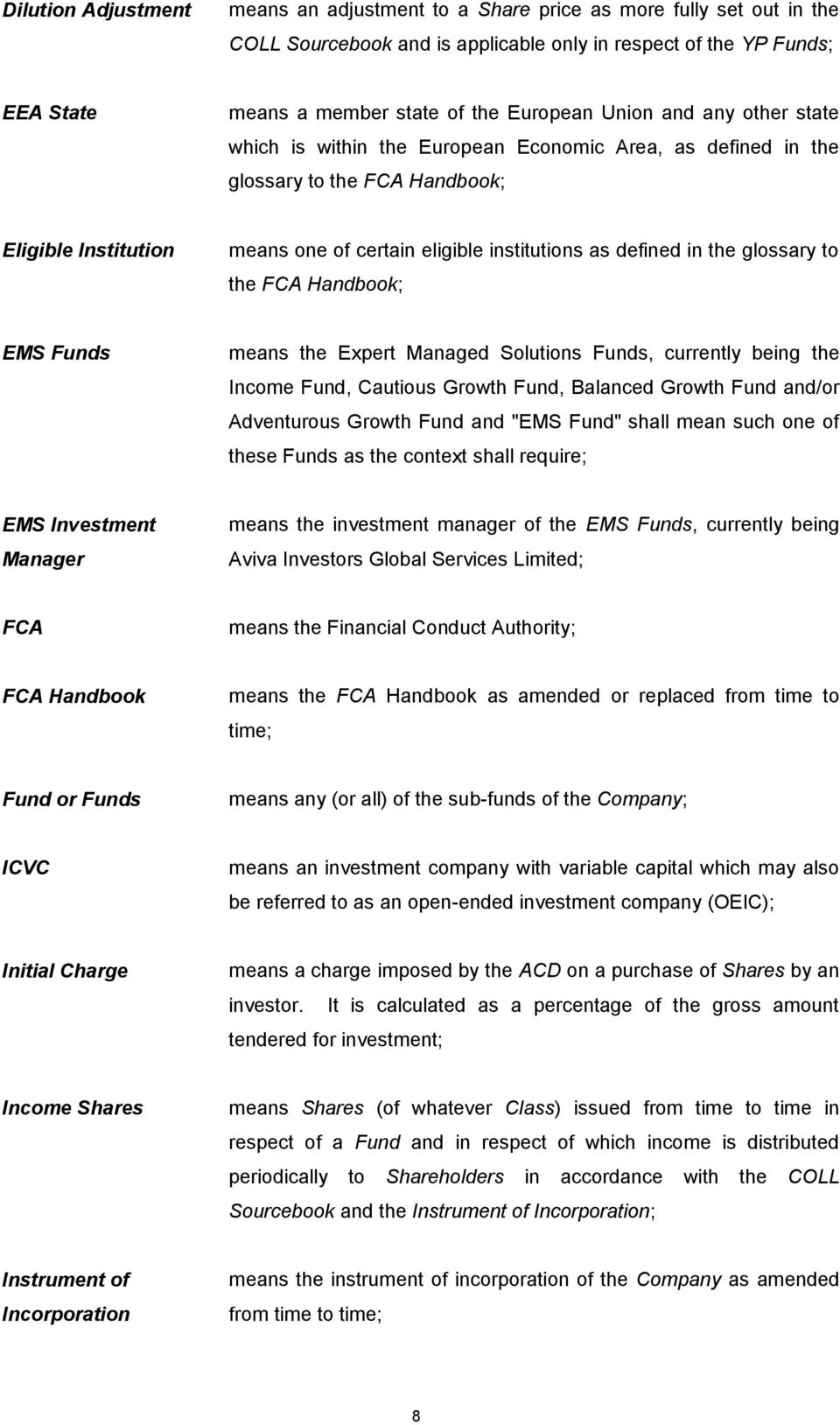
8 Dilution Adjustment means an adjustment to a Share price as more fully set out in the COLL Sourcebook and is applicable only in respect of the YP Funds; EEA State means a member state of the European Union and any other state which is within the European Economic Area, as defined in the glossary to the FCA Handbook; Eligible Institution means one of certain eligible institutions as defined in the glossary to the FCA Handbook; EMS Funds means the Expert Managed Solutions Funds, currently being the Income Fund, Cautious Growth Fund, Balanced Growth Fund and/or Adventurous Growth Fund and "EMS Fund" shall mean such one of these Funds as the context shall require; EMS Investment Manager means the investment manager of the EMS Funds, currently being Aviva Investors Global Services Limited; FCA means the Financial Conduct Authority; FCA Handbook means the FCA Handbook as amended or replaced from time to time; Fund or Funds means any (or all) of the sub-funds of the Company; ICVC means an investment company with variable capital which may also be referred to as an open-ended investment company (OEIC); Initial Charge means a charge imposed by the ACD on a purchase of Shares by an investor. It is calculated as a percentage of the gross amount tendered for investment; Income Shares means Shares (of whatever Class) issued from time to time in respect of a Fund and in respect of which income is distributed periodically to Shareholders in accordance with the COLL Sourcebook and the Instrument of Incorporation; Instrument of Incorporation means the instrument of incorporation of the Company as amended from time to time; 8
9 Investment Manager(s) means either or both the EMS Investment Manager and/or the YPF Investment Manager (as the context requires); Investor Protection Fee means a dilution levy as defined in the COLL Sourcebook; Larger Denomination Share has the meaning given in the OEIC Regulations. Shares are available in larger and smaller denominations with the Smaller Denomination Share representing a defined proportion of a larger denomination share; Net Asset Value or NAV means the value of the Scheme Property of the Company or Fund less the liabilities of the Company or Fund as calculated in accordance with the Instrument of Incorporation; Non-UCITS Retail Scheme means an authorised fund which is neither a UCITS scheme nor a qualified investor scheme; OEIC Regulations means the Open-Ended Investment Companies Regulations 2001 (SI 2001 No.1228) as amended or re-enacted from time to time; PRA means the Prudential Regulation Authority and any successor(s) to it; OECD means the Organisation for Economic Co-operation and Development; RBSG means The Royal Bank of Scotland Group plc; Register means the register of Shareholders maintained by the Registrar in accordance with the OEIC Regulations; Registrar means the registrar of the Company, Aviva Life Services UK Limited, who sub-delegates this responsibility to International Financial Data Services (UK) Limited; Regulations means the OEIC Regulations and the COLL Sourcebook; Scheme Property means the property of the Company or of any Fund as appropriate required under the COLL Sourcebook to be given for safe-keeping to the Depositary; 9

10 SDRT means stamp duty reserve tax; Share or Shares means a share or shares in a Fund (including Larger Denomination Shares and Smaller Denomination Shares); Shareholder means a holder of Shares ; Smaller Denomination Share means one thousandth of a Larger Denomination Share; Switch means the exchange of Shares of one Fund for Shares of another Fund and "switching" and "switched" shall be construed accordingly; UCITS Directive means the Council Directive of 20 December 1985 on the coordination of laws, regulations and administrative provisions relating to undertakings for collective investment in transferable securities (UCITS) (No 85/611/EEC), as amended or re-enacted from time to time; Valuation Point means the point, whether on a periodic basis or for a particular valuation, at which the ACD carries out a valuation of the Scheme Property for the purposes of determining the price at which Shares of a Class in any Fund may be issued, cancelled or redeemed as described in the Valuation section on page 32; VAT means value added tax; YP Funds means the Your Portfolio Funds, currently being the Your Portfolio Fund II, Your Portfolio Fund III, Your Portfolio Fund IV, Your Portfolio Fund V, and/or Your Portfolio Fund VI and "YP Fund" shall mean such one of these Funds as the context shall require; and YPF Investment Manager means the investment manager of the YP Funds, currently being Standard Life Investments; 10

11 Company Details General The Company is authorised by the FCA. It was authorised with effect from 3 March Head Office : St Andrew Square, Edinburgh, EH2 1AF. Address for Service : The Head Office is the address in the United Kingdom for service on the Company of notices or other documents required or authorised to be served on the Company. Base Currency : The base currency of the Company and Funds is pounds sterling. Share Capital : Maximum: 100,000,000,000 : Minimum: 100 Shares in the Company and Funds have no par value. The share capital of the Company will at all times equal the sum of the Net Asset Values of each of the Funds. Shares in the Company are not listed on any investment exchange. Shareholders are not liable for the debts of the Company. 11

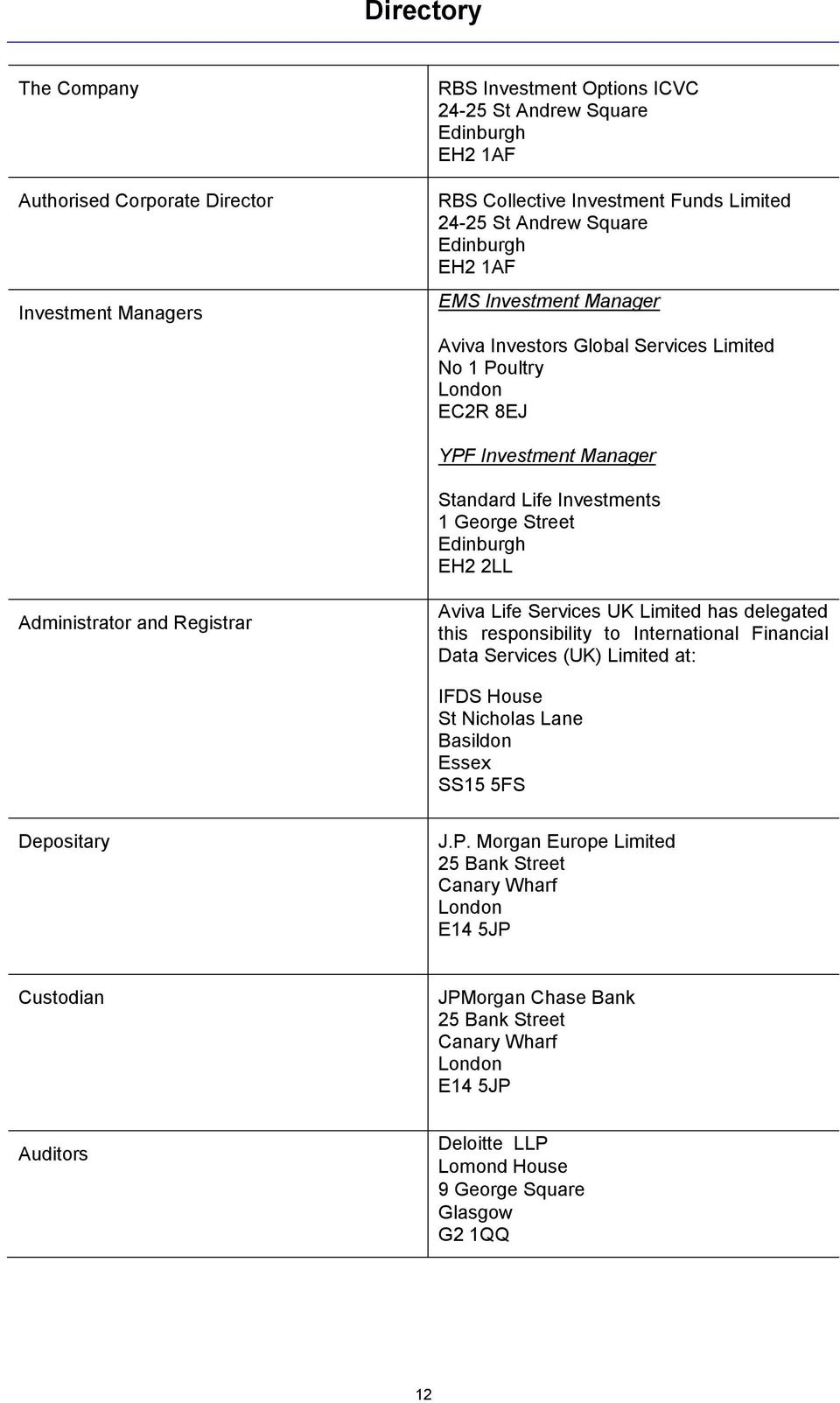
12 Directory The Company Authorised Corporate Director Investment Managers RBS Investment Options ICVC St Andrew Square Edinburgh EH2 1AF RBS Collective Investment Funds Limited St Andrew Square Edinburgh EH2 1AF EMS Investment Manager Aviva Investors Global Services Limited No 1 Poultry London EC2R 8EJ YPF Investment Manager Standard Life Investments 1 George Street Edinburgh EH2 2LL Administrator and Registrar Aviva Life Services UK Limited has delegated this responsibility to International Financial Data Services (UK) Limited at: IFDS House St Nicholas Lane Basildon Essex SS15 5FS Depositary J.P. Morgan Europe Limited 25 Bank Street Canary Wharf London E14 5JP Custodian JPMorgan Chase Bank 25 Bank Street Canary Wharf London E14 5JP Auditors Deloitte LLP Lomond House 9 George Square Glasgow G2 1QQ 12
13 The Constitution of the Company and the Funds The Company The Company is a Non-UCITS Retail Scheme operating under the COLL Sourcebook and is constituted as an umbrella company under the Regulations, which means that the Company issues Shares linked to different Funds. The Funds Each Fund is invested in accordance with the investment objective and investment policy applicable to that Fund and as if it were a separate Non-UCITS Retail Scheme for the purposes of the COLL Sourcebook. For investment purposes the assets of each Fund will be treated as separate from those of every other Fund. The Funds set out below are those currently available: EMS Funds Income Fund Cautious Growth Fund Balanced Growth Fund Adventurous Growth Fund YP Funds Your Portfolio Fund II Your Portfolio Fund III Your Portfolio Fund IV Your Portfolio Fund V Your Portfolio Fund VI Details of these Funds, including their investment objectives and policies, can be found in Appendix I. Additional Funds Further additional Funds may be established in the future by the ACD from time to time with the approval of the FCA and the agreement of the Depositary. Allocation of Assets and Liabilities Each Fund represents a segregated portfolio of assets, which is attributable to the Class or Classes of Shares issued in respect of that Fund. The assets of a Fund belong exclusively to that Fund and shall not be used to discharge (directly or indirectly) the liabilities of, or claims against, any other person or body, including the Company, or any other Fund and shall not be available for any such purpose. Each Fund will be charged with the liabilities, expenses, costs and charges of the Company attributable to that Fund and, within a Fund, charges will be allocated between Classes in accordance with the terms of issue of Shares of those Classes. 13

14 Any expenses specific to a Class will be allocated to that Class and otherwise shall be allocated between Classes by the ACD in a manner which is fair to Shareholders generally. They will normally be allocated to all Classes pro rata to the value of the net assets of the relevant Classes. Any assets, liabilities, expenses, costs or charges not attributable to a particular Fund may be allocated by the ACD in a manner which is fair to the Shareholders generally. They will normally be allocated to all Funds pro rata to the value of the net assets of the relevant Funds. Changes to the Company or the Funds Where any changes are proposed to be made to the Company or a Fund the ACD will assess whether the change is fundamental, significant or notifiable in accordance with COLL 4.3. If the change is regarded as fundamental, Shareholder approval will be required. If the change is regarded as significant, 60 days prior written notice will be given to Shareholders. If the change is regarded as notifiable, Shareholders will receive suitable notice of the change. 14

15 Shares The Company may issue several Classes of Share in respect of each Fund. Classes of Shares may be distinguished on the basis of different criteria which may include their minimum subscription, minimum holding and annual management charge. Access to certain share classes may be restricted. The Classes currently available along with the details of minimum subscriptions, holding criteria and restrictions on availability (if any) are listed below: Class Minima and Restrictions Class 1: Minimum initial subscription 1,000,000 Minimum additional subscription 250 Minimum redemption 500 Minimum holding 500 YPF Class 1: Minimum initial subscription 1,000,000 Minimum additional subscription 250,000 Minimum redemption 10,000 Minimum holding 500,000 YPF Class 2 Minimum initial subscription 1,000,000 Minimum additional subscription 250,000 Minimum redemption 10,000 Minimum holding 500,000 YPF Class 2 shall not be available to any person other than: (i) a person investing through a pension product; or (ii) a person, not being of the type referred to in the preceding paragraph (i), to whom the ACD at its entire discretion has determined that such Shares may be made available. The ACD has the discretion to apply lower minima than those listed above and may waive these from time to time. The details of annual management charges are to be found in the section headed Fees and Expenses on page 59. As a result of differences in annual management charges for the different Classes of Shares, monies may be deducted from Classes of the same Fund in 15

16 unequal proportions. In these circumstances the proportionate interests of the Classes will be adjusted accordingly (for an explanation of proportionate interests please refer to the section headed Proportionate entitlements on page 40). Net Income Shares and/or net Accumulation Shares are available within each Class. Gross Income Shares and gross Accumulation Shares in each Fund may also be issued but are not currently offered. The types of Shares presently available in each Fund are set out in the details of the relevant Funds (see Appendix I). Further Classes of Share may be established from time to time by the ACD with the approval of the FCA and the agreement of the Depositary. On the introduction of any new Fund or Class, either a revised Prospectus or a supplemental Prospectus will be prepared setting out the relevant details of each Fund or Class. Conversion and Switching Shareholders are entitled (subject to certain restrictions) to convert all or part of their Shares in a Class for Shares in another Class in respect of the same Fund or to Switch all or part of their Shares in relation to one Fund for Shares in relation to a different Fund (but in either case not into any other Fund of which the ACD is the authorised corporate director or authorised fund manager). Details of these Conversion and Switching facilities and the restrictions are set out in the section headed Conversion and Switching on page 21. Income and Accumulation Shares Holders of Income Shares will receive distributions. Each allocation of income made in respect of any Fund at a time when more than one Class is in issue will be done by reference to the relevant Shareholders proportionate interests in the Scheme Property of the Fund in question. Shareholders can choose to have their distribution of income paid direct to their bank or building society current account. Alternatively, Shareholders may choose to have their income distributions automatically reinvested, to purchase further Shares of the same Class and Fund at the prevailing Net Asset Value without attracting an Initial Charge. For regular savings plans invested in Income Shares the income distribution is automatically reinvested in Shares of the same Class and Fund unless this supplements a lump sum investment on which income payment has been selected. Holders of Accumulation Shares do not receive payments of income. Any income arising in respect of an Accumulation Share is automatically accumulated and is reflected in the price of each Accumulation Share. No Initial Charge is levied on this accumulation. 16

17 Tax vouchers for both Income Shares and Accumulation Shares will be issued in respect of distributions made and tax accounted for. Where both Income Shares and Accumulation Shares are in existence in relation to a Fund, the relevant Shareholders proportionate interests in the Scheme Property of the Fund represented by each Accumulation Share increases as income is accumulated. Further, in these circumstances, the income of the Fund is allocated between Income Shares and Accumulation Shares according to the relevant Shareholders proportionate interests in the Scheme Property of the Fund represented by the Accumulation Shares and Income Shares in existence at the end of the relevant accounting period. 17

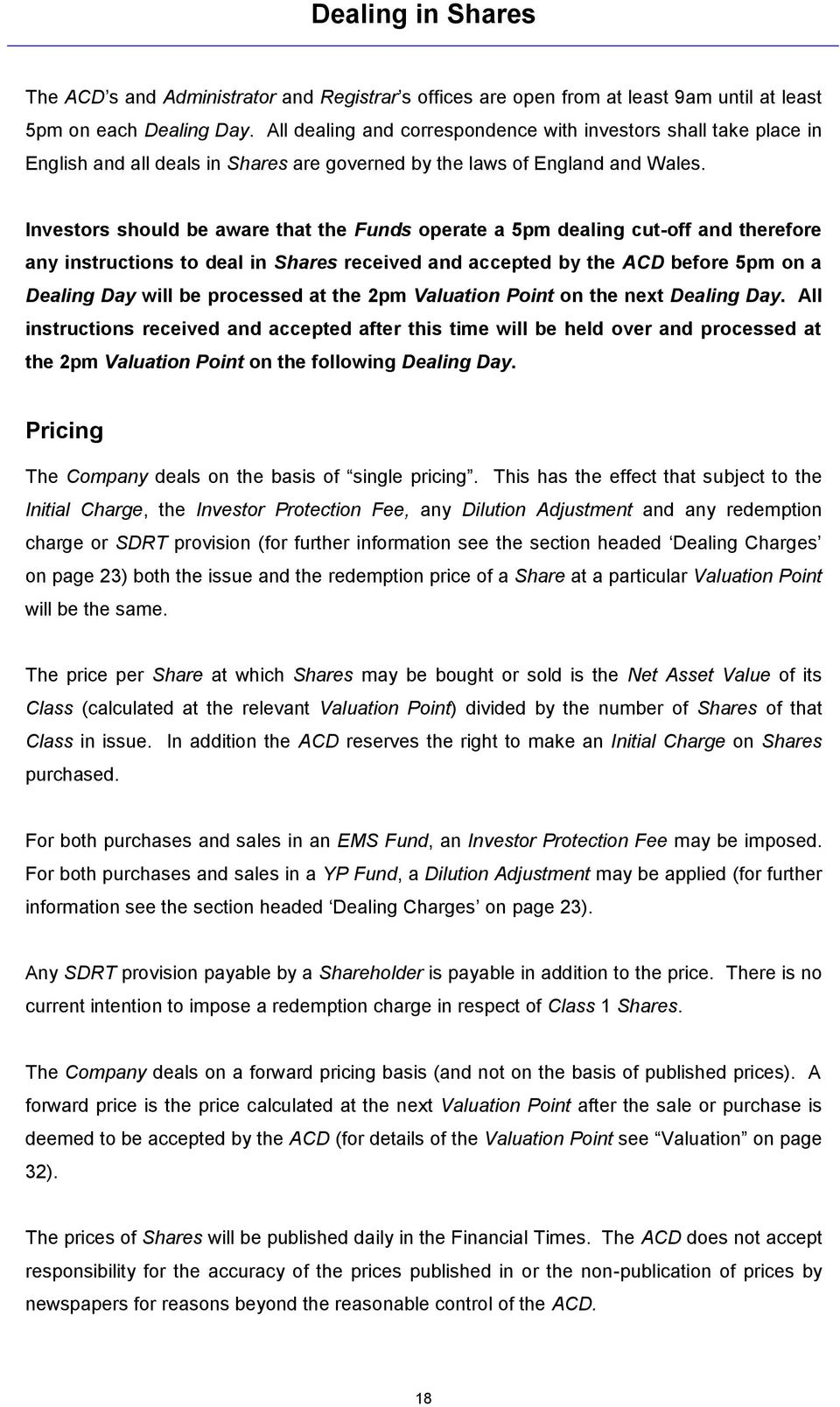
18 Dealing in Shares The ACD s and Administrator and Registrar s offices are open from at least 9am until at least 5pm on each Dealing Day. All dealing and correspondence with investors shall take place in English and all deals in Shares are governed by the laws of England and Wales. Investors should be aware that the Funds operate a 5pm dealing cut-off and therefore any instructions to deal in Shares received and accepted by the ACD before 5pm on a Dealing Day will be processed at the 2pm Valuation Point on the next Dealing Day. All instructions received and accepted after this time will be held over and processed at the 2pm Valuation Point on the following Dealing Day. Pricing The Company deals on the basis of single pricing. This has the effect that subject to the Initial Charge, the Investor Protection Fee, any Dilution Adjustment and any redemption charge or SDRT provision (for further information see the section headed Dealing Charges on page 23) both the issue and the redemption price of a Share at a particular Valuation Point will be the same. The price per Share at which Shares may be bought or sold is the Net Asset Value of its Class (calculated at the relevant Valuation Point) divided by the number of Shares of that Class in issue. In addition the ACD reserves the right to make an Initial Charge on Shares purchased. For both purchases and sales in an EMS Fund, an Investor Protection Fee may be imposed. For both purchases and sales in a YP Fund, a Dilution Adjustment may be applied (for further information see the section headed Dealing Charges on page 23). Any SDRT provision payable by a Shareholder is payable in addition to the price. There is no current intention to impose a redemption charge in respect of Class 1 Shares. The Company deals on a forward pricing basis (and not on the basis of published prices). A forward price is the price calculated at the next Valuation Point after the sale or purchase is deemed to be accepted by the ACD (for details of the Valuation Point see Valuation on page 32). The prices of Shares will be published daily in the Financial Times. The ACD does not accept responsibility for the accuracy of the prices published in or the non-publication of prices by newspapers for reasons beyond the reasonable control of the ACD. 18
19 The prices of Shares are also available at and Buying Shares Applications to purchase Shares in the Funds can be made by telephoning the ACD on * (subject to subsequent completion of an application/registration form for administrative and verification purposes) or by sending a completed application form to the Administrator. Application forms are available from the ACD by writing to the Administrator or by telephoning the ACD. The ACD, may from time to time agree other methods of dealing in Shares, including the use of the EMX messaging system. The ACD may at its discretion introduce further methods in the future. The ACD may in the future introduce an electronic trading system which will enable individual investors to buy and sell Shares using the internet but at present the ACD will only accept written and telephone instructions to deal. *Calls may be recorded for monitoring or training purposes Applications for Shares which are received and accepted by the ACD by 5.00pm on a Dealing Day will be dealt with at the price calculated as at the Valuation Point on the next Dealing Day. Applications received and accepted after that time will be held over and dealt with at the price calculated as at the Valuation Point for the following Dealing Day. The ACD has the right to reject, on reasonable grounds relating to the circumstances of the applicant, any application for Shares in whole or part, and in this event the ACD will return any money sent, or the balance of such monies, at the risk of the applicant. Any subscription monies remaining after a whole number of Shares has been issued will not be returned to the applicant. Instead, Smaller Denomination Shares will be issued in such circumstances. A Smaller Denomination Share is equivalent to one thousandth of a Larger Denomination Share. Applications for purchase will not be acknowledged but a contract note will be issued by the end of the Business Day following the relevant Dealing Day, together with, where appropriate, a notice of the applicant s right to cancel. The contract note will give details of the Shares purchased and the price used. An applicant has the right to cancel his application to buy Shares at any time during the 30 days after the date on which he receives a cancellation notice from the ACD. If an applicant decides to cancel the contract, and the value of the investment has fallen at the time the ACD receives the completed cancellation notice, he will not receive a full refund as an amount equal to any fall in value will be deducted from the sum originally invested. The determination 19

20 of any shortfall will be based upon the price of the Fund at the next Dealing Day following the ACD s receipt of the completed cancellation notice. If payment has not already been made settlement of the full purchase price and any related fees and expenses is due immediately. The ACD, at its discretion, may delay issuing the Shares until payment is received. If settlement is not made within a reasonable period, the ACD has the right to cancel any Shares issued in respect of the application. Share certificates will not be issued in respect of registered Shares. Ownership of Shares will be evidenced by an entry on the Register of Shareholders. Statements covering periodic distributions on Shares will show the number of Shares held by the recipient. Individual statements of a Shareholder s (or in the case of joint holdings, the first named holder s) Shares will also be issued at any time on request by the registered holder. The Company has power to issue bearer shares but there are no present plans to do so. Regular Savings Plan The ACD operates a regular savings plan for Class 1 Shares subject to a minimum monthly subscription of 50 in any one Fund. Contract notes for the purchase of Shares will not be issued to Shareholders investing through a regular savings plan. Selling Shares A Shareholder wishing to sell Shares should contact the ACD by telephone on * or in writing. Instructions to sell are irrevocable. The ACD, may from time to time agree other methods of dealing in Shares, including the use of the EMX messaging system. The ACD may, at its discretion, introduce further methods in the future. The ACD may in the future introduce an electronic trading system which will enable individual investors to buy and sell Shares using the internet but at present the ACD will only accept written and telephone instructions to deal. *Calls may be recorded for monitoring or training purposes Every Shareholder is entitled on any Business Day to request that the Company redeem their Shares and the Company will be required to redeem them in accordance with the procedures set out below. Redemption requests received and accepted by the ACD by 5pm on a Dealing Day will be dealt with at the price calculated as at the Valuation Point on the next Dealing Day. All requests received and accepted after that time will be dealt at the price calculated as at the Valuation Point for the following Dealing Day. 20

21 If the redemption would leave a residual holding of less than the minimum holding the ACD has the discretion to require redemption of the entire holding. A contract note giving details of the number and price of Shares sold will be sent to the selling Shareholder (the first named in the case of joint holders) together (if sufficient written instructions have not already been given) with a form of renunciation for completion and execution by the Shareholder (and in the case of joint holders, by all the joint holders) no later than the end of the Business Day following the day of the Valuation Point by reference to which the redemption price is determined. The redemption monies will be paid within four Business Days of the later of 1. the receipt by the ACD of the form of renunciation (or other sufficient written instructions) duly signed by all the relevant Shareholders and completed as to the appropriate number of Shares, together with any other appropriate evidence of title, and 2. the Valuation Point by reference to which the redemption price is determined. However where money is owing on the earlier sale of the Shares to be redeemed and has not been received and cleared by the time the redemption proceeds would otherwise be payable, then the redemption proceeds for those Shares will not be sent until such time as the initial money has been received and cleared. Minimum Redemption Part of a Shareholder s holding may be sold but the ACD reserves the right to refuse a redemption request if the value of the Shares of any Fund to be redeemed is less than the minimum redemption amounts as stated on page 15. Additionally the ACD reserves the right to refuse a redemption request for part of Shareholder s holding if the value of the remaining holding would fall below the minimum holding (if any) in a Fund or Class as set out on page 15. Conversion and Switching Subject to the qualifications below and to the relevant minimum holding restrictions, the Shareholder may at any time Switch or Convert (as appropriate) all or some of his Shares of one Class or Fund ("Original Shares") for a number of Shares of another Class or Fund ("New Shares"). The number of New Shares issued is determined by the following formula: 21
22 O x (CP x ER) N = SP Where: N is the number of New Shares to be issued; O is the number of Original Shares to be exchanged or sold; CP is the price at which one Original Share can be redeemed at the applicable Valuation Point; ER is 1 (for same currency Shares) and SP is the price at which one New Share can be purchased at the applicable Valuation Point. Each number referred to in the definition of N or O shall be expressed to the third decimal place and rounded down thereto in the case of N, so that the integer represents the number of Larger Denomination Shares and the decimal when multiplied by 1,000 represents the number of Smaller Denomination Shares. If a Shareholder wishes to Convert or Switch Shares he should apply to the ACD in the same manner as for a sale as set out on page 20. The ACD may at its discretion impose restrictions as to the Classes for which exchange may be effected and charge a fee on the Switching of Shares between Funds, up to the then prevailing Initial Charge relating to the Class and Fund into which the Shares are being Converted or Switched. These fees are set out on page 60. There is no fee on a Conversion between Classes of the same Fund but the ACD may, subject to the COLL Sourcebook introduce such a fee at its discretion. Additionally circumstances may arise on Switching when the ACD imposes an Investor Protection Fee (in the case of an EMS Fund) or a Dilution Adjustment (in the case of a YP Fund), the details of which are described on page 23. If the Conversion or Switch would result in the Shareholder holding a number of Original Shares or New Shares of a value which is less than the minimum holding in the Fund concerned, the ACD may, if it thinks fit, Convert the whole of the applicant s holding of Original Shares to New Shares or refuse to effect any Switch of the Original Shares. No Conversion or Switch will be made during any period when the right of Shareholders to require the redemption of their Shares is suspended. The general provisions on procedures relating to redemption will apply equally to a Conversion or Switch. Conversion or Switching requests received and accepted before 5pm on a Dealing Day will be processed at the Valuation Point on the next Dealing Day. Conversion or Switching requests received and 22
23 accepted after a Valuation Point will be held over until the Valuation Point on the following Dealing Day. The ACD may adjust the number of New Shares to be issued to reflect the imposition of any Conversion or switching fee together with any other charges or levies in respect of the issue or sale of the New Shares or repurchase or cancellation of the Original Shares as may be permitted by the COLL Sourcebook and the Instrument of Incorporation. A Shareholder who Switches or Converts as appropriate Shares in one Fund or Class for Shares in any other Fund or Class will not be given a right to withdraw from or cancel the transaction. It should be noted that a Switch of Shares in one Fund for Shares in any other Fund is treated as a realisation and will, for persons subject to United Kingdom taxation, be a disposal for the purposes of capital gains taxation. A Conversion of Shares in one Class for Shares in another Class in relation to the same Fund will not normally be treated as a realisation for United Kingdom tax purposes. Dealing Charges Initial Charge The ACD may impose a charge on the purchase of Shares by an investor. The charges for all Funds and Classes are set out in the section headed Fees and Expenses on page 59. Switching Fee On the Switching of Shares of a Fund for Shares in another Fund, the ACD has the power under the Instrument of Incorporation to charge a switching fee. The switching fee which is payable to the ACD will not exceed an amount equal to the then prevailing Initial Charge for the Class and Fund into which the Shares are being Switched. There is no charge for Converting Shares in one Class of a Fund for Shares in another Class of the same Fund but the ACD may, subject to the COLL Sourcebook introduce such a fee at its discretion. Dilution The basis of valuation of the Company s or a Fund s investments for the purpose of calculating the issue and redemption price of Shares as stipulated in the COLL Sourcebook and the Instrument of Incorporation is summarised in the section headed Valuation on page 32. When the Company purchases or sells investments it will usually incur cost in the form of dealing charges and any spread between the buying and selling prices of the investment. This cost is not reflected in the sale or purchase price paid by an investor. In some 23
24 circumstances (for example where large volumes of deals in a Fund s Shares require a Company to purchase or sell Fund investments) this may have an adverse effect on Shareholders interests in the Fund. This effect is referred to as dilution. To mitigate the effects of dilution, the ACD has the power to charge a dilution levy (referred to in this Prospectus as an Investor Protection Fee ) or a Dilution Adjustment (sometimes known as "swinging single pricing") on the purchase and/or sale of Shares. The ACD has decided that it is appropriate to put in place provisions to be able to charge an Investor Protection Fee for the EMS Funds. The ACD has also decided that it is appropriate to put in place a mechanism for Dilution Adjustment for the YP Funds. The following sections provide further detail on the Investor Protection Fee and Dilution Adjustment. Investor Protection Fee (dilution levy) (Note: this section only applies to the EMS Funds) If an Investor Protection Fee is charged, this fee is added to the purchase cost or deducted from the sale proceeds, as appropriate, and paid into and becomes a part of the Scheme Property of the relevant Fund. The ACD does not benefit from any Investor Protection Fee. The necessity to charge an Investor Protection Fee will depend on the volume of purchases or sales. The ACD may charge a discretionary Investor Protection Fee on the purchase and sale of Shares if, in its opinion, the existing Shareholders (for purchases) or remaining Shareholders (for sales) might otherwise be adversely affected. On the occasions where an Investor Protection Fee is not applied, there may be an adverse impact on the total assets of the Company, which may constrain capital growth of the Company. An Investor Protection Fee may be charged in the following circumstances: 1. on a Fund experiencing large levels of net purchases (i.e. purchases less sales) relative to its size. In these circumstances the Investor Protection Fee may be applied in particular to individual deals exceeding 25,000; 2. on a Fund experiencing large levels of net sales (i.e. sales less purchases) relative to its size. In these circumstances the Investor Protection Fee may be applied in particular to individual deals exceeding 25,000; 3. on large deals. For these purposes a large deal is defined as a deal exceeding 250,000 or 2 per cent of the Net Asset Value of a Fund whichever is the lesser; 24
25 4. where a Shareholder redeems or Switches a holding of Shares within 30 days of its purchase; 5. where a Fund is an index tracking fund or is otherwise passively managed; 6. in any other case where the ACD is of the opinion that the interests of existing/continuing Shareholders and/or potential Shareholders require the imposition of an Investor Protection Fee. The Investor Protection Fee, if any, will be determined by the ACD by reference to the costs of dealing in the underlying investments of the relevant EMS Fund, including any dealing spreads, commission and transfer taxes. As dilution is directly related to the inflow and outflow of monies from the Company, it is not possible to accurately predict whether a dilution will occur at any future point in time. Consequently it is not possible to accurately predict how frequently the ACD will need to impose an Investor Protection Fee. However, based on future projections, it is envisaged that, the ACD would not expect to apply an Investor Protection Fee, in respect of any particular EMS Fund on a frequent basis in the future. The amount of any Investor Protection Fee may vary over time and may differ for each EMS Fund. Should the ACD apply an Investor Protection Fee it is estimated that this would be at the rate of 0.3%. This paragraph will continue to be revised from time to time. In the twelve month period to the end of September 2013, no Investor Protection Fees were levied. Dilution Adjustment (Note: this section only applies to the YP Funds) The ACD may, at its discretion, make a Dilution Adjustment on the sale and/or redemption of Shares (including Switches) in a YP Fund if, in its opinion, the existing Shareholders (for purchases) or remaining Shareholders (for redemptions) might otherwise be materially affected. In particular, the ACD may make a Dilution Adjustment under the following circumstances: 1. where the Fund is, in the opinion of the ACD, experiencing a period of continual decline. In this case, the Dilution Adjustment would be made on all redemptions; 2. on a Fund experiencing large levels of net purchases relative to its size; 25
26 3. on a Fund experiencing net purchases or net redemptions on any day having an impact of 0.1% or more on the value of existing Shares; 4. in any other case where the ACD is of the opinion that the interests of the Shareholders require the imposition of a Dilution Adjustment. A Dilution Adjustment will be calculated separately for each YP Fund and the level of any adjustment will be determined by the ACD by reference to the costs of dealing in the underlying investments of the relevant YP Fund, including any dealing spreads, commission and transfer taxes. As dilution is directly related to the inflows and outflows of monies from the Funds it is not possible to accurately predict whether dilution will occur at any future point in time. Consequently it is also not possible to accurately predict how frequently the ACD will need to make such a Dilution Adjustment. If there are net inflows into a YP Fund a Dilution Adjustment will increase the Share price and if there are net outflows a Dilution Adjustment will decrease the Share price. Based on future projections, the following table shows the estimated Dilution Adjustment for each YP Fund. The rate of any Dilution Adjustment made from time to time will differ for each Fund and be dependent on dealing spreads, commissions and taxes and duties arising on the purchase or sale of the Scheme Property of the relevant YP Fund. These estimated rates may differ in practice. Sub-Fund Name Your Portfolio Fund II Your Portfolio Fund III Your Portfolio Fund IV Your Portfolio Fund V Estimated Dilution Adjustment (%) Estimated Dilution Adjustment (%) Future Projection of the Number of Days Applicable For Applicable For on which a Purchases Sales Dilution Adjustment will be Applied 0.27% 0.12% % 0.18% % 0.23% % 0.27%
27 Your Portfolio Fund VI 0.32% 0.18% 257 On the occasions when the Dilution Adjustment is not applied there may be an adverse impact on the total assets of the relevant YP Fund. Redemption Charge The ACD reserves the right to impose a redemption charge on the value of the Shares redeemed. No such charge is currently being imposed in the redemption of Class 1. Transfers Shareholders are entitled to transfer their Shares to another person or body. All transfers must be in writing in the form of an instrument of transfer approved by the ACD for this purpose. Completed instruments of transfer must be returned to the Administrator. For further details please see page 69. Compulsory Transfer and Redemption Shares in the Company may not be acquired or held by any person in circumstances ("Relevant Circumstances"): 1. which constitute a breach of the law or governmental regulation (or any interpretation of a law or regulation by a competent authority) of any country or territory; or 2. which would (or would if other Shares were acquired or held in the circumstances) result in the Company incurring any liability to taxation or suffering any other pecuniary disadvantage or other adverse consequence (including a requirement to register under any securities or investment or similar laws or governmental regulation of any country or territory). In this connection, the ACD has a discretion to reject any application for the purchase, sale or Switching of Shares. If it comes to the notice of the ACD that any Shares ("Affected Shares") have been acquired or are being held directly or beneficially in any of these Relevant Circumstances or by virtue of which the Shareholder or Shareholders in question is/are not qualified to hold such Shares or if it reasonably believes this to be the case, the ACD may give notice to the holder(s) of the Affected Shares requiring the transfer of such Shares to a person who is qualified or entitled to own them or that a request in writing be given for the redemption or cancellation of such Shares in accordance with the COLL Sourcebook. If any person upon whom such a notice is 27
28 served does not within thirty days after the date of such notice transfer his Affected Shares to a person qualified to own them or establish to the satisfaction of the ACD (whose judgement shall be final and binding) that he and any person on whose behalf he holds the Affected Shares are qualified and entitled to own them, he shall be deemed upon the expiration of the thirty day period to have given a request in writing for the redemption or cancellation (at the discretion of the ACD) of all the Affected Shares pursuant to the COLL Sourcebook. A person who becomes aware that he has acquired or holds Affected Shares in any of these Relevant Circumstances, or by virtue of which he is not qualified to hold such Affected Shares, must immediately, unless he has already received a notice as set out above, either transfer all their Affected Shares to a person qualified to own them or give a request in writing for the redemption of all their Affected Shares pursuant to the COLL Sourcebook. In Specie Redemptions If a Shareholder requests the redemption or cancellation of Shares the ACD may arrange that in place of payment of the price of the Shares in cash, the Company cancels the Shares and transfers Scheme Property (or, if required by the Shareholder, the net proceeds of sale of relevant Scheme Property), to the Shareholder. This only applies however if the Shares represent over 5 % (or such smaller percentage as the ACD may decide) of the Fund s value. Before the proceeds of the cancellation of Shares become payable, the ACD must give written notice to the Shareholder that the Scheme Property or the proceeds of sale of Scheme Property will be transferred to that Shareholder. The Scheme Property to be transferred will be selected by the ACD in consultation with the Depositary. They must ensure that the selection is made with a view to achieving no more advantage or disadvantage to the Shareholder requesting cancellation/redemption than to the continuing Shareholders of the Fund concerned. The Scheme Property to be transferred or the proceeds of sale of the relevant Scheme Property shall be subject to the retention by the Company of Scheme Property or cash equivalent in value to any SDRT to be paid by the ACD in relation to the redemption of Shares. In Specie Applications The ACD may, at its discretion and by special arrangement, agree to arrange for the Company to issue Shares in exchange for assets other than money, but will only do so where the Depositary has taken reasonable care to determine that the Company s acquisition of those assets in exchange for the Shares is not likely to result in any material prejudice to the 28
29 interests of Shareholders or potential Shareholders of the Fund concerned. The ACD will ensure that the beneficial interest in the assets concerned is transferred to or for the account of the Company with effect from the date of issue of the Shares. The ACD will not issue Shares in any Fund in exchange for assets the holding of which would be inconsistent with the investment objective of that Fund. General To satisfy a request for the issue, redemption or exchange of Shares, the ACD will normally sell Shares to or repurchase Shares from Shareholders to meet such requests. The ACD is entitled to hold Shares for its own account and to satisfy requests for sale from its own holding. Although the ACD dealing in Shares held by it, for its own account, is not with the intention of making a profit there will be occasions when such dealings do give rise to a profit. In some circumstances and in accordance with the COLL Sourcebook, the Company will issue or cancel Shares to meet such requests. The COLL Sourcebook requires the ACD to procure the issue or cancellation by the Company where necessary to meet any obligation to sell or redeem Shares. The ACD is under no obligation to account to the Company or to Shareholders for any profit it makes on the issue, reissue or cancellation of Shares and will not do so. The amount to be charged by or paid to the ACD for the sale of a Share by the ACD will not be more than the price of a Share notified to the Depositary at the relevant Valuation Point plus any Initial Charge and/or (in the case of an EMS Fund) Investor Protection Fee which may apply. The amount to be paid by the ACD for the redemption of a Share will not be less than the price of a Share notified to the Depositary at the relevant Valuation Point less any redemption charge or Investor Protection Fee which may apply. Market timing The ACD may refuse to accept a subscription or a Switch between Funds if it has reasonable grounds, in relation to the Shareholder concerned, for refusing to accept a subscription or a Switch from them. In particular, the ACD may exercise this discretion if it believes the 29
30 Shareholder has been or intends to engage in market timing activities. The ACD does not condone or engage in market timing activities. Money Laundering Under current legislation in the United Kingdom to prevent money laundering, persons conducting investment business are responsible for compliance with anti-money laundering regulations. So as to ensure compliance appropriate identification enquiries may be made in certain circumstances whether in respect of the sale, purchase or transfer of Shares or distribution of income. Until satisfactory proof of identity is provided, the ACD reserves the right to refuse to carry out the transaction requested or pay income on Shares to the investor. The ACD may use an external agency to verify the identity of Shareholders or potential Shareholders for anti-money laundering purposes. Suspension of Dealings in Shares The ACD may with the agreement of the Depositary (and must if the Depositary so requires) temporarily suspend the issue, cancellation, sale and redemption of Shares of any one or more Classes in any or all of the Funds if the ACD, or the Depositary in the case of any requirement by the Depositary, is of the opinion that due to exceptional circumstances it is in the interests of all the Shareholders. At the time of suspension, the ACD, or the Depositary if it has required the ACD to suspend dealing in Shares, must inform the FCA immediately stating the reasons for its actions and, as soon as is practicable, give the FCA written confirmation of the suspension and the reasons for it. The ACD will notify Shareholders of the suspension as soon as practicable after suspension commences and will inform Shareholders how to obtain information which the ACD will publish to keep Shareholders appropriately informed about the suspension including, if known, its likely duration. During a suspension the obligations relating to the issue, sale, cancellation and redemption of Shares contained in Chapter 6 of the COLL Sourcebook will cease to apply and the ACD must comply with as many of the obligations relating to valuation of assets as is practicable in the light of the suspension. During any period of suspension, the ACD may agree to issue, redeem or Switch Shares at a price calculated by reference to the first Valuation Point after the end of the suspension. Any deals outstanding prior to the suspension shall be undertaken at a price calculated by reference to the first Valuation Point after the suspension. 30
31 In accordance with Chapter 7 of the COLL Sourcebook, suspension of dealing in Shares must cease as soon as practicable after the exceptional circumstances have ceased and the ACD and Depositary must formally review the suspension at least every 28 days and must inform the FCA of the results of this review. The calculation of Share prices will recommence as at the next Valuation Point following the ending of the suspension. 31
32 Valuation The price of a Share is calculated by reference to the Net Asset Value of the Fund and Class to which it relates. The Valuation Point for each of the Funds is at 2pm on each Dealing Day. The ACD may carry out an additional valuation at any time if it considers it desirable to do so. Calculation of the net asset value The Net Asset Value of the Company and each Fund shall be the value of its assets less the value of its liabilities determined in accordance with the following provisions: 1. All the Scheme Property (including receivables) of the Company (or the Fund) is to be included, subject to the following provisions. 2. Property which is not cash (or other assets dealt with in paragraphs 3 and 4 below) shall be valued as follows and the prices used shall (subject as follows) be the most recent prices which it is practicable to obtain: (a) units or Shares in a collective investment scheme: (i) if a single price for buying and selling units or Shares is quoted, at that price; or (ii) if separate buying and selling prices are quoted, at the average of the two prices provided the buying price has been reduced by any Initial Charge included therein and the selling price has been increased by any exit or redemption charge attributable thereto; or (iii) if, in the opinion of the ACD, the price obtained is unreliable or no recent traded price is available or if no recent price exists, at a value which in the opinion of the ACD is fair and reasonable; (b) exchange-traded derivative contracts: (i) if a single price for buying and selling the exchange-traded derivative contract is quoted, at that price; or (ii) if separate buying and selling prices are quoted at the average of the two prices; 32
33 (c) over-the-counter derivative contracts shall be valued in accordance with the method of valuation as shall have been agreed between the ACD and the Depositary; (d) any other investment: (i) if a single price for buying and selling the security is quoted, at that price; or (ii) if separate buying and selling prices are quoted, at the average of the two prices; or (iii) if, in the opinion of the ACD, the price obtained is unreliable or no recent traded price is available or if the most recent price available does not reflect the ACD's best estimate of the value, at a value which in the opinion of the ACD is fair and reasonable; and (e) property other than that described in (a), (b), (c), (d) and (e) above: at a value which, in the opinion of the ACD, represents a fair and reasonable midmarket price. 3. Cash and amounts held in current, deposit and margin accounts and in other time related deposits shall be valued at their nominal values. 4. In determining the value of the Scheme Property, all instructions given to issue or cancel Shares shall be assumed (unless the contrary is shown) to have been carried out and any cash payment made or received and all consequential action required by the Regulations, the Instrument of Incorporation or this Prospectus shall be assumed (unless the contrary has been shown) to have been taken. 5. Subject to paragraphs 6 and 7 below, agreements for the unconditional sale or purchase of property which are in existence but uncompleted shall be assumed to have been completed and all consequential action required to have been taken. Such unconditional agreements need not be taken into account if made shortly before the valuation takes place and, in the opinion of the ACD, their omission shall not materially affect the final net asset amount. 33
34 6. Futures or contracts for differences which are not yet due to be performed and unexpired and unexercised written or purchased options shall not be included under paragraph All agreements are to be included under paragraph 5 which are, or ought reasonably to have been, known to the person valuing the property assuming that all other persons in the ACD's employment take all reasonable steps to inform it immediately of the making of any agreement. 8. Deduct an estimated amount for anticipated tax liabilities (on unrealised capital gains where the liabilities have accrued and are payable out of the Scheme Property; on unrealised capital gains in respect of previously completed and current accounting periods; and on income where liabilities have accrued) including (as applicable and without limitation) capital gains tax, income tax, corporation tax, VAT, stamp duty and SDRT. 9. Deduct an estimated amount for any liabilities payable out of the Scheme Property and any tax thereon treating periodic items as accruing from day to day. 10. Deduct the principal amount of any outstanding borrowings whenever payable and any accrued but unpaid interest on borrowings. 11. Add an estimated amount for accrued claims for tax of whatever nature which may be recoverable. 12. Add any other credits or amounts due to be paid into the Scheme Property. 13. Add a sum representing any interest or any income accrued due or deemed to have accrued but not received and any stamp duty reserve tax provision anticipated to be received 14. Currencies or values in currencies other than the base currency or (as the case may be) the designated currency of a sub-fund shall be Converted at the relevant Valuation Point at a rate of exchange that is not likely to result in any material prejudice to the interests of the Shareholders or potential Shareholders. Notwithstanding the foregoing, the ACD may, at its discretion, use other generally recognised valuation principles in order to reach a proper valuation of the Net Asset Value of the Company or a Fund, in the event that it is impractical or manifestly incorrect to carry out a valuation of an investment in accordance with the above rules or it considers such principles 34
35 better reflect the valuation of a security, interest or position and are in accordance with generally accepted accounting principles. Fair Value Pricing The ACD may, in its absolute discretion and in circumstances where: 1. it believes that no reliable price for the property in question exists; or 2. such price, if it does exist, does not reflect the ACD s best estimate of the value of such property, value the Scheme Property or any part of Scheme Property at a price which, in its opinion, reflects a fair and reasonable price for that property (Fair Value Pricing). The ACD is permitted to use Fair Value Pricing in specific circumstances and pursuant to processes and methodologies that it must have notified to the Depositary. Examples of the circumstances in which the ACD might consider using Fair Value Pricing where a Fund s Valuation Point is set during the time when markets in which its portfolio is invested are closed for trading include: 1. market movements above a pre-set trigger level in other correlated open markets; 2. war, natural disaster, terrorism; 3. government actions or political instability; 4. currency realignment or devaluation; 5. changes in interest rates; 6. corporate activity; 7. credit default or distress; or 8. litigation. Even if a Fund s Valuation Point is set during the time other markets are open for trading, other scenarios might include: 1. failure of a pricing provider; 35
36 2. closure or failure of a market; 3. volatile or fast markets; 4. markets closed over national holidays; 5. stale or unreliable prices; 6. listings suspensions or de-listings. 36
37 Income and Distributions Accounting periods The annual accounting period of the Company ends each year on 31 October (the accounting reference date) and its half yearly interim accounting period ends each year on 30 April. The Income Fund also has quarterly interim accounting periods that end each year on 31 January and 31 July. Distributions The Funds will make dividend distributions or accumulations except where over 60% of the Fund s property has been invested throughout the distribution period in interest-bearing investments, in which case it will make interest distributions or accumulations. Currently, all of the EMS Funds pay dividend distributions. In addition, each of Your Portfolio Fund III, Your Portfolio Fund IV, Your Portfolio Fund V and Your Portfolio Fund VI pay dividend distributions. For Your Portfolio Fund II any income paid or allocations made will constitute an interest distribution. Distributions to the holders of Income Shares will be made within two months of the end of each accounting period. Distributions will therefore be made as follows: Accounting Period Ends Income Distribution Paid on or before 31 October 31 December 31 January* 31 March* 30 April 30 June 31 July* 30 September* *Funds with quarterly interim accounting periods only. The amount available for distribution in any accounting period is calculated in accordance with the allocation procedure set out below. Distributions may be made by cheque or bank transfer or such other means of payment as may be permitted by the ACD in each year. The ACD will give the Depositary timely instructions to enable the Depositary to distribute the income allocated to Income Shares of each Class in a Fund among their holders in proportion to the numbers of such Shares held, or treated as held, by them respectively at the end of the relevant accounting period. The Depositary will pay the distribution to the holders of Income Shares in accordance with the instructions. 37
38 The amount of income allocated to the holders of a Class of Accumulation Shares will become part of the capital property (as defined in the COLL Sourcebook) attributable to those Shares as at the end of that annual accounting period. Where other Classes are in issue in respect of a Fund during that accounting period, the interests of the holders of Accumulation Shares in the amount of income allocated to a particular Class must be satisfied by an adjustment, as at the end of the period, in the proportion of the value of the Scheme Property to which the price of an Accumulation Share in the relevant Class is related. The adjustment must be such as will ensure that the price per Share of an Accumulation Share of the relevant Class remains unchanged despite the transfer of income to the capital property of the Company. If a distribution of income remains unclaimed for a period of six years after it has become due, it will be forfeited and will revert to the relevant Class of the relevant Fund. If the Class is no longer in existence, the income will revert to the relevant Fund, if that Fund is itself in existence, or if not, to the Company. Allocations of income On or before each income allocation date (being the date that is two months after the end of the relevant accounting period), the ACD will calculate the amount available for income allocation for the immediately preceding accounting period, will inform the Depositary of that amount and allocate the available income to the Shares of each Class in issue in respect of that Fund, taking account of the procedure set out below and the proportionate amounts of available income attributable to each Class in a Fund. The income available for distribution or accumulation in relation to a Fund is determined in accordance with the COLL Sourcebook and the Instrument of Incorporation. As at the end of each accounting period, the ACD will arrange for the Depositary to transfer the amount of income allocated to Income Shares (being in essence the amount available for income allocation calculated in accordance with COLL) to the distribution account. The income available for allocation and distribution in respect of each share class of each Fund is calculated by taking the aggregate of the income received or receivable for the account of such share class of each Fund in respect of that period, deducting charges and expenses paid or payable by such share class of each Fund out of the income in respect of the period, adding the ACD s best estimate of any relief from tax on such charges and expenses, and making other adjustments which the ACD considers appropriate in relation to both income and expenses (including taxation), after consulting the Auditors when required to do so, in relation to: 38
39 1. taxation; 2. potential income which is unlikely to be received until 12 months after the income allocation date; 3. income which should not be accounted for on an accrual basis because of lack of information about how it accrues; 4. any transfers between the income account and capital account that are required in relation to: (i) stock dividends; (ii) Income Equalisation included in income allocations from other collective investment schemes; (iii) the allocation of payments in accordance with COLL R (Allocation of payments to income or capital); (iv) taxation; and (v) the aggregated amount of income property included in units issued and units cancelled during the period. 5. any other adjustments or any reimbursement of set-up costs. An allocation of income (whether annual or interim) to be made in respect of each Share issued by the Company or sold by the ACD during the accounting period in respect of which that income allocation is made will be of the same amount as the allocation to be made in respect of the other Shares of the same Class in a Fund. Each allocation of income made at a time when more than one Class is in issue in a Fund shall be done by reference to the relevant Shareholders proportionate interests in the property of that Fund. These will be ascertained by reference to the Proportion Account for each such Class described in the section entitled Proportionate entitlements on page 40. Income equalisation The following provisions shall apply in respect of Shares in issue in respect of each of the Funds. An allocation of income (whether annual, interim or otherwise) to be made in respect of each Share to which this clause applies issued by the Company or sold by the ACD during the accounting period in respect of which that income allocation is made shall be of the same amount as the allocation to be made in respect of the other Shares in the same Class in issue 39
40 in respect of the same Fund but shall include a capital sum ("Income Equalisation") representing the ACD s best estimate of the amount of income included in the price of that Share. The amount of Income Equalisation in respect of any Share shall be either: 1. the actual amount of income included in the issue price of that Share; or 2. an amount arrived at by taking the aggregate of the amounts of income included in the price in respect of Shares of that Class issued or sold in the annual or interim accounting period in question and dividing that aggregate amount by the number of such Shares and applying the resultant average to each of the Shares in question. Proportionate entitlements The proportionate interests of each Class in the assets and income of the Fund shall be calculated as follows: A notional account will be maintained for each Class. Each account will be referred to as a ( Proportion Account ). The word Proportion in the following paragraphs used in connection with a Class of Share means the Proportion which the balance on the Proportion Account for that Class at the relevant time bears to the aggregate of all the balances on all the Proportion Accounts maintained in respect of the Fund at that time. There will be credited to a Proportion Account: 1. the subscription money (excluding any Initial Charges or Investor Protection Fee) for the issue of Shares of the relevant Class; 2. that Class s Proportion of the amount by which the Net Asset Value of the Fund exceeds the total subscription money for all Shares in the Fund; 3. that Class s Proportion of the Fund s income received and receivable; 4. any notional tax benefit as referred to below; and 5. any other amount which the ACD considers to be appropriate to credit to that Proportion Account. There will be debited to a Proportion Account: 40
41 1. the redemption payment for the cancellation of Shares of the relevant Class; 2. that Class s Proportion of the amount by which the Net Asset Value of the Fund falls short of the total subscription money for all Shares in the Fund; 3. all distributions of income (including any equalisation) made to Shareholders of that Class; 4. all costs, charges, liabilities of any kind and expenses incurred solely in respect of that Class; 5. that Class s share of the costs, charges, liabilities of any kind and expenses incurred in respect of that Class and one or more other Class or Classes in the Fund, but not in respect of the Fund as a whole; 6. any notional tax liability as referred to below. Any tax liability in respect of the Fund and any tax benefit received or receivable in respect of the Fund will be allocated between Classes in order to achieve, so far as possible, the same result as would have been achieved if each Class were itself a Fund so as not materially to prejudice that Class. The allocation will be carried out by the ACD after consultation with the Auditors. Where a Class is denominated in a currency which is not the base currency of the Fund, the balance of the Proportion Account shall be translated into the base currency of the sub-fund in order to ascertain the Proportions of all Classes. Translations between currencies shall be at a rate that is not likely to result in any material prejudice to the interests of Shareholders or potential Shareholders of any Class. The Proportion Accounts are: 1. memorandum accounts maintained for the purpose of calculating Proportions. They do not represent debts from the Company to Shareholders or the other way round; 2. maintained such that each credit and debit to a Proportion Account shall be allocated to that account on the basis of that Class s Proportion immediately before the allocation. All such adjustments shall be made as are necessary to ensure that on no occasion on which the Proportions are ascertained is any amount counted more than once. 41
42 The proportionate interest of a Class in the assets and income of a Fund is its Proportion. The Company may adopt a method of calculating the amount of income to be allocated between the Shares in issue in respect of any Fund which is different to the method set out above provided that the ACD is satisfied that such method is fair to Shareholders and that it is reasonable to adopt such method in the given circumstances. EU Savings Directive The European Directive on the Taxation of Savings and associated UK legislation came into effect on 1 st July The purpose of the directive is to combat tax evasion by individuals on cross border savings income. Under current UK legislation, persons responsible for making savings income payments in the course of business must collate and report information regarding the payment of savings income to residents in certain other countries, which will be exchanged automatically with the tax authorities in those countries. So as to ensure compliance appropriate identification enquiries may be made in certain circumstances in order to fulfil these reporting requirements. 42
43 RISKS The following are important warnings and potential investors should consider the following risk factors before investing in the Company. The following risk factors may relate to a particular Fund as that Fund invests directly in a particular asset or because that Fund invests in a collective investment scheme which in turn invests in a particular asset. General There are inherent risks in investment markets. Security prices are subject to market fluctuations and can move irrationally and be unpredictably affected by many and various factors including political and economic events and rumours. There can be no assurance that any appreciation in value of investments will occur. The value of investments and the income derived from them may go down as well as up and investors may receive less than the original amount invested. There is no guarantee that the investment objectives of any Fund will be achieved. It is important to note that past performance is not a guide to future returns or growth. Shares should be viewed as a medium to long term investment. Investors will need to decide whether or not an investment vehicle of this nature is appropriate for their requirements. Over-the-Counter Counterparty (OTC) and Market Risk Each of the Funds may hold Derivatives in OTC markets for Efficient Portfolio Management and hedging purposes. The fair value of these Derivatives will take into account their tendency to have limited liquidity and possibly higher price volatility. In addition, a Fund holding OTC Derivatives will be exposed to credit risk on counterparties with whom the transactions are made and will bear the risk of settlement default with those counterparties. To help protect against this risk collateral will be used to reduce exposure to counterparties in respect of OTC Derivatives. Collateral will be deposited with an independent custodian and can be called upon if the counterparty fails to deliver. Currency Exchange Rates Investments for some Funds will be made in assets denominated in various currencies and exchange rate movements may affect the value of an investment favourably or unfavourably, separately from the gains or losses otherwise made by such investments. 43
44 Effect of Initial Charge Where appropriate, the ACD s Initial Charge is deducted from the investment at outset. Hence investors, having paid an Initial Charge, who redeem their Shares in the short term may not (even in the absence of a fall in the value of the relevant investments) realise the original amount invested. Emerging Markets Investment in emerging markets may involve a higher risk than that inherent in more developed markets. Where Funds invest in some overseas markets these investments may carry risk associated with failed or delayed settlement of market transactions and with the registration and custody of securities. Companies in emerging markets may not be subject: 1. to accounting, auditing and financial reporting standards, practices and disclosure requirements comparable to those applicable to companies in major markets; 2. to the same level of government supervision and regulation of stock exchanges as countries with more advanced securities markets. Accordingly, certain emerging markets may not afford the same level of investor protection as would apply in more developed jurisdictions. Restrictions on foreign investment in emerging markets may preclude investment in certain securities by certain Funds and, as a result, limit investment opportunities for the Funds. Substantial government involvement in, and influence on, the economy may affect the value of securities in certain emerging markets. Lack of liquidity and efficiency in certain of the stock markets or foreign exchange markets in certain emerging markets may mean that from time to time the ACD may experience more difficulty in purchasing or selling holdings of securities than it would in a more developed market. Investors should consider whether or not investment in such Funds is either suitable for or should constitute a substantial part of an investor s portfolio. 44
45 Investment in Smaller Companies Smaller companies securities may be less liquid than the securities of larger companies as a result of inadequate trading volume or restrictions on trading. Smaller companies may possess greater potential for growth, but can also involve greater risks, such as limited product lines and markets, and financial or managerial resources. Trading in such securities may be subject to more abrupt price movements and greater fluctuations in available liquidity than trading in the securities of larger companies. Sub-Investment Grade Bonds Such bonds have a lower credit rating than investment grade bonds and so a higher risk of default and carry a degree of risk both to the income and capital value of a Fund. Suspension of Dealings In certain circumstances the right to redeem Shares may be suspended (see Suspension of Dealings in the Company ) on page 30. Charges to Capital Where the investment objective of a Fund is to prioritise the generation of income over capital growth, or in circumstances where they have equal priority, all or part of the ACD s fee may be charged against capital instead of against income. This may limit capital growth. Liabilities Under the OEIC Regulations, each Fund is a segregated portfolio of assets and those assets can only be used to meet the liabilities of, or claims against, that Fund (this is often referred to as "segregated liability"). Where the provisions of the OEIC Regulations provide for segregated liability between funds, the concept of segregated liability is, in the context of collective investment schemes which are authorised and regulated in the UK, relatively new. Accordingly, where claims are brought by local creditors in foreign courts or under foreign law contracts, it is not yet known whether a foreign court would give effect to the segregated liability and cross-investment provisions contained in the OEIC Regulations. Therefore, it is not possible to be certain that the assets of a Fund will always be completely insulated from the liabilities of another Fund of the Company in every circumstance. Shareholders are not, however, liable for the debts of the Company. A Shareholder is not therefore liable to make any further payment to the Company after they have paid the purchase price of the Shares. 45
46 Inflation Inflation will reduce the purchasing power of your money when your investment is redeemed. Liquidity Risk The absence of adequate liquidity which restricts investment opportunities is known as liquidity risk. When trading Derivatives, market demand can impact the ability to acquire or liquidate assets. Counterparty liquidity can be reduced by lower credit ratings or large cash outflows and margin calls can increase a fund's liquidity risk. Liquidity risk tends to compound other risks. If a Fund has a position in an illiquid asset, its limited ability to liquidate that position at short notice will compound its market risk. Operational Risk There is a dependency upon the ability to process transactions in different markets and currencies. Shortcomings or failures in internal processes, people or systems could lead to, among other consequences, financial loss and reputation damage. In addition, the ability to conduct business may be adversely impacted by a disruption in the infrastructure that supports the business and the communities in which they are located. Legal Risk Legal Risk is the risk of loss due to the unexpected application of a law or regulation, or because contracts are not legally enforceable or documented correctly. The risks are largely minimised in respect of OTC Derivatives by ensuring that contracts known as ISDA agreements are in place with counterparties prior to trading. Purchased Options Each of the Funds may hold Derivatives for Efficient Portfolio Management and hedging purposes. Purchased Option contracts are exposed to a maximum loss equal to the price paid for the option (the premium) and no further liability. Written Options Each of the Funds may hold Derivatives for Efficient Portfolio Management and hedging purposes. Written options give the right of potential exercise to a third party. This creates exposure for the Fund as they may have to deliver out the underlying investments and should the market move unfavourably result in a loss. The maximum loss for the writer of a put option is equal to the strike price less the premium received. The maximum loss for the writer of an uncovered call option is unlimited. 46
47 In the case of a written option or a future the notional underlying is not delivered upon exercise as the contract is cash settled. The Fund s financial liability is therefore linked to the marked-to-market value of the notional underlying investments. Over the counter options although providing greater flexibility may involve greater credit risk than exchange-traded options as they are not backed by the clearing organisation of the exchanges where they are traded. Absolute Return Risks The YP Funds may invest in absolute return funds. In order to achieve their return objectives, absolute return funds may use Derivatives extensively. Derivatives can lead to increased risk due to the potential for large losses, relative to the small financial outlay, and through counterparty risk (default of the other party in a derivative contract). In addition, absolute return funds can use Derivatives to establish "short" positions in individual markets and assets. A short sale involves the sale of a security that a Fund does not physically own in the expectation of purchasing the same security at a later date at a lower price to secure a profit. The absolute return funds in which the YP Funds may invest typically create synthetic short positions through the use of cash settled Derivatives such as equity swaps (contracts for difference), as long as any exposure created is covered by the assets of the Fund. Accordingly, the use of "short" positions carries inherent risk but also gives the potential to benefit if the value of the market/asset falls. It is also important not to confuse absolute return funds with guaranteed funds or products which guarantee a positive nominal return over any period. Absolute return funds aim to provide a positive nominal return but do not provide any guarantee of this. Property Risk Each of the Funds may have an exposure to property, either through investment in other collective investment schemes which invest in property (directly or indirectly) or through property securities. Property risk occurs as the valuation of property is a matter of judgement by an independent valuer. The value of capital and income will fluctuate as property values and rental incomes rise and fall. Where indirect investment in property is made, it should be noted that due to the nature of these assets, significant volatility may be experienced during times of extreme market turmoil. The underlying investments of property funds can generally be less liquid than equities or bonds and, as such, purchases and sales may be a long and uncertain process. At times, 47
48 cash in those property funds may remain uninvested if it proved difficult to make purchases. Equally, there may be times when property has to be sold quickly and for less than expected. 48
49 Management and Administration Authorised Corporate Director The Authorised Corporate Director of the Company is RBS Collective Investment Funds Limited. The ACD is a private company limited by shares and was incorporated on 23 June 1969 in the United Kingdom with registered number SC The ACD is wholly owned by a holding company which in turn is wholly owned by RBSG, both of which are companies incorporated in the United Kingdom. The Directors of the ACD are listed in Appendix VI. The registered office of the ACD and its principal place of business is St Andrew Square, Edinburgh, EH2 1AF. The ACD has an issued share capital of 150,605,219 which is fully paid up. The ACD is responsible for managing and administering the Company s affairs in compliance with the COLL Sourcebook. Appendix IV sets out details of the capacity in which the ACD acts in relation to any other regulated collective investment schemes and the names of such schemes. The ACD provides its services to the Company under the terms of an agreement (the "ACD Agreement") effective from 3 March 2008 (as amended). The ACD Agreement may be terminated upon at least 12 months written notice by either party. In certain circumstances (including by reason of certain breaches of the ACD Agreement or certain insolvency related events occurring in relation to either party) the ACD Agreement may be terminated at any time forthwith by notice in writing by the ACD to the Company or by the Company to the ACD. Termination of the ACD s appointment cannot take effect until the FCA has approved the change of director. The ACD is under no obligation to account to the Depositary or the Shareholders for any profit it makes on the issue, re-issue or cancellation of Shares which it has redeemed. In the case of termination under the terms of the ACD Agreement the ACD is entitled to its pro rata fees and expenses to the date of termination and any additional expenses necessarily realised in settling or realising any outstanding obligations. There is no compensation for loss of office provided for in the ACD Agreement. The ACD Agreement provides indemnities to 49
50 the ACD other than where there has been negligence, fraud, wilful default in the performance of its duties and obligations. Subject to the COLL Sourcebook, the ACD has full power to delegate the whole or any part of its duties under the ACD Agreement but the ACD remains liable to the Company for the management of the Scheme Property. The ACD has delegated certain of its duties relating to investment management to the Investment Managers (for more details see "Investment Managers" below), administration to the Administrator (for more details see "Administrator" below) and pricing and valuation to JP Morgan Worldwide Securities Services. Details of the fees to which the ACD is entitled are set out on pages 59 to 61. The ACD is authorised and regulated by the Financial Conduct Authority of 25 The North Colonnade, Canary Wharf, London, E14 5HS and is authorised to carry on regulated activities in the United Kingdom. The Depositary 1 J.P. Morgan Europe Limited is the Depositary of the Company. It is a private company with limited liability incorporated in England and Wales on 18th September 1968 with registered number The Depositary is authorised by the Prudential Regulation Authority regulated by the Financial Conduct Authority and Prudential Regulation Authority in the conduct of its regulated activities and is not prohibited from acting as Depositary by the PRA. The registered office of the Depositary is 25 Bank Street, Canary Wharf, London, E14 5JP. The Depositary s principal business activity is as corporate trustee including trusteeship of unit trust schemes and Depositary of open ended investment companies. The ultimate holding company of the Depositary is J.P. Morgan Chase and Co. which is incorporated in Delaware, USA. Terms of Appointment Pursuant to the Regulations, the Depositary is responsible for: - the safe keeping of the Company s assets entrusted to it; - cash monitoring and verifying the Company's cash flows; 1 J.P. Morgan Europe Limited was appointed as the Depositary of the Company with effect from 21 July Before this time the Depositary of the Company was J.P. Morgan Trustee and Depositary Company Limited. 50
51 - ensuring the sale, issue, re-purchase, redemption, cancellation and valuation of Shares are carried out in accordance with the Instrument of Incorporation and the Regulations; - ensuring that in transactions involving Scheme Property any consideration is remitted to the Company within the usual time limits; - ensuring the Company's income is applied in accordance with the Instrument of Incorporation and the Regulations; and - carrying out instructions from the ACD unless they conflict with the Instrument of Incorporation or the Regulations. The Depositary provides its services under an agreement dated 19 June 2014 between the Company, the ACD and the Depositary which took effect on 21 July 2014 (the "Depositary Agreement"). The Depositary Agreement may be terminated on ninety (90) days written notice by the Depositary or the Company. In certain circumstances, a party may terminate the Depositary Agreement immediately. The Depositary may not retire voluntarily except upon the appointment of a new Depositary in accordance with the Regulations. If no such person has been appointed within three months of the retirement notice the Company is to be wound up, subject to FCA approval. Shareholders have no personal right to directly enforce any rights or obligations under the Depositary Agreement. Liability of the Depositary As a general rule, the Depositary is liable to the Company for any losses suffered by them as a result of the Depositary's negligent or intentional failure to properly fulfil its obligations. In the case of loss of a financial instrument by the Depositary, or by a custodial delegate of the Depositary, the Depositary is under an obligation to return a financial instrument of identical type or corresponding amount without undue delay, unless it can prove that the loss as arisen as a result of an external event beyond its reasonable control, the consequences of which would have been unavoidable despite all reasonable efforts to the contrary. Under the Depositary Agreement, to the extent permitted by the Regulations, the Company indemnifies the Depositary and its Associates against all costs, charges, losses and liabilities incurred in the proper exercise, or in the purported exercise reasonably and in good faith, of the Depositary s functions (except in respect of the failure of the Depositary or its Associates to exercise due care and diligence in the discharge of its functions in respect of the Company or 51
52 arising out of the negligence, fraud or wilful default of the Depositary or its Associates or breach by the Depositary or its Associates of the Regulations) and (to the extent permitted by the COLL Sourcebook) exempts it from liability in certain circumstances. Under the Depositary Agreement the Depositary indemnifies the Company against all losses, liabilities, costs, expenses and demands suffered by the Company to the extent that the Depositary has been negligent, fraudulent or in wilful default in respect of its duties under the Depositary Agreement and in respect of all actions, claims, losses, liabilities, costs and expenses incurred by the Company as a result of any breach by the Depositary of the Regulations (provided that the Depositary will not be liable for any failure by the Company to exercise due care and diligence in the discharge of its functions or for the negligence, fraud or wilful default of the Company or breach by the Company of the FCA Handbook in the discharge of its functions). The fees to which the Depositary is entitled are set out on page 62. Delegation of safe keeping function Under the terms of the Depositary Agreement the Depositary has the power to delegate its safe keeping functions. The Depositary has, pursuant to the Regulations, delegated to JPMorgan Chase Bank N.A., London Branch (the Custodian) the custody of the financial instruments of the Company. JPMorgan Chase Bank N.A., London Branch's registered office is 25 Bank Street, Canary Wharf, London E14 5JP. JPMorgan Chase Bank N.A., London Branch is authorised by the Prudential Regulation Authority and regulated by the Financial Conduct Authority and Prudential Regulation Authority. The Custodian provides services, as the delegate of the Depositary and appointee of the Company, to the Company under an agreement dated 14 July 2014 and which took effect on 21 July 2014 between the Company, the Depositary and the Custodian (the Global Custody Agreement ). The Global Custody Agreement will, inter alia, terminate automatically in the event that the Depositary Agreement is terminated, unless the parties agree otherwise. As a general rule, whenever the Depositary delegates any of its safe keeping functions, the Depositary will remain liable for the loss of financial instruments, except where the Regulations provide otherwise. Under the Global Custody Agreement the Company will indemnify the Custodian against any losses that it may suffer in connection with or arising out of its performance of its obligations under the Global Custody Agreement provided that the loss has not arisen because of the Custodian s negligence, fraud or wilful default. Shareholders have no personal right to directly enforce any rights or obligations under the Global Custody Agreement. 52
53 Re-use of assets by the Depositary Under the Depositary Agreement the Depositary has agreed that it, and any person to whom it delegates safe keeping functions, may not re-use any of the Company's assets with which it has been entrusted. The Investment Managers EMS Investment Manager The ACD has appointed Aviva Investors Global Services Limited to provide investment management and advisory services to the ACD under an agreement dated 6 June 2008 (as amended) (the EMS Investment Management Agreement) in relation to the EMS Funds. The EMS Investment Manager has full discretion to exercise the functions, duties and powers of the ACD under the Regulations and the Instrument of Incorporation as they relate to the management of the Scheme Property of those Funds and the EMS Investment Manager has the power to make decisions on behalf of the ACD or the Company for that purpose. The EMS Investment Management Agreement may be terminated by either the ACD or the EMS Investment Manager having given not less than six months prior written notice except that the ACD may terminate the agreement immediately should this be deemed to be in the interests of investors in the Company. Termination in this manner causes the Administration and Registrar Agreement (referred to below) to terminate at the same time. Conversely, if the Administration and Registrar Agreement is terminated in the manner described in this paragraph, the EMS Investment Management Agreement will terminate at the same time. Termination of the EMS Investment Management Agreement may occur at any time if the ACD ceases to be ACD of the Company, if either the ACD or the EMS Investment Manager (each for the purposes of this section a "party") is unable to perform its obligations under the EMS Investment Management Agreement, if either party ceases to be authorised by applicable legal or regulatory authorities, if either party commits certain breaches of the EMS Investment Management Agreement or if a change of ownership or certain insolvency related events occur in relation to either party. Termination in the circumstances referred to in this paragraph does not cause the Administration and Registrar Agreement to terminate. Under the EMS Investment Management Agreement the ACD indemnifies the EMS Investment Manager and its delegates (except in the case of any matter arising as a direct result of their fraud, negligence, bad faith or wilful default) against all expenses, losses, damages, liabilities, demands, charges and claims incurred (i) as a result of any party claiming to be entitled to investments which formed part of the Company s assets at the time the EMS Investment Manager was first appointed or (ii) in consequence of any breach by the ACD of the EMS Investment Management Agreement. Subject to the Regulations, the ACD may be entitled to 53
54 recover from the Company amounts paid by the ACD under the indemnities in the EMS Investment Management Agreement. Under the EMS Investment Management Agreement, the EMS Investment Manager indemnifies the ACD and the Company against all expenses, losses, damages, liabilities, demands, charges and claims (other than due to fraud, bad faith, wilful default or negligence on the part of the ACD) incurred as a result of (i) the performance or breach of the EMS Investment Management Agreement by the EMS Investment Manager or its delegates or (ii) arising out of any action properly taken by the ACD in accordance with the EMS Investment Management Agreement. However, the EMS Investment Manager gives no representation as to the investment performance of the Company and provided that the EMS Investment Manager has complied with all its obligations under the EMS Investment Management Agreement, it will not be liable for any failure to meet the investment objectives of the EMS Funds. Aviva Investors Global Services Limited is authorised and regulated by the FCA and is authorised to carry on regulated activities in the United Kingdom. Its principal activity is acting as an investment manager and adviser. The ultimate holding company of Aviva Investors Global Services Limited is Aviva plc. The EMS Investment Manager's fees are paid by the ACD out of its remuneration under the ACD Agreement and the EMS Investment Manager is reimbursed by the ACD for such of those expenses as are incurred by it as are described below under Payments out of the Scheme Property and are therefore recoverable by the ACD from the Company. YPF Investment Manager The ACD has appointed Standard Life Investments to provide investment management and advisory services to the ACD under an agreement dated 4 October 2012 (as amended) (the YPF Investment Management Agreement) in relation to the YP Funds. The YPF Investment Manager has full discretion to exercise the functions, duties and powers of the ACD under the Regulations and the Instrument of Incorporation as they relate to the management of the Scheme Property of those Funds and the YPF Investment Manager has the power to make decisions on behalf of the ACD or the Company for that purpose. The YPF Investment Management Agreement may be terminated by either the ACD or the YPF Investment Manager having given not less than six months prior written notice except that the ACD may terminate the agreement immediately should this be deemed to be in the interests of investors in the Company. Termination of the YPF Investment Management Agreement may occur at any time if the ACD ceases to be ACD of the Company, if either the ACD or the YPF Investment Manager (each for 54
55 the purposes of this section a "party") is unable to perform its obligations under the YPF Investment Management Agreement, if either party ceases to be authorised by applicable legal or regulatory authorities, if either party commits certain breaches of the YPF Investment Management Agreement or if a change of ownership of the YPF Investment Manager or certain insolvency related events occur in relation to either party. Under the YPF Investment Management Agreement, the YPF Investment Manager indemnifies the ACD and the Company (in respect of the YP Funds only) against any losses, claims, damages or liabilities incurred arising as a result of the negligence, wilful default, fraud of the YPF Investment Manager or its delegates. However, the YPF Investment Manager gives no representation as to the investment performance of the Company and provided that the YPF Investment Manager has complied with all its obligations under the YPF Investment Management Agreement, it will not be liable for any failure to meet the investment objectives of the YP Funds. Standard Life Investments is authorised and regulated by the FCA and is authorised to carry on regulated activities in the United Kingdom. Its principal activity is investment management activities. Standard Life Investments is a subsidiary of Standard Life plc. The YPF Investment Manager's fees are paid by the ACD out of its remuneration under the ACD Agreement and the YPF Investment Manager is reimbursed by the ACD for such of those expenses as are incurred by it as are described below under Payments out of the Scheme Property and are therefore recoverable by the ACD from the Company. The Administrator The ACD has appointed Aviva Life Services UK Limited to provide administration services to the ACD and to act as Registrar in respect of the Company by an agreement dated 11 September 2003 (as amended) (the Administration and Registrar Agreement). The Administrator has sub-delegated this responsibility to International Financial Data Services (UK) Limited. The Administrator s fees are paid by the ACD out of its remuneration under the ACD Agreement and the Administrator is reimbursed by the ACD for such of those expenses as are incurred by it as are described below under Payments out of the Scheme Property of the Company and are therefore recoverable by the ACD from the Company. Register of Shareholders The Register of Shareholders is maintained by the Company s Registrar, Aviva Life Services UK Limited at its office at IFDS House, St Nicholas Lane, Basildon, Essex SS15 5FS Essex 55
56 CM2 5LG and may be inspected at that address during normal business hours by any Shareholder or any Shareholder s duly authorised agent. Share certificates will not be issued. Shareholders will be able to monitor their holdings by a statement showing transactions in Shares and current holdings which will be sent out to all Shareholders, or in the case of joint holdings to the first named, twice a year by the Registrar. The Register is prima facie evidence of matters properly entered in it. If any Shareholder requires evidence of title to Shares then upon such proof of identity as it shall reasonably require the Registrar will provide the Shareholder with a certified copy of the relevant entry in the Register. Shareholders must notify the Registrar of any change of address. The Auditors The Auditors of the Company are Deloitte LLP of Lomond House, 9 George Square, Glasgow, G2 1QQ. Delegation Subject to exceptions in the COLL Sourcebook, the ACD and the Depositary may retain (or arrange for the Company to retain) the services of other persons to assist them in performing their contracted functions. In relation to certain functions the ACD and the Depositary will not be liable for the actions of those appointed provided certain provisions in the COLL Sourcebook apply. Conflicts of Interest The ACD, and the Investment Managers may, from time to time, act as investment managers or advisers to other funds or sub-funds which follow similar investment objectives to those of the Funds of the Company. It is therefore possible that the ACD and/or the Investment Managers may in the course of their business have potential conflicts of interest with the Company or a particular Fund. Each of the ACD and the Investment Managers will, however, have regard in such event to respectively its obligations under the Regulations and their respective Investment Management Agreements and, in particular, to its obligation to act in the best interests of the Company so far as obligations to other clients are concerned when undertaking investment where potential conflicts of interest may arise. The Depositary may, from time to time, act as the depositary of other companies and may, subject to the COLL Sourcebook, hold money on deposit from, lend money to, or engage in 56
57 share lending transactions in relation to the Company provided such transactions are at arm s length. The COLL Sourcebook contains provisions on conflict of interest governing any transaction concerning the Company which is carried out by or with any "Affected Person, an expression which covers the Company, the ACD, the Investment Managers, the Depositary, and an Associate of any of them. These provisions, among other things, enable an Affected Person to sell or deal in the sale of property to the Company or the Depositary for the account of the Company; vest property in the Company or the Depositary against the issue of Shares; purchase property from the Company (or the Depositary acting for the account of the Company); enter into a stock lending transaction, or a Derivatives transaction permitted by the COLL Sourcebook, in relation to the Company; or provide services for the Company. Any such transactions with or for the Company are subject to best execution on exchange, or independent valuation or arm s length requirements as set out in the COLL Sourcebook. An Affected Person carrying out such transaction is not liable to account to the Company, the Depositary, the ACD, any other Affected Person, or to the Shareholders or any of them for any benefits or profits thereby made or derived. Full details of the ACD s conflicts of interest policy are available upon request by writing to the ACD at PO Box 9908 Chelmsford, Essex, CM99 2AF. Order Execution information The ACD is responsible for the investment management of the underlying assets of the Funds within the Company and, as such, is subject to the FCA Handbook that applies to operators of collective investment schemes. These require all ACDs to meet the requirements relating to best execution when carrying out scheme management activity for its Funds. In view of this, the ACD is required to treat the Company as its client. It is also required to have an order execution policy in place detailing how it will act in line with the best interests of the Company and to take all reasonable steps to obtain the best possible result, when it directly executes an order, places an order with, or transmits an order to, another entity for execution. A copy of the ACD s order execution policy is available upon request by writing to the ACD at PO BOX 9908, Chelmsford, Essex CM99 2AF. 57
58 Voting Rights Strategy In accordance with the FCA Handbook, the ACD must develop strategies for determining when and how voting rights of assets held within the Scheme Property are to be exercised. A copy of the ACD's voting rights strategy, is available upon request by writing to the ACD at PO BOX 9908, Chelmsford, Essex CM99 2AF. Details of the actions which the ACD has taken on the basis of its voting rights strategy are available, upon request by writing to the ACD at PO BOX 9908, Chelmsford, Essex CM99 2AF. 58
59 Fees and Expenses Costs of establishing the Company The costs of the authorisation, incorporation and establishment of the Company, the offer of Shares and the preparation and printing of this Prospectus will be borne by the Company. Payments to the ACD Annual Management Charge The ACD is entitled under its agreement with the Company to levy a management fee in respect of each Fund, calculated by reference to an annual percentage rate based on the Net Asset Value of the Fund, in payment for carrying out its duties and responsibilities. The current rate of management fee payable in respect of each Class and Fund is set out on pages 59 and 60. The annual management charge accrues daily and is payable monthly in arrears. For each Fund the fee is calculated based on the Net Asset Value of the Fund on the last Business Day of each month. Where the investment objective of a Fund is to treat the generation of income as a higher priority than capital growth or to treat the generation of income and capital growth as having equal priority, all or part of the ACD s management fee and expenses may be charged against capital instead of against income. This will only be done with the approval of the Depositary. This treatment of the ACD s fee will increase the amount of income available for distribution to Shareholders in the Fund concerned, but may constrain capital growth. At the present time the ACD s fees and expenses are charged against income in respect of all the Funds except the Income Fund where they are charged against capital. If a Class s expenses in any period exceed the income attributable to it, the ACD may take that excess from the Scheme Property attributable to that Class. The ACD may not introduce a new category of remuneration for its services or increase the current rate or amount of its remuneration payable out of the Scheme Property of the Company or the Initial Charge unless the ACD: 1. has given 60 days notice in writing of the introduction or increase and the date of its commencement to all Shareholders; and 59
60 2. has revised and made available the Prospectus to reflect the introduction or increase and the date of its commencement. If the ACD considers that any new category of or increase in, its remuneration or charges would constitute a fundamental change (as defined in the COLL Sourcebook), the ACD would require the prior approval of an extraordinary resolution of Shareholders. Initial Charge The ACD is permitted to make an Initial Charge upon a sale of Shares. The Initial Charge is deducted from the gross amount tendered for investment and the balance invested in the Company. Table of charges The current initial and annual management charges are as follows: Class 1 EMS Funds Initial % Annual % Income Fund Cautious Growth Fund Balanced Growth Fund Adventurous Growth Fund YPF Class 1 YP Funds Initial % Annual % Your Portfolio Fund II Your Portfolio Fund III Your Portfolio Fund IV Your Portfolio Fund V Your Portfolio Fund VI
61 YPF Class 2 YP Funds Initial % Annual % Your Portfolio Fund II Your Portfolio Fund III Your Portfolio Fund IV Your Portfolio Fund V Your Portfolio Fund VI Switching Fee If a Shareholder Switches Shares in one Fund for Shares in another Fund the ACD, at its discretion, may impose a switching fee, the details of which are set out in the section headed Dealing Charges on page 23. Registration Fee The ACD shall be entitled to receive a fee out of the Scheme Property for providing registration services. There is no current intention to make such a charge. Before the ACD introduces any registration fee, it will notify Shareholders and revise the Prospectus as required by the COLL Sourcebook. ACD Expenses The ACD is also entitled to be paid by the Company out of the Scheme Property any expenses incurred by the ACD or its delegates of the kinds described on page 63 under the section headed Payments out of the Scheme Property. Redemption Charge The ACD is entitled to make a charge, referred to as a redemption charge. There is no current intention to make such a charge on the redemption of Class 1 Shares. VAT The charges set out above are exclusive of VAT. VAT is payable on these charges or expenses where appropriate. Investment Managers Fees The fees and expenses (plus any VAT thereon) of the Investment Managers will be paid by the ACD out of its remuneration under the ACD Agreement except for any such expenses that 61
62 are properly the responsibility of the Company and may be reimbursed out of the Scheme Property as described on page 63 under Payments out of Scheme Property. Depositary's Fees and Expenses Fees The Depositary s remuneration, which is payable out of the Scheme Property, is a periodic charge calculated by reference to an annual percentage rate based on the value of the Scheme Property as is set out below, with the Scheme Property being valued and such remuneration accruing and being paid on the same basis as the annual management charge. Currently, the ACD and the Depositary have agreed that the Depositary s remuneration in respect of the Company shall be calculated for each Fund on a sliding scale as follows: Band Range Fee % On the first 20,000, % On the next 20,000, % On the next 360,000, % On the next 600,000, % Balance over 1,000,000,000 0% The Depositary is also entitled to receive out of the Scheme Property remuneration for performing or arranging for the performance of the functions conferred on the Depositary by the Instrument of Incorporation or the COLL Sourcebook. The Depositary s remuneration under this paragraph shall accrue when the relevant transaction or other dealing is effected and shall be paid in arrears on the next following date on which payment of the Depositary s periodic charge is to be made or as soon as practicable thereafter. Subject to any increase not being considered a fundamental change for the purposes of the COLL Sourcebook, the Depositary is permitted to increase its remuneration subject to the agreement of and upon the ACD giving notice to Shareholders, the ACD revising the Prospectus to reflect the proposed increase, and sixty days having elapsed since the revised Prospectus became available. Where any increase is regarded as a fundamental change Shareholder approval will be required. Expenses In addition to the remuneration referred to above, the Depositary will be entitled to receive reimbursement for expenses properly incurred by it in the discharge of its duties or exercising 62
63 any of the powers conferred upon it in relation to the Company and each Fund, subject to approval by the ACD. Depositary charges vary according to the countries in which a Fund invests. In addition, a charge can be levied for Derivative transactions. The Depositary has appointed JPMorgan Chase Bank N.A as the Custodian of the Scheme Property and is entitled to receive reimbursement of the Custodian s fees as an expense of the Company. JPMorgan Chase Bank N.A s remuneration for acting as Custodian is calculated at an ad valorem rate determined by the territory or country in which the assets of the Company are held. Currently, the lowest rate is % and the highest rate is 0.25%. In addition, the Custodian makes a transaction charge determined by the territory or country in which the transaction is effected. Currently, these transaction charges range from 6 to 75. Accruals are made based on the aggregate number of transactions and value of holdings, and are paid monthly in arrears. The Depositary is also entitled to be reimbursed out of the Scheme Property in respect of remuneration charged by the Custodian for such services as the ACD, Depositary and the Custodian may from time to time agree, being services delegated to the Custodian by the Depositary in performing or arranging for the performance of the functions conferred on the Depositary by the Instrument of Incorporation or the COLL Sourcebook. Remuneration charged under this paragraph shall accrue when the relevant transaction or other dealing is effected and shall be paid in arrears. Subject to current HM Revenue & Customs regulations, VAT at the prevailing rate may be payable in addition to the Depositary s remuneration, the Custodian s remuneration and the above expenses. Payments out of the Scheme Property So far as the Regulations allow, the Company is responsible for all its other expenses. Such expenses may be paid out of the Scheme Property of the Company and include the following: 1. the fees and expenses payable to the ACD (which will include the fees and expenses payable to the Investment Manager); and 2. the fees and expenses payable to the Depositary (including all charges and expenses of any agents appointed by the Depositary in the discharge of its duties and 63
64 all charges and expenses incurred in relation to the preparation of the Depositary s annual report to Shareholders); 3. the fees and expenses in respect of establishing and maintaining the Register of Shareholders and/or plan sub-registers and related functions; 4. payments properly required for the maintenance, repair, refurbishment, management, preservation, protection, development or redevelopment of an immovable property owned or leased by the Company; 5. to the extent permitted by the Regulations costs incurred in buying or selling any immovable property; 6. to the extent permitted by the Regulations costs incurred in connection with: buying-in a leasehold interest; restructuring leasehold interests of the Company; project funding; and payments to Property Consultants in respect of any Scheme Property; 7. to the extent permitted by the Regulations costs incurred in connection with: reletting any leasehold interest; reviewing rents payable; renewing leases; action taken as a result of tenant s breach of covenant or eviction of squatters; issuing notices to tenants; work undertaken by property consultants; work undertaken by building surveyors; insurance of immovable property; and any legal advice taken in relation to the Company; 8. expenses incurred in distributing and dispatching income and other payments to Shareholders; 9. fees and expenses in respect of the publication and circulation of details of Share prices; 10. the fees, expenses and disbursements of the Auditors and tax, legal and other professional advisers of the Company; 11. the costs of convening and holding Shareholder meetings (including meetings of Shareholders in any particular Fund, or any particular Class within a Fund) and of producing associated documentation; 12. costs incurred in taking out and maintaining any insurance policy in relation to the Company and/or its directors; 64
65 13. fees and expenses incurred in company secretarial duties, including the cost of minute books and other documentation required to be maintained by the Company; 14. any costs incurred as a result of preparing, printing and distributing reports, accounts, Prospectuses or promotional material in respect of the Company and of any marketing activities undertaken by the ACD in relation to the Company; publishing prices; periodic updates of any Prospectus; amending the Instrument of Incorporation; and any other such administrative expenses (subject to the COLL Sourcebook); 15. taxation and duties payable by the Company without limitation in respect of the Scheme Property or the issue or redemption of Shares; 16. interest on borrowings and charges and expenses incurred in effecting, arising out of or terminating such borrowings or in negotiating or varying the terms of such borrowings; 17. any amount payable by the Company under any indemnity provisions contained in the Instrument of Incorporation or any agreement with any functionary of the Company; 18. fees of the FCA under Schedule 1 Part III of the Act and the corresponding periodic fees of any regulatory authority in the country or territory outside the United Kingdom in which Shares are or may lawfully be marketed; 19. safe custody charges; 20. fees and expenses incurred in acquiring, disposing of and registering investments (including brokers commissions, any issue or transfer taxes or stamp duty or SDRT chargeable); 21. all taxes and corporate fees payable by the Company to any government or other authority or to any agency of such government or authority whether in Great Britain or elsewhere; 22. all expenses of any nature of or incidental to deposits of cash made by the Company; 23. costs of dealing in the Scheme Property necessary to be incurred and normally shown in contract notes and similar documents; 65
66 24. royalty fees incurred for the use of stock exchange index names; 25. any liabilities on amalgamation or reconstruction of the Company or any Fund or which arise after transfer of property to the Company in consideration for the issue of Shares in accordance with the COLL Sourcebook; 26. directors remuneration in the event that the Company has directors in addition to the ACD; 27. the fees and expenses incurred in establishing any new share class and/or Fund, the listing of Shares on any stock exchange, any offer of Shares (including the preparation and printing of any Prospectus) and the creation, Conversion and cancellation of Shares; 28. the fees and expenses incurred in stock lending transactions; 29. any payments otherwise due by virtue of the applicable rules within the FCA Handbook; 30. any VAT or any similar tax payable in respect of the above. Fees and expenses are allocated between capital and income in accordance with the Regulations and the Statement of Recommended Practice regarding the Financial Statements of Authorised Open-Ended Investment Companies issued by the Investment Management Association as of October 2010 (as supplemented by additional guidance from time to time) and for the time being in force. From time to time the ACD may consider that the Ongoing Charges Figures ("OCF") in respect of the YP Funds are too high, for example when the Funds are small. In these circumstances, the ACD may from time to time meet some of the expenses that are otherwise payable out of the Scheme Property out of its own pocket. Where the ACD does, at its sole discretion, from time to time elect to meet such expenses this will not obligate the ACD to do so in the future. Allocation of Fees and Expenses between Classes and Funds All the above fees and expenses (other than those borne by the ACD) will be charged to the Fund in respect of which they were incurred but where an expense is not considered to be attributable to any one Fund, the expenses will be allocated by the ACD in a manner which is fair to Shareholders generally. They will normally be allocated to all Funds pro rata to the value of the net assets of the relevant Funds. 66
67 Fees and expenses specific to a Class will be allocated to that Class. They will otherwise be allocated in a manner which is fair to Shareholders generally and will normally be allocated to all Classes pro rata to the value of the net assets of the relevant Class. The annual management charge will be attributed to the Class of Shares and Fund in respect of which it is imposed. Value Added Tax Where this Prospectus provides that a consideration shall be paid for the supply of goods or services, such consideration is stated as exclusive of VAT. 67
68 Instrument of Incorporation The Instrument of Incorporation of the Company (which is available for inspection at the ACD's offices at St Andrew Square, Edinburgh, EH2 1AF), contains provisions to the following effect: Object The object of the Company is to invest the Scheme Property in transferable securities, money market instruments, cash and near cash, units in collective investment schemes, deposits, Derivatives and forward transactions, immovable property and gold in accordance with the COLL Sourcebook (which may include stock lending, borrowing, cash holdings, hedging and using other investment techniques permitted in COLL) with the aim of spreading investment risk and giving its Shareholders the benefit of the results of the management of that property. Shares and Share Classes 1. The Company may from time to time issue Shares of different Classes and the ACD may by resolution from time to time create additional Classes (whether or not falling within one of the Classes in existence on incorporation). 2. The special rights attaching to a Class are not (unless otherwise expressly provided by the conditions of issue of such Shares) deemed to be varied by: (a) the creation, allotment or issue of further Shares of any Class ranking pari passu with them; (b) the Switch of Shares of any Class into Shares of another Class; (whether or not the Classes are in different Funds); (c) the creation, allotment, issue or redemption of Shares of another Class within the same Fund, provided that the interests of that other Class in the Fund represent fairly the financial contributions and benefits of Shareholders of that Class; (d) the creation, allotment, issue or redemption of Shares of another Fund; (e) the exercise by the directors of their powers to re-allocate assets, liabilities, expenses, costs or charges attributable to one Fund or to terminate a Fund; or 68
69 (f) the passing of any resolution at a meeting of another Fund which does not relate to the Fund in which the Class is interested. Transfer of Shares 1. All transfers of registered Shares must be effected by transfer in any usual or common form or in any other form as may be approved by the ACD. The transfer must be in writing unless the ACD decides otherwise. The signature on the instrument of transfer may be affixed manually or electronically and may be an actual signature or a facsimile signature. The ACD need not enquire as to the genuineness of any signature. The transferor shall remain the holder of the Shares concerned until such time as the name of the transferee is entered in the Register. 2. No instrument of transfer may be given in respect of more than one Class. 3. In the case of a transfer to joint holders, the number of joint holders to whom a Share is to be transferred may not exceed four. 4. Unless the ACD in its discretion decides otherwise, no transfer may result in either the transferor or the transferee holding fewer Shares of the Class concerned or Shares having a lesser aggregate value than any number or value as is stated in the Prospectus as the minimum which may be held. Number of Directors Unless otherwise determined by the ACD the number of directors shall not at any time exceed one. Removal of ACD The Company may by ordinary resolution remove the ACD before the expiration of its period of office, notwithstanding anything in the Instrument of Incorporation or in any agreement between the Company and the ACD, but the removal will not take effect until the FCA has approved it and a new ACD approved by the FCA has been appointed. Amendments and Priority The Instrument of Incorporation may be amended by resolution of the ACD to the extent permitted by the COLL Sourcebook. In the event of any conflict arising between any provision of the Instrument of Incorporation and the Regulations, the Regulations will prevail. 69
70 Indemnity The Instrument of Incorporation contains provisions indemnifying the ACD, Auditor or Depositary against liability incurred in defending proceedings for negligence, default, breach of duty or breach of trust, and indemnifying the Company s Depositary against liability in certain circumstances otherwise than in respect of failure to exercise due care and diligence. 70
71 Meetings and Voting Rights General Meetings All general meetings shall be called Extraordinary General Meetings. The Company will not convene annual general meetings. Requisitions of Meetings The ACD may requisition a general meeting of Shareholders at any time. Shareholders may also requisition a general meeting. A requisition by Shareholders must state the objects of the meeting, be dated, be signed by Shareholders who, at the date of the requisition, are registered as the holders of Shares representing not less than one-tenth in value of all Shares then in issue and the requisition must be deposited at the head office of the Company. A general meeting must then be convened for a date no later than eight weeks after receipt of such requisition. Notice and Quorum Shareholders will receive at least 14 days' written notice of a Shareholders' meeting inclusive of the date on which the notice is served and the day of the meeting. The quorum for a meeting is two Shareholders present in person or by proxy. The quorum for an adjourned meeting is one Shareholder present in person or by proxy. Notices of meetings and adjourned meetings will be sent to Shareholders at their registered addresses. Voting Rights Generally, Shareholders are entitled to receive notice of a meeting and to vote at a meeting if they were holders of Shares in the Company on the date seven days before the notice is sent out. This will not, however, include those who are known to the ACD not to be holders at the date of the meeting. At a meeting of Shareholders, on a show of hands every Shareholder who (being an individual) is present in person or (being a corporation) is present by its representative properly authorised in that regard is entitled to one vote. On a poll vote, a Shareholder may vote either in person or by proxy. The voting rights attaching to each Share in such a case are such proportion of the voting rights attached to all 71
72 the Shares in issue as the price of the Shares bears to the aggregate price(s) of all the Shares in issue at the date seven days before the notice of meeting is sent out. An instrument appointing a proxy may be in any usual or common form, or any form approved by the ACD. The person appointed to act as a proxy need not be a Shareholder. A Shareholder entitled to more than one vote need not, if they vote, use all their votes or cast all the votes they use in the same way. The ACD is entitled to attend any meeting but, except in relation to third party Shares, may not vote or be counted in the quorum for a meeting and any Shares it holds are treated as not being in issue for the purposes of the meeting. An Associate of the ACD is entitled to attend any meeting of the Company and may be counted in the quorum, but may not vote except in relation to third party Shares. For these purposes third party Shares are any Shares which the ACD or Associate holds on behalf of or jointly with a person who, if the registered Shareholder, would be entitled to vote and from whom the ACD or Associate has received voting instructions. Powers of a Shareholders' Meeting The Company's Instrument of Incorporation and the COLL Sourcebook empower Shareholders in general meeting to approve or require various steps (generally also subject to FCA approval). These matters include: removal of the ACD changes to some of the matters contained in the Instrument of Incorporation and this Prospectus the amalgamation or reconstruction of the Company. In accordance with the COLL Sourcebook, other provisions may be changed by the ACD without the approval of Shareholders in a general meeting. There are circumstances, however, in which the COLL Sourcebook or the Instrument of Incorporation will require an extraordinary resolution which needs 75% of the votes cast at the meeting to be in favour if the resolution is to be passed, for example, changes to the investment objectives of a Fund or in order to implement any other change deemed to be a fundamental change under COLL
73 Proceedings at General Meetings A person nominated by the Depositary will preside as chairman at general meetings. If no such person is present or declines to take the chair, the Shareholders present may choose one of their number to be chairman of the meeting. The chairman of any quorate meeting may with the consent of the meeting adjourn the meeting from time to time (or without date) and from place to place, and if he is directed by the meeting to adjourn he must do so. No business can be transacted at an adjourned meeting except business which might lawfully have been transacted at the meeting from which the adjournment took place. Shareholders have rights under the COLL Sourcebook to demand a poll. In addition, a poll may be demanded by the chairman of the meeting or by the ACD on any resolution put to the vote of a general meeting. Unless a poll is required, a declaration by the chairman that a resolution has been carried unanimously, or by a particular majority, or lost, and an entry to that effect in the minute book or computer record of proceedings will be taken without proof, as conclusive evidence of that fact. If a poll is required, it will be taken in such manner (including the use of ballot papers or electronic or computer voting system) as the chairman may direct. The chairman of a general meeting may take any action he considers appropriate, for example, for the safety of people attending a general meeting, the proper and orderly conduct of the general meeting or in order to reflect the wishes of the majority. He may, for example, require any people to prove who they are, carry out security searches, and stop certain things being taken into the meeting. The chairman may on reasonable grounds refuse to allow any person into a meeting, or may arrange for any person who refuses to comply with any reasonable requirements imposed under this clause to be removed from a meeting. The ACD may arrange for any people whom it considers cannot be seated in the main meeting room (where the chairman will be) to attend and take part in a general meeting in an overflow room or rooms. Any overflow room will have a live video link from the main room, and a two-way sound link. The notice of the meeting need not give details of any arrangements under this paragraph. The ACD may decide how to divide people between the main room and any overflow room. If any overflow room is used, the meeting will be treated as being held, and taking place, in the main room. Corporations Acting by Representatives Any corporation which is a Shareholder may by resolution of its directors or other governing body and in respect of any Share or Shares of which it is the holder authorise such individual 73
74 as it thinks fit to act as its representative at any general meeting of the Shareholders or of any Class or Fund meeting. The individual so authorised shall be entitled to exercise the same powers on behalf of such corporation as the corporation could exercise in respect of such Share or Shares if it were an individual Shareholder and such corporation shall be deemed to be present in person if an individual so authorised is present. A corporation which holds Shares as nominee may appoint more than one such representative, each in respect of a specified number of Shares which the corporation holds, and each such representative shall be entitled to exercise the powers mentioned above only in respect of the Shares concerned. Any corporation which is a Director of the Company may by resolution of its directors or other governing body authorise such individual as it thinks fit to act as its representative at any general meeting of the Shareholders, or of any Class or Fund meeting or any meeting of the Directors. The person so authorised shall be entitled to exercise the same powers at such meeting on behalf of such corporation as the corporation could exercise if it were an individual Shareholder and such corporation shall be deemed to be present in person if an individual so authorised is present. Class and Fund Meetings The above provisions, unless the context otherwise requires, apply to Class meetings and meetings of Funds as they apply to general meetings of Shareholders but by reference to Shares of the Class or Fund concerned and the Shareholders and prices of such Shares. 74
75 Taxation General and Disclaimer The following is an outline of the ACD s understanding of current UK taxation legislation and practice that applies to the Company and investments in the Company. It does not apply to special categories of Shareholder such as dealers in securities, life insurance companies, pension funds or charities. The basis of taxation, and the rates of taxation, may change in the future. The taxation position of Shareholders will be affected by their own circumstances and Shareholders should consult their professional advisers for specific advice in connection with any decision to acquire, hold or dispose of Shares. Shareholders may be subject to taxation in a country other than the UK, for example because they reside or were established in that other country. The Company Each Fund will be treated as a separate entity for UK tax purposes. The Funds are liable to corporation tax at a rate of 20% on their net income, excluding dividends which will generally not be subject to UK tax. Each Fund may be entitled to offset some or all of any foreign tax suffered on its overseas income against its liability to corporation tax to the extent that overseas income is subject to UK corporation tax. Each Fund does not pay tax on any gains arising from the disposal of investments held and is not normally liable on capital profits, gains or losses arising in respect of loan relationships or Derivatives. Shareholders Shareholders may potentially suffer tax both on any income they receive from their Shares and on any profit they realise on disposing of their Shares. Income Equalisation The price of a Share is based on the value of that share class s proportionate interest in the relevant Fund including its proportionate interest in the income of the Fund since the preceding distribution or, in the case of Accumulation Shares, deemed distribution. In the case of the first distribution received a part of the amount, namely the equalisation payment, is a return of capital and is not taxable as income in the hands of the Shareholder. However, this amount must be deducted from the cost of the Share in computing any capital gains on disposals of Income Shares. In the case of Accumulation Shares, no adjustment need be made to the cost of the Share for the purposes of capital gains tax. 75
76 Equalisation does not apply to Shares already held at the beginning of the accounting period. It applies only to Shares purchased during the relevant accounting period. Accumulation Shares and income Shareholders holding Accumulation Shares will not receive income from their Shares. Any income is automatically accumulated and is reflected in the price of each Accumulation Share. No Initial Charge is levied on this accumulation. This does not affect the tax treatment of the accumulated income which will be taxed in the hands of the Shareholder as a distribution, in the same way as a normal distribution on an Income Share (for further information see the below sections). Tax vouchers for Accumulation Shares will be issued in respect of income earned and accumulated. Any income accumulated will be treated as an extra cost in calculating the profit arising on the disposal of the Accumulation Shares for capital gains tax purposes. ISA (Individual Savings Account) It is possible to invest in all Classes of Shares of the Company via an ISA. There are limits as to the amount that can be invested into an ISA in a tax year. Distributions A distribution from Shares held via an ISA is not taxable. The income tax suffered from an interest distribution can therefore be reclaimed but not tax credits on dividend distributions (for the purposes of this Taxation section of the Prospectus, any reference to dividend or interest distributions will include accumulated income on Accumulation Shares). Profits on disposal of Shares Any profits arising from the disposal of Shares held via an ISA are not taxable. Other UK Resident Individual Shareholders rates quoted are for tax-year 2014/15 Distributions and accumulations Dividend distributions or accumulations are received or accumulated net of a notional tax credit of 10%. This tax credit cannot be reclaimed by non-taxpayers. Starting and basic rate taxpayers will have no further tax to pay on the receipt of a dividend distribution or accumulation. A higher rate taxpayer will have to pay an effective rate of income tax of 25% on their net receipt or accumulation, leaving them with 75, if a 100 net distribution is made on the Shares they hold. An additional rate tax payer will have to pay an effective rate of income tax of 30.6% on their net receipt or accumulation, leaving them with if a 100 net distribution is made on the Shares they hold. Interest distributions or accumulations are received or accumulated after income tax of 20% has been deducted. This tax credit may be reclaimed by non-taxpayers from HM Revenue & 76
77 Customs. Starting rate taxpayers may reclaim part of it. Basic rate taxpayers will have no further tax to pay on the receipt of an interest distribution or accumulation. A higher rate taxpayer will have to pay a further 20% income tax on their gross amount; leaving them with 60, if a gross amount of 100 is distributed or accumulated on the Shares they hold. An additional rate tax payer will have to pay a further 25% income tax on their receipt or accumulation, leaving them with 55 if a gross amount of 100 is distributed or accumulated on the Shares they hold. Profits on disposal of Shares 1. Profits arising on the disposal of Shares held in the Company are subject to capital gains tax. Part of any increase in value of Accumulation Shares is accumulated income. This may be added to the acquisition cost when calculating the capital gain. 2. However, if the total gains realised from all sources by an individual Shareholder in a tax year, after deducting allowable losses, are less than the annual exemption, there is no tax to pay. If your total chargeable gains in any tax year are more than your personal annual exemption, capital gains tax will be payable at either 18% or 28% on the excess. The 18% rate will apply where your total of taxable gains and income are less than the upper limit of the income tax basic rate band. The 28% rate will apply to gains (or any part of gains) above that limit. We will not deduct capital gains tax on your behalf; you must declare any taxable gains to HM Revenue & Customs. 3. Capital gains tax may be payable if Shares are exchanged for Shares of a different Fund. The profit arising on such an exchange will be calculated by reference to the market value of the relevant Shares at the date of the exchange. If Shares in a Fund are exchanged for Shares in a different Class in the same Fund, capital gains tax will not be payable and the Shares will be treated as if they were acquired at the same time and in the same way as the Original Shares for capital gains tax purposes. UK Resident Corporate Shareholders Distributions 1. Interest distributions should generally be received gross and are subject to corporation tax. 2. Interest distributions may be paid net of an income tax deduction of 20% which can then be reclaimed or offset against the Shareholder s liability to corporation tax to give the same result. Companies that wish to receive interest distributions gross should contact the ACD. 77
78 3. Dividend distributions have to be split into that part which relates to franked investment income of the Fund, (which would generally include all dividend income of the Fund), and that part which relates to the other income. The part relating to franked investment income is generally not taxable. The tax credit received in respect of it cannot be reclaimed. The other part is reclassified as an annual payment deemed to be received by such Shareholders after deduction of income tax currently at 20% ( deemed tax deducted ). Such Shareholders will be subject to corporation tax on the grossed-up amount of the annual payments but will generally be entitled to credit or repayment of the deemed tax deducted. Where the Fund has obtained relief against its liability to corporation tax for foreign tax incurred, a proportionate part of such annual payment will be deemed to be foreign income with a credit for foreign tax. Increase in value of Shares Any UK Resident Corporate Investor holding Shares in a Fund which at any time in the period fails to meet the qualifying investments test must treat the Fund holding as a creditor relationship. Otherwise the holding will fall within the capital gains regime, so corporation tax will be payable on any subsequent chargeable gain realised on the disposal of the Shares. Indexation relief may reduce any such capital gain. Profits on disposal of Shares 1. Any profit arising on the disposal of Shares of a Fund that fails the qualifying investments test is subject to corporation tax under the rules for the taxation of loan relationships, and reflects any amounts already recognised under these rules. 2. Any profit arising on the disposal of Shares of a Fund that passes the qualifying investments test is subject to corporation tax on chargeable gains, but is reduced by indexation, which is based on increases in the Retail Price Index during the period of ownership. 3. As with individual UK resident Shareholders a tax charge can also arise if Shares are exchanged for Shares in a different Fund. Such a charge will not arise if one Class of Share is exchanged for another Class of Shares in the same Fund, except in the case of Funds that make interest distributions. Non UK Resident Shareholders Non UK resident Shareholders may be entitled to a repayment from the HM Revenue & Customs of the whole or part of any income tax deducted from interest distributions depending on the terms of any applicable Double Tax Agreement. 78
79 Non UK resident Shareholders will generally not be entitled to a repayment of any part of the tax credit on dividend distributions, although it will normally satisfy their UK tax liability on the income. They may also be able to offset the tax credit against their liability to tax in their own country. Stamp Duty Reserve Tax (SDRT) Generally, there will be no Stamp Duty Reserve Tax (SDRT) charge where Shareholders surrender or redeem their shares. However, where the redemption is satisfied by a non-pro rata in specie redemption, then a charge to SDRT may apply. Compliance with tax reporting requirements As part of the process of buying Shares, and at various points throughout ownership of Shares, investors in the Company will be required to provide the ACD (or its delegate) with any information that the Company considers necessary to enable it to comply with its domestic (and any overseas) mandatory tax reporting obligations. This may be in addition to information required for anti-money laundering purposes. By signing the application form to subscribe for Shares in the Company, each Shareholder is agreeing to provide such information upon request from the Company. Please note that the Company will rely on self-certification provided by Shareholders with regard to their overseas tax status. In order to comply with its regulatory obligations, the Company may forward Shareholder information to HMRC for onward transmission to overseas authorities. Shareholders who are concerned about their position are encouraged to consult with their own tax advisers regarding the possible implications of overseas tax reporting on their interest in the Company. EU Financial Transaction Tax After a period of consultation, on 28 September 2011 the European Commission presented a proposal for a financial transaction tax (FTT) in the European Union (EU). The proposal required unanimous approval of all 27 Member States, and at the Council meetings in June and July 2012, it became clear that an FTT would not receive unanimous support in the foreseeable future. On 23 October 2012, the Commission received a request from 11 Member States to proceed with proposals for an FTT to be agreed amongst a smaller number of Member States (a socalled enhanced cooperation procedure). The enhanced cooperation was authorised by the Council on 22 January The 11 Member States forming the FTT zone are Austria, 79
80 Belgium, Estonia, France, Germany, Greece, Italy, Portugal, Slovenia, Slovakia and Spain. The objectives of the new proposal are: To harmonise the tax treatment within the EU for financial services and reduce the distortions or competition across the EU. To ensure financial institutions make a fair and substantial contribution towards covering the cost of the recent financial crisis. To avoid future financial crises by providing disincentives for transactions which do not enhance the efficiency of financial markets. The FTT under the enhanced cooperation is due to be levied on all financial transactions in financial instruments. It applies when at least one party to the transaction (acting either for its own account or for the account of another person, or is acting in the name of a part to the transaction) is a financial institution established in the EU11. France and Italy have already introduced national FTT regimes. In May 2014,, 10 of the 11 members of the FTT zone announced they have agreed a step-by-step approach to the introduction of a financial transaction tax, starting with equities and certain derivatives, to apply by 1 January There will therefore likely be an implication for Funds with investments in the EU11. Transactions with counterparties resident in the EU11 may also trigger a liability to the EU FTT although implementation of the residence principle is at this stage unclear. 80
81 Winding up of the Company and Termination of Funds The Company may only be wound up and a Fund may only be terminated under the COLL Sourcebook or as an unregistered company under Part V of the Insolvency Act Winding up of the Company or termination of a Fund under the COLL Sourcebook may only be commenced following approval by the FCA. The FCA may only give such approval if the ACD provides a statement (following a full enquiry into the affairs, business and property of the Company or the Fund (as the case may be)) either that the Company or the Fund will be able to meet its liabilities (including contingent and prospective) within 12 months of the date of the statement or that the Company or the Fund will be unable to do so. The Company or the Fund may not be wound up under the COLL Sourcebook if there is a vacancy in the position of the ACD at the relevant time. Subject to the above, the Company or a Fund will be wound up or terminated under the COLL Sourcebook: 1. If an extraordinary resolution of the Company or the Fund (as the case may be) to that effect is passed by Shareholders; or 2. If the share capital of the Company is below its prescribed minimum or (in relation to any Fund) the Net Asset Value of the Fund is less than 1,000,000, or if a change in the laws or regulations of any country means that, in the ACD s opinion, it is desirable to wind up the Company or to terminate the Fund; or 3. If the FCA agrees to a request by the ACD for the revocation of the authorisation order in respect of the Company or the relevant Fund. Following the occurrence of any of the above: 1. COLL 6.2 (Dealing), COLL 6.3 (Valuation and Pricing) and COLL 5 (Investment and Borrowing Powers) will cease to apply to the Company or the particular Fund; 2. The Company will cease to issue and cancel Shares in the Company or the particular Fund; 3. The ACD will cease to sell or redeem Shares or arrange for the Company to issue or cancel them for the Company or the particular Fund; 81
82 4. No transfer of a Share will be registered and no other change to the Register will be made without the sanction of the ACD; 5. Where the Company is being wound-up, the Company will cease to carry on its business except in so far as it is beneficial for the winding up of the Company. The corporate status and powers of the Company and, subject to the provisions of 1 to 5 above, the powers of the ACD shall remain until the Company is dissolved. Winding up under the COLL Sourcebook is carried out by the ACD. The ACD shall, as soon as practicable after the Company or the Fund falls to be wound up or terminated, realise the assets and meet the liabilities of the Company or the Fund (as the case may be) and, after paying or making adequate provisions for the costs of winding up and for all liabilities properly payable, may arrange for the Depositary to make one or more interim distributions out of the remaining Funds (if any) to Shareholders in proportion to their rights to participate in the Scheme Property of the Company or the Fund. When the ACD has caused all the Scheme Property to be realised and all of the liabilities of the Company or the particular Fund known to the ACD to be realised, the ACD will arrange for the Depositary to make a final distribution to Shareholders on or prior to the date on which the final account is sent to Shareholders of any balance remaining (net of a provision for any future expenses of the Company or Fund) in proportion to their holdings in the Company or the particular Fund. On completion of a winding up of the Company, the Company will be dissolved and any money (including unclaimed distributions) standing to the account of the Company, will be paid into court within one month of dissolution. As soon as reasonably practicable after the completion of the winding up of the Company, the Depositary shall notify the FCA that the winding-up has been completed. Following the completion of a winding up of the Company or termination of a Fund, the ACD must prepare a final account showing how the winding up was conducted and how the Scheme Property was distributed. The Company s Auditors shall make a report in respect of the final account stating their opinion as to whether the final account has been properly prepared. Within four months of the end of the final accounting period this final account and the Auditors report must be sent to the FCA, and to each affected Shareholder (or the first named in the case of joint holders). 82
83 General Information Annual Reports and Short Reports Annual reports of the Company will be published within four months of the end of each annual accounting period and half-yearly reports will be published within two months of the end of each half-yearly interim accounting period. Shareholders will be sent short reports, prepared in accordance with the COLL Sourcebook, in relation to each Fund in which they hold Shares in respect of annual and half-yearly accounting periods. Short reports will be sent within four months of the end of each annual accounting period and two months of the end of each half-yearly interim accounting period. Long reports and accounts for the Company are also available on request from the ACD. Documents of the Company The following documents may be inspected free of charge between 9.00am and 5.00pm on every Business Day at the offices of the ACD at St Andrew Square, Edinburgh, EH2 1AF. 1. the most recent annual and half-yearly reports of the Company; 2. the most recent Prospectus of the Company; 3. the Instrument of Incorporation (and any amending Instrument of Incorporation); 4. the material contracts referred to below; and 5. information relating to the Company s risk management policy, quantitative limits and methods used and recent developments. Copies of the above documents may be obtained from the above address. The ACD may make a charge at its discretion for copies of documents (other than those set out at 1 and 2 above). Material Contracts The following contracts, not being contracts entered into in the ordinary course of business, have been entered into by the Company and are, or may be, material: 83
84 1. the ACD Agreement effective from 3 March 2008 between the Company and the ACD; and 2. the Depositary Agreement dated 6 June 2008 between the Company, the ACD and the Depositary. Property There is no intention for the Company to have an interest in any immovable property or tangible moveable property. Complaints Complaints may be referred to the ACD at PO BOX 9908, Chelmsford, Essex CM99 2AF or if you subsequently wish to take your complaint further, direct to the Financial Ombudsman Service at South Quay Plaza, 183 Marsh Wall, London E14 9SR. Further details may be obtained from the Compliance Officer of the ACD at the above address. Notices Notices and documents shall be sent to Shareholders at their registered address. 84
85 Appendix I Investment Objectives, Investment Polices, Share Classes and Profiles of Typical Investors INCOME FUND Investment Objective Investment Policy Class of Share Available Profile of Typical Investor To achieve a regular and growing level of income with long term capital growth. Diversified investment predominantly within equities, fixed interest securities and cash. Investment will be through other collective investment schemes. Allocations to equities, fixed interest securities and cash will vary over time. Investment may also be made in Derivatives for hedging and Efficient Portfolio Management purposes. Net Income Shares in Class 1. This Fund is designed for retail investors who should have regard to the investment objective and policy of the Fund and the risks (see page 43) and should be prepared to invest for at least five years. CAUTIOUS GROWTH FUND Investment Objective Investment Policy Class of Share Available Profile of Typical Investor To achieve capital growth over the medium to long term. Diversified investment predominantly within equities, fixed interest securities, property and cash. Investment will be through other collective investment schemes. Allocations to equities, fixed interest securities, property and cash will vary over time. Equity exposure will be restricted to 40% of the Fund. Investment may also be made in Derivatives for hedging and Efficient Portfolio Management purposes. Net Accumulation Shares in Class 1. This Fund is designed for retail investors who should have regard to the investment objective and policy of the Fund and the risks (see page 43) and should be prepared to invest for at least five years. 85
86 BALANCED GROWTH FUND Investment Objective Investment Policy Class of Share Available Profile of Typical Investor To achieve capital growth over the long term. Diversified investment predominantly within equities, fixed interest securities, property and cash. Investment will be through other collective investment schemes. Allocations to equities, fixed interest securities, property and cash will vary over time. Equity exposure will be restricted to 85% of the Fund. Investment may also be made in Derivatives for hedging and Efficient Portfolio Management purposes. Net Accumulation Shares in Class 1. This Fund is designed for retail investors who should have regard to the investment objectives and policy of the Fund and the risks (see page 43) and should be prepared to invest for at least five years. ADVENTUROUS GROWTH FUND Investment Objective Investment Policy Class of Share Available Profile of Typical Investor To achieve capital growth over the long term. Diversified investment predominantly within equities. Investment will be through other collective investment schemes. The Fund is able to invest up to 100% in equities. Allocations to specific global equity markets will vary over time. Investment may also be made in Derivatives for hedging and Efficient Portfolio Management purposes. Net Accumulation Shares in Class 1. This Fund is designed for retail investors who should have regard to the investment objective and policy of the Fund and the risks (see page 43) and should be prepared to invest for at least five years. YOUR PORTFOLIO FUND II Investment Objective Investment Policy Class of Share Available Profile of Typical Investor The Fund aims to provide a total return from a The current policy of the Fund is to invest predominantly in a range of collective investment schemes to achieve a broad exposure to diversified investments in the UK Net Accumulation Shares in YPF Class 1. This investment option is designed for customers who are conservative with their investments, and 86
87 combination of income and capital appreciation over the medium to longer term. and overseas, including equities, fixed and variable rate interest bearing securities and immoveable property. The Fund may also invest in transferable securities, money-market instruments, deposits, cash and near cash. Typically, the Fund will have a high exposure to lower risk assets, such as fixed interest bearing securities. Investments may also be made in Derivatives for hedging and Efficient Portfolio Management purposes. Collective investment schemes in which the Fund invests may, in addition, invest in Derivatives for investment purposes as well as for hedging and Efficient Portfolio Management. Such use of Derivatives by these other collective investment schemes may be extensive. Net Accumulation Shares in YPF Class 2. are willing to accept a small degree of investment risk in order to achieve relatively stable returns. They accept the risk of short term, minor fluctuations in value, and that losses to their capital may occur. YOUR PORTFOLIO FUND III Investment Objective Investment Policy Class of Share Available Profile of Typical Investor The Fund aims to provide a total return from a combination of income and capital appreciation over the medium to longer term. The current policy of the Fund is to invest predominantly in a range of collective investment schemes to achieve a broad exposure to diversified investments in the UK and overseas, including equities, fixed and variable rate interest bearing securities and immoveable property. The Fund may also invest in transferable securities, money-market instruments, deposits, cash and near cash. Typically, the Fund will have a preference towards lower risk assets, such as fixed interest bearing securities. Net Accumulation Shares in YPF Class 1. Net Accumulation Shares in YPF Class 2. This investment option is designed for customers who are cautious with their investments, preferring a modest degree of risk in order to achieve improved expected returns. They accept the risk of modest yet frequent fluctuations in value, and that losses to their capital may occur. Investments may also be made in Derivatives for hedging and Efficient Portfolio Management purposes. Collective investment schemes in which the Fund invests may, in addition, invest in Derivatives for investment purposes as well as for hedging and Efficient Portfolio Management. Such use of Derivatives by these other collective investment schemes may be extensive. 87
88 YOUR PORTFOLIO FUND IV Investment Objective Investment Policy Class of Share Available Profile of Typical Investor The Fund aims to provide a total return from a combination of income and capital appreciation over the medium to longer term. The current policy of the Fund is to invest predominantly in a range of collective investment schemes to achieve a broad exposure to diversified investments in the UK and overseas, including equities, fixed and variable rate interest bearing securities and immoveable property. The Fund may also invest in transferable securities, money-market instruments, deposits, cash and near cash. Investments may also be made in Derivatives for hedging and Efficient Portfolio Management purposes. Collective investment schemes in which the Fund invests may, in addition, invest in Derivatives for investment purposes as well as for hedging and Efficient Portfolio Management. Such use of Derivatives by these other collective investment schemes may be extensive. Net Accumulation Shares in YPF Class 1. Net Accumulation Shares in YPF Class 2. This investment option is designed for customers who are balanced in their risk tolerance they neither seek nor seek to avoid risk. They are prepared to accept risk with their investments where this could result in improved long-term returns. They accept the risk of frequent and at times significant fluctuations in value and that losses to their capital may occur. YOUR PORTFOLIO FUND V Investment Objective Investment Policy Class of Share Available Profile of Typical Investor The Fund aims to provide a total return from a combination of income and capital appreciation over the medium to longer term. The current policy of the Fund is to invest predominantly in a range of collective investment schemes to achieve a broad exposure to diversified investments in the UK and overseas, including equities, fixed and variable rate interest bearing securities and immoveable property. The Fund may also invest in transferable securities, money-market instruments, deposits, cash and near cash. Typically, the Fund will have a preference towards those assets providing potential for growth, such as equities. Investments may also be made in Net Accumulation Shares in YPF Class 1. Net Accumulation Shares in YPF Class 2. This investment option is designed for customers who are assertive with their investments. They are prepared and comfortable with the risk of sustained periods of poorer performance in order to achieve potentially higher long-term returns. They accept the risk of frequent and considerable fluctuations in value and that losses to their capital may 88
89 Derivatives for hedging and Efficient Portfolio Management purposes. Collective investment schemes in which the Fund invests may, in addition, invest in Derivatives for investment purposes as well as for hedging and Efficient Portfolio Management. Such use of Derivatives by these other collective investment schemes may be extensive. occur. YOUR PORTFOLIO FUND VI Investment Objective Investment Policy Class of Share Available Profile of Typical Investor The Fund aims to provide a total return from a combination of income and capital appreciation over the medium to longer term. The current policy of the Fund is to invest predominantly in a range of collective investment schemes to achieve a broad exposure to diversified investments in the UK and overseas, of primarily equities, but which may include fixed and variable rate interest bearing securities and immoveable property. The Fund may also invest in transferable securities, money-market instruments, deposits, cash and near cash. Typically, the Fund will have a high exposure to assets providing potential for growth, such as equities. Investments may also be made in Derivatives for hedging and Efficient Portfolio Management purposes. Collective investment schemes in which the Fund invests may, in addition, invest in Derivatives for investment purposes as well as for hedging and Efficient Portfolio Management. Such use of Derivatives by these other collective investment schemes may be extensive. Net Accumulation Shares in YPF Class 1. Net Accumulation Shares in YPF Class 2. This investment option is designed for customers who are adventurous with their investments. They are focussed on investments which could provide much higher long-term returns and are very comfortable with lengthy periods of poor performance in order to achieve this. They accept the risk of large fluctuations in value and that losses to their capital may occur. 89
90 Appendix II Investment and Borrowing Powers and Restrictions Investment restrictions The property of each Fund will be invested with the aim of achieving the investment objective of that Fund but at all times subject to (i) the limits on investment set out in COLL 5.6 that are applicable to Non-UCITS Retail Schemes (as summarised below); and (ii) the Fund s investment policy. The ACD shall ensure that, taking account of the investment objectives and policy of each Fund, the Scheme Property of the Fund aims to provide a prudent spread of risk. The following is a summary of the investment limits under the COLL Sourcebook: General The property of a Fund must, except where otherwise provided in COLL 5, only consist of any or all of: 1. transferable securities 2. money market instruments 3. permitted Derivatives and forward transactions 4. permitted deposits 5. permitted immovables 6. gold up to a limit of 10% in value of the Scheme Property 7. permitted units in collective investment schemes. The following paragraphs summarise the restrictions for Non-UCITS Retail Schemes generally under the COLL Sourcebook. However, each Fund is managed subject to its investment policy, and this indicates the likely type of investments which will be held. Accordingly, each of the Funds will generally invest in units or Shares of collective investment schemes. Each Fund may also invest in Derivatives for Efficient Portfolio Management (including hedging) purposes. The use of Derivatives is not expected to alter the risk profiles of the Funds compared to the risk profiles they would have if they invested directly in the underlying assets. Transferable securities and money market instruments held within a Fund must: 90
91 1. be admitted to or dealt in on an eligible market in accordance with the rules of the COLL Sourcebook; or 2. for an approved money market instrument not admitted to or dealt in on an eligible market, meet the requirements of the COLL Sourcebook in relation to regulated issuers and issuers and guarantors of money-market instruments; or 3. be recently issued transferable securities, provided that the terms of issue include an undertaking that application will be made to be admitted to an eligible market; and such admission is secured within a year of issue. Not more than 20% in value of the Scheme Property of a Fund is to consist of transferable securities or approved money market instruments other than those referred to above. Eligible Markets These are 1. regulated markets (as defined for the purposes of COLL); or 2. markets established in an EEA State which are regulated, operate regularly and are open to the public; or 3. markets which the ACD, after consultation with the Depositary, has decided are appropriate for the purpose of investment of or dealing in the property of a Fund having regard to the relevant criteria in the COLL Sourcebook and guidance from the FCA. Such markets must operate regularly, be regulated, recognised, open to the public, adequately liquid and have arrangements for unimpeded transmission of income and capital to, or to the order of, the investors. The eligible markets for the Funds are set out in Appendix III. Spread The requirements on spread of investments do not apply until 12 months after the date the initial offer in respect of a Fund commences, provided that the requirement to maintain a prudent spread of risk is complied with. When a Fund invests in Derivatives, the exposure to the underlying assets must not exceed the spread limits referred to below. However, if a Fund invests in an index-based Derivative, the underlying constituents of the index do not have to be taken into account for this purpose, as long as the ACD in making such investments aims to maintain a prudent spread of risk. 91
92 Spread: general This section on spread of investment generally does not apply to government and public securities. For the purpose of this section companies included in the same group for the purposes of consolidated accounts as defined in accordance with the Seventh Council Directive 83/349/EEC of 13 th June 1983 based on Article 54(3) (g) of the Treaty in consolidated accounts or, in the same group in accordance with international accounting standards are regarded as a ("Single Body"). Not more than 20% in the value of the Scheme Property can consist of deposits with a Single Body. In applying this 20% limit, all uninvested cash comprising capital property that the Depositary holds should be taken into account. Not more than 10% in value of the Scheme Property is to consist of transferable securities or money market instruments issued by any Single Body. The limit of 10% is raised to 25% in value of the Scheme Property in respect of covered bonds. For these purposes certificates representing certain securities are treated as equivalent to the underlying security. The exposure to any one counterparty in an OTC Derivative transaction must not exceed 10% in value of the Scheme Property. For the purposes of calculating the limits above in respect of OTC Derivatives: 1. exposure may be reduced to the extent that collateral is held in respect of it if the collateral meets each of the following conditions: (a) (b) (c) (d) is marked-to-market on a daily basis and exceeds the value of the amount at risk; is exposed only to negligible risks (e.g. government bonds of first credit rating or cash) and is liquid; is held by a third party custodian not related to the provider or is legally secured from the consequences of a failure of a related party; and can be fully enforced by the relevant Fund at any time. 2. OTC Derivative positions with the same counterparty may be netted provided that the netting procedures: (a) comply with the conditions set out in Section 3 (Contractual netting (Contracts for novation and other netting agreements)) of Annex III to Directive 2000/12/EC; and 92
93 (b) are based on legally binding agreements. In applying the spread limits in this section, all Derivatives transactions are deemed to be free of counterparty risk if they are performed on an exchange where the clearing house meets each of the following conditions: 1. it is backed by an appropriate performance guarantee; and 2. it is characterised by a daily mark-to-market valuation of the Derivative positions and an at least daily margining. No more than 35% in value of the Scheme Property can consist of units/shares in one collective investment scheme. Where the second scheme is an umbrella, the provisions in this section spread: general apply to each sub-fund as if it were a separate scheme. Spread: Government and Public Securities The following applies to government and public securities ("Such Securities"). Where no more than 35% of the Scheme Property is invested in Such Securities issued or guaranteed by any one body, there is no limit on the amount of the Scheme Property which may be invested in Such Securities or in any one issue. A Fund may invest more than 35% in value of the Scheme Property in Such Securities issued by any one body provided that: 1. the ACD has before any such investment is made consulted with the Depositary and as a result considers that the issuer of Such Securities is one which is appropriate in accordance with the investment objectives of the Fund; 2. up to 30% in value of the Scheme Property consists of Such Securities of any one issue; 3. the Scheme Property includes Such Securities issued by that or another issuer, of at least six different issues; 4. the disclosures required by the FCA have been made. 93
94 Investment in transferable securities (1) A Fund may invest in a transferable security only to the extent that the transferable security fulfils the following: (a) the potential loss which a Fund may incur with respect to holding the transferable security is limited to the amount paid for it; (b) its liquidity does not compromise the ability of the ACD to comply with its obligation to redeem Shares at the request of the qualifying Shareholder; (c) reliable valuation is available for it as follows: (i) in the case of a transferable security admitted to or dealt in on an eligible market, where there are accurate, reliable and regular prices which are either market prices or prices made available by valuation systems independent from issuers; (ii) in the case of a transferable security not admitted to or dealt in on an eligible market, where there is a valuation on a periodic basis which is derived from information from the issuer of the transferable security or from competent investment research; (d) appropriate information is available for it as follows: (i) in the case of a transferable security admitted to or dealt in on an eligible market, where there is regular, accurate and comprehensive information available to the market on the transferable security or, where relevant, on the portfolio of the transferable security; (ii) in the case of a transferable security not admitted to or dealt in on an eligible market, where there is regular and accurate information available to the ACD on the transferable security, or, where relevant, on the portfolio of the transferable security; (e) it is negotiable; and (f) its risks are adequately captured by the risk management process of the ACD. (2) Unless there is information available to the ACD that would lead to a different determination, a transferable security which is admitted to or dealt in on an eligible market shall be presumed: 94
95 (a) not to compromise the ability of the ACD to comply with its obligation to redeem units at the request of any qualifying Shareholder; and (b) to be negotiable. (3) A Fund may invest in any other investment which shall be taken to be a transferable security for the purposes of investment by a UCITS scheme provided the investment: (a) fulfils the criteria for transferable securities set out above; and (b) is backed by or linked to the performance of other assets, which may differ from those in which a Fund may invest. Where an investment in (3) above contains an embedded Derivative component, the requirements of the COLL Sourcebook with respect to Derivatives and forwards will apply to that component. Money market instruments Up to 100% in value of the Scheme Property of a Fund can consist of money market instruments, which are normally dealt in on the money market, are liquid and whose value can be accurately determined at any time. 1. A money market instrument is regarded as normally dealt on a money market if it has a maturity at issuance of up to and including 397 days, has a residual maturity of up to and including 397 days, undergoes regular yield adjustments in line with money market conditions at least every 397 days or has an appropriate risk profile (including credit and interest rate risks). 2. A money-market instrument shall be regarded as liquid if it is admitted to or dealt in on an eligible market or can be sold at a limited cost in an adequately short time frame, taking into account the obligation of the ACD to redeem units at the request of any qualifying Shareholder. 3. A money-market instrument shall be regarded as having a value which can be determined at any time if it is admitted to or dealt on an eligible market or if accurate and reliable valuations systems are available which fulfill the following: 95
96 (a) enabling the ACD to calculate the NAV in accordance with the value at which the instrument held could be exchanged between knowledgeable willing parties in an arm s length transaction; and (b) based either on market data or on valuation models including systems based on amortised costs. In addition to instruments admitted to or dealt in on an eligible market, a Fund may invest in an approved money market instrument provided it fulfils the following requirements: (i) Is issued or guaranteed by a central, regional or local authority, central bank of an EEA State, the European Central Bank, the European Union or the European Investment Bank, a non-eea State or, in the case of a federal state, by one of the members making up the federation, or by a public international body to which one or more EEA States belong; or issued by a body, any securities of which are dealt in on an eligible market; or issued or guaranteed by an establishment subject to prudential supervision in accordance with criteria defined by EU law or by an establishment which is subject to and complies with prudential rules considered by the FCA to be at least as stringent as those laid down by EU law; and (ii) the issue or the issuer of the money-market instrument is regulated for the purpose of protecting investors and savings. Notwithstanding the above up to 20% of the Scheme Property of a Fund may be invested in money market instruments which do not meet these criteria. Investment in collective investment schemes Up to 100% in value of the Scheme Property of a Fund may be invested in units in other schemes. Investment may only be made in other collective investment schemes providing the second scheme meets each of the requirements in (1) to (5) below: 1. The second scheme: a) must satisfy the conditions necessary for it to enjoy the rights conferred by the UCITS Directive; or b) is a Non-UCITS Retail Scheme; or c) is a recognised scheme; or 96
97 d) is constituted outside the United Kingdom and the investment and borrowing powers of which are the same or more restrictive than those of Non-UCITS Retail Schemes; or e) is a scheme not falling within (a) to (d) and in respect of which no more than 20% in the value of the Scheme Property (including any transferable securities which are not approved securities) is invested; 2. the second scheme operates on the principle of the prudent spread of risk; 3. the second scheme is prohibited from having more than 15% in value of the property of that scheme consisting of units in collective investment schemes; 4. the participants in the second scheme must be entitled to have their units redeemed in accordance with the scheme at a price: (a) (b) related to the net value of the property to which the units relate; and determined in accordance with the scheme. 5. Where the second scheme is an umbrella, the provisions in 2 to 4 apply to each subfund as if it were a separate scheme. The Scheme Property of a Fund may include units in such collective investment schemes which are managed or operated by the ACD or an Associate of the ACD. The ACD is required by the COLL Sourcebook to reimburse such Fund with any preliminary or redemption charges that may be payable upon investment in units or Shares in other unit trusts or collective investment schemes managed or operated by the ACD or an Associate of the ACD. Investment in nil and partly paid securities A transferable Security or an approved money market instrument on which any sum is unpaid falls within a power of investment only if it is reasonably foreseeable that the amount of any existing and potential call for any sum unpaid could be paid by the Fund at any time when the payment is required without contravening the COLL Sourcebook. 97
98 Derivatives and forward transactions Derivative transactions may be used for the purposes of Efficient Portfolio Management (including hedging) and meeting the investment objectives of a Fund. In pursuing a Fund's objective the ACD may make use of a variety of Derivative instruments in accordance with the COLL Sourcebook. A transaction in a Derivative or forward transaction must: 1. (a) be in an approved Derivative effected on or under the rules of an eligible Derivatives market; or (b) if an OTC Derivative, be in a future, an option or a contract for differences which must be entered into with a counterparty that is acceptable in accordance with the COLL Sourcebook, must be on approved terms as to valuation, sale, liquidation and close out and must be capable of reliable valuation and be subject to verifiable valuation; and (c) in the case of a forward transaction. be made with an Eligible Institution (as defined in the FCA Glossary) or an Approved Bank. 2. have the underlying consisting of any or all of the following to which the Fund is dedicated: (a) permitted transferable securities; (b) permitted approved money market instruments; (c) permitted deposits; (d) permitted Derivatives and forward transactions; (e) permitted collective investment scheme units; (f) financial indices (which meet the criteria set out in the COLL Sourcebook); (g) interest rates; (h) foreign exchange rates; and (i) currencies 98
99 . (j) permitted immoveables (k) gold 3. must not cause a Fund to diverge from its investment objectives, must not be entered into if the intended effect is to create the potential for an uncovered sale of one or more transferable securities, approved money market instruments, units in collective investment schemes, or Derivatives. A Derivatives or forward transaction which would or could lead to delivery of Scheme Property to the Depositary for the account of a Fund may be entered into only if such Scheme Property can be held for the account of a Fund, and the ACD having taken reasonable care determines that delivery of the property pursuant to the transaction will not lead to a breach of the COLL Sourcebook. The exposure to the underlying assets through investment in Derivatives must not exceed the limits set out in Spread above. Where a transferable security or money market instrument embeds a Derivative, this must be taken into account for the purposes of complying with these limits. The ACD must ensure that its global exposure relating to the Derivative and forward transactions held in the scheme does not exceed the net value of the Scheme Property. In the case of each of the Funds the use of Derivative transactions is limited to Efficient Portfolio Management techniques as described below ( Efficient Portfolio Management ). Efficient Portfolio Management must satisfy three broadly based requirements: 1. A transaction must be one which (along or in combination with one or more other) is reasonably believed by the ACD to be economically appropriate to the Efficient Portfolio Management of the Scheme. This means that, for transactions undertaken to reduce risk or cost (or both), the transaction (alone or in combination) will diminish a risk or cost of a kind or level which it is sensible to reduce and, for a transaction undertaken to generate additional capital or income, the Scheme is certain (or certain barring events which are not reasonably foreseeable) to derive a benefit from the transaction. Efficient Portfolio Management may not include transactions which may reasonably be regarded as speculative. 99
100 2. The purpose of permitted Derivative transaction for the Scheme must be to achieve one of the following aims in respect of the Scheme: (a) Reduction of risk. One example of how the use of permitted transactions would achieve this aim is in the use of crosscurrency hedging where all or part of the currency exposure of the Scheme Property may be Switched away from a currency the ACD considers unduly prone to risk, to another currency. Another example is the use of permitted transactions in tactical asset allocation, which permits the ACD to undertake a Switch in exposure of types of assets by use of Derivatives, rather than through sale and purchase of the Scheme Property. (b) Reduction of cost. The aims of reduction of risk or cost, together or separately, allow the ACD on a temporary basis to use the technique of tactical asset allocation. If a transaction for the Scheme relates to the acquisition or potential acquisition of transferable securities, the ACD must intend that the Scheme should invest in transferable securities within a reasonable time and the ACD must thereafter ensure that, unless the position has itself been closed out, that intention is realised within that reasonable time. (c) The generation of additional capital or income for the Scheme with no, or an acceptably low level of, risk which is consistent with the Scheme's risk profile and the risk diversification rules laid down in the COLL Sourcebook. There is an acceptably low level of risk in any case where the ACD reasonably believes that the Scheme is certain (or certain barring events which are not reasonably foreseeable) to derive a benefit. The generation of additional capital or income may arise out of taking advantage of price imperfections or from the receipt of a premium for writing of covered call or covered put options (even if the benefit is obtained at the expense of the chance of yet greater benefit). The relevant purpose must relate to Scheme Property; Scheme Property (whether precisely identified or not) which is to be or is proposed to be acquired for the Scheme; and anticipated cash receipts of the Scheme, if due to be received at some time and likely to be received within one month. 100
101 3. The maximum exposure of each permitted transaction must be fully covered globally by Scheme Property. Exposure is covered globally if adequate cover from within the Scheme Property is available to meet the Fund s total exposure, taking into account the value of the underlying assets, any reasonable foreseeable market movement, counterparty risk, and the time available to liquidate any positions. Scheme Property the subject of a stocklending arrangement is only available for cover if reasonable care has been taken to determine that it is obtainable (by return or re-acquisition) in time to meet the obligation for which cover is required. The global exposure relating to Derivatives held in the Scheme may not exceed the net value of the Scheme Property. Requirement to cover sales No agreement by or on behalf of the Company to dispose of property or rights may be made unless (a) the obligation to make the disposal and any other similar obligation could immediately be honoured by the Company by delivery of property or the assignment (or, in Scotland, assignation) of rights, and (b) the property and rights above are owned by the Company at the time of the agreement. This requirement does not apply to a deposit. In the FCA s view, the requirement in (a) above can be met where: 1. the risks of the underlying financial instrument of a Derivative can be appropriately represented by another financial instrument and the underlying financial instrument is highly liquid; or 2. the ACD or the Depositary has the right to settle the Derivative in cash, and cover exists within the Scheme Property which falls within one of the following asset classes: (a) cash; (b) liquid debt instruments (e.g. government bonds of first credit rating) with appropriate safeguards (in particular, haircuts); or (c) other highly liquid assets having regard to their correlation with the underlying of the financial Derivative instruments, subject to appropriate safeguards (e.g. haircuts where relevant). 101
102 Within these asset classes, an asset may be considered as liquid where the instrument can be Converted into cash in no more than seven Business Days at a price closely corresponding to the current valuation of the financial instrument on its own market. OTC transactions in Derivatives Any transaction in an OTC Derivative must be: 1. with an approved counterparty; A counterparty to a transaction in Derivatives is approved only if the counterparty is an Eligible Institution or an Approved Bank; or a person whose permission (including any requirements or limitations), as published in the FCA Register or whose Home State authorisation, permits it to enter into the transaction as principal off-exchange; 2. on approved terms; the terms of the transaction in Derivatives are approved only if the ACD carries out at least daily, a reliable and verifiable valuation in respect of that transaction corresponding to its fair value and which does not rely only on market quotations by the counterparty; and can enter into one or more further transactions to sell, liquidate or close out that transaction at any time, at its fair value. For the purposes of this paragraph, fair value is the amount for which an asset could be exchanged, or a liability settled between knowledgeable, willing parties in an arm s length transaction. Also for the purposes of this paragraph 2, the ACD must establish, implement and maintain arrangements and procedures which ensure appropriate, transparent and fair valuation of the exposures of the Company to OTC Derivatives and ensure that the fair value of OTC Derivatives is subject to adequate, accurate and independent assessment. Where the arrangements and procedures involve the performance of certain activities by third parties, the ACD must comply with due diligence and additional requirements. The arrangements and procedures referred to in this paragraph must be adequate and proportionate to the nature and complexity of the OTC Derivative concerned and adequately documented. 3. capable of reliable valuation; a transaction in Derivatives is capable of reliable valuation only if the ACD having taken reasonable care determines that, throughout the life of the Derivative (if the transaction is entered into), it will be able to value the investment concerned with 102
103 reasonable accuracy: on the basis of an up to date market value which the ACD and the Depositary have agreed is reliable, or, if this value is not available on the basis of a pricing model which the ACD and Depositary have agreed uses an adequate recognised methodology. 4. subject to verifiable valuation; a transaction in Derivatives is subject to verifiable valuation only if, throughout the life of the Derivative (if the transaction is entered into) verification of the valuation is carried out by: (a) an appropriate third party which is independent from the counterparty of the Derivative, at an adequate frequency and in such a way that the authorised fund manager is able to check it; or (b) a department within the authorised fund manager which is independent from the department in charge of managing the Scheme Property and which is adequately equipped for such a purpose. Risk Management An authorised fund manager must use a risk management process enabling it to monitor and measure as frequently as appropriate the risk of a Fund s positions and their contribution to the overall risk profile of the Fund. A copy of the ACD s risk management policy in relation to permitted Derivative transactions is available upon request by writing to the ACD at PO BOX 9908, Chelmsford, Essex CM99 2AF 103
104 Immovables Up to 100% in value of the Scheme Property may consist of approved immovables (property), subject to the Regulations. 1. Any investment in land or a building held within the Scheme Property must be an immovable within 2 to 5 below : 2. An immovable must: (a) be situated in any EEA State or Australia, Canada, Japan, New Zealand, Switzerland or the USA; and (b) if situated in (i) England and Wales or Northern Ireland, be a freehold or leasehold interest; (ii) Scotland, be any interest or estate in or over land or heritable right including a long lease; (c) if situated elsewhere be equivalent to any of the interests mentioned in (b) above. 3. The ACD must have taken reasonable care to determine that the title to the immovable is a good marketable title. 4. The ACD must: (a) have received a report from an appropriate valuer that: (i) (ii) contains a valuation of the immovable (with or without any relevant subsisting mortgage); and states that, in the appropriate valuer s opinion, the immovable would, if acquired for the Company, be capable of being disposed of reasonably expeditiously at that valuation; or (b) have received a report from an appropriate valuer as required by 4(a)(i) above and stating that: (i) the immovable is adjacent to or in the vicinity of another immovable included in the Scheme Property or is another legal interest as defined in 2 (b) or (c) above in an immovable that is already included in the Scheme Property; and 104
105 (ii) in the opinion of the appropriate valuer, the total value of the immovable, if acquired for the Company, and of the other immovable, would at least equal the sum of the price payable for the immovable and the existing value of the other immovable. 5. The immovable must: (a) be bought or agreed by enforceable contract to be bought within six months after receipt of the report of the appropriate valuer under 4 above; (b) not be bought if at the time of the purchase or agreement it is apparent to the ACD that the report could no longer reasonably be relied upon; and (c) not be bought at more than 105% of the valuation in the report in 4 above. 6. Any furniture, fittings or other contents of any building may be regarded as part of the relevant immovable. 7. A person is an appropriate valuer if: (a) he has knowledge of and expertise in the valuation of immovables of the relevant kind in the relevant area; (b) he is or is qualified to be a standing independent valuer of a Non-UCITS Retail Scheme or is considered by the Company s standing independent valuer to hold equivalent qualifications; (c) he is independent of the Company, the Depositary and the ACD; and (d) has not engaged himself or any of his Associates in relation to the finding of the immovable for the Company or of finding the Company for the immovable. The following limits apply in respect of immovables held as part of the Scheme Property: 1. not more than 15% in value of the Scheme Property may consist of any one immovable (adjacent immovables in the vicinity of each other are treated as one immovable). This limit is increased to 25% in value once the immovable has been included in the Scheme Property; 105
106 2. not more than 25% of the gross rental income receivable in any accounting period may derive from members of any one group (or in the case of a government or public body, 35%); 3. no more than 20% in value of the Scheme Property is to consist of immovables that are subject to a mortgage and any mortgage must not secure more than 100% of the value of the immovable (on the assumption that the immovable is not mortgaged); 4. the aggregate value of: (a) mortgages secured on immovables under 3 above; (b) the borrowing of the Company under the section headed borrowing powers on page 107; and (c) any transferable security that are not approved securities; must not at any time exceed 20% of the value of the Scheme Property. 5. not more than 50% in value of the Scheme Property is to consist of immovables which are unoccupied and non-income producing or in the course of substantial development, redevelopment or refurbishment; and 6. no option may be granted to a third party to buy any immovable comprised in the Scheme Property unless the value of the relevant immovable does not exceed 20% of the value of the Scheme Property together with, where appropriate, the value of investments in: (a) unregulated collective investment schemes; and (b) any transferable securities which are not approved securities. Cash and Near Cash Cash or near cash must not be retained in the Scheme Property except in order to enable: 1. the pursuit of that Fund s investment objective; 2. for redemption of Shares in that Fund; 106
107 3. efficient management of the Fund in accordance with its investment objective; or 4. for a purpose which may reasonably be regarded as ancillary to the investment objectives of that Fund. Stock lending Stock lending is an arrangement where the Company or the Depositary delivers securities which are the subject of the transaction in return for which it is agreed that securities of the same kind and amount be redelivered to the Company or the Depositary at a later date. The Company or the Depositary at the time of delivery receives collateral to cover against the risk of the future redelivery not being completed. The Company, or the Depositary at the Company s request, may enter into stock lending transactions (involving a disposal of securities in a Fund and re-acquisition of equivalent securities) when it reasonably appears to the Company to be appropriate to do so with a view to generating additional income for the relevant Fund with an acceptable degree of risk. Such transactions must comply with conditions set out in the COLL Sourcebook, which require (inter alia) that: 1. the stock lending transaction must be of a kind described in Section 263B of the Taxation of Chargeable Gains Act 1992; 2. the terms of the agreement under which the Depositary is to re-acquire the securities for the account of the Company must be acceptable to the Depositary and in accordance with good market practice; 3. the counterparty must be acceptable in accordance with the COLL Sourcebook. 4. the collateral obtained must be acceptable to the Depositary and must also be adequate and sufficiently immediate as set down in the COLL Sourcebook. Underwriting and Stock Placings Underwriting and sub-underwriting contracts and placings may also, subject to certain conditions set out in the COLL Sourcebook, be entered into for the account of the Company. Borrowing powers The ACD may, on the instructions of the Company and subject to the COLL Sourcebook borrow money from an Eligible Institution or an Approved Bank for the use of the Company on the terms that the borrowing is to be repayable out of the Scheme Property. 107
108 The ACD must ensure that borrowing does not, on any Business Day, exceed 10% of the value of the Scheme Property. These borrowing restrictions do not apply to back to back borrowing for cover for transactions in Derivatives and forward transactions. General No Fund may invest in the Shares of another Fund within the Company. A potential breach of any of these limits does not prevent the exercise of rights conferred by investments held by the Fund if the consent of the Depositary is obtained in writing but, in the event of a consequent breach, the ACD must then take such steps as are necessary to restore compliance with the investment limits as soon as practicable having regard to the interests of Shareholders. 108
109 Appendix III Eligible Securities Markets and Eligible Derivatives Markets Markets are eligible markets if they are: regulated markets (as defined for the purposes of the COLL Sourcebook); markets in an EEA State which are regulated, operate regularly and open to the public; or any markets included in the lists below. Eligible Markets Fund Country Market Income Fund Cautious Growth Fund Balanced Growth Fund Adventurous Growth Fund Japan Osaka Securities Exchange the JASDAQ YP Funds Your Portfolio Fund II Your Portfolio Fund III Your Portfolio Fund IV Your Portfolio Fund V Your Portfolio Fund VI Australia ASX Group Limited Brazil BM&F Bovespa Canada The Toronto Stock Exchange TSX Ventures Chile Bolsa de Comercio de Santiago Hong Kong Hong Kong Exchanges & Clearing Limited India Bombay Stock Exchange National Stock Exchange Indonesia Indonesia Stock Exchange Israel Tel Aviv Stock Exchange Japan Tokyo Stock Exchange Fukuoka Stock Exchange Nagoya Stock Exchange Osaka Securities Exchange Sapporo Stock Exchange the JASDAQ Mothers Market Korea Korea Exchange Malaysia Bursa Malaysia Securities Berhad Mexico Bolsa Mexicana de Valores 109
110 Fund Country Market (Mexican Stock Exchange) New Zealand New Zealand Exchange Limited Peru Bolsa de Valores de Lima Philippines Philippines Stock Exchange Singapore Singapore Stock Exchange South Africa Johannesburg Securities Exchange Taiwan Taiwan Stock Exchange Gre Tai Securities Market Thailand Stock Exchange of Thailand Turkey Istanbul Stock Exchange United States Chicago Stock Exchange International Securities Exchange NYSE Euronext NASDAQ National Stock Exchange The market in transferable securities issued by or on behalf of the Government of the United States of America conducted through those persons for the time being recognised and supervised by the Federal Reserve Bank of New York and known as primary dealers Others SIX Group (Switzerland) 110
111 Eligible Derivatives Markets Fund Country Market Income Fund Australia Australian Securities Exchange Cautious Growth Fund Germany EUREX Balanced Growth Fund Hong Kong Hong Kong Futures Exchange Adventurous Growth Fund Italy Borsa Italiana SPA Japan Osaka Securities Exchange Tokyo Stock Exchange Singapore Singapore Exchange Spain Mercado Espanol de Futuros Financieros (MEFF) United States Chicago Board of Trade Chicago Mercantile Exchange NYSE Euronext YP Funds I Your Portfolio Fund II Your Portfolio Fund III Your Portfolio Fund IV Your Portfolio Fund V Your Portfolio Fund VI Australia ASX Group Limited Brazil BM&F Bovespa Canada Montreal Exchange Inc Hong Kong Hong Kong Exchanges & Clearing Limited Japan Osaka Securities Exchange Tokyo Financial Exchange Tokyo Stock Exchange Korea Korea Exchange Singapore Singapore Exchange South Africa Johannesburg Securities Exchange The South African Futures Exchange United States CME Group Chicago Board Options Exchange International Securities Exchange NYSE Euronext Others SIX Group (Switzerland) 111
112 Appendix IV ICVCs and Authorised Unit Trusts Managed by the ACD The ACD of the Company is also the ACD of the following ICVCs which are authorised by the FCA. ICVC Funds Available RBS Investment Funds ICVC Balanced Fund Capital Protected Accelerator Fund 3 Capital Protected Fund 4 Capital Protected Fund 6 Equity Income Fund Extra Income Fund Growth Fund High Yield Fund International Growth Fund RBS Index Tracker Funds ICVC RBS FTSE 100 Tracker Fund RBS Stakeholder Investment Fund ICVC RBS Stakeholder Investment Fund ICVC 112
113 Appendix V Past Performance The performance shown in the tables below is for a Fund not a product so any performance your investment achieves will be affected by the product charges. Please do not take past performance as a guide to future performance. The value of your investment and any income you receive from it can go down as well as up. You may get back less than the amount you originally invested. Source for all figures: Lipper Hindsight. All performance figures are on a total return basis, no Initial Charge, net of tax, income reinvested to 31 December The figures do not include the effect of the Initial Charge and any redemption fees. Share Class 1 - Yearly performance figures over five years Fund 1/1/2013 to 31/12/2013 1/1/2012 to 31/12/2012 1/1/2011 to 31/12/2011 1/1/2010 to 31/12/2010 1/1/2009 to 31/12/2009 Income (Income) Cautious Growth (Accumulation) Balanced Growth (Accumulation) Adventurous Growth (Accumulation) Your Portfolio Fund II (Class 1) Your Portfolio Fund II (Class 2) Your Portfolio Fund III (Class 1) Your Portfolio Fund III (Class 2) Your Portfolio Fund IV (Class 1)
114 Your Portfolio Fund IV (Class 2) Your Portfolio Fund V (Class 1) Your Portfolio Fund V (Class 2) Your Portfolio Fund VI (Class 1) Your Portfolio Fund VI (Class 2)
115 Appendix VI Directors of the ACD Directors of the ACD and their main business activities not connected with the business of the ACD Director Ian McLaughlin Other Directorships The Royal Bank of Scotland Group Independent Financial Services Limited, and RBSG Collective Investments Nomines Limited Mike Larkin RBSG Collective Investments Limited, RBSG Collective Investments Holdings Limited, RBSG Collective Investments Nominees Limited, RBS Life Holdings Limited Direct Line Financial Services, Lombard Home Loans Limited, and MJL Rentals Limited Gayle Schumacher John Young RBS Asset Management Holdings National Westminster Home Loans Limited Young & Son Underwriting Limited, and Young & Son Holdings Limited 115
RBS INVESTMENT FUNDS ICVC PROSPECTUS
 RBS INVESTMENT FUNDS ICVC An Investment Company with Variable Capital Registered in England and Wales under Registered Number IC237 PROSPECTUS This Prospectus is dated, and is valid as at 21 July 2014
AVIVA INVESTORS INVESTMENT FUNDS ICVC
 AVIVA INVESTORS INVESTMENT FUNDS ICVC Prospectus Aviva Investors UK Fund Services Limited Registered in England and Wales under Registered Number IC14 This Prospectus is dated, and is valid as at 1 January
Prospectus. Baring Multi Asset Investment Funds
 Prospectus Baring Multi Asset Investment Funds 18 April 2016 PROSPECTUS OF BARING MULTI ASSET INVESTMENT FUNDS (An open-ended investment company incorporated with limited liability and registered in England
Prospectus M&G Investment Funds (9)
 Issued by M&G Securities Limited 30 April 2015 Prospectus Prospectus This document constitutes the Prospectus for M&G Investment Funds (9) (the Company ) which has been prepared in accordance with the
Prospectus M&G Investment Funds (3)
 M&G Investment Funds (3) Issued by M&G Securities Limited 1 July 2015 Prospectus M&G Investment Funds (3) Prospectus M&G Investment Funds (3) This document constitutes the Prospectus for M&G INVESTMENT
ADDENDUM TO THE PROSPECTUS OF M&G INVESTMENT FUNDS 2
 ADDENDUM TO THE PROSPECTUS OF M&G INVESTMENT FUNDS 2 Effective from 23 November 2015 Please note that the following changes to the Prospectus will come into effect on 23 November 2015. The following definitions
ALLIANCE TRUST INVESTMENT FUNDS ICVC PROSPECTUS. 17 December 2015. Prepared in accordance with the Collective Investment Scheme Sourcebook
 ALLIANCE TRUST INVESTMENT FUNDS ICVC PROSPECTUS 17 December 2015 Prepared in accordance with the Collective Investment Scheme Sourcebook TABLE OF CONTENTS IMPORTANT INFORMATION... 1 DEFINITIONS... 2 1.
This document is prepared in accordance with The Collective Investment Schemes Sourcebook
 PROSPECTUS for RBS GLOBAL STRUCTURED INVESTMENTS An investment company with variable capital incorporated with limited liability and registered in England and Wales with registered number IC000495 Valid
M&G Investment Funds (1) Summary Prospectus. Issued by M&G Securities Limited 28 April 2015
 M&G Investment Funds (1) Summary Prospectus Issued by M&G Securities Limited 28 April 2015 The Summary Prospectus is dated and is valid as at 28 April 2015. M&G Securities Limited, the Authorised Corporate
Unicorn Investment Funds. Open-Ended Investment Company. Supplementary Information Document
 Unicorn Investment Funds Open-Ended Investment Company Supplementary Information Document This document is dated 29 June 2015 Issued by Unicorn Asset Management Limited (Unicorn) Unicorn is authorised
THE OPEN-ENDED INVESTMENT COMPANIES REGULATIONS 2001 INSTRUMENT OF INCORPORATION M&G INVESTMENT FUNDS (1)
 THE OPEN-ENDED INVESTMENT COMPANIES REGULATIONS 2001 INSTRUMENT OF INCORPORATION of M&G INVESTMENT FUNDS (1) (an Investment Company with Variable Capital) Registered in England and Wales 12 July 2001 (as
Prospectus Of Clerical Medical Open Ended Investment Company an Investment Company with Variable Capital Dated 30 October 2015
 Prospectus Of Clerical Medical Open Ended Investment Company an Investment Company with Variable Capital Dated 30 October 2015 This Prospectus has been prepared in accordance with The Financial Conduct
Alliance Trust Investments Supplementary Information Document
 Alliance Trust Investments Supplementary Information Document June 2015 This document provides supplementary information about your investment in one or more of the following open ended investment companies:
Investment Portfolio ICVC
 Investment Portfolio ICVC Prospectus 30 October 2015 Prospectus of Investment Portfolio ICVC (an investment company with variable capital incorporated with limited liability and registered by the Financial
S&W KENNOX STRATEGIC VALUE FUND OPEN ENDED INVESTMENT COMPANY. Authorised Corporate Director: Smith & Williamson Fund Administration Limited
 S&W KENNOX STRATEGIC VALUE FUND OPEN ENDED INVESTMENT COMPANY Authorised Corporate Director: Smith & Williamson Fund Administration Limited Investment Adviser: Kennox Asset Management Limited PROSPECTUS
BLACKROCK INVESTMENT FUNDS PROSPECTUS 1 October 2015. BlackRock Fund Managers Limited
 BLACKROCK INVESTMENT FUNDS PROSPECTUS 1 October 2015 BlackRock Fund Managers Limited BLACKROCK INVESTMENT FUNDS PROSPECTUS BlackRock Dynamic Return Strategy Fund BlackRock Global Long / Short Equity Fund
Omnibus Prospectus Invesco Perpetual UK Authorised Investment Companies with Variable Capital
 1 January 2016 Invesco Perpetual American Investment Series Invesco Perpetual European Investment Series Invesco Perpetual Far Eastern Investment Series Invesco Perpetual Fixed Interest Investment Series
Key Features and Terms and Conditions of the Stocks and
 Stocks and Shares ISA April 2015 Key Features and Terms and Conditions of the Stocks and Shares ISA This document should be read in conjunction with an up-to-date Key Investor Information Document (KIID)
Omnis Portfolio Investments ICVC
 Supplementary Information Document Omnis Portfolio Investments ICVC Valid as at 29 th January 2016 Issued by Omnis Investments Limited, Authorised and regulated by the Financial Conduct Authority Registered
Important information on the main features of the Threadneedle Stockmarket ISA as at 1 November 2011
 Important information on the main features of the Threadneedle Stockmarket ISA as at 1 November 2011 Key Features of the Threadneedle Stocks and Shares (Stockmarket) Individual Savings Account (B) Please
Simplified Prospectus
 Simplified Prospectus River and Mercantile Funds ICVC Incorporating the River and Mercantile UK Equity High Alpha Fund; the River and Mercantile UK Equity Smaller Companies Fund; the River and Mercantile
This document is prepared in accordance with the Collective Investment Schemes Sourcebook.
 PROSPECTUS FOR HBOS UK INVESTMENT FUNDS ICVC An investment company with variable capital incorporated with limited liability and registered in England and Wales Valid as 30 October 2015 This document is
Threadneedle UK Property Fund II Second Retail Share Class
 Simplified Prospectus as at 1 December 2011 0 Threadneedle UK Property Fund Second Retail Simplified Prospectus Threadneedle UK Property Fund II Second Retail Share Class Threadneedle UK Property Fund
Simplified Prospectus as at 1 January 2012. Threadneedle Investment Funds III ICVC Retail Class
 Simplified Prospectus as at 1 January 2012 Threadneedle Investment Funds III ICVC Retail Class Threadneedle Investment Funds III ICVC Retail Simplified Prospectus 1 Contents 1. INTRODUCTION 2 2. FUND INFORMATION
HUME EUROPEAN OPPORTUNITIES FUND. SUPPLEMENT TO THE PROSPECTUS FOR EUROPEAN WEALTH INVESTMENT FUND plc
 HUME EUROPEAN OPPORTUNITIES FUND SUPPLEMENT TO THE PROSPECTUS FOR EUROPEAN WEALTH INVESTMENT FUND plc This document supplements the current prospectus for European Wealth Investment Fund plc (the Company)
BLACKROCK COLLECTIVE INVESTMENT FUNDS PROSPECTUS 11 August 2015. BlackRock Fund Managers Limited
 BLACKROCK COLLECTIVE INVESTMENT FUNDS PROSPECTUS 11 August 2015 BlackRock Fund Managers Limited 1 BLACKROCK COLLECTIVE INVESTMENT FUNDS PROSPECTUS BlackRock Balanced Managed Fund BlackRock Continental
VALU-TRAC INVESTMENT FUNDS ICVC PROSPECTUS 30 JANUARY 2015
 V036\002\EH6000222.1 VALU-TRAC INVESTMENT FUNDS ICVC PROSPECTUS 30 JANUARY 2015 Prepared in accordance with the FCA Handbook of Rules and Guidance (including the Collective Investment Schemes Sourcebook)
QUICK GUIDE TO ISAs 2014/2015
 INDIVIDUAL SAVINGS ACCOUNTS 2014/2015 An Individual Savings Account (ISA) is not an investment in its own right rather it is a type of account that can be used to undertake tax-advantageous investment.
SUPPLEMENT Davy Strategic Global Equity Fund
 Davy Funds p.l.c. An open-ended umbrella investment company with variable capital and segregated liability between sub-funds incorporated with limited liability in Ireland under the Companies Acts 1963
J.P. Morgan ISA and J.P. Morgan Investment Account
 Key Features and Terms and Conditions Effective from 7 December 2015 J.P. Morgan ISA and J.P. Morgan Investment Account For J.P. Morgan Account holders TABLE OF CONTENTS PAGE 2 2 8 9 12 22 23 24 KEY FEATURES
Prospectus of CF Woodford Investment Fund
 Prospectus of CF Woodford Investment Fund (AN OPEN-ENDED INVESTMENT COMPANY WITH VARIABLE CAPITAL INCORPORATED WITH LIMITED LIABILITY AND REGISTERED IN ENGLAND AND WALES UNDER REGISTERED NUMBER IC001010)
J.P. Morgan ISA and J.P. Morgan Investment Account
 110487-GB H961 0615 Key Features (24pp A4).qxp:110487 10/6/15 14:35 Page 1 Key Features and Terms and Conditions Effective from 25 September 2015 J.P. Morgan ISA and J.P. Morgan Investment Account For
SUPPLEMENT Davy Cautious Growth Fund
 Davy Funds p.l.c. An open-ended umbrella investment company with variable capital and segregated liability between sub-funds incorporated with limited liability in Ireland under the Companies Acts 1963
Individual Savings Account Supplementary Terms
 Individual Savings Account Supplementary Terms Individual Savings Account Supplementary Terms and Conditions for Stocktrade Retail Clients forming part of the Agreement between Stocktrade (a division of
BAILLIE GIFFORD BOND FUNDS ICVC PROSPECTUS
 BAILLIE GIFFORD BOND FUNDS ICVC PROSPECTUS This document is the prospectus of Baillie Gifford Bond Funds ICVC prepared in accordance with The Financial Conduct Authority s Collective Investment Schemes
RBS Stakeholder Investment Fund ICVC. Annual Short Report. for the year ended 31 March 2015
 RBS Stakeholder Investment Fund ICVC Annual Short Report for the year ended 31 March 2015 Table of Contents Report of the Authorised Corporate Director 1 Economic and Market Overview 2 Statistics 3 Major
SSgA Qualified Trust. SSgA LDI Leveraged UK Real Rate Swap 2030 Fund SUPPLEMENT NO. 22 DATED: 30 APRIL 2015 MANAGER
 The Directors of the Manager of the Trust whose names appear under the section Trust and Management Information - The Manager in the Prospectus are the persons responsible for the information contained
Supplementary Information Document. The NFU Mutual Portfolio Investment Plan The NFU Mutual Stocks & Shares ISA
 Supplementary Information Document The NFU Mutual Portfolio Investment Plan The NFU Mutual Stocks & Shares ISA Supplementary Information Document The NFU Mutual Portfolio Investment Plan The NFU Mutual
Key Features of the SIF Plan and SIF ISA
 Key Features of the SIF Plan and SIF ISA This is an important document. You need to read this before you invest in the SIF Plan and/or SIF Individual Savings Account. 6 April 2016 January 2011 2 Key Features
THREADNEEDLE NAVIGATOR INDIVIDUAL SAVINGS ACCOUNT (STOCKS AND SHARES COMPONENT) Terms and Conditions
 THREADNEEDLE NAVIGATOR INDIVIDUAL SAVINGS ACCOUNT (STOCKS AND SHARES COMPONENT) Terms and Conditions threadneedle.com Contents 1. Definitions... 1 2. Our agreement with you... 2 3. Eligibility... 2 4.
Threadneedle Specialist Investment Funds ICVC
 Simplified Prospectus (including important ISA Information) for investors in the United Kingdom December 2010 Threadneedle Specialist Investment Funds ICVC Threadneedle Specialist Investment Funds ICVC
Key Features of the HSBC Child Trust Fund ( HSBC CTF )
 Key Features of the HSBC Child Trust Fund ( HSBC CTF ) This is an important document. You need to read this before you invest in the HSBC CTF. 1 November 2011 Key Features of the HSBC CTF The purpose of
Zurich Stocks and Shares ISA. Terms and conditions
 Zurich Stocks and Shares ISA Terms and conditions Contents Introduction 3 The Terms and conditions 3 Roles and responsibilities 3 Risks 3 Terms and conditions 4 21) Your contract with us 4 22) Roles and
Investment Funds. Provided by RBS Collective Investment Funds Limited. Including: Supplementary Information Document Investment Options ISA Terms
 Investment Funds Provided by RBS Collective Investment Funds Limited Including: Supplementary Information Document Investment Options ISA Terms This booklet include the following contents: Supplementary
First State Investments ICVC
 First State Investments ICVC Prospectus Prospectus valid as at 5 February 2016 First State Investments ICVC ( the Company ) is an open-ended investment company with variable capital incorporated with limited
Investment Funds. Provided by RBS Collective Investment Funds Limited. Including: Supplementary Information Document Investment Options ISA Terms
 Investment Funds Provided by RBS Collective Investment Funds Limited Including: Supplementary Information Document Investment Options ISA Terms This booklet include the following contents: Supplementary
Expert Managed Solutions Provided by RBS Collective Investment Funds Limited
 Expert Managed Solutions Provided by RBS Collective Investment Funds Limited Including: Supplementary Information Document. Investment Options ISA Terms and Conditions. This booklet includes the following
1. Personal details Please provide your full name and address. Title Surname Telephone (daytime)
 First State Stocks and Shares ISA application form (from 6 April 2014) Minimum initial lump sum investment is 1,000 and/or minimum regular savings of 50 per month Please read the key investor information
Fundsmith Equity Fund Supplementary Information Document
 Fundsmith Equity Fund Supplementary Information Document Contents 1. Introduction 4 2. The Fund 6 3. Investment 8 4. Information for ISA holders 12 5. Information for Junior ISA holders 14 6. Additional
Selected Investment Funds (SIF) Plan and Individual Savings Account (ISA) Product information February 2012
 Selected Investment Funds (SIF) Plan and Individual Savings Account (ISA) Product information February 2012 2 Contents Questions and answers 3 Features of the SIF Account 4 Buying shares in your SIF Account
Stocks and Shares Junior ISA
 Stocks and Shares Junior ISA Provided by RBS Collective Investment Funds Limited. Including: Key Facts about our services and costs. Supplementary Information Document. Terms. This booklet includes the
ST IVES PLC ST IVES LONG TERM INCENTIVE PLAN 2010. Approved by shareholders of the Company on. Adopted by the board of the Company on
 DISPLAY VERSION ST IVES PLC ST IVES LONG TERM INCENTIVE PLAN 2010 Approved by shareholders of the Company on Adopted by the board of the Company on The Plan is a discretionary benefit offered by St Ives
Merrion Investment Trust (the Trust ) Merrion Technology Fund Series II SUPPLEMENT TO PROSPECTUS
 Merrion Investment Trust (the Trust ) An umbrella unit trust authorised pursuant to the Unit Trusts Act 1990 Merrion Technology Fund Series II (the Sub-Fund ) SUPPLEMENT TO PROSPECTUS 30 September 2015
SUPPLEMENTARY INVESTOR INFORMATION DOCUMENT FOR THE HALIFAX COLLECTIVE INVESTMENT PLAN
 INVESTMENTS SUPPLEMENTARY INVESTOR INFORMATION DOCUMENT FOR THE HALIFAX COLLECTIVE INVESTMENT PLAN Provided by HBOS Investment Fund Managers Limited This Supplementary Investor Information Document (SIID)
Supplementary Investor Information Document incorporating the terms and conditions for the Halifax ISA Investor For Income
 INVESTMENTS Supplementary Investor Information Document incorporating the terms and conditions for the Halifax ISA Investor For Income Provided by HBOS Investment Fund Managers Limited This Supplementary
Investment Funds. Supplementary Information Document (SID) Provided by RBS Collective Investment Funds Limited
 Investment Funds Supplementary Information Document (SID) Provided by RBS Collective Investment Funds Limited About this document This document is designed to provide you with information about Investment
Managed Fund Service. Terms and Conditions
 Managed Fund Service Terms and Conditions Important Information These are the Terms and Conditions for your Balkerne Asset Management Managed Fund Service. You are advised to read them carefully. The terms
Key Features of the Funds Portfolio and ISA Funds Portfolio
 Key Features of the Funds Portfolio and ISA Funds Portfolio Global Investment Centre This is an important document. You need to read this before you invest in the Funds Portfolio and ISA Funds Portfolio.
THREADNEEDLE INVESTMENTS ISA AND CASH WITHDRAWAL FACILITY
 THREADNEEDLE INVESTMENTS ISA AND CASH WITHDRAWAL FACILITY Terms and Conditions nthreadneedle Investment Funds ICVC nthreadneedle Specialist Investment Funds ICVC nthreadneedle Focus Investment Funds ICVC
ISA and Personal Portfolio Terms and Conditions 1/24
 ISA and Personal Portfolio Terms and Conditions 1/24 Terms and conditions Words in bold have a particular meaning when we use them in these terms. The words you/we/us also have a particular meaning. The
INCOME AND GROWTH PORTFOLIO OEIC AND ISA FUNDS SUPPLEMENTARY INVESTOR INFORMATION DOCUMENT
 INCOME AND GROWTH PORTFOLIO OEIC AND ISA FUNDS SUPPLEMENTARY INVESTOR INFORMATION DOCUMENT Incorporating the Terms and Conditions for the Scottish Widows Individual Savings Account (ISA) Important information
ISA and Investment Fund Key features
 ISA and Investment Fund Key features This is an important document. Please read it and keep for future reference. The Financial Services Authority is the independent financial services regulator. It requires
FP Shenkman Credit Funds ICVC. An investment company with variable capital
 FP Shenkman Credit Funds ICVC An investment company with variable capital Prospectus 8 June 2015 FP Shenkman Credit Funds ICVC (the Company ) An investment company with variable capital This Prospectus
Supplementary Investor Information Document for the Clerical Medical Open Ended Investment Company
 Supplementary Investor Information Document for the Clerical Medical Open Ended Investment Company This Supplementary Investor Information Document (SIID) is designed to be read alongside the relevant
Lazard Investment Funds Lazard UK OEIC Fund Range. Supplementary Information Document ( SID ) May 2015
 Lazard Investment Funds Lazard UK OEIC Fund Range Supplementary Information Document ( SID ) May 2015 Contact Details ABOUT OUR WEBSITE Our website contains more information on our funds and investment
ST. JAMES S PLACE UNIT TRUST GROUP
 ST. JAMES S PLACE UNIT TRUST GROUP SUPPLEMENTARY INFORMATION DOCUMENT PARTNERS IN MANAGING YOUR WEALTH This document sets out terms and conditions which summarise how we will manage your investment. Words
Terms and conditions of the smart + Trading Account from AXA Self Investor
 Terms and conditions of the smart + Trading Account from AXA Self Investor Terms and conditions of the smart + Trading Account 02 Introduction These Terms and conditions of the smart + Trading Account
Individual Savings Account (ISA) Terms and conditions
 Individual Savings Account (ISA) Terms and conditions Contents 01 Parties to this Agreement 3 02 Defined Terms Used in this Agreement 3 03 Application and Cancellation 5 04 Subsequent Tax Years 6 05 Paying
HSBC Specialist Funds Limited. Short Duration Fixed Income Fund Supplement 2 November 2015
 HSBC Specialist Funds Limited Short Duration Fixed Income Fund Supplement 2 November 2015 HSBC Specialist Funds Limited Short Duration Fixed Income Fund Supplement 2 November 2015 This document (the Short
First State Investments ICVC (the Company )
 First State Investments ICVC (the Company ) First State Stocks and Shares ISA Transfer application form (from 6 April 2015) Before completing this form, please read the statement on the use of customer
Key features of the M&S Investment ISA and Investment Plan
 M&S INVESTMENT ISA AND INVESTMENT PLAN Key features of the M&S Investment ISA and Investment Plan INTRODUCING THE HSBC WORLD SELECTION PORTFOLIOS The Financial Conduct Authority is the independent financial
Investment Funds Provided by RBS Collective Investment Funds Limited
 Supplementary Information Document (SID) Investment Funds Provided by RBS Collective Investment Funds Limited About this document This document is designed to provide you with information about Investment
Initial Charge waived ISA. Class R GBP Application forms 2015/2016 Terms and conditions
 Initial Charge waived 0% ISA Class R GBP Application forms 2015/2016 Terms and conditions ISA terms and conditions Definitions Account Account holding your Investments in an ISA. Additional Permitted Subscription