
UNITED STATES SECURITIES AND EXCHANGE COMMISSION Washington, DC FORM 10-K
|
|
|
- Basil Hill
- 10 years ago
- Views:
Transcription
1 UNITED STATES SECURITIES AND EXCHANGE COMMISSION Washington, DC FORM 10-K [x] ANNUAL REPORT PURSUANT TO SECTION 13 OR 15(d) OF THE SECURITIES EXCHANGE ACT OF 1934 For the fiscal year ended: April 30, 2011 OR [ ] TRANSITION REPORT PURSUANT TO SECTION 13 OR 15(d) OF THE SECURITIES EXCHANGE ACT OF 1934 (FEE REQUIRED) For the transition period from to Commission file number JOHN WILEY & SONS, INC. (Exact name of Registrant as specified in its charter) NEW YORK State or other jurisdiction of incorporation or I.R.S. Employer Identification No. organization 111 River Street, Hoboken, NJ Address of principal executive offices Zip Code (201) Registrant s telephone number including area code Securities registered pursuant to Section 12(b) of the Act: Title of each class Class A Common Stock, par value $1.00 per share Class B Common Stock, par value $1.00 per share Name of each exchange on which registered New York Stock Exchange New York Stock Exchange Securities registered pursuant to Section 12(g) of the Act: None -1-

2 Indicate by check mark if the registrant is a well-known seasoned issuer, as defined in Rule 405 of the Securities Act. Yes X No Indicate by check mark if the registrant is not required to file reports pursuant to Section 13 or Section 15(d) of the Exchange Act. Yes No X Indicate by check mark whether the registrant (1) has filed all reports required to be filed by Section 13 or 15(d) of the Securities Exchange Act of 1934 during the preceding 12 months (or for such shorter period that the registrant was required to file such reports), and (2) has been subject to such filing requirements for the past 90 days. Yes X No Indicate by check mark whether the registrant has submitted electronically and posted on its corporate Web site, if any, every Interactive Data File required to be submitted and posted pursuant to Rule 405 of Regulation S-T ( of this chapter) during the preceding 12 months (or for such shorter period that the registrant was required to submit and post such files). Yes X No Indicate by check mark if disclosure of delinquent filers pursuant to Item 405 of Regulation S-K ( of this chapter) is not contained herein, and will not be contained, to the best of registrant s knowledge, in definitive proxy or information statements incorporated by reference in Part III of this Form 10-K or any amendment to this Form 10-K. Indicate by check mark whether the registrant is a large accelerated filer, an accelerated filer, or a nonaccelerated filer. See definitions of large accelerated filer, accelerated filer and smaller reporting company in Rule 12b-2 of the Exchange Act. Large accelerated filer X Accelerated filer Non-accelerated filer Smaller reporting company Indicate by check mark whether the registrant is a shell company (as defined in Rule 12b-2 of the Exchange Act). Yes No X The aggregate market value of the voting stock held by non-affiliates of the registrant, computed by reference to the closing price as of the last business day of the registrant s most recently completed second fiscal quarter, October 31, 2010, was approximately $2,012.7 million. The registrant has no non-voting common stock. The number of shares outstanding of the registrant s Class A and Class B Common Stock as of May 31, 2010 was 51,346,180 and 9,538,411 respectively. DOCUMENTS INCORPORATED BY REFERENCE Portions of the registrant s definitive proxy statement for use in connection with its annual meeting of stockholders scheduled to be held on September 15, 2011, are incorporated by reference into Part III of this form 10-K. -2-

3 JOHN WILEY AND SONS, INC. AND SUBSIDIARIES FORM 10-K FOR THE FISCAL YEAR ENDED APRIL 30, 2011 INDEX PART I PAGE ITEM 1. Business 4 ITEM 1A. Risk Factors 4-9 ITEM 1B. Unresolved Staff Comments 9 ITEM 2. Properties 10 ITEM 3. Legal Proceedings 10 ITEM 4 [Removed and Reserved] 10 PART II ITEM 5. Market for the Company s Common Equity, Related Stockholder Matters and Issuer Purchases of Equity Securities 11 ITEM 6. Selected Financial Data 12 ITEM 7. Management s Discussion and Analysis of Financial Condition and Results of Operations ITEM 7A. Quantitative and Qualitative Disclosures About Market Risk ITEM 8. Financial Statements and Supplemental Data ITEM 9. Changes in and Disagreements with Accountants on Accounting and Financial Disclosure 83 ITEM 9A. Controls and Procedures 83 ITEM 9B. Other Information 83 PART III ITEM 10. Directors, Executive Officers and Corporate Governance ITEM 11. Executive Compensation 85 ITEM 12. Security Ownership of Certain Beneficial Owners and Management and Related Stockholder Matters 85 ITEM 13. Certain Relationships and Related Transactions, and Director Independence 85 ITEM 14. Principal Accounting Fees and Services 85 PART IV ITEM 15. Exhibits, Financial Statement Schedules and Reports on Form 8-K SIGNATURES -3-
4 PART I Item 1. Business The Company, founded in 1807, was incorporated in the state of New York on January 15, (As used herein the term Company means John Wiley & Sons, Inc., and its subsidiaries and affiliated companies, unless the context indicates otherwise.) The Company is a global publisher of print and electronic products, providing content and digital solutions to customers worldwide. Core businesses produce scientific, technical, medical and scholarly journals, encyclopedias, books, online products and services; professional and consumer books, subscription products, certification and training materials, online applications and websites; and educational materials in all media, including integrated online teaching and learning resources, for undergraduate, graduate and advanced placement students, educators, and lifelong learners worldwide as well as secondary school students in Australia. The Company takes full advantage of its content from all three core businesses in developing and cross-marketing products to its diverse customer base of professionals, consumers, researchers, students, and educators. The use of technology enables the Company to make its content more accessible to its customers around the world. The Company maintains publishing, marketing, and distribution centers in the United States, Canada, Europe, Asia, and Australia. Further description of the Company s business is incorporated herein by reference in the Management s Discussion and Analysis section of this 10-K. Employees As of April 30, 2011, the Company employed approximately 5,100 persons on a full-time equivalent basis worldwide. Financial Information About Industry Segments The note entitled Segment Information of the Notes to Consolidated Financial Statements and the Management s Discussion and Analysis section of this 10-K, both listed in the attached index, are incorporated herein by reference. Financial Information About Foreign and Domestic Operations and Export Sales The note entitled Segment Information of the Notes to Consolidated Financial Statements and the Management s Discussion and Analysis section of this 10-K, both listed in the attached index, are incorporated herein by reference. Item 1A. Risk Factors You should carefully consider all of the information set forth in this Form 10-K, including the following risk factors, before deciding to invest in any of the Company s securities. The risks below are not the only ones the Company faces. Additional risks not currently known to the Company or that the Company presently deems immaterial may also impair its business operations. The Company s business, financial condition, results of operations or prospects could be materially adversely affected by any of these risks. -4-
5 Cautionary Statement Under the Private Securities Litigation Reform Act of 1995: This 10-K and our Annual Report to Shareholders for the year ending April 30, 2011 contain certain forward-looking statements concerning the Company s operations, performance and financial condition. In addition, the Company provides forward-looking statements in other materials released to the public as well as oral forward-looking information. Statements which contain the words anticipate, expect, believes, estimate, project, forecast, plan, outlook, intend and similar expressions constitute forward-looking statements that involve risk and uncertainties. Reliance should not be placed on forward-looking statements, as actual results may differ materially from those in any forward-looking statements. Any such forward-looking statements are based upon a number of assumptions and estimates that are inherently subject to uncertainties and contingencies, many of which are beyond the control of the Company, and are subject to change based on many important factors. Such factors include, but are not limited to (i) the level of investment in new technologies and products; (ii) subscriber renewal rates for the Company s journals; (iii) the financial stability and liquidity of journal subscription agents; (iv) the consolidation of book wholesalers and retail accounts; (v) the market position and financial stability of key retailers; (vi) the impact of the used-book market; (vii) worldwide economic and political conditions; and (viii) the Company s ability to protect its copyrights and other intellectual property worldwide (ix) other factors detailed from time to time in the Company s filings with the Securities and Exchange Commission. The Company undertakes no obligation to update or revise any such forward-looking statements to reflect subsequent events or circumstances. Operating Costs and Expenses In general, any significant increase in the costs of goods and services provided to the Company may adversely affect the Company s costs of operation. The Company has a significant investment, and cost, in its employee base around the world. The Company offers competitive salaries and benefits in order to attract and retain the highly skilled workforce needed to sustain and develop new products and services required for growth. Employment and benefit costs are affected by competitive market conditions for qualified individuals, and factors such as healthcare, pension and retirement benefits costs. The Company is a large paper purchaser, and paper prices may fluctuate significantly from time-to-time. To reduce the impact of paper price increases, the Company relies upon multiple suppliers. The Company from time-to-time may hedge the exposure to fluctuations in price by entering into multi-year supply contracts. As of April 30, 2011, there were no outstanding multi-year supply contracts. Protection of Intellectual Property Rights Substantially all of the Company s publications are protected by copyright, held either in the Company s name, in the name of the author of the work, or in the name of the sponsoring professional society. Such copyrights protect the Company s exclusive right to publish the work in many countries abroad for specified periods, in most cases the author s life plus 70 years, but in any event a minimum of 50 years for works published after The ability of the Company to continue to achieve its expected results depends, in part, upon the Company s ability to protect its intellectual property rights. The Company s results may be adversely affected by lack of legal and/or technological protections for its intellectual property in some jurisdictions and markets. -5-

6 The Scientific, Technical, Medical and Scholarly ( STMS ) publishing industry generates much of its revenue from paid customer subscriptions to print and online journal content. There is debate within the academic and government communities whether such journal content should be made available for free, immediately or following a period of embargo after publication. For instance, certain governments are considering mandating that all publications containing information derived from government-funded research be made available to the public at no cost. These mandates have the potential to put pressure on subscription-based publications and favor business models funded by author fees or government and private subsidies. If such regulations are widely implemented, the Company s operating results could be adversely affected. Maintaining the Company s Reputation Professionals worldwide rely upon many of the Company s publications to perform their jobs. It is imperative that the Company consistently demonstrates its ability to maintain the integrity of the information included in its publications. Adverse publicity, whether or not valid, may reduce demand for the Company s publications. Trade Concentration and Credit Risk In the journal publishing business, subscription payments are primarily handled through independent journal subscription agents who, acting as agents for library customers, facilitate payment by consolidating the subscription orders/billings of each subscriber with various publishers. Cash is generally collected in advance from subscribers by the subscription agent and is remitted to the journal publisher, including the Company, generally prior to the commencement of the subscription. Although at fiscal year-end the Company had minimal credit risk exposure to these agents, future calendar-year subscription receipts from these agents are highly dependent on their financial condition and liquidity. Subscription agents account for approximately 23% of total annual consolidated revenue and no one agent accounts for more than 10% of total annual consolidated revenue. The Company s business is not dependent upon a single customer; however, the book industry is concentrated in national, regional, and online bookstore chains. Although no one book customer accounts for more than 7% of consolidated revenue, the top 10 book customers account for approximately 18% of total consolidated revenue and approximately 44% of accounts receivable, before reserves at April 30, Changes in Regulation and Accounting Standards The Company maintains publishing, marketing and distribution centers in Asia, Australia, Canada, Europe and the United States. The conduct of our business, including the sourcing of content, distribution, sales, marketing and advertising is subject to various laws and regulations administered by governments around the world. Changes in laws, regulations or government policies, including tax regulations and accounting standards, may adversely affect the Company s future financial results. Introduction of New Technologies, Products and Services The Company must continue to invest in technological and other innovations to adapt and add value to its products and services and remain competitive. There are uncertainties whenever developing -6-

7 new products and services, and it is often possible that such new products and services may not be launched or if launched, may not be profitable or as profitable as existing products and services. A common trend facing each of the Company s businesses is the digitization of content and proliferation of distribution channels, either over the internet, or via other electronic means, replacing traditional print formats. The trend to ebooks has also created contraction in the print book retail market which increases the risk of bankruptcy for certain retail customers, potentially leading to the disruption of short-term product supply to the market as well as potential bad debt write-offs. New distribution channels, such as digital formats, the internet, online retailers and growing delivery platforms (e.g. e-readers), present both threats and opportunities to the Company s traditional consumer publishing models, potentially impacting both sales volumes and pricing. Information Technology Risks Information technology is a key part of the Company s business strategy and operations. As a business strategy, Wiley s publishing technology enables the Company to provide customers with new and enhanced products and services and is critical to the Company s success in migrating from print to digital business models. Information technology is also a fundamental component of all our business processes; collecting and reporting business data; and communicating internally and externally with customers, suppliers, employees and others. Information technology system failures, network disruptions and breaches of data security could significantly disrupt the operations of the Company. Management has designed and implemented policies, processes and controls to mitigate risks of information technology failure and to provide security from unauthorized access to our systems. In addition, the Company has in place disaster recovery plans to maintain business continuity. While the Company has taken steps to address these risks, there can be no assurance that a system failure, disruption or data security breach would not adversely affect the Company s business and operating results. Competition for Market Share and Author and Society Relationships The Company operates in highly competitive markets. Success and continued growth depends greatly on developing new products and the means to deliver them in an environment of rapid technological change. Attracting new authors and professional societies, while retaining our existing business relationships, are also critical to our success. Introduction of Higher Education Textbook Rental Programs The Company s Higher Education business publishes educational materials for two and four-year colleges and universities, for-profit career colleges, advanced placement classes and secondary schools in Australia. Due to a growing demand by students for less expensive textbooks, a growing number of college bookstores and other entities are offering textbook rental programs to students. In many ways, the textbook rental business model is an adaptation of the used book model that has been in place in the higher education market for many years. Due to its recent introduction it is uncertain what impact, if any, such textbook rental programs will have on Wiley s results. -7-
8 Interest Rate and Foreign Exchange Risk Non-U.S. revenues, as well as our substantial non-u.s. net assets, expose the Company s results to foreign currency exchange rate volatility. Fiscal year 2011 revenue was recognized in the following currencies (as measured in U.S. dollar equivalents): approximately 55% U.S dollar; 28% British pound sterling; 8% Euro and 9% other currencies. In addition, our interest-bearing loans and borrowings are subject to risk from changes in interest rates. These risks and the measures we have taken to help contain them are discussed in the Market Risk section of this 10-K. For additional details, see Note 13 to the Consolidated Financial Statements in this 10-K which is incorporated herein by reference. Notwithstanding our efforts to foresee and mitigate the effects of changes in fiscal circumstances, we cannot predict with certainty changes in currency and interest rates, inflation or other related factors affecting our business. Changes in Tax Legislation The Company is subject to tax laws within the jurisdictions in which it does business. Changes in tax legislation could have a material impact on the Company s financial results. There have been recent proposals to reform U.S. tax laws that would significantly impact how U.S. multinational corporations are taxed on earnings outside of the U.S. A substantial portion of the Company s income is earned outside the U.S. Although we cannot predict whether or in what form this proposed legislation will pass, if enacted it could have a material adverse impact to the Company s net income, cash flow and financial position. Risk of Doing Business in Developing and Emerging Markets The Company sells its products to customers in the Middle East (including Iran and Syria), Africa (including Sudan), Cuba, and other developing markets where it does not have operating subsidiaries. The Company does not own any assets or liabilities in these markets except for trade receivables. Challenges and uncertainties associated with operating in developing markets has a higher relative risk due to political instability, economic volatility, crime, terrorism, corruption, social and ethnic unrest, and other factors. While sales in these markets are not material to the Company s business results, adverse developments related to the risks associated with these markets may cause actual results to differ from historical and forecasted future operating results. Disruption in these markets could also trigger a decrease in consumer purchasing power, resulting in a reduced demand for our products. Approximately 8% of STMS journal articles are sourced from authors in China. Liquidity and Global Economic Conditions Changes in global financial markets have not had, nor do we anticipate they will have, a significant impact on our liquidity. Due to our significant operating cash flow, financial assets, access to capital markets and available lines of credit and revolving credit agreements, we continue to believe that we have the ability to meet our financing needs for the foreseeable future. As market conditions change, we will continue to monitor our liquidity position. However, there can be no assurance that our liquidity or our results of operations will not be affected by possible future changes in global financial markets and global economic conditions. Similar to other global businesses, we face the potential effects of a global economic recession. Unprecedented market conditions including illiquid credit markets, volatile equity markets, dramatic fluctuations in foreign currency rates and economic recession could affect future results. -8-

9 Effects of Increases in Pension Costs and Funding Requirements The Company provides defined benefit pension plans for the majority of its employees worldwide. The funding requirements and costs of these plans are dependent upon various factors, including the actual return on plan assets, discount rates, plan participant population demographics and changes in pension regulations. Changes in these factors affect the Company s plan funding, cash flow and results of operations. A further discussion on how these factors could impact the Company s consolidated financial statements is included on page 45 within the Management s Discussion and Analysis section of this 10-K and incorporated herein by reference. Effects of Inflation and Cost Increases The Company, from time to time, experiences cost increases reflecting, in part, general inflationary factors. There is no guarantee that the Company can increase selling prices or reduce costs to fully mitigate the effect of inflation on company costs. Ability to Successfully Integrate Key Acquisitions The Company s growth strategy includes title, imprint and other business acquisitions which complement the Company s existing businesses; the development of new products and services; designing and implementing new methods of delivering products to our customers, and organic growth of existing brands and titles. Acquisitions may have a substantial impact on the Company s costs, revenues, cash flows, and financial position. Acquisitions involve risks and uncertainties, including difficulties in integrating acquired operations and in realizing expected opportunities; diversions of management resources and loss of key employees; challenges with respect to operating new businesses; debt incurred in financing such acquisitions; and other unanticipated problems and liabilities. Attracting and Retaining Key Employees The Company s success is highly dependent upon the retention of key employees globally. In addition, we are dependent upon our ability to continue to attract new employees with key skills to support the continued organic growth of the business. Item 1B. Unresolved Staff Comments None -9-

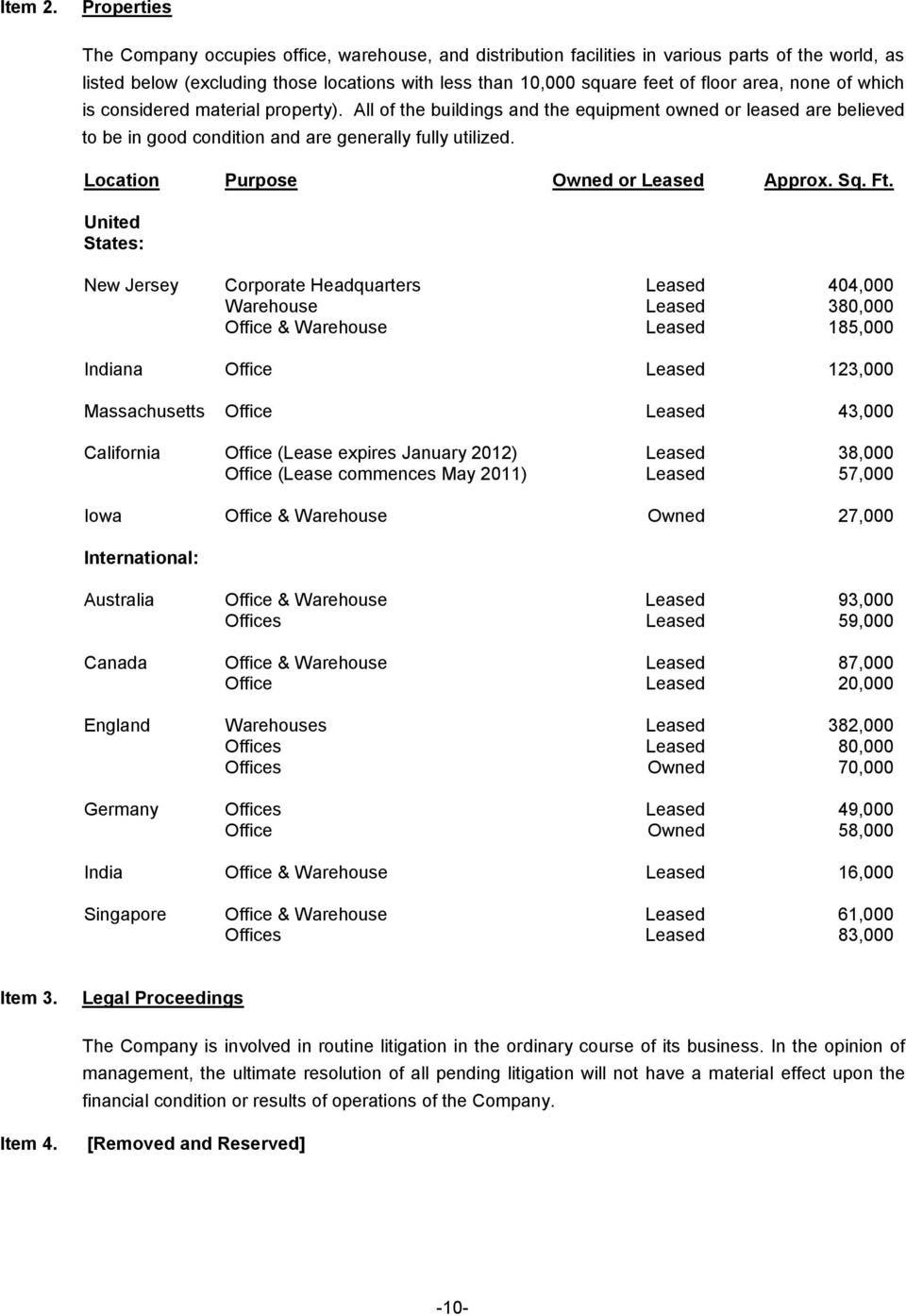
10 Item 2. Properties The Company occupies office, warehouse, and distribution facilities in various parts of the world, as listed below (excluding those locations with less than 10,000 square feet of floor area, none of which is considered material property). All of the buildings and the equipment owned or leased are believed to be in good condition and are generally fully utilized. Location Purpose Owned or Leased Approx. Sq. Ft. United States: New Jersey Corporate Headquarters Leased 404,000 Warehouse Leased 380,000 Office & Warehouse Leased 185,000 Indiana Office Leased 123,000 Massachusetts Office Leased 43,000 California Office (Lease expires January 2012) Leased 38,000 Office (Lease commences May 2011) Leased 57,000 Iowa Office & Warehouse Owned 27,000 International: Australia Office & Warehouse Leased 93,000 Offices Leased 59,000 Canada Office & Warehouse Leased 87,000 Office Leased 20,000 England Warehouses Leased 382,000 Offices Leased 80,000 Offices Owned 70,000 Germany Offices Leased 49,000 Office Owned 58,000 India Office & Warehouse Leased 16,000 Singapore Office & Warehouse Leased 61,000 Offices Leased 83,000 Item 3. Legal Proceedings The Company is involved in routine litigation in the ordinary course of its business. In the opinion of management, the ultimate resolution of all pending litigation will not have a material effect upon the financial condition or results of operations of the Company. Item 4. [Removed and Reserved] -10-
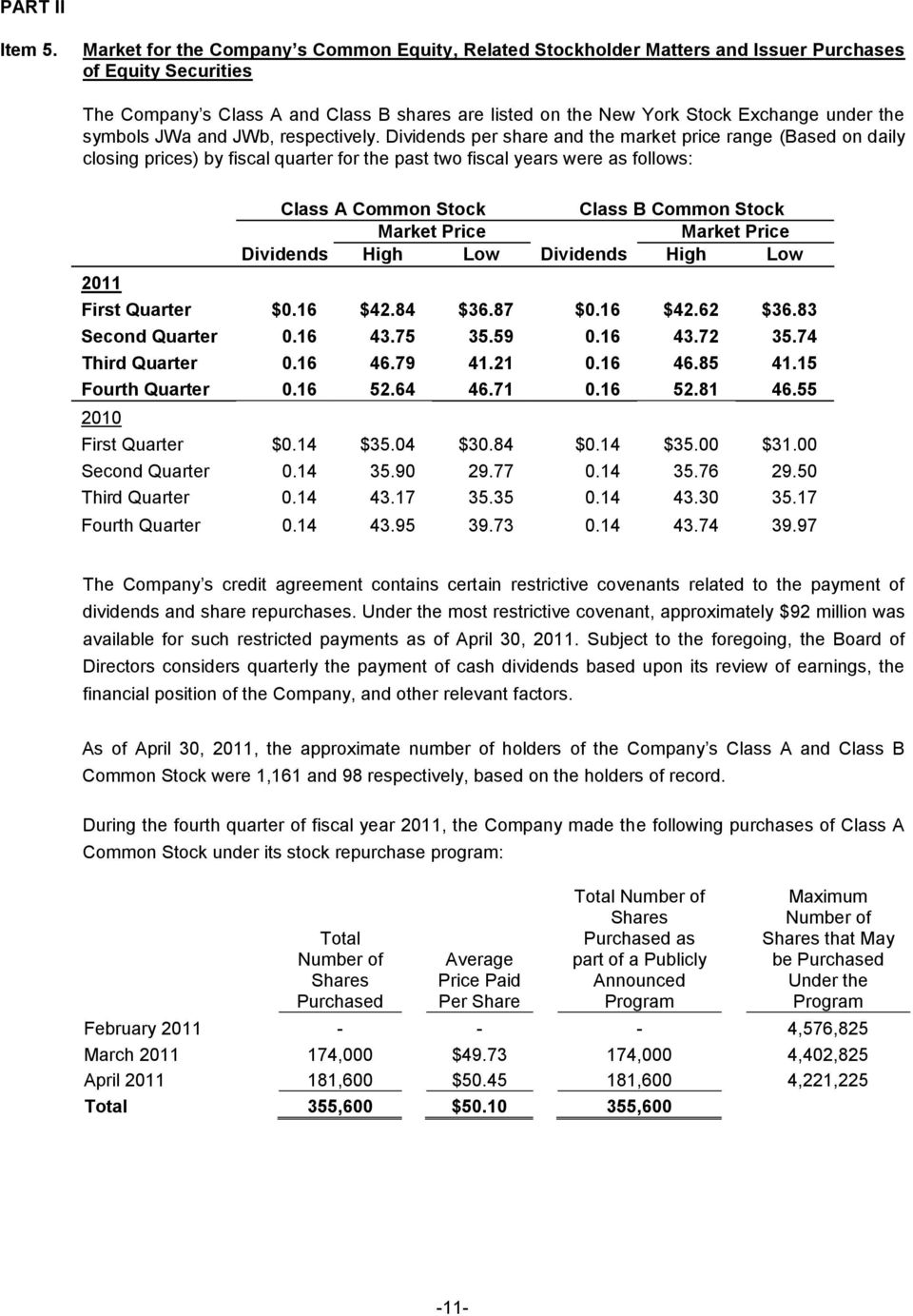
11 PART II Item 5. Market for the Company s Common Equity, Related Stockholder Matters and Issuer Purchases of Equity Securities The Company s Class A and Class B shares are listed on the New York Stock Exchange under the symbols JWa and JWb, respectively. Dividends per share and the market price range (Based on daily closing prices) by fiscal quarter for the past two fiscal years were as follows: Class A Common Stock Class B Common Stock Market Price Market Price Dividends High Low Dividends High Low 2011 First Quarter $0.16 $42.84 $36.87 $0.16 $42.62 $36.83 Second Quarter Third Quarter Fourth Quarter First Quarter $0.14 $35.04 $30.84 $0.14 $35.00 $31.00 Second Quarter Third Quarter Fourth Quarter The Company s credit agreement contains certain restrictive covenants related to the payment of dividends and share repurchases. Under the most restrictive covenant, approximately $92 million was available for such restricted payments as of April 30, Subject to the foregoing, the Board of Directors considers quarterly the payment of cash dividends based upon its review of earnings, the financial position of the Company, and other relevant factors. As of April 30, 2011, the approximate number of holders of the Company s Class A and Class B Common Stock were 1,161 and 98 respectively, based on the holders of record. During the fourth quarter of fiscal year 2011, the Company made the following purchases of Class A Common Stock under its stock repurchase program: Total Number of Shares Purchased Average Price Paid Per Share Total Number of Shares Purchased as part of a Publicly Announced Program Maximum Number of Shares that May be Purchased Under the Program February ,576,825 March ,000 $ ,000 4,402,825 April ,600 $ ,600 4,221,225 Total 355,600 $ ,
12 Item 6. Selected Financial Data For the Years Ended April 30, Dollars in millions (except per share data) Revenue $1,742.6 $1,699.1 $1,611.4 $1,673.7 $1,234.6 Operating Income (a, b) Net Income (a,b,c) Working Capital (d) (228.9) (188.7) (157.4) (243.6) (199.7) Total Assets 2, , , , ,547.2 Long-Term Debt Shareholders Equity Per Share Data Earnings Per Share (a,b,c) Diluted $2.80 $2.41 $2.15 $2.49 $1.71 Basic $2.86 $2.45 $2.20 $2.55 $1.75 Cash Dividends Class A Common $0.64 $0.56 $0.52 $0.44 $0.40 Class B Common $0.64 $0.56 $0.52 $0.44 $0.40 NOTE: The Company acquired Blackwell Publishing (Holdings) Ltd. ( Blackwell ) on February 2, (a) (b) (c) (d) In fiscal year 2011, the Company recorded a $9.3 million bad debt provision ($6.0 million after taxes) or $0.10 per diluted share related to the Company s customer, Borders Group, Inc. ( Borders ). On February 16, 2011, Borders filed a petition for reorganization relief under Chapter 11 of the U.S. Bankruptcy code. In fiscal year 2010, the Company recognized intangible asset impairment and restructuring charges principally related to GIT Verlag, a Business-to-Business German-language controlled circulation magazine business acquired in The fiscal year 2010 charges were $15.1 million ($10.6 million after taxes) and impacted diluted earnings per share by $0.17. Tax benefits included in fiscal year results are as follows: Fiscal year 2011 includes a $4.2 million tax benefit, or $0.07 per diluted share, associated with new tax legislation enacted in the U.K. that reduced the corporate income tax rate from 28% to 27%. The benefit recognized by the Company reflects the adjustments required to record all U.K.-related deferred tax balances at the new income tax rate. Fiscal year 2008 includes a $18.7 million tax benefit, or $0.32 per diluted share, associated with new tax legislation enacted in the United Kingdom and Germany that reduced the corporate income tax rates from 30% to 28% and from 39% to 29%, respectively. The benefits recognized by the Company reflect the adjustments required to record all U.K. and Germany-related deferred tax balances at the new corporate income tax rates. Fiscal year 2007 includes a $5.5 million tax benefit, or $0.09 per diluted share. This benefit coincides with the resolution and settlements of certain tax matters with authorities in the U.S. and abroad. Working capital is reduced or negative as a result of including in current liabilities the deferred revenue related to prepaid journal subscriptions for which the cash has been received. The deferred revenue will be recognized into income as the journals are shipped or made available online to the customers over the term of the subscription, generally one year. -12-

13 Item 7. Management s Discussion and Analysis of Business, Financial Condition and Results of Operations The Company is a global publisher of print and electronic products, providing content and digital solutions to customers worldwide. Core businesses produce scientific, technical, medical and scholarly journals, encyclopedias, books, online products and services; professional and consumer books, subscription products, certification and training materials, online applications and websites; and educational materials in all media, including integrated online teaching and learning resources, for undergraduate and graduate students, educators, and lifelong learners worldwide as well as secondary school students in Australia. The Company takes full advantage of its content from all three core businesses in developing and cross-marketing products to its diverse customer base of professionals, consumers, researchers, students, and educators. The use of technology enables the Company to make its content more accessible to its customers around the world. The Company maintains publishing, marketing, and distribution centers in the United States, Canada, Europe, Asia, and Australia. Business growth comes from a combination of title, imprint and business acquisitions which complement the Company s existing businesses; from the development of new products and services; from designing and implementing new methods of delivering products to our customers; and from organic growth of existing brands and titles. The Company s revenue grew at a compound annual rate of 11% over the past five years, which includes the acquisition of Blackwell Publishing (Holdings) Ltd. ( Blackwell ) in February Core Businesses Scientific, Technical, Medical and Scholarly (STMS): The Company is one of the leading publishers for the scientific, technical, medical and scholarly communities worldwide, including academic, corporate, government, and public libraries; researchers; scientists; clinicians; engineers and technologists; scholarly and professional societies; and students and professors. STMS products include journals, books, major reference works, databases and laboratory manuals. STMS publishing areas include the physical sciences, health sciences, social science and humanities and life sciences. The Company s STMS products are sold and distributed globally, online and in print through multiple channels, including research libraries and library consortia, independent subscription agents, direct sales to professional society members, bookstores, online booksellers and other customers. Publishing centers include Australia, Germany, Singapore, the United Kingdom and the United States. STMS accounted for approximately 57% of total Company revenue in fiscal year 2011 and generated revenue growth at a compound annual rate of 19% over the past five years, including the February 2007 acquisition of Blackwell, a leading publisher of journals and books for the academic, research and professional markets focused on science, technology, medicine and social sciences and humanities. The graph below presents STMS revenue by product type for fiscal year 2011: Publishing Rights 6% Other Income 10% Books and Reference Works 17% Journal Subscriptions 62% Advertising 5% -13-

14 Approximately 54% of journal subscription revenue is derived from publishing rights owned by the Company. Publishing alliances also play a major role in STMS s success. The Company publishes the journals of prestigious societies, including the American Cancer Society, the British Journal of Surgery Society, the Federation of European Biochemical Societies, The European Molecular Biology Organization, the American Anthropological Association and the German Chemical Society. Approximately 46% of journal subscription revenue is derived from publication rights which are owned by professional societies and published by the Company pursuant to a long-term contract or owned jointly with a professional society. These society alliances bring mutual benefit, with the societies gaining Wiley s publishing, marketing, sales and distribution expertise, while Wiley benefits from being affiliated with prestigious societies and their members. STMS is a provider of evidence-based medicine (EBM). The Cochrane Collaboration database, a premier source of high-quality independent evidence to inform healthcare decision-making, provides the foundation for the Company s growing suite of EBM products designed to improve patient healthcare. EBM facilitates the effective management of patients through clinical expertise informed by best practice evidence that is derived from medical literature. Wiley Online Library, one of the world s broadest and deepest multidisciplinary collections of online resources covering life, health and physical sciences, social science and the humanities, was launched successfully in August Built on the latest technology and designed with extensive input from scholars around the world, Wiley Online Library delivers seamless integrated access to over 4 million articles from 1,500 journals, 10,000 books, and hundreds of reference works, laboratory protocols and databases. Featuring a clean and simple interface, Wiley Online Library provides the user with intuitive navigation, enhanced discoverability, expanded functionality and a range of personalization options. Wiley Online Library provides the Company with new revenue opportunities, including new applications and business models, online advertising, deeper market penetration and individual sales/pay-per-view. In August 2010, Wiley Online Library replaced Wiley InterScience, the Company s previous online publishing platform for its scientific, technical, medical and scholarly content. Access to Wiley Online Library is sold through licenses with institutional and corporate libraries, consortia and other academic, government and corporate customers. The Company offers a range of licensing options including customized suites of journal publications for individual customer needs as well as subscriptions for individual journal and online book publications. Licenses are typically sold in durations of one to three years. The Company also provides fee-based access to its content through its Article Select and PayPerView programs which offer non-subscribed journal content, book chapters and major reference work articles. Wiley Online Library takes advantage of technology to update content frequently and to add new features and resources on an ongoing basis to increase the productivity of scientists, professionals and students. Two examples are EarlyView, through which customers can access individual articles well in advance of print publication, and MobileEditions, which enables users to view tables of content and abstracts on wireless handheld devices and Web-enabled phones. In February 2011, the Company launched Wiley Open Access, its new publishing program for open-access research articles. Under the Wiley Open Access business model, research articles submitted by authors are published and compiled in certain subject areas into open-access journals. The journal compilation is available free online to the general public on Wiley Online Library. A publication service fee is charged upon acceptance of a research article by the Company. The service fee may be paid by the individual author. To actively support researchers and members who wish to publish in Wiley Open Access journals an academic or research institution, a society or a corporation may fund the fee directly. In return for the service fee, the Company -14-

15 provides its customary publishing, editing, peer review and technology services. All accepted open-access articles are subject to the same rigorous peer-review process applied to the Company s subscription based journals which are supported by the Company s network of prestigious journals and societies. In addition to Wiley Open Access, the company provides authors with the opportunity to provide their individual research articles that are published within the Company s paid subscription journals, free through OnlineOpen. OnlineOpen articles are also available free to the general public via Wiley Online Library. The Company s digitization of its entire historical journal content, dating back to the 1800s, is designed to improve the research pathway and ensure content discovery is as seamless and efficient as possible. The backfile collection, which is available online through Wiley Online Library, spans three centuries of scientific research and comprise over 15 million pages one of the largest archives of its kind issued by a single publisher. As of April 30, 2011, all of the Company s existing journal content is digitized and made available to customers. The Company has been focused on reducing costs associated with the STMS business to finance investments in enabling technology and new businesses. The cost savings are principally the result of increased off-shoring of certain functions and activities from high cost locations to Singapore and other countries in Asia. Significant portions of the STMS journals and books content management, customer support and central marketing functions have been off-shored as of the end of fiscal year In addition to cost savings, the off-shoring of these functions has enabled the Company to focus its resources on value-added activities, such as process and service enhancements. Professional/Trade: The Company s Professional/Trade business acquires, develops and publishes books, subscription products and information services in all media, in the subject areas of business, technology, architecture, cooking, psychology, professional education, travel, health, consumer reference and general interest. Products are developed for worldwide distribution through multiple channels, including major chains and online booksellers, independent bookstores, libraries, colleges and universities, warehouse clubs, corporations, direct marketing, and websites. The Company s Professional/Trade customers are professionals, consumers, and students worldwide. Publishing centers include Australia, Canada, Germany, Singapore, the United Kingdom and the United States. Professional/Trade publishing accounted for approximately 25% of total Company revenue in fiscal year 2011 and generated revenue growth at a compound annual rate of 2% over the past five years. The graph below presents P/T revenue by product type for fiscal year 2011: Advertising 1% Journal Subscriptions 2% Publishing Rights 4% Other Income 4% Books 89% Key revenue growth strategies of the Professional/Trade business include adding value to its content, developing its leading brands and franchises, and executing strategic acquisitions. The Company s leading -15-

16 Professional/Trade brands include the For Dummies series, the Frommer s and Unofficial Guide travel series, the Bible and Visual technology series, the CliffsNotes study guides and Betty Crocker cookbooks. Publishing alliances and franchise products are also central to the Company s strategy. The ability to bring together Wiley s product development, sales, marketing, distribution and technological capabilities with a partner s content and brand name recognition has been a driving factor in its success. Professional/Trade alliance partners include General Mills, the Culinary Institute of America, Bloomberg Press, the American Institute of Architects, the Graduate Management Admission Council, the Leader to Leader Institute, Fisher Investments, Meredith Corporation and Weight Watchers, among many others. Growing revenue from digital products and services represents a core strategy for Professional/Trade, including increased availability of ebooks, advertising from branded websites and online tools and services. The Company promotes an active and growing Professional/Trade custom publishing program. Custom publications are typically used by organizations for internal promotional or incentive programs. Books that are specifically written for a customer or an existing Professional/Trade publication can be customized, such as having the cover art include custom imprint, messages or slogans. Of special note are customized For Dummies publications, which leverage the power of this well-known brand to meet the specific information needs of a wide range of organizations around the world. Higher Education: The Company publishes educational materials in all media, for two and four-year colleges and universities, forprofit career colleges and advanced placement classes worldwide, as well as secondary schools in Australia. Higher Education products focus on print and online solutions in the sciences, engineering, mathematics, business/accounting, geography, computer science, statistics, education, culinary, hospitality, psychology and modern languages. Higher Education customers include teachers, undergraduate, graduate, and advanced placement students, and lifelong learners worldwide as well as secondary school students in Australia. Product is delivered online and in print, principally through college bookstores, online booksellers, and websites. Higher Education accounted for approximately 18% of total Company revenue in fiscal year 2011 and generated revenue growth at a compound annual rate of 7% over the past five years. Higher Education s mission is to help teachers teach and students learn throughout the world. Our strategy is to provide value-added quality materials and services through textbooks, supplemental study aids, course and homework management tools and more, in print and electronic formats. The Higher Education website offers online learning materials with links to thousands of companion sub-sites to support and supplement textbooks. Higher Education delivers high-quality online learning materials that offer more opportunities for customization and accommodate diverse learning styles. A prime example is WileyPLUS, the Company s online teaching and learning environment. By offering an electronic version of a text along with additional integrated materials, custom content provided by the instructor, and administrative tools, WileyPLUS supports a full range of courseoriented activities, including online planning, presentations, study, homework, and testing. Wiley Higher Education encourages and supports the customization of its content. Wiley Custom Learning Solutions is a full service custom publishing department that offers an array of tools and services designed to put content creation in instructors hands. Our suite of custom products empowers users to create high-quality, economical education solutions tailored to meet individual classroom needs. Through the market leading online -16-




17 content customization tool, Wiley Custom Select, instructors can create a solution that contains Wiley content from various sources as well as their own content, delivered in print or as an ebook. The graph below presents global Higher Education revenue by product type for fiscal year 2011: Other Non- Traditional & Digital Products 18% WileyPLUS 11% Publishing Rights 2% Print Books 69% The Company also provides the services of the Wiley Faculty Network, a peer-to-peer network of faculty/professors supporting the use of online course material tools and discipline-specific software in the classroom. The Company believes this unique, reliable, and accessible service gives the Company a competitive advantage. Higher Education is also leveraging the internet in its sales and marketing efforts. The internet enhances the Company s ability to have direct contact with students and faculty at universities worldwide through the use of interactive electronic brochures and campaigns. Publishing relationships are key to Higher Education s strategy. The ability to bring Wiley s product development, sales, marketing, distribution and technology with a partner s content and/or brand name has contributed to the Company s success. Alliance partners include Microsoft and National Geographic. Publishing Operations Journal Products: The Company now publishes approximately 1,600 Scientific, Technical, Medical and Scholarly and Professional/Trade journals up from 1,500 in the prior year. Journal subscription revenue and other related publishing income, such as advertising, backfile sales, the sale of publishing rights, journal reprints and individual article sales accounted for approximately 48% of the Company s consolidated fiscal year 2011 revenue. The journal portfolio includes titles owned by the Company, in which case they may or may not be sponsored by a professional society; titles owned jointly with a professional society; and titles owned by professional societies and published by the Company pursuant to long-term contract. Societies that sponsor or own such journals generally receive a royalty and/or other consideration. The Company may procure editorial services from such societies on a pre-negotiated fee basis. The Company also enters into agreements with outside independent editors of journals that state the duties of the editors, and the fees and expenses for their services. Contributors of articles to the Company s journal portfolio transfer publication rights to the Company or a professional society, as applicable. Journal articles may be based on funded research through government or charitable grants. In certain cases the terms of the grant may require the grantholder to make articles (either the published version or an earlier unedited version) available free of charge to the public, typically after an embargo period. Free access under the Company s Wiley Open Access and OnlineOpen business models enable the grantholder to comply. -17-

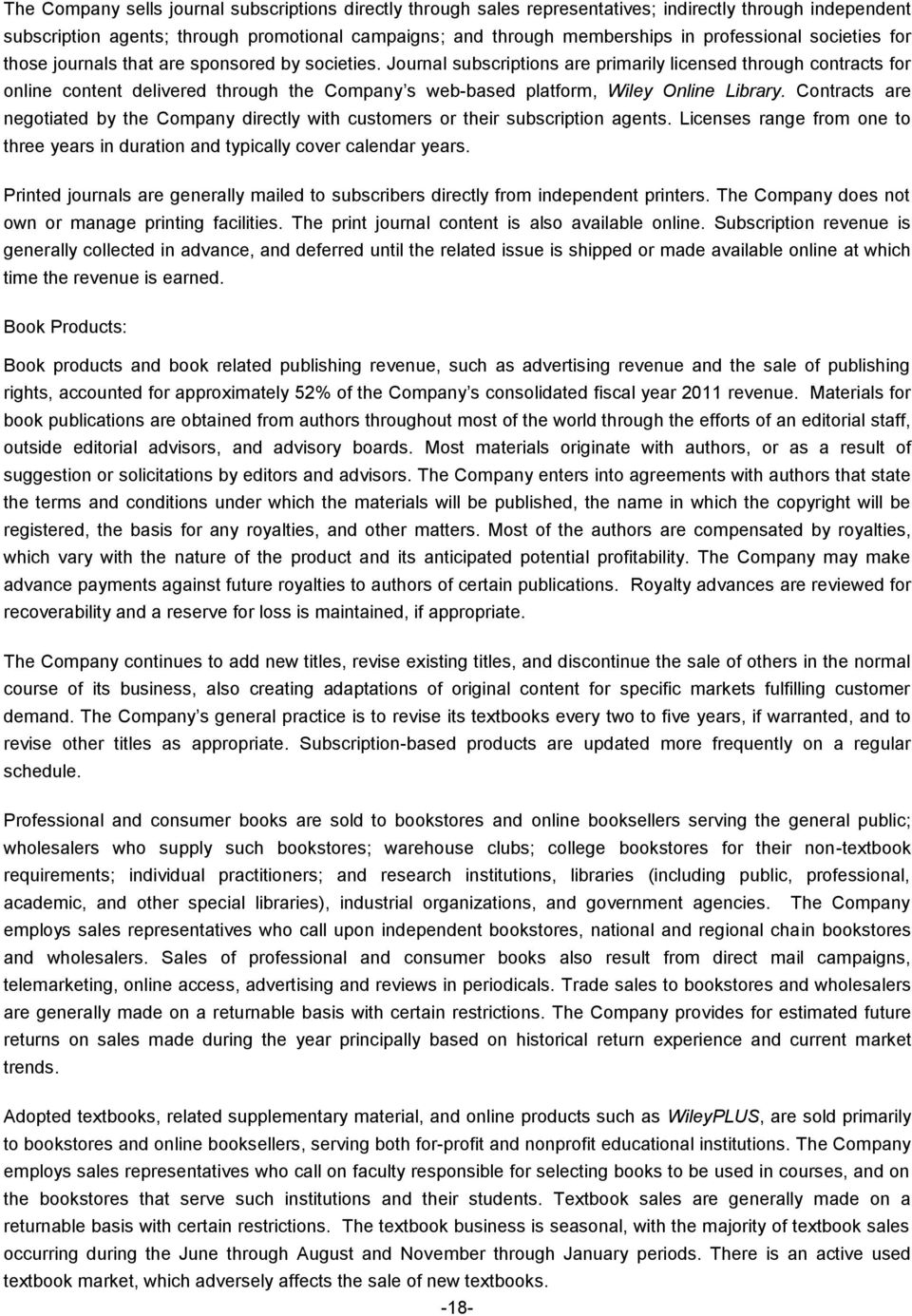
18 The Company sells journal subscriptions directly through sales representatives; indirectly through independent subscription agents; through promotional campaigns; and through memberships in professional societies for those journals that are sponsored by societies. Journal subscriptions are primarily licensed through contracts for online content delivered through the Company s web-based platform, Wiley Online Library. Contracts are negotiated by the Company directly with customers or their subscription agents. Licenses range from one to three years in duration and typically cover calendar years. Printed journals are generally mailed to subscribers directly from independent printers. The Company does not own or manage printing facilities. The print journal content is also available online. Subscription revenue is generally collected in advance, and deferred until the related issue is shipped or made available online at which time the revenue is earned. Book Products: Book products and book related publishing revenue, such as advertising revenue and the sale of publishing rights, accounted for approximately 52% of the Company s consolidated fiscal year 2011 revenue. Materials for book publications are obtained from authors throughout most of the world through the efforts of an editorial staff, outside editorial advisors, and advisory boards. Most materials originate with authors, or as a result of suggestion or solicitations by editors and advisors. The Company enters into agreements with authors that state the terms and conditions under which the materials will be published, the name in which the copyright will be registered, the basis for any royalties, and other matters. Most of the authors are compensated by royalties, which vary with the nature of the product and its anticipated potential profitability. The Company may make advance payments against future royalties to authors of certain publications. Royalty advances are reviewed for recoverability and a reserve for loss is maintained, if appropriate. The Company continues to add new titles, revise existing titles, and discontinue the sale of others in the normal course of its business, also creating adaptations of original content for specific markets fulfilling customer demand. The Company s general practice is to revise its textbooks every two to five years, if warranted, and to revise other titles as appropriate. Subscription-based products are updated more frequently on a regular schedule. Professional and consumer books are sold to bookstores and online booksellers serving the general public; wholesalers who supply such bookstores; warehouse clubs; college bookstores for their non-textbook requirements; individual practitioners; and research institutions, libraries (including public, professional, academic, and other special libraries), industrial organizations, and government agencies. The Company employs sales representatives who call upon independent bookstores, national and regional chain bookstores and wholesalers. Sales of professional and consumer books also result from direct mail campaigns, telemarketing, online access, advertising and reviews in periodicals. Trade sales to bookstores and wholesalers are generally made on a returnable basis with certain restrictions. The Company provides for estimated future returns on sales made during the year principally based on historical return experience and current market trends. Adopted textbooks, related supplementary material, and online products such as WileyPLUS, are sold primarily to bookstores and online booksellers, serving both for-profit and nonprofit educational institutions. The Company employs sales representatives who call on faculty responsible for selecting books to be used in courses, and on the bookstores that serve such institutions and their students. Textbook sales are generally made on a returnable basis with certain restrictions. The textbook business is seasonal, with the majority of textbook sales occurring during the June through August and November through January periods. There is an active used textbook market, which adversely affects the sale of new textbooks. -18-
19 Like most other publishers, the Company generally contracts with independent printers and binderies globally for their services. The Company purchases its paper from independent suppliers and printers. The fiscal year 2011 weighted average U.S. paper prices increased approximately 5% from fiscal year Approximately 57% of the Company s paper inventory is held in the United States. Management believes that adequate printing and binding facilities, sources of paper and other required materials are available to it, and that it is not dependent upon any single supplier. Printed book products are distributed from both Company-operated warehouses and independent distributors. The Company develops content in a digital format that can be used for online and print products, resulting in productivity and efficiency savings, as well as enabling the Company to offer customized publishing and printon-demand products. Book content is increasingly being made available online through Wiley Online Library, WileyPLUS, Custom Select and other platforms, and in ebook formats through direct relationships with ebook vendors and through licenses with alliance partners. The Company also sponsors online communities of interest, both on its own and in partnership with others, to expand the market for its products. The Company believes that the demand for new electronic technology products will continue to increase. Accordingly, to properly service its customers and to remain competitive, the Company has increased its expenditures related to such new technologies and anticipates it will continue to do so for the foreseeable future. The Company s online presence not only enables it to deliver content online, but also to sell more books. The growth of online booksellers benefits the Company because they provide unlimited virtual shelf space for the Company s entire backlist. Marketing and distribution services are made available to other publishers under agency arrangements. The Company also engages in co-publishing of titles with international publishers and in publication of adaptations of works from other publishers for particular markets. The Company also receives licensing revenue from photocopies, reproductions, translations, and electronic uses of its content. Advertising Revenue: The Company generates advertising revenue from print and online journal subscription products; controlled circulation magazines which are issued for free to a specific target audience; its online publishing platform, Wiley Online Library; and the websites of its consumer brands, including Frommers.com, Dummies.com and Cliffsnotes.com. These revenues accounted for approximately 3% of the Company s consolidated fiscal year 2011 revenue. Advertisements are sold by company and independent sales representatives to advertising agencies representing the Company s target customers. Typical customers include worldwide pharmaceutical companies; equipment manufacturers and distributors servicing the pharmaceutical industry; company s servicing the travel industry and a variety of businesses targeting the Company s consumer brand customers. The Company s advertising growth strategy focuses on increasing the volume of advertising on its online publishing platform; leveraging the brand recognition of its consumer titles in all media; the development of new advertising products such as online video promotions or event sponsorship arrangements; and advertising in new and emerging technologies such as the mobile devices market (i.e. smart phone and ipad applications). Global Operations The Company s publications are sold throughout most of the world through operations located in Europe, Canada, Australia, Asia, and the United States. All operations market their indigenous publications, as well as publications produced by other parts of the Company. The Company also markets publications through -19-

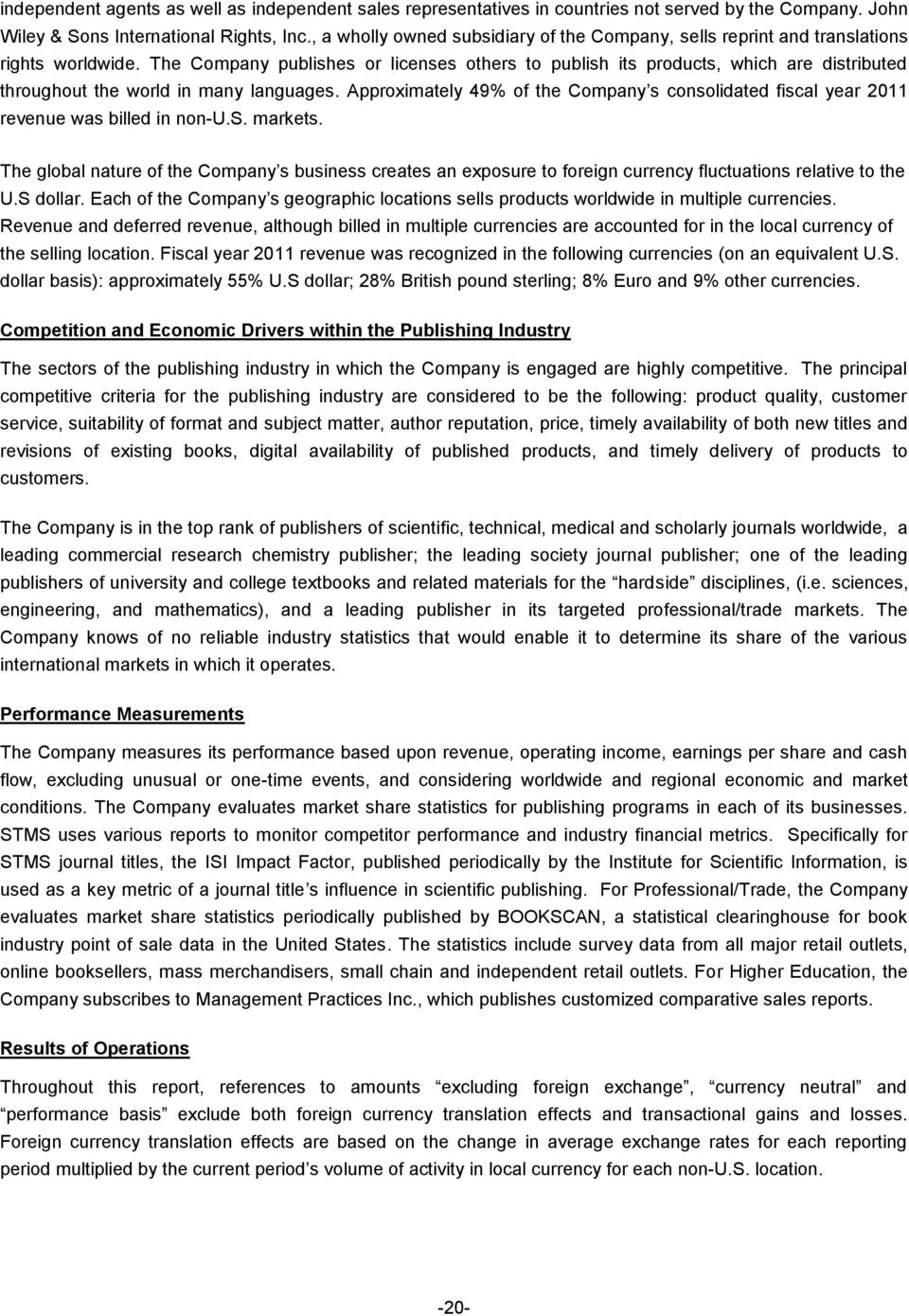
20 independent agents as well as independent sales representatives in countries not served by the Company. John Wiley & Sons International Rights, Inc., a wholly owned subsidiary of the Company, sells reprint and translations rights worldwide. The Company publishes or licenses others to publish its products, which are distributed throughout the world in many languages. Approximately 49% of the Company s consolidated fiscal year 2011 revenue was billed in non-u.s. markets. The global nature of the Company s business creates an exposure to foreign currency fluctuations relative to the U.S dollar. Each of the Company s geographic locations sells products worldwide in multiple currencies. Revenue and deferred revenue, although billed in multiple currencies are accounted for in the local currency of the selling location. Fiscal year 2011 revenue was recognized in the following currencies (on an equivalent U.S. dollar basis): approximately 55% U.S dollar; 28% British pound sterling; 8% Euro and 9% other currencies. Competition and Economic Drivers within the Publishing Industry The sectors of the publishing industry in which the Company is engaged are highly competitive. The principal competitive criteria for the publishing industry are considered to be the following: product quality, customer service, suitability of format and subject matter, author reputation, price, timely availability of both new titles and revisions of existing books, digital availability of published products, and timely delivery of products to customers. The Company is in the top rank of publishers of scientific, technical, medical and scholarly journals worldwide, a leading commercial research chemistry publisher; the leading society journal publisher; one of the leading publishers of university and college textbooks and related materials for the hardside disciplines, (i.e. sciences, engineering, and mathematics), and a leading publisher in its targeted professional/trade markets. The Company knows of no reliable industry statistics that would enable it to determine its share of the various international markets in which it operates. Performance Measurements The Company measures its performance based upon revenue, operating income, earnings per share and cash flow, excluding unusual or one-time events, and considering worldwide and regional economic and market conditions. The Company evaluates market share statistics for publishing programs in each of its businesses. STMS uses various reports to monitor competitor performance and industry financial metrics. Specifically for STMS journal titles, the ISI Impact Factor, published periodically by the Institute for Scientific Information, is used as a key metric of a journal title s influence in scientific publishing. For Professional/Trade, the Company evaluates market share statistics periodically published by BOOKSCAN, a statistical clearinghouse for book industry point of sale data in the United States. The statistics include survey data from all major retail outlets, online booksellers, mass merchandisers, small chain and independent retail outlets. For Higher Education, the Company subscribes to Management Practices Inc., which publishes customized comparative sales reports. Results of Operations Throughout this report, references to amounts excluding foreign exchange, currency neutral and performance basis exclude both foreign currency translation effects and transactional gains and losses. Foreign currency translation effects are based on the change in average exchange rates for each reporting period multiplied by the current period s volume of activity in local currency for each non-u.s. location. -20-
21 Fiscal Year 2011 Summary Results Revenue and Gross Profit: Revenue for fiscal year 2011 increased 3% to $1,742.6 million, or 4% excluding the unfavorable impact of foreign exchange. The increase was driven by growth in all three businesses, led by strong growth in Higher Education ( HE ). Gross profit margin for fiscal year 2011 of 69.1% was 0.5% higher than prior year. The increase was driven by lower journal production costs due to off-shoring (30bps) and increased sales of higher margin digital products (20bps), including a digital backlist book license with a university consortium in Saudi Arabia. Operating and Administrative Expenses: Operating and administrative expenses for fiscal year 2011 of $910.8 million were 4% higher than prior year, or 5% excluding the favorable impact of foreign exchange. The increase was primarily driven by higher technology costs ($15 million) reflecting ongoing investments in digital products and infrastructure, such as WileyPLUS, ebooks, customer data/relationship management initiatives, and Wiley Online Library; higher employment costs ($8 million) due to merit increases and retirement benefits; higher journal editorial costs ($7 million); higher warehouse rent and facility costs ($6 million) and travel expenses ($3 million) to support business expansion, partially offset by lower journal distribution costs due to off-shoring and outsourcing ($3 million). In fiscal year 2011, the Company recorded a $9.3 million bad debt provision ($0.10 per share) within the Professional/Trade reporting segment related to the Company s customer, Borders Group, Inc. ( Borders ). The provision represents the difference between the Company s outstanding receivable with Borders and our expectation of potential offsets and recoveries in the future, as well as existing reserves for this customer. Borders was projected to account for 5% of fiscal year 2011 P/T sales. The Company does not anticipate any additional charges or bad debt expense with respect to this customer. On February 16, 2011, Borders filed a petition for reorganization relief under Chapter 11 of the U.S. Bankruptcy code. In fiscal year 2010, the Company recognized impairment and restructuring charges of $15.1 million ($0.17 per share) within the STMS reporting segment. The prior year charges include an $11.5 million impairment charge for GIT Verlag, a business-to-business German-language controlled circulation magazine business; a $1.6 million restructuring charge for severance-related costs to reduce certain staff levels and the number of magazines published by GIT Verlag; an impairment charge of $0.9 million for three smaller business-tobusiness controlled circulation advertising magazines; and a $1.1 million restructuring charge for severance costs related to the off-shoring of certain central marketing and content management activities to Singapore and other countries in Asia. Operating Income: Operating income for fiscal year 2011 increased 2% to $248.1 million, or 8% on a currency neutral basis. Excluding the impact of the Borders bad debt provision ($9.3 million) and the prior year impairment and restructuring charges ($15.1 million), operating income increased 6% on a currency neutral basis. Higher revenue and higher gross profit margins were partially offset by higher operating and administrative expenses to support business growth. Interest Expense/Income, Foreign Exchange Losses and Other: Interest expense for fiscal year 2011 decreased $15.0 million to $17.3 million. Lower interest rates and lower average debt contributed approximately $10.0 million and $5.0 million to the decrease, respectively. Losses on -21-
22 foreign currency transactions for fiscal years 2011 and 2010 were $2.2 million and $10.9 million, respectively. The foreign currency transaction loss in the prior year was principally due to the revaluation of U.S. dollar cash balances held by the Company s non-u.s. locations into the local currency of those operations. Interest income and other increased $1.6 million from the prior year, reflecting interest earned on higher average cash balances. Provision for Income Taxes: The effective tax rate for fiscal year 2011 was 25.6% compared to 28.3% in the prior year. During fiscal year 2011, the Company recorded a $4.2 million ($0.07 per share) non-cash deferred tax benefit associated with new tax legislation enacted in the United Kingdom ( U.K. ) that reduced the U.K. statutory income tax rate from 28% to 27%. The new tax rate was effective as of April 1, The benefit recognized by the Company reflected the restatement of all applicable U.K. deferred tax balances to the new income tax rate. In fiscal year 2011, the Company also recognized state net operating loss benefits of approximately $1.9 million ($0.03 per share). The Company s effective tax rate for fiscal year 2011 excluding the tax benefits described above was 28.3%. As of April 30, 2011, similar tax legislation was proposed in the U.K. to further reduce the statutory income tax rate from 27% to 25%. The Company anticipates that the proposed reduction will be enacted in the first quarter of fiscal year If enacted, the Company will report an approximate $10 million tax credit ($0.16 per share). The estimated non-cash tax benefit reflects the restatement of all applicable deferred tax balances to the new income tax rate. Earnings Per Share: Earnings per diluted share for fiscal years 2011 and 2010 were $2.80 and $2.41, respectively. Excluding the effects of unfavorable foreign exchange transaction and translation losses ($0.07 per share), the current year Borders bad debt provision ($0.10 per share), the prior year impairment and restructuring charges ($0.17 per share) and the current year deferred tax benefit associated with the change in U.K. corporate income tax rates ($0.07 per share), earnings per diluted share increased 12% on higher shares outstanding. The dilutive effect of higher shares outstanding in fiscal year 2011 was approximately $0.08 per share as compared to the prior year. Fiscal Year 2011 Segment Results Scientific, Technical, Medical and Scholarly (STMS): % change Dollars in thousands % change w/o FX (a) Journal Subscriptions $621,551 $621,257 0% 4% Books 173, ,658 8% 9% Other Publishing Income 204, ,768 0% 1% Total Revenue $998,902 $986,683 1% 4% Gross Profit 729, ,470 2% 5% Gross Profit Margin 73.1% 72.6% Direct Expenses & Amortization 305, ,229-2% 5% Direct Contribution to Profit $424,797 $405,241 5% 5% Direct Contribution Margin 42.5% 41.1% (a) Adjusted to exclude fiscal year 2010 impairment and restructuring charges of $15.1 million from direct expenses and direct contribution. -22-
23 Revenue: STMS revenue for fiscal year 2011 increased 1% to $998.9 million, or 4% excluding the unfavorable impact of foreign exchange. On a currency neutral basis, the growth was driven by higher journal subscription and book revenue, while other publishing income increased slightly from prior year. Journal Subscriptions Journal subscription revenue for fiscal year 2011 of $621.6 million was flat with the prior year, but increased 4% excluding the unfavorable impact of foreign exchange. On a currency neutral basis, the growth was driven by an increase in journal subscriptions ($18 million), new journal society business ($3 million) and the timing of journal publications ($3 million). As of April 30, 2011, receipts for calendar year 2011 journal subscriptions grew approximately 3% over calendar year 2010 with approximately 95% of expected calendar year 2011 subscription receipts received. Books Books revenue for fiscal year 2011 increased 8% to $173.2 million, or 9% excluding the unfavorable impact of foreign exchange. On a currency neutral basis, the growth reflects higher digital ($12 million) and print ($2 million) book sales. The increase in digital book revenue includes a $5 million one-time online book license with a consortium in Saudi Arabia. Other Publishing Income Other publishing income for fiscal year 2011 of $204.1 million was flat with the prior year, but grew 1% excluding the unfavorable impact of foreign exchange as an increase in backfile revenue ($4 million) was partially offset by a decline in journal reprint revenue ($3 million). Gross Profit: Gross profit margin for fiscal year 2011 of 73.1% was 0.5% higher than the prior year. The improvement was mainly driven by lower journal production costs due to off-shoring and outsourcing. Direct Expenses and Amortization: Direct expenses and amortization for fiscal year 2011 decreased 2% to $305.1 million. On a currency neutral basis and excluding the $15.1 million asset impairment and restructuring charges recorded in fiscal year 2010, direct expenses and amortization increased 5%. The increase primarily reflects higher journal editorial costs to support business growth ($9 million) and higher employment costs ($2 million). Direct Contribution to Profit: Direct contribution to profit increased 5% to $424.8 million in fiscal year 2011, or 9% excluding the unfavorable impact of foreign exchange. Excluding foreign exchange and the prior year asset impairment and restructuring charges, direct contribution to profit increased 5%. Increased revenue and higher gross profit margins were partially offset by an increase in direct expenses as described above. Direct contribution margin improved 140 basis points to 42.5% in fiscal year 2011, or 40 basis points on a currency neutral basis and excluding the prior year asset impairment and restructuring charges principally due to improved gross profit margins. Full Year Digital Revenue Digital revenue was 59% of total STMS revenue Digital journal revenue was 81% of total journal revenue, up from 79% a year earlier Digital book revenue up 74% and now accounts for 16% of total book sales -23-
24 Wiley Online Library Wiley Online Library, one of the world s broadest and deepest multidisciplinary collection of online resources covering life, health and physical sciences, social science and the humanities, was launched in August Built on the new technology and designed with extensive input from scholars around the world, Wiley Online Library provides access to over 4 million articles from 1,500 journals, 10,000 books, and hundreds of reference works, laboratory protocols and databases. Key attributes: New revenue opportunities, including new applications and business models, online advertising, deeper penetration into markets, enhanced discoverability, and individual sales/pay-per-view An easy-to-use interface providing intuitive navigation and fast access to online content Research tools to enable the discovery of available resources and help pinpoint information Personalization options to keep up-to-date on the latest research with content alerts and RSS feeds and the ability to store key publications and articles for future reference Customizable product home pages that allow journal and society communities to highlight key features and share news and information Access icons that identify the content available to customers through institutional licenses, society membership and author-funded Online Open publication, as well as freely available content Society Partnerships 37 new society journals were signed with combined annual revenue of approximately $9 million 100 renewals/extensions with approximately $56 million in combined annual revenue 4 journals were not renewed in fiscal year 2011, totalling approximately $1 million in annual revenue. Alliances An agreement to co-publish a new book series on neuroendocrinology was signed with the International Neuroendocrine Federation An agreement signed with GeneBio for us to distribute their SmileMS mass spectrometry software which is used to identify small molecules. A publishing agreement was signed for a joint venture with the Society of Chemical Industry (SCI) to launch a new electronic journal entitled Greenhouse Gases: Science and Technology. A partnership with the Association of American Geographers to publish a definitive reference work for the discipline to be published online and in 15 print volumes. Wiley purchased the remaining 50% of the Journal for the Theory of Social Behaviour, which publishes original theoretical and methodological articles that examine the links between social structures and human agency embedded in behavioral practices. The journal is accessible to readers worldwide in the fields of psychology, sociology and philosophy. New Society Journals Eleven journals on behalf of the British Psychological Society (BPS). The BPS is the second largest psychological society in the world with approximately 50,000 members. Acta Obstetricia et Gynecologica, on behalf of the Nordisk Förening för Obstetrik och Gynekologi (NFOG), the Nordic Federation of Societies of Obstetrics and Gynaecology Journal of the European Economic Association, on behalf of the European Economic Association (EEA). The EEA is the third highest profile economic society in the world. Three journals (Journal of Wildlife Management, Wildlife Monographs and the forthcoming re-launch of the Wildlife Society Bulletin) on behalf of The Wildlife Society Journal of Midwifery and Women's Health with the American College of Nurse Midwives -24-
25 International Journal of Language and Communication Disorders on behalf of the Royal College of Speech and Language Therapists, providing Wiley with a strong foundation in the field, opening opportunities to add content and relationships International Forum of Allergy & Rhinology for the American Rhinologic Society and the American Academy of Otolaryngic Allergy Biotechnology and Applied Biochemistry on behalf of the International Union of Biochemistry and Molecular Biology European Management Review with the European Academy of Management Structural Concrete with the International Federation for Structural Concrete The ten journals of the American Counseling Association. The ACA is the world s leading association for professionals in Counseling. International Dental Journal, for the FDI World Dental Federation. Journal of Business Logistics, for the Council of Supply Chain Management Professionals (CSCMP). International Journal of Paediatric Obesity, for the International Association for the Study of Obesity. Journal of Creative Behavior, for the Creative Education Foundation (CEF. Founded in 1954, the CEF is recognized as the world leader in Applied Imagination Asia Pacific Journal of Human Resources, for the Australian Human Resources Institute (AHRI). APJHR is the leading journal for HR professionals in Australia. Journal Quality and Impact Factors Wiley announced that two thirds of its journals (68.8% and 1,013 titles) have an Impact Factor according to the revised Thomson ISI 2009 Journal Citation Reports (JCR) released in September Impact Factor is a leading evaluator of journal influence and impact, as it reflects the frequency that peer-reviewed journals are cited by researchers. Nearly a quarter of Wiley s ranked journals are in the top ten of their subject category (238 titles) while two thirds are in the top half of their category. Wiley has 37 number 1 rankings. These titles represent the highest proportion of listed journals receiving the top rank of all the major journals publishers (those publishing 100 or more titles listed in the JCR). Professional/Trade (P/T): % change Dollars in thousands % change w/o FX (a) Books $387,228 $379,934 2% 2% Other Publishing Income 49,860 50,054 0% 0% Total Revenue $437,088 $429,988 2% 1% Gross Profit 269, ,552 2% 2% Gross Profit Margin 61.6% 61.3% Direct Expenses & Amortization 173, ,356 6% 1% Direct Contribution to Profit $95,496 $100,196-5% 5% Direct Contribution Margin 21.8% 23.3% (a) Adjusted to exclude fiscal year 2011 bad debt provision of $9.3 million related to Borders from direct expenses and direct contribution. -25-
26 Revenue: P/T revenue for fiscal year 2011 increased 2% to $437.0 million, or 1% excluding the favorable impact of foreign exchange. Book revenue increased 2% to $387.2 million, while other publishing income of $49.9 million was flat with the prior year. The book revenue growth was driven by higher business/finance ($13 million) and professional education ($4 million) sales, partially offset by a decline in consumer sales ($9 million) mainly due to the Borders disruption. Other publishing income, which includes the sale of publishing rights, advertising income, subscription journals and online services, was flat to prior year. Total P/T Revenue by Category (on a currency neutral basis) Business grew 10%, reflecting growth in digital sales Consumer fell 6% due in large part to the Borders disruption Technology, which maintained its #1 market position, was flat with the prior year Professional Education grew 16% to $8 million, fueled by Doug Lemov s best seller Teach like a Champion Architecture, yet to rebound from the recession, was down 3% Psychology was up 2% Gross Profit: Gross profit margin for fiscal year 2011 of 61.6% was 0.3% higher than the prior year. The improvement was driven by lower inventory obsolescence provisions reflecting improved inventory management and higher ebook sales. Direct Expenses and Amortization: Direct expenses and amortization for fiscal year 2011 increased 6% to $173.6 million, or 1% excluding the $9.3 million Borders bad debt provision in the current year and foreign exchange. Direct Contribution to Profit: Direct contribution to profit for fiscal year 2011 decreased 5% to $95.5 million, or 7% excluding unfavorable foreign exchange. Excluding the $9.3 million Borders bad debt provision in the current year and foreign exchange, direct contribution to profit increased 5%. The improvement reflects the top-line results and higher gross profit margins. Direct contribution margin declined 150 basis points to 21.8% due to the Borders bad debt provision, partially offset by higher gross profit margins from increased digital revenue. Digital Revenue Digital revenue for fiscal year 2011 was 10% of total P/T revenue, up from 7% in the prior year. Digital revenue includes ebooks, online advertising, and content licensing. ebook sales reached $23 million for fiscal year 2011, or 5% of total P/T revenue. Alliances A partnership with RSMeans, a division of Reed Construction Group, to become their exclusive publisher and distributor of professional reference titles. In addition to managing their current reference collection, Wiley and RSMeans will launch a branded series of new reference titles over the next several years, primarily targeting the commercial and residential construction markets, in both print and digital formats. A partnership with the Tax institute at H& R Block to create exam prep product for the new Tax Preparer certification from the IRS. The program will have books/ebooks and online test bank eventually adding a continuing professional education component. -26-
27 A partnership with the AARP to become its exclusive book publisher. The agreement will include cobranded publishing across a variety of categories, including health, personal finance, cooking, travel, and technology. The AARP has nearly 40 million members and a target audience of adults aged 50+. A partnership with Element K, a learning solutions and online training company in the field of IT, to produce For Dummies E-Learning courses. The first product is expected to launch during fiscal year Notable New Books Business Little Book of Alternative Investments by Ben Stein What Makes Business Rock, by former MTV Networks CEO Bill Roedy Endgame by John Mauldin Debunkery by Ken Fisher The Truth About Leadership by Jim Kouzes and Barry Posner Business Model Generation: A Handbook for Visionaries, Game-Changers and Challengers by Alexander Osterwalder Professional Education Falling Upward: A Spirituality for the Two Halves of Life by Richard Rohr Consumer Betty Crocker Big Book of Cupcakes Unofficial Guide to Walt Disney World Ebook Frommers Day by Day guides for Greece, Germany, California and Alaska Facebook For Dummies, 3e, Book + DVD Bundle by Leah Pearlman and Carolyn Abram Better Homes & Gardens New Cook Book 15 th Edition (Consumer - Cooking) Avec Eric by Eric Ripert ASVAB For Dummies, 3e and ASVAB For Dummies, Premier Edition by Rod Powers Technology ipad For Dummies, 2nd Edition by Ed Baig and Bob Levitus CCNA: Cisco Certified Network Associate Study Guide by Todd Lammle Microsoft Data Warehouse Toolkit, 2E by Joy Mundy, Warren Thornthwaite, with Ralph Kimball Digital SLR Photography All-in-One by David D. Busch ipad All-in-One For Dummies by Nancy Muir Psychology Disorders of Personality by Theodore Millon Handbook of Social Psychology emrw Architecture A Global History of Architecture, 2 e by Frank Ching -27-
28 Higher Education (HE): % change Dollars in thousands % change w/o FX Print Books $211,611 $205,326 3% 1% Non-Traditional & Digital Content 83,789 66,574 26% 26% Other Publishing Income 11,161 10,491 6% 3% Total Revenue $306,561 $282,391 9% 7% Gross Profit 204, ,039 11% 9% Gross Profit Margin 66.7% 65.5% Direct Expenses & Amortization 103,421 98,827 5% 3% Direct Contribution to Profit $101,044 $86,212 17% 15% Direct Contribution Margin 33.0% 30.5% Revenue HE revenue for fiscal year 2011 increased 9% to $306.6 million, or 7% excluding the favorable impact of foreign exchange. The improvement was driven by strong growth in Non-Traditional and Digital Content and Print Book revenue. Print Books Print book revenue for fiscal year 2011 increased 3% to $211.6 million, or 1% excluding the favorable impact of foreign exchange. The improvement was driven by increased student enrollment, a strong front list in the engineering/computer science and science categories and increased sales of Windows 7 server titles. Non-Traditional & Digital Content Non-traditional & digital content revenue, which includes WileyPLUS, ebooks, digital content sold directly to institutions, binder editions and custom publishing, increased 26% to $83.8 million. The growth was driven by digital book sales ($6 million), custom publishing ($4 million), WileyPLUS ($3 million) and increased sales of other non-traditional content ($3 million). WileyPLUS revenue increased 11% to approximately $33 million. Revenue from non-traditional and digital content represents approximately 27% of total HE revenue, as compared to 24% in the prior year. Other Publishing Income Other publishing income for fiscal year 2011 increased 6% to $11.2 million, or 3% excluding the favorable impact of foreign exchange mainly due to higher revenue from the sale of translation rights. Total HE Revenue by Region (on a currency neutral basis) Americas grew 8% to $216.2 million EMEA grew 7% to $24.6 million Asia-Pacific grew 1% to $65.8 million Total HE Revenue by Subject (on a currency neutral basis) Engineering and Computer Science: revenue increased 21%. Textbooks driving growth include Callister: Materials Science 8e, Rainer: Introduction to Information Systems 3e, Moran: Thermodynamics 7e, Montgomery: Applied Statistics 5e, and Horstmann: Big Java 4e and Java for Everyone 1e. -28-
29 Science: revenue grew 14%. Textbooks driving growth included Halliday: Physics 9e, Solomons: Organic Chemistry 10e, Grosvenor: Visualizing Nutrition 1e and Hein: Chemistry 13e. Business and Accounting: revenue was flat with the prior year Social Science and Culinary: revenue increased 1% from prior year Mathematics: increased 5% over prior year Microsoft Official Academic Course: revenue grew 6%, reflecting growth in the Windows Server books. Gross Profit Gross profit margin for fiscal year 2011 of 66.7% was 120 basis points higher than prior year. The improvement was driven by increased sales of digital products (90 bps) and lower inventory obsolescence provisions (30 bps). Direct Expenses and Amortization Direct expenses and amortization for fiscal year 2011 increased 5% to $103.4 million, or 3% excluding the unfavorable impact of foreign exchange. The increase was mainly driven by higher employment costs ($4 million). Direct Contribution to Profit Direct contribution to profit for fiscal year 2011 increased 17% to $101.0 million, or 15% excluding the favorable impact of foreign exchange. The growth was driven by the top-line results and higher gross profit margins, partially offset by an increase in direct expenses as described above. Direct contribution margin improved 250 basis points to 33.0%, principally due to improved gross profit margins on higher digital revenue. Digital Products Digital revenue now 16% of Higher Education business, up from 13% in prior year. Fiscal year 2011 revenue of WileyPLUS grew 12% to $33 million, accounting for 11% of total Higher Education revenue. WileyPLUS is an online teaching and learning environment that integrates the entire digital textbook with the most effective instructor and student resources to fit every learning style. WileyPLUS digital-only revenue (not packaged with a print textbook) grew 18% to $13 million for the 2011 fiscal year, and now represents approximately 40% of total WileyPLUS revenue. In the U.S., student validation rates for WileyPLUS increased to 78% from approximately 73% in the prior year. ebook revenue grew to $13 million in fiscal year Shared Services and Administrative Costs Shared services and administrative costs for fiscal year 2011 increased 7% to $373.2 million, including and excluding the impact of foreign exchange. The increase was driven primarily by higher Technology costs ($23 million) reflecting ongoing investments in digital products and infrastructure, such as WileyPLUS, ebooks, customer data/relationship management initiatives, and Wiley Online Library; Distribution costs due to higher warehouse facility ($4 million) and employment costs ($2 million), partially offset by lower costs due to offshoring ($3 million); In addition, Finance and Other Administrative costs reflect lower employment costs mainly due to lower accrued incentive compensation ($5 million) partially offset by increased legal and professional fees ($2 million). -29-
30 Liquidity and Capital Resources Fiscal year 2011 The Company s cash and cash equivalents balance was $201.9 million at the end of fiscal year 2011, compared with $153.5 million a year earlier. Cash provided by operating activities in fiscal year 2011 increased $60.6 million to $375.6 million due primarily to higher net income ($28 million), lower pension contributions ($23 million), and lower changes in operating assets and liabilities ($16 million), partially offset by other ($6 million). Pension contributions in fiscal year 2011 were $24.8 million compared to $48.1 in the prior year, of which none were discretionary in fiscal year 2011, while $31.0 million were discretionary with respect to timing in the prior year. Cash provided by operating assets and liabilities was principally due to the timing of vendor payments ($28 million), higher earned royalty advances ($12 million) higher Deferred Revenue ($10 million), partially offset by higher incentive compensation payments ($17 million). The increase in Deferred Revenue reflects journal subscription growth and the timing of subscription cash collections. Cash used for investing activities for fiscal year 2011 was approximately $113.0 million compared to $106.1 million in fiscal year The Company invested $7.1 million in the acquisition of publishing businesses, assets and rights compared to $6.4 million in the prior year. Cash used for property, equipment and technology and product development increased $6.2 million in fiscal year 2011 versus the prior year mainly reflecting increased spending on leasehold improvements and fixtures related to newly leased facilities. Cash used in financing activities was $230.0 million in fiscal year 2011, as compared to $156.4 million in fiscal year In fiscal 2011, cash was used primarily to repay debt, pay dividends to shareholder and to repurchase treasury shares. In the current year the Company repurchased 577,405 shares at an average price of $ In fiscal 2010, the Company did not repurchase any treasury shares in the prior period. The Company increased its quarterly dividend to shareholders by 14.3% to $0.16 per share in fiscal year 2011 from $0.14 per share in the prior year. Proceeds from stock option exercises decreased $4.9 million to $27.8 million in fiscal The aggregate notional amount of interest rate swap agreements associated with the Term Loan and Revolving Credit Facility were $125.0 million as of April 30, It is management's intention that the notional amount of the interest rate swap be less than the Term Loan and Revolving Credit Facility outstanding during the life of the derivative. The Company s operating cash flow is affected by the seasonality and timing of receipts from its STMS journal subscriptions and its Higher Education business. Cash receipts for calendar year STMS subscription journals occur primarily from November through February. Reference is made to the Credit Risk section, which follows, for a description of the impact on the Company as it relates to independent journal agents financial position and liquidity. Sales primarily in the U.S. higher education market tend to be concentrated in June through August, and again in November through January. Due to this seasonality, the Company normally requires increased funds for working capital from May through September. Cash and Cash Equivalents held outside the U.S. were approximately $192.1 million as of April 30, The balances were comprised primarily of Euros, Pound Sterling, and Australian dollars. Maintenance of these non- U.S. dollar cash balances does not have a material impact on the liquidity or capital resources of the U.S. operations. As of April 30, 2011, the Company had approximately $454.0 million of debt outstanding and approximately $697.4 million of unused borrowing capacity under the Revolving Credit Facility which is described in Note
31 The Term Loan matures on February 2, 2013 and the Revolver will terminate on February 2, We believe that our operating cash flow, together with our revolving credit facilities and other available debt financing, will be adequate to meet our operating, investing and financing needs in the foreseeable future, although there can be no assurance that continued or increased volatility in the global capital and credit markets will not impair our ability to access these markets on terms commercially acceptable to us or at all. The Company has adequate cash and cash equivalents available, as well as short-term lines of credit to finance its short-term seasonal working capital requirements. The Company does not have any off-balance-sheet debt. Working capital at April 30, 2011 was negative $228.9 million. Working capital is negative as a result of unearned deferred revenue related to subscriptions for which cash has been collected in advance. Deferred revenue will be recognized into income as products are shipped or made available online to the customers over the term of the subscription. Current liabilities as of April 30, 2011 include $321.4 million of such deferred subscription revenue for which cash was collected in advance. Projected capital spending for technology, property and equipment and composition for fiscal year 2012 is forecast to be approximately $75.0 million and $55.0 million, respectively, primarily to enhance system functionality and drive future business growth. Projected spending for author advances, which is classified as an operating activity, for fiscal year 2012 is forecast to be approximately $102.0 million. Contractual Obligations and Commercial Commitments A summary of contractual obligations and commercial commitments, excluding unrecognized tax benefits further described in Note 11, as of April 30, 2011 is as follows (in thousands): Payments Due by Period Within After 5 Total Year 1 Years Years Years Total Debt $454.2 $123.7 $330.5 $ - $ - Interest on Debt Non-Cancelable Leases Minimum Royalty Obligations Total $970.4 $217.3 $485.0 $127.9 $ Interest on Debt includes the fixed interest obligation giving effect to the Company s interest rate hedge swap agreement and the estimated future interest payments on the Company s unhedged variable rate debt, which assume that the interest rates as of April 30, 2011 remain constant until the maturity of the debt. See Notes 12 and 13 to the Consolidated Financial Statements for further discussion on the Company s outstanding debt and interest rate swap agreements, respectively. Fiscal Year 2010 Summary Results Revenue and Gross Profit: Revenue for fiscal year 2010 increased 5% to $1,699.1 million, or 4% excluding the favorable impact of foreign exchange. Excluding foreign exchange, Higher Education ( HE ) and Professional/Trade ( P/T ) experienced strong growth, while Scientific, Technical, Medical and Scholarly ( STMS ) was flat with the prior year. -31-
32 Gross profit margin for fiscal year 2010 of 68.6% was 0.6% higher than prior year, or 0.4% excluding the favorable impact of foreign exchange mainly due to increased sales of higher margin digital products. Operating and Administrative Expense: Operating and administrative expenses for fiscal year 2010 of $872.2 million were 4% higher than the prior year. The increase was mainly due to higher accrued performance-based incentive compensation costs ($25 million); higher planned HE editorial and production costs to support business growth ($8 million); increased technology spending ($11 million); and a $2.0 million bankruptcy recovery in the prior year activity. The increases in cost were partially offset by cost savings initiatives ($8 million), lower distribution costs ($3 million) and less Blackwell integration activity ($1 million). The Company performed a strategic review of certain non-core businesses within the STMS reporting segment. The review led the Company to consider alternatives for GIT Verlag, a business-to-business German-language controlled circulation magazine business, which was acquired by the Company in Based on the outlook for the print advertising business in German language publishing, the Company performed an impairment test on the intangible assets related to GIT Verlag. This test resulted in an $11.5 million pre-tax impairment charge in fiscal year The Company also identified a similar decline in the financial outlook for three smaller business-to-business controlled circulation advertising magazines. An impairment test on the intangible assets associated with those magazines resulted in an additional $0.9 million pre-tax impairment charge in fiscal year After considering a variety of strategic alternatives for GIT Verlag, the Company implemented a restructuring plan in fiscal year 2010 to reduce certain staffing levels and the number of journals published by GIT Verlag. As a result, the Company recorded a pre-tax restructuring charge of approximately $1.6 million within the STMS reporting segment during fiscal year 2010 for GIT Verlag severance-related costs. The Company also recorded severance costs of $1.1 million related to the offshoring and outsourcing of certain central marketing and content management activities to Singapore and other countries in Asia. These charges are expected to be fully recovered within 18 months from implementation as a result of lower operating expenses. The impairment and restructuring charges described above, totaling $15.1 million, or $0.17 per share, are reflected in the Impairment and Restructuring Charges line item in the Consolidated Statements of Income. Operating Income: Operating income for fiscal year 2010 increased 11% to $242.6 million, or 7% excluding the favorable impact of foreign exchange and the impairment and restructuring charges. The 7% increase was mainly driven by the topline results and gross profit margin improvement, partially offset by higher operating and administrative expenses, as described above. Interest Expense/Income, Foreign Exchange Losses and Other: Interest expense decreased $16.1 million to $32.3 million. Lower interest rates contributed approximately $12.1 million towards the improvement, while lower average debt outstanding contributed approximately $4.0 million. Losses on foreign currency transactions for fiscal years 2010 and 2009 were $10.9 million and $11.8 million, respectively. The foreign currency transaction losses for fiscal year 2010 were primarily due to the revaluation of U.S. dollar cash balances held by the Company s non-u.s. locations into the local currency of those operations. The losses incurred in fiscal year 2009 were primarily due to the strengthening of the U.S. dollar in the prior year against U.S. dollar third party loans and intercompany payables maintained in non-u.s. locations during that -32-
33 period. Fiscal year 2009 included a favorable $4.6 million ($0.08 per share) insurance settlement reported as Interest Income and Other. Provision for Income Taxes: The effective tax rate for fiscal year 2010 was 28.3% compared to 22.0% in the prior year. The effective tax rate for fiscal year 2009 includes the reversal of a previously accrued income tax reserve of approximately $3.2 million ($0.05 per share) due to an income tax settlement with tax authorities in non-u.s. jurisdictions. The Company s effective tax rate for fiscal year 2009 excluding the reversal was approximately 24.0%. The increase in the effective tax rate excluding the reversal was principally due to lower foreign tax benefits (3.6%) and a nontaxable insurance receipt in the prior year (0.7%). Earnings Per Share: Earnings per diluted share for fiscal years 2010 and 2009 was $2.41 and $2.15, respectively. On a currency neutral basis and excluding the impairment and restructuring charges of approximately $0.17 per share from the current year, earnings per diluted share increased 6%. Higher operating income and lower interest expense was partially offset by a prior year insurance receipt ($0.08 per share), a prior year tax reserve reversal ($0.05 per share) and lower foreign tax benefits. Fiscal Year 2010 Segment Results Scientific, Technical, Medical and Scholarly (STMS): % change Dollars in thousands % change w/o FX (a) Journal Subscriptions $621,257 $604,591 3% 0% Books 160, ,624-3% -3% Other Publishing Income 204, ,969 3% 3% Total Revenue $986,683 $969,184 2% 0% Gross Profit 716, ,670 3% 1% Gross Profit Margin 72.6% 71.8% Direct Expenses & Amortization 311, ,514 5% 2% Direct Contribution to Profit $405,241 $399,156 2% 0% Direct Contribution Margin 41.1% 41.2% (a) Adjusted to exclude fiscal year 2010 impairment and restructuring charges of $15.1 million from direct expenses and amortization and direct contribution. Revenue: STMS revenue for fiscal year 2010 increased 2% to $986.7 million, but was flat excluding the favorable impact of foreign exchange. On a currency neutral basis, journal subscription revenue was flat compared to the prior year, while growth in other publishing income was offset by a decline in book revenue. Journal Subscriptions Journal subscription revenue for fiscal year 2010 increased 3% to $621.3 million, but was flat excluding the favorable impact of foreign exchange. On a currency neutral basis, a reduction in journal subscription revenue -33-
34 due to production scheduling ($7 million) and lower individual member subscriptions ($2 million) was partially offset by growth in the business ($6 million). Books Books revenue for fiscal year 2010 declined 3% to $160.7 million. The decrease is principally due to the transfer of certain books to HE in the current fiscal year which generated revenue of approximately $3.6 million in fiscal year On a currency neutral basis and excluding the effect of the transfer, book revenue declined 1% from the prior year. Other Publishing Income Other publishing income for fiscal year 2010 increased 3% to $204.8 million. Increased revenue from rights ($6 million), individual articles ($3 million) and the Cochrane Library ($2 million), were partially offset by lower revenue from business-to-business advertising ($6 million). The improvement in rights income principally relates to a legal settlement of approximately $2.0 million. Gross Profit: Gross profit margin for fiscal year 2010 of 72.6% was 0.8% higher than the prior year, or 0.5% excluding the favorable impact of foreign exchange. Direct Expenses and Amortization: Direct expenses and amortization for fiscal year 2010 increased 5% to $311.2 million, or 2% excluding the $15.1 million asset impairment and restructuring charges recorded in fiscal year 2010 and the favorable impact of foreign exchange. The increase excluding the impact of the impairment and restructuring charges and foreign exchange reflects increased costs associated with new business ($9 million) and a $2.0 million bad debt recovery in fiscal year 2009, partially offset by the completion of Blackwell-related integration activities and other cost savings initiatives ($6 million). Direct Contribution to Profit: Direct contribution to profit for fiscal year 2010 increased 2% to $405.2 million, but was flat excluding the asset impairment and restructuring charges recorded in fiscal year 2010 and the favorable impact of foreign exchange. On a currency neutral basis and excluding the asset impairment and restructuring charges, higher gross profit margins were offset by the increase in direct expenses referred to above. Direct contribution margin declined 10 basis points to 41.1% and was flat with the prior year excluding the favorable impact of foreign exchange and the asset impairment and restructuring charges. Calendar Year 2010 Journals Update Due to the fact that the majority of the Company s journal subscriptions are licensed on a calendar year basis, the Company also monitors and analyzes its journal subscription revenue on that basis. As of April 30, 2010, calendar year 2010 journal subscription billings increased 3% to 4% over prior year on a currency neutral basis, with approximately 95% of expected business closed. There was solid growth in Europe, Middle East, and Africa ( EMEA ), Asia-Pacific and Latin America and modest growth in the U.S. and Canada. Licensed journal business accounted for 71% of the subscription business as of April 30, 2010, as compared to 60% at April 30, New licenses included journal subscriptions, backfiles, online books and ArticleSelect sales. Society Journal Activity 31 new signings 90 renewed/extended contracts -34-
35 2 contracts not renewed Key New Contracts Journal of Midwifery and Women's Health on behalf of the American College of Nurse Midwives Australian Journal of Psychology, Australian Psychologist and Clinical Psychologist, the three flagship journals of Australian Psychological Society Legislative Studies Quarterly on behalf of the Comparative Legislative Research Center at the University of Iowa Allergy & Rhinology on behalf of the American Academy of Otolaryngic Allergy and the American Rhinologic Society Thoracic Cancer on behalf of the Tianjin Lung Cancer Institute The Bulletin of the Institute of Classical Studies (BICS), one of the world s most prestigious classics journals Four academic journals of the Royal Pharmaceutical Society of Great Britain, which were previously selfpublished (Journal of Pharmacy and Pharmacology, International Journal of Pharmacy Practice, Focus on Alternative and Complementary Therapies, and Journal of Pharmaceutical Health Services Research) Equine Veterinary Journal and Equine Veterinary Education, previously self- published by the British Equine Veterinary Association Contemporary Accounting Research and Accounting Perspectives, previously self-published by the Canadian Academic Accounting Association Steel Research International on behalf of the German Steel Makers Association Digital Update Online book revenue grew 44% in fiscal year 2010 to approximately $6 million. There is a growing trend for institutional library customers to purchase digital books. Online books are sold individually or through subscriptions, similar to journal licenses. Wiley s Chinese language website launched in April Designed to enhance customers experience with tailored sections for librarians, authors, societies and industry partners, wileychina.com will feature general information about Wiley s presence in China, as well as specific details about core content of particular interest to the Chinese community. In addition, this site will include hyper-links and cross references to wiley.com, Wiley InterScience (and ultimately Wiley Online Library) and the Press Room, where all local news and events will be highlighted. The Cochrane Library is now available to more than 650,000 students and faculty at 47 universities in Germany as part of a new agreement with Universitätsbibliothek Johann Christian Senckenberg in Frankfurt. The agreement allows access for a period of ten years to the Cochrane Library, a collection of regularly updated evidence-based healthcare databases, including the highly regarded Cochrane Systematic Reviews. In addition, a national license agreement in India will provide about 60 million Internet users with access to The Cochrane Library. In April 2010, Wiley announced that it will extend licensed electronic content to emergency workers, students, faculty and academic institutions affected by a local, national or global natural disaster. Under the Natural Disaster Access Clause, Wiley will allow a licensee to provide affected groups with electronic access to its licensed products via the licensee s secure network. Such an arrangement was put in place after Hurricane Katrina. Essential Evidence, a new product added to the online, evidence-based Essential Evidence Plus, was launched. This resource tool will help clinicians make diagnoses, chart treatment plans and determine prognoses. The product currently features approximately 700 structured medical topics with approximately 100 more in development. -35-
36 New Alliances A co-publication agreement with Higher Education Press (HEP) in Beijing was signed in the fourth quarter. HEP is the second largest science and technology publisher in China. A books co-publishing agreement was signed with The Minerals, Metals & Materials Society. The society is closely affiliated with the American Ceramic Society (ACerS) and ASM International. An agreement was signed with the Royal Geographical Society for a book series. Wiley also publishes The Royal Geographical Society s Geographical Journal, Area and Transactions of the Institute of British Geographers. An agreement was signed with The American Geographical Society to co-publish both the Geographical Review and FOCUS on Geography. Geographical Review is a leading scholarly periodical. Through a partnership with the Australian Psychological Society, Wiley will publish three flagship journals Australian Journal of Psychology, Australian Psychologist and Clinical Psychologist. An agreement was signed with Chemical Industry Press (Beijing, China) to publish a co-branded Wiley- CIP series imprint. The collaboration will focus on a series of English-language advanced textbooks and reference books for a global readership of post-graduates, researchers and practitioners in engineering, materials science and chemistry, with the potential to expand into other areas. An agreement was signed with Scrivener Publishing, an engineering book publisher, to co-publish and distribute their books globally. The program will publish books per year. The target market includes researchers in the technical and applied sciences. Acquisitions/Divestments Acquired Microcirculation, the journal of The Microcirculatory Society. The haematology/vascular medicine publication is in its sixteenth year. Acquired the Israel Journal of Chemistry from Laser Pages Publishing Ltd. Launched in 1951 as the Bulletin of the Research Council of Israel, Section A, it was re-launched in 1963 under its current name. Sold two journals to Maney Publishing: Cochlear Implants International and Deafness & Education International. Wiley acquired the publishing rights to Topley & Wilson s Microbiology and Microbial Infections from Hodder Education. Now in its 10 th edition (having been first published in 1929), the 8-volume reference work is prominent in the fields of microbiology and infectious disease. Wiley offered it to customers for the first time online in fiscal year Professional/Trade (P/T): % change Dollars in thousands % change w/o FX Books $379,934 $350,266 8% 8% Other Publishing Income 50,054 52,847-5% -5% Total Revenue $429,988 $403,113 7% 6% Gross Profit 263, ,797 7% 6% Gross Profit Margin 61.3% 61.2% Direct Expenses & Amortization 163, ,119 4% 4% Direct Contribution to Profit $100,196 $89,678 12% 11% Direct Contribution Margin 23.3% 22.2% -36-
37 Revenue: P/T revenue for fiscal year 2010 increased 7% to $430.0 million, or 6% excluding the favorable impact of foreign exchange, as strong growth in book revenue was partially offset by a decline in other publishing income. Book revenue for fiscal year 2010 increased 8% to $379.9 million. The growth was driven by higher consumer ($19 million), business ($8 million) and technology ($3 million) sales, which include new titles acquired through the Meredith and GMAC agreements. The new agreements contributed approximately $14.4 million to current period results. North America exhibited the most growth, followed by EMEA. Other publishing income for fiscal year 2010 declined $2.8 million, or 5%, to $50.1 million. Total P/T Revenue by Category Business advanced 5%, led by social media and quick-to-market books. Gross Profit: Consumer grew 16%, led by cooking (Meredith, Food Network TV, Weight Watchers) and the GMAC agreement. Technology was up 4%. Growth was attributed to Sybex certification and virtualization books, and the release of Windows 7. Psychology grew 15% for the year. Architecture was down 6% for the year. Education grew 6% for the year. Gross profit margin for fiscal year 2010 of 61.3% was essentially flat with the prior year. Direct Expenses and Amortization: Direct expenses and amortization for fiscal year 2010 increased 4% to $163.4 million. The increase reflects higher performance-based incentive compensation ($9 million), partially offset by advertising and marketing cost savings ($3 million). Direct Contribution to Profit: Direct contribution to profit for fiscal year 2010 increased 12% to $100.2 million, or 11% excluding the favorable impact of foreign exchange. The improvement reflects the top-line results, partially offset by higher direct expenses as described above. Direct contribution margin improved 110 basis points to 23.3%, or 90 basis points excluding the favorable impact of foreign exchange. Online Initiatives/eBooks Fiscal year 2010 ebook revenue increased 93% to approximately $7 million. Approximately 11,000 ebooks were available on Kindle as of April 30, Frommer s Unlimited launched Frommer s destination guides on Canada.com; unveiled destination guides on the UK meta search engine Travelsupermarket; created custom leisure and business events for a high-profile British Airways ad campaign microsite; launched an innovative trip planning tool with Eurostar; and integrated multilingual events content and weather charts into an Air France desktop widget. ebook agreements were signed with Barnes and Noble (Nook), EBooks.com, Ingram Digital and Scrollmotion (Apple s preferred ebook vendor). Existing agreements include Amazon (Kindle), Sony (ereader) and Mobipocket. P/T launched a CliffsNotes literature note application for the iphone and ipod Touch, branded CliffsNotes-to-Go, which was produced on a fast-track schedule to coincide with a major Apple promotion. Five popular classics (The Adventures of Huckleberry Finn, Macbeth, The Scarlet Letter, To -37-
38 Kill a Mockingbird, and Romeo and Juliet) are available in the itunes App Store. The apps contain the full content of the books plus audio summaries, interactive character maps, and a user defined CramPlan that allows students to access the most important components of the text based on the amount of time they have to study. Through an alliance with LibreDigital, Wiley now has the capability to sell ebooks in bulk, enabling volume sales in e-only or print plus electronic combinations based on a variety of access models. Digital Advertising/Websites Cliffsnotes.com advertising revenue in fiscal year 2010 grew by 28% over prior year. Dummies.com reported an all-time record monthly traffic count of 4 million users in March New Alliances Wiley was named the exclusive global publisher of BLOOMBERG and BLOOMBERG BUSINESSWEEK branded books to be marketed as BLOOMBERG PRESS, a Wiley imprint. Wiley intends to publish the content in print, e-book and digital formats. Wiley has been named an official licensee by The London Organizing Committee of the Olympic Games and Paralympics Games. We will publish 12 books in non-fiction categories including illustrated reference, photographic and architecture and design books, including the official commemorative book. Publishing agreement signed with Facebook.com to produce Official branded Facebook instruction guides, The Definitive Facebook Guides. The series launched in fiscal year Wiley-Pfeiffer (HR development and management) signed an agreement with Korean Management Association to deliver products in Korea. Agreement signed with the Construction Specifications Institute (CSI) to become the publisher of the CSI Professional Practice Guides. These guides align with CSI s certification program for Architecture, Engineering and Construction industry professionals. The Great Place to Work Institute and Wiley will collaborate on a training package and two books. The Institute has been developing the annual FORTUNE 100 Best Companies to Work For list for twenty years and is known around the world for its research-based models and accessible best practices. The Meredith (Better Homes and Gardens, Food Network TV, etc.) backlist boosted cookbook sales. There were 25 new Meredith books in the lifestyles, pets and education categories published in fiscal year Chatelaine, Canada s #1 women s magazine, will publish a major cookbook and personal finance guide in partnership with Wiley. Notable New Books Business Patrick Lencioni, Getting Naked: A Business Fable about Shedding the Three Fears that Sabotage Client Loyalty Chris Brogan, Trust Agents Erik Qualman, Social Economics Jon Gordon, Training Camp Bill George, Seven lessons for Leading In A Crisis Brian Halligan, Inbound Marketing Finance Harry Markopolis, No One Would Listen Peter Schiff, LoyaltyCrash Proof 2.0 John Bogle, Common Sense of Mutual Funds, 10 th Anniversary Edition Ben Stein, Little Book of Bulletproof Investing -38-
39 Christine Richard, Confidence Game David Faber, And Then The Roof Crashed In Psychology Irving Weiner, Handbook of Social Psychology, Fifth Edition The Corsini Encyclopedia of Psychology, Fourth Edition Bret A. Moore, The Veterans and Active Duty Military Psychotherapy Treatment Planner Sue, Counseling the Culturally Diverse, Theory and Practice, Fifth Edition Dattilo, Therascribe Family Treatment Planner, Second Edition Consumer Doug Lemov, Teach Like A Champion Bob Sehlinger, The Unofficial Guide to Walt Disney World: The Color Companion John Brady, Hero of the Pacific Fred Kaplan, 1959, The Year Everything Changed Brian Leaf, Defining Twilight Ellie Kreiger, So Easy Sandra Lee, Weeknight Wonders Rose Levy Beranbaum, Rose s Heavenly Cakes Architecture Architectural Graphic Standards for Residential Construction Stein and Reynolds, Mechanical and Electrical Equipment for Buildings, Tenth Edition Edward Allen, Forms and Forces Frank Ching, Building Codes Illustrated, Third Edition Technology Andy Rathbone, Windows 7 For Dummies Paul Thurott, Windows 7 Secrets For Dummies Dan Gookin, Laptops For Dummies Peter Weverka, Office 2010 All-In-One For Dummies Scott Lowe, Mastering VMware VSphere4 Daniel Hedengren, Smashing WordPress: Beyond The Blog Higher Education (HE): % change Dollars in thousands % change w/o FX Print Books $205,326 $180,780 14% 10% Nontraditional & Digital Content 66,574 48,297 38% 38% Other Publishing Income 10,491 10,016 5% 2% Total Revenue $282,391 $239,093 18% 15% Gross Profit 185, ,551 21% 19% Gross Profit Margin 65.5% 63.8% Direct Expenses & Amortization 98,825 85,932 15% 14% Direct Contribution to Profit $86,212 $66,619 29% 25% Direct Contribution Margin 30.5% 27.9% -39-
40 Revenue: HE revenue for fiscal year 2010 increased 18% to $282.4 million, or 15% excluding the favorable impact of foreign exchange. Double-digit growth in books and non-traditional and digital content drove the results. Books revenue for fiscal year 2010 increased 14% to $205.3 million, or 10% excluding the favorable impact of foreign exchange. Double-digit growth was experienced in all regions and in nearly every subject category. The revenue growth includes approximately $3.4 million from books previously reported in STMS and $1.2 million from books previously reported in P/T. Excluding the effect of these transfers and favorable foreign exchange, HE book revenue increased 8%. Non-traditional & digital content revenue, which includes WileyPLUS, ebooks, digital content sold directly to institutions, binder editions and custom publishing, increased 38% to $66.6 million principally due to growth in WileyPLUS. Other publishing income for fiscal year 2010 increased 5% to $10.5 million, or 2% excluding the favorable impact of foreign exchange. Total HE Revenue by Region (on a currency neutral basis) Americas grew 16% to $239.0 million. EMEA revenue increased 17% to $23.5 million. Asia-Pacific revenue advanced 13% to $60.7 million. Total HE Revenue by Subject (on a currency neutral basis) Business and Accounting exceeded prior year by 21%, driven mainly by a strong accounting frontlist. Engineering and Computer Science exceeded prior year by 8%. Top textbooks driving the growth include Munson: Fluid Mechanics 6e, Turban: Information Management 7e and Callister: Materials Science 8e. Mathematics and Statistics surpassed prior year by 27%. Driving the growth over prior year were Hughes Hallett: Calculus 5e, Anton: Calculus 9e, Boyce: Elementary Differential Equations 9e and Young: College Algebra 2e. Sciences surpassed prior year by 8%. Growth is attributed to Cutnell: Physics 8e, Jenkins: Anatomy and Physiology 2e and Tortora: Introduction to the Human Body 8e. Social Sciences exceeded prior year by 19%. The textbooks driving the growth include Huffman: Psychology 9e, deblij: Concepts Geography 14e, Kring: Abnormal Psychology 11e and deblij: Human Geography 9e. MOAC revenue exceeded prior year by 27%. The operating systems and server books continue to drive results. Gross Profit: Gross profit margin for fiscal year 2010 of 65.5% was 1.7% higher than the prior year. The improvement was driven by increased sales of higher margin digital products. Direct Expenses and Amortization: Direct expenses and amortization for fiscal year 2010 increased 15% to $98.8 million, or 14% excluding the unfavorable impact of foreign exchange. On a currency neutral basis, the increase was driven by higher costs to support business growth ($9 million) and higher performance-based compensation ($3 million). Direct Contribution to Profit: Direct contribution to profit for fiscal year 2010 increased 29% to $86.2 million, or 25% excluding the favorable impact of foreign exchange. The improvement was driven by the top-line growth and improved gross profit margins due to increased sales of digital products, partially offset by the higher direct expenses described -40-
41 above. Direct contribution margin improved 270 basis points to 30.5%, or 230 basis points excluding the favorable impact of foreign exchange. WileyPLUS Global revenue for fiscal year 2010 grew 42% to 11% of global HE sales. Digital-only sales grew 55% to $10 million, accounting for 36% of WileyPLUS sales. Digital-only is defined as WileyPLUS standalone (not packaged with a print textbook). New Alliances Wiley is partnering with Reaction Explorer to bring new capabilities to the online organic chemistry market. Reaction Explorer uses expert system technology to predict the results of arbitrary organic chemistry reactions. By accessing Reaction Explorer through WileyPLUS, students will be able to achieve a higher level of understanding of the intricacies of organic chemistry reactions, syntheses and mechanisms. National Geographic Society (NGS): Pilot program signed for custom initiative that will allow customers to choose from over 100 additional pieces of NGS magazine articles and some maps. Customers can combine them with Wiley s Geosciences books to create a more customized and engaging learning solution for instructors and students. In May 2009, Wiley announced that it was expanding its alliance with Amazon to offer select Wiley textbooks for sale through the Kindle DX. A pilot program began in the first quarter of fiscal year RFID Project Many of Wiley s textbooks will now contain embedded Radio Frequency Identification (RFID) tags that will: Increase bookstore sell-through by reducing the supply of reimported, pirated, hurt and comp copies; Enhance business intelligence to enforce returns policy such as no-return agreements and returns attempted after our stated returns period; Improve customer experience by reducing shipping errors. The presence of RFID hardware and systems in Wiley s distribution centers will enable us to validate the contents of shipments as they are fulfilled, thereby reducing shipping errors and the costs associated with correcting them. Other Developments Institutional sales, particularly for-profit schools, continued to gain traction. In India, eight new contracts were signed and ten new books were published as part of the indigenous publishing and adaptation program. Shared Services and Administrative Costs Shared services and administrative costs for fiscal year 2010 increased 4% to $349.1 million including and excluding the effect of foreign exchange. The increase was principally driven by higher employment costs ($6 million) mainly reflecting higher accrued performance-based incentive compensation, and higher contractor, software licensing and maintenance costs and depreciation due to increased technology investments including Wiley Online Library ($11 million). The cost increases were partially offset by lower distribution costs ($3 million) and reduced spending following the completion of Blackwell integration ($1 million). Technology investments are focused on next generation publishing platforms in HE and STMS and the related content technology, hosting and support. -41-
42 Liquidity and Capital Resources Fiscal Year 2010 The Company s cash and cash equivalents balance was $153.5 million at the end of fiscal year 2010, compared with $102.8 million a year earlier. Cash provided by operating activities in fiscal year 2010 increased $59.0 million to $315.0 million due primarily to lower working capital ($65 million), higher net income ($15 million), and other ($6.0 million), partially offset by higher pension contributions ($27 million). Pension contributions in fiscal year 2010 were $48.1 million compared to $21.0 million in the prior year, of which $31.0 million were discretionary in fiscal 2010, compared to $21.0 million in the prior year. The improvement in working capital was principally due to higher deferred revenue ($63 million), higher accrued expenses ($30 million) comprised primarily incentive compensation, and lower inventories ($21 million) due to improved sales and inventory management, partially offset by higher accounts receivable ($27 million) due to increased book sales, and lower accounts payable ($32 million) due to timing of payments. The improvement in Deferred Revenue reflects journal subscription and WileyPLUS growth and the timing of cash collections on journal subscriptions resulting from the resolution of prior year billing delays of approximately $37 million, which shifted cash collection from fiscal year 2009 to fiscal year Cash used for investing activities for fiscal year 2010 was approximately $106.0 million compared to $116.4 million in fiscal year The Company invested $6.4 million in the acquisition of publishing businesses, assets and rights compared to $24.0 million in the prior year. Cash used for property, equipment and technology and product development increased $7.3 million in fiscal year 2010 versus the prior year primarily due to increases in composition spending. Cash used in financing activities was $156.4 million in fiscal year 2010, as compared to $89.1 million in fiscal year In fiscal 2010, cash was used primarily to pay dividends to shareholders, and repay debt. The Company did not repurchase any shares in fiscal 2010 while during fiscal year 2009, the Company repurchased one million shares at an average price of $ The Company increased its quarterly dividend to shareholders by 7.7% to $0.14 per share in fiscal year 2010 from $0.13 per share in the prior year. Proceeds from stock option exercises increased $21.0 million to $32.6 million in fiscal The aggregate notional amount of interest rate swap agreements associated with the Term Loan and Revolving Credit Facility were $300 million as of April 30, It is management's intention that the notional amount of the interest rate swap be less than the Term Loan and Revolving Credit Facility outstanding during the life of the derivative. Cash and Cash Equivalents held outside the U.S. were approximately $147.0 million as of April 30, The balances were comprised primarily of Euros, Pound Sterling, and Australian dollars. Maintenance of these non- U.S. dollar cash balances does not have a material impact on the liquidity or capital resources of the U.S. operations. As of April 30, 2010, we had approximately $649.0 million of debt outstanding and approximately $572.0 million of unused borrowing capacity under the Revolving Credit Facility which is described in Note 12. The Company does not have any off-balance-sheet debt. Working capital at April 30, 2010 was negative $188.7 million. Working capital is negative as a result of including, in current liabilities, unearned deferred revenue related to subscriptions for which cash has been collected in advance. This deferred revenue will be recognized into income as the products are shipped or made available online to the customers over the term of the subscription. Current liabilities as of April 30, 2010 include $275.7 million of such deferred subscription revenue for which cash was collected in advance. -42-
43 Critical Accounting Policies and Estimates The preparation of the Company s financial statements in conformity with accounting principles generally accepted in the U.S. requires management to make estimates and assumptions that affect the reported amount of assets and liabilities, disclosure of contingent assets and liabilities as of the date of the financial statements, and reported amounts of revenue and expenses during the reporting period. Management continually evaluates the basis for its estimates. Actual results could differ from those estimates, which could affect the reported results. Note 2 of the Notes to Consolidated Financial Statements includes a summary of the significant accounting policies and methods used in preparation of our Consolidated Financial Statements. Set forth below is a discussion of the Company s more critical accounting policies and methods. Revenue Recognition: The Company recognizes revenue when the following criteria are met: persuasive evidence that an arrangement exists; delivery has occurred or services have been rendered; the price to the customer is fixed or determinable; and collectability is reasonably assured. If all of the above criteria have been met, revenue is principally recognized upon shipment of products or when services have been rendered. Subscription revenue is generally collected in advance. The prepayment is deferred and recognized as earned when the related issue is shipped or made available online over the term of the subscription. When a product is sold with multiple deliverables, the Company accounts for each deliverable within the arrangement as a separate unit of accounting due to the fact that each deliverable is also sold on a stand-alone basis. The total consideration of a multiple-element arrangement is allocated to each unit of accounting using the relative fair value method based on the estimated selling prices of each deliverable within the arrangement. Collectability is evaluated based on the amount involved, the credit history of the customer, and the status of the customer s account with the Company. When the Company s electronic content is sold through a third party, the Company is generally not the primary obligor within the arrangement since it typically is not responsible for fulfilling the customer s order or handling any customer requests or claims. Accordingly, the Company will recognize revenue for the sale of its electronic content through third parties based on the amount billed to the end customer, net of any commission owed to the third party seller of the content. Revenue is reported net of any amounts billed to customers for taxes which are remitted to government authorities. Allowance for Doubtful Accounts: The estimated allowance for doubtful accounts is based on a review of the aging of the accounts receivable balances, historical write-off experience, credit evaluations of customers and current market conditions. A change in the evaluation of a customer s credit could affect the estimated allowance. The allowance for doubtful accounts is shown as a reduction of accounts receivable in the Consolidated Statements of Financial Position and amounted to $19.6 million and $6.9 million as of April 30, 2011 and 2010, respectively. The increase was primarily due to the provision for Borders described in Note 9. Sales Return Reserve: The estimated allowance for sales returns is based on a review of the historical return patterns, as well as current market trends in the businesses in which we operate. Associated with the estimated sales return reserves, the Company also includes a related reduction in Inventory and Royalty costs as a result of the expected returns. Net sales return reserves amounted to $48.9 million and $55.3 million as of April 30, 2011 and 2010, respectively. The reserves are reflected in the following accounts of the Consolidated Statements of Financial Position increase (decrease): Accounts Receivable $(65,663) $(73,119) Inventory 9,485 10,216 Accounts and Royalties Payable 7,270 7,
44 A one percent change in the estimated sales return rate could affect net income by approximately $3.8 million. A change in the pattern or trends in returns could affect the estimated allowance. Reserve for Inventory Obsolescence: Inventories are carried at the lower of cost or market. A reserve for inventory obsolescence is estimated based on a review of damaged, obsolete, or otherwise unsalable inventory. The review encompasses historical unit sales trends by title; current market conditions, including estimates of customer demand compared to the number of units currently on hand; and publication revision cycles. A change in sales trends could affect the estimated reserve. The inventory obsolescence reserve is reported as a reduction of the inventory balance in the Consolidated Statements of Financial Position and amounted to $36.9 million and $39.7 million as of April 30, 2011 and 2010, respectively. Allocation of Acquisition Purchase Price to Assets Acquired and Liabilities Assumed: In connection with acquisitions, the Company allocates the cost of the acquisition to the assets acquired and the liabilities assumed based on estimates of the fair value of such items including goodwill and other intangible assets. Such estimates include expected cash flows to be generated by those assets and the expected useful lives based on historical experience, current market trends, and synergies to be achieved from the acquisition and expected tax basis of assets acquired. For significant acquisitions, the Company uses independent appraisers to assist in the determination of such estimates. Goodwill and Intangible Assets: Goodwill is the excess of the purchase price paid over the fair value of the net assets of the business acquired. Other intangible assets principally consist of branded trademarks, acquired publication rights, customer relationships and non-compete agreements. Goodwill and indefinite-lived intangible assets are not amortized but are reviewed annually for impairment or more frequently if events or circumstances indicate that the asset might be impaired. The fair values of the Company s reporting units are substantially in excess of their carrying values. Other finite-lived intangible assets continue to be amortized over their useful lives. Acquired publication rights with definitive lives are amortized on a straight-line basis over periods ranging from 5 to 40 years. Non-compete agreements are amortized over the terms of the individual agreement. Impairment of Long-Lived Assets: Depreciable and amortizable assets are only evaluated for impairment upon a significant change in the operating or macroeconomic environment. In these circumstances, if an evaluation of the current forecasts of undiscounted cash flows indicates impairment, the asset is written down to its estimated fair value based on the discounted future cash flows. Share-Based Compensation: The Company recognizes share-based compensation expense based on the fair value of the share-based awards on the grant date, reduced by an estimate of future forfeited awards. As such, share-based compensation expense is only recognized for those awards that are expected to ultimately vest. The fair value of share-based awards is recognized in net income on a straight-line basis over the requisite service period. The grant date fair value for stock options is estimated using the Black-Scholes option-pricing model. The determination of the assumptions used in the Black-Scholes model requires the Company to make significant judgments and estimates, which include the expected life of an option, the expected volatility of the Company s Common Stock over the estimated life of the option, a risk-free interest rate and the expected dividend yield. Judgment is also required in estimating the amount of share-based awards that may be forfeited. Share-based compensation expense associated with performance-based stock awards is determined based upon actual results compared to targets established three years in advance. The cumulative effect on current and prior periods of a change in the estimated number of performance share awards, or estimated forfeiture rate is recognized as an adjustment to earnings in the period of the revision. If actual results differ significantly from estimates, the Company s share-based compensation expense and results of operations could be impacted. -44-
45 Retirement Plans: The Company provides defined benefit pension plans for the majority of its employees worldwide. The accounting for benefit plans is highly dependent on assumptions concerning the outcome of future events and circumstances, including compensation increases, long-term return rates on pension plan assets, healthcare cost trends, discount rates and other factors. In determining such assumptions, the Company consults with outside actuaries and other advisors. The discount rates for the U.S. and Canadian pension plans are based on the derivation of a single-equivalent discount rate using a standard spot rate curve and the timing of expected payments as of the balance sheet date. The spot rate curve is based upon a portfolio of Moody srated Aa3 (or higher) corporate bonds. The discount rates for other non-u.s. plans are based on similar published indices with durations comparable to that of each plan s liabilities. The expected long-term rates of return on pension plan assets are estimated using market benchmarks for equities, real estate and bonds applied to each plan s target asset allocation and are estimated by asset class including an anticipated inflation rate. The expected long-term rates are then compared to the historic investment performance of the plan assets as well as future expectations and estimated through consultation with investment advisors and actuaries. Salary growth and healthcare cost trend assumptions are based on the Company s historical experience and future outlook. While the Company believes that the assumptions used in these calculations are reasonable, differences in actual experience or changes in assumptions could materially affect the expense and liabilities related to the defined benefit pension plans of the Company. A hypothetical one percent change in the discount rate would impact net income and the accrued pension liability by approximately $6.7 million and $85.2 million, respectively. A one percent change in the expected long term rate of return would affect net income by approximately $3.6 million. Recently Issued Accounting Standards: In October 2009, the Financial Accounting Standards Board ( FASB ) issued Accounting Standards Update ( ASU ) Revenue Recognition (Topic 605): Multiple-Deliverable Revenue Arrangements ( ASU ). ASU addresses the accounting for multiple-deliverable arrangements to enable vendors to account for products and services separately rather than as a combined unit. Specifically, this guidance amends the existing criteria for separating consideration received in multipledeliverable arrangements, eliminates the residual method of allocation and requires that arrangement consideration be allocated at the inception of the arrangement to all deliverables using the relative selling price method. The guidance also establishes a hierarchy for determining the selling price of a deliverable, which is based on vendor-specific objective evidence; third-party evidence; or management estimates. Expanded disclosures related to the Company s multiple-deliverable revenue arrangements will also be required. The new guidance is effective for revenue arrangements entered into or materially modified on and after May 1, The Company does not expect the application of this new standard to have a significant impact on its consolidated financial statements. In January 2010, the FASB issued ASU , Fair Value Measurements and Disclosures (Topic 820): Improving Disclosures about Fair Value Measurements ( ASU ). ASU requires new disclosures for transfers in and out of Levels 1 and 2 of the fair value measurement hierarchy, and expands disclosures related to activity in Level 3 fair value measurements. ASU also clarifies existing disclosures on the level of detail required for assets and liabilities measured at fair value from their respective line items on the statement of financial position, and the valuation techniques and inputs used in fair value measurements that fall within Level 2 or Level 3 of the fair value hierarchy. Except for the disclosures related to the activity in Level 3 fair value measurements, the Company adopted ASU as of May 1, The requirement to provide detailed disclosures about the activity for Level 3 fair value measurements is effective for the Company as of May 1, Since the revised guidance only requires additional disclosures about the Company s fair value measurements, its adoption will not affect the Company s financial position or results of operations. -45-
46 In May 2011, the FASB issued ASU , Fair Value Measurement (Topic 820): Amendments to Achieve Common Fair Value Measurement and Disclosure Requirements in U.S. GAAP and IFRSs ( ASU ) which amends U.S. GAAP to provide common fair value measurement and disclosure requirements with International Financial Reporting Standards. The Company does not expect ASU to have a significant effect on its current fair value measurements within the consolidated financial statements, however, the new guidance will result in additional disclosures which will include quantitative information about the unobservable inputs used in all Level 3 fair value measurements. ASU will be effective for the Company as of May 1, There have been no other new accounting standards issued that have had, or are expected to have a material impact on the Company s consolidated financial statements. Item 7A. Quantitative and Qualitative Disclosures About Market Risk The Company is exposed to market risk primarily related to interest rates, foreign exchange, and credit risk. It is the Company s policy to monitor these exposures and to use derivative financial investments and/or insurance contracts from time to time to reduce fluctuations in earnings and cash flows when it is deemed appropriate to do so. The Company does not use derivative financial instruments for trading or speculative purposes. Interest Rates: The Company had approximately $454.2 million of variable rate loans outstanding at April 30, 2011, which approximated fair value. As of April 30, 2011, the Company maintained an interest rate swap agreement which locked-in a portion of the variable interest due on its variable rate loans outstanding. Under the terms of the outstanding agreement, the Company pays a fixed rate of 0.8% and receives a variable rate of interest based on one-month LIBOR (as defined) from the counter party which is reset every month for a twenty-nine month period ending January 19, As of April 30, 2011, the notional amount of the interest rate swap was $125.0 million. It is management s intention that the notional amount of interest rate swaps be less than the Term Loan and the Revolving Credit Facility outstanding during the life of the derivatives. During fiscal year 2011, the Company recognized a loss on its hedge contracts of approximately $9.1 million which is reflected in interest expense. At April 30, 2011, the aggregate fair value of the outstanding interest rate swap was a net loss of $0.5 million which is included in Other Long-Term Liabilities in the Consolidated Statements of Financial Position. On an annual basis, a hypothetical one percent change in interest rates for the $329.2 million of unhedged variable rate debt as of April 30, 2011 would affect net income and cash flow by approximately $2.1 million. Foreign Exchange Rates: Fluctuations in the currencies of countries where the Company operates outside the U.S. may have a significant impact on financial results. The Company is primarily exposed to movements in British pound sterling, euros, Canadian and Australian dollars, and certain Asian currencies. The Statements of Financial Position of non-u.s. business units are translated into U.S. dollars using period-end exchange rates for assets and liabilities and weighted-average exchange rates for revenues and expenses. Fiscal year 2011 revenue was recognized in the following currencies: approximately 55% U.S dollar; 28% British pound sterling; 8% Euro and 9% other currencies. Adjustments resulting from translating assets and liabilities are reported as a separate component of Accumulated Other Comprehensive Income (Loss) within Shareholders Equity under the caption Foreign Currency Translation Adjustment. The Company also has significant investments in non-u.s. businesses that are exposed to foreign currency risk. During fiscal year 2011, the Company recorded approximately $
47 million of currency translation gains in other comprehensive income primarily as a result of the weakening of the U.S. dollar relative to the British pound sterling. Effective November 1, 2008, the Company changed its functional currency reporting basis for the non-blackwell portion of the Company s European STMS journal business from U.S. Dollar to local currency. As part of the integration of Blackwell and Wiley fulfillment systems and licensing practices, in the third quarter of fiscal year 2009 the Company began pricing journal revenue based on local currency in Europe. Prior to the integration, journal revenue was principally priced and reported in U.S. Dollars. This change primarily impacted business denominated in Euros and Sterling. Exchange rate gains or losses related to foreign currency transactions are recognized as transaction gains or losses in the Consolidated Statements of Income as incurred. Under certain circumstances, the Company may enter into derivative financial instruments in the form of foreign currency forward contracts to hedge against specific transactions, including intercompany purchases and loans. The Company does not use derivative financial instruments for trading or speculative purposes. During fiscal year 2011, the Company entered into forward exchange contracts to manage the Company s exposure on certain foreign currency denominated assets and liabilities. Foreign currency denominated assets and liabilities are remeasured at spot rates in effect on the balance sheet date, with the effects of changes in spot rates reported in Foreign Exchange Gains (Losses) on the Consolidated Statements of Income. The Company did not designate these forward exchange contracts as hedges under current accounting standards as the benefits of doing so were not material due to the short-term nature of the contracts. Therefore, the forward exchange contracts are marked to market through Foreign Exchange Gains (Losses) on the Consolidated Statements of Income, and carried at their fair value on the Consolidated Statements of Financial Position. Accordingly, fair value changes in the forward exchange contracts substantially mitigated the changes in the value of the remeasured foreign currency denominated assets and liabilities attributable to changes in foreign currency exchange rates. The fair value of open forward exchange contracts were measured on a recurring basis using Level 2 inputs. In fiscal years 2011 and 2010, the gains/(losses) recognized on the forward contracts were $0.6 million and $(2.0) million, respectively, and were substantially offset by the foreign exchange gains recognized on the economically hedged foreign currency denominated assets and liabilities. As of April 30, 2011 and 2010, there were no open contracts outstanding. The Company did not enter into any forward exchange contracts during fiscal year Customer Credit Risk: In the journal publishing business, subscriptions are primarily sourced through journal subscription agents who, acting as agents for library customers, facilitate ordering by consolidating the subscription orders/billings of each subscriber with various publishers. Cash is generally collected in advance from subscribers by the subscription agents and is principally remitted to the Company between the months of October and March. Although at fiscal year-end the Company had minimal credit risk exposure to these agents, future calendar-year subscription receipts from these agents are highly dependent on their financial condition and liquidity. Subscription agents account for approximately 23% of total annual consolidated revenue and no one agent accounts for more than 10% of total annual consolidated revenue. The Company s book business is not dependent upon a single customer; however, the industry is concentrated in national, regional, and online bookstore chains. Although no one book customer accounts for more than 7% of total consolidated revenue, the top 10 book customers account for approximately 18% of total consolidated revenue and approximately 44% of accounts receivable at April 30,
48 In the third quarter of fiscal year 2011, the Company recorded a pre-tax bad debt provision of $9.3 million ($0.10 per share) based on the status of its business relationship with Borders Group, Inc. ( Borders ) and the potential future adverse financial events that may affect this customer. The provision represented the difference between the Company s outstanding receivable with Borders and our expectation of potential offsets and recoveries in the future, as well as existing reserves for the customer. The Company does not anticipate any additional charges or bad debt expense with respect to this customer. On February 16, 2011, Borders filed Chapter 11 bankruptcy protection. Safe Harbor Statement Under the Private Securities Litigation Reform Act of 1995 This report contains certain forward-looking statements concerning the Company s operations, performance, and financial condition. Reliance should not be placed on forward-looking statements, as actual results may differ materially from those in any forward-looking statements. Any such forward-looking statements are based upon a number of assumptions and estimates that are inherently subject to uncertainties and contingencies, many of which are beyond the control of the Company, and are subject to change based on many important factors. Such factors include, but are not limited to (i) the level of investment in new technologies and products; (ii) subscriber renewal rates for the Company s journals; (iii) the financial stability and liquidity of journal subscription agents; (iv) the consolidation of book wholesalers and retail accounts; (v) the market position and financial stability of key online retailers; (vi) the seasonal nature of the Company s educational business and the impact of the used-book market; (vii) worldwide economic and political conditions; and (viii) the Company s ability to protect its copyrights and other intellectual property worldwide (ix) other factors detailed from time to time in the Company s filings with the Securities and Exchange Commission. The Company undertakes no obligation to update or revise any such forward-looking statements to reflect subsequent events or circumstances. -48-
49 Item 8. Financial Statements and Supplementary Data MANAGEMENT S REPORT ON INTERNAL CONTROL OVER FINANCIAL REPORTING To our Shareholders John Wiley and Sons, Inc.: The management of John Wiley and Sons, Inc. and subsidiaries is responsible for establishing and maintaining adequate internal control over financial reporting, as such term is defined in Exchange Act Rules 13a-15(f) and 15d-15(f). Under the supervision and with the participation of our management, we conducted an evaluation of the effectiveness of our internal control over financial reporting based on the framework in Internal Control Integrated Framework issued by the Committee of Sponsoring Organizations of the Treadway Commission (COSO). Based on our evaluation under the framework in Internal Control Integrated Framework issued by COSO, our management concluded that our internal control over financial reporting was effective as of April 30, Changes in Internal Control over Financial Reporting: There were no changes in our internal control over financial reporting that have materially affected, or are reasonably likely to materially affect, our internal control over financial reporting during fiscal year The effectiveness of our internal control over financial reporting as of April 30, 2011 has been audited by KPMG LLP, an independent registered public accounting firm, as stated in their report which is included herein. The Company s Corporate Governance Principles, Committee Charters, Business Conduct and Ethics Policy and the Code of Ethics for Senior Financial Officers are published on our web site at under the About Wiley Investor Relations Corporate Governance captions. Copies are also available free of charge to shareholders on request to the Corporate Secretary, John Wiley & Sons, Inc., 111 River Street, Hoboken, NJ /s/ Stephen M. Smith Stephen M. Smith President and Chief Executive Officer /s/ Ellis E. Cousens Ellis E. Cousens Executive Vice President and Chief Financial and Operations Officer /s/ Edward J. Melando Edward J. Melando Vice President, Controller and Chief Accounting Officer June 24,
50 Report of Independent Registered Public Accounting Firm The Board of Directors and Stockholders John Wiley & Sons, Inc.: We have audited the accompanying consolidated statements of financial position of John Wiley & Sons, Inc. (the Company ) and subsidiaries as of April 30, 2011 and 2010, and the related consolidated statements of income, shareholders equity and comprehensive income, and cash flows for each of the years in the three-year period ended April 30, In connection with our audits of the consolidated financial statements, we also have audited the financial statement schedule (as listed in the index to Item 8). These consolidated financial statements and financial statement schedule are the responsibility of the Company s management. Our responsibility is to express an opinion on these consolidated financial statements and financial statement schedule based on our audits. We conducted our audits in accordance with the standards of the Public Company Accounting Oversight Board (United States). Those standards require that we plan and perform the audit to obtain reasonable assurance about whether the financial statements are free of material misstatement. An audit includes examining, on a test basis, evidence supporting the amounts and disclosures in the financial statements. An audit also includes assessing the accounting principles used and significant estimates made by management, as well as evaluating the overall financial statement presentation. We believe that our audits provide a reasonable basis for our opinion. In our opinion, the consolidated financial statements referred to above present fairly, in all material respects, the financial position of John Wiley & Sons, Inc. and subsidiaries as of April 30, 2011 and 2010, and the results of their operations and their cash flows for each of the years in the three-year period ended April 30, 2011, in conformity with U.S. generally accepted accounting principles. Also in our opinion, the related financial statement schedule, when considered in relation to the basic consolidated financial statements taken as a whole, presents fairly, in all material respects, the information set forth therein. We also have audited, in accordance with the standards of the Public Company Accounting Oversight Board (United States), John Wiley & Sons, Inc. s internal control over financial reporting as of April 30, 2011, based on criteria established in Internal Control Integrated Framework issued by the Committee of Sponsoring Organizations of the Treadway Commission (COSO) ), and our report dated June 24, 2011 expressed an unqualified opinion on the effectiveness of the Company s internal control over financial reporting. (signed) KPMG LLP New York, New York June 24,
51 Report of Independent Registered Public Accounting Firm The Board of Directors and Stockholders John Wiley & Sons, Inc.: We have audited John Wiley & Sons, Inc. s internal control over financial reporting as of April 30, 2011, based on criteria established in Internal Control Integrated Framework issued by the Committee of Sponsoring Organizations of the Treadway Commission (COSO). John Wiley & Sons, Inc. s management is responsible for maintaining effective internal control over financial reporting and for its assessment of the effectiveness of internal control over financial reporting, included in the accompanying Management s Report on Internal Control Over Financial Reporting. Our responsibility is to express an opinion on the Company s internal control over financial reporting based on our audit. We conducted our audit in accordance with the standards of the Public Company Accounting Oversight Board (United States). Those standards require that we plan and perform the audit to obtain reasonable assurance about whether effective internal control over financial reporting was maintained in all material respects. Our audit included obtaining an understanding of internal control over financial reporting, assessing the risk that a material weakness exists, and testing and evaluating the design and operating effectiveness of internal control based on the assessed risk. Our audit also included performing such other procedures as we considered necessary in the circumstances. We believe that our audit provides a reasonable basis for our opinion. A company s internal control over financial reporting is a process designed to provide reasonable assurance regarding the reliability of financial reporting and the preparation of financial statements for external purposes in accordance with generally accepted accounting principles. A company s internal control over financial reporting includes those policies and procedures that (1) pertain to the maintenance of records that, in reasonable detail, accurately and fairly reflect the transactions and dispositions of the assets of the company; (2) provide reasonable assurance that transactions are recorded as necessary to permit preparation of financial statements in accordance with generally accepted accounting principles, and that receipts and expenditures of the company are being made only in accordance with authorizations of management and directors of the company; and (3) provide reasonable assurance regarding prevention or timely detection of unauthorized acquisition, use, or disposition of the company s assets that could have a material effect on the financial statements. Because of its inherent limitations, internal control over financial reporting may not prevent or detect misstatements. Also, projections of any evaluation of effectiveness to future periods are subject to the risk that controls may become inadequate because of changes in conditions, or that the degree of compliance with the policies or procedures may deteriorate. In our opinion, John Wiley & Sons, Inc. maintained, in all material respects, effective internal control over financial reporting as of April 30, 2011, based on criteria established in Internal Control Integrated Framework issued by the Committee of Sponsoring Organizations of the Treadway Commission. We also have audited, in accordance with the standards of the Public Company Accounting Oversight Board (United States), the consolidated statements of financial position of John Wiley & Sons, Inc. and subsidiaries as of April 30, 2011 and 2010, and the related consolidated statements of operations, shareholders equity and comprehensive income, and cash flows for each of the years in the three-year period ended April 30, 2011, and our report dated June 24, 2011 expressed an unqualified opinion on those consolidated financial statements. (signed) KPMG LLP New York, New York June 24,
52 CONSOLIDATED STATEMENTS OF FINANCIAL POSITION John Wiley & Sons, Inc., and Subsidiaries April 30 Dollars in thousands Assets: Current Assets Cash and cash equivalents $ 201,853 $ 153,513 Accounts receivable 168, ,827 Inventories 106, ,073 Prepaid and other 50,904 51,709 Total Current Assets 527, ,122 Product Development Assets 109, ,755 Technology, Property & Equipment 165, ,684 Intangible Assets 932, ,550 Goodwill 642, ,479 Other Assets 51,928 43,020 Total Assets $ 2,430,141 $ 2,308,610 Liabilities and Shareholders Equity: Current Liabilities Accounts and royalties payable $ 155,262 $ 145,022 Deferred revenue 321, ,653 Accrued employment costs 87,770 87,763 Accrued income taxes 5,924 2,516 Accrued pension liability 4,447 2,245 Other accrued liabilities 57,853 63,581 Current portion of long-term debt 123,700 90,000 Total Current Liabilities 756, ,780 Long-Term Debt 330, ,000 Accrued Pension Liability 91, ,280 Deferred Income Tax Liabilities 192, ,669 Other Long-Term Liabilities 80,884 73,445 Shareholders Equity Preferred Stock, $1 par value: Authorized - 2 million, Issued - zero - - Class A Common Stock, $1 par value: Authorized million, Issued 69,749,275 and 69,705,591 69,749 69,706 Class B Common Stock, $1 par value: Authorized - 72 million, Issued 13,440,987 and 13,484,671 13,441 13,485 Additional paid-in capital 247, ,848 Retained earnings 1,136,224 1,003,099 Accumulated other comprehensive income (loss): Foreign currency translation adjustment (65,808) (142,731) Unamortized retirement costs (61,636) (80,953) Unrealized gain (loss) on interest rate swap (297) (3,962) 1,338,719 1,069,492 Less Treasury Shares At Cost (Class A 18,577,704 and 19,270,308; Class B 3,902,576 and 3,902,576) (360,830) (347,056) Total Shareholders Equity 977, ,436 Total Liabilities and Shareholders Equity $ 2,430,141 $ 2,308,610 The accompanying notes are an integral part of the consolidated financial statements. -52-
53 CONSOLIDATED STATEMENTS OF INCOME John Wiley & Sons, Inc., and Subsidiaries For the years ended April 30 Dollars in thousands, except per share data Revenue $ 1,742,551 $ 1,699,062 $ 1,611,390 Costs and Expenses Cost of sales 539, , ,420 Operating and administrative expenses 910, , ,648 Additional provision for doubtful trade account 9, Impairment and restructuring charges - 15,118 - Amortization of intangibles 35,223 35,158 36,844 Total Costs and Expenses 1,494,403 1,456,470 1,392,912 Operating Income 248, , ,478 Interest expense (17,322) (32,334) (48,424) Foreign exchange transaction losses (2,188) (10,883) (11,759) Interest income and other 2, ,180 Income Before Taxes 231, , ,475 Provision for Income Taxes 59,171 56,666 36,217 Net Income $ 171,889 $ 143,543 $ 128,258 Earnings Per Share Diluted $ 2.80 $ 2.41 $ 2.15 Basic Cash Dividends Per Share Class A Common $ 0.64 $ 0.56 $ 0.52 Class B Common Average Shares Diluted 61,359 59,679 59,610 Basic 60,160 58,498 58,419 The accompanying notes are an integral part of the consolidated financial statements. -53-
54 CONSOLIDATED STATEMENTS OF CASH FLOWS John Wiley & Sons, Inc., and Subsidiaries For the years ended April 30 Dollars in thousands Operating Activities Net Income $ 171,889 $ 143,543 $ 128,258 Adjustments to reconcile net income to net cash provided by operating activities Amortization of intangibles 35,223 35,158 36,844 Amortization of composition costs 51,421 47,440 43,767 Depreciation of technology, property and equipment 45,862 40,281 35,134 Additional provision for doubtful trade account (net of tax) 6, Impairment and restructuring charges (net of tax) - 10,631 - Stock-based compensation 17,719 24,842 17,042 Excess tax benefits from stock-based compensation (4,816) (7,636) (5,350) Reserves for returns, doubtful accounts, and obsolescence 4,449 18,916 13,355 Deferred income taxes 5,707 9,481 17,141 Foreign exchange transaction losses 2,188 10,883 11,759 Pension expense 25,633 20,319 18,324 Royalty advances (101,702) (103,783) (85,246) Earned royalty advances 93,016 80,993 78,893 Changes in Operating Assets and Liabilities Source/(Use), excluding acquisitions Accounts receivable (5,584) (9,004) 17,625 Inventories 7,453 13,960 (6,696) Accounts and royalties payable 6,425 (15,585) 8,070 Deferred revenue 32,032 21,626 (41,132) Net taxes payable/receivable 19,455 10,887 4,994 Other accrued liabilities (7,810) 15,908 (14,416) Pension contributions (24,782) (48,124) (21,020) Other (4,198) (5,730) (1,337) Cash Provided by Operating Activities 375, , ,009 Investing Activities Composition spending (51,471) (51,584) (46,420) Additions to technology, property and equipment (54,393) (48,110) (46,009) Acquisition of other publishing businesses, assets and rights (7,166) (6,430) (23,960) Cash Used for Investing Activities (113,030) (106,124) (116,389) Financing Activities Repayment of long-term debt (504,800) (951,010) (618,512) Borrowings of long-term debt 310, , ,594 Purchase of treasury stock (27,958) - (35,110) Change in book overdrafts (1,185) 9,707 (20,522) Cash dividends (38,764) (32,986) (30,478) Excess tax benefits from stock-based compensation 4,816 7,636 5,350 Proceeds from exercise of stock options and other 27,847 32,625 11,623 Cash Used for Financing Activities (230,044) (156,418) (89,055) Effects of Exchange Rate Changes on Cash 15,795 (1,779) (7,048) Cash and Cash Equivalents Increase for year 48,340 50,685 43,517 Balance at beginning of year 153, ,828 59,311 Balance at end of year 201, , ,828 Cash Paid During the Year for Interest $ 19,686 $ 33,186 $ 50,108 Income taxes, net $ 37,822 $ 33,358 $ 15,942 The accompanying notes are an integral part of the consolidated financial statements. -54-
55 CONSOLIDATED STATEMENTS OF SHAREHOLDERS EQUITY AND COMPREHENSIVE INCOME John Wiley & Sons, Inc., and Subsidiaries Dollars in thousands Common Stock Class A Common Stock Class B Additional Paid-in Capital Retained Earnings Treasury Stock Accumulated Other Comprehensive Income (Loss) Total Shareholder s Equity Balance at April 30, 2008 $69,642 $13,549 $140,723 $794,762 $(342,206) $12,648 $689,118 Shares Issued Under Employee Benefit Plans (3,325) 3,209 (116) Purchase of Treasury Shares (35,110) (35,110) Exercise of Stock Options, including taxes 10,152 5,696 15,848 Stock-based compensation expense 17,042 17,042 Class A Common Stock Dividends (25,463) (25,463) Class B Common Stock Dividends (5,015) (5,015) Other 2 (2) Comprehensive (Loss): Net income 128, ,258 Foreign currency translation loss (256,314) (256,314) Unamortized retirement costs, net of a $5,553 tax benefit (15,165) (15,165) Change in unrecognized loss of interest rate swap, net of a $261 tax provision Total Comprehensive (Loss): (142,788) Balance at April 30, 2009 $69,644 $13,547 $164,592 $892,542 $(368,411) $(258,398) $513,516 Shares Issued Under Employee Benefit Plans (4,008) 5,166 1,158 Exercise of Stock Options, including taxes 22,892 16,189 39,081 Stock-based compensation expense 24,842 24,842 Class A Common Stock Dividends (27,607) (27,607) Class B Common Stock Dividends (5,379) (5,379) Other 62 (62) 2,530 2,530 Comprehensive Income (Loss): Net income 143, ,543 Foreign currency translation gain 60,292 60,292 Unamortized retirement costs, net of a $18,657 tax benefit (38,975) (38,975) Change in unrecognized loss of interest rate swap, net of a $5,685 tax provision 9,435 9,435 Total Comprehensive Income: 174,295 Balance at April 30, 2010 $69,706 $13,485 $210,848 $1,003,099 $(347,056) $(227,646) $722,436 Shares Issued Under Employee Benefit Plans (3,321) 4,524 1,203 Purchase of Treasury Shares (27,958) (27,958) Exercise of Stock Options, including taxes 21,800 9,660 31,460 Stock-based compensation expense 17,719 17,719 Class A Common Stock Dividends (32,648) (32,648) Class B Common Stock Dividends (6,116) (6,116) Other 43 (44) (1) Comprehensive Income (Loss): Net income 171, ,889 Foreign currency translation gain 76,923 76,923 Unamortized retirement costs, net of a $7,490 tax provision 19,317 19,317 Change in unrecognized loss of interest rate swap, net of a $2,208 tax provision 3,665 3,665 Total Comprehensive Income: 271,794 Balance at April 30, 2011 $69,749 $13,441 $247,046 $1,136,224 $(360,830) $(127,741) $977,889 The accompanying notes are an integral part of the consolidated financial statements. -55-
56 Notes to Consolidated Financial Statements Note 1 Description of Business The Company, founded in 1807, was incorporated in the state of New York on January 15, As used herein the term Company means John Wiley & Sons, Inc., and its subsidiaries and affiliated companies, unless the context indicates otherwise. The Company is a global publisher of print and electronic products, providing content and digital solutions to customers worldwide. Core businesses produce scientific, technical, medical and scholarly journals, encyclopedias, books, online products and services; professional and consumer books, subscription products, certification and training materials, online applications and websites; and educational materials in all media, including integrated online teaching and learning resources, for undergraduate, graduate and advanced placement students, educators and lifelong learners worldwide as well as secondary school students in Australia. The Company takes full advantage of its content from all three core businesses in developing and cross-marketing products to its diverse customer base of professionals, consumers, researchers, students, and educators. The use of technology enables the Company to make its content more accessible to its customers around the world. The Company maintains publishing, marketing, and distribution centers in the United States, Canada, Europe, Asia, and Australia. Note 2 - Summary of Significant Accounting Policies Principles of Consolidation: The consolidated financial statements include the accounts of the Company. Investments in entities in which the Company has at least a 20%, but less than a majority interest, are accounted for using the equity method of accounting. Investments in entities in which the Company has less than a 20% ownership and in which it does not exercise significant influence are accounted for using the cost method of accounting. All intercompany accounts and transactions have been eliminated in consolidation. Reclassifications: The Company has historically reported sales return reserves, net of an inventory and royalty recovery, as a component of Accounts Receivable in the Consolidated Statements of Financial Position. In fiscal year 2011, the Company changed the presentation of the net sales return reserve to reflect each respective balance sheet account. As such, the Company reclassified approximately $10.2 million to inventory and $7.6 million to Accounts and Royalties Payable from the April 30, 2010 Accounts Receivable balance. The Company has historically presented author advance payments as a component of Investing activities in the Consolidated Statements of Cash Flows. In fiscal year 2011, the Company changed the presentation of royalty advance payments from an Investing Activity to an Operating Activity. To be consistent with current year presentation, the Company reclassified approximately $103.8 million and $85.2 million of royalty advance payments in fiscal year 2010 and 2009, respectively, from Investing Activities to Operating Activities. Certain other prior year amounts have been reclassified to conform to the current year s presentation. Use of Estimates: The preparation of the Company s financial statements in conformity with accounting principles generally accepted in the United States requires management to make estimates and assumptions that affect the reported amounts of assets and liabilities and disclosure of contingent assets and liabilities as of the date of the financial statements and reported amounts of revenue and expenses during the reporting period. Actual results could differ from those estimates. -56-
57 Book Overdrafts: Under the Company s cash management system, a book overdraft balance exists for the Company s primary disbursement accounts. This overdraft represents uncleared checks in excess of cash balances in individual bank accounts. The Company s funds are transferred from other existing bank account balances or from lines of credit as needed to fund checks presented for payment. As of April 30, 2011 and April 30, 2010, book overdrafts of $40.0 million and $41.2 million, respectively, were included in Accounts and Royalties payable in the Consolidated Statements of Financial Position. Revenue Recognition: The Company recognizes revenue when the following criteria are met: persuasive evidence that an arrangement exists; delivery has occurred or services have been rendered; the price to the customer is fixed or determinable; and collectability is reasonably assured. If all of the above criteria have been met, revenue is principally recognized upon shipment of products or when services have been rendered. Subscription revenue is generally collected in advance. The prepayment is deferred and recognized as earned when the related issue is shipped or made available online over the term of the subscription. When a product is sold with multiple deliverables, the Company accounts for each deliverable within the arrangement as a separate unit of accounting due to the fact that each deliverable is also sold on a stand-alone basis. The total consideration of a multiple-element arrangement is allocated to each unit of accounting using the relative fair value method based on the estimated selling prices of each deliverable within the arrangement. Collectability is evaluated based on the amount involved, the credit history of the customer, and the status of the customer s account with the Company. When the Company s electronic content is sold through a third party, the Company is generally not the primary obligor within the arrangement since it typically is not responsible for fulfilling the customer s order or handling any customer requests or claims. Accordingly, the Company will recognize revenue for the sale of its electronic content through third parties based on the amount billed to the end customer, net of any commission owed to the third party seller of the content. Revenue is reported net of any amounts billed to customers for taxes which are remitted to government authorities. Cash Equivalents: Cash equivalents consist of highly liquid investments with an original maturity of three months or less and are stated at cost plus accrued interest, which approximates market value. Allowance for Doubtful Accounts: The estimated allowance for doubtful accounts is based on a review of the aging of the accounts receivable balances, historical write-off experience, credit evaluations of customers and current market conditions. A change in the evaluation of a customer s credit could affect the estimated allowance. The allowance for doubtful accounts is shown as a reduction of accounts receivable in the Consolidated Statements of Financial Position and amounted to $19.6 million and $6.9 million as of April 30, 2011 and 2010, respectively. Sales Return Reserves: The process which the Company uses to determine its sales returns and the related reserve provision charged against revenue is based on applying an estimated return rate to current year sales. This rate is based upon an analysis of actual historical return experience in the various markets and geographic regions in which the Company does business. The Company collects, maintains and analyzes significant amounts of sales returns data for large volumes of homogeneous transactions. This allows the Company to make reasonable estimates of the amount of future returns. All available data is utilized to identify the returns by market and as to which fiscal year the sales returns apply. This enables management to track the returns in detail and identify and react to trends occurring in the marketplace, with the objective of being able to make the most informed judgments possible in setting reserve rates. Associated with the estimated sales return reserves, the Company also includes a related reduction in Inventory and Royalty costs as a result of the expected returns. -57-
58 Net sales return reserves amounted to $48.9 million and $55.3 million as of April 30, 2011 and 2010, respectively. The reserves are reflected in the following accounts of the Consolidated Statements of Financial Position increase (decrease): Accounts Receivable $(65,663) $(73,119) Inventory 9,485 10,216 Accounts and Royalties Payable 7,270 7,592 Inventories: Inventories are carried at the lower of cost or market. U.S. book inventories aggregating $60.1 million and $63.1 million at April 30, 2011 and 2010, respectively, are valued using the last-in, first-out (LIFO) method. All other inventories are valued using the first-in, first-out (FIFO) method. Reserve for Inventory Obsolescence: A reserve for inventory obsolescence is estimated based on a review of damaged, obsolete, or otherwise unsalable inventory. The review encompasses historical unit sales trends by title; current market conditions, including estimates of customer demand compared to the number of units currently on hand; and publication revision cycles. The inventory obsolescence reserve is reported as a reduction of the inventory balance in the Consolidated Statements of Financial Position and amounted to $36.9 million and $39.7 million as of April 30, 2011 and 2010, respectively. Product Development Assets: Product development assets consist of composition costs and royalty advances. Costs associated with developing any publication are expensed until the product is determined to be commercially viable. Composition costs represent the costs incurred to bring an edited commercial manuscript to publication, which include typesetting, proofreading, design and illustration costs. Composition costs are capitalized and are generally amortized on a double-declining basis over their estimated useful lives, ranging from 1 to 3 years. Royalty advances are capitalized and, upon publication, are recovered as royalties earned based on sales of the published works. Royalty advances are reviewed for recoverability and a reserve for loss is maintained, if appropriate. Shipping and Handling Costs: Costs incurred for shipping and handling are reflected in the Operating and Administrative Expenses line item in the Consolidated Statements of Income. The Company incurred $52.5 million, $55.6 million and $58.5 million in shipping and handling costs in fiscal years 2011, 2010 and 2009, respectively. Advertising Expense: Advertising costs are expensed as incurred. The Company incurred $27.1 million, $26.0 million and $28.6 million in advertising costs in fiscal years 2011, 2010 and 2009, respectively. Technology, Property and Equipment: Technology, property and equipment is recorded at cost. Major renewals and improvements are capitalized, while maintenance and repairs are expensed as incurred. Costs incurred for computer software developed or obtained for internal use are capitalized during the application development stage and expensed as incurred during the preliminary project and postimplementation stages. Costs incurred during the application development stage include costs of materials and services, and payroll and payroll-related costs for employees who are directly associated with the software project. Such costs are amortized over the expected useful life of the related software which is generally 3 to 6 years. Maintenance, training, and upgrade costs that do not result in additional functionality are expensed as incurred. Technology, property and equipment is depreciated using the straight-line method based upon the following estimated useful lives: Buildings and Leasehold Improvements the lessor of the estimated useful life of the -58-
59 asset up to 40 years or the duration of the lease; Furniture and Fixtures - 3 to 10 years; Computer Hardware and Software - 3 to 6 years. Allocation of Acquisition Purchase Price to Assets Acquired and Liabilities Assumed: In connection with acquisitions, the Company allocates the cost of the acquisition to the assets acquired and the liabilities assumed based on estimates of the fair value of such items, including goodwill and other intangible assets. Such estimates include discounted estimated cash flows to be generated by those assets and the expected useful lives based on historical experience, current market trends, and synergies to be achieved from the acquisition and expected tax basis of assets acquired. For major acquisitions, the Company may use an independent appraiser to assist in the determination of such estimates. Goodwill and Intangible Assets: Goodwill is the excess of the purchase price paid over the fair value of the net assets of the business acquired. Intangible assets principally consist of brands, trademarks, acquired publication rights, customer relationships and non-compete agreements. Goodwill and indefinite-lived intangible assets are not amortized but are reviewed annually for impairment, or more frequently if events or changes in circumstances indicate the asset might be impaired. The Company evaluates the recoverability of indefinitelived intangible assets by comparing the fair value of the intangible asset to its carrying value. To evaluate the recoverability of goodwill, the Company uses a two-step impairment test approach at the reporting unit level. In the first step, the estimated fair value of the entire reporting unit is compared to its carrying value including goodwill. If the fair value of the reporting unit is less than the carrying value, a second step is performed to determine the charge for goodwill impairment. In the second step, the Company determines an implied fair value of the reporting unit s goodwill by determining the fair value of the individual assets and liabilities (including any previous unrecognized intangible assets) of the reporting unit other than goodwill. The resulting implied fair value of the goodwill is compared to the carrying amount and an impairment charge is recognized for the difference. Finite-lived intangible assets are amortized over their estimated useful lives. The most significant factors in determining the estimated life of these intangibles is the history and longevity of the brands, trademarks or titles acquired, combined with the strength of cash flows. Acquired publishing rights that have an indefinite life are typically characterized by intellectual property with a long and well-established revenue stream resulting from strong and well-established imprint/brand recognition in the market. Acquired publication rights, trademarks, customer relationships and brands with finite lives are amortized on a straight-line basis over periods ranging from 5 to 40 years. Non-compete agreements are amortized over the terms of the individual agreement, generally up to 5 years. Intangible assets with finite lives are amortized on a straight line basis over the following weighted average estimated useful lives: acquired publishing rights 34 years; customer relationships 20 years; brands and trademarks 10 years; non-compete agreements 5 years. Impairment of Long-Lived Assets: Depreciable and amortizable assets are only evaluated for impairment upon a significant change in the operating or macroeconomic environment. In these circumstances, if an evaluation of the current forecasts of undiscounted cash flows indicates impairment, the asset is written down to its estimated fair value based on the discounted future cash flows. Derivative Financial Instruments: The Company, from time to time, enters into forward exchange and interest rate swap contracts as a hedge against foreign currency asset and liability commitments, changes in interest rates and anticipated transaction exposures, including intercompany purchases. The Company s derivatives are -59-
60 recognized as assets or liabilities and measured at fair value. Derivatives that are not determined to be effective hedges are adjusted to fair value with a corresponding charge to earnings. The Company does not use financial instruments for trading or speculative purposes. Foreign Currency Gains/Losses: The Company maintains operations in many non-u.s. locations. Assets and liabilities are translated into U.S. dollars using end of period exchange rates and revenues and expense are translated into U.S. dollars using weighted average rates. Foreign currency translation adjustments are accumulated and reported as a separate component of Accumulated Other Comprehensive Loss within Shareholders Equity. The Company s significant investments in non-u.s. businesses are exposed to foreign currency risk. During fiscal year 2011, the Company recorded $76.9 million of foreign currency translation gains primarily due to the weakening of the U.S. dollar relative to the British pound sterling and Euro. Foreign currency transaction gains or losses are recognized in the Consolidated Statements of Income as incurred. Share-Based Compensation: The Company recognizes share-based compensation expenses based on the fair value of the share-based awards on the grant date, reduced by an estimate for future forfeited awards. As such, share-based compensation expense is only recognized for those awards that are expected to ultimately vest. The fair value of share-based awards is recognized in net income on a straight-line basis over the requisite service period. Share-based compensation expense associated with performance-based stock awards is determined based upon actual results compared to targets established three years in advance. The cumulative effect on current and prior periods of a change in the estimated number of performance share awards, or estimated forfeiture rate is recognized as an adjustment to earnings in the period of the revision. Recently Issued Accounting Standards: In October 2009, the FASB issued ASU Revenue Recognition (Topic 605): Multiple-Deliverable Revenue Arrangements ( ASU ). ASU addresses the accounting for multiple-deliverable arrangements to enable vendors to account for products and services separately rather than as a combined unit. Specifically, this guidance amends the existing criteria for separating consideration received in multiple-deliverable arrangements, eliminates the residual method of allocation and requires that arrangement consideration be allocated at the inception of the arrangement to all deliverables using the relative selling price method. The guidance also establishes a hierarchy for determining the selling price of a deliverable, which is based on vendor-specific objective evidence; third-party evidence; or management estimates. Expanded disclosures related to the Company s multiple-deliverable revenue arrangements will also be required. The new guidance is effective for revenue arrangements entered into or materially modified on and after May 1, The Company does not expect the application of this new standard to have a significant impact on its consolidated financial statements. In January 2010, the FASB issued ASU , Fair Value Measurements and Disclosures (Topic 820): Improving Disclosures about Fair Value Measurements ( ASU ). ASU provides amendments to ASC 820 by requiring new disclosures for transfers in and out of Levels 1 and 2 of the fair value measurement hierarchy, and expands disclosures related to activity in Level 3 fair value measurements. ASU also clarifies existing disclosures on the level of detail required for assets and liabilities measured at fair value from their respective line items on the statement of financial position, and the valuation techniques and inputs used in fair value measurements that fall within Level 2 or Level 3 of the fair value hierarchy. Except for the disclosures related to the activity in Level 3 fair value measurements, the Company adopted ASU as of May 1, The requirement to provide detailed disclosures about the activity for Level 3 fair value measurements is effective for the Company as of May 1, Since the revised guidance only requires additional disclosures about the Company s fair value measurements, its adoption will not affect the Company s financial position or results of operations. -60-
61 In May 2011, the FASB issued ASU , Fair Value Measurement (Topic 820): Amendments to Achieve Common Fair Value Measurement and Disclosure Requirements in U.S. GAAP and IFRSs ( ASU ) which amends U.S. GAAP to provide common fair value measurement and disclosure requirements with International Financial Reporting Standards. The Company does not expect ASU to have a significant effect on its current fair value measurements within the consolidated financial statements, however, the new guidance will result in additional disclosures which will include quantitative information about the unobservable inputs used in all Level 3 fair value measurements. ASU will be effective for the Company as of May 1, There have been no other new accounting standards issued that have had, or are expected to have a material impact on the Company s consolidated financial statements. Note 3 Reconciliation of Weighted Average Shares Outstanding A reconciliation of the shares used in the computation of earnings per share for the years ended April 30 follows (in thousands): Weighted Average Shares Outstanding 60,515 58,897 58,665 Less: Unearned Restricted Shares (355) (399) (246) Shares Used for Basic Earnings Per Share 60,160 58,498 58,419 Dilutive Effect of Stock Options and Other Stock Awards 1,199 1,181 1,191 Shares Used for Diluted Earnings Per Share 61,359 59,679 59,610 For the years ended April 30, 2011, 2010, and 2009, options to purchase Class A Common Stock of 411,372, 1,714,089 and 2,210,837 respectively, have been excluded from the shares used for diluted earnings per share as their inclusion would have been antidilutive. In addition, for the years ended April 30, 2011, 2010 and 2009, unearned restricted shares of 1,500, 14,128 and 24,250 have been excluded as their inclusion would have been antidilutive. Note 4 Significant Acquisitions Fiscal Year 2009: On June 12, 2008, the Company acquired the publishing rights to a list of business and modern language textbooks and learning materials. The cost of acquisition was principally allocated to acquired publication rights of the Higher Education business and is being amortized over a 20-year period. -61-
62 Note 5 Inventories Inventories at April 30 were as follows (in thousands): Finished Goods $87,080 $86,355 Work-in-Process 7,850 7,566 Paper, Cloth, and Other 7,940 7, , ,355 Inventory Value From Estimated Returns 9,485 10,216 LIFO Reserve (5,932) (3,498) Total Inventories $106,423 $108,073 See Note 2, Summary of Significant Accounting Policies - Sales Returns Reserves for discussion of Inventory Value From Estimated Returns. Note 6 Product Development Assets Product development assets consisted of the following at April 30 (in thousands): Composition Costs $54,162 $52,274 Royalty Advances 55,392 55,481 Total $109,554 $107,755 Composition costs are net of accumulated amortization of $160.8 million and $130.0 million as of April 30, 2011 and 2010, respectively. Note 7 Technology, Property and Equipment Technology, property and equipment consisted of the following at April 30 (in thousands): Computer Hardware and Capitalized Software $331,387 $296,750 Buildings and Leasehold Improvements 95,537 88,440 Furniture, Fixtures and Warehouse Equipment 76,167 70,434 Land and Land Improvements 4,360 4, , ,662 Accumulated Depreciation/Amortization (341,910) (306,978) Total $165,541 $152,684 The net book value of capitalized software costs was $69.9 million and $61.9 million as of April 30, 2011 and 2010, respectively. Depreciation/Amortization expense recognized in 2011, 2010, and 2009 for capitalized software costs was approximately $22.6 million, $18.4 million and $14.5 million, respectively. -62-
63 Note 8 - Goodwill and Intangible Assets The following table summarizes the activity in goodwill by segment as of April 30 (in thousands): 2010 Foreign Translation Adjustment 2011 STMS $456,991 26,442 $483,433 P/T 158, ,465 Total $615,479 27,419 $642,898 Intangible assets as of April 30 were as follows (in thousands): Intangible Assets with Determinable Lives Cost Accumulated Amortization Cost Accumulated Amortization Acquired Publishing Rights $798,750 $(215,201) $762,727 $(184,587) Brands & Trademarks 18,862 (6,992) 16,094 (5,776) Covenants not to Compete 2,290 (2,237) 2,290 (2,036) Customer Relationships 63,918 (13,761) 61,923 (10,597) Intangible Assets with Indefinite Lives 883,820 (238,191) 843,034 (202,996) Acquired Publishing Rights 111, ,891 - Brands & Trademarks 175, ,621 - $1,170,921 $(238,191) $1,114,546 $(202,996) The change in intangible assets at April 30, 2011 compared to April 30, 2010 is primarily due to foreign exchange translation and amortization expense. Based on the current amount of intangible assets subject to amortization and assuming current exchange rates, the estimated amortization expense for each of the succeeding 5 fiscal years are as follows: $33.4 million; $31.4 million; $29.9 million; $29.2 million; and $27.7 million. Note 9 - Additional Provision for Doubtful Trade Account In fiscal year 2011, the Company recorded a pre-tax bad debt provision of $9.3 million (or $0.10 per diluted share) related to the Company s customer, Borders Group, Inc. ( Borders ). The net charge is reflected in the Additional Provision for Doubtful Trade Account line item in the Consolidated Statements of Income and represents the difference between the Company s outstanding receivable with Borders and our expectation of potential offsets and recoveries in the future, as well as existing reserves for this customer. The Company does not anticipate any additional charges or bad debt expense with respect to this customer. On February 16, 2011, Borders filed a petition for reorganization relief under Chapter 11 of the U.S. Bankruptcy code. -63-
64 Note 10 - Impairment and Restructuring Charges In fiscal year 2010, the Company recognized intangible asset impairment and restructuring charges of $15.1 million (or $0.17 per diluted share), which is reflected in the Impairment and Restructuring Charges line item in the Consolidated Statements of Income and described in more detail below. Impairment Charges GIT Verlag, a business-to-business German-language controlled circulation magazine business, was acquired by the Company in As part of a strategic review of certain non-core businesses within the STMS reporting segment, the Company considered alternatives for GIT Verlag during fiscal year 2010 due to the economic outlook for the print advertising business in German language publishing. As a result of the review, the Company performed an impairment test on the intangible assets related to GIT Verlag which resulted in an $11.5 million pre-tax impairment charge in fiscal year This impairment charge reduced the carrying value of the acquired publication rights of GIT Verlag, which was classified as an indefinite-lived intangible asset, to its fair value of $7.7 million. Concurrent with the strategic review and impairment, the Company classified the remaining acquired publication rights as a finite-lived intangible asset which is being amortized over a 10 year period. The Company also identified a similar decline in the economic outlook for three smaller business-tobusiness controlled circulation advertising magazines. An impairment test on the intangible assets associated with those magazines resulted in an additional $0.9 million pre-tax impairment charge in fiscal year 2010 that reduced the intangible assets carrying values of these magazines to their fair value of $0.5 million. Restructuring Charges After considering a number of strategic alternatives for the GIT Verlag business, the Company implemented a restructuring plan in fiscal year 2010 to reduce certain staff levels and the number of magazines published. As a result, the Company recorded a pre-tax restructuring charge of approximately $1.6 million within the STMS reporting segment in fiscal year 2010 for GIT Verlag severance costs. The Company also recorded severance costs of approximately $1.1 million related to the off-shoring and outsourcing of certain central marketing and content management activities to Singapore and other countries in Asia. As of April 30, 2010, accrued severance of approximately $2.5 million related to the restructuring programs described above was reflected in the Accrued Employment Costs line item in the Consolidated Statements of Financial Position. In fiscal year 2011, there were no additional restructuring charges related to these programs and all severance payments were substantially completed. -64-
65 Note 11 - Income Taxes The provision for income taxes for the years ending April 30 were as follows (in thousands): Current Provision US Federal $15,563 $19,976 $7,795 International 35,913 25,460 10,006 State and Local 1,988 1,749 1,275 Total Current Provision $53,464 $47,185 $19,076 Deferred Provision (Benefit) US Federal $6,164 $5,536 $7,520 International 2,040 3,286 8,619 State and Local (2,497) 659 1,002 Total Deferred Provision $5,707 $9,481 $17,141 Total Provision $59,171 $56,666 $36,217 International and United States pretax income for the years ending April 30 were as follows (in thousands): International $162,767 $133,088 $107,013 United States 68,293 67,121 57,462 Total $231,060 $200,209 $164,475 The Company s effective income tax rate as a percentage of pretax income differed from the U.S. federal statutory rate as shown below: U.S. Federal Statutory Rate 35.0% 35.0% 35.0% State Income Taxes, Net of U.S. Federal Tax Benefit (0.1) Benefit from Lower Taxes on Non-US Income (7.6) (8.9) (11.2) Deferred Tax Benefit From Statutory Tax Rate Change (1.8) - - Other (2.7) Effective Income Tax Rate 25.6% 28.3% 22.0% Deferred Tax Benefit from Statutory Tax Rate Change: In fiscal year 2011, the Company recognized a $4.2 million deferred tax benefit associated with a new tax law enacted in the United Kingdom that reduced the corporate income tax rate from 28% to 27%. The benefit reflects the remeasurement of all applicable deferred tax balances to the new income tax rate. -65-
66 Accounting for Uncertainty in Income Taxes: As of April 30, 2011 and April 30, 2010, the total amount of unrecognized tax benefits were $38.1 million and $37.6 million, respectively, of which $6.2 million and $6.8 million represented accruals for interest and penalties that were recorded as additional tax expense in accordance with the Company s accounting policy. The unrecognized tax benefits are included within the Other Long-Term Liabilities line item in the Consolidated Statements of Financial Position. The net interest and penalties charged to tax expense in fiscal years 2011 and 2010 on outstanding unrecognized tax benefit were $1.2 million and $1.4 million, respectively. As of April 30, 2011 and April 30, 2010, the total amount of unrecognized tax benefits that, if recognized, would reduce the Company s income tax provision were approximately $35.0 million and $34.5 million, respectively. It is reasonably possible that the amount of the unrecognized tax benefits will decrease by up to approximately $11 million within the next 12 months of the reporting date of the Company s consolidated financial statements as a result of the expiration of the statutes of limitations in certain jurisdictions. The Company files income tax returns in the U.S. and various states and non-u.s. tax jurisdictions. The Company s major taxing jurisdictions include the United States, the United Kingdom and Germany. Other than the Company s German subsidiaries, the Company is no longer subject to income tax examinations for years prior to fiscal year With respect to Germany, all years including fiscal year 2003 forward remain subject to an income tax examination. The Company is currently under an examination in Germany for years 2003 through 2007 and in the U.S. for the years 2006 through A reconciliation of the beginning and ending amount of unrecognized tax benefits for the years ended April 30 were as follows (in thousands): Balance at the Beginning of Year $37,612 $30,368 Additions for Current Year Tax Positions 459 1,476 Additions for Prior Year Tax Positions 1,224 5,961 Reductions for Prior Year Tax Positions (2,381) (310) Foreign Translation Adjustment 1, Reductions for Lapse of Statute of Limitations (467) (286) Balance at the End of Year $38,100 $37,
67 Deferred taxes result from temporary differences in the recognition of revenue and expense for tax and financial reporting purposes. It is more likely than not that the results of future operations will generate sufficient taxable income to realize the deferred tax assets. The significant components of deferred tax assets and liabilities at April 30 were as follows (in thousands): Inventory $5,921 $5,151 Intangible and Fixed Assets 267, ,993 Total Deferred Tax Liabilities $273,491 $254,144 Net Operating Loss $6,970 $6,355 Reserve for Sales Returns and Doubtful Accounts 7,054 9,054 Accrued Expenses 9,599 8,066 Accrued Employee Compensation 30,300 29,982 Retirement and Post-Employment Benefits 28,069 37,512 Total Deferred Tax Assets $81,992 $90,969 Net Deferred Tax Liabilities $191,499 $163,175 Pretax earnings of a non-u.s. subsidiary or affiliate are subject to U.S. taxation when repatriated. The Company intends to reinvest earnings outside the U.S. except in instances where repatriating such earnings would result in no additional tax. Accordingly, the Company has not recognized U.S. tax expense on non-u.s. earnings. At April 30, 2011, the accumulated undistributed earnings of non-u.s. subsidiaries approximated $341.0 million. It is not practical to determine the U.S. income tax liability that would be payable if such earnings were not indefinitely reinvested. Note 12 - Debt and Available Credit Facilities Debt and available credit facilities consisted of the following as of April 30 (in thousands): Revolving Credit Facility Due 2012 $11,200 $114,000 Term Loan Due , ,000 Total Debt 454, ,000 Less: Current Portion (123,700) (90,000) Total Long-Term Debt $330,500 $559,000 In connection with the Blackwell acquisition in fiscal year 2007, the Company entered into a new Credit Agreement with Bank of America and Royal Bank of Scotland as Co-Lead Arrangers in the aggregate amount of $1.35 billion. The financing was comprised of a six-year Term Loan (Term Loan) in the amount of $675 million and a $675 million five-year revolving credit facility (Revolver) which can be drawn in multiple currencies. The agreement provides financing to complete the acquisition, refinance the existing revolving debt of the Company, as well as meet future seasonal operating cash requirements. The Company has the option of borrowing at the following floating interest rates: (i) at the rate as announced from time to time by Bank of America as its prime rate or (ii) at a rate based on the London Bank Interbank Offered Rate (LIBOR) plus an applicable margin ranging from.37% to 1.05% for the Revolver and.45% to 1.25% for the Term Loan depending on the Company s consolidated leverage ratio, as defined. In addition, the Company will pay a facility fee ranging from -67-
68 .08% to.20% on the Revolver depending on the Company s consolidated leverage ratio, as defined. The total of the applicable margin and facility fee at both April 30, 2011 and 2010 was.50%. The Term loan has quarterly mandatory principle payments ranging from zero to $33.8 million. For the fiscal years ending April 30, 2011 and 2010, these payments were approximately $90.0 million and $67.5 million, respectively. The final amount due at maturity in 2013 is $229.3 million. The Company has the option to request an increase of up to $250 million in the size of the Revolver in minimum amounts of $50 million. The Term Loan matures on February 2, 2013 and the Revolver will terminate on February 2, The credit agreements contain certain restrictive covenants related to Leverage Ratio, Fixed Charge coverage ratio, property, equipment and technology expenditures, and restricted payments, including a limitation for dividends paid and share repurchases. Under the most restrictive covenant, approximately $92 million was available for such restricted payments as of April 30, The Company and its subsidiaries have other short-term lines of credit aggregating $10.6 million at various interest rates. No borrowings under the credit lines were outstanding at April 30, 2011 or The Company s total available lines of credit as of April 30, 2011 were approximately $1.2 billion, of which approximately $697 million was unused. The weighted average interest rates on long term debt outstanding during fiscal years 2011 and 2010 were 2.46% and 3.70%, respectively. As of April 30, 2011 and 2010, the weighted average interest rates for the long-term debt were 1.21% and 3.13%, respectively. Based on estimates of interest rates currently available to the Company for loans with similar terms and maturities, the fair value of amounts outstanding under the Credit Agreement approximate the carrying value. Total debt maturing in each of the next two years are: 2012 $123.7 million and 2013 $330.5 million. Note 13 Derivative Instruments and Hedging Activities The Company, from time-to-time, enters into forward exchange and interest rate swap contracts as a hedge against foreign currency asset and liability commitments, changes in interest rates and anticipated transaction exposures, including intercompany purchases. All derivatives are recognized as assets or liabilities and measured at fair value. Derivatives that are not determined to be effective hedges are adjusted to fair value with a corresponding adjustment to earnings. The Company does not use financial instruments for trading or speculative purposes. The Company had approximately $454.2 million of variable rate loans outstanding at April 30, 2011, which approximated fair value. As of April 30, 2011, the Company maintained one interest rate swap agreement that is designated as a fully effective cash flow hedge as defined under ASC 815 Derivatives and Hedging. The Company also maintained two additional interest rate swap agreements that expired during fiscal year 2011 which were also designated as fully effective cash flow hedges. As a result, there was no impact on the Company s Consolidated Statements of Income for changes in the fair value of the interest rate swaps. Under ASC 815, fully effective derivative instruments that are designated as cash flow hedges have changes in their fair value recorded initially within Accumulated Other Comprehensive Loss on the Consolidated Statements of Financial Position. As interest expense is recognized based on the variable rate loan agreements, the corresponding deferred gain or loss on the interest rate swaps is reclassified from Accumulated Other Comprehensive Loss to Interest Expense in the Consolidated Statements of Income. It is management s intention that the notional amount of interest rate swaps be less than the Term Loan and the Revolving Credit Facility outstanding during the life of the derivatives. -68-
69 On February 16, 2007, the Company entered into an interest rate swap agreement which fixed variable interest due on a portion of the Term Loan. Under the terms of the agreement, the Company paid a fixed rate of 5.076% and received a variable rate of interest based on three month LIBOR (as defined) from the counterparty which was reset every three months for a four-year period ending February 8, 2011, the date that the swap expired. As of April 30, 2010, the notional amount of the interest rate swap was $200.0 million. On October 19, 2007 the Company entered into an interest rate swap agreement which fixed a portion of the variable interest due on the Revolver. Under the terms of this interest rate swap, the Company paid a fixed rate of 4.60% and received a variable rate of interest based on three month LIBOR (as defined) from the counterparty which was reset every three months for a three-year period. This interest rate swap expired on August 8, 2010 and had a notional amount of $100.0 million as of April 30, On August 19, 2010 the Company entered into an interest rate swap agreement, which fixed a portion of the variable interest due on its variable rate loans outstanding. Under the terms of the new agreement, the Company pays a fixed rate of 0.8% and receives a variable rate of interest based on one-month LIBOR (as defined) from the counterparty which is reset every month for a twenty-nine month period ending January 19, As of April 30, 2011, the notional amount of the interest rate swap was $125.0 million. The Company records the fair value of its interest rate swaps on a recurring basis using Level 2 inputs of quoted prices for similar assets or liabilities in active markets. The fair value of the interest rate swaps as of April 30, 2011 and 2010 was a net deferred loss of $0.5 million and $11.5 million, respectively. As of April 30, 2011 and 2010, the deferred losses were recorded in Other Long-Term Liabilities and Other Accrued Liabilities on the Consolidated Statements of Financial Position, respectively, based on the maturity dates of the contracts. The net losses that have been reclassified from Accumulated Other Comprehensive Loss into Interest Expense for fiscal years 2011, 2010 and 2009 were $9.1 million, $20.4 million and $17.4 million, respectively. Based on the amount in Accumulated Other Comprehensive Loss at April 30, 2011, approximately $0.3 million, net of tax, of unrecognized loss would be reclassified into net income in the next twelve months. During fiscal years 2011 and 2010, the Company entered into forward exchange contracts to manage the Company s exposure on certain foreign currency denominated assets and liabilities. Foreign currency denominated assets and liabilities are remeasured at spot rates in effect on the balance sheet date, with the effects of changes in spot rates reported in Foreign Exchange Losses on the Consolidated Statements of Income. The Company did not designate these forward exchange contracts as hedges under current accounting standards as the benefits of doing so were not material due to the short-term nature of the contracts. Therefore, the forward exchange contracts were marked to market through Foreign Exchange Transaction Losses, and carried at their fair value on the Consolidated Statements of Financial Position. Accordingly, the fair value changes in the forward exchange contracts substantially mitigated the changes in the value of the remeasured foreign currency denominated assets and liabilities attributable to changes in foreign currency exchange rates. The fair values of the contracts were measured on a recurring basis using Level 2 inputs and for fiscal years 2011 and 2010, the gains/(loss) recognized on the forward contracts were $0.6 million and ($2.0) million, respectively. As of both April 30, 2011 and 2010, the Company had settled its forward exchange contracts and had no remaining open forward contracts. -69-
70 Note 14 - Commitments and Contingencies The following schedule shows the composition of rent expense for operating leases (in thousands): Minimum Rental $39,676 $37,261 $37,561 Less: Sublease Rentals (665) (1,709) (1,828) Total $39,011 $35,552 $35,733 Future minimum payments under operating leases were $277.1 million at April 30, Annual minimum payments under these leases for fiscal years 2012 through 2016 are approximately $39.4 million, $36.9 million, $35.8 million, $34.5 million, and $34.2 million, respectively. Rent expense associated with operating leases that include scheduled rent increases and tenant incentives, such as rent holidays or leasehold improvement allowances, are recorded on a straight-line basis over the term of the lease. The Company is involved in routine litigation in the ordinary course of its business. In the opinion of management, the ultimate resolution of all pending litigation will not have a material effect upon the financial condition or results of operations of the Company. Note 15 - Retirement Plans The Company and its principal subsidiaries have contributory and noncontributory retirement plans that cover substantially all employees. The plans generally provide for employee retirement between the ages of 60 and 65, and benefits based on length of service and compensation, as defined. The Company recognizes the overfunded or underfunded status of defined benefit postretirement plans, measured as the difference between the fair value of plan assets and the projected benefit obligation, in the Consolidated Statements of Financial Position. The change in the funded status of the plan is recognized within Accumulated Other Comprehensive Loss in the Consolidated Statements of Financial Position. Plan assets and obligations are measured as of the Company s balance sheet date. The amounts in Accumulated Other Comprehensive Loss that are expected to be recognized as components of net periodic benefit cost during the next fiscal year are as follows (in thousands): United States Non-U.S. Total Actuarial Loss $3,753 $693 $4,446 Prior Service Cost Total $4,523 $820 $5,343 The Company has agreements with certain officers and senior management that provide for the payment of supplemental retirement benefits after the termination of employment for 10 years or in a lifetime annuity. Under certain circumstances, including a change of control as defined, the payment of such amounts could be accelerated on a present value basis. Net pension expense detailed below includes approximately $10.3 million, $8.2 million and $7.4 million for plans outside of the United States for fiscal years 2011, 2010 and 2009, respectively. -70-
71 The components of net pension expense for the defined benefit plans and the weighted-average assumptions were as follows (in thousands): U.S. Non-U.S. U.S. Non-U.S. U.S. Non-U.S. Service Cost $9,591 $6,681 $6,451 $4,644 $7,932 $5,903 Interest Cost 10,758 16,118 10,033 14,022 9,066 13,649 Expected Return on Plan Assets (10,118) (15,542) (7,424) (12,044) (8,355) (13,115) Net Amortization of Prior Service Cost and Transition Asset Recognized Net Actuarial Loss 4,343 2,915 2,377 1,399 1, Net Pension Expense $15,344 $10,289 $12,075 $8,244 $10,898 $7,425 Discount Rate 5.9% 5.7% 7.5% 6.9% 6.3% 6.4% Rate of Compensation Increase 4.0% 4.6% 4.0% 4.2% 4.0% 4.4% Expected Return on Plan Assets 8.5% 6.8% 8.7% 6.8% 8.7% 6.8% The projected benefit obligation, accumulated benefit obligation, and fair value of plan assets for the retirement plans with accumulated benefit obligations in excess of plan assets were and $234.4 million, $220.2 million and $144.9 million, respectively, as of April 30, 2011 and $205.6 million, $190.9 million, and $119.3 million, respectively, as of April 30,
72 The following table sets forth the changes in and the status of the plans assets and benefit obligations: Dollars in thousands CHANGE IN PLAN ASSETS U.S. Non-U.S. U.S. Non-U.S. Fair Value of Plan Assets, Beginning of Year $119,301 $223,396 $70,517 $159,414 Actual Return on Plan Assets 19,370 19,369 21,368 43,865 Employer Contributions 12,645 12,176 32,884 15,272 Employees Contributions - 1,960-2,118 Benefits Paid (6,429) (6,619) (5,468) (4,878) Foreign Currency Rate Changes - 17,986-7,605 Fair Value, End of Year $144,887 $268,268 $119,301 $223,396 CHANGE IN PROJECTED BENEFIT OBLIGATION Benefit Obligation, Beginning of Year $(182,064) $(282,119) $(134,581) $(188,049) Service Cost (9,591) (6,681) (6,451) (4,644) Interest Cost (10,758) (16,118) (10,033) (14,022) Employee Contributions - (1,960) - (2,118) Actuarial Gain (Loss) (11,615) 21,329 (35,562) (70,602) Benefits Paid 6,429 6,619 5,468 4,878 Foreign Currency Rate Changes - (21,151) - (7,562) Amendments and Other (1,370) (97) (905) - Benefit Obligation, End of Year $(208,969) $(300,178) $(182,064) $(282,119) Funded Status $(64,082) $(31,910) $(62,763) $(58,723) AMOUNTS RECOGNIZED IN THE STATEMENT OF FINANCIAL POSITION: Deferred Pension Asset $ - $ 49 $ - $ 39 Current Pension Liability (3,241) (1,206) (1,228) (1,017) Noncurrent Pension Liability (60,841) (30,753) (61,535) (57,745) Net Amount Recognized in Statement of Financial Position $(64,082) $(31,910) $(62,763) $(58,723) AMOUNTS RECOGNIZED IN ACCUMULATED OTHER COMPREHENSIVE INCOME CONSIST OF (before tax) Net Actuarial Loss $(53,758) $(35,840) $(55,738) $(60,957) Prior Service Cost (2,684) (1,120) (2,084) (1,045) Total Accumulated Other Comprehensive Loss $(56,442) $(36,960) $(57,822) $(62,002) Increase/ (Decrease) in Accumulated Other Comprehensive Income $1,380 $25,042 $(19,507) $(37,341) WEIGHTED AVERAGE ASSUMPTIONS USED IN DETERMINING ASSETS AND LIABILITIES Discount Rate 5.7% 5.6% 5.9% 5.7% Rate of Compensation Increase 4.0% 4.4% 4.0% 4.6% Accumulated Benefit Obligations $(196,316) $(276,045) $(169,008) $(235,631) -72-
73 Basis for determining discount rate: The discount rates for the United States and Canadian pension plans were based on the derivation of a singleequivalent discount rate using a standard spot rate curve and the timing of expected benefit payments as of April 30, The spot rate curve used is based upon a portfolio of Moody s-rated Aa3 (or higher) corporate bonds. The discount rates for the other international plans were based on similar published indices with durations comparable to that of each plan s liabilities. Basis for determining the expected asset return: The expected long-term rates of return were estimated using market benchmarks for equities, real estate, and bonds applied to each plan s target asset allocation and are estimated by asset class including an anticipated inflation rate. The expected long-term rates are then compared to the historic investment performance of the plan assets as well as future expectations and estimated through consultation with investment advisors and actuaries. Pension plan assets/investments: The investment guidelines for the defined benefit pension plans are established based upon an evaluation of market conditions, plan liabilities, cash requirements for benefit payments, and tolerance for risk. Investment guidelines include the use of actively and passively managed securities. The investment objective is to ensure that funds are available to meet the plan s benefit obligations when they are due. The investment strategy is to invest in high quality and diversified equity and debt securities to achieve our long-term expectation. The plans risk management practices provide guidance to the investment managers, including guidelines for asset concentration, credit rating and liquidity. Asset allocation favors a balanced portfolio, with a target allocation of approximately 54% equity securities, 43% fixed income securities and cash, and 3% real estate. Due to volatility in the market, the target allocation is not always desirable and asset allocations will fluctuate between acceptable ranges of plus or minus 5%. The Company regularly reviews the investment allocations and periodically rebalances investments to the target allocations. The Company categorizes its pension assets into three levels based upon the assumptions (inputs) used to price the assets. Level 1 provides the most reliable measure of fair value, whereas Level 3 generally requires significant management judgment. The three levels are defined as follows: Level 1: Unadjusted quoted prices in active markets for identical assets. Level 2: Observable inputs other than those included in Level 1. For example, quoted prices for similar assets in active markets or quoted prices for identical assets in inactive markets. Level 3: Unobservable inputs reflecting assumptions about the inputs used in pricing the asset. -73-
74 The Company held no level 3 assets during either year. The following tables set forth by level within the fair value hierarchy, pension plan assets at their fair value as of April 30 (in thousands): Level 1 Level 2 Total Level 1 Level 2 Total U.S. Plan Assets Equity Securities: U.S. Commingled Funds $ - $56,937 $56,937 $ - $47,938 $47,938 Non-U.S. Commingled Funds - 30,632 30,632-20,095 20,095 Fixed Income Securities: Fixed Income Commingled Funds - 47,825 47,825-46,846 46,846 Other: Real Estate - 9,493 9,493-4,422 4,422 Total U.S. Plan Assets $ - $144,887 $144,887 $ - $119,301 $119,301 Non-U.S. Plan Assets Equity Securities: U.S. Equities $12,500 $14,635 $27,135 $13,278 $10,863 $24,141 Non-U.S. Equities 17,798 74,850 92,648 12,864 59,649 72,513 Balanced Managed Funds 9,471 1,532 11,003 7,550 1,149 8,699 Fixed Income Securities: Government /Sovereign Securities 14,416-14,416 13,292 1,439 14,731 Fixed Income Funds 18,046 79,462 97,508 14,771 67,494 82,265 Other: Real Estate/Other 3,866 11,329 15,195 2,719 10,172 12,891 Cash and Cash Equivalents 10, ,363 8, ,156 Total Non-U.S. Plan Assets $86,373 $181,895 $268,268 $72,549 $150,847 $223,396 Total Plan Assets $86,373 $326,782 $413,155 $72,549 $270,148 $342,697 Expected employer contributions to the defined benefit pension plans in fiscal year 2012 will be approximately $20.3 million, including $8.8 million of minimum amounts required for the Company s non-u.s. plans. From time to time, the Company may elect to make voluntary contributions to its defined benefit plans to improve their funded status. Benefit payments from all plans are expected to approximate $19.1 million in fiscal year 2012, $16.3 million in fiscal year 2013, $17.6 million in fiscal year 2014, $19.2 million in fiscal year 2015, $21.1 million in fiscal year 2016, and $128.2 million for fiscal years 2017 through The Company provides contributory life insurance and health care benefits, subject to certain dollar limitations for substantially all of its eligible retired U.S. employees. The cost of such benefits is expensed over the years the employee renders service and is not funded in advance. The accumulated post-retirement benefit obligation recognized in the Consolidated Statements of Financial Position as of April 30, 2011 and 2010 was $4.4 million and $4.0 million, respectively. Annual expenses for these plans for fiscal years 2011, 2010 and 2009 were $0.6 million, $0.5 million and $0.4 million, respectively. -74-
75 The Company has defined contribution savings plans. The Company contribution is based on employee contributions and the level of Company match. The expense for these plans amounted to approximately $8.5 million, $8.4 million and $7.3 million in fiscal years 2011, 2010, and 2009, respectively. Note 16 Share-Based Compensation All equity compensation plans have been approved by security holders. At the meeting of shareholders held in September 2009, shareholders approved the 2009 Key Employee Stock Plan ( the Plan ). Under the Plan, qualified employees are eligible to receive awards that may include stock options, performance-based stock awards, and restricted stock awards. Under the Plan, a maximum number of 8,000,000 shares of Company Class A stock may be issued. As of April 30, 2011, there were approximately 7,883,337 securities remaining available for future issuance under the Plan. The Company issues treasury shares to fund stock options and performance-based and other restricted stock awards. Stock Option Activity: Under the terms of the Company s stock option plan, the exercise price of stock options granted may not be less than 100% of the fair market value of the stock at the date of grant. Options are exercisable over a maximum period of 10 years from the date of grant and generally vest 50% on the fourth and fifth anniversary date after the award is granted. Under certain circumstances relating to a change of control, as defined, the right to exercise options outstanding could be accelerated. The following table provides the estimated weighted average fair value, under the Black-Scholes option-pricing model, for each option granted during the periods and the significant weighted average assumptions used in their determination. The expected life represents an estimate of the period of time stock options will be outstanding based on the historical exercise behavior of option recipients. The risk-free interest rate is based on the corresponding U.S. Treasury yield curve in effect at the time of the grant. The expected volatility is based on the historical volatility of the Company s Common Stock Price over the estimated life of the option while, the dividend yield is based on the expected dividend payments to be made by the Company. For the Twelve Months Ending April 30, Fair Value of Options on Grant Date $11.97 $11.32 $15.30 Weighted Average assumptions: Expected Life of Options (years) Risk-Free Interest Rate 2.7% 3.3% 3.8% Expected Volatility 28.8% 29.9% 25.2% Expected Dividend Yield 1.6% 1.6% 1.1% Fair Value of Common Stock on Grant Date $40.02 $35.04 $
76 A summary of the activity and status of the Company s stock option plans follows: Stock Options Options (in 000 s) Weighted Average Exercise Price Weighted Average Remaining Term (in years) Average Intrinsic Value (in millions) Options (in 000 s) Weighted Average Exercise Price Options (in 000 s) Weighted Average Exercise Price Outstanding at Beginning of Year 4,987 $ ,722 $ ,730 $31.27 Granted 413 $ $ $47.55 Exercised (1,133) $30.23 (1,407) $25.74 (622) $22.02 Expired or Forfeited (9) $32.54 (23) $40.37 (17) $34.66 Outstanding at End of Year 4,258 $ $52.8 4,987 $ ,722 $34.05 Exercisable at End of Year 2,218 $ $34.5 2,513 $ ,937 $27.38 Vested and Expected to Vest in the Future at April 30, ,092 $ $50.3 The intrinsic value is the difference between the Company s common stock price and the option exercise price. The total intrinsic value of options exercised during fiscal years 2011, 2010 and 2009 was $23.5 million, $22.9 million and $11.8 million, respectively. The total grant date fair value of stock options vested during fiscal year 2011 was $12.3 million. As of April 30, 2011, there was $5.4 million of unrecognized share-based compensation expense related to stock options, which is expected to be recognized over a period up to 5 years, or 1.7 years on a weighted average basis. The following table summarizes information about stock options outstanding and exercisable at April 30, 2011: Options Outstanding Options Exercisable Range of Exercise Prices Number of Options (in 000 s) Weighted Average Remaining Term (in years) Weighted Average Exercise Price Number of Options (in 000 s) Weighted Average Exercise Price $19.54 to $ $ $19.95 $21.44 to $ $ $25.11 $31.89 to $ , $ ,552 $35.21 $40.02 to $ , $ $48.46 Total/Average 4, $ ,218 $35.40 Performance-Based and Other Restricted Stock Activity: Under the terms of the Company s long-term incentive plans, performance-based restricted stock awards are payable in restricted shares of the Company s Class A Common Stock upon the achievement of certain threeyear financial performance-based targets. During each three-year period, the Company adjusts compensation expense based upon its best estimate of expected performance. The restricted performance shares vest 50% on the first and second anniversary date after the award is earned. -76-
77 The Company may also grant individual restricted share awards of the Company s Class A Common Stock to key employees in connection with their employment. The restricted shares generally vest 50% at the end of the fourth and fifth years following the date of the grant. Under certain circumstances relating to a change of control or termination, as defined, the restrictions would lapse and shares would vest earlier. Activity for performance-based and other restricted stock awards during fiscal years 2011, 2010 and 2009 was as follows (shares in thousands): Restricted Shares Weighted Average Grant Date Value Restricted Shares Restricted Shares Nonvested Shares at Beginning of Year 926 $ ,096 Granted 255 $ Change in shares due to performance 78 $ (459) Vested and Issued (349) $38.82 (292) (228) Forfeited (6) $48.46 (18) (35) Nonvested Shares at End of Year 904 $ As of April 30, 2011, there was $17.5 million of unrecognized share-based compensation cost related to performance-based and other restricted stock awards, which is expected to be recognized over a period up to 5 years, or 2.9 years on a weighted average basis. Compensation expense for restricted stock awards is measured using the closing market price of the Company s Class A Common Stock at the date of grant. The total grant date value of shares vested during fiscal years 2011, 2010 and 2009 was $13.5 million, $10.2 million and $7.8 million, respectively. Director Stock Awards: Under the terms of the Company s Director Stock Plan (the Director Plan ), each non-employee director receives an annual award of Class A Common Stock equal in value to 100% of the annual director fee, based on the stock price on the date of grant. The granted shares may not be sold or transferred during the time the non-employee director remains a director. There were 11,144, 14,130 and 8,616 shares awarded under the Director Plan for fiscal years 2011, 2010 and 2009, respectively. Note 17 - Capital Stock and Changes in Capital Accounts Each share of the Company s Class B Common Stock is convertible into one share of Class A Common Stock. The holders of Class A stock are entitled to elect 30% of the entire Board of Directors and the holders of Class B stock are entitled to elect the remainder. On all other matters, each share of Class A stock is entitled to one tenth of one vote and each share of Class B stock is entitled to one vote. During fiscal year 2011, the Board of Directors of the Company approved a share repurchase program for an additional four million shares of Class A or Class B Common Stock. The approval of this repurchase program increased the number of shares that may be purchased from time to time in the open market and through privately negotiated transactions to eight million. During fiscal year 2011, the Company repurchased 577,
78 shares at an average price $48.42 per share. As of April 30, 2011, the Company has authorization from its Board of Directors to purchase up to approximately 4,221,225 additional shares. Note 18 - Segment Information The Company is a global publisher of print and electronic products, providing content and digital solutions to customers worldwide. The Company maintains publishing, marketing and distribution centers principally in Asia, Australia, Canada, Germany, the United Kingdom and the United States. Below is a description of the Company s three operating segments. Scientific, Technical, Medical and Scholarly includes the publishing of titles for the scientific, technical, medical and scholarly communities worldwide including academic, corporate, government and public libraries; researchers; scientists; clinicians; engineers and technologists; scholarly and professional societies; and students and professors. Products include journals, books, major reference works, databases and laboratory manuals. Publishing areas include the physical sciences, health sciences, social science and humanities and life sciences. Products are sold and distributed globally, online and in print through multiple channels, including research libraries and library consortia, independent subscription agents, direct sales to professional society members, bookstores, online booksellers and other customers. Publishing centers include Australia, Germany, Singapore, the United Kingdom and the United States. Professional/Trade includes the publishing of books, subscription products and information services in all media. Subject areas include business, technology, architecture, cooking, psychology, professional education, travel, health, consumer reference and general interest. Products are developed for worldwide distribution through multiple channels, including major chains and online booksellers, independent bookstores, libraries, colleges and universities, warehouse clubs, corporations, direct marketing and websites. Professional/Trade customers are professionals, consumers and students worldwide. Publishing centers include Asia, Australia, Canada, Germany, the United Kingdom and the United States. Higher Education includes the publishing of educational materials in all media, for two and four-year colleges and universities, for-profit career colleges and advanced placement classes worldwide, as well as secondary schools in Australia. Higher Education products focus on courses in business and accounting, sciences, engineering, computer science, mathematics, statistics, geography, hospitality and the culinary arts, education, psychology and modern languages. Customers include undergraduate, graduate and advanced placement students, educators and lifelong learners worldwide and secondary school students in Australia. Products are sold and delivered online and in print, principally through college bookstores, online booksellers and websites. The Company maintains centers in Asia, Australia, Canada, India, the United Kingdom and the United States. Shared Services - The Company reports separate financial data for shared service functions, which are centrally managed for the benefit of the three global businesses, including Distribution, Technology Services, Finance and Other Administration support. -78-
79 Segment information is as follows (in thousands): Revenue For the years ended April 30, Scientific, Technical, Medical and Scholarly $998,902 $986,683 $969,184 Professional/Trade 437, , ,113 Higher Education 306, , ,093 Direct Contribution to Profit Total $1,742,551 $1,699,062 $1,611,390 Scientific, Technical, Medical and Scholarly $424,797 $405,241 $399,156 Professional/Trade 95, ,196 89,678 Higher Education 101,044 86,212 66,619 Total $621,337 $591,649 $555,453 Shared Services and Administration Costs Distribution $(113,010) $(110,858) $(112,961) Technology Services (125,766) (102,634) (93,015) Finance (45,243) (47,294) (45,937) Other Administration (89,170) (88,271) (85,062) Total $(373,189) $(349,057) $(336,975) Operating Income $248,148 $242,592 $218,478 Foreign Exchange Transaction Losses (2,188) (10,883) (11,759) Interest Expense & Other, net (14,900) (31,500) (42,244) Income Before Taxes $231,060 $200,209 $164,475 Total Assets Scientific, Technical, Medical and Scholarly $1,486,052 $1,415,979 $1,379,571 Professional/Trade 465, , ,484 Higher Education 157, , ,333 Corporate/Shared Services 320, , ,396 Total $2,430,141 $2,308,610 $2,216,784 Expenditures for Long Lived Assets Scientific, Technical, Medical and Scholarly $24,636 $21,960 $36,859 Professional/Trade 20,881 23,325 30,087 Higher Education 21,545 18,449 34,945 Corporate/Shared Services 45,968 42,390 14,498 Total $113,030 $106,124 $116,389 Depreciation and Amortization Scientific, Technical, Medical and Scholarly $54,423 $52,215 $51,045 Professional/Trade 34,954 32,191 31,703 Higher Education 27,672 25,125 21,926 Corporate/Shared Services 15,457 13,348 11,071 Total $132,506 $122,879 $115,
80 Export sales from the United States to unaffiliated customers amounted to approximately $149.8 million, $140.5 million and $142.3 million in fiscal years 2011, 2010, and 2009, respectively. The pretax income for consolidated operations outside the United States was approximately $162.8 million, $133.1 million and $107.0 million in 2011, 2010, and 2009, respectively. Revenue from external customers based on the location of the customer and long-lived assets by geographic area were as follows (in thousands): Revenue Long-Lived Assets United States $888,833 $865,519 $812,416 $557,263 $734,512 $731,535 United Kingdom 117, , ,190 1,113, , ,681 Germany 91,502 91,954 88, , , ,507 Asia 242, , ,107 7,239 3,454 3,309 Australia 78,722 79,194 65,084 64,722 57,447 44,618 Canada 79,227 70,566 67,189 5,924 5,635 4,424 Other Countries 245, , , Total $1,742,551 $1,699,062 $1,611,390 $1,895,131 $1,823,752 $1,770,074 Note 19 Interest Income and Other Included in Interest Income and Other for fiscal year 2009 is a $4.6 million ($0.08 per diluted share) non-recurring insurance receipt. Note 20 Functional Currency Change Effective November 1, 2008, the Company changed its functional currency reporting basis for the non-blackwell portion of the Company s European STMS journal business from U.S. Dollar to local functional currency. As part of the integration of Blackwell and Wiley fulfillment systems and licensing practices, in the third quarter the Company began pricing journal revenue based on local currency in Europe. Prior to the integration, journal revenue was principally priced and reported in U.S. Dollars. This change primarily impacted business denominated in Euros and Sterling. -80-
81 Supplementary Financial Information Results By Quarter (Unaudited) Dollars in millions, except per share data Revenue First Quarter $ $ Second Quarter Third Quarter Fourth Quarter Fiscal Year $ 1,742.6 $ 1,699.1 Gross Profit First Quarter $ $ Second Quarter Third Quarter Fourth Quarter Fiscal Year $ 1,203.5 $ 1,165.1 Operating Income First Quarter $ 63.1 $ 55.7 Second Quarter (c) Third Quarter (b,c) Fourth Quarter (d) Fiscal Year $ $ Net Income First Quarter (a) $ 44.0 $ 26.9 Second Quarter (c) Third Quarter (b,c) Fourth Quarter (d) Fiscal Year $ $ Income Per Share Diluted Basic Diluted Basic First Quarter (a) $ 0.72 $ 0.74 $ 0.45 $ 0.46 Second Quarter (c) Third Quarter (b,c) Fourth Quarter (d) Fiscal Year $ 2.80 $ 2.86 $ 2.41 $ 2.45 (a) In the first quarter of fiscal year 2011, the Company recorded a $4.2 million tax benefit or $0.07 per diluted share associated with new tax legislation enacted in the U.K. that reduced the corporate income tax rate from 28% to 27%. The benefit recognized by the Company reflects the adjustments required to record all U.K.-related deferred tax balances at the new income tax rate. (b) In the third quarter of fiscal year 2011, the Company recorded a $9.3 million bad debt provision ($6.0 million after taxes) or $0.10 per diluted share related to the Company s customer, Borders Group, Inc. ( Borders ). On February 16, 2011, Borders filed a petition for reorganization relief under Chapter 11 of the U.S. Bankruptcy code. (c) In the second and third quarters of fiscal year 2010, the Company recognized intangible asset impairment and restructuring charges principally related to GIT Verlag, a Business-to-Business German-language controlled circulation magazine business acquired in The second quarter charge was $11.5 million ($8.2 million after taxes) or $0.14 per diluted share. The third quarter charge was $2.8 million ($2.0 million after taxes) or $0.03 per diluted share. (d) In the fourth quarter of fiscal year 2010, the Company recognized restructuring charges principally related to off-shoring and outsourcing certain marketing and content management activities to Singapore. The fourth quarter charge was $0.8 million ($0.5 million after taxes) or $0.01 per diluted share. -81-
82 JOHN WILEY & SONS, INC., AND SUBSIDIARIES VALUATION AND QUALIFYING ACCOUNTS FOR THE YEARS ENDED APRIL 30, 2011, 2010, AND 2009 Schedule II (Dollars in thousands) Additions/ (Deductions) Description Balance at Beginning of Period Charged to Cost & Expenses Deductions From Reserves (2) Balance at End of Period Year Ended April 30, 2011 Allowance for Sales Returns (1) $55,311 $96,841 $103,243 $48,909 Allowance for Doubtful Accounts $6,859 $13,989 $1,206 $19,642 Allowance for Inventory Obsolescence $39,674 $19,216 $21,973 $36,917 Year Ended April 30, 2010 Allowance for Sales Returns (1) $55,207 $102,395 $102,291 $55,311 Allowance for Doubtful Accounts $5,655 $3,177 $1,973 $6,859 Allowance for Inventory Obsolescence $36,329 $28,699 $25,354 $39,674 Year Ended April 30, 2009 Allowance for Sales Returns (1) $55,483 $93,738 $94,014 $55,207 Allowance for Doubtful Accounts $8,025 $2,019 $4,389 $5,655 Allowance for Inventory Obsolescence $35,420 $28,405 $27,496 $36,329 (1) Allowance for sales returns represents anticipated returns net of a recovery of inventory and royalty costs. The provision is reported as a reduction of gross sales to arrive at revenue and the reserve balance is reported as a reduction of accounts receivable with corresponding increases in Inventory and a reduction in Accounts and royalties payable (See Note 2). (2) Deductions from reserves include foreign exchange translation adjustments and accounts written off, less recoveries. -82-
83 Item 9. Changes in and Disagreements with Accountants on Accounting and Financial Disclosure None Item 9A. Controls and Procedures Disclosure Controls and Procedures: As of the end of the period covered by this report, an evaluation was performed under the supervision and with the participation of the Company s management, including the Chief Executive Officer and Chief Financial Officer, of the effectiveness of the design and operation of the Company s disclosure controls and procedures as such term is defined in Rule 13a-15(e) of the Exchange Act. Based on that evaluation, the Chief Executive Officer and Chief Financial Officer concluded that the Company s disclosure controls and procedures were effective in alerting them on a timely basis to information required to be included in our submissions and filings with the SEC. Management s Report on Internal Control over Financial Reporting: Our Management is responsible for establishing and maintaining adequate internal control over financial reporting, as such term is defined in Rule 13a-15(f) of the Exchange Act. Under the supervision and with the participation of our management, including our Chief Executive Officer and Chief Financial Officer, we conducted an evaluation of the effectiveness of our internal control over financial reporting based upon the framework in Internal Control Integrated Framework issued by the Committee of Sponsoring Organizations of the Treadway Commission. Based on that evaluation, our management concluded that our internal control over financial reporting is effective as of April 30, KPMG LLP, an independent registered public accounting firm, has audited the consolidated financial statements included in this Annual Report on Form 10-K and, as part of their audit, has issued their report, included herein, on the effectiveness of our internal control over financial reporting. Changes in Internal Control over Financial Reporting: There were no changes in our internal control over financial reporting that have materially affected, or are reasonably likely to materially affect, our internal control over financial reporting during fiscal year Item 9B. Other Information None PART III Item 10. Directors, Executive Officers and Corporate Governance The name, age and background of each of the directors nominated for election are contained under the caption Election of Directors in the Proxy Statement for our 2011 Annual Meeting of Shareholders and are incorporated herein by reference. Information on the beneficial ownership reporting for the directors and executive officers is contained under the caption Section 16(a) Beneficial Ownership Reporting Compliance in the Proxy Statement for the 2011 Annual Meeting of Shareholders and is incorporated herein by reference. Information on the audit committee financial experts is contained in the Proxy Statement for the 2011 Annual Meeting of Shareholders under the caption Report of the Audit Committee and is incorporated herein by reference. -83-
84 Information on the Audit Committee Charter is contained in the Company s Proxy Statement for the 2011 Annual Meeting of Shareholders under the caption Certain Information Concerning the Board and is incorporated herein by reference. Information with respect to the Company s Corporate Governance principles is publicly available on the Company s Corporate Governance website at Executive Officers Set forth below as of April 30, 2011 are the names and ages of all executive officers of the Company, the period during which they have been officers, and the offices presently held by each of them. Name and Age Officer Since Present Office Peter Booth Wiley Chairman of the Board since September 2002 and a Director since William J. Pesce President and Chief Executive Officer and a Director since 1998 (Retired on April 30, 2011 and was succeeded by Stephen M. Smith on May 1, 2011). Stephen M. Smith Executive Vice President and Chief Operating Officer since 2009 (Succeeded William J. Pesce as President and Chief Executive Officer on May 1, 2011). Ellis E. Cousens Executive Vice President and Chief Financial and Operations Officer since Mark J. Allin Senior Vice President, Professional and Trade Publishing since William Arlington Senior Vice President, Human Resources since Bonnie E. Lieberman Senior Vice President, Higher Education since 1996 (Retired on April 30, 2011 and was succeeded by Joseph S. Heider on May 1, 2011). Joseph S. Heider Senior Vice President, US Higher Education since 2011 (Succeeded Bonnie E. Lieberman as Senior Vice President of Global Higher Education on May 1, 2011). Gary M. Rinck Senior Vice President, General Counsel since Steven J. Miron Senior Vice President, Wiley-Blackwell and Scientific, Technical, Medical and Scholarly business since
85 Vincent Marzano Vice President, Treasurer since Edward J. Melando Vice President, Corporate Controller and Chief Accounting Officer since Michael Preston Corporate Secretary since Each of the officers listed above will serve until the next organizational meetings of the Board of Directors of the Company and until each of the respective successors are duly elected and qualified. Item 11. Executive Compensation Information on compensation of the directors and executive officers is contained in the Proxy Statement for the 2011 Annual Meeting of Shareholders under the captions Directors Compensation and Executive Compensation, respectively, and is incorporated herein by reference. Item 12. Security Ownership of Certain Beneficial Owners and Management and Related Stockholder Matters Information required by this item is contained in the Company s Proxy Statement for the 2011 Annual Meeting of Shareholders under the caption Beneficial Ownership of Directors and Management and is incorporated herein by reference. Item 13. Certain Relationships and Related Transactions, and Director Independence None Item 14. Principal Accountant Fees and Services Information required by this item is contained in the Company s Proxy Statement for the 2011 Annual Meeting of Shareholders under the caption Report of the Audit Committee and is incorporated herein by reference. -85-
86 PART IV Item 15. Exhibits, Financial Statement Schedules and Reports on Form 8-K (a) Financial Statements and Schedules are included in the attached index on page 3 and are filed as part of this report (b) Reports on Form 8-K (c) Earnings release on the fiscal year 2011 results issued on Form 8-K dated June 16, 2011, which included certain condensed financial statements of the Company. Exhibits 2.1 Agreement and Plan of Merger dated as of August 12, 2001, among the Company, HMI Acquisition Corp. and Hungry Minds, Inc. (incorporated by reference to the Company s Report on Form 8-K dated as of August 12, 2001). 2.2 Scheme of Arrangement dated as of November 21, 2006, among the Company, Wiley Europe Investment Holdings Limited and Blackwell Publishing (Holdings) Limited (incorporated by reference to the Company s Report on Form 8-K dated as of November 21, 2006). 3.1 Restated Certificate of Incorporation (incorporated by reference to the Company s Report on Form 10-K for the year ended April 30, 1992). 3.2 Certificate of Amendment of the Certificate of Incorporation dated October 13, 1995 (incorporated by reference to the Company s Report on Form 10-K for the year ended April 30, 1997). 3.3 Certificate of Amendment of the Certificate of Incorporation dated as of September 1998 (incorporated by reference to the Company s Report on Form 10-Q for the quarterly period ended October 31, 1998). 3.4 Certificate of Amendment of the Certificate of Incorporation dated as of September 1999 (incorporated by reference to the Company s Report on Form 10-Q for the quarterly period ended October 31, 1999). 3.5 By-Laws as Amended and Restated dated as of September 2007 (incorporated by reference to the Company s Report on Form 10-K for the year ended April 30, 2008) Credit Agreement dated as of February 2, 2007, among the Company and Bank of America, N.A., as Administrative Agent and Swing Line Lender and the Other Lenders Party Hereto (incorporated by reference to the Company s Report on Form 8-K dated as of February 8, 2007) Agreement of the Lease dated as of June 7, 2006 between One Wiley Drive, LLC, an independent third party, as landlord and John Wiley and Sons, Inc., as Tenant (incorporated by reference to the Company s Report on Form 10-K for the year ended April 30, 2006) Agreement of Lease dated as of August 4, 2000, between, Block A South Waterfront Development L.L.C., as Landlord, and the Company, as Tenant (incorporated by reference to the Company s Report on Form 10- Q for the quarterly period ended July 31, 2000) Summary of Lease Agreement dated as of March 4, 2005, between, Investa Properties Limited L.L.C. as Landlord, and the Company, as Tenant (incorporated by reference to the Company s Report on Form 10-K for the year ended April 30, 2005) Director Stock Plan (incorporated by reference to the Company s Report on Form 10-Q for the quarterly period ended October 31, 2009) Executive Annual Incentive Plan (incorporated by reference to the Company s Report on Form 10-Q for the quarterly period ended October 31, 2009) Amended 2009 Key Employee Stock Plan (incorporated by reference to the Company s Report on Form 10- Q for the quarterly period ended July 31, 2010) Supplemental Executive Retirement Plan as Amended and Restated effective as of January 1, 2009 (incorporated by reference to the Company s Report on Form 10-K for the year ended April 30, 2010) Amendments A and B to the Supplemental Executive Retirement Plan as Amended and Restated Effective January 1, 2009 (incorporated by reference to the Company s Report on Form 10-Q for the quarterly period ended July 31, 2010). -86-
87 10.11 Supplemental Benefit Plan Amended and Restated as of January 1, 2009, including amendments through August 1, 2010 (incorporated by reference to the Company s Report on Form 10-Q for the quarterly period ended January 31, 2011) Deferred Compensation Plan as Amended and Restated effective as of January 1, 2008 (incorporated by reference to the Company s Report on Form 10-K for the year ended April 30, 2010) Deferred Compensation Plan for Directors 2005 & After Compensation (incorporated by reference to the Report on Form 8-K, filed December 21, 2005) Form of the Fiscal Year 2012 Qualified Executive Long Term Incentive Plan Form of the Fiscal Year 2011 Qualified Executive Long Term Incentive Plan (incorporated by reference to the Company s Report on Form 10-K for the year ended April 30, 2010) Form of the Fiscal Year 2011 Qualified Executive Annual Incentive Plan (incorporated by reference to the Company s Report on Form 10-K for the year ended April 30, 2010) Form of the Fiscal Year 2011 Executive Annual Strategic Milestones Incentive Plan (incorporated by reference to the Company s Report on Form 10-K for the year ended April 30, 2010) Form of the Fiscal Year 2010 Qualified Executive Long Term Incentive Plan (incorporated by reference to the Company s Report on Form 10-K for the year ended April 30, 2009) Form of the Fiscal Year 2010 Qualified Executive Annual Incentive Plan (incorporated by reference to the Company s Report on Form 10-K for the year ended April 30, 2009) Form of the Fiscal Year 2010 Executive Annual Strategic Milestones Incentive Plan (incorporated by reference to the Company s Report on Form 10-K for the year ended April 30, 2009) Senior Executive Employment Agreement to Arbitrate dated as of April 29, 2003 (incorporated by reference to the Company s Report on Form 10-K for the year ended April 30, 2003) Schedule of individual officers party to Senior Executive Employment Agreement to Arbitrate dated as of April 29, 2003 (incorporated by reference to the Company s Report on Form 10-Q for the quarterly period ended October 31, 2009) Senior Executive Non-competition and Non-Disclosure Agreement dated as of April 29, 2003 (incorporated by reference to the Company s Report on Form 10-K for the year ended April 30, 2003) Schedule of individual officers party to Senior Executive Non-Competition and Non-Disclosure Agreement dated as of April 29, 2003 (incorporated by reference to the Company s Report on Form 10-Q for the quarterly period ended October 31, 2009) Senior executive Employment Agreement dated as of December 1, 2008, between William J. Pesce and the Company (incorporated by reference to the Company s Report on Form 10-Q for the quarterly period ended January 31, 2009) Senior executive Employment Agreement dated as of September 17, 2010 and effective as of May 1, 2011, between Stephen M. Smith and the Company (incorporated by reference to the Company s Report on Form 8-K dated as of September 22, 2010) Senior executive Employment Agreement dated as of May 1, 2010, between Stephen J. Miron and the Company Senior executive Employment Agreement dated as of December 1, 2008, between Ellis E. Cousens and the Company (incorporated by reference to the Company s Report on Form 10-Q for the quarterly period ended January 31, 2009) Senior executive Employment Agreement letter dated as of March 15, 2004, between Gary M. Rinck and the Company. 21* List of Subsidiaries of the Company 23* Consent of KPMG LLP 31.1* Certification of Chief Executive Officer pursuant to Section 302 of the Sarbanes-Oxley Act of * Certification of the Chief Executive Officer pursuant to 18 U.S.C. Section 1350, as adopted pursuant to Section 906 of the Sarbanes-Oxley Act of
88 31.2* Certification of the Chief Financial Officer pursuant to Section 302 of the Sarbanes-Oxley Act of * Certification of Chief Financial Officer pursuant to 18 U.S.C. Section 1350, as adopted pursuant to Section 906 of the Sarbanes-Oxley Act of * Filed herewith -88-
89 SIGNATURES Pursuant to the requirements of Section 13 or 15(d) of the Securities Exchange Act of 1934, the Company has duly caused this report to be signed on its behalf by the undersigned, thereunto duly authorized. JOHN WILEY & SONS, INC. (Company) By: /s/ Stephen M. Smith Stephen M. Smith President and Chief Executive Officer By: /s/ Ellis E. Cousens Ellis E. Cousens Executive Vice President and Chief Financial and Operations Officer By: /s/ Edward J. Melando Edward J. Melando Vice President, Controller and Chief Accounting Officer Dated: June 24,
90 Pursuant to the requirements of the Securities Exchange Act of 1934, this report has been signed below by the following persons constituting directors of the Company on June 16, /s/ Warren J. Baker /s/ William J. Pesce Warren J. Baker William J. Pesce /s/ Richard M. Hochhauser /s/ William B. Plummer Richard M. Hochhauser William B. Plummer /s/ Mathew S. Kissner /s/ Kalpana Raina Mathew S. Kissner Kalpana Raina /s/ Raymond McDaniel, Jr. /s/ Stephen M. Smith Raymond McDaniel, Jr. Stephen M. Smith /s/ Eduardo R. Menascé /s/ Bradford Wiley II Eduardo R. Menascé Bradford Wiley II /s/ Peter Booth Wiley Peter Booth Wiley -90-
91 Exhibit 21 SUBSIDIARIES OF JOHN WILEY & SONS, INC. (1) As of April 30, 2011 Jurisdiction In Which Incorporated John Wiley & Sons International Rights, Inc. JWS HQ, LLC JWS DCM, LLC Wiley-Liss, Inc. Wiley Publishing Services, Inc. Wiley Subscription Services, Inc. WWL Corp. Wiley International, LLC John Wiley & Sons (Asia) Pte. Ltd. John Wiley & Sons Australia, Ltd. John Wiley & Sons Canada Limited John Wiley & Sons (HK) Limited John Wiley & Sons UK LLP Wiley Europe Investment Holdings, Ltd. Wiley Publishing Australia Pty Ltd. Wiley U.K. (Unlimited Co.) Wiley Europe Ltd. John Wiley & Sons, Ltd. Wiley Heyden Ltd. Wiley Distribution Services Ltd. Blackwell Publishing (Holdings) Ltd. Blackwell Publishing Ltd. Wiley Services Singapore Pte. Limited Blackwell Science Ltd. Blackwell Science (Overseas Holdings) Munksgaard Als Blackwell Verlag GmbH Blackwell Pub. Asia Put. Ltd. Blackwell Science KK Blackwell Science (HK) Ltd. Wiley Publishing LLC. Wiley India Private Ltd. John Wiley & Sons GmbH Wiley-VCH Verlag GmbH & Co. KGaA GIT Verlag GmbH & Co. KG Delaware New Jersey New Jersey Delaware Delaware Delaware Delaware Delaware Singapore Australia Canada Hong Kong United Kingdom United Kingdom Australia United Kingdom United Kingdom United Kingdom United Kingdom United Kingdom United Kingdom United Kingdom Singapore United Kingdom United Kingdom Denmark Germany Australia Japan Hong Kong Delaware India Germany Germany Germany (1) The names of other subsidiaries that would not constitute a significant subsidiary in the aggregate have been omitted. -91-
92 Exhibit 23 CONSENT OF INDEPENDENT REGISTERED PUBLIC ACCOUNTING FIRM The Board of Directors and Stockholders John Wiley & Sons, Inc.: We consent to the incorporation by reference in the Registration Statement No of John Wiley & Sons, Inc. (the Company ) of our reports dated June 24, 2011, with respect to the consolidated statements of financial position of John Wiley & Sons, Inc. as of April 30, 2011 and 2010, and the related consolidated statements of income, shareholders equity and comprehensive income, and cash flows, for each of the years in the three-year period ended April 30, 2011, and the related financial statement schedule, and the effectiveness of internal control over financial reporting as of April 30, 2011, which reports appear in the April 30, 2011 annual report on Form 10-K of John Wiley & Sons, Inc. /s/ KPMG LLP New York, New York June 24,
93 CERTIFICATIONS PURSUANT TO SECTION 302 OF THE SARBANES-OXLEY ACT OF 2002 Exhibit 31.1 I, Stephen M. Smith, President and Chief Executive Officer of John Wiley & Sons, Inc. (the Company ), hereby certify that: 1. I have reviewed this annual report on Form 10-K of the Company; 2. Based on my knowledge, this annual report does not contain any untrue statements of a material fact or omit to state a material fact necessary to make the statements made, in light of the circumstances under which such statements were made, not misleading with respect to the period covered by this annual report; 3. Based on my knowledge, the financial statements, and other financial information included in this annual report, fairly present in all material respects the financial condition, results of operations and cash flows of the Company as of, and for, the periods presented in this report; 4. The Company s other certifying officer and I are responsible for establishing and maintaining disclosure controls and procedures (as defined in Exchange Act Rules 13a-15(e) and 15d-15(e)) and internal control over financial reporting (as defined in Exchange Act Rules 13a-15(f) and 15d-15(f)) for the Company and have: a. Designed such disclosure controls and procedures, or caused such disclosure controls and procedures to be designed under our supervision, to ensure that material information relating to the Company, including its consolidated subsidiaries, is made known to us by others within those entities, particularly during the period in which this report is being prepared; b. Designed such internal control over financial reporting, or caused such internal control over financial reporting to be designed under our supervision, to provide reasonable assurance regarding the reliability of financial reporting and the preparation of financial statements for external purposes in accordance with generally accepted accounting principles; c. Evaluated the effectiveness of the Company s disclosure controls and procedures and presented in this report our conclusions about the effectiveness of the disclosure controls and procedures, as of the end of the period covered by this report, based on such evaluation; and d. Disclosed in this report any change in the Company s internal control over financial reporting that occurred during the Company s most recent fiscal quarter (the Company s fourth quarter in the case of an annual report) that has materially affected, or is reasonably likely to materially affect, the Company s internal control over financial reporting; and 5. The Company s other certifying officer and I have disclosed, based on our most recent evaluation of internal control over financial reporting, to the Company s auditors and the audit committee of the Company s board of directors (or persons performing the equivalent function): a. all significant deficiencies and material weaknesses in the design or operation of internal controls over financial reporting that are reasonably likely to adversely affect the Company s ability to record, process, summarize and report financial information; and b. any fraud, whether or not material, that involves management or other employees who have a significant role in the Company s internal control over financial reporting. By: /s/ Stephen M. Smith Stephen M. Smith President and Chief Executive Officer Dated: June 24,
94 CERTIFICATIONS PURSUANT TO SECTION 302 OF THE SARBANES-OXLEY ACT OF 2002 Exhibit 31.2 I, Ellis E. Cousens, Executive Vice President and Chief Financial and Operations Officer of John Wiley & Sons, Inc. (the Company ), hereby certify that: 1. I have reviewed this annual report on Form 10-K of the Company; 2. Based on my knowledge, this annual report does not contain any untrue statements of a material fact or omit to state a material fact necessary to make the statements made, in light of the circumstances under which such statements were made, not misleading with respect to the period covered by this annual report; 3. Based on my knowledge, the financial statements, and other financial information included in this annual report, fairly present in all material respects the financial condition, results of operations and cash flows of the Company as of, and for, the periods presented in this report; 4. The Company s other certifying officer and I are responsible for establishing and maintaining disclosure controls and procedures (as defined in Exchange Act Rules 13a-15(e) and 15d-15(e)) and internal control over financial reporting (as defined in Exchange Act Rules 13a-15(f) and 15d-15(f)) for the Company and have: a. Designed such disclosure controls and procedures, or caused such disclosure controls and procedures to be designed under our supervision, to ensure that material information relating to the Company, including its consolidated subsidiaries, is made known to us by others within those entities, particularly during the period in which this report is being prepared; b. Designed such internal control over financial reporting, or caused such internal control over financial reporting to be designed under our supervision, to provide reasonable assurance regarding the reliability of financial reporting and the preparation of financial statements for external purposes in accordance with generally accepted accounting principles; c. Evaluated the effectiveness of the Company s disclosure controls and procedures and presented in this report our conclusions about the effectiveness of the disclosure controls and procedures, as of the end of the period covered by this report, based on such evaluation; and d. Disclosed in this report any change in the Company s internal control over financial reporting that occurred during the Company s most recent fiscal quarter (the Company s fourth quarter in the case of an annual report) that has materially affected, or is reasonably likely to materially affect, the Company s internal control over financial reporting; and 5. The Company s other certifying officer and I have disclosed, based on our most recent evaluation of internal control over financial reporting, to the Company s auditors and the audit committee of the Company s board of directors (or persons performing the equivalent function): a. all significant deficiencies and material weaknesses in the design or operation of internal controls over financial reporting that are reasonably likely to adversely affect the Company s ability to record, process, summarize and report financial information; and b. any fraud, whether or not material, that involves management or other employees who have a significant role in the Company s internal control over financial reporting. By: /s/ Ellis E. Cousens Ellis E. Cousens Executive Vice President and Chief Financial and Operations Officer Dated: June 24,
95 Exhibit 32.1 CERTIFICATION PURSUANT TO 18 U.S.C. SECTION 1350, AS ADOPTED PURSUANT TO SECTION 906 OF THE SARBANES-OXLEY ACT OF 2002 In connection with the Annual Report of John Wiley & Sons, Inc. (the Company ) on Form 10-K for the year ended April 30, 2011 as filed with the Securities and Exchange Commission on the date hereof (the Report ), I, Stephen M. Smith, President and Chief Executive Officer of the Company, certify, pursuant to 18 U.S.C. 1350, as adopted pursuant to Section 906 of the Sarbanes-Oxley Act of 2002, that to the best of my knowledge: (1) the Report fully complies with the requirements of section 13(a) or 15(d) of the Securities Exchange Act of 1934; and (2) the information contained in the Report fairly presents, in all material respects, the financial condition and results of operations of the Company. By: /s/ Stephen M. Smith Stephen M. Smith President and Chief Executive Officer Dated: June 24,
96 Exhibit 32.2 CERTIFICATION PURSUANT TO 18 U.S.C. SECTION 1350, AS ADOPTED PURSUANT TO SECTION 906 OF THE SARBANES-OXLEY ACT OF 2002 In connection with the Annual Report of John Wiley & Sons, Inc. (the Company ) on Form 10-K for the year ended April 30, 2011 as filed with the Securities and Exchange Commission on the date hereof (the Report ), I, Ellis E. Cousens, Executive Vice President and Chief Financial and Operations Officer of the Company, certify, pursuant to 18 U.S.C. 1350, as adopted pursuant to Section 906 of the Sarbanes-Oxley Act of 2002, that to the best of my knowledge: (1) the Report fully complies with the requirements of section 13(a) or 15(d) of the Securities Exchange Act of 1934; and (2) the information contained in the Report fairly presents, in all material respects, the financial condition and results of operations of the Company. By: /s/ Ellis E. Cousens Ellis E. Cousens Executive Vice President and Chief Financial and Operations Officer Dated: June 24,
UNITED STATES SECURITIES AND EXCHANGE COMMISSION Washington, D.C. 20549 FORM 10-K
 UNITED STATES SECURITIES AND EXCHANGE COMMISSION Washington, D.C. 20549 FORM 10-K OMB APPROVAL OMB Number: 3235-0063 Expires: March 31, 2018 Estimated average burden hours per response.... 1,998.78 A.
UNITED STATES SECURITIES AND EXCHANGE COMMISSION Washington, D.C. 20549 FORM 10-K
 UNITED STATES SECURITIES AND EXCHANGE COMMISSION Washington, D.C. 20549 FORM 10-K OMB APPROVAL OMB Number: 3235-0063 Expires: December 31, 2014 Estimated average burden hours per response.... 1,998.65
UNITED STATES SECURITIES AND EXCHANGE COMMISSION WASHINGTON, D.C. 20549 FORM 10-Q
 UNITED STATES SECURITIES AND EXCHANGE COMMISSION WASHINGTON, D.C. 20549 FORM 10-Q (Mark One) QUARTERLY REPORT PURSUANT TO SECTION 13 OR 15(d) OF THE SECURITIES EXCHANGE ACT OF 1934 For the quarterly period
FINANCIAL SUMMARY. (All financial information has been prepared in accordance with U.S. generally accepted accounting principles)
 FINANCIAL SUMMARY FY2015 First Quarter (April 1, 2014 through June 30, 2014) English translation from the original Japanese-language document TOYOTA MOTOR CORPORATION FY2015 First Quarter Consolidated
CYBER SUPPLY INC. (Exact name of registrant as specified in its charter)
 UNITED STATES SECURITIES AND EXCHANGE COMMISSION Washington, D.C. 20549 FORM 10-K/A-1 [X] ANNUAL REPORT UNDER TO SECTION 13 OR 15(d) OF THE SECURITIES EXCHANGE ACT OF 1934 For the fiscal year ended February
Verifone Reports Results for the Second Quarter of Fiscal 2016
 Verifone Reports Results for the Second Quarter of Fiscal 2016 SAN JOSE, Calif. (BUSINESS WIRE) Verifone (NYSE: PAY), a world leader in payments and commerce solutions, today announced financial results
PRINCIPLES FOR PERIODIC DISCLOSURE BY LISTED ENTITIES
 PRINCIPLES FOR PERIODIC DISCLOSURE BY LISTED ENTITIES Final Report TECHNICAL COMMITTEE OF THE INTERNATIONAL ORGANIZATION OF SECURITIES COMMISSIONS FEBRUARY 2010 CONTENTS Chapter Page 1 Introduction 3 Uses
Morningstar Document Research
 Morningstar Document Research FORM8-K PAYCHEX INC - PAYX Filed: March 25, 2015 (period: March 25, 2015) Report of unscheduled material events or corporate changes. The information contained herein may
AAA PUBLIC ADJUSTING GROUP, INC. (EXACT NAME OF REGISTRANT AS SPECIFIED IN ITS CHARTER)
 UNITED STATES SECURITIES AND EXCHANGE COMMISSION WASHINGTON, D.C. 20549 FORM 10-Q [ X] QUARTERLY REPORT PURSUANT TO SECTION 13 OF 15(d) OF THE SECURITIES EXCHANGE ACT OF 1934 For the quarterly period ended
CONSOLIDATED FINANCIAL STATEMENTS
 CONSOLIDATED FINANCIAL STATEMENTS (Unaudited) (Expressed in Canadian Dollar) and 2007 Index Balance Sheets Statements of Operations, Comprehensive Loss and Deficit Statements of Cash Flows Notes to Financial
UNITED STATES SECURITIES AND EXCHANGE COMMISSION WASHINGTON, D.C. 20549 FORM 10-K
 (Mark One) UNITED STATES SECURITIES AND EXCHANGE COMMISSION WASHINGTON, D.C. 20549 FORM 10-K ANNUAL REPORT PURSUANT TO SECTION 13 OR 15(d) OF THE SECURITIES EXCHANGE ACT OF 1934 For the fiscal year ended:
FORM S-1 REGISTRATION STATEMENT UNDER THE SECURITIES ACT OF 1933
 UNITED STATES SECURITIES AND EXCHANGE COMMISSION Washington, D.C. 20549 FORM S-1 REGISTRATION STATEMENT UNDER THE SECURITIES ACT OF 1933 OMB APPROVAL OMB Number: 3235-0065 Expires: March 31, 2018 Estimated
How To Calculate Cash Flow From Operating Activities
 Lawson Software, Inc. 10 Q Quarterly report pursuant to sections 13 or 15(d) Filed on 10/8/2009 Filed Period 8/31/2009 UNITED STATES SECURITIES AND EXCHANGE COMMISSION Washington, D.C. 20549 FORM 10 Q
COTT ANNOUNCES FIRST QUARTER 2012 RESULTS AND SHARE REPURCHASE PROGRAM FOR UP TO $35 MILLION IN COMMON SHARES
 CONTACT: Michael C. Massi Investor Relations Tel: (813) 313-1786 [email protected] COTT ANNOUNCES FIRST QUARTER 2012 RESULTS AND SHARE REPURCHASE PROGRAM FOR UP TO $35 MILLION IN COMMON SHARES
summarize of Inter- Period Stock & Stocks - Part II
 This ( MD&A ) update is current as of September 7, 2010. This report should be read in conjunction with Hart Stores Inc. ( the Company ) unaudited interim consolidated financial statements for the six
UNITED STATES SECURITIES AND EXCHANGE COMMISSION Washington, D.C. 20549 FORM S-4 REGISTRATION STATEMENT UNDER THE SECURITIES ACT OF 1933
 UNITED STATES SECURITIES AND EXCHANGE COMMISSION Washington, D.C. 20549 OMB APPROVAL OMB Number: 3235-0324 Expires: May 31, 2017 Estimated average burden hours per response.. 4,099.6 FORM S-4 REGISTRATION
UNITED STATES SECURITIES AND EXCHANGE COMMISSION Washington, D.C. 20549 FORM S-11
 UNITED STATES SECURITIES AND EXCHANGE COMMISSION Washington, D.C. 20549 FORM S-11 OMB APPROVAL OMB Number: 3235-0067 Expires: September 30, 2017 Estimated average burden hours per response 779 FOR REGISTRATION
TIGER X MEDICAL, INC.
 TIGER X MEDICAL, INC. FORM 10-Q (Quarterly Report) Filed 05/03/16 for the Period Ending 03/31/16 Address 10900 WILSHIRE BOULEVARD, SUITE #1500 LOS ANGELES, CA 90024 Telephone (310) 987-7345 CIK 0000925741
UNITED STATES SECURITIES AND EXCHANGE COMMISSION Washington, D.C. 20549 FORM 10-Q
 UNITED STATES SECURITIES AND EXCHANGE COMMISSION Washington, D.C. 20549 FORM 10-Q È QUARTERLY REPORT PURSUANT TO SECTION 13 OR 15(d) OF THE SECURITIES EXCHANGE ACT OF 1934 For the quarterly period ended
Performance Food Group Company Reports First-Quarter Fiscal 2016 Earnings
 NEWS RELEASE For Immediate Release November 4, 2015 Investors: Michael D. Neese VP, Investor Relations (804) 287-8126 [email protected] Media: Joe Vagi Manager, Corporate Communications (804) 484-7737
FOR IMMEDIATE RELEASE
 FOR IMMEDIATE RELEASE O-I REPORTS FULL YEAR AND FOURTH QUARTER 2014 RESULTS O-I generates second highest free cash flow in the Company s history PERRYSBURG, Ohio (February 2, 2015) Owens-Illinois, Inc.
Your rights will expire on October 30, 2015 unless extended.
 DIVIDEND AND INCOME FUND 11 Hanover Square New York, NY 10005 September 28, 2015 Re: Rights Offering. Prompt action is requested. Dear Fellow Shareholder: Your rights will expire on October 30, 2015 unless
Monster Worldwide Reports Third Quarter 2015 Results
 Monster Worldwide Reports Third Quarter 2015 Results Third Quarter Financial Highlights: o Company Exceeds Expectations on All Profitability Metrics For the 5th Consecutive Quarter Adjusted EBITDA Including
PRESS RELEASE February 4, 2016 SIMPSON MANUFACTURING CO., INC. ANNOUNCES FOURTH QUARTER RESULTS
 PRESS RELEASE February 4, 2016 SIMPSON MANUFACTURING CO., INC. ANNOUNCES FOURTH QUARTER RESULTS Pleasanton, CA - Simpson Manufacturing Co., Inc. (the Company ) (NYSE: SSD) today announced its fourth quarter
DHI GROUP, INC. FORM 8-K. (Current report filing) Filed 01/29/15 for the Period Ending 01/29/15
 DHI GROUP, INC. FORM 8-K (Current report filing) Filed 01/29/15 for the Period Ending 01/29/15 Address 1040 AVENUE OF THE AMERICAS, 8TH FLOOR NEW YORK, NY 10018 Telephone 212-725-6550 CIK 0001393883 Symbol
G8 Education Limited ABN: 95 123 828 553. Accounting Policies
 G8 Education Limited ABN: 95 123 828 553 Accounting Policies Table of Contents Note 1: Summary of significant accounting policies... 3 (a) Basis of preparation... 3 (b) Principles of consolidation... 3
A&W Food Services of Canada Inc. Consolidated Financial Statements December 30, 2012 and January 1, 2012 (in thousands of dollars)
 A&W Food Services of Canada Inc. Consolidated Financial Statements December 30, and January 1, (in thousands of dollars) February 12, 2013 Independent Auditor s Report To the Shareholders of A&W Food Services
YAHOO INC FORM 10-Q. (Quarterly Report) Filed 08/07/15 for the Period Ending 06/30/15
 YAHOO INC FORM 10-Q (Quarterly Report) Filed 08/07/15 for the Period Ending 06/30/15 Address YAHOO! INC. 701 FIRST AVENUE SUNNYVALE, CA 94089 Telephone 4083493300 CIK 0001011006 Symbol YHOO SIC Code 7373
Management s Discussion and Analysis
 Management s Discussion and Analysis of Financial Conditions and Results of Operations For the quarter and six months ended June 30, 2012 All figures in US dollars This Interim Management s Discussion
Third Quarter 2015 Financial Highlights:
 DISCOVERY COMMUNICATIONS REPORTS THIRD QUARTER 2015 RESULTS, INCREASES BUYBACK AUTHORIZATION BY $2 BILLION AND ANNOUNCES RESUMPTION OF SHARE REPURCHASES BEGINNING IN FOURTH QUARTER 2015 Third Quarter 2015
Makita Corporation. Consolidated Financial Results for the nine months ended December 31, 2007 (U.S. GAAP Financial Information)
 Makita Corporation Consolidated Financial Results for the nine months ended (U.S. GAAP Financial Information) (English translation of "ZAIMU/GYOSEKI NO GAIKYO" originally issued in Japanese language) CONSOLIDATED
CENTURY ENERGY LTD. FORM 51-102F1 MANAGEMENT DISCUSSION AND ANALYSIS FOR THE YEAR ENDED AUGUST 31, 2014
 CENTURY ENERGY LTD. FORM 51-102F1 MANAGEMENT DISCUSSION AND ANALYSIS FOR THE YEAR ENDED AUGUST 31, 2014 The following management s discussion and analysis ( MD&A ), prepared as of December 11, 2014, should
TORSTAR CORPORATION REPORTS SECOND QUARTER RESULTS
 PRESS RELEASE TORSTAR CORPORATION REPORTS SECOND QUARTER RESULTS TORONTO, ONTARIO (Marketwired July 30, 2014) Torstar Corporation (TSX:TS.B) today reported financial results for the second quarter ended
ADOBE SYSTEMS INCORPORATED (Exact name of registrant as specified in its charter)
 (Mark One) UNITED STATES SECURITIES AND EXCHANGE COMMISSION Washington, D.C. 20549 FORM 10-Q QUARTERLY REPORT PURSUANT TO SECTION 13 OR 15(d) OF THE SECURITIES EXCHANGE ACT OF 1934 For the quarterly period
SECURITIES AND EXCHANGE COMMISSION. Washington, D.C. 20549. FORM 10-KSB/A (Amendment No. 2)
 SECURITIES AND EXCHANGE COMMISSION Washington, D.C. 20549 FORM 10-KSB/A (Amendment No. 2) (Mark One) /X/ ANNUAL REPORT PURSUANT TO SECTION 13 OR 15(d) OF THE SECURITIES EXCHANGE ACT OF 1934 For the fiscal
MOZILLA FOUNDATION DECEMBER 31, 2014 AND 2013 INDEPENDENT AUDITORS REPORT CONSOLIDATED FINANCIAL STATEMENTS AND SUBSIDIARY AND
 MOZILLA FOUNDATION AND SUBSIDIARY DECEMBER 31, 2014 AND 2013 INDEPENDENT AUDITORS REPORT AND CONSOLIDATED FINANCIAL STATEMENTS Independent Auditors Report and Consolidated Financial Statements Independent
UNITED STATES SECURITIES AND EXCHANGE COMMISSION Washington, D.C. 20549 FORM 8-K
 UNITED STATES SECURITIES AND EXCHANGE COMMISSION Washington, D.C. 20549 FORM 8-K CURRENT REPORT PURSUANT TO SECTION 13 OR 15(d) OF THE SECURITIES EXCHANGE ACT OF 1934 May 8, 2014 Date of Report (Date of
HSBC FINANCE CORPORATION
 UNITED STATES SECURITIES AND EXCHANGE COMMISSION Washington, D.C. 20549 FORM 10-Q (Mark One) QUARTERLY REPORT PURSUANT TO SECTION 13 OR 15(d) OF THE SECURITIES EXCHANGE ACT OF 1934 For the quarterly period
Forward-Looking Statements
 MANAGEMENT S DISCUSSION AND ANALYSIS For the three months ended March 31, 2010 Dated May 21, 2010 Management's Discussion and Analysis ( MD&A ) is intended to help shareholders, analysts and other readers
Go Further 1Q 2015 FIXED INCOME REVIEW APRIL 28, 2015
 Go Further 1Q 2015 FIXED INCOME REVIEW APRIL 28, 2015 FORD CREDIT 1Q 2015 OPERATING HIGHLIGHTS* Another strong performance with pre-tax profit of $483 million and net income of $306 million Managed receivables
Performance Food Group Company Reports Second-Quarter and First-Half Fiscal 2016 Results; Reaffirms Full-Year Fiscal 2016 Adjusted EBITDA Outlook
 NEWS RELEASE For Immediate Release February 3, 2016 Investors: Michael D. Neese VP, Investor Relations (804) 287-8126 [email protected] Media: Joe Vagi Manager, Corporate Communications (804) 484-7737
FINANCIAL SUPPLEMENT December 31, 2015
 FINANCIAL SUPPLEMENT December 31, 2015 Monster Worldwide, Inc. (together with its consolidated subsidiaries, the Company, Monster, we, our or us ) provides this supplement to assist investors in evaluating
SunGard Capital Corp. SunGard Capital Corp. II SunGard Data Systems Inc.
 United States Securities and Exchange Commission Washington, D.C. 20549 FORM 10-Q (Mark One) Quarterly report pursuant to section 13 or 15(d) of the Securities Exchange Act of 1934 For the quarterly period
LINCOLN INVESTMENT PLANNING, INC. AND SUBSIDIARIES. Consolidated Statement of Financial Condition Period Ended June 30, 2015
 Consolidated Statement of Financial Condition Period Ended Consolidated Statement of Financial Condition Year Ended TABLE OF CONTENTS Page(s) Consolidated Statement of Financial Condition 1 2-10 Consolidated
MANAGEMENT S DISCUSSION AND ANALYSIS OF FINANCIAL CONDITION AND RESULTS OF OPERATIONS
 thescore, Inc. MANAGEMENT S DISCUSSION AND ANALYSIS OF FINANCIAL CONDITION AND RESULTS OF OPERATIONS For the Three and Six Months Ended February 28, 2015 The following is Management's Discussion and Analysis
Aastra Technologies Limited First Quarter ended March 31, 2003
 Aastra Technologies Limited First Quarter ended March 31, 2003 AASTRA TECHNOLOGIES LIMITED MESSAGE TO OUR SHAREHOLDERS First Quarter ended March 31, 2003 To our Shareholders: Aastra Technologies Limited
DHI GROUP, INC. FORM 8-K. (Current report filing) Filed 04/30/14 for the Period Ending 04/30/14
 DHI GROUP, INC. FORM 8-K (Current report filing) Filed 04/30/14 for the Period Ending 04/30/14 Address 1040 AVENUE OF THE AMERICAS, 8TH FLOOR NEW YORK, NY 10018 Telephone 212-725-6550 CIK 0001393883 Symbol
PAYCHEX, INC. REPORTS THIRD QUARTER RESULTS
 PAYCHEX, INC. REPORTS THIRD QUARTER RESULTS March 25, 2015 THIRD QUARTER FISCAL 2015 HIGHLIGHTS Total service revenue increased 8% to $693.6 million for the third quarter; 9% for the nine months. Payroll
EVERYDAY HEALTH, INC.
 EVERYDAY HEALTH, INC. FORM 8-K (Current report filing) Filed 05/11/15 for the Period Ending 05/11/15 Address 345 HUDSON STREET 16TH FLOOR NEW YORK, NY 10014 Telephone 718-797-0722 CIK 0001358483 Symbol
JPMORGAN CHASE & CO FORM FWP. (Free Writing Prospectus - Filing under Securities Act Rules 163/433) Filed 07/16/14
 JPMORGAN CHASE & CO FORM FWP (Free Writing Prospectus - Filing under Securities Act Rules 163/433) Filed 07/16/14 Address 270 PARK AVE 38TH FL NEW YORK, NY 10017 Telephone 2122706000 CIK 0000019617 Symbol
MOUNTAIN EQUIPMENT CO-OPERATIVE
 Consolidated Financial Statements of MOUNTAIN EQUIPMENT CO-OPERATIVE KPMG LLP PO Box 10426 777 Dunsmuir Street Vancouver BC V7Y 1K3 Canada Telephone (604) 691-3000 Fax (604) 691-3031 Internet www.kpmg.ca
Tax Implications of the Covidien Acquisition to Medtronic Employees
 To: All Medtronic Employees Date: Friday, June 27, 2014 Tax Implications of the Covidien Acquisition to Medtronic Employees Dear Colleagues, On June 15, 2014, Medtronic and Covidien publicly announced
Consolidated Financial Statements. FUJIFILM Holdings Corporation and Subsidiaries. March 31, 2015 with Report of Independent Auditors
 Consolidated Financial Statements FUJIFILM Holdings Corporation and Subsidiaries March 31, 2015 with Report of Independent Auditors Consolidated Financial Statements March 31, 2015 Contents Report of Independent
INDEX TO FINANCIAL STATEMENTS. Balance Sheets as of June 30, 2015 and December 31, 2014 (Unaudited) F-2
 INDEX TO FINANCIAL STATEMENTS Page Financial Statements Balance Sheets as of and December 31, 2014 (Unaudited) F-2 Statements of Operations for the three months ended and 2014 (Unaudited) F-3 Statements
ACI Worldwide, Inc. Reports Financial Results for the Quarter Ended March 31, 2014
 News Release ACI Worldwide, Inc. Reports Financial Results for the Quarter Ended March 31, 2014 HIGHLIGHTS SNET bookings of $122 million, up 59% from Q1 last year Recurring revenue up 57% from last year,
GAP INC. REPORTS FOURTH QUARTER AND FISCAL YEAR 2014 RESULTS
 GAP INC. REPORTS FOURTH QUARTER AND FISCAL YEAR 2014 RESULTS Fourth Quarter 2014 Earnings Per Share Grew 10 Percent; Up 20 Percent Excluding Foreign Exchange Impact Fiscal Year 2014 Earnings Per Share
Delaware 20-3708500 -------- ----------
 U.S. SECURITIES AND EXCHANGE COMMISSION Washington, D.C. 20549 FORM 10-QSB [X] QUARTERLY REPORT PURSUANT TO SECTION 13 OR 15(d) OF THE SECURITIES EXCHANGE ACT OF 1934 For the quarterly period ended November
Year Ended December 31, 2011
 Cigna Reports Full Results Projects Strong Business Growth for 2012 BLOOMFIELD, Conn., February 02, 2012 - Cigna Corporation (NYSE: CI) today reported fourth quarter and full year results that included
The Future of Consumer Health Care
 The Future of Consumer Health Care Coming Together To Lead The Consumer Health Care Industry 2 Creating a New Business Model in Consumer Health Care 3 Serve More Consumers In More Parts of the World, More
AcuityAds Inc. Condensed Consolidated Interim Financial Statements. Three months ended March 31, 2014 and 2013 (Unaudited)
 AcuityAds Inc. Condensed Consolidated Interim Financial Statements Condensed Consolidated Interim Statements of Financial Position March 31, December 31, 2014 2013 Assets Current assets: Cash $ 446,034
SUNOCO LOGISTICS PARTNERS L.P.
 UNITED STATES SECURITIES AND EXCHANGE COMMISSION WASHINGTON, D.C. 20549 FORM 10-K/A (Amendment No. 1) (Mark One) ANNUAL REPORT PURSUANT TO SECTION 13 OR 15(d) OF THE SECURITIES EXCHANGE ACT OF 1934 For
Unison Advisors LLC. The date of this brochure is March 29, 2012.
 Unison Advisors LLC 2032 Belmont Road NW, #619 Washington, DC 20009 T 646 290 7697 F 646 290 5477 www.unisonadvisors.com The date of this brochure is March 29, 2012. This brochure provides information
Global Telecom & Technology Reports Fourth Quarter and Full Year 2010 Results
 Global Telecom & Technology Reports Fourth Quarter and Full Year 2010 Results MCLEAN, Va. (BUSINESS WIRE Global Telecom & Technology, Inc. ( GTT, (OTCBB: GTLT, a global telecommunications carrier and leading
FOSSIL GROUP, INC. REPORTS FOURTH QUARTER AND FISCAL YEAR 2014 RESULTS; Fourth Quarter Net Sales of $1.065 Billion; Diluted EPS Increases 12% to $3.
 FOSSIL GROUP, INC. REPORTS FOURTH QUARTER AND FISCAL YEAR 2014 RESULTS; Fourth Quarter Net Sales of $1.065 Billion; Diluted EPS Increases 12% to $3.00 Fiscal Year 2014 Net Sales Increase 8% to $3.510 Billion;
FOOT LOCKER, INC. REPORTS THIRD QUARTER RESULTS
 N E W S R E L E A S E FOOT LOCKER, INC. REPORTS THIRD QUARTER RESULTS Contact: Peter D. Brown Senior Vice President, Chief Information Officer and Investor Relations Foot Locker, Inc. (22) 720-4254 Third
General Cable Corporation (Exact name of registrant as specified in its charter)
 UNITED STATES SECURITIES AND EXCHANGE COMMISSION WASHINGTON, D.C. 20549 FORM 8-K/A CURRENT REPORT PURSUANT TO SECTION 13 OR 15(d) OF THE SECURITIES EXCHANGE ACT OF 1934 Date of Report (Date of earliest
UNITED STATES SECURITIES AND EXCHANGE COMMISSION WASHINGTON, D.C. 20549 FORM 10-Q
 UNITED STATES SECURITIES AND EXCHANGE COMMISSION WASHINGTON, D.C. 20549 FORM 10-Q QUARTERLY REPORT PURSUANT TO SECTION 13 OR 15(d) OF THE SECURITIES EXCHANGE ACT OF 1934 For the quarterly period ended
Consolidated Settlement of Accounts for the First 3 Quarters Ended December 31, 2011 [Japanese Standards]
![Consolidated Settlement of Accounts for the First 3 Quarters Ended December 31, 2011 [Japanese Standards]](/thumbs/37/17704792.jpg "Consolidated Settlement of Accounts for the First 3 Quarters Ended December 31, 2011 [Japanese Standards]") The figures for these Financial Statements are prepared in accordance with the accounting principles based on Japanese law. Accordingly, they do not necessarily match the figures in the Annual Report issued
The figures for these Financial Statements are prepared in accordance with the accounting principles based on Japanese law. Accordingly, they do not necessarily match the figures in the Annual Report issued
Property and equipment, net 1,043 167 Goodwill, net 59,169 - Other intangibles, net 3,005 - Other assets 892 744
 U.S. SECURITIES AND EXCHANGE COMMISSION WASHINGTON, D.C. 20549 ------------------------------- FORM 10-QSB Quarterly Report under Section 13 or 15(d) of the Securities Exchange Act of 1934 For the quarterly
Salesforce Announces Fiscal 2016 First Quarter Results Becomes First Enterprise Cloud Computing Company to Reach $6 Billion Revenue Run Rate
 John Cummings Salesforce Investor Relations 415-778-4188 [email protected] Chi Hea Cho Salesforce Public Relations 415-281-5304 [email protected] Salesforce Announces Fiscal 2016 First Quarter
Zebra Technologies Announces Record Sales for Second Quarter of 2006
 FOR IMMEDIATE RELEASE Zebra Technologies Announces Record Sales for Second Quarter of 2006 Vernon Hills, IL, July 26, 2006 Zebra Technologies Corporation (NASDAQ: ZBRA) today announced that net income
eqube Gaming Limited Management Discussion and Analysis For the Three and Nine Month Periods Ended November 30, 2015
 FORM 51-102F1 1. Introduction The following management s discussion and analysis ( MD&A ) for eqube Gaming Limited (the Company ) should be read in conjunction with the Company s unaudited condensed interim
ADOBE SYSTEMS INCORPORATED (Exact name of registrant as specified in its charter)
 UNITED STATES SECURITIES AND EXCHANGE COMMISSION Washington, D.C. 20549 (Mark One) FORM 10-Q QUARTERLY REPORT PURSUANT TO SECTION 13 OR 15(d) OF THE SECURITIES EXCHANGE ACT OF 1934 For the quarterly period
The Goldman Sachs Group, Inc. (Exact name of registrant as specified in its charter)
 UNITED STATES SECURITIES AND EXCHANGE COMMISSION Washington, D.C. 20549 Form 10-K/A (Amendment No. 1) ANNUAL REPORT PURSUANT TO SECTION 13 OR 15(d) OF THE SECURITIES EXCHANGE ACT OF 1934 For the fiscal
Microsoft Cloud and Hardware Results Drives Fourth Quarter Performance
 Microsoft Cloud and Hardware Results Drives Fourth Quarter Performance Commercial cloud annualized revenue run rate now exceeds $8 billion; Computing and Gaming Hardware, including Xbox and Surface, deliver
INTERACTIVE DATA REPORTS FOURTH-QUARTER AND FULL- YEAR 2014 RESULTS
 Press Release INTERACTIVE DATA REPORTS FOURTH-QUARTER AND FULL- YEAR 2014 RESULTS New York February 12, 2015 Interactive Data Corporation today reported its financial results for the fourth quarter and
Ford Credit Earns Full-Year 2014 Pre-Tax Profit of $1.9 Billion; Net Income of $1.7 Billion*
 Ford Credit Earns Full-Year Pre-Tax Profit of $1.9 Billion; Net Income of $1.7 Billion* DEARBORN, Mich., Jan. 29, 2015 Ford Motor Credit Company reported a pre-tax profit of $1.9 billion in, its highest
BlackBerry Reports Strong Software Revenue and Positive Cash Flow for the Fiscal 2016 First Quarter
 FOR IMMEDIATE RELEASE June 23, BlackBerry Reports Strong Software Revenue and Positive Cash Flow for the Fiscal 2016 First Quarter Waterloo, ON BlackBerry Limited (NASDAQ: BBRY; TSX: BB), a global leader
CHINA DISTANCE EDUCATION HOLDINGS LIMITED ANNOUNCES FISCAL THIRD QUARTER 2008 RESULTS
 FOR IMMEDIATE RELEASE CHINA DISTANCE EDUCATION HOLDINGS LIMITED ANNOUNCES FISCAL THIRD QUARTER 2008 RESULTS BEIJING, China, August 18, 2008 China Distance Education Holdings Limited (NYSE Arca: DL) ( CDEL,
How To Profit From A Strong Dollar
 For Immediate Release MERCER INTERNATIONAL INC. REPORTS STRONG 2015 THIRD QUARTER RESULTS ANNOUNCES QUARTERLY CASH DIVIDEND OF $0.115 NEW YORK, NY, October 29, 2015 - Mercer International Inc. (Nasdaq:
News from The Chubb Corporation
 News from The Chubb Corporation The Chubb Corporation 15 Mountain View Road P.O. Box 1615 Warren, New Jersey 07061-1615 Telephone: 908-903-2000 FOR IMMEDIATE RELEASE Chubb Reports Second Quarter Net Income
COMMUNITY BLOOD CENTERS OF FLORIDA, INC. AND AFFILIATE
 CONSOLIDATED FINANCIAL STATEMENTS CONTENTS Independent Auditors Report...1 Consolidated Financial Statements Statement of Financial Position... 2-3 Statement of Activities and Changes in Net Assets...4
Thomas A. Bessant, Jr. (817) 335-1100
 Additional Information: Thomas A. Bessant, Jr. (817) 335-1100 For Immediate Release ********************************************************************************** CASH AMERICA FIRST QUARTER NET INCOME
UNITED STATES SECURITIES AND EXCHANGE COMMISSION WASHINGTON, DC 20549 FORM 10 - Q
 UNITED STATES SECURITIES AND EXCHANGE COMMISSION WASHINGTON, DC 20549 FORM 10 - Q QUARTERLY REPORT PURSUANT TO SECTION 13 or 15(d) OF THE SECURITIES EXCHANGE ACT OF 1934 FOR THE QUARTER ENDED JUNE 30,
Illustrative Financial Statements Prepared Using the Financial Reporting Framework for Small- and Medium-Entities
 Illustrative Financial Statements Prepared Using the Financial Reporting Framework for Small- and Medium-Entities Illustrative Financial Statements This component of the toolkit contains sample financial
GAP INC. REPORTS THIRD QUARTER RESULTS
 GAP INC. REPORTS THIRD QUARTER RESULTS SAN FRANCISCO November 19, 2015 Gap Inc. (NYSE: GPS) today reported results for the third quarter of fiscal year 2015 and updated its full-year fiscal 2015 outlook.
Symbility Solutions Inc. Interim Condensed Consolidated Financial Statements (Unaudited) Quarter ended June 30, 2015
 Interim Condensed Consolidated Financial Statements (Unaudited) Quarter ended Interim Consolidated Statements of Financial Position (Unaudited - In thousands of Canadian dollars) 2015 As at December 31,
ENGINEERING.COM INCORPORATED 2002 FINANCIAL STATEMENTS
 ENGINEERING.COM INCORPORATED 2002 FINANCIAL STATEMENTS 2 MANAGEMENT S RESPONSIBILITY FOR FINANCIAL REPORTING To the Shareholders of ENGINEERING.com Incorporated: The consolidated financial statements and
UNITED STATES SECURITIES AND EXCHANGE COMMISSION Washington, D.C. 20549 FORM S-3 REGISTRATION STATEMENT UNDER THE SECURITIES ACT OF 1933
 OMB APPROVAL OMB Number: 3235-0073 Expires: October 31, 2014 Estimated average burden hours per response...... 472.49 UNITED STATES SECURITIES AND EXCHANGE COMMISSION Washington, D.C. 20549 FORM S-3 REGISTRATION
HARMONIC DRIVE SYSTEMS INC. AND CONSOLIDATED SUBSIDIARIES CONSOLIDATED FINANCIAL STATEMENTS MARCH 31, 2013
 HARMONIC DRIVE SYSTEMS INC. AND CONSOLIDATED SUBSIDIARIES CONSOLIDATED FINANCIAL STATEMENTS MARCH 31, 2013 HARMONIC DRIVE SYSTEMS INC. AND CONSOLIDATED SUBSIDIARIES CONSOLIDATED BALANCE SHEETS ASSETS
Oracle Corporation (Exact name of registrant as specified in its charter)
 Table of Contents UNITED STATES SECURITIES AND EXCHANGE COMMISSION Washington, D.C. 20549 FORM 8-K CURRENT REPORT Pursuant to Section 13 OR 15(d) of The Securities Exchange Act of 1934 Date of Report (Date
BLACKBERRY REPORTS THIRD QUARTER RESULTS FOR FISCAL 2014
 NEWS RELEASE FOR IMMEDIATE RELEASE December 20, 2013 BLACKBERRY REPORTS THIRD QUARTER RESULTS FOR FISCAL 2014 Waterloo, ON BlackBerry Limited (NASDAQ: BBRY; TSX: BB), a global leader in wireless innovation,
BIOMARK DIAGNOSTICS INC. CONDENSED CONSOLIDATED INTERIM FINANCIAL STATEMENTS. June 30, 2015. (Stated in Canadian Dollars)
 CONDENSED CONSOLIDATED INTERIM FINANCIAL STATEMENTS (Unaudited Prepared by Management) NOTICE OF NO AUDITOR REVIEW OF CONDENSED CONSOLIDATED INTERIM FINANCIAL STATEMENTS Under National Instrument 51-102,
PAYCHEX, INC. REPORTS FOURTH QUARTER AND FISCAL 2015 RESULTS
 PAYCHEX, INC. REPORTS FOURTH QUARTER AND FISCAL 2015 RESULTS July 1, 2015 FOURTH QUARTER AND FULL YEAR FISCAL 2015 HIGHLIGHTS Total service revenue increased 8% to $681.4 million for the fourth quarter;