
Economic, Demographic, and Institutional Determinants of Life Insurance Consumption across Countries
|
|
|
- Oliver Lyons
- 10 years ago
- Views:
Transcription
1 the world bank economic review, vol. 17, no Economic, Demographic, and Institutional Determinants of Life Insurance Consumption across Countries Thorsten Beck and Ian Webb Life insurance has become an increasingly important part of the financial sector over the past 40 years, providing a range of financial services for consumers and becoming a major source of investment in the capital market. But what drives the large variation in life insurance consumption across countries remains unclear. Using a panel with data aggregated at different frequencies for 68 economies in , this article finds that economic indicators such as inflation, income per capita, and banking sector development and religious and institutional indicators are the most robust predictors of the use of life insurance. Education, life expectancy, the young dependency ratio, and the size of the social security system appear to have no robust association with life insurance consumption. The results highlight the importance of price stability and banking sector development in fully realizing the savings and investment functions of life insurance in an economy. Life insurance companies play an increasingly important role in the financial sector. In the total assets of life insurance companies accounted for only 11 percent of gross domestic product (gdp) for a sample of 13 countries for which data are available, but in they accounted for 28 percent of gdp in the same countries. This greater importance is also reflected in the business volume of life insurers. While life insurance penetration the ratio of premium volume to gdp was 1.2 percent in for a sample of 19 countries for which data are available, it reached 4.2 percent in in these countries. This increased importance of life insurance as a provider of financial services and of investment funds in capital markets is especially pronounced for developed economies, whereas life insurance consumption remains low in many developing economies. But even among developing countries there are striking differences. The penetration ratio in South Africa was 12.7 percent in , but it was less than 0.01 percent in the Syrian Arab Republic. The large varia- Thorsten Beck is with the Development Research Group at the World Bank; his address is [email protected]. Ian Webb is with the International Insurance Foundation; his address is [email protected]. The authors are grateful to Robert Cull, Lisa Gardner, Harold Skipper Jr., participants in the Finance Forum at the World Bank in June 2002, three anonymous referees, and the editor for useful comments and discussions. Any remaining errors are the authors. DOI: /wber/lhg The International Bank for Reconstruction and Development / THE WORLD BANK 51

2 52 the world bank economic review, vol. 17, no. 1 tion in the use of life insurance across countries raises questions about what causes this variation and thus what determines life insurance consumption. Life insurance provides individuals and the economy with several important financial services. First, life insurance products encourage long-term saving and the reinvestment of substantial sums in public and private sector projects. By leveraging their role as financial intermediaries, life insurers have become a key source of long-term finance, encouraging the development of capital markets (Catalan and others 2000; Impavido and Musalem 2000). 1 Indeed, several studies have found evidence that the development of the insurance sector is related to economic growth (Ward and Zurbruegg 2000; Webb 2000; Soo 1996). Second, in the face of growing urbanization, population mobility, and formalization of economic relationships between individuals, families, and communities, life insurance has taken on increasing importance as a way for individuals and families to manage income risk. The importance of life insurance for economic and financial development directs us to investigate which economic, demographic, and institutional factors give rise to a vibrant life insurance market. Several studies have identified a core set of socioeconomic determinants as good predictors of life insurance consumption. But the relatively limited data samples and the different measures of consumption used in these studies have limited their scope and made it difficult to generalize from their conclusions. In this article we improve on the existing literature in several ways. First, we use a new data set that significantly extends the coverage of economies and periods. Previous cross-sectional and panel studies have been limited in depth or in breadth. 2 The new data set spans 68 economies over the period and includes aggregate data at different frequencies. Second, panel analysis allows us to exploit both cross-country and time-series variation in life insurance consumption and its potential determinants. We can thus better assess what has driven the rapid increase in life insurance consumption over the past four decades. At the same time cross-sectional analysis allows us to analyze the effect of time-invariant determinants and control for biases induced by reverse causation and simultaneity. Third, by using several alternative measures of life insurance consumption, we provide additional depth and robustness to the results. Life insurance premiums and life insurance in force the outstanding face amounts plus dividend additions of life insurance policies measure different aspects of life insurance consumption. Finally, we introduce a new measure for exploring the role of life insurance in the economy its relative weight in individual savings portfolios. This indicator 1. For more on the economic and social importance of life insurance, especially in developing countries, see unctad (1982), one of the first studies in this area. 2. Browne and Kim (1993) use data for 45 countries for 1987, and Outreville (1996) data for 48 countries for Truett and Truett (1990) produce estimates for two countries, Mexico and the United States, for , and Beenstock and others (1986) estimates for 10 oecd countries for

3 Beck and Webb 53 measures the weight of life insurance premiums in the private savings in an economy. The results are expected to help policymakers understand what drives the supply of and demand for life insurance. They may also help design strategies for developing nascent life insurance markets and extending their benefits to more countries. I. Measuring Life Insurance Consumption across Countries Life insurance policies are financial products that offer two main services: income replacement for premature death and a long-term savings instrument. There are a multitude of types of policies, each offering the consumer different coverage options and investment choices, but they can be broken down into two general categories: those offering mortality coverage only and those combining mortality coverage with a savings component. Policies in the first category are generally referred to in the United States and many other countries as term policies. Those in the second category are known as whole life, universal life, variable life, endowment, and by a variety of other names. Policies in the second category typically earn interest, which is returned to the consumer through policy dividends, cash values on termination of the policy, or endowment sums on maturation of the policy. These policies incorporate varying amounts of mortality coverage while generally offering a substantial savings component. In addition to these two categories, life insurers also sell annuity policies. Annuities are contractual arrangements whereby in return for a lump sum or periodic payments until annuitization, the insurer promises to make periodic payments to the insured, often until his or her death. Insurers providing annuities thus undertake risks associated with longevity of the insured. Because the different measures of life insurance consumption used in our empirical analysis aggregate both categories of life insurance policies as well as annuity policies, we cannot distinguish between the demand for and supply of mortality risk coverage, longevity risk coverage, and savings through life insurance. This aggregation in the data produces a bias against finding significant relationships (see Browne and Kim 1993, note 1). Significant relationships between the variables hypothesized to affect insurance consumption and the amount consumed are therefore likely to signal added robustness in the results. Life insurance penetration, defined as the ratio of premium volume to gdp, measures insurance activity relative to the size of the economy. Because it is the product of quantity and price, it is not a perfect measure of consumption. A larger premium volume might reflect a larger quantity, a higher price, or a difference in the mix of mortality risk, savings, and annuity elements purchased. Lack of competition and costly regulation might increase the amount spent on insurance by raising its price, without implying higher insurance consumption. Life insurance density, our second indicator of life insurance consumption, is defined as premiums per capita. This measure shows how much each inhabitant

4 54 the world bank economic review, vol. 17, no. 1 of a country spends on insurance on average, expressed in constant dollars. 3 Although both life insurance penetration and life insurance density use gross premiums, important differences remain between the two measures: life insurance penetration measures life insurance consumption relative to the size of the economy, whereas life insurance density compares life insurance consumption across countries without adjusting for income. Consumers who purchase life insurance policies to insure their dependents against mortality risk will potentially buy more coverage and thus a higher face value in richer countries, because the death benefit has to replace a larger income. We therefore expect life insurance density to be more income elastic than life insurance penetration. Because life insurance policies are just as much a savings product as they are an insurance product, we can relate the total premiums to private savings rather than income. This implies a portfolio rather than an income approach, treating life insurance policies as one of several assets from which investors can choose. We therefore construct the measure life insurance in private savings, equal to total premiums divided by private savings, to indicate the share of private savings that the inhabitants of a country invest in life insurance policies. 4 Because of data limitations, this indicator is available only for Our last measure of life insurance consumption is life insurance in force to GDP, equal to the sum of the face amounts plus dividend additions of life insurance policies outstanding as a share of gdp. It is a measure of mortality risk underwritten plus savings accumulated. Life insurance in force thus includes both the cash value of policies, associated with the savings component of life insurance policies, and the net amount of risk faced by life insurers. Unlike the other three indicators, life insurance in force to gdp does not include price and so measures only quantity. As a result of data limitations, this indicator is available only for The mortality risk, savings, and annuity components have different weights in the premium and stock measures. For a given structure of the insurance mar- 3. We also calculate an alternative measure of life insurance density using international real dollars. Specifically, rather than applying exchange rates, the local currency premiums are multiplied by the purchasing power parity (ppp) conversion factor, defined as the number of units of a country s currency required to buy the same amount of goods and services in the domestic market as one U.S. dollar would buy in the United States. Using ppp conversion factors is preferable to using exchange rates, because exchange rates are distorted by differences in exchange rate regimes. Moreover, ppp conversion factors take into account the fact that the price of nontraded goods relative to traded goods increases with the income level of an economy. Because the death benefit of life insurance policies has to cover the typical household spending on both traded and nontraded goods, using exchange rates biases the insurance density of developing economies downward. But because data on the ppp conversion factor are available only for , the insurance densities in international real dollars are constrained to this period. All the regressions were run using this alternative indicator of life insurance density without significant differences, so we report only results with the general measure available over a longer period. 4. According to the United Nations System of National Accounts, life insurance premiums that imply claims of policyholders on insurance companies technical reserves are treated as savings, whereas insurers costs and profits are part of consumption. See United Nations Statistics Division (1993).

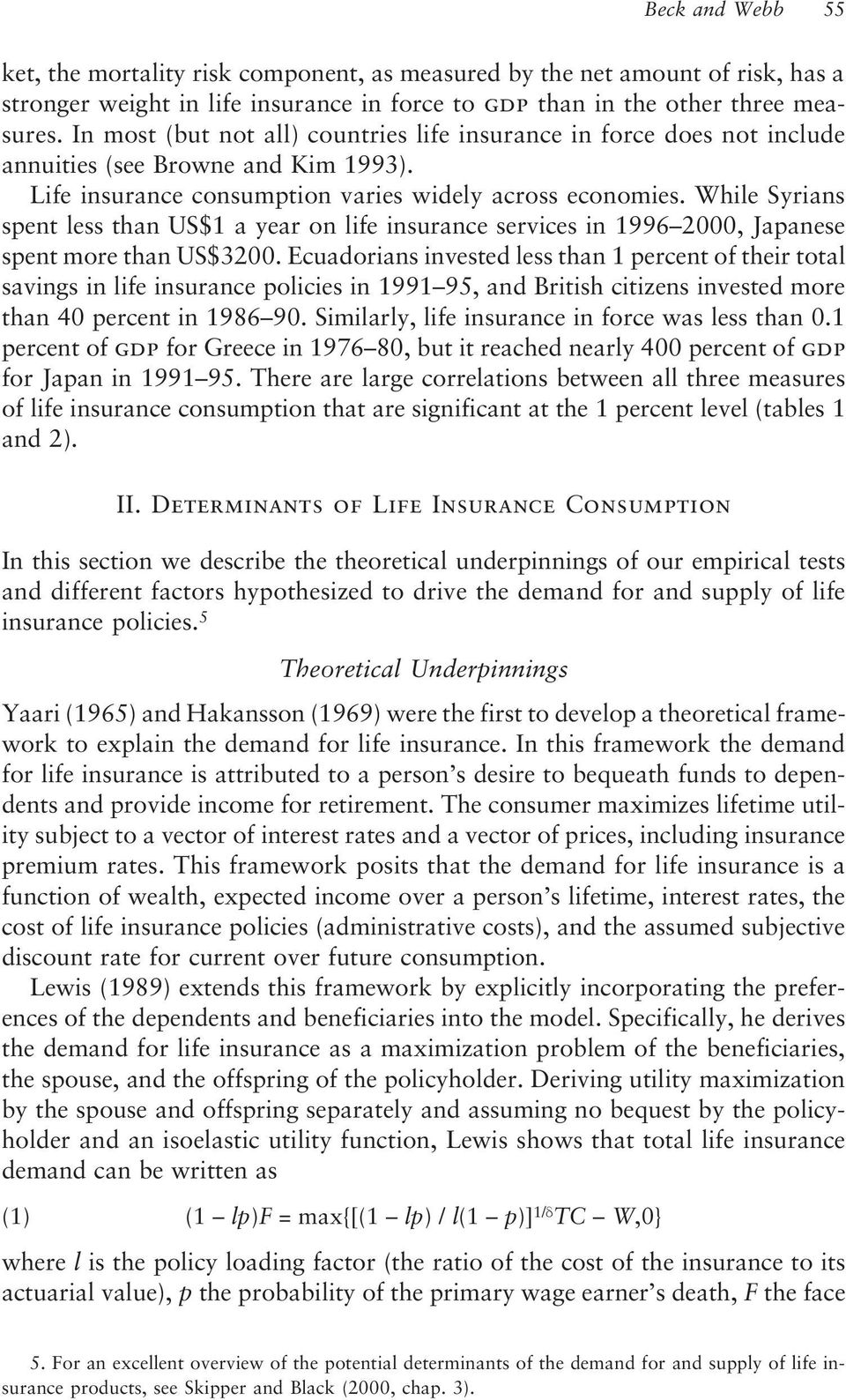
5 Beck and Webb 55 ket, the mortality risk component, as measured by the net amount of risk, has a stronger weight in life insurance in force to gdp than in the other three measures. In most (but not all) countries life insurance in force does not include annuities (see Browne and Kim 1993). Life insurance consumption varies widely across economies. While Syrians spent less than US$1 a year on life insurance services in , Japanese spent more than US$3200. Ecuadorians invested less than 1 percent of their total savings in life insurance policies in , and British citizens invested more than 40 percent in Similarly, life insurance in force was less than 0.1 percent of gdp for Greece in , but it reached nearly 400 percent of gdp for Japan in There are large correlations between all three measures of life insurance consumption that are significant at the 1 percent level (tables 1 and 2). II. Determinants of Life Insurance Consumption In this section we describe the theoretical underpinnings of our empirical tests and different factors hypothesized to drive the demand for and supply of life insurance policies. 5 Theoretical Underpinnings Yaari (1965) and Hakansson (1969) were the first to develop a theoretical framework to explain the demand for life insurance. In this framework the demand for life insurance is attributed to a person s desire to bequeath funds to dependents and provide income for retirement. The consumer maximizes lifetime utility subject to a vector of interest rates and a vector of prices, including insurance premium rates. This framework posits that the demand for life insurance is a function of wealth, expected income over a person s lifetime, interest rates, the cost of life insurance policies (administrative costs), and the assumed subjective discount rate for current over future consumption. Lewis (1989) extends this framework by explicitly incorporating the preferences of the dependents and beneficiaries into the model. Specifically, he derives the demand for life insurance as a maximization problem of the beneficiaries, the spouse, and the offspring of the policyholder. Deriving utility maximization by the spouse and offspring separately and assuming no bequest by the policyholder and an isoelastic utility function, Lewis shows that total life insurance demand can be written as (1) (1 lp)f = max{[(1 lp) / l(1 p)] 1/d TC W,0} where l is the policy loading factor (the ratio of the cost of the insurance to its actuarial value), p the probability of the primary wage earner s death, F the face 5. For an excellent overview of the potential determinants of the demand for and supply of life insurance products, see Skipper and Black (2000, chap. 3).
6 56 the world bank economic review, vol. 17, no. 1 Table 1. Descriptive Statistics Variable Mean Median SD Maximum Minimum Observations Life insurance penetration Life insurance density Life insurance in private savings Life insurance in force to gdp gdp per capita ,090 45, Young dependency ratio Old dependency ratio Life expectancy Schooling Inflation rate Banking sector development Gini index Urbanization Social security Real interest rate Expected inflation rate Permanent income ,172 51, Secondary enrollment Private savings rate Revolutions and coups Human development index Rule of law Inflation volatility Institutional development Catholic Muslim Protestant British legal origin French legal origin Socialist legal origin German legal origin Scandinavian legal origin Good crops Source: Appendix table A-1. value of all life insurance written on the primary wage earner s life, d a measure of the beneficiaries relative risk aversion, TC the present value of consumption of each offspring until he or she leaves the household and of the spouse over his or her predicted remaining life span, and W the household s net wealth. Demand for life insurance increases with the probability of the primary wage earner s death, the present value of the beneficiaries consumption, and the degree of risk aversion. It decreases with the policy loading factor and the household s wealth. But life insurance consumption is not driven only by consumer demand. Important supply-side factors affect the availability and price of life insurance. Insurance companies need human and information resources to effectively measure

7 Table 2. Correlations Life Life insurance Life Young Old Life insurance insurance in private insurance in gdp per dependency dependency Life Inflation Variable penetration density savings force to gdp capita ratio ratio expectancy Schooling rate Life insurance density *** Life insurance in *** *** private savings Life insurance in force *** *** *** to gdp gdp per capita *** *** *** *** Young dependency ratio *** *** *** *** *** Old dependency ratio *** *** *** *** *** *** Life expectancy *** *** *** *** *** *** *** Schooling *** *** *** *** *** *** *** *** Inflation rate *** *** *** *** *** ** Banking sector *** *** *** *** *** *** *** *** *** *** development **Significant at the 5 percent level. ***Significant at the 1 percent level. Source: Authors calculations.

8 58 the world bank economic review, vol. 17, no. 1 the pricing and reserve requirements for products as well as adequate investment opportunities in financial markets. Adequate protection of property rights and effective enforcement of contracts also facilitate the investment function of life insurers. These supply factors are expected to affect the costs of life insurance products and might therefore be represented by the policy loading factor in the Lewis model. Attempts have been made to model the relationship between the supply of and demand for life insurance separately, but data limitations have restricted empirical testing of the models (see Beenstock and others 1986). The available data do not allow us to distinguish between supply and demand. Moreover, premium data do not allow us to observe the actual amount of insurance coverage purchased, as they are a combined measure of price and coverage. Unless the price is constant across countries, which is unlikely, assuming that the premium is equivalent to the amount of coverage would introduce a source of noise in our estimations. But using the variable often employed to proxy price (premiums over life insurance in force) requires a troublesome assumption that the mix of policies remains constant across countries and over time. 6 Price is undoubtedly an important determinant of the consumption of life insurance, however, and leaving it out may subject the empirical testing to omitted variable bias. We address this problem in two ways. First, we assume that the price is a function of several supply-side factors. Varying levels of urbanization, monetary stability, institutional development, political stability, and banking sector development all affect insurers ability to provide cost-effective insurance. Second, we use panel estimation techniques that eliminate biases due to omitted variables, such as the price variable in our model. In the following sections we describe variables that may be linked to the demand function described by Lewis (1989) as well as several supply factors that might proxy for the policy loading factor. While the Lewis model focuses on the mortality risk component of life insurance policies, we link the different determinants to the savings and annuity components of life insurance policies as well. The portfolio approach underlying life insurance in private savings adds another dimension to the discussion. Demographic Determinants A higher young dependency ratio (the ratio of young dependents to the workingage population) is assumed to increase the demand for mortality coverage and decrease the demand for savings through life insurance and annuities (table 3; see table A-1 for the construction and sources of the variables). A larger share of dependents in the population means a higher total present value of consumption of the beneficiaries of those insured and therefore a higher demand for life insurance that provides dependents with payments in the event of the pre- 6. Browne and Kim (1993) use such a price variable, but they note the bias introduced by different compositions of the overall insurance portfolio across countries.

9 Beck and Webb 59 Table 3. Determinants of Life Insurance Consumption across Countries: Expected Results of the Regression Analysis Expected Expected effect Expected effect Expected effect effect on all on savings on mortality on annuity components Variable component risk component component combined Demographic variables Young dependency ratio + Ambiguous Old dependency ratio + + Ambiguous Life expectancy + + Ambiguous Schooling Religion (Muslim) Urbanization Economic variables Income Private savings rate Ambiguous No effect Ambiguous Ambiguous Inflation rate Inflation volatility Real interest rate Banking sector development Social security Gini index Ambiguous Ambiguous Ambiguous Ambiguous Institutional variables Rule of law Revolutions and coups Institutional development Note: This table assumes the division of life insurance consumption into the savings, mortality risk, and annuity components. Source: See section on determinants of life insurance consumption. mature death of the primary wage earner (this would result in a higher TC in equation 1). A high young dependency ratio also means that a large share of the population is too young to consider saving for retirement and thus implies lower demand for savings through life insurance products. Beenstock and others (1986), Browne and Kim (1993), and Truett and Truett (1990) find that the young dependency ratio is positively correlated with life insurance penetration. Given the opposite effects of the young dependency ratio on the mortality and savings components of life insurance, however, we predict that a higher young dependency ratio is ambiguously correlated with life insurance. A higher old dependency ratio (the ratio of old dependents to the workingage population) is assumed to increase the demand for the savings and annuity components and decrease the demand for the mortality risk component of life insurance. We conjecture that in countries in which a larger share of the population is retired, savings through life insurance policies and protection against outliving one s retirement income gain importance, whereas insurance against the risk of the primary wage earner s death loses importance. The overall effect of the old dependency ratio is therefore predicted to be ambiguous.

10 60 the world bank economic review, vol. 17, no. 1 Societies with a longer life expectancy should have lower mortality coverage costs, lower perceived need for mortality coverage, but higher savings through life insurance vehicles and more demand for annuities (a longer life expectancy would be reflected by a lower p in equation 1). This would imply an ambiguous correlation with the demand for life insurance products (compare Beenstock and others 1986). Earlier studies have found life expectancy to be positively correlated with life insurance penetration (Beenstock and others 1986; Outreville 1996). We expect that a higher level of education in a population will be positively correlated with the demand for any type of life insurance product. A higher level of education may increase people s ability to understand the benefits of risk management and long-term savings and therefore increase their risk aversion (this would be reflected by a lower d in equation 1). 7 Education may also increase the demand for pure death protection by lengthening the period of dependency as well as by increasing the human capital of and so the value to be protected in the primary wage earner (this would be reflected by a higher TC in equation 1). But a positive relationship between education and life insurance might also indicate that better access to long-term savings and insurance instruments encourages access to higher education. 8 Truett and Truett (1990) and Browne and Kim (1993) find a positive relationship between life insurance consumption and the level of education. To measure the education level, we use the average years of schooling in the population over age 25 and the gross secondary enrollment ratio. The religious inclination of a population may affect its risk aversion and its attitude toward the institutional arrangements of insurance (this would be reflected by cross-country variation in d in equation 1). Religious opposition to life insurance, though stronger in European countries before the 19th century, persists in several Islamic countries today (see Zelizer 1979 for a discussion of the role of religion in creating cultural opposition to life insurance). Followers of Islam have traditionally disapproved of life insurance because it is considered a hedge against the will of Allah. 9 Unsurprisingly, Browne and Kim (1993) and Meng (1994) find a dummy variable for Islamic countries to be negatively correlated with demand for life insurance. Here we use a broader measure of religious inclination by including Protestantism, Catholicism, and a composite of other religions, defined as the ratio of the adherents of a religion to the entire population. While we expect the share of the population that is Muslim to be 7. However, as pointed out by Browne and others (2000), citing unpublished work by François Outreville and George Szpiro, risk aversion might also be negatively correlated with education. 8. We are grateful to one of the referees for pointing this out. A similar debate on the role of education has taken place in the empirical growth literature; see Bils and Klenow (2000). 9. The advent of takaful insurance approved by Islamic scholars and licensed and marketed in countries with Muslim populations in the past decade, however, has increased the acceptance of life insurance in some Islamic populations. For further information see introduction.htm.

11 Beck and Webb 61 negatively related to demand for life insurance, we do not have prior expectations about the signs on the other religion variables. Economies with greater urbanization (a larger share of urban population in the total) are expected to have higher life insurance consumption. The concentration of consumers in a geographic area simplifies the distribution of life insurance products because it reduces the costs related to marketing, premium collection, underwriting, and claims handling. A larger share of urban population is also correlated with less reliance on informal insurance agreements and therefore may induce higher demand for formal insurance products. Economic Determinants Life insurance consumption should rise with income for several reasons. First, a person s consumption and human capital typically increase along with income, creating a greater demand for insurance (mortality coverage) to safeguard the income potential of the insured and the expected consumption of his or her dependents (this would be reflected by a higher TC in equation 1). Second, life insurance may be a luxury good, since increasing income may enable people to direct a larger share of their income to retirement and investment-related life insurance products. Finally, the overhead costs associated with administering and marketing insurance can make larger policies less expensive per dollar of insurance in force, lowering their price. Using both aggregate national accounts data and individual household data, several studies have shown that the use of life insurance is positively related to income (Campbell 1980; Lewis 1989; Beenstock and others 1986; Truett and Truett 1990; Browne and Kim 1993; Outreville 1996). We use real gdp per capita as well as an indicator of permanent income, calculated as the predicted value from a regression of the log of each country s real gdp per capita on a time trend. Insurance against mortality risk and consumption and savings decisions are related to permanent income or income over the life cycle rather than current income. Theory suggests an ambiguous relationship between life insurance and an economy s private savings rate. If private agents save a larger share of their income, they might or might not be willing to increase their savings in life insurance policies. We use the share of private savings in gross national disposable income. We expect inflation and its volatility to have a negative relationship with life insurance consumption. Because life insurance savings products typically provide monetary benefits over the long term, monetary uncertainty has a substantial negative effect on the expected returns on these products. Inflation can also have a disruptive effect on the life insurance industry when interest rate cycles spur disintermediation. 10 These dynamics make inflation an additional encumbrance on the product pricing decisions of life insurers, possibly reducing sup- 10. Fixed interest rates and loan options embedded in some life insurance policies, for example, spurred disintermediation in the U.S. life insurance market during the inflationary 1970s and 1980s.

12 62 the world bank economic review, vol. 17, no. 1 ply in times of high inflation (see Cargill and Troxel 1979 for a discussion of the possible effects of inflation on the life insurance market). In addition to testing for a relationship between life insurance consumption and the inflation rate and its standard deviation, we also test for a relationship with the real interest rate, defined as the difference between the nominal interest rate and inflation. Theory predicts a positive relationship: a higher real interest rate increases life insurers investment returns and thus their profitability, in turn offering greater profitability of financial relative to real investments for potential purchasers of life insurance policies. We expect banking sector development to be positively correlated with life insurance consumption. 11 Well-functioning banks may increase the confidence of consumers in other financial institutions, such as life insurers. They also provide life insurers with an efficient payment system. Efficient development of the entire financial system as might be reflected in the absence of interest rate ceilings and other distortionary policies is thought to help life insurers invest more efficiently. But a vibrant insurance sector might also foster the development of the banking sector, so a positive relationship between the two variables cannot necessarily be interpreted as evidence of causality. Outreville (1996) finds a significantly positive relationship between financial development and life insurance penetration. We use the total claims of deposit money banks on domestic nonfinancial sectors as a share of gdp as an indicator of banking sector development. We expect the size of a country s social security system to be negatively correlated with the demand for life insurance products. Kim (1988) and Meng (1994) postulate that social security displaces private insurance. If greater retirement savings are being channeled through the government, or if the public sector provides substantial benefits to families of prematurely deceased wage earners, there should be less demand for life insurance products (this would be reflected in a higher W in equation 1). We use public expenditures on social security and welfare as a share of gdp as an indicator of the size of the social security system. The correlation of a country s income distribution (as measured by the Gini index) with life insurance consumption is expected to be ambiguous. Beenstock and others (1986) reason that wealthy population groups do not need insurance protection, whereas poorer groups have limited demand because of income constraints. (Both the possibility of declining risk aversion with greater wealth and the replacement of life insurance coverage with surplus assets in an individual s portfolio are expected to reduce the demand for life insurance among the wealthy.) A more equal income distribution with a larger middle class might therefore result in greater demand for life insurance. But although the middle class may have the greatest demand for life insurance savings products, there may be a minimum level of income at which these policies become affordable. Accordingly, in a poor country with a large middle class, fewer people may be 11. Outreville (1992) also proposes a relationship between financial development and insurance markets.

13 Beck and Webb 63 able to purchase life insurance than in a poor country with a less equal distribution and a larger or wealthier upper class. The relationship between income distribution and life insurance consumption is thus ambiguous. Beenstock and others (1986) find a negative relationship between the Gini index and life insurance penetration. We also test for a relationship between life insurance consumption and the human development index, as constructed by the United Nations Development Programme (undp). This index measures the relative achievements of a country in life expectancy, education (both literacy and gross enrollment), and income (gdp per capita), averaged over the three areas. Values are bounded between zero and one. Because we expect an ambiguous relationship between life expectancy and life insurance consumption, we do not necessarily expect a robust relationship between the human development index and our measures of life insurance consumption. Outreville (1996) finds no significant relationship between the human development index and life insurance consumption, and Outreville (1999) shows that the index is positively correlated with measures of financial development. Institutional Determinants A vibrant life insurance market depends to a large extent on the institutional framework and political stability of a country. If fraud is common in claims reporting, insurance becomes prohibitively costly for a large part of the population. An inability to appeal the breach of life insurance contracts by insurers reduces the value of such contracts to consumers and may deter them from committing large sums of money to these products. Lack of property protection and contract enforcement hampers life insurers ability to invest efficiently and control the price of their products. Finally, lack of political stability shortens the economic horizon of both potential buyers and suppliers of life insurance products, dampening the development of a healthy life insurance market. To measure these institutional and political factors, we use three different indicators. Rule of law measures the degree to which citizens of a country are able to use the legal system to mediate disputes and enforce contracts. The average number of revolutions and coups a year indicates the political stability of a country. Institutional development is an average of six indicators measuring voice and accountability, political stability, government effectiveness, regulatory quality, rule of law, and control of corruption. While data for rule of law are available for and data for revolutions and coups for , data for institutional development are available for only one point in time, We therefore use this indicator only in the cross-country estimations. Descriptive Statistics and Correlations As can be seen in table 1, there is a large variation in the economic and financial development of countries, their demographic structure, and their macroeconomic performance. Most of the explanatory variables are correlated with life insur-

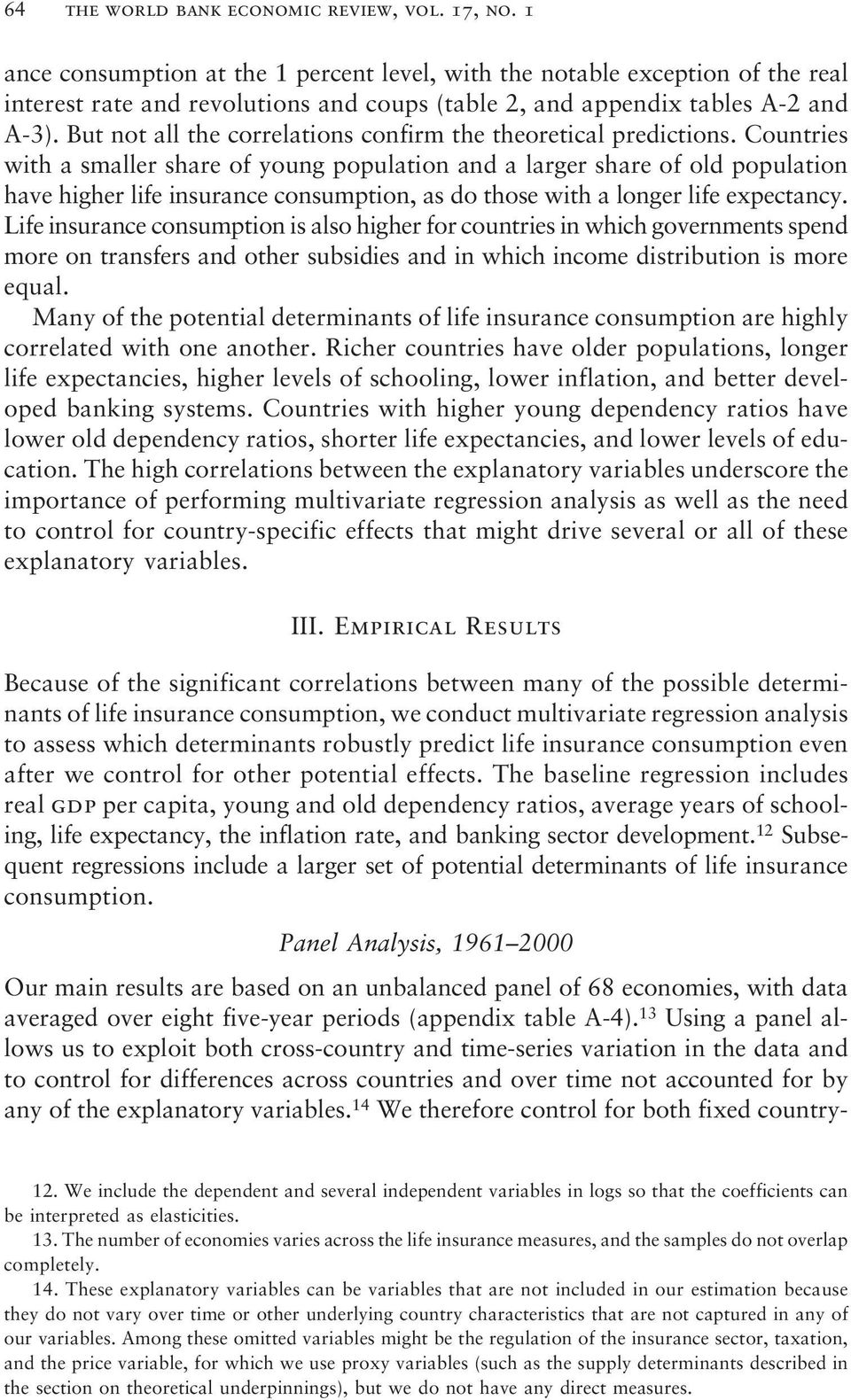
14 64 the world bank economic review, vol. 17, no. 1 ance consumption at the 1 percent level, with the notable exception of the real interest rate and revolutions and coups (table 2, and appendix tables A-2 and A-3). But not all the correlations confirm the theoretical predictions. Countries with a smaller share of young population and a larger share of old population have higher life insurance consumption, as do those with a longer life expectancy. Life insurance consumption is also higher for countries in which governments spend more on transfers and other subsidies and in which income distribution is more equal. Many of the potential determinants of life insurance consumption are highly correlated with one another. Richer countries have older populations, longer life expectancies, higher levels of schooling, lower inflation, and better developed banking systems. Countries with higher young dependency ratios have lower old dependency ratios, shorter life expectancies, and lower levels of education. The high correlations between the explanatory variables underscore the importance of performing multivariate regression analysis as well as the need to control for country-specific effects that might drive several or all of these explanatory variables. III. Empirical Results Because of the significant correlations between many of the possible determinants of life insurance consumption, we conduct multivariate regression analysis to assess which determinants robustly predict life insurance consumption even after we control for other potential effects. The baseline regression includes real gdp per capita, young and old dependency ratios, average years of schooling, life expectancy, the inflation rate, and banking sector development. 12 Subsequent regressions include a larger set of potential determinants of life insurance consumption. Panel Analysis, Our main results are based on an unbalanced panel of 68 economies, with data averaged over eight five-year periods (appendix table A-4). 13 Using a panel allows us to exploit both cross-country and time-series variation in the data and to control for differences across countries and over time not accounted for by any of the explanatory variables. 14 We therefore control for both fixed country- 12. We include the dependent and several independent variables in logs so that the coefficients can be interpreted as elasticities. 13. The number of economies varies across the life insurance measures, and the samples do not overlap completely. 14. These explanatory variables can be variables that are not included in our estimation because they do not vary over time or other underlying country characteristics that are not captured in any of our variables. Among these omitted variables might be the regulation of the insurance sector, taxation, and the price variable, for which we use proxy variables (such as the supply determinants described in the section on theoretical underpinnings), but we do not have any direct measures.
15 Beck and Webb 65 and time-specific effects in our regression and estimate the regression with either a fixed or random effects model. 15 We average data over five years because several of our explanatory variables are available only at a five-year frequency and others might be subject to short-term fluctuations related to the business cycle. 16 The results in table 4 show that the variation in life insurance penetration across countries can be explained by variation in income, the old dependency ratio, inflation, and banking sector development. These four variables show significant coefficients in our baseline regression and in most of our robustness tests. Schooling, life expectancy, and the young dependency ratio are not robust predictors of life insurance consumption. The results of our baseline regression indicate that a 10 percent increase in real income per capita increases life insurance penetration by 5.7 percent, confirming that life insurance is a luxury good (column 1 of table 4). When we include the private savings rate and revolutions and coups, however, the coefficient on income turns insignificant, a result of the smaller sample when either of the two variables is included. 17 When we replace gdp per capita with permanent income, the results are confirmed (column 9 of table 4). We find a positive relationship between the old dependency ratio and life insurance penetration. The size of the coefficient indicates that a 10 percent increase in the ratio of the old population to the working-age population increases life insurance penetration by 12 percent. This suggests that demand for savings and annuity products increases as the population ages. Price stability is an important predictor of life insurance consumption. The coefficient on the inflation rate is significantly negative in all specifications. The effect of a stable macroeconomic environment is also large. If Brazil, which had one of the highest five-year average inflation rates in our sample, had achieved an average inflation rate in of 7 percent (the sample median) rather than the actual 212 percent, life insurance penetration might have been 0.87 percent of gdp rather than 0.29 percent. 18 Replacing the inflation rate with the expected inflation rate the average of the inflation rate in the current and fol- 15. We test for the appropriateness of the fixed- or random-effects model with the Hausman test. Under the null hypothesis that random and fixed effects estimates are not statistically different, both estimators are consistent, but the fixed-effects model is inefficient. Under the alternative hypothesis that both estimates are statistically different, only the fixed-effects model gives consistent coefficients. We use the fixed-effects model when the null hypothesis is rejected at the 10 percent level and the randomeffects model otherwise. 16. Average years of schooling are available only at a five-year frequency, and life expectancy, the urban population share, and the Gini index are not available on a yearly frequency for most countries. Moreover, the inflation rate and banking sector development might be subject to short-term fluctuations related to the business cycle. 17. We rerun the regressions without the private savings rate or revolutions and coups but restricting the sample accordingly. In neither case does income per capita enter significantly. 18. This result matches the finding by Babbel (1981) that even the demand for inflation-indexed life insurance policies decreases during inflationary periods in Brazil.

16 Table 4. Determinants of Life Insurance Penetration in a Panel, : Full Sample, Fixed Effects Variable (1) (2) (3) (4) (5) (6) Constant (1.92)* (2.07)** (.086) (1.47) (1.06) (1.94)* GDP per capita (2.89)*** (2.80)*** (2.82)*** (2.00)** (0.69) (2.96)*** Young dependency ratio (1.12) (1.02) (1.01) (2.73)*** (0.22) (1.11) Old dependency ratio (3.90)*** (3.89)*** (2.43)** (2.75)*** (3.82)*** (3.89)*** Life expectancy (0.22) (0.12) (0.52) (0.46) (0.22) (0.23) Schooling (0.23) (0.55) (1.85)* (0.87) (0.14) (0.26) Inflation rate (5.18)*** (5.22)*** (4.70)*** (5.50)*** (3.37)*** Banking sector Development (4.62)*** (4.62)*** (4.70) *** (2.80)*** (5.11)*** (4.64)*** Urbanization (0.78) Gini index (0.17) Social security (0.50) Revolutions and coups (0.56) Expected inflation rate (5.22)*** Inflation volatility Real interest rate Permanent income Secondary enrollment Human development index Rule of law Private savings rate F-test time dummies 2.67** 2.59** 3.23*** *** 2.75*** Observations Economies Period R 2 within R 2 between R 2 overall Hausman test (p-value) *Significant at the 10 percent level. **Significant at the 5 percent level. ***Significant at the 1 percent level. Note: The numbers in parentheses are t-statistics. a Developing economies, random effects Source: Authors calculations.

17 (7) (8) (9) (10) (11) (12) (13) (14) a (1.86)* (1.25) (2.44)** (2.00)** (1.89)* (1.38) (0.64) (0.41) * (2.50)** (3.54)*** (3.24)*** (2.73)*** (0.08) (1.72)* (1.27) (1.59) (0.84) (1.36) (1.65) (1.04) (2.47)** (0.06) * (3.77)*** (3.61)*** (3.42)*** (3.65)*** (3.96)*** (2.23)** (3.24)*** (0.40) (0.13) (1.01) (0.09) (0.15) (0.51) (0.16) (0.94) (0.14) (1.04) (0.47) (0.88) (1.64) (0.23) (3.15)*** (5.79)*** (5.36)*** (5.26)*** (4.85)*** (4.27)*** (4.98)*** (4.28)*** * (4.65)*** (4.14)*** (4.62)*** (4.09)*** (3.76)*** (2.38)** (4.69)*** (3.76)*** * (1.37) (2.78)*** (3.28)*** (0.14) (1.51) (0.02) (2.56)** * 1.89* 2.45** 2.02* **

18 68 the world bank economic review, vol. 17, no. 1 lowing year confirms the results (column 6 of table 4). 19 Inflation volatility does not explain any variation in life insurance penetration across countries, whereas the real interest rate is positively related to life insurance penetration when inflation is controlled for (columns 7 and 8 of table 4). Banking sector development is positively correlated with life insurance penetration. The coefficient on the indicator of banking sector development is significantly positive in all specifications. As discussed, the positive coefficient does not imply a causal effect on life insurance penetration. Instead, it shows that countries that have well-developed banks also have higher life insurance consumption. In our cross-country analysis we try to control for reverse causation and simultaneity bias. Variation in the share of young population or in life expectancy cannot explain the variation in life insurance penetration across countries, confirming the hypothesis of offsetting effects of the young dependency ratio (life expectancy) on gross premiums, a positive (negative) effect on mortality risk, and a negative (positive) effect on the savings and annuity components. 20 Neither average years of schooling nor secondary enrollment enter significantly at the 5 percent level in any of the regressions. Turning to our additional explanatory variables, we find a positive relationship between the private savings rate and life insurance penetration. Urbanization (column 2 of table 4), the Gini index (column 3), social security (column 4), revolutions and coups (column 5), the human development index (column 11), and rule of law (column 12) cannot explain the cross-country variation in life insurance penetration. 21 In the baseline regression with the sample limited to developing economies, only inflation and banking sector development continue to enter significantly at the 1 percent level, whereas income per capita enters significantly and positively at the 10 percent level (column 14 of table 4). The old dependency ratio cannot explain the variation in life insurance penetration across developing economies. Table 5 presents results with the other indicators of life insurance consumption across countries as dependent variables. For each indicator it gives results for two baseline regressions, one for the full sample and one restricted to developing economies. Life insurance density increases with higher income per capita, a higher old dependency ratio, a lower inflation rate, and better developed banks (column 1 of table 5). Once we restrict the sample to developing 19. Following Browne and Kim (1993), we also use the average of inflation in the current and previous year, because consumers inflation expectations might be determined by previous inflation experience. The results do not change. 20. Because the young and old dependency ratios and life expectancy are highly correlated with one another, this result might be driven by multicollinearity. We therefore test the robustness of the results by including only one of the three variables at a time. The results do not change. 21. We also try two alternative indicators of institutional development, corruption and bureaucratic quality (like rule of law, these indicators come from the Political Risk Services (various years) International Country Risk Guide. Neither enters significantly in the regressions.

19 Beck and Webb 69 economies, however, only banking sector development enters significantly. The income elasticity of life insurance density is higher than that of life insurance penetration, as expected (see the discussion in the section on measuring life insurance consumption). Life insurance in private savings increases with a higher old dependency ratio, lower inflation, and better developed banks (column 3 of table 5). Interestingly, the share of savings in life insurance policies decreases with a higher savings rate. Considering this result jointly with the positive coefficient (0.359) on the savings rate in the regression of life insurance penetration (column 13 of table 4) suggests that although private agents invest some of their additional savings in life insurance policies, overall there is a shift in their portfolios away from life insurance policies toward other savings instruments. gdp per capita does not explain the share of savings in life insurance policies. In the sample of developing economies only banking sector development (positively) and the private savings rate (negatively) can explain the variation in the share of private savings in life insurance policies across developing economies. Life insurance in force to gdp increases with higher income per capita, lower inflation, a lower old dependency ratio, and better developed banks. While the results for gdp per capita, inflation, and banking sector development confirm the results using life insurance penetration and life insurance density, the results for the old dependency ratio are surprising. The stronger weight of the mortality risk component in life insurance in force to gdp compared with that in the other three measures, and its exclusion of annuities, might explain the opposite sign. 22 Only the results for income per capita and inflation are confirmed in the sample restricted to developing economies. Annual Panel, Table 6 presents results for a panel of annual observations. Using annual rather than five-year averages allows us to maximize the information we have and to test the sensitivity of our panel analysis to the frequency of the data. 23 As in the five-year panel, life insurance penetration increases with income per capita, the old dependency ratio, and banking sector development and decreases with inflation. Interestingly, we also find a negative relationship between the young dependency ratio and life insurance penetration, suggesting that countries with a larger share of young population have lower life insurance consumption. 24 As in the five-year panel, expected inflation has a negative relationship with life insurance penetration (column 3 of table 6), and the real interest rate, perma- 22. This might also explain the negative sign on life expectancy. In regressions with only the old or the young dependency ratio or life expectancy, only the old dependency ratio and life expectancy enter negatively and significantly at the 5 percent level. 23. Because schooling data are available only at a five-year frequency, we repeat the values for the intermediate years from the initial year of the corresponding five-year period. 24. As in the five-year panel, we include the young and old dependency ratios and life expectancy separately, confirming our results.

20 Table 5. Determinants of Life Insurance Consumption in a Panel, , with Alternative Measures of Life Insurance Consumption 70 (1) (2) (3) (4) (5) (6) Life insurance density Life insurance in private savings Life insurance in force to gdp Developing Developing Developing Full sample, economies, Full sample, economies, Full sample, economies, Variable fixed effects fixed effects fixed effects random effects random effects random effects Constant (2.13)** (1.69)* (0.18) (0.46) (1.21) (0.63) gdp per capita (4.41)*** (1.09) (0.98) (1.23) (3.81)*** (2.28)** Young dependency ratio (0.55) (0.82) (1.71)* (1.03) (0.47) (0.38) Old dependency ratio (3.31)*** (0.41) (3.40)*** (1.41) (3.03)*** (1.40) Life expectancy (0.02) (0.69) (0.12) (0.05) (1.94)* (0.51) Schooling (0.48) (0.06) (1.95)* (0.08) (1.39) (0.41)

21 Inflation rate (2.24)** (1.15) (2.62)*** (1.18) (2.64)*** (2.25)** Banking sector development (2.89)*** (2.69)*** (4.02)*** (3.22)*** (2.91)*** (0.58) Private savings rate (3.97)*** (2.30)** F-test time dummies ** 8.33* 15.05** 6.87 Observations Economies Period R 2 within R 2 between R 2 overall Hausman test (p-value) *Significant at the 10 percent level. **Significant at the 5 percent level. ***Significant at the 1 percent level. Note: The numbers in parentheses are t-statistics. Source: Authors calculations.
22 Table 6. Determinants of Life Insurance Penetration in an Annual Panel, (1) (2) (3) (4) (5) (6) 72 Full Sample Developing economies Variable Fixed effects Random effects Fixed effects Fixed effects Fixed effects Random effects Constant (1.16) (3.01)*** (2.19)** (0.62) (2.21)** (0.80) gdp per capita (4.89)*** (0.72) (3.92)*** (4.96)*** (2.15)** Young dependency ratio (2.87)*** (2.94)*** (2.09)** (3.32)*** (2.32)** (0.13) Old dependency ratio (4.97)*** (2.40)** (6.55)*** (4.38)*** (3.53)*** (0.25) Life expectancy (1.02) (3.59)*** (0.68) (1.37) (0.99) (0.81) Schooling (0.45) (4.49)*** (0.07) (0.97) (0.94) (0.56) Inflation rate (4.97)*** (4.38)*** (4.41)*** (5.32)*** (3.88)***
23 Banking sector development (2.29)** (8.47)*** (9.55)*** (2.74)*** (2.20)** (6.87)*** Private savings rate (2.47)** Expected inflation rate (6.13)*** Real interest rate (2.07)** Permanent income (5.91)*** 73 F-test time dummies 2.03*** 80.21*** 2.01*** 1.73*** 1.47** Observations Economies Period R 2 within R 2 between R 2 overall Hausman test (p-value) *Significant at the 10 percent level. **Significant at the 5 percent level. ***Significant at the 1 percent level. Note: The numbers in parentheses are t-statistics. Source: Authors calculations.
24 74 the world bank economic review, vol. 17, no. 1 nent income, and the private savings rate enter positively (columns 2, 4, and 5). Neither schooling nor life expectancy shows a robust relationship with life insurance penetration. Only income per capita, inflation, and banking sector development explain the variation in life insurance penetration across developing economies in the annual sample. Overall, the annual sample thus confirms the findings from the five-year panel regressions. Cross-Country Analysis, Table 7 presents results from cross-country regressions in which we average data over the period for all economies in our sample. Although crosscountry analysis does not allow us to control for omitted variables, as in the panel analysis, it does permit us to test the relationship between life insurance consumption across countries and several time-invariant variables and to use instrumental variables regressions to control for biases induced by simultaneity and reverse causation. These biases might arise especially for educational attainment and banking sector development. Countries with higher levels of economic and financial development, a more educated population, lower inflation, and a shorter life expectancy have higher life insurance penetration. Moreover, the old dependency ratio enters negatively and significantly at the 10 percent level. 25 While the results for income per capita, inflation, and banking sector development confirm the results from our panel analysis, those for life expectancy, schooling, and the old dependency ratio differ from the previous results. Restricting the sample to developing economies confirms the results for life expectancy, inflation, schooling, and the old dependency ratio but not for income per capita and banking sector development. The young dependency ratio, the private savings rate, and revolutions and coups do not enter significantly in the regressions (columns 3 and 5 of table 7). A larger share of Muslim population reduces life insurance penetration, and a better institutional environment increases it (columns 4 and 6 of table 7). Econometric, sampling, and frequency differences might explain the differences between the panel and cross-country results. The panel estimations allow us to control for country-specific effects, whereas the ordinary least squares regressions do not. 26 Moreover, economic and demographic factors might have different relationships with life insurance consumption across countries than within countries over time. Our cross-country results show a positive relationship between schooling and banking sector development and life insurance consumption. But these results 25. As in the five-year panel, we control for multicollinearity by including only one of the following regressors at a time: the old dependency ratio, the young dependency ratio, and life expectancy. Although life expectancy continues to enter significantly and negatively, neither of the two dependency ratios enters significantly. 26. Most developing economies do not have life insurance data for the period before 1978, so the unbalanced panel regressions might be biased toward developed countries. We therefore rerun all regressions of the five-year panel with the sample limited to The results do not change significantly.
25 Beck and Webb 75 do not allow any inferences about a causal relationship between education and banking, on the one hand, and the development of the life insurance sector on the other. We therefore run two instrumental variables regressions in which we extract the exogenous components of banking sector development and schooling to control for reverse causation and simultaneity bias in the empirical relationship between these variables and life insurance consumption. Specifically, we use dummy variables indicating the origin of a country s legal system and a variable good crops proxying for agricultural endowments conducive to a large middle class and institutional development. 27 Legal origin and agricultural endowments are both exogenous variables and are highly correlated with banking sector development and schooling, as confirmed by the first-stage regressions (the two variables explain 43 percent of the variation in banking sector development and schooling). We use the Hansen test of overidentifying restrictions to examine whether legal origin and agricultural endowments have any effect on life insurance penetration beyond their effect through banking sector development, schooling, or the other explanatory variables. In column 7 of table 7 we instrument only for banking sector development, and in column 8 for both banking sector development and schooling. While banking sector development enters significantly and positively even after we instrument for it, schooling turns insignificant when we instrument for it. The test of overidentifying restrictions is not rejected in either case, confirming the adequacy of our instruments. 28 These results show that the relationship between banking sector development and life insurance consumption is not due to reverse causation and simultaneity bias, and the significant relationship between schooling and life insurance consumption is most likely spurious. Overall, the cross-country results confirm the importance of income per capita, monetary stability, and banking sector development in predicting life insurance consumption across countries. They also provide evidence of the importance of religion and institutional development for life insurance consumption. Finally, the demographic variables show a different relationship with life insurance consumption in the cross-section than in the panel. IV. Conclusion In this article we analyze the determinants of life insurance consumption in a panel of 68 economies for , using four different indicators of life insurance consumption. Our main results are based on a panel of eight nonoverlapping fiveyear periods. We test for the sensitivity of the results with a panel of annual observations and a cross-country sample. 27. Beck and others (forthcoming), among many others, show that legal origin explains the variation in financial development across countries. Easterly and Levine (2003) show that good crops are a good predictor of institutional development. 28. We also ran an instrumental variables regression in which we instrumented only schooling. The test of overidentifying restrictions is rejected, however.
26 Table 7. Determinants of Life Insurance Penetration in a Cross-Section, (1) (2) (3) (4) (5) (6) (7) (8) Developing Full Sample Full sample, economies, Variable ols ols ols ols ols ols iv iv 76 Constant (2.98)*** (2.24)** (3.08)*** (2.83)*** (2.97)*** (3.17)*** (2.74)*** (1.97)* gdp per capita (3.45)*** (1.68) (1.63) (4.48)*** (3.52)*** (2.63)** (2.76)*** (2.62)** Young dependency ratio (1.00) (1.00) (0.41) (0.39) (1.19) (0.85) (0.17) (0.16) Old dependency ratio (1.68)* (1.79)* (0.39) (1.00) (1.84)* (1.84)* (1.10) (0.96) Life expectancy (4.40)*** (3.51)*** (5.68)*** (3.97)*** (4.36)*** (4.61)*** (4.48)*** (3.45)*** Schooling (5.06)*** (2.92)*** (4.98)*** (2.35)** (4.45)*** (3.97)*** (3.74)*** (0.89) Inflation rate (4.10)*** (2.11)** (2.73)*** (5.06)*** (3.39)*** (2.38)** (0.32) (0.19) Banking sector development (2.59)** (0.69) (0.60) (3.67)*** (2.44)** (2.51)** (2.44)** (2.32)** Private savings rate (1.37)
27 77 Muslim (2.60)** Catholic (0.59) Protestant (1.42) Revolutions and coups (1.39) Institutional development (2.22)** Observations R Instrumented Banking sector Banking sector development development, schooling Instruments Legal origin Legal origin dummy variables, dummy variables, good crops good crops Test of overidentifying restrictions (p-value) ols ordinary least squares. iv instrumental variables. *Significant at the 10 percent level. **Significant at the 5 percent level. ***Significant at the 1 percent level. Note: The numbers in parentheses are t-statistics. Source: Authors calculations.
28 78 the world bank economic review, vol. 17, no. 1 Our panel estimations show that countries with higher income (both current and permanent), lower inflation, and better developed banks have higher life insurance consumption. A higher ratio of old to working-age population increases life insurance penetration and life insurance density, and it decreases life insurance in force to gdp, perhaps reflecting the different weights of mortality risk, savings, and annuity components in these measures. A higher private savings rate and a higher real interest rate are also associated with higher life insurance consumption. The young dependency ratio, life expectancy, and schooling have no strong association with life insurance consumption across countries. The share of life insurance premiums in private savings is best predicted by the old dependency ratio, inflation, banking sector development, and the private savings rate but not by income per capita. The results suggest that the older the population and the lower the inflation rate, the more people will select life insurance over other forms of savings. But as private agents save more, the share of life insurance in their portfolios declines even though they invest some of their additional savings in life insurance policies. Restricting the sample to developing economies makes many of the results less significant, but macroeconomic stability and well-developed banks continue to predict higher life insurance consumption across developing economies. The cross-country estimations confirm some of the panel results and contradict others. Most notably, we find a positive relationship between schooling and life insurance consumption, though it is not robust to controlling for biases induced by reverse causation and simultaneity. By contrast, the positive effect of banking sector development on life insurance consumption is robust to controlling for these biases by instrumenting with legal origin and agricultural endowments. This evidence suggests that banking sector development facilitates the development of life insurance and its contractual savings function. This finding does not contradict the positive effect of life insurance on capital market development found by other authors. While an efficient banking system might help develop the life insurance sector by offering payment services and raising confidence in financial institutions, life insurance and other forms of contractual savings might foster the development of capital markets through demand for long-term financial investments. In summary, income per capita, inflation, and banking sector development are the most robust predictors of life insurance consumption across countries and over time. In addition, religious and institutional differences can explain some of the variation in life insurance consumption across countries. But there is no robust link from schooling and the demographic variables to life insurance consumption. Finally, although life insurance is a luxury good, there is no relationship between income distribution and life insurance consumption. Rising income per capita helps drive life insurance consumption, but income distribution does not appear to do so.
29 Beck and Webb 79 The results provide a thorough review of existing hypotheses about the demand for and supply of life insurance. They also have implications for policymakers. Both monetary stability and banking sector development have positive effects on economic development and growth independent of their positive effect on the development of the insurance sector. Moreover, they may be fundamental to the growth of savings and investment through life insurance, particularly in a developing economy.
30 Appendix Table A-1. Definitions and Sources of Variables Variable Definition Source 80 Life insurance penetration Life insurance premiums divided by gdp. Swiss Reinsurance Company (various years); imf (various years) Life insurance density Life insurance premiums per capita in real dollars. Calculated as life Swiss Reinsurance Company (various years); insurance premiums multiplied by the average period exchange imf (various years); World Bank (various years) rate, divided by the population and the U.S. consumer price index. Life insurance in private savings Life insurance premiums divided by private savings. Swiss Reinsurance Company (various years); Loayza and others (1999) Life insurance in force to gdp Outstanding life insurance policies relative to gdp. Calculated as the American Council of Life Insurance (various years); sum of face amounts plus dividend additions of life insurance imf (various years) policies outstanding as a share of gdp. gdp per capita gdp per capita in constant 1995 U.S. dollars. World Bank (various years) Young dependency ratio Ratio of the population under age 15 to the population ages World Bank (various years) Old dependency ratio Ratio of the population over age 65 to the population ages World Bank (various years) Life expectancy Years of life expectancy at birth. World Bank (various years) Schooling Average years of schooling in the population over age 25. Barro and Lee (1996, 2000) Inflation rate Log difference of the consumer price index (line 64 in imf, imf (various years) International Financial Statistics, various years) Banking sector development {(0.5) * [F(t)/P_e(t) + F(t 1)/P_e(t 1)]}/[GDP(t)/P_a(t)], where F is imf (various years) claims by deposit money banks and other financial institutions on domestic nonfinancial sectors (lines 22a d), gdp is line 99b, P_e is the end-of-period consumer price index (line 64), and P_a is the average consumer price index for the year. Urbanization Share of the urban population in the total population. World Bank (various years) Gini index The Gini index measures the area between the Lorenz curve (the Deininger and Squire (1996); Lundberg and cumulative percentages of total income received against the Squire (2001) cumulative number of recipients) and a hypothetical line of absolute equality, expressed as a percentage of the maximum area under the line. Thus a Gini index of 0 represents perfect equality, and an index of 100 perfect inequality. Social security Government subsidies and other current transfers by government as a World Bank (various years) share of gdp. Real interest rate Nominal interest rate minus the inflation rate. The nominal rate is imf (various years) the average lending rate or, if unavailable, the discount rate.
31 81 Expected inflation rate Average of the inflation rate in the current and following year. imf (various years) Permanent income Predicted value of a regression of the log of each country s real gdp World Bank (various years); authors calculations per capita on a time trend. Secondary enrollment Gross secondary enrollment ratio. World Bank (various years) Private savings rate Private savings as a share of gross national disposable income. Loayza and others (1999) Revolutions and coups Average number of revolutions and coups a year. Banks (1994) Human development index Average of a country s achievements in life expectancy, education undp (2002) (literacy and gross enrollment), and gdp per capita, normalized between 0 and 1. Rule of law Measure of the extent to which the citizens of a country trust the Political Risk Services (various years) legal system to settle disputes. Values range from 6 (strong law and order tradition) to 1 (weak law and order tradition). Inflation volatility Standard deviation of inflation. IMF (various years) Institutional development Average of six indicators measuring voice and accountability, political stability, government effectiveness, regulatory quality, rule of law, and control of corruption. Each of these indicators is constructed from a wide array of survey indicators. Kaufmann and others (1999) Catholic Share of Catholic adherents in the total population. La Porta and others (1999) Muslim Share of Muslim adherents in the total population. La Porta and others (1999) Protestant Share of Protestant adherents in the total population. La Porta and others (1999) British legal origin Dummy variable that takes the value of 1 if the country s legal system is of British origin. La Porta and others (1999) French legal origin Dummy variable that takes the value 1 if the country s legal system is of French origin. La Porta and others (1999) Socialist legal origin Dummy variable that takes the value 1 if the country s legal system is of socialist origin. La Porta and others (1999) German legal origin Dummy variable that takes the value 1 if the country s legal system is of German origin. La Porta and others (1999) Scandinavian legal origin Dummy variable that takes the value 1 if the country s legal system is of Scandinavian origin. La Porta and others (1999) Good crops (1 + zmaize + zwheat)/(1 + zrice + zsugarcane), where zx equals the share of the land area judged by the Food and Agriculture Organization to be suitable for growing crop X. Maize and wheat are considered to be crops that foster a large middle class with egalitarian institutions, while rice and sugarcane tend to produce a powerful elite and more closed institutions. Easterly and Levine (2003)
32 82 the world bank economic review, vol. 17, no. 1 Appendix Table A-2. Additional Correlations Life insurance Variable penetration Gini index Urbanization Social security Gini index *** Urbanization *** *** Social security *** *** *** Real interest rate *** * Expected inflation rate *** *** * Permanent income *** *** *** *** Secondary enrollment *** *** *** *** Private savings rate *** *** *** *** Revolutions and coups ** *** *** Human development index *** *** *** *** Rule of law *** *** *** *** Inflation volatility *** *** Institutional development *** *** *** *** Catholic * * Muslim ** ** ** Protestant ** * ** *** British legal origin *** French legal origin *** *** ** Socialist legal origin * *** *** German legal origin *** ** Scandinavian legal origin ** * ** Good crops *** *** *** *Significant at the 10 percent level. **Significant at the 5 percent level. ***Significant at the 1 percent level. Source: Authors calculations.
33 Beck and Webb 83 Real Human interest Expected Permanent Secondary Private Revolutions development rate inflation rate income enrollment savings rate and coups index *** *** ** *** *** *** *** *** *** *** *** *** *** *** *** *** *** *** *** *** *** *** ** ** *** *** *** ** ** *** * ** ** *** *** *** * *** *** *** *** *** *** *** ** * ** *** ** *** ** *** *** *** ** *** ** ***
34 Appendix Table A-3. Additional Correlations British French Socialist German Scandinavian Rule of Inflation Institutional legal legal legal legal legal Variable law volatility development Catholic Muslim Protestant origin origin origin origin origin Inflation volatility *** Institutional *** * development Catholic ** Muslim *** *** *** Protestant *** *** *** * British legal origin *** French legal origin *** *** *** ** *** *** Socialist legal origin * *** German legal origin ** ** ** Scandinavian legal *** ** ** *** ** origin Good crops *** ** ** *** *Significant at the 10 percent level. **Significant at the 5 percent level. ***Significant at the 1 percent level. Source: Authors calculations.
35 Beck and Webb 85 Appendix Table A-4. Economies in the Sample for Each Measure of Life Insurance Consumption Life insurance Life insurance Life insurance Economy penetration and density in private savings in force to gdp Algeria * Argentina * * Australia * * * Austria * * * Belgium * * * Brazil * * * Bulgaria * Cameroon * * Canada * * * Chile * * * China * * Colombia * * Costa Rica * * * Croatia * Cyprus * * Czech Republic * Denmark * * * Dominican Republic * * * Ecuador * * * Egypt, Arab Rep. * * * El Salvador * Fiji * Finland * * * France * * * Germany * * * Great Britain * * * Greece * * * Guatemala * * * Honduras * Hong Kong, China * * Hungary * Iceland * * * India * * * Indonesia * * * Iran, Islamic Rep. of * * Ireland * * * Israel * * * Italy * * * Japan * * * Kenya * * Korea, Rep. of * * * Malaysia * * * Mexico * * * Netherlands * * * New Zealand * * * Norway * * * Pakistan * * * Panama * * (continued)
36 86 the world bank economic review, vol. 17, no. 1 Appendix Table A-4. (continued) Life insurance Life insurance Life insurance Economy penetration and density in private savings in force to gdp Peru * * * Philippines * * * Poland * * Portugal * * * Romania * Singapore * * Slovenia * South Africa * * * Spain * * * Sweden * * * Switzerland * * * Syrian Arab Republic * Taiwan, China * * * Thailand * * * Tunisia * * * Turkey * * Uruguay * * * United States * * * Venezuela, RB * * * Zimbabwe * * References American Council of Life Insurance. Various years. Life Insurance Fact Book. Washington, D.C. Babbel, David F Inflation, Indexation and Life Insurance Sales in Brazil. Journal of Risk and Insurance 48: Banks, Arthur S Cross-National Time Series Data Archive. Binghamton: State University of New York at Binghamton, Center for Social Analysis. Barro, Robert. J., and Jong Wha Lee International Measures of Schooling Years and Schooling Quality. American Economic Review Papers and Proceedings 86: International Data on Educational Attainment: Updates and Implications. cid Working Paper 42, Harvard University, Boston. Beck, Thorsten, Asli Demirgüç-Kunt, and Ross Levine. Forthcoming. Law, Endowments, and Finance. Journal of Financial Economics. Beenstock, Michael, Gerry Dickinson, and Sajay Khajuria The Determination of Life Premiums: An International Cross-Section Analysis, Insurance: Mathematics and Economics 5: Bils, Mark, and Peter J. Klenow Does Schooling Cause Growth? American Economic Review 90: Browne, Mark J., and Kihong Kim An International Analysis of Life Insurance Demand. Journal of Risk and Insurance 60:
37 Beck and Webb 87 Browne, Mark J., Jae Wook Chung, and Edward W. Frees International Property-Liability Insurance Consumption. Journal of Risk and Insurance 67: Campbell, Ritchie A The Demand for Life Insurance: An Application of the Economics of Uncertainty. Journal of Finance 35: Cargill, Thomas F., and T. E. Troxel Modeling Life Insurance Savings: Some Methodological Issues. Journal of Risk and Insurance 46: Catalan, Mario, Gregorio Impavido, and Alberto Musalem Contractual Savings or Stock Market Development: Which Leads? Policy Research Working Paper World Bank, Financial Sector Development Department, Washington, D.C. Deininger, Klaus, and Lyn Squire A New Data Set Measuring Income Inequality. World Bank Economic Review 10: Easterly, William, and Ross Levine Tropics, Germs and Crops: How Endowments Influence Economic Development. Journal of Monetary Economics 50:3 39. Hakansson, Nils H Optimal Investment and Consumption Strategies under Risk, and under Uncertain Lifetime and Insurance. International Economic Review 10: imf (International Monetary Fund). Various years. International Financial Statistics. Washington, D.C. Impavido, Gregorio, and Alberto Musalem Contractual Savings, Stock, and Asset Markets. Policy Research Working Paper World Bank, Financial Sector Development Department, Washington, D.C. Kaufmann, Daniel, Aart Kraay, and Pablo Zoido-Lobatón Aggregating Governance Indicators. Policy Research Working Paper World Bank, Development Research Group, Macroeconomics and Growth; and World Bank Institute, Governance, Regulation, and Finance, Washington, D.C. Kim, Doocheol The Determinants of Life Insurance Growth in Developing Countries, with Particular Reference to the Republic of Korea. Ph.D. dissertation. Georgia State University, College of Business Administration, Atlanta. La Porta, Rafael, Florencio López-de-Silanes, Andrei Shleifer, and Robert W. Vishny The Quality of Government. Journal of Law, Economics, and Organization 15: Lewis, Frank D Dependents and the Demand for Life Insurance. American Economic Review 79: Loayza, Norman, Humberto Lopez, Klaus Schmidt-Hebbel, and Luis Serven World Saving Database. World Bank, Development Research Group, Washington, D.C. Lundberg, Mattias, and Lyn Squire Growth and Inequality: Extracting the Lessons for Policymakers. World Bank, Development Research Group, Washington, D.C. Meng, Xingguo Insurance Markets in Developing Countries: Determinants, Policy Implications, and the Case of China. Ph.D. dissertation. Temple University, Fox School of Business and Management, Philadelphia. Outreville, François J The Relationship between Insurance, Financial Development and Market Structure in Developing Countries. UNCTAD Review 3: Life Insurance Markets in Developing Countries. Journal of Risk and Insurance 63: Financial Development, Human Capital, and Political Stability. unctad Discussion Paper 142. United Nations Conference on Trade and Development, Geneva.
38 88 the world bank economic review, vol. 17, no. 1 Political Risk Services. Various years. International Country Risk Guide. Syracuse, N.Y. Skipper, Harold, Jr., and Kenneth Black Jr Life Insurance, 13th ed. Englewood Cliffs, N.J.: Prentice Hall. Soo, Hak Hong Life Insurance and Economic Growth: Theoretical and Empirical Investigation. Ph.D. dissertation. University of Nebraska, Department of Economics, Lincoln. Swiss Reinsurance Company. Various years. Sigma. Zurich. Truett, Dale B., and Lila J. Truett The Demand for Life Insurance in Mexico and the United States: A Comparative Study. Journal of Risk and Insurance 57: unctad (United Nations Conference on Trade and Development) The Promotion of Life Insurance in Developing Countries. TD.B.C.3/177. Geneva. undp (United Nations Development Programme) Human Development Report New York: Oxford University Press. United Nations Statistics Division System of National Accounts New York. Ward, Damian, and Ralf Zurbruegg Does Insurance Promote Economic Growth? Evidence from oecd Countries. Journal of Risk and Insurance 67: Webb, Ian The Effect of Banking and Insurance on the Growth of Capital. Ph.D. dissertation. Georgia State University, College of Business Administration, Atlanta. World Bank. Various years. World Development Indicators. Washington, D.C. Yaari, Menahem E Uncertain Lifetime, Life Insurance, and the Theory of the Consumer. Review of Economic Studies 32: Zelizer, Vivian R Morals and Markets: The Development of Life Insurance in the United States. New York: Columbia University Press.
Economic, Demographic, and Institutional Determinants. of Life Insurance Consumption across Countries
 Economic, Demographic, and Institutional Determinants of Life Insurance Consumption across Countries Thorsten Beck and Ian Webb* World Bank and International Insurance Foundation This draft: October 2002
Determinants of Life Insurance Consumption across Countries
 Determinants of Life Insurance Consumption across Countries Thorsten Beck and Ian Webb* World Bank and International Insurance Foundation The importance of life insurance companies as part of the financial
Determinants of Life Insurance Consumption across Countries
 Determinants of Life Insurance Consumption across Countries Thorsten Beck and Ian Webb* World Bank and International Insurance Foundation The importance of life insurance companies as part of the financial
The Effect of Social and Demographic Factors on Life Insurance Demand in Croatia
 International Journal of Business and Social Science Vol. 4 No. 9; August 2013 The Effect of Social and Demographic Factors on Life Insurance Demand in Croatia MARIJANA ĆURAK Associate Professor Department
On the Determinants of Household Debt Maturity Choice
 On the Determinants of Household Debt Maturity Choice by Wolfgang Breuer*, Thorsten Hens #, Astrid Juliane Salzmann +, and Mei Wang Abstract. This paper jointly analyzes a traditional and a behavioral
Demand for Life Insurance in Malaysia
 Demand for Life Insurance in Malaysia Yiing Jia Loke 1+ and Yi Yuern Goh 2 1 School of Social Sciences, Universiti Sains Malaysia 2 HSBC Bank, Penang. Abstract. The insurance sector in Malaysia has shown
READING 14: LIFETIME FINANCIAL ADVICE: HUMAN CAPITAL, ASSET ALLOCATION, AND INSURANCE
 READING 14: LIFETIME FINANCIAL ADVICE: HUMAN CAPITAL, ASSET ALLOCATION, AND INSURANCE Introduction (optional) The education and skills that we build over this first stage of our lives not only determine
An Analysis of the Effect of Income on Life Insurance. Justin Bryan Austin Proctor Kathryn Stoklosa
 An Analysis of the Effect of Income on Life Insurance Justin Bryan Austin Proctor Kathryn Stoklosa 1 Abstract This paper aims to analyze the relationship between the gross national income per capita and
Determinants of demand for life insurance in European countries
 Sibel Çelik (Turkey), Mustafa Mesut Kayali (Turkey) Determinants of demand for life insurance in European countries Abstract In this study, we investigate the determinants of demand for life insurance
Relationship of Macroeconomic Variables and Growth of Insurance in India: A Diagnostic Study
 International Journal of Advances in Management and Economics ISSN: 2278-3369 RESEARCH ARTICLE Relationship of Macroeconomic Variables and Growth of Insurance in India: A Diagnostic Study Bunny Singh Bhatia
How To Find Out What Determines Surrender Rate In Tainainese Life Insurance
 Empirical Analysis of Surrender in the Taiwan Life Insurance Companies Yawen Hwang, Associate Professor Dept. of Risk Management and Insurance, Feng Chia University, Taiwan Email: [email protected] Peiying
The Demand Analysis of Life Insurance for Ethnic Regions in Gansu Province in China
 www.sciedu.ca/ijba International Journal of Business Administration Vol. 5, o. 4; 2014 The Demand Analysis of Life for Ethnic Regions in Gansu Province in China Jianshen Zhang 1 1 School of Economics,
Purchase Decision of Life Insurance Policies among Malaysians
 International Journal of Social Science and Humanity, Vol. 2, No. 5, September 212 Purchase Decision of Life Insurance Policies among Malaysians Yiing Jia Loke and Yi Yuern Goh derived from insurance policy.
A Primer on Forecasting Business Performance
 A Primer on Forecasting Business Performance There are two common approaches to forecasting: qualitative and quantitative. Qualitative forecasting methods are important when historical data is not available.
Theories of Exchange rate determination
 Theories of Exchange rate determination INTRODUCTION By definition, the Foreign Exchange Market is a market 1 in which different currencies can be exchanged at a specific rate called the foreign exchange
The Determinants of Life Insurance Demand In Central and Southeastern Europe
 The Determinants of Life Insurance Demand In Central and Southeastern Europe Jordan Kjosevski Corporate sector lending, Stopanska Banka AD, Skopje PO box 6000, Ohrid, Pitu Guli No 5, Republic of Macedonia
WITH-PROFIT ANNUITIES
 WITH-PROFIT ANNUITIES BONUS DECLARATION 2014 Contents 1. INTRODUCTION 3 2. SUMMARY OF BONUS DECLARATION 3 3. ECONOMIC OVERVIEW 5 4. WITH-PROFIT ANNUITY OVERVIEW 7 5. INVESTMENTS 9 6. EXPECTED LONG-TERM
Living to 100: Survival to Advanced Ages: Insurance Industry Implication on Retirement Planning and the Secondary Market in Insurance
 Living to 100: Survival to Advanced Ages: Insurance Industry Implication on Retirement Planning and the Secondary Market in Insurance Jay Vadiveloo, * Peng Zhou, Charles Vinsonhaler, and Sudath Ranasinghe
The Determinants and the Value of Cash Holdings: Evidence. from French firms
 The Determinants and the Value of Cash Holdings: Evidence from French firms Khaoula SADDOUR Cahier de recherche n 2006-6 Abstract: This paper investigates the determinants of the cash holdings of French
Risk in Emerging Markets and Demand for Life Insurance: Evidence from China
 Risk in Emerging Markets and Demand for Life Insurance: Evidence from China By Jiang Cheng*, Lu Yu This version: 2015. 5. 22 *Corresponding author and presenter. Jiang Cheng is Associate Professor at the
Bank of Japan Review. Japanese Life Insurance Companies' Balance-Sheet Structure and Japanese Government Bond Investment. February 2013.
 Bank of Japan Review 213-E-2 Japanese Life Insurance Companies' Balance-Sheet Structure and Japanese Government Bond Investment Financial System and Bank Examination Department Kazutoshi Kan, Yoshiyuki
Determinants of Stock Market Performance in Pakistan
 Determinants of Stock Market Performance in Pakistan Mehwish Zafar Sr. Lecturer Bahria University, Karachi campus Abstract Stock market performance, economic and political condition of a country is interrelated
Learning Objectives 26. What Is Insurance? 3. Coverage Concepts 8. Types of Insurance 10. Types of Insurers 11. Introduction 26
 Contents u n i t 1 Introduction to Insurance 1 Introduction 2 Learning Objectives 2 What Is Insurance? 3 Risk 4 Coverage Concepts 8 Types of Insurance 10 Types of Insurers 11 Domicile and Authorization
Determinants of Life Insurance Demand in Ethiopia
 Determinants of Life Insurance Demand in Ethiopia By: Amrot Yilma A Thesis Submitted to The Department of Accounting and Finance College of Business and Economics Presented in the Partial Fulfilment of
Glossary of Investment Terms
 online report consulting group Glossary of Investment Terms glossary of terms actively managed investment Relies on the expertise of a portfolio manager to choose the investment s holdings in an attempt
Stock market booms and real economic activity: Is this time different?
 International Review of Economics and Finance 9 (2000) 387 415 Stock market booms and real economic activity: Is this time different? Mathias Binswanger* Institute for Economics and the Environment, University
Finance 160:163 Sample Exam Questions Spring 2003
 Finance 160:163 Sample Exam Questions Spring 2003 These questions are designed to test your understanding of insurance operations within the context of life and health insurance. Each question is given
Featured article: Evaluating the Cost of Longevity in Variable Annuity Living Benefits
 Featured article: Evaluating the Cost of Longevity in Variable Annuity Living Benefits By Stuart Silverman and Dan Theodore This is a follow-up to a previous article Considering the Cost of Longevity Volatility
Life Insurance Companies and Products
 Part B. Life Insurance Companies and Products The current Federal income tax treatment of life insurance companies and their products al.lows investors in such products to obtain a substantially higher
Current Issues. I n recent years, the U.S. Treasury Department has. Who Buys Treasury Securities at Auction? Michael J. Fleming
 Volume 13, Number 1 January 2007 FEDERAL RESERVE BANK OF NEW YORK www.newyorkfed.org/research/current_issues Current Issues IN ECONOMICS AND FINANCE www.newyorkfed.org/research/current_issues Who Buys
Insurance and the Macroeconomic Environment
 Insurance and the Macroeconomic Environment Casper Christophersen and Petr Jakubik 1 Abstract Insurance companies play an important role in the financial sector and the availability of insurance products
The Life-Cycle Motive and Money Demand: Further Evidence. Abstract
 The Life-Cycle Motive and Money Demand: Further Evidence Jan Tin Commerce Department Abstract This study takes a closer look at the relationship between money demand and the life-cycle motive using panel
retirement income solutions *Advisor Design guide for Life s brighter under the sun What s inside Retirement income solutions advisor guide USE ONLY
 Retirement income solutions advisor guide *Advisor USE ONLY Design guide for retirement income solutions What s inside Discussing retirement needs with clients Retirement income product comparison Creating
Life Cycle Asset Allocation A Suitable Approach for Defined Contribution Pension Plans
 Life Cycle Asset Allocation A Suitable Approach for Defined Contribution Pension Plans Challenges for defined contribution plans While Eastern Europe is a prominent example of the importance of defined
Freedom Variable Annuity
 Freedom Variable Annuity Variable Product Series Building your future with a secure partner SM Kansas City Life Insurance Company Freedom Variable Annuity features at a glance Minimum deposit $25,000 minimum
Inflation. Chapter 8. 8.1 Money Supply and Demand
 Chapter 8 Inflation This chapter examines the causes and consequences of inflation. Sections 8.1 and 8.2 relate inflation to money supply and demand. Although the presentation differs somewhat from that
Optimal Consumption with Stochastic Income: Deviations from Certainty Equivalence
 Optimal Consumption with Stochastic Income: Deviations from Certainty Equivalence Zeldes, QJE 1989 Background (Not in Paper) Income Uncertainty dates back to even earlier years, with the seminal work of
HAS FINANCE BECOME TOO EXPENSIVE? AN ESTIMATION OF THE UNIT COST OF FINANCIAL INTERMEDIATION IN EUROPE 1951-2007
 HAS FINANCE BECOME TOO EXPENSIVE? AN ESTIMATION OF THE UNIT COST OF FINANCIAL INTERMEDIATION IN EUROPE 1951-2007 IPP Policy Briefs n 10 June 2014 Guillaume Bazot www.ipp.eu Summary Finance played an increasing
LEVELING THE NET SINGLE PREMIUM. - Review the assumptions used in calculating the net single premium.
 LEVELING THE NET SINGLE PREMIUM CHAPTER OBJECTIVES - Review the assumptions used in calculating the net single premium. - Describe what is meant by the present value of future benefits. - Explain the mathematics
Personal Accident and Health Insurance in Malaysia, Key Trends and Opportunities to 2016
 Personal Accident and Health Insurance in Malaysia, Key Trends and Opportunities to 2016 Market Intelligence Report Reference code: IS0055MR Published: September 2012 www.timetric.com Timetric John Carpenter
AN ANNUITY THAT PEOPLE MIGHT ACTUALLY BUY
 July 2007, Number 7-10 AN ANNUITY THAT PEOPLE MIGHT ACTUALLY BUY By Anthony Webb, Guan Gong, and Wei Sun* Introduction Immediate annuities provide insurance against outliving one s wealth. Previous research
The relationship between exchange rates, interest rates. In this lecture we will learn how exchange rates accommodate equilibrium in
 The relationship between exchange rates, interest rates In this lecture we will learn how exchange rates accommodate equilibrium in financial markets. For this purpose we examine the relationship between
A Static Version of The Macroeconomics of Child Labor Regulation
 A tatic Version of The Macroeconomics of Child Labor Regulation Matthias Doepke CLA Fabrizio Zilibotti niversity of Zurich October 2007 1 Introduction In Doepke and Zilibotti 2005) we present an analysis
NOTES ON OPTIMAL DEBT MANAGEMENT
 Journal of Applied Economics, Vol. II, No. 2 (Nov 1999), 281-289 NOTES ON OPTIMAL DEBT MANAGEMENT 281 NOTES ON OPTIMAL DEBT MANAGEMENT ROBERT J. BARRO Harvard University Consider the finance of an exogenous
Macroeconomic Variables and the Demand for Life Insurance in Malaysia. Chee Chee Lim Steven Haberman
 Macroeconomic Variables and the Demand for Life Insurance in Malaysia ABSTRACT Chee Chee Lim Steven Haberman Faculty of Actuarial Science and Statistics, CASS Business School, City University (London)
DETERMINANTS OF INSURANCE COMPANIES PROFITABILITY: AN ANALYSIS OF INSURANCE SECTOR OF PAKISTAN
 DETERMINANTS OF INSURANCE COMPANIES PROFITABILITY: AN ANALYSIS OF INSURANCE SECTOR OF PAKISTAN Hifza Malik Department of Management Sciences, COMSATS Institute of Information Technology Abbottabad Campus,
FDI as a source of finance in imperfect capital markets Firm-Level Evidence from Argentina
 FDI as a source of finance in imperfect capital markets Firm-Level Evidence from Argentina Paula Bustos CREI and Universitat Pompeu Fabra September 2007 Abstract In this paper I analyze the financing and
MACROECONOMIC ANALYSIS OF VARIOUS PROPOSALS TO PROVIDE $500 BILLION IN TAX RELIEF
 MACROECONOMIC ANALYSIS OF VARIOUS PROPOSALS TO PROVIDE $500 BILLION IN TAX RELIEF Prepared by the Staff of the JOINT COMMITTEE ON TAXATION March 1, 2005 JCX-4-05 CONTENTS INTRODUCTION... 1 EXECUTIVE SUMMARY...
Better Guidance on Matters of Life and Death
 In this issue, Research Digest summarizes recent work by Motohiro Yogo and his colleagues on helping households make better decisions about insurance and annuities Ellen McGrattan and Edward Prescott on
PRIVATE WEALTH MANAGEMENT
 CFA LEVEL 3 STUDY SESSION 4 PRIVATE WEALTH MANAGEMENT a. Risk tolerance affected by Sources of wealth Active wealth creation (by entrepreneurial activity) Passive wealth creation, acquired Through inheritance
VERMONT DEPARTMENT OF BANKING AND INSURANCE REVISED REGULATION 77-2 VERMONT LIFE INSURANCE SOLICITATION REGULATION
 VERMONT DEPARTMENT OF BANKING AND INSURANCE REVISED REGULATION 77-2 VERMONT LIFE INSURANCE SOLICITATION REGULATION Section 1. AUTHORITY This rule is adopted and promulgated by the Commissioner of Banking
Review Paper Of. Determinants. Associated With Life. Insurance Affect. Consumer Behavior. Researchjournali s Journal of Commerce.
 1 Review Paper Of Determinants Associated With Life Insurance Affect Consumer Behavior Raj Kumar Research Scholar Haryana School of Business, GJUS&T, Hisar India 2 Abstract An extensive review of literature
Personal Financial Plan. John & Mary Sample
 For Prepared by Donald F. Dempsey Jr. PO Box 1591 Williston, VT 05495 802-764-5815 This presentation provides a general overview of some aspects of your personal financial position. It is designed to provide
Understanding Annuities: A Lesson in Variable Annuities
 Understanding Annuities: A Lesson in Variable Annuities Did you know that an annuity can be used to systematically accumulate money for retirement purposes, as well as to guarantee a retirement income
The relationships between stock market capitalization rate and interest rate: Evidence from Jordan
 Peer-reviewed & Open access journal ISSN: 1804-1205 www.pieb.cz BEH - Business and Economic Horizons Volume 2 Issue 2 July 2010 pp. 60-66 The relationships between stock market capitalization rate and
Causes of Inflation in the Iranian Economy
 Causes of Inflation in the Iranian Economy Hamed Armesh* and Abas Alavi Rad** It is clear that in the nearly last four decades inflation is one of the important problems of Iranian economy. In this study,
EXTERNAL DEBT AND LIABILITIES OF INDUSTRIAL COUNTRIES. Mark Rider. Research Discussion Paper 9405. November 1994. Economic Research Department
 EXTERNAL DEBT AND LIABILITIES OF INDUSTRIAL COUNTRIES Mark Rider Research Discussion Paper 9405 November 1994 Economic Research Department Reserve Bank of Australia I would like to thank Sally Banguis
Life Assurance (Provision of Information) Regulations, 2001
 ACTUARIAL STANDARD OF PRACTICE LA-8 LIFE ASSURANCE PRODUCT INFORMATION Classification Mandatory MEMBERS ARE REMINDED THAT THEY MUST ALWAYS COMPLY WITH THE CODE OF PROFESSIONAL CONDUCT AND THAT ACTUARIAL
Determinants of student demand at Florida Southern College
 Determinants of student demand at Florida Southern College ABSTRACT Carl C. Brown Florida Southern College Andrea McClary Florida Southern College Jared Bellingar Florida Southern College Determining the
2.5 Monetary policy: Interest rates
 2.5 Monetary policy: Interest rates Learning Outcomes Describe the role of central banks as regulators of commercial banks and bankers to governments. Explain that central banks are usually made responsible
Life Insurance and Annuity Buyer s Guide
 Life Insurance and Annuity Buyer s Guide Published by the Kentucky Office of Insurance Introduction The Kentucky Office of Insurance is pleased to offer this Life Insurance and Annuity Buyer s Guide as
Immediate Annuities. Reno J. Frazzitta Investment Advisor Representative 877-909-7233 www.thesmartmoneyguy.com
 Reno J. Frazzitta Investment Advisor Representative 877-909-7233 www.thesmartmoneyguy.com Immediate Annuities Page 1 of 7, see disclaimer on final page Immediate Annuities What is an immediate annuity?
How To Use A Massmutual Whole Life Insurance Policy
 An Educational Guide for Individuals Unlocking the value of whole life Whole life insurance as a financial asset Insurance Strategies Contents 3 Whole life insurance: A versatile financial asset 4 Providing
LIFE INSURANCE KEY FACTS
 GENERAL INSURANCE CONCEPTS LIFE INSURANCE KEY FACTS A condition that could result in a loss is known as an EXPOSURE. An insurer is responsible for all acts of their agents as long as the agent operates
THE TRUSTEES RECOMMEND THAT YOU ASK FOR THESE QUOTES TO BETTER UNDERSTAND YOUR OPTIONS. THERE IS NO OBLIGATION TO ACCEPT THE QUOTES.
 Annexure 1- Detailed Guide CAPE PENINSULA UNIVERSITY OF TECHNOLOGY RETIREMENT FUND COMMISSION FREE PENSION QUOTATIONS When you reach retirement, you will face a difficult decision as to what pension to
Cash value accumulation life insurance
 Protection, wealth accumulation, and tax benefits all in one policy Cash value accumulation life insurance Allianz Life Insurance Company of North America M-5249 Page 1 of 12 Uncertainty in life is the
Understanding Annuities
 Annuities, 06 5/4/05 12:43 PM Page 1 Important Information about Variable Annuities Variable annuities are offered by prospectus, which you can obtain from your financial professional or the insurance
ON THE RISK ADJUSTED DISCOUNT RATE FOR DETERMINING LIFE OFFICE APPRAISAL VALUES BY M. SHERRIS B.A., M.B.A., F.I.A., F.I.A.A. 1.
 ON THE RISK ADJUSTED DISCOUNT RATE FOR DETERMINING LIFE OFFICE APPRAISAL VALUES BY M. SHERRIS B.A., M.B.A., F.I.A., F.I.A.A. 1. INTRODUCTION 1.1 A number of papers have been written in recent years that
Paper F9. Financial Management. Fundamentals Pilot Paper Skills module. The Association of Chartered Certified Accountants
 Fundamentals Pilot Paper Skills module Financial Management Time allowed Reading and planning: Writing: 15 minutes 3 hours ALL FOUR questions are compulsory and MUST be attempted. Do NOT open this paper
Money and Public Finance
 Money and Public Finance By Mr. Letlet August 1 In this anxious market environment, people lose their rationality with some even spreading false information to create trading opportunities. The tales about
11.2 Monetary Policy and the Term Structure of Interest Rates
 518 Chapter 11 INFLATION AND MONETARY POLICY Thus, the monetary policy that is consistent with a permanent drop in inflation is a sudden upward jump in the money supply, followed by low growth. And, in
Understanding Annuities: A Lesson in Annuities
 Understanding Annuities: A Lesson in Annuities Did you know that an annuity can be used to systematically accumulate money for retirement purposes, as well as to guarantee a retirement income that you
Risk management for long-term guaranteed annuity products. Investment risk. Keywords: longevity risk, ageing, retirement, annuity, regulation.
 Keywords: longevity risk, ageing, retirement, annuity, regulation. THE DEVELOPMENT OF A LIFE ANNUITY MARKET IN AUSTRALIA: AN ANALYSIS OF SUPPLIER RISKS AND THEIR MITIGATION The significant accumulation
GLOSSARY. A contract that provides for periodic payments to an annuitant for a specified period of time, often until the annuitant s death.
 The glossary contains explanations of certain terms and definitions used in this prospectus in connection with the Group and its business. The terms and their meanings may not correspond to standard industry
The Economists Voice
 The Economists Voice Volume 2, Issue 1 2005 Article 8 A Special Issue on Social Security Saving Social Security: The Diamond-Orszag Plan Peter A. Diamond Peter R. Orszag Summary Social Security is one
Effects on pensioners from leaving the EU
 Effects on pensioners from leaving the EU Summary 1.1 HM Treasury s short-term document presented two scenarios for the immediate impact of leaving the EU on the UK economy: the shock scenario and severe
The Effect of Mergers & Acquisitions and Greenfield FDI on Income Inequality
 Zhuang and Griffith, International Journal of Applied Economics, March 2013, 10(1), 29-38 29 The Effect of Mergers & Acquisitions and Greenfield FDI on Income Inequality Hong Zhuang* and David Griffith*
Momentum Traders in the Housing Market: Survey Evidence and a Search Model
 Federal Reserve Bank of Minneapolis Research Department Staff Report 422 March 2009 Momentum Traders in the Housing Market: Survey Evidence and a Search Model Monika Piazzesi Stanford University and National
Determinants of Capital Structure in Developing Countries
 Determinants of Capital Structure in Developing Countries Tugba Bas*, Gulnur Muradoglu** and Kate Phylaktis*** 1 Second draft: October 28, 2009 Abstract This study examines the determinants of capital
Chapter 5: Analysis of The National Education Longitudinal Study (NELS:88)
 Chapter 5: Analysis of The National Education Longitudinal Study (NELS:88) Introduction The National Educational Longitudinal Survey (NELS:88) followed students from 8 th grade in 1988 to 10 th grade in