
IMPACT ON TEXAS IF MEDICAID IS ELIMINATED
|
|
|
- Meghan Nicholson
- 10 years ago
- Views:
Transcription
1 IMPACT ON TEXAS IF MEDICAID IS ELIMINATED A Joint Report Required By HOUSE BILL 497 Eighty-first Texas Legislature Regular Session 2009 Strategic Decision Support Financial Services Division TEXAS HEALTH AND HUMAN SERVICES COMMISSION Health Insurance Initiatives Life, Health and Licensing TEXAS DEPARTMENT OF INSURANCE December 2010

2 IMPACT ON TEXAS IF MEDICAID IS ELIMINATED

3 H.B. 497 IMPACT ON TEXAS IF MEDICAID IS ELIMINATED EXECUTIVE SUMMARY House Bill 497, passed by the 81st Texas Legislature, directs that the Texas Health and Human Services Commission (HHSC) and the Texas Department of Insurance (TDI) conduct a study to determine the effect on the health care infrastructure in this state if the state Medicaid program is abolished or a severe reduction in federal matching money under the program occurs. This report also analyzes the implications of a Medicaid termination in light of the recent federal legislation, the Patient Protection and Affordable Care Act (ACA). Medicaid is a jointly funded state-federal health care program administered in Texas by HHSC. State participation in Medicaid is voluntary; however, if a state chooses to participate, it must follow federal rules regarding which populations are eligible for benefits and the levels of coverage that must be provided. States may opt to serve additional populations. The amount of federal Medicaid funds Texas receives is based on the Federal Medical Assistance Percentage (FMAP), calculated using each state's per capita personal income in relation to the U.S. average. Currently, federal funds cover about 60% of the cost of Texas Medicaid, and state funds pay for the other 40%. The SFY 2012 FMAP is expected to shift more than two percentage points of Medicaid funding obligations from the federal government to the state. Medicaid expenditures comprise about 15% of all personal health care spending in Texas, and certain essential health care services are particularly reliant on Medicaid funds: Medicaid assists two-thirds of Texans in nursing homes. Medicaid pays for more than half of all births in the state. Medicaid provides billions of dollars to hospitals to help cover the cost of care to indigent, uninsured Texans and unauthorized immigrants. Medicaid and its companion Children's Health Insurance Program (CHIP) provide insurance to 3.8 million low income Texans each month. With a 9% annual rate of growth in Texas, the Medicaid program, according to the Congressional Budget Office, is unsustainable at the state and federal level: In SFY 2011, Texas Medicaid expenditures (state and federal) will exceed $30 billion, up from $11 billion in SFY This 170% increase in just 11 years far exceeds growth in state tax revenue. The program now consumes more than 25% of the state budget and increasingly strains funding available for other budget priorities. New Medicaid spending mandated by the ACA will exacerbate the program's financial imbalances, especially beyond 2019, when the federal government transfers more of the cost of complying with the ACA to the states. Texas has implemented initiatives to contain costs but has been limited by federal Medicaid policies that overly restrict the application of client cost sharing and do not reinforce individual responsibility in the health care decision making process. IMPACT ON TEXAS IF MEDICAID IS ELIMINATED i

4 If Texas opted out of the federal program, the full impact from the loss of federal Medicaid dollars would depend on legislative policy decisions: Texas would lose $15 billion (SFY 2009) in federal matching funds for client services and hospitals. At the same time, Texas residents and businesses would continue to pay federal taxes in support of other states' Medicaid spending. Up to 2.6 million Texans could become uninsured. Hospitals still would be required by federal law to treat medical emergencies of uninsured former Medicaid and CHIP clients, potentially adding billions to uncompensated care costs each year. The Legislature could preserve benefits for some current Medicaid and CHIP clients using the state share of funding while shielding the state budget from significant losses, but it will be difficult to accomplish these two goals without shifting costs to county governments and public hospitals. To chart a sustainable future, federal Medicaid policy must change so that states can assume greater responsibility over program costs: The federal government should introduce consolidated annual funding streams into the program and give the state latitude to implement market oriented reforms and greater client and provider accountability. The federal government should grant states additional flexibility to design Medicaid benefit packages that encourage individual decision-making and improve health outcomes. The federal government should revise the formula used to allocate federal Medicaid dollars. FMAP is fundamentally flawed, outdated, and inherently unfair because it ignores a state's rates of poverty and uninsured. Texas, for example, has 10% of the nation s population living below poverty and 13% of the nation s uninsured yet receives less than 7% of federal Medicaid dollars. The federal government should waive state Medicaid maintenance of effort requirements in the ACA. The federal government should pay for 100% of Medicaid, CHIP, and uncompensated health care costs for undocumented immigrants. The federal government requires safety net hospitals to provide emergency care for undocumented immigrants and then compels states, counties, and public hospitals to bear part of the cost of that care. The federal government should give states more flexibility to use cost-sharing as a way to promote individual responsibility for personal health and wellness decisions. Virtually every state in the nation is facing a severe budget shortfall made worse by rising costs in Medicaid. The current trajectory of the program is unsustainable and has led states to begin researching and debating the possibility of opting out of Medicaid. Without significant reform at the federal level, states are left facing a no-win dilemma. Opting out of Medicaid means giving up federal tax dollars paid by the state s residents to provide health care for our most vulnerable residents. Staying in the program forces states to pay for a federally-mandated expansion of Medicaid with little control over the program s ever-rising costs, exacerbating an already unsound financial situation. IMPACT ON TEXAS IF MEDICAID IS ELIMINATED ii

5 Table of Contents INTRODUCTION...1 TEXAS MEDICAID RECIPIENTS AND PROGRAMS...1 Eligibility/Programs/Populations Covered...2 Hospital Uncompensated Care...5 Graduate Medical Education...6 MEDICAID AS PART OF TEXAS HEALTH CARE INFRASTRUCTURE...7 Age 65 and Older...8 Working Age Adults (Ages 19-64)...8 Children (Ages 0-18)...9 Immigrant Residents...10 TEXAS MEDICAID EXPENDITURE TRENDS...10 Caseload Expansion...12 Medical Inflation...14 Texas FMAP Trends...14 THE PATIENT PROTECTION AND AFFORDABLE CARE ACT...16 PREVIOUS RESEARCH ON STATE MEDICAID OPT OUT...18 IMPACTS OF A TEXAS MEDICAID OPT OUT...19 Loss of Federal Funds...19 Shifting Indigent Health Care Costs...20 Health Insurance Status of Former Medicaid and CHIP Recipients...21 Available Indigent Care Options for the Newly Uninsured...23 CONTINGENCY / TRANSITION PLAN FOR LOSS OF FEDERAL MEDICAID FUNDING...24 Option: Preserve Full Benefits for the Long Term Care Population...25 Alternative Options: Reduce Long Term Care Spending; Provide Services to Other Populations...27 IMPACT ON TEXAS IF MEDICAID IS ELIMINATED
6 DISCUSSION AND POLICY OPTIONS...28 Consolidated Annual Funding...29 FMAP Reform...29 New Medicaid Waiver...30 Flexible Benefit Packages...30 Additional Federal Funding for Health Care Costs of Indigent Unauthorized Immigrants...30 Changes to the ACA...31 Payment Reform...31 Streamlined Eligibility...31 Promoting the Adoption of Health Information Technology...31 FINAL CONSIDERATIONS...32 REFERENCES...33 APPENDIX A: TYPES OF TEXAS MEDICAID WAIVERS...37 APPENDIX B: LIST OF TEXAS MEDICAID WAIVERS...40 APPENDIX C: FEDERAL HEALTH CARE REFORM CHANGES TO THE PRIVATE INSURANCE MARKET...51 APPENDIX D: INSURANCE AVAILABILITY AND PARTICIPATION...54 APPENDIX E: TEXAS HEALTH INSURANCE RISK POOLS...63 APPENDIX F: STATE SHARE FEDERAL MEDICAID DOLLARS VERSUS FEDERAL TAX CONTRIBUTIONS, FEDERAL FISCAL YEAR APPENDIX G: STATE DISTRIBUTION OF FEDERAL MEDICAID DOLLARS VERSUS POVERTY POPULATIONS, FEDERAL FISCAL YEAR IMPACT ON TEXAS IF MEDICAID IS ELIMINATED
7 H.B. 497 IMPACT ON TEXAS IF MEDICAID IS ELIMINATED INTRODUCTION House Bill (HB) 497 ( passed by the 81 st Texas Legislature, directs that the Texas Health and Human Services Commission (HHSC) and the Texas Department of Insurance (TDI) conduct a study, to determine the effect on the health care infrastructure in this state if the state Medicaid program is abolished or a severe reduction in federal matching money under the program occurs. The study requires the agencies to review populations that would be affected by this program change, including discussion of potential crowd out effects 1 and the impact on local health care service providers and financing mechanisms. The legislation specifies that the agencies present a contingency plan using the state share of Medicaid funds, including a fiscal impact analysis and state policy options to control Medicaid costs. In March 2010, the federal government passed the Patient Protection and Affordable Care Act (ACA) into law, which will change health care finance in the state and increase the cost of Medicaid. Therefore, this study also analyzes the implications of a Texas Medicaid termination under ACA and considers the state s policy options in light of the new legislation. TEXAS MEDICAID RECIPIENTS AND PROGRAMS Medicaid is a jointly funded state-federal health care program, established in Texas in 1967 and administered by HHSC. The amount of federal Medicaid funds Texas receives is based on the Federal Medical Assistance Percentage (FMAP) or Medicaid matching rate. The Centers for Medicare & Medicaid Services (CMS) update this rate annually based on each state s per capita personal income (PCPI) in relation to the U.S. average. Currently, federal funds cover about 60% of the cost of Texas Medicaid and state funds cover the other 40%, although the share of Medicaid financed by Texas is expected to increase by more than two percentage points in SFY State participation in Medicaid is voluntary; however, if a state chooses to participate, it must follow federal rules regarding which populations are eligible for benefits and the levels of coverage that must be provided. States may also opt to cover additional populations. As an entitlement program, a state cannot limit the number of eligible people who can enroll, and Medicaid must pay for any services covered by the program. In SFY 2009, an average of 3.3 million and 450,000 Texans per month relied on Medicaid and its companion Children s Health Insurance Program (CHIP) respectively, for health insurance or long term care services and supports. 1 Crowd out refers to a situation where expansive developments in one sphere reduce activities in another. The traditional use of the term in macroeconomics is the theory that government spending discourages ("crowds out") private investment. In health economics, the term specifically refers to the idea that expanding public insurance coverage prompts those enrolled in private insurance to switch to the government program. 2 PCPI is rising in Texas relative to the U.S. As this trend continues, Texas will experience a reduction in the share of Medicaid that is funded by the federal government. IMPACT ON TEXAS IF MEDICAID IS ELIMINATED 1
8 Eligibility/Programs/Populations Covered Texas Medicaid serves low-income children and their caretakers, pregnant women, people age 65 and older, and people with disabilities (Figure 1). Conversely, Texas Medicaid does not currently cover nondisabled working age adults unless they are pregnant or caretakers of children eligible for Medicaid. Beyond fitting into one of these categories of assistance, Medicaid eligibility is largely determined by income level. The U.S. Department of Health and Human Services sets an income threshold, the federal poverty level (FPL), for different family sizes. In 2010, the limit for a family of three is an annual income of $18,312. As Figure 2 shows, financial eligibility for Medicaid program types varies. FIGURE 1 Texas Medicaid and CHIP Caseloads by Program/Population, SFY 2009 Ages % Ages % Aged / Disabled Adults 23% Newborns 6% Legal Permanent Residents (LPR) / Undocumented <1% Notes: Based on July 2009 enrollment numbers. Newborns are less than age one; aged are 65 and older. Children with disabilities are included under child age categories. Due to rounding, categories may not total 100%. Source: Strategic Decision Support, Texas Health and Human Services Commission. IMPACT ON TEXAS IF MEDICAID IS ELIMINATED 2

9 FIGURE 2 Texas Medicaid and CHIP Eligibility by Percent of Federal Poverty Level, % 200% 200% 200% 220% Percent of Federal Poverty Level (FPL) % 133% 100% 185% Medicaid 74% CHIP 25 0 Newborns (<1 yr) Children (Age 1-5) Children (Age 6-18) Pregnant Women 14% SSI - Disabled Parents Long-Term Care Eligibility Category Source: Strategic Decision Support, Texas Health and Human Services Commission. Families, women, and children The majority of clients receiving full Texas Medicaid benefits are families and children. In SFY 2009, nearly 70% of all unduplicated Medicaid clients were under age 19. Among non-disabled adults ages years, approximately 94% were female. Families receiving Temporary Assistance for Needy Families (TANF), a cash assistance program, are eligible for Medicaid. Newborns of mothers who are Medicaid certified at the time of the child's birth are automatically eligible for Medicaid and stay eligible until their first birthday as long as the child resides with the mother in Texas. Typically, children in foster care remain categorically eligible for Medicaid until age 18. Texas covers health care for pregnant women up to 185% of the poverty level. In addition, children and pregnant women with income over the Medicaid financial eligibility limit but with high medical bills may qualify for the Medically Needy program, an optional population Texas Medicaid serves beyond federal requirements. Texas Medicaid also covers family planning services through the Women s Health program for some low-income women who are not currently receiving full Medicaid benefits. Lowincome women with breast or cervical cancer may be eligible for the Medicaid Breast and Cervical Cancer program. CHIP begins where Medicaid eligibility ends, covering children and pregnant women up to 200% of the poverty level. Most states, including Texas, maintain CHIP separately from Medicaid. States also have IMPACT ON TEXAS IF MEDICAID IS ELIMINATED 3
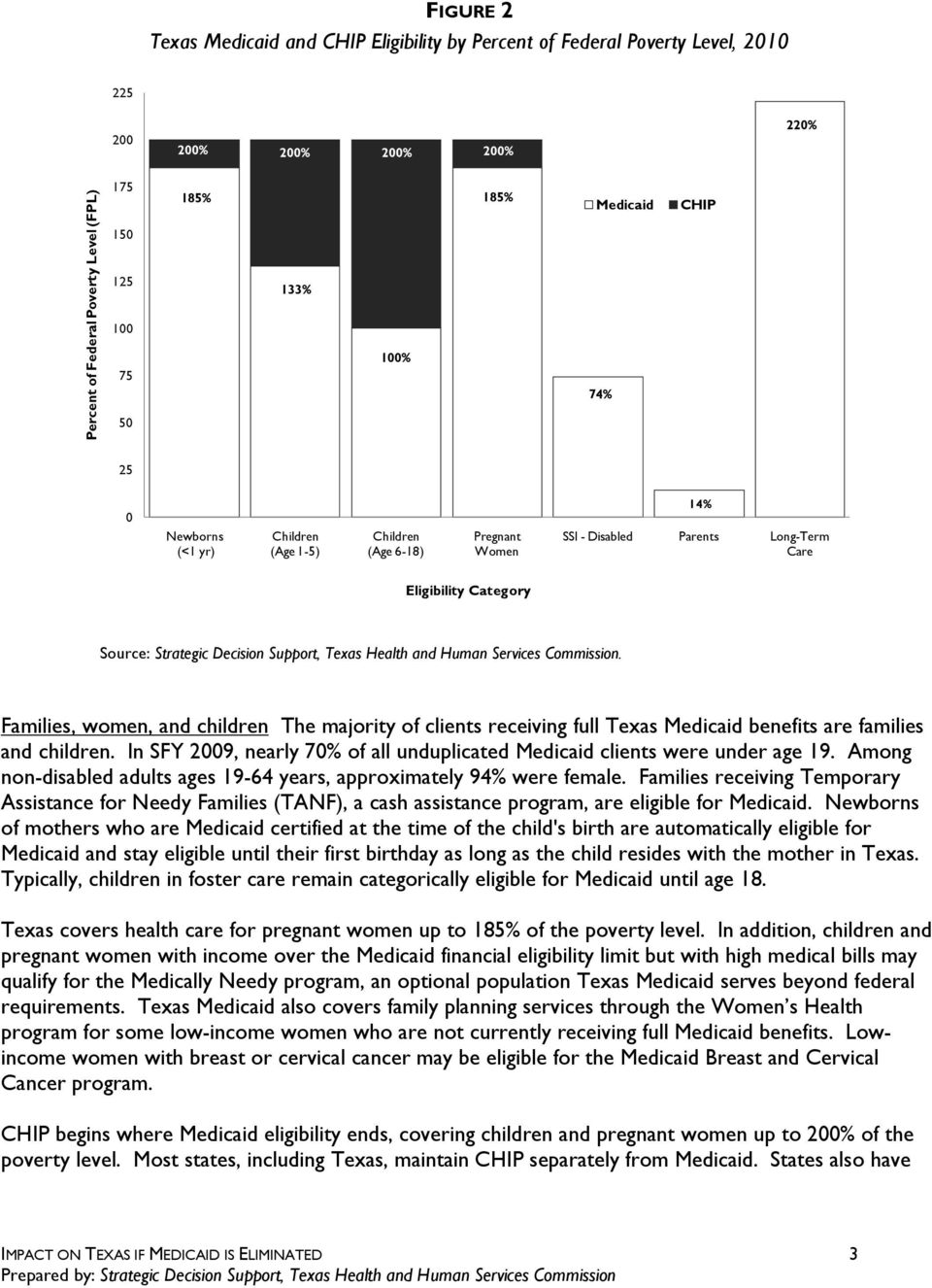
10 the option of incorporating CHIP into Medicaid. Regardless of how it is administered, states cannot receive the CHIP block grant without operating a Medicaid program. People age 65 and older or with a disability Texans eligible for Supplemental Security Income (SSI), a federal cash assistance program for low-income individuals who have disabilities, are eligible for Medicaid. Also, individuals who are elderly or have a disability but do not receive SSI may qualify for Medicaid services in a nursing facility, intermediate care facility for persons with mental retardation (ICF/MR), state supported living center, or state mental hospital. Federal law allows states to apply for waivers to exempt them from certain Medicaid regulations. States often take advantage of this flexibility by expanding services to individuals with significant medical needs. 3 Table 1 provides a summary of Texas 1915(c) waiver programs, which authorize states to provide home and community-based services to individuals who qualify for institutional care. Clients age 65 and older or with a disability who have income up to three times the SSI income limit (~ 220% of the poverty level) may be eligible for services under these waiver programs. Examples of services include nursing, personal attendant services, and minor home modifications. According to federal rules, home and community-based waivers cannot cost any more than institutional care would have cost for the group served by the waiver. The number of clients wanting to receive waiver services generally exceeds the number of individuals the state can fund. 3 For a description of the types of Medicaid waiver programs and the application process for each, see Appendix A. Appendix B lists the state s current waivers, services covered, populations served, annual costs, and operating agencies. IMPACT ON TEXAS IF MEDICAID IS ELIMINATED 4
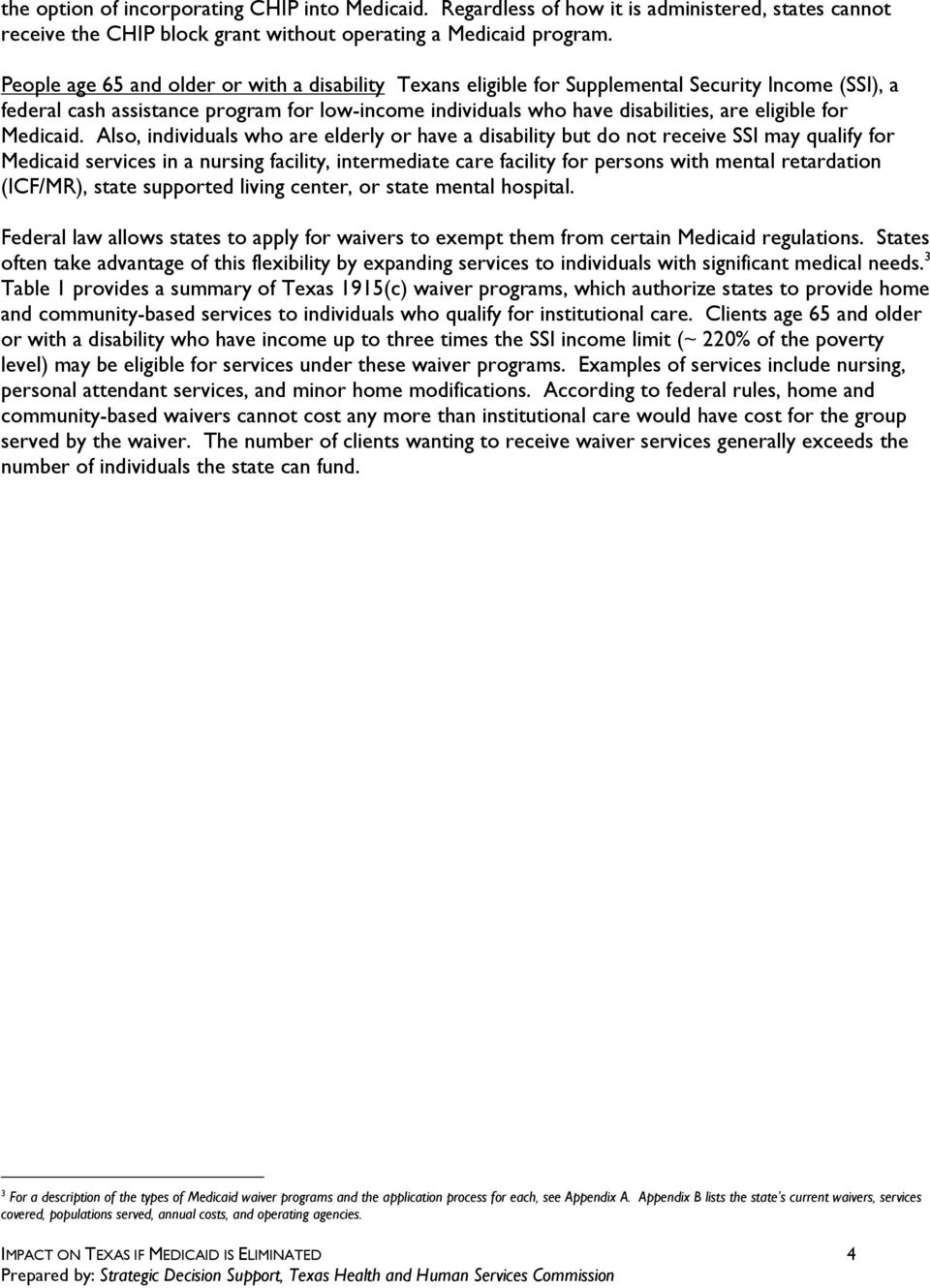
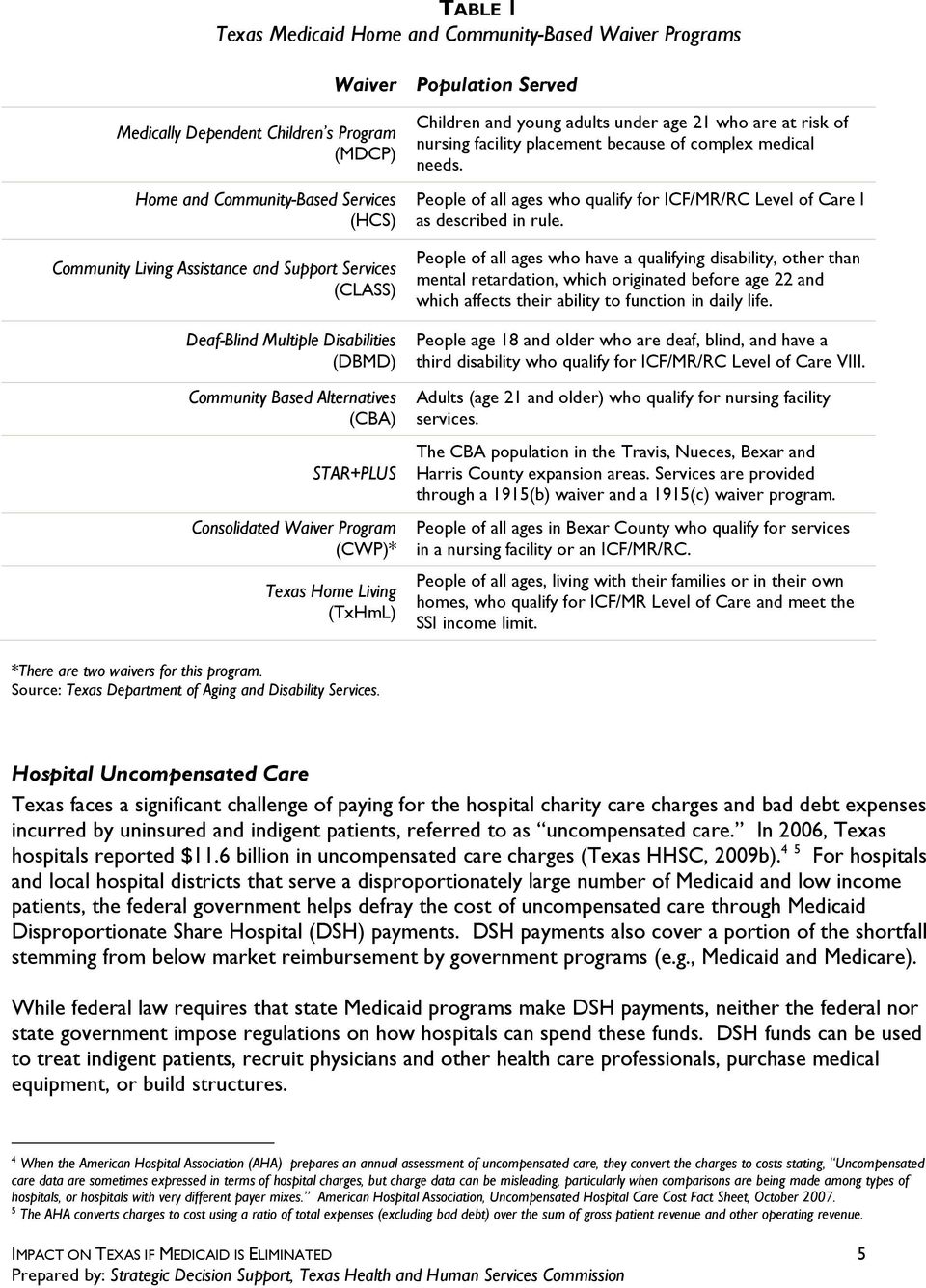
11 TABLE 1 Texas Medicaid Home and Community-Based Waiver Programs Waiver Population Served Medically Dependent Children s Program (MDCP) Home and Community-Based Services (HCS) Community Living Assistance and Support Services (CLASS) Deaf-Blind Multiple Disabilities (DBMD) Community Based Alternatives (CBA) STAR+PLUS Consolidated Waiver Program (CWP)* Texas Home Living (TxHmL) Children and young adults under age 21 who are at risk of nursing facility placement because of complex medical needs. People of all ages who qualify for ICF/MR/RC Level of Care I as described in rule. People of all ages who have a qualifying disability, other than mental retardation, which originated before age 22 and which affects their ability to function in daily life. People age 18 and older who are deaf, blind, and have a third disability who qualify for ICF/MR/RC Level of Care VIII. Adults (age 21 and older) who qualify for nursing facility services. The CBA population in the Travis, Nueces, Bexar and Harris County expansion areas. Services are provided through a 1915(b) waiver and a 1915(c) waiver program. People of all ages in Bexar County who qualify for services in a nursing facility or an ICF/MR/RC. People of all ages, living with their families or in their own homes, who qualify for ICF/MR Level of Care and meet the SSI income limit. *There are two waivers for this program. Source: Texas Department of Aging and Disability Services. Hospital Uncompensated Care Texas faces a significant challenge of paying for the hospital charity care charges and bad debt expenses incurred by uninsured and indigent patients, referred to as uncompensated care. In 2006, Texas hospitals reported $11.6 billion in uncompensated care charges (Texas HHSC, 2009b). 4 5 For hospitals and local hospital districts that serve a disproportionately large number of Medicaid and low income patients, the federal government helps defray the cost of uncompensated care through Medicaid Disproportionate Share Hospital (DSH) payments. DSH payments also cover a portion of the shortfall stemming from below market reimbursement by government programs (e.g., Medicaid and Medicare). While federal law requires that state Medicaid programs make DSH payments, neither the federal nor state government impose regulations on how hospitals can spend these funds. DSH funds can be used to treat indigent patients, recruit physicians and other health care professionals, purchase medical equipment, or build structures. 4 When the American Hospital Association (AHA) prepares an annual assessment of uncompensated care, they convert the charges to costs stating, Uncompensated care data are sometimes expressed in terms of hospital charges, but charge data can be misleading, particularly when comparisons are being made among types of hospitals, or hospitals with very different payer mixes. American Hospital Association, Uncompensated Hospital Care Cost Fact Sheet, October The AHA converts charges to cost using a ratio of total expenses (excluding bad debt) over the sum of gross patient revenue and other operating revenue. IMPACT ON TEXAS IF MEDICAID IS ELIMINATED 5
12 The federal government also provides funding to hospitals through the Upper Payment Limit (UPL) program. The UPL program reimburses hospitals for the difference between what Medicaid pays for a service and what Medicare would reasonably pay for the service. Table 2 lists UPL payments by program for SFY 2009 (federal and state). TABLE 2 Upper Payment Program (UPL) Payments SFY 2009, Federal and State Dollars UPL Program 2009 Payments (in $ billions)* Urban $0.87 Rural $0.08 Children's $0.04 State Hospitals $0.06 Private $1.13 Physicians** $0.04 Total $2.22 *Payments include intergovernmental transfers when applicable. **Physician UPL is paid on a federal fiscal year basis. Source: Rate Setting, Texas Health and Human Services Commission. Like other Medicaid programs, federal and state governments each contribute a share of total DSH and UPL dollars based on a state s FMAP. The Texas Medicaid program uses intergovernmental transfers from state-owned and local governmental entities to finance the state share for drawing down federal DSH and UPL funds. In total, the DSH and UPL programs distributed $3.8 billion (both state and federal funds) to hospitals in federal fiscal year DSH paid 177 public, private non-profit, and private forprofit hospitals $1.6 billion and the UPL program provided hospitals with $2.2 billion. Graduate Medical Education Hospitals that operate medical residency training programs incur higher expenses than hospitals without training programs. Medicaid covers a share of these additional costs by making Graduate Medical Education (GME) payments to teaching hospitals. In SFY 2009, Texas Medicaid provided $29.3 million in both federal and state funds to five teaching hospitals in the state. GME payments cover the costs of residents and teaching physicians salaries and fringe benefits, program administrative staff, and allocated facility overhead charges. IMPACT ON TEXAS IF MEDICAID IS ELIMINATED 6

13 MEDICAID AS PART OF TEXAS HEALTH CARE INFRASTRUCTURE The 2010 U.S. Census Bureau s Current Population Survey shows the U.S. poverty population at 43.6 million, of which 4.3 million (10%) live in Texas. Medicaid, by providing health insurance to a portion of residents living near or in poverty, plays a major role in funding health care expenditures for these low income families and individuals. Overall, in 2004, Texas Medicaid paid for approximately 15% of total personal health care spending in the state (Figure 3). 6 Nursing home care is most dependent on Medicaid funds, as the program paid for about 48% of expenditures in this sector. According to the Texas Department of Aging and Disability Services (DADS), two-thirds of Texas nursing home residents pay for at least a portion of their institutional care with Medicaid. FIGURE 3 Medicaid and Non-Medicaid Personal Health Care Expenditures, Texas Residents, 2004 Non-Medicaid Medicaid 100% 80% 60% 40% 20% 0% Hospital Care* Physicians / Clinical Services Other Professional Services Dental Services Home Health Drugs / Nondurables *Personal health care expenditures only; does not include DSH and UPL funds. Source: Centers for Medicaid and Medicare Services (CMS), Office of the Actuary, Sept., Nursing Home TOTAL is the most recent year for which state level personal health care expenditure data for Medicaid are reported by CMS. IMPACT ON TEXAS IF MEDICAID IS ELIMINATED 7

14 Age 65 and Older Since 1988, federal law has required that state Medicaid programs pay Medicare deductibles, premiums, and coinsurance for low-income Medicare beneficiaries. About 15% of citizens age 65 and older are part of this group of dual eligibles. Medicaid also benefits these individuals by filling Medicare coverage gaps for long term institutional services, medications, and a broad range of community-based long term care services. Overall, people age 65 and older accounted for $4.8 billion in SFY 2009 Texas Medicaid spending, about 24% of the program s client services budget. Working Age Adults (Ages 19-64) Texas Medicaid coverage for working age adults currently is limited to low income pregnant women, parents, young adults ages 19 and 20, and people with a disability. As a result, only a small proportion of working age adults in the state (6%), even among citizens living near or below the poverty line (19%), receive benefits, and a significant percentage are uninsured (Figure 4). However, for pregnant women, Medicaid has become the leading source of health coverage in the state, paying for more than half of all childbirth. In addition, the program covered approximately 400,000 working age adults with disabilities per month in SFY FIGURE 4 Health Insurance Status of Working Age Texans*, 2008 All Household Income Levels and Up to 133% Federal Poverty Level (FPL) 100% 80% 60% 40% Uninsured Private Medicare Medicaid 20% 0% Working Age All Income Levels Working Age 0-133% FPL *Ages Source: U.S. Census Bureau. March 2009 Current Population Survey (CPS) for Texas. IMPACT ON TEXAS IF MEDICAID IS ELIMINATED 8

15 Children (Ages 0-18) Children are predominant in the Medicaid program because of categorical rules and expanded financial eligibility. Further, a disproportionate number live in households near or below the poverty level. In Texas, children account for 28% of the total population but 42% of the population living in poverty (U.S. Census Bureau, 2010). In 2008, 65% of children ages 0-18 living near or below the poverty level were covered by Medicaid or CHIP (Figure 5). Children under age one, in particular, rely on these programs. According to Census data (2009), half of all Texas infants received insurance through Medicaid or CHIP in 2008, while 77% of infants living at up to 133% of the poverty level were Medicaid or CHIP recipients (Figure 5). FIGURE 5 Health Insurance Status of Texas Children* and Infants**, 2008 All Household Income Levels and Up to 133% Federal Poverty Level (FPL) 100% Uninsured Private/Other Medicaid/CHIP 80% 60% 40% 20% 0% Children All Income Levels Children 0-133% FPL Infants All Income Levels Infants 0-133% FPL *Ages 0-18 **Under Age 1 Note: Private/Other category includes Medicare. Source: U.S. Census Bureau. March 2009 Current Population Survey (CPS) for Texas. IMPACT ON TEXAS IF MEDICAID IS ELIMINATED 9

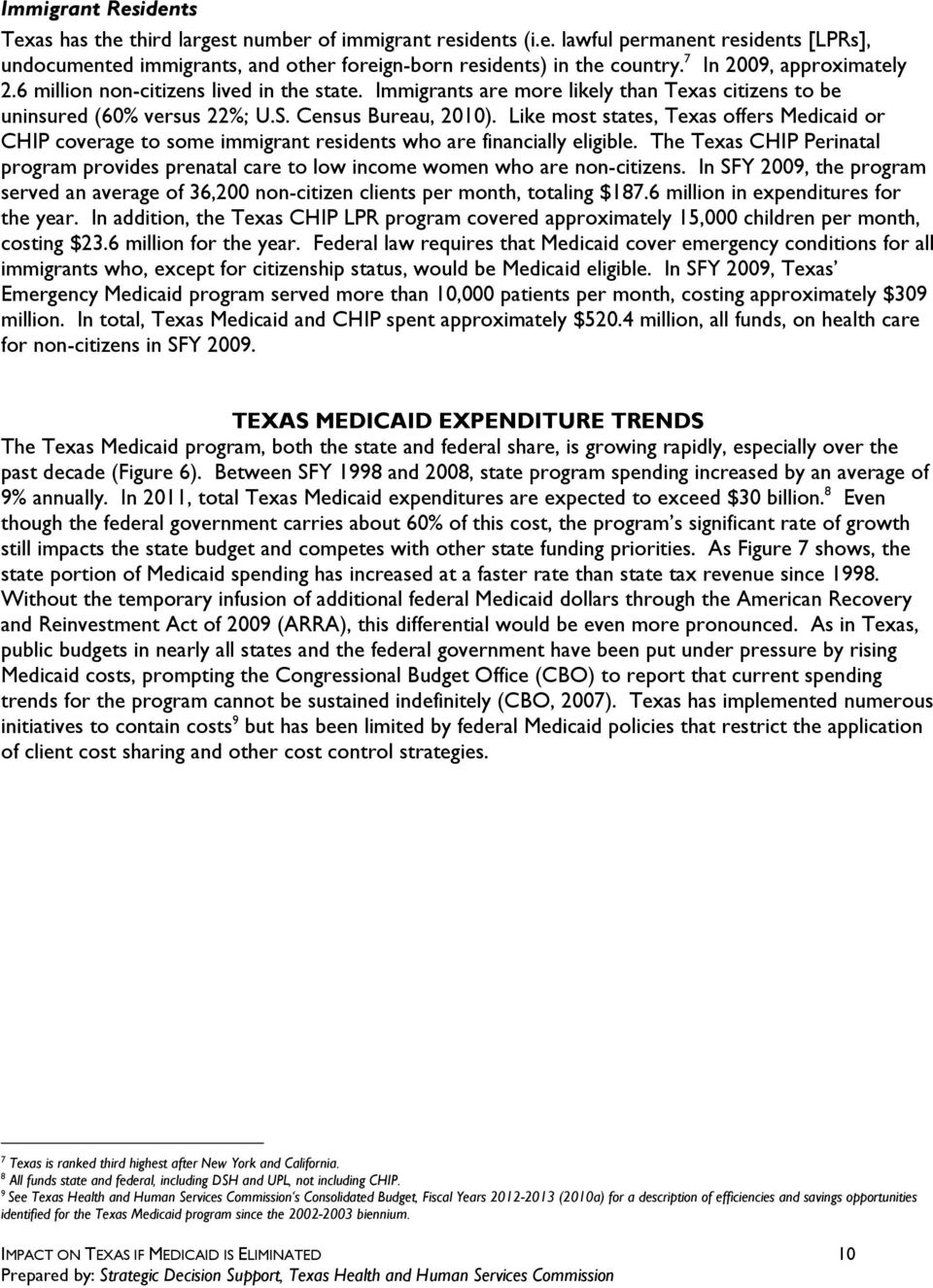
16 Immigrant Residents Texas has the third largest number of immigrant residents (i.e. lawful permanent residents [LPRs], undocumented immigrants, and other foreign-born residents) in the country. 7 In 2009, approximately 2.6 million non-citizens lived in the state. Immigrants are more likely than Texas citizens to be uninsured (60% versus 22%; U.S. Census Bureau, 2010). Like most states, Texas offers Medicaid or CHIP coverage to some immigrant residents who are financially eligible. The Texas CHIP Perinatal program provides prenatal care to low income women who are non-citizens. In SFY 2009, the program served an average of 36,200 non-citizen clients per month, totaling $187.6 million in expenditures for the year. In addition, the Texas CHIP LPR program covered approximately 15,000 children per month, costing $23.6 million for the year. Federal law requires that Medicaid cover emergency conditions for all immigrants who, except for citizenship status, would be Medicaid eligible. In SFY 2009, Texas Emergency Medicaid program served more than 10,000 patients per month, costing approximately $309 million. In total, Texas Medicaid and CHIP spent approximately $520.4 million, all funds, on health care for non-citizens in SFY TEXAS MEDICAID EXPENDITURE TRENDS The Texas Medicaid program, both the state and federal share, is growing rapidly, especially over the past decade (Figure 6). Between SFY 1998 and 2008, state program spending increased by an average of 9% annually. In 2011, total Texas Medicaid expenditures are expected to exceed $30 billion. 8 Even though the federal government carries about 60% of this cost, the program s significant rate of growth still impacts the state budget and competes with other state funding priorities. As Figure 7 shows, the state portion of Medicaid spending has increased at a faster rate than state tax revenue since Without the temporary infusion of additional federal Medicaid dollars through the American Recovery and Reinvestment Act of 2009 (ARRA), this differential would be even more pronounced. As in Texas, public budgets in nearly all states and the federal government have been put under pressure by rising Medicaid costs, prompting the Congressional Budget Office (CBO) to report that current spending trends for the program cannot be sustained indefinitely (CBO, 2007). Texas has implemented numerous initiatives to contain costs 9 but has been limited by federal Medicaid policies that restrict the application of client cost sharing and other cost control strategies. 7 Texas is ranked third highest after New York and California. 8 All funds state and federal, including DSH and UPL, not including CHIP. 9 See Texas Health and Human Services Commission s Consolidated Budget, Fiscal Years (2010a) for a description of efficiencies and savings opportunities identified for the Texas Medicaid program since the biennium. IMPACT ON TEXAS IF MEDICAID IS ELIMINATED 10
17 FIGURE 6 State and Federal Shares of Texas Medicaid Spending (Client Services) Federal Fiscal Years (FFYs) $18 Medicaid Spending (in billions) $16 $14 $12 $10 $8 $6 $4 $2 Federal Share State Share $ Federal Fiscal Year (FFY) Notes: SFY 2010 federal share includes the ARRA. Data are plotted in 5 year intervals starting in Source: Financial Services, Texas Health and Human Services Commission. FIGURE 7 Year-to-Year Cumulative Percent Change in Texas State Tax Revenue Versus General Revenue Medicaid Spending (Client Services) with and without ARRA Percent Change 200% 180% 160% 140% 120% 100% 80% 60% 40% 20% Percent change in Texas Medicaid spending (cumulative) Percent change in Texas Medicaid spending WITHOUT ARRA (cumulative) Percent change in Texas tax revenue (cumulative) 0% State Fiscal Year (SFY) Notes: Tax revenue does not include other types of state revenue. Actual tax collections for may vary. Sources: Tax revenue -- Legislative Budget Board Fiscal Size-Up reports (2003, 2006, 2008, 2009a). Medicaid spending -- Financial Services, Texas Health and Human Services Commission. IMPACT ON TEXAS IF MEDICAID IS ELIMINATED 11

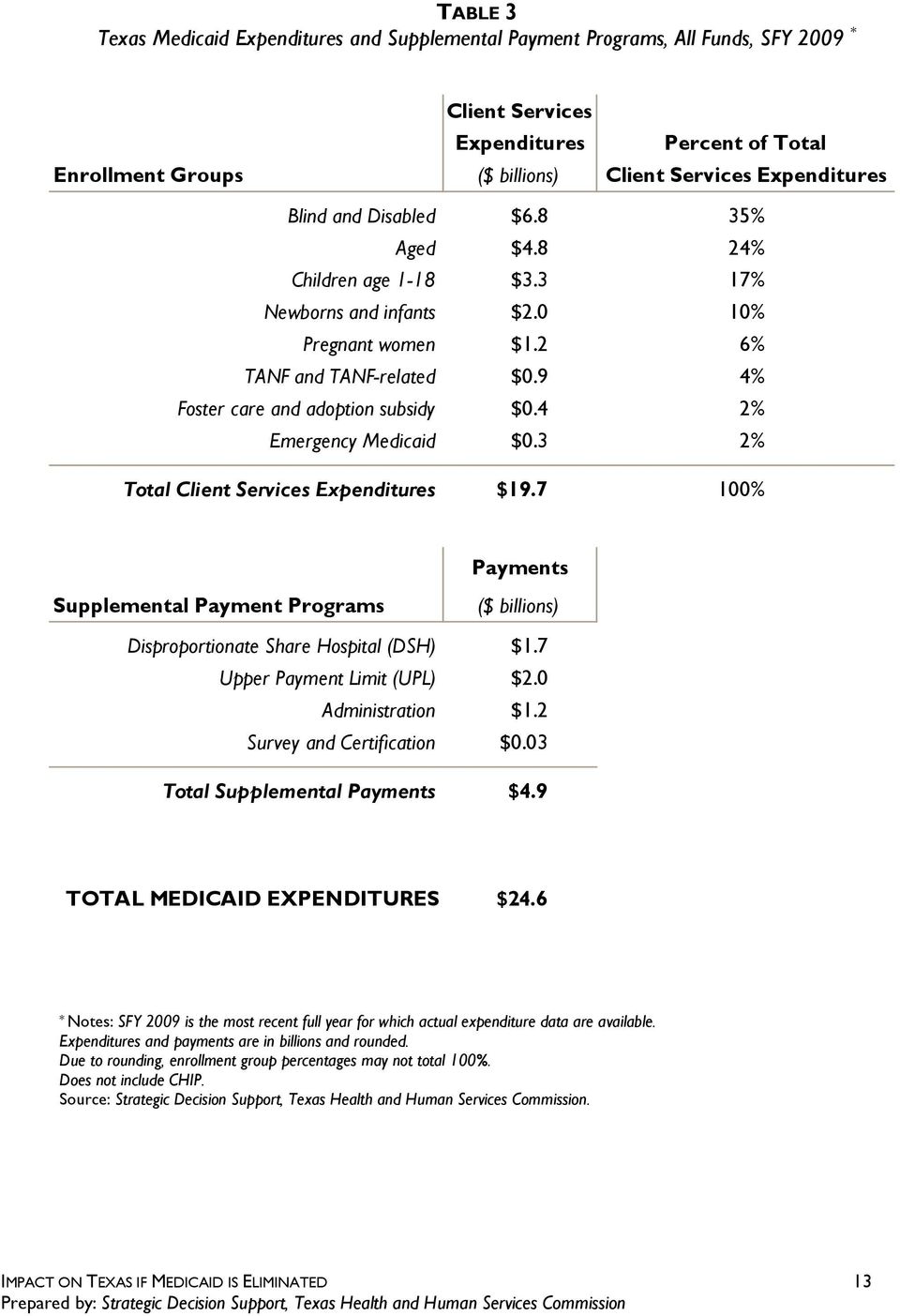
18 Caseload Expansion Caseload expansion has been the primary driver increasing Medicaid costs. For the period SFY 1999 to SFY 2009, the unduplicated client count for Texas Medicaid rose by 78%, from 2.3 million to 4 million (Figure 8). The increased caseload encompasses many higher cost clients: infants, pregnant women, and people age 65 and older or who have a disability. While non-disabled children make up the majority of Medicaid clients, they account for less than 30% of Texas Medicaid program spending on direct health care services. By contrast, individuals age 65 or older or who have a disability make up approximately 30% of clients but account for nearly 60% of estimated expenditures. Table 3 shows Medicaid expenditures by enrollment group for SFY FIGURE 8 Texas Medicaid Enrollment, Unduplicated Clients SFY Numbers enrolled (in millions) State Fiscal Year (SFY) Note: Unduplicated clients include all clients who receive full Medicaid benefits at any point during the year. Source: Financial Services, Texas Health and Human Services Commission. IMPACT ON TEXAS IF MEDICAID IS ELIMINATED 12

19 TABLE 3 Texas Medicaid Expenditures and Supplemental Payment Programs, All Funds, SFY 2009 * Client Services Expenditures Percent of Total Enrollment Groups ($ billions) Client Services Expenditures Blind and Disabled $6.8 35% Aged $4.8 24% Children age 1-18 $3.3 17% Newborns and infants $2.0 10% Pregnant women $1.2 6% TANF and TANF-related $0.9 4% Foster care and adoption subsidy $0.4 2% Emergency Medicaid $0.3 2% Total Client Services Expenditures $ % Payments Supplemental Payment Programs ($ billions) Disproportionate Share Hospital (DSH) $1.7 Upper Payment Limit (UPL) $2.0 Administration $1.2 Survey and Certification $0.03 Total Supplemental Payments $4.9 TOTAL MEDICAID EXPENDITURES $24.6 * Notes: SFY 2009 is the most recent full year for which actual expenditure data are available. Expenditures and payments are in billions and rounded. Due to rounding, enrollment group percentages may not total 100%. Does not include CHIP. Source: Strategic Decision Support, Texas Health and Human Services Commission. IMPACT ON TEXAS IF MEDICAID IS ELIMINATED 13
20 Medical Inflation Caseload growth alone does not fully explain the steep upward trend in Medicaid expenditures. Medical inflation, which tends to run at a higher rate than general inflation, is a notable accelerator of Medicaid costs. Nationwide, the medical component of the consumer price index (CPI) increased by an annual average of 4.1% over the past decade ( ) compared to 2.5% for the overall CPI (Bureau of Labor Statistics, 2008 and 2009). Texas FMAP Trends The Bureau of Economic Analysis (BEA) recent report that the Texas FMAP will drop 2.3 percentage points in FY 2012 further compounds concerns over state Medicaid spending. This FMAP change represents a decline of about $550 million for SFY 2012 or $1.25 billion for the SFY biennium in federal Medicaid dollars. 10 State dollars will need to replace these lost federal dollars. FMAP is currently based on a three year rolling average of a state s per capita personal income (PCPI) relative to the national average. A state with PCPI at the national average receives an FMAP of 55%. States will not receive an FMAP of less than 50% or more than 83%. Table 4 shows the federal fiscal years 2011 and 2012 FMAPs for all 50 states and the District of Columbia. Since 2008, Texas has seen marked growth in state PCPI relative to the national average. In 2007, Texas PCPI was almost 94% of the national average; however, in 2008 and 2009, it increased to more than 97%. Because the 2012 FMAP calculation includes these two years of high relative PCPI growth compared to the national average, the FMAP for Texas declined. 11 A well established criticism of FMAP is that PCPI inadequately reflects the level of poverty in a state, creating a funding formula that does not focus support on states with the greatest need. To illustrate this point, in 2008, Texas was home to 10% of the country s population living in poverty (which is still the case) but received a little under 7% of federal Medicaid dollars. In comparison, while New York had 7% of the country s population in poverty, it received more than 12% of federal Medicaid dollars (calculated using data from the Kaiser Family Foundation, 2008 and U.S. Census Bureau, 2009). For Texas, PCPI has risen close to the national average, while the percent of population living below the poverty level remains persistently high. By 2009, Texas was 25th highest of all states in PCPI but had the 7th highest percentage of individuals living below the poverty level (calculated using data from the U.S. Bureau of Economic Analysis, 2010 and the U.S Census Bureau, 2010). Since FMAP is based only on PCPI, it does not adequately reflect the poverty burden that Texas and other states in a similar circumstance confront. 10 The Texas FMAP will likely decline further in federal fiscal year In absolute terms, Texas PCPI growth in cannot be described as high by historical standards. However, in relative terms, the state s economy performed better during the December 2007 June 2009 recession than did the national economy. IMPACT ON TEXAS IF MEDICAID IS ELIMINATED 14
21 TABLE 4 Federal Fiscal Years (FFYs) 2011 and 2012 FMAPS, District of Columbia and by State FFY FFY Point FFY FFY Point State Change State Change Alabama Missouri Alaska Montana Arizona Nebraska Arkansas Nevada California New Hampshire Colorado New Jersey Connecticut New Mexico Delaware New York District of Columbia North Carolina Florida North Dakota Georgia Ohio Hawaii Oklahoma Idaho Oregon Illinois Pennsylvania Indiana Rhode Island Iowa South Carolina Kansas South Dakota Kentucky Tennessee Louisiana TEXAS Maine Utah Maryland Vermont Massachusetts Virginia Michigan Washington Minnesota West Virginia Mississippi Wisconsin Wyoming Note: American Recovery and Reinvestment Act of 2009 (ARRA) FMAP increases are not included. Source: Federal Funds Information for States, IMPACT ON TEXAS IF MEDICAID IS ELIMINATED 15
22 THE PATIENT PROTECTION AND AFFORDABLE CARE ACT The Patient Protection and Affordable Care Act (ACA), passed into law in March 2010, will change health care finance in Texas and increase the cost of Medicaid. Conversely, as more Texans acquire health insurance under the ACA, the uncompensated health care expenses incurred by local governments, hospital districts, and other hospitals and medical providers should decline. The key components of health reform are the creation of health information exchanges to facilitate the purchase of private insurance policies, new guaranteed issue and community rating regulations for insurers to prevent them from denying or terminating coverage based on health status, an individual mandate on most residents to acquire qualified health coverage, and Medicaid expansion. 12 By 2014, the ACA extends Medicaid to non-medicare eligible adults, including childless adults, with incomes up to 133% of the poverty level. To finance coverage for newly eligible clients, states will receive 100% federal funding for 2014 through 2016, decreasing to 90% federal funding by The legislation requires that states maintain current financial eligibility levels in Medicaid and CHIP until 2014 for adults and 2020 for children. In addition, the legislation directs state Medicaid programs to increase payments for certain primary care services up to 100% of Medicare payment rates, funded entirely by federal financing. This mandated rate increase, along with the federal dollars that pay for it, will expire after two years. Cost estimates associated with the ACA vary widely, even among federal agencies. For example, the Congressional Budget Office s (CBO s) 10 year score ( ) shows federal savings of $85 billion (CBO, 2010), while the CMS Office of the Actuary predicts an increase of $280 billion in federal health care spending (CMS, 2010). For Texas, HHSC has reported that the ACA could increase agency expenditures by $27 billion in state spending over 10 years beginning in 2014, the first year that the Medicaid expansion will be implemented. HHSC projects that the ACA will add about two million clients to the state s Medicaid rolls. This growth will come directly from newly eligible adults and, indirectly, because enrollment simplification and publicity about the individual mandate will lead to greater participation from the population that is currently eligible for but not enrolled in Medicaid (mostly children and families). 13 The cost to states increases substantially in 2020, when the state share of Medicaid expansion more than triples from an average of 3% annually to a permanent level of 10% annually (see Figure 9). 12 See Appendix C for additional detail regarding the ACA s potential impact on the private insurance market. 13 HHSC estimates that Medicaid participation rates already are increasing since passage of the ACA and that most of the costs associated with the eligible but not enrolled population will be reflected in the program before Medicaid expands to cover more adults in IMPACT ON TEXAS IF MEDICAID IS ELIMINATED 16
23 $6 FIGURE 9 Patient Protection and Affordable Care Act HHSC Medicaid and CHIP Cost Estimates, SFYs $5 State Cost (in billions) $4 $3 $2 $1 $ Unknown State Fiscal Year (SFY) Note: Does not include start-up costs for SFYs , such as drug rebate reductions and infrastructure development expenditures. Source: Strategic Decision Support, Texas Health and Human Services Commission. For the lower cost period before 2020, the scoring window used by CBO and many independent analysts, HHSC forecasts increased expenditures of up to $9.2 billion in state spending depending on the state s policy responses. The high end of the HHSC estimate includes costs related to an assumed continuation of the primary care rate increase for which the federal requirement and dollars end after two years. Excluding non-mandatory rate increases reduces HHSC s estimate for to approximately $5.8 billion in state entitlement spending (Texas Comptroller, 2010). 14 Potentially, these new costs will be offset by $760 million in state revenue from premium taxes paid by the health plans that cover the new Medicaid clients, bringing the estimate down to about $5 billion over six years. This figure is consistent with reporting from the Kaiser Foundation, who project that the ACA will increase Texas Medicaid costs by between $2.6 and $4.5 billion for HHSC has raised the issue that state policy makers consider in their planning whether the current Medicaid rate structure for primary care physicians, which reimburses at approximately 75% of Medicare levels and well below levels in the privately insured market, will be adequate to attract the provider base necessary to serve up to two million additional clients expected due to the ACA. IMPACT ON TEXAS IF MEDICAID IS ELIMINATED 17
24 PREVIOUS RESEARCH ON STATE MEDICAID OPT OUT Prompted by the large impact the ACA is expected to have on already overburdened state Medicaid budgets, in December 2009, the Heritage Foundation released a report, Medicaid Meltdown: Dropping Medicaid Could Save States $1 Trillion (2009). The article suggests that states could save more than $650 billion dollars between 2013 and 2019 by withdrawing from the state-federal cooperative Medicaid program, even while continuing to use state funds to cover individuals receiving long term care services such as nursing home care. The Heritage Foundation used historical Medicaid data from the Kaiser Foundation and projections from the CBO to calculate state-by-state savings; they predict that Texas would save $61 billion for this time period, or approximately $8.7 billion a year. 15 Written before enactment of the ACA, Heritage s findings are partially predicated on the assumption that Medicaid clients could become eligible for federal subsidies under the new exchanges. The final version of the federal law indicates that most Medicaid-eligible individuals up to 133% of the poverty level likely will not be eligible for these subsidies. 16 However, as of the writing of this report, the issue remains under review by the federal government. A decision by the federal government to allow a significant portion of former Medicaid clients to receive exchange subsidies could substantially alter the analysis presented in this report. Following the Heritage Foundation s article, Nevada published a paper in January 2010 exploring the consequences of their state opting out of the Medicaid program. Nevada reported its current Medicaid program cost at $1.5 billion. From SFY , Nevada s Medicaid program grew at an average rate of 8% a year. The primary driver of the increase was caseload expansion. At the time the paper was written, 20% of Nevada s non-elderly residents were uninsured, and 13% received government insurance. Under health care reform, 17 Nevada estimated that the state cost for Medicaid expansion would add $613 million to their Medicaid budget over six years, their uninsured rate would probably decrease to 6%, and the rate of insured through government programs would increase to 17%. Unlike the Heritage Foundation, Nevada assumed that, if it withdrew from the federal Medicaid program, health reform legislation would not provide former Medicaid recipients with subsidies for health care coverage through the exchange. 18 Therefore, even if Nevada continued to cover Medicaid clients receiving long term care and child welfare services out of state funds, nearly 200,000 low income children and families and 55,000 people age 65 and older or who have disabilities would lose Medicaid coverage. Overall, the rate of uninsured would stay roughly the same, but the composition would shift from young childless adults, who would become eligible for federal subsidies in the exchange, to indigent former Medicaid recipients, who would not. Nevada reports that these citizens would lose services like prenatal care, hospital services, and medication. The most medically frail would probably lose access to the intensive services they need. State and local government agencies would lose revenue they receive through the federal share of Medicaid, such as for school-based services. Hospitals would lose $251.9 million through the termination of DSH and UPL. Counties would assume more of the financial responsibility for indigent health care services. 15 Data reported to the Kaiser Family Foundation do not include all long term care costs for the state of Texas, such as capitation paid to HMOs, nor do they include the cost of providing acute care services to long term care clients. 16 Nearly all analysts agree that uncertainty remains about whether and what portion of clients between 100% and 133% FPL could access exchange subsidies. Some disagreement remains regarding whether clients under 100% FPL can receive exchange subsidies. 17 The Nevada paper was written before enactment of the ACA and was based on provisions common to both the Senate and House bills at the time. 18 Nevada states: Subsidies are not proposed for very low-income individuals and families who are presumed to get coverage through Medicaid (Nevada Department of Health and Human Services, 2010, p. 6). IMPACT ON TEXAS IF MEDICAID IS ELIMINATED 18
25 IMPACTS OF A TEXAS MEDICAID OPT OUT Nevada s analysis offers insight regarding the potential impacts of a Texas Medicaid opt out. Texas would gain flexibility in the financing of health and human services as a large portion of state entitlement spending would be redefined as discretionary. This elimination of federal Medicaid requirements would present opportunities for the state to streamline the delivery of indigent health services to focus on clients with the greatest medical and financial need. However, the state would also lose billions each year in federal funds; billions of dollars in indigent health care costs would shift from the state and federal levels to local governments, public hospital districts, medical providers, and the privately insured; and 2.6 million Texas residents could lose health insurance, depending on future coverage options the state chooses to pursue. Loss of Federal Funds Federal funds are a large component of public finance for the state of Texas, accounting for $36.6 billion (about 61%) of total appropriations for health and human services for the biennium. 19 Of this amount, an estimated $34 billion (93%) was related to Medicaid and CHIP. In addition to their impact on the state health and human services budget, federal Medicaid dollars pay for nearly 10% of health care spending in Texas, generating income and revenue streams for Texas providers and the health care industry that add to economic activity and increase state and local tax receipts. Economists believe that the transfer of federal dollars to a state economy can, in some circumstances, yield a positive multiplier effect. The multiplier effect is the proposition that an initial amount of spending or investment (usually by the government) recycles throughout the economy, leading to an increase in income greater than the initial amount of spending. Thus, in theory, the indirect or secondary effects of Medicaid spending may benefit the state economy beyond the direct effects of the spending. Families USA (2004), using the Regional Input-Output Modeling System (RIMS II), estimated the business activity multiplier for Texas at 3.64 per $1 change in state Medicaid spending. 20 The RIMS II multiplier for Medicaid spending takes into account that $1 dollar in state spending draws down $1.5 federal dollars and that these dollars will recycle throughout the economy. Based on this model, the multiplier associated only with the recycling of federal dollars is likely in the range of 1.5 to 2.0. In practice, multiplier effects are difficult to quantify and remain controversial. Multiplier effects of less than 1.0 have been empirically measured, suggesting that certain types of government spending crowd out more efficient private investment that would have otherwise occurred. Some economists assert that the multiplier from federal matching funds can be negative. Valchev and Davies (2010) calculate that federal matching Medicaid funds distort economic decision making and public budgets to such an extent that every $200 million in federal matching funds reduces gross state product by $1.8 billion, a multiplier of Given the level of uncertainty in the literature, for purposes of this report, HHSC assumes that federal matching Medicaid funds carry the accounting identity multiplier of 1.0, that is, HHSC assumes no additional positive or negative income effects from changes in the net inflow of federal Medicaid funds beyond the initial amount of the inflow. Under the cooperative system of Medicaid finance, the inflow of federal Medicaid dollars is balanced by an outflow of federal taxes and other revenue that the state s businesses and residents contribute to 19 Includes ARRA funds; does not include DSH or UPL. 20 RIMS II uses Department of Commerce data to account for a state economy s industrial structure and other economic markers. IMPACT ON TEXAS IF MEDICAID IS ELIMINATED 19
26 support federal Medicaid expenditures across the nation. In fact, Texas residents and businesses send more dollars to Washington D.C. to pay for the national Medicaid program than the state receives in federal matching funds. Texas receives about 6.8% of current federal Medicaid expenditures, while state residents and businesses account for about 8.4% of federal tax revenue. This net outflow of state dollars in the financing of Medicaid means that a federal termination of the Medicaid program that absolved Texas residents and businesses from contributing federal taxes to fund the program would probably yield positive macroeconomic effects for Texas. On the other hand, a state opt out would end the inflow of federal Medicaid dollars but leave Texas residents and businesses with the obligation to continue financing the federal share of other states Medicaid spending. Shifting Indigent Health Care Costs Even though a Medicaid opt out would remove federal requirements to cover individuals under Medicaid, a significant federal mandate to provide emergency care to indigent patients would remain. Emergency departments in the United States have been given responsibility to act as the safety net of last resort, serving millions of people without access to other health care and providing medical evaluation and stabilization services, including admission to inpatient care, guaranteed by the Emergency Medical Treatment and Active Labor Act (EMTALA) to any presenting person, regardless of an individual s ability to pay. EMTALA was included in the Consolidated Omnibus Budget Reconciliation Act (COBRA) of 1986 to address the practice of some emergency departments transferring, discharging, or refusing to treat indigent patients (American College of Emergency Physicians, 2010). EMTALA imposes strict penalties for violations of the Act. The cost of complying with EMTALA largely falls on local governments, public hospital districts, charitable institutions, and private medical providers. The Medicaid program provides a means to offset with state and federal dollars some of the local costs associated with meeting the emergency medical needs of the indigent population. For example, the Medicaid program pays for more than half of all births in Texas, a cost that otherwise would be shouldered primarily at the local and provider level, unless Texas covered these expenses through state funds. Also, the Emergency Medicaid program pays for the emergency conditions of indigent noncitizens (undocumented immigrants and LPRs) who meet all Medicaid eligibility criteria other than citizenship. Because of EMTALA, hospitals must provide this emergency care, whether the patient has a source of payment or not. Emergency Medicaid allows the state to recoup from the federal government up to 60% (the federal Medicaid share) of the cost of this care. Texas hospitals receive about $2.3 billion annually (SFY 2009) in federal DSH/UPL funds that directly and indirectly help to pay for uncompensated care expenses stemming in part from EMTALA requirements. These supplemental federal funds would be lost if Texas opted out of Medicaid. 21 At the same time, absent an alternative safety net system, if Medicaid and CHIP were no longer available to the 3.8 million clients 22 who use these programs each month, HHSC estimates that hospitals could see an increase in uncompensated care costs of $4 billion annually for emergency conditions that were previously paid for by Medicaid. 23 To the degree that providers and local governments cover a more expansive list of conditions and services for indigent patients than the definition for emergency used by Texas Medicaid, potential uncompensated care costs associated with current Medicaid clients could be higher. 21 A portion of DSH funding will be lost in any event as the ACA will reduce states Medicaid DSH allotments beginning in SFY The formula to calculate the reduction is not available as of the writing of this report; however, initially, the reduction is expected to be modest, but it will likely grow over time. 22 Does not include non-citizens or Medicaid clients receiving partial benefits. 23 Estimates of potential uncompensated, emergency care costs from the termination of the Texas Medicaid program will vary based on the state s policy responses. IMPACT ON TEXAS IF MEDICAID IS ELIMINATED 20
27 The Texas Department of Insurance (TDI) reports that uncompensated care also negatively impacts the private insurance market as health care providers shift costs from uninsured, non-paying clients to private insurers and their patients. Health plans frequently point to the problem of uncompensated health care and cost shifting as a primary contributor to increasing health insurance premiums. Though it is difficult to quantify the impact of cost-shifting to private insurers given the many variables and lack of detailed data necessary to develop accurate estimates, in 2005, Families USA contracted with a group of researchers to analyze data from the U.S. Census Bureau, the federal Agency for Healthcare Research and Quality, and the National Center for Health Statistics, as well as other data resources. The resulting report, Paying a Premium, the Added Cost of Care for the Uninsured (Families USA, 2005), provides national and state-level estimates of the impact of cost shifting on families and insurance premiums. The researchers found that, in 2005, Texans paid an additional $550 a year in insurance premiums for individual coverage due to the higher costs passed along to insured patients to cover uncompensated care. Texans with family insurance paid an additional $1,551 a year due to cost shifting. These numbers are critical when considering the potential impact of a growing uninsured population and the ability of employers and individuals to continue to subsidize uncompensated care costs. If Medicaid program changes result in a large increase in the Texas uninsured population, in theory, people with insurance would absorb a portion of new uncompensated care costs through rising premiums. As insurance premiums rise, more individuals would discontinue private coverage and fewer employers would offer benefits. This feedback loop is not sustainable over the long term and ultimately could jeopardize the solvency of the insurance industry, particularly small companies who do not have the large risk pool necessary to protect against adverse selection. As premiums increase, individuals who are young and healthy are most likely to drop coverage, creating a problem for insurers that are unable to attract or retain low cost healthy enrollees to balance the liabilities from less healthy enrollees. Because Texas has a large population from which to attract new enrollees, the state is better suited to adjust to this type of market challenge than many small states. However, even in a state the size of Texas, a significant increase in the number of uninsured citizens could have ramifications for the private insurance market. Health Insurance Status of Former Medicaid and CHIP Recipients Table 4 indicates that 2.6 million out of 3.8 million Texas Medicaid and CHIP recipients would be at risk of becoming uninsured if Texas or the federal government eliminated the program. Of the one million or so clients estimated to maintain insurance coverage, 550,000 are dual eligibles who would keep their Medicare coverage but lose the supplemental benefits they receive through Medicaid. Other clients with income above 133% of the poverty level could move to the exchange beginning in While the ACA may prohibit most individuals at or below 133% of the poverty level from purchasing subsidized insurance through the exchange, approximately 300,000 clients, including many CHIP enrollees and some pregnant women, infants, and young children on Medicaid, live in families earning income above this limit and would probably qualify for a subsidy. However, with cost sharing set at 2%-6% of income, HHSC estimates that no more than half of subsidy-eligible former Medicaid and CHIP clients would purchase a subsidized policy Leighton, K. and Coughlin, T. (1999) of the Urban Institute report that premiums equaling 1% of family income results in a 16% decrease in enrollment in public insurance programs while 3% premiums lower enrollment by nearly 50%. IMPACT ON TEXAS IF MEDICAID IS ELIMINATED 21
28 A few Medicaid and CHIP families below 133% of the poverty level may purchase an unsubsidized health plan or gain insurance through their employer. However, given the high unemployment rate, low income, and low-paying jobs of Medicaid and CHIP recipients, only a limited number of this lowest income group of clients could be expected to access insurance this way. Over the last 10 years, TDI has conducted research to collect information on uninsured Texans: why they have no coverage, how much they can afford, and options to assist them with purchasing coverage (see Appendix D for a discussion on insurance availability in the Texas employer sponsored and individual insurance markets). TDI found that although most large employers (94%) offer coverage, many of the lowest income workers in large firms are not eligible for the insurance because they work part time, are temporary or contract workers, or have not worked long enough to meet the required waiting period. Moreover, for those who can access employer sponsored insurance, employee premium contributions would likely make coverage unaffordable for most Medicaid eligible families. According to TDI, for a family of three living at 100% of the poverty level, the average employee premium for employer sponsored insurance would equal about 22% of the family s monthly income. Among small businesses, TDI reports that two-thirds of employers do not offer insurance coverage. Beginning in 2002 and continuing through 2006, TDI hosted more than 60 focus group sessions with individuals, small business owners, and their employees in 20 different cities across Texas representing all of the major geographical areas of the state. The personal stories expressed at these focus group sessions underscore the challenges many consumers face when trying to find affordable health coverage. (For additional information on the research findings, please see TDI reports at The primary conclusion from these discussion sessions was that health insurance remains unaffordable for many individuals and employers. The majority of participants expressed a willingness to pay for insurance, and most had attempted to buy coverage within the past year but could not find a benefit plan that was affordable. More than 90% of the attendees were employed or owned their own business, and many participants expressed frustration with the fact that average, working, responsible citizens could not afford coverage. Given that most of these individuals were employed and likely had incomes that would disqualify them from participating in Medicaid or any other government sponsored program, these findings support the conclusion that current Medicaid participants would be unable to obtain affordable health insurance if they lost coverage under Medicaid. Former Medicaid enrollees would likely become uninsured and would seek medical care from free or low cost clinics or would turn to emergency facilities at local hospitals. HHSC data and other research support the TDI analysis that crowd out of private insurance associated with the current Medicaid and CHIP program is modest, particularly among clients at or below the poverty level. A CHIP recipient survey conducted in February 2006 revealed that approximately 20%- 25% of CHIP clients who discontinued enrollment in the program obtained alternative private insurance within six months (Institute of Child Health Policy, University of Florida, 2006). Nearly all of these former CHIP clients would have income above the poverty level and many would no longer meet the CHIP financial eligibility threshold of 200% of the poverty level. Other studies estimate the percent of CHIP and Medicaid clients who could find alternative private insurance at 10%-20% (Center for Budget and Policy Priorities, 2010). Families receiving CHIP earn higher income than those receiving Medicaid; IMPACT ON TEXAS IF MEDICAID IS ELIMINATED 22
29 therefore, HHSC estimates (Table 5) that no more than 10% of remaining former Medicaid clients would find unsubsidized coverage. TABLE 5 Texas Medicaid and CHIP Recipients Becoming Uninsured after a Medicaid Opt Out Average monthly Medicaid/ CHIP caseload SFY 2009 Dual eligible (Medicaid and Medicare) clients Number of Texas residents Explanation 3,750,000 Medicaid = 3,300,000, CHIP = 450,000 (550,000) Will continue to receive insurance under Medicare, but with no Medicaid benefits* Blind and Disabled (175,000) May continue to receive benefits using savings from state share of Medicaid (general revenue) Children in Foster care (35,000) May continue to receive benefits using savings from state share of Medicaid (general revenue) CHIP clients 133%-200% of the poverty level (135,000) Will go into exchange beginning 2014** Medicaid pregnant women and (17,000) Will go into exchange beginning 2014** newborns 133%-185% of the poverty level Clients who purchase private insurance (283,800) Approximately 10% of remaining residents based on HHSC data and relevant studies Uninsured after Medicaid opt out 2,554,200 *Dual eligibles receiving long term care may continue to receive benefits using savings from state share of Medicaid (general revenue.), depending on state policy responses. **Assumes that with cost sharing levels set at 2%-6% under the exchange, only half of clients in this category will purchase insurance. Available Indigent Care Options for the Newly Uninsured Under current law, no significant source of federal funds would be available to provide health services to Medicaid and CHIP clients who become uninsured. The newly uninsured would likely rely on the emergency room, charity, and other uncompensated care. Some former clients may take advantage of the limited number of non-medicaid indigent care options available in the state. Below is a summary of state-run programs for uninsured, indigent, or low income residents (Legislative Budget Board, 2009b). Many of these programs are partially dependant on Medicaid funding, focus only on a small segment of the population or a specific illness, and/or would require an infusion of new state funding to serve additional clients. Federally Qualified Health Centers (FQHCs) and FQHC look-alikes served more than 770,500 clients in federal fiscal year 2007, including many clients covered by Medicaid. That year, 58 FQHCs operated in 300 sites. Providers include community health clinics and migrant health centers. FQHCs serve all persons regardless of need and charge clients on a sliding scale. DSHS administers the Primary Health Care program, contracting with providers to offer primary health care services to Texas residents below 150% of the poverty level not eligible for other programs. IMPACT ON TEXAS IF MEDICAID IS ELIMINATED 23
30 Clients may contribute up to 25% of the cost of services based on ability to pay. This program is funded almost entirely by state funds. Counties are required by state law to provide a basic set of health care services, such as immunizations, annual physicals, and inpatient and outpatient hospital services, to indigent citizens, defined as at or below 21% of the poverty level. The County Indigent Health program, funded by county governments and administered through DSHS, establishes county responsibility for indigent health care, limits county liability, and establishes a mechanism for counties to receive state reimbursement when counties spend 8% of their general tax on indigent health care. Several state resources provide health insurance to children under age 19 years whose families are at or below 200% of the poverty level. Benefits are often similar to CHIP. The Immigrant Children Health Insurance Program, administered through HHSC, provides health insurance to immigrant children who are LPRs living in Texas. The School Employee Children Insurance Program, administered through HHSC and the Texas Retirement System, offers health insurance to children of school district employees. The State Kids Insurance Program, administered through the Employees Retirement System, covers children of state and higher education employees. The latter program pays for 80% of insurance premiums. The DSHS program, Children with Special Health Care Needs, provides supplemental health care insurance to low-income children with special needs. Other DSHS programs serving indigent clients include the South Texas Health Care System, Texas Center for Infectious Diseases, the Epilepsy and Hemophilia Assistance, Kidney Health Care, and HIV Medication programs. Until 2014, former Medicaid adult clients who cannot purchase insurance in the individual market because of a preexisting medical condition can turn to the Texas Health Insurance Pool (THIP, formerly Texas Health Insurance Risk Pool) or the newly created federal Pre-Existing Condition Insurance Plan. However, a TDI analysis indicates that premium levels, cost sharing provisions, and specific eligibility criteria make these programs unlikely and unaffordable options for low income Texans currently eligible for Medicaid or CHIP (See Appendix E for TDI s analysis of Texas high risk pools). CONTINGENCY / TRANSITION PLAN FOR LOSS OF FEDERAL MEDICAID FUNDING If federal Medicaid funding were eliminated or severely curtailed, state policy makers could respond with a range of actions designed to preserve health coverage for some current Medicaid and CHIP clients using the state share of funding. Since the state share of Medicaid and CHIP represents only 40% of current program spending, available options would require policy makers to consider numerous tradeoffs between covering a smaller number of clients with the greatest medical needs, covering a larger number of less expensive clients, and covering a more limited set of benefits than is offered under the current program. The Heritage Foundation, coupled with the Nevada analysis, suggests one approach under which the state share of Medicaid and CHIP spending would be reallocated to continue services for 1) people age 65 and older or with a disability who qualify for long term services and supports and 2) children in the state s foster care system. Long term care services -- for individuals who need professional assistance because of a prolonged physical illness, a disability, or a cognitive impairment, such as Alzheimer s disease -- may be provided at home or in a hospice, adult day care center, nursing home, intermediate care facility, or assisted living facility. Under current law, nursing home care is an entitled benefit under Medicaid for individuals who IMPACT ON TEXAS IF MEDICAID IS ELIMINATED 24
31 qualify medically and meet financial eligibility criteria (up to 220% of the poverty level). Medicaid children are entitled to a broad range of community based long term care services through the state plan, which also offers a narrower array of services to adults. Texas Medicaid expands community based long term care options through waiver programs that make nursing and other care available to individuals (primarily adults) to help them avoid institutionalization. Although medical and financial eligibility for waiver services are generally the same as for institutional services, they are non-entitled. Thus, the state may maintain an interest or waiting list for these programs. In Texas, the majority of children in foster care are categorically eligible for Medicaid until age 18. Children who age out of the foster care system at age 18 may remain Medicaid eligible up to the month of their 21st birthday if they have no other medical coverage and meet income and resource guidelines. Option: Preserve Full Benefits for the Long Term Care Population Table 6 shows the possible budgetary consequences for the state if Texas withdraws from the federal Medicaid program and redirects the state share of Medicaid and CHIP client services spending, roughly $8.2 billion in SFY 2009, to cover the long term care and foster care populations. 25 Under Scenario 1, the bulk of the state funds, $7.5 billion, would go towards maintaining full benefits for long term care clients. Continuing coverage for Texas foster care children would cost an additional $415 million. Overall, retaining the current eligibility and benefit structure for these relatively small but expensive populations would cost approximately $7.9 billion, just less than the funds available from the state share of Medicaid and CHIP spending. However, the state budget also would be impacted by changes in tax receipts and other incoming revenue. The state collects taxes equal to 1.75% of premiums from the health plans that cover Medicaid and CHIP clients. 26 The loss of insurance coverage for most non-long term care and non-foster care Medicaid clients could reduce these premium tax receipts by up to $60 million, depending on state policy responses. Further, under an opt out where Texas residents continue to pay federal taxes for the national Medicaid program, the state economy would experience a net outflow of nearly $15 billion in federal funds. Assuming a multiplier of 1.0, the loss of this much federal income could lead, indirectly, to an additional reduction in state tax receipts of more than $500 million ARRA supplemented the SFY 2009 Medicaid budget with additional federal dollars through a temporary increase in the FMAP. The "what if" analysis presented in this report assumes a regular FMAP of approximately 60%. 26 Revenue from the premium tax goes directly to the state s general fund and does not pass through the HHSC budget. 27 Based on data from the Texas Comptroller of Public Accounts, in 2009, the state collected tax revenue equal to about 3.4% of gross state product. The state also collects other non tax revenue not included in this estimate. IMPACT ON TEXAS IF MEDICAID IS ELIMINATED 25
32 TABLE 6 Budgetary Effects of State Termination of Medicaid Program Based on SFY 2009 Medicaid and CHIP Spending (Client Services) SCENARIOS Maintain Full LTC Benefits LTC Benefits at 133% FPL LTC Benefits at 74% FPL REALLOCATION OF STATE SHARE ($ millions) ($ millions) ($ millions) State Share Medicaid/CHIP (SFY 2009) * $8,160 $8,160 $8,160 Maintain Long Term Care (LTC) Services $6,200 $4,650 $3,100 Maintain Acute Care/Vendor Drug Services for LTC Clients ** $1,300 $975 $650 Maintain Coverage for Foster Care Services $415 $415 $415 Total Cost for Prioritized Services $7,915 $6,040 $4,165 Subtotal: State Share Medicaid/CHIP less Prioritized Services Cost $245 $2,120 $3,995 OTHER DIRECT BUDGETARY IMPACTS Subtotal: Loss of State Premium Tax Revenue *** ($60) ($60) ($60) SECONDARY EFFECTS ON STATE BUDGET Loss of Federal Share State Medicaid Client Services ($12,450) ($12,450) ($12,450) Loss of DSH/UPL Funds ($2,300) ($2,300) ($2,300) Net Change in Federal Funds Inflow (Loss of provider income) ($14,750) ($14,750) ($14,750) Multiplier Change in Gross State Product (GSP) ($14,750) ($14,750) ($14,750) Current Ratio State Tax Receipts/GSP 3.4% 3.4% 3.4% Subtotal: Change in State Tax Revenue from Loss of Federal Funds NET IMPACT ON STATE BUDGET (GR) ($502) ($317) ($502) $1,558 ($502) $3,433 Notes: Dollar amounts are listed in millions. LTC refers to long term care. *American Recovery and Reinvestment Act of 2009 (ARRA) supplemented the SFY 2009 Medicaid budget with additional federal dollars through a temporary increase in the FMAP. This what it analysis assumes a regular FMAP of approximately 60%. **Beginning in 2014, Texas may be able to shift acute care costs for the long term care population with income above 133% of poverty into the exchange. ***The state collects taxes equal to 1.75% of health plan premiums. IMPACT ON TEXAS IF MEDICAID IS ELIMINATED 26
33 Alternative Options: Reduce Long Term Care Spending; Provide Services to Other Populations The proposal outlined above represents just one plan for reallocating the state share of Texas Medicaid spending. As an alternative, if the state reduced future long term care spending, it could use the savings to fund other priority services while staying close to budget neutral. Under current Medicaid rules, clients are financially eligible for most long term care institutional and community based services at up to three times the SSI limit (~220% of the poverty level and below). Two strategies (Scenarios 2 & 3 in Table 6) the state could consider for lowering long term care costs include: Reducing financial eligibility for long term care services to 133% of SSI while maintaining the current benefit package could potentially reduce long term care spending by 25% (Scenario 2). 28 Reducing financial eligibility for long term care services to the SSI limit (~74% of the poverty level and below) while keeping the benefit package relatively unchanged could potentially achieve a 50% savings in long term care spending (Scenario 3). If, for example, policy makers achieved a 50% reduction in long term care spending using an approach described above or other strategies, they would free up $3-$4 billion, enough to fund one of the following initiatives: Provide services to pregnant women, newborns and infants, and children age 1-18 years with financial eligibility set at 74% of the poverty level, which may cover 40%-50% of existing Medicaid and CHIP clients in these enrollment groups. Currently, individuals in these groups qualify for Medicaid or CHIP with financial eligibility up to 200% of the poverty level. Establish a program to pay for the emergency conditions (including childbirth) of clients who formerly qualified for Medicaid or CHIP using rules similar to those that govern the Emergency Medicaid program. In other words, state funds would continue to pay for much of the emergency department and inpatient costs incurred by clients under the current program but not for office visits, vendor drug, or other benefits. Leverage private insurance coverage for some former clients, fund health savings accounts, or increase resources available for local indigent health clinics and services. The state could devote the $3-$4 billion to a variety of innovative proposals to provide indigent care. As Table 6 indicates, the net impact on the state budget for a proposal to opt out of the federal Medicaid program, while preserving full coverage for the long term care and foster care populations, could be an annual state funding deficit of up to $317 million (in 2009 dollars). Projected into the period, when state Medicaid spending and federal Medicaid matching funds are expected to increase because of the ACA, HHSC estimates that the effect of this opt out plan on the state s overall budget would be near the break even point. 29 Any plan to reject federal Medicaid rules and dollars while continuing to spend all of the state share to fund a scaled down set of benefits would likely show a similar fiscal impact. However, the effects of the proposals would differ in terms of which client groups continued to receive benefits, what level of benefits they received, how they received them, and which 28 Actual savings realized by reducing long term care financial eligibility to the SSI limit could fall short of projections for at least two reasons: 1) higher cost clients may be disproportionately represented among the long term care population with the lowest income and 2) people age 65 and older or with a disability have legal avenues available through which they can spend down or transfer assets allowing them to qualify for Medicaid long term care benefits. 29 Beginning in 2014, if Texas can shift acute care costs for long term care clients over 133% FPL into the exchange, this would free additional funds (~$300 million annually in 2009 dollars) for other uses. IMPACT ON TEXAS IF MEDICAID IS ELIMINATED 27
34 providers experienced the smallest changes in revenues and uncompensated care expenses. In short, state policy makers could maintain some essential services and shield the state budget from significant losses, but it would be difficult to accomplish these two goals without shifting costs to county governments and public hospitals. DISCUSSION AND POLICY OPTIONS Medicaid and CHIP have become an integral component of the state s health care system, providing insurance to 3.8 million low income Texans each month and serving as the predominant financer of nursing home and community based long term care services for people age 65 and older or who have a disability. If Texas opted out of the federal program, Texas Medicaid, which funds about 15% of personal health care spending in the state, would face the equivalent of a 60% budget cut, unless state policymakers replaced the lost federal dollars with state funds. The impacts from defunding Medicaid to this degree would be significant: In 2009, the federal government transferred nearly $15 billion in revenue to Texas medical providers through the Medicaid program, including $2 billion in annual non patient specific supplemental federal DSH/UPL funds. A decision to withdraw from the federal Medicaid program would stop federal matching funds flowing into the state, but the obligation of Texas residents and businesses to pay federal taxes in support of other states Medicaid spending would remain. The state could preserve insurance coverage for a portion of current clients using state funds, and a modest number of clients would find health care coverage in the private market; however, HHSC estimates that up to 2.6 million Texans could lose insurance without federal Medicaid dollars. Medicaid pays for more than half of all infant deliveries, so, depending on state policy responses, many of the newly uninsured could be women in need of prenatal care and newborns in need of well baby care. Even without federal Medicaid income, hospitals would still be required to treat medical emergencies of uninsured former Medicaid and CHIP clients, potentially adding billions to uncompensated care costs each year. 30 The new uncompensated care costs likely would be borne primarily by county governments and public and private hospitals and also could distort the market for private insurance leading to increased premiums in general for health care payers and consumers in the state. Numerous consequences with smaller effects would reverberate through the health care system, such as the loss of federal resources for school health clinics, graduate medical education programs, and other various public health functions. Yet, with a 9% annual rate of growth, the Medicaid program will prove unsustainable over time, even with substantial federal participation. In SFY 2011, Texas Medicaid expenditures (state and federal) will exceed $30 billion, up from $11 billion in SFY This is more than a 170% increase in just 11 years, a rate that far exceeds growth in state tax revenue. Even at the federal level, the CBO has stated that 30 However, the uninsured rate and uncompensated care costs for individuals over 133% FPL would likely decrease due to ACA coverage provisions. IMPACT ON TEXAS IF MEDICAID IS ELIMINATED 28
35 the Medicaid budget cannot continue on its current course. New spending mandated by the ACA will exacerbate the program s financial imbalances. For the period , the ACA is expected to increase Texas Medicaid spending by $5 to $9 billion in state funding. Beyond 2019, state Medicaid spending will increase dramatically as the federal government transfers more of the cost of complying with ACA to the states, especially if health care inflation stays appreciably above the general inflation rate and the FMAP for the Texas Medicaid program decreases according to current projections. Thus, state policymakers face two challenging alternatives. On the one hand, Texas Medicaid spending is growing faster than population, inflation, and state revenue. Requirements that accompany federal Medicaid dollars impede the state s ability to deal effectively with the program s emerging fiscal crisis. On the other hand, a decision to withdraw from the program would stop federal matching funds flowing into the state, but the obligation of Texas residents and businesses to pay federal taxes in support of other states Medicaid spending would remain as would a substantial federal mandate on the state s providers to treat the medical emergencies of indigent patients. In response to this complex fiscal, policy, and legal environment, Texas -- in addition to initiatives it can already pursue -- will need new flexibility and tools from the federal government to effectively bend the Medicaid cost curve and ensure the program s financial sustainability. Consolidated Annual Funding The introduction of consolidated annual funding into Medicaid would create a dynamic partnership between state and federal government in place of the current structure where the state merely carries out administrative functions as directed by federal rules. Under consolidated annual funding, states would receive funds from the federal government that would increase each year at a predetermined rate based on inflation, population growth, and other factors. States would be required to measure and report on health outcomes and other performance metrics and demonstrate that eligible residents have access to qualifying health coverage. In return for assuming more financial risk in the Medicaid program, states would gain flexibility to implement cost control and other design features without the need to navigate the time consuming and administratively costly waiver approval process for every initiative. FMAP Reform Under current law, Texas receives 6.8% of federal Medicaid funds but provides 8.4% of federal tax receipts, resulting in an estimated $3.2 billion net outflow of dollars from Texas to pay for other states Medicaid programs (Appendix F). Moreover, nearly 10% of U.S. residents living below the poverty level reside in Texas as do 13% of the nation s uninsured. If the distribution of federal Medicaid funds were based on each state s share of the population living in poverty, rather than on the current FMAP formula, Texas would receive $5.8 billion more than its current allocation (Appendix G). Because of this mismatch between the state s needs and federal Medicaid finance, changes in the national Medicaid program that simplify the funding formula would benefit the state. In particular, Texas interests would be served by supporting credible legislation that targets a fundamental flaw of FMAP, that is, as the General Accounting Office (GAO) explained in a 2003 report to the Senate: Using (PCPI) to measure the size of a state s low-income population assumes that the lower a state s (PCPI), the greater its population in poverty. However, two states with similar (PCPIs) may differ widely in their percentages of people in poverty (United States GAO, 2003). IMPACT ON TEXAS IF MEDICAID IS ELIMINATED 29
36 As a state with a historically high rate of poverty but a rapid rate of PCPI growth in recent years compared to the rest of the country, Texas has a strong argument that the current FMAP formula used by Medicaid is outdated and inherently unfair because it emphasizes state PCPI while ignoring a state s rates of poverty and uninsured. A formula based instead both on a state s relative income and its relative burden serving poor residents would more equitably allocate federal funds, matching the GAO s suggested criteria for FMAP, namely a state s ability to pay for health care services and the level of need of its residents (National Health Policy Forum, 2008). New Medicaid Waiver Federal law allows states to apply for waivers exempting them from certain Medicaid requirements. For example, HHSC submitted a Medicaid and health-care reform waiver request to the federal Centers for Medicare & Medicaid Services (CMS) in April 2008 to enact some of the initiatives outlined in Senate Bill 10, passed by the 80 th Texas Legislature. S.B. 10 authorized a comprehensive package of Medicaid reforms designed to expand available funding for health coverage, increase consumer choice, enhance Medicaid program infrastructure, improve fraud detection, and ensure legislative oversight. Building on this earlier initiative, the state could use the waiver process to seek CMS approval to incorporate market oriented principles and greater accountability into the Texas Medicaid program. Under one waiver proposal, the state would establish consumer-directed medical accounts with sufficient funding to allow a client to purchase an individual or family high-deductible private insurance policy and fund a related health savings account. The proposal would empower Medicaid recipients to use health saving accounts for out of pocket health care expenses, job training, child care, or other qualifying purchases. Flexible Benefit Packages Historically, federal Medicaid law has restricted the degree to which states can shape benefit packages to meet the needs of their residents. With the Deficit Reduction Act (DRA) of 2005, the federal government granted states new freedoms in designing their Medicaid programs, allowing states to make changes more expeditiously than had previously been permitted (Coughlin and Zuckerman, 2008). Among other provisions, the DRA authorized the creation of benchmark benefit coverage. A benchmark package must offer services covered under either 1) the standard Blue Cross/Blue Shield plan offered to federal employees, 2) a benefit plan for state employees, 3) the largest commercial HMO in the state, or 4) an actuarially similar option approved by the U.S. Department of Health and Human Services. The flexibility established by the DRA, while a positive step, was by and large incremental, limited primarily to optional populations that states are not required to cover under federal Medicaid law. Federal action to extend the DRA s flexibility to mandatory populations (e.g., low income children and pregnant women) would provide additional cost control strategies benefiting both state and federal taxpayers while preserving an insurance package for clients that is, at minimum, on the same level as the package federal, state, and many private sector workers receive. Additional Federal Funding for Health Care Costs of Indigent Unauthorized Immigrants HHSC has determined that Texas paid about $100 million in state funds in 2009 to cover emergency and perinatal health care expenses of low income undocumented immigrants (HHSC, 2010b). 31 Further, HHSC estimates that undocumented immigrants accounted for over $700 million in uncompensated 31 The $100 million figure is state general revenue spending on undocumented immigrants only and does not include federal Medicaid payments or consider the cost of LPRs. Also note that due to ARRA, Texas received an enhanced FMAP in 2009, so the state share of spending on unauthorized immigrants will be larger than $100 million in the future when ARRA funding is phased out. IMPACT ON TEXAS IF MEDICAID IS ELIMINATED 30
37 care reported by Texas hospitals in Since immigration policy and border control are primarily federal responsibilities, the state should insist that the federal government pay for 100% of Medicaid, CHIP, and uncompensated health care costs for undocumented immigrants. Changes to the ACA Given the political opposition and legal challenges the ACA faces, it is unclear how or if the legislation will ultimately be implemented. Attorneys general in 20 states, including Texas, have filed lawsuits challenging the constitutionality of the individual mandate and arguing that paying for the extensive Medicaid expansion will overburden already fragile state budgets (NCSL, 2010a). At least 40 states have filed formal state resolutions or bills to limit or repeal parts of the federal health reform law (NCSL. 2010b). Also, congressional opponents of the ACA have indicated that they will attempt to modify or repeal the Act. In addition to the requirement for Medicaid expansion, the ACA burdens state Medicaid programs through the imposition of maintenance of effort (MOE) restrictions that reduce state flexibility to modify eligibility for optional Medicaid populations. Pending resolution of the broader legal and political issues raised by the ACA, the federal government should waive ACA MOE restrictions. Payment Reform HHSC intends to move forward with payment and delivery system changes designed to slow the rate of health care cost growth. These innovations seek to modify how providers are reimbursed so they are rewarded for value rather than for the volume of services they provide. Already, HHSC has created the Medicaid/CHIP Quality Based Payment Workgroup, reaching out to Medicaid and CHIP stakeholders, including hospitals, provider groups, and managed care organizations, to solicit pilot initiative ideas to move toward value based payment in Medicaid and CHIP. Pilots may include clinical integration pilots, bundled payment pilots, and other ideas that are cost-effective for the state and improve the quality of care in Medicaid and CHIP. Streamlined Eligibility Under the ACA, Texas Medicaid eligibility determinations will increasingly occur electronically and will become integrated with eligibility determination for subsidies in the health care exchange. Over time, this streamlining of the Medicaid enrollment process is expected to raise eligibility worker productivity and lower per enrollee administrative costs. Promoting the Adoption of Health Information Technology Information technology allows organizations to better understand how well they perform and use that information to become more productive (Cutler, 2010). In March 2010, the Office of the National Coordinator for Health Information Technology awarded HHSC $28.8 million over four years to promote the diffusion of information technology throughout the health care industry and the Medicaid program in specific, including the use of electronic health records (EHRs). EHRs can potentially improve patient safety, quality of care, and administrative efficiency by facilitating the flow of patient information between providers, decreasing transcription costs and errors, reducing duplicative testing, and acting as a decision support tool for physicians. HHSC is coordinating its efforts with the Texas Health Services Authority The THSA was created through House Bill 1066 in 2007 as a public private partnership, legally structured as a nonprofit corporation, to promote and coordinate the diffusion of health information technology throughout the state. IMPACT ON TEXAS IF MEDICAID IS ELIMINATED 31
38 FINAL CONSIDERATIONS Virtually every state in the nation is facing a severe budget shortfall made worse by rising costs in Medicaid. The current trajectory of the program is unsustainable and has led states to begin researching and debating the possibility of opting out of Medicaid. Without significant reform at the federal level, states are left facing a no-win dilemma. Opting out of Medicaid means giving up federal tax dollars paid by the state s residents to provide health care for our most vulnerable residents. Staying in the program forces states to pay for a federally-mandated expansion of Medicaid with little control over the program s ever-rising costs, exacerbating an already unsound financial situation. Past efforts by the state to restrain Medicaid spending have been diluted by federal rules that overly restrict the application of client cost sharing and do not reinforce individual responsibility in the health care decision making process. Opting out of Medicaid would require state policy makers to carefully prioritize services and take a practical approach to establishing financial and categorical eligibility standards. Individual responsibility and a pay for performance reimbursement system should be at the foundation of any new program. Redefining the relationship between the state and federal governments in the administration of the Medicaid program may be a preferable course of action. However, to chart a sustainable future for this 43 year partnership, federal policies must change so that the state can assume greater responsibility to design and manage a Medicaid program that meets the specific needs of Texas. IMPACT ON TEXAS IF MEDICAID IS ELIMINATED 32
39 REFERENCES America s Health Insurance Plans (2009). Individual health insurance 2009: a comprehensive survey of premiums, availability, and benefits. Washington, D.C. American Hospital Association (2007). Uncompensated hospital care cost fact sheet. Retrieved October 12, 2010 from: American College of Emergency Physicians (2010). Fact sheet: EMTALA. Retrieved September 30, 2010 from: Bureau of Labor Statistics (2008). CPI detailed report: data for December Retrieved November19, 2010 from Bureau of Labor Statistics (2009). CPI detailed report: data for December Retrieved November 19, 2010 from Center for Budget and Policy Priorities (2010). Medicaid expansion in health reform not likely to crowd out private insurance. Retrieved September 30, 2010 from: Centers for Medicaid and Medicare Services, Office of the Actuary (2007). National health expenditure data: health expenditures by state of residence Retrieved September 3, 2010 from: ce.asp#topofpage Centers for Medicare & Medicaid Services, Office of the Actuary (2010). Estimated financial effects of the Patient Protection and Affordable Care Act, as passed by the Senate on December 24, Retrieved on October 12, 2010 from: Congressional Budget Office (2007). The budget and economic outlook: an update. Retrieved October 12, 2010 from: Congressional Budget Office (2010). Cost estimate for the amendment in the nature of a substitute for H.R. 4872, incorporating a proposed manager's amendment. Letter to the Honorable Nancy Pelosi. Retrieved October 12, 2010 from: Coughlin, T. & Zuckerman, S., Urban Institute (2008). State responses to new flexibility in Medicaid. The Milbank Quarterly, Vol. 86, No. 2 (pp ). Cutler, D. (2010). How health care reform must bend the cost curve. Health Affairs 29:6. Families USA (2004). Medicaid: good medicine for state economies update. Publication No , Washington D.C. Families USA (2005). Paying a premium; the added cost of care for the uninsured. Publication No , Washington, D.C. IMPACT ON TEXAS IF MEDICAID IS ELIMINATED 33
40 Health and Human Services Commission (2009a). Texas Medicaid and CHIP in perspective, seventh edition. Health and Human Services Commission (2009b). Uncompensated care in Texas: moving toward uniform, reliable and transparent data measuring residual unreimbursed uncompensated care costs. Health and Human Services Commission (2010a). Consolidated Budget, Fiscal Years Health and Human Services Commission (2010b). Report on services and benefits provided to undocumented immigrants. Retrieved November 16, 2010 from: Heritage Foundation (2009). Medicaid meltdown: dropping Medicaid could save states $1 trillion. The Center for Health Policy Studies, Washington, DC. Internal Revenue Service (2007). SOI Tax stats, IRS databook 2007, Table 5: internal revenue gross collections, by type of tax and state, Fiscal Year Kaiser Foundation (2008). Federal and state share of Medicaid spending, FY2008. Retrieved October 14, 2010 from: Kaiser Foundation (2010). Summary of new health reform law: focus on health reform. Retrieved August 27, 2010 from: Ku, L. and Coughlin, T (1999). Sliding-scale premium health insurance programs: four states experiences. Inquiry 36: (Winter). Legislative Budget Board (2003). Legislative Budget Board fiscal size up biennium. Legislative Budget Board (2006). Legislative Budget Board fiscal size up biennium. Legislative Budget Board (2008). Legislative Budget Board fiscal size up biennium. Legislative Budget Board (2009a). Legislative Budget Board fiscal size up biennium. Legislative Budget Board (2009b). Texas state government effectiveness and efficiency. pp Nevada Department of Health and Human Services and the Division of Health Care Financing and Policy (2010). Medicaid opt out: white paper. Retrieved August 25, 2010 from: National Conference of State Legislatures (2010a). Lawmakers have plenty of work ahead to comply with the new federal health care law. Retrieved September 15, 2010 from: National Conference of State Legislatures (2010b). State legislation challenging certain health reform. Retrieved September 15, 2010 from: National Health Policy Forum (2008). Medicaid financing: how the FMAP formula works and why it falls short. George Washington University, Issue Brief No. 828, Dec IMPACT ON TEXAS IF MEDICAID IS ELIMINATED 34
41 Texas Comptroller of Public Accounts (2010). Diagnosis: Cost an initial look at the federal health care legislation s impact on Texas. United States Census Bureau (2009). Current Population Surveys, U.S. and Texas Samples (March). United States Census Bureau (2010). Current Population Surveys, U.S. and Texas Samples (March). United States General Accounting Office (2003). Medicaid formula: differences in funding ability among states often are widened. Report to the Honorable Dianne Feinstein, U.S. Senate, p. 16, July University of Florida, Institute of Child Health Policy (2006). Survey of non-renewers in Texas CHIP; fiscal year Valchev, R. and A. Davies (2010). Do federal matching funds inhibit state growth? Under review. Retrieved November 2, 2010 from: IMPACT ON TEXAS IF MEDICAID IS ELIMINATED 35
42 APPENDIX A TYPES OF TEXAS MEDICAID WAIVERS IMPACT ON TEXAS IF MEDICAID IS ELIMINATED 36
43 APPENDIX A: TYPES OF TEXAS MEDICAID WAIVERS Section 1115 Research & Demonstration Projects Section 1915c waivers (HCBS Waivers) Section 1915b waivers A waiver of Section 1115 allows the State to operate programs that test policy innovations likely to further the objectives of the Medicaid program. There are two types of Medicaid authority that may be requested under Section 1115: 1) Section 1115(a)(1) allows the Secretary to waive provisions of section 1902 to operate demonstration programs, and 2) Section 1115(a)(2) allows the Secretary to provide Federal financial participation for costs that otherwise cannot be matched under Section Process and Timeline to obtain There is no standardized format to apply for a Section 1115 demonstration, but the application must be submitted by the single State Medicaid agency. States often work collaboratively with the Centers for Medicare & Medicaid Services (CMS) from the concept phase to further develop the proposal. A demonstration proposal typically discusses the environment, administration, eligibility, coverage and benefits, delivery system, access, quality, financing issues, systems support, implementation time frames, and evaluation and reporting. Proposals are subject to CMS, Office of Management and Budget (OMB), and Department of Health and Human Services (HHS) approval, and may be subject to additional requirements such as site visits before implementation. CMS does not have a specific A waiver of Section 1915c allows the State to offer a variety of services to consumers under an HCBS waiver program. These programs may provide a combination of both traditional medical services (i.e. dental services, skilled nursing services) as well as non-medical services (i.e. respite, case management, environmental modifications). There are four types of authorities under Section 1915(c) that States may request to be waived: Section 1902(a)(1), regarding statewide service provision. This allows states to target waivers to particular areas of the state where the need is greatest, or perhaps where certain types of providers are available; 2) Section 1902(a)(10)(B), regarding comparability of services. This allows States to make waiver services available to people at risk of institutionalization, without being required to make waiver services available to the Medicaid population at large. States use this authority to target services to particular groups, such as elderly individuals, technology-dependent children, or persons with mental retardation or developmental disabilities. States may also target services on the basis of disease or condition, such as Acquired Immune Deficiency Syndrome; and 3) Section 1902(a)(10)(C)(i)(III), regarding income and resource rules applicable in the community. This allows states to provide Medicaid to persons who would otherwise be eligible only in an institutional setting, often due to the income and resources of a spouse or parent. Process and Timeline to obtain A waiver of Section 1915b allows the State to operate programs that impact the delivery system of some or all of the individuals eligible for Medicaid in a state. There are three types of Medicaid requirements that can be waived: statewide service provision, comparability of services, and freedom of choice of provider. There are four types of authorities under Section 1915(b) that states may request: 1) (b)(1) mandates Medicaid Enrollment into managed care, 2) (b)(2) utilize a "central broker", 3) (b)(3) uses cost savings to provide additional services, 4) (b)(4) limits number of providers for services. Process and Timeline to obtain The application must be submitted to CMS by the Single State Medicaid Agency for review. Upon receiving the application, CMS has 90 days to approve, disapprove, or request additional information on the proposal. Initial 1915b waivers are approved for a two-year period, and waivers are renewed for three-year intervals. IMPACT ON TEXAS IF MEDICAID IS ELIMINATED 37
44 timeframe to approve, deny, or request additional information on the proposal. Additionally, CMS usually develops terms and conditions that outline the operation of the demonstration project when it is approved. The application must be submitted to CMS by the Single State Medicaid Agency for review. Upon receiving the application, CMS has 90 days to approve, disapprove, or request additional information on the proposal. Initial 1915c waivers are approved for a three-year period, and waivers are renewed for five-year intervals. IMPACT ON TEXAS IF MEDICAID IS ELIMINATED 38
45 APPENDIX B LIST OF TEXAS MEDICAID WAIVERS IMPACT ON TEXAS IF MEDICAID IS ELIMINATED 39
46 APPENDIX B: LIST OF TEXAS MEDICAID WAIVERS Waiver Title Type Age, geographic, health, and functional eligibility criteria Services Covered Annual Cost Operating Agency Community Based Alternatives (CBA) TX (c) Individuals age 65 and older Individuals over the age of 21 with a disability Available in all counties except those covered by STAR+PLUS program. Eligible for nursing facility level of care Personal assistance services, respite, occupational therapy services, physical therapy services, prescribed drugs, speech, hearing, and language therapy services, financial management services, support consultation, adaptive aids and medical supplies, adult foster care, assisted living, dental, emergency response services, home delivered meals, minor home modifications, nursing, transition assistance services. $492,300,449 September 1, 2006, to August 31, 2007 Department of Aging and Disability Services (DADS) Community Living Assistance and Support Services (CLASS) TX (c) Individuals with mental retardation, developmental disability, or both. Statewide Demonstrate a need for ongoing habilitation services Diagnosed with a related condition that manifested before the individual was 22 years of age. A related condition is a disability, other than mental retardation, that originated before age 22 and affects the ability to function in daily life. Adult day health, case management, prevocational services, residential habilitation, respite (in-home and out of-home), supported employment, adaptive aids/medical supplies, dental services, occupational therapy, physical therapy, prescriptions, skilled nursing, speech, hearing, and language services, financial management services, support consultation, behavioral support, continued family services, minor home modifications, specialized therapies, support family services, transition assistance services. $106,161,012 September 1, 2006, to August 31, 2007 DADS IMPACT ON TEXAS IF MEDICAID IS ELIMINATED 40
47 Waiver Title Type Age, geographic, health, and functional eligibility criteria Services Covered Annual Cost Operating Agency Consolidated Waiver Program (CWP) TX (c) Individuals age 65 and older Individuals over the age of 21 with a disability Bexar County resident Eligible for nursing facility level of care Day habilitation, personal assistance services, residential habilitation, respite, supported employment, prescription medications, financial management services, support consultation, 24-hour residential habilitation, adaptive aids and medical supplies, adult foster care, assisted living, audiology, behavior support, child support services, dental, dietary, emergency response services, employment assistance, home delivered meals, independent advocacy, intervener, minor home modifications, nursing, occupational therapy, orientation and mobility, physical therapy, social work, speech and language therapy, transportation. $1,880,680 September 1, 2006, to August 31, 2007 DADS IMPACT ON TEXAS IF MEDICAID IS ELIMINATED 41
48 Waiver Title Type Age, geographic, health, and functional eligibility criteria Services Covered Annual Cost Operating Agency Consolidated Waiver Program (CWP) TX (c) No age limit Bexar County resident Have a mental retardation, developmental disability, or both Day habilitation, personal assistance services, residential habilitation, respite, supported employment, prescription medications, financial management services, support consultation, 24-hour residential habilitation, adaptive aids and medical supplies, adult foster care, assisted living, audiology, behavior support, child support services, dental, dietary, emergency response services, employment assistance, home delivered meals, independent advocacy, intervener, minor home modifications, nursing, occupational therapy, orientation and mobility, physical therapy, social work, speech and language therapy, transportation. $2,243,917 September 1, 2006, to August 31, 2007 DADS Deaf-Blind Multiple Disabilities (DBMD) TX (c) Individual age 18 and older with a mental retardation, developmental disability, or both. Statewide Deaf-blindness or function as a person with deaf-blindness Case management, day habilitation, residential habilitation, respite, supported employment, prescription medications, financial management services, adaptive aids, assisted living, behavioral support, chore service, dental treatment, employment assistance, intervener, minor home modifications, nursing, orientation and mobility, specialized therapies, transition assistance services. $6,599,781 March 1, 2007, to February 29, 2008 DADS IMPACT ON TEXAS IF MEDICAID IS ELIMINATED 42
49 Waiver Title Type Age, geographic, health, and functional eligibility criteria Services Covered Annual Cost Operating Agency Home and Community- Based Services (HCS) TX (c) No age limit Statewide Have a mental retardation, developmental disability, or both Live with family, in own home, or in other community settings, such as small group homes. Case management, day habilitation, respite, supported employment, prescriptions, financial management services, support consultation, adaptive aids, dental treatment, minor home modifications, residential assistance (foster/companion care, supervised living, residential support services), skilled nursing, specialized therapies (speech and language pathology, audiology, occupational therapy, physical therapy, dietary, behavioral support, social work), supported home living. $474,497,932 September 1, 2006, to August 31, 2007 DADS Medically Dependent Children Program (MDCP) 1915(c) Age 20 and younger Statewide Disabled, medically fragile Respite, financial management services, adaptive aids, adjunct support services, minor home modifications, transition assistance services. $24,593,247 September to August 31, 2007 DADS TX-0181 State of Texas Access Reform PLUS (STARPLUS c) TX (c) Aged, Blind and Disabled (ABD)-eligible individual. The Texas ABD Medicaid model is designed to integrate delivery of acute care and long term services and support services (LTSS) through the managed care system. ABD recipients include members who: o Have a physical or mental disability and qualify for supplemental Long term services and supports including: personal assistance services, skilled nursing, respite, prescribed drugs, financial management services, support consultation, adaptive aids and medical supplies, adult foster care, assisted living, emergency response services, home delivered meals, minor home modifications. STAR +PLUSS+P Premiums cover both 1915(b) and (c) waivers Health and Human Services Commission (HHSC) IMPACT ON TEXAS IF MEDICAID IS ELIMINATED 43
50 Waiver Title Type Services Covered Annual Cost security income (SSI) or CBA 1915(c) waiver services o Are age 21 or older who can receive Medicaid because they are in a Social Security Exclusion program and meet financial criteria for 1915(c) waiver services o Are age 21 or older who are receiving SSI. Voluntary for SSI-eligible children under age 21. Reside in Bexar, Harris/Harris Expansion, Nueces, or Travis service areas Atascosa, Bexar, Comal, Guadalupe, Kendall, Medina and Wilson Counties. Harris/Harris Expansion Service Area Brazoria, Fort Bend, Galveston, Harris, Montgomery and Waller Counties. Nueces Service Area Aransas, Bee, Calhoun, Jim Wells, Kleberg, Nueces, Refugio, San Patricio and Victoria Counties. Travis Service Area Bastrop, Burnet, Caldwell, Hays, Lee, Travis and Williamson Counties. Operating Agency IMPACT ON TEXAS IF MEDICAID IS ELIMINATED 44
51 Waiver Title Type Age, geographic, health, and functional eligibility criteria Services Covered Annual Cost Operating Agency Texas Home Living (TxHmL) TX-0403 Youth Empowerment Services (YES) TX-0657 Disease Management (DM) TX (c) 1915(c) 1915(b) Individuals with a mental retardation, developmental disability, or both Statewide Children age 3 to 18 Reside in Bexar or Travis counties Serious emotional disturbance (SED) diagnosis Designed for youth who need essential services and supports to continue to reside in their home. The waiver is not intended to serve youth requiring intensive out-of-home residential treatment for an extended period of time. Ages 2 to 65 Statewide Medicaid clients who are eligible for Title XIX Medical coverage under the Categorically Needy Program, who receive services through the Medicaid program s fee-for-service and Primary Care Case Management (PCCM) systems and who have a primary diagnosis of one or more of the following diseases: o Asthma o Chronic Obstructive Pulmonary Disease (COPD) Case management, adaptive aids, minor home modifications, audiology, speech therapy, occupational therapy, physical therapy, dietary services, behavioral supports, dental treatment, nursing, residential assistance, community support, respite, supported employment, and day habilitation. Respite, adaptive aids and supports, community living supports (CLS), family supports, minor home modifications, non-medical transportation, paraprofessional services, professional services, specialized psychiatric observation, supportive family-based alternatives, transitional services. The program is designed to be an educational and care management service for individuals who receive services through the Texas Medicaid Program and who have one or more of the diseases listed under the eligibility criteria. The disease management program is in addition to current Medicaid services provided to fee-forservice and PCCM clients. $9,596,223 March 1, 2007, to February 29, 2008 Data unavailable. YES in its initial waiver year with an April 1, 2010, effective date. $297,543, July 2007 to June 2008 DADS Department of State Health Services (DSHS) HHSC IMPACT ON TEXAS IF MEDICAID IS ELIMINATED 45
52 Waiver Title Type A ge, geographic, health, and functional eligibility criteria o Congestive Heart Failure (CHF) o Diabetes o Coronary Artery Disease (CAD) Services Covered Annual Cost Operating Agency NorthSTAR TX (b) SSI-eligible individuals Medicaid Qualified Medicare Beneficiaries Reside in the Dallas Service Area which consists of the Collin, Dallas, Hunt, Rockwall, Kaufman, Ellis, and Navarro counties. Mental health and substance use disorders for most Temporary Assistance for Needy Families (TANF) and SSI-eligible members including dual Medicaid/Medicare eligible individuals. The NorthSTAR waiver excludes Medicaid recipients who are: o In Department of Family and Protective Services (DFPS) foster care o Individuals in facilities including nursing homes; Intermediate Care Facilities for Persons with Mental Retardation (ICF-MRs); and individuals under 64 years of age in Institutions for Mental Disease (IMDs) o Medically needy only clients Behavioral health services (mental health and substance abuse) in a managed care setting, coordinated mental health and substance abuse/chemical dependency services that exceed the traditional Medicaid service array. $53,163, October 1, 2008, to September 30, 2009 DSHS IMPACT ON TEXAS IF MEDICAID IS ELIMINATED 46
53 Waiver Title Type Age, geographic, health, and functional eligibility criteria Services Covered Annual Cost Operating Agency Primary Care Case Management (PCCM) TX (b) Available to hospitals statewide. I-patient hospital services are available to all PCCM eligible clients residing in any of the 202 designated PCCM counties. Allows a reimbursement methodology that would permit the Texas Medicaid claims administrator to continue negotiating PCCM hospital contracts and discount rates with non-tax Equity Fiscal Responsibility Act (TEFRA) hospitals. $549,481,563 calendar year 2008 HHSC IMPACT ON TEXAS IF MEDICAID IS ELIMINATED 47
54 Waiver Title Type Age, geographic, health, and functional eligibility criteria Services Covered Annual Cost Operating Agency State of Texas Access Reform (STAR) TX (b) TANF recipients Pregnant women and recipients with limited income with a special focus on prenatal and wellchild care. Reside in Bexar, Dallas, El Paso, Harris, Lubbock, Nueces, Tarrant or Travis service areas. Bexar Service Area consists of Bexar, Atascosa, Comal, Guadalupe, Kendall, Medina, and Wilson Counties. Dallas Service Area consists of Dallas, Collin, Ellis, Hunt, Kaufman, Navarro, and Rockwall Counties. El Paso Service Area consists of El Paso County. Harris Service Area consists of Harris, Brazoria, Fort Bend, Galveston, Montgomery, and Waller Counties. Lubbock Service Area consists of Lubbock, Crosby, Floyd, Garza, Hale, Hockley, Lamb, Lynn, and Terry Counties. Nueces Service Area consists of Nueces, Aransas, Bee, Calhoun, Jim Wells, Kleberg, Refugio, San Patricio, and Victoria Counties. Voluntary for recipients who are blind or have a disability in the Dallas, El Paso, Lubbock and Tarrant service areas The traditional Medicaid benefits, unlimited prescriptions for adults, no limit on necessary hospital days, health education classes. The principle objectives include early intervention and improved access to quality care, resulting in improved health outcomes for Medicaid STAR recipients. $4,077,716,981 July 2007 to June 2008 HHSC IMPACT ON TEXAS IF MEDICAID IS ELIMINATED 48
55 Waiver Title Type Age, geographic, health, and functional eligibility criteria Services Covered Annual Cost Aged, Blind and Disabled Texas Medicaid model designed to integrate delivery of Acute Care & Long Term Services & Support services through the managed care system. State of Texas Medicaid recipients who: Access Reform - have a physical or mental disability and PLUS qualify for SSI, Service coordination, State Medicaid $1,319,252,309 (STAR+PLUS b) - are age 21 or older who can receive Plan services including acute and LTSS, October 2008 to Medicaid because they are in a Social prescribed drugs. September 2009 Security Exclusion program and meet 1915(b) TX-12 financial criteria for 1915(c) waiver services - are age 21 or older who are receiving supplemental security income. Voluntary for SSI-eligible children under age 21 Operating Agency HHSC Women's Health Program TX-11w00233/ Women ages 18 to 44 Statewide Net family incomes at or below 185 percent of the federal poverty level Follow-up family planning visit, oral contraception, family planning annual exam, pregnancy test, Depo-Provera, condom, gonorrhea screening, chlamydia screening, pap test, syphilis test. $9,390,758 calendar year 2007 HHSC IMPACT ON TEXAS IF MEDICAID IS ELIMINATED 49
56 APPENDIX C FEDERAL HEALTH CARE REFORM CHANGES TO THE PRIVATE INSURANCE MARKET IMPACT ON TEXAS IF MEDICAID IS ELIMINATED 50
57 APPENDIX C: FEDERAL HEALTH CARE REFORM CHANGES TO THE PRIVATE INSURANCE MARKET The federal Patient Protection and Affordable Care Act (ACA) includes significant private insurance market provisions that will alter the insurance market in Texas and other states. The law includes a series of reform requirements that begin in 2010, with the most dramatic changes occurring in With a few exceptions, most of the initial reforms effective in 2010 through 2013 will primarily affect individuals who already have insurance coverage and will have little impact on individuals who are uninsured or who are enrolled in public plans. Key insurance provisions that apply to insurance benefit plans beginning in 2010 and 2011include: Allows dependents to remain on their parent s policy up to age 26; Prohibits insurers from denying coverage for children based on a preexisting conditions; applies to children through age 18; Eliminates lifetime limits on health insurance coverage; Restricts annual limits on health insurance coverage beginning in 2010, and prohibits limits entirely beginning 2014; Requires plans to cover certain preventive health care services without charging a deductible, co-pay, or coinsurance; Creates the Early Retiree Reinsurance Program, which reimburses health plans/employers for certain claims for retirees between ages 55-64; Creates a rate review process for health insurance plans to identify rate increases that are unreasonable or unjustified ; Provides funds for states to create consumer ombudsman activities to help provide information and assistance to consumers; Requires health plans to meet medical loss ratio requirements (i.e., must pay a certain percentage of premiums for claims and certain health care quality improvement activities) or pay rebates back to consumers; and Insurers must provide information in a standard format to allow consumers to compare insurance plans and make informed insurance decisions. While these reforms may improve access to health insurance for some people, most uninsured individuals will not directly benefit from the reforms until Beginning in 2014, significant changes to the insurance market are required that will affect virtually all insurance plans and enrollees in the country. The ACA insurance reforms are designed to improve access to individuals regardless of their health status or income level. Though the details are lengthy and complex, the primary features that will impact private health plans beginning in 2014 are as follows: Creates a web-based health insurance exchange through which individuals and small groups may purchase insurance; Provides significant premium subsidies for eligible people to purchase private market insurance plans offered in the exchange; Requires plans sold in the exchange to meet premium rating requirements and provide minimum essential benefits ; IMPACT ON TEXAS IF MEDICAID IS ELIMINATED 51
58 Requires insurers to accept all applicants, regardless of health status or preexisting conditions; Creates standardize insurance premium rating requirements and prohibits insurers from varying rates based on health status or gender; limits the extent to which insurers may charge higher rates based on age; Creates numerous consumer transparency and protection provisions. Many of the provisions listed above will require federal regulations and, in some cases, state legislative action to fully implement. IMPACT ON TEXAS IF MEDICAID IS ELIMINATED 52
59 APPENDIX D INSURANCE AVAILABILITY AND PARTICIPATION IMPACT ON TEXAS IF MEDICAID IS ELIMINATED 53
60 APPENDIX D: INSURANCE AVAILABILITY AND PARTICIPATION Although affordability remains a significant concern, availability of private insurance either group or individual has not been a problem for most Texans. Due to revisions in the regulation of small group insurers and creation of the Texas Health Insurance Pool (formerly the Texas Health Insurance Risk Pool), almost all state residents are guaranteed access to insurance. However, premium costs, employee contribution requirements, and participation requirements among small firms continue to have an impact on the ability of small groups and individuals to purchase coverage. Of the Texans who have health insurance, slightly more than half (54%) have private coverage, down from 57% in 2007 and lower than the national average of 64%. Texas workers are less likely to have employer-sponsored coverage with 48% of Texans enrolled in employment-based plans compared to a national average of 56%. While most states have experienced declining rates of employer-sponsored coverage in recent years, the decline in Texas is more pronounced. Between 2001 and 2009, the percentage of Texans with employer coverage has dropped from 59% to the current rate of 48%. Cost is cited as the primary reason why employers do not offer coverage. Source of Insurance Table D-1: Sources of Health Insurance 2007, 2009 Number 2007 Number 2009 Texas % 2007 Texas % 2009 Nat l Average 2007 Nat l Average 2009 Private Insurance 13,490,000 13,257, % 53.8% 67.5% 63.9% Employment 11,949,000 11,893, % 48.2% 59.3% 55.8% Individual 1,709,000 1,531, % 6.2% 8.9% 8.9% Government 6,086,000 6,925, % 28.1% 27.8% 30.6% Insurance Medicaid 3,015,000 3,951, % 16.0% 13.2% 15.7% Medicare 2,814,000 2,730, % 11.1% 13.8% 14.3% Military 1,017,000 1,052, % 4.3% 3.7% 4.1% Total Insured 17,742,000 18,224, % 73.9% 84.7% 83.3% Source: U.S. Census Bureau, Current Population Survey, 2008 and 2010 Annual Social and Economic Supplement. (Note: Numbers may not add up to totals as some people have more than one type of insurance.) While the U.S. Census Bureau s Current Population Survey provides insurance data based on a survey of the general population, another resource provides extensive information on the availability and affordability of employer sponsored coverage. The federal Agency for Healthcare Research and Quality (AHRQ) administers the annual Medical Expenditure Panel Survey Insurance Component (MEPS-IC). The MEPS-IC survey collects detailed information on employer-sponsored insurance, including data for both large firms (defined as 50 or more employees) and small businesses (2-49 employees). Table 2 summarizes information on both insurance offer rates and IMPACT ON TEXAS IF MEDICAID IS ELIMINATED 54
61 participation rates for large and small businesses and clearly indicates important differences based on firm size. Some of the more significant findings are: Most large firms (94%) offer health insurance compared to only 34.2% of small firms. Nearly half (49.1%) of employees in small firms work for an employer offering coverage, compared to 95.7% of employees in large firms. Of those employees with employer-sponsored health coverage, more than 3.8 million work in large firms compared to 653,162 workers in small firms. More than 1.3 million workers have access to coverage in a large or small firm but are not enrolled. Not all of these workers are uninsured; some have other coverage, such as a spouse s employer-sponsored plan. However, a large number of these eligible workers are uninsured and have not enrolled due primarily to costs. Although most large employers offer coverage, many workers are not eligible. More than 1.6 million workers in large firms do not qualify for their employer-sponsored plan because they work part time, are temporary or contract workers, or have not worked long enough to meet the required waiting period. Again, however, not all of these workers are uninsured. More than 1.1 million employees in small firms do not have access to coverage. Most of these workers (982,366) are employed in firms that do not offer coverage. Another 152,320 workers are eligible for coverage but are not enrolled. IMPACT ON TEXAS IF MEDICAID IS ELIMINATED 55
62 Table D-2: Employer Sponsored Insurance: Offer and Participation Texas Insurance Enrollment Data Small Firms Large Firms 1. Total number of firms 324, , Total number of employees 2,041,132 6,375, Percentage of firms that offer insurance 34.2% 94.0% 4. Number of firms that do offer insurance 110, , Number of firms that do not offer insurance 213,557 7, Number of employees working in firms that 1,002,196 6,101,020 offer insurance 7. Percentage of employees working in firms that offer 49.1% 95.7% insurance 8. Number of employees working in firms that 1,038, ,132 do not offer insurance 9. Number of employees eligible for coverage 832,781 4,947, Number of employees who are enrolled 653,162 3,818, Percentage of all employees that have employer-sponsored 32% 60% coverage 12. Number of employees who have access to coverage but are not 179,619 1,128,402 enrolled 13. Number of employees who do not have 1,208,351 1,428,034 access to coverage Source: Agency for Healthcare Research and Quality, 2009 Medical Expenditure Panel Survey Insurance Component. Employer-Sponsored Insurance Costs and Affordability The increasing cost of insurance is a difficult challenge for employers and employees. Like other states, Texas employers have experienced significant premium rate increases IMPACT ON TEXAS IF MEDICAID IS ELIMINATED 56
63 over the past ten years, despite a number of programs and industry efforts to hold down costs. As Table 3 below indicates, average premium costs across all firms (including both fully insured and self-funded) have more than doubled in the past ten years. TABLE D-3 Average Employer-Sponsored Insurance Premium Costs Year Average Annual Premium for Single Coverage Average Annual Premium for Family Coverage 1999 $2,336 $6, ,627 6, ,924 7, ,268 8, ,400 9, ,781 10, ,108 11, ,133 11, ,205 11, ,499 13,221 Source: Agency for Healthcare Research and Quality, Medical Expenditure Panel Survey-Insurance Component , (No survey available for 2007). Though most employers are challenged by significant premium increases, higher rates are usually more difficult for small firms (those with 2-50 employees) to absorb. Because a small employer s rates are based on the age, gender and health status of the employer s workers and their dependent enrollees, rates can vary significantly from the average cost based on a group s specific demographics. Generally, groups with younger, healthier employees will pay lower premiums while groups with older, less healthy workers will pay higher rates. An employer with even one worker with a preexisting condition may see their group rates increase by up to 67% based on health status underwriting factors. TDI data shows that groups that are subject to a combination of the highest allowed rating factors may see premium rates for individual employees in excess of $20,000 a year, a cost that is higher than maximum rates charged for coverage in the Texas Health Insurance Pool for individuals who are uninsurable in the individual market. While the majority of employers pay at least half the cost of the premium for employeeonly coverage, employer contributions for both employee and dependent coverage have been on a decline as more employers struggle to keep up with increasing premium costs and other economic pressures. Employees increasingly are asked to share more of the cost of coverage through increased premium contributions and higher cost-sharing policy provisions, particularly in the small group market. In 2009, the Medical IMPACT ON TEXAS IF MEDICAID IS ELIMINATED 57
64 Expenditure Panel Survey (MEPS) shows that small Texas employers reported the third highest individual deductible levels in the country at $1,634, compared to a national average of $1,283. Large employers had the sixth highest individual deductible at $990 compared to a national average of $882. For family deductibles, small employers reported the sixth highest average ($3,210 compared to $2,652 nationally), and large firms were at the second highest level ($1,883 in Texas compared to $1,610 nationally). 33 In addition to premium contributions and deductibles, enrollees in group health plans face other out-of-pocket expenses, including co-payments and coinsurance, which vary depending on the type of service provided (i.e., primary care visits, specialist visits, emergency room services, hospital admissions, etc.). The data included in Table 4 illustrates average costs for some of the most common cost-sharing provisions in 2009 but is not inclusive of all expenses an enrollee pays under a typical health plan. TABLE D-4 Average Cost Sharing Requirements for Employer-Sponsored Insurance, 2009 Small Firms Large Firms Average Total Employee-Only Premium $4,391 $4,523 Average Total Family Total Premium $12,674 $13,288 Average Individual Deductible $1,634 $990 Average Family Deductible $3,210 $1,883 Average Co-payment for an Office Visit $26.03 $23.44 Average Percentage Coinsurance for an Office Visit 19.08% 18.0% Average Employee Payment for Employee Only Coverage $588 $1079 Average Employee Payment for Family Coverage $3,924 $4036 Source: Agency for Healthcare Research and Quality, 2009 Medical Expenditure Panel Survey-Insurance Component These data underscore the challenges low income and even middle income families face today when trying to maintain insurance coverage for their families. Given the low family income levels of Medicaid enrollees, few if any of these families could afford the premium contributions required to enroll in an employer-sponsored health plan. This is particularly true of family coverage. The following Table 5 shows the cost of the average employee contribution for individual and family coverage as a percentage of the 2010 income levels for each poverty level listed (100, 150, and 200% of the federal poverty level (FPL). 33 Agency for Healthcare Research and Quality, 2009 Medical Expenditure Panel Survey Insurance Component IMPACT ON TEXAS IF MEDICAID IS ELIMINATED 58
65 TABLE D-5 Average Employee Premium Contributions as a Percentage of Income by Federal Poverty Level (FPL) Avg. Employee Contribution for Employee-Only Coverage ($528) as a Percentage of Family Income by poverty level Avg. Employee Contribution for Family Coverage ($3,924) as a Percentage of Family Income by poverty level Small Firms Poverty Level: 100% 150% FPL 200% FPL 100% FPL 150% FPL 200% FPL Family of 1 4.8% 3.2% 2.5% 36.2% 24.2% 18.1% Family of 2 3.6% 2.4% 1.8% 26.9% 18.0% 13.4% Family of 3 2.9% 1.9% 1.4% 21.4% 14.3% 10.7% Family of 4 2.4% 1.6% 1.2% 17.8% 11.9% 8.9% Large Firms Avg. Employee Contribution for Employee-Only Coverage ($1,079) as a Percentage of Family Income by FPL Avg. Employee Contribution for Family Coverage ($4,036) as a Percentage of Family Income by FPL Family of % 6.6% 5.0% 37.3% 24.8% 18.6% Family of 2 7.4% 4.9% 3.7% 27.7% 18.5% 13.8% Family of 3 5.9% 3.9% 2.9% 22.% 14.7% 11.0% Family of 4 4.9% 3.3% 2.4% 18.3% 12.2% 9.2% These data underscore the relatively high cost many families would encounter in order to enroll their families in employer-sponsored benefit plans. While some workers may find employee-only coverage affordable depending on the employer s actual contribution rate and the employee s overall financial circumstances, adding family coverage would likely be cost-prohibitive for most workers up to 200% of poverty, and even above those income levels. Add these premium contribution requirements to high family deductibles and other coinsurance expenses, and most low income families including Medicaid participants will be unable to afford employer sponsored coverage. Individual Health Insurance Costs and Participation While the vast majority of Texans with private insurance coverage are enrolled in an employer-sponsored benefit plan, an estimated 1.5 million residents have purchased some type of individual medical insurance. The individual market offers a wide variety of options designed to meet varying health care needs. Some policies provide limited coverage, such as supplemental coverage to Medicare or specified disease policies that only cover certain diseases, such as cancer. Other plans provide restricted benefits IMPACT ON TEXAS IF MEDICAID IS ELIMINATED 59
66 which may limit coverage to relatively low annual benefit maximums, such as $25,000 or $50,000 a year. Many individuals choose to purchase comprehensive plans that provide coverage similar to benefits provided in an employer-sponsored plan. The type of plan selected usually depends on the cost and the health needs of the specific enrollee. Unlike the group market, individual health insurance is subject to strict medical underwriting requirements that determine whether or not a person is eligible to purchase coverage. People with preexisting health conditions or a past history of health problems are often declined coverage or may receive plans that exclude coverage for certain services related to their preexisting condition. Premiums are based on the applicant s medical status, age, and gender and are usually significantly higher for older applicants or people with health conditions. However, under the ACA, insurers are now prohibited from denying coverage to children under age 19 due a preexisting condition. The provision applies to new plans issued on or after September 23, 2010 and existing plans upon renewal on or after September 23, The law does not; however, require health plans to offer childonly benefit plans in the individual market. Most insurers require an adult to enroll in an individual plan before children can be added, and adult coverage is subject to medical underwriting and can be denied. Although a few Texas insurers currently offer childrenonly benefit plans, some insurers are considering discontinuing such plans or may increase premiums to compensate for higher anticipated claims costs from new enrollees with health conditions. Availability and cost of these plans will determine whether child-only plans provide an affordable option for some children currently enrolled in Medicaid or CHIP if such coverage ended. Although TDI does not collect detailed enrollment or premium cost data on the individual market and is unable to determine the number of enrollees by type of plan, the insurance association America s Health Insurance Plans (AHIP) conducted a survey in 2009 of insurers participating in the individual health insurance market. Limited data on state-specific results show that average annual premiums in Texas for a comprehensive health insurance policy were $3,208 for single coverage (i.e., one person) and $6,459 for family coverage. Single policies had an average annual out-ofpocket maximum limit (the maximum amount a person would pay for eligible health care services) of $5,000, while family policies had an annual limit of $10,000 (AHIP, 2009). It is important to note that while some individual policies provide comprehensive coverage, individual plans in Texas exclude coverage for pregnancy unless the individual purchases a rider that adds the benefits at a higher premium. Not all insurers offer such riders. Individual plans also often have other exclusions or benefit limitations that would prohibit some people from obtaining necessary health care services. For individuals who currently are enrolled in Medicaid, these policies may not provide needed services and may, therefore, be inappropriate for some enrollees if they were to lose Medicaid benefits. In addition, the relatively high premium costs will certainly pose a challenge for many low income families. IMPACT ON TEXAS IF MEDICAID IS ELIMINATED 60
67 In summary, both the group and individual insurance markets offer a wide variety of options for Texans to choose from; however, insurance premium costs are not inexpensive and are increasing annually. Employer sponsored coverage may provide an affordable option for some low income individuals if the employer pays most or all of the premium payment, but most plans require employees to pay at least some portion of the cost. In general, private individual and group insurance are not reasonable alternatives for individuals enrolled in Medicaid as follows: Low incomes of families enrolled in Medicaid or CHIP make most private health insurance unaffordable. Many workers in low paying jobs do not have access to employer-sponsored coverage and cannot, therefore, benefit from the employer s payment of some or all of the employee s premium. Restricted benefits provided in the individual market, such as the absence of coverage for pregnancy, would restrict access to necessary medical services for some individuals. Adults enrolled in Medicaid frequently have a preexisting medical condition that would generally disqualify them from an individual policy due to insurers medical underwriting policies. IMPACT ON TEXAS IF MEDICAID IS ELIMINATED 61
68 APPENDIX E TEXAS HEALTH INSURANCE RISK POOLS IMPACT ON TEXAS IF MEDICAID IS ELIMINATED 62
69 APPENDIX E: TEXAS HEALTH INSURANCE RISK POOLS Individuals who do not qualify for Medicare, Medicaid, CHIP, or other public programs and who have no access to group health insurance through an employer may seek to purchase a health plan through the individual health insurance market. Because the individual market allows carriers to medically underwrite applicants and refuse coverage for people over 18 with pre-existing health conditions or a history of past health problems, some applicants are unable to purchase individual coverage at any price from any carrier. (Note: insurers cannot deny coverage of children based on preexisting conditions beginning September 23, 2010.) For those individuals, their only option is to obtain coverage through the Texas Health Insurance Pool (THIP, formerly Texas Health Insurance Risk Pool) or the newly created federal Pre-Existing Condition Insurance Plan (PCIP). THIP was created by the Texas Legislature to provide insurance for individuals who are unable to obtain coverage from the commercial market. It also serves as the Texas alternative for individual health insurance coverage under the federal Health Insurance Portability and Accountability Act of 1996 (HIPAA), guaranteeing insurance to qualified individuals who lose coverage under an employer-based plan. Eligibility and premium rating requirements are established by law. The federally operated PCIP was created under the ACA. Beginning in 2014, the ACA requires insurers to accept all applicants regardless of health status. To assist individuals with health conditions who cannot obtain commercial coverage prior to 2014, the ACA includes provisions for federally or state run insurance programs. Texas opted for the federally operated insurance pool, PCIP. The PCIP functions in many ways like the THIP, but there are some critical distinctions which significantly affect cost and eligibility. Both THIP and PCIP provide comprehensive health coverage for individuals with previous health conditions. To enroll, individuals must be legal US citizens, a resident of the state, and must provide evidence that they were declined coverage for insurance or have a current or previous medical condition that makes them uninsurable. However, PCIP requires that an individual be uninsured for at least six months before they are eligible to enroll. This provision is applicable to enrollees in both public and private health benefit plans. As such, individuals enrolled in Medicaid, CHIP, Medicare, an employer benefit plan, or any other health insurance plan are not eligible to enroll in PCIP until they have been without coverage in their previous plan for at least six months. The THIP has no similar requirement, which means enrollees with preexisting conditions who are enrolled in Medicaid or CHIP and lose coverage are immediately eligible to enroll in THIP. However, as discussed below, the high cost of premiums will likely make such coverage unaffordable for most if not all Medicaid and CHIP enrollees. Premium rates for coverage in THIP and PCIP vary dramatically. Rates for THIP are set at twice the average rate (200%) for standard coverage offered in the commercial market and are adjusted semi-annually to reflect changes in the market rates. Rates also are adjusted based on the age, gender, and geographic location of the enrollee, which IMPACT ON TEXAS IF MEDICAID IS ELIMINATED 63
70 reflects variations in local health care costs and expected health care utilization. Rates are higher for individuals with a history of tobacco use. Enrollees may choose from a range of deductible options and plan cost-sharing limits, with annual deductibles from $1,000 up to $7,500. Higher deductibles will lower the premium rate for the enrollee. Due to the variability of rating factors, monthly premium costs vary widely from a low of $160 a month for an individual age 18 years and under with a deductible of $7,500 to a high of $2,207 a month for a male age years with a deductible of $1,000. In 2009, 13% of THIP enrollees selected a $1,000 deductible, 38% a $2,500 deductible, 37% a $5,000 deductible and 10% a $7,500 deductible. The average monthly premium was $620. Premium rates for PCIP are set at the average standard rate in the commercial market and vary only based on age of the applicant. All enrollees are subject to an annual deductible of $2,500. Monthly premiums for Texas enrollees are as follows: Ages 0-34: $323 Ages 35-44: $387 Ages 45-54: $495 Ages 55+: $688 While both plans also provide comprehensive coverage, PCIP has no waiting period for treatment of preexisting conditions, an important benefit for this population since all enrollees have some pre-existing medical condition as a condition of eligibility. By contrast, the THIP includes a 12 month preexisting condition exclusion waiting period for most new enrollees (with exceptions for enrollees with creditable coverage and some enrollees with continued coverage under a previous employer plan). This means that, while individuals in PCIP are immediately eligible for benefits for their preexisting condition, enrollees in THIP must wait 12 months before preexisting conditions are covered. In summary, while the THIP and PCIP in theory provide an option for Medicaid and CHIP enrollees with preexisting medical conditions should they lose existing coverage; in actuality very few if any would be able to afford the premiums. While PCIP generally offers lower premiums and enhanced benefits, enrollees must be without insurance for at least six months to qualify. Though the THIP does not require enrollees to be uninsured, the high premium rates and 12 month exclusion for preexisting conditions makes this an unlikely and unaffordable option for low income Texans currently eligible for Medicaid or CHIP. IMPACT ON TEXAS IF MEDICAID IS ELIMINATED 64
71 APPENDIX F STATE SHARE FEDERAL MEDICAID DOLLARS VERSUS FEDERAL TAX CONTRIBUTIONS, FEDERAL FISCAL YEAR 2008 IMPACT ON TEXAS IF MEDICAID IS ELIMINATED 65
72 APPENDIX F: STATE SHARE FEDERAL MEDICAID DOLLARS VERSUS FEDERAL TAX CONTRIBUTIONS, FEDERAL FISCAL YEAR 2008 Current Federal Medicaid $ distribution If Federal Medicaid $ distribution were based on state's share of federal tax revenue Net balance of payment Percent of federal Medicaid $ Federal Medicaid $ received (in millions) Percent of federal tax revenue Federal Medicaid $ paid (in millions) $ (in millions) Percent Alabama 1.4% $2, % $1,740 $1,018 37% Alaska 0.2% $ % $309 $158 34% Arizona 2.6% $4, % $2,557 $2,412 49% Arkansas 1.2% $2, % $1,970 $428 18% California 10.1% $19, % $22,628 ($3,254) 17% Colorado 0.8% $1, % $3,272 ($1,687) 106% Connecticut 1.2% $2, % $3,908 ($1,637) 72% Delaware 0.3% $ % $1,215 ($664) 120% District of Columbia 0.5% $1, % $1,470 ($458) 45% Florida 4.3% $8, % $9,835 ($1,486) 18% Georgia 2.4% $4, % $5,420 ($790) 17% Hawaii 0.4% $ % $552 $129 19% Idaho 0.4% $ % $650 $193 23% Illinois 3.0% $5, % $9,762 ($3,960) 68% Indiana 2.0% $3, % $3,075 $782 20% Iowa 0.9% $1, % $1,329 $427 24% Kansas 0.7% $1, % $1,608 ($256) 19% IMPACT ON TEXAS IF MEDICAID IS ELIMINATED 66
73 Current Federal Medicaid $ distribution If Federal Medicaid $ distribution were based on state's share of federal tax revenue Net balance of payment Percent of federal Medicaid $ Federal Medicaid $ received (in millions) Percent of federal tax revenue Federal Medicaid $ paid (in millions) $ (in millions) Percent Kentucky 1.7% $3, % $1,668 $1,687 50% Louisiana 2.3% $4, % $2,427 $1,970 45% Maine 0.7% $1, % $453 $973 68% Maryland 1.5% $2, % $3,870 ($1,020) 36% Massachusetts 2.8% $5, % $5,389 $22 0% Michigan 3.0% $5, % $5,039 $682 12% Minnesota 1.8% $3, % $5,671 ($2,182) 63% Mississippi 1.5% $2, % $783 $2,125 73% Missouri 2.3% $4, % $3,500 $926 21% Montana 0.3% $ % $326 $206 39% Nebraska 0.5% $ % $1,372 ($451) 49% Nevada 0.4% $ % $1,414 ($721) 104% New Hampshire 0.3% $ % $670 ($42) 7% New Jersey 2.4% $4, % $8,769 ($4,056) 86% New Mexico 1.1% $2, % $601 $1,562 72% New York 12.4% $23, % $17,632 $6,177 26% North Carolina 3.4% $6, % $5,470 $1,039 16% North Dakota 0.2% $ % $264 $77 23% Ohio 4.1% $7, % $7,622 $313 4% IMPACT ON TEXAS IF MEDICAID IS ELIMINATED 67
74 Current Federal Medicaid $ distribution If Federal Medicaid $ distribution were based on state's share of federal tax revenue Net balance of payment Percent of federal Medicaid $ Federal Medicaid $ received (in millions) Percent of federal tax revenue Federal Medicaid $ paid (in millions) $ (in millions) Percent Oklahoma 1.2% $2, % $2,113 $261 11% Oregon 1.0% $1, % $1,691 $269 14% Pennsylvania 4.6% $8, % $8,098 $717 8% Rhode Island 0.5% $ % $862 $101 10% South Carolina 1.6% $3, % $1,477 $1,619 52% South Dakota 0.2% $ % $343 $50 13% Tennessee 2.4% $4, % $3,441 $1,131 25% Texas 6.8% $12, % $16,242 ($3,252) 25% Utah 0.6% $1, % $1,086 ($14) 1% Vermont 0.3% $ % $274 $300 52% Virginia 1.4% $2, % $4,467 ($1,775) 66% Washington 1.7% $3, % $4,140 ($898) 28% West Virginia 0.9% $1, % $470 $1,221 72% Wisconsin 1.5% $2, % $3,155 ($280) 10% Wyoming 0.1% $ % $340 ($94) 38% United States 100.0% $192, % $192, Note: Medicaid spending is for federal fiscal year 2008; percent of federal tax revenue is for Sources: Medicaid spending - Federal and State Share of Medicaid Spending, FY2008, Kaiser Family Foundation. Federal Tax Revenue - SOI Tax Stats - IRS Data Book: 2007, Internal Revenue Service. IMPACT ON TEXAS IF MEDICAID IS ELIMINATED 68
75 APPENDIX G STATE DISTRIBUTION OF FEDERAL MEDICAID DOLLARS VERSUS POVERTY POPULATIONS, FEDERAL FISCAL YEAR 2008 IMPACT ON TEXAS IF MEDICAID IS ELIMINATED 69
76 APPENDIX G: STATE DISTRIBUTION OF FEDERAL MEDICAID DOLLARS VERSUS POVERTY POPULATIONS, FEDERAL FISCAL YEAR 2008 Current Federal Medicaid $ distribution If Federal Medicaid $ distribution were based on population at/below Federal Poverty Level (FPL) Net difference Percent of Federal Medicaid $ Federal Medicaid $ (in millions) Percent of U.S. population at/below FPL* Federal Medicaid $ (in millions) $ (in millions) Percent Alabama 1.4% $2, % $3,401 $643 23% Alaska 0.2% $ % $358 ($109) 23% Arizona 2.6% $4, % $6,099 $1,130 23% Arkansas 1.2% $2, % $2,376 ($22) 1% California 10.1% $19, % $24,900 $5,526 29% Colorado 0.8% $1, % $2,707 $1,123 71% Connecticut 1.2% $2, % $1,290 ($982) 43% Delaware 0.3% $ % $481 ($70) 13% District of Columbia 0.5% $1, % $473 ($539) 53% Florida 4.3% $8, % $11,819 $3,470 42% Georgia 2.4% $4, % $7,839 $3,209 69% Hawaii 0.4% $ % $689 $7 1% Idaho 0.4% $ % $923 $80 9% Illinois 3.0% $5, % $7,464 $1,663 29% Indiana 2.0% $3, % $4,518 $662 17% Iowa 0.9% $1, % $1,409 ($347) 20% IMPACT ON TEXAS IF MEDICAID IS ELIMINATED 70
77 Current Federal Medicaid $ distribution If Federal Medicaid $ distribution were based on population at/below Federal Poverty Level (FPL) Net difference Percent of Federal Medicaid $ Federal Medicaid $ (in millions) Percent of U.S. population at/below FPL* Federal Medicaid $ (in millions) $ (in millions) Percent Kansas 0.7% $1, % $1,652 $300 22% Kentucky 1.7% $3, % $3,211 ($145) 4% Louisiana 2.3% $4, % $2,809 ($1,588) 36% Maine 0.7% $1, % $654 ($773) 54% Maryland 1.5% $2, % $2,398 ($452) 16% Massachusetts 2.8% $5, % $3,167 ($2,244) 41% Michigan 3.0% $5, % $6,077 $356 6% Minnesota 1.8% $3, % $2,544 ($945) 27% Mississippi 1.5% $2, % $2,906 ($2) 0% Missouri 2.3% $4, % $4,090 ($336) 8% Montana 0.3% $ % $579 $47 9% Nebraska 0.5% $ % $777 ($144) 16% Nevada 0.4% $ % $1,515 $ % New Hampshire 0.3% $ % $455 ($173) 28% New Jersey 2.4% $4, % $3,560 ($1,153) 24% New Mexico 1.1% $2, % $1,683 ($481) 22% New York 12.4% $23, % $13,329 ($10,480) 44% North Carolina 3.4% $6, % $6,960 $451 7% North Dakota 0.2% $ % $305 ($36) 11% Current Federal Medicaid $ distribution If Federal Medicaid $ distribution were based on population at/below Federal Poverty Level (FPL) Net difference IMPACT ON TEXAS IF MEDICAID IS ELIMINATED 71
78 Percent of Federal Medicaid $ Federal Medicaid $ (in millions) Percent of U.S. population at/below FPL* Federal Medicaid $ (in millions) $ (in millions) Percent Ohio 4.1% $7, % $6,740 ($1,196) 15% Oklahoma 1.2% $2, % $2,067 ($308) 13% Oregon 1.0% $1, % $2,252 $292 15% Pennsylvania 4.6% $8, % $6,077 ($2,738) 31% Rhode Island 0.5% $ % $592 ($371) 39% South Carolina 1.6% $3, % $2,729 ($367) 12% South Dakota 0.2% $ % $499 $106 27% Tennessee 2.4% $4, % $4,553 ($19) 0% Texas 6.8% $12, % $18,823 $5,833 45% Utah 0.6% $1, % $1,192 $121 11% Vermont 0.3% $ % $256 ($318) 55% Virginia 1.4% $2, % $3,670 $978 36% Washington 1.7% $3, % $3,449 $207 6% West Virginia 0.9% $1, % $1,259 ($432) 26% Wisconsin 1.5% $2, % $2,645 ($229) 8% Wyoming 0.1% $ % $221 ($26) 10% United States 100.0% $192, % $192, Note: Medicaid spending data is for 2008; percent of U.S. population at/below the federal poverty level is for Sources: Medicaid spending - Federal and State Share of Medicaid Spending, FY2008, Kaiser Family Foundation. Population at/below poverty level - U.S. Census Bureau, March 2010 Current Population Surveys. IMPACT ON TEXAS IF MEDICAID IS ELIMINATED 72
Medicaid Topics Impact of Medicare Dual Eligibles Stephen Wilhide, Consultant
 Medicaid Topics Impact of Medicare Dual Eligibles Stephen Wilhide, Consultant Issue Summary The term dual eligible refers to the almost 7.5 milion low-income older individuals or younger persons with disabilities
california Health Care Almanac Health Care Costs 101: California Addendum
 california Health Care Almanac : California Addendum May 2012 Introduction Health spending represents a significant share of California s economy, but the amounts spent on health care rank among the lowest
Consider Savings as Well as Costs State Governments Would Spend at Least $90 Billion Less With the ACA than Without It from 2014 to 2019
 Consider Savings as Well as Costs State Governments Would Spend at Least $90 Billion Less With the ACA than Without It from 2014 to 2019 Timely Analysis of Immediate Health Policy Issues July 2011 Matthew
FEDERAL GRANTS TO STATES AND LOCALITIES CUT DEEPLY IN FISCAL YEAR 2009 FEDERAL BUDGET By Iris J. Lav and Phillip Oliff
 820 First Street NE, Suite 510 Washington, DC 20002 Tel: 202-408-1080 Fax: 202-408-1056 [email protected] www.cbpp.org February 4, 2008 FEDERAL GRANTS TO STATES AND LOCALITIES CUT DEEPLY IN FISCAL YEAR 2009
kaiser medicaid and the uninsured commission on The Cost and Coverage Implications of the ACA Medicaid Expansion: National and State-by-State Analysis
 kaiser commission on medicaid and the uninsured The Cost and Coverage Implications of the ACA Medicaid Expansion: National and State-by-State Analysis John Holahan, Matthew Buettgens, Caitlin Carroll,
Public School Teacher Experience Distribution. Public School Teacher Experience Distribution
 Public School Teacher Experience Distribution Lower Quartile Median Upper Quartile Mode Alabama Percent of Teachers FY Public School Teacher Experience Distribution Lower Quartile Median Upper Quartile
The Affordable Care Act: Medicaid Expansion & Healthcare Exchanges
 The Affordable Care Act: Medicaid Expansion & Healthcare Exchanges Government Relations Division 1133 Connecticut Avenue, NW Suite 1100 Washington, DC 20036 Summary Points The Affordable Care Act requires
Georgia s Ranking Among the States: Budget, Taxes, and Other Indicators
 THE CENTER FOR STATE AND LOCAL FINANCE JUNE 2015 Georgia s Ranking Among the States: Budget, Taxes, and Other Indicators IN COLLABORATION WITH ABOUT THE CENTER FOR STATE AND LOCAL FINANCE The (CSLF) mission
STATE DATA CENTER. District of Columbia MONTHLY BRIEF
 District of Columbia STATE DATA CENTER MONTHLY BRIEF N o v e m b e r 2 0 1 2 District Residents Health Insurance Coverage 2000-2010 By Minwuyelet Azimeraw Joy Phillips, Ph.D. This report is based on data
,2 2 2009 MAY. oß.vi.. Daniel R. Levinson ~ ~ .~~.vi...
 (?.,,,-l'''4,,"vicø -r..'..ll'..410 DEPARTMENT OF HEALTH &. HUMAN SERVICES Office of Inspector General Washington, D.C. 20201 MAY,2 2 2009 TO: James Scanlon Acting Assistant Secretary for Planning Planing
NON-RESIDENT INDEPENDENT, PUBLIC, AND COMPANY ADJUSTER LICENSING CHECKLIST
 NON-RESIDENT INDEPENDENT, PUBLIC, AND COMPANY ADJUSTER LICENSING CHECKLIST ** Utilize this list to determine whether or not a non-resident applicant may waive the Oklahoma examination or become licensed
Three-Year Moving Averages by States % Home Internet Access
 Three-Year Moving Averages by States % Home Internet Access Alabama Alaska Arizona Arkansas California Colorado Connecticut Delaware Florida Georgia Hawaii Idaho Illinois Indiana Iowa Kansas Kentucky Louisiana
Medicaid & CHIP: December 2015 Monthly Applications, Eligibility Determinations and Enrollment Report February 29, 2016
 DEPARTMENT OF HEALTH AND HUMAN SERVICES Centers for Medicare & Medicaid Services 7500 Security Boulevard, Mail Stop S2-26-12 Baltimore, MD 21244-1850 Medicaid & CHIP: December 2015 Monthly Applications,
State Tax Information
 State Tax Information The information contained in this document is not intended or written as specific legal or tax advice and may not be relied on for purposes of avoiding any state tax penalties. Neither
Impacts of Sequestration on the States
 Impacts of Sequestration on the States Alabama Alabama will lose about $230,000 in Justice Assistance Grants that support law STOP Violence Against Women Program: Alabama could lose up to $102,000 in funds
Medicaid & CHIP: May 2014 Monthly Applications, Eligibility Determinations and Enrollment Report July 11, 2014
 DEPARTMENT OF HEALTH & HUMAN SERVICES Centers for Medicare & Medicaid Services 7500 Security Boulevard, Mail Stop S2-26-12 Baltimore, Maryland 21244-1850 Medicaid & CHIP: May 2014 Monthly Applications,
BUSINESS DEVELOPMENT OUTCOMES
 BUSINESS DEVELOPMENT OUTCOMES Small Business Ownership Description Total number of employer firms and self-employment in the state per 100 people in the labor force, 2003. Explanation Business ownership
2009-10 STATE AND LOCAL GOVERNMENT TAX AND REVENUE RANKINGS. By Jacek Cianciara
 2009-10 STATE AND LOCAL GOVERNMENT TAX AND REVENUE RANKINGS By Jacek Cianciara Wisconsin Department of Revenue Division of Research and Policy December 12, 2012 TABLE OF CONTENTS Key Findings 3 Introduction
Changes in the Cost of Medicare Prescription Drug Plans, 2007-2008
 Issue Brief November 2007 Changes in the Cost of Medicare Prescription Drug Plans, 2007-2008 BY JOSHUA LANIER AND DEAN BAKER* The average premium for Medicare Part D prescription drug plans rose by 24.5
Medicare- Medicaid Enrollee State Profile
 Medicare- Medicaid Enrollee State Profile The National Summary Centers for Medicare & Medicaid Services Introduction... 1 Data Source and General Notes... 2 Types and Ages of Medicare-Medicaid Enrollees...
The Obama Administration and Community Health Centers
 The Obama Administration and Community Health Centers Community health centers are a critical source of health care for millions of Americans particularly those in underserved communities. Thanks primarily
Administrative Waste
 Embargoed until August 20, 2003 5PM EDT, Administrative Waste in the U.S. Health Care System in 2003: The Cost to the Nation, the States and the District of Columbia, with State-Specific Estimates of Potential
State Tax Information
 State Tax Information The information contained in this document is not intended or written as specific legal or tax advice and may not be relied on for purposes of avoiding any state tax penalties. Neither
THE CHARACTERISTICS OF PERSONS REPORTING STATE CHILDREN S HEALTH INSURANCE PROGRAM COVERAGE IN THE MARCH 2001 CURRENT POPULATION SURVEY 1
 THE CHARACTERISTICS OF PERSONS REPORTING STATE CHILDREN S HEALTH INSURANCE PROGRAM COVERAGE IN THE MARCH 2001 CURRENT POPULATION SURVEY 1 Charles Nelson and Robert Mills HHES Division, U.S. Bureau of the
Health Coverage for the Hispanic Population Today and Under the Affordable Care Act
 on on medicaid and and the the uninsured Health Coverage for the Population Today and Under the Affordable Care Act April 2013 Over 50 million s currently live in the United States, comprising 17 percent
High Risk Health Pools and Plans by State
 High Risk Health Pools and Plans by State State Program Contact Alabama Alabama Health 1-866-833-3375 Insurance Plan 1-334-263-8311 http://www.alseib.org/healthinsurance/ahip/ Alaska Alaska Comprehensive
CRS Report for Congress
 Order Code RS22501 September 6, 2006 CRS Report for Congress Received through the CRS Web Summary Child Welfare: The Chafee Foster Care Independence Program (CFCIP) Adrienne L. Fernandes Analyst in Social
kaiser medicaid and the uninsured commission on The Medicaid Medically Needy Program: Spending and Enrollment Update
 I S S U E kaiser commission on medicaid and the uninsured December 2012 P A P E R The Medicaid Medically Needy Program: Spending and Enrollment Update The medically needy program provides states the option
REPORT SPECIAL. States Act to Help People Laid Off from Small Firms: More Needs to Be Done. Highlights as of April 14, 2009
 REPORT April 2009 States Act to Help People Laid Off from Small Firms: More Needs to Be Done In the past two months, several states have taken action to make sure state residents who lose their jobs in
Medicare Advantage Cuts in the Affordable Care Act: March 2013 Update Robert A. Book l March 2013
 Medicare Advantage Cuts in the Affordable Care Act: March 2013 Update Robert A. Book l March 2013 The Centers for Medicare and Medicaid Services (CMS) recently announced proposed rules that would cut payments
$7.5 appropriation $6.5 2011 2012 2013 2014 2015 2016. Preschool Development Grants
 School Readiness: High-Quality Early Learning Head Start $10.5 $9.5 $10.1 +$1.5 +17.7% $8.5 $7.5 +$2.1 +27.0% $6.5 for fiscal year 2010 Included in the budget is $1.078 billion to ensure that every Head
ADDENDUM TO THE HEALTH INSURANCE MARKETPLACE SUMMARY ENROLLMENT REPORT FOR THE INITIAL ANNUAL OPEN ENROLLMENT PERIOD
 ASPE Issue BRIEF ADDENDUM TO THE HEALTH INSURANCE MARKETPLACE SUMMARY ENROLLMENT REPORT FOR THE INITIAL ANNUAL OPEN ENROLLMENT PERIOD For the period: October 1, 2013 March 31, 2014 (Including Additional
JOINT ECONOMIC COMMITTEE DEMOCRATS
 JOINT ECONOMIC COMMITTEE DEMOCRATS SENATOR JACK REED (D-RI) RANKING DEMOCRAT ECONOMIC POLICY BRIEF SEPTEMBER 2005 THE NUMBER OFAMERICANS WITHOUT HEALTH INSURANCE GREW BY 860,000 IN 2004, INCREASING FOR
Workers Compensation State Guidelines & Availability
 ALABAMA Alabama State Specific Release Form Control\Release Forms_pdf\Alabama 1-2 Weeks ALASKA ARIZONA Arizona State Specific Release Form Control\Release Forms_pdf\Arizona 7-8 Weeks by mail By Mail ARKANSAS
MAINE (Augusta) Maryland (Annapolis) MICHIGAN (Lansing) MINNESOTA (St. Paul) MISSISSIPPI (Jackson) MISSOURI (Jefferson City) MONTANA (Helena)
 HAWAII () IDAHO () Illinois () MAINE () Maryland () MASSACHUSETTS () NEBRASKA () NEVADA (Carson ) NEW HAMPSHIRE () OHIO () OKLAHOMA ( ) OREGON () TEXAS () UTAH ( ) VERMONT () ALABAMA () COLORADO () INDIANA
Certification of Comparability of Pediatric Coverage Offered by Qualified Health Plans November 25, 2015
 DEPARTMENT OF HEALTH AND HUMAN SERVICES Centers for Medicare & Medicaid Services 7500 Security Boulevard, Mail Stop S2-26-12 Baltimore, MD 21244-1850 Certification of Comparability of Pediatric Coverage
Understanding the Affordable Care Act
 Understanding the Affordable Care Act The Affordable Care Act (officially called the Patient Protection and Affordable Care Act) is the law that mandates that everyone in the United States maintain health
Issue Brief. How States Stand to Gain or Lose Federal Funds by Opting In or Out of the Medicaid Expansion. Sherry Glied and Stephanie Ma OVERVIEW
 December 2013 Issue Brief How States Stand to Gain or Lose Federal Funds by Opting In or Out of the Medicaid Expansion Sherry Glied and Stephanie Ma The mission of The Commonwealth Fund is to promote a
Chex Systems, Inc. does not currently charge a fee to place, lift or remove a freeze; however, we reserve the right to apply the following fees:
 Chex Systems, Inc. does not currently charge a fee to place, lift or remove a freeze; however, we reserve the right to apply the following fees: Security Freeze Table AA, AP and AE Military addresses*
By Chuck Marr, Bryann DaSilva, and Arloc Sherman
 820 First Street NE, Suite 510 Washington, DC 20002 Tel: 202-408-1080 Fax: 202-408-1056 [email protected] www.cbpp.org Updated September 11, 2015 16 Million People Will Fall Into or Deeper Into Poverty if
Part II: Special Education Revenues and Expenditures
 State Special Education Finance Systems, 1999-2000 Part II: Special Education Revenues and Expenditures Thomas Parrish, Jenifer Harr, Jean Wolman, Jennifer Anthony, Amy Merickel, and Phil Esra March 2004
Understanding Socioeconomic and Health Care System Drivers to Increase Vaccination Coverage
 Understanding Socioeconomic and Health Care System Drivers to Increase Vaccination Coverage Jason Baumgartner Life Sciences Consulting Director, Quintiles April 2011 Discussion Topics Title: Understanding
Recruitment and Retention Resources By State List
 Recruitment and Retention Resources By State List Alabama $5,000 rural physician tax credit o http://codes.lp.findlaw.com/alcode/40/18/4a/40-18-132 o http://adph.org/ruralhealth/index.asp?id=882 Area Health
Health Care Policy Cost Index 2012: Ranking the States According to Policies Affecting the Cost of Health Coverage
 Health Care Policy Cost Index 2012: Ranking the States According to Policies Affecting the Cost of Health Coverage by Raymond J. Keating Chief Economist Small Business & Entrepreneurship Council February
Exploring the Impact of the RAC Program on Hospitals Nationwide
 Exploring the Impact of the RAC Program on Hospitals Nationwide Overview of AHA RACTrac Survey Results, 4 th Quarter 2010 For complete report go to: http://www.aha.org/aha/issues/rac/ractrac.html Agenda
December 1, 2010. the Ranks of the Uninsured in 2009, September 17, 2010, http://www.cbpp.org/cms/index.cfm?fa=view&id=3294.
 820 First Street NE, Suite 510 Washington, DC 20002 Tel: 202-408-1080 Fax: 202-408-1056 [email protected] www.cbpp.org December 1, 2010 EMPLOYER-BASED HEALTH COVERAGE DECLINED SHARPLY OVER PAST DECADE Highlights
Note: This Fact Sheet outlines a Proposed Rule. Any of the specifics of this fact sheet could change based on the promulgation of a Final Rule.
 Fact Sheet on Proposed Rule: Medicaid Payment for Services Furnished by Certain Physicians and Charges for Immunization Administration under the Vaccines for Children Program Note: This Fact Sheet outlines
State Individual Income Taxes: Treatment of Select Itemized Deductions, 2006
 State Individual Income Taxes: Treatment of Select Itemized Deductions, 2006 State Federal Income Tax State General Sales Tax State Personal Property Tax Interest Expenses Medical Expenses Charitable Contributions
Real Progress in Food Code Adoption
 Real Progress in Food Code Adoption The Association of Food and Drug Officials (AFDO), under contract to the Food and Drug Administration, is gathering data on the progress of FDA Food Code adoptions by
Licensure Resources by State
 Licensure Resources by State Alabama Alabama State Board of Social Work Examiners http://socialwork.alabama.gov/ Alaska Alaska Board of Social Work Examiners http://commerce.state.ak.us/dnn/cbpl/professionallicensing/socialworkexaminers.as
Medicaid & CHIP: November Monthly Applications and Eligibility Determinations Report December 20, 2013
 DEPARTMENT OF HEALTH & HUMAN SERVICES Centers for Medicare & Medicaid Services 7500 Security Boulevard, Mail Stop S2-26-12 Baltimore, Maryland 21244-1850 Medicaid & CHIP: December 20, 2013 Background This
State Tax of Social Security Income. State Tax of Pension Income. State
 State Taxation of Retirement Income The following chart shows generally which states tax retirement income, including and pension States shaded indicate they do not tax these forms of retirement State
Medicare Advantage Plan Landscape Data Summary
 Medicare Advantage Plan Landscape Data Summary Table of Contents Report Overview............................................ 3 Methodology............................................... 6 Medicare Advantage
THE MEDICAID PROGRAM AT A GLANCE. Health Insurance Coverage
 on on medicaid and and the the uninsured March 2013 THE MEDICAID PROGRAM AT A GLANCE Medicaid, the nation s main public health insurance program for low-income people, covers over 62 million Americans,
State Assistance Programs for SSI Recipients, January 2005
 State Assistance Programs for SSI Recipients, January 2005 Social Security Administration Office of Policy Office of Research, Evaluation, and Statistics Selected Features of State Assistance Programs,
REGIONAL QUARTERLY REPORT
 April 2015 1 REGIONAL QUARTERLY REPORT State Personal Income and More... In this report... Fourth-quarter 2014 state personal income statistics, page 1 Acknowledgments, page 3 Annual state personal income
Englishinusa.com Positions in MSN under different search terms.
 Englishinusa.com Positions in MSN under different search terms. Search Term Position 1 Accent Reduction Programs in USA 1 2 American English for Business Students 1 3 American English for Graduate Students
National Heavy Duty Truck Transportation Efficiency Macroeconomic Impact Analysis
 National Heavy Duty Truck Transportation Efficiency Macroeconomic Impact Analysis Prepared for the: Union of Concerned Scientists 2397 Shattuck Ave., Suite 203 Berkeley, CA 94704 Prepared by: Marshall
Research Brief. Are Medicaid and Private Dental Insurance Payment Rates for Pediatric Dental Care Services Keeping up with Inflation?
 Are Medicaid and Private Dental Insurance Payment Rates for Pediatric Dental Care Services Keeping up with Inflation? Authors: Kamyar Nasseh, Ph.D.; Marko Vujicic, Ph.D. The Health Policy Institute (HPI)
Summary Enrollment Report, which can be accessed at http://aspe.hhs.gov/health/reports/2014/marketplaceenrollment/apr2014/ib_2014apr_enrollment.pdf.
 ASPE ISSUE BRIEF HEALTH INSURANCE MARKETPLACE 2015 OPEN ENROLLMENT PERIOD: JANUARY ENROLLMENT REPORT For the period: November 15, 2014 January 16, 2015 1 January 27, 2015 The Health Insurance Marketplace
Health Reform Across the States: Increased Insurance Coverage and Federal Spending on the Exchanges and Medicaid
 Health Reform Across the States: Increased Insurance Coverage and Federal Spending on the Exchanges and Medicaid Timely Analysis of Immediate Health Policy Issues March 2011 Matthew Buettgens, John Holahan
PUBLIC HOUSING AUTHORITY COMPENSATION
 PUBLIC HOUSING AUTHORITY COMPENSATION Background After concerns were raised about the level of compensation being paid to some public housing authority (PHA) leaders, in August 2011 HUD reached out to
EMBARGOED UNTIL 6:00 AM ET WEDNESDAY, NOVEMBER 30, 2011
 A State-by-State Look at the President s Payroll Tax Cuts for Middle-Class Families An Analysis by the U.S. Department of the Treasury s Office of Tax Policy The President signed into law a 2 percentage
State-Specific Annuity Suitability Requirements
 Alabama Alaska Arizona Arkansas California Colorado Connecticut Delaware District of Columbia Effective 10/16/11: Producers holding a life line of authority on or before 10/16/11 who sell or wish to sell
Health Care Policy Cost Index:
 The Small Business & Entrepreneurship Council s Small Business Policy Series Analysis #33 February 2009 Health Care Policy Cost Index: Ranking the States According to Policies Affecting the Cost of Health
GBS Benefits, Inc. Health Care Reform. The Individual Mandate, Exchanges, and Medicaid Expansion
 GBS Benefits, Inc. Health Care Reform August 2013 The Individual Mandate, Exchanges, and Medicaid Expansion As of January 1, 2014, the Affordable Care Act (ACA) requires most U.S. citizens and lawful residents
Net-Temps Job Distribution Network
 Net-Temps Job Distribution Network The Net-Temps Job Distribution Network is a group of 25,000 employment-related websites with a local, regional, national, industry and niche focus. Net-Temps customers'
THE BURDEN OF HEALTH INSURANCE PREMIUM INCREASES ON AMERICAN FAMILIES AN UPDATE ON THE REPORT BY THE EXECUTIVE OFFICE OF THE PRESIDENT
 THE BURDEN OF HEALTH INSURANCE PREMIUM INCREASES ON AMERICAN FAMILIES AN UPDATE ON THE REPORT BY THE EXECUTIVE OFFICE OF THE PRESIDENT INTRODUCTION In September 2009, the Executive Office of the President
American C.E. Requirements
 American C.E. Requirements Alaska Board of Nursing Two of the following: 30 contact hours 30 hours of professional nursing activities 320 hours of nursing employment Arizona State Board of Nursing Arkansas
STATISTICAL BRIEF #273
 STATISTICAL BRIEF #273 December 29 Employer-Sponsored Health Insurance for Employees of State and Local Governments, by Census Division, 28 Beth Levin Crimmel, M.S. Introduction Employees of state and
SECTION 109 HOST STATE LOAN-TO-DEPOSIT RATIOS. The Board of Governors of the Federal Reserve System (Board), the Federal Deposit
 SECTION 109 HOST STATE LOAN-TO-DEPOSIT RATIOS The Board of Governors of the Federal Reserve System (Board), the Federal Deposit Insurance Corporation (FDIC), and the Office of the Comptroller of the Currency
State Government Indigent Defense Expenditures, FY 2008 2012 Updated
 U.S. Department of Justice Office of Justice Programs Bureau of Justice Statistics Revised April 21, 2015 Special Report JULY 2014 NCJ 246684 State Government Indigent Defense, FY 2008 2012 Updated Erinn
2014 INCOME EARNED BY STATE INFORMATION
 BY STATE INFORMATION This information is being provided to assist in your 2014 tax preparations. The information is also mailed to applicable Columbia fund non-corporate shareholders with their year-end
Health Insurance Exchanges and the Medicaid Expansion After the Supreme Court Decision: State Actions and Key Implementation Issues
 Health Insurance Exchanges and the Medicaid Expansion After the Supreme Court Decision: State Actions and Key Implementation Issues Sara R. Collins, Ph.D. Vice President, Affordable Health Insurance The
Sources of Health Insurance Coverage in Georgia 2007-2008
 Sources of Health Insurance Coverage in Georgia 2007-2008 Tabulations of the March 2008 Annual Social and Economic Supplement to the Current Population Survey and The 2008 Georgia Population Survey William
LEGISLATIVE EDUCATION STUDY COMMITTEE BILL ANALYSIS. Bill Number: SJM 8 52nd Legislature, 1st Session, 2015
 LEGISLATIVE EDUCATION STUDY COMMITTEE BILL ANALYSIS Bill Number: SJM 8 52nd Legislature, 1st Session, 2015 Tracking Number:.198013.1 Short Title: Chance to Refinance Student Debt Sponsor(s): Senator Jacob
In Brief. Contraception Counts: Ranking State Efforts
 In Brief 2006 Series, No. 1 Contraception Counts: ing Efforts Unintended pregnancy is a major public health and social problem in the United s. Of the six million pregnancies that occur among American
STATE OPTIONS REPORT
 United States Department of Agriculture Food and Nutrition Service Supplemental Nutrition Assistance Program STATE OPTIONS REPORT TENTH EDITION August 2012 Program Development Division INTRODUCTION Welcome
MEDICAID: Overview and Policy Issues Tim M. Henderson, Consultant Stephen Wilhide, Consultant
 MEDICAID: Overview and Policy Issues Tim M. Henderson, Consultant Stephen Wilhide, Consultant Background Congress enacted Title XIX of the Social Security Act in 1965 to establish a voluntary federal-state
State Government Tax Collections Summary Report: 2013
 State Government Tax Collections Summary Report: 2013 Governments Division Briefs By Sheila O Sullivan, Russell Pustejovsky, Edwin Pome, Angela Wongus, and Jesse Willhide Released April 8, 2014 G13-STC
Financial State of the States. September 2015
 Financial State of the States September 2015 EXECUTIVE SUMMARY For the sixth consecutive year, Truth in Accounting (TIA) has completed a comprehensive review of the financial reports of all 50 states to
Data show key role for community colleges in 4-year
 Page 1 of 7 (https://www.insidehighered.com) Data show key role for community colleges in 4-year degree production Submitted by Doug Lederman on September 10, 2012-3:00am The notion that community colleges