
CREATIVITY IS BIG BUSINESS A framework for the future
|
|
|
- Spencer Greer
- 10 years ago
- Views:
Transcription
1 CREATIVITY IS BIG BUSINESS A framework for the future Creative industries are at the forefront of entrepreneurial, cultural, commercial and innovative developments. They are driven by individuals with creative skills and business goals and served by technology. Creative industries outputs are marketable products and services whose economic value lies in their intellectual property. Queensland Creative Industries Strategy Page 1 of 50
2 TABLE OF CONTENTS AN INTRODUCTION TO CREATIVE INDUSTRIES 4 DEFINING CREATIVE INDUSTRIES 5 CREATIVITY WITH A COMMERCIAL FOCUS 5 A FRAMEWORK FOR QUEENSLAND S FUTURE 6 KEY OBJECTIVES 6 A CATALYST FOR ACTION 6 A CLUSTER APPROACH FOR CREATIVE INDUSTRIES 7 CURRENT STATUS AND TRENDS 8 ADDING VALUE TO THE QUEENSLAND ECONOMY 9 CREATIVE INDUSTRIES AND THE QUEENSLAND GOVERNMENT 10 CREATIVE INDUSTRIES CROSS-CUTTING INITIATIVES 11 FINANCE 12 EDUCATION AND SKILLS 13 INNOVATION 15 PROCUREMENT 16 MARKETING 17 CREATIVE INDUSTRIES: SEGMENT STRATEGIES 19 Music Composition & Production: Get Global Markets To Sing Queensland s Song 19 SUCCESS STORIES 20 ACTION PLAN 21 Film, Television And Entertainment Software: Make Queensland A World Star 23 SUCCESS STORIES 23 ACTION PLAN 25 Performing Arts: Setting The Stage For A Sustainable Future 27 SUCCESS STORIES 28 ACTION PLAN 29 Writing, Publishing And Print Media: Telling Queensland s Story Globally 30 SUCCESS STORIES 30 ACTION PLAN 32 Advertising, Graphic Design and Marketing: Imprint Queensland s Style on Surrounding Markets 33 SUCCESS STORIES 33 ACTION PLAN 35 Architecture, Visual Arts And Design; Structure Queensland s Presence In Domestic And South East Asian Markets 37 SUCCESS STORIES 37 ACTION PLAN 39 THE WAY FORWARD 41 THE ROLE OF GOVERNMENT 42 TAKING THE NEXT STEPS 42 ACKNOWLEDGEMENTS 43 STEWARDSHIP GROUP 43 GOVERNMENT DEPARTMENTS AND AGENCIES 44 UNIVERSITIES 44 Queensland Creative Industries Strategy Page 2 of 50
3 CREATIVE INDUSTRIES PRACTITIONERS AND PARTICIPANTS 45 DEFINITIONS 47 CREATIVE INDUSTRIES SEGMENTS 48 FOR MORE INFORMATION 49 State Development and Innovation Centres 49 Queensland Government Trade and Investment Offices 50 REFERENCES 50 Queensland Creative Industries Strategy Page 3 of 50

4 AN INTRODUCTION TO CREATIVE INDUSTRIES A Vision for Creativity and Collaboration Creativity will always make the difference to businesses seeking a competitive edge, to societies looking for new ways to nurture diversity and to improve the quality of life. Collaboration makes all the difference to a successful creative industries sector, fuelling opportunities for networking, leadership development and capacity building. Industry participation and collaborative partnerships played an integral part in the development of Creativity is Big Business A framework for the future. Those donating their time, talents and attention ranged across the spectrum of the creative industries, including representatives from across Queensland and from industry, Government and academia. The creative industries impact on many other areas of business, including manufacturing, construction, education and tourism. By generating competitive and innovative intellectual property, our vision is to see Queensland take its place over the next decade as a global centre for creative industries substantially benefiting the State economy as a whole, and sustaining our State s enviable quality of life. As the twenty-first century progresses, the most successful economies and societies will be creative ones. The Queensland Government recently brought together a group of creative industry practitioners and partners to lay the foundation for a framework that: Attracts, nurtures and promotes creative industries across Queensland; Delivers economic return through wealth and job creation; Fosters a climate of opportunity to showcase Queensland talent and creativity locally and internationally; Identifies opportunities for sustainable growth in export earnings; and Recognises the role of cultural values and actions in underpinning sustainable economic development. The culmination of these is the first stage of Creativity is Big Business A framework for the future. This report presents an overview of the creative industries in Queensland, and their importance to the State s regional and local growth. It outlines the particular needs of these industries and the economic opportunities as they move to become a main driver of our economic life. It acknowledges the way technology is expanding creative boundaries, helping to build new products and businesses in this dynamic sector. This report also underscores the contribution that creativity, imagination and innovation will make to the future of Queensland. Queensland Creative Industries Strategy Page 4 of 50
5 DEFINING CREATIVE INDUSTRIES Vital. Original. Persuasive. Informative. Entertaining. Knowledge driven, talent-rich and often technologically sophisticated. Creative industries are centred on activities originating from innovation and ideas. As consumers have become more individual and discerning, demanding an ever-widening range of diverse products and services, intellectual and creative input have flourished. The result is the emergence of a new sector directly associated with the creative process, one that adds value to our existing strengths as a competitive global economy. The economic value of the creative industries originates in their intellectual property that underpins the end product or service that attracts consumers: the power of a story, the drama of a film, the thrill of a game, the emotion inherent in music, the freshness of a design or performance. The responses elicited by such intellectual property, seemingly intangible, are far from it. They have demonstrably generated and will continue to generate substantial commercial opportunities for new and existing businesses across Queensland, as well as offer cultural, social and community benefits and linkages that together offer sustainable economic growth. The creative industries cluster, as defined in Creativity is Big Business A framework for the future, is focused on generating export revenues, both within Australia and globally. Queensland is a State whose capabilities are well suited for this expanding economic marketplace. Creativity is Big Business focuses on six interrelated segments of the creative industries already active in the State. Six segments are considered to have the ability to become the key drivers of new economic development and growth: Queensland Creative Industries Segments: Music Composition and Production Film, Television and Entertainment Software Performing Arts Writing, Publishing and Print Media Advertising, Graphic Design and Marketing Architecture, Visual Arts and Design CREATIVITY WITH A COMMERCIAL FOCUS Here in Queensland, they have a key role to play as we transform into a knowledge economy based on ideas and talent, and build on the business and cultural base of the State. The Queensland Government is committed to developing an environment where our creative industries will thrive and prosper, and meet the challenges of international competition. Various segments of creative industries are the linchpin of ever-expanding, dynamic markets - annually contributing billions of dollars to the worldwide economy: Music is over US$40 billion; Film, Television and Entertainment Software are an estimated US$200 billion; Architecture and Design are US$2 billion and US$5 billion respectively; Cultural tourism, a substantial proportion of which is Performing Arts is US$214 billion; Writing, Publishing and Print Media are over US$120 billion; and Advertising and Marketing expenditures are approximately US$500 billion. Even though Australia has respected and growing creative industries components, we remain a net importer of these sought-after products and services. The opportunity for Queensland business is to capture more of these markets. Queensland Creative Industries Strategy Page 5 of 50
6 A FRAMEWORK FOR QUEENSLAND S FUTURE In the 1950s, the world s biggest companies were all industrial manufacturers and raw materials suppliers. Today, the list is headed by broadcasters, Publishers and entertainers. The globalisation of communication networks and the lightning advance of digital technologies have boosted the fast-growing creative industries sector into a AUD$3.04 trillion industry worldwide. In Australia, the sector already employs at least 190,000 people, 2% of total employment and annually generates approximately AUD$11 billion to the national gross domestic product. Queensland s direct employment in creative industries is 28,000. Taking into account creative workers in other industries and flow on impacts, the contribution is up to 65,000 jobs in Queensland. Through Creativity is Big Business, Queensland can and will do more to claim its share of these opportunities by increasing the growth and competitiveness of its creative industries across the State. KEY OBJECTIVES Key objectives underpinning Creativity is Big Business, Queensland s first State-wide development framework for the Creative Industries, are Increasing awareness and understanding of the current and potential contribution of creative industries to economic development in Queensland; Fostering better collaboration and linkages between industry, Government, educational institutions and research organisations; Building on current investments and industry initiatives by Government, local councils and the private sector, eg the Creative Industries Precinct at Kelvin Grove in Brisbane, creative industries groups assisted by local authorities such as Brisbane and Gold Coast City Councils, and the establishment of the Australian Institute for Commercialisation; Raising the profile of creative industries through securing critical mass and enhancing industry capability and opportunities; Increasing export performance through improvements in marketing and distribution networks; Maximising opportunities across Queensland by taking a State-wide industry development cluster approach but also recognising that creative industries cluster together at a regional level to take advantage of local inputs and markets, eg Far North Queensland; and Recognising the role culture plays in the development of content for creative industries products and services and communicating to the world Queensland s ideas and stories. A CATALYST FOR ACTION Creative industries form a key component of the Queensland Government s Smart State agenda, offering new avenues to pursue prosperity for Queensland. To optimise potential and profitability, the Creativity is Big Business approach is designed to complement and interact with numerous existing policies and programs including the Department of State Development and Innovation s business development programs and Computer Games Package; the Department of Premier and Cabinet s export programs; the whole of Government cultural policy Creative Queensland, led by Arts Queensland; The Ideas Business: Integrating the Queensland Film Industry Into the Smart State, led by the Pacific Film and Television Commission; and the whole of Government Communication and Information Strategic Plan Queensland Creative Industries Strategy Page 6 of 50
7 With the Queensland Government as a catalyst, through Creativity is Big Business, the State will bring together private and public action to enable the growth of creative industries. As these industries achieve the scope and status to hold their own in global markets, the Queensland Government s role will evolve into that of a partner, helping to ensure that the State s creative talent can thrive, prosper and compete internationally. Creativity is Big Business A framework for the future is firmly focused on assisting the promotion of viable enterprises, thereby creating new wealth and export sales. For some groups or individuals, it may provide a welcome opportunity to bring their skills and talent into the sector facilitating the creation of flexible careers that meld creative skills with the requirements of business and industry. There is a clear need to encourage the growth of new and sustainable businesses, ensure existing enterprises take advantage of the value this sector can add to their own ways of doing business, entice new investment into Queensland and build upon our own competitive strengths. The creative industries sector can generate significant economic activity in its own right and through the productive engagement with the broader business community. A CLUSTER APPROACH FOR CREATIVE INDUSTRIES The development of Creativity is Big Business A framework for the future is the result of a bottom-up, market-driven, collaborative effort that has involved over 1,500 stakeholders from across Queensland. Four cluster-based logic principles apply to the Creativity is Big Business framework: The importance of regional centres of economic growth For Creativity is Big Business, the State of Queensland is viewed as a global region whose economic performance builds up from its economic centres or localities across the State. Drivers of the local economy Industry clusters are the focus of the Creativity is Big Business framework. A cluster is a network of three levels of economic stakeholders exporting businesses, suppliers to these producers and economic infrastructure institutions. A cluster is a living network of those stakeholders that contribute to export activity while adding considerable value regionally. The performance of all regional areas in Queensland is therefore critical to the overall cluster effort across the State. Key economic infrastructure Clusters only grow in regions where they can secure advantages in the economic inputs required to compete globally. The strategic focus of the Creativity is Big Business framework is on creating and improving the economic input advantages needed by the creative industries in innovation, skills, finance, physical infrastructure, business climate or marketing. The importance of collaboration High performing economies collaborate to compete nationally and globally. They contain successful clusters that can craft and utilise input advantages that enhance business outputs. A collaborative strategy process has been used to develop the framework, which looks to create a State-wide globally competitive cluster, but also recognises that cluster activity can occur within segments, as well as at a local level, eg Far North Queensland, South East Queensland and other localities. To be successful, all cluster activity needs to be industry-driven. Queensland Creative Industries Strategy Page 7 of 50

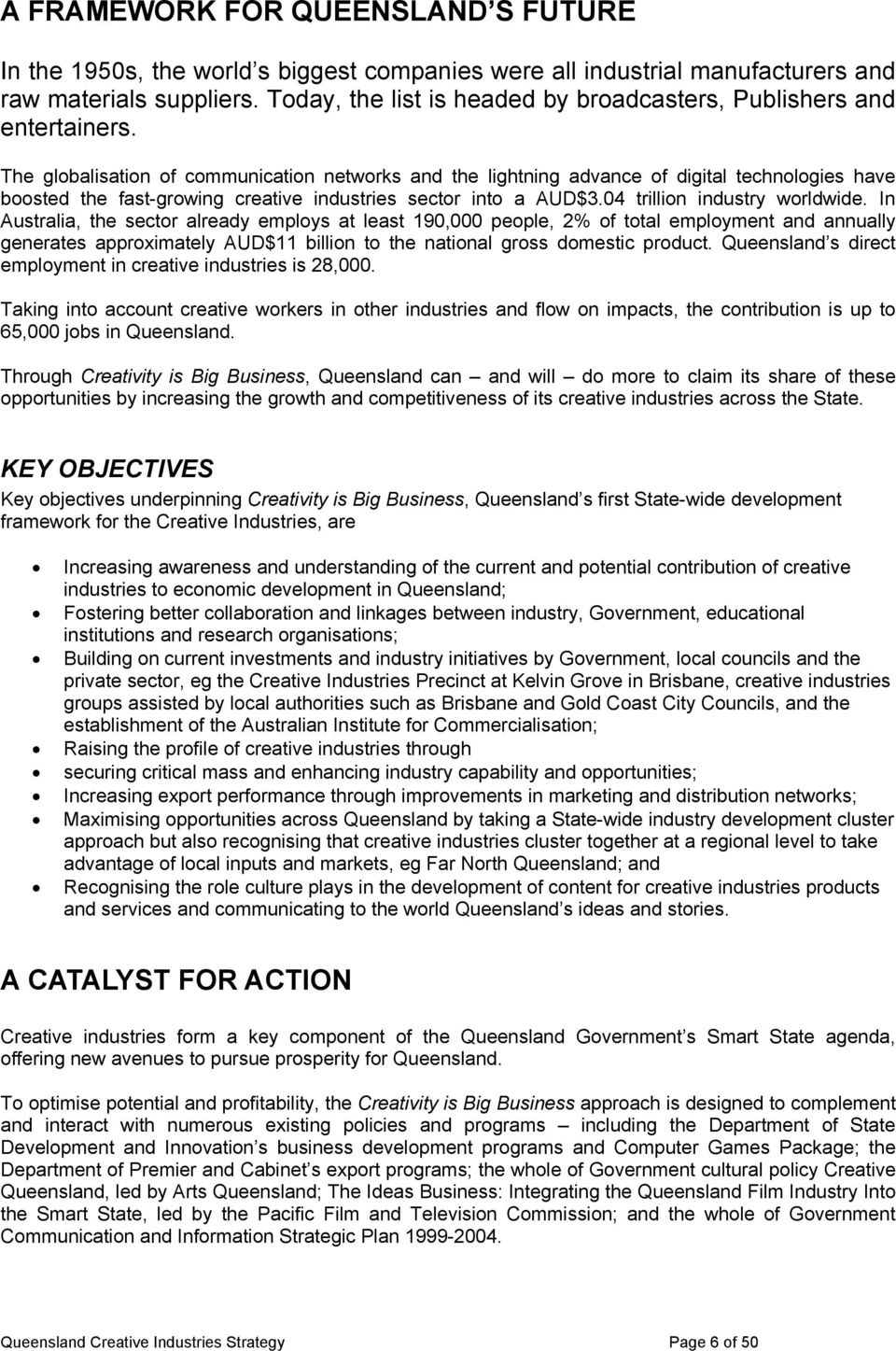
8 CURRENT STATUS AND TRENDS In Queensland, as well as in the rest of the developed world, creative industries are increasingly seen as the new force in economic growth and development. Their importance comes from the extent to which creative inputs are now central to many businesses: from manufacturing to construction to tourism. To focus on the most direct economic impacts, the Creativity is Big Business framework organises the State s creative industries into six segments (based on international studies and using 23 sectors included in the ANZSIC classification). These segments are overlapping and fluid but have been grouped together based on current interaction and linkages. Employment by Queensland Creative Industries Segments, Advertising, Graphic Design and Marketing (5,255), 18.89% Film, Television and Entertainment Softw are (6,329), 22.76% Architecture, Visual Arts and Design (5,470), 19.67% Music Composition and Production (1,590), 5.72% Performing Arts (2,710), 9.75% Writing, Publishing and Print Media (6,454), 23.21% Queensland Creative Industries Strategy Page 8 of 50
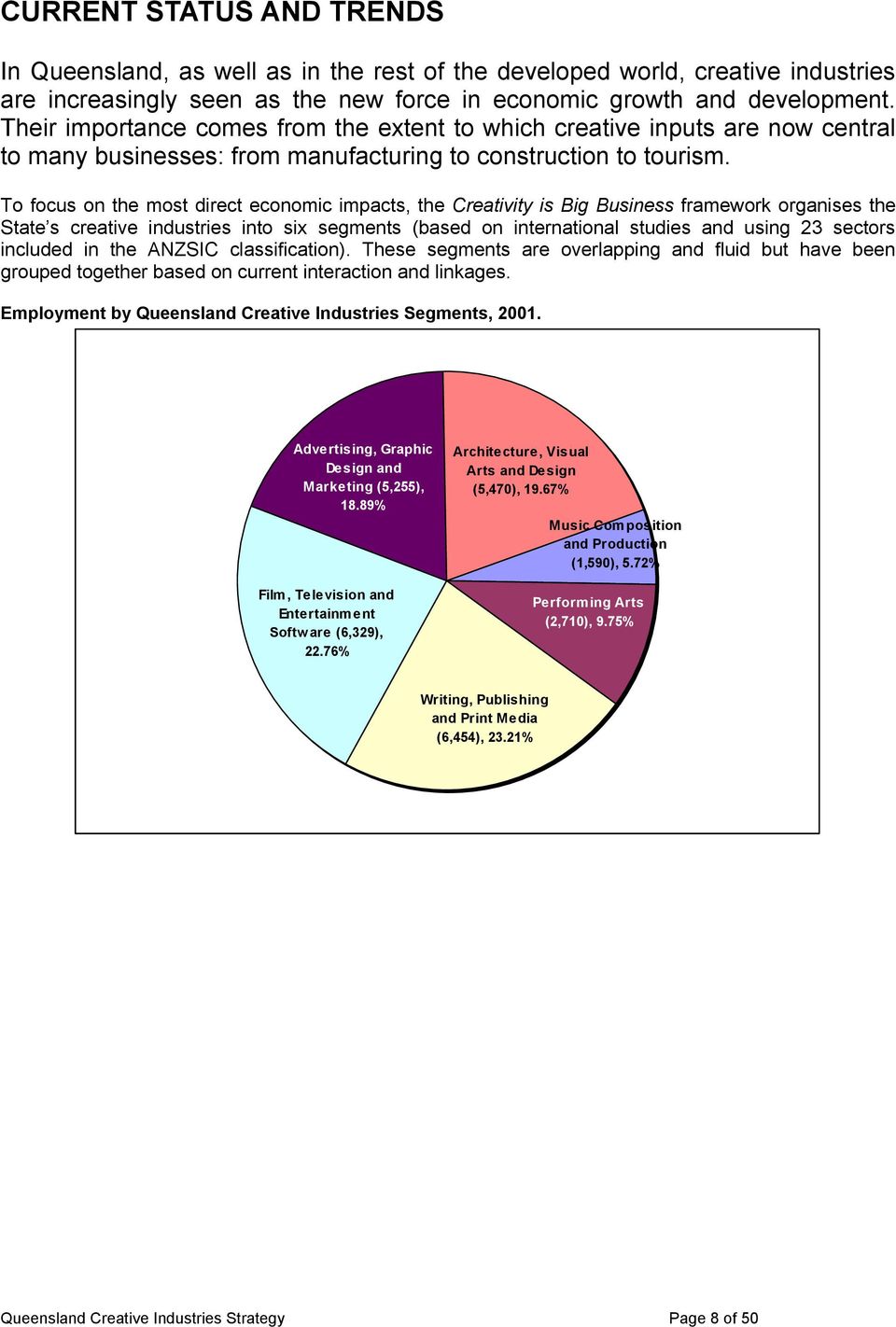
9 ADDING VALUE TO THE QUEENSLAND ECONOMY Our creative industries are becoming more and more valuable to the State economy. Currently, Queensland ranks third in total creative industries employment amongst Australian States. When capital cities are used as the basis of comparison, and the Gold Coast and Sunshine Coast are combined with Brisbane, ie South East Queensland, Queensland compares favourably in employment terms with the national average. Separately, Gold Coast as a proportion of total employment does particularly well. The sector also contributes approximately $1 billion to the value of all goods (1.2 to 1.4% of gross state product) and generates between $75 million and $100 million in exports annually. It is critical to harness the value that all regions in Queensland offer the State economy. Along with interaction and inspiration, creative industries require conditions in which they can survive and thrive. To fully realise the potential inherent across the whole sector, and to compete on a national and international level, it s vital that each of the six segments maintains forward momentum. Creativity is Big Business is providing a lead commitment from creative industries practitioners and partners is vital in taking forward this ambitious agenda. Creative industries as a proportion of employment in all industries, Australia s capital cities and the Gold and Sunshine Coasts, Creative Industries as a Proportion of Employment in All Industries 4.5% 4.0% 3.5% 3.0% 2.5% 2.0% 1.5% 1.0% 0.5% 3.91% 3.32% 2.88% 2.38% 2.37% 2.34% 2.27% 2.21% 2.11% 2.07% 1.81% 0.0% Sydney Gold Coast (inc. Tweed) Melbourne Brisbane Hobart Australia Sunshine Coast Perth Adelaide Canberra Darwin Geographic Area Queensland Creative Industries Strategy Page 9 of 50
10 CREATIVE INDUSTRIES AND THE QUEENSLAND GOVERNMENT Creativity is Big Business [THE VISION] To build a creative industries cluster, recognised globally for its unique creativity, responsiveness of its intellectual property and the market readiness of its products and services. Everywhere we look, creativity is increasingly valued. Firms and organisations prize it for the results that it can produce. Individuals look to it as a route to self-expression and job satisfaction. Queensland benefits enormously from the desirability of place as a driver of competitiveness. Creative industries and creative workers value and rely on the State s smart infrastructure of good governance, entrepreneurialism, education, skills, social cohesion, cultural diversity and quality of life that sustain creativity and the diffusion of ideas. The Queensland Government energetically supports the ongoing development, to a world class standard, of the State s creative industries. Its vision for this burgeoning sector will be realised through the delivery of targeted practical initiatives, in partnership with various public and private stakeholders. Expanding on the current substantial commitment of the State Government, over the next five to ten years, Queensland will build a creative industries cluster recognised globally for its unique creativity, responsiveness of its intellectual property and the market readiness of its products and services. Input advantages for each of the creative industries segments can be improved, bringing the growth rate and revenues of each to a level comparable with or ahead of the Australian average. The activity of the State-wide creative industries cluster (and component local cluster groupings) will generate a higher annual rate of job growth, increase contributions in Queensland as an economic region (including its localities), improve community engagement and develop an environment that better supports taking creative ideas to the market and sustaining business success. Queensland Creative Industries Strategy Page 10 of 50

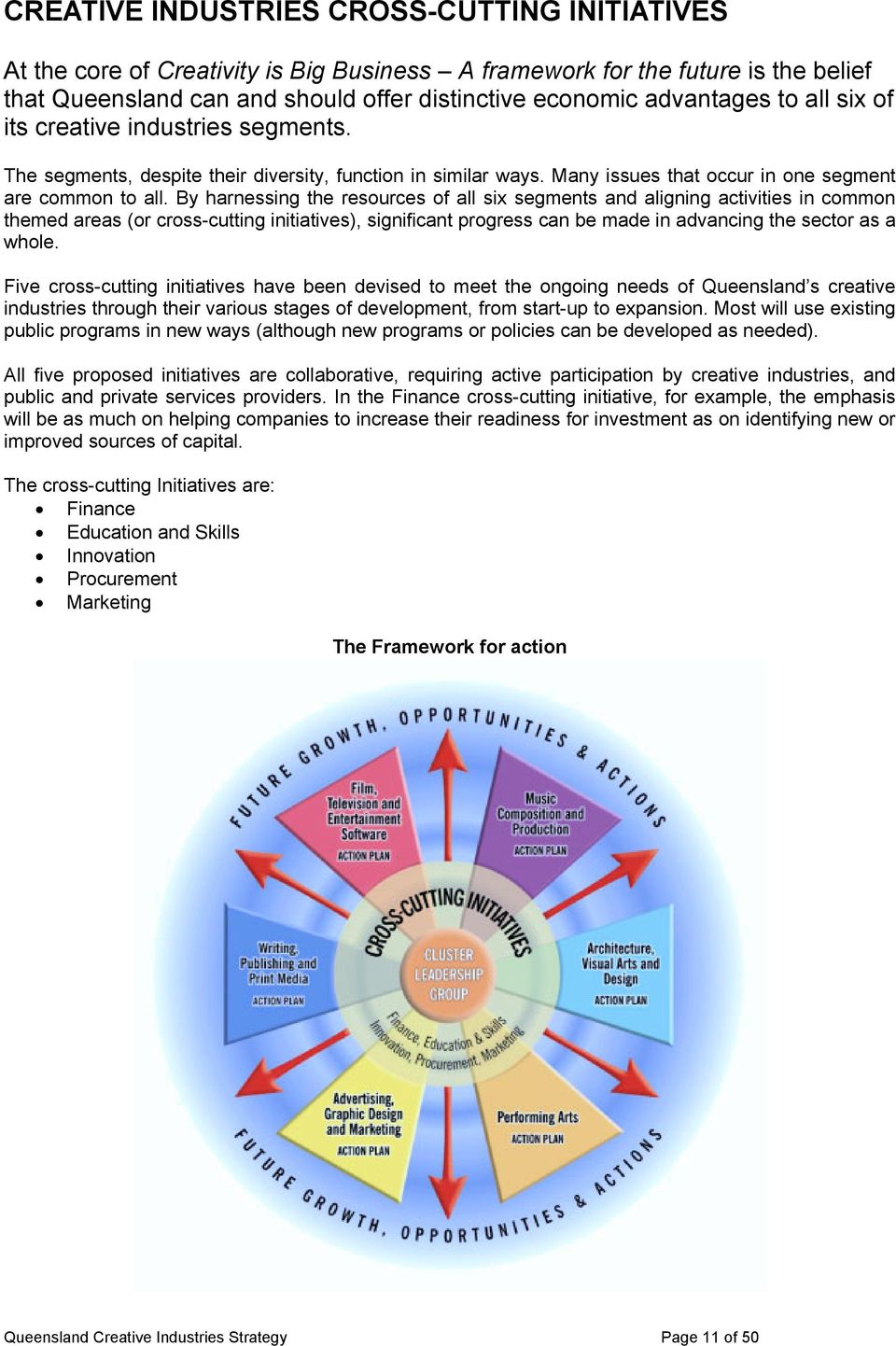
11 CREATIVE INDUSTRIES CROSS-CUTTING INITIATIVES At the core of Creativity is Big Business A framework for the future is the belief that Queensland can and should offer distinctive economic advantages to all six of its creative industries segments. The segments, despite their diversity, function in similar ways. Many issues that occur in one segment are common to all. By harnessing the resources of all six segments and aligning activities in common themed areas (or cross-cutting initiatives), significant progress can be made in advancing the sector as a whole. Five cross-cutting initiatives have been devised to meet the ongoing needs of Queensland s creative industries through their various stages of development, from start-up to expansion. Most will use existing public programs in new ways (although new programs or policies can be developed as needed). All five proposed initiatives are collaborative, requiring active participation by creative industries, and public and private services providers. In the Finance cross-cutting initiative, for example, the emphasis will be as much on helping companies to increase their readiness for investment as on identifying new or improved sources of capital. The cross-cutting Initiatives are: Finance Education and Skills Innovation Procurement Marketing The Framework for action Queensland Creative Industries Strategy Page 11 of 50
12 FINANCE Help prepare creative industries entrepreneurs to secure funding, including venture capital investment, and assist financiers to understand the financing needs of the creative industries. Stages of Financing Actions Focusing on Enterprise Actions Focusing on Financing Pre-investment Prepare enterprises for debt, seed and venture stage investments; Educate the investment community to consider early stage opportunities; and Identify investors with links to creative industries. Increase creative industries firms access to existing programs for business skill development. Communicate information on business financing forums. Develop new tool kit to help creative industries firms improve business plans and readiness for investment, including packaging projects and enterprises for investors. Educate high net worth investors about creative industries opportunities, eg an Angel Forum. Develop a deal generator initiative to identify, screen and prepare higher volume and quality of creative industries investment opportunities for angel and venture stage investors. Promote the opportunities/commercial viability of creative industries and projects. Initial investment Introduce investment ready firms to potential sources of first round funding (angel or seed funding) or venture rounds; Improve volume generation of deals to attract investors; and Expand/ improve range of financial instruments to meet enterprise needs. Increase access of creative industries firms to existing angel networks. Promote existing financing programs. Promote the need for adequate finance to progress research and development to commercialisation. Convene investors and Government programs to identify barriers to creative industries investment and opportunities for expanding access to funding forums. Explore new finance initiatives and opportunities for specific or aligned capital funds. Investment expansion Improve the participation of creative industries firms in mainstream investment forums; and Assist later stage investors to understand the range of creative industries opportunities. Increase creative industries firms participation in existing investment forums: (Entrepreneurs Forum, enterprise angels, venture capitalists), creative industries specific funds and Pacific Film and Television Commission funding. Evaluate effectiveness of current Government grants and subsidies for creative industries enterprises. Optimise Government funding to improve and stimulate creative industries value chain development. Initiative Drivers The organisations most likely to lead the Finance cross-cutting initiative, are those currently involved with existing programs supporting creative industries. These include the Department of State Development and Innovation (Venture Capital and Commercialisation Unit), other Government agencies, private angel and venture capital networks and forums. Expected Outcomes The outcomes of the implementation of the proposed Finance initiative are expected to be: Growth of local investors for the creative industries in Queensland; Improved investment readiness of firms seeking investment; Improved infrastructure to facilitate identification, screening and quality deal-making in Queensland for the creative industries cluster; Enhanced utilisation of existing programs and infrastructure to produce higher quality deals for potential investors; and Increased amount of seed and venture capital funding available in Queensland and placed in the creative industries sector. Queensland Creative Industries Strategy Page 12 of 50
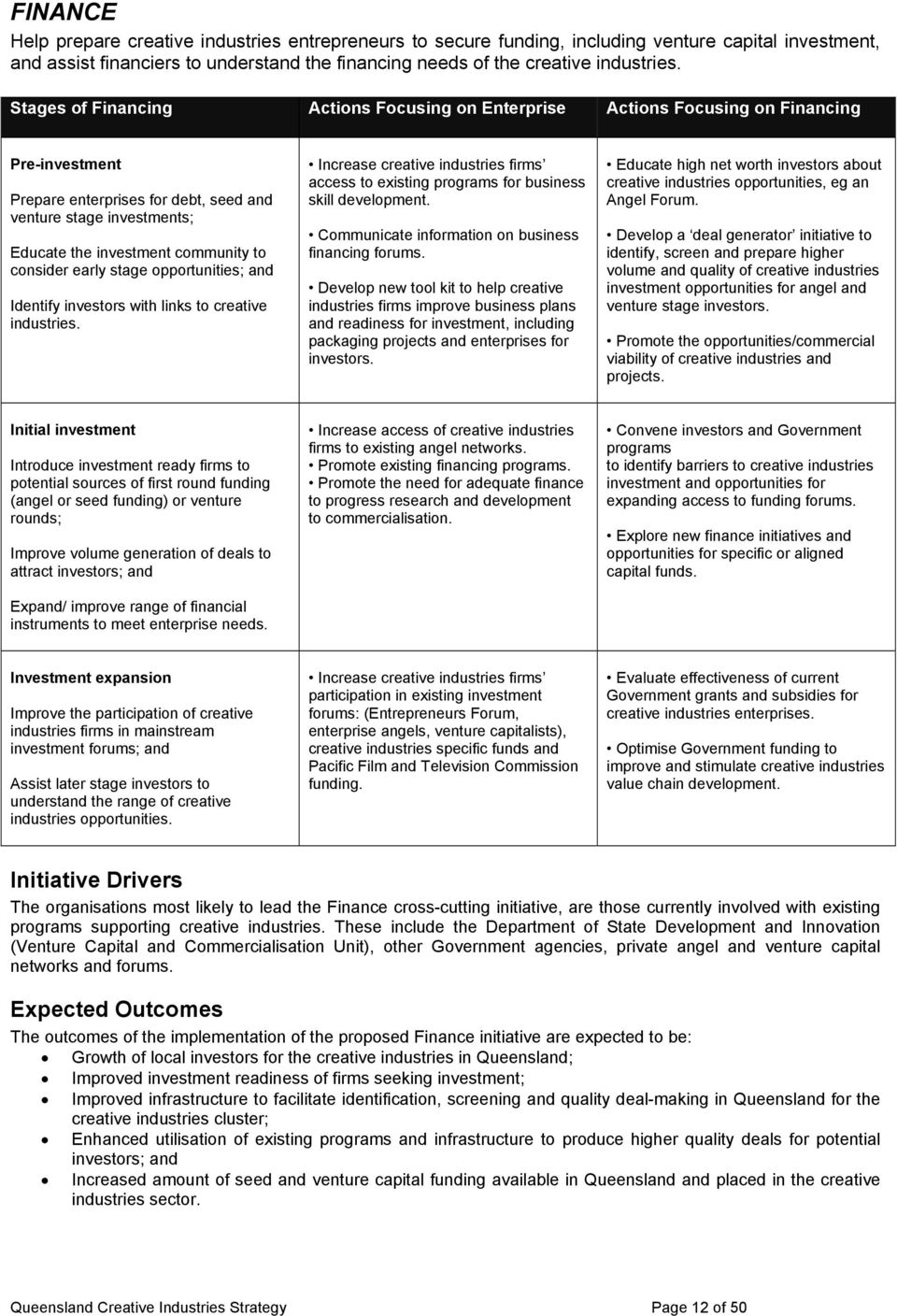
13 EDUCATION AND SKILLS Help creative industries to learn and acquire what they need to prepare, advance and renew their workforce skills, while concurrently enabling education and training providers to better understand and respond to creative industries needs. Stages of Skill Development Actions Focusing on Enterprise Actions Focusing on Skill Sources Prepare/ Basic education Educate the future workforce (secondary through to undergraduate training) for the creative industries by better understanding changing skills demand and improving coordination of curriculum and programs. Link creative industries firms and peak bodies to a skills initiative with TAFE Queensland, niche private registered training organisations and universities to review education and training up to professional degree level. Engage creative industries firms in internship, traineeship and apprenticeship programs to strengthen workforce experience and job connections. Evaluate workforce skill needs in the creative industries on an ongoing basis consulting with key universities, TAFE institutes, niche private registered training providers and industry peak bodies. Organise and extend the mentoring, traineeship and internship programs across all segments. Work with Education Queensland to improve the transition from school to careers in the creative industries. Advance/ Professional training Develop specialised university level professional degrees and certifications to feed creative industries changing requirements through adapting curriculum or creating new programs driven by business needs and emerging technologies. Renew/ Continuing education Enable creative industries employees to acquire skills needed to manage ongoing business activities from accounting and marketing to intellectual property (IP) management. Work with educational institutions and accreditation standards bodies to review and build consensus on any proposed changes. Explore new multidisciplinary professional degree programs integrating creative, technical and business skills development. Work with the Vocational Education and Training (VET) sector to package and promote skills and programs internationally to enhance commercial opportunities. Participate in skills alliance or networks to assess and enhance training delivery models for the creative industries. These will involve collaboration with vocational education and training and university sectors and Government Departments to ensure that training for the creative industries meets their needs. Review current accreditation processes available for the creative industries segments. Identify gaps and opportunities for improvement to strengthen creative industries professions. Work with industry and educational institutions to plan future degree programs in creative industries that link new disciplines. Build on the current strength of education export and explore new opportunities to grow international business for the universities and VET sector, to establish Queensland as a destination for creative industries education. Work with current programs to meet the continuing education needs of the creative industries cluster, including business and IP management. Where gaps exist, explore with current educational providers the development of new skills programs in areas such as entrepreneurship. Explore new delivery approaches, including integrating and tailoring current web-based programs to grow an Online Skills Exchange to facilitate enhanced use of Queensland workforce. Initiative Drivers The drivers most likely to move the Education and Skills cross-cutting initiative ahead, are those organisations with strong creative industries education and training capacity, such as Queensland s universities, the Department of Employment and Training and the Pacific Film and Television Commission. Based on current program activities in Queensland, the Department of Employment and Training, Education Queensland and universities are the logical champions for this initiative. The Department of State Development and Innovation can also assist with the provision of business skills seminars and workshops for small and medium-sized businesses. Queensland Creative Industries Strategy Page 13 of 50
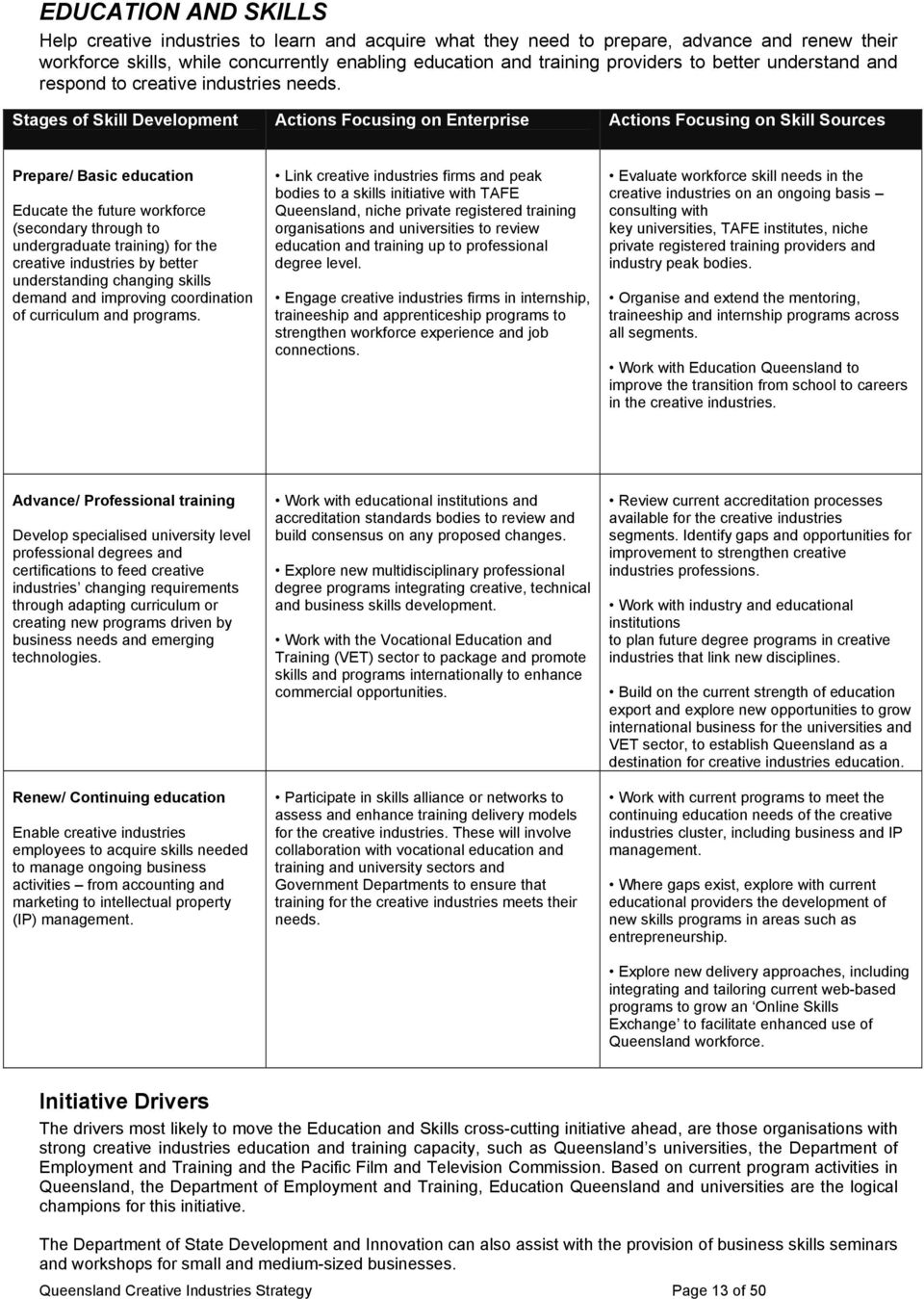
14 Expected Outcomes The expected outcomes of the implementation of the proposed Education and Skills initiative include: Better identification and provision of skills needed by industry; Increased training opportunities for creative industries employees; Better collaboration among training providers, industry and educational institutions, resulting in more efficient delivery of services; Increased employment of Queensland individuals with skills in the creative industries; Improved financial performance, sales and revenue collection as well as better fiscal reporting among creative industries firms through better business management skills; Increased competitiveness of companies and (consequently) ability to bid on, win and sustain contracts and business due to better access to workforce skills; and Improved net revenues and new sources of ongoing revenue for creative industries firms through the generation, commercialisation and sale of intellectual property to global markets. Queensland Creative Industries Strategy Page 14 of 50
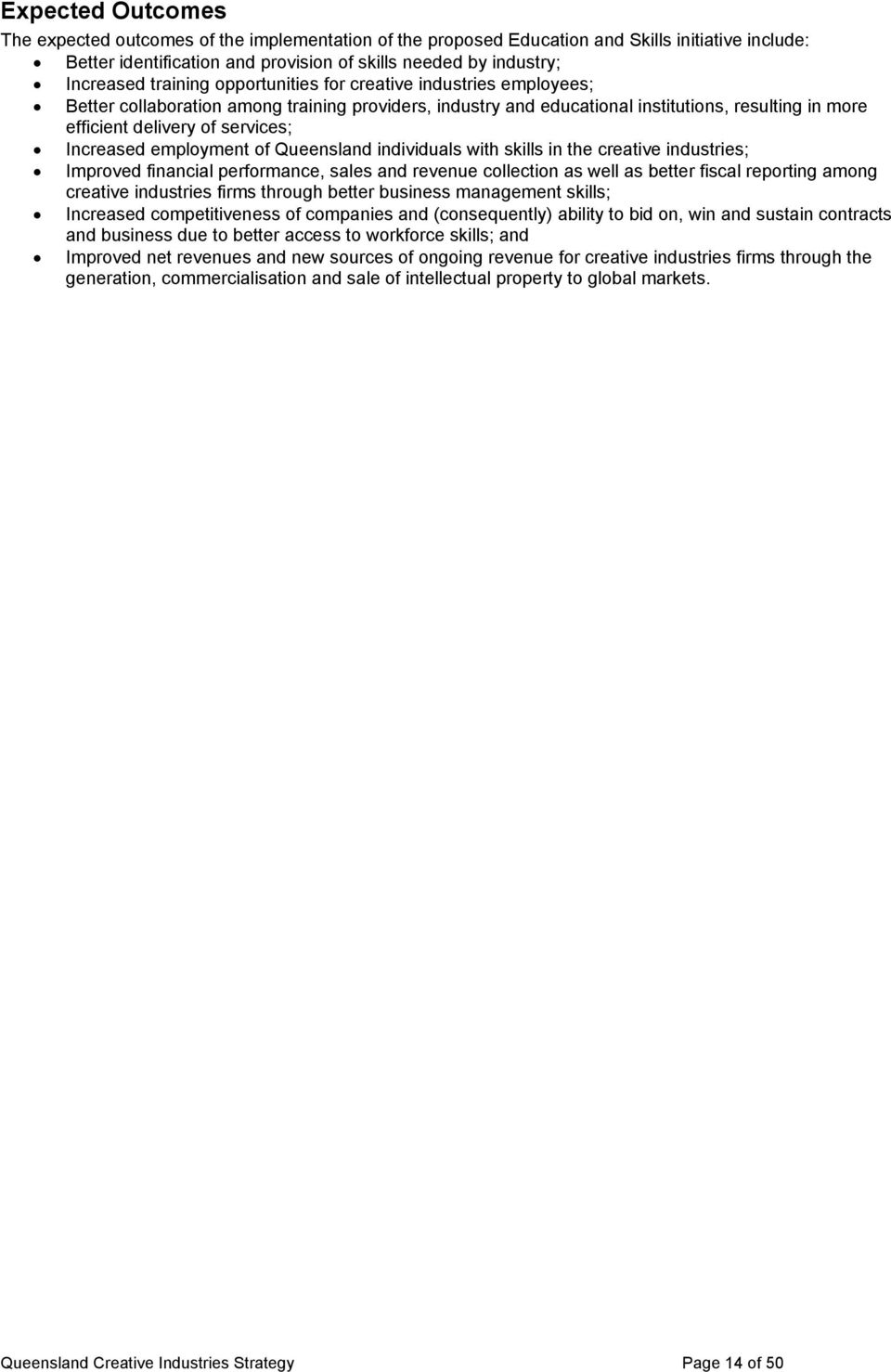
15 INNOVATION Help creative industries to better identify and use innovative processes and technologies, while better connecting universities to the creative industries to link discovery to development to deployment along the innovation pipeline. Stages of Innovation Actions Focusing on Enterprise Actions Focusing on Innovation Discover Generate scientific applications that can become the basis of future technology products and services for the creative industries. Engage creative industries firms across segments, to work with universities in defining longer-term research directions leading to new discoveries. Organise an innovation mining program that seeks out early stage intellectual property from universities that have potential for development in segments of the creative industries. Develop Manage the proof of concept research, building and testing of prototypes for new creative industries-related technologies. Work with universities and research centres to establish improved mechanisms for developing technologies and processes for creative industries, such as living laboratories. Analyse and address standardisation issues pertaining to new technology platforms. Address intellectual property issues that affect commercialisation of creative industries technologies. Deploy Transfer new technology products and processes into the creative industries marketplace whether through spin-offs or expansion of existing company product lines. Utilise the creative industries cluster network to facilitate awareness and utilisation of new technologies and processes, working with universities, research centres and suppliers. Conduct programs to find and share information on latest developments in creative industries segments, ie forums, websites or trade shows. Work with universities and Cooperative Research Centres to engage them in assisting creative industries firms to apply new technology tools that provide a competitive edge, eg digital distribution. Initiative Drivers Queensland has several creative industries research and development initiatives currently underway. These include the Creative Industries Research and Applications Centre (CIRAC), and the Australasian Cooperative Research Centre for Interaction Design (ACID). Based on their capabilities, these organisations could take a leadership role in this initiative, with the Australian Institute for Commercialisation (AIC) assisting in intellectual property commercialisation issues. The Department of State Development and Innovation can assume the coordination responsibilities. Support could also be provided by existing or proposed media technology oriented incubators. Expected Outcomes The following outcomes are expected as a result of implementation of the Innovation initiative: Increased technology development and uptake among Queensland creative industries enterprises; Increased spin-off activity from universities and centres due to research and development efforts with creative industries enterprises; Raised sales of Queensland intellectual property, due to increased market penetration and exposure through digital distribution; and Increased development, take-up and application by Queensland creative industries of intellectual property. Queensland Creative Industries Strategy Page 15 of 50
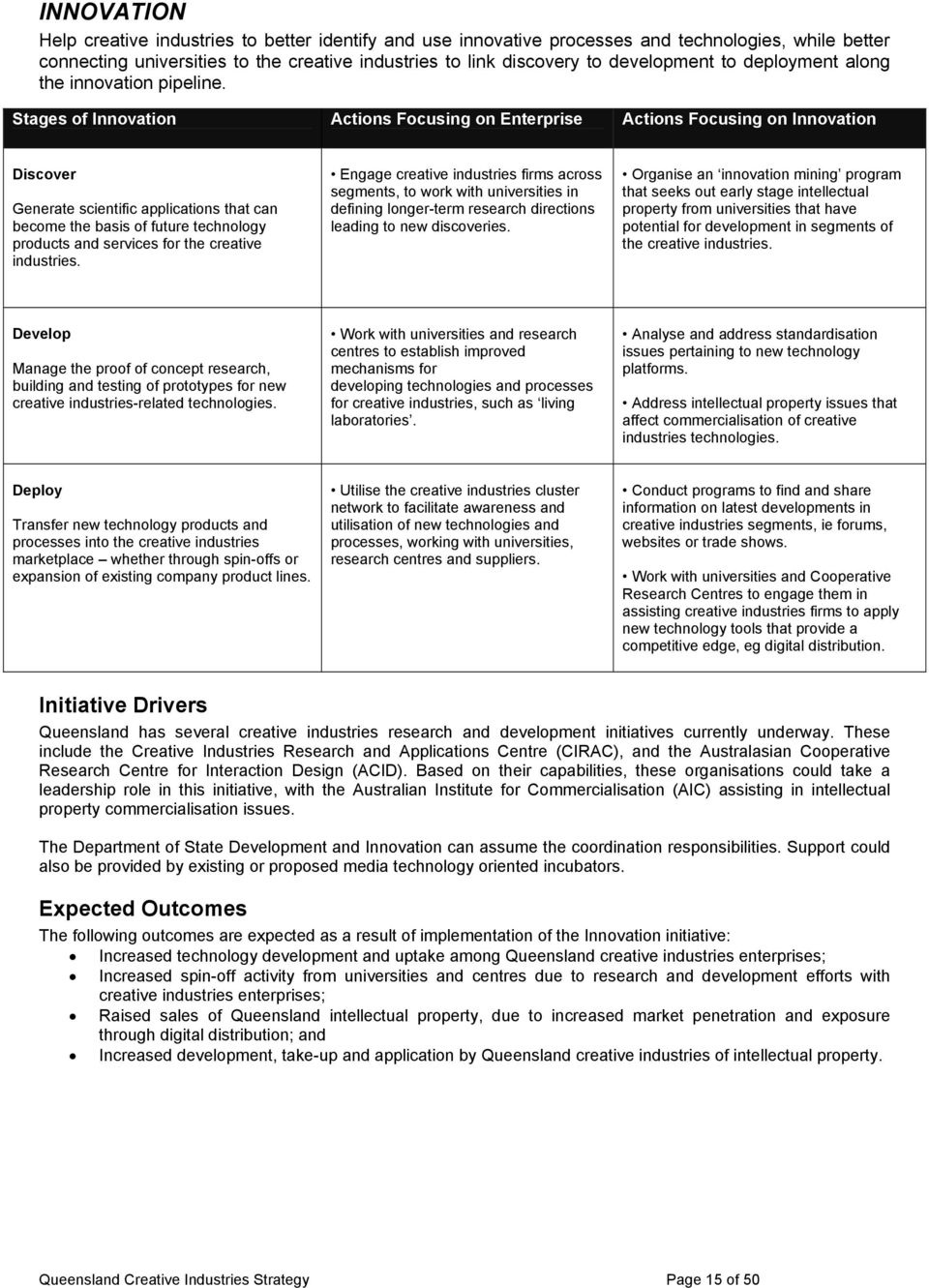
16 PROCUREMENT Help creative industries producers to better understand how to work with the procurement systems of high value purchasers, while enabling Government agencies and major corporate sector purchasers to understand and realise the value creative industries can add to improved product and service delivery. Stages of Procurement Actions Focusing on Enterprise Actions Focusing on Procurement Apply Procurement processes have standardised procedures that determine specifications and how bids will be issued. Organise a creative industries working group to work with public and private organisations to better understand their current procurement priorities and bidding processes. Identify the needs of each creative industries segment in relation to procurement. Explore with public and private sector how procurement processes can benefit from the value added by creative industries. Review current procurement processes to identify barriers to procurement of creative industries products and services from Queensland firms. Look at issues of design, innovation, value and costs. Enhance knowledge of procurement administrators about potential creative industries value, with the goal of enhancing the overall procurement outcome. Explore opportunities for creative industries enterprises to showcase new products and services specifically to public and private sector groups. Bid Bidding processes determine the terms and conditions that prospective contractors must satisfy in competing for purchases. Educate creative industries firms on how to maximise identification of opportunities and positioning for competitive bids, emphasising creative industries content advantage. Facilitate the establishment of a consortium of creative industries firms to bid collaboratively on procurement opportunities. Explore new initiatives to assist with processes, including development of an innovative consortium, establishing a Buy Queensland Creativity website and running workshops on tendering processes. Purchase The management of procurement affects how materials and services are delivered, including potential use of creative industries inputs. Track success stories and promote information on purchases by public and private organisations that incorporate creative industries input in new ways; use these to position creative industries firms in national, State and international procurement bids. Promote the usage of e-commerce in the buying and selling of creative industries products and services through operator skills development. Use track record of Government bids, incorporating greater creative industries input, to educate other agencies and local authorities, and support industry marketing. Initiative Drivers The drivers of this initiative will include Queensland Government Departments and major corporate companies acquiring creative industries products and services. They will collaborate to increase the scale of activity to respond to the issues and opportunities identified. Expected Outcomes The outcomes of this cross-cutting initiative are expected to be the following: Improved understanding of creative industries goods, services and capabilities by private and public sector purchasers; Increased revenues for creative industries enterprises due to increased within-state procurement by public and private agencies; and Greater national visibility and contracting of services to Queensland creative industries enterprises by industry and other State Governments. Queensland Creative Industries Strategy Page 16 of 50
17 MARKETING Assist creative industries enterprises to better productise and professionalise for the global marketplace and improve the understanding by markets (existing and potential) of Queensland s capabilities. Stages of Marketing Actions Focusing on Enterprise Actions Focusing on Marketing Market research Acquire information on market demand and competition needed to shape a business plan and product offering. Pool resources to acquire improved data and competitive insights in specific creative industries market segments. Inform creative industries enterprises on market strategy development, including access to information by segment on national and international market opportunities and competition. Provide training on export development and marketing through cooperation with the Export Pathways program. Product development Design and develop products or services that achieve success in the global marketplace. Encourage creative industries members across segments to work together to define best practices in globally competitive products and, where advantageous, combine company efforts to create stronger product offerings to the marketplace. Promote the concept of different segments of the creative industries forming creative solutions groups to respond as a group to opportunities requiring multiple expertise or services. Enhance competitiveness of Queensland s creative industries products and services by Government exploring with industry the development of stronger product packages. Promote and distribute Position and deliver a product or service to customers while establishing an enduring image and reputation (brand) that fosters sales and buyer loyalty over time, thereby promoting new economic development. Industry drive, and Government facilitate, a collaborative effort to define and build a brand for Queensland creative industries products and services that are globally competitive, and build on the distinctive culture of the State. Industry and Government develop a cooperative program for marketing and distribution that reduces costs and improves market access for creative industries firms. Explore how industry and Government agencies can partner to support creative industries efforts to build Queensland brand image. Evaluate through Government, working with relevant industry interests, the effectiveness of industry trade and marketing events and proposed other marketing options. Explore the option of using Queensland ambassadors and internationally-based expatriates as contact points for market insights and promotion of Queensland products and services. Examine ways to promote strategic growth through targeted inward investment and business migration Initiative Drivers The key driver will be the Department of State Development and Innovation, together with access to other State Government agencies market intelligence, as well as Queensland Government Trade and Investment Offices overseas and Commonwealth Agencies. Substantial engagement of creative industries stakeholders will be essential to successfully achieve the proposed actions, including working with specialist or niche groups such as the Queensland Indigenous Arts Marketing and Export Agency. Queensland Creative Industries Strategy Page 17 of 50

18 Expected Outcomes The expected outcomes of the Marketing cross-cutting initiative are as follows: Improved understanding of marketing and international market preparation requirements by creative industries firms, eg preparing the right product for the right market before undertaking marketing; Increased awareness of a Queensland brand domestically and overseas resulting in more investment in Queensland businesses; Increased potential sales through the identification of possible partners and markets through the Queensland Government s and other overseas networks that assist relevant Queensland creative industries companies to sell their products or services, eg improved market penetration of creative industries in niche markets; and Expanded intrastate buyer-supplier linkages through improved information and exchange, eg through trade show events. Queensland Creative Industries Strategy Page 18 of 50
19 CREATIVE INDUSTRIES: SEGMENT STRATEGIES Each of Queensland s creative industries segments developed its own strategy for improving competitiveness including a vision for the segment, an estimation of the global markets, a review of current status, assessment of competitive position, comparison of position across State localities, determination of shared challenges, proposed actions and expected outcomes. Each industry also identified specific actions as key initiatives it is important to pursue. The action plans outlined here attempt to address some of the challenges the segments face, now and in the future. The actions listed in each are intended only as a beginning of the process of growing Queensland s creative industries cluster, and will be undertaken in collaboration with partners. As learning improves, and actions are clarified and implemented, there will be opportunities to consider other challenges not currently identified or dealt with. To ensure the action plans remain relevant, complementary and deliver tangible results, each segment needs to be industry-driven. Support will be provided by appropriate Government agencies, education and training organisations and other key stakeholders. Initially, the Department of State Development and Innovation will provide the secretariat service to the ministerially appointed Cluster Leadership Group, and will work closely with each industry segment group in the establishment phase. Each segment, based on agreed protocols and an approved action plan, will be eligible for funding to form and operate the group over its first twelve months. Once established, the segment groups may be eligible for further assistance from various agencies on a project by project basis. The Cluster Leadership Group will look to work with cluster groups in regional Queensland. Included here is a summation of the competitive position, vision and action plan for each segment. Music Composition & Production: Get Global Markets to Sing Queensland s Song The Segment Vision To establish Queensland as a booming music location whose product has more and more success in the marketplace, and to position Queensland as Australia s music business showcase and a global player in the music industry. Creativity exists in many places and is expressed in many ways. Music in all its forms, from popular to classical to live or recorded, creates products and services we can all enjoy. A thriving Music Composition and Production segment, with its wide-ranging skills sets (encompassing song-writers, performers, producers, management, promotions and more), training and opportunities to showcase culturally exciting and commercially profitable creativity, helps to attract greater numbers of talented people to work in it just the sort of people who will themselves power further innovation and growth, right across the creative industries. This segment can also play a significant part in the way the State is perceived nationally and internationally, adding not only to its cultural life, but also to its image as a dynamic and interesting place to be. Queensland s development in this segment is growing above the national average of 4.28%, with Brisbane, Gold Coast and Sunshine Coast all above the Queensland average of 4.76%. Cairns, while not yet achieving the same rapid growth, has a high concentration of activity in this segment. Queensland Creative Industries Strategy Page 19 of 50
20 Some of the key competitiveness challenges, identified by stakeholders from the Music Composition and Production segment, include: Creating more competitive Queensland music products and services; Encouraging unique and market-ready quality across all levels of the music industry; Improving the quality of advice and potential industry opportunities for the protection, management and exploitation of intellectual property, marketing and new distribution technologies; Accessing industry mentors to improve skills and development; Creating a Queensland identity in music; Improving the marketing capacity in Queensland music firms; Educating potential business angels and venture capital interests about Queensland s music industry as credible business opportunities arise; Understanding alternative marketing and distribution channels; Getting the balance right by developing Queensland music markets across the whole State, alongside exploiting new national and international markets; and Recognising that music industry practitioners often rely on a variety of income streams requiring access to a pool of appropriate venues and events. SUCCESS STORIES Media Rare Media Rare is a small but influential Brisbane-based event, artist management and record company. Producers of Queensland s biggest youth event, the Big Day Out, they also deliver a range of youth events and programs for clients like Brisbane City Council. As owners of the Hydrofunk label, they manufacture and distribute original music directly to 150 independent stores nationally and have a licence deal with EMI using their national distribution network. The company invested in its own on-line shop, sells merchandise such as t-shirts and distributes music through sales on the Internet and at live shows. Being located in Queensland, Media Rare has access to a depth of local talent, serving interstate and overseas markets. Secret Service Secret Service is an artist management company that co-represents Brisbane-based Powderfinger, currently one of Australia s most successful rock bands. Secret Service is one of three music-related businesses run by the Managing Director, Paul Piticco from offices in Fortitude Valley. The other two businesses are a record label called Dew Process, which focuses on the signing and recording of artists, as well as a separate concept and promotion business which arranges venues and festivals such as Splendour in the Grass - held annually in Byron Bay. Brisbane s lifestyle and affordability have allowed many young artists the opportunity to practice and display their craft. The development of managers and bands such as Secret Service and Powderfinger has raised the profile of Brisbane s fledgling but dynamic rock music industry. Queensland Creative Industries Strategy Page 20 of 50

21 ACTION PLAN OBJECTIVES ACTIONS EXPECTED OUTCOMES TIMEFRAME PRODUCT QUALITY Increase commercial success in national and international markets through improved product quality. Create an environment in Queensland that establishes a music boom of quality musical product. 1. Identify information on key elements of the music product development chain and potential market opportunities topics such as: How bands get started - key factors in their success. What record companies are looking for. The musical demands of film, television, computer games, advertising and other potential markets. The positive role of technology and its potential pitfalls. The growth and potential of niche markets, eg country music, tourism-related and indigenous. 2. Distribute this information in an effective way utilising existing events, industry experienced guest speakers, role models, new networking events and internet. 3. Consider innovative linkages to expose new/existing Queensland talent and bands, eg increased airtime on radio or a film clip competition, where a musical artist with commercial potential (as selected by the marketplace, eg local radio) has a funded opportunity to work within new film/television production in Queensland. 4. Facilitate Queensland based businesses (acts, management, promoters, festivals and product manufacturers) in accessing international markets through the facilitation of business activity at targeted international trade fairs and showcases (SXSW, MIDEM, Popkomm, In the City, NAMM). 5. Building on these specific actions, and others listed below, begin development of a long-term strategy to maximise the commercial success of the Queensland music industry. Cross-cutting Involvement: Education and skills Enhanced level of product originating in Queensland that is capable of market success across the music industry: 1. More recording deals by Queensland artists. 2. Improved penetration in all segments of creative industries, in particular film, television and computing games. 3. The positioning of Queensland as a booming musical location complementing growth in other creative industries segments, the State s tourism sector and existing events such as Big Sound. 4. Improved opportunities for commercial success through better preparation of products and services during development stages. 5. Increased international business development and intellectual property exploitation. 6. Increased international distribution of Queensland music s products and services. SHORT /MEDIUM TERM NEW HOME GROUND To explore the development of a new venue for the Queensland music industry that acts as a focal point to showcase and develop commercial music talent and product. Undertake an investigation, in partnership with relevant key interests, on the feasibility of developing the home ground project: 1. Organise a partnership group of public and private interests to explore the opportunity. 2. If appropriate, undertake a feasibly exercise to examine benchmarking against best practice, potential linkages with remainder of creative industries cluster (especially industry), financial business case models and maximising economic outcomes. To establish the feasibility of taking the project forward, including: 1. Commercial sustainability. 2. Scale and scope of services offered. 3. Potential investors, including commercial partners. 4. Impact on jobs and company growth. 5. Ability to assist in positioning Queensland in the global market over long-term. SHORT /MEDIUM TERM DIGITAL DISTRIBUTION To increase sales by increasing exposure and providing an alternative means of distribution to global markets. Explore the commercial feasibility of new digital focused means of distribution to allow increased access to new markets: 1. Organise an industry group committed to participation in a digital distribution network. 2. Organise the investigation to evaluate current practice and Queensland potential. 3. Determine interest across Queensland music value chain. 4. Finalise potential branding strategy, content development and access issues, to enable funding to be sought. Cross-cutting Involvement: Innovation; and Marketing Increased demand from customers across all niche products and services arising from better penetration of markets: 1. Increased sales of recorded material and relevant information services. 2. Opportunities for new business models leading to growth of new firms. 3. Better understanding and utilisation of evolving distribution technology and models throughout Queensland music industry. MEDIUM TERM MAXIMISING POTENTIAL/ UTILISING EXPERIENCE To enhance the connection between existing and potential entrants to the industry, to those with real life appreciation of how the music industry works, and how to succeed in it. Establish dedicated mechanisms to link emerging Queensland artists, technicians and song-writers with individuals or companies who will enhance their success: 1. Explore establishing dedicated resources to take a step-by-step approach: a. Develop a data-base of Queensland capabilities in the music industry with a track record of success. b. Explore means to identify emerging artists with potential for success, eg through competition etc. c. Establish new event or build on existing to link potential with experience. 2. Explore support for second stage Music Business Advisory Service (MBAS II). 3. Identify potential niche areas for specific development, eg new projects to improve market success in song writing. 4. Explore potential for workshops with successful artists and business managers. Cross-cutting Involvement: Education and skills Increase in awareness of the music market and its competitive pressures leading to: 1. Better quality decision and deal-making. 2. Improved opportunities for commercial success through better preparation of products and services during development stages. 3. Improved opportunity to build a critical mass of successful recording and performance artists, professional technicians and managers based in Queensland. 4. Improved potential success of marketing and distribution related-actions. SHORT /MEDIUM TERM Queensland Creative Industries Strategy Page 21 of 50
22 RELEVANT LIFELONG LEARNING To improve: - the knowledge of potential entrants from the educational sector about the music industry and - better utilise educational resources for individuals within the industry on topics such as business management or intellectual property (IP). Identify or develop appropriate educational programs at the school and tertiary level to enhance the quality of knowledge: 1. Investigate ways to integrate, at the school and tertiary level, the experience of successful people in different aspects of the music industry to establish an exciting but relevant perspective of how the industry works and what it takes to succeed. 2. Explore opportunities to collaborate and contribute to the development of new courses to provide enhanced industry experience, and knowledge of key success indicators in song writing, production, protection and exploitation of IP, business management and negotiation. Higher level of knowledge at key stages in the education of existing or potential music industry participants leading to: 1. Greater commercial success of music industry participants measured in: enhanced record signing/sales that result in the generation of employment for secondary providers (websites, merchandise, tour management etc). 2. Greater number of and higher profit from related services and service companies. 3. Greater creation and retention of commercially successful Queensland IP, linked to the generation of income. MEDIUM TERM BEST PRACTICE To learn from, and implement national and international best practice initiatives. Identify, adapt to Queensland and implement best practice initiatives. Investigate current initiatives such as: 1. Manchester, UK: Utilising mix of rock, special zoning and tourism to develop their industry. Manchester has become the home of the established In The City national/international music convention. 2. New Orleans, USA: Using radio, managed areas and festivals to build on their excellence in jazz and rhythm and blues. 3. Austin, Texas, USA: Protecting venues, introducing new television shows and international conventions to brand the city as a world capital in live music. Queensland segment that competes with global best practice: 1. Better initiatives that suit Queensland s requirements but which learn from current practices. 2. Potential linkages with global segments. SHORT TERM Queensland Creative Industries Strategy Page 22 of 50
23 Film, Television And Entertainment Software: Make Queensland A World Star The Segment Vision To extend the intellectual property, physical facilities, workforce skills and marketing infrastructure needed to expand Queensland s film exports, its share of offshore and interstate production, and continue growth in computer games and other entertainment software in global markets. Queensland in the 1990s achieved the rank of preferred location for foreign film and TV production in Australia. To help the segment to further maximise business opportunities its talent and facilities provide, and to compete more strongly both nationally and internationally, Government departments have been working in conjunction with industry on effective ways to link up with and encourage foreign film and TV related services, such as post-production. Also under scrutiny are ways to better understand and promote more competitive and higher levels of local (domestic) production. Other areas with great potential are the rapidly-proliferating new forms of content demanded by new digital delivery platforms, such as computer games, interactive TV, DVD, mobile phones, wireless and other human interface technologies. Particularly due to international film production and computer games development, Queensland remains among the leading States in this segment, which is growing nationally at an average of 3.33%. The Gold Coast is the State s top performer, growing at almost 10% annually and possessing strong synergies with Brisbane. Some of the key competitiveness challenges, identified by stakeholders from the Film, Television and Entertainment Software segment, include: Smoothing out the peaks and troughs to achieve consistency of production and employment; Promoting greater collaboration, identification and exploitation of linkages across the segment; Improving access to capital from existing and new sources; Developing effective national and State programs to support attraction of overseas production; Building viable domestic demand; Changing from a supply-led business model to a demand-led model; Stimulating industry development and enabling sustainability through fostering State and local procurement of media; Improving promotion of Queensland s film, television and computer games in the State, nationally and internationally; Accelerating development and adoption of new media technology linked to ongoing market development; and Improving access and affordability of telecommunications bandwidth connectivity. SUCCESS STORIES Krome Studios Krome Studios, established in 1999 and operating in Fortitude Valley, is Australia s largest games development company. Krome develops games for PC and major consoles, and its Ty the Tasmanian Tiger game has become Australia s biggest selling title ever, having recently sold over one million units world wide. Krome has shipped over twenty seven SKUs and holds lucrative contracts with the world s leading games publisher, Electronic Arts. Being located in South East Queensland, the company benefits from access to an enthusiastic, well-trained, highly skilled and motivated local workforce. Queensland Creative Industries Strategy Page 23 of 50
24 Best Picture Show Company The Best Picture Show Company is based on Petrie Terrace, opposite the Victoria Barracks in the heart of Brisbane s City West precinct. Established in 1986, the company produces television commercials for advertising agencies in Los Angeles, New York, London and Sydney, television series for ITV in the UK and Discovery in the United States. One of Best Picture Show s most well known productions is The Crocodile Hunter starring Sunshine Coast-based personality Steve Irwin, seen by viewers in almost 150 countries worldwide. The successful program created a spin-off feature film Crocodile Hunter: Collision Course, financed by MGM pictures. Light Knights Entertainment Located in Brisbane s inner city suburb of Spring Hill, Light Knights Entertainment specialises in the production of animated content for children s television, and is widely acclaimed for its success in producing The Shapies, a nationally broadcast children s animated television series. Light Knights Entertainment attributes its success in large part to the large pool of self-taught animation talent it has been able to source locally in Brisbane. Hoodlum Entertainment Hoodlum Entertainment is a television production company based in West End, Brisbane. Established in 2000 Hoodlum is responsible for the successful TV drama series Fat Cow Motel, which was a world first multi-platform drama utilising traditional broadcast TV, interactive television, , internet and voic to enhance the audience experience. With lower overheads and strong State Government support, Hoodlum Entertainment has continued to develop and produce film and TV projects for the highly competitive local TV market. Pictures in Paradise Gold Coast-based film production company Pictures in Paradise has been responsible for the first two feature films written, produced and directed by local Queensland talent in 50 years: Blurred & Under the Radar. By securing international market support, producers Chris Brown and Chris Fitchett have created a slate of projects for production in Queensland. Before establishing Pictures in Paradise, Chris Brown produced features for international release including Oscar-nominated Mona Lisa, Company of Wolves and Absolute Beginners. He also produced White Lies, Blackwaters Trail, Komodo and Cubbyhouse in Queensland. Currently Pictures in Paradise has created a partnership with Hammer Films in the UK to produce a slate of six films over the next five years. Pictures in Paradise is one of the most prolific film production companies in Australia. Liberty and Beyond Productions Liberty Films International is a film and television production company based in Ascot, Brisbane. The company has produced over eighty hours of Australian drama including the series of Fire 1, 2 and 3 and Medivac 1, 2 and 3; the telemovies Finding Hope and The Love of Lionel s Life. The company also produced The Day of The Roses, about the tragic Granville train disaster in Sydney, and won a Logie Award for Most Outstanding Mini-Series in Currently the company is producing Through My Eyes, a mini-series about the true story of Lindy Chamberlain, set to be the television event of 2004 for the Seven Network. Queensland Creative Industries Strategy Page 24 of 50
25 ACTION PLAN OBJECTIVES ACTIONS EXPECTED OUTCOMES TIMEFRAME BEST PRACTICE To learn from and adopt national and international best practice initiatives and models for providing support to the film, television and entertainment software industries. Review current assistance programs to address the needs of entertainment software production and film post-production: 1. Identify and examine support models nationally and globally: Toronto, Canada: Creating New Infrastructure United Kingdom: UK Film Council New Zealand: Creating New Infrastructure United States: Educating Game Programmers 2. Determine best practice examples suitable for Queensland. 3. Continue to support existing Queensland programs where compatible to industry needs, and where a business case can be made, identify funds to support new programs. 4. Consider making assistance programs available across the segment. 5. Work with Commonwealth institutions on scale and nature of programs and service. Accelerated growth of Queensland film, television and entertainment software industries through improved business development programs. SHORT FILM FINANCE FUND AND OTHER STRATEGIC INVESTMENT To provide assistance to organisations for the distribution and marketing of Queensland film, television and entertainment software products to compete successfully in national and international markets. Increase investment and funding for film, television and entertainment software: 1. Determine potential for development of a new privately led Film Finance Fund with strong linkages to distribution. Evaluate current and alternative financial models for funding. Identify sources of funding. 2. Attract development executives from the US to promote more rigorous project development culture in Queensland. 3. Examine and compare State and national tax incentives and rebates in Australia, and globally, for parity. 4. Conduct research on best practices in film financing. Identify successful film executives and utilise their knowledge. 5. Consider development of a Best Practice Toolkit for film financing. Cross-cutting involvement: Finance Major stakeholders given better control and incentive to distribute product developed and produced for audience appeal, increasing the chance of marketing product to a global audience: 1. Greater collaboration between industry and Government to attract and retain existing and new talent in Queensland. 2. For film and TV - major production companies with strong linkages to end-users (broadcasters, exhibitors, distribution networks) attracted to relocate to Queensland. 3. For entertainment software - major distributors attracted to Queensland, and significantly improved distribution networks established. MEDIUM PROMOTION AND INNOVATION To achieve greater domestic and international market penetration for Queensland film, television and entertainment software products. To increase and improve preparation of film, television and entertainment software intellectual property (IP) and productions, better positioning products to close deals and sell to target markets. Increase domestic and overseas promotion of Queensland film, television and entertainment software: 1. Survey existing promotional efforts for film and television. 2. Create a targeted development and promotional strategy for film, television and entertainment software driven by understanding of market demand and new content formats driven by technological advancements. Facilitate market entry, network development and reach into other segments through utilising existing resources such as trade conferences, overseas visits, Austrade, Queensland Government Trade and Investment Offices (QGTIOs), and programs such as ICT Fast Track to the US and Hong Kong. 3. Determine targets for increased deal, licensing and distribution marketing for film, television and entertainment software as well as offshore production for film and television. Build on existing initiatives, eg improving access to game development kits as a key capacity building block for computer games. 4. Identify IP management issues and collaborate with existing organisations such as the Australian Institute for Commercialisation to develop programs to address these issues. Cross-cutting involvement: Marketing; and Innovation Growth of Queensland film, television and entertainment software product pre-sales and better exploitation of markets: 1. Enhanced visibility of Queensland product in target markets. 2. Promotional campaign supported by other segments, government and industry, and delivered to target markets in Australia and overseas. 3. Business development network of buyers established. 4. IP management models for the segment developed. 5. Queensland s brand in the marketplace strengthened. MEDIUM Queensland Creative Industries Strategy Page 25 of 50
26 INVESTMENT ATTRACTION To attract leading international and interstate film, television and entertainment software companies to invest in Queensland in order to foster significant growth in the creative industries cluster. Identify and proactively target leading film, television and entertainment software companies to complement the existing industry and stimulate increased industry growth in Queensland: 1. Identify market segments or cluster gaps which would, if filled, promote future development and growth opportunities for existing companies and the sector. 2. Undertake research to identify potential target companies to fit segment gaps. 3. Undertake proactive targeting of identified companies through Pacific Film and Television Commission, Department of State Development and Innovation marketing activities. Cross-cutting involvement: Finance Significantly increased development of film, television and entertainment software sector achieved through inward investment. 1. New companies providing supplier and cluster development opportunities for existing companies. 2. Increased skills development and technology transfer. 3. Increased demand for studio space leading to potential development of new studio infrastructure in both Brisbane and regional areas. SHORT TRAINING To improve workforce development at all levels - particularly in writing and producing, as well as technical skills - without duplicating existing initiatives. Identify or develop appropriate training and education programs to better match industry requirements: 1. Where necessary, conduct focus groups and workshops to survey local businesses and industry. 2. Provide information to vocational and education training providers. Support development of new training programs and content development, and provide industry input. 3. Promote awareness of career opportunities and available training and education within schools and VET sector. 4. Meet regularly with universities and registered training organisations to validate relevance of existing programs. 5. Coordinate activities with existing industry groups, such as Brisbane Film City. Cross-cutting involvement: Education and skills Improved skills development approach for film, television and entertainment software industry in Queensland: 1. New or revised education and training programs established and publicised. 2. Increases in trained personnel for both future and existing workforce, to better meet skills requirements of industry. MEDIUM UNDERSTANDING AND AWARENESS To help investors learn more about the structure of this industry and educate the film, television and entertainment software industries about how to work with investors. To expand access to venture funds focusing on the film, television and entertainment software industries. Develop new sources of angel and venture capital: 1. Prepare information concerning the film industry business model, the real risk of investing in a film, television or games project. 2. Identify potential investors. Develop a targeted promotional campaign for suitable private funding organisations and investors. Could include establishing a film, television and digital entertainment promotional roadshow mechanism. 3. Explore development opportunities to harness existing public sector financial programs to leverage private capital and raise awareness of the potential of new technologies. 4. Collaborate with investors and funding organisations to develop business planning workshops and other relevant mechanisms to increase industries ability to attract finance, eg revise Department of State Development and Innovation s Venture Capital and Commercialisation Unit s workshops, to suit segment. Establish a business skills program for producers. Leverage existing relationships and technical skills of key partners. Support and promote existing programs. Cross-cutting involvement: Finance Increased early stage funding of new film, television and digital entertainment projects, and capitalisation of companies: 1. Improved quality of deals and responsiveness of funding agencies and investors. 2. Commercial opportunities in film, television and digital entertainment, and differences between company investments and individual production deals, recognised by investors. 3. Increased viability of film, television and entertainment software businesses in Queensland due to enhanced business skills and business planning ability. SHORT CONNECTIVITY To increase connectivity among segment participants to explore alternative business models and ways to access skills and suppliers. Establish vehicles for knowledge exchange: 1. Identify and consider supporting existing networking events. Leverage from networking events in other segments. 2. Create website or build on an existing one. Identify and populate site with information on best practice models and leading edge examples. Explore potential of online chat facility and discussion boards. Raised business expenditure within Queensland as suppliers become better able to serve local enterprises and new suppliers establish operations. 1. Increased support and recognition for networking events, and regular events established and well attended. 2. Website with extended functionality for film, television and entertainment software made operational. SHORT Queensland Creative Industries Strategy Page 26 of 50
27 Performing Arts: Setting The Stage For A Sustainable Future The Segment Vision To expand the quality of its outputs by broadening its commercial capabilities - that will be achieved through skills and knowledge that foster innovation, grow the marketplace and place greater value on creative endeavour. As an important aspect of quality of life in Queensland, the State s diverse Performing Arts segment includes theatre, dance, festivals, cultural and music venues, and businesses that provide support services to productions and events. A continued challenge for this segment is to promote recognition of the linkage between a strong culture and a healthy economy across all of Queensland - and identify, from an economic development perspective, actions that will create the greatest and most sustainable economic impact. This builds on the thinking of the Queensland Government policy Creative Queensland and in particular the development of creative enterprise. Trends and demands change rapidly, creating a very dynamic environment for the Performing Arts segment. It is also characterised by the following: As well as meeting the needs of a local audience, the segment contributes significantly to exports - by being an attraction to business visitors and tourists, and by exporting services directly overseas (including productions and events that are mounted internationally); This segment includes organisations that are both Government subsidised and independently funded, serving the tourism and local recreation and culture markets through live performances, as well as touring overseas; and The segment has a strong synergy with other segments such as commercial music, and serves as an input to others - including film, television, and entertainment software. Some of the key challenges to competitiveness, identified by stakeholders from the Performing Arts segment, include: Balancing commercial goals with the social and community goals of the segment; Maximising commercial outcomes by linking performing arts better with other segments; Improving public perception of the value of the performing arts and its connectivity to creativity in the State; Adopting known best practices to improve business practice and enhance financial resources; Identifying new financial models for sustaining performing arts enterprise and organisations, increasing supply chain development, and recognising the different needs and characteristics of regions; Mentoring and transfer of generational experience to develop methods and skills to improve business capabilities across disciplines; Conducting better market research on consumers and geographic demand; and Better matching arts products and events to local needs to improve revenue; Recognising the importance of key institutions such as museums and libraries in contributing to the development of new ideas and innovation. Queensland Creative Industries Strategy Page 27 of 50
28 SUCCESS STORIES La Boite Theatre The La Boite Theatre Company was established in 1925 with the Brisbane Repertory Theatre Society s very first production. By 1965, the Society had purchased four neighbouring properties in Hale, Sexton and Sheriff Streets in Milton in order to create a permanent home for the growing Theatre Company. La Boite has now outgrown its original home and Queensland s oldest drama company has relocated to a 400 seat purpose-built theatre at the Creative Industries Precinct in the Kelvin Grove Urban Village. La Boite is a key player in supporting and producing new Australian plays, predominantly by Queensland-based artists and writers. The current wealth of local creative talent and the appreciation of Queensland and national audiences is testimony to its importance in assisting the development of a cultural climate conducive to broadening and sustaining the State s enviable lifestyle, through opportunities that attract and retain such artists and other creative people. Dance North Townsville s Dance North is internationally recognised as one of Australia s leading dance companies and is one of only two regionally based dance companies in Australia. Founded in 1969 by Ann Roberts, Dance North has toured Australia and overseas to China, Japan, Korea, Vietnam and Thailand. Jane Pirani, daughter of the Founder Ann Roberts, has been the company s artistic director since Jane continues to produce choreographies that are at the cutting edge of contemporary dance. Dance North was commissioned to create a special work, Desperately Seeking Happy, choreographed by artistic director Jane Pirani to be performed at the Brisbane Festival in 2003 and negotiations are continuing for the 2004 Festival. Dance North has a strong commitment to touring in Queensland, providing access to the arts for regional communities. In August 2003, Dance North accompanied the 1RAR Band to perform for the troops in Timor. In October, the company was invited to perform at the Seoul International Dance Festival in Korea. The tour was extremely successful with capacity audiences seeing performances in Seoul and Suwon. Queensland Creative Industries Strategy Page 28 of 50
29 ACTION PLAN OBJECTIVES ACTIONS EXPECTED OUTCOMES TIMEFRAME INNOVATIVE BUSINESS SUSTAINABILITY AND GROWTH Improve operational and financial sustainability and grow employment in the Performing Arts. Enhance sustainability through focusing on improving sales channels for the arts - including finding new ways to expose markets to Queensland products and services, and enhancing the ease/quality of transaction channels. Actions to be explored include investigating: 1. The creation of a virtual trading room whereby Queensland artists and companies can sell nationally and internationally. 2. The feasibility of cultural ambassadorial or exposure programs attached to every trade mission undertaken by the Queensland Government. Understanding and, where appropriate, adopting best practice (by organisations, artists and entrepreneurs) to improve financial viability: 1. Collating existing information, including existing business development courseware. Seek out new information about distinctive business organisational or financial models used nationally and internationally. 2. Considering linkages with growing incubation services, eg arts incubator at Metro Arts. 3. Tailoring and finalising material for circulation by workshop, web site or database. Cross-cutting Involvement: Procurement Enhanced sustainable growth of art organisations and enterprise in Queensland - equipping them with the knowledge to be more competitive operationally and financially, and more export oriented - leading to sustained or new employment: 1. Enhanced information and access to national and international markets. 2. Easier and better coordinated access to relevant information and related services, to enhance business knowledge and market development. 3. Enhanced linkage between interests in the segment with common problems, leading to better solution finding and sharing. 4. Greater appreciation of how to establish viable career and business pathways in Performing Arts. SHORT /MEDIUM MANAGEMENT EXPERIENCE Enhance the quality of management practice and entrepreneurial experience across the segment. Establish systems that allow for the exchange of knowledge and experience in creative and business management practice: 1. Explore the development of a complementary mentoring system that better refers and matches business expertise and services, eg linking young artists and entrepreneurs with experienced practitioners. Take account of lessons learnt from existing or previous mentoring programs. 2. Clarify potential to link practical experience with tertiary education system or education channels used by art workers throughout their career, eg use of guest lecturers from business community in targeted audience environments. Cross-cutting Involvement: Education and skills Improved viability of current operations through enhanced business management capabilities leading to sustained/growing employment: 1. Improved quality of decision-making and formal/informal mentoring networks. 2. Utilisation and ongoing development of expertise within Queensland. 3. Ongoing development of skill sets that can be exported interstate/overseas. 4. Maximise success of new artists/companies/organisations generating a greater critical mass of activity. MEDIUM VALUE PROPOSITION Improve the understanding of the economic, social and environmental impact of the performing arts in Queensland. Undertake an exemplar study that defines and examines this impact at a local and State-wide level - to allow for a clearer, better targeted and coordinated approach to developing markets. A three point approach: 1. Public Outreach: explore potential to educate target markets, eg at all school levels, communities, corporate market. Learn from past approaches and collective experience. 2. Research: build on the work undertaken locally, nationally and internationally, within business and in Government sector. 3. Targeted marketing: explore the potential to increase sales across Performing Arts. Explore how it could complement market research and actions of other segments. Cross-cutting Involvement: Marketing Increase in segment revenues and community support from increased perception of value of the segment. 1. Increased sustainability through: - Enhanced sales, and potential sponsorship linked to higher profile. - Wider audience range and numbers. - Greater market sophistication and appreciation of innovation. 2. Education about the importance of Performing Arts, leading to enhanced professional and business opportunities. SHORT BEST PRACTICE To learn from and implement national and international best practice initiatives. Identify, adapt to Queensland, and implement best practice initiatives. Investigate current initiatives, such as: 1. New England, USA: Establishing Creative Neighbourhoods 2. Leicester, East Midlands, UK: Creating spaces for cultural activity 3. New York City, USA: Encouraging Private Investment through Matching Funds Queensland segment that matches the global best practice: 1. Better initiatives that suit Queensland s requirements, gained by learning from current best practice. 2. Potential linkages with global segments. SHORT Queensland Creative Industries Strategy Page 29 of 50
30 Writing, Publishing And Print Media: Telling Queensland s Story Globally The Segment Vision To achieve a higher annual average growth rate by increasing the visibility of Queensland s distinctive writing and publishing capabilities - including niche fields such as speculative fiction - using improved intellectual property management, celebration of Queensland talent, and enhanced media distribution. Writing and publishing in Queensland today, largely supports State and local Government needs as well as those of industry, financial and legal services, and academia. It also supports all segments of the creative industries. A key challenge for this segment is the worldwide trend to consolidate media infrastructure and aggregate production into national hubs. While of modest scale today, future growth will depend on expanding specific market niches, such as speculative fiction and academic publications exported to national and international markets. Active intellectual property management and exploitation of digital distribution will be essential to competing in global terms. Some of the key competitiveness challenges, identified by stakeholders from the Writing, Publishing and Print Media segment, include: Enabling small and medium size firms to penetrate national and international markets dominated by big players; Increasing the understanding of the value of writing to the economy; Creating a cluster mechanism that will distinguish Queensland s writing, publishing and print media industry; Organising a medium for exchange, communication and incubation of ideas within and across this segment to generate new products and services in writing, publishing and print media; Improving the market perception of the economic value of writing skills and writing; Enabling the professional development of writers, by enhancing their business management skills; and Gaining access to capital to finance business development related projects ranging from traditional publishing to e-commerce. SUCCESS STORIES Nick Earls Nick Earls is the author of nine books, including bestselling novels such as Zigzag Street, Bachelor Kisses and Perfect Skin. His work has been published internationally in English and also in translation, and this led to him being a finalist in the Premier of Queensland s Awards for Export Achievement in Zigzag Street won a Betty Trask Award in the UK in 1998, and 48 Shades of Brown was awarded Book of the Year (older readers) by the Children s Book Council of Australia in A number of his novels are being adapted into feature films or for television, and Brisbane s La Boite Theatre Company has staged adaptations of several of his novels that have been critical and commercial successes. He has mentored a number of emerging Queensland writers, and is a member of the Premier s Writers Round Table. His contribution to writing in Queensland led to him being awarded the Queensland Writers Centre s inaugural Johnno award in 2001 and a Centenary Medal in Queensland has always been a great place for stories, but over the past ten years or so it s become a great place to be a writer. The environment is very supportive, and it s a place that values the people who tell its stories. Writers are part of reflecting, defining and questioning a State s identity, and Queensland readers respond to Queensland stories. Beyond State boundaries, though, we re seeing the support given to Queensland writers paying off in other ways as more Queensland writers see their work published nationally and internationally. Queensland Creative Industries Strategy Page 30 of 50
31 MAP Magazine Managing Director Carl Lindgren started map magazine in 1999 and after several moves, now operates from Brisbane s inner city suburb of Red Hill. Approximately 30,000 copies of map magazine are distributed on a monthly basis to homes and businesses throughout the Inner Brisbane area. Recently, map launched a new publication called travellers map, which is being distributed monthly to over 100,000 readers in Melbourne, Sydney and Brisbane. The magazine prides itself on its role as a form of positive media and each issue features a story about successful, motivated people based locally as well as interstate and overseas. Although a relatively new company, map has attracted much interest from potential clients due to its high quality, professional and slick appearance, despite having only modest production capabilities. The availability of talented and creative people who are attracted to Queensland s laid-back, affordable lifestyle has assisted greatly in the magazine s success. Scene Magazine 2003 has been a big year for Queensland s popular music, arts and entertainment street paper - Scene Magazine - as it celebrated 10 years of publishing. Ten years ago Scene Magazine saw the writing on the wall - hip hop and dance music were exploding as the newest, most exciting cultural movements across the globe. Ironically, this energising phenomenon appeared to be ignored by the existing street press, so Scene Magazine grabbed the opportunity to service the region s music lovers. Scene Magazine has interviewed and promoted much of the amazing talent bubbling away in Queensland. Along the way they have reported on many talented and innovative young musicians, singers, DJs, turntabilists, breakdancers, MCs, artists, actors, dancers, film-makers, writers, managers and promoters at the forefront of the new entertainment industries. Seven months ago, the unique Scene Magazine mix was launched in Melbourne. There are further plans for development into NSW. Scene Magazine is proud that a Brisbane company has emerged as the largest supplier of quality street press in Australia. Queensland Creative Industries Strategy Page 31 of 50
32 ACTION PLAN OBJECTIVES ACTIONS EXPECTED OUTCOMES TIMEFRAME NETWORKING To promote writing, publishing and print media and improve networking within the segment. Establish a forum for promotion and for segment stakeholders to network: 1. Define agenda reflective of Queensland s strengths in writing and possible linkages with interstate and other segments. 2. Leverage other Queensland s initiatives, such as EnVision Expo organised by Fantastic Queensland. 3. Consider a Writing State Expo. Support and leverage the Brisbane Writer s Festival and the Queensland Premier s Literary Awards. 4. Utilise the existing library and museum networks where relevant to tap into experience, knowledge and coverage, eg indigenous knowledge accessed through remote library centres. Better visibility and networking, resulting in an increased demand and revenue: 1. A potential Writing State Expo organised, or the existing EnVision Expo expanded to a wider forum. Promotion and support of the Brisbane Writer s Festival and the Queensland Premier s Literary Awards. SHORT CONNECTIVITY To connect writing, publishing and print media stakeholders and improve buyer/supplier exchange. Establish a directory for segment stakeholders to connect: 1. Evaluate current directories, such as the Australian Writer s Marketplace, and job referral system by the Queensland Writers Centre. 2. Establish a directory for buyer/supplier and skills exchange, using new or existing forums and mechanisms such as the Fantastic Queensland website. 3. Expand linkages to create a cross-cluster supply e-network. Cross-cutting Involvement: Education and skills Deeper supply chain and cross segment capacity, resulting in increased demand and revenue: 1. Industry Directory functional. 2. Cross-Cluster Supply e-network established. MEDIUM INNOVATION To inform the writing, publishing and print media segment in intellectual property (IP) issues and business management. Identify or develop appropriate educational programs in IP and business management: 1. Define requirements and confirm industry demand for IP Awareness and Business Management programs. 2. In collaboration with educational and other institutions assist in the customisation of existing or development of new curricula or training courses. 3. Package and promote training courses to the segment. Cross-cutting Involvement: Innovation; and Education and skills Improved licensing and sales of IP from specialised Queensland niches, resulting from increase in the business/ip skill levels of staff: 1. Business Management Program and IP awareness course, relevant to the segment established. SHORT VISIBILITY To promote the importance of writing, publishing and print media to clients and wider community. Inform private and public sector customers about writing, publishing and print media: 1. Identify sources for initial funding and determine a format for an industry newsletter; leverage current effort by Fantastic Queensland and others. 2. Recruit writers using new talents from the growing pool of Queensland university graduates in creative writing. 3. Create a newsletter/ezine, and publish on the creative industries web portal. Cross-cutting Involvement: Marketing Increase visibility of the competencies of Queensland writers, resulting in increased demand and revenues: 1. Writing, publishing and print media newsletter established. SHORT BEST PRACTICE To learn from and implement national and international best practice initiatives. Identify, adapt to Queensland and implement best practice initiatives. Investigate current initiatives, such as: 1. Finland: Leveraging Cultural Resources. 2. Singapore: Establishing incentives to spur investment. 3. Ontario: Businesses support new writers. Queensland segment matches the global best practice: 1. Better initiatives that suit Queensland s requirements but learn from current best practice. 2. Potential linkages with global segments. MEDIUM Queensland Creative Industries Strategy Page 32 of 50
33 Advertising, Graphic Design and Marketing: Imprint Queensland s Style on Surrounding Markets The Segment Vision To become a creative resource serving State, national and international markets, particularly in South East Asia, through expanding its visibility and cost-effectiveness. Although in the early stage of development, the segment is one of the largest in Queensland s creative industries currently growing at 1.13% annually. The print, radio, outdoor and television advertising market in Australia is estimated at AUD$8 billion a year (Nielson Media Australia, 2003). The Internet will continue to change the business model of this industry, as will wireless communications, introducing new channels for direct digital marketing and distribution of products and services. The Advertising, Graphic Design and Marketing segment in Queensland is characterised by: Many small to medium-sized companies seeking their niches in the State s growing industries and making inroads into surrounding South East Asian markets High focus on surrounding drivers of the economy, from Government, universities and tourism to finance and real estate, although some major firms in the State serve overseas markets. Some of the key competitiveness challenges, identified by stakeholders from the advertising, graphic design and marketing segment, include: Raising customer, marketplace and community recognition of the value of advertising, graphic design and marketing; Competing against competition from less qualified, often non-professional sources; Improving skills development and access to qualified service providers; Establishing, protecting and managing intellectual property (IP), eg logos or slogans; Fostering the adoption of new information technologies; and Developing better business management skills and multidisciplinary capabilities. SUCCESS STORIES JUNIOR In the two years since its inception, Junior has taken its down-sized approach straight to the top end of town to secure some of the State s most sought after advertising accounts. The City of Brisbane was one of the first to employ Junior s quirky but strategic advertising style. The trans-tasman clothing and shoe brand, Colorado was another. From its offices in downtown Brisbane, Junior manages a small group of high end creative and strategic people, most of whom have worked in the international market and have returned to Brisbane to work at Junior. Their talents have won industry accolades, including BAD (Brisbane Advertising and Design) Awards and the CREAM (Creativity and Effectiveness in Marketing) Awards in which they won Best of Show this year. Apart from creating good advertising, Junior is also playing a role in the development of projects like Superset Tennis. Promising to revolutionise tennis the same way one day cricket changed that game, Superset Tennis is a one-day tournament of one-set sudden-death playoff matches between world tennis stars like Andre Agassi and Mark Philippoussis. Junior promoted the first event which played in Portland Oregon in November to a packed Rose Quarter. Queensland Creative Industries Strategy Page 33 of 50
34 cutts creative Cutts Creative is a successful locally-grown branding and concept design company with national and international corporate and public sector clients. Cutts Creative has clients in the traditional and creative industries, including music composition and production and the visual and performing arts. The firm s principal is an active industry networker and is responsible for the establishment of Hook-Up, a monthly networking forum for all of Brisbane s creative industries. Major League Corporate Marketing The Rugby World Cup 2003 was the years largest sporting event and one small business in Brisbane played its part in ensuring it was a phenomenal success. Major League Corporate Marketing, a Brisbane-based marketing and public relations consultancy, was contracted by the Australian Rugby Union to promote Rugby World Cup 2003 in Queensland. The objective was to sell tickets to the games at Suncorp Stadium in Brisbane and Dairy Farmers Stadium in Townsville through, increased media and public relations coverage across the state. This involved the development of creative and innovative marketing strategies to be implemented right across Queensland. Major League Corporate Marketing was very successful with approximately 92% of tickets to all games in Queensland sold. Queensland Creative Industries Strategy Page 34 of 50
35 ACTION PLAN OBJECTIVES ACTIONS EXPECTED OUTCOMES TIMEFRAMES RECOGNITION To increase value recognition - by current and potential customers and among peers - of the services provided by advertising, graphic design and marketing segment. Recognise best practice of the advertising, graphic design and marketing segment: 1. Leverage existing organisations and support their efforts, including providing funds to supporting new programs. 2. Consider the establishment of effectiveness reward program that demonstrates best practice and recognises leading examples in the segment; support existing programs such as BAD (Brisbane Advertising and Design) Awards and CREAM (Creativity, Effectiveness, Advertising and Marketing) Awards. 3. Consider establishment of a peer assessment/professional reference panel that will award a stamp of approval to quality providers within the segment. Use/adapt Design Institute of Australia model to address the needs of the segment. 4. Grow membership base of the segment by reaching out to other segments. Cross-cutting Involvement: Procurement; and Marketing Growth in demand as best practice and innovation of advertising and marketing industry is recognised and awarded: 1. Existing associations and their programs better funded, assisting increase in visibility of the segment. 2. Advertising and marketing award programs showcasing the value and best practice of the segment. 3. Assurance of quality provided by the advertising and marketing professional reference panel. 4. Related segments supportive and involved in the advertising and marketing segment. SHORT PROFESSIONALISM To increase the credibility and confidence of customers by providing advertising and marketing quality assurance. Consider establishing minimum qualification for entry into the industry through appropriate accreditation programs: 1. Industry consider establishing an Accreditation Group to define a mission reflecting the multidisciplinary objectives of the segment and to define benchmarking for accreditation. 2. Assist educational institutions to ensure that their programs meet the desired accreditation benchmark. 3. Publicise the accredited programs and quality assurance using a cluster website and other forums. Growth in customer confidence and demand as professionalism of advertising and marketing industry is assured: 1. Accreditation benchmarks defined. 2. Qualification programs that meet new or revised accreditation standards are established and publicised. 3. Quality assurance communicated to clients. MEDIUM CONNECTIVITY To connect advertising and marketing stakeholders, assisting better buyer-supplier exchange and stronger networks. Establish a means for segment stakeholders to connect: 1. Organise information on people s skills, companies competencies and products, awards, available jobs etc in preparation for creating a database. 2. Design a database using parameters that address the information needs of the segment; review the database over time. 3. Establish cross-segment coordination to avoid duplication of information provided. Cross-cutting Involvement: Education and Skills Increased demand from customers driven by a more vibrant supply chain, stronger segment foundations and cross-segment capacity: 1. Information for the database collected and parameters for the design set. 2. Database for the Advertising, Graphic Design and Marketing segment operational. MEDIUM UNDERSTANDING To communicate to customers the added value of advertising and marketing. Inform private and public sector customers about the value that advertising and marketing can add to their products and services: 1. Form strategies and design promotional campaigns for target markets; prepare case studies and include them in the promotional campaign. 2. Organise promotional events to demonstrate to clients leading-edge advertising and marketing. 3. Consider State/local procurement project to ensure an increase in local procurement. Cross-cutting Involvement: Marketing; and Procurement Increase in segment revenues as customers recognise the added value of advertising and marketing to their industries: 1. Targeted and market segment specific promotional campaigns, including case studies. 2. Promotional events, eg Expo, demonstrating leading-edge advertising and marketing techniques and benefits. 3. Procurement flagship SHORT INNOVATION To increase the level of innovation and business management skills in the advertising and marketing workforce. Identify or assist in the development of appropriate educational programs in Intellectual Property (IP) and Business Management, and in the use of latest technologies and media: 1. Define requirements and confirm industry demand for IP Management, Queensland Creative Industries Strategy Page 35 of 50 Higher levels of innovation and sales due to increase in the multidisciplinary skill levels of staff: 1. IP Management Program relevant to the advertising and marketing segment. SHORT
36 Business Management programs and education in the use of latest technologies and media. 2. Collaborate with universities and training sector and contribute to the enhancement of existing programs, or development of new curricula or courses, ensuring alignment with accreditation standards. 3. Promote the availability of training courses that meet the accreditation standards. Cross-cutting Involvement: Innovation; Education and skills 2. Business Management Program. 3. Cutting edge technology programs for advertising and marketing. BEST PRACTICE To learn from and implement national and international best practice initiatives. Identify, adapt to Queensland and implement best practice initiatives. Investigate initiatives such as: 1. New York City: Supporting organic growth of advertising. 2. San Francisco: Professional training in graphic design. 3. New York City: Encouraging private investment through matching funds. Queensland segment that matches the global best practice: 1. Better Queensland initiatives that suit Queensland s requirements but learn from current best practice. 2. Potential linkages with global segments. SHORT Queensland Creative Industries Strategy Page 36 of 50
37 Architecture, Visual Arts And Design; Structure Queensland s Presence In Domestic And South East Asian Markets The Segment Vision To attain recognition for its leadership in design and function as a model of innovation nationally and internationally, leading to growth domestically and internationally, matching or leading Australia s growth rate. Included in this highly diversified cluster are architecture, urban design, visual arts and industrial design (which also includes, from an economic perspective, fashion and interior design). Specialised and faster than average growth has been recorded in Brisbane and other growing population centres including the Gold Coast and Sunshine Coast with some areas gaining reputations in environmentally sustainable design. This helps to offset strong competition from other centres in Australia and negligible growth over the past five years. Some of the key competitiveness challenges, identified by stakeholders from the Architecture, Visual Arts and Design segment, include: Improving the perception that design adds value in the customer marketplace; Developing markets that encourage and pay for innovation in design; Informing the corporate sector and Government to recognise the value of better design and design innovation in procurement; Retaining workforce with advanced skills; Improving business management skills among designers to work with larger and international clients and strategic alliances; Enhancing the visibility of Queensland design nationally and internationally; Improving the local supply chain within Queensland; Increasing technological awareness to better compete nationally and globally; Improving flexibility of financing to assist product research and development to meet client needs; Increasing adoption of innovative practices and technologies; Increasing international research to benchmark this segment; and Improving links with the manufacturing sector to respond to domestic and South East Asian market trends. SUCCESS STORIES Cox Rayner Architects Cox Rayner Architects was established in Brisbane in 1990, and is part of a national network of architecture firms in operation since the 1960s. Located in the Brisbane CBD, the firm provides architectural, urban design and planning services to public and private sector clients in Brisbane and South East Queensland, and a small number of clients overseas. Skilled labour is central to the firm s operations, and Brisbane offers ready access to qualified, creative professional staff. Cox Rayner management attributes that to Brisbane s competitive cost structures, relative to other Australian capitals and to the city s comparative lifestyle advantages. A good climate, quality recreation, leisure and entertainment facilities and relatively affordable housing has supported a growing interest amongst professionals in Brisbane as a place to live and work, attracting talent from Sydney and Melbourne. Queensland Creative Industries Strategy Page 37 of 50
38 Urban Art Projects Urban Art Projects (UAP) is an urban arts manufacturer established by Brisbane-based brothers Matt and Daniel Tobin in With office and workshops located in a light industrial area at Eagle Farm, the company s capabilities, and the products and services they offer are diverse - ranging from the production of public art and urban design works such as street furniture, right through to event management and production. UAP have worked closely with young indigenous artists and have displayed aboriginal sculptures at exhibitions in Berlin and London. Employing local artists on a sub-contract basis, UAP source most of their supplies locally and export around half of their output interstate and overseas. The availability of talented and skilled labourers and artists, and the affordability of commercial premises within close proximity to the Brisbane CBD and Brisbane Gateway Ports (or Trade Coast) area, make South East Queensland an attractive location from which to operate and enjoy good access to the greater Queensland, national and international markets. Formwerx Product Design Consultants When choosing a career path, it was this blend of the technical and creative aspects of Industrial Design that appealed to Scott Cox, Director of Formwerx Product Design Consultants. Scott set up Formwerx after many years of valuable experience overseas, and in Australia. Formwerx has been operating for over three years and offers turn-key consultancy services including, concept generation, research and development, detail engineering, prototyping, vendor sourcing and production liaison. Scott studied Industrial Design at the Queensland University of Technology. Upon completion of his degree he found it difficult to secure full-time employment so built up a business providing freelance design work to several local manufacturers. One of his early projects included collaborating on the huge Sensis playground at Expo 88 with a $1,000,000 design and manufacture budget. A desire to travel and gain overseas design experience in Europe, led to 10 years in the UK. Finally returning to Brisbane, Scott began Formwerx with the goal to provide international quality design services to the local manufacturing industry. Scott s philosophy is that good design should pay for itself. For Australia to be successful, we need good design in order to build world class, export grade products. Our local market is small, so industry has to also be competitive on the international stage. Investment in good industrial design is a key tool to securing a product s success, and successful products will secure a company s future. Any government strategies that encourage local industries to utilise our local design talent will inevitably benefit Queensland and Australia as a whole. Queensland Creative Industries Strategy Page 38 of 50
39 ACTION PLAN OBJECTIVES ACTIONS EXPECTED OUTCOMES TIMEFRAME COLLABORATION To bridge the gaps between the established disciplines of architecture, visual arts and design. Explore the establishment of a leading collaborative body to initiate, drive and coordinate strategic change across the architecture, visual arts and design disciplines: 1. Identify existing segment associations, programs and networks, such as Queensland Artworkers Alliance, RAIA, DIA and other groups. 2. Establish a mechanism to consider the concept of a collaborative council. 3. Consult with stakeholders to determine the functions, responsibilities and financial implications of any council, and the potential for establishing a resource centre. Identify and evaluate foreign resource centre models/collaboration efforts. 4. Investigate opportunities for the development of a hub to promote creative exchange and collaboration across the segment. Assess existing facilities/space within CBD as possible locations. 5. Prepare a business case for establishment of resource centre or alternative options. Significant growth of architecture, visual arts and design in Queensland through coordinated leadership, greater depth and knowledge within the segment to realise new opportunities, increase innovation and generate intellectual property (IP): 1. Queensland Design Council established, supported by industry and other creative industries segments. 2. Proposal for a dedicated facility with exhibition and retail space defined, and better understanding of how such a facility would help develop and promote this segment. SHORT RECOGNITION To promote productive interaction between artists, designers, architects, developers and project commissioners, and foster the creation of a more stimulating built environment. Establish a working group to investigate means for better liaison between government and private sector in relation to design matters: 1. Establish regular forums between segment and Government to discuss what constitutes good design, and provide directions on contemporary and leading-edge practices. 2. Develop guidelines to produce more coordinated and collaborative project plans. 3. Liaise with government regarding procurement process and recognition of Queensland industries. 4. Consider success of Public Arts art policy and consider appropriate areas to enhance outcomes for collaboration of visual arts, architecture and design. Cross-cutting Involvement: Procurement Increased segment growth as customers recognise the value of better design services: 1. Queensland recognised as a culturally invigorated State, through the integration of visual arts, architecture and design. 2. Improved collaboration and coordination of design activities by Government and private agencies. 3. Increased procurement of local architecture, visual arts and design services. SHORT PROMOTION To achieve greater domestic and international market penetration for Queensland architecture, visual arts and design services Increase domestic and overseas promotion of Queensland architecture, visual arts and design: 1. Survey existing promotional efforts. 2. Create targeted promotional strategies based on identified potential markets for design, architecture and visual arts separately, as well as a collaborative venture. 3. Determine mediums for distribution, ie the web, expos, etc. Tap into existing resources such as industry associations, Department of State Development and Innovation, Austrade and Queensland Government Trade and Investment Offices. 4. Industry to collaborate with Queensland Government and local authorities such as Brisbane City Council to develop an identity for the segment. Cross-cutting Involvement: Marketing Queensland integrated architecture, visual arts and design services recognised domestically and globally as a musthave export commodity: 1. Integrated promotional campaign for domestic and global target markets developed, incorporating a travelling exhibition. 2. Domestic promotional campaign developed through news media, and supported by segment, to showcase/highlight architecture, visual arts and design. SHORT Queensland Creative Industries Strategy Page 39 of 50
40 INNOVATION To educate designers and visual artists about intellectual property (IP) and business management. Identify or develop appropriate IP management and business management training programs: 1. Identify and define IP management and business management issues. 2. Collaborate with vocational and education training providers, and organisations such as IP Australia, Queensland Arts Law Centre and Australian Institute for Commercialisation, to contribute to the development of new skills programs, support existing programs and examine models for IP management. 3. Assist in the packaging and promotion of training courses. Cross-cutting Involvement: Innovation; and Education and skills Increased growth of design and visual arts achieved through greater innovation and business success: 1. New or revised training programs established. 2. Designers and artists with greater understanding and awareness of proper business planning process and product commercialisation process. 3. IP management models for the segment developed. SHORT COMPETITIVENESS To maximise Queensland s competitive advantage in architecture and design services. To improve the economic viability of artistic careers. Undertake an international benchmarking study comparing Queensland capabilities in this segment: 1. Identify strengths and weaknesses of current Queensland capability. Identify potential market niches to exploit; identify lead organisations globally; identify best practice models for economic sustainability for artists. 2. Report back to segment on where improvements can be made and areas of competitive advantage. 3. Establish formal and informal design/creativity links with international leaders in respective fields. 4. Create joint venture projects between Queensland and other countries, eg sending exhibitions overseas, internship exchanges. 5. Promote best practice models appropriate for the Australian environment. Monitor and review implementation and economic outcomes. Cross-cutting Involvement: Marketing Increased segment exports as internationally recognised, distinctive market niche created for Queensland design and significant growth of visual arts sector through realisation of commercial success: 1. Queensland reputation for design and environmental research internationally enhanced. 2. Comprehensive review of the knowledge bank of economically sustainable design in Queensland undertaken. 3. International linkages with best practice leaders in creative design established / enhanced, with possible development of mentoring and exchange programs. 4. Increased number of artists able to achieve economic viability. MEDIUM DEVELOPMENT To promote career opportunities and skills development in architecture, visual arts and design. Raise the profile of architecture, visual arts and design as careers: 1. Collaborate with Education Queensland, TAFE Institutes, universities and privately registered training providers to develop an integrated promotional campaign to: a. Enhance and promote the disciplines of architecture, visual arts and design in primary and secondary schools; and b. Increase the profile of architecture, visual arts and design as an academic and professional discipline. 2. Develop better linkages between educational institutions and industry in these disciplines. Cross-cutting Involvement: Education and skills Greater awareness of the value of, and career opportunities in, this segment: 1. Creation of a larger talent pool through greater participation in architecture, visual arts and design courses. 2. Stronger relationships established between educational institutions and a more integrated approach to skills development achieved. MEDIUM BEST PRACTICE To learn from, and implement national and international best practice initiatives. Identify, adapt to Queensland and implement best practice initiatives. Investigate current initiatives such as: 1. Scotland: The Lighthouse - Centre for Architecture, Design and the City 2. Europe: GAUDI - Governance, Architecture and Urbanism as Democratic Interaction - Programme 3. Germany: Moving Design into Mass Customisation Queensland segment that matches the global best practice: 1. Better initiatives that suit Queensland s requirements developed, by learning from and building on current best practice. 2. Potential linkages with global segments established. SHORT Queensland Creative Industries Strategy Page 40 of 50
41 THE WAY FORWARD Creativity is Big Business A framework for the future, aims to harness the collective resources of industry, Government, education and research providers and private sector service providers to galvanise the creative industries across Queensland, making the sector and its component parts internationally competitive in a rapidly changing global environment. To achieve this outcome Key Performance Indicators have been set. These are: Improve the Queensland average annual growth rate in employment in creative industries, so that within five years it is above the average Australian annual growth rate; An increase in the percentage contribution of creative industries exports to Queensland s gross state product over the next five years; At least 100% increase in the amount of venture capital invested in Queensland s creative industries within five years; An improvement in the identification of training needs and enhanced training delivery mechanisms, reflecting the requirements specific to each industry segment, as well as the common needs across all segments; A significant improvement in the identification, development and utilisation of emerging technologies for the creative industries through improved collaboration between research institutions and industry; An increase in the public and private procurement of Queensland s creative industries products and services; and An increase in the export of the products and services of Queensland s creative industries with a significant improvement in the image and profile towards the development of a distinctive Queensland brand. Ultimately, any initiative in the Creativity is Big Business framework will be undertaken based on its demand and relevance to the creative industries and key stakeholders. This means any initiative must be successful to receive ongoing commitment from all parties. The framework puts in place an implementation process that takes into account the diversity of interests, potential and prospects that make up creative industries. It maintains a clear focus on developing a globally competitive cluster that addresses relevant challenges and opportunities. It builds on the unique understanding and consensus established through the consultation and development process, promoting a culture of collaboration and cooperation across all the segments. It also develops and implements actions that directly benefit the development of the cluster. The principal mechanisms are: Cluster Leadership Group This high-level ministerially appointed advisory group will include key representatives from industry, Government, education and research organisations from across Queensland. Its role will be to assist in implementing the Creativity is Big Business framework, progress cross-cutting initiatives and ensure that a relevant industry-focused and whole-of-cluster approach is taken consistently. The group s membership will also aim at building on the collaborative understanding already achieved and linkages across the State. Segment Groups These industry driven groups will take forward the actions for their segment, and build a more detailed understanding of issues and potential linkages. They are established within a flexible operational matrix, taking full advantage of existing cluster based activities within the State. The groups will adapt as the segments mature and incorporate the potential range of interests involved. They will work within a set of guidelines clearly reflecting the goals of the Creativity is Big Business framework, to maximise the economic benefit and growth of the wider creative industries cluster. Queensland Creative Industries Strategy Page 41 of 50
42 THE ROLE OF GOVERNMENT Current and potential future actions require a coordinated approach across the Queensland Government. Establishing and developing this coordination has been a key goal during the Creativity is Big Business framework development process, and is vital to the future success of Queensland s creative industries sector. While the Department of State Development and Innovation will continue to play a catalytic and a partnership role, other Government Departments will also take an active role in moving the framework purposefully forward to achieve major growth through a global market orientation. To ensure that the framework objectives are realised, the Queensland Government will also undertake the following immediate steps: Ensure business development programs such as the Queensland Industry Development Scheme and Small Business Programs are available to creative industries firms. Establish a Queensland web portal to aid in the dissemination of information and initiatives between partners, segment groups and stakeholders. This would link to other sites, provide best practice models and demonstrations, information on training, and education and networking activities. Promote the use of and access to new skills, through a series of pilot initiatives such as: o University facilitated placement in industry; o mentoring and coaching support; and o access to professional advisory networks. Support opportunities and events that have clear potential to raise the profile and market the capabilities of creative industries in Queensland. Develop a business tool kit that assists businesses in the creative industries and potential ambassadors for the industries overseas. This will enhance business practice and also better profile and promote Queensland s creative industries. Examine opportunities to assist specific regional activities. TAKING THE NEXT STEPS The growth of a creative industries sector is vitally significant not just to Queensland s Economy but to economies across the world. The next steps in the framework process will be to reinforce and consolidate the important achievement of growing the State-wide creative industries cluster and its individual segment groups. The leadership and segment groups will work cohesively to continue along their successful development path. Collaborative solutions currently taking shape will be nurtured. It is also essential to remain focused on the task of improving input advantages for each creative industries segment, bringing the growth rate and revenues of each one to a level comparable with or ahead of competitors nationally. Achieving this is a key element in making Queensland into a leading centre of Australia s globally-competitive creative industries. Creativity is Big Business A framework for the future, is an important step in building a vibrant and sustainable creative industries sector in Queensland, that captures opportunities and actively seeks to collaborate across the State. Queensland Creative Industries Strategy Page 42 of 50
43 ACKNOWLEDGEMENTS Creativity is Big Business A framework for the future is Queensland s first State-wide development framework for the creative industries. It represents the culmination of a combined effort by the Queensland Government, Creative Industries Stewardship Group and a multitude of contributors from industry, commerce and academia to lay a solid foundation for the growth of a dynamic, vibrant and competitive creative industries sector in Queensland. Creativity is Big Business is the crucial first step in a long-term collaborative process to make a positive difference to the creative industries in Queensland. The Department of State Development and Innovation would like to express its thanks to the more than 1,500 representatives of creative industries, stakeholder organisations and private individuals who have attended consultative forums and provided valuable input into this framework. The Department of State Development and Innovation would also like to extend a special thank you to the Stewardship Group and Working Groups in assisting the Government to prepare the initiatives set out here. The success of Creativity is Big Business A framework for the future will ultimately depend on the collective effort of the creative industries themselves, and the ongoing role of Government in facilitating the changes needed for the future. STEWARDSHIP GROUP Lynne Benzie, Vice President Studio Operations, Warner Roadshow Studios Hannah Cutts, Managing Director, Cutts Creative Dale Duguid, Creative Director, Photon Robert Geddes, Managing Director, PROdesign Australia Gail Geronimos, Managing Director, Achaeus Ben Hale, Partner/Creative Director, Adpower Plus Jeff Jones, Chief Executive Officer, Australasian Cooperative Research Centre for Interaction Design Michael Lake, President, Warner Roadshow Studios Brett Leavy, Managing Director, Cyber Dreaming Carl Lindgren, Managing Director, MAP Magazine Craig McGovern, Chief Executive, Queensland Performing Arts Centre Steve Minon, Creative Director, Junior John Passfield, Technical Director, Krome Studios Paul Piticco, Managing Director, Secret Service Michael Rayner, Managing Director, Cox Rayner Architects Steve Russ, Managing Director, AdVenture Advertising and Design Karl Scott, Partner, red chip lawyers Wes Tatters, Executive Producer/Director, Light Knights Productions Matt Tobin, Director, Urban Art Projects Daniel Tobin, Director, Urban Art Projects Queensland Creative Industries Strategy Page 43 of 50
44 GOVERNMENT DEPARTMENTS AND AGENCIES Arts Queensland Brisbane City Council Department of Employment and Training Department of the Premier and Cabinet Education Queensland Gold Coast City Council Pacific Film and Television Commission Queensland Treasury UNIVERSITIES Griffith University James Cook University Queensland University of Technology University of Queensland Queensland Creative Industries Strategy Page 44 of 50
45 CREATIVE INDUSTRIES PRACTITIONERS AND PARTICIPANTS Over the last 15 years, studying and working in the creative industries, I have seen Governmental policy encourage enormous growth particularly in the area of the visual and public art. As a result I have been extremely pleased to participate in the consultation process for Creativity is Big Business. I believe a well-considered Governmental development framework for the creative industries and in particular for the visual arts segment will encourage further growth in the sector. One of the premises for Creativity is Big Business to be driven by the creative industries rather than the Government - gives the framework a strong foundation for future success, however the visual arts community in particular must work hard to ensure that the opportunities presented by the framework are converted into valuable outcomes. Matthew Tobin Urban Art Projects (UAP) My participation in Creativity is Big Business has been while wearing two hats one as a participant in the Marketing/ Advertising industry, and the second as a voice for the creative industries in regional Queensland. A creative industries framework should recognise the unique ability regional areas have to utilise technology to create markets and industry from their creative product. Creative industry is an artist selling work over the web from Cape York as much as it is a multi-million dollar film shot on the Gold Coast. The team in Cairns is dedicated to maintaining attention on rural and regional areas in the State-wide Creativity is Big Business framework. The outcome we all enjoy from that is a whole of State vision. Ben Hale Adpower Plus Ben Hale is co-founder and creative director of Adpower Plus, based in Cairns. The company employs 20 full time staff and produces television, radio, press and print creative for clients all over Australia. Its charter is to make creativity geographically irrelevant, so the interest in Creativity is Big Business - A framework for the future was a natural one. It is fantastic to be part of a process that has really made a massive effort to understand the creative industries the challenges all of the segments and clusters face and what concrete, tangible actions can be undertaken to meet those challenges. It is a tremendously big task, and outcomes will take time to manifest themselves, but I have seen a genuine commitment from all the people involved to induce and sustain the environment necessary to see real economic benefits flow for the industry and the State s economy. Karl Scott redchip lawyers Through the Creativity is Big Business process I can see great benefit in collaboration between key, dynamic, commercial creative industries. For the areas of Industrial Design, Interior Design and Graphic Design, which I represent through the Design Institute of Australia, we see the importance of more effectively communicating the value our services bring to commerce, industry and the community as being the key issue arising from this process. I believe this framework will bring critical mass to the creative industries and show them as an important commercial powerhouse. Rob Geddes PROdesign Australia The Creativity is Big Business framework is a sound vehicle to instil a collaborative ethos throughout Brisbane and our regional cities, informed by its most motivated designers and stimulated by the State Government. I have recommended, based upon consultative workshops with architects, urban designers, industrial designers and arts sector representatives, a range of measurable initiatives which I believe will initiate a dynamic process of change and new opportunity for Queensland designers. Michael Rayner Cox Rayner Architects Being part of the Creativity is Big Business process has been rewarding in that I have been part of a tangible field discussion regarding the creative industries in this State. It has been interesting to see the similarities between industry groups and the potential for their needs to be addressed. I focused on the Advertising, Graphic Design and Marketing sector. The key issues were varied, as Advertising and Graphic Design do have very different modus operandi and therefore different base needs. It is good to get together now as intellectual property and their values are changing so fast. Hannah Cutts Cutts Creative Queensland Creative Industries Strategy Page 45 of 50
46 President of Warner Roadshow Studios - Michael Lake and Vice President of Studios Operations - Lynne Benzie were pleased to be able to participate in the Creativity is Big Business process. It gave us an opportunity to be able to comment on behalf of the industry, as a whole and not just from the Studio s perspective. It was helpful to be able to contribute to an important industry study which we hope will help the Government understand the current climate and issues that the industry faces. Michael Lake, Warner Roadshow Studios Lynne Benzie, Warner Roadshow Studios I ve been actively involved in advertising industry associations for several years and it s from that perspective that I come to the Creativity is Big Business table. Until now, there has been no external attempt to deal with the issues facing the advertising industry. It s been largely self-help and because of that, there are many volunteer industry programs out there already in place that would benefit from some wider and more informed institutional and policy support. The fact that the Creativity is Big Business program is looking toward creative industry groups for guidance, even if it s just to make contact with the right people is a sure sign that the program has half a chance of succeeding. Ours is a very connected industry so plugging into the establishment in this way can only mean that the real issues might be explored and a viable plan of action effected with the support of the industry. I, and the associations I participate in, look forward to working more closely with the Queensland Government to develop good strategies for expansion of our industry in Queensland. Steve Minon Junior In developing The Shapies, Light Knights Productions recognised early on the value of active collaboration with local Queensland based companies. It is this same principle, embodied in the Creativity is Big Business framework, that excites me about the prospects for the future growth and development of the Animation, Film and Television industry in Queensland. Furthermore, the opportunity for active participation in the development of this framework by the creative industries themselves speaks highly of the understanding that Government, and the team at the Department of State Development and Innovation, realised was required for such a strategy to produce practical outcomes. I see Creativity is Big Business as a strong platform for the further development of a commercially viable and vibrant creative industry in Queensland. The framework is soundly based, by encouraging development of better cooperation and sharing of local talent and resources. An additional strength to the strategy is its recognition of the need to realise local IP and the development of strong products both for the local and international communities. Wes Tatters Light Knights Productions The Queensland Performing Arts Centre (QPAC) is committed to encouraging the creative potential and enriching the cultural life of Queensland and has welcomed the opportunity to work cooperatively with the Queensland Government in developing their policy Creativity is Big Business A framework for the future. The Strategy is a unique opportunity for Queensland to foster the potential of the creative industries and bring forward Individuals and industry in new forms of collaboration. The Strategy is an important step forward in raising awareness of the significance of the creative industries and its importance in terms of quality of life and Queensland s commercial success. We are extremely encouraged that the importance of the performing arts segment has been recognised as one of the major contributors to the Queensland Government s vision of a Smart State. As a Steward invited to support the Government s process in developing this Strategy, QPAC has strived to represent the diversity of needs of those within our segment from individual artists to professional companies to ensure that the series of actions that are nominated are accessible and practical. We are confident that the Strategy is another important step forward in fostering and leveraging the creative potential of Queenslanders and will be a building block for our continuing creative endeavour. Craig McGovern Queensland Performing Arts Centre Queensland Creative Industries Strategy Page 46 of 50
47 DEFINITIONS ANZSIC The Australian and New Zealand Standard Industry Classification (ANZSIC) has been developed for use in both countries for the production and analysis of industry statistics. The ANZSIC has a structure comprising categories at four levels: divisions, subdivisions, groups and classes. The creative industries segments are made up of 23 classes. Clusters Industrial clusters are agglomerations of industries, suppliers and supporting institutions within a region that export to national and global markets. They are a set of industries that share common technological, skill, finance and logistical inputs and because of this tend to agglomerate near one another and both purposefully and inadvertently share innovative practices and scale of economy. Cluster based economic development has been recognised and adopted around the world. Cluster Strategy Framework A framework to help improve the competitiveness of companies and suppliers in the cluster. Cross-cutting Initiative Cross-cutting initiatives are State-level policy and program efforts designed to respond to shared needs for financing, skills, innovation, procurement and marketing by all creative industries stakeholders. Creative Industries Creative industries utilise their creativity to generate and commercialise new intellectual property for consumption by the end customer. The term creative industries has been increasingly used around the world to identify the dramatic growth of those industries directly associated with the creative process. Commutershed A commutershed is the distance that a business person can travel to and from during a day. Localities In the context of Creativity is Big Business A framework for the future, a locality is an economic centre and a commutershed (see above). Specifically, from consultation and statistical analysis, the identified localities in Creativity is Big Business are located throughout Queensland with identified concentrations in Brisbane, Gold Coast, Sunshine Coast, Cairns, Mt Isa and Townsville. Region In the context of Creativity is Big Business A framework for the future, the region is Queensland a geographical and economic player considered in a global context. Economic Infrastructure Institutions Includes a range of key institutions from financial, legal and research to museums and libraries. Queensland Creative Industries Strategy Page 47 of 50
48 CREATIVE INDUSTRIES SEGMENTS Six segments were identified using ANZSIC codes for statistical analysis purposes. The segments include: 1. Film, Television and Entertainment Software: Film and video production Services to film and video production, i.e. production services such as casting, set design, animation, special effects and post-production services such as editing Film and video distribution, i.e. leasing or wholesaling of motion pictures Motion picture exhibition, including film festivals Television and radio services, i.e. production and broadcasting of television and radio programs Electronic games and entertainment software writing and publishing, ie interactive entertainment software used on personal computers, video game consoles, the internet and mobile devices 2. Writing, Publishing and Print Media Writing Book publishing and distribution Newspaper and magazine printing, publishing and distribution Other periodical and journal publishing and distribution 3. Music Composition and Production Music composition bands and singer-songwriters Music festival organisers Record labels and producers Sound recording studios, lighting technicians and equipment suppliers 4. Architecture, Visual Arts and Design Architects and landscape services Urban design companies Industrial design companies Photographic studios Other industries with a creative design element, ie interior design, fashion or furniture design 5. Advertising, Graphic Design and Marketing Advertising services Graphic designers/concept designers Marketing firms Commercial art and display services 6. Performing Arts Music and theatre productions Creative arts Services to the arts Performing arts venues Queensland Creative Industries Strategy Page 48 of 50
49 FOR MORE INFORMATION For more information on any of the department s comprehensive range of services call the business hotline (interstate callers ) Innovation and Smart State Policy Innovation and Emerging Industries Creative Industries Sectoral Development Level George Street BRISBANE QLD 4000 Tel: [email protected] Information Industries Bureau Level 2, Leighton Building 143 Coronation Drive MILTON QLD 4064 Tel: [email protected] State Development and Innovation Centres Brisbane Level George Street BRISBANE QLD 4000 Gladstone The Old Gladstone Post Office Building 33 Goondoon Street GLADSTONE QLD 4680 Rockhampton Level 1, 149 Bolsover Street Cnr Fitzroy and Bolsover Streets ROCKHAMPTON QLD 4700 Brisbane Northside Level 2, Christies Home Centre Cnr Gympie and Zillmere Roads ASPLEY QLD 4034 Brisbane Southside 6 Paxton Street SPRINGWOOD QLD 4127 Beenleigh 96 George Street BEENLEIGH QLD 4207 Bundaberg 205 Bourbong Street BUNDABERG QLD 4670 Caboolture Level 4 33 King Street CABOOLTURE QLD 4510 Cairns Ground Floor, Cairns Port Authority Building Cnr Hartley and Grafton Streets CAIRNS QLD 4870 Gold Coast 26 Marine Parade SOUTHPORT QLD 4215 Hervey Bay Brendan Hansen Building Main Street PIALBA QLD 4655 Ipswich 26 East Street IPSWICH QLD 4305 Mackay Level 2, Post Office Square Sydney Street MACKAY QLD 4740 Maryborough Level 2, The Ergon Energy Building Adelaide Street MARYBOROUGH QLD 4650 Mount Isa 75 Camooweal Street MOUNT ISA QLD 4825 Roma Ground Floor 31 McDowall Street ROMA QLD 4455 Sunshine Coast 108 Brisbane Road MOOLOOLABA QLD 4557 Toowoomba Downs Business Centre 4 Little Street TOOWOOMBA QLD 4350 Townsville Level 1, Enterprise House Cnr The Strand and Sir Leslie Thiess Drive TOWNSVILLE QLD 4810 Queensland Creative Industries Strategy Page 49 of 50
50 Queensland Government Trade and Investment Offices Tokyo Tel: Osaka Tel: Hong Kong Tel: Taipei Tel: Shanghai Tel: London Tel: Los Angeles Tel: Indonesia Tel: Seoul Tel: REFERENCES Information and data in this publication are drawn from the unpublished document Queensland Creative Industries Strategy (QCIS) prepared for the Department of State Development and Innovation (DSDI) by ICF Consulting (with the assistance of SGS Economics and Planning), October The Australian Queensland and statistical figures, graphs and charts have been developed by ICF and SGS using specified ANZSIC codes, interpreting ABS Journey to work data (2001) and applying Queensland Treasury s I-O Tables as a base model. Queensland Creative Industries Strategy Page 50 of 50
Establishment of the Entrepreneurs Infrastructure Programme
 Fall 08 Establishment of the Entrepreneurs Infrastructure Programme Discussion Paper www.industry.gov.au 1. Introduction 1.1 Purpose In line with the Government s vision to enable growth and productivity
Indigenous Contemporary Music Action Plan
 Indigenous Contemporary Music Plan Towards a stronger Indigenous contemporary music sector 2008 Produced by the Contemporary Music Development Working Group of the Cultural Ministers Council. The Indigenous
InnoEnterprise Project Declan Gordon Carroll
 InnoEnterprise Project Declan Gordon Carroll InnoEnterprise Project Support to knowledge based and innovative enterprises and technology transfer to business in Ukraine 1.Organising a conduit structure
E: Business support and access to finance
 E: Business support and access to finance 41 The North East Local Enterprise Partnership area benefits from a committed workforce, a good business environment and a competitive cost base. However, the
How To Improve Training In Australia
 New Arrangements for Training Product Development for Australian Industry ED15-0079 1 Key messages The Government aims to enhance Australia s economic prosperity by ensuring the future and emerging skills
Great skills. Real opportunities.
 Department of Education, Training and Employment 130107 Photography: Tony Phillips Great skills. Real opportunities. The Queensland Government reform action plan for further education and training Foreword
School of Computing and Technology
 School of Computing and Technology We offer employmentfocused education and research in computing, the built environment and engineering, giving our students industry-relevant skills and knowledge. Applied
Strategy 2020 Building A Future-Focused Business School
 Strategy 2020 Building A Future-Focused Business School Never Stand Still Business School Building the business school of the future At UNSW Business School, we pride ourselves on our future focus. The
STRATEGY FOR GENERATING ON LINE CURRICULUM CONTENT FOR AUSTRALIAN SCHOOLS
 STRATEGY FOR GENERATING ON LINE CURRICULUM CONTENT FOR AUSTRALIAN SCHOOLS Background This paper has been prepared for CESCEO and MCEETYA by Curriculum Corporation in consultation with Education.Au, Department
HM Treasury Taskforce
 HM Treasury Taskforce Implementing Baker: Developing the Bridge between Public Sector Science and the Market 31 May 2000 Prepared for: HM Treasury Taskforce Prepared by: Sally Hayward Science, Technology
South Australia. The place where people and business thrive.
 South Australia. The place where people and business thrive. Premier s statement South Australia is the place where people and business thrive. That is my vision for this great state. South Australia is
Living Sustainably. The Australian Government s National Action Plan for Education for Sustainability
 Living Sustainably The Australian Government s National Action Plan for Education for Sustainability ISBN 978-0-646-50992-1 Commonwealth of Australia 2009 This work is copyright. Apart from any use as
Business Events: Delivering Economic Prosperity for Australia.
 Business Events: Delivering Economic Prosperity for Australia. Delivering Economic Prosperity for Australia. The business events sector augments economic activity well beyond directly measurable metrics,
Strategic Plan 2013-2016. Leading a strong, vibrant and growing sport
 Strategic Plan 2013-2016 Leading a strong, vibrant and growing sport Message from the President and CEO Athletics Australia in consultation with its Member Associations and other key stakeholders has developed
Helping our clients win in the changing world of work:
 Helping our clients win in the changing world of work: Recruitment Process: Why Outsource? A Manpower Insights Paper The future of RPO looks strong despite or perhaps aided by the current global recession.
TAFE Development Centre response to the Productivity Commission Issues Paper on the VET Workforce
 TAFE Development Centre response to the Productivity Commission Issues Paper on the VET Workforce In this response the TAFE Development Centre (TDC) addresses the specific questions that focus on workforce
Attracting Business Events to Australia
 Attracting Business Events to Australia A GUIDE FOR THE AUSTRALIAN BUSINESS EVENTS INDUSTRY 2 Cover Image: Melbourne, Victoria This page: Brisbane, Queensland Message from the Minister for Trade and Investment
Westpac Future Leaders Scholarship. 2015 Funding Guidelines
 Westpac Future Leaders Scholarship 2015 Funding Guidelines Contents 1. Introduction to the Westpac Bicentennial Foundation... 3 2. The Westpac Future Leaders Scholarship... 3 2.1 Overview... 3 2.2 Scholarship
All available Global Online MBA routes have a set of core modules required to be completed in order to achieve an MBA.
 All available Global Online MBA routes have a set of core modules required to be completed in order to achieve an MBA. Those modules are: Building High Performance Organisations Management and Organisational
Education. griffith.edu.au/education. How your hippocampus helps you learn. At a glance. Dr Sarah Prestridge. Education
 At a glance es: Students: 3500+ Research and Academic Centres: 2 Undergraduate degrees: 6 degrees: 11 Rankings: ranked top 100 in the world* * QS World University Rankings by Subject 2015 Griffith s School
City of Holdfast Bay Draft Tourism Plan 2010 14
 City of Holdfast Bay Draft Tourism Plan 2010 14 Our Vision Adelaide s premier seaside destination. Council believes that a thriving tourism industry opens our City to the world, and benefits our local
Innovation and Creative Intelligence STRATEGY 2015-2018. Transforming our approach to teaching and learning, research and industry engagement.
 Innovation and Creative Intelligence STRATEGY 2015-2018 Transforming our approach to teaching and learning, research and industry engagement. Introduction UTS is rapidly establishing a reputation among
Advancing with e-commerce
 Advancing with e-commerce September 2001 A summary of 34 case studies of small business e-commerce ventures. Introduction Early in 2001 the National Office for the Information Economy (NOIE) commissioned
Leadership in public education
 Leadership in public education Policy direction overview Discussion paper three Great educational leaders transform the lives of young people and enrich our whole community. They are the exceptional men
www.questevents.com.au
 and the implications for Australian gas exports and project viability Sponsorship and Exhibition Opportunities Organised by: EXAMINING THE IMPLICATIONS OF GLOBAL ENERGY MARKET MOVEMENTS FOR AUSTRALIAN
Facilitating the Victorian training market
 Facilitation activity can be necessary in some instances to create and foster stronger relationships between industry, individual clients and training providers. Market facilitation is also used to respond
Trade Training Centres in Schools Programme
 Trade Training Centres in Schools Programme Discussion Paper for Stakeholder Consultations February 2007 1 Contents Introduction...3 Overview...3 Programme objectives...4 Priorities...4 A partnership approach...5
2015 2018 Business Plan. Building Scotland s International Competitiveness
 2015 2018 Business Plan Building Scotland s International Competitiveness CONTENTS 1 2 3 4 5 INTRODUCTION 1 A COMPETITIVE ECONOMY 2 DRIVERS OF GROWTH 3 TRACKING OUR PROGRESS 14 BUDGET 2015-18 18 Scottish
Course Specification. MSc Audio Engineering 2016-17 (MSADE) www.leedsbeckett.ac.uk LEEDS BECKETT UNIVERSITY
 LEEDS BECKETT UNIVERSITY Course Specification MSc Audio Engineering 2016-17 (MSADE) Our courses undergo a process of review periodically, in addition to annual review and enhancement. Course Specifications
Creating growth Improving access to finance for UK creative industries
 Brief March 2011 Creating growth Improving access to finance for UK creative industries Emma Wild knowledge economy group CBI email: [email protected] Access to finance is essential for business growth.
BOOSTING THE COMMERCIAL RETURNS FROM RESEARCH
 BOOSTING THE COMMERCIAL RETURNS FROM RESEARCH Submission in response to the Discussion Paper November 2014 Page 1 ABOUT RESEARCH AUSTRALIA is an alliance of 160 members and supporters advocating for health
Capability Report. JLT Sport
 Capability Report JLT Sport Table of Contents Introduction to JLT 3 The JLT Sport Difference 4 JLT Sport Service Platform 5 Sport Expertise 6 Risk Management Solutions 7 2 Introduction to JLT Distinctive.
Destination Development
 Destination Development CREATING SUCCESSFUL AND SUSTAINABLE YOUTH TRAVEL DESTINATIONS On behalf of the World Tourism Organization (UNWTO), I congratulate the WYSE Travel Confederation for its continued
How To Create A Successful Economy
 INTERNATIONAL IMP³ROVE ROUNDTABLE: FOSTERING COHESION WITH INNOVATION Düsseldorf, 25 November 2015 Christian SAUBLENS IN EUROPE, THE EU COMMISSION PROMOTES THE CONCEPT OF RESEARCH AND INNOVATION STRATEGIES
WORKFORCE PLANNING GUIDE FOR THE TOURISM & HOSPITALITY INDUSTRY. Skills Development Programs and Resources for Tourism and Hospitality
 Skills Development Programs and Resources for Tourism and Hospitality APRIL 2015 An overview of some of the key national, state and local skills development programs and resources currently available for
Education Capability. Major Sporting Events
 Australian Education And Training Capability Major Sporting Events Contents Australian education and training in events 3 HIGHER EDUCAtion 4 Edith Cowan University 4 Griffith University 4 James Cook University
EVENTS CAN FOR BRITAIN WIN. A Manifesto. for Meetings and Events in Britain
 EVENTS CAN WIN FOR BRITAIN A Manifesto for Meetings and Events in Britain WINNING FOR BRITAIN The meetings and events industry contributes to exports, inward investment, infrastructure development, cultural
Strategic Plan 2013 2017
 Plan 0 07 Mapping the Library for the Global Network University NYU DIVISION OF LIBRARIES Our Mission New York University Libraries is a global organization that advances learning, research, and scholarly
STRATEGIC POLICY FORUM ON DIGITAL ENTREPRENEURSHIP. Fuelling Digital Entrepreneurship in Europe. Background paper
 EUROPEAN COMMISSION ENTERPRISE AND INDUSTRY DIRECTORATE-GENERAL Service Industries Key Enabling Technologies and Digital Economy Introduction STRATEGIC POLICY FORUM ON DIGITAL ENTREPRENEURSHIP Fuelling
Professionalisation of management and leadership
 Sheila Gupta Professionalisation of management and leadership Sheila Gupta, Director of Human Resources, Edinburgh University This article shows the importance of appropriate governance and management
National Trade Cadetships
 Schools Vocational Pathways National Trade Cadetships Discussion paper National Trade Cadetships Background Paper National Trade Cadetships Introduction The National Trade Cadetship offers the potential
Request for Information National Network for Manufacturing Innovation (NNMI)
 Request for Information National Network for Manufacturing Innovation (NNMI) At the College of Engineering at the University of California, Berkeley, we believe that advanced manufacturing has tremendous
5. Funding Available for IP-Rich Businesses
 20 IP Finance Toolkit 5. Funding Available for IP-Rich Businesses Introduction As the Banking on IP? report notes; SMEs first port of call for finance is often a bank. Figures quoted in the report show
Implementing Entrepreneurship Programs Utilizing a Change Management Model
 Implementing Entrepreneurship Programs Utilizing a Change Management Model Presented By Mary M. Secor Executive Director of Workplace Learning Crisis Prevention Institute [email protected] Implementation
Chapter 9 Exporting Services
 Chapter 9 Exporting Services In this chapter... Role of the service sector in the United States and in world economies Differences between service and product exporting Places where service exporters can
ELEFTHO : Supporting Business Incubators & technology parks.
 ELEFTHO : Supporting Business Incubators & technology parks. Region of Central Macedonia Task Page 1 of 14 Contents Description of policy... 3 Name of the policy... 3 Responsible body... 3 Implementation
FOCUS MONASH. Strategic Plan 2015 2020
 F CUS FOCUS MONASH Strategic Plan 2015 2020 2 Vice-Chancellor s Introduction 4 Over the last half century, Monash University has forged a path that reflects the ambitions of its beginnings and signals
Public Art Framework 2014-17
 Public Art Framework 2014-17 Introduction The Public Art Framework 2014-2017 outlines the vision, direction and platforms of the Public Art Program over the next three years. It is future focused while
Executive Diploma in Digital Marketing
 Executive Diploma in Digital Marketing Achieve More We encourage our students to challenge their thinking, to extend their boundaries, to strive for excellence. We create a positive environment where ambition
Strategic Plan Templates and Funding Agreement Samples
 Strategic Plan Templates and Funding Agreement Samples STRATEGIC PLAN All triennial funding applications must include a three year strategic plan that relates to the proposed funding period. Applications
Thank you for your interest in the position of Public Relations Specialist at The Australian Ballet.
 21 st May 2015 Dear Applicant, Thank you for your interest in the position of Public Relations Specialist at The Australian Ballet. Please find below information related to the position. In accordance
Legislative Council Secretariat FACT SHEET. Creative industries in Denmark
 FACT SHEET Creative industries in Denmark 1. Introduction 1.1 Denmark has developed a competitive edge in its creative industries, which currently employ about 85 000 people and account for about 10% of
to success To be successful in today s highly competitive tourism industry, you must attend to each of the following areas.
 Steps to success To be successful in today s highly competitive tourism industry, you must attend to each of the following areas. Getting assistance In establishing and developing your tourism business,
Corporate Strategy 2015 2020
 168982 Corporate Strategy 2015 2020 Corporate Strategy 2015 2020 Our strategy recognises that better services to learners will benefit higher education providers; and that better services for higher education
DRAFT ECONOMIC DEVELOPMENT STRATEGY, RETAIL AND TOURISM ACTION PLANS PUBLIC EXHIBITION
 ITEM 2. FILE NO: DRAFT ECONOMIC DEVELOPMENT STRATEGY, RETAIL AND TOURISM ACTION PLANS PUBLIC EXHIBITION S038970 SUMMARY Sydney is Australia s largest and only global city. It is the leading knowledge-based
LEGACIES FOR CANADA. To a Greater Goal
 LEGACIES FOR CANADA To a Greater Goal SPORT DEVELOPMENT AND EXCELLENCE ENGAGEMENT AND EDUCATION ECONOMIC DEVELOPMENT ENVIRONMENTAL STEWARDSHIP SOCIAL INCLUSION, CULTURE AND COMMUNITY GOOD GOVERNANCE Cover
All available Global Online MBA routes have a set of core modules required to be completed in order to achieve an MBA. Those modules are:
 All available Global Online MBA routes have a set of core modules required to be completed in order to achieve an MBA. Those modules are: Management and Organizational Change (P.4) Leading Strategic Decision
The Liberals Training and Workforce Development Policy
 The Liberals Training and Workforce Development Policy To develop the State s workforce in order to maximise the supply of skilled labour. Printed and Authorised by B Morton, 640 Murray Street, West Perth
Digital Hume a digital strategy for a smart region. Executive Summary
 a Digital Hume a digital strategy for a smart region Executive Summary ii Digital Hume: a digital strategy for a smart region Introduction As the National Broadband Network arrives in the Hume Region there
Specialised Diplomas your questions answered
 Specialised Diplomas your questions answered July 2006 Specialised Diplomas your questions answered What are Specialised Diplomas? Specialised Diplomas are exciting and innovative new qualifications for
ACPA Holistic Delivery & Assessment Strategy 2013
 ACPA & The Cultural Program: The Aboriginal Centre for the Performing Arts (ACPA) is Australia s largest Indigenous performing arts training organisation. It offers a three year pathway, from a Certificate
Science and Engineering Professional Framework
 Contents: Introduction... 2 Who is the professional framework for?... 2 Using the science and engineering professional framework... 2 Summary of the Science and Engineering Professional Framework... 3
Australian Professional Standard for Principals
 AITSL is funded by the Australian Government Australian Professional Standard for Principals July 2011 Formerly the National Professional Standard for Principals 2011 Education Services Australia as the
Middlesbrough Manager Competency Framework. Behaviours Business Skills Middlesbrough Manager
 Middlesbrough Manager Competency Framework + = Behaviours Business Skills Middlesbrough Manager Middlesbrough Manager Competency Framework Background Middlesbrough Council is going through significant
Creative media and digital activity
 Creative media and digital activity This information sheet is for prospective applicants to the Grants for the arts programme, who will be applying from 1 July 2013. Please also read our How to apply guidance
University Strategy 2011-2015
 University Strategy 2011-2015 FOREWORD Dear Colleagues Thank you for your contributions to the University Strategy 2011-2015, which was endorsed by University Council at its meeting in December 2010. The
Studying Marketing at University
 Table of Contents 1 Introduction Joint and postgraduate opportunities 2 Choosing the right course 3 Entry requirements 4 Applications Interviews 5 Typical modules 6 Day in the life 7 Marketing at DMU 1
Professional Global Entrepreneurship Development Program for Schools (Building Confidence)
 Professional Global Entrepreneurship Development Program for Schools (Building Confidence) (Non-award Program) Australian Institute of Entrepreneurship (AIE) The Australian Institute of Entrepreneurship
Nordic Co-operation Programme for Innovation and Business Policy 2014 2017
 Nordic Co-operation Programme for Innovation and Business Policy 2014 2017 NORDISK MILJØMÆRKNING Nordic Co-operation Programme for Innovation and Business Policy 2014 2017 ISBN 978-92-893-2739-8 http://dx.doi.org/10.6027/anp2014-722
Screen and Media. Sector Key Messages. Respondents % of overall Respondents Individuals 65 of 722 9% Small to Medium 20 of 128 16% Large 4 of 36 11%
 Screen and Media Sector Key Messages This sub-report aims to provide key messages about the Screen and Media sector of the Arts, Creative and Cultural industries in South Australia. This is achieved by
Statewide Education and Training Services. Position Paper. Draft for Consultation 1 July 2013
 Statewide Education and Training Services Position Paper Draft for Consultation 1 July 2013 This paper establishes the position for an SA Health Statewide Education and Training Service following the initial
The Importance of International Services Standardisation in Australia
 15 May 2015 Australian Services Exports Productivity Commission Locked Bag 2, Collins Street Melbourne VIC 8003 Productivity Commission Study into Barriers to Growth in Australian Services Exports Standards
Submission by the Regional Universities Network (RUN) to the Inquiry into the Australian Innovation System
 Submission by the Regional Universities Network (RUN) to the Inquiry into the Australian Innovation System Introduction For Australia to remain a prosperous nation with high standards of health and well-being,
Legislative Council Panel on Information Technology and Broadcasting. 2016 Policy Address Policy Initiatives of Innovation and Technology Bureau
 LC Paper No. CB(4)487/15-16(02) Legislative Council Panel on Information Technology and Broadcasting 2016 Policy Address Policy Initiatives of Innovation and Technology Bureau Background The Chief Executive
Stirling s Economic Strategy A Strategy for Jobs
 Stirling s Economic Strategy A Strategy for Jobs Contents Vision for Stirling s Economy 2 Background 3 Stirling s Economic Development and Support Services 4 Purpose of Stirling s Economic Strategy 6
Master in Global Entertainment and Music Business
 Master in Global Entertainment and Music Business International Marketing and Branding This course provides a comprehensive overview of the marketing of products and services by multinational organizations
Frontier International
 International research insights from Frontier Advisors Real Assets Research Team Issue 15, June 2015 Frontier regularly conducts international research trips to observe and understand more about international
Business Support for SMEs Maximising the Value of Intellectual Property
 Business Support for SMEs Maximising the Value of Intellectual Property Intellectual Property Office is an operating name of the Patent Office Contents Introduction 1 Business Support Programmes 2 Design
Cross-border ecommerce
 Cross-border ecommerce Opening doors for Victorian businesses around the world ecommerce into China 9 March 2016 Charles Thompson General Manager, International Australia Post StarTrack Group A changing
INVESTMENT FUND GRANT PROGRAM & GUIDELINES
 INVESTMENT FUND GRANT PROGRAM & GUIDELINES SEPTEMBER 2014 GROWING SASKATCHEWAN S CREATIVE INDUSTRIES Revision Date: June 15, 2015 Investment Fund Objectives & Purpose In March of 2013, the Government of