
We have identified the following reports produced specifically on this subject:
|
|
|
- Shon Daniel
- 10 years ago
- Views:
Transcription


1 By Ben Clover Freedom of Information Corporate Services Barts Health NHS Trust c/o Archives / Records Office Lower Ground Floor 9 Prescot Street Aldgate E1 8PR [email protected] 3 December 2012 Dear Mr Clover Request for information Thank you for your of 30 October 2012 to Barts Health NHS Trust requesting copies of all interim reports prepared on the issue of salary overpayments. We have identified the following reports produced specifically on this subject: Internal Audit Progress Report July This is a report prepared by the Trust s Internal Audit team and presented to the Audit and Risk Committee which sets out the findings of a review of salary overpayments at Barts and The London NHS Trust covering the period to January This report also includes details of other, unrelated internal audit reviews, and these sections have therefore been redacted. A schedule relating to the above internal audit report setting out the recommendations and the associated management responses. A paper presented to the Trust Management Board on 30 October 2012 on reducing salary overpayments. Please note that the Trust considers that disclosing the names of staff below Director or Consultant level may not be fair processing under the Data Protection Act. Therefore the attached documents have been redacted accordingly under Section 40(3) of the Freedom of Information Act. The total figure for salary overpayments for Barts and The London NHS Trust for the last financial year is 995,000, which equates to 0.25% of the total salary bill of 393 million. The majority of this amount has either been fully recovered or been fully accounted for, with just 27% of the total - 275,580 - still outstanding and being actively pursued. Barts Health NHS Trust: Newham University Hospital, The London Chest Hospital, The Royal London Hospital, St Bartholomew s Hospital and Whipps Cross University Hospital.

2 Salary overpayments can occur when an individual s circumstances change for example when they reduce their hours or leave the Trust - and this information is not passed to payroll in time to meet the processing deadline. In the short term the Trust is introducing simpler electronic forms for reporting staff leavers and management guidelines have been reissued. From December, managers down to ward level will receive a report for approval showing who they are responsible for paying and the potential for full positive reporting is being investigated. If possible, we will begin with a pilot in areas where e-rostering is being utilised. Over the longer term, full positive reporting will become possible with the roll out and harmonisation of e-rostering. Data on salary overpayments will be reviewed at performance review meetings and reported to the Trust Management Board monthly. Repeat offenders will be subject to disciplinary action. We rigorously pursue all salary overpayments and are confident that these new additional measure will help further to avoid their occurrence in the first place. I hope that this response meets your requirements. If you have any queries then please contact us at [email protected] If you remain dissatisfied on how your request has been handled, you can complain in writing to: Freedom of Information c/o Archives and Records Centre Barts Health NHS Trust Lower Ground Floor 9 Prescot Street London E1 8PR [email protected] If, after we have addressed your complaint, you remain dissatisfied with how we have responded, you are entitled to appeal to the Information Commissioner (Tel: ). Details are shown at Yours sincerely Ian Walker Director of Corporate Affairs 2
3 AC 18/12 Internal Audit VFM Studies Computer Audit Data Quality Capital Audit Consultancy Counter fraud Security Management Corporate Investigations London Audit Consortium Hosted by Barts Health NHS Trust INTERNAL AUDIT PROGRESS REPORT Client: Barts Health NHS Trust July 2012 Distribution: Audit and Risk Committee Members Audit and Risk Committee Attendees Author: Jim Callaghan Assistant Director of Audit ISO 9001 CERTIFIED
4 Finalised Reports Section A Finalised reports are ranked in order of the level of assurance that can be provided with regard to the system of internal control based on Audit s findings, recommendations and conclusions made in the reports. The rankings will also take into account materiality and will fall into one of five categories; full, significant, reasonable, limited and none. Project Level of Assurance Full Significant Reasonable Limited None Barts and the London NHS Trust Salary Overpayments * Referral to Treatment Time * Reporting NHP PFI Performance Monitoring * Newham University Hospital NHS Trust Board Assurance Framework CQC Budget Setting Whipps Cross University Hospital NHS Trust Deloitte will present a separate report containing details of all recently finalised audit reports relating to Whipps Cross * The recommendations from these reports are detailed in Schedule 1. 2

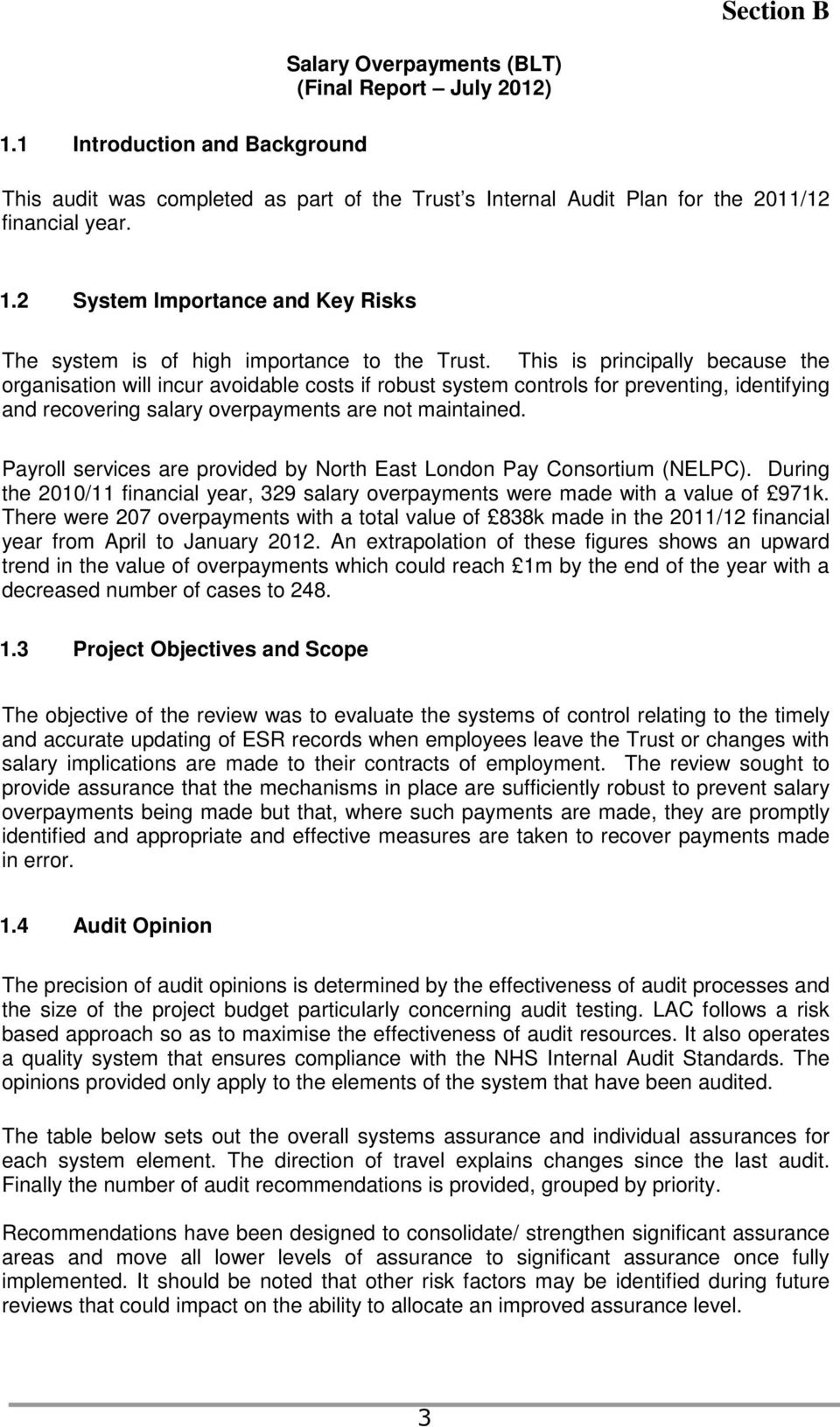
5 Section B 1.1 Introduction and Background Salary Overpayments (BLT) (Final Report July 2012) This audit was completed as part of the Trust s Internal Audit Plan for the 2011/12 financial year. 1.2 System Importance and Key Risks The system is of high importance to the Trust. This is principally because the organisation will incur avoidable costs if robust system controls for preventing, identifying and recovering salary overpayments are not maintained. Payroll services are provided by North East London Pay Consortium (NELPC). During the 2010/11 financial year, 329 salary overpayments were made with a value of 971k. There were 207 overpayments with a total value of 838k made in the 2011/12 financial year from April to January An extrapolation of these figures shows an upward trend in the value of overpayments which could reach 1m by the end of the year with a decreased number of cases to Project Objectives and Scope The objective of the review was to evaluate the systems of control relating to the timely and accurate updating of ESR records when employees leave the Trust or changes with salary implications are made to their contracts of employment. The review sought to provide assurance that the mechanisms in place are sufficiently robust to prevent salary overpayments being made but that, where such payments are made, they are promptly identified and appropriate and effective measures are taken to recover payments made in error. 1.4 Audit Opinion The precision of audit opinions is determined by the effectiveness of audit processes and the size of the project budget particularly concerning audit testing. LAC follows a risk based approach so as to maximise the effectiveness of audit resources. It also operates a quality system that ensures compliance with the NHS Internal Audit Standards. The opinions provided only apply to the elements of the system that have been audited. The table below sets out the overall systems assurance and individual assurances for each system element. The direction of travel explains changes since the last audit. Finally the number of audit recommendations is provided, grouped by priority. Recommendations have been designed to consolidate/ strengthen significant assurance areas and move all lower levels of assurance to significant assurance once fully implemented. It should be noted that other risk factors may be identified during future reviews that could impact on the ability to allocate an improved assurance level. 3
6 Control Objective/ Risk Area Assurance Level DOT Recommendations by Priority High Med Low 1. Leavers are processed on a timely basis. Limited 3 2. Leavers are paid amounts there are entitled to, and overpayments are identified and recovered. Reasonable 1 (covered in Control Objective1 ) 3. Staff are paid correct amounts on changes made to their contracts. Limited Controls are in place to ensure that salaries overpaid are monitored and appropriate actions taken. Limited 4 Overall Assessment Limited 1 8 The overall limited assurance level was determined because the mechanisms in place to address the Trust s long-term problem with high levels of salary overpayments are not operating effectively. In recent years, Audit have noted that the number and value of salary overpayments caused by late notification of leavers details have been decreasing, while the instances of overpayments due to late notification of employee changes have been on the increase. This trend has become particularly evident in the current financial year to January For instance: In 2010/11, salary overpayments due to late notification of leavers totalled 389k, with a lower figure of 345k relating to changes. However, for the 10 month period to January 2012, the corresponding overpayment figures were 269k and 437k. Details of salary overpayments are reported to the Operational Management Group (OMG), Audit and Risk Committee, Trust Board and Divisional senior managers for noting and for actions to be taken as appropriate. It is Audit s view however that these reporting arrangements are disjointed, as each report contains different salary overpayment information. A single, consolidated report containing detailed analysis of all overpayments made across all Trust Divisions and CAUs would identify where there are particular problems and allow directed, corrective action to be taken. The audit was also unable to verify that the Trust has robust systems and solutions in place for reducing the level of overpayments and holding Trust management to account for overpayments made as a result of their failure to follow the existing procedures relating to the timely notification of leavers and employee changes. Such measures 4

7 could include the use of appropriate sanctions where managers repeatedly or consistently fail to follow procedures. Payroll can generally only identify overpayments made based on source documentation received from the managers providing notification of employee changes and leavers. However, as notification of changes and leavers is not being submitted to Payroll in a timely manner, Audit cannot provide assurance that the overpayments identified represent all salaries overpaid. The prevention of salary overpayments must therefore be the primary objective to ensure that Trust resources are properly utilised, financial efficiencies made and savings targets achieved. As salary overpayments made by public bodies have recently made headlines in the national media, the Trust needs to remain sensitive to public concern on this subject and ensure that it takes all necessary measures to achieve a significant reduction in the number and value of salary overpayments being made. The report does not contain any findings that the Trust needs to: Consider as potential disclosures within its Annual Governance Statement or Consider notifying the Care Quality Commission regarding non-compliance with the Essential Standards of Quality and Safety. 5
8 1.5 Key Findings Control Objective 1: To ensure that all leavers are processed on a timely basis in order to avoid overpayments being made (Limited Assurance) Leaver forms authorised by managers are submitted directly to Payroll via an electronic database, which is reviewed regularly by Payroll staff to ensure that completed forms are promptly processed. However, this audit confirmed that the Trust continues to experience high levels of salary overpayments caused by managers failing to complete and submit leaver forms on a timely basis, i.e. before the employee leaves the Trust. Audit testing identified instances where salary payments continued to be made for periods ranging between nine weeks and eight months after the employee had left the Trust. Trust budget holders receive monthly finance and staff register reports from the Finance Department and these should be the primary mechanism by which ex-employees in respect of whom a leavers form has not been completed and submitted to Payroll are identified, thereby minimising the value of the salary overpayment. However, as a system of positive returns is not in place, there is no way to measure the extent to which these reports are reviewed by budget holders and ex-employees identified, which means that Audit cannot provide assurance that there are not further unidentified salary overpayments in addition to those detailed in this report. For this reason, robust preventative measures are essential to ensure that salary overpayments do not occur in the first place. Trust managers must be fully aware of the financial implications of late notification of leavers and changes and it is Audit s view that the Trust should also use appropriate sanctions where procedures are consistently not complied with. Audit s concerns over salary overpayments, whether caused by late notification of leavers or changes to employee contracts, have been raised in several previous Payroll reports. The Trust Board and Audit and Risk Committee have also expressed their concerns over this matter. One recent initiative involved the development of guidance for circulation to managers to ensure that they are aware of the importance of prompt completion and submission of leaver forms immediately upon notification of the leaver s resignation. The guidance also covered the requirement for prompt notification of changes to employee contracts of employment that have salary implications. Divisions were also required to provide explanations to senior Trust managers for the delay and reasons why the overpayments were allowed to occur for appropriate actions to be taken. Audit understand that the intention was to periodically issue this guidance to all Trust managers on an ongoing basis, but there was little evidence that this is being done. At the time of this review, each Trust employee was required on the day of their resignation to complete and submit to Payroll a Resignation Form, which provided details of the notice period relevant to their position. Although this form was not formal notification of a leaver, it was used by Payroll as a means of calculating the leaving date and ensuring that pay was not processed by the ESR Payroll system after this date, if an authorised leaver form was not received. Leavers did not however always complete and submit these forms to Payroll. As most of the information on the Resignation Form duplicated information required by the leaver form and did not replace the requirement for a leaver form to be submitted for an employee to be officially terminated in the Payroll system, Audit considered that there was little value in retaining the use of the form. Since this review was completed, the Trust has decided to discontinue the use of the Resignation Form, so no recommendation has been made. The authorised leaver form submitted to Payroll is the formal notification of a leaver. Effort should therefore be focused on ensuring that managers submit the leaver forms in 6

9 providing formal notification of a leaver. Where neither a resignation form nor a leaver form is received and processed by Payroll before the employee s leaving date, salary overpayments will be made. Staff registers, showing the posts recruited to within the Divisions for which salaries are being paid, are submitted by Finance on a monthly basis to budget holders for review. The staff register enables budget holders to identify leavers who are still shown as in post and being paid. There is however no requirement for positive returns to be made to confirm the completeness and accuracy of these registers. It is Audit s view that positive returns form a valuable means of ensuring that leavers who have not been terminated in the payroll system are quickly identified and do not continue to be paid. The monthly review by NELPC of payroll reports ensures that overpayments are promptly identified. The payroll reports underpinning the payroll runs are checked to all source documentation which include leaver forms. For identification of overpayments, this would primarily be through the review of payroll reports which show employee changes and leavers backdated in the ESR payroll system because the effective change date and leaving dates have past. Through this process the recovery of the sums overpaid is instigated. The whole process of identification of salary overpayments by Payroll is therefore based on the appropriate source documentation received, but to ensure that all leavers are processed timely and overpayments avoided, it is essential that all leaver forms are submitted promptly to Payroll for processing. Control Objective 2: To ensure that leavers are only paid amounts they are entitled to on their departure and any overpayments are identified, recovered and appropriately recorded in the accounting records (Reasonable Assurance) Leaver forms received by Payroll specify the employee s last day of service and any accrued annual leave to which the leaver is entitled. The payroll checks undertaken ensure that pay is accurately made. However, there is no assurance that the leaver forms received by Payroll represent all leavers. Audit sample testing confirmed that the leaving date of the leaver is accurately registered in the ESR Payroll system to prevent salaries being processed and paid after this date. As the Trust recognises that not all salary overpayments will be recovered, a bad debt provision is raised for all invoices relating to overpayments. The relevant cost centre (CAU/ Division) is appropriately charged and no credit for this is given until the salary overpaid has been recovered. Control Objective 3: To ensure that staff are paid correct amounts on changes made to their contracts (Limited Assurance) Where changes with salary implications are being made to an employee s contract of employment, the authorised change form is submitted to HR for validation before being forwarded to Payroll for the changes to be processed. Audit testing found that not all changes were being notified to HR on a timely basis for validation. It is recognised that changes notified to HR and Payroll after the effective date of change may be reasonable where the date of change can only be confirmed retrospectively. However, Audit s concern is over the length of delay in notification which in some cases has resulted in salaries overpaid becoming significant in value. Audit testing found an instance where the change made to pay was over 3 years late. The cumulative effect of this late change processed led to an overpayment of over 126k 7
10 gross pay for the employee who has since left the Trust. The doctor was paid a banding supplement for on call duties but since July 2007, had no responsibilities for such duties. However, banding supplement continued to be paid (costing about 4k per month) until identified by Finance in May 2011 when it was escalated to the Divisional Head of HR and the consultant in charge. An invoice has been raised to recover the debt which since referral to the debt collecting agency for recovery, the doctor has agreed to repay monthly amounts of 500. It is imperative that changes are promptly notified to HR and Payroll. This would avoid salaries being overpaid and amounts accumulating to be recovered. Processes implemented by Payroll ensure that overpayments due to retrospective changes made in the ESR system are identified on a timely basis. Where agreed, the overpayments are recovered through regular deductions from the employees salaries. However, where the overpayment is considered too large to be recovered from salary over a reasonable space of time, or where the employee has no current earnings (e.g. employee on unpaid or sick leave), an invoice is raised instead. Of 437k salaries overpaid due to late notification of employee changes in the 10 months to January 2012, 333k (76%) were invoiced, whilst the remainder of 104k (24%) were repayments made by salary deductions. By not collecting repayments on a regular basis from existing employees salaries, there is an increased risk that the overpayments may not be recovered. Control Objective 4: Controls are in place to ensure that salary overpayments are monitored and appropriate actions taken (Limited Assurance) A schedule of salaries overpaid is produced by NELPC each month and circulated to senior managers in HR and Finance for review. The information provided is used for reporting to the Operational Management Group (OMG) and the Audit and Risk Committee. Reporting to Senior Management Groups and Trust Board Operational Management Group The number of salary overpayments by Trust Division made in the current and previous months is reported to the Operational Management Group (OMG) within the HR Workforce Relations report. No comparative year to date data is provided to enable trends in the number of overpayments made to be ascertained for targeted action to be taken. Although there was no indication in this HR report of the value of salaries overpaid, the monthly value of overpayments is separately noted in the dashboard which reports on Trust performance. To enable proper assessment of the overpayment position to be made in supporting actions required, it would be helpful to include details of how long the overpayments were allowed to accumulate before notification to Payroll for processing, and whether the same manager(s) were responsible for some, most or all of the overpayments made. It was not evident from the action notes of the OMG meetings reviewed by Audit that the information presented on salaries overpaid had facilitated debate, as there was no record of the overpayments having been discussed. 8
11 Audit and Risk Committee As a standing agenda item, the Audit and Risk Committee receive a report containing details of salary overpayments made in the previous quarter as well as cumulative, yearto-date figures, the previous year s data, the reasons for the overpayments, as well as outstanding amounts that the Trust is proposing to write off. A single figure is presented for the total value of outstanding salary overpayment debts. The figures reported to the October 2011 and February 2012 meetings of the Audit and Risk Committee were 1,124k and 1,024K respectively. As at the end of November 2011, there were 352 overpayments with a total value of 884k awaiting recovery by the Trust. An analysis of this figure revealed that: 594k (248 cases), representing 67% in value of the total debt, and 70% of cases, had been referred to debt collecting agencies for recovery. Of the total debts of 884k, 540k (242 cases) were over a year old and of this amount there had been no evidence of any repayments having been made for 402k (178 cases) of overpayments invoiced. It is Audit s view that information disclosing the age of the debt and the proportion referred to debt collecting agencies for recovery should form part of the report provided to the Audit and Risk Committee to provide enhanced transparency as regards the overpayments at risk of not being recovered. Trust Board As part of aged debtors reporting for the Trust as a whole, the age of the debt for salary overpayments is reported at a high level, but it is Audit s view that the Board should also receive more detailed information on the overpayments reported, actions taken to address underlying issues and measures of success achieved. This would not only raise the profile of salary overpayments in the Trust Board agenda and clearly show the Board s commitment to controlling salary overpayments but, with the overpayment of salaries made by public bodies recently making headlines in the national media, it is important that the Board remains apprised at each meeting of the Trust s performance in this area. Divisional Senior Managers Although senior management within each Division are provided a schedule prepared by NELPC of the overpayments made each month and this identifies the reason for each overpayment the fact that the Trust is not seeing a material reduction in the number and value of salary overpayments being made would suggest that existing measures, including more granular management information, are not proving to be effective. From information available during the period of our review, an analysis was made of all salary overpayments made in financial years 2008/09 to 2010/11, plus the 9 months from April to December It was revealed that over this period an average of 82% of overpayments by value were due to the late notification of leavers and changes to Payroll for processing, with the remainder due to errors made by the Divisions ( Client Errors ) and by Payroll (See Appendix 1). Further analysis of the above figures confirmed that whilst there has been a reduction in the number and value of salary overpayments caused by late notification of leavers details to Payroll, the figures relating to late notification of employee changes have been rising in this period. For instance: In 2010/11, salary overpayments due to late notification of leavers totalled 389k with a lower figure of 345k relating to changes. 9
12 However, for the 9 month period to December 2011, the corresponding overpayment figures were 221k and 422k. Information available subsequent to the time of our review showed that in the 10 month period to January 2012 salaries overpaid as a result of late notification leavers amounted to 269k with a higher figure of 437k relating to changes. The detailed analysis at Appendix 2 shows the overpayment figures for each Division and CAU in 2010/11 and in the 9 months to December 2011 and also identifies the services responsible for the largest salary overpayments. It is Audit s conclusion that the Trust can only begin to resolve its long-term problem with salary overpayments by enhancing the quality of reporting, implementing clear lines of responsibility and accountability for salaries overpaid, and demonstrating that in a drive to reduce the overpayments, senior management are fully engaged in the monitoring process. Audit s proposal to resolve this long standing issue in controlling salary overpayments is to: Nominate a senior executive group that would be responsible for monitoring salary overpayments and reporting to the Trust Board. Improve the analysis of reports produced to show the monthly and cumulative overpayments incurred by each CAUs and Divisions, identifying trends, length of delay before changes and leavers were notified to Payroll for processing, and managers under whose responsibility salaries are consistently overpaid. Establish a procedure which would require that consistent or repeat offenders identified are called to attend the senior executive group meetings to explain reasons that resulted in the overpayments made and how this is being addressed to reduce overpayments. Establish a dedicated team of one or two members of staff whose role would include providing training to managers based on CAU and Division overpayment figures, co-ordinating the use of positive returns in the form of staff registers and imposing sanctions on consistent/ repeat offenders as approved by the nominated senior management group. It is Audit s view that the causes that have resulted in the long standing problem with salary overpayments can only be eliminated and overpayments controlled where senior management and the Trust Board are fully committed to this cause and are seen to take appropriate actions. 10

13 [The remainder of the document has been redacted as it covers different subjects unrelated to salary overpayments] Referral to Treatment Time Reporting (BLT) (Final Report July 2012) 1.6 Introduction and Background When a patient is referred to hospital, for any consultant led treatment, a Referral to Treatment (RTT) clock is started. A national target was introduced of 18 weeks between the start of this clock, and either the start of any required treatment or the discharge of the patient. Each time a patient attends hospital for a visit, an RTT outcome has to be recorded on CRS, as set out in NHS guidance. Depending on the outcome that is recorded, the RTT clock will either: Stop (if treatment is started, the patients is discharged, or the patient is just to be subject to regular checks and monitoring) Continue as a ticking clock (if treatment has not yet started, or diagnostic tests are required) Start (If a patient has been under active monitoring, and their RTT clock has previously stopped, but it is now decided that they need further treatment). During , it was announced that performance management of the 18 week waiting time target by the DoH had ceased. However, new measures of the median and 95 th percentile RTT waiting times were introduced to provide a fuller picture of waiting times, and RTT performance continued to be reported externally and is a National Performance Measure included in the Operating Frameworks for and The % of clock stops within 18 weeks remains a key performance measure that is monitored both internally and externally, and reported by the Dept of Health. Following the introduction of CRS, the Trust had major problems with data quality regarding 18 week performance, as set out in previous internal and external reports, resulting in significant amounts of validation being required before results are reported. A central Validation and Correction team was set up to validate the data that was extracted from CRS before it was reported. This team is still in place, although at significantly reduced staffing levels. All identified 18 week breaches are also validated by Divisions. This report combines the findings from 2 reviews from the Trust s Internal Audit Plan for the 2010/11 financial year - a review into 18 week outcome recording at clinics, and a review of the validation processes in place to identify and correct errors prior to reporting data (which assesses the impact of the issues identified in the first audit). The audit work into clinic outcomes was completed in 2010, but only reported to management. The ongoing level of errors apparent in the data indicate that the issues identified are still current, and have therefore been included in this report with updated data where relevant. 1.7 System Importance and Key Risks The system is of high importance to the Trust. This is principally because monitoring of RTT times is a key Trust target. Inaccurate 18 week data can result in: 11

14 AC 33/12 Salary Overpayments - Audit Findings and Recommendation Schedule CONTROL OBJECTIVE 1 To ensure that all leavers are processed on a timely basis in order to avoid overpayments being made. DOT ASSURANCE LEVEL: LIMITED Findings Recommendations Responsibility & Management Response Issue of Guidance The process of identification of salary overpayments by Payroll is primarily through the review of payroll reports which show employee changes and leavers processed retrospectively in the ESR payroll system. These reports are based on source documentation, such as the employee change and leaver forms received. However these forms are not always received on a timely basis for processing and in preventing salaries being overpaid. To address concerns related to the rising number of salary overpayments, guidance was produced for circulation to managers Audit understand that this guidance was to be periodically sent to managers on an ongoing basis but there was a lack of evidence available to show that this had been complied with during the year. To effectively control the number of overpayments, the guidance was in the past, accompanied by a communication requiring that the NELPC General Manager contact the Divisional GM for an explanation for the late notification of leaver/ change to contract and this would be forwarded to the Directors of Finance and HR for action to be taken. Risk: Managers may not be made aware on a continuous basis of the importance of prompt submission of leaver forms to Payroll to prevent salary overpayments. R1: (Medium) Guidance on the prompt completion of leaver and change to contract forms to Payroll should be circulated to managers on a quarterly basis. This guidance should be accompanied by a communication with explanations for the reasons for the overpayment would be required to be provided to senior management where salaries are consistently overpaid. Responsibility All Executive Directors and CAG Operations Directors Implementation date 1 October 2012 Management Response Agreed. The CFO has reissued the guidance to all Executive Directors and CAG Operations Directors. Any future salary overpayments will require a report to the CFO from the relevant Director. A synopsis of salary overpayments will be presented monthly for the remainder of the financial year to the Trust Executive (TX) meeting and reported bi-annually to the Audit and Risk Committee. Thereafter quarterly reports will be presented to TX. A follow up review will be built into next year s internal audit plan for a future report to the Audit Committee. 1

15 AC 33/12 Findings Recommendations Responsibility & Management Response Positive Returns Staff registers (nominal rolls) showing the posts recruited to within the Divisions for which salaries are being paid, are submitted by Finance on a monthly basis to budget holders for review. This should enable budget holders to identify leavers who are still shown as in post and on the payroll, but there is no clear requirement for budget holders to confirm the completeness and accuracy of these records and therefore no sanctions are applied when they fail to do so. Risk: Where a member of staff has been identified as one who has left the Trust, this may not be confirmed to Payroll to ensure that any salaries being made are stopped. R2:(Medium) A system of positive returns should be introduced with immediate effect. The process must be sufficiently robust to enable errors and omissions to be promptly identified and timely corrective action to be taken. The extent to which the process is being consistently applied and its effectiveness in reducing the number and value of salary overpayments will be evaluated as part of a follow-up review within the internal audit plan. The Trust should consider making repeat or persistent failures to comply with this requirement a disciplinary offence. Responsibility HR Director Implementation Date 1 st December 2012 Management Response The Trust Executive endorsed the recommendation of positive reporting in September for December implementation. A managers briefing pack will be developed and each CAG/Manager/provided with an analysis of the previous history of non- compliance, both from a local level and at trust wide level, to give the context for the changes being made and the objectives. Clear messages need to be communicated about Managers role and level of responsibility and that failure to comply will be dealt with through the disciplinary process if required. 2

16 AC 33/12 CONTROL OBJECTIVE 2 To ensure that leavers are only paid amounts they are entitled to on their departure and any overpayments are identified, recovered and appropriately recorded in the accounting records. DOT ASSURANCE LEVEL: REASONABLE Findings Recommendations Responsibility & Management Response Leavers Paid Entitlement Audit testing confirmed that the leaving date of the leaver based on leaver forms received by Payroll is accurately registered in the ESR Payroll system to prevent salaries being processed and paid after this date. However, the system (e.g. lack positive returns, late notification of leavers and employee changes) in place do not provide assurance that the leaver forms submitted to Payroll represent all leavers. Risk: See R1 and R 2 above See R1 and R2 above Agreed See response to recommendations 1&2. 3

17 AC 33/12 CONTROL OBJECTIVE 3 To ensure that staff are paid correct amounts on changes made to their contracts. DOT ASSURANCE LEVEL: LIMITED Findings Recommendations Responsibility & Management Response Submission of Change Forms Audit testing found that not all changes were notified to HR on a timely basis for validation, or were identified for the change forms to be promptly raised. This resulted in changes processed after the agreed effective date of change which included an instance where the change made to pay due to the removal of a doctor s banding supplement, was over 3 years late. The cumulative effect of this late change processed led to an overpayment of over 126k gross pay for the employee who has since left the Trust. The length of delay in notification of the change has therefore in some cases led to salaries overpaid becoming significant in value. Risk: Potential financial loss to the Trust R3: (High) A Change Form should be completed and promptly submitted to HR for validation and processing by Payroll, as soon as the effective date of change in staff contract is known. Responsibility Executive Directors and CAG Operations Directors. HR Director Implementation date 1 st November 2012 Management Response Needs to be submitted by the responsible ED or CAG Operations Director. This will be a focus area for briefings as this (i.e. change forms) is a more significant problem along with late notification of leaving. The implementation of Barts Health E-Forms is expected to improve the flow of staff changes and EST control information through the trust. The E-Form infrastructure enables tracking and automates alerts to relevant stakeholders throughout the journey of the forms. 4
18 AC 33/12 Deductions from Salary Where the salary overpayments made to existing employees are large and may not be recovered through salary deductions over a reasonable amount of time, or where there are no earnings (e.g. employee on unpaid or sick leave) an invoice is raised instead for the repayment. Risk: By invoicing existing employees for the recovery of the salary overpaid rather than to obtain repayment by salary deductions, there is a risk that that the overpayment may not be recovered. R4: (Medium) Salary overpayments made to existing employees should be recovered by deductions from their salary payments over the shortest possible period. Where the overpayment is relatively large compared with salary received, deductions should still be made so that a level of net salary of, for example, 60% remains. Responsibility Executive Directors or Operations Directors. Implementation date Immediately. Management Response Agreed. Salary deduction should be the usual way of recovering overpayments, with invoices only being raised for people who have left the organisation or there are no earnings. The objective should be to recover the payment over the same elapsed timescale the overpayment was made or shorter if possible. 5

19 AC 33/12 Control Objective 4 Controls are in place to ensure that salary overpayments are monitored and appropriate actions taken. DOT ASSURANCE LEVEL: LIMITED Findings Recommendations Responsibility & Management Response Operational Management Group (OMG) The number of salary overpayments by Trust Division made in the current and previous months is reported to the Operational Management Group (OMG) within the HR Workforce Relations report.. Although there is no indication of the value of salaries overpaid provided in the HR report, the monthly value of overpayments is separately noted in the Data Quality Dashboard which reports on trust performance. By segregating the reporting of the value of overpayments from the number of cases to which they relate, the presentation of salaries overpaid is incomplete to enable proper assessment of the overpayment position to be made in supporting actions required. Risk: Where reporting of the value of overpayments is segregated from that of the number of cases to which they relate, there is incomplete presentation of salaries overpaid for appropriate actions to be taken. R5: (Medium) The report submitted to Operational Management Group (OMG) on salary overpayments should show within the same report, both the value of the overpayment and the number of cases it represents. Responsibility Human Resources Implementation date 1 st December Management Response This will be covered in the briefing pack provided to each CAG/Manager and reported centrally at TX/TMB in future. Audit and Risk Committee A standing agenda item for this Committee is a report containing details of salary overpayments for the previous quarter, plus year to date figures, comparative figures from the previous financial year, reasons for the overpayments and outstanding amounts written off. A single figure is presented for the total value of salary overpayment debts outstanding. The reported figure was 1,124K in October 2011 and 1.024K in February Audit review found that as at the end of November 2011, the overpayment debts outstanding was 884k (352 cases). An analysis of this debt found that: R6: (Medium) An analysis of the salary overpayment debts outstanding reported to the Audit and Risk Committee should be provided to show the debts referred to debt collecting agencies and ages of the debt over a year old. Responsibility Associate Director- Financial Accounts. Implementation date December Management Response Agreed. This will be provided to future Audit and Risk Committee meetings 6
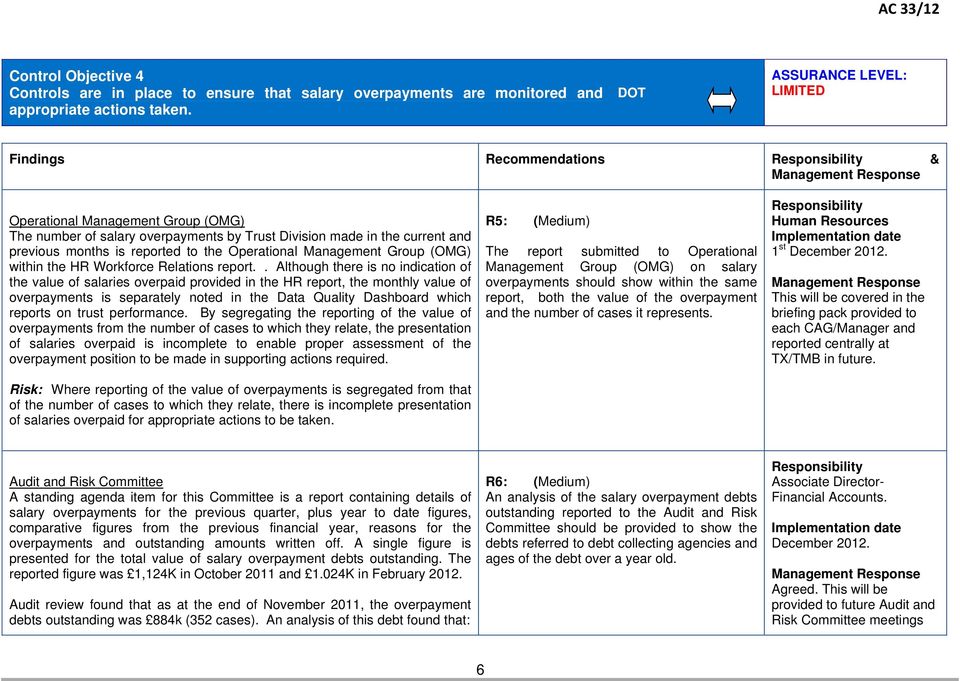
20 AC 33/12 Findings Recommendations Responsibility & Management Response o o 594k (248 cases), representing 67% in value of the total debt, and 70% of cases, had been referred to debt collecting agencies for recovery. Out of the total debts of 884k, 540k (242 cases) were over a year old and of this amount there had been no sign of any repayments made for 402k (178 cases) of overpayments invoiced. Risk Committee meetings bi- annually. The salary overpayment debt reported to the February 2012 Audit and Risk Committee was 1,024k. No information disclosing the age of the debt and the proportion referred to collecting agencies for recovery is provided Risk: The amount of salary overpayment debt at risk of recovery cannot be properly assessed without a proper analysis the debt provided. Trust Board As part of aged debtors reporting for the Trust as a whole, the age of the debt for salary overpayments is reported at a high level. However, no narrative is provided to show the reasons for the overpayments, actions to address underlying issues and measures of success achieved. Risk: Insufficiency of Trust Board awareness of the significance of salaries overpaid and measures to control them. R7: (Medium) The disclosure made to the Trust Board on salary overpayment debts outstanding should be accompanied by a narrative providing the main reasons for the overpayments made, actions taken to address underlying issues and measure of success achieved. Responsibility Chief Financial Officer. Implementation date December Management Response Agree that the narrative should be provided but suggest this should be to the Audit and Risk Committee rather than the public board meeting due to staff confidentiality issues. 7
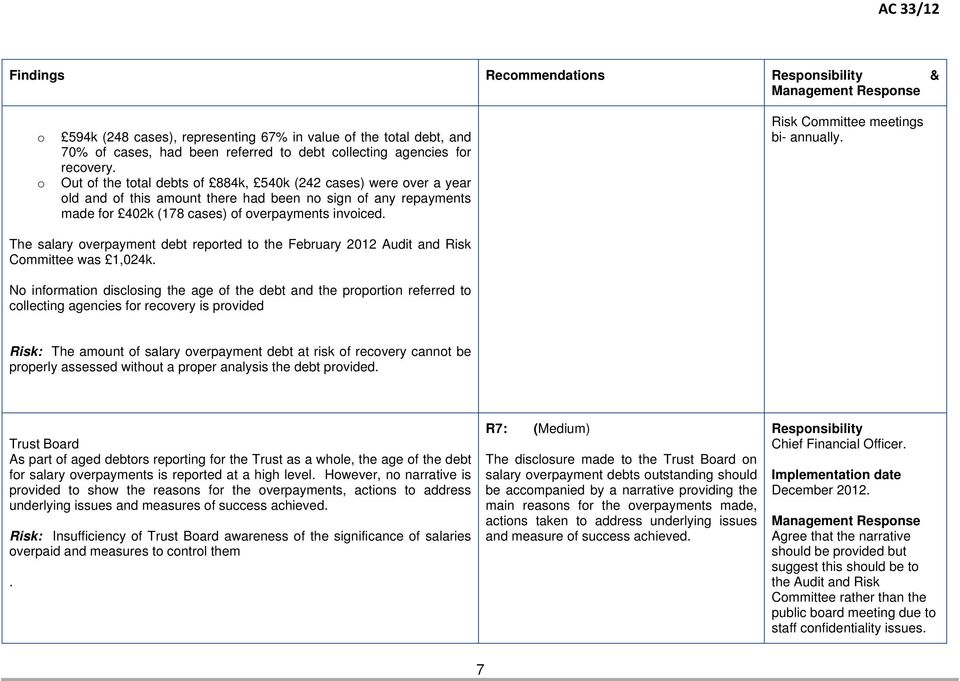
21 AC 33/12 Findings Recommendations Responsibility & Management Response Trust-Wide Responsible Group and Reporting The number of salary overpayments by Trust Division made in the current and previous months is reported to the Operational Management Group (OMG) within the HR Workforce Relations report. Although there was no indication in this HR report of the value of salaries overpaid, the monthly value of overpayments is separately noted in the dashboard which reports on Trust performance. No comparative year to date data is provided to enable trends in the number of overpayments made to be ascertained for targeted action to be taken. The HR Workforce Relations report presented at the November 2011 OMG meeting showed the information on salary overpayments made. However, it was not evident from the action notes of the OMG meetings reviewed by Audit that this had facilitated debate as there was no note that salary overpayments had been discussed. Reporting on a trust-wide level is disjointed with different information on salary overpayments reported separately to the OMG, Audit and Risk Committee and Trust Board. From information provided at the time of the audit review, an analysis was made of salaries overpaid for the financial years 2008/09 to 2010/11 and the 9 months from April to December This showed that on average, 82% of overpayments was due to the late notification of leavers and changes to Payroll for processing whilst the remainder was due to errors made by the Divisions ( Client Errors ) and by Payroll. Audit s further analysis of the salaries overpaid in 2010/11 and the 9 month period to December 2011 showed the proportion of overpayments due to the late notification of changes and that for leavers. This showed that: o In 2010/11 the overpayments due to late notification of leavers was 389k whilst that for changes was 345k. o However, for the 9 month period to December 2011 the R8: (Medium) To facilitate actions in controlling salary overpayments, the following should be in place: a).a senior executive group that would be responsible for monitoring salary overpayments and reporting to the Trust Board should be nominated. b) The analysis of reports produced should show the monthly and cumulative overpayments incurred by each CAUs and Divisions, identifying trends, length of delay before changes and leavers were notified to Payroll for processing, and managers under whose responsibility salaries are consistently overpaid. c) A procedure should be established which would require that consistent or repeat offenders identified are called to attend the senior executive group meetings to explain reasons that resulted in the overpayments made and how this is being addressed to reduce overpayments. d) Where responsible managers consistently make errors that lead to salary overpayments being made, the Trust should consider treating these Responsibility Chief Financial Officer. HR Director Implementation date December Management Response Agreed. The briefing pack will cover the historical performance and regular monthly reports will be provided trust wide to monitor non-compliance. The TX and OMG will monitor this regularly and a report will be brought to the Audit and Risk Committee next year to demonstrate improvement. Managers consistently failing to comply will be subject to the trust s performance management regime leading to disciplinary action. 8
22 AC 33/12 Findings Recommendations Responsibility & Management Response corresponding overpayments were 221k and 422k. It is therefore not evident that current measures in place are materially reducing salary overpayments. It is unclear as to which trust-wide group is responsible for monitoring and taking actions to ensure that the overpayments are reduced. Reports on salary overpayments do not provide sufficient analysis for actions to be taken, and sanctions are placed on managers responsible for the overpayments to ensure that employee changes and leavers are promptly notified for payroll processing. Risk: Salary overpayments will continue to be a problem where reporting is insufficient, no clear responsibility has been delegated to a senior management group to monitor overpayments with sanctions imposed where needed. as disciplinary offences. e) A dedicated team of one or two members of staff should be established whose role would include providing training to managers based on CAG overpayment figures, coordinating the use of positive returns and imposing sanctions on consistent/ repeat offenders as approved by the nominated senior management group. This situation will be kept under review following the forthcoming initiative on reporting packs. Hopefully this will demonstrate the improvement required and obviate the need for establishing a dedicated team as the problem will be resolved at source. 9
23 Report to: Trust Management Board: 30 October 2012 TMB 36/12 Title Reducing Overpayments & Improving the Quality of Payroll Information Sponsoring Director Michael Pantlin - Director of HR Author(s) Natalie Edwards Interim Associate Director of HR Governance, Workforce Information & Systems Purpose Outline of the mechanisms agreed to reduce payroll overpayments Previously considered by n/a Summary Barts Health over pays staff circa 1m per year much of which is lost. This has to stop. Payroll relies on source documentation received from the managers providing notification of employee changes and leavers. However, notification of changes and leavers is not being submitted to Payroll in a timely manner and managers are not currently held to account for overpayments made as a result of their failure to follow the existing procedures. This paper outlines the mechanisms that will be implemented to improve the accuracy of payroll returns in both the short and the long term. The background papers that drive the direction of the changes are also attached for information. Related Trust objectives Sub-objectives 6. Deliver the Trust s 2012/13 financial plan, and cost improvement target, and develop a sustainable long term financial plan (LTFM). Risk and Assurance This report provides assurance in relation to Trust Objective 6 (above). Related Assurance n/a Framework entries Legal implications/ regulatory requirements None. Action required The Trust Management Board is asked to note the actions being taken to improve payroll accuracy and reduce overpayments across Barts Health. 1
24 TMB 36/12 BARTS HEALTH NHS TRUST TRUST MANAGEMENT BOARD: 30 OCTOBER 2012 REDUCING OVERPAYMENTS & IMPROVING THE QUALITY OF PAYROLL INFORMATION PURPOSE 1. This paper outlines the actions being taken to improve payroll accuracy and reduce overpayments to staff across Barts Health. BACKGROUND 2. Payroll relies on source documentation received from the managers providing notification of employee changes and leavers. However, notification of changes and leavers is not being submitted to Payroll in a timely manner and managers are not currently held to account for overpayments made as a result of their failure to follow the existing procedures. 3. As reported in the recent Internal Audit Report - Salary Overpayments No: BLT for Barts and The London Trust: During the 2010/11 financial year, 329 salary overpayments were made with a value of 971k. There were 207 overpayments with a total value of 838k made in the 2011/12 financial year from April to January An extrapolation of these figures shows an upward trend in the value of overpayments which could reach 1m by the end of the year with a decreased number of cases to 248. ISSUES TO RESOLVE 4. In order to address the problem there are two issues to resolve: BH Systems and Processes Accountability of Managers BH Systems and Processes 2
25 TMB 36/12 5. The paper Positive Payroll & Other Options to Improve Payroll Information (Appendix A) was reviewed at ITX on Thursday 18 th October The implications of changing to the positive payroll setting within ESR was explored and as a result it was decided that because Managers were not currently held to account for failing to submit information to payroll in a timely manner it would be disruptive and unfair on staff to introduce this method of payroll management in the short term. 6. ITX agreed that they would address the problem in two phases using options three and four outlined in the paper. The highlights of these are as follows: Phase One Short term Commence for January Payroll 2013: i. Maintain the negative payroll setting within ESR to ensure staff are paid. ii. Managers will be sent an electronic Attendance Register prior to the month end to confirm that all staff listed are in post and have been working the basic contractual hours recorded in ESR for sign off and submission to central Workforce information team prior to payroll cut-off date. iii. Staff and managers will be expected to continue to record any additional hours, sickness absence and any other leave on the local legacy systems currently in place. iv. Submission of registers will be monitored and continued non-compliance by managers will be escalated to senior management. v. Monthly Overpayments Tracking reports will be implemented to monitor compliance and measure improvements and reported to TMB. vi. In addition, data will be visible via the Performance Framework. vii. Introduction of the first of the Barts Health HR E-Form for Leavers/Terminations is due to be launched, complete with guidance and support for managers. viii. The remaining suite of E-Forms will be introduced in the weeks that follow and include the Change of Contract E-Form which will streamline the actions required by Managers to reduce as well as increase any contractual hours. Phase Two Long term Implementation approximately April to September 2013: i. Introduce one e rostering, time and attendance system across Barts Health ii. Set all staff up on this trust wide e-rostering, time and attendance system iii. Staff and/or Managers record all additional hours, sickness absence and any other leave on this system (inputting responsibility will be dependent upon e-rostering system implemented). iv. Employee and Manager sign off of time hours worked within the system prior to submission to payroll (staff sign off functionality will be dependent upon e-rostering system implemented). Accountability of Managers 7. The new monthly tracking report Barts Health Overpayments Summary September 2012 (Appendix B) demonstrates there are trends in the reason for overpayments and confirms that overpayments have continued to rise and non-compliance can be identified. 3
26 TMB 36/12 8. There can be no quick fix to the overpayments issue unless the Executive team endorse a change in management behaviours and begin to hold managers to account. The accountability framework around management responsibility for the public purse is well documented: 9. Managers are contractually obliged to work within the Code of Conduct for NHS Managers, October 2002, which states that: As an NHS Manager, I will observe the following principles: Use the resources available to me in an effective, efficient and timely manner having proper regard to the best interests of the public and patients. 10. As well the current Barts Health Standing Orders, Reservation and Delegation of Powers and Standing Financial Instructions, effective 2 April 2012, clearly states: Managers are responsible for: (a) Following the procedures and guidance relating to the completion and submission of payroll documentation. (b) Submission of termination forms submitted to payroll as soon as an employee within their establishment resigns is terminated or gives notice of retirement. (c) Ensuring that there are appropriate systems of internal check and control in place within their directorate etc, to ensure that time records, expense claims etc are capable of meaningful certification. IMPLEMENTATION PLAN 11. The following are the key timelines for the implementation plan November: CAG/Corporate directors are asked to use this report and address the challenges with teams. Central communications to managers, outlining Phase One and the plans for Phase Two. A breakdown of reporting areas will be shared and refined. December: Go live for Attendance Registers. February: A report on progress is due to the Audit and Risk Committee of the Board. RECOMMENDATION 12. TMB is asked to note the report and proposed actions. 4
27 TMB 36/12 Appendix A PAPER REVIEWED AT ITX ON THURSDAY 18 TH OCTOBER 2012 POSITIVE PAYROLL & OTHER OPTIONS TO IMPROVE PAYROLL INFORMATION CURRENT PAYROLL PROCESS WITHIN BARTS HEALTH 1. Following the merger Payroll services are provided by North East London Pay Consortium (NELPC) across the whole of BH. This has provided the platform for a more uniform approach to managing payroll. At present BH has given NELPC the authorisation to pay every employee the contractual salary terms and conditions recorded on ESR until they are instructed by a manager of any agreed changes. This is known as Negative Payroll reporting. What is the risk? 1.1 Payroll relies on source documentation received from the managers providing notification of employee changes and leavers. However, notification of changes and leavers is not being submitted to Payroll in a timely manner and managers are not currently held to account for overpayments made as a result of their failure to follow the existing procedures. As reported in the recent Internal Audit Report - Salary Overpayments No: BLT for Barts and The London Trust: During the 2010/11 financial year, 329 salary overpayments were made with a value of 971k. There were 207 overpayments with a total value of 838k made in the 2011/12 financial year from April to January An extrapolation of these figures shows an upward trend in the value of overpayments which could reach 1m by the end of the year with a decreased number of cases to 248. Is the alternative Positive payroll? 1.2 The broad concept of a positive payroll mechanism is that every manager must carry out some positive action before their staff members are paid at all. In order to provide an audit trail for this information staff and managers would normally maintain a record to account for every hour of contractual time, including overtime, sickness and any leave. Payroll would then only process a member of staff s pay if they had instruction from a manager to do so. Staff Morale & Staff Side Response 1.3 The downside of positive payroll is that if a manager fails to instruct payroll this type of payroll significantly penalises staff by withholding all pay. An employee would not realise there was a problem until payday. The hardship that may be inflicted on staff and the cost of the intervention required to rectify any underpayments using CHAPS transactions should encourage managers with a conscience to take more responsibility for the financial wellbeing of their staff. 5
28 TMB 36/12 Unfortunately, this method of control, if not monitored centrally, is not conducive to good staff relations and maintenance of morale. Staff side would also be unlikely to support this payroll model unless there was evidence of robust controls. What do payroll think? 1.4 NELPC are not supportive of Positive payroll reporting without assurance that the trust fully understand the implications if a manager fails to sign off their team payroll submission. As well, they, like HR are clear that there needs to be a robust centralised process to manage payroll sign off and instructions. Benefits of Positive reporting? 2. Although this level of control is extreme it would enable the trust to gain better: Control of overpayments Reduce margin for error Enable the trust to capture sickness absence more effectively Enable more timely reduction to half pay and no pay in cases of long term sickness Improve the trust s ability to report on effective use of bank and agency due to staff absence. There are NHS organisations that do operate positive payroll successfully but they have more established centralised systems. How can Barts Health move towards better payroll controls? 3. There is no permanent quick fix to the overpayments issue unless radical changes are undertaken. If BH changed to positive reporting they would need to introduce an immediate corporate process to underpin this, such as Option 1 or 2. Option One 3.1 Ask Payroll to re-set ESR to Positive Payroll reporting and: Introduce central controls based on a standalone manual or electronic timesheet mechanism. Returning to paper based systems is fraught with danger and a backward step for a 21 st century organisation such as BH. Setting up a stand-alone electronic system could be achieved but may prove confusing at a time when we are working towards a single workforce rostering system. Timescale: January 2013 Option Two 3.2 Ask Payroll to re-set ESR to Positive Payroll reporting and: 6
29 TMB 36/12 Use a simple electronic attendance register issued to managers by Payroll/Finance or HR to be signed in order to confirm staff are still in post and working the contractual hours recorded on ESR which could be used to authorise payroll to pay staff. Any overtime etc. would continue to be captured as it is now on one of the 3 existing systems. This may be the quickest and least intrusive way of addressing the overpayments issue in the short term and could be actioned within weeks. Timescale: November 2012 Option Three 3.3 Maintain ESR setting as Negative Payroll reporting and, as with option two: Option Four Use a simple electronic attendance register issued to managers by Payroll/Finance or HR to be signed in order to confirm staff are still in post and working the contractual hours recorded on ESR which could be used to authorise payroll to pay staff. Any overtime etc would continue to be captured as it is now on one of the 3 existing systems. This would provide the current safety net that staff would still get paid their basic salary if a manager omitted to report correctly. It would also enable more visibility of noncompliant managers but needs an agreed escalation process to enable the trust to reinforce management responsibility. Timescale: November 2012 Please note that both options One & Two or Three would require all returns to be logged and missing information escalated to ensure staff are paid, only if they are still employed. Additional resources would be required for Payroll and/or the HR Workforce team to apply the manual checking necessary but if this was in the short term it could prove less costly than that of any unrecovered overpayments Set up all staff on a single corporate time and attendance, rostering system interfaced with ESR. The decision to opt for positive or negative payroll setting could be made dependent upon the success of say Option Three. One system which incorporates predominantly automatically populated timesheet type records which were signed off by both the employee and the manager would ensure joint ownership for an accurate payroll and provision of clear audit trails. This is the longer term solution and has yet to be fully scoped in detail. It combines work streams already underway to merge all controls and electronic workforce systems across BH to provide centralised systems that decrease paperwork and release managers for clinical and people management tasks. 7
30 TMB 36/12 This will involve a communications and training campaign to ensure behaviours are changed across the whole trust and will require full board support and zero tolerance around non-compliance. Timescale: Estimated roll out between April and September 2013 What systems are currently in place to support payroll returns at Barts Health? 4. Across BH, payroll exceptions (i.e. overtime, enhancements) and the majority of sickness information is gathered from the three legacy sites in a number of ways using the following systems as well as the more traditional paper timesheets: Healthroster - Rostering system - Barts and the London, Kronos - Time and Attendance Rostering System - Newham PDC (Payroll Data Capture) mechanism Whipps Cross. Barts & The London Newham Whipps Cross Staff Group All Staff (Ex Drs & CHS) Drs All Staff (Ex Below) 40 Drs E-Rostering System/Electronic Data Capture Healthroster StaffBank Paper Timesheets Yes Sickness Absence Yes No Kronos Yes Timebooks Yes No All Staff inc. Drs PDC Yes The three information systems are not set up to provide a vehicle for a more positive method of reporting payroll and at least two out of the three will be phased out and replaced with one trustwide system. There is little value in training managers on systems that are being phased out. What other mechanisms will provide improvements in overpayment within Barts Health? 5.0 In partnership with Finance, work streams are underway to develop robust financial/establishment controls and processes, which include fully integrated electronic forms across the whole of BH. These will provide a simpler and more steam lined mechanism for managers to enable timely and accurate changes to the contractual arrangements on ESR for staff which affect their payroll. E-Forms 5.1 The first BH E-Form for Terminations/Leavers is ready to be launched on Monday 22 nd October 2012, complete with the release of guidance and support for managers, provided the Intranet/ICT access issues outstanding can be resolved or worked around. These forms once completed will go straight to payroll to be actioned and copies will be auto generated to HR and the employee. The remaining E-Forms will be rolled out in stages commencing 1 st November, again provided the intranet/ict issues can be resolved or worked around. These forms will also enable the tracking and reporting of KPIs. 8
31 TMB 36/ Decisions required 6. TMB is asked to consider the information and agree an option. 9
32 TMB 36/12 BARTS HEALTH OVERPAYMENTS SUMMARY SEPTEMBER 2012 Appendix B Introduction This report provides a brief summary of the overpayments made by Barts Health to its employees. It provides information on volume, cost and reasons for overpayments. The data for this report covers a 12 month period and at present detailed data is only available for The Royal London, St Bartholomews, The London Chest and Community Health for the full year but this allows an overview of trend. If detailed overpayments information from the previous payroll providers for Whipps Cross and Newham becomes available the on-going report can be updated. Detailed data for the entire trust became available in July 2012, when all the legacy payrolls were merged under North East London Pay Consortium (NELPC). Cost and Volume of Overpayments There has been an increase in the volume of overpayments from 43 in August to 57 in September 2012 as seen below in Chart 1. Chart 1 A breakdown of costs and volume by Clinical Academic Group (CAG) and Corporate Directorate is provided in Appendix B.1. August and September cost information is not available at this stage. Reasons for Overpayments Analysis shows the main cause of overpayments is leavers, where staff have ended their employment with the Trust, payroll have not been informed and payments to staff have continued because ESR is set to negative reporting and basic contractual salary payments are automated. Chart 2 breaks down the range of overpayment reasons for September
33 TMB 36/12 Chart 2 Over the last 12 months Chart 3 shows that in addition to leavers there are two other common reasons for overpayments and these are reductions in contractual hours and late notification of unpaid leave. The Barts Health data of the last three months demonstrates that these reasons are common across the merged organisation and the problem is not just within the BLT legacy site. Chart 3 To follow - League Table of Non-Compliant Managers It is now possible to identify the majority of the managers responsible for any overpayments and a monthly report will be established for circulation. 11
34 TMB 36/12 Appendix B.1. Costs and Volume by CAG Table 1: Volume of Overpayments by CAG and Corporate Directorate Oct 2011 to Sept 2012 CAG Oct-11 Nov-11 Dec-11 Jan-12 Feb-12 Mar-12 Apr-12 May-12 Jun-12 Jul-12 Aug-12 Sep-12 EMERGENCY CARE & ACUTE MEDICINE AMBULATORY SERVICES SURGERY CLINICAL SUPPORT SERVICES WOMENS HEALTH CARDIOVASCULAR SERVICES CHILDRENS HEALTH SERVICES CHIEF OPERATING OFFICER CANCER SERVICES DEVELOPMENT HUMAN RESOURCES CHIEF FINANCIAL OFFICER ACADEMIC HEALTH SCIENCES RESEARCH & DEVELOPMENT MEDICAL DIRECTOR Strategy and Communications 1 1 CANCER SERVICES R&D 1 Nursing and Governance 1 CARDIOVASCULAR SERVICES R&D 1 CHIEF EXECUTIVE 1 Grand Total NE/Reducing Overpayments V1/TMB/22 nd October 2012
35 TMB 36/12 Table 2: Cost of Overpayments by CAG and Corporate Directorate Oct 2011 to Sept 2012 (data not yet available for August and September) CAG Oct-11 Nov-11 Dec-11 Jan-12 Feb-12 Mar-12 Apr-12 May-12 Jun-12 Jul-12 Aug-12 Sep-12 EMERGENCY CARE & ACUTE MEDICINE 27,845 16,669 8,134 31,502 14,083 17,122 26,598 24,115 16,513 11,470 AMBULATORY SERVICES 29,977 27,367 4,219 3,066 16,823 12,964 17,505 12,797 4,741 25,500 SURGERY 3,700 51,408 9,074 8,932 8,986 9,333 3,536 24,396 11,438 5,562 CARDIOVASCULAR SERVICES 1,417 15,770 9,036 13,250 1,688 8,895 2,410 66,993 7,727 CLINICAL SUPPORT SERVICES 2,665 17,328 9,255 10,858 11,430 1,474 9,293 3,248 4,721 16,904 WOMENS HEALTH INCLUDING MATERNITY SERVICES 14,719 14,442 8,301 4,777 19, ,360 3,007 3,976 CANCER SERVICES 5,479 11,030 10,021 1,885 3,648 30,732 10,238 4,015 CHILDRENS HEALTH SERVICES 22, ,332 1,315 11,387 5,357 7,376 5,208 DEVELOPMENT 607 1,746 2, ,967 1,031 4,967 CHIEF OPERATING OFFICER ,484 1, ,239 2,313 1,052 HUMAN RESOURCES 4, , RESEARCH & DEVELOPMENT 9, ACADEMIC HEALTH SCIENCES 1,204 5,192 1, CHIEF FINANCIAL OFFICER 1,123 1, CHIEF EXECUTIVE 4,268 MEDICAL DIRECTOR 1, ,201 CARDIOVASCULAR SERVICES R&D 3,584 NURSING AND GOVERNANCE 1,744 CANCER SERVICES R&D 71 STRATEGY AND COMMUNICATIONS - Grand Total 116, ,243 62,749 79,077 91,126 65,906 95, ,486 65,861 81,018 NE/Reducing Overpayments V1/TMB/22 nd October 2012
Salary & Expenses Overpayment Recovery Policy. Version No 1
 Plymouth Community Healthcare CIC Salary & Expenses Overpayment Recovery Policy Version No 1 Notice to staff using a paper copy of this guidance The policies and procedures page of Intranet holds the most
Overpayments, Underpayment & Incorrect Payments Policy
 Overpayments, Underpayment & Incorrect Payments Policy Type of Document: Code: Policy Sponsor Lead Executive Approved by: policy STHK0020 Deputy Director of Human Resources Director of Human resources
Policy: D9 Data Quality Policy
 Policy: D9 Data Quality Policy Version: D9/02 Ratified by: Trust Management Team Date ratified: 16 th October 2013 Title of Author: Head of Knowledge Management Title of responsible Director Director of
Aberdeen City Council
 Aberdeen City Council Audit of housing benefit Risk assessment report Prepared for Aberdeen City Council July 2015 Audit Scotland is a statutory body set up in April 2000 under the Public Finance and Accountability
Payment Standard. Benefits Service
 Payment Standard Council Tenants will have any rent rebate credited to their rent account, leaving the tenant with a net amount to pay. Tenants who pay rent to a private landlord will receive payments,
Rochdale MBC Corporate Debt Management Policy. Contents Page. Page
 Rochdale MBC Corporate Debt Management Policy Contents Page Page 1. Background and Objectives 1.1 What is a Corporate Debt Management Policy 1 1.2 Introduction 1 1.3 Objectives of the Policy 1 1.4 What
Report 7 Appendix 1d Final Internal Audit Report Sundry Income and Debtors (inc. Fees and Charges) Greater London Authority February 2010
 Report 7 Appendix 1d Final Internal Audit Report Sundry Income and Debtors (inc. Fees and Charges) Greater London Authority February 2010 This report has been prepared on the basis of the limitations set
MERTHYR TYDFIL COUNTY BOROUGH COUNCIL
 MERTHYR TYDFIL COUNTY BOROUGH COUNCIL DATE WRITTEN 14 th October 2005 REPORT AUTHOR Mark Horrigan COMMITTEE DIVISION Strategic COMMITTEE Cabinet COMMITTEE DATE 16 th November 2005 TO: Chairman, Ladies
Accounts Receivable - Guidance to staff responsible for the collection of income following the supply of goods or services V4.0
 Accounts Receivable - Guidance to staff responsible for the collection of income following the supply of goods or services V4.0 June 2015 Table of Contents Accounts Receivable - Guidance to staff responsible
Title: Sickness Absence Management Policy and Procedure. CONTENT SECTION DESCRIPTION PAGE. 1 Introduction 2. 2 Policy statement 2.
 Title: Sickness Absence Management Policy and Procedure. Date Approved: 17 June 2014 Approved by: JSPF Date of review: June 2016 Policy Ref: Issue: 1 Division/Department: Human Resources Author (post-holder):
POLICY FOR MANAGING SICKNESS ABSENCE
 Summary POLICY FOR MANAGING SICKNESS ABSENCE This policy sets out the standards for dealing with sickness absence in a fair, sensitive and supportive way, whilst at the same time recognising the needs
Credit Control and Debt Management Policy
 Credit Control and Debt Management Policy Issue Date: August 2011 Author: Head of Finance Approval Body: Senior Leadership Team CONTENTS Page(s) 1. Policy Statement 3 2. Background 3 4 3. Debt Management
Appendix 1C. DIRECTORATE OF AUDIT, RISK AND ASSURANCE Internal Audit Service to the GLA PAYROLL CONTROL FRAMEWORK
 Appendix 1C DIRECTORATE OF AUDIT, RISK AND ASSURANCE Internal Audit Service to the GLA PAYROLL CONTROL FRAMEWORK DISTRIBUTION LIST Audit Team Prakash Gohil, Audit Manager Karen Walker, Risk and Assurance
POLICY FOR THE MANAGEMENT OF ABSENCE DUE TO SICKNESS
 Directorate of Organisational Development & Workforce POLICY FOR THE MANAGEMENT OF ABSENCE DUE TO SICKNESS Reference: OWP007 Version: 1.0 This version issued: 31/05/12 Result of last review: N/A Date approved
Council Tax and Housing Benefit Overpayments Vale of Glamorgan Council
 September 2010 Authors: Margaret Griffiths and Jayne Power Ref: 426A2010 Council Tax and Housing Benefit Overpayments Vale of Glamorgan Council Good arrangements helped the Vale of Glamorgan Council overpay
Corporate Debt Policy
 Corporate Debt Policy - 1 - Table of contents Section 1. Introduction 2. Key principles 3. Scope of the policy 4. Policy aims 5. Priority debtors 6. Contact with customers 7. Recovery action 8. Disputes
THE CLAIMS MANAGEMENT CODE ( the Code )
 THE CLAIMS MANAGEMENT CODE ( the Code ) CONTENTS 1 Introduction 2 Principles 3 Publishing the Code 4 Training and Competence 5 Advertising, Marketing and Promotional Activities 6 Charges 7 Information
If instalments are not paid as they are due a reminder will be sent requiring payments to be brought up to date within 7 days.
 APPENDIX 1 DEBT RECOVERY POLICY This debt recovery policy of South Lakeland District Council aims to maximise income from all revenue generating sources whilst incorporating a sympathetic approach to the
2 Matters to report from internal audit work completed during the period
 1 Introduction Appendix A 1.1 This report summarises the work undertaken during the nine months of the year to 31 December 2011 by the council's Internal Audit Service under the internal audit plan for
www.nelincs.gov.uk North East Lincolnshire Council - Corporate Debt Recovery Strategy
 Executive Director Business Services Rob Walsh B.A. (Hons) Solicitor www.nelincs.gov.uk North East Lincolnshire Council - Corporate Debt Recovery Strategy Background. As part of Transactional Services
BUSINESS LEASE CAR POLICY
 BUSINESS LEASE CAR POLICY Version: 2 Ratified by Senior Managers Operational Group Date ratified August 2015 Title of originator/author: Title of responsible Committee/group Assistant Director of Finance
APPENDIX A Clackmannanshire Council. Audit of housing and council tax benefit. Risk assessment report
 APPENDIX A Clackmannanshire Council Audit of housing and council tax benefit Risk assessment report Prepared for Clackmannanshire Council November 2012 19 Audit Scotland is a statutory body set up in April
Overpayments Procedure
 Overpayments Procedure INTRODUCTION 1.1 Overpayments of pay and expenses happen occasionally and for various reasons. 1.2 Preventing overpayments is a joint responsibility. Both TSC/Payroll Section and
Housing Benefit Overpayments Policy. December 2013
 Housing Benefit Overpayments Policy December 2013 1. Aims of the Policy 1.1. The aims of this policy are: 1.1.1. to ensure we minimise overpayments and reduce them as much as is possible when raised 1.1.2.
PAYROLL & PENSIONS. Sunderland City Council Payroll and Pension service currently use SAP HCM (HR and Payroll) system.
 Service Area Name: PAYROLL & PENSIONS Services to Schools and Academies Account Manager: Name: Tracy Palmer Position: Head of HR Management Contact Number: 0191 561 1722 Email: [email protected]
Appendix 14 CORPORATE GOVERNANCE CODE AND CORPORATE GOVERNANCE REPORT
 Appendix 14 CORPORATE GOVERNANCE CODE AND CORPORATE GOVERNANCE REPORT The Code This Code sets out the principles of good corporate governance, and two levels of recommendations: code provisions; and recommended
SCHEDULE 3 Generalist Claims 2015
 SCHEDULE 3 Generalist Claims 2015 Nominal Insurer And Schedule 3 (Claims) Page: 1 of 23 Contents Overview... 3 1. Scope of Services... 4 1.1 Claims Services... 4 1.2 Claims Process... 5 1.3 Assessment
Communication between the Auditor and the Insurance Authority
 PN 620.2 Revised February 2013 Practice Note 620.2 Communication between the Auditor and the Insurance Authority PRACTICE NOTE 620.2 COMMUNICATION BETWEEN THE AUDITOR AND THE INSURANCE AUTHORITY (Issued
Annual Report of Internal Audit 2012/13
 Open Decision Item 4 Audit & Governance Committee 19 th June 2013 Annual Report of Internal Audit 2012/13 SYNOPSIS To report on Internal Audit s opinion of the overall adequacy and effectiveness of the
North East Lincolnshire Council. Debt Management Strategy
 North East Lincolnshire Council Debt Management Strategy Section Title Page No 1. Introduction 2. General Principles 3. Principles common to all debts 4. Principles of Enforcement 5. Strategy specific
LONDON STOCK EXCHANGE HIGH GROWTH SEGMENT RULEBOOK 27 March 2013
 LONDON STOCK EXCHANGE HIGH GROWTH SEGMENT RULEBOOK 27 March 2013 Contents INTRODUCTION... 2 SECTION A ADMISSION... 3 A1: Eligibility for admission... 3 A2: Procedure for admission... 4 SECTION B CONTINUING
HR Service Level Agreement 2013 / 14
 HR Service Level Agreement 2013 / 14 Why use City of York Council HR Service There are a number of reasons why you should choose to work with the York HR Service: HR understands education and can apply
South Lanarkshire Council Debt Recovery Policy
 South Lanarkshire Council Debt Recovery Policy If you need this information in another language or format, please contact us to see how we can best meet your needs. Phone 0303 123 1015 or email [email protected]
North Middlesex University Hospital NHS Trust. Annual Audit Letter 2005/06. Report to the Directors of the Board
 North Middlesex University Hospital NHS Trust Annual Audit Letter 2005/06 Report to the Directors of the Board 1 Introduction The Purpose of this Letter 1.1 The purpose of this Annual Audit Letter (letter)
Dumfries & Galloway Council
 Dumfries & Galloway Council Audit of housing and council tax benefit Risk assessment report Prepared for Dumfries & Galloway Council May 2013 Audit Scotland is a statutory body set up in April 2000 under
STATEMENT OF INSOLVENCY PRACTICE 9 (SCOTLAND) REMUNERATION OF INSOLVENCY OFFICE HOLDERS
 STATEMENT OF INSOLVENCY PRACTICE 9 (SCOTLAND) REMUNERATION OF INSOLVENCY OFFICE HOLDERS 1 INTRODUCTION 1.1 This Statement of Insolvency Practice (SIP) is one of a series issued to licensed insolvency practitioners
Section 1. INTRODUCTION Page 1. Section 2. ISSUING ACCOUNTS Page 2. Section 3. INTERNAL DEBT Page 5. Section 4. FOLLOW UP PROCEDURE Page 7
 THE MORAY COUNCIL SUNDRY DEBT MANAGEMENT POLICY CONTENTS Section 1. INTRODUCTION Page 1 Section 2. ISSUING ACCOUNTS Page 2 Section 3. INTERNAL DEBT Page 5 Section 4. FOLLOW UP PROCEDURE Page 7 Section
Audit and Governance Committee Report. 4 July 2011. quarter. Internal audit activity report. one 2011/2012 1/2012. Purpose of Report. Report No.
 Audit and Governance Committee Report 4 July 2011 Report of Audit Manager Author: Adrianna Partridge Telephone: 01235 547615 Telephone: 01491 823544 E-mail: [email protected] Cabinet
SECONDARY EMPLOYMENT POLICY
 SECONDARY EMPLOYMENT POLICY Document Reference Document status Target Audience HR14.SE.V3.2 Final All Staff Date Ratified 12 November 2015 Ratified by Policy Committee Release date 11 January 2016 Review
BIRMINGHAM CITY UNIVERSITY ACADEMIES TRUST SICK PAY AND ABSENCE MANAGEMENT SCHEME
 BIRMINGHAM CITY UNIVERSITY ACADEMIES TRUST SICK PAY AND ABSENCE MANAGEMENT SCHEME 1. Introduction 1.1. BCUAT wants to ensure that employees who are absent from work due to ill-health or injury receive
Bangor University Invoicing and Credit Control Procedures
 Bangor University Invoicing and Credit Control Procedures 1 Purpose 1.1 To ensure that invoices are appropriately issued and settled on a timely basis, thereby maximising the cashflow to the University.
Insert CCG Logo. Flexi Time Scheme
 1 Insert CCG Logo Flexi Time Scheme Review Circulation Application Ratification Author Minor Amendments Supersedes Title 1 DOCUMENT CONTROL PAGE Flexi Time Scheme All previous CCG Flexi Time Policies
Policy Document Control Page
 Policy Document Control Page Title Title: Information Governance Policy Version: 5 Reference Number: CO44 Keywords: Information Governance Supersedes Supersedes: Version 4 Description of Amendment(s):
CODE OF PRACTICE 9. HMRC investigations where we suspect tax fraud
 CODE OF PRACTICE 9 HMRC investigations where we suspect tax fraud The HMRC Investigation of Fraud Statement (i) The Commissioners of HMRC reserve complete discretion to pursue a Criminal investigation
Bridgewater Housing Association Ltd Policy
 Bridgewater Housing Association Ltd Policy Approved committee on by 5 August 1998 31 March 1999 26 April 2000 25 September 2002 30 November 2005 17 December 2008 Review Date: 16 December 2011 Ref: Arrears
Annual Governance Statement 2013/14
 31 Annual Governance Statement 2013/14 1. SCOPE OF RESPONSIBILITY ESPO is responsible for ensuring that its business is conducted in accordance with the law and proper standards, and that public money
JOB DESCRIPTION. Tatchbury Mount base and other Southern Health Sites as required
 JOB DESCRIPTION Job Title: Band: Hours: Location: Accountable to: Lead Manager for Workforce Planning & Resourcing 8a 37.5 per week Tatchbury Mount base and other Southern Health Sites as required Deputy
A Fair Collection and Debt Recovery Policy
 A Fair Collection and Debt Recovery Policy Sundry Debts and Housing Benefit overpayments Introduction Fylde Borough Council believes a collection and debt recovery policy should be fair to everyone, especially
LONDON BOROUGH OF ENFIELD CORPORATE DEBT MANAGEMENT POLICY
 LONDON BOROUGH OF ENFIELD CORPORATE DEBT MANAGEMENT POLICY 1. Introduction This document sets out the Council s policy for the billing, collection and enforcement of Council debt. Debt management is the
Fairer Contributions Policy
 Appendix 6 Fairer Contributions Policy July 2011 Adult and Community Services Fairer Contributions Policy 1. Introduction 1.1 The Fairer Contributions Policy is designed to ensure that people pay a fair
Human Resources ATTENDANCE MANAGEMENT POLICY AND PROCEDURE. Agreed June 2013
 Human Resources ATTENDANCE MANAGEMENT POLICY AND PROCEDURE Agreed June 2013 To be reviewed 2015 Contents Page 1. Scope and Policy 3 2. Accountability 3 3. Learner Involvement 3 4. Process 4.1 Rules for
Council, 14 May 2015. Information Governance Report. Introduction
 Council, 14 May 2015 Information Governance Report Introduction 1.1 The Information Governance function within the Secretariat Department is responsible for the HCPC s ongoing compliance with the Freedom
2015 EDUCATION PAYROLL LIMITED STATEMENT OF INTENT
 2015 EDUCATION PAYROLL LIMITED STATEMENT OF INTENT Published in August 2015 Education Payroll Limited 2015 EDUCATION PAYROLL LIMITED STATEMENT OF INTENT CONTENTS Foreword 3 Who We Are 4 What We Do 5 How
www.monitor.gov.uk The NHS Foundation Trust Code of Governance
 www.monitor.gov.uk The NHS Foundation Trust Code of Governance About Monitor Monitor is the sector regulator for health services in England. Our job is to protect and promote the interests of patients
Thompson Jenner LLP Last revised April 2013 Standard Terms of Business
 The following standard terms of business apply to all engagements accepted by Thompson Jenner LLP. All work carried out is subject to these terms except where changes are expressly agreed in writing. 1
Debt Management (General) Procedure
 Debt Management (General) Procedure Policy Code: FN1856 Table of Contents Purpose... 1 Scope... 1 Legislative Context... 1 Definitions... 1 Actions... 2 General Information... 3 Considerations prior to
2015 No. 0000 FINANCIAL SERVICES AND MARKETS. The Small and Medium Sized Businesses (Credit Information) Regulations 2015
 Draft Regulations to illustrate the Treasury s current intention as to the exercise of powers under clause 4 of the the Small Business, Enterprise and Employment Bill. D R A F T S T A T U T O R Y I N S
Complaints Policy and Procedure
 Complaints Policy and Procedure REFERENCE NUMBER DraftAug2012V1MH APPROVING COMMITTEE(S) AND DATE THIS DOCUMENT REPLACES REVIEW DUE DATE March 2014 RATIFICATION DATE/DRAFT No NHS West Lancashire Clinical
Request for feedback on the revised Code of Governance for NHS Foundation Trusts
 Request for feedback on the revised Code of Governance for NHS Foundation Trusts Introduction 8 November 2013 One of Monitor s key objectives is to make sure that public providers are well led. To this
PROCEDURE FOR MANAGING SICKNESS ABSENCE
 PROCEDURE FOR MANAGING SICKNESS ABSENCE ORKNEY ISLAND S COUNCIL PROCEDURE FOR MANAGING SICKNESS ABSENCE 1 INTRODUCTION The Council s procedure on the management of sickness absence is outlined below. The
Align Technology. Data Protection Binding Corporate Rules Processor Policy. 2014 Align Technology, Inc. All rights reserved.
 Align Technology Data Protection Binding Corporate Rules Processor Policy Confidential Contents INTRODUCTION TO THIS POLICY 3 PART I: BACKGROUND AND ACTIONS 4 PART II: PROCESSOR OBLIGATIONS 6 PART III:
DEBT RECOVERY POLICY
 DEBT RECOVERY POLICY OBJECTIVE 1.1 The objective of the Debt Recovery Policy is: To ensure that money owed to the Comhairle is collected as soon as possible using efficient, effective and fair debt recovery
2015 No. 1945 FINANCIAL SERVICES AND MARKETS. The Small and Medium Sized Business (Credit Information) Regulations 2015
 S T A T U T O R Y I N S T R U M E N T S 2015 No. 1945 FINANCIAL SERVICES AND MARKETS The Small and Medium Sized Business (Credit Information) Regulations 2015 Made - - - - 26th November 2015 Coming into
DATA PROTECTION CORPORATE POLICY
 DATA PROTECTION CORPORATE POLICY Information Management V1.1 03 July 2012 Not protectively marked This policy must be complied with fully by all Members, Officers Agents and Contractors of Plymouth City
Corporate Health and Safety Policy
 Corporate Health and Safety Policy Publication code: ED-1111-003 Contents Foreword 2 Health and Safety at Work Statement 3 1. Organisation and Responsibilities 5 1.1 The Board 5 1.2 Chief Executive 5 1.3
NEWMAN UNIVERSITY DISCIPLINARY POLICY AND PROCEDURE
 1. Scope and Purpose NEWMAN UNIVERSITY DISCIPLINARY POLICY AND PROCEDURE 1.1 Newman University [hereafter referred to as the University] recognises disciplinary rules and procedures are necessary for the
DISCIPLINARY POLICY. This policy is based on ACAS Code of Practice on Disciplinary and Grievance Procedures and Employment Act 2002.
 DISCIPLINARY POLICY Exec Director lead Author/ lead Feedback on implementation to Director of Human Resources Ian Hall (HR Directorate Partner) Ian Hall (HR Directorate Partner) Date of Issue August 2014
NHS North Somerset Clinical Commissioning Group. HR Policies Managing Discipline
 NHS North Somerset Clinical Commissioning Group HR Policies Managing Discipline Approved by: Quality and Assurance Group Ratification date: May 2013 Review date: May 2016 1 Contents 1 Policy Statement...
Sundry Debt Management and Recovery Policy
 1. Introduction Sundry Debt Management and Recovery Policy 1.1 Forest Heath and St Edmundsbury Councils (referred to in this document as West Suffolk or the councils ) provide a wide range of services
REPORT OF: DIRECTOR OF DEMOCRATIC AND LEGAL SERVICES 13/358 WARDS AFFECTED: ALL
 REPORT TO CABINET TO BE HELD ON 15 OCTOBER 2013 A ITEM Key Decision YES or NO Forward Plan Ref No Corporate Priority All Cabinet Portfolio Holder Cllr Jane Kenyon REPORT OF: DIRECTOR OF DEMOCRATIC AND
Recruitment and Selection Procedure
 Recruitment and Selection Procedure INTRODUCTION The College aims to attract, select and retain the best candidate to any given vacancy within the college. The College is committed to safeguarding and
Client Information. Terms & Conditions. www.nockolds.co.uk
 Client Information Terms & Conditions? www.nockolds.co.uk 1. Introduction As from 1 June 2012 all work we do for you is governed by these terms of business. Attached to these terms is a letter that contains
United States Department of the Interior
 United States Department of the Interior BUREAU OF RECLAMATION PO Box 25007 Denver, Colorado 80225-0007 D-7511 PER-11.00 VIA ELECTRONIC MAIL December 2, 2004 MEMORANDUM To: From: All Bureau of Reclamation
LONDON BOROUGH OF HARROW. Overview & Scrutiny Committee
 LONDON BOROUGH OF HARROW Meeting: Overview & Scrutiny Committee Date: 27 April 2004 Subject: Internal Audit Plan 2004/05 Key Decision: Responsible Chief Officer: No Executive Director, Business Connections
ROYAL HOLLOWAY University of London. DISCIPLINARY POLICY AND PROCEDURE (for all staff other than academic teaching staff)
 APPROVED BY COUNCIL September 2002 ROYAL HOLLOWAY University of London DISCIPLINARY POLICY AND PROCEDURE (for all staff other than academic teaching staff) Disciplinary Policy and Procedure September 2002
Online Group Income Protection Technical Guide
 For commercial customers and their advisers only Online Group Income Protection Technical Guide Reference BGR/5575/SEP13 Contents Page Its aims Employers your commitment Risk factors How does the policy
Policy No: F&A 03-15 Approved by Council: June 26, 2013 Resolution: 2013.12.16. The policy should assist in:
 Treasury Department Policy Section: Finance & Accounting Content Updated: Supersedes Policy: Policy No: F&A 03-15 Approved by Council: June 26, 2013 Resolution: 2013.12.16 Pages: 1 of 11 GENERAL ACCOUNTS
STITT & C Ọ SOLICITORS 11 Gough Square, London EC4A 3DE Tel: 020 7832 0840 Fax: 020 7832 0865 email: [email protected]
 STITT & C Ọ SOLICITORS 11 Gough Square, London EC4A 3DE Tel: 020 7832 0840 Fax: 020 7832 0865 email: [email protected] TERMS OF ENGAGEMENT 1. Service Commitment We aim to offer our clients quality legal
London Borough of Sutton. Corporate Debt Recovery Policy
 London Borough of Sutton Corporate Debt Recovery Policy Corporate Debt Recovery Policy Reviewed August 2011 Contents Objective... 3 Framework... 3 Purpose... 3 Roles and Responsibilities... 3 Raising Invoices...
Consumer Code. for Home Builders. This document contains the Rules that govern the behaviour of Home Builders and Home Warranty Bodies
 Consumer Code for Home Builders This document contains the Rules that govern the behaviour of Home Builders and Home Warranty Bodies First Edition January 2010 Contents Meaning of words... 3 Introduction...
How To Help The Council With Its Finances
 COUNCIL TAX AND BUSINESS RATES RECOVERY PROCEDURE SECTIONS 1. The Council s Aims 2. The Revenues Service 3. The Legal Framework 4. Demand Notice 5. Joint & Several Liability 6. Instalments 7. Methods of
FIFE COUNCIL INTEGRATED INCOME COLLECTION AND DEBT RECOVERY POLICY
 Appendix A FIFE COUNCIL INTEGRATED INCOME COLLECTION AND DEBT RECOVERY POLICY INTRODUCTION 1.1 This document details the Council s policies on the billing, collection and recovery of monies due to the
Complaints that are not required to be considered under the arrangements
 Under the provisions of the National Health Service (Pharmaceutical Services) Regulations 2005 pharmacy contractors are required to have in place arrangements, for the handling and consideration of complaints
Joint Commissioning Unit. Contract Management Framework 2011-2014
 Joint Commissioning Unit Contract Management Framework 2011-2014 1 If you would like this information in large print, audio tape or in any other format or language please contact the public information
Council Tax Relief on the Grounds of Hardship
 Council Tax Relief on the Grounds of Hardship 1. Introduction 1.1 The Local Government Finance Act 1992 section 13a has always allowed for a discretionary relief of Council Tax in exceptional circumstances
Terms of Business. Murray & Spelman Ltd. Name: T/A Murray # Spelman Insurance & Finance. Name & Contact Details:
 Terms of Business Murray & Spelman Ltd T/A Murray # Spelman Insurance & Finance Name & Contact Details: Name: Mr. Michael Culhane (Managing Director) Telephone Number: 091759500 Company Murray & Spelman