
3.1 Application and Purpose 3.2 The qualifying conditions for paying compensation 3.3 Insurance
|
|
|
- Theodore Barrett
- 10 years ago
- Views:
Transcription
1 Compensation

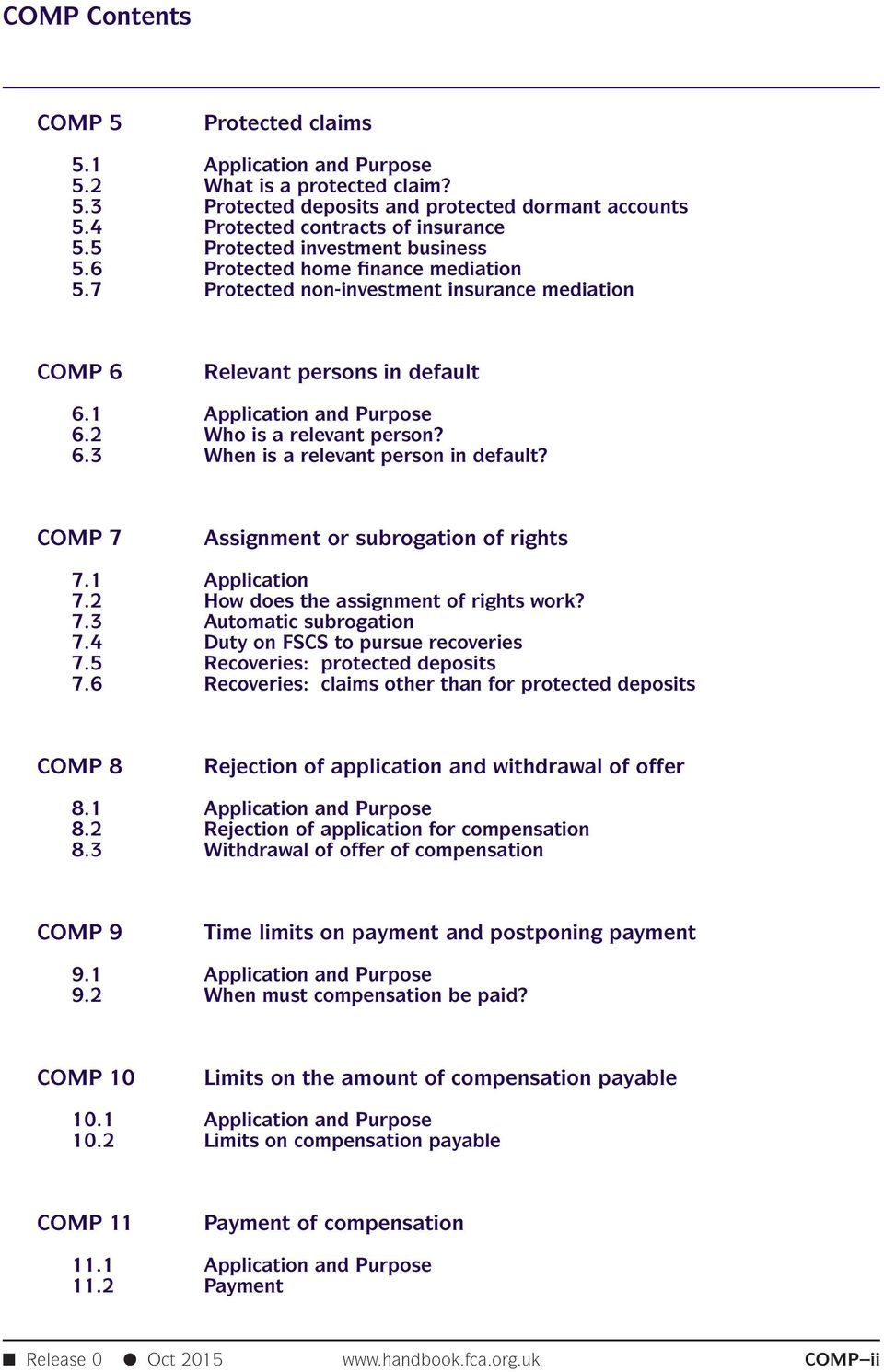
2 COMP Contents Compensation COMP INTO A INTO 1A Introduction 1A Foreword COMP INTO B INTO 1B Introduction 1B Foreword COMP 1 Introduction and Overview 1.1 Application, Introduction, and Purpose 1.2 The FSCS 1.3 Claimants 1.4 EEA Firms 1.5 Application to Lloyd's COMP 2 The FSCS 2.1 Application and Purpose 2.2 Duties of the FSCS COMP 3 The qualifying conditions for compensation 3.1 Application and Purpose 3.2 The qualifying conditions for paying compensation 3.3 Insurance COMP 4 Eligible claimants 4.1 Application and Purpose 4.2 Who is eligible to benefit from the protection provided by the FSCS? 4.3 Exceptions: Circumstances where a person coming within COMP may receive compensation 4.4 Exceptions: elevant general insurance contracts: mesothelioma claims COMP i elease 0 Oct 2015

3 COMP Contents COMP 5 Protected claims 5.1 Application and Purpose 5.2 What is a protected claim? 5.3 Protected deposits and protected dormant accounts 5.4 Protected contracts of insurance 5.5 Protected investment business 5.6 Protected home finance mediation 5.7 Protected non-investment insurance mediation COMP 6 elevant persons in default 6.1 Application and Purpose 6.2 Who is a relevant person? 6.3 When is a relevant person in default? COMP 7 Assignment or subrogation of rights 7.1 Application 7.2 How does the assignment of rights work? 7.3 Automatic subrogation 7.4 Duty on FSCS to pursue recoveries 7.5 ecoveries: protected deposits 7.6 ecoveries: claims other than for protected deposits COMP 8 ejection of application and withdrawal of offer 8.1 Application and Purpose 8.2 ejection of application for compensation 8.3 Withdrawal of offer of compensation COMP 9 Time limits on payment and postponing payment 9.1 Application and Purpose 9.2 When must compensation be paid? COMP 10 Limits on the amount of compensation payable 10.1 Application and Purpose 10.2 Limits on compensation payable COMP 11 Payment of compensation 11.1 Application and Purpose 11.2 Payment elease 0 Oct COMP ii
4 COMP Contents COMP 12 Calculating compensation 12.1 Application and Purpose 12.2 Quantification: general 12.3 Quantification date 12.4 The compensation calculation Quantification: trustees, operators of pension schemes, persons winding up pension schemes, personal representatives, agents, and joint claims COMP 13 Funding 13 Ann 1 [deleted: the provisions in relation to the funding of the Financial Services Compensation Scheme are set out in FEES 6 (Financial Services Compensation Scheme Funding)] COMP 14 Participation by EEA Firms 14.1 Application and Purpose 14.2 Obtaining top-up cover 14.3 Co-operation between the FSCS and Home State compensation schemes 14.4 Ending top-up cover 14.5 EEA UCITS management companies COMP 15 Protected deposits: Payments from other schemes 15.1 Payments from other schemes COMP 16 Disclosure requirements for firms that accept deposits 16.1 Application and purpose 16.2 Informing depositors of limitations to coverage 16.3 UK domestic firms, non-eea firms and incoming EEA firms 16.4 Compensation information: branches and websites 16 Annex 1 Content of compensation sticker and poster Transitional provisions and Schedules TP 1 Sch 1 Sch 2 Sch 3 Sch 4 Sch 5 Sch 6 Transitional Provisions ecord-keeping requirements Notification requirements Fees and other required payments Powers Exercised ights of action for damages ules that can be waived COMP iii elease 0 Oct 2015
![relation to the funding of the Financial Services Compensation Scheme are set out in FEES 6 (Financial Services Compensation Scheme Funding)] COMP 14 Participation by EEA Firms 14.](/docs-images/45/9266571/images/page_4.jpg "1 Application and Purpose 14.2 Obtaining top-up cover 14.3 Co-operation between the FSCS and Home State compensation schemes 14.4 Ending top-up cover 14.")
5 Compensation Chapter INTO Introduction 1A elease 0 Oct COMP INTO A/1

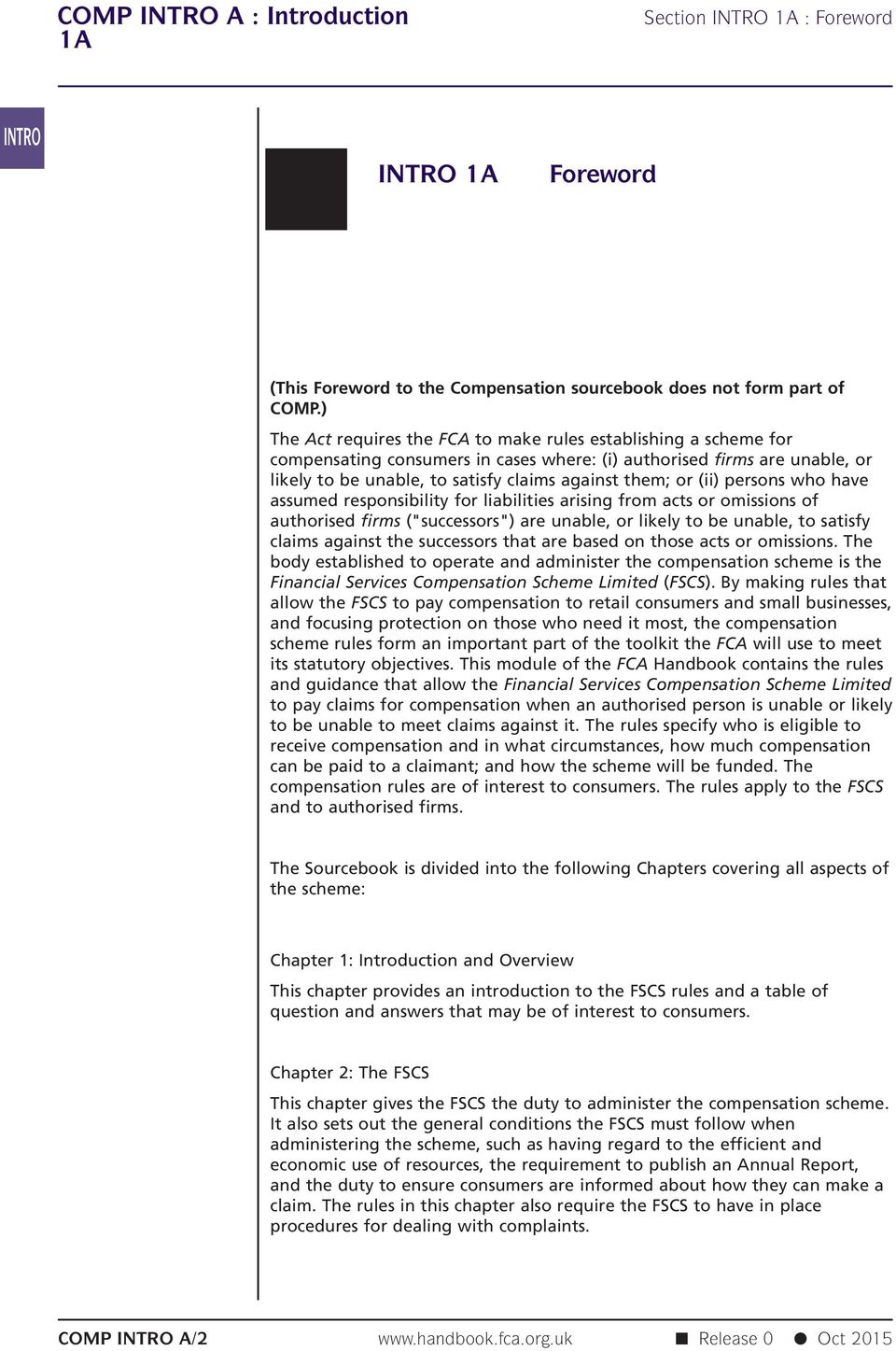
6 COMP INTO A : Introduction 1A Section INTO 1A : Foreword INTO INTO 1A Foreword (This Foreword to the Compensation sourcebook does not form part of COMP.) The Act requires the FCA to make rules establishing a scheme for compensating consumers in cases where: (i) authorised firms are unable, or likely to be unable, to satisfy claims against them; or (ii) persons who have assumed responsibility for liabilities arising from acts or omissions of authorised firms ("successors") are unable, or likely to be unable, to satisfy claims against the successors that are based on those acts or omissions. The body established to operate and administer the compensation scheme is the Financial Services Compensation Scheme Limited (FSCS). By making rules that allow the FSCS to pay compensation to retail consumers and small businesses, and focusing protection on those who need it most, the compensation scheme rules form an important part of the toolkit the FCA will use to meet its statutory objectives. This module of the FCA Handbook contains the rules and guidance that allow the Financial Services Compensation Scheme Limited to pay claims for compensation when an authorised person is unable or likely to be unable to meet claims against it. The rules specify who is eligible to receive compensation and in what circumstances, how much compensation can be paid to a claimant; and how the scheme will be funded. The compensation rules are of interest to consumers. The rules apply to the FSCS and to authorised firms. The Sourcebook is divided into the following Chapters covering all aspects of the scheme: Chapter 1: Introduction and Overview This chapter provides an introduction to the FSCS rules and a table of question and answers that may be of interest to consumers. Chapter 2: The FSCS This chapter gives the FSCS the duty to administer the compensation scheme. It also sets out the general conditions the FSCS must follow when administering the scheme, such as having regard to the efficient and economic use of resources, the requirement to publish an Annual eport, and the duty to ensure consumers are informed about how they can make a claim. The rules in this chapter also require the FSCS to have in place procedures for dealing with complaints. COMP INTO A/2 elease 0 Oct 2015
7 COMP INTO A : Introduction 1A Section INTO 1A : Foreword Chapter 3 The qualifying conditions for paying compensation This chapter sets out the main qualifying conditions that must be satisfied before the FSCS can pay compensation to claimants. These are that a claimant is eligible to claim; the activity that gave rise to the loss is protected by the scheme; the firm against which the claim is being made is protected by the scheme; and that the claimant has assigned his rights to the scheme. Chapters 4 to 7 expand on the general conditions described in Chapter 3. INTO Chapter 4 Eligible claimants This chapter specifies who is eligible to receive compensation provided by the FSCS. Chapter 5 What is a protected claim? This chapter specifies the activities that are protected by the FSCS. Chapter 6 elevant persons in default This chapter specifies the circumstances when a firm is in default, that is, when a firm is to be taken as being unable or likely to be unable to meet claims against it. The FSCS can only pay compensation if the circumstances specified in Chapter 6 are met. Chapter 7 Assignment of rights This chapter enables the FSCS to make an offer of compensation conditional on the claimant assigning to it their rights to claim against the failed firm. If the FSCS recovers from the firm a greater sum than it has paid to the claimant, it must pay the balance to the claimant. Chapter 8 ejection of application and withdrawal of offer This chapter allows the FSCS to reject an application for compensation or withdraw an offer of compensation in specified circumstances. Chapter 9 Time limits on payment and postponing payment This chapter requires the FSCS to pay a claim for compensation within a specified time unless specified conditions apply. Chapter 10 Limits on the amount of compensation payable This chapter specifies the maximum amount of compensation the FSCS can pay to a claimant. elease 0 Oct COMP INTO A/3

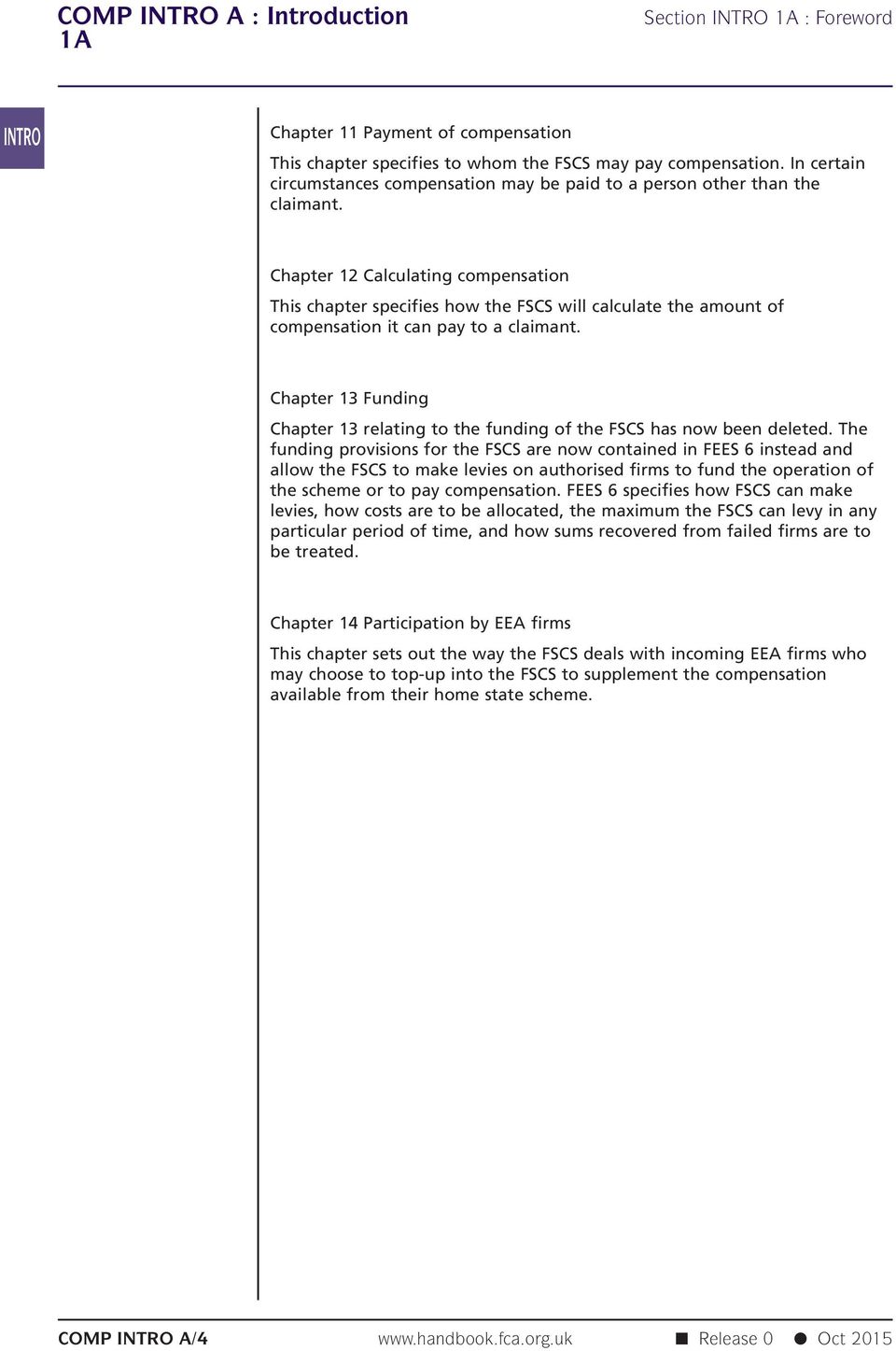
8 COMP INTO A : Introduction 1A Section INTO 1A : Foreword INTO Chapter 11 Payment of compensation This chapter specifies to whom the FSCS may pay compensation. In certain circumstances compensation may be paid to a person other than the claimant. Chapter 12 Calculating compensation This chapter specifies how the FSCS will calculate the amount of compensation it can pay to a claimant. Chapter 13 Funding Chapter 13 relating to the funding of the FSCS has now been deleted. The funding provisions for the FSCS are now contained in FEES 6 instead and allow the FSCS to make levies on authorised firms to fund the operation of the scheme or to pay compensation. FEES 6 specifies how FSCS can make levies, how costs are to be allocated, the maximum the FSCS can levy in any particular period of time, and how sums recovered from failed firms are to be treated. Chapter 14 Participation by EEA firms This chapter sets out the way the FSCS deals with incoming EEA firms who may choose to top-up into the FSCS to supplement the compensation available from their home state scheme. COMP INTO A/4 elease 0 Oct 2015
9 Compensation Chapter INTO Introduction 1B elease 0 Oct COMP INTO B/1

10 COMP INTO B : Introduction 1B Section INTO 1B : Foreword INTO INTO 1B Foreword (This Foreword to the Compensation sourcebook does not form part of COMP.) COMP INTO B/2 elease 0 Oct 2015

11 COMP INTO B : Introduction 1B Section INTO 1B : Foreword INTO elease 0 Oct COMP INTO B/3

12 COMP INTO B : Introduction 1B Section INTO 1B : Foreword INTO COMP INTO B/4 elease 0 Oct 2015

13 Compensation Chapter 1 Introduction and Overview elease 0 Oct COMP 1/1

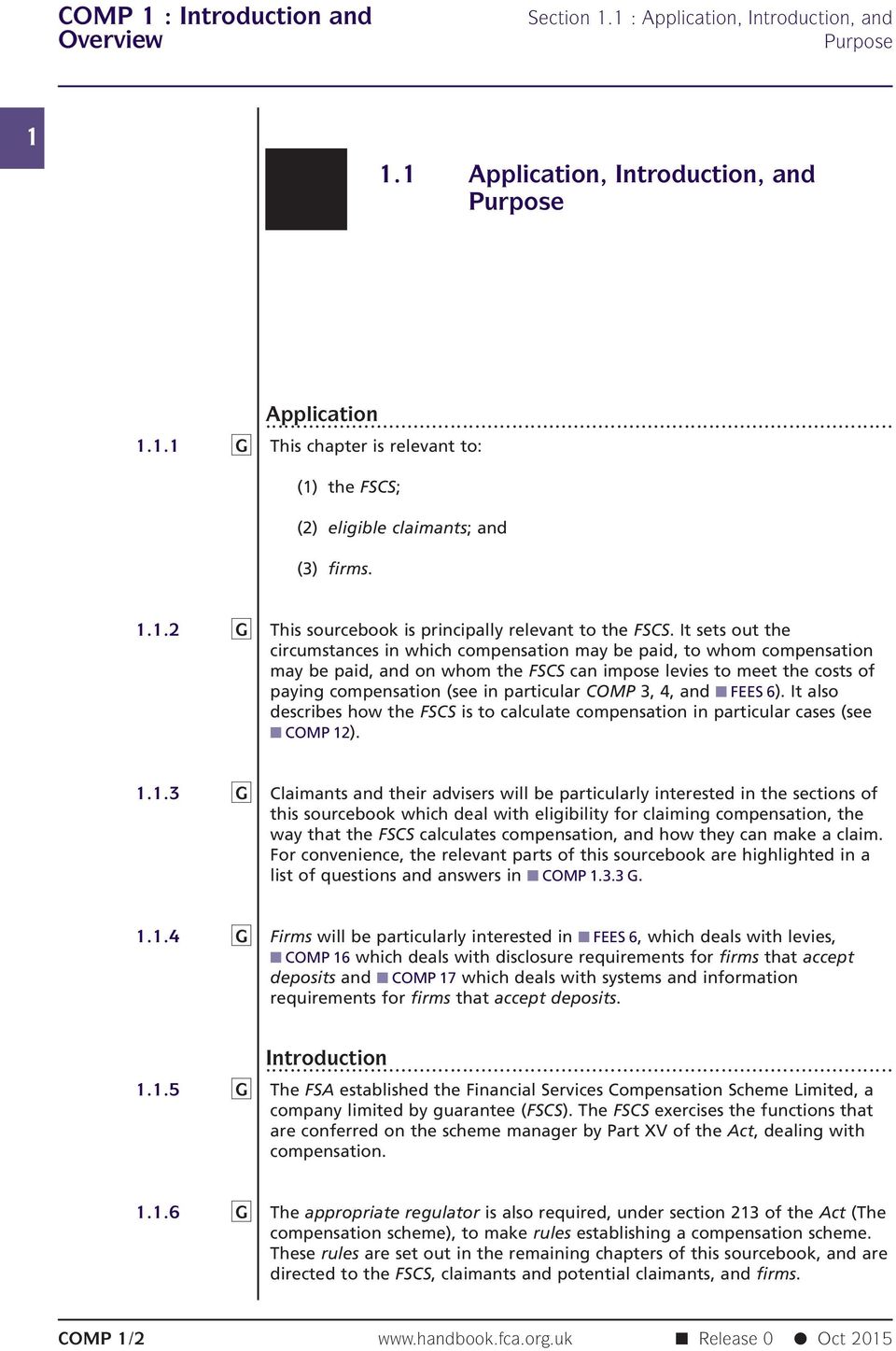
14 COMP 1 : Introduction and Overview Section 1.1 : Application, Introduction, and Purpose Application, Introduction, and Purpose Application This chapter is relevant to: (1) the FSCS; (2) eligible claimants; and (3) firms This sourcebook is principally relevant to the FSCS. It sets out the circumstances in which compensation may be paid, to whom compensation may be paid, and on whom the FSCS can impose levies to meet the costs of paying compensation (see in particular COMP 3, 4, and FEES 6). It also describes how the FSCS is to calculate compensation in particular cases (see COMP 12) Claimants and their advisers will be particularly interested in the sections of this sourcebook which deal with eligibility for claiming compensation, the way that the FSCS calculates compensation, and how they can make a claim. For convenience, the relevant parts of this sourcebook are highlighted in a list of questions and answers in COMP Firms will be particularly interested in FEES 6, which deals with levies, COMP 16 which deals with disclosure requirements for firms that accept deposits and COMP 17 which deals with systems and information requirements for firms that accept deposits Introduction The FSA established the Financial Services Compensation Scheme Limited, a company limited by guarantee (FSCS). The FSCS exercises the functions that are conferred on the scheme manager by Part XV of the Act, dealing with compensation The appropriate regulator is also required, under section 213 of the Act (The compensation scheme), to make rules establishing a compensation scheme. These rules are set out in the remaining chapters of this sourcebook, and are directed to the FSCS, claimants and potential claimants, and firms. COMP 1/2 elease 0 Oct 2015
15 COMP 1 : Introduction and Overview Section 1.1 : Application, Introduction, and Purpose Purpose The FSCS will only pay claims if a firm is unable or likely to be unable to meet claims against it because of its financial circumstances. If a firm is still trading and has sufficient financial resources to satisfy a claim, the firm will be expected to meet the claim itself. This can, for example, be an amount the firm agrees with the claimant, or the amount of an Ombudsman award from the Financial Ombudsman Service COMP 1 consists of guidance which is aimed at giving an overview of how this sourcebook works. The provisions of COMP 2 to COMP 17 cover who is eligible, the amount of compensation and how it might be paid, disclosure requirements for firms that accept deposits and systems and information requirements for firms that accept deposits A This sourcebook is one of the means by which the FCA will meet its statutory objectives of securing an appropriate degree of protection for consumers and protecting and enhancing the integrity of the UK financial system B A By making rules that allow the FSCS to provide compensation at a level appropriate for the protection of retail consumers and small businesses, the FCA enables consumers to participate in the financial markets with the confidence that they will be protected, at least in part, should the relevant person with whom they are dealing be unable to satisfy claims against it B elease 0 Oct COMP 1/3
16 COMP 1 : Introduction and Overview Section 1.2 : The FSCS The FSCS While this sourcebook deals with the main powers and duties of the FSCS, it does not provide the complete picture. Other aspects of the operation of the FSCS are dealt with through the powers of the Financial Services Compensation Scheme Limited under company law (such as the power to borrow, to take on premises, etc.) (1) (2) 1.2.2A (1) In addition, the Act itself confers certain powers upon the FSCS, such as a power under section 219 of the Act (Scheme Manager's powers to require information) to require persons to provide information. These powers are not, therefore, covered by this sourcebook. (2) Of specific relevance to the way in which the FSCS fulfils its responsibilities is the relationship between the FSCS and the FCA. This is covered in a Memorandum of Understanding which can be found on the FCA website B COMP 1/4 elease 0 Oct 2015

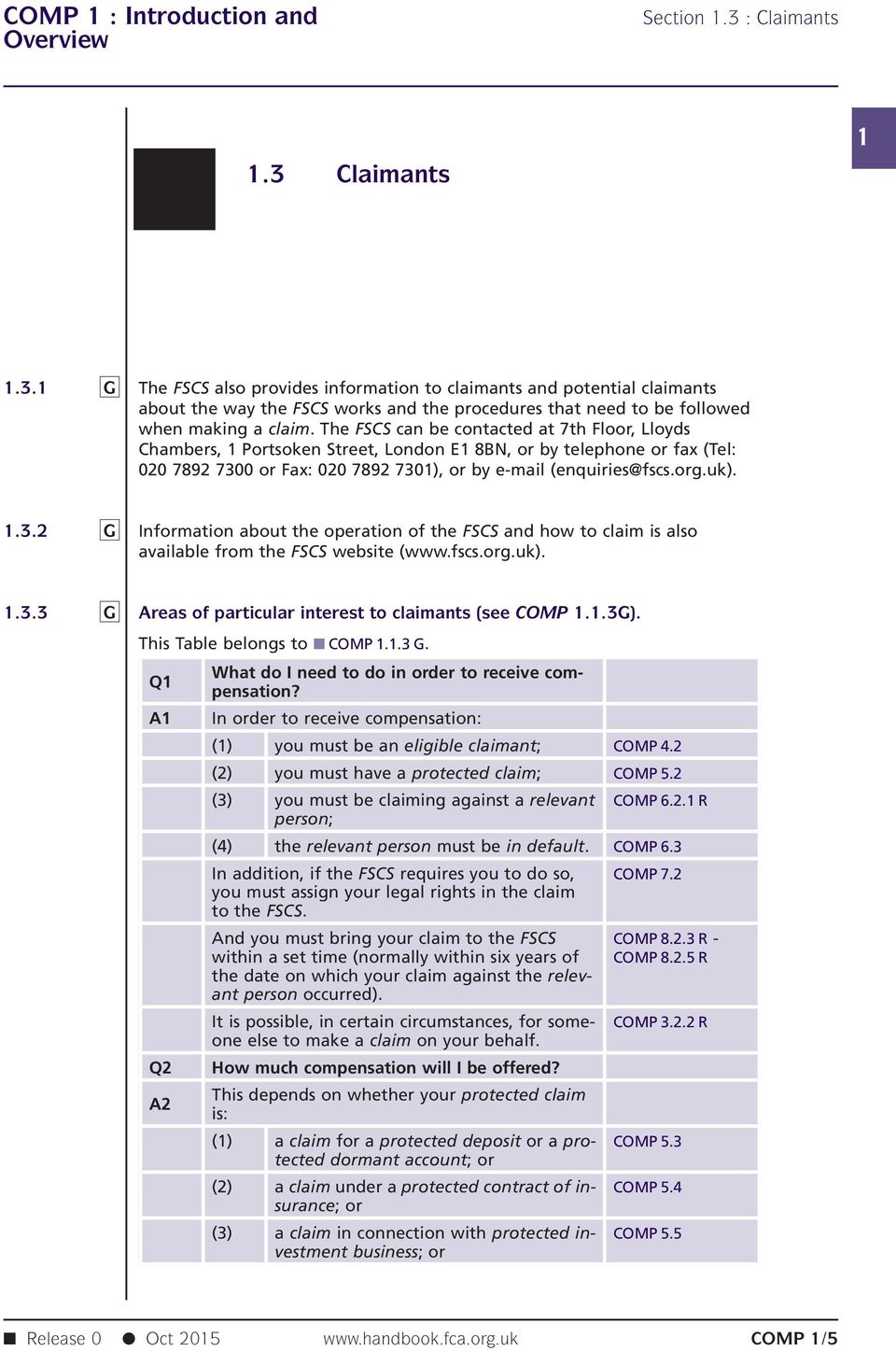
17 COMP 1 : Introduction and Overview Section 1.3 : Claimants 1.3 Claimants The FSCS also provides information to claimants and potential claimants about the way the FSCS works and the procedures that need to be followed when making a claim. The FSCS can be contacted at 7th Floor, Lloyds Chambers, 1 Portsoken Street, London E1 8BN, or by telephone or fax (Tel: or Fax: ), or by ([email protected]) Information about the operation of the FSCS and how to claim is also available from the FSCS website ( Areas of particular interest to claimants (see COMP 1.1.3). This Table belongs to COMP Q1 A1 Q2 A2 What do I need to do in order to receive compensation? In order to receive compensation: (1) you must be an eligible claimant; COMP 4.2 (2) you must have a protected claim; COMP 5.2 (3) you must be claiming against a relevant COMP person; (4) the relevant person must be in default. COMP 6.3 In addition, if the FSCS requires you to do so, COMP 7.2 you must assign your legal rights in the claim to the FSCS. And you must bring your claim to the FSCS COMP within a set time (normally within six years of COMP the date on which your claim against the relevant person occurred). It is possible, in certain circumstances, for someone else to make a claim on your behalf. How much compensation will I be offered? This depends on whether your protected claim is: COMP (1) a claim for a protected deposit or a pro- COMP 5.3 tected dormant account; or (2) a claim under a protected contract of in- COMP 5.4 surance; or (3) a claim in connection with protected in- COMP 5.5 vestment business; or elease 0 Oct COMP 1/5
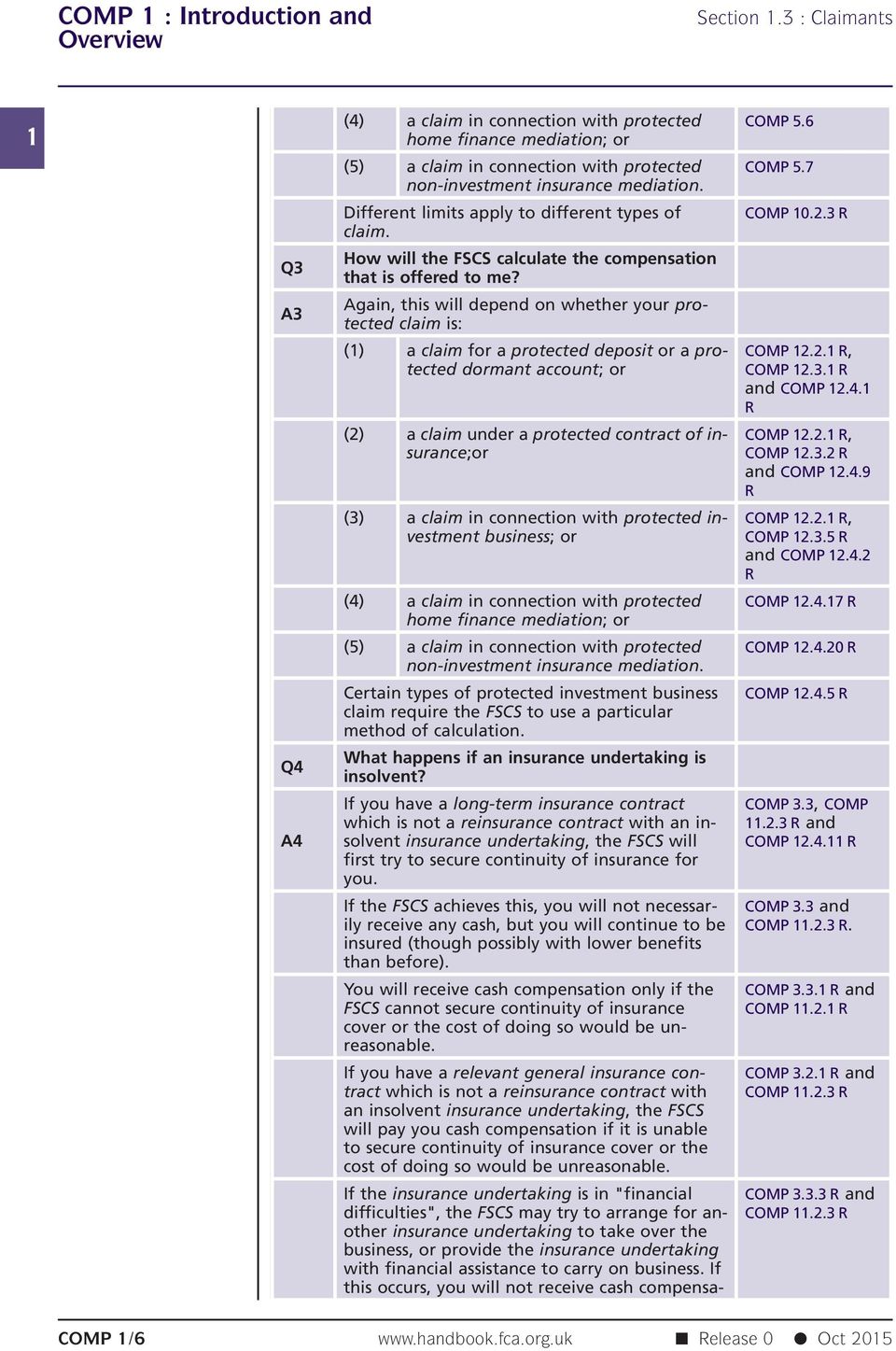
18 COMP 1 : Introduction and Overview Section 1.3 : Claimants 1 Q3 A3 Q4 (4) a claim in connection with protected COMP 5.6 home finance mediation; or (5) a claim in connection with protected COMP 5.7 non-investment insurance mediation. Different limits apply to different types of claim. How will the FSCS calculate the compensation that is offered to me? Again, this will depend on whether your protected claim is: COMP (1) a claim for a protected deposit or a pro- COMP , tected dormant account; or COMP and COMP (2) a claim under a protected contract of in- COMP , surance;or COMP and COMP (3) a claim in connection with protected in- COMP , vestment business; or COMP and COMP (4) a claim in connection with protected COMP home finance mediation; or (5) a claim in connection with protected COMP non-investment insurance mediation. Certain types of protected investment business claim require the FSCS to use a particular method of calculation. What happens if an insurance undertaking is insolvent? COMP If you have a long-term insurance contract COMP 3.3, COMP which is not a reinsurance contract with an in and A4 solvent insurance undertaking, the FSCS will COMP first try to secure continuity of insurance for you. If the FSCS achieves this, you will not necessar- COMP 3.3 and ily receive any cash, but you will continue to be COMP insured (though possibly with lower benefits than before). You will receive cash compensation only if the FSCS cannot secure continuity of insurance cover or the cost of doing so would be unreasonable. If you have a relevant general insurance contract which is not a reinsurance contract with an insolvent insurance undertaking, the FSCS will pay you cash compensation if it is unable to secure continuity of insurance cover or the cost of doing so would be unreasonable. If the insurance undertaking is in "financial difficulties", the FSCS may try to arrange for another insurance undertaking to take over the business, or provide the insurance undertaking with financial assistance to carry on business. If this occurs, you will not receive cash compensa- COMP and COMP COMP and COMP COMP and COMP COMP 1/6 elease 0 Oct 2015
19 COMP 1 : Introduction and Overview Section 1.3 : Claimants tion, but your policy will continue (though possibly with lower benefits than before). 1 elease 0 Oct COMP 1/7

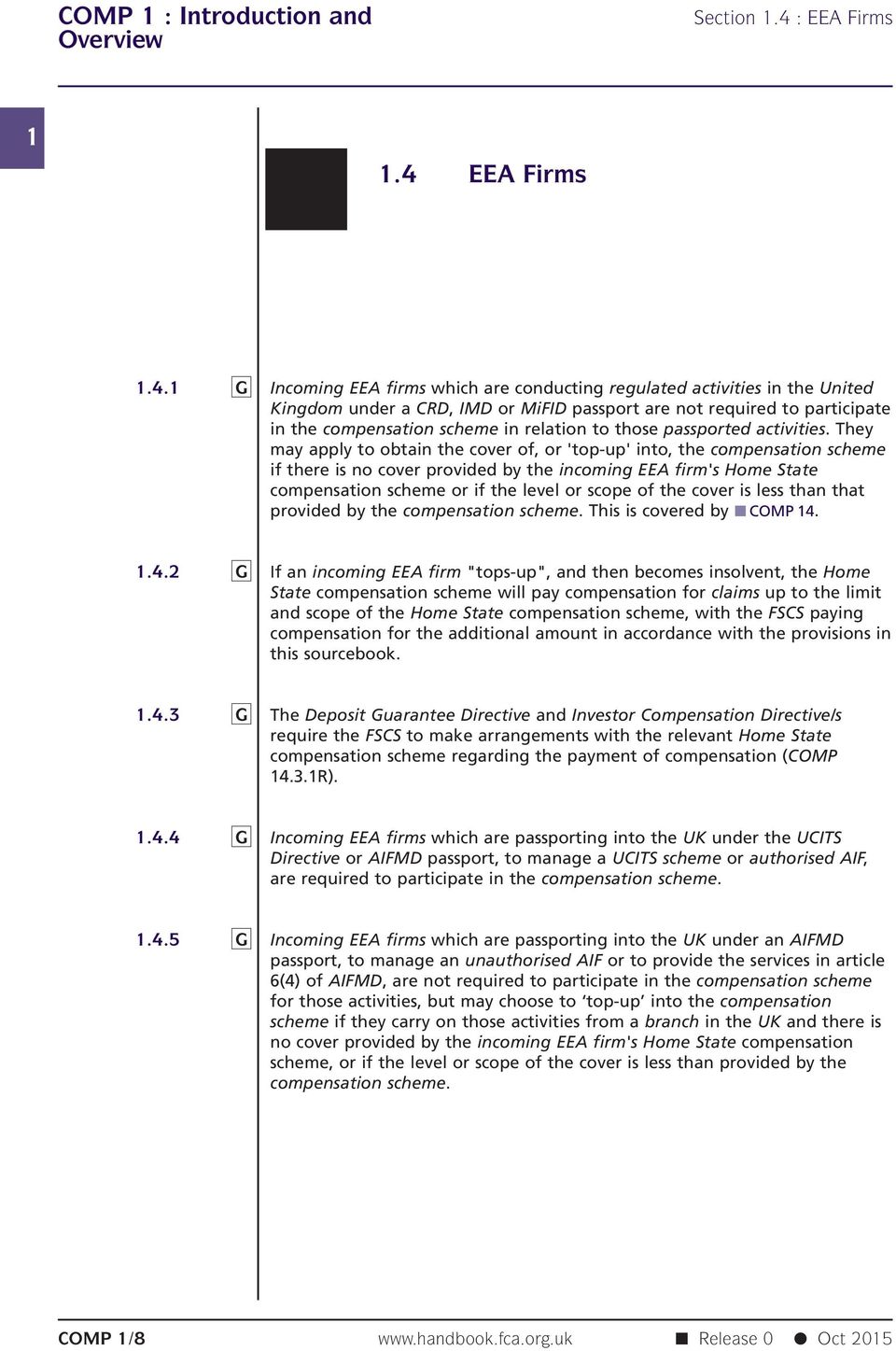
20 COMP 1 : Introduction and Overview Section 1.4 : EEA Firms EEA Firms Incoming EEA firms which are conducting regulated activities in the United Kingdom under a CD, IMD or MiFID passport are not required to participate in the compensation scheme in relation to those passported activities. They may apply to obtain the cover of, or 'top-up' into, the compensation scheme if there is no cover provided by the incoming EEA firm's Home State compensation scheme or if the level or scope of the cover is less than that provided by the compensation scheme. This is covered by COMP If an incoming EEA firm "tops-up", and then becomes insolvent, the Home State compensation scheme will pay compensation for claims up to the limit and scope of the Home State compensation scheme, with the FSCS paying compensation for the additional amount in accordance with the provisions in this sourcebook The Deposit uarantee Directive and Investor Compensation Directive/s require the FSCS to make arrangements with the relevant Home State compensation scheme regarding the payment of compensation (COMP ) Incoming EEA firms which are passporting into the UK under the UCITS Directive or AIFMD passport, to manage a UCITS scheme or authorised AIF, are required to participate in the compensation scheme Incoming EEA firms which are passporting into the UK under an AIFMD passport, to manage an unauthorised AIF or to provide the services in article 6(4) of AIFMD, are not required to participate in the compensation scheme for those activities, but may choose to top-up into the compensation scheme if they carry on those activities from a branch in the UK and there is no cover provided by the incoming EEA firm's Home State compensation scheme, or if the level or scope of the cover is less than provided by the compensation scheme. COMP 1/8 elease 0 Oct 2015
21 COMP 1 : Introduction and Overview Section 1.5 : Application to Lloyd's 1.5 Application to Lloyd's Compensation arrangements for individual members The compensation scheme will not compensate members or former members if firms are unable to satisfy claims made in connection with regulated activities relating to their participation in Lloyd's syndicates. Separate rules and guidance are therefore needed The Society must maintain byelaws establishing appropriate and effective arrangements to compensate individual members and former members who were individual members if underwriting agents are unable, or likely to be unable, to satisfy claims by those members relating to regulated activities carried on in connection with their participation in Lloyd's syndicates For the purposes of COMP "individual member" includes a member which is a limited liability partnership or a body corporate whose members consist only of, or of the nominees for, a single natural person or a group of connected persons The arrangements referred to in COMP : (1) will not compensate losses arising only as a result of underwriting or investment risk to which individual members or former members who were individual members are or were exposed by their participation in Lloyd's syndicates; (2) may be restricted to compensation for losses arising out of fraud, dishonesty or failure to account; and (3) should cover all regulated activities carried on by underwriting agents relating to Lloyd's syndicate capacity and syndicate membership The arrangements referred to in COMP should have a governance structure that is operationally independent from the Society, but which is nevertheless accountable to the Society for the proper administration of the compensation arrangements A contravention of COMP does not give rise to a right of action by a private person under section 138D of the Act (Actions for damages) and that rule is specified under Section 138D(3) of the Act as a provision giving rise to no such right of action. elease 0 Oct COMP 1/9
22 COMP 1 : Introduction and Overview Section 1.5 : Application to Lloyd's 1 COMP 1/10 elease 0 Oct 2015
23 Compensation Chapter 2 The FSCS elease 0 Oct COMP 2/1
24 COMP 2 : The FSCS Section 2.1 : Application and Purpose Application and Purpose Application This chapter applies to the FSCS Purpose In order to carry out its functions and put into effect the provisions set out in COMP 3 - COMP 14 (which deal with determining whether compensation is payable, calculating the amount of compensation that should be paid, and making levies on firms), the FSCS needs to have a variety of powers. The purpose of this chapter is to set out these powers, and the restrictions upon them. COMP 2/2 elease 0 Oct 2015
25 COMP 2 : The FSCS Section 2.2 : Duties of the FSCS 2.2 Duties of the FSCS Administering the compensation scheme The FSCS must administer the compensation scheme in accordance with the rules in this sourcebook and any other rules prescribed by law to ensure that the compensation scheme is administered in a manner that is procedurally fair and in accordance with the European Convention on Human ights The FSCS may: (1) pay compensation to eligible claimants or secure continuity of insurance for eligible claimants when a relevant person is unable or likely to be unable to meet claims against it in accordance with the sourcebook; and (2) make levies on participant firms, in accordance with FEES 6 (Financial Services Compensation Scheme Funding), to enable it to pay compensation, secure continuity of insurance, or meet the costs of discharging its functions under this sourcebook Information for claimants The FSCS must publish information for claimants and potential claimants on the operation of the compensation scheme Assistance to claimants The FSCS may agree to pay the reasonable costs of an eligible claimant bringing or continuing insolvency proceedings against a relevant person (whether those proceedings began before or after a determination of default), if the FSCS is satisfied that those proceedings would help it to discharge its functions under the requirements of this sourcebook Annual eport The FSCS must make and publish an annual report on the discharge of its functions (section 218 of the Act (Annual report)) Finance and resources The FSCS must have regard to the need to use its resources in the most efficient and economic way in carrying out its functions under the requirements of this sourcebook. elease 0 Oct COMP 2/3
26 COMP 2 : The FSCS Section 2.2 : Duties of the FSCS Publication of defaults The FSCS must take appropriate steps to ensure that potential claimants are informed of how they can make a claim for compensation as soon as possible after a determination has been made that a relevant person is in default, whether by the FSCS or the appropriate regulator Complaints The FSCS must put in place and publish procedures which satisfy the minimum requirements of procedural fairness and comply with the European Convention on Humans ights for the handling of any complaints of maladministration relating to any aspect of the operation of the compensation scheme Informing the FSCS The appropriate regulator will inform the FSCS if it detects problems in a firm that is likely to give rise to the intervention of the FSCS. [Note: article 10(1), part of last sub-paragraph of the Deposit uarantee Directive] Systems [Note: article 10(1), part of last sub-paragraph of the Deposit uarantee Directive] COMP 2/4 elease 0 Oct 2015
27 Compensation Chapter 3 The qualifying conditions for compensation elease 0 Oct COMP 3/1
28 COMP 3 : The qualifying conditions for compensation Section 3.1 : Application and Purpose 3.1 Application and Purpose Application This chapter applies to the FSCS It is also relevant to claimants Purpose The purpose of this chapter is to set out in general terms the conditions that must be satisfied before the FSCS can make an offer of compensation, or secure continuity of insurance cover, or provide assistance to an insurance undertaking to enable it to continue insurance business The qualifying conditions for paying compensation are set out in greater detail in COMP 4 - COMP 7. COMP 3/2 elease 0 Oct 2015
29 COMP 3 : The qualifying conditions for compensation Section 3.2 : The qualifying conditions for paying compensation 3.2 The qualifying conditions for paying compensation The FSCS may pay compensation to an eligible claimant, subject to COMP 11 (Payment of compensation), if it is satisfied that: (1) an eligible claimant has made an application for compensation (but see COMP 3.2.1A ); (2) the claim is in respect of a protected claim against a relevant person who is in default; (3) where the FSCS so requires, the claimant has assigned the whole or any part of his rights against the relevant person or against any third party to the FSCS, on such terms as the FSCS thinks fit; and (4) in the case of a claim under a protected contract of insurance: (a) it is not reasonably practicable or appropriate to make, or continue to make, arrangements to secure continuity of insurance under COMP ; or (b) it would not be appropriate to take, or continue to take, measures under COMP to safeguard policyholders of an insurance undertaking in financial difficulties A Treating a person as having claimed The FSCS may treat persons who are or may be entitled to claim compensation as if they had done so Claims on behalf of another person The FSCS may also pay compensation (and any recovery or other amount payable by the FSCS to the claimant) to a person who makes a claim on behalf of another person if the FSCS is satisfied that the person on whose behalf the claim is made: (1) is or would have been an eligible claimant; and (2) would have been paid compensation by the FSCS had he been able to make the claim himself, or to pursue his application for compensation further. elease 0 Oct COMP 3/3
30 COMP 3 : The qualifying conditions for compensation Section 3.2 : The qualifying conditions for paying compensation Examples of the circumstances covered by COMP are: (1) when personal representatives make a claim on behalf of the deceased; 3 (2) when trustees make a claim on behalf of beneficiaries (for further provisions relating to claims by trustees, see COMP to COMP ); (3) when the donee of an enduring power of attorney or a lasting power of attorney makes a claim on behalf of the donor of the power; (4) when the Court of Protection makes a claim on behalf of a person incapable by reason of mental disorder of managing and administering his property and affairs; (5) when an eligible claimant makes a claim for compensation but dies before his claim is determined The FSCS may also pay compensation to a firm, who makes a claim in connection with protected non-investment insurance mediation on behalf of its customers, if the FSCS is satisfied that: (1) each customer has borne a shortfall in client money held by the firm caused by a secondary pooling event arising out of the failure of a broker or settlement agent which is a relevant person in default; (2) the customers in respect of which compensation is to be paid satisfy the conditions set out in COMP (1); (3) the customers do not have a claim against the relevant person directly, nor a claim against the firm, in respect of the same loss; (4) the customers would have been paid compensation by FSCS if the customers had a claim for their share of the shortfall, and if the firm were the relevant person; and (5) the firm has agreed, on such terms as the FSCS thinks fit, to pay, or credit the accounts of, without deduction, each relevant customer in (1), that part of the compensation equal to the customer's financial loss, subject to the limits in COMP COMP 3/4 elease 0 Oct 2015
31 COMP 3 : The qualifying conditions for compensation Section 3.3 : Insurance 3.3 Insurance Securing continuity of long term insurance cover A 3.3.2B 3.3.2C 3.3.2D 3.3.2E 3.3.2F Insurance undertakings in financial difficulties A (1) (2) elease 0 Oct COMP 3/5
32 COMP 3 : The qualifying conditions for compensation Section 3.3 : Insurance Assessing the costs of paying compensation 3 COMP 3/6 elease 0 Oct 2015
33 Compensation Chapter 4 Eligible claimants elease 0 Oct COMP 4/1
34 COMP 4 : Eligible claimants Section 4.1 : Application and Purpose 4.1 Application and Purpose Application This chapter applies to the FSCS It is also relevant to those who may wish to bring a claim for compensation Purpose The purpose of this chapter is to set out the types of person who are able to claim compensation or benefit from the protection the FSCS is able to provide. A claimant needs to be an eligible claimant to satisfy COMP 3.2.1(1). COMP 4/2 elease 0 Oct 2015
35 COMP 4 : Eligible claimants Section 4.2 : Who is eligible to benefit from the protection provided by the FSCS? 4.2 Who is eligible to benefit from the protection provided by the FSCS? Unless COMP applies, an eligible claimant is any person who at any material time: (1) did not come within COMP ; or (2) did come within COMP 4.2.2, but satisfied the relevant exception in COMP 4.3 or COMP Table COMP Persons not eligible to claim unless COMP 4.3 applies (see COMP 4.2.1) This table belongs to COMP (1) Firms (other than a sole trader firm; a credit union; a trustee of a stakeholder pension scheme (which is not an occupational pension scheme) or personal pension scheme; a firm carrying on the regulated activity of operating, or winding up, a stakeholder pension scheme (which is not an occupational pension scheme) or personal pension scheme; or a small business; in each case,whose claim arises out of a regulated activity for which they do not have a permission) (2) Overseas financial services institutions (3) Collective investment schemes, and anyone who is the operator or depositary of such a scheme. (4) Pension and retirement funds, and anyone who is a trustee of such a fund. However, this exclusion does not apply to: (a) (b) a trustee of a personal pension scheme or a stakeholder pension scheme (which is not an occupational pension scheme); or a trustee of a small self-administered scheme or an occupational pension scheme of an employer which is not a large company, large partnership or large mutual association. (5) Supranational institutions, governments, and central administrative authorities (6) Provincial, regional, local and municipal authorities (7) Directors of the relevant person in default. However, this exclusion does not apply if: (a) both of the following apply: elease 0 Oct COMP 4/3
36 COMP 4 : Eligible claimants Section 4.2 : Who is eligible to benefit from the protection provided by the FSCS? 4 (b) (i) (ii) (8) the relevant personin default is a mutual association which is not a large mutual association; and the directors do not receive a salary or other remuneration for services performed by them for the relevant person in default, or the relevant person in default is a credit union. (9) Bodies corporate in the same group as the relevant person in default unless that body corporate is: (a) (b) a trustee of: (i) (ii) (iii) (10) (11) a stakeholder pension scheme (which is not an occupational pension scheme) or a personal pension scheme (but in each case if the trustee is a firm it will only be an eligible claimant if its claim arises out of a regulated activity for which it does not have a permission); (if the claim is with respect to a long-term insurance contract) a small self-administered scheme or an occupational pension scheme; or (if the claim is not with respect to a long-term insurance contract) a small self-administered scheme or an occupational pension scheme of an employer which is not a large company, large partnership or large mutual association; or carrying on the regulated activity of operating or winding up a stakeholder pension scheme (which is not an occupational pension scheme) or personal pension scheme. (12) Persons who, in the opinion of thefscs, are responsible for, or have contributed to, the relevant person's default (13) Large companies (14) Large partnerships (15) Persons whose claim arises from transactions in connection with which they have been convicted of an offence of money laundering. (16) Persons whose claim arises under the Third Parties (ights against Insurers) Act 1930 (17) Where the claim is in relation to a protected contract of insurance or protected non-investment insurance mediation, body corporate, partnerships, mutual associations and unincorporated associations which are not small businesses. (18) Alternative investment funds, and anyone who is the AIFM or depositary of an alternative investment fund. (19) Large mutual associations A person who is a small business is an eligible claimant in respect of a relevant general insurance contract entered into before commencement only if the person is a partnership. COMP 4/4 elease 0 Oct 2015
37 COMP 4 : Eligible claimants Section 4.3 : Exceptions: Circumstances where a person coming within COMP may receive compensation 4.3 Exceptions: Circumstances where a person coming within COMP may receive compensation Deposits (and balances in dormant accounts) Long term insurance A person other than one which comes within any of categories (7), (9), (12) or (15) of COMP is eligible to claim compensation in respect of a long term insurance contract elevant general insurance contracts (1) A person falling within categories (1)-(4) of COMP is eligible to claim compensation in respect of a relevant general insurance contract if, at the date the contract commenced he was a small business. (2) Where the contract has been renewed, the last renewal date shall be taken as the commencement date A partnership which falls within category 14, or category 17, or both of COMP is eligible to claim compensation in respect of a relevant general insurance contract entered into before commencement Liability subject to compulsory insurance A person who comes within COMP is eligible to claim compensation in respect of a liability subject to compulsory insurance if the claim is: (1) a claim under a protected contract of insurance; or (2) a claim in connection with protected non-investment insurance mediation. elease 0 Oct COMP 4/5
38 COMP 4 : Eligible claimants Section 4.3 : Exceptions: Circumstances where a person coming within COMP may receive compensation Protected home finance mediation There are no exceptions to COMP for claims made in connection with protected home finance mediation Eligibility to claim in specified circumstances The FSCS may treat a person who comes within category (7) or (12) of COMP as eligible to claim compensation where: (1) this is desirable to achieve the efficient performance of any of its functions, including without limitation, to facilitate a transfer of business or any part thereof, to secure the issue of policies by another firm to eligible claimants in substitution for their existing policies, to achieve the efficient payment of compensation, to secure under COMP 3.3.2C the payment of benefits under a long term insurance contract; and (2) treating these persons as eligible to claim compensation would, in the opinion of the FSCS, be beneficial to the generality of eligible claimants who will be affected by the action in (1) Protected investment business A person is eligible to claim compensation for claims made in connection with protected investment business if, at the date at which the relevant person is deemed to be in default, he: (1) came within category (14) of COMP and he does not exceed the limits for a body corporate which qualifies as a small company under section 247 of the Companies Act 1985 or section 382 of the Companies Act 2006 as applicable; or (2) came within category (19) of COMP COMP 4/6 elease 0 Oct 2015
39 COMP 4 : Eligible claimants Section 4.4 : Exceptions: elevant general insurance contracts: mesothelioma claims 4.4 Exceptions: elevant general insurance contracts: mesothelioma claims Application Claims for contribution by responsible persons Limits to amounts payable for contribution claims elease 0 Oct COMP 4/7
40 COMP 4 : Eligible claimants Section 4.4 : Exceptions: elevant general insurance contracts: mesothelioma claims 4 COMP 4/8 elease 0 Oct 2015
41 Compensation Chapter 5 Protected claims elease 0 Oct COMP 5/1
42 COMP 5 : Protected claims Section 5.1 : Application and Purpose 5.1 Application and Purpose Application This chapter applies to the FSCS It is also relevant to claimants Purpose The purpose of this chapter is to set out the various categories of claim for which compensation may be payable. COMP 5/2 elease 0 Oct 2015
43 COMP 5 : Protected claims Section 5.2 : What is a protected claim? 5.2 What is a protected claim? A protected claim is: 5 (1) a claim for a protected deposit or a protected dormant account (see COMP 5.3); or (2) a claim under a protected contract of insurance (see COMP 5.4); or (3) a claim in connection with protected investment business (see COMP 5.5); or (4) a claim in connection with protected home finance mediation (see COMP 5.6); or (5) a claim in connection with protected non-investment insurance mediation (see COMP 5.7) () Notwithstanding COMP 5.2.1, where the relevant person in default: (1) is an authorised professional firm that is subject to the rules of the Law Society (England and Wales) or the Law Society of Scotland; and (2) with respect to its regulated activities, does not participate in the relevant society's compensation scheme: a claim with respect to that person is only a protected claim if, when the basis for the claim arose, that person did not participate in the relevant society's compensation scheme with respect to its regulated activities. elease 0 Oct COMP 5/3
44 COMP 5 : Protected claims Section 5.3 : Protected deposits and protected dormant accounts 5.3 Protected deposits and protected dormant accounts A A protected deposit continues to be a protected deposit if, under a transfer of banking business, it is transferred to: (1) an establishment of a relevant person in the United Kingdom; or (2) a branch of a UK firm which is a credit institution established in another EEA State under an EEA right COMP 5/4 elease 0 Oct 2015
45 COMP 5 : Protected claims Section 5.4 : Protected contracts of insurance 5.4 Protected contracts of insurance Contracts of insurance issued after commencement Contracts of insurance issued before commencement Contracts not evidenced by a policy Liabilities giving rise to claims under a protected contract of insurance elease 0 Oct COMP 5/5
46 COMP 5 : Protected claims Section 5.5 : Protected investment business 5.5 Protected investment business Protected investment business is: (1) designated investment business carried on by the relevant person with, or for the benefit of, the claimant (so long as that claimant has a claim), or as agent on the claimant's behalf; (2) the activities of the manager or trustee of an AUT, provided that the claim is made by a holder; (3) the activities of the ACD or depositary of an ICVC, provided that the claim is made by a holder; (4) the activities of the authorised contractual scheme manager or depositary of an ACS, provided that the claim is made by a holder; provided that the territorial scope condition in COMP is satisfied and, for a firm acting as the manager or depositary of a fund, one of the conditions in COMP is satisfied Territorial scope condition The territorial scope condition is that the protected investment business was carried on from: (1) an establishment of the relevant person in the United Kingdom; or (2) a branch of a UK firm which is: (a) a MiFID investment firm established in another EEA State; or (b) a UCITS management company established in another EEA State (but only in relation to managing investments (other than advising on investments or safeguarding and administering investments); () and the claim is an ICD claim; or (3) both (1) and (2); or (4) (a) a UK branch of an EEA UCITS management company; or (b) an establishment of such an EEA UCITS management company in its Home State from which cross border services are being carried on; COMP 5/6 elease 0 Oct 2015
47 COMP 5 : Protected claims Section 5.5 : Protected investment business and in either case the management company is providing collective portfolio management services for a UCITS scheme but only if the claim relates to that activity; or (5) an establishment of an incoming EEA AIFM in another EEA State if the claim relates to providing AIFM management functions on a cross border services basis for an authorised AIF Managers and depositaries of funds The conditions referred to in COMP for a manager or depositary of a fund are: (1) for the activities of managing an AIF or establishing, operating or winding up a collective investment scheme, the claim is in respect of an investment in: 5 (a) an authorised fund; or (b) any other fund which has its registered office or head office in the UK or is otherwise domiciled in the UK and is not a closedended corporate AIF; (2) where a firm is acting as depositary of an AIF and in so doing is carrying on the activity of acting as trustee or depositary of an AIF or safeguarding and administering assets, the claim is in respect of their activities for; (a) an authorised AIF; or (b) a charity AIF which is not a closed-ended corporate AIF. elease 0 Oct COMP 5/7
48 COMP 5 : Protected claims Section 5.6 : Protected home finance mediation 5.6 Protected home finance mediation Protected home finance mediation is: (1) advising on a home finance transaction; or (2) arranging (bringing about) a home finance transaction; or (3) making arrangements with a view to a home finance transaction; or (4) agreeing to carry on a regulated activity in (1) to (3); or (5) the activities of a home finance provider which would be arranging but for article 28A of the egulated Activities Order (Arranging contracts or plans to which the arranger is a party); provided that the condition in COMP is satisfied COMP applies only if the protected home finance mediation was carried on by a relevant person: (1) with a customer who was a resident in the United Kingdom; or (2) from an establishment maintained by the relevant person (or its appointed representative) in the United Kingdom with a customer who was resident elsewhere in the EEA; at the time the protected home finance mediation was carried on. COMP 5/8 elease 0 Oct 2015
49 COMP 5 : Protected claims Section 5.7 : Protected non-investment insurance mediation 5.7 Protected non-investment insurance mediation Protected non-investment insurance mediation is an insurance mediation activity where the investment concerned is a relevant general insurance contract or a pure protection contract but which is not a long-term care insurance contract or a reinsurance contract, provided that the conditions in COMP are satisfied COMP only applies if the conditions in (1) and (2) are satisfied: (1) the protected non-investment insurance mediation was carried on from: (a) an establishment of the relevant person in the United Kingdom; or (b) a branch of a UK firm established in another EEA State in the exercise of an EEA right derived from the IMD; and (2) the claimant making the claim (or where COMP applies, the customer on behalf of whom a firm makes a claim) dealt initially, with a view to entering into a relevant general insurance contract or a pure protection contract but not a long-term care insurance contract or a reinsurance contract, with an intermediary that was: (a) established in the United Kingdom; or (b) a branch of a UK firm established in another EEA State in the exercise of an EEA right derived from the IMD The FSCS will not cover a claim against an intermediary that meets the criteria of either COMP (2)(a) or COMP (2)(b) where the claimant was introduced to that intermediary by an intermediary that does not meet the criteria of either COMP (2)(a) or COMP (2)(b) The FSCS will not cover a claim in respect of an intermediary that is not a relevant person, for example a retailer selling extended warranties that are connected contracts. However, COMP has the effect that a claim in respect of a relevant person further up the chain carrying on protected noninvestment insurance mediation in accordance with COMP (1)(a) may be covered by the FSCS if the claimant dealt initially with a UK intermediary that is not a relevant person. elease 0 Oct COMP 5/9
50 COMP 5 : Protected claims Section 5.7 : Protected non-investment insurance mediation 5 COMP 5/10 elease 0 Oct 2015
51 Compensation Chapter 6 elevant persons in default elease 0 Oct COMP 6/1
52 COMP 6 : elevant persons in default Section 6.1 : Application and Purpose 6.1 Application and Purpose Application This chapter applies to the FSCS It is also relevant to claimants Purpose The purpose of this chapter is to specify the types of person against whom a claimant must have a claim in order to be eligible for compensation, and when those persons are 'in default'. enerally, this occurs when they are insolvent or unable to meet their liabilities to claimants To be eligible for compensation a claimant's claim must be against a relevant personin default: see COMP (2). COMP 6/2 elease 0 Oct 2015
53 COMP 6 : elevant persons in default Section 6.2 : Who is a relevant person? 6.2 Who is a relevant person? A relevant person is a person who was, at the time the act or omission giving rise to the claim against it took place: (1) a participant firm; or (2) an appointed representative of a participant firm (1) An incoming EEA firm, which is a credit institution, an IMD insurance intermediary or a MiFID investment firm, and its appointed representatives are not relevant persons in relation to the firms's passported activities, unless it has top-up cover. (See definition of "participant firm"). (2) An EEA UCITS management company providing collective portfolio management services for a UCITS scheme from a branch in the United Kingdom or under the freedom to provide cross border services, is a relevant person to the extent that it carries on those services. (3) An EEA UCITS management company carrying on the activities of managing investments (other than collective portfolio management), advising on investments or safeguarding and administering investments, is not a relevant person in relation to those activities, unless it has top-up cover. (4) An incoming EEA AIFM managing an authorised AIF from a branch in the UK or under the freedom to provide cross-border services, is a relevant person in respect of that activity. (5) An incoming EEA AIFM managing an unauthorised AIF is not a relevant person in respect of that activity unless it has top-up cover. (6) An incoming EEA AIFM providing the services in article 6(4) of AIFMD is not a relevant person in relation to those activities, unless it has top-up cover. elease 0 Oct COMP 6/3
54 COMP 6 : elevant persons in default Section 6.3 : When is a relevant person in default? 6.3 When is a relevant person in default? A relevant person is in default if: (1) (except in relation to an ICD claim or DD claim) the FSCS has determined it to be in default under COMP 6.3.2, COMP 6.3.3, COMP or COMP ; or (2) (in relation to an ICD claim or DD claim): (a) the appropriate regulator has determined it to be in default under COMP ; or (b) a judicial authority has made a ruling that had the effect of suspending the ability of eligible claimants to bring claims against the participant firm, if that is earlier than (a); and if a relevant person is in default in relation to an ICD claim or a DD claim it shall be deemed to be in default in relation to any other type of protected claim A [Note: article 1(3)(i) of the Deposit uarantee Directive] Subject to COMP to COMP and COMP 6.3.6, the FSCS (or, where COMP (2)(a) applies, the appropriate regulator) may determine a relevant person to be in default when it is, in the opinion of the FSCS or the appropriate regulator: (1) unable to satisfy protected claims against it; or (2) likely to be unable to satisfy protected claims against it Subject to COMP the FSCS may determine a relevant person to be in default if it is satisfied that a protected claim exists (other than an ICD claim or DD claim), and the relevant person is the subject of one or more of the following proceedings in the United Kingdom (or of equivalent or similar proceedings in another jurisdiction): (1) the passing of a resolution for a creditors' voluntary winding up; (2) a determination by the relevant person'shome State regulator that the relevant person appears unable to meet claims against it and has no early prospect of being able to do so; COMP 6/4 elease 0 Oct 2015
55 COMP 6 : elevant persons in default Section 6.3 : When is a relevant person in default? (3) the appointment of a liquidator or administrator, or provisional liquidator or interim manager; (4) the making of an order by a court of competent jurisdiction for the winding up of a company, the dissolution of a partnership, the administration of a company or partnership, or the bankruptcy of an individual; (5) the approval of a company voluntary arrangement, a partnership voluntary arrangement, or of an individual voluntary arrangement For claims arising in connection with protected investment business, protected home finance mediation or protected non-investment insurance mediation, the FSCS has the additional power to determine that a relevant person is in default if it is satisfied that a protected claim exists, and: (1) the FSCS is satisfied that the relevant person cannot be contacted at its last place of business and that reasonable steps have been taken to establish a forwarding or current address, but without success; and 6 (2) there appears to the FSCS to be no evidence that the relevant person will be able to meet claims made against it Members in default and the Central Fund of the Society Claims arising under COMP For the purposes of COMP 6.3 a claim made by a firm under COMP is to be treated as if it were a protected claim against the relevant person Scheme manager's power to require information For the purposes of sections 219(1A)(b) and (d) of the Act (Scheme manager's power to require information) whether a relevant person is unable or likely to be unable to satisfy claims shall be determined by reference to whether it is in default. elease 0 Oct COMP 6/5
56 COMP 6 : elevant persons in default Section 6.3 : When is a relevant person in default? 6 COMP 6/6 elease 0 Oct 2015
57 Compensation Chapter 7 Assignment or subrogation of rights elease 0 Oct COMP 7/1
58 COMP 7 : Assignment or subrogation of rights Section 7.1 : Application 7.1 Application Application and Purpose This chapter applies to the FSCS It is also relevant to claimants Purpose The FSCS may (and in some cases must) make an offer of compensation conditional on the assignment of rights to it by a claimant. The FSCS may also be subrogated automatically to the claimant's rights.the purpose of this chapter is to make provision for and set out the consequences of an assignment or subrogation of the claimant's rights. COMP 7/2 elease 0 Oct 2015
59 COMP 7 : Assignment or subrogation of rights Section 7.2 : How does the assignment of rights work? 7.2 How does the assignment of rights work? The FSCS: (1) must or if the FSCS is subrogated automatically to the claimant's rights may make any payment of compensation to a claimant, in respect of a protected deposit, conditional on the claimant, in so far as able to do so, assigning the whole of his rights; and 7 (2) may make any payment of compensation to a claimant in respect of any other protected claim conditional on the claimant assigning the whole or any part of his rights; against the relevant person, or against any third party, or both, to the FSCS on such terms as the FSCS thinks fit If a claimant assigns the whole or any part of his rights against any person to the FSCS as a condition of payment, the effect of this is that any sum payable in relation to the rights so assigned will be payable to the FSCS and not the claimant (1) Before taking assignment of rights from the claimant under COMP 7.2.1, the FSCS must inform the claimant that if, after taking assignment of rights, the FSCS decides not to pursue recoveries using those rights it will, if the claimant so requests in writing, reassign the assigned rights to the claimant. The FSCS must comply with such a request in such circumstances (see COMP ). (2) [Editor's Note: The text of this sub-paragraph has been moved to new COMP ] (3) 7.2.3A Purpose [Editor's Note: The text of this provision has been moved to new COMP ] 7.2.3B [Editor's Note: The amended text of this provision has been moved to new COMP ] elease 0 Oct COMP 7/3
60 COMP 7 : Assignment or subrogation of rights Section 7.2 : How does the assignment of rights work? 7.2.3C [Editor's Note: The text of this provision has been moved to new COMP ] 7.2.3D [Editor's Note: The text of this provision has been moved to new COMP ] 7.2.3E Provisions relating to other classes of protected claim [Editor's Note: The amended text of this provision has been moved to new COMP ] [Editor's Note: The amended text of this provision has been moved to new COMP ] A [Editor's Note: The text of this provision has been moved to new COMP ] [Editor's Note: The amended text of this provision has been moved to new COMP ] [Editor's Note: The text of this provision has been moved to new COMP ] (1) For the purposes of compensation paid under COMP 3.2.4, FSCS may require any firm (including, but not limited to, the claimant firm) to assign to FSCS any rights the firm may have to claim against the relevant person in relation to the amount of the shortfall in client money arising out of the failure of the relevant person. (2) A firm required by FSCS to assign its rights in (1), must assign those rights as requested, unless it has a reasonable excuse for not doing so. COMP 7/4 elease 0 Oct 2015
61 COMP 7 : Assignment or subrogation of rights Section 7.3 : Automatic subrogation 7.3 Automatic subrogation The FSCS's powers in this section apply to all claims except those under protected contracts of insurance The FSCS's powers in this section may be used: (1) separately or in any combination as an alternative and in substitution for the powers and processes elsewhere in this sourcebook; 7 (2) (3) in relation to all or any part of a protected claim or class of protected claim made with respect to the relevant person; and/or (4) (where the FSCS uses its powers to administer the payment of compensation on behalf of, or to pay compensation or make a payment on account or an advance and recover from, a Non-UK Scheme or Other Funder (see COMP )) in respect of all or part of any protected deposit which is compensatable by and/or recoverable from the Non-UK Scheme or Other Funder, and the FSCS may make different provision for those parts of a protected deposit (and references to paying compensation shall be treated as referring to making a payment, making a payment on account or making an advance as appropriate) (for the purposes of this section the terms "Non-UK Scheme" and "Other Funder" have the same meaning as in COMP ) The FSCS may determine that the exercise of any power in this section is subject to such incidental, consequential or supplemental conditions as the FSCS considers appropriate Determinations by the FSCS (1) Any power conferred on the FSCS to make determinations under this section is exercisable in writing. (2) An instrument by which the FSCS makes the determination must specify the provision under which it is made, the date and time from which it takes effect and the relevant person and protected claims, parts of protected claims and/or classes of protected claims in respect of which it applies. elease 0 Oct COMP 7/5
62 COMP 7 : Assignment or subrogation of rights Section 7.3 : Automatic subrogation (3) The FSCS must take appropriate steps to publish the determination as soon as possible after it is made. Such publication must be accompanied by a statement explaining the effect of COMP (4) Failure to comply with any requirement in this rule does not affect the validity of the determination. (5) A determination by the FSCS under this section may be amended, remade or revoked at any time and subject to the same conditions Verification of determinations (1) The production of a copy of a determination purporting to be made by the FSCS under this section: (a) on which is endorsed a certificate, signed by a member of the FSCS's staff authorised by it for that purpose; and (b) which contains the required statements; is evidence (or in Scotland sufficient evidence) of the facts stated in the certificate. (2) The required statements are: (a) that the determination was made by the FSCS; and (b) that the copy is a true copy of the determination. (3) A certificate purporting to be signed as mentioned in (1) is to be taken to have been properly signed unless the contrary is shown. (4) A person who wishes in any legal proceedings to rely on a determination may require the FSCS to endorse a copy of the determination with a certificate of the kind mentioned in (1) Effect of this section on other provisions in this sourcebook etc Other provisions in this sourcebook and FEES 6 are modified to the extent necessary to give full effect to the powers provided for in this section Other than as expressly provided for, nothing in this section is to be taken as limiting or modifying the rights or obligations of or powers conferred on the FSCS elsewhere in this sourcebook or in FEES ights and obligations against the relevant persons and third parties The FSCS may determine that: (1) the payment of compensation by the FSCS; and/or (2) the following actions by the FSCS (under COMP ): (a) administering the payment of compensation on behalf of; and/or (b) paying and/or making a payment on account of compensation from; COMP 7/6 elease 0 Oct 2015
63 COMP 7 : Assignment or subrogation of rights Section 7.3 : Automatic subrogation a Non-UK Scheme or Other Funder; shall have all or any of the following effects: (3) the FSCS shall immediately and automatically be subrogated, subject to such conditions as the FSCS determines are appropriate, to all or any part (as determined by the FSCS) of the rights and claims in the United Kingdom and elsewhere of the claimant against the relevant person and/or any third party (whether such rights are legal, equitable or of any other nature whatsoever and in whatever capacity the relevant person or third party is acting) in respect of or arising out of the claim in respect of which the payment of or on account of compensation was made; (4) the FSCS may claim and take legal or any other proceedings or steps in the United Kingdom or elsewhere to enforce such rights in its own name or in the name of, and on behalf of, the claimant or in both names against the relevant person and/or any third party; (5) the subrogated rights and claims conferred on the FSCS shall be rights of recovery and claims against the relevant person and/or any third party which are equivalent (including as to amount and priority and whether or not the relevant person is insolvent) to and not exceed the rights and claims that the claimant would have had; and/or 7 (6) such rights and/or obligations (as determined by the FSCS) as between the relevant person and the claimant arising out of the protected claim in respect of which the payment was made shall be transferred to, and subsist between, another authorised person with an appropriate permission and the claimant provided that the authorised person has consented (but the transferred rights and/or obligations shall be treated as existing between the relevant person and the FSCS to the extent of any subrogation, transfer or assignment for the purposes of (3) to (5) and COMP ) The FSCS may alternatively or additionally make the actions in COMP (1) and (2) conditional on the claimant assigning or transferring the whole or any part of all such rights as he may have against the relevant person and/or any third party (including, for the avoidance of any doubt, any Non-UK Scheme or Other Funder) on such terms as the FSCS determines are appropriate (1) The FSCS may determine that: (a) if the claimant does not assign or transfer his rights under COMP ; (b) if it is impractical to obtain such an assignment or transfer; and/or (c) if it is otherwise necessary or desirable in conjunction with the exercise of the FSCS's powers under COMP or COMP or COMP ; that claimant shall be treated as having irrevocably and unconditionally appointed the chairman of the FSCS for the time being to be his attorney and agent and on his behalf and in his name or otherwise to do such things and execute such deeds and documents as may be required under such laws of the United elease 0 Oct COMP 7/7
64 COMP 7 : Assignment or subrogation of rights Section 7.3 : Automatic subrogation Kingdom, another EEA State or any other state or law-country to create or give effect to such assignment or transfer or otherwise give full effect to those powers. (2) The execution of any deed or document under (1) shall be as effective as if made in writing by the claimant or by his agent lawfully authorised in writing or by will. 7 COMP 7/8 elease 0 Oct 2015
65 COMP 7 : Assignment or subrogation of rights Section 7.4 : Duty on FSCS to pursue recoveries 7.4 Duty on FSCS to pursue recoveries If the FSCS takes assignment or transfer of rights from the claimant or is otherwise subrogated to the rights of the claimant, it must pursue all and only such recoveries as it considers are likely to be both reasonably possible and cost effective to pursue If the FSCS decides not to pursue such recoveries and a claimant wishes to pursue those recoveries himself and so requests in writing, the FSCS must comply with that request and assign the rights back to the claimant. 7 elease 0 Oct COMP 7/9
66 COMP 7 : Assignment or subrogation of rights Section 7.5 : ecoveries: 7.5 ecoveries: protected deposits COMP 7/10 elease 0 Oct 2015
67 COMP 7 : Assignment or subrogation of rights Section 7.6 : ecoveries: 7.6 ecoveries: claims other than for protected deposits If the FSCS makes recoveries in relation to a claim that is not for a protected deposit, it may deduct from any recoveries paid over to the claimant under COMP part or all of its reasonable costs of recovery and distribution (if any) Unless compensation was paid under COMP or the claim was for a protected deposit, if a claimant assigns or transfers his rights to the FSCS or a claimant's rights and claims are otherwise subrogated to the FSCS and the FSCS subsequently makes recoveries through those rights or claims, those recoveries must be paid to the claimant: (1) to the extent that the amount recovered exceeds the amount of compensation (excluding interest paid under COMP ) received by the claimant in relation to the protected claim; or (2) in circumstances where the amount recovered does not exceed the amount of compensation paid, to the extent that failure to pay any sums recovered to the claimant would leave a claimant who had promptly accepted an offer of compensation or whose rights and claims had been subrogated to the FSCS at a disadvantage relative to a claimant who had delayed accepting an offer of compensation or whose claims had not been subrogated (see COMP ) For the purpose of COMP compensation received by eligible claimants in relation to Lloyd's policies may include payments made from the Central Fund Except for a claim for a protected deposit, the FSCS must endeavour to ensure that a claimant will not suffer disadvantage arising solely from his prompt acceptance of the FSCS's offer of compensation or from the subrogation of his rights and claims to the FSCS compared with what might have been the position had he delayed his acceptance or had his claims not been subrogated As an example of the circumstances which COMP is designed to address, take two claimants, A and B. (1) Both A and B have a protected investment business claim of 60,000 against a relevant person in default. The FSCS offers both claimants 50,000 compensation (the maximum amount payable for such claims elease 0 Oct COMP 7/11
68 COMP 7 : Assignment or subrogation of rights Section 7.6 : ecoveries: under COMP ). A accepts immediately, and assigns his rights against the relevant person to the FSCS, but B delays accepting the FSCS's offer of compensation. (2) In this example, the liquidator is able to recover assets from the relevant person in default and makes a payment of 50p in the pound to all the relevant person's creditors. If the liquidator made the payment before any offer of compensation from the FSCS had been accepted, A and B would both receive 30,000 each from the liquidator, leaving both with a loss of 30,000 to be met by the FSCS. Both claims would be met in full. 7 (3) However, if the payment were made by the liquidator after A had accepted the FSCS's offer of compensation and assigned his rights to the FSCS, but before B accepted the FSCS offer of compensation, A would be disadvantaged relative to B even though he has received 50,000 compensation from the FSCS. A would be disadvantaged relative to B because he promptly accepted the FSCS's offer and assigned his rights to the FSCS. Because A has assigned his rights to the FSCS, any payment from the liquidator will be made to the FSCS rather than A. In this case the FSCS has paid A more than 30,000, so the 30,000 from the liquidator that would have been payable to A will be payable in full to the FSCS and not to A. (4) B is able to exercise his rights against the liquidator because he delayed accepting the FSCS's offer and receives 30,000 from the liquidator. B can then make a claim for the remaining 30,000 to the FSCS which the FSCS can pay in full (see COMP ). B therefore suffers no loss whereas A is left with a loss of 10,000, being the difference between his claim of 60,000 and the compensation paid by the FSCS of 50,000. COMP 7/12 elease 0 Oct 2015
69 Compensation Chapter 8 ejection of application and withdrawal of offer elease 0 Oct COMP 8/1
70 COMP 8 : ejection of application and withdrawal of offer Section 8.1 : Application and Purpose 8.1 Application and Purpose Application This chapter applies to the FSCS It is also relevant to claimants Purpose In some circumstances, it may be appropriate for the FSCS to reject an application for compensation, or withdraw an offer of compensation. The purpose of this chapter is to set out when those circumstances arise. COMP 8/2 elease 0 Oct 2015
71 COMP 8 : ejection of application and withdrawal of offer Section 8.2 : ejection of application for compensation 8.2 ejection of application for compensation If an application for compensation contains any material inaccuracy or omission, the FSCS may reject the application unless this is considered by the FSCS to be wholly unintentional A rejection under COMP does not mean that the claimant cannot receive compensation. A rejected application may be resubmitted, with the appropriate amendments. An application rejected under COMP may be resubmitted if COMP applies The FSCS must reject an application for compensation if: (1) the FSCS considers that a civil claim in respect of the liability would have been defeated by a defence of limitation at the earlier of: (a) the date on which the relevant person is determined to be in default; and (b) the date on which the claimant first indicates in writing that he may have a claim against the relevant person; unless COMP or COMP 8.2.4A applies; or (2) the liability of the relevant person to the claimant has been extinguished by the operation of law, unless COMP applies For claims made in connection with protected investment business, protected home finance mediation or protected non-investment insurance mediation, the FSCS may disregard a defence of limitation where the FSCS considers that it would be reasonable to do so A For a claim which falls to be dealt with (or has properly been dealt with) under a consumer redress scheme, the FSCS must disregard a defence of limitation which became available after the scheme was made or imposed For claims made in connection with protected investment business or protected non-investment insurance mediation, if a relevant person, incorporated as a company, has been dissolved with the result that its liability to the claimant has been extinguished by operation of law, the FSCS must treat the claim, for the purposes of paying compensation, as if the relevant person had not been dissolved. elease 0 Oct COMP 8/3
72 COMP 8 : ejection of application and withdrawal of offer Section 8.2 : ejection of application for compensation COMP means that the FSCS will be able to pay compensation in cases where: (1) the company was declared in default on or after 1 December 2001; and (2) at the time the application for compensation is made, the company has been dissolved The FSCS may reject an application for compensation if: (1) it relates to an event or transaction which has been reviewed under the provisions of a 'deemed scheme' as defined in the Financial Services and Markets Act 2000 (Transitional Provisions) (eviews of Pensions Business) Order 2001 (SI 2001/2512); and (2) as a result of the review in (1) no redress was payable, or redress was paid, in accordance with the regulatory standards for the review of such events or transactions, and the terms of any scheme order, applicable as at the date of the review The purpose of COMP is to allow the FSCS to reject claims relating to pensions review cases where a review was carried out in accordance with the relevant regulatory standards applicable at the time. 'Deemed schemes' are those review schemes set up before commencement (that is, 30 November 2001) but which are treated as schemes for review of past business under the Act, namely the pensions review and FSAVC review. COMP 8/4 elease 0 Oct 2015
73 COMP 8 : ejection of application and withdrawal of offer Section 8.3 : Withdrawal of offer of compensation 8.3 Withdrawal of offer of compensation The FSCS may withdraw any offer of compensation made to a claimant if the offer is not accepted or if it is not disputed within 90 days of the date on which the offer is made Where the amount of compensation offered is disputed, the FSCS may withdraw the offer but must consider exercising its powers to make a reduced or interim payment under COMP or COMP before doing so The FSCS may repeat any offer withdrawn under COMP or COMP The FSCS must withdraw any offer of compensation if it appears to the FSCS that no such offer should have been made The FSCS must seek to recover any compensation paid to a claimant if it appears to the FSCS that no such payment should have been made, unless the FSCS believes on reasonable grounds that it would be unreasonable to do so, or that the costs of doing so would exceed any amount that could be recovered. elease 0 Oct COMP 8/5
74 COMP 8 : ejection of application and withdrawal of offer Section 8.3 : Withdrawal of offer of compensation 8 COMP 8/6 elease 0 Oct 2015
75 Compensation Chapter 9 Time limits on payment and postponing payment elease 0 Oct COMP 9/1
76 COMP 9 : Time limits on payment and postponing payment Section 9.1 : Application and Purpose 9.1 Application and Purpose Application This chapter applies to the FSCS It is also relevant to claimants Purpose The purpose of this chapter is to ensure that compensation is paid to claimants as quickly as possible and that delays in paying compensation to claimants are kept to a minimum. The FSCS may postpone payment of compensation only in strictly limited circumstances. COMP 9/2 elease 0 Oct 2015
77 COMP 9 : Time limits on payment and postponing payment Section 9.2 : When must compensation be paid? 9.2 When must compensation be paid? A 9.2.1B The FSCS must pay a claim as soon as reasonably possible after: (1) it is satisfied that the conditions in COMP have been met; and (2) it has calculated the amount of compensation due to the claimant; and in any event within: 9 (3) three months of that date, unless the FCA has granted the FSCS an extension, in which case payment must be made no later than six months from that date The FSCS may postpone paying compensation if: (1) in the case of a claim against a relevant person who is an appointed representative, the FSCS considers that the claimant should make and pursue an application for compensation against the appointed representative's relevant principal; or (2) in the case of a claim relating to protected investment business which is not an ICD claim or a claim relating to protected home finance mediation, the FSCS considers that the claimant should first exhaust his rights against the relevant person or any third party, or make and pursue an application for compensation to any other person; or (3) in the case of a claim relating to a protected contracts of insurance, the FSCS considers that the liability to which the claim relates or any part of the liability is covered by another contract of insurance with a solvent insurance undertaking, or where it appears that a person, other than the liquidator, may make payments or take such action to secure the continuity of cover as the FSCS would undertake; or (4) the claim is one which falls within COMP or COMP and it is not practicable for payment to be made within the usual time limits laid out in COMP ; or elease 0 Oct COMP 9/3
78 COMP 9 : Time limits on payment and postponing payment Section 9.2 : When must compensation be paid? (5) the claimant has been charged with an offence arising out of or in relation to money laundering, and those proceedings have not yet been concluded; or (6) the claim relates solely to a bonus provided for under a protected contract of insurance the value of which the FSCS considers to be of such uncertainty that immediate payment of compensation in respect of that bonus would not be prudent and a court has yet to attribute a value to such bonus Notwithstanding COMP (2), the FSCS may pay compensation to a claimant in respect of assets held by a relevant person if an insolvency practitioner has been appointed to the relevant person, and: (1) the FSCS considers it likely that the insolvency practitioner would, in due course, return the assets to the claimant; (2) the claimant has agreed to be compensated for the assets on the basis of the valuation provided by the FSCS; and 9 (3) the claimant has agreed, to the satisfaction of the FSCS, that his rights to the assets in respect of which compensation is payable should pass to it. COMP 9/4 elease 0 Oct 2015
79 Compensation Chapter 10 Limits on the amount of compensation payable elease 0 Oct COMP 10/1
80 COMP 10 : Limits on the amount of compensation payable Section 10.1 : Application and Purpose 10.1 Application and Purpose Application This chapter applies to the FSCS It is also relevant to claimants Purpose In most cases it is appropriate for there to be a limit on the amount of compensation payable by the FSCS and that there should be some part of the claim which is not compensatable and for which the claimant must bear the loss. The purpose of this chapter is to set these limits out COMP 10/2 elease 0 Oct 2015
81 COMP 10 : Limits on the amount of compensation payable Section 10.2 : Limits on compensation payable 10.2 Limits on compensation payable The limits on the maximum compensation sums payable by the FSCS for protected claims are set out in COMP The limits apply to the aggregate amount of claims in respect of each category of protected claim that an eligible claimant has against the relevant person. Consequently, a claimant who has, for example, a claim against a relevant person in connection with protected investment business of 40,000, and a further such claim of 20,000, will only receive the 50,000 limit Table Limits This table belongs to COMP Type of claim Level of cover Maximum payment Protected deposit or 100% of claim 85,000 protected dormant account [Note: art- icles 7(1a) and 7(1b) of the Deposit uarantee Directive] Protected contract of (1) Where the claim is in respect Unlimited insurance when the of a liability subject to compulsory contract is a relevant insurance: 100% of claim general insurance contract (2) In all other cases: 90% of claim Unlimited Protected contract of At least 90% of claim as deter- Unlimited insurance when the mined in accordance with COMP contract is a long-term 12 insurance contract Protected investment 100% of claim 50,000 business Protected home fin- 100% of claim 50,000 ance mediation Protected non-invest- (1) where the claim is in respect Unlimited ment insurance of a liability subject to compulsory mediation insurance: 100% of claim (2) In all other cases: 90% of claim Unlimited 10 elease 0 Oct COMP 10/3
82 COMP 10 : Limits on the amount of compensation payable Section 10.2 : Limits on compensation payable COMP 12 sets out the rules the FSCS will follow when calculating the amount of compensation payable COMP and COMP include further limits relating to Deposit uarantee Directive claims and ICD claims against certain incoming EEA firms. These reflect the Deposit uarantee Directive and Investor Compensation Directive/s, under which compensation may be payable by the incoming EEA firm's Home State compensation scheme Continuity of insurance cover Claims against more than one member in respect of a single protected contract of insurance to be treated as a single claim Claims arising under COMP If a firm has a claim under COMP 3.2.4, the FSCS must treat the share of the shortfall of each customer as if it were a protected claim for the purposes of calculating the limits of compensation payable, within COMP 10.2, in relation to that customer Claims arising under COMP Claims arising under COMP Claims in respect of protected dormant accounts COMP 10/4 elease 0 Oct 2015
83 Compensation Chapter 11 Payment of compensation elease 0 Oct COMP 11/1
84 COMP 11 : Payment of compensation Section 11.1 : Application and Purpose 11.1 Application and Purpose Application This chapter applies to the FSCS It is also relevant to claimants Purpose The FSCS will usually pay compensation direct to the claimant, but in certain circumstances it may be appropriate for the FSCS to pay compensation to someone other than the claimant, or to make reduced or interim payments. The purpose of this chapter is to set out when those circumstances arise. 11 COMP 11/2 elease 0 Oct 2015
85 COMP 11 : Payment of compensation Section 11.2 : Payment 11.2 Payment To whom must payment be made? A If the FSCS determines that compensation is payable (or any recovery or other amount is payable by the FSCS to the claimant), it must pay it to the claimant, or as directed by the claimant, unless COMP applies B Where a claimant has a protected claim arising out of the circumstances described in COMP , the FSCS must pay any compensation (and any recovery or other amount payable by the FSCS to the claimant) to: (1) the trustee of an occupational pension scheme; or (2) a personal pension scheme or other product provider; or 11 (3) both (1) and (2); and not to the claimant, unless exceptional circumstances apply A Form and method of paying compensation The FSCS may pay compensation in any form and by any method (or any combination of them) that it determines is appropriate including, without limitation: (1) by paying the compensation (on such terms as the FSCS considers appropriate) to an authorised person with permission to accept deposits which agrees to become liable to the claimant in a like sum; (2) by paying compensation directly into an existing deposit account of (or for the benefit of) the claimant, or as otherwise identified by (or on behalf of) the claimant, with an authorised person (but before doing so the FSCS must take such steps as it considers appropriate to verify the existence of such an account and to give notice to the claimant of its intention to exercise this power); elease 0 Oct COMP 11/3
86 COMP 11 : Payment of compensation Section 11.2 : Payment (3) (where two or more persons have a joint beneficial claim) by accepting communications from and/or paying compensation to any one of those persons where this is in accordance with the terms and conditions for communications and withdrawals of the protected deposit; and/or (4) by paying compensation to a firm, which makes a claim on behalf of its clients, if the FSCS is satisfied that: (a) the business of a relevant person in default has been transferred to the firm; (b) each client has a claim against the relevant person in default arising out of a shortfall in client money held by the relevant person in default; (c) the clients in respect of which compensation is to be paid satisfy the conditions set out in COMP (1); and (d) the firm has agreed, on such terms as the FSCS thinks fit, to pay, or credit the accounts of, without deduction, each client, that part of the compensation due to him educed or interim payments If the FSCS is satisfied that in principle compensation is payable in connection with any protected claim, but considers that immediate payment in full would not be prudent because of uncertainty as to the amount of the claimant's overall claim, it may decide to pay an appropriate lesser sum in final settlement, or to make payment on account The FSCS may also decide to make a payment on account or to pay a lesser sum in final settlement if the claimant has any reasonable prospect for recovery in respect of the claim from any third party or by applying for compensation to any other person The FSCS may not pay a lesser sum in final settlement under COMP and COMP where the claim is a DD claim or ICD claim A COMP applies to compensation payable in connection with any protected claim. It would, for example, apply to the situation where the FSCS considers it imprudent to make a payment in full because of uncertainty as to the value a court might attribute to a bonus provided for under a longterm insurance contract. In such circumstances the FSCS may make payment of compensation on account to the policyholder in respect of benefits under the contract the value of which is not uncertain Paying interest on compensation The FSCS may pay interest on the compensation sum in such circumstances as it considers appropriate Interest under COMP is not to be taken into account when applying the limits on the compensation sum payable in respect of a claim under COMP 10. COMP 11/4 elease 0 Oct 2015
87 COMP 11 : Payment of compensation Section 11.2 : Payment Paying full compensation in return for rights Where the FSCS considers that the conditions in COMP are satisfied but, in relation to a class of claim, in order to provide fair compensation for the generality of such claims it would be appropriate to take the approach in (1) and (2) rather than pay an appropriate lesser sum in final settlement or make a payment on account, it may for that class of claim: (1) receive whether by assignment, transfer or operation of law the whole or any part of a claimant's rights against the relevant person, or against any third party, or both on such terms as the FSCS thinks fit; and (2) disregard the value of the rights so received in determining the claimant's overall claim Factors that the FSCS may take into account when considering taking the approach in COMP (1) and COMP (2) include whether the amount of claimants' overall claims are likely to be assessed within a reasonable time frame, the circumstances of the claimants, the circumstances of the claims and the nature of the products to which the claims relate. 11 elease 0 Oct COMP 11/5
88 COMP 11 : Payment of compensation Section 11.2 : Payment 11 COMP 11/6 elease 0 Oct 2015
89 Compensation Chapter 12 Calculating compensation elease 0 Oct COMP 12/1
90 COMP 12 : Calculating compensation Section 12.1 : Application and Purpose 12.1 Application and Purpose Application This chapter applies to the FSCS This chapter is also relevant to claimants, since it sets out how a claim will be quantified. (For the process of paying compensation, including the limits on the amount of compensation that can be paid, see COMP 8 - COMP 11) Purpose The purpose of this chapter is to set out the different ways in which the FSCS is to calculate compensation. 12 COMP 12/2 elease 0 Oct 2015
91 COMP 12 : Calculating compensation Section 12.2 : Quantification: general 12.2 Quantification: general A The amount of compensation payable to the claimant in respect of any type of protected claim is the amount of his overall net claim against the relevant person at the quantification date and any reference in COMP to overall claim means "overall net claim" or "overall gross claim" as appropriate COMP is, however, subject to the other provisions of COMP, in particular those rules that set limits on the amount of compensation payable for various types of protected claim. The limits are set out in COMP Where a liability of a relevant person to an eligible claimant could fall within more than one type of protected claim (see COMP ), for example a claim in connection with money held by an MiFID investment firm that is also a credit institution, the FSCS should seek to ensure that the claimant does not receive any further compensation payment from the FSCS in cases where the claimant has already received compensation from the FSCS in respect of that claim Overall net claim A claimant's overall claim is the sum of the protected claims of the same category that he has against a relevant personin default, less the amount of any liability which the relevant person may set off against any of those claims (see COMP ) For the different categories of protected claim, see COMP 5 and COMP In calculating the claimant's overall claim, the FSCS may rely, to the extent that it is relevant, on any determination by: (1) a court of competent jurisdiction; (2) a trustee in bankruptcy; (3) a liquidator; (4) any other recognised insolvency practitioner; and on the certification of any net sum due which is made in default proceedings of any exchange or clearing house. elease 0 Oct COMP 12/3
92 COMP 12 : Calculating compensation Section 12.2 : Quantification: general A Payments to the claimant The FSCS must take into account any payments to the claimant (including amounts recovered by the FSCS on behalf of the claimant) made by the relevant person or the FSCS or any other person, if that payment is connected with the relevant person's liability to the claimant in calculating the claimant's overall claim Time for calculation of compensation due to the claimant The FSCS must calculate the amount of compensation due to the claimant as soon as reasonably possible after it is satisfied that the conditions in COMP have been met Settlement of claims (1) The FSCS may pay compensation without fully or at all investigating the eligibility of the claimant and/or the validity and/or amount of the claim notwithstanding any provision in this sourcebook or FEES 6 to the contrary, if in the opinion of the FSCS: (a) the costs of investigating the merits of the claim are reasonably likely to be disproportionate to the likely benefit of such investigation; and (b) (as a result or otherwise) it is reasonably in the interests of participant firms to do so. (2) This rule does not apply with respect to claims that are excluded by Article 2 of the Deposit uarantee Directive or by Article 3 of the Investor Compensation Directive. 12 COMP 12/4 elease 0 Oct 2015
93 COMP 12 : Calculating compensation Section 12.3 : Quantification date 12.3 Quantification date Protected investment business For a claim made in connection with protected investment business which is not an ICD claim, the FSCS must determine a specific date as the quantification date, and this date may be either on, before or after the date of the determination of default For a claim made in connection with protected investment business which is an ICD claim, the quantification date is the date the relevant person is determined to be in default Protected home finance mediation For a claim made in connection with protected home finance mediation, the FSCS must determine a specific date as the quantification date, and this date may be either on, before or after the date of determination of default Protected non-investment insurance mediation For a claim made in connection with protected non-investment insurance mediation, the FSCS must determine a specific date as the quantification date, and this date may be either on, before or after the date of determination of default. 12 elease 0 Oct COMP 12/5
94 COMP 12 : Calculating compensation Section 12.4 : The compensation calculation 12.4 The compensation calculation Protected investment business: general The FSCS may pay compensation for any claim made in connection with protected investment business which is not: (1) a claim for property held; or (2) a claim arising from transactions which remain uncompleted at the quantification date; only to the extent that the FSCS considers that the payment of compensation is essential in order to provide the claimant with fair compensation The FSCS must not pay compensation for any claim in connection with protected investment business to the extent that it relates to or depends on: (1) a failure of investment performance to match a guarantee given or representation made; or 12 (2) a contractual obligation to pay or promise to pay which the FSCS considers to have been undertaken without full consideration passing to the relevant person or in anticipation of possible insolvency; or (3) the mere fluctuation in the value of an investment If the claimant has an ICD claim against an incoming EEA firm which is an MiFID investment firm (including a credit institution which is an MiFID investment firm), the FSCS must take account of the liability of the Home State compensation scheme in calculating the compensation payable by the FSCS Protected investment business: claims covered by the pensions review If the claimant has a claim in connection with protected investment business relating to the fact that the claimant has: (1) while eligible or reasonably likely to become eligible to be a member of an occupational pension scheme, instead become a member of a personal pension scheme or entered into a retirement annuity; or COMP 12/6 elease 0 Oct 2015
95 COMP 12 : Calculating compensation Section 12.4 : The compensation calculation (2) ceased to be a member of, or to pay contributions to, an occupational pension scheme, and has instead become a member of a personal pension scheme or entered into a retirement annuity; or (3) transferred to a personal pension scheme accrued rights under an occupational pension scheme which is not a defined contribution (money purchase) scheme; or (4) ceased to be a member of an occupational pension scheme and has instead (by virtue of such a provision as is mentioned in section 591(2)(g) of the Income and Corporation Taxes Act 1988) entered into arrangements for securing relevant benefits by means of an annuity; the FSCS must take the steps set out in COMP If COMP applies, the FSCS must follow the Specification of Standards and Procedures issued by the FSA in October 1994, as supplemented and modified by subsequent guidance issued by the FCA (in particular, that of November 1996) (the 'Specification') in: (1) assessing whether a relevant person has complied with the relevant regulatory requirements; (2) assessing whether non-compliance has caused the claimant loss; and (3) calculating the amount of compensation due (where the FSCS may rely on calculations made by the FCA or any previous regulator of the relevant person); unless the FSCS considers that departure from the Specification is essential in order to provide the claimant with fair compensation Protected investment business: FSAVC eview Where a claim made in connection with protected investment business relates to an Additional Voluntary Contribution policy advised on or arranged by a relevant person, the FSCS must follow the FSAVC eview Model uidance issued by the FSA in May 2000 (the "uidance") in: 12 (1) assessing whether the relevant person has complied with the relevant regulatory requirements; (2) assessing whether non-compliance has caused the claimant loss; and (3) calculating the compensation due (where the FSCS may rely on calculations made by the FCA or any previous regulator of the relevant person); unless the FSCS considers that departure from the uidance is essential in order to provide the claimant with fair compensation Protected investment business: excessive benefits The FSCS may decide to reduce the compensation that would otherwise be payable for a claim made in connection with protected investment business that is not an ICD claim, if it is satisfied that: elease 0 Oct COMP 12/7
96 COMP 12 : Calculating compensation Section 12.4 : The compensation calculation (1) there is evidence of contributory negligence by the claimant; or (2) payment of the full amount would provide a greater benefit than the claimant might reasonably have expected or than the benefit available on similar investments with other relevant persons; and it would be inequitable for the FSCS not to take account of (1) or (2) Protected contracts of insurance: long-term insurance For claims arising in connection with protected contracts of insurance, the FSCS must treat any term in an insurance undertaking's constitution or in its contracts of insurance, limiting the undertaking's liabilities under a longterm insurance contract to the amount of its assets, as limiting the undertaking's liabilities to any claimant to an amount which is not less than the gross assets of the undertaking Protected home finance mediation The FSCS may pay compensation for any claim made in connection with protected home finance mediation only to the extent that the FSCS considers that the payment of compensation is essential in order to provide the claimant with fair compensation The FSCS must not pay compensation for any claim in connection with protected home finance mediation to the extent that it relates or depends on: (1) a failure of investment performance to match a guarantee given or representation made; or 12 (2) the mere fluctuation in the value of property The FSCS may decide to reduce the compensation that would otherwise be payable for a claim made in connection with protected home finance mediation if it is satisfied that there is evidence of contributory negligence by the claimant and it would be inequitable for FSCS not to take account of that fact Protected non-investment insurance mediation The FSCS may pay compensation for any claim made in connection with protected non-investment insurance mediation only to the extent that the FSCS considers that the payment of compensation is essential in order to provide the claimant with fair compensation The FSCS may decide to reduce the compensation that would otherwise be payable for a claim made in connection with protected non-investment insurance mediation if it is satisfied that: (1) there is evidence of contributory negligence by the claimant; or COMP 12/8 elease 0 Oct 2015
97 COMP 12 : Calculating compensation Section 12.4 : The compensation calculation (2) payment of the full amount would provide a greater benefit than the claimant might reasonably have expected or than the benefit available on similar contracts with other relevant persons; and it would be inequitable for FSCS not to take account of (1) or (2) Consumer redress schemes For a claim which falls to be dealt with (or has properly been dealt with) under a consumer redress scheme, the FSCS must apply the scheme in: (1) assessing whether a relevant person has complied with the relevant regulatory requirements; (2) assessing whether non-compliance has caused the claimant loss; and (3) calculating the compensation due (where the FSCS may rely on calculations made by the FCA or other competent persons acting on the FCA's behalf or authorised to make them under the scheme); unless the FSCS considers that departure from the scheme is essential in order to provide the claimant with fair compensation. 12 elease 0 Oct COMP 12/9
98 COMP 12 : Calculating compensation Section 12.5 : COMP 12/10 elease 0 Oct 2015
99 COMP 12 : Calculating compensation Section 12.6 : Quantification: trustees, operators of pension schemes, persons winding up pension schemes, personal 12.6 Quantification: trustees, operators of pension schemes, persons winding up pension schemes, personal representatives, agents, and joint claims Trustees, operators of pension schemes and persons winding up pension schemes If a claimant's claim includes a claim as: (1) trustee; or (2) the operator of, or the person carrying on the regulated activity of winding up, a stakeholder pension scheme (which is not an occupational pension scheme) or personal pension scheme, the FSCS must treat him in respect of that claim as if his claim was the claim of a different person If a claimant has a claim as a bare trustee or nominee company for one or more beneficiaries, the FSCS must treat the beneficiary or beneficiaries as having the claim, and not the claimant A If a claimant has a claim: (1) as the trustee of a small self-administered scheme or an occupational pension scheme of an employer which is not a large company, large partnership or large mutual association or the trustee or operator of, or the person carrying on the regulated activity of winding up, a stakeholder pension scheme (which is not an occupational pension scheme) or personal pension scheme; (2) for one or more members of a pension scheme (or, where relevant, the beneficiary of any member) whose benefits are money-purchase benefits; the FSCS must treat the member or members (or, where relevant, the beneficiary of any member) as having the claim, and not the claimant If any group of persons has a claim as: (1) trustees; or elease 0 Oct COMP 12/11
100 COMP 12 : Calculating compensation Section 12.6 : Quantification: trustees, operators of pension schemes, persons winding up pension schemes, personal (2) operators of, or as persons carrying on the regulated activity of winding up, a stakeholder pension scheme (which is not an occupational pension scheme) or a personal pension scheme, (or any combination thereof), the FSCS must treat them as a single and continuing person distinct from the persons who may from time to time be the trustees, operators or persons winding up the relevant pension scheme Where the same person has a claim as: (1) trustee for different trusts or for different stakeholder pension schemes (which are not occupational pension schemes) or personal pension schemes; or (2) the operator of, or the person carrying on the regulated activity of winding up, different stakeholder pension schemes (which are not occupational pension schemes) or personal pension schemes, COMP applies as if the claims relating to each of these trusts or schemes were claims of different persons Where the claimant is a trustee, and some of the beneficiaries of the trust are persons who would not be eligible claimants if they had a claim themselves, the FSCS must adjust the amount of the overall claim to eliminate the part of the claim which, in the FSCS's view, is a claim for those beneficiaries Where any of the provisions of COMP to COMP apply, the FSCS must try to ensure that any amount paid to: 12 (1) the trustee; or (2) the operator of, or the person carrying on the regulated activity of winding up, a stakeholder pension scheme (which is not an occupational pension scheme) or personal pension scheme is, in each case: (3) for the benefit of members or beneficiaries who would be eligible claimants if they had a claim themselves; and (4) no more than the amount of the loss suffered by those members or beneficiaries Personal representative Where a person numbers among his claims a claim as the personal representative of another, the FSCS must treat him in respect of that claim as if he were standing in the shoes of that other person Agents If a claimant has a claim as agent for one or more principals, the FSCS must treat the principal or principals as having the claim, not the claimant. COMP 12/12 elease 0 Oct 2015
101 COMP 12 : Calculating compensation Section 12.6 : Quantification: trustees, operators of pension schemes, persons winding up pension schemes, personal Joint claims If two or more persons have a joint beneficial claim, the claim is to be treated as a claim of the partnership if they are carrying on business together in partnership. Otherwise each of those persons is taken to have a claim for his share, and in the absence of satisfactory evidence as to their respective shares, the FSCS must regard each person as entitled to an equal share Foreign law In applying COMP to claims arising out of business done with a branch or establishment of the relevant person outside the United Kingdom, the FSCS must interpret references to: (1) persons entitled as personal representatives, trustees, bare trustees or agents, operators of pension schemes or persons carrying on the regulated activity of winding up pension schemes; or (2) persons having a joint beneficial claim or carrying on business in partnership, as references to persons entitled, under the law of the relevant country or territory, in a capacity appearing to the FSCS to correspond as nearly as may be to that capacity Claims arising under COMP If a firm has a claim under COMP 3.2.4, the FSCS must treat each customer of the firm as having the claim for the purposes of calculating compensation within COMP elease 0 Oct COMP 12/13
102 COMP 12 : Calculating compensation Section 12.6 : Quantification: trustees, operators of pension schemes, persons winding up pension schemes, personal 12 COMP 12/14 elease 0 Oct 2015
103 Compensation Chapter 13 Funding elease 0 Oct COMP 13/1
104 elease 0 Oct COMP 13/2
105 COMP 13 : Funding Ann 1 [deleted: the provisions in relation to the funding of the Financial Services Compensation Scheme are set out in FEES 6 (Financial Services Compensation Scheme Funding)] 13 elease 0 Oct COMP 13 Ann 1/1
106 COMP 13 : Funding Ann 1 13 COMP 13 Ann 1/2 elease 0 Oct 2015
107 Compensation Chapter 14 Participation by EEA Firms elease 0 Oct COMP 14/1
108 COMP 14 : Participation by EEA Firms Section 14.1 : Application and Purpose 14.1 Application and Purpose Application This chapter applies to the FSCS This chapter also applies to an incoming EEA firm which is a credit institution, or an MiFID investment firm (or both), an IMD insurance intermediary, a UCITS management company or an AIFM Purpose This chapter provides supplementary rules and guidance for an incoming EEA firm which is a credit institution, an IMD insurance intermediary, an MiFID investment firm, UCITS management company or an AIFM. It reflects in part the implementation of the Deposit uarantee Directive, Investors Compensation Directive, and UCITS Directive. This sourcebook applies in the usual way to an incoming EEA firm which is exercising EEA rights under the Insurance Directives. Such a firm is not affected by the Deposit uarantee Directive, the Investors Compensation Directive or the UCITS Directive (1) An incoming EEA firm, which is a credit institution, an IMD insurance intermediary or an MiFID investment firm is not a participant firm in relation to its passported activities unless it "tops-up" into the compensation scheme. This reflects section 213(10) of the Act (The compensation scheme) and regulation 2 of the Electing Participants egulations (Persons not to be regarded as relevant persons). If an incoming EEA firm also carries on non-passported activities for which the compensation scheme provides cover, it will be a participant firm in relation to those activities and will be covered by the compensation scheme for those activities in the usual way. (2) Whether an incoming EEA firm which is an EEA UCITS management company is a participant firm in relation to its passported activities depends on the nature of its activities. In so far as it carries on the activities of managing investments (other than collective portfolio management), advising on investments or safeguarding and administering investments, it is not a participant firm unless it "topsup" into the compensation scheme. To the extent that such a firm provides collective portfolio management services for a UCITS scheme from a branch in the United Kingdom or under the freedom to provide cross border services, it is a participant firm in respect of those services. COMP 14/2 elease 0 Oct 2015
109 COMP 14 : Participation by EEA Firms Section 14.1 : Application and Purpose A For an incoming EEA firm which is an AIFM, the question of whether it is a participant firm for its passported activities depends on the type of activities it carries on under that passport. If it manages an authorised AIF from a branch in the UK or under the freedom to provide cross-border services, it is a participant firm for that activity. If it manages an unauthorised AIF, or provides the services in article 6(4) of AIFMD from a branch in the UK or on a cross-border services basis, it is not a participant firm for that activity; however, it may choose to obtain top-up cover for those activities if carried on from a branch in the UK In relation to an incoming EEA firm's passported activities, its Home State compensation scheme must provide compensation cover in respect of business within the scope of the Deposit uarantee Directive, Investors Compensation Directive, article 6(3)of the UCITS Directive and article 6(4) of AIFMD, whether that business is carried on from a UK branch or on a cross border services basis. Insurance mediation activity relating to non-investment insurance contracts is not within the scope of the Deposit uarantee Directive and the Investor Compensation Directive If there is no cover provided by the incoming EEA firm's Home State or the scope and/or level of cover is less than that provided by the compensation scheme, this chapter enables the firm to obtain cover or 'top-up' cover from the compensation scheme for its passported activities carried on from a UK branch, up to the compensation scheme's limits (set out in COMP 10). This reflects section 214(5) of the Act (eneral) and regulation 3 of the Electing Participants egulations (Persons who may elect to participate). If the firm 'tops up' and then becomes insolvent, the Home State compensation scheme will pay compensation up to the limit and scope of the Home State compensation scheme, with the FSCS paying compensation for the additional amount in accordance with the provisions in this sourcebook ( COMP and COMP ). 14 elease 0 Oct COMP 14/3
110 COMP 14 : Participation by EEA Firms Section 14.2 : Obtaining top-up cover 14.2 Obtaining top-up cover An incoming EEA firm may, by notice in writing to the FSCS, elect to receive top-up cover from the compensation scheme if it falls within one of the categories prescribed in regulation 3 of the Electing Participants egulations (Persons who may elect to participate) An election under COMP takes effect on the date when the FSCS notifies the incoming EEA firm that its election has been accepted A notice under COMP should include details confirming that the incoming EEA firm falls within a prescribed category. In summary: 14 (1) the firm must be: (a) a credit institution; or (b) an IMD insurance intermediary; or (c) a MiFID investment firm; or (d) a UCITS management company that carries on the activities of managing investments (other than collective portfolio management), advising on investments or safeguarding and administering investments; (e) an AIFM that carries on AIFM management functions for an unauthorised AIF; or (f) an AIFM that provides the services in article 6(4) of AIFMD; (2) the firm must have established a branch in the United Kingdom in the exercise of an EEA right; and (3) the scope and/or level of cover provided by the firm's Home State compensation scheme must be less than that provided by the compensation scheme When the FSCS accepts an application, it must allocate the incoming EEAfirm to the contribution group (or groups) which seems to the FSCS to be most appropriate, taking into account the nature of the business for which the incoming EEA firm is seeking cover from the compensation scheme The FSCS must put in place and publish procedures to enable an appeal by an incoming EEA firm against a rejection by the FSCS of an election to receive top-up cover or a decision to allocate an incoming EEA firm, once the COMP 14/4 elease 0 Oct 2015
111 COMP 14 : Participation by EEA Firms Section 14.2 : Obtaining top-up cover firm's election has been accepted, to a particular contribution group. Such procedures must satisfy the minimum requirements of procedural fairness and comply with the European Convention on Human ights. 14 elease 0 Oct COMP 14/5
112 COMP 14 : Participation by EEA Firms Section 14.3 : Co-operation between the FSCS and Home State compensation schemes 14.3 Co-operation between the FSCS and Home State compensation schemes Where an incoming EEA firm obtains top-up cover under COMP 14.2, the FSCS must co-operate with that firm's Home State compensation scheme. In particular, the FSCS must seek to establish with that firm's Home State compensation scheme appropriate procedures for the payment of compensation to claimants, following the principles set out in Annex II of the Deposit uarantee Directive or Annex II of the Investor Compensation Directive, as appropriate. [Note: article 4(5) of the Deposit uarantee Directive] 14 COMP 14/6 elease 0 Oct 2015
113 COMP 14 : Participation by EEA Firms Section 14.4 : Ending top-up cover 14.4 Ending top-up cover FSCS terminating top-up cover The FSCS must terminate an incoming EEA firm's top-up cover where it has ascertained that the conditions in COMP are no longer satisfied If an incoming EEA firm which has top-up cover fails to observe any of the rules in this sourcebook which apply to participant firms, the FSCS must notify the appropriate regulator and the incoming EEA firm's Home State regulator In cases where COMP applies, the FSCS must co-operate with the incoming EEA firm's Home State regulator so that appropriate measures can be taken to ensure that the incoming EEA firm meets its obligations under this sourcebook A If the incoming EEA firm fails to meet its obligations for a period of twelve months following the notice, the FSCS may, subject to obtaining the consent of the incoming EEA firm's Home State regulator, terminate its top-up cover. Notwithstanding the termination of top-up cover under this rule, cover will continue for protected investment business transacted before that termination B esignation of an EEA firm from the compensation scheme An incoming EEA firm which has top-up cover may terminate that top-up cover by giving six months' notice in writing to the FSCS Notice to customers and the FSCS When an incoming EEA firm's top-up cover comes to an end under COMP , COMP or COMP , it must: (1) inform all the clients of its UK branch no later than six weeks after the date that its participation ends that they are no longer protected (or, if appropriate, of the more limited protection provided) by the elease 0 Oct COMP 14/7
114 COMP 14 : Participation by EEA Firms Section 14.4 : Ending top-up cover compensation scheme, and of the level of compensation which is then available to them; and (2) within two months, notify the FSCS whether it has done so If an incoming EEA firm fails to comply with COMP (1), the FSCS must inform the firm's Home State regulator of that fact The FSCS must bring the ending of an incoming EEA firm's top-up cover to the attention of the incoming EEA firm's clients by means of a public notice. 14 COMP 14/8 elease 0 Oct 2015
115 COMP 14 : Participation by EEA Firms Section 14.5 : EEA UCITS management companies 14.5 EEA UCITS management companies Where an EEA UCITS management company provides collective portfolio management services for a UCITS scheme from a branch in the United Kingdom, or under the freedom to provide cross border services, the FSCS must allocate the firm to the class or classes which seems to the FSCS to be most appropriate, taking into account the nature of the firm's business activities. 14 elease 0 Oct COMP 14/9
116 COMP 14 : Participation by EEA Firms Section 14.5 : EEA UCITS management companies 14 COMP 14/10 elease 0 Oct 2015
117 Compensation Chapter 15 Protected deposits: Payments from other schemes elease 0 Oct COMP 15/1
118 COMP 15 : Protected deposits: Payments from other schemes Section 15.1 : Payments from other schemes 15.1 Payments from other schemes Purpose Application (1) (2) [Editor's Note: The amended text of this provision has been moved to new COMP ] [Editor's Note: The text of this provision has been moved to new COMP ] Application [Editor's Note: The amended text of this provision has been moved to new COMP ] Application [Editor's Note: The text of this provision has been moved to new COMP ] Application [Editor's Note: The text of this provision has been moved to new COMP ] COMP 15/2 elease 0 Oct 2015
119 COMP 15 : Protected deposits: Payments from other schemes Section 15.1 : Payments from other schemes [Editor's Note: The text of this provision has been moved to new COMP ] Application Application (1) (2) (a) (b) Application [Editor's Note: The text of this provision has been moved to new COMP A.] Payment of compensation to which claimant is entitled from another scheme etc ights and obligations against the relevant person and third parties [Editor's Note: The amended text of this provision has been moved to new COMP ] [Editor's Note: The text of this provision has been moved to new COMP ] [Editor's Note: The text of this provision has been moved to new COMP ] elease 0 Oct COMP 15/3
120 COMP 15 : Protected deposits: Payments from other schemes Section 15.1 : Payments from other schemes ights and obligations against the relevant person and third parties [Editor's Note: The amended text of this provision has been moved to new COMP ] 15 COMP 15/4 elease 0 Oct 2015
121 Compensation Chapter 16 Disclosure requirements for firms that accept deposits elease 0 Oct COMP 16/1
122 COMP 16 : Disclosure requirements for firms that accept deposits Section 16.1 : Application and purpose 16.1 Application and purpose COMP 16/2 elease 0 Oct 2015
123 COMP 16 : Disclosure requirements for firms that accept deposits Section 16.2 : Informing depositors of limitations to coverage 16.2 Informing depositors of limitations to coverage [Note: article 9(1) of the Deposit uarantee Directive] elease 0 Oct COMP 16/3
124 COMP 16 : Disclosure requirements for firms that accept deposits Section 16.3 : UK domestic firms, non-eea firms and incoming EEA firms 16.3 UK domestic firms, non-eea firms and incoming EEA firms UK domestic firms and non-eea firms Incoming EEA firms that accept deposits through UK branches Incoming EEA firms that accept deposits through UK branches Incoming EEA firms: conversion of home state compensation scheme limit to sterling Frequency of communication Method of communication Trading name disclosure Further disclosure COMP 16/4 elease 0 Oct 2015
125 COMP 16 : Disclosure requirements for firms that accept deposits Section 16.3 : UK domestic firms, non-eea firms and incoming EEA firms elease 0 Oct COMP 16/5
126 COMP 16 : Disclosure requirements for firms that accept deposits Section 16.4 : Compensation information: branches and websites 16.4 Compensation information: branches and websites Application Branches Websites equest for further information Language COMP 16/6 elease 0 Oct 2015
127 COMP 16 : Disclosure requirements for firms that accept deposits Annex 1 Content of compensation sticker and poster 16 elease 0 Oct COMP 16 Annex 1/1
128 COMP 16 : Disclosure requirements for firms that accept deposits Annex 1 16 COMP 16 Annex 1/2 elease 0 Oct 2015
129 COMP Transitional Provisions Compensation COMP TP 1 Transitional Provisions Transitional Provisions Table (1) (2) (3) (4) (5) (6) Material to Transitional Provision Transitional Handbook which the provision: Provisions: transitional dates in coming into provision force force applies 1 COMP 5 Protected claims Indefinitely Commencement [PA] (1) A claim for a protected deposit or under a protected contract of insurance includes a claim in respect of an article 9 default, subject to (2) (2) A claim must be treated as a Commenceclaim in relation to a pro- ment but tected contract of insurance on 6 Deunder COMP if the condi- cember tions in article 9A or 10(1)(a) for (d) of the compensation trans- article 9A itionals order are satisfied. of the compensation transitionals order (3) A claim in connection with protected investment business includes a claim in respect of a pending application. (4) Where the claim is in respect of an article 9 default or a pending application, the FSCS must apply the rules of the relevant former scheme, as they applied to the default before commencement, unless (2) applies. (5) The rules of each investment business compensation scheme are amended so that references to the person managing the scheme are replaced by references to the FSCS. (6) The rules of the Friendly Societies Protection Scheme are amended so that: elease 0 Oct COMP TP 1/1
130 COMP Transitional Provisions (1) (2) (3) (4) (5) (6) Material to Transitional Provision Transitional Handbook which the provision: Provisions: transitional dates in coming into provision force force applies 2 COMP 13.5 Expired andcomp COMP Expired andcomp COMP Expired (a) (b) references to the person managing the scheme are replaced by references to the FSCS; and eferences to functions conferred upon the Friendly Societies Protection Scheme Board are replaced by references to functions conferred upon the FSCS. (7) Where the default occurs after commencement, a claim for a protected deposit includes a claim that arose before commencement in respect of: (a) (b) a deposit within the meaning of the Banking Act 1987; and a claim in respect of a protected investment within the meaning of section 27 of the Building Societies Act (8) Where the default occurs after commencement, a claim in connection with protected investment business includes a claim that could have been entertained under an investment business compensation scheme (provided that the person making the claim has not also made a pending application arising out of the same set of facts). 5 COMP Credit unions Indefinitely Commencement [PA] In relation to a claim or potential claim referred to in (1) or (2), a relev- COMP TP 1/2 elease 0 Oct 2015
131 COMP Transitional Provisions (1) (2) (3) (4) (5) (6) Material to Transitional Provision Transitional Handbook which the provision: Provisions: transitional dates in coming into provision force force applies ant person is also any credit union which: (1) becomes unable, or is likely to become unable, to satisfy claims against it which relate to deposits which were accepted before 2 July 2002; or (2) (a) has ceased to have Part 4A permission by virtue of article 3(4) of the Financial Services and Markets Act 2000 (Permission and Applications) (Credit Unions etc.) Order 2002 (SI 2002/704) (failure to comply with a direction to re-apply for Part 4A permission); and (b) thereafter, becomes unable, or is likely to become unable, to satisfy claims against it which relate to deposits which were accepted on or after 2 July 2002 but before the date on which it ceased to have Part 4A permission. 6 COMP In consequence of transitional provision [PA] 5, compensation can be provided: (a) (b) in respect of a credit union which is unable, or likely to become unable, to satisfy claims for protected deposits accepted before 2 July 2002; and where a credit union has ceased to hold a Part 4A permission (because of failure to comply with a direction to re-apply for the Part 4A permission), for protected deposits accepted on or after 2 July 2002 but before the date at which it ceased to elease 0 Oct COMP TP 1/3
132 COMP Transitional Provisions (1) (2) (3) (4) (5) (6) Material to Transitional Provision Transitional Handbook which the provision: Provisions: transitional dates in coming into provision force force applies have the Part 4A permission. 7 COMP In consequence of transitional provision [PA] 5(1), a credit union becomes a relevant person in respect of deposits accepted before 2 July Amend- Provisions and definitions arising Indefinitely 1 December [PA] ments in- out of (2) only apply to defaults, or 2003 troduced circumstances giving rise to arrangeby the Com- ments made under COMP or to pensation measures taken under COMP or to Sourcebook measures taken under COMP 3.3.3, (Amend- occurring after the date in (6) ment No.2) Instrument COMP Expired 10 COMP 5.7.1, COMP and COMP FEES 6.3.1, FEES , FEES 6.4.8, FEES 6.4.6, FEES and FEES FEES (4), FEES , FEES 6.4.6, FEES 6.4.8, FEES 6.5.1, and FEES FEES (4), FEES , and FEES (2) 14 FEES (5), FEES , and FEES (2) COMP TP 1/4 elease 0 Oct 2015
133 COMP Transitional Provisions (1) (2) (3) (4) (5) (6) Material to Transitional Provision Transitional Handbook which the provision: Provisions: transitional dates in coming into provision force force applies 15 COMP The changes to COMP (4) made Indefinitely 6 June 2006 (4)(a) and in the Compensation Sourcebook [PA] COMP (Amendment No 7) Instrument 2006 (4)(b) do not apply in relation to defaults declared before 6 June COMP The change to the limit for pro- From 1 Oc- Amended tected deposits made by the Com- tober 2007 with effect [PA] pensation Sourcebook (Protected De- indefinitely from 1 Ocposits Limit) Instrument 2007 does tober 2007 not apply in relation to a claim against a relevant person that was in default before 1 October Amend- Provisions and definitions arising out From 7 Oc- 7 October [FCA] ments in- of (2) only apply to defaults on or oc- tober troduced curring after 7 October 2008 indefinitely [PA] by the Compensation Sourcebook (Amendment No 8) Instrument COMP The change to the limit for pro- From June tected deposits made by the Com- June [PA] pensation Sourcebook (Deposit uar- indefinitely antee Schemes Directive Amendments) Instrument 2009 does not apply in relation to a claim against a relevant person that was in default before 30 June Amend- Provisions and definitions arising out From 1 Jan- 1 January ments to of (2) only apply to defaults on or oc- uary [FCA] COMP curring after 1 January indefinitely [PA] introduced by the Financial Services Compensation Scheme (Limits Amendment) Instrument COMP The change to the eligibility require- From 1 Aug- 1 August ments for claimants for protected de- ust 2009 in [PA] posits made by the Financial Services definitely Compensation Scheme (Banking Compensation eform) Instrument 2009 does not apply in relation to a claim elease 0 Oct COMP TP 1/5
134 COMP Transitional Provisions (1) (2) (3) (4) (5) (6) Material to Transitional Provision Transitional Handbook which the provision: Provisions: transitional dates in coming into provision force force applies 21 COMP 17.3 and COMP COMP COMP and COMP against a relevant person that was in default before 1 August COMP The change to the limit for pro- From 31 De- 31 De- tected deposits made by the Com- cember cember [PA] pensation Sourcebook (Deposit uar in antee Schemes Directive Amend- definitely ments) (No 2) Instrument 2010 does not apply in relation to a claim against a relevant person that was in default before 31 December COMP The changes referred to in (2) made From 31 De- From 31 De- [FCA] and COMP by the Financial Services Compensa- cember cember A tion Scheme (Banking Compensation 2010 in [PA] and the eform) Instrument 2009 do not ap- definitely amend- ply in relation to a claim against a ment of all relevant person that was in default references before 31 December in COMP (other than in COMP and the heading in respect of COMP ) to overall net claim to overall claim 26 COMP The changes referred to in (2) made From 31 De- From 31 De- and COMP by the Financial Services Compensa- cember cember [PA] tion Scheme (Banking Compensation 2010 in eform) Instrument 2009 do not ap- definitely ply in relation to a claim against a relevant person that was in default before 31 December COMP The changes referred to in (2), made From 1 Oc- From 1 Oc- [FCA] (9) by the Compensation Sourcebook tober 2011 tober 2011 (Occupational Pension Scheme indefinitely [PA] Trustees) Instrument 2011 do not apply in relation to a claim against a relevant person that was in default before 1 October COMP TP 1/6 elease 0 Oct 2015
135 COMP Transitional Provisions (1) (2) (3) (4) (5) (6) Material to Transitional Provision Transitional Handbook which the provision: Provisions: transitional dates in coming into provision force force applies 28 COMP 16.3 A Northern Ireland credit union need From 31 For Northnot [PA] comply with COMP 16.3 until 30 March 2012 ern Ireland September until 30 credit September unions March COMP COMP 17.3 and COMP COMP COMP and COMP Amend- The changes referred to in (2) do not From 1 Oc- From 1 Ocments in- apply in relation to a claim against a tober 2012 tober 2012 [FCA] troduced relevant person that was in default indefinitely [PA] by Annex A before 1 October Notwithstandand Part 1 ing the above: of Annex B of the Comchanged apply to protected deposits, (a) to the extent that the provisions pensation Sourcebook all the changes in (2); and (Amend- (b) the changes to COMP ; ment No 9) Instrument apply irrespective of when the de fault occurred. 34 Amend- The changes referred to in (2) do not From 13 De- From 13 Dements [FCA] in- apply in relation to a claim against a cember cember troduced relevant person that was in default 2013 in by the Com- before 13 December definitely pensation Sourcebook (Investments by Large Unincorporated Associations and Certain Large Partnerships) Instrument [PA] Amend- The changes referred to in (2) do not From 17 De- From 17 Dements in- apply in relation to a claim against a cember cember troduced relevant person that was in default 2013 in by the Com- before 17 December definitely pensation Sourcebook (Large unincorporated associ- elease 0 Oct COMP TP 1/7
136 COMP Transitional Provisions (1) (2) (3) (4) (5) (6) Material to Transitional Provision Transitional Handbook which the provision: Provisions: transitional dates in coming into provision force force applies ations) Instrument COMP The rules referred to in (2) only ap- From 17 De- 16 De- and COMP ply on or after 18 March 2014 in rela- cember cember [PA] tion to changes to eligible claimants 2013 to resulting from the Compensation March 2014 Sourcebook (Large unincorporated associations) Instrument COMP TP 1/8 elease 0 Oct 2015
137 COMP Schedule 1 ecord-keeping requirements Compensation Schedule 1 ecord-keeping requirements Sch The aim of the guidance in the following able is to give the reader a quick overall view of the relevant record keeping requirements. The ules listed below apply only to FSCS (the scheme manager). 2. It is not a complete statement of those requirements and should not be relied upon as it were. Sch 1.2 Handbook Contents of When record etention reference Subject of record record must be made period FEES FSCS funding Full details of the Ongoing re- N/A movement of quirement. funds within subschemes. elease 0 Oct COMP Sch 1/1
138 COMP Schedule 1 ecord-keeping requirements COMP Sch 1/2 elease 0 Oct 2015
139 COMP Schedule 2 Notification requirements Compensation Schedule 2 Notification requirements Sch The aim of the guidance in the following table is to give the reader a quick overall view of the relevant requirements for notification and reporting. In all cases, other than those concerning Chapters 13, 14 and 17 and the Transitional Provisions, the notification rules in COMP apply only to the FSCS (the scheme manager). 2. It is not a complete statement of those requirements and should not be relied on as if it were. Sch 2.2 Handbook Matter to be Contents of noti- Trigger event Time reference notified fication allowed COMP Annual eport Not specified in End of Financial Not speci- COMP - see Mem- Year fied in orandum of Un- COMP (see derstanding MoU) (MoU) between each regulator and FSCS COMP Default of relev- Not specified - al- default of a relev- Not speciant person though FSCS ant person fied - but must take appro- as soon as priate steps to en- practicable sure claimants after deare informed termining about how they default can claim compensation FEES ight to exemp- Notice that firm If it does not, or None specition for specific does not conduct if it ceases to, fied costs and com- business that conduct business though expensation costs could give rise to with persons eli- emption levy a claim on the gible to claim on generally FSCS and has no FSCS, unless it only takes reasonable has already given effect from likelihood of do- such notice the date of ing so receipt of notice by FSCS FEES Loss of right to Statement that Firm loses the As soon as seek exemption firm no longer right to claim the reasonably from specific qualifies for ex- exemption. practicable costs & com- emption because elease 0 Oct COMP Sch 2/1
140 COMP Schedule 2 Notification requirements Handbook Matter to be Contents of noti- Trigger event Time reference notified fication allowed it carries on busi- ness with persons eligible to claim on FSCS pensation costs levy FEES Levy base for par- The contribution The end of the By end ticipant firm groups to which calendar year February the participant (the occasion of firm belongs. The 31 December total amount of every year beginbusiness (meas- ning with 31 Deured in accord- cember 2001) ance with the appropriate tariff bases, which it conducted as at 31 December of the previous year) FEES 6.7 Participant firms Amount of levy The decision by 30 days becompensation payable by the the FSCS that it fore the levy for the finan- participant firm must impose a levy is cial year levy payable COMP Application by That firm is quali- The firm's de- N/A eligible inward fying incoming cision that it passporting EEA EEA firm. The wishes to obtain firm to obtain sub-scheme(s) the top-up cover into top-up cover into firm wishes to the UK scheme. compensation scheme participate in. Confirmation that the level or scope of cover offered by its home state scheme(s) is less than that available in the UK. COMP Termination of Statement that Decision by firm 6 months top-up cover incoming EEA to resign from notice firm is terminat- FSCS ing top-up cover COMP Termination of in- The firm's resig- Termination of No later ward passporting nation from the firm's top-up than six EEA firm's top-up compensation cover weeks after cover into com- scheme and the the end of pensation level of com- the firms scheme pensation avail- participaable to clients of tion in comthe firm's UK pensation branch following scheme its decision to resign from FSCS COMP TP 29(2) Election or re- See Matter to be See Matter to be Imand COMP vocation of elec- notified notified mediately tion that the electronic SCV rules do not apply. COMP Sch 2/2 elease 0 Oct 2015
141 COMP Schedule 2 Notification requirements Handbook Matter to be Contents of noti- Trigger event Time reference notified fication allowed COMP (1) Election that the See Matter to be See Matter to be Imelectronic SCV notified notified mediately rules do not apply. COMP (1A) evocation of See Matter to be See Matter to be Imelection that the notified notified mediately electronic SCV rules do not apply. COMP (2) The firm has op- See Matter to be See Matter to be Imerated 5,000 or notified notified mediately more accounts held by eligible claimants for two consecutive years, having previously operated less than 5,000 COMP A firm must pro- See COMP eceipt of per- Three vide the PA (1) or COMP mission to accept months with an SCV im- (2) as applicable deposits or obplementation and COMP taining top-up report and SCV (1) or COMP cover as apreport (2) as ap- plicable plicable. COMP A firm must pro- See COMP A material Three vide the PA (1) or COMP change in the months with an SCV im- (2) as applicable firm's SCV system plementation and COMP report and SCV (1) or COMP report (2) as applicable. COMP A firm must pro- COMP (1) Every four years See Trigger vide the PA or COMP (starting from 31 Event with an SCV (2) as applicable. December 2010 report or the date of receiving permission to accept deposits or in the case of an incoming EEA firm the date of obtaining top-up cover, whichever is later) COMP TP 30 (2) Election or re- See Matter to be See Matter to be Imand COMP vocation of elec- notified notified mediately tion that the electronic SCV rules do not apply elease 0 Oct COMP Sch 2/3
142 COMP Schedule 2 Notification requirements COMP Sch 2/4 elease 0 Oct 2015
143 COMP Schedule 3 Fees and other required payments Compensation Schedule 3 Fees and other required payments Sch 3.1 The rules in FEES 6 give FSCS (the scheme manager) the power to raise levies on participant firms in order to meet its expenses. The rules in FEES 6 do not specify the amount of any levy but do specify how a participant firm's share of a levy is to be calculated and any limit on the amount leviable by the FSCS is a particular period. elease 0 Oct COMP Sch 3/1
144 COMP Schedule 3 Fees and other required payments COMP Sch 3/2 elease 0 Oct 2015
145 COMP Schedule 4 Powers Exercised Compensation Schedule 4 Powers Exercised Sch 4.1 Sch 4.2 Sch 4.3 elease 0 Oct COMP Sch 4/1
146 COMP Schedule 4 Powers Exercised COMP Sch 4/2 elease 0 Oct 2015
147 COMP Schedule 5 ights of action for damages Compensation Schedule 5 ights of action for damages Sch The table below sets out the rules in COMP, contravention of which by an authorised person may be actionable under section 138D of the Act (Actions for damages) by a person who suffers loss as a result of the contravention. 2. If a "yes" appears in the column headed "For private person?", the rule may be actionable by a "private person" under Section 138D unless a "yes" appears in the column headed "emoved". A "yes" in the column headed "emoved" indicates that the FCA has removed the right of action under Section 138D(3) of the Act. If so, a reference to the rule in which it is removed is also given. 3. In accordance with the Financial Services and Markets Act 2000 (ights of Action) egulations 2001 (SI 2001/2256) a "private person" is: i ii any individual, except when acting in the course of carrying on a regulated activity; and any person who is not an individual, except when acting in the course of carrying on business of any kind; but does not include a government, local authority or an international organisation. 4. The column headed "For other person?" indicates whether the rule is actionable by a person other than a private person, in accordance with those egulations. If so, an indication of the type of person by whom the rule is actionable is given. 5. The vast majority of rules in COMP are rules to which the FSCS is subject. No right of action arises under section 138D for breach of these rules, as the FSCS is not an authorised person. Sch 5.2 Section/ For private For other Chapter/Appendix Annex Paragraph person? emoved person? COMP No Yes - COMP No COMP Yes No No elease 0 Oct COMP Sch 5/1
148 COMP Schedule 5 ights of action for damages COMP Sch 5/2 elease 0 Oct 2015
149 COMP Schedule 6 ules that can be waived Compensation Schedule 6 ules that can be waived Sch 6.1 Sch 6.1A As a result of section 138A of the Act (Modification or waiver of rules) the FCA has power to waive all its rules, other than rules made under section 137O (Threshold condition code), section 247 (Trust scheme rules), section 248 (Scheme particular rules), section 261I (Contractual scheme rules) or section 261J (Contractual scheme particulars rules) of the Act. However, if the rules incorporate requirements laid down in European directives, it will not be possible for the FCA to grant a waiver that would be incompatible with the United Kingdom's responsibilities under those directives. elease 0 Oct COMP Sch 6/1
150 COMP Schedule 6 ules that can be waived COMP Sch 6/2 elease 0 Oct 2015
Policyholder protection
 Policy Statement PS5/15 Policyholder protection April 2015 Prudential Regulation Authority 20 Moorgate London EC2R 6DA Prudential Regulation Authority, registered office: 8 Lothbury, London EC2R 7HH. Registered
Insurance: Conduct of Business
 Insurance: Conduct of Business ICOBS Contents Insurance: Conduct of Business ICOBS 1 Application 1.1 The general application rule 1 Annex 1 Application (see ICOBS 1.1.2 ) ICOBS 2 eneral matters 2.1 Client
THE INSTITUTE OF CHARTERED ACCOUNTANTS IN ENGLAND & WALES THE INSTITUTE OF CHARTERED ACCOUNTANTS OF SCOTLAND
 THE INSTITUTE OF CHARTERED ACCOUNTANTS IN ENGLAND & WALES THE INSTITUTE OF CHARTERED ACCOUNTANTS OF SCOTLAND THE INSTITUTE OF CHARTERED ACCOUNTANTS IN IRELAND Designated Professional Body Handbook 2004
2013 No. 0000 FINANCIAL SERVICES AND MARKETS. The Alternative Investment Fund Managers Regulations 2013
 Draft Regulations laid before Parliament under paragraphs 2 and 2A(3)(a) of Schedule 2 to the European Communities Act 1972, for approval by resolution of each House of Parliament. DRAFT STATUTORY INSTRUMENTS
Statement of Policy Deposit Guarantee Scheme. April 2015 Updated July 2015
 Statement of Policy Deposit Guarantee Scheme April 2015 Updated July 2015 Prudential Regulation Authority 20 Moorgate London EC2R 6DA Prudential Regulation Authority, registered office: 8 Lothbury, London
How To Pay Compensation Under The Fca
 Investor Protection for your Standard Life product This guide explains how the Financial Services Compensation Scheme (FSCS) works in relation to Standard Life This guide explains how the UK Financial
Key Rules for General Insurance Brokers
 Key Rules for General Insurance Brokers Contents 1. Introduction 3 2. Principles for businesses 6 3. Conduct of business rules 7 Financial promotion 7 Initial disclosure 9 Arranging and suitable advice
TERMS OF BUSINESS AGREEMENT
 Insurance and Reinsurance Brokers Iris Insurance Brokers Ltd 7 th Floor, New London House 6 London Street, London, EC3R 7LP United Kingdom. Tel: +44 (0)20 3178 7872 Fax: +44 (0)1702 431 644 Email: [email protected]
Consultation Paper CP21/14. Policyholder protection
 Consultation Paper CP21/14 Policyholder protection October 2014 Prudential Regulation Authority 20 Moorgate London EC2R 6DA Prudential Regulation Authority, registered office: 8 Lothbury, London EC2R 7HH.
Annex B Consumer Credit Rules from 6 April 2007
 Annex B Consumer Credit Rules from 6 April 2007 The rules will be available on the internet from 6 April 2007 in the Dispute Resolution: Complaints (DISP) module of the electronic FSA handbook. The extract
in Guernsey, the Isle of Man, Ireland, Luxembourg and UK
 A summary of the life insurance policyholder protection measures in Guernsey, the Isle of Man, Ireland, Luxembourg and UK for professional advisers This summary should be read in conjunction with AILO
3.6. Please also note, unless your policy confirms otherwise, the rights under your policy may only be pursued in an English court.
 Terms of business agreement - commercial customers M & N Insurance Service Limited Authorised and regulated by the Financial Conduct Authority No: 305837. Registered Office: 248 Hendon Way London NW4 3NL
E-ISA. Power of Attorney application form. Personal details. Donor. 1st Attorney Title: Mr, Mrs, Ms, Miss Other (please specify) Surname.
 E-ISA Power of Attorney application form Please read these notes before you fill in this form The account will be operated strictly in accordance with the instructions confirmed within the Power of Attorney
The Charity Bank Savings Account
 The Charity Bank Savings Account Application form for corporates Please complete in block capitals and return this form to: Charity Bank, Fosse House, 182 High Street, Tonbridge, Kent TN9 1BE FoR office
Important information about the Financial Services Compensation Scheme (FSCS)
 Important information about the Financial Services Compensation Scheme (FSCS) FSCS Information Sheet Basic information about the protection of your eligible deposits Eligible deposits in Coutts & Co are
Stocks & Shares to Cash ISA Transfer Application
 Stocks & Shares to Cash ISA Transfer Application for United trust Bank Title: Forenames: Surnames: Date of birth: Where did you hear about United trust Bank? Please choose one option from the list below:
POWER OF ATTORNEY SAVINGS ACCOUNT APPLICATION FORM PAGE 1 OF 4
 PAGE 1 OF 4 SECTION 1 - DONOR (PLEASE NOTE, WE WILL OPEN THE ACCOUNT IN THE NAME OF THE DONOR) Are you a permanent UK resident? (Excludes Channel Islands, Isle of Man and other crown dependencies) Please
2013 No. 1773 FINANCIAL SERVICES AND MARKETS. The Alternative Investment Fund Managers Regulations 2013
 S T A T U T O R Y I N S T R U M E N T S 2013 No. 1773 FINANCIAL SERVICES AND MARKETS The Alternative Investment Fund Managers Regulations 2013 Made - - - - 16th July 2013 Coming into force - - 22nd July
Notification of intention to establish a branch in another EEA state (excluding the Payment Services Directive and Electronic Money Directive)
 Passporting Notification of intention to establish a branch in another EEA state (excluding the Payment Services Directive and Electronic Money Directive) Full name of firm (SUP 13 Annex 1R Notification
UIBL TOBA. United Insurance Brokers Ltd. Terms of Business Agreement
 TOBA United Insurance Brokers Ltd Terms of Business Agreement 1. Introduction and business service United Insurance Brokers Ltd () is an independent international insurance and reinsurance (1) Lloyd s
Online Accounts. Power of Attorney application form. Personal details. Donor. 1st Attorney. 3rd Attorney. 2nd Attorney
 Online Accounts Power of Attorney application form Please read these notes before you fill in this form The account will be operated strictly in accordance with the instructions confirmed within the Power
Regulated Mortgages. March 2012
 Regulated Mortgages March 2012 1 Introduction Since 31 October 2004, Regulated Mortgage Contracts have been subject to statutory control, supervised by the Financial Services Authority ("FSA"). Under Section
Pensions Act 2008 CONTENTS CHAPTER 30 PART I PENSION SCHEME MEMBERSHIP FOR JOBHOLDERS CHAPTER 1 EMPLOYERS DUTIES. PENSIONS ACT 2008 (c.
 Pensions Act 2008 CHAPTER 30 CONTENTS PART I PENSION SCHEME MEMBERSHIP FOR JOBHOLDERS CHAPTER 1 EMPLOYERS DUTIES Jobholders 1. Jobholders Employers' duties 2. Continuity of scheme membership 3. Automatic
Cash ISA Application Form
 Your Information i) We may send your details to credit reference agencies and/or fraud prevention agencies who will supply us with information for the purpose of verifying your identity, including information
Other. Other (e.g. 1 month) 12 month
 Deposit account application form Trusts Please complete this form in BLOCK CAPITALS and then return to Close Brothers Limited, 10 Crown Place, London EC2A 4FT. All fields are mandatory, unless otherwise
Unum Life Assurance Master Plan (A)
 Unum Life Assurance Master Plan (A) BACKGROUND: Contents 1. General Interpretation and Definitions 2. Trustee 3. Scheme Administrator 4. Plan Assets 5. Expenses 6. Membership 7. Benefits 8. Death Benefit
Individual Savings Account (ISA) Terms and conditions
 Individual Savings Account (ISA) Terms and conditions Contents 01 Parties to this Agreement 3 02 Defined Terms Used in this Agreement 3 03 Application and Cancellation 5 04 Subsequent Tax Years 6 05 Paying
Professional Direct Insurance Ockford Mill Ockford Road Godalming GU7 1RH. Terms and Conditions of Business Agreement. Our Service
 Professional Direct Insurance Ockford Mill Ockford Road Godalming GU7 1RH Terms and Conditions of Business Agreement This document is important and sets out the basis upon which we will carry on our business
VIRGIN STOCKS & SHARES ISA CONDITIONS
 VIRGIN STOCKS & SHARES ISA CONDITIONS 1 PLEASE MAKE SURE YOU READ THESE CONDITIONS AS THEY CONTAIN INFORMATION YOU NEED TO KNOW This agreement is governed by the Individual Savings Account Regulations
Individual Savings Account Supplementary Terms
 Individual Savings Account Supplementary Terms Individual Savings Account Supplementary Terms and Conditions for Stocktrade Retail Clients forming part of the Agreement between Stocktrade (a division of
Trade Direct Insurance Services Ltd Trade Direct House Ockford Road Godalming GU7 1RH. Terms and Conditions of Business Agreement
 Trade Direct Insurance Services Ltd Trade Direct House Ockford Road Godalming GU7 1RH Terms and Conditions of Business Agreement This document is important and sets out the basis upon which we will carry
Bank of Ireland Insurance Services Limited ( BIIS )
 Bank of Ireland Insurance Services Limited ( BIIS ) Terms of Business Our legal name is Bank of Ireland Insurance Services Limited The Terms of Business set out below provides the basis on which BIIS will
Addendum to the Citi International Personal Bank General Terms and Conditions
 Addendum to the Citi International Personal Bank General Terms and Conditions Effective 31 December 2012 The contents of this document apply only to clients of Citi International Personal Bank who hold
Investor Protection for your Standard Life product
 Investor Protection for your Standard Life product This guide explains how the Financial Services Compensation Scheme (FSCS) works in relation to Standard Life This guide explains how the UK Financial
ST IVES PLC ST IVES LONG TERM INCENTIVE PLAN 2010. Approved by shareholders of the Company on. Adopted by the board of the Company on
 DISPLAY VERSION ST IVES PLC ST IVES LONG TERM INCENTIVE PLAN 2010 Approved by shareholders of the Company on Adopted by the board of the Company on The Plan is a discretionary benefit offered by St Ives
General Conditions for Bank of Cyprus UK CharityBonds (April 2013)
 General Conditions for Bank of Cyprus UK CharityBonds (April 2013) Bank of Cyprus UK Limited ( we/our/us ), trading as Bank of Cyprus UK, incorporated in England and Wales as company number 04728421, a
Excess Professional Indemnity. Policy document
 Excess Professional Indemnity Policy document Contents A warm welcome to Zurich 3 Your Excess Professional Indemnity policy 3 Section 1 Definitions 5 Section 2 The Cover 5 Section 3 Provisions 6 Section
LEND A HAND SAVINGS ACCOUNT. Terms and conditions
 LEND A HAND SAVINGS ACCOUNT Terms and conditions April 2014 Terms and conditions This Account is not covered by the Lloyds Bank Personal Banking Terms and conditions. All terms relating to this Account
Unicorn Investment Funds. Open-Ended Investment Company. Supplementary Information Document
 Unicorn Investment Funds Open-Ended Investment Company Supplementary Information Document This document is dated 29 June 2015 Issued by Unicorn Asset Management Limited (Unicorn) Unicorn is authorised
G&T Brokers Limited. Terms of Business Agreement ( TOBA )
 Terms of Business Agreement ( TOBA ) The purpose of this document is to describe our professional relationship and the services we will provide to you. You should read this document carefully for as well
An Insolvency Lawyer s Guide to the Financial Services Compensation Scheme
 An Insolvency Lawyer s Guide to the Financial Services Compensation Scheme This article is an adaption of a practice guide published by LexisPSL, and is published with the permission of the publishers.
Thompson Jenner LLP Last revised April 2013 Standard Terms of Business
 The following standard terms of business apply to all engagements accepted by Thompson Jenner LLP. All work carried out is subject to these terms except where changes are expressly agreed in writing. 1
Key Features of the Local Government Additional Voluntary Contributions (AVC) Scheme for England & Wales
 Key Features of the Local Government Additional Voluntary Contributions (AVC) Scheme for England & Wales Important information you need to read The Financial Conduct Authority is an independent financial
Key Features of the Ascentric Pension Account (SIPP)
 Key Features of the Ascentric Pension Account (SIPP) Introduction The Financial Conduct Authority is a financial services regulator. It requires us, Investment Funds Direct Limited (IFDL), to give you
Savings Account Application Form
 Your Information i) We may send your details to credit reference agencies and/or fraud prevention agencies who will supply us with information for the purpose of verifying your identity, including information
Dividend Reinvestment Plan
 Dividend Reinvestment Plan SHARE REGISTRATION + INVESTOR SERVICES + EMPLOYEE BENEFITS 2 Prudential plc The Dividend Reinvestment Plan is a convenient easy and cost effective way to build your shareholding
Excess Directors and Officers Liability. Policy document
 Excess Directors and Officers Liability Policy document Contents A warm welcome to Zurich 3 Your Excess Directors and Officers Liability policy 4 Section 1 Agreement with underlying policies 7 Section
Excess Professional Indemnity Insurance
 Excess Professional Indemnity Insurance Contents A warm welcome to Vela Underwriting 3 Making yourself heard 4 Excess Professional Indemnity Insurance Policy 5 Section 1 Definitions 8 Section 2 The Cover
How we handle your claim for compensation
 Deposit and investment claims How we handle your claim for compensation 7th Floor, Lloyds Chambers 1 Portsoken Street, London E1 8BN Helpline: 020 7892 7300 Fax: 020 7892 7301 www.fscs.org.uk e-mail: [email protected]
Collective Investment Schemes
 Collective Investment Schemes Collective Investment Schemes Introduction A collective investment scheme ( CIS ) is defined by law. According to section 235(1) of The Financial Services and Markets Act
The Individual Savings Account Regulations 1998 (SI 1998 No. 1870)
 The Individual Savings Account Regulations 1998 (SI 1998 No. 1870) as amended by The Individual Savings Account (Amendment) Regulations 1998 (SI 1998 No. 3174) The Individual Savings Account (Amendment)
APPLICATION FORM. 1. Please read the brochure and the whole of this application form, which has 10 pages.
 APPLICATION FORM managed inheritance SERVICE 1. Please read the brochure and the whole of this application form, which has 10 pages. 2. Next complete pages 2 to 5, signing on pages 2, 4 and 5. Make a copy
06/14. Implementing MiFID for Firms and Markets. Addendum Capital/Professional Indemnity Insurance (PII) requirements. Financial Services Authority
 Consultation Paper 06/14 Financial Services Authority Implementing MiFID for Firms and Markets Addendum Capital/Professional Indemnity Insurance (PII) requirements July 2006 Introduction As indicated
Investment Business in Bermuda
 Investment Business in Bermuda Foreword This memorandum has been prepared for the assistance of those who require information about the Investment Business Act 2003. It deals in broad terms with the requirements
Zurich Stocks and Shares ISA. Terms and conditions
 Zurich Stocks and Shares ISA Terms and conditions Contents Introduction 3 The Terms and conditions 3 Roles and responsibilities 3 Risks 3 Terms and conditions 4 21) Your contract with us 4 22) Roles and
Savings account amendment request
 Savings account amendment request Please use BLOCK CAPITALS and BLACK ink throughout Mark selection boxes clearly with an X if you make a mistake, place a line through the box and then mark the correct
STATUTORY INSTRUMENTS. CENTRAL BANK (SUPERVISION AND ENFORCEMENT) ACT 2013 (SECTION 48(1)) CLIENT ASSET REGULATIONS 2015 FOR INVESTMENT FIRMS
 STATUTORY INSTRUMENTS. S.I. No. )04, of 2015 CENTRAL BANK (SUPERVISION AND ENFORCEMENT) ACT 2013 (SECTION 48(1)) CLIENT ASSET REGULATIONS 2015 FOR INVESTMENT FIRMS S.I. No. (74 of 2015 CENTRAL BANK (SUPERVISION
Group Life Assurance. Registered Policy Terms and Conditions. GLA Policy Conditions and Definitions/06.11(4)
 Group Life Assurance Registered Policy Terms and Conditions GLA Policy Conditions and Definitions/06.11(4) GENERAL CONDITIONS 1. PERIOD OF POLICY Subject to the provisions of these General Conditions this
Mesothelioma Act 2014
 Mesothelioma Act 2014 CHAPTER 1 Explanatory Notes have been produced to assist in the understanding of this Act and are available separately 5.75 Mesothelioma Act 2014 CHAPTER 1 CONTENTS Diffuse Mesothelioma
EXCEPTED UNREGISTERED TRUST DEED
 DATED 2014 EXCEPTED UNREGISTERED TRUST DEED relating to NAME OF SCHEME: One Crown Court 66 Cheapside London EC2V 6LR www.pitmans.com Contents Clause Heading 1. General Interpretation and Definitions 2.
DIVIDEND REINVESTMENT PLAN RIO TINTO PLC
 DIVIDEND REINVESTMENT PLAN RIO TINTO PLC TERMS & CONDITIONS Computershare Investor Services PLC has arranged to provide a Dividend Reinvestment Plan to Rio Tinto plc and a number of other clients that
Managed Fund Service. Terms and Conditions
 Managed Fund Service Terms and Conditions Important Information These are the Terms and Conditions for your Balkerne Asset Management Managed Fund Service. You are advised to read them carefully. The terms
Excess Professional Indemnity policy
 Excess Professional Indemnity policy Contents A warm welcome to Vela Underwriting 3 Making yourself heard 4 Your Excess Professional Indemnity Insurance Policy 5 Section 1 Definitions 8 Section 2 The Cover
Who we are and how to contact us
 welove agents.co. uk Who we are and how to contact us WeLoveAgents The Boardwalk, Cambridge Research Park, Cambridge CB25 9PD Phone: 01223 792297 Fax: 01223 792273 Email: [email protected] The Financial
Do you need a credit licence? An introduction to consumer credit licensing
 Do you need a credit licence? An introduction to consumer credit licensing July 2008 Do you need a credit licence? To comply with the requirements of the Consumer Credit Act 1974, you must have a credit
Detailed proposals for the FCA regime for consumer credit. Appendix 1 Made rules (legal instrument)
 Detailed proposals for the FCA regime for consumer credit CP13/10 Appendix 1 Made rules (legal instrument) CP13/10 Detailed proposals for the FCA regime for consumer credit Appendix 2 Draft Handbook text
Key Features. of the Suffolk Life SIPP (Deed Poll Scheme)
 Key Features of the Suffolk Life SIPP (Deed Poll Scheme) This document is part of a set, all of which should be read together. Key Features Your Personal Illustration Schedule of Fees Schedule of Allowable
Financial Services (Banking Reform) Act 2013
 Financial Services (Banking Reform) Act 2013 CHAPTER 33 26.75 Financial Services (Banking Reform) Act 2013 CHAPTER 33 CONTENTS PART 1 RING-FENCING Ring-fencing 1 Objectives of Prudential Regulation Authority
Group Life Assurance. Technical Guide. Group Life Assurance for Death in Service Benefits under Registered Occupational Pension Schemes
 Group Life Assurance Group Life Assurance for Death in Service Benefits under Registered Occupational Pension Schemes Technical Guide This Technical Guide does not constitute contractual Terms Registered
PORTFOLIO MANAGEMENT AGREEMENT INCLUDING TERMS AND CONDITIONS OF BUSINESS
 1 8/9 Lovat Lane London EC3R 8DW Tel +44 207 220 9780 Fax +44 207 929 6925 www.charteris.co.uk PORTFOLIO MANAGEMENT AGREEMENT INCLUDING TERMS AND CONDITIONS OF BUSINESS 1) NAME AND ADDRESS 2) INITIAL TOTAL
EIS PORTFOLIO SERVICE
 EIS PORTFOLIO SERVICE Application Form 1. Please read the brochure and the terms at the back of this application form. 2. Next complete pages 2 and 3. 3. Then either: for Managed service complete pages
CLIENT TERMS OF BUSINESS AGREEMENT
 CLIENT TERMS OF BUSINESS AGREEMENT General Information Seascope Insurance Services Limited (SIS) is an independent Lloyd s broker and is not tied to any one insurer. SIS has received a Grant of Permission
Financial Services Authority. Guide to Client Money for General Insurance Intermediaries
 Financial Services Authority Guide to Client Money for General Insurance Intermediaries March 2007 Contents Introduction 3 Part 1 Making arrangements to hold client money 1.1 What is client money? 4 1.2
Aims, Commitment and Riskss
 Key Features of the Reliance Mutual Enhanced Annuity for.smokers. The Financial Conduct Authority is a financial services regulator. It requires us, Reliance Mutual Insurance Society Limited, to give you
cahoot CHAPS and International Payments terms and conditions
 cahoot CHAPS and International Payments terms and conditions These terms and conditions (the Conditions ) set out your rights and obligations when you request us to make any of the following payments in
2014 No. PENSIONS. The Occupational Pension Schemes (Schemes that were Contracted-out) Regulations 2014
 Consultation draft STATUTORY INSTRUMENTS 2014 No. PENSIONS The Occupational Pension Schemes (Schemes that were Contracted-out) Regulations 2014 Made - - - - *** Laid before Parliament *** Coming into force
PROPERTY CASUALTY INSURANCE REGULATION IN THE UNITED KINGDOM. Richard Spiller, Esq. 011 44 171 556 4541. Introduction
 PROPERTY CASUALTY INSURANCE REGULATION IN THE UNITED KINGDOM This article considers: Richard Spiller, Esq. 011 44 171 556 4541 Introduction 1. What activities by an overseas insurer amount to the carrying
QUICK GUIDE TO ISAs 2014/2015
 INDIVIDUAL SAVINGS ACCOUNTS 2014/2015 An Individual Savings Account (ISA) is not an investment in its own right rather it is a type of account that can be used to undertake tax-advantageous investment.
CONSULTATION PAPER NO 2. 2004
 CONSULTATION PAPER NO 2. 2004 REGULATION OF GENERAL INSURANCE MEDIATION BUSINESS This consultation paper explains the need for the Island to regulate general insurance mediation business and examines the
Standard terms of business
 31a Charnham Street, Hungerford, Berkshire, RG17 0EJ Tel: 01488 682546 Fax: 01488 684473 Email: [email protected] Web: www.bradingcryer.co.uk Standard terms of business The following standard
Dance Teachers Insurance
 Dance Teachers Insurance Policy information and proposal form Royal Academy of Dance Insurance scheme available to members and authorised personnel based in the UK Policy information As a member or authorised
mumbles pier, swansea Client Agreement and Service Proposition
 mumbles pier, swansea Client Agreement and Service Proposition Contents 1 Our services and standards 2 The advice process 3 How we charge for our services 4 Our ongoing service 5 Ongoing adviser charge
Terms and Conditions
 Terms and Conditions Contents 1 About Brooks Macdonald 3 2 The Client Agreement and commencement of Services 3 3 Understanding these Terms 3 4 Relationships with Professional Advisers 5 5 Client categorisation