
COUNCIL ON HIGHER EDUCATION Higher Education Quality Committee
|
|
|
- Nathaniel Ferdinand Reed
- 10 years ago
- Views:
Transcription
1 COUNCIL ON HIGHER EDUCATION Higher Education Quality Committee Criteria for Programme Accreditation August 2004 The Higher Education Quality Committee is a permanent committee of the Council on Higher Education DIDACTA Building, 211 Skinner Street, Pretoria 0002; PO Box 13354, The Tramshed, 0126; Telephone: ; Fax: ; Website:
2

3 CONTENTS ACRONYMS iii 1. INTRODUCTION 1 2. GENERAL REMARKS ON THE CRITERIA FOR PROGRAMME 2 ACCREDITATION 3. CRITERIA FOR NEW PROGRAMMES Candidacy phase: Criteria for programme input Programme design Student recruitment, admission and selection Staffing Student assessment policies and procedures Infrastructure and library resources Programme administrative services Postgraduate policies, procedures and regulations Accreditation phase Criteria for programme process Programme coordination Academic development for student success Teaching and learning interactions Student assessment practices Coordination of work-based learning Delivery of postgraduate programmes Criteria for programme output and impact Criteria for programme review CRITERIA FOR EXISTING PROGRAMMES CRITERIA AND THE OUTCOMES OF PROGRAMME EVALUATION 24 APPENDIX A: SUMMARY OF CRITERIA FOR PROGRAMME ACCREDI- 26 TATION APPENDIX B: PROGRAMME ACCREDITATION WITHIN THE HEQC S 27 QUALITY ASSURANCE SCHEDULE: i

4 GLOSSARY 29 ii

5 ACRONYMS AUT CHE DoE ETQA HEQC NPHE NQF PQM SAQA Universities and Technikons Advisory Council Council on Higher Education Department of Education Education and Training Quality Assurer Higher Education Quality Committee National Plan for Higher Education National Qualifications Framework Programme and Qualification Mix South African Qualifications Authority iii

6 1. Introduction The Higher Education Act of 1997 assigns responsibility for quality assurance in higher education in South Africa to the Council on Higher Education (CHE). This responsibility is discharged through its permanent sub-committee, the Higher Education Quality Committee (HEQC). The mandate of the HEQC includes quality promotion, institutional audit and programme accreditation. As part of the task of building an effective national quality assurance system, the HEQC has also included capacity development and training as a critical component of its programme of activities. Quality related criteria constitute a crucial component in the execution of the HEQC s functions, fulfilling the dual purpose of serving as evaluative tools for the HEQC s audit and accreditation activities, as well as setting broad benchmarks for quality arrangements in higher education. The criteria are intended to enable institutions to analyse and reflect on their quality arrangements and to guide the production of self-evaluation reports. This document deals with the HEQC s criteria for programme accreditation and indicates the minimum standards necessary to support and enhance the quality of academic programmes, which include teaching and learning, research and service learning programmes. The criteria are intended to be used by - (i) Higher education institutions In applying for the accreditation of new programmes or the re-accreditation of existing programmes 1. As guidelines for follow-up activities after HEQC decisions on accreditation or re-accreditation of programmes. (ii) The HEQC s programme evaluators in evaluating applications for the accreditation of new programmes or the re-accreditation of existing programmes. (iii) Stakeholders, especially students, as indicators of the minimum standards that the HEQC requires for programme quality. The HEQC has taken the following contextual imperatives into account in developing the programme accreditation criteria: National policy for higher education as articulated in a range of Government White Papers, legislation, regulations and planning documents. The HEQC s own policy positions as expounded in the Founding Document, Programme Accreditation Framework and other policy documents. National benchmarks set by the higher education branch of the Department of Education (DoE) for institutional efficiency, which include increasing enrolments 1 A new programme is one that has not existed before, or is a programme whose purpose, outcomes, field of study, mode or site of delivery has been considerably changed. An existing programme is one that is registered on the NQF and has been accredited by the Universities and Technikons Advisory Council (AUT), the South African Qualifications Authority (SAQA), or the HEQC. 1
7 and graduate outputs, increasing research productivity and improving the diversity profile of graduates. The institutional quality landscape, which includes varying levels of capacity, as well as the fact that a number of institutions are involved in mergers and incorporations, and in changes of mission, focus or identity, as in the case of comprehensive institutions and universities of technology. Partnerships in higher education provision, which includes collaboration between and among institutions on a regional basis, between public and private provider sectors, between universities and universities of technology, between higher education institutions and industry/companies, and between institutions across national borders. Increasing instances of cross-border provision by foreign and South African higher education institutions, as well as the use of new modes of provision. 2. General remarks on the criteria for programme accreditation The HEQC s criteria for programme accreditation, which are indicated in Sections 3 and 4 below, should be used as the basis for an institution s self-evaluation of the programme(s) applied for, along with additional benchmarks which the institution might want to set for itself. The HEQC will use the criteria, together with the self-evaluation report and supporting evidence provided by the institution, in the evaluation of applications for programme accreditation (new programmes) or re-accreditation (existing programmes), The following should be noted: (i) (ii) The HEQC s criteria for programme accreditation are categorised using the input, process, output and impact, and review model, although it does not always allow the classification of criteria into watertight compartments. A case in point is programme management, which has policy (= input) aspects, but also entails a range of activities which have to do with the delivery (= process) of the programme. The criteria apply equally to programmes at main campuses, satellite campuses and tuition centres. (iii) South African higher education institutions which offer programmes outside the country are subject to the HEQC s programme accreditation requirements for all their local as well as cross-border academic programmes. In addition, the quality requirements of the importing country have to be complied with. (iv) Foreign institutions which offer higher education programmes in South Africa, including those institutions which are subject to accreditation requirements of other national, regional or international agencies, are subject to the HEQC s programme accreditation requirements. (v) The criteria apply to contact, distance education and e-learning programmes. Requirements pertaining specifically to distance education or e-learning are indicated, where applicable. Where necessary, additional criteria for distance learning provision, universities of technology and comprehensive institutions will be developed to supplement the criteria set out in this document. (vi) The HEQC normally requires an accredited programme to establish itself 2

8 reasonably well before the next higher level programme in the same field can be applied for. However, if an institution s mid-term progress report for a new programme (see below) is satisfactory, application could be made for the next higher level programme in the same field. For example, application could be made for a master s programme once an institution s has submitted a satisfactory midterm progress report for the honours programme. (vii) In addition to the HEQC s criteria, programmes are required to comply with the following national requirements: In the case of public providers, the programme should be part of the institution s Programme and Qualification Mix (PQM), as approved by the DoE. In the case of private providers, the institution should have applied for registration to the Department of Education in terms of the requirements of the Higher Education Act, 1997 (Act No. 101 of 1997) and the Regulations of the Department of Education (2002), before the programme is provisionally accredited for the candidacy phase. The programme has to meet the requirements of the Higher Education Qualifications Framework 2. The programme should be registered by SAQA on the National Qualifications Framework (NQF). The stipulations of the Labour Relations Act and conditions of service with regard to recruitment and employment of staff. Relevant labour legislation and regulations on health and safety in the workplace. 3. Criteria for new programmes The HEQC s criteria are indicated below for the candidacy and accreditation phases of new programmes. In the case of new private higher education institutions 3, both phases are required for new programmes. However, existing public and private institutions may not be required to undertake all the elements of the HEQC s accreditation process. This applies in the case of existing providers which meet criteria such as the following: A track record of demonstrated quality in the provision of programmes. Financial viability. Equity initiatives in dealing with historical legacies of disadvantage. In the case of institutions with a strong research mission, a track record of research outputs. A sliding scale taking into account the nature of the provider (e.g. single or multi-purpose, private or public, distance or residential) and its period of existence may also be used. 2 The Higher Education Qualifications Framework has not been finalised as of date. 3 A private higher education institution is regarded as new until it has delivered two cohorts of students in at least some of its programmes and meets any other requirements that may be set by the HEQC. 3
9 3.1 Candidacy phase: Criteria for programme input In its submission for candidacy status for a new programme, an institution has to demonstrate, firstly, that it meets the HEQC s criteria for the candidacy phase (the input criteria). Alternatively, the institution has to demonstrate its potential and capability to meet these criteria in a short stipulated period of time. The institution s application for candidacy status should be based on a critical self-evaluation of the new programme against the requirements of the HEQC s programme input criteria. Secondly, the institution has to submit a plan for implementation of the new programme. The plan could specify, for example: Phases of implementation for the new programme, together with time-frames and budgetary allocations for each phase and the human resources for managing the implementation. Structures, strategies, processes, etc. which will ensure that the HEQC s criteria for programme progress, output and impact, and review are met in the accreditation phase of the new programme. Applications for new programmes will be evaluated by an HEQC panel of peers. A site visit may also be undertaken by the HEQC, where necessary. If the requirements for candidacy status are met, the HEQC will award provisional accreditation to the new programme 4. Midway through the programme, the institution should submit a progress report for evaluation by an HEQC panel of peers, with details on the following: How areas identified by the HEQC for urgent attention when the candidacy submission was approved, have been addressed. Progress with the implementation of the programme in relation to the implementation plan submitted to the HEQC. This will provide an early warning (to the institution and to the HEQC) about problem areas, as well as an opportunity for appropriate developmental intervention, where necessary. Structures, strategies, processes, etc. which are in operation to ensure meeting the HEQC s criteria for programme process, programme output and impact, and programme review in the accreditation phase of the programme. The input criteria for a new programme indicate the minimum standards for activities, resources, conditions etc. which should take place/ be available or present in order to offer the programme. Proper conceptualisation and design of a programme is an important first step towards achieving high quality educational provision. Design policies and procedures should ensure that the programme is part of the institution s mission and planning and is provided for in its resource allocation, academically sound, takes the needs of students and 4 A new programme receives full accreditation only after the requirements for the accreditation phase have been met. See also section 5 below. 4
10 other stakeholders into consideration and articulates with other programmes, where possible. Student recruitment needs to be undertaken as part of the marketing of the programme and admission and selection policies and practices should be commensurate with its academic nature, within the framework of widening access and promoting equity in higher education. Staff competence and effectiveness is a critical area for programme quality. An institution should provide incentives, resources and development opportunities for staff to meet their own professional goals, to contribute to the realisation of the institution s mission through the programme and to respond to challenges currently facing professionals in higher education. Student assessment and success is a central indicator of teaching and learning effectiveness. The transformation goals of widening access, improving retention and throughput rates, and producing graduates with appropriate knowledge and skills, can be supported by an effective assessment system. Although the curriculum may target knowledge, skills and attitudes appropriate to the goals of social and economic transformation, if assessment procedures fail to prioritise and test these competences, students are unlikely to acquire the intended learning outcomes. Assessment also has a critical influence on the quality of teaching and learning and can be used as a powerful point of leverage for change and improvement in education. Suitable and sufficient infrastructure, including library resources, support and access, is indispensable for quality teaching and learning in a programme, as well as codes for clinical conduct and laboratory practice and safety, where appropriate. Programme administrative services fulfil an important role in providing information to students on programme issues, managing the programme information system of records of students in the programme and ensuring the integrity of processes leading to certification of the qualification. Postgraduate studies and research training in the context of these studies is a core academic activity for many higher education institutions world-wide. Enabling policies and procedures have to be in place in order to maintain and enhance the quality of postgraduate programmes. 5

11 Table 1: Criteria for programme input: areas and relevant aspects AREAS RELEVANT ASPECTS CRITERION 1. Programme Relation to institution s mission and planning Criterion 1 design Needs of students and other stakeholders Intellectual credibility Coherence Articulation Characteristics and needs of professional and vocational education Learning materials development 2. Student recruitment, admission and selection Recruitment Legislative issues Widening of access Equity Assumptions of learning Professional needs Capacity of the programme 3. Staffing Qualifications Teaching experience Assessment competence Research profile Staff development Size and seniority Full-time and part-time staff Legislation and conditions of service Procedures for selection, appointment, induction and payment Contractual arrangements Administrative and technical staff 4. Student assessment policies and procedures 5. Infrastructure and library resources Internal assessment Internal and external moderation Monitoring of student progress Validity and reliability of assessment Recording of results Security Recognition of prior learning (RPL) Venues IT infrastructure and training Size and scope of library resources Integration of library resources into curriculum Management and maintenance of library resources Library support and access to students Criterion 2 Criterion 3 Criterion 4 Criterion 5 Criterion 6 6
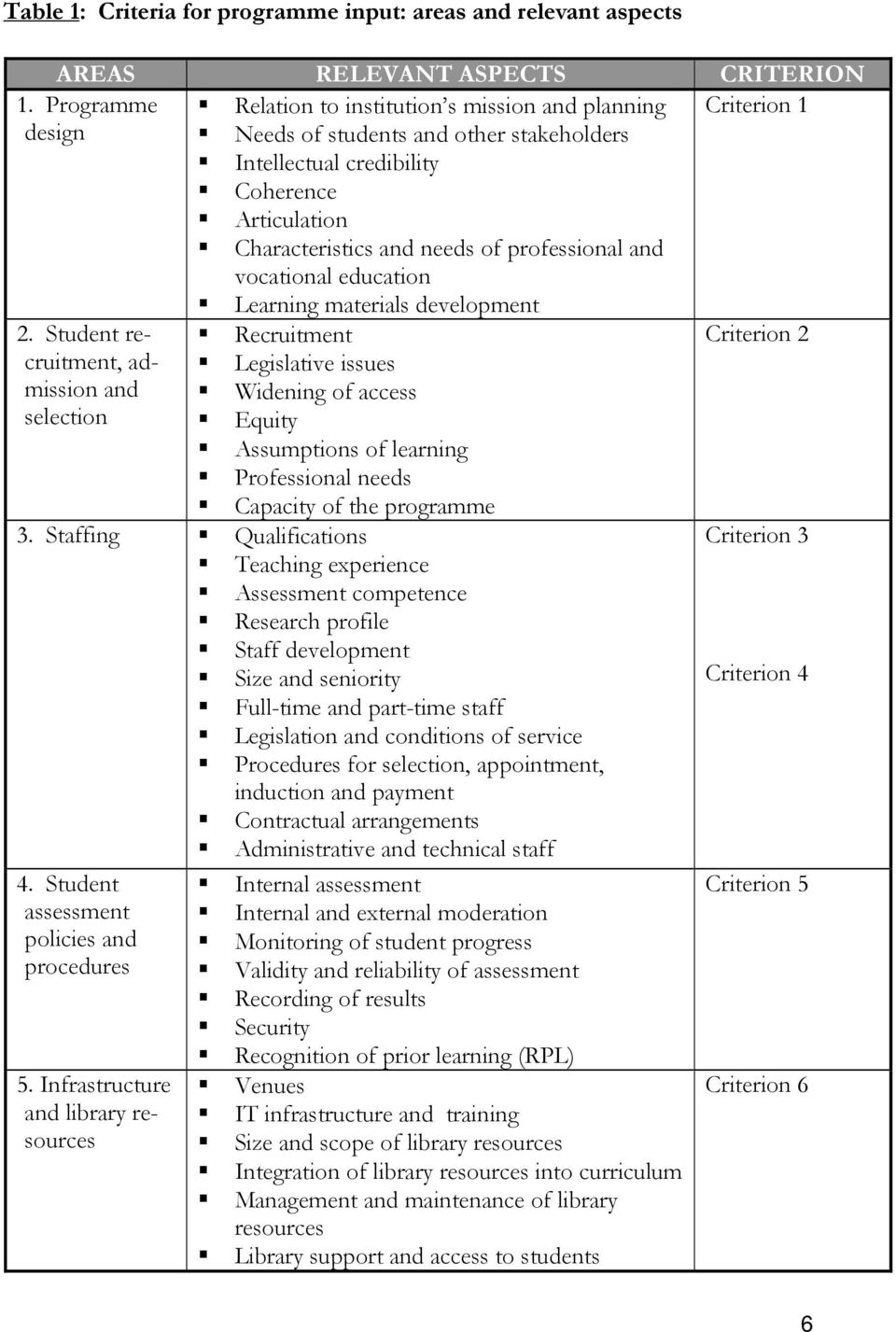
12 6. Programme administrative services 7. Postgraduate policies, regulations and procedures Provision of information Identifying non-active and at risk students Dealing with needs of a diverse student population Ensuring the integrity of certification Policies, regulations and procedures Equity and access Preparation of students Criterion 7 Criterion Programme design CRITERION 1: The programme is consonant with the institution s mission, forms part of institutional planning and resource allocation, meets national requirements, the needs of students and other stakeholders, and is intellectually credible. It is designed coherently and articulates well with other appropriate programmes, where possible. In order to meet the criterion, the following is required at minimum: (i) (ii) The programme is consonant with the institution s mission and goals and was approved by the appropriate institutional structures, including Senate / senior management. Provision is made for the programme in the institution s planning and resource allocation processes. The programme meets the requirements of the Higher Education Qualifications Framework. This includes: General qualification standards as specified in the level descriptors (e.g. Level 7 for a degree). Qualification type descriptors (e.g. for a bachelor s degree). Generic qualification standards (e.g. for the B Sc). Specific qualification standards (e.g. the B Sc (Geology)). (iii) Learning outcomes, degree of curriculum choice, teaching and learning methods, modes of delivery, learning materials and expected completion time cater for the learning needs of its target student intake. Competences expected of students successfully completing the programme are made explicit. (iv) (v) (vi) The design maintains an appropriate balance of theoretical, practical and experiential knowledge and skills. It has sufficient disciplinary content and theoretical depth, at the appropriate level, to serve its educational purposes. The design offers learning and career pathways to students with opportunities for articulation with other programmes within and across institutions, where possible. Modules and / or courses in the programme are coherently planned with regard to content, level, credits, purpose, outcomes, rules of combination, relative weight and delivery. Contractual obligations regarding aspects of delivery are not permitted. (vii) There is a policy and / or procedures for developing and evaluating learning materials and ensuring their alignment with programme goals and underpinning philosophy. Where necessary, academic staff are trained for the development of learning materials. 7
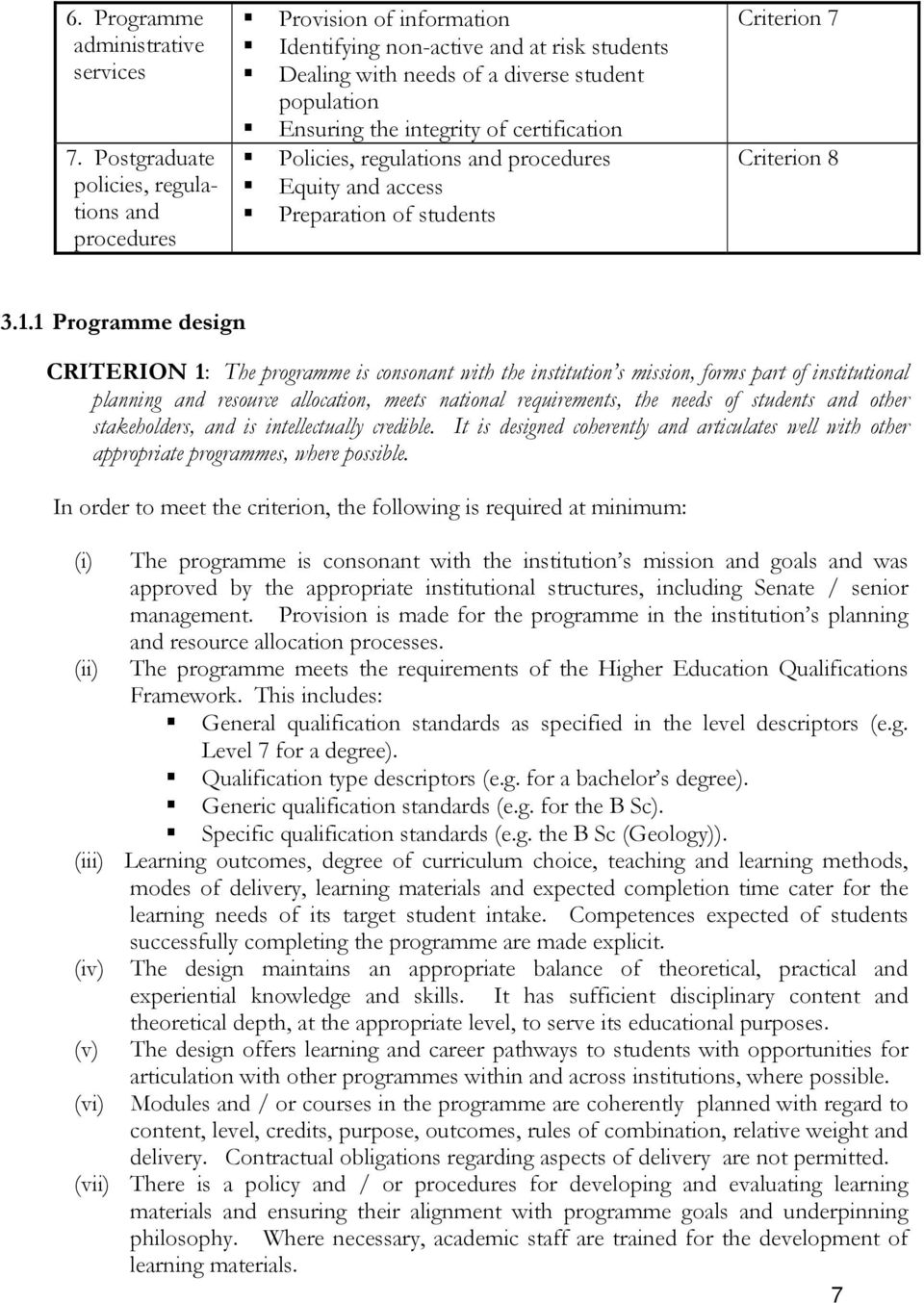
13 (viii) Programme outcomes meet national and /or regional labour market, knowledge or other socio-cultural needs. The requirements of professional bodies are taken into consideration, where applicable. Relevant stakeholders, including academic peers from outside the institution, employers and professional bodies, where applicable, are involved in the development of the programme. (ix) The characteristics and needs of professional and vocational education are catered for in the design of the programme, where applicable. This includes the following, in addition to (i) (vii) above: An understanding is promoted in the student of the specific occupation for which he/she is being trained. Techniques and skills are mastered which are required for a specific profession or occupation. Work-based learning and placement in a work-based environment form an integral part of the curriculum, where possible. 5 (x) In the case of institutions with service learning as part of their mission: - Service learning programmes are integrated into institutional and academic planning, as part of the institution s mission and strategic goals. Enabling mechanisms (which may include incentives) are in place to support the implementation of service learning, including staff and student capacity development Student recruitment, admission and selection CRITERION 2: Recruitment documentation informs potential students of the programme accurately and sufficiently, and legislation regarding admission is adhered to. Admission and selection of students are commensurate with the academic requirements of the programme, within a framework of widened access and equity. The intended learning outcomes of the programme, its capacity to offer quality education and the needs of the particular profession (in the case of professional and vocational programmes) are taken into account in the number of students selected. In order to meet the criterion, the following is required at minimum: (i) Advertising and promotional materials contain accurate and sufficient information on the programme with regard to admission policies, completion requirements and academic standards. Marketing and advertising are done according to DoE and SAQA regulations and accurate information is provided about the NQF level and the accreditation status of the programme. (ii) Legislation regarding admission, for example, matriculation exemption, age exemption, etc., is adhered to. (iii) The programme s admission criteria are in line with the NPHE s goal of widening access to higher education. Equity targets are clearly stated and the plans to attain them. Provision is made, where possible, for flexible entry routes, which includes RPL with regard to general admission requirements, as well as additional 5 In some professional fields of study, work-based learning traditionally occurs after the award of the qualification, for example in Accountancy. 8

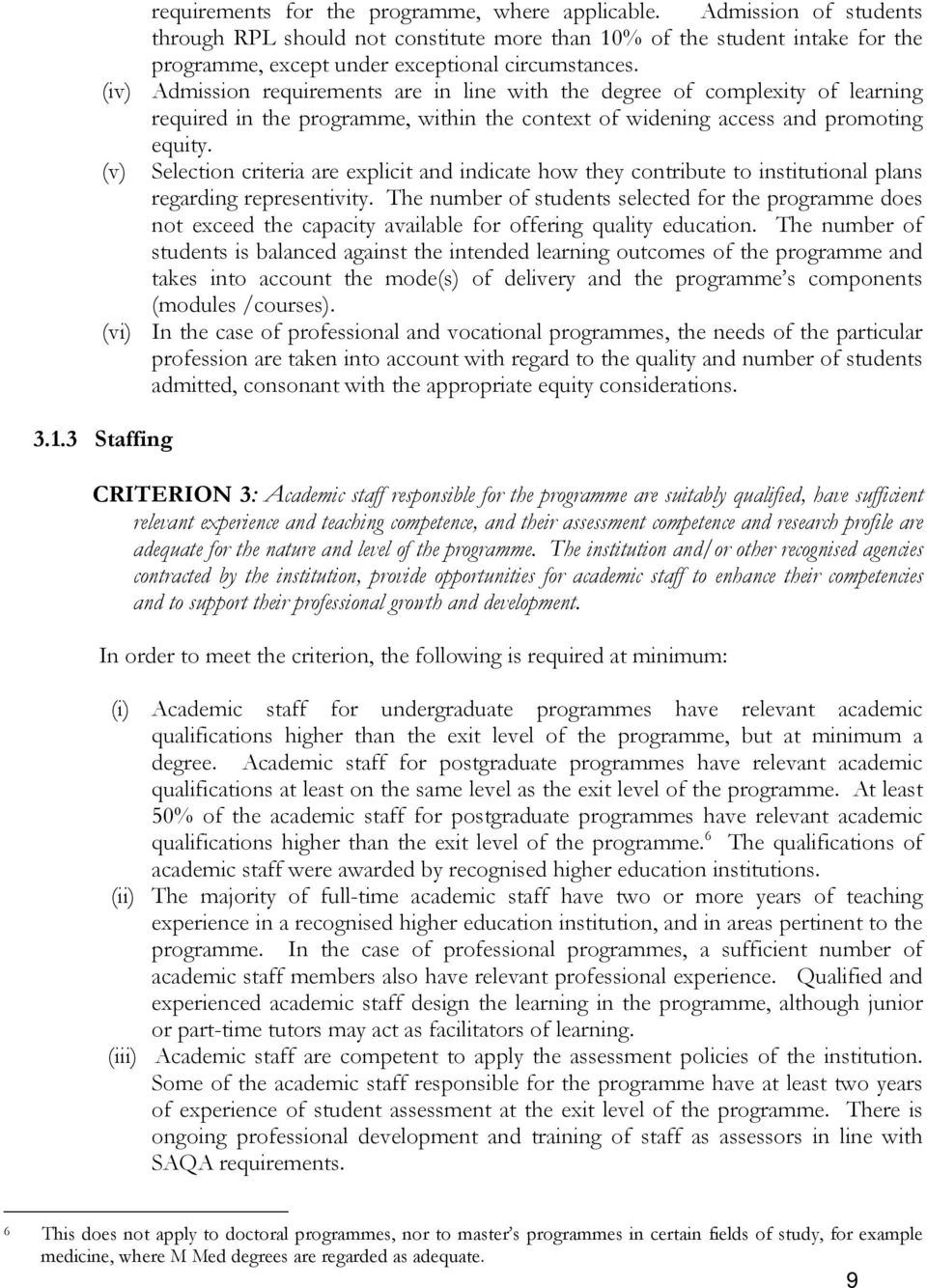
14 requirements for the programme, where applicable. Admission of students through RPL should not constitute more than 10% of the student intake for the programme, except under exceptional circumstances. (iv) Admission requirements are in line with the degree of complexity of learning required in the programme, within the context of widening access and promoting equity. (v) Selection criteria are explicit and indicate how they contribute to institutional plans regarding representivity. The number of students selected for the programme does not exceed the capacity available for offering quality education. The number of students is balanced against the intended learning outcomes of the programme and takes into account the mode(s) of delivery and the programme s components (modules /courses). (vi) In the case of professional and vocational programmes, the needs of the particular profession are taken into account with regard to the quality and number of students admitted, consonant with the appropriate equity considerations Staffing CRITERION 3: Academic staff responsible for the programme are suitably qualified, have sufficient relevant experience and teaching competence, and their assessment competence and research profile are adequate for the nature and level of the programme. The institution and/or other recognised agencies contracted by the institution, provide opportunities for academic staff to enhance their competencies and to support their professional growth and development. In order to meet the criterion, the following is required at minimum: (i) Academic staff for undergraduate programmes have relevant academic qualifications higher than the exit level of the programme, but at minimum a degree. Academic staff for postgraduate programmes have relevant academic qualifications at least on the same level as the exit level of the programme. At least 50% of the academic staff for postgraduate programmes have relevant academic qualifications higher than the exit level of the programme. 6 The qualifications of academic staff were awarded by recognised higher education institutions. (ii) The majority of full-time academic staff have two or more years of teaching experience in a recognised higher education institution, and in areas pertinent to the programme. In the case of professional programmes, a sufficient number of academic staff members also have relevant professional experience. Qualified and experienced academic staff design the learning in the programme, although junior or part-time tutors may act as facilitators of learning. (iii) Academic staff are competent to apply the assessment policies of the institution. Some of the academic staff responsible for the programme have at least two years of experience of student assessment at the exit level of the programme. There is ongoing professional development and training of staff as assessors in line with SAQA requirements. 6 This does not apply to doctoral programmes, nor to master s programmes in certain fields of study, for example medicine, where M Med degrees are regarded as adequate. 9
15 (iv) Academic staff members have research experience through their own research and/ or studies toward higher education qualifications. The area(s) of research of some of the academic staff members are relevant to the subject areas of the programme. In the case of postgraduate programmes, the research profile of the staff includes recognised research outputs. (v) The institution and / or other recognised agencies contracted by the institution, provide orientation and induction opportunities in which new academic staff members participate. Provision is made for regular staff development opportunities in which all academic staff actively participate. CRITERION 4: The academic and support staff complement is of sufficient size and seniority for the nature and field of the programme and the size of the student body to ensure that all activities related to the programme could be done effectively. An appropriate ratio exists between full-time and part-time staff and relevant legislation and appropriate administrative procedures are followed in the recruitment and employment of staff. Redress and equity considerations are accounted for in the appointment of staff. Support staff are adequately qualified and their knowledge and skills are regularly updated. In order to meet the criterion, the following is required at minimum: (i) (ii) (iii) (iv) (v) (vi) The staff: student ratio expressed as full-time equivalents is suitable for the nature and field of the programme and number of enrolled students. Sufficient support staff dedicated to the programme are available, where appropriate. An appropriate ratio exists in the programme between full-time and part-time staff to ensure working conditions conducive to teaching and learning and research. Part-time and junior staff and tutors are trained, where necessary, and monitored by full-time staff. The stipulations of the Labour Relations Act and conditions of service are adhered to with regard to recruitment and employment of staff. Appropriate administrative procedures exist for the selection, appointment, induction and payment of staff members and tutors. Redress and equity considerations receive due attention in the appointment of staff. The academic staff complement is such that it ensures that students are exposed to a diversity of ideas, styles and approaches. Contractual arrangements relating to the time and work-load of staff ensure that all programme quality assurance, teaching, research, learning support, materials development, assessment, monitoring of part-time staff (where applicable), counselling and administrative activities take place. Administrative, technical and academic development support staff are adequately qualified for their duties, and opportunities exist for staff development. (vii) For distance learning programmes, sufficient administrative and technical staff are employed to handle the specialised tasks of registry, dispatch, management of assignments, record-keeping, and other issues in relation to student needs. 10

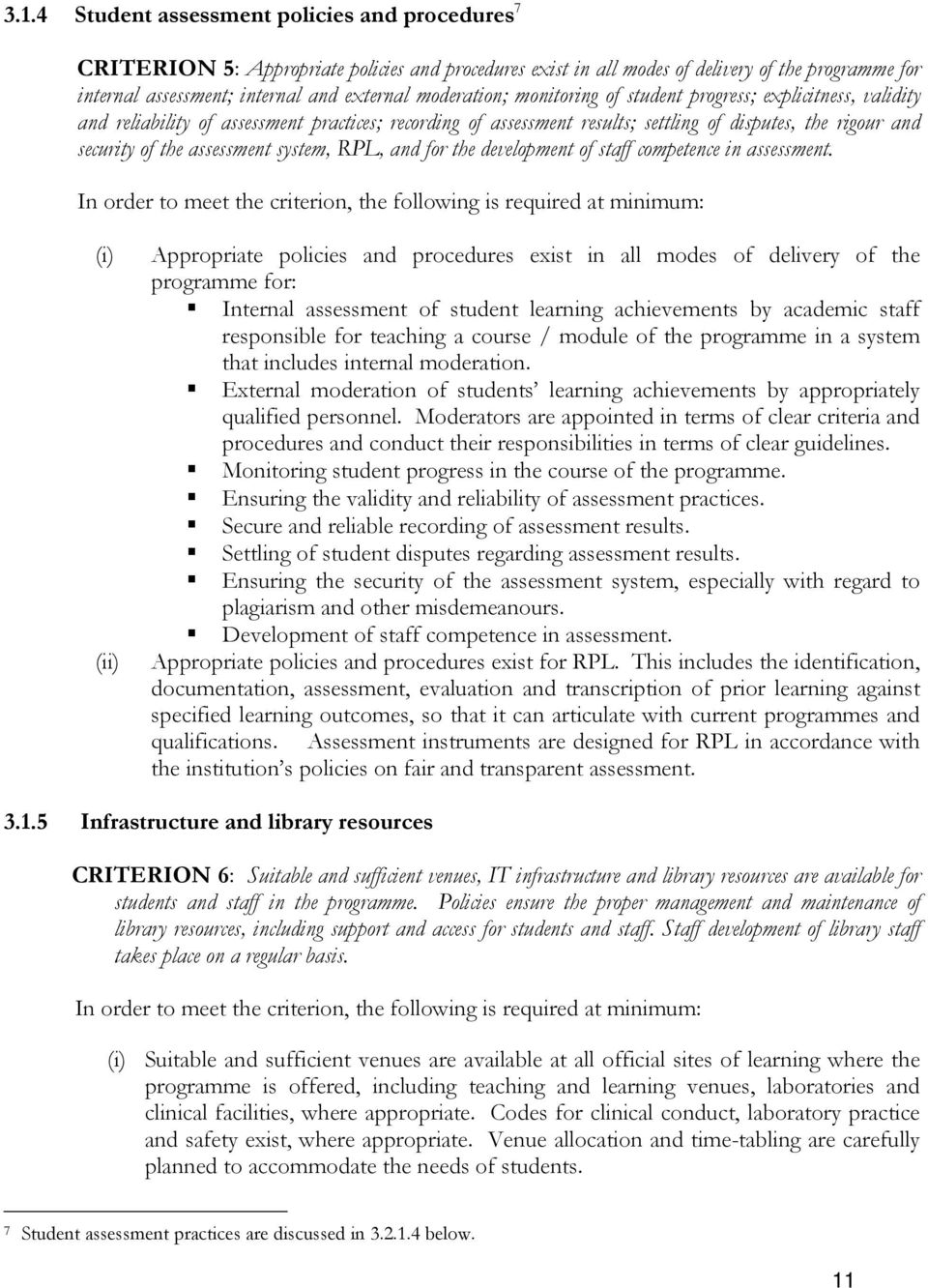
16 3.1.4 Student assessment policies and procedures 7 CRITERION 5: Appropriate policies and procedures exist in all modes of delivery of the programme for internal assessment; internal and external moderation; monitoring of student progress; explicitness, validity and reliability of assessment practices; recording of assessment results; settling of disputes, the rigour and security of the assessment system, RPL, and for the development of staff competence in assessment. In order to meet the criterion, the following is required at minimum: (i) (ii) Appropriate policies and procedures exist in all modes of delivery of the programme for: Internal assessment of student learning achievements by academic staff responsible for teaching a course / module of the programme in a system that includes internal moderation. External moderation of students learning achievements by appropriately qualified personnel. Moderators are appointed in terms of clear criteria and procedures and conduct their responsibilities in terms of clear guidelines. Monitoring student progress in the course of the programme. Ensuring the validity and reliability of assessment practices. Secure and reliable recording of assessment results. Settling of student disputes regarding assessment results. Ensuring the security of the assessment system, especially with regard to plagiarism and other misdemeanours. Development of staff competence in assessment. Appropriate policies and procedures exist for RPL. This includes the identification, documentation, assessment, evaluation and transcription of prior learning against specified learning outcomes, so that it can articulate with current programmes and qualifications. Assessment instruments are designed for RPL in accordance with the institution s policies on fair and transparent assessment Infrastructure and library resources CRITERION 6: Suitable and sufficient venues, IT infrastructure and library resources are available for students and staff in the programme. Policies ensure the proper management and maintenance of library resources, including support and access for students and staff. Staff development of library staff takes place on a regular basis. In order to meet the criterion, the following is required at minimum: (i) Suitable and sufficient venues are available at all official sites of learning where the programme is offered, including teaching and learning venues, laboratories and clinical facilities, where appropriate. Codes for clinical conduct, laboratory practice and safety exist, where appropriate. Venue allocation and time-tabling are carefully planned to accommodate the needs of students. 7 Student assessment practices are discussed in below. 11
17 (ii) Suitable and sufficient IT infrastructure, as determined by the nature of the programme, is available at all sites of learning. This includes functionally appropriate hardware (computers and printers), software (programmes) and databases. The infrastructure is properly maintained and continuously upgraded and adequate funds are available for this purpose. Students and staff are trained in the use of technology required for the programme. (iii) Suitable and sufficient library resources exist which - Complement the curriculum. Provide incentives for students to learn according to their own needs, capacity and pace. Support appropriate professional and scholarly activities of students and staff involved in the programme. (iv) Policies exist for the proper management and maintenance of library resources, as well as for their continuous renewal and expansion. These policies are integrated into the institution s financial plan. (v) On and off-campus students have adequate library support and adequate access to library research and computing facilities. (vi) Staff development takes place on a regular basis to update the knowledge and skills of library staff Programme administrative services CRITERION 7: Effective programme administrative services are in place to provide information, manage the programme information system, deal with a diverse student population, and ensure the integrity of processes leading to certification of the qualification obtained through the programme. In order to meet the criterion, the following is required at minimum: (i) The programme information system is managed effectively in order to provide reliable information on the following: Venues, time-tables, access to library and IT facilities, availability of academic and support staff for student consultations, and student support services. Information and communication needs of students in remote areas receive due attention. Records of the students in the programme, including admission, progression, grades/marks, fees and graduation. Records of students in the programme for the National Learner Records Database (NLRD) of SAQA. (ii) Effective administrative systems are in place for Identifying academically non-active students, particularly in distance education programmes. Monitoring student performance in order to ensure timely identification of at-risk students. Strategies exist for advising students about ways to improve their chances of success and for referral to appropriate academic development programmes. Rules for re-admission to programmes are clear and are sensitively applied. Dealing with the needs of a diverse student population. 12
18 (iii) Clear and efficient arrangements are in place for ensuring that the integrity of certification processes for the qualification obtained through the programme is not compromised. These include - Effective mechanisms to quality assure the processing and issuing of certificates. Effective security measures to prevent fraud or the illegal issuing of certificates Postgraduate policies, procedures and regulations 8 CRITERION 8: Appropriate policies, procedures and regulations are in place for admission and selection of students for postgraduate programmes, selection and appointment of supervisors, roles and responsibilities of supervisors and students, and for other matters relevant to postgraduate studies. In order to meet the criterion, the following is required at minimum: (i) Appropriate policies, procedures and regulations are in place for student admission, selection and assessment. These are communicated to all postgraduate students, and academic and administrative staff, and implemented consistently across the institution and programme. (ii) Selection and appointment criteria for postgraduate supervisors are in place which are acceptable to the research community in the area of study. These include the following: The supervisor has a qualification in a relevant field of study higher than or at least at the same level as the exit level of the postgraduate programme he/she is supervising. The supervisor has a relevant and appropriate research track record, as well as experience, expertise and peer recognition in the field of study. In the case of inexperienced or new supervisors, there is ongoing staff development and support, and joint supervision is explored as an option. (iii) Explicit guidelines exist on the roles and responsibilities of supervisors and students and other matters relevant to the performance of research. This includes the following: The nature, format and expected turn-around time for work submitted to the supervisor. Forms of assessment, and the communication of feedback to the student, which includes: The periodicity of contact between student and supervisor, the schedule for the submission of progress reports and written work. Research ethics, code of conduct, regulations on plagiarism and intellectual property rights. Examination and qualification requirements. 8 The delivery of postgraduate programmes are dealt with in below. 13
19 3.2 Accreditation phase Within one year after the first cohort of students has graduated from the new programme, the institution should comply with the following requirements in order to receive full accreditation for the programme. The institution should - (i) Demonstrate compliance with conditions set by the HEQC during the candidacy phase, where applicable. This includes conditions that may have been set in the HEQC s evaluation of the mid-term report of the institution. Convincing substantiation should be provided for any deviations from the conditions set. (ii) Conduct a self-evaluation of strengths and weaknesses of the programme against the HEQC s programme accreditation criteria. This includes the criteria for programme input set out in 3.1 above, as well as the criteria for programme process, programme output and impact, and programme review, which are outlined in below. (iii)submit a programme improvement plan to the HEQC, which indicates how it intends addressing deficiencies which were identified during the self-evaluation. Applications for full accreditation of a new programme will be evaluated by an HEQC panel of peers. At least one site visit will be undertaken by the HEQC during this phase Criteria for programme process Programme process includes processes and activities which have to do with the delivery of the programme. The programme has to be effectively co-ordinated in order to facilitate the attainment of its intended purposes and outcomes. Opportunities should also exist for student input and participation in the process, where relevant. Academic development plays an important role in addressing the social imperative of greater access and equity. Student and staff academic development can play a role in improving retention and graduation rates, as well as the number of students completing postgraduate qualifications, especially with regard to under-prepared students from historically disadvantaged groups. It is important that teaching and learning interactions are effective and based on sound and wellmotivated insights into the processes of teaching and learning. Teaching and learning methods, as well as learning materials, should be appropriate in order to facilitate achievement of the purposes and outcomes of the programme. Effective assessment practices, which include internal and external assessment and moderation, are critical in testing student competences in order for them to acquire the intended learning outcomes and to improve the quality of teaching and learning. The assessment system should also be reliable, rigorous and secure. 14

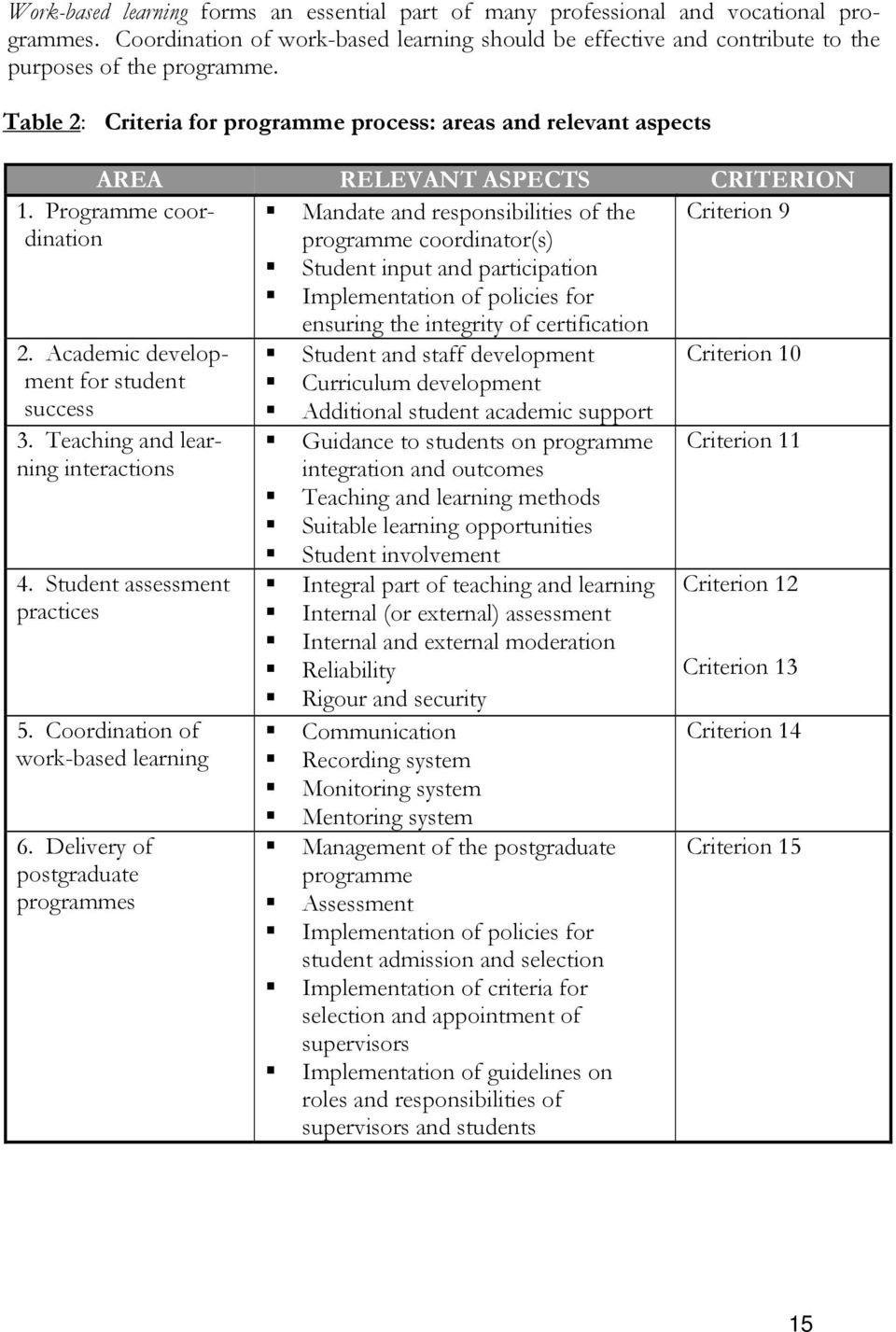
20 Work-based learning forms an essential part of many professional and vocational programmes. Coordination of work-based learning should be effective and contribute to the purposes of the programme. Table 2: Criteria for programme process: areas and relevant aspects AREA RELEVANT ASPECTS CRITERION 1. Programme coordination Mandate and responsibilities of the programme coordinator(s) Criterion 9 Student input and participation Implementation of policies for ensuring the integrity of certification 2. Academic development for student success 3. Teaching and learning interactions 4. Student assessment practices 5. Coordination of work-based learning 6. Delivery of postgraduate programmes Student and staff development Curriculum development Additional student academic support Guidance to students on programme integration and outcomes Teaching and learning methods Suitable learning opportunities Student involvement Integral part of teaching and learning Internal (or external) assessment Internal and external moderation Reliability Rigour and security Communication Recording system Monitoring system Mentoring system Management of the postgraduate programme Assessment Implementation of policies for student admission and selection Implementation of criteria for selection and appointment of supervisors Implementation of guidelines on roles and responsibilities of supervisors and students Criterion 10 Criterion 11 Criterion 12 Criterion 13 Criterion 14 Criterion 15 15
21 Programme coordination CRITERION 9: The programme is effectively co-ordinated in order to facilitate the attainment of its intended purposes and outcomes. In order to meet the criterion, the following is required at minimum: (i) An academic is identified as programme coordinator and operates within the framework of an agreed-upon mandate and defined procedures and responsibilities. This includes responsibility for: Ensuring the academic coherence and integrity of the programme and that all conditions for the delivery of the programme are met. Co-ordination of logistical and other issues regarding The day-to-day delivery of the programme. All aspects of the programme quality management system, including the provision of resources. The review of the programme and feedback with a view to improvement. Monitoring of expenditure. (ii) Opportunities exist for student input and participation in relevant aspects of programme coordination. (iii) Policies for ensuring the integrity of certification processes for the qualification obtained through the programme are effectively implemented. 9 This includes: Mechanisms for monitoring the eligibility of candidates for the award of certificates. Mechanisms for quality assuring the processing and issuing of certificates. Security measures for preventing fraud or illegal issuing of certificates Academic development for student success CRITERION 10: Academic development initiatives promote student, staff and curriculum development and offer academic support for students, where necessary. In order to meet the criterion, the following would be required at minimum: (i) Staff responsible for academic development are adequately qualified and experienced for their task and their knowledge and skills are regularly updated. (ii) Student and staff development initiatives are responsive to the needs of the students and staff. This includes foundational and skills-oriented provision for students. (iii) Curriculum development at programme and course/module level includes strategies for language skills development, numeracy and cognition which enhance students use of disciplinary discourse and skills. (iv) Additional student academic support is offered where necessary. (v) The effectiveness of academic development initiatives is regularly monitored and feedback is used for improvement. 9 See also above. 16
22 Teaching and learning interactions CRITERION 11: Effective teaching and learning methods and learning materials and suitable learning opportunities facilitate the achievement of the purposes and outcomes of the programme. In order to meet the criterion, the following is required at minimum: (i) Students are provided with guidance as to how the different components of the programme (for example, subjects, courses and / or modules) contribute to the learning outcomes of the programme. (ii) An appropriate balance and mix exist between different teaching and learning methods. Teaching and learning methods are appropriate to the design and use of the learning materials and instructional and learning technology. (iii) Suitable learning opportunities are provided to facilitate the acquisition of the knowledge, skills and attitudes specified in the programme outcomes, and within the stipulated time. (iv) Students are actively involved in the teaching and learning process. (v) Development opportunities exist for staff to upgrade their teaching methods and there is facilitation of suitable learning opportunities. (vi) The effectiveness of teaching and learning interactions is regularly monitored and the results used for improvement Student assessment practices CRITERION 12: Effective assessment practices exist which include internal (or external 10 ) assessment, as well as internal and external moderation. In order to meet the criterion, the following is required at minimum: (i) Assessment is an integral part of the teaching and learning process and is systematically and purposefully used to generate data for grading, ranking, selecting and predicting, as well as for providing timeous feedback to inform teaching and learning and to improve the curriculum. (ii) Students learning achievements are internally assessed by the academic staff responsible for teaching a course/module in terms of a system that includes internal moderation (See footnote 10 below). This includes: Academic staff who teach a course/module are responsible for designing, running and marking both formative and summative student assessments, for recording results and for feedback to students. For summative assessment, and especially where more than one marker is involved, internal moderation checks are undertaken to ensure the reliability of the assessment procedures. 10 Some institutions have a system of external assessment. 17
23 Procedures are followed to receive, record, process, and turn around assignments within a timeframe that allows students to benefit from feedback prior to the submission of further assessment tasks. (iii) Students learning achievements on the exit level of a qualification are externally moderated by appropriately qualified people who have been appointed in terms of clear criteria and procedures and who conduct their responsibilities in terms of clear guidelines. External moderation includes the following: External moderators who Are recommended by the examining academic department, and are independent experts in their fields. Have qualifications at least on the same level as the qualification being examined. Are changed every three years. Are not appointed as part of reciprocal arrangements, where possible. Are approved by Senate / equivalent body and are responsible to Senate /equivalent body. The institution provides information on the curriculum and on continuous assessment, as well as guidelines to assist external moderators in the completion of their reports. External moderators are required to fully mark at the exit level of the programme at least 10% of the examination scripts for each paper written and to do random checks of at least 20% of examination scripts for each paper. Completed external moderator reports are returned to the lecturer concerned and also to the programme coordinator or head of department/school. Problems are discussed with the lecturer concerned and the programme coordinator monitors the implementation of agreed improvements. External moderators approve the final marks list for the qualification concerned. External moderators are expected to comment on - The validity of the assessment instruments in relation to the specified learning outcomes, ideally prior to their implementation. The quality of student performance and the standard of student attainment in relation to the learning outcomes, relevant generic qualification standards and international academic/professional standards. The reliability of the marking process. Any concerns or irregularities with respect to the observation of institutional/ professional regulations. (iv) Assessment practices are effective and reliable in measuring and recording student attainment of the intended learning outcomes. This includes the following: Assessment criteria are commensurate with the level of the qualification, aligned with the requirements of the Higher Education Qualifications Framework and SAQA and, where appropriate, professional bodies, and are made explicit to staff and students. 18
24 (v) Learning activities and the required assessment performances are both aligned with learning outcomes at the programme and modular level. Learning outcomes for a programme/module and their link to assessment criteria and judgements are clearly stated and communicated to students. A range of appropriate assessment tasks are effective in measuring student attainment of the intended learning outcomes. There is at least one integrated assessment procedure for each qualification which is a valid test of the key purposes of the programme. A system is in operation for maximising the accuracy, consistency and credibility of results, including: Consistency of marking. Concurrence between assessors and external examiners on the nature and quality of the evidence which indicates achievement of learning outcomes. Students assessment records are reliable and secure. Assessment data is accessible to academic coordinators, administrators, teaching staff and students, as appropriate. RPL is done in an effective and reliable (consistent) manner. CRITERION 13: Measures are in operation which ensure the reliability, rigour and security of the assessment system. The assessment system is rigorous and secure. This includes: Institutional/faculty/professional rules governing assessment are published and clearly communicated to students and relevant stakeholders. Evidence is provided to demonstrate that these rules are widely adhered to. Breaches of assessment regulations are dealt with effectively and timeously. Students are provided with information and guidance on their rights and responsibilities regarding assessment processes (for example, definitions and regulations on plagiarism, penalties, terms of appeal, supplementary examinations, etc). Student appeals procedures are explicit, fair and effective. There are clear and consistent guidelines/regulations which are published for - Marking and grading of results. Aggregation of marks and grades. Progression and final awards. Crediting and articulation. 19
25 Coordination of work-based learning 11 CRITERION 14: The coordination of work-based learning is done effectively in all components of applicable programmes. This includes an adequate infrastructure, effective communication, recording of progress made, monitoring and mentoring. In order to meet the criterion, the following would be required at minimum: (i) (ii) (iii) Learning contracts or agreements are implemented through which the student, higher education institution and employer can negotiate, approve and assess the objectives and outcomes of the learning process. The roles and responsibilities of the various parties, i.e. the institution, students, mentors and employers, are adhered to according to the contract or agreement. Regular and effective communication takes place between the institution, students, mentors and employers involved in work-based learning. Good working relations are maintained between the various parties involved. A system (both at the institution and at the place of employment) is in operation to record and monitor regularly and systematically the progress of the student s learning experience in the workplace. (iv) A mentoring system enables the student to recognise strengths and weaknesses in his/her work, to develop existing and new abilities, and to gain knowledge of work practices Delivery of postgraduate programmes CRITERION 15: The postgraduate programme is managed properly, offers opportunities for students to develop research competence, and research is properly assessed. Policies for student admission and selection are effectively implemented, as well as criteria for the selection and appointment of supervisors, and guidelines on the roles and responsibilities of supervisors and students. In order to meet the criterion, the following is required: (i) The postgraduate programme is managed properly and offers students opportunities to develop research competence. This includes the following: A senior academic with research and postgraduate supervision experience coordinates - Research programmes, monitors the progress of postgraduate students and oversees assessment procedures. Structured master s and doctoral programmes, monitors the progress of postgraduate students and oversees assessment procedures. Training is provided in research skills, including guidance on research design and methodology. Training is also provided in language, writing and 11 In some professional programmes, e.g. Law and Theology, work-based learning does not traditionally form part of the curriculum. In some professional fields of study, work-based learning occurs after the award of the qualification, for example in Accountancy. 20
26 (ii) (iii) (iv) numeracy skills, where required. Employment-related skills are developed, where appropriate. Monitoring and review of the postgraduate system takes place regularly and includes student feedback on the quality of their learning experience, supervision and support infrastructure. Research is properly assessed, which includes the following (in addition to the requirements for assessment specified in ): At least one examiner external to the institution is appointed per dissertation/thesis. Without undermining the principle of assessment based on academic judgement, assessment decisions are made transparently and students are afforded reasonable access to information (e.g. examiners reports). There are opportunities for students to defend their theses (e.g. through an oral defence). Higher degree committees or similar structures consider examiners reports and make considered decisions about examination outcomes. Policies for student admission and selection are effectively implemented (see 3.1.7). Criteria for the selection and appointment of postgraduate supervisors are effectively implemented, as well as guidelines on the roles and responsibilities of supervisors and students (see 3.1.7) Criteria for programme output and impact Programme output and impact includes what is delivered and attained by a programme. Programmes have to be effective with regard to student retention and throughput rates, especially in relation to race and gender equity. The programme should have an impact on enhancing the employability of students and in alleviating shortages of expertise in relevant fields, in cases where these are the desired outcomes of the programme. Table 3: Criteria for programme output and impact: areas and relevant aspects AREAS RELEVANT ASPECTS CRITERION 1. Student retention and Monitoring of information Criterion 16 throughput rates Remedial action Profiles of entering and qualifying class 2. Programme impact Employment of students Criterion 17 External acknowledgement of programme CRITERION 16: Information is monitored on the student retention and throughput rates in the programme, especially in terms of race and gender equity, and remedial measures are taken, where necessary. In order to meet the criterion, the following is required at minimum: 21
27 (i) The programme coordinator has access to and monitors information on retention and throughput rates for the programme, also in terms of national benchmarks. Remedial action is taken where necessary. (ii) The profile of the qualifying class in terms of race and gender increasingly resembles that of the entering class. CRITERION 17: The programme has taken steps to have an impact on enhancing the employability of students and in alleviating shortages of expertise in relevant fields, in cases where these are the desired outcomes of the programme. In order to meet the criterion, the following is expected at minimum: (i) There is evidence that the programme attempted to have an impact on the employability of students, where these are the desired outcomes of the programme. (ii) Conscious efforts are made to get the programme acknowledged in the workplace / community and by other institutions. An improvement plan is put into operation, where necessary Criteria for programme review User surveys which gather and analyse information from different stakeholders are important instruments in evaluating the effectiveness of the programme. Examples are student satisfaction surveys, graduate tracking surveys and employer satisfaction surveys. Reviews of the effectiveness of benchmarking in the programme against equivalent quality reference points, both nationally and internationally, is a useful source of information for goal-setting and continuous self-improvement in the programme. Impact studies are important instruments for measuring and evaluating the impact of the programme on the employability of students and in alleviating shortages of expertise in relevant fields, where these are the desired outcomes of the programme. Impact studies could also ascertain the degree of acknowledgement of the programme in the community, by other institutions and in the workplace, where applicable. Table 4: Criterion for programme review: area and relevant elements AREA RELEVANT ASPECTS CRITERION Programme review User surveys Criterion 18 Reviews Impact studies Use of results CRITERION 18: User surveys, reviews and impact studies are undertaken at regular intervals with 22
28 regard to the effectiveness of the programme. Results are used, where necessary, for improvement in the programme s design, delivery and resourcing, staff development or student support. In order to meet the criterion, the following would be required at minimum: (i) (ii) (iii) (iv) (v) User surveys are undertaken at regular intervals to obtain feedback from academics involved in the programme, graduates, peers, external moderators, professional bodies and employers, where applicable, in order to ascertain whether the programme is attaining its intended outcomes. Regular reviews are undertaken of the effectiveness of benchmarking in the programme against equivalent national and international reference points with a view to goal-setting and continuous self-improvement in the programme. Student throughput and retention rates are regularly reviewed, also with regard to national requirements in this regard. Impact studies are regularly undertaken to measure and evaluate the impact of the programme and its graduates on the employability of students and in alleviating shortages of expertise in relevant fields, where these are the desired outcomes of the programme. Impact studies could also ascertain the degree of acknowledgement of the programme in the community, by other institutions and in the workplace, where applicable. Results of user surveys, reviews and impact studies are utilised in a regular evaluation of all programme aspects and to develop improvement plans. 4. Criteria for existing programmes It should be noted that, in general, existing programmes will not be re-accredited by the HEQC in its schedule of activities: Where statutory councils require reaccreditation, the HEQC will undertake this jointly with these bodies in a range of cooperation modalities. The HEQC will undertake re-accreditation of existing programmes in the time-frame , if audits or the re-accreditation of existing programmes through national reviews point to serious problem areas. The criteria for existing programmes are identical to those for new programmes and comprise also the categories of programme input, process, output and impact, and review. 12 The criteria should be used as the basis for an institution s self-evaluation of the programme(s) concerned, along with additional benchmarks which the institution might set for itself. HEQC panels of peer reviewers will use the criteria, together with the selfevaluation report and supporting evidence provided by the institution in the evaluation of existing programmes. 5. Criteria and the outcomes of programme evaluation 12 See Sections 3.1 (programme input), (programme process), (programme output and impact) and (programme review) above. 23
29 Academic programmes will be evaluated by HEQC appointed peer review panels of subject specialists against the criteria indicated above. All the criteria are regarded as relevant for ensuring and enhancing programme quality. The HEQC recognises also the need for flexibility in the interpretation of the criteria, since the relative importance and weight to be attached to specific programme areas and their related criteria may differ between certain programmes. For example, availability of advanced computer hard and software should be more crucial for a programme in computer studies than for one in philosophy. Members of the peer review panel have the responsibility to use their discipline and subject knowledge to make these judgements within the context of the programme that is evaluated. The review panel should first evaluate the programme against each individual criterion, using the following categories to classify the results in each instance: (i) Commend: All the minimum standards specified in the criterion were fully met and, in addition, good practices and innovation were identified in relation to the criterion. (ii) Meets minimum standards: Minimum standards as specified in the criterion were met. (iii) Needs improvement: Did not comply with all the minimum standards specified in the criterion. Problems/weaknesses could be addressed in a short period of time. (iv) Does not comply: Did not comply with the majority of the minimum standards specified in the criterion. The outcomes of the programme evaluation as a whole should be determined in a holistic manner and not by merely calculating the sum total of the evaluations against individual criteria. The following classification will be used for the accreditation outcomes of the programme as a whole: Table 5: Criteria, judgements and outcomes 1. New programmes (a) Candidacy phase Evaluation judgements Commend: All minimum standards specified in the criteria were met and, in addition, examples of good practice and innovation were identified in several criteria. Meets minimum standards: All minimum standards specified in the criteria were met. Needs improvement: All minimum standards specified in the criteria were not met. Problems / weaknesses could be addressed in a short period of time. Does not comply: Did not meet the majority of minimum standards specified in the criteria. Classification of accreditation outcomes Provisionally accredited. 13 Provisionally accredited. Provisionally accredited (with conditions). Not provisionally accredited. 13 New programmes are only provisionally accredited during the candidacy phase. Full accreditation is given if the criteria for the accreditation phase are met. 24
30 (b) Accreditation phase Commend: All minimum standards specified in the criteria were met and, in addition, examples of good practice and innovation were identified in several criteria. Meets minimum standards: All minimum standards specified in the criteria were met. Needs improvement: All minimum standards specified in the criteria were not met. Problems / weaknesses could be addressed in a short period of time. Does not comply: Did not meet the majority of minimum standards specified in the criteria. Accredited. Accredited. Accredited (Conditional). Not accredited. 2. Existing programmes Commend: All minimum standards specified in the criteria were met and, in addition, examples of good practice and innovation were identified in several criteria. Meets minimum standards: All minimum standards specified in the criteria were met. Needs improvement: All minimum standards specified in the criteria were not met. Problems / weaknesses could be addressed in a short period of time. Does not comply: Did not meet the majority of minimum standards specified in the criteria. Accredited. Accredited. Accredited (Conditional). Not accredited. 25
31 APPENDIX A SUMMARY OF CRITERIA FOR PROGRAMME ACCREDITATION INPUT PROCESS PROGRAMME AREAS CRITERION SECTION Programme design Student recruitment, admission and selection Staffing Student assessment policies and procedures Infrastructure and library resources Programme administrative services Postgraduate policies, regulations and procedures Programme coordination Academic development for student success Teaching and learning interactions Student assessment practices Coordination of work-based learning Delivery of postgraduate programmes Student retention and throughput rates Programme impact 3 & & OUTPUT AND IMPACT REVIEW All of the above programme areas
32 APPENDIX B PROGRAMME ACCREDITATION WITHIN THE HEQC S QUALITY ASSU- RANCE SCHEDULE: The HEQC s quality assurance activities during the cycle: are structured into Phase A ( ) and Phase B ( ). The details below indicate how programme accreditation fits into the envisaged schedule: Phase A ( ): (a) Full-scale audits commence at all public and private higher education institutions where no mergers are underway. (b) In the case of merged institutions, provision is made for a three-year settling-down period. The HEQC will undertake visits to merged institutions in the first year after the merger date, in order to ascertain the nature and level of planning for institutional and programme quality management. (c) New programmes from all public and private higher education institutions undergo accreditation processes that include site visits, in order to ensure that only programmes of good quality enter the higher education system. This includes new programmes from merged institutions. (d) In general, existing programmes are not re-accredited by the HEQC. Where professional councils or other statutory bodies require existing programmes to be reaccredited, the HEQC will undertake such re-accreditation jointly with other relevant ETQAs in a range of co-operation modalities. (e) (f) National reviews (such as the HEQC s MBA re-accreditation exercise) are undertaken in selected programme, qualification or disciplinary areas. Self-accreditation status is not granted to higher education institutions. However, institutions intending to apply for self-accreditation status in Phase B ( ) can use this opportunity to develop the necessary structures, systems and capacity for selfaccreditation. Phase B ( ): (a) (b) (c) Audits continue at all institutions not affected by mergers. Audits commence at merged institutions. Accreditation of new programmes of all institutions continues. 27
33 (d) (e) Re-accreditation of existing programmes is generally not conducted by the HEQC, except if an institution performs consistently poorly in the accreditation of new programmes, or if the audits or the re-accreditation of existing programmes through national reviews, point to serious problem areas. Institutions can apply for self-accreditation status. This status will be granted on the basis of satisfactory evidence of the effectiveness of internal quality management systems and programme quality. 14 The HEQC could undertake selective re-evaluations of existing non- professional programmes in institutions which apply for selfaccreditation status, in cases where this is deemed necessary by the HEQC. 14 For more details on self-accreditation status, see the Glossary. 28
34 GLOSSARY 15 Academic development - Also known as Educational Development. A field of research and practice that aims to enhance the quality and effectiveness of teaching and learning in higher education, and to enable institutions and the higher education system to meet key educational goals, particularly in relation to equity of access and outcomes. Academic development encompasses four interlinked areas of work: Student development (particularly foundational and skills-oriented provision), staff development, curriculum development and institutional development. Accreditation - Assessment - Audit Recognition status granted to a programme for a stipulated period of time after an HEQC evaluation indicates that it meets minimum standards of quality. Systematic evaluation of a student s ability to demonstrate the acquisition of the learning goals intended in a curriculum. See Institutional audit. Benchmarking Within a programme context, a process by which a programme is evaluated and compared against internal and external, national and international reference points, for the purposes of accountability and improvement. Community engagement - Initiatives and processes through which the expertise of the institution in the areas of teaching and research are applied to address issues relevant to its communities. Community engagement typically finds expression in a variety of forms, ranging from informal and relatively unstructured activities to formal and structured academic programmes addressed at particular community needs (See also the definition of service learning programmes). Co-operative education - A philosophy of learning that promotes the concept of enhanced learning based on co-operation between educational institutions and industry, commerce and the public sector. Course review - Internal quality assurance procedures that a provider uses to monitor and reflect on the outcomes of the education it provides through a course. The findings of course reviews should feed into the reviews of the programmes of which they are a part. 15 The definitions of terms in the Glossary refer to their use in the text of the Criteria for Programme Accreditation, and may not necessarily include other possible interpretations of the same terms. 29
35 Credit - Value assigned to a given number of notional hours of learning. One SAQA credit equals 10 notional learning hours. 120 SAQA credits are equivalent approximately to one year of full-time study. Criteria for programme accreditation - Minimum standards necessary to support and enhance the quality of teaching and learning, research and service learning programmes. Critical outcomes - Those generic outcomes determined by SAQA, which inform all teaching and learning, including but not limited to: a) Identifying and solving problems in which responses display that responsible decisions using critical and creative thinking have been made. b) Working effectively with others as a member of a team, group, organisation, community. c) Organising and managing oneself and one s activities responsibly and effectively. d) Collecting, analysing, organising and critically evaluating information. e) Communicating effectively using visual, mathematical and/or language skills in the modes of oral and/or written persuasion. f) Using science and technology effectively and critically, showing responsibility towards the environment and health of others. g) Demonstrating an understanding of the world as a set of related systems by recognising that problem-solving contexts do not exist in isolation. h) Contributing to the full personal development of each learner and the social and economic development of the society at large, by making it the underlying intention of any programme of learning to make an individual aware of the importance of: (i) Reflecting on and exploring a variety of strategies to learn more effectively. (ii) Participating as responsible citizens in the life of local, national and global communities. (iii) Being culturally and aesthetically sensitive across a range of social contexts. (iv) Exploring education and career opportunities. (v) Developing entrepreneurial opportunities. (SAQA) Education and Training Quality Assurer Body responsible for monitoring and auditing the level of achievement of national standards or qualifications offered by providers and to which specific functions have been assigned by the South African Qualification Authority (SAQA). Evaluators Examination - See Programme evaluators. A written, oral or practical assessment of learning, including supplementary examination and re-examination, continuous evaluation, and evaluation of experiential learning. 30
36 Existing programme A programme that is registered on the NQF and has been accredited by the Universities and Technikons Advisory Council (AUT), or SAQA or the HEQC. Exit-level learning outcomes - The outcomes to be achieved by a qualifying learner at the point at which he or she leaves the programme leading to a qualification. Experiential learning - A term traditionally used within the former technikon sector for workbased learning (See Work-based learning). Formative assessment - Type of assessment used to improve learning and to give feedback to students on progress made. It serves needs intrinsic to the educational process. Institutional audit An improvement orientated external evaluation of institutional arrangements for quality in teaching and learning, research and community engagement, based on a self-evaluation conducted by the institution. The external evaluation is conducted by a panel of peers and experts against the HEQC s criteria and other quality requirements set by the institution itself. The audit panel s report forms the basis of the HEQC s report to the audited institution with commendations on good practice and recommendations for improvement. Institutionally managed evaluation - Evaluation activities which are initiated, managed and financed by the institution itself. Integrated assessment A form of assessment which permits the learner to demonstrate applied competence and which uses a range of formative and summative assessment methods. Minimum standards Requirements that a programme has to meet in order to be accredited by the HEQC. Moderator - Module review - A person, apart from the examiner, that is appointed by the institution to be responsible for ensuring the standard of the examination and its accompanying marking framework and response exemplars, and for marking a representative sample of examination responses. Internal quality assurance procedures that a provider uses to monitor and reflect on the outcomes of the education it provides through a module. The findings of module and course reviews should feed into the reviews of the programmes of which they are a part. New programme A programme which has not existed before, or a programme whose purpose, outcomes, field of study, mode or site of delivery has been considerably changed. Notional hours of learning - The learning time that it is conceived it would take an average learner to meet defined learning objectives. It includes concepts such as 31
37 contact time, time spent in structured learning in the workplace and individual learning. Professional programme A programme that has to meet the licensure and other professional and work-based requirements of statutory councils. Programme Purposeful and structured set of learning experiences that leads to a qualification. Programme evaluation The external quality assurance processes undertaken to make an independent assessment of a programme s development, management and outcomes and to validate the findings of an internal programme review. Programme evaluator Subject specialist trained to undertake external evaluations of programmes. Provisional accreditation - Status granted by the HEQC to a new programme when it complies with the criteria set for the candidacy phase. Qualification - Formal recognition and certification of learning achievement awarded by an accredited institution. Quality assurance Processes of ensuring that specified standards or requirements have been achieved. Re-accreditation Accreditation of an existing programme after its former accreditation by the AUT, or SAQA or the HEQC. Recognised higher education institution - (i) A higher education institution which has formal approval in terms of the Higher Education Act, 1997 (Act No 101, 1997) to operate as a public or a private institution of higher education in South Africa. (ii) In the case of foreign institutions, an institution which has formal approval by an official body, set up or recognised by that country s government, to operate as an institution of higher education in that country and to award higher education qualifications. Adequate quality assurance mechanisms and human resources exist in that country to safeguard academic standards of qualifications. Recognition of prior learning - Formal identification, assessment and acknowledgement of the full range of a person s knowledge, skills and capabilities acquired through formal, informal or non-formal training, on-the-job or life experience. Self-accreditation status - Status granted by the HEQC to an institution for a period of six years which enables the institution to re-accredit existing programmes where no statutory council has jurisdiction. Information which will be considered by the HEQC in order to grant self-accreditation status will include the audit findings for the institution, as well as programme quality information from HEQC 32
38 sources, and other relevant information from the DoE and SAQA. The institution also has to present a quality management plan for the execution of its re-accreditation responsibilities during the period of self-accreditation. Self-evaluation - Within a programme accreditation context, self-evaluation refers to the process by which an institution critically reviews and evaluates the effectiveness of its programmes against the benchmarks of the HEQC s programme accreditation criteria and any other quality criteria that it deems relevant. The process leads to the development of the self-evaluation report. Service learning - Applied learning which is directed at specific community needs and is integrated into an academic programme and curriculum. It could be credit-bearing and assessed, and may or may not take place in a work environment. Summative assessment Formalised assessment which is used to certificate the attainment of a certain level of education. It is used to serve needs extrinsic to the educational process. Universities and Technikons Advisory Council - The AUT was the Minister of Education s advisory body for higher education during the previous political dispensation. Work-based learning - A component of a learning programme that focuses on the application of theory in an authentic, work-based context. It addresses specific competences identified for the acquisition of a qualification, which relate to the development of skills that will make the learner employable and will assist in developing his/her personal skills. Employer and professional bodies are involved in the assessment of experiential learning, together with academic staff. 33
How To Write A Programme
 Higher Education Quality Committee Criteria for Programme Accreditation NOVEMBER 2004 Council on Higher Education Higher Education Quality Committee Criteria for Programme Accreditation The Higher Education
COUNCIL ON HIGHER EDUCATION Higher Education Quality Committee
 COUNCIL ON HIGHER EDUCATION Higher Education Quality Committee Framework for Programme Accreditation August 2004 The Higher Education Quality Committee is a permanent committee of the Council on Higher
Higher Education Quality Committee. Framework for Programme Accreditation
 Higher Education Quality Committee Framework for Programme Accreditation NOVEMBER 2004 Council on Higher Education Higher Education Quality Committee Framework for Programme Accreditation The Higher Education
Accredit Accr a edit t a ion t of Progr Pr a ogr mmes by the HEQC
 Accreditation of Programmes by the HEQC Why Accreditation? In terms of the regulatory framework, all higher education programmes must be accredited by the Higher Education Quality Committee (HEQC) before
S A COUNCIL FOR THE PROPERTY VALUERS PROFESSION
 Policy and Procedures Document : S A COUNCIL FOR THE PROPERTY VALUERS PROFESSION Accreditation of University and University of Technology Programmes, leading to registration as a candidate valuer. The
SAQA LOGO: QUALIFICATION TITLE Bachelors Degree in Quantity Surveying (NQF level 7) based on Unit Standards. LEVEL: NQF level 7 CREDITS: 360 FIELD:
 QUALIFICATION TITLE Bachelors Degree in Quantity Surveying (NQF level ) based on Unit Standards SAQA LOGO: LEVEL: NQF level CREDITS: 360 FIELD: NSB 12: Physical Planning and Construction SUB-FIELD: Physical
The Midwives Council of Hong Kong. Handbook for Accreditation of Midwives Education Programs/ Training Institutes for Midwives Registration
 The Midwives Council of Hong Kong Handbook for Accreditation of Midwives Education Programs/ Training Institutes for Midwives Registration January 2012 Revised in November 2013 Contents Page I Preamble
Criteria for the Accreditation of. MBM Programmes
 Criteria for the Accreditation of MBM Programmes 1 2 1 INTRODUCTION Framework & Eligibility 1.1 This document sets out the criteria for MBM (Masters in Business & Management) programme accreditation. While
DIPLOMA IN BUSINESS ADMINISTRATION (NQF 6) (3 YEAR) CHE (HEQF) ACCREDITED QUALIFICATION SAQA ID: 88897
 DIPLOMA IN BUSINESS ADMINISTRATION (NQF 6) (3 YEAR) CHE (HEQF) ACCREDITED QUALIFICATION SAQA ID: 88897 1. Diploma in Business Administration (NQF 6) (6 Year) The PC Training & Business College (Pty) Ltd
Bachelor of Business Administration (NQF 7) (3 Years) CHE (HEQF) Accredited Qualification SAQA ID: 88921
 Bachelor of Business Administration (NQF 7) (3 Years) CHE (HEQF) Accredited Qualification SAQA ID: 88921 1. 1. Bachelor of Business Administration (NQF 7) (3 Years) The PC Training & Business College (Pty)
POLICY FOR MASTER S AND DOCTORAL DEGREES
 POLICY FOR MASTER S AND DOCTORAL DEGREES 1. INTRODUCTION 1.1 This policy should be understood and read in conjunction with the University s Tuition, Research, Admission, and Assessment Policies and the
ACADEMIC AWARD REGULATIONS Framework and Regulations for Professional Doctorates. Approval for this regulation given by :
 ACADEMIC AWARD REGULATIONS Framework and Regulations for Professional Doctorates Name of regulation : Purpose of regulation : Approval for this regulation given by : Responsibility for its update : Regulation
NATIONAL COUNCIL FOR HIGHER EDUCATION (NCHE) QUALITY ASSURANCE SYSTEM FOR HIGHER EDUCATION IN NAMIBIA (Final draft)
 NATIONAL COUNCIL FOR HIGHER EDUCATION (NCHE) QUALITY ASSURANCE SYSTEM FOR HIGHER EDUCATION IN NAMIBIA (Final draft) December 2009 ii TABLE OF CONTENTS Acronyms iv A. BACKGROUND 1 1. International trends
How To Teach An Mba
 Criteria for the Accreditation of MBA Programmes 1 2 1 INTRODUCTION Framework & Eligibility 1.1 This document sets out the criteria for MBA programme accreditation. While setting the standards that accredited
Criteria for the Accreditation of. DBA Programmes
 Criteria for the Accreditation of DBA Programmes 1 1 INTRODUCTION 1.1 This document sets out the criteria for DBA programme accreditation. While setting the standards that accredited provision is expected
EXECUTIVE SUMMARY. Audit Report on PC Training and Business College
 HIGHER EDUCATION QUALITY COMMITTEE EXECUTIVE SUMMARY Audit Report on PC Training and Business College Report of the HEQC to PC Training and Business College September 2007 Didacta Building, 211 Skinner
The Higher Education Qualifications Sub-Framework
 The Higher Education Qualifications Sub-Framework As revised January 2013 As approved by the Minister of Higher Education and Training (Notice 1040 of 2012; Government Gazette No. 36003 of 14 December
Preface STANDARDS FOR NURSING EDUCATION. POST-REGISTRATION: Advanced/Specialist Diploma, Degree and Master Degree (Nursing)
 Preface The Nurses and Midwives Act (Chapter 209) [May 2000] empowers Singapore Nursing Board (SNB) to make regulations for matters relating to the accreditation of educational programmes in nursing and
DILULUSKAN MESYUARAT MAJLIS MQA BIL. 05/2012 November 26, 2012
 GLOSSARY Academic staff refers to university personnel who are involved in teaching and research supervision (including research fellows). Administrative staff refers to university personnel who are involved
POLICY AND CRITERIA FOR THE QUALITY ASSURANCE, ACCREDITATION AND MONITORING OF INDEPENDENT SCHOOLS AND PRIVATE ASSESSMENT BODIES
 POLICY AND CRITERIA FOR THE QUALITY ASSURANCE, ACCREDITATION AND MONITORING OF INDEPENDENT SCHOOLS AND PRIVATE ASSESSMENT BODIES 1 TABLE OF CONTENTS Acronyms:......4 Chapter 1 Definitions, Purpose and
POST GRADUATE DIPLOMA IN HIGHER EDUCATION AND TRAINING (PGDHET)
 POST GRADUATE DIPLOMA IN HIGHER EDUCATION AND TRAINING (PGDHET) Course Guide 2011 Teaching and Learning Centre PGDHET Course Guide 2011 Page 1 1. of the course The purpose of the Post-Graduate Diploma
MBA ACCREDITATION CRITERIA
 MBA ACCREDITATION CRITERIA OVERARCHING THEMES Since its inception, AMBA s mission has been to promote and protect postgraduate management education internationally, with the MBA as the flagship programme.
PROGRAMME SPECIFICATION
 PROGRAMME SPECIFICATION 1. Programme Title BA (Hons) Counselling 2. Name of final Award (s) 3. Awarding body/institution 4. Teaching institution 5. Mode (s) of Delivery GENERAL INFORMATION BA (Hons) Counselling
Academic Regulations and Procedures: Policy and Principles for Accreditation of Prior Learning
 Policy and Principles for Accreditation of Prior Learning Introduction Following the publication of the Quality Assurance Agency (QAA) Guidelines on Accreditation of Prior Learning (September, 2004), a
Henley MBA by Flexible Learning For students entering in 2012/3. Relevant QAA subject Benchmarking group(s): Programme length:
 Henley MBA by Flexible Learning For students entering in 2012/3 Awarding Institution: Teaching Institution: Relevant QAA subject Benchmarking group(s): Faculty: Programme length: Date of specification:
THE HIGHER EDUCATION QUALIFICATIONS SUB-FRAMEWORK
 THE HIGHER EDUCATION QUALIFICATIONS SUB-FRAMEWORK As determined by the Minister of Higher Education and Training in accordance with section 8(2)(e) of the National Qualifications Act, 2008 (Act 67 of 2008)
Advice to the Minister of Higher Education and Training on the Status and Location of Public Colleges
 Advice to the Minister of Higher Education and Training on the Status and Location of Public Colleges March 2013 1 Quintin Brand Street, Persequor Technopark 0184; PO Box 94, Persequor Park, 0020, South
Quality Assurance and Enhancement Documentation. 1.0 Introduction. 2.0 Standard Format. 3.0 Programme Approval Form. 4.0 Validation Documentation
 Quality Assurance and Enhancement Documentation 1.0 Introduction 2.0 Standard Format 3.0 Programme Approval Form 4.0 Validation Documentation 5.0 Response to Conditions 6.0 Definitive Document 7.0 Programme
SCHOOL OF LANGUAGES AND COMMUNICATION STUDIES RULES
 SCHOOL OF LANGUAGES AND COMMUNICATION STUDIES RULES SLC1. DEFINITIONS AND EXPLANATIONS (TC\13 " B1 Definitions and Explanations) Discipline: Programme: Qualification: Syllabus: Compulsory ancillary module:
Higher Education Review Unit
 Higher Education Review Unit Programme Review Report Master of Business Administration AMA International University-Bahrain Kingdom of Bahrain Date Reviewed: 26-27 October 2011 Table of Contents 1. The
All LJMU programmes are delivered and assessed in English. Psychology
 PROGRAMME SPECIFICATION Bachelor of Science with Honours in Applied Sport Psychology Awarding institution Teaching institution UCAS Code JACS Code Programme Duration Language of Programme Subject benchmark
POLICY AND CRITERIA FOR THE QUALITY ASSURANCE OF INDEPENDENT SCHOOLS AND ASSESSMENT BODIES
 POLICY AND CRITERIA FOR THE QUALITY ASSURANCE OF INDEPENDENT SCHOOLS AND ASSESSMENT BODIES Policy and criteria for the quality assurance of independent schools and assessment bodies Page 1 TABLE OF CONTENTS
Foundation Degree (Arts) International Hospitality Management
 Foundation Degree (Arts) International Programme Specification Programme Code: 2C44 Programme valid from September 2014 Valid for delivery at: University of Derby Derby College (from September 2015) CONTENTS
PROGRAMME SPECIFICATION University Certificate Psychology. Valid from September 2012. Faculty of Education, Health and Sciences -1 -
 Faculty of Education, Health and Sciences PROGRAMME SPECIFICATION University Certificate Valid from September 2012-1 - www.derby.ac.uk/ehs CONTENTS SECTION ONE: GENERAL INFORMATION... 1 SECTION TWO: OVERVIEW
AUSTRALIAN CATHOLIC UNIVERSITY POLICY ON PROFESSIONAL DOCTORATE DEGREES
 AUSTRALIAN CATHOLIC UNIVERSITY POLICY ON PROFESSIONAL DOCTORATE DEGREES 1.0 PREAMBLE This policy sets out the general conditions for the award of Professional Doctorates by Australian Catholic University.
MBM ACCREDITATION CRITERIA
 MBM ACCREDITATION CRITERIA OVERARCHING THEMES Since its inception, AMBA s mission has been to promote and protect postgraduate management education internationally. AMBA aims to encourage students to enrol
PROGRAMME SPECIFICATION MA/MSc Psychology of Education and the MA Education (Psychology)
 PROGRAMME SPECIFICATION MA/MSc Psychology of Education and the MA Education (Psychology) Awarding Institution: Institute of Education, University of London Teaching Institution: Institute of Education,
THE PSYCHOLOGICAL SOCIETY OF IRELAND CRITERIA FOR THE ACCREDITATION OF ACADEMIC POSTGRADUATE COURSES IN FORENSIC PSYCHOLOGY
 THE PSYCHOLOGICAL SOCIETY OF IRELAND CRITERIA FOR THE ACCREDITATION OF ACADEMIC POSTGRADUATE COURSES IN FORENSIC PSYCHOLOGY May 2007 1 PSI Accreditation Guidelines for Academic Postgraduate Courses in
South African Nursing Council (Under the provisions of the Nursing Act, 2005)
 South African Nursing Council (Under the provisions of the Nursing Act, 2005) e-mail: [email protected] web: www.sanc.co.za P O Box 1123, Pretoria, 0001 Republic of South Africa Tel: 012 420-1000 Fax:
Blackburn College Teaching, Learning and Assessment Strategy. 25 August 2015
 Blackburn College Teaching, Learning and Assessment Strategy 25 August 2015 1 Introduction This document provides a Teaching, Learning and Assessment Strategy covering all of the College s Further Education
SUMMARY ACCREDITATION REPORT
 SUMMARY ACCREDITATION REPORT HONG KONG INSTITUTE OF TECHNOLOGY LEARNING PROGRAMME RE-ACCREDITATION ASSOCIATE DEGREE OF SCIENCE AND TECHNOLOGY, ASSOCIATE DEGREE OF ARTS AND ASSOCIATE DEGREE OF BUSINESS
Previous Approvals: April 5, 2005; May 6, 2008; November 2, 2010; May 3, 2011, May 3, 2011, May 7, 2013
 RYERSON UNIVERSITY POLICY OF SENATE PERIODIC PROGRAM REVIEW OF GRADUATE AND UNDERGRADUATE PROGRAMS Policy Number 126 Previous Approvals: April 5, 2005; May 6, 2008; November 2, 2010; May 3, 2011, May 3,
PROGRAMME SPECIFICATION Postgraduate Diploma / Master of Science Psychology
 Faculty of Education, Health and Sciences PROGRAMME SPECIFICATION Postgraduate Diploma / Master of Science Psychology Valid from September 2012 www.derby.ac.uk/ehs 1 CONTENTS SECTION ONE: GENERAL INFORMATION...
FACULTY OF MEDICINE: NURSING & HEALTH CARE
 Calendar 2009-10 FACULTY OF MEDICINE: NURSING & HEALTH CARE DATES OF SEMESTERS Semester 1: 21st September 2009-18th December 2009 Christmas Vacation: 1st Year, 2nd Year and 3rd Year: 21st December 2009-8th
Programme Specification. Course record information. Admissions requirements. Aims of the course
 Programme Specification Course record information Name and level of final award: Postgraduate Diploma in Professional Practice in Architecture Awarding body/institution: University of Westminster Status
Awarding Institution: Institute of Education, University of London. Teaching Institutions: Institute of Education, University of London
 PROGRAMME SPECIFICATION MSc Psychology of Education Awarding Institution: Institute of Education, University of London Teaching Institutions: Institute of Education, University of London Details of accreditation
PGCert/PGDip/MA Education PGDip/Masters in Teaching and Learning (MTL) Programme Specifications
 PGCert/PGDip/MA Education PGDip/Masters in Teaching and Learning (MTL) Programme Specifications Faculty of Education, Law and Social Sciences School of Education December 2011 Programme Specification PG
THE PSYCHOLOGICAL SOCIETY OF IRELAND CUMANN SÍCEOLAITHE ÉIREANN ACCREDITATION CRITERIA FOR POSTGRADUATE PROFESSIONAL TRAINING
 THE PSYCHOLOGICAL SOCIETY OF IRELAND CUMANN SÍCEOLAITHE ÉIREANN ACCREDITATION CRITERIA FOR POSTGRADUATE PROFESSIONAL TRAINING IN EDUCATIONAL PSYCHOLOGY DATE: 22 ND FEBRUARY 2010 Date for review: February
B.A. Honours (Psychology) Prospectus 2015
 UNIVERSITY of the WESTERN CAPE DEPARTMENT of PSYCHOLOGY Private Bag X 17, Bellville 7535, South Africa, Telephone: +27 21 959 2283/2453 (Departmental Secretaries) Telephone: +27 21 959 3095 (Psych Honours
BIRMINGHAM CITY UNIVERSITY. MA Criminology. Programme Specification
 BIRMINGHAM CITY UNIVERSITY MA Criminology Programme Specification Faculty of Education, Law and Social Sciences March 2011 Programme Specification: MA Criminology NOTE: This specification provides a concise
Guidelines for Massachusetts Early Educator Preparation Programs Participating in the Early Childhood Educator Scholarships Program.
 Guidelines for Massachusetts Early Educator Preparation Programs Participating in the Early Childhood Educator Scholarships Program Background The Departments of Higher Education and Early Education and
Quality Assurance Framework Draft Policy for the Quality Council for Trades and Occupations Department of Labour First Version 26.07.
 Quality Assurance Framework Draft Policy for the Quality Council for Trades and Occupations Department of Labour First Version 26.07.2008 Department of Labour Quality Council for Trades and Occupations
Quality Assurance Principles, Elements and Criteria
 Quality Assurance Principles, Elements and Criteria December 1998 Publication code: A0798 Published by the Scottish Qualifications Authority Hanover House, 24 Douglas Street, Glasgow G2 7NQ, and Ironmills
HND Business & Accounting. Programme Specification
 HND Business & Accounting Programme Specification Awarding Body: Teaching Institution: Final Award: Programme Title: Mode of Study: Language of Study: UCAS Code: Edexcel (BTEC) South and City College Birmingham
GENERAL REGULATIONS AND RULES
 GENERAL REGULATIONS AND RULES ISBN 978-1-77592-088-5 General regulations 2015 SECTION A GENERAL REGULATIONS This section contains the General Regulations (G Regulations) that apply to all faculties of
ROYAL HOLLOWAY University of London PROGRAMME SPECIFICATION
 ROYAL HOLLOWAY University of London PROGRAMME SPECIFICATION This document describes the Doctorate in Clinical Psychology. This specification is valid for new entrants and current students from September
NOTICE 127 OF 2014. The HEQSF-compliant qualification attached was developed in order to fill the gap that was identified in the progression from
 STAATSKOERANT, 24 OKTOBER 2014 No. 38120 3 BOARD NOTICE NOTICE 127 OF 2014 Engineering Council of South Africa Invitation to Comment on the Proposed ECSA Whole Qualification Standard ECSA 1. Background
Quality Handbook. Part B: Assuring and Enhancing Quality. Section 11: Research degrees. Section11. Nottingham Trent University
 Nottingham Trent University Quality Handbook Part B: Assuring and Enhancing Quality Section : Research degrees Contents. The postgraduate research environment... 2 2. Course monitoring and reporting...
STANDARDS: MASTERS AND DOCTORAL DEGREE BY RESEARCH AREA 1: VISION, MISSION, EDUCATION GOALS AND LEARNING OUTCOMES
 STANDARDS: MASTERS AND DOCTORAL DEGREE BY RESEARCH AREA 1: VISION, MISSION, EDUCATION GOALS AND LEARNING OUTCOMES The vision, mission education goals and learning outcomes of the HEP guide its research
Programme Specification May 2012
 Faculty of Business Computing and Law Programme Specification May 2012 MSc Accounting and Finance Valid from September 2012 JACS code N400/N300 Programme code Valid for delivery at University of Derby
Programme Specification
 Programme Specification Title: Master of Business Final Award: Master of Business Administration (MBA) With Exit Awards at: Postgraduate Certificate in Management (CMS) Diploma in Management Studies (DMS)
Standards for Registered Training Organisations (RTOs) 2015
 Standards for Registered Training Organisations (RTOs) 2015 I, Ian Elgin Macfarlane, Minister for Industry, make this legislative instrument under subsection 185(1) and subsection 186(1) of the National
GENERAL RULES FOR UNDERGRADUATE QUALIFICATIONS, POSTGRADUATE DIPLOMAS, BACHELOR HONOURS DEGREES, MASTER S DEGREES, DOCTORAL DEGREES, HIGHER
 GENERAL RULES FOR UNDERGRADUATE QUALIFICATIONS, POSTGRADUATE DIPLOMAS, BACHELOR HONOURS DEGREES, MASTER S DEGREES, DOCTORAL DEGREES, HIGHER DOCTORATES, HONORARY DEGREES AND THE CONVOCATION 2016 2 TABLE
Valid from: 2012 Faculty of Humanities and Social Sciences Oxford and Cherwell Valley College Thames Valley Police
 APPENDIX H Programme Specification Programme Specification Foundation Degree Policing Valid from: 2012 Faculty of Humanities and Social Sciences Oxford and Cherwell Valley College Thames Valley Police
London College of Business Management. Review for Educational Oversight by the Quality Assurance Agency for Higher Education
 London College of Business Management Review for Educational Oversight by the Quality Assurance Agency for Higher Education November 2012 Key findings about London College of Business Management As a result
NLNAC STANDARDS AND CRITERIA BACCALAUREATE DEGREE PROGRAMS
 NLNAC STANDARDS AND CRITERIA BACCALAUREATE DEGREE PROGRAMS I. Mission and Governance There are clear and publicly stated mission and/or philosophy and purposes appropriate to postsecondary or higher education
MANCHESTER METROPOLITAN UNIVERSITY STUDENT AND ACADEMIC SERVICES. Centre for Academic Standards and Quality Enhancement
 MANCHESTER METROPOLITAN UNIVERSITY STUDENT AND ACADEMIC SERVICES Centre for Academic Standards and Quality Enhancement Policy for the Accreditation of Prior Learning Contents Section Subject Page No. 1.
How To Manage Nursing Education
 NLNAC STANDARDS AND CRITERIA ASSOCIATE DEGREE PROGRAMS I. Mission and Governance There are clear and publicly stated mission and/or philosophy and purposes appropriate to postsecondary or higher education
Programme Specification for MSc Applied Sports Performance Analysis
 PROGRAMME SPECIFICATION Postgraduate Courses Programme Specification for MSc Applied 1. Awarding institution/body University of Worcester 2. Teaching institution University of Worcester 3. Programme accredited
Programme Specification PG Cert/ PG Dip/ MA Integrative Counselling
 Programme Specification PG Cert/ PG Dip/ MA Integrative Counselling 1. Awarding institution/body University of Worcester 2. Teaching institution The Iron Mill Institute, Exeter PCI College, Dublin 3. Programme
POLICIES, ADMINISTRATIVE PROCEDURES AND GUIDELINES ADMISSION POLICY PART ONE: ADMISSION POLICY AS FROM 2009
 POLICIES, ADMINISTRATIVE PROCEDURES AND GUIDELINES 1. INTRODUCTION ADMISSION POLICY PART ONE: ADMISSION POLICY AS FROM 2009 The University of the Western Cape has been at the forefront of South Africa
COURSE OR HONOURS SUBJECT TITLE: BSc Hons Information Technologies with/without DPP/DPP(I)/DIAS with CertHE and AB exit awards (FT)
 UNIVERSITY OF ULSTER PROGRAMME SPECIFICATION COURSE OR HONOURS SUBJECT TITLE: BSc Hons Information Technologies with/without DPP/DPP(I)/DIAS with CertHE and AB exit awards (FT) BSc Hons Information Technologies
Programme Specification
 Programme Specification Where appropriate outcome statements have be referenced to the appropriate Benchmarking Statement (BS) Awarding Institution Teaching Institution Professional body accreditation
INSTITUTIONAL ACCREDITATION SELF STUDY GUIDE INTRODUCTION
 INSTITUTIONAL ACCREDITATION SELF STUDY GUIDE INTRODUCTION Degree granting institutions in New York State may designate the New York State Board of Regents and the Commissioner of Education as their nationally
PROGRAMME SPECIFICATION. Foundation Degree (Working with Children: Education and Well-Being) Foundation Degree / Foundation Certificate
 PROGRAMME SPECIFICATION Foundation Degree (Working with Children: Education and Well-Being) Awarding institution: Institute of Education, University of London Teaching institution: Institute of Education,
UNIVERSITY OF ULSTER PROGRAMME SPECIFICATION. Honours Subject Business Studies Major and Honours Subject Business Minor
 SECTION B1 Programme Specifications UNIVERSITY OF ULSTER PROGRAMME SPECIFICATION HONOURS SUBJECT TITLE: BSc Hons Business Studies with Specialisms Honours Subject Business Studies Major and Honours Subject
RESTRICTED. Professional Accreditation Handbook For Computer Science Programmes
 Professional Accreditation Handbook For Computer Science Programmes Revised by authority of the Accreditation Committee for Computer Science Programmes as of August 2014 CONTENTS 1. FRAMEWORK FOR ACCREDITATION
UNIVERSITY OF BIRMINGHAM REGULATIONS OF THE UNIVERSITY OF BIRMINGHAM SECTION 6 - PROGRAMMES OF STUDY
 UNIVERSITY OF BIRMINGHAM REGULATIONS OF THE UNIVERSITY OF BIRMINGHAM SECTION 6 - PROGRAMMES OF STUDY Executive Brief Sets out the requirements, such as credit requirements and minimum / maximum duration,
PG Certificate Professional Practice and Management in Architecture
 Page 1 of 11 PG Certificate Professional Practice and Management in Architecture Section 1: Basic Data Awarding institution/body: UWE Teaching institution: UWE Delivery location(s): Faculty responsible
Postgraduate Certificate in Education: Dance Teaching (with QTS) Programme Specification
 Postgraduate Certificate in Education: Dance Teaching (with QTS) 1. Awarding Body University of Bath (subject to final agreement) 2. Teaching Institution (if different) 3. Final Award Postgraduate Certificate
Chapter 11. Strategic Planning, Appraisal and Staff Development
 Chapter 11 Strategic Planning, Appraisal and Staff Development 11. STRATEGIC PLANNING, APPRAISAL AND STAFF DEVELOPMENT 11.1 Strategic Planning The University of Wales: Trinity Saint David focuses on its
EVALUATION OF TEACHING AND COURSES POLICY
 University of Fort Hare Policies and Procedures EVALUATION OF TEACHING AND COURSES POLICY TITLE: Evaluation of Teaching and Courses Policy Policy no TLC 007 Approved Date approved Minute Effective Date
3. Programme accredited by Currently accredited by the BCS. 8. Date of programme specification Students entering in October 2013
 PROGRAMME SPECIFICATION FOR MSc IN COMPUTER SCIENCE 1. Awarding institution/body University of Oxford 2. Teaching institution University of Oxford 3. Programme accredited by Currently accredited by the
HIGHER EDUCATION QUALIFICATION FRAMEWORK HANDBOOK
 HIGHER EDUCATION QUALIFICATION FRAMEWORK HANDBOOK Index Page Abbreviations and Acronyms 1 1 Introduction 2 2 Timeframes: Short-Term And Long-Term 3 3 HEQF Review and the Implications 6 4 Other CHE Functions
Nursing Education Program Approval Board Standards for Alberta Nursing Education Programs Leading to Initial Entry to Practice as a Registered Nurse
 NEPAB Nursing Education Program Approval Board Standards for Alberta Nursing Education Programs Leading to Initial Entry to Practice as a Registered Nurse January 2013 Approved by the College and Association
MA in Education (Dance Teaching) Programme Specification
 MA in Education (Dance Teaching) 1. Awarding Body University of Bath (subject to final agreement) 2. Teaching Institution (if different) 3. Final Award MA in Education (Dance Teaching) 4. Programme title/route/pathway
UNIVERSITY OF ULSTER: COLERAINE PROGRAMME SPECIFICATION. COURSE TITLE: B.Sc. (HONS) SOCIAL PSYCHOLOGY/ B.Sc. (HONS) SOCIAL PSYCHOLOGY with DPP
 25 UNIVERSITY OF ULSTER: COLERAINE PROGRAMME SPECIFICATION COURSE TITLE: B.Sc. (HONS) SOCIAL PSYCHOLOGY/ B.Sc. (HONS) SOCIAL PSYCHOLOGY with DPP PLEASE NOTE: This specification provides a concise summary
INDEPENDENT TUTORIAL COLLEGE
 INDEPENDENT TUTORIAL COLLEGE SCHEME DOCUMENT BRITISH ACCREDITATION COUNCIL FOR INDEPENDENT FURTHER AND HIGHER EDUCATION COLLEGE ACCREDITATION SCHEME CONTENTS 1. INTRODUCTION...1 2. ELIGIBILITY FOR ACCREDITATION...2
BIMM Course Specification
 Full title of the course & final award Mode of attendance BA (Hons) in Event Management Full-time Length of course This course is taught as a traditional three-year course at levels four, five and six,
Programme Advisor: Post-experience Postgraduate Programmes
 Flexible Executive MBA (Henley based) (part-time) For students entering in 2013/4 Awarding Institution: Teaching Institution: Relevant QAA subject Benchmarking group(s): Faculty: Programme length: Date
UNIVERSITY OF BIRMINGHAM CODE OF PRACTICE ON EXTERNAL EXAMINING (TAUGHT PROVISION)
 UNIVERSITY OF BIRMINGHAM CODE OF PRACTICE ON EXTERNAL EXAMINING (TAUGHT PROVISION) 1 Index of points 1. Principles 2. Appointment of External Examiners 3. Induction 4. Enhancement of Quality 5. Scrutiny
Mode of Study The MPH course will be delivered full-time and part-time on campus at the Kedleston Road site
 PROGRAMME SPECIFICATION DOCUMENT SECTION ONE: GENERAL INFORMATION Programme Title/ Subject Title: Master of Public Health Award title and Interim awards: Postgraduate Certificate in Public Health Postgraduate
Calendar 2014-15 DEGREES, DIPLOMAS AND CERTIFICATES AWARDED IN CONJUNCTION WITH THE GLASGOW SCHOOL OF ART
 Calendar 2014-15 DEGREES, DIPLOMAS AND CERTIFICATES AWARDED IN CONJUNCTION WITH THE GLASGOW SCHOOL OF ART CONTENTS LIST Page Appeals by Students... 4 Introduction... 4 Degrees of Bachelor of Arts in Design,
Psychology, Early Childhood Studies, Counselling Date specification last up-dated May 2014
 Child Psychology Final award Intermediate awards available UCAS code Details of professional body accreditation BSc (Hons) Cert. HE, DipHE, BSc C823 British Psychological Society Relevant QAA Benchmark