
Management of Ill Health Policy and Procedure
|
|
|
- Alvin Dean
- 10 years ago
- Views:
Transcription
1 Management of Ill Health Policy and Procedure This Policy describes the process for Managing Ill Health Key Words: Sickness, Ill health, Fit Note, Long term, Short term, return to work, triggers, occupational health, targets, underlying condition, phased return, reasonable adjustments, stress, permitted hours, medical appointments, sick pay, industrial Injury Version: 11 Adopted by: Date adopted: Name of originator/author: Name of responsible committee: Date issued for publication: Workforce and OD Development Committee 18 th April 2012 Human Resources Workforce and OD Development Committee 1 st May 2014 Review date: May 2016 Expiry date: May 2017 Target audience: All Staff Type of Policy Clinical (tick appropriate box) NHSLA Risk Management Standards if applicable: n/a Relevant CQC Standards: 14 Non Clinical

2 CONTRIBUTION LIST Key individuals involved in developing the document Name Kshama Srivastava Vyv Wilkins Vanda Walker Designation Senior HR Business Partner Equalities and Human Rights Officer HR Business Partner Circulated to the following individuals for comments Name Kathryn Burt Human Resources Operational Team Antony Upton Richard Holmes Designation Head of HR (CHS) Senior HR Business Partners/ HR Business Partners/ Senior HR Advisors Local Counter Fraud Specialist Support Local Counter Fraud Manager HOG members LPT senior managers band 8a and above Workforce & OD Development Committee Members Policy Group Members Integrated Equality & Diversity Service Joint Staff Consultation and Negotiating Committee (JSCNC) Listening into Action focus group. 2 of 74

3 Contents POLICY Section Area Page No. Equality Statement 11 1 Summary 11 2 Introduction 11 3 Purpose, Scope and Key Principles, Training 12 PROCEDURE 4 Duties within the organisation 14 5 Certification, Monitoring & Recording Absence 18 6 Return to work 21 7 Absence triggers 22 8 Referral to Occupational Health 22 9 Procedure for dealing with short term & unrelated sickness absence Procedure for dealing with absence due to a chronic underlying medical condition or long term or permanent incapacity whether or not absence has occurred. 11 Absence due to stress or anxiety Other areas 12.1 Postponement of ill health review meetings Phased return to work - Staff returning to work due to underlying medical after condition long term sickness Permitted Work Staff still on certified sick leave 12.3 Self Elected or Cosmetic Surgery 12.4 Sickness and Annual Leave/Public Holidays 12.5 Medical appointments 12.6 Pregnancy-related sickness 12.7 Sick Pay 12.8 Industrial Injury 12.9 Absence due to IVF treatment Gender Reassignment Absence due to D&V 13 Sickness Absence Data Monitoring for Compliance and Effectiveness of 74

4 Contents continue. Section Area Page No. 15 Link to Standard/Key Performance Indicators Due Regard References Dissemination and Implementation Training 43 1 Absence from Work - First Contact Sheet 44 1a Self Certification of Sickness Absence 45 1b A Sample Statement of Fitness for Work (fit note) 46 2a Health Monitoring Form 47 2b Return to Work form 48 3a Weekly absence return form with guidance to complete 49 3b Guidance for inputting sickness on ESR using self service 49 4 Occupational Health Referral Form 50 5 Template for ill health review meeting letter 54 6 Redeployment on ill health grounds 57 7 Levels of Authority for Dismissal, Reviews and Appeal 59 8 Flowchart showing how a sickness hearing will be run 60 9 Procedure and flowchart for conducting an appeal hearing Trust s guidance on carryover of annual leave accrued during sick leave Due Regard Initial screening template NHS Constitution checklist Policy Monitoring 71 4 of 74

5 Version Control and Summary of Changes Version No 1 Date March 2012 Comments (description change and amendments) Adopted the LCCHS Managing Sickness Absence Policy and Procedure and updated accordingly /05/12 Deleted the following wording in Para Staff working in catering sections or handling food must be excluded from coming to work for a period of 48 hours after they have been symptom free and excluded from handling food for a period of further 24 hours. This has been replaced with the following; Any employee who is off sick due to D&V must be excluded from coming to work for a period of 48 hours after they have been symptom free. 17/05/12 Added clarification on Chronic underlying medical condition to be recognised under section 10 of the Procedure. The foot note states: For a Chronic underlying medical condition to be recognised under this section, it should have been diagnosed by a clinician (GP, Nurse or a hospital doctor) and the person should be under the care of their GP or another clinician 17/05/12 Additional text added to the first bullet point of Shown in red and italics: Discussions regarding how long the employee is likely to be incapacitated. Discussions regarding the level of future absences particularly in cases of short term sickness absence due to a chronic underlying condition. 17/05/12 Appendix 1a self-certificate: Deleted the following option from the reason for absences: S99 Unknown causes (not specified) 17/05/ addition of the following text in point 4 Shown in red and italics Ill health retirement will be considered if in the opinion of the Occupational Health service the employee meets the criteria for applying for ill health retirement and where the employee meets the NHS Pension Scheme length of service criteria. Where ill health retirement is an option, the application process for ill health retirement will l run concurrently with the notice period to terminate an employee s contract of employment unless the employment has been terminated with pay in lieu of notice 06/09/12 In cases of employees with special class status who are aged 55-60, termination of employment may be deferred following the result of their ill health retirement application. If their ill health retirement application is unsuccessful this deferral ill enable them to apply for special class status retirement whilst still in 5 of 74

6 employment. 17/05/12 Appendix 10 updated as follows; 6 of Where an employee has been unable to take their annual leave entitlement in the leave year due to being on sick leave for the entire leave year or because there is insufficient time left to take leave on their return from sick leave, they will be entitled to carry forward outstanding leave into the next leave year. The amount to carry forward will be calculated as specified in point 4 below. 4. Where a decision has been made to allow an employee to carry over outstanding annual leave (more than 1 week) to the next leave year, the total of the number of days leave taken during the leave year and number of days leave to be carried over cannot exceed statutory leave entitlement including any bank holidays which have been taken in the leave year. 4 22/05/12 Final version 5 31/05/12 First contact sheet amended 6 06/12/12 Under 12.5 medical appointments added the text in red and italics: Employees are expected to arrange medical appointments outside their work hours. Where this is not possible, the employees will be allowed to take time off to attend these appointments taking into account any reasonable adjustments such as adjustments of hours etc. for regular appointments. The line manager, however will need to see the proof of appointment before granting time off with pay. 7-8 Amendment to para 9.1 as follows: Where a manager has identified a problem of short term and unrelated sickness absence (patterned or sporadic) and they have established that the absences are not due to a chronic underlying condition, the manager will act in accordance with the following procedure, unless there are exceptional reasons not to do so. Where a manager is unsure whether there is an underlying medical condition they should refer the employee to Occupational Health to seek advice on this. 9 23/05/13 Paragraph and have been amended in light of the changes in national NHS terms and conditions regarding calculation of sick pay /01/14 Throughout the policy, reference has been made to the Reasonable Adjustments (RA) Policy which is now implemented (Dec14). This policy should be implemented in conjunction with the RA policy is new to account for e-rostering process Line managers are responsible for ensuring the accurate

7 7 of 74 submission of absence data to payroll. Submission can be through: 1. Where areas are rostered absence should be recorded through the E-rostering system. 2. Where managers have access to ESR supervisor self-service functionality they must ensure that absences are recorded on ESR in a timely manner. 3. Where managers have no access to electronic systems they should complete the weekly absence return form (Appendix 3) for all their employees and ensure timely submission to payroll for the previous week so SBS will input by 12 noon on the Tuesday. Managers should only submit the data using one method If an employee becomes ill whilst at work and feels too unwell to continue working, their absence from work for part of a working day will not be recorded as sickness absence for sick pay purposes. This absence however will be recorded on their health monitoring form and will be taken into account when monitoring patterns and levels of sickness absence. 9.5 There are a number of stages of formal reviews that can be held. Each stage is attached to an action. These increase in severity to reflect the size of the absence issue, but will generally start from the lowest level and progress to more serious levels if the problem is not resolved. There may be circumstances where it necessary to move straight to a formal stage of the procedure e.g. where a significant history of poor sickness absence has been identified And In stage 2 and 3 of formal review meeting, we have added that A member of the HR Operational Team will usually be present at this meeting have been separated out for clarity. We now have managing long term absence where redeployment is an option and a separate section where redeployment is not an option. Where redeployment is an option, appendix 6 provided detail and should be read in conjunction with this section added additional information to take account of the NEST pension scheme Employees undergoing self-elected surgery/procedures will normally need to use their annual leave or request unpaid special leave to cover for their absence. We have added: N.B Gender reassignment procedures are exempt please refer to Gender Re-assignment Policy. Added Employees who are required to attend Amica counselling appointments will not be required to make up the time lost.

8 Added Where the employee's absence is as a result of an injury at work, or may be attributable to their employment they should be made aware of the amended NHS Injury Benefit Scheme regulations (2013) and the Trust Guidance on NHS Injury Allowance. Please refer to section 12.8 for further details. Added Any employee who is off sick due to D&V must be excluded from coming to work for a period of 48 hours after they have been symptom free. This applies if you are off with one of the symptoms i.e. D and/or V New due regard screening template appendix 12 completed Appendix 2a added guidance on triggers Appendix 2b added prompt regarding professional registration Appendix 6 provides clearer guidance on the timing of giving notice on the redeployment process. Regardless of contractual notice, all employees will be issued with 12 weeks notice of termination at the beginning of the 12 week re-deployment period. Added Included new stage where the employee will be offered the right to a formal dismissal panel hearing. This is also included in appendix 7. Titled changed to Management of Ill Health policy and procedure and include a new section Section 10 now makes reference to procedure for dealing with chronic underlying medical condition or long term or permanent incapacity whether or not absence has occurred. Legal advice sought and they confirmed that redeployed due to disability related ill- health redeployment will attract pay protection in accordance with the Trusts pay protection provisions /04/14 Feedback from policy group comments incorporated, which include; Training paragraph and NHS Constitution checklist 08/05/ Employees must not work under any other employment arrangement (directly employed bank, agency or self-employed) with the Trust or any other employer during this time). 28/05/14 Appendix 5 amended to reflect prompt of annual leave discussion and half pay/no pay discussion /10/14 Appendix 2b amended to include prompt for discussion about support which could have been offered which would have negated the need for absence. 02/10/14 The number of days an employee has to appeal against a formal 8 of 74

9 9 of 74 warning or dismissal on grounds of ill health has been amended from 7 calendar days to 10 working days to ensure consistency with other Trust policies.

10 All LPT Policies can be provided in large print or Braille formats, if requested, and an interpreting service is available to individuals of different nationalities who require them. For further information contact: Vanda Walker, HR Business Partner, on (0116) or 10 of 74

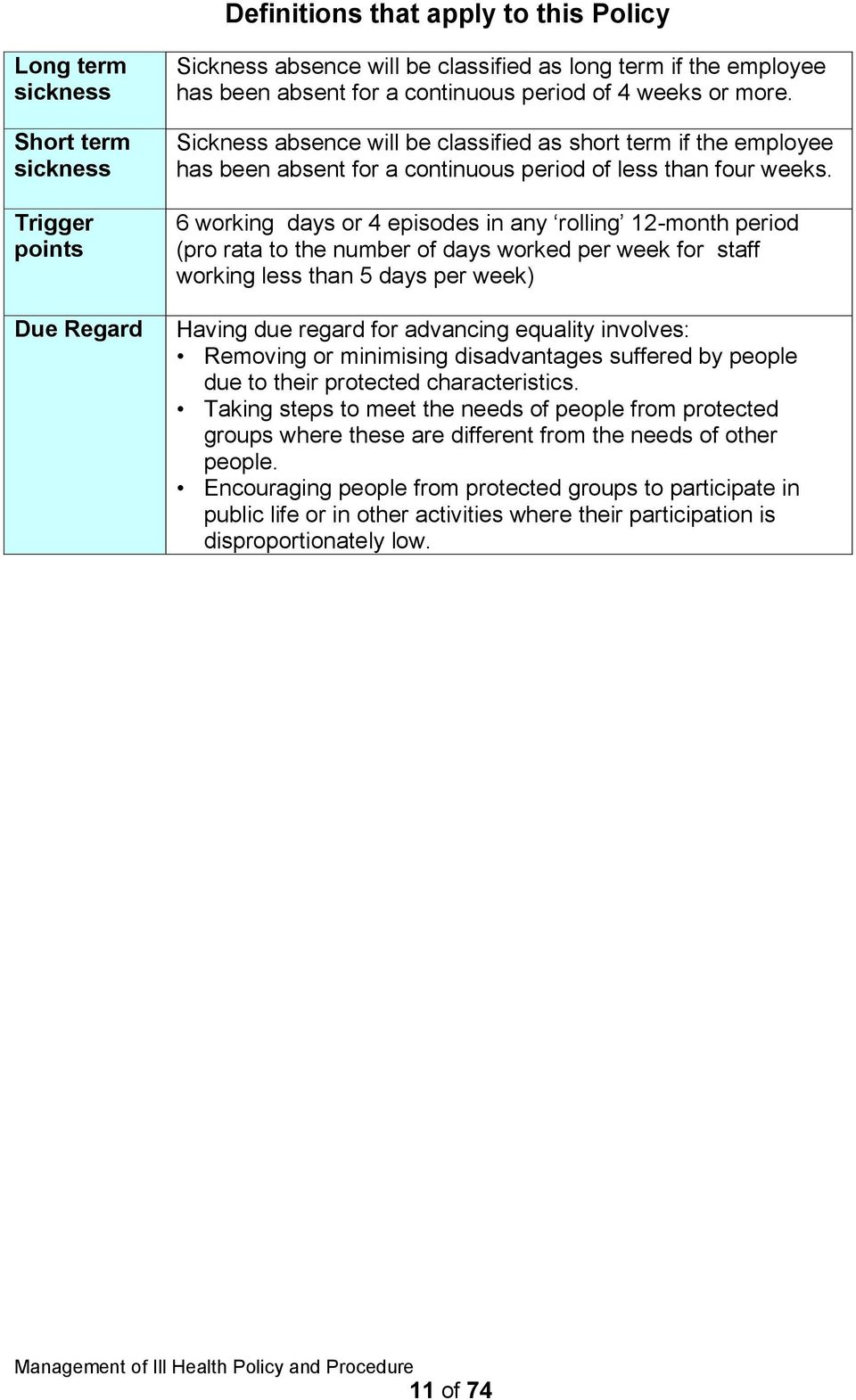
11 Definitions that apply to this Policy Long term sickness Short term sickness Trigger points Due Regard Sickness absence will be classified as long term if the employee has been absent for a continuous period of 4 weeks or more. Sickness absence will be classified as short term if the employee has been absent for a continuous period of less than four weeks. 6 working days or 4 episodes in any rolling 12-month period (pro rata to the number of days worked per week for staff working less than 5 days per week) Having due regard for advancing equality involves: Removing or minimising disadvantages suffered by people due to their protected characteristics. Taking steps to meet the needs of people from protected groups where these are different from the needs of other people. Encouraging people from protected groups to participate in public life or in other activities where their participation is disproportionately low. 11 of 74
12 Equality Statement Leicestershire Partnership NHS Trust (LPT) aims to design and implement policy documents that meet the diverse needs of our service, population and workforce, ensuring that none are placed at a disadvantage over others. It takes into account the provisions of the Equality Act 2010 and advances equal opportunities for all. This document has been assessed to ensure that no one receives less favourable treatment on the protected characteristics of their age, disability, gender reassignment, marriage and civil partnership, pregnancy and maternity, race, religion or belief, sex (gender) or sexual orientation. In carrying out its functions, LPT must have due regard to the different needs of different protected equality groups in their area. This applies to all the activities for which LPT is responsible, including policy development, review and implementation. 1.0 SUMMARY 1.1 The exists to provide a fair and consistent and compassionate approach to the management of sickness absence in the work place. 1.2 The Trust values the health and well being of its employees and aims to enable the attendance of all employees throughout the working week and provide a supportive framework on which ill Health may be managed appropriately. This proactive approach aims to support employees to remain at work. 1.3 Whilst is accepted that ill health is a part of life. The Trust acknowledges that high levels of ill health may have a detrimental effect on the level of service provided and can place an added burden on other employees. 1.4 This policy should be read in conjunction with the Trusts Reasonable Adjustment Policy. 2.0 INTRODUCTION 2.1 Leicestershire Partnership NHS Trust (LPT) recognises the valuable contribution made by every member of staff to the delivery of its services and is committed to the promotion of their health, safety and well-being. 2.2 LPT is committed to supporting employees who suffer ill health or incapacity either of a temporary or permanent nature. 2.3 Every employee has a duty to attend work regularly and report any sickness absence in accordance with their local procedure. 12 of 74
13 2.4 Managers have responsibility for monitoring and managing ill health in their area. They will be supported to do this by receiving appropriate training and advice from Human Resources. 3.0 PURPOSE, SCOPE, KEY PRINCIPLES AND TRAINING Purpose 3.1 This policy and procedure is intended to facilitate a fair and consistent approach to handling staff sickness absences. It is inevitable that staff will experience periods of ill health and require sick leave from time to time, it is important therefore that managers deal sensitively and effectively with employee absence in a sympathetic, supportive and consistent manner. 3.2 The aim of this policy and procedure is also to ensure that the Trust is aware of and records the levels of and reasons for staff sickness absence, helping to minimise the negative impact on services due to employees ill health whilst ensuring staff absence is dealt with fairly and equitably given the individual circumstances of each case. Scope 3.3 This policy applies to all employees of LPT for matters relating to incapacity through mental or physical ill health. 'Incapacity' can involve periods of prolonged absence or short term absences of an unrelated nature or caused by an identified chronic underlying condition with or without absence s. 3.4 For medical and dental staff this policy should be applied in conjunction with Maintaining High Professional Standards in the Modern NHS framework. This document can be found on the Department of Health website or accessed using the following link: DH_ Other policies might also need to be taken into account in the management of sickness absence including: Flexible working/work life balance Policies, Special Leave policy, Alcohol, Drugs and/or Other Substance Misuse, Health and Safety, Infection Control and the Reasonable Adjustment Policy. Key Principles LPT S approach to managing attendance is underpinned by the following principles and standards: 3.6 Regular attendance at work is a fundamental element contained in all contracts of employment. All staff has a duty to attend work and where they are prevented from doing so due to ill health they should report their absence as soon as possible in line with their local reporting arrangements. 13 of 74

14 3.7 All ill health will be regarded as genuine unless LPT receives evidence to the contrary. 3.8 Line Managers are responsible for managing attendance and identifying and addressing issues which impact on employees attending work. 3.9 A Return to Work meeting will be held after each period of sickness absence. The purpose of this meeting will be to provide support, to ascertain well-being of the employee, to discuss the employee s overall attendance Staff will have the right to be accompanied in formal ill health review meetings by their Staff Side Representative or a work colleague Communication between Line managers and staff is key to maintaining a positive working relationship during periods of absence. Line managers will keep in contact with staff on a regular basis. Similarly staff will ensure they keep their line manager updated regarding their sickness absence Advice and support will be sought from the Occupational Health Service to help manage ill health and improve attendance All staff will be provided with information, help and support to enable them to attend work regularly Staff will be entitled to receive statutory and occupational sick pay in line with their contract of employment and terms and conditions of service. This entitlement can however be suspended if staff do not comply with the requirements of this procedure. Training 3.15 In accordance with the classification of training outlined in the Trust Learning and Development Strategy this training has been identified as role development training Training on sickness absence management under this policy and procedure will be provided to all managers by Human Resources and/or Staff Side representatives The Training Administration Team will annotate the record of all staff for whom sickness absence management training is indicated, according to the Training Needs Analysis, with a requirement to have training in Sickness Management on the Organisation s Training database Attendance on the sickness absence management training will automatically assign competence to the individual s record once confirmation of attendance has been received. 14 of 74

15 3.19 Cases of non-compliance with the requirement to book on and attend courses to maintain competence will be reported to the Head of Service The OLM database can be utilised to provide efficient and accurate data for the monitoring of training and education activity, ensuring quality assurance mechanisms are in place. 4.0 DUTIES WITHIN THE ORGANISATION All staff are expected to accept personal responsibility for the practical implementation of this policy. Lead responsibility for the implementation of this policy will rest with each Trust Director/Divisional Director. To ensure the policy is consistently applied, co-ordinating responsibility is assigned to the Director of Workforce and OD who will have responsibility for monitoring the implementation and operation of this procedure across the Trust 4.1 Trust Board The Trust Board has a strategic responsibility to ensure that appropriate conditions at work exist to ensure the health, safety and wellbeing of Trust employees and to ensure that employees are able to maintain regular attendance The Trust Board will set the Key Performance Indicators (KPI) for sickness absence for the Trust and will review the overall sickness absence data and performance of the organisation. They will provide the strategic direction for the Trust on managing employee health and well being and sickness absence 4.2 Management responsibilities Line managers are responsible for: Supporting staff with health problems at the earliest opportunity in accordance with this policy ensuring appropriate Occupational Health advice and support is sought Maintaining accurate sickness absence records which include information such as: date/s of absence, reason, working time lost and time off due to disability leave It is essential that managers complete the health monitoring form, ensuring that all appropriate information is recorded This will enable line managers to access accurate information regarding 15 of 74

16 their staff sickness and allow them to identify absence trends and manage absence effectively Monitoring attendance and sickness absence of their employees; Putting in place locally agreed reporting procedures which include procedures for notifying absence, completion of first contact form etc; Ensuring all new employees are made aware of all locally agreed procedures as part of an employee s workplace orientation Conducting a return to work interview following each episode of absence so that advice and support can be given at an early stage (see section 6); Taking appropriate action to manage ill health effectively and in a timely manner in accordance with this policy and procedure; Obtaining advice from the Trust s Occupational Health Service where work may be impacting on an employee's health, or where health problems may be affecting an employee's attendance or work performance; Ensuring contact is maintained with employees who are absent due to ill health in order to offer appropriate advice, support and to keep them up to date with the organisational changes.; Ensuring that where ill health is attributable to an accident at work, the appropriate documentation is completed and requirements of LPT s accident reporting procedure are adhered to Ensuring that employees are treated fairly and compassionately when managing ill health; Ensuring that consideration is given to reasonable adjustments for those members of staff that require them Ensure confidentiality is maintained. 4.3 Employee Responsibilities Employees are expected to achieve acceptable levels of attendance in the workplace and to take personal responsibility for their own health and wellbeing Employees should also ensure that Health and Safety standards in their 16 of 74

17 working environment are maintained at all times and report any risks they may identify in relation to their own physical and/or mental health at work to their line manager All employees must comply with the requirements of their locally agreed reporting procedures. Employees must make themselves aware of the contents of their locally agreed reporting procedure for their area/team; In the absence of a local procedure, notification of absence should be made to the line manager as soon as possible before the commencement of duty to allow any arrangements to be made for cover; When contacting their line manager the employee will be required to provide the following information to complete the first contact form (appendix 1). Reason for absence (nature of illness/symptoms) Estimated duration of absence (where possible) Contact details Details of any urgent commitments/urgent work which needs to be covered whilst the employee is absent. Any support required It is the employee s responsibility to inform their manager (or a nominated alternative if absent) of their inability to attend for work due to illness. It is not the responsibility of a friend, family member or work colleagues to contact the manager. However it is acknowledged that in exceptional circumstances a staff member may be unable to contact the line manager themselves and therefore only in those circumstances will it be acceptable for someone else to contact the manager on their behalf. The person who contacts will need to provide the information detailed in paragraph above Employees are responsible for maintaining daily contact with their line manager whilst absent and for keeping their manager updated regarding their health, unless if there is an expected date of return. In this case, as a minimum, employees will be required to maintain weekly contact with their line manager Employees are responsible for informing their line manager of any health concerns that are affecting their ability to carry out the full duties of their role or may affect their ability to attend work on a regular basis. Employees also have a duty to discuss any reasonable adjustments that may be required for example in relation to any disability Employees are obliged to liaise with Occupational Health when required by their Line Manager. Where an employee fails to liaise with the Occupational Health service when required it may result in suspension of sick pay and disciplinary action. 17 of 74
18 Employees are required to share as much information as possible with their line manager where a period of long term absence is anticipated, e.g. for a planned operation. This should be shared prior to the absence and ideally should include the reason for absence, the anticipated duration of absence and any anticipated recovery period and any anticipated changes in capability, whether short or long term. This is to allow the Line Manager to plan for the absence and anticipate any adjustments that may be required following the absence. Appropriate confidentiality will be maintained Employees are required to attend ill health review meetings arranged under this policy. If the employee or their representatives are unable to attend a review meeting it will be rearranged once and will where ever practicable take place within one week of the original meeting. If an employee fails to attend a sickness review meeting despite repeatedly being requested to by management, this may result in suspension of sick pay and disciplinary action Employees must conduct themselves in a manner which aids their recovery An employee who fails to follow the requirements of this policy may be subject to disciplinary action LPT reserves the right to withhold occupational sick pay if an employee fails to comply with the requirements of this policy. 4.4 Human Resources/ Medical Staffing Team Human Resources Department or Medical Staffing will be responsible for: Updating this policy in light of changes e.g. changes in legislation, changes in Department of Health guidance, changes in service requirements etc Providing training, advice, assistance and support to ensure robust, consistent and fair implementation of this policy Facilitating a proactive approach to the management of sickness and improvement in attendance Providing regular sickness absence and disability leave information to the operational management, senior management team, Board etc. 4.5 Staff Side Representatives 18 of 74
19 4.5.1 Staff Side Representatives are required to provide advice and support to their members throughout the application of this policy Staff Side and management will work in partnership to reduce sickness absence, improve attendance and improve employee health and well being When accompanying their members at ill health review meetings/ hearings, staff side representative/work colleague can do the following: put the employee s case sum up the employee s case respond on behalf of the employee to any views expressed at the hearing confer with the employee during the meeting/hearing ask questions The staff side representative/work colleague can not however answer any questions on the employee s behalf. 4.6 Occupational Health The role of Occupational Health Service is to provide specialist, impartial advice on health issues in the context of the working environment. Any referrals must be undertaken in line with this procedure 5 CERTIFICATION, RECORDING & MONITORING SICKNESS ABSENCE 5.1 Certification of Absence For sickness absence of 1-7 calendar days (inclusive), including non working days, employees are required to provide a self-certification form (Appendix 1a) upon their return to work For sickness absence of 8 or more calendar days (inclusive), including non working days employees are required to obtain a Statement of Fitness for Work or Fit Note 1 from their doctor. Statement of Fitness for Work must be 1 With effect from 6 April 2010, medical certificates (Med 3 and Med 5) have been replaced with a single revised Statement of Fitness for Work (fit note). The fit note system will mean that doctors can advise that the employee is either: unfit for work; or may be fit for work. A doctor will give a may be fit for work Statement if they think that their patient s health condition may allow them to work if they get suitable support from their employer. If an employee is not fit to work the statement of fitness for work will state this. A sample Statement of Fitness for Work is included in Appendix 1b. For further information please visit 19 of 74

20 provided to the line manager within 7 calendar days of the expiry of the self certificate or last fit note In exceptional circumstances the Trust may suspend the facility for an employee to self certify sickness absence and may require a medical certificate from day one. The line manager will pick up the cost of early certification where this applies Failure to provide medical certificates in a timely manner may result in the suspension of sick pay If an employee falls sick whilst travelling abroad they must report their sickness to their line manager in the normal way and submit a medical certificate or other acceptable evidence in the country of travel (where possible in English language). Failure to provide such certification will result in non payment of sick pay and non-return of annual leave. Advice from the local consulate may be sought if applicable. 5.2 Recording If staff are unable to attend work due to sickness they must inform their line manager as soon as possible in line with local reporting procedures. Line managers will ensure that their absence is recorded accurately and in a timely manner. This will include completion of the First contact form (appendix 1) Line managers will hold a return to work interview and will complete a Health monitoring form every time an employee returns to work following a period of sickness absence Line managers are responsible for ensuring the accurate submission of absence data to payroll. Submission can be through: 2. Where areas are rostered absence should be recorded through the E-rostering system. 2. Where managers have access to ESR supervisor self-service functionality they must ensure that absences are recorded on ESR within 3 working days. 3. Where managers have no access to electronic systems they should complete the weekly absence return form (Appendix 3) for all their employees and ensure timely submission to payroll for the previous week so SBS will input by 12 noon on the Tuesday. Managers should only submit the data using one method If an employee becomes ill whilst at work and feels too unwell to continue working, their absence from work for part of a working day will not be recorded as sickness absence for sick pay purposes.. This absence however will be recorded on their health monitoring form and will be taken into account when monitoring patterns and levels of sickness absence. 20 of 74

21 5.2.5 An essential part of sickness recording is to ensure the full and correct coding of reasons for sickness absence for all days lost to sickness. This provides line managers and the Trust with information to highlight the main causes of sickness, helps to identify where patterns are emerging and enables the Trust to target and action any areas of concern. The codes for other and unknown should not be used. In exceptional circumstances advice should be sought from HR where this is being considered. 5.3 Monitoring Line managers are responsible for monitoring sickness absence levels for their teams and are responsible for periodically reviewing records to identify any trends and patterns When reviewing sickness absence line managers should determine if the absence is:- Long Term Sickness absence will be classified as long term if the employee has been absent for a continuous period of 4 weeks or more or is expected to absent a continuous period of four weeks or more. Short Term Sickness absence will be classified as short term if the employee has been absent for a continuous period of less than four weeks. Sickness absence can also be classified as: Patterned: Where patterns in sickness absence are identified e.g. sickness absence precedes or follows annual leave, non rostered days, bank holidays, weekends, particular shift patterns, or periods of night duty, etc. Sporadic: irregular or intermittent sickness absence. Planned: Where sickness absence is for a planned surgery and/or hospital admission Ill Health attributable to an industrial injury must be recorded as such and monitored When monitoring sickness absence for their area, line managers should compare the levels in their area with overall levels of sickness absence for the Trust and with other comparable areas. Appropriate action should be taken if sickness absence levels exceed targets If line managers feel that an individual s sickness absence is not genuine, they should seek advice from the Human Resources Team. If evidence is established that an employee has provided false information about their 21 of 74
22 sickness absence the disciplinary procedure will be invoked and the Trusts LCFS (Local Counter Fraud Specialist) should also be directly informed to consider a possible criminal investigation. 6 RETURN TO WORK MEETING 6.1 A return to work meeting must be conducted after each period of sickness absence regardless of duration. Where possible the line manager should meet with the employee to conduct this meeting. However where line mangers and their teams are not sited in the same location it will be acceptable to conduct this meeting by telephone. 6.2 This meeting will provide an opportunity to discuss the reason/s for sickness absence. The line manager should also use this meeting to: confirm the date when the employee was fit (this may be a non working day i.e. Saturday, Sunday etc) confirm if the employee has fully recovered and is fit to perform their duties; Where it transpires that the employee may have suffered from a condition causing memory loss or inability to remember all aspects of their work correctly, a full assessment of their ability to carry out the role in conjunction with Occupational Health and other appropriate professionals should be instigated. Where the employee s absence period is over 7 days and they have submitted a Statement of Fitness to Work (fit note), discuss with the employee their doctor s advice, in terms of the support to be provided to facilitate their return to work. If it is not possible to provide the support for the employee to return to work, the Statement should be read as if the doctor had advised not fit for work. In this case the manager should inform the employee s doctor of reasons why they were unable to accommodate their advice regarding support and what support they are able to provide instead. review any links to earlier absences; Establish if the employee has worked with another employer whilst on sick leave with the NHS establish whether it is necessary to seek occupational health advice* or seek support from other agencies; review the employees sickness absence against agreed triggers and update the employee re triggers for a formal review; update the individual on any work issues that have occurred since their absence; The return to work meeting, should be handled sensitively and take into account the employees right to medical confidentiality. Intrusive questioning should be avoided if possible. Record the meeting on a health monitoring form (Appendix 2a and 2b). *In cases of anxiety or stress-related illness, or where there appear to be links 22 of 74
23 to earlier absences line managers should refer the employee to Occupational Health service. 6.3 Line managers should take into consideration that the health of employees may be affected by a number of factors e.g. their work, personal or domestic circumstances, relationships with other team members etc. 6.4 In some instances employees may find it difficult to discuss certain problems with a manager of the opposite sex. In these cases the employee may request for these discussions to take place with someone other than the individual s own line manager with an understanding that any work related implications of the discussions will be shared with the employee s line manager. 7 ABSENCE TRIGGERS 7.1 In order to facilitate effective management of short term sickness absence an ill health review will be required if an employee has been absent from work due to sickness for 6 working days or 4 episodes in any rolling 12-month period (pro rata to the number of days worked per week for staff working less than 5 days per week). Please refer to Reasonable Adjustments Policy in respect of disability leave which is not counted as sickness leave. Formula to calculate pro rata triggers: No of days worked by the employee x 6/5 = pro rata trigger (fractions should be rounded up to the nearest whole number) 7.2 This does not preclude managers from initiating a review of absences prior to these 'trigger points' being reached where there is sufficient concern to make such action necessary. 7.3 Where an employee has triggered it may be necessary to seek Occupational Health advice prior to convening an ill health review. A referral to the Occupational Health service should be made following the return to work meeting to avoid unnecessary delays. This does not preclude managers from initiating an Occupational Health referral prior to employees reaching the triggers if necessary. Equally, when looking at short term absences managers will not as a matter of routine need to make a referral before proceeding to stage 1 i.e. setting targets if it is clear there is no underlying condition. 7.4 Long-term sickness absence will be reviewed after 4 weeks or before if Occupational Health advice is available. 8 REFERRAL TO OCCUPATIONAL HEALTH 8.1 The role of the Occupational Health Service is to provide advice to line managers on the medical condition of their staff and any impact their condition may have on their ability to attend work or perform the duties of their role. 23 of 74
24 8.2 Where advice from Occupational Health on the employees medical condition is received, this must be followed. Non medical advice received from Occupational Health should be considered on a case by case basis. 8.3 The Occupational Health Service provide advice in relation to long term health problems where prognosis for recovery is important for managers to arrange cover. The Occupational Health Service also provides advice where there are limitations on an individual s capability to perform their duties due to a disability. 8.4 The Occupational Health Service also provide advice in cases of short term persistent sickness absence and line managers require medical opinion on an employee s ability to attend work regularly. 8.5 In cases of recurrent sickness absence, the manager is able to ask the employee directly if they have a medical condition that impacts on their ability to attend work. If the answer is no, then a referral may not be needed even if they have breached the trigger as outlined within this policy and managers can proceed directly to formal stage 1 i.e. setting targets. 8.6 Breaching the trigger is an indication that management action is needed to try to reduce the employee s absence, not necessarily that a referral to OH is required. This will speed up the process in managing short term absence as line managers will not be waiting for OH advice where it is not required. 8.5 An employee can be referred to the Occupational Health by their line manager at any time when a medical assessment is required; this should be done by completing the Occupational Health Referral Form (Appendix 4). The reason for the referral should be clearly stated and specific questions should be asked. The reason for and contents of the referral must be shared with the employee who is being referred at the time of making the referral. Where it is not practical, the line manager should, as a minimum share this information with the employee at the earliest opportunity and as a must before their Occupational Health appointment. 8.6 If line managers are unsure whether a referral is appropriate they should discuss the case with the Occupational Health Service prior to implementing the referral. 8.7 An example of circumstances where Occupational Health advice may be sought is given below, it must be noted that the list is not exhaustive: Advice on sporadic absence and confirmation if it is due to chronic underlying medical condition The impact of a health problem on the employee s ability to work; Timescales for expected improvement/return to work; An opinion on the employee s ability to perform the duties of their role; Temporary or permanent reasonable adjustments to the work place or tasks that would assist in maintaining an employee s health and improve attendance; An opinion on suitability for redeployment; 24 of 74
25 An opinion on phased return to work where appropriate; An opinion if ill health retirement should be pursued; Specific questions should be asked as required 8.8 Employees can refer themselves to the Occupational Health Service at any time for advice. In these circumstances the line manager will not receive any assessment report from Occupational Health unless if the employee request the Occupational Health to share their report to the line manager or where the Occupational Health decides that failure to share the report may pose a risk to the employee or the organisation. 8.9 It is a requirement of this policy and an express term of the employees contract of employment that an employee will submit to an occupational referral and medical examination if requested to do so Where an employee fails to attend an occupational health appointment or cancels an appointment, Occupational Health will inform the relevant line manager and rearrange the appointment. Failure to attend a third appointment may lead to disciplinary action taking into account any reasonable adjustments on an individual basis. If an employee is unable to go to the Occupational Health Unit for health reasons a home visit can be arranged. Employees should be aware that if a manager, having made all reasonable attempts to obtain Occupational Health advice, is unable to do so, they will make decisions and take action without occupational health advice and on the information that is available. 9 PROCEDURE FOR DEALING WITH SHORT TERM AND UNRELATED SICKNESS ABSENCES 9.1 Where a manager has identified a problem of short term and unrelated sickness absence (patterned or sporadic) and they have established that the absences are not due to a chronic underlying condition, the manager will act in accordance with the following procedure, unless there are exceptional reasons not to do so. Where a manager is unsure whether there is an underlying medical condition they should refer the employee to Occupational Health to seek advice on this. 9.2 At all stages, managers will ensure that all relevant facts and aspects of the case are considered as far as possible and whether at any stage it is appropriate to re-categorise the absences within the policy. 9.3 There is a separate procedure for dealing with short term absence due to a chronic underlying cause and due to permanent incapacity which is outlined in section 10 below. Rights to be accompanied 9.4 At all stages of the procedure under section 9, the employee will have a right to be accompanied by either their staff side representative or by a work 25 of 74
26 colleague. In exceptional circumstances and where agreed by the Trust, the employee can be accompanied by a family member or friend. There is no right to legal representation in these meetings/hearings. Stages of formal reviews 9.5 There are a number of stages of formal reviews that can be held. Each stage is attached to an action. These increase in severity to reflect the size of the absence issue, but will generally start from the lowest level and progress to more serious levels if the problem is not resolved. There may be circumstances where it necessary to move straight to a formal stage of the procedure e.g. where a significant history of poor sickness absence has been identified. 9.6 It is also possible for a review meeting under this procedure to conclude that no formal action needs to be taken. 9.7 The stages of formal review and the range of formal action is as follows: Stage 1 Formal review meeting: Initial improvement target set Stage 2 Formal review meeting: First Written Warning Stage 3 Formal review meeting: Final Written Warning Stage 4 Final Formal review : Termination of employment (panel hearing) Stage 1 Formal Review Meeting 9.8 Where an employee s level of sickness absence has hit the trigger, and persistent absences are not due to a chronic underlying medical condition, unless reasonable justified, a stage 1 formal ill health review meeting should take place, to formally review the employee s sickness absence. 9.9 At this meeting the employee will have a right to be accompanied by their Staff Side Representative or a work colleague. A member of the Human Resources Operational Team may also attend the meeting where requested by the manager/employee 9.10 If the employee is unable to attend the review meeting, it can be rescheduled once in accordance with paragraph 12.1 of this procedure The purpose of this review meeting will be as follows: To review the member of staff's attendance record during the relevant period; 26 of 74
27 To ensure the employee is aware of their attendance record, the number of absences and the periods of good attendance in between To give the member of staff the opportunity to discuss any problems or raise any concerns; To remind the employee of the standards of attendance which are required To set a target for improvement and a period over which attendance levels will be monitored 2 To arrange for support or work adjustments if recommended by Occupational Health; To obtain the commitment of the employee to achieve the required attendance level. To inform the member of staff that If he/she fails to demonstrate agreed improvement in the levels of sickness, stage 2 review will be instigated 9.12 If, at the end of the review period, the required attendance level has been met, the employee will be informed of this and they will be encouraged to maintain this level of attendance If, however, the required improvement target has not been met, a meeting will be held under the stage two of this procedure Where it is apparent, that the employee has exceeded the improvement targets set before the end of the review period, the date of the next review and any subsequent meeting will be brought forward Notes of all ill health review meetings will be kept in the employee s personal file as an accurate record of these meetings and shared with both parties. Stage 2 Formal review meeting First Written Warning 9.16 Where the employee has not met the improvement targets set at stage 1 review meeting, stage 2 review meeting will be convened. A member of the HR Operational Team will usually be present at this meeting The employee will be given the right to be accompanied together with a minimum of 7 calendar days written notice of the date and time of the meeting. 2 Setting Targets for Improvement in Sickness Absence Levels When considering whether it is appropriate to set targets for improvement and what targets to set, it is important to ensure that individual circumstances of the employee are taken into account. The factors to consider are: Does the employee have an underlying medical condition or disability? Has any advice been received from the Occupational Health Service which needs to be implemented? Are there any reasonable workplace adjustments which need to be put in place before improvements in attendance can be expected? Is the absence related to an injury or accident at work? and Is the absence related to pregnancy? 27 of 74
28 9.18 The employee will be informed of the reason for it and be advised that they will have an opportunity at the meeting to put forward an explanation, either personally or through a representative If the employee is unable to attend the review meeting, it can be rescheduled in accordance with paragraph 12.1 this procedure At this meeting: The employee s sickness record for the relevant period will be considered. The employee will be offered the opportunity to give their reasons for exceeding the improvement targets set at stage 1 review; Discuss with the employee if any reasonable adjustments and/or additional measures of support are required; this may include a further appointment with the OH department where necessary If there are mitigating circumstances, or underlying conditions, supported by medical evidence in relation to the sickness absence under consideration, at this stage, consideration should be given to dealing with the case under section 10 of this procedure or extending the monitoring period, if required. If there are no mitigating circumstances or if management is not satisfied that the mitigation presented by the employee has sufficient bearing on their poor attendance level, the employee should be issued with a first written warning. This will stay on their file for 12 months. Further improvement targets and a review period will be set. The employee should be advised at this stage if during the review period they exceed the improvement targets set, stage 3 will be invoked. A letter will be sent to the employee to confirm the outcome of the review meeting within 7 calendar days of the review meeting. Where the employee feels that the action taken against them is unjust they can appeal against the decision. Any appeal must be made to the Head of Human Resources within 10 working days of the date of letter confirming the warning. Along with their appeal the employee must set out in writing his/her grounds for appeal (please refer to paragraph 1.2 of appendix 9), the statement of case and any other documentation which they wish the appeal panel to consider. Appeal hearing will be conducted as set out in Appendix 9. Stage 3 Formal review meeting Final written warning 9.21 Where the employee has not met the improvement targets set at stage 2 review meeting, stage 3 review meeting should be convened. The meeting 28 of 74
29 will be conducted as outlined in stage 2 review. A member of the HR Operational Team will usually be present at this meeting. At the meeting: The employee s sickness record for the relevant period will be considered. The employee will be offered the opportunity to give their reasons for exceeding the improvement targets set at stage 2 review; Attempts will be made to identify any further reasonable adjustments and/or additional measures of support; this may include a further appointment with the OH department where necessary If there are mitigating circumstances, or underlying conditions, supported by medical evidence, at this stage, consideration should be given to dealing with the case under paragraph 12.1 of this procedure or extending the monitoring period, if required. If there are no mitigating circumstances or if management is not satisfied that the mitigation presented by the employee has sufficient bearing on their poor attendance level, the employee should be issued with a final written warning. This will stay on their file for 24 months Further improvement targets and a review period will be set. The employee should be advised at this stage if during the review period they exceed the improvement targets set, stage 4 will be invoked which may result in termination of their contract of employment. A letter will be sent to the employee to confirm the outcome of the review meeting within 7 calendar days of the review meeting. Where the employee feels that the action taken against them is wrong or unjust they can appeal against the decision. Any appeal must be made to the Head of Human Resources within 10 working days of the date of letter confirming the warning. Along with their appeal the employee must set out in writing his/her grounds for appeal (please refer to paragraph 1.2 of 9), the statement of case and any other documentation which they wish the appeal panel to consider. Appeal hearing will be conducted as set out in Appendix 9. Stage 4 Final Formal review (panel hearing) Termination of Employment 9.22 If the improvement targets set out at the stage 3 review meeting have not been met, and all alternatives have been exhausted, the Manager should arrange a stage 4 final review hearing This hearing should be conducted by the appropriate senior manager with authority to dismiss (please see Appendix 7), along with a Senior HR Representative. 29 of 74
30 9.24 The employee should be given a minimum of 10 working days written notice of the hearing, informing of the reason for it and be advised that termination of contract due to persistent and short term sickness absence is one of the possible outcomes of the hearing. The management statement of case and other supporting documents should be sent to the employee at least 10 working days before the date of the hearing to enable them to formulate a response. The employee's statement of case, any witness statements and names of any witnesses the employee wishes to call should be submitted to the chair of the panel at least 5 working days before the date of the hearing If the employee is unable to attend the hearing, it can be rescheduled in accordance with paragraph 12.1 of this procedure At the hearing, the manager will be expected to describe: The nature and extent of the unsatisfactory attendance A description of the improvement targets set and actions taken to date The timescale over which the review has taken place The support provided to encourage sustained attendance, i.e. any counselling or additional support given, or any adjustments made to the nature, role or duties of the job Arrangements made to supervise and monitor the employee s attendance 9.27 The employee or their representative will have the opportunity to submit evidence or witnesses where appropriate to support their case, raise any points of explanation and to ask management any questions they feel are relevant to their case Management will also have an opportunity to ask the employee any questions they feel are relevant to the case. Panel will also be able to ask both parties questions The senior manager with authority to dismiss and HR representative will consider the facts presented and will decide whether or not to dismiss the employee. In exceptional circumstances, a further opportunity to improve as an alternative to dismissal may be offered If the employee is to be dismissed this will be with notice or with pay in lieu of notice The employee will be informed in writing of the hearing of the outcome of the stage 4 review hearing no later than 5 working days from the date of the hearing Where the employee feels that the decision to terminate their employment is unjust they can appeal against the decision. Any appeal must be made to the Head of Human Resources within 10 working days of the date of letter confirming the dismissal. Along with their appeal the employee must set out in writing his/her grounds for appeal (please refer to paragraph 1.2 of appendix 30 of 74
31 9), the statement of case and any other documentation which they wish the appeal panel to consider. Appeal hearing will be conducted as set out in Appendix The lodging of an appeal will not suspend notice of termination or actual termination. In the event of reinstatement/re-engagement following appeal, the employee will be compensated for loss of income between the date of termination and the date of reinstatement/engagement. 31 of 74
32 10.0 PROCEDURE FOR DEALING WITH A CHRONIC UNDERLYING MEDICAL CONDITION 3 OR LONG TERM OR PERMANENT INCAPACITY WHETHER OR NOT ABSENCE HAS OCCURRED Where an employee is experiencing short-term sickness absence which is due to a chronic underlying condition or permanent/long term incapacity or has permanent long term incapacity but has no periods of absence; the procedure as outlined below will be adopted Employees will normally be referred to Occupational Health Service to seek advice. In cases of short term absence due to chronic underlying condition, a referral will be made following their return to work meeting or within two weeks of the absence occurring in case of continuous absence Upon receipt of Occupational Health advice a formal ill health review meeting will be held with the employee to consider the occupational health advice and any other information to determine a way forward. Any reasonable adjustments required should be made for the meeting to take place Regular ill health review meetings should be held with the employee whether or not absence due to ill health has occurred. Where applicable review meetings should also occur before an employee goes into half sick pay and no sick pay Employees will have a right to be accompanied by their staff side representative or a work colleague A member of the Human Resources Team may also attend these meetings where requested or required The ill health review meetings may include the following: Discussions regarding how long the employee is likely to be incapacitated. Discussions regarding the level of future absences particularly in cases of short term sickness absence due to a chronic underlying condition. Discussion whether phased return to work is appropriate. Please refer to section 12 of the policy further details. Review and readjustment of an individual s duties either on a temporary or permanent basis to assist return to work and/or retain at work. Any agreement must balance the needs of the employee with the needs of the service. Where absence or incapacity is due to a disability as defined by the Equality Act 2010 line managers in consultation with HR must consider reasonable adjustment of an individual s duties. There is an obligation to 3 For a Chronic underlying medical condition to be recognised under this section, it should have been diagnosed by a clinician (GP, Nurse or a hospital doctor) and the person should be under the care of their GP or another clinician for this condition 32 of 74
33 make reasonable adjustments for a disabled employee under the Equality Act. Please refer to Reasonable Adjustments Policy for further options. If re-adjustment to an individual s duties cannot be accommodated for operational reasons or have been previously tried and showed not to work, redeployment to suitable alternative employment should be considered. Redeployment will be in line with the procedure explained in appendix 6 of this policy and procedure In exceptional cases the manager may decide at his/her discretion not to hold a review meeting or defer it. The circumstances where this may apply could include: Where the employee is due to return fully to work imminently and a return to work discussion is more appropriate. Where the nature and severity of the illness or injury is such that it is reasonable to defer the meeting to a later, more appropriate time. Where the reasons for absence and an expected date of return to work are known in advance (e.g. due to a planned operation), and the employee is still within the anticipated period of absence and where a return to work discussion may be more appropriate. If a formal review meeting is not arranged it is still important to maintain good communication between the manager and employee to update progress with recovery, agree a plan of action and discuss any changes that may affect this plan Termination of Employment on Grounds of Capability/Ill-Health where redeployment is not an option. (this section only applies in cases of long term/permanent incapacity whether or not absence has occurred or episodic absence due to a chronic underlying medical condition) After full consideration of the options as detailed in 10.7 above and only as a last resort where there is no reasonable prospect of an employee returning to work for a long time or foreseeable future (in case of long term absence) or insufficient improvement in employee sickness absence levels (in case of episodic absence due to chronic underlying medical condition/long term permanent incapacity whether there has been no absence) an employee s contract should be terminated on the grounds of incapacity/ill health. This option can be implemented before an employee has exhausted their full contractual sick pay entitlement A final review meeting will be arranged with the employee to consider all the information and give them an opportunity to state their case. This meeting will be chaired by a senior manager with the authority to dismiss (Appendix 7) accompanied by a HR Advisor/Business Partner. 33 of 74
34 The employee will be given 7 calendar days' notice of this meeting The employee will have a right to be accompanied by their staff side representative or a work colleague. If the individual or their representative is unavailable to attend the review meeting they can seek one postponement. The review meeting will be rearranged within a reasonable period of time e.g. within 7 calendar days of the original meeting It should be explained to the employee that they have the right to a formal ill health dismissal hearing. If the employee wishes to exercise this right, a hearing should be convened in accordance with appendix 8 of this policy If the employee proceeds with a formal ill health hearing, decisions regarding the termination will be made by the formal panel rather than the final review meeting If the outcome of the final review meeting is to terminate employment on grounds of ill health it will be with notice or pay in lieu of notice The review meetings outcome must be confirmed in writing. The employee will have a right to appeal against this decision Any appeal against termination of employment on the grounds of incapacity due to ill health must be made in writing with full grounds of appeal, all documentation, and list of witnesses to the Head of Human Resources within 10 working days of the date of the letter confirming the decision. Appeal hearing will be conducted as set out below in Appendix where an employee is unable to attend the final review meeting due to their ill health, it should be held in their absence. If the employee is accompanied by their staff side representative, and would like them to attend the meeting, then they should be allowed to represent the employee at this meeting ILL HEALTH RETIREMENT For Members of the NHS Pension Scheme Ill health retirement will be considered if in the opinion of the Occupational Health service the employee meets the criteria for applying for ill health retirement and where the employee meets the NHS Pension Scheme length of service criteria. Where ill health retirement is an option, the application process for ill health retirement will run concurrently with the notice period to terminate an employee s contract of employment unless where employment has been terminated with pay in lieu of notice. 34 of 74
35 In cases of employees with special class status who are aged 55-60, termination of employment may be deferred following the result of their ill health retirement application. If their ill health retirement application is unsuccessful this deferral l will enable them to apply for special class status retirement whilst still in employment. For Members of the National Employment Savings Trust (NEST) Pension Scheme Members who suffer from ill health may be able to take their money out of the NEST pension scheme before the age of 55. This will be the case if a registered medical practitioner says the member is and will continue to be incapacitated and is not able to carry on working in any occupation. In the case of serious ill health, where a registered medical practitioner says the member has less than a year to live, NEST can pay the member their retirement pot as a lump sum. This can happen at any age before 75. Where a member wishes to apply for their NEST pension early on health grounds, they must contact NEST directly to request the appropriate claim forms. Completed forms are returned directly to NEST. 11 ABSENCE DUE TO STRESS OR ANXIETY 11.1 Where an employee s absence is attributed to stress an early Occupational Health referral should be actioned to seek advice Line Managers should encourage staff to access Amica the employee assistance/counselling service. This is a self referring confidential service for all employees Where an employee s absence is attributed to stress the line manager should implement the following steps: a. Work with the employee to identify the factors causing work and nonwork related stress. Undertake a risk assessment in accordance with the Management of Stress Policy and Procedure. b. Work with the employee to explore and implement solutions to minimize Or eliminate factors causing work related stress and assist where ever possible with non-work related stress. c. It is recommended that the employee and their colleagues are involved in this exercise because they are often closest to the issues and thus best placed to develop and implement good solutions. 35 of 74
36 d. A record of discussion including the issues identified and any agreed actions should be kept. Where it is agreed that no action is required a note of this should also be kept. e. The line manager must ensure any agreed actions are implemented and evaluated to ascertain effectiveness For further details please refer to the Management of Stress Policy and Procedure. 12 OTHER AREAS 12.1 Postponement of ill health review meetings Where name of the employee s staff side representative/work colleague who will accompany them is known, ill health review meeting should be arranged at a date and time when they are available to attend. All parties should make efforts to avoid unreasonable delay when arranging a mutually convenient date and time for the meeting If the individual or their staff side representative/colleague is unable to attend a scheduled review meeting s/he may request one postponement, provided the request for postponement is made on reasonable grounds. The meeting will be rescheduled as soon as possible ideally within 5 working days of the original date. The Trust will be under no obligation to allow further postponements Phased Return and Permitted Work Phased return to work - Staff returning to work after long term sickness who have been declared fit to return to work by their GP And Permitted Work - Staff who are still signed off sick by their GP as not fit to return to work however are advised to work limited hours to determine fitness Phased Return A phased return to work is normally used for staff who have been absent from work for a long period of time (usually a number of months) and may find it difficult to do their full contractual hours or full duties straight away. This will apply when an employee has been assessed fit to return to work by their GP A period of phased return will last for a maximum of 4 weeks. Where, a longer period of phased return is recommended on medical grounds, this will be considered as an exception and on a case by case basis. 36 of 74
37 A phased return plan will be agreed by line manager and employee prior to return to work. Hours will increase incrementally over the agreed period so that the employee is working their full contractual hours by the end of the period. The plan will define duties to be performed during the phased return period. This plan will be reviewed periodically. The nature of the plan will be determined by individual circumstances. The Manager will inform the employee that they must not work under any other employment arrangement (directly employed bank, agency or self -employed) with the Trust or any other employer during this time During the period of phased return the following pay arrangements will apply: i. If on commencement of phased return employees have a minimum of 4 weeks sick pay remaining (half or full) they will receive their normal pay during the period of phased return. ii. If they have less than 4 weeks sick pay remaining at commencement of phased return employees will be paid for the hours worked as part of the phased return plan. Employees can use their annual leave or time off in lieu (TOIL) to cover any shortfall in hours. Permitted Work Permitted Work is a prescribed treatment by either Occupational Health or a GP, to assist individuals back to work whilst they remain off sick. They may attend work for no more than 15 hours per week in a supernumerary capacity to help allay any anxieties about returning to work and allow them to adjust to the work environment and develop cognitive stamina after a lengthy absence A period of permitted work will last for a maximum of 4 weeks. Where, a longer period is recommended on medical grounds, this will be considered as an exception and on a case by case basis During the period of permitted work the employee remains certified sick and could carry out tasks that differ from their normal duties and responsibilities to allay any fear or pressure of returning to work During the period of permitted work, the employee will be entitled to receive their normal sick pay entitlement, provided they have not already exhausted this. As the employee will be on certified sick leave, they will not be entitled to pay or accrue time for hours worked during the period of permitted work regardless of the situation in respect of their sick pay entitlement. 37 of 74
38 Employees must not work under any other employment arrangement (directly employed bank, agency or self-employed) with the Trust or any other employer during this time) Self Elected or Cosmetic procedure Employees undergoing self-elected surgery/procedures will normally need to use their annual leave or request unpaid special leave to cover for their absence. N.B gender reassignment procedures are exempt please refer to Gender Re-assignment Policy Absence due to cosmetic surgery may be included in the LPT s Occupational Sick Pay scheme if the surgery/procedure is a direct result of a referral on medical grounds. The employee will need to provide the proof of this referral before a decision to grant paid sick leave can be taken Sickness and Annual Leave/Public Holidays Where an employee falls sick during a period of pre arranged annual leave they will have an option to reclaim that period of annual leave provided they follow normal sickness reporting procedure and provide a fit note/s to cover the whole period for which annual leave is being reclaimed. The employee will pick up the cost of fit note if charged by their GP Where sickness absence occurs when an employee is abroad, medical certificates (or equivalent) issued abroad should be copied and sent to the manager as soon as possible if the employee intends to reclaim their annual leave. The original documents (or certified copies) must be supplied on the return to work Failure to provide the above will result in the employee not being able to reclaim their annual leave An employee on sick leave is entitled to accrue their normal annual leave during the period of sickness absence. Please refer to the Trust s guidance on carry over of annual leave accrued during sick leave (appendix 10) Where an employee s contract of employment is terminated on grounds of ill health, they will be paid in lieu for any outstanding accrued annual leave Employees will not be entitled to reclaim a statutory/public holiday if they are sick on that day Medical appointments 38 of 74
39 In the first instance, all employees are expected to arrange medical appointments outside their work hours. Where this is not possible, the employees will be allowed to take reasonable time off to attend these appointments Employees who take time off from work to attend these appointments will be required to take annual leave, time off in lieu or make up the time lost. The line manager may ask for a proof of appointment before granting time off Disabled employees, pregnant employees or those who have been diagnosed with a chronic underlying medical condition (confirmed by the Occupational Health) will not be required to make up the time lost if the medical appointment is connected with their disability, pregnancy or chronic underlying medical condition. The line manager however must see the proof of appointment before granting time off with pay Employees who are required to attend Amica counselling appointments will not be required to make up the time lost Where the line manager has sufficient grounds to believe that the employee is abusing the facility to get paid time off to attend medical appointments, the Trust will suspend the facility for the employee pending investigation into the matter under the Trust s Disciplinary Procedure and/or may refer the matter to Counter Fraud Pregnancy-related sickness Pregnancy-related sickness absence should be recorded as such and should not be taken into account when looking at setting targets under section An employee who is absent due to a pregnancy-related illness during the four week period prior to the week when the baby is due will be required to start her maternity leave, and will be entitled to maternity pay and not sick pay. Having odd days off due to pregnancy-related illness during this period may be treated as sick leave if the employee wishes to defer the start of her maternity leave provided a risk assessment does not indicate that remaining at work will endanger her pregnancy Sick Pay Employees who are absent from work due to illness will be entitled, subject to the conditions of this policy and procedure, to receive sick pay in accordance with the scale below; during the first year of service during the second year of service one month s full pay and two months half pay two months full pay and two months half pay; 39 of 74
40 during the third year of service during the fourth and fifth years of service after completing five years of service four months full pay and four months half pay; five months full pay and five months half pay Six months full pay and six months half pay In the event of employment coming to an end, entitlement to sick pay ceases from the last day of employment For staff on pay spine points 1 to 8 and those absent due to a work related injury or disease in the actual discharge of their duties and who are not in receipt of injury allowance, the definition of full pay will include regularly paid supplements, including any recruitment and retention premia, payments for work outside normal hours and high cost area supplements. Sick pay is calculated on the basis of what the individual would have received had he/she been at work. This would be based on the previous three months at work or any other reference period that may be locally agreed For staff on pay spine points 9 to 54, full pay as per NHS staffs terms and conditions is pay which is in line with the appropriate pay point in the relevant pay circular, plus high cost area supplements (if these are in payment on the day before the sickness absence begins). The pay of staff who begin a period of sickness absence before 31 March 2013, and who remain absent on this date will, from 31 March 2013 and for the remainder of the absence, be in line with this paragraph (12.7.4). Their pay during subsequent sickness absences will be in line with this paragraph (12.7.4) Full pay needs to be inclusive of any statutory benefits (so as not to make sick pay greater than normal working pay). The combined addition of statutory sick pay to half pay must not exceed full pay For employees who are on Agenda for Change terms and conditions: sick pay for those who have exhausted sick pay entitlements should be reinstated at half pay, after 12 months of continuous sickness absence, in the following circumstances: Staff with more than 5 years reckonable service - sick pay will be reinstated if sick pay entitlement is exhausted before a final review meeting for long term absence has taken place. staff with less than 5 years reckonable service - sick pay will be reinstated if sick pay entitlement is exhausted and a final review does not take place within 12 months of the start of their sickness absence. Reinstatement of sick pay should continue until the final review meeting has taken place. Reinstatement of sick pay is not retrospective for any period of zero pay in the preceding 12 months of continuous absence. 40 of 74
41 The above provisions will only apply where the failure to undertake the final review meeting is due to delay by the employer. Where a review is delayed due to reasons other than those caused by the employer these provisions will not apply An employee who is absent from work as a result of a third party accident is not entitled to sick pay if damages are received from the third party. In such cases LPT will pay the employee a sum equivalent to what would have been paid to them as sick pay. When the employee receives damages they will be required to repay this sum to LPT. Once the sum is repaid the absence shall not be taken into account for the calculation of sick pay allowances. However the period of absence will be recorded as sick leave for monitoring and absence management purposes Where the employee has received a compensation for loss of earnings, their failure to repay sick pay to LPT would lead to referral to the Local Counter Fraud Specialist and disciplinary action taken by the Trust Where an employee is moving into a half pay or no pay situation, they will be informed of this in advance of the pay day Sick pay will not be paid for absences caused by accidents due to active participation in sport as a profession, or where contributable negligence is proved. Where this is the case, the manager must liaise with HR for advice Where the employee's absence is as a result of an injury at work, or may be attributable to their employment they should be made aware of the Trust Guidance on NHS Injury Allowance. Please refer to the Trust Guidance on NHS Injury Allowance and section 12.8 below for further details There is no right is no right for an employee to exhaust the their entitlement to sick pay under the Trust s Sick Pay Scheme prior to termination. The Trust may terminate employment before an employee has reached the end of the contracted paid sickness absence period. Such a decision will be made on an individual case basis Industrial Injury Industrial injury is an accident which occurs in the course of an employee s work and causes personal injury. An industrial injury may also be caused by an environmental issue (e.g. chemical reaction) that leads to a period of sickness absence. 41 of 74
42 The employee must report the details of the accident/incident in line with LPT S accident reporting procedures. The line manager must comply with the RIDDOR 4 requirement. (where applicable) Appropriate absence code must be used on weekly absence return forms or on ESR (for those using self service) to record industrial injury. Employees may be entitled to claim Injury Allowance. Please refer to the Trust Guidance on NHS Injury Allowance 12.9 Absence due to IVF treatment The employee will be required to take their own time off from work (time owing, annual leave or unpaid leave etc.) to undergo IVF treatment. Normal rules for requesting leave will apply However, if an employee is ill as a result of the treatment and has to take time off then they will be entitled to sick leave. Normal rules for reporting sick leave and certification will apply Gender Reassignment Any periods of absence resulting directly from the process of gender reassignment (planned care) will be treated as being due to underlying medical condition and will not count towards attendance triggers Where gender reassignment process includes receiving medical treatment such as surgery, absence due to this will be treated the same as sickness absence due to any other medical intervention Absence due to Diarrhoea and Vomiting (D&V) Any employee who is off sick due to D&V must be excluded from coming to work for a period of 48 hours after they have been symptom free. This applies if you are off with one of the symptoms i.e. D and/or V During the 48 symptom-free period when the employee is not allowed to attend a place of work, the line manager should contact the employee to explore options of working from home or adjustment to rostered days off Where these options have been explored however not feasible, 48 hour symptom free period should be classed as special leave with pay For the purpose of recording sickness absence due to D&V the following rules must be followed: 4 Reporting of Injuries, Diseases and Dangerous Occurrences Regulations 1995 (RIDDOR) 42 of 74
43 The days when the employees is absent from work because they were suffering with D&V symptoms should be recorded on ESR as normal sick leave with appropriate code and reason. Where working from home option has not been used, the 48 hour symptom free period should be recorded on ESR as special leave with pay. On the health monitoring form, the line manager will need to record: a) Actual days when the employee was absent from work because they were suffering from D&V should be recorded as sickness. This will be counted towards the trigger points for monitoring purposes. And b) The 48 hour (2 day) period when the employee was symptom free, however did not work from home, should be recorded on health monitoring form as symptom free D&V period. This will not be counted towards triggers for monitoring purposes. c) It is the employee s responsibility to report when they are symptom free to their line manager, as failure to do so may result in these days being counted for monitoring purposes. 13 SICKNESS ABSENCE DATA 13.1 Line Managers will be responsible for ensuring sickness absence information is input on ESR (where self service is in operation) or weekly absence return forms are completed and forwarded to payroll in a timely manner for inputting in ESR as outlined in para above Workforce Information will provide managers with monthly sickness absence data which will include staff who have exceeded the triggers set under this procedure and staff on long term sick leave Line managers will analyse these reports and manage sickness absence of staff that have exceeded the trigger and staff on long term sickness and take appropriate action under this procedure. HR Advice will be sought where required Information on sickness data will be presented to the relevant committees and groups as required by the Trust. 43 of 74
44 14.0 MONITORING COMPLIANCE AND EFFECTIVENESS Ref n/a Minimum Requirements (what are you measuring) Year average total % of sickness absences Self-assessment evidence Divisional workforce reports Process for Monitoring (how you measure it) Responsible Individual / Group Frequency of monitoring Year average % of short term sickness absences Divisional workforce reports Year average % of long term sickness absences Year average % of disability leave absences Total cost of sickness absence Number of days lost Divisional workforce reports Divisional workforce reports Divisional workforce reports Divisional workforce reports Monthly reports from ESR WOD Monthly 44 of 74
45 15.0 LINKS TO STANDARDS/PERFORMANCE INDICATORS TARGET/STANDARDS Care Quality Commission registration standards (outcome 14) Supporting Workers (21) of the Health & Social Care Act (2008) (Regulated Activities Regulations 2010 CQC essential standards KEY PERFORMANCE INDICATOR That the trust maintains compliance with CQC registration standards, this policy supports outcome standards DUE REGARD The Trust is committed to providing equality of opportunity, not only in its employment practices but also in the services for which it is responsible. As such this policy has been developed in context of Section 149 of the Equality Act 2010 have due regard for the need to: Eliminate discriminations Equality of Opportunity Provide for good relations between people of diverse groups Please refer to Appendix 12 Due Regard Screening Template for further details REFERENCES AND ASSOCIATED DOCUMENTATION To include a list of all references, including references to other Trust s policies, etc. This policy was drafted with reference to the following: LPT s Management of Organisational Change policy LPT s Reasonable Adjustments Policy LPT s Management of Stress Policy and Procedure LPT s Flexible working/work life balance policies, LPT s Special leave policy, LPT s Policy on Alcohol, Drugs and/or Other Substance Misuse LPT s Health and Safety Policy LPT s Infection Control Policies ACAS Advisory booklet - Managing attendance and employee turnover 18.0 DISSEMINATION AND IMPLEMENTATION The policy is approved by the Leicestershire Partnership NHS Trust Workforce and OD Committee and is accepted as a Trust wide policy. This policy will be disseminated immediately throughout the Trust following ratification. The dissemination and implementation process is: Line-Managers will convey the contents of this policy to their staff Staff will be made aware of this policy using existing staff newsletters and 45 of 74
46 team briefings The policy will be published and made available on the Intranet 19.0 TRAINING There is no training requirement identified within this policy, however awareness on this policy can be arranged on an individual basis via Human Resources. 46 of 74
47 LEICESTERSHIRE PARTNERSHIP NHS TRUST Appendix 1 Absence from Work - First Contact Sheet To be completed when an employee rings in sick. Once completed, this should be forwarded to the appropriate manager (If it is not completed by the manager) for further action and/or inclusion on the employee s personal file. Name: Job Title: Base: Hours Worked: Line Manager: Work Pattern: Date / Time of Telephone Call: Self / Medical Certificate Reason for Absence: Date sickness absence started Likely duration of Absence: Is the person alone at home? If yes, anything we can do to help? (if yes please state what help) Work action required i.e. cancel clinics, cancel meetings Information taken by Name: Signature: Job title: Date: Further Action /Relevant Notes: To be completed by Line Manager Name (manager): Signature(Manager): Designation: Date: As a matter of good practice, it is recommended that this form is shared with the employee at the return to work meeting. Managing Ill Health Policy and Procedure 47 of 74
48 LEICESTERSHIRE PARTNERSHIP NHS TRUST Appendix 1a SELF CERTIFICATION OF SICKNESS ABSENCE IN CONFIDENCE For completion by employee You are required to complete this form from your FIRST day of sickness. If your absence continues for more than 7 calendar days a medical certificate will also be required. The completed form should be submitted to your Line Manager as soon as possible on the day of your return to work Name: Assignment No. Job title: Department: I certify that I was unable to attend work due to sickness absence for the period: Date absence from: Date absence to: The reason for my absence from work was (Please tick ONE of the following boxes): S10Anxiety/stress/depression/other psychiatric illness S20 Burns, poisoning, frostbite, hypothermia S27 Infectious diseases S11 Back problems S21 Ear, nose, throat S28 Injury, fracture S12 Other musculoskeletal S22 Dental & oral S29 Nervous system S13 Cold, cough, flu - influenza problems disorders S14 Asthma S23 Eye problems S30 Pregnancy S15 Chest & respiratory problems S24 Endocrine/glandular related disorders S16 Headache/migraine problems S31 Skin disorders S17 Benign & malignant tumours, cancers S25 Gastrointestinal problems S32 Substance misuse S18 Blood disorders S26 Genitourinary & S98 Other known S19 Heart, cardiac & circulatory problems gynaecological disorders causes not elsewhere classified Additional information: Was this an Industrial Injury? No Yes If the reason for absence was due to an accident at work you must also complete and accident at work form. If yes, the Incident Reference number is Was this a third party accident? No Yes If the absence was due to a road traffic accident or similar accident in which recovery of earnings may be made against a third party you will receive OSP and in the event of your claim becoming successful the amount is to be repaid to the Trust Was there any support that could have been offered which would have negated the need for you to take absence? No Yes. Please give details: I declare that the information given is complete and correct and that I have not worked during the period stated. I understand that if I knowingly provide inaccurate or false information about my absence it will render me subject to action under the Trust s Disciplinary Policy and Procedure and/or investigated under Counter Fraud. Employee signature: Date: Managing Ill Health Policy and Procedure 48 of 74
49 Sample Image of Statement of Fitness for Work (fit note) Appendix 1b Managing Ill Health Policy and Procedure 49 of 74
50 LEICESTERSHIRE PARTNERSHIP NHS TRUST Appendix 2a Health Monitoring Form (Return to work meeting record) Name of the employee: Division: Department: Contracted weekly hours: Number of working days per week: Sickness Trigger (pro rata for part timers): (Please refer to the trigger table below) First day off Last day off No. of working days lost Reason for absence Date of Return to work meeting Referral to OH Y/N (if Y: Date of referral) Comments Date Sickness closed on ESR/or included in weekly absence form Signature of Employee Signature of Manager Working days For 5 working days a week For 4 working 4 days a week For 3 working days a week For 2 working days a week For 1 working day a week Triggers 6 days and 4 episodes 5 days and 4 episodes 4 days and 4 episodes 3 days and 4 episodes 2 days and 4 episodes Managing Ill Health Policy and Procedure 50 of 74
51 Appendix 2b Return to Work Discussion For completion by Line Manager Employee Name: Job Title: Dates of sickness absence (relating to this discussion) Start End Was the reason related to a previous absence? Yes No Was the reason for absence work related? Yes No Is there any support that could have been put in place at work which would have negated the need for the absence? (i.e. flexible work arrangements, stress risk assessment, AMICA support etc.) If Yes Please specify here. Yes No Would any further absence be expected as a result of this previous absence? Has the employee been reminded about their cumulative sickness in the last 12 months? Yes No Yes No Is any further action needed? If so, please detail below. Yes No Referral to Occupational Health: Formal absence review meeting required? Possible adjustments to current role: Any comments from employee: Any comments from manager: Employee s Signature: Managers Signature: Manager print name: Date: Date: Job Title: Please retain this completed form on employees personal file and give a copy to employee This section should be completed by or on behalf of the Line Manager with the employee on the day of return to work from sickness absence and following completion of section 1 by the employee. Once completed this form should be attached to the Health monitoring (return to work). Managing Ill Health Policy and Procedure 51 of 74
52 Appendix 3a Weekly Absence Return form with guidance to complete For form click here: Appendix 3b Guidance to input sickness absence on ESR using self service For Guidance Notes click here; Managing Ill Health Policy and Procedure 52 of 74
53 Appendix 4 UNIVERSITY HOSPITALS OF LEICESTER NHS TRUST OCCUPATIONAL HEALTH SERVICE REFERRAL PROCEDURE FOR OCCUPATIONAL HEALTH ASSESSMENT PRACTICAL GUIDANCE FOR MANAGERS LEICESTERSHIRE PARTNERSHIP TRUST 1. SELF REFERRAL Any member of staff can access their occupational health department at any time for work related health advice. 2. MANAGEMENT REFERRAL Referral of a member of staff by their manager needs to be handled sensitively. Points to consider are as follows: WHEN SHOULD YOU REFER? You will need to refer a member of staff if: There is a health problem that affects their ability to do the job You are unsure if there is an underlying medical condition There is an underlying medical condition that affects their ability to attend work. They are off work and advice is needed to facilitate a graduated return to work You need advice about adjustments There is a concern about the impact of a medical condition or disability on a their working ability The case is escalating to a level that could result in termination of employment Concerns about fitness for work, whether or not sickness absence has been an issue - Includes concerns about control of infection issues, safety risks, disability issues Concerns about work related ill health is the job or work environment affecting their health? In cases of recurrent sickness absence, the manager is able to ask the employee directly if they have a medical condition that impacts on their ability to attend work. If the answer is no, then a referral may not be needed even if they have breached the trigger in the Management of Sickness Absence policy. Breaching the trigger is an indication that management action is needed to try to reduce the employee s absence, not necessarily that a referral to OH is required. Consider asking the following questions (if necessary) When can he/she return to work? Does he/she need help to do so? Is there an underlying medical condition which is responsible for repeated absences? Is this absence pattern likely to continue can any adaptations to the work be made to assist the person to attend regularly? Is attendance likely to improve in the future? Managing Ill Health Policy and Procedure 53 of 74
54 Referral should be considered for anyone absent for four weeks according to the Trust s Management of Sickness Absence Policy. If you have any doubts about whether an occupational health referral is appropriate, please telephone first to discuss the issues with an occupational health nurse or physician. HOW SHOULD YOU REFER? You must complete referral form in all cases which may be accompanied by a covering letter The form should be ed to [email protected] (or faxed to ). Indicate clearly the reasons for the referral and the questions which you wish the occupational physician or nurse to answer Discuss the referral with the member of staff and confirm that you have done so on the referral form or letter Provide details of sickness absence if relevant, including dates and certified reasons for absence. If the person to be referred is currently absent, please state when they were last at work For recurrent sickness absence you must provide details of sickness absence dates and reasons for the rolling year Provide information about job, hours of work and any particular requirements related to the work or work environment. Provide details of any modifications or work adaptations already tried. Please include details of any specific performance difficulties that the employee has encountered at work. This is especially important if the purpose of your referral is to establish if health problems are present that may impact on their ability to perform their role safely. WHAT HAPPENS NEXT? Referral received in occupational health department, scrutinised by occupational health nurse and appointment allocated with physician or nurse. The employee is contacted to arrange an appointment. A copy of the appointment will be sent to the manager by . Most appointments which are clinical in nature will be seen in the occupational health department and may include a physical examination. Some consultations will be conducted via the telephone. Some people seen by an occupational health nurse will be referred for further medical assessment by the occupational physician. Liaison between occupational physician and the member of staff s GP or hospital specialist may be required but direct referral for further investigations or treatment is unusual. Physiotherapy may be arranged if appropriate. Following the consultation a written report will be sent to the manager and HR advisor. This may be done by and the letter will be in a PDF format. Member of staff will also have a copy. Managing Ill Health Policy and Procedure 54 of 74
55 POST ASSESSMENT Manager should consider the report which they have received and should request clarification if necessary. Manager may need to seek further advice, e.g. from HR advisor, about deployment or implementation of occupational health recommendations. Further review appointments will have been arranged in the occupational health department if necessary and manager will be kept informed. Managers are asked to inform occupational health of developments such as agreed work modifications, whether temporary or permanent, changes of job, redeployment, resignations, contract termination or retirement so that occupational health records can be updated. Repeated referral to occupational health is not indicated if the employee s health has not changed since the last OH report. This is particularly important in cases where attendance has not improved despite OH advice. AMdeB/ML/NGL June 2012 Managing Ill Health Policy and Procedure 55 of 74
56 University Hospitals of Leicester NHS Trust Occupational Health Service Accredited REQUEST FOR OCCUPATIONAL HEALTH ASSESSMENT Full Name of Member of Staff: Employing Trust: Home Address: Home/Mobile No: Personal Address: Date of Birth: Department: Job Title: Work Site: Work No: REASON(S) FOR REQUEST may be written below or in an attached letter. Please give as much information as possible including relevant details of the job and working environment. Please include dates and recorded reasons for absence if applicable and any specific questions you wish to ask. ASSESSMENT REQUESTED BY: Name: Post: Base: Tel No: Name of HR Advisor to whom a copy of the report should be sent:.. I confirm that I have discussed the reason(s) for this formal referral with the member of staff named above. Signed:... Date: Completed form should be ed to [email protected] (or faxed to ). Managing Ill Health Policy and Procedure 56 of 74
57 Appendix 5 Leicestershire Partnership NHS Trust Ill Health Review Meeting Notes (Template) Name of Employee: Date of Meeting: Date notes of meeting sent: Please tick as appropriate Short term sickness absence Long term sickness or episodic due to chronic underlying condition Stage 1 formal review Stage 2 formal review Stage 3 formal review Other Review Meeting Final Review meeting Attendees(name and job title) Staffside Rep / If no rep happy to continue? Yes/No Date invite to the meeting sent to employee: (a copy of this must be kept on personal file for future reference) Purpose of the meeting: List any relevant documents considered at the meeting: (i.e. Occupational Health reports, fit notes, previous meeting notes etc.). Summary of discussion: Outcome of the meeting; (i.e. improvement targets with dates, consequences for breaching these, reasonable adjustments to the role, phased return with dates and hours, further OH referral, setting up a Managing Ill Health Policy and Procedure 57 of 74
58 dismissal panel, any other agreement reached etc.) Where warning has been issue: terms of these and consequences of breaching any further targets should be listed here. Expiry date of warning (if applicable): Discussion of Annual Leave (AL): Take AL Carry over AL Statutory AL (28 day for full time employees/ pro rata for part time employees) Half Pay/No Pay discussion Support requested by the employee/their staffside representative, support provided by management to date and any further support agreed: Date of the next review: (if set up), if not set up: please state so: Any other information comments I confirm the above to be an accurate reflection of the meeting; Signature: Employee Copies: Employee StaffSide rep (if present) Line Manager Personal File Alternatively, where instead of the above template, outcome of the ill health review meeting is confirmed in a letter, the following key points must be included in the letter: The letter should include the following information Date of the meeting Managing Ill Health Policy and Procedure 58 of 74
59 Names and job titles of the attendees Purpose of the meeting Summary of discussions at the meeting Outcome of the meeting i.e. any agreement reached in terms of a way forward, reasonable adjustments to the role, phased return, further referral to Occupational Health etc. Where improvement targets have been set these should be clearly outlined in the letter with dates and consequences of breaching these Where temporary arrangements have been agreed i.e. adjustments, phased return, end dates should be clearly stated. Where action such as a warning has been issued, terms of this should be clearly stated Discussion about annual leave to take / carry over / Statutory entitlement of 28 day max for full time staff (pro rata to employees that work full time) Half pay and no pay position Any support offered by management or concerns raised by employee should be clearly recorded with a way forward. A paragraph providing the employee an opportunity to come back to you should they disagree with the contents of the letter. A copy of the letter should be sent to the employee for their record. Where the employee was accompanied by a staff side representative a copy of the letter should be sent to them at the same time. Another copy should be kept by the manager and in the employee s personal file for record. Managing Ill Health Policy and Procedure 59 of 74
60 Appendix 6 LEICESTERSHIRE PARTNERSHIP NHS TRUST Redeployment on grounds of ill health For an employee who is either on long term sick or has episodic absence due to an underlying condition(s), redeployment to another post should be considered following advice from Occupational Health. Redeployment as an option should only be considered if re-adjustment of duties in accordance with the trusts Reasonable Adjustment Policy have previously been tried and showed not to work or, it cannot be accommodated for operational reasons or on the basis of Occupational Health Advice. Where redeployment is being considered the following process will apply: 1. The employee will be invited to a Final Review and Redeployment Meeting where the details of the redeployment period will be discussed and agreed. This meeting will be chaired by a senior manager with the authority to dismiss (Appendix 7) accompanied by a Human Resources Advisor. 2. The employee will be given 7 calendar days notice of this meeting. 3. The employee will have the right to be accompanied by their staff side representative or a work colleague. If the individual or their representative is unavailable to attend the review meeting they can seek one postponement. The review meeting will be rearranged within a reasonable period of time e.g. within 7 calendar days of the original meeting. 4. It should be explained to the employee that they have the right to a formal ill health dismissal hearing. If the employee wishes to exercise this right, a hearing should be convened in accordance with the Trusts Disciplinary Policy and procedure 5. If the employee proceeds with a formal ill health hearing, decisions regarding the termination will be made by the formal panel otherwise the process below will automatically be instigated during the final review and redeployment meeting. 6. The employee will be awarded preferential status for 12 week period, during which redeployment opportunities will be explored. 7. Twelve weeks notice of termination on grounds of ill health will be issued to the employee at the beginning of the redeployment period. Notice period will run concurrently with the redeployment period. 8. The employee will be offered an opportunity to apply for available post/s that have been identified as suitable by completing an application form and will be given preferential consideration. They will be interviewed with other applicants who have been awarded preferential status or are at-risk due to redundancy or other reasons and still need to demonstrate suitability for the new position against essential criteria on the person specification. 9. A post will be classified as suitable, under this procedure, if it meets the following requirements: it is at the same band or a lower band than the employee s current pay band Managing Ill Health Policy and Procedure 60 of 74
61 the employee meets the essential criteria for the job or would meet with the minimal training within a reasonable period of time hours of the post are similar to the hours of the employee s current contracted hours in the post or consistent with the occupational health advice relating to hours. Duties of the post are consistent with the occupational health advice 10. Where the employee wishes to apply for a post which is more than one band below their substantive post and in Occupational Health s view they are fit to undertake that role, they will be given preferential treatment for this. 11. Redeployment implemented under this policy will not attract protection, unless redeployment due to a disability in which case it will attract pay protection in accordance with the Appendix 2 of the Trusts Management of Organisational Change policy. Redeployed employees will assume all the terms and conditions of the post being offered. For example where the employee is redeployed in a lower banded post or a post of fewer hours, pay protection will not apply. Similarly where redeployment results in the employee incurring more home to base mileage due to relocation, excess mileage will not be payable. 12. Where the employee has a disability, reasonable adjustments need to be made to allow them to undertake the role. Where required assistance and advice from agencies/professionals such as Occupational Health, Disability Employment Advisors, Remploy etc. (as appropriate) should be sought on this matter. 13. Redeployment in another post will be subject to a 4 week trial period from both sides (management and employee). 14. A meeting will be convened 7 calendar days before the end of the 12 week redeployment period to either confirm the success of the trial or where the trial has been unsuccessful and the redeployment period has been exhausted to reiterate that the contract of employment will be terminated as explained at the Final Review and Redeployment Meeting, 15. Any appeal against termination of employment on the grounds of incapacity must be made in writing with full grounds of appeal, all documentation, and list of witnesses to the Head of Human Resources within 7 calendar days of the date of the letter confirming the decision. Appeal hearing will be conducted as set out below in Appendix 9 Managing Ill Health Policy and Procedure 61 of 74
62 Appendix 7 Leicestershire Partnership NHS Trust Levels of Authority for Dismissal and Appeal against Formal Action within Policy and Procedure for Managing Sickness Absence Category of Staff First and final written warnings Appeal against first and final written warnings Termination of employment due to unrelated and persistent sickness absence Termination of employment due to long term or permanent incapacity/abse nce due to a chronic underlying medical condition Appeal against Dismissal (due to both unrelated/persiste nt and long term or permanent incapacity/absenc e due to a chronic underlying medical condition Chief Executive Panel of 3 comprising of Chairman from another NHS Trust 1 Non-Executive Director HR Representative Panel of 3 comprising of Chairman from another NHS Trust 1 Non-Executive Director HR Representative Panel of 3 comprising of Chairman 1 Non- Executive Directors HR Representative Chairman of the Trust and HR Panel of 3 comprising of: Chairman from another NHS Trust 1 Non- Executive Director HR Representative Executive Directors/ Chief Executive and HR Panel of 3 comprising of Chairman 1 Non-Executive Director HR Representative Panel of 3 comprising of Chairman 1 Non- Executive Director HR Representative Panel of 3 comprising of Chief Executive 1 Non- Executive Director HR Representativ e Panel of 3 comprising of: Chief Executive or Chairman from another NHS Trust 1 Non- Executive Director HR Representative All Other Employees Line Manager and HR Panel of 2 comprising of: A manager or above to the manager deciding on the warning and HR Representative Panel of 3, comprising of: Head of Service or Director, A N other manager and HR Representative Line Manager and HR (Decision to terminate must be signed off by Head of the service as a minimum and line managers must not dismiss their direct reports) Panel of 3 comprising of: Director ( Not previously involved) Non-Executive Director HR Representative Note: 1. No person previously involved in the current case will be on the panel considering termination of employment due to unrelated and persistent sickness absence or be a panel member on the appeal panel 2. Where appropriate actions may be delegated to designated officers Managing Ill Health Policy and Procedure 62 of 74
63 Appendix 8 Leicestershire Partnership NHS Trust Flowchart to show how the Formal Ill Health Hearing will be run Chair to open the hearing by setting the context resentation of Employee s Case complete) djournment (if required) Chair to invite all parties to introduce Chair to explain ground rules by which the hearing would be run and confirm with both parties who will be their nominated representative to present the case Management s nominated representative to present the case (unless where the panel takes it as read) Employee or their nominated representative to ask management side questions regarding management case Panel to ask the management s nominated rep questions Employee or their nominated representative to present their grounds for appeal (unless where the panel takes it as read) Management s nominated representative to ask the employee questions (Any questions asked must be answered by the employee. Their representative Panel can members not answer to ask any employee question questions on the employee s behalf) Presentation of Management s Case completed Management s nominated representative to sum up Mgt s nominated rep to call their 1 st witness Mgt s nominated rep to examine their witness Employee or their s nominated rep to cross examine Mgt s witness Panel to ask witness/s questions Mgt s nominated rep to re-examine their witness (Same cycle to follow for other Management witnesses if more than one) Employee or their nominated rep to call their 1 st witness Employee or their nominated rep to examine their witness Mgt s nominated rep to cross examine the employee s witness Panel to ask witness/s questions Employee or their nominated rep to re-examine their witness (Same cycle to follow for other Employee side if more than one) Employee or their nominated representative to sum up a) summing up must be confined to evidence presented, no new info should be introduced at this stage b) summing up should be limited to a maximum of 15 minutes from each side Managing Ill Health Policy and Procedure 63 of 74
64 Flowchart to show how the Formal Ill Health Hearing will be run Adjournment for panel to make a decision The panel will consider the information presented by both parties and make a decision as to whether it is reasonable to terminate the employee s contract of employment with the Trust. The possible outcomes of the hearing are as follows a. Termination of Employment (with notice or pay in lieu of notice) Or Other recommendations as advised by the panel (i.e. extension for redeployment period etc.) b. Continuation of final written warning with or without any change in the targets set (only applicable to short term and unrelated sickness absences) Hearing to reconvene Chair of the panel will deliver the decision The Employee will be advised of their right to appeal against the decision The decision will be confirmed in writing within 7 calendar days of the hearing Managing Ill Health Policy and Procedure 64 of 74
65 Leicestershire Partnership NHS Trust Appendix 9 PROCEDURE FOR CONDUCTING AN APPEAL HEARING 1. Conducting an appeal hearing 1.1 The Appeal will be heard by a panel as outlined in appendix An Appeal Hearing is not designed to re-hear the case but to examine the grounds of appeal. The appellant must be specific about the grounds of appeal; these will effectively form the agenda for the hearing. Appeals can be raised on one of the following grounds: the procedure: a failure to follow procedure had a material effect on the decision the decision - the evidence did not support the conclusion reached the penalty - was too severe given the circumstances of the case new evidence - which has genuinely come to light since the meeting at which the action was taken. 1.3 No person previously involved in the decision or handling of the case should sit on the panel. 1.4 The employee will have a right to be accompanied by either their staff side representative or by a work colleague. 1.5 Appeals should be heard without undue delay and ideally within 6 weeks of its submission. 1.6 The employee shall be given at least 7 calendar days notice of the date of the appeal hearing. 1.7 As part of the appeal process the employee s ground for appeal, their statement of case and any other documents submitted will be shared with management. 1.8 Management will be required to submit the statement of their case to the panel at least 7 calendar days before the appeal hearing. This will be sent to the employee and their representative prior to the hearing. 1.9 At appeal, the employee will present their case and establish why they are contesting the original decision. Management side will explain to the appeal panel why they reached the decision and will answer any questions that may arise. The employee or their representative will be entitled to ask any questions and to make a submission. Similarly the management side and the panel members will be able to ask the employee or management any question in relation to the case The appeal panel s decision will normally be given on the concluding day of the appeal hearing. In exceptional circumstances, where a decision is not reached on the concluding day, the decision will be notified to the appellant and the respondent in writing within 7 calendar days of the hearing The possible outcomes of the appeal are: 1. Uphold the original decision i.e. no change 2. Uphold the appeal i.e. revoke the original decision and replace it with the following: Managing Ill Health Policy and Procedure 65 of 74
66 issue a lower level warning with or without any change in the targets set no formal action to be taken however no change in the targets set 1.12 Where the appeal against termination is upheld, the employee s employment will be reinstated from the date of dismissal and continuity of service will be maintained with back pay to be paid No further right of appeal is available to the employee within the organisation. Managing Ill Health Policy and Procedure 66 of 74
67 Leicestershire Partnership NHS Trust Flowchart to show how the Formal Ill Health Appeal Hearing will be run Chair to open the hearing by setting the context Chair to invite all parties to introduce Chair to explain ground rules by which the hearing would be run and confirm with both parties who will be their nominated representative to present the case Employee or their nominated representative to present their grounds for appeal (Unless where the panel takes it as read) Management s nominated representative to ask the employee questions (Any questions asked must be answered by the employee. Their representative can not answer any question on the employee s behalf) Employee or their nominated rep to call their 1 st witness Employee or their nominated rep to examine their witness Mgt s nominated rep to cross examine the employee s witness Panel to ask witness/s questions Employee or their nominated rep to re-examine their witness Panel members to ask employee questions (Same cycle to follow for other Management witnesses if more than one) Presentation of Employee s Case completed Adjournment (if required) Management s nominated representative to present the case (unless where the panel takes it as read) Mgt s nominated rep to call their 1 st witness Mgt s nominated rep to examine their witness Employee or their nominated representative to ask management side questions regarding management case Employee or their s nominated rep to cross examine Mgt s witness Panel members to ask the management s nominated rep questions Presentation of Management s Case completed Management s nominated representative to sum up Employee or their nominated representative to sum up Panel to ask witness/s questions Mgt s nominated rep to re-examine their witness (Same cycle to follow for other Employee side if more than one) c) summing up must be confined to evidence presented, no new info should be introduced at this stage d) summing up should be limited to a maximum of 15 minutes from each side Flowchart to show how the Formal Appeal Hearing will be run Managing Ill Health Policy and Procedure 67 of 74
68 Adjournment for panel to make a decision The appeal panel will consider the appropriateness of the original decision made, based upon the information that was available to management at the time the sanction was issued. In doing so the panel will need to determine: a) whether in the circumstances the sanction applied was appropriate given the evidence presented, and in consideration of any mitigation that was presented b) Where the ground of appeal is procedural failure, the panel will also consider if there was any failure to follow the procedure that may have had a material effect on the original decision The possible outcomes of the appeal hearing are as follows 1. Uphold the original decision i.e. no change 2. Uphold the appeal i.e. revoke the original decision and replace it with the following: issue a lower level warning with or without any change in the targets set no formal action to be taken however no change in the targets set Note: Where the appeal against termination is upheld, the employee s employment will be reinstated from the date of dismissal and continuity of service will be maintained with back pay to be paid Hearing to reconvene Chair of the panel will deliver the decision The decision will be confirmed in writing within 7 calendar days of the hearing No further right of appeal is available to the employee within the organisation. Where the appeal panel is unable to deliver the decision on the day, both parties will be informed that the decision will be confirmed in writing. Managing Ill Health Policy and Procedure 68 of 74
69 Appendix 10 Guidance on carryover of annual leave accrued during sick leave. 1. Employees should take their accrued annual leave whilst on sick leave. This is particularly important where the employee s sick leave is likely to continue beyond the current leave year. If they do not take their annual leave entitlement subject to normal carry forward rules as stated in the Annual Leave Policy they will lose it. 2. Where a decision has been made to allow an employee to carry over outstanding annual leave (more than 1 week) to the next leave year, the total of the number of days leave taken during the leave year and number of days leave to be carried over cannot exceed statutory leave entitlement including any bank holidays which have been taken in the leave year. 3. Where an employee on sick leave, wishes to exercise their right to take accrued annual leave during the period of their sickness, he/she must request leave by contacting their line manager and HR representative. Where their request for annual leave has been accepted, this period will not count as sick leave for statutory and contractual sick pay purposes. 4. Where an employee chooses to take annual leave during their period of sickness absence, line managers will close the period of sickness on ESR and put the employee on annual leave. This will reset their entitlement to OSP/SSP depending on how much annual leave has already been taken in the last 12 months and will enable the employee to extend their period of sick pay the employee is are entitled to. 5. Where the employee s request for annual leave is refused by the Trust, he/she will be allowed to take the leave on return even if it is in the subsequent leave year. 6. Where an employee has been unable to take their annual leave entitlement in the leave year due to being on sick leave for the entire leave year or because there is insufficient time left to take leave on their return from sick leave, they will be entitled to carry forward outstanding leave into the next leave year. The amount to carry forward will be calculated as specified in point 2 above. Managing Ill Health Policy and Procedure 69 of 74
70 Part A Appendix 11 Due Regard Equality Analysis Initial Screening Template Introduction This document forms part of the Trusts Due Regard (Equality Analysis) toolkit which can be accessed here. Leicestershire Partnership NHS Trust has a legal requirement under the Equality Act 2010 to have due regard to eliminate discrimination. It is necessary to analysis the consequences of a policy, strategy, function, service or project (referred to as activity) on equality groups in respect of service users, patients and staff. The analysis has to consider people s protected characteristics 'age, disability, gender reassignment, marriage / civil partnership, pregnancy and maternity, race, religion / belief, sex, sexual orientation. We also include other vulnerable groups who may not be protected under the Equality Act but their needs should be considered. There are several tangible benefits in conducting equality analysis prior to making policy decisions, including: Higher quality decisions as a result of more complete management information Reduced cost as a result of not having to revisit policy that is not fit for purpose Enhanced reputation as an organisation that is seen to understand and respond positively to diversity. Most importantly, through equality analysis we are able to take into account the needs of our different equality groups of staff and patients. Changes being proposed through policy, strategy, transformational programmes or other methods need to be analysed from an equality perspective and the results considered before decisions are made. Where negative impacts are identified, ways to mitigate or minimise them must be put in place. Before starting if you are unfamiliar with doing an Equality Analysis contact the Equality and Human Rights Team for guidance or visit the Due Regard section on the Trust Intranet here. Below is the Due Regard Screening Template which aims to assess the likelihood of a negative impact on an equality group/s. For example, a policy change in financial management systems may be considered major but has no negative impact. The initial screening form needs to be completed to decide if a full Due Regard (Equality Analysis) * should be undertaken. An overview of the various options available is highlighted in a Due Regard fact sheet which includes top tips and a flow chart which can be accessed here. *A full Due Regard (Equality Analysis) makes sure that any negative impacts have been considered and ways to minimize the impact are specified. Further guidance is available here. Managing Ill Health Policy and Procedure 70 of 74
71 Due Regard Screening Template Section 1 Name of activity/proposal Date Screening commenced Directorate / Service carrying out the assessment Name and role of person undertaking Sickness Absence Management Policy and Procedure Workforce and Organisational Development/Human Resources Vanda Walker/Vyv Wilkins this Due Regard (Equality Analysis) Give an overview of the aims, objectives and intended outcomes of the proposal: Aims The policy sets out the Trust s approach to managing Sickness Absence. This is with the aim of supporting staff that are unwell and achieving excellence at work. Objectives To support managers managing frequent short and long term absence in a constructive and consistent manner whilst supporting staff in being able to provide good attendance at work. Intended Outcomes To maximise attendance of staff at work and support staff when they are unable to attend work due to ill health. Section 2 Protected Characteristic Age Disability Gender reassignment Marriage & Civil Partnership Pregnancy & Maternity Race Religion and Belief Sex Sexual Orientation Other equality groups? Section 3 Could the proposal have a positive impact Yes These guidelines are very supportive of staff who fall within the remit of the Equality Act 2010 (Protected characteristics including disabled employees and makes adjustments to ensure the process is fair Could the proposal have a negative impact No The guidelines ensure all absence is managed consistently and fairly across the Trust as a whole, with very clear guidelines to be followed in every case. Does this activity propose major changes in terms of scale or significance for LPT? For example, is there a clear indication that, although the proposal is minor it is likely to have a major affect for people from an equality group/s? Please tick appropriate box below. Yes No High risk: Complete a full EIA starting click Low risk: Go to Section 4. here to proceed to Part B Section 4 It this proposal is low risk please give evidence or justification for how you reached this decision: Key aspects of the Equality Act 2010 have embedded throughout the policy ensuring reasonable adjustments are considered. These may include, but are not limited to, Managing Ill Health Policy and Procedure 71 of 74
72 temporary or permanent adjustments to working hours, work pattern or work type that could improve the employee s situation. Equality monitoring has been incorporated in the overall policy compliance process which aims to provide assurance that any potential adverse impact on any protected group during the implementation of the policy and associated procedures are identified and removed at the earliest opportunity. Sign off that this proposal is low risk and does not require a full Equality Analysis: Head of Service Signed: Date: 24 January 2014 Managing Ill Health Policy and Procedure 72 of 74
73 Appendix 12 NHS Core Principles Checklist The NHS Constitution Please tick below those principles that apply to this policy The NHS will provide a universal service for all based on clinical need, not ability to pay. The NHS will provide a comprehensive range of services Shape its services around the needs and preferences of individual patients, their families and their carers Respond to different needs of different sectors of the population Work continuously to improve quality services and to minimise errors Support and value its staff Work together with others to ensure a seamless service for patients Help keep people healthy and work to reduce health inequalities Respect the confidentiality of individual patients and provide open access to information about services, treatment and performance Managing Ill Health Policy and Procedure 73 of 74
74 Appendix 13 Policy Monitoring Duties outlined in this Policy will be evidenced through monitoring of the other minimum requirements. Where monitoring identifies any shortfall in compliance the group responsible for the Policy (as identified on the policy cover) shall be responsible for developing and monitoring any action plans to ensure future compliance. Ref Minimum Requirements (what are you measuring) Contact with Staff is maintained in accordance with this policy Self-assessment evidence Section 4.2 and 4.3 Process for Monitoring (how you measure it) Responsible Individual / Group Frequency of monitoring A return to work meeting has taken place in a timely manner A return to work programmes was planned and implemented accordingly if the individual returned to work Section 6 Appendix 2a/b Section 6 Appendix 5 Random Sample of records (10% of the sample) WOD Monthly The need for workplace controls or adjustments was assessed and implemented accordingly Section 10 Appendix 5 Appendix 2 of Reasonable Adjustments Policy Managing Ill Health Policy and Procedure 74 of 74
POLICY FOR MANAGING SICKNESS ABSENCE
 Summary POLICY FOR MANAGING SICKNESS ABSENCE This policy sets out the standards for dealing with sickness absence in a fair, sensitive and supportive way, whilst at the same time recognising the needs
SICKNESS ABSENCE POLICY. Version:
 SICKNESS ABSENCE POLICY Version: V4 Policy Author: Shajeda Ahmed Designation: Senior Human Resources Manager Responsible Director of Strategy and Business Support Director: EIA Assessed: 22 November 2012
Thurrock Council. Managing Sickness Absence Policy
 Thurrock Council Managing Sickness Absence Policy Contents Page 1. Introduction 5 2 Purpose 5 3. Scope 6 4. Key Responsibilities 6 Employees Managers Human Resources 5. Reporting Sickness Absence 7 Reporting
STAFF SICKNESS MANAGEMENT POLICY MAY
 STAFF SICKNESS MANAGEMENT POLICY MAY 2015 Harington School Rutland [email protected] www.haringtonschool.com CONTENTS 1 PURPOSE OF THE POLICY AND PROCEDURE... 3 2 MANAGEMENT RESPONSIBILITIES...
Psychological Wellbeing and the Avoidance and Management of Stress Policy; Alcohol and drugs policy; Dignity within the University policy.
 Sickness Absence Management Policy Version 1.0 Last amended: August 2014 SICKNESS ABSENCE MANAGEMENT POLICY 1. INTRODUCTION The University recognises and accepts its obligations in respect of employees
MANAGING ATTENDANCE POLICY
 1 The Royal Liberty School Where boys are ambitious, where boys succeed MANAGING ATTENDANCE POLICY Reviewed by: Finance and Personnel Committee Review Date: June 2015 Next Review: June 2016 2 CONTENTS
Managing sickness absence - policy and procedure
 Managing sickness absence - policy and procedure Absence Management, Issue 2, March 2008 Page 1 Contents 1. Introduction...3 2. Policy aim...3 3. General guidance...3 4. General responsibilities...4 4.1
Managing Employees Health in the Workplace Policy (Sickness Absence Management) Version 4.1
 Managing Employees Health in the Workplace Policy (Sickness Absence Management) Version 4.1 Previously known as Attendance Management Policy Lead executive Name / title of author: Janet Wilkinson, Director
Managing Employee Attendance in Schools
 Managing Employee Attendance in Schools SICKNESS ABSENCE POLICY AND PROCEDURE Author: Human Resources Version: Date: March 2011 Effective from File Reference: Contents Sickness Absence Policy 1. Policy
Managing Sickness Absence and Attendance at Work Policy and Procedure
 Managing Sickness Absence and Attendance at Work Policy and Procedure Ratification Process Lead Author: Developed by: Approved by: Senior OD & HR Manager, C&P CCG Senior OD & HR Manager, C&P CCG Joint
Sickness Absence Management Policy and Procedure
 Sickness Absence Management Policy and Procedure The Trust strives to ensure equality of opportunity for all, both as a major employer and as a provider of health care. This procedural document has been
Absence Management Policy
 Absence Management Policy 1. Policy Statement The University is committed to developing a working environment and working practices which help maintain and improve the health of our employees. As such,
Managing Sickness Absence Policy HR022
 Managing Sickness Absence Policy HR022 To be read in conjunction with section 14 of the NHS Terms and Conditions of Service Handbook Date Drafted: Oct 2008 Review Date: Oct 2010 Version: V1.0 Author of
Human Resources ATTENDANCE MANAGEMENT POLICY AND PROCEDURE. Agreed June 2013
 Human Resources ATTENDANCE MANAGEMENT POLICY AND PROCEDURE Agreed June 2013 To be reviewed 2015 Contents Page 1. Scope and Policy 3 2. Accountability 3 3. Learner Involvement 3 4. Process 4.1 Rules for
Sickness Management Policy
 Sickness Management Policy Human Resources UpdatedSept 2012 AJR/HR/Sickness Management Policy 1.0 PURPOSE 1.1 The University is committed to promoting the health, safety and welfare of its employees. The
SICKNESS ABSENCE POLICY AND PROCEDURE
 SICKNESS ABSENCE POLICY AND PROCEDURE START DATE: April 2014 NEXT REVIEW March 2016 COMMITTEE APPROVAL: Joint Management/Trade Union Consultative Committee CHAIRS SIGNATURE: STAFF SIDE CHAIR S SIGNATURE:
Sickness Absence Management Policy
 Bolsover District Council Sickness Absence Management Policy (July 2015) 26 CONTROL SHEET FOR SICKNESS ABSENCE MANAGEMENT POLICY Policy Details Comments / Confirmation (To be updated as the document progresses)
Managing Absence Procedure
 Managing Absence Procedure Human Resources 1 Introduction 1.1 The University is committed to maintaining the health, safety and wellbeing of its most important asset its workforce, and will seek to adopt
PROCEDURE FOR MANAGING SICKNESS ABSENCE
 PROCEDURE FOR MANAGING SICKNESS ABSENCE ORKNEY ISLAND S COUNCIL PROCEDURE FOR MANAGING SICKNESS ABSENCE 1 INTRODUCTION The Council s procedure on the management of sickness absence is outlined below. The
Managing Sickness Absence
 Managing Sickness Absence Introduction... 3 Policy purpose and scope... 3 Responsibilities... 4 Head teachers and line managers... 4 Employees are responsible for:... 5 General points and principles...
CYRIL JACKSON PRIMARY SCHOOL STAFF SICKNESS ABSENCE POLICY
 CYRIL JACKSON PRIMARY SCHOOL STAFF SICKNESS ABSENCE POLICY VISION: Cyril Jackson is a safe and stimulating environment where children encounter challenging and creative learning experiences. Each member
NHS North Somerset Clinical Commissioning Group
 NHS North Somerset Clinical Commissioning Group HR Policies Managing Sickness Absence Approved by: Quality and Assurance Group Ratification date: September 2013 Review date: September 2016 Elaine Edwards
THE HARRIS FEDERATION STAFF ATTENDANCE AND SICKNESS MANAGEMENT POLICY
 THE HARRIS FEDERATION STAFF ATTENDANCE AND SICKNESS MANAGEMENT POLICY Sickness 1. Scope of the Procedure 1.1 This procedure applies to all teaching and support staff employed in the academy who meet the
SICKNESS ABSENCE MANAGEMENT POLICY (HR06)
 SICKNESS ABSENCE MANAGEMENT POLICY (HR06) General Overview To be used in conjunction with: Section 1 Short Term Sickness Absence Management Procedure Section 2 Long Term Sickness Absence Management procedure
Managing Sickness And absence Policy
 Managing Sickness And absence Policy April 2015 Page 1 of 24 Introduction... 4 Policy purpose and scope... 4 Responsibilities... 5 Head teachers and line managers... 5 Employees are responsible for:...
Policy and Procedure. Managing Attendance. Policy and Procedure
 Managing Attendance Policy and Procedure Agreed at CNG on 25 th April 2007 Managing Attendance Policy and Procedure Table of contents: TABLE OF CONTENTS Section 1 The Policy 3 Aim of the Process 3 Key
Cardiff and Vale University Health Board. Sickness Absence Policy
 Cardiff and Vale University Health Board Sickness Absence Policy Approved by: Welsh Partnership Forum Business Committee Issue Date: September 2015 Review Date: October 2016 Document Title: Sickness Absence
NOTTINGHAM UNIVERSITY HOSPITALS NHS TRUST POLICIES AND PROCEDURES MANAGEMENT OF ATTENDANCE AND SICKNESS ABSENCE POLICY. Documentation Control
 NOTTINGHAM UNIVERSITY HOSPITALS NHS TRUST POLICIES AND PROCEDURES MANAGEMENT OF ATTENDANCE AND SICKNESS ABSENCE POLICY Documentation Control Reference HR/P&C/003 Date approved 4 Approving Body Trust Board
Procedure for Managing Sickness Absence and Promoting Attendance for Teachers and Associated Professionals
 1 Procedure for Managing Sickness Absence and Promoting Attendance for Teachers and Associated Professionals December 2013 2 Contents Pages Introduction and Dundee City Council Corporate Policy 3-4 Absence
Health & Wellbeing Framework. Absence Management Policy
 Health & Wellbeing Framework Absence Management Policy 1 Introduction This Policy is part of the Health & Wellbeing Framework which is made up of a number of elements which together encompass all formal
MANAGING ATTENDANCE POLICY
 MANAGING ATTENDANCE POLICY POLICY Purpose 3 Responsibilities 3 Sickness Schemes 3 PROCEDURE Sickness Notification Procedure 4 4.1 General Principals 4 4.2 Reporting of Sickness Absence 4 4.3 Sickness Absence
SICKNESS ABSENCE MANAGEMENT PROCEDURE. With effect from xxxxxx
 SICKNESS ABSENCE MANAGEMENT PROCEDURE With effect from xxxxxx Purpose The purpose of this policy is to provide guidelines on how to manage and support staff through absence due to ill health. When is this
Title: Sickness Absence Management Policy and Procedure. CONTENT SECTION DESCRIPTION PAGE. 1 Introduction 2. 2 Policy statement 2.
 Title: Sickness Absence Management Policy and Procedure. Date Approved: 17 June 2014 Approved by: JSPF Date of review: June 2016 Policy Ref: Issue: 1 Division/Department: Human Resources Author (post-holder):
Appendix S ATTENDANCE MANAGEMENT POLICY
 Appendix S ATTENDANCE MANAGEMENT POLICY This Policy sets out the Council's expectations of both managers and employees in the management of attendance at work, particularly with regard to sickness absence.
POLICY FOR THE MANAGEMENT OF ABSENCE DUE TO SICKNESS
 Directorate of Organisational Development & Workforce POLICY FOR THE MANAGEMENT OF ABSENCE DUE TO SICKNESS Reference: OWP007 Version: 1.0 This version issued: 31/05/12 Result of last review: N/A Date approved
FARLINGAYE HIGH SCHOOL STAFF ABSENCE MANAGEMENT POLICY (ALSO SEE STAFF SPECIAL ABSENCE POLICY)
 FARLINGAYE HIGH SCHOOL STAFF ABSENCE MANAGEMENT POLICY (ALSO SEE STAFF SPECIAL ABSENCE POLICY) Draft: July 2012 Adopted by Governors: July 2012 To be reviewed: July 2015 Member of staff responsible: Headteacher
BIRMINGHAM CITY UNIVERSITY ACADEMIES TRUST SICK PAY AND ABSENCE MANAGEMENT SCHEME
 BIRMINGHAM CITY UNIVERSITY ACADEMIES TRUST SICK PAY AND ABSENCE MANAGEMENT SCHEME 1. Introduction 1.1. BCUAT wants to ensure that employees who are absent from work due to ill-health or injury receive
Sickness absence policy
 Sickness absence policy This policy forms part of your contract of employment. The councils are entitled to introduce minor and non-fundamental changes to this policy by notifying you of these changes
ATTENDANCE MANAGEMENT POLICY
 ATTENDANCE MANAGEMENT POLICY Recommending Committee: Approving Committee: Signature: Human Resources Directorate Human Resources Council Carole Whewell Designation: Vice Chair Date: September 2008 October
Attendance Management Guidance
 Attendance Management Guidance As at 15 September 2009-1 - Contents Page 1. Policy statement 3 2. Purpose 3 3. Scope 4 4. Confidentiality 4 5. Preventing sickness absence 5 6. Roles 5 7. Occupational health
MANAGING SICKNESS ABSENCE POLICY
 MANAGING SICKNESS ABSENCE POLICY Policy Devised: March 2013 Adopted on: 5 th December 2013 Review date: December 2014 1. BACKGROUND 1.1 From time to time employees may suffer ill health and it is essential
Improving Attendance Guidance
 Improving Attendance Guidance For School Based Staff Under the Purview of A Governing Body Revised September 2013 This Policy and Procedure have been approved in line with the Public Sector Equality Duty
Absence Management Policy and Procedures
 Absence Management Policy and Procedures Part 1 General Policy 1. Introduction 1.1 ARK Academies is committed to creating a positive working environment. Employees who are absent from work due to sickness
DRAFT MANAGEMENT OF EMPLOYEE CAPABILITY: ATTENDANCE MANAGEMENT POLICY
 DRAFT MANAGEMENT OF EMPLOYEE CAPABILITY: ATTENDANCE MANAGEMENT POLICY CONTENTS Section Page 1 Introduction 2 2 Scope 2 3 Key Responsibilities 3 4 Definitions used Within the Policy 3 5 Recording & Monitoring
Attendance Management Procedure and Policy
 ATTENDANCE MANAGEMENT PROCEDURE Attendance Management Procedure and Policy Attendance management procedure Date of Issue: 02 September 2015 To: All Headteachers, Chairs of Governors and Management Committees
Attendance Management Policy Statement
 Attendance Management Policy Statement 1 Attendance Management Policy Statement The Principles of this Managing Staff Attendance Policy..is committed to maintaining the health, safety and welfare of its
ATTENDANCE MANAGEMENT POLICY
 ATTENDANCE MANAGEMENT POLICY Co-ordinator: Director of HR Reviewer: Grampian Area Partnership Forum Approver: Grampian Area Partnership Forum Signature Signature Signature Identifier: NHSG/POL/39/HR Review
Attendance Management Policy and Procedure V3.1
 and Procedure V3.1 June 2014 Table of Contents 1. Introduction... 4 2. Purpose of this Policy... 4 3. Scope... 5 4. Definitions/Glossary... 5 5. Ownership and Responsibilities... 6 5.1 Role of the Director
Sickness Absence Management Policy and Procedure
 Sickness Absence Management Policy and Procedure February 2014 SICKNESS ABSENCE MANAGEMENT AND POLICY AND PROCEDURE POLICY STATEMENT 1. Purpose and Core Principles 1.1. Leeds Beckett University aims to
DRAFT Sickness Absence Management Policy and Procedure
 DRAFT Sickness Absence Management Policy and Procedure 1. Scope The Council s Sickness Absence Management Policy and Procedure (SAMP) applies to all employees and forms part of the contract of employment.
MANAGING ATTENDANCE POLICY AND PROCEDURE
 MANAGING ATTENDANCE POLICY AND PROCEDURE Policy Number HR 029 Date Ratified October 2010 Next Review Date October 2013 Policy Statement/Key Objectives To ensure that Lancashire Care NHS Foundation Trust
SOUTHERN EDUCATION AND LIBRARY BOARD MANAGING ATTENDANCE AT WORK. Staff in Grant Aided Schools with Fully Delegated Budgets
 SOUTHERN EDUCATION AND LIBRARY BOARD MANAGING ATTENDANCE AT WORK Staff in Grant Aided Schools with Fully Delegated Budgets POLICY STATEMENT The Southern Education and Library Board is committed to promoting
Managing Sickness Absence Procedure. Management Guidance
 Managing Sickness Absence Procedure. Management Guidance Related Documents: Absence Policy 1. Purpose 1.1. The aim of this procedure is to ensure Tees Valley YMCA adopts a fair and effective approach to
SOLIHULL METROPOLITAN BOROUGH COUNCIL. Sickness Absence Management
 SOLIHULL METROPOLITAN BOROUGH COUNCIL Sickness Absence Management 1 SICKNESS ABSENCE MANAGEMENT What does this procedure cover? Page 1. Introduction 3 2. Scope of Policy 3 3. Policy Statement 3 4. Principles
South Cave Bears Day Nursery Staff Absence Management Procedure
 South Cave Bears Day Nursery Staff Absence Management Procedure South Cave Bears Day Nursery encourages all its employees to maximise their attendance at work while recognising that employees will, from
ATTENDANCE MANAGEMENT POLICY
 ATTENDANCE MANAGEMENT POLICY CONTENTS 1. GENERAL PRINCIPLES 2. ROLES & RESPONSIBILITIES 1.1 EMPLOYEE 1.2 MANAGER 1.3 HUMAN RESOURCES 1.4 HEALTH & SAFETY SERVICES OCCUPATIONAL HEALTH 1.5 TRADE UNION RESPRESENTATIVES
Managing Attendance Policy and Procedure
 Managing Attendance Policy and Procedure Committee responsible for review Resource Agreed date Spring 2015 Review date Spring 2017 1 CONTENTS Page Introduction 3 Types of sickness absence 4 Informal management
UHL PROMOTING WELLBEING AND MANAGEMENT OF SICKNESS ABSENCE POLICY AND PROCEDURE
 UHL PROMOTING WELLBEING AND MANAGEMENT OF SICKNESS ABSENCE POLICY AND PROCEDURE Trust Ref: B29/2006 Approved by: Policy & Guideline Committee Date approved: 10 July 2006 Most recent review: 13 March 2007
NHS North Somerset Clinical Commissioning Group. HR Policies Managing Discipline
 NHS North Somerset Clinical Commissioning Group HR Policies Managing Discipline Approved by: Quality and Assurance Group Ratification date: May 2013 Review date: May 2016 1 Contents 1 Policy Statement...
MANAGING ATTENDANCE PROCEDURE (SICKNESS) (All Staff) September 2013
 MANAGING ATTENDANCE PROCEDURE (SICKNESS) (All Staff) September 2013 The Academy Board of Washwood Heath Academy adopted this procedure on 8 October 2013 and it will be reviewed on annually Washwood Heath
Attendance Management / Sickness Absence Management Practice Guidance Note Managers Guidelines - Attendance / Sickness Management V02
 Attendance Management / Sickness Absence Management Practice Guidance Note Managers Guidelines - Attendance / Sickness Management V02 Date Issued Planned Review PGN No: Issue 1 May 2014 May 2017 ASM-PGN-01
PROCEDURE FOR MANAGING SICKNESS ABSENCE GUIDANCE FOR MANAGERS
 PROCEDURE FOR MANAGING SICKNESS ABSENCE GUIDANCE FOR MANAGERS 2 1 Introduction PROCEDURE FOR MANAGING SICKNESS ABSENCE GUIDANCE FOR MANAGERS CONTENTS 2 Notification/Certification of Sickness Absence 3
Supporting Attendance Policy
 Supporting Attendance Policy Reference Number: 117 Author & Title: Gayle Williams Deputy HR Business Partner Responsible Director: Director of HR Review Date: 05 November 2018 Ratified by: Director of
2.1 notes the statistics and information contained within this report;
 DUNDEE CITY COUNCIL REPORT TO: Personnel Committee - 15 August 2005 REPORT ON: REPORT BY: Sickness Absence Management Assistant Chief Executive (Management) REPORT NO: 485-2005 1 PURPOSE OF REPORT 1.1
Management of Absence Policy for all School Based Staff
 City and County of Swansea Education Department Management of Absence Policy for all School Based Staff Sickness absence management policy and procedure The following policy and procedure is provided for
STAFF SICKNESS AND ABSENCE MANAGEMENT POLICY
 STAFF SICKNESS AND ABSENCE MANAGEMENT POLICY AIMS To ensure that staff absence is managed in a way which safeguards the interests of the students and other staff whilst at the same time showing understanding
Sickness Absence Management Policy (replacing policy no. 005/Workforce)
 (replacing policy no. 005/Workforce) POLICY NUMBER 054/Workforce VERSION 4 05.11.13 RATIFYING COMMITTEE HR Executive Forum DATE RATIFIED 10 th January 2011 DATE OF EQUALITY & HUMAN RIGHTS IMPACT ASSESSMENT
Sickness Absence Management Policy and Procedure
 Sickness Absence Management Policy and Procedure September 2012 SICKNESS ABSENCE MANAGEMENT & POLICY & PROCEDURE POLICY STATEMENT 1. Purpose and Core Principles 1.1 Leeds Metropolitan University aims to
Greenhead College Corporation ABSENCE POLICY
 Greenhead College Corporation ABSENCE POLICY - 1 - GREENHEAD COLLEGE SICKNESS ABSENCE AND ILL HEALTH POLICY Greenhead College values the contribution of its staff in the successful running of the college
Insert CCG Logo. Flexi Time Scheme
 1 Insert CCG Logo Flexi Time Scheme Review Circulation Application Ratification Author Minor Amendments Supersedes Title 1 DOCUMENT CONTROL PAGE Flexi Time Scheme All previous CCG Flexi Time Policies
SICKNESS ABSENCE PROCEDURE
 SICKNESS ABSENCE PROCEDURE Sickness Absence Procedure Page: 1 of 25 Recommended by Approved by Policy Group Executive Management Team Approval Date 22 nd October 2014 Version Number Version 1.3 Review
Managing Staff Sickness/Absence Policy
 St Peter s Church of England (VC) Primary School Managing Staff Sickness/Absence Policy Introduction The school believes that employee well being at work is fundamental to the delivery of quality services
Sickness Absence Policy
 Human Fertilisation & Embryology Authority Sickness Absence Policy In this policy: 1 Introduction 2 Notification 3 Paid sick leave 4 Statutory sick pay 5 Short term sickness absence 6 Long term sickness
Policy Name: SICKNESS ABSENCE POLICY AND PROCEDURES FOR SCHOOL BASED STAFF. Version: November 2009. Approved By: Date Approved:
 Policy Name: SICKNESS ABSENCE POLICY AND PROCEDURES FOR SCHOOL BASED STAFF Version: November 2009 Approved By: Date Approved: Review Date: November 2010 1 SICKNESS ABSENCE - POLICY AND PROCEDURES 1 Introduction
Attendance Management Policy. Policy Type Statutory Review period 2 years Date created: 2013/14 Next Review: 2015/16. 1. Introduction...
 Attendance Management Policy Governor Committee Responsible Full Governors School Staff member Responsible School Business Manager Policy Type Statutory Review period 2 years Date created: 2013/14 Next
MANAGERS GUIDE / TOOLKIT
 MANAGERS GUIDE / TOOLKIT SECTION 1 - Managing short term sickness absence (+ reporting procedures) SECTION 2 - Managing long term sickness absence SECTION 3 - Guidance on disability discrimination under
Wiltshire Council Human Resources. Improving Work Performance Policy and Procedure
 Wiltshire Council Human Resources Improving Work Performance Policy and Procedure This policy can be made available in other languages and formats such as large print and audio on request. What is it?
Brighton Hill Community School. Staff Absence
 Staff Absence Contents of this policy: Rationale Purpose Aim GUIDELINES for ABSENCE due to sickness 1. Reporting Procedure 2. Certification Procedures 3. Time off for medical appointments 4. Return to
Director of Organisational Development & Workforce DISCIPLINARY POLICY
 Directorate of Organisational Development & Workforce DISCIPLINARY POLICY Reference: OWP017 Version: 3.0 This version issued: 15/05/13 Result of last review: Major changes Date approved by owner (if applicable):
Attendance Management and Sickness Absence Policy
 Office of the Police and Crime Commissioner Attendance Management and Sickness Absence Policy 1. The Office of the Police and Crime Commissioner (OPCC) is committed to the principles of equality and diversity.
CONTENTS. What is long term sickness? Page 2. Keeping in Contact during Absence Page 2. Medical Certificates Page 2
 CONTENTS What is long term sickness? Page 2 Keeping in Contact during Absence Page 2 Medical Certificates Page 2 The Role of the Occupational Health Service Page 2 Access to Health Records Act (1990) Page
Attendance Management Policy
 Attendance Management Policy Date Impact Assessed: March 2014 Version No: 1 No of pages: 18 Date of issue: March 2014 Date of next review: March 2016 Distribution: All employees Published: March 2014 Attendance
Wootton Academy Trust
 Wootton Academy Trust Managing Sickness Absence Policy a) This policy applies to all schools managed by Wootton Academy Trust b) This policy was adopted by Wootton Academy Trust in September 2014 c) This
SICKNESS AND ABSENCE POLICY AND PROCEDURE
 HUMAN RESOURCES SICKNESS AND ABSENCE POLICY AND PROCEDURE CONTENTS 1.0 INTRODUCTION 2.0 CONTRACTUAL ARRANGEMENTS UNDER THIS POLICY 3.0 ROLES AND RESPONSIBILITIES 4.0 SICKNESS MANAGEMENT PROCEDURE 5.0 OTHER
Absence Management Policy and Procedures. Version 1 Ratified 12/10/11
 Absence Management Policy and Procedures Version 1 Ratified 12/10/11 ABSENCE MANAGEMENT POLICY AND PROCEDURES PART 1: GENERAL POLICY 1. Introduction 1.1 E-ACT is committed to creating a positive working
Trust Policy Sickness Absence Policy
 Trust Policy Sickness Absence Policy Purpose Date Version February 2013 6 The purpose of this policy is to provide a supportive, fair and consistent method of managing both persistent and long-term sickness
Attendance Management Policy and Procedures
 Attendance Management Policy and Procedures Attendance Management Policy..2 The Short Term Attendance Management Procedure...10 Explanation of Terms Used.13 The Stages of the Short Term Procedure.16 Introduction