
T-CY Guidance Note #4 Identity theft and phishing in relation to fraud
|
|
|
- Chester Cain
- 10 years ago
- Views:
Transcription
1 Strasbourg, 5 June 2013 T-CY (2013)8E Rev Cybercrime Convention Committee (T-CY) T-CY Guidance Note #4 Identity theft and phishing in relation to fraud Adopted by the 9 th Plenary of the T-CY (June 2013)

2 Contact: Alexander Seger Secretary Cybercrime Convention Committee Head of Data Protection and Cybercrime Division Directorate General of Human Rights and Rule of Law Council of Europe, Strasbourg, France Tel Fax
3 1 Introduction The Cybercrime Convention Committee (T-CY) at its 8 th Plenary (December 2012) decided to issue Guidance Notes aimed at facilitating the effective use and implementation of the Budapest Convention on Cybercrime, also in the light of legal, policy and technological developments. 1 Guidance Notes represent the common understanding of the Parties to this treaty regarding the use of the Convention. The present Note addresses the question of identity theft and phishing and similar acts 2 in relation to fraud. The Budapest Convention uses technology-neutral language so that the substantive criminal law offences may be applied to both current and future technologies involved. 3 This is to ensure that new forms of crime would always be covered by the Convention. This Guidance Note shows how different Articles of the Convention apply to identity theft in relation to fraud and involving computer systems. 2 Identity theft and phishing While there is no generally accepted definition nor consistent use of the term, identity theft commonly involves criminal acts of fraudulently (without his or her knowledge or consent) obtaining and using another person s identity information. The term identity fraud is sometimes used as a synonym, although it also encompasses the use of a false, not necessarily real, identity. While personally identifiable information of a real or fictitious person may be misused for a range of illegal acts, the present Guidance Note focuses on identity theft in relation to fraud only. This may entail the misappropriation of the identity (such as the name, date of birth, current address or previous addresses) of another person, without their knowledge or consent. These identity details are then used to obtain goods and services in that person's name. Related acts may include phishing, pharming, spear phishing, spoofing or similar conduct, for example, to obtain password or other access credentials, often through or fake websites. Identity theft affects governments, businesses and citizens and causes major damage. It undermines confidence and trust in information technologies. In many legal systems there is no specific offence of identity theft. Perpetrators of identity theft are normally charged with more serious offences (e.g. financial fraud). Obtaining a false identity normally implies a crime, such as the forgery of documents or the alteration of computer data. A false identity facilitates many crimes, including illegal immigration, trafficking in human beings, 1 See the mandate of the T-CY (Article 46 Budapest Convention). 2 Similar acts to phishing are known under various names such as spear phishing, SMiShing, pharming and vishing. 3 Paragraph 36 of the Explanatory Report 3
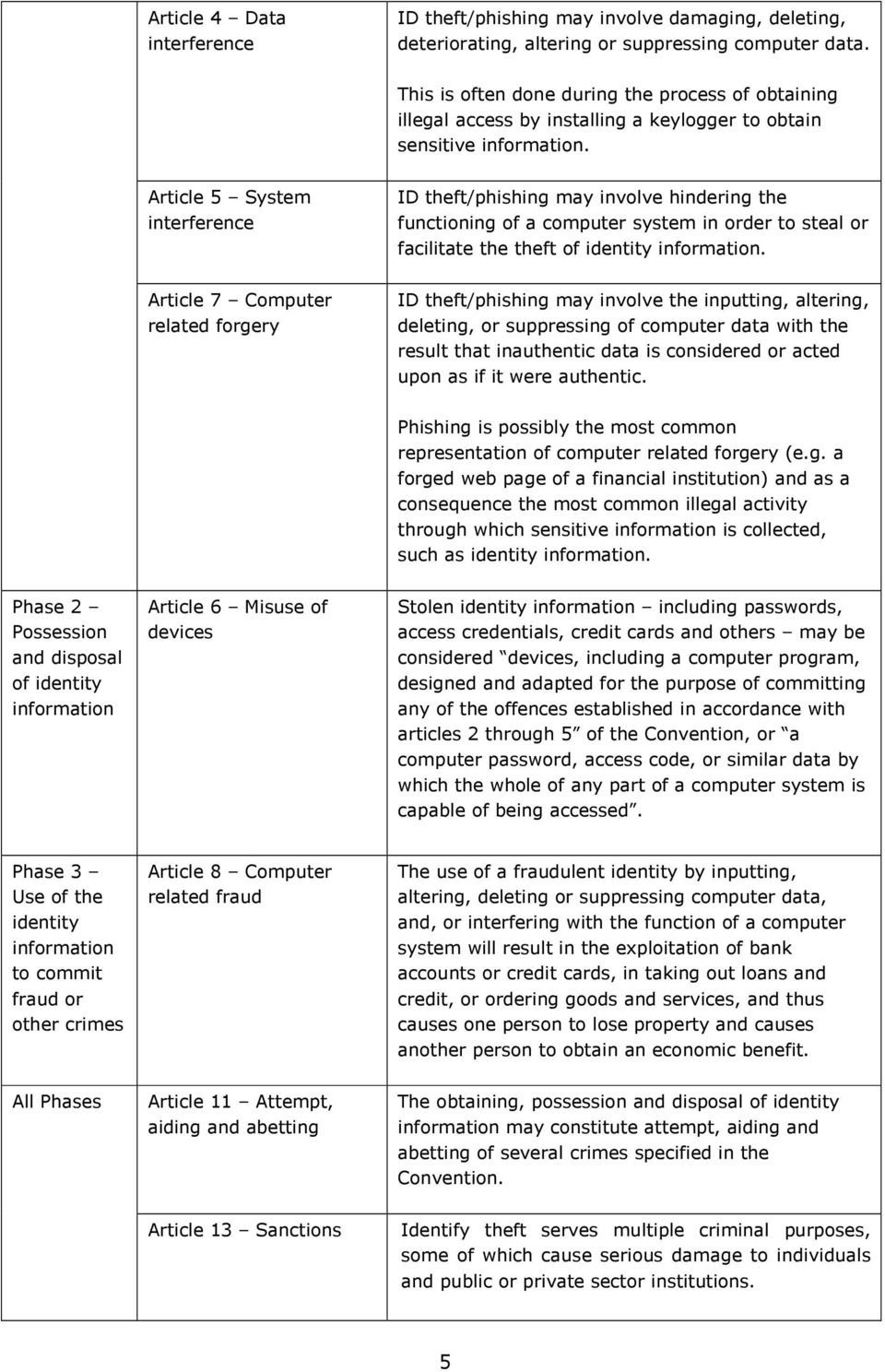
4 money laundering, drug trafficking, financial fraud against governments and the private sector, but is most generally seen in conjunction with fraud. Conceptually, ID theft can be separated into three distinct phases: Phase 1 The obtaining of identity information, for example, through physical theft, through search engines, insider attacks, attacks from outside (illegal access to computer systems, Trojans, keyloggers, spyware and other malware) or through the use of phishing and or other social engineering techniques. Phase 2 The possession and disposal of identity information, which includes the sale of such information to third parties. Phase 3 The use of the identity information to commit fraud or other crimes, for example by assuming another s identity to exploit bank accounts and credit cards, create new accounts, take out loans and credit, order goods and services or disseminate malware. In conclusion: identity theft (including phishing and similar conduct) is generally used for the preparation of further criminal acts such as computer related fraud. Even if identity theft is not criminalised as a separate act, law enforcement agencies will be able to prosecute the subsequent offences. 3 T-CY interpretation of the criminalisation of identity theft in relation to fraud under the Budapest Convention The Budapest Convention is focusing on criminal conduct and not specifically on techniques or technologies used. It does, therefore, not contain specific provisions on identity theft or phishing. However, full implementation of the Convention s substantive law provisions will allow States to criminalise conduct related to identity theft. The Convention requires countries to criminalise conduct such as the illegal access to a computer system, the illegal interception of data, data interference, system interference, the misuse of devices and computer related fraud: Phase Article of convention Examples Phase 1 Obtaining of identity information Article 2 Illegal access While a criminal is hacking, circumventing password protection, keylogging or exploiting software loopholes, the computer may be illegally accessed in the acts of ID theft/phishing. Illegal access to computer systems is one of the most common offences committed in order to obtain sensitive information such as identity information. Article 3 illegal interception ID theft often entails the use of keyloggers or other types of malware for the illegal interception of nonpublic transmissions of computer data to, from or within a computer system containing sensitive information such as identity information. 4

5 Article 4 Data interference ID theft/phishing may involve damaging, deleting, deteriorating, altering or suppressing computer data. This is often done during the process of obtaining illegal access by installing a keylogger to obtain sensitive information. Article 5 System interference ID theft/phishing may involve hindering the functioning of a computer system in order to steal or facilitate the theft of identity information. Article 7 Computer related forgery ID theft/phishing may involve the inputting, altering, deleting, or suppressing of computer data with the result that inauthentic data is considered or acted upon as if it were authentic. Phishing is possibly the most common representation of computer related forgery (e.g. a forged web page of a financial institution) and as a consequence the most common illegal activity through which sensitive information is collected, such as identity information. Phase 2 Possession and disposal of identity information Article 6 Misuse of devices Stolen identity information including passwords, access credentials, credit cards and others may be considered devices, including a computer program, designed and adapted for the purpose of committing any of the offences established in accordance with articles 2 through 5 of the Convention, or a computer password, access code, or similar data by which the whole of any part of a computer system is capable of being accessed. Phase 3 Use of the identity information to commit fraud or other crimes Article 8 Computer related fraud The use of a fraudulent identity by inputting, altering, deleting or suppressing computer data, and, or interfering with the function of a computer system will result in the exploitation of bank accounts or credit cards, in taking out loans and credit, or ordering goods and services, and thus causes one person to lose property and causes another person to obtain an economic benefit. All Phases Article 11 Attempt, aiding and abetting The obtaining, possession and disposal of identity information may constitute attempt, aiding and abetting of several crimes specified in the Convention. Article 13 Sanctions Identify theft serves multiple criminal purposes, some of which cause serious damage to individuals and public or private sector institutions. 5
6 A Party may foresee, however, in its domestic law a sanction that is unsuitably lenient for identity theft, and it may not permit the consideration of aggravated circumstances. This may mean that Parties need to consider amendments to their domestic law. Therefore, Parties should ensure, pursuant to Article 13, that criminal offences related to identity theft are punishable by effective, proportionate and dissuasive sanctions, which include the deprivation of liberty. For legal persons this may include criminal or non-criminal sanctions, including monetary sanction. Parties may also consider aggravating circumstances, for example if identity theft affects a significant number of people or causes serious distress or exposes a person to danger. 4 T-CY Statement The T-CY agrees that the above illustrates the various scope and elements of identity theft and phishing and the criminal provisions that may apply. Therefore, the T-CY agrees that the different aspects of such crimes are covered by the Budapest Convention. 6

7 5 Appendix: Extracts of the Budapest Convention Article 2 Illegal access the access to the whole or any part of a computer system without right. A Party may require that the offence be committed by infringing security measures, with the intent of obtaining computer data or other dishonest intent, or in relation to a computer system that is connected to another computer system. Article 3 Illegal interception the interception without right, made by technical means, of non-public transmissions of computer data to, from or within a computer system, including electromagnetic emissions from a computer system carrying such computer data. A Party may require that the offence be committed with dishonest intent, or in relation to a computer system that is connected to another computer system. Article 4 Data interference 1 the damaging, deletion, deterioration, alteration or suppression of computer data without right. 2 A Party may reserve the right to require that the conduct described in paragraph 1 result in serious harm. Article 5 System interference the serious hindering without right of the functioning of a computer system by inputting, transmitting, damaging, deleting, deteriorating, altering or suppressing computer data. Article 6 Misuse of devices 1 establish as criminal offences under its domestic law, when committed intentionally and without right: a the production, sale, procurement for use, import, distribution or otherwise making available of: i a device, including a computer program, designed or adapted primarily for the purpose of committing any of the offences established in accordance with the above Articles 2 through 5; ii a computer password, access code, or similar data by which the whole or any part of a computer system is capable of being accessed, 7

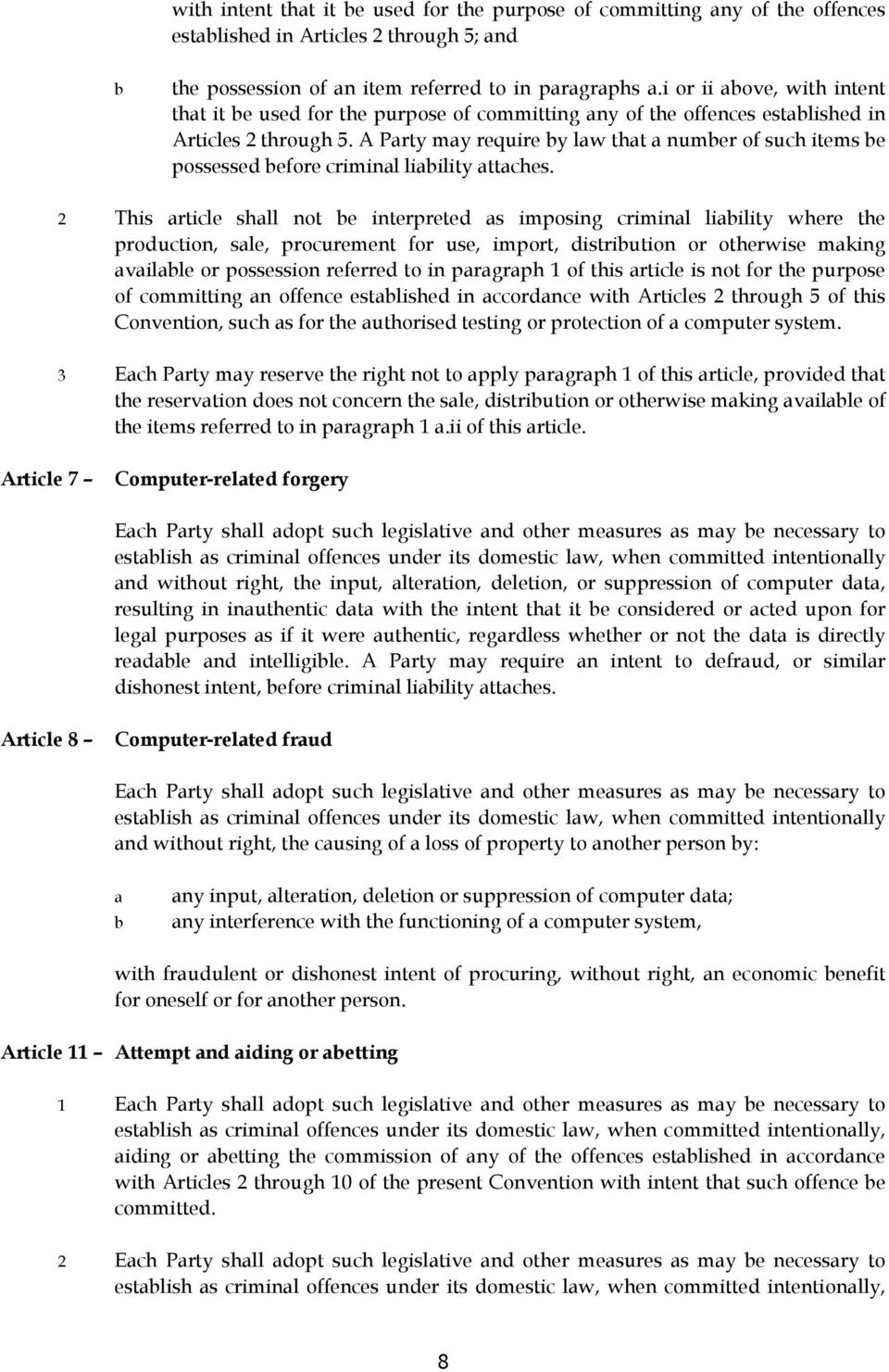
8 with intent that it be used for the purpose of committing any of the offences established in Articles 2 through 5; and b the possession of an item referred to in paragraphs a.i or ii above, with intent that it be used for the purpose of committing any of the offences established in Articles 2 through 5. A Party may require by law that a number of such items be possessed before criminal liability attaches. 2 This article shall not be interpreted as imposing criminal liability where the production, sale, procurement for use, import, distribution or otherwise making available or possession referred to in paragraph 1 of this article is not for the purpose of committing an offence established in accordance with Articles 2 through 5 of this Convention, such as for the authorised testing or protection of a computer system. 3 Each Party may reserve the right not to apply paragraph 1 of this article, provided that the reservation does not concern the sale, distribution or otherwise making available of the items referred to in paragraph 1 a.ii of this article. Article 7 Computer-related forgery establish as criminal offences under its domestic law, when committed intentionally and without right, the input, alteration, deletion, or suppression of computer data, resulting in inauthentic data with the intent that it be considered or acted upon for legal purposes as if it were authentic, regardless whether or not the data is directly readable and intelligible. A Party may require an intent to defraud, or similar dishonest intent, before criminal liability attaches. Article 8 Computer-related fraud establish as criminal offences under its domestic law, when committed intentionally and without right, the causing of a loss of property to another person by: a b any input, alteration, deletion or suppression of computer data; any interference with the functioning of a computer system, with fraudulent or dishonest intent of procuring, without right, an economic benefit for oneself or for another person. Article 11 Attempt and aiding or abetting 1 aiding or abetting the commission of any of the offences established in accordance with Articles 2 through 10 of the present Convention with intent that such offence be committed. 2 8
9 an attempt to commit any of the offences established in accordance with Articles 3 through 5, 7, 8, and 9.1.a and c. of this Convention. 3 Each Party may reserve the right not to apply, in whole or in part, paragraph 2 of this article. Article 13 Sanctions and measures 1 ensure that the criminal offences established in accordance with Articles 2 through 11 are punishable by effective, proportionate and dissuasive sanctions, which include deprivation of liberty. 2 Each Party shall ensure that legal persons held liable in accordance with Article 12 shall be subject to effective, proportionate and dissuasive criminal or non-criminal sanctions or measures, including monetary sanctions. 9
T-CY Guidance Note #5
 www.coe.int/tcy Strasbourg, 5 June 2013 T-CY (2013)10E Rev Cybercrime Convention Committee (T-CY) T-CY Guidance Note #5 DDOS attacks Adopted by the 9 th Plenary of the T-CY (4-5 June 2013) Contact: Alexander
AGREEMENT BETWEEN THE UNITED STATES OF AMERICA AND THE EUROPEAN POLICE OFFICE
 AGREEMENT BETWEEN THE UNITED STATES OF AMERICA AND THE EUROPEAN POLICE OFFICE Preamble The United States of America and the European Police Office (Europol): considering that it is within their common
CYBERCRIME AND THE LAW
 CYBERCRIME AND THE LAW INTERNATIONAL LAW CYBERCRIME CONVENTION Convention on Cybercrime / Budapest Convention first international treaty seeking to address Internet and computer crime by harmonizing national
Cyber Crime and Data Retention
 COE Convention nr 185 on cybercrime Concluded in Budapest on 23 November 2001 First comprehensive instrument underlining the seriousness of cybercrime and the possible remedies Defines a series of offences
IDENTITY THEFT COMMITTED THROUGH INTERNET
 IDENTITY THEFT COMMITTED THROUGH INTERNET Adrian Cristian MOISE ABSTRACT: In this study, starting with the presentation of some aspects regarding management of identity in cyberspace, it is carried out
Crimes (Computer Hacking)
 2009-44 CRIMES (COMPUTER HACKING) ACT 2009 by Act 2011-23 as from 23.11.2012 Principal Act Act. No. 2009-44 Commencement except ss. 15-24 14.1.2010 (LN. 2010/003) Assent 3.12.2009 Amending enactments Relevant
OVERVIEW. 1. Cyber Crime Unit organization. 2. Legal framework. 3. Identity theft modus operandi. 4. How to avoid online identity theft
 OVERVIEW 2 1. Cyber Crime Unit organization 2. Legal framework 3. Identity theft modus operandi 4. How to avoid online identity theft 5. Main challenges for investigation 6. Conclusions ORGANIZATION 3
Identity Theft. CHRISTOS TOPAKAS Head of Group IT Security and Control Office
 Identity Theft CHRISTOS TOPAKAS Head of Group IT Security and Control Office Agenda Identity Theft Threats and Techniques Identity Theft Definition and Facts Identity Theft & Financial Institutions Prevention
An Bille um Cheartas Coiriúil (Cionta a bhaineann le Córais Faisnéise), 2016 Criminal Justice (Offences Relating to Information Systems) Bill 2016
 An Bille um Cheartas Coiriúil (Cionta a bhaineann le Córais Faisnéise), 16 Criminal Justice (Offences Relating to Information Systems) Bill 16 Mar a tionscnaíodh As initiated [No. of 16] AN BILLE UM CHEARTAS
Parliamentary Information and Research Service. Legislative Summary
 Legislative Summary LS-637E BILL S-4: AN ACT TO AMEND THE CRIMINAL CODE (IDENTITY THEFT AND RELATED MISCONDUCT) Nancy Holmes Dominique Valiquet Legal and Legislative Affairs Division 14 April 2009 Revised
CYBERSECURITY BILL, 2011
 CYBERSECURITY BILL, 2011 Page 1 of 19 CYBERSECURITY BILL, 2011 ARRANGEMENT OF SECTIONS Sections PART I - GENERAL PROVISIONS 1 Objects and scope PART II OFFENCES AND PENALTIES 2. Unlawful access to a computer
COMPUTER MISUSE AND CYBERCRIME ACT
 COMPUTER MISUSE AND CYBERCRIME ACT Act 22 of 2003 9 August 2003 ARRANGEMENT OF SECTIONS 1. Short title 2. Interpretation PART I PRELIMINARY PART II OFFENCES 3. Unauthorised access to computer data 4. Access
Crimes Amendment (Fraud, Identity and Forgery Offences) Act 2009 No 99
 New South Wales Crimes Amendment (Fraud, Identity and Forgery Offences) Act 2009 No 99 Contents Page 1 Name of Act 2 2 Commencement 2 Schedule 1 Principal amendments to Crimes Act 1900 No 40 3 Schedule
An Overview of Cybersecurity and Cybercrime in Taiwan
 An Overview of Cybersecurity and Cybercrime in Taiwan I. Introduction To strengthen Taiwan's capability to deal with information and communication security issues, the National Information and Communication
Legal and Regulatory Framework in Africa for Cyber Security
 2 nd East Africa IT and Cyber security Convention Legal and Regulatory Framework in Africa for Cyber Security 27th Nov 2013 Nairobi, Kenya Attorney Sizwe Lindelo Snail Ka Mtuze TABLE OF CONTENTS Part 1:
COMMUNICATION FROM THE COMMISSION TO THE EUROPEAN PARLIAMENT, THE COUNCIL, THE EUROPEAN ECONOMIC AND SOCIAL COMMITTEE AND THE COMMITTEE OF THE REGIONS
 EUROPEAN COMMISSION Brussels, 20.9.2011 COM(2011) 573 final COMMUNICATION FROM THE COMMISSION TO THE EUROPEAN PARLIAMENT, THE COUNCIL, THE EUROPEAN ECONOMIC AND SOCIAL COMMITTEE AND THE COMMITTEE OF THE
Pacific Islands Telecommunications Association
 Pacific Islands Telecommunications Association 8 th Fl, Dominion Hse PHONE : (679) 331 1638 PO BOX 2027, Govt Bldg FAX : (679) 330 8750 SUVA, FIJI Islands E-mail: [email protected] www.pita.org.fj INVITATION
Remote Deposit Quick Start Guide
 Treasury Management Fraud Prevention How to Protect Your Business Remote Deposit Quick Start Guide What s Inside We re committed to the safety of your company s financial information. We want to make you
Crimes Amendment (Fraud and Forgery) Bill 2009
 New South Wales Crimes Amendment (Fraud and Forgery) Bill 2009 Contents Page 1 Name of Act 2 2 Commencement 2 Schedule 1 Principal amendments to Crimes Act 1900 No 40 3 Schedule 2 Consequential and other
1. Any email requesting personal information, or asking you to verify an account, is usually a scam... even if it looks authentic.
 Your identity is one of the most valuable things you own. It s important to keep your identity from being stolen by someone who can potentially harm your good name and financial well-being. Identity theft
FAQs Organised Crime and Anti-corruption Legislation Bill
 FAQs Organised Crime and Anti-corruption Legislation Bill What is organised crime? Organised crime normally refers to an organisation of criminals who engage in illegal activity on a large, centralised
Acceptable Use Policy. This Acceptable Use Policy sets out the prohibited actions by a Registrant or User of every registered.bayern Domain Name.
 This Acceptable Use Policy sets out the prohibited actions by a Registrant or User of every registered.bayern Domain Name. This Acceptable Use Policy forms part of the Registry Policies that apply to and
A Global Treaty on Cybersecurity and Cybercrime
 Stein Schjolberg and Solange Ghernaouti-Helie A Global Treaty on Cybersecurity and Cybercrime Second edition 2011 Those who fail to anticipate the future are in for a rude shock when it arrives Professor
CYBERTERRORISM THE USE OF THE INTERNET FOR TERRORIST PURPOSES
 COMMITTEE OF EXPERTS ON TERRORISM (CODEXTER) CYBERTERRORISM THE USE OF THE INTERNET FOR TERRORIST PURPOSES GERMANY September 2007 Kapitel 1 www.coe.int/gmt A. National policy 1. Is there a national policy
Acceptable Use Policy
 Acceptable Use Policy 1. General Interoute reserves the right to modify the Acceptable Use Policy ( AUP ) from time to time. Changes to this Acceptable Use Policy will be notified to Customer in accordance
Handbook of Legislative Procedures of Computer and Network Misuse in EU Countries
 Handbook of Legislative Procedures of Computer and Network Misuse in EU Countries Study for the European Commission Directorate-General Information Society (2002) Project Managers: Dr Andrew Rathmell/Dr
CHAPTER 124B COMPUTER MISUSE
 1 L.R.O. 2005 Computer Misuse CAP. 124B CHAPTER 124B COMPUTER MISUSE ARRANGEMENT OF SECTIONS SECTION PART I PRELIMINARY 1. Short title. 2. Application. 3. Interpretation. PART II PROHIBITED CONDUCT 4.
Learn to protect yourself from Identity Theft. First National Bank can help.
 Learn to protect yourself from Identity Theft. First National Bank can help. Your identity is one of the most valuable things you own. It s important to keep your identity from being stolen by someone
Criminal Code And Civil Liability Amendment Bill 2007
 1 Criminal Code And Civil Liability Amendment Bill Explanatory Notes Objectives of the Bill The Bill seeks to: Amend section 328A of the Criminal Code to increase the maximum penalties for the offence
ITU TOOLKIT FOR CYBERCRIME LEGISLATION
 I n t e r n a t i o n a l T e l e c o m m u n i c a t i o n U n i o n C y b e r c r i m e L e g i s l a t i o n R e s o u r c e s ITU TOOLKIT FOR CYBERCRIME LEGISLATION Developed through the American Bar
Acceptable Use Policy
 Introduction This Acceptable Use Policy (AUP) sets forth the terms and conditions for the use by a Registrant of any domain name registered in the top-level domain (TLD). This Acceptable Use Policy (AUP)
THE COMPUTER MISUSE AND CYBERCRIME ACT 2003. I assent ------------- ARRANGEMENT OF SECTIONS
 1 Act No. 22 of 2003 THE COMPUTER MISUSE AND CYBERCRIME ACT 2003 I assent 30 July 2003 KARL AUGUSTE OFFMANN President of the Republic Section ------------- ARRANGEMENT OF SECTIONS PART I - PRELIMINARY
Cybercrime: risks, penalties and prevention
 Cybercrime: risks, penalties and prevention Cyber attacks have been appearing in the news with increased frequency and recent victims of cybercrime have included well-known companies such as Sony, LinkedIn,
DISCUSSION OF THE CYBERCRIMES AND CYBERSECURITY BILL
 DISCUSSION OF THE CYBERCRIMES AND CYBERSECURITY BILL 1. PURPOSE OF BILL The Cybercrimes and Cybersecurity Bill, 2015 (the Bill ) - * creates offences and prescribes penalties; * further regulates jurisdiction;
WASHINGTON IDENTITY THEFT RANKING BY STATE: Rank 13, 76.4 Complaints Per 100,000 Population, 4942 Complaints (2007) Updated January 11, 2009
 WASHINGTON IDENTITY THEFT RANKING BY STATE: Rank 13, 76.4 Complaints Per 100,000 Population, 4942 Complaints (2007) Updated January 11, 2009 Current Laws: Washington s identity theft law states that no
VISA International Security Summit. Dr. Colonel Tran Van Hoa Deputy Director Viet Nam Hightech Crime Police Department
 VISA International Security Summit Dr. Colonel Tran Van Hoa Deputy Director Viet Nam Hightech Crime Police Department Hanoi June 2010 Vietnam Economic Outlook One of the fastest growing economies in South-East
Commonwealth Fraud Control Guidelines Annual Reporting Questionnaire 2009-10
 Commonwealth Fraud Control Guidelines Annual Reporting Questionnaire 2009-10 Please read this first In accordance with the Commonwealth Fraud Control Guidelines (the Guidelines) issued under Regulation
SECTION 8 GARDA SÍOCHÁNA ACT 2005. General Direction No. 2
 SECTION 8 GARDA SÍOCHÁNA ACT 2005 General Direction No. 2 The Director of Public Prosecutions, pursuant to the powers conferred on him by section 8 (4) of the Garda Síochána Act 2005, hereby gives the
Migration/ Asylum. Co-operation in the field of drugs
 Non-exhaustive list of issues and questions to facilitate preparations for the bilateral meeting with Turkey in the area of Chapter 24 Justice, freedom and security Migration/ Asylum - Which are currently
SECTION 59, CRIMINAL JUSTICE (THEFT AND FRAUD OFFENCES) ACT, 2001
 SECTION 59, CRIMINAL JUSTICE (THEFT AND FRAUD OFFENCES) ACT, 2001 This Memorandum has been prepared by the Consultative Committee of Accountancy Bodies Ireland ( CCAB-I ) to alert members of the profession
Standardisation of definitions of identity crime terms: A step towards consistency Report Series No. 145.3
 Standardisation of definitions of identity crime terms: A step towards consistency Report Series No. 145.3 This publication was obtained from www.acpr.gov.au STANDARDISATION OF DEFINITIONS OF IDENTITY
FEDERAL IDENTITY THEFT TASK FORCE. On May 10, 2006, the President signed an Executive Order establishing an Identity Theft
 FEDERAL IDENTITY THEFT TASK FORCE Attorney General Alberto Gonzales Federal Trade Commission Chairman Deborah Platt Majoras On May 10, 2006, the President signed an Executive Order establishing an Identity
GUIDANCE Implementing Section 176 of the Anti-social Behaviour, Crime and Policing Act 2014: Lowvalue
 GUIDANCE Implementing Section 176 of the Anti-social Behaviour, Crime and Policing Act 2014: Lowvalue shoplifting Guidance for police in England and Wales First publication: June 2014 1 Introduction 1.
CYBERTERRORISM THE USE OF THE INTERNET FOR TERRORIST PURPOSES
 COMMITTEE OF EXPERTS ON TERRORISM (CODEXTER) CYBERTERRORISM THE USE OF THE INTERNET FOR TERRORIST PURPOSES UNITED STATES OF AMERICA September 2007 Kapitel 1 www.coe.int/gmt The responses provided below
LEGISLATION ON CYBERCRIME IN NIGERIA: IMPERATIVES AND CHALLENGES
 LEGISLATION ON CYBERCRIME IN NIGERIA: IMPERATIVES AND CHALLENGES T.G. George-Maria Tyendezwa, Head, Computer Crime Prosecution Unit, Federal Ministry of Justice, OUTLINE Interconnected world The Nigerian
Cybercrime : Malaysia. By DSP MahfuzBin Dato Ab. Majid Royal Malaysia Police
 Cybercrime : Malaysia By DSP MahfuzBin Dato Ab. Majid Royal Malaysia Police ICT Development The ICT development within this region has been rapid since more than 3 decades ago. With the launching of the
MEMORANDUM FOR ASSISTANT REGIONAL COUNSEL (CRIMINAL TAX) SUBJECT: Identity Theft and Assumption Deterrence Act of 1998
 INTERNAL REVENUE SERVICE UIL: 9999.92-00 Number: 199911041 Release Date: 3/19/1999 CTMonica January 22, 1999 MEMORANDUM FOR ASSISTANT REGIONAL COUNSEL (CRIMINAL TAX) FROM: Barry J. Finkelstein Assistant
LICENSING ACT 2003 GUIDANCE NOTES PERSONAL LICENCE: RELEVANT OFFENCES
 LICENSING ACT 2003 GUIDANCE NOTES PERSONAL LICENCE: RELEVANT OFFENCES Personal Licence: Relevant Offences What is the meaning of the term 'relevant offence'? 'Relevant offence' refers to the offences listed
Crime statistics in Lithuania, Latvia, Estonia for the period of. January March 2012* 2012-05-09 Nr. (6-2) 24S-38 22059 14,8 11908 NA 9570 0,3
 Crime statistics in Lithuania, Latvia, Estonia for the period of January March 2012* 2012-05-09 Nr. (6-2) 24S-38 No. Criminal offences Lithuania Latvia Estonia Registered In comparison Registered In comparison
Law No. 80 for 2002 Promulgating the Anti-Money Laundering Law And its Amendments ١
 Law No. 80 for 2002 Promulgating the Anti-Money Laundering Law And its Amendments ١ In the Name of the People, The President of the Republic, The People's Assembly has passed the following Law, and we
CYBERCRIME LAWS OF THE UNITED STATES Compiled October 2006 by Al Rees, CCIPS
 CYBERCRIME LAWS OF THE UNITED STATES Compiled October 2006 by Al Rees, CCIPS Table of Contents Substantive cybercrime laws (e.g., laws prohibiting online identity theft, hacking, intrusion into computer
Retail/Consumer Client. Internet Banking Awareness and Education Program
 Retail/Consumer Client Internet Banking Awareness and Education Program Table of Contents Securing Your Environment... 3 Unsolicited Client Contact... 3 Protecting Your Identity... 3 E-mail Risk... 3 Internet
The Council of Europe Convention on Cybercrime
 The Council of Europe Convention on Cybercrime Michael A. Vatis Steptoe & Johnson LLP I. BACKGROUND The Convention on Cybercrime is an international treaty that seeks to harmonize national laws on cybercrime,
WISCONSIN IDENTITY THEFT RANKING BY STATE: Rank 15, 175.9 Complaints Per 100,000 Population, 9852 Complaints (2007) Updated January 16, 2009
 WISCONSIN IDENTITY THEFT RANKING BY STATE: Rank 15, 175.9 Complaints Per 100,000 Population, 9852 Complaints (2007) Updated January 16, 2009 Current Laws: It is unlawful to intentionally use or attempt
TERMS OF SERVICE TELEPORT REQUEST RECEIVERS
 TERMS OF SERVICE These terms of service and the documents referred to in them ( Terms ) govern your access to and use of our services, including our website teleportapp.co ( our site ), applications, buttons,
FINAL May 2005. Guideline on Security Systems for Safeguarding Customer Information
 FINAL May 2005 Guideline on Security Systems for Safeguarding Customer Information Table of Contents 1 Introduction 1 1.1 Purpose of Guideline 1 2 Definitions 2 3 Internal Controls and Procedures 2 3.1
The Electronic Transactions Law Chapter I Title and Definition
 The Union of Myanmar The State Peace and Development Council The Electronic Transactions Law ( The State Peace and Development Council Law No. 5/2004 ) The 12th Waxing of Kason 1366 M.E. (30th April, 2004)
region16.net Acceptable Use Policy ( AUP )
 region16.net Acceptable Use Policy ( AUP ) Introduction By using service(s) provided by region16.net (including, but not necessarily limited to, Internet Services and videoconferencing), you agree to comply
OCT Training & Technology Solutions [email protected] (718) 997-4875
 OCT Training & Technology Solutions [email protected] (718) 997-4875 Understanding Information Security Information Security Information security refers to safeguarding information from misuse and theft,
UNDERSTANDING MONEY LAUNDERING
 UNDERSTANDING MONEY LAUNDERING Preface In light of the international concerns growing on money laundering and the financing of terrorist activities, many countries have taken rigorous measures to curb
COMPUTER USE IN INSTRUCTION
 COMPUTER USE IN INSTRUCTION 4526 The Board of Education is committed to optimizing student learning and teaching. The Board considers student access to a computer network, including the Internet, to be
As of August 1 st, 2014 IMPORTANT LEGALLY BINDING AGREEMENT
 As of August 1 st, 2014 IMPORTANT LEGALLY BINDING AGREEMENT Box, Inc. ( Box ) is making the Box Service (as defined below) available to you ( You or Your ) because You are a faculty member, staff member
DATA PROTECTION LAWS OF THE WORLD. India
 DATA PROTECTION LAWS OF THE WORLD India Date of Download: 6 February 2016 INDIA Last modified 27 January 2016 LAW IN INDIA There is no specific legislation on privacy and data protection in India. However,
Regional Anti-Corruption Action Plan for Armenia, Azerbaijan, Georgia, the Kyrgyz Republic, the Russian Federation, Tajikistan and Ukraine.
 Anti-Corruption Network for Transition Economies OECD Directorate for Financial, Fiscal and Enterprise Affairs 2, rue André Pascal F-75775 Paris Cedex 16 (France) phone: (+33-1) 45249106, fax: (+33-1)
MISSOURI IDENTITY THEFT RANKING BY STATE: Rank 21, 67.4 Complaints Per 100,000 Population, 3962 Complaints (2007) Updated January 11, 2009
 MISSOURI IDENTITY THEFT RANKING BY STATE: Rank 21, 67.4 Complaints Per 100,000 Population, 3962 Complaints (2007) Updated January 11, 2009 Current Laws: A person commits the crime of identity theft if
Acceptable Use Policy
 Acceptable Use Policy PLEASE READ THIS AGREEMENT CAREFULLY BEFORE ACCESSING THE SERVICE. BY ACCESSING THE SERVICE YOU AGREE TO BE BOUND BY THE TERMS AND CONDITIONS BELOW. IF YOU DO NOT WISH TO BE BOUND
Terms of Service. As of Julyl 1, 2014 IMPORTANT LEGALLY BINDING AGREEMENT
 Terms of Service As of Julyl 1, 2014 IMPORTANT LEGALLY BINDING AGREEMENT Box, Inc. ( Box ) is making the Box Service (as defined below) available to you ( You or Your ) because You are a faculty member,
Fraud Act 2006 CHAPTER 35 CONTENTS
 Fraud Act 2006 CHAPTER 35 CONTENTS Fraud 1 Fraud 2 Fraud by false representation 3 Fraud by failing to disclose information 4 Fraud by abuse of position 5 Gain and loss 6 Possession etc. of articles for
FKCC AUP/LOCAL AUTHORITY
 FKCC AUP/LOCAL AUTHORITY The information contained in this section has its basis in Public Law 93.380. It is further enhanced however, by Florida State Board of Education Administrative Rule 6A-14.51 and
Regulation of Investigatory Powers Act 2000
 Regulation of Investigatory Powers Act 2000 Consultation: Equipment Interference and Interception of Communications Codes of Practice 6 February 2015 Ministerial Foreword The abilities to read or listen
BE SAFE ONLINE: Lesson Plan
 BE SAFE ONLINE: Lesson Plan Overview Danger lurks online. Web access, social media, computers, tablets and smart phones expose users to the possibility of fraud and identity theft. Learn the steps to take
Models for Cyber-legislation in ESCWA member countries
 Models for Cyber-legislation in ESCWA member countries Presented by Jean Akl & Roula Zayat Amman, December 11, 2007 Cyber Space Cyber space (non-jurisdictional International Space; jurisdictional National
LAWS OF BRUNEI CHAPTER 194 COMPUTER MISUSE ACT
 LAWS OF BRUNEI CHAPTER 194 COMPUTER MISUSE ACT S 65/00 REVISED EDITION 2007 B.L.R.O. 3/2007 CAP. 194] LAWS OF BRUNEI Computer Misuse [2007 Ed. p. 1 LAWS OF BRUNEI REVISED EDITION 2007 CHAPTER 194 COMPUTER
HTC Communications Acceptable Use Policy High Speed Internet Service Page 1 of 5. HTC Communications
 Page 1 of 5 HTC Communications ACCEPTABLE USE POLICY FOR HIGH SPEED INTERNET SERVICE This Acceptable Use Policy ( AUP ) governs high speed Internet service provided to you by HTC Communications (together
CYBER CRIME AWARENESS
 SHIV SHAKTI International Journal in Multidisciplinary and Academic Research (SSIJMAR) Vol. 2, No. 2, March-April (ISSN 2278 5973) CYBER CRIME AWARENESS RITU DHANOA* ABSTRACT: Cyber crime is emerging as
The History of Global Harmonization on Cybercrime Legislation - The Road to Geneva
 1 By Stein Schjolberg Chief Judge December, 2008 The History of Global Harmonization on Cybercrime Legislation - The Road to Geneva 1. Introduction... 1 2. The History... 2 3. What is cybercrime? The history
Fraud, Bribery and Money Laundering Offences Definitive Guideline DEFINITIVE GUIDELINE
 Fraud, Bribery and Money Laundering Offences Definitive Guideline DEFINITIVE GUIDELINE Fraud, Bribery and Money Laundering Offences Definitive Guideline 1 Contents Applicability of guideline 4 Fraud 5
MASSACHUSETTS IDENTITY THEFT RANKING BY STATE: Rank 23, 66.5 Complaints Per 100,000 Population, 4292 Complaints (2006) Updated January 17, 2009
 MASSACHUSETTS IDENTITY THEFT RANKING BY STATE: Rank 23, 66.5 Complaints Per 100,000 Population, 4292 Complaints (2006) Updated January 17, 2009 Current Laws: Identity Crime: A person is guilty of identity
The Key to Secure Online Financial Transactions
 Transaction Security The Key to Secure Online Financial Transactions Transferring money, shopping, or paying debts online is no longer a novelty. These days, it s just one of many daily occurrences on
Fraud Detection and Prevention. Timothy P. Minahan Vice President Government Banking TD Bank
 Fraud Detection and Prevention Timothy P. Minahan Vice President Government Banking TD Bank Prevention vs. Detection Prevention controls are designed to keep fraud from occurring Detection controls are
White paper. Phishing, Vishing and Smishing: Old Threats Present New Risks
 White paper Phishing, Vishing and Smishing: Old Threats Present New Risks How much do you really know about phishing, vishing and smishing? Phishing, vishing, and smishing are not new threats. They have