
Cosmetics europe: Guiding principles on responsible advertising and marketing communication
|
|
|
- Loren Dalton
- 10 years ago
- Views:
Transcription
1 Cosmetics europe: on responsible advertising and marketing communication

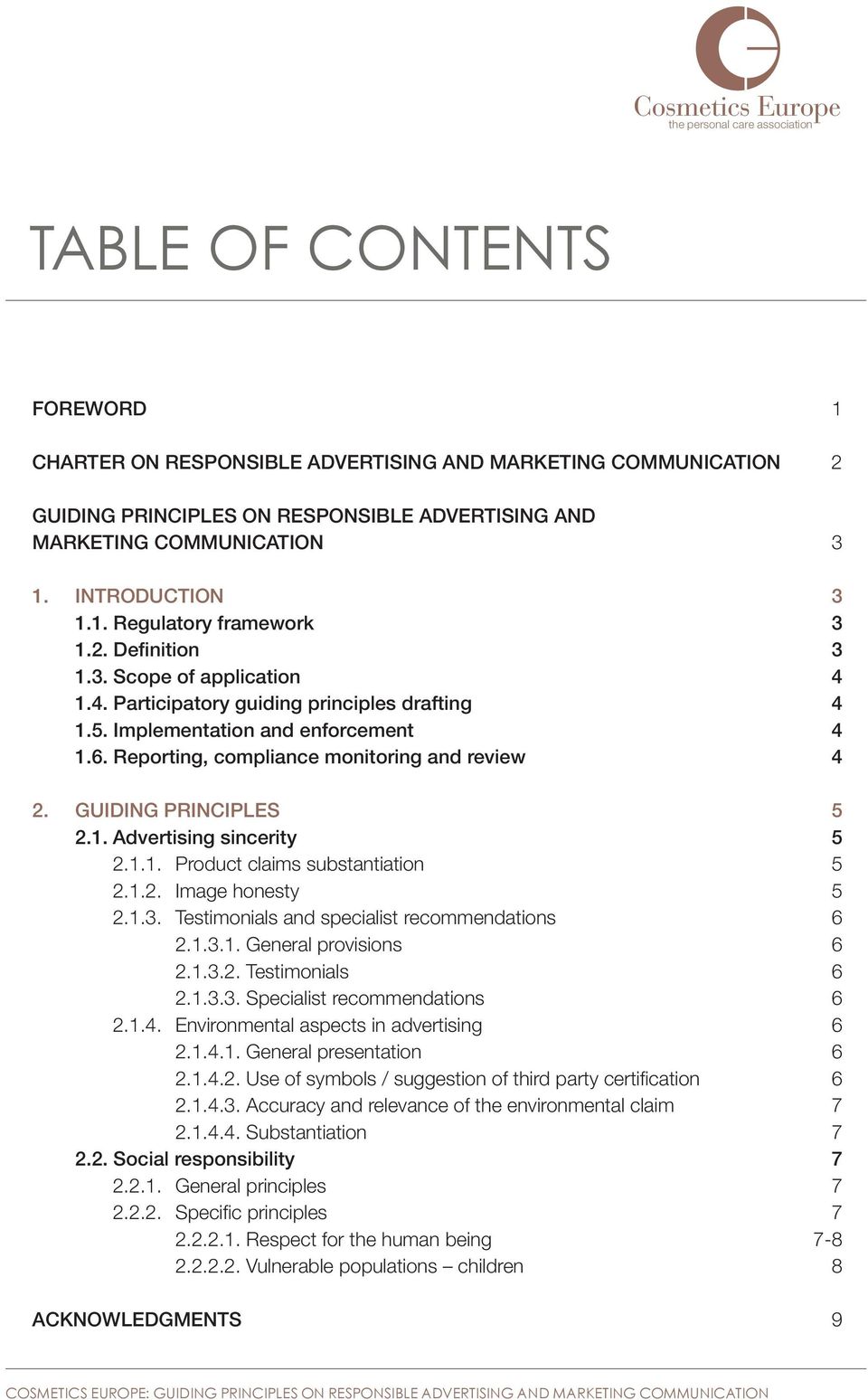
2 Table of contents Foreword 1 Charter on responsible advertising and marketing communication 2 on responsible advertising and marketing communication 3 1. Introduction Regulatory framework Definition Scope of application Participatory guiding principles drafting Implementation and enforcement Reporting, compliance monitoring and review Advertising sincerity Product claims substantiation Image honesty Testimonials and specialist recommendations General provisions Testimonials Specialist recommendations Environmental aspects in advertising General presentation Use of symbols / suggestion of third party certification Accuracy and relevance of the environmental claim Substantiation Social responsibility General principles Specific principles Respect for the human being Vulnerable populations children 8 Acknowledgments 9
3 Foreword The European cosmetics industry has always been committed to the highest standards when dealing with consumers, as well as when producing cosmetics and personal care products. Cosmetics Europe has been working proactively to promote best practice in cosmetics advertising. This responds to consumer concerns about any adverse impact cosmetics advertising may have on individuals and society as a whole. The European cosmetics industry has opted for a self-regulatory approach to cosmetics advertising. Complementing the European Commission s list of common criteria for cosmetics claims, the industry adopted, in June 2012, guiding principles designed to avoid misleading advertising. A Charter setting out the overall standards accompanies the principles. This set of documents acts as a baseline for cosmetics advertising in Europe. The guiding principles demonstrate the industry s commitment to standards of responsibility, whilst balancing and reflecting the views of the various stakeholders involved in the drafting process. These include representatives from the advertising industry, the European institutions, the self-regulatory network and NGOs. Their important contribution has defined the challenges to be addressed, and how this should be achieved. This commitment is only the first step. The cosmetics industry is keen to make this initiative come to life, reflecting societal trends and expectations in its advertising. After all, earning and maintaining consumer trust in cosmetic and personal care products is a key driver for the sector s activities. Upholding strong values is an important part of this, shown by the guiding principles and Charter on self regulation in advertising. Bertil Heerink Cosmetics Europe Director-General Loïc Armand Chairman of Cosmetics Europe s Strategic Project Team Self-Regulation on Advertising 1

4 Charter ON RESPONSIBLE ADVERTISING AND MARKETING COMMUNICATION The European cosmetics industry recognises the importance of responsible advertising and marketing communication as essential means of informing consumers about characteristics and qualities of their cosmetic products. In particular, the cosmetics industry commits, through this Charter, to ensure that its advertising and marketing communication shall: - Comply with the relevant European and national legal and self-regulatory frameworks; - Be sincere, truthful and not misleading; - Allow consumers to make informed choices; - Act in a socially responsible manner. The purpose of this charter is to set out the cosmetics industry s common ground on responsible cosmetics advertising and marketing communication in Europe. This charter is endorsed by Cosmetics Europe members as a fair and honest representation of their commitment. Cosmetics Europe members actively encourage respecting its principles. The charter is completed by a framework including the European Commission list of common criteria and the Cosmetics Europe self-regulation guiding principles on responsible advertising and marketing communication. Complying with the relevant European and national legal and self-regulatory frameworks The European cosmetics industry commits to fully abide by relevant regulations, directives, laws, and codes of practice. Such legal and self-regulatory framework allows responsible trade and brings benefits to both consumers and economic operators. The industry will also continue to co-operate with public authorities and self-regulatory organisations at European and national level. Advertising which is sincere, truthful and not misleading The European cosmetics industry commits to ensuring that its advertising and marketing communication will be sincere and truthful, delivering accurate and honest information to consumers. Claims for products will be true and substantiated. In particular, environment-related claims will be addressed with particular care. Members will neither unduly criticise nor denigrate competitor products. Informed Choices The European cosmetics industry commits to providing consumers with advertising and marketing communication that will allow them to make informed choices and buy those products that best suit their needs and expectations. Advertising and marketing communications should not exploit credulity, lack of knowledge or inexperience whilst remaining varied, innovative, entertaining and aspirational. Social Responsibility The European cosmetics industry commits to respecting society s evolving values towards social responsibility and to recognising the variety of cultures and standards. Advertising and marketing communication should meet taste and decency principles and pay special attention to the respect of human beings and vulnerable consumers. Facts about: Cosmetics Europe The Personal Care Association, has been the voice of Europe s EUR 70 billion cosmetic, toiletry and perfumery industry since Cosmetics Europe membership includes 19 international companies, 27 national associations of the EU Member States and beyond, and 4 associated members. Cosmetics Europe represented the interests of more than 2000 companies ranging from major international cosmetics manufacturers to small family-run businesses operating in niche markets. Direct and indirect employment in the European cosmetics industry is approximately 1.7 million. 2

5 on responsible advertising and marketing communication These guidelines translate the principles to which the European cosmetics industry commits in the charter on responsible advertising and marketing communication into concrete provisions. This document is a framework specific to cosmetic products that consolidates existing principles and best practices, setting out common ground on cosmetics advertising and marketing communication in Europe. Introduction 1.1. Regulatory framework: These guiding principles abide by relevant provisions included in: (a) Directive 2005/29/EC on Unfair Commercial Practices (b) Directive 2006/114/EC on Misleading and Comparative Advertising. (c) Article 20 of the Regulation (EC) 1223/2009 on cosmetic products (hereafter named Cosmetic Regulation) which states that products claims should not be used to imply that cosmetic products have characteristics or functions which they do not have and that calls for the setting up of common criteria for all types of claims. Such criteria are being developed by the European Commission, in co-operation with EU Member States and relevant stakeholders. (d) The Consolidated ICC Code of Advertising and Marketing Communication Practice Definitions: For the purposes of these guiding principles: (a) The term cosmetic product means any substance or mixture intended to be placed in contact with the external parts of the human body (epidermis, hair system, nails, lips and external genital organs) or with the teeth and the mucous membranes of the oral cavity with a view exclusively or mainly to cleaning them, perfuming them, changing their appearance, protecting them, keeping them in good condition or correcting body odours (Article 2 of the Cosmetic Regulation). (b) Cosmetic products claims refer to text, names, trade marks, pictures and figurative or other signs used in the labelling, marketing and advertising of cosmetic products (Article 20 of the Cosmetic Regulation). (c) The term advertising or advertisement means any form of marketing communications carried by any media, usually in return for payment or other valuable consideration (Consolidated ICC Code). This includes digital marketing communication. (d) The term marketing communications includes advertising as well as other techniques, such as promotions, sponsorships and direct marketing, and should be interpreted broadly to mean any communications produced directly by or on behalf of marketers intended primarily to promote products or to influence consumer behavior (Consolidated ICC Code). (e) Misleading advertising means any advertising which in any way, including its presentation, deceives or is likely to deceive the persons to whom it is addressed or whom it reaches and which, by reason of its deceptive nature, is likely to affect their economic behaviour or which, for those reasons, injures or is likely to injure a competitor (Directive2006/114/EC). (f) The term average consumer means any person who is reasonably well-informed and reasonably observant and circumspect, taking into account social, cultural and linguistic factors (Recital 18, Directive 2005/29/EC). 3

6 on responsible advertising and marketing communication 1.3. Scope of application The guiding principles aim to lay down the common ground for responsible advertising of cosmetic products across Europe. However, as with all self-regulatory provisions, they may need to be tailored to reflect local conditions across Member States in order to be effective and credible. In practice this means that national rules, while meeting a common pan-european baseline, can go beyond these guiding principles if appropriate Participatory guiding principles drafting Reflecting the accepted best practice model for effective advertising self-regulation 1, Cosmetics Europe has consulted a range of stakeholders in drawing up these guiding principles reporting, compliance monitoring and review Cosmetics Europe commits to report regularly and publicly on progress in terms of having these guiding principles shared with national SROs. Cosmetics Europe will also endeavour to ensure that compliance with the provisions of these guiding principles by its members is monitored regularly in a transparent, participative and accountable manner. On the basis of progress in implementing the guiding principles, compliance data, ongoing dialogue with relevant stakeholders etc., Cosmetics Europe commits to regularly review the guiding principles. This is in order to ensure they continue to reflect societal trends and expectations, and to amend them as necessary Implementation and enforcement All Cosmetics Europe members commit to implement and uphold, in letter and in spirit, these guiding principles. In order to ensure maximum effectiveness, and reflecting the accepted European best practice model, national cosmetics association members of Cosmetics Europe are encouraged to cooperate with their respective Self- Regulatory Organisations (SROs) in the most appropriate manner, with a view to having these principles adopted at national level. In countries where for that purpose a SRO adopts specific national guidelines, SROs are responsible for adjudicating on complaints from both competitors and consumers, and help ensure that any cases of non-compliance with such guidelines are rectified. In this case, SROs are also able to apply their existing sanctions in cases of persistent and repeated breaches. 1. Cf. European Commission 2006 report on Self-Regulation in the EU Advertising Sector 4

7 on responsible advertising and marketing communication 2.1. Advertising sincerity The European cosmetics industry commits to provide sincere advertising and marketing communication that do not mislead and misinform the consumer about products characteristics. Sincerity is the basic and essential part of a responsible approach to the advertising of all products Product claims substantiation Any cosmetic products claims, whether explicit or implicit, must be supported by adequate and appropriate evidence demonstrating the performance of a product. The specific context and circumstances in which the claim is made (including social and cultural factors) should be taken into account. Claims must conform to: (a) the list of common criteria developed by the European Commission 2 : legal compliance; truthfulness; evidence support; honesty; fairness; allowing informed decisions. (b) the Best practice for claim substantiation evidence 3, applying to: experimental studies; consumer perception tests; the use of published information Image honesty Digital techniques may be used to enhance the beauty of images to convey brand personality and positioning or any specific product benefit. However, the use of pre and post production techniques such as styling, re-touching, lash inserts, hair extensions, etc., should abide by the following principles: (a) The advertiser should ensure that the illustration of a performance of an advertised product is not misleading (see Product Claim Substantiation). (b) Digital techniques should not alter images of models such that their body shapes or features become unrealistic and misleading regarding the performance achievable by the product. (c) Pre- and post-production techniques are acceptable provided they do not imply that the product has characteristics or functions that it does not have. For example, the following cases would not be considered misleading: Using obvious exaggeration or stylized beauty images that are not intended to be taken literally. Using techniques to enhance the beauty of the images that are independent from the product or effect being advertised. 2. List of Common Criteria for Claims which may be used with respect to cosmetic products according to Article 20 of Regulation (EC) N 1223/ Annex Best practice for claim substantiation evidence in List of common criteria for claims which may be used with respect to cosmetic products according to Article 20 of Regulation (EC) N 1223/2009 5

8 on responsible advertising and marketing communication testimonials and specialist recommendations General provisions Testimonials and specialist recommendations may be used to emphasise the characteristics of cosmetic products and create a brand image. Testimonials and specialist recommendations: (a) may be used in the form of written or spoken statements. (b) must be genuine, responsible and verifiable. (c) cannot replace material substantiation of a claim (see Product Claim Substantiation). (d) shall avoid any misrepresentation and misinformation with regards to the nature of the product being advertised, its properties and the achievable results Testimonials Testimonials from celebrities, private persons or consumers, etc., may be used provided they are presented as a personal assessment or impression of a product. Testimonials should not be considered as proof of product efficacy that can only be established on the basis of adequate and appropriate evidence (see Products Claims Substantiation) Specialist recommendations Recommendations from medical, para-medical or scientific specialists (referred to as specialist(s) ) on an ingredient, a product, or a general message on hygiene or beauty, is acceptable provided they are established on the basis of adequate and appropriate evidence (see Product Claims Substantiation) environmental aspects in advertising When environmental claims are made, cosmetics companies shall respect the principles of truthfulness, clarity, accuracy, relevance and scientific substantiation (see Product Claims Substantiation). If the environmental claim being made is not literally true or is likely to be misinterpreted by consumers or is misleading through the omission of relevant facts, this environmental claim shall not be made. Specific attention should be brought to: General presentation: The general presentation of a cosmetic product (colours, visuals, etc.) and individual claims shall not: (a) Be based on false information. (b) Imply an environmental benefit that the product does not have. (c) Exaggerate the environmental aspect of the product to which the claim relates. (d) Emphasise any single environmental benefit while concealing the aspects which present a negative environmental influence use of symbols / suggestion of third party certification: (a) Any supporting information, imagery or symbols shall be justified to and understandable by the average consumer. (b) Any use of symbol or logo must not imply that the product has achieved the required relevant third-party endorsement when it is not the case. Such specialists must be selected on the basis of their qualifications, expertise or experience in the particular area. 6

9 on responsible advertising and marketing communication accuracy and relevance of the environmental claim: (a) The environmental claim shall be presented in a manner that clearly indicates whether the claim applies to the complete product or only to a product component or to the packaging or to an element of a service. (b) The environmental claim shall be relevant to the particular product, and used only in an appropriate context or setting. (c) The claim shall be specific as to the environmental benefit or environmental improvement which is claimed; consequently, an environmental benefit may be claimed provided that an appropriate assessment of the environmental impact of the product has been carried out Substantiation: (a) Environmental claims for cosmetic products, whether explicit or implicit, must be supported by adequate and appropriate scientific evidence. (b) Test methods and studies being used as evidence must be relevant to the product and to the environmental benefit claimed. (c) Environmental claims shall be reassessed and updated as necessary to reflect changes in technology, competitive products or other circumstances that could alter the accuracy of the claim. (d) In the context of natural and organic cosmetic products, the International Organization for Standardization (ISO) is currently developing a set of technical criteria and definitions regarding organic and natural cosmetic ingredients and products. These technical criteria do not apply to claims but can be used as a reference for the substantiation of claims natural and organic for cosmetic ingredients and products Social Responsibility The cosmetics industry is committed to responsible advertising and marketing communication which respect the human being, body image and human dignity General principles All cosmetic advertising and marketing communication shall comply with general provisions, concerning: (a) Taste and Decency: Cosmetics advertising and marketing communication should not contain statements or audio or visual treatments which offend standards of decency currently prevailing in the country and culture concerned 4. (b) Portrayal of gender: Cosmetics advertising and marketing communication should not contain any sexually offensive material and should avoid any textual material or verbal statements of a sexual nature that could be degrading to women or men. Furthermore, advertising and marketing communication should not be hostile toward a certain gender. (c) Offensiveness: Any statement or visual presentation likely to cause profound or widespread offence to those likely to be reached by it, irrespective of whether or not it is directly addressed to them, is not acceptable. This includes shocking images or shocking claims used merely to attract attention. (d) Violence: Cosmetics advertising and marketing communication should not appear to condone or incite violent, unlawful or anti-social behaviour 5. (e) Play on superstition: Marketing communications should not play on superstition 6. (f) Play on fear: Cosmetics advertising and marketing communication should not without justifiable reason play on fear or exploit misfortune or suffering Article 2 ICC Code 5. Article 4 ICC Code 6. Article 4 ICC Code 7. Article 4 ICC Code 7

10 on responsible advertising and marketing communication (g) Exploitation of credulity and inexperience: Cosmetics advertising and marketing communication should not be framed so as to abuse the trust of consumers or exploit their lack of experience or knowledge. (h) Discrimination: Cosmetics advertising and marketing communication should respect human dignity and [diversity. It] should not incite or condone any form of discrimination, including that based upon [...] [ethnic group], national origin, religion, gender, age, disability or sexual orientation 8. (i) Denigration: Cosmetics advertising and marketing communication should not denigrate any person or group of persons, firm, organisation, industrial or commercial activity, profession or product, or seek to bring it or them into public contempt or ridicule 9. (j) Safety and health: Cosmetics advertising and marketing communication should not without reason, justifiable on educational or social grounds, contain any visual presentation or any description of dangerous practices or of situations which show a disregard for safety or health 10. Models used in advertisements and post production techniques should not appear to promote a preferred body image of extreme thinness. (k) Humour may be used in advertising and marketing communication in such a manner that it does not stigmatize, humiliate or undermine any person or group of persons Specific principles Respect for the human being Given the possible impact that cosmetics advertising and marketing communication may have on consumers selfesteem, the following should be taken into consideration when using models in advertising: (a) Do not focus on bodies and parts of bodies as objects when not relevant to the advertised product. (b) Do not stage nude models in a way that is demeaning, alienating or sexually offensive. When using nudity, the media used and the intended audience should be considered Vulnerable populations children The European cosmetics industry commits to provide responsible advertising and marketing communication towards children and young people. Cosmetic products especially designed for children may be advertised provided that: (a) Advertising should foster the hygiene and sanitary benefits of cosmetic products to children in particular sun protection products, oral care products, and cleaning products (including soap, shampoos and teenage acne cover-ups). (b) Advertising of decorative cosmetics and perfumes should not incite children to overuse of such products. (c) Advertising of cosmetic products, including images, should not promote early sexualisation of young people. 8. Article 4 ICC Code 9. Article 12 ICC Code 10. Article 17 ICC Code 8
![It] should not incite or condone any form of discrimination, including that based upon [...] [ethnic group], national origin, religion, gender, age, disability or sexual orientation 8.](/docs-images/55/9163555/images/page_10.jpg "(i) Denigration: Cosmetics advertising and marketing communication should not denigrate any person or group of persons, firm, organisation, industrial or commercial activity, profession or product,")
11 Acknowledgments Thanks to members of Cosmetics Europe s Strategic Project Team Self-Regulation on Advertising : Loïc Armand, L Oréal, Chairman Chris Flower, Ctpa, Vice-Chairman James Barnes, Unilever Steffi Bogart, Estée Lauder Juliette Carray, Pierre Fabre Sophie Crousse, GlaxoSmithKline Tiphaine Daubert Macia, Chanel Anne Dufermont, L Oréal Anne Dux, Febea François Gomez, Chanel Karolina Herbout, L Oréal Barbara Hery, Lvmh Magali Jousselin, Johnson & Johnson Isabelle Martin, Estée Lauder Elisabeth Poppe, Henkel Sylvianne Schnebert, Lvmh Sonia Selletti, Unipro Hynek Sery, Procter & Gamble Estelle Vallette, Colgate-Palmolive Marjolein Van Oostrum, Ncv Fréderick Warzee, Detic Graham Wilson, Procter & Gamble Marie Blanchard, Cosmetics Europe Manuela Coroama, Cosmetics Europe Julie Vermooten, Cosmetics Europe 9

12 Published in September 2012 Design by Cosmetics Europe is the European trade association representing the interests of the cosmetics, toiletry and perfumery industry. Cosmetics Europe the personal care association Avenue Herrmann-Debroux 40, 1160 Brussels T , F

ICC FRAMEWORK FOR RESPONSIBLE MARKETING COMMUNICATIONS OF ALCOHOL
 ICC FRAMEWORK FOR RESPONSIBLE MARKETING COMMUNICATIONS OF ALCOHOL Contents JJ JJ JJ Introduction Scope and definitions The ICC Code and the marketing of alcohol Prepared by the ICC Commission on Marketing
OLG MARKETING AND ADVERTISING STANDARD
 OLG MARKETING AND ADVERTISING STANDARD Responsible Gambling and Social Responsibility Content Supportive. Sustainable. Smart. knowyourlimit.ca olg.ca OLG MARKETING AND ADVERTISING STANDARD 1 SECTION A
Apart from the general regulation in this field, regulations concerning audio-visual advertising and teleshopping have been passed as well.
 300 Chapter 24 Advertising 1. General The development of commerce new technologies, as well as the growing awareness regarding consumer protection has lead to the development of a modern legislation in
Consumer Perspectives on Advertising
 2013 Consumer Perspectives on Advertising summary Everyone has something to say about advertising. But what do Canadians really think? What do they find acceptable in advertising? What concerns them and
ICC POLICY STATEMENT ON FREEDOM OF COMMERCIAL COMMUNICATION POLICY STATEMENT
 ICC POLICY STATEMENT ON FREEDOM OF COMMERCIAL COMMUNICATION POLICY STATEMENT Prepared by the ICC Commission on Marketing and Advertising 240/474 rev November 2015 Freedom of commercial communication Prepared
AUSTRALIAN CLINICAL PSYCHOLOGY ASSOCIATION CODE OF PROFESSIONAL ETHICS
 AUSTRALIAN CLINICAL PSYCHOLOGY ASSOCIATION CODE OF PROFESSIONAL ETHICS Purpose This Code of Professional Ethics provides principles and guidelines that should be observed by all members of the Australian
EASA THE EUROPEAN ADVERTISING STANDARDS ALLIANCE ADVERTISING SELF-REGULATION IS BETTER REGULATION
 EASA THE EUROPEAN ADVERTISING STANDARDS ALLIANCE ADVERTISING SELF-REGULATION IS BETTER REGULATION THE VALUE OF RESPONSIBLE ADVERTISING 79.2 billion Annual EU ad spend For every 1 of ad spend in Ireland
Advertising Law. Chapter I General Provisions
 Disclaimer: The English language text below is provided by the Translation and Terminology Centre for information only; it confers no rights and imposes no obligations separate from those conferred or
Environmental Claims Findings and Conclusions of the OECD Committee on Consumer Policy. March 2011. Environmental Claims
 Environmental Claims Findings and Conclusions of the OECD Committee on Consumer Policy March 2011 Environmental Claims FOREWORD The Committee on Consumer Policy launched a project to examine ways to enhance
New Zealand Football Code of Conduct
 New Zealand Football Code of Conduct Explanatory Foreword The purpose of this Code of Conduct is to encourage fair, ethical treatment of all persons and organisations that come under the umbrella of New
Business Ethics Policy
 Business Ethics Policy Page 1 of 12 Preface and document control This document is intended to provide information in respect of G4S Group Head Office policy, procedure, standards or guidance and will be
Delegations will find attached a set of Presidency drafting suggestions concerning Articles 1-3 of the above proposal, as well as the Recitals.
 COUNCIL OF THE EUROPEAN UNION Brussels, 11 February 2010 6092/10 Interinstitutional File: 2008/0140 (CNS) SOC 75 JAI 108 MI 39 NOTE from : The Presidency to : The Working Party on Social Questions on :
Guidelines Legal Services Advertising, Marketing and Promotion The purpose of these Guidelines is to provide practitioners with a starting point for
 Guidelines Legal Services Advertising, Marketing and Promotion The purpose of these Guidelines is to provide practitioners with a starting point for seeking general information about their professional
Business Ethics Policy
 Business Ethics Policy The WCH Ltd Ethics Code The business philosophy of WCH has been developed around a core set of values which are fundamental to the organisation s development and success. One of
OT AUSTRALIA. Australian Association of Occupational Therapists. Code of Ethics
 Introductory Statement The ethos of the occupational therapy profession and its practice requires its members to discharge their duties and responsibilities, at all times, in a manner which professionally,
DRAFT GUIDELINES FOR ADVERTISING AND MARKETING OF FINANCIAL PRODUCTS
 DRAFT GUIDELINES FOR ADVERTISING AND MARKETING OF FINANCIAL PRODUCTS CHAPTER 1 - INTRODUCTION... 3 1.1 Background and Scope... 3 1.2 Authority... 3 1.3 Application of the Guidelines... 4 1.4 Effective
Best Practice Principles for environmental claims in automotive marketing to consumers
 Best Practice Principles for environmental claims in automotive marketing to consumers Jointly endorsed by LowCVP, SMMT and ISBA Background and Scope These Best Practice Principles ( the Principles ) have
Code of Standards for Advertising and Marketing Communications in Ireland
 Code of Standards for Advertising and Marketing Communications in Ireland 7th Edition Effective from 1st March 2016 The Essence of Good Advertising All marketing communications should be legal, decent,
Statutory duty of candour with criminal sanctions Briefing paper on existing accountability mechanisms
 Statutory duty of candour with criminal sanctions Briefing paper on existing accountability mechanisms Background In calling for the culture of the NHS to become more open and honest, Robert Francis QC,
Equality, Diversity and Inclusion Policy
 1 Equality, Diversity and Inclusion Policy Owned By: Senior Management Issue Date: July 2015 This policy will be reviewed in six months 1 2 Equality, Diversity and Inclusion Policy Introduction ProCo NW
APMI CODE OF PRACTICE ON ADVERTISING OF MEDICINAL PRODUCTS ISSUE 1
 APMI CODE OF PRACTICE ON ADVERTISING OF MEDICINAL PRODUCTS ISSUE 1 August 2010 1. Introduction... 2 2. Scope... 3 3. Definitions... 4 4. General rules of advertising of medicinal products... 6 5. Advertising
The British Academy of Management. Website and Social Media Policy
 The British Academy of Management s Website and Social Media Policy The creation of management knowledge through research and its dissemination through teaching and application The British Academy of Management
The Cosmetics and Perfumery Association of Hong Kong Ltd. Position Paper. By Homer YU - Honorary Life President. Jacky Choi President
 CB(1)1775/01-02(05) (Revised) The Cosmetics and Perfumery Association of Hong Kong Ltd. Position Paper By Homer YU - Honorary Life President Jacky Choi President Executive Committee Members Definition
Code of Ethics and Professional Conduct
 Code of Ethics and Professional Conduct CHAPTER 1. VISION AND APPLICABILITY 1.1 Vision and Purpose As practitioners of project management, we are committed to doing what is right and honorable. We set
How To Be A Responsible Leader
 LVMH GROUP CODE OF CONDUCT I II III FOREWORD PRINCIPLES IMPLEMENTATION AND COMPLIANCE 1 I. FOREWORD The LVMH Group ( LVMH ) aims to be the undisputed leader of the luxury goods sector. Its growth and long-term
ICC/ESOMAR INTERNATIONAL CODE ON MARKET AND SOCIAL RESEARCH
 ICC/ESOMAR INTERNATIONAL CODE ON MARKET AND SOCIAL RESEARCH INTRODUCTION The first Code of Marketing and Social Research Practice was published by ESOMAR in 1948. This was followed by a number of codes
Ryanair Holdings PLC Code of Business Conduct & Ethics 2012
 Ryanair Holdings PLC Code of Business Conduct & Ethics 2012 1 TABLE OF CONTENTS 1. INTRODUCTION 3 2. WORK ENVIRONMENT 3 2.1 Discrimination & Harassment 3 2.2 Privacy of Personal Information 3 2.3 Internet
National Standards for Disability Services. DSS 1504.02.15 Version 0.1. December 2013
 National Standards for Disability Services DSS 1504.02.15 Version 0.1. December 2013 National Standards for Disability Services Copyright statement All material is provided under a Creative Commons Attribution-NonCommercial-
Guidance on professional conduct. For nursing and midwifery students
 Guidance on professional conduct For nursing and midwifery students 1 We are the nursing and midwifery regulator for England, Wales, Scotland, Northern Ireland and the Islands. We exist to safeguard the
The new EU Clinical Trials Regulation How NHS research and patients will benefit
 the voice of the NHS in Europe Briefing September 2014 Issue 19 The new EU Clinical Trials Regulation How NHS research and patients will benefit Who should read this briefing? This briefing will be of
Johnson Electric Group Code of Ethics and Business Conduct
 Johnson Electric Group Code of Ethics and Business Conduct Chairman s Message Johnson Electric strives to conduct its business with honesty and integrity, both within the Group and in dealing with business
APPENDIX A EQUALITY AND DIVERSITY MANAGEMENT POLICY. Page 1 of 11
 APPENDIX A EQUALITY AND DIVERSITY MANAGEMENT POLICY Page 1 of 11 Revision Date November 2014 Author Glen White, Corporate Services Officer Policy Owner Reason for Revision Training and Awareness Methods
PEGI ONLINE SAFETY CODE ( POSC ): A CODE OF CONDUCT FOR THE EUROPEAN INTERACTIVE SOFTWARE INDUSTRY
 PEGI ONLINE SAFETY CODE ( POSC ): A CODE OF CONDUCT FOR THE EUROPEAN INTERACTIVE SOFTWARE INDUSTRY Article 1: SCOPE The PEGI Online Safety Code, hereinafter referred to as the POSC, shall apply to all
Your duties as a registrant. Standards of conduct, performance and ethics
 Your duties as a registrant Standards of conduct, performance and ethics Contents Foreword 1 Introduction 3 The standards of conduct, performance and ethics 8 Fitness to practise 15 Glossary 16 Foreword
ACS Code of Professional Conduct Professional Standards Board Australian Computer Society April 2014
 ACS Code of Professional Conduct Professional Standards Board Australian Computer Society April 2014 ACS Code of Professional Conduct V.2.1 April 2014 Page 1 ACS Code of Professional Conduct Version History
Liverpool Hope University. Equality and Diversity Policy. Date approved: 14.04.2011 Revised (statutory. 18.02.2012 changes)
 Liverpool Hope University Equality and Diversity Policy Approved by: University Council Date approved: 14.04.2011 Revised (statutory 18.02.2012 changes) Consistent with its Mission, Liverpool Hope strives
Communications Council Best Practice Guide
 Communications Council Best Practice Guide Social Media Code of Conduct social media code of conduct Purpose In the past few years social media has become an important and integral part of the marketing
Applications of nanotechnology: Cosmetics
 Applications of nanotechnology: Cosmetics Course on Health Effects of Engineered Nanomaterials Finnish Institute of Occupational Health, 23 April 2013 Sari Karjomaa Finnish Cosmetic, Toiletry and Detergent
INSTITUTE OF TRANSLATION AND INTERPRETING
 INSTITUTE OF TRANSLATION AND INTERPRETING CODE OF PROFESSIONAL CONDUCT 1 CONTENTS 1. INTRODUCTION 2. THE PURPOSE OF THE CODE 3. PRINCIPLES OF PRACTICE 4. PROFESSIONAL VALUES 5. AMENDMENTS 6. PRINCIPLE
IMMIGRATION CONSULTANTS OF CANADA REGULATORY COUNCIL CODE OF PROFESSIONAL ETHICS
 IMMIGRATION CONSULTANTS OF CANADA REGULATORY COUNCIL CODE OF PROFESSIONAL ETHICS June 2012 CODE OF PROFESSIONAL ETHICS Table of Contents UPDATES TO ARTICLE. 5 ARTICLE 1. INTENTION OF CODE... 6 1.1 Standard
Compliance Policy ALCO recommended standard
 1. PURPOSE In accordance with CSSF Circular 2004/155, the board of directors of [NAME OF COMPANY] (hereafter the Company ) has adopted the following Compliance Policy. The Company s Compliance function
Imperial Tobacco Group International Standard for the Marketing of Tobacco Products
 Imperial Tobacco Group International Standard for the Marketing of Tobacco Products STATEMENT OF PURPOSE Imperial Tobacco Group PLC (the "Group") believes that tobacco products are for adults. The Group
THE REAL ESTATE CODE CONDUCT, ETHICS AND BEHAVIOUR IN REAL ESTATE
 THE REAL ESTATE CODE CONDUCT, ETHICS AND BEHAVIOUR IN REAL ESTATE Version 20/4/09 SYNOPSIS A Practitioner should: 1. Uphold the honour and dignity of the profession and not engage in any activity that
Position of the Nordic Consumer Ombudsmen on social media marketing of 3 May 2012
 Position of the Nordic Consumer Ombudsmen on social media marketing of 3 May 2012 Contents Introduction 1. General information 2. Marketing messages must be identifiable as marketing 3. Unsolicited electronic
Equal Opportunity Policy
 Equal Opportunity Policy PURPOSE Anahita Residences & Villas Ltd is committed to becoming an equal opportunity employer and to ensuring that all employees, job applicants, customers and other people with
Coaching Ethics Code
 Coaching Ethics Code USA Shooting and National Rifle Association of America (NRA) Foreword We are not immune from ethical problems in the shooting sports. Large cases brought to court often seem to be
Code of Practice for Social Service Workers. and. Code of Practice for Employers of Social Service Workers
 Code of Practice for Social Service Workers and Code of Practice for Employers of Social Service Workers 1 Code of Practice for Social Service Workers Introduction This document contains agreed codes of
EU Employment Law Euro Info Centre December 2006
 EU Employment Law Euro Info Centre December 2006 CONTENTS EU Employment Law 2 1. Anti-discrimination 2 2 2 2. Equal treatment of men and women in the workplace 3 3 3 3. Fixed and part time work including
Letter from the Chief Executive Officer and Chairman and the Group Medical Director
 Letter from the Chief Executive Officer and Chairman and the Group Medical Director Every day, millions of people put their trust in International SOS to help them wherever they live or travel. We remain
ICC RESOURCE GUIDE FOR SELF-REGULATION OF ONLINE BEHAVIOURAL ADVERTISING (OBA)
 ICC RESOURCE GUIDE FOR SELF-REGULATION OF ONLINE BEHAVIOURAL ADVERTISING (OBA) Highlights Explanation of global framework available for OBA self-regulation Checklist from existing OBA self-regulatory mechanisms
EQUALITY AND DIVERSITY POLICY & PROCEDURE MICHAEL W HALSALL (SOLICITORS)
 EQUALITY AND DIVERSITY POLICY & PROCEDURE MICHAEL W HALSALL (SOLICITORS) JANUARY 2010 Michael W Halsall Anti-Discrimination Policy Introduction Michael W. Halsall Solicitors serves a diverse client base.
// CODE OF ETHICS FOR DENTISTS IN THE EUROPEAN UNION
 // CODE OF ETHICS FOR DENTISTS IN THE EUROPEAN UNION Adopted unanimously by the CED General Meeting on 30 November 2007, amending earlier versions of the CED Code of Ethics from 1965, 1982, 1998 and 2002.
CONSULTATION ON THE REVIEW OF THE CODE FOR ADVERTISING TO CHILDREN AND THE CHILDREN S CODE FOR ADVERTISING FOOD
 CONSULTATION ON THE REVIEW OF THE CODE FOR ADVERTISING TO CHILDREN AND THE CHILDREN S CODE FOR ADVERTISING FOOD February 2016 1 Contents Background and scope of the review Page 3 How to comment Page 3
Bullying and Harassment at Work Policy
 Bullying and Harassment at Work Policy i) Statement Everyone should be treated with dignity and respect at work, irrespective of their status or position within the organisation. Bullying and harassment
MARKETING LAW and UNFAIR COMPETITION
 MARKETING LAW and UNFAIR COMPETITION April 27, 2015 Stojan Arnerstål [email protected] Marketing Need to consider various legal areas: Marketing law Intellectual property rights Competition law
Codes Of Practice. For Social Care Workers. Web and print-friendly version
 General Social Care Council Goldings House 2 Hay s Lane London SE1 2HB 020 7397 5100 www.gscc.org.uk Copyright General Social Care Council 2010 Codes Of Practice For Social Care Workers Web and print-friendly
The guidance 2. Guidance on professional conduct for nursing and midwifery students. Your guide to practice
 The guidance 2 Guidance on professional conduct for nursing and midwifery students Your guide to practice The Nursing & Midwifery Council Vision, mission and values Our vision To safeguard the public by
BABCP. Standards of Conduct, Performance and Ethics. www.babcp.com. British Association for Behavioural & Cognitive Psychotherapies
 BABCP www.babcp.com Standards of Conduct, Performance and Ethics British Association for Behavioural & Cognitive Psychotherapies 2 YOUR DUTIES AS A MEMBER OF BABCP The standards of conduct, performance
Racial Harassment and Discrimination Definitions and Examples (quotes are from the Stephen Lawrence Inquiry report, 23 March, 1999)
 APPENDIX C Racial Harassment and Discrimination Definitions and Examples (quotes are from the Stephen Lawrence Inquiry report, 23 March, 1999) Racial Harassment is an act designed to intimidate, humiliate,
MARKETING CODE OF PRACTICE
 MARKETING CODE OF PRACTICE TABLE OF CONTENTS Introduction 2 Purpose of Code 2 Scope 3 Core Principles 1. Responsible Consumption 4 2. Directing Marketing and Advertising to Legal Purchase Age Adults 4
South Downs National Park Authority
 Agenda item 8 Report RPC 09/13 Appendix 1 South Downs National Park Authority Equality & Diversity Policy Version 0.04 Review Date March 2016 Responsibility Human Resources Last updated 20 March 2013 Date
Code of Professional Conduct and Ethics for Social Workers. Bord Clárchúcháin na noibrithe Sóisialta Social Workers Registration Board
 Code of Professional Conduct and Ethics for Social Workers Bord Clárchúcháin na noibrithe Sóisialta Social Workers Registration Board 1 Code of Professional Conduct and Ethics for Social Workers Contents
MARKETING CODE OF PRACTICE
 MARKETING CODE OF PRACTICE TABLE OF CONTENTS Introduction...2 Purpose of Code...2 Scope...3 Core Principles 1. Responsible Consumption...4 2. Directing Marketing and Advertising to Legal Purchase Age
DPN. Dru Professional Network Code of Ethics and Professional Conduct. Effective from 1 February 2014
 DPN Code of Ethics and Professional Conduct Dru Yoga STUDENT Teachers Effective from 1 February 2014 Replaces all previous documents relating to professional conduct DPN Code of Ethics and Professional
www.drinksmart.com Drink Responsibly MARKETING CODE OF PRACTICE
 www.drinksmart.com Drink Responsibly MARKETING CODE OF PRACTICE TABLE OF CONTENTS Introduction...2 Purpose of Code...2 Scope...3 Core Principles 1. Responsible Consumption...4 2. Directing Marketing and
SAB Miller Group Companies and Policy - Effective Commercial Communication
 Section Name 2014 Policy on Commercial Communication Policy on Commercial Communication Contents Introduction 02 Section A: Code of Commercial Communication 04 Basic Principles 05 Preventing Underage
Code of Ethics for Pharmacists and Pharmacy Technicians
 Code of Ethics for Pharmacists and Pharmacy Technicians About this document Registration as a pharmacist or pharmacy technician carries obligations as well as privileges. It requires you to: develop and
that amount to coercion, duress, or harassment;
 Section 4.1 Chapter 4 SECTION 4.1 MAKING LEGAL SERVICES AVAILABLE 4.1-1 A lawyer shall make legal services available to the public in an efficient and convenient way. [1] A lawyer may assist in making
CODE OF CONDUCT FOR PROBATION OFFICERS
 CODE OF CONDUCT FOR PROBATION OFFICERS Probation officers are an extension of the Indiana Judiciary and as such, shall be held to the highest standards of conduct that promote an independent, fair, and
Equality with Human Rights Analysis Toolkit
 Equality with Human Rights Analysis Toolkit The Equality Act 2010 and Human Rights Act 1998 require us to consider the impact of our policies and practices in respect of equality and human rights. We should
Human Services Quality Framework. User Guide
 Human Services Quality Framework User Guide Purpose The purpose of the user guide is to assist in interpreting and applying the Human Services Quality Standards and associated indicators across all service