
Building Iowa s Child Care Workforce for the 21 st Century
|
|
|
- Kathryn Miles
- 10 years ago
- Views:
Transcription
1 Building Iowa s Child Care Workforce for the 2 st Century Results of the Center and Family Child Care Provider Wage Study A report prepared for Iowa Workforce Development by Iowa State University Department of Statistics Ames, Iowa March 7, 2

2 Authors Mack C. Shelley, II, PhD Department of Statistics and Department of Political Science, Iowa State University Zhe (Jason) Liu Department of Statistics, Iowa State University Shiyao Liu Department of Statistics, Iowa State University Authors Acknowledgements The authors wish to thank the following at Iowa Workforce Development for their guidance and assistance in the process of completing this study. Jude Igbokwe, PhD Division Administrator/Labor Market Information Director, Labor Market and Workforce Information Division, Iowa Workforce Development Donna Burkett Bureau Chief, Labor Force and Occupational Analysis Bureau, Iowa Workforce Development Jeff Curran Labor Market Research Economist I, Iowa Workforce Development 2 March 7, 2

3 Table of Contents List of Tables and Figures Facts Factors impacting the quality of care Education Training Gross Incomes and Benefits Turnover Funding Executive Summary Descriptive Report Overview of Sampling and Survey Design Sampling Frame and Response Rate Demographic Information Education Training Income and Benefits Turnover Funding Findings and Conclusions About This Study References Appendix 3 March 7, 2

4 List of Tables and Figures Table. Sampling Frame Table 2. Distribution of Responding Registered Family Child Care Providers, by City Table 3. Distribution of Responding Registered Family Child Care Providers, by County Figure. County Map Responding Registered Family Child Care Providers Table 4. Distribution of Responding Unregistered Family Child Care Providers, by City Table 5. Distribution of Responding Unregistered Family Child Care Providers, by County Figure 2. County Map Responding Unregistered Family Child Care Providers Table 6. Distribution of Responding Child Care Centers, by City Table 7. Distribution of Responding Child Care Centers, by County Figure 3. County Map Responding Child Care Centers, by County Table 8. Age Distribution of Family Child Care Providers Table 9. Race/Ethnicity of Family Child Care Providers Table. Current Marital Status of Family Child Care Providers Table. Availability of a Computer in the Home for Family Child Care Providers Table 2. Access to the Internet in the Homes of Family Child Care Providers Table 3. Number of Child Care Centers Employees, by Category Table 4. Number of Child Care Centers Employees, by Gender Table 5. Number of Child Care Centers Employees, by Racial/Ethnic Group Table 6. Highest Level of Educational Attainment for Family Child Care Providers Table 7. Highest Level of Education Completed by Child Care Center Directors Table 8. Highest Level of Educational Attainment for Child Care Center Teachers 4 Table 9. Highest Level of Educational Attainment for Child Care Center Assistant Teachers March 7, 2

5 Table 2. Family Child Care Providers with a Child Development Associate (CDA) Credential Table 2. Barriers to Receiving Training and Reasons for Not Attending Training, for Family Child Providers and Center Directors Table 22. Number of Child Care Center Directors Who Have Received a Child Development Associate (CDA) Credential Table 23. Number of Child Care Centers Staff Who Have a Child Development Associate (CDA) Credential Table 24. Quality Rating System Rates for Child Care Centers and Registered Family Child Care Providers Table 25. Percentage of Child Care Center Directors Who Feel That Child Care-Related Training Has Had a Positive Effect on the Quality of Care Being Provided by Staff Table 26. Number of Child Care Center Directors Who Have Completed or More Hours of In-Service or Professional Development in the Last 2 Months Table 27. Number of Child Care Center Teachers and Assistant Teachers Who Have Completed or More Hours of In-Service or Professional Development in the Last 2 Months Table 28. Number of Hours of In-Service or Professional Development Completed by Family Child Care Providers In the Past 2 Months Table 29. Median Annual Income for Child Care Personnel Table 3. Wage Comparisons Table 3. Family Child Care Provider Benefits Table 32. Who Pays for Family Child Care Providers Benefits Table 33. Retirement Savings for Family Child Care Providers Table 34. Child Care Center Program Staff Benefits Table 35. Reported Average Turnover Rate Among Child Care Center Staff Table 36. Turnover for Family Child Care Providers Table 37. Approximate Average Child Care Center Employee Turnover 5 Table 38. Number of Child Care Center Directors - 28 March 7, 2

6 Table 39. Number of Child Care Center Teachers - 28 Table 4. Number of Child Care Center Assistant Teachers - 28 Table 4. Center Program Funding Sources Table 42. Family Child Care Funding Sources 6 March 7, 2

7 Facts Invest in Iowa s children now! Quality early education during the first two years of life is the most cost-effective and efficient way to prepare children to succeed in school and in life. Factors impacting the quality of care include the education, training, income, benefits, and turnover of those caring for and educating our children. Program funding also can impact the quality of care. Child care is a fact of life in Iowa today. Iowa currently ranks third in the nation for the percentage of children under the age of six (72.6%, closely following South Dakota at 76.% and Nebraska at 73.%, and tied with North Dakota and Vermont) with all parents working (U.S. Census Bureau, American Community Survey), compared to 62.5 percent nationally. Iowa children may attend regulated programs such as child care centers, preschools, or family child care homes, or they may be cared for in non-regulated situations by relatives, neighbors, babysitters, or nannies. Quality early education during the first years in life is the most cost-effective and efficient way to prepare children to succeed in school and life. From Neurons to Neighborhoods: The Science of Early Childhood Development, released by the National Research Council and the Institute of Medicine in 2, reported Higher quality care is associated with outcomes that all parents want to see in their children, ranging from cooperation with adults to the ability to initiate and sustain positive exchanges with peers, to early competence in reading and math. Education: Research confirms that caregivers with higher education levels offer higherquality early education programs with more positive child outcomes. This is particularly true when caregiver education is in child development and early childhood education. Training: Caregivers who have completed results-based training (e.g., CDA) provide higher-quality training than caregivers who have not. Caregivers also need regular in-service training to stay current with best care and education practices and to comply with state regulations. Gross Incomes and Benefits: Individuals who receive adequate wages are more likely to remain in the early care and education field. Benefits such as health insurance, retirement savings, and vacation pay are also critical to maintaining a quality child care workforce. Turnover: A child s emotional health and ability to form positive, loving relationships are greatly influenced by the bond developed with a caregiver over time. It is critical that the child does not experience frequent changes in caregivers. Funding: Child care programs need a stable source of funding to build quality programs. Funding directly impacts the income and benefits, training and education opportunities, and ability to retain quality caregivers. Parental fees alone are not a stable funding source, and parents cannot bear the full cost of quality. 7 March 7, 2

8 Executive Summary This study addresses information related to child care centers, registered child development homes, and unregistered and subsidy eligible child care providers. The definitions of these categories follow: Child care center or center means a facility providing child day care for seven or more children, except when the facility is registered as a child development home. This includes child care centers, preschools, and Head Start agencies licensed by the Iowa Department of Human Services. For the purposes of this document, the word center applies to a child care center, Head Start agency or preschool, unless otherwise specified. Registered Child Development Home means a person or program registered with the Iowa Department of Human Services that may provide child care to six or more children at any one time in a single-family residence. Non-registered and subsidy-eligible child care provider (unregistered) means a person or program eligible to receive Child Care Assistance (subsidy) for the provision of child care to five or fewer children at any one time that is not registered with the Iowa Department of Human Services. For ease of readability, in this document these categories of child care providers are referred to, respectively, as child care centers, registered family child care providers, and unregistered family child care providers. As noted in the previous child care workforce report (CD-DIAL, 26), the Early Care and Education (ECE) workforce represents a large segment of the Iowa workforce. Data on Iowa s child care system show that currently the state has more than 4, facilities (centers or in-home) providing early care and education to more than half a million children under the age of 3 years. Larson, Artz, Hegland, Kuku, and Otto (25) reported that, excluding preschool programs housed in public schools and informal child care arrangements where there is no reported exchange of money, Iowa s child care workforce alone employs more than 7, persons. Recruiting and retaining qualified individual practitioners of that workforce through offering adequate wages, benefits, and educational and professional development opportunities are essential to reduce workforce turnover and provide a stable environment of high-quality care that is essential for children s growth and development. Demographics The most common age ranges of all family child care providers are 3-4 and 4-5 years old. Registered family child care providers are generally younger than their unregistered counterparts. By far, the predominant race category was White, representing 9 percent of both registered and unregistered family child care providers. Unregistered family care providers were somewhat more likely to self-report their race identification as Black or African American, 8 March 7, 2
9 whereas registered family care providers were more likely to self-identify their ethnicity as Hispanic or Latino or their race as American Indian/Alaska Native. The most common current marital status among all family child care providers was Married or Living with Partner (74%); this was more common for registered (78%) than for unregistered (64%) family child care providers. The least common current marital status categories were Separated and Widowed. Divorced, Separated, and Widowed all were somewhat more likely responses for unregistered family child care providers. Nearly all (89%) responding family child care providers reported that they have a computer in their home. Home computer availability was more likely for registered (92%) than for unregistered (79%) family child care providers. Home access to the Internet was also common (86%) among family child care provider respondents. Internet access was more likely to be reported by registered (9%) than by unregistered (75%) family child care providers. In child care centers, the predominant race for employees was White, accounting for 97 percent of directors, 96 percent of teachers, and 9 percent of assistant teachers. Black or African-American was reported as the largest non-majority race group in five percent of assistant teachers, and two percent in both directors and teachers. The results of the survey found that the vast majority of employees were females; teachers (98%), directors (94%) and assistant teachers (94%). The responding child care centers reported that directors and teachers were most often employed full-time while the majority of assistant teachers worked part-time. Education Among family child care providers, self-reported levels of highest educational attainment only rarely (%) included a four-year degree or above, with only one percent attaining an advanced degree beyond the bachelor s. The most common educational attainments for all family child care providers were high school diploma or equivalent (35%) or some college, but without attaining a degree (34%). Registered family child care providers generally had higher levels of educational attainment, compared to unregistered family child care providers; higher percentages of registered family child care providers reported their highest educational attainment was some college, but without attaining a degree, associate s degree, Bachelor s degree, and Master s degree or above. A substantially higher percentage of unregistered family child care providers (%) reported never graduating from high school, compared to just three percent of registered family child care providers. Five percent of family child care providers, (3% of registered providers and % of unregistered providers) have less than a high school diploma, 35 percent (33% of registered providers and 43% of unregistered providers) have a high school diploma/ged, 59 percent (64% of registered providers and 47% of unregistered providers) have at least some college credits, 25 percent (28% of registered providers and 7% of unregistered providers) have an associate s degree or above, and percent (2% of registered providers and 5% of unregistered providers) have a bachelor s degree or above. Of those with an associate s degree or above, 36 percent majored in child development or elementary education; two percent of those with some college credits but no degree, reported taking courses in child development or early childhood education. Education levels for Iowa s family child care workforce average between slightly more than a high school diploma and an associate s (two-year) degree. 9 March 7, 2
10 Fewer than one percent of teachers in child care centers have less than a high school diploma, 24 percent have a high school diploma or equivalent, 76 percent have at least some college credits, 55 percent have an associate s degree or above, and 38 percent have a bachelor s degree or above. Of the assistant teachers in child care centers, five percent have less than a high school diploma, 34 percent have a high school diploma or equivalent, 6 percent have at least some college credits, 4 percent have an associate s degree or above, and seven percent have a bachelor s degree or above. The most common level of educational attainment for child care center directors was bachelor s degree (5%). The least common were high school diploma or equivalent and some college, but without attaining a degree (both %). Advanced degrees were also somewhat rare (6%). Training Almost all (9%) responding child care center directors reported that they felt child care-related training has had a positive effect on the quality of care being provided by their center staff. Compared to center directors, family child care providers were less likely to see cost as a barrier to receiving training and more likely to feel that training does not increase earnings and that it was difficult to locate appropriate training. Compared to unregistered family child care providers, registered family child care providers were more likely to see inconvenient time and distance/location as barriers to receiving training, and to see poor quality of training or trainer, available topics not relevant, and difficulty locating appropriate training as reasons for not attending training. Child Development Associate (CDA) credentials were relatively rare; percent of responding family child care providers indicated that they had a CDA credential. The incidence of CDA credentials is somewhat higher among registered (%) than among unregistered (7%) family child care providers. Of the 72 percent of family child care providers who received child care training in the last 2 months (88% of registered family child providers and 3% of unregistered family child providers), the average amount of training was 9.4 hours (2.7 hours for registered family child care providers and 7. hours for unregistered family child care providers). Also, 8 percent of those who received training reported having or more hours of child care-related training (87% of registered family child care providers and 24% of unregistered family child care providers); 28 percent have not had child care-related training in the last 2 months (2% of registered family child care providers and 69% of unregistered family child care providers); and 3 percent of registered family child care providers did not report receiving at least hours of child carerelated training. The majority of child care center directors (94%) reported they completed or more hours of in-service or professional development in the last 2 months. Also, a large amount of teachers (73%) and assistant teachers (7%) were reported to have completed or more hours of professional development in the last 2 months. Iowa s Quality Rating System (QRS) is a voluntary child care rating system for child development homes, licensed child care centers and preschools, and child care programs that are operated by school districts. The QRS was developed to raise the quality of child care in Iowa, increase the number of children in high-quality child care settings and educate parents about quality in child care. There are five levels in the QRS, with five being the maximum score. For more information see March 7, 2
11 Most reporting centers (64%) were rated at three on the five level scale. Registered family child care providers were most likely (4%) to be scored at two. Gross Incomes and Benefits Gross Incomes Median gross incomes are lowest for unregistered family child care providers ($7,8), followed by child care center assistant teachers ($7,68), child care center teachers ($2,72), and registered family child care providers ($22,356). All family child care providers, combining registered and unregistered, have a median annual income of $9,76. In 25, median salary for child care center teachers was reported to be $8,72; results for the present study suggest an increase of percent. Assistant teachers in child care centers were reported in 25 to have median income of $4,976; results for 29 suggest an increase of 8 percent. Expenses associated with maintaining the family child care activity account were a substantial portion (median of $3,; $4,5 registered, $,2 unregistered) of family child care providers annual incomes. Thus, after taking into consideration the costs associated with operating in home family child care, the median take-home pay was estimated to be $7,856 for registered family child care providers (or roughly $8.58 per hour, assuming a 4-hour work week) and just $6,6 ($3.7 per hour, assuming a 4-hour work week, which is a level well below minimum wage) for unregistered family child care providers. Child care providers median hourly wages compare poorly with many other occupations, and are particularly low with respect to wage rates for occupations in school settings who share the responsibility of caring for our children. Benefits In no case (sick days, vacation days, health insurance, dental insurance, retirement plan, and private life insurance) did anywhere close to a majority of family child care providers have access to those benefits through their own employment. Only 3 percent of unregistered family child care providers benefited from sick days and vacation days. In general, family child care providers benefits are much more likely to accrue through their spouse or partner than through their employment. Provision of every category of benefits through a spouse or partner was more likely for registered than unregistered family child care providers. Registered family child care providers were more likely than unregistered family child care providers to have the benefits for themselves of sick days, vacation days, and private life insurance; in contrast, unregistered family child care providers were more likely to have the benefits for themselves of health insurance, dental insurance, and a retirement plan. When they are available at all, health and dental insurance benefits for family child care providers are provided primarily through policies funded through combined employer and employee (or spouse of partner) contributions. Life insurance is provided primarily through a personal policy paid by the family child care provider or by the spouse or partner. It is essential to note that dental insurance coverage is unavailable to 44 percent of family child care providers (47% of those unregistered), no life insurance coverage to 36 percent (48% of those unregistered), and no health insurance to 22 percent. Among child care center program staff, most directors have the benefits of sick days (7%), vacation days (76%), and a retirement plan (although only 53%). Most teachers benefit from sick days (67%) and vacation days (8%), but are much less likely (46%) to have access to March 7, 2

12 a retirement plan through their center employment. Assistant teachers are much less likely to have any of these benefits (46% for sick days, 5% for vacation days, and just 33% for retirement plan). Dental insurance coverage is rare; no dental insurance coverage is provided to 6 percent of directors, 54 percent of teachers, and 72 percent of assistant teachers. Health insurance is unavailable to 46 percent of directors, 4 percent of teachers, and 66 percent of assistant teachers. When available, health insurance is most likely to be paid through joint employer/employee contributions. The pattern of payment for dental insurance is less clear, with a mix of strategies used. Turnover The results of this study show that, for child care centers, the average turnover rate across all programs is nine percent for directors, 4 percent for teachers, and 3 percent for assistant teachers. Turnover rates in for-profit programs were eight percent for directors, 4 percent for teachers, and 35 percent for assistant teachers. Non-profit programs had a turnover rate of percent for directors, 3 percent for teachers, and 33 percent for assistant teachers. Nearly two-fifths (39%) of all family child care providers do not know how long they will remain in business (34% registered, 53% unregistered), 4 percent plan to continue in business one to three years (3% registered, 2% unregistered), 2 percent plan to continue in business three to five years (4% registered, 9% unregistered), and 34 percent plan to continue in business five years or more (4% registered, 8% unregistered). Funding Most center directors (7%) report that 5- percent of funding comes from parent fees. The mean percentage of reliance on parent fees for all reporting centers is 62 percent, but is substantially higher (78%) in for-profit centers than for nonprofits (54%). Most directors (88%) report that less than 5 percent of funding comes from public subsidies, although the mean percentage is higher for nonprofit (22%) than for for-profit centers (6%). Grants income provides a negligible source of income, but is relied on somewhat more by nonprofit (9%) than for-profit (4%) centers. Payments from parents employers and corporate funding are essentially nonexistent. Nonprofit programs tend to receive a higher percentage of funding from public subsidies (22%) and lower percentage from parent fees (54%), compared to for-profit programs (6% from public subsidies and 78% from parent fees). Family caregivers work an average of 47 hours per week caring for children (5 hours registered and 36 hours unregistered) and an additional 3 hours handling other duties related to their business (4 hours registered and hours unregistered). In addition, family providers reported that 25 percent work a second paid job (25% registered, 24% unregistered), 45 percent do not get paid if a child is ill and does not attend (39% registered, 62% unregistered), 63 percent do not get paid if a child is on vacation (57% registered, 82% unregistered), and 74 percent have another adult in the household who contributes to the household income (76% registered, 7% unregistered). 2 March 7, 2

13 Descriptive Report Overview of Sampling and Survey Design The 29 Iowa Child Care Provider Study was conducted by the Department of Statistics at Iowa State University, with funding from Iowa Workforce Development (IWD), under the direction of University Professor Mack Shelley, a faculty member in the Department of Statistics and the Department of Political Science at Iowa State University and Director of the Public Policy and Administration Program. The Statistics Department collaborated with IWD and the Iowa Department of Education to generate the questionnaires, selected the sample of potential respondents to be surveyed from lists provided by the Iowa Department of Human Services, inputted and analyzed the data, and generated the report. IWD sent out, received, and processed the questionnaires. Responses were obtained from 73 directors of child care centers in Iowa, and from 523 family child care providers (39 of whom are registered family child care providers and 3 of whom are unregistered family child care providers; for two respondents, it was not possible to determine if they were registered or unregistered). The sampling frame for the survey was a list of child care center directors and in-home child care providers (family child care providers) compiled from the database of Iowa Department of Human Services. The databases included approximately,549 child care centers, 6,69 registered family child care providers, and 5,96 unregistered family child care providers. The intent of the survey was to provide an update to the results reported in the January, 26 document, Benefits Rewards & Support: Incentives to Build Quality & Reduce Turnover in the Iowa Child Care Workforce, a report on a study conducted for The Iowa Empowerment Board and the Iowa Department of Management by Iowa State University s Community Development- Data Information and Analysis Laboratory (CD-DIAL) in the Department of Sociology. In contrast to the 26 report, data for this study were collected from family child care providers in addition to responses from child care centers; given the lack of previous information regarding family child care providers, sampling and survey distribution efforts concentrated on the family child care providers, with a relatively modest sample drawn from the sampling frame of child care centers. Sampling for this 29 survey was stratified by type of child care provider: child care center, registered family child care provider, and unregistered family child care provider. Sampling theory (e.g., Levy & Lemeshow, 28) was applied to attempt to maximize response rate across the three strata. In contrast to previous related surveys regarding the child care workforce in Iowa, the design for this study required an effort, within budget limitations, to address three distinct sampling frames: child care centers, registered family child care providers, and unregistered family child care providers. This resulted in rather modest numbers of responses from any one of the three groups. On the reasonable presumption of a lower response rate from family child care providers, particularly those who are unregistered, compared to child care centers, the bulk of surveys were mailed out to family child care care providers; this resulted in a limited number of responses from child care centers. Two separate surveys were developed, one for child care centers and one for both registered and unregistered family child care providers. Copies of the surveys and cover letters are provided in Appendix A. Survey distribution followed a three-phase mailing process, with 3 March 7, 2

14 cover letter and survey going to each child care center director or each family child care provider with a return postage-paid envelope. Approximately one week after the questionnaire had been distributed; a thank you/reminder postcard was mailed to all members of the initial distribution list. Subsequently, telephone follow-ups were used to distribute replacement questionnaires to those who indicated they had not received a survey. Reponses were tracked using a coded number on the front of the questionnaire. A total of 56 centers,,68 registered homes, and 876 unregistered homes were selected for the sample. All child care centers questionnaires were sent out on November 6, 29, together with approximately 3 home providers questionnaires that were mailed without a code affixed to the survey form. To track the data better, all the questionnaires for home care providers were coded manually and sent out on November, 29. To improve the response rate, reminder postcards were mailed from November 8, 29 to November 24, 29. Some surveys were r ed from November 3, 29 to December 4, 29, when current addresses became available. However, at least 67 surveys were unable to be delivered due to change of address and the lack of forwarding information. Since only 56 child care centers were selected into the sample, even after sending the reminder postcard the number of responses from centers was still limited. Efforts were made to contact the selected child care centers via telephone from December 7, 29 to December, 29, and coded questionnaires were resent to those who expressed a willingness to participate. Data from returned surveys was entered into an Excel file according to the exact answer shown in the questionnaires without any change or imputation. During the process of entering information, some misunderstandings by respondents on the intent of the items in the questionnaires were noticed. Some family child care providers indicated that they were responding to care they provided only for their own grandchildren or great grandchildren. Other respondents did not really understand the difference between barriers to training and reasons for not attending training sessions. Certain respondents were confused about the difference between family child care and home child care. Some indicated that they no longer provided child care. There was some confusion by respondents who did not know if information about net income or gross income should be supplied. For child care centers, some respondents indicated that they were director and a teacher at the same time. Some responses were received from pre-schools, rather than child care centers, although it is not necessary to separate child care centers and preschools for the purposes of this study. The Excel data file was imported into the SPSS statistical analysis package. Some problems occurred during the process of importation from Excel to SPSS. Some three-digit or two-digit numbers were changed into single digit numbers automatically during the transfer. Data cleaning was undertaken, and reasonable interpretations of responses were employed, to enable the data to be analyzed in a more efficient way. Typically, blank responses were interpreted as zero unless there were special reasons to treat them as missing values or not applicable. For example, question 2 of the child care center instrument asked for the percentage of funds received from different sources. If the sum of the percentages was other than %, the answer to this question was assigned as a missing value. Also, questions 9 and 2 of the child care center survey asked the hourly or weekly income for teachers and assistant teachers. If the hourly wage question was answered, it was not necessary to provide an answer for the weekly wage, and vice versa. All survey data involved random and non-random sources of error. The data analysis results presented and discussed in this report were characterized by the following margins of 4 March 7, 2

15 error, which indicates the range within which the actual result would lie with 95% confidence in successive replications of the sample: for the n=73 centers, ±.5 percentage points; for the n=,68 center staff, ± 3 percentage points; for the n=52 usable family child care providers, ± 4.3 percentage points; for the n=39 registered family child care providers, ± 5. percentage points; for the n=3 unregistered family child care providers, ± 8.6 percentage points. The present report builds on the 25 Iowa Child Care Directors Survey conducted by the Community Development-Data Information and Analysis Laboratory (CD-DIAL) in the Department of Sociology at Iowa State University, with funding from the Iowa Business Council and the Department of Sociology, under the direction of Kathlene Larson, Research Director, CD-DIAL. It is important to distinguish the data collected for the present study from the data collected in the 25 survey. The CD-DIAL database consists of 293 respondents who replied to a questionnaire distributed in January 25. The sampling frame for the survey was a list of child care center directors compiled from the databases of Iowa Child Care Resources & Referral (CCR&R). Programs selected for the list were those that were known not to be funded by Head Start funds. However, some directors do report receipt of these funds and other state funds such as Shared Visions. The original intent was to provide an update to the Iowa Child Care Directors Survey, originally conducted in 2 by the Iowa Early Care and Education Professional Development project. Sampling for the survey was stratified by CCR&R s regions. However, the number of directors in all but one region was less than 2. Consequently, all directors in those four regions were included in the distribution list and a sample of 2 providers in the southeast region was also included. The distribution used a four-phase mailing process, with announcement letter going to each director, followed by a questionnaire, cover letter, and postage-paid envelope. Approximately one week after the questionnaire, a thank you/reminder postcard was mailed. Subsequently, a replacement questionnaire was mailed to those who had not responded. Reponses were tracked using a number stamped on the front of the questionnaire. 5 March 7, 2

16 Sampling Frame and Response Rates Table. Sampling Frame (number of child care centers, registered child care providers, unregistered child care providers) Number of Surveys Mailed Number of Surveys Returned Unadjusted Response Rate Unable to Deliver Response Rate Adjusted for Unable to Deliver Centers % % Registered Family Child Care Providers, % % Unregistered Family Child Care Providers % 7 6.3% Total Family Child Care Providers 2,44 523* 25.6% % Total 2, % 5 29.% *Includes two returned surveys for which it was not possible to determine whether the respondent was registered or unregistered; these two missing cases are deleted from subsequent analyses Table reports the response rates for surveys mailed to both centers and family child care providers (registered and unregistered separately and in total), including number of surveys mailed, number of survey returned, unadjusted response rate (defined as the number of surveys returned divided by the number of surveys mailed), number of surveys unable to be delivered, and response rate adjusted by subtracting the number unable to be delivered from the number of surveys mailed. Of the 56 centers included in the sample, 73 responded, for an unadjusted response rate of 46.8 percent and an adjusted response rate of 47.7 percent. There were 39 responses from the,68 registered family child care providers included in the sample, for an unadjusted response rate of 33.4 percent and an adjusted response rate of 35.7 percent. The sample included 876 registered family child care providers, 3 responded, for an unadjusted response rate of 5. percent and an adjusted response rate of 6.3 percent. Of all 2,44 family child care providers, registered or unregistered, 523 responded (including two for whom it was not possible to determine whether the respondent was registered or unregistered), for an unadjusted response rate of 25.6 percent and an adjusted response rate of 27.6 percent. The total of 596 responses to the 2,2 surveys mailed to centers or family child care providers resulted in an unadjusted response rate of 27. percent and an adjusted response rate of 29. percent. Table 2 reports the distribution of responding family child care providers, by city with Iowa. Table 3 reports the distribution of responding child care centers, by city within Iowa. Table 4 reports the distribution of responding family child care providers, by county within Iowa. Table 5 reports the distribution of responding child care centers, by county within Iowa. Figure provides a map of Iowa with the borders of each of the state s 99 counties outlined, to help with understanding the county-level distribution of responses from family child care providers and from child care centers. 6 March 7, 2

17 Table 2. Distribution of Responding Registered Family Child Care Providers, by City City Frequency Percent ADEL.26 AKRON.26 ALBION.26 ALTA.26 ALTON.26 ALTOONA 2.5 AMES ANAMOSA.26 ANDREW.26 ANKENY 3.77 ATLANTIC 6.54 AUDUBON.26 BEDFORD.26 BELLE PLAINE.26 BELMOND.26 BERWICK.26 BETTENDORF 5.28 BLAIRSBURG.26 BLOOMFIELD 2.5 BOYDEN.26 BUFFALO CENTER.26 BURLINGTON 5.28 CAMANCHE 2.5 CAMBRIDGE.26 CARROLL 3.77 CARTER LAKE.26 CEDAR FALLS.26 CEDAR RAPIDS CENTER PT.26 CENTERVILLE.26 CHARLES CITY.26 CLARION.26 CLARKSVILLE.26 CLINTON 6.54 COLFAX.26 CORALVILLE 3.77 CORYDON.26 COUNCIL BLUFFS March 7, 2
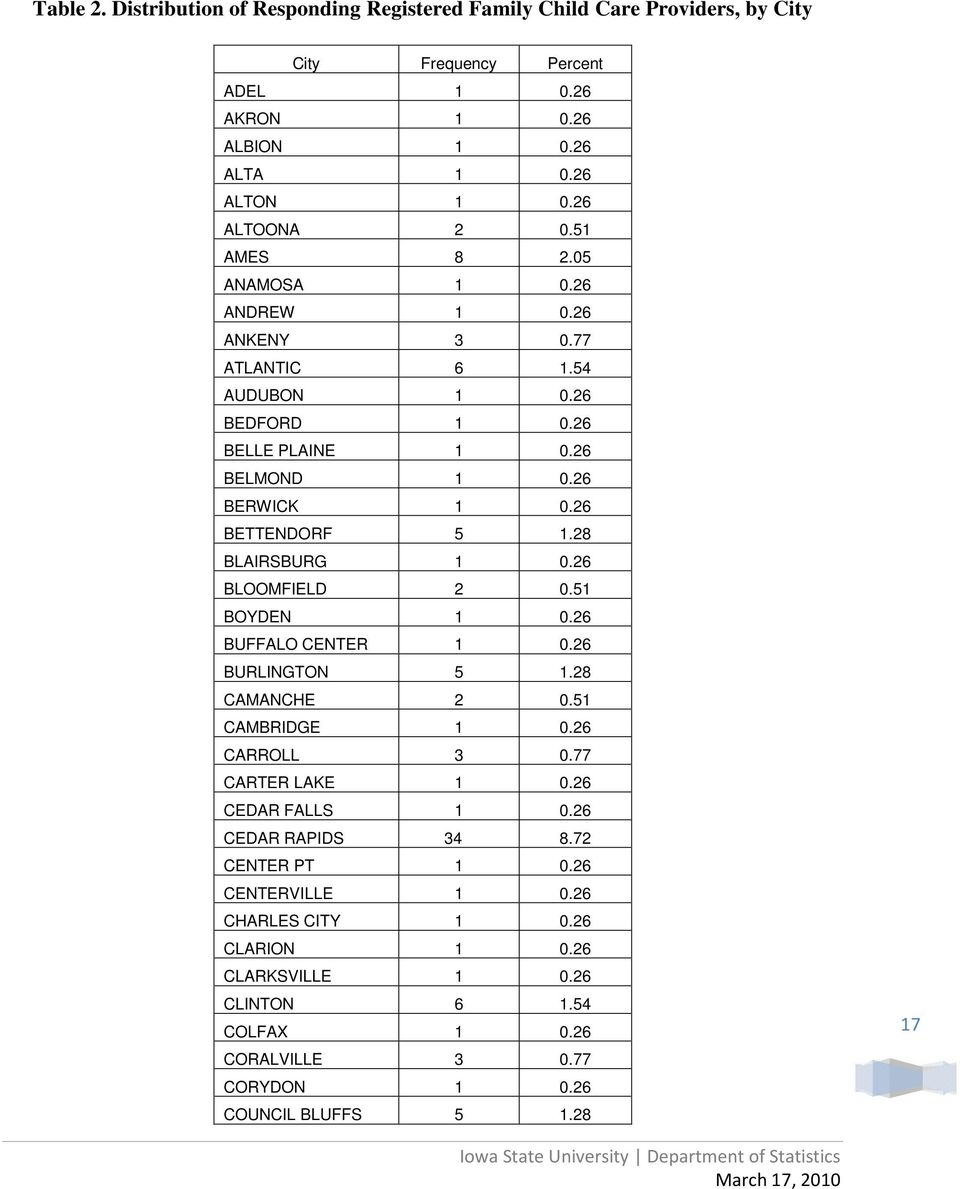
18 Table 2. Distribution of Responding Registered Family Child Care Providers, by City, (continued) City Frequency Percent CRESTON 2.5 DAKOTA CITY.26 DAVENPORT 7.79 DAVIS CITY.26 DECORAH.26 DENISON.26 DES MOINES DEWITT.26 DUBUQUE.26 DUNKERTON.26 DURANT 2.5 ELDRIDGE.26 ELKADER.26 ELY.26 EMMETSBURG 3.77 EVERLY.26 FAIRFIELD.26 FOREST CITY 2.5 FORT DODGE 6.54 FT MADISON 2.5 GARWIN.26 GILBERTVILLE.26 GLENWOOD.26 GRANGER.26 GRINNELL 2.5 HAMPTON.26 HANLONTOWN.26 HAWKEYE.26 HIAWATHA 2.5 HOSPERS.26 HUDSON 2.5 HUMBOLDT.26 INDEPENDENCE.26 INDIANOLA 4.3 IOWA CITY 3.77 IOWA FALLS.26 JOHNSTON March 7, 2

19 KELLERTON.26 Table 2. Distribution of Responding Registered Family Child Care Providers, by City, (continued) City Frequency Percent KEOKUK.26 KEOSAUQUA.26 KNOXVILLE.26 LA PORTE CITY.26 LAMONI.26 LECLAIRE.26 LEMARS 3.77 LEON.26 LESTER.26 LEWIS.26 LISBON.26 LUZERNE.26 MANCHESTER.26 MANNING.26 MANSON.26 MAQUOKETA.26 MARCUS.26 MARION 2.5 MARSHALLTOWN 6.54 MARTELLE.26 MASON CITY 7.79 MASSENA.26 MONONA.26 MONTOUR.26 MORNING SUN.26 MOUNT AYR.26 MOVILLE.26 MT CARMEL.26 MT VERNON 2.5 MUSCATINE 5.28 NASHUA.26 NEVADA 2.5 NORTHWOOD.26 NORWALK 2.5 OMAHA 7.79 OSCEOLA.26 OSKALOOSA March 7, 2
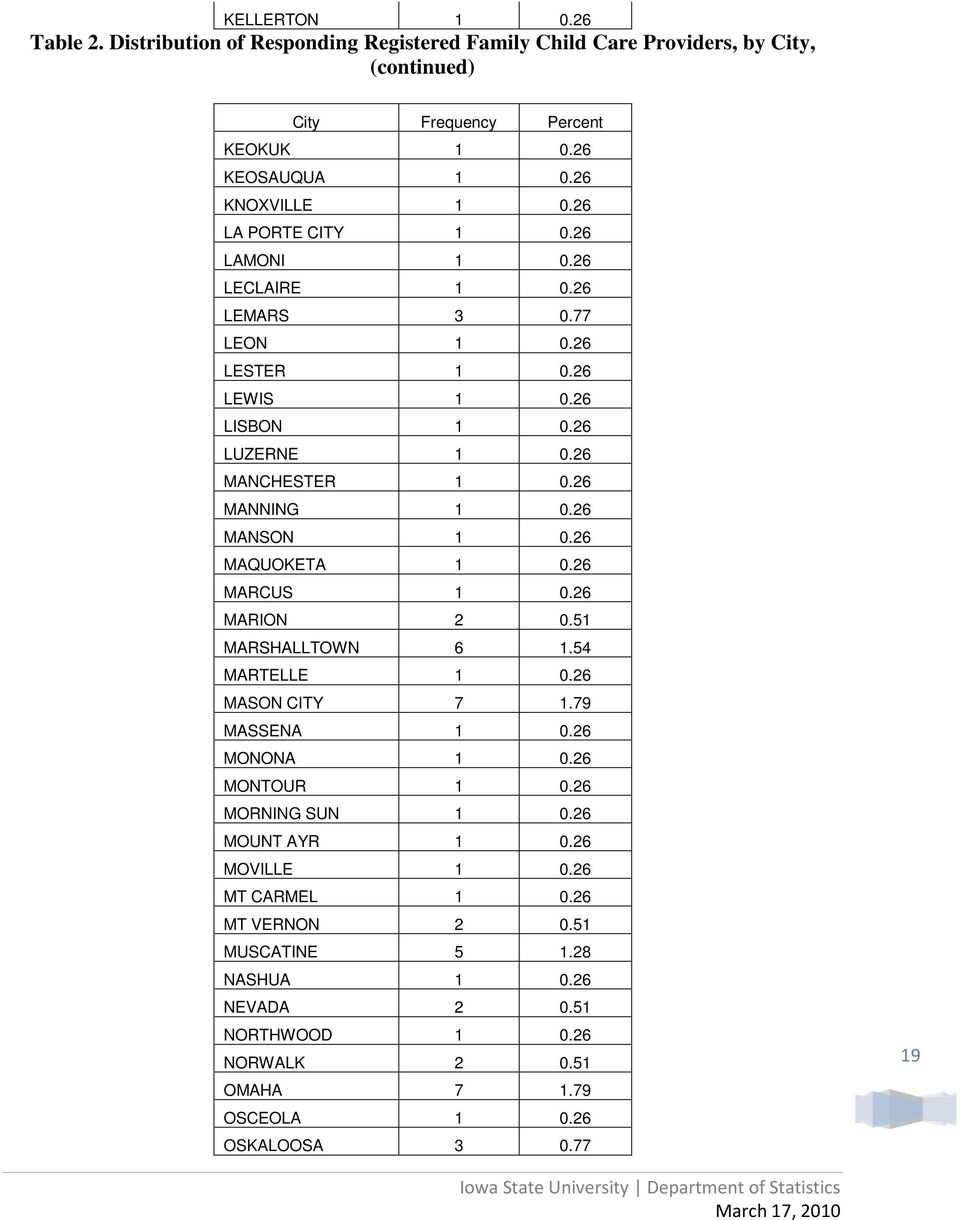
20 OTTUMWA 3.77 Table 2. Distribution of Responding Registered Family Child Care Providers, by City, (continued) City Frequency Percent PERRY.26 PRAIRIE CITY.26 QUAD CITES ROCKWELL.26 RODNEY.26 ROLFE.26 ROYAL.26 SHEFFIELD.26 SIOUX CENTER.26 SIOUX CITY SPENCER 5.28 SPILLVILLE.26 STATE CENTER 2.5 STUART.26 TAMA 2.5 TIPTON.26 TOLEDO 2.5 URBANA.26 URBANDALE.26 VAIL.26 VINTON.26 WAPELLO.26 WASHINGTON 2.5 WATERLOO WAUKEE.26 WEST BRANCH.26 WEST UNION.26 WEVER.26 WILLIAMSBURG.26 WILTON.26 WINTERSET 2.5 WOODBINE.26 Missing 6.54 Total March 7, 2

21 Table 3. Distribution of Responding Registered Family Child Care Providers, by County County Frequency Percent ADAIR.26 APPANOOSE.26 AUDUBON.26 BENTON 4.3 BLACK HAWK BUCHANAN.26 BUENA VISTA.26 BUTLER.26 CALHOUN.26 CARROLL 5.28 CASS CEDAR 4.3 CERRO GORDO CHEROKEE.26 CHICKASAW.26 CLARKE.26 CLAY 7.79 CLAYTON 2.5 CLINTON CRAWFORD 2.5 DALLAS 4.3 DAVIS 2.5 DECATUR 3.77 DELAWARE.26 DES MOINES 5.28 DUBUQUE.26 FAYETTE 2.5 FLOYD.26 FRANKLIN 2.5 HAMILTON.26 HARDIN.26 HARRISON.26 HUMBOLDT 2.5 IOWA.26 JACKSON 2.5 JASPER 2.5 JEFFERSON.26 2 March 7, 2
22 JOHNSON 6.54 Table 3. Distribution of Responding Registered Family Child Care Providers, by County (continued) County Frequency Percent JONES.26 LEE 4.3 LINN LOUISA 2.5 LYON.26 MADISON 2.5 MAHASKA 3.77 MARION.26 MARSHALL MILLS.26 MONONA.26 MUSCATINE 6.54 PALO ALTO 3.77 PLYMOUTH 4.3 POCAHONTAS.26 POLK POTTAWATTAMIE POWESHIEK 2.5 RINGGOLD 2.5 SCOTT SIOUX 4.3 STORY 2.82 TAMA 6.54 TAYLOR.26 UNION' 2.5 VAN BUREN.26 WAPELLO 4.3 WARREN 6.54 WASHINGTON 2.5 WAYNE.26 WEBSTER 6.54 WINNEBAGO 3.77 WINNESHIEK 2.5 WOODBURY WORTH 2.5 WRIGHT 2.5 Missing March 7, 2
23 Total 39. Figure. County Map of Responding Registered Family Child Care Providers Lyon 4 Sioux 4 Plymouth Osceola O'Brien Cherokee Dickinson 7 Clay Buena Vista Emmet 3 Palo Alto Pocahontas Kossuth 2 Humboldt 3 Winnebago Hancock 2 Wright 2 Worth 8 Cerro Gordo 2 Franklin Mitchell Floyd Butler Howard Chickasaw Bremer 2 Winneshiek Allamakee 2 Fayette 2 Clayton 3 Woodbury Monona Harrison Mills Ida 2 Crawford Shelby 3 Pottawattamie Fremont Sac Page 5 Carroll 8 Cass Montgomery Audubon Calhoun Adams Taylor Greene Guthrie Adair 6 Webster 2 Union 2 Ringgold Boone 4 Dallas 2 Madison Hamilton Clarke 3 Decatur Story 65 Polk 6 Warren Hardin Lucas Wayne 9 Marshall 2 Jasper Marion Grundy Monroe 6 Tama 3 Mahaska Appanoose 23 Black Hawk 2 Poweshiek 4 Wapello 2 Davis 4 Benton Iowa Keokuk Buchanan 44 Linn 6 Johnson 2 Washington Jefferson Van Buren Delaware 4 Lee Jones 4 Cedar 2 Louisa Dubuque 6 Muscatine Henry 5 Des Moines 2 Jackson 9 Clinton 33 Scott Registered Providers March 7, 2
24 Table 4. Distribution of Responding Unregistered Family Child Care Providers, by City City Frequency Percent AFTON.76 ALBERT CITY.76 ALDEN.76 AMES 2.53 ANKENY.76 ATLANTIC.76 AUDUBON.76 BENTON.76 BERNARD.76 BETTENDORF 2.53 BODE.76 BURLINGTON CEDAR FALLS.76 CEDAR RAPIDS 8 6. CHARITON.76 CHARLES CITY.76 CLINTON COLO.76 COUNCIL BLUFFS.76 CRESTON 2.53 DANVILLE.76 DAVENPORT DECORAH.76 DES MOINES DUBUQUE EAGLE GROVE 2.53 EARLVILLE.76 EDDYVILLE.76 FAIRFIELD.76 FORT DODGE.76 FT MADISON.76 GRIMES.76 HARVEY.76 HAZLETON.76 IDA GROVE.76 INDIANOLA.76 JEFFERSON 2.53 KEOKUK.76 KNOXVILLE 2.53 LADORA.76 LEMARS.76 LOGAN.76 LONG GROVE.76 LYNNVILLE.76 MAPLETON.76 MARION.76 MILLERSBURG March 7, 2
25 MO VALLEY.76 Table 4. Distribution of Responding Unregistered Family Child Care Providers, by City (continued) City Frequency Percent MONONA.76 MT AUBURN.76 MUSCATINE.76 NEOLA.76 NEW HAMPTON.76 NEW HARTFORD.76 NEWTON.76 NORWALK.76 OELWEIN.76 OMAHA.76 OSAGE.76 OTTUMWA.76 PACIFIC JUNCT.76 QUAD CITES ROCKWELL CITY.76 SHEFFIELD.76 SHELBY.76 SHENANDOAH.76 SIOUX CITY STOUT.76 STRAWBERRY PT.76 TAMA.76 TERRIL.76 TRIPOLI.76 URBANDALE.76 W BURLINGTON.76 WALKER.76 WATERLOO 7.63 WELLMAN.76 WESLEY.76 WEST POINT.76 WESTGATE.76 Missing 2.53 Total March 7, 2
26 Table 5. Distribution of Responding Unregistered Family Child Care Providers, by County County Frequency Percent AUDUBON.76 BENTON.76 BLACK HAWK 8.4 BREMER.76 BUCHANAN.76 BUENA VISTA.76 BUTLER.76 CALHOUN.76 CASS.76 CHICKASAW.76 CLAYTON 2.53 CLINTON DELAWARE.76 DES MOINES DICKINSON.76 DUBUQUE FAYETTE 2.53 FLOYD.76 FRANKLIN.76 GREENE 2.53 GRUNDY.76 HARDIN.76 HARRISON 2.53 HUMBOLDT.76 IDA.76 IOWA 2.53 JASPER.76 JEFFERSON.76 KOSSUTH.76 LEE LINN 7.63 LUCAS.76 MARION MILLS.76 MITCHELL.76 MONONA.76 MUSCATINE.76 PAGE.76 PLYMOUTH.76 POLK POTTAWATTAMIE RINGGOLD.76 SCOTT 8.4 STORY TAMA.76 UNION March 7, 2
27 Table 5. Distribution of Responding Unregistered Family Child Care Providers, by County (continued) County Frequency Percent WAPELLO 2.53 WARREN 2.53 WASHINGTON.76 WEBSTER 2.53 WINNESHIEK.76 WOODBURY WRIGHT 2.53 Missing 2.53 Total March 7, 2
28 Figure 2. County Map of Responding Unregistered Family Child Care Providers Lyon Sioux Osceola O'Brien Dickinson Clay Emmet Palo Alto Kossuth Winnebago Hancock Worth Cerro Gordo Mitchell Floyd Howard Chickasaw Winneshiek Allamakee Plymouth Cherokee Buena Vista Pocahontas Humboldt 2 Wright Franklin Butler Bremer 2 Fayette 2 Clayton 3 Woodbury Monona 2 Harrison Mills Ida Crawford Shelby 4 Pottawattamie Fremont Sac Page Carroll Cass Montgomery Audubon Calhoun Adams Taylor 2 Greene Guthrie Adair 2 Webster 3 Union Ringgold Boone Dallas Madison Hamilton Clarke Decatur 3 Story 6 Polk 2 Warren Hardin Lucas Wayne Marshall Jasper 3 Marion Grundy Monroe Appanoose Tama Mahaska Black Hawk Poweshiek 2 Wapello Davis Benton 2 Iowa Keokuk Buchanan Linn Johnson Washington Jefferson Van Buren Delaware 3 Lee Jones Cedar Louisa 5 Dubuque Muscatine Henry 5 Des Moines Jackson 3 Clinton Scott Unregistered Providers March 7, 2
29 Table 6. Distribution Care Centers, by City City Frequency Percent ANKENY.4 ARMSTRONG.4 ATLANTIC.4 CARROLL.4 CEDAR FALLS.4 CEDAR RAPIDS CHARLES CITY.4 DES MOINES ESTHERVILLE.4 FORT DODGE MARION.4 OAKLAND.4 OMAHA* 3 4. POSTVILLE.4 QUAD CITES** 8. READLYN.4 ROCK RAPIDS.4 SIOUX CITY.4 SIOUX FALLS.4 WATERLOO WAUKEE.4 Missing Total 73. of Responding Child *includes responses mailed from Nebraska for Iowa respondents ** includes responses mailed from Illinois for Iowa respondents 29 March 7, 2
30 Table 7. Distribution of Responding Child Care Centers, by County County Frequency Percent ALLAMAKEE.4 BLACK HAWK 8. BREMER.4 CARROLL.4 CASS.4 DALLAS.4 EMMET FLOYD.4 LINN LYON POLK POTTAWATTAMIE SCOTT 8. WEBSTER WOODBURY.4 Missing Total March 7, 2
31 Figure 3. County Map of Responding Child Care Centers 2 Lyon Sioux Osceola O'Brien Dickinson Clay 2 Emmet Palo Alto Kossuth Winnebago Hancock Worth Cerro Gordo Mitchell Floyd Howard Chickasaw Winneshiek Allamakee Plymouth Cherokee Buena Vista Pocahontas Humboldt Wright Franklin Butler Bremer Fayette Clayton Woodbury Monona Harrison Mills Ida Crawford Shelby 4 Pottawattamie Fremont Page Sac Montgomery Carroll Audubon Cass Calhoun Adams Taylor Greene Guthrie Adair 2 Webster Union Ringgold Boone Dallas Madison Hamilton Clarke Decatur 7 Polk Story Warren Hardin Lucas Wayne Marshall Jasper Marion Grundy Monroe Appanoose Tama Mahaska 8 Black Hawk Poweshiek Wapello Davis Benton Iowa Keokuk Buchanan Jefferson Van Buren 4 Linn Johnson Washington Delaware Henry Lee Jones Cedar Louisa Dubuque Muscatine Des Moines Jackson Clinton 8 Scott Child Care Centers Zero Centers to 4 Centers 8 or More Centers 3 March 7, 2
32 Demographic Information Number of All Family Child Care Providers Table 8. Age Distribution of Family Child Care Providers Percent of All Family Child Care Providers (n=59*) Number of Registered Family Child Care Providers Percent of Registered Family Child Care Providers (n = 383) Number of Unregistered Family Child Care Providers Percent of Unregistered Family Child Care Providers (n = 26) Under 2 <% % <% % 56 5% 3 % % 23 32% 9 5% % 6 28% 3 25% % 76 2% 39 3% 6 or over 45 9% 22 6% 23 8% *Two returned surveys for which it was not possible to determine whether the respondent was registered or unregistered are not included in this analysis; due to missing data on age, responses were available for a total of 59 respondents The most common age ranges of all family child care providers are 3-4 and 4-5 years old. Registered family child care providers are generally younger. 32 March 7, 2
33 Table 9. Race/Ethnicity of Family Child Care Providers Number of All Family Child Care Providers Percent of All Family Child Care Providers (n=5*) Number of Registered Family Child Care Providers Percent of Registered Family Child Care Providers (n = 384) Number of Unregistered Family Child Care Providers Percent of Unregistered Family Child Care Providers (n = 26) Black or 37 7% 25 7% 2 % African American Asian 3 <% 2 <% <% Native Hawaiian/ 2 <% 2 <% % Pacific Islander White 458 9% 346 9% 2 89% Hispanic or Latino 4 3% 3 3% <% American Indian/ 8 2% 8 2% % Alaska Native Other*** <% <% % **Two returned surveys for which it was not possible to determine whether the respondent was registered or unregistered are not included in this analysis; due to missing data on ethnicity, responses were available for a total of 5 respondents **Respondents were asked to check all that apply; percentages may not add to ***Other response was homo sapien By far, the predominant race category was White, representing 9 percent of both registered and unregistered family child care providers. Unregistered family care providers were somewhat more likely to self-report their race identification as Black or African American, whereas registered family care providers were more likely to self-identify their ethnicity as Hispanic or Latino or race as American Indian/Alaska Native. 33 March 7, 2
34 Table. Current Marital Status of Family Child Care Providers Number of All Family Child Care Providers Percent of All Family Child Care Providers (n=58*) Number of Registered Family Child Care Providers Percent of Registered Family Child Care Providers (n = 382) Number of Unregistered Family Child Care Providers Percent of Unregistered Family Child Care Providers (n = 26) Single 5 % 37 % 3 % Married or Living with Partner % % 8 64% Separated 2% 4 % 6 5% Divorced 56 % 36 9% 2 6% Widowed 4 3% 8 2% 6 5% *Two returned surveys for which for which it was not possible to determine whether the respondent was registered or unregistered are not included in this analysis; due to missing data on marital status, responses were available for a total of 58 respondents Married or Living with Partner (74% of all family child care providers was the most common current marital status; this was more common for registered (78%) than for unregistered (64%) family child care providers. The least common current marital status categories were Separated and Widowed. Divorced, Separated, and Widowed all were somewhat more likely responses for unregistered family child care providers. 34 March 7, 2
35 Table. Availability of a Computer in the Home for Family Child Care Providers Number of All Family Child Care Providers Percent of All Family Child Care Providers (n=59*) Number of Registered Family Child Care Providers Percent of Registered Family Child Care Providers (n = 383) Number of Unregistered Family Child Care Providers Percent of Unregistered Family Child Care Providers (n = 26) No 56 % 3 8% 26 2% Yes % % 79% *Two returned surveys for which for which it was not possible to determine whether the respondent was registered or unregistered are not included in this analysis; due to missing data on availability of a computer in the home, responses were available for a total of 59 respondents Nearly all (89%) responding family child care providers reported that they have a computer in their home. Home computer availability was more likely for registered (92%) than for unregistered (79%) family child care providers. 35 March 7, 2
36 Table 2. Access to the Internet in the Homes of Family Child Care Providers Number of All Family Child Care Providers Percent of All Family Child Care Providers (n=56) Number of Registered Family Child Care Providers Percent of Registered Family Child Care Providers (n = 38) Number of Unregistered Family Child Care Providers Percent of Unregistered Family Child Care Providers (n = 26) No 69 4% 38 % 3 25% Yes % 342 9% 95 75% *Two returned surveys for which for which it was not possible to determine whether the respondent was registered or unregistered are not included in this analysis; due to missing data on access to the Internet in the home, responses were available for a total of 56 respondents Home access to the Internet was common (86%) among family child care provider respondents. Internet access was more likely to be reported by registered (9%) than by unregistered (75%) family child care providers. 36 March 7, 2
37 Table 3. Number of Child Care Centers Employees, by Category Number of Employees, by Category Percent of All Employees (n=,68) Full-time Directors 72 7% Full-time Teachers 29 27% Full-time Assistant Teachers 44 3% Part-time Directors 4 % Part-time Teachers 3 % Part-time Assistant Teachers 435 4% Total,68 The responding child care centers reported a total of,68 employees, of whom 72 (7%) were full-time directors, 4 (%) were part-time directors, 29 (27%) were full-time teachers, 3 (%) were part-time teachers, 44 (3%) were full-time assistant teachers, and 435 (4%) were part-time assistant teachers. It is important to note that inconsistencies in how data from child care center surveys were reported mean that subsequent tables reporting results for child care centers may be based on numbers of employees that are not identical to those reported here. 37 March 7, 2
38 Table 4. Number of Child Care Centers Employees, by Gender Number of Employees, by Gender Percent of All Employees (n=,28) Percent Female, by Category Male Directors 5 <% Directors Female Directors 75 7% 94% Male Teachers 8 <% Teachers Female Teachers % 98% Male Assistant Teachers 36 4% Assistant Teachers Female Assistant Teachers % 94% Total,28 Of the,28 employee positions reported in response to this child care center survey item, the vast majority of positions are held by women. This is true of nearly all teachers (98%), and only slightly less so of directors (94%) and assistant teachers (94%). These results suggest that women dominate in both the teaching and administration functions at child care centers. 38 March 7, 2
39 Table 5. Number of Child Care Centers Employees, by Racial/Ethnic Group Number of Employees, by Category and Ethnicity Percent of Employees, by Category Directors n=92 n=92 Black or African-American 2 2% Asian % Native Hawaiian/Pacific Islander % White 89 97% Hispanic or Latino % American Indian/Alaska Native % Other (please specify) % Teachers n=37 n=37 Black or African-American 7 2% Asian 4 % Native Hawaiian/Pacific Islander <% White % Hispanic or Latino 4 % American Indian/Alaska Native % Other (please specify) % Assistant Teachers n=575 n=575 Black or African-American 27 5% Asian 5 <% Native Hawaiian/Pacific Islander 3 <% White 524 9% Hispanic or Latino 2% American Indian/Alaska Native 3 <% Other (please specify) 3 <% The reported race self-identification of child care center employees is very heavily White, accounting for 97 percent of directors, 96 percent of teachers, and 9 percent of assistant teachers. The proportionate representation of non-majority employees increases only slightly moving downward in positional authority from director, to teacher, to assistant teacher. The largest proportionate representation of any non-majority group is the five percent of assistant teachers who are Black or African-American. 39 March 7, 2
40 Education Table 6. Highest Level of Educational Attainment for Family Child Care Providers Number of All Family Child Care Providers Percent of All Family Child Care Providers (n=55*) Number of Registered Family Child Care Providers Percent of Registered Family Child Care Providers (n = 38) Number of Unregistered Family Child Care Providers Percent of Unregistered Family Child Care Providers (n = 25) Did not complete 26 5% 3 3% 3 % high school High school 76 35% 24 33% 54 43% diploma or equivalent Some college, but 74 34% 37 36% 37 3% without attaining a degree Associate s 76 5% 6 6% 5 2% degree Bachelor s degree 44 9% 38 % 6 5% Master s degree 7 % 7 2% % or above *Two returned surveys for which for which it was not possible to determine whether the respondent was registered or unregistered are not included in this analysis; due to missing data on educational attainment, responses were available for a total of 55 respondents Self-reported levels of highest educational attainment only rarely (%) included a four-year degree or above, with only % attaining an advanced degree beyond the bachelor s. The most common educational attainment for all family child care providers was high school diploma or equivalent (35%) or some college, but without attaining a degree (34%). Registered family child care providers generally had higher levels of educational attainment, compared to unregistered family child care providers; higher percentages of registered family child care providers reported their highest educational attainment was some college, but without attaining a degree, associate s degree, Bachelor s degree, and Master s degree or above. A substantially higher percentage of unregistered family child care providers (%) reported never graduating from high school, compared to just three percent of registered family child care providers. Five percent (3% of registered providers and % of unregistered providers) of family child care providers have less than a high school diploma, 35 percent (33% of registered providers and 43% of unregistered providers) have a high school diploma/ged, 59 percent (64% of registered providers and 47% of unregistered providers) have at least some college credits, 25 percent (28% of registered providers and 7% of unregistered providers) have an associate s degree or above, and percent (2% of registered providers and 5% of unregistered providers) have a bachelor s degree or above. 4 March 7, 2
41 Thirty-six percent of those with an associate s degree or above majored in child development or elementary education; of those with some college credits but no degree, two percent reported taking courses in child development or early childhood education. Education levels for Iowa s family child care workforce average between slightly more than a high school diploma and an associate s (two-year) degree. 4 March 7, 2
42 Table 7. Highest Level of Education Completed by Child Care Center Directors Category of Educational Attainment Number of Directors (n=7*) Percent of All Directors High school diploma or equivalent 7 % Some college, but without attaining a degree 7 % Associate s degree 4% Bachelor s degree 35 5% Master s degree or above (e.g., Ph.D., J.D.) 6% *Responses for three directors were missing. The most common level of educational attainment for child care center directors was bachelor s degree (5%). Least common were high school diploma or equivalent and some college, but without attaining a degree (both %). Advanced degrees were relatively rare (6%). 42 March 7, 2
43 Table 8. Highest Level of Educational Attainment for Child Care Center Teachers Number of All Child Care Center Teachers Percent of All Child Care Center Teachers (n=326*) Did not complete high school % High school diploma or equivalent 79 24% Some college, but without attaining a degree 68 2% Associate s degree 55 7% Bachelor s degree 2 34% Master s degree or above 2 4% *Responses from 7 centers were not available on these items Of the teachers in child care centers, % have less than a high school diploma, 24% have a high school diploma or equivalent, 76% have at least some college credits, 55% have an associate s degree or above, and 38% have a bachelor s degree or above. 43 March 7, 2
44 Table 9. Highest Level of Educational Attainment for Child Care Center Assistant Teachers Number of All Child Care Center Assistant Teachers Percent of All Child Care Center Assistant Teachers (n=572*) Did not complete high 3 5% school High school diploma or 92 34% equivalent Some college, but % without attaining a degree Associate s degree 4 7% Bachelor s degree 38 7% Master s degree or <% above *Responses from eight centers were not available on these items Five percent of the assistant teachers in child care centers have less than a high school diploma, 34 percent have a high school diploma or equivalent, 6 percent have at least some college credits, 4 percent have an associate s degree or above, and seven percent have a bachelor s degree or above 44 March 7, 2
45 Training Table 2. Family Child Care Providers with a Child Development Associate (CDA) Credential Number of All Family Child Care Providers Percent of All Family Child Care Providers (n=492) Number of Registered Family Child Care Providers Percent of Registered Family Child Care Providers (n = 37) Number of Unregistered Family Child Care Providers Percent of Unregistered Family Child Care Providers (n = 2) No 442 9% 33 89% 2 93% Yes 5 % 4 % 9 7% *Two returned surveys for which for it was not possible to determine whether the respondent was registered or unregistered are not included in this analysis; due to missing data on whether the family child care provider has a CDA credential, responses were available for a total of 492 respondents A Child Development Associate (CDA) Credential is the credential an individual earns after having successfully completed the CDA process and an assessment by the Council for Professional Recognition, in Washington, D.C. The CDA Credential, a recognized part of the child care licensing/registration requirements in Iowa and across the country, is a way to earn points on Iowa s Quality Rating System, and is a part of the process of achieving accreditation standards. CDA Credentials have been awarded in the United States since 97, and over 2, credentials have been granted. Some CDA candidates have associate or bachelor s degrees in a field other than early childhood education and are looking for an early childhood credential to meet some position or regulation requirement. Others use the CDA process as an avenue to experience college, without the requirement of committing to a full degree program. Some are required to earn their CDA Credential because of the standards set by their employer. The CDA Credential may be used to raise the level of professionalism for registration, licensing, Iowa s Quality Rating System, the Quality Preschool Program Standards, Head Start Standards, and National Association for the Education of Young Children accreditation. The recipient of a Child Development Associate Credential is able to meet the specific needs of children and works with parents and other adults to nurture children s physical, social, emotional, and intellectual growth in a child development framework. CDA Credentials were relatively rare; percent of responding family child care providers indicated that they had a CDA credential. The incidence of CDA credentials is somewhat higher among registered (%) than among unregistered (7%) family child care providers. 45 March 7, 2
46 Table 2. Barriers to Receiving Training and Reasons for Not Attending Training, for Family Child Care Providers and Center Directors Percent of Family Child Care Providers Percent of Center Directors* Overall* Registered* Unregistered* Barriers to Receiving Training No substitute was available 25% 24% 26% 28% Inconvenient time 5% 53% 4% 46% Distance/location 44% 48% 33% 44% Cost 3% 3% 3% 46% Other 4% 3% 8% N/A Reasons for Not Attending Training Training does not increase earnings 4% 4% 42% 32% Training does not advance my career 26% 26% 29% 23% Poor quality of training or trainer 9% % 3% % Available topics not relevant 24% 28% % 25% Difficulty locating appropriate training 33% 39% % 26% Other 5% 4% % % * Overall 446 responses were available for the items No substitute was available through Cost, for family child care providers, 343 responses were available for registered child care providers, and 3 were available for unregistered child care providers; for the items Training does not increase earnings through Other, for family child care providers, 42 responses were available overall, 322 responses were available for registered family child care providers, and 99 were available for unregistered family child care providers; responses were available from 69 centers. Compared to center directors, family child care providers were less likely to see cost as a barrier to receiving training and more likely to feel that training does not increase earnings and that it was difficult to locate appropriate training. Compared to unregistered family child care providers, registered family child care providers were more likely to see inconvenient time and distance/location as barriers to receiving training, and to see poor quality of training or trainer, available topics not relevant, and difficulty locating appropriate training as reasons for not attending training. 46 March 7, 2
47 Table 22. Number of Child Care Center Directors Who Have Received a Child Development Associate (CDA) Credential Number of Directors (n=7*) Percent of All Directors No 58 83% Yes 2 7% **Responses for three directors was missing. Nearly one-fifth (7%) of directors reported they had received a Child Development Associate (CDA) credential. 47 March 7, 2
48 Table 23. Number of Child Care Centers Staff Who Have a Child Development Associate (CDA) Credential Number of Teachers (n=43) Percent of Teachers Number of Assistant Teachers (n=579) Percent of Assistant Teachers Yes 26 6% 7 3% No % % Child Development Associate (CDA) credentials were quite rare for teachers and assistant teachers. Twenty-six (6%) teachers and 7 (3%) assistant teachers were reported to have CDA credentials. 48 March 7, 2
49 Table 24. Quality Rating System Rates for Child Care Centers and Registered Family Child Care Providers Number of Centers Percent of Total (n=22) Number of Registered Family Child Care Providers Percent of Total (n = 94) % % % 8 9% 2 4 8% 39 4% % 2 2% 4 3 4% % 5 5% 7 7% Total Other 8 Does not participate in QRS Iowa s Quality Rating System (QRS) IS a voluntary child care rating system for child development homes, licensed child care centers and preschools, and child care programs that are operated by school districts. The QRS was developed to raise the quality of child care in Iowa, increase the number of children in high-quality child care settings, AND educate parents about quality in child care. There are five levels in the QRS, with five being the maximum score. For more information see Most reporting centers (64%) were rated at three on a scale of five. Registered family child care providers were most likely (4%) to be scored at two. 49 March 7, 2
50 Table 25. Percentage of Child Care Center Directors Who Feel That Child Care-Related Training Has Had a Positive Effect on the Quality of Care Being Provided by Staff Number of Directors (n=7*) Percent of Directors No 6 9% Yes 64 9% **Responses for three directors were missing. Almost all (9%) responding child care center directors reported that they felt child care-related training has had a positive effect on the quality of care being provided by their center staff. 5 March 7, 2
51 Table 26. Number of Child Care Center Directors Who Have Completed or More Hours of In-Service or Professional Development in the Last 2 Months Number of Directors (n=7*) Percent of Directors No 4 6% Yes 66 94% **Responses for three directors were missing. Most (94%) of child care center directors reported that they have completed or more hours of in-service or professional development in the last 2 months. Table 27. Number of Child Care Center Teachers and Assistant Teachers Who Have Completed or More Hours of In-Service or Professional Development in the Last 2 Months Number of Teachers (n=43) Percent of Teachers Number of Assistant Teachers (n=579) Percent of Assistant Teachers No 27% 68 29% Yes % 4 7% Most teachers (73%) and assistant teachers (7%) were reported by their center directors to have completed or more hours of in-service professional development in the last 2 months. 5 March 7, 2
52 Table 28. Number of Hours of In-Service or Professional Development Completed by Family Child Care Providers in the Past 2 Months Number of All Family Child Care Providers Percent of All Family Child Care Providers (n=449) Number of Registered Family Child Care Providers Percent of Registered Family Child Care Providers (n = 358) Number of Unregistered Family Child Care Providers Percent of Unregistered Family Child Care Providers (n = 9) 75 7% 23 6% 52 57% % 66 8% 3 34% 2 or more % % 8 9% *Two returned surveys for which for which it was not possible to determine whether the respondent was registered or unregistered are not included in this analysis; due to missing data on number of hours of in-service or professional development completed, responses were available for a total of 449 respondents (two extreme values of 92 and 28 were re-coded as missing) Nearly two-thirds (62%) of all responding family child care providers reported completing 2 or more hours of in-service or professional development within the past 2 months. Relatively few reported completing zero hours (7%) or - hours of in-service of professional development within the past 2 months. There is a strong and very sharp difference between registered and unregistered family child care providers; registered family child care providers (75%) were much more likely than unregistered family child care providers (9%) to report having completed 2 or more hours, whereas completing zero hours of in-service or professional development was much more likely for unregistered (57%) than for registered (7%) family child care providers. For all respondents, the mean is 8 hours, the median is 2 hours, the mode is hours, the range is from to 63 hours, and the standard deviation is 38. For registered family child care respondents, the mean is 2 hours, the median is 5 hours, the mode is 2 hours, the range is from to 76 hours, and the standard deviation is 8 hours. In contrast, for unregistered respondents, the mean is 4 hours, the median is hours, the mode is hours, the range is from to 63 hours, and the standard deviation is 78 hours. 52 March 7, 2
53 Income and Benefits Table 29. Median Annual Income for Child Care Personnel Child care center assistant teachers $7,68 Child care center teachers $2,72 Family child care providers (n=47) $9,76 Registered (n=36) $22,356 Unregistered (n=9) $7,8 Median incomes are lowest for unregistered family child care providers ($7,8), followed by child care center assistant teachers ($7,68), child care center teachers ($2,72), and registered family child care providers ($22,356). All family child care providers, combining registered and unregistered, have median annual income of $9,76. Expenses associated with maintaining the family child care activity account were a substantial portion (median of $3,; $4,5 registered, $,2 unregistered) of family child care providers annual incomes. 53 March 7, 2
54 Table 3. Wage Comparisons Occupation Title Median Hourly Wage Education administrators, preschool and child care center/program $5.3 Education administrators, elementary and secondary school *$37.22 Preschool teachers, except special education $.24 Kindergarten teachers, except special education *$8.75 Elementary school teachers, except special education *$8.6 Middle school teachers, except special and vocational education *$9.3 Secondary school teachers, except special and vocational education *$8.67 Vocational education teachers, secondary school *$9.6 Special education teachers, preschool, kindergarten, and elementary school *$9.86 Special education teachers, middle school *$2.52 Special education teachers, secondary school *$2.2 Adult literacy, remedial education, and GED teachers and instructors $5.96 Self-enrichment education teachers $7.84 Teacher assistants *$9.54 Home health aids $.35 Nursing aides, orderlies, and attendants $.37 Crossing guards $2.76 Cooks, fast food $7.77 Dishwashers $7.96 Janitors and cleaners, except maids and housekeeping cleaners $.35 Nonfarm animal caretakers $8.78 Cashiers $7.82 Retail salespersons $9.5 File clerks $9.67 Bus drivers, school $4. Parking lot attendants $9.93 Child care center teacher $9.96 Child care center assistant teacher $8.5 All family child care provider $9.5 Registered family child care providers $.75 Unregistered family child care providers $3.75 Source: The figures in bold were calculated from the present study. Other information was taken from the May, 28 OES Wage Survey, available from Iowa Workforce Development. *The occupation reported an annual mean wage. An approximate mean hourly wage was created to make the occupations comparable. The mean hourly wage was calculated by dividing the mean annual wage by 28 hours. Child care providers median hourly wages compare poorly with many other occupations, and are particularly low with respect to wage rates for occupations in school settings who share the responsibility of caring for our children. 54 March 7, 2
55 Table 3. Family Child Care Provider Benefits Percent of family child care providers Overall Registered Unregistered Sick days (you) 7% 8% 3% Vacation days (you) 28% 32% 3% Health insurance(you) 33% 3% 37% Dental insurance(you) 24% 23% 27% Retirement plan (you) 6% 4% 2% Private life insurance (you) 37% 39% 3% Sick days (spouse or partner) 56% 6% 43% Vacation days (spouse or partner) 69% 72% 57% Health insurance (spouse or partner) 77% 8% 68% Dental insurance (spouse or partner) 6% 62% 5% Retirement plan (spouse or partner) 66% 69% 58% Private life insurance (spouse or partner) 63% 66% 54% In no case (sick days, vacation days, health insurance, dental insurance, retirement plan, and private life insurance) did anywhere close to a majority of family child care providers have access to those benefits through their own employment. Only3% of unregistered family child care providers benefited from sick days and vacation days. In general, family child care providers benefits are much more likely to accrue through their spouse or partner than through their employment. Provision of every category of benefits through a spouse or partner was more likely for registered than unregistered family child care providers. Registered family child care providers were more likely than unregistered family child care providers to have the benefits for themselves of sick days, vacation days, and private life insurance; in contrast, unregistered family child care providers were more likely to have the benefits for themselves of health insurance, dental insurance, and a retirement plan. 55 March 7, 2
56 Table 32. Who Pays for Family Child Care Providers Benefits Percent of family child care providers Overall Registered Unregistered Health Insurance (n=49 overall, n=37 registered, n=2 unregistered) Policy offered; employer contributes 4% 43% 36% part, employee (you, your spouse, or partner) contributes part Personal policy (paid by you, your 7% 8% 5% spouse, or partner) Government provided/subsidized (examples: hawk-i, Medicaid, Medicare) 5% 2% 23% Policy offered, no employer contribution 3% 3% 3% No health insurance coverage 22% 22% 22% Other 2% 2% 3% Dental Insurance (n=49 overall, n=37 registered, n=2 unregistered) Policy offered; employer contributes 33% 34% 3% part, employee (you, your spouse, or partner) contributes part Personal policy (paid by you, your 8% 8% 7% spouse, or partner) Government provided/subsidized % % 2% (examples: Medicaid, Medicare) Policy offered, no employer contribution 4% 4% 3% No dental insurance coverage 44% 44% 47% Other % % 2% Life Insurance (n=485 overall, n=366 registered, n=9 unregistered) Policy offered; employer contributes 3% 2% 4% part, employee (you, your spouse, or partner) contributes part Personal policy (paid by you, your 47% 5% 35% spouse, or partner) Policy offered, no employer contribution 2% 2% 2% No life insurance coverage 36% 33% 48% Other % 2% % When they are available at all, health and dental insurance benefits for family child care providers are provided primarily through policies funded through combined employer and employee (or spouse of partner) contributions. Life insurance is provided primarily through a personal policy paid by the family child care provider or by the spouse or partner. It is essential to note that dental insurance coverage is unavailable to 44 percent of family child care providers (47% of those unregistered), no life insurance coverage to 36 percent (48% of those unregistered), and no health insurance to 22 percent. 56 March 7, 2
57 Table 33. Retirement Savings for Family Child Care Providers Percent of family child care providers Overall Registered Unregistered Contributed to Social Security in the last 2 months (n=343 overall, n=265 registered, n=78 unregistered) No 2% 2% 2% Yes 79% 79% 79% Contributed to personal retirement savings/plan in the last 2 months (n=39 overall, n=234 registered, n=75 unregistered) No 67% 62% 8% Yes 33% 38% 2% In the last 2 months, 79 percent of family child care providers have contributed to Social Security and 33 percent have contributed to a personal retirement plan. 57 March 7, 2
58 Table 34. Child Care Center Program Staff Benefits Directors Teachers Assistant Teachers Sick Days 7% 67% 46% Vacation Days 76% 8% 5% Retirement Plan 53% 46% 33% Health Insurance for Employee Only Policy offered, employer pays in full 6% 7% 4% Policy offered, employer contributes partial payment 29% 4% 24% Policy offered, no employer contribution 4% 7% 4% No health insurance coverage 46% 4% 66% Other 4% 5% % Dental Insurance Employer pays in full % 9% 9% Policy offered, employer contributes partial payment % 8% 7% Policy offered, no employer contribution 6% 8% 2% No dental insurance coverage 6% 54% 72% Other % 2% % Among child care center program staff, most directors have the benefits of sick days (7%), vacation days (76%), and a retirement plan (although only 53%). Most teachers benefit from sick days (67%) and vacation days (8%), but are much less likely (46%) to have access to a retirement plan through their center employment. Assistant teachers are much less likely to have any of these benefits (46% for sick days, 5% for vacation days, and just 33 percent for retirement plan). Dental insurance coverage is rare; no dental insurance coverage is provided to 6 percent of directors, 54 percent of teachers, and 72 percent of assistant teachers. Health insurance is unavailable to 46 percent of directors, 4 percent of teachers, and 66 percent of assistant teachers. When available, health insurance is most likely to be paid through joint employer/employee contributions. The pattern of payment for dental insurance is less clear, with a mix of strategies used. 58 March 7, 2
59 Turnover Table 35. Reported Average Turnover Rate* Among Child Care Center Staff Type of Center Overall (n=65) For-profit (n=8) Non-profit/publicly operated (n=47) Directors 9% 8% % Teachers 4% 4% 3% Assistant Teachers 3% 35% 33% *Turnover rate was calculated as the ratio of the reported number of new employees (separately for directors, teachers, and assistant teachers) hired for the 28 calendar year ending December 3, 28 divided by the reported number of employees (separately for directors, teachers, and assistant teachers) on or around January, 28. The average turnover rate across all programs is nine percent for directors, 4 percent for teachers, and 3 percent for assistant teachers. Turnover rates in for-profit programs were 8 percent for directors, 4 percent for teachers, and 35 percent for assistant teachers. Turnover rates in non-profit programs were percent for directors, 3 percent for teachers, and 33 percent for assistant teachers. 59 March 7, 2
60 Table 36. Turnover for Family Child Care Providers Percent of family child care providers Overall Registered Unregistered I plan to remain in business as a family child care provider for a period of: (n=482 overall, n=367 registered, n=5 unregistered) to 3 years 4% 3% 2% 3 to 5 years 2% 4% 9% 5 years or more 34% 4% 8% Not sure 39% 34% 53% Of all family child care providers, 39 percent do not know how long they will remain in business (34% registered, 53% unregistered), 4 percent plan to continue in business to 3 years (3% registered, 2% unregistered), 2 percent plan to continue in business 3 to 5 years (4% registered, 9% unregistered), and 34 percent plan to continue in business 5 years or more (4% registered, 8% unregistered). It is not possible to accurately track turnover of family child care providers in Iowa because individuals who are providing care for fewer than six children are not required to be registered, licensed, or otherwise identified. Providers may choose to register or to volunteer information through Child Care Resources & Referral, but information on all providers is not collected. 6 March 7, 2
61 Table 37. Approximate Average Child Care Center Employee Turnover, by Headcount, in a Calendar Year Turnover Number of Centers Percent of Centers (n=67*) 29 43% % % 6-6% > 2 3% *Responses from six centers were not available on this item The most common response (43%) from responding child care centers was that an average of zero employee positions, measured by headcount, turned over in a calendar year. The next-most frequent response (28%) was that -2 employees turned over on average; the least common responses were 3-5 employees (9%) and greater than employees (3%). 6 March 7, 2
62 Table 38. Number of Child Care Center Directors on or Around January, 28, December 3, 28, and Hired for the 28 Calendar Year Ending December 3, 28 Directors on or around January, 28 (n=67) Directors on or around December 3, 28 (n=67) Directors hired for the 28 calendar year ending December 3, 28 (n=67) Number Frequency % Number Frequency % Number Frequency % 4 6% 4 6% 6 9% 48 72% 49 73% 7 % 2 4 2% 2 3 9% 2 % 3 % 3 % 3 % * Responses from six centers were not available on this item Most (72%) centers reported they employed one director on or around January, 28 and (73%) that they employed one director on or around December 3, 28. Nearly all (9%) centers reported hiring zero directors for the 28 calendar year ending December 3, March 7, 2
63 Table 39. Number of Child Care Center Teachers on or Around January, 28, December 3, 28, and Hired for the 28 Calendar Year Ending December 3, 28 Teachers on or around January, 28 (n=67) Teachers on or around December 3, 28 (n=67) Teachers hired for the 28 calendar year ending December 3, 28 (n=67) Number Frequency % Number Frequency % Number Frequency % 5 22% 2 8% 42 63% % % % 6-2 8% 6-2 8% 6- % > 5% > 5% > % * Responses from six centers were not available on this item The most common response from child care centers was that -5 teachers were employed on or around January, 28 and that -5 teachers were employed on or around December 3, 28. The most common (63%) number of teachers hired for the 28 calendar year ending December 3, 28 was zero. 63 March 7, 2
64 Table 4. Number of Child Care Center Assistant Teachers on or Around January, 28, December 3, 28, and Hired for the 28 Calendar Year Ending December 3, 28 Assistant teachers on or around January, 28 (n=67) Assistant teachers on or around December 3, 28 (n=67) Assistant teachers hired for the 28 calendar year ending December 3, 28 (n=67) Number Frequency % Number Frequency % Number Frequency % 9 3% 6 9% 28 42% % % % 6-2 8% 6-3 9% 6-8 2% > 6 24% > 9 28% > 2 3% * Responses from six centers were not available on this item Among responding child care centers, the most common response was that -5 assistant teachers were employed on or around January, 28 and that -5 assistant teachers were employed on or around December 3, 28. The most common responses regarding the number of assistant teachers hired for the 28 calendar year ending December 3, 28 were zero (42%) and -5 (43%). 64 March 7, 2
65 Funding Table 4. Center Program Funding Sources Type of Center Overall (n=7) For-profit (n=22) Parent/guardian fees (excluding vouchers provided through public funding) Mean % 62% 78% 54% Less than 5% 3% 4% 38% 5% or more 7% 86% 62% Parent/guardian s employer Mean % <% % <% Less than 5% % % % 5% or more % % % Public subsidies (state, federal, or local dollars, including vouchers) Mean % 7% 6% 22% Less than 5% 88% % 83% 5% or more 2% % 7% Corporate subsidies Mean % <% % <% Less than 5% % % % 5% or more % % % Grants Mean % 7% 4% 9% Less than 5% 94% 96% 94% 5% or more 6% 4% 6% Other Mean % 3% 3% 3% Less than 5% 99% 96% % 5% or more % 4% % Non-profit/publicly operated (n=48) Most center directors (7%) report that 5- percent of funding comes from parent fees. The mean percentage of reliance on parent fees for all reporting centers is 62 percent, but is substantially higher (78%) for for-profit centers than for non-profits (54%). Most directors (88%) report that less than 5 percent of funding comes from public subsidies, although the mean percentage is higher for nonprofit (22%) than for for-profit centers (6%). Grants income provides a negligible source of income, but is relied on somewhat more by nonprofit (6%) than for-profit (4%) centers. Payments from parents employers and corporate funding are essentially nonexistent. Non-profit programs tend to receive a higher percentage of funding from public subsidies (22%) and lower percentage from parent fees (54%), compared to for-profit programs (6% from public subsidies and 78% from parent fees). 65 March 7, 2
66 Table 42. Family Child Care Funding Sources Family Child Care Providers Overall (n=482) Registered (n=369) Unregistered (n=3) Parent/guardian fees (excluding vouchers provided through public funding) Yes 79% 87% 52% No 2% 3% 48% Public subsidies (state, federal, or local dollars, including vouchers) Yes 58% 56% 64% No 42% 44% 36% Parent s/guardian s employer Yes 5% 5% 4% No 95% 95% 96% Grants Yes 3% 6% 4% No 87% 84% 96% Other Yes 2% 2% 2% No 98% 98% 98% Among family child care providers, 79 percent receive funding from parent/guardian fees (87% of registered, 52% of unregistered). A majority (58%) receive some public subsidies (56% of registered, 64% unregistered). Very few (5%) receive funds from the parent s/ guardian s employer (5% registered, 4% unregistered). Funding from grants is reported by 3 percent to care for special types of children (6% registered, 4% unregistered). Other incentives to provide care are reported by just two percent of both registered and unregistered family care providers. 66 March 7, 2
67 Findings and Conclusions The results of this study echo the recommendations of the 26 CD-DIAL report, which argued for: increasing the number and size of financial incentives for the ECE workforce, making health insurance and retirement planning available to the ECE workforce, expanding the availability of business practices training for center program administrators and develop similar training and technical support for family child care practitioners, and creating public awareness that early care and education is a highly respected and important profession. As that report noted, lack of health and retirement benefits, low wages, few paid professional development options, limited business and marketing training opportunities, and a perceived lack of respect for early child care and education professionals may be muting Iowa's economic development efforts. In addition, the results of the present study lead to the following further recommendations: work to expand the child care labor force by more active recruitment of growing segments of Iowa s population and by partnerships with two-year and four-year academic institutions provide regular follow-up studies of Iowa s child care workforce, perhaps targeted to achieve better understanding of how educational attainment and training can be facilitated to enhance incomes, benefits, and retention. The data analysis supports the conclusions that both center-based and home-based workers who care for Iowa s children report generally low levels of education, inadequate training and the presence of significant barriers to achieving that training, low incomes that frequently trail well behind others in the education community, lack of benefits, high turnover rates, and inadequate and unstable sources of funding that require child care workers to supplement their gross incomes from other sources and require them to use their own limited personal funds to sustain their child care activities. Sustainable and effective child care in Iowa requires the commitment of adequate public and private resources to invest in Iowa s future that is embodied in its children. 67 March 7, 2
68 About This Study This study was conducted through collaboration between Iowa Workforce Development, the Iowa Department of Education, and the Iowa State University Department of Statistics. 68 March 7, 2
69 References: U.S. Census Bureau American Community Survey. < ADPTable?_bm=y&-geo_id=4US9&-qr_name= ACS_28_3YR_G_DP3YR3&-context=adp&-ds_name=&-tree_id=338&-_lang=en&- redolog=false&-format=> Iowa State University, University Extension. (26, January 3). Benefits, Rewards, & Support: Incentives to Build Quality and Increase Retention in the Iowa Child Care Workforce. Online at: (last accessed 2/2/9). Larson, K., Artz, G., Hegland, S., Kuku, Y., & Otto, D. (25). Parents, child care & work: The economic role of child care in Iowa. Iowa State University Extension, Ames, IA. Executive Summary online at: %2F%2Fwww.empowerment.state.ia.us%2Ffiles%2Fpolicies_reports%2Fexecutive_summary.p df&ei=fq8us9q2l4zgnafctfn4ca&usg=afqjcneeugv8_gwemddbrmanafduqp7iw&si g2=yv_vdbtwz3pa4mswkkzzg Levy, P.S., & Lemeshow, S. (28). Sampling of populations: methods and applications (4 th ed.). New York: Wiley. 69 March 7, 2
70 Appendix A Survey Cover Letters and Instruments Cover letter for Child Care Provider Wage Study Child Care Centers Child Care Provider Wage Study Child Care Centers Cover letter for Child Care Provider Wage Study Home (Family) Child Care Providers Child Care Provider Wage Study Home (Family) Child Care Providers Reminder Postcard 7 March 7, 2
71 CHILD CARE CENTER COVER LETTER Chester J. Culver, Governor Patty Judge, Lt. Governor Elisabeth Buck, Director Dear Child Care Director, You have been contacted by Iowa Workforce Development and Iowa Department of Human Services to participate in an anonymous survey about Iowa s child care workforce. You have been randomly selected as a participant because you are the Director of a child care center. The survey results will be compiled and shared with departments within Iowa state government and relevant groups. All answers we receive are confidential. No information from an individual center will be reported and none of the answers you provide could result in disciplinary action. We ask that the child care center director read this letter and complete the survey. If you are completing the information on behalf of the director, please indicate your title at the top of the enclosed survey. We are seeking responses only for staff who are directors, teachers, and assistant teachers. Your participation is voluntary; however, we value your information and encourage you to be a member of the study. PURPOSE OF SURVEY: The purpose of this survey is to help us understand the role of the child care providers and the compensation received. The total number of participants is expected to be 2,. DESCRIPTION OF SURVEY PARTICIPATION: This survey is expected to take approximately 5-2 minutes to complete. We ask that you do the following things: Please answer the enclosed questions as they apply to your child care center. This will usually require you to place an x in front of the appropriate response. Please return the completed survey in the enclosed postage-paid envelope by November 2, 29. E Grand Avenue Des Moines, IA Equal Opportunity Employer/Program Auxiliary aids and services available upon request to individuals with disabilities. For deaf and hard of hearing, use Relay 7. 7 March 7, 2
72 If we do not receive your completed survey by November 2, 29, you will receive a postcard reminder and a follow-up phone call. Your participation is voluntary. If you choose not to participate, it will not affect your current or future relations with Iowa Workforce Development or Iowa Department of Human Services. BENEFITS OF PARTICIPATION IN THIS SURVEY:. The benefits of participation are that we receive information directly from the child care providers. It is important that you are represented. 2. We can use the information received as a platform to inform and create a public awareness of the child care profession. CONFIDENTIALITY AND PRIVACY OF DATA: This survey is anonymous and responses to this study will be kept confidential to the extent allowed by law. Access to the records will be limited to the researchers; and reports we publish will not contain any information that will make it possible to identify a participant. Results of the findings will be published in a report and subsequent publications by Iowa State University in collaboration with Iowa Workforce Development and Iowa Department of Human Services. CONTACTS AND QUESTIONS: If you have any questions you may contact: Mack Shelley, University Professor, Iowa State University, at (55) or [email protected]. Thank you for your participation. Sincerely, Jude E. Igbokwe, Ph.D. Division Administrator/Labor Market Information Director Labor Market and Workforce Information Division Iowa Workforce Development East Grand Avenue Des Moines, IA E Grand Avenue Des Moines, IA Equal Opportunity Employer/Program Auxiliary aids and services available upon request to individuals with disabilities. For deaf and hard of hearing, use Relay March 7, 2
73 CHILD CARE CENTER SURVEY INSTRUMENT Child Care Provider Wage Study Child Care Centers We are asking that the following survey be completed by the child care center director. We are seeking responses only for staff who are directors, teachers, and assistant teachers. If you are completing the survey on behalf of the director please indicate your title below. Thank you. My position is: (n=72) 7% Director 4% Teacher <% Assistant-teacher 25% Other Please mark your answers below in the spaces provided.. My program is best described as (n=7) 3% For-profit 69% Non-profit <% Publicly operated <% Other 2. Approximately what percent of total funds received by your center came from the following?: % Parent/guardian fees (excluding vouchers provided through public funding) (n=72, Mean=6., S.D.=38.8, Range=-) % Parent/guardian s employer (n=72, Mean=.2, S.D.=.2, Range=-) % Public subsidies (state, federal, or local dollars, including vouchers) (n=7, Mean=6.7, S.D.=27.3, Range=-) % Corporate subsidies (n=72, Mean=., S.D.=.2, Range=-) % Grants (n=7, Mean=7.3, S.D.=9.6, Range=-) % Other (n=7, Mean=2.9, S.D.=8., Range=-5) 3. Indicate the number of the following employees employed by your center: (n=86) (n=43) (n=579) Full-time: 84% Directors 72% Teachers 25% Assistant-teachers Part-time: 6% Directors 28% Teachers 75% Assistant-teachers 4. Indicate the number of males and females employed by your center: (n=8) (n=366) (n=582) Males: 94% Directors 2% Teachers 6% Assistant-teachers Females: 6% Directors 98% Teachers 94% Assistant-teachers 73 March 7, 2
74 For all remaining questions, please include both full-time and part-time paid employees. 5. Indicate the number of employees who are members of the following racial/ethnic group(s) (please select all that apply): a. Directors: (n=92) 2% Black or African-American <% Asian <% Native Hawaiian/Pacific Islander 97% White % Hispanic or Latino <% American Indian/Alaska Native <% Other b. Teachers: (n=37) 2% Black or African-American % Asian <% Native Hawaiian/Pacific Islander 96% White % Hispanic or Latino <% American Indian/Alaska Native <% Other c. Assistant-teachers: (N=575) 5% Black or African-American % Asian <% Native Hawaiian/Pacific Islander 9% White 2% Hispanic or Latino <% American Indian/Alaska Native <% Other 6. a. What is the highest level of education completed by the director? (N=7) % High school diploma or equivalent % Some college, but without attaining a degree 4% Associate s degree 5% Bachelor s degree 6% Master s degree or above (e.g., Ph.D., J.D.) b. Indicate the highest level of education completed by teachers. Provide a number for each of the appropriate categories. (N=326) <% Less than high school diploma or equivalent 24% High school diploma or equivalent 2% Some college, but without attaining a degree 7% Associate s degree 34% Bachelor s degree 4% Master s degree or above (e.g., Ph.D., J.D.) 74 March 7, 2
75 c. Indicate the highest level of education completed by assistant teachers. Provide a number for each of the appropriate categories. (N=572) 5% Less than high school diploma or equivalent 34% High school diploma or equivalent 47% Some college, but without attaining a degree 7% Associate s degree 7% Bachelor s degree <% Master s degree or above (e.g., Ph.D., J.D.) 7. Does your organization participate in Iowa s Quality Rating System? (N=69) 52%No 48% Yes 8. Has the director received a Child Development Associate (CDA) credential? (n=7) 83% No 7% Yes 9. Indicate the number of staff who have a Child Development Associate (CDA) credential. Teachers (n=37): 7% Assistant teachers (n=575): 3%. As the director, do you feel that child care-related training has had a positive effect on the quality of care being provided by staff? (n=7) 9% No 9% Yes. In the past 2 months, has the director completed or more hours of in-service or professional development? (n=7) 6% No 94% Yes 2. In the past 2 months, how many teachers and assistant teachers have completed or more hours of in-service or professional development? Teachers (n=37) 79% Assistant teachers (n=575) 7% 3. Which of the following barriers to receiving training has the director encountered? (please select all that apply) (n=69) 28% No substitute was available 46% Inconvenient time 44% Distance/location 46% Cost 32% Training does not increase earnings 23% Training does not advance my career % Poor quality of training or trainer 25% Available topics not relevant 26% Difficulty locating appropriate training % Other 75 March 7, 2
76 4. Which of the following barriers to receiving training have been encountered by your teachers and/or assistant teachers? (please select all that apply) (n=7) 44% No substitute was available 59% Inconvenient time 48% Distance/location 56% Cost 39% Training does not increase earnings 24% Training does not advance my career % Poor quality of training or trainer 27% Available topics not relevant 25% Difficulty locating appropriate training % Other 5. a. Which of the following benefits does the director receive from the child care center? (n=7) Sick days 3% No 7% Yes Vacation days 24% No 76% Yes b. Which of the following benefits do your teachers receive from the child care center? (n=57) Sick days 33% No 67% Yes Vacation days 9% No 8% Yes c. Which of the following benefits do your assistant teachers receive from the child care center? (n=67) Sick days 54% No 46% Yes Vacation days 49% No 5% Yes 6. Which of the following best describes the health insurance benefits offered by the child care center? (n=69) a. For the director? (please select the one response that is most accurate) 6% Policy offered; employer pays in full 29% Policy offered; employer contributes partial payment 4% Policy offered; no employer contribution 46% No health insurance coverage 4% Other b. Teachers? (please select the one response that is most accurate) (n=57) 7% Policy offered; employer pays in full 4% Policy offered; employer contributes partial payment 7% Policy offered; no employer contribution 4% No health insurance coverage 5% Other 76 March 7, 2
77 c. Assistant teachers? (please select the one response that is most accurate) 4% Policy offered; employer pays in full 24% Policy offered; employer contributes partial payment 4% Policy offered; no employer contribution 66% No health insurance coverage 2% Other 7. Which of the following best describes the dental insurance benefit offered by the child care center? (n=7) a. For the director? (please select the one response that is most accurate) % Policy offered; employer pays in full % Policy offered; employer contributes partial payment 6% Policy offered; no employer contribution 6% No dental insurance coverage <) Other b. Teachers? (please select the one response that is most accurate) (n=67) 9% Policy offered; employer pays in full 8% Policy offered; employer contributes partial payment 8% Policy offered; no employer contribution 54% No dental insurance coverage 2% Other c. Assistant teachers? (please select the one response that is most accurate) (n=67) 9% Policy offered; employer pays in full 8% Policy offered; employer contributes partial payment 2% Policy offered; no employer contribution 72% No dental insurance coverage <% Other 8. Does your child care center offer a retirement savings/plan for: (please check all that apply)? 53% Director (n=7) 46% Teachers (n=57) 33% Assistant Teachers (n=67) 9. Indicate the number of teachers whose pay falls into each wage range listed below. You may use either the hourly wage or weekly wage chart. Base your answer on the most recent year. under $7.5 $7.5 - $9.49 $9.5 - $.99 $2. - $5.24 Hourly Wage (n=358) $ $9.24 $ $24.49 $ $3.99 $3. - $39.24 $ $49.74 $49.75 and over 6% 39% 3% 7% 6% 2% 2% 2% <% <% under $3 $3 - $379 $38 - $479 $48 - $69 $6 - $769 Weekly (n=33) $77 - $979 $98 - $,239 $,24 - $,569 $,57 - $,989 $,99 and over 8% 36% 39% 6% <% <% <% <% <% <% 77 March 7, 2
78 2. Indicate the number of assistant teachers whose pay falls into each wage range listed below. You may use either the hourly wage or weekly wage chart. Base your answer on the most recent year. under $7.5 $ $9.5 - $.99 $2. - $5.24 Hourly Wage (n=58) $ $9.24 $ $24.49 $ $3.99 $3. - $39.24 $ $49.74 $49.75 and over 23% 59% 5% 2% <% <% <% <% <% <% under $3 $3 - $379 $38 - $479 $48 - $69 $6 - $769 Weekly (n=6) $77 - $979 $98 - $,239 $,24 - $,569 $,57 - $,989 $,99 and over % <% <% <% <% <% <% <% <% <% 2. What is the approximate average employee turnover, measured by headcount, in a calendar year? Number: (n=67) (Mean=2.5, S.D.=3.5, Range=-2) A. How many employees did you have on or around January, 28? (n=67) Directors (Mean=.2, S.D.=5, Range=-3) Teachers (Mean=4.8, S.D.=5., Range=-25) Assistant teachers (Mean=7.4, S.D.=8.8, Range=-4) B. How many employees did you have on or around December 3, 28? (n=67) Directors (Mean=.2, S.D.=.5, Range=-3) Teachers (Mean=5., S.D.=5., Range=-25) Assistant teachers (Mean=8., S.D.=8.9, Range=-4) C. How many new employees did you hire for the 28 calendar year ending December 3, 28? (n=67) Directors (Mean=., S.D.=.3, Range=-) Teachers (Mean=.7, S.D.=., Range=-5) Assistant teachers (Mean=2.5, S.D.=3.3, Range=-4) 78 March 7, 2
79 FAMILY CHILD CARE PROVIDER COVER LETTER Chester J. Culver, Governor Patty Judge, Lt. Governor Elisabeth Buck, Director Dear Prospective Participant, You have been contacted by Iowa Workforce Development and Iowa Department of Human Services to participate in an anonymous survey about Iowa s child care workforce. You have been randomly selected as a participant because of your offering of child care services in your home. The survey results will be compiled and shared with departments within Iowa state government and relevant groups. All answers we receive are confidential. No individual information will be reported and none of the answers you provide could result in disciplinary action. Please read this letter and complete the survey as it relates the child care you provide for others in your home. Your participation is voluntary; however, we value your information and encourage you to be a member of the study. PURPOSE OF SURVEY: The purpose of this survey is to help us understand the role of the child care providers and the compensation received. The total number of participants is expected to be 2,. DESCRIPTION OF SURVEY PARTICIPATION: This survey is expected to take approximately 5-2 minutes to complete. We ask that you do the following things: Please answer the enclosed questions as they apply to your child care services. This will usually require you to place an x in front of the appropriate response. Please return the completed survey in the enclosed postage-paid envelope by November 2, 29. E Grand Avenue Des Moines, IA Equal Opportunity Employer/Program Auxiliary aids and services available upon request to individuals with disabilities. For deaf and hard of hearing, use Relay March 7, 2
80 If we do not receive your completed survey by November 2, 29, you will receive a postcard reminder and a follow-up phone call. Your participation is voluntary. If you choose not to participate, it will not affect your current or future relations with Iowa Workforce Development or Iowa Department of Human Services. BENEFITS OF PARTICIPATION IN THIS SURVEY: 3. The benefits of participation are that we receive information directly from the child care providers. It is important that you are represented. 4. We can use the information received as a platform to inform and create a public awareness of the child care profession. CONFIDENTIALITY AND PRIVACY OF DATA: This survey is anonymous and responses to this study will be kept confidential to the extent allowed by law. Access to the records will be limited to the researchers; and reports we publish will not contain any information that will make it possible to identify a participant. Results of the findings will be published in a report and subsequent publications by Iowa State University in collaboration with Iowa Workforce Development and Iowa Department of Human Services. CONTACTS AND QUESTIONS: If you have any questions you may contact: Mack Shelley, University Professor, Iowa State University, at (55) or [email protected]. Thank you for your participation. Sincerely, Jude E. Igbokwe, Ph.D. Division Administrator/Labor Market Information Director Labor Market and Workforce Information Division Iowa Workforce Development East Grand Avenue Des Moines, IA E Grand Avenue Des Moines, IA Equal Opportunity Employer/Program Auxiliary aids and services available upon request to individuals with disabilities. For deaf and hard of hearing, use Relay 7. 8 March 7, 2
81 FAMILY CHILD CARE PROVIDER SURVEY INSTRUMENT Child Care Provider Wage Study Home Child Care Providers Please mark your answers below in the spaced provided.. Are you male or female? (n=529) <% Male 99% Female 2. What is your age? <% under 2 4% % % % 5-6 9% 6 or over 3. I consider myself as a member of the following racial/ethnic group(s) (Please select all that apply): (n=52) 7% Black or African-American <% Asian <% Native Hawaiian/Pacific Islander 9% White 3% Hispanic or Latino 2% American Indian/Alaska Native <% Other 4. What is your current marital status? (n=5) % Single 75% Married or living with partner 2% Separated % Divorced 3% Widowed 5. Which of the following best describes your current position or role as a child care provider? (n=52) 75% Registered home child care provider 25% Unregistered home child care provider 6. Do you have a computer in your home? (n=5) % No 89% Yes 7. Do you have access to the internet in your home? (n=58) 4% No 86% Yes 8 March 7, 2
82 8. What is your highest level of educational attainment? (n=57) 5% Did not complete high school 35% High school diploma or equivalent 35% Some college, but without attaining a degree 5% Associate s degree 9% Bachelor s degree % Master s degree or above (e.g., Ph.D., J.D.) 9. In the past 2 months, how many hours of in-service or professional development did you complete? (please round to the nearest whole number of hours) (n=45) Hours (Mean=8.5, S.D.=38.4, Range=-63). Do you participate in Iowa s Quality Rating System? (n=495) 78% No 22% Yes. Do you have a Child Development Associate (CDA) credential? (n=494) 9% No % Yes 2. Have you encountered any of the following barriers to receiving training? (please select all that apply) (n=448) 25% No substitute was available 5% Inconvenient time 44% Distance/location 3% Cost 4% Other 3. Which, if any, of the following reasons for not attending training have you experienced? (please select all that apply) (n=423) 4% Training does not increase earnings 27% Training does not advance my career 9% Poor quality of training or trainer 24% Available topics not relevant 33% Difficulty locating appropriate training 5% Other 4. Do you work a second job for pay? (n=54) 75% No 25% Yes 5. Is there another adult in the household who contributes to the household income? (n=5) 26% No 74% Yes 6. Do you receive pay if: a. The child is ill and does not attend? (n=498) 45% No 55% Yes b. The child is on vacation? (n=488) 63% No 37% Yes 82 March 7, 2
83 7. Do you, or your spouse or partner, receive any of the following benefits from any source? Your benefits: Spouse or partner benefits: Sick days (n=483) 83% No 7% Yes Sick days (n=385) 44% No 56% Yes Vacation days (n=487) 73% No 27% Yes Vacation days (n=389) 3% No 69% Yes Health insurance (n=482) 68% No 32% Yes Health insurance (n=394) 23% No 77% Yes Dental insurance (n=48) 76% No 24% Yes Dental insurance (n=386) 4%No 6% Yes Retirement plan (n=48) 84% No 6% Yes Retirement plan (n=39) 34% No 66% Yes Private life (n=478) 63% No 37% Yes Private life (n=382) 37% No 63% Yes insurance insurance 8. Which of the following best describes your health insurance benefits? (please select the one response that is most accurate) (n=493) 4% Policy offered; employer contributes part, employee (you, your spouse, or partner) contributes part 7% Personal policy; (paid by you, your spouse, or partner) 5% Government provided/subsidized; (examples: hawk-i, Medicaid (Title 9), Medicare) 3% Policy offered; no employer contribution 22% No health insurance coverage 2% Other 9. Which of the following best describes your dental insurance benefits? (please select the one response that is most accurate) (n=492) 33% Policy offered; employer contributes part, employee (you, your spouse, or partner) contributes part 7% Personal policy; (paid by you, your spouse, or partner) % Government provided/subsidized; (examples: Medicaid (Title 9), Medicare, etc.) 4% Policy offered; no employer contribution 44% No dental insurance coverage % Other 2. Which of the following best describes your life insurance benefits? (please select the one response that is most accurate) (n=487) 3% Policy offered; employer contributes part, employee part 47% Personal policy; (paid by you, your spouse, partner, etc.) 2% Policy offered; no employer contribution 36% No life insurance coverage % Other 2. Do you contribute to retirement savings/plan (please check all that apply)? 79% Contributed to Social Security in the last 2 months (n=344) 34% Contributed to personal retirement savings/plan in the last 2 months (n=3) 22. About how many hours per week do you provide care for children as part of your home child care business? (n=468) Hours (Mean=47., S.D.=2., Range=-9) 83 March 7, 2
84 23. About how many hours per week do you spend on business-related duties? (examples: record keeping, attendance, preparation/clean-up time, etc.) (n=47) Hours (Mean=2.9, S.D.=2.8, Range=-9) 24. I plan to remain in business as a family child care provider for a period of: (n=483) 4% to 3 years 2% 3 to 5 years 35% 5 years or more 39% Not sure 25. Which of the following funding sources applies to your family child care? (please select all that apply) (n=484) 78% Parent/guardian fees 58% Public subsidies (such as child care assistance) 5% Parent/guardian s employer 3% Grants 2% Other 26. What is your weekly or monthly income from providing child care (include parent/guardian fees, subsidies, and miscellaneous fees collected)? Please use only one of the charts below to indicate your wage ranged based on the most recent year. under $3 $3 - $379 $38 - $479 $48 - $69 $6 - $769 Weekly (n=278) $77 - $979 $98 - $,239 $,24 - $,569 $,57 - $,989 $,99 and over 29% 6% 6% 7% 8% 8% 4% <% <% <% under $,3 $,3 - $,646 $,647 - $2,79 $2,8 - $2,642 Or Monthly (n=2) $2,643 - $3,336 $3,337 - $4,246 $4,247 - $5,372 $5,373 - $6,82 $6,83- $8,622 $8,623 and over 4% 6% 3% 9% 7% % 2% <% <% <% 27. What is the approximate dollar value of unreimbursed expenses to provide child care annually or in the last 2 months? (examples: food, toys, utilities, supplies, etc.) $ (Mean=$6,43.3, S.D.=$7,9.6, Range=$-$57,36) 84 March 7, 2
85 REMINDER POSTCARD Thank you for participating in the Child Care Provider Wage Study survey. Your opinions and information are important to the child care provider community. If you already have returned your survey, many thanks for doing so. If you have not returned your survey yet, we ask that you please do so within two days after receiving this postcard. If you need another copy of the survey, you may contact us at or by at: Thank you for your participation. 85 March 7, 2
86 Appendix B Codebooks Codebook for Child Care Provider Wage Study Child Care Centers Codebook for Child Care Provider Wage Study Family Child Care Providers 86 March 7, 2
87 Codebook for Child Care Provider Wage Study Child Care Centers Item Wording Coding Notes ID My position is =Director 2=Teacher 3=Assistant Teacher 4=Other N (If Item=4) Open-ended 888=Not applicable My program is best described as =For-profit 2=Non-profit 3=Publicly operated 4=Other (please describe) N (If Item=4) Open-ended 888=Not applicable 2 Approximately what percent of total funds received by your center came from the following?: 2. % Parent/guardian fees (excluding vouchers provided through public funding) Percentage Missing= % Parent/guardian s employer Percentage Missing=999 Percentage Missing= % Public subsidies (state, federal, or local dollars, including vouchers) 2.4 % Corporate subsidies Percentage Missing= % Grants Percentage Missing= % Other (please describe) Percentage Missing=999 2N (If Item2.6 has a nonzero response) Open-ended 888=Not applicable 3 Indicate the number of the following employees employed by your center: Number 3FFTD Full-time Directors Number 3F2FTT Full-time Teachers Number 3F3FTAT Full-time Assistant Teachers Number 3PPTD Part-time Directors Number 3P2PTT Part-time Teachers Number 3P3PTAT Part-time Assistant Teachers Number 4 Indicate the number of males and females employed by your center: 4MD Male Directors Number 4M2T Male Teachers Number March 7, 2 Check to see if %s sum to 87
88 4M3AT Male Assistant Teachers Number 4FD Female Directors Number 4F2T Female Teachers Number 4F3AT Female Assistant Teachers Number For all remaining questions, please include both full-time and part-time paid employees. 5aD Indicate the number of employees who are members of the following racial/ethnic group(s) (please select all that apply): a. Directors: 5aD Black or African-American Number 5a2D Asian Number 5a3D Native Hawaiian/Pacific Islander Number 5a4D White Number 5a5D Hispanic or Latino Number 5a6D American Indian/Alaska Native Number 5a7D Other (please specify) Number 5aND (If Item5a7 has a nonzero response) Open-ended 5bT Indicate the number of employees who are members of the following racial/ethnic group(s) (please select all that apply): 888=Not applicable b. Teachers: 5bT Black or African-American Number 5b2T Asian Number 5b3T Native Hawaiian/Pacific Islander Number 5b4T White Number 5b5T Hispanic or Latino Number 5b6T American Indian/Alaska Native Number 5b7T Other (please specify) Number 5bNT (If Item5b7 has a nonzero response) Open-ended 5cAT Indicate the number of employees who are members of the following racial/ethnic group(s) (please select all that apply): 888=Not applicable 88 c. Assistant teachers: March 7, 2
89 5cAT Black or African-American Number 5c2AT Asian Number 5c3AT Native Hawaiian/Pacific Islander Number 5c4AT White Number 5c5AT Hispanic or Latino Number 5c6AT American Indian/Alaska Native Number 5c7AT Other (please specify) Number 5cNAT (If Item5c7 has a nonzero response) Open-ended 6aD a. What is the highest level of education completed by the director? 888=Not applicable =High school diploma or equivalent 2=Some college, but without attaining a degree 3=Associate s degree 4=Bachelor s degree 5=Master s degree or above (e.g., Ph.D., J.D.) 6a2ND (If Item6a=2) Number of years completed Number 6a3ND (If Item6a=3) Major area of study Open-ended 888=Not applicable 6a4ND (If Item6a=4) Major area of study Open-ended 888=Not applicable 6a5ND (If Item6a=5) Major area of study Open-ended 888=Not applicable 6bT b. Indicate the highest level of education completed by teachers. Provide a number for each of the appropriate categories. 6bT Less than high school diploma or equivalent Number x=checked without number 6b2T High school diploma or equivalent Number x=checked without number 6b3T Some college, but without attaining a degree Number x=checked without number 6b3NT (If Item6b3 has a nonzero response) Number of years completed Open-ended 888=Not applicable 6b4T Associate s degree Number x=checked without number 6b4NT (If Item6b4 has a nonzero response) Major area of study Open-ended 888=Not applicable 6b5T Bachelor s degree Number x=checked without number 65bNT (If Item6b5 has a nonzero response) Major area of study Open-ended 888=Not applicable 6b6T Master s degree or above (e.g., Ph.D., J.D.) Number 89 March 7, 2
90 x=checked without number 6b6NT (If Item6b6 has a nonzero response) Major area of study Open-ended 888=Not applicable 6cAT c. Indicate the highest level of education completed by assistant teachers. Provide a number for each of the appropriate categories. 6cAT Less than high school diploma or equivalent Number x=checked without number 6c2AT High school diploma or equivalent Number x=checked without number 6c3AT Some college, but without attaining a degree Number x=checked without number 6c3NAT (If Item6c3 has a nonzero response) Number of years completed Open-ended 888=Not applicable 6c4AT Associate s degree Number x=checked without number 6c4NAT (If Item6c4 has a nonzero response) Major area of study Open-ended 888=Not applicable 6c5AT Bachelor s degree Number x=checked without number 6c5NAT (If Item6cb has a nonzero response) Major area of study Open-ended 888=Not applicable 6c6AT Master s degree or above (e.g., Ph.D., J.D.) Number x=checked without number 6c6NAT (If Item6c6 has a nonzero response) Major area of study Open-ended 888=Not applicable 7 Does your organization participate in Iowa s Quality Rating System? =No =Yes 7N (If Item7=, indicate level) Open-ended 8 Has the director received a Child Development Associate (CDA) credential? 888=Not applicable =No =Yes 9 Indicate the number of staff who have a Child Development Associate (CDA) credential. 9T Teachers Number 9AT Assistant teachers Number As the director, do you feel that child care-related training has had a positive effect on the quality of care being provided by staff? In the past 2 months, has the director completed or more hours of in-service or professional development? 2 In the past 2 months, how many teachers and assistant teachers have completed or more hours of in-service or professional development? =No =Yes =No =Yes 9 March 7, 2
91 2T Teachers Number 2Tnone Teachers Number 2AT Assistant Teachers Number 2ATnone Assistant Teachers Number 3D Which of the following barriers to receiving training has the director encountered? (please select all that apply) 3.D No substitute was available =Not selected =Selected 3.2D Inconvenient time =Not selected =Selected 3.3D Distance/location =Not selected =Selected 3.4D Cost =Not selected =Selected 3.5D Training does not increase earnings =Not selected =Selected 3.6D Training does not advance my career =Not selected =Selected 3.7D Poor quality of training or trainer =Not selected =Selected 3.8D Available topics not relevant =Not selected =Selected 3.9D Difficulty locating appropriate training =Not selected =Selected 3.D Other (please specify) =Not selected =Selected 3.ND (If Item3.=) Open-ended 888=Not applicable 4TAT Which of the following barriers to receiving training have been encountered by your teachers and/or assistant teachers? (please select all that apply) 4.TAT No substitute was available =Not selected =Selected 4.2TAT Inconvenient time =Not selected =Selected 4.3TAT Distance/location =Not selected =Selected 4.4TAT Cost =Not selected =Selected 4.5TAT Training does not increase earnings =Not selected =Selected 4.6TAT Training does not advance my career =Not selected =Selected 4.7TAT Poor quality of training or trainer =Not selected =Selected 4.8TAT Available topics not relevant =Not selected =Selected 4.9TAT Difficulty locating appropriate training =Not selected =Selected 4.TAT Other (please specify) =Not selected =Selected Record value for number Record value for none Record value for number Record value for none 9 March 7, 2
92 4.NTA T 5aD (If Item4.=) a. Which of the following benefits does the director receive from the child care center? 5asD Sick days =No =Yes 5avD Vacation days =No =Yes 5bT b. Which of the following benefits do your teachers receive from the child care center? 5bsT Sick days =No =Yes 5bvT Vacation days =No =Yes 5bAT c. Which of the following benefits do your assistant teachers receive from the child care center? 5csAT Sick days =No =Yes 5cvAT Vacation days =No =Yes 6 6. Which of the following best describes the health insurance benefits offered by the child care center? 6aD a. For the director? (please select the one response that is most accurate) Open-ended 888=Not applicable =Policy offered; employer pays in full 2=Policy offered; employer contributes partial payment 3=Policy offered; no employer contribution 4=No health insurance coverage 5=Other, please describe 6aND (If Item6a=5) Open-ended 888=Not applicable 6bT b. Teachers? (please select the one response that is most accurate) =Policy offered; employer pays in full 2=Policy offered; employer contributes partial payment 3=Policy offered; no employer contribution 4=No health insurance coverage 5=Other, please describe 6bNT (If Item6b=5) Open-ended 888=Not applicable 6cAT c. Assistant teachers? (please select the one response that is most accurate) =Policy offered; employer pays in full 2=Policy offered; employer contributes partial payment 3=Policy offered; no employer contribution 4=No health insurance coverage 5=Other, please describe 6cNAT (If Item6c=5) Open-ended 888=Not applicable 92 March 7, 2
93 7 Which of the following best describes the dental insurance benefit offered by the child care center? 7aD a. For the director? (please select the one response that is most accurate) =Policy offered; employer pays in full 2=Policy offered; employer contributes partial payment 3=Policy offered; no employer contribution 4=No health insurance coverage 5=Other, please describe 7aND (If Item7a=5) Open-ended 888=Not applicable 7bT b. Teachers? (please select the one response that is most accurate) =Policy offered; employer pays in full 2=Policy offered; employer contributes partial payment 3=Policy offered; no employer contribution 4=No health insurance coverage 5=Other, please describe 7bNT (If Item7b=5) Open-ended 888=Not applicable 7cAT c. Assistant teachers? (please select the one response that is most accurate) =Policy offered; employer pays in full 2=Policy offered; employer contributes partial payment 3=Policy offered; no employer contribution 4=No health insurance coverage 5=Other, please describe 7cNAT (If Item7c=5) Open-ended 888=Not applicable 8 Does your child care center offer a retirement savings/plan for: (please check all that apply)? 8D Director =Not selected =Selected 8T Teachers =Not selected =Selected 8AT Assistant Teachers =Not selected =Selected 9T Indicate the number of teachers whose pay falls into each wage range listed below. You may use either the hourly wage or weekly wage chart. Base your answer on the most recent year. 9HT Hourly Wage 9HT under $7.5 Number 9H2T $7.5 -$9.49 Number 9H3T $9.5 - $.99 Number 888=Weekly wage chart was used 888=Weekly wage chart was used Record only if Hourly table was used. Record only 93 if Hourly table was used. Record only if Hourly table March 7, 2
94 888=Weekly wage chart was used 9H4T $2. - $5.24 Number 888=Weekly wage chart was used 9H5T $ $9.24 Number 888=Weekly wage chart was used 9H6T $ $24.49 Number 888=Weekly wage chart was used 9H7T $ $3.99 Number 888=Weekly wage chart was used 9H8T $3. - $39.24 Number 888=Weekly wage chart was used 9H9T $ $49.74 Number 888=Weekly wage chart was used 9HT $49.75 and over Number 888=Weekly wage chart was used 9WT Weekly Wage 9WT under $3 Number 888=Hourly wage chart was used 9W2T $3 - $379 Number 888=Hourly wage chart was used 9W3T $38 - $479 Number 888=Hourly wage chart was used 9W4T $48 - $69 Number 888=Hourly wage chart was used 9W5T $6 - $769 Number 888=Hourly wage chart was used 9W6T $77 - $979 Number 888=Hourly wage chart was used 9W7T $98 - $,239 Number 888=Hourly wage chart was used 9W8T $,24 - $,569 Number 888=Hourly wage chart was used 9W9T $,57 - $,989 Number 888=Hourly wage chart was used 9WT $,99 and over Number 888=Hourly wage chart was used 2AT Indicate the number of assistant teachers whose pay falls into each wage range listed below. You may use either the hourly was used. Record only if Hourly table was used. Record only if Hourly table was used. Record only if Hourly table was used. Record only if Hourly table was used. Record only if Hourly table was used. Record only if Hourly table was used. Record only if Hourly table was used. Record only if Weekly table was used. Record only if Weekly table was used. Record only if Weekly table was used. Record only if Weekly table was used. Record only if Weekly table was used. Record only if Weekly table was used. Record only if Weekly table was used. Record only if Weekly table was used. Record only if Weekly table was used. Record only 94 if Weekly table was used. March 7, 2
95 wage or weekly wage chart. Base your answer on the most recent year. 2HAT Hourly Wage 2HAT under $7.5 Number 888=Weekly wage chart was used 2H2AT $7.5 -$9.49 Number 888=Weekly wage chart was used 2H3AT $9.5 - $.99 Number 888=Weekly wage chart was used 2H4AT $2. - $5.24 Number 888=Weekly wage chart was used 2H5AT $ $9.24 Number 888=Weekly wage chart was used 2H6AT $ $24.49 Number 888=Weekly wage chart was used 2H7AT $ $3.99 Number 888=Weekly wage chart was used 2H8AT $3. - $39.24 Number 888=Weekly wage chart was used 2H9AT $ $49.74 Number 888=Weekly wage chart was used 2HAT $49.75 and over Number 888=Weekly wage chart was used 2WAT Weekly Wages 2WAT under $3 Number 888=Hourly wage chart was used 2W2AT $3 - $379 Number 888=Hourly wage chart was used 2W3AT $38 - $479 Number 888=Hourly wage chart was used 2W4AT $48 - $69 Number 888=Hourly wage chart was used 2W5AT $6 - $769 Number 888=Hourly wage chart was used 2W6AT $77 - $979 Number 888=Hourly wage chart was used 2W7AT $98 - $,239 Number 888=Hourly wage chart was used Record only if Hourly table was used. Record only if Hourly table was used. Record only if Hourly table was used. Record only if Hourly table was used. Record only if Hourly table was used. Record only if Hourly table was used. Record only if Hourly table was used. Record only if Hourly table was used. Record only if Hourly table was used. Record only if Hourly table was used. Record only if Weekly table was used. Record only if Weekly table was used. Record only if Weekly table was used. Record only if Weekly table was used. Record only if Weekly table was used. Record only if Weekly table 95 was used. Record only if Weekly table was used. March 7, 2
96 2W8AT $,24 - $,569 Number 2W9AT $,57 - $,989 Number 888=Hourly wage chart was used 888=Hourly wage chart was used 2WAT $,99 and over Number 888=Hourly wage chart was used 2. What is the approximate average employee turnover, measured Number by headcount, in a calendar year? 2a How many employees did you have on or around January, 28? 2aD Directors Number 2aT Teachers Number 2aAT Assistant Teachers Number 2b How many employees did you have on or around December 3, 28? 2bD Directors Number 2bT Teachers Number 2bAT Assistant Teachers Number 2c How many new employees did you hire for the 28 calendar year ending December 3, 28? 2cD Directors Number 2cT Teachers Number 2cAT Assistant Teachers Number Record only if Weekly table was used. Record only if Weekly table was used. Record only if Weekly table was used. 96 March 7, 2
97 Codebook for Child Care Provider Wage Study Family Child Care Providers Item Wording Coding Notes ID Are you male or female? =Male =Female 2 What is your age? =under 2 2=2-3 3=3-4 4=4-5 5=5-6 6=6 or over 3 I consider myself as a member of the following racial/ethnic group(s) (Please select all that apply) 3. Black or African-American =Not selected =Selected 3.2 Asian =Not selected =Selected 3.3 Native Hawaiian/Pacific Islander =Not selected =Selected 3.4 White =Not selected =Selected 3.5 Hispanic or Latino =Not selected =Selected 3.6 American Indian/Alaska Native =Not selected =Selected 3.7 Other (please specify) =Not selected =Selected 3N (If Item 3.7 selected) Open-ended 888=Not applicable 4 What is your current marital status? =Single 2=Married or living with partner 3=Separated 4=Divorced 97 March 7, 2
98 5=Widowed 5 Which of the following best describes your current position or role as a child care provider? =Registered home child care provider 2=Unregistered home child care provider 6 Do you have a computer in your home? ==No =Yes 7 Do you have access to the internet in your home? =No =Yes 8 What is your highest level of educational attainment? =Did not complete high school 2=High school diploma or equivalent 3=Some college, but without attaining a degree 4=Associate s degree 5=Bachelor s degree 6=Master s degree or above 8N3 (If Item8=3, number of years of some college Number of years completed) 8N4 (If Item8=4, major area of study for Associate s degree) Open-ended 888=Not applicable 8N5 (If Item8=5, major area of study for Bachelor s degree) Open-ended 888=Not applicable 8N6 (If Item8=6, major area of study for Master s degree or above) Open-ended 888=Not applicable 9 Do you participate in Iowa s Quality Rating System? =No =Yes 9N (If Item9=, indicate level) Open-ended 888=Not applicable Do you have a Child Development Associate (CDA) credential? =No =Yes In the past 2 months, how many hours of in-service or professional development did you complete? (please round to the nearest whole number of hours) Number of hours 2 Have you encountered any of the following barriers to receiving training? (please select all that apply) 2. No substitute was available =Not selected =Selected 2.2 Inconvenient time =Not selected =Selected 2.3 Distance/location =Not selected =Selected 2.4 Cost =Not selected =Selected 2.5 Other (please specify) =Not selected =Selected 2N (If Item2.5=) Open-ended Enter as integer 98 March 7, 2
99 888=Not applicable 3 Which, if any, of the following reasons for not attending training have you experienced? (please select all that apply) 3. Training does not increase earnings =Not selected =Selected 3.2 Training does not advance my career =Not selected =Selected 3.2 Poor quality of training or trainer =Not selected =Selected 3.4 Available topics not relevant =Not selected =Selected 3.5 Difficulty locating appropriate training =Not selected =Selected 3.6 Other (please specify) =Not selected =Selected 3N (If Item3.6=) Open-ended 888=Not applicable 4 Do you work a second job for pay? =No =Yes 5 Is there another adult in the household who contributes to the household income? 6a 6b Do you receive pay if: a. The child is ill and does not attend? Do you receive pay if: b. The child is on vacation? =No =Yes =No =Yes =No =Yes 7 Do you, or your spouse or partner, receive any of the following benefits from any source? 7Y Sick days (you) =No =Yes 7Y2 Vacation days (you) =No =Yes 7Y3 Health insurance (you) =No =Yes 7Y4 Dental insurance (you) =No =Yes 7Y5 Retirement plan (you) =No =Yes 7Y6 Private life insurance (you) =No =Yes 7S Sick days (spouse or partner) =No =Yes 7S2 Vacation days (spouse or partner) =No 99 March 7, 2
100 =Yes 7S3 Health insurance (spouse or partner) =No =Yes 7S4 Dental insurance (spouse or partner) =No =Yes 7S5 Retirement plan (spouse or partner) =No =Yes 7S6 Private life insurance (spouse or partner) =No =Yes 8 Which of the following best describes your health insurance benefits? (please select the one response that is most accurate) 8N (If Item8=6) Open-ended 888=Not applicable 9 Which of the following best describes your dental insurance benefits? (please select the one response that is most accurate) 9N (If Item9=6) Open-ended 888=Not applicable 2 Which of the following best describes your life insurance benefits? (please select the one response that is most accurate) 2N (If Item2=5) Open-ended 888=Not applicable 2 Do you contribute to retirement savings/plan (please check all that apply)? 2. Contributed to Social Security in the last 2 months =No =Yes 2.2 Contributed to personal retirement savings/plan in the last 2 months. =Policy offered; employer contributes part, employee (you, your spouse, or partner) contributes part 2=Personal policy; (paid by you, your spouse, or partner) 3=Government provided/subsidized; (examples: hawk-i, Medicaid (Title 9), Medicare) 4=Policy offered; no employer contribution 5=No health insurance coverage 6=Other, please describe =Policy offered; employer contributes part, employee (you, your spouse, or partner) contributes part 2=Personal policy; (paid by you, your spouse, or partner) 3=Government provided/subsidized; (examples: Medicaid (Title 9), Medicare, etc.) 4=Policy offered; no employer contribution 5=No dental insurance coverage 6=Other, please describe =Policy offered; employer contributes part, employee part 2=Personal policy; (paid by you, your spouse, partner, etc.) 3=Policy offered; no employer contribution 4=No life insurance coverage 5=Other, please describe =No =Yes March 7, 2
101 22 About how many hours per week do you provide care for children as part of your home child care business? 23 About how many hours per week do you spend on business-related duties? (examples: record keeping, attendance, preparation/clean-up time, etc.) 24 I plan to remain in business as a family child care provider for a period of: Number of hours Number of hours = to 3 years 2=3 to 5 years 3=5 years or more 4=Not sure 25 Which of the following funding sources applies to your family child care? (please select all that apply) 25. Parent/guardian fees =Not selected =Selected 25.2 Public subsidies (such as child care assistance) =Not selected =Selected 25.3 Parent/guardian s employer =Not selected =Selected 25.4 Grants =Not selected =Selected 25.5 Other =Not selected =Selected 25N (If 25.5=) Open-ended 26W 26M What is your weekly or monthly income from providing child care (include parent/guardian fees, subsidies, and miscellaneous fees collected)? Please use only one of the charts below to indicate your wage range based on the most recent year. What is your weekly or monthly income from providing child care (include parent/guardian fees, subsidies, and miscellaneous fees collected)? Please use only one of the charts below to indicate your wage range based on the most recent year. 888=Not applicable =under $3 2=$3 - $379 3=$38 - $479 4=$48 - $69 5=$6 - $769 6=$77 - $979 7=$98 - $,239 8=$,24 - $,569 9=$,57 - $,989 =$,99 and over 888=Monthly income was reported =under $,3 2=$,3 - $,646 3=$,647 - $2,79 4=$2,8 - $2,642 5=$2,643 - $3,336 6=$3,337 - $4,246 7=$4,247 - $5,372 8=$5,373 - $6,82 9=$6,83- $8,622 =$8,623 and over 888=Weekly income was reported 26N If other timeframe (please specify) Open-ended 888=Not applicable 26NN [If other time frame please specify] amount Open-ended 888=Not applicable 27 What is the approximate dollar value of unreimbursed expenses to provide child care annually or in the last 2 months? (examples: food, toys, utilities, supplies, etc.) Number of dollars Record only if weekly table was used. Record only if monthly table was used Round to the nearest dollar March 7, 2
102 March 7, 2 2
103 Appendix C Child Day Care Services Industry Information The information provided in the appendix is from data obtained from the Local Employment Dynamics (LED) program, which is a partnership between Iowa Workforce Development and the U. S. Census Bureau. The partnership provides demographic information about the local workforce. Quarterly Workforce Indicators (QWI) Child Day Care Services Industry Child Day Care Services Industry by Gender Child Day Care Services Industry by Age Groups 3 March 7, 2
104 Quarterly Workforce Indicators The Quarterly Workforce Indicators (QWI) is a set of economic indicators used by Local Employment Dynamics (LED) and provides information on employment, job creation, wages, and worker turnover. Queries can be made by various geographic levels such as state, county, metro, and workforce investment areas also by detailed industry, gender, and age of workers. QWI are based on the quarterly wage files which match data from employers and worker information which results in quarterly comparisons. All statistics presented are aggregated so that no individual employers or worker can be identified. For the purpose of this study, the next few pages will provide annual information on the QWI s that are defined below: Total Employment total number of workers employed Net Job Flows total end-of-the year employment less the beginning-of-the year employment Job Creation number of new jobs that are created by either new businesses or expansion of employment in existing firms New Hires number of jobs held by workers that were not employed by the firm in the past year Separations number of workers whose job with a given employer ended Turnover percentage of change in number of workers over the time period, including new employees and separations Average Monthly Earnings average monthly wages of employees with the same firm Average Monthly New Hire Earnings average monthly earnings of employees who were new hires with a firm 4 March 7, 2
105 Local Employment Dynamics Data Child Day Care Services Industry Iowa Statewide - Annual Averages Quarterly Workforce Indicators Quick Facts Child Day Care Services (Annual Average 28) All Industry Groups (Annual Average 28) Total Employment 9,747,473,593 Net Job Flows 47 -,292 Job Creation 598 7,56 New Hires,892 23,695 Separations 2,7 26,298 Turnover 3.8% 8.7% Average Monthly Earnings $, $3,223. Average Monthly New Hire Earnings $ $,9.75 Quarterly Workforce Indicators Quick Facts Child Day Care Services (Annual Average 23) All Industry Groups (Annual Average 23) Total Employment 7,799,383,784 Net Job Flows 29 8,74 Job Creation 66 84,8 New Hires,645 22,822 Separations, ,73 Turnover 4.2% 8.9% Average Monthly Earnings $,37.75 $2,68.5 Average Monthly New Hire Earnings $697.5 $, Employment in Iowa s Child Day Care Services Industry increased by 25 percent between 23 and 28, and became a larger proportion of the employment for all industries, rising from.56 percent to.66 percent. Between 23 and 28, decreases occurred in net job flows -72 (-78%), job creation -63 (-9.5%), and turnover decreased from 4.2 percent to 3.8 percent. However, in 28, new hires increased 247 (5%) and separations increased 339 (6%). The QWI showed wages increased for both average monthly earnings by 2 percent ($26.) and average monthly new hire earnings by 28 percent ($95.25). The wages for new hires in the Child Day Care Services Industry grew faster than the wages for new hires for all industries. 5 March 7, 2
106 Local Employment Dynamics Data Child Day Care Services Industry Iowa Statewide Annual Averages by Gender Iowa s Child Day Care Services Industry is a predominately female. In 23, the industry employed 474 male workers (6%), which rose to 64 male workers (7%) in March 7, 2
107 Quarterly Workforce Indicators Quick Facts Data for Males - Iowa Statewide - Annual Averages Child Day Care Services (Annual Average 28) Child Day Care Services (Annual Average 23) Total Employment Net Job Flows - 2 Job Creation New Hires Separations Turnover 6.5% 7.5% Average Monthly Earnings $,49.25 $,259. Average Monthly New Hire Earnings $ $72.25 Some of the QWI for males showed little change between 23 and 28. However, total employment increased by 3 (27%), net job flows showed a decrease from 2 to - and turnover dropped from 7.5 percent to 6.5 percent. Earnings climbed for average monthly earnings by 8 percent ($232.25) and average monthly new hire earnings 2 percent ($48.). Quarterly Workforce Indicators Quick Facts Data for Females - Iowa Statewide - Annual Averages Child Day Care Services (Annual Average 28) Child Day Care Services (Annual Average 23) Total Employment 9,42 7,324 Net Job Flows Job Creation New Hires,735,482 Separations,983,655 Turnover 3.6% 4.% Average Monthly Earnings $, $,24. Average Monthly New Hire Earnings $ $ Between 23 and 28, total employment for females grew,88 (25%), decreases were exhibited in both net job flows 98 to 48 (-5) and job creation 63 to 464 (-49). New hires increased 253 (7%), separations grew 328 (2%), and turnover dropped from 4. percent to 3.6 percent. Wages for average monthly earnings rose 2 percent ($24.25) and average monthly new hire earnings rose 2 percent ($98.5). It is interesting to note that in Iowa, with over 9 percent of the workers are female in the Child Day Services Industry, males had higher earnings than females in three out of four areas. In 23, the average monthly earnings for females was 23 percent less (-$235.) than males, and in 28, females earned 2 percent less (-$263.) than males. The average monthly new hire earnings for females in 23 was 3% less (-$24.5), however, in 28 females earned 3 percent more ($26.) than males. 7 March 7, 2
108 Local Employment Dynamics Data Child Day Care Services Industry Iowa Statewide Annual Averages by Age Groups Information provided by the QWI showed that workers in the age group had the largest total employment in both 23 (2%) and 28 (22%). The age group had the least total employment for both 23 (3%) and 28 (4%). Net job flows were positive for all groups in 23 and workers in the age had the least amount 2, while workers in the 4-8 age group had the largest amount 35. In 28, the age group had the largest decrease in net flows -22 and the younger group of 4-8 had the most net job flows 24. Net hires were lowest for workers in the age group in 23 (25) and 28 (27). The 4-8 age group had the largest amount of new hires for 23 (357) and 28 (45). Workers experienced the lowest number of separations in both 23 (37) and 28 (45). The largest number of separations were found in the age group in 23 (342) and 28 (434). Turnovers in 23 were the lowest in the age group (6.5%) and in 28 workers had the lowest turnovers (6.4%). Workers in the 4-8 age group had the highest turnover in 23 (23.8%) and in 28 (23.7%). The youngest age group of 4-8, had the lowest wages for both average monthly earnings (23 $37.5 and 28 $46.5) and average monthly new hire earnings (23 $377.5 and 28 $469.25). In 23, workers had the highest average monthly earnings ($,44.75) and in 28 workers had the highest average monthly new hire earnings ($,599.75). The age group 25-34, had the highest average monthly new hire earnings for 23 ($942.25) and 28 ($,222.25). 8 March 7, 2
109 QWI Quick Facts - Age 4-8 Child Day Care Services (Annual Average 28) Child Day Care Services (Annual Average 23) Total Employment,58 85 Net Job Flows Job Creation New Hires Separations Turnover 23.7% 23.8% Average Monthly Earnings $46.5 $37.5 Average Monthly New Hire Earnings $ $377.5 QWI Quick Facts - Age 9-2 Child Day Care Services (Annual Average 28) Child Day Care Services (Annual Average 23) Total Employment,63,374 Net Job Flows 5 44 Job Creation New Hires Separations Turnover 23.% 2.9% Average Monthly Earnings $ $628.5 Average Monthly New Hire Earnings $ $ March 7, 2
110 QWI Quick Facts - Age Child Day Care Services (Annual Average 28) Child Day Care Services (Annual Average 23) Total Employment,28,72 Net Job Flows Job Creation 3 32 New Hires Separations Turnover 8.7% 9.5% Average Monthly Earnings $,3.5 $94.75 Average Monthly New Hire Earnings $,43.5 $874. QWI Quick Facts - Age Child Day Care Services (Annual Average 28) Child Day Care Services (Annual Average 23) Total Employment 2,63,585 Net Job Flows Job Creation New Hires Separations Turnover 2.2% 2.6% Average Monthly Earnings $,462. $, Average Monthly New Hire Earnings $, $ March 7, 2
111 QWI Quick Facts - Age Child Day Care Services (Annual Average 28) Child Day Care Services (Annual Average 23) Total Employment,368,39 Net Job Flows -3 3 Job Creation 5 23 New Hires Separations Turnover 8.5%.% Average Monthly Earnings $, $, Average Monthly New Hire Earnings $,88. $93.5 QWI Quick Facts - Age Child Day Care Services (Annual Average 28) Child Day Care Services (Annual Average 23) Total Employment,85 99 Net Job Flows -4 3 Job Creation New Hires 4 95 Separations 45 5 Turnover 7.5% 6.5% Average Monthly Earnings $,59.25 $,44.75 Average Monthly New Hire Earnings $,4.25 $ March 7, 2
112 QWI Quick Facts - Age Child Day Care Services (Annual Average 28) Child Day Care Services (Annual Average 23) Total Employment Net Job Flows -2 5 Job Creation New Hires Separations Turnover 6.4% 6.9% Average Monthly Earnings $, $, Average Monthly New Hire Earnings $99.25 $ QWI Quick Facts - Age Child Day Care Services (Annual Average 28) Child Day Care Services (Annual Average 23) Total Employment Net Job Flows -5 2 Job Creation New Hires Separations Turnover 8.3% 8.6% Average Monthly Earnings $97.75 $ Average Monthly New Hire Earnings $62.5 $ March 7, 2
Nationally Consistent Data Measures for Cancer Leukemia All Ages
 Nationally Consistent Data Measures for Cancer Leukemia All Ages Leukemia includes a diverse group of cancers that begin in blood cells. Although it is sometimes thought of as a children s disease, leukemia
Region #1 Sexual Abuse Comprehensive Services. Domestic Abuse Comprehensive Services. Shelter-Based Services
 1 2 3 Below are a list of Sexual Abuse Programs that receive funding from the Victim Services Support Program (VSS) through the Iowa Attorney General s Crime Victim Assistance Division (CVAD) for Fiscal
Iowa Health and Wellness Plan. Jennifer Vermeer, Medicaid Director
 Iowa Health and Wellness Plan Jennifer Vermeer, Medicaid Director Background The Iowa Health and Wellness Plan was enacted to provide comprehensive health coverage for low-income adults Began January 1,
Substance Abuse Problem Gambling Programs Funded by the Iowa Department of Public Health: December, 2015
 The following is a listing of substance abuse problem gambling programs funded by the Iowa Department of Public Health as of, sorted by county and, in the case of multiple offices in the same county, further
ZION Recovery Services 134 S. Court Drive, Greenfield 50849 Call: 641/743-2439
 The following is a listing of substance abuse problem gambling programs funded by the Iowa Department of Public Health as of, sorted by county and, in the case of multiple offices in the same county, further
Iowa Health and Wellness Plan. Julie Lovelady, Interim Medicaid Director February 3, 2015
 Iowa Health and Wellness Plan Julie Lovelady, Interim Medicaid Director February 3, 2015 One Plan, Two Options Iowa Wellness Plan For adults age 19-64 Income up to and including 100% of the Federal Poverty
Medicaid 101 & Iowa Health and Wellness Plan. Lindsay Buechel Communications Manager Bryan Dempsey Provider Services Outreach Supervisor
 Medicaid 101 & Iowa Health and Wellness Plan Lindsay Buechel Communications Manager Bryan Dempsey Provider Services Outreach Supervisor Medicaid Updates 1. New Applications 2. Renewals and Open Enrollment
Iowa Family Support Credentialed Programs. 1. KIDS program, Emmet County, credentialed May 1, 2009
 Iowa Family Support Credentialed Programs 1. KIDS program, Emmet County, credentialed May 1, 2009 2. Healthy Futures, Story County, credentialed October 19, 2009 3. HOPES-like, Greene County, credentialed
Case Management Program for Frail Elders. Fiscal Year 2008 Activity Report
 Case Management Program for Frail Elders (CMPFE) Fiscal Year 2008 Activity Report Iowa Department of Elder Affairs Jessie Parker Building 510 E. 12 th St. Des Moines, IA 50319 Phone: (515) 725-3333 Fax:
Iowa Health and Wellness Plan National Health Policy Forum March 28, 2014. Michael R. Bousselot, Policy Advisor Office of Gov. Terry Branstad (R-IA)
 Iowa Health and Wellness Plan National Health Policy Forum March 28, 2014 Michael R. Bousselot, Policy Advisor Office of Gov. Terry Branstad (R-IA) Iowa agreement with CMS CMS Approval Approved plan will
Iowa Legislative Fiscal Bureau. Visitation and Custody Mediation
 Iowa Legislative Fiscal Bureau I S S U E Dennis Prouty State Capitol (515) 281-5279 Des Moines, IA 50319 FAX 281-8451 July 9, 2001 ISSUE Visitation and Custody Mediation This Issue Review will address
Power of Attorney. Handbook. Iowa Department of Elder Affairs Jessie Parker Building
 Power of Attorney Some information in this booklet is from the Handbook for Older Iowans and the Gift of Peace of Mind Booklets Handbook Iowa Department of Elder Affairs Jessie Parker Building th 510 East
The cash rental rate information presented in this
 Cash Rental Rates for Iowa Ag Decision Maker 2016 Survey File C2-10 The cash rental rate information presented in this publication is from a survey of farmers, landowners, agricultural lenders, and professional
Core Service Domain: Basic Crisis Response
 Iowa s MHDS Regions Mental Health & Disability Services Regional Crisis Services Mental Health Conference October 6, 2015 Julie Jetter, DHS, MHDS Jan Heikes, DHS, MHDS Anne Uetz, Polk County Health Services
Iowa Population Over 100 Years
 Iowa Population Over 100 Years The 2010 Census for Iowa offers a first look at population change over the past decade and century. State and local policy makers can use population trends to better inform
IOWA ADVANCED PRACTICE NURSE TRACKING SYSTEM
 IOWA ADVANCED PRACTICE NURSE TRACKING SYSTEM ADVISORY COMMITTEE MEETING September 0, 0 Iowa Health Professions Tracking Center Office of Statewide Clinical Education Programs Carver College of Medicine
IOWA ADVANCED PRACTICE NURSE TRACKING SYSTEM
 IOWA ADVANCED PRACTICE NURSE TRACKING SYSTEM ADVISORY COMMITTEE MEETING October, 05 Iowa Health Professions Tracking Center Office of Statewide Clinical Education Programs Carver College of Medicine The
Iowa Department of Human Services Offices
 Iowa Department of Human Services Offices Adair County Office Mailing Address 400 Public Square, Greenfield Union County DHS 300 N Pine, Ste. 9 Creston, IA 50801 By appointment only on Tuesdays and Thursdays
Medicare Advantage & Other Health Plans in Iowa 2014
 Medicare Advantage & Other Health Plans in Iowa 2014 SHIIP Iowa Insurance Division Two Ruan Center 601 Locust - 4 th Floor Des Moines, IA 50309-3738 1-800-351-4664 (TTY 1-800-735-2942) www.therightcalliowa.gov
Medicare Advantage & Other Health Plans in Iowa 2016
 Medicare Advantage & Other Health Plans in Iowa 2016 SHIIP Iowa Insurance Division Two Ruan Center 601 Locust - 4 th Floor Des Moines, IA 50309-3738 1-800-351-4664 (TTY 1-800-735-2942) www.therightcalliowa.gov
Medicare Advantage & Other Health Plans in Iowa 2015
 Medicare Advantage & Other Health Plans in Iowa 2015 SHIIP Iowa Insurance Division Two Ruan Center 601 Locust - 4 th Floor Des Moines, IA 50309-3738 1-800-351-4664 (TTY 1-800-735-2942) www.therightcalliowa.gov
In Iowa in 2010, approximately 3 out of every 100 CABG surgery patients experienced a surgical site infection. 2006-2008 2.82
 HAI - 1 Coronary Artery Bypass Graft (CABG) Surgical Site Healthcare-associated Infections A bypass surgery (Coronary Artery Bypass Graft - CABG) is typically done to treat heart attack patients who have
Divorce Law in Iowa. and No Lawyer. Iowa Legal Aid. With No Children. iowalegalaid.org. the Court Forms for
 Divorce Law in Iowa With No Children and No Lawyer A Guide to Using the Court Forms for Divorce Without Children Iowa Legal Aid iowalegalaid.org IMPORTANT NOTICE: READ THIS INFORMATION BEFORE USING ANY
Iowa Driver s License Renewal
 Our goal is to provide the kind of service that encourages drivers to let us help them make safe driving decisions. We don t want people to be afraid when they come into our driver s license stations.
Free Tax Return Preparation Locations in Iowa 2/1/13
 Adams Adams County ISU Extension 603 7th St Corning IA 50841 By Appt Yes 6413223184 Allamakee Allamakee County Extension VITA 21 Allamakee Street Waukon IA 52172 By Appt Yes 5635686345 Benton Vinton Public
Iowa County Coordinators List
 Page 1 1 Adair Robert Kempf, Coordinator Adair Co Emerg Mgmt Agcy 200 N 5th Street #10 Business: (641) 332-3030 Fax: (641) 747-3346 Guthrie Center IA 50115- E-Mail Address: [email protected] 2 Adams
Iowa NCRC State Testing Sites
 Iowa NCRC State Testing Sites County Benton Blackhawk Carroll Location Benton County Center 111 W 3rd Street Vinton, IA 52349 Cedar Valley 3420 University Avenue Waterloo, IA 50701 Susie Schlette 319-235-2123
Juvenile Court Services Perspective Decategorization (Decat) Projects
 Juvenile Court Services Perspective Decategorization (Decat) Projects The Decategorization (Decat) Projects began in Iowa in 1987 as a pilot project by the Iowa Legislature in two counties based on the
Iowa NCRC State Testing Sites. Benton County Center 111 W 3rd Street Vinton, IA 52349 319-398-7194
 Iowa NCRC State Testing Sites County Benton Blackhawk Carroll Location Kirkwood Community College Benton County Center 111 W 3rd Street Vinton, IA 52349 Cedar Valley IowaWORKS 3420 University Avenue Waterloo,
Planning & Development Department City of Marion, Iowa www.cityofmarion.org/planning Phone: 319-743-6320 Fax: 319-737-4260
 Planning & Development Department City of Marion, Iowa www.cityofmarion.org/planning Phone: 319-743-6320 Fax: 319-737-4260 Marion City Hall 1225 6 th Avenue Suite 210 Marion, Iowa 52302 The following information
Instructions for Form 8863 Education Credits (American Opportunity, Hope, and Lifetime Learning Credits)
 2009 Instructions for Form 8863 Education Credits (American Opportunity, Hope, and Lifetime Learning Credits) Department of the Treasury Internal Revenue Service Section references are to the Internal
IOWA HIGH SCHOOL BASEBALL S ALL TIME BEST LIST
 IOWA HIGH SCHOOL BASEBALL S ALL TIME BEST LIST WHY THE LIST? HOW TO CONTRIBUTE TO IT AND A HISTORICAL PERSPECTIVE In 2001 the IHSAA researched and produced the first ever all-time best baseball list from
CHILD CARE CENTERS AND PRESCHOOLS LICENSING STANDARDS AND PROCEDURES
 IOWA DEPARTMENT OF HUMAN SERVICES CHILD CARE CENTERS AND PRESCHOOLS LICENSING STANDARDS AND PROCEDURES DHS: Iowans Working Together Doing What Works Comm. 204 August 2008 WELCOME TO CHILD CARE PROVIDERS
QRS Centers as of June 2016
 QRS Centers as of June 2016 In alphabetical order by county. To search go to Edit, Find or press ctrl+f to get the search bar. Program Name City County Current QRS Cert Exp Date Level Bulldog Daycare Orient
St. Louis Post- Dispatch
 A Division of Bankrate, Inc. Reach 1,000,000+ Missouri Readers St. Louis Post- Dispatch CD & Deposit Guide CD & Deposit Guide About Bankrate Print Offers flexibility to market your financial products on
Authorized Iowa EMS Agencies
 (WHAS) Crystal Lake First Responders Crystal Lake IA Hancock EMT - B Non-transport Private Volunteer City/Municipality (WHAS) Corwith EMT's Corwith IA Hancock EMT - I Non-transport Fire Volunteer City/Municipality
Practical Nursing and Associate Degree Nursing Programs
 and Programs Des Moines Area Community College Phone number: 515-964-6324 Fax number: 515-965-6008 Campus sites: Ankeny, Boone, Carroll, Newton, Urban www.dmacc.edu/programs/nursing Eastern Iowa Community
Governor issues proclamations of disaster emergency for June flooding and storms
 Iowa Homeland Security & Emergency Management Volume 10, Issue 6 June 2014 Governor issues proclamations of disaster emergency for June flooding and storms June flooding and severe storms have prompted
Average Illinois 2nd Lowest Cost Silver Plans Cost Less Than Projected $312. Chicago Peoria ASPE-Derived Estimates from CBO
 Rate Levels Rates for benchmark plans are more than 25 percent below U.S. Health and Human Services (HHS) estimates based on Congressional Budget Office (CBO) projections $450 $400 $350 Average Illinois
A N N U A L IOWA BOARD OF NURSING R E P O R T
 A N N U A L IOWA BOARD OF NURSING R E P O R T JULY 1, 2013 TO JUNE 30, 2014 Table of Contents Current Members of the Iowa Board of Nursing Beginning May 1, 2013... Board Staff... Introduction... Page i
Workers Compensation Provider List
 Workers Compensation Provider List The following medical providers must be utilized in all non-emergency cases where it is reasonable for the initial assessment and treatment of injuries and illnesses
2015-2016 Special Olympics Iowa Schedule of Events
 2015-2016 Special Olympics Iowa Schedule of Events This schedule is current as of 08/13/2015. It will be updated as we confirm dates and times of events. Please check back soon for more updates. State
Post Labor Day School Start Dates in Tennessee: An Analysis of the Economic and Tax Revenue Impacts on the Tennessee Travel and Tourism Industry
 Post Labor Day School Start Dates in Tennessee: An Analysis of the Economic and Tax Revenue Impacts on the Tennessee Travel and Tourism Industry January 2008 Steve Morse, Ph.D. Director & Economist Tourism
Local Option Income Taxes. Indiana s
 On Local Government Local Option Income Taxes and the Property Tax Caps Larry DeBoer Purdue University October 2013 Indiana s Local Option Income Taxes CAGIT: County Adjusted Gross Income Tax (1973) COIT:
,OOLQRLV'HSDUWPHQWRI3XEOL +HDOWK
 ,OOLQRLV'HSDUWPHQWRI3XEOL +HDOWK /R DO+HDOWK'HSDUWPHQW 3HUVRQQHO&RPSHQVDWLRQ 6XUYH\5HSRUW *HRUJH + 5\DQ *RYHUQRU -RKQ 5 /XPSNLQ 0' 03+ 'LUHFWRU 6CDNGQH%QPVGPVU INTRODUCTION...3 PROGRAMS...4 Home Health
2015 Analysis of Illinois Qualified Health Plans
 2015 Analysis of Illinois Qualified Health Plans Highlights of the 2015 Get Covered Illinois Marketplace Increased Options Number of plans increase from 165 in 2014 to 410 in 2015* - More platinum plan
IOWA DNR STATE LICENSED COMMERCIAL SEPTIC TANK CLEANERS 8/7/14 www.onsiteiowa.com COUNTY BUSINESS NAME ADDRESS CITY ST PHONE ADAMS RJ'S PORTABLES
 IOWA DNR STATE LICENSED COMMERCIAL SEPTIC TANK CLEANERS 8/7/14 www.onsiteiowa.com COUNTY BUSINESS NAME ADDRESS CITY ST PHONE ADAMS RJ'S PORTABLES 1500 EAST ST CORNING IA 712-621-6642 ADAMS RJ's PLUMBING
The Cornerstone of Community: Iowa Nonprofits
 The Cornerstone of Community: Iowa Nonprofits The Larned A. Waterman Iowa Nonprofit Resource Center & The Iowa Nonprofit Collaborative for The Governor s Nonprofit Project On the cover: Upper left The
Town Provider List ABINGDON to AGENCY
 Town Provider List ABINGDON to AGENCY ABINGDON Jefferson County / T-73 - R-11 ACKLEY Hardin County / T-89 - R-19 ACKWORTH (see Indianola) Warren County / T-76 - R-23 Access Energy Cooperative Midland Power
Comparison of Racial and Ethnic Distribution by County
 Table 4B Comparison of Racial and Ethnic Distribution by Children Aged < 5 Years 1 Included in Analysis (3) Comparison of Racial and Ethnic Distribution by White, Not Hispanic American Indian/Alaskan Black,
Low Income Weatherization
 September 2013 CUBFacts Low Income Weatherization LOW INCOME WEATHERIZATION PROGRAMS Illinois Home Weatherization Assistance Program (IHWAP) If you meet certain low-income requirements, you may be eligible
Indiana Department of Homeland Security July 2007 Statewide Amateur Radio Emergency Communications Test
 8OM 8OM 6 M 40 M 2 M 440 6 M FM ECHO LINK LOCAL NET CHECK-IN S Adams Yes Allen Bartholomew 7 Benton Blackford Boone Brown Carroll Cass Clark Clay Clinton Crawford Daviess Dearborn Decatur Dekalb Delaware
ICAP Checks Jan 1 - Mar 31. Date Check Number
 Jan 1 - Mar 31 1/7/2013 Chk# 002305 CARDIAC SCIENCE CORPORATION Member Services $41,456.00 1/10/2013 Chk# 002306 AMERICAN PUBLIC ENTITY EXCESS POOL Reinsurance $23,242.00 1/10/2013 Chk# 002307 IOWA LEAGUE
Analysis of Proposed Tax Levies for Library Purposes
 Analysis of Proposed Tax Levies for Library Purposes March 2013 Prepared for the Ohio Library Council by Howard Fleeter & Associates 60 East Broad Street, Suite 350 Columbus, Ohio 43215 I. Overview This
Transitioning, Vocational Services, and Disability Services at Iowa Colleges for the Student with Autism Spectrum Disorders
 Transitioning, Vocational Services, and at Iowa Colleges for the Student with Autism Spectrum Disorders Created by the Autism Society of Iowa April 2014 Transitioning from High School to College The following
Occupation Overview. EMSI Q2 2015 Data Set. Medical Coding Specialist October 2015. Western Technical College
 Occupation Overview EMSI Q2 2015 Data Set Medical Coding Specialist October 2015 Western Technical College 400 Seventh Street La Crosse, Wisconsin 54601 608.785.9200 EMSI Q2 2015 Data Set www.economicmodeling.com
Same Day Registration in Iowa and North Carolina
 Dēmos.org Small Investments, High Yields: A Cost Study of Same Day Registration in Iowa and North Carolina Laura Rokoff, Emma Stokking February 2012 Same Day Registration Nine states (Idaho, Iowa, Maine,
Occupation Overview. EMSI Q2 2015 Data Set. Medical Assistant October 2015. Western Technical College
 Occupation Overview EMSI Q2 2015 Data Set Medical Assistant October 2015 Western Technical College 400 Seventh Street La Crosse, Wisconsin 54601 608.785.9200 EMSI Q2 2015 Data Set www.economicmodeling.com
Selected Socio-Economic Data. Baker County, Florida
 Selected Socio-Economic Data African American and White, Not Hispanic www.fairvote2020.org www.fairdata2000.com 5-Feb-12 C03002. HISPANIC OR LATINO ORIGIN BY RACE - Universe: TOTAL POPULATION Population
COUNTY GOVERNMENT TAX LEVIES
 COUNTY GOVERNMENT TAX LEVIES ASSOCIATION OF ARKANSAS COUNTIES Association of Arkansas Counties 1415 West Third Street www.arcounties.org ARKANSAS 2 5 5 3 3 S.D. 1.3 N.D. 1.0 ASHLEY 3 5 5 1.4 1.4 0.9 0.9
FAMILY DEVELOPMENT AND SELF-SUFFICIENCY PROGRAM ANNUAL REPORT
 Fiscal Year 2014 FAMILY DEVELOPMENT AND SELF-SUFFICIENCY PROGRAM ANNUAL REPORT Prepared by: Division of Community Action Agencies Iowa Department of Human Rights Lucas State Office Building Des Moines,
IOWA. ECE Training Institutions - alphabetized by city. IOWA STATE UNIVERSITY 4380 Palmer Bldg Rm 2317 AMES, IA 515-294-3351
 IOWA ECE Training Institutions - alphabetized by city IOWA STATE UNIVERSITY 4380 Palmer Bldg Rm 2317 AMES, IA 515-294-3351 Dr. Karen Colbert Early Childhood Coordinator MASTER'S DEGREE PHD DEGREE DES MOINES
School of Liberal arts and sciences. Changing Lives 1-888-IVY-LINE (888-489-5463) ivytech.edu. ivytech.edu
 Ivy Tech Community College School of Liberal arts and sciences Changing Lives 1-888-IVY-LINE (888-489-5463) ivytech.edu ivytech.edu 0907 Changing Lives 23 Campuses. More than 110,000 students. With 23
The following layout is available in two formats: Delimited (semi-colon between fields) Fixed Record Length (2 spaces between fields)
 KENTUCKY BOARD OF NURSING (502) 429-3300 The following layout is available in two formats: Delimited (semi-colon between fields) Fixed Record Length (2 spaces between fields) Excel Col. Field Name (Max)Length
Changes in Self-Employment: 2010 to 2011
 Changes in Self-Employment: 2010 to 2011 American Community Survey Briefs By China Layne Issued January 2013 ACSBR/11-21 INTRODUCTION From December 2007 to June 2009, the United States experienced an economic
Indiana Solid Waste Management Districts & Household Hazardous Waste Services Providers
 Indiana Solid Waste Management Districts & Household Hazardous Waste Services Providers This list contains contact information for local solid waste management districts and household hazardous waste service
New Health Insurance Tax Credits in Illinois
 New Health Insurance Tax Credits in Illinois Families USA Help Is at Hand: New Health Insurance Tax Credits in Illinois April 2013 by Families USA This publication is available online at www.familiesusa.org.
TRAIL FAQs for All Retirees,Annuitants and Survivors
 STATE TRAIL FAQs for All Retirees,Annuitants and Survivors If I am currently enrolled in TRAIL, do I need to fill out the TRAIL Open Enrollment Form again this year? No. Once you are enrolled in one of
2014 2015 ESP Ranking Report ESP Position: School Nurse Ranked By: Average Salary Compiled On: 5/6/2015
 2014 2015 ESP Ranking Report ESP Position: School Nurse Ranked By: Average Salary Compiled On: 5/6/2015 Districts were asked to provide the average hourly salary for full time employees designated as school
Illinois Long-Term Care Ombudsmen
 State of Illinois Illinois Department on Aging Illinois Long-Term Care Ombudsmen Office of the Illinois Long-Term Care Ombudsmen Sally Petrone Neyna Johnson State Long-Term Care Ombudsman Deputy State
IOWA NATIONAL GUARD Always Ready, Always There.
 RELEASED BY Col. Greg Hapgood PUBLIC AFFAIRS OFFICER OFFICE: 515-252-4582 CELL: 515-971-6385 RELEASE: IMMEDIATE CAMP DODGE JOHNSTON, IOWA July 12, 2010 2 P.M. COMMUNITY SENDOFF CEREMONIES PLANNED FOR THE
Awareness of New Jersey s Family Leave Insurance Program Is Low, Even As Public Support Remains High and Need Persists
 NEW JERSEY S FAMILY LEAVE INSURANCE PROGRAM A CENTER FOR WOMEN AND WORK ISSUE BRIEF OCTOBER 2012 Awareness of New Jersey s Family Leave Insurance Program Is Low, Even As Public Support Remains High and
The Commonwealth s Official Source for Population and Economic Statistics. March 9, 2011
 Research Brief The Commonwealth s Official Source for Population and Economic Statistics March 9, 2011 Local Data Released for Pennsylvania: State Shows Continued Population Growth PENN STATE HARRISBURG
In 2013, 75.9 million workers age 16 and older in the. Characteristics of Minimum Wage Workers, 2013. Highlights CONTENTS
 U.S. BUREAU OF LABOR STATISTICS M A R C H 2 0 1 4 R E P O R T 1 0 4 8 Characteristics of Minimum Wage Workers, 2013 below the figure of 13.4 percent in 1979, when data were first collected on a regular
WPS MEDICARE PART B INTERACTIVE VOICE RESPONSE (IVR) TELEPHONE SYSTEM
 WPS MEDICARE PART B INTERACTIVE VOICE RESPONSE (IVR) TELEPHONE SYSTEM 1-866-590-6702 Iowa Kansas Nebraska Western Missouri Eastern Missouri The IVR offers the provider community quick and easy access to
Educational Attainment in the United States: 2003
 Educational Attainment in the United States: 2003 Population Characteristics Issued June 2004 P20-550 The population in the United States is becoming more educated, but significant differences in educational