
Surveying Consultants Attitudes to LRCs and Biodiversity Data
|
|
|
- Adelia Ryan
- 10 years ago
- Views:
Transcription
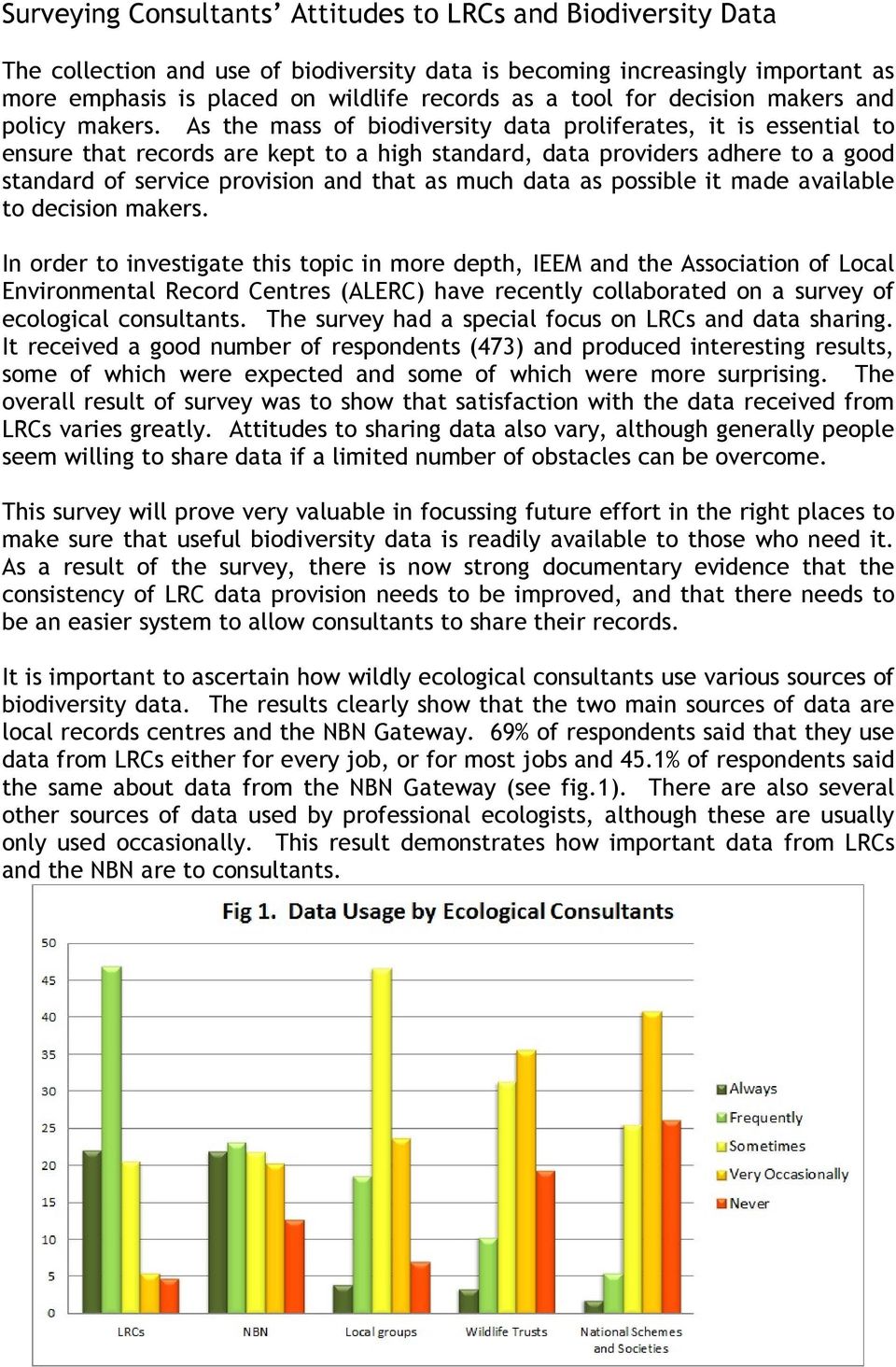
1 Surveying Consultants Attitudes to LRCs and Biodiversity Data The collection and use of biodiversity data is becoming increasingly important as more emphasis is placed on wildlife records as a tool for decision makers and policy makers. As the mass of biodiversity data proliferates, it is essential to ensure that records are kept to a high standard, data providers adhere to a good standard of service provision and that as much data as possible it made available to decision makers. In order to investigate this topic in more depth, IEEM and the Association of Local Environmental Record Centres (ALERC) have recently collaborated on a survey of ecological consultants. The survey had a special focus on LRCs and data sharing. It received a good number of respondents (473) and produced interesting results, some of which were expected and some of which were more surprising. The overall result of survey was to show that satisfaction with the data received from LRCs varies greatly. Attitudes to sharing data also vary, although generally people seem willing to share data if a limited number of obstacles can be overcome. This survey will prove very valuable in focussing future effort in the right places to make sure that useful biodiversity data is readily available to those who need it. As a result of the survey, there is now strong documentary evidence that the consistency of LRC data provision needs to be improved, and that there needs to be an easier system to allow consultants to share their records. It is important to ascertain how wildly ecological consultants use various sources of biodiversity data. The results clearly show that the two main sources of data are local records centres and the NBN Gateway. 69% of respondents said that they use data from LRCs either for every job, or for most jobs and 45.1% of respondents said the same about data from the NBN Gateway (see fig.1). There are also several other sources of data used by professional ecologists, although these are usually only used occasionally. This result demonstrates how important data from LRCs and the NBN are to consultants.
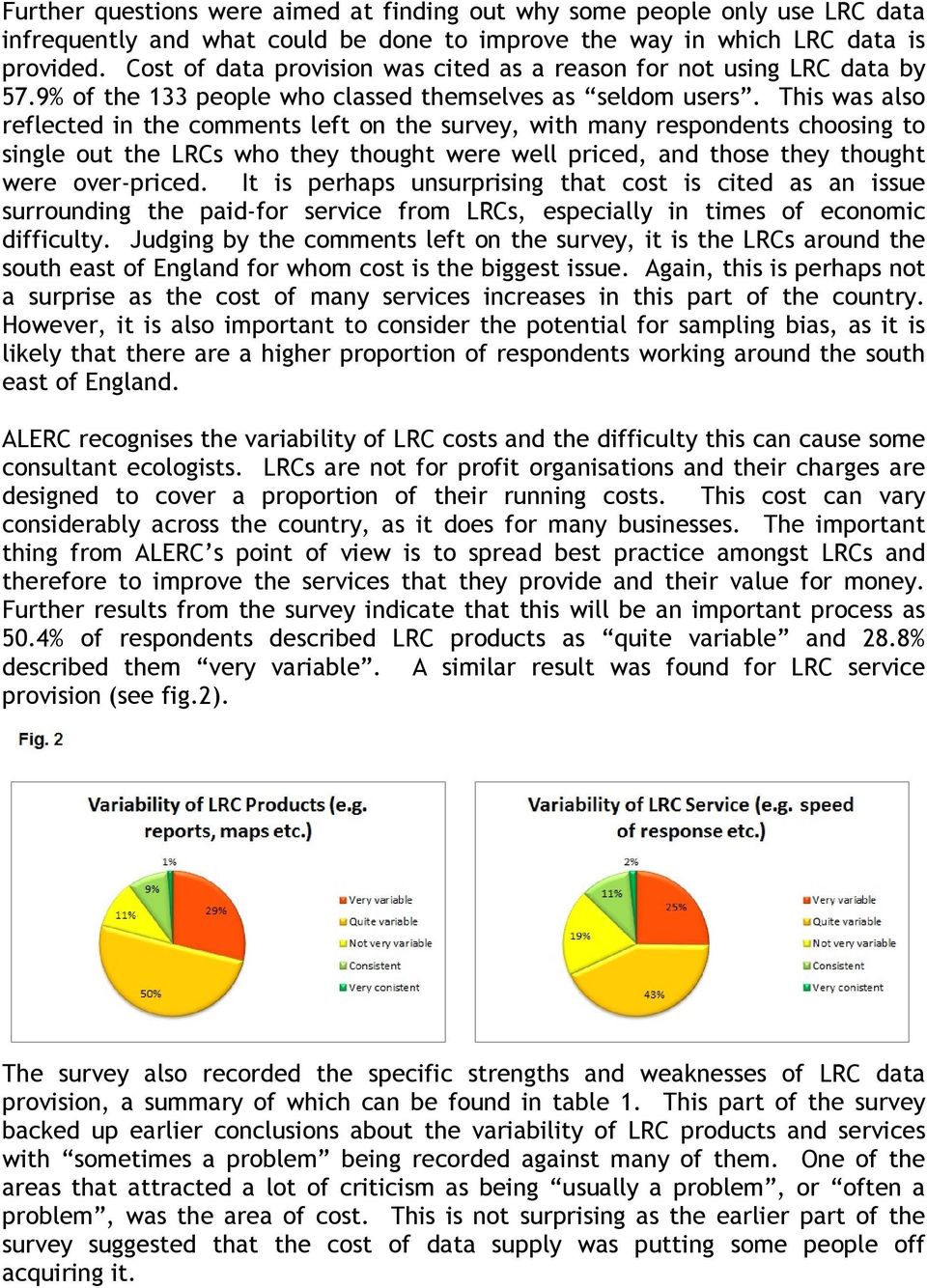
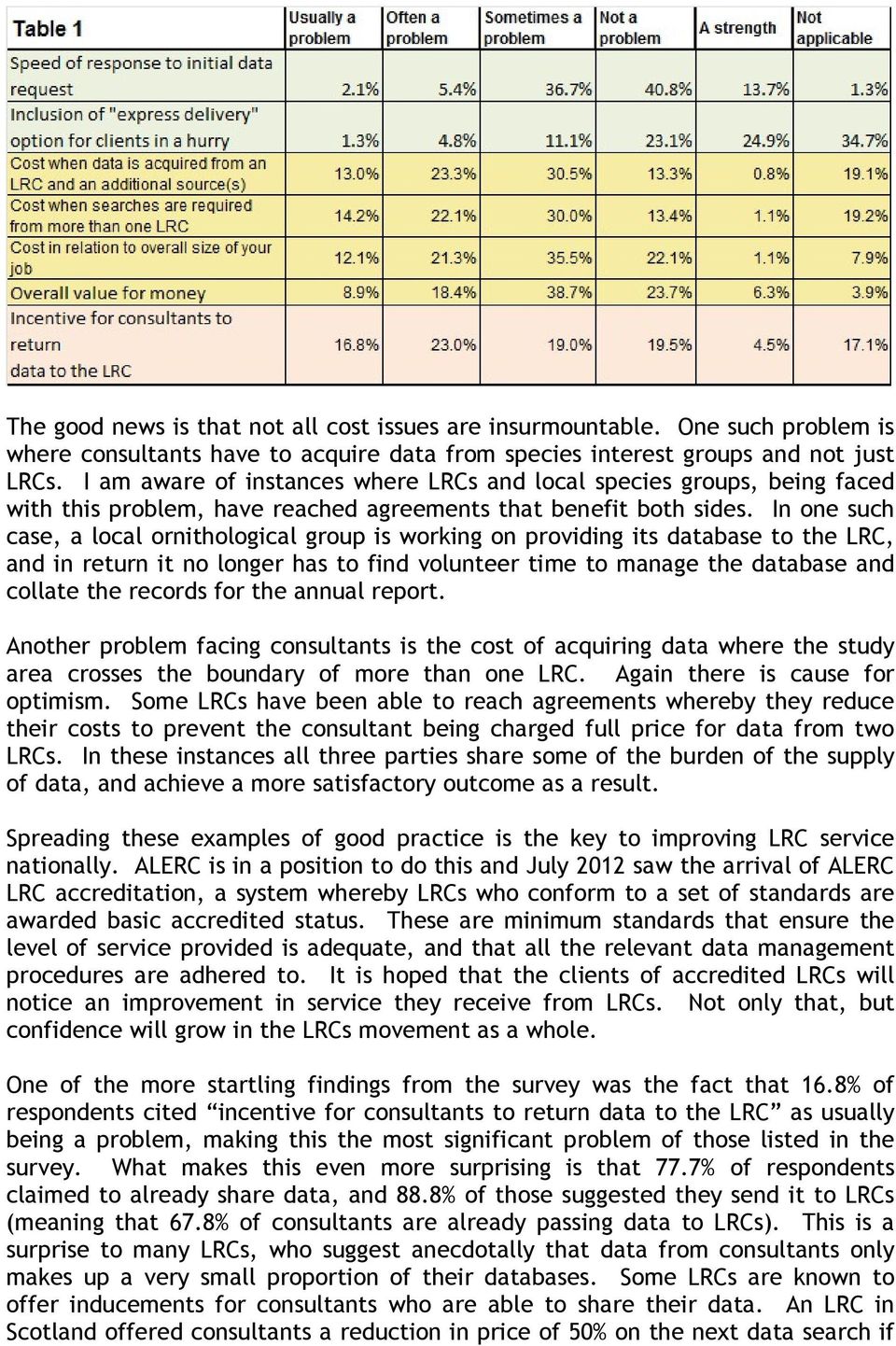
2 Further questions were aimed at finding out why some people only use LRC data infrequently and what could be done to improve the way in which LRC data is provided. Cost of data provision was cited as a reason for not using LRC data by 57.9% of the 133 people who classed themselves as seldom users. This was also reflected in the comments left on the survey, with many respondents choosing to single out the LRCs who they thought were well priced, and those they thought were over-priced. It is perhaps unsurprising that cost is cited as an issue surrounding the paid-for service from LRCs, especially in times of economic difficulty. Judging by the comments left on the survey, it is the LRCs around the south east of England for whom cost is the biggest issue. Again, this is perhaps not a surprise as the cost of many services increases in this part of the country. However, it is also important to consider the potential for sampling bias, as it is likely that there are a higher proportion of respondents working around the south east of England. ALERC recognises the variability of LRC costs and the difficulty this can cause some consultant ecologists. LRCs are not for profit organisations and their charges are designed to cover a proportion of their running costs. This cost can vary considerably across the country, as it does for many businesses. The important thing from ALERC s point of view is to spread best practice amongst LRCs and therefore to improve the services that they provide and their value for money. Further results from the survey indicate that this will be an important process as 50.4% of respondents described LRC products as quite variable and 28.8% described them very variable. A similar result was found for LRC service provision (see fig.2). The survey also recorded the specific strengths and weaknesses of LRC data provision, a summary of which can be found in table 1. This part of the survey backed up earlier conclusions about the variability of LRC products and services with sometimes a problem being recorded against many of them. One of the areas that attracted a lot of criticism as being usually a problem, or often a problem, was the area of cost. This is not surprising as the earlier part of the survey suggested that the cost of data supply was putting some people off acquiring it.
3 The good news is that not all cost issues are insurmountable. One such problem is where consultants have to acquire data from species interest groups and not just LRCs. I am aware of instances where LRCs and local species groups, being faced with this problem, have reached agreements that benefit both sides. In one such case, a local ornithological group is working on providing its database to the LRC, and in return it no longer has to find volunteer time to manage the database and collate the records for the annual report. Another problem facing consultants is the cost of acquiring data where the study area crosses the boundary of more than one LRC. Again there is cause for optimism. Some LRCs have been able to reach agreements whereby they reduce their costs to prevent the consultant being charged full price for data from two LRCs. In these instances all three parties share some of the burden of the supply of data, and achieve a more satisfactory outcome as a result. Spreading these examples of good practice is the key to improving LRC service nationally. ALERC is in a position to do this and July 2012 saw the arrival of ALERC LRC accreditation, a system whereby LRCs who conform to a set of standards are awarded basic accredited status. These are minimum standards that ensure the level of service provided is adequate, and that all the relevant data management procedures are adhered to. It is hoped that the clients of accredited LRCs will notice an improvement in service they receive from LRCs. Not only that, but confidence will grow in the LRCs movement as a whole. One of the more startling findings from the survey was the fact that 16.8% of respondents cited incentive for consultants to return data to the LRC as usually being a problem, making this the most significant problem of those listed in the survey. What makes this even more surprising is that 77.7% of respondents claimed to already share data, and 88.8% of those suggested they send it to LRCs (meaning that 67.8% of consultants are already passing data to LRCs). This is a surprise to many LRCs, who suggest anecdotally that data from consultants only makes up a very small proportion of their databases. Some LRCs are known to offer inducements for consultants who are able to share their data. An LRC in Scotland offered consultants a reduction in price of 50% on the next data search if
4 they were able to provide records back to the LRC. approximately forty eligible enquiries yielded any data. Only three out of Whatever the figures from this survey, the evidence from LRCs themselves strongly suggests that data collected by consultants is not being used beyond its original purpose. These records could be useful not only to local naturalists, interest groups and conservationists, but also to local authorities, national policy makers and ecological consultants themselves. However, it is obvious that this argument is not strong enough in itself to yield consultancy data, even when economic incentives are applied. There are still barriers to overcome. These barriers have been picked up by the survey, and fig.3 summarises the attitudes and the main areas for discussion. It is clear from this summary, that a lot people feel that a simple system for submission of records would make them more likely to submit data. There are also concerns around copyright issues. A quick read through the comments left on the survey provides further evidence that ease of submission and copyright are the issues at the fore of most people s minds. There seems to be a lot of uncertainty surrounding data copyright. Some people are prepared to release data, but they often employ a clause in their clients contracts that allows them to do this. Other people are less keen to go down this route, keeping client confidentiality in mind. Perhaps one resolution to this issue is to lobby local authorities, explaining to them that if they want the mass of precise, accurate data that comes from consultancy reports to be used in support of general conservation policy in their area, then there needs to be an obligation for those submitting planning applications to allow their ecological data to be shared.

5 Even where there is willingness to share data, there are still concerns around how much time it takes out of a consultant s day to submit records. There are often worries about what format to submit records in and where to send them. In actual fact, many LRCs will gratefully accept data in any format, although they will probably take longer to get the data inputted into their database, and made available, if they have to re-format it. The results of the survey should leave people in no doubt that there is a requirement for a simple system that allows consultants to submit data quickly, and that doesn t result in a slow process of reformatting before it becomes available to inform future projects and developments. NBN, IEEM and ALERC are currently working on how such a system might be developed. ALERC are also working on the issues surrounding the variability of LRC data supply. The key here, as described earlier, is to be able to share best practice and, where possible, tools and pieces of software that allow for more efficient, more detailed and more useful products to be created by LRCs. There is now a database available that lists tools and systems in use by LRCs, and it is hoped that this will encourage sharing between LRCs. In the future, it will be important to identify the barriers to achieving a higher standard of LRC output. In many cases, LRCs are under resourced or simply too small. This can be for many reasons, some are historic and some reflect local authorities attitudes to local biodiversity recording. Where there are LRCs in a position to develop a better output, ALERC is well placed to help them, by putting them in contact with other LRCs and through the accreditation system. ALERC is also working with NBN on achieving greater use of NBN Gateway data by LRCs, meaning that the products that LRCs are able to supply are augmented by data from other contributors to the NBN. The result will be a more informative and seamless supply of data to the consultancy sector. The theme driving this push for change is one of grater sharing of biodiversity data from all sources, making sure that records are not only available once, for the purpose or purposes they were collected, but available for future conservation work and to add to the collective knowledge of the nation s wildlife and habitats. This means putting into place the software, systems and protocols that allow records to be shared widely and efficiently. It also means eroding away the notion that records themselves are a saleable product, and that they should be hoarded by some and coveted by others. The success of LRCs will be judged on whether they can collect, format, store and share records, applying sensitivity where required and employing useful and innovative methods of presenting those records. Tom Hunt is the National Coordinator for the Association of Local Environmental Record Centres (ALERC). Tom s main objectives are to facilitate the wider adoption of new biodiversity data management technology, improve data flow, encourage exchange of ideas and promote collaborative working between local record centres and National Biodiversity Network partners throughout the UK. [email protected]

PERFORMANCE & PERSONAL DEVELOPMENT PROGRAMME Launched: April 2010
 PERFORMANCE & PERSONAL DEVELOPMENT PROGRAMME Launched: April 2010 1 PERFORMANCE & PERSONAL DEVELOPMENT PROGRAMME INDEX Page Introduction 3 PPDP Cycle 4 Performance planning meeting 5 Performance planning
Institute of Leadership & Management. Creating a coaching culture
 Institute of Leadership & Management Creating a coaching culture Contents Introduction 01 Executive summary 02 Research findings 03 Conclusion 07 Methodology 08 Introduction The world of work is complex
PROGRAMMME SPECIFICATION FOR MA in LEADERSHIP AND MANAGEMENT (HEALTH AND SOCIAL CARE SERVICES)
 PROGRAMMME SPECIFICATION FOR MA in LEADERSHIP AND MANAGEMENT (HEALTH AND SOCIAL CARE SERVICES) MA in LEADERSHIP AND MANAGEMENT (HEALTH AND SOCIAL CARE SERVICES) 1. Award 2. Route Management (Health and
How to Measure and Report Social Impact
 How to Measure and Report Social Impact A Guide for investees The Social Investment Business Group January 2014 Table of contents Introduction: The Development, Uses and Principles of Social Impact Measurement
How To Get A Cloud Based Contact Centre
 why contact centres are moving to cloud-based solutions 1/18 Managing a modern contact centre is tough. Technology is moving so quickly, consumer habits change overnight and regulatory requirements are
Internal Mediation Services. Surrey County Council in partnership with South East Employers
 Internal Mediation Services Surrey County Council in partnership with South East Employers Introduction and Summary Surrey County Council s cultural strategy is clear it wants to create a coaching culture
Perceived Barriers in Accessing Healthcare Services: Asylum Seekers and Refugee (ASRs) and Service Providers Perspectives
 BRIEFING PAPER 13 FINDINGS SERIES Perceived Barriers in Accessing Healthcare Services: Asylum Seekers and Refugee (ASRs) and Service Providers Perspectives May 2008 FINDINGS SERIES 13 BRIEFING PAPER INTRODUCTION
UNIVERSITY OF NAMIBIA
 UNIVERSITY OF NAMIBIA SCHOLARLY COMMUNICATIONS POLICY FOR THE UNIVERSITY OF NAMIBIA Custodian /Responsible Executive Responsible Division Status Recommended by Pro Vice-Chancellor: Academic Affairs and
Procurement Strategy 2013-2017 Delivering Social Value for our Community
 Procurement Strategy 2013-2017 Delivering Social Value for our Community Making Bath & North East Somerset an even better place to live, work and visit 1 Picture courtesy of Bath & News Media Group Our
Sites of Importance for Nature Conservation (SINCs). Guidelines for their Identification, Selection and Designation
 Sites of Importance for Nature Conservation (SINCs). Guidelines for their Identification, Selection and Designation Isle of Wight Biodiversity Partnership August 2010 1. Introduction 1.1 This document
How to gather and evaluate information
 09 May 2016 How to gather and evaluate information Chartered Institute of Internal Auditors Information is central to the role of an internal auditor. Gathering and evaluating information is the basic
Contents Foreword 1 Introduction by Patrick Reeve Executive summary 1. Business confidence and growth ambitions 2. Availability of finance
 2014 Contents Foreword 1 Introduction by Patrick Reeve 3 Executive summary 4 1. Business confidence and growth ambitions 4 2. Availability of finance 6 3. Management skills 8 4. Apprenticeships 9 5. Optimists
Barriers and Catalysts to Sound Financial Management Systems in Small Sized Enterprises
 ISSN 1744-7038 (online) ISSN 1744-702X (print) Research Executive Summaries Series Barriers and Catalysts to Sound Financial Management Systems in Small Sized Enterprises Vol. 1, No. 3 By Stuart McChlery,
Market intelligence report October 2010 Sponsored by:
 Market intelligence report - November 2010 Market intelligence report October 2010 Sponsored by: Corporate Banking Customer Satisfaction Survey 2010 Market intelligence report - October 2010 Background
SMALL BUSINESS REPUTATION & THE CYBER RISK
 SMALL BUSINESS REPUTATION & THE CYBER RISK Executive summary In the past few years there has been a rapid expansion in the development and adoption of new communications technologies which continue to
Level 5 Diploma in Managing the Supply Chain (QCF) Qualification Specification
 Level 5 Diploma in Managing the Supply Chain (QCF) Qualification Specification Created: May 2012 Version: 1.0 Accreditation Number: 600/5605/8 Qualification Start Date: 1 st June 2012 Qualification Last
Sector Development Ageing, Disability and Home Care Department of Family and Community Services (02) 8270 2218
 Copyright in the material is owned by the State of New South Wales. Apart from any use as permitted under the Copyright Act 1968 and/or as explicitly permitted below, all other rights are reserved. You
LEVEL ECONOMICS. ECON2/Unit 2 The National Economy Mark scheme. June 2014. Version 1.0/Final
 LEVEL ECONOMICS ECON2/Unit 2 The National Economy Mark scheme June 2014 Version 1.0/Final Mark schemes are prepared by the Lead Assessment Writer and considered, together with the relevant questions, by
For the Design, Installation, Commissioning & Maintenance of Fixed Gaseous Fire Suppression Systems
 BAFE Scheme: SP203-3 Version 1: July 2008 Amendment No: 1 Fire Protection Industry Scheme, Reference SP203 Part 3 For the Design, Installation, Commissioning & Maintenance of Fixed Gaseous Fire Suppression
TAXREP 01/16 (ICAEW REP 02/16)
 TAXREP 01/16 (ICAEW REP 02/16) January 2016 ICAEW research survey: HMRC Customer Service Standards 2015 Results of the ICAEW 2015 research survey among ICAEW smaller agents about HMRC service standards.
UNIVERSITY MEDICAL CENTRE PATIENT PARTICIPATION GROUP ANNUAL REPORT & ACTION PLAN 2012-13
 UNIVERSITY MEDICAL CENTRE PATIENT PARTICIPATION GROUP ANNUAL REPORT & ACTION PLAN 2012-13 Introduction & Recruitment of the Patient Participation Group Review on how and why the Patient group was established:
Experience in Bat Mitigation: Guidance for Ecologists and Developers
 Experience in Bat Mitigation: Guidance for Ecologists and Developers 1. Aims of this note: To help ecological consultants to assess their skills and experience levels before applying for a EPS mitigation
Monitoring, Evaluation and Learning Plan
 Monitoring, Evaluation and Learning Plan Cap-Net International Network for Capacity Building in Sustainable Water Management November 2009 The purpose of this document is to improve learning from the Cap-Net
Data for the Public Good. The Government Statistical Service Data Strategy
 Data for the Public Good The Government Statistical Service Data Strategy November 2013 1 Foreword by the National Statistician When I launched Building the Community - The Strategy for the Government
Promotion Orientation Verus Market Orientation
 Promotion Orientation Verus Market Orientation Lawrie Drysdale Senior Lecturer in Educational Administration Centre for Organisational Learning and Leadership University of Melbourne Introduction All schools
Council Tax Abolition and Service Tax Introduction (Scotland) Bill. Written Submission to the Transport and Local Government Committee
 Council Tax Abolition and Service Tax Introduction (Scotland) Bill Written Submission to the Transport and Local Government Committee 1. Introduction 1.1 The Poverty Alliance acts as the national anti-poverty
SCDLMCA2 Lead and manage change within care services
 Overview This standard identifies the requirements associated with leading and managing change within care services. It includes the implementation of a shared vision for the service provision and using
Personal current accounts in the UK
 Personal current accounts in the UK An OFT market study Executive summary July 2008 EXECUTIVE SUMMARY Background The personal current account (PCA) is a cornerstone of Britain s retail financial system.
Economic impacts of expanding the National Insurance Contributions holiday scheme Federation of Small Businesses policy paper
 Economic impacts of expanding the National Insurance Contributions holiday scheme Federation of Small Businesses policy paper Overview This research paper sets out estimates for the economic and employment
research report: field service, mobility & the cloud
 research report: field service, mobility & the cloud An exclusive Field Service News research report exploring if, how and why field service companies are using the Cloud and mobile in 2015 FIELD SERVICE
Getting funding and planning successful projects. Big Lottery Fund guide to outcomes
 Getting funding and planning successful projects Big Lottery Fund guide to outcomes Getting funding and planning successful projects: Big Lottery Fund s guide to outcomes Further copies available from:
ARRANGEMENTS FOR THE FUTURE SUPPLY AND REIMBURSEMENT OF GENERIC MEDICINES FOR NHS SCOTLAND. Consultation Document
 ARRANGEMENTS FOR THE FUTURE SUPPLY AND REIMBURSEMENT OF GENERIC MEDICINES FOR NHS SCOTLAND Consultation Document Scottish Executive Health Department October 2003 Arrangements For The Future Supply And
Information Governance in Dental Practices. Summary of findings from ICO reviews. September 2015
 Information Governance in Dental Practices Summary of findings from ICO reviews September 2015 Executive summary The Information Commissioner s Office (ICO) is the regulator responsible for ensuring that
Duncan Burt Head of Commercial Operation National Grid. The Office of Gas and Electricity Markets 9 Millbank London SW1P 3GE
 National Grid House Warwick Technology Park Gallows Hill, Warwick CV34 6DA The Office of Gas and Electricity Markets 9 Millbank London SW1P 3GE 16 June 2015 Duncan Burt Head of Commercial Operation National
HEALTH & WELL-BEING: AN EMPLOYER S PERSPECTIVE
 HEALTH & WELL-BEING: AN EMPLOYER S PERSPECTIVE Introduction Organisations provide employee benefits for a variety of different reasons. For some, it s to reward employees. For others, it s to keep up with
Planning application process improvements
 Planning application process improvements Government response to consultation January 2015 Department for Communities and Local Government Crown copyright, 2015 Copyright in the typographical arrangement
SUBMISSION BY COMMUNITY LEARNING SCOTLAND (CLS) Summary
 SUBMISSION BY COMMUNITY LEARNING SCOTLAND (CLS) Summary Lifelong learning needs to support a social justice agenda by promoting access by the most marginalised groups in society, through appropriate support
Improving Resident and Customer Services Strategy
 Improving Resident and Customer Services Strategy 2014 2018 ABOUT WOKINGHAM BOROUGH & OUR CUSTOMERS Wokingham Borough Council lies at the centre of a strong regional economy and has a generally healthy,
WIPO/AIPPI Conference on Client Privilege in Intellectual Property Professional Advice
 WIPO/AIPPI Conference on Client Privilege in Intellectual Property Professional Advice Outcomes of litigation and needs arising in relation to client/ip professional privilege in particular countries.
Planning & Building Standards. Draft Customer Engagement Strategy August 2015
 Draft Customer Engagement Strategy August 2015 1. Introduction 1. Who are our customers? 2. What is engagement? 2. Consulting with our customers 7. Communicating with our customers 9. Planning information
Regulatory Impact Statement - Review of the Mobile Exclusion from the Three Notice Regime under the Copyright Act 1994
 In Confidence Regulatory Impact Statement - Review of the Mobile Exclusion from the Three Notice Regime under the Copyright Act 1994 Agency Disclosure Statement This regulatory impact statement has been
Work based learning. Executive summary. Background
 Work based learning Executive summary Background The training contract stage of qualifying as a solicitor is a prime example of 'work based learning' (WBL), a phrase that generally describes the learning
Experience in Great Crested Newt Mitigation: Guidance for Ecologists and Developers
 Experience in Great Crested Newt Mitigation: Guidance for Ecologists and Developers 1. Aims of this note To help ecological consultants to assess their skills and experience levels before applying for
Information and technology for better care. Health and Social Care Information Centre Strategy 2015 2020
 Information and technology for better care Health and Social Care Information Centre Strategy 2015 2020 Information and technology for better care Information and technology for better care Health and
PAYMENT SERVICE PROVIDER ACCESS
 PAYMENT SERVICE PROVIDER ACCESS Widening access and choice February 2016 A Bacs white paper 1 FOREWORD This is an exciting time for the financial services industry. As the market evolves, Bacs is keen
Queensland Government Human Services Quality Framework. Quality Pathway Kit for Service Providers
 Queensland Government Human Services Quality Framework Quality Pathway Kit for Service Providers July 2015 Introduction The Human Services Quality Framework (HSQF) The Human Services Quality Framework
Infrastructure Asset Management Report
 Infrastructure Asset Management Report From Inspiration to Practical Application Achieving Holistic Asset Management 16th- 18th March 2015, London Supported by Table of contents Introduction Executive
Accreditation Scheme for Museums and Galleries in the United Kingdom: Accreditation Standard
 Accreditation Scheme for Museums and Galleries in the United Kingdom: Accreditation Standard October 2011 Contents Introduction 4 Eligibility 6 Requirements for Accreditation 7 1 Organisational health
Culture in financial services a regulator s perspective
 1 Culture in financial services a regulator s perspective Speech given by Andrew Bailey, Deputy Governor, Prudential Regulation and Chief Executive Officer, Prudential Regulation Authority City Week 2016
sponsored by White paper What can CRM bring to your business? A study of the benefits offered by CRM across all areas of the business
 sponsored by >> White paper What can CRM bring to your business? April 2011 A study of the benefits offered by CRM across all areas of the business Contents Executive summary p 3 The evolution of CRM p
Outsourcing. Knowledge Summary
 Knowledge Summary Outsourcing P&SM professionals should have the knowledge and skills required to manage the outsourcing process and to advise colleagues of the most appropriate solution to obtain best
E: Business support and access to finance
 E: Business support and access to finance 41 The North East Local Enterprise Partnership area benefits from a committed workforce, a good business environment and a competitive cost base. However, the
Project Management in Marketing Senior Examiner Assessment Report March 2013
 Professional Diploma in Marketing Project Management in Marketing Senior Examiner Assessment Report March 2013 The Chartered Institute of Marketing 2013 Contents This report contains the following information:
The Debt Arrangement Scheme Improving Access
 Consultation by the Scottish Government Submission from the Association of British Credit Unions Limited (ABCUL) Details Name Frank McKillop Job Title Policy Officer (Scotland) Organisation Association
Crisis Response to the Department for Work and Pensions Consultation - Social Fund reform: debt, credit and lowincome
 Crisis Response to the Department for Work and Pensions Consultation - Social Fund reform: debt, credit and lowincome households June 2010 Introduction Crisis, the national charity for single homeless
place-based asset management
 place-based asset management Managing public sector property to support aligned local public services TOWN HALL CIPFA, the Chartered Institute of Public Finance and Accountancy, is the professional body
Digital Continuity in ICT Services Procurement and Contract Management
 Digital Continuity in ICT Services Procurement and Contract Management This guidance relates to: Stage 1: Plan for action Stage 2: Define your digital continuity requirements Stage 3: Assess and manage
Risk Implications There are no material risks to the University associated with the approval of these amendments.
 Title: Updates to Regulations for EdD Author: Dr Vivien Easson, Head of Postgraduate Research Service Date: 30 April 2015 Agenda: Learning and Teaching Committee, 13 May 2015 Version: Final Status: Open
Best Value toolkit: Performance management
 Best Value toolkit: Performance management Prepared by Audit Scotland July 2010 Contents Introduction The Audit of Best Value The Best Value toolkits Using the toolkits Auditors evaluations Best Value
The Netherlands response to the public consultation on the revision of the European Commission s Impact Assessment guidelines
 The Netherlands response to the public consultation on the revision of the European Commission s Impact Assessment guidelines Introduction Robust impact assessment is a vital element of both the Dutch
Curriculum Development Project Knowledge in Sales and Marketing Education and Training
 Curriculum Development Project Knowledge in Sales and Marketing Education and Training End of Project Report Project summary and key achievements against original aims The original project bid aims of
How To Understand A Rent Review Clause
 1 Property Topics & Guides - Copyright Introduction Rent Review clauses are a feature of most modern commercial leases which are granted for a term in excess of 3-5 years. The majority of rent review clauses
INTERVIEW QUESTIONS: ADVICE AND GUIDANCE
 INTERVIEW QUESTIONS: ADVICE AND GUIDANCE Although interviews can vary tremendously, from an informal chat to a panel interview, some questions always seem to crop up. It would be a good idea to review
The export factor: British SMEs approach to doing business overseas
 The export factor: British SMEs approach to doing business overseas Introduction Small and medium sized enterprises (SMEs) are centre stage in the economy, representing 99.7% of all enterprises. Therefore,
REVEALED: THE BLUEPRINT FOR BUSINESS SUCCESS Find out if you are achieving your full growth potential
 REVEALED: THE BLUEPRINT FOR BUSINESS SUCCESS Find out if you are achieving your full growth potential Overview Running your own business can be tough. There s a huge amount of advice out there but you