
Lessons from Brazil: Regulatory changes in the health insurance market
|
|
|
- Randall Logan
- 10 years ago
- Views:
Transcription
1 Regulatory changes in the health insurance market Mary van der Heijde, FSA, MAAA Daniela Mendonça, MIBA Both Brazil and the United States have distinct experiences with reforming their respective healthcare systems. While the two countries have different systems and have pursued different types of reform on different timetables, there are lessons to be learned by looking at the two countries side by side. Major healthcare reform has already occurred in Brazil over the past couple of decades. It is possible to draw relevant parallels between some of those changes and what the Patient Protection and Affordable Care Act (PPACA) includes for the United States. RECIPES FOR ADVERSE SELECTION In 1988, Brazil s revised constitution declared that it was the Brazilian government s obligation and duty to provide healthcare for all citizens, with funding through taxes. State and municipal governments are expected to contribute 12% to 15% of their budgets to the health program; in addition, the federal government also contributes money raised from taxes. 1 Secondary taxes, such as those for cigarettes and lotteries, also help fund healthcare. As a result, a basic level of care (i.e., universal coverage excluding dental procedures) is available to all. Over the years, however, a popular trend emerged. People began purchasing private insurance to supplement the publicly provided care, and so the private health insurance sector began to grow. Brazil s private sector does not have a mandatory requirement for individuals to purchase insurance, nor does it permit underwriting. This combination has resulted in significant adverse selection in the private sector, because primarily those with the greatest need for highly specialized medical care that is not provided by all public hospitals have purchased coverage, which can be obtained with few limitations. There is much discussion about what will happen in the United States if the individual mandate is eliminated and underwriting remains prohibited. Taking a look at the evolution of Brazil s healthcare system may provide some insight into this possibility. Though its system is different from the one proposed by the PPACA, Brazil s private individual market lacks an individual mandate and does not permit underwriting two things that have proven to be major drivers in the recent experience in the Brazilian health insurance market. 1 Brazil s march towards universal coverage. (2010). Bulletin of the World Health Organization 88: volumes/88/9/ pdf BACKGROUND: HISTORY AND HEALTHCARE RULES IN BRAZIL Private health coverage in Brazil was originally created by hospital owners in the 1960s. Hospitals were often located near large companies and, in order for these companies to provide basic healthcare for their employees, they paid a fee (premium) per employee each month to the hospital for coverage. Hospitals began partnering together, forming expansive networks that allowed for coverage to reach even more people. The health plan was treated like any other product in the market, without any rules or regulations, and was known as Plano de Saude, or Health Plan. In the early 1970s, insurance companies began to recognize that health coverage could be a great product for them, too. Insurance companies took a different approach to coverage by reimbursing the hospitals they partnered with on a per-procedure basis. This product was called Seguro Saude, or Health Insurance. The public health system, Sistema Único de Saude (SUS), or Single Health System, was created in 1988 with the goal of providing universal care to the Brazilian population. This system is still in place today; however, because it is funded by taxes and social contributions, the program has always struggled financially to keep up with demand. For example, in 2010 Brazil s per-capita GDP was $10,800, and only about 3% of GDP was spent on public health; approximately 8% of GDP was spent on healthcare in total, with 60% of healthcare spending privately funded. 2 As a result, many members of the population have chosen to seek private healthcare to supplement the public system s offerings. 2 Shifrin, J. (August 1, 2011). Brazil s health care system. Healthcare Economist blog. Central Intelligence Agency. (2011). South America: Brazil. World Factbook. GE. (2012). Health of Nations: Brazil. profile/brazil Health Care in Brazil: An injection of reality. (July 30, 2011). The Economist.

2 Healthcare coverage in Brazil evolved through market forces, and there were very few rules or restrictions regarding the design or limits of coverage. The market (any private plan created before January 1, 1999) included the following limits: Typical limits included 30 days for regular inpatient stays or five days for intensive care unit stays. Companies could limit the number of doctor appointments. Exclusions included preexisting diseases, infectious/contagious diseases, prosthetic and orthotic devices, psychotherapy, fertilization treatments, complex surgery, drugs for outpatient, any aesthetic procedure, professional sports accidents, home care, and cases from cataclysm and war, when declared by the government. With regard to the technical approach to pricing health insurance, the following rules applied: Companies were free to choose their own age bands. There was no defined actuarial method for determining premiums. There were no mandatory technical reserves. Senior citizens and people with preexisting diseases could be underwritten. There were no rules regarding annual increases (for premiums). Companies could set the waiting period for each procedure. Companies were free to cancel any contract that was not profitable. The delay of any government guidelines for the healthcare market resulted in the majority of both health plans and insurance companies abusing the lack of specific regulation. In 1998, in order to stop exploitation in the market, the government published the Law n (Brazilian Health Reform), which applied to all companies offering any kind of health coverage. Through this healthcare reform, limits of utilization or value can no longer be applied. Post-reform (plans created after January 1, 1999), the number of allowed exclusions was also reduced to include only drugs for outpatient, procedures not accepted by the Physician Union, 3 aesthetic procedures (except for ones required as a result of accidents), home care, cases from cataclysm and war when declared by the government, and any transplants other than kidney or cornea. Rules regarding rate setting for premiums, cancellation of contracts, mandatory reserves, underwriting, and waiting periods were dramatically changed, which we discuss in additional detail in the next section. 3 The Physician Union in Brazil is similar to the American Medical Association in the United States. BRAZIL AND U.S. REFORMS: A COMPARISON One of the most obvious differences in healthcare offered in Brazil and the United States is the use of the public health system in Brazil. Through the SUS, all citizens in Brazil have access to a basic level of care. However, because of the overwhelming need for care and the low funding for this program, about 25% of the population seeks supplemental healthcare through the private health system. The public health systems in the United States, Medicare and Medicaid, are not designed to provide care for a majority of the population. Everyone, except the poor, disabled, and elderly, needs to use the private market to obtain even a basic level of coverage. The table in Figure 1 on page 3 provides a detailed comparison of the reforms that went into place in 1998 to Brazil s private plans and reforms prescribed in 2010 under the PPACA in the United States. Some key similarities and differences to note: The age bands for premium rates in Brazil are limited to a 6:1 ratio between the least and most expensive groups age bands; in the United States the ratio will be limited to 3:1. In addition, in Brazil there is a requirement that the ratio of band 10 (the oldest age band) and band 7 can be no greater than the ratio of band 7 to band 1 (the youngest age band). Although many are focused on the impact the compression in age rating will have in the United States, the consequence of moving to unisex rates produces a larger impact. In fact, Milliman Health Cost Guidelines data show that adult male costs vary by age at a ratio of about 7:1, and the corresponding ratio for females is about 3:1. Even without any compression for age, combining male and female claim costs into a single unisex set of rates by age produces a ratio of 4.2:1. 4 Brazil has specified rate increase limitations, in the form of an allowed annual percentage increase dictated by the government health insurance regulator, Agência Nacional de Saúde Complementar (ANS). The United States has rate increase limitations, too. However, in some ways the language in the PPACA is less direct: rate increases above 10% are considered unreasonable ; however, how these restrictions on unreasonable rate increases are enforced and what justifications, if any, are allowed for increases greater than 10% has yet to be determined, so it will be interesting to see how these constraints develop. Either way, limiting rate increases too strictly can endanger an insurer s profitability (and solvency) by creating a large gap in actual costs and charged premiums. In the United States, a new constraint requires loss ratios of at least 80% for individual carriers. Brazil does not have any loss ratio requirement. Initially, the absence of a loss ratio minimum in Brazil allowed insurers more freedom when it came to setting their rates. However, because of the move from an unregulated to a strictly regulated environment, many companies in Brazil are struggling to stay solvent. Because the loss ratio calculation is indicative of a company s profitability, even though the regulations are becoming 4 Van Der Heijde, M. & Norris, D. (August 30, 2011). The young are the restless: Demographic changes under health reform. Milliman Insight. insight.milliman.com/article.php?cntid=7879&utm_source=healthcare&utm_ medium=web&utm_content=7879&utm_campaign=health%2feature 2
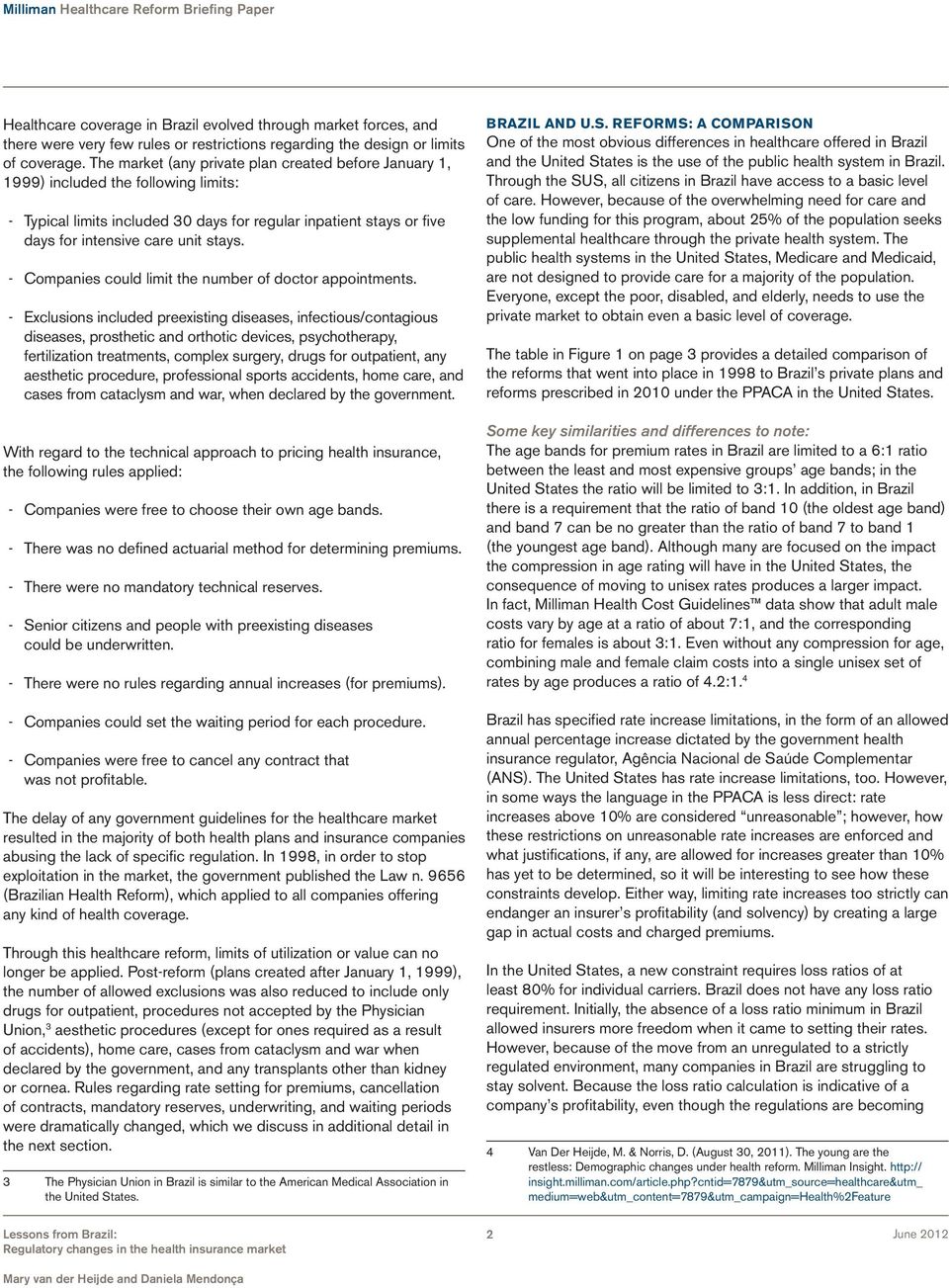
3 FIGURE 1: A COMPARISON OF INDIVIDUAL MARKET REFORMS BRAZIL PRIVATE PLANS UNITED STATES (POST-2014) ALL PLANS, EXCHANGES, CO-OPS, ETC. Individual Mandate No, public healthcare is provided for free. Yes, citizens are required to have some form of Purchasing private health insurance is optional. health insurance or pay a penalty. Guaranteed Availability Yes Yes (may limit enrollment periods) and Renewability Underwriting Denial of coverage is not allowed Denial of coverage is not allowed Preexisting condition or congenital disease exclusions Preexisting condition exclusions are prohibited are prohibited Only a select set of factors may vary Individual plans cannot be underwritten at all Premium Rates Age groups have 6:1 ratio (with an additional constraint so Age groups limited to 3:1 ratio that the oldest groups don t experience significantly higher Age bands yet to be defined by the National increases compared to younger age groups) Association of Insurance Commissioners (NAIC) 10 specific allowed age bands Unisex rates Unisex rates Smoking status (1.5:1 ratio) No smoking limitations Additional review will be required to justify premium Maximum percentage increase is designated by ANS increases; some plans may be excluded from the May vary by level of benefits exchanges if their premium increases are too high May vary by rating area May vary by level of benefits May vary by rating area Limitations Limits not allowed for utilization or value Lifetime limits on dollar value of coverage prohibited Coverage can be rescinded only in cases of fraud or Coverage can be rescinded only in cases of fraud failure to pay premiums for more than 60 days over Must provide dependent coverage for children up to a 12-month period age 26 Can provide coverage to the dependents up to third level of kinship (e.g., grandparents or grandchildren) Loss Ratio Requirement No requirements Minimum 80% loss ratio required for individual and small group business Decentralization States should be main providers and responsible States should be main providers and responsible for delivery of care for delivery of care Funding Federal and statutory, with an emphasis on Federal and statutory, with an emphasis on statutory regulation statutory regulation Waiting Period Up to 180 days, 300 days for pregnancy None, but enrollment limited to open enrollment period or to qualifying life events Exclusions Drugs for outpatient Plans have the option to exclude abortion Procedures not accepted by Physician Union Access to coverage is limited to U.S. citizens Aesthetic procedures, unless need results from and legal immigrants that are not incarcerated involvement in an accident Home care Cases from cataclysm/war Wellness and Preventive Care Not an issue at the forefront of healthcare reform Many preventive services now covered without cost sharing 3
4 stricter in the United States, the U.S. market may stand a better chance at retaining active insurers, as this is not an entirely new constraint. Even with the stringent regulations over premium rate increases, the loss ratio will help provide transparency when it comes to a company s financial stability. What happened in Brazil s individual market because of these regulatory changes? Prior to Brazil s healthcare reform in 1998, private insurers were subject to very little regulation. As a result, this major reform and overhaul of how the industry operates has brought about significant consequences over the past decade. Although loss ratios are not necessarily a common measure in Brazil (because there are no specified loss ratio requirements), individual plans are currently achieving a 90% loss ratio on average. This represents a level higher than what is sustainable, which has led to a large premium deficiency reserve for most companies. High premium deficiency reserves are a barometer of financial health for these blocks of business. The ANS dictates the restricted amount of annual price adjustments for individual plans at a level less than the rise in medical costs. If this continues, the loss ratios will continue to increase over time and thus the premium deficiency reserve will need to increase as well. In addition, the following practices have also contributed to the breakdown of the individual insurance market: Prohibition of unilateral rescission of contracts and underwriting, leading to an older, lower-quality portfolio Increased restrictions from ANS on the allowed annual premium trends increases Frequent changes made to the list of covered procedures (applied to all new plans without a readjustment counterpart) Most companies in Brazil have stopped selling this line of business. From 2005 to 2010, individual plans reduced their share in the market from 24.5% to 20.9%, and this share will most likely continue to decrease. 5 Time has also revealed that many of the existing companies in Brazil did not possess even the basic administrative or economic infrastructure necessary to survive in a high-risk product market. Because the state established even minimal regulations, these companies have gradually disappeared and continue to disappear from the market. This trend is shown in the table in Figure 2. 5 Agencia Nacional de Saude Suplementar (March 2011). Caderno de Informaçãem Saúde Suplementar, page 29 (last modified April 6, 2011). informacao_saude_suplementar/2011_mes03_caderno_informacao.pdf FIGURE 2: NUMBER OF HEALTH PLAN COMPANIES IN BRAZIL, YEAR # OF COMPANIES , , , , , , , , , , ,618 Source: ANS Supplemental Healthcare Information Book CONCLUSION When the public plan in Brazil was formed, the private sector was ill-established and essentially unregulated. The most efficient way to provide universal care was through a government program. However, a private sector, in need of regulation, stayed intact and supported the publicly offered care. The United States currently has public plans (Medicare and Medicaid) in place to help the elderly and those in financial need, and also has a well-established, already regulated private sector that covers the majority of the population. In order to provide universal care for its citizens, the United States has chosen to take advantage of the private insurance sector, which is an active, and in many cases successful, means for providing healthcare. Instead of starting over with a national public plan as in Brazil, the United States has taken a different approach: adapting the structure of the current private plans through stricter regulations and the requirement for every citizen to contribute to the program in order to provide complete access to quality care. It is possible that the U.S. health insurance industry could face challenges that are similar to the struggles that the Brazil insurance industry has faced, such as restrictions on premium increases that create a growing gap between costs and allowed premiums. Limits on rate increases are a challenge because insurers can become locked into deficiently priced contracts. Adverse selection, however, is probably the number-one concern and driver of the outcome of success or failure for an insurer. Brazil does not have an individual mandate for private insurance, yet the country still requires private care to be provided at affordable rates. Few restrictions on who can access care (no underwriting), when paired with the lack of an individual mandate and strict premium rating regulations, have resulted in serious anti-selection issues and led to the precarious position of the individual insurance market in Brazil. The reason for the individual mandate in the United States is to spread risk evenly over the entire population. By requiring everyone to buy insurance, the hope is that healthy people, who are less expensive to insure and might not otherwise buy insurance, will be entering the market and sharing risk. 4

5 Ultimately, Brazil and the United States share a similar vision: providing universal, affordable healthcare. Because of unique histories and political and social attitudes toward healthcare, the catalysts for reform in Brazil and the United States are different; however, similarities in the actual reforms exist. If an individual mandate is not enforced, the current state of the healthcare system in Brazil may be indicative of the future of healthcare risks facing the United States, especially if an individual mandate is not enforced. It would be prudent to consider the similarities and differences in the two countries reforms. Looking at and learning from the current outcomes in Brazil could provide insight on how to best define strategies in the United States. Mary van der Heijde is a principal and consulting actuary with the Denver office of Milliman. Contact her at [email protected]. Daniela Mendonça is a consulting actuary and the director of the Rio de Janeiro, Brazil office of Milliman. Contact her at [email protected]. The materials in this document represent the opinion of the authors and are not representative of the views of Milliman, Inc. Milliman does not certify the information, nor does it guarantee the accuracy and completeness of such information. Use of such information is voluntary and should not be relied upon unless an independent review of its accuracy and completeness has been performed. Materials may not be reproduced without the express consent of Milliman. Copyright 2012 Milliman, Inc. FOR MORE ON MILLIMAN S HEALTHCARE REFORM PERSPECTIVE Visit our reform library at Visit our blog at Or follow us on Twitter at
Coinsurance A percentage of a health care provider's charge for which the patient is financially responsible under the terms of the policy.
 Glossary of Health Insurance Terms On March 23, 2010, President Obama signed the Patient Protection and Affordable Care Act (PPACA) into law. When making decisions about health coverage, consumers should
ACA Premium Impact Variability of Individual Market Premium Rate Changes Robert M. Damler, FSA, MAAA Paul R. Houchens, FSA, MAAA
 ACA Premium Impact Variability of Individual Market Premium Rate Changes Robert M. Damler, FSA, MAAA Paul R. Houchens, FSA, MAAA BACKGROUND The Patient Protection and Affordable Care Act (ACA) introduces
How To Determine The Impact Of The Health Care Law On Insurance In Indiana
 ACA Impact on Premium Rates in the Individual and Small Group Markets Paul R. Houchens, FSA, MAAA BACKGROUND The Patient Protection and Affordable Care Act (ACA) introduces significant changes in covered
The Pennsylvania Insurance Department s. Your Guide to Choosing a MEDIGAP POLICY. Understanding Medigap
 Your Guide to Choosing a MEDIGAP POLICY Understanding Medigap Medigap is private health insurance designed to help pay healthcare costs that aren t covered by Medicare. Each Medigap plan covers different
Health Care Reform Frequently Asked Questions (FAQ) Consumers Employers
 This page provides answers to frequently asked questions (FAQ) regarding The Patient Protection and Affordable Care Act (PPACA; P.L. 111-148) and the Health Care and Education Reconciliation Act of 2010
HEALTH CARE REFORM FREQUENTLY ASKED QUESTIONS
 HEALTH CARE REFORM FREQUENTLY ASKED QUESTIONS Consumers When will the health care reform law take effect? The health insurance reforms adopted as part of the Patient Protection and Affordable Care Act
How to be a smart shopper for Medigap Insurance
 info sheet Medicare is the basic federal health insurance for older persons and for younger people with disabilities. Because Medicare has gaps in coverage, many people also buy a Medigap policy to supplement
Financial Planning. Patient Education Guide to Your Kidney/Pancreas Transplant Page 18-1. For a kidney/pancreas transplant.
 Patient Education Page 18-1 For a kidney/pancreas transplant Kidney and pancreas transplants are expensive. Planning your finances, both your income and insurance, will be a key part of planning for transplant.
Health Care Reform Frequently Asked Questions
 Health Care Reform Frequently Asked Questions On March 23, 2010, President Obama signed federal health care reform into law, also known as the Patient Protection and Affordability Act. A second, or reconciliation
Medicare Supplement (Medigap) Coverage for Medicare Beneficiaries
 Medicare Supplement (Medigap) Coverage for Medicare Beneficiaries Brian Webb Manager, Health and Life Policy Nat l Assoc. of Insurance Commissioners February 6, 2009 Original Medicare Created in 1965,
Medicare Supplement Coverage
 Guide to Choosing Medicare Supplement Coverage Medicare Health Care A User Guide for Medicare Supplement Coverage 946022 (03/02) - PDF Front Cover p1 First Things First Why Buy Medicare Supplement Coverage
Choosing A Medigap Policy
 Choosing A Medigap Policy 2002 Guide To Health Insurance For People With Medicare For People in the Original Medicare Plan This Guide has easy steps to help you buy Medicare Supplement Insurance. Developed
Consumer Guide to. Health Insurance. Oregon Insurance Division
 Consumer Guide to Health Insurance Oregon Insurance Division The Department of Consumer and Business Services, Oregon s largest business regulatory and consumer protection agency, produced this guide.
Health Care Reform Legislation and You
 (Customizable space for CPA Firm Logo to go here) Health Care Reform Legislation and You Timelines and Implications of the New Law for Individuals Updated as of January 2011 The Health Care Reform Legislation
Medicare Economics. Part A (Hospital Insurance) Funding
 Medicare Economics Medicare expenditures are a substantial part of the federal budget $556 billion, or 15 percent in 2012. They also comprise 3.7 percent of the country s gross domestic product (GDP),
State and Federal Health Care Reform Update. Universal Health Care Foundation of Connecticut
 State and Federal Health Care Reform Update Universal Health Care Foundation of Connecticut Linda Dahlmeyer, CPA Vice President for Finance and Administration [email protected] Jill Zorn,
Getting started with Medicare.
 Getting started with Medicare. Medicare Made Clear TM Get Answers: Medicare Education Look inside to: Understand the difference between Medicare plans Compare plans and choose the right one for you See
New York DISCOs: Managed care plans for people with developmental disabilities - Critical factors for financial viability
 New York DISCOs: Managed care plans for people with developmental disabilities - Critical factors for financial viability Melissa Fredericks, FSA, MAAA Rob Parke, FIA, ASA, MAAA Jane Suh The model for
Simple answers to health reform s complex issues facing every employer, and what you can do now to protect your business and your future.
 Simple answers to health reform s complex issues facing every employer, and what you can do now to protect your business and your future. If you have any questions, please contact: Health Reform: A Guide
Timeline: Key Feature Implementations of the Affordable Care Act
 Timeline: Key Feature Implementations of the Affordable Care Act The Affordable Care Act, signed on March 23, 2010, puts in place health insurance reforms that will roll out incrementally over the next
It goes by many names: Patient Protection and Affordable Care Act (PPACA) or ACA or Obama Care or simply Healthcare Reform.
 WHAT IS HEALTHCARE REFORM? Healthcare Reform (HCR) is a law passed by Congress that provides many different requirements. A very important aspect of the law is that it is designed to provide individuals
Getting started with Medicare.
 Getting started with Medicare. Medicare Made Clear TM Get Answers: Medicare Education Look inside to: Understand the difference between Medicare plans Compare plans and choose the right one for you See
America s Health Insurance Plans. Guaranteeing Access. to Coverage for All Americans
 America s Health Insurance Plans Guaranteeing Access to Coverage for All Americans Our Commitment The members of (AHIP) believe that all Americans regardless of health status or income should have access
HHealth HEALTH INSURANCE EXCHANGE FAQs
 HHealth HEALTH INSURANCE EXCHANGE FAQs Page 1 TABLE OF CONTENTS Introduction... 3 Background... 3 Health Insurance Exchange FAQs... 4 What is the Patient Protection and Affordable Care Act (PPACA)?...
1. How common is the use of stop loss in connection with self-insured arrangements?
 Honorable Kathleen Sebelius Honorable Hilda Solis Secretary Secretary US Department of Health and Human Services US Department of Labor 200 Independence Avenue, SW 200 Constitution Avenue, NW Washington,
2. EXECUTIVE SUMMARY. Assist with the first year of planning for design and implementation of a federally mandated American health benefits exchange
 2. EXECUTIVE SUMMARY The Patient Protection and Affordable Care Act of 2010 and the Health Care and Education Reconciliation Act of 2010, collectively referred to as the Affordable Care Act (ACA), introduces
New Trends In the Brazilian Healthcare Market. Rafael Vasconcellos,MD UHG
 New Trends In the Brazilian Healthcare Market Rafael Vasconcellos,MD UHG Summary Overview Brazilian Healthcare Market Numbers Public System Private System Interaction Between Public X Private Innovations
Fact Sheet. AARP Public Policy Institute. Health Reform Changes Insurance Rules
 Fact Sheet Health Reform Changes Insurance Rules The Affordable Care Act (ACA) will greatly increase the availability of health insurance and broadly impact the delivery of health care in America. This
FUNDAMENTALS OF HEALTH INSURANCE: What Health Insurance Products Are Available?
 http://www.naic.org/ FUNDAMENTALS OF HEALTH INSURANCE: PURPOSE The purpose of this session is to acquaint the participants with the basic principles of health insurance, areas of health insurance regulation
Securing Health Insurance for the Retirement Journey MANAGING RETIREMENT DECISIONS SERIES
 Securing Health Insurance for the Retirement Journey MANAGING RETIREMENT DECISIONS SERIES PEOPLE ARE LIVING LONGER in retirement than ever. Maintaining good health will help make those years vibrant. So
Key Features of the Affordable Care Act, By Year
 Page 1 of 10 Key Features of the Affordable Care Act, By Year On March 23, 2010, President Obama signed the Affordable Care Act. The law puts in place comprehensive health insurance reforms that will roll
Frequently Asked Questions on Rate Filing, Rate Reviews and Approval of Health Insurance Rates in Colorado
 Page 1 of 5 Frequently Asked Questions on Rate Filing, Rate Reviews and Approval of Health Insurance Rates in Colorado As the cost of health care continues to rise, many insurance companies are raising
Exchanges and the ACA What You Need to Know for 2014
 Exchanges and the ACA What You Need to Know for 2014 How the Affordable Care Act affects the Individual Health Insurance Market This presentation is for informational purposes only and does not constitute
PPACA, COMPLIANCE & THE USA MARKET
 PPACA, COMPLIANCE & THE USA MARKET INTRODUCTION The USA healthcare market is the largest in the world followed by Switzerland and Germany It consists of broad services offered by various hospitals, physicians,
Choosing a Medigap Policy:
 CENTERS FOR MEDICARE & MEDICAID SERVICES 2010 Choosing a Medigap Policy: A Guide to Health Insurance for People with Medicare This official government guide has important information about the following:
HEALTH CARE REFORM DOCUMENT FROM THE WEBSITE OF BLUE CROSS BLUE SHIELD OF NORTH DAKOTA
 HEALTH CARE REFORM DOCUMENT FROM THE WEBSITE OF BLUE CROSS BLUE SHIELD OF NORTH DAKOTA Frequently Asked Questions I ve heard the federal government launched a new website called Healthcare.gov. How can
How To Buy A Medigap Policy
 CENTERS FOR MEDICARE & MEDICAID SERVICES 2009 Choosing a Medigap Policy: A Guide to Health Insurance for People with Medicare This official government guide has important information about the following:
Patient Protection and Affordable Care Act (ACA) ACA Guide for Group Employers Agent and Broker Information
 Patient Protection and Affordable Care Act (ACA) ACA Guide for Group Employers Agent and Broker Information DISCLAIMER 2 This information is being provided in an effort to alert you to changes required
Celebrating 65 (SM) Your Road to Retirement
 Celebrating 65 (SM) Your Road to Retirement TABLE OF CONTENTS What is........................ 2 In this Brochure................................. 3 Making Sense of Social Security....................
Medicare Basics: Frequently Asked Questions
 TIP SHEET Information Partners Can Use on: Medicare Basics: Frequently Asked Questions As of October 2006 What is Medicare? Medicare is health insurance for people age 65 or older, under age 65 with certain
Medicare Supplement Insurance
 Helping Older Persons With Legal & Long-Term Care Problems Medicare Supplement Insurance 1. What Is Medicare Supplement Insurance? Medicare Supplement Insurance, also known as MedSupp or MediGap is designed
Medicare Made Clear Answer Guide
 Medicare Made Clear Answer Guide Y0066_100820_113217 File & Use 08252010 Medicare can be confusing. How do you find the best options to fit your needs? This guide has some answers that may be helpful.
The Health Care Law and You
 The Health Care Law and You The health care law enacted in 2010 brings a number of benefits to all Americans, including people over 50. Some of these benefits you can get right now. Others phase in over
OVERVIEW OF PRIVATE INSURANCE MARKET REFORMS IN THE PATIENT PROTECTION AND AFFORDABLE CARE ACT AND RESOURCES FOR FREQUENTLY ASKED QUESTIONS
 OVERVIEW OF PRIVATE INSURANCE MARKET REFORMS IN THE PATIENT PROTECTION AND AFFORDABLE CARE ACT AND RESOURCES FOR FREQUENTLY ASKED QUESTIONS Brief Prepared by MATTHEW COKE Senior Research Attorney LEGISLATIVE
Choosing a Medigap Policy: A Guide to Health Insurance for People with Medicare
 CENTERS FOR MEDICARE & MEDICAID SERVICES 2014 Choosing a Medigap Policy: A Guide to Health Insurance for People with Medicare This official government guide has important information about: Medicare Supplement
Health Care Reform Overview
 Health Care Reform Overview By Marcia S. Wagner The Wagner Law Group 99 Summer Street, 13th Floor Boston, MA 02110 www.erisa-lawyers.com Introduction President Obama signed the Patient Protection and Affordable
Virginia Medigap Policies Premium Comparison Guide
 Virginia Medigap Policies Premium Comparison Guide Prepared by Commonwealth of Virginia State Corporation Commission This consumer s Guide should be used for educational purposes only. Nothing in this
Ronald Riner, MD. The Riner Group, Inc. 5811 Pelican Bay Blvd., Suite 210 Naples, FL 34108 800.965.8485 www.rinergroup.com
 Impact of Healthcare Reform on Small Business January 12, 2011 Ronald Riner, MD The Riner Group, Inc. 5811 Pelican Bay Blvd., Suite 210 Naples, FL 34108 800.965.8485 www.rinergroup.com Healthcare Reform
Definition: The Patient Protection and Affordable Care Act (PPACA)
 Definition: The Patient Protection and Affordable Care Act (PPACA) - Also known as Obamacare or ACA - is a federal law that makes significant reforms to the United States health care system. Main Components
Choosing a Medigap Policy: A Guide to Health Insurance for People with Medicare
 CENTERS FOR MEDICARE & MEDICAID SERVICES 2011 Choosing a Medigap Policy: A Guide to Health Insurance for People with Medicare This official government guide has important information about the following:
Health Insurance A GUIDE TO UNDERSTANDING, GETTING AND USING HEALTH INSURANCE. The. HL-14-001 Rev. 08/2015
 A GUIDE TO UNDERSTANDING, GETTING AND USING HEALTH INSURANCE The of Health Insurance wahealthplanfinder.org 1-855-WAFINDER 1-855-923-4633 HL-14-001 Rev. 08/2015 THE ABC S OF HEALTH INSURANCE: WHY IS HEALTH
Contact Social Security
 Medicare Contact Social Security Visit our website Our website, www.socialsecurity.gov, is a valuable resource for information about all of Social Security s programs. At our website you also can: Apply
Baucus Framework Senate HELP Bill House Tri-Committee Bill President Obama
 SJR 35: HEALTH CARE Comparison of Selected Elements of the Major Federal Health Care Reform Proposals Prepared for the Children, Families, Health, and Human Services Interim Committee Sept. 11, 2009 Baucus
Strengthening Community Health Centers. Provides funds to build new and expand existing community health centers. Effective Fiscal Year 2011.
 Implementation Timeline Reflecting the Affordable Care Act 2010 Access to Insurance for Uninsured Americans with a Pre-Existing Condition. Provides uninsured Americans with pre-existing conditions access
Retiree Considerations Medicare 101. June 26, 2012
 Retiree Considerations Medicare 101 June 26, 2012 Agenda Goal: Present information regarding Medicare and related products to assist you in evaluating options Key Topics: Eligibility Rules Enrollment Rules