
Framework for Web Application Agile Development
|
|
|
- Aldous Nichols
- 10 years ago
- Views:
Transcription
1 Framework for Web Application Agile Development Lisandro Delía 1, Germán Cáseres 2, Hugo Ramón 3, Pablo Thomas 4, Rodolfo Bertone 5 Institute of Research on Computer Science LIDI (III-LIDI) 6 Faculty of Computer Science - UNLP ABSTRACT Any system interacting with a data base requires modules capable of operating data stored in it. Its development times generally vary between 50 to 60 % of the time used for the application life cycle. The present paper describes the architecture and characteristics of a Framework for the agile generation of Web Applications, called PHP4DB. Its main objectives are to drastically reduce the job time, minimize errors, and tuning, as well as respect a homogeneous interface between each module. These characteristics allow the development team to focus and make emphasis on the tasks particular to the application domain. For a better understanding of its advantages, some of the projects in which the Framework has been used are presented together with the respective analysis of the results obtained. Key Words: Software Engineering, Agile Developments, WEB Applications. 1. INTRODUCTION SE (Software Engineering) basis is to have an established process for the development of Software Systems. A process defines a working framework for a set of key areas, known as KPA (Key Process Area), which should be established for the effective delivery of a software product. [1] [2] In order to generate a robust and quality process layer, we should start from specifying the requirements of the problem [17]. These requirements should: (1) represent and understand the information domain of a problem; (2) define the functions the software will perform; (3) represent the expected behavior of the software (as a consequence of external events); (4) divide the models representing information, function, and behavior so as to discover the details by hierarchical layers. [3] In order to keep the development of a IS (Information System) within the scope of the planning, we may minimize, among others, the time necessary to carry out the codification. Even though this time is minimum within a system s development cycle, the iterative tasks non specific to the application domain generally take between 50 to 60 % of the total assigned time. In addition, tuning, functionality debugging, and generation of the user s interface yield temporal values that cannot be considered as worthless. [4] [5] Once the requirements are established it is possible to develop a complete, agile, and dynamic data model representing them as properly as possible. [6] From here, a system implanting the required functionality will need basic modules managing the information contained in the DB (Data Base). The development and maintenance of each of these modules require spending time in routine tasks, keeping the consistency of the interface and correctness. [7] The development team should focus on programming the minimum functionalities (using a programming language), updating the DB (generally with another specific language), building data upload forms, grids, combining visual components, among other activities [8]. In addition, an aspect important to any application in particular when we are dealing with a IS is coherence in the development of the interface, presenting the information and interacting with the user in a homogeneous and consistent way. These objectives are generally tedious for developers. It is here, then, when four generation programming languages (4GL) (such as Clarion [9]) and automatic code generation CASE tools are particularly useful. An automatic code generator is a tool which derives, from certain patterns, the source code of an application. The use of these tools reduces the time necessary for the software development, minimize errors, consequently reducing the debugging and tuning times. 4GLs consist in procedures which generate the source code in function of what is expressed in the application design or data model. For this, the user specifies the program functionality, or part of it, and the tool determines how to perform such task. [1] However, the automatic code generation is not enough in many cases, since applications obtained from a 4GL have such staticity level that any change in the data model produces a great impact in the maintenance. The working context basically close to XP-type agile methodologies [18]- leads to an environment in which the data model dynamically undergoes conversions and / or 1 Scholar III-LIDI UNLP - Fac. of Computer Science, [email protected] 2 Scholar III-LIDI UNLP - Fac. of Computer Science, [email protected] 3 Full-Time Co-Chair Professor DE, UNLP - Fac. of Computer Science, [email protected] 4 Full-Time Co-Chair Professor, UNLP - Fac. of Computer Science, [email protected] 5 Full-Time Co-Chair Professor, UNLP - Fac. of Computer Science, [email protected] 6 III-LIDI UNLP - Fac. of Computer Science, calle 50 y 115, La Plata (1900), Buenos Aires, Argentina, Tel/Fax

2 adaptations. Having a static CASE tool does not solve the problem successfully. It is then necessary to think about the development of a CASE capable of dynamically adapting an application to continuous changes caused over the data model, keeping the regularity on the produced user interfaces. 2. PRESENTATION OF THE PROBLEM Within the working context of the authors, the Institute of Research on Computer Sciences III-LIDI, several projects have been developed with similar characteristics, which require a high percentage of tables with the classical operations such as lists, filters, reports, data ADM (add/delete/modify). Each table, together with its classical associated operations, will be called herein repositories. These projects are basically Web Systems [10], due to the need of accessing information from physically remote locations, and are developed with open-source tools, within LAMP (Linux + Apache + MySQL + PHP) environments [11] and interact with DBs integrated by heterogeneous information. This last causes a great effort to generate the interface of each repository. In consequence, it is essential to have a generic software layer that automates these tasks. The complexity in developing this layer depends on the type of application in question. In applications of RAD type (Rapid Application Development), such as Delphi, PowerBuilder, VisualBasic, it is possible to parameterize components so as to get repositories with lesser effort [12]. In Web applications based on client-server technologies [13] the solution is rather more complex. That is, the process should be solved both on the client s side (with JavaScript, Java Applets), and the server s (with PHP, ASP, JSP, etc.), together with a way to show information (HTML, XML + CSS). The development proposed a Framework called PHP4DB has been developed to solve the presented problems. PHP4DB is an object-oriented tool entirely developed in PHP, whose objective is to generalize as much as possible the software layer so as to automate routine codification tasks in a LAMP environment. In the following sections, PHP4DB is presented and its behavior is analyzed. Generate a PDF report of all the data visualized in the grid or of a particular data Relate a particular data to other functionality external to the repository Audit in XML format each operation carried out by the user in the repository For this, PHP4DB dynamically communicates with the DB of the problem to be solved so as to recover or update the information there contained. The development of this tool was meant, from the very beginnings, to be carried out in free-license products. For this reason, the DBMS used was MySQL. In subsequent versions we observed that the limitations implanted by the use of a particular DBMS were not adequate, and for this reason the Framework was evolved in order to abstract itself from the particular DB engine. In order to get the required abstraction, the PEAR (PHP Extension and Application Repository) DB library was used. [14] Figure 1 presents the running of a repository as part of a system. Initially, as main access to such repository, a paged grid of data is shown together with an associated filter form. From here, it is possible to access all the remaining functionalities of the Framework. In the grid the listed data are described, which can be derived to a PDF report as previously mentioned. Actions can be applied to the shown data; some of them are basic, such as modification or deletion, and other may be specific to the repository and related to the behavior defined by the system requirements. All the specific functionality is associated to each grid row and is applied over it. The presentation may be done through a dropdown list or a tool bar. In addition, as basic functionality, it is possible to insert new elements. Figure 2 presents an example of this form, while figure 3 presents the view of a particular record before a query. 3. ARCHITECTURE AND DESCRIPTION Functionality PHP4DB was a fully evolving development: a series of basic objectives were posed, which once achieved, they allowed evolving both in complexity and completeness. In the current version it is possible to carry out the following tasks: Visualize data of a repository through a paged grid. Dynamically filter data of the repository according to features defined for such end Obtain a quick view of a grid row Data ADM through a pre-established form Figure 1: Example of a repository 87

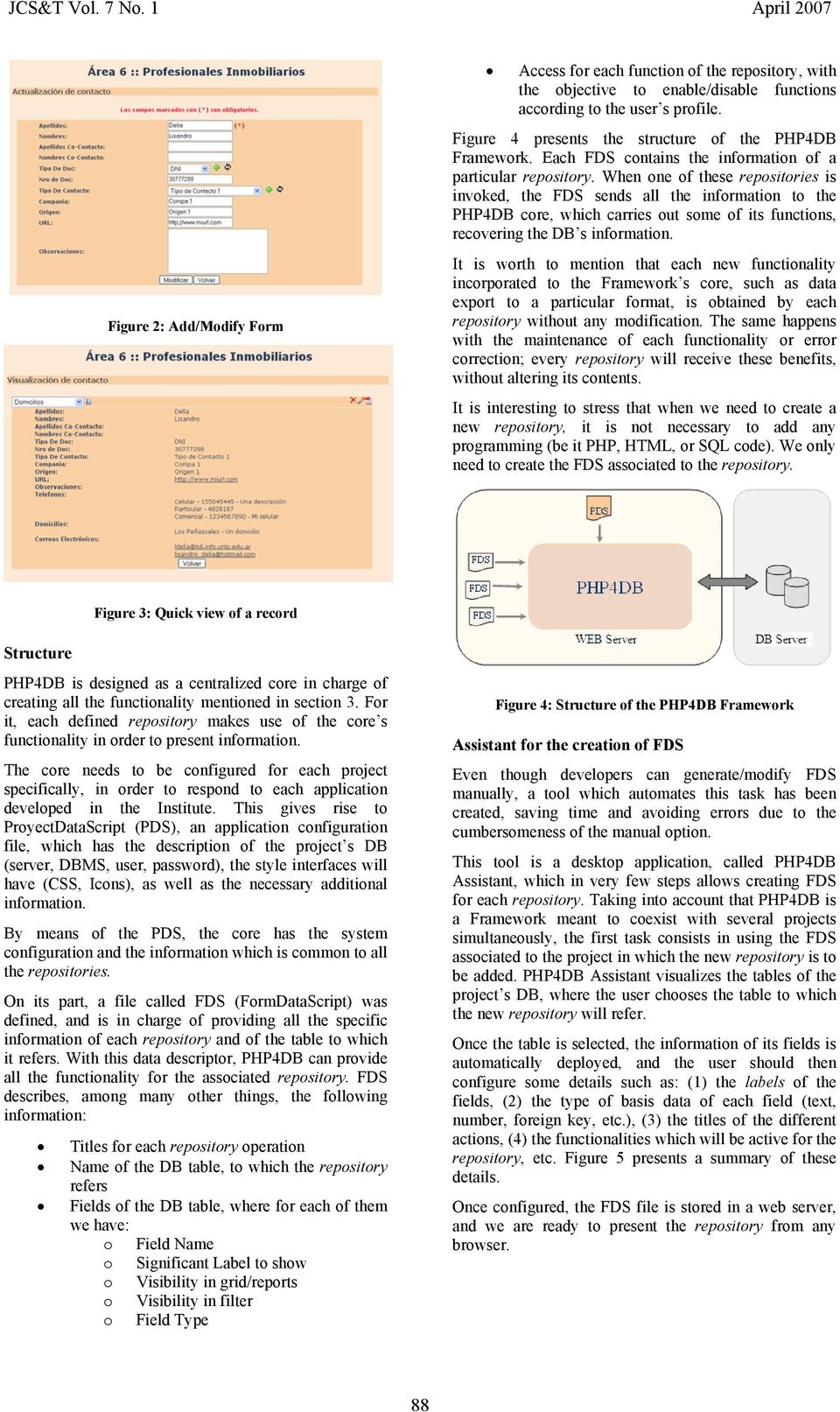
3 Figure 2: Add/Modify Form Access for each function of the repository, with the objective to enable/disable functions according to the user s profile. Figure 4 presents the structure of the PHP4DB Framework. Each FDS contains the information of a particular repository. When one of these repositories is invoked, the FDS sends all the information to the PHP4DB core, which carries out some of its functions, recovering the DB s information. It is worth to mention that each new functionality incorporated to the Framework s core, such as data export to a particular format, is obtained by each repository without any modification. The same happens with the maintenance of each functionality or error correction; every repository will receive these benefits, without altering its contents. It is interesting to stress that when we need to create a new repository, it is not necessary to add any programming (be it PHP, HTML, or SQL code). We only need to create the FDS associated to the repository. Figure 3: Quick view of a record Structure PHP4DB is designed as a centralized core in charge of creating all the functionality mentioned in section 3. For it, each defined repository makes use of the core s functionality in order to present information. The core needs to be configured for each project specifically, in order to respond to each application developed in the Institute. This gives rise to ProyectDataScript (PDS), an application configuration file, which has the description of the project s DB (server, DBMS, user, password), the style interfaces will have (CSS, Icons), as well as the necessary additional information. By means of the PDS, the core has the system configuration and the information which is common to all the repositories. On its part, a file called FDS (FormDataScript) was defined, and is in charge of providing all the specific information of each repository and of the table to which it refers. With this data descriptor, PHP4DB can provide all the functionality for the associated repository. FDS describes, among many other things, the following information: Titles for each repository operation Name of the DB table, to which the repository refers Fields of the DB table, where for each of them we have: o Field Name o Significant Label to show o Visibility in grid/reports o Visibility in filter o Field Type Figure 4: Structure of the PHP4DB Framework Assistant for the creation of FDS Even though developers can generate/modify FDS manually, a tool which automates this task has been created, saving time and avoiding errors due to the cumbersomeness of the manual option. This tool is a desktop application, called PHP4DB Assistant, which in very few steps allows creating FDS for each repository. Taking into account that PHP4DB is a Framework meant to coexist with several projects simultaneously, the first task consists in using the FDS associated to the project in which the new repository is to be added. PHP4DB Assistant visualizes the tables of the project s DB, where the user chooses the table to which the new repository will refer. Once the table is selected, the information of its fields is automatically deployed, and the user should then configure some details such as: (1) the labels of the fields, (2) the type of basis data of each field (text, number, foreign key, etc.), (3) the titles of the different actions, (4) the functionalities which will be active for the repository, etc. Figure 5 presents a summary of these details. Once configured, the FDS file is stored in a web server, and we are ready to present the repository from any browser. 88
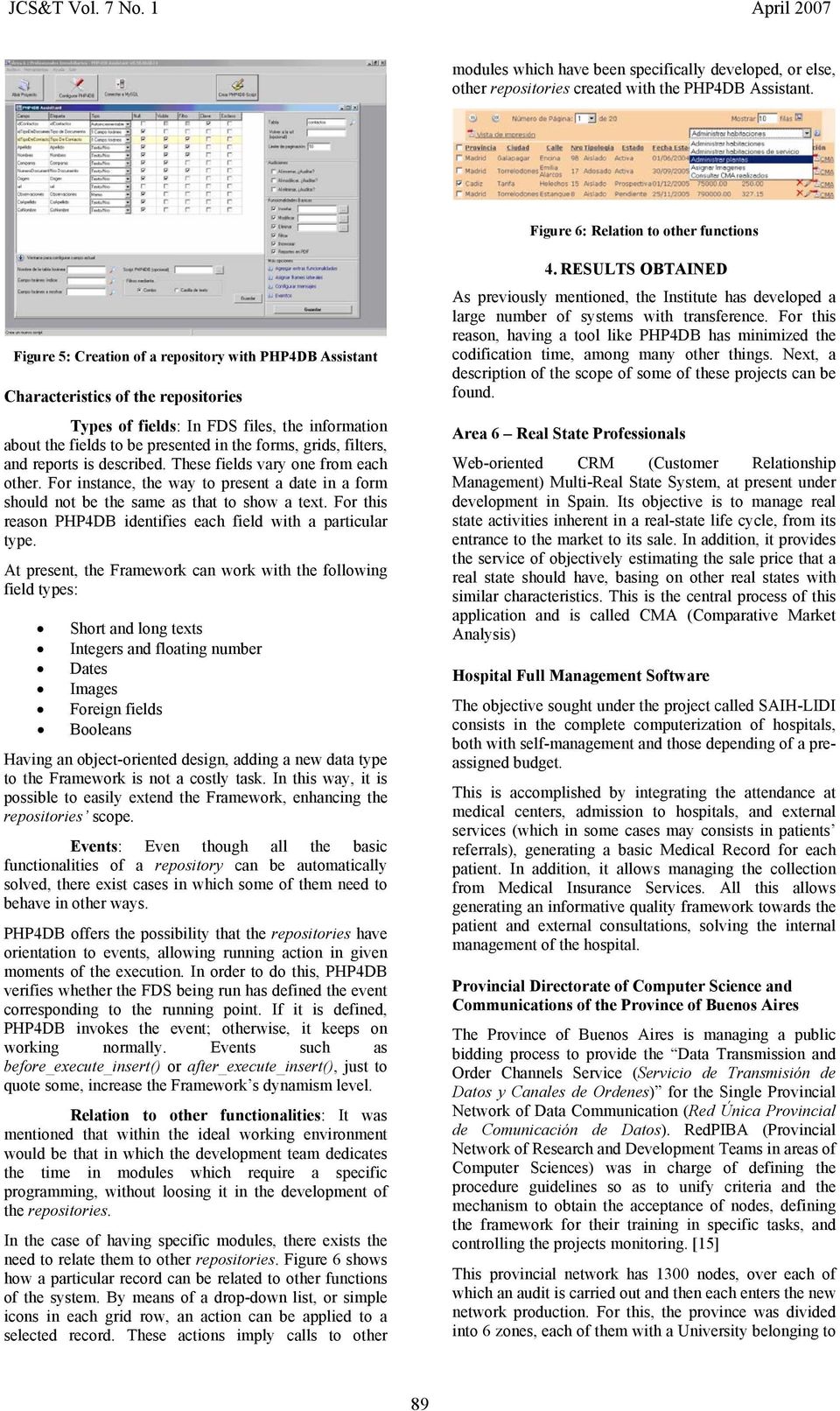
4 modules which have been specifically developed, or else, other repositories created with the PHP4DB Assistant. Figure 6: Relation to other functions Figure 5: Creation of a repository with PHP4DB Assistant Characteristics of the repositories Types of fields: In FDS files, the information about the fields to be presented in the forms, grids, filters, and reports is described. These fields vary one from each other. For instance, the way to present a date in a form should not be the same as that to show a text. For this reason PHP4DB identifies each field with a particular type. At present, the Framework can work with the following field types: Short and long texts Integers and floating number Dates Images Foreign fields Booleans Having an object-oriented design, adding a new data type to the Framework is not a costly task. In this way, it is possible to easily extend the Framework, enhancing the repositories scope. Events: Even though all the basic functionalities of a repository can be automatically solved, there exist cases in which some of them need to behave in other ways. PHP4DB offers the possibility that the repositories have orientation to events, allowing running action in given moments of the execution. In order to do this, PHP4DB verifies whether the FDS being run has defined the event corresponding to the running point. If it is defined, PHP4DB invokes the event; otherwise, it keeps on working normally. Events such as before_execute_insert() or after_execute_insert(), just to quote some, increase the Framework s dynamism level. Relation to other functionalities: It was mentioned that within the ideal working environment would be that in which the development team dedicates the time in modules which require a specific programming, without loosing it in the development of the repositories. In the case of having specific modules, there exists the need to relate them to other repositories. Figure 6 shows how a particular record can be related to other functions of the system. By means of a drop-down list, or simple icons in each grid row, an action can be applied to a selected record. These actions imply calls to other 4. RESULTS OBTAINED As previously mentioned, the Institute has developed a large number of systems with transference. For this reason, having a tool like PHP4DB has minimized the codification time, among many other things. Next, a description of the scope of some of these projects can be found. Area 6 Real State Professionals Web-oriented CRM (Customer Relationship Management) Multi-Real State System, at present under development in Spain. Its objective is to manage real state activities inherent in a real-state life cycle, from its entrance to the market to its sale. In addition, it provides the service of objectively estimating the sale price that a real state should have, basing on other real states with similar characteristics. This is the central process of this application and is called CMA (Comparative Market Analysis) Hospital Full Management Software The objective sought under the project called SAIH-LIDI consists in the complete computerization of hospitals, both with self-management and those depending of a preassigned budget. This is accomplished by integrating the attendance at medical centers, admission to hospitals, and external services (which in some cases may consists in patients referrals), generating a basic Medical Record for each patient. In addition, it allows managing the collection from Medical Insurance Services. All this allows generating an informative quality framework towards the patient and external consultations, solving the internal management of the hospital. Provincial Directorate of Computer Science and Communications of the Province of Buenos Aires The Province of Buenos Aires is managing a public bidding process to provide the Data Transmission and Order Channels Service (Servicio de Transmisión de Datos y Canales de Ordenes) for the Single Provincial Network of Data Communication (Red Única Provincial de Comunicación de Datos). RedPIBA (Provincial Network of Research and Development Teams in areas of Computer Sciences) was in charge of defining the procedure guidelines so as to unify criteria and the mechanism to obtain the acceptance of nodes, defining the framework for their training in specific tasks, and controlling the projects monitoring. [15] This provincial network has 1300 nodes, over each of which an audit is carried out and then each enters the new network production. For this, the province was divided into 6 zones, each of them with a University belonging to 89
5 the RedPIBA as head: UNLP (National University of La Plata), UNLM (National University of La Matanza), UTN (National Technologic University), UNLu (National University of Luján), UNC (National University of the Center), UNS (National University of the South). Each one has a coordinator and two teams of technical specialists. Also, there exists a central coordination team. Coordination tasks for the certification were carried out by means of a WEB application developed with PHP4DB. 5. CONCLUSIONS The use of a Framework in the projects was crucial, since it was possible to automate a high percentage of use cases (UCs). In the project Area6, of the 50 UCs only one was specifically programmed (CMA) [16], being the most complex function which requires statistics and particular ways of use. SAIH-LIDI, on its part, has 30 UCs implemented up to the present. Of these 30 UCs, only 12 (Shifts and Chemists ) were specifically implemented. DPIC has 30 UCs and only 4 received particular programming. The benefit obtained with PHP4BD is quite clear. The development time was significantly reduced by the use of the tool, with the subsequent satisfaction of the user due to the early availability of the required products. In addition, the centralization provided by PHP4DB has allowed obtaining homogeneous interfaces, easing the posterior maintenance. Finally, it is worth to notice the expectation created by the availability of this framework for future applications that require web orientation. [4] M. Walsamakis, Generación Automática de Código a partir del modelo de datos, CACIC2004, La Matanza, [5] Ian Sommerville, Ingeniería de Software, 6 ta Edición, Addison Wesley, [6] Batini, Navathe Cieri, Diseño conceptual de Bases de Datos, Addison Wesley, [7] Dan R. Olsen, Developing User Interfaces, Morgan Kaufmann, [8] Watts S Humphrey, Introduction to the Team Software Process, Addison-Wesley Professional, [9] Clarion 4. Manual de Referencia. Top Speed. [10] Rodriguez de la Puente Santiago, Programación de aplicaciones WEB, Paraninfo, [11] M. Torchiano, M. Morisio. Overlooked Aspects of COTS-Bases Development, IEEE Software, [12] Johannes Sametinger, Software Engineering with Reusable Components, Springer, [13] Rick Leander, Building Application Servers, Cambridge University Press, [14] [15] [16] [17] Loucopoulos, P., Karakostas, V., System Requirements Engineering, McGraw-Hill, [18] Beck K., Una explicación de la Programación Extrema, Addison Wesley, FUTURE WORK Even though the Framework has such a maturity that enables operability with any table of any DB engine, the technological whirlwind leads to taking into account other information domains such as XML files or views encompassing information of several tables. With these extensions the Framework usability will be enhanced, allowing it to get along with a larger quantity of Systems. The incorporation of new type of data for PHP4BD will also be beneficial. Examples of these benefits are the possibility of storing any type of file in tables (.doc,.mp3,.mpeg), or having fields whose values are defined by the user, among many others. Any of these will increase the product usability even more. Last but not list, an important task is to take the assistant mentioned in section 3 into a WEB platform, so as to create/modify the repositories from any location. 7. REFERENCES [1] Roger Pressman, Ingeniería de Software. Un enfoque práctico, Mc Graw Hill, [2] M. Paulk, Capability Maturity Model for Software, Software Engineering Institute, Cargenie Mellon University, [3] A. Davis, Principles of Software Development, Mc Graw Hill,
Case Study. Data Governance Portal. www.brainvire.com 2013 Brainvire Infotech Pvt Ltd Page 1 of 1
 Case Study Data Governance Portal www.brainvire.com 2013 Brainvire Infotech Pvt Ltd Page 1 of 1 Client Requirement The website is the Data Governance intranet portal. Data Governance is the practice of
LAMP [Linux. Apache. MySQL. PHP] Industrial Implementations Module Description
![LAMP [Linux. Apache. MySQL. PHP] Industrial Implementations Module Description](/thumbs/26/9110665.jpg "LAMP [Linux. Apache. MySQL. PHP] Industrial Implementations Module Description") LAMP [Linux. Apache. MySQL. PHP] Industrial Implementations Module Description Mastering LINUX Vikas Debnath Linux Administrator, Red Hat Professional Instructor : Vikas Debnath Contact
LAMP [Linux. Apache. MySQL. PHP] Industrial Implementations Module Description Mastering LINUX Vikas Debnath Linux Administrator, Red Hat Professional Instructor : Vikas Debnath Contact
Modeling Web Applications Using Java And XML Related Technologies
 Modeling Web Applications Using Java And XML Related Technologies Sam Chung Computing & Stware Systems Institute Technology University Washington Tacoma Tacoma, WA 98402. USA [email protected] Yun-Sik
SUBJECT CODE : 4074 PERIODS/WEEK : 4 PERIODS/ SEMESTER : 72 CREDIT : 4 TIME SCHEDULE UNIT TOPIC PERIODS 1. INTERNET FUNDAMENTALS & HTML Test 1
 SUBJECT TITLE : WEB TECHNOLOGY SUBJECT CODE : 4074 PERIODS/WEEK : 4 PERIODS/ SEMESTER : 72 CREDIT : 4 TIME SCHEDULE UNIT TOPIC PERIODS 1. INTERNET FUNDAMENTALS & HTML Test 1 16 02 2. CSS & JAVASCRIPT Test
1. Introduction 1.1 Methodology
 Table of Contents 1. Introduction 1.1 Methodology 3 1.2 Purpose 4 1.3 Scope 4 1.4 Definitions, Acronyms and Abbreviations 5 1.5 Tools Used 6 1.6 References 7 1.7 Technologies to be used 7 1.8 Overview
DIPLOMA IN WEBDEVELOPMENT
 DIPLOMA IN WEBDEVELOPMENT Prerequisite skills Basic programming knowledge on C Language or Core Java is must. # Module 1 Basics and introduction to HTML Basic HTML training. Different HTML elements, tags
CHAPTER 1: CLIENT/SERVER INTEGRATED DEVELOPMENT ENVIRONMENT (C/SIDE)
 Chapter 1: Client/Server Integrated Development Environment (C/SIDE) CHAPTER 1: CLIENT/SERVER INTEGRATED DEVELOPMENT ENVIRONMENT (C/SIDE) Objectives Introduction The objectives are: Discuss Basic Objects
An Electronic Journal Management System
 An Electronic Journal Management System Hrvoje Bogunović, Edgar Pek, Sven Lončarić and Vedran Mornar Faculty of Electrical Engineering and Computing, University of Zagreb Unska 3, 0000 Zagreb, Croatia
Chapter 13 Computer Programs and Programming Languages. Discovering Computers 2012. Your Interactive Guide to the Digital World
 Chapter 13 Computer Programs and Programming Languages Discovering Computers 2012 Your Interactive Guide to the Digital World Objectives Overview Differentiate between machine and assembly languages Identify
Customer Bank Account Management System Technical Specification Document
 Customer Bank Account Management System Technical Specification Document Technical Specification Document Page 1 of 15 Table of Contents Contents 1 Introduction 3 2 Design Overview 4 3 Topology Diagram.6
Document management and exchange system supporting education process
 Document management and exchange system supporting education process Emil Egredzija, Bozidar Kovacic Information system development department, Information Technology Institute City of Rijeka Korzo 16,
MEGA Web Application Architecture Overview MEGA 2009 SP4
 Revised: September 2, 2010 Created: March 31, 2010 Author: Jérôme Horber CONTENTS Summary This document describes the system requirements and possible deployment architectures for MEGA Web Application.
Short notes on webpage programming languages
 Short notes on webpage programming languages What is HTML? HTML is a language for describing web pages. HTML stands for Hyper Text Markup Language HTML is a markup language A markup language is a set of
Bureau for Visual Affairs. content management system. Keep your website up-to-date and relevant with ease
 content management system Keep your website up-to-date and relevant with ease 1 Only an up-to-date and well maintained website is perceived as relevant and will generate return visits and involvement.
Sports Management Information Systems. Camilo Rostoker November 22, 2002
 Sports Management Information Systems Camilo Rostoker November 22, 2002 Introduction We are in the information age The availability of technology has brought forth a new problem domain how do we manage
Release 1. ICAPRG604A Create cloud computing services
 Release 1 ICAPRG604A Create cloud computing services ICAPRG604A Create cloud computing services Modification History Release Release 1 Comments This version first released with ICA11 Information and Communications
STRATEGIES ON SOFTWARE INTEGRATION
 STRATEGIES ON SOFTWARE INTEGRATION Cornelia Paulina Botezatu and George Căruţaşu Faculty of Computer Science for Business Management Romanian-American University, Bucharest, Romania ABSTRACT The strategy
itop: the open-source ITSM solution
 itop: the open-source ITSM solution itop is a multi-client web portal designed for service providers and businesses. Simple and easy to use, it allows all configuration items and their relationships to
Client/server is a network architecture that divides functions into client and server
 Page 1 A. Title Client/Server Technology B. Introduction Client/server is a network architecture that divides functions into client and server subsystems, with standard communication methods to facilitate
Automating Rich Internet Application Development for Enterprise Web 2.0 and SOA
 Automating Rich Internet Application Development for Enterprise Web 2.0 and SOA Enterprise Web 2.0 >>> FAST White Paper November 2006 Abstract Modern Rich Internet Applications for SOA have to cope with
A review and analysis of technologies for developing web applications
 A review and analysis of technologies for developing web applications Asha Mandava and Solomon Antony Murray state University Murray, Kentucky Abstract In this paper we review technologies useful for design
HTML5. Turn this page to see Quick Guide of CTTC
 Programming SharePoint 2013 Development Courses ASP.NET SQL TECHNOLGY TRAINING GUIDE Visual Studio PHP Programming Android App Programming HTML5 Jquery Your Training Partner in Cutting Edge Technologies
IT3205: Fundamentals of Software Engineering (Compulsory)
 INTRODUCTION : Fundamentals of Software Engineering (Compulsory) This course is designed to provide the students with the basic competencies required to identify requirements, document the system design
zen Platform technical white paper
 zen Platform technical white paper The zen Platform as Strategic Business Platform The increasing use of application servers as standard paradigm for the development of business critical applications meant
International Journal of Engineering Technology, Management and Applied Sciences. www.ijetmas.com November 2014, Volume 2 Issue 6, ISSN 2349-4476
 ERP SYSYTEM Nitika Jain 1 Niriksha 2 1 Student, RKGITW 2 Student, RKGITW Uttar Pradesh Tech. University Uttar Pradesh Tech. University Ghaziabad, U.P., India Ghaziabad, U.P., India ABSTRACT Student ERP
Multi-Platform Mobile Application Development Analysis. Lisandro Delía Nicolás Galdámez Pablo Thomas Leonardo Corbalán Patricia Pesado
 Multi-Platform Mobile Application Development Analysis Lisandro Delía Nicolás Galdámez Pablo Thomas Leonardo Corbalán Patricia Pesado Agenda 1. 2. 3. 4. 5. Introduction Multi-Platform Mobile Applications
Development of Essential Features for a Human Resource Management System
 Development of Essential Features for a Human Resource Management System Rao Akkina 1 Entergy 639 Loyola Avenue New Orleans, LA 70113 and Ghasem S. Alijani 2 Graduate Studies Program in Computer Information
How To Understand Software Engineering
 PESIT Bangalore South Campus Department of MCA SOFTWARE ENGINEERING 1. GENERAL INFORMATION Academic Year: JULY-NOV 2015 Semester(s):III Title Code Duration (hrs) SOFTWARE ENGINEERING 13MCA33 Lectures 52Hrs
Model Driven Development for Composing Business Applications. Jean-Loup Comeliau (W4)
 Model Driven Development for Composing Business Applications Jean-Loup Comeliau (W4) [email protected] www.lyria.com www.w4global.com 13-14 May 2010, Rome : Workshop on Future Standards for MBUI
Braindumps.C2150-810.50 questions
 Braindumps.C2150-810.50 questions Number: C2150-810 Passing Score: 800 Time Limit: 120 min File Version: 5.3 http://www.gratisexam.com/ -810 IBM Security AppScan Source Edition Implementation This is the
Seamless Web Data Entry for SAS Applications D.J. Penix, Pinnacle Solutions, Indianapolis, IN
 Seamless Web Data Entry for SAS Applications D.J. Penix, Pinnacle Solutions, Indianapolis, IN ABSTRACT For organizations that need to implement a robust data entry solution, options are somewhat limited
COURSE CONTENT FOR WINTER TRAINING ON Web Development using PHP & MySql
 COURSE CONTENT FOR WINTER TRAINING ON Web Development using PHP & MySql 1 About WEB DEVELOPMENT Among web professionals, "web development" refers to the design aspects of building web sites. Web development
Chapter 6 FOUNDATIONS OF BUSINESS INTELLIGENCE: DATABASES AND INFORMATION MANAGEMENT Learning Objectives
 Chapter 6 FOUNDATIONS OF BUSINESS INTELLIGENCE: DATABASES AND INFORMATION MANAGEMENT Learning Objectives Describe how the problems of managing data resources in a traditional file environment are solved
Case Study. SaaS Based Multi-Store Market Place. www.brainvire.com 2013 Brainvire Infotech Pvt. Ltd Page 1 of 5
 Case Study SaaS Based Multi-Store Market Place Page 1 of 5 Client Requirement Magento Multi-Store Ecommerce Management is a web based virtual mall. It s an e- commerce virtual mall cum SaaS based model
Benefits of Test Automation for Agile Testing
 Benefits of Test Automation for Agile Testing Manu GV 1, Namratha M 2, Pradeep 3 1 Technical Lead-Testing Calsoft Labs, Bangalore, India 2 Assistant Professor, BMSCE, Bangalore, India 3 Software Engineer,
ARCHITECTURAL DESIGN OF MODERN WEB APPLICATIONS
 ARCHITECTURAL DESIGN OF MODERN WEB APPLICATIONS Lech MADEYSKI *, Michał STOCHMIAŁEK Abstract. Architectural design is about decisions which influence characteristics of arising system e.g. maintainability
INTRODUCING ORACLE APPLICATION EXPRESS. Keywords: database, Oracle, web application, forms, reports
 INTRODUCING ORACLE APPLICATION EXPRESS Cristina-Loredana Alexe 1 Abstract Everyone knows that having a database is not enough. You need a way of interacting with it, a way for doing the most common of
KRYSTAL DMS User s Guide Enterprise Edition Version 8.0
 KRYSTAL DMS User s Guide PRIMELEAF CONSULTING [P] LTD 29, Hendre Castle, D.S.Babrekar Marg, Gokhale Road (North), Dadar, Mumbai 400 028, India Tel No + 91 2447 3371 / 72 / 73 FIRST EDITION AUGUST 2013
5.1 Features 1.877.204.6679. [email protected] Denver CO 80202
 1.877.204.6679 www.fourwindsinteractive.com 3012 Huron Street [email protected] Denver CO 80202 5.1 Features Copyright 2014 Four Winds Interactive LLC. All rights reserved. All documentation
Course 103402 MIS. Foundations of Business Intelligence
 Oman College of Management and Technology Course 103402 MIS Topic 5 Foundations of Business Intelligence CS/MIS Department Organizing Data in a Traditional File Environment File organization concepts Database:
To increase scalability, the following features can be integrated:
 Client Requirements Magento Multi Store Ecommerce Management system is an online virtual mall using is Saas based model based Ecommerce Platform where merchants and retailers can sign up and easily create
Adobe Systems Incorporated
 Adobe Connect 9.2 Page 1 of 8 Adobe Systems Incorporated Adobe Connect 9.2 Hosted Solution June 20 th 2014 Adobe Connect 9.2 Page 2 of 8 Table of Contents Engagement Overview... 3 About Connect 9.2...
Shop by Manufacturer Custom Module for Magento
 Shop by Manufacturer Custom Module for Magento TABLE OF CONTENTS Table of Contents Table Of Contents... 2 1. INTRODUCTION... 3 2. Overview...3 3. Requirements... 3 4. Features... 4 4.1 Features accessible
Lesson 7 - Website Administration
 Lesson 7 - Website Administration If you are hired as a web designer, your client will most likely expect you do more than just create their website. They will expect you to also know how to get their
Expert PHP and MySQL. Application Desscpi and Development. Apress" Marc Rochkind
 Expert PHP and MySQL Application Desscpi and Development Marc Rochkind Apress" Contents About the Author About the Technical Reviewer Acknowledgments Introduction xvii xix xxi xxiii -Chapter 1: Project
Reusability of WSDL Services in Web Applications
 599 Reusability of WSDL Services in Web Applications 1 Jaspreet Singh, 2 Sandeep Saini 1 Assistant Professor Department Of Computer Science & Engineering, Chandigarh University Gharuan, Punjab, India 2
Using Database Metadata and its Semantics to Generate Automatic and Dynamic Web Entry Forms
 Using Database Metadata and its Semantics to Generate Automatic and Dynamic Web Entry Forms Mohammed M. Elsheh and Mick J. Ridley Abstract Automatic and dynamic generation of Web applications is the future
New Web Application Development Tool and Its MDA-Based Support Methodology
 New Web Application Development Tool and Its MDA-Based Support Methodology V Yasuyuki Fujikawa V Takahide Matsutsuka (Manuscript received February 11, 2004) Web applications are ubiquitous on the Internet,
SOA REFERENCE ARCHITECTURE: WEB TIER
 SOA REFERENCE ARCHITECTURE: WEB TIER SOA Blueprint A structured blog by Yogish Pai Web Application Tier The primary requirement for this tier is that all the business systems and solutions be accessible
Foundations of Business Intelligence: Databases and Information Management
 Foundations of Business Intelligence: Databases and Information Management Content Problems of managing data resources in a traditional file environment Capabilities and value of a database management
Choosing A CMS. Enterprise CMS. Web CMS. Online and beyond. Best-of-Breed Content Management Systems. 1300 762 912 [email protected].
 Web CMS Enterprise CMS 1300 762 912 [email protected] Sydney 275 alfred st north sydney nsw 2060 Melbourne 21 burwood road hawthorn vic 3122 Choosing A CMS Best-of-Breed Content Management Systems Brisbane
DCA. Document Control & Archiving USER S GUIDE
 DCA Document Control & Archiving USER S GUIDE Decision Management International, Inc. 1111 Third Street West Suite 250 Bradenton, FL 34205 Phone 800-530-0803 FAX 941-744-0314 www.dmius.com Copyright 2002,
Embedded BI made easy
 June, 2015 1 Embedded BI made easy DashXML makes it easy for developers to embed highly customized reports and analytics into applications. DashXML is a fast and flexible framework that exposes Yellowfin
Gabriel Iuga. London, United Kingdom Tel: 0747 856 2661; Email: [email protected] Website: www.gabriel-iuga.com
 Employment History: Gabriel Iuga London, United Kingdom Tel: 0747 856 2661; Email: [email protected] Website: www.gabriel-iuga.com November 2014 Present November 2015 to Present November 2014 to November
How To Set Up An Outsourcing Center In China
 HJSOFT Business Outsourcing Proposal Introduction... 2 Business Outsourcing Focus... 2 Standard and Unified Development Process... 3 Standardized Testing Procedures... 4 Price reference... 5 1 Introduction
Installation and Configuration Manual
 Beacon Office Installation and Configuration Manual Version - 2.5(1) Radianta Inc. September 2008 Radianta, Inc. Beacon Office Page 2 Table of Contents Introduction... 4 What is Beacon Office... 4 How
Sisense. Product Highlights. www.sisense.com
 Sisense Product Highlights Introduction Sisense is a business intelligence solution that simplifies analytics for complex data by offering an end-to-end platform that lets users easily prepare and analyze
A Grid Architecture for Manufacturing Database System
 Database Systems Journal vol. II, no. 2/2011 23 A Grid Architecture for Manufacturing Database System Laurentiu CIOVICĂ, Constantin Daniel AVRAM Economic Informatics Department, Academy of Economic Studies
4D and SQL Server: Powerful Flexibility
 4D and SQL Server: Powerful Flexibility OVERVIEW MS SQL Server has become a standard in many parts of corporate America. It can manage large volumes of data and integrates well with other products from
100% NO CODING NO DEVELOPING IMMEDIATE BUSINESS -25% -70% UNLIMITED SCALABILITY DEVELOPMENT TIME SOFTWARE STABILITY
 100% UNLIMITED SCALABILITY TOTAL COST OF OWNERSHIP -25% +50% EFFICENCY INCREASE -70% +65% DEVELOPMENT TIME SOFTWARE STABILITY NO CODING NO DEVELOPING IMMEDIATE BUSINESS FlexyGo Rapid Application Builder
SOFTWARE TESTING TRAINING COURSES CONTENTS
 SOFTWARE TESTING TRAINING COURSES CONTENTS 1 Unit I Description Objectves Duration Contents Software Testing Fundamentals and Best Practices This training course will give basic understanding on software
DiskPulse DISK CHANGE MONITOR
 DiskPulse DISK CHANGE MONITOR User Manual Version 7.9 Oct 2015 www.diskpulse.com [email protected] 1 1 DiskPulse Overview...3 2 DiskPulse Product Versions...5 3 Using Desktop Product Version...6 3.1 Product
Basic Unix/Linux 1. Software Testing Interview Prep
 Basic Unix/Linux 1 Programming Fundamentals and Concepts 2 1. What is the difference between web application and client server application? Client server application is designed typically to work in a
WizTom Localization Suite. Main Customer benefits: Adding a new language is no longer an issue!
 Localization Suite is a software localization tool capable of localizing any application on any technical architecture: Windows, 70/550- Emulation, Web (Intra-, Inter, Extranet), Java (stand alone, applets).net.
Case Studies of Running the Platform. NetBeans UML Servlet JSP GlassFish EJB
 September Case Studies of Running the Platform NetBeans UML Servlet JSP GlassFish EJB In this project we display in the browser the Hello World, Everyone! message created in the session bean with servlets
E-Commerce: Designing And Creating An Online Store
 E-Commerce: Designing And Creating An Online Store Introduction About Steve Green Ministries Solo Performance Artist for 19 Years. Released over 26 Records, Several Kids Movies, and Books. My History With
K@ A collaborative platform for knowledge management
 White Paper K@ A collaborative platform for knowledge management Quinary SpA www.quinary.com via Pietrasanta 14 20141 Milano Italia t +39 02 3090 1500 f +39 02 3090 1501 Copyright 2004 Quinary SpA Index
Demystified CONTENTS Acknowledgments xvii Introduction xix CHAPTER 1 Database Fundamentals CHAPTER 2 Exploring Relational Database Components
 Acknowledgments xvii Introduction xix CHAPTER 1 Database Fundamentals 1 Properties of a Database 1 The Database Management System (DBMS) 2 Layers of Data Abstraction 3 Physical Data Independence 5 Logical
Content Management Systems: Drupal Vs Jahia
 Content Management Systems: Drupal Vs Jahia Mrudula Talloju Department of Computing and Information Sciences Kansas State University Manhattan, KS 66502. [email protected] Abstract Content Management Systems
Online Enrollment and Administration System
 FYP Proposal Report Real World Database Development by Kong Koon Kit Chan Yin Mo Leung Shiu Hong Advised by Prof. Frederick H. Lochovsky Submitted in partial fulfillment of the requirements for COMP 4981
A complete platform for proactive data management
 Brochure A complete platform for proactive data management HP Structured Data Manager Software for Oracle e-business Suite The right data management strategy The increased size and unmanaged growth of
Glyma Deployment Instructions
 Glyma Deployment Instructions Version 0.8 Copyright 2015 Christopher Tomich and Paul Culmsee and Peter Chow Licensed under the Apache License, Version 2.0 (the "License"); you may not use this file except
Web Development using PHP (WD_PHP) Duration 1.5 months
 Duration 1.5 months Our program is a practical knowledge oriented program aimed at learning the techniques of web development using PHP, HTML, CSS & JavaScript. It has some unique features which are as
Pro/INTRALINK 10.1. Curriculum Guide
 Pro/INTRALINK 10.1 Curriculum Guide Live Classroom Curriculum Guide Introduction to Pro/INTRALINK 10.1 Business Administration of Windchill Pro/INTRALINK 10.1 System Administration of Windchill 10.1 Customization
Diploma of Website Development
 Diploma of Website Development Program Description The BHCK Diploma of Website Development provides the skills and knowledge for a graduate to design, build and manage websites as an independent web developer
Service Cloud for information retrieval from multiple origins
 Service Cloud for information retrieval from multiple origins Authors: Marisa R. De Giusti, CICPBA (Comisión de Investigaciones Científicas de la provincia de Buenos Aires), PrEBi, National University
1. INTRODUCTION TO RDBMS
 Oracle For Beginners Page: 1 1. INTRODUCTION TO RDBMS What is DBMS? Data Models Relational database management system (RDBMS) Relational Algebra Structured query language (SQL) What Is DBMS? Data is one
Easy configuration of NETCONF devices
 Easy configuration of NETCONF devices David Alexa 1 Tomas Cejka 2 FIT, CTU in Prague CESNET, a.l.e. Czech Republic Czech Republic [email protected] [email protected] Abstract. It is necessary for developers
White Paper: 5GL RAD Development
 White Paper: 5GL RAD Development After 2.5 hours of training, subjects reduced their development time by 60-90% A Study By: 326 Market Street Harrisburg, PA 17101 Luis Paris, Ph.D. Associate Professor
ProGUM-Web: Tool Support for Model-Based Development of Web Applications
 ProGUM-Web: Tool Support for Model-Based Development of Web Applications Marc Lohmann 1, Stefan Sauer 1, and Tim Schattkowsky 2 1 University of Paderborn, Computer Science, D 33095 Paderborn, Germany {mlohmann,sauer}@upb.de
Online College Magazine
 Software Requirement Specification Chennai Campus Vandalur-Kelambakkam Road, Chennai 600048 Ciphers Online College Magazine IBM TGMC-2011 Version 1.0 Team Members : Mentor: Prof. B. Sathis Kumar 1. Aanchal
IBM Rational Web Developer for WebSphere Software Version 6.0
 Rapidly build, test and deploy Web, Web services and Java applications with an IDE that is easy to learn and use IBM Rational Web Developer for WebSphere Software Version 6.0 Highlights Accelerate Web,
DTWMS Required Software Engineers. 1. Senior Java Programmer (3 Positions) Responsibilities:
 DTWMS Required Software Engineers 1. Senior Java Programmer (3 Positions) Responsibilities: Responsible to deliver quality software solutions using standard end to end software development cycle Collaborate
Quick start. A project with SpagoBI 3.x
 Quick start. A project with SpagoBI 3.x Summary: 1 SPAGOBI...2 2 SOFTWARE DOWNLOAD...4 3 SOFTWARE INSTALLATION AND CONFIGURATION...5 3.1 Installing SpagoBI Server...5 3.2Installing SpagoBI Studio and Meta...6
Software Architecture
 Software Architecture Definitions http://www.sei.cmu.edu/architecture/published_definiti ons.html ANSI/IEEE Std 1471-2000, Recommended Practice for Architectural Description of Software- Intensive Systems
Annex E - Capability Building Policy
 Page 1 DEPARTMENT OF Version: 1.5 Effective: December 18, 2014 Annex E - Capability Building Policy This Capability Building Policy is an annex to the Government Web Hosting Service (GWHS) Memorandum Circular
A process-driven methodological approach for the design of telecommunications management systems
 A process-driven methodological approach for the design of telecommunications management systems Thierry FRAIZE, Julio VILLENA, Jean-Daniel GUEDJ TELECOM ARGENTINA Av Dorrego 2520 (1425) Buenos Aires Argentina
An Architecture for Web-based DSS
 Proceedings of the 6th WSEAS Int. Conf. on Software Engineering, Parallel and Distributed Systems, Corfu Island, Greece, February 16-19, 2007 75 An Architecture for Web-based DSS Huabin Chen a), Xiaodong
GenericServ, a Generic Server for Web Application Development
 EurAsia-ICT 2002, Shiraz-Iran, 29-31 Oct. GenericServ, a Generic Server for Web Application Development Samar TAWBI PHD student [email protected] Bilal CHEBARO Assistant professor [email protected] Abstract
A SOA visualisation for the Business
 J.M. de Baat 09-10-2008 Table of contents 1 Introduction...3 1.1 Abbreviations...3 2 Some background information... 3 2.1 The organisation and ICT infrastructure... 3 2.2 Five layer SOA architecture...
TOSCA Interoperability Demonstration
 Topology and Orchestration Specification for Cloud Applications (TOSCA) Standard TOSCA Interoperability Demonstration Participating Companies: Join the TOSCA Technical Committee www.oasis-open.org, [email protected]
Agile Framework for Globally Distributed Development Environment (The DAD Model)
 Agile Framework for Globally Distributed Development Environment (The DAD Model) REHAN AKBAR, MUHAMMAD HARIS, MAJID NAEEM Department of Computer Science GC University, Lahore Pakistan. [email protected]
IT3203 Fundamentals of Software Engineering (Compulsory) BIT 2 nd YEAR SEMESTER 3
 Fundamentals of Software Engineering (Compulsory) BIT 2 nd YEAR SEMESTER 3 INTRODUCTION This course is designed to provide the students with the basic competencies required to identify requirements, document
Software development life cycle. Software Engineering - II ITNP92 - Object Oriented Software Design. Requirements. Requirements. Dr Andrea Bracciali
 Software development life cycle Software life cycle: Software Engineering - II ITNP92 - Object Oriented Software Design Dr Andrea Bracciali Module Co-ordinator 4B86 [email protected] Spring 2014 (elicitation)