
Application of Data Mining based Malicious Code Detection Techniques for Detecting new Spyware
|
|
|
- Doreen Stanley
- 10 years ago
- Views:
Transcription
1 Application of Data Mining based Malicious Code Detection Techniques for Detecting new Spyware Cumhur Doruk Bozagac Bilkent University, Computer Science and Engineering Department, Ankara, Turkey Abstract. Over the past few years, a new computer security problem has arisen, Spyware. Anti-Virus techniques cannot deal with spyware, due to their silent infection techniques and their differences from a regular virus. Various Anti-Spyware programs have been implemented as a counter-measure but most of these programs work using the signature method, which is weak against new spyware. Schultz[1] has presented a data-mining framework that detects new, previously unseen malicious executables. However his paper was published in 2001 and there was no spyware in their training or test dataset. This paper takes Schultz[1] s work as a candidate and applies its techniques against a new spyware dataset collected in 2005, to see whether their techniques can be used against this new threat. 1 Introduction Spyware is any software installed on a computer without the user's knowledge, that gathers information about that user for later retrieval by whomever controls it. There are two types of spyware: malware and adware. Malware is any program that gathers personal information from the user s PC. Key loggers, screen capture devices, and Trojans are in this category. Adware is a program designed for showing a user advertisements, like homepage hijackers, pop-up windows and search page hijackers. Spyware poses several risks. The most conspicuous is compromising a user s privacy by transmitting information about that user s behavior. However, spyware can also detract from the usability and stability of a user s computing environment, and it has the potential to introduce new security vulnerabilities to the infected host. Because spyware is widespread, such vulnerabilities would put millions of computers at risk. 1
2 Spyware programs have a series of traits that makes them difficult to detect and enables them to install themselves on numerous PCs for long periods of time[2]: - They use almost perfect camouflage systems. They are normally installed on computers along with another kind of application: a P2P client, a hard disk utility - File names don t normally give any clues as to the real nature of the file, and so they often go unnoticed along with other legitimate application files. - As they are not viruses, and they don t use a routine that can be associated with them, antivirus programs don t detect them unless, they are designed specifically to do so. Panda Anti-Virus program has recently released a new online virus scanner, which can also detect spyware. According to their reports[2], in the first 24 hours of the operation, 84 percent of malicious code detected was spyware and the first 74 most detected malicious code were all spy programs. Spyware can be detected through the effects it has on systems: use of system resources resulting in a slowdown of the PC; high level of Internet connection bandwidth consumption; complete loss of the connection or general system instability. They also often change settings of certain applications, such as the browser home page, or insert icons on the desktop. The main consequence of spyware on PCs is the gathering of information, including confidential details, making users feel uneasy about what is happening in their computer behind their backs. Current virus scanner technology has two parts[1]: a signature-based detector and a heuristic classifier that detects new viruses. The classic signature-based detection algorithm relies on signatures (unique telltale strings) of known malicious executables to generate detection models. Signature-based methods create a unique tag for each malicious program so that future examples of it can be correctly classified with a small error rate. These methods do not generalize well to detect new malicious binaries because they are created to give a false positive rate as close to zero as possible. Whenever a detection method generalizes to new instances, the tradeoff is for a higher false positive rate. Heuristic classifiers are generated by a group of virus experts to detect new malicious programs. This kind of analysis can be time-consuming and oftentimes still fail to detect new malicious executables. 2

3 2 Methodology Schultz[1] proposes using data mining methods for detecting new malicious executables. They apply three different algorithms with each one having its own feature extraction technique. The first one is RIPPER algorithm, which they only applied on Portable Executable (PE) format data using the Portable Executable header information extraction technique, so I skip this algorithm. The second algorithm is Naïve Bayes algorithm using strings in the binaries as features. This technique can be easily avoided by encoding or encrypting the strings in a file, so this technique is weak against new malicious code. The third algorithm is Multi-Naïve Bayes algorithm, which uses byte sequences in a file as features. The idea is, malicious executables have common intentions and they may have similar byte code. We can detect malicious executable by looking at the frequency analysis of byte code in a file. Multi-Naïve Bayes algorithm is basically a collection of Naïve Bayes algorithms for splitting the data into sets. I will use the same feature extraction technique, but I will use only one instance of Naïve Bayes algorithm. Source code for this method can be found at The dataset consists of 312 benign(non-malicious) executables and 614 spyware executable. The spyware collection is formed by using the virus collection at and by crawling the internet using a sandboxed operating system and manually collecting spywares. The benign executables are collected from the system files in Windows XP operating system and from programs of a stereotype user. Byte sequences are extracted using the hexdump tool in Linux. For each file in the dataset, using this tool a hexdump file is formed. When the algorithm is run, user should specify a window size. Naïve Bayes algorithm can be specified to use how many sequences of byte data. Default window size is one, which means algorithm will look at 4 hexadecimals(2 bytes of data) for frequency analysis. I run the algorithm for a window size of 2 and 4 separately using 5-fold cross validation technique. 3 Test Results To evaluate our system we are interested in several Quantities, just like Schultz[1] : 1. True Positives (TP), the number of malicious executable examples classified as malicious executables 3
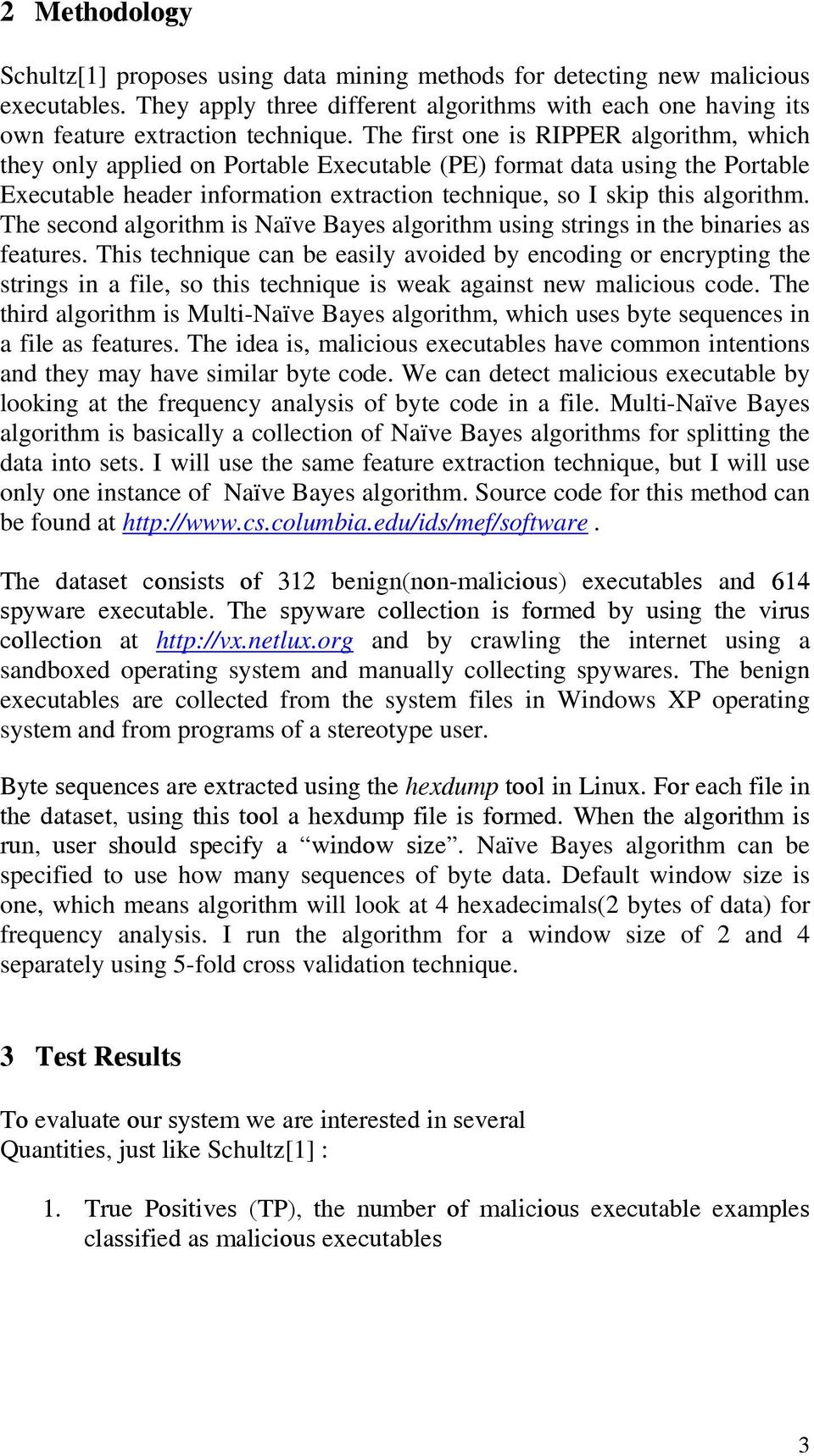
4 2. True Negatives (TN), the number of benign programs classified as benign. 3. False Positives (FP), the number of benign programs classified as malicious executables 4. False Negatives (FN), the number of malicious executables classified as benign binaries. The detection rate of the classifier is the percentage of the total malicious programs labeled malicious. The false positive rate is the percentage of benign programs which were labeled as malicious. The overall accuracy is the percentage of true classifications over all data. The first test is done using a window size of 2 and its results curve is shown in Table 1. Window Size = Detection Rate % False Positive Rate % W2 Table 1. Results of the tests for Spyware dataset. 4
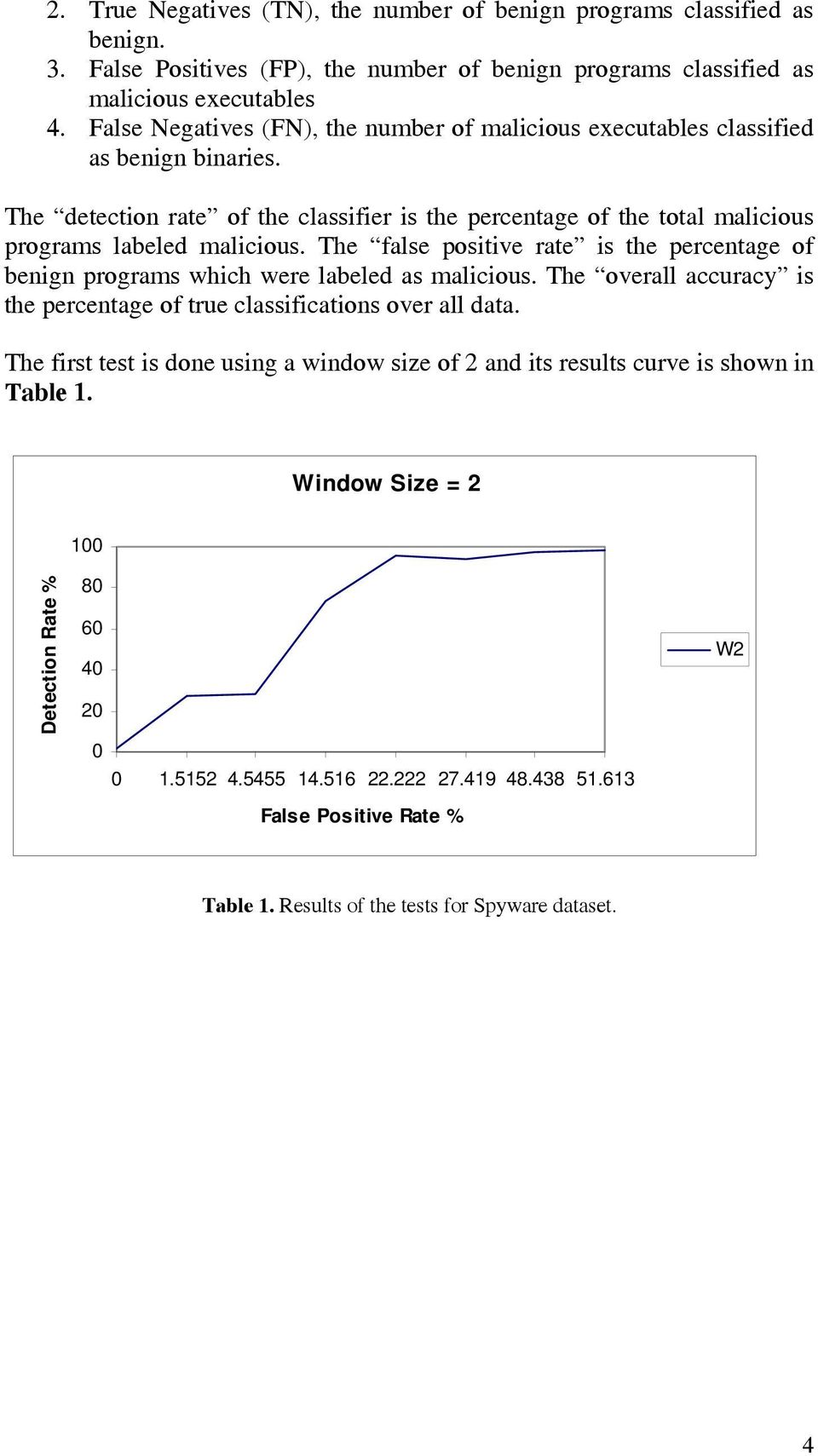
5 As you can see, high detection rate can only be gained for high false positive rates and till 20% false positive rate the model has a detection rate lower than 80%. Then I run the algorithm with a window size of 4 and the results can be seen in Table 2. Window Size = Detection Rate % False Positive Rate % W4 Table 2. Results of the tests for Spyware dataset. Results were better for this case, but still the overall accuracy was rather low, so I decided to investigate the reasons by looking at the classification test results. I realized that a class of spyware called Trojans had a quite low detection rate. These are different from ordinary spyware, since they are quite complicated programs and their binary size were rather big compared to other files in the dataset. I thought that these programs may be the reason for the high false positive rate and low detection rate, so I run another test for a window size of 2, after excluding the 59 Trojans from the dataset. 5
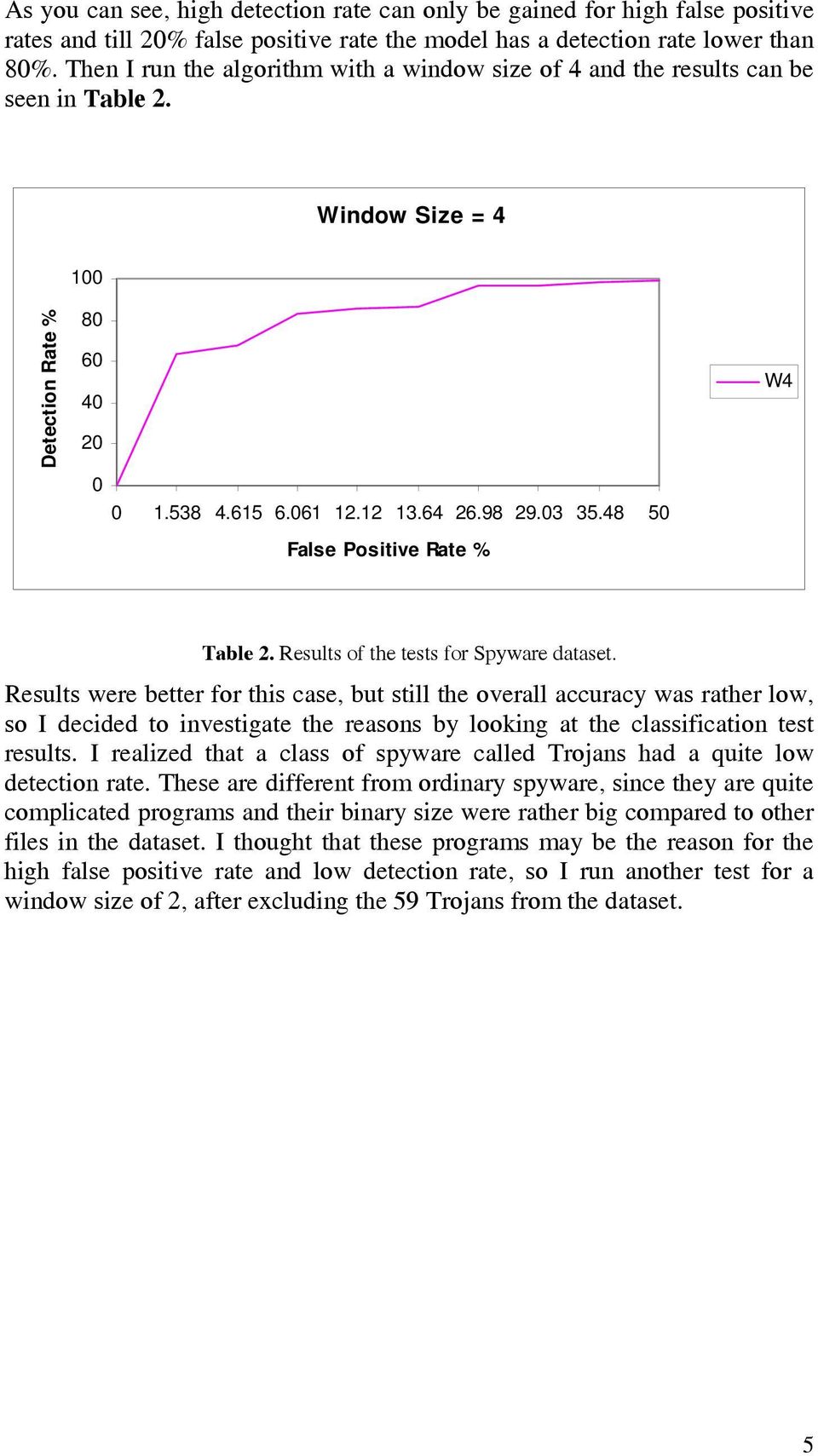
6 Window Size = 2 and without Trojans Detection Rate % False Positive Rate % W2 Table 3. Results of the tests for Spyware dataset. As the Table 3 shows, the overall accuracy has improved for the window size of 2 and we reach 80% detection rate before a false positive rate of 15%. Also we score better for low false positive rates. These results encouraged for a window size of 4 test without the Trojans in the dataset and the results of this test are shown in Table 4. Window Size = 4 and without Trojans 100 Detection Rate % False Positive Rate % W4 Table 4. Results of the tests for Spyware dataset. 6
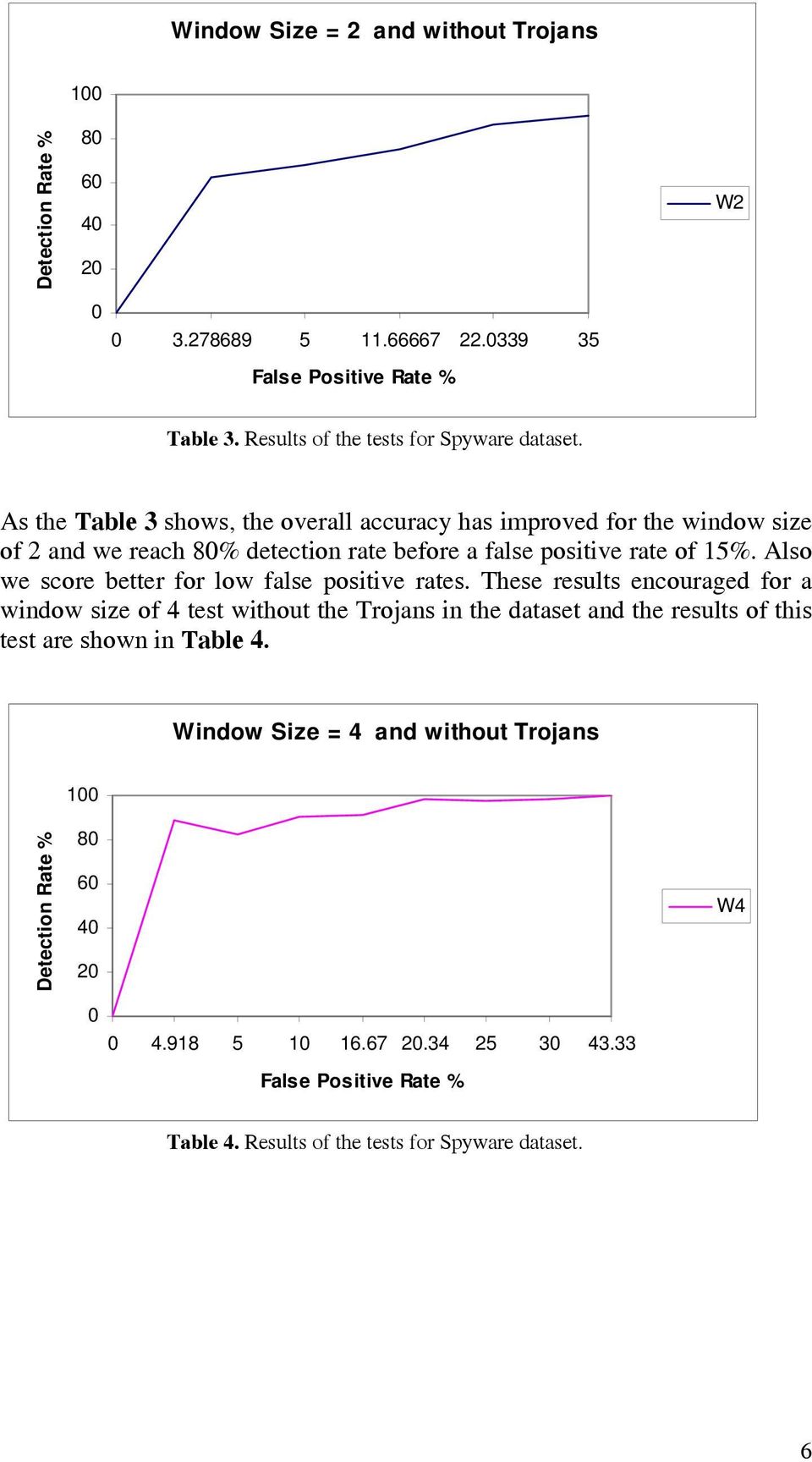
7 We had 80% detection rate even before the false positive rate of 4% and overall accuracy has been improved. Below you can see best overall accuracy results for each run in Table 5. Window Size=2 Window Size=4 Window Size=2 w/o Trojan Window Size=4 w/o Trojan TP TN FP FN Detection Rate False Positive Rate Overall Accuracy Table 5. Results of the tests for Spyware dataset. The final run has the best overall accuracy and has the lowest false positive rate, which is significantly lower than other three runs. 4 Conclusion Spyware is a new threat and current anti-virus programs are weak against spyware, because they use almost perfect camouflage systems and as they are not viruses, and they don t use a routine that can be associated with them, antivirus programs don t detect them unless, they are designed specifically to do so. There are some anti-spyware programs, but they work with signature scheme, so again they are weak against unseen spywares. Before the tests, I had some doubt for using byte sequences as a feature. All viruses have a common technique for infection, which is replicating themselves onto new executables. One can argue that, the byte codes for infection can ve a distinguishing feature for the viruses and these can be used for detecting viruses. However, spyware does not use these techniques, so it is difficult to separate them from normal executables in this sense. On the other side, there is a common behaviour for all spyware, they watch the user s actions for reporting. Probably, this is why I get overall accuracy when I run tests with trojans in the dataset. Trojans are not really spyware, tough they are 7

8 used for spying, indeed they are complete programs working as a toolbox for hackers. As a result, after removing them I had a dataset with a common programmatic behavour, which gives me better classifying results. Another thing important about this technique is the window size. In the paper Schultz[1] does not give an optimal window size, but in general we can say that the larger window size we use, better results we get. The problem is, with a window size of five the program needs more than one gigabyte of ram for running and the run takes too much time and this is why I was only able to test with a window size of four. To conclude, applying Schultz[1] s techniques on spyware, I was able to see that a data mining based heuristic scheme has the potential to be used for detecting new spyware. 5 Future Work Future work involves using Multi-Naïve Bayes for using a window size of five and six. I expect to have better overall accuracy for larger window sizes. Furthermore Christodorescu[3] proposes a technique for testing malicious code detector s performance against obfuscation. Since we are using byte sequences as our features, changes in the byte sequence will most probably affect our results. These techniques can be used to test performance of this spyware detection technique against obfuscated code. 6 References 1. M. G. Schultz, E. Eskin, E. Zadok, and S. J. Stolfo, Data Mining Methods for Detection of New Malicious Executables, Proceedings of IEEE Symposium on Security and Privacy. Oakland, pp.38-49, The silent epidemic of 2005: 84% of malware on computers worldwide is spyware M. Christodorescu and S. Jha, Testing Malware Detectors, International Symposium on Software Testing and Analysis archive. Boston, Massachusetts, USA. 8
![In the paper Schultz[1] does not give an optimal window size, but in general we can say that the larger window size we use, better results we get.](/docs-images/45/8947909/images/page_8.jpg "The problem is, with a window size of five the program needs more than one gigabyte of ram for running and the run takes too much time and this is why I was only able to test with a window size of")
Malware Detection Module using Machine Learning Algorithms to Assist in Centralized Security in Enterprise Networks
 Malware Detection Module using Machine Learning Algorithms to Assist in Centralized Security in Enterprise Networks Priyank Singhal Student, Computer Engineering Sardar Patel Institute of Technology University
2 Background. 3 Methodology
 Data Mining Methods for Detection of New Malicious Executables Matthew G. Schultz and Eleazar Eskin Department of Computer Science Columbia University mgs,[email protected] Erez Zadok Department of
Detecting Internet Worms Using Data Mining Techniques
 Detecting Internet Worms Using Data Mining Techniques Muazzam SIDDIQUI Morgan C. WANG Institute of Simulation & Training Department of Statistics and Actuarial Sciences University of Central Florida University
Countermeasures against Spyware
 (2) Countermeasures against Spyware Are you sure your computer is not infected with Spyware? Information-technology Promotion Agency IT Security Center http://www.ipa.go.jp/security/ 1. What is a Spyware?
Malware, Spyware, Adware, Viruses. Gracie White, Scott Black Information Technology Services
 Malware, Spyware, Adware, Viruses Gracie White, Scott Black Information Technology Services The average computer user should be aware of potential threats to their computer every time they connect to the
CORPORATE AV / EPP COMPARATIVE ANALYSIS
 CORPORATE AV / EPP COMPARATIVE ANALYSIS Exploit Evasion Defenses 2013 Randy Abrams, Dipti Ghimire, Joshua Smith Tested Vendors AVG, ESET, F- Secure, Kaspersky, McAfee, Microsoft, Norman, Panda, Sophos,
Detection of Spyware by Mining Executable Files
 Master Thesis Computer Science Thesis no: MSC-2009:5 Detection of Spyware by Mining Executable Files Raja M. Khurram Shahzad Syed Imran Haider School of Computing Blekinge Institute of Technology Box 520
How To Understand What A Virus Is And How To Protect Yourself From A Virus
 Viruses, Trojans and Worms Oh My! 2006 Technology Leadership Presentation Series Why is my computer running so slow? What are all of these little windows popping up on my system? Why did my home page change?
How Spyware and Anti-Spyware Work
 22 PART 1 INTERNET SECURITY CHAPTER 3 How Spyware and Anti-Spyware Work 23 THESE days, the biggest danger you face when you go onto the Internet might be spyware a type of malicious software that can invade
COMPUTER-INTERNET SECURITY. How am I vulnerable?
 COMPUTER-INTERNET SECURITY How am I vulnerable? 1 COMPUTER-INTERNET SECURITY Virus Worm Trojan Spyware Adware Messenger Service 2 VIRUS A computer virus is a small program written to alter the way a computer
Student Tech Security Training. ITS Security Office
 Student Tech Security Training ITS Security Office ITS Security Office Total Security is an illusion security will always be slightly broken. Find strategies for living with it. Monitor our Network with
Contact details For contacting ENISA or for general enquiries on information security awareness matters, please use the following details:
 Malicious software About ENISA The European Network and Information Security Agency (ENISA) is an EU agency created to advance the functioning of the internal market. ENISA is a centre of excellence for
CAS : A FRAMEWORK OF ONLINE DETECTING ADVANCE MALWARE FAMILIES FOR CLOUD-BASED SECURITY
 CAS : A FRAMEWORK OF ONLINE DETECTING ADVANCE MALWARE FAMILIES FOR CLOUD-BASED SECURITY ABHILASH SREERAMANENI DEPARTMENT OF COMPUTER SCIENCE AND ENGINEERING SEOUL NATIONAL UNIVERSITY OF SCIENCE AND TECHNOLOGY
Types of cyber-attacks. And how to prevent them
 Types of cyber-attacks And how to prevent them Introduction Today s cybercriminals employ several complex techniques to avoid detection as they sneak quietly into corporate networks to steal intellectual
Guideline for Prevention of Spyware and other Potentially Unwanted Software
 Guideline for Prevention of Spyware and other Potentially Unwanted Software Introduction Most users are aware of the impact of virus/worm and therefore they have taken measures to protect their computers,
What Do You Mean My Cloud Data Isn t Secure?
 Kaseya White Paper What Do You Mean My Cloud Data Isn t Secure? Understanding Your Level of Data Protection www.kaseya.com As today s businesses transition more critical applications to the cloud, there
NewNet 66 Network Security
 NewNet 66 Network Security Spyware... Understanding the Threat What is Spyware? Spyware is an evolved term. In the mid 90s, it was used to refer to high-tech espionage gadgets. By the late 90s, it became
The Droid Knight: a silent guardian for the Android kernel, hunting for rogue smartphone malware applications
 Virus Bulletin 2013 The Droid Knight: a silent guardian for the Android kernel, hunting for rogue smartphone malware applications Next Generation Intelligent Networks Research Center (nexgin RC) http://wwwnexginrcorg/
ITSC Training Courses Student IT Competence Programme SIIS1 Information Security
 ITSC Training Courses Student IT Competence Programme SI1 2012 2013 Prof. Chan Yuen Yan, Rosanna Department of Engineering The Chinese University of Hong Kong SI1-1 Course Outline What you should know
WildFire Overview. WildFire Administrator s Guide 1. Copyright 2007-2015 Palo Alto Networks
 WildFire Overview WildFire provides detection and prevention of zero-day malware using a combination of malware sandboxing and signature-based detection and blocking of malware. WildFire extends the capabilities
Secure Your Mobile Workplace
 Secure Your Mobile Workplace Sunny Leung Senior System Engineer Symantec 3th Dec, 2013 1 Agenda 1. The Threats 2. The Protection 3. Q&A 2 The Mobile Workplaces The Threats 4 Targeted Attacks up 42% in
Host-based Intrusion Prevention System (HIPS)
 Host-based Intrusion Prevention System (HIPS) White Paper Document Version ( esnhips 14.0.0.1) Creation Date: 6 th Feb, 2013 Host-based Intrusion Prevention System (HIPS) Few years back, it was relatively
Learning to Detect and Classify Malicious Executables in the Wild
 Journal of Machine Learning Research 7 (2006) 2721-2744 Submitted 3/06; Revised 9/06; Published 12/06 Learning to Detect and Classify Malicious Executables in the Wild J. Zico Kolter [email protected]
Introduction to Free Computer Tools
 Introduction to Free Computer Tools About me Serge Aubin Technology Advisor / OLS-N Programmer / DBA - 9yrs Web design / Web applications Intranet/Extranet Today s session Terminology Anti-Spyware software
Understanding Computer Viruses: What They Can Do, Why People Write Them and How to Defend Against Them
 Lab Exercises Understanding Computer Viruses: What They Can Do, Why People Write Them and How to Defend Against Them Review Questions 1) In class, we made the distinction between a front-door attack and
BCS IT User Syllabus IT Security for Users Level 2. Version 1.0
 BCS IT User Syllabus IT for Users Level 2 Version 1.0 June 2009 ITS2.1 System Performance ITS2.1.1 Unwanted messages ITS2.1.2 Malicious ITS2.1.1.1 ITS2.1.1.2 ITS2.1.2.1 ITS2.1.2.2 ITS2.1.2.3 ITS2.1.2.4
BE SAFE ONLINE: Lesson Plan
 BE SAFE ONLINE: Lesson Plan Overview Danger lurks online. Web access, social media, computers, tablets and smart phones expose users to the possibility of fraud and identity theft. Learn the steps to take
Spyware Doctor Enterprise Technical Data Sheet
 Spyware Doctor Enterprise Technical Data Sheet The Best of Breed Anti-Spyware Solution for Businesses Spyware Doctor Enterprise builds on the strength of the industry-leading and multi award-winning Spyware
Remote Deposit Quick Start Guide
 Treasury Management Fraud Prevention How to Protect Your Business Remote Deposit Quick Start Guide What s Inside We re committed to the safety of your company s financial information. We want to make you
Introduction to Computer Security Table of Contents
 Introduction to Computer Security Table of Contents Introduction... 2 1 - Viruses... 3 Virus Scanners... 3 2 - Spyware... 7 Spyware Scanners... 8 3 - Firewalls... 10 Windows Firewall... 10 4 - References...
PROTECT YOUR COMPUTER AND YOUR PRIVACY!
 PROTECT YOUR COMPUTER AND YOUR PRIVACY! Fraud comes in many shapes simple: the loss of both money protecting your computer and Take action and get peace of and sizes, but the outcome is and time. That
When you listen to the news, you hear about many different forms of computer infection(s). The most common are:
 Access to information and entertainment, credit and financial services, products from every corner of the world even to your work is greater than ever. Thanks to the Internet, you can conduct your banking,
Frequent Smart Updates: Used to detect and guard against new infections as well as adding enhancements to Spyware Doctor.
 Faqs > Spyware Doctor Q1. What is Spyware Doctor? Ans.: Spyware Doctor is an easy-to-use, award winning, comprehensive software suite designed to protect your computer against stealthy spyware, aggressive
Malware, Phishing, and Cybercrime Dangerous Threats Facing the SMB State of Cybercrime
 How to Protect Your Business from Malware, Phishing, and Cybercrime The SMB Security Series Malware, Phishing, and Cybercrime Dangerous Threats Facing the SMB State of Cybercrime sponsored by Introduction
Open an attachment and bring down your network?
 Open an attachment and bring down your network? Many people think this will never happen to them, but virus attacks can come from unlikely sources and can strike when you least expect it. They can wreak
E-mail Spam Classification With Artificial Neural Network and Negative Selection Algorithm
 E-mail Spam Classification With Artificial Neural Network and Negative Selection Algorithm Ismaila Idris Dept of Cyber Security Science, Federal University of Technology, Minna, Nigeria. [email protected]
Index Terms: Smart phones, Malwares, security, permission violation, malware detection, mobile devices, Android, security
 Permission Based Malware Detection Approach Using Naive Bayes Classifier Technique For Android Devices. Pranay Kshirsagar, Pramod Mali, Hrishikesh Bidwe. Department Of Information Technology G. S. Moze
Spam, Spyware, Malware and You! Don't give up just yet! Presented by: Mervin Istace Provincial Library Saskatchewan Learning
 Spam, Spyware, Malware and You! Don't give up just yet! Presented by: Mervin Istace Provincial Library Saskatchewan Learning Lee Zelyck Network Administrator Regina Public Library Malware, Spyware, Trojans
This guide will go through the common ways that a user can make their computer more secure.
 A beginners guide in how to make a Laptop/PC more secure. This guide will go through the common ways that a user can make their computer more secure. Here are the key points covered: 1) Device Password
Using Spy Sweeper for Windows Author: Jocelyn Kasamoto
 WIN1048 February 2009 Using Spy Sweeper for Windows Author: Jocelyn Kasamoto Introduction 1 System Requirements 2 Installation Instructions 2 Post Installation Tasks 3 Running Spy Sweeper 3 Subscription
1. For each of the 25 questions, multiply each question response risk value (1-5) by the number of times it was chosen by the survey takers.
 Employee Security Awareness Survey Trenton Bond [email protected] Admin - Version 1.3 Security Awareness One of the most significant security risks that organizations and corporations face today is
Computing Guide. How to set up McAfee virus scanning software and become computer virus savvy
 Computing Guide THE LIBRARY www.salford.ac.uk/library How to set up McAfee virus scanning software and become computer virus savvy A virus infection of your workstation can seriously disrupt your learning,
2.0. Specification of HSN 2.0 JavaScript Static Analyzer
 2.0 Specification of HSN 2.0 JavaScript Static Analyzer Pawe l Jacewicz Version 0.3 Last edit by: Lukasz Siewierski, 2012-11-08 Relevant issues: #4925 Sprint: 11 Summary This document specifies operation
Data Sheet: Endpoint Security Symantec Endpoint Protection The next generation of antivirus technology from Symantec
 The next generation of antivirus technology from Symantec Overview Advanced threat protection combines Symantec AntiVirus with advanced threat prevention to deliver an unmatched defense against malware
Data Sheet: Endpoint Security Symantec Endpoint Protection The next generation of antivirus technology from Symantec
 The next generation of antivirus technology from Symantec Overview Advanced threat protection combines Symantec AntiVirus with advanced threat prevention to deliver an unmatched defense against malware
WEB PROTECTION. Features SECURITY OF INFORMATION TECHNOLOGIES
 WEB PROTECTION Features SECURITY OF INFORMATION TECHNOLOGIES The web today has become an indispensable tool for running a business, and is as such a favorite attack vector for hackers. Injecting malicious
How to easily clean an infected computer (Malware Removal Guide)
 How to easily clean an infected computer (Malware Removal Guide) Malware, short for malicious (or malevolent) software, is software used or programmed by attackers to disrupt computer operation, gather
ViRobot Desktop 5.5. User s Guide
 ViRobot Desktop 5.5 User s Guide ViRobot Desktop 5.5 User s Guide Copyright Notice Copyright 2007 by HAURI Inc. All rights reserved worldwide. No part of this publication or software may be reproduced,
Command-Line Reference
 Hitman Pro 3 Command-Line Reference For Network Managers Hitman Pro 3 Command-Line Reference For Network Managers Page 1 Table of Contents Introduction to Hitman Pro... 3 Extensive Virus Recognition...
PROACTIVE PROTECTION MADE EASY
 PROACTIVE PROTECTION AUTHOR: ANDREW NIKISHIN KASPERSKY LAB Heuristic Analyzer Policy-Based Security Intrusion Prevention System (IPS) Protection against Buffer Overruns Behaviour Blockers Different Approaches
A Proposed Architecture of Intrusion Detection Systems for Internet Banking
 A Proposed Architecture of Intrusion Detection Systems for Internet Banking A B S T R A C T Pritika Mehra Post Graduate Department of Computer Science, Khalsa College for Women Amritsar, India [email protected]
Spyware. Summary. Overview of Spyware. Who Is Spying?
 Spyware US-CERT Summary This paper gives an overview of spyware and outlines some practices to defend against it. Spyware is becoming more widespread as online attackers and traditional criminals use it
Detecting client-side e-banking fraud using a heuristic model
 Detecting client-side e-banking fraud using a heuristic model Tim Timmermans [email protected] Jurgen Kloosterman [email protected] University of Amsterdam July 4, 2013 Tim Timmermans, Jurgen
Computer Security Maintenance Information and Self-Check Activities
 Computer Security Maintenance Information and Self-Check Activities Overview Unlike what many people think, computers are not designed to be maintenance free. Just like cars they need routine maintenance.
LASTLINE WHITEPAPER. In-Depth Analysis of Malware
 LASTLINE WHITEPAPER In-Depth Analysis of Malware Abstract Malware analysis is the process of determining the purpose and functionality of a given malware sample (such as a virus, worm, or Trojan horse).
Spyware: Securing gateway and endpoint against data theft
 Spyware: Securing gateway and endpoint against data theft The explosion in spyware has presented businesses with increasing concerns about security issues, from data theft and network damage to reputation
ESET CYBER SECURITY PRO for Mac Quick Start Guide. Click here to download the most recent version of this document
 ESET CYBER SECURITY PRO for Mac Quick Start Guide Click here to download the most recent version of this document ESET Cyber Security Pro provides state-of-the-art protection for your computer against
Integrated Threat & Security Management.
 Integrated Threat & Security Management. SOLUTION OVERVIEW Vulnerability Assessment for Web Applications Fully Automated Web Crawling and Reporting Minimal Website Training or Learning Required Most Accurate
Sophos for Microsoft SharePoint Help
 Sophos for Microsoft SharePoint Help Product version: 2.0 Document date: March 2011 Contents 1 About Sophos for Microsoft SharePoint...3 2 Dashboard...4 3 Configuration...5 4 Reports...27 5 Search...28
Contents. McAfee Internet Security 3
 User Guide i Contents McAfee Internet Security 3 McAfee SecurityCenter... 5 SecurityCenter features... 6 Using SecurityCenter... 7 Fixing or ignoring protection problems... 16 Working with alerts... 21
Role of Anomaly IDS in Network
 Role of Anomaly IDS in Network SumathyMurugan 1, Dr.M.Sundara Rajan 2 1 Asst. Prof, Department of Computer Science, Thiruthangal Nadar College, Chennai -51. 2 Asst. Prof, Department of Computer Science,
Codes of Connection for Devices Connected to Newcastle University ICT Network
 Code of Connection (CoCo) for Devices Connected to the University s Author Information Security Officer (Technical) Version V1.1 Date 23 April 2015 Introduction This Code of Connection (CoCo) establishes
Networks and Security Lab. Network Forensics
 Networks and Security Lab Network Forensics Network Forensics - continued We start off from the previous week s exercises and analyze each trace file in detail. Tools needed: Wireshark and your favorite
Don t Fall Victim to Cybercrime:
 Don t Fall Victim to Cybercrime: Best Practices to Safeguard Your Business Agenda Cybercrime Overview Corporate Account Takeover Computer Hacking, Phishing, Malware Breach Statistics Internet Security
WHITE PAPER: Cyber Crime and the Critical Need for Endpoint Security
 WHITE PAPER: Cyber Crime and the Critical Need for Endpoint Security A World of Constant Threat We live in a world on constant threat. Every hour of every day in every country around the globe hackers
Data Management Policies. Sage ERP Online
 Sage ERP Online Sage ERP Online Table of Contents 1.0 Server Backup and Restore Policy... 3 1.1 Objectives... 3 1.2 Scope... 3 1.3 Responsibilities... 3 1.4 Policy... 4 1.5 Policy Violation... 5 1.6 Communication...
Microsoft and Windows are either registered trademarks or trademarks of Microsoft Corporation in the United States and/or other countries.
 2001 2014 EdgeWave. All rights reserved. The EdgeWave logo is a trademark of EdgeWave Inc. All other trademarks and registered trademarks are hereby acknowledged. Microsoft and Windows are either registered
Airtel PC Secure Trouble Shooting Guide
 Airtel PC Secure Trouble Shooting Guide Table of Contents Questions before installing the software Q: What is required from my PC to be able to use the Airtel PC Secure? Q: Which operating systems does
National Cyber Security Month 2015: Daily Security Awareness Tips
 National Cyber Security Month 2015: Daily Security Awareness Tips October 1 New Threats Are Constantly Being Developed. Protect Your Home Computer and Personal Devices by Automatically Installing OS Updates.
Securing the endpoint and your data
 #SymVisionEmea #SymVisionEmea Securing the endpoint and your data Piero DePaoli Sr. Director, Product Marketing Marcus Brownell Sr. Regional Product Manager Securing the Endpoint and Your Data 2 Safe harbor
Defending Against. Phishing Attacks
 Defending Against Today s Targeted Phishing Attacks DeFending Against today s targeted phishing attacks 2 Introduction Is this email a phish or is it legitimate? That s the question that employees and
Detecting Anomaly IDS in Network using Bayesian Network
 IOSR Journal of Computer Engineering (IOSR-JCE) e-issn: 2278-0661, p- ISSN: 2278-8727Volume 16, Issue 1, Ver. III (Jan. 2014), PP 01-07 Detecting Anomaly IDS in Network using Bayesian Network [1] Mrs.SumathyMuruganAsst.
ABOUT LAVASOFT. Contact. Lavasoft Product Sheet: Ad-Aware Free Antivirus+
 ABOUT LAVASOFT Company Overview Lavasoft is the original anti-malware company, creating award-winning, free security and privacy software since 1999. Born of the belief that online security should be available
ESET NOD32 Antivirus. Table of contents
 ESET NOD32 Antivirus ESET NOD32 Antivirus provides state-of-theart protection for your computer against malicious code. Based on the ThreatSense scanning engine first introduced in the awardwinning NOD32