
Receivables (Topic 310)
|
|
|
- Gwendoline Beasley
- 10 years ago
- Views:
Transcription
1 No July 2010 Receivables (Topic 310) Disclosures about the Credit Quality of Receivables and the Allowance for Credit Losses
2 The FASB Accounting Standards Codification is the source of authoritative generally accepted accounting principles (GAAP) recognized by the FASB to be applied by nongovernmental entities. An Accounting Standards Update is not authoritative; rather, it is a document that communicates how the Accounting Standards Codification is being amended. It also provides other information to help a user of GAAP understand how and why GAAP is changing and when the changes will be effective. For additional copies of this Accounting Standards Update and information on applicable prices and discount rates contact: Order Department Financial Accounting Standards Board 401 Merritt 7 PO Box 5116 Norwalk, CT Please ask for our Product Code No. ASU FINANCIAL ACCOUNTING SERIES (ISSN ) is published quarterly by the Financial Accounting Foundation. Periodicals postage paid at Norwalk, CT and at additional mailing offices. The full subscription rate is $230 per year. POSTMASTER: Send address changes to Financial Accounting Standards Board, 401 Merritt 7, PO Box 5116, Norwalk, CT No. 349 Copyright 2010 by Financial Accounting Foundation. All rights reserved. Content copyrighted by Financial Accounting Foundation may not be reproduced, stored in a retrieval system, or transmitted, in any form or by any means, electronic, mechanical, photocopying, recording, or otherwise, without the prior written permission of the Financial Accounting Foundation. Financial Accounting Foundation claims no copyright in any portion hereof that constitutes a work of the United States Government.

3 Accounting Standards Update No July 2010 Receivables (Topic 310) Disclosures about the Credit Quality of Receivables and the Allowance for Credit Losses An Amendment of the FASB Accounting Standards Codification TM Financial Accounting Standards Board of the Financial Accounting Foundation 401 MERRITT 7, PO BOX 5116, NORWALK, CONNECTICUT

4

5 Accounting Standards Update Receivables (Topic 310) Disclosures about the Credit Quality of Receivables and the Allowance for Credit Losses July 2010 CONTENTS Page Numbers Summary Amendments to the FASB Accounting Standards Codification Background Information and Basis for Conclusions Amendments to the XBRL Taxonomy
6

7 Summary Why Is the FASB Issuing This Accounting Standards Update (Update)? The main objective in developing this Update is to provide financial statement users with greater transparency about an entity s allowance for credit losses and the credit quality of its receivables. In the aftermath of the global economic crisis, effective financial reporting has become the subject of worldwide attention, with a focus on the urgent need for improved accounting standards in a number of areas, including financial instruments. This Update is intended to provide additional information to assist financial statement users in assessing an entity s credit risk exposures and evaluating the adequacy of its allowance for credit losses. Currently, a high threshold for recognition of credit impairments impedes timely recognition of losses. The FASB recently issued an Exposure Draft of a proposed Accounting Standards Update, Accounting for Financial Instruments and Revisions to the Accounting for Derivative Instruments and Hedging Activities: Financial Instruments (Topic 825) and Derivatives and Hedging (Topic 815), that would remove that threshold. Who Is Affected by the Amendments in This Update? The amendments in this Update apply to all entities, both public and nonpublic. The amendments in this Update affect all entities with receivables, excluding short-term trade accounts receivable or receivables measured at fair value or lower of cost or fair value. The extent of the effect depends on the relative significance of receivables to an entity s operations and financial position. For example, traditional banking-type institutions that currently measure a large number of receivables at amortized cost will be affected to a greater extent than brokers and dealers in securities and investment companies that currently measure most receivables at fair value. The effect likely will be less significant for many commercial and industrial entities whose receivables are primarily short-term trade accounts receivable. What Are the Main Provisions? The objective of the amendments in this Update is for an entity to provide disclosures that facilitate financial statement users evaluation of the following: 1. The nature of credit risk inherent in the entity s portfolio of receivables 1

8 2. How that risk is analyzed and assessed in arriving at the allowance for credit losses 3. The changes and reasons for those changes in the allowance for credit losses. To achieve the above objective, an entity should provide disclosures on a disaggregated basis. The amendments in this Update define two levels of disaggregation portfolio segment and class of receivable. A portfolio segment is defined as the level at which an entity develops and documents a systematic method for determining its allowance for credit losses. Classes of receivables generally are a disaggregation of portfolio segment. The amendments in this Update provide additional implementation guidance to determine the appropriate level of disaggregation of information. Existing disclosures are amended to require an entity to provide the following disclosures about its receivables on a disaggregated basis: 1. A rollforward schedule of the allowance for credit losses from the beginning of the reporting period to the end of the reporting period on a portfolio segment basis, with the ending balance further disaggregated on the basis of the impairment method 2. For each disaggregated ending balance in item (1) above, the related recorded investment in receivables 3. The nonaccrual status of receivables by class of receivables 4. Impaired receivables by class of receivables. The amendments in this Update require an entity to provide the following additional disclosures about its receivables: 1. Credit quality indicators of receivables at the end of the reporting period by class of receivables 2. The aging of past due receivables at the end of the reporting period by class of receivables 3. The nature and extent of troubled debt restructurings that occurred during the period by class of receivables and their effect on the allowance for credit losses 4. The nature and extent of receivables modified as troubled debt restructurings within the previous 12 months that defaulted during the reporting period by class of receivables and their effect on the allowance for credit losses 5. Significant purchases and sales of receivables during the reporting period disaggregated by portfolio segment. 2

9 How Do the Main Provisions Differ from Current U.S. Generally Accepted Accounting Principles (GAAP) and Why Are They an Improvement? The amendments in this Update enhance disclosures about the credit quality of receivables and the allowance for credit losses. As noted above, existing disclosure guidance is amended to require an entity to provide a greater level of disaggregated information about the credit quality of its receivables and its allowance for credit losses. In addition, the amendments in this Update require an entity to disclose credit quality indicators, past due information, and modifications of its receivables. These improvements will help financial statement users assess an entity s credit risk exposures and its allowance for credit losses. When Will the Amendments Be Effective? For public entities, the disclosures as of the end of a reporting period are effective for interim and annual reporting periods ending on or after December 15, The disclosures about activity that occurs during a reporting period are effective for interim and annual reporting periods beginning on or after December 15, For nonpublic entities, the disclosures are effective for annual reporting periods ending on or after December 15, The amendments in this Update encourage, but do not require, comparative disclosures for earlier reporting periods that ended before initial adoption. However, an entity should provide comparative disclosures for those reporting periods ending after initial adoption. How Do the Provisions Compare with International Financial Reporting Standards (IFRS)? The disclosures required by the amendments in this Update are similar, but not identical, to those required by IFRS 7, Financial Instruments: Disclosures. However, the scope of IFRS 7 includes all financial instruments, not just receivables and the allowance for credit losses. The FASB decided to limit the scope of this Update because it does not want to delay the improved transparency in an entity s financial statements about the allowance for credit losses and the credit quality of receivables. The FASB and the International Accounting Standards Board (IASB) currently have a joint project on accounting for financial instruments, including disclosures. 3

10

11 Amendments to the FASB Accounting Standards Codification TM Introduction 1. The Accounting Standards Codification is amended as described in paragraphs In some cases, not only are the amended paragraphs shown but also the preceding and following paragraphs are shown to put the change in context. Terms from the Master Glossary are in bold type. Added text is underlined, and deleted text is struck out. Amendments to Master Glossary 2. Add the following new Master Glossary terms to Subtopic , with a link to transition paragraph , as follows. Also add the new Master Glossary term Receivable to Subtopics , , and Class of Receivable A group of receivables determined on the basis of all of the following: a. Initial measurement attribute (for example, amortized cost or purchased credit impaired) b. Risk characteristics of the receivable c. An entity s method for monitoring and assessing credit risk. See paragraphs through and Credit Quality Indicator A statistic about the credit quality of receivables. Receivable A arrangement that has both of the following characteristics: a. It represents a contractual right to receive money in either of the following ways: 1. On demand 5

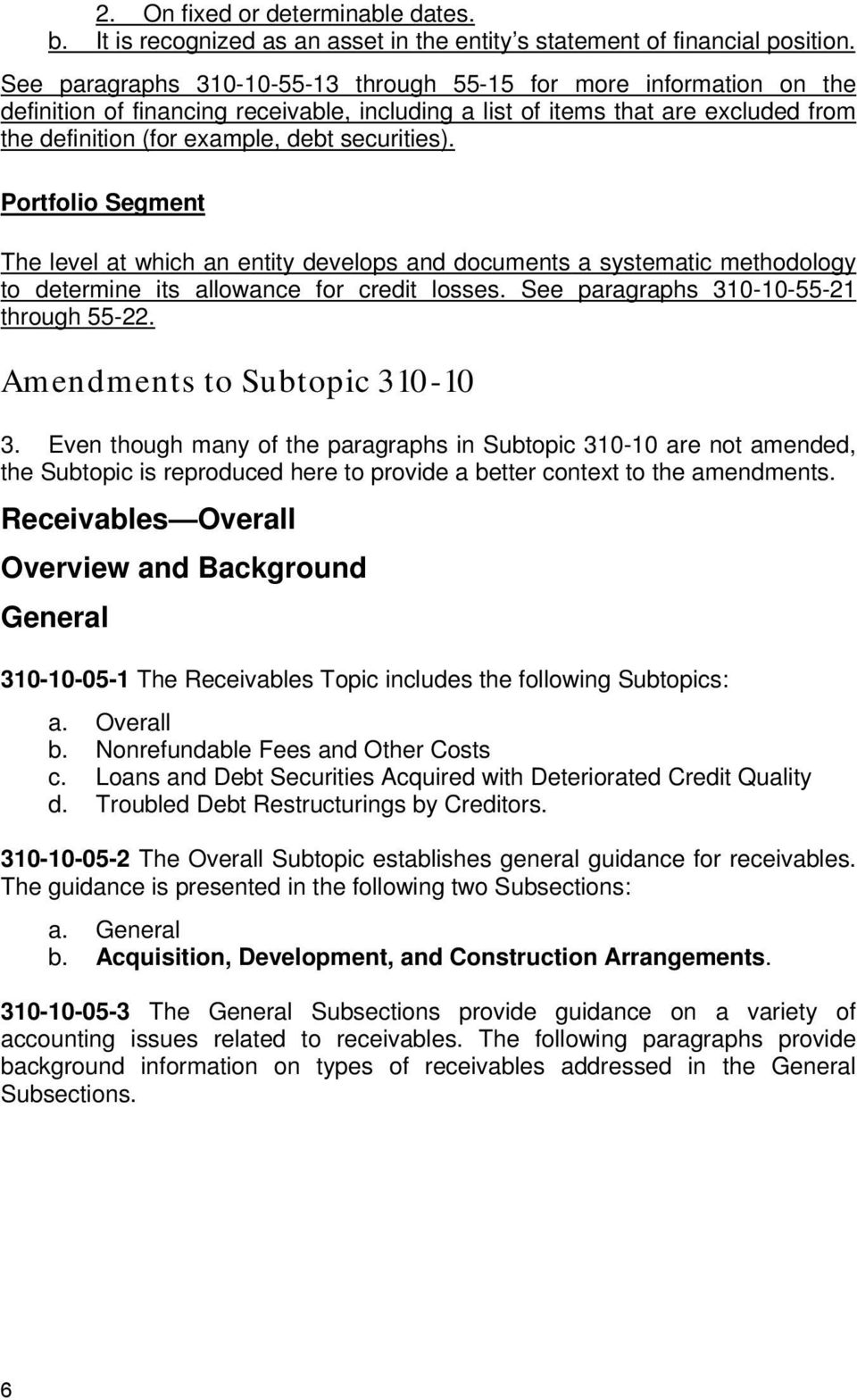
12 2. On fixed or determinable dates. b. It is recognized as an asset in the entity s statement of financial position. See paragraphs through for more information on the definition of receivable, including a list of items that are excluded from the definition (for example, debt securities). Portfolio Segment The level at which an entity develops and documents a systematic methodology to determine its allowance for credit losses. See paragraphs through Amendments to Subtopic Even though many of the paragraphs in Subtopic are not amended, the Subtopic is reproduced here to provide a better context to the amendments. Receivables Overall Overview and Background General The Receivables Topic includes the following Subtopics: a. Overall b. Nonrefundable Fees and Other Costs c. Loans and Debt Securities Acquired with Deteriorated Credit Quality d. Troubled Debt Restructurings by Creditors The Overall Subtopic establishes general guidance for receivables. The guidance is presented in the following two Subsections: a. General b. Acquisition, Development, and Construction Arrangements The General Subsections provide guidance on a variety of accounting issues related to receivables. The following paragraphs provide background information on types of receivables addressed in the General Subsections. 6
13 > Receivables in General Receivables may arise from credit sales, loans, or other transactions. Receivables may be in the form of loans, notes, and other types of financial instruments and may be originated by an entity or purchased from another entity. > Standby Commitments to Purchase Loans Entities sometimes enter into forward standby commitments to purchase loans at a stated price in return for a standby commitment fee. In such an arrangement, settlement of the standby commitment is at the option of the seller of the loans and would result in delivery to the entity only if the contract price equals or exceeds the market price of the underlying loan or security on the settlement date. A standby commitment differs from a mandatory commitment in that the entity assumes all the market risks of ownership but shares in none of the rewards. A standby commitment is, in substance, a written put option that will be exercised only if the value of the loans is less than or equal to the strike price. > Factoring Arrangements Factoring arrangements are a means of discounting accounts receivable on a nonrecourse, notification basis. Accounts receivable are sold outright, usually to a transferee (the factor) that assumes the full risk of collection, without recourse to the transferor in the event of a loss. Debtors are directed to send payments to the transferee. > Rebates Rebates represent refunds of portions of the precomputed finance charges on installment loans or trade receivables, if applicable, that occur when payments are made ahead of schedule. Rebate calculations generally are governed by state laws and may differ from unamortized finance charges on installment loans or trade receivables because many states require rebate calculations to be based on the Rule of 78s or other methods instead of the interest method. 4. Amend paragraph , with a link to transition paragraph , as follows: 7

14 Scope and Scope Exceptions General > Entities The guidance in the General Subsections applies to all entities. > Transactions The guidance in the General Subsections applies to a variety of instruments and transactions, including the following: a. Trade accounts receivable b. Loans c. Loan syndications d. Factoring arrangements e. Standby letters of credit.credit f. receivables The guidance in the General Subsections does not apply to the following transactions and activities: a. Mortgage banking activities (as described in paragraph ) b. A contract that is required to be accounted for as a derivative instrument under Subtopic For example, paragraph states that commitments to purchase or sell mortgage loans or other types of loans at a future date shall be evaluated under the definition of a derivative instrument to determine whether Subtopic applies. 5. Amend paragraph , with a link to transition paragraph , as follows: Subsequent Measurement General > > Losses from Uncollectible Receivables The inability to make a reasonable estimate of the amount of loss from uncollectible receivables (that is, failure to satisfy the condition in paragraph (b)) precludes accrual and may, if there is significant uncertainty as to collection, suggest that the installment method, the cost recovery method, or some other method of revenue recognition be used. See paragraphs

15 25-3 through 25-4 for further guidance. In addition, see Section for a related disclosure requirement for this situation. 6. Amend paragraph , with a link to transition paragraph , as follows: Disclosure General This Subsection provides the following disclosure guidance for receivables, off-balance-sheet credit exposures, and foreclosed and repossessed assets: a. Accounting policies for loansloans and trade receivables b. Assets serving as collateral c. Nonaccrual and past due loans and trade receivables d. Accounting policies for credit losses and doubtful accountsoff-balancesheet credit exposures e. Foreclosed and repossessed assets f. Allowance for credit losses related to loans g. Impaired loans h. Loss contingencies i. Risks and uncertainties j. Fair value disclosures.disclosures k. Credit quality information l. Modifications. 7. Add paragraph A and amend its related heading, with a link to transition paragraph , as follows: > Accounting Policies for Loans and Trade Receivables A The guidance in paragraphs through 50-4A applies only to the following receivables: a. Loans b. Trade receivables. 8. Amend paragraphs and , with a link to transition paragraph , as follows: The summary of significant accounting policies shall include the following: 9

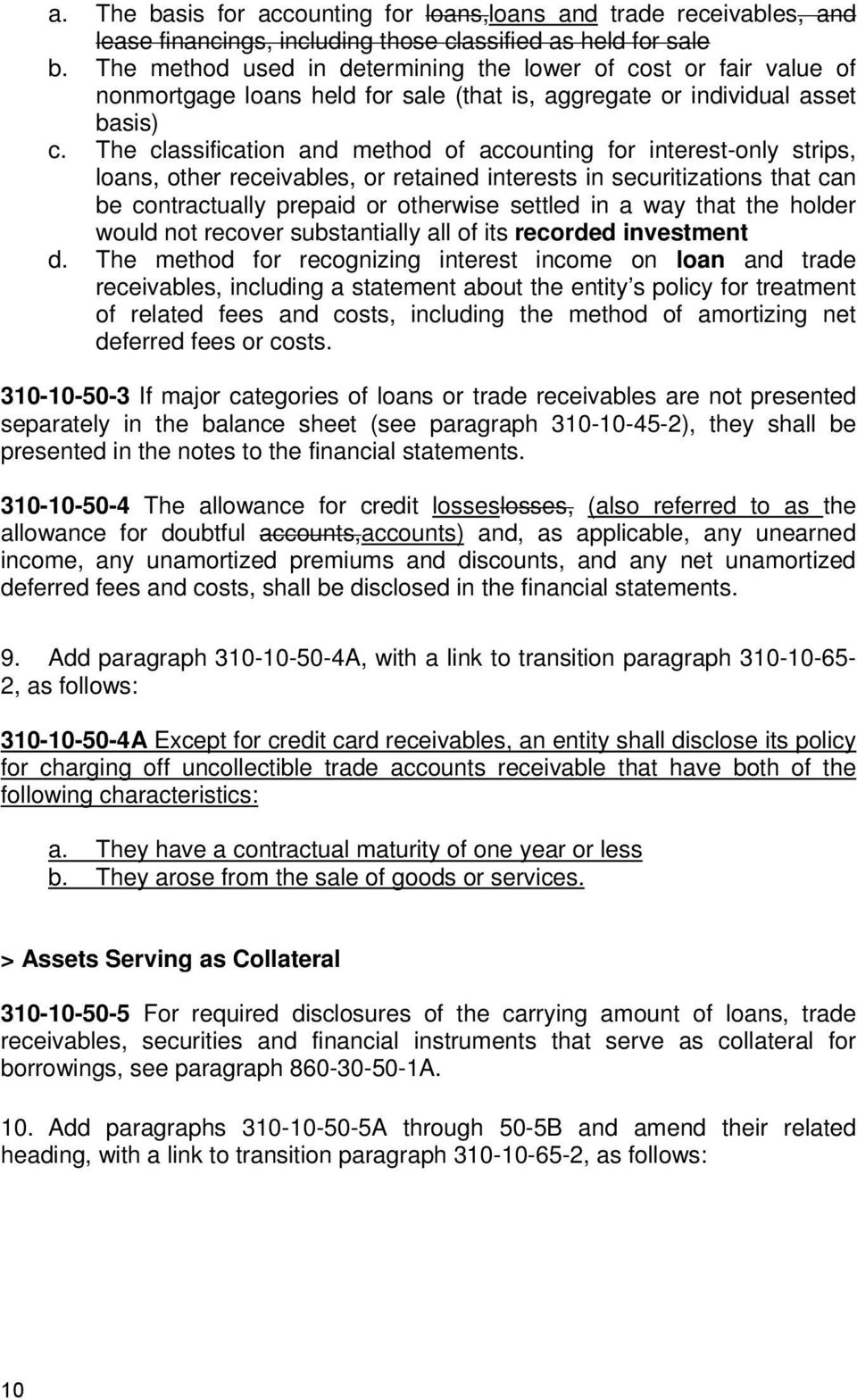
16 a. The basis for accounting for loans,loans and trade receivables, and lease s, including those classified as held for sale b. The method used in determining the lower of cost or fair value of nonmortgage loans held for sale (that is, aggregate or individual asset basis) c. The classification and method of accounting for interest-only strips, loans, other receivables, or retained interests in securitizations that can be contractually prepaid or otherwise settled in a way that the holder would not recover substantially all of its recorded investment d. The method for recognizing interest income on loan and trade receivables, including a statement about the entity s policy for treatment of related fees and costs, including the method of amortizing net deferred fees or costs If major categories of loans or trade receivables are not presented separately in the balance sheet (see paragraph ), they shall be presented in the notes to the financial statements The allowance for credit losseslosses, (also referred to as the allowance for doubtful accounts,accounts) and, as applicable, any unearned income, any unamortized premiums and discounts, and any net unamortized deferred fees and costs, shall be disclosed in the financial statements. 9. Add paragraph A, with a link to transition paragraph , as follows: A Except for credit card receivables, an entity shall disclose its policy for charging off uncollectible trade accounts receivable that have both of the following characteristics: a. They have a contractual maturity of one year or less b. They arose from the sale of goods or services. > Assets Serving as Collateral For required disclosures of the carrying amount of loans, trade receivables, securities and financial instruments that serve as collateral for borrowings, see paragraph A. 10. Add paragraphs A through 50-5B and amend their related heading, with a link to transition paragraph , as follows: 10
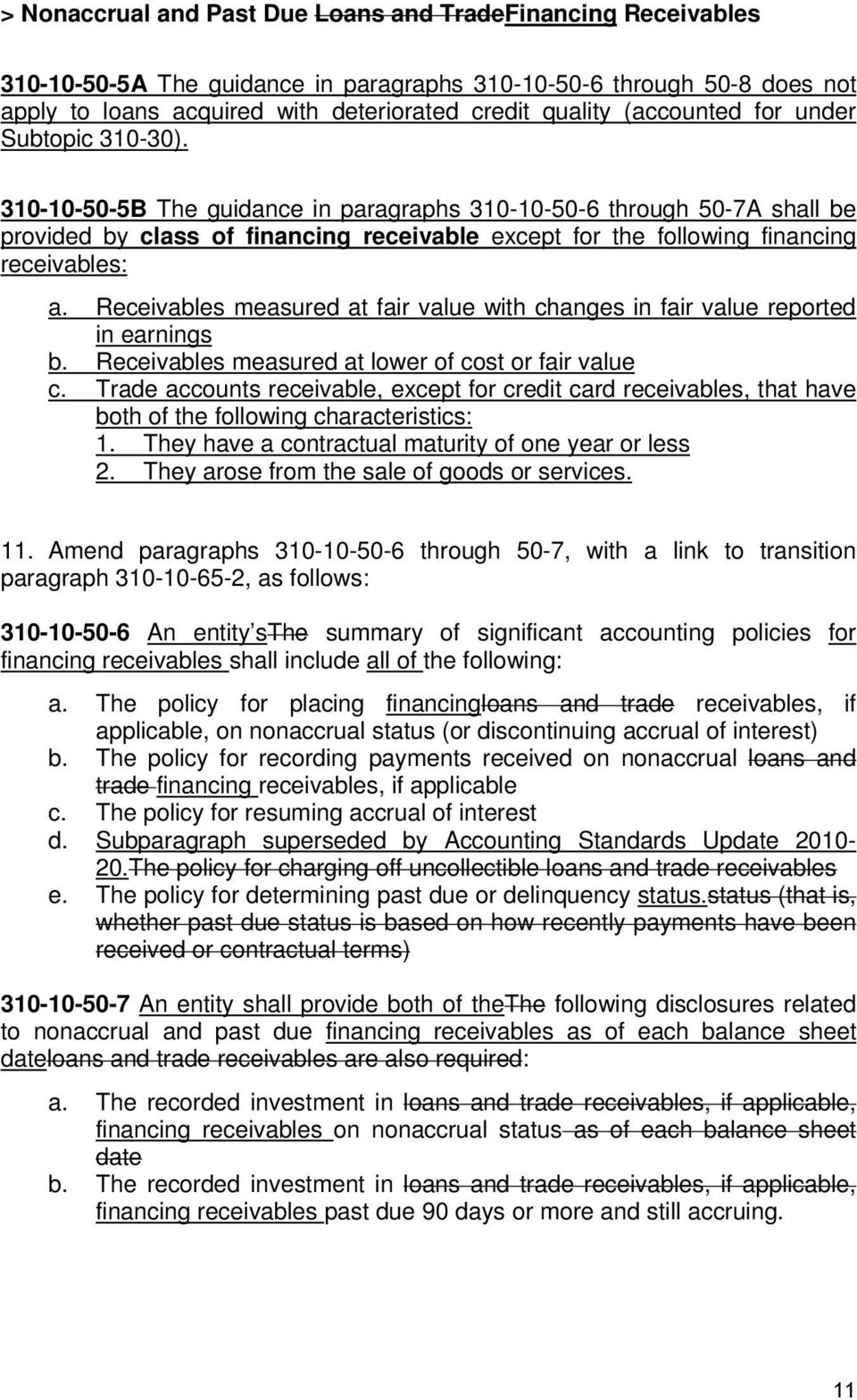
17 > Nonaccrual and Past Due Loans and Trade Receivables A The guidance in paragraphs through 50-8 does not apply to loans acquired with deteriorated credit quality (accounted for under Subtopic ) B The guidance in paragraphs through 50-7A shall be provided by class of receivable except for the following receivables: a. Receivables measured at fair value with changes in fair value reported in earnings b. Receivables measured at lower of cost or fair value c. Trade accounts receivable, except for credit card receivables, that have both of the following characteristics: 1. They have a contractual maturity of one year or less 2. They arose from the sale of goods or services. 11. Amend paragraphs through 50-7, with a link to transition paragraph , as follows: An entity sthe summary of significant accounting policies for receivables shall include all of the following: a. The policy for placing loans and trade receivables, if applicable, on nonaccrual status (or discontinuing accrual of interest) b. The policy for recording payments received on nonaccrual loans and trade receivables, if applicable c. The policy for resuming accrual of interest d. Subparagraph superseded by Accounting Standards Update The policy for charging off uncollectible loans and trade receivables e. The policy for determining past due or delinquency status.status (that is, whether past due status is based on how recently payments have been received or contractual terms) An entity shall provide both of thethe following disclosures related to nonaccrual and past due receivables as of each balance sheet dateloans and trade receivables are also required: a. The recorded investment in loans and trade receivables, if applicable, receivables on nonaccrual status as of each balance sheet date b. The recorded investment in loans and trade receivables, if applicable, receivables past due 90 days or more and still accruing. 11
18 12. Add paragraphs A through 50-7B, with a link to transition paragraph , as follows: A An entity shall provide an analysis of the age of the recorded investment in receivables at the end of the reporting period that are past due, as determined by the entity s policy B The guidance in paragraph A does not apply to the following receivables: a. Receivables measured at fair value with changes in fair value reported in earnings b. Receivables measured at lower of cost or fair value c. Except for credit card receivables, trade accounts receivable that have both of the following characteristics: 1. They have a contractual maturity of one year or less 2. They arose from the sale of goods or services For trade receivables that do not accrue interest until a specified period has elapsed, nonaccrual status would be the point when accrual is suspended after the receivable becomes past due. 13. Amend paragraph through and its related heading, with a link to transition paragraph , as follows: > Accounting Policies for Credit Losses and Doubtful AccountsOff- Balance-Sheet Credit Exposures In addition to disclosures required by this Subsection and Subtopic , an entity shall disclose a description of the accounting policies and methodology the entity used to estimate its allowance for loan losses, allowance for doubtful accounts, and any liability for off-balance-sheet credit lossesexposures and related charges for those credit exposuresfor loan, trade receivable or other credit losses in the notes to the financial statements. Such a description shall identify the factors that influenced management s judgment (for example, historical losses and existing economic conditions), and amay also include discussion of risk elements relevant to particular categories of financial instruments Off-balance-sheet credit lossesexposures refers to lossescredit exposures on off-balance-sheet loan commitments, standby letters of credit, financial guarantees, and other similar instruments, except for instruments within the scope of SubtopicTopic Add paragraphs A through 50-11C and amend their related heading, with a link to transition paragraph , as follows: 12

19 > Foreclosed and Repossessed Assets Paragraph states that foreclosed and repossessed assets included in other assets on the balance sheet shall have separate disclosures in the notes to financial statements. > Allowance for Credit Losses Related to ReceivablesLoans A The guidance in paragraph B does not apply to the following receivables: a. receivables listed in paragraph B b. Lessor s net investments in leveraged leases B An entity shall disclose all of the following by portfolio segment: a. A description of the entity s accounting policies and methodology used to estimate the allowance for credit losses, including all of the following: 1. A description of the factors that influenced management s judgment, including both of the following: i. Historical losses ii. Existing economic conditions. 2. A discussion of risk characteristics relevant to each portfolio segment 3. Identification of any changes to the entity s accounting policies or methodology from the prior period and the entity s rationale for the change. b. A description of the policy for charging off uncollectible receivables c. The activity in the allowance for credit losses for each period, including all of the following: 1. The balance in the allowance at the beginning and end of each period 2. Current period provision 3. Direct write-downs charged against the allowance 4. Recoveries of amounts previously charged off. d. The quantitative effect of changes identified in item (a)(3) on item (c)(2) e. The amount of any significant purchases of receivables during each reporting period f. The amount of any significant sales of receivables or reclassifications of receivables to held for sale during each reporting period g. The balance in the allowance for credit losses at the end of each period disaggregated on the basis of the entity s impairment method 13

20 h. The recorded investment in receivables at the end of each period related to each balance in the allowance for credit losses, disaggregated on the basis of the entity s impairment methodology in the same manner as the disclosure in item (g) C To disaggregate the information required by items (g) and (h) in the preceding paragraph on the basis of the impairment methodology, an entity shall separately disclose the following amounts: a. Amounts collectively evaluated for impairment (determined under Subtopic ) b. Amounts individually evaluated for impairment (determined under Section ) c. Amounts related to loans acquired with deteriorated credit quality (determined under Subtopic ). 15. Supersede paragraphs through 50-13, with a link to transition paragraph , as follows: Paragraph superseded by Accounting Standards Update For each period for which results of operations are presented, a creditor shall disclose the activity in the total allowance for credit losses related to loans, including the balance in the allowance at the beginning and end of each period, additions charged to operations, direct write-downs charged against the allowance, and recoveries of amounts previously charged off Paragraph superseded by Accounting Standards Update Paragraph explains that the total allowance for credit losses related to loans includes those amounts that have been determined in accordance with Subtopic and with this Subtopic Asset valuation allowances required by paragraph shall have an appropriate disclosure. 16. Add paragraph A and amend paragraph , with a link to transition paragraph , as follows: > Impaired Loans A For each class of receivable, an entity shall disclose both of the following for loans that meet the definition of an impaired loan in paragraphs through (individually evaluated for impairment): 14

21 a. The accounting for impaired loans b. The amount of impaired loans An entitya creditor shall disclose, either in the body of the financial statements or in the accompanying notes, all of the following information about loans that meet the definition of an impaired loan in paragraphs through by class of receivable: a. As of the date of each statement of financial position presented,presented: the total recorded investment in the impaired loans at the end of each period and both of the following: 1. Subparagraph superseded by Accounting Standards Update The amount of that recorded investment for which there is a related allowance for credit losses determined in accordance with Section and the amount of that allowance 2. Subparagraph superseded by Accounting Standards Update The amount of that recorded investment for which there is no related allowance for credit losses determined in accordance with Section The recorded investment in the impaired loans and both of the following: i. The amount of that recorded investment for which there is a related allowance for credit losses determined in accordance with Section and the amount of that allowance ii. The amount of that recorded investment for which there is no related allowance for credit losses determined in accordance with Section The total unpaid principal balance of the impaired loans. b. The entity screditor s policy for recognizing interest income on impaired loans, including how cash receipts are recorded c. For each period for which results of operations are presented,presented: 1. Thethe average recorded investment in the impaired loans during each period, 2. Thethe related amount of interest income recognized during the time within that period that the loans were impaired, and, 3. unless not practicable, thethe amount of interest income recognized using a cash-basis method of accounting during the time within that period that the loans were impaired, if practicable. d. The entity s policy for determining which loans the entity assesses for impairment under Section e. The factors considered in determining that the loan is impaired Those disclosures shall be provided for impaired loans that have been charged off partially. Those disclosures cannot be provided for loans that 15
22 have been charged off fully because both the recorded investment and the allowance for credit losses will equal zero. 17. Amend paragraph , with no link to a transition paragraph, as follows: This guidance does not specify how a creditor shallshould calculate the average recorded investment in the impaired loans during the reporting period. A creditor shallshould develop an appropriate method for that calculation. Averages based on month-end balances may be considered an appropriate method Information about loans meeting the scope of Subtopic shall be included in the disclosures required by paragraph (a) through (b) if the condition in paragraphs through or (a), as discussed in paragraphs (a) and (a), is met Paragraphs through 45-6 explains that a creditor that measures impairment based on the present value of expected future cash flows is permitted to report the entire change in present value as bad-debt expense but may also report the change in present value attributable to the passage of time as interest income. Creditors that choose the latter alternative shall disclose the amount of interest income that represents the change in present value attributable to the passage of time. 18. Amend paragraphs through 50-21, with a link to transition paragraph , as follows: The following table summarizes the scope of the disclosure requirements in paragraph
23 Description of Loans Loans that meet the definition of an impaired loan in paragraphs through and that have not been charged off fully, separately reported by class Loans that meet the definition of an impaired loan in paragraphs through and that have been charged off fully Large groups of smaller-balance homogeneous loans that are collectively evaluated for impairment and other loans that are excluded from the scope of this Subtopic as defined in paragraph Required Disclosures about the Recorded Investment in Loans That Meet the Definition of an Impaired Loan in Paragraphs through (A) (B) (B)(C) (C)(D) The Total Recorded Investment in the Impaired Loans Unpaid Principal Balance of the Impaired Loan The Amount of the Recorded Investment in (A) for Which There Is A Related Allowance for Credit Losses The Amount of the Recorded Investment in (A) for Which There Is No Related Allowance for Credit Losses Included. The amount disclosed in (A) must equal the sum of (B) and (C) and (D). Included. Included if there is a related allowance for credit losses. Included if there is no related allowance for credit losses. Excluded. The recorded investment and allowance for credit losses are equal to zero. Excluded unless restructured in a troubled debt restructuring (see paragraph for requirements for a restructured loan). 17
24 > Loss Contingencies Paragraph provides disclosure guidance for circumstances in which no accrual is made for a loss contingency because one or both of the conditions in paragraph (probable and reasonably estimated) are not met, or if an exposure to loss exists in excess of the amount accrued pursuant to the provisions of paragraph The disclosures required by paragraphs through 50-6 do not apply to loss contingencies arising from an entity s estimation of its allowance for credit losses. 19. Supersede paragraphs through 50-23, with a link to transition paragraph , as follows: Paragraph superseded by Accounting Standards Update Paragraph states that an entity shall disclose certain loss contingencies even though the possibility of loss may be remote and cites specific examples Paragraph superseded by Accounting Standards Update As discussed in paragraph , an entity s inability to make a reasonable estimate of the amount of loss from uncollectible receivables (that is, failure to satisfy the condition in paragraph (b)), precludes accrual and may, if there is significant uncertainty as to collection, suggest that the installment method, the cost recovery method, or some other method of revenue recognition be used. (See paragraph for further guidance.) In addition, the disclosures required by paragraphs through 50-6 shall be made See Section for further guidance on required disclosures for loss contingencies. > Risks and Uncertainties Certain loan products have contractual terms that expose entities to risks and uncertainties that fall into one or more categories, as discussed in paragraph See Section for disclosure guidance related to those loan products. 20. Amend paragraph , with a link to transition paragraph , as follows: > Fair Value Disclosures Section provides guidance on the required disclosure of fair values of certain assets and liabilities. Paragraph explains that, 18
25 for trade receivables and payables, no disclosure is required under that Subtopic iftopic when the carrying amount approximates fair value. 21. Add paragraphs through and their related headings, with a link to transition paragraph , as follows: > Credit Quality Information The guidance in paragraphs through does not apply to the receivables listed in paragraph B An entity shall provide information that enables financial statement users to do both of the following: a. Understand how and to what extent management monitors the credit quality of its receivables in an ongoing manner b. Assess the quantitative and qualitative risks arising from the credit quality of its receivables To meet the objective in the preceding paragraph, an entity shall provide quantitative and qualitative information by class about the credit quality of receivables, including all of the following: a. A description of the credit quality indicator b. The recorded investment in receivables by credit quality indicator c. For each credit quality indicator, the date or range of dates in which the information was updated for that credit quality indicator If an entity discloses internal risk ratings, then the entity shall provide qualitative information on how those internal risk ratings relate to the likelihood of loss. > Modifications Except as noted in the following paragraph, the guidance in paragraphs through applies only to a creditor s troubled debt restructurings of receivables. For purposes of this disclosure guidance, a creditor s modification of a lease receivable that meets the definition of a troubled debt restructuring is subject to this disclosure guidance This guidance does not apply to troubled debt restructurings of either of the following: a. receivables listed in paragraph B 19
26 b. Loans acquired with deteriorated credit quality (determined under Subtopic ) that are accounted for within a pool For each period for which a statement of income is presented, an entity shall disclose the following about troubled debt restructurings of receivables that occurred during the period: a. By class of receivable, qualitative and quantitative information, including both of the following: 1. How the receivables were modified 2. The financial effects of the modifications. b. By portfolio segment, qualitative information about how such modifications are factored into the determination of the allowance for credit losses For each period for which a statement of income is presented, an entity shall disclose the following for receivables modified as troubled debt restructurings within the previous 12 months and for which there was a payment default during the period: a. By class of receivable, qualitative and quantitative information about those defaulted receivables, including both of the following: 1. The types of receivables that defaulted 2. The amount of receivables that defaulted. b. By portfolio segment, qualitative information about how such defaults are factored into the determination of the allowance for credit losses. Implementation Guidance and Illustrations General > Implementation Guidance > > Diagram of Loan Impairment Guidance The following diagram illustrates the application of loan impairment guidance discussed in Section
27 21
28 > Illustrations > > Example 1: Application of Loan Impairment Guidance to a Loan Portfolio 22. Amend paragraphs through 55-3, with no link to a transition paragraph, as follows: This Example illustrates the guidance in paragraphs through and Entity A (a bank) has 20 loans (not considered smaller-balance) to businesses in a town in whichwhere the principal employer is a major corporation. Some of the loans are secured by bonds or real estate, others are unsecured. The major corporation went bankrupt and fired all of its workers. Entity A concludes that the loss of that employer has had a dire effect on the economic health of the community and its businesses. Entity A decides to review all 20 of the loans individually Two of the loans are not performing, and Entity A concludes that it is probable it will be unable to collect all of the cash flows on those loans as scheduled. Another five borrowers have approached Entity A for a concession, but those discussions are incomplete. Based on all available information, Entity A concludes that each of those five loans also is impaired. Entity A is unable to identify any other individual loan among the remaining 13 for whichwhere it is probable that it will not collect all of the cash flows Entity A would measure impairment on the seven loans that are individually impaired using a method permitted by Section , as appropriate for the loan. Entity A would consider all available information to measure the amount of the loss including the value of any collateral. If the value of the collateral, less selling costs, exceeds the recorded investment in the loan, no allowance would be provided. Entity A would consider its own experience or, to the extent relevant, the industry s collection experience in similar situations as part of the available information. In doing so, Entity A would consider the effect of information it possesses about the current economic downturn in making its best estimate of expected future cash flows for those seven loans Entity A would then assess whether it is probable that any loss has been incurred on the remaining 13 loans. If three of those loans are fully collateralized, no allowance should be provided under Subtopic for those loans and they should be excluded from the assessment of the remaining 10 loans. Entity A would consider the effect of the current economic downturn to assess whether a loss has been incurred in that group of loans at the balance sheet date and to estimate the amount of loss. In doing so, Entity A would 22
29 consider its historical loss experience in collecting loans in similar situations, such as the typical recovery rate, including amount and timing. However, the use of historical statistics alone would be inappropriate if the nature of the loans or current environmental conditions differ from those on which the statistics were based. Any allowance that is recorded under that Subtopic must be reasonably estimable and supported by an analysis of all available and relevant information about circumstances that exist at the balance sheet date The total allowance for the 20 loans should be the sum of the above components. A total allowance greater than the sum of the above components would be excessive. A total allowance less than the sum of the above components would be inadequate. 23. Add paragraphs through and their related headings, with a link to transition paragraph , as follows: > > Example 2: Disclosures about Credit Quality and the Allowance for Credit Losses The following table illustrates certain of the disclosures required by paragraph B(c), (g), and (h). [Note: For ease of readability, the tables are not underlined as new text.] 23
30 20X1 Allowance for credit losses: Beginning balance Commercial Commercial Real Estate Consumer Residential Finance Leases Unallocated Total $XX,XXX $XX,XXX $XX,XXX $XX,XXX $XX,XXX $XX,XXX $XX,XXX Charge-offs XX,XXX XX,XXX XX,XXX XX,XXX XX,XXX XX,XXX XX,XXX Recoveries XX,XXX XX,XXX XX,XXX XX,XXX XX,XXX XX,XXX XX,XXX Provision XX,XXX XX,XXX XX,XXX XX,XXX XX,XXX XX,XXX XX,XXX Ending balance $XX,XXX $XX,XXX $XX,XXX $XX,XXX $XX,XXX $XX,XXX $XX,XXX Ending balance: individually evaluated for impairment Ending balance: collectively evaluated for impairment Ending balance: loans acquired with deteriorated credit quality receivables: Ending balance Allowance for Credit Losses and Recorded Investment in Receivables For the Years Ended December 31, 20X1, and 20X0 $XX,XXX $XX,XXX $XX,XXX $XX,XXX $XX,XXX - $XX,XXX $XX,XXX $XX,XXX $XX,XXX $XX,XXX $XX,XXX $XX,XXX $XX,XXX $XX,XXX $XX,XXX $XX,XXX $XX,XXX $XX,XXX $XX,XXX $XX,XXX $XX,XXX $XX,XXX $XX,XXX $XX,XXX $XX,XXX - $XX,XXX Ending balance: individually evaluated for impairment Ending balance: collectively evaluated for impairment Ending balance: loans acquired with deteriorated credit quality $XX,XXX $XX,XXX $XX,XXX $XX,XXX $XX,XXX - $XX,XXX $XX,XXX $XX,XXX $XX,XXX $XX,XXX $XX,XXX - $XX,XXX $XX,XXX $XX,XXX $XX,XXX $XX,XXX $XX,XXX - $XX,XXX 20X0 Allowance for credit losses: Beginning balance $XX,XXX $XX,XXX $XX,XXX $XX,XXX $XX,XXX $XX,XXX $XX,XXX Charge-offs XX,XXX XX,XXX XX,XXX XX,XXX XX,XXX XX,XXX XX,XXX Recoveries XX,XXX XX,XXX XX,XXX XX,XXX XX,XXX XX,XXX XX,XXX Provision XX,XXX XX,XXX XX,XXX XX,XXX XX,XXX XX,XXX XX,XXX Ending balance $XX,XXX $XX,XXX $XX,XXX $XX,XXX $XX,XXX $XX,XXX $XX,XXX Ending balance: individually evaluated for impairment Ending balance: collectively evaluated for impairment Ending balance: loans acquired with deteriorated credit quality receivables: Ending balance Ending balance: individually evaluated for impairment Ending balance: collectively evaluated for impairment Ending balance: loans acquired with deteriorated credit quality $XX,XXX $XX,XXX $XX,XXX $XX,XXX $XX,XXX - $XX,XXX $XX,XXX $XX,XXX $XX,XXX $XX,XXX $XX,XXX $XX,XXX $XX,XXX $XX,XXX $XX,XXX $XX,XXX $XX,XXX $XX,XXX $XX,XXX $XX,XXX $XX,XXX $XX,XXX $XX,XXX $XX,XXX $XX,XXX - $XX,XXX $XX,XXX $XX,XXX $XX,XXX $XX,XXX $XX,XXX - $XX,XXX $XX,XXX $XX,XXX $XX,XXX $XX,XXX $XX,XXX - $XX,XXX $XX,XXX $XX,XXX $XX,XXX $XX,XXX $XX,XXX - $XX,XXX 24
31 The following table illustrates certain of the disclosures required by paragraph (b). Credit Quality Indicators As of December 31, 20X1, and 20X0 Corporate Credit Exposure Credit Risk Profile by Creditworthiness Category AAA AA A BBB BB B CCC C D Total Commercial Commercial Real Estate Construction Commercial Real Estate Other 20X1 20X0 20X1 20X0 20X1 20X0 $XX,XXX $XX,XXX $XX,XXX $XX,XXX $XX,XXX $XX,XXX XX,XXX XX,XXX XX,XXX XX,XXX XX,XXX XX,XXX XX,XXX XX,XXX XX,XXX XX,XXX XX,XXX XX,XXX XX,XXX XX,XXX XX,XXX XX,XXX XX,XXX XX,XXX XX,XXX XX,XXX XX,XXX XX,XXX XX,XXX XX,XXX XX,XXX XX,XXX XX,XXX XX,XXX XX,XXX XX,XXX $XX,XXX $XX,XXX $XX,XXX $XX,XXX $XX,XXX $XX,XXX Consumer Credit Exposure Credit Risk Profile by Internally Assigned Grade Residential Prime Residential Subprime 20X1 20X0 20X1 20X0 Grade: Pass $XX,XXX $XX,XXX $XX,XXX $XX,XXX Special mention XX,XXX XX,XXX XX,XXX XX,XXX Substandard XX,XXX XX,XXX XX,XXX XX,XXX Total $XX,XXX $XX,XXX $XX,XXX $XX,XXX Consumer Credit Exposure Credit Risk Profile Based on Payment Activity Performing Nonperforming Total Consumer Credit Card Consumer Other Finance Leases Consumer Auto 20X1 20X0 20X1 20X0 20X1 20X0 20X1 20X0 $XX,XXX $XX,XXX $XX,XXX $XX,XXX $XX,XXX $XX,XXX $XX,XXX $XX,XXX XX,XXX XX,XXX XX,XXX XX,XXX XX,XXX XX,XXX XX,XXX XX,XXX $XX,XXX $XX,XXX $XX,XXX $XX,XXX $XX,XXX $XX,XXX $XX,XXX $XX,XXX 25
32 The following table illustrates certain of the disclosures required by paragraphs (b) and A. Age Analysis of Past Due Receivables As of December 31, 20X1, and 20X0 20X Days Past Due Days Past Due Greater Than 90 Days Total Past Total Due Current Receivables Recorded Investment > 90 Days and Accruing Commercial Commercial real estate: $XX,XXX $XX,XXX $XX,XXX $XX,XXX $XX,XXX $XX,XXX $XX,XXX Commercial real estate construction XX,XXX XX,XXX XX,XXX XX,XXX XX,XXX XX,XXX XX,XXX Commercial real estate other XX,XXX XX,XXX XX,XXX XX,XXX XX,XXX XX,XXX XX,XXX Consumer: Consumer credit card XX,XXX XX,XXX XX,XXX XX,XXX XX,XXX XX,XXX XX,XXX Consumer other XX,XXX XX,XXX XX,XXX XX,XXX XX,XXX XX,XXX XX,XXX Consumer auto XX,XXX XX,XXX XX,XXX XX,XXX XX,XXX XX,XXX XX,XXX Residential: Residential prime XX,XXX XX,XXX XX,XXX XX,XXX XX,XXX XX,XXX XX,XXX Residential subprime Finance leases XX,XXX XX,XXX XX,XXX XX,XXX XX,XXX XX,XXX XX,XXX XX,XXX XX,XXX XX,XXX XX,XXX XX,XXX XX,XXX XX,XXX Total $XX,XXX $XX,XXX $XX,XXX $XX,XXX $XX,XXX $XX,XXX $XX,XXX 20X0 Commercial $XX,XXX $XX,XXX $XX,XXX $XX,XXX $XX,XXX $XX,XXX $XX,XXX Commercial real estate: Commercial real estate construction XX,XXX XX,XXX XX,XXX XX,XXX XX,XXX XX,XXX XX,XXX Commercial real estate other XX,XXX XX,XXX XX,XXX XX,XXX XX,XXX XX,XXX XX,XXX Consumer: Consumer credit card XX,XXX XX,XXX XX,XXX XX,XXX XX,XXX XX,XXX XX,XXX Consumer other XX,XXX XX,XXX XX,XXX XX,XXX XX,XXX XX,XXX XX,XXX Consumer auto XX,XXX XX,XXX XX,XXX XX,XXX XX,XXX XX,XXX XX,XXX Residential: Residential prime XX,XXX XX,XXX XX,XXX XX,XXX XX,XXX XX,XXX XX,XXX Residential subprime Finance leases XX,XXX XX,XXX XX,XXX XX,XXX XX,XXX XX,XXX XX,XXX XX,XXX XX,XXX XX,XXX XX,XXX XX,XXX XX,XXX XX,XXX Total $XX,XXX $XX,XXX $XX,XXX $XX,XXX $XX,XXX $XX,XXX $XX,XXX 26
33 The following table illustrates certain of the disclosures required by paragraph Impaired Loans For the Years Ended December 31, 20X1, and 20X0 Recorded Investment Unpaid Principal Balance Related Allowance Average Recorded Investment Interest Income Recognized 20X1 With no related allowance recorded: Commercial $XX,XXX $XX,XXX - $XX,XXX $XX,XXX Consumer credit card XX,XXX XX,XXX - XX,XXX XX,XXX Consumer other XX,XXX XX,XXX - XX,XXX XX,XXX Consumer auto XX,XXX XX,XXX - XX,XXX XX,XXX With an allowance recorded: Commercial real estate construction XX,XXX XX,XXX $XX,XXX XX,XXX XX,XXX Commercial real estate other XX,XXX XX,XXX XX,XXX XX,XXX XX,XXX Residential prime XX,XXX XX,XXX XX,XXX XX,XXX XX,XXX Residential subprime XX,XXX XX,XXX XX,XXX XX,XXX XX,XXX Total: Commercial $XX,XXX $XX,XXX $XX,XXX $XX,XXX $XX,XXX Consumer $XX,XXX $XX,XXX - $XX,XXX $XX,XXX Residential $XX,XXX $XX,XXX $XX,XXX $XX,XXX $XX,XXX 20X0 With no related allowance recorded: Commercial $XX,XXX $XX,XXX - $XX,XXX $XX,XXX Consumer credit card XX,XXX XX,XXX - XX,XXX XX,XXX Consumer other XX,XXX XX,XXX - XX,XXX XX,XXX Consumer auto XX,XXX XX,XXX - XX,XXX XX,XXX With an allowance recorded: Commercial real estate construction XX,XXX XX,XXX $XX,XXX XX,XXX XX,XXX Commercial real estate other XX,XXX XX,XXX XX,XXX XX,XXX XX,XXX Residential prime XX,XXX XX,XXX XX,XXX XX,XXX XX,XXX Residential subprime XX,XXX XX,XXX XX,XXX XX,XXX XX,XXX Total: Commercial $XX,XXX $XX,XXX $XX,XXX $XX,XXX $XX,XXX Consumer $XX,XXX $XX,XXX - $XX,XXX $XX,XXX Residential $XX,XXX $XX,XXX $XX,XXX $XX,XXX $XX,XXX 27
34 The following table illustrates certain of the disclosures required by paragraph (a). Receivables on Nonaccrual Status As of December 31, 20X1, and 20X0 20X1 20X0 Commercial $XX,XXX $XX,XXX Commercial real estate: Commercial real estate construction XX,XXX XX,XXX Commercial real estate other XX,XXX XX,XXX Consumer: Consumer credit card XX,XXX XX,XXX Consumer other XX,XXX XX,XXX Consumer auto XX,XXX XX,XXX Residential: Residential prime XX,XXX XX,XXX Residential subprime XX,XXX XX,XXX Finance leases XX,XXX XX,XXX Total $XX,XXX $XX,XXX 28
35 The following table illustrates certain of the disclosures required by paragraphs through Modifications As of December 31, 20X1, and 20X0 20X1 20X0 Number of Contracts Pre-Modification Outstanding Recorded Investment Post-Modification Outstanding Recorded Investment Number of Contracts Pre-Modification Outstanding Recorded Investment Post-Modification Outstanding Recorded Investment Troubled Debt Restructurings Residential prime XXX $XX,XXX $XX,XXX XXX $XX,XXX $XX,XXX Residential subprime XXX XX,XXX XX,XXX XXX XX,XXX XX,XXX Consumer other XXX XX,XXX XX,XXX XXX XX,XXX XX,XXX Finance leases XXX XX,XXX XX,XXX XXX XX,XXX XX,XXX Number of Contracts Recorded Investment Number of Contracts Recorded Investment Troubled Debt Restructurings That Subsequently Defaulted Troubled debt restructurings: Residential prime XXX $XX,XXX XXX $XX,XXX Residential subprime XXX XX,XXX XXX XX,XXX Consumer other XXX XX,XXX XXX XX,XXX Finance leases XXX XX,XXX XXX XX,XXX 29
36 > > Meaning of Receivable This implementation guidance addresses the meaning of the term receivable All of the following are examples of receivables: a. Loans b. Trade accounts receivable c. Notes receivable d. Credit cards e. Receivables relating to a lessor s right(s) to payment(s) from a lease other than an operating lease that should be recognized as assets in accordance with the following paragraphs: 1. Paragraph (for leveraged leases) 2. Paragraph (for direct leases) 3. Paragraph (for sales-type leases) None of the following meet the definition of receivables: a. Debt securities within the scope of Topic 320 (see the guidance beginning in paragraph ) b. Unconditional promises to give (for example, contributions receivable) that should be recognized as an asset in accordance with paragraphs through c. Both of the following instruments, which are within the scope of Subtopic : 1. A transferor s interests in securitization transactions that are accounted for as sales under Topic Purchased beneficial interests in securitized financial assets. For related guidance, see paragraph > > Application of the Definition of Class of Receivable This implementation guidance addresses application of the term class of receivable. An entity should base its principal determination of class of receivable on both of the following: a. Initial measurement attribute. Classes should first segregate receivables on the basis of the model under which they were initially recorded, such as any of the following: 1. Amortized cost 2. Loans acquired with deteriorated credit quality (accounted for in accordance with Subtopic ). 30
37 b. Entity assessment. Classes should secondarily be disaggregated to the level that an entity uses when assessing and monitoring the risk and performance of the portfolio for various types of receivables. This assessment should consider the risk characteristics of the receivables In determining the appropriate level of its internal reporting to use as a basis for disclosure, an entity should consider the level of detail needed by a user to understand the risks inherent in the entity s receivables. An entity could further disaggregate its receivables portfolio by considering numerous factors. Examples of factors that the entity should consider include any of the following: a. Categorization of borrowers, such as any of the following: 1. Commercial loan borrowers 2. Consumer loan borrowers 3. Related party borrowers. b. Type of receivable, such as any of the following: 1. Mortgage loans 2. Credit card loans 3. Interest-only loans 4. Finance leases. c. Industry sector, such as either of the following: 1. Real estate 2. Mining. d. Type of collateral, such as any of the following: 1. Residential property 2. Commercial property 3. Government-guaranteed collateral 4. Uncollateralized (unsecured) receivables. e. Geographic distribution, including both of the following: 1. Domestic 2. International. An entity also may consider factors related to concentrations of credit risk as discussed in Section Classes of receivables generally are a disaggregation of a portfolio segment. For determining the appropriate classes of receivables that are related to a portfolio segment, the portfolio segment is the starting point with further disaggregation in accordance with the guidance in paragraphs through The determination of class for receivables that are not related to a portfolio segment (because there is no associated allowance) also should be based on the guidance in those paragraphs. 31
38 > > Meaning of Credit Quality Indicator This implementation guidance addresses application of the term credit quality indicator. Examples of credit quality indicators include all of the following: a. Consumer credit risk scores b. Credit-rating-agency ratings c. An entity s internal credit risk grades d. Loan-to-value ratios e. Collateral f. Collection experience g. Other internal metrics An entity should use judgment in determining the appropriate credit quality indicator for each class of receivables. As of the balance sheet date, the entity should use the most current information it has obtained for each credit quality indicator. > > Meaning of Portfolio Segment This implementation guidance addresses the meaning of the term portfolio segment. All of the following are examples of portfolio segments: a. Type of receivable b. Industry sector of the borrower c. Risk rate(s). > > Determining Class of Receivable and Portfolio Segment A creditor should determine, in light of the facts and circumstances, both of the following: a. How much detail it must provide to satisfy the requirements of Section b. How it disaggregates information into classes for assets with different risk characteristics. A creditor must strike a balance between obscuring important information as a result of too much aggregation and overburdening financial statements with excessive detail that may not assist financial statement users to understand the entity s receivables and allowance for credit losses. For example, a creditor should not obscure important information by including it with a large amount of insignificant detail. Similarly, a creditor should not disclose information that is so aggregated that it obscures important differences between the different types of receivables and associated risks. 32
39 24. Add paragraph and its related heading as follows: > Transition Related to Accounting Standards Update No , Receivables (Topic 310): Disclosures about the Credit Quality of Receivables and the Allowance for Credit Losses The following represents the transition and effective date information related to Accounting Standards Update No , Receivables (Topic 310): Disclosures about the Credit Quality of Receivables and the Allowance for Credit Losses: a. For public entities: 1. The pending content that links to this paragraph for disclosures as of the end of a reporting period shall be effective for the first interim or annual reporting period ending on or after December 15, The pending content that links to this paragraph for disclosures about activity that occurs during a reporting period is effective for the first interim or annual reporting period beginning on or after December 15, b. For nonpublic entities, the pending content that links to this paragraph shall be effective for the first annual reporting period ending on or after December 15, c. An entity shall provide comparative disclosures for each reporting period ending after initial adoption. Amendments to Subtopic Add paragraph A, with a link to transition paragraph , as follows: Receivables Troubled Debt Restructurings by Creditors Disclosure General > Creditor Disclosure of Troubled Debt Restructurings As of the date of each balance sheet presented, a creditor shall disclose, either in the body of the financial statements or in the accompanying notes, the amount of commitments, if any, to lend additional funds to debtors owing receivables whose terms have been modified in troubled debt restructurings. 33
40 A For guidance on the disclosures about modifications of receivables, see paragraphs through Information about an impaired loan that has been restructured in a troubled debt restructuring involving a modification of terms need not be included in the disclosures required by paragraphs (a) and (c) in years after the restructuring if both of the following conditions exist: a. The restructuring agreement specifies an interest rate equal to or greater than the rate that the creditor was willing to accept at the time of the restructuring for a new loan with comparable risk. b. The loan is not impaired based on the terms specified by the restructuring agreement That exception shall be applied consistently for paragraph (a) and (c) to all loans restructured in a troubled debt restructuring that meet the criteria in the preceding paragraph Usually, a loan whose terms are modified in a troubled debt restructuring already will be identified as impaired. However, if the creditor has written down a loan and the measure of the restructured loan is equal to or greater than the recorded investment, no impairment would be recognized in accordance with this Topic. The creditor is required to disclose the amount of the write-down and the recorded investment in the year of the write-down but is not required to disclose the recorded investment in that loan in later years if the two criteria of paragraph are met. 26. Amend paragraphs through 50-6, with a link to transition paragraph , as follows: > Loan Restructured Into Two (or More) Loan Agreements When a loan is restructured in a troubled debt restructuring into two (or more) loan agreements, the restructured loans shall be considered separately when assessing the applicability of the disclosures in paragraph paragraphs (a) and (c), in years after the restructuring because they are legally distinct from the original loan. The creditor would continue to base its measure of loan impairment on the contractual terms specified by the original loan agreement in accordance with paragraphs through and
41 > Summary of Scope of Disclosure Requirements See paragraph for a table that summarizes the scope of the disclosure requirements in paragraph (a). Amendments to Subtopic Add paragraphs A and A, with a link to transition paragraph , as follows: Leases Capital Leases Disclosure Lessors > Sales-Type Leases and Direct Leases If leasing, exclusive of leveraged leasing, is a significant part of the lessor s business activities in terms of revenue, net income, or assets, all of the following information with respect to sales-type and direct leases shall be disclosed in the financial statements or footnotes: a. All of the following components of the net investment in sales-type and direct leases as of the date of each balance sheet presented: 1. Future minimum lease payments to be received, with separate deductions for both of the following: i. Amounts representing executory costs (including any profit ii. thereon) included in the minimum lease payments The accumulated allowance for uncollectible minimum lease payments receivable. 2. The unguaranteed residual values accruing to the benefit of the lessor 3. For direct leases only, initial direct costs 4. Unearned income (see paragraphs and ). b. Future minimum lease payments to be received for each of the five succeeding fiscal years as of the date of the latest balance sheet presented c. Total contingent rentals included in income for each period for which an income statement is presented. Example 1 (see paragraph ) illustrates certain disclosures A For guidance on disclosures about receivables, which includes receivables relating to a lessor s rights to payments from sales-type and 35
42 direct leases, see the guidance beginning in paragraphs A, A, , and > Leveraged Leases If leveraged leasing is a significant part of the lessor s business activities in terms of revenue, net income, or assets, the components of the net investment balance in leveraged leases as set forth in paragraph shall be disclosed in the footnotes to financial statements A For guidance on disclosures about receivables, which include receivables relating to a lessor s rights to payments from leveraged leases, see the guidance beginning in paragraphs A, , and If accounting for the effect on leveraged leases of the change in tax rates results in a significant variation from the customary relationship between income tax expense and pretax accounting income and the reason for that variation is not otherwise apparent, the lessor shall disclose the reason for that variation. Amendments to Subtopic Amend paragraph , with a link to transition paragraph , as follows: Interim Reporting Overall Disclosure Many publicly traded companies report summarized financial information at periodic interim dates in considerably less detail than that provided in annual financial statements. While this information provides more timely information than would result if complete financial statements were issued at the end of each interim period, the timeliness of presentation may be partially offset by a reduction in detail in the information provided. As a result, certain guides as to minimum disclosure are desirable. (It should be recognized that the minimum disclosures of summarized interim financial data required of publicly traded companies do not constitute a fair presentation of financial position and results of operations in conformity with generally accepted accounting principles [GAAP]). If publicly traded companies report summarized financial information at interim dates (including reports on fourth quarters), the following data should be reported, as a minimum: 36
43 a. Sales or gross revenues, provision for income taxes, extraordinary items (including related income tax effects), net income, and comprehensive income b. Basic and diluted earnings per share data for each period presented, determined in accordance with the provisions of Topic 260 c. Seasonal revenue, costs or expenses (see paragraph ) d. Significant changes in estimates or provisions for income taxes (see paragraphs , , and ) e. Disposal of a component of an entity and extraordinary, unusual or infrequently occurring items (see paragraphs A and ) f. Contingent items (see paragraph ) g. Changes in accounting principles or estimates (see paragraphs through 45-16) h. Significant changes in financial position (see paragraph ) i. All of the following information about reportable operating segments determined according to the provisions of Topic 280, including provisions related to restatement of segment information in previously issued financial statements: 1. Revenues from external customers 2. Intersegment revenues 3. A measure of segment profit or loss 4. Total assets for which there has been a material change from the amount disclosed in the last annual report 5. A description of differences from the last annual report in the basis of segmentation or in the measurement of segment profit or loss 6. A reconciliation of the total of the reportable segments measures of profit or loss to the entity s consolidated income before income taxes, extraordinary items, and discontinued operations. However, if, for example, an entity allocates items such as income taxes and extraordinary items to segments, the entity may choose to reconcile the total of the segments measures of profit or loss to consolidated income after those items. Significant reconciling items shall be separately identified and described in that reconciliation. j. All of the following information about defined benefit pension plans and other defined benefit postretirement benefit plans, disclosed for all periods presented pursuant to the provisions of Subtopic : 1. The amount of net periodic benefit cost recognized, for each period for which a statement of income is presented, showing separately the service cost component, the interest cost component, the expected return on plan assets for the period, the gain or loss component, the prior service cost or credit component, the transition asset or obligation component, and the gain or loss recognized due to a settlement or curtailment 2. The total amount of the employer s contributions paid, and expected to be paid, during the current fiscal year, if significantly 37
44 different from amounts previously disclosed pursuant to paragraph Estimated contributions may be presented in the aggregate combining all of the following: i. Contributions required by funding regulations or laws ii. Discretionary contributions iii. Noncash contributions. k. The information about the use of fair value to measure assets and liabilities recognized in the statement of financial position pursuant to paragraphs through 50-6 l. The information about derivative instruments as required by Sections , , , , and m. The information about fair value of financial instruments as required by Section n. The information about certain investments in debt and equity securities as required by Sections and o. The information about other-than-temporary impairments as required by Sections , , and p. All of the following information about the credit quality of receivables and the allowance for credit losses determined in accordance with the provisions of Topic 310: 1. Nonaccrual and past due receivables (see paragraphs A through 50-7B) 2. Allowance for credit losses related to receivables (see paragraphs A through 50-11C) 3. Impaired loans (see paragraphs A through 50-15) 4. Credit quality information related to receivables (see paragraphs through 50-30) 5. Modifications of receivables (see paragraphs through 50-34). If summarized financial data are regularly reported on a quarterly basis, the foregoing information with respect to the current quarter and the current year-todate or the last 12 months to date should be furnished together with comparable data for the preceding year. Amendments to Section Add paragraph A, with a link to transition paragraph , as follows: 38
45 Contingencies Loss Contingencies Disclosure > Accruals for Loss Contingencies Disclosure of the nature of an accrual made pursuant to the provisions of paragraph , and in some circumstances the amount accrued, may be necessary for the financial statements not to be misleading. Terminology used shall be descriptive of the nature of the accrual, such as estimated liability or liability of an estimated amount. The term reserve shall not be used for an accrual made pursuant to paragraph ; that term is limited to an amount of unidentified or unsegregated assets held or retained for a specific purpose. Examples 1 (see paragraph ) and 2, Cases A, B, and D (see paragraphs , , and ) illustrate the application of these disclosure standards If the criteria in paragraph are met, paragraph requires disclosure of an indication that it is at least reasonably possible that a change in an entity s estimate of its probable liability could occur in the near term. Example 3 (see paragraph ) illustrates this disclosure for an entity involved in litigation. > Unrecognized Contingencies A The disclosures required by paragraphs through 50-6 do not apply to loss contingencies arising from an entity s recurring estimation of its allowance for credit losses. (See paragraph ) Disclosure of the contingency shall be made if there is at least a reasonable possibility that a loss or an additional loss may have been incurred and either of the following conditions exists: a. An accrual is not made for a loss contingency because any of the conditions in paragraph are not met. b. An exposure to loss exists in excess of the amount accrued pursuant to the provisions of paragraph Examples 1 3 (see paragraphs through 55-37) illustrate the application of these disclosure standards The disclosure in the preceding paragraph shall include both of the following: 39
46 a. The nature of the contingency b. An estimate of the possible loss or range of loss or a statement that such an estimate cannot be made Disclosure is preferable to accrual when a reasonable estimate of loss cannot be made. For example, disclosure shall be made of any loss contingency that meets the condition in paragraph (a) but that is not accrued because the amount of loss cannot be reasonably estimated (the condition in paragraph [b]). Disclosure also shall be made of some loss contingencies that do not meet the condition in paragraph (a) namely, those contingencies for which there is a reasonable possibility that a loss may have been incurred even though information may not indicate that it is probable that an asset had been impaired or a liability had been incurred at the date of the financial statements Disclosure is not required of a loss contingency involving an unasserted claim or assessment if there has been no manifestation by a potential claimant of an awareness of a possible claim or assessment unless both of the following conditions are met: a. It is considered probable that a claim will be asserted. b. There is a reasonable possibility that the outcome will be unfavorable. 30. Amend paragraph , by adding the following items to the table, as follows: The following table identifies the changes made to this Subtopic. Accounting Paragraph Number Action Standards Update Date Class of Added /21/2010 Receivable Credit Quality Added /21/2010 Indicator Added /21/2010 Receivable Portfolio Added /21/2010 Segment Related Parties Added /21/2010 Troubled Debt Added /21/2010 Restructuring Amended /21/
47 Accounting Paragraph Number Action Standards Update Date Amended /21/ Amended /21/ A Added /21/ Amended /21/ Amended /21/ A Added /21/ A Added /21/ B Added /21/ Amended /21/ Amended /21/ A Added /21/ B Added /21/ Amended /21/ Amended /21/ A Added /21/2010 through 50-11C Superseded /21/ Superseded /21/ A Added /21/ Amended /21/ Amended /21/ Amended /21/ Amended /21/ Superseded /21/ Superseded /21/ Amended /21/ Added /21/2010 through Amended /21/ Amended /21/ Added /21/2010 through Added /21/ Amend paragraph , by adding the following items to the table, as follows: The following table identifies the changes made to this Subtopic. 41
48 Accounting Paragraph Number Action Standards Update Date Added /21/2010 Receivable A Added /21/ Amended /21/ Amended /21/ Amend paragraph , by adding the following items to the table, as follows: The following table identifies the changes made to this Subtopic. Accounting Paragraph Number Action Standards Update Date Added /21/2010 Receivable A Added /21/ A Added /21/ Amend paragraph , by adding the following items to the table, as follows: The following table identifies the changes made to this Subtopic. Accounting Paragraph Number Action Standards Update Date Added /21/2010 Receivable Amended /21/ Amend paragraph as follows: No updates have been made to this subtopic.the following table identifies the changes made to this Subtopic. Accounting Paragraph Number Action Standards Update Date A Added /21/
49 The amendments in this Update were adopted by the unanimous vote of the five members of the Financial Accounting Standards Board: Robert H. Herz, Chairman Thomas J. Linsmeier Leslie F. Seidman Marc A. Siegel Lawrence W. Smith 43
50 Background Information and Basis for Conclusions Introduction BC1. The following summarizes the Board s considerations in reaching the conclusions in this Update. It includes reasons for accepting certain approaches and rejecting others. Individual Board members gave greater weight to some factors than to others. Background Information BC2. In January 2007, the Board added a project to its agenda on disclosures about the credit quality of receivables and allowance for credit losses. To provide more timely guidance on the allowance for credit losses and the related receivable disclosures, the Board determined that this project would focus on disclosures and not address the recognition and measurement of receivables. The Board issued an Exposure Draft of a proposed Accounting Standards Update, Accounting for Financial Instruments and Revisions to the Accounting for Derivative Instruments and Hedging Activities: Financial Instruments (Topic 825) and Derivatives and Hedging (Topic 815), on May 26, 2010, which addresses recognition and measurement of financial instruments, including receivables. BC3. The Board issued an Exposure Draft of a proposed Statement, Disclosures about the Credit Quality of Receivables and the Allowance for Credit Losses, on June 24, The Board received 73 comment letters in response to questions in the proposed Statement. The Board considered those comments during its redeliberations of the issues addressed by the proposed Statement at public meetings in February, April, and June 2010 and reconsidered or clarified some aspects of the proposals. BC4. The amendments in this Update require new disclosures and enhance current disclosures about the allowance for credit losses and the credit quality of receivables including, but not limited to, information about the credit quality of a creditor s portfolio and credit risk exposures. The amendments also provide greater transparency of a creditor s accounting policies. 44
51 Scope BC5. The Board considered whether certain entities should be excluded from the scope of the amendments in this Update on the basis of size, nonpublic status, or industry. The Board concluded that all entities that lend money via receivables should provide information to financial statement users about the credit characteristics of the entity s receivable portfolios as well as the related allowance for credit losses. Accordingly, the amendments apply to all creditors, including all public and nonpublic entities that prepare financial statements in accordance with U.S. GAAP. BC6. The Board determined that the disclosure amendments in this Update generally should apply to a creditor s receivables. This Update adds the term receivable to the Master Glossary of the Accounting Standards Codification. Examples of receivables include loans, trade receivables, notes receivable, and receivables relating to a lessors leveraged, direct, and sales-type leases. However, the Board excluded receivables measured at fair value with changes included in earnings and receivables measured at lower of cost or fair value from the scope because the amended disclosures about the allowance for credit losses are less relevant to those receivables, and the Board concluded that the existing disclosure requirements in Topics 820 and 825 provide sufficient relevant information about receivables measured at fair value or at lower of cost or fair value to enable users to understand the risks associated with those assets. BC7. The Board excluded trade receivables with contractual maturities of one year or less that arose from the sale of goods or services, except for credit card receivables, from the scope of the amendments in this Update because of the cost versus benefit of providing the required disclosures. As part of its redeliberations, the Board considered whether leveraged leases should be within the scope of the disclosures in this Update. The Board noted that a lessor generally monitors the credit risk of its leveraged lease receivables in a similar manner as direct finance leases and determined that the credit quality disclosures should apply to leveraged leases. The Board concluded that the amended disclosures about the allowance for credit losses generally are not relevant to leveraged leases and should not apply to those lease receivables. BC8. The following instruments were specifically excluded from the scope of the disclosures required by the amendments in this Update because of the nature of the instrument and the cost versus the benefit of providing such information. 45
52 a. Debt securities as defined in Topic 320 on debt and equity securities b. Unconditional promises to give (for example, contributions receivable) that are assets of not-for-profit entities, as discussed in Topic 958 on not-for-profit entities c. Acquired beneficial interests or the transferor s beneficial interests in the transferred financial assets, as discussed in Subtopic on beneficial interests in securitized financial assets. Overall Approach BC9. In developing the amendments in this Update, the Board considered all existing information about credit quality and the allowance for credit losses that is required to be disclosed by accounting standard setters and regulators as the foundation for the disclosures to be required by the amendments in this Update. Specifically, the Board considered the following information: a. Current U.S. GAAP requirements b. Current guidelines from the Securities and Exchange Commission (SEC) staff c. Current IFRS requirements d. Federal Financial Institutions Examination Council Regulatory Reports, including Reports of Condition and Income (FFIEC Call Reports), Thrift Financial Report for Office of Thrift Supervision regulated institutions and Form 5300 Call Reports for credit unions e. Issuers SEC filings, earnings releases, and presentation material. BC10. This Update addresses three objectives: a. To expand the credit quality disclosures to provide more transparent financial reporting to investors b. To incorporate into U.S. GAAP certain information that is already required to be disclosed to financial statement users by U.S. bank and securities regulators c. To more closely align U.S. GAAP with current IFRS disclosure requirements. BC11. The Board noted that current disclosures are required to be presented differently depending on the source of guidance and the specific disclosure. For example, current U.S. GAAP requirements related to the allowance for credit losses require only a rollforward of the allowance in the aggregate. However, certain SEC loan loss disclosures such as those for accruing loans past due 90 days, nonaccrual loans, and the charge-off and recoveries portion of the allowance for credit losses are required to be disaggregated by domestic and foreign loans. The charge-off and recoveries information also is required to be 46
53 presented with further disaggregation by loan-type categories, such as commercial, financial, and agricultural; real estate construction; real estate mortgage; installment loans to individuals; and lease. BC12. The Board also noted that even though U.S. GAAP currently does not require specific credit quality disclosures, most public company issuers disclose some level of disaggregated credit quality information in their quarterly investor presentations and press releases. Examples of disaggregation by credit quality indicator include differentiating by current consumer credit risk score and various categories of current loan-to-value ratios; however, this credit quality information generally relates only to a portion of the portfolio and varies between entities. BC13. On the basis of those data, the Board determined that the amendments in this Update should provide disaggregation guidance within all credit quality and allowance for credit loss disclosures to enhance consistency and comparability within the portfolio and over the periods included in the financial statements. The Board concluded that this will improve the cohesiveness and relevance of the disclosures. Key Terms Portfolio Segment BC14. The Board noted that the allowance for credit loss disclosure under U.S. GAAP is currently required to be presented only on an aggregate basis. The Board determined that it would be beneficial to financial statement users to further disaggregate this disclosure to the level at which the allowance for credit losses is calculated and monitored. Therefore, the Board defined the term portfolio segment to be consistent with the way a creditor is expected to develop its allowance for the credit losses method on the basis of the guidance in paragraph S99-4 and, for financial institutions subject to the guidance of the FFIEC, the Interagency Policy Statement on Allowance for Loan and Lease Losses. 1 1 The Office of the Comptroller of the Currency, the Board of Governors of the Federal Reserve System, the Federal Deposit Insurance Corporation, the Office of Thrift Supervision, and the National Credit Union Administration issued this policy statement in 2006 for the purpose of ensuring consistency with U.S. GAAP and relevant supervisory guidance. 47
54 Class BC15. The amendments in this Update will require disaggregation by class for the following credit risk disclosures: credit quality indicators, age analysis of past due receivables, impaired receivables, and receivables on nonaccrual status. The Board concluded that having a consistent approach to disaggregation by class across those credit risk disclosures will provide financial statement users with the most useful and transparent level of comparison because the information will be reported at the same level of detail in which the receivables are monitored and assessed within the entity. The Board considered providing specific classes that would be required to be disclosed because that would ensure uniformity in reporting. However, the Board decided that developing prescribed classes would make the disclosures too rigid and would not provide financial statement users with the same level of transparency that management is able to provide by determining classes on the basis of its business model and risk management practices. The Board intends that classes generally should be consistent for each type of disclosure; however, for various disclosures (for example, modifications), management may utilize different classes when assessing and monitoring the associated risk. BC16. The Board notes that the guidance for determining classes of receivables requires disaggregation by both initial measurement attribute, the level that an entity uses when assessing and monitoring the risk and performance of the portfolio, and the risk characteristics of the receivables. The Board noted that the class disaggregation principle is similar to the disaggregation principle within IFRS. The primary principle in IFRS 7 for disclosing risk arising from financial instruments is that the disclosure should be based on the information provided internally to an entity s key management personnel (as defined in IAS 24, Related Party Disclosures). To the extent that the information is not specified in the primary principle, IFRS 7 requires certain loan loss disclosures, such as a reconciliation of the changes in the allowance, past due loans, and individually determined to be impaired loans, to be reported by class of financial asset. BC17. IFRS 7 does not define class of financial instruments and does not specify the exact classes or categories for disclosure requirements. Rather, it provides flexibility in permitting the reporting entity to determine its classes of financial assets for disclosure purposes. Paragraph 6 of IFRS 7 states that an entity shall group financial instruments into classes that are appropriate to the nature of the information disclosed and that take into account the characteristics of those financial instruments. An entity shall provide sufficient information to permit reconciliation to the line items presented in the statement of financial position. Paragraph B2 in Appendix B of IFRS 7 indicates that the classes must, at a minimum, distinguish instruments measured at amortized cost from those 48
55 measured at fair value and treat as a separate class those financial instruments that are outside the scope of IFRS 7. Disclosures BC18. The Board determined that the disclosures about the allowance for credit losses should be provided by portfolio segment. The portfolio segment is determined on the basis of management s method for determining the allowance for credit losses. The Board requires disclosures about credit quality information, aging analysis, impaired receivables, and nonaccrual status on a byclass basis to provide more detail about a creditor s receivables. A class of receivables is intended to be consistent with either the breakdown of portfolio segment or a more disaggregated breakdown and, therefore, in certain circumstances, will provide more transparency into the risks of an entity s receivables. BC19. The disclosure requirements for the allowance for credit losses must be disaggregated by portfolio segment. The disclosures require an entity to describe its accounting policies and methodology used to estimate its allowance for credit losses, including the identification of any changes to the entity s accounting policies or methodology from the prior period and the entity s rationale for the change. An entity also is required to disclose the quantitative effect of those changes in accounting policies or methodology on current-period provision. The Board concluded that this additional disclosure will provide financial statement users with more insight about an entity s changes in accounting policies and methodology in determining its allowance for credit losses and the quantitative effects of those changes. For example, the Board believes that this disclosure will require management to separately identify the quantitative effect of a shift from a historical loss rate on a portfolio basis to a percentage loss being applied on the basis of specific loan grading or other similar changes in accounting policies or methodology. The Board considered specifying in the guidance that an entity only is required to disclose the quantitative effect of changes in accounting policies or methodology when material. But, the Board concluded that no specific reference to materiality was necessary, because judgments about materiality apply to all disclosure requirements. BC20. The proposed disclosures in the proposed Statement also would have required an entity to disclose a rollforward of receivables by portfolio segment. Respondents who commented on that proposed rollforward questioned the operationality and usefulness of providing that information. The Board removed the proposed requirement to roll forward receivables by portfolio segment and added a requirement to disclose the recorded investment in receivables related to the ending balance of the allowance for credit losses. Both ending balances are provided by portfolio segment and are further disaggregated on the basis of the creditor s impairment methodology. A creditor 49
56 must separately disclose amounts related to items collectively evaluated for impairment under Subtopic , amounts related to items individually evaluated for impairment under Section , and amounts related to loans acquired with deteriorated credit quality. In addition, the Board also added a requirement to disclose significant purchases and sales of receivables and reclassifications of receivables as held for sale during the period on a portfolio segment basis because this would provide useful information to financial statement users but would eliminate some of the operational challenges that preparing a complete rollforward of receivables would create. The Board concluded that these disaggregated disclosures will provide enhanced transparency by portfolio segment to financial statement users. BC21. The Board decided that an entity s objective in providing credit quality disclosures is to provide both of the following: a. Information that enables a reader to evaluate how and to what extent management monitors the credit quality of its receivables on an ongoing manner b. Information about credit quality indicators that enables a reader to evaluate the credit quality of an entity s receivables. BC22. The disclosure of credit quality indicators is designed to align more closely with IFRS. The amendments in this Update require an entity to provide quantitative and qualitative information about credit quality indicators of receivables. The Board has provided additional guidance on determining credit quality indicators in Section The Board considered whether an entity should be required to provide credit quality indicators for loans acquired with deterioration in credit quality (purchased credit impaired loans). The Board noted that those loans often are accounted for within a pool and that credit impairment of those loans was reflected in their acquisition price. Given that the disclosures about credit quality indicators (a) are based on how and to what extent management monitors the credit quality of its receivables and (b) must be disaggregated by class (which requires receivables with different initial measurement attributes to be reported in separate classes), the Board concluded that users would benefit from the additional information about credit quality indicators of purchased credit impaired loans. BC23. The amendments in this Update also require an entity to provide an analysis of past due receivables. That analysis should provide information about the length of time the receivable has been past due. For existing disclosures about nonaccrual and past due loans that are still accruing, the amendments in this Update require an entity to disaggregate those disclosures by class. The Board decided that past due and nonaccrual disclosures should not apply to purchased credit impaired loans. The Board noted that the past due and nonaccrual status of purchased credit impaired loans 50
57 is not relevant when measuring credit impairment under Subtopic The Board considered excluding certain impaired loans from these disclosure requirements. However, the Board decided that past due and nonaccrual disclosures for an entire portfolio would enable users to understand the overall performance of an entity s receivables. Impaired loan disclosures also are amended to include a disaggregation by class and the unpaid principal amount on a per class basis, which is similar to what is required by regulatory reporting. BC24. The proposed Statement would have required disclosure of the fair value of receivables by portfolio segment to further disaggregate the disclosures required by Subtopic The Board determined that the fair value disclosures would be more appropriately addressed as part of the broader project on accounting for financial instruments because that project is reconsidering the measurement attribute for loans as well as the fair value disclosures for financial instruments. Therefore, the Board removed that proposed disclosure from the final amendments. BC25. Financial statement users recommended that the Board enhance disclosure requirements about modifications and subsequent defaults. The Board limited the scope of these disclosures to troubled debt restructurings that occurred during each period and payment defaults of receivables in each period that had been restructured as troubled debt restructurings within the previous 12 months. The Board noted that existing impairment and disclosure guidance about troubled debt restructurings does not apply to changes in lease arrangements. However, the Board concluded that a restructuring of a lease arrangement that meets the definition of a troubled debt restructuring is similar to a restructuring of other receivables and, therefore, should be subject to the new disclosure requirements about modifications. The Board also concluded that disclosures about how modification transactions are factored into the determination of the allowance should be disaggregated on the basis of portfolio segment. In addition, the Board concluded that the other disclosures about modifications and subsequent defaults should be provided by class. Effective Date and Transition BC26. The proposed Statement would have required that the disclosures be effective for interim and annual reporting periods after December 15, Respondents generally disagreed with the proposed effective date and stated that additional time would be necessary for entities to comply with the expanded disclosure requirements. Those respondents stated that entities needed that time to make necessary information systems changes and to comply with other accounting requirements with the same effective date. 51
58 BC27. For disclosures as of the end of a reporting period, the Board amended the effective date for public entities to interim and annual reporting periods ending on or after December 15, The Board concluded that it is important that enhanced disclosures be available to financial statement users as soon as practicable. The Board also concluded that most of the information required by the amendments in this Update already is available because the disaggregation criteria are based on the way that management manages risk and determines the allowance for credit losses. However, the Board decided that an entity should not be required to disclose activity that occurred before the issuance of this Update. Accordingly, for public entities, the amendments to the rollforward of the allowance for credit losses and the new disclosures about modifications are effective for interim and annual reporting periods beginning on or after December 15, BC28. The Board decided to provide a one-year delayed effective date for nonpublic entities. The Board considered both the annual cycle for education about new accounting standards for nonpublic entities and the benefit of seeing these disclosures being applied by public entities in their financial statements. For nonpublic entities, the amendments in this Update are effective for annual reporting periods ending on or after December 15, For periods ending after initial adoption, the amendments require comparative disclosures only for periods after initial adoption. Comparative disclosures for earlier reporting periods that ended before initial adoption are encouraged but are not required. Benefits and Costs BC29. The objective of financial reporting is to provide information that is useful to present and potential investors, creditors, donors, and other capital market participants in making rational investment, credit, and similar resource allocation decisions. However, the benefits of providing information for that purpose should justify the related costs. Present and potential investors, creditors, donors, and other users of financial information benefit from improvements in financial reporting, while the costs to implement a new standard are borne primarily by present investors. The Board s assessment of the costs and benefits of issuing an accounting standard is unavoidably more qualitative than quantitative because there is no method to objectively measure the costs to implement an accounting standard or to quantify the value of improved information in financial statements. BC30. The Board decided to require the enhanced disclosures because, in its view, those disclosures will greatly clarify the credit quality composition of a creditor s receivables portfolio and, therefore, provide financial statement users with more useful information. The disaggregation guidance is designed to be consistent with current practices that the entity is using to monitor the credit quality of its receivables and allowance for credit losses. And, 52
59 many entities already provide similar disclosures to financial statement users. Because the disclosures are based on existing practices, the Board believes that the amendments in this Update will not impose significant costs on its constituents. BC31. The Board limited the scope of the amendments in this Update to certain receivables. In considering the cost versus benefit of applying the guidance to specific instruments, the Board specifically excluded trade receivables with contractual maturities of one year or less that arose from the sale of goods or services, except for credit card receivables, because it does not believe that the benefit of these disclosures exceed the incremental costs of tracking and reporting such information. 53
60 Amendments to the XBRL Taxonomy The following elements are proposed additions or modifications to the XBRL taxonomy as a result of the amendments in this Update. (Elements that currently exist in the taxonomy are marked with an asterisk* and have been bolded. If an existing element was modified, it has been marked to reflect any changes.) Element Name Standard Label Definition Codification Reference ReceivablesPolicy TextBlock* Receivables, Policy Describes an entity s accounting policy for trade and other accounts receivable, and finance, loan and lease receivables, including those classified as held for investment and held for sale. This disclosure may include (1) the basis at which such receivables are carried in the entity s statements of financial position (2) how the level of the valuation allowance for receivables is determined (3) when impairments, charge-offs or recoveries are recognized for such receivables (4) the treatment of origination fees and costs, including the amortization method for net deferred fees ; ; ; ; (b); ; ; ;
61 Element Name Standard Label Definition or costs (5) the treatment of any premiums or discounts or unearned income (6) the entity s income recognition policies for such receivables, including those that are impaired, past due or placed on nonaccrual status and (7) the treatment of foreclosures or repossessions (8) the nature and amount of any guarantees to repurchase receivables. Codification Reference TradeAndOtherAc countsreceivable Policy* Trade and Other Accounts Policy Describes an entity s accounting policy for trade and other accounts receivables. This disclosure may include the basis at which such receivables are carried in the entity s statements of financial position (for example, net realizable value), how the entity determines the level of its allowance for doubtful accounts, when impairments, charge-offs or recoveries are ; ; ; (d) 55
62 Element Name Standard Label Definition recognized, and the entity s income recognition policies for such receivables, including its treatment of related fees and costs, its treatment of premiums, discounts or unearned income, when accrual of interest is discontinued, how the entity records payments received on nonaccrual receivables and its policy for resuming accrual of interest on such receivables. If the enterprise holds a large number of similar loans, disclosure may include the accounting policy for the anticipation of prepayments and significant assumptions underlying prepayment estimates for amortization of premiums, discounts, and nonrefundable fees and costs. Codification Reference FinanceLoansAnd LeasesReceivable Policy* Finance, Loans and Leases Describes an entity s accounting policy for finance, ; ; ; 56
63 Element Name Standard Label Policy Definition loan and lease receivables, including those held for investment and those held for sale. This disclosure may include (1) the basis at which such receivables are carried in the entity s statements of financial position (2) how the level of the allowance for loan and lease losses is determined (3) when impairments, charge-offs or recoveries are recognized for such receivables (4) the treatment of origination fees and costs, including the amortization method for net deferred fees or costs (5) the treatment of any premiums or discounts or unearned income (6) the entity s income recognition (revenues, expenses and gains and losses arising from committing to issue, issuing, granting, collecting, terminating, modifying and holding loans) Codification Reference ; (b) and 15(d) 57
64 Element Name Standard Label Definition policies for such receivables, including those that are impaired, past due or placed on nonaccrual status and (7) the treatment of foreclosures or repossessions. Codification Reference LoansAndLeasesR eceivablenonaccru alloanandleasest atuspolicy* Loans and Leases Nonaccrual Loan and Lease Status, Policy Describes the policy as to when a loan ceases to accrue interest or other revenue because the borrower is in financial difficulty. May also describe the treatment of previously earned but uncollected interest income on loans in nonaccrual status, how cash received from borrowers is recorded on loans that are in nonaccrual status, and the policy for resuming accrual of interest. Also includes the policy for charging off uncollectible loans and trade receivables, and the policy for determining pastdue or delinquency status (i.e. whether past-due status is based on how ; ; ; (b) and 15(d) 58
65 Element Name Standard Label Definition recently payments have been received or on contractual terms). Codification Reference ScheduleOfFinancin greceivablespastd uetable Schedule of Receivables Past Due Schedule detailing the recorded investment of receivables that are past due but not impaired and receivables that are 90 days past due and still accruing. The schedule also includes receivables on nonaccrual status ; A Receivabl erecordedinvestme ntbyclassoffinanci ngreceivableaxis Recorded Investment, By Class of Receivable Recorded investment in receivables past due, 90 days past due and still accruing, and receivables on nonaccrual status by class of receivables ; A Receivabl erecordedinvestme ntclassof ReceivableDomain Recorded Investment, Class of Receivable Listing of the classes of receivables. Classes of receivables generally are a disaggregation of a portfolio segment. Class of Receivable ClassOfR eceivablemember Class of Receivable Class of receivables. Classes of Class of Receivable 59
66 Element Name Standard Label Definition receivables are generally a disaggregation of a portfolio segment. Codification Reference CommercialRealEst ateconstructionfina ncingreceivableme mber Commercial Real Estate Construction Receivable Class of receivables related to commercial real estate construction receivables. Class of Receivable CommercialRealEst ateotherreceivable Member Commercial Real Estate Other Receivable Class of receivables related to real estate receivables other than those related to commercial real estate construction. Class of Receivable ConsumerCreditCar dreceivab lemember Consumer Credit Card Receivable Class of receivables related to consumer credit card receivables. Class of Receivable ConsumerOtherFina ncingreceivableme mber Consumer Other Receivable Class of receivables related to other consumer receivables. Class of Receivable ConsumerAutoFina ncingreceivableme mber Consumer Auto Receivable Class of receivables related to consumer auto receivables Class of Receivable ResidentialPrimeFin ancingreceivablem ember Residential, Prime, Receivable Class of receivables related to prime residential receivables. Class of Receivable 60
67 Element Name Standard Label Definition Codification Reference ResidentialSubprim ereceivab lemember Residential, Subprime, Receivable Class of receivables related to subprime residential receivables. Class of Receivable FinanceLeasesFina ncingreceivableme mber Finance Leases Receivable Class of receivables related to finance lease receivables. Class of Receivable Receivabl erecordedinvestme ntpastduelineitems Recorded Investment, Past Due Line items represent financial concepts included in a table. These concepts are used to disclose reportable information associated with domain members defined in one or many axes to the table. Receivabl erecordedinvestme ntcurrent Recorded Investment, Current receivables that are current A Receivabl erecordedinvestme nt1to29dayspastd ue Recorded Investment, 1-29 Days Past Due receivables that are less 30 days past due A Receivabl erecordedinvestme nt30to59dayspast Due Recorded Investment, Days Past Due receivables that are less than 60 days past due but 29 or more days past due A 61
68 Element Name Standard Label Definition Codification Reference Receivabl erecordedinvestme nt60to89dayspast Due Recorded Investment, Days Past Due receivables that are less than 90 days past due but 59 or more days past due A Receivabl erecordedinvestme ntequaltoorgreater Than90DaysPastDu e Recorded Investment, Equal to or Greater Than 90 Days Past Due receivables that are equal to or greater than 90 days past due A Receivabl erecordedinvestme ntgreaterthan90da yspastdueandstilla ccruing Recorded Investment, 90 Days Past Due and Still Accruing receivables that are 90 days past due and still accruing (b) Receivabl erecordedinvestme ntpastdue Recorded Investment, Past Due Recorded investment of receivables that are past due at the balance sheet date A Receivabl erecordedinvestme ntnonaccrualstatus Recorded Investment, Nonaccrual Status receivables that are on nonaccrual status as of the balance sheet date (a) ReceivableAllowanc eforcreditlossesta ble Allowance for Credit Losses Schedule detailing information related to receivables and the activity in the allowance for credit B(c) 62
69 Element Name Receivabl eallowanceactivitya xis Receivabl eallowancedomain CommercialPortfolio SegmentMember ConsumerPortfolioS egmentmember CommercialRealEst ateportfoliosegment Member ResidentialPortfolio SegmentMember Standard Label Receivable Allowance Activity Receivable Allowance Commercial Portfolio Segment Consumer Portfolio Segment Commercial Real Estate Portfolio Segment Residential Portfolio Segment Definition losses account by portfolio segment. Information related to receivables and activity in the allowance for credit losses by receivable portfolio segment. Represents receivable portfolio segments. Portfolio segment of the company s total receivables related to commercial receivables. Portfolio segment of the company s total receivables related to consumer receivables. Portfolio segment of the company s total receivables related to commercial real estate. Portfolio segment of the company s total receivables related to residential receivables. Codification Reference B(c) B(c) B B B B FinanceLeasesPortf Finance Portfolio segment of B 63
70 Element Name oliosegmentmembe r Standard Label Leases Portfolio Segment Definition the company s total receivables related to finance leases. Codification Reference Receivabl eallowanceforcredi tlosseslineitems Allowance for Credit Losses Line items represent financial concepts included in a table. These concepts are used to disclose reportable information associated with domain members defined in one or many axes to the table. Receivabl eallowanceforcredi tlossesrollforward Allowance for Credit Losses Receivabl eallowanceforcredi tlosses Allowance for Credit Losses A valuation allowance for receivables that are expected to be uncollectible B(c)(1) Receivabl eallowanceforcredi tlosseswriteoffs Allowance for Credit Losses, Write -offs Reduction to the allowance for credit losses related to receivables deemed uncollectible B(c)(3) AllowanceForCredit LossesRecoveries Allowance for Credit Losses, Reduction to the allowance for credit losses related to collections on B(c)(5) 64
71 Element Name Standard Label Recoveries Definition receivables which have been partially or fully charged off as bad debts. Codification Reference Receivabl eallowanceforcredi tlossesprovisions Allowance for Credit Losses, Provisions Charge to expense for receivables that are expected to be uncollectible B(c)(2) Receivabl eallowanceforcredi tlosseseffectofcha ngeinmethod Allowance for Credit Losses, Effect of Change in Method The effect of a change in method or methods for calculating the allowance for credit losses on the current period provision B(c)(4) Receivabl eallowanceforcredi tlossesperiodincrea sedecrease Allowance for Credit Losses, Period Increase (Decrease) Net change in the allowance for credit losses related to receivables B(c) Receivabl eriskcharacteristics UsedInEstimatingAll owanceforcreditlo sses Risk Characteristi cs Used in Estimating Allowance for Credit Losses Description of the risk characteristics used in estimating the allowance for credit losses B(a)(2) Receivabl eallowanceforcredi tlossesindividuallye valuatedforimpairm ent Allowance for Credit Losses, Ending balance of allowance for credit losses related to receivables B(f) 65
72 Element Name Standard Label Individually Evaluated for Impairment Definition individually evaluated for impairment. Codification Reference Receivabl eallowanceforcredi tlossescollectively EvaluatedForImpair ment Allowance for Credit Losses, Collectively Evaluated for Impairment Ending balance of allowance for credit losses related to receivables collectively evaluated for impairment B(f) Receivabl eallowanceforcredi tlossesacquiredwit hdeterioratedcredit Quality Allowance for Credit Losses, Acquired with Deteriorated Credit Quality Ending balance of allowance for credit losses related to receivables acquired with deteriorated credit quality B(f) Receivabl eindividuallyevaluat edforimpairment Individually Evaluated for Impairment The balance of receivables that were individually evaluated for impairment B(g) Receivabl ecollectivelyevaluat edforimpairment Collectively Evaluated for Impairment The balance of receivables that were collectively evaluated for impairment B(g) Receivabl eacquiredwithdeter ioratedcreditquality Acquired with Deteriorated Credit Quality The balance of receivables acquired with deteriorated credit quality B(g) Receivabl eallowanceforcredi A description of the factors that B(a)(1) 66
73 Element Name tlossesfactorsthati nfluencedmanagem entsjudgment Standard Label Allowance for Credit Losses, Factors that Influenced Management s Judgment Definition influenced management s judgment concerning the allowance for credit losses. Codification Reference Receivabl eallowanceforcredi tlossesriskcharact eristics Allowance for Credit Losses, Risk Characteristi cs A description of the risk elements relevant to each portfolio segment B(a)(2) Receivabl eallowanceforcredi tlossespolicyormet hodologychange Allowance for Credit Losses, Policy or Methodology Change A description of any changes to a creditor s accounting policies or methodology from the prior period and management s rationale for the change should be discussed B(a)(3) Receivabl eallowanceforcredi tlossespolicyforun collectibleamounts Allowance for Credit Losses, Policy for Uncollectible Amounts A description of the policy for charging off uncollectible receivables B(b) Receivabl esignificantpurchas es Significant Purchases The amount of any significant purchases of receivables during the reporting period B(d) 67
74 Element Name Standard Label Definition Codification Reference Receivabl esignificantsales Significant Sales The amount of any significant sales of receivables during the reporting period B(e) Receivabl ereclassificationto HeldForSale Reclassificati on to Held for Sale The amount of receivables reclassified to held for sale during the reporting period B(e) Receivabl e Receivable A contractual right to receive money on demand or on fixed or determinable dates that is recognized as an asset in the creditor s statement of financial position. Examples include, but are not limited to, accounts receivable (with terms exceeding one year), notes receivable and receivables relating to lessor s rights to payments from leases other than operating leases that have been recorded as assets. Receivable 68
75 Element Name Standard Label Definition Codification Reference Receivabl erecordedinvestme ntcreditqualitytable Recorded Investment, Credit Quality Indicator Schedule detailing credit quality information related to receivables by credit quality indicator and by class of receivable Receivabl erecordedinvestme ntbycreditqualityin dicatoraxis Recorded Investment, By Credit Quality Indicator The credit quality indicator of a receivable by class of receivable Receivabl ebycreditqualityindi catordomain By Credit Quality Indicator Credit quality indicators related to receivables ConsumerCreditSco remember Consumer Credit Score Set of credit quality indicators related to consumer credit scores. PassMember Pass A category of receivables not considered to be special mention, substandard, doubtful, and loss receivables. SpecialMentionMem ber Special Mention A category of receivables considered to have
76 Element Name SubstandardMembe r Standard Label Substandard Definition potential weaknesses that deserve management s close attention. If left uncorrected, those potential weaknesses may result in a deterioration of the repayment prospects for the asset or of the creditor s position at some future date. A category of receivables that are inadequately protected by the current sound worth and paying capacity of the obligor or of the collateral pledged, if any. Loans so classified have a well-defined weakness or weaknesses that jeopardize the liquidation of the debt. They are characterized by the distinct possibility that the creditor will sustain some loss if the deficiencies are not corrected. DoubtfulMember Doubtful A category of receivables that have all the Codification Reference
77 Element Name Standard Label Definition weaknesses inherent in those classified as substandard, with the added characteristic that the weaknesses make collection or liquidation in full, on the basis of currently existing facts, conditions, and values, highly questionable and improbable. LossMember Loss A category of receivables that are considered uncollectible or of little value. This classification does not mean that the loan has absolutely no recovery or salvage value, but rather, that it is not practical or desirable to defer writing off this basically worthless asset even though partial recovery may be affected in the future. PerformingFinancin greceivablemembe r Performing Receivable A category of receivables that are current in regards to payments made on the receivables. Codification Reference
78 Element Name Standard Label Definition Codification Reference NonperformingFinan cingreceivablemem ber Nonperformin g Receivable A category of receivables that are not current in regards to payments made on the receivables CorporateCreditQua lityindicatormember Corporate Credit Quality Indicator Credit quality indicators related to corporate risk profiles InternallyAssignedG rademember Internally Assigned Grade Credit quality indicators that are developed and used internally by the company Receivabl erecordedinvestme ntlineitems Carrying Amount Line items represent financial concepts included in a table. These concepts are used to disclose reportable information associated with domain members defined in one or many axes to the table. Receivabl ecreditqualityadditi onalinformation Credit Quality, Additional Information Includes any additional disclosures related to the credit quality of receivables. This may include a description of a credit quality indicator or a (a);
79 Element Name Standard Label Definition description of how the internal risk ratings used by a company relate to the likelihood of loss. Codification Reference Receivabl ecreditqualitydate RatingsUpdated Credit Quality, Date Ratings Updated Includes a disclosure detailing the date that the consumer credit scores were last updated (c) Receivabl ecreditqualityrang eofdatesratingsup dated Credit Quality, Range of Dates Ratings Updated Includes a disclosure detailing the range of dates that the consumer credit scores were last updated (c) ImpairedR eceivabletable Impaired Receivable Schedule detailing the carrying amount, unpaid principal balance, associated allowance, average carrying amount, accounting policies, and interest income recognized on the accrual and cash basis by class of receivable ImpairedR eceivablewithnorel atedallowanceaxis Impaired Receivable with No Related Allowance Attributes of receivables classified as impaired with no allowance related to the receivables by class of receivable
80 Element Name ImpairedR eceivablewithnorel atedallowancedom ain Standard Label Impaired Receivable with No Related Allowance Definition Represents a subset of a class of receivables that have no allowances related to the impaired receivables. Codification Reference ImpairedR eceivablewithnorel atedallowancemem ber Impaired Receivable with No Related Allowance Represents a subset of a class of receivables that have no allowances related to the impaired receivables ImpairedR eceivablewitharela tedallowanceaxis Impaired Receivable with a Related Allowance Attributes of receivables classified as impaired with allowance related to the receivables by class of receivable ImpairedR eceivablewitharela tedallowancedomai n Impaired Receivable with a Related Allowance Represents a subset of a class of receivables that have allowances related to the impaired receivables ImpairedR eceivablewitharela tedallowancememb er Impaired Receivable with a Related Allowance Represents a subset of a class of receivables that have allowances related to the impaired receivables
81 Element Name Standard Label Definition Codification Reference Receivabl eimpairedlineitems Impaired Line items represent financial concepts included in a table. These concepts are used to disclose reportable information associated with domain members defined in one or many axes to the table. ImpairedR eceivableunpaidpri ncipalbalance Impaired Unpaid Principal Balance The unpaid principal balance related to impaired receivables (a)(2) ImpairedR eceivableaverager ecordedinvestment Impaired Average Recorded Investment The average recorded investment related to impaired receivables (c)(1); ImpairedR eceivablerecordedi nvestment Impaired Recorded Investment The recorded investment related to impaired receivables A(b) ImpairedR eceivableinterestinc omeaccrualmethod Impaired Interest Income, Accrual Method The interest income recognized during the time within that period that the receivables were impaired (c)(2) ImpairedR eceivableinterestinc omecashbasismeth Impaired The interest income recognized on a cash-basis method (c)(3) 75
82 Element Name od Standard Label Interest Income, Cash Basis Method Definition of accounting during the time within that period that the receivables were impaired. Codification Reference ImpairedR eceivablepolicy Impaired Policy Represents the disclosure about the policy for recognizing interest income on impaired receivables, including how cash receipts are recorded, the policy for determining which loans the entity assesses for impairment, and the factors the creditor considered in determining that the receivable is impaired A(a); (b, d, e) Receivabl emodificationstable Modifications Schedule detailing information related to troubled debt restructurings by type of receivable modification with further disaggregation by class of receivable and portfolio segment ; Receivabl etroubleddebtrestr ucturingsaxis Troubled Information related to troubled debt restructurings
83 Element Name Standard Label Debt Restructuring s Definition granted in the current period by class of receivable and portfolio segment. Codification Reference Receivabl etroubleddebtrestr ucturingsdomain Troubled Debt Restructuring s Represents classes of receivables and portfolio segments related to troubled debt restructurings granted in the current period Receivabl etroubleddebtrestr ucturingsthatsubse quentlydefaultedaxi s Troubled Debt Restructuring s That Subsequently Defaulted Information related to troubled debt restructurings within the last 12 months and for which there was a payment default in the current reporting period by class of receivable and portfolio segment Receivabl etroubleddebtrestr ucturingsthatsubse quentlydefaulteddo main Troubled Debt Restructuring s That Subsequently Defaulted Represents classes of receivables and portfolio segments related to troubled debt restructurings within the last twelve months and for which there was a payment default in the current reporting period Receivabl emodificationslineit ems Modifications Line items represent financial concepts included in a table. These concepts are used to disclose 77
84 Element Name Standard Label Definition reportable information associated with domain members defined in one or many axes to the table. Codification Reference Receivabl emodificationsnumb erofcontracts Modifications, Number of Contracts The number of receivables that have been modified by troubled debt restructurings ; Receivabl emodificationsprem odificationrecordedi nvestment Modifications, Pre- Modification Recorded Investment The amount of the outstanding recorded investment related to receivables that have been modified by troubled debt restructurings before the receivable has been modified ; Receivabl emodificationspost ModificationRecorde dinvestment Modifications, Post- Modification Recorded Investment The amount of the outstanding recorded investment related to receivables that have been modified by troubled debt restructurings after the receivable has been modified ; Receivabl emodificationsrecor dedinvestment Modifications, Recorded Investment The amount of the outstanding recorded investment related to receivables that have been modified ;
85 Element Name Standard Label Definition by troubled debt restructurings. Codification Reference Receivabl emodificationsnatur eandextentofthetr ansaction Modifications, Nature and Extent of The Transaction Description of the nature and the extent of troubled debt restructurings related to receivables ; Receivabl emodificationsdeter minationoftheallow anceforcreditlosse s Modifications, Determinatio n of The Allowance for Credit Losses Description of the factors considered about how such troubled debt restructurings are factored into the determination of the allowance for credit losses ; LoansAndLeasesR eceivablechargeof fpolicy* Loans and Leases Charge off, Policy Sets forth the basis for charging to bad debt expense all or a portion of loan receivables because it is probable, based on collection experience or on specific facts and circumstances, that collection of amounts due will not be made. For example, historical experience may indicate that amounts uncollected for a specified number of days after due date are likely to remain uncollected and some or all of the amounts due should ; (d) 79
86 Element Name Standard Label Definition be reflected as a credit loss. Codification Reference PremiumsReceiva bleallowanceford oubtfulaccountsw riteoffofuncollecti blepremiumspolic y* Premiums Allowance for Doubtful Accounts, Write-off of Uncollectible Premiums, Policy Describes an insurance entity s accounting policy for determining when premium amounts due are determined to be not collectible and are removed from the general ledger, along with the related amount from the allowance for doubtful accounts (for example, customer bankruptcy) ; ; (d) ProvisionForLease Losses* Provision for Lease Losses Allowance expense during the period based on estimated losses to be realized from lease transaction S99-1; ProvisionForLoan LossesExpensed* Provision for Loan Losses Expensed Allowance expensed for the period based on estimated losses to be realized from loan transactions S99-1; ProvisionForLoan AndLeaseLosses* Provision for Loan and Lease Losses The sum of the periodic provision charged to operations, based on an assessment of the uncollectibility of the loan and lease portfolio, the offset to which is either added to or deducted from the (a); S99-1;
87 Element Name Standard Label Definition allowance account for the purpose of reducing loan receivable and leases to an amount that approximates their net realizable value (the amount expected to be collected). Codification Reference ProvisionForLoan LeaseAndOtherLo sses* Provision for Loan, Lease, and Other Losses The sum of the periodic provision charged to earnings, based on an assessment of uncollectibility from the counterparty on account of loan, lease or other credit losses, to reduce these accounts to the amount that approximates their net realizable value ; (a) LoansAndLeasesR eceivableimpaired TroubledDebtRestr ucturingamount* Loans and Leases Impaired, Troubled Debt Restructurin g, Amount Reflects the carrying amount of loans with terms that have been modified because of the inability of the borrower, for financial reasons, to comply with the terms of the original loan agreement (a); LoansAndLeasesR eceivableimpaired AtCarryingValue* Loans and Leases Impaired, at Carrying Value Reflects the adjusted carrying amount of loans for which it is probable, based on current facts and (a) 81
88 Element Name Standard Label Definition circumstances, that a creditor will not initially be able to collect all amounts due according to the contractual terms of the loan agreement, or will not recover the previously reported carrying amount of the loan. Codification Reference LoansAndLeasesR eceivableimpaired AllowanceForLoan Losses* Loans and Leases Impaired, Allowance for Loan Losses Reflects amount of allowance for credit losses pertaining to impaired loans (a)(1) LoansAndLeasesR eceivableimpaired EndOfPeriodInAllo wanceforloanlos s* Loans and Leases Impaired, End of Period, in Allowance for Loan Loss Reflects the carrying amount of loans which have been written down and for which there is a related reserve for credit loss (a)(1) LoansAndLeasesR eceivableimpaired EndOfPeriodNotIn AllowanceForLoan Loss* Loans and Leases Impaired, End of Period, Not in Allowance for Loan Loss Reflects the carrying amount of loans which have been written down and for which there is no related reserve for credit loss (a)(1) LoansAndLeasesR eceivableimpaired Description* Loans and Leases Impaired, Describes the policies and procedures for identifying and ; (b);
89 Element Name Standard Label Description Definition measuring losses on loans when the present value of expected cash flows discounted at the loan s effective interest rate, or, alternatively, a loan s observable market price or fair value of the underlying collateral is less than the carrying amount of the loan, and sets forth the amount of the loss. Also sets forth material facts pertaining to significant loan modifications in a troubled debt restructuring, describes the method for valuing a loan deemed to be impaired or nonperforming, indicates whether income on impaired or nonperforming loans are being recognized and describes the method for recognizing the income. Codification Reference LoansAndLeasesR eceivableimpaired AverageInvestmen t* Loans and Leases Impaired, Average Investment Reflects the average recorded investment in impaired loans during each period (e) 83
90 Element Name Standard Label Definition Codification Reference LoansAndLeasesR eceivableimpairedi nterestincomerec ognized* Loans and Leases Impaired, Interest Income Recognized Reflects the amount of interest income on impaired and nonperforming loans that was recognized as income during the reporting period ; (e) LoansAndLeasesR eceivableimpairedi nterestincomecas hbasismethod* Loans and Leases Impaired, Interest Income, Cash-Basis Method Reflects the amount of interest income recognized using a cash-basis method during the period that loans were deemed to be impaired (e) LoansAndLeasesRe ceivableimpairedno nperformingaccrual OfInterest LoansAndLeasesRe ceivableimpairedno nperformingover90 DaysAccrualOfInter est Loans and Leases Impaired, Nonperformin g, Accrual of Interest Loans and Leases Impaired, Nonperformin g, over 90 Days, Accrual of Interest* Reflects the carrying amount of loans deemed to be questionable as to collection on which interest is continuing to be earned or accrued. Reflects the carrying amount of loans past due ninety days or more on which interest is continuing to be earned or accrued (b) LoansAndLeasesRe ceivableimpairedno nperformingnonaccr ualofinterest Loans and Leases Impaired, Nonperformin g, Nonaccrual of Interest* Reflects the carrying amount of loans deemed to be questionable as to collection on which no interest is continuing to be recognized (a) 84
91 Element Name LoansAndLeasesRe ceivableimpairedint erestlostonnonacc rualloans Standard Label Loans and Leases Impaired, Interest Lost on Nonaccrual Loans* Definition Reflects the amount of additional interest income that would have been recorded if impaired or nonperforming loans were instead current, in compliance with their original terms, and outstanding throughout the reporting period or since origination (if held for part of the period). Codification Reference LoansAndLeasesRe ceivableimpairedtro ubleddebtinterestin come Loans and Leases Impaired, Troubled Debt, Interest Income* The gross interest income that would have been recorded in the period on troubled debt restructurings, if the loans had been current in accordance with their original terms and had been outstanding throughout the period or since origination, if held for part of the period. DiscontinuedOper ationdescriptionof MaterialContingent LiabilitiesRemainin g* Discontinue d Operation, Description of Material Contingent Liabilities Remaining Nature and amounts of material contingent liabilities, such as product or environmental liabilities or litigation, that remain with the entity despite the ; ; ; ; ; ; ; ; S99-2; 85
92 Element Name Standard Label Definition disposal of the disposal group that is classified as a component of the entity. Also includes any reasonably likely range of possible loss. Codification Reference
New Expanded Disclosures
 September 2010 Expanded Disclosures About Credit Quality of Financing Receivables and Allowance for Credit Losses Required as Early as 2010 Accounting Insights is a publication of McGladrey & Pullen, LLP
New Developments Summary
 September 13, 2010 NDS 2010-20 New Developments Summary ASU enhances credit quality disclosures Financing receivables and allowance for credit losses Summary The FASB recently issued Accounting Standards
Financial Issue 2010-7 Instruments, Structured
 Financial Issue 2010-7 Instruments, Structured October 8, 2010 Products and Real Estate (FSR) Capital Markets Accounting Developments Advisory Issue 2010-8 December 13, 2010 Analysis of ASU 2010-20 Disclosures
310-10-00 Status. General
 Checkpoint Contents Accounting, Audit & Corporate Finance Library Standards and Regulations FASB Codification Codification Assets 310 Receivables 310-10 Overall 310-10-00 Status Copyright 2014 by Financial
Receivables Troubled Debt Restructurings by Creditors (Subtopic 310-40)
 No. 2014-14 August 2014 Receivables Troubled Debt Restructurings by Creditors (Subtopic 310-40) Classification of Certain Government-Guaranteed Mortgage Loans upon Foreclosure a consensus of the FASB Emerging
Understanding the NEW DISCLOSURES FOR THE ALLOWANCE FOR CREDIT LOSSES
 Understanding the NEW DISCLOSURES FOR THE ALLOWANCE FOR CREDIT LOSSES Executive Summary & Recommendations This document refers to the recent changes in disclosure requirements for financing receivables
Receivables Troubled Debt Restructurings by Creditors (Subtopic 310-40)
 No. 2014-04 January 2014 Receivables Troubled Debt Restructurings by Creditors (Subtopic 310-40) Reclassification of Residential Real Estate Collateralized Consumer Mortgage Loans upon Foreclosure a consensus
Transfers and Servicing (Topic 860)
 No. 2014-11 June 2014 Transfers and Servicing (Topic 860) Repurchase-to-Maturity Transactions, Repurchase Financings, and Disclosures An Amendment of the FASB Accounting Standards Codification The FASB
Consolidation (Topic 810)
 No. 2010-10 February 2010 Consolidation (Topic 810) Amendments for Certain Investment Funds The FASB Accounting Standards Codification is the source of authoritative generally accepted accounting principles
Financial Accounting Series
 Financial Accounting Series NO. 310 JUNE 2009 Statement of Financial Accounting Standards No. 166 Accounting for Transfers of Financial Assets an amendment of FASB Statement No. 140 Financial Accounting
Financial Instruments Credit Losses (Topic 326)
 No. 2016-13 June 2016 Financial Instruments Credit Losses (Topic 326) Measurement of Credit Losses on Financial Instruments An Amendment of the FASB Accounting Standards Codification The FASB Accounting
Receivables (Topic 310)
 No. 2011-02 April 2011 Receivables (Topic 310) A Creditor s Determination of Whether a Restructuring Is a Troubled Debt Restructuring The FASB Accounting Standards Codification is the source of authoritative
Accounting for Certain Loans or Debt Securities 21,131 NOTE
 Accounting for Certain Loans or Debt Securities 21,131 Section 10,880 Statement of Position 03-3 Accounting for Certain Loans or Debt Securities Acquired in a Transfer December 12, 2003 NOTE Statements
No. 2014-09 May 2014. Revenue from Contracts with Customers (Topic 606) An Amendment of the FASB Accounting Standards Codification
 No. 2014-09 May 2014 Revenue from Contracts with Customers (Topic 606) An Amendment of the FASB Accounting Standards Codification The FASB Accounting Standards Codification is the source of authoritative
Financial Services Investment Companies (Topic 946)
 No. 2013-08 June 2013 Financial Services Investment Companies (Topic 946) Amendments to the Scope, Measurement, and Disclosure Requirements An Amendment of the FASB Accounting Standards Codification The
Liabilities (Topic 405)
 No. 2013-04 February 2013 Liabilities (Topic 405) Obligations Resulting from Joint and Several Liability Arrangements for Which the Total Amount of the Obligation Is Fixed at the Reporting Date a consensus
Fair Value Measurements and Disclosures (Topic 820)
 No. 2009-12 September 2009 Fair Value Measurements and Disclosures (Topic 820) Investments in Certain Entities That Calculate Net Asset Value per Share (or Its Equivalent) An Amendment of the FASB Accounting
Fair Value Measurements and Disclosures (Topic 820)
 No. 2010-06 January 2010 Fair Value Measurements and Disclosures (Topic 820) Improving Disclosures about Fair Value Measurements The FASB Accounting Standards Codification is the source of authoritative
Presentation of Financial Statements (Topic 205) and Property, Plant, and Equipment (Topic 360)
 No. 2014-08 April 2014 Presentation of Financial Statements (Topic 205) and Property, Plant, and Equipment (Topic 360) Reporting Discontinued Operations and Disclosures of Disposals of Components of an
Revenue Recognition (Topic 605)
 No. 2009-13 October 2009 Revenue Recognition (Topic 605) Multiple-Deliverable Revenue Arrangements a consensus of the FASB Emerging Issues Task Force An Amendment of the FASB Accounting Standards Codification
Consolidations (Topic 810)
 No. 2009-17 December 2009 Consolidations (Topic 810) Improvements to Financial Reporting by Enterprises Involved with Entities An Amendment of the FASB Accounting Standards Codification TM The FASB Accounting
Consolidation (Topic 810)
 No. 2014-07 March 2014 Consolidation (Topic 810) Applying Variable Interest Entities Guidance to Common Control Leasing Arrangements a consensus of the Private Company Council An Amendment of the FASB
Income Taxes (Topic 740)
 No. 2009-06 September 2009 Income Taxes (Topic 740) Implementation Guidance on Accounting for Uncertainty in Income Taxes and Disclosure Amendments for Nonpublic Entities An Amendment of the FASB Accounting
Intangibles Goodwill and Other (Topic 350)
 No. 2011-08 September 2011 Intangibles Goodwill and Other (Topic 350) Testing Goodwill for Impairment The FASB Accounting Standards Codification is the source of authoritative generally accepted accounting
Financial Instruments (Topic 825)
 Proposed Accounting Standards Update Issued: June 27, 2012 Comments Due: September 25, 2012 Financial Instruments (Topic 825) Disclosures about Liquidity Risk and Interest Rate Risk This Exposure Draft
IASB/FASB Meeting Week beginning 11 April 2011. Financial Instruments: Impairment
 IASB/FASB Meeting Week beginning 11 April 2011 IASB Agenda reference 4C Staff Paper FASB Agenda reference 85 Project Topic Financial Instruments: Impairment Non-accrual principle Introduction and Purpose
Nonaccrual Loans and Restructured Debt (Accounting, Reporting, and Disclosure Issues) Section 2065.1
 Nonaccrual Loans and Restructured Debt (Accounting, Reporting, and Disclosure Issues) Section 2065.1 Working with borrowers who are experiencing financial difficulties may involve formally restructuring
Compensation Retirement Benefits (Topic 715)
 No. 2015-04 April 2015 Compensation Retirement Benefits (Topic 715) Practical Expedient for the Measurement Date of an Employer s Defined Benefit Obligation and Plan Assets An Amendment of the FASB Accounting
TEXTRON FINANCIAL CORPORATION
 TEXTRON FINANCIAL CORPORATION Quarterly Financial Statements (Unaudited) For the fiscal quarter ended Textron Financial Corporation is a wholly-owned subsidiary of Textron Inc. Beginning with the quarter
Considerations for Troubled Debt Restructuring Identification of Loans August 2011
 Considerations for Troubled Debt Restructuring Identification of Loans August 2011 Introduction This document is intended to provide examiners with a general overview of the judgments required by an institution
United Federal Credit Union. Consolidated Financial Report with Additional Information December 31, 2014
 Consolidated Financial Report with Additional Information December 31, 2014 Contents Report Letter 1-2 Consolidated Financial Statements Statement of Financial Condition 3 Statement of Income 4 Statement
Fair Value Measurements and Disclosures (Topic 820)
 Proposed Accounting Standards Update Issued: August 28, 2009 Comments Due: October 12, 2009 Fair Value Measurements and Disclosures (Topic 820) Improving Disclosures about Fair Value Measurements This
Software (Topic 985) No. 2009-14 October 2009. Certain Revenue Arrangements That Include Software Elements
 No. 2009-14 October 2009 Software (Topic 985) Certain Revenue Arrangements That Include Software Elements a consensus of the FASB Emerging Issues Task Force An Amendment of the FASB Accounting Standards
Revenue Recognition (Topic 605)
 Proposed Accounting Standards Update (Revised) Issued: November 14, 2011 and January 4, 2012 Comments Due: March 13, 2012 Revenue Recognition (Topic 605) Revenue from Contracts with Customers (including
Presentation of Financial Statements (Topic 205)
 No. 2013-07 April 2013 Presentation of Financial Statements (Topic 205) Liquidation Basis of Accounting An Amendment of the FASB Accounting Standards Codification The FASB Accounting Standards Codification
Consolidation (Topic 810)
 No. 2015-02 February 2015 Consolidation (Topic 810) Amendments to the Consolidation Analysis An Amendment of the FASB Accounting Standards Codification The FASB Accounting Standards Codification is the
Digital Federal Credit Union and Subsidiaries
 Digital Federal Credit Union and Subsidiaries Consolidated Financial Statements CONSOLIDATED FINANCIAL STATEMENTS C O N T E N T S Page Independent Auditor s Report... 1 Consolidated Financial Statements:
COMMUNICATING ARTS CREDIT UNION, INC. FINANCIAL STATEMENTS YEARS ENDED DECEMBER 31, 2014 AND 2013 WITH INDEPENDENT AUDITORS REPORT
 FINANCIAL STATEMENTS YEARS ENDED WITH INDEPENDENT AUDITORS REPORT TABLE OF CONTENTS INDEPENDENT AUDITORS REPORT 1 FINANCIAL STATEMENTS Statements of Financial Condition 3 Statements of Income 4 Statements
Plan Accounting: Defined Benefit Pension Plans (Topic 960) Defined Contribution Pension Plans (Topic 962) Health and Welfare Benefit Plans (Topic 965)
 No. 2015-12 July 2015 Plan Accounting: Defined Benefit Pension Plans (Topic 960) Defined Contribution Pension Plans (Topic 962) Health and Welfare Benefit Plans (Topic 965) I. Fully Benefit-Responsive
Financial Services Insurance (Topic 944)
 No. 2010-26 October 2010 Financial Services Insurance (Topic 944) Accounting for Costs Associated with Acquiring or Renewing Insurance Contracts a consensus of the FASB Emerging Issues Task Force The FASB
Intangibles Goodwill and Other (Topic 350)
 No. 2014-02 January 2014 Intangibles Goodwill and Other (Topic 350) Accounting for Goodwill a consensus of the Private Company Council An Amendment of the FASB Accounting Standards Codification The FASB
Financial Services Investment Companies (Topic 946)
 Proposed Accounting Standards Update Issued: October 21, 2011 Comments Due: January 5, 2012 Financial Services Investment Companies (Topic 946) Amendments to the Scope, Measurement, and Disclosure Requirements
Ford Motor Credit Company LLC
 (Mark One) [X] UNITED STATES SECURITIES AND EXCHANGE COMMISSION Washington, D.C. 20549 FORM 10-Q QUARTERLY REPORT PURSUANT TO SECTION 13 OR 15(d) OF THE SECURITIES EXCHANGE ACT OF 1934 For the quarterly
Financial Accounting Series
 Financial Accounting Series NO. 299-A DECEMBER 2007 Statement of Financial Accounting Standards No. 141 (revised 2007) Business Combinations Financial Accounting Standards Board of the Financial Accounting
CHAPTER 18 ASC TOPIC 320: INVESTMENTS DEBT AND EQUITY SECURITIES
 CCH brings you... CHAPTER 18 ASC TOPIC 320: INVESTMENTS DEBT AND EQUITY SECURITIES from the Special Edition GAAP Financial Statement Disclosures Manual Visit CCHGroup.com/AASolutions for an overview of
August 24, 2004. Dear Mr. Golden:
 August 24, 2004 Russell Golden, CPA Director of Technical Activities Financial Accounting Standards Board 401 Merritt 7 PO Box 5116 Norwalk Connecticut 06856-5116 File Reference No. 1700-100 Dear Mr. Golden:
Summary of Significant Differences between Japanese GAAP and U.S. GAAP
 Summary of Significant Differences between Japanese GAAP and U.S. GAAP The consolidated financial statements of SMFG and its subsidiaries presented in this annual report conform with generally accepted
Yosemite Farm Credit. Quarterly Financial Report
 Yosemite Farm Credit Quarterly Financial Report June 2015 TABLE OF CONTENTS Message to Members 1 Statements of Condition 2 Statements of Comprehensive Income 3 Statements of Changes in Shareholders Equity
Investments Equity Method and Joint Ventures (Topic 323)
 No. 2016-07 March 2016 Investments Equity Method and Joint Ventures (Topic 323) Simplifying the Transition to the Equity Method of Accounting An Amendment of the FASB Accounting Standards Codification
Leases (Topic 840) Proposed Accounting Standards Update. Issued: August 17, 2010 Comments Due: December 15, 2010
 Proposed Accounting Standards Update Issued: August 17, 2010 Comments Due: December 15, 2010 Leases (Topic 840) This Exposure Draft of a proposed Accounting Standards Update of Topic 840 is issued by the
Inventory (Topic 330)
 No. 2015-11 July 2015 Inventory (Topic 330) Simplifying the Measurement of Inventory An Amendment of the FASB Accounting Standards Codification The FASB Accounting Standards Codification is the source
IPSAS 29 FINANCIAL INSTRUMENTS: RECOGNITION AND MEASUREMENT
 IPSAS 29 FINANCIAL INSTRUMENTS: RECOGNITION AND MEASUREMENT Acknowledgment This International Public Sector Accounting Standard (IPSAS) is drawn primarily from International Accounting Standard (IAS) 39,
Fair Value Measurement (Topic 820)
 No. 2011-04 May 2011 Fair Value Measurement (Topic 820) Amendments to Achieve Common Fair Value Measurement and Disclosure Requirements in U.S. GAAP and IFRSs The FASB Accounting Standards Codification
FEDERAL DEPOSIT INSURANCE CORPORATION FORM 10-Q
 FEDERAL DEPOSIT INSURANCE CORPORATION Washington, D.C. 20429 FORM 10-Q QUARTERLY REPORT PURSUANT TO SECTION 13 OR 15(d) OF THE SECURITIES EXCHANGE ACT OF 1934 For the quarterly period ended March 31, 2016
2013 NAIC ANNUAL STATEMENT INSTRUCTIONS HEALTH DEC 2013 REVISIONS
 2013 NAIC ANNUAL STATEMENT INSTRUCTIONS HEALTH DEC 2013 REVISIONS PAGE 45: LIABILITIES, CAPITAL AND SURPLUS Revision: Modify instruction for Details of Write-ins Aggregated at Line 23 for Liablities Reason:
Business Combinations (Topic 805)
 No. 2010-29 December 2010 Business Combinations (Topic 805) Disclosure of Supplementary Pro Forma Information for Business Combinations a consensus of the FASB Emerging Issues Task Force The FASB Accounting
CDFI Portfolio Reporting Definitions, Accounting Treatment, and Reporting Guidance
 Definitions, Accounting Treatment, and Reporting Guidance TABLE OF CONTENTS I. INTRODUCTION 1 II. LENDING PORTFOLIO TERMS & DEFINITIONS 3 III. ALLOWANCE AND PROVISION FOR LOAN LOSSES 10 IV. LOAN CHARGE-OFFS
Unit 6 Receivables. Receivables - Claims resulting from credit sales to customers and others goods or services for money,.
 Unit 6 Receivables 7-1 Receivables - Claims resulting from credit sales to customers and others goods or services for money,. Oral promises of the purchaser to pay for goods and services sold (credit sale;
Logix Federal Credit Union and Subsidiaries. Consolidated Financial Report December 31, 2014 and 2013
 Logix Federal Credit Union and Subsidiaries Consolidated Financial Report December 31, 2014 and 2013 Contents Independent Auditor s Report 1 Consolidated Financial Statements Consolidated statements of
FSP SOP 94-6-a PROPOSED FASB STAFF POSITION. No. SOP 94-6-a. Title: Nontraditional Loan Products. Comment Deadline: November 11, 2005.
 PROPOSED FASB STAFF POSITION No. SOP 94-6-a Title: Nontraditional Loan Products Comment Deadline: November 11, 2005 Introduction 1. This FASB Staff Position (FSP) is in response to inquiries from constituents
Statement of Financial Accounting Standards No. 140
 Statement of Financial Accounting Standards No. 140 FAS140 Status Page FAS140 Summary Accounting for Transfers and Servicing of Financial Assets and Extinguishments of Liabilities (a replacement of FASB
Trouble Debt Restructuring & OREO Accounting
 Session Objectives Trouble Debt Restructuring & OREO Accounting Chris Vallez, CPA, CICA, MBA, Partner Ellen Vargo, CPA, CFE, FCPA, NCCO Partner Nearman, Maynard, Vallez, CPA s Identify accounting guidance
Questions and Answers on Accounting for Loan and Lease Losses
 Office of the Comptroller of the Currency Board of Governors of the Federal Reserve System Federal Deposit Insurance Corporation National Credit Union Administration Office of Thrift Supervision Questions
CNB CORPORATION. ANNUAL REPORT December 31, 2011, 2010 and 2009
 ANNUAL REPORT ANNUAL REPORT CONTENTS FINANCIAL HIGHLIGHTS... 1 CONSOLIDATED BALANCE SHEETS... 2 CONSOLIDATED STATEMENTS OF OPERATIONS... 3 CONSOLIDATED STATEMENTS OF CHANGES IN SHAREHOLDERS' EQUITY...
Statement of Financial Accounting Standards No. 114
 Statement of Financial Accounting Standards No. 114 FAS114 Status Page FAS114 Summary Accounting by Creditors for Impairment of a Loan an amendment of FASB Statement No. 5 and 15 May 1993 Financial Accounting
Statement of Financial Accounting Standards No. 15
 Statement of Financial Accounting Standards No. 15 FAS15 Status Page FAS15 Summary Accounting by Debtors and Creditors for Troubled Debt Restructurings June 1977 Financial Accounting Standards Board of
POLISH & SLAVIC FEDERAL CREDIT UNION Brooklyn, New York. FINANCIAL STATEMENTS September 30, 2014 and 2013
 POLISH & SLAVIC FEDERAL CREDIT UNION Brooklyn, New York FINANCIAL STATEMENTS September 30, 2014 and 2013 TABLE OF CONTENTS PAGE INDEPENDENT AUDITORS REPORT...1 FINANCIAL STATEMENTS...3 Statements of Financial
Accounting for Loans Held- For-Investment (HFI) September 15, 2008
 Accounting for Loans Held- For-Investment (HFI) September 15, 2008 Purpose and Content Purpose To provide an overview of the accounting pronouncements related to loans Held-for-Investment with an emphasis
PROTECTIVE LIFE INSURANCE CO 10-Q. Quarterly report pursuant to sections 13 or 15(d) Filed on 11/14/2011 Filed Period 09/30/2011
 PROTECTIVE LIFE INSURANCE CO 10-Q Quarterly report pursuant to sections 13 or 15(d) Filed on 11/14/2011 Filed Period 09/30/2011 UNITED STATES SECURITIES AND EXCHANGE COMMISSION WASHINGTON, D. C. 20549
Income Statement Extraordinary and Unusual Items (Subtopic 225-20)
 No. 2015-01 January 2015 Income Statement Extraordinary and Unusual Items (Subtopic 225-20) Simplifying Income Statement Presentation by Eliminating the Concept of Extraordinary Items An Amendment of the
Guideline for the Measurement, Monitoring and Control of Impaired Assets
 Guideline for the Measurement, Monitoring and Control of Impaired Assets FINAL TABLE OF CONTENTS 1 INTRODUCTION... 1 2 PURPOSE... 1 3 INTERPRETATION... 2 4 IMPAIRMENT RECOGNITION AND MEASUREMENT POLICY...
ALASKA USA FEDERAL CREDIT UNION AND SUBSIDIARIES Anchorage, Alaska. CONSOLIDATED FINANCIAL STATEMENTS December 31, 2014 and 2013
 ALASKA USA FEDERAL CREDIT UNION AND SUBSIDIARIES Anchorage, Alaska CONSOLIDATED FINANCIAL STATEMENTS Anchorage, Alaska CONSOLIDATED FINANCIAL STATEMENTS CONTENTS INDEPENDENT AUDITOR S REPORT... 1 CONSOLIDATED
Financial Instruments
 Compiled AASB Standard AASB 9 Financial Instruments This compiled Standard applies to annual reporting periods beginning on or after 1 January 2015. Early application is permitted. It incorporates relevant
International Accounting Standard 39 Financial Instruments: Recognition and Measurement
 EC staff consolidated version as of 18 February 2011 FOR INFORMATION PURPOSES ONLY International Accounting Standard 39 Financial Instruments: Recognition and Measurement Objective 1 The objective of this
International Financial Reporting Standard 7. Financial Instruments: Disclosures
 International Financial Reporting Standard 7 Financial Instruments: Disclosures INTERNATIONAL FINANCIAL REPORTING STANDARD AUGUST 2005 International Financial Reporting Standard 7 Financial Instruments:
Interagency Policy Statement on the 1. Allowance for Loan and Lease Losses [Footnote
 Office of the Comptroller of the Currency Board of Governors of the Federal Reserve System Federal Deposit Insurance Corporation National Credit Union Administration Office of Thrift Supervision Interagency
Governmental Accounting Standards Series
 NO. 327-B JUNE 2012 Governmental Accounting Standards Series Statement No. 67 of the Governmental Accounting Standards Board Financial Reporting for Pension Plans an amendment of GASB Statement No. 25
Extractive Activities Oil and Gas (Topic 932)
 No. 2010-03 January 2010 Extractive Activities Oil and Gas (Topic 932) Oil and Gas Reserve Estimation and Disclosures The FASB Accounting Standards Codification is the source of authoritative generally
Financial Statements. Year Ended December 31, 2014 and for the Period Ended December 31, 2013
 Financial Statements Year Ended December 31, 2014 and for the Period Ended December 31, 2013 The report accompanying these financial statements was issued by BDO USA, LLP, a Delaware limited liability
Tabletop Exercises: Allowance for Loan and Lease Losses and Troubled Debt Restructurings
 Tabletop Exercises: Allowance for Loan and Lease Losses and Troubled Debt Restructurings Index Measuring Impairment Example 1: Present Value of Expected Future Cash Flows Method (Unsecured Loan)... - 1
UNITED COMMUNITY BANKS, INC. (Exact name of registrant as specified in its charter)
 [X] UNITED STATES SECURITIES AND EXCHANGE COMMISSION Washington, D.C. 20549 FORM 10-Q QUARTERLY REPORT PURSUANT TO SECTION 13 OR 15(d) OF THE SECURITIES EXCHANGE ACT OF 1934 For the Quarterly Period Ended
ASPE AT A GLANCE Section 3856 Financial Instruments
 ASPE AT A GLANCE Section 3856 Financial Instruments December 2014 Section 3856 Financial Instruments Effective Date Fiscal years beginning on or after January 1, 2011 1 SCOPE Applies to all financial instruments
How To Account In Indian Accounting Standards
 Indian Accounting Standard (Ind AS) 39 Financial Instruments: Recognition and Measurement Contents Paragraphs Objective 1 Scope 2 7 Definitions 8 9 Embedded derivatives 10 13 Recognition and derecognition
Ford Motor Company (Exact name of Registrant as specified in its charter)
 UNITED STATES SECURITIES AND EXCHANGE COMMISSION Washington, DC 20549 FORM 10-Q (Mark One) Quarterly report pursuant to Section 13 or 15(d) of the Securities Exchange Act of 1934 For the quarterly period
Financial Instruments: Recognition and Measurement
 STATUTORY BOARD FINANCIAL REPORTING STANDARD SB-FRS 39 Financial Instruments: Recognition and Measurement This version of the Statutory Board Financial Reporting Standard does not include amendments that