
Baker Act Consent for Admission & Treatment of Minors
|
|
|
- Cecil Owen
- 10 years ago
- Views:
Transcription
1 Baker Act Consent for Admission & Treatment of Minors Myers Workgroup June 8, 2009

2 Minors & the Baker Act A variety of state laws, case law, and court rules of juvenile procedures governing the admission and treatment of minors often are in conflict: Dependent or delinquent youth vs. those with their own families Inpatient vs. residential vs. outpatient Voluntary vs. involuntary Admission vs. treatment Because the Baker Act contains few references to minors, it must be carried out in the context of other coexisting statutes and case law.
3 General & Specific Laws When a general law and a specific law governing the same subject are in conflict, the specific law takes precedence over the general law. Specific laws limit how the general law can be applied. The Baker Act as Florida s Mental Health Act (specific law) takes precedent over licensure and many other statutes (general laws). However, Chapter 39, FS governing child dependency takes precedence over other laws that apply to minors when in conflict.

4 Minors & the Baker Act In each circumstance in which consent to admission and/or treatment is sought for a minor, it is essential that the professional consider the nature and context of the consent in determining whether the consent is legally sufficient. Before considering the Baker Act, it is important to understand who is a minor and who has the legal authority to consent to various things on behalf of that minor.
5 Who is a Minor? Persons under 18 generally can t consent because they are presumed to be legally incompetent as a result of their age or presumed immaturity of judgment. Various laws governing different circumstances determine who has the authority to provide consent for a minor s treatment. The Baker Act uses the term minor as well as persons age 17 and under. However, these aren t the same as some teens under the age of 18 may be considered adults Here are some definitions used in the various Florida laws where persons under the age of 18 may be considered adults not minors:

6 Who is a Minor? Minority Defined: A person under 18 whose disabilities haven t been removed by marriage or emancipation [s (13) FS] Married minors.-- The disability of nonage of a minor who is married or has been married or subsequently becomes married, including one whose marriage is dissolved, or who is widowed, or widowered, is removed. The minor may assume the management of his or her estate, contract and be contracted with, sue and be sued, and perform all acts that he or she could do if not a minor.[s FS]

7 Who is a Minor? Unwed Pregnant Minors or Minor Mothers -- An unwed pregnant minor may consent to the performance of medical or surgical care or services relating to her pregnancy by a hospital or clinic or by a licensed physician and such consent is valid and binding as if she had achieved her majority. She may consent to the performance of medical or surgical care or services for her child by a hospital or clinic or by a licensed physician and such consent is valid and binding as if she had achieved her majority. However, this doesn t affect the provisions of s which governs Termination of Pregnancy. [s , F.S.]

8 Who is a Minor? Minors adjudicated as adults.--the disability of nonage of a minor adjudicated as an adult and in the custody or under the supervision of the Department of Corrections is removed, as such disability relates to health care services, except in regard to medical services relating to abortion and sterilization. [s , F.S.] Circuit Court -- A circuit court has jurisdiction to remove the disabilities of nonage of a minor age 16 or older residing in this state upon a petition filed by the minor's natural or legal guardian or, if there is none, by a guardian ad litem. The court shall consider the petition and, if satisfied that the removal of the disabilities is in the minor's best interest, shall remove the disabilities of nonage and shall authorize the minor to perform all acts that the minor could do if he or she were 18 years of age. [s , F.S.]

9 Natural Guardianships [ , FS] Natural guardians of a child have the authority to make decisions for their children. Because of death, divorce, or other circumstances, the following priorities have been established in law: Mother/father jointly are guardians during a child s minority Surviving parent is guardian if other dies If divorced, guardianship goes to the parent awarded custody If parents are given joint custody, both are guardians If neither parent is given custody, neither is guardian A guardian can be appointed by the court The mother of a child born out of wedlock is guardian unless a court order states otherwise.
10 Dissolution of Marriage, Support & Time Sharing Chapter 61, F.S. (Amended by SB 2532 (2008) Chapter 61, Florida Statutes governs all issues dealing with the dissolution of marriage, child support, and sharing of the child s time with parents. This law, rewritten by the Legislature in 2008 provides for: Parenting Plan that governs all circumstances among the parties including decision-making and time sharing Time Sharing Schedule: A time table included in Parenting Plan that specifies the time the child will spend with each parent.

11 Dissolution of Marriage, Support & Time Sharing Chapter 61, F.S. (Amended by SB 2532 (2008) Shared Parental Responsibility: courtordered relationship in which both parents retain full parental rights/responsibilities and shared decision-making. Certain decisions may be assigned to one parent. Sole Parental Responsibility: courtordered relationship in which one parent makes decisions (with or without visitation) Access to information/records available to either parent unless court specifically revokes this right.

12 When Parent/Legal Guardian isn t Available Consent to Medical Care/Treatment Disability of Nonage of Minors Removed s (1)and(2), FS In absence of natural/adoptive parent, the following have power to consent for minor s medical care/treatment: Power of attorney Stepparent Grandparent Adult sibling Adult aunt or uncle

13 When Parent/Legal Guardian isn t Available (s (1)and(2), FS continued) Medical care or treatment includes ordinary care but excludes surgery, general anesthesia, psychotropic medications or other extraordinary procedures requiring a court order. Emergency medical care or treatment can be provided by a physician or EMS for an acute illness, disease, or condition when parental consent cannot be immediately obtained.

14 Emergency Medical Care EMS or a licensed physician in a hospital may render emergency medical care or treatment to any minor who has been injured in an accident or who is suffering from an acute illness, disease, or condition if, within a reasonable degree of medical certainty, delay in initiation or provision of emergency medical care or treatment would endanger the health or physical well-being of the minor This applies only when parental consent cannot be immediately obtained for one of the following reasons [ss (1) and (2), F.S.]: The minor s condition has rendered him/her unable to reveal the identity of his parents/guardian, The parents/guardian cannot be immediately located by telephone at their place of residence or business.

15 Emergency Medical Care (Continued) Notification must be accomplished as soon as possible after the emergency medical care or treatment is administered. Hospital records must reflect the reason such consent was not initially obtained and must contain a statement by the attending physician that immediate emergency medical care or treatment was necessary for the person s health or physical wellbeing. [s (3), F.S.]

16 Baker Act Chapter 394, Part I, F.S.
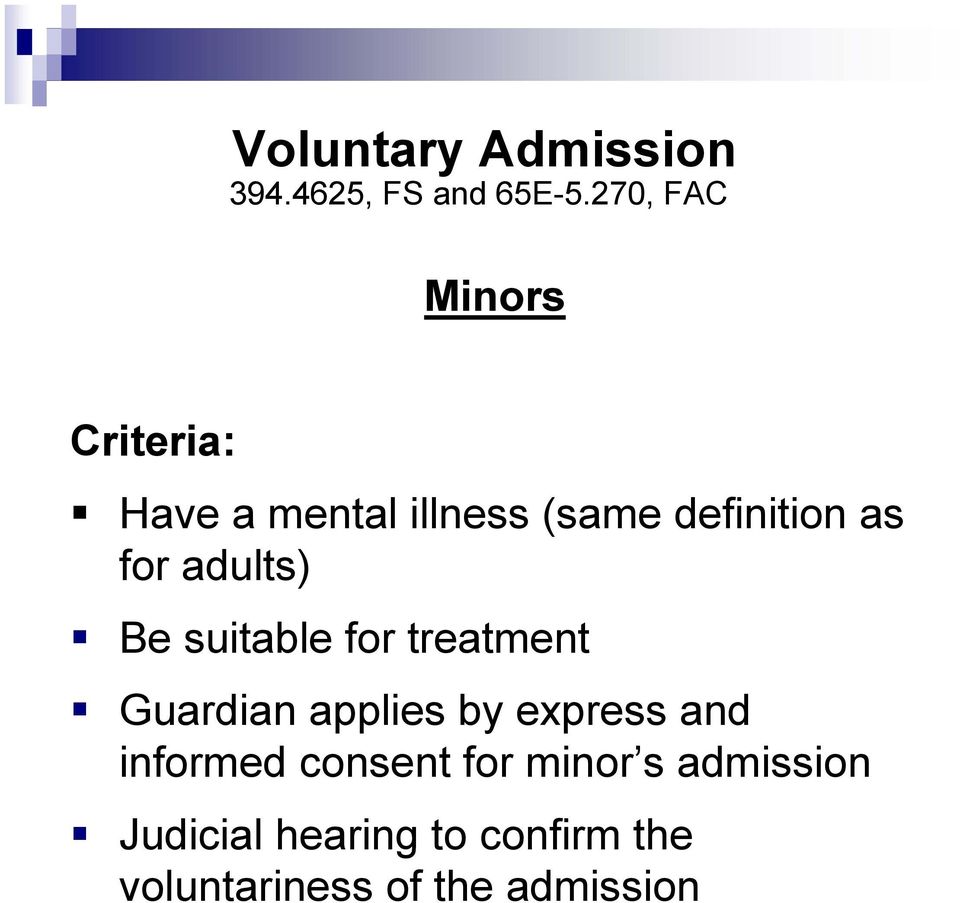
17 Voluntary Admission , FS and 65E-5.270, FAC Minors Criteria: Have a mental illness (same definition as for adults) Be suitable for treatment Guardian applies by express and informed consent for minor s admission Judicial hearing to confirm the voluntariness of the admission
18 Mental Illness Means (18), FS Impairment of the mental or emotional processes that exercise conscious control of one s actions or of the ability to perceive or understand reality. Impairment substantially interferes with a person s ability to meet the ordinary demands of living, Regardless of etiology.-- Does not include retardation or developmental disability as defined in chapter 393, intoxication, or conditions manifested only by antisocial behavior or substance abuse impairment. Co-occurring Disorders?

19 Consent for Mental Health Admission A facility may receive for observation, diagnosis or treatment any person age 17 or under and for whom such application is made by his or her guardian, only after a hearing to verify the voluntariness of the consent. [s (1), F.S.] Each person entering treatment must be asked to give express and informed consent for admission and for treatment. If the person is a minor, express and informed consent for admission and treatment must also be requested from the guardian, but such consent is required from the guardian. [ (3)(a) F.S.]
![] Each person entering treatment must be asked to give express and informed consent for admission and for treatment.](/docs-images/40/878191/images/page_19.jpg "If the person is a minor, express and informed consent for admission and treatment must also be requested from the guardian, but such consent is")
20 Express and Informed Consent Consent voluntarily given in writing by a competent person after sufficient explanation To enable the person to make a knowing and willful decision Without any element of force, fraud, deceit, duress, or other form of constraint or coercion. Incompetent to Consent That a person s judgment is so affected by his or her mental illness That the person lacks the capacity To make a well-reasoned, willful and knowing decision Concerning his or her medical or mental health treatment.

21 Involuntary Examination Criteria (1),FS Reason to believe person has a mental illness and because of mental illness, person has refused or is unable to determine if examination is necessary, and either: Without care or treatment, is likely to suffer from neglect or refuse to care for self, and such neglect or refusal poses a real and present threat of substantial harm to one s well-being and it is not apparent that such harm may be avoided through the help of willing family members, friends, or the provision of other services; or There is substantial likelihood that without treatment person will cause in the near future serious bodily harm to self or others, as evidenced by recent behavior. Must meet all criteria
22 Initiating Involuntary Examinations (2), FS and 65E-5.280, FAC Upon determination that person appears to meet criteria for involuntary examination, the exam may be initiated by any one of the following three means: 1.Court Order - the circuit court may enter an ex parte order; or 2.A law enforcement officer shall take into custody a person who appears to meet the criteria describing circumstances; or 3.A mental health professional may execute a certificate stating that s/he has examined the person within the preceding 48 hours and found the person met the criteria and stating the observations upon which that conclusion is based.
23 Certificate of a Mental Health Professional (2), (4), (21), (23) and (24), FS Mental Health Professional defined Psychiatrist: A medical practitioner licensed under chapter 458 or 459 who has primarily diagnosed/treated mental/nervous disorders for a period of not less than 3 years, inclusive of psychiatric residency. Physician: A medical practitioner licensed under chapter 458 or 459 who has experience in the diagnosis/treatment of mental and nervous disorders or a physician employed by a facility operated by the U.S. Dept of Veterans Affairs which qualifies as a receiving or treatment facility.
24 Clinical Psychologist: A psychologist as defined in s (7) with 3 years of postdoctoral experience in the practice of clinical psychology, inclusive of the experience required for licensure, or a psychologist employed by a facility operated by the United States Department of Veterans Affairs that qualifies as a receiving or treatment facility. Psychiatric Nurse: A registered nurse licensed under chapter 464 who has a master's degree or a doctorate in psychiatric nursing and 2 years of post-master's clinical experience under the supervision of a physician.
25 Clinical Social Worker: A person licensed as a clinical social worker under chapter 491. Licensed Mental Health Counselor: Means a mental health counselor licensed under chapter 491, F.S. Licensed Marriage and Family Therapist: Means a marriage and family therapist licensed under chapter 491, F.S. (Physician Assistants not eligible in statute, but recognized by Florida Attorney General in May 08 Opinion to initiate involuntary exam but not to perform other duties of a physician)
26 Hospital Admission All hospitals are required to ensure full compliance with the Baker Act as a condition of licensure. Any hospital that provides psychiatric treatment to persons under 18 years of age who have emotional disturbances shall comply with the procedures pertaining to the rights of patients prescribed in chapter 394 Part I. [s (5)(b)] A minor under the age of 14 who is admitted to any hospital may not be admitted to a bed in a room or ward with an adult in a mental health unit or share common areas with an adult in a mental health unit. However, a minor 14 years of age or older may be admitted to a bed in a room or ward in the mental health unit with an adult if the admitting physician documents in the case record that such placement is medically indicated or for reasons of safety. Such placement must be reviewed by the attending physician or a designee or on-call physician each day and documented in the case record. [s (2), F.S.]
27 Admission to Children s Crisis Stabilization Units: The purpose of a CCSU is to stabilize and redirect an individual to the most appropriate and least restrictive community setting available, consistent with the Individual's needs. CCSUs may screen, assess, and admit for stabilization persons on voluntary and involuntary status. They can be provided 24-hour observation, medication prescribed by a physician or psychiatrist, and other appropriate services. CCSUs must provide services regardless of the client's ability to pay, but shall charge fees on a sliding scale, based on ability to pay. CCSUs are limited in size to a maximum of 20 beds. ( (1)(a), F.S.) AHCA can only license a crisis stabilization unit if it receives state mental health funds and is affiliated with a designated public receiving facility.
28 Admission to Children s Crisis Stabilization Units Minors under the age of 14 years cannot be admitted to a bed in a room or ward with an adult. They may share common areas with an adult only when under direct visual observation by unit staff. Minors who are 14 years of age and older may be admitted to a bed in a room or ward in the mental health unit with an adult, if the clinical record contains documentation by a physician that such placement is medically indicated or for reasons of safety. This must be reviewed and documented by the physician on a daily basis. [Chapter 65E (22), F.A.C.]
29 Co-located Children s Crisis Stabilization Units Integrated CCSU/Juvenile Addiction Receiving Facilities exist in several areas of the state. These behavioral crisis units provide emergency mental health and substance abuse services that are integrated within facilities licensed and designated by the Agency for Health Care Administration for persons under 18 who meet the voluntary or involuntary examination or admission criteria under the Baker Act or Marchman Act, including those having a co-existing mental health and substance abuse disorders. The services must meet all licensure requirements for CSUs. Standards that are implemented specific to substance abuse services must meet or exceed existing standards for addictions receiving facilities. ( , F.S.)
30 Consent to Psychiatric Treatment Treatment in Hospitals and Crisis Stabilization Units: Each person entering a facility must be asked to give express and informed consent for admission and treatment. If the person is a minor, express and informed consent for admission and treatment must also be requested from the person s guardian. Express and informed consent for admission and treatment of a person under 18 years of age must be required from the person s guardian, unless the minor is seeking outpatient crisis intervention services [s (3)(a), F.S.] Assent vs. Consent
31 Express & Informed Consent (3), FS and 65E-5.170, FAC Competence is well reasoned, willful & knowing decision-making Prior to requesting consent to treatment, the following must be provided and explained in plain language: The reason for admission or treatment, Proposed treatment, including psychotherapeutic medications Purpose of treatment Alternative treatments Specific dosage range for medications Frequency and method of administration Common risks, benefits and shortterm/long-term side effects Contraindications (continued)
32 Express & Informed Consent (continued) Clinically significant interactive effects with other medications, Similar information on alternative medication which may have less severe or serious side effects. Potential effects of stopping treatment Approximate length of care How treatment will be monitored, and that Any consent for treatment may be revoked orally or in writing before or during the treatment period by the person legally authorized to make health care decisions for the person.
33 Express & Informed Consent to Treatment (continued) Full Disclosure must be given to: The minor and his/her guardian Who can give consent? Guardian of a child
34 Consent to Psychiatric Treatment Residential Treatment Centers Children s rights, as specified in s , F.S. must be safeguarded for those in residential treatment centers as well. Children must be informed of their legal and civil rights, including the right to legal counsel and all other requirements of due process. Therefore, the Baker Act describes the rights of children in residential treatment centers. [ (c), F.S. and Chapter 65E (3(e), F.A.C]
35 Consent to Psychiatric Treatment Outpatient Crisis Intervention Services: The disability of nonage is removed for any minor age 13 years or older to access services under the following circumstances (s , F.S.): Outpatient Diagnostic and Evaluation Services: When any minor age 13 years or older experiences an emotional crisis to such degree that he or she perceives the need for professional assistance, he or she must have the right to request, consent to, and receive mental health diagnostic and evaluative services provided by a licensed mental health professional as defined by Florida Statutes, or in a mental health facility licensed by the state.
36 Consent to Psychiatric Treatment Outpatient Crisis Intervention The purpose of such services must be to determine the severity of the problem and the potential for harm to the person or others if further professional services are not provided. Outpatient diagnostic and evaluative services cannot include medication and other somatic methods, aversive stimuli, or substantial deprivation. Such services cannot exceed two visits during any 1-week period in response to a crisis situation before parental consent is required for further services, and may include parental participation when determined to be appropriate by the mental health professional or facility.
37 Consent to Psychiatric Treatment Outpatient Crisis Intervention Outpatient Crisis Intervention, Therapy and Counseling Services: When any minor age 13 years or older experiences an emotional crisis to such degree that he or she perceives the need for professional assistance, he or she must have the right to request, consent to, and receive outpatient crisis intervention services, including individual psychotherapy, group therapy, counseling, or other forms of verbal therapy provided by a licensed mental health professional as defined by Florida Statutes, or in a mental health facility licensed by the state. Such services cannot include medication and other somatic treatments, aversive stimuli, or substantial deprivation. Such services cannot exceed two visits during any 1-week period in response to a crisis situation before parental consent is required for further services, and may include parental participation when determined to be appropriate by the mental health professional or facility.
38 Consent to Psychiatric Treatment Outpatient Crisis Intervention The parent or legal guardian of a minor is not liable for payment for any such outpatient diagnostic and evaluation services or outpatient therapy and counseling services described in this section of the Baker Act unless the parent or legal guardian participates in the services and then only for the services rendered with such participation.
39 Dependent Youth Chapter 39, F.S.
40 Dependent Youth Consent to Treatment Examination, Treatment, & Placement A judge may order a child in an out-of-home placement to be examined by a licensed health care professional. The judge may also order such child to be evaluated by a psychiatrist or a psychologist or, if a developmental disability is suspected or alleged, by the developmental disability diagnostic and evaluation team of the department. If it is necessary to place a child in a residential facility for such evaluation, the criteria and procedure established in s (2) or chapter 393 shall be used, whichever is applicable. [s (4) FS]
41 Dependent Youth Consent to Treatment Examination, Treatment, & Placement A judge may order a child in an out-of-home placement to be treated by a licensed health care professional based on evidence that the child should receive treatment. The judge may also order such child to receive mental health or developmental disabilities services from a psychiatrist, psychologist, or other appropriate service provider. If it is necessary to place the child in a residential facility for such services, the procedures and criteria established in s shall be used. A child may be provided mental health services in emergency situations, pursuant to the procedures and criteria contained in s (1). [s (5), F.S.]
42 Dependent Youth Consent to Treatment Children who are in the legal custody of the department may be placed by DCF, without prior approval of the court, in a residential treatment center licensed under s or a hospital licensed under chapter 395 for residential mental health treatment or may be placed by the court in accordance with an order of involuntary examination or involuntary placement entered pursuant to s or s All children placed in a residential treatment program under this subsection must have a guardian ad litem appointed. [s (6), F.S.]
43 Emergency Care of Youth in DCF or DJJ Custody The Department of Children and Family Services or the Department of Juvenile Justice caseworker, juvenile probation officer, or person primarily responsible for the case management of the child, the administrator of any facility licensed by the department under s , s , or s , or the administrator of any stateoperated or state-contracted delinquency residential treatment facility may consent to the medical care or treatment of any minor committed to it or in its custody under chapter 39, chapter 984, or chapter 985, when the person who has the power to consent cannot be contacted and such person has not expressly objected to such consent. There shall be maintained in the records of the minor documentation that a reasonable attempt was made to contact the person who has the power to consent. [s (3), F.S.]
44 Emergency Care of Youth in DCF or DJJ Custody The medical provider shall notify the parent or other person who has the power to consent as otherwise provided by law as soon as possible after the medical care or treatment is administered. The medical records shall reflect the reason consent was not initially obtained and shall be open for inspection by the parent or other person who has the power to consent. [s (4) FS] The person who gives consent; a physician, dentist, nurse, or other health care professional licensed to practice in this state; or a hospital or medical facility, including, but not limited to, county health departments, shall not incur civil liability by reason of the giving of consent, examination, or rendering of treatment, provided that such consent, examination, or treatment was given or rendered as a reasonable prudent person or similar health care professional would give or render it under the same or similar circumstances. [s (5), F.S.]
45 Dependent Youth (Chapter 39, F.S.) Consent to Treatment Legal custody is a legal status created by court order or letter of guardianship which vests in a custodian of the person or guardian, whether an agency or an individual, the right to have physical custody of the child and the right and duty to protect, train, and discipline the child and to provide him or her with food, shelter, education, and ordinary medical, dental, psychiatric, and psychological care. [s (34), F.S.] When any child is removed from the home and maintained in an out-of-home placement, DCF can have a medical screening performed on the child without authorization from the court and without consent from a parent or legal custodian. Such medical screening shall be performed by a licensed health care professional and shall be to examine the child for injury, illness, and communicable diseases and to determine the need for immunization. In no case does this subsection authorize the department to consent to medical treatment for such children. [s (1), F.S.]
46 Dependent Youth Consent to Treatment When DCF has performed the medical screening or when it is otherwise determined by a licensed health care professional that a child who is in an out-ofhome placement, but who has not been committed to the department, is in need of medical treatment, including the need for immunization, consent for medical treatment shall be obtained from a parent or legal custodian of the child, or a court order for such treatment shall be obtained. If a parent or legal custodian of the child is unavailable and his or her whereabouts can t be reasonably ascertained, and it is after normal working hours so that a court order cannot reasonably be obtained, an authorized agent of the department has the authority to consent to necessary medical treatment, for the child. DCF authority to consent to medical treatment in this circumstance is limited to the time reasonably necessary to obtain court authorization.
47 Dependent Youth Consent to Treatment If a parent or legal custodian of the child is available but refuses to consent to the necessary treatment, a court order is required unless the situation meets the definition of an emergency in s or the treatment needed is related to suspected abuse, abandonment, or neglect of the child by a parent, caregiver, or legal custodian. In such case, DCF can consent to necessary medical treatment. This authority is limited to the time reasonably necessary to obtain court authorization.
48 Dependent Youth Consent to Treatment Psychotropic Medications Before DCF provides psychotropic medications to a child in its custody, the prescribing physician must attempt to obtain express and informed consent from the child's parent or legal guardian. DCF must take steps necessary to facilitate the inclusion of the parent in the child's consultation with the physician. However, if the parental rights of the parent have been terminated, the parent's location or identity is unknown or cannot reasonably be ascertained, or the parent declines to give express and informed consent, the department may, after consultation with the prescribing physician, seek court authorization to provide the psychotropic medications to the child. Unless parental rights have been terminated and if it is possible to do so, the department shall continue to involve the parent in the decision-making process regarding the provision of psychotropic medications.
49 Dependent Youth Consent to Treatment Psychotropic Medications If, at any time, a parent whose parental rights have not been terminated provides express and informed consent to the provision of a psychotropic medication, the requirements of this section that DCF seek court authorization do not apply to that medication until such time as the parent no longer consents. Any time DCF seeks a medical evaluation to determine the need to initiate or continue a psychotropic medication for a child, DCF must provide to the evaluating physician all pertinent medical information known to the department concerning that child.
50 Dependent Youth Consent to Treatment Psychotropic Medications If a child who is removed from the home under s is receiving prescribed psychotropic medication at the time of removal and parental authorization to continue providing the medication cannot be obtained, the department may take possession of the remaining medication and may continue to provide the medication as prescribed until the shelter hearing, if it is determined that the medication is a current prescription for that child and the medication is in its original container. If DCF continues to provide the psychotropic medication to a child when parental authorization cannot be obtained, the department shall notify the parent or legal guardian as soon as possible that the medication is being provided to the child. The child's official departmental record must include the reason parental authorization was not initially obtained and an explanation of why the medication is necessary for the child's wellbeing.
51 Dependent Youth Consent to Treatment Psychotropic Medications If DCF is advised by a licensed physician that the child should continue the psychotropic medication and parental authorization has not been obtained, DCF must request court authorization at the shelter hearing to continue to provide the psychotropic medication and must provide to the court any information in its possession in support of the request. Any authorization granted at the shelter hearing may extend only until the arraignment hearing on the petition for adjudication of dependency or 28 days following the date of removal, whichever occurs sooner. Before filing the dependency petition, DCF must ensure that the child is evaluated by a licensed physician to determine whether it is appropriate to continue the psychotropic medication. If, as a result of the evaluation, DCF seeks court authorization to continue the psychotropic medication, a motion for such continued authorization shall be filed at the same time as the dependency petition, within 21 days after the shelter hearing.
52 Dependent Youth Consent to Treatment Psychotropic Medications DCF must file a motion seeking the court's authorization to initially provide or continue to provide psychotropic medication to a child in its legal custody. The motion must be supported by a written report prepared by the department which describes the efforts made to enable the prescribing physician to obtain express and informed consent for providing the medication to the child and other treatments considered or recommended for the child.
53 Dependent Youth Consent to Treatment Psychotropic Medications In addition, the motion must be supported by the prescribing physician's signed medical report providing: The name of the child, the name and range of the dosage of the psychotropic medication, and that there is a need to prescribe psychotropic medication to the child based upon a diagnosed condition for which such medication is being prescribed. A statement indicating that the physician has reviewed all medical information concerning the child which has been provided. A statement indicating that the psychotropic medication, at its prescribed dosage, is appropriate for treating the child's diagnosed medical condition, as well as the behaviors and symptoms the medication, at its prescribed dosage, is expected to address.
54 Dependent Youth Consent to Treatment Psychotropic Medications An explanation of the nature and purpose of the treatment; the recognized side effects, risks, and contraindications of the medication; drug-interaction precautions; the possible effects of stopping the medication; and how the treatment will be monitored, followed by a statement indicating that this explanation was provided to the child if age appropriate and to the child's caregiver. Documentation addressing whether the psychotropic medication will replace or supplement any other currently prescribed medications or treatments; the length of time the child is expected to be taking the medication; and any additional medical, mental health, behavioral, counseling, or other services that the prescribing physician recommends.
55 Dependent Youth Consent to Treatment Psychotropic Medications Psychotropic medications may be administered in advance of a court order in hospitals, crisis stabilization units, and in statewide inpatient psychiatric programs. Within 3 working days after the medication is begun, the department must seek court authorization. [s (3), F.S.]
56 Delinquent Youth Chapter 985, F.S.
57 Delinquent Youth (Chapter 985, F.S.) Medical, psychiatric, psychological, substance abuse, and educational examination and treatment. After a detention petition or a petition for delinquency has been filed, the court may order the child named in the petition to be examined by a physician. The court may also order the child to be evaluated by a psychiatrist or a psychologist. If it is necessary to place a child in a residential facility for such evaluation, the criteria and procedures established in chapter 393, chapter 394, or chapter 397, whichever is applicable, must be used. [s (1), F.S.] Whenever a child has been found to have committed a delinquent act, or before such finding with the consent of any parent or legal custodian of the child, the court may order the child to be treated by a physician. The court may also order the child to receive mental health, substance abuse, or retardation services from a psychiatrist, psychologist, or other appropriate service provider. If it is necessary to place the child in a residential facility for such services, the procedures and criteria established in chapter 393, chapter 394, or chapter 397, whichever is applicable, must be used [s985.18(2) FS]
58 Delinquent Youth A physician must be immediately notified by the person taking the child into custody or the person having custody if there are indications of physical injury or illness, or the child must be taken to the nearest available hospital for emergency care. A child may be provided mental health, substance abuse, or retardation services, in emergency situations, pursuant to chapter 393, chapter 394, or chapter 397, whichever is applicable. After a hearing, the court may order the custodial parent or parents, guardian, or other custodian, if found able to do so, to reimburse the county or state for the expense involved in such emergency treatment or care. [s (6), F.S.] Nothing eliminates the right of the parents or the child to consent to examination or treatment for the child, except that consent of a parent shall not be required if the physician determines there is an injury or illness requiring immediate treatment and the child consents to such treatment or an ex parte court order is obtained authorizing treatment.[985.18(7), F.S.]
59 Marchman Act Substance Abuse Impairment Chapter 397, F.S.
60 Marchman Act Substance Abuse Impairment The disability of nonage for persons under 18 years of age has been removed solely for the purpose of allowing minors to obtain voluntary substance abuse impairment services from a licensed service provider. The consent by a minor has the same force and effect as if executed by an adult.. [s (4)(a), F.S.] A minor may be taken to a detox facility, hospital or a juvenile addictions receiving facility (JARF) for involuntary admission if there is a good faith reason to believe the minor suffers from a condition involving the use of alcoholic beverages or any psychoactive or mood-altering substance in such a manner as to induce mental, emotional, or physical problems and cause socially dysfunctional behavior, and who, because of such condition [s (15) and s , F.S.]: Has lost the power of self-control with respect to substance use; and either: Inflicted, or threatened or attempted to inflict, or unless admitted is likely to inflict, physical harm on himself or another; or Is in need of substance abuse services and, by reason of substance abuse impairment his judgment has been so impaired that he is incapable of appreciating his need for such services and of making a rational decision in regard thereto. However, mere refusal to undergo such services does not constitute evidence of lack of judgment with respect to his or her need for such services
61 Marchman Act Substance Abuse Impairment Involuntary admission under the Marchman Act of a minor may be initiated as follows: Law enforcement officers can initiate Protective custody under the Marchman Act [ ,FS]. A parent or guardian may apply for a minor s emergency admission if a physician s certificate has been obtained [ (2) F.S.], as well as for admission to a Juvenile Addiction Receiving Facility [ , F.S.]. A parent/guardian or a licensed service provider can petition the court for an involuntary assessment and stabilization order. [( ,FS] A minor must be released from protective custody, emergency admission, involuntary assessment, involuntary treatment, and alternative involuntary assessment of a minor, upon approval of a qualified professional in a hospital, a detoxification facility, addictions receiving facility, or any less restrictive treatment component. The minor must be released to the minor s parent, legal guardian, or legal custodian or the authorized designee thereof or to the department. [s , F.S.]
62 Marchman Act Substance Abuse Impairment Parental Participation in Treatment: A parent, legal guardian, or legal custodian who seeks involuntary admission of a minor is required to participate in all aspects of treatment as determined appropriate by the director of the licensed service provider. [ , F.S.] Parental Participation/Payment: A parent or legal guardian of a minor is required to contribute toward the cost of substance abuse services in accordance with his ability to pay. The parent or legal guardian isn t liable for payment for any voluntary substance abuse services provided to the minor without parental consent, unless the parent or legal guardian participates or is ordered to participate in the services, and only for the substance abuse services rendered. If the minor is receiving services as a juvenile offender, the obligation to pay is governed by the law relating to juvenile offenders. [s (2)(3), F.S.]
63 Marchman Act Substance Abuse Impairment Release of Information Since a minor acting alone has the legal capacity to voluntarily apply for and obtain substance abuse treatment, any written consent for disclosure may be given only by the minor client. This restriction includes, but is not limited to, any disclosure of client identifying information to the parent, legal guardian, or custodian of a minor client for the purpose of obtaining financial reimbursement. When the consent of a parent, legal guardian, or custodian is required for a minor to obtain substance abuse treatment, any written consent for disclosure must be given by both the minor and the parent, legal guardian, or custodian. [ss (7)(e) 1 and 2, F.S.]
64 Resources for Baker Act & Marchman Act
65 Training Opportunities Online Training On demand-at your convenience Up-to-date material Consistent, statewide information No fee Certificate of Achievement CEC s low cost Copies of 2008 Baker Act Handbook Download at no charge from DCF website. Or purchase Handbook for $12.95 per book from Procopy. Total cost approx. $19 with shipping and tax.
66 Department of Children & Families Website Click on Baker Act. Contents include: Copy of Baker Act law (394, Part I, FS) and rules (65E-5, FAC) Baker Act forms mandatory and recommended Selected forms in Spanish & Creole 2008 Baker Act Handbook Baker Act monitoring/survey instruments Frequently Asked Questions (FAQ s) on 20 subject areas List of all public and private receiving facilities throughout the state Mental Health Advance Directives Other relevant materials
67 Department of Children & Families Website Click on Marchman Act. Contents include: 2003 Marchman Act User Reference Guide includes among other issues: Statute & Rules History & Overview Marchman Act Model Forms Law Enforcement and Protective Custody Quick Reference Guide for Involuntary Provisions Flow Charts for Involuntary Provisions Admission & Treatment of Minors Where to Go for Help Marchman Act Pamphlet Substance Abuse Program Standards Common Licensing Standards Marchman Act PowerPoint Presentation
68 Baker Act & Marchman Act Martha Lenderman Lenderman & Associates 7268 Moffatt Lane Pinellas Park, FL (727)
Florida Laws on Mental Health (Baker Act) and Substance Abuse (Marchman Act) 2013 Southeast Institute on Homelessness and Supportive Housing
 Florida Laws on Mental Health (Baker Act) and Substance Abuse (Marchman Act) 2013 Southeast Institute on Homelessness and Supportive Housing October 1, 2013 Alternatives to the Baker Act Mental Illness
THE BAKER ACT: MENTAL HEALTH
 CHAPTER 32 THE BAKER ACT: MENTAL HEALTH by George F. Indest III, JD, MPA, LL.M SCOPE This chapter discusses FLorida's Baker Act, the Law which allows the involuntary commitment of individuals who poses
Minors (See also Involuntary Examination) (See also bakeracttraining.org for course on Consent for Minors) Minority Defined
 Minors (See also Involuntary Examination) (See also bakeracttraining.org for course on Consent for Minors) Q. How is a minor defined? Minority Defined A minor is any person under 18 years old who has not
A BILL FOR AN ACT ENTITLED: "AN ACT REVISING LAWS RELATING TO GUARDIANSHIP; REVISING
 HB0.0 HOUSE BILL NO. INTRODUCED BY J. ESSMANN, M. FUNK A BILL FOR AN ACT ENTITLED: "AN ACT REVISING LAWS RELATING TO GUARDIANSHIP; REVISING LAWS RELATING TO THE COMMITMENT OF INCAPACITATED PERSONS; PROVIDING
STATE STANDARDS FOR ASSISTED TREATMENT
 STATE STANDARDS FOR ASSISTED TREATMENT Civil Commitment Criteria for Inpatient or Outpatient Psychiatric Treatment June 2011 200 NORTH GLEBE ROAD, SUITE 730 ARLINGTON, VIRGINIA 22203 (703) 294-6001 TreatmentAdvocacyCenter.org
Quality Management. Substance Abuse Outpatient Care Services Service Delivery Model. Broward County/Fort Lauderdale Eligible Metropolitan Area (EMA)
 Quality Management Substance Abuse Outpatient Care Services Broward County/Fort Lauderdale Eligible Metropolitan Area (EMA) The creation of this public document is fully funded by a federal Ryan White
STATE STANDARDS FOR ASSISTED TREATMENT
 STATE STANDARDS FOR ASSISTED TREATMENT Civil Commitment Criteria for Inpatient or Outpatient Psychiatric Treatment October 2014 200 NORTH GLEBE ROAD, SUITE 801 ARLINGTON, VIRGINIA 22203 (703) 294-6001
HOUSE OF REPRESENTATIVES FINAL BILL ANALYSIS SUMMARY ANALYSIS
 HOUSE OF REPRESENTATIVES FINAL BILL ANALYSIS BILL #: CS/CS/HB 335 FINAL HOUSE FLOOR ACTION: SPONSOR(S): COMPANION BILLS: Health & Human Services Committee; Health Quality Subcommittee; Plasencia; Campbell
FIREARM OWNER IDENTIFICATION (FOID) PROGRAM REPORTING REQUIREMENTS
 FIREARM OWNER IDENTIFICATION (FOID) PROGRAM REPORTING REQUIREMENTS Illinois Department of Human Services October 24, 2013 TODAY, WE WILL BE PROVIDING AN EDUCATIONAL PROGRAM AND DIALOGUE SESSION WITH OUR
LEGALLY ADEQUATE CONSENT
 REV2 8 2011_CS1 LEGALLY ADEQUATE CONSENT In general, adults with disabilities have the right to control their own lives and make their own decisions. They must give consent to have limitations placed on
STATE STANDARDS FOR ASSISTED TREATMENT
 STATE STANDARDS FOR ASSISTED TREATMENT Civil Commitment Criteria for Inpatient or Outpatient Psychiatric Treatment October 2014 200 NORTH GLEBE ROAD, SUITE 801 ARLINGTON, VIRGINIA 22203 (703) 294-6001
IN THE CIRCUIT COURT OF THE NINETEENTH JUDICIAL CIRCUIT, IN AND FOR MARTIN COUNTY, FLORIDA
 IN THE CIRCUIT COURT OF THE NINETEENTH JUDICIAL CIRCUIT, IN AND FOR MARTIN COUNTY, FLORIDA IN RE: / CASE NO: Petition and Affidavit Seeking Involuntary Substance Abuse Assessment and Stabilization I, Being
Civil Commitment and Voluntary Treatment
 RIGHTS & REALITY II Civil Commitment and Voluntary Treatment Dianne Greenley, Attorney Wisconsin Coalition for Advocacy Focus on short term treatment Treatment and protection from harm Consequences to
TEXAS FAMILY CODE CHAPTER 32. CONSENT TO TREATMENT OF CHILD BY NON PARENT OR CHILD
 TEXAS FAMILY CODE CHAPTER 32. CONSENT TO TREATMENT OF CHILD BY NON PARENT OR CHILD SUBCHAPTER A. CONSENT TO MEDICAL, DENTAL, PSYCHOLOGICAL, AND SURGICAL TREATMENT 32.001. Consent by Non-Parent (a) The
Involuntary Admissions & Treatment Facts and Procedures
 Involuntary Admissions & Treatment Facts and Procedures Marcia Horan Assistant State s Attorney, Cook County Seniors and Persons with Disabilities Division WHEN IS INVOLUNTARY ADMISSION APPROPRIATE? The
Minnesota Patients Bill of Rights
 Minnesota Patients Bill of Rights Legislative Intent It is the intent of the Legislature and the purpose of this statement to promote the interests and well-being of the patients of health care facilities.
Minnesota Patients Bill of Rights Legislative Intent
 Minnesota Patients Bill of Rights Legislative Intent It is the intent of the Legislature and the purpose of this statement to promote the interests and well-being of the patients of health care facilities.
Consent to Medical Treatment for Minor Children: Overview of North Carolina Law. Jill D. Moore, JD, MPH UNC School of Government April 2015
 Consent to Medical Treatment for Minor Children: Overview of North Carolina Law Jill D. Moore, JD, MPH UNC School of Government April 2015 Who may give consent for a minor to receive medical treatment?
MANDATED REPORTING OF CHILD NEGLECT OR PHYSICAL OR SEXUAL ABUSE
 POLICY #414 MANDATED REPORTING OF CHILD NEGLECT OR PHYSICAL OR SEXUAL ABUSE I. PURPOSE The purpose of this policy is to make clear the statutory requirements of school personnel to report suspected child
Public Act No. 15-226
 Public Act No. 15-226 AN ACT CONCERNING HEALTH INSURANCE COVERAGE FOR MENTAL OR NERVOUS CONDITIONS. Be it enacted by the Senate and House of Representatives in General Assembly convened: Section 1. Section
CHAPTER 36 ALCOHOL AND DRUG ABUSE TREATMENT ACT. be cited as the "Alcohol and Drug Abuse
 36-01-01 TITLE This Chapter may Treatment Act." CHAPTER 36 ALCOHOL AND DRUG ABUSE TREATMENT ACT o Amendment B New Adoption Jwdicial Approved 4-0!-)I,D be cited as the "Alcohol and Drug Abuse I-j 01- '60_
Title II. Section 1. Purpose The Santee Sioux Nation Tribal Council in order to prevent Alcohol and Drug Abuse declares:
 Title II Health and Welfare Chapter 1 ALCOHOL AND DRUG ABUSE TREATMENT ACT Section 1. Purpose The Santee Sioux Nation Tribal Council in order to prevent Alcohol and Drug Abuse declares: A. Alcoholism and
Marchman Act Adult Package
 Marchman Act Adult Package MARCHMAN ACT PACKAGE Page 2 General Information Notice Of Limitation Of Service Provided ADA Notice Table of Contents Page 3 Flow Chart for General Process for Petition for Involuntary
Professional Credentials (See also Involuntary Examinations) General
 Professional Credentials (See also Involuntary Examinations) General Q. Do professionals identified in the Baker Act have to be licensed in the State of Florida? Yes, physicians (including psychiatrists),
MANDATED REPORTING OF CHILD NEGLECT OR PHYSICAL OR SEXUAL ABUSE
 No. _414 I. PURPOSE MANDATED REPORTING OF CHILD NEGLECT OR PHYSICAL OR SEXUAL ABUSE The purpose of this policy is to make clear the statutory requirements of school personnel to report suspected child
414 MANDATED REPORTING OF CHILD NEGLECT OR PHYSICAL OR SEXUAL ABUSE
 I. PURPOSE 414 MANDATED REPORTING OF CHILD NEGLECT OR PHYSICAL OR SEXUAL ABUSE The purpose of this policy is to make clear the statutory requirements of school personnel to report suspected child neglect
STATUS OF MINORS AND CHILD SUPPORT Act 293 of 1968. The People of the State of Michigan enact:
 STATUS OF MINORS AND CHILD SUPPORT Act 293 of 1968 AN ACT to establish the status of minors; to define the rights and duties of parents; to establish rights and duties to provide support for a child after
INDEPENDENT SCHOOL DISTRICT #877 POLICY. Buffalo-Hanover-Montrose
 INDEPENDENT SCHOOL DISTRICT #877 POLICY Buffalo-Hanover-Montrose INDEX TITLE Employee/Personnel SERIES NO. 400 Mandated Reporting of Child Neglect or POLICY TITLE Physical or Sexual Abuse CODE NO. 414.
Targeted Case Management Services
 Targeted Case Management Services 2013 Acronyms and Abbreviations AHCA Agency for Health Care Administration MMA Magellan Medicaid Administration CBC Community Based Care CBH Community Behavioral Health
QUALIFIED MENTAL HEALTH PROFESSIONAL ONLINE TRAINING
 QUALIFIED MENTAL HEALTH PROFESSIONAL ONLINE TRAINING DSS Leadership Meeting October 8, 2014 South Dakota Department of Social Services Division of Behavioral Health INTRODUCTION Division of Behavioral
Optum By United Behavioral Health. 2015 Florida Medicaid Managed Medical Assistance (MMA) Level of Care Guidelines
 Optum By United Behavioral Health 2015 Florida Medicaid Managed Medical Assistance (MMA) Level of Care Guidelines Statewide Inpatient Psychiatric Program Services (SIPP) Statewide Inpatient Psychiatric
MANDATED REPORTING OF CHILD NEGLECT OR PHYSICAL OR SEXUAL ABUSE 214. A. Child means a person under age 18.
 I. PURPOSE It is the policy of Lakes International Language Academy (the school ) to maintain this policy on mandated reporting of child neglect or physical or sexual abuse. The purpose of this policy
Session of 2014. SENATE BILL No. 394. By Committee on Assessment and Taxation 2-13
 Session of SENATE BILL No. By Committee on Assessment and Taxation - 0 AN ACT concerning children and minors; enacting the Kansas foster parents' bill of rights act; relating to foster care; family foster
Montana Elder and Persons With Developmental Disabilities Abuse Prevention Act
 Montana Elder and Persons With Developmental Disabilities Abuse Prevention Act 52-3-801. Short title. This part may be cited as the "Montana Elder and Persons With Developmental Disabilities Abuse Prevention
MANDATED REPORTING OF CHILD NEGLECT OR PHYSICAL OR SEXUAL ABUSE
 MANDATED REPORTING OF CHILD NEGLECT OR PHYSICAL OR SEXUAL ABUSE I. PURPOSE The purpose of this policy is to make clear the statutory requirements of school personnel to report suspected child neglect or
Quick Reference Guide: Handling Custody Issues in the School
 Dallas Independent School District Quick Reference Guide: Handling Custody Issues in the School Office of Legal Services Administration Building, Box 69 972-925-3250 (main) 972-925-3251 (fax) Updated August
ARTICLE 3. BEHAVIORAL HEALTH INPATIENT FACILITIES
 Section R9-10-301. R9-10-302. R9-10-303. R9-10-304. R9-10-305. R9-10-306. R9-10-307. R9-10-308. R9-10-309. R9-10-310. R9-10-311. R9-10-312. R9-10-313. R9-10-314. R9-10-315. R9-10-316. R9-10-317. R9-10-318.
A GUIDE TO THE SUBSTITUTE DECISIONS ACT
 A GUIDE TO THE SUBSTITUTE DECISIONS ACT 0-7794-2147-7 Queen s Printer for Ontario, 2000 Introduction to the Guide 03 The Subsitute Decisions Act 06 Some Important Definitions 08 Decisions About Property
Clinical Considerations for Involuntary Mental Health Treatment of Adults in Oklahoma
 Clinical Considerations for Involuntary Mental Health Treatment of Adults in Oklahoma Brandon Schader, M.D. Medical Director for Crisis Stabilization Oklahoma County Crisis Intervention Center Oklahoma
California: Minor Consent Rules for Adolescent Health Care
 California: Minor Consent Rules for Adolescent Health Care Because adolescents are not yet adults 1, parents have the right to make most health care decisions on their behalf. This generally includes the
POLICY TINTON FALLS BOARD OF EDUCATION. PUPILS 5530/Page 1 of 10 SUBSTANCE ABUSE 5530 SUBSTANCE ABUSE
 5530/Page 1 of 10 M 5530 The Board of Education recognizes that a pupil's abuse of harmful substances seriously impedes that pupil's education and threatens the welfare of the entire school community.
Ohio Legal Rights Service s Durable Power of Attorney for Health Care Form
 Ohio Legal Rights Service s Durable Power of Attorney for Health Care Form This form helps you to direct your care should your doctor decide that you lack capacity to make your own medical decisions It
Chapter1 FOSTER CARE OVERVIEW. STATE OF WISCONSIN Foster Parent Handbook
 Chapter1 FOSTER CARE OVERVIEW STATE OF WISCONSIN Foster Parent Handbook CHAPTER 1: FOSTER CARE OVERVIEW Introduction: Chapter 1... 2 Letter from Wisconsin County Human Services Association... 3 The Purpose
A. An individual who is legally and actually capable of consenting may consent to his or her admission for any purpose and any length of time.
 2850 Dairy Drive Suite 100 Madison, WI 53718-6751 608-224-0606 ext. 314 800-488-2596 ext. 314 608-224-0607 fax [email protected] www.cwag.org/legal AUTHORITY to CONSENT to ADMISSION (PLACEMENT) to NURSING
[Provider or Facility Name]
![[Provider or Facility Name]](/thumbs/24/2833314.jpg "[Provider or Facility Name]") [Provider or Facility Name] SECTION: [Facility Name] Residential Treatment Facility (RTF) SUBJECT: Psychiatric Security Review Board (PSRB) In compliance with OAR 309-032-0450 Purpose and Statutory Authority
[Provider or Facility Name] SECTION: [Facility Name] Residential Treatment Facility (RTF) SUBJECT: Psychiatric Security Review Board (PSRB) In compliance with OAR 309-032-0450 Purpose and Statutory Authority
WHEREAS, children caught in the middle of high parental conflict are more likely to be harmed; and
 THE ELEVENTH JUDICIAL CIRCUIT MIAMI-DADE COUNTY, FLORIDA CASE NO. 06-1 (Court Administration) ADMINISTRATIVE ORDER NO. 06-03 IN RE: PARENTING COORDINATION IN FAMILY LAW CASES WHEREAS, children caught in
ADOPTION. The Adoption Law All adoptions filed in the state of Missouri are governed by the same 1123
 ADOPTION What is Adoption? Adoption is a legal process that establishes a parent/child relationship between two people who are not otherwise related by blood. There are three sets of participants in an
PINE HILL BOARD OF EDUCATION School Board Policy 1003 Turnerville Road Pine Hill, New Jersey 08021 5530- SUBSTANCE ABUSE
 PINE HILL BOARD OF EDUCATION School Board Policy 1003 Turnerville Road Pine Hill, New Jersey 08021 Phone: 856-783-6900 ext. 1115 FAX: 856-783-2955 Website: www.pinehill.k12.nj.us 5530- SUBSTANCE ABUSE
5530 SUBSTANCE ABUSE (M)
 Haddonfield 5530 / Page 1 of 10 5530 SUBSTANCE ABUSE (M) The following procedures are established in implementation of Policy No. 5530, Substance Abuse. A. Definitions 1. Evaluation means those procedures
REPORTING REQUIREMENTS
 REPORTING REQUIREMENTS REPORTING REQUIREMENTS Consistent with state law, you must report known or suspected abuse, neglect, and/or exploitation of children and certain adults. Different rules apply to
GUIDELINES FOR ATTORNEYS FOR CHILDREN IN THE FOURTH DEPARTMENT
 NEW YORK STATE SUPREME COURT APPELLATE DIVISION, FOURTH DEPARTMENT HONORABLE HENRY J. SCUDDER PRESIDING JUSTICE GUIDELINES FOR ATTORNEYS FOR CHILDREN IN THE FOURTH DEPARTMENT PREFACE The Departmental Advisory
CHAPTER 13 DISPOSITION HEARING TABLE OF CONTENTS
 Chapter 13 CHAPTER 13 DISPOSITION HEARING TABLE OF CONTENTS 13.01 Recommended Hearing Length... 13-2 13.02 Disposition Follows Adjudication... 13-2 13.03 Notice of Hearing... 13-2 A. Upon Whom... 13-2
A Guide for Larimer County Parents
 Services Child Protection A Guide for Larimer County Parents This booklet was prepared by the Program Committee of the Larimer County Child Advocacy Center in consultation with the Larimer County Department
AGAPE. Therapist Client Services Agreement
 Revised 7/1/08 AGAPE Therapist Client Services Agreement AGAPE is a faith-based organization guided by Christian values. As part of its overall mission, AGAPE offers professional counseling and psychological
Understanding the Civil Involuntary Commitment Process
 Understanding the Civil Involuntary Commitment Process About the Author By D. Renée Hildebrant http://www.okbar.org/obj/articles_05/021205.htm Oklahoma Bar Journal D. Renée Hildebrant is the trial court
CHAPTER 15 GUARDIANSHIP
 228 MICHIGAN CHILD WELFARE LAW CHAPTER 15 GUARDIANSHIP Revised: 9/1/2007 Guardianship 229 230 MICHIGAN CHILD WELFARE LAW CHAPTER 15 GUARDIANSHIP 15.1. INTRODUCTION Guardianships, power of attorney and
Alabama s Mandatory Child Abuse and Neglect Reporting Law
 CODE OF ALABAMA TITLE 26. INFANTS AND INCOMPETENTS. CHAPTER 14. REPORTING OF CHILD ABUSE OR NEGLECT. 26-14-1. Definitions. For the purposes of this chapter, the following terms shall have the meanings
The Youth Drug Detoxification and Stabilization Act
 YOUTH DRUG DETOXIFICATION 1 The Youth Drug Detoxification and Stabilization Act being Chapter Y-1.1* of The Statutes of Saskatchewan, 2005 (effective April 1, 2006) as amended by The Statutes of Saskatchewan,
N.Y.S. PROTECTION OF PEOPLE WITH SPECIAL NEEDS ACT NOTICE TO MANDATED REPORTERS. Justice Center Guidance June 11, 2013
 N.Y.S. PROTECTION OF PEOPLE WITH SPECIAL NEEDS ACT NOTICE TO MANDATED REPORTERS Justice Center Guidance June 11, 2013 This Notice provides Mandated Reporters with an overview of their legal duties under
How To Deal With A Pupil Who Is Under The Influence Of Alcohol Or Drugs
 R 5530/Page 1 of 12 R 5530 The following procedures are established in implementation of Policy No. 5530, Substance Abuse. A. Definitions 1. Evaluation means those procedures used by a certified or licensed
Health Care Consent Act
 Briefing Note 2005, 2007 College of Physiotherapists of Ontario 2009 Contents Overview...3 Putting the in Context...3 The HCCA in Brief...4 Key Principles Governing Consent to Treatment...4 Key Aspects
R 5530 SUBSTANCE ABUSE (M) [See POLICY ALERT Nos. 125, 133, 144, 145, 157, 173, 179 and 204]
![R 5530 SUBSTANCE ABUSE (M) [See POLICY ALERT Nos. 125, 133, 144, 145, 157, 173, 179 and 204]](/thumbs/33/16413880.jpg "R 5530 SUBSTANCE ABUSE (M) [See POLICY ALERT Nos. 125, 133, 144, 145, 157, 173, 179 and 204]") R 5530/Page 1 of 17 M R 5530 [See POLICY ALERT Nos. 125, 133, 144, 145, 157, 173, 179 and 204] The following procedures are established in implementation of Policy 5530, Substance Abuse. A. Definitions
R 5530/Page 1 of 17 M R 5530 [See POLICY ALERT Nos. 125, 133, 144, 145, 157, 173, 179 and 204] The following procedures are established in implementation of Policy 5530, Substance Abuse. A. Definitions
STATE OF NEVADA Department of Administration Division of Human Resource Management CLASS SPECIFICATION
 STATE OF NEVADA Department of Administration Division of Human Resource Management CLASS SPECIFICATION TITLE GRADE EEO-4 CODE MENTAL HEALTH COUNSELOR V 43* B 10.135 MENTAL HEALTH COUNSELOR IV 41* B 10.137
Regular Session, 2014. ACT No. 136. To amend and reenact R.S. 37:2352(4), (5), (6) and (7), 2354(B), (C) and (D), 2355(B),
 Regular Session, 0 SENATE BILL NO. BY SENATOR MARTINY ACT No. 0 AN ACT To amend and reenact R.S. :(), (), () and (), (B), (C) and (D), (B),, the introductory paragraph of (B), (E) and (G), (A), (B), (C)(),
Robbinsville Board of Education REGULATION Section: s Regulation 5530: Substance Abuse (M) Edited: September 2014 Page 1 of 12
 R Robbinsville Board of Education REGULATION Section: s Regulation 5530: Substance Abuse (M) Edited: September 2014 Page 1 of 12 R 5530 SUBSTANCE ABUSE (M) The following procedures are established in implementation
Patient Any person who consults or is seen by a physician to receive medical care
 POLICY & PROCEDURE TITLE: Release of Medical Records Scope/Purpose: To ensure proper disclosure and release of Protected Health Information (PHI) Division/Department: All HealthPoint Clinics Policy/Procedure
HOUSE BILL No. 2577 page 2
 HOUSE BILL No. 2577 AN ACT enacting the addictions counselor licensure act; amending K.S.A. 74-7501 and K.S.A. 2009 Supp. 74-7507 and repealing the existing section; also repealing K.S.A. 65-6601, 65-6602,
STATE OF NEW JERSEY DEPARTMENT OF HUMAN SERVICES DIVISION OF MENTAL HEALTH AND ADDICTION SERVICES. (Pursuant to N.J.S.A. 30:4-27.
 STATE OF NEW JERSEY DEPARTMENT OF HUMAN SERVICES DIVISION OF MENTAL HEALTH AND ADDICTION SERVICES SCREENING DOCUMENT FOR ADULTS (Pursuant to N.J.S.A. 30:4-27.1 et seq) to Instructions New Jersey Court
JAN 2 2 2016. Hawaii Revised Statutes regulates numerous professions and. occupations, including marriage and family therapists.
 S.B. NO. JAN 0 A BILL FOR AN ACT THE SENATE TWENTY-EIGHTH LEGISLATURE, 0 STATE OF HAWAII RELATED TO LICENSED MARRIAGE AND FAMILY THERAPISTS. BE IT ENACTED BY THE LEGISLATURE OF THE STATE OF HAWAII: I 0
HILLSDALE BOARD OF EDUCATION FILE CODE: 5131.6* SUBSTANCE ABUSE
 HILLSDALE BOARD OF EDUCATION Hillsdale, NJ 07642 SUBSTANCE ABUSE Possible Drug and Alcohol Related Situations Whenever it shall appear to any teaching staff member, school nurse or other education personnel
EAST BRUNSWICK PUBLIC SCHOOLS Pupils 5530. SUBTANCE ABUSE (M) Page 1 of 7
 Page 1 of 7 The Board of Education recognizes that an effective educational program, providing accurate information and promoting positive decision-making skills, is the first step in preventing pupils
Frequently Asked Questions about Adoption in Tennessee
 Frequently Asked Questions about Adoption in Tennessee BIRTH MOTHER RELATED 1. When can the mother of the baby start the adoption process? A. Legal proceedings cannot begin until at least four (4) days
Florida Attorney General Advisory Legal Opinion
 Page 1 of 5 Number: AGO 2008-31 Date: May 30, 2008 Subject: Baker Act - Physician Assistants Florida Attorney General Advisory Legal Opinion Mr. Robert A. Butterworth Secretary Department of Children and
Code of Alabama Title 26. Infants and Incompetents. Chapter 14. Reporting of Child Abuse or Neglect. ALA.CODE 26-14-2. 26-14-1. Definitions.
 ALA.CODE 26-14-1 26-14-1. Definitions. For the purposes of this chapter, the following terms shall have the meanings respectively ascribed to them by this section: (1) ABUSE. Harm or threatened harm to
Frequently Asked Questions about Adoption in Florida
 Frequently Asked Questions about Adoption in Florida BIRTH MOTHER RELATED 1. When can the mother of the baby start the adoption process? A. As soon as she has a confirmed pregnancy the adoption process
CHAPTER 34 INFORMED CONSENT FOR THE NURSE
 CHAPTER 34 INFORMED CONSENT FOR THE NURSE I. INTRODUCTION The goal of informed consent is patient autonomy or self-determination. To be autonomous, individuals must be able to control their bodies by controlling
SP0225, LD 708, item 1, 123rd Maine State Legislature An Act To Amend the Laws Concerning the Emancipation of Minors
 PLEASE NOTE: Legislative Information cannot perform research, provide legal advice, or interpret Maine law. For legal assistance, please contact a qualified attorney. Be it enacted by the People of the
YOUR RIGHTS REGARDING ADMISSION TO AND DISCHARGE FROM A HOSPITAL UNDER MASSACHUSETTS MENTAL HEALTH LAW
 YOUR RIGHTS REGARDING ADMISSION TO AND DISCHARGE FROM A HOSPITAL UNDER MASSACHUSETTS MENTAL HEALTH LAW Prepared by the Mental Health Legal Advisors Committee December 2011 Massachusetts General Laws Chapter
Department of Mental Health and Addiction Services 17a-453a-1 2
 17a-453a-1 2 DEPARTMENT OF MENTAL HEALTH AND ADDICTION SERVICES General Assistance Behavioral Health Program The Regulations of Connecticut State Agencies are amended by adding sections 17a-453a-1 to 17a-453a-19,
Adult Protective Services
 Chapter 7.E Guardianship/conservatorship and Mental Health Board A. Guardianship/Conservatorship 1. A guardian or conservator is a person or entity appointed by a court of competent jurisdiction to have
The following procedures are established in implementation of Policy No. 5530, Substance Abuse.
 R5530.DR Page 1 of 11 The following procedures are established in implementation of Policy No. 5530,. A. Definitions 1. Evaluation means those procedures used by a certified or licensed professional to
FREQUENTLY ASKED QUESTIONS ABOUT ADOPTION IN FLORIDA
 FREQUENTLY ASKED QUESTIONS ABOUT ADOPTION IN FLORIDA BIRTH MOTHER RELATED 1. When can the mother of the baby start the adoption process? A. As soon as she has a confirmed pregnancy, the adoption process
Guardianship of Mentally Ill Adults in Illinois: Statutory Guidelines and Practical Applications
 Guardianship of Mentally Ill Adults in Illinois: Statutory Guidelines and Practical Applications Suzanne M. Cahalan, J.D. 909 South Wheaton Avenue Wheaton, IL 60189 630-690-7415 1 I. Guardianship A. process
A BILL FOR AN ACT ENTITLED: "AN ACT ALLOWING A TERMINALLY ILL PATIENT TO REQUEST
 SB00.0 SENATE BILL NO. 0 INTRODUCED BY DICK BARRETT A BILL FOR AN ACT ENTITLED: "AN ACT ALLOWING A TERMINALLY ILL PATIENT TO REQUEST MEDICATION TO END THE PATIENT'S LIFE; ESTABLISHING PROCEDURES; PROVIDING
UNIVERSITY PHYSICIANS OF BROOKLYN, INC. POLICY AND PROCEDURE. No: Supersedes Date: Distribution: Issued by:
 UNIVERSITY PHYSICIANS OF BROOKLYN, INC. POLICY AND PROCEDURE Subject: ALCOHOL & SUBSTANCE ABUSE INFORMATION Page 1 of 10 No: Prepared by: Shoshana Milstein Original Issue Date: NEW Reviewed by: HIPAA Policy
Patient s Bill of Rights
 Patient s Bill of Rights When you apply for or receive mental health services in the State of Texas, you have many rights. Your most important rights are listed on these six pages. These rights apply to
MEDICAL RECORDS ACCESS GUIDE IOWA
 MEDICAL RECORDS ACCESS GUIDE IOWA Parsonage Vandenack Williams LLC Attorneys at Law Parsonage Vandenack Williams LLC 2008 For more information, contact [email protected] TABLE OF CONTENTS Iowa...1 Patient
Chapter I PATIENT BILL OF RIGHTS: ADMINISTRATIVE POLICIES AND PROCEDURES
 Chapter I PATIENT BILL OF RIGHTS: ADMINISTRATIVE POLICIES AND PROCEDURES Section 1. Authority. The Board of Charities and Reform, Pursuant to W.S. 25-10-120, is authorized to promulgate rules creating
Chapter 388-877B WAC CHEMICAL DEPENDENCY SERVICES. Section One--Chemical Dependency--Detoxification Services
 Chapter 388-877B WAC CHEMICAL DEPENDENCY SERVICES Section One--Chemical Dependency--Detoxification Services WAC 388-877B-0100 Chemical dependency detoxification services--general. The rules in WAC 388-877B-0100
PLEASE NOTE. For more information concerning the history of this Act, please see the Table of Public Acts.
 PLEASE NOTE This document, prepared by the Legislative Counsel Office, is an office consolidation of this Act, current to December 6, 2013. It is intended for information and reference purposes only. This
STATE OF OKLAHOMA. 2nd Session of the 53rd Legislature (2012) AS INTRODUCED
 STATE OF OKLAHOMA nd Session of the rd Legislature () SENATE BILL AS INTRODUCED By: Brecheen An Act relating to sexual exploitation by a mental health services provider; creating the Protection Against
South Dakota Parental Rights and Procedural Safeguards
 South Dakota Parental Rights and Procedural Safeguards Special Education Programs Revised July 2011 Prior Written Notice... 1 Definition of Parental Consent... 3 Definition of a Parent... 3 Parental Consent...
ASSEMBLY, No. 3360 STATE OF NEW JERSEY. 217th LEGISLATURE INTRODUCED MARCH 3, 2016
 ASSEMBLY, No. 0 STATE OF NEW JERSEY th LEGISLATURE INTRODUCED MARCH, 0 Sponsored by: Assemblywoman VALERIE VAINIERI HUTTLE District (Bergen) SYNOPSIS Clarifies DHS authority to license and regulate sober
NOTICE OF PRIVACY PRACTICES. The University of North Carolina at Chapel Hill. UNC-CH School of Nursing Faculty Practice Carolina Nursing Associates
 NOTICE OF PRIVACY PRACTICES The University of North Carolina at Chapel Hill UNC-CH School of Nursing Faculty Practice Carolina Nursing Associates THIS NOTICE DESCRIBES HOW MEDICAL INFORMATION ABOUT YOU