
INDONESIAN AS A UNIFYING LANGUAGE OF WIDER COMMUNICATION: A HISTORICAL AND SOCIOLINGUISTIC PERSPECTIVE
|
|
|
- Geraldine Richardson
- 7 years ago
- Views:
Transcription
1 PACIFIC LINGUISTICS Series D - No. 73 INDONESIAN AS A UNIFYING LANGUAGE OF WIDER COMMUNICATION: A HISTORICAL AND SOCIOLINGUISTIC PERSPECTIVE by Husen Abas (MATERIALS IN LANGUAGES OF INDONESIA, No. 37) W.A.L. Stokhof, Series Editor Department of Linguistics Research School of Pacific Studies THE AUSTRALIAN NATIONAL UNIVERSITY Abas, H. Indonesian as a unifying language of wider communication: A historical and sociolinguistic perspective. D-73, viii pages. Pacific Linguistics, The Australian National University, DOI: /PL-D73.cover 1987 Pacific Linguistics and/or the author(s). Online edition licensed 2015 CC BY-SA 4.0, with permission of PL. A sealang.net/crcl initiative.
2 PACIFIC LINGUISTICS is issued through the Linguistic Circle of Canberra and consists of four series: SERIES A - Occasional Papers SERIES B - Monographs SERIES C - Books SERIES D - Special Publications EDITOR: S.A. Wurm ASSOCIATE EDITORS: D.C. Laycock, C.L. Voorhoeve, D.T. Tryon, T.E. Dutton EDITORIAL ADVISERS: B.W. Bender University of Hawaii David Bradley La Trobe University Michael G. Clyne Monash University S.H. Elbert University of Hawaii K.J. Franklin Summer Institute of Linguistics W.W. Glover Summer Institute of Linguistics G.W.Grace University of Hawaii M.A.K. Halliday University of Sydney E. Haugen Harvard University A. Healey Summer Institute of Linguistics L.A. Hercus Australian National University John Lynch University of Papua New Guinea K.A. McElhanon Summer Institute of Linguistics H.P. McKaughan University of Hawaii P. Muhlh.usler Linacre College, Oxford G.N. O'Grady University of Victoria, B.C. A.K. Pawley University of Auckland K.L. Pike Summer Institute of Linguistics E.C. Polome University of Texas Malcolm Ross Australian National University Gillian Sankoff University of Pennsylvania W.A.L. Stokhof University of Leiden B.K. T'sou City Polytechnic of Hong Kong E.M. Uhlenbeck University of Leiden J.W.M. Verhaar Divine Word Institute, Madang All correspondence concerning PACIFIC LINGUISTICS, including orders and subscriptions, should be addressed to: Copyright The Authors First Published 1987 Typeset by Ling Matsay Printed by A.N.U. Printing Service PACIFIC LINGUISTICS Department of Linguistics Research School of Pacific Studies The Australian National University Canberra, A.C.T Australia Maps drawn by Theo Baumann Bound by Adriatic Bookbinders Pty Ltd The editors are indebted to the Australian National University for assistance in the production of this series This publication was made possible by an initial grant from the Hunter Douglas Fund. ISSN ISBN
3 HI T ABLE OF CONTENTS PREFACE Chapter I: OVERVIEW 1.1 Introduction 1.2 Aim of study 2.3 Methodology 1.4 Definition of terms ].5 Limitations of the study 1.6 Significance of the study 1. 7 Plan of the study Notes to Chapter I Chapter II: HlSTORICAL DEVELOPMENT OF INDONESIAN 2.] Introduction 2.2 The shaping of lingua franca 2.3 The shaping of a national language 2.4 Indonesian as a national language 2.5 The shaping of a language of wider communication 2.6 Summary Notes to Chapter II Chapter III: LANGUAGE PLANNING PROCESSES IN INDONESIA 3.1 Introduction 3.2 Standardisation process of Indonesian orthography 3.3 Standardisation process of Indonesian grammar 3.4 Standardisation process of Indonesian vocabulary 3.5 Evaluation and feedback 3.6 Summary Notes to Chapter III Chapt,erIV: INDONESIAN LANGUAGE AND INDONESIAN SOCIETY 4.] Introduction 4.2 Recent sociolinguistic studies on Indonesian 4.3 Attitudinal and motivational studies 4.4 Projections for hie fu ture 4.5 Critical analysis and summary Notes to Chapter IV Chapt.er V: CONCUJSJO S AND RECOMMENDATIONS Notes to Chapter V Appendix A Appendix B Appendix C Bibliography page IV ] ]
4
5 PREFACE This study is a return to the subject of the historical development of Malay, renamed Indonesian by the All Indonesian Youth Congress of At least six scholars have taken up the subject as the theme of their books: Sutan Takdir Alisjahbana (1956), Vmar Junus (1969), Zuber Vsman (1970), S. Effendi (1972), A. Teeuw (1959), and J.E. Tatengkeng (1953). But most of these publications look at the historical development of Indonesian only up to the year 1954, the year when the second Congress on Indonesian was held in Medan. It is of course true that Indonesian experienced progressive development prior to that year through the literary and cultural movement of the Pudjangga Baru (The New Writers) group, through the first Congress on Indonesian of 1938 in Solo, through the rapid growth during the Japanese occupation of Indonesia, and through the consolidation of the language as the only official language of the Republic of Indonesia as stipulated by the Constitution of Nevertheless, a much more accelerated rate of development was experienced by the language during the sixties and seventies. It was during this time period that the shaping and the emergence of the language as a language of wider communication took place. Indonesian can now be called one of the modern languages of the twentieth century. As such Indonesian has undergone a series of standardisation phases including revision and refinement of its system of spelling, integration of new foreign words into its vocabulary and the coining of modern technical terminology for daily and scientific use. As a corollary to the bilateral agreement between Indonesia and Malaysia concerning the unification of the language of the two countries, the standardised system of spelling and terminology developed for Indonesian was also accepted by Malaysia. Implementation of the 'Language Agreement' between the two countries as well as other unilateral developments of Indonesian form part of the substance of the language planning process. For such a topic as language planning, the treatment given to language in most of the publications mentioned earlier would be questionable in terms of both its validity and its applicability. The situation, therefore, calls for a new work on the historical development of the language. An important aspect of language planning that seems to have escaped the attention of most contemporary language scholars in Indonesia is language projection. This lapse might be attributed to a lack of statistical data on Indonesian; nevertheless, it is one aspect of the language planning process that needs delving into. My first inkling concerning the lack of systematic sociolinguistic data available on Indonesian was given me by Professor Andrew B. Gonzalez, F.S.C., who has a special interest in the subject. After giving the subject serious consideration and discussing the matter with friends who are active in the field of language planning, I accepted the challenge, though not without some reservations; for before I could begin my work I needed the endorsement of Indonesian authorities in the field of language development. v
6 vi Since the creation of the Pusat Pembinaan dan Pe ngembangan Bahasa (Center for Language Development) of the Department of Education and Culture in 1974, the thrust of language planning in Indonesia has been the formulation of a national language policy to regulate development of the national language and the many vernaculars of the archipelago. Seminars, workshops, and conferences held under the auspices of the Center have been designed to achieve that goal. The Conference on Indonesian Language and Literature held in Jakarta in 1978 is exemplary of the Center's course towards that goal. There, for the first time, young scholars came to the fore to present their ideas concerning the development of the national language and its literature in a forum which had long been dominated by such prominent predecessors as Alisjahbana, Usman and H.B. Jassin. In accordance with the new impetus of language planning in Indonesia as it was formulated by the Center, the work of updating and systematising the account of the historical development of Indonesian was a primary aim. The study that follows is devoted to that goal. This study also attempts to present some projections for Indonesian for the year The study divides the historical development of Malay (later, Indonesian) into four main divisions: ( 1 ) the shaping of a lingua franca, (2) the shaping of a national language, (3) the creation of a national language, and (4) the shaping of a language of wider communication. In terms of time, the first division covers a period of approximately a thousand years, from the era of the Kingdom of Sriwijaya (seventh to eleventh century) up to 1865, the year when the language was made the second official language of the Dutch colonial administration. The second division starts in 1865 and ends in 1928 when the language was renamed Indonesian, the national language of Indonesia. The third division covers a period of approximately fifty years from 1928 to 1972 and the fourth division begins when the 'Language Agreement' between Indonesia and Malaysia was first implemented in the form of a unified system of spelling. Except for the official separation of the two varieties of the language (Malay-Riau and Malay-Johore) in 1824 (London Treaty), which marked the beginning of the development of the varieties in their separate ways, no other event which took place within the first division can compare with those that took place during the other three periods for it was within these divisions that the substance of development of Malay took place. This includes the introduction of a spelling system for Malay using the Latin alphabet by Charles van Ophuijsen in 1901; the creation of Balai Pustaka (government publishing house) in 1920 which published reading materials in the form of popular literature and whose wide distribution boosted the spread of the language; the adoption of Malay as the national language of Indonesia in 1928; and the unification of the system of spelling of Indonesia and Malaysia in The language planning process in Indonesia is discussed under four sub-headings: (1) standardisation of the orthography of Indonesian, (2) standardisation of the grammar of Indonesian, (3) standardisation of the vocabulary of Indonesian, and (4) evaluation and feedback on the processes of standardisation. Included under the first sub-heading are discussions of (a) the van Ophuijsen system of writing, (b) the R. Soewandi orthography, (c) the reformation orthography (Prijono-Katoppo), (d) the Melindo writing system, (e) the new orthography, and (f) the revised new orthography. Dealt with under the second sub-
7 vii heading is the standardisation process of Indonesian grammar. This discussion centres around three topics: (a) the Arabic influence exemplified by the work of Raja Ali Haji, (b) the Latin influence represented by the work of van Ophuijsen, and (c) the linguistic influence as reflected by the work of Sutan Takdir Alisjahbana. The third sub-heading presents an in-depth discussion of modernisation and intellectualisation of the vocabulary of Indonesian. In the fourth sub-heading an evaluation of the processes of the three preceding sub-headings is given. A discussion of the sociolinguistic aspects of the development and the spread of Indonesian is also included in this study. Sentimental and instrumental attachment to the national language is also touched upon. In this respect, Indonesian, as a supraethnic norm, is a common language which helps to unify the multiethnic population of the archipelago; it strengthens both sentimental and instrumental attachment to the system and, moreover, contributes to the mutual reinforcement of the two. Thus, there is a continuous and cyclical process of reinforcement between sentimental and instrumental attachment which a common language helps to maintain. The sociolinguistic aspects of the development and the spread of Malay are discussed along the lines of its 'transformation' from its status as a lingua franca of Indonesia to its status as the national language of the country. There are, at least, three favourable factors which helped facilitate this 'transformation': the geographical location of the area where Malay is spoken natively, the migrational habits of the Malays, and the simplicity and flexibility of the language. Another positive factor behind the acceptance of Malay as a lingua franca, and, later, as the national language, was that the Malays, who inhabit the Riau area and the islands near by on the eastern shore of Sumatra, do not constitute a majority ethnic group; other ethnic groups did not have the 'fear' of being dominated by the native speakers of Malay. As a corollary to the implementation of the 'Language Agreement' between Indonesia and Malaysia, the term 'Supranational norm' is introduced for Malay (Indonesian in Indonesia and Malay language in Malaysia). In assuming the new role of a language of wider communication, the language entered the intermediary stage, to become one of the modern world languages. As such Malay possesses the necessary attributes to be named the ASEAN language. Census figures published by the Biro Pusat Statistik (Central Bureau of Statistics) in Jakarta show that in 1971, 40.78%, or 48,275,879 persons out of Indonesia's total population of 118,367,850 were speakers of Indonesian. It is projected that the percentage of speakers of Indonesian will be 49.66%, 59.47%, and 69.01% by the years 1981, 1991, and 2001 respectively. It has been fu rther projected that by the year 2041 at the latest Indonesia will have a 100% Indonesian-speaking population. Taking into consideration factors conducive to the dissemination of the language, such as the PALAPA satellite communications system, Indonesia should have a 100% Indonesian-speaking population much earlier than the projected year The fact that nearly 60% of the total population of Indonesia reside on the island of Java, where a number of local vernaculars (Sundanese, Javanese, and Madurese) are used which
8 viii have strong literary traditions and are written in their own systems of spelling is, to some extent, unfavourable to the development and the spread of Indonesian. Furthermore, the majority of the Sundanese, Javanese and Madurese live in traditional homogeneous societies, a factor which further slows the process of the dissemination of the national language. This challenge however, has been met by the Pusat Pembinaan dan Pengembangan Bahasa (Center for Language Development) with the formulation of a National Language 'Policy by the Pre-seminar of 1974 and the Seminar of ABBREVIATION IN LBN Mal ML PB Indonesian Lembaga Bahasa Nasional (The Institute of national language) Malaya Language Melayu Language Pudjangga Baru (The New Writers) Abas, H. Indonesian as a unifying language of wider communication: A historical and sociolinguistic perspective. D-73, viii pages. Pacific Linguistics, The Australian National University, DOI: /PL-D73.cover 1987 Pacific Linguistics and/or the author(s). Online edition licensed 2015 CC BY-SA 4.0, with permission of PL. A sealang.net/crcl initiative.
9 Chapter I OVERVIEW 1.1 INTRODUCTION On October 28, 1928 the delegates of the Indonesian Youth Congressl in Jakarta made the following pledge: We, the sons and daughters of Indonesia, declare that we belong to one nation, Indonesia; We, the sons and daughters of Indonesia, declare that we belong to one people, the Indonesian people; We, the sons and daughters of Indonesia, vow to uphold the nation's language of unity, Indonesian (Reksodipuro and Soebagijo 1974:69}2. This pledge, so solemnly made, encompassed three ideals: one nation, one people and one language. The focus of this study is the final one, the ideal of a nation with one language, the Indonesian language, (hereinafter IN}.3 When Indonesia achieved its independence in 1945, the legal status of IN as the national language and the official language of the new republic was confirmed by the Constitution of 1945, article 36 of which states that: The language of the state shall be Indonesian4 As such, with the exception of the first three grades of elementary school in some districts where local vernaculars must still be used, IN is the only medium of instruction in schools and universities. IN is the official language of business, and is widely used in meetings, ceremonies, seminars and conferences, as well as for most books, journals, magazines, newspapers, and other forms of publication. Radio and television programs, stage performances and films and religious sermons as well all utilise IN. The motto of the Republic of Indonesia "Bhinneka Tunggal Ika" (Unity in Diversity), is recognition of the fact that the nation comprises diverse ethnolinguistic groups. The linguistic wealth of Indonesia is marked by the hundreds of vernaculars spoken throughout Abas, H. Indonesian as a unifying language of wider communication: A historical and sociolinguistic perspective. D-73, viii pages. Pacific Linguistics, The Australian National University, DOI: /PL-D Pacific Linguistics and/or the author(s). Online edition licensed 2015 CC BY-SA 4.0, with permission of PL. A sealang.net/crcl initiative. 1
10 2 the archipelago, ranging from Javanese and Sundanese, spoken by tens of millions of people in Java, to smaller vernaculars spoken by only a few hundred thousand people, such as Kerinci and Rejang in Sumatra, Duri in Sulawesi, Buton on Buton Island and so on. The speech communities often coincide with ethnic groupings so that socio-cultural differences are added to the linguistic differences (Isman 1977). Realising that ethno-linguistic differences among the population of Indonesia could be a serious obstacle to a united independent nation, the leaders of the Indonesian independence movement at the beginning of this century made a special effort to bring the different groups closer together by making use of the then widely-used lingua franca of the archipelago, the Malay language, (hereinafter ML). This marked the beginning of the adoption of ML for inter-ethnic communication purposes; with this, a national language was in the making. The 1954 Congress on IN, convened by the Ministry of Education and Culture in Medan, North Sumatra5, recognised that IN is an outgrowth of ML and that ethnic or local vernaculars have enriched its growth and development. In doing so, the Congress admitted that IN was basically a more developed ML, the lingua franca which for centuries had been used in the Indonesian archipelago as the medium of communication between foreigners and natives and among the indigenous peoples of different linguistic and socio-cultural backgrounds. The status of ML as the appropriate lingua franca for the archipelago was recognised as early as the sixteenth century (Alisjahbana 1956, 1957). In Malaysia, Malaysia language (hereinafter Mal) is the country's national language. Mal too is an offspring of ML. IN and Mal are actually two dialects sharing one common source, Riau-Johore Malay (Asmah Haji Omar 1975:5). Both dialects, however, being faced with the challenge of new functions, through the years have undergone tremendous change and can no longer be considered to be Riau-Johore Malay. Both languages differ significantly from their original form. Differences between IN and Mal are in large part the result of different political conditions. Colonisation of the Indonesian archipelago by the Dutch greatly affected the development of IN. Likewise, as a result of British rule Mal absorbed many English words into its vocabulary. In addition, Sanskrit, Arabic, Tamil and Chinese have also enriched the Mal list of loan vocabulary. The pledge to make Mal (called Malay at the time) the sole official and national language was made only in the 1950s, more than two decades after the Indonesian youth pledge. When a constitution was drawn up for independent Malays in 1957 one of its clauses, which was to take effect in 1967, stipulated that ML (Johore-Riau Malay) would be the official and national language of the country (Asmah Haji Omar 1975:46). As Alisjahbana once noted (in Fishman 1974:391) the most remarkable development in the history of the Malayo-Polynesian or Austronesian languages has been the growth of ML IN + Mal) as one of the modern languages of the twentieth century. It is the national and official language of Indonesia, Malaysia and Brunei. It is also one of the national languages of Singapore, sharing this position with English, Mandarin and Tamil.
11 3 The emergence of ML as the lingua franca of Indonesia and peninsular Malaysia and later its transformation into the national language of the countries just mentioned was facilitated by a number of factors. First, because native speakers of ML were to be found on both sides of the Strait of Malacca, the European and West and South Asian traders, sailors and missionaries who entered the Indonesian archipelago through this route were exposed to and began to learn ML. Second, the Malay people themselves often travelled and migrated to other parts of the archipelago, and other ethnic groups coming into contact with them were exposed to and began to learn their language too. Third, ML is a language of relative simplicity and flexibility both of which are favourable characteristics in the making of a language as an acceptable national or international language (Garvin and Mathiot 1956) (see also Isman 1977, Alisjahbana in Fishman, ed. 1974). Dutch, and English after World War II, played an important role in the expansion of science and technology in Indonesia. Nevertheless, even in this field these two languages could not prevail over IN and the latter is now used almost exclusively for science and technology and in other academic fields as well. In Indonesia Dutch has almost vanished entirely and English is limited to reading materials used in institutions of higher education. Arabic played a very important role in the expansion of Islam in the archipelago, but it could not dominate ML either. Through time ML, and later IN, gained wider use in the religious life of the Indonesian Muslim so that today almost all religious sermons and lessons are given in IN. The use of Arabic is limited to recitation of Koranic verses, which must be translated into IN for most people to understand, and to books on Islamic studies used in schools and institutes specialising in this field. The success of ML and IN even in areas where Dutch, English, and Arabic once played important roles is partly due to the simplicity and flexibility of the Indonesian language (Isman 1977). ML or the Indonesian language as such is the main theme of this study. Can ML take over the role of a language of wider communication that English has been playing up to this time in South-East Asia? Further, can ML unify its speakers and give them a regional identity as it does with the multi-ethnic population of Indonesia? These are two of the questions this study will try to answer. 1.2 AIM OF STUDY Aside from trying to answer the questions noted above this study also has as its goal giving a descriptive and comprehensive analysis of the process whereby ML came to be adopted as the lengua nacional of Indonesia as it is defined by Garvin (1974). The analysis will be carried out with reference to theories of language modernisation and language planning. The descriptive section of this analysis will include a discussion of the historical development the language has undergone, beginning with its status as a local language, up to its status as the lingua franca of the Indonesian archipelago, through its adoption as the national language of Indonesia in 1928, and on up to its present intermediary stage as a language of wider communication in which it has become one of the modern world languages. More specifically, this study will delve into (1) the unifying function of IN as a language of supraethnic norm, (2) the process of graphic representation, modernisation,
12 4 intellectualisation and standardisation the language has undergone, and (3) the spread of IN throughout South-East Asia, particularly in the Indonesian archipelago. 1.3 METHODOLOGY Basically, this study is a historical one using documentation from legislation, census figures, seminar and workshop reports, congress and conference publications, and other related secondary sources. Research for this study employed three kinds of data collecting for three different purposes. The first was fact-gathering for the purpose of describing the processes of graphic representation, modernisation, intellectualisation, and standardisation, that IN has undergone. The second was compiling data from censuses conducted by the government (central as well as provincial), for the purposes of determining the quantitative growth and the spread of the number of speakers of IN. The third was gathering articles and excerpts on and in IN from each important period of its development, for the purpose of comparing elements of style, its lexicon and its grammar. This study also made use of research reports published by Pusat Pembinaan dan Pengembangan Bahasa (Center for Language Development) of the Department of Education and Culture in Jakarta which were based on Center-sponsored questionnaires and interviews undertaken to determine the degree of attitudinal changes towards IN within the older and younger elites and by the layman, of different ethnic groups. 1.4 DEFINITION OF TERMS Some of the following terms appear often In this study. Clarification of their meanings should help avoid misunderstandings. National language Garvin (Garvin in Fishman, ed. 1974:71) uses this term in two senses. The first, the emotionally more neutral one, indicates that a given language serves the entire territory of a nation rather than only a regional or an ethnic subdivision. This is the sense in which, for instance, the term lengua nacional is commonly used in Latin America and in other developing countries; in this sense it is often contrasted with lengua indigena. For example IN is the lengua nacional of Indonesia while Javanese is only a lengua indigena, just as Tagalog is the lengua nacional of the Philippines and Cebuano, one of a number of lengua indigena found in the country6. The second sense of the term is emotionally more powerful than the first one and indicates that the language functions as a national symbol. This is how the term is commonly used in emergent nations where it is often contrasted with the language of the former colonial overlord. A good example of this would be IN versus Dutch.
13 5 Official language An official language is a language officially recognised by the governmental authority as a language for governmental communication. The choice of an official language is not based on linguistic considerations. An example of this would be ML in the Republic of Singapore, which shares the role of official language with three other languages, English, Chinese, and Tamil. Local language, vernacular, dialect The terms local language and (local) vernacular comply with the meaning given by Garvin to lengua nd gena, that being an indigenous language employing a body of words and methods of combining the use of these words in a way that is understood by a considerable number of the members of a given community. Local languages and local vernaculars or indigenous languages are considered to be full-fledged languages. Within the context of this study, however 'dialect' or 'local dialect' differs from local language or local vernacular. A dialect is a local or provincial form of a language, differing from other forms, and from the standard or literary form.in particular. IN has many local varieties, including the Jakarta dialect, the Menado dialect, the Ambon dialect, and many others. Standardisation Standardisation is defined as the process whereby one variety of a language becomes widely accepted throughout the speech community as a supradialect norm-the best form of the language-above other regional and social dialects, which nevertheless may still be considered appropriate in some domains (cf. Karam in Fishman, ed. 1974:114). In discussing the standardisation process, Ray (1963:70) writes that the process consists basically of creating a model for imitation and then of promoting this model over rival models. His model of imitation includes in it a body of spoken and written discourse directed to listeners and speakers of the language. The body of spoken discourse will depend upon the availability of model speakers, while the body of written discourse is based upon the availability of literature in prose. For either the spoken or written form of the language, a model of imitation may come into being through organised (planned) or unorganised effort (Karam in Fishman, ed. 1974). Graphisation The most accepted definition of this term is given by Ferguson as follows: graphisation involves the devising of graphic symbols to represent the spoken form, the settling of orthographical problems and the production of textbooks, newspapers, and other kinds of literature. In short, graphisation refers to the development of a writing system for a hitherto unwritten language. Modernisation, intellectualisation Modernisation mainly involves the creating or borrowing of new lexical items and their incorporation into the basic standard vocabulary. The task of modernisation is to make available the lexicon and forms of discourse that are required for communicating about contemporary civaisation in order to enable the supra-dialectal norm to be used in all functions that may be required of it (cf. Karam in Fishman, ed. 1974).
14 6 Following the Prague School of thought, Paul 1. Garvin defines intellectualisation as follows: Intellectualisation is a tendency towards increasingly more definite and accurate expression... In the lexicon, intellectualisation manifests itself by increased terminological precision achieved by the development of more clearly differentiated terms... In grammar, intellectualisation manifests itself by the development of word formation techniques and of syntactic devices allowing for the construction of elaborate, yet tightly knit, compound sentences, as well as the tendency to eliminate elliptic modes of expression by requiring complete constructions (Garvin in Fishman, ed. 1974:72) In this study, Karam's 'modernisation' and Garvin's 'intellectualisation' are treated slightly differently, even though many linguists treat both terms as the same concept. Standardisation, graphic representation, modernisation, and intellectualisation can be seen as intermediate goals of language development. These auxiliary concepts summarise sets of ultimate goals that are attained by means of solutions characterised by the features of graphic representation, modernisation, intellectualisation,. and standardisation respectively (d. Jernudd and Das Gupta in Rubin and Jernudd, eds 1971). Furthermore, standardisation as an intermediate goal may itself be motivated by modernisation. It is not language-specific but is directed towards language in one of its applications. Ferguson's definition of graphisation may be interpreted as a special case of standardisation resulting from successive application of such efforts. It is obvious that standardisation of language means benefits by uniformity, but it is also obvious that the optimal point of no further gain may be sociolinguistically complex. This understanding of standardisation makes it possible to also apply the concept to cases of orthographical and terminological supranational standardisation, which raises issues of coordination beyond any single standard language. Social emphasis on written language makes standardisation relatively easier and may explain the greater saliency of written-language problems, such as orthography and vocabulary in literate domain usage. Orthographical reform, such as the one experienced by Indonesia, and change of written discourse may also be functions of modernisation. Orthographies are reviewed successively during development of the modern society (cf. Jernudd and Das Gupta in Rubin and Jernudd, eds 1971). Orthography, spelling system, system of writing, alphabet The four terms above have the same concept and meaning, i.e. the symbols used to represent a language in written form. As such, the symbols are under constant review in order to make the necessary reforms as required by the language which, in turn, has undergone constant changes as the result of the process of standardisation.
15 7 Bilingualism, balanced bilingual, interlocutor Bilingualism is defined as versatility in two or more languages. A bilingual person must at least possess a minimal skill in a second language. Accordingly, a balanced bilingual is a person equally skilled in the use of two or more languages. By this definition, almost all Indonesians are balanced bilinguals; most master IN and their own ethnic language equally well. Interlocutor is defined as speaker or hearer in a communication situation. 1.5 LIMITATIONS OF THE STUDY As was stated in 1.2, the aim of this study is to be both descriptive and analytical. While the descriptive side of the study will emphasise the process or processes of the adoption of MlrRiau as the lengua nacional of Indonesia (and of Malaysia, Brunei, and Singapore), the analytical side of the study will be devoted mainly to the discussion of language planning or language engineering within the scope of the three problems stated earlier in 1.2. Thus, the study will avoid such fields as the history of Indonesia in the wider sense of the word, Indonesian culture in general, and IN literature in depth. The study will also limit itself to the discussion of IN and its OrIgm and base ML-Riau. Neither a discussion nor a description of the many indigenous vernaculars of the Indonesian archipelago will be given. Novels, essays, poems, and literary articles written between 1928 and 1958 will serve as comparative materials. The comparison made will cover stylistics, lexical items, and grammatical arrangements. No literary evaluation or criticism will be given for these are not the foci of the study. These works have been chosen to show changes in style, vocabulary, and structural arrangements that have occurred in IN within the period of time just mentioned. The changes, if there are any, may be attributed to the process of standardisation, modernisation or intellectualisation of the language. Changes in language attitude of a sociolinguistic nature will be looked at, especially those exhibited by the elites of various ethnic groups. The discussion of the same problem will also be centred around some selective groups of people whose language attitude also changes and whose language preference varies according to the existing stimuli around them. As the area of culture is so vast, it would be impossible to give any extensive analysis of it. Therefore, facets of Malay culture, of which ML is a part, will be discussed only when it is deemed necessary. 1.6 SIGNIFICANCE OF THE STUDY The study will be significant in its description of the three processes mentioned earlier in 1.2, and its analysis and evaluation of the language engineering which has been carried out in Indonesia. This study will also attempt to determine the growth trends and spread of ML speakers in the Indonesian archipelago and to use these trends as the basis of a language projection for IN for the year 2000.
16 Regarding the unifying force of IN The study will look closely into the fact that IN is considered to be the Bahasa Persatuan Bangsa Indonesia (The Unifying Language of the Indonesian People) (Usman 1970, Junus, 1969, Singgih 1973) The study will investigate sentimental and instrumental attachment to IN (Kelman in Rubin and Jernudd, eds 1971), and how these two attachments reinforce each otl).er to make an Indonesian citizen feel 'he is an Indonesian first' rather than 'he is a member of one of the ethnic groups first' Regarding the process of standardisation The study will scrutinise the processes of graphic representation modernisation and intellectualisation, and standardisation which IN has undergone in the past, which it is now undergoing and which it will undergo in the future It will, as far as the available materials permit, determine the contribution of other languages (foreign as well as indigenous) to the enrichment of IN vocabulary Regarding the process of graphic representation, the study will trace the development of the IN writing system up to its present stage as a 'unified alphabet' shared with Malaysia Regarding the process of standardisation, the study will evaluate the on-going process and make an attempt to offer feedback for the purpose of a more improved and effective planning Regarding the trends of growth and spread of ML speakers The growth and spread of ML speakers can be divided into four major periods of time: ML before 1824 (the shaping of a lingua franca), ML between 1825 and 1927 (the shaping of a national language), ML-IN between 1928 and 1971 (IN as a national language), ML-IN from 1972 to the present time (the shaping of a language of wider communication) Concerning ML pre 1824, the study will look into the development and the spread of ML on both sides of the Strait of Malacca. Raffles established Singapore in After its establishment a conflict of interests arose between the British and the Dutch that continued until a settlement was reached in London in The Malay Peninsula and Singapore were placed under British rule, while Sumatra on the other side of the Strait and most of the rest of what is now Indonesia was placed under Dutch administration. From that year onwards the spread and the development of ML on both sides of the Strait went their own separate ways Between 1825 and 1927, the role played by ML changed from that of a lingua franca to an official language, sitting side by side with Dutch, in the 'Dutch East Indies'. Its adoption as the second official language by the Dutch colonial administration took place in 1865.
17 The third period, from 1928 to 1971, historically as well as developmentally, is a very important one. The period witnessed the emergence of nationalist movements which used IN as a tool to unite the multi-ethnic population of Indonesia. At this point IN became a symbol of national identity and national pride A further change in the role of IN took place after 1972, the year in which a 'language agreement' was signed by the Governments of Indonesia and Malaysia, IN and Mal became united once more, at least orthographically With the aid of census data this study will try to determine the number of IN speakers there are today. This study is a comprehensive one and in terms of completeness and futurity goes beyond any descriptions given by other linguist-writers thus far of the development of ML/IN and the process of 'language engineering' the language has undergone. This study supports the proposal forwarded to the ASEAN Committee on Culture calling for the official use of an ASEAN-identified language7 in ASEAN affairs. ML, which has become IN in Indonesia, Mal in Malaysia, and Bahasa Kebangsaan (national language) in Singapore, is thought to be capable of fulfilling this role. As such it would play the role of a language of wider communication and at least in the context of South-East Asia, replace English PLAN OF THE STUDY The main purpose of Chapter I is to give an overview of the subject matter to be discussed in this study, including the problems for which this study hopes to find answers, the aims this study hopes to achieve, and the significance of the study itself. Chapter II gives a full account of the historical development of ML-from its pre-lingua franca status to its status as the second official language of the Dutch administration and up to its transformation into the national language of Indonesia. Language planning theory and its implementation in Indonesia is dealt with in Chapter III. Standardisation of the writing system is discussed in depth in this chapter as are the process of standardisation of IN grammar, and the process of modernisation and intellectualisation of IN vocabulary. Attitudinal changes towards language use are discussed in the first half of Chapter IV. This section also contains a discussion on sentimental and instrumental attachment to a language. As a unifying factor among the people of Indonesia a strong attachment is felt towards IN. This chapter makes use of reports of research projects published on this subject by the Center for Language Development in Jakarta. The second half of Chapter IV presents predictions and projections for the year 2000 based on available census figures. The chapter also contains a discussion of the possibility of ML as a language of wider communication.
18 10 Chapter V presents a summary of the information provided in the preceding chapters and, at the same time, offers some conclusions and recommendations that could be drawn from the study. Notes 1 According to Hooykaas, the first scholar who suggested the usage of the name Indonesia was an Englishman by the name of J.R. Logan in The word consists of two Greek words: Indos India, or influenced by India and nesos land, island. The word Indonesia was used by Logan to refer to the islands south-east of India which according to his research were more or less influenced by India. Another orientalist by the name of Adolf Bastian applied the word in 1884 in one of his scholarly writings, and since then the name Indonesia has gained currency. Other scholars too used it in their scientific literature about the Netherlands East Indies (d. Ruzui 1968:32). 2The original text in Indonesian reads as follows: Pertama: Kami putra dan putri Indonesia mengaku bertumpah darah yang satu, tanah tumpah darah Indonesia Kedua: Ketiga: Kami, putra dan putri Indonesia mengaku berbangsa yang satu, bangsa Indonesia Kami, putra dan putri Indonesia menjunjung tinggi bahasa persatuan, bahasa Indonesia 3 At this point, it is worth paying attention to a footnote in one of Alisjahbana's articles, which reads: "There is a lot of confusion in the use of the terms Malay and Indonesian: In the English language the word Malay is used to denote the Malay proper people in Malaysia and Indonesia, and also all the languages in Indonesia, the Philippines and Malaysia, including even some in Madagascar and Formosa. For these languages is also used the term Indonesian in continental scholarly writing, while at the same time Indonesia is the name of the Republic of Indonesia and its national language, which is the same as Malay. More confusion is added by the use of the word Malaysia for the new state combining Malaya, Serawak, and North Borneo (Sabah). The word Malaysia itself has been used also as a synonym for Indon sia in the broader sense" (d. Alisjahbana in Fishman, ed. 1974:391). 4The original text in IN reads as follows: "Bahasa Negara ialah Bahasa Indonesia". (Undang-Undang Dasar 1945, Bab XV, Pasal 36). 5The Congress' decision which concerns the point under discussion here is as follows: "Bahwa asal bahasa Indonesia ialah bahasa Melayu. Dasar bahasa Indonesia iala.h bahasa Melayu yang disesuaikan dengan pertumbuhannya dalam masyarakat Indonesia sekarang". 6 At this point, it is worth mentioning that UNESCO has its own definition for a national language which is slightly different from Garvin's. In the Russian context, the definition of a national language is also different from the one given here in this study. 7 ASEAN: Association of South-East Asian Nations established in Kuala Lumpur in 1967.
19 CHAPTER II HISTORICAL DEVELOPMENT OF INDONESIAN 2.1 INTRODUCTION At the beginning of the previous chapter the development of ML was touched upon to give an overview of the problem to be dealt with in this study. In this chapter, however, a complete and comprehensive account of it will be presented. Alisjahbana (in Fishman, ed. 1974) writes that ML has dominated the southern part of South-East Asia since the seventh century A.D. Its dominant position within this part of the world is the result of a combination of geographical, historical, social, and cultural factors. A map of South-East Asia (see Map 1) shows that the Indonesian archipelago and the Malay peninsula occupy a very large area of South-East Asia. Overlaid on a map of Europe, the area stretches from Ireland to the Caspian Sea, and on a map of the United States, from Los Angeles to Boston. The area is made up of thousands of islands, and the larger islands are divided by high mountain ranges into hundreds of small isolated districts. Over the centuries, hundreds of languages and dialects have developed, and while almost all of them are members of the Austronesian or Malayo-Polynesian language family, the differences between them are so great that they are mutually unintelligible. It is for this reason that there arose the need for a single common language, understandable not only to the natives of the archipelago but also to the waves of foreigners coming to what is now Indonesia and Malaysia. During periods when the archipelago was dominated politically and culturally by foreign powers there was a tendency for the language of that culture or power to serve as the language of official intercourse. Examples of this are Sanskrit during the Buddhist period, Arabic during the age of Islam, Dutch and English during the Dutch and British colonial periods, and Japanese during the Japanese occupation. Nonetheless because the structure of these foreign languages differed so greatly from those of the native languages of Indonesia and Malaysia, and because they were comprehensible only to a thin stratum of society, there had to be a second lingua franca, one that was less alien to the native peoples of South-East Asia. ML was widely accepted for this purpose. 11

20 12 It is worth mentioning here that the acceptance of ML as a lingua franca was also facilitated by the fact that the Malay people do not constitute a majority ethnic group as do the Javanese, for instance. Other ethnic groups have little 'fear' of being dominated by the native speakers of ML.l The use of ML among the different ethnic groups was voluntary (Isman 1977). BURMA 100' CH I N A 140' 20' LAOS "",0 HanoI O Hainan VienJla e.. PA CI FIC OCEA N 20' p,andsmsn I Nicobar THAILAND ' "" Bangkok () Mtndo,o, pana ti' SEA.0. Palawan Negros 'V.ol'I. M sou T H CHI N A ". Samar AjO,0, " Mindanao D o. Saba,4 Babelthuap o.' n [fiafu Is,cJranimbar Is. INDIAN OCEAN 100' 120' AUSTRALIA Map!: Indonesian archipelago in the context of South-East Asia Thus, the attitude of the Indonesian people towards ML and later towards IN has been a favourable one. In regards to this, the proceedings of the Seminar on National Language Policy held in Jakarta in February 1975 best summarise the current view of the Indonesian people on the status and functions of IN. The seminar concluded that IN does enjoy the status of a national language (and has ever since the Youth Pledge of 1928) and the official language of Indonesia (as was stipulated in the Constitution of 1945).
21 13 As the national language of Indonesia, IN functions as: 1. a symbol of national pride 2. a symbol of national identity 3. an instrument for uniting the diverse ethnolinguistic groups, and 4. a means of inter-cultural communication among the ethnic groups. As the state language of the Republic of Indonesia, IN functions as (Halim 1976): 1. the official language of the state 2. the official medium of instruction in educational institutions 3. the official means of communication at the national level for planning, development, and government activities, and 4. the official language in the development of culture, science, and technology A brief survey of earlier studies on ML and IN Of the Indonesian scholars who have written books on IN grammar and articles on the development of IN it is Alisjahbana who heads the list. In one of his articles on language planning, Alisjahbana postulated that new nations such as Indonesia have the opportunity to develop and mould their languages in a more purposeful and systematical fashion, one that is based on findings in the field of linguistics and its related sciences, and further, by using what he calls a 'language engineering' approach a linguist can direct the growth of the language very much in accord with his own ideas (Alisjahbana 1971 and 1974). In another article, Alisjahbana calls the emergence of ML, through IN and Mal, as one of the modern languages of the world a most remarkable occurrence (Alisjahbana in Fishman, ed. 1974:391). Furthermore he states that from the point of view of its development the decision to make ML the official language of Indonesia, Malaysia, Singapore and Brunei was clearly the end result of a long historical and social process during which there occurred numerous political and sociological conflicts. ML had been the lingua franca of this geographic area for over a millenium: the topography of this area determined the emergence of some 250 separate but related languages; however, the development of trade and political and cultural contacts brought about the necessity of a lingua franca (Alisjahbana in Rubin and Jernudd, eds 1971:180). Alisjahbana cites four reasons for the rise of ML as a lingua franca of South-East Asia. First, geographically, ML was favoured as a lingua franca because it was used on both sides of the Strait of Malacca. Second, for centuries the fact that this area formed the political centre of South-East Asia and that Sriwijaya, Malacca, and Aceh were also great centres of trade, only helped to accentuate the already favourable position of ML in this area. Third, it was the Malays, a seafaring people, who populated the coastal areas of Sumatra, Borneo, the Malay peninsula, and other islands. Fourth, the very simplicity of ML itself enhanced its use as a lingua franca (Alisjahbana in Fishman, ed. 1974).
22 14 In the article published in Rubin and Jernudd, eds ( 1971), Alisjahbana admits that the first effort towards putting language planning theories into practice was made during the Japanese occupation ( ). He wrote: Although it was clear from the outset that the Japanese view on the language problem in Indonesia was quite different from that of the Indonesian national movement (i.e., the Japanese wanted to make the Japanese language the official language of Indonesia as they had in Formosa and in Korea), the exigencies of war forced the Japanese occupation forces to carry out the Indonesian national goals for their language. Almost immediately the Dutch language was forbidden. All legal pronouncements for Indonesians took place in the Indonesian language, and Indonesian became the sole medium of instruction in the schools (Alisjahbana in Rubin and Jernudd, eds 1971:181). Since Indonesian high-school and university instruction during the Dutch regime was given almost entirely in Dutch, naturally there were neither enough teachers competent in IN nor the necessary textbooks and reading materials. To produce high-school textbooks, a translation committee was set up within the Balai Pustak. a (government publishing house) and given the responsibility of translating Dutch textbooks into IN. However, it soon became clear to this committee that in order to do its work a great number of equivalent IN terms would have to be found or be created. These translators, together with other interested persons, organised meetings to discuss and codify new terms. Lists of new terms were subsequently published in Pa ndji Pustaka (Banner of Literature), a magazine of the Balai Pustaka. The Japanese authorities too soon became aware of the lack of necessary terminology and, after some hesitation, established an Indonesian language committee, whose task was to standardise the language and to equip it with the modern vocabulary necessary for administrative, educational, and other uses. At its first meeting the committee decided to divide its work into three sections: (1) coining terminology for scientific and technological purposes (2) composing a modern grammar, and (3) selecting which everyday words were to be incorporated into the standard language. Slametmuljana is another leading scholar of modern IN and author of several books on the subject, two of which are concerned with the development of IN and the national language policy (Slametmuljana 1959 and 1964). His other books are on IN grammar and literature (see Bibliography). In his introductory remarks made at the opening ceremony of the semmar on IN held m Jakarta in 19682, he said: Among the emerging nations of South-East Asia Indonesia is blessed to possess a national language. Many factors, psychological, sociological and political as well, have helped to enhance the development of IN for that purpose. The third ideal of the Youth Pledge of 1928 has been realised since independence was proclaimed in Forty years have passed since the Youth Pledge was first made and during that time IN has developed very significantly, vertically as well as horizontally,
23 15 especially so after the proclamation of independence. Horizontal development includes the expansion of that area in which IN is spoken. IN is now used throughout the archipelago from Sabang (in northernmost Sumatra), to Merauke (in easternmost Irian Jaya). Vertical development coversd the addition of new domains of social interaction in which IN is used, and now consists of all strata of society from the market place to the national parliament, from elementary schools to universities, from becak drivers to the president of the Republic of Indonesia (Slametmuljana 1971) Slametmuljana also looked into the ongms of the Indonesian people and their languages and concluded that there is a linguistic link between the South-East Asian continent, in particular with peninsular Malaysia, Cambodia and Vietnam (including the mountain ranges inhabited by Champa and Jarai peoples) and Austronesia (Slametmuljana 1975:31). H.B. Jassin is more a literary critic and essayist than a linguist. However, he has written articles on the development of IN and IN literature. One of his works, entitled Bangkitnya generasi baru deals with the emergence of a new generation of Indonesian writers: Angkatan 66 (Generation 66) (Jassin 1968). In his opinion the events of the mid-60s in Indonesia including the virtual destruction of the country's administrative structure by major abuses which would eventually bring the country to the brink of catastrophe led to the sudden rise of a new generation of poets, writers, and intellectuals. As a literary critic Jassin has been praised by internationally acknowledged authors. Among his other works he published a timely analysis of Armijn Pane's Belenggu (Fetters). After the revolution he conducted a survey of the literature written during the Japanese period, and published a comprehensive survey thereof. He has carried out the invaluable work of preserving and recording literature and his collection of Indonesian literature is one of the best in the world. Even now he contributes regularly to journals and his books on Amir Hamzah, Chairil Anwar and most recently on Pudjangga Baru are excellent examples of meticulous documentation. In a country where there has been such wide-scale loss of documents and data necessary for historical research, his work must be considered all the more valuable. Teeuw has called Jassin 'the custodian of modern Indonesian literature' (Teeuw 1967). Zuber Usman, another contemporary of Alisjahbana has written at least two books on the historical development of IN (Usman 1960 and 1970). Most of his other books are readers for high-school students learning to read IN written in Arabic script (Jawi)3. In his book Bahasa persatuan, kedudukan, sejarah dan persoalan-persoalannya (The unifying language; its status, history and problems) Zuber Usman presents an historical account of the growth of ML as the unifying language of Indonesia. The account is fragmented however, and it is therefore difficult to get an overall picture of the historical process whereby ML became IN. Furthermore, his treatment stops at 1945, the year marking the end of the Japanese occupation of Indonesia. Nevertheless, he does remark on some of the more interesting highlights of the development of ML and recounts how Haji Agus Salim delivered a speech in ML at the Volksraad (People's Council) in 1918 in order
24 16 to demonstrate that ML was capable of standing beside Dutch as an official language. Later, the Dutch government by Royal Decree of June 25, 1918 permitted members of the council to use ML side by side with Dutch in the Volksraad (Vsman 1970). Among the younger generation of authors the name of Vmar Junus has to be mentioned first. He is well known for his book Sedjarah dan perkembangan kearah Bahasa Indonesia dan Bahasa Indonesia (ML and the history and development towards IN), wherein he purposefully makes a distinction between 'towards IN' and 'IN', in order to facilitate his discussion of IN and the language which is its source, ML. According to Vmar Junus if only the term 'IN' is used, it would be impossible to discuss elements present in the language before it became IN, that is, when it was still ML. His notion of 'towards IN' can be replaced by ML and the distinction he makes is basically one of ML versus IN. Junus systematises his old opinion and his new one concerning the origin of IN as follows: a) IN came into existence on October 28, 1928, at the All Indonesian Youth Congress. b) Before that time the language was not called IN, but rather, ML. His reasons for changing his opinion are as follows: c) IN officially came into existence on October 28, d) While IN did exist prior to this time, its existence had not been made manifest. This term IN was used by a group of Indonesian nationalists. e) The IN which existed before 1928 cannot be said to be the same as ML, which also existed at that time. Concerning the date when IN came into existence other opinions are that: 1. IN came into existence in IN came into existence in IN is the same as ML. Junus's opinion, however, that IN came into existence in 1928 is more prevalent than the other three. Most of Junus's other publications are on IN grammar. He has written articles on IN syntax, grammatical problems and literature, and published a number of essays on the Minangkabau language and culture. Samsuri, a linguist by profession whose Ph.D. dissertation (1965) was entitled Introduction to Rappang Buginese grammar, has also published books and articles on Indonesian linguistics. He has been an active participant in seminars and workshops sponsored by the Center for Language Development on the topic of standardisation of IN. With Yus Rusyana he co-edited Pedoman penulisan tatabahasa Indonesia (Handbook of correct IN grammar). His other works include a discussion of IN prosody, IN phonology, the structure of IN, Verbal prefix di in IN, etc.
25 17 Following is a list of other contemporary linguists, language planners and writers who have published studies dealing with the development of IN, the standardisation of IN and or aspects of IN grammatical structure. The list includes the names of Amran Halim (1971, 1972a, 1972b, 1974, 1976, and Halim, ed. 1976) ' Harimurti Kridalaksana (1968, 1968a, 1972) ' Anton M. Moeliono (1973, 1975), S. Effendi (1972, 1976) ' Lukman Ali (1966), A. Latief (1971), Siti Baroroh Baried (1970), I Wayan Bawa (1973, 1974), J. W.M. Verhaar (1970), J.S. Badudu (1970, 1971, 1974), M. Ramlan (1964, 1967, 1971), Gorys Keraf (1970, 1971) ' M. Silitonga, Daulat Tampubolon (1978), Maruli Butar-Butar (1978), Septy Ruzui (1968), U.U. Hamidy (1971), Ajip Rosidi (1965, 1976), Yus Rusyana (1976), B.M. Hoed (1978), Jakob Isman (1977), Asis Safioeddin (1974), Djoko Kentjono (1971), Ukun Suryaman (1978), Soepomo (1978), Syahruddin Kaseng (1975), Affandi (1971), Retmono (1976), Giri Kartono (1976), S. Wojowasito (1961, 1970a, 1970b, 1973, 1976), etc. Some of these writers have been much more productive than others. Collectively, however, they have all made positive contributions to the standardisation of IN. At the top of the list of foreign scholars who have written books or articles about ML grammar or the development of IN is the name of A. Teeuw. His book, Modern Indonesian literature (Teeuw 1967) is considered by many to be the first book in any western language to tell the story of the emergence of modern Indonesian man as reflected in his literature. According to Teeuw (1967) by 1928 the ideal of unity, and that of one national language, had fully matured. It was in that year that the regional youth organisations decided to merge into one general, all-indonesian association Indonesia Muda (Young Indonesia) and, in October of that same year, at the All Indonesian Youth Congress in Jakarta, the historic resolution referred to above was made. Since that time many people have come to regard the Youth Pledge as the starting point of IN as both the medium and symbol of national freedom. Another highly praised work of Teeuw's is Pokok dan tokoh dalam kesusastraan Indonesia baru (Topics and figures in Modern Indonesian literature) ' the third edition of which was published in Jakarta in two volumes in His other famous work is his Critical survey of studies on Malay and Bahasa Indonesia, which contains all publications known to him which are wholly or partly devoted to Malay and IN, or are important for the study of these languages, up to the year It also contains all articles published in the four post-war, semi-scholarly periodicals in Malay and Indonesia, Dewan Bahasa, Pe mbina Bahasa Indonesia, Medan Bahasa, and Bahasa dan Budaya, which pertain to the Malay language (Teeuw 1961). A list of western scholars who have worked on ML or IN would also include Brandstetter (1916, 1956, 1957, 1957b), Cense and Uhlenbeck (1958), Coolhaas (1971), Emeis (1945, 1946, 1949, 1952), Fokker (1951, 1968, 1972), Ophuijsen (1902, 1929), Hooykaas (1939), Rubin (1971), Kahler (1956), Tanner (1967), Wolff (1971), etc. Special mention should be made here of the work carried out by Joan Rubin and her colleagues. In 1971 she worked in Indonesia as the country coordinator of the study of
26 18 language planning processes. The research was carried out under a three-year research grant awarded by the Ford Foundation to Drs Fishman and Ferguson to study languageplanning processes in four to five countries, one of which was Indonesia {Rubin and Jernudd, eds 1971}. When the full report of this research is published, it will be an interesting source of information. Malaysian scholars who have written books and articles on the development of ML into Mal include Syed Nasir bin Ismail, Asmah binte Haji Omar, Ismail Hussein, A. Siswa Sukaryaditisna {1962}, etc. In an article by Asmah binte Haji Omar, the most productive of the Malaysian linguistwriters, (Asmah bt. Haji Omar 1967) the author gives an account of the efforts made to standardise the spelling systems of ML in Malaysia and Indonesia. She sees great differences between Mal and IN, not only in their vocabularies but also in their spelling systems. Items of vocabulary from IN are easily absorbed into Mal and vice versa, thus helping to reduce the gap between the two. But one factor that keeps the two languages separate is their different spelling systems. When mention is made of unification or standardisation of Mal and IN, what is really meant is unification or standardisation of the spelling systems used in the two countries. In fact an agreement for such a unification was reached in The position of ML (and later) IN among various indigenous vernaculars of the Indonesian archipelago At the Congress on IN held in Medan from October 28 to November 2, 1954 a resolution was adopted proclaiming ML to be the origin and base of IN. The resolution reads: The origin of IN is ML. IN is based on ML which has developed and been enriched through the inclusion of items from other vernaculars of the Indonesian archipelago {Singgih 1973:10)4. The Congress, however, did not clarify which variant of ML is the origin and base of IN. Many were in existence at that time and included ML-Riau, ML-Deli, ML-Jakarta, ML Ambon, ML-Malaya, ML-Makassar, and ML-Ambon, etc The area where ML is spoken natively The problem of ML and ML-variants or dialects is a particularly complicated one, and at present we have neither the necessary data nor the clear-cut criteria with which to reach any satisfactory conclusions. For many centuries ML has been used throughout a great geographic expanse. It has spread, through dispersion and colonisation, the intensive contact of many ML speakers with the local populations, by mixing and influencing in various ways and at very different periods and with differing intensity. An extremely intricate complex of ML, ML-like and ML-influenced languages and dialects has come into existence over a very extensive area, some examples of which are given above. In terms of written materials, the term lielayu was first found in one of the chronicles of the old Kingdom of Jambi (Hamidy 1973). The word was used to denote one of the vernaculars spoken in that kingdom (Mees 1954, Iskandar 1957). Years later, however, the
27 19 term Bahasa Melayu was used not only to refer to that particular vernacular, but also to other languages as well. Western scholars, especially those of the Netherlands and Great Britain, have used ML as a cover term for IN and Mal. Emeis uses the term Classic Malay for ML of the pre-pudjangga Bam era and Modern Malay for ML of the post-pudjangga Bam period. Dutch scholars cite no difference between IN and ML and omit the term IN altogether. Looking at the OpInlOnS of the Indonesian scholars for a moment Jassin (1954) and Nursinah Supardo (1956) treat ML of Balai Pustaka as the same as IN, with IN prior to the Balai Pustaka being called ML. Vmar Junus (1965) makes a clear-cut distinction between ML and IN and in his opinion IN came into existence only on 28 October Moeliono (1968) considers that ML-Riau, the vernacular spoken by the people inhabiting Riau proper and the islands near-by, is the origin and base of IN as was intended by the resolution passed by the Congress of 1954 on IN in Medan. If we look closely at the deliberations of the Congress on IN in Medan, it is in fact ML-Riau that is implicitely referred to as the origin and base of IN Other vernaculars of the Indonesian archipelago The Republic of Indonesia, made up of more than 3000 islands, is extremely rich in languages. According to Esser (1951), Alisjahbana (1954), Hadidjaja (1861), Iskandar (1957), and Adinegoro (1954), about 200 languages are spoken in Indonesia. Salzner (1960), however, is of the opinion that there are only 69 languages to be found in the Indonesian archipelago. Lembaga Bahasa Nasional (LBN), the Institute of National Language, and the forerunner of the Center for Language Development, made an inventory of the languages of Indonesia between , and its report, published in 1972, cited 418. This number can not be considered to be final however and will probably increase if another survey on the languages of Indonesia is undertaken. Of the three figures above, the LBN figure can be considered to be reliable. The methodology LBN employed in carrying out its language inventory is convincing enough. The project leader prepared a list of languages of every province and sent it to a person residing in each of the provinces to check and to then recheck its accuracy. In due time the project leader received feedback from the informants on the actual linguistic situation of each of the provinces and this information was entered into the national compilation of languages in Jakarta, the accumulation of which was the report published in 1972 (LBN 1972). The Republic of Indonesia is made up of 27 provinces,s including Aceh, North Sumatra, West Sumatra, Riau and the islands near by, Jambi, Bengkulu, South Sumatra, Lampung; Metropolitan Jakarta, West Java, Central Java, Jogyakarta, East Java; Bali; West Nusa Tenggara, East Nusa Tenggara and East Timor which comprises the Greater and Lesser Sundas; West Kalimantan, Central Kalimantan, South Kalimantan, East Kalimantan; South Sulawesi, South-East Sulawesi, Central Sulawesi, North Sulawesi; Moluccas; and Irian Jaya or West New Guinea (see Map 2).
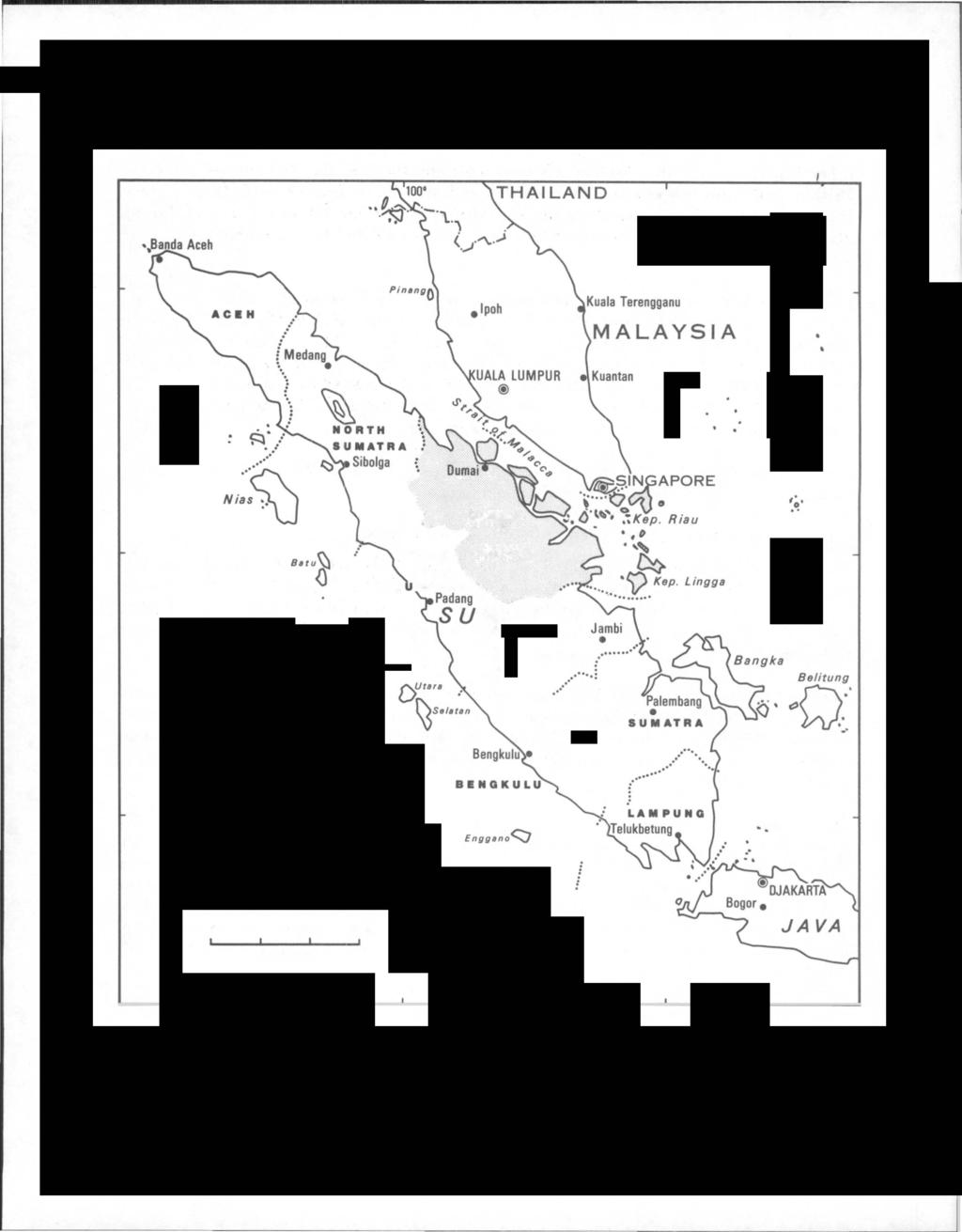
28 20 105' 5' 5' o Sim6UIU 0'. (\ c::::> P.P. B.tU{) :0: KEP ULAUA N !..'.\. '..... :: :. :L... Buk.ittinggi ekan!&ril R I A U.BST.... S MATRA.. rb"" 'tii ra MEN TA W A I SiPO'. ;.. T A.IAMBI.. au",.... [\so,.,:n :... <:: :.... \) i : SOUTH : :.... D R;:.' 0' :.. 5' I N D I A N o C E A N.: ' o ! I I! Kilometres 100' 105' Map2: Areas where ML-Riau is spoken natively The languages found on the Island of Sumatra are: Aceh, Gayo, Alas, Anak Jame, Kluet, Singkel, Melayu Tamiang, Pulo Simeulue Timur, and Simeulue Barat in Acehj Melayu Deli,
29 21 Batak Simalungun, Batak Toba, Nias, Batak Angkola (Mandailing), Batak Karo, Batak Dairi, Minangkabau Tapanuli, Lubu and Uli in North Sumatra; Minangkabau Limo Pulueh Koto, Minangkabau Agam dan Batipoh X Koto, Minangkabau Ranah Paisisie, Minangkabau Tanah Data and Mentawai in West Sumatra; Melayu Riau, Minang Riau Rokan, Minang Riau-Banai, Minang Riau-Pasir, Pangiraian, Sakai, Minang Riau-Kampar, Minang Riau-Taluek Kuantan, Talang Mamak, Orang Hutan, Akek, Orang Laut and Banjar-Tembilahan in Riau and the islands near by; Melayu-Jambi, Minangkabau-Jambi and Kerinci in Jambi; Muko-Muko, Pekal, Rejang, Lembak, Melayu-Bengkulu, Serawai, Pasemah, Mulak and Enggano in Bengkulu; Palembang, Kubu, Musi, Rawas, p,asemah, Enim, Ogan, Komering, Melayu-Bangka, Melayu-Belitung, Semenso, Sekak and Orang Lorn in South Sumatra; Lampung, Melayu-Lampung, Melayu-Pertengahan, Jawa-Lampung and Sunda-Lampung in Lampung. The languages of the islands of Java and Madura are: Javanese, Sundanese, and Madurese. The languages of Bali are: Bali, Bali-Aga, Bali-Jawa, Bali-Sasak, Melayu-Kampung, and Bugis Bali. The languages spoken on the islands of Nusa Tenggara are: Sasak Pejanggik, Sasak Salaparang, Sasak Bayan, Sasak Tanjung, Sasak Pujuk, Sasak Sembalun, Sasak Tebango, Sasak Pengantep, Sasak Bali, Semawa, Semawa Baturotok, Semawa Taliwang, Bima Komodo, Bima-Donggo and Bima-Sangiang in West Nusa Tenggara; Tetun, Buna, Kemak, Dawan, Kupang, Amarasi, Roti, Sawu, Sumba, Alor, Kedang, Lamahalot, Sika, Ende, Ngada and Manggarai in East Nusa Tenggara. The languages found on the Island of Kalimantan are: Melayu-Kalimantan, Kendayan, Iban, Kantuk and Punan in West Kalimantan; Banjar-Kuala, Rantau-Kandangan, Birajang-Labuhan, Amuntai-Tanjung and Melayu-Bugis in South Kalimantan; Bekumpai Dayak in the Province of Central Kalimantan; Berau, Kutai, Pasir, Bulongan, Tidung, Kenyah, Tanjung, Benua, Bahau, Kayan, Putuk, Punan, Basap, Penihing, Lebbu and Bajau in East Kalimantan. The languages of the Island of Sulawesi are: Buginese, Makassarese, Mandarese, and Torajanese in South Sulawesi; Tolaki Mekongga, Tolaki Konawe, Moromene, Wawonii, Kulisusu, Muna, Kabaena, Mawasangka, Laporo, Mandati, Wanci, Lia, Gu, Wolio, Kapota, Takimpo, Kondawa, Wabula, Holimombo, Kaledupa, Kadatua, Sioumpu, Cia-Cia, Tomia, Binongko, Wali and Menui in South-east Sulawesi; Buol, Toli-Toli, Dondo, Dampal, Tialo, Dampelas, Tajio, Balaesang, Rai-Kaili, Laujo, Tara-Kaili. Ledo, Ij a, Daa, Morna, Uma Pipikoro, Unde-kaili, Napu, Bada, Pamona-Bare'e, Wana, Mori, Bungku, Bajo, Menui, Saluan, Balantak and Banggai in Central Sulawesi; Talaud, Bolaang Mangondow, Bulaang Uki, Gorontalo, Limboto, Tilamuta, Kewandang, Sumalata and Bunne in North Sulawesi. The languages found in the Province of Maluku are: Loda, Tobelo, Dodingga, Ka'u, Isam, Waioli, Sahu'u, Galela, Ibu, Ternate, Tidore, Buli, Sawai, Patani, Maba, Weda, Makian Timur, Makian Barat, Kayoa, Wange'e, Kadai, Seboyo, Talo, Seho, Biha, Samada, (M)bono, Mangole, Sanana, O(m)bi, Bacan, Masarete, Waesama, Kayeli, Lisela, Ambelu, Seram Barat, Seram Timur, and Goram.

30 110' SUL U 120' SEA 130' PHILIPPINES.r 140' o f/ Sibe, t. '. M A L A Y 5....\ "' s:"u / ".... P Archipelago./ 0 Na una Besar P A C I F I C o C E A N / \ ( 0 I Anambas Is P.g'i C)C'\ ;_<".. 5(.... ".... Bangka 'I :' "". Palembang.\ S U M A r,' R A " 'W '.... "" Belitung 8 C E L E B E S o 10' I N D I A N o C E A N FL ORES SEA, : M I n '... ț do.... \ We tar.,,' aa 9. 3,Ball i t; a,'io :!. lo!.. e s?:x, B A N 0 A A 10 f... c:::::> 0 Babar 0 8aAYu..,tn '\l./ >o,>d<lt::::j r ,,:. Q.... Lo m bok.,) " Q S E A.A'U Is I N DON E S I A ;, s:::5 S "," S.. TIMOR A R A F U R A S E A Sumba Sawu 0 a Ro" 10' S E A [---[ Kilometres T I M 0 R S E A 100' 110' 120' 130' 140' Sum at r a : 1 Aceh 2 North Sumatra 3 West Sumatra 4 Riau 5 Jambl 6 South Sumatra 7 Bengkulu 8 Lampung J a v.: 9 Metropolitan Jakarta 10 We.t Java 11 Central Java 12 Jogyakarta 13 East Java Kalimantan: 14 West Kalimantan 15 Centra. Kalimantan 16 South Callmantan 17 East Kalimantan Sulaweal: 18 North Sulaweal 19 Central Sulawe.i 20 South Sulaweal 21 Southeast Sulaweal Nusa Tenggara: 22 W.at Nuaa Tengga,a 23 East Nusa Tenggara 24 East Timor Other lalands: 25 Ball 26 Molluc.a 27 Weat Irian Map 3: The Republic of Indonesia by Provinces
31 23 The languages spoken in the Province of Irian Jaya are: Lakahia, Kowiai, Kaniran, Karas, Faur, Patimuni, Kapaur, Onin, Baham, Irartu,.Modan, Yaban Arandai, Yaban Weriagar, Samalek, Mogao, Barau, Sumeri, Niriga, Konda, Kaibus, Moraid, Kalabra, Matbar, Laganyan, Salawati, Misol, Waigeo, Batanta, Raja Ampat, Saparan, Sakabu, Amber, Maibar, Mintamani, Madik, Karon, Amberbaken, Meyach, Mansin, Maro, Hattam, Manikam, Mapia, Biak Numfor, Wandama, Tandia, Goni, Your, Nagara Madu, Iresim, Tarunggara, Mor, Waropen, Pentanden, Porn, Ansus, Natobui, Basami, Serui laut, Turu, Ambai, Wabo, Warabori, Pouwi, Komboi-Ramboi, Kauweraweti, Monau, Tori, Tamaya, Saberi, Tor, Kwesten, Umma, Anus, Sarmi, Mawas, Bonggo, Sufrai, Mremgi, Saweh, Nimboran, Kantuk, Mungge, Wemenggong, Kwangsu, Muris, Nafri, Sentani, Tanah Merah, Humboldt Baai, Urmu, Sko, Sangke, Taikat, Awye, Ampas, Skofro, Tabu, Waris, Waina, Yeti, Wargarindem, Kiamerop, Dera, Wada, Pekekhem, Dani, Ibele, Timorini, Wauwa, Dem, Uhun Duni, Enggipulu, Moni-Mon, Awemblink, Wolani, Ekari, Simori, Yabi, Mimika, Yanur, Sempan, Nafaripi, Asmat, Awyu-Syagha, Yaqai, Kati, Boaji, Yei, Kanum, Moraori, Marina, Oser, Maklew, Yelmek, Mombum, Kimaghama, Dom and Riantana THE SHAPING OF A LINGUA FRANCA Earlier it was mentioned that the word Melayu was first found in one of the chronicles of the old Kingdom of Jambi and that while the word originally referred to a particular language spoken in that kingdom, it came to be used as a cover term for IN and Mal or any other language structurally close to them. The language referred to as Melayu-ML-for many centuries had been the medium of contact for the entire archipelago. It served not only as a lingua franca for the Indonesian peoples but also as the contact language for Indonesians and foreigners (Teeuw 1967). Ancient Chinese chronicles appear to give evidence of this. At the beginning of the Christian era, Chinese travellers coming to Indonesia found there to be a sort of Indonesian lingua franca in the archipelago, which they called Kw'en lun. Although the name Kw'en [un also denoted a number of other native languages in South-East Asia, that it was used to refer to a form of ML is clear from the notes of Itsing, who commented that Sriwijaya was a great centre of learning, where translations were made from the native language into Chinese7 (Alisjahbana in Fishman, ed. 1974, Teeuw 1967). The peoples inhabiting the islands of the Indonesian archipelago belong to the Austronesian family and the languages spoken by them belong to the Austronesian language family (Kern 1957, Mees 1967, Wojowasito 1961). ML is one the of Austronesian languages and is native to Riau, the islands near by and the western coast of the Malay peninsula. Being a member of the Austronesian family of languages, and thus sharing many similarities with other Austronesian languages, ML was readily acceptable as a lingua franca to peoples from outside its area of origin. Though genealogical and historical factors did exist that were favourable to the spread of ML to the other regions of South-East Asia, the language would never be in the position it now enjoys without political and cultural support. Several political powers were involved in fostering the spread of ML: the Kingdom of Sriwijaya, the Malay Kingdoms, and the Kingdom of Riau and Lingga and the islands near by. These kingdoms cover a time period
32 24 stretching from the seventh to the nineteenth centuries A.D. during which time ML developed and spread progressively from its status as merely a native tongue to that of a language of contact among the peoples of the Indonesian archipelago and on to its more prestigious status as the second official language of the Dutch colonial administration The era of the Kingdom of Sriwijaya (7th - 11th centuries A.D.) As a maritime kingdom, Sriwijaya flourished within a relatively short period of time and this was made possible by its strategic location on the Strait of Malacca, an important centre of commerce for centuries where travellers from East and West and from the Indonesian archipelago as well met each other and exchanged their goods as is shown clearly by chronicles from this period. ML, or an older form of it, ML-kuno, was the official language of this kingdom (Hamidy 1973, Alisjahbana in Fishman, ed. 1974). Sriwijaya was the centre of all aspects of life within the kingdom and was the administrative centre of the territories under its control. It was the center of learning and of cultural and religious activity. In referring to Sriwijaya, Usman (1970) cites Gregorio F. Zaide, a Philippine historian: The Empire of Sriwijaya (Sri-Vishaya) emerged from the ashes of Pallawa's maritime colonialism and dominated Malaysia from the eighth century to 1377 A.D. Founded by Hindunized Malays, it was basically Malayan in might, Hinduistic in culture, and Buddhistic in religion. The empire was so named after its capital, Sri-Vishaya, Sumatra. At the height of its power under the Sailendra dynasty, it included Malaya, Ceylon, Borneo, Celebes, the Philippines, and part of Formosa, and probably exercised sovereignty over Cambodia and Champa (Annam) (Zaide 1950:36). According to Mees (1954) Sriwijaya founded a Buddhist university whose students came from throughout the region it controlled. Some of the students even came from the neighbouring Kingdoms of Champa and Cambodia. The medium of instruction of that university and other centres of learning was ML-kuno (Hamidy 1973) or the Kw 'en tun language (Alisj ah bana in Fishman, ed. 1974). Facts about Kw'en tun are limited and knowledge of it derives only from allusions made to it by travellers. A more solid basis was gained from discoveries of Malay or Malay-like inscriptions at Kedukan Bukit (685), Talang Tuwo (684), Kota Kapur (686), Karang Brahi (686), Gandasuli (832), Bogor (942) and, from a much later date, Pagarruyung (1356). Although there still remain uncertainties about the details of these inscriptions, it is a commonly held opinion that they are closest in language to Malay (Usman 1970 and Alisjahbana in Fishman, ed. 1974). The Kedukan Bukit inscription found on the banks of the Tatang River in South Sumatra, dated 683 A.D. or 605 Caka, is considered to be the oldest inscription bearing the name of Sriwijaya. Its language is a mixture of ML-kuno and Sanskrit. The Talang Tuwo inscription, dated 684 A.D., describes the construction of the Criksetra Park built on the order of His Highness Hyang Cri-Jayanaca for the well-being of all the
33 25 people and also contains sacred chants and hopes. In all, the inscription has the characteristics of Buddhist-Mahayana. The Kota Kapur inscription found on the Island of Bangka, and the Karang Brahi inscription found in Jambi are, with the exception of the last sentence, the same in content. The last sentence of the Kota Kapur inscription is absent from the Karang Brahi inscription. Both inscriptions are dated 686 A.D. and both contain appeals to the gods guarding the Kingdom of Sriwijaya to punish the insincere and those who rebel against the sovereignty of Sriwijaya, and also to safeguard the well-being of those who are obedient and loyal to the king of Sriwijaya. Given that the inscriptions just mentioned date from the time of Sriwijaya, it would be reasonable to assume that ML, or at least a ML-like language, played an important role as the lingua franca and official language of that time. Moreover, Itsing's description of the language indicates that it, alongside Sanskrit, played an important role in the political and religious life of the kingdom The era of Malay kingdoms (12th - 19th centuries A.D.) A Sanskrit-influenced ML was dominant throughout the era of Sriwijaya. This is clearly shown by the inscriptions found in various locations in Sumatra. In the following era, however, that of the Malay Kingdoms stretching from the twelfth to the nineteenth centuries A.D., the language in use was virtually free from Sanskrit influence; the ruling kings were Malay descendants. This era can be divided into two major sub-eras: that of the Kingdoms of Bintan and Tumasik and that of the Malay Kingdoms of Riau. The latter sub-era is further divided into three periods: that of the Kingdom of Malacca, that of the Kingdom of Johore and that of the Kingdom of Riau and Lingga. Within this era the spread of ML was extensive and its use went beyond the area of Malay proper. The arrival of the Europeans, and their subsequent use of ML, helped Dot only to spread its use but gave the language a status greater than that of the other Indonesian languages. Pigafetta, who accompanied Magellan on his first tour around the world, wrote the first glossary of ML while his ship waited at harbour in Tidore in His simple glossary is of great significance for it clearly shows that ML, which originated in western Indonesia, had already spread to the easternmost parts of the archipelago by that time. Sixty years later, Jan Huygen van Linschoten, a Dutch navigator who sailed to Indonesia, wrote in his Itinerarium Schipvaert naar Oost olte Portugaels Indien that Malay (ML) was the language of the Orient, and that he who did not understand it was in somewhat the same position as Dutchmen of the period who did not understand French (Alisjahbana in Fishman, ed. 1974:393) The sub-era of the Malay Kingdom of Bintan and Tumasik (12th - 13th centuries A.D.) From the point of view of the development and the spread of ML, this period is not as important as the one that followed. Soon after the Kingdom of Bintan was established on the island of Bintan circumstances forced the King to move his capital to the island of Tumasik, the present site of Singapore. Later on, Tumasik was attacked by forces from the
34 26 Javanese kingdom of Majapahit and, once again, the centre of the kingdom was moved, this time to Malacca on the Malay peninsula. One should take note that these moves were made within the area of Riau, where ML is spoken natively. It is estimated that these moves took place between 1100 and It is unfortunate that there remains no written record of the role of ML during the sub-era of the Bintan-Tumasik kingdoms. But, considering the fact that the area under these kingdoms' control was within the sphere of influence of Sriwijaya, this does help to shed some light on the relation of ML used during the Sriwijaya era and the ML used during the era of the Malay kingdoms. Many linguists and orientalists consider ML-Sriwijaya to be a form of ML-kuno (classic Malay) and this is shown by the inscriptions of the seventh century. Junus (1969) is skeptical of the relation between ML-kuno and ML-Riau, but considering that between ML Sriwijaya and ML-Riau there was ML-Bintan-Tumasik which would form an intermediary language, the link is established and Junus' reservations should be put to rest. Furthermore, if it is considered that any language is but the development of a previous language, the assumption that there is a relation between ML-Sriwijaya and ML-kuno is justified The sub-era of the Malay kingdoms of Riau (14th - 19th centuries A.D.) At this point, for the sake of clarity, a distinction should be made between ML of the era of Sriwijaya and ML of the sub-era of the Malay kingdoms of Riau. As was mentioned earlier ML of the Sriwijaya era was heavily influenced by Sanskrit. Because of its antiquity some linguists refer to this language as ML-kuno (classic Malay). The language of the sub-era of the Malay Kingdoms of Riau was free from Sanskrit influence and had its own identity, that of Riau, and is therefore called ML-Riau The period of the Kingdom of Malacca (14th - 15th centuries A.D.) At the beginning of the 14th century Majapahit forces attacked the kingdom of Tumasik, forcing it to move its administrative centre to Malacca on the Malay peninsula. The customs and the language of the kingdom followed and from that time onwards ML-Riau developed and spread to practically all of the Malay peninsula.8 Malacca flourished for more than 100 years. Strategically locationed at the gate to the Strait of Malacca, the most important sea route communication between East Asia and West Asia and Europe, between the Indian Ocean, the South China Sea and further the Pacific Ocean it was the busiest harbour in all of South-East Asia. At the turn of the fifteenth century, the city also became the centre for the propagation of Islam; on its conversion Winstedt reports (Winstedt 1917:92): Perlak and Pasai in the north of Sumatra were the first Malay centres for the propagation of the Muhammadan faith and culture. At Pasai, in 1407 was buried Abdul'llah ib Muhammad ibn Abdul'l-Kadir ibn Abdul'l-Aziz ibn AI-Mansur Abu Ja'far ai-abbasi al-muntasir, a missionary from Delhi of the house of the
35 27 Abbasides who furnished with Caliphs from the time of Prophet till it was destroyed by the Turks in Pasai converted Malacca, a centre greater than itself. Malacca was now the center of two activities: the development and the spread of ML Malacca and the spread of the teaching of Islam. In fact, these two activities were c,arried out in unison, for the Muslim proselytisers, following in the wake of the sailors and traders, made use of ML. In 1511, Portuguese mercenaries attacked and conquered Malacca and with that the centre of activities for both the development and the spread of ML and the teaching of Islam moved to Johore where a new phase in the development and spread of ML began. Even as centre of the propagation of Christianity and under the domination of the Portuguese, Malacca did continue to play a central role in the spread and the development of ML. Thanks to the Portuguese, the use of ML was not limited only to South-Est Asia, but spread even further to centres of commerce in India and South China. It would be almost impossible to explain how Raniri, the great Islamic theologian and writer, who was born and raised in India, could have had such good command of ML on his arrival in Aceh in 1637, without first accepting that ML must have already been a much used language in Gujarat at the time (Alisjahbana in Fishman, ed. 1974:394). ML found its way to Europe for, in the sixteenth century, it was ML that the princes of the Moluccas used when communicating with the king of Portugal. At the same time, when St Francis Xavier was fighting Islam in the Moluccas, it was ML he used in his expositions of the Christian faith, in order to induce the native inhabitants to embrace Christianity. He himself said that ML was the language everyone understood The period of the kingdom of Johore (16th - 17th centuries A.D.) With the taking of Malacca by the Portugese in 1511, the centre of activity of the kingdom was moved to Johore, an area south of Malacca on the Malay peninsula. Its location, however, was not so strategic as that of Malacca in terms of the development and spread of ML and the teaching of Islam. Nonetheless, the kingdom did contribute significantly to the maintenance of ML as it was during the period of the kingdom of Malacca. In Malacca, the name of ML-Malacca was retained, but to the language Portuguese elements were added and the language took on a somewhat 'pidgin' character. ML-Malacca before the Portuguese conquest was very much different from ML-Malacca under Portuguese domination. It was Johore that upheld the use of ML-Malacca, though under the name of ML-Johore, and acted as the new centre for the spread of Islam. To some extent, ML-Johore played the key role in the dissemination of Islamic teaching to various areas in the eastern part of the Indonesian archipelago. The comprehensive and sophisticated Malay literature of the 16th and, even more so, the 17th century, so heavily influenced by Islamic thought bears witness to the role of ML Johore in the spread of Islam. The role of ML in the Moluccas at the time, as was reported by St Francis Xavier, justifies the truth of the statement.
36 The Period of the kingdom of Riau and Lingga ( 18th - 19th centuries) In 1719 Raja Kecil, the king of Johore, was forced to transfer the capital of his Kingdom to VIu Riau, on the Island of Bintan, one of the Islands of the Riau group (Hamidy 1973). This transfer marked the beginning of another period in the development and spread of ML, that of the kingdom of Riau and Lingga. It was during this period that ML gained its Riau character and it is ML-Riau that is the ancestor of the language adopted as the national language of Indonesia on 28 October The period of the kingdom of Riau and Lingga stretched from 1719, when it was established by Raja Kecil, to 1913, when the kingdom was officially liquidated by the Dutch colonial government. During the almost 200 years of this kingdom's existence three years stand out as being significant to the development and the spread of ML-Riau: 1808, the year in which Raja Ali Haji was born, 1857, the year in which Raja Ali Haji completed his book Bustanul Katibin, a normative grammar of ML-Riau, and 1894, the year in which the printing office Mathba 'atul Riauwiyah or Mathba 'atul Ahmadiyah was established. The establishment of the printing office Mathba 'atul Riauwiyah was very important, and through the books and pamphlets it published, ML-Riau spread to other parts of the archipelago. No less in importance was the fact that the standardisation process of ML Riau had now been started The big split of 1824: the London Treaty The wealth of the Indonesian archipelago and the Malay peninsula brought Europeans and, eventually, European domination and colonisation to this part of South-East Asia. The Dutch first came to Indonesia for business purposes, and on March 20, 1602, established the V.O.C. (Verenigde Oost-Indische Compagnie = East India Company) to handle trading operations. This company operated in Indonesia for almost 200 years until 1799 when it was reorganised as a colonial administration. Given the name Nederlandsch Oost-Indie by the Dutch (Netherlands East Indies), the Indonesian archipelago began to be colonised, a development which brought misery and oppression to most of the indigenous populations. In 1830, for instance, the Dutch colonial government introduced the so-called cultuurstelsel (system of obligatory cultivation) of sugar cane, coffee, indigo, and other commercial commodities very much in demand in the European markets; cultivation of these crops was enforced by the colonial military power.lo On the other side of the Strait of Malacca-on the Malay peninsula-the British colonial power was tightening its grasp. After Malacca fell to the Portuguese, the city became an important centre of commerce. Attracted by the wealth this port brought to the throne of Portugal, the British East India Company, at that time operating in the sub-continent of India, extended its operations to South-East Asia. Conflicts of interests soon arose among the three colonial powers, the British, the Dutch, and the Portuguese. From the point of view of the development and the spread of ML, the Dutch-English conflict was very
37 29 significant because the confrontation between the two powers eventually divided the region in which ML-Johore and ML-Riau were spoken after which the two branches began to develop seperately. On 2 February 1819, about three centuries after the arrival of the Europeans in the Indonesian archipelago, Raffles, on behalf of the British colonial government, established the city of Singapore, on one of the islands of the Riau group. After that time, the Dutch and the British were in constant conflict with each other, which every once in a while resulted in armed clashes. 11 In 1824 a settlement was reached in London to terminate the hostilities between the two colonial powers. This settlement, known as the London Treaty, included the division of the region into two parts with the Indonesian archipelago to be controlled by the Dutch, and the Malay peninsula, including Singapore, to be controlled by the British. The kingdom of Riau and Lingga fell under the Dutch colonial administration and, with that, the split between ML-Riau and ML-Johore was legally realised. ML-Riau, spoken natively in the kingdom of Riau and Lingga and the islands nearby, developed and spread progressively in response to the needs of the communities which used the language as a means of oral communication. From the time of the Treaty on, ML-Riau gained status in the world of literature. Literary works of high standard written by native speakers of ML-Riau began to be published. In 1857 Raja Ali Haji brought out his Bustanul katibin, a normative grammar book of ML Riau. This grammar book was for many years used by schools in the kingdom of Riau and Lingga and in Singapore. Another book of Raja Ali Haji, a kind of encyclopaedic dictionary, was published in Another well-known writer was Raja Ali Tengku Kelana, who wrote Bukhiatul aini fi hurufil maani, the sub-title of which reads: Cita-cita bagi yang berkehendak mengenal huruf-huruf yang berarti (Ideals for those who want to know the meaning of letters of the alphabet). The sub-title reveals that Raja Ali Tengku discusses what linguists now call 'phonemics'. Abu Muhammad Adnan also figured prominently in the development and the enrichment of ML-Riau and is the author of Kitab penolong bagi yang menuntut akan pengetahuan yang patut (A book to assist those who strive for proper knowledge). There were still other writers and men of letters who will not be discussed here but who contributed much to the enrichment, versatility and development of ML-Riau.12 The publications of Raja Ali Haji and the others were the first attempts to standardise ML Riauj later on, at the beginning of the twentieth century these were used as references by Dutch scholars. ML- Riau, as it developed and became enriched, came to be identified by many linguists as High-Malay (ML-Tinggi).I3
38 30 If the two variants of ML (ML-Riau on the Indonesian side and ML-Johore on the Malay peninsular side) are compared in terms of the literary works produced within the same period of time, the result will reveal some interesting points.14 Both strains of literature were heavily influenced by Arabic. Islam and the palace life also figured significantly in literary works of the time that Raja Ali Haji and Abdullah bin Abdul Kadir Munsji were writing (Teeuw 1957, Junus 1969, Hamidy 1973, Rosidi 1964). The three characteristics went together hand in hand for, prior to the period, the two important centres, Pasai in Aceh, Malacca and later Johor on the Malay peninsula, which were strong political powers, supported the spread of the faith. The effective medium of communication to perform the job was ML. One might note here that the literary works of Raja Ali Haji are equal, if not superior, to those of Abdullah bin Abdul Kadir Munsji, yet the name of Abdullah is much more dominant in ML literature than that of Raja Ali Haji (Hamidy 1973). Dutch and British scholars are responsible for this, for in discussions of the literature produced after 1824, the focus was always Abdullah's works, and little, if any, mention was made of the works of Raja Ali Haji. The motives behind this discrimination were political in nature. Raja Ali Haji was an intellectual and close to the court of Riau and Lingga. Whenever there was a conflict with the Dutch colonial administration he stood by his king. In doing so he established himself as a man of principle who condemned the injustices of colonisation, and whose sympathies were reflected in his writing. Therefore, the Dutch viewed him as their enemy and many of the contributions he made to the development and enrichment of ML-Riau, and more importantly, the efforts he made to standardise the language, were not acknowledged properly by the Dutch, and even less so by the British. The works of Abdullah bin Abdul Kadir Munsji, however, enjoyed the endorsement of the British and the Dutch and he is considered by many to be not only one of the men of letters of peninsular Malaya, but of Indonesia as well (Supardo 1956 and Gunadi 1962). From the nationalistic point of view the decision to consider Abdullah as one of the men of letters of Indonesia is debatable. Abdullah resided in Singapore for most of his life. Moreover, he wrote under British colonial rule and consequently, never wrote anything that was related to Indonesian aspirations for independence. Even the aspiration of the people of peninsular Malaya to be free from British domination seemed to escape his observation. Unlike Raja Ali Haji's works, which protested European domination, Abdullah's works reflect an agreement with that domination and sometimes even praise it (Hamidy 1973). As they developed and became richer, both variants of ML gained currency in their respective areas. ML-Riau became ML-Tinggi in the area of Riau and its immediate surroundings, and ML-Johore became ML-Malaya in the Malay peninsula. They are the seeds and the origins of the national languages of independent Malaysia and Indonesia.
39 THE SHAPING OF A NATIONAL LANGUAGE ML-Riau as a second official language of the Dutch colonial administration in 1865 As was stated earlier, the V.D.C. (Dutch East India Company) first began its operations in Indonesia in the seventeenth century. Although the company was primarily a trading organisation, it did make attempts to propagate Christianity in Indonesia just as the Portuguese had done in peninsular Malaya. For this purpose, and as early as the seventeenth century, the V.D.C set up a number of schools whereupon it was immediately faced with the problem of what language to use for the instruction of the native inhabitants. The transformation of the V.D.C. into a colonial government in the nineteenth century highlighted the need for a common language. The colonial administration needed to communicate with the Indonesian masses, and Dutch was unsuitable for this purpose. It was true that the role of Dutch became increasingly strong and pervasive but it was used only at the higher levels of administration and could not be used in dealing with the masses. The colonial administration came up with at least three alternative solutions to the languge problem: 1. to propagate the use of Dutch 2. to use the different vernaculars of the peoples of the archipelago, or 3. to use ML-Riau. Efforts to introduce Dutch presented a number of difficulties, and the local languages and vernaculars were so great in number that of the three alternatives only the third choice was deemed feasible by the colonial administration. ML-Riau's importance as a lingua franca and language of trade between foreigners (Indians, Chinese, Arabs, Europeans) and Indonesians as well as between Indonesians of different native tongues could not be overlooked. Moreover, it was the language used by foreign missionaries to spread their religious teachings, whether Islamic or Christian. After a tour of Java in 1850, the Dutch Governor-General suggested that ML-Riau be made the ordinary medium of instruction in elementary and secondary schools for native Indonesians. He based his suggestion on the grounds that the language was the lingua franca of the entire archipelago and was used equally by all kinds of ethnic groups (Teeuw 1959). Based on the endorsement of Governor-General Rochussen, the Dutch colonial government adopted ML-Riau as the second official language of its administration in Other considerations were taken into account by the Dutch when deciding to make ML Riau the second official language, three of which were that: 1. Historically, ML-Riau originated from ML of the seventh century (from the era of Sriwijaya) and from the different political centres had spread through almost the entire archipelago.
40 32 2. ML-Riau was much more developed and much richer than other vernaculars and, to some extent, had been standardised by Raja Ali Haji and other writers. 3. Many publications in many different fields, such as literature, history, theology, were already available in ML-Riau As an instrument for striving for independence Dutch versus ML As the second official language since 1865, ML functioned as a medium for communication between the higher strata of the governmental apparatus and the Indonesian population. In this position ML stood side by side with Dutch, because of which a kind of rivalry soon appeared between the two languages. In the course of the nineteenth and twentieth centuries, the rivalry between Dutch and ML became increasingly keen and the Dutch colonial government's policy on the question of the language of instruction in elementary and secondary schools was repeatedly changed. Whereas Governor-General Rochussen felt that ML-Riau should be made the ordinary medium of instruction on the grounds that it was used equally well by all kinds of ethnic groups in ordinary social intercourse, the influence in the middle of the nineteenth century of Van der Chijs, who favoured the use of Dutch, was not without effect. Van der Chijs maintained that it was not enough for Indonesians to attend European schools; special schools for Indonesians had to be set up where they could learn to speak Dutch. With this end in view he proposed to establish a system of secondary schools and institutes of learning. The turn of the century saw the rise of what was called an ethical trend in colonial policy, whereby attempts were made to impart to the Indonesians some understanding of European culture through teaching them something of the knowledge and the methodology of Western civilisation. J.H. Abendanon, as Director of the Department of Education in 1900, made strenuous efforts to foster and spread the use of Dutch throughout Indonesia for he was convinced that a knowledge of Dutch would be the shortest way for the Indonesian people to absorb Western culture. Towards this goal, he instituted courses in Dutch in the People's Schools, which provided six years of education, and later made Dutch a compulsory subject in these schools from the third to the sixth grades. As a result Dutch became an extremely important subject of study not only in those schools but also, and in particular, in the Teachers' Colleges. In 1901, C.A. van Ophuijsen published his Kitab logat Me/ajoe whose subtitle reads: Woordenlijst voor de spelling der Male, sche taal (A book on the grammar of Malay: wordlist for spelling the Malay language). In the book he introduced the so-called 'Van Ophuijsen spelling system' which made use of the Roman alphabet.is A few years later, in 1908, the Dutch colonial administration set up a committee whose main task was to provide suitable reading materials for native Indonesians who were able to read and write in the 'Van Ophuijsen spelling system'. This committee, the Commissie voor de Inlandsche School- en Volkslectuur (Commission for the literature of native schools and popular literature) was soon publishing folktales and other literary works available in ML-Riau. The Commission also sponsored the translation of a number of Dutch literary works into ML.
41 33 Because of its success, the Commission was reorganised and in 1920 made into a more permanent office. It was given the name Balai Pustaka, the governmental bureau for popular literature. Before its reorganisation, the Commission's primary task had been to collect and publish traditional popular literature. As a permanent office however its duties were expanded and within the framework of serving the need for good as well as inexpensive reading materials for the growing number of literate Indonesians, this Bureau began to stimulate the writing of original books by Indonesian authors and translating such Western pieces of literature into ML as were considered good and useful reading according to the standards of the officers in charge of the Bureau (Teeuw 1967:14). The romanisation of ML-Riau and the establishment of the Balai Pustaka boosted the development and the spread of ML beyond all expectations and the Dutch colonial administration began to realise that the use of ML might 'boomerang' against their language policy. For not only had ML-Riau become the second official language of the administration, it was now being used as a symbol of the independence movement by nationalists who were striving for freedom from foreign domination. The time had come for a review of the language policy and changes in policy were soon seen. Special schools were established for Indonesian children who wanted to study Dutch at a higher than elementary school level, and when Hazeu became Director of the Department of Education, Dutch began to be taught in the primary schools from the first grade upwards. In 1914 the Dutch colonial government set up the Dutch-Native Schools, where Dutch was used for seven years, as the medium of instruction. Children who graduated from these schools could then continue their education up to the most advanced level. As a consequence of the new language policy Dutch assumed an increasingly important position in Indonesian society. It became not merely a precondition for furthering one's Western education but also for acquiring highly paid jobs. Apart from this, fluency in Dutch gradually came to be the mark of belonging to the new upper class of Indonesian society. Therefore, it was hardly surprising that every year thousands of parents struggled to enrol their children in the Dutch-Native Schools. However, the number of available spaces was far smaller that the number of applicants. People tried to learn the language in other ways, by enrolling in courses instituted by the Algemeen Nederlandsch Ve rbond (General Dutch Association) for example. A number of Dutch educational experts made great efforts to promote the use of Dutch in Indonesia and the most important of these people was G.J. Nieuwenhuis. With a conscious plan in mind he fought for the preeminence of Dutch for he saw it as an instrument of cultural and economic expansion. His stand on the language policy of the colonial administration was as follows: Anyone with the courage to look calmly into the future and yet with concern enough for his children and grand-children and enough feeling for reality and justice not to dream of eternal domination, should not expect a permanent relationship between the mother-country and the colony, but rather make every effort to ensure that some portion of what we have gained and created with so much toil and trouble be preserved for as long as possible. There is no more appropriate means to this end than the dissemination of our language. As with
42 34 every communication of intellectual substance, we shall have gained personal satisfaction for ourselves, and have laid the ground-work for an abiding unity of interests (Alisjahbana in Fishman, ed. 1974: ). It was thus Nieuwenhuis's intention to make Dutch a unifying force in Indonesia. On this point he said that if the Dutch colonial government wanted to promote Indonesian unity, it should begin first with the highest social classes, and then, as the British did in India and the French in Annam, institute the use of a language acceptable for socio-cultural intercourse. Rejecting ML-Riau, Nieuwenhuis decided that this language would have to be Dutch. In 1930 a strong sentiment arose against Nieuwenhuis's viewpoint on the language policy from two separate quarters. First of all a great many Dutchmen were dismayed and alarmed to see that steadily increasing numbers of Indonesians, admitted to secondary schools and the higher levels of education, were coming to occupy increasingly important government positions and were now clamouring for greater privileges. J. W. Meyer Ranneft and others opposed the imparting of Western education to the Indonesians on the grounds that it would have serious economic and cultural consequences. Second, Indonesians themselves, in particular the Indonesian intelligentsia, reacted strongly against Nieuwenhuis's viewpoint. They had struggled to create organisations that would stir the consciousness of the common people and encourage their development and progress, but slowly had come to realise that they would never be able to create close ties with the masses by using Dutch as the medium of communication. Dutch was understood by no more than a tiny minority of Indonesians. On the premise that only by uniting the entire Indonesian people could they generate a force strong enough to challenge the colonial power, they began to look for a language which could be understood by the majority of the people. Their attention was drawn to ML-Riau. This was the language situation in Indonesia at the outbreak of the Second World War ML-Riau as a symbol of the independence movement The establishment of Budi Utama (Beautiful Endeavour) on 20 May, 1908 is generally assumed to mark the beginning of the Indonesian nationalist movement. Initially this organisation 'sought the stimulation and advancement of the Javanese people towards a more harmonious development. It sought to strengthen them to face modern life by rejuvenating Javanese culture' (Van Niel 1960:56, 58). But the establishment of this organisation was significant in that it epitomised the severing of traditional relationships, and from its founding, even the Javanese aristocracy made use of ML-Riau rather than of Javanese.I6 In 1911 the first purely political party was founded, the Indische Pa rtij (Indies Party) and was followed in 1912 by the establishment of Sarekat Islam (Islamic Union), the first modern mass-movement in Indonesia. During the next few years, the Indonesian intelligentsia and semi-intelligentsia who had arisen as a consequence of their Western or Western-oriented education, became more active and began to develop ideas and to organise themselves.
43 35 In this context young people played an important role; they organised themselves into various youth movements, including the youth branch of Budi Utomo, Tri Koro Dharmo (Three Noble Goals), founded in 1915 and soon reorganised as Jong Java (Young Java) after the establishment of the Jong Sumatranen Bond (Young Sumatran Union) in These youth organisations were essentially of a non-political character, but the young people active in them, mostly students at teachers' colleges, were unmistakably influenced by nationalistic aspirations. Around 1920 the liberal Dutch Government was replaced by a conservative one and the new administration began to institute a stifling colonial policy. As a reaction to these measures, the ideal of an independent Indonesia began to take shape and the older concept of forming some kind of 'association' gave way to a struggle for complete independence (Teeuw 1967:3-4). The first step towards making ML-Riau a symbol of the struggle for independence was probably taken by the Jong Sumatranen Bond. The program of its second congress reads as follows: The first day will be devoted to the discussion of social phenomena in Sumatra (geography, ethnology, history, customs, social conditions, etc.). Malay and Dutch languages both admitted. The second day will be used for discussion of the Malay language and literature. Only High (Riau) Malay admitted (Teeuw 1967:9). From that time on, ML-Riau played an ever important role as the medium of communication within the nationalist movement. The native press, active since 1900, prepared the language for this role. It is worthwhile to note that it was primarily the journalists who became the political leaders and the opinion makers in the course of the struggle for independence. Aware of the importance of the native press in disseminating the ideal of an independent Indonesia made the Dutch colonial administration set up a special office, the Bureau for Popular Literature, for the purpose of keeping as complete documentation as possible of the native newspapers. In 1918 the agency subscribed to 40 newspapers, but by the end of 1925 this number had grown to nearly 200 almost all of which used ML-Riau, the language which the nationalist movement in all its manifestations utilised, the language in which the leaders of the independence movements could reach the masses, the language in which the masses expected to hear new things which lay outside their daily local sphere of interest. In 1926 the first Indonesian Youth Congress was held in Jakarta. Its main purpose was to unify the various youth organisations, which at that time were differentiated along regional and religious lines.17 This congress is an indication of the growing feelings of unity within the nationalist movement as a whole and the rising tension between the nationalists and the colonial government. One of the speeches at the Youth Congress of 1926 was given by Muhammad Yamin, and it dealt with the future possibilities of Indonesian languages and literature. The speaker stressed the practical advantages of spreading knowledge of ML-Riau amongst the Indonesians as the easiest and most obvious medium for inter-insular contact. He also put
44 36 forward his conviction that ML-Riau would become the obvious choice for Indonesians as a language for conversation and unity, and that the future Indonesian culture would find its expression in that language (Teeuw 1967). In the same year, 1926, Jong Java, by far the largest youth organisation at that time, acknowledged ML as the medium of communication in its meetings, although its main asset at the time appeared to be that it was a bahasa gampang, an easy language. IS One year later, however, during its 10th congress at Semarang, held from 26 to 31 December, 1927, this organisation too spoke of persatuan Indonesia, Indonesian unity, and of the national language, Bahasa Indonesia. Thus far, ML-Riau had three roles or functions: 1. A traditional function: as the mother tongue of the people inhabiting Riau proper and the islands nearby, 2. An ad hoc function: as the second official language of the Dutch colonial administration, 3. A national function: as the language of the nationalist movements advocating Indonesia's independence ML as the language of Balai Pustaka As was mentioned earlier the romanisation of ML-Riau and the setting up of Balai Pustaka (hereinafter BP) at the turn of the twentieth century accelerated the development and the spread of the language. From that time on, not only did ML-Riau function as the second official language of the colonial administration but it began to play the role of a literary language as well (Junus 1969). BP contributed much to the development and the spread of ML-Riau. It gave the language the added role of a language of literature and provided people who were able to read ML Riau with reading materials on popular science and literature. More importantly, it stimulated the writing of original books by Indonesian authors in many subjects, including novels and dramas. BP took a strictly neutral stand on religious issues but political views contrary to government policy were unacceptable, and 'immoral' literary works were not considered for publication. Even with these restrictions BP did play a positive and stimulating role in the development of modern Indonesian literature. BP not only offered Indonesian writers publishing facilities unavailable to them anywhere else at the time but, because of its public libraries and local selling branches and the low prices as a non-profit making, governmentsupported institution, the low prices of its publications assured them of a large reading public. It would be no exaggeration to say that the coming into being and the popularity of the modern Indonesian novel was largely made possible through the existence of BP. Most of the writers who produced nationalist-oriented literature were employed, for shorter or longer period by BP or at least had some of their work published there. This list would
45 37 include the leading men of the Pudjangga Baru group (Sanusi Pane, Amir Hamzah, Armijn Pane, Sutan Takdir Alisjahbana, etc.). It is but proper to state that modern Indonesian literature was born together with the creation of BP around The writing of novels in pre-war times, as was manifested mainly through the channels of BP was facilitated by the existence of a lingua franca, that being ML-Riau, which was the language of BP from the time of its inception up to the time when that language was adopted as the national language of Indonesia IN AS A NATIONAL LANGUAGE The All Indonesian Youth Congress of October 28, 1928 in Jakarta: ML to become IN. The Indonesian youth held their first congress was held from 30 April to May 1926 in Jakarta. The congress, under the leadership of M. Tabrani, had a two fold program: to spread nationalism and to foster unity among youth organisations. One of the speeches at the congress was given by Muhammad Yamin, and it dealt with the future of ML-Riau and its literature. The congress contributed significantly to the development of a consciousness of Indonesian nationality, and the rapid advances made by those movements striving for Indonesian unity were stimulated by this new consciousness. One effect of the congress was that use of ML became increasingly widespread. Two other important events took place in 1926: the recognition by Jong Java of ML-Riau as the medium of communication in its meetings and the establishment of Perhimpunan Pelajar-Pelajar Indonesia (Federation of student movements of Indonesia) in September in Jakarta, one of whose programs was to create a united youth organisation with which to challenge Dutch colonialism effectively. In propagating its objectives this new and more militant youth organisation made intensive use of ML-Riau (Reksodipuro and Soebagijo 1974). Politically significant and linguistically decisive, the establishment of Pa rtai Nasional Indonesia (The Indonesian Nationalist Party) on 4 July, 1927 in Bandung by Sukarno and his friends, in the hope of creating a united national movement, meant that the ideal of unity and of one national language had finally matured. At the end of the same year, on 17 December, under the leadership of Partai Nasional Indonesia a federation of nationalist movements was established. Included in this federation, given the name Pe rmufakatan Perhimpunan-Perhimpunan Politik Kebangsaan Indonesia (Federation of Indonesian Nationalist Movement), were Partai Nasional Indonesia, Partai Sarekat Islam (Islamic Union Party), Budi Utomo, Pasundan, Kaum Betawi, Sumatranen Bond, and various Study Clubs. Pre-war nationalism reached its peak in Indonesian nationalism, the ultimate goal of the Federation of Indonesian Nationalist Movements, had fully matured, surpassing ethnicgroup loyalties. Under the auspices of the Federation, a Committee was set up with the
46 38 task of convening the second congress of Indonesian youth organisations. In June 1928 the composition of the Committee was officially announced.2o A number of historical decisions were made at this two-day congress held on October, 1928, which helped determine the course of history of the Indonesian people. At this congress the young delegates pledged that they were of one nation, one people and had one language, the Indonesian language. It was here that the word Melayu was replaced by Indonesia to describe the language. The decision not only settled the nomenclature of the language, but also its place in Indonesian society. The competition between Dutch and ML (now IN) was now at an end. The decision, of course, also meant acceptance of the task to develop IN further to enable it to replace Dutch as a means of entry into modern world culture (Alisjahbana in Fishman, ed. 1974) IN as the language of Angkatan PtJdjangga Baru The proclamation of ML as the language of unity on 28 October, 1928 is regarded by the people of Indonesia as the real beginning of Bahasa Indonesia as both the medium and symbol of national freedom. Nonetheless at the time of the proclamation, a number of factors did exist which made it seem very doubtful whether ML would really be able to fulfill the role for which it had been cast by the youth of Indonesia. It is also true that some experts, including Hooykaas and Berg, were of the opinion that ML was unfit to become a modern civilised language (Hooykaas 1939 and Berg 1939). In practice many Indonesians did in fact fail to live up to their ideal on many occasions after But whatever doubts once existed it cannot now be denied that the ideal has become reality and IN is the nation's medium of political unity, and modern literature. The proclamation did not mean the immediate flowering of an impressive literature. Circumstances were against it. First of all, the number of writers skilled in the language at the time was very limited. Of those who did write in the pre-war years, most were Sumatrans with at least a partial Western education which made them receptive to literature in the modern sense of the word. Furthermore, potential literati were especially persons who had undergone teacher training, the number of whom was small. Second, political and social circumstances after 1928 were far from conducive to the flourishing of an Indonesian literature. The colonial government was suspicious of anything connected with the name Indonesia. It is true that BP strongly urged the production of reading material in this period and did not refrain even from publishing books which were of importance within the framework of nationalism; the term Indonesia was freely used. But active encouragement of all that the ideal of IN implied in the cultural field could hardly be expected in this period. Despite the small number of people interested in literature during this period, there was a strongly felt need for an independent literary magazine. Until this time poems and literary essays had been published sporadically in journals, newspapers and other publications not purely devoted to literature. In 1932 Pa nji Pu staka (Banner of letters), a general weekly published by BP, started a literary column, which included poetry, but this hardly satisfied the aspirations of the nationalistically minded young authors. A year later, in July of 1933, the first issue of a new magazine Pudjangga Baru (New writers) appeared, whose editors
47 39 included Sutan Takdir Alisjahbana, Armijn Pane and Amir Hamzah. This was a magazine designed to promote IN and its literature. Indonesian political and cultural leaders of Indonesia rallied to its support. Pudjangga Bam, with its sub-title Majalah bulanan kesusasteraan dan bahasa serta seni dan kebudayaan (Monthly magazine for literature, language, art and culture), was destined to play an important role in furthering the development and spread of IN and its literature. Though in the strict meaning of the term, it was a literary magazine only to a limited degree, it dominated the pre-war literary scene from 1933 onwards. In its third year, Pudjangga Bam changed its sub-title to Pembawa semangat baru dalam kesusastraan, seni, kebudayaan dan soal masyarakat umum (Bearer of a new spirit in literature, art, culture, and general social problems), and then later still to Pembimbing semangat baru yang dinamis untuk membentuk kebudayaan baru, kebudayaan persatuan Indonesia (Conveyer of a new, dynamic spirit for the formation of a new culture, a culture of Indonesian unity). It is not surprising that so much attention was paid to the language problem, especially during the first years of Pudjangga Bam's existence. The issue of IN as the national language of the country was a burning question, one that elicited lyrical glorifications as well as a growing critical awareness of a number of questions which arose from the historic decision of the Youth Congress of S. Yudho's song of dedication to the language is worth quoting here: BAHASAKU Bahasaku, Pengantar jiwa-ragaku, Penggambar sukma bersendu Pengikat kehendak satu, Penyebar seman gat baru. Bahasaku, Bersinar kilau-kilau Bagai embun ditinjau, Dicahyai matahari silau, Kujunjung tinggi, Engkau. Bahasaku, Kamu pengobar semangat, Kamu pendengung nan kuat Gemuruh dentammu pesat, Menggempar sebagai kilat.
48 40 Bahasaku, Lemah lembut suaranya, Mericik air mengalir laksana, Mengembus sepoi-sepoi basa, Bergelak orang tertawa. Bahasaku, Ngandung rasa kehalusan Penuh dengan kaindahan, Tanda seni-kebudayaan, Dari bangsaku sekalian. Bahasaku, Dalammu tersembunyi, Segala kekuatan ta' terperi Bagai penawar penyakit rohani, Menghaluskan budi pekerti. Bahasaku, Pusaka moyangku luhur, Jika lenyap, bila luntur, Berarti bangsaku mundur, Aku sedia turut mengatur.21 As one of the editors and founders of Pudjangga Baru, Alisjahbana did his utmost, during the pre-war years of the magazine, to give shape to the ideal of IN as the medium of a new literature. His Tebaran Mega (Scattering of clouds), a small collection of poems, first appeared in a 1936 issue of Pudjangga Baru. It is occasional poetry, written around the time of the death of the author's first wife, not ambitious poetry, but honest and straightforward, and very characteristic of the power and personal validity of the poet's ideals.22 Alisjahbana did not restrict himself to creative work. In fact his main contribution probably lies in his critical works and essays, a good example of which is found in his series of articles Puisi Indonesia baru (new Indonesian poetry), in which he deals with various aspects of contemporary poetry. This is not literary criticism in the strict sense of the word. Alisjahbana was interested in literature as an expression and reflection of social conditions and in this new poetry he is looking for the new Indonesian, as he gives shade to the national and social struggle an admiration for nature, religious convictions the ideal IN and the emancipation of women. Alisjahbana had very definite ideas about the shape of the new Indonesian culture and about the role of the artist whom he saw as being responsible for the creation of this culture. His ideas were far from generally accepted at the time and lengthy discussions took place that revolved around aspects of the problem of the new culture. Many of these, set down in essay form, were published after the war in a separate book edited by Achdiat Kartamihardja, under the title Polemik kebudayaan (polemics on culture). This book

49 41 contains contributions by Sutan Takdir Alisjahbana, Sanusi Pane, Dr Purbatjaraka, Dr Sutomo, Tj indarbumi, Adinegoro, Dr M. Amir, and Ki Hadjar Dewantara (Teeuw 1967:35-36). There can be no doubt that Amir Hamzah is the most important pre-war Indonesian author. It is true that he had neither the outgoing, infectious activism of a Sutan Takdir Alisjahbana, nor the progressive modernism of an Armijn Pane, nor the lofty aspirations to a synthesis between East and West of a Sanusi Pane. His single but outstanding contribution to pre-war literature is the creation of a few score poems of such a penetrating power that they fully entitle their author to the title of 'Prince of the Poets of Pudjangga Baru,. 23 In the case of Amir Hamzah, there seems at least one factor which was propitious to him in making him a great poet: he was a Malay par excellence. Not only was his native tongue ML (ML-Langkat of North Sumatra), but as the son of the Bendahara Paduka Raja, the prime-minister of the sultanate of Langkat, in North Sumatra, he was nourri dans Ie serail of Malay literature and culture (Teeuw 1967:85). To him ML was an asset rather than a liability. Furthermore, he was not a pure Malay in the sense that his life and culture were never touched by foreign influences. On the contrary, nearly all his poems were written in Java, where he lived and studied for a number of years. As a young Indonesian rather than as a Malay, he took an active part in the Pudjangga Baru group and though he was never prominent in the organisation he was one of the founders of the journal. The majority of his poems were published in two volumes, both separate issues of Pudjangga Baru. His first collection, Nyanyi sunyi (song of solitude), was published In 1937 and his second, Buah rindu (longing), appeared in The literature produced by the PudJoangga Baru, with the sole exception of Amir Hamzah's work, did not survive the revolution of Even the judgment imposed on them by later generations tends to underline the similarity between the Tachtigers 25 and the Pudjangga Baruo Nevertheless, these 'new writers' gave what they had to give, they believed in and worked for the ideal of a new Indonesian literature, and by their work stirred up Indonesian consciousness of this ideal. The fact that this ideal was not fully realised until later does not detract from the importance and merit of the Pudjangga Baru. Moreover, the fact that Amir Hamzah, the greatest pre-war poet of Indonesia, was inspired by this group, and took the opportunity to publish his main collections in its magazine, has given it a lasting glory (Teeuw 1967:45-46) The 1938 Congress on IN in Solo Earlier it was mentioned that leaders of political and cultural movements of Indonesia rallied to support the mission of the journal Pujangga Baru. It was this same group of leaders that took the initiative of holding the First Congress on IN at Surakarta (Solo), from 25 to 28 June, Notable among the resolutions passed by this Congress was the affirmation of the need to create an institute and a faculty for the study of IN, to decide on technical terminology, to create a new orthography, and to codify a new grammar in accordance with the changes
50 42 taking place in the structure of the language. In addition, the Congress advanced the demand that IN be made the language of law and the medium of exchange in the various reprsentative bodies. All of these resolution were to remain on paper for there was no organisation behind the Congress which could put its twelve-point resolution into effect (Alisjahbana in Fishman, ed. 1974:191) The Japanese occupation of : language planning theories in practice Four years after the First Congress on IN, in early 1942, the Japanese Imperial Armed Forces landed in Indonesia. Shortly after seizing the colonial governmental apparatus, one of their acts was to abolish the use of Dutch, hitherto the official language, and the only means of entry into the world of modern culture for the Indonesian intelligentsia. The fundamental nature of this change can be demonstrated most clearly and convincingly in the field of language as stated above. Until 1942 Dutch was undisputedly the main language, not only in politics and administration, but also culturally and socially. Even leading Indonesians, fervently devoted to the cause of nationalism, and in theory subscribing to the ideal of IN as the national language of the country, in practice found the use of Dutch obligatory and customary in many situations. Dutch, after all, was the language of their education, the language which they used for the discussion of intellectual, cultural, even political issues, and the language in which they wrote and thought as a modern people. Now it suddenly had to disappear. The Japanese soon abolished it as the official language and forbade its public use. Even then it was clear that the Japanese intended to replace Dutch by Japanese, but, although Japanese was taught in every department and school, this goal could only have been reached after a period of many years, however great Indonesian enthusiasm might have been for studying the Japanese language. The Japanese could not afford to wait so long and they, like all the people who came to Indonesia before them, were forced to make use of IN. IN was the only language apart from Dutch suitable for use in all functions. IN thus became not merely the language of the law and official pronouncements, but also of official correspondence between government departments, and between the government and the people. Likewise IN was used in all schools from primary schools up to university level. The superseding of the Dutch language by IN was a fulfilment of political aspirations; nonetheless it was a shock to many Indonesians, to whom Dutch had been so familiar for such a long time. This change from Dutch to IN in 1942 or early 1943 marked the real change, a much greater revolution than the later proclamation of IN as the official national language in the provisional Constitution of the Republic of Indonesia in 1945 (Teeuw 1967:106). The period of was one in which ideas and information never before conveyed in IN had to be communicated in the language. The result was that it suddenly began to grow at a tremendous pace. One might call this flowering of IN forced growth, designed to enable it to exercise the functions of a modern language in the shortest possible time.
51 43 The Japanese forces were so fully bent on mobilising the total energies and manpower of the Indonesian people for the Greater East Asian War that they penetrated to the most remote villages, using IN wherever they went. Consequently, the language spread rapidly in all directions and the Indonesians experienced a sensation they had never known before. As the war continued, and the number of Indonesians speaking IN rose, a feeling of mutual solidarity took deeper and stronger roots. IN became a symbol of Indonesian unity in the real sense of the word. It became clear to the Japanese military administration that they could not arrest the development of IN and therefore had to provide a means by which the Indonesians could pefect and amplify their language. On 20 October, 1942 the Japanese military government in Indonesia inaugurated a Commission on IN made up of many Indonesian leaders, including Sukarno and Hatta.27 For reasons of efficiency, the Commission divided itself into three working sections: 1. The first, in charge of the writing of a normative grammar, was headed by Professor Dr P.A. Hoesein Djajadiningrat. 2. The second, in charge of the selection of new words for daily use, was chaired by S. Mangoensarkoro. 3. The third, in charge of the coining of new terminology for science and technology, was led by Mohammad Hatta. This section was further divided into several sub-sections, each of which was in charge of a particular discipline (Alisjahbana 1945). The task of writing a standard modern grammar posed a difficult problem to the first section for it first had to decide just what IN was and what it should be. First, IN was defined as a modern language comparable to Dutch or English, based sociologically on the lingua franca and linguistically on ML-Riau. Second, while the job of a modern linguist usually consists of describing the rules of grammar of a group of people, the task of the Indonesian language planners in writing such a grammar was a creative one for it was necessary not only to examine the existing IN varieties but also to decide what the new standard language should be. In deciding on a standard language, members of the Commission belonging to this section faced many problems. First of all, it was necessary to find the best samples of IN as defined above, upon which to base the new grammar. These examples were thought to be in the writing of those persons who had a command of the rules of ML-Riau or ML-Tinggi (High Malay) and who, at the same time, had a good modern education. Examples were taken from the written works of such pesons as H. Agus Salim, Sanusi Pane, Mohammad Hatta, M.R. Dajoh, Imam Supardi, and others. It was felt that the standard grammar should be a normative one, one which reflected the most disciplined, sophisticated, and polished language. Though the challenge was great it was not one impossible to overcome. Standardisation had in fact already begun. Ch. van Ophuijsen had already written an acceptable ML grammar, Kitab logat bahasa Melayu, and created an efficient orthography in There
52 44 were other supportive factors as well, including the establishment of the BP during the Dutch colonial period, and the systematic use of ML in the primary schools and teachertraining colleges. In many instances, the rules of traditional ML could be accepted without modification; IN was, after all, a continuation of ML but, because of the influence of local vernaculars as well as of Dutch and English, there were differences in the use of affixes, word-formation, and word-usage. The question was how to cope with these differences. Leaning too heavily on traditional ML would have meant producing a very traditional ML grammar, one not only awkward in modern usage but also strange to its users. On the other hand, an eagerness to accept influences from other local vernaculars might have resulted in grammatical inconsistency. Furthermore, a too liberal acceptance of forms deriving from other languages could mean the loss of great deal of the language's Malay or Malayo-Polynesian character. Moreover, this would present difficulties in arriving at a consistent set of rules. Thus, the task of the grammar-writers was a delicate, complex one and to a certain extent a creative one as well. In addition to a thorough command of the modern language at all levels of usage, they had to have an open mind so as to be able to understand the tendencies and possibilities of the language and tensions posed by its rapid change. At the same time, they had to be aware that a well-formulated and a well integrated language should achieve a balance between old potentialities and the exigencies of the new realities. The task of the second section was to determine which, among the thousands of new words used in the newspapers, books, speeches, and other materials, could readily be incorporated into IN. The need for this working section was apparent because the common belief was that ML was restricted to those words found only in Van Ophuijsen's work and the other dictionaries of the time. It was obvious enough that the problem this working section faced was the writing of an up-to-date dictionary. This task was accomplished by W.J.S. Poerwadarminta in his excellent Kamus umum Bahasa Indonesia (general dictionary of IN) which was published by Balai Pustaka for the first time in To expedite the task of the working section on terminology, the third section, offices and institutions were urged to send in lists of terms either in use by them or needed by them. At the Office of the Commission, these terms were put on cards with one or more tentative equivalents in IN. Terms defined within a special subject such as botany, physics, economics or mathematics were given on one set of cards. On another, larger, set of cards all of the terms of the various special areas were pooled together. The terms were then submitted to a meeting of a sub-section on a special subject. The results of the meeting were then sent to a larger section on terminology. At the meeting of the larger section, representatives of the other sub-sections had the opportunity to compare the terms with their own and to express their criticisms. As a result of these deliberations, some changes were made in the list. Later, this list of terms was again discussed in the
53 45 plenary session of the Commission on IN. The decision of this session was final. The terms were then published in the official Government Gazette. Lists were also published by the Office of the Commission on IN and distributed to the public. Some guidelines for the coining of modern terms were established and the order of preference for terms was as follows: IN words, if possible; if not, then Asian words; and if not, then international terms. These guidelines, however, were never literally applied. In most cases, the decision regarding a new term depended upon the composition of the members present at a particular meeting. Those of Javanese origin usually preferred Sanskrit or Old Javanese words, devout Muslims tended to prefer words of Arabic origin and a third group preferred international terms. Referring to the process by which new terms were coined, Alisjahbana (in Rubin and Jernudd, eds 1971) had the following to say: In quick transition from Dutch to IN during the Japanese occupation, everybody not only felt the need for the codification of the new terms but also was eager to contribute to the task. Since the scientific, technological, and other modern concepts were already available and easily accessible in the existing modern languages, the process of the codification of modern IN terms could proceed steadily without too much difficulty. Things, however, did not roll smoothly in the beginning. From the start it was felt that the Japanese, who initially set up the Commission on IN, were not sincere in their desire to assist the development of IN. The Japanese occupation forces had been welcomed by many Indonesians as liberators from colonial domination, but they soon turned out to be much more restrictive than the Dutch colonial administration had ever been. While they were aware that the progress of IN was inevitable they seemed to hamper rather than promote its growth. For example, a full year went by before they provided office space where the Commission could carry out its daily activities. This language Office was headed by Sutan Takdir Alilsjahbana, assisted by Ida Nasution in the section in charge of the writing of a normative grammar. Other officers were Mohammad Halil and Soebadio, who were III charge of the selection of new words for daily use, H. Agus Salim and Mirjam Mangoendiningrat, who were in charge of the coining of new modern terminology. Official recognition of the term Bahasa Indonesia was not made public by the Japanese occupation force until 29 April, 1945, when the war situation was at its worst level for them. Prior to that time, the Japanese used the term Bahasa Melayu. The Office of Education of the Japanese war administration never forwarded any of the terms coined by the Commission to schools and to other offices concerned with language problem. Decisions made by the Commission were not made public, except for the first set which was published in Ken Poo Nos. 37, 38, and 39. The Japanese did not fulfill their promise to appoint officers. to work for the Commission in the Government Offices.
54 46 Japanese personnel who were members of the Commission or worked at the Office of Education, paid little or no attention to the Commission's work. Despite all these restrictions and obstructions, the Commission did succeed in compiling a dictionary of terminology which was published in This success was the result of the hard work of the Indonesian members of the Commission, especially those of the section responsible for the coining of new terminology. The Dictionary of Terminology contained all the terms which, after passing through three levels of discussion, had been given the Commission's approval. When the dictionary was first published it included 493 legal terms, 3132 medical terms, 867 terms on chemistry, 164 terms on administration, 521 terms on algebra, and 990 terms on physics.28 In the field of literature, the impact of the events of 1942 is clear and one of the effects was the voluntary cessation of the publication of Pujangga Baru by its editors. Though this monthly was nationalistic in spirit and, as such, had been opposed to the colonial government, it was also so strongly in favour of Western ideas like democracy, etc. that Alisjah bana and his colleagues realised that the journal would not be able to survive very long under the fascistic Japanese domination (Teeuw 1967:106). Nevertheless, Alisjahbana and his followers did continue their work in the field of language planning without let-up IN as an official national language according to the 1945 Constitution: the language of ' Angkatan 45' The Indonesian Revolution broke out after the Declaration of Independence on 17 August, The new nation's Constitution stipulated that IN would be the official language as well as the national language of the country. This was in effect only a confirmation of what had long been the practice. After the Second World War, when the Dutch government attempted to establish the Federal States of East Indonesia and Pasundan (in West Java), it had no choice in the matter of language. The two Federal States accepted IN as their official language. Earlier, on November 6, 1945, the Dutch Lieutenant Governor-General had proclaimed IN as the second official language besides Dutch. When the Federal States were reintegrated into the United States of Indonesia in 1950, IN automatically became the official language of the Union and was used in all government departments and on all official occasions. Meanwhile, the work of establishing a scientific and technical vocabulary that had been started during the Japanese occupation was carried on even more intensively. Van Ophuijsen's writing system which had been in use since the turn of the twentieth century was improved by R. Soewandi, who introduced a new writing system which is called after his name. R. Soewandi, then Minister of Education and Culture, in his Letter of Decision of March 19, 1937, No. 264/Bhg. A, followed by another Letter of Decision of April 15, 1947, made public the new writing system that was to replace the Van Ophuijsen orthography. In June 1947, the Minister of Education and Culture issued another Letter of Decision No.
55 47 700/Bhg. A, which stressed the need to develop IN further to enable it to play its role as the official language of the Republic of Indonesia. A new Working Committee on IN was set up, with Sutan Takdir Alisjahbana appointed to chair the Committee made up of Adinegoro, W.J.S. Poerwadarminta, K. St. Pamoentjak, R. Satjadibrata, and R.T. Amin Singgih Tj itrosoma. The duties of this Working Committee were similar to those of the Japanese-established commission, and were: 1. To coin terminology for science and technology, and for daily activities in society. 2. To write a normative grammmar of IN for use at all levels of the educational system. 3. To compile a new dictionary or to perfect one of the existing ones. This Working Committee was short-lived. About a month after its establishment, Jakarta was reoccupied by the Dutch military forces, causing key personnel of the Republic to evacuate to Jogyakarta, the new capital city of the Republic of Indonesia. Some of the members of the Working Committee, however, stayed on in Jakarta and continued the activities of the Committee on an unofficial basis. Sutan Takdir Alisjahbana was one of them.29 A few months after the Central Government of the Republic of Indonesia had settled itself in the new capital city, the Minister of Education and Culture issued a Letter of Decision of 26 February, 1948, No. 1532/A authorising the establishment of the Balai Bahasa, a Language Centre, as one of the offices of the Department of Education and Culture in Jogyakarta. The New Language Centre was inaugurated by Ali Sastroamidjojo, the new Minister of Education and Culture, in March The Advisory Board of the new office was made up of Dr Poerbatjaraka, Dr Prijana, Dr Priohutomo, Dr Soemadi, Ki Hadjar Dewantara, and Ki Mangunsarkoro. Organisational heads of the Language Centre were: Director: P.F. Dahler, followed a few months later, by Professor Dr Prijana Secretary: I.P. Simandjuntak Head of the IN Section: St. Moh. Zain Head of the Javanese Section: Tardjan Hadidjaja Head of the Sundanese Section: Iskak Adiwidjaja Head of the Madurese Section: Surowidjojo The Language Centre had the following tasks: 1. To observe and to study the development of the national language of Indonesia and all other vernaculars of the archipelago in their spoken as well as written forms. 2. To advise the public and to establish guidelines concerning the national language and the vernaculars.
56 48 3. To promote unity in matters of national language and local languages. After the transfer of sovereignty from the Dutch colonial administration to the United States of Indonesia, in early 1950, the centre of language planning activities returned to Jakarta. The work of Balai Bahasa was continued by Lembaga Bahasa dan Budaya (Institute of Language and Culture), established in August, 1952 and affiliated with the Faculty of Letters and Philosophy of the University of Indonesia, under the leadership of Professor Dr Prijana. A larger Committee on Terminology was set up on 28 May, 1951 (see Appendix B). At the beginning of the Japanese occupation the journal Pudjangga Baru ceased publication. The Pudjangga Baru as a literary movement came to a sudden stop as well. The ideals of this movement, essentially romantic and sentimental and even provincial in nature, had no appeal to the new and younger generation who had come of age in a time of upheaval. The time called for deeds rather than dreams and the generation that arose after the proclamation of independence on 17 August, 1945, called itself Angkatan 45 (Generation of 45). Chairil Anwar spear-headed this new generation. According to Jassin (1953a:189) the term Angkatan 45 was first launched by Rosihan Anwar in the 9 January, 1949 issue of Siasat. He fu rther indicates that the group of writers who first began to introduce themselves during the years after the proclamation had been known by various other designations before the term Angkatan 45 gained currency. Sitor Situmorang defended the use of the term Angkatan 45, and the generation denoted by this term, and very much opposed Armijn Pane's view that the differences between Pudjangga Baru and Angkatan 45 were insubstantial. On the difference between Angkatan 45 and Pudjangga Baru, personified by Chairil Anwar and Sutan Takdir Alisjahbana, Situmorang wrote the following: Chairil has elan minus the assurance of a scholarly background, and on the other hand Takdir has the assurance of scholarly backgrounds, without the elan Chairil's generation has no history, it produces the revolution and is born out of it. They have no philosophy of life, only an attitude of life... the culture of Chairil Anwar is an explosive one, which turns everything topsy turvy and only then begins to fashion anew. But I admit that this creative phase is only the beginning of a beginning (Teeuw 1967: ). Situmorang recognised that the fundamental lack of the Angkatan 45 was knowledge-a possibly temporary one perhaps but one that does explain the impasse that did occur. Sitor clearly recognised the danger of that impasse remaining, but nevertheless continued to defend the notion of the generation of the revolution as a valid classification. The characteristics of this generation were universality and human dignity. 30 In the years following the transfer of sovereignty in ] 950, Angkatan 45 conducted meetings, congresses and symposia, in which the subjects of culture and literature were taken up an discussed in depth. It was on the initiative of Sutan Takdir Alisjahbana that informal meetings were held in Pasar Minggu (near Jakarta) and in Tugu (near Puncak Pass, south of Jakarta), in which
57 49 most of the discussions were centred on the relationship of Pudjangga Baru to the post-war literature. Literature also came under discussion at congresses arranged by more or less official cultural organisations. The first of these was the Cultural Congress in Magelang organised in 1948 by the Republican authorities. In 1950, the Cultural Congress was held in Jakarta, under the auspices of the Lembaga Kebudayaan Indonesia (Indonesian Foundation for Culture). This was followed by the second Indonesian Cultural Congress held in Bandung, from 6 to 11 October, The third Cultural Congress, organised by the Badan Musyawarah Kebudayaan Nasional (National Cultural Council), was held in Solo from 18 to 23 September, The Language Congress held in Medan from 28 October to 2 November, 1954 was convened mainly to discuss IN and to identify and offer solutions for the problems it faced, and so was therefore only indirectly concerned with literature. Symposia were also held, the first of which was held in Amsterdam on 26 June 1953, and was attended by a number of prominent Indonesian writers who, by chance, were in the city at the time. The first literary symposium of the students of the Faculty of Letters in Jakarta was held at the end of In this symposium, which was to become an annual event, strictly literary problems were discussed. Since that time, symposia devoted to Indonesian literary problems have been held on numerous other occasions The 1954 Congress on IN in Medan Sixteen years after the first Congress on IN in Solo, another Congress, bigger and more prestigious, was convened in Medan from 28 October to 2 November, 1954 by the Ministry of Education and Culture of the Republic of Indonesia. This Congress was attended by at least 279 linguists, writers, language planners, and journalists who came from all over Indonesia, plus 23 observers from the Malay Peninsula and Europe.32 Because the Congress was organised by the Ministry of Education and Culture, which was headed by Mohammad Yamin at the time, the Congress commanded much more prestige than the one convened in Solo. In addition, President Soekarno himself officially opened the Congress. The six-day Congress studied five aspects of the nature of problems faced by IN: (1) The grammar of IN and the romanised spelling system it used, (2) IN in law and administration, (3) IN in science and technology and the compilation of an etymological dictionary, (4) IN as a language of daily intercourse, and (5) IN in the press and radio. These topics were discussed seperately by special sections. Eleven papers were presented at the Congress and were given by Dr Prijana who discussed 'the grammar of IN and the spelling system of IN using the Latin alphabet'; A.G. Pringgodigdo whose paper was entitled 'IN in law and administration'; Kuntjoro Purbopranoto with a paper of the same title as Pringgodigdo's but one emphasising different aspects; Dr Prijohutomo who presented two related papers, 'IN in science and technology' and 'the compilation of an etymology dictionary of IN; Inu Perbatasari enlightened the Congress with his paper 'IN in films'; J.E. Tatengkeng and Madong Lubis, both with papers on 'IN as a language of daily intercourse' but emphasising different foci; Bahrum Rangkuti with a paper entitled 'IN in prose writing and poetry'; T. Sjahril whose paper was entitled 'the function of IN in press'; Adinegoro who presented a paper on the
58 50 theme covered by Sjahril entitled 'IN in the press'; and Kamarsjah whose paper was on 'IN in radio'. The most important and well-known result of this Congress was its recognition of ML as the origin of IN and that IN is ML which has developed from, and been enriched by, the local languages of the Indonesian archipelago32(pembinaan Bahasa Indonesia 1954:1-6, Jawatan Kebudayaan Kern. P.P. dan K. Bahagian Bahasa 1955) The birth of a new generation in 1966: Angkatan 66 In a paper given by Aj ip Rosidi at a literary symposium held during the University students' art week in August, 1960, entitled Sumbangan angkatan terbaru sastrawan Indonesia kepada perkembangan kesusasteraan Indonesia (the contribution of the latest generation of Indonesian writers to the development of Indonesian literature) he attempted to find differences between the generation which he called Angkatan Terbaru (the latest generation) and the previous Angkatan 45. According to Ajip Rosidi, in or around 1953 members of Angkatan 45 began to lose their vigour. At the same time a new group of writers emerged whose orientation was not outwards, toward foreign literature, but towards Indonesia's own authors such as Yamin, Sanusi Pane, Alisjahbana, Amir Hamzah, Chairil Anwar, Idrus and others. This outward orientation had very much characterised Angkatan 45 and produced in that generation an alienation from its native earth even greater than that of Pudjangga Baru. Both generations, Angkatan Pudjangga Baru and Angkatan 45, were fundamentally the same in their approach, which was universal and international; what marked the new generation that Ajip Rosidi called Angkatan Te rbaru was its search for new values in provincial cultures that were utterly ignored by Pudjangga Baru and Angkatan 45 (Rosidi 1964). Launched in 1960, the name Angkatan Terbaru, met with little response, just as had happened with the name Angkatan 50 (Generation of 50) before it, given in Jogyakarta towards the end of 1953 by W.S. Rendra and his friends. Pudjangga Baru was able to survive because of the journal of the same name. Rendra and his friends chose the name Angkatan 50 merely out of group sentiment, that is, for those writers who began to produce work in However, because the year 1950 was too close to 1945 and the former group offered no concepts that were essentially different from those of Angkatan 45, and as there was no outstanding historical event that took place in that year, the name perished at its embryo stage.33 The year ]966 saw the rise of a new generation of authors, Angkatan 66 (Generation of 66) whose appearance was stimulated by the tumult that marked this period of Indonesian history. Just as in 1943 when Chairil Anwar rebelled against the oppression of Japanese imperial rule with his Aku ini binatang jalang dari kumpulannya terbuang (I am a wild beast thrown out of its pack), 1966 saw an uprising of poets, writers, and intellectuals against the grand scale abuse of the nation's structure. The main concept espoused by Angkatan 66 was that of Pa ncasila, the nation's five-point ideology.34 As an ideal, a nation based on Pa ncasila is an admirable one but in the years preceding 1966 the nation's leaders paid but mere lip service to this ideal. Religion no longer had a role to play in national life. Indonesian Socialism was now just a figment of
59 51 the imagination; democracy, renamed guided democracy, was a euphemism for dictatorship and timocracy; and humanism, a principle favouring the unity of all peoples, brought Indonesia into confrontation with the whole world. All of this was done in the name of the Indonesian people. Relations with foreign countries were broken off, and in 1963 the nation withdrew from the United Nations Organisation and afterwards formed the Jakarta - Pnom Penh - Beijing - Pyongyang alliance, which opened the way for Communism to pl y a free hand in national life. The hapless course of the nation left its economy in ruins. The people, poorer than they had ever been before were pushed to the limits of their endurance. On September 30, 1965 an attempted coup was launched by the Indonesian Communist Party (PKI) known as Gerakan 30 September (The 30 September Movement)35. This movement was immediately crushed by the people who considered the PKI to be behind the catastrophic situation the nation was in. In unison the students, artists, writers, and intellectuals, demanded that PKI be abolished, that the Cabinet be replaced, and that the prices of commodities be lowered. This tumultuous times, forged a unity of spirit among the writers who comprised the Angkatan 66 and was the impetus behind the publication of a number of interesting collections of poems, including Tirani (tyranny) and Benteng (fortress), both by Taufiq Ismail; Mereka telah bangkit (they have risen) by Bur Rasuanto; Perlawanan (struggle) by Mansur Samin; Pembebasan (setting free) by Abd. Wahid Situmeang; and Kebangkitan (the rising) an anthology of poems by five students from the Faculty of Letters of the University of Indonesia. As these collections of poems were meant for immediate communication to the masses, they were merely stencilled and read at large gatherings. Newspapers collected and published the poems in their cultural columns and it soon became evident that the public had been thirsting for such reading matter. The poems expressed what was then on the public's mind and the poets used their creative ability to fight against injustice. As important as the pamphlets circulating in great numbers and the scrawls that were postered on the walls throughout the city, literature became a tool of the struggle. Taufiq Ismail's collections of poems, Tirani and Benteng, were published by Gema Psychologi (the echo of psychology) in March 1966 and were dedicated to the KAMI/KAPPI36 students who had been killed in demonstrations. Perlawanan by Mansur Samin, published by Sanggar Ibukota, was also dedicated to the students from schools and universities, who died in the struggle; and Mereka telah bangkit by Bur Rasuanto, put out by the same publisher in February 1966, was dedicated to the generation which had risen to fight and take over responsibility for the future. The IN used by Angkatan 66 to express their protests against tyranny and injustice showed itself to be evocative and very communicative, proof of its potential richness.37
60 Seminar on IN in Jakarta In 1968 a seminar on IN was held in Jakarta, probably the first seminar in which institutes of higher education took part. Participation in the seminar by the Faculty of Letters of the University of Indonesia, and by the Institute of Teacher Training and Educational Sciences signalled active involvement of the University and the Institute in the language planning processes. With the exception of various symposia on IN literature, the University and Institute had not previously taken part in language seminars and congresses. Convened within the framework of the commemoration of the fiftieth anniversary of the Sumpah Pemuda (Youth Pledge), the seminar was held from 26 to 28 October, 1968 at the Faculty of Letters of the University of Indonesia. Three workshops were set up, one on standardisation, one on grammar, and one on language usage. Three to five papers were presented in each workshop, including: ( 1 ) 'Fungsi standardisasi dalam pertumbuhan Bahasa Indonesia menjadi bahasa kebangsaan dan bahasa resmi modern' (the function of standardisation in developing IN as a national language and a modern official language) by Sutan Takdir Alisjahbana; (2) 'Bahasa Indonesia dan pembakuannya - suatu tinjauan sosiolinguistik' (IN and its standardisation-a sociolinguistic perspective) by Anton M. Moeliono; (3) 'Lafal dan ejaan' (pronunciation and the writing system) by Abdul Latief; (4) 'Ciri-ciri prosodi kalimat Bahasa Indonesia' (the characteristics of sentential prosody of IN) by Samsuri; (5) 'Partikel-partikel Bahasa Indonesia' (particles in IN) by M. Ramlan; (6) 'Gatra dalam tatabahasa Indonesia' (the concept of gatra in IN grammar) by Djoko Kentjono; (7) 'Kalimat dan strategi ilmu bahasa' (sentence and linguistic strategy) by Umar Junus; (8) 'Pengajaran Bahasa Indonesia diperguruan tinggi' (the teaching of IN at university level) by A.M. Affandi; (9) 'Proses pemodernan Bahasa Melayu di Malaysia' (the process of modernisation of Malay in Malaysia) by Hasan Ahmad; ( 10) 'Bahasa Indonesia dalam kesusasteraan' (IN in literature) by M.S. Hutagalung; (11) 'Beberapa persoalan yang dihadapi Bahasa Indonesia sebagai bahasa ilmu pengetahuan (laporan ringkas)' (some problems faced by IN as a scientific language (a brief report)) by Harimurti Kridalaksana; (12) 'Bahasa dalam sanjak' (language in verse) by Umar Junus. A number of recommendations were made as a result of the three day Seminar: ( 1 ) That the Directorate of Language and Literature, of the Directorate General of Culture, Department of Education and Culture, should, as soon as possible, be elevated in status to the level of a national institute with full powers and authority; (2) that the new orthography of 1966 be made public as soon as possible as the standardised writing system to replace the orthography of 1947, which would be phased out within five years time; and (3) as the mastery of IN by university students is far from satisfactory, that the study of IN be introduced as one of the required courses for a whole academic year at the university level Seminar on IN in Puncak Pass By 1970 the post-gestapu situation in Indonesia had improved significantly. The three basic demands of the students who took to the streets in 1966 had been fulfilled by the Government: the PKI (Communist Party of Indonesia) was abolished and the teaching of Communism banned forever; the Dwikora Cabinet was revamped; and the prices of basic commodities has been lowered.
61 53 During the second half of the 1960s world opinion of Indonesia was at its lowest level but by 1970, it had regained its former level. The domestic political situation was under control. University students were off the streets and back in the classrooms. The confrontation policy of Indonesian against Malaysia was ended in 1965 and Indonesia and Malaysia, two countries whose language and peoples are of the same Malay origin, shared friendly relations once more. In December 1970 Mashuri, then the Minister of Education and Culture, invited some prominent staff members of the Faculty of Letters, University of Indonesia, to discuss the possibility of implementing two of the resolutions passed by the Seminar on IN of The Government felt that the time had come to pay more attention to the development of the national language. Present at the meeting were Harsja W. Bachtiar, Lukman Ali, Samsuri, Affandi, Anton M. Moeliono, Kartomo, and others.39 Bachtiar, Ali, Affandi, Samsuri, and Moeliono were assigned by the Minister to draw up plans for the establishment of a Centre for Language Development to replace LBN, which had little authority and was, as an organisation, extremely inefficient. In conjunction with this task, the Consortium of Social Sciences, Department of Education and Culture, with Harsja W. Bachtiar as its Executive Secretary, convened a Seminar on IN at Puncak Pass, West Java, from 2 to 3 March, Two significant contributions were made by this seminar: (1) a writing system of IN, later proclaimed by President Soeharto as the new writing system for IN on 16 August, 1972; and (2) endorsement of the plan to establish a Center for Language Development to replace LBN. 40 Nine papers were presented at the Seminar: (1) 'Peranan Bahasa Indonesia dalam pendidikan' (the role of IN in education) by Prof. I.P. Simandjuntak; (2) 'Penggunaan bahasa dalam ilmu pengetahuan' (the use of language in science) by Andi Hakim Nasution; (3) 'Penggunaan bahasa dalam komunikasi resmi dan dibidang administrasi' (the use of language in official communication and administration) by Awaluddin Djamin; (4) 'Penggunaan bahasa dalam pers' (the use of language in the press) by Mochtar Lubis; (5) 'Masalah penulisan kata-kata Arab dengan huruf Latin di Indonesia' (the problems of romanising Arabic words in Indonesia) by H. Bahrum Rangkuti; (6) 'Ejaan yang disempurnakan dalam penulisan kata-kata bahasa Arab' (the revised orthography and the writing of Arabic words) by Sudarno; (7) 'Ejaan yang disempurnakan dan pengembangan istilah-istilah ilmiah' (the revised orthography and the coining of scientific terms) by Prof. H. Johannes; (8) 'Ejaan yang disempurnakan dalam hubungan dengan pendidikan' (The revised orthograhy and education) by H. Gazali Dunia; and (9) 'Ejaan yang disempurnakan dan perkembangan ilmu bahasa' (The revised orthography and the development of linguistics) by Amran Halim. Four sections were set up to discuss these nine papers: Section one, under the leadership of HAMKA (Haji Abdul Malik Karim Amrullah), to discuss the problems concerning the revised orthography and the spelling of Arabic words; Section two, chaired by S. W. Rudjiati Muljadi, to deliberate on the problems of the revised orthography and the coining of scientific terminology; Section three, under the direction of Samsuri to discuss the problems of the revised orthography in conjunction with education; and Section four, chaired by Asrul Sani, to discuss the problems of the revised orthography and the development of linguisticsy
62 THE SHAPING OF A LANGUAGE OF WIDER COMMUNICATION Language agreement between Indonesia and Malaysia The colonisation of Indonesia and Malaysia by two different powers was in a way responsible for the emergence of ML into two national languages: IN and Mal. The early national movement in Indonesia widened the dialectal gap between the varieties concerned. With Indonesia's recognition of ML as IN, the nation's official language grew into one which in terms of its vocabulary was fully able to cope with the diverse functions it had to perform. ML became the national language of Malaya, or Malaysia as it is now called, only in 1957 when the country gained its independence from British rule. Indonesia's successful struggle against colonialism and the success IN enjoyed in its role as the national language and the language of education had a great impact in Malaysia. The two most glaring differences between IN and Mal were their spelling systems and new vocabulary, specifically the scientific terms. In , efforts were made to come up with a standardised spelling system for the two countries but circumstances did not allow the creation of such a system until August On 18 August, 1972, the long awaited system was announced simultaneously in Jakarta and Kuala Lumpur as the official system of spelling of both countries. A grace period of five years was allowed for complete adoption of the new system (Asmah Haji Omar 1975:84-85). At the end of that period almost no more traces of the old spelling systems used by the two countries remained. This was due in great part to the willingness of both Governments to finally implement the Indonesia-Malaysia Cultural Agreement of 1957, which had been ignored during the 'confrontation era' of the Soekarno administration. An even greater share of the tribute for the successful implementation of the spelling system must of course go to the people of both nations, members of one family, long separated by political divisions. The detente that was achieved in the form of the spelling agreement marked the beginning of further cooperation between the two nations in the fields of language and culture. A pemanent body Majelz"s Bahasa Indonesz"a-Malaysia (language Council of Indonesia-Malaysia) was set up by the two Governments in 1972 to plan and to implement cooperative measures in the field of language. The creation of this 'Majelis Bahasa Indonesia-Malaysia' marked a new phase in the historical development of ML, which is IN in Indonesia and Mal in Malaysia. The language was now being shaped as a language of wider communication Seminar on the National Language Policy of 1975 Prior to the holding of the Seminar on National Language Policy of 1975, a Pre-seminar on National Language Policy was held from 29 to 31 October in This Pre-seminar was convened by the newly established Centre for Language Development in Jakarta for the purpose of formulating the basic strategy for the nation's language policy. As the matter of language must be seen as part of a larger social-cultural phenomenon not only linguists and
63 55 language planners but also prominent figures in other fields presented papers at the Pre-seminar.42 Papers were given by scholars who had distinguished themselves in their respective fields and whose interests also encompassed the development of the national language as well. The titles of these papers reflected an array of interests and included: ( 1 ) 'Fungsi politik Bahasa Nasional' (the function of National Language policy) by Amran Halim, (2) 'Lembaga Bahasa Nasional dan pengembangan bahasa' (the Institute of National Language and the development of languages) by S. Effendi, (3) 'Politik Bahasa Nasional dan pembinaan Bahasa Indonesia' (The National Language Policy and the development of IN) by Sutan Takdir Alisjahbana, (4) 'Pengembangan Bahasa Nasional sebagai Unsur Kebudayaan Nasional' (the development of national language as one of the elements of the national culture) by Kuntjaraningrat, (5) 'Politik Bahasa Nasional dan pengajaran bahasa' (The National Language Policy and language teaching) by Jazir Burhan, (6) 'Politik Bahasa Nasional dan ketahanan nasional' (The National Language Policy and national endurance) by Imam Sukarsono, (7) 'Politik Bahasa Nasional dan pengembangan pendidikan' (The National Language Policy and the development of educational by Basjuni Suriamihardja, (8) 'Politik Bahasa Nasional dan pengembangan kesusasteraan' (The National Language policy and the development of literature) by Ajip Rosidi, and (9) 'Persoalan Bahasa Indonesia untuk pers' (IN as the language of the press and its problems) by Goenawan Mohammad (Halim 1976). The Pre-seminar accomplished its goal of formulating the basic strategy of the national language policy. The strategy that evolved states that national language policy is integral to the development of the language as a whole and that it involves three main language areas: ( 1 ) maintenance, development, standardisation, and the teaching of IN, (2) maintenance, development, standardisation, and the teaching of local vernaculars currently used by the different ethnic groups in Indonesia, and (3) the use and the development of teaching of foreign languages (Halim 1976). The Seminar on National Language Policy convened by the Centre for Language Development from 25 to 28 February, 1975 in Jakarta was a continuation of the Preseminar held in A large number of participants joined in the activities of the Seminar43 the aim of which was to categorically develop plans based on the basic strategy of the national language policy as it had been formulated by the Pre-seminar. The Seminar, therefore, dealt with the following questions: ( 1 ) the planning and the formulation of the contents of the basic strategy of the national language policy, (2) the formulation and establishment of procedures and guidelines for a general policy on research, development, standardisation, and the teaching of language and literature, and (3) the establishment of a general plan for the development of national language policy. Ten papers were presented at the Seminar, including: (1) 'Fungsi dan kedudukan Bahasa Indonesia' (the function and status of IN) by Amran Halim, (2) 'Ciri-ciri Bahasa Indonesia baku' (the characteristics of standardised IN) by Anton M. Moeliono, (3) 'Tata cara pembakuan dan pengembangan Bahasa Indonesia' (procedures of standardising and developing IN) by Harimurti Kridalaksana, (4) 'Pengajaran Bahasa Indonesia (the teaching of IN) by I Gusti Ngurah Oka, (5) 'Fungsi dan kedudukan bahasa daerah' (the function and
64 56 status of local vernaculars) by S. Wojowasito, (6) 'Pengembangan bahasa daerah' (the development of the vernaculars) by Ajip Rosidi, (7) 'Pengajaran bahasa daerah' (the teaching of local vernaculars) by Tarwotjo, (8) 'Inventarisasi bahasa daerah' (the inventory of local vernaculars) by S. Effendi, (9) 'Fungsi dan kedudukan bahasa asing' (the function and status of foreign languages) by Giri Kartono, and (10) 'Pengajaran bahasa asing' (the teaching of foreign languages) by Retmono. After four days of deliberations and discussions the Seminar arrived at a number of conclusions, and came up with a list of recommendations, the most important of which were the formulation of the roles and functions of the national language, local vernaculars, and foreign languages. Earlier it was mentioned that in its capacity as a national language, IN has functions as (1) a symbol of national pride, (2) a symbol of national identity, (3) an instrument for uniting the diverse ethnolinguistic groups, and (4) a means of inter-cultural and inter-regional communication. As the state language, IN functions as (1) the official language of the state, (2) the official medium of instruction in educational institutions, (3) the official means of communication at the national level for planning, development, and government activities, and (4) the official language for cultural development and science and technology. The local vernaculars, on the other hand, function as (1) symbols of regional pride, (2) symbols of regional identity, and (3) a means of communication for intra-regional activities. In relation to the function of IN, vernaculars act as (1) supporting elements of the national language, (2) media of instruction in the lower levels of elementary schools in certain regions in order to facilitate the teaching of IN and other subjects, and (3) a means of developing and supporting the regional cultures. In relation to IN, languages such as English, French, German, Dutch have the role of foreign languages. These languages are taught as foreign languages at certain levels of education institutions and, as such, are not rivals of IN as a national language. In their capacities as foreign languages, languages such as English, French, etc. function as (1) a means of international communication, (2) supporting instruments in making IN a modern language, and (3) instruments for the utilisation of modern science and technology to further national development (Halim 1976) Conference on IN and IN Literature of 1978 A Conference on IN and IN literature was convened by the Center for Language Development from 13 to 18 February, 1978 in Jakarta. Attended by prominent linguists, men of letters, journalists, and writers from all over Indonesia and some representatives from 'Dewan Bahasa dan Pustaka' and the Ministry of Education and Culture of the Federation of Malaysia, the Conference had two main goals: to assess the development of IN literature and to evaluate the on going process of standardisation of IN.
65 57 During the six day conference 40 papers were read, most of which were concerned with structural problems of IN and sociolinguistic aspects of IN in relation to the standardisation process. Sixteen papers dealt with IN literature, and were off with a paper by A. Teeuw entitled 'Sastra dalam ketegangan antara tradisi dan pembaruan' (The tension between traditional and modern literature). The twenty-four papers which dealt with the process of standardisation of IN can be grouped into four topics; namely, methodologies for teaching IN effectively, sociolinguistic aspects of the use of IN in Indonesia's multi-ethnic society, theoretical treatments of grammatical aspects of IN, and IN lexicography. Six papers were concerned with methodologies for the effective teaching of IN. They were: (1) 'Penerapan asas-asas ilmu bahasa untuk menyusun metodologi pengajaran di sekolah menengah' (The application of linguistic principles in formulating teaching methodology for secondary schools) by Sunardji, (2) 'Tinjauan kebahasaan karangan murid sekolah menengah dan yang sederadjat' (The linguistic aspects of the compositions of the students of secondary schools) by Dirgo Sabariyanto, (3) 'Peranan pengajaran kemampuan bahasa dalam pengembangan sastra Indonesia' (The teaching of language proficiency and the development of IN literature) by S. Suharianto, (4) 'Fonologi kontrastif Makassar Indonesia' (Contrastive phonology of Makassarese and IN) by Indiyah Imran. (5) 'Penangkapan kata-kata asing dalam Bahasa Indonesia oleh lulusan sekolah lanjutan tingkat atas' (The understanding of foreign words used in IN by senior High School graduates) by A. Marzuki, and (6) 'Bahasa pengantar dan pelajaran bahasa di sekolah luar biasa bisu tuli' (The medium of instruction and language teaching at special schools for the deaf and dumb) by Epe Syafei Adisastra. Papers dealing with socio-linguistic aspects of the use of IN in Indonesia's multi-ethnic society, were: (1) 'Graffiti dan pemakaian Bahasa Indonesia oleh remaja: menolak kerutan dahi' (Graffiti and the use of IN by the adolescents) by Boen S. Oemarjati, (2) 'Fungsi Bahasa Indonesia bagi penutur suku Madura perantauan' (The function of IN for migrated speakers of Madurese) by I.L. Marsoedi, (3) 'Beberapa homonim yang menarik dalam bahasa Malaysia dan Bahasa Indonesia' (Some interesting homonyms in Mal and IN) by Uk un Suryaman, (4) 'Kata mubazir dalam berita surat kabar harian berbahasa Indonesia' (Redundant words in news items in IN newspapers) by B.H. Hoed, (5) 'Sikap kebahasaan orang tua dan efeknya terhadap pembinaan Bahasa Indonesia di lingkungan keluarga' (Parental attitudes towards language and their impact on the development of IN at home) by Muhammad Anwar Yahya, (6) 'Tutur ringkas Bahasa Indonesia' (Reduced forms of discourse in IN) by Soepomo Poedjosoedarmo, and (7) 'Keutuhan wacana' (The completeness of a discourse) by Harimurti Kridalaksana. The theoretical treatment of grammatical aspects of IN was discussed in the following papers: (1) 'Hambatan-hambatan semantik atas terjadinya afiksasi men-' (Semantic constraints on the formation of affix men-) by Daulat Purnama Tampubolon, (2) 'Kata majemuk Bahasa Indonesia' (IN compound words) by Sarjana Hadiatmaja, (3) 'Gatra dan kemungkinan pemutasinya dalam kalimat Bahasa Indonesia' (Gatra and its possible permutations in IN sentences) by Daliman Edi Subroto, (4) 'Kategorisasi morfologis kata benda dalam Bahasa Indonesia' (Morphological categorisation of the nouns in IN) by
66 58 K. Karno Ekowardono, (5) 'Awalan pe- (per-) dalam Bahasa Indonesia' (The prefix pe (per) in IN) by Sudjarwo, (6) 'Beberapa catatan mengenai kata pemisah dalam Bahasa Indonesia (Some notes on copulative words in IN) by Florentina Sudarti, (7) 'Suatu pengamatan tentang kalimat cleft dalam Bahasa Indonesia' (Cleft sentences in IN: an observation) by Maruli Butar-Butar, (8) 'Fokus dan alat-alat pembentukannya dalam Bahasa Indonesia' (Focus and its construction in IN) by Samsuri, (9) 'Patokan makin singkat makin baik dan terjemahan sebelum alih ejaan dalam pembentukan istilah' (The assumption of the shorter the better, and translation before transliteration in coining terminology) by Liek Wilardjo and (10) 'Pengelaborasian Bahasa Indonesia dan masalahmasalah kodifikasinya' (The elaboration of IN and its codification problems) by Tallei. Only one paper dealt with the problem of IN lexicography. This was 'Entri dan pemasalahannya dalam penyusunan kamus Ekabasa Bahasa Indonesia' (The entries and their problems in compiling a mono langual dictionary of IN) presented by Adi Sunaryo. Judging from the array of language problems covered at the Conference it could be said that the Centre for Language Development has succeeded in arousing the interests of scholars in the field of language standardisation. Furthermore, the majority of speakers were young scholars, a healthy sign for the development of IN. 2.6 SUMMARY This chapter discussed the historical development of ML which can be divided into four main stages: (1) the shaping of a lingua franca, (2) the shaping of a national language, (3) IN as a national language, and (4) the shaping of a language of wider communication. The first stage included discussion of the Kingdom of Sriwijaya (7th - 11th centuries) with its two sub-eras, namely, the Kingdoms of Bintan and Tumasik and the Malay Kingdoms of Riau. Historically, the sub-era of the Kingdoms of Riau (14th - 19th centuries) is a very important one for it was within this sub-era that the "Big Split of 1824" occurred. In terms of the development of ML, when the Dutch colonial administration adopted ML as a second official language of its administration in 1865, the language entered its second stage, the shaping of a national language. This stage ended when the language was proclaimed as the national language of Indonesia on 28 October, 1928 whereupon it entered its third stage. The fourth stage began when the Governments of Indonesia and Malaysia publicly announced the -unified system of spelling for IN and ML on August 16, The substantive development of ML/IN occurred during the second and the third stages, which covered a time span from 1865 to The important developments that took place during this time, and during the history of ML as a whole are shown in Figure 1. In terms of the functional development of ML, this chapter discussed the role of ML as a lingua franca of the Indonesian archipelago, its role as a second official language of the Dutch colonial administration and of the Japanese occupying forces, and its role as the national language of Indonesia. The functional development of ML is shown in Figure 2.
67 59 Figure 1 HISTORICAL DEVELOPMENT OF ML 7th-11th centuries 12th-19th centuries 12th-13th centuries 14th-19th centuries 14th-15th centuries 16th-17th centuries 18th century ML of the Era of Sriwijaya ML of the Era of Malay Kingdoms ML of the Sub-Era of the Kingdoms of Bintan and Tumasik ML of the Sub-Era of the Kingdoms of Riau ML of the period of the Kingdoms of Malacca ML of the period of the Kingdom of Johore ML of the period of the Kingdom of Riau and Lingga The founding of Singapore The big split (London Treaty) ML-Riau in the Indonesian Archipelago Efforts of standardisation by Raja Ali Haji 1865 ML-Riau as the second official language 1901 Kitab Logat ML by Van Ophuijsen 1918 ML entered the Volksraad 1920 ML became the language of Balai Puataka ML became the language of the nationalist movements 1928 The Youth Pledge, ML became IN 1933 IN became the language of Pudjangga Baru 1938 The first Congress on In at Solo 1942 to 1945 The Japanese occupation of Indonesia: IN as the sole medium of instruction 1945 Proclamation of Independence: IN became the national and state language IN became the language of Angkatan The second Congress at Medan 1966 IN became the language of Angkatan Language Agreement between Indonesia and Malaysia Majelis Bahasa Indonesia-Malaysia ML-Johore in the Malay Peninsula and Singapore 1956 ML became the language of Malay and Singapore 1869 ML became the language of Federation Malaysia 1972 Language Agreement Majelis Bahasa Indonesia-Malaysia August 16, 1972 August 30, Unified Orthography Unified Terminology Language of wider communication Language of ASEAN International Language
68 60 Figure 2 FUNCTIONAL DEVELOPMENT OF ML INDONESIAN LANGUAGES I ML-Riau I ML as the language of the nationalist Youth Pledge of 1928 IN became IN I IN as the unifying language of multi-ethnic Indonesia I. ProclamatIOn of independence of 1945; IN as the national language I Constitution of 1945; IN as the national and official language of the state I IN as the language of supra-ethnic norm I IN as a symbol of national pride and unity (still going on) ML as a vernacular The vernacular of the people of the Province of Riau and the islands near-by I (still going on) I ML as the second official language of the Dutch colonial administration 1865 ML/IN as the second official language of the Japanese occupying forces April 29, 1945 I ML/IN as the second official language of the NICA * November 6, 1945 (terminated here) *Note: NICA = Netherlands Indies Care-taker Administration. This Administration was supposed to take over Indonesia from the Japanese.
69 61 Notes lindonesia was fortunate in that when the time came to adopt a national language, there was no problem. This was not true in India or in the Philippines. India experienced a 'language war', while the Philippines experienced a 'war of concepts' between those who advocated Tagalog as the national language and those who preferred their vernacular as the national language. There are fewer native speakers of Tagalog than of the other vernaculars. 2The 1968 Seminar on IN was convened by the Faculty of Letters, University of Indonesia, from October in Jakarta. At the time Professor Dr Slametmuljana was the Dean of that Faculty. 3Before the Second World War the Jawi script and the Roman alphabet were both used. With minor variations the Jawi script is the same as the Arabic script introduced into the archipelago together with Islam. 4The original text in IN reads as follows: Asal Bahasa Indonesia ialah bahasa Melayu. Dasar Bahasa Indonesia ialah bahasa Melayu yang disesuaikan dengan pertumbuhannya dalam masyarakat Indonesia sekarang. 5Timor Timur (East Timor) was integrated into the Republic of Indonesia as its twentyseventh province only in Because of lack of data, the language situation of this province is not presented here. 6No research has been done on the majority of these languages. It is, therefore, difficult to state the exact number of languages found in the Indonesian archipelago. The 418 figure of LBN is only an approximation. 7 Kw'en [un or Kw'un [un is used for the indigenous language of different areas (Cambodia, Burma, Madagascar). It would not seem necessary to assume that it always indicated the same language. Alisjahbana and Teeuw use the term to indicate that an old form of ML was in use at that time. 8The language is heavily influenced by the Portuguese language and, therefore, linguists and language scholars often refer to it as ML-Malacca. 9The following is a list of important events that took place during the Kingdom of Riau and Lingga which are relevant to the spread and development of ML-Riau: Bendahara Abdul Jalil became Sultan, the last Sultan who reigned from Johore Raja Kecil transferred the centre of his kingdom to Ulu Riau, built his palace at Ulu Riau, and was crowned as the King of Riau Sultan Mahmud moved his court to Lingga.
70 The Dutch built a fort at Tanjungpinang, one of the islands of the Riau group The British conquered Malacca and recognised Riau as being free from the Dutch domination Tin ore was found on the island of Singkep (one of the islands of the Riau group) The island of Panyengat was open for the palace of Engku Puteri, and then became the official palace of all Yang Dipertuan Muda Riau Raja Ali Haji was born Malacca was transferred from British to Dutch administration. The first Dutch administrator resided in Riau The Sultanate of Singapore was established and seceded from the Kingdom of Riau The London Treaty between the British and the Dutch. The territory of the Kingdom of Riau was re-mapped and became smaller The Kingdom of Riau sent a mission to Batavia Tin ore was found on the Island of Karimun Raja Ali Haji completed his book Bustanul Katibin The establishment of the printing office Mathba 'atul Riauwiyah or Mathba 'atul Ahmadiyah at Panyengat Raja Ali Tengku Kelana made a tour of various islands within the Kingdom of Riau to see for himself the well-being of his subjects Yang Dipertuan Muda Raja Muhammad Yusuf AI-Ahmadi, the viceroy, died Sultan Abdurrachman transferred his court from Lingga to the island of Panyengat Members of the King's household who were against the Dutch started to influence the Sultan On 1 January the royal flag of the Kingdom of Riau was hoisted instead of the Dutch flag and the Dutch administration sent a very strict warning Sultan Abdurrachman was dethroned and Tengku Besar (the Prime Minister) was dismissed. The name Riau has its origin in the following legend: Some boats which originally were to sail to Tauhid (the capital city of the Kingdom of Johore) were ordered to take their cargoes to the river of Carang, on the island of Bintan, where people were building a new village. At the mouth of the river they lost their way. Whenever they asked the crews of other boats
71 63 sailing down the stream where the subjects of the king were building a new village, they were always given the answer: disana, di tempat yang rioh there, in that noisy place, and were directed up stream. When they approached the noisy place, whenever other people asked them where they wanted to go, they answered: mau ke rioh to the noisy place. The word riau originated from the word rioh which had undergone assimilation processes: from rioh-riouw-riaw to riau. loimplementation of the cultuurstelsel was enforced very strictly on the island of Java, in areas of West Sumatra, and in areas of Menado. The reason behind the cultuurstelsel was the fact that the Dutch colonial administration was in dire need of funds as the Royal Dutch Government in Europe was on the brink of bankruptcy because of the long Napoleonic wars. 1 1 During the Napoleonic era, the Netherlands was occupied by the French. The British who were at war against the French, attacked and occupied the Island of Java, which, at that time, was colonised by the Dutch. 12This would include Raja Aisyah, Raja Khlid Hitam, and Abu Muhammad Adnan. 13ML-Tinggi should be distinguished from ML-pasar, or Bazaar Malay. The latter kind of Malay is also referred to as ML-Gampang (Easy Malay) 14The following two literary pieces were written at about the same time. One is by Raja Ali Hahi (born in 1796) and the other by Abdullah bin Abdul Kadir Munsji (born in 1808): Mukaddimah Hikayat Abdullah (karangan Abdullah bin Abdul Kadir Munsji) Bahwa, maka adalah kepada tatkala hijrat senat 1256 tahun kepada lima likur hari bulan sya'ban al Mukarram, yaitu kepada dua likur hari bulan Oktober tarikh Mesihi sanat 1840 tahun, bahwa dewasa itu adalah seorang sahabatku, yaitu orang putih yang kukasihi akan dia, maka ialah meminta sangat2 kepadaku, yaitu hendak mengetahui akan asal usulku dan peri hikayat segal a kehidupan diriku, maka ia meminta karangan suatu kitab dengan bahasa Melayu. (Ejaan kutipan disesuaikan dengan Ejaan Yang Disempurnakan). Mukaddimah Gurindam 12 (karangan Raja Ali Haji) Segala puji bagi Tuhan Seru Sekalian Alam, serta selawat bagi Nabi Akhirul Zaman, serta keluarganya dan sekaliannya adanya. Amma ba'du dari pada itu, maka tatkala sampailah hajaratin Nabi 1262 sanat kepada 23 hari bulan Rajab, hari Selasa, maka diilhamkan Tuhan Lillahi Taala kepada kita, yaitu Raja Ali Haji, mangarang suatu gurindam cara Melayu yaitu yang boleh juga jadi diambil faedah sedikit2 daripada perkataannya kepada orang yang menaruh aka!. Maka adalah banyaknya gurindam itu dua belas fasal didalamnya. (Ejaan kutipan disesuaikan dengan Ejaan Yang Disempurnakan) (Hamidy 1973:32)
72 64 15 At that time the Jawi script was also in use. 16It is possible that their choice of ML had a positive reason behind it, namely, the desire to reach as broad a group as possible, especially people from Java who spoke Sundanese or Madurese as their native tongue, rather than the negative reason of wanting to avoid the complications of Javanese ceremonial language which is not at all egalitarian in nature. 17These organisations included Jong Batak, Jong Minahasa, Jong Celebes, Jong Ambon, Sakar Rukun, Pemuda Kaum Betawi which were regional in nature, and Jong Islamieten Bond, whose memberships was based on religion. 18See note As early as 1922 BP had already published a number of novels in ML-Riau including Azab dan sengsara by Merari Siregar, Muda teruna by M. Kasim, Siti Nurbaya by Marah Rusli, Pertemuan by Abas Soetan Pamoentjak, Salah pilih by Nur Sutan Iskandar, Tak putus dirundung malang by Sutan Takdir Alisjahbana, Salah asuhan by Abdul Muis, plus others. 20The composition of the Committee was as follows: Chairman: Vice Chairman: Secretary: Treasurer: Members: Sugondo Joyopuspito, representing PPI Djoko Marsaid, representing Jong Java Muhammad Yamin, reprsenting Jong Sumatra Amir Syarifuddin, representing Jong Batak Djohan Muh. Tjai, representing Jong Islamieten Bond; Kotjosungkono, representing Pemuda Indonesia; Send uk, representing Jong Celebes; J. Leimena, representing Jong Ambon; Rohyani, representing Pemuda Kaum Betawi. The program of the second Indonesian Youth Congress read as follows: Indonesian Youth Congress in Weltevreden (Jakarta). First session: (27 October, 1928, Saturday evening, from 7:30 p.m. until p.m., at Katholieke Jongelingen Bond Building, on Waterlooplein) 1. Opening remarks by Mr Soegondo Joyopuspito 2. The reading of congratulatory messages 3. The Ideal of Unity and Indonesian Nationalism by Muhammad Yamin Second session: (October 28, 1928, Sunday morning, from 8 a.m. until 12 noon, at Oost Java Bioscoop, in Koningsplein Noord) Discussions on education by a panel consisting of: Miss Poernomowoelan Mr S. Mangunsarkoro Mr Djokosarwono Mr Ki Hadjar Dewantoro
73 65 Third session: (28 October, 1928, Sunday evening, from 5.30 p.m. until p.m., at the Indonesisch Clubhuis Building, at No. 106 Kramat Street) 1. Parade by boy-scouts and girl-guides (Padvinderij), The boy-scouts and girl-guides movements by Mr T. Ramelan. 3. The Indonesian Youth Movements and Youth Movements abroad by Mr Soenario. 4. Conclusions. 5. Closing remarks. All youth organisations, student organisations, mass organisations, and political parties were invited to participate in the Congress. About 750 persons attended the Congress. Present were representatives from PPI (Perhimpunan Pelajar-Pelajar Indonesia Indonesian Student Association) under the leadership of Mr Sugondo Joyopuspito, representatives from Jong Islamieten Bond under the leadership of Mr Djohan Muh. Tjai, representatives from Jong Sumatranen Bond under the leadership of Mr Muhamaad Yamin, representatives from Jong Batak under the leadership of Mr Amir Syarifuddin, representatives from Pemuda Indonesia under the leadership of Mr Kotjosungkono, representatives from Jong Celebes under the leadership of Mr Senduk, representatives of Jong Ambon led by Mr J. Leimena, and representatives from Pemuda Kaum Betawi led by Mr Rohyani. Representing mass-organisations and political parties at the Congress were Mr Sartono from PNI, Abdulrachman from Budi Utomo, Mr Soenarion from P API (Persaudaraan Antara Pandu Indonesia = Indonesian Scouts Association), Mr Kartosuwirjo from Partai Sarekat Islam (Islamic Union Party), Mr Sigit from Indonesche Club, Mr Muhidin from Pasundan, Mr A.I.Z. Mononutu from Persatuan Minahasa (Minahasa Union), etc. Also present at the Congress were some prominent figures and leaders such as Mr S. Mangunsarkoro, Miss Purnomowoelan, Mr Mohammad Nazif, Miss Siti Sundari, Mr E. Puradiredja, Mr Kuntjoro Purbo Pranoto, Mr Sukmono, Mr Surjadi, Mr Djaksodipuro (Wongsonegoro), Mr Muhammad Rum, Miss Dien Pantouw, Mr Suwirjo, Mr Sumanang, Mr Dali, Mr Syahbuddin Latif, Mr Sulaiman, Mr A.K. Gani, Mr J. Tambunan, Mr Pangemanan, Mr Halim, Mr Antapermana, Mr Suwarni, Mr Kasman Singodimedjo, etc. Dewan Rakyat (Volksraad) was represented by two of its members, Mr Suryono and Mr Sukowati. Dr Pyper and Mr Van der Plas were present at the Congress as representatives of the Dutch colonial administration. The native press was represented by members of the editorial boards of various newspapers and magazines, two of whom were Mr Saerun and Mr. Supratman. The Dutch press did not send any representatives. Ir Sukarno, Mr Mohammad Hatta, and Mr Tan Malaka were not personally present at the Congress, but letters from them were read before the Congress (Reksodipuro and Soebagijo 1974). 21Translation of the poem reads as follows:
74 66 MY LANGUAGE My language Conductor of the impulses of my soul, Which portrays the trials of my spirit, Which binds us together in our desire for unity Which disseminates the new spirit. My language, Gleaming and glittering Like the dew visible in the morning, When the blinding sun shines upon it I hold You in high esteem. My language, You arouse my enthusiasm, You have a strong sound The boom of your thunder is swift, With an impact like lightning. My language, So soft and gentle of sound Rippling like flowing water Wafting like a breath of air Or bursting forth with laughter. My language, There is refinement in You, You are full of beauty The mark of the culture Of our whole nation. My language, In You lies hidden An indescribable power As medicine for a sickness of the spirit Ennobling the character. My language, A noble ancestral heritage, If you disappear or lose your lustre This means the decline of my people, I stand prepared to put you in order. (S. Yudho) Translated by Teeuw (Teeuw 1967:260) 22The following is one of Alisjahbana's poems taken from Tebaran Mega:
75 67 MENUJ U KE LAUT Kami telah meninggalkan engkau, tasik yang tenang, tiada beriak diteduhi gunung yang rimbun dari angin dan topan. Sebab sekali kami terbangun dari mimpi yang ni'mat: Sejak itu jiwa gelisah, Setelah berjuang, tiada reda. Ketenangan lama rasa beku, gunung pelindung rasa pengalang. Berontak hati hendak bebas, menyerang segala apa mengadang. Gemuruh berderu kami jatuh, terhempas berderai mutiara bercahaya. Gagap gempita suara mengerang, dahsyat bahna suara menang. Keluh dan gelak silih berganti pekik dan tempik sambut menyambut. Tetapi be tapa sukarnya jalan badan terhempas, kepala tertumbuk hati hancur, pikiran kusut, namun kembali tiadalah ingin, ketenangan lama tiada diratap. (Sutan Takdir Alisjahbana) Its English translation reads as follows: HEADING FOR THE SEA We have left you behind, Lake, tranquil without a ripple Sheltered by wooded mountains From wind and hurricane. For once we are awakened From a pleasant dream:
76 68 From that time on our souls are restless Once they have striven they can no longer rest The former tranquility palls The sheltering mountain appears now as an obstacle The heart revolts and wants to be free Attacking everything that bars the way. With a thunderous din we fall A glittering string of pearls dashed down. Our voices cry out in tumult Terrible is the roar of our voices in victory. Sighs and laughter alternate Cries and shouts sound and resound. But however difficult the road may be Even though our bodies be felled, our heads smashed Our hearts crushed, our minds confused, We still will not draw back, And we do not lament our former tranquility. (Sutan Takdir Alisjahbana) Translated by Teeuw (Teeuw 1967:261). 23In 1962, Jassin published a book entitled Amir Hamzah: Raja penyair Pudjangga Bam (Amir Hamzah: the prince of the poets of Pudjangga Baru) which he dedicated to Amir Hamzah. 24The following is one of Amir Hamzah's poems: TURUN KEMBALI Kalau aku dalam engkau Dan engkau dalam aku Adakah begini jadinya Aku hamba engkau penghulu? Aku dan engkau berlainan Engkau raja, maha raya Cahaya halus tinggi mengawang Pohon rindang menaung dunia Dibawah teduh engkau kembangkan Aku berhenti memati hari Pada bayang engkau mainkan Aku melipur meriang hati
77 69 Its English translation is as follows: Diterangi cahaya engkau sinarkan Aku menaiki tangga mengawan Kecapi firdusi melena telinga Menyentuh gambuh dalam hatiku Terlihat kebawah, Kandil kemerlap Melambai cempaka ramai tertawa Hati duniawi melambung tinggi Berpaling aku turun kembali. (Amir Hamzah) DOWN TO EARTH AGAIN If I am in You and you in me, Will it then be, That I am the slave and You the master? You and I are very different You are the king, very great, A refined lustre floating high in the air, A shady tree sheltering the world. Under the shield which you spread out I stand still, killing the day, In the shadow where you play I console and refresh my heart. Lighted by the lustre which you radiate I climb the stairs which lead to the clouds, The celestial lute intoxicates my ears, Making the lute in my own heart resound. Then I chance to look down, A candle flickers, Frangipanis beckon laughing gaily Then my earthly heart blazes high again I turn round and descend to earth. (Amir Hamzah) Translated by Teeuw (Teeuw 1967:266) 25The Tachtigers (generation of 1880) was a group of radical young Dutch poets and writers in the 1880s. Before the Tachtigers came on the scene, Dutch literature of the mid-
78 70 nineteenth century had degenerated into a kind of 'sermon' literature in which poetic inspiration had been replaced by moralising, without any contact with temporary European literature. J.E. Tatengkeng was influenced by the Tachtigers as is shown by his collection of poems Rindu dendam (longing) published in The following is a small sample of Tatengkeng's verse to show its 'moralising' value: 26See Appendix A Gerakan sukma Yang berpancaran dalam mata Terus menjelma ke-indah Kata. A movement of the soul Deriving its inspiration from the eye And translated directly Into the Beautiful Word. (J.E. Tatengkeng) Translated by Teeuw (Teeuw 1967:45) 27The membership of the Commission on IN established by the Japanese occupymg government within the Office of Education, was as follows: Chairman: Vice Chairman: Secretary: Ex pert-secretary: Members: Mr Maori (Head of the Office of Education) Mr Ichki Mr R. Soewandi Mr Sutan Takdir Alisjahbana Mr Abas St. Pamoentjak, Mr Amir Sjarifuddin, Mr Armijn Pane, Dr Aulia, Mr St. P. Boestami, Prof. Dr P.A. Hoesein Djajadiningrat, Mr Mohammad Hatta, Mr S. Mangunsarkoro, Mr Minami, Mr K. St. Pamoentjak, Dr R. Ngabei Poebatjaraka, Mr R.P. Prawiradinata, Dr R. Prijana, Mr H. Agus Salim, Mr Sanoesi Pane, Ir S. Tj okronolo, Mr R. Soedjono, Ir N. Soetardjo, Prof. Uehara. There were some changes in the membership of the Commission. Some names were added to the membership. They were: Mr Moh. Halil, Mr R. Soenario, Ir Johannes, Ir Sakirman, Dr Soetarman, Mr Adam Bachtiar, Mr Soetan Sanif, Mr Adiwidjaja, and Miss E. Djajadiningrat (Alisjahbana 1946). See also Appendix B for more detailed information. 28Members of the various sub-sections who helped compile this dictionary included: Sub-section on finance: Soedarisman, Moekti, Moetalib, R. Rem, Noegraha, and L. Hakimi. Sub-section on law: R. Soenario, Thaib Dalimoente, Oerip Adiwidjaja, Katjasoenkana, Samjono and Salijah. Sub-section on medicine: Dr Aulia, Dr Bahder Djohan, Dr Ramali, and Pamoentjak.
79 71 Sub-section on mathematics and physics: Tjokronolo, Sakirman, and teachers of the High Schools in Jakarta. See also Appendix B. 291n 1949 Alisjahbana published Volumes I and II of his Tatabahasa baru Bahasa Indonesia (the new grammar of IN). Over a period of 20 years, this book was re-published 37 times. Had Alisjahbana not stayed on in Jakarta, he might not have published the book. 3 F or comparative purposes, the following is one of Chairil Anwar's poems. For Chairil the sombre drizzle of the twilight symbolises loneliness and lack of prospects-there is scarcely hope of comfort even in the last sob. Particularly in the second strophe, this poem shows a masterly control of the language and its possibilities. SENJA 01 PELABUHAN KECIL Buat Sri Aj ati 134 Ini kali tidak ada yang mencari cinta diantara gudang, rumah tua, pada cerita tiang serta temali. Kapal, perahu tiada berlaut menghembus diri dalam mempercaya mau berpaut, Gerimis mempercepat kelam. Ada juga kelepak elang menyinggung muram, desir hari lari berenang menemu bujuk pangkal akanan. Tidak bergerak dan kini tanah dan air tidur hijang ombak. Tiada lagi. Aku sendiri. Berjalan menyisir semenanjung, masih pen gap harap sekali tiba diujung dan sekalian selamat jalan dari pantai keempat, sedu penghabisan bisa terdekap. (Chairil Anwar) The English translation of the above poem of Chairil Anwar is as follows: TWILIGHT AT A LITTLE HARBOUR This time no one's looking for love Between the sheds, the old houses, in the stories Of poles and rope. A boat, a prau without water, Puffs and blows, thinking there's something it can catch. The drizzle quickens the darkness. There is an eagle still flapping Touching the sulkiness, with a rustle the day swims swiftly away, To meet the seductions of things to come. Nothings moves And now the sand and the sea are asleep, the waves are gone.
80 72 There's nothing else. I am alone. Walking Skirting the peninsula, still a muffled hope of just once reaching the end, and saying goodbye to everything From the fourth beach, where the last sob could be hugged. (Chairil Anwar) Translation based on Raffel 1964 (Teeuw 1967:268) 31The following is a list of speakers and their papers from the first three symposia held in Jakarta. In 1953: (1) 'Aspects of religion and the function of religion in the development of modern Indonesian literature' by Bahrum Rangkuti, (2) 'The social background to Indonesian literature' by Bujung Saleh. In 1954: (1) 'Balance sheet of Indonesian literature at the end of 1954' by H.B. Jassin, (2) 'Foreign influences on the most recent Indonesian literature' by Sitor Situmorang. In 1955: (1) 'Norms of Indonesian literary criticism' by A.S. Dharta, (2) 'Indonesian poetry after Chairil Anwar' by Harijadi S. Hartowardojo, (3) 'The function of literary education in the development of modern Indonesian literature' by A.T. Effendy. 32For detailed information, see Appendix C. 33There is a tendency among the observers of Indonesian literature, like Jassin and Usman, to identify an angkatan (generation) with the year when the generation started to produce literary works. Thus, there were Angkatan 20, Angkatan 33, Angkatan 45, and Angkatan 66. Out of these angkatan, only Angkatan 45 and Angkatan 66 gained wide currency among Indonesian writers, because of their significant social and political background, respectively the revolution and Gestapu. 34The five principles of Pancasila are as follows: (1) Ke-Tuhanan Ya ng Maha Esa (Belief in the One, Supreme God), (2) Kemanusiaan yang adil dan beradab (Just and civilised humanity), (3) Persatuan Indonesia (The unity of Indonesia), (4) Kerakyatan yang dipimpin oleh hikmat kebijaksanaan dalam permusyawaratan/perwakilan (Democracy which is guided by the inner wisdom in the unanimity arising out of deliberation amongst representatives), and (5) Keadilan sosial bagi seluruh rakyat Indonesia (Social justice for all the people of Indonesia). 35The movement is also known as GESTAPU, an acronym for GErakan September TigA PUluh. 36KAMI stands for Kesatuan Aksi Mahasiswa Indonesia (Action Fronts for the Indonesian Students). KAPPI stands for Kesatuan Aksi Pemuda Pelajar Indonesia (Action Fronts for the Indonesian Youth and High-school Pupils). 37The following poem by Mansur Samin is typical of the poetry published during this period:
81 13 Demi amanat dan beban rakyat kami nyatakan ke seluruh dunia telah bangkit di tanah air sebuah aksi perlawanan terhadap kepalsuan dan kebohongan yang bersarang dalam kekuasaan orang-orang pemimpin gadungan {dari Pe rnyataan} By the burden of the people I trust we declare to all the world, in our land has arisen an action of combat against falsehood and lies webbed in the power of insincere leaders. {from Declaration} 38The complete list of conclusions and recommendations produced by each of the workshops of the Seminar were as follows: The workshop on Standardisation offered the following conclusions: (I) Since 40 years ago when the Indonesian youth pledged their oath: one fatherland, one nation, and one national language, the Indonesians have one unifying language, IN, which has developed flexibly to facilitate the needs for communication in all fields, social as well as cultural. The time to standardise the language anew has come in order to make it more efficient in fulfilling its task in the rapid process of development and modernisation of the society which is taking place. (2) For standardisation purposes, a body is needed which has the authority, the expertise, and the necessary equipment in order to collect data, to analyse them, to draw conclusions and to make decisions, and to disseminate the standardised IN. Aspects of the language which need standardisation urgently are the writing system, grammar and vocabulary. Based on the above conclusions, the Workshop recommended that: (I) The Directorate of Language and Literature, which is under the Directorate General of Culture, is to be elevated in its status, as soon as possible, to the level of a national Institute which has the full authority as, for instance, the Institute of Science and Technology of Indonesia has. (2) The new orthography of 1966 be made public as soon as possible as the standardised writing system, to replace the orthography of 1941, which will be phased out within five years. The Workshop on Grammar, after listening to the presentation of the papers which was followed by discussions and elaborations, drew the following conclusions: (I) The paper entitled Ciri-ciri prosodi kalimat bahasa Indonesia (Characteristics of sentential prosody of IN) presented by Samsuri attracted the attention of the participants, due to the fact that
82 74 this kind of research was quite new in Indonesia. The workshop, therefore, suggested that a further intensive and full-scale research into the subject be taken up in order to explain fully the prosody of IN. (2) The concept of gatra as discussed by Djoko Kentjono in his paper Gatra dalam tatabahasa Indonesia (Gatra in the structure of IN) is important and should be developed further into a functional element which is able to make a distinction between vertical and horizontal structural relationships. (3) The paper Partikel-partikel bahasa Indonesia (Particles of IN) presented by M. Ramlan is important in the sense that the concept of gatra and its elaboration should be understood fully in order to be able to classify the particles. The workshop, therefore, felt the urgent need for further research on this subject. The Workshop on Language Use made the following conclusions and recommendations: (1) The mastery of IN by university students is far from being satisfactory. The teaching of IN, should therefore be introduced at the university level as one of the required courses for a whole academic year. This is necessary for the ability to think creatively which is very much related to the good mastery of the language. (2) What is needed in the teaching of IN is a lot of writing exercises. (3) The translation of scientific books into IN can help make IN a scientific language, and, at the same time, can promote the use of the language in science by the students. (4) Encouragement should be given to the writing of scientific articles in IN. (5) It is necessary to reactivate the Commission on Terminology. (6) The plan to have a unified terminology of Indonesia and Malaysia should be realised. (7) Language and literature have a reciprocal relationship. (8) In developing IN, cooperation among writers, linguists, men of letters, and publishers is indispensable. (9) Differences of opinion among those mentioned in point 8 should not hinder literary creativity and the development of IN. (10) Linguistics can help in literary research. (11) The formulations of concepts should be uniform to avoid misunderstanding. (12) The problems of standardisation and literary language are two questions which need clarification. (13) The progress and regress of language and literature are related to the other problems of society. (14) The spread of language and literature is influenced by teaching methodology and publication facilities. (15) The local vernaculars still need to be studied and developed in order to be more useful in the framework of the progress achieved by the Indonesian people. (16) Areas which seem to have a direct relation with literature such as the lyrics of songs, translation work, and creative writings of youth in the newspapers should be studied and encouraged. (17) A committee on translation to translate university textbooks should be set up by the Government. The committee should have enough funds to carry out its task, which should be accomplished within 15 to 20 years. (18) Upgrading and refresher courses should be set up periodically by the Government for teachers of IN. (19) The Government should appropriate a proper amount of the budget for education, which is 25% of the annual budget. (20) The status of the Directorate of Language and Literature should be elevated to national level, directly under the Office of the President, with offices in the provinces. (21) To urge the Government to hold a conference on how to use IN in various disciplines. 39Present at that meeting was Mr Bresnan from the Ford Foundation, who pledged the foundation's financial support the national language development. 40 By Presidential Decree No. 45 of 1974 the Centre for Language Development was established to replace LBN. Dr Amran Halim was appointed as the Center's director.
83 75 41The following were the complete conclusions, recommendations, and resolutions decided upon by the four groups of the Seminar: Group I discussed the problems concerning the revised writing system and the spelling of Arabic loan-words, and reached the following consensus: (I.a.) Words from Arabic which have been considered as IN words should be spelled according to the existing spelling system of IN and should be pronounced according to the existing pronunciation rules of IN in accordance with the decision made by the Congress on IN of 1954 at Medan, whic.h acknowledged that IN is based on ML. (Lb.) Arabic words with religious connotations should be treated differently. (II.a.) The Ministry of Religious Affairs and the Ministry of Education and Culture, the latter, in this case, to be represented by the Centre for Language Development, should set up a committee to formulate the way to write Arabic words using the Latin alphabet in Indonesia. This task should be completed before the People's Consultative Council holds its general meetings (another deadline may be submitted). (ll.b.) To suggest to the above-mentioned committee to pay special attention to the need of diacritics for differentiating that pronunciation of words which have two different meanings. Group II discussed the problems of the coining of scientific terminology and came to the following resolutions: (1) To suggest to the Government to activate again the compilation and standardisation of terminology in all disciplines through the cooperation of universities, institutes, armed forces, and professional organisations. (2) To suggest to the Government to set up a Centre to coordinate all efforts of coining scientific terminology which will encourage the authority to enforce its use. (3) To suggest to the Government to make available the necessary funds so that all the above-mentioned efforts can be carried out effectively for the sake of the development of all sciences. Group III deliberated on the problems of revising the writing system in conjunction with education and succeeded in reaching a consensus as follows: (1) It is suggested that the revised writing system be made effective on 1 January, (2) It is suggested that all Government publications, new as weii as reprinting, be printed using the revised writing system. (3) For the sake of saving money, it is suggested that all textbooks which are in use and printed in the old orthography be replaced gradually, within a period of five years. (4) It is suggested that all educational institutions and organisations be involved in using and disseminating the revised writing system. (5) It is suggested that the so-called Center for Language Development be instituted at once, so that all the problems concerning language such as the use and the dissemination of the revised writing system can receive special attention within the framework of the development of the national language. Group IV deliberated and discussed the problems of the revised writing system and the development of linguistics and arrived at the following consensus: (La.) The standardisation of IN needs to be realised in order to overcome the language confusion caused by the absence of standardised norms and to remedy the shortcomings of IN in its development to be a language of culture, science and technology. (Lb.) The standardisation of the writing system is a first step towards the standardisation of IN. (I.e.) The standardisation of the writing system can expand the area of spread of IN and regional communication and to open the road for Indonesians to understand inter-cultural perspectives easily.
84 76 In revlsmg the writing system, it is necessary to consider a linguistic factor as well as a non-linguistic one. The linguistic factor requires a one-to-one correspondence between symbol and phoneme. The non-linguistic factor requires that difficulty should not arise for the society in making adjustments using the new writing system, and the society should be ready to accommodate the new writing system. The materials for revising the writing system disseminated by the Institute of Language and Literature in 1966 can be considered adequate. Only letters ch and c constitute a problem in representing the phoneme Ic;' Reasons for choosing ch and not c, among other things, are as follows: (1) ch is more international in character; (2) ch enables Indonesians to understand the pronunciation of foreign languages more easily; (3) c generally represents s or k rather than tj. Reasons for choosing c and not ch, among other things, are as follows: (1) c consists of one letter and not two letters, hence, it is more economical; (2) c is, linguistically speaking, more international (it is used by IP A); (3) c as one of the new concepts of Indonesia has been accepted by Malaysia; (4) ch in international languages represents more than one sound (such as c, s, k, x). The group reached a consensus to choose ch. The choice of ch raises the problem of sy to become sh, but the group concluded that the parallelism need not be there. The group also considered the need to differentiate the symbol for lei from /a/. The recommendations of the group were as follows: (1) It is suggested that the committee to study and to consider the problems of word spelling, punctuation, and how to read the letters of the revised alphabet be enlarged. (2) It is suggested that a committee be set up to plan and to implement the dissemination of the revised writing system in society. It is suggested also that the Government be ready to take up all the problems caused by the change. (3) It is suggested that a special committee to compile spelling and pronunciation manuals be set up as soon as possible. 42The following persons participated in the Pre-seminar on National Language Policy: Ajip Rosidi, Anton M. Moeliono, A.S. Broto, Basjuni Suriamihardja, B.H. Hoed, B. Soehardi, Djoko Kentjono, Fuad M. Salim, Goenawan Mohammad, Harimurti Kridalaksana, Harsja W. Bachtiar, Imam Sukarsono, Koentjaraningrat, Muljanto Sumardi, S. Effendi, Sutan Takdir Alisjahbana, Suprapto, Sudijarto, Taufiq Ismail, Andi Hakim Nasution, Jazir Burhan, Liek Wilardjo, Samsuri, S. Wojowasito, Th. Kundjana, Ukun Surjaman, Amran Halim, Sjahruddin Kaseng, Suwardi M.S., and Suwedi Montana. 43Participants in the Seminar on National Language Policy were: Abdullah Mustapha, Achmaddin Dalip, Ajip Rosidi, Alan M. Stevens, Alfons Taryadi, Amran Halim, Andi Hakim Nasution, Anton M. Moeliono, Asmah Haji Omar, Astuti Hendrato, A.D. Donggo, A. Rachman, A.S. Broto, A.S.M. Tambunan, Bakran Jacob, Basjuni Surjamihardja, Basuki Suhardi, Benny H. Hoed, Bistok Sirait, Brian D. Smith, B.A. Siahaan, David Napitulu, Djamalul Abidin, Djoko Kentjono, D.H. Assegaff, Emil H. Hampp, E.K.M. Masinambow, Fachruddin A.E., Fachrurrozi Holip, Gazali Dunia, Giri Kartono, Goenawan
85 77 Mohammad, Hari Mulyono, Harimurti Kridalaksana, Husein Widjajakusumah, H.A. Latief Mukhtar, I Gusti Ngurah Bagus, I Gusti Ngurah Oka, lien Surianegara, Imam Samudra, Imam Sukarsono, Ismail Dahanan, Jazir Burhan, J.F. Pattiasina, Kejat Hartoyo, Ki Soeratman, Kuntamadi, Koentjaraningrat, La Side, Leo Apituley, Liek Wilardjo, Livain Lubis, Lukman Ali, Maman Sumantri, Mariana Karim, Mattulada, Mudasir, Mudjanattistomo, Muhadjir, Muh. Rustadi Kartakusuma, Muljanto Sumardi, M. Hutauruk, M. Silitonga, M. Wonohitu, Noertoegiman, Retmono, M.M. Purbo Hadiwidjojo, Sabaruddin Ahmad, Samsuri, Siti Sundari Tjitrosubono, Satyagraha Hoerip, Surono Martohardjo, Sri Sukesi Adiwarta, Sjahrul Sjarif, Supomo Poedjosoedarmo, Suratman Markasan, Suripan Sadi Hutomo, Sutoko, Susilomurti, Suwardi M.S., Suwesi Montana, Suyoto Suryodipuro, S. Effendi, Sutan Takdir Alisjahbana, S. Wojowasito, Syahdan Manurung, Ny. S.D. Syah, S.W. Rujiati Mulyadi, Tarwotjo, Taufiq Ismail, Tasrir Ismail, Th. Kundjana S.J., Ulrich Krats, Ukun Surjaman, Wahab Ismail, Wayan Bawa, Wayan Jenda, Yodia Adikara, Yus Rusyana, Zainuddin Iljas. 44The other important conclusions, opinions, and recommendations of the Seminar were as follows: On national policy: National Language Policy is a national policy which is aimed at planning, directing, and defining a strategy which can be used as the basis for overcoming all language problems. The language problems in Indonesia involve (1) the national language, (2) the local vernaculars, and (3) the use and the utilisation of certain foreign languages. The overall solution of these language problems needs a national policy which is formulated in such a way that it can plan, direct, and settle once and for all the problems satisfactorily. On national language: The national language is IN which was pledged as such in the Youth Pledge of 28 October, 1928, and which, in the Constitution of 1945 Chapter XV, Article 36, is stated as the language of the state, and which is further reformulated as such in the Congress on IN of 1954 at Medan. On local vernaculars: Local vernaculars are languages used as means of intra-regional communication within the Republic of Indonesia. Local vernaculars are part of the Indonesian culture, in accordance with the By-Laws of the Constitution of 1945, Chapter XV, Article 36. On foreign languages: Aside from IN and the local languages of Indonesia all other languages are foreign. Certain foreign languages are taught at certain levels of education institutions, and they are not rivals of IN as a national language nor as a state language, nor of the vernaculars as symbols of the regional socio-cultural values as well as means of intra-regional communication. On maintenance and development of IN: Considering the status and function of IN, its maintenance and development is absolutely needed in the Republic of Indonesia. For that purpose the following efforts of standardisation should be made: (a) Standardisation of a language aims at accuracy, correctness, and efficiency in communication; in conjunction with this, it is necesary to formulate regulations in the form of suitable rules and guidelines
86 78 for orthography, vocabulary, grammar, and terminology; (b) In standardising IN, it is necessary to standardise the written form first, for its style is more permanent and its areas of usage are clearer; besides that, the pronunciation of IN needs standardisation for use by teachers, TV and radio announcers, and the general public; (c) In standardising, the following should be implemented: (1) codification based on the idiolects of the speakers will yield a various jargons, such as jargon of government administration, law, education, mass media, and science; (2) codification based on the structure of the language as a system of communication will yield standardised grammar, vocabulary, and terminology; (3) to make available the necessary instruments for standardisation such as a pronunciation manual, a general unabridged dictionary, a grammar book, general guidelines on spelling, general guidelines on terminology, and general guidelines on sty listics; and (4) to cooperate with linguists, teachers, journalists, TV and radio announcers, poets, intellectuals, educational institutions, government as well as private bodies, and the general public. Conclusions drawn up by the Seminar were as follows: (1) The National Language Policy is the elaboration of the By-Laws of Article 36, Chapter XV of the Constitution of 1945; (2) The current IN, from the point of view of its form, its usage, its teaching as well as from the point of view of its studies, is far from being satisfactory; (3) Local languages and literary works in local languages, so far, have not received proper attention; (4) Personnel for working on language problems are still scarce; (5) Linguistic facilities are still lacking; (6) Motivation for learning a language, especially IN and the local languages, is very low; (7) The teaching of local languages from the first grade of elementary level to high school is useful for the development of the language skills of the children. Some of the participants, however, were in doubt about this usefulness; and (8) The result of foreign language teaching will be more satisfactory (according to some of the participants) if only English is taught. The recommendations of the Seminar were as follows: (1) The Seminar on National Language Policy recommends that the Government get involved in the efforts of Indonesianising foreign names which are still in use for Government bodies, Government institutions, and private enterprises such as hotels, banks, and places for meeting; (2) The Seminar on National Language Policy suggests that a planned translation project be carried out soon; and (3) The Seminar on National Language Policy requests the officials concerned to think of sanctions against misuse of the standardised language in a situation which calls for the proper use of the language. For more information on the National Language Policy of Indonesia please see the pamphlet on the subject issued and distributed by the Pusat Pembinaan dan Pe ngembangan Bahasa, Jakarta.

87 Chapter III LANGUAGE PLANNING PROCESSES IN INDONESIA 3.1 INTRODUCTION Many definitions have been given for language planning. The following one, given by Rubin and Jernudd ( 1971) is one that might best fit the situation in Indonesia: Language planning is deliberate language change, that is, changes in the system of language code or speaking or both that are planned by organizations that are established for such purposes or given mandate to fulfill such purposes. As such, language planning is focused on problem-solving and is characterized by the formulation and evaluation of alternatives for solving language problems to find the best, or optimal, most efficient, decision. In all cases it is future-oriented, that is, the outcomes of policies and strategies must be specified in advance of action taken (Rubin and Jernudd 1971:xvi). It should be clear that real planning -the determination of a particular course of action to achieve a specified goal-is only possible and effective within certain boundaries. It is only feasible where the planners and later the executors of the plan have the power to affect the behaviour of the people for whom they are drawing up a plan and if the plan is to succeed, consideration must be given to certain psychological, social, and cultural factors. Language is one of the most essential and most widespread activities of man. As such, language planning is a very difficult, if not almost impossible task. Thus, when speaking of language planning we must use the term in a very limited sense and for a very special goal. Language planning, in the sense of completely regulating the language behaviour of all members of a nation, is not the goal, for such rigid regimentation would mean the end of man as a thinking and free being (Alisj ah bana 1971: 179) For this reason almost all efforts at language planning in Indonesia have been concentrated on the language of the schools. Van Ophuijsen's Logat Bahasa Melajoe, for instance, published in 1901 and in which the author presented a new writing system for ML using Latin script, was conceived for use in the educational system. It is, after all, the language of education that really lends itself to planning and regulation. These planners may effectively control the kinds of textbooks used and the methods of teaching. It is in the classroom that some measure of regulation can be placed on the originality and the freedom of the language of the individual students. 79
88 80 By the time ML-Riau was adopted as the national language of Indonesia in 1928, it had already undergone some measure of standardisation. Had it not, it is doubtful whether Governor General Rochussen, after his tour of Java in 1850, would have recommended that ML be made the ordinary medium of instruction in schools. Moreover, the Dutch colonial government would not have promoted ML as the second official language of its administration in 1865, had the language not had the status it did at the time. ML had already been used as the lingua franca of the region for at least a thousand years. It had some strengths, including its adaptability and the ease with which it could be learned. Conversational ability in the language required only a minimum of vocabulary and a minimum knowledge of its rules of grammar. These particular aspects of the language, admirable ones in the relatively unsophisticated situations in which it was use-in the market, at the harbour and between new or casual acquaintances-turned out to be disadvantages when the language was given the role of national and official language of Indonesia, and made the medium of instruction in schools, the language of law, the language of the administration and official correspondence. With this as a background, the problem of paramount importance in language planning was how to transform a more or less pidginlike lingua franca into a stable, sophisticated national and official modern language, which could be used as the vehicles of modern Indonesian thought and culture. From the outset it was clear that standardised rules for the language were a must. It was also clear that the procedures of language description which had been used for static languages or dialects, such as Javanese and Sundanese, could not be applied for the description of such a fast growing language as IN. Another procedure had to be followed, one attuned to the expected characteristics of a dynamic national language. Participants at the Congresses on IN of 1938 and of 1954, and the Seminars on IN 1968 and 1972 agreed that the procedure to follow in the standardisation of IN was to standardise its orthography first, then its grammar and following this, its vocabulary. Standardisation of IN orthography was to be carried out first because a written language is much more permanent in its usage than is a spoken one. In addition, a written language is less influenced by local vernaculars and foreign languages. In terms of an analytical schema for language planning this study has followed the theoretical framework of Einar Haugen, whose schema is as shown in Figure 3. Square 1 focuses on the determination of language policy. In the case of Indonesia, IN was proclaimed as the national language of Indonesia in 1928, hence, the norm has been selected. Square 2 deals with the systematisation of the preferred phonological, orthographic, grammatical, and lexical model. In terms of IN work has been done on each of those aspects. Square 3 emphasises the expansion of the domains, styles, and registers of the language; these too are being implemented and a more intellectual and modern IN is being formed through the addition of vocabulary items and the coining of modern terminology. Square 4 focuses on propagation of the language which in terms of ML, and later IN, has been carried out by various agencies, from the time of the Dutch colonial government up to the present administration.
89 81 Figure 3 Initiation Implementation Linguistic Selection of Codification of form Norm Norm 1 2 Linguistic Elaboration 3 4 Acceptance by function of function intended population Only recently, further refinement of the schema has been introduced and has made explicit what was originally simply assumed-a component for evaluation. Evaluation has to be built into the process because it can illumine and improve language planning (Bautista and Gonzalez 1977). 3.2 STANDARDISATION PROCESS OF INDONESIAN ORTHOGRAPHY Arabic script versus Roman alphabet The Kedukan Bukit, and the Kota Kapur inscriptions, dated 683 A.D. and 686 A.D. respectively, used a mixture of ML-kuno and Sanskrit, and were written in an old Sanskrit writing system. The empire to which the inscriptions were dedicated was Sriwijaya which controlled the two sides of the Strait of Malacca from the seventh to the fourteenth century A.D. This empire was founded by Hinduised Malays and was Hinduistic in culture and Buddhistic in religion. For seven centuries the Sanskrit-influenced ML-kuno developed and spread throughout the archipelago, far beyond of the area of Malay proper. When the Islamic faith came to the Indonesian archipelago at the end of the thirteenth century A.D., the proselytisers of the faith, made use of this language but rid it of many of its Sanskrit elements and imbued the language with an Islamic flavour through the borrowing of Arabic words and, more importantly, utilisation of the Arabic script. It is true that the Europeans, the Portuguese and the Dutch who arrived in Indonesia after the coming of Islam, did bring along their own languages and the Latin alphabet but they never had the influence on ML that Sanskrit and Arabic did. The Latin alphabet was known only to members of an elite strat.um of society made up of those persons who were connected with the Europeans and who had embraced the Christian faith. For the majority of the people the Roman a.lphabet remained alien until Van Ophuijsen introduced his spelling system at the beginning of the twentieth century. ML-Riau experienced significant development under the influence of Arabic. In 1857 Raja Ali Haji published a grammar entitled Bustanul Katibin, which was an elaborated spelling textbook written in Arabic script and containing some syntactical rules of Arabic applied to ML. Another of his books, Kitab pengetahuan bahasa, published in Singapore in 1859, was
90 82 an encyclopaedic dictionary of ML-Riau. These and all other publications by Raja Ali Haji were written in Arabic or Jawi script. European writers of this time also made use of the script. Robinson's book, entitled Proeve tot opheldering van de gronden der Maleische spelling (An attempt to elucidate the principles of Malayan orthography) and published in 1855, marked the first attempt by a European to design a rational spelling system for Malay using Arabic letters. This attempt, however, was not supported by other Dutch scholars. Pijnappel, for instance, suggested in an article written in 1860, that the Arabic-malay script be abolished. Charles van Ophuijsen, however, took a neutral position (van Ophuijsen 1882). Throughout the 19th century no official spelling for Malay written in Arabic script in the Netherlands East Indies.l Gradually, towards the beginning of the twentieth century, some unity was established in the spelling system through the wide spread use of certain textbooks. In addition to books dealing with spelling, numerous books on methods for learning Arabic script were published. The most popular books dealing with this subject were written by Hollander (1847), Klinkert (1885), Spat (1893), van Ophuijsen (1902), van Ronkel (1904), and more recently, Mulder (1949), Zuber Usman (1951), and Oemar Sastradiwirya (1954). In the later years of the nineteenth century, the writing of ML in Roman alphabet became the subject of many textbooks but caused much dissension as well. Apart from opinions on the subject found in grammars published in the Netherlands East Indies, a spirited discussion took place between Fokker, who argued for the introduction of a complicated phonetic-based spelling system (1895), and Spat (1895), who argued for a more conventional system. Finally, in 1901, based on the results of special research conducted by Van Ophuijsen, a uniform spelling system was introduced (Teeuw 1961). This was the first standardised orthography of ML in Roman alphabet. The introduction of the van ophuijsen, a uniform spelling system brought the rivalry between the Arabic script and the Roman alphabet to an end. In 1908, Balas' Pustaka, was established for the purpose of collecting and publishing popular traditional literature. All of these publications utilised the Van Ophuijsen orthography, affecting an accelerated dissemination of the system throughout the archipelago. Adoption of the Van Ophuij<;en orthography by native writers was also made possible by the fact that the Roman alphabet, a phonemic system, is more suitable for ML than the Arabic script, a syllabic script. Furthermore, the system of phonemic representation of the Roman alphabet is much simpler than that of the Arabic script. Its use meant that many ambiguities could be avoided. The following example i:, an illustration of this point. A ML word written in Arabic script such as can be read as (1) /kambar)/ flower, (2) /kumbao/ bettie, or (3) /kamb t 0/ goat. If the saml' word is written in Roman alphabet it will yield only one reading at one time, i.e., either kembang or kumbang or kambing.
91 Use of Roman script and orthographies for ML and (later) for IN The Van Ophuijsen spelling system Prior to 1901 ML was, in general, written in Arabic script.2 In some places, especially in big cities, due to the influence of Dutch, ML was written in Roman alphabet. However, there was no uniformity in the use of the script. Therefore, in 1896, the Dutch colonial administration commissioned Charles Adrian van Ophuijsen, a noted language scholar and educationist, to conduct research on the matter. Five years later, in 1901, he published his book Kitab logat Melajoe which contained a grammar of the language and a writing system for it using the Roman alphabet. The system became known as the Van Ophuijsen orthography, and can be summarised as follows: A The following are all the letters and diacritics given in the book Kitab logat Melajoe, with their phonemic equivalents and words that exemplify these letters: a lai ai lail au lawl b Ibl ch Ixl d Idl dj IJ I e l al e lei f If I g Igi h Ihl i Ii i j Iyl k Ikl 1 III m imi n Inl koeda horse, fana mortal, bantoe senang happy, bahasa language, maj at corpse; pakai to wear, pakaian clothes poelau island, saudagar merchant baroe new, sebab cause, lembah valley, kewadj iban task, respons 'bility chabar news, sj ech Arab.: a kind of title, tachta crown dari from, maksoed intention, da'if humble, dimaksoedi which ss intended djari finger, djoeadah snack emas gold, beri to give, lebih more elok beautiful, tengger to land on something, lempar to throw fasal article of a law, ma ' af to apologise, mafhoem to understand gantoeng to hang, megah luxurious, galib usual, balig adolescent hari day, haoes thirsty, roemah house ikan fish, timbang to weigh, wadj ib compulsory joe shark, j akin to be sure, sahaj a slave kami we, us, koeboer grave, roesak out of order, takdir destiny lari to run, tinggal to stay, kenai an acquaintance mari come here, minoem to drink, penjamoen highwayman nenas pineapple, pandj ang long, length, pantjang to stick (a pole in the ground)
92 84 ng / 1)/ nj /fi/ 0 /0/ oe /u/ p Ipi r Irl s lsi sj (sl t It I tj I'C/ w Iwl z Izl nganga to open the mouth, angkat to lift up, benang thread njawa soul, minjak oil oleh by, bohong to lie, onggok to pile up oetang debt, oetoes to send someone as a representative, djatoeh to fall down, tahoe to know padi rice (still in the fields), tetap constant, kelengkapan equipment ramai crowded, bersih clean, atoeran regulation soerat letter, poetoes to break, to stop (a process), Selasa Tuesday sjarat condition (of an agreement), masjhoer well known tali rope, angkat to lift up, kelihataj:l can be seen, in view tjari look for, tjatjing worm wang money, wall guardian, sawah rice field zaman era, period, izin permission, zikir chant to praise God B (I) The glide [w] which usually occurs between oe, au or 0 and a, e, i, au, ai is not represented (written down by any letter). Examples: doea [duwa] two, koee [k uwe] cake, doeit [duwlt] money, koeau [k uwau] sauce, doeai [duwal] one against two (in a fight), goerauan [g urauwan] tease, melampaui [me I ampa u I wi] to overtake, mendahoeloei [me ndahu I uwl] to go ahead. (2) The glide [y] which occurs between i, ai or e and a, oe, 0, au, ai is not represented (written down) by any letter. Examples: ia [I ya] he, rioeh [r I yuh] noisy, Riau [r I yawu] Riau, mengeong [mel)eyol)] to mew (a cat), pakaian [pak a I yan] clothes, poedjian [puj I yan] commendation. (3) The particles koe, kau, se, ke and di are attached to the words following them. Examples: koelihat I see, kaudengar you hear, dibawa being carried, seorang one person, keroemah to the house, to go home, didalam inside. However, if the following words begin with a capital letter, a hyphen (-) is used between the particles and the capitalised words. Examples: ke-padang to Padang, di-betawi in Batavia, se-li ter one litre. (4) Possessive, persuasive, and interrogative particles koe, moe, nja, kah, lah and tah are attached to the words preceding them. Examples: roemahkoe my house, koedanya his horse, adakah is there?, lihatlah please look!, apatah why is it? (5) The emphatic particle poen is sometimes attached to the preceding word and is sometimes not. If it functions as an emphatic particle, poen is attached to the word preceding it. Example: Adapoen radj a i tu hendak berangkat The king wants to go. Ada poen radja, tiada kami indahkan The presence of any king, we do not care.
93 85 c (1) The prefixes ke and se are used instead of ka and sa. Examples: ketiga the third, kedatangan arrival, sebenarnja as a matter of fact. Not *katiga, *kadatangan, *sabenarnj a. (2) The prefixes ber and per become be and pe if the following words begin with an r. Examples: beroemah to have a home, peroemahan a lot for housing. (3) The letter h which occurs initially in a word is retained when the word gets a prefix peng or meng. Examples: penghoeloe religious leader, menghadap to face something, to pay a courtesy call. (4) The suffixes an, kan and i are attached to the words. Examples: makan to eat, makanan food; doedoek to sit, kedoedoekan a place to sit on, seat, mendoedoekkan to sit something, to place something, mendoedoeki to occupy a seat; banjak many, a lot of, kebanjakan too many, too much, memperbanjakkan to multiply. However, the suffix i is given the diacritic /,,/, when it is attached to a word ending with a. Examples: nama name, menamal to name something; kata word, mengatal to call names to somebody; tanja to ask, menanjal to interrogate somebody. D All compound words are written as one word. Examples: matahari the sun not *mata hari, adakala sometimes not *ada kala, apabila whenever not *apa bila. All compound words are listed in Kitab logat Melajoe. A hyphen ( -) is used: E (1) When a word is reduplicated; examples: laki-iaki men, koeda-koeda horses, berlari-lari to run slowly and intermittently, tanam-tanaman various plants. (2) between particles ke, se and di if they are followed by words which begin with a capital letter. Examples: ke Bogar to Bogor, se-meter one metre, di-bandung in Bandung. The' diacritic /"/ is used: (1) to differentiate ai (a diphthong) from a-i (final a and suffix i) of a word. Examples: ramai (a diphthong) crowded, lain (a diphthong) other, dinamainj a (di+nama+i+nja) it is named by him, jaitoe (ja+itoe) therefore. (2) to show that the letter which gets that diacritic is the initial letter of a word. Examples: alumlaut ' a' swad (al+aswad) Arab.:the black, Rabi 'oe 'la.wal (Rabi ' oe 'l+awal) Arab.: the first month of the lunar system.
94 86 The following are the syllabification rules: ( 1) The intervocalic consonant will attach to the second vowel, that is, to the vowel following it. Examples: alas - a-las basis, foundation, moedab - moe-dab easy. Suffixes an and i and the letter r of prefixes ber and per are exceptions. Examples: atoeran - a-toer-an rules, makanan - ma-kan-an food, doedoeki - doe-doek-i occupation, kedoedoekan ke-doe-doek-an seat, occupation, beristeri ber-is-te-ri to wed, peratoeran - per-a-toer-an regulations. (2) When two consonants occur between two vowels, the two consonants may be separated. Examples: pantai - pan-tai beach, ramboet - ram-boet hair. Letters eh. dj. ng. nj and s j form a single unit and are, therefore, treated as an ordinary single letter. Examples: pandj ang - pan-djang long, length, ichlas - ieh-las sincere, tjintjin - tjin-tjin ring, tangan - ta-ngan hand, tanja ta-nj a question, masjhoer masj -hoer well-known, penghoeloe peng-hoe-loe religious leader The R. Soewandi spelling system After several years of use, the inadequacies of the Van Ophuijsen writing system became apparent, especially in relation to the spelling of loan words from foreign languages, such as the Arabic ain and hamzab. In 1938, a resolution was passed by the Congress on IN held in Solo to perfect and to reformulate the Van Ophuijsen orthography. The Congress suggested that the writing system which was to replace the Van Ophuijsen system should be one that was based on a combination of the various orthographies of the local vernaculars4 and the Van Ophuijsen system. Due to the outbreak of the second World War, the implementation of this suggestion was delayed for quite some time. Based on the Letter of Decision of the Minister of Education and Culture of the Republic of Indonesia of March 19, 1947, No. 264/Bhg. A, a new spelling system was made public for use by all government departments and offices. The new system was basically the same as the Van Ophuijsen system, with two main changes in the symbols used: the oe became u and the use of diacritic accent aigu r / and accent grave /'/ was done away with. Rules of pronunciation for foreign loan words were also improved, that is, much more in line with the IN sound system. Another Letter of Decision of the Minister of Education and Culture of April 15, 1947, No. 345/Bhg. A, mandated that the official writing system, more popularly known as the R. Soewandi orthography, take effect on August 1, 1947 and thereafter be used in all the educational institutions throughout the country.
95 87 The following is a summary of the R. Soewandi spelling system: Old New La a lai 2. ai ai layi 3. au au lawl 4. b b Ibl 5. d d Idl 6. dj dj Ij l 7. e,e e l a,el 8. g g Igl 9. h h Ihl 10. i i Iii 11. j j Iy I 12. k k Ikl III 14. m m imi 15. n n Inl 16. ng ng nj nj Inl oe u lui 20. p p Ipi 21. r r Irl ha ha, ah oh, nah there you are!, Ahmad Ahmad (name of a person), hawa climate, naskah manuscript hai hi, air water, kail hook, pakai to wear, pakaian clothes, mulai to start, disukai being liked, mengenai being hit. In the words mulai, disukai, mengenai, (mula, suka, kena, plus suffix i) no need to put the diacritic t! on top of suffix 1- kau you, engkau you, tembakau tobacco, gurau tease, lampau past. In connection with point 19, au is also used to replace aoe, e.g. kaum clan, laut sea, mau wish, bau odour (also no need to put diacritic t! on top of the letter u, see point 2 above). batu stone, babu maid, sebab cause, nasib destiny, lembab moisture di at, dik little sister or brother, dari from, Ahad Sunday, tekad will power, Ahmad Ahmad (a name) djuga also, hudj an rain, djandj i promise emas gold, sumber source, sate satay, tauge bean sprout, heran surpnse. The diacritic r / over the letter e, in practice, has long been abandoned. gelang bracelet, gampang easy, balig adolescent ha ha, ah ah, tahun year, tahan to arrest ia he, ilmu knowledge, kail hook, hasil product ja yes, saja I, me, jakin to be sure, sajang pity kami we, anak child, sukar difficult lama old, hal concerning, about, lalu past, to pass mu your, kamu you, mau wish, want, mandi to take a bath, kolam pool tani peasant, nikmat delicious, nenas pineapple, teman friend telinga ear, lubang hole, lengang deserted nj aman comfortable, mengenj am to enjoy oleh by, bohong lie guru teacher, mau wish, want, laut sea, see point 3 above. lupa to forget, asap smoke, pasir sand baru new, rasa taste, pasar market place
96 s s 23. t t 24. tj tj 25. w w lsi It I I'CI Iwl bisa poison, sudah already, finished, basah wet, belas pity satu one, tuan master, Sir, patah broken, kuat strong tjertja to scorn, tjemburu jealous, tjukur to shave, katjang peanut sewa rent, wakil representative, kawan friend 26. The glottalised sound at the end of a syllable is represented by the letter k, e.g., tak not, rakjat people, tidak no, not, makna meaning. 27. The reduplication of a word can be signaled by the number 2, however, attention should be given to the part of the word which is being reduplicated. Examples: buku2 books, sekali2 once in a while, tidak se-kali 2 not in any manner, not at all, mudah2-an hopefully, ber-hubung2-an to be connected each other, lukisan2 paintings, lukis2-an painting-like 28. For borrowed words from foreign languages which do not have the pepet sound, there is no need to insert the pepet sound, e.g. praktek (not *p raktek) practice, administrasi (not *administ rasi) administration, gledek (not *g ledek) thunderstorm, stang (not *s tang) handle bar. 29. These changes of the spelling system are not applicable to the personal names, or names of legally established bodies whose names have been recorded as such The Reformation orthography At the Congress on IN held in Medan in 1954, a paper was presented by Dr Prijono entitled Dasar-dasar edjaan Bahasa Indonesia dengan huruf Latin (Bases for IN spelling system using the Latin alphabet). This paper was accepted by the Congress as the basis for reformation of the existing IN orthography, the R. Soewandi writing system. This action was necessary for there were some elements of the orthography under discussion which needed revision according to the principles of orthography. Furthermore, the nature of IN -its phonological, morphological, and syntactical systems-which so far had been neglected, had to be taken into consideration. The projected writing system also had to be soundly based on the linguistic principle which requires the representation of one sound by one symbol. In order to implement the resolution of the Congress concerning the revision of the writing system, the Government, through a Letter of Decision of the Minister of Education and Culture of July 19, 1956 No /S, appointed Dr Prijono, Dean of the Faculty of Letters of the University of Indonesia at the time, to head a Committee 6 for reforming the IN spelling system. Later, when he was appointed as Minister of Education and Culture, he was replaced by E. Katoppo. The Reformation orthography, or the Prijono-Katoppo writing system as it was also called, was never to be made public. Its implementation would have placed a great financial burden on the state, and the government and private institutions as well simply did not have the funds necessary to purchase new typewriters, to reprint books etc.
97 89 The following is a summary of the orthography proposed by the Prijono-Katoppo Committee of 1957 for IN: I. Phoneme and symbol (1) Principle: one phoneme is represented by one symbol. (2) Besides the international alphabet there is also the national alphabet. (3) f, z, v and s are included as additional phonemes of the Indonesian alphabet. (4) The Indonesian alphabet is as follows: (a) vowels: e, a, 1, U t e, a diphthongs: ay, aw, oy consonants: front mid nasal velar k g I) palatal 1] j n dental t supradental d n labial p b m semivowel y w liquid r 1 sibilant s glottal h additional f,s v,z The new letters: 1j ':!;, fi N, I) Diphthongs ai, ai, au become ay, oy, aw The symbol ng becomes I) The symbol dj becomes j The symbol tj becomes '1!! (t cedilla) The symbol nj becomes fi (n tilde) The symbol s j becomes s (b) e (without diacritic): e pepet e (with diacritic): e or e (c) The pronunciation of the national alphabet is based on the pronunciation of the alphabet of the local vernaculars: ka, ga, sa, etc. (d) The pronunciation of the international alphabet is based on the pronunciation of the Dutch alphabet with some modifications: g = ge, j = ye, q = ku, U = u, y = j e, x = eks etc. (e) The Indonesian pronunciation of the letters of the international alphabet is as follows: a (a), b (be), c (ce), d (de), e (e), f (ef), g (ge), h (ha), 1 ( 1 ), j (Je), k (ka), l (e I ), m (em), n (em), n (en), 0 (0), p (pe), q (ku), r (er), s (e5), t (te), u (u), v (ve), w (we), x ek5), y ( ye), z (zet).
98 90 Words containing the phonemes above: Old New l. e e /a/ emas gold, berat weight, ke to 2. a a /a/ api fire, bekas trace, pula also 3. i i /i/ ikan fish, Manis sweet, hati heart 4. u u /u/ ular snake, balut to wrap, bandage, palu hammer 5. e e /e/ ekor tail, karet rubber, tempe a kind of food made of soya beans /0/ obat medicine, balok log, toko store 7. ai ay /ay/ gulay stew 8. au aw /aw/ pulaw island 9. oi oy /oy/ sepoy breeze 10. k k /k/ kayu wood, anak child 11. g g /g/ gaya power, gudeg a kind of vegetable 12. ng I) / 1)/ I)al)a to open the mouth, senal) happy 13. tj 1; /e/ 1;ium to kiss 14. dj j /j/ j adi ready made, finished 15. nj rt /n/ rtarti to sing 16. t t /t/ tali rope, saki t sick 17. d d /d/ datal) to arrive, maksud intention 18. n n /n/ nasi rice, makan to eat 19. p P /p/ padi rice as vegetation, sedap delicious 20. b b /b/ boleh may, to be allowed, lembab moisture 21. m m /m/ mabuk to be drunk, selam to dive 22. j Y /y/ yaj) which 23. w w /w/ wahai an exclamation word 24. r r /r/ ratu queen, ular snake /1/ lari to run, gatal itchy 26. s s /s/ sapu sweeper, panas hot 27. h h /h/ hari day, salah wrong, mistake 28. f /f/ fakul tas faculty, maaf apology
99 sj S (sj sarika.t union 30. v jvj vokal vocal 31. x jxj xakat alms II. Borrowed words from foreign languages are written according to IN pronunciation. (1) ac - is spelled as ak-, e.g. aktifj -age is spelled as asi, e.g. bagasij -aire is spelled as -er, e.g. sani terj ca- is spelled as ka-, e.g. kambiumj ce-, -ce are spelled as se-, -se, e.g. sel, persenj ch- is spelled as k-, -S-, 1j-, e.g. kristen, mesin, toklatj f- is spelled as p-, f-, e.g. pabrik, fakturj ie is spelled as i, e.g. datif, posi tifj -tei t is spelled as ta, tas, e.g. universitas, fakultas, kwalitasj -et is spelled as it, e.g. konkrit, plani tj -eur, -uur are spelled as -ir, -ur, e.g. montir, sopir, inspektur. faktur. setirj v is spelled as p, v, e.g. repolusi, revolusi, uni versi ta.s, vokalj x between vowels is spelled as ks, e.g. eksamenj x followed by a consonant is spelled as s, e.g. espedisij x in initial position is spelled as S-, e.g. senografj x in final position is spelled as -k, e.g. latekj tie is spelled as si, e.g. polisi, posisi, infeksi, koreksij x is spelled as j, x, s, e.g. j aman period of time in history, zeman, zakat alms, j akat, musik (2) e pepet in final position of a word originating from foreign languages or local vernaculars is spelled as a, e.g. sosialisma, komunisma, metoda., koda e pepet in the final closed-syllable of a word originating from foreign languages or local vernaculars is retained, e.g. ruwet complicated, Desember, lemper a kind of food made of glutinative rice, barter, seret to drag (3) (a) Borrowed words originating from foreign languages and local vernaculars which contain word-initial consonant clusters in which one of the consonants is one of the liquids (l or r) or one of the semivowels (w or y) keep the original spelling of the clusters, except in those words which consist of one syllable. Examples: platina, klise, blanko, blokada, gladiator, tradisi, brosur, drama, grafik, kredit, srimpi a Javanese kind of dance, swapradj a district government, kwi tansi receipt, kyai a title for a religious leader Exceptions: stop is spelled as setop, stem is spelled as setem (b) Borrowed words having consonant clusters in final position: (i) the second consonant is not retained, e.g. president - presiden, consonant - konsonan, etc.; (ii) either e or a is inserted between the two consonants, e.g. Mart - Maret, palm - pal em, diens - dinas, etc.; (iii) a is added to the end of the word, e.g. dans - dansa, burs - bursa, etc. (c) For borrowed words which have a consonant cluster in the initial position, other than those mentioned in 3a, original spellings are retained, except in those words which consist of only one syllable, e.g. stadion stadium, studio, skala, spasi, skandal, skripsi, etc. Exceptions are: stem - setem (see 3a above) (d) in consonant clusters consisting of 3 or 4 consonants which occur medially,
100 92 original spellings are retained, e.g. inspeksi, komplot gang, kampret a kind of bat, administrasi, abstrak, instruksi, demonstrasl, etc. III. On compound words, particles, clitics, syllabification, and reduplication. (1) How to write compound words, clitics and particles (a) Compound words whose elements are related very closely to each other are spelled as one word, e.g. pemberltahuan (pemberl+tahuan) announcement, duka ita (duka+ lta) sorrow, ketldakpuasan (ke+tldak+puas+an) unsatisfactory, dlpertar)gur)jawab (di+per+tar)gur)+jawab+kan) to be accounted for, etc. (b) A hyphen is used between the elements of a compound word both of which are of the same status or quality, e.g. Iaki-bini husband and wife, Ibu-bapa mother and father, etc. (c) Clitics ku, kau, mu, di-iia, iia are treated as prefixes or suffixes and are attached to the word following or preceding it, e.g. kuberl I give, kauberi you give, diberiiia it is given to him or her, millkku my possession, ml1lkiia his or her possession, etc. Exceptions: the words Sl, Sar), Bar), Dar), Srl are to be separated from personal names following, e.g. Sl All, Sar) Nila Utama, Bar) Jebat, Dar) Kerdu, Srl SuI tan, etc. (d) Prepositions dl and ke which are attached to another preposition are written as one word, e.g. dlatas on top, diluar outside, keluar to go out, etc. If the following words are names of places or directions, the prepositions dl and ke are spelled separately from those words, examples: di pasar at the market, ke sekolah to go to school, ke Utara to the North, etc. (e) The particles lah, kah, tah, and pun are attac hed to the preceding words and are spelled as one word, e.g. sabarlah be patient!, berapakah how many?, apakah what, adapun as for, etc. Pun having the meaning of juga also and saja only is written separately from the word following it, e.g. sekall pun only once, etc. (2) On syllabification (a) The intervocalic consonant must follow the vowel in front of it, e.g. ma-las lazy, ma-sa-lah problem, etc. (b) Consonant clusters in medial position should be separated in syllabifying a word, e.g. tum-buh grow, ben-te r) fortress, etc. But if one element of the consonant cluster is one of the following liquidsemivowel group (r, I, w, y), the consonants are not separated, e.g. pu-trl princess, ga-plek tapioca, sa-twa fauna, ka-hayar)an paradise (c) In medial consonant clusters consisting of three or four consonants, the first consonant is attached to its preceding vowel, and the rest to the following vowel, e.g. In-sta-la-si installation, in-spek-si, kon-struk-si, ab-strak, etc.
101 93 (d) Prefixes ber-. be-. ter-. me-, and suffix -kan are separated from the words to which they are attached, e.g. ber-i-bu to call a woman mother, be-ri-bu thousands, ter-an-tuk collided, men-du-duk-kan to make somebody sit down, etc. For the initial sound of a word which changes because of the attachment of a prefix (assimilation process), the new sound is considered as a part of the word, e.g. me +kara I) > me- I)a-ral) to compose, pe+u+kur > pe- I)u-kur measurement. In suffixes an and i attached to a word ending with a closed syllable, the suffixes and the final consonant form a syllable, e.g. makan+an > ma+ka+nan food, ke+du+duk+an > ke+du+du+kan seat, occupation, me+nu+tup+i > me+nu+tu+pi to be covered, etc. (3) On reduplication If the reduplicated word has a singular meaning, it is spelled as a single word, e.g. alunalun park, kurakura turtle, paruparu lung, etc. The reduplicated word is spelled with a hyphen in between: (a) if it has a plural meaning, e.g. anak-anak children, ibu-ibu mothers, etc. (b) if there is either prefix or suffix attached tanam-tanaman plants, berkejar-kejaran intermittently, etc. to the reduplicated word, e.g. to run after each other Reduplication can be symbolised by the number 2, e.g. anak2 children, oral)2 people, etc. If the word has a prefix, the reduplicated word is separated from the prefix by a hyphen, e.g. se-kali 2 at all, ber-lari 2 running intermittently, etc. If the word, however, has a suffix an or i, reduplication may not be symbolised by number 2, e.g. memata-matai to observe very carefully, and not *me-mata2-i, berkejar-kej aran to run after each other intermittently and not *ber-kejar2-an, etc The Melindo writing system In meetings held from December 4 to 7, 1959 in Jakarta, the Implementation Committee for the Unification of IN and Mal writing systems, headed by Dr Slametmuljana, and the Committee on Writing Systems of the Confederated Kingdoms of Malaya, headed by Syed Nasir bin Ismail, came to an agreement on a unified writing system for Indonesia and Malaysia. This system was called the Melindo writing system.8 The two parties also agreed that the above-mentioned writing system would be made effective within the territories of the two countries at the latest in January Similar to the Reformation spelling system, the Melindo system was based on the principle that one sound was to be represented by one symbol. Due to the political situation in Indonesia during the 1960s and the worsening of rekations between Indonesia and Malaysia,9 the Melindo writing system was never made public and, consequently, never took effect in either of the two countries.
102 94 The folllowing is the summary of the agreement reached by the two parties concerning the Melindo writing system: (1) The vowel phonemes a as the symbol for phoneme lal as found in the following words: lagu song, batu stone, adil just, etc. e as the symbol for phoneme lei as found in the following words: eiok pretty, beiok to turn, molek charming, solek make-up, etc. e as the symbol for phoneme /a/ (pepet) in the words: kelak in the future, lemall weak, emas gold, etc. i as the symbol for phoneme Iii in words: ikan fish, Udall tongue, putih white, baik good, etc. o as the symbol for phoneme 101 in words such as: bola ball, roda wheel, potol) to cut, sombol) proud, etc. u as the symbol for phoneme lui in words like: lubal) man-hole,. gula sugar, udal) shrimp, dud uk to sit down,etc. The diphthongs: ay as the symbol for diphthong layi in words such as: sampay arrival, to arnve, pantay beach, balay council, building, etc. aw as the symbol for diphthong lawl in words such as: kerbaw buffalo, sawdara sister or brother, tinj aw on the spot observation, etc. oy as the symbol for diphthong loy I in words like: amboy exclamation word: my goodness, sepoy breeze, etc. (2) The consonant phonemes: In this Melindo writing system there are 18 symbols for the 18 main consonant phonemes and three symbols for the three additional phonemes. They are: front mid nasal velar k g I) palatal k j 11 dental c supradental d n labial p b m semivowel y w liquid r 1 sibilant s glottal h additional phonemes f, S z The symbols which are different in the IN and ML writing systems and their unified symbol in the Melindo writing system are:
103 95 IN Mal Melindo (3) tj Tj ch Ch c C dj Dj j J j J ng Ng ng Ng f) N nj ny Ny rt fj Nj Names of the international phonemes a ( a), b (bl), c (tji), d (dl), e ( e), e ( e), f (et), g (91), h (ha), i ( I ), j (dj a), k (ka), 1 ( e I), m (em), n (en), 0 (0), p (p I ), q (ku), r (er), s (es), t ( t I ), u (u), v (v I), w (wa), x (eks), y (Ja), z ( zet) (4) Notes on some Melindo phonemes: (a) The additional phonemes f. s. z The symbol f is used to represent a voiceless labio-dental fricative originating from foreign languages or local vernaculars found in words such as: fikiran thought, faj ar dawn, fonem phoneme, filsafat philosophy, etc. The symbol s is used to represent a voiceless sibilant fricative originating from foreign languages found in words like: sair poem, sarat condition, etc. The symbol z is used to represent a voiced sibilant fricative originating from foreign languages found in words like: lazim common, zakat alms, zaman period in history, etc. (b) The glide-sounds [y] and [w] are not represented by any symbol. Neither is the [a] pepet sound occurring between a consonant and one of the semivowel and liquid sounds [y. w. r. 1], e.g. Presiden. Republik. swat antra locality, swasta private, pani tya committee, etc The new orthography On May 7, 1966 a Crash-Program Committee on the IN Spelling System was set up by the Lembaga Bahasa dan Kesusasteraan (Institute of Language and Literature) of the Department of Education and Culture under the chairmanship of Anton M. Moeliono.ll The task of this Crash-Program Committee was to prepare a memorandum to be submitted to the Ministry of Education and Culture concerning the need of improving the Melindo spelling system before it was made effective in Indonesia and Malaysia. The Committee completed its task by the end of August 1966 and the Minister of Education and Culture in his Letter of Decision of September 19, 1967 No. 062/67, appointed this Committee as the official Committee on the IN Writing System of the Ministry of Education and Culture, to replace the one headed by Dr Slametmuljana. It was hoped that the writing system formulated by this Committtee would be widely accepted by the IN speech community.12 Initially it was intended for use in Indonesia only, but as a result of a meeting between this Committee and a number of prominent language planners from Malaysia in September 1966 in Jakarta, the Malaysian government became interested in the newly proposed
104 96 orthography. On June 27, 1967 an agreement was reached between the two parties and was signed by the Malaysian Committee for Language and Spelling and the Indonesian Committee on the Writing System. Details on the implementation of the new spelling system, however, were not announced. 13 Except for a few changes, the New Orthography agreed upon by the two parties was pretty much the same as the Melindo spelling system. The more important points mentioned in the agreement were as follows. The desire to improve the IN and Mal systems of spelling currently in use is based on the following factors: (1) the development of knowledge and the development of scientific insight, especially in linguistics, require the formulation of a good system of spelling, (2) the shortcomings of the present systems of spelling do not help to reveal the nature of IN and Mal, (3) account must be taken of the role which will be assumed by IN and Mal in Southeast Asia and the world. What is meant by spelling in this context is the symbolisation of phonemes on the basis of: (1) the technical consideration which requires every phoneme to be symbolised by one alphabetic sign, (2) the relation of this consideration to practical applications such as printing and typewriting, (3) the scientific consideration which requires the symbolisation to reflect the linguistic and social reality of the language. On the basis of the above considerations, the Spelling Committee of Indonesia and the Spelling and Language Committee of Malaysia14 were able to reach full and complete agreement on the establishment of a common spelling system for IN that was at once practical, economical, and scientific. Both sides also agreed that the relationship between IN and Mal should be further promoted through both spoken and written channels, for the purpose of achieving the mutual goals of the people of Indonesia and Malaysia. The principles of the spelling system that were agreed to by the two parties are as follows: (1) Vowels: (i) (ii) (iii) It was agreed that in IN and Mal there are six pure vowels which are indicated by i. e, 0, u, a, and e. The half-closed back vowel in a closed final syllable which in IN is usually spelled with u, is similar to the closed back vowel in a closed final syllable. The half-closed front vowel in a closed final syllable which in IN is usually spelled with e (taling), will be spelled with i, similar to the closed front vowel in closed final syllables. (iv) e (pepet) and e (taling) will be written without a diacritical mark, except for purposes of teaching etc., when such a differentiation may be made.
105 97 (2) Diphthongs: The spellings are similar to those being used at present, i.e. au. a1. and 01 of the R. Soewandi spelling system. (3). Consonants: The consonantal phonemes will be symbolised as follows: Phoneme Present symbol Agreed symbol IN Mal Jpl p p p Ibl b b b )tl t t t Ikl k k k Idl d d d Igl g g g lei tj eh e Ijl dj j j s s /fl f f f Ivl v v v. I zl z z z lsi sj sh sy Ixl eh kh kh hi gh g gh )hl h h h Iml m m m Inl n n n Iftl nj ny ny I rji ng ng ng III Ir/ r r r IVII VI VI VI Iy/ y y y (4) The alphabet: a (a), b (ba), e (ca, cha, t Ja), d (da), e ( e), f (ef), g (ga), h (ha), 1 (1), j (ja), k (ka), l (el), m (em), n (en), 0 (0), p (pa), q (k 1), r ( er), s ( es), t ( t a), u ( u), v (vi, f 1), VI (wa), x (eks), y ( ya), z (za) (5) Syllabification Every syllable is marked by a vowel which forms the peak of sonority of the syllable. The vowel can be preceded by one, two, or three consonants, and can be followed by one, two, or three consonants. There are 13 basic patterns of the syllable in IN and Mal. (V and C symbolise vowel and consonant respectively).
106 98 1. V (!!:-nak child) 2. CV (ra-ki t raft) 3. VC (ar-ti meaning) 4. CVC (tam-pak visible) 5. CVCC (teks text) 6. CCV (kre-dit credit) 7. CCVC (prang-ko stamp) 8. CCCV (stra-tegi strategy) 9. CCVCC (kom-pleks) 10. CCCVC (struk-tur structure) 11. VCC (ons ounce) 12. VCCC (arts arts), and 13. CVCC (korps corps). Stopsjplosives which are followed by /1/, /r /, /w / and /y / are spelled as in the following examples: Followed by r or 1: putra son, komplot gang. Followed by y or w: kyai religious leader, kwali tet quality. Sibilant and stop followed by r: istri wife and not *isteri (6) Derivatives All affixes in derivatives are spelled together with the base words. The prefix se which is spelled as sa in Mal, will be changed to se, affixed to the base word which it precedes. (7) Particles All particles will be separated from the base words in writing with the exception of ialah that is, adalah there is, adapun as for, kepada to, towards, daripada from. (8) Clitics (i) (ii) ku, kau, mu will be written separate from base words following or preceding (mu does not precede base words). nya is to be written together with the base words on condition that it will be mentioned in the teaching of grammar that there are two types of nya: (a) nya pronouns, (2) nya other than pronouns as in kiranya it seems, tidak sepertinya it is not like it, etc. (9) Reduplication Reduplicated words are written in full with a hyphen. The sign 2 can be used for speed, for example in newspapers, etc. (10) Compound words (i) (ii) Compound words are combinations of words which show the following characteristics: (a) in reduplication both words are repeated in full, (b) they have the ability to function as a base for expansion (receiving affixes). Compound-words as defined above are written in combination. (11) Punctuation The following punctuation marks will be used as at present: (a) capital letter, (b) italics, (c) full-stop (.), (d) comma (,) but full-stop in place of comma in marking decimals, (e) semi-colon (;), (f) colon (:), (g) hyphen (-), (h) separation mark ( -), (i) question mark (?), exclamation mark (!), (k) round brackets 0, (I) square bracket [], (m) quotation marks ( "... " ) ( '... '), (n) slanted lines U j). This spelling system was to be called Ejaan Baru Bahasa Indonesia for IN and Ejaan Baru Bahasa Malaysia for Mal. Ejaan Bam Bahasa Indonesia was scheduled to take
107 99 effect on the fortieth anniversary of the Indonesian Youth Pledge, October 28, 1968, but circumstances in Indonesia, in particular the nation economic condition, did not permit this and implementation of the system was put aside for four years. IS The Revised New Orthography The 1960s witnessed the intensive spread of IN. Its development resulted in calls for a more suitable and a more linguistically based orthography. In response to this demand, the Department of Education and Culture of the Republic of Indonesia made public a new orthography called Ejaan Bahasa Indonesia Yang Disempurnakan (the revised new orthography) on July 17, This revised new orthography was proclaimed by President Soeharto to be effective for the whole country on August 17, The new system of spelling was basically the same as the orthography agreed upon by Indonesia and Malaysia in Some revisions, however, were introduced, based on the following considerations: (1) to make the system of spelling more adaptable to the spread and development of IN, (2) to maintain a unified codification in writing the letters and in using the punctuation, (3) to start an overall standardisation of IN, and (4) to encourage the furtherance of the development of IN. The following are some important points of the revised new system of spelling of IN: (1) The ajphabet a ( a), b (be), c (ce), d ( de), e (e), f (ef), g (ge), h ( ha), i (I), j (Je), k (ka), 1 (el), m (em), n (en), 0 ( 0 ), p (pe), q (kl), r (er), s (es), t (te), u ( u ), v (fe), w ( we), x (eks), y ( ye), z (zet) (2) Vowels Old New a a e,e e u u (3) Diphthongs /a/ /e. a/ api fire, padi rice as vegetation, Ius a the day after tomorrow enak delicious, petak lot for housing, turne going around for inspection; emas gold, kena hit, metode methodology. (Note: for teaching purposes, a diacritic mark of accent can be employed, e.g. Rambutnya perang His hair 2' S golden, Bahaya perang berkurang The danger of the war is reducing). /1/ 1 tu that, simpan to save, murni pure /0/ oleh by, kota city, toko store /u/ ulang repeat, bumi the earth, ibu mother Old New ai ai au au /ay/ /aw/ pandai clever aula hall, saudara brother or sister, harimau tiger
108 loy I ambol exclamation word: gee! (4) Consonants Old New b tj d f g h dj k b c d f g h j k Ibl I'CI Idl If I Igl Ihl Ij l Ikl bahasa language, sebut to mention, adab culture cakap clever, kaca glass dua two, ada exist, there is, abad century faklr poor, kafan wrapping-sheet for a corpse, maaf apology gun a use, tlga three, jajag investigation harl day, saham share, tuah fortune j alan road, manj a spoiled kaml we, us, paksa compulsory, poll tlk, rakyat people, bapak father (Note: in the last two examples the symbol k represents a glottalised sound) kh Ixl khusus special, akhlr final, end, tarlkh Arab.:history 1 1 III lekas hurry, alas basis, foundation, kesal restless m n ng nj p r s sj t w m n ng ny p r s Iml Inl 101 Inl Ipi maka therefore, kaml we, us, dlam silent nama name, anak child, daun leaf ngllu a kind of pain, angln wind, penlng dizzy nyata clear, obvious, hanya only pasang tide, to install, apa what, siap ready q Iky I Quran Arab.: the holy book. Furqan Arab.: a kind of a bird (Note: this sound is only found in persona) names and scientific usage) sy t w Irl lsi (sl It I ralh obtain, bara glowing coal, putar twist sampal to arrive, asll original, lemas suffocated syarat condition, lsyarat signal, arasy Arab.: word for a part of heaven tali rope, mata eye, rapat session, tightly close together v Iv I varia variety, lava lava x Iwl wani ta woman, hawa climate IKsl Xenon a Greek name of the period of antiquity (Note: this sound is only found in personal names, scientific writings on the period of the Greek antiquity)
109 101 j z y z /y/ /z/ yakin sure, payung umbrella Zeni a part of the army in charge of construction, lazim usual (5) Syllabification Every syllable of IN is marked by a vowel. The vowel can be preceded or followed by a consonant. (a) IN has four kinds of syllable patterns: (i) V = a-nak child, i-tu that, ba-u odour (ii) ve = ar-ti meaning, ma-in to play, om-bak wave (iii) ev = ra-kit raft, ma-in to play, i-bu mother (iv) eve = pin-tu door, hi-lang disappear, ma-kan to eat (b) Aside from the above patterns, IN also has the following patterns of sy llabification: (i) eev = pra- j a government, sas-tra literature (ii) eeve = blok block, trak-tor tractor, prak-tis practical (iii) vee = eks ex, ons ounce (iv) evee = teks text, pers press, kon-teks context (v) eevee = komp-pleks complex (vi) eeev = stra-te-gi strategy, in-stru-men instrument (vii) eeeve = struk-tur structure, in-struk-tur instructor (c) Syllabification of base words is as follows: (i) When there are two vowels between two consonants, syllabification is done by separating the two vowels, e.g. ma-in to play, sa-at time, period, bu-ah fruit (ii) When there is one consonant between two vowels, syllabification should be done before the consonant involved, e.g. a-nak child, ba-rang goods, su-lit difficult ng, ny, sy, and kh are each a symbol of one sound; the two letters are never separated, and syllabification falls before or after the two letters involved, e.g. sa-ngat very, nyo-nya wife, Mrs, i-sya-rat signal, a-khir end, termination ang-ka number, figure, akh-iak behaviour (iii) When there are two consonants between two vowels, syllabification falls between the two consonants, i.e. the first consonant (including ng-group symbols) is separated from the second vowel, e.g. man-di to have a bath, seng-sa-ra miserable, swas-ta private (iv) If there are three consonants or more between two vowels, syllabification falls between the first consonant (including ng-group symbols) and the
110 102 second consonant, e.g. in-stru-men instrument, ul-tra ultra, bang-krut bankruptcy, ben-trok clash (d) Affixes, including those which undertake changes, and particles which are usually spelled together with the base words, in syllabification form a separate unit, e.g. ma-kan-an food, me-me-nuh-i to be fulfilled, mem-ban-tu to help, per-gi-lah please go! (6) Personal names The spelling of names of rivers, mountains, streets, etc., should be written according to the system of spelling of the Revised New Orthography. Personal names of bodies instituted legally, and other personal names should be written according to this new system of spelling unless there is special consideration concerning them. (7) Derivatives (a) All affixes (prefixes, infixes, suffixes) are written together with the base words, e.g. bergeletar trembling, being financed by, diperlebar being widened, mempermainkan to play with, menengok to have a look (b) Prefixes or suffixes are spelled together with the words following or preceding them directly if the base words are compound words, e.g. bertepuk tangan clapping hands, garis bawahi to underline sebar luaskan to spread over (c) If the base words are compound words which are spelled as one word, the prefixes or suffixes are spelled together with the compound words, e.g memberi tahukan to announce, mempertanggungj awabkan to account for, dilipatgandakan being multiplied, menghancurleburkan to crash into pieces (d) Compound words of mixed elements, as exemplified, are spelled together, e.g. amoral amoral, antarkota intercity, entikomunis anticommunism, ekstrakurikuler extracurricular, etc. (8) Compound words (a) Combination of two words forming a compound word, including special terminology: the elements are spelled separately, e.g. duta besar ambassador, kambing hi tam scapegoat, kereta api cepat luar biasa special express train, mata pelajaran subjects, courses, etc. (b) Combination of words, including special terminology, which might be read wrongly, can be given a hyphen between the elements to show their relation, e.g. alat pandang-dengar instrument to see and to listen, anak-isteri family, buku sejarah-baru new history book, etc. (c) Combination of words which are considered to have formed one unit are spelled together, e.g. akhirulkalam finally, apabila whenever, bumiputra indigenous, matahari the sun, etc. (9) Reduplication Reduplication is spelled by repeating the word using a hyphen in between, e.g. anak-anakan doll, berjalan-jalan to take a walk, buku-buku books, hati-hati very careful, huru-hara uprising, etc.
111 103 (10) Clitics ku, kau, mu, and nya Clitics ku and kau are spelled together with the following words; ku, mu, and nya are written together with the preceding words, e.g. Apa yang kumiliki boleh kauambil What is in my possession you may take, Bukuku, bukumu, dan bukunya tersimpan di perpustakaan My books, your books, and his (her) books are kept in the library. (11) Prepositions di, ke, and dari Prepositions di, ke, and dari are written separate from the words following them, except in cases where the combination of two words is considered to form one unit, such as the words kepada to and daripada from, e.g. Adiknya ke luar negeri His brother (sister) went abroad, Bermalam saj a di sini Please spend the night here, Ia datang dari Surabaya He came from Surabaya, etc.) (12) Particles Particles 1ah, kah, tah are written together with the preceding words, e.g. Apakah yang tersirat da1am surat i tu?, What was said in that letter?, Baca1ah buku itu baik-baik! Please read that book very carefully!, Siapakah gerangan dia? Who is he really?, etc. The particle pun is written separate from the word preceding it, e.g. Apa pun yang dimakannya, ia tetap kurus Whatever he eats, he remains thin, Jika ayah pergi, adik pun ingin pergi If father goes, our little brother wants to go also, etc. The particle per which means to start, for the sake of and every is written separate from the words around it, e.g. Barga kain itu Rp per (he1ai) The price of the material is two thousand rupiahs per (one) piece, Mereka masuk ke dalam ruangan satu per satu They entered into the room one by one, Pegawai negeri mendapat kenaikan gaj i per 1 April The government officials will get a raise starting from April The main differences between the new and the revised orthographies were pronunciation of the letters of the alphabet, the treatment of compound words, and the use of punctuation marks in forming abbreviations (cf ). On May 23, 1972 a communique was signed by Hussein Onn, the Minister of Education of Malaysia, and Mashuri, the Minister of Education and Culture of the Republic of Indonesia, making public the agreement reached by the two Governments to implement the principles of the unified system of spelling for IN and Mal as were agreed upon by the two parties on June 27, 1967 in Kuala Lumpur, and announcing that a revised system of spelling based on the above-mentioned principles called the Revised New Orthography would officially take effect on August 17, 1972 following its simultaneous proclamation on August 16, 1972 in Jakarta and Kuala Lumpur. Many other revisions following the concepts of the unified system of spelling which, subsequently, came to be known as the Ejaan Bahasa Indonesia Yang Disempurnakan 17 were made at the Seminar on IN of 1972 held at Puncak Pass in West Java. Figure 4 presents an overall picture of the historical development of IN orthography up to the present time. Figure 5 presents a comparision of the symbols used by all systems of writing discussed herein.

112 104 Figure 4 HISTORICAL DEVELOPMENT OF INDONESIAN ORTHOGRAPHY 1901 Van Ophuijsen spelling system 1947 R. Soewandi spelling system.j Congress on IN in Medan..j Reformation spelling system.j. inspires 1956 Congress on Mal & IN Literature in Johore 1959 ( )./' Confron --- Malindo spelling system Confrontation..j Crash-Program New Orthography (LBK) Committe of LEK Symposium on IN by FSUI-IKIP-KASI Jakarta j j Discussions on IN orthography by IN teachers and journalists in Jakarta.j Seminar on IN by FSUI-IKIP-ILI-LBK in Jakarta I 1969 Discussions on orthography by KAGI Pusat in Jakarta.j Symposium on IN system of spelling by FS-UNHAS Ujung Pandang.j Seminar on IN in Puncak Pass.j The Revised New Orthography for IN I.j. Implementation Dissemination Evaluation 1972 The Revised New Orthography for Mal -! Implementation Dissemination Evaluation

113 105 Figure 5 COMPARISON OF THE SYMBOLS USED BY VAN OPHUIJSEN, R. SOEWANDI, REFORMATION, MELINDO AND LBK/EYD ORTHOGRAPHIES Orthographies IN Phoneme Ophuijsen Soewandi Reform. Melindo LBK/EYD f IpI P P P P P Ibl b b b b b It I t t t b t IpI d d d d d Ik l k k k k k Igl g g g g g, (k) (k) (k) (k) lei tj tj t c c I j l dj dj j j j If I f - f,v f f,v Izl z z z z z ( s l 8j 8j S s,; sj Ixl ch kh Ihl h h h h h I-I Inl n n n n n Inl nj nj 1ft rt ny 1r)1 ng ng r) r) ng III Irl r r r r r Iwl w w w w w Iyl j j y y y III lei e e e e e lal e e e e e 1 7/ layi al al ay ay al lawl au au au au au 10YI oy oy 01 lal a a a a a lui oe u u u u Notes : 1 71 was represented by the symbol ' in Van Ophuijsen's orthography. In other orthographies that particular sound is not represented by a special symbol. Symbol k is usually used for that purpose (Halim 1972). LBK = Lembaga Bahasa dan Kesusasteraan (Institute of Language and Literature) EYD = Ejaan Yang Disempurnakan (The Revised New Orthography) Reform. = Reformation Orthography
114 STANDARDISATION PROCESS OF INDONESIAN GRAMMAR Pre-war grammarians were influenced by either Arabic concepts of grammatical rules or the Dutch-Latin taxonomic grammar. It was the latter influence, however, that was more prevalent. It was not until after World War II that linguisticalle oriented grammarians came to the fore. The grammar books they produced were basically "traditional in treatment but here and there they did provide the reader with new insights that were gained from linguistic science pertaining to the nature of language. P.P. Roorda van Eysinga was the first Dutch author to publish textbooks and reference books on ML on a large scale. Most of his books, however, like Maleisch en Nederdus'tsch woordenboek, and Uittreksel uit Maleische geschiedenissen (Malay and Dutch dictionary, and Extracts from Malay stories) (1825), soon became obsolete and were superseded by the works of J.J. de Hollander (Teeuw 1961). In addition to a number of widely used, simpler textbooks, de Hollander also wrote a detailed and more scholarly introduction to the Malay language and literature. His book Handleiding tot de kennis der Maleische taal (A manual for the knowledge of the Malay language) (1845) was very influential. Other Dutch grammarians of the second half of the nineteenth century are Pijnappel (1862, 1888), Van Eck (1879), Klinkert (1882), J. de Bode (1884) and Gerth van Wijk (1889). Various books on, and grammars of ML were written by these grammarians, some of which were elementary and, for the most part, there improvements on previous works. In terms of theory, ML grammars written by Dutch scholars appeared in the early years of the twentieth century were, more advanced than those of the nineteenth century. Fokker and, to an even greater extent, Tendeloo (1901), brought new life into Malay studies which in the second half of the nineteenth century had been very much dominated by the linguistic theories of the Javanese linguists. The majority of the grammar books written in the first half of the nineteenth century were in the form of manuals intended for use by persons interested in travelling in the Indonesian archipelago and were far from scientific in nature. The model utilised in these grammar books was that of the early Dutch grammatical model deductively applied to ML. The second half of the nineteenth century saw the rigid application of the Latin grammatical model to ML. Tendeloo, for instance, designed a whole new classification of verbal forms, based on a contrast between what were called aorist and durative forms. He saw this contrast in the active voice between the basic form and that form using the prefix me-, and in the passive voice between the ter- and di - forms. It was characteristic of his treatment of the verb that the so-called conjugated forms occupy no special place in his system. Although his theories have been proved untenable, he did set things moving both by his systematic criticism of the work of his predecessors and by his own research; this in itself was a great contribution. Spat, a follower of Tendeloo, developed these ideas further by distinguishing as the two main categories of the ML verbal forms the imperfect, the me - and ber- forms, and the perfect, the remainder. The merit of Spat's work (1899) especially as evidenced by the later editions of his book, lay in the fact that he was receptive to the development of ML after 1900.
115 107 Van Ophuijsen, who wrote the first pedagogical grammar of ML in 1901, firmly rejected Tendeloo's theories (1910), and limited the term 'verb' to words which could be conjugated, i.e., words which could be joined inseparably with personal pronouns, such as the kulihat type of word, which was not recognised by Tendeloo as a special type, and to the imperatives which are closely connected with this type. He called the me- and berderivations verbal nouns, and words like tidur to sleep and datang to arrive, adjectives of action. Without a doubt, Van Ophuijsen did have a good factual knowledge of ML and his opinions carried great authority in Indonesia especially in educational circles in Indonesia. The influence of his theories can still be seen in many grammar books written by the native scholars, of the twentieth century. Fokker, whose dissertation was entitled Malay phonetics (1895), was another Dutch linguist who published a number of books dealing with ML grammar, two of which were as influential as Van Ophuijsen's Kitab logat Melajoe, Woordenlijst voor de spelling der Maleische taal (1901) and Maleische spraakkunst (1910), those being Beknopte grammatica van de Bahasa Indonesia (1914) and Inleiding tot de studie van de Indonesische syntaxis (1951). To complete the list of Dutch grammarians who, in one way or another, contributed something to standardisation process of the ML grammar and, later, IN grammar, the name Mees should be mentioned here for he is the author of two books on ML/IN grammar: Beknopte Maleische grammatica (1927) and Tatabahasa Indonesia (1951). In the twentieth century, the need for ML grammars for use in the schools became very pressing and Van Ophuijsen spearheaded the list of subsequent publications with his Kitab logat Melajoe in In 1910 Sasrasoegondo re-edited Gerth van Wijk's Spraakleer der Maleische taal (Grammar of the Malay language) (1889) and Marzoeki wrote his Kitab ilmoe Bahasa Me/ajoe dan hoekoem menoelis (A book on ML and how to write it). In 1924, Soripada published his Maleische grammatica (ilmoe bahasa) bagi kweek-, opleidings-, en normaalschool (ML grammar for teacher training schools) which came to be widely used in teacher training schools throughout the archipelago Arabic influence The influence of Arabic concepts of grammar and syntax on ML is best exemplified by the work of Raja Ali Haji. His Bustanul katibin which appeared in 1857, contains not only an elaborated spelling system for ML using the Arabic script, but it also introduces some Arabic grammatical and syntactical rules applied to ML. Arabic influence on ML is characterised by the excessive use of Arabic words and phrases at the beginning of a book or an article such as Segala puj 1 bagi Tuhan Seru Sekalian Alam, serta selawat bagi Nabi Akhirul Zaman, serta keluarganya dan sekalian adanya (All praises are for God Almighty, and all happiness is for the last Prophet and for the members of his family, and for others as well) and the start of each paragraph with Amma ba'du dari pada i tu... after that, here it is... or another similar phrase. The following paragraph taken from Raja Ali Haji's Gurindam 12 (The twelve poems) shows clearly the excessive use of Arabic words and expressions (given in italics):
116 108 Amma ba 'du dari pada itu, maka tatkala sampailah hajaratin Nabi 1262 sanat kepada 23 hari bulan Rajab, hari Selasa, maka diilhamkan Tuhan Li/lahi Taala kepada kita, Raja Ali Haji, mengarang satu gurindam cara Melayu, yaitu yang boleh juga diambil faedah sedikit-sedikit daripada perkataannya kepada orang yang menaruh akal. Maka adalah banyaknya gurindam itu dua belas fasal didalamnya.18 Arabic influence is also very noticeable in official communications between the King of Riau and Lingga and De Resident van Riouw en Onderhoorigheden (The administrator of Riau and the islands near-by). The following two letters are examples of this. A letter from the Viceroy of the kingdom of Riau and Lingga: Kaulul haq. Bahwa ini warkatul ikhlas watahfatul ajnas yang terbit daripada fawatul zikir yaitu daripada kita Raja Mahmud Yusuf Sri Paduka Yang Dipertuan Muda Riau dan Lingga serta daerah takluknya sekalian. Mudah2an barang disampaikan oleh Tuhan Seru Sekalian Alam datang kepada fihak majdis Sri Sahabat kita Tuan A.M. Buks Residen Riau dan Lingga serta daerah takluknya sekalian. Kita harapkan Sri sahabat kita serta akhli 2 nya sekalian didalam sdamat sejahtera alai dawam. Waba 'du, maka adalah kita menyatakan kepada Sri Sahabat kita yang kita harapkan pertolongan Sri Sahabat kita supaya Sri Sahabat kita mengabarkan kepada Cina-Cina. Barangsiapa yang hendak membicarakan hal pajak memajak hasil2 kerajaan, maka hendaklah mereka itu datang menghadap di Mahkamah kita di pulau Penyengat. Janganlah sekali-sekali terus membicarakan segala hal-ikhwal yang demikian itu dengan Sri Sahabat kita terlebih maklum menurut adat pemerintahan, tiadalah hajat kita menerangkan lagi adanya. Lain tiada, henyalah tabik dan hormat serta sdamat jua yang diperbanyakkan. Te rmaktub di negeri Riau Pulau Penyengat pada 23 hari bulan Syakban hari Selasa sanat 1316 H.19 The excerpt above is rewritten in EYD (Hamidy 1973) A letter from De Resident van Riouw en Onderhoorigheden: Kaulul haq. Bahwa ini warkatul tokhlas tahfatul ajnas yang terbit daripada fawazakirin, yaitu daripada kita W. Y. Radir Sri Paduka Tuan Residen Riouw dan daerah takluknya sekalian. Barang disampaikan oleh Tuhan Seru Sekalian Alam datang kehadapan fihak majelis Sri Paduka Sahabat kita Sultan Abdulrahman Muazam kerajaan Lingga dan Riouw serta daerah takluknya sekalian yang telah beroleh bintang bahaduri Singa Nederlan. Harap Sri Paduka sahabat kita dan akhli 2 nya sekalian didalam sehat wal a/iat alal dawam.
117 109 Waba'du, maka adalah kita maklumkan, bahwa warkah kita yang termaktub pada 11 hari bulan Agustus ini angka 1964/73 maka bersama ini kita kirimkan lagi kepada Srz" Paduka Sahabat kita tiga helai salinan surat2 yang dz"sembahkan oleh Said Usman bin Muhammad Barkiah kepada kita, yaitu satu salinan surat wasiat, dan satu salinan surat hibah. Maka ketiga salinan surat itu telah diperiksa dengan sah menurut bunyi surat2 asal serta ditaruh cap dan tanda tangan oleh Paduka Tuan Controllieur Tanjungpinang adanya. Lain tiada apa, hanyalah tabik dan selamat diperbanyak-banyak, intaha tamin. 20 The excerpt above is rewritten in EYD (Hamidy 1973) Aside from its influence on lexicon, Arabic also influenced ML syntax. This was noted by Van Ronkel (1941) in his article 'Over de invloed der Arabische syntaxis op de Maleische' (On the influence of Arabic syntax over that of Malay). According to Van Ronkel, this influence is observable in many of the grammar books written by both Malay and by Dutch scholars. The use of the word yang in front of a preposition which is followed by a pronominal suffix in an adjective sentence construction is an example of the Arabic influence on ML syntax. Note the following phrase: Orang yang atasnya dikaruniai kebahagiaan The person upon whom happiness is bestowed. Use of the preposition pada at is used instead of the preposition mengenai concerning or teritang about in a sentence construction in ML is also clear proof of the influence of Arabic syntax. The Arabic word fi meaning at, is also translatable into the ML as tentang or mengenai. However the meaning of these two ML prepositions are not prcisely the same as that of pada. While Arabic influence at the syntactical level of ML was very strong during the second half of the nineteenth century it gradually lessened during the first half of the twentieth century, especially after Van Ophuijsen introduced his spelling system of ML using the Latin alphabet in The lexical influence, on the other hand, has remained strong to the present time, and is particularly apparent in the use of words related to the Islamic faith Latin influence: traditional grammars When reviewing the history of the standardisation of ML grammar and, indirectly, IN grammar, the name of Charles A. van Ophuijsen is always at the top of the list of scholars who have worked on this problem, for it was Van Ophuijsen who not only produced a standardised ML grammar but, more importantly introduced a spelling system for ML using the Roman alphabet (see ). His book, Kitab Logat Melajoe containing both the spelling system and his grammar on ML is a classic in the history of the Indonesian language. Following the treatment of the verb of the Indo-Germanic languages, Van Ophuijsen defined the ML verb as words which could be conjugated. Defined as such verbs are inseparably joined with personal pronouns, there exists a kind of inseparability of pronominal and verbal element in certain verbal forms. The following examples are illustrations of this point.
118 110 kulihat I see - telah kulihat I have seen - *ku telah lihat kau lihat you see - telah kau lihat you have seen *kau telah lihat kami lihat we see - telah kami lihat we have seen kami telah lihat Van Ophuijsen's concept of the inseparability of conjugated forms was used as the shibboleth of correct ML for many Indonesian schoolmasters before World War II. It was only after the war that grammarians, Sutan Takdir Alisjahbana in particular, began to question its validity (see 3.3.3). Van Ophuijsen, following the traditional treatment of the parts of speech, differentiated ten kinds of words in ML, i.e., the noun, the pronoun, the verb, the adjective, the numeral, the article, the adverb, the preposition, the conjunction, and the interjection. Although Van Ophuijsen must have had a good factual knowledge of ML, he sometimes forced the application of Latin grammatical rules onto ML, without considering that ML is, genealogically, quite different from languages of the Indo-Germanic family. All grammars of ML published before the war, including Sasrasoeganda's, Marzoeki's and Soripada's, fall into this category: traditional in nature and Latin-influenced in treatment Linguistic oriented: traditional, structural, eclectic As mentioned earlier, linguistic-oriented grammarians of IN came to the fore after the second World War. In 1941 Fokker published his grammar, Beknopte grammatica van de Bahasa Indonesia. In 1946, two more grammar books of IN written in Dutch appeared: Inleiding tot de Bahasa Indonesia by Emeis and Maleische spraakkunst by Mees. These three books were, more or less, continuations of old Dutch textbooks on ML with the addition of some innovations based on new linguistic insights. De Boer's grammar book, published in 1951, Beknopte Indonesische grammatica, van klassiek naar modern Maleis, contained nothing new; it was a restatement of the classic grammar of ML, written in a contemporary style but using a traditional approach. The books Bahasa Indonesia: Eenvoudig leerboek voor practijk en schoolgebruik by Croes, Duin and Van Dyck and Bahasa Indonesia: Eenvoudige leergang voor de Indonesische taal by Rambitan both appeared in 1949 and were useful, practical textbooks. Grammars and textbooks on IN also appeared in English, German, and Czech. Pino's book Bahasa Indonesia, the national language of Indonesia: A course for English-speaking students appeared in Van der Molen's Bahasa Indonesia: An elementary textbook of the Indonesian language was published in 1949 and Schmidgall Tellings' Indonesian for today: A practical course for English speaking people appeared in 1957; these were three practical textbooks published for English speaking students of Indonesian. An elementary textbook for German students of IN, entitled Indonesisch by Hilgers-Hesse, appeared in Kahler's German grammar of IN, Grammatik der bahasa Indonesia mit Chrestomathie und Worterverzeichnis was published in 1956 but was scientifically unsatisfactory, because the author treated the language on the basis of western categories and concepts. Oplt, a Czech scholar, published an Indonesian textbook in Czech and
119 111 English entitled Bahasa Indonesia - Utebnice indonutiny - Indonesian language in This book opened up no new linguistic prospects but was noteworthy for its numerous and well-chosen practical exercises. The most widely used and authoritative grammars and textbooks written in IN after World War II are Djalan bahasa Indonesia (The way of the Indonesian language) by S. Muhammad Zain (1942), Tatabahasa baru Bahasa Indonesia (A new grammar of IN) by Sutan Takdir Alisjahbana ( ), Pramasastera landjut (Advanced grammar) by Madong Lubis (1946), Tatabahasa Indonesia (Indonesian grammar) by Mees (1951), Tatabahasa Indonesia untuk Sekolah Lanjutan Atas (Indonesian grammar for Senior High Schools) by Poedjawijatna and Zoetmulder (1955), Tatabahasa Indonesia (Indonesian grammar) by Husain Munaf (1946), Pohon Bahasa (The language tree) and Dasar 2 Tatabahasa Indonesia (The grammatical foundations of IN) by Zainuddin ( and 1956), Bahasa persatuan (The unifying language) by St. Abdul Gani (1956). For the most part these grammar books used a traditional approach in the sense that the treatment of IN was carried out on the basis of Western categories and Latin concepts. A discussion of Alisjahbana's book on IN grammar is given below. Early in his career Alisjahbana became aware of the paramount importance a standardised grammar of IN could have in changing what was more or less a pidginlike lingua franca into a stable and sophisticated national and official language of Indonesia, capable of acting as a vehicle for the transmission of modern thought and culture. He saw that standardised rules would have to be determined for use in the schools, the government and in society in general but that to create a standardised grammar of IN one would have to choose from among the various existing rules or create new ones. Which of the various existing rules would be most suitable to the language's new task as a bearer or contemporary Indonesian thought and culture was the question to be asked. It was clear that the new grammar would have to be prescriptive, rather than a descriptive grammar, one to be used as an indicator of correct usage of the language. In determining the rules of the grammar of the modern IN various factors had to be considered. First, the new standardised language would not be an entirely new language such as Esperanto, because, in one way or another, it would be related to an existing language, ML. A knowledge of the essential characteristics of ML was an inescapable pre-condition. For this purpose a comparison of existing descriptive grammars of ML Riau would be of great help, although not entirely decisive. Second, a knowledge of the general characteristics of the related languages of the Indonesian archipelago would also be necessary. Where ambiguity existed in the usage of ML, the general or predominant rules in the other languages would be of great help in determining a uniform rule. Third, while knowledge of the characteristics of ML and other languages of the archipelago was a prerequisite, that knowledge alone would be insufficient for the writing of a normative grammar, for modern IN was to have another important characteristic, one that was expressed by the word modern. IN had to be a modern language, comparable to English, French or German, capable of expressing modern thought and culture. In this
120 112 respect ML-Riau, the most pure Malay, would neither be able to yield the necessary vocabulary nor the rules of grammar required for Modern IN. Therefore it was necessary to look at other sources as well for other criteria. Based on the three points given above, Alisjahbana took his research materials from the language of individuals who could be considered to represent the best users of Modern IN. These indivuduals had to have a good command of the rules of ML-Riau and, at the same time, a certain skill in the use of the language for modern subjects and topics. These people had to be intellectuals and, in Indonesia, around the second World War, H.A. Salim, Mohammad Yamin, Sanusi Pane, Armijn Pane, M.R. Dayoh, Imam Supardi, Mohammad Hatta, and others fulfilled these criteria. It is important to note that a standardised language is always nearer to its written form than the daily spoken form. Standardised language is more sophisticated, more polished, and more disciplined than the spoken language. Therefore, in writing the grammar of IN, Alisjahbana decided to use the written language of about twenty selected Indonesian intellectuals, some of whom were mentioned above. Even in the process of formulating rules of grammar out of analysed materials, the grammarian will have certain decisions to make if the rules he formulates are to be clearly understood. In writing the grammar for IN many of the rules of traditional ML could be accepted without modification; IN is after all a continuation of ML. Nonetheless, because the language had been heavily influenced by local vernaculars and by foreign languages such as English and Dutch, research materials revealed differences in the use of affixes, in syntax and in word formation and word usage as well. So as to come up with a balanced grammar attuned to the requisites of modern thought and culture, it was often necessary to decide from among a number of contradictory possibilities which would be the best rule. Leaning too heavily on traditional ML grammar would have resulted in a very traditional grammar, one not only inappropriate to modern needs, but one that would appear strange and awkward to non-ml users of the language. On the other hand an over-eagerness to accept the influences from other local vernaculars would have diminished the possibility of arriving at a structured totality of rules of grammar. Furthermore a liberal acceptance of modern forms, deriving from modern languages and modern thought, would have rid the language of a great deal of its ML character and, in doing so, made it alien not only to the Indonesian people but also to other people who knew the language as the lingua franca of the Indonesian archipelago. Aside from the possession of a thorough command of modern language at all levels of usage, the grammarian had to have a liberal mind, in order to be able to understand the multifarious tendencies, possibilities, and tensions posed by the situation of rapid change of the language. He also had to have an open eye for the abstractness, rationality, efficiency, and dynamism of modern social and cultural behaviour, thus also of language behaviour; this could be achieved only by the subjection of the new language to well formulated and integrated rules and norms. A new balance had to be found between old potentialities and the exigencies of the new realities. Prior to the writing of his grammar, Alisjahbana prepared his materials and, most
121 113 importantly, arrived at an understanding of the concept of the modern grammar. A greater part of his Tatabahasa baru Bahasa Indonesia was first published in instalments in the periodical Pe mbina Bahasa Indonesia 21 (The builder of IN) ( ). The most important principle applied to this new grammar was the necessity of keeping a certain balance between the old concept of grammatical rules and the new ones derived from linguistic science. Alisjahbana's grammar, therefore, was an eclectic one in the sense that he followed the old concept, if it were applicable to the new modern grammar, but introduced new insights in the treatment of the structural arrangements based on a structuralist approach. His treatment of compounds, for instance, in which he introduced Hukum D.M. 22 (the law that says the determinate precedes the determinant) into IN followed this approach. Note the following examples: rumah batu literally: house stone = stone house, the word rumah is the determinate, and the word batu is the determinant; batu rumah literally: stone house = a stone of the house, the word batu is the determinate, and the word rumah is the determinant. panjang tangan literally: long hand = a thief; this compound word forms an idiom which means a thief. tangan panjang literally: hand long = long hand/sleeve; the word tangan which means either hand or sleeve is the determinate, and the word panj ang is a determinant. It is worth noting that Alisjahbana's Hukum D.M. was not applicable to compound idiomatic words such as panj ang tangan above. S. Muhammad Zain and Sutan Takdir Alisjahbana shared a parallel opinion on IN verbs. Zain in his Djalan Bahasa Indonesia wrote that: A word is a verb if it can be the answer of the question: What is somebody or something doing? Or, What is happening to somebody or something? The last words in the following sentences: Ali makan Ali is eating, Dia berjalan He is walking, Adik melompat My little brother is jumping, Anj ing i tu dipukul The dog is beaten are all verbs. Furthermore, according to Zain, a verb can always be used to construct a command sentence such as: Makan! Eat!, Berjalan! Walk!, Melompat Jump!, Pukul! Beat!, etc. (Zain 1942) Given Zain's definition of a verb, we can conclude that all words that can be used to form an imperative sentence are verbs. Alisjahbana amended Zain's definition with the following statement: Conjugation which characterises the Indo-Germanic and Semitic languages is nonexistent in IN. If conjugation alone is the characteristic of a verb of all languages, then, IN has no verbs. Furthermore, an IN sentence is not determined by the presence of a verb, but rather, by the rhythm of the expression. It is quite common for a complete sentence in IN to consist of only one word, with that word being a noun.
122 114 Based on these facts, there are two possibilities: (1) the verb is non-existent in IN, (2) the verb is a kind of an adverb in IN. If we believe that the verb is a kind of an adverb, we must then define a verb as a word of action, and not a word pertaining to a noun nor to a situation. A verb has the function of relating the subject to the object. As such, given the above definition of IN verb, verbs consist only of me- prefix words and passivised words (Alisjahbana 1949). Alisjahbana was in doubt whether to classify ber- prefixed words and me- intransitive prefixed words as verbs. For the sake of simplicity of the system, Alisjahbana decided that all me- prefixed words should be classified as verbs, and that all ber- prefixed words are adverbs. As such, menyanyi to sing is a verb while bernyanyi is an adverb. Alisjahbana's Tatabahasa baru Bahasa Indonesia (2 volumes) has been the dominant grammar of IN in use since its publication in 1949 up to the present time. In 1973 the grammar was reprinted for the twenty-sixth time. It has been used at both the secondary and tertiary levels of education. A two volume grammar book by Slametmuljana entitled K aidah bahasa Indonesia appeared in This detailed textbook shows a novel and independent approach to grammar and a considerable depth of thought. The book is not widely used, however, for it is difficult to read. Fokker and Armijn Pane authored two monographs with more scientific aims: Inleiding tot de studie van de Indonesische syntaxis (1951) (Introduction to the study of IN syntax) and Mentjari sendi baru tata bahasa Indonesia (1950) (In search of a new grammar of IN) respectively. Fokker's detailed book on syntax,23 with its large number of well chosen examples, marked a very praiseworthy start in this field. Armijn Pane's voluminous study on the grammatical foundations of IN is lacking clarity and, therefore, is difficult to read. More recently, Gorys Keraf published his Tatabahasa Indonesia (1970), which is more advanced in its application of linguistic theory than the other grammar books are. This book is used widely by high school students. S.4 STANDARDISATION PROCESS OF INDONESIAN VOCABULARY The standardisation process of ML and later IN was a smooth one because of Dutch policies on ML, the work of a number of Dutch scholars, and besides the clear stand the Indonesian people themselves took on the national language issue. The transformation of ML into the national language of Indonesia which, in a sense, was a rebellion against the old vocabulary, style and rules of grammar of the language, was carried out with an awareness of the necessity of creating a well-structured language (Alisjahbana in Fishman, ed. 1974). From the time of the Japanese occupation the only official medium of instruction in the schools, from the primary grades through the university level, has been IN. A whole generation of Indonesians therefore has studied and used the language in schools, which, in large part, accounts for the satisfactory standardisation the language has undergone during
123 115 the last few decades, and this has taken place in a nation where the great majority of the population are not native speakers of the national language The modernisation process of IN vocabulary Modernisation of the vocabulary of a language mainly involves the creating or the borrowing of new lexical items and the incorporation of these items into the basic standard vocabulary. It is the task of modernisation to provide the lexicon and forms of discourse necessary for communicating about contemporary civilisation, to enable the supra-dialectal norm to be used in all the functions that may be required from it (Karam in Fishman, ed. 1974) Based on the above frame of reference and given the great number of modern terms that have been incorporated into IN, it is apparent that great strides have been taken towards the modernisation of IN in general and its vocabulary in particular. With the use of the language at higher and more sophisticated levels of learning the style and the feeling of the language itself has undergone much transformation. Comparison of a piece of work written in ML at the turn of the century and one written in IN in recent years would reveal a great amount of change in the language. In many respects IN of today is very much comparable to the other modern languages of the world (Alisjahbana in Fishman, ed. 1974). Accordingly, great changes are taking place in the vocabulary and symbolise the different concepts and ways of thinking now found within Indonesian culture. It is not merely that within a very short period of time tens of thousands of words of daily use and terms originating from modern culture have invaded IN, enlarging the horizon and enriching the thought of Indonesian culture with new concepts and ideas, but also countless old IN words have been pushed into the background or have been eliminated altogether, because the concept and the ways of thought they represent no longer correspond to any substantial reality in the contemporary life of Indonesia. Furthermore, within the context of modern life a vast number of IN words have been given new meanings because of radical change in concepts and ways of thinking. This change is clearly shown by the use of noun substitutes or pronouns which is due to a change in social relationships. In traditional village society pronouns were generally used to describe blood relations, such as bapak father, ibu mother, kakak or kak older brother or sister, adik or dik little brother or sister, paman or oom uncle, bibi or bi or tante aunt, etc. Nowadays, it is quite common for a person to address an older male as bapak without regard to blood relation. Due to the influence of modern society and culture a need was felt for neutral terms of address, not having connotations of family connection, social status, or official rank. For this purpose, the word anda you was introduced to replace the multiplicity of terms of address found in traditional Indonesian society. It is hoped that anda will eventually have a function analogous to that of the word you in English, which can be used to address anyone whether that person be older or younger or of a higher or lower social position. Another conspicuous change has been in the use of numerals. In traditional ML numerals were often used together with numerical coefficients to indicate certain classes of noun. For
124 116 example, buah literally: fruit was used for inanimate objects, ekor literally: tail for living things, batang literally: trunk (of a tree) for elongated inanimate objects. Today, people say or write tiga telur not tiga buah telur three eggs, tiga ayam not tiga ekor ayam three chickens, and empat rokok not empat batang rokok four cigarettes. This change reveals that an abstract way of thinking has replaced a more concrete one. The general tendency of using abstract nouns, formed by using a prefix and a suffix rather than the traditional modes of expression has gained currency. For example, the sentence: Kalau engkau hendak sembuh, minumlah obatmu If you want to get well, take your medicine is today paraphrased by using the word kesehatan (ke+sehat+an) health, and the sentence will read: Demi kesehatan, minumlah obatmu For health, take your medicine In this way, under the influence of the modern way of thinking as expressed in European languages, a great number of new abstract terms have come into common usage, e.g. kebangsaan (ke+bangsa+an) nationality, kesosialan (ke+sosial+an) sociality, readiness to help or to contribute, pertimbangan (per+timbang+an) consideration, and so on. The thrust of the modernisation of IN vocabulary took place shortly after the Japanese landed in the Indonesian archipelago. One of the first acts of the Japanese occupation administration was to abolish the use of Dutch, hitherto the official language, and the only means of entry into the world of modern culture for the Indonesian intelligentsia. All legal pronouncements were henceforth to be made in IN, and IN became the sole medium of instruction at all levels of educational institutions. Since the medium of instruction during the Dutch colonial regime was Dutch, naturally, there was a very serious shortage of textbooks and reading materials in IN for high schools at that time. To overcome this situation, a translation committee was created whose task was to translate Dutch textbooks into IN. It was clear to this committee from the beginning that, before a translation of a particular textbook could be complet.ed, equivalents for Dutch terms in IN would have to be created. Thus, the process of modernising the IN vocabulary came into full swing. By the end of the Japanese occupation of Indonesia, almost all the Dutch high school textbooks on various scientific and cultural subjects had been translated into IN. The fact that any textbook on any scientific subject written in a modern language can be translated into IN, establishes the veracity of the claim that IN can be considered as one of the modern languages of the world. Translation activities in Indonesia began as early as 1920 with the founding of Balai Pustaka by the Dutch colonial administration. Soon after its establishment Western novels which were deemed fit for the Indonesian public were made available in ML translation. A list of foreign authors whose novels were translated into ML during that period would
125 117 include A. Dumas, W.F. Oltmans, Mark Twain, H. Malot, Baroness Orczy, R. Kipling, Jules Verne, Pierre Loti, R.L. Stevenson, H. Sienkiewicz, H.C. Andersen, A. Conan Doyle, Grant Allen and others. By the time of the second World War 72 foreign novels had been translated into IN. After the War, up to the year 1977, 108 foreign novels had been translated into the national language. The following table will give a breakdown of the novels that have been translated into IN by time period and country of origin: Table 1 TRANSLATION OF NOVELS BEFORE AND AFTER THE SECOND WORLD WAR AND COUNTRIES OF ORIGIN Country of Before the War Origin After the War Total 1. USA 8 2. England Holland Russia 3 5. France Japan 7. Arab countries 1 8. Other countries* 4 Total Note: *Spain, Poland, Austria, Sweden, India, Hungary, Turkey, the Philippines, and Italy. (Data are taken from Sumardjo 1977) The intellectualisation process of IN vocabulary The creation of terminology, a body of technical, scientific and professional terms, has been one of the main challenges in the development of IN as a modern language of science and culture. With the proclamation of IN as the national language the need for specialised and technical vocabularies in every field became a reality. Before looking at the history of work that has been done in this field let us consider the definition of intellectualisation of the vocabulary of a language that was given by Paul L. Garvin (Garvin in Fishman, ed. 1974): Intellectualization (of the vocabulary of a language) is a increasingly more definite and accurate expression intellectualization manifests itself by increased terminological by the development of more clearly differentiated terms... tendency towards In the lexicon, precision achieved
126 118 Before the second World War, attention had been paid to technical terms, but on a limited scale, both in quality and quantity. On the other hand, terms restricted to special fields had been collected much earlier, ranging from lists of military orders and nautical terms to medical and technical dictionaries. In addition, many new terms were coined and were already in use prior to the War in dozens of ML textbooks on all sorts of subjects as well as in technical and practical pamphlets published mainly by Balai Pustaka. During the Japanese occupation the demand for the creation of terminology assumed a different nature. As early as 1942 the Japanese authorities in Sumatra and in Java appointed two Komisi Bahasa Indonesia (Commissions on IN). Except for a pamphlet entitled Istilah Bahasa Indonesia ( 1944) no other publications of this committee in Medan (Sumatra) have come to light. The committee in Java, initially directed by Mohammad Hatta, was charged with the creation of technical terms but, because of prevailing circumstances and obstruction of its work by the Japanese authorities its job was a difficult one. Nevertheless it did produce a Kamoes istilah, in two volumes Asing-Indonesia and Indonesia-Asing (Terminology dictionary, Foreign-Indonesian and Indonesian-Foreign) which continued to be used as a reference book for many years after the Japanese capitulation. Its publication was under the direction of Sutan Takdir Alisjahbana (cf ). On June 18, 1947, the Minister of Education and Culture of the Republic of Indonesia appointed a Working Committee for IN. One of its tasks was to coin new terms. The results of its activities, presided over by Sutan Takdir Alisjahbana, were published in Pembina Bahasa (The builder of IN),24 and in a new book which was in fact a second, enlarged edition of the older Kamoes istz'lah. Political developments impeded the continuation of the Jakarta committee's work and on February 26, 1948 a Balai Bahasa (Language Centre) was founded in Jogyakarta. However, due to the difficult circumstances under which it had to work, this committee did not produce any publications. Later, the Balai Bahasa was moved back to Jakarta and on June I, 1951 the Komisi Istilah consisted of sixteen panels, presided over by Dr Prijono, Professor of IN at the University of Indonesia in Jakarta at the time.25 Subsequently, on August 11, 1952, this body was incorporated further into the Lembaga Bahasa dan Budaja (Institute of Language and Culture) of the University of Indonesia.26 In 1955, however, the status of the Komisi Istilah was elevated to that of an interdepartmental committee under the administrative supervision of the Prime Minister's Office. In the meantime, the Lembaga Bahasa dan Budaja was separated from the University of Indonesia and put under the Direct.orate of Language and Literature of the Directorate-General of Culture and its name was changed from Lembaga Bahasa dan Budaja to lembaga Bahasa dan Kesusasteraan (Institute of Language and Literature). The Institute was to see two more name changes: in 1966 to Lembaga Bahasa Nasional.(Institute of National Language) and subsequently in 1974 to Pusat Pembinaan dan Pengembangan Bahasa (Center for Language Development). By 1966, the number of the panels of the Komisi Istilah had grown from 16 to 19. The panels were: Language and Literature, presided over by A.M.Moeliono; Psychology presided over by Mrs Jusuf Nusjirwan; Education presided over by RH. Simandjuntak; Home
127 119 Economics presided over by Mrs S. Moerdonoj Fine Arts presided over by A.A. Rivaij Religion presided over by St. Muh. Sa'idj Law presided over by Rasjad St. Sulemanj Administration presided over by R.K. Wirija Mihardjaj Economics presided over by Arif Djaninj Sociology presided over by Soeprijonoj History, Civics and Politics presided over by Mashudij Medicine presided over by T. Karimunj Agriculture, Forestry, and Fishery presided over by A. Sofjanj Zoology presided over by R. Roosheroej Chemistry and Pharmacy presided over by Muhd. Ariefj Geography presided over by Dr Achsan Soemartadirdjaj Mathematics and Physics presided over by Soedjito Danusaputroj Technology presided over by A.N. Tabranij and Navigation presided over by S. Pattinama. The overall chair-person of the Komisi Istilah ( ) was Mrs S.W. Rudjiati Muljadi, who was succeeded by Dr Amran Halim, who was also the Director of the Pusat Pembinaan dan Pengembangan Bahasa. Although, on the one hand, it cannot be denied that an impressive amount of work has been done by the committee, it must be recognised that the results it has produced are not commensurate with the work that has gone into them. The methods and abilities of the members of the committee have also been criticised for their point of departure was most often Dutch, and later English, and lists of terms have been arranged as Dutch-Indonesian and English-Indonesian word lists respectively. Moreover, the method of publication used has done little to encourage their use. To remedy this defect, however, Kamus istilah of the different panels are gradually being published. As of titles of Kamus istilah covering 30 fields had been published by the Government agencies and various publishing houses in the private sector. A breakdown by field and number of titles in the respective fields is follows: (1) Administration: 5 titles, (2) Religion: 5 titles, (3) Language and Linguistics: 5 titles, (4) Economics and Commerce: 5 titles, (5) Geology: 1 title, (6) Graphics: 2 titles, (7) Law: 7 titles, (8) Geography: 3 titles, (9) Philately: 1 title, (10) Industry: 2 titles, (11) Medicine: 9 titles, (12) Botany and Fishery: 7 titles, (13) Handicraft: 2 titles, (14) Arts: 4 titles, (15) Military: 6 titles, (16) Chemistry and Pharmacy: 9 titles, (17) Mathematics and Physics: 8 titles, (18) Tourism: 2 titles, (19) Navigation: 8 titles, (20) Education: 4 titles, (21) Aviation: 3 titles, (22) Irrigation: 1 title, (25) Agriculture: 17 titles, (26) Home Economics: 2 titles, (27) Sociology and Politics: 18 titles, (28) Statisticis: 2 titles, (29) Technology: 8 titles, and (30) General: 20 titles (Pusat Pe mbinaan dan Pengembangan Bahasa 1978). By the time Komisi Istilah ceased its activities at the end of 1966, it had coined 321,710 terms, a breakdown of which is as follows: (1) Medicine: 19,067 terms, (2) Agriculture, Forestry, and Fishery: 19,009 terms, (3) Zoology: 36,009 terms, (4) Technology: 27,293 terms, (5) Mathematics and Physics: 25,014 terms, (6) Chemistry and Pharmacy: 24,054 terms, (7) Linguistics and Literature: 7,644 terms, (8) Law: 6,081 terms, (9) Arts: 14,054 terms, (10) Economics: 9,366 terms, (11) Educatio and Psychology: 19,848 terms, (12) Administration: 17,927 terms, (13) Military: 11,287 terms, (14) Navigation: 20,965 terms, (15) Home Economics: J 2,281 terms, (16) Aviation: 29,229 terms, (17) Geography and Sociology: 9,008 terms, (J8) Entomology: 6,522 terms, (19) Philosophy: 918 terms, (20) Religion: 4,707 terms, (21) Psychology: 743 terms, (22) Sociology: 572 terms, and (23) History and Politics: 112 terms (S.W. Rujiati Muljadi 1975).
128 120 As in the case of the unified spelling system, Indonesia and Malaysia (d ) also agreed to unify the terminology of the two countries. On August 30, 1975 a Manual for Coining Terminology was made public in Jakarta and in Kuala Lumpur at the same time. The manual was formulated by the MaJelis Bahasa Indonesia-Malaysia (Language Council of Indonesia and Malaysia) chaired jointly by Amran Halim of Indonesia and Haji Sujak bin Rahiman of Malaysia through a series of deliberations between the two parties.27 The manual allows for certain phonological innovations, thereby the growth of a set of technical terms with a greater chance of finding wide public acceptance (Asmah hj. Omar 1974:106). The main points of the manual are as follows: I. Some basic concepts Definition of a term A term is a word or a group of words which gives a meaningful concept, process, situation, or a special characteristic in a particular field Term-structure and name-structure A term-structure is a set of rules for coining terms and the terminology it produces. A name-structure is a set of rules for naming in some disciplines and the names it produces Special term and general term A special term is a term whose usage and/or its connotation are confined within a particular discipline, whereas a general term is a term which constitutes a part of the language Morpheme of terminology A morpheme of terminology is a root-word or affixes used in coining a term Basic form or root A basic form or root is a morpheme of terminology which can be used directly as a term, or which is used as the basis for coining an expanded term, e.g., impor (root), pengimpor (expanded form); kasasi (root), dikasasi (expanded form); ion (root), pengionan (expanded form) Affixes An affix is a morpheme of terminology which is usually used only as an affix of the base form or root-word. An affix can be a prefix, an infix, and a suffix, e.g., ber-sistem, g el-igi, pen-cacahan, meng-klorin-i, etc Affix of verb and adjective Prefix: mengmengimpor di ber- to import diimpor being imported bersistem having a system
129 121 Infix: Suffix: ter se- -em- -kan -i -wi -iah -ani -aniah Combination of prefix and suffix: Affix of noun Prefix: Infix: Suffix: 1.7. Word ke-.. -an ber-.. -an pengkeper- -el- -er- -an -wan -wati Combination of prefix and suffix: ke-.. -an per-.. -an terlarut dissolvable serumpun being in a group temaram soft illumination ionkan to ionise klorini being chlorided kimiawi under the process of chemistry ilmiah scientifically rohani psychologically jasmaniah physically ke j enuhan saturated berlawanan opposite penghasil producer ketua chairman pertapa hermit telunjuk index finger serabut fibre larutan solution peragawan male model peragawati female model kesatuan unity percepatan acceleration A word is a form of terminology which is able to constitute a part of a sentence and consisting of either base form, root form, or a combination of the base form or the root form and the one or more affixes. Orthographically, a word is a form of terminology which, in text, is written between two spaces Affixed-word An affixed-word is a word with an affix (or affixes) forming one or more of its parts, e.g., pendakwaan accusation, bersistem having a system, tersinar-x having been X-rayed, etc Word-grouping A group of words is a form of terminology consisting of several words, e.g., daya angkut loading capacity, komisaris utama first commissioner or president commissioner, angkatan bersenj ata armed forces, etc Prototyped-form
130 122 A prototyped-form is a form which is the standard or the base in coining terms. In words consisting of Greco-Latin morphemes, the prototyped-form is the part of the word which is still pure, i.e., has not undergone any process of Indonesianisation, such as, the pepet insertion, addition of affixes, reduplication of base word, etc. Example: radi+a+t+or radiator (IN, German, English) radiateur (French) radiator (Italian) radiator (Spanish) Set of words A set of words or a paradigm of words is a group of words which is formulated from the same root, either through the process of affixation or the process of dropping or the process of combining words. Examples: -sorpabsorb absorbate absorbent absorber absorptivity absortive, absorbent absorbance, absorbency absorbable absorbability absorption II. Source of terminology 2.1. General vocabulary of IN -erapserap zat terserap, absorbat zat penyerap, absorben penyerap kedayaserapan, daya serap jenis, keabsortifan absortif, berdaya serap daya serap. absorbans terserapkan keserapan. absorbabilitas penyerapan. serapan, absorpsi The general vocabulary of IN can be used as the source of terminology if it fulfills one or more of the following conditions: (a) the word is the most suitable and its meaning is the most exact if there are two or more words giving the same meaning; (b) the word is the shortest if there are two or more giving the same concept; ( c) the word has the best connotation and the best euphonics; and (d) the word is assigned a new or a special meaning by means of narrowing down or widening its original meaning. Examples: gaya velocity, hari jatuh expire date, garis bapak patriarchal, etc Vocabulary of related languages If in IN a term cannot be found to describe exactly the intended concept of meaning, process, situation or characteristic, the said term should be taken from one of the related language which has the intended concept. Examples:
131 123 timbel (Javanese) gambut (Banjarese) nyeri (Sundanese) lead peat pam 2.3. Vocabulary of foreign languages For the sake of uniformity, priority is given to English terms which have international currency, and are used by experts in their respective fields. The spelling of the terms should be in accordance with their original written forms in the source language with adjusted pronunciation. Examples: atom atom electron elektron logistics logistik system sistem fundamental fundamental Inclusion of foreign terms The inclusion of a foreign term can be considered if it fulfills one or more of the following conditions: (a) the selected foreign term is more suitable for its better connotation; (b) the selected foreign term is shorter than its IN equivalent; (c) the selected foreign term, for its international currency and its international translatability, is preferable for future needs; and (d) the selected foreign term can accommodate understanding easily if its IN equivalent has various synonyms Borrowed forms The term taken from a foreign language can be either in base or root form, or its derivative form. In principle, the singular form is used, unless its context tends to be plural. The selection of form based on the above alternatives should be made by taking into consideration (1) the context of situation and the sentence unity, (2) the facilitation of language learning, and (3) its practicability The use of common foreign terms If a foreign term has been commonly used as an IN term, its usage can be continued even though it contradicts one of the rules of coining terminology. Examples: schakelaar (Dutch) sakelar (IN) zekering sekering winkel bengkel dommekracht dongkrak The unchanged spelling of a foreign term A foreign term whose spelling is unchanged in all other languages is also used in IN with the following conditions: it should be properly underlined or it should be printed in italics.
132 124 Examples: allegro moderato, ceteris paribus, in vitro, status quo, curriculum vitae, I 'esprit de corps, Sl ne qua non Procedure of forming terminology See Figure 6. III. Grammatical aspect of terminology 3.1. Use of a base word. Examples: gaya velocity. sudut angle, asam acid, rumpun related, group, watt, volt Note: Example: A term which is not a derivative form is preferable to a term which is a derivative. gulma is preferable to tumbuhan pengganggu nuisance plant 3.2. Affixation process Examples: pendakwaan accusation, bersistem having a system, mengorganisasi to be organised into, etc Reduplication process Examples: kacang-kacangan beans, jejari fingers, etc Combination process A term which consists of a combination of words should be short, as in the following examples: meja tulis desk, kerja sama cooperation, kapal angkut freighter, and should not deviate from the original meaning. Examples: laj u inflasi inflation rate, angkatan bersenj ata armed forces, daya angkut loading capacity, garis lintang latitude, etc. A combination of words which forms a term can be spelled according to the following three ways: The group of words is separated, e.g., model linear linear model, perwira menengah an officer whose rank falls between lieutenant and colonel, etc The group of words uses a hyphen between its elements, e.g., dua-senii double based, mesin-hitung tangan manual calculator, etc The group of words is written as one word, e.g., tegaklurus vertical, segitiga triangle, etc Assimilation process of the same phoneme Examples: serbaneka (serba+aneka) vanous forms, koperasi (ko+operasi) cooperati ve.
133 125 Figure 6 PROCEDURE FOR COINING TERMINOLOGY IN word which is commonly used 2nd 1 step step Word from related languages which is commonly used 4th 1 step Word from related languages which is rarely used 5th 1 step Word from English 6th 1 step Word from other languages which is internationally used 7th 1 step r Condition (1) The shortest expression (2) The expression whose meaning is straightforward (3) The expression does not have a bad connotation (4) The expression is euphonic Borrowed form with adjusted spelling and pronunciation Borrowed form without any change Translation Borrowed form and/ or translation New term 1 New term 2 New term 3 New term 4 a. Foreign expression is more suitable b. Foreign expression shorter c. Foreign expression is translatable internationally d. Foreign expression is easy to understand - New term 5 Select the best among the new term a. Foreign expression with common meaning is translated giving the same common meaning b. Related foreign f--+ New term 6 expression is translated systematically
134 Analogy of form process A new term can be coined on the principle of analogy. The pattern of, for instance, prasangka bias can be used to form prasaran preliminary report, prasarana infrastructure, prarasa predilection. Furthermore, a pattern such as monoteisme can be used as the basis for coining terms such as marhaenisme marhaenism (marhaen = common people), sukuisme clanism, etc. IV. Semantic aspects of terminology 4.1. Translation A new term can be coined by translating a foreign term, e.g., samenwerking (Dutch) -kerja sama cooperation, balanced budget (English) -anggaran berimbang, etc Principles of translation In translating a foreign term, it is not always necessary to find an equivalent that forms a one-to-one correspondence. The most important thing to do is to produce semantically the same concept. In this case attention must be given to the semantic field and the semantic characteristics of the term in the source languages. Examples: network - j aringan medical treatment-pengobatan brother-in-law-abangfadik ipar (begrotings) post-mata anggaran dry well-rumah pompa A term which is in positive form is not to be translated into its negative form, and vice versa. Example: a bound morpheme should be translated into morfem terikat and not into morfem tak bebas Systematic set of terminology Within a given field, a group of related concepts is represented by a terminological set whose structure is marked by a shared related form. (a) phoneme fonem morpheme morf em taxeme taksem sememe (b) kiesrecht eigendomsrecht monopolie stakingsrecht (c) power horse power (d) force torque semem hak pilih hak mi lik hak monopoli hak mogok daya daya kuda gaya momen gaya the right to vote propriety rights monopoly the right to stri ke
135 127 (e) system systematics (f) linear momentum angular momentum moment of momentum (g) energy electric energy (h) aphotheek apotheker sistem sistematika momentum lurus, momentum linear momentum sudut momen momentum tenaga, enersi tenaga listrik apotek pharmacy apoteker pharmacist 4.4. Synonym and synonymy Two or more words whose meanings are the same, but which are spelled differently, are called synonyms. If there is synonymy, the actual use of terminology should be carefully selected. In relation to this synonymy, there are four kinds of terminology. They are: First priority terminology is a term deemed to be the most suitable according to the principles underlying their coinage and which is recommended to be used as a standardised term Permitted terminology is a term which comes to the fore because of the presence of an accredited foreign term and an IN term together. Both the foreign term and the IN term can be classified as permitted terminology and are considered to be synonymous. Examples: absorb frequency relative temperature diameter serap, absorb frekwensi, kekerapan relatif, nisbi suhu, temperatur garistengah, diameter Alternated terminology is a permitted terminology which is to be avoided as much as possible. Its usage should be gradually abandoned. Examples: mtcroacceleration percepatan which is much better than akselerasi mikro which is much better than renik particle partikel which is much better than zarah An avoided term is a term which is a synonym of the first priority terminology, but whose form conflicts with the principles underlying the coining of terminology. Therefore, it is advisable to drop such terms. Examples: nitrogen is much better than zat lemas autosugesti is much better than saran diri kimia is much better than ilmu pisah valensi is much better than martabat matematika is much better than ilmu pasti Foreign synonyms whose meanings are not precisely the same should be translated into IN using different terms, e.g., rule -kaidah, law-hukum, a xiom-aksioma, postuiate-postulat.

136 Homonyms and homonymy Words which have the same spelling and/or pronunciation, but have different meaning because they originate from different sources, are called homonyms. Depending on the identity of their spelling or their pronunciation, a homonym can be a homograph or a homophone Homograph A homograph is a term which is spelled in the same way as another term, but which IS pronounced differently. Examples: teras (teras kayu = pith of wood) teras (teras rumah = porch) pedologi paedology pedologi pedology Homophone A homophone is a term whose pronunciation is the same as that of another term, but which is spelled differently. Examples: bank bang bank sanksi Massa sangsi masa 4.6. Hyponyms and Hyponymy sanction mass A hyponym is a term whose meaning is included within the wider meaning of another iterm which is ts super-ordinate. The words mawar. melati. cempaka, for instance, are hyponyms of the word bunga, which is the super-ordinate In a translation the super-ordinate term is usually not translated by one of its hyponyms unless there is no Indonesian equivalelnt of the super-ordinate. The English word poultry, for instance is translated by the word unggas, and not by the word ayam chicken or bebek duck If there is no superordinate equivalent in IN, the context situation or the sentence unity of the foreign superordinate will decide which IN hyponym is to be selected. The English word rice, for instance, can be translated by the words padi. gabah. beras. or ' nasi. depending upon its context Polysemy A term with different but related meanings shows the phenomenon of polysemy. The various meanings exist due to the different interpretations. Examples: kepala (orang) head (of a person), kepala (jawatan) head (of an office or bureau), etc. A polysemous foreign term must be translated into IN according to its meaning in particular con teet. Due to its different semantic field, a foreign word does not always have a precise IN equivalent. Examples: a. cushion head head gate velocity head topi tiang-panc ang pintu air atas tinggi tenaga kecepatan
137 129 b. fuse detonating fuse to fuse V. Abbreviated terms and symbols 5.1. Abbreviation sekering sumbu detonasl melebur, berpadu An abbreviated term is a term which is formed by means of dropping one or more of its parts. Examples: lab (oratorium) laboratory (surat) kawat telegram (kereta api) ekspress express train (surat kabar) harian daily (newspaper) 5.2. Letter-symbol A letter-symbol is an abbreviated word, and is pronounced as its full form. Examples: 1 Ii ter litre sin sinus sinus em sentimeter centimetre cos koslnus cosine There are also abbreviation symbols which are pronounced according to their spellings (letter by letter). Examples: kva kilovolt-ampere TL tube luminescent (French) dk daya kuda horse power ea kalsium calcium 5.3. Acronym An acronym is an abbreviation consisting of a combination of initial letters, a combination of syllables, or a combination of letters and syllables from a sequence of words which are spelled and pronounced naturally. Acronyms can be classified as follows: 5.3.l.Acronyms consist.ing of the first letters of the words as the abbreviations, are spelled in capital letters. Examples: UNO, UNESCO, ABRI (Angkatan Bersenjata Republik Indonesia = The armed forces of the Republic of Indonesia), ALRI (Angkatan Laut Republik Indonesia = The navy of the Republic of Indonesia), etc Acronyms consisting of a combination of letters and syllables are written in ordinary letters; if the acronym is personal name, it is written in capital letters, unless its inventor decides differently. A proper name should at least start with an initial capital letter. Examples: rapim (rapat. pimpinan = staff meeting), tapol (tahanan politik = political detainee), Depkes (Departemen Kesehatan = Department of Health), Deppen (Departemen Penerangan = Department of Information), etc. '
138 130 VI. Spelling of terms 6.1. Phonemic spelling The writing of terms is, in general, based on phonemic spelling, that is, only the functional sound is represented by a letter in IN. Examples: presiden and not president obyek and not object 6.2. Etymological spelling To show difference in meaning, two terms can be written by taking their etymological spellings into consideration, so that their forms are different but, perhaps, their pronunciation is the same. Examples: bank versus bang sanksi versus sangsi autobiografi versus (otologi) 6.3. Transliteration The spelling of a term can also be based on the rules of transliteration, i.e., the replacement of a letter of one alphabet by a corresponding letter of another alphabet. This may be, for instance, applied to the letters of the Arabic, the Dewanagari, the Greek, and the Cyrillic alphabets which are to be transliterated into the letters of the Latin alphabet. Examples: yaum ul-adha (Arabic) hari kurban sukma (Dewanagari) sukma psyche (Greek) j iwa, batin Moskva (Cyrillic) Moskwa, Moskou 6.4. Transcription Changing a text from one spelling system to another with the aim of facilitating the correct pronunciation of the sounds of the language involved, is called transcription. This process involves phonetic spelling. Examples: coup d'etat kudeta structure struktur psychology psikologi 6.5. Spelling of names The spelling of a personal name which is written in the Latin alphabet in the original language, does not change. A personal name written in another alphabet is to be spelled according to the English writing system with some adjustments based on the IN alphabet. Examples: Baekelund, Cannizzaro, Aquadag, Da.cron, Keops, Anion Chekhov, Mao Tse Tung, etc Spelling adjustments In its development, IN borrowed elements from various other languages, from local vernaculars as well as from foreign languages such as Sanskrit, Arabic, Portuguese, Dutch, English, etc. Based on their integratability, borrowed elements iri IN are divided into two major classes.
139 131 First, foreign elements which are not fully absorbed by IN, such as team, shuttlecock, I'exploitation de l'homme par I'homme. These elements are used in IN, but their pronunciations are not changed-they are pronounced according to their original pronunciations. Second, foreign elements whose pronunciations and spellings are adjusted to the IN systems of phonology and writing. In this case, the foreign spelling undergoes only a slight change so that its IN equivalent is still comparable to its original form. Spelling rules applicable to the borrowed elements are as follows: aa (Dutch) to become a (IN): paal - pal, baa I - bal, octaaf - oktaf, etc. ae, if it is not a variant of e, remains as ae: aerobe - aerob, aerodynamics - aerodinamika, etc. ae, if it is a variant of e, becomes e: haemoglobin - hemoglobin, haematite - hemati t, etc. ai remains as ai: trailer - trailer, caisson - kaison, etc. au remains au: audiogram - audiogram, autitrophe - auti trof, tautomer - tautomer, hydraulic - hidraulik, caustic - kaustik, etc. e, in front of a, u, 0, and a consonant, becomes k: calomel - kalomel, construction - konstruksi, cubic - kubik, crystal - kristal, classification -, klasifikasi, coup - kup, etc. e in front of e, i, oe, and y, becomes s: central - sentral, cent - sen, cybernetics - sibernetika, circulation - sirkulasi, cylinder - silinder, coelom - selom, etc. ee, in front of o. u, and a consonant, becomes k: accommodation - akomodasi, acculturation - akulturasi, acclamation - aklamasi, acclimatisation aklimatisasi, etc. ec, in front of e and i, becomes ks: accent - aksen, vaccine - vaksin, etc. ceh and ch, in front of a, o. and a consonant, becomes k: saccharin - sakarin, charisma - kari sma, cholera - kolera, chromosome - kromosom, technique - teknik, etc. eh, which is pronounced as c, becomes e: check - cek, China - Cina, etc. eh, which is pronounced as s or sy, becomes s: echelon - eselon, machine - me sin, etc. c;: (Sanskrit) becomes s: abda - sabda, astra - sastra, etc. e remains e: effective - efektif, description - deskripsi, synthesis - sintesis, system - sistem, etc. ea remains ea: idea/is, habeas - habeas, etc. ee (Dutch) becomes e: systeem - sistem, stratosfeer - stratosfer, etc. ei remains ei: aicosane - eikosan, eidetic - eidetik, einsteinium - einsteinium, etc.
140 132 eo remains eo: stereo - stereo, geometry - geometri, zeolite - zeoli t, etc. eu remains eu: neutron - neutron eugenol - eugenol, europium - europium, etc. f remains f: fanatic, fanatiek - fanatik, factor - faktor, fossil - fosil, etc. gh becomes g: sorghum - sorgum, etc. gue becomes ge: igue - ige, gigue - gige, etc. i, in initial position in front of a vowel, remains as i: iambe, wn - ion, iota - iota, etc. ie, if it is pronounced as i, becomes i: politiek - poli tik, nem - rim, etc. ie, if it is not pronounced as i but as ie, remains as ie : varietas, patient - pasien, efficient - efisien, etc. kh (Arabic remains as kh: khusus - khusus, akhir - akhir, etc. variety - ng remains ng: contingent - kontingen, congres - kongres, linguistics - linguistik, etc. oe {Greek oi} becomes e: oestrogen - estrogen, oenology - enologi, foetus - fetus, etc. 00 {Dutch} becomes 0: komfoor - kompor, provoost - provos etc. 00 {English} becomes u: cartoon - kartun, proof - pruf, pool - pul, etc. 00 {double vowels} remains as 00: zoology - zoologi, coordination - koordinasi, etc. ou, if it is pronounced as au, becomes au: bout - baut, counter - kaunter, etc. ou, if it is pronounced as u, becomes u: gouverneur - gubernur, coupon - kupon, contour - kontur, etc. ph becomes f: phase - fase, physiology - fisiologi, spectograph - spektograf, etc. ps remains ps: pseudo - pseudo, psychiatry - psikiatri, psychosomatic - psikosomatik, etc. pt remains pt: pterosaur - pterosaur, pteridology - pteridologi, ptyalin - ptialin, etc. q becomes k: aquarium - akuarium, frequency - frekwensi, equator - ekwator, etc. rh becomes r: rhapsody - rapsodi, rhombus - rombus, rhythm - ri tme, rhetoric - retorika, etc. sc, in front of a, 0, u, and a consonant, becomes sk: scandium - skandium, scotopia - skotopia, scutella - skutela, scelerosis - skelorosis, scriptie - skripsi, etc. sc, in front of e, i, and y, becomes s: scenography - senografi scintillation - sintilasi, scyphistoma - sifistoma, etc. sch, in front of a vowel, becomes sk: schema - skema, schizophrenia - skizafrenia, scholasticism - skolastisisma, etc. t, in front of i, if it is pronounced as s, becomes s: ratio - rasia, aktie - aksi, patient - pasien, etc.
141 133 Notes: th becomes t: theocracy - teokrasi, orthography - ortografi, thiopental - tiopental, thrombosis - trombosis, methode _ metode, etc. u remains u: unit - unit, nucleolus - nukleolus, structure - struktur, institute - insti tut, etc. ua remains ua: dualism - dualisme, aquarium - akuarium, etc. ue remains ue: suede - sued, duet - duet, etc. ui remains ui: equinox - ekuinoks, conduite - kondui te, duit - dui t, etc. uo remains uo: fluorescein - fluoresein, quorum - kuorum, quota - kuota, etc. uu becomes u: prematuur - prematur, vacuum - vakum, etc. v remains v: vitamin - vi tamin, television - televl si, cavalry - kavaleri, etc. x, in initial position, remains as x: xanthate - xantat, xenon - xenon, xylophone - xilofon, etc. x, in other positions, becomes ks: executif - eksekutif, taxi - taksi, extra - ekstra, exudatie - eksudasl, latex - lateks, etc. xc, in front of e and i, becomes ks: exceptie - eksepsi, excess - ekses, excitation - eksi tasi, excision - ekslsi, etc. y, if it is pronounced as y, remains as y: yangonin yangonin, yen - yen, yuccaganin - yukaganln, etc. y, if it is pronounced as i, becomes i: yttrium - i tri um, dynamo - dinamo, propyl - propil, psychology - psikologi, etc. z remains z: zenith - zeni t, zirconium - zirkonl um, zodiac - zodiak, zygote - zigot, etc. Double consonants become a single consonant: gabbro - gabro, accu - aki, effect - efek, commission - komisi, ferrum - ferum, solfeggio - solfegl0, etc. (1) For lexical elements which have been absorbed into IN and are usually spelled according to the IN writing system, there is no need of changing their spellings. Examples: kabar, sirsak, iklan, perlu, hadir, etc. (2) Even though the letters q and x are included as elements of the IN alphabet, lexemes which contain the two letters are Indonesianised according to the guidelines above. Both letters are retained though they are used only in very special terms Final consonant clusters Final consonant clusters of foreign terms are Indonesianised as follows: A cluster of a liquid and a stop can be retained: -1 t: kobal t, kobold ; -lk: talk, elk; -rp: skizokarp, vibraharp ; -rb : introvert, sport ; -rd: fyord, tetrakord ; -rk: patriark, erg, Viborg. basalt ; rubarb ; Denmark, -ld: -rt : -rg : A cluster of a liquid and a nasal can be retained: -1m: film, helm; -rm: kloroform, isoterm; -rn : modern, intern)
142 A cluster of a liquid and a fricative can be retained: -If: golfj -Is: walsj -rf: geomorf, alomorfj -rs: Mars A cluster of a liquid, a stop, and the fricative s can be retained: -rps : korps ; -rts: kuarts A cluster of a stop and a fricative can be retained: -ps : elips, prolaps ; -ks : kompleks, matriks A cluster of the stop k, the fricative s, and the stop t becomes consonant cluster ks: text - teks, context - konteks, etc The second consonant of the cluster of a stop and the stop t is dropped: concept - konsep, accept - aksep, traject - trayek, project - proyek, etc A cluster of a nasal and a fricative can be retained: -mf : kariolimf ; -ns : ambulans, ons, etc A cluster of a nasal and a consonant can be retained: -nk : bank, tank, etc The second consonant of the cluster of a nasal and a stop can be dropped: president - presiden, document - dokumen, dividend - dividen, etc The second consonant of the cluster of a fricative and a stop is dropped: pessimist - pesimis, contrast - kontrast, etc A cluster of the fricative s and the stop k can be retained: -sk: molusk, obelisk, etc A final consonant cluster of a foreign term which consists of one syllable can be Indonesianised by means of adding a vowel a: norm - norma, fact - fakta, etc Adjustment of foreign suffixes In addition to the guidelines for adjusting foreign letters and sounds given above, the following is a list of the foreign suffixes and their adjustments in IN. These affixes are taken over as inseparable parts of the words in IN. Words such as standardisasi, implementasi, and obj ektif are taken over as wholes, besides the words standar, implemen, and obj ek. -aat becomes -at: advocaat - advokat -age becomes -ase: percentage - persentase, etalage - etalase -air, -ary become -er: complementair, complementary - komplementer, primair, primary - primer, secundair, secondary - sekunder -ant becomes -an: accountant - akuntan, informant - informan -archie, -archy become -arki: anarchie, anarchy - anarki, oligarchie, oligarchy - oligarki

143 135 - (a) tie, - (a) tion become -asi, -si: actie, action - aksi, publicatie, publication - publikasi -eel, -aal, -al become -al: structureel, structural - struktural, formeel, formal - formal, rationeel, rational - rasional, ideaal, ideal - ideal, normaal, normal - normal -ein is retained as -ein: cystein - sistein, casein - kasein, protein - protein -eur, -or become -ur: directeur, director - direktur, inspecteur, inspector - inspektur, conducteur, conductor - kondektur -or is retained as -or: dictator - diktator, corrector - korektor -ief, -ive become -if: descriptive, descriptief - deskriptif, demonstratiej, demonstrative - demonstratif -iek, -ica, -ie, -ics, -ique (nominal) become -ik, -ika: phonetics - fonetik, physica, physics - fisika, logica, logic dialectica, dialectics - dialektika, techniek, technique - teknik phonetiek, - logika, -iel, -ile become -il: percentiel, percentile - persentil, mobiel, mobile - mobil, stabiel, stable - stabil -iseh, -ie (adjective) become -ik: electronisch, electronic - elektronik, mechanisch, mechanic - mekanik, ballistisch, ballistic - balistik -iseh, -ieal become -is: economisch, economical - ekonomis, praktisch, practical - praktis, logisch, logical - logis -isme, -ism become -isme: modernisme, modernism - modernisme, communisme, communism - komunisme -ist becomes -is: publicist - publisis, egoist - egois -logie, -logy become -logi: technologie, technology - teknologi, physiologie, physiology - fisiologi, analogie, analogy - analogi -logue b'ecomes -log: catalogue - katalog, dialogue - dialog -loog (Dutch) becomes -log: analoog - analog, epiloog - epilog -oide, -oid become -oid: hominoide, hominoid - hominoid anthropoide, anthropoid -oir (e) becomes -oar: trottoir - trot oar, repertoire - repertoar -tei t, -ty become -tas: universited, university - uni versi tas, qualiteit, quality - kualitas -uur, -ure become -ur: jactuur - -faktur, structuur, structure - struktur.2 8
144 IN as a modern language of science and technology, culture, and the mass media (dissemination) As was noted earlier, the rise of IN as one of the modern languages of the twentieth century is indeed a most remarkable fact (Alisjahbana in Fishman 1974). Of all the languages of the Malayo-Polynesian family, it can be said that only IN has become a modern language. It is used not only in administration, law, commerce, and other fields, but also in educational instruction from the primary level up to the tertiary level. An increasing number of publications, books as well as articles on scholarly and other socially and culturally related subjects, have appeared in IN, especially during the seventies. Until 1942, Dutch was undisputedly the main language in the Indonesian archipelago, not only in politics and administration, but also in the socio-cultural life of the nation. Until 1945, when the Japanese occupation government recognised IN as the official language of its administration,29 many still believed that IN was only a market tongue, lacking in the capability of performing the functions of a modern language. At that time, the language lacked the necessary vocabulary to express concepts of modern life, as well as the technical terminology necessary for use in scientific publications and discussions (Johannes 1972). The diligent standardisation of IN in general and the modernisation of its grammar and intellectualisation of its vocabulary in particular, have, in a systematic fashion, made it receptive to modern concepts and thought and made it one of the most simple and efficient languages of the modern world (cf. Section 3.2, 3.3, and above). The use of ML (later IN) by the mass media began in the middle of the nineteenth century. The oldest of the newspapers to use ML were: Bromartani (Solo, 1855), Soerat Chabar Betawie (Batavia, 1858), Bientang Timoer (Surabaya, 1862), Djoeroe Martani (Solo, 1864), Bianglala (Batavia, 1867), Bintang Djohar (Betawi, 1873), and Retno Dhoemilah (Yogyakarta, 1895). Although the language used was ML and some of the issues were in Javanese script, the editors of these papers were generally Dutch. Between 1902 and 1930, the number of newspapers published by native Indonesians increased steadily. IN 1908, with the founding of Boedi Oetomo by the Indonesian students, the Indonesian press became a medium to express the feelings of a colonialised nation. Little control was placed on the Dutch press, however and often times articles appeared in them that were offensive to the indigenous people, causing relations between the coloniser and the colonised people to deteriorate. Nationalistic and radically oriented newspapers in IN published in Java included: Darmo-kondo (Solo, 1904), Oetoesan Hindia (Surabaya, 1914), Neratja (Batavia, 1917), Boedi Oetomo (Yogyakarta, 1920), Sri-Djojobojo (Kediri, 1920), Sinar Hindia (Semarang, 1921). Those published outside of Java included: Tjaja Soematra (Padang, 1914), Benih Mardika (Medan, 1919), Hindia Sepakat (Sibolga, 1920), Oetoesan Islam (Gorontalo, 1927), and Oetoesan Borneo (Pontianak, 1927). During the Japanese military occupation of Indonesia, the Japanese war administration published newspapers in Japanese and in IN. Among these newspapers were: Djawa Shinbun (Japanese, Jakarta), Asia Raya (Djakarta), Madioen Sjuu (Japanese, Madiun), Sinar Matahari (Yogyakarta), Sinar Baroe (Semarang), Soeara Asia (Surabaya), and Tjahaja (Bandung).
145 137 Today, there are well over 100 newspapers published in Indonesian or in regional languages (Musium Pusat 1973). A large number of magazines (weekly, biweekly, monthly) containing articles of general interest, are also available as well as a score of periodicals published by various professional associations on new inventions and modern ideas. All these publications use standardised IN. 3.5 EVALUATION AND FEEDBACK The evaluation and feedback component in the language planning process is as important as the other components but, relative to the amount of time, money, and effort that has been devoted to planning, little has been spent on evaluation or feedback for the purpose of improved planning. In this respect, language planning has been particularly unfortunate. Awareness of the importance of evaluation and feedback in language planning has led those Indonesian scholars involved in the standardisation of IN and in particular the IN spelling system, to try to right the shortcomings of the incumbent system. The two Congresses on IN of 1938 and 1954 were, to some extent, forums of evaluation and feedback Evaluation of the process of standardisation of IN writing systems The Van Ophuijsen spelling system Positive contributions (Safioeddin 1974): (1) Van Ophuijsen succeeded in overcoming the problems raised by the use of the Arabic syllabic script for ML by replacing it with the Latin phonemic script. (2) The use of Latin script for IN orthography boosted the spread and development of ML throughout the Indonesian archipelago, especially during the early years of the twentieth century, throughout the era of the Commissie voor Volkslectuur (Committee on folk lit.erature), which was established on September 14, (3) The Dutch colonial administration used the Van Ophuijsen orthography to great advantage. (4) The development and spread of local vernaculars by publishing texts and grammar books in these vernaculars was greatly stimulated by the use of the Van Ophuijsen orthography. Shortcomings (Safioeddin 1974): (1) The Van Ophuijsen orthography was heavily influenced by Dutch orthography and therefire neglected the nature of ML and the principles of the science of orthography. (2) This system included in it some foreign phonemes which ML phonology did not have, such as, ain, ha.mzah, z, f, ch. sj, dl, ts. The inclusion of these foreign ph(jdemes caused confusion in the writing and reading of them. Examples: hadir to be present is sometimes spelled as hadlir (Arabic:r ), and, therefore. is sometimes pronounced as /had-lir/. hasil product is sometimes written as hatsil (Arabic: tp ), and is pronounced as /hat-sil/.
146 138 This situation was caused by the influence of the Arabic script: dl = c;o and ts = (.;00. (3) The diacritic umlaut ( "") was used by Van Ophuijsen to separate a word whose final syllable ending with vowel a from the suffix -i, e.g., dimula+i-dimulal being started. This was considered to be impractical. Scholars who gathered in Solo for the first Congress on IN in 1938 felt that the Van Ophuijsen spelling system would be unable to cope with the problems of orthography caused by the rapid development of IN and proposed that a new spelling system be introduced. The outbreak of World War II, however, prevented any change. Two years after the war ended, on March 19, 1947, the newly formed government of the Republic of Indonesia made public the Republic Spelling System to replace the Van Ophuijsen orthography for IN. The new spelling system was popularly known as the R. Soewandi orthography The R. Soewandi orthography Positive features (Safioeddin 1974, Abas 1975) (1) The symbol oe of the Van Ophuijsen system was replaced by the symbol u which was more acceptable because it was more economical. (2) The spelling system was able to accommodate the pronunciation of foreign words in the IN system of phonology. Examples: opzichter - opseterj officer - opsirj hadlir - hadirj fatsal - pasal: tammat - tamatj directeur - direkturj fractie - fraksij actief - aktif, aktipj psychologie - psikologij export - ekspor, etc. (3) The system allowed the nominalisation of practically all foreign wordsj the prefix mecould be used to transform these words into verbs. However, if the nominalised foreign words had one of the phonemes Ik, p, h, sl in initial position, a homorganic nasal phoneme had to be inserted. Examples: proclameren (Dutch) proklamasi (nominalised form) memproklamasikan to proclaim and not *memroklamasikan. But, putus a cut - memutuskan to cut and not *memputuskan, etc. (4) Words borrowed from foreign languages need not use e-pepet (accent grave) insertion if, in their original forms, there was not such an e-pepet to be found. Examples: praktek, and not *peraktekj admini strasi, and not *t(administerasi)j gledek thunderstorm, and not *geledek: grasi, and not *gerasij stir, and not *setir, etc. Shortcomings (Safioeddin 1974, Abas 1975) (1) The system did not differentiate e-taling (accent aigu) from e-pepet (accent grave), resulting in much confusion in the pronunciation of words such as: seri [ s ar t] draw (in the score of a game), seri [seri,.,enes; peta, should be pronounced as [petal map, petak, should be pronounced as,pet a k square (of a lot for housing), etc.
147 139 (2) The system treated k-velar and laryngeal velar as the same and represented both sounds by the symbol k, whereas they need to be represented differently. The laryngeal velar should be represented by the symbol q. Examples: katak frog should be written as kataqj sepak to kick should be spelled as sepaq, etc.30 (3) The trema symbol was not included in the systemj however the use of this particular symbol could be retained by giving it a new role, i.e. to distinguish a diphthong from an ordinary -VV - sequence in a word. Examples: laut sea, la-utj sais driver of a horse-drawn cart, sa-is, etc. (4) The number 2 was used as a symbol of reduplication, overlooking the fact that there are reduplicated words which do not have the meaning of plurality. Examples: mata2 musuh SPYj the reduplicated mata here does not have a plural meaningj kuda2 papan tulis easel for blackboard, the reduplicated form kuda2 does not have a plural meaning, etc. So, the correct spelling of these words is: mata-mata, kuda-kuda. (5) The concept included 'double consonant' representation of a single sound, whereas a single symbol would have been preferable. Examples: the sound [c is represented by tj, as in tjerdas clever, and the sound [jj is represented by dj as found in the word dj alan street, etc.] The revised New Orthography Between the R. Soewandi Spelling System and the Revised New Orthography in use today, three separate reforms of IN orthography were planned, the Reformation Orthography of 1957, the Melindo Writing System of 1959, and the New Orthography (LBK) of 1966, but none of the three were made public. The Reformation Orthography, authored by Prijono-Katoppo was basically a refinement of the R. Soewandi Spelling System. The Congress on IN of 1954 at Medan passed the resolution to reformulate the R. Soewandi Spelling System in such a way that the new revised orthography would be able to fulfill the scientific requirements and the technical considerations imposed by the science of orthography. The Melindo System of Writing, in turn, was a further refinement of the Reformation Orthography. This system of spelling was authored jointly by the Committees on Spelling of Indonesia chaired by Dr Slametmuljono, and of Malaysia chaired by Syed Nasir bin Ismail. The New Orthography or the LBK Orthography authored by a Crash-Program Committee chaired by Anton M. Moeliono was another revision of the Melindo System f Spelling and was more practical than the preceding concepts of orthography. This is the concept on which the present system of spelling is based. The symbols used by the New Orthography and the Revised New Orthography are the same and the two systems differ only in three respects (Badudu 1976). These are:
148 140 New Orthography (1) The alphabet reads as: a, ba, tja, da, e, ga, ha, i, dja, ka, em, en, nga, 0, pa, er, es, ta, u, yi, wa, eks, ya, za. ef, el, ki, (fi), (2) Compound words are always written as one word: orangtua parents keretaapi train tandatangan signature etc. Revised New Orthography The alphabet reads as: a, be, tje, de, e, ge, ha, i, dje, ka, em, en, 0, pe, ki, es, te, u, fe, we, je, zet. Compound words are written separately: orang tua kereta api tanda tangan etc. ef, el, er, eks, (3) There is a period after each letter which represents an abbreviated word: M.P.R., U.U.D., S.M.P., etc. There is no need to use a period in such position: MPR, UUD, SMP, etc. (Badudu 1976). Positive features of the Revised New Orthography: (Safioeddin 1974, Abas 1975). (1) Compared to the Van Ophuijsen and R. Soewandi systems of writing, the Revised New Orthographic is more advanced linguistically and orthographically. In the Revised New Orthography only two symbols, f and v represent the same phoneme (lf/); four phonemes, i.e., Is, ii, r), xl are represented by a combination of two symbols, respectively (sy, ny, ng, kh); and one symbol, e, represents two phonemes (lei and I a I). Each of the rest of the symbols constantly represents one phoneme. (2) The rules for writing words and letters, and the rules for punctuation are stricter and more consistent than those of the two systems of spelling preceding it. This will help shape a unified written form of IN. (3) Critics of the Revised New Orthography feared that the Government would go bankrupt in making the new concept of orthography effective for the whole country. However no financial difficulty was suffered and the public accepted the new system readily. (4) The Revised New Orthography differentiates the words di and ke as particles and prefixes by the way they are spelled. Examples: diperkenalkan to be introduced, dihere functions as a prefix, where as in di rumah at home, di functions as a particle. Shortcomings: (1) The concept does not differentiate between the k-velar and the k-hamzah in the written form of IN. (2) The concept allows the use of number 2 as the symbol for reduplication, even though its use is limited only to the print-media.
149 Evaluation of the process of standardisation of IN grail1lilar The majority of the grammar books on IN written by both native Indonesian grammarians and by foreign scholars were published in the fifties, when IN, as a national language, first began to be used intensively in national life. It was also in the fifties that the Republic of Indonesia, as a fully independent state, joined the world community of nations and that Indonesian scholars from each and every discipline, but especially linguistics, began to fully participate in international scientific activities, initially introduced by Dutch scholars. Grammar books on IN produced during this period were heavily influenced by the Graeco Latin grammatical treatments introduced by the Dutch scholars, especially through their works with local vernaculars. The Dutch scholars' pre-occupation with local vernaculars during the last half of the 19th century resulted in a scarcity of written materials on ML which was emerging as the national language at the time and developing into Modern IN. It was also for this reason that Dr Fokker, for example, failed in his effort to write a grammar of Modern IN. Given the unstable condition of IN at the time, he was at a loss for an acceptable criterion of what was correct and what was incorrect language usage. At the Congress on IN held in 1954 in Medan, Dr Prijono, an Indonesian scholar, recognised that it was not yet possible to write a grammar of Modern IN, for the same reason as given above. This was the situation in the fifties with respect to the writing of a scientific grammar of modern IN. At the same time, the writing of pedagogical grammars and textbooks at different levels, devoted to IN did go on but these books introduced very few scientific innovations, if any at all, and could be called mere continuations of the old Dutch grammars and textbooks on ML. While the linguistic situation in the seventies showed remarkable improvement compared to that of the fifties, the publication of a scientific grammar of Modern IN was still very much a dream (Rusyana and Samsuri 1976). The reasons behind the absence of such a scientific grammar are as follows: (1) IN has developed rapidly to become one of the modern languages of the world; therefore new body of data is needed as a basis for the writing of a scientific grammar. The body of data used as the basis for the grammar books written in the fifties no longer reflects the present use of the language. (2) The linguistic theory on which the scientific grammar is to be based is still under investigation. As yet unanswered is which grammatical model can best explain the syntax of IN, i.e. which grammatical theory is the most suitable one for Modern IN. Furthermore, grammatical theories such as the transformational-generative, case grammar, generative-semantic, etc., have yet to be used, in the broader sense of the word, by any IN grammarian. (3) Publications on IN based on intensive research are very scarce. A number of dissertations on particular aspects of IN are available,31 but their presence has given little enlightenment to the problem.
150 Evaluation of the process of standardisation of IN vocabulary The modernisation and the intellectualisation of IN vocabulary have taken place quite smoothly and great progress has been made in terms of IN vocabulary with the incorporation of a large number of new words used in newspapers, books, magazines, speeches, and other materials, into IN. With the use of IN at higher and more scholarly levels of discussion and deliberation, the use and the sty Ie of the language itself has undergone a distinct transformation. Large numbers of dictionaries, in various forms and for different uses have been published. In 1976, 43 Indonesian-Indonesian dictionaries, 101 Indonesian-foreign language dictionaries, and 137 foreign language-indonesian dictionaries were available. In addition, 14 encyclopaedias and 9 dictionaries of abbreviations were to be found (Pusat Pembinaan dan Pe ngembangan Bahasa 1976). Tremendous progress in the intellectualisation of IN vocabulary has been made with the coining of thousands of modern terms. In 1974 when one talked of the standardisation of IN in the context of the coining of technical terminology one could no longer avoid the question of standardisation of both IN and Mal. After the unification of the spelling system for IN and Mal in 1972, the coining of technical terms was no longer the sole business of Indonesia alone; Malaysia was also involved. It was also in 1972 that the first meeting between both countries was held in Kuala Lumpur. This meeting was followed by other meetings held alternately in Indonesia and Malaysia,32 as a natural follow-up of the agreement on orthography reached in August 1972 (Asmah Hj. Omar 1975). On August 30, 1975 a manual for coining terms, based on a UNESCO pamphlet on Vocabulary of terminology, was published simultaneously by the Pusat Pembinaan dan Pe ngembangan Bahasa of Indonesia and Dewan Bahasa dan Pustaka of Malaysia. This manual is used as the basis for regulating the coining of any new terms for use in both countries (cf ) Feedback: seminars and workshops Since the transformation of the Lembaga Bahasa Nasional (Institute of National Language) into the Pusat Pembinaan dan Pengembangan Bahasa (Center for Language Development), quite a number of seminars and workshops have been held under the auspices of the new Centre, nationally as well as locally. The main objective of these seminars has been to reformulate current policies on and policy strategies for language in general, and the national language in particular. At these seminars feedback has been given on policy and strategy implementation at the national and regional levels by representatives from agencies involved in the language planning effort. The thrust of workshops held at the national and regional levels has been the training of personnel who are involved in the implementation of the language policy and strategy. Workshops on such topics as lexicography, sociolinguistics, and grammar-writing have been also conducted. By February 1978, the Pusat Pembinaan dan Pe ngembangan Bahasa had conducted a number of language seminars and workshops, the most important of which were as follows:
151 Pre-Seminar on National Language Policy, October 1974 in Jakarta. 2. Seminar on National Language Policy, February 1975 in Jakarta. 3. Seminar on Development on IN Literature, 1-4 September 1975 in Jakarta. 4. Seminar on Development of Literature of Local Languages, October 1975 in Yogyakarta. 5. Workshop on IN Grammar, November 1975 in Bandung. 6. Seminar on Local Languages, January 1976 in Yogyakarta. 7. Conference on Indonesian Language and Literature, February 1978 in Jakarta. 3.6 SUMMARY This chapter dealt with standardisation processes of IN and the evaluation and feedback on these processes. Standardisation of IN has involved three processes: st.andardisation of IN orthography, standardisation of IN grammar, and standardisation of IN vocabulary. In standardising the IN system of writing six concepts of orthography were developed in Indonesia, three of which were put into effect, namely, the Van Ophuijsen orthography, the R. Soewandi system of writing, and the Revised New Orthography which is shared with Malaysia as the official unified orthography of the two countries. The other three concepts were the Reformation, the Melindo, and the New Orthography. These however were never made public. Discussion of the standardisation process of IN grammar is presented under three subheadings: the Arabic influence, the Latin influence, and the linguistic orientation. Under the first sub-heading this process is exemplified by Raja Ali Haji's Bustanul Katibin; under the second by Van Ophuijsen's Kitab logat Melajoe; and under the third by Alisjahbana's Tatabahasa baru bahasa Indonesia. The process of standardisation of IN vocabulary is discussed in two parts: the modernisation of and the intellectualisation of IN vocabulary. The results of the first process are seen in the form of dictionaries and encyclopaedias, and of the second in the form of terminological dictionaries. In 1975 a manual for coining terminology was published simultaneously by Pusat Pembinaan dan Pengembangan Bahasa of Indonesia and Dewan Bahasa dan Pustaka of Malaysia. This manual regulates the coining of any terminology for use in both countries.
152 144 Notes IThe Jawi (Arabic-Malay) script was officially in use, however, in the Malay Peninsula. 2The Latin alphabet was also used in particular by the Dutch colonial administration. Arabic script was used in the kingdoms located in Sumatra, while Javanese script was used in kingdoms in Java. The Buginese and Makassarese Kings in Sulawesi made use of the Buginese writing system. 3For more information see Bahasa dan KestLsasteraan, Seri chusus, No. 9, 1972, LBN, Jakarta. 4Buginese, Javanese, Batak, Balinese, Lampung, and other local vernaculars have their own systems of writing. 5For more information see Bahasa dan KestLsasteraan, Seri Chusu s, No. 9, 1972, LBN, Jakarta. 6The Committee was composed of the following members: (1) Professor Dr Prijono (Chairman), (2) Professor Dr R.Ng. Purbotjaroko, (3) Amin Singgih, (4) Sergius Hutagalung, (5) Raihul Amar Gelar Datuk Besar, (6) Salmun, (7) E. Katoppo, (8) Abdul Rachim, (9) Putu Selamet, (10) Dr Ida Bagus Mantra, (11) Atmamihardja, (12) St. Iskandar, (13) Mangatas Nasution, (14) Markas Atmasasmita, (15) Soemidi, (16) Sagimun, (17) St. Said. 7 Bahasa dan KestLsasteraan, Seri Chusus, No. 9, 1972, LBN, Jakarta, contains the complete text. 8MELINDO is an acronym for Melayu-Indonesia. 9Under the Sukarno regime there existed a period of confrontation between Indonesia and Malaysia. This state was established by the British Government as a Federation of the Kingdoms of the Malay Peninsula, Singapore, Serawak, and Sabah to which the Indonesian Government was opposed. This period ended in lofor the complete text see Bahasa dan K estlsasteraan, Seri Chusus, No. 9, 1972, LBN, Jakarta. llthe members of the Crash-Program Committee were: (1) Anton M. Moeliono (Chairman), (2) Mrs. S.W. Rudjiati Muljadi, (3) Basuki Suhardi, (4) Sri Timoer Soeratman, (5) Djoko Kentjono, (6) Lukman Ali, (7) Sardanto Tjokrowinoto, (8) Ridwan Manaf. The last two members were later replaced by H.E. Harimurti Kridalaksana, and S. Effendi. 121n the meantime the R. Soewandi Orthography was still the official system of spelling. 13This spelling system was never made public and never took effect.
153 145 14The Indonesian Committee consisted of (1) Mrs. S.W. Rudjiati Muljadi (Chairman), (2) Anton M. MoeHono, (3) B. Suhardi, (4) Lukman Ali, and (5) Djoko Kentjono. The Malaysian Committee consisted of (1) Syed Nasir bin Ismail (Chairman), (2) Yunus Maris, (3) Abdul Samad, (4) Hassan Ahmad, and (5) Kamaluddin Muhammad. 15The complete text is contained in Bahasa dan Kesusasteraan, Seri Chusus, no , LBN, Jakarta. 160ther dimensions of this concept were the same as Orthography of those of the concept of New 17See the pamphlet issued by PPPB for a complete text. 18This paragraph announces the intention of Raja Ali Haji to compose a gurindam consisting of twelve parts on Tuesday, the twenty-third day of the month of Rajab in the year 1262 Hijriah (lunar year). The gurindam (poem) is written in ML. 19The letter is from the Viceroy of the Kingdom of Riau and Lingga, Raja Mahmud Yusuf, to Mr A.M. Buks, the Resident (Administrator) of Riau and Lingga and the islands near by, in which the Viceroy asks the Resident to inform the Chinese traders to go directly to the office of the Viceroy on the island of Penyengat whenever they want to settle their taxes. They need not to go to the office of the Sultan (King). 20The letter is from the Resident of Riau and the islands near by, Mr W. Y. Radir, to Sultan Abdulrahman Muazam Syah, the King of Riau and Lingga and the islands near by. The letter included three enclosures which were duplicates of three important documents possessed by Mr Said Usman bin Muhammad Barkiah. According to the letter, the three duplicates had been validated by the office of the controleur (district officer) of Tanjungpinang. 21Sutan Takdir Alisjahbana, a law graduate, founded and maintained the first periodical devoted entirely to IN: the Pembina Bahasa Indonesia, which appeared regularly from July 1948 onwards, with some pages a year. This periodical was widely read and presented information on diverse questions of practical linguistic usage, grammatical and other language teaching, spelling and terminological problems, the relationship of IN with regional languages, comparable language situations in other countries, and more general questions of linguistics, language sociology and language policy. Although it cannot be said that this periodical was of great scientific merit, or that it contained many new original articles, it was undeniably significant in the rise and development of IN. This was perhaps best reflected in its column Tanja-djawab (Question and answer), included in virtually every number, in which questions from readers were often entered into in great detail. Discussion of soal-soal hangat (burning questions), and the opinions of Alisjahbana and his associates were also included in this column. 22 Hukum D.M. (Hukum Diterangkan - Menerangkan) 23This book was translated into IN by Djonhar Gelar Sutan Penduko Sati.
154 Pembina Bahasa Indonesia Numbers I and II ( ). See also footnote 22 for information about the periodical. 25For a complete history of the Commission see Appendix B. 26The incorporation of the Komisi Istilah into the Lembaga Bahasa dan Budaja of the University of Indonesia was understandable because Dr Prijono was at that time the Dean of the Faculty of Letters of the same University of which the Lembaga Bahasa dan Budaja was a part. 27To some extent, this manual was also based on Pamphlet of UNESCO: ISO ftc 37, International Organisation for Standardisation, Draft ISO Recommendation, no. 781, V ocabulary of Terminology. 28For a complete text see the pamphlet issued by the PPPB. 29The Japanese occupation government recognised IN as bahasa resmi (official language) on April 29, 1945, a few months before it surrendered to the Allied Forces. Before that time, the Japanese war administration considered IN to be an ordinary lingua franca. 30 At this point it should be noted that not all words ending with phoneme /k/ should be realised as k-hamzah, for example: salak with a final k-velar sound means a kind of fruit; salak with a final k-hamzah means the barking of a dog. 31 Amran Halim, Soenjono Dardjowidjojo, James H. Rose, Maruli Butar-Butar, Soemarmo, Daulat Tampubolon, etc. 32By March 1978, eleven meetings had taken place. This binational committee on the standardisation of technical terminology was chaired jointly by Amran Halim of Indonesia and Haji Hasan bin Ahmad of Malaysia.
155 Chapter IV INDONESIAN LANGUAGE AND INDONESIAN SOCIETY 4.1 INTRODUCTION The purpose of this chapter is threefold: to assess the sociological and psychological impact of IN on Indonesian society in its role as a unifying language, to review some recent sociolinguistic, attitudinal and motivational studies on IN, and to offer some projections for the future of IN in terms of the number of its speakers and its geographic spread. A critical analysis of the studies described herein along with a summary will be presented at the end of the chapter. 4.2 RECENT SOCIOLINGUISTIC STUDIES ON INDONESIAN The fact that IN, the national language of some 135 million people of many different ethnic groups, has a very strong unifying force, has drawn the attention of many sociolinguists and language planners. Observations have shown that this force has been generated by three sociological factors: First, the transformation of ML into IN was interwoven with the Indonesian struggle for independence and later Indonesia's development as a free country. As early as 1908 ML was already being utilised by nationalists to stir up the consciousness of the common people and to encourage their development and progress. Mass political parties, for example the Sarekat Islam (Islamic Association), used ML from the earliest days of their emergence in 191 L To some ext.ent, the pre-war nationalists were identified by their ability to deliver speeches in ML. Second, simplicity and flexibility, two characteristics inherent in ML, and the strategic location of its native speakers and the propensity of ML speakers to travel and settle in other places within the Indonesian archipelago have contributed to its wide use as well as enhanced the character of ML as a lingua franca. Other factors, inherent in other ethnic vernaculars also have contributed to the generation of the strong unifying force of IN. Many other ethnic languages are equally simple but, in terms of the number of native speakers, are very small and their use is isolated. Because these languages could not meet the requirements of a lingua franca, their speakers were forced to use another language for inter-ethnic communication and this language was ML and, later, IN. Furthermore, the 147
156 148 languages of large ethnic groups, such as the Javanese and Sundanese, have the disadvantage of having a complex system of language levels.1 Mastering a language such as Javanese lies not only in mastering different linguistic codes but also in determining the sociocultural context of any speech event and the social status or background of the speakers. This is a serious drawback for any language to be used as a lingua franca. In addition, language levels may also be indicative of feudalistic or undemocratic attitudes amon,g speakers of the language, most definitely a serious obstacle to the adoption of such a language as the national language of a democratic state. Even Jong Java (Young Javanese), the largest youth organisation in the twenties, acknowledged ML as the medium of communication in its meetings, because of the language's main asset as a bahasa gampang (easy language). Third, the native speakers of ML do not constitute a majority ethnic group as do the Javanese. This too was a facilitating factor for the acceptance of ML as a lingua franca because other ethnic groups, did not have the 'fear' of being dominated by this minority group. The use of ML and, later, IN by different ethnic groups in the archipelago was never forced. Its acceptance as a lingua franca and, later, as a national language, was completely voluntary.2 The studies which are reviewed below are some which have dealt with, directly or indirectly, in full or in part, the impact of the sociological factors which have helped strengthen the unifying force of the national language The Isman study This study consists of two parts: a critical description of the transformation of ML, an ethnic cultural feature, into IN, a national cultural feature, and an investigation of the force of IN as a unifying language of supra-ethnic norm in written communication in the language. Indonesia's motto, bhinneka tunggal ika (unity in diversity) reflects the existence of various diverse ethnolinguistic groups within its territory. The hundreds of speech communities very often coincide with ethnic groupings thus adding socio-cultural differences to the linguistic differences that already exist. However, Pa ncasiia, the nation's ideology, prescribes tolerance and change on the part of the individual ethnic groups so as to form a strong cultural unity. The national culture, within which IN forms an important feature, should provide a national identity for the Indonesian people so that on the one hand, they can be distinguished from other peoples, and on the other, they can be tied together by a common bond. At the same time, the advancement of a national culture does not necessarily mean the loss of the ethnic sub-cultures. If cultural features of a certain ethnic group are adopted as features of the national culture, they still belong to that group while at the same time they are shared by other ethnic groups. If new features are added to the national culture, they are, in fact, added to the ethnic cultures, because the national culture belongs to all the people.
157 149 The 'identity diagram' of Isman shown below can best present the socio-cultural and political spheres of the Indonesian people. Figure 7 IDENTITY DIAGRAM A B National/Level II Features E l E 2 E 3 E 4 E s E 0 C Ethnic/Level I Features I I I D The rectangle ABCD encloses all features that comprise national as well as ethnic identities and identify them as a socio-cultural and political unity embracing all ethnic groups included in the scheme but, at the same time, distinguishing them from other nations. In the above diagram these features are symbolised as level II features and level I features. Level II features and level I features. Level II features are national identity features, including such things as IN, IN literature, the national political system, etc. Level I features, which are found in rectangles E to E l o' identify the different ethnic groups. They bind together people belonging to the same ethnic group and, at the same time, distinguish them from other ethnic groups. These features include things such as ethnic languages and local literature, customs, music, and dress. Some level I features have a potential to arouse interethnic conflict, avoidance of which requires tolerance. Without tolerance a nation risks trouble resulting from excessive ethnic pride and a sense of solidarity that places ethnic interests above national ones. Indonesian leaders have been aware of the potential danger of ethnic conflicts, since the beginning of the independence movement in 1908 and, for that reason, have given considerable attention to the problem of unity among the different ethnic groups. One of the more important and successful efforts towards this goal was the voluntary acceptance of IN by all ethnic groups as the national language. From the time of its adoption, active social and cultural contacts have taken place between IN and the local languages and the spirits of the national language and the local vernaculars have merged. Both sides have exhibited interest in each other and have influenced each other. The socio-cultural contacts have brought the ethnic identities closer to a national identity, the manifestation of which
158 150 is the acceptance of IN as the national language. For this purpose, the different ethnic groups have been willing to sacrifice their ethno-linguistic pride for the sake of national unity and IN has assumed the role of a symbol of national pride and unity. The number of national cultural features can be added to in two ways. First, a certain ethnic feature may become a source of pride for Indonesians of other ethnic groups and ultimately come to be accepted by most, if not all, of the people. In the 'identity diagram', this feature will be lifted from level I to level II. The acceptance of ML as the basis for IN and the acceptance of the kebaya (a type of Javanese woman's dress) as a national dress for women are two good examples of how ethnic cultural features have become national cultural features. Today, ML identifies not only the Malay ethnic group of the Riau Province in Sumatra but all Indonesians. Likewise, the kebaya is no longer only a Javanese piece of apparel; it is Indonesian as well. Secondly, new features can be added to the national culture by creating them for the nation as a whole. Examples would include the national anthem, the national flag, novels and dramas written in the national language, etc. In his research Isman attempted to measure the strength of written IN as a unifying language of supraethnic norm. He interviewed 22 people with the following composition of ethnic origins: 3 Javanese, 10 Minangkabau, 5 Kerinci, 2 Sundanese, and 2 Toba Batak. When asked what languages the interviewees use in speaking and writing to their parents, Isman discovered that: (1) all interviewees always use their respective ethnic languages when speaking to their parents, (2) when writing to them, some of the interviewees use either IN or their ethnic language all the time, while others mix the two. The Kerinci speakers who were interviewed use IN all the time when writing letters to their parents, while the Batak interviewees use their ethnic language all the time. Of the Javanese interviewees, 50% use IN and 50% their own language. Of the Sundanese interviewees 85% use Sundanese and 15% IN whole 90% of the Minangkabau speakers interviewed use IN and 10% their own language. In terms of total percentage of the people interviewed 51% use IN and 49% use their own respective languages. Because of the limitation on the number of individuals and ethnic groups included in the study just cited the findings are far from conclusive. However, they do show a significant trend in the development for IN. IN is no longer being used only in formal encounters but has started to be used in intimate and in intra-ethnic encounters as exemplified by the language medium used in letters sent to parents. Many parents would be offended if their children spoke to them in IN but at the same time they feel at ease when receiving letters from their children written in IN. Two of the Kerinci informants reported that even illiterate parents who do not speak fluent IN ask the help of other people either to read letters received from their children or to write back to them in IN. Another important finding from the interviews above is the fact that when writing letters to nonrelatives, all interviewees use IN almost all the time. Some assumptions can be made as to the reasons why some ethnic groups such as the Minangkabau and Kerinci speakers seem to prefer the use of IN in writing letters even to their parents. First, the languages of the two ethnic groups are relatively close to IN and, secondly, their initial experience in reading and writing is gained through IN for they do not have their own writing system. The languages of the other three ethnic groups-the
159 151 Javanese, the Sundanese, and the Batak-are not very close to IN. In addition, these latter groups have their own writing systems South Sulawesi study3 This study, carried out by a team of research-workers consisting of Zainuddin Thaha (Chairman), M. Ide Said D.M., Mrs Hawang Hanafi, and Amiruddin, listed three goals, namely (1) to collect data on the role and function of IN in the multi-ethnic society of the Province of South Sulawesi, (2) to collect data on the attitudes of the people of the Province of South Sulawesi towards language usage, and (3) to try to explain and determine the patterns of 'social diglossia' existing in the Province. The study is a problem-oriented one and, as such, when the field work was conducted intensive rather than extensive methods were applied. Further, the study made use of a questionnaire and non-directive guided interview techniques of research. The study included in its samples of population: (1) government officials, (2) civic leaders, (3) religious leaders and prominent figures in the field of ethnic tradition, (4) writers, poets, and journalists, (5) traders and businessmen, (6) pupils of secondary schools and students of universities and colleges, and (7) heads of households who were peasants, fishermen, and workers by profession. The samples were taken from the following districts: the Municipalities of Ujung Pandang and Pare-Pare, and the Regencies of Tana Toraja, Soppeng, Polewali-Mamasa, and Bantaeng. In the survey 1000 persons were interviewed, including 200 teachers and lecturers, 200 pupils and students, 200 traders and businessmen, 200 government officials and members of the Armed Forces, and 200 heads of households. Of the 200 teachers and lecturers, 55, 20, 35, 30, 40 and 20 were, respectively, from the districts of Uj ung Pandang, Pare-Pare, Tana Toraja, Soppeng, Polewali-Mamasa, and Bantaengj of the 200 pupils and students, 55, 20, 35, 40, 30 and 20 were from the above mentioned districts in that same order; of the 200 traders and businessmen, 55, 30, 20, 40, 20 and 35 were from the districts in the same order as that of the preceding groups; of the 200 government officials and members of the Armed Forces, 55, 20, 35, 30, 40 and 20 were from the districts mentioned in that same order; and of the 200 heads of households, 55, 20, 35, 30, 40 and 20 were from those same districts, also following the above order. Among the one thousand respondents, when asked what language they use in letters sent to relatives and friends in the same ethnic group, 712 persons or 71.2% answered that they use IN, 21 persons or 2.1% answered that they use Bahasa Daerah (local vernacular), 263 persons or 26.3% answered that they used a mixed language, and 4 persons or 0.4% did not give any answer. Of the 712 persons who answered that they use IN in letters sent to relatives or friends in the same ethnic group, 53 were teachers and lecturers, 167 were students, 178 were government officials and members of the Armed Forces, 159 were businessmen, and 155 were heads of households. Of the 21 persons who answered that they use the local vernacular in letters sent to relatives or friends of the same ethnic origin, 5 were teachers
160 152 and lecturers, 3 persons were students, 6 persons were businessmen, and 7 persons were heads of households. Of the 200 government officials and members of the Armed Forces none used the ethnic language in writing letters to relatives and friends in the same ethnic group. Of the 263 persons who answered that they use a mixed language in the letters sent to their relatives and friends of the same origin, 22 persons were government officials and members of the Armed Forces, 34 persons were businessmen, 142 persons were teachers and lecturers, 29 persons were students, and 36 persons were heads of households. Of the 712 respondents who answered that they use IN in their letters, 211 persons were from the Municipality of Ujung Pandang, 69 persons were from the Municipality of Pare Pare, 120 persons were from the Regency of Soppeng, 76 persons were from the Regency of Bantaeng and 126 persons were from the Regency of Polewali-Mamasa. All of these people are bilingual, and speak IN as well as their ethnic language. Some are even trilingual or multilingual In general the population of the Municipality of Ujung Pan dang speaks Bahasa Makassar (the Makassarese language); the people of the Municipality of Pare-pare and the Regencies of Soppeng and Bantaeng speak Bahasa Bugis (the Buginese language); the people of the Regency of Tana Toraja speak Bahasa Toraja (the Toraja language), and the people of the Regency of Polewali-Mamasa speak Bahasa Mandar (the Mandarese language). The following are results of the study concerning the role of IN in conversations between two or more persons who are strangers to each or one other, even though all the interlocutors are of the same ethnic origin. Out of 1000 respondents, 613 persons or 61.3% answered that they always use IN when carrying on a conversation with a stranger or new acquaintance of the same ethnic origin; 346 persons or 34.6% answered that they sometimes use IN in such a situation only 37 persons or 3.7% answered that they never use IN; and 4 persons or 0.4% did not give any answers. The breakdown of the 613 persons who answered that they always use IN when carrying on a conversation with new acquaintances of the same ethnic origin is as follows: 139 respondents or 13.9% were teachers and lecturers, 117 or 11.7% were students, 141 persons or 14.1% were government officials and members of the Armed Forces, 93 persons or 9.3% were heads of households. Of the 346 respondents who answered that they sometimes use IN in conversing with new acquaintances the breakdown is as follows: 57 were teachers and lecturers, 70 were students, 49 were government officials and members of the Armed Forces, 100 were traders and businessmen, and 70 were heads of households. The breakdown of the 37 respondents who answered that they never use IN when carrying on a conversation for that purpose in such a situation is as follows: 4 persons were teachers or lecturers, 11 persons were students, 9 respondents were government officials and members of the Armed Forces, 7 persons were traders and businessmen, and 6 persons were heads of households. The above figures of 61.3% and 3.7%, showing respectively what percentage of the total number of respondents always use IN in conversing with new acquaintances of the same ethnic origin and what percentage never use IN in such a situation point out the increasing role of IN as a unifying language with a supra-ethnic norm. The majority of the 613 respondents, or a total of 255 persons, who answered that they always use IN in
161 153 conversations were from the Municipality of Ujung Pandang. The remaining 388 persons were from the Municipality of Pare-Pare with 64 persons, and the Regencies of Tana Toraja with 88 persons, Soppeng with 59 persons, Polewali-Mamasa with 121 persons, and Bantaeng with 56 persons. When the same respondents were asked about the level of mastery of IN which should be acquired by Indonesians, 823 persons or 82.3% gave the opinion that all Indonesians should master IN well for IN is the language of national identity. Of this group, most were teachers and lecturers and government officials and members of the Armed Forces, accounting for 184 and 183 persons respectively. Of the five groups of respondents, traders and businessmen were least in number with only 136 persons. Among the traders and businessmen, 63 persons felt that even a broken mastery of IN can reflect national identity. As to the translation of high quality pieces of local literature into IN as an effort to promote national unity 347 persons out of the 400 teachers and students who were asked this question, or 86.75% of the total were fully in favour of such efforts; 36 respondents or 9% were partially in favour and 17 persons, or 4.25%, were against this idea. When the same group of respondents was asked about their sentiment towards foreigners who speak IN fluently in interactions with Indonesians, 263 persons or 65.75% responded that they were very proud, and 128 persons or 32% answered that they were somewhat proud; 9 persons or 2.25% answered that they were not proud of this at all. This study also shows some interesting facts about bilingualism and trilingualism in the Municipality of Ujung Pandang, among those residents who live in the urban centre, those who live on the edge the urban centre, and those who live in the surrounding areas. Of the 150 respondents, 125 or 83.33% speak IN in addition to their respective mother tongues and, of these, 45 persons or 30% live in the urban centre, 43 persons or 28.66% live on the edge of the urban centre, and 37 persons or 24.66% live in surrounding areas. Given that 10 persons did not answer the questionnaire, only 15 persons from the total of 150 had not mastered IN well enough to consider it as their second language and considered either Bahasa Makassar, Bahasa Bugis or another local vernacular to be their second language. The study also investigated the degree of bilingualism of two groups of respondents, the traders and businessmen and the heads of households consist.ing of 200 persons each. Of the 200 traders and businessmen, 174 felt that they had a good mastery of the national language while 24 felt that their mastery of the language was 'broken' but was, nevertheless, still intelligible to others. None had a zero mastery of the language. The 174 traders and businessmen with a good mastery of IN came from 6 different districts within the Province of South Sulawesi: 52 persons from the Municipality of Ujung Pandang, 23 from the Municipality of Pare-Pare, 9 from the Regency of Tana Toraja, 39 from the Regency of Soppeng, 19 from the Regency of Polewali-Mamasa, and 32 from the Regency of Bantaeng. Of the 24 persons with a broken mastery of IN 2 were from the Municipality of Ujung Pandang, 6 were from the Municipality of Pare-Pare, 11 were from the Regency of Tana Toraja, 1 was from the Regency of Soppeng, 1 was from the Regency of Polewali Mamasa, and 3 were from the Regency of Bantaeng. It is interesting to note that the majority of the 20 traders and businessmen from the Regency of Tana Toraja, located
162 154 about 300 km north of Ujung Pandang, have a broken mastery of IN. The ratio of those with a good mastery of IN to those without is 9 to 11. Of the 200 heads of households, 158 persons had a good mastery of IN, while 39 felt they have only a broken mastery of the national language. As is the case with the traders and businessmen, none of these 200 people had a zero mastery of the language. The breakdown by district of the 158 persons with a good mastery of IN is as follows: 52 persons were from the Municipality of Ujung Pandang, 17 were from the Municipality of Pare-Pare, 21 were from the Regency of Tana Toraja, 25 were from the Regency of Soppeng, 31 were from the Regency of Polewali-Mamasa, and 12 were from the Regency of Bantaeng. Those with only a broken mastery of the national language, following the above order of locations, numbered 2, 3, 14, 4, 9 and 7 persons, respectively. Again, the Regency of Tana Toraja was the area with the largest number of people having only a broken mastery of IN (14 persons). The investigation of bilingualism among 400 traders, businessmen and heads of households originating from six different districts within the Province of South Sulawesi showed that 332 persons considered themselves to be bilingual and 63 persons considered themselves monolingual with only a very limited knowledge of the second language under question, in this case, IN. In terms of percentage, 83% of the respondents are bilinguals and 15.75% of the respondents are 'defective' bilinguals.4 Another aspect investigated by the study was the frequency of usage of IN by the heads of households in official functions or family gatherings in six districts within the Province of South Sulawesi. Of the 200 respondents, 86 persons answered that they always use IN, 87 that they sometimes use the national language, and 24 persons that they never use IN on such occasions. Of the 86 persons who always use IN, 30 were from the Municipality of Ujung Pandang, 6 were from the Municipality of Pare-Pare, 9 were from the Regency of Tana Toraja, 5 were from the Regency of Soppeng, 23 were from the Regency of Polewali Mamasa, and 13 were from the Regency of Bantaeng. The composition of respondents who sometimes use IN, by order of districts given above, was: 23, 14, 6, 23, 16 and 5 persons respectively. Again, it is interesting to note that 20 persons out of the 35 people from the Regencies of Tana Toraja never used IN in official functions and family gatherings. The reason for this might be the distance of this Regency from Ujung Pandang, the capital city of the province. At customary functions and family gatherings and in culturally related discussions the heads of households had a tendency to use Bahasa Daerah (local vernacular) and only sometimes used the national language. In the Municipality of Ujung Pandang, however, the number of people who always use IN is still larger than the number of people who use Bahasa Daerah (never use IN): the proportion of the two groups is 3 to 1. Of the 103 respondents who answered that they sometimes use IN in discussing matters related to culture, 26 were from the Municipality of Ujung Pandang, 1 was from the Municipality of Pare-Pare, 9 were from the Regency of Tana Toraja, 25 were from the Regency of Soppeng, 15 were from the Regency of Polewali-Mamasa, and 12 were from the
163 155 Regency of Bantaeng. The 103 heads of households mentioned that most of the time they use Bahasa Daerah in conversation with guests at customary functions. This does not mean that they never talk in IN. They do in fact use IN in conversation but with less frequency than they use Bahasa Daerah. The study also revealed that, with regard to this particular aspect two districts, namely the Municipality of Pare-Pare and the Regency of Soppeng, had no respondents who always use IN. Both these districts are noted for their strong Buginese cu. lture. As for the language preference of the heads of households in the six districts in conversing with their wives, children, other family members and servants, the study reveals that the majority of respondents use both IN and Bahasa Daerah. Use of both IN and Bahasa Daerah meant that heads of the households communicate either in IN or Bahasa Daerah at a given time and do not mix the two languages in the same discourse.5 The study shows that of the 40 heads of households who use IN in intrafamiliar conversations 26 were from the Municipality of Ujung Pandang. The same trend is seen in the usage of IN in communicating with servants or household helpers: out of 45 using IN, 29 were from the same Municipality. This district is an urban centre, the melting pot of the local vernaculars found in the Province of South Sulawesi. Respondents from the Municipality of Pare-Pare showed much more 'provincial' characteristics: aside from being more traditional in terms of preserving local customs, the society is also somewhat feudalistic, or at least, very conservative. The study reveals that none of them used IN to communicate with family members, and household helpers. Almost all used Bahasa Daerah in oral communication. The final aspect of language attitudes investigated by this study was the sentiment felt towards people who mix IN with foreign words and expressions in conversations. Out of the 800 respondents, 259 persons gave the opinion that this practice is a good one, 347 persons considered it fair and 9 persons gave no opinion. Of the 259 respondents who responded favourably to mixing IN with foreign elements 36 persons were teachers and lecturers, 171 were students, 28 were government officials and members of the Armed Forces, and 24 were traders and businessmen. This breakdown shows that there is a tendency among the youth to approve mixing IN with foreign elements, something which the older people disapprove of. This tendency might be attributed to the inclination of young people to show off or to impress other people through the use of foreign words and expressions. The tendency is, therefore, temporary in nature. The older they get, the wiser they become, and most importantly, the more nationalistic they turn out to be. The 347 respondents who were of the opinion that mixing IN with foreign elements is not good consisted of 92 teachers and lecturers, 23 students, 117 government officials and members of the Armed Forces, and 115 traders and businessmen. Looking at these figures it would appear that older people are much more nationalistic in their use of language. Those who considered mixing IN with foreign elements to be fair consisted of 72 teachers
164 156 and 'lecturers, 6 students, 54 government officials and members of the Armed Forces, and 53 traders and businessmen, a total of 185 persons. This group of respondents would appear to be somewhat indifferent towards development of the national language in general and standardisation of the language in particular East Java study This study was carried out by a team of researchers made up of faculty members from the Department of Language and Literature of the Instz"tut Keguruan Ilmu Pengetahuan (Institute of Teacher Training and Education), Malang, under the direction of I.L. Marsoedi. The general aim of this study was to acquire data on the function of IN as the national language within the domain of verbal communication in the rural areas of the Province of East Java. The collected data were to be used as input for the Center for Language Development in its implemention of the national language policy as formulated by the Seminar on National Language Policy of 1975 which covered (1) standardisation of the national language, (2) development and the spread of IN, and (3) intensification of the teaching of IN in educational institutions. Furthermore, the study listed the following as its specific goals: (1) acquiring sociolinguistic data on the frequency of the use of IN in government agencies in the rural areas of the Province of East Java, using topics of conversation, situation (formal and informal), location (office or elsewhere), and status of participants (officers or ordinary people) as variables (2) based on the acquired sociolinguistic data answering the question 'Has IN fulfilled its function as the language of the state in the domain of verbal communication within government agencies in the rural area of the Province of East Java?', and (3) making available the sociolinguistic data for future studies on these or other related topics. Prior to the actual field work, the study posited a four-point assumption concerning the topic under investigation: (1) that the rural population of the Province of East Java is bilingual, i.e., the people have mastered both IN and the local vernacular (Javanese),,(2) that IN is used as a 'lingua franca' in the Province of East Java, especially in extra-ethnic verbal interaction, (3) that encounters between two persons from different ethnic groups who are strangers to each other can promote the practice of using IN by both interlocutors. The greater the frequency of these encounters the stronger the practice will become, and (4) that IN is used more frequently in areas where the population is heterogeneous, than in areas where the population is homogeneous. Some of the more interesting findings of the study are as follows: (1) In formal meetings conducted by the rural governmental administration, IN was used by 68.35% of the respondents in their discussions and deliberations. (2) In meetings conducted by parties outside the rural governmental administration, IN was used by only 31.67% of the respondents. (3) In verbal encounters when rendering services to the rural population 16.67% of the government officials use IN, while only 6.95% of the rural population respondents use IN when attending to their needs at rural government offices. (4) In an encounter between two persons who are familiar with each other, location
165 157 influences the choice of the language used in the encounter. If the encounter takes place in an office of the rural governmental administration, 37.50% of the respondents use IN, whereas in encounters which take place elsewhere, only 34.17% of the respondents use IN. (5) If, however, the interlocutors are officers of the rural administration and persons of the rural population and the encounters take place outside an office of the rural administration, 34.17% of the rural officers use IN and only 10% of the rural population respondents use IN. The study concludes that, except for formal meetings conducted by the rural governmental administration, IN does not yet fu nction as the national language of the country Aceh study The main purpose of this study was, like that of the East Java study, to assess the function of IN as the national language of Indonesia in the Province of Aceh. The number of respondents of the study was 2,968 made up of 956 members of the general population, 1784 students and teachers and 228 government officials. These respondents came from various districts within the region which can be divided into three distinct categories: rural, rurban, and urban. The study was carried out by a team made up of faculty members from Syiah Kuala University, Darussalam and staff members of the Provincial Office of the Department of Education and Culture under the leadership of Ibrahim Makam. Some of the findings of the study are as follows: (1) In the Province of Aceh IN functions as a second language. Of the 2968 respondents, only 608 persons or 20.48% use IN as a first language, the reasons for which might be attributed to: (a) the number of local vernaculars still in use by a large percentage of the population, (b) the linguistic homogeneity of the region which acts as a buffer to outside influence, including IN, (c) the lack of mobility of the rural population especially in areas distant from urban centres which inhibits the use of IN as a 'lingua franca' for inter-ethnic group communication, and (d) the use of IN only in very formal situations, such as meetings attended by government officials in the urban centres. (2) Groups using IN quite often as a medium of interaction include: (a) Government officials, in their offices during office hours, (b) students and teachers in the schools, especially during classes, and (c) traders and businessmen, especially in carrying out business transactions with foreign counterparts (mostly Chinese) and with traders and businessmen originating from different ethnic groups. (3) As for the locations where IN is used, the study shows high frequency of use in: (a) government offices during office hours, (b) schools, especially during classes, (c) formal meetings and fu nctions, especially those held by government agencies, and (d) market places and stores, especially during business transactions between persons from different ethnic groups, and between local traders and businessmen and their foreign counterparts. In terms of percentage, the use of IN in government offices was above 50%, the use of IN in other locations was far below 50%.
166 158 The general conclusion of this study was that the national language has not fully assumed its function as the language of the country and merely plays the role of a second language, to fill in the gaps left by the many local languages of the province ATTITUDINAL AND MOTIVATIONAL STUDIES According to Kellman (1971), from the point of view of individual citizens, the existence of a common language is most desirable. In the case of Indonesia, this statement can be said to be true. The use of a common language, such as ML and later IN, in Indonesia is quite advantageous, for familiarity with a dominant supra-ethnic norm is a key to genuine participation in the system, to social mobility and to the assumption of a variety of social and economic roles. A single common language provides greater opportunity for integration of individuals within the system. Without systematic barriers to participation on the basis of linguistic grouping there is also likely to be less discrimination on the basis of ethnic and social class differences. The following two studies, but more specifically the first one, demonstrate the truth of Kellman's assertion The Bachtiar study This study is interesting from the point of view of the character of IN as a supra-ethnic norm among the Indonesian students in the Netherlands in the 1920s.7 Following the end of World War I, indigenous Indonesian students were given the opportunity to continue their studies at university level in the Netherlands. There, these students were clearly distinguished from the native inhabitants by their physical features, their skin colour, language, mannerisms, and, in some cases, also their apparel. To most of the Dutch they came in contact with, they were not seen as individuals from different ethnic groups but simply as natives of the nation's colony, the Netherlands East Indies. Among the students, a number of factors promoted the development of a consciousness of common identity and a sense of mutual solidarity, the most general ones being that they all originated from the same archipelago and were natives of a colony under the authority of the same colonial government. In addition, being far away from home, they all shared, in various degrees, a sense of social isolation. This mutual sentiment of solidarity that cut across ethnic boundaries was intensified by common professional interests. Students of medicine inevitably had many interests in common, especially when having received their academic training from the same professors. This applied also to students in the other fields of study. In addition, students studying for the same profession shared a common concern for the kind of work that awaited them in their home country upon their return from the Netherlands. All these factors tended to minimise ethnic solidarity and to promote a mutual loyalty among all the Indonesian students, whatever their own ethnic background. Endeavours to promote ethnic solidarity among students studying in the Netherlands met with little success. When a Javanese language periodical, Serat pantjangkaman para prajitna, appeared in Amsterdam with the intention of becoming a monthly for the
167 159 progressive Javanese, the journal received little support. In 1919, a group of students of Sumatran ongm established their own association, Soematra Sepakat (Sumatra Consensus). The association pledged to unify the Sumatran peoples and to promote education, trade, small industry and agriculture; it joined its counterpart in Indonesia, the Jong Soematranenbond (Young Sumatran Union) and was regarded as the latter's outpost in the Netherlands. It too received little support and failed to become an effective organisation. Much more successful were student associations with more general criteria for membership, not limited to ethnic or island boundaries. In 1923 the ethnically diverse students who were natives of the Indonesian archipelago took action to clearly indicate their own identity as one people by changing the name of their association, from Indische Vereeniging (Indian Association)8 to Indonesische Vereeniging (Indonesian Association) and the name of its journal from Hindia Poetra (The Sons of the Indies) to Indonesia Merdeka (Free Indonesia). The supra-ethnic character of the association was clearly emphasised by. the ethnic composition of its executive board which in 1923, for example, consisted of Sundanese law student Iwa Koesoema Soemantri as chairman, Ambonese medical student J.B. Sitanala as secretry, Menadonese law student A.A. Maramis as secretary, Javanese law student R.M. Sartono as secretary, Minangkabau economics students Mohammad Hatta as treasurer, Javanese student R. Sastromoeljono as commissioner, and Javanese technology student Darmawan Mangoenkoesoemo as archivist. The executive board of the association was always ethnically heterogeneous in composition, consisting of members from a diversity of ethnic groups in the archipelago. Perhimpoenan Indonesia (Indonesian Association), the name of the association in IN, declared in its statutes that every Indonesian should strive towards the establishment of a government in Indonesia which is fully responsible to the Indonesian people itself. Through its journal, ideas affirming the unity of the various indigenous ethnic groups in Indonesia were disseminated among the many other people native to Indonesia who were living in the Netherlands. The organisation succeeded in establishing itself as the core of a genuine Indonesian intelligentsia. The set of basic values which became the focus of orientation of the emerging Indonesian intelligentsia had been internalised by students studying in the Netherlands to such an extent that the formation of what seemed to be a serious cleavage between politically oriented and non-politically oriented students did not resule in the disruption of commitment to these newly adopted values, the values of the emerging supra-ethnic societal community of Indonesia and supra-ethnic linguistic norm of IN {Bachtiar 1976)9. Efforts to promote ethnic solidarity among the students always failed; on the other hand, endeavours to promote supra-ethnic identity gained full support from the students: hence, the phenomenon of the supra-ethnic norm character of ML came to the fore which facilitated, among other things, the adoption of the language as the national language of Indonesia in 1928.
168 The Jakarta study In 1976 Yayah B. Lumintaintang conducted a study on the language preference of high school pupils and teachers in Jakarta for the Center for Language Development of the Department of Education and Culture. This study involved approximately 4,300 respondents consisting of 4,000 high school pupils and 300 teachers. The study made use of the questionnaire research technique, and taking situation (formal or informal), location (in the classroom or outside the classroom), participants (teacher and teacher or teacher and student or student and student), and relationship (role-relationship or familiarity-relationship) as variables of the investigation, attempted to find out the attitudinal as well as the motivational force which determined the choice of language use of the respondents. Some of the important findings put forth from the study were: (1) Language preference of the teachers: in formal situations, i.e., in the classroom, 277 persons or 98.6% preferred to use IN (rather than any other language), and only 4 persons or 1.4% preferred to use the Jakarta Dialect. In non-formal situations, i.e., outside the classroom, the preference of language use of the teachers was 77.1% for IN and 22.9% for the Jakarta Dialect. (2) The language preference of the high school pupils in Jakarta was as follows: 3734 persons or 94% for IN and 235 persons or 6% for the Jakarta Dialect in formal situations, that is, in the classroom; 2701 persons or 68.2% for IN and 1259 persons or 31.8% for the Jakarta Dialect in non-formal situations (outside the classroom). (3) Language use by teachers and students of high schools in Jakarta based on rolerelationship: (a) In formal situations, teacher to teacher: all respondents or 100% used IN; in teacher to pupil-interactions the same trend prevailed, i.e., 100% or all the respondents resorted to the use of IN. (b) In non-formal situations, teacher to teacher: all respondents or 100% used IN; teacher to pupil: 96.2% of the respondents used IN and only 3.8% used the Jakarta Dialect. The location of a. and b. above was in the classroom. If the location of the encounter was outside the classroom, the following was found: (c) In formal situations, teacher to teacher: 88.5% used IN and 11.5% used the local vernacular; teacher to pupil: 92.4% of the respondents used IN and 7.6% used the local vernacular. (d) In non-formal situations: teacher to teacher: 15.4% of the respondents used IN, 73.1% used the local vernacular, and 11.5% of the respondents resorted to the use of a mixed language (IN and local vernacular); teacher to pupil: 88.6% of the respondents used IN, 3.8% used the Jakarta Dialect, and 7.6% used the local vernacular. (4) Language preference by pupils and teachers of high schools in Jakarta based on rolerelationship:
169 161 (a) In the classroom, formal situations, pupil to pupil: none of the respondents used IN; and all of them or 100% used the Jakarta Dialect; pupil to teacher: 23.1% of the respondents used IN, and 76.9% used the Jakarta Dialect. (b) In the classroom, non-formal situations, pupil to pupil: none or 0% used IN, and all of the respondents or 100% used the Jakarta Dialect; pupil to teacher: 19.2% of the respondents used IN, and 80.8% used the Jakarta Dialect. (c) Outside the classroom, in formal situations, pupil to pupil: none or 0% of the respondents used IN, and 100% of the respondents used the Jakarta Dialect; pupil to teacher: 19.2% used IN and 80.8% of the respondents used the Jakarta Dialect. (d) Outside the classroom, in non-formal situations, pupil to pupil: all the respondents or 100% used the Jakarta Dialect; pupil to teacher: 7.7% of the respondents used IN, 80.8% used the Jakarta Dialect, and 11.5% used the local vernacular. (5) Language preference by teachers and pupils of high schools in Jakarta based on familiarity-relationship: (a) In the classroom, friend from Jakarta: teacher to teacher: 68.7% of the respondents used IN, 12.4% used the Jakarta Dialect, 3.6% used the local vernacular, and 15.3% used a mixed language. (b) In the classroom, friend from outside Jakarta, teacher to teacher: 69.6% used IN, 3.6% used the Jakarta Dialect, 12% used the local vernacular, and 14.8% used a mixed language. (c) In the classroom, friend, teacher to teacher: 64% used IN, 4.3% used the Jakarta Dialect, 13.5% used the local vernacular, and 18.2% used a mixed language. (d) In the classroom, new friend, teacher to teacher: 82.5% used IN, 3% used the Jakarta Dialect, 3% used the local language, and 11.5% used a mixed language. (e) In the classroom, teacher to pupil: 98.6% of the resspondents used IN, 1.4% used the Jakarta Dialect. (f) Outside the classroom, friend from Jakarta: teacher to teacher: 68.7% used IN, 12.4% used the Jakarta Dialect, 3.6% used the local vernacular, and 15.3% used a mixed-language. (g) Outside the classroom, friend from outside Jakarta, teacher to teacher: 69.6% used IN, 3.6% used the Jakarta Dialect, 12% used the local language, and 14.8% used a mixed language. (h) Outside the classroom, friend, teacher to teacher: 64% used IN, 4.3% used the Jakarta Dialect, 13.5% used the local vernacular, and 18.2% used a mixed language. (i) Outside the classroom, new friend, teacher to teacher: 82.5% used IN, 3% used the Jakarta Dialect, 3% used the local vernacular, and 11.5% used a mixed language. (j) Outside the classroom, teacher to pupil: 95.5% used IN, and 4.5% used the Jakarta Dialect. (6) Language preference by pupils and teachers of high schools based on familiarityrelationship:
170 162 (a) In the classroom, friend from Jakarta, pupil to pupil: 44% used IN, 42.2% used the Jakarta Dialect, 3.5% used the local vernacular, and 10.3% used a mixed language. (b) In the classroom, friend from outside Jakarta, pupil to pupil: 67% used IN, 16% used the Jakarta Dialect, 8.1% used the local vernacular, and 8.9% used a mixed language. (c) In the classroom, friend, pupil to pupil: 62.1% used IN, 34.6% used the Jakarta Dialect, 4.6% used the local vernacular, and 8.7% used a mixed language. (d) In the classroom, new friend, pupil to pupil: 76.2% used IN, 16.8% used the Jakarta Dialect, 2.5% used the local vernacular, and 4.5% used a mixed language. (e) In the classroom, pupil to teacher: 82.6% used IN, 7.03% used the Jakarta Dialect, 5.07% used the local vernacular, and 5.3% used a mixed-language. (f) Outside the classroom, friend from Jakarta, pupil to pupil: 46.5% used IN, 39.77% used the Jakarta Dialect, 3.5% used the local vernacular, and 10.3% used a mixed language. (g) Outside the classroom, friend from outside Jakarta, pupil to pupil: 72.2% used IN, 11.8% used the Jakarta Dialect, 8.1% used the local language, and 8.9% used a mixed language. (h) Outside the classroom, friend, pupil to pupil: 52.1% used IN, 34.6% used the Jakarta Dialect, 4.6% used th local vernacular, and 8.7% used a mixed language. (i) Outside the classroom, new friend, pupil to pupil: 74.4% used IN, 18.1% used the Jakarta Dialect, 2.5% used the local vernacular, and 4.5% used a mixed language. (j) Outside the classroom, pupil to teacher: 81.5% used IN, 8.5% used the Jakarta Dialect, 3.6% used the local language, and 6.4% used a mixed language. The study concludes, among other things, that the number of students and teachers who prefer to communicate in IN in non-formal situations, i.e., outside the classroom, is above 60% % and 77.1 % respectively. This situation, consequently, decreases significantly the number of those who prefer to talk in the local language. Another significant conclusion of the study is the fact that both in and out of the classroom in teacher to teacher communications, the patterns of usage are precisely identical. In teacher to student relationship, however, there is a slight difference. The number of teachers who resorted to the use of the Jakarta Dialect outside the classroom situation is greater than that in the classroom situation. Use of the Jakarta Dialect, especially among the youth, is popular. Students at all levels of education use the language in formal situations, side by side with IN. 4.4 Projections for the future IN in the year 1971 Tables 2 to 6 gives figures on the number of speakers of IN by island group and province. The tables also contain figures on IN speakers by locality of residence, i.e., urban and rural.
171 163 Table 2 shows that in terms of, percentage, the Province of Riau has the largest number of speakers of IN with 78.29% while the Province of Lampung has the smallest number of IN speakers with 48.73%. Between the two extremes are the Provinces of South Sumatra with 71.90%, Jambi with 70.82%, North Sumatra with 66.43%, Bengkulu with 62.79%, West Sumatra with 57.85%, and Aceh with 49.28%. The percentage of IN speakers for the whole of Sumatra is 63.22%. Table 3 depicts the situation of the speakers of IN on the island of Java. In Metropolitan Jakarta 89.87% of the population are speakers of IN, an understandable situation considering that Jakarta is the capital city of the country and as such, the 'melting-pot' of all vernaculars of the archipelago. The following percentages of speakers of IN were found in the other provinces in Java: Central Java with 28.06%, East Java with %, West Java with 30.99%, and Jogyakarta with 32.67%. The overall pecentage for the island of Java is 33.28%.10 Table 4 shows the numbers of speakers of IN in the four provinces on the island of Kalimantan; In terms of percentage, the Province of East Kalimantan has the highest percentage of speakers of IN with 61.05% followed by West Kalimantan with 53.12%, South Kalimantan with 51.27%, and Central Kalimantan with 47.56%. Of the total population, 52.88% are speakers of IN. Table 5 shows the number of IN speakers on the island of Sulawesi. With a total population of 8,525,364 persons, 3,923,455 or 46.02% are speakers of IN. By province, 71.69% of the population of North Sulawesi are speakers of IN followed by Central Sulawesi with 62.19%, Southeast Sulawesi with 39.68%, and South Sulawesi with 39.53%. Table 6 shows the numbers of speakers of IN on the other islands of Indonesia outside the four already mentioned. Of the total population of West Irian, numbering some 150,786 persons and all of whom are urban residents, 148,340 'persons or 98.38% are speakers of INY In the Province of the Moluccas 78.04% of the population speaks IN, 46.50% of the population of East Nusa Tenggara are speakers of IN; whereas the figures for West Nusa Tenggara and Bali are 23.23% and 28.17% respectively. Table 7 is a summary of the five preceding tables and gives the percentages of the numbers of speakers of IN on the four major islands and on the group of the other islands of Indonesia, which are as follows: Sumatra with 63.22%, Java with 33.28%, Kalimantan with 52.88%, Sulawesi with 46.02%, and the other islands of Indonesia with 40.40%. The total population of Indonesia in 1971 was 118,367,850%. At that time 40.78% of the population or 48,275,879 persons were speakers of IN and of this number, the majority, i.e., 33,570,033 persons, lived in rural areas. As of 1971, more than 50% of the total population of fourteen of the twenty six12 provinces of the Republic of Indonesia were speakers of IN, the highest of which was West Irian with 98.38%. As for the other twelve provinces less than 50% of their respective population were speakers of IN, the lowest of which was the province of West Nusa Tenggara with 23.23%.
172 164 Table 2 IN SPEAKERS ON THE ISLAND OF SUMATRA IN 1971 BY PROVINCE Indonesian language speakers Province Urban Rural Total TP % Aceh 153, , ,744 2,008, North Sumatra 1,035,104 3,365,050 4,398,154 6,620, West Sumatra 360,935 1,254,513 1,615,448 2,792, Riau 202,883 1,081,921 1,284,804 1,641, Jambi 239, , ,221 1,005,658 70,82 South Sumatra 783,125 1,688,897 2,472,022 3,438, Bengkulu 50, , , , Lampung 231,721 1,121,063 1,352,784 2,775, Tot a I 3,056,744 10,094,493 13,151,237 20,801, Table 3 IN SPEAKERS ON THE ISLAND OF JA VA IN 1971 BY PROVINCE Province Indonesian language speakers Urban Rural Total TP % Metropolitan Jakarta 4,086,152 4,086,152 4,546, West Java 1,481,642 5,218,841 6,700,483 21,620, Central Java 1,306,701 4,830,017 6,136,088 21,865, Jogyakarta 233, , ,015 2,488, East Java 2,218,015 5,347,375 7,565,390 25,508, Tot a I 9,325,596 15,975,532 25,301,128 76,029, Table 4 IN SPEAKERS ON THE ISLAND OF KALIMANTAN IN 1971 BY PROVINCE Province Indonesian Urban West Kalimantan 201,091 Central Kalimantan 52,966 South Kalimantan 297,413 East Kalimantan 222,539 Tot a I 774,009 language speakers Rural Total TP % 872,005 1,073,096 2,019, , , , , ,177 1,699, , , , ,950,762 2,724,771 5,152, TP = Total Population (Data from Biro Pusat Statistik, Series E, Jakarta)
173 165 Table 5 IN SPEAKERS ON THE ISLAND OF SULAWESI IN 1971 BY PROVINCE Province Indonesian language speakers Urban Rural Total TP % North Sulawesi 278, ,694 1,231,479 1,717, Central Sulawesi 43, , , , South Sulawesi 573,168 1,267,260 1,840,428 5,179, Southeast Sulawesi 30, , , , Tot a I 925,291 2,998,164 3,923,455 8,525, Table 6 IN SPEAKERS ON THE OTHER ISLANDS OF INDONESIA IN 1971 BY PROVINCE Indonesian language speakers Province Urban Rural Total TP % Bali 126, , ,235 2,120, West Nusa Tenggara 104, , ,946 2,203, East Nusa Tenggara 105, ,705 1,067,432 2,295, Moluccas 139, , ,335 1,089, West Irian 148, , , Tot a I 624,206 2,551,082 3,175,288 7,859, Table 7 IN SPEAKERS IN 1971 BY ISLAND AND GROUP OF ISLANDS Island/Group Indonesian language speakers TP % of Islands Urban Rural Total Sumatra 3,056,744 10,094,493 13,151,237 20,801, Java 9,325,596 15,975,532 25,301,128 76,029, Kalimantan 774,009 1,950,762 2,724,771 5,152, Sulawesi 925,291 2,998,164 3,923,455 8,525, Other Islands 624,206 2,551,082 3,175,288 7,859, Tot a I 14,705,846 33,570,033 48,275, ,367, TP = Total Population Other Islands: Bali, West and East Nusa Tenggara, Moluccas, and West Irian. ( Data from Biro Pusat Statistik, Series E, Jakarta)
174 IN in the years 1981, 1991 and 2001 An IN-speaking population of 165,540,614 (69.01%) out of the nation's total population of 239,851,645 (100%) is projected by the year Table 8 shows that by the years 1981 and 1991 the projected percentages for the IN-speaking population are, respectively, 49.66% (74,308,946 out of 149,633,710) and 59.47% (112,621,128 out of 189,348,603).13 Two provinces, namely West Irian and Metropolitan Jakarta, will have a 100% IN-speaking population by the year By 1991, 100% of the population of five other provinces, Riau, Jambi, South Sumatra, North Sulawesi and the Moluccas will be speakers of IN. And, 2001 five more provinces will have a population of 100% speakers of IN: North Sumatra, West Sumatra, Bengkulu, East Kalimantan, and Central Sulawesi. The other fourteen provinces will have a 100% IN-speaking population some time after Table 9 shows the situation under discussion. By the year % of the total population of the island of Sumatra will be speakers of IN; of the island of Java 57.10%, of the island of Kalimantan 92.89%, of the island of Sulawesi 75.25%, and of the other islands combined 65.51%. The island of Java will have the lowest percentage (57.10%) of speakers of IN by the year 2001 yet 59.82% (143,502,162 out of 239,851,645) of the total population of the Republic of Indonesia reside on this island. This fact influences the result of the projection significantly, for, excluding Java with its four provinces, the percentage of IN-speaking population is projected at 87.84% for the same year (the number of IN speakers in the rest of Indonesia is 92,173,304 out of a total population of 104,930,759). Table 8 PROJECTED NUMBER OF IN SPEAKERS BY ISLANDS AND PROVINCES FOR THE YEARS 1981, 1991 AND 2001 Island/Province Sumatra Aceh INS TP % 989,744 2,008, ,595,958 2,573,475 4,149,717 2,683,360 3,585,259 4,790, North Sumatra INS TP % 4,398,154 6,620, ,092,004 11,435,826 15,791,959 8,846,119 11,819,372 ] 5,791, ] West Sumatra INS TP % 1,615,448 2,792, ,604,903 4,200,395 6,660,005 3,730,709 4,984,630 6,660, Riau INS TP % 1,284,804 1,64 1, ,071,741 2,929,620 3,914,280 2,192,652 2,929,620 3,914,

175 167 Jambi INS 712,221 1,148,453 1,795,284 2,398,693 TP 1,005,658 1,343,667 1,795,284 2,398,693 % South Sumatra INS 2,472,022 3,986,125 6,137,574 8,200,462 TP 3,438,061 4,593,621 6,137,574 8,200,462 % Bengkulu INS 326, , ,801 1,238,671 TP 519, , ,074 1,238,671 % Lampung INS 1,352,784 2,181,358 3,517,430 5, 71,841 TP 2,775,695 3,708,628 4,955,128 6,620,587 % Tot a I IN IS 13,151,237 21,206,312 33,437,405 48,025,637 for Sumatra TP 20,801,177 27,792,618 37,133,941 49,614,959 % Java Metropolitan INS 4,086,152 5,618,688 6,943,739 8,581,276 Jakarta TP 4,546,492 5,618,688 6,934,739 8,581,276 % West Java INS 6,700,483 10,132,584 15,322,665 23,171,194 TP 21,620,950 26,719,805 33,021,120 40,808,470 % Central Java INS 6,136,088 9,279,096 14,032,006 21,219,437 TP 21,865,263 27,021,734 33,394,253 41,269,599 % Jogyakarta INS 813,015 1,229,455 1,859,202 2,811,516 TP 2,488,544 3,075,415 3,800,688 4,697,001 % East Java INS 7,565,390 11,440,511 17,300,535 26,162,163 TP 25,508,387 31,524,014 38,958,303 48,145,816 % Tot a I INS 25,301,128 37,700,334 55,458,147 81,945,586 for Java TP 76,029,636 93,959, ,118, ,502,162 % Kalimantan West Kalimantan INS 1,073,096 1,693,197 2,671,631 4,215,465 TP 2,019,924 2,628,879 3,421,418 4,452,887 %
176 168 Central INS 333, , ,130 1,311,408 Kalimantan TP 701, ,551 1,188,962 1,547,404 % South INS 871,177 1,374,597 2,168,927 3,422,262 Kalimantan TP 1,699,105 2,211,341 2,878,003 3,745,647 % East Kalimantan INS 446, ,722 1,112,032 1,612,811 TP 731, ,166 1,239,219 1,162,811 % Tot a I INS 2,724,771 4,299,312 6,783,717 10,561,946 for Kalimantan TP 5,152,571 6,705,937 8,727,603 11,358,749 % Sulawesi North INS 1,231,479 1,943,103 2,909,451 3,786,575 Sulawesi TP 1,717,671 2,235,504 2,909,451 3,786,575 % Central INS 568, ,550 1,414,632 2,014,151 Sulawesi TP 913,662 1,189,107 1,547,592 2,014,151 % South INS 1,840,428 2,903,941 4,582,018 7,229,792 Sulawesi TP 5,179,911 6,741,521 8,773,916 11,419,027 % South-east INS 283, , ,421 1,113,056 Sulawesi TP 714, ,408 1,209,600 1,574,263 % Tot a I INS 3,923,455 6,190,668 9,611,522 14,143,574 for Sulawesi TP 8,525,364 11,095,540 14,440,559 18,794,016 % Other Islands Bali INS 597, ,072 1,451,515 2,262,871 TP 2,120,091 2,719,195 3,487,597 4,473,137 % West INS 511, ,109 1,244,229 1,939,718 N usa Tenggara TP 2,203,435 2,826,091 3,624,700 4,648,984 % East INS 1,067,432 1,664,096 2,594,279 4,044,408 Nusa Tenggara TP 2,295,279 2,943,889 3,775,786 4,842,764 %

177 169 Moluccas INS 850,335 1,325,648 1,792,269 2,298,736 TP 1,089,511 1,397,389 1,792,269 2,298,736 % West*) Irian INS 148, , , ,138 TP 150, , , ,138 % Tot a I INS 3,185,288 4,912,320 7,330,337 10,863,871 TP 7,859,102 10,079,959 12,928,397 16,581,759 % Grand Total INS 48,275,879 74,308, ,621, ,540,614 for the whole % 118,367, ,633, ,348, ,851,645 of Indonesia % *)Excluding rural population INS = Indonesian Language Speakers TP = Total Population (Data are taken from Biro?usat Pusai. Statistik, Series E., Jakarta) Table 9 THE YEAR WHEN A PROVINCE WILL HAVE A 100% INDONESIAN LANGUAGE SPEAKING POPULATION Province Year Metropolitan Jakarta 1981 West Irian 1981 Riau 1991 Jambi 1991 South Sumatra 1991 North Sulawesi 1991 Moluccas 1991 North Sumatra 2001 West Sumatra 2001 Bengkulu 2001 East Kalimantan 2001 Central Sulawesi 2001 Aceh 2011
178 170 Province Lampung West Kalimantan Central Kalimantan South Kalimantan East Nusa Tenggara South-east Sulawesi West Java Yogyakarta South Sulawesi Central Java East Java Bali West Nusa Tenggara Year CRITICAL ANALYSIS AND SUMMARY (Data taken from Biro Pusat Statistik, Series E, Jakarta) The selection of the six studies discussed above was based on several reasons, one of which was their relevance to the subject matter of the present study. The Isman study is highly relevant to the development of IN as a symbol of national pride and national unity, whereas the Bachtiar study is closely related to the emergence of IN as a language of supra-ethnic norm among the Indonesian intelligentsia studying in the Netherlands in the twenties. The other four studies, namely the South Sulawesi, East Java, Aceh, and Jakarta studies, are related to the recent development and spread of IN, and the extent to which the national language has fulfilled its function as the language of the state. The studies also provide reliable and up-to-date sociolinguistic data on each of the provinces which will be useful for future comparative studies. The findings of the Isman study are far from being conclusive because of the limited number of individuals and ethnic groups included in the samples. However, they do show a significant trend in the development of IN: IN usage is no longer restricted to formal encounters only but has begun to be used in intimate and in intra-ethnic encounters as exemplified by the language medium used in the letters sent to parents. The South Sulawesi study which investigated the same aspect of the use of IN reveals that 71.2% of the respondents use IN in letters sent to relativies and friends of the same ethnic group a much higher rate than the 51% noted in the Isman study for respondents who used IN in letters to relatives and friends of the same ethnic origin. It is true, however, that the sample populations of both studies are quite different; the Isman study involved 3 Javanese, 10 Minangkabau, 5 Kerinci, 2 Sun danese, and 2 Toba Batak, and the South Sulawesi study
179 171 involved 1000 respondents from the Province of South Sulawesi (students, teachers and lecturers, traders and businessmen, government officials and members of the Armed Forces, and heads of households from five Districts), but the trend they reveal is conclusive and does reflect the actual situation. Census figures for 1971 show that 39.53% of the population of the Province of South Sulawesi are IN speakers, 29.66% of the Province of East Java are IN speakers, 29.66% of the Province of East Java are IN speakers, 40.28% of the Province of Aceh are IN speakers, and 89.87% of the population of Metropolitan Jakarta are IN speakers. The findings of the four studies show that in 1977 the percentage figures for IN speakers in South Sulawesi, East Java, Aceh and Metropolitan Jakarta were 61.3%, 31.67%, above 50% and 98.6%, respectively. In this census all provinces showed an increase in numbers of the IN speaking population. The four area studies did however show a number of weaknesses. Almost all of the studies failed to complete their original research plan. Failure to account for the actual number of IN speakers of the respondents, for instance, is intolerable. The same can be said of the failure of the studies to posit reasons why the national language is used by a given group of people in certain situations and not the local vernacular, and why in other situations the local vernacular is utilised and not the national language. Projections made for the future of IN call for further scrutiny. The growth of the number of speakers of IN noted for the Provinces of West Java, Central Java, East Java, Jogyakarta, West Nusa Tenggara and South Sulawesi, for instance, is very low compared to the growth of the number of speakers of IN in other provinces. This might be attributed to at least two factors, the first being that these provinces are populated by ethnic groups which have their own languages and which enjoy a high standard of written literature recorded in their own systems of spelling. Furthermore, these people live in societies with strong traditions and customs, traceable to ancient times. The second is the homogeneity of the societies in which these people live. The Provinces of Central Java, East Java, and Jogyakarta are inhabited by Javanese whose society, in terms of its cultural tradition, is very honogenous in nature. West Java is populated by the Sun danese whose society is as homogeneous as that of the Javanese. The Province of Bali is inhabited by the Balinese who also live in a very homogeneous society; Bali's neighbour, the Province of West Nusa Tenggara, is populated by the Sasaks who also live in a strong society. Buginese and Makassarese ethnic groups inhabit the southern part of the island of Sulawesi and these people too are well-known for their traditional attitudes, especially in the domains of language and culture. Leaving out of consideration other factors, such as the existence of facilities for TV broadcasting provided by the P ALAP A Communication Satellite14, it is estimated that the dissemination and development of IN up to the point that the whole of Indonesia's population is IN speaking, will take at least 100 years, starting from the time IN was first adopted as the national language in This is a relatively long period of time. It is estimated that only 60 years will be required for the dissemination of Tagalog, the national language of the Philippines. A Pilipino-speaking population of 76,778,663 (97.1%) out of a total population of 79,109,419 (100%) is projected for the year 2000 (Gonzalez 1977).15
180 172 At least three general conclusions can be drawn from the discussion of the six studies and the projections that were given on the future of IN: (1) In the rural areas, IN fulfills its function as the language of the state in only one domain, i.e., in formal meetings held by the governmental administration. In all other domains, the national language has yet to function smoothly, (2) There has been a progressive development and spread of IN throughout the nation's urban centres, However, development and the spread of the language is slow in the rural areas, especially in isolated villages. This is due to the fact mobility of the populations in isolated areas very low, which minimises opportunities for interactions. The opportunity to use In as a lingua franca therefore, very limited, and (3) The projection for the future of IN which reveals that by 2041 Indonesia will have a 100% IN-speaking population is most likely inaccurate. The existence of the modern facilities such as the P ALAP A Communication Satellite will accelerate the development and the spread of IN. The time when Indonesia will have a 100% IN-speaking population should be much earlier than 2041-pehaps by the turn of the twenty-first century. Notes IThere are three main levels of speech in Javanese, namely, krama (high), madya (middle), and ngoko (low). The selection of the level to be used in a certain language encounter is determined by the status of the speaker and the listener and/or by the degree of familiarity of their relationship. 2Indonesia is fortunate that ML was voluntarily accepted as the national language. There are many instances where the National Language of a country was created by means of a law rather than by voluntary acceptance of the people. The Philippines, for instance, falls within the latter category. On 31 December, 1937, President Quezon proclaimed the language based on Tagalog as the National Language of the Philippines and since that time there has been constant controversy on the decision. 3 As the follow-up of the Seminar on National Language Policy of 1976, Pusat Pembinaan dan Pengembangan Bahasa (Center for Language Development) was assigned to conduct various research projects on the national language and the local vernaculars of the country. Research on the national language deals mainly with its status and function within a province. Consequently, the Center is to conduct research in 27 provinces. The Center is also to conduct at least 400 research projects on the various indigenous vernaculars of the archipelago, a gigantic task which will require a great number of trained personnel and large amounts of funds which, unfortunately, the country does not have at present. Despite this unfavourable situation, the Center has started the work with existing trained personnel and a modest budget. The Center has published a number of reports on the research that has been undertaken, especially that which has dealt with the national language. The reports were very useful in the preparation of this study. 4The concept of bilingualism in Indonesia is completely different from that in the Philippines. In Indonesia bilingualism is not recognised by the educational system as is the
181 173 case in the Philippines where educational policy stresses both Pilipino and English. The goal of this educational policy is to enable the Filipino to be proficient in both Pilipino and English, for competence in both languages will enable him to function in either language within its cultural frame of reference whenever he chooses. For more information about this, cf. Pascasio Mixing two languages in the Indonesian setting is different from that in the Philippine setting. Indonesians who resort to the use of two languages, e.g., the national language and their native tongues, will not mix the two languages in the same discourse. So sentences are either IN or the local language. The mix-mix language of the Philippines, especially that of Metro Manila, consists of English words or expressions and Pilipino words and expressions which are used in a discourse resulting in sentences that have words and expressions from both languages. 6The Center for Language Development has set 60% as the lowest percentage for IN to be considered as functioning as the language of the state. 7The Indonesian students who studied in the Netherlands at that time were as follows. Law Students: the Menadonese A.A. Maramis, the Javanese R. Ali Sastroamidjojo, R.M. Abdoel Gafar Pringgodigdo, R.M. Abdoel Karim Pringgodigdo, R.M. Soeripto, and R.T. Soekamto Notonegoro, the Ambonese J. Latuharhary, and the Batak Todoeng Soetan Goenoeng Moelia. In the field of literature among the acknowledged leaders were the Sundanese R. Hoesein Djajadiningrat, the Javanese Lesya Poerbotjaroko, and Prijono. In the field of medicine some of the leaders were: the Ambonese J.B. Sitanala, the Menadonese B.A.S. Gerungan, J.A.J. Kawilarang, and A.B. Andu, the Sun danese R. Djenal Asikin Widjaja Koesoema, the Minangkabau M. Sjaaf, and Aulia, the Javanese Mas Sardjito, and R. Boentaran Martoatmodjo. In the field of agriculture they were: the Javanese R. Iso Reksohadiprodjo, R. Goenoeng Iskandar, and Teko Soemodiwirjo, and the Minangkabau Zainoeddin Razadj in the field of veterinary science they were: the Menadonese J.A. Kaligis, and F.K. Wawo Runtu, the Javanese R.M.P. Soerachman Tjokroadisoerjo, and Darmawan Mangoenkoesoemo. In the field of economics they were: the Javanese Samsi Sastrawidagda and the Minangkabau Mohammad Hatta. All of these people, upon their return to Indonesia, became leaders in their respective fields. Some even became the leaders of the newly-born country, the Republic of Indonesia, by filling very important positions such as the Vice-Precidency and various Ministries of the country. 8The change of the name from Indische Vereeniging into Indonesische Vereeniging was very important step towards the emergence of Indonesian nationalism in the Netherland. By 1923 various youth associations and political parties had been set up in Indonesia within which Indonesian nationalism took strong root and soon flourished. 9 Pe rhimpoenan Indonesia, never exceeding 50 members, became a very integrated group of intellectuals, maintaining close relationships with one other. lothe percentages include only those people able to communicate fluently in IN. Thus, people who could only communicate in basic IN were excluded form the percentages. A large number of people fell within the second category. Had these people been included in the computation, the percentages would be much higher.
182 According to the Population Census of 1961, the total population of the Province of West Irian was 758,396. For unknown reasons, the Population Census of 1971 gave the figure of 148,340 as the population of the Province of West Irian, excluding the rural residents. 12In 1976 Timor Timur (East Timor) was integrated into the Republic of Indonesia as the twenty-seventh province of the country. For lack of data concerning the population of this new province, this study only deals with the other provinces. 13The major source of information used in projecting increased dissemination and growth of the number of speakers of IN werw the publications of Biro Pusat Statistik, Republik Indonesia (Central Bureau of Statistics, Republic of Indonesia), Series D, Series E (26 vols), and Series K, which contain the population census of Indonesia: facts and figures which contains the population census data of Indonesia, 1961, by province was also used. No problem was encountered in projecting the population of Indonesia by province for the years 1981, 1991 and Series K. No. 1 of the publications of the Central Bureau of Statistics contains the yearly rate of growth of the population of the islands and group of islands of Indonesia, which is as follows: Java and Madura: , Sumatra: , Kalimantan: , Sulawesi: and the group of the other islands: However, there is one problem in projecting the number of speakers of IN by province for the years 199] and For there is only one census, i.e. the population census of 1971, which contains tables of population by urban/rural residence, age, language, and sex. The population census of 1961 and the censuses of the preceding years contain no such tables and a projection based on the application of standard procedures is, impossible to make. A 'workable procedure' should, therefore, be established. The first step in establishing a 'workable procedure' is to determine the 'growth rate discriminant' of the number of IN speakers of the four islands and one group of islands, following the pattern of the yearly rate of growth of the population of each island and group of islands. Based on the assumption that the yearly rate of growth of the number of IN speakers is somewhat higher than the yearly growth rate of the population, that 'growth rate discriminant' can be determined, i.e., for Java and Madura it is (!+Q.0214)10+, for Sumatra (!+Q.0294)i+, for Kalimantan and Sulawesi (!+Q.0267)10+, and for the other islands of Indonesia (! +Q.052)10+. The value of is the same for the five islands and group of islands. Based on a quite complicated computation the value of is The value of is computed as follows: (1) The total number of IN speakers of all provinces of the Republic of Indonesia based on the population census of 1971 was 48,275,879. (2) The population census of 1971 of the twenty six provinces of Indonesia contains Tables of population by language, age, sex, and urban/rural residence for each of the 26 provinces. Considering their age and residence between the time interval of ten years ( ), the total number of IN speakers will increase by the inclusion of: (i) urban residents of the age-brackets of 0-9, 10-19, 20-29, and who were entered in the 1971 census as speakers of local languages, and (ii) rural residents of the age-bracket of

183 who were entered in the census as speakers of local languages. By virtue of their age, these people will very likely become speakers of IN in It should be noted that these people by 1981 will speak IN, though they may speak other languages as well. The total sum of {i} and {ii} was 13,342,854. From these two figures the value of! is generated: 13,342,854 = ,275,879 The 'growth rate discriminant' of the four islands and a group of islands can further be generated: For Sumatra: { } = For Java: { } = For Kalimantan and Sulawesi: ( } = For the group of islands: { } = The value of! as given above is the medium one, for it can be smaller if {ii} is not included in the computation, and can be bigger if more age-brackets are included in {i} and {ii}. 14 Gajahmada, the Prime Minister of the Kingdom of l\lajapahit once expressed his firm determination to unite the whole Nusantara {Indonesian archipelago}. The pledge he made became known as the 'Sumpah PALAPA' {the PALAPA oath}. The domestic satellite communication system of Indonesia which was launched in 1976 was named after that oath, with the hope that the 'P ALAP A' satellite will unite the archipelago, not only in spirit, but also in reality. 15 According to Gonzalez {1977} by the year 2000 the Philippines wil be a Pilipino-speaking nation, an achievement wrought within a time-span of 63 years { } a period of less than a century and just slightly more than half a century, no mean achievement m a country that in 1939 had no more than 25.4% of its population speaking Tagalog.
184 Chapter V CONCLUSIONS AND RECOMMENDATIONS 5.1. The historical development of IN covers almost fourteen centuries and started during the era of the maritime kingdom of Sriwijaya (seventh century A.D.) as Kw'en [un, the official language of communication among the various ethnic groups subdued under the influence and the rule of the Kingdom and the medium of intellectual exchange at institutions of higher learning. During the era of the Malay Kingdoms, from the twelfth to the nineteenth century A.D., the language assumed the role of a lingua franca, used not only by the multiethnic population of the Indonesian archipelago, but also by foreign traders, Europeans as well as Asians, in their transactions. The language was known as Bahasa Melayu. Towards the end of the eighteenth century the language started to split into two varieties: ML-Riau in the Riau and Lingga group of islands, and ML-Johore in the Malay Peninsula. This split was a natural development, for two political powers divided this once unified area and became the respective guardians of the two varieties. In 1824 the split was completed, this time by legal separation of the two sister languages. The London Treaty, an agreement between the two colonial powers (Dutch and British) in the South-east Asia region, placed the Riau and Lingga group of islands under Dutch colonial rule and the Malay Peninsula in the hands of the British colonial rulers. Thereafter, the two varieties developed separately, the one influenced by the Dutch language, and the other influenced by English. Four hundred years earlier, around the end of the fourteenth century and the beginning of the fifteenth century, Islam was introduced into the archipelago. This, too, had an influence on the development of ML which culminated in the second half of the nineteenth century with the division of ML-Riau into two varieties: ML-Tinggi used in the palaces and ML-Gampang used in the market places and ports. In 1865 ML was made the second official language of the Dutch colonial administration and was to be used side by side with the first official language, Dutch. This designation accelerated the development of ML from its stage as a mere lingua franca into its stage as a second official language used not only within the administration but in the educational institutions as well. This situation, in turn, generated the necessity of standardising the 176
185 177 language, a process in which many Dutch scholars and linguists took interest. One of them was Charles van Ophuijsen who, in 1901, introduced his system of spelling of ML using the Latin alphabet. The introduction of this spelling system brought about an explosion of the spread of ML throughout the archipelago. The year 1928 was very important to the development of ML for, in that year, the language was renamed IN, the national language of Indonesia, by members of youth organisations who had gathered in Jakarta to attend the first All Indonesian Youth Congress held from October 27 to 28, At the Congress the youth leaders pledged their determination to develop the language further in order to make it one of the modern languages of the world. Efforts towards such an end were undertaken by many groups, the most influential and successful one being the Pudjangga Baru group which published its own journal, Pudjangga Baru, under the editorship of Sutan Takdir Alisjahbana. The Japanese occupation of Indonesia during the Second World War brought not only changes in the administration of the nation, but also changes in the role of ML. The language took over the role of the Dutch language, the use of which was completely forbidden. The language, then, played the role of the language of the administration, the language of all levels of education, and most importantly, the language of wider communication. 1 Spear-headed by the 'Language Agreement' between Indonesia and Malaysia of 1972, a new chapter was opened in the development and spread of ML which was, from the point of view of 'language universals', the natural consequence of the development and the spread of a language such as ML. The language, therefore, entered its last intermediary stage, that of being a language of wider communication, before arriving at its final goal as one of the modern languages of the world. Denzel Carr's assertion, made in 1958, will likely materialise within less than two generations2 for, at the latest by 2041, Indonesia will have a 100% IN-speaking population.3 While IN is in the process of reaching that point, ML will develop and spread all over South-east Asia and, possibly, beyond. 5.2 The efforts of standardising ML were first undertaken by Charles van Ophuijsen, a Dutch language scholar, at the turn of the twentieth century. His spelling system of ML using the Latin alphabet boosted the development and the spread of the language. However, the most astonishing development of the language occurred during the Japanese occupation of Indonesia. IN was designated to take over the role of the Dutch language the use of which was forbidden by the Japanese. IN's new designation required enriching the language with words for everyday use, and coining modern terminology for scientific use. These two requirements were fulfilled by the Indonesian language planners in the Commission on IN, which was set up especially for these purposes. In terms of vocabulary, IN experienced an amazing progress which Mal in Malaysia missed. The language planners of Malaysia were, therefore, very eager to pool resources together with Indonesia in order to formulate a unified standardised system of writing, terminology, vocabulary, and grammar. The offer for cooperation was warmly accepted by Indonesia,
186 178 the manifestation of which was the 'Language Agreement' between the two countries. A unified system of spelling was made effective in August 1972 in Indonesia and in Malaysia. This was followed by the creation of a binational committee on language called 'Majelis Bahasa Indonesia-Malaysia' (Language Council of Indonesia-Malaysia). This permanent committee is in charge of planning development and the standardisation of all aspects of ML which have not been unified, such as grammar books, textbooks for teaching purposes, teaching methodology, etc. This undertaking is a logical consequence of the desire of both countries to have a unified standardised language. 5.3 Not only did the Youth Pledge of 1928 make ML the national language of Indonesia, but it also promoted it to the level of a supra-ethnic norm for the multiethnic society of the archipelago. The 'supra-ethnic norm' character of IN, in turn, generated a very strong binding force among the nation's multiethnic population which, jn 1975, was formulated by the Seminar on National Language Policy as (1) a symbol of national pride, (2) a symbol of national identity, (3) an instrument for uniting the diverse ethnolinguistic groups, and (4) a means of inter-cultural communication among the ethnic groups. As was mentioned earlier, the implementation of the 'Language Agreement' between Indonesia and Malaysia in 1972 opened a new phase in the development and the spread of ML. From the point of view of the sociology of language, the new phase caused a further promotion of the language from the level of a supra-ethnic norm to the level of a supra-national norm. The sentiment towards the language as such, which likewise has generated a very strong binding force between the peoples of the two countries, is that it serves as (1) a symbol of regional4 pride, (2) a symbol of regional identity, (3) an instrument for uniting the diverse ethnolinguistic groups of the region, and (4) a means of inter-cultural communication among the ethnic groups of the region. This sentiment is the expected outcome of the transformation of the language from a 'supra-ethnic norm' to a 'supra-national norm'. It has been recommended that a special study of this subject be conducted under the auspices of 'Maj elis Bahasa Indonesia-Malaysia'. 5.4 Proj ections for the use of IN the year 2001 reveal some intersting points, two of which are highly relevant to language planning: the rapid speed of the development of IN in terms of its standardisation which, in turn, will generate a very progressive dissemination of the language, and the regressive development of the vernaculars of the archipelago as the result of the first situation. By the year 2001, approximately 60% of the population of Indonesia will be speakers of IN and, at the latest by 2041, Indonesia will have a 100% IN-speaking population. This projection does not take into consideration the progress achieved by the Indonesian Government in the field of electronic communication. In 1976 Indonesia's first communications satellite, PALAPA, was launched and its use inaugurated on August 17, 1976 when a 'state of the nation' address by President Soeharto was beamed by satellite to all parts of the country. This satellite should, no doubt, accelerate the spread of IN, especially in the island of Java, which is very densely populated.5 A possible drawback of the P ALAP A communications satellite is that it will hinder the development and spread of the vernaculars. If the?usat Pembinaan dan Pe ngembangan
187 179 Bahasa is not able to implement the policy on national language formulated at the Seminar on National Language Policy in 1975 concerning local languages, there is a possibility that the local languages, especially those whose numbers of speakers are small, will cease to exist. The validity of this opinion requires further investigation. 5.5 ML (IN in Indonesia and Mal in Malaysia) is now in its intermediary stage, i.e. a language of wider communication. As such ML has the necessary attributes to be made the official language of ASEAN. Because of the facility of the language it quite possibly will go beyond its present stage and emerge as one of the modern world languages. Notes 1 Dutch enjoyed the status of a language of wider communication, especially in the context of inter-colonial government communication in the Far East, South and South-east Asia. 2Denzel Carr, a prominent American orientalist, was quoted by Johannes (1972) as follows: English and the Bahasa Indonesia are pre-eminently fitted to be world languages: English needs a good spelling system and Indonesian needs a generation or two for adequate stabilisation and differentiation. I am willing to wager that Indonesian will achieve its part of this goal earlier. 3The projection as such was made without considering other factors such as the existence of tlie P ALAP A communications satellite, etc. 4The meaning of the word 'region' here is not the same as the meaning of the word used by the Philippine government in dividing its territory into several regions. 'Region' here means a geographical area covering a vast portion of the globe, which might include several countries. 5The island of Java is very densely populated. Indonesia reside there. About 60% of the total population of
188 180 Appendix A KEPUTUSAN KONGGRES - I BAHASA INDONESIA DI SOLO Telah mendengar dan membitjarakan prasaran Mr Amir Sjarifuddin tentang kata-kata dan pengertian asing ("Menjesuaikan kata dan faham asing kedalam bahasa Indonesia"). Ternjata Konggres pada umumnja bersependapat dalam pengambilan kata-kata asing untuk ilmu pengetahuan. Untuk ilmu Pengetahuan, sekarang ini Konggres dapat menjetudjui bahwa kata-kata itu dipindjam dari Kosakata jang umum. Hal ini harus dilakukan dengan hati-hati sekali, oleh karenanja hendaklah hal ini diserahkan kepada sebuah Panitia. 2. Telah mendengar dan membitjarakan prasaran Tuan St. Takdir Alisjahbana tentang pembaharuan bahasa dan pengaturannja ("Pembaharuan bahasa dan usaha mengaturnja"). Menurut Konggres telah ada pembaharuan bahasa, jang terdjadi karena ada tjara pemikiran baru; karena ini maka terasalah adanja kebutuhan akan pengaturan pembaharuan bahasa. 3. Telah mendengar dan membitjarakan prasaran-prasaran St. Takdir Alisjahbana, Pasal VI dan prasaran Mr. Muh. Yamin, Konggres berpendapat, bahwa tatabahasatatabahasa jang ada sekarang ini tidak memuaskan lagi dan tidak tjotjok dengan sifat keadaan/kodrat bahasa Indonesia, oleh karenanja, haruslah disusun tatabahasa baru jang sesuai dengan sifat keadaan/kodrat bahasa Indonesia. 4. Mosi. Setelah mendengar dan membitjarakan prasaran Tuan K. St. Pamoentjak tentang edjaan bahasa Indonesia (Hal edjaan bahasa Indonesia) maka para hadirin jang datang dari bermatjam-matjam golongan, dari berbagai-bagai daerah dan berkumpul dalam konggres di Solo dari tanggal Djuni 1938 berpendapat, bahwa: tidak perlu dibuat edjaan baru, sampai Konggres sendirilah jang membuat edjaan baru itu; edjaan Ophuijsen jang biasa dipakai untuk sementara dapat diterima mengingat akan penghematan dan penjederhanaan haruslah perubahan-perubahan didjadikan pemikiran para pemrasaran terse but diatas; oleh karena itu Konggres mengharap, bahwa: 1. Rakjat Indonesia akan selalu mengikuti edjaan tersebut diatas, 2. fraksi Nasional dalam Dewan Perwakilan Rakjat ("Volksraad") hendaknya mendesak kepada Pemerintah untuk mengikuti edjaan itu, seperti jang dimaksudkan oleh Konggres, 3. persatuan-pesatuan guru hendaknja menjokong keputusan-keputusan Konggres ini. 5. Telah mendengar prasaran Tuan Adi Negoro mengenai bahasa Indonesia dalam persuratkabaran ("Bahasa Indonesia dalam persuratkabaran"), maka Konggres berpendapat, bahwa sekarang inilah waktunja para wartawan untuk dengan sepenuh hati mentjari djalan kearah perbaikan bahasa dalam persuratkabaran. Oleh sebab itu Konggres berharap, bahwa PERDI (Persatuan Dj urnalis Indonesia) hendaknja merundingkan hal ini dengan anggota-anggotanja dan membentuk panitia jang harus dilakukan oleh Pengurus Konggres jang baru dan Pengurus Pusat PERDI.
189 Setelah mendengar prasaran Ki Hadjar Dewantara Pasal X, jang disokong oleh R.M. Ng. Dr Poerbatjaraka, maka Konggres telah memutuskan, bahwa Konggres mengemukakan dan mengusulkan untuk mengadjarkan djuga edjaan internasional di-sekolah2 Menengah. 7. Setelah mendengar prasaran Tuan Sukardjo Wirjopranoto tentang bahasa Indonesia dalam badan-badan perwakilan ("Bahasa Indonesia dalam badan perwakilan") jang diutjapkan dan dipertahankan oleh R.P. Soeroso, Konggres berpendapat dan berharap, bahwa: 1. mulai sekarang bahasa Indonesia hendaknja dipakai dalam semua badan-badan perwakilan sebagai bahasa pengantar 2. hendaknja diberikan bantuan kepada usaha2 untuk mengakui bahasa Indonesia sebagai bahasa jang sah dan sebagai bahasa dalam Peraturan2 Pemerintah. 8. Setelah mendengar prasaran Tuan Sanoesi Pane tentang sebuah Institut Bahasa Indonesia dan setelah mendengar dibentuknja sebuah Panitia untuk keperluan tersebut, maka Konggres memutuskan untuk menetapkan sebuah Ba,dan Komisi untuk mempeladjari persoalan pendirian sebuah Institut Bahasa Indonesia, dan Konggres mengharapkan, bahwa Badan Komisi ini akan mengumumkan keputusannja mengenai persoalan terse but diatas. 9. Setelah mendengar prasaran-prasaran Tuan2 St. Takdir Alisjahbana, Mr. Muh. Yamin dan Sanusi Pane, maka Konggres berpendapat, bahwa untuk kepentingan kemadjuan masjarakat Indonesia, penjelidikan bahasa dan sastra serta kemadjuan bangsa Indonesia, haruslah selekas mungkin didirikan sebuah fakultas Sastra. 10. Akan diterbitkan buku tentang segal a sesuatu jang berhubungan dengan Konggres ini. 11. Konggres ke II akan diadakan disalah satu dari kota-kota tersebut ini: Semarang, Djokjakarta, Batavia, Medan, Fort de Kock, Makassar, Bandung, Surakarta. 12. Pengurus Baru terbentuk sebagai berikut: Prof. P.A. Hoesein Djajadiningrat - Ketua Kehormatan Dr R.M.Ng. Poerbatjaraka - Ketua Mr Amir Sjarifoeddin - Wakil Ketua Armijn Pane - Penulis Soemanang - Penulis Katja Soengkana - Penulis Mr. Maria Ulfah Santosa - Bendahara Soegiarti - Bendahara Source: Bahasa dan K esusasteraan Seri Chusus, No. 9, 1972, LBN, Jakarta.
190 182 Appendix B SEDJARAH KOMISI ISTILAH A. Panitia pekerdja 1. Pembentukan Panitia Pekerdja Menjadari bahwa bahasa Indonesia sebagai bahasa resmi Negara Republik Indonesia, begitu pula bahasa-bahasa daerah sebagai sumber utama bahasa Indonesia, perlu senantiasa dipelihara dan dibina dengan saksama, maka Menteri P.P. dan K. sebelum clash fisik dengan Belanda, jaitu Mr. Suwandi, menugaskan kepada R.T. Amin Singgih Tj itrosomo untuk menjusun lembaga negara bagi usaha tersebut. Oleh karena pada waktu itu (pertengahan tahun 1947) di Djakarta tidak banjak terdapat sardjana dan ahli bahasa Indonesia dan bahasa daerah, kebanjakan telah mengungsi ke "pedalaman", maka hanja dapat dibentuk Panitia Pekerdja dengan surat keputusan Menteri P.P. dan K. tanggal 18 Djuni 1947 No. 700/Bhg. A. 2. Personalia Panitia Pekerdja Dalam Panitia Pekerdja itu diangkat sebagai Ketua: Anggota: St. Takdir Alisjahbana. Adinegoro W.J.S. Poerwadarminta K.St. Pamuntjak R. Satjadibrata R.T. Amin Singgih Tj itrosomo (merangkap Sekretaris). Panitia Pekerdja tersebut baru dapat mengadakan rapat satu kali, ketika ten tara Belanda merampas dan menduduki gedung-gedung pemerintah Republik Indonesia di Djakarta (21 Djuli 1947), sehingga dengan demikian panitia jang merupakan polopor lembaga bahasa kita itu terpaksa tidak dapat meneruskan pekerdjaannja. 3. Tugas Panitia Pekerdja a. Menetapkan kata-kata istilah, baik untuk ilmu maupun untuk berbagai pekerdjaan dalam masjarakat. b. Menetapkan tatabahasa, terutama untuk keperluan peladjaran bahasa Indonesia pada sekolah rendah, sekolah-sekolah menengah dan sekolah menengah bagian atas. c. Menjusun kamus baru atau menjempurnakan kamus jang ada, terutama untuk keperluan peladjaran bahasa Indonesia di sekolah.
191 183 B. Balai Bahasa 1. Pembentukan Balai Bahasa Beberapa bulan kemudian setelah Pemerintah Pusat Republik Indonesia pindah ke Jogjakarta, oleh Sekretaris Djendral Kementerian P.P. dan K. Mr. Santoso, R.T. Amin Singgih Tj itrosomo diberi tugas menjusun lembaga bahasa, dan karena disekitar Jogjakarta/Surakarta terdapat tj ukup banjak sardjana dan ahli bahasa Indonesia dan bahasa-bahasa daerah, susunan lembaga itu hendaknja selengkap-lengkapnja. Maka keluarlah surat keputusan Menteri P.P. dan K. tanggal 26 Februari 1948 No. 1532/ A., jang menetapkan pembentukan Balai Bahasa sebagai Djawatan dalam Kementerian P.P. dan K. jang berkedudukan di Jogjakarta. Balai Bahasa dilantik pada bulan Maret 1948 di Jogjakarta oleh Menteri P.P. dan K. Mr. Ali Sastroamidjojo. Sebagai Penasehat Balai Bahasa jang hadir pada waktu itu diantaranja: Prof. Dr Poerbatjaraka, Prof. Dr Prijana, Dr Priohutomo, Dr Soemadi, Ki Hadjar Dewantara dan Ki Mangunsarkoro. Dari pembesar daerah hadir Sri Paku Alam. Oleh Menteri P.P. dan K. diterangkan dj uga bahwa Balai Bahasa dimaksudkan mendjadi suatu lembaga nasional jang otonom. 2. Struktur organisasi dan personalia Balai Bahasa. Para pedjabat Balai Bahasa jang telah ditetapkan ialah: Pemimpin Umum Penulis Umum Pemimpin Seksi Bahasa Indonesia Pemimpin Seksi Bahasa Indonesia Pemimpin Seksi Bahasa Sunda Pemimpin Seksi Bahasa Madura : P.F. Dahler : I.P. Simandjuntak : St. Moh. Zain : Tardjan Hadidjaja : Iskak Adiwidjaja : Surowidjojo Dalam bulan Djuni 1948 P.F. Dahler djatuh sakit dan kemudian berpulang kerachmatullah. Sambil menunggu keputusan ten tang pengganti almarhum Dahler, pimpinan Balai Bahasa untuk semen tara diserahkan kepada R. T. Amin Singgih Tjitrosomo di Surakarta (S.K. Menteri P.P. dan K. tanggal 22 Dj uli 1948, No. 6370/E). Beberapa bulan kemudian ditetapkan sebagai Pemimpin Umum Balai Bahasa: Prof. Dr Prijana di Jogjakarta. 3. Tugas Balai Bahasa a. Memperhatikan, meneliti dan mempeladjari bahasa persatuan Indonesia dan semua bahasa daerah di Indonesia, baik jang dipergunakan sehari-hari maupun jang tertulis, baik bahasa masa jang lampau maupun bahasa jang dipergunakan pada waktu sekarang. b. Memberi pertimbangan, petundjuk serta pimpinan kepada masjarakat tentang hal bahasa Indonesia maupun bahasa daerah.
192 184 c. Mengusahakan persatuan dalam segala soal bahasa Indonesia maupun bahasa daerah. 4. Balai Bahasa pindah ke Djakarta Sebagai akibat pembentukan negara Republik Indonesia Serikat dan pindahnja Prof. Dr Prijana ke Djakarta sebagai Dekan Fakultas Sastra Universitas Indonesia, Balai Bahasa mendjadi persoalan, jaitu akan tetap diasuh oleh Negara (Bagian) Republik Indonesia, at au mendjadi badan pemerintah R.I.S. Achirnja diputuskan bahwa Bagian Penjelidikan Bahasa akan di- "bawa" Prof. Prijana ke Dj akarta dan disatukan dengan Lembaga Penjelidikan Bahasa dan Kebudajaan pada Fakultas Sastra Universitas Indonesia, mendjadi Lembaga Bahasa dan Budaja. Bagian Pemeliharaan Bahasa Masjarakat tetap pada Negara Republik Indonesia dan didjadikan Bagian Bahasa dari Djawatan Kebudajaan. Dengan pembentukan Negara Kesatuan Republik Indonesia maka Bagian Bahasa dari Djawatan Kebudajaan itu ikut pindah ke Djakarta. Kepala Bagian Bahasa ialah Mangatas Nasution dan Nur St. Iskandar sebagai Sekretaris. Dalam bidang publikasi Bagian Bahasa menerbitkan madjalah bulanan Medan Bahasa jang memuat hal-ihwal bahasa Indonesia dan daerah. Pada tahun 1959 Bagian Bahasa itu disatukan pula dengan Lembaga Bahasa dan Budaja, jang kemudian mendjadi Lembaga Bahasa dan Kesusastraan jang lepas dari Fakultas Sastra Universitas Indonesia dan langsung berada dibawah Departemen P.P. dan K. Pembentukan Komisi Istilah: C. Komisi Istilah Komisi lstilah dibentuk dengan S.K. Menteri P.P. dan K. tgl. 19 Djuli 1950 No /cl. Setelah penggabungan Kementerian P.P. dan K.R.1. dan Kementerian P.P. dan K. RIS, dengan S.K. Menteri tgl. 28 Mei 1951 No /Kab., Balai Bahasa dipindahkan dari Jogjakarta ke Dj akarta. Dengan terbentuknja Negara Kesatuan, Menteri P.P. dan K. mengeluarkan S.K. tgl. 28 Mei 1951 No /Kab. jang berisi keputusan tentang pemasukan Komisi Istilah Kementerian P.P. dan K. RlS kedalam Balai Bahasa dari Djawatan Kebudajaan, terhitung mulai tgl. 1 Dj uni Dengan dimasukkannja Balai Bahasa kedalam Fakultas Sastra Universitas Indonesia dan disatukannja dengan Lembaga Penjelidikan Bahasa dan Kebudajaan (S.K. Menteri P.P. dan K. tgl. 11 Augustus 1952 No /Kab) jang namanja kemudian berubah mendjadi Lembaga Bahasa dan Budaja, maka Komisi lstilah mendjadi bagian dari Lembaga terse but. Dengan sur at keputusan Menteri P.P. dan K. tanggal 28 Mei 1951 No /e.IV telah diangkat sebagai anggota-anggota Komisi lstilah sbb.: l. Prof. Dr Prijana, merangkap Ketua N. St. Iskandar, merangkap Wk. Ketua
193 185 II. III. IV. Seksi Ilmu Bahasa 1. St. Muh. Sa'id 2. St. Muh. Zain Prof. Dr Poerbatjaraka 4. Prof. Dr Tjan Tjoe Siem 5. Bermawi 6. S. Zainuddin W.J.S. Poerwadarminta 8. RA. Datuk Besar 9. Sja'ir 10. Prof. Dr A.A. Fokker 11. Rusli 12. St. Abd. Hamid Seksi Kedokteran 13. Prof. Dr Aulia 14. Dr Ahmad Ramali 15. Dr Gulam 16. Anum Daha Seksi Pertanian, Kehutanan dan Perikanan 17. R Kiswarin 18. St. Sanif 19. M.H. Sutisna 20. Zahar 21. R Rusiat Mangun Wigata 22. Pranjoto 23. Hoedi V. Seksi Kehewanan VI. 24. Dr R Sutisno 25. Drs Muh. Idris 26. Jusuf Kusuma 27. Nn. Th. Sitompul Seksi Ilmu Hukum 28. Mr. Kuntjoro Purbopranoto 29. Mr. M.H. Tirtaamidjaja 30. Mr. Alwi St. Osman 31. Prof. Mr. Hazairin 32. Djamaludin Dt. Singomangkuto
194 186 VII. Seksi Teknik 33. Prof. Ir R. Rooseno 34. A.N. Thabrani 35. Danu 36. Mohd. Arsjad 37. Mohd. Nur 38. Ir Sarengat Kartanegara 39. Anwir 40. Nn. Sukartiah VIII. Seksi Ilmu Pasti dan Alam IX. 41. Mr Gunara 42. lr Gunarso 43. Suparno 44. lr Oerip Djojosantoso 45. Wahjudi 46. Nn. Nursjamsi Djamain Seksi Kimia 47. Mohd. Arif 48. Kamal Mahmud 49. Aflus 50. Mardjana X. Seksi Kesusastraan, Djurnalistik dan Kesenian XI. 51. M. Samud Sastrowardojo 52. H. Hutagalung 53. A.E. Schmidgall Tellings 54. T.D. Situmorang 55. Moh. Taib Seksi Ilmu Sosial dan Ekonomi 56. R.P. Prawiradinata 57. H.S. Adam Bachtiar 58. Panggabean 59. M. Sudirman 60. Prof. Dr Burger 61. Drs C. Noor 62. Hermanu Maulana
195 187 XII. Seksi Pendidikan, Pengadjaran dan Ilmu Djiwa 63. M. Sudjadi 64. Sadarjun 65. V. Lumban Tobing 66. Uripan Notoamidjojo 67. D. Situmorang 68. J.e. Pangkerego XIII. Seksi Keuangan dan Administrasi 69. R.K. Wirijamihardja 70. A.A. Rivai 71. R. Kosim 72. P. Sihombing 73. R. Sunarjo 74. Abd. Madjid 75. Nj. Anisah Hamid XIV. Seksi Kemiliteran 76. Kapten Djailani 77. Letn. Muda Sutanandika 78. Djalius Djalil XV. Seksi Peladjaran 79. M. Pardi 80. J.P. Nieborg 81. M.J. de Lange 82. Wahlidar Wahid XVI. Seksi Keradjinan Wanita 83. Nn. E. Djajadiningrat 84. Nj. Mahmun Alrasjid 85. Nj. S. Murdono 86. Nn. Z. Tamini 87. Nn. Sumarlin Surjodipuro 88. Nj. J.G. Limbat 89. Bushar Muhammad XVII. Seksi Penerbangan 90. J. Salatun 91. Mr C.A. Mochtar 92. R.M. Kardono 93. Ir Tohir Thajeb 94. Ir Hoo Kian Lam 95. Karibin Pimpinan Komisi Istilah dipegang oleh Pemimpin Umum/Kepala Lembaga, jaitu berturutturut sebagai berikut:
196 Prof. Dr Prijana ( ) 2. Prof. Dr P.A. Hoesein Djajadiningrat ( ) 3. Dra Nj. Lukijati Gandasubrata (Sekretaris Umum merangkap Pd. Pemimpin Umum Lembagaj ) 4. Dra Moliar Achmad ( ) 5. Dra Nj. S.W. Rudjiati Muljadi ( ) Sebagai Wakil Ketua Umum ialah: 1. Nur. St. Iskandar ( ) 2. Drs A.M. Moeliono, M.A. ( ) Djabatan Sekretaris Umum Komisi Istilah dipegang oleh Kepala Bag. Komisi Istilah (Ketua Bidang Perkamusan dan Peristilahan), jaitu berturut-turut sebagai berikut: 1. St. Muh. Sa'id 2. A.W. Djumena 3. R.A. Datuk Besar 4. Dra Moliar Achmad 5. Dra Sri Timur Suratman ( ) ( ) ( ) ( ) ( ) Tiap-tiap Seksi Komisi Istilah beranggotakan beberapa orang ahli dalam ilmu jang bersangkutan, seorang ahli bahasa Indonesia jang bertindak selaku penasihat bahasa dan seorang penterdjemah jang dalam Seksi tersebut djuga bertindak sebagai Sekretaris. Dalam usaha mengadakan koordinasi jang baik an tara Seksi-seksi telah dibentuk Dewandewan Pertimbangan Istilah, jang masing-asing diketuai oleh: ]. Prof. Dr Prijana, untuk DPI bag. A, jang meliputi Seksi-seksi ilmu Bahasa, Kesusastraan, Djurnalistik dan Kesenian, Pendidikan, Pengadjaran dan ilmu Djiwa, dan Keradjinan Wanita. 2. Prof. Dr Tj an Tjoe Siem, untuk DPI bag. B, jang meliputi Seksi-seksi ilmu Hukum, ilmu Sosial dan Ekonomi, Keuangan dan Administrasi. 3. St. Muh. Sa'id, untuk DPI bag. C, jang meliputi Seksi-seksi Kedokteran, Pertanian, Kehutanan dan Perikanan, Kehewanan, Kimia dan Farmasi. 4. Nur St. Iskandar, untuk DPI bag. D, jang meliputi Seksi-seksi Teknik, ilmu Pasti dan Alam, Kemiliteran, Peladjaran, dan Penerbangan. Keempat bagian Dewan Pertimbangan Istilah tersebut dikoordinasikan oleh sebuah Panitia Ketjil Komisi Istilah, jang anggota-anggotanja terdiri dari para Ketua DPI (A, B, C, D) dan Prof. Dr Poerbatjaraka jang bertindak sebagai Penasihat Bahasa. Panitia ini diketuai oleh R.A. Datuk Besar. Sedjak tahun 1955 Komisi Istilah ditingkatkan statusnja mendjadi Panitia Interdepartemental berdasarkan S.K. Perdana menteri R.1. No. 6481/55 tertanggal 14 Maret Djadi dengan demikian pembiajaan Komisi Istilah (uang sidang anggotanja dan biaja administrasi) mendjadi tanggungan anggaran Kabinet Perdana Menteri.
197 189 Lembaga Bahasa dan Budaja berdasar S.K. Menteri P.P. dan K., No /S,1 Djuni 1959 dipisahkan dari Fakultas Sastra V.1. dan berubah mendjadi Lembaga Bahasa dan Kesusasteraan hingga achir tahun Dengan S.K. Kabinet Perdana Menteri No. 75/U /KEP/ II/66, 3 November 1966 Lembaga Bahasa dan Kesusastraan mendjadi Direktorat Bahasa dan Kesusastraan, Direktorat Djenderal Kebudajaan, Departemen P. dan K. S.K. perpandjangan masa kerdja Komisi Istilah selalu dikeluarkan setiap tahun. Jang terachir, dikeluarkan oleh Presidium Kabinet R.1. no. AA/G/81/1966, 13 Djuni 1966, dan berlaku sampai achir tahun Pimpinan Vmum D. Susunan anggota komisi istilah pada tahun 1966 Ketua Umum Wk. Ketua Umum Sekretaris Vmum Penasehat Umum Seksi Bahasa dan Kesusastraan Dra Nj. S.W. Rudjiati Muljadi Drs A.M. Moeliono, M.A. Dra Sri Timur Suratman Nur St. Iskandar Seksi Psichologi Drs A.M. Moeliono, M.A. (Ketua) Soen tari Soen toro (Sekretaris) Djokokentjono, M.A. Drs Saleh Saad St. Muh. Sa'id Drs Muhadjir H.M. Salim Fachry Roesli Drs Lukman Ali Seksi Pendidikan Drs B.H. Simandjuntak (Ketua) Soelastri Soerjoatmodj 0 (Sekretaris) W.F. Hutadjulu Nazar Seksi Kesenian A.A. Rivai (Ketua) Dra Nj. Jusuf Nusjirwan (Ketua) Achmad Fatoni (Sekretaris) Dra Nj. S. W. Rudjiati Muljadi Dra Rika Vmar Drs Aziz Achjadi Drs Sukijat Soedjadi Seksi Kesedjahteraan Keluarga Nj. S. Moedono (Ketua) Wagito Tabir (Sekretaris) Dra Sri Sukesi Adiwimarta Atikah Kartini Prawirotanojo Siti Rogajah Moenarti Oey Kiauw Nio Seksi Agama St. Muh. Sa'id (Ketua)
198 190 M. Kodrat M. Samoed Sastrowardojo Jafaris Nasution Dra Nj. Edi Sedyawati Hadimuljo Seksi Ilmu Hukum Rasjad St. Suleman, S.H. (Ketua) Sugeng Maulana (Sekretaris) Dra Nj. Soebadio Noto Subagjo E. Parengkuan, S.H. Sardjono, S.H. Hartono Prodjomarjodo, S.H. Marah Ismail, S.H. Nj. B. Besila, S.H. P.C. Hadiprastowo, S.H. Mardjono Reksodiputro, S.A., M.A. Tjen Tj iauw Djin, S.H. Seksi Ekonomi Drs Arif Djanin (Ketua) Djaporman Saragih (Sekretaris) Drs B. Suhardi Drs Aminin Drs Sarwohadi Drs Sugito Sastroatmodjojo Drs Roestam Didong Seksi Sedjarah, Civics dan Politik Drs Mashudi (Ketua) Adun Sj ubarsa (Sekretaris) Sutrisno Kutojo Tatang Effendi Drs Fuad Muslim Salim Dra Moliar Achmad Muhammad Arif Lubis H. Moehtar Nashir Muh. Nur Idris H. Muh. Amin Natsir M. J. Oentoe Ds. P.N. Harefa Seksi Administrasi R.K. Wirija Mihardja (Ketua) Djajanto Supra (Sekretaris) R.P. Prawira di Nata R. Kosim Drs Buchari Zainun Drs F.X. Soedjadi Drs Sjukri Miwanto Dr S.P. Siagian Seksi Sosiologi Drs Soeprijono (Ketua) L.M. Sitorus, S.H. Drs. Sumarsidik Drs Tjiptadi Seksi Kedokteran Dr T. Karimuddin (Ketua) Sjamhudi Suparto (Sekretaris) Anum Daha Dr Soeharto Heerdjan Dr Bonokamsi Seksi Pertanian, Kehutanan dan Perikanan A. Sofjan (Ketua) Hasjmi Dini (Sekretaris) Pranjoto Djavid
199 191 Seksi Kehewanan Drh. R. Roosheroe (Ketua) Hermanoe Maulana (Sekretaris) Dr Suratno Drs Adi Sudono Seksi Geografi Letko!. Dr A. Soemartadirdja (Ketua) Julius Habib (Sekretaris) Firdaus Djajasupena Drs P. Wajong Drs Djenen Drs Darmadju Seksi Teknik A.N. Tabrani (Ketua) Abdul Mutalib (Sekretaris) Drs Lukman Ali Lumban Toruan, Dip!. Ing. Muhammad Arsjad I. Nengah Suda, Dip!. Ing. Seksi Kimia dan Farmasi Muhd. Arief (Ketua) Munawar (Sekretaris) Drs Harimurti Kridalaksana Dra A.T. Pietersz Dra Rochmijati Pudjianto Seksi Dmu Pasti dan Alam Ir Soedjito Danusaputro (Ketua) Hasjmi Dini (Sekretaris) Abdul Fattah Saleh Idris T.H. Siahaan Erman Nataadidjaja Seksi Pelajaran S. Pattinama (Ketua) Nj. A. Ibrahim (Sekretaris) Drs Kuntamadi Sedjak achir tahun 1966 at au awal Djanuari 1967 Komisi Istilah praktis telah menghentikan kegiatannja, berhubung dengan belum dikeluarkannja surat perpandjangan masa tugasnja oleh Sekretariat Negara. Sebagai hasil kerdja Komisi Istilah ini Lembaga Bahasa Nasional telah menerbitkan 15 buah Kamus Istilah. Disamping itu masih memijiki 14 buah naskah Kamus Istilah jang belum dapat diterbitkan berhubung dengan tiadanja biaja untuk itu. Keterangan tjara kerdja Komisi Istilah 1. Seksi : 2. Koordinator : (A, B, C, D) Seksi menghasilkan istilah sesuai dengan bidang masing-masing. Istilah jang terkumpul dibawa ke Dewan Pertimbangan Istilah (DPI) jang kemudian dinamakan Koordinator. para anggota terdiri dari Ketua Seksi jang termasuk dalam kelompoknja. Koordinator membitjarakan istilah jang dihasilkan oleh seksi-seksi jang termasuk dalam kelompoknja. Istilah jang telah dibitjarakan dan disahkan sebagai istilah baru, oleh Sekretariat Komisi Istilah (Sekarang Dinas Peristilahan dan Perkamusan Direktorat) dikartukan. Setiap istilah dibuat 2 kartu jaitu: a. Kartu putih: berisi istilah-istilah jang dipisah-pisahkan menurut Seksi Komisi lstilah jang ada.
200 192 Djumlah istilah jang dihasilkan: Ini merupakan bahan Kamus Istilah jang disusun mendjadi buram Kamus. Setelah buram Kamus selesai, buram dikirim ke Seksi jang bersangkutan. Sesudah tidak terdapat perubahan dan disetudjui oleh Seksi, baru buram bisa dikirim ke pertjetakan. b. Kartu kuning: Istilah-istilah tidak dipisah-pisahkan berdasarkan seksi, melainkan digabungkan dan disusun rnenurut abdjad. Dari kartu kuning dapat dilihat, bahwa kadang-kadang beberapa Seksi tidak sarna rnengindonesiakan suatu istilah asing jang sarna. Para koordinator rnengusahakan persarnaan pengindonesian istilah asing jang sarna itu. I. Hasil Seksi-Seksi Ilrnu Pengetahuan Eksakta 1. Kedokteran 2. Pertanian, Kehutanan dan Perikanan 3. Kehewanan 4. Teknik 5. Ilmu Pasti/alarn 6. Kimia dan Farrnasi istilah istilah istilah istilah istilah istilah II. Hasil Seksi-Seksi non Eksakta 1. Ilmu Bahasa dan Kesusastraan 2. Ilrnu Hukum Kesenian 4. Ekonomi Pendidikan dan Psychologi 6. Administrasi Kemiliteran 8. Peladjaran 9. Kesedjahteraan Keluarga 10. Penerbangan 11. Geografi dan Sosiologi 12. Entornologi 13. Filsafat 14. Agarna 15. Psychologi 16. Sosiologi 17. Sedjarah, Civics dan Politik 7. Djurnlah: istilah istilah istilah istijah istilah istijah istilah istilah' istilah istilah istilah istilah 918 istijah istijah 743 istijah 572 istijah 112 istilah istijah
201 193 E. Daftar Kamus Istilah I. Jang sudah diterbitkan Nama Buku Tjatatan Penerbitan 1. Kamus Istilah Asing-Indonesia Djakarta, Balai Kedokteran Pustaka, 1954, tjet.i 2. Kamus Istilah Asing-Indonesia Djakarta, Balai Peladjaran Pustaka, 1956, tjet.l 3. Kamus Istilah Asing-Indonesia Djakarta, Balai Kehewanan Pustaka,1956, tjet.i 4. Intisari Tatanama Asing-Indonesia Djakarta, Balai Kimia Anorganik dan Pustaka, 1956, tjet.i Kimia Organik beserta Kamus Istilah Kimia 5. Kamus Istilah Teknik Asing-Indonesia Djakarta, Balai Pustaka, 1956, tjet.l 6. Kamus lstilah Asing-Indonesia Djakarta, Balai Keradjinan Wanita Pustaka, 1957, tjet.i 7. Kamus Istilah Pendi- Asing-Indonesia Djakarta, Balai dikan Pengadjaran Indonesia-Asing Pustaka, 1958, tjet.i dan Ilmu Djiwa 8. Pedoman Pembentukan Komisi Istilah Lampiran no.43 Istilah Kimia Seksi Kimia/Farmasi "Bahasa Budaya" Tahun VII. no.2, Kamus lstilah I1mu Asing-Indonesia Djakarta, Balai Hukum Pustaka, Kamus Istilah Pertanian Asing-Indonesia Djakarta, Balai Kehutanan dan Perikanan Pustaka, 1960, tjet.l 11. Kamus Istilah Ekonomi Asing-Indonesia Djakarta, Balai dan Keuangan Pustaka, 1960, tjet.i 12. Kamus Istilah Asing-Indonesia Djakarta, Balai Kedokteran Pustaka, 1961, tjet.ii 13. Kamus I1mu Bahasa Asing-Indonesia Djakarta, Lembaga dan Kesusastraan ( definisi) Bahasa dan Kesusastraan, 1966, tjet.l (stensilan) 14. Intisari Tatanama Kimia Komisi Istilah Djakarta, Balai Anorganik dan Kimia Seksi Kimia/ Pustaka, 1966 Organik beserta Pedoman Farmasi 22 B.P. o. 1991, pembentukan lstilah Kimia September Kamus Istilah Bahasa Asing-Indonesia Djakarta, Balai dan Kesusastraan Pustaka, 1967 B.P. No. 2211,
202 194 II. Jang belum diterbitkan 1. Kamus Istilah Asing-Indonesia 1959, tjet.i Tata Usaha 2. Kamus Istilah Kesenian Asing-Indonesia 1962, tjet.i 3. Kamus Istilah Pendidikan Asing-Indonesia 1962, tjet.ii dan Psychologi 4. Kamus Istilah Penerbangan Asing-Indonesia 1964, tjet.i Kamus Istilah Militer Asing-Indonesia 1964, tjet.i Kamus Istilah Ilmu Asing-Indonesia 1965, tjet.i Bumi dan Sosiologi 7.Kamus Istilah Kimia Ing-Djer-Bel-Ind 1965, tjet.i Farmasi (empat bahasa) 8. Kamus lstilah Ilmu Asing-Indonesia 1966, tjet.ii Hukum 9. Kamus lstilah Asing-Indonesia 1967, tjet.ii Kehewanan 10. Kamus Istilah Teknik Djerman-Indonesia 1969, tjet.i 11. Kamus Istilah Agama Asing-Indonesia 1970, tjet.l (Islam) 12. Kamus Istilah Asing-Indonesia 1970, tjet.iii Kedokteran 13. Kamus lstilah lng-djer-ind 1970, tjet.i Kedokteran 14. Kamus Istilah Inggris-Indonesia 1971, tjet.i Penjakit. F. Panitia-Panitia Istilah Diluar Panitia Istilah Pusat: 1. Komisi Istilah Teknik swasta tahun 1950 terdiri dari: Baginda Sjarifoel Anwir, Soetan Basir Latif, B. Sjarif, R. Sumarto, M. Pamenan. 2. Komisi Istilah Ilmu Administrasi t.ahun 1967, terdiri dari: staf Dosen Balai Pembinaan Administrasi Universitas Gadjah Mada: Drs Sedijono, Drs Sutarto, Drs Made Pariata Westa, Drs Soehardiman Joewono, Drs Djaeni Slamet Widodo, Drs Soebakdi Soesilowidagdo, Drs R.I. Soetrisno, Drs The Liang Gie, Drs Ibnoe Sjamsi. 3. Komisi lstilah Kimia/Farmasi Ranting Bandung tahun 1968 terdiri dari: Dra S.A. Waworoentoe, Prof. Dr A. Amiruddin, Prof. Dr Isjrin Noedin, Prof. Dr Gruber, Prof. Dr C.R. Keyzer, Prof. Bizantz, Drs Muljono Purbohadiwidjojo, Drs Soetarto Mangunkawatja, Dr Sukemi Sudigdo, Dr N.M. Surdia, Dra 1. Haryati, Dra 1. Sianturi, Dra Pratiwi dan lr Soegoto. 4. Panitia Isitilah Pekerdjaan Umum dan Tenaga Universitas Gadjah Mada tahun 1969 terdiri dari: Ketua: Prof. lr. Achmad Antono, Anggota: Prof. Soewandi Notokusoemo {almarhum}, Prof. Ir H. Johannes, Ir Soewarno, Drs. R. Soegondo, Drs R. Soegondo, Drs A. Wirono.
203 Panitia Istilah Pusat Penelitian Gama Badan Tenaga Atom Nasional, tahun 1971, terdiri dari: Ketua: Prof. Ir H. Johannes, Anggota: Prof. Dr A. Baiquni, Ir Prajoto, M.Sc., Mursid Djokolelomo, M.Sc., Drs Anwar Dani, Drs Sutrisno Puspodikoro, Ir Prijana, M.Sc. Kamus-Kamus Istilah Jang Dihasilkan 1. Anwir dkk. Kamus Istilah Tehnik, Belanda - Indonesia. Djakarta, Penerbit Buku Tehnik Batang, Anwir dkk. Kamus Istilah Tehnik, Inggris - Indonesia. Djakarta, Penerbit Buku Tehnik H. Starn, Hasan Nata Perman a: Kamus Istilah Ekonomi Asing - Indonesia, Bandung, Masa Baru, Herman Busser: Penuntun Tat.anama Senjawaan Karbon. Balai Penjelidikan Kimia, Bogor, Muljono Purbohadiwidjojo: Kata-kata Istilah Geologi dan Ilmu-ilmu jang berhubungan. Durenas, Kamus Istilah Ilmu Pengetahuan Alam. I.K.l.P. Bandung, Dr Achmad Amiruddin. Kamus Istilah Pengetahuan Inti dan Pengetahuan jang Sehubungan. Badan Tenaga Atom Nasional, Winardi. Kamus Ekonomi. Bandung, Akademica, Anwir dan de Jager. Kamus Tehnik. Belanda, Inggris, Djerman, Indonesia, Djakarta, Pradnja Paramita, ] Staf Dosen BPA. Kamus Administrasi. Gunung Agung, G. Subroto: Istilah-istilah Dunia Penerbangan. Dj akarta, Pradnja Paramita, Prof. Subekti, S.H. dan Tj itrosoedibio. Kamus Hukum. Djakarta, Pradnja Paramita Dr RamaH. Kamus Kedokteran. Djakarta, Djambatan. 14. Dr Garnadi Prawirosudirdjo. Kamus Anatomi dan Zoologi. Djakarta, Bharatara Dr A. Hadyana Pudjatmaka dan Prof Dr A. Amirruddin: Kamus Istilah Kimia. Bandung, Jajasan Karyawan Kimia ITB, The Liang Gie. Kamus Administrasi Perkantoran. Jogjakarta, Karya, Panitia lstilah PUT-U.G.M. Kamus Istilah Teknik Sipil, Panitia Istilah Puslit Gama. Kamus Istilah Ilmu Pengetahuan Nuklir: Jogjakarta, Puslit Gama Batan, 1972 (dalam penerbitan). Source: Seminiar Bahasa Indonesia 1972, Konsorsium Ilmu-Ilmu Sosial dan Budaja, 1972.
204 196 Appendix C HASIL KONGGRES BAHASA INDONESIA II DI MEDAN TAHUN 1954 Seksi A Tata Bahasa Indonesia dan Edjaan bahasa Indonesia dengan huruf Latin. Banjak Anggota: 125 orang Ketua: Mozasa (M.Z. Saidi) Wakil Ketua: Mangatas Nasution Pelapor I: Usman Effendi Pelapor II: Ismail Panitia perumus Tatabahasa Indonesia 1. Sutan M. Said 2. Usman. Effendi 3. Ismail Panitia perumus edjaan bahasa Indonesia dengan huruf Latin: 1. K usuma St. Pamuntjak 2. Usman Effendi 3. Ismail Preadvisur ialah Prof. Dr Prijono dalam: 1. Tatabahasa Indonesia 2. Edjaan bahasa Indonesia dengan huruf Latin Jang telah membahas an tara lain: 1. St. T. Alisjahban a 2. Sutan M. Zain 3. K. St. Pamuntjak 4. T.D. Situmorang 5. Sutirto Konggres Bahasa Indonesia jang berlangsu ng dari t.g!. 28 Oktober - tgl. 2 Nopember 1954 di Medan, setelah membatj a, menelaah dan membahas preadvis jang dikemukakan oleh Prof. Dr Prijana, memutuskan : 1. Mengusulkan kepada Pemerintah mengadakan suatu Badan Kompeten jang diak ui oleh Pemerintah untuk: a. Dalam dj angka pendek menj usun Tatabahasa Indonesia jang normatif bagi S.R., S.L.P., S.L.A. b. Dalam dj an gka pandjang menjusun suatu tatabahasa deskriptif jang lengkap. 2. Mengusulkan kepada Pemerintah, agar anggota-anggota Badan tersebut terdiri dari:
205 197 a. Seorang sardjana bahasa, sebagai Ketua. b. Seorang dari Pers, sebagai Anggota. c. Seorang dari Radio sebagai Anggota. d. Beberapa orang ahli bahasa, sebagai Anggota. e. Beberapa orang ahli sardjana bahasa, sebagai penasihat. f. DB. jang dianggap perlu. 3. Memberi tugas kepada Badan tersebut untuk menjiapkan rentjana dalam djangka waktu jang ditentukan. 4. Mengusulkan agar Badan tersebut dipimpin oleh seorang jang tjakap memimpin dan memang menundjukkan kegiatanja dalam perkembangan bahasa Indonesia. 5. Mengusulkan supaja badan tersebut selalu mengadakan koordinasi dengan badan-badan jang ada sangkut-pautnja dengan bahasa. 6. Mengusulkan agar Badan tersebut bekerdja dengan sistim diachronis dengan menentukan tanggal tertentu sebagai waktu titik permulaan penjelidikannja. 7. Mengusulkan agar Pemerintah berusaha supaja hasil Pekerdjaan Badan terse but didjadikan suatu tatabahasa jang dilindungi dengan Undang- Undang. 8. Bahwa asal bahasa Indonesia ialah bahasa Melaju. Dasar bahasa Indonesia ialah bahasa Melaju jang disesuaikan dengan petumbuhannja dalam masjarakat Indonesia sekarang. Konggres Bahasa Indonesia jang berlangsung dari tanggal 28 Oktober - tgl. 2 Nopember 1954 di Medan, setelah membatja, menelaah dan membahas preadvis jang dikemukakan oleh saudara Prof. Dr Prijana, memutuskan : l. Menjetudj ui sedapat-dapatnja menggambarkan 1 fonem dengan 1 tanda (huruf). II. Menjetudjui menjerahkan penjelidikan dan penetapan dasar-dasar edjaan selandjutnja kepada suatu badan kompeten jang diakui oleh Pemerintah. III. Mengusulkan agar Badan terse but berusaha menjusun: a. Suatu aturan edjaan jang praktis untuk keperluan sehari-hari dengan sedapat mungkin mengingat pertimbangan ilmu. b. Suatu Logat Bahasa Indonesia jang halus, berdasarkan penjelidikan jang saksama dengan mempergunakan alat-alat modern. IV. Menjetudj ui agar edjaan untuk kata-kata asing jang terpakai dalam bahasa Indonesia, dit.etapkan sesudah penjusunan edjaan bahasa Indonesia asli terlaksana, dengan pengertian bahwa untuk kata-kata Arab diadakan kerdja sama dengan Kementerian Agama. V. Mengusulkan agar edjaan itu ditetapkan dengan Undang-undang.
206 198 Seksi B Bahasa Indonesia dalam perundang-undangan dan administrasi. Pelapor : Drs Soehardjo Soejobroto. Panitia Perumus: Mr Mahadi, Drs Soehardjo Soejobroto. Kesimpulan-kesimpulan dari Seksi B. dalam Konggres Bahasa Indonesia di Medan. Seksi B dalam Konggres Bahasa Indonesia, jang dilangsunkan di medan sedjak tanggal 28 Oktober tgj. 2 Nopember 1954, setelah membatja preadvis saudara Prof. Mr. A.G. Pringgodigdo dan setelah membatja serta mempertimbangkan preadvis saudara Mr. Koentjoro Poerbopranoto mengambil kesimpulan-kesimpulan seperti teriring dibawah ini: 1. Supaja Pemerintah seger a membentuk Panitia Negara, seperti jang dimaksudkan dalam pasal 145 U.U.D.S., dengan ketentuan bahwa, disamping tugas jang dimaksud dalam pasal tersebut, supaja kepada Panitia dibebankan dj uga kewadjiban sebagai berikut: A. Mengadakan pembetulan/penjempurnaan, jang dipandang perlu dalam bahasa Indonesia didalam Undang-undang, Undang-undang Darurat, Peraturanperaturan Pemerintah dan Peraturan-peraturan Negara jang lain, misalnja: 1. Kata 'kebutuhan', sebab kata ini adalah kata tjabul dalam bahasa daerah. Umumnja, kata-kata tjabul dari bahasa daerah djanganlah dipergunakan. 2. Kata 'retributio' (lihat pasal 2 L.N No.4). Demikian dj uga seperti katakata 'rei', 'onderneming' dalam T.L.N. no.35 'diimporter', 'paberikasi rokok', dalam T.L.N. no. 350, 'Lescer', 'aparatur', T.L.N. no.351 'inrichting van het onderwijs', T.L.N. no.351. Umumnja kata-kata asing jang mudah mendapat penggantinja djangan dipergunakan. B. Memeriksa bahasa rantjangan Undang-undang Darurat, dan Peraturan-peraturan Negara jang lain, sebelum ditetapkan. C. Mendjaga supaja istilah-istilah hukum bersifat t.etap, terang dan djangan berubah sebelum mendapat persetudj uan Panit.ia tersebut. II. III. Didalam Panitia tersebut di sub. I didudukkan sebagai anggota selain dari pada ahliahli Hukum dan Bahasa, djuga ahli-ahli Adat, ahli-ahli Agama dan ahli-ahli Hukum - Agama. Didalam Seksi Hukum dari Komisi lstilah hendaklah dj uga didudukkan ahli-ahli Hukum Agama sebagai anggot.a. IV. Untuk mentjapai KESERAGAMAN istilah Hukum jang dipakai dalam Dunia Perguruan Tinggi dan perundang-undangan hendaklah para Guru Besar dalam ilmu Hukum pada Peguruan Tinggi dan pada Sardjana Hukum pada waktu-waktu jang tertentu mengadakan pertemuan. V. Supaja pihak Pemerintah tetap memakai istilah jang sama untuk satu pengertian hukum, misalnja: "Atas kuasa Undang-undang", (Undang-undang Dasar pasal 101 aj at I) contra "berdasarkan" dalam L.N no.4.
207 199 VI. Supaja sesuatu istilah senantiasa ditulis dalam bentuk jang sama, misalnja: 'diubah', 'dirubah', 'dirobah ' (L.N No.39 L.N. ]953 no.4 pasal 1), 'Dewan Pemerintah Harian', (T.L.N. 353) contra 'Dewan Pemerintah Daerah', (U.U.R.I. 948 no.22). VII. Menjetudjui seluruhnja kesimpulan-kesimpulan dari no. 1-6, jang diperbuat oleh saudara Mr. Koentjoro Poerbopranoto pada achir preadvisnja, jang berbunji sebagai berikut: 1. Bahasa-Hukum Indonesia adalah bahagian dari bahasa umum Indonesia jang meliputi lapangan Hukum dalam masjarakat Indonesia dan pemeliharaan hukum serta penjelenggaraan pengadilan oleh instansi-instansi jang diakui oleh Undangundang. Instansi-insLansi itu adalah instansi-instansi resmi Pengadilan, pun pula badanbadan atau petugas-petugas jang menurul AdaL dan Agama diserahi penjelenggaraan Hukum Adat, dan Hukum Agama, termasuk Pengadilan Swapradja (dimana masih ada). 2. Bahasa Indonesia dalam perundang-undangan dan adminislrasi adalah bahagian bahasa-hukum Indonesia tertulis jang dipergunakan dalam perundang-undangan dan ad ministrasi, jaitu oleh instansi-instansi resmi jang diserahi dengan penjelenggaraan administrasi dan pembuatan peraturan perundang-undangan, termasuk pengitaban hukum (codificatio) dan pentjatatan hukum (rechtsregistratie). 3. Persoalan-persoalan mengenai bahasa Indonesia pada umumnja berlaku pula terhadap dan berpengaruh pada bahasa Hukum (termasuk pula bahasa perundangundangan dan bahasa administrasi) kita. 4. Dalam mentari, menggali, menghimpun dan membentuk istilah Hukum Indonesia sejogjanja dipakai dasar: a. Bahan-bahan dari bahasa daerah jang meliputi seluruh daerah Hukum Indonesia; b. Kata-kata istilah dari Bahasa Asing jang men urut. sedjarah dan pemakaiannja sudah memperoleh kedudukan jang kuat dalam masjarakat Indonesia; c. Kata-kata istilah bentukan baru jang menurut perhitungan baik berdasarkan ISlDJa maupun pengutjapannja dapat diterima dan dipahami oleh masjarakat umum. 5. Dalam lapangan administrasi sangat besar gunanja kesamaan bentuk atau keseragaman guna melantjarkan penjelesaian surat menj urat dan memudahkan pemetjahan soal jang dihadapi. Berhubung dengan itu lazimlah dipakai dalam administrasi tj ara penjelesaian soal jang disebut 'afdoening volgens antecedent/precedent'.
208 Adalah satu keuntungan besar dalam sedjarah Kebudajaan Bangsa kita, bahwa sebagai salah satu hasil revolusi Bangsa Indonesia telah dapat ditetapkan satu Bahasa kesatuan dan Bahasa Resmi, jaitu Bahasa Indonesia. Medan, 1 Nopember 1954 Pelapor, (Drs Soehardjo Soerjobroto) Ketua, (Achmad Bastari) Disampaikan kepada Ketua Konggres Bahasa Indonesia di Medan. Seksi C Bahasa Indonesia sebagai bahasa ilmiah dan Kamus EtimoJogis Indonesia. Ketua: Dr Med. Ahmad Ramali Wakil Ketua: Dr A. Sahar PeJapor: Bahrum Dj amil Preadvisur: Prof. Dr Prijohutomo Telah mengutjapkan pendapat: 1. Dr Ahmad Sofjan 2. Dr Maas 3. Sdr. Muhammad Hidajat 4. Sdr. Abd. Manan 5. Sdr. Baheramsjah 6. Mat Dhelan 7. Bahrum Dj amil 8. M. Zainuddin Panitia Perumus Usul-usul: 1. Muhammad Hidajat 2. Hamka 3. Bahrum Dj amil 4. Prof. Dr Prijohutomo 5. Abdul Manan 6. Baheramsjah St. Indra dan 7. Mar Dhelan Perumusan keputusan Seksi C Konggres Bahasa Indonesia Seksi C Konggres Bahasa Indonesia 1954, setelah dalam sidang-sidangnja memperbintjangkan preadvis Prof. Dr Prij ohutomo ten tang Bahasa Indonesia sebagai bahasa ilmiah dan Kamus Etimologis Indonesia, mengambil keputusan/kesimpulan untuk disarankan kepada sidang Pleno Konggres jang dapat dirumuskan demikian: A. Mengenai Bahasa Indonesia sebagai ilmiah Konggres berpendapat: 1. Bahasa Indonesia dalam pertumbuhan dan perkembangannja kearah kesempurnaan pada dewasa ini, tidaklah mengalami banjak kesukaran dalam pemakaiannja sebagai bahasa ilmiah.
209 Maka untuk lebih menjempurnakan bahasa Indonesia mendjadi bahasa ilmiah dan kebudajaan didalam arti seluas-luas dan sedalam-dalamnja, perlu ditjiptakan iklim dan suasana sedemikian rupa, sehingga bahasa tersebut dapat berkembang setjara mulus sepurna. 3. Iklim dan suasana terse but hanja mungkin ada dj ika ditetapkan dengan tegas politik bahasa sebagai tindakan organik terhadap pasal 4 U.U.D.S. jang berbunji "Bahasa resmi Negara Republik Indonesia ialah Bahasa Indonesia". Didalam politik itu sekurang-kurangnja haruslah ditetapkan usaha-usaha jang njata didalam rangka pembangunan nasional an tara lain: a. Pendirian Dj awatan Penterjemah Negara jang kompeten, dengan diberi perlengkapan personalia, peralatan dan keuangan jang tj ukup. b. Sikap terhadap kedudukan bahasa daerah, sebagai sumber kebudajaan dan kekajaan bahasa nasional. c. Sikap tegas terhadap bahasa asing, misalnja penindjauan kembali pengadjaran bahasa Inggeris di Sekolah Landjutan jang sekarang dilakukan dengan setjara meluas dan merata, dengan kemungkinan menggantinja dengan sekolah-sekolah bahasa asing (Foreign Linguistic Schools) untuk kepentingan negara dalam hubungan Internasional. d. Adanja mimbar kujiah bahasa Indonesia, bahasa-bahasa daerah, an tara lain Melaju, Dj awa, Sunda, Madura, Bali, Bugis, Minangkabau, Bahasa-bahasa daerah Tapanuli, Atjeh dll. c. Adanj a mimbar kuliah bahasa Indonesia, bahasa-bahasa tetangga, misalnja bahasa Arab, Sansekerta, Urdu, Tionghoa dll. f. Huruf Arab jang biasa disebut huruf Melaju supaja tetap diadjarkan disekolahsekolah didaerah jang memakainja. B. Mengenai ichtiar untuk memperlengkap kata-kata jang diperlukan didalam dunia ilmu pengetahuan dan kebudajaan, maka Konggres Bahasa Indonesia mengandjurkan: 1. Istilah-istilah jang telah biasa biasa dipakai saat ini, diakui. 2. Istilah jang telah disiarkan oleh Komisi Istilah, supaja disaring dengan djalan berpegang kepada pengertian keseluruhannja, dan tidak hanja merupakan penterdjemahan kata-kata bahagiannja. 3. Semua istilah Internasional dalam lapangan ilmiah dan kebudajaan diterima dengan ketentuan diselaraskan dengan lisan Indonesia, apabila perlu dan tidak merusak pengertiannja. 4. Untuk memperkaja perbendaharaan kata bahasa Indonesia, hendaklah terutama diambil kata-kata dari bahasa daerah dan bahasa jang serumpun. c. Andjuran-andjuran: 1. Menganj urkan supaja para sarj ana Indonesia mengadakan pertemuan-pertemuan keahlian untuk membahas ilmu pengetahuan dalam lapangannja dengan memakai bahasa Indonesia sebagai bahasa pengantar.
210 Menganjurkan kepada para sardjana untuk mengarang buku tentang keahliannja dalam bahasa Indonesia. 3. Menganjurkan kepada Pemerintah untuk memberikan penghargaan dan honorarium jang tj ukup menarik untuk setiap karangan dan hasil keahlian dan kesusasteraan jang diterima. 4. Mengadakan perpustakaan untuk semua sekolah masjarakat jang tj ukup lengkap. Mengenai preadvis tentang kamus Etimologis Indonesia, Konggres berpendapat supaja Pemerintah segera mendirikan sebuah Lembaga untuk menjusun Kamus Etimologis Indonesia. Selandjutnja Panitia Perumus mengambil keputusan untuk mengusulkan supaja mengumumkan kepada masjarakat: a. Pidat o pembangkang utama saudara Hamka b. Pidato Herman Busser c. Pidato Prof. Dr A.A.Fokker Panitia Perumus Seksi C Muhammad Hidajatj Dr Prijohutomoj H. Abdul Malik Karim Amrullahj H. Bahrum Dj amil; Abdul Manan; Baheramsjah St. Indera; Mat. Dhelan. Seksi D Bahasa Indonesia dalam pergaulan sehari-hari. 1. Didalam pergaulan sehari-hari, jaitu didalam perh ubungan antara man usia jang bersifat lebar dilapangan hidup jang be bas hendaklah senantiasa diusahakan dan diutamakan pemakaian Bahasa Indonesia sebanjak-banjaknja didalam bentuk jang sebaik-baiknja. 2. Untuk mentjapai tudjuan ini, haruslah ada usaha pengembangan Bahasa Indonesia jang dilakukan dengan insaf dan menurut rentjana jang teratur, berdasarkan kesadaran dan kejakinan berbahasa satu, disertai usaha penjempurnaan atjara penting dalam rangka pembangunan nasional. 3. Politik bahasa jang tegas jang mampu menjuburkan rasa tj inta kepada bahasa Indonesia dan jang sanggup melenjapkan rasa kurang-harga diri, terhadap bahasa asing, hendaklah mengatur kedudukan Bahasa Indonesia dan hubungan bahasa ini dengan bahasa-bahasa daerah, baik disekolah, sedjak dari sekolah rendah sampai keperguruan tinggi maupun didalam masjarakat. 4. Sebagai dasar politik bahasa itu hendaklah ditetapkan: a. Sesuai dengan politik bahasa U. U.D.S. R.1. bahasa resmi negara Indonesia ialah bahasa Indonesia. b. Pengembangan Bahasa Indonesia tidak boleh bermaksud menahan perkembangan bahasa-bahasa daerah dan pengembangan bahasa-bahasa daerah tidak boleh pula bermaksud menolak Bahasa Indonesia.
211 Guna memudahkan dan melantjarkan perkembangan Bahasa Indonesia mendjadi bahasa pergaulan sehari-hari bagi seluruh bangsa Indonesia sebagai bahasa-ibunja, haruslah ada bimbingan jang njata pada pertumbuhan dan pembinaan Bahasa Indonesia itu. 6. Oleh karena itu Seksi mengandjurkan supaja dibentuk suatu Lembaga Bahasa Indonesia jang an tara lain dapat diberi tugas sebagai berikut: a. Mengadakan usaha-usaha pemakaian Bahasa Indonesia jang meluas dan mendalam disegala lapangan hidup dan untuk segal a lapisan masjarakat. b. Mengadakan usaha mempertinggi nilai dan mutu Bahasa Indonesia dengan memberikan bimbingan jang tegas dalam penggunaan Bahasa Indonesia. c. Dalam waktu sesingkat-singkatnja menjusun suatu tatabahasa Indonesia jang bersahadja dan normatif, terutama untuk dipakai disekolah-sekolah. d. Mengusahakan kesempurnaan edjaan Bahasa Indonesia. e. Mengusahakan adanja penghargaan jang sewadjarnja dari dunia luar. Sekolah-sekolah rakjat jang merupakan pesamaian benih-benih bahasa pergaulan sehari-hari dalam bentuk jang semurni-murninja disamping usaha pemberantasan buta huruf jang didjalankan dengan mempergunakan sematjam basis Indonesia, dan radio, pilem serta pesurat-kabaran haruslah dengan insaf membantu sekuat-kuatnja perkembangan dan pembinaan Bahasa Indonesia itu. Untuk mendjamin pemakaian Bahasa Indonesia jang baik dilapangan tersebut diatas, mestilah ada penelitian dan pengawasan jang saksama oleh Lembaga Bahasa Indonesia dan Pemerintah. Panitia Perumus: Ketua Seksi D (A.D. Rangkuti) 1. Abdullah Zahri 2. Nn. Wurjanti 3. Madong Lu bis 4. J.E. Tatengkeng 5. Annas Adjuddin Diketahui: Wk. Ketua (Jesuf A. Puar) Perumusan keputusan Seksi D Konggres Bahasa Indonesia Seksi D Konggres Bahasa Indonesia 1954, dengan menjesalkan tidak diundangnja para sastrawan Indonesia, setelah dalam sidangnja memperbintjangkan preadvis Bahrum Rangkuti tentang 'Bahasa Indonesia dalam prosa dan puisi', mengambil keputusan-keputusan jang dapat dirumuskan sbb:
212 Beda Bahasa Indonesia dari Bahasa Melaju njata sekali dalam prosa dan puisinja, djadi dalam kesusasteraanja. Dapatlah dikatakan bahwa Bahasa Indonesia dalam kesusasteraannja lebih banjak variasinja dari Bahasa Melaju dalam seni prosa dan puisinja. Meskipun begitu masih banjak djenis kesusasteraan Melaju klasik jang patut mendjadi perhatian, bahkan mungkin mendjadi perangsang bagi perkembangan kesusasteraan Bahasa Indonesia. 2. Perlu diadakan Balai Penterdjemah Sastra jang bertugas mengusahakan terjemahan hasil-hasil sastra dunia dan sastra daerah Indonesia. 3. Perlu dilakukan penjelidikan jang luas dan mendalam tentang kesusasteraan bahasabahasa Indonesia dan hasil kesusasteraan bahasa-bahasa tetangga (India, Parsi, Arab dsb.) jang zat-zatnja ada mengesakan pengaruh pada sastra Melaju klasik maupun Indonesia modern. 4. Perlu diterbitkan berbagai naskah kepustakaan Melaju klasik disamping hasil-hasil kesusasteraan Indonesia modern. Demikian djuga berbagai pendapat para sardjana dan sastrawan mengenai hasil kesusasteraan Melaju klasik dan bahasa Indonesia jang terbesar diberbagai, naskah dan buku. 5. Perlu diusahakan buku-buku jang menguraikan stilistik Bahasa Indonesia dengan memperhatikan sifat dan luasan kesusasteraan Indonesia dan penjelidikan jang luas tentang logat Bahasa Melaju diberbagai daerah usantara (termasuk tanah Melaju) untuk mengetahui inti-hakekat prosodi Bahasa Indonesia. 6. Perlu diwudjudkan perpustakaan kesusasteraan jang lengkap disekolah-sekolah, baik rendah, landjutan maupun seterusnja. 7. Perlu ada usaha menggiatkan tunas muda kesusasteraan Indonesia antaranja sekolah sandiwara, deklamasi dsb. Ketua (A.D. R.angkuti) Kesimpulan-kesimpulan sidang Seksi D Bahasa Indonesia dalam pilem. Mengetahui: Wk. Ketua (Jusuf A. Puar) l. Jang dimaksud dengan bahasa pilem jaitu salah suatu alat pengutaraan fikiran, perasaan, kehendak dlj. Jang dimaksud dengan bahasa dalam pilem jaitu salah suatu unsur dalam bahasa pilem disamping gam bar dan bunji-bunjian lain. II. Ill. IV. Pilem diakui sebagai salah satu alat penting untuk menjebarkan dan mengembangkan Bahasa Indonesia serla membuat Bahasa Indonesia populer dikalangan segal a lapisan masjarakat diseluruh tanah air. Pilem dapat membantu proses pertumbuhan Bahasa Indonesia Umum a.!. dengan mentjernakan bahasa-bahasa daerah, baik dalam idiomnja, istilahnja, tjara pengutjapannja dll. kedalam Bahasa Indonesia. Tidaklah sewadjarnja diadakan suatu paksaan untuk mendapatkan Bahasa Indonesia
213 205 jang sedjenis (uniform) untuk pilem, karena dalam mentjiptakan sebuah pilem haruslah disesuaikan bahasanja dengan ragam tjeritera, jang berbeda-beda menurut suasana dan daerah. Djuga karena paksaan sematjam itu bertentangan dengan dasar pentjiptaan seni setjara bebas. V. Mengandjurkan kepada pembuat-pembuat pilem untuk memakai Bahasa Indonesia jang baik, jang dapat dipertanggung djawabkan sebagai suatu hasil pentjiptaan seni jang sempurna. VI. Karena fungsinja jang penting itu, sewadjarnjalah persoalan-persoalan banjak mendapat perhatian dari Pemerintah, terutama dari kern. K. dengan tjara mendjalankan politik pilem jang lebih aktif. pilem lebih P.P. dan VII. Supaja teks terjemahan pilem luar negeri diperhatikan oleh Panitia Sensor Pilem. VIII. Untuk mendjaga pemakaian Bahasa Indonesia jang baik dalam pilem supaja bahasa dalam pilem itu melalui Panitia Sensor Pilem Indonesia. Diketahui: Ketua Seksi D. (A.D. Rangkuti) Wk. Ketua Seksi D (Jusuf A. Puar) Panitia Perumus: 1. Usmar Ismail 3. Anwar Dharma 2. H.B. Angin 4. S. Prawiraatmadja. Seksi E Bahasa Indonesia dalam Pers dan Radio Ketua: T. Sjahril Wakil Ketua: Ani Idrus Pelapor: M. Said Panitia Perumus: 1. Adi Negoro 4. Datuk Besar 2. Marbangun 5. M. Said 3. Nugroho 6. Kamarsjah Resolusi Seksi E Seksi E dari Konggres Bahasa Indonesia jang bersidang pada tanggal 30 dan 31 Oktober 1954 bertempat di balai Wartawan dan Balai Polisi di Medan, set,elah menerima baik preadvis-preadvis tent.ang fungsi Bahasa Indonesia dalam Pers dan Bahasa Indonesia dalam penjiaran radio, dengan suara bulat telah memutuskan untuk mengandjurkan kepada sidang Konggres supaja mengambil resolusi ten tang Bahasa Indonesia dalam Pers dan Radio sbb.: Resolusi ten tang Bahasa Indonesia dalam Pers dan Radio. Memperhatikan: Tudjuan Konggres jang dimaksudkan menindjau kedudukan dan kegunaan Bahasa Indonesia dalam segenap lapangan hidup, baik sebagai bahasa pergaulan maupun sebagai
214 206 bahasa ilmu pengetahuan, agar mendjadi pegangan bagi penjelidikan selandjutnja dinegeri kita dan akan berharga pula bagi penjelidikan bahasa dinegara-negara tetangga. Mengingat: 1. Pers dan Radio bertugas melaksanakan alat hubungan semesta (mass communication). 2. Bahasa itu merupakan alat dari pada Pers dan Radio. 3. Alat dari pada Pers dan Radio Indonesia adalah Bahasa Indonesia. 4. Bahasa Indonesia sebagai suatu bahasa selalu dalam pertumbuhan bahasa didalam masjarakat (deskriptif) dengan teliti. Menimbang: l. Pers dan Radio wadjib dan berhak melaksanakan tugasnja dengan sebaikbaiknja. 2. Bahasa sebagai alat Pers dan Radio harus dibuat seeffektif-effektifnja atau didjadikan sebaik-baiknja. 3. Kebaikan bahasa sebagai alat Pers dan Radio terletak pada sifat mudah dan djelas. 4. Sifat mudah dan djelas itu tertjapai djika mengikuti pertumbuhan bahasa dengan timbulnja kata-kata, langgam-ianggam, gaja dan ungkapan-ungkapan baru didalam masjarakat. Menjatakan pendapat sebagai berikut: 1. Bahasa Indonesia didalam Pers dan Radio tak dapat dianggap sebagai bahasa jang tak terpelihara dan rusak. 2. Bahasa Indonesia didalam Pers dan Radio adalah bahasa masjarakat umum jang langsung mengikuti pertumbuhan sebagai fungsi masjarakat. 3. Pers dan Radio hendaknja sedapat mungkin berusaha memperhatikan tat.abahasa jang resmi. 4. Menganggap perlu supaja diandjurkan adanja kerdjasama jang lebih erat an tara Pers dan Radio dengan Balai-Balai Bahasa. Source: K onggres Bahasa Indonesia Di KoLa Medan 28 Oktober - 2 Nopember 1954, Djawatan Kebudajaan Kern. P.P. dan K., Bahagian Bahasa, Djakarta, 1955.
215 BIBLIOGRAPHY ABAS, Husen 1975 Pembakuan ejaan Latin bahasa Bugis [The standardization of the Buginese writing system using Latin alphabet]. In R.A. Pelengkahu, J.F. Pattiasina, and Abdul Muthalib, eds Seminar pembukuan ejaan Latin bahasa-bahasa daerah di Sulawesi Selatan. Ujung Pandang: Lembaga Bahasa Nasional Cabang III. ADINEGORO 1954 Bahasa Indonesia dalam pers. Medan Bahasa 4/7-8: Kongres bahasa Indonesia di Medan: peristiwa jang tiada bandingnja. Djakarta: Djambatan. AFFANDI, A.M Pengajaran bahasa Indonesia diperguruan tinggi [The teaching of the Indonesian language at the universityj. In Kridalaksana and Kentjono, eds 1971: ALDA VE-YAP, Fe 1970 Anatomy of the language war. The Filipino Educator, January-February, ALISJAHBANA, Sutan Takdir 1945 Kata pengantar dari kamus istilah Asing-Indonesia. Djakarta: Poestaka Rakjat Tatabahasa baru bahasa Indonesia, 2 vols. Djakarta: Pustaka Rakyat Sedjarah bahasa Indonesia. Djakarta: Pustaka Rakjat Dari perdjuangan dan pertumbuhan bahasa Indonesia. Djakarta: Pustaka Rakjat Indonesian language and literature: two essays. New Haven: Yale University Southeast Asia Studies The writing of normative grammar for Indonesian language. Kuala Lumpur: University of Malaya. 207
216 The modernization of the languages of Asia in historical and sociocultural perspective. Papers of the Conference on the Modernization of Languages in Asia. Kuala Lumpur: Malaysian Society of Asian Studies Some planning processes in the development of the Indonesian-Malay language. In Rubin and Jernudd, eds 1971: Language policy, language engineering and literacy in Indonesia and Malaysia. In Fishman, ed. 1974: The present situation of the Indonesian language. In Sibayan and Gonzalez, eds 1977: ASMAH HAJI OMAR 1967 Towards the unification of bahasa Malaysia and bahasa Indonesia: an account of efforts to standardize the spelling system of Malay in Malaysia and Indonesia. Tenggara 1/1: Efficiency of language (with special reference to bahasa Malaysia). In Sibayan and Gonzalez, eds 1977: ASMAH HAJI OMAR, ed Essays on Malaysian linguistics. Kuala Lumpur: Dewan Bahasa Pustaka. BACHTIAR, Harsja W The development of common national consciousness among students from the Indonesian archipelago in the Netherlands. Majalah Ilmu-Ilmu Sastra Indonesia 6/2: BADUDU, J.S Pelik-pelik bahasa Indonesia. Bandung: Pustaka Prima. BARIED, Siti Baroroh 1970 Bahasa Arab dan perkembangan bahasa Indonesia. Djakarta: Djambatan. BASRI, Hasan, Moch. HIDA Y AT, Ade KOSMA Y A, and Pesu AFTAHUDIN 1977 Kedudukan dan fungsi bahasa Indonesia di Jawa Barat. Jakarta: Pusat Pembinaan dan Pengembangan Bahasa. BAUTIST A, Ma. Lourdes S. and Andrew B. GONZALEZ, FSC Round table conference on Philippine national language development. De La Salle University. (mimeographed). BA WA, I Wayan 1973 Menuju politik bahasa nasional. Denpasar: Fakultas Sastra Universitas Udayana Jangkauan pengajaran kemahiran bahasa Indonesia di perguruan tinggi. Denpasar: Fakultas Sastra Universitas Udayana. BERG, C.C Indie 's talenweelde en Indie 's taalproblemen. Groningen: Wolters.
217 209 BIRO PUSAT STATISTIK [Central Bureau of Statistics] 1973 Proyeksi penduduk Indonesia , Series K. No.I Sensus penduduk 1971, Series E, 26 vols. Nos Sensus penduduk Indonesia, Series D. BODE, J. De 1884 Nieuwe handleiding om de Maleische taal door zelfonderricht spoedig te leeren lezen, schrijven en spreken. Amsterdam: Wolters. BRANDSTETTER, Renward 1916 An introduction to Indonesian linguistics. London: The Royal Asiatic Society Bahasa Indonesia umum dan bahasa Indonesia purba. Djakarta: Pustaka Rakjat Akar kata dan kata dalam bahasa-bahasa Indonesia. Djakarta: Pustaka Rakjat. 1957a Hal bunji dalam bahasa Indonesia. Djakarta: Pustaka Rakjat. BUTAR-BUTAR, Maruli 1976 Some movement transformations and their constraints in Indonesian. Ph.D. dissertation, Indiana University Suatu pengamatan tentang kalimat 'cleft' Indonesia. Jakarta, Pusat Pembinaan (mimeographed). CENSE, A.A. and E.M. UHLENBECK ( cleft sentences) dalam bahasa dan Pengembangan Bahasa Critical survey of studies on the languages of Borneo. The Hague: Martinus Nijhoff. COOLHAAS, W. Ph Sekitar sedjarah kolonial dan sejarah Indonesia, sedjarawan dan pegawal bahasa. Djakarta: Bhratara. CROES, H.C., H.M. DUIN and A. van DIJCK 1949 Bahasa Indonesia: eenvoudig leerboek voor praktijk en schoolgebruik. Batavia: Wolters. DARDJOWIDJOJO, Soenjono 1966 Indonesian syntax. Ph.D. dissertation, Georgetown University. DAS GUPTA, Jyotirinda 1968 Language diversity and national development. In Fishman, Ferguson and Das Gupta, eds 1968: EFFENDI, S Ikhtisar sejarah bahasa Indonesia. Jakarta: Lembaga Bahasa Nasional.
218 210 EMEIS, Marinus G Vorm en functies in klassiek en modern Maleisch. Utrecht: J. Wristers Inleiding tot het algemeen beschaafd Maleisch. Groningen: Wolters Inleiding tot bahasa Indonesia. Groningen: Wolters Bunga rampai Melajoe koeno. Djakarta: Wolters. ESSER, S.J Peta bahasa-bahasa di Indonesia. Pengajaran dan Kebudajaan. MS. FERGUSON, Charles A. Djakarta: Kementerian Pendidikan, 1968 Language development. In Fishman, Ferguson and Das Gupta, eds 1968: FISHMAN, Joshua A Some contrasts between linguistically homogeneous and linguistically heterogeneous polities. In Fishman, Ferguson and Das Gupta, eds 1968: The impact of nationalism on language planning. In Rubin and Jernudd, eds 1971: Language planning and language planning research: the state of the art. In Fishman, ed. 1974: a Language modernization and planning in comparison with other types of national modernization and planning. In Fishman, ed. 1974: FISHMAN, Joshua A., ed Advances in language planning. The Hague: Mouton. FISHMAN, Joshua A., Charles A. FERGUSON and J. DAS GUPTA, eds 1968 Language problems of developing nations. New York: Wiley. FOKKER, A.A Malay phonetics. Dissertation, Leiden University Beknopte grammatica van de bahasa Indonesia. Wolters. Groningen-Djakarta: 1951 Bahasa Indonesia dan bahasa daerah. Inaugural address. Djakarta: J.B. Wolters Tatabahasa Indonesia. Djakarta: Usaha Penerbit Indonesia Pengantar sintaksis Indonesia. Djakarta: Pradnja Paramita. FREI, Ernest J The historical development of the Philippine national language. Manila: Bureau of Printing.
219 211 GANI, Sutan Abdul 1956 Bahasa persatuan: buku peladjaran bahasa Indonesia, 2 vols. Djakarta: Versluys. GARVIN, Paul L Some comments on language planning. In Fishman, ed. 1974: a General principles for the cultivation of good language (translated from the Czech original of the Prague School). In Fishman, ed. 1974: GARVIN, Paul and Madeleine MATHIOT 1960 The urbanization of the Guarani language. In A.F.C. Wallace, ed. Men and cultures: Selected papers of the fifth International Congress of Anthropological and Ethnological Sciences, Philadelphia, University of Pennsylvania Press. GERTH van WIJK, D Spraakleer der maleische taal. Batavia. GONZALEZ, Andrew B., FSC 1978 The Philippine cultural dilemma: Colonial imperialism or national protectionism in lexical provenience? Paper presented at the Fifth ASANAL Conference, December 4-9, 1978, Metro Manila, the Philippines. GONZALEZ, Andrew B., FSC, ed Essays in honor of Cecilio Lopez on his seventy-fifth birthday. Manila: Philippine Journal of Linguistics Pilipino in the year In Sibayan and Gonzalez, eds 1977: GONZALEZ, Andrew B., FSC and Ma. Lourdes S. BAUTISTA, eds 1977 Round table conference on Philippine national language development. De La Salle University (mimeographed). GUNADI, M Dari zaman ke zaman. Djakarta: Noor Kemala. HADIDJAJA, Tardjan 1951 Bahasa Indonesia dan bangsa Indonesia diluar suku Melaju. Medan Bahasa 2/3: HALIM, Amran 1971 Multilingualism in relation to the development of bahasa Indonesia. RELC Journal, December a 1972b Perguruan tinggi dan pengembangan bahasa Indonesia. Palembang, UNSRI. MS. Sistem ejaan dan pembukuan bahasa Indonesia. Palembang, UNSRI. MS.
220 Intonation in relation to syntax in bahasa Indonesia. Jakarta: Jambatan. (Published in a revised version as Intonation in relation to syntax m Indonesian. PL, D-36, 1981.) 1976 Fungsi dan kedudukan bahasa Indonesia. Bahasa dan Sastra 1/5:2-9. HALIM, Amran, ed. 1976a HAMIDY, U.U. Politik bahasa nasional, 2 vols. Jakarta: Pusat Pembinaan dan Pengembangan Bahasa Ejaan baru (yang disempurnakan) dan masyarakat pemakainya. Pekanbaru, Fakultas Keguruan Universitas Riau. MS Bahasa Melayu Riau: sumbangan bahasa Melayu Riau kepada bahasa dan bangsa Indonesia. Pekanbaru: Badan Pembina Kesenian Daerah Propinsi Riau. HAUGEN, Einar 1965 Construction and reconstruction in language planning: Ivar Aasen's grammar. Word 21: Also in Haugen The ecology of language, , Stanford University Press Linguistics and language planning. In W. Bright, ed. Sociolinguistics. The Hague: Mouton. Also in The ecology of language, a 1971 HOED, Benny H. Language conflict and language planning: a case of modern Norway. Cambridge: Harvard University Press. Instrumentalism in language planning. 1971: In Rubin and Jernudd, eds 1972 Politik bahasa dan masalahnya dalam Indonesia membangun. Budaya Djaya 51: Kata mubazir dalam berita surat kabar harian bahasa Indonesia. Jakarta: Pusat Pembinaan dan Pengembangan Bahasa (mimeographed). HOLLANDER, J.J. De 1845 Handleiding bij de beoefening der Maleische taal en letterkunde. Breda: Proese Handleiding tot de beoefening van het Maleisch letterschrift. Utrecht. HOOYKAAS, C Modern Maleisch, zijn verspreiding, bruikbaaheid en toekomst. Koloniale Studie, HUSSEIN, Ismail 1966 Sedjarah petumbuhan bahasa kebangsaan kita. Kuala Lumpur: Dewan Bahasa dan Pustaka.
221 213 ISKANDAR, Nur St Bahasa negara. Medan Bahasa 2/3:1-6. ISMAIL, Syed Nasir bin 1962 A brief study of the history of the national language. Kuala Lumpur: Dewan Bahasa dan Pus taka. ISMAN, Jakob 1977 The role of the national language in fostering national identities in Indonesia. Forum Pendidikan 3/1: JASSIN, H.B Bahasa Indonesia dan kesusasteraan. Majalah Ilmu-Ilmu Sastra Indonesia 2/2: Angkatan 66 [Generation of 66], 2 vols. Jakarta: Gunung Agung. JOHANNES, H Ejaan yang disempurnakan dan pengembangan istilah-istilah ilmiah. In Djajanto Supra and A.J. Lake, eds Seminar Bahasa Indonesia 1972, Ende: Nusa Indah. JUNUS, Umar 1959a Persoalan disekitar bahasa Melaju mendjadi bahasa Indonesia dan kemurnian bahasa. Siasat Baru b Beberapa tjatatan tentang transkripsi bahasa Minangkabau. Bahasa dan Budaja 8/ Istilah dan masa waktu 'sastra Melaju' dan 'sastra Indonesia'. Medan Ilmu Pengetahuan 1: Beberapa teori M.G. Emeis mengenai kalimat dalam bahasa Melaju dan Indonesia. Majalah Ilmu Pengetahuan 2: Beberapa soal dalam penterdjemahan. Al-Djamiah 2: Some remarks on Minangkabau social structure. BiJdragen tot de Taal-, Landen Volkenkunde 120: Bahasa Indonesia dan persoalan pemindjaman. Berita Ilmijah Antara Struktur bahasa Indonesia. Malang: IKIP Sedjarah dan perkembangan kearah bahasa Indonesia dan bahasa Indonesia. Djakarta: Bhratara Syntactical structure analysis of written Indonesian. Linguistics 32: Ke- -an construction in Indonesia. Linguistics 76: KAHLER, Hans 1956 Grammatik der bahasa Indonesia. Wiesbaden: Otto Harrassowitz.
222 214 KAMARUDDIN, Indiyah IMRAN, Hamid RASYID, Muis BA'DULU, A.M. JUNUS, Ramli SANNANG, Abdul KARIM 1978 Inter ferensi grammatikal bahasa Makassar murid dalam pemakaian bahasa Indonesia. Jakarta: Pusat Pembinaan dan Pengembangan Bahasa. KARAM, Francis X Toward a definition of language planning. In Fishman, ed. 1974: KART AMIHARDJ A, Achdiat 1977 Polemik kebudayaan, 3rd edn. Jakarta: Pustaka Jaya. KARTONO, Giri 1976 Kedudukan dan fungsi bahasa asing di Indonesia. In Halim, ed. 1976: KASENG, Syahruddin 1975 Valensi morfologi bahasa Soppeng. (Dissertation, Universitas Indonesia, Jakarta.) Jakarta: Serie ILDEP, Djambatan. KELLMAN, Herbert C Language as a unifying force. In Rubin and Jernudd, eds 1971: KENTJONO, Djoko 1971 Gatra dalam tatabahasa Indonesia. In Kridalaksana and Kentjono, eds 1971: KERAF, Gorys 1970 Tatabahasa Indonesia: untuk sekolah lanjutan atas. Ende: Nusa Indah Komposisi: bahasa dalam gagasan dan perwudjudan, sebuah pengantar kemahiran. Ende: Nusa Indah. KRIDALAKSANA, Harimurti 1968 The new spelling for bah as a Indonesia. Majalah Ilmu-Ilmu Sastra Indonesia 4/ Fungsi bahasa dan sikap bahasa. Ende: Nusa Indah Keutuhan wacana. Jakarta: Pusat Pembinaan dan Pengembangan Bahasa (mimeographed). KRIDALAKSANA, Harimurti, and Djoko KENTJONO, eds 1971 Seminar Bahasa Indonesia Ende: Nusa Indah. LATIEF, A Lafal dan ejaan. In Kridalaksana and Kentjono, eds 1971: LUBIS, Madong 1946 Paramasastra landjut. Amsterdam-Djakarta: Versluys.
223 215 LUMINTAINTANG, Yayah B Fungsi dan pemakaian bahasa Indonesia dan dialek Jakarta di SMA Jakarta. Jakarta: Pusat Pembinaan dan Pengembangan Bahasa. MAKAM, Ibrahim, Husin YUSUF, Zainal Abidin IBRAHIM and T.A. NURIAH 1977 Kedudukan dan fungsi bahasa Indonesia di Aceh. Jakarta: Pusat Pembinaan dan Pengembangan Bahasa. MANGEMBA, Hamsah D Pembinaan kebudayaan nasional. Ujung Pandang, Fakultas Sastra Universitas Hasanuddin (mimeographed). MARZOEKI, Galar Baginda Maharadja 1910 Kitab ilmoe bahasa Melajoe dan hoekoem menoelis. Semarang. MATTULADA, Abu HAMID, Muh. Arif SAID, Muh. Djohan NJOMPA and J.S. SANDE 1976 Bahasa Bugis di Sulawesi Selatan (beberapa aspek sosiolinguistik). Ujung Pandang: Fakultas Sastra Universitas Hasanuddin. McKAUGHAN, Howard P Notes on phonemics, orthography, and the national language. In Sibayan and Gonzalez, eds 1977: a Linguistics in the Philippines: its historical setting. Philippine Journal of Linguistics 8/1-2:1-7. MEES, C.A Beknopte Maleische grammatica. The Hague: Van Dorp Tatabahasa Indonesia. Djakarta: J.B. Wolters Tata bahasa dan tata kalimat. Kuala Lumpur: University of Malaya Press. MOELIONO, Anton M Bahasa Indonesia dan pembakuannya. In Kridalaksana and Kentjono, eds. 1971: Aspek etnolinguistik dalam terjemahan. Majalah Ilmu-Ilmu Sastra Indonesia 5/1: A recent history of spelling reforms in Indonesia. In John W.M. Verhaar, SJ, ed. Miscellaneous studies in Indonesian and languages in Indonesia, part 1:1-5. Jakarta: Badan Penyelenggara Seri NUSA. MOLEN, S. van der 1949 Bahasa Indonesia. An elementary textbook of the Indonesian language. The Hague: Mouton. MULDER, J.A Het Indonesisch-Arabische schrift. Groningen.
224 216 MUL Y ADI, S. W. Rujiati 1975 Lembaga Bahasa Nasional serta hasil pekerjaan komisi istilah khusus dibidang hukum. Bahasa dan Sastra 1/1: MUNAF, Husain 1946 Tatabahasa Indonesia. Djakarta: Balai Pustaka. MUSIUM PUSA T 1973 Katalogus surat kabar. Jakarta: Musim Pusat, Departemen Pendidikan dan Kebudayaan. NEUSTUPNY, J.A Basic types of treatment of language problems. In Fishman, ed. 1974: NOEGROHO 1967 Indonesia: facts and figures. Djakarta: Biro Pusat Statistik. OPHUIJSEN, Charles A. van 1882 Gronden der spelling van het Malaeische mer Arabische karakters. Semarang Kitab logat Melajoe: Wordenlijst voor de spelling der Maleische taal. Batavia Handleiding bij de beoefening van het Maleische letterschrift. Leiden Maleische leesboek. Leiden: Van Doesburg. OPLT, Miroslav 1960 Bahasa Indonesia - Ulebnice IndonUtiny - Indonesian language. Prague. OTANES, Fe T Language use and translation preference. In Pascasio, ed. 1977: OTANES, Fe T. and Bonifacio P. SIBAYAN 1969 Language survey of the Philippines, initial report. Manila: Philippine Normal College. PANE, Armijn 1950 Mentjari sendi baru tat a bahasa Indonesia. Djakarta: Balai Pustaka. P ASCASIO, Emy M The language behavior profile of selected Filipino bilinguals. In Luigi Heilmann, ed. Proceedings of the eleventh international congress of linguists, Bologna-Florence, August 28 - September 2, Bologna, Italy: SocietA Edifice il Mulino Language and communication for national dvelopment. In Sibayan and Gonzalez, eds 1977: P ASCASIO, Emy M., ed The Filipino bilingual: studies on Philippine bilingualism and bilingual education. Quezon City: The Ateneo de Manila University Press.
225 217 PATTIASINA, Johannes F., Djirong BASANG, Paturungi PARAWANSA, Norma SIKKI, Mangerangi Daeng MANGELLA 1977 Struktur bahasa Melayu-Makassar. Jakarta: Pusat Pembinaan dan Pengembangan Bahasa. PELENGKAHU, R.A., J.F. PATTIASINA and Abdul MUTHALIB, eds 1975 Seminar pembakuan ejaan Latin bahasa-bahasa daerah di Sulawesi Selatan. Ujung Pandang: Lembaga Bahasa Nasional Cabang III. PIJNAPPEL, G.J Maleisch spraakkunst voor eerst beginnenden. The Hague Maleische grammatica niet allen voor hen die voor eenig practisch doel die taal noodig hebben maar vooral voor hen die belangstellen in de taalkunde in het algemeen ter opwekking tot verdere oefening en beoefening. Haarlem. PINEDA, Ponciano B.P The Institute of National Language and the present and future of Pilipino. Paper presented at the round table conference on Philippine national language development. De La Salle University (mimeographed). PINO, E Bahasa Indonesia: The national language of Indonesia: A course for Englishspeaking students. Djakarta: J.B. Wolters. POEDJAWIJATNA, I.R. and P.J. ZOETMULDER 1955 Tatabahasa Indonesia untuk sekolah landjutan atas. Djakarta: Obor. POEDJOSOEDARMO, Soepomo 1978 Tutur ringkas bahasa Indonesia. Jakarta: Pusat Pembinaan dan Pengembangan Bahasa (mimeographed). RAMBITAN, M.H Bahasa Indonesia. Eenvoudige leergang voor de Indonesische taal, 2 vols. Batavia: Noorhoff-Kolff. RAMLAN, M Tipe-tipe konstruksi frase dalam bahasa Indonesia. Jogyakarta: Gadjah Mada Ilmu bahasa Indonesia mor fologi: suatu tindjauan deskriptif. Jogyakarta: UP Indonesia RA Y, Punya Sloka Partikel-partikel bahasa Indonesia. 1971: In Kridalaksana and Kentjono, eds 1963 Language standardization: studies tn prescriptive linguistics. The Hague: Mouton.
226 218 REKSODIPURO, Subagio and H. SOEBAGIJO l.n. eds tahun sumpah pemuda. Jakarta: Gunung Agung. RETMONO 1976 Pengajaran bahasa asing dalam rangka politik bahasa nasional. In Halim, ed. 1976: ROBINSON, W An attempt to elucidate the principles of Malayan orthography. Fort Marlborough. ROSE, James H A generative grammar of Indonesian derivation. Ph.D. dissertation, The University of Michigan. ROSIDI, Ajip 1964 Kapankah kesusastraan Indonesia lahir? Djakarta: Bhratara Ikhtisar sejarah sastra Indonesia. Bandung: Binacipta Politik bahasa nasional dan pengembangan kesusasteraan. In Halim ed. 1976: ROORDA, P.P Beknopte maleische spraakkunst en chrestomathie, met italiaansch en arabisch karakter, benevens een volledig hoog en laag maleisch en nederduitsch woordenboek met italiaansch karakter. Breda. RUBIN, Joan 1971 Evaluation and language planning. In Rubin and Jernudd, eds 1971: ] 977 Language problems and educational systems in Indonesia. In Sibayan and Gonzalez, eds 1977: RUBIN, Joan and Bjorn H. JERNUDD 1971 Introduction: language planning as an element in modernization. In Rubin and Jernudd, eds 1971:xiii-xxiv. RUBIN, Joan and Bjorn H. JERNUDD, eds 1971a Can language be planned? Sociolinguistic theory and practice for developing nations. Honolulu: The University Press of Hawaii. RUSYANA, Yus and SAMSURI, eds 1976 Pedoman penulisan tata bahasa Indonesia. Jakarta: Pusat Pembinaan dan Pengembangan Bahasa. SAFIOEDDIN, Asis 1974 Membina bahasa Indonesia. Bandung: Penerbit Alumni.
227 219 SALZNER, Richard 1960 Sprachen-At/as des Indopazifischen Raumes. Wiesbaden: Otto Harassowitz. SAMSURI 1971 Ichtisar analisa bahasa pengantar kepada linguistik. Malang: Lembaga Penerbit IKIP. 1971a Tatabahasa generatif-transformasi teori keilmuan ahasa yang baru. Malang: Lembaga Penerbit IKIP Bahasa dan ilmu bahasa dan fonologi. Kuala Lumpur: Dewan Bahasa dan Pus taka Memilih kerangka acuan tatabahasa bahasa Indonesia. Malang: Lembaga Penerbit IKIP Sistem fonem Indonesia dan suatu penyusunan ejaan baru. Majalah Ilmu Budaya Pengantar morfo-sintaksis. Edisi Penataran Verbal prefix di- in bahasa Indonesia. 1977: SCHMIDGALL TELLINGS, A., ed. In Sibayan and Gonzalez, eds 1957 Indonesian for today. A practical course for English-speaking people. Djakarta: J.B. Wolters. SIBA Y AN, Bonifacio P Language-planning processes and the language-policy survey in the Philippines. In Rubin and Jernudd, eds 1971: Language policy, language engineering and literacy in the Philippines. In Fishman, ed. 1974: Tentative typology of Philippine bilingualism. In Pascasio, ed. 1977: SIBAYAN, Bonifacio P. and Andrew B. GONZALEZ, FSC., eds 1977 Language planning and the building of a national language: essays in honor of Santiago A. Fonacier on his ninety-second birthday. Metro Manila: Linguistic Society of the Philippines and Language Study Center, PNC. SILITONGA, M Pedoman penyusunan tata bahasa transformasi. In Rusyana and Samsuri, eds 1976: SLAMETMULJANA 1952 Sari pustaka Indonesia. Djakarta: J.B. Wolters Kaidah bahasa Indonesia, 2 vols. Djakarta: Djambatan. 1956a Peristiwa bahasa dan peristiwa sastra. Bandung: Ganaco.
228 Politik bahasa nasional: pidato penerimaan djabatan guru besar dalam bahasa Indonesia pada Fakultas Sastra Universitas Indonesia. Djakarta: Djambatan Semantik (ilmu makna). Djakarta: J.B. Wolters Pustaka bahasa dan sastra: semantik. Kuala Lumpur: Oxford University Press Introductory remarks. In Kridalaksana and Kentjono, eds 1971: Asal bangsa dan bahasa Nusantara. Jakarta: Balai Pustaka. SOEMARMO, Marmo 1970 Subject-predicate, topic-comment, and focus-presupposition in Bahasa Indonesia and Javanese. Ph.D. dissertation. University of California (Los Angeles) The illusive simple noun phrases. In Verhaar, ed. 1975: SORIP ADA, R.S.C Maleisch grammatica (ilmoe bahasa) bagi kwee-, opleidings- en normaalschool. Batavia. SPAT, C Het Maleische-Arabisch letterschrift. Regels en voorbeelden Leiden Over transcriptie van het Arabisch-Maleisch letterschrift. De Indische Gids 17 /2: SUKARY ADITISNA, A. Siswa 1962 Bahasa dan kebangsaan. Kuala Lumpur: Dewan Bahasa dan Pustaka. SUMARDJO, Jakob 1977 Novel terjemahan selama ini. Horison 12/10: SUPARDO, Nursinah 1956 Kesusasteraan Indonesia. Jakarta: Penerbit Fasco. SUPRA, Djajanto and J. LAKE, eds 1972 Seminar bahasa Indonesia Ende: Nusa Indah. SURYAMAN, Uk un 1978 Beberapa homonim yang menarik dalam bahasa Malaysia dan bahasa Indonesia. Jakarta: Pusat Pembinaan dan Pengembangan Bahasa (mimeographed). TAULI, Valter 1974 The theory of language planning. In Fishman, ed. 1974: THAHA, Zainuddin, M. Ide SAID DM, Hawang HANAFI, AMIRUDDIN 1977 Kedudukan dan fungsi bahasa Indonesia dalam masyarakat di Sulawesi Se/atan. Jakarta: Pusat Pembinaan dan Pengembangan Bahasa.
229 221 TAMPUBOLON, Daulat Purnama 1978 Hambatan-hambatan semantik atas terjadinya afiksasi men-. Jakarta: Pusat Pembinaan dan Pengembangan Bahasa (mimeographed). TANNER, Nancy 1967 Speech and society among the Indonesian elite: a case study of a multilingual community. Anthropological Linguistics 9/3: TATENGKENG, Jan Engelberth 1953 Sedjarah perkembangan bahasa Indonesia. Makassar: Panitia Pekan Bahasa Indonesia. TEAM PENELITI DEP ARTEMEN BAHASA DAN SASTRA INDONESIA FKSS IKIP MALANG Kedudukan dan fungsi bahasa Indonesia di Jawa Timur. Jakarta: Pusat Pembinaan dan Pengembangan Bahasa. TEEUW, A De bahasa Indonesia, de wereld en Netherland. Amsterdam: Djambatan The history of the Malay language. A preliminary survey. Bijdragen tot de Taal-, Land-, en Volkenkunde 115/2: A critical survey of studies on Malay and bahasa Indonesia. The Hague: Martinus Nijhoff Modern Indonesian literature. The Hague: Martinus Nijhoff. TENDELOO, H.J.E Maleische grammatica, 2 vols. Leiden. USMAN, Zuber 1969 Kedudukan bangsa dan bahasa Indonesia. Djakarta: Gunung Agung Kitab pemimpin lembaga: untuk guru-guru jang hendak mengadjarkan tulisan huru! Arab-Melaju. Djakarta: Pradnja Paramita Sari sastra: kitab batjaan hum! Arab untuk sekolah menengah atas dan sekolah guru atas. Djakarta: Gunung Agung Kitab lembaga: untuk beladjar huruf Arab. Djakarta: Pradnja Paramita Bahasa persatuan, kedudukan, sedjarah, dan persoalan-persoalannja. Djakarta: Gunung Agung Pilihan sari: kitab batjaan huruf Arab. Djakarta: J.B. Wolters. VAN ECK, R Beknopte spraakkunst van het Maleisch. Benevens opstellen ier vertaling, samenspraken en woordenboekje. Breda.
230 222 V AN NIEL, Robert 1960 The emergence of modern Indonesian elite. The Hague: Mouton. VAN RONKEL, Ph. S Het Maleische schrift. Weltevreden. VERHAAR, John W.M., SJ Teori linguistik dan hubungannja dengan pendekatan ilmiah berdasarkan bahasa jang tertentu. Jogyakarta: Kanisius. VOORHOEVE, P Critical survey of studies on the languages of Sumatra. The Hague: Martinus Nijhoff. WINSTEDT, R.O A history of Malay literature. Journal of the Malayan Branch of the Royal Asiatic Society 17/3. WOJOW ASITO, S Linguistik: sedjarah ilmu (perbandingan) bahasa. Djakarta: Gunung Agung Ilmu kalimat strukturil. Malang: FKSS IKIP. 1970a Pengantar sintaksis Indonesia: dasar-dasar ilmu kalimat Indonesia. Malang: IKIP Pengajaran bahasa Indonesia sebagai bahasa hidup: pengarahannya dan masa depannya. Malang: IKIP Fungsi dan kedudukan bahasa daerah. In Halim, ed. 1976: WOLFF, John U Indonesian language lessons. Ithaca: Cornell University (mimeographed). ZAIDE, Gregorio F Philippine political and cultural history. Manila: Philippine Education. ZAIN, St. Muhammad 1942 Djalan bahasa Indonesia. Djakarta: Grafica. ZAINUDDIN, S. Gl. Png. Batuah 1950 Pohon bahasa, 3 vols. Djakarta: J.B. Wolters Dasar-dasar tatabahasa Indonesia. Djakarta: Balai Pustaka. Abas, H. Indonesian as a unifying language of wider communication: A historical and sociolinguistic perspective. D-73, viii pages. Pacific Linguistics, The Australian National University, DOI: /PL-D Pacific Linguistics and/or the author(s). Online edition licensed 2015 CC BY-SA 4.0, with permission of PL. A sealang.net/crcl initiative.
BILINGUALISM AND LANGUAGE ATTITUDES IN NORTHERN SAMI SPEECH COMMUNITIES IN FINLAND PhD thesis Summary
 Duray Zsuzsa BILINGUALISM AND LANGUAGE ATTITUDES IN NORTHERN SAMI SPEECH COMMUNITIES IN FINLAND PhD thesis Summary Thesis supervisor: Dr Bakró-Nagy Marianne, University Professor PhD School of Linguistics,
History. Programme of study for key stage 3 and attainment target (This is an extract from The National Curriculum 2007)
 History Programme of study for key stage 3 and attainment target (This is an extract from The National Curriculum 2007) Crown copyright 2007 Qualifications and Curriculum Authority 2007 Curriculum aims
FACULTY OF HUMANITIES
 The Faculty of Humanities, Universitas Indonesia is one of the oldest faculties among the thirteen faculties at Universitas Indonesia. Founded in 1940 by the Dutch colonial administration, it has undergone
North Carolina Essential Standards Third grade Social Studies
 North Carolina s Third grade Social Studies In third grade, students draw upon knowledge learned in previous grades to develop more sophisticated understandings of how communities may be linked to form
The Chinese Language and Language Planning in China. By Na Liu, Center for Applied Linguistics
 The Chinese Language and Language Planning in China By Na Liu, Center for Applied Linguistics This brief introduces the Chinese language and its varieties and describes Chinese language planning initiatives
Language Skills in a Multilingual Society Syed Mohamed Singapore Examinations and Assessment Board
 Language Skills in a Multilingual Society Syed Mohamed Singapore Examinations and Assessment Board Abstract Singapore is a multilingual and multicultural society where English Language is predominantly
THE CPA AUSTRALIA ASIA-PACIFIC SMALL BUSINESS SURVEY 2015 HONG KONG REPORT
 THE CPA AUSTRALIA ASIA-PACIFIC SMALL BUSINESS SURVEY 2015 HONG KONG REPORT 2 THE CPA AUSTRALIA ASIA-PACIFIC SMALL BUSINESS SURVEY 2015 HONG KONG REPORT LEGAL NOTICE CPA Australia Ltd ( CPA Australia )
Very often my clients ask me, Don I need Chinese translation. If I ask which Chinese? They just say Just Chinese. If I explain them there re more
 Hello, fellow colleagues in Translation industry. And, Thank you very much for nice introduction. Vanessa. When you hear the topic Asian Languages and Markets, each of you probably had some questions or
Thailand and ASEAN. 1. ASEAN: Forty Five Years of Achievements
 Thailand and ASEAN 1. ASEAN: Forty Five Years of Achievements Since its inception in 1967, the Association of Southeast Asian Nations (ASEAN) has made a number of achievements towards regional peace, stability,
Comparative Analysis on the Armenian and Korean Languages
 Comparative Analysis on the Armenian and Korean Languages Syuzanna Mejlumyan Yerevan State Linguistic University Abstract It has been five years since the Korean language has been taught at Yerevan State
English academic writing difficulties of engineering students at the tertiary level in China
 World Transactions on Engineering and Technology Education Vol.13, No.3, 2015 2015 WIETE English academic writing difficulties of engineering students at the tertiary level in China Gengsheng Xiao & Xin
Latin Syllabus S2 - S7
 European Schools Office of the Secretary-General Pedagogical Development Unit Ref.: 2014-01-D-35-en-2 Orig.: FR Latin Syllabus S2 - S7 APPROVED BY THE JOINT TEACHING COMMITTEE ON 13 AND 14 FEBRUARY 2014
International Journal of Asian Social Science, 2013, 3(12): 2469-2476. International Journal of Asian Social Science
 International Journal of Asian Social Science ISSN(e): 2224-4441/ISSN(p): 2226-5139 journal homepage: http://www.aessweb.com/journal-detail.php?id=5007 THE EFFECT OF USING GRAMMAR-TRANSLATION METHOD ON
New syllabus for Swedish for Immigrants (sfi)
 New syllabus for Swedish for Immigrants (sfi) The purpose of the education Language opens windows on the world. Language reflects differences and similarities between people, their personalities, their
Copyright Contract Law: Towards a Statutory Regulation?
 Copyright Contract Law: Towards a Statutory Regulation? Study conducted on commission for the Department of Scientific Research and Documentation Centre (WODC) Ministry of Justice The Netherlands Prof.
The ASEAN Approach to Regional Environmental. Management
 The ASEAN Approach to Regional Environmental Management By Apichai Sunchindah Assistant Director, Environment ASEAN Secretariat INTRODUCTION The Association of Southeast Asian Nations (ASEAN) was established
30 Survey of European Literature. Selected works in continental European literature in English translation. Prereq: Eng 11/12. 3 u.
 UNDERGRADUATE Comparative Literature (CL) 30 Survey of European Literature. Selected works in continental European literature in English translation. Prereq: Eng 11/12. 3 u. 40 Survey of Asian Literature.Selected
Arab Republic of Egypt Ministry of Solidarity and Social Justice
 Arab Republic of Egypt Ministry of Solidarity and Social Justice From: Ambassador Ahmed Abulkheir advisor to the Minister for external Affairs To: The Secretariat of the United Nations Office of High Commissioner
NATIVE AMERICAN LANGUAGES ACT OF 1990 (P.L. 101-477)
 SHORT TITLE FINDINGS NATIVE AMERICAN LANGUAGES ACT OF 1990 (P.L. 101-477) SEC. 101. This title may be cited as the `Native American Languages Act'. SEC. 102. The Congress finds that-- (1) the status of
French Language and Culture. Curriculum Framework 2011 2012
 AP French Language and Culture Curriculum Framework 2011 2012 Contents (click on a topic to jump to that page) Introduction... 3 Structure of the Curriculum Framework...4 Learning Objectives and Achievement
UNITED NATIONS EDUCATIONAL, SCIENTIFIC AND CULTURAL ORGANIZATION
 U N E S C O UNITED NATIONS EDUCATIONAL, SCIENTIFIC AND CULTURAL ORGANIZATION Presentation by Mr. Mounir Bouchenaki Assistant Director-General for Culture of the United Nations Educational, Scientific and
PROFILE OF THE SINGAPORE CHINESE DIALECT GROUPS
 PROFILE OF THE SINGAPORE CHINESE DIALECT GROUPS by Edmond Lee Eu Fah Social Statistics Section Singapore Department of Statistics INTRODUCTION The Singapore society is made up of different ethnic groups
Department of Modern Languages
 373 Department of Modern Languages Phone: (512) 245-2360 Office: Centennial Hall 214 Fax: (512) 245-8298 Web: http://www.modlang.txstate.edu/ Degree Programs Offered BA, major in French BA, major in French
Current Situations and Issues of Occupational Classification Commonly. Used by Private and Public Sectors. Summary
 Current Situations and Issues of Occupational Classification Commonly Used by Private and Public Sectors Summary Author Hiroshi Nishizawa Senior researcher, The Japan Institute for Labour Policy and Training
THE BACHELOR S DEGREE IN SPANISH
 Academic regulations for THE BACHELOR S DEGREE IN SPANISH THE FACULTY OF HUMANITIES THE UNIVERSITY OF AARHUS 2007 1 Framework conditions Heading Title Prepared by Effective date Prescribed points Text
Surveying and Land Administration Sustainable Education for Developing Countries
 Surveying and Land Administration Sustainable Education for Developing Countries Chris LUNNAY, Australia Key words: Education, land registration, capacity building, sustainability, Lao PDR, Lao Land Titling
Overview of the OECD work on transfer pricing
 Overview of the OECD work on transfer pricing Written contribution to the Conference Alternative Methods of Taxation of Multinationals (13-14 June 2012, Helsinki, Finland) by Marlies de Ruiter, Head of
a new anthropology of islam
 a new anthropology of islam In this powerful, but accessible, new study, draws on a full range of work in social anthropology to present Islam in ways that emphasize its constitutive practices, from praying
POLICY AND PROCEDURES FOR MEASUREMENT OF RESEARCH OUTPUT OF PUBLIC HIGHER EDUCATION INSTITUTIONS MINISTRY OF EDUCATION
 POLICY AND PROCEDURES FOR MEASUREMENT OF RESEARCH OUTPUT OF PUBLIC HIGHER EDUCATION INSTITUTIONS MINISTRY OF EDUCATION June 2003 TABLE OF CONTENTS 1. Introduction...3 2. Policy Framework...3 3. Recognised
REGULATIONS AND CURRICULUM FOR THE BACHELOR PROGRAMME IN LANGUAGE AND INTERNATIONAL STUDIES, ENGLISH THE FACULTY OF HUMANITIES AALBORG UNIVERSITY
 REGULATIONS AND CURRICULUM FOR THE BACHELOR PROGRAMME IN LANGUAGE AND INTERNATIONAL STUDIES, ENGLISH THE FACULTY OF HUMANITIES AALBORG UNIVERSITY SEPTEMBER 2011 (Translated from Danish August 2013) Table
Academic Standards for Civics and Government
 Academic Standards for Civics and Government June 1, 2009 FINAL Secondary Standards Pennsylvania Department of Education These standards are offered as a voluntary resource for Pennsylvania s schools and
ADMINISTRATIVE REFORM IN THE MEDITERRANEAN REGION
 ADMINISTRATIVE REFORM IN THE MEDITERRANEAN REGION Summary of Israel *Lello Esposito, an important contemporary Neapolitan artist, created and donated the cover artwork, which revolves around the colours
Swedish for Immigrants
 Swedish for Immigrants Purpose of the education The aim of the Swedish for Immigrants (Sfi) language instruction program is to give adults who lack basic skills in Swedish opportunities to develop an ability
FOREIGN LANGUAGE, BACHELOR OF ARTS (B.A.) WITH A CONCENTRATION IN SPANISH
 VCU 1 FOREIGN LANGUAGE, BACHELOR OF ARTS (B.A.) WITH A CONCENTRATION IN SPANISH Mar Góngora Associate professor and program coordinator, Spanish worldstudies.vcu.edu/spanish (http://worldstudies.vcu.edu/spanish)
Establishing and Operating a Quality Management System Experiences of the EUROSAI Training Committee Seminar in Budapest
 Workshop Management of an SAI Berlin (Germany), 9-11 April 2008 Establishing and Operating a Quality Management System Experiences of the EUROSAI Training Committee Seminar in Budapest (Dr. Árpád Kovács,
A CHARTER OF EUROPEAN IDENTITY. Foreword
 A CHARTER OF EUROPEAN IDENTITY 28 October 1995 Foreword In a speech to the European Parliament on March 8th, 1994, the poet Václav Havel, President of the Czech Republic, indicated the need for a Charter
Standards Addressed by The Choices Program
 Standards Addressed by The Choices Program National Standards for the Social Studies National Standards for Social Studies are available online at cnets.iste.org/currstands. Strand I: Culture and Cultural
Just note down the main points and examples in the space provided.
 LISTENING NOTE TAKING: LANGUAGES You are going to listen to a lecture about languages. Do not attempt to write everything down. Just note down the main points and examples in the space provided. At the
Japan and Its Occupied Territories During World War II
 A Guide to O.S.S./State Department Intelligence and Research Reports Japan and Its Occupied Territories During World War II A Guide to O.S.S./State Department Intelligence and Research Reports I Japan
Module: Culturally Competent Care
 Module: Culturally Competent Care Objectives: After completion of the module, students will be able to: Define and/or describe culture, diversity, cultural competence, and cultural diversity Identify steps
Literacy across learning Principles and practice
 Literacy across learning Principles and practice Language and literacy are of personal, social and economic importance. Our ability to use language lies at the centre of the development and expression
EUA QC II PROJECT: NETWORK 4 UNIVERSITY OF HRADEC KRÁLOVÉ INSTITUTIONAL REPORT UNIVERSITY OF HRADEC KRÁLOVÉ CZECH REPUBLIC
 UNIVERSITY OF HRADEC KRÁLOVÉ CZECH REPUBLIC 1. NATIONAL EDUCATION SYSTEM IN THE CZECH REPUBLIC The central governing body covering the entire education system in the Czech Republic is the Ministery of
Presented by Brunei Delegates : Hjh Noor Ehsan Hj Noor Kaseh Hjh Lena Mohommad Hassan Department of Schools Ministry of education
 Ministry Of Education Brunei Darussalam Presented by Brunei Delegates : Hjh Noor Ehsan Hj Noor Kaseh Hjh Lena Mohommad Hassan Department of Schools Ministry of education Brunei Darussalam NEGARA BRUNEI
Children s participation: Mekong Youth Forum and COMMIT
 Children s participation: Mekong Youth Forum and COMMIT Briefing paper Introduction Human trafficking is one of the most serious problems affecting children and young people in the Greater Mekong Sub-region
Subject Teachers Perceptions towards the use of English as a Medium of Instruction to Improve Students Language Proficiency
 International Journal on Studies in English Language and Literature (IJSELL) Volume 3, Issue 9, September 2015, PP 18-25 ISSN 2347-3126 (Print) & ISSN 2347-3134 (Online) www.arcjournals.org Subject Teachers
Introduction. Contents. Good Practices in Early Childhood Care and Development Quality Assurance in Southeast Asia
 Good Practices in Early Childhood Care and Development Quality Assurance in Southeast Asia Contents Introduction 1 The Convention on the Rights of the Child recognizes education and Case 1: Indonesia 2
Action plan to prevent problem gaming and problem gambling
 Action plan Action plan to prevent problem gaming and problem gambling (2009-2011) Action plan Action plan to prevent problem gaming and problem gambling (2009-2011) Preface The range and the accessibility
Introducing Social Psychology
 Introducing Social Psychology Theories and Methods in Social Psychology 27 Feb 2012, Banu Cingöz Ulu What is social psychology? A field within psychology that strives to understand the social dynamics
LANGUAGE LEARNING IN INDIGENOUS
 Submission to the Standing Committee on Aboriginal and Torres Strait Islander Affairs LANGUAGE LEARNING IN INDIGENOUS COMMUNITIES Prepared by Terry Priest Research Unit Jumbunna Indigenous House of Learning
FAQs about the M.St. in Chinese Studies at the University of Oxford
 THE FACULTY OF ORIENTAL STUDIES CHINA CENTRE M.St. IN CHINESE STUDIES If you hold a good honours degree in Chinese language, with a good knowledge of Classical Chinese, you will find here an opportunity
Virginia English Standards of Learning Grade 8
 A Correlation of Prentice Hall Writing Coach 2012 To the Virginia English Standards of Learning A Correlation of, 2012, Introduction This document demonstrates how, 2012, meets the objectives of the. Correlation
the treasure of lemon brown by walter dean myers
 the treasure of lemon brown by walter dean myers item analysis for all grade 7 standards: vocabulary, reading, writing, conventions item analysis for all grade 8 standards: vocabulary, reading, writing,
stress, intonation and pauses and pronounce English sounds correctly. (b) To speak accurately to the listener(s) about one s thoughts and feelings,
 Section 9 Foreign Languages I. OVERALL OBJECTIVE To develop students basic communication abilities such as listening, speaking, reading and writing, deepening their understanding of language and culture
Modern foreign languages
 Modern foreign languages Programme of study for key stage 3 and attainment targets (This is an extract from The National Curriculum 2007) Crown copyright 2007 Qualifications and Curriculum Authority 2007
Focus on Essay Writing
 Focus on Essay Writing Essay writing is a process and a product. You need to focus on the process in order to achieve a high quality product. What is an essay? The word essay originally meant to test or
Urban Planning System in China
 System in China -Basic Facts and Reform Progress- Kai Tang Director General Dept. of Urban and Rural Planning, Ministry of Construction, P.R.China Overview 1. Basic facts about the urban planning system
Oxford and the Dictionary
 3 Oxford and the Dictionary Our range of over 500 dictionaries, thesauruses, and language reference works caters for the needs of very young children up to the accomplished academic, and for speakers of
Historical Linguistics. Diachronic Analysis. Two Approaches to the Study of Language. Kinds of Language Change. What is Historical Linguistics?
 Historical Linguistics Diachronic Analysis What is Historical Linguistics? Historical linguistics is the study of how languages change over time and of their relationships with other languages. All languages
Cohesive writing 1. Conjunction: linking words What is cohesive writing?
 Cohesive writing 1. Conjunction: linking words What is cohesive writing? Cohesive writing is writing which holds together well. It is easy to follow because it uses language effectively to guide the reader.
DEPARTMENT OF SPORT, RECREATION, ARTS AND CULTURE LANGUAGE POLICY FRAMEWORK OF THE GAUTENG PROVINCIAL GOVERNMENT
 DEPARTMENT OF SPORT, RECREATION, ARTS AND CULTURE LANGUAGE POLICY FRAMEWORK OF THE GAUTENG PROVINCIAL GOVERNMENT 14 SEPTEMBER 2005 CONTENTS 1. INTRODUCTION 2. PURPOSE 3. OBJECTIVES 4. CONSTITUTIONAL AND
Italian Language & Culture Courses for Foreigners. ITALY Language Training
 Italian Language & Culture Courses for Foreigners ITALY 1 Good Practice Executive Summary Founded in the early 1920's with the aim of teaching Italian civilisation and artistic heritage to foreigners,
The General Education Program at Sweet Briar College
 The General Education Program at Sweet Briar College Introduction The purpose of the General Education Program at Sweet Briar College is to provide all students with a common pattern of skills, experiences
Course Description (MA Degree)
 Course Description (MA Degree) Eng. 508 Semantics (3 Credit hrs.) This course is an introduction to the issues of meaning and logical interpretation in natural language. The first part of the course concentrates
Investors in People First Assessment Report
 Investors in People First Assessment Report K.H.Construction Cambridge Assessor: Lesley E Ling On-site Date/s: 3 rd September 2008. Recognition Date: Contents 1. Introduction Page 2 2. Assessment and Client
CHRISTIAN STUDIES (CST)
 CHRISTIAN STUDIES (CST) CST 1011: Survey of the Old Testament (3) A survey of the content of the Old Testament in its historical and cultural setting, with a particular emphasis upon its relevance for
UNIVERSITY OF JORDAN ADMISSION AND REGISTRATION UNIT COURSE DESCRIPTION
 Course Description B.A Degree Spanish and English Language and Literature 2203103 Spanish Language for Beginners (1) (3 credit hours) Prerequisite : none In combination with Spanish for Beginners (2),
Curriculum for the Master of Arts programme in Slavonic Studies at the Faculty of Humanities 2 of the University of Innsbruck
 The English version of the curriculum for the Master of Arts programme in Slavonic Studies is not legally binding and is for informational purposes only. The legal basis is regulated in the curriculum
A Review of China s Elementary Mathematics Education
 A Review of China s Elementary Mathematics Education Department of Education Taishan College Tai An, ShanDong People s Republic of China Abstract This paper provides an introduction and analysis of the
The Tibet-China Conflict: History and Polemics
 Policy Studies 7 The Tibet-China Conflict: History and Polemics Elliot Sperling East-West Center Washington Policy Studies A Publication of the East-West Center Washington Editor: Dr. Muthiah Alagappa
Study Plan. Bachelor s in. Faculty of Foreign Languages University of Jordan
 Study Plan Bachelor s in Spanish and English Faculty of Foreign Languages University of Jordan 2009/2010 Department of European Languages Faculty of Foreign Languages University of Jordan Degree: B.A.
of travel works relevant to my dissertation research dating from as early as the 1850s (the vernacular
 Daniel Majchrowicz AIPS Post- grant report Thanks to an old colonial policy of shipping to the metropole at least one copy of every work published in British India, the India office of the British Library
NATIONAL PARTNERSHIP AGREEMENT ON TRANSITIONING RESPONSIBILITIES FOR AGED CARE AND DISABILITY SERVICES
 National Partnership Agreement on Transitioning Responsibilities for Aged Care and Disability Services NATIONAL PARTNERSHIP AGREEMENT ON TRANSITIONING RESPONSIBILITIES FOR AGED CARE AND DISABILITY SERVICES
Global Education Checklist
 I S S U E S I N G L O B A L E D U C A T I O N Global Education Checklist for Teachers, Schools, School Systems and State Education Agencies By FRED CZARRA No. 173 2002-2003 Occasional Papers from the American
United Nations Educational, Scientific and Cultural Organization Executive Board
 ex United Nations Educational, Scientific and Cultural Organization Executive Board Hundred and fifty-fourth Session 154 EX/9 PARIS, 6 March 1998 Original: English Item 3.4.1 of the provisional agenda
An Overview of Applied Linguistics
 An Overview of Applied Linguistics Edited by: Norbert Schmitt Abeer Alharbi What is Linguistics? It is a scientific study of a language It s goal is To describe the varieties of languages and explain the
Spanish Courses. Note: Courses marked with </ are part of the University s General Education program.
 Spanish Courses Note: Courses marked with
CZECH-MALAYSIAN RELATIONS AT 40:
 Embassy of Malaysia, Prague Metropolitan University Prague International Conference Date: 2 May 2011 Venue: Metropolitan University Prague, Učňovská 1/100, 190 00 Praha 9 Jarov CZECH-MALAYSIAN RELATIONS
Academic Standards for Civics and Government
 Academic Standards for June 1, 2009 FINAL Elementary Standards Grades 3-8 Pennsylvania Department of Education These standards are offered as a voluntary resource for Pennsylvania s schools and await action
MASTER OF ARTS MANAGEMENT
 The Master of Arts Management degree is taught at the world renowned Sydney Opera House. MASTER OF ARTS MANAGEMENT COURSE STRUCTURE To become eligible to graduate with a Master of Arts Management degree,
PRACTICAL ASPECTS OF TRANSLATION: BRIDGING THE GAP BETWEEN THEORY AND PRACTICE. Andrea LIBEG, Petru Maior University, Tg Mureş, Romania.
 PRACTICAL ASPECTS OF TRANSLATION: BRIDGING THE GAP BETWEEN THEORY AND PRACTICE Andrea LIBEG, Petru Maior University, Tg Mureş, Romania Abstract In the context of globalization the question of translation
Academic Standards for Reading, Writing, Speaking, and Listening June 1, 2009 FINAL Elementary Standards Grades 3-8
 Academic Standards for Reading, Writing, Speaking, and Listening June 1, 2009 FINAL Elementary Standards Grades 3-8 Pennsylvania Department of Education These standards are offered as a voluntary resource
STATUS AND FUNCTION OF ENGLISH AS A LANGUAGE OF INTERNATIONAL/INTERCULTURAL COMMUNICATION IN KOREA 1
 STATUS AND FUNCTION OF ENGLISH AS A LANGUAGE OF INTERNATIONAL/INTERCULTURAL COMMUNICATION IN KOREA 1 Dr. Kyung-Suk Chang Korea Institute for Curriculum and Evaluation Introduction To date back, English
Introductory Guide to the Common European Framework of Reference (CEFR) for English Language Teachers
 Introductory Guide to the Common European Framework of Reference (CEFR) for English Language Teachers What is the Common European Framework of Reference? The Common European Framework of Reference gives
COMMUNICATION POLICY. Adopted by the Board of Directors on 6 March 2008 NORDIC INVESTMENT BANK
 COMMUNICATION POLICY Adopted by the Board of Directors on 6 March 2008 NORDIC INVESTMENT BANK Communication policy 1. Purpose... 3 2. Goals... 3 3. Guiding principles... 3 4. Target groups... 4 5. Messages...
Internal Quality Assurance of Private Higher Education Institutions in Thailand: A Comparison of Quality Assessment Result in 2012
 Catalyst ISSN: 0905-6931, Volume 8, No. 1, December 2013 Institute Press Internal Quality Assurance of Private Higher Education Institutions in Thailand: A Comparison of Quality Assessment Result in 2012
LIU Jung-Ching, FUJIMOTO Takeshi, YOKOYAMA Kenji
 Diploma Policy, Quality Assurance and Degree Accreditation System of Ritsumeikan Asia Pacific University LIU Jung-Ching, FUJIMOTO Takeshi, YOKOYAMA Kenji Degrees from Ritsumeikan Asia Pacific University
FINAL. World Education Forum. The Dakar Framework for Action. Education For All: Meeting our Collective Commitments. Revised Final Draft
 28/04/2000, 3 P.m. FINAL The Dakar Framework for Action Education For All: Meeting our Collective Commitments Revised Final Draft World Education Forum Dakar, Senegal, 26-28 April 2000 1 1 The Dakar Framework
The Printing Press: A Vehicle for Modernity
 The Printing Press: A Vehicle for Modernity November 3, 2010 Ailsa Lapp COMM345 Assignment #1 Professor: Virginia McKendry Throughout the history of civilization, the invention of printing has been argued
UNIVERSITI SCIENCE MALAYSIA (USM) 2012-2013 SPONSORED BY: UNIVERSITY SAINS MALAYSIA THE COLOMBO PLAN
 MASTER OF PUBLIC ADMINISTRATION (MPA) MASTER OF SOCIAL WORK (MSW) MASTER OF ECONOMIC MANAGEMENT (MEM) MASTER OF SOCIAL SCIENCE (ASIAN STUDIES) MASTER OF SOCIAL SCIENCE (ISLAMIC DEVELOPMENT MANAGEMENT)
CENTRAL POLICY UNIT THE GOVERNMENT OF THE HONG KONG SPECIAL ADMINISTRATIVE REGION A STUDY ON DRUG ABUSE AMONG YOUTHS AND FAMILY RELATIONSHIP
 CENTRAL POLICY UNIT THE GOVERNMENT OF THE HONG KONG SPECIAL ADMINISTRATIVE REGION A STUDY ON DRUG ABUSE AMONG YOUTHS AND FAMILY RELATIONSHIP THE UNIVERSITY OF HONG KONG FEBRUARY 2011 1 EXECUTIVE SUMMARY
Department: Political Science, Philosophy & Religion.
 1 Department: Political Science, Philosophy & Religion. Course No. IU310. Title of Course: Government and Politics of East Asia. I. A. Catalog Description and Credit Hours of the Course: A survey of social,
USING INTERNET TECHNOLOGIES IN LEGAL PRACTICES AND STUDIES IN RUSSIA
 Bulgarian Journal of Science and Education Policy (BJSEP), Volume 5, Number 1, 2011 USING INTERNET TECHNOLOGIES IN LEGAL PRACTICES AND STUDIES IN RUSSIA Valentina A. VERNIGOROVA Higher School of Economics,
Bachelor of Public Administration Curriculum
 2010 Bachelor of Public Administration Curriculum From the beginning of the academic year 2010 1 Contents Preamble 1. Aims and scope of the degree programme 1.1. Aims 1.2. ECTS credits 1.3. Titles 1.4.
Jinan 2015 International Standing Conference for the History of Education
 Jinan 2015 International Standing Conference for the History of Education Two Sessions on: Histories of Education in East Asia: Indigenous Developments and Transnational Entanglements Session 1: Chair
FORMULATING HUMAN RESOURCE DEVELOPMENT POLICY FOR THE PUBLIC SERVICE (KENYAN CASE)
 CAPACITY BUILDING FOR HUMAN RESOURCE DEVELOPMENT POLICY AND STRATEGY IN PUBLIC SERVICE IN AFRICA WORKSHOP FORMULATING HUMAN RESOURCE DEVELOPMENT POLICY FOR THE PUBLIC SERVICE (KENYAN CASE) PRESENTED BY:
This commentary was written for the Qb by Martin Bulmer, 1999
 Question bank Commentary: Ethnicity This commentary was written for the Qb by Martin Bulmer, 1999 Should you wish to cite any commentary in the topics section, please use the following format: Crispin