
Methodology. Discounting. MVM Methods
|
|
|
- David Hopkins
- 10 years ago
- Views:
Transcription
1 Methodology In this section, we describe the approaches taken to calculate the fair value of the insurance loss reserves for the companies, lines, and valuation dates in our study. We also describe a variety of assumptions and limitations in applying the various models to the data. The analyses performed and conclusions reached are covered in other sections. Our approach to calculating fair value reserves was to take undiscounted loss reserves (i.e. U.S. GAAP reserves), subtract an amount from these reserves to allow for discounting for the time value of money, and add a margin (MVM) to account for the risk and uncertainty in these reserves. Discounting We have reflected the time value of money in our fair value accounting scenarios using a risk free interest rate for loss reserve discounting based on US Treasury securities and the associated yield curve at each year-end valuation date. We assumed that cash payments occurred mid-year. We investigated the following two approaches to calculating the level of discount for the time value of money to see if there would be a discernable difference in results: o Apply a risk-free interest rate that is associated with the duration of the projected future cash flow of the liabilities (i.e., duration approach); o Apply a schedule of risk-free interest rates matching the projected future cash flows (i.e. yield curve approach) for each future period. Our selected claim payment patterns were based on those implied by the cumulative paid loss and booked ultimate losses by accident year. These patterns were systematically adjusted to ensure they proceeded to 100% in a monotonically increasing manner, and that non-zero payment amounts were made in each period. We also applied a systematic approach to allocating the tail factor over the selected period that we assumed the business would ultimately take to pay out. We used a decay factor approach with a manually selected decay percentage from period to period. We assumed that the loss reserves would pay out within 12, 35 and 20 years for the personal auto liability, workers compensation and medical malpractice claims-made lines of business, respectively. We did not believe these assumptions had a material impact on the findings of this study. For the payout of reserves associated with all-prior accident years (that is, the accident years prior to the 9 th prior accident year), we assumed that the payout pattern would be similar to the aggregate pattern for accident years at six to ten years of development. For example, if 50% of the loss reserves held for accident years that were six to ten years developed were expected to be paid out within the next twelve months, we assumed that 50% of the loss reserves for the all prior accident years would be paid out within the next twelve months. MVM Methods We used three different methods for calculating the MVM that resulted in four different models: An Investigation of Practical Matters 127

2 1. Return on Capital method 2. Development method with standard deviation approach 3. Stochastic simulation method with standard deviation approach 4. Stochastic simulation method with percentile approach A brief explanation of the four models is given below and further details are contained in the Appendix. Return on Capital (ROC) Method This method assumes that a buyer of a set of insurance loss reserves would require a specified return on capital to undertake the risks involved with assuming the loss liabilities. With this method, the MVM is set so that a specified return on capital is achieved. The ROC method requires the following assumptions: Capital levels we assumed a solvency margin (e.g., capital) requirement equal to two times the U.S. risk-based capital (RBC) company action level by line of business. We assumed that the MVM amount forms part of the reserves on which this solvency margin is calculated. Required return on capital we selected a constant annual required rate of return of 10% for the period we reviewed. Payment pattern we have described our process to evaluate payment patterns by line of business in the Discounting section above. Tax rate we assumed a constant tax rate of 30%. Development Method (DM) This method is a formulaic, deterministic method, and makes no assumptions about the distribution of the variability in loss reserves. The algorithm is based on the work of Thomas Mack (Mack, 1993 (1), see Appendix for description) and it generates a measure of variability based on the historical development experience, both for each individual accident year analyzed and for all accident years combined. Under this model we selected a multiple of the standard deviation to estimate the MVM. We derived the appropriate multiple based on the calibration process described later in this paper. The Development Method required the following assumptions: Payment pattern Our process to select payment patterns by line of business was described in the Discounting section above. Standard deviation for oldest and all-prior accident years The Mack algorithm does not derive a measure of variability of loss reserves for the oldest distinct accident period (9 th prior accident year in this case), or for accident periods older than the 9 th prior period in the data set used (i.e., for the all-prior accident years). For this study, we assumed the standard deviations of loss reserve for the 9 th prior accident year and the all-prior accident years were equal to the average of the selected standard deviation of the 7 th and 8 th prior accident years. 128 Fair Value of P&C Liabilities: Practical Implications

3 Selected standard deviation We applied the Mack algorithm to both the paid and reported loss development data to give two indicators for the variability of the ultimate loss estimate for each accident year. We selected the average of the two indications as the standard deviation of the reserves distribution. Timing variability allowance We incorporated an allowance for variability in loss reserve payment timing, which the Mack algorithm does not specifically address. The allowance was based on adjusting the cumulative payment pattern factors by a multiple of the standard deviation of claim payment factors observed at each age. This multiple was the same as that derived in the calibration process. Stochastic Simulation (SS) Models The stochastic simulation (SS) method analyzes the variability in historical actual to expected claim payments for all ten accident years combined. We derived expected claim payments using the historical loss payment pattern implied by the current payment position and the recorded reserves. We then fitted a lognormal distribution to the variability in actual versus expected claim payments, and performed a simulation exercise to estimate the loss reserve distribution and the associated statistics for standard deviation of the distribution and the percentiles of the reserve distribution. Similar to the development method, we relied on a calibration procedure to determine the appropriate target standard deviation and reserve distribution percentile for each line and valuation date. The SS method requires the following assumptions: Payment pattern Our process to select payment patterns by line of business was described in the Discounting section above. Tail factor Our measure of variability under this method involved comparing actual and expected loss payments. We evaluated the variability of the ratios of actual loss payments to expected loss payments, from the latest ten accident years included in Schedule P. We assumed that the variability in the tail of the loss reserve payment distribution would be reasonably modeled by the assessment of the variability of the latest ten years of actual to expected payments. The combination of two discount factor approaches and four MVM models generated a total of eight measures of loss reserves on a fair value basis for a given company, line of business, and year-end. This is illustrated in Table 2 below: An Investigation of Practical Matters 129

4 MVM Model Duration Discounting Method Yield Curve Matched Fair Value Measures Return on Capital X X 2 Development X X 2 Stochastic Simulation Standard Deviation Stochastic Simulation Percentile X X 2 X X 2 Total 8 Table 2: Measures of loss reserves on a fair value basis based on the different approaches to calculating the discount factor and MVM. MVM Model Calibration The DM and SS models generated measures of loss reserve variability (and thus measures of risk to include in the MVM estimates) by calculating either standard deviations (for the DM and SS methods) or percentile distributions (for the SS method). These models, however, by themselves can give no indication as to which standard deviation multiple (e.g. one standard deviation, two standard deviations) or which percentile of the reserve distribution (e.g. 75 th percentile, 90 th percentile) would be appropriate to quantify the risk that should be included in the MVM to estimate a market value liability. As a result, we decided to calibrate the MVM models using the ROC model as a base. The ROC model has the advantage of selecting a MVM amount based on a benchmark required return on capital -- that is familiar to the investment community. We then calibrated the other three models by selecting the number of standard deviations or the target percentile that generated an MVM for that particular model equal to the ROC model MVM at a given point in time. Calibrating these models provides the benefit of achieving some level of consistency across the different MVM models, and in turn provides more meaningful comparisons between the results of the different MVM models. Even if a company only uses a single statistical method to calculate their MVM, they may still wish to test their method using a ROC approach as a benchmark to ensure their selected measure of variability over time appears reasonable. One of the main issues with respect to calibration is how often to perform the calibration. If calibration is to be performed annually, or as frequently as reporting is required, then the DM and SS models cease to add value since by definition they will always provide the same MVM as the ROC method. One option could be to select long-term values for some of the assumptions in a manner akin to life assurance-type valuations. However, at any given year- 130 Fair Value of P&C Liabilities: Practical Implications

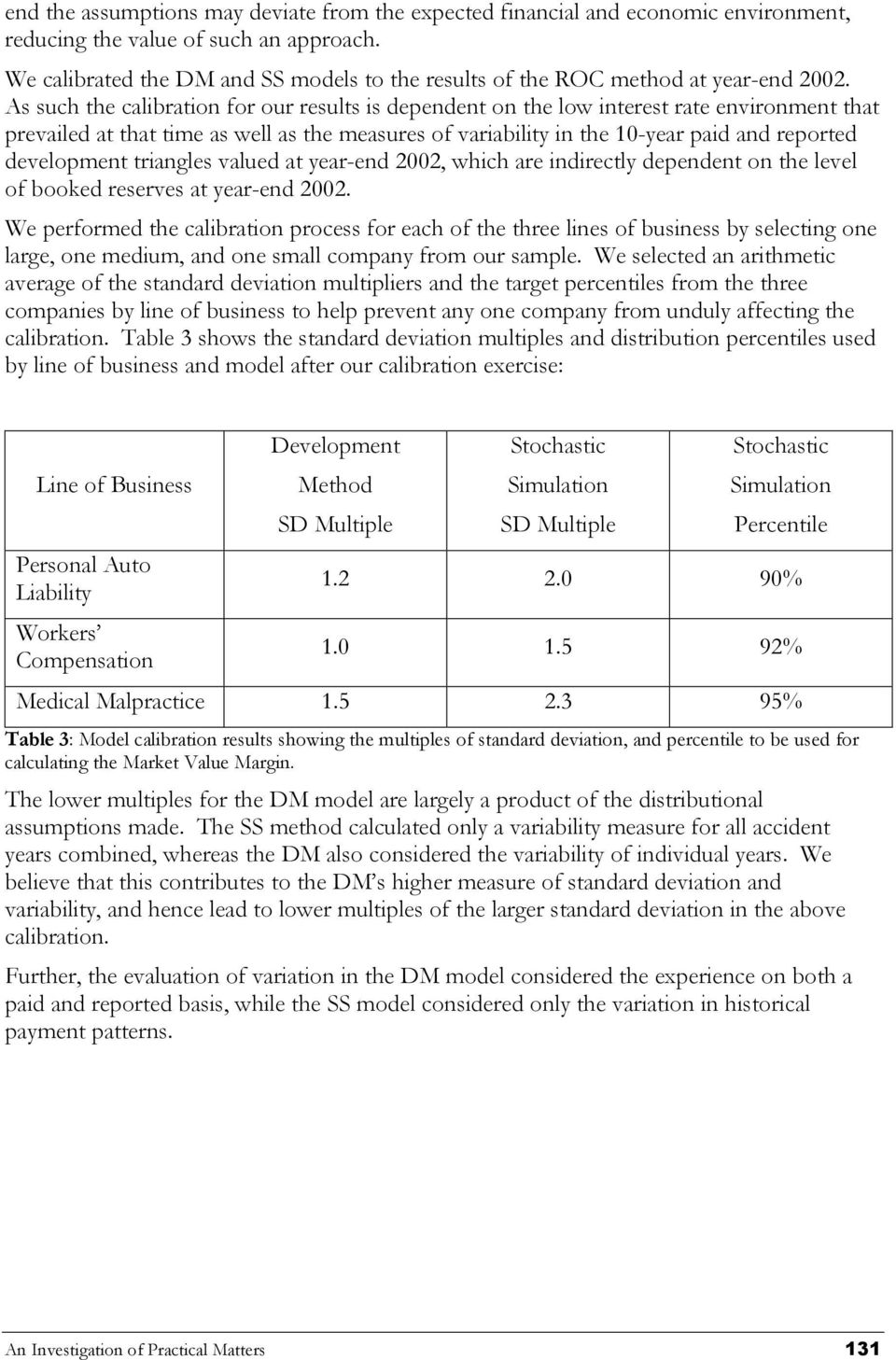
5 end the assumptions may deviate from the expected financial and economic environment, reducing the value of such an approach. We calibrated the DM and SS models to the results of the ROC method at year-end As such the calibration for our results is dependent on the low interest rate environment that prevailed at that time as well as the measures of variability in the 10-year paid and reported development triangles valued at year-end 2002, which are indirectly dependent on the level of booked reserves at year-end We performed the calibration process for each of the three lines of business by selecting one large, one medium, and one small company from our sample. We selected an arithmetic average of the standard deviation multipliers and the target percentiles from the three companies by line of business to help prevent any one company from unduly affecting the calibration. Table 3 shows the standard deviation multiples and distribution percentiles used by line of business and model after our calibration exercise: Line of Business Personal Auto Liability Workers Compensation Development Method SD Multiple Stochastic Simulation SD Multiple Stochastic Simulation Percentile % % Medical Malpractice % Table 3: Model calibration results showing the multiples of standard deviation, and percentile to be used for calculating the Market Value Margin. The lower multiples for the DM model are largely a product of the distributional assumptions made. The SS method calculated only a variability measure for all accident years combined, whereas the DM also considered the variability of individual years. We believe that this contributes to the DM s higher measure of standard deviation and variability, and hence lead to lower multiples of the larger standard deviation in the above calibration. Further, the evaluation of variation in the DM model considered the experience on both a paid and reported basis, while the SS model considered only the variation in historical payment patterns. An Investigation of Practical Matters 131
Quantitative Impact Study 1 (QIS1) Summary Report for Belgium. 21 March 2006
 Quantitative Impact Study 1 (QIS1) Summary Report for Belgium 21 March 2006 1 Quantitative Impact Study 1 (QIS1) Summary Report for Belgium INTRODUCTORY REMARKS...4 1. GENERAL OBSERVATIONS...4 1.1. Market
Solvency II Technical Provisions under solvency II Detailed Guidance. March 2010
 Solvency II Technical Provisions under solvency II Detailed Guidance March 2010 CONTACT DETAILS For technical queries: Henry Johnson, Market Reserving and Capital 020 7327 5235 [email protected]
Property Casualty Insurer Economic Capital using a VAR Model Thomas Conway and Mark McCluskey
 Property Casualty Insurer Economic Capital using a VAR Model Thomas Conway and Mark McCluskey Concept The purpose of this paper is to build a bridge between the traditional methods of looking at financial
Stochastic Analysis of Long-Term Multiple-Decrement Contracts
 Stochastic Analysis of Long-Term Multiple-Decrement Contracts Matthew Clark, FSA, MAAA, and Chad Runchey, FSA, MAAA Ernst & Young LLP Published in the July 2008 issue of the Actuarial Practice Forum Copyright
Solvency II Technical Provisions under solvency II Detailed Guidance. March 2011 update
 Solvency II Technical Provisions under solvency II Detailed Guidance March 2011 update CONTACT DETAILS For technical queries: Henry Johnson, Market Reserving & Capital 020 7327 5235 [email protected]
SOA Health 2007 Spring Meeting Valuation and Reserving Techniques
 SOA Health 2007 Spring Meeting Valuation and Reserving Techniques Property & Casualty Reserving Techniques Theresa Bourdon, FCAS, MAAA CAS Statement of Principles Regarding P&C Loss and Loss Adjustment
GN47: Stochastic Modelling of Economic Risks in Life Insurance
 GN47: Stochastic Modelling of Economic Risks in Life Insurance Classification Recommended Practice MEMBERS ARE REMINDED THAT THEY MUST ALWAYS COMPLY WITH THE PROFESSIONAL CONDUCT STANDARDS (PCS) AND THAT
THE INSURANCE BUSINESS (SOLVENCY) RULES 2015
 THE INSURANCE BUSINESS (SOLVENCY) RULES 2015 Table of Contents Part 1 Introduction... 2 Part 2 Capital Adequacy... 4 Part 3 MCR... 7 Part 4 PCR... 10 Part 5 - Internal Model... 23 Part 6 Valuation... 34
Embedded Value Report
 Embedded Value Report 2012 ACHMEA EMBEDDED VALUE REPORT 2012 Contents Management summary 3 Introduction 4 Embedded Value Results 5 Value Added by New Business 6 Analysis of Change 7 Sensitivities 9 Impact
IASB Educational Session Non-Life Claims Liability
 IASB Board Meeting Observer Note- Agenda Paper 10 January 2005 IASB Educational Session Non-Life Claims Liability Presented by the International Actuarial Association January 19, 2005 Sam Gutterman and
Runoff of the Claims Reserving Uncertainty in Non-Life Insurance: A Case Study
 1 Runoff of the Claims Reserving Uncertainty in Non-Life Insurance: A Case Study Mario V. Wüthrich Abstract: The market-consistent value of insurance liabilities consists of the best-estimate prediction
BEL best estimate liability, deduced from the mean loss as a present value of mean loss,
 Calculations of SCR, Technical Provisions, Market Value Margin (MVM) using the Cost of Capital method, for a one-year risk horizon, based on an ICRFS-Plus single composite model and associated forecast
Calculating capital requirements for longevity risk in life insurance products. Using an internal model in line with Solvency II
 Calculating capital requirements for longevity risk in life insurance products. Using an internal model in line with Solvency II Ralph Stevens a, Anja De Waegenaere b, and Bertrand Melenberg c a CentER
IAA PAPER VALUATION OF RISK ADJUSTED CASH FLOWS AND THE SETTING OF DISCOUNT RATES THEORY AND PRACTICE
 Introduction This document refers to sub-issue 11G of the IASC Insurance Issues paper and proposes a method to value risk-adjusted cash flows (refer to the IAA paper INSURANCE LIABILITIES - VALUATION &
Financial Condition Reporting Recalibration Project
 Financial Condition Reporting for South African Short Term Insurers Recalibration Project December 2009 December 2009 Contents 1 Executive Summary... 1 1. Introduction... 1 2. Results... 1 3. Conclusion...
Disclosure of European Embedded Value as of March 31, 2015
 UNOFFICIAL TRANSLATION Although the Company pays close attention to provide English translation of the information disclosed in Japanese, the Japanese original prevails over its English translation in
Pricing Alternative forms of Commercial insurance cover. Andrew Harford
 Pricing Alternative forms of Commercial insurance cover Andrew Harford Pricing alternative covers Types of policies Overview of Pricing Approaches Total claim cost distribution Discounting Cash flows Adjusting
TABLE OF CONTENTS. Executive Summary 3. Introduction 5. Purposes of the Joint Research Project 6
 TABLE OF CONTENTS Executive Summary 3 Introduction 5 Purposes of the Joint Research Project 6 Background 7 1. Contract and timeframe illustrated 7 2. Liability measurement bases 9 3. Earnings 10 Consideration
The Study of Chinese P&C Insurance Risk for the Purpose of. Solvency Capital Requirement
 The Study of Chinese P&C Insurance Risk for the Purpose of Solvency Capital Requirement Xie Zhigang, Wang Shangwen, Zhou Jinhan School of Finance, Shanghai University of Finance & Economics 777 Guoding
Featured article: Evaluating the Cost of Longevity in Variable Annuity Living Benefits
 Featured article: Evaluating the Cost of Longevity in Variable Annuity Living Benefits By Stuart Silverman and Dan Theodore This is a follow-up to a previous article Considering the Cost of Longevity Volatility
5000 Public Personal Injury Compensation Plans
 5000 Public Personal Injury Compensation Plans Page 5001 Table of Contents 5000 Public Personal Injury Compensation Plans.5001 5100 Scope... 5003 5200 Extension of scope... 5004 5300 General... 5005 5310
Matching Investment Strategies in General Insurance Is it Worth It? Aim of Presentation. Background 34TH ANNUAL GIRO CONVENTION
 Matching Investment Strategies in General Insurance Is it Worth It? 34TH ANNUAL GIRO CONVENTION CELTIC MANOR RESORT, NEWPORT, WALES Aim of Presentation To answer a key question: What are the benefit of
Calibration of Fixed-Income Returns Segregated Fund Liability
 Research Paper Calibration of Fixed-Income Returns Segregated Fund Liability Committee on Life Insurance Financial Reporting April 2014 Document 214034 Ce document est disponible en français 2014 Canadian
NIKE Case Study Solutions
 NIKE Case Study Solutions Professor Corwin This case study includes several problems related to the valuation of Nike. We will work through these problems throughout the course to demonstrate some of the
Best Estimate of the Technical Provisions
 Best Estimate of the Technical Provisions FSI Regional Seminar for Supervisors in Africa on Risk Based Supervision Mombasa, Kenya, 14-17 September 2010 Leigh McMahon BA FIAA GAICD Senior Manager, Diversified
Educational Note. Premium Liabilities. Committee on Property and Casualty Insurance Financial Reporting. November 2014.
 Educational Note Premium Liabilities Committee on Property and Casualty Insurance Financial Reporting November 2014 Document 214114 Ce document est disponible en français 2014 Canadian Institute of Actuaries
Considerations on the Discount Rate in the Cost of Capital method for the Risk Margin
 Considerations on the Discount Rate in the Cost of Capital method for the Risk Margin Hans Waszink MSc. AAG MBA WaszinkActuarial Advisory ASTIN The Hague 2013 [email protected] Introduction What this
Pricing Variable Annuity With Embedded Guarantees. - a case study. David Wang, FSA, MAAA May 21, 2008 at ASHK
 Pricing Variable Annuity With Embedded Guarantees - a case study David Wang, FSA, MAAA May 21, 2008 at ASHK Set The Stage Peter is the pricing actuary of company LifeGoesOn and LifeGoesOn wishes to launch
Regulatory Capital Requirements for U.S. Life Insurers
 Regulatory Capital Requirements for U.S. Life Insurers Presentation to FSOC s Insurance Industry Work Group Nancy Bennett, FSA, CERA, MAAA Senior Life Fellow, American Academy of Actuaries June 17, 2014
FINANCIAL REVIEW. 18 Selected Financial Data 20 Management s Discussion and Analysis of Financial Condition and Results of Operations
 2012 FINANCIAL REVIEW 18 Selected Financial Data 20 Management s Discussion and Analysis of Financial Condition and Results of Operations 82 Quantitative and Qualitative Disclosures About Market Risk 88
Market Value Margin: Practical calculations under the Solvency II Cost of Capital approach
 March 2012 N 18 Market Value Margin: Practical calculations under the Solvency II Cost of Capital approach By Mouna Daya-Viossat Centre d'études actuarielles Winner of the French «Young Actuaries Prize»
Financial Review. 16 Selected Financial Data 18 Management s Discussion and Analysis of Financial Condition and Results of Operations
 2011 Financial Review 16 Selected Financial Data 18 Management s Discussion and Analysis of Financial Condition and Results of Operations 82 Quantitative and Qualitative Disclosures About Market Risk 90
Towards the strengthening and moderinsation of insurance and surety regulation
 Non-Life Insurance Technical Provisions i Towards the strengthening and moderinsation of insurance and surety regulation XXI International Seminar on Insurance and Surety, November 2010, Mexico City Olaf
A Shortcut to Calculating Return on Required Equity and It s Link to Cost of Capital
 A Shortcut to Calculating Return on Required Equity and It s Link to Cost of Capital Nicholas Jacobi An insurance product s return on required equity demonstrates how successfully its results are covering
Case Study Modeling Longevity Risk for Solvency II
 Case Study Modeling Longevity Risk for Solvency II September 8, 2012 Longevity 8 Conference Waterloo, Ontario Presented by Stuart Silverman Principal & Consulting Actuary Background SOLVENCY II New Minimum
Investment Assumptions Used in the Valuation of Life and Health Insurance Contract Liabilities
 Educational Note Investment Assumptions Used in the Valuation of Life and Health Insurance Contract Liabilities Committee on Life Insurance Financial Reporting September 2014 Document 214099 Ce document
An Insurance Contract IFRS Is Coming
 An Insurance Contract IFRS Is Coming Are Your Financial Models Ready? By John Nicholls and Ana Escudero Efforts to develop new international accounting standards are moving apace, as the joint IASB FASB
Introduction. Coverage. Principle 1: Embedded Value (EV) is a measure of the consolidated value of shareholders interests in the covered business.
 Introduction Principle 1: Embedded Value (EV) is a measure of the consolidated value of shareholders interests in the covered business. G1.1 The EV Methodology ( EVM ) described here is applied to the
Valuing Stock Options: The Black-Scholes-Merton Model. Chapter 13
 Valuing Stock Options: The Black-Scholes-Merton Model Chapter 13 Fundamentals of Futures and Options Markets, 8th Ed, Ch 13, Copyright John C. Hull 2013 1 The Black-Scholes-Merton Random Walk Assumption
A Flexible Benchmark Relative Method of Attributing Returns for Fixed Income Portfolios
 White Paper A Flexible Benchmark Relative Method of Attributing s for Fixed Income Portfolios By Stanley J. Kwasniewski, CFA Copyright 2013 FactSet Research Systems Inc. All rights reserved. A Flexible
How To Calculate Multi-Year Horizon Risk Capital For Non-Life Insurance Risk
 The Multi-Year Non-Life Insurance Risk Dorothea Diers, Martin Eling, Christian Kraus und Marc Linde Preprint Series: 2011-11 Fakultät für Mathematik und Wirtschaftswissenschaften UNIVERSITÄT ULM The Multi-Year
IASB Agenda Ref 16A. FASB Memo No. 140A. Issue Date September 11, 2015. Meeting Date September 23, 2015. Assistant Director
 Memo IASB Agenda Ref 16A FASB Memo No. 140A Issue Date September 11, 2015 Meeting Date September 23, 2015 Contact(s) Alex Casas Author / Project Lead Peter Proestakes Assistant Director Project Topic Insurance
The Impact of Pension Reform Proposals on Claims Against the Pension Insurance Program, Losses to Participants, and Contributions
 The Impact of Pension Reform Proposals on Claims Against the Pension Insurance Program, Losses to Participants, and Contributions Pension Benefit Guaranty Corporation October 26, 2005 Contents Introduction
INFORMATION FOR OBSERVERS. IASB Meeting: Insurance Working Group, April 2008 Paper: Non-life insurance contracts (Agenda paper 6)
 30 Cannon Street, London EC4M 6XH, England International Phone: +44 (0)20 7246 6410, Fax: +44 (0)20 7246 6411 Accounting Standards Email: [email protected] Website: http://www.iasb.org Board This document
One-year reserve risk including a tail factor : closed formula and bootstrap approaches
 One-year reserve risk including a tail factor : closed formula and bootstrap approaches Alexandre Boumezoued R&D Consultant Milliman Paris [email protected] Yoboua Angoua Non-Life Consultant
THE MULTI-YEAR NON-LIFE INSURANCE RISK
 THE MULTI-YEAR NON-LIFE INSURANCE RISK MARTIN ELING DOROTHEA DIERS MARC LINDE CHRISTIAN KRAUS WORKING PAPERS ON RISK MANAGEMENT AND INSURANCE NO. 96 EDITED BY HATO SCHMEISER CHAIR FOR RISK MANAGEMENT AND
BERMUDA MONETARY AUTHORITY DETERMINATION OF DISCOUNT RATES FOR ECONOMIC BALANCE SHEET FRAMEWORK July 2015
 BERMUDA MONETARY AUTHORITY DETERMINATION OF DISCOUNT RATES FOR ECONOMIC BALANC CE SHEET FRAMEWORK July 2015 Contents I. BACKGROUND... 3 II. DETERMINATION OF DISCOUNT RATES... 4 III. STANDARD APPROACH...
Principles-based Valuation of Life Insurance Products
 Principles-based Valuation of Life Insurance Products November 17, 2005 Shawn D. Parks, FSA, MAAA Vice President and Illustration Actuary 306PP9493 1105 This presentation expresses the views of the presenter
ACCOUNTING STANDARDS BOARD DECEMBER 2004 FRS 27 27LIFE ASSURANCE STANDARD FINANCIAL REPORTING ACCOUNTING STANDARDS BOARD
 ACCOUNTING STANDARDS BOARD DECEMBER 2004 FRS 27 27LIFE ASSURANCE FINANCIAL REPORTING STANDARD ACCOUNTING STANDARDS BOARD Financial Reporting Standard 27 'Life Assurance' is issued by the Accounting Standards
A three dimensional stochastic Model for Claim Reserving
 A three dimensional stochastic Model for Claim Reserving Magda Schiegl Haydnstr. 6, D - 84088 Neufahrn, [email protected] and Cologne University of Applied Sciences Claudiusstr. 1, D-50678 Köln
Forecasting and Valuation of Enterprise Cash Flows 1. Dan Gode and James Ohlson
 Forecasting and Valuation of Enterprise Cash Flows 1 1. Overview FORECASTING AND VALUATION OF ENTERPRISE CASH FLOWS Dan Gode and James Ohlson A decision to invest in a stock proceeds in two major steps
Stress Testing: Insurance Companies in Canada
 Stress Testing: Insurance Companies in Canada August Chow, FSA, FCIA Senior Director OSFI Canada Paper presented at the Expert Forum on Advanced Techniques on Stress Testing: Applications for Supervisors
Equity-Based Insurance Guarantees Conference November 18-19, 2013. Atlanta, GA. GAAP and Statutory Valuation of Variable Annuities
 Equity-Based Insurance Guarantees Conference November 18-19, 2013 Atlanta, GA GAAP and Statutory Valuation of Variable Annuities Heather Remes GAAP and Statutory Valuation of Variable Annuities Heather
SWEDBANK FÖRSÄKRING AB. 2015 European Embedded Value
 SWEDBANK FÖRSÄKRING AB 2015 European Embedded Value Content 1 Introduction... 2 2 Overview of results... 2 3 Covered business... 2 4 EEV results... 2 5 Value of new business... 4 6 Analysis of EEV earnings...
Equity-based Insurance Guarantees Conference October 27-28, 2008. Pricing EAI Guarantees. Moderator Dr. K. (Ravi) Ravindran
 Equity-based Insurance Guarantees Conference October 27-28, 2008 Pricing EAI Guarantees Noel Abkemeier, Eric Petersen Moderator Dr. K. (Ravi) Ravindran Equity Indexed Annuity Pricing Eric Petersen, F.S.A.
Quantitative Methods for Finance
 Quantitative Methods for Finance Module 1: The Time Value of Money 1 Learning how to interpret interest rates as required rates of return, discount rates, or opportunity costs. 2 Learning how to explain
Revised Annexes to the Technical Specifications for the Solvency II valuation and Solvency Capital Requirements calculations (Part I)
 EIOPA-DOC-12/467 21 December 2012 Revised Annexes to the Technical Specifications for the Solvency II valuation and Solvency Capital Requirements calculations (Part I) 1 TABLE OF CONTENT ANNEX A - DEFINITION
Stochastic Solvency Testing in Life Insurance. Genevieve Hayes
 Stochastic Solvency Testing in Life Insurance Genevieve Hayes Deterministic Solvency Testing Assets > Liabilities In the insurance context, the values of the insurer s assets and liabilities are uncertain.
AXA s approach to Asset Liability Management. HELVEA Insurance Capital Adequacy and Solvency Day April 28th, 2005
 AXA s approach to Asset Liability Management HELVEA Insurance Capital Adequacy and Solvency Day April 28th, 2005 ALM in AXA has always been based on a long-term view Even though Solvency II framework is
GN8: Additional Guidance on valuation of long-term insurance business
 GN8: Additional Guidance on valuation of long-term insurance business Classification Practice Standard MEMBERS ARE REMINDED THAT THEY MUST ALWAYS COMPLY WITH THE PROFESSIONAL CONDUCT STANDARDS (PCS) AND
CITIGROUP INC. BASEL II.5 MARKET RISK DISCLOSURES AS OF AND FOR THE PERIOD ENDED MARCH 31, 2013
 CITIGROUP INC. BASEL II.5 MARKET RISK DISCLOSURES AS OF AND FOR THE PERIOD ENDED MARCH 31, 2013 DATED AS OF MAY 15, 2013 Table of Contents Qualitative Disclosures Basis of Preparation and Review... 3 Risk
LIFE INSURANCE CAPITAL FRAMEWORK STANDARD APPROACH
 LIFE INSURANCE CAPITAL FRAMEWORK STANDARD APPROACH Table of Contents Introduction... 2 Process... 2 and Methodology... 3 Core Concepts... 3 Total Asset Requirement... 3 Solvency Buffer... 4 Framework Details...
A Piece of the Pie: Alternative Approaches to Allocating Value
 A Piece of the Pie: Alternative Approaches to Allocating Value Cory Thompson, CFA, CIRA [email protected] Ryan Gandre, CFA [email protected] Introduction Enterprise value ( EV ) represents the sum of debt
Stochastic Pricing for Embedded Options in Life Insurance and Annuity Products. Milliman, Inc. October 2008
 Stochastic Pricing for Embedded Options in Life Insurance and Annuity Products Milliman, Inc October 2008 Tim Hill, FSA, MAAA Dale Visser, FSA, MAAA Ricky Trachtman, ASA, MAAA Table of Contents I. Introduction...1
Life Insurance Corporation (Singapore)Pte Ltd UEN 201210695E MANAGEMENT REPORT 31/12/2013
 Life Insurance Corporation (Singapore)Pte Ltd UEN 201210695E MANAGEMENT REPORT 31/12/2013 LIFE INSURANCE CORPORATION (SINGAPORE) PTE. LTD. For the financial period from 1 January 2013 to 31 December 2013
Insights. Understanding market value margins in options prices. September 2009. Background
 Insights September 2009 Understanding market value margins in options prices John Hibbert [email protected] At the heart of the emerging Solvency II regulations is the idea that both assets and
Leadership in life insurance. April 2015
 Leadership in life insurance April 2015 Agenda Industry overview and outlook Company strategy and performance Embedded value results 2 Agenda Industry overview and outlook Company strategy and performance
PNB Life Insurance Inc. Risk Management Framework
 1. Capital Management and Management of Insurance and Financial Risks Although life insurance companies are in the business of taking risks, the Company limits its risk exposure only to measurable and
Session 7: Payout Annuities
 Session 7: Payout Annuities Michael Lockerman Various Examples Mixed examples Examples with DBs Variable payout 2 2 Agenda Product Classification Accounting Guidance Example Earnings Patterns Practical
Inventories. 2014 Level I Financial Reporting and Analysis. IFT Notes for the CFA exam
 Inventories 2014 Level I Financial Reporting and Analysis IFT Notes for the CFA exam Contents 1. Introduction... 3 2. Cost of Inventories... 3 3. Inventory Valuation Methods... 4 4. Measurement of Inventory
DEMYSTIFYING ACTUARIAL REPORTS
 DEMYSTIFYING ACTUARIAL REPORTS By Brad Norrick, CPCU Willis Limited, London Health care providers, whether hospital systems, managed care organizations, senior housing entities or group practices, have
Principles-Based Reserves Theory and Practice
 Principles-Based Reserves Theory and Practice Actuaries Club of the Southwest Southeastern Actuaries Conference Joint Annual Meeting November 16, 2006 Doug Doll, Towers Perrin 2006 Towers Perrin Agenda
THE VALUATION OF ADVANCED MINING PROJECTS & OPERATING MINES: MARKET COMPARABLE APPROACHES. Craig Roberts National Bank Financial
 THE VALUATION OF ADVANCED MINING PROJECTS & OPERATING MINES: MARKET COMPARABLE APPROACHES Craig Roberts National Bank Financial ABSTRACT While various methods are available to estimate a mining project
Life Insurance Corporation (Singapore)Pte Ltd UEN 201210695E MANAGEMENT REPORT 31/12/2014
 Life Insurance Corporation (Singapore)Pte Ltd UEN 201210695E MANAGEMENT REPORT 31/12/2014 LIFE INSURANCE CORPORATION (SINGAPORE) PTE. LTD. For the financial year from 1 January 2014 to 31 December 2014
Porter, White & Company
 Porter, White & Company Optimizing the Fixed Income Component of a Portfolio White Paper, September 2009, Number IM 17.2 In the White Paper, Comparison of Fixed Income Fund Performance, we show that a
Disclosure of Market Consistent Embedded Value as at March 31, 2015
 May 20, 2015 Sompo Japan Nipponkoa Himawari Life Insurance, Inc. Disclosure of Market Consistent Embedded Value as at March 31, 2015 Sompo Japan Nipponkoa Himawari Life Insurance, Inc. ( Himawari Life,
Modelling of uncertainties in Water Demand Forecasting
 Modelling of uncertainties in Water Demand Forecasting Presented to Decision Tools Conference Presentation Tuesday, 2 nd November 2015 Sofitel Downtown Hotel Dubai, U.A.E Abu Dhabi Water & Electricity
Basics of Corporate Pension Plan Funding
 Basics of Corporate Pension Plan Funding A White Paper by Manning & Napier www.manning-napier.com Unless otherwise noted, all figures are based in USD. 1 Introduction In general, a pension plan is a promise
CEIOPS-DOC-33/09. (former CP 39) October 2009
 CEIOPS-DOC-33/09 CEIOPS Advice for Level 2 Implementing Measures on Solvency II: Technical provisions Article 86 a Actuarial and statistical methodologies to calculate the best estimate (former CP 39)
Market-Consistent Valuation of the Sponsor Covenant and its use in Risk-Based Capital Assessment. Craig Turnbull FIA
 Market-Consistent Valuation of the Sponsor Covenant and its use in Risk-Based Capital Assessment Craig Turnbull FIA Background and Research Objectives 2 Background: DB Pensions and Risk + Aggregate deficits
SCHEDULE A TO THE REGINA CIVIC EMPLOYEES SUPERANNUATION AND BENEFIT PLAN
 SCHEDULE A TO THE REGINA CIVIC EMPLOYEES SUPERANNUATION AND BENEFIT PLAN FUNDING POLICY as of January 1, 2015 TABLE OF CONTENTS Page I. BACKGROUND...1 II. FUNDING OBJECTIVES...3 III. RISK MANAGEMENT...5