
Introduction to IT Service Management
|
|
|
- Diana Carter
- 10 years ago
- Views:
Transcription
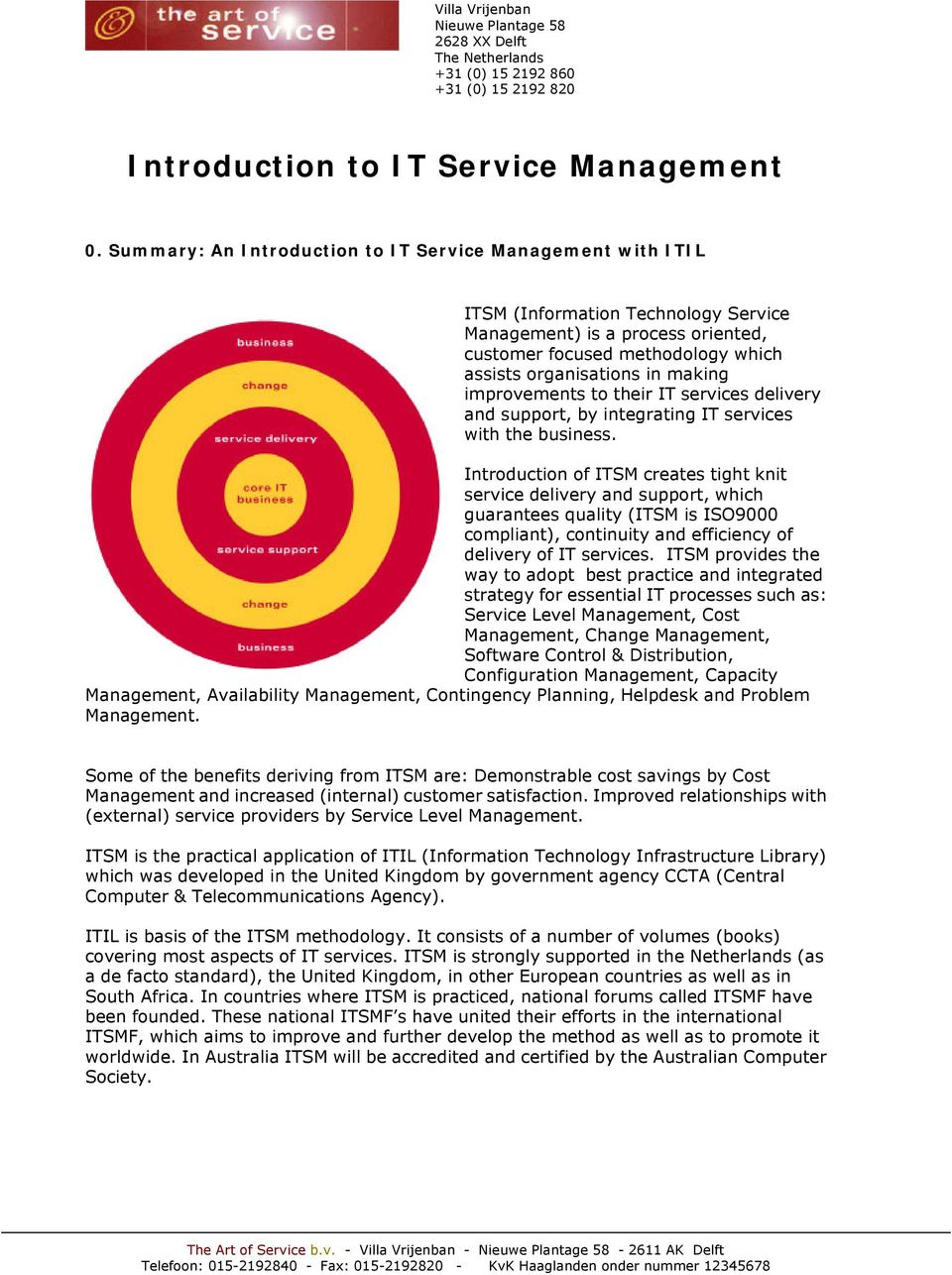
1 Introduction to IT Service Management 0. Summary: An Introduction to IT Service Management with ITIL ITSM (Information Technology Service Management) is a process oriented, customer focused methodology which assists organisations in making improvements to their IT services delivery and support, by integrating IT services with the business. Introduction of ITSM creates tight knit service delivery and support, which guarantees quality (ITSM is ISO9000 compliant), continuity and efficiency of delivery of IT services. ITSM provides the way to adopt best practice and integrated strategy for essential IT processes such as: Service Level Management, Cost Management, Change Management, Software Control & Distribution, Configuration Management, Capacity Management, Availability Management, Contingency Planning, Helpdesk and Problem Management. Some of the benefits deriving from ITSM are: Demonstrable cost savings by Cost Management and increased (internal) customer satisfaction. Improved relationships with (external) service providers by Service Level Management. ITSM is the practical application of ITIL (Information Technology Infrastructure Library) which was developed in the United Kingdom by government agency CCTA (Central Computer & Telecommunications Agency). ITIL is basis of the ITSM methodology. It consists of a number of volumes (books) covering most aspects of IT services. ITSM is strongly supported in the Netherlands (as a de facto standard), the United Kingdom, in other European countries as well as in South Africa. In countries where ITSM is practiced, national forums called ITSMF have been founded. These national ITSMF s have united their efforts in the international ITSMF, which aims to improve and further develop the method as well as to promote it worldwide. In Australia ITSM will be accredited and certified by the Australian Computer Society.
2 What do the IT Service Management processes deliver: Service Level Management: Achieving a specific, consistent, measurable level of service; Balancing the service levels people want against the cost of providing them; Making savings by more accurate specifications; Increased user productivity as a result of better IT Services; Having objective service measurement data to resolve differences of opinion about service levels; Reducing the probability of unpredictable demands; Creating an arms length relationship between IT-users and providers, in order to create an easier route to Facilities Management. Availability Management IT Services are managed to meet specific availability targets; IT service quality improves because it is more controlled; New information systems are more cost-effective; There is less need for reactive problem support; Maintenance and cost of downtime is reduced; Supplier performance improves; There is accurate information for service level negotiations; Existing IT resources are used more efficiently.

3 Capacity Management Less risk of problems caused by a lack of capacity; The ability to maximize existing capabilities within budget; Increased business efficiency through better IT; Control over capacity costs; The ability to identify low-cost improvements in performance; An improved specification for levels of service performance; Information about timing and building hardware upgrades; More accurate forecasting of how systems will perform. Contingency Planning Being able to recover IT systems in a controlled way; Less time to the business by a continuous service; Minimum disruption to the business; Continuity. Cost Management Costing: Support a sound IT investment strategy; Make business-like decisions about each service; Set performance targets, and monitor costs against budgets; Prioritize resources; Respond to change knowing the costs involved; Plan and budget; Justify expenditure on new and better services. Charging: Evaluate IT services and investment plans; Recover IT costs; Influence user behaviour. Helpdesk Improved incident control; Better support for business operations; Improved relationship between IT services and customers; A central source of management information; Business/IT knowledge database. Problem Management Higher user productivity, from a decrease in user downtime; Higher productivity from support staff; The ability to prevent failures or reduce their effects by using information from previous problems; Better relations between users and IT Services, through a better quality service; Greater control of IT services through improved management information. Change Management Fewer quality problems caused by changes; A better understanding of what changes will cost;

4 Fewer changes that have to be backed-out, and the ability to back-out more easily when necessary; Better management information about changes; Higher user productivity, because IT Services are less disrupted by changes; More productive key IT staff; The ability to absorb high levels of change. Configuration Management Better control of IT assets; Better IT service provision through support for the management of change; Better incident and problem management; Easier identification of legal obligations; Simpler expenditure planning; Support for contingency planning. Software Control & Distribution The software people use is of good quality; Software is released in a way that minimizes errors; Software is kept safe and secure; Changes to software can be absorbed; Software can be built and controlled even at remote sites; Software is consistent over all locations; The changes of illegal copies of software appearing are reduced; Wrong versions and unauthorized copies are easier to spot; There are fewer opportunities for viruses or other software corruptions to escape unnoticed. 1. An Introduction to IT Service Management with ITIL Although this guide can be read in isolation, it is recommended that it is used in conjunction with the other IT Infrastructure Library guides. The prefixes IS or IT will be used only to clarify specific issues that apply to those subjects; managing service is a generic concept and the guidance in the new infrastructure library books is applicable generically. The guidance is also scaleable, applicable to both small and large organisations. It applies to distributed or centralised systems and also whether IT is inhouse or supplied by third parties. It is neither bureaucratic nor unwieldy if implemented sensibly and in full cognisance of the business needs of your organisation. 1.1 Restructuring the IT Infrastructure Library The concept of managing services for the improvement of business functions is not new; it predates the Infrastructure Library. The idea to bring all of the service management best practice together under one roof however was both radical and new. The first series of the infrastructure library coalesced service management from an IT standpoint and failed for the most part to capture the interest of the business. The business perspective series was published to bridge the gap between business and management and although a success, the series was published at a time when the original IT Infrastructure Library guidance was appearing to be out dated in some areas. The impact of the new series was therefore limited in the market, but a catalyst in the service management industry.

5 The IT Infrastructure Library (ITIL) was originally produced in the early 1990s and consisted of ten core guides covering the two main areas of Service Support and Service Delivery. These core guides were further supported by 30 complementary guides covering a range of issues ranging from Cabling to Business Continuity Management. ITIL has been restructured to make it simpler to access the information that is needed to manage your services. The core books have been pulled together in order to eliminate duplication and enhance navigation. For example, rather than having to read more than ten books to cover the entire subject of service management, you now need to read only two (albeit bigger books!) of which this is the first. And the material you read is more sharply focused, consistent and up to date. The library has also been reengineered to focus on the business issues of infrastructure management as well as to ensure a closer synergy with the new IS guides published by CCTA. 1.2 Target Audience This book is relevant to anyone involved in the delivery or support of services. It is applicable to anyone managing service management processes, in-house or outsourced, anyone defining new processes or refining existing processes and anyone involved in the day to day running of the processes. The book is also relevant to business managers to help them establish IT services and support. Managers from supplier organisations will also find this book relevant when setting up agreements for the delivery and support of services. The target readership therefore includes the: IT Director IT management IT services management business unit managers procurement managers supplier managers (whether these be internal or out-sourced) auditors Service Desk operatives Service Level negotiators Configuration and Change administrators capacity planners anyone else involved in Service Management.

6 1.3 Navigating the IT infrastructure library Following consultation with service management organisations and users groups, CCTA designed the diagram shown below. The diagram illustrates that the new library series will comprise five principal elements, each of which will have interfaces and overlaps with each of the other four. The elements are: the business perspective applications management delivery of services support of services network and operations services. Figure 1.1 Jigsaw Diagram The business perspective will cover a range of issues concerned with understanding and improving IT service provision, as an integral part of an overall business requirement for high quality IS management. These issues include, business continuity management, partnerships and outsourcing, surviving change and transformation of business practice through radical change. Service Delivery looks at what service the business requires of the provider to provide adequate support to the business users. To provide the necessary support the book covers the following topics: capacity management, cost management, availability management, service level management and business continuity and contingency planning. Service Support is concerned with ensuring that the customer has access to the appropriate services to support the business functions. Issues to be discussed in this book are the service (help) desk, release management (software control and

7 distribution), incident management, problem management, change management and configuration management. Networks and Operations Services will distil and includes network service management, operations management, management of local processors, computer installation and acceptance and will also cover for the first time the challenge of systems management. And finally the book on applications management (as yet the scope is not fully defined) will embrace the software development lifecycle expanding the issues touched upon in software lifecycle support and testing of IT services. Applications management will expand on the issues of business change with emphasis on clear requirement definition and implementation of the solution to meet business needs. The major elements can be described as jigsaw puzzle pieces (or perhaps better as tectonic plates), some of which have a precise fit, some of which overlap or do not fit together accurately. At the highest level, it must be understood that there are no strict demarcation lines. Indeed, if we consider further the analogy of tectonic plates, sliding over and under one another, joining and separating, then the earthly problem of points of instability or friction caused by the imprecise nature of the pieces has an IT Infrastructure Library equivalent. It is precisely where process domains overlap or where demarcation lines cannot be clearly drawn that many management problems arise. We cannot stop all the problems occurring (just as we cannot stop earthquakes) but we can provide advice about how to prepare for and deal with them. Just as examples, consider the following: Can service support be divorced from service delivery? Can any element of infrastructure guidance be considered complete without recognition of the business perspective? Is it acceptable that an application designed for the business should take no account of the impact od its inclusion in the operational network and support elements of the infrastructure? 1.4 Why choose a jigsaw concept? To clarify how the concepts within ITIL work together, CCTA produced a set of process models to describe the makeup of ITIL the process model for Service Support can be found at Appendix E. These process models have been used in practice and enhanced since first produced and now form the cornerstones of the new guidance. If we superimpose the jigsaw puzzle pieces from Figure 1.1 over a high-level process model of the principal elements of managing service from the business perspective, we arrive at Figure 1.2. The process elements for management of services can be defined precisely. However the imprecise jigsaw puzzle pieces slide over the process elements, demonstrating the overlapping elements in more detail and further illustrating the need for both consistency across the guidance, and information about how to deal with management problems that may arise. The cause of these management problems may be the result of boundaries drawn that perhaps have more to do with the span of control than with logical grouping of related functions.

8 Figure The business perspective/jigsaw puzzle 1.5 The Service Support book Figure 1.3 expands the service support jigsaw puzzle pieces. Although obviously primarily centred on service support, the process elements pertaining to the business issue of change to services (which is usually the signal for radical change rather than change due to faults or maintenance) and meeting customer needs through service delivery are a major factor. The infrastructure library process elements covered in this book are also shown. Figure 1.3 Service Support; the coverage Note that all of the chapters relate to processes except Service Desk, which is a function that draws on all of the other processes.

9 1.6 Service management Before moving on to the specific issues of service support, consider first this wider context of service management, the broad picture shown in Figure 1.4. Jigsaw puzzle pieces again provide a good analogy for the process elements; in this instance, the pieces fit together far more readily. Negotiations about contracted services may often be undertaken by management group that is outside of the population that uses the service. In these situations it is not surprising if perceptions about service quality and availability differ between these two groups. Figure 1.4 Service Management To avoid confusion regarding roles and terminology the terms 'Customer' and 'User' are used throughout the new books to differentiate between those people (generally senior managers) who commission, pay for and own the IT Services (the Customers) and those people who use the services on a day-to-day basis (the Users). The semantics are less important than the reason for differentiation. The primary point of contact for individuals using services is (or should be) a Service Desk (or in less sophisticated environments, a basic help desk). Therefore the user population is most at risk from an inadequate service support function. Customers of service providers increasingly rely upon contracts to define the relationship of the service provider to the business (even in the case of in-house service provision) and use the contracts to formalise areas of performance that are frequently underpinned by Service Level Agreements (SLAs). The day-to-day impact of service provision (unless catastrophic), is largely ignored in favour of prearranged meetings to discuss deviations from contractual issues. Therefore the prime focus for customers is the Service Manager, who controls the Service Level Agreement and who is involved in contractual issues. It is therefore important that we distinguish the different, but related, needs of users and customers in the provision of services. Certainly, their goals may be at odds and need to be balanced; for example users may demand high availability whereas customers look for value for money at different levels of availability. There are

10 information flows that must be maintained and key process elements that must be defined for use by both parties; possibly the best example is configuration management. If configuration management is defined only from the perspective of the user, then the cost of introduction is not likely to be the principal issue (100% availability, predicated on extensive knowledge about all configuration items, regardless of cost is more likely!). On the other hand if configuration management is designed solely from the perspective of the customer, then service availability will not be considered key, as the customer may not have the coal face knowledge to understand the need to back-up fragile service elements, (which would require extensive knowledge about all configuration items) or perhaps be unwilling to increase costs by doing so. 1.7 PD0005 A code of practice for IT service management The British Standards Institute published a guide to service management which was based on the principles of the IT infrastructure library; the context diagram from the guide is reproduced below. The diagram is not a process model (it was never intended as one) and can be viewed in the same way as Figure 1 i.e. the main principles (of service management in this instance) are placed in a coherent context, providing guidance that enables the reader to make links between related process elements. Figure 1.5 PD0005 Service management processes If we now consider PD0005 in the context of Figure 1.5, it is obvious that the new IT Infrastructure Library models can be seen as an expansion of the BSI model, taking IT Service Management forward. The process elements are nearly the same, the principle of Change and Configuration Management as a linchpin is the same, the difference relates to the level of detail Both BSI and CCTA espouse similar, if not identical, principles of best practice for IT service management. 1.8 Service Management: a process approach The chapters in this book focus on service support as a set of integrated processes. Service Support focuses on processes in order to achieve goals; some managerial functions are required to enact the processes, but fundamentally it is the process and

11 it s suitability to purpose that is important. The major exception to this is service desk, which is a function of the underpinning processes, rather than a process in its own right. Consider these five elements: role responsibility function process activity. A role exists that needs to be fulfilled. As an example let us refer to the Change Manager. The responsibilities of the role must be defined. The function of Change Management must be specified appropriate to the organisation, (perhaps defined as controlling change to improve service quality or something similar). The processes need to fulfil the functions that must be agreed and planned and implemented. And in order to meet the objectives of the function, the defined processes work through activities performed by people assigned to the role. A role may be undertaken by an individual on a full or part-time basis or it may be allocated to several people. Allocation of a role will depend on the size of the role as required for the organisation and the skills and capabilities of the individuals available to fulfil the role. The organisation must adopt the approach most suited to its needs. Where the role is split it is vital that each person understands their responsibilities and that clear communications mechanisms are set up to support the necessary aspects. In brief, that is how the Service Support processes, functions etc. are described to you in this book. It is by concentrating on the roles that we can most easily provide generic advice that can then be tailored for implementation within a wide range of organisations. More details about process theory and practice are provided in Appendix B to this book 1.9 Interworking between processes This book refers to the need for Configuration Management, Change Management, Incident Management and Problem Management processes that are integrated. The process of releasing components to the live environment is also an issue for Configuration Management and the Service Desk is of course primarily responsible for liaison between IT providers and the users of services. Each component of service support is discussed separately in the book. The purpose of this section is to show the links and the principal relationships between the service support processes, and between the service support and other infrastructure management processes Configuration Management Configuration Management is an integral part of all other Service Management processes. With current, accurate and comprehensive information about all components in the infrastructure the management of change, in particular, is more effective and efficient. Change management can be integrated with configuration management. As a minimum it is recommended that the logging and implementation of changes be done under the control of a comprehensive configuration management system and that the

12 impact assessment of changes is done with the aid of the configuration management system. All change requests should therefore be entered in the Configuration Management Data Base (CMDB) and the records updated as the change request is progressed through to implementation.. The Configuration Management system identifies relationships between an item that is to be changed and any other components of the infrastructure, thus allowing the owners of these components to be involved in the impact assessment process. Whenever a change is made, Configuration Management records must be updated (see Figure 1.6). Where possible, this is best accomplished by use of integrated tools that updates records automatically as changes are made. The CMDB will be available to the entire service support group so that incidents and problems can be resolved more easily by understanding the possible cause of the failing component. The CMDB will also be used to link the Incident and Problem records to other appropriate records such as the failing Configuration Item (CI) and the user. Release management will be difficult and error prone without the integration of the configuration management process. The Service Delivery processes will also rely on the CMDB data. Examples being: Service Level Management needs to identify components that combine together to deliver the service so that underpinning agreements can be set up Financial Management for IT needs to know the components utilised by each business unit especially when charging is in place IT service continuity and availability management needs to identify components to perform risk analysis and component failure impact analysis Change Management Figure 1.6 Relationship between Configuration Management and Release Management The Change Management process depends on the accuracy of the configuration data to ensure the full impact of making changes is known. There is therefore a very close

13 relationship between Configuration Management, Release Management and Change Management. Details of the change process are documented in SLAs to ensure that users know the procedure for requesting changes and the projected target times for, and impact of the implementation of changes. Details of changes need to be made known to the Service Desk. Even with comprehensive testing there is an increased likelihood of difficulties occurring following change implementation either because it is not working as required or expected, or because of queries on the change in functionality. The Change Advisory Board (CAB) is a group of people who can give expert advice to the Change Management team on the implementation of changes. This board is likely to be made up of representatives from all areas within IT and representatives from business units Release Management Changes may often result in the need for new hardware, new versions of software, and/or new documentation, created in-house or bought in, to be controlled and distributed, as part of a new packaged release. The procedures for achieving secure, managed rollout should be closely integrated with those for change management. Release procedures may also be an integral part of incident and problem management, as well as being closely linked to the CMDB in order to maintain up-to-date records Incident Management There must be a close interface between the incident management process and the problem management and change management processes as well as the function of the service desk. If not properly controlled, changes may introduce new incidents. A way of tracking back is required. It is therefore recommended that the incident records should be held on the same configuration management database as the problem, known error and change records, or at least linked without the need for re-keying, to improve the interfaces and ease interrogation and reporting. Incident priorities and escalation procedures need to be agreed as part of the service level management process and documented in the SLAs Problem Management The problem management process is dependent on the accurate and comprehensive recording of incidents to enable the cause of the incidents and trends to be identified. Change requests often arise as proposed fixes to problems and known errors. If not properly controlled, changes may introduce new problems and errors Service Desk The Service Desk is the single point of contact between service providers and users, or their representatives, on a day-to-day basis. As well as a focal point for reporting incidents and making service requests, the Service Desk has an obligation to keep users informed of service events, actions and opportunities that are likely to impact the performance of the users, in their day-to-day activities. For example, the Service Desk could act as the focal point for change requests from users, issuing Change Schedules on behalf of Change Management, and keeping users informed of progress on changes.

14 The Change Manager must therefore ensure that the Service Desk is kept constantly aware of change activities. The Service Desk is in the direct firing line of any impact on the SLAs and as such needs rapid information flows. The Service Desk may be given delegation to implement changes to circumvent incidents within its sphere of authority. The scope of such changes must be predefined and the Change Management function must be informed about all such changes. Changes that involve a change of specification of any Configuration Item must not, however, be implemented without prior approval by Change Management Service Level Management The Service Level Management (SLM) process is responsible for ensuring Service Level Agreements (SLAs) and underpinning OLAs (Operational Level Agreements) or contracts are met and for keeping any adverse impact on service quality to a minimum. The process is involved in assessing the impact of changes upon service quality and SLAs, both when changes are proposed and after they have been implemented. Some of the most important targets set in the SLAs will relate to service availability and thus require incident resolution within agreed periods. SLM is the hinge for service support and delivery. By itself, it cannot function as intended and relies on the other processes being in place, and working effectively and efficiently. An SLA without underpinning support processes is useless as there is no basis for agreeing content Capacity Management Capacity planning is part of service delivery and is directly related to the business requirements. It is not simply about the performance of the system s components, individually or collectively. There are however some particular aspects that relate closely to service support. Capacity Management activities will raise RFCs in order to ensure that the appropriate capacity is available. These are subject to the Change Management process, and implementation may affect several CIs, including hardware, software and documentation, and will require effective Release Management. The Capacity Manager must be involved in evaluating all changes, to establish the effect on capacity and performance. This should happen both when changes are proposed and after they are implemented. The Capacity Manager must pay particular attention to the cumulative effect of changes over a period of time. The negligible effect of single changes can often combine to cause degraded response times, file storage problems, and excess demand for processing capacity. Capacity management is involved in incident resolution and problem identification for those difficulties relating to capacity issues IT Financial Management The financial management process needs access to configuration data especially when charging is in place. The process also needs to be involved in the change assessment process - to evaluate the potential impact of change on costs (and the charging formula if charging is in place) and perhaps assist in the cost-benefit analysis that may be needed and may have budgetary approval.

15 Availability Management Availability Management looks at likely causes of unavailability and needs accurate configuration data as well as access to incident and problem records. Changes may result from initiatives to improve service reliability and availability. The Availability Manager must be involved in assessing RFCs, to establish the likely effect on reliability and availability, and in reviewing changes implemented for their actual effect on reliability and availability Business Continuity planning Business Continuity planning is concerned with prevention of disasters occurring as well planning for recovery. Configuration Management data will be required to facilitate this prevention and planning. All changes will need to be assessed for their potential impact on the continuity plan and the plan itself will be subject to change management procedures. The Service Desk will have an important role to play if the continuity plan is invoked Network and Computer Operations Management The networks and operations management functions must be involved in assessing the impact of proposed changes upon the operations area (e.g. operational procedures, shift patterns, scheduling) and will also raise RFCs in response to operational problems. The managers are responsible for reviewing the effects on operations of actual changes. The managers will probably have delegated authority to implement predefined changes (such as hardware repairs) to circumvent incidents within his/her sphere of control. Such changes must be brought to the attention of the Change Manager. Changes involving a change to the specification of any configuration item are not normally delegated away from change management. The Network Manager is specifically responsible for assessing the impact on the network and on network management of proposed changes, and for reviewing the impact of implemented changes. The Network Manager is also be responsible for raising RFCs in connection with the network. The Network Manager will probably have delegated authority to implement changes to circumvent incidents on the network, providing no specification change to any configuration item is involved. Such delegated changes must be brought to the attention of the Change Manager, however Application Management CCTA plans to produce guidance that discusses the major processes required to manage applications throughout their lifetime. Service management is typically concerned with a product (software/hardware) at a particular point in time to support the service requirements at that time. Applications management will consider the issues from feasibility through productive life to final demise of the application. There is much work still to scope this guidance particularly when there is a need to describe the processes in generic terms Security Guides

16 The Security Management function will interface with IT service management processes where security issues are involved, usually relating to the Confidentiality, Integrity and Availability of data, and the security of hardware and software components. For example, to assess the impact of proposed changes on security and to raise RFCs in response to security problems; to ensure confidentiality and integrity of security data and maintenance of security when releases software into the live environment Environmental Infrastructure Modules Changes to the environment may affect the quality of service, and changes to the infrastructure may have implications for the environmental infrastructure. It is recommended that all relevant aspects of the environmental infrastructure are brought under configuration management control and subjected to the change management procedures described in this book Standards The following standards are applicable: BSI PD0005, - code of practice for IT service management ISO 9000 series, EN29000 and BS Quality Management and Quality Assurance Standards The Infrastructure Library codes of practice are designed to assist their users to obtain third-party quality certification. Organisations' internal service providers may wish to be so certified Project Management When implementing new processes in an organisation there are benefits in running this activity as a project. So within this book we refer to Service Management Projects which are implemented to introduce new processes or to improve the current processes for the delivery or support of IT services. There are a variety of structured project management methods that can be adopted. Within ITIL when we discuss project management if we need to draw on a particular method we will use PRINCE2 which is owned by CCTA and widely adopted throughout UK Government bodies.

17 2. Getting Started Chapter 3 discusses how to set about planning and implementing the project to introduce service management. Within this chapter we look at how to build commitment from management so that they will provide the necessary funding. What you need to know first is the benefit of using the method and how to market the message of those benefits to your organisation. These issues can form part of a business case for process implementation or improvement. An important part of the business case is likely to be concerned with articulating the problems with the current position and demonstrate the benefits of the new vision. A business case must look at the benefits, disbenefits, costs and risks of the current situation and the future vision so that management can balance all of these factors when deciding if the project should ahead. Appendix D provides some costed examples for developing a business case for introducing ITIL into an organization. 2.1 Service management benefits It is important to consider the benefits for the organisation of having a clearer definition of the service management function. Some of the benefits that could be cited include: improved quality of service - more reliable business support business continuity procedures more focused, more confidence in the ability to follow them when required clearer view of current IT capability better information on current services (and possibly on where changes would bring most benefits) greater flexibility for the business through improved understanding of IT support more motivated staff; Improved job satisfaction through better understanding of capability and better management of expectations people know what is expected of them and delivery of it can be substantiated, in turn this leads to improved customer satisfaction (where customer here relates to those of the business user) increased flexibility and adaptability is likely to exist within the services system-led benefits, e.g. improvements in security, accuracy, speed, availability as required for the required level of service. The importance and level of these will vary between organisations. A major problem comes in defining those benefits in a way which will be measurable later on. Following ITIL guidance can help to quantify some of these elements. But the first question is likely to revolve around why ITIL rather than any other approach to service management. The following sections discuss this aspect. 2.2 The IT Infrastructure Library; benefits

18 Developed in the late 1980 s, the IT Infrastructure Library has become the world-wide de facto standard in Service Management. Starting as a guide for British government, the method has proved to be useful to organisations in the industrial, financial and government sectors through it s adoption by many service management companies as the basis for consultancy, education and software tools support. Today, it is known and used world-wide. What contributes to the success factor? Let us look at a couple of reasons for its success Public domain framework From the beginning, ITIL has been publicly available. This means that any organisation can use the framework described by the CCTA in its numerous books. Because of this, the IT Infrastructure Library guidance has been used by such a disparate range of organisations, local and central government, oil and gas, public utilities, multi-nationals, finance, and manufacturing. Very large organisations, very small organisations and everything in between have implemented ITIL processes and standards Best practice framework The IT Infrastructure Library is industry best practice guidance. It has proved its value from the very beginning. Initially, CCTA collected information on how various organisations addressed service management, analysed this and filtered those issues that would prove useful to CCTA and to it s customers in UK central government. Other organisations found that the guidance was generic and markets outside of government were very soon created by the service industry. Being a framework, ITIL describes the contours of organising service management. The models show the goals, general activities, inputs and outputs of the various processes, which can be incorporated within IT organisations. ITIL does not cast in tablets of stone every action you should do on a day-to-day basis because that is something which will differ from organisation to organisation. Instead it focuses on best practice than can be utilised in different ways according to need. Thanks to this framework of proven best practices, the IT Infrastructure Library can be used within organisations with existing methods and activities in service management. Using ITIL doesn t imply a completely new way of thinking and acting. It provides a framework in which to place existing methods and activities in a structured context. By emphasising the relationships between the processes, the lack of communication and co-operation between various IT functions can be eliminated or minimised. ITIL provides a proven method for planning common processes, roles and activities with appropriate reference to each other and how the communication lines should exist between them. Because of its framework character, the guidance can be used in any organisation. It is independent of organisational cultures that exist within organisations, but describes the influence of culture on service management or the way to implement or improve processes within the organisation De facto standard By the mid-nineties, ITIL was recognised as the world de facto standard for service management. The great advantage of a generally recognised method is a common

19 language. The books describe a large number of terms that, when used correctly, can help people to understand each other within IT organisations. An important part of IT Infrastructure Library projects is getting people to speak that common language. That is why education is the essential basis of an implementation or improvement program. Only when the people involved understand the common language can a project be successful Quality approach In the past, many IT organisations were internally focused and concentrated on technical issues. Nowadays, businesses have high expectations towards the quality of services and these expectations change throughout time. This means that for IT organisations to live up to these expectations, they need to concentrate on service quality and a more customer oriented approach. Cost issues are now high on the agenda as is the development of a more businesslike attitude to provision of service. ITIL focuses on providing high quality services with a particular focus on customer relationships. This means that the IT organisation must provide whatever is agreed with customers. This implies a strong relationship between the IT organisation their customers and partners. Tactical processes are centred on the relationship between the IT organisation and their customers, setting up agreements on service delivery and monitoring these, while on the operational level, the service support processes are about delivering these services according to these agreements. On both levels you will find a strong relationship with quality systems such as ISO 9000 and a total quality framework such as EFQM. Appendix C provides more information on quality management. Generic benefits include: improved quality service provision cost justifiable service quality services that meet the business, the customer and the user demands Integrated centralised processes everyone knows their role and knows their responsibilities in service provision learning from previous experience demonstrable performance indicators. Business case for using the ISO9000 quality standards Many companies require their suppliers to become registered to ISO 9001 and because of this, registered companies find that their market opportunities have increased. In addition, a company's compliance with ISO 9001 insures that it has a sound Quality Assurance system, and that's good business. Registered companies have had dramatic reductions in customer complaints, significant reductions in operating costs and increased demand for their products and services.

20 ISO 9000 registration is rapidly becoming a must for any company that does business in Europe. Many industrial companies require registration by their own suppliers. There is a growing trend toward universal acceptance of ISO 9000 as an international standard. Of course this applies to other standards, for example the British Standards, and in fact most European and many other standards world-wide have been consolidated in the new ISO standards. 2.3 A process led approach Appendix B provides detailed information about using process models and definitions to complement a process led approach to implementing IT Infrastructure Library guidance in a programme of continuous improvement. Figure 2.1 represents a model that can be used by an organisation as the framework for process improvement. Figure 6 Process improvement model In short, if you can draw up a process model of best practice (any practice in fact that is more effective than your current way of doing things), you can compare that model with a description of your current practice and use it to define improvements. If you do this in the light of your business direction or critical success factors, you can define measures of how you can demonstrate improvements and achievements that are truly useful.

21 As a process based method, the IT Infrastructure Library is particularly suited to use in this way. Appendix B provides more information and a case study. 2.4 Management Commitment Management commitment is about motivating, leading and providing an example. If you or your managers do not support the use of best practice openly and demonstrably, or if you are not fully committed to change and innovation, then staff cannot be expected to improve themselves, service management processes or service to customers Aspects of management commitment Modern organisations require IT/ business alignment, and therefore a total quality approach to leadership is required from managers. The different aspects of management commitment can be found in commonly used Total Quality Models such as the EFQM (in Europe) or MBNQA (in North America) models Management Commitment in the Planning Stage Why do implementations fail? This question has been asked many times in the past. If we summarize the causes for failure at the highest level a pattern appears. Simply implementing a process control function, as implementations were considered to be in the past, is not enough. In most cases failure was caused by lack of attention to the process enablers. It is not enough for management to provide the funds for the implementation process and then sit back expecting everything to work. Management should be committed during the entire plan-do-check-act cycle, and should also address all aspects of the service management framework. It is essential that plans drawn up are followed, adapted where appropriate in accordance with recognised methods and that there is a clear definition of how processes are to be implemented. 2.5 Cultural Aspects What is culture? There are many definitions of organisational culture. A simple but useful one is: the shared values, beliefs, attitudes and expectations held by the majority of people in an organisation. Examples of cultural elements are: formal procedures informal codes of behaviour dress norms rituals certain kinds of (insider) jokes.
22 Culture is partly visible - the building architecture or the way employees dress, and partly invisible - attitude towards risk-taking, the value placed on loyalty etc The impact of culture on an organisation The impact of culture on an organisation is significant and easily underestimated. However, to a large extent it determines the way employees function within that organisation. The employees attitude towards leadership, for example, has a large impact on the effective style of leadership within an organisation. Of course, with culture, it goes the other way too. The type of organisation influences the culture. For example, think of the cultural difference between government offices, engineering offices and small consulting offices (see margin). Examples of different cultures in organisations: Government organisations commonly follow a strict hierarchical structure with formal communication lines. To get things done here, you may need to follow the right procedure and use formal titles and credentials. In a small consulting firm there is hardly any hierarchy and communication is quite informal. The best place to get things done is near the trendy cappuccino-machine where a lot of decisions are made. People don't care about your credentials. As long as you get the job done, they're happy. Engineers understand rigour. These people have to be convinced by continuously explaining what the result of changes will be for their situation The influence of culture on organisational change The same reasoning goes for organisational change. The organisational culture determines how people react to change and thus how successful a certain change strategy will be. To cope with cultural differences when implementing processes, change moderators should adopt a leadership style, which is most effective depending on the situation they face. Cultural elements to be taken into account when implementing or improving processes in an organisation: attitude towards leadership hierarchical or flat/informal structures communication: formal or informal sensitivity towards change: open vs. reserved position: extrovert vs. introvert. These items are the mechanics of culture. However there are ephemeral aspects of culture in the way you interact with people. Do not forget that a Service Management culture appears fundamental but depending where you live, it can be a surprise to
23 discover the differences in approach. In the UK we advise a businesslike, friendly approach. In North America, the same advice may be interpreted very differently in terms of degree; how many cynical Britons are overwhelmed by the approach to service in some fast-food chains? The can do approach should be encouraged; the willingness to get things right, the motivation to act responsibly, reliably and predictably. Irrespective of national borders and characteristics, the fundamental approach should be one of a culture in which the right things happen in an orderly and well managed environment so that the needs of the customer are always at the top of the agenda. Service management processes, no matter how good, in most respects depend on the right people with the right attitude for them to be effective. It is therefore vital that when implementing or improving these processes that a strong service culture is implemented at the same time. 2.6 Service management software tools The first question you should ask yourself is Do I really need tools? If you do, assess the need formally with a well-researched selection process. If you look at the glossy brochures and listen to the sales talks, they are indispensable. However, good people, good process descriptions, procedures and working instructions are the basis for successful Service Management and controllable behaviour. The sophistication of tools required will be dependent on the business need for IT services and to some extent the size of the organisation. In a very small organisation a simple in-house developed database system may be sufficient for logging and controlling incidents. However, in very large organisation, a very sophisticated distributed integrated service management tool-set may be required, linking all the processes with event management systems. Of course tools can be an important asset in modern IT dependent organisations, but the starting point should always be to look at the way your processes work. This will provide information needed to define the specifications for a tool best suited to assist you. Why the need? more sophisticated customer demands IT skills shortage and budget constraints business dependence on quality IT services integration of multi-vendor environments Increasing complexity of IT infrastructure emergence of international standards increased range & frequency of IT changes. Automated tools allow: centralization of key functions automation of core Service Management functions analysis of raw data
24 trend identification preventive measures to be implemented Types of tools Tools range from simple to complex, and from inexpensive to very expensive. They generally fall into one of the following categories: CMDB & Help Desk; traditional Help Desk tools without separate databases and modules for the service management processes Integrated service management tools; modern client server based tools, with or without knowledge database Summary of tool evaluation criteria 80% fit to operational requirements ALL mandatory requirements avoid product customization ITIL compliance sound data structure and handling careful evaluation required before selection business driven not technology driven. Software tools should handle processes in conformity with the practices discussed in the IT Infrastructure Library. A set of guidance (the Appraisal and Evaluation Library) is available for the guidance of organisations wishing to select service support and delivery tools. The prime areas to consider are: support for the functional requirements, and the level of interaction with for example service delivery processes and tools data structure, data handling and integration the capability to support the required functionality consider issues such as integration of multi-vendor infrastructure components, and the need to absorb new components in the future these will place particular demands on the data handling and modelling capabilities of the tool conformity to international open standards flexibility in implementation, usage and data sharing usability the ease of use permitted by the user interface overall ease of use is a major influence on productivity levels and training requirements
25 service levels performance and availability distributed clients with a centralised shared data base (e.g. client server) back-up, control and security. Also think about exploitation and integration. BSI information about Service Management tools. Few enterprises have no service management tools and many are considering replacing or upgrading those that are in use. The range and sophistication of tools for service management automation has grown rapidly in recent years. Tools for the automation of core processes such as call logging and problem tracking have been supplemented by computer integrated telephony, software capable of handling complex and multiple SLAs (with separate targets and business clocks) and remote support technology. Other tools include: interactive voice response systems (IVR) the Internet, internal electronic mail, voice mail self help knowledge case based reasoning/search systems network management tools (including remote support capability) system monitoring asset, configuration and change management systems release and distribution systems security monitoring and control, including password control, detection of violations and virus protection capacity planning contingency management (including automatic back ups). Although some of the newer tools are not yet commonly used, there are few areas of service management that cannot be helped by automation. Some areas of service management are too resource intensive to be done effectively without automation. Each tool for the automation of service management has advantages and disadvantages but automation is still recognised as vital. It is necessary to ensure that the combination of technology, processes and people are integrated and meet the needs of the customers. Automation should be used to enhance service management, not replace it. Automation is increasingly being treated as part of workflow management, linking each task in the life cycle from a new service being planned through to disposal. The technology should be used to complement and enhance service delivery, not replace it. Automation that provides support for distributed computing has revolutionised the
26 ability of an enterprise to diagnose problems remotely, and in many cases also to fix them remotely and therefore faster. Remote support technology has also made it possible for an enterprise to make changes by downloading the new versions of software and to monitor the capacity of the infrastructure, identifying capacity problems before they become serious. Automation has enabled easier contingency planning, with work being switched in the event of a local overload or a serious problem that has taken the service out from a specific area. Some final considerations: supplier and product credibility install base and degree of support; consider issues like large time zone differences between the supplier and your organisation or language differences costs; consider whether it is best : buying a standard package at reasonable initial cost, however, customisation is generally very expensive and complex or a more flexible package at higher initial costs; customisation may be relatively easy and cheap your purchase should also take into account adaptability; will it be able to meet organisation specific requirements and constraints Training "A fool with a tool is still a fool" (Murphy s first law on Service Management tools) To ensure effective use of software tools product training is required, and therefore budget provision should be made at the planning stage of the implementation project. Furthermore, the supplier must have a suitable portfolio of training programs, covering the requirements of practitioners, supervisors and managers. Of course, it also makes sense to make sure that the concepts of the IT Infrastructure Library are also well known and understood in the service management function. ITIL foundation and management training is now widely available leading to an internationally recognised qualification developed by the EXIN and ISEB examination boards. Over 10,000 people now hold qualification in IT service management world wide. In addition it would be beneficial for the organisation to receive business-related training covering the broader aspects of infrastructure management. Far too often IT is accused of not knowing enough about the business and its needs; the business perspective series of books should be referred to for more information.
27 3. Planning for Implementation of service management Few organisations fail to recognise Service Management as being important. However, it is common for working practices to be based on historical or political considerations. It is therefore essential, before implementing any or all of the components of Service Management, to gain management commitment, understand the working culture of the organisation and assess any existing processes and compare these to the needs of the business and to best practice. 3.1 The service management project To analyse the needs of the organisation and implement the desired solution requires a temporary organisation structure to be set up to undertake these activities. Thus this can readily be considered to be a project, or a series of projects, to implement the required service management processes. One of the benefits of adopting a project approach to this activity is that you can undertake the necessary investigations and have designated decision points where you can opt to continue with the project, change direction or stop. The project needs to consider your current position, where you would like to be and plot the path between these states. For each option identified, you can begin to articulate: the benefits risks and dis-benefits costs of the move plus longer term running costs ( or simply the costs of continuing with the current regime ). You can then begin to see how the business needs can be supported and see the associated costs. The benefits can then be balanced against costs and risks. Undertaking the investigative work could be considered to be one project that can then befollowed by an implementation project. 3.2 Feasibility study It is essential to investigate and understand the current service levels and costs by baselining all appropriate aspects of the service. This should be done before making any major changes. Thus, the cost-benefit of Service Management can be measured against the impact of the service management processes on the baseline service levels and costs. When baselining involves comparison with other enterprises it is usually referred to as benchmarking. Some advice before you start; the IT Infrastructure Library is not a magic wand. Do not expect miracles to happen when you implement the process framework. In the past many organisations have tried to use process implementations as the basis for company reorganisations, or to assist with company mergers. Too many disparate goals for the project will lead to failure and disappointment. The target should be to enable the delivery of quality IT services aligned to business need. 3.3 Assessing the current situation
28 3.3.1 Introduction Figure 2.1 represents a model that can be used by an organisation as the framework for process improvement. The model is also a framework for benchmarking. It can be used generically for any change related situation, strategic or tactical or operational. The current situation is compared to best practices. The result is the input for the transition plans, together with the goals related to the change process. The transition plans describe the way the changes will take place and result in the actual changes. Thanks to continuous measurement, through measurement of defined processes, assessment of the changes compared to the goals is possible, and may result in changing of actions, facilitating the process of continuous improvement Health check A health check based on the processes can be used as an objective way of assessing the effectiveness of service management processes in an organisation. This assessment should aim to identify those aspects which are functioning well, thus determining the best practices are in current use and should be retained, and also to pinpoint problem areas and constraints. Using the recommendations from a health check you will be better equipped to define your implementation or improvement priorities. To summarise, a health check should: objectively assess the effectiveness of your service management processes identify constraints and problem area s provide you with advice how to manage your processes more effectively provide you with advice on how to improve your processes. Non IT related issues which can influence your performance in delivering services such as people management and resource management can be assessed by using (self) assessment methods provided by Total Quality Management methods. For further reading, see the Appendix C Quality. Some examples of general topics which should be addressed by questions in a health check include: presence of a strategic business plan how the plan supports IT planning are business needs addressed by IT IT growth planned in relation to business growth. Some examples of process topics, which should be addressed by questions in a health check: list of activities for each process how are tasks and responsibilities organised communication lines between processes
29 overall control of service management description of IT Infrastructure control over changes to the IT infrastructure level of customer satisfaction with IT services. Some improvements will require major change to the current process, within the organisation, and it may be a considerable time before they can be implemented. Where ever possible some "quick wins" should be implemented so that everyone involved can see that improvements are being achieved prior to the final implementation. Using the health check can assist in the identification of the areas of quick-win Maturity Health checks and self assessments can also help determine the maturity level of your organisation. This is important if your target is better IT/ business alignment. Most health checks use the Nolan maturity scale. In this scale there are five levels of maturity: 1. initiation 2. awareness 3. control 4. integration 5. optimisation. The European Foundation for Quality Management uses the following maturity scale for its (self) assessment: 1. product orientation 2. process orientation [the maturity stage aimed for by the original library] 3. system orientation 4. chain orientation 5. total quality. Maturity of process is an important issue, but not as important as the knowledge of what the business requires and will pay for in terms of maturity. 3.4 General guidelines on project planning The CCTA project management method PRINCE 2 (Projects IN Controlled Environments) is widely adopted in the UK and is used to describe an approach to projects within the ITIL context Project characteristics
30 A project can be defined as: a temporary organisation that is needed to achieve a predefined result at a predefined time using pre-defined resources.. A temporary organisation means the project has a beginning and a clear ending and is conducted alongside the day-to-day activities. By doing this, the project activitycan be isolated from ongoing work. PRINCE 2 concentrates on creating an appropriate management environment to achieve the stated aim of the project. To achieve this a PRINCE project requires the following to exist: a finite and defined lifespan defined and measurable business products (to achieve quality requirements) a set of activities to achieve the business products (i.e. the doing of the project) a defined amount of resources a project organisation structure with defined responsibilities, to manage the project. Before starting a project, the organisation should have a vision about what the results should be. By defining the means necessary to achieve the project result, it is possible to isolate these assets (people, budget etc) from the day-to-day activities. This increases the success rate of the project. Before the actual project starts, management should have an overall feel for the project and be able to document:. project definition, explaining what the project needs to achieve - this should give background information, project objectives and scope, outline the desired outcome and state constraints on the project business case, describing how the project outcome will support business needs and justify its existence - this should include reasons for selection of this approach known quality expectations of the business solution acceptance criteria for the final outcome known risks high-level plan identifying roles and if possible assigning them to individuals as well as major "go/no go" decision points Business case for the project The business case describes the added value of the project for the organisation: why should this project be carried out? Of course, to establish the answer, the project costs and revenues -- perhaps this is more accurately described as savings, should be compared. The difficulty in doing this, however, is that while the costs are relatively easy to quantify (people, budget etc.), this is not the case with the revenues. Some ideas that you might find useful are described in Appendix D. Particularly with process oriented projects, assessing and describing the revenues/savings is a hard task. This has to do with the fact that process
31 implementation results in higher quality service provision, higher service levels and a more flexible organisation; these are not quantifiable financial results. Sometimes you find that you are making investments (or incurring costs, depending on your point of view) without knowing clearly the benefit; it is no use telling the budget holder that you are speculating to accumulate. The business case must enable the reader to understand the value of investing in service management process improvement Critical success factors and possible problems A successful service management function should: provide a good understanding of the customer's requirements, concerns and business activities and should deliver business led rather than technology driven services enhance customer satisfaction improve value for money, resource utilisation and service quality provide an infrastructure for the controlled operation of ongoing services by formalised and disciplined processes provide staff with goals and an understanding of the customer s needs. Problems with service management processes that may be encountered include: excessively bureaucratic processes, with a high percentage of the total support headcount dedicated to service management staff being inconsistent in how they perform the same process (often accompanied by noticeable lack of commitment to the process from the responsible staff) lack of understanding on what each process should deliver no real benefits to the cost of service or the quality of service arising from service management processes expectations being widely different to reality, e.g. targets rarely hit no visible improvement. Some of the major issues concerned with defining and running a successful service management regime and the project to implement it are discussed in Annex Project costs When you build the business case for the project, it is essential that you are clear about what are the project costs and what will be the on-going running costs of the service management processes. Project costs are one-off costs while the running costs form a long term commitment for the organisation which may involve long-term contracts with suppliers. The costs of implementing IT infrastructure library processes obviously varies according to the scale of operations. The costs associated with the implementation and running of the process(es) are roughly categorised as follows: project management costs
32 project costs (consultancy fees, project team for implementation, process owner) equipment and software training costs (including awareness, training in specific tools, business awareness); documentation costs ongoing staff and accommodation costs (for running the processes including subsequent training needs). Clearly identifying any change between current levels and future levels. The cost of failing to provide effective processes can be considerable; some example costings of service management processes are provided in Appendix D Organisation A project needs to be managed as well as produce something to achieve the stated endresult. Managing the project needs to take account of three viewpoints: business will the outcome support a real business need? user when using the product, will it achieve the objective? supplier/technical can the product be created? (particularly within any given constraints). A project needs to balance these three views if it is to achieve a viable result that is fit for its business purpose and achievable within the other constraints of time and cost. Typically senior managers will provide direction in these areas but they will wish to leave the day-to-day activity of managing the project to the project manager. PRINCE identifies a project board to cover these three interests and provide direction and advice to the project manager without their being involved in day-to-day activities. The project board is responsible for ensure the project results in the desired outcome and so must ensure that quality assurance is applied to the project in appropriate manner. This activity needs to be separated from the project manager to ensure the board gets an objective answer to the question Are things really going as well as we are being told? In a service management process implementation / improvement project, the three viewpoints are likely to be represented by: business executive will probably be a director or board member. user role could be fulfilled by a (senior) customer supplier would be the IT manager Products Many contemporary project management methods have a product approach. The advantage is that products - unlike activities - can de described even before the project starts. In this way, a certain outcome of the project can be guaranteed by setting norms for the products to be delivered.
33 The principle of product planning presupposes good product description and management. For further information look at the PRINCE2 or refer to your own project management approach Planning After having defined the results, in terms of products, the project manager work out what other products need to be produced on the way to achieving the final outcome. A clear view of the activities can be built up for those products needed in the short-term (typically 3 to 6 months) with a high level view of what is required in the longer term. The project manager outlines the total project and produces a detailed plan for the short-term activity. At this point resources can be assigned to the activities to build products in the short-term and skills requirements for the longer term can also be assessed. Many IT projects are badly managed. Often people won't back out, once (large) investments have been made. "We've already invested heavily in this project, we can't stop now!" has been used more than once in most organisations. Sometimes the runaway cost is the very reason for dissatisfaction and project cancellation should have taken place much earlier. To resist the temptation of an endless pursuit of a positive outcome of the project, an experienced project manager should assign a number of "go/ no go" decision moments to his project. This means that before the project is started, it is accepted that it may never be finished successfully. In fact, with each "go/ no go" decision moment the business case of the project should be re-evaluated. In PRINCE 2 these decision points come at the end of stages where project progress to date is assessed and the on-going viability of the future of the business case (and so the project) is actively re-visited before the next stage is started Communication plan Managing change can only succeed with the correct use of communication. A service management project will involve a lot of people but typically the outcome will affect the working lives of many more. Implementing or improving service management within an organisation requires a mentality change by IT employees as well as IT customers and users. Communication around this transformation is essential to its success. To ensure all parties are aware of what is going on and can play a relevant part in the project it is advisable to clarify how the project will communicate with all interested parties. Therefore, a communication plan has direct positive contribution to the success of the project. Communication is more than a one-way information stream. It requires continuous attention to the signals (positive and negative) of the various parties involved. Managing communications effectively involves the following steps: 1. describe the communications process in the change process from the start 2. analyse the communication structure and culture 3. identify the important target groups 4. assess the communication goals for each target group
34 5. formulate a communication strategy for each target group 6. choose the right media for each target group 7. write a communication plan 8. communicate! 9. measure and redirect if necessary. A communication plan describes how target groups, contents and media are connected in a time frame. Much like a project plan, a communication plan will show plans including actions, people, means and budget. 3.5 Project Review & Management reporting When setting up a project it is important to consider the reporting needs. Project management should be used to ensure appropriate decisions can be made. By exercising control over a project it should be possible to show that the project: is producing the required products which meet its defined quality criteria is being carried out to schedule and in accordance with its resource and cost plans remains viable against its business case (balancing benefits against costs/risks). To support the decision-making processes, organisations will expect a number of reports throughout the life of a project. At the very least a project should produce: progress reports project evaluation (of the way the project was run) post project review to assess if the projected benefits have materialised. As part of the need to evaluate the project it will be essential to maintain records that enable the project to be audited. Auditing may cover compliance and efficiency as well as looking at improvements achieved or which could still be attempted. On completion of the project, management will require further, regular reports that show how well the service management processes are in supporting the business needs Progress reporting Progress against plans should be assessed on a regular basis so that problems are rapidly identified amd can be dealt with in an appropriate manner. A project manager should ensure that progress reports are produced for the project board at regular, agreed intervals. The reports should contain statements about: achievements in the current period achievements expected in the next period actual or potential problems and suggestions concerning their resolution. In particular the progress reports should provide a clear picture of the status of the project against plan and the business case so that decisions to continue expending
35 resources can be justified. It is important to look at the risks and any changes in these within the current period and, if appropriate, identify their impact on subsequent project activities.. If a problem arises that the project manager is not authorised to sort out, then a report must be compiled for the project board without waiting for the next progress report to be due. Within this report, the project manager states the nature and scope of the problem that has arisen and identifies options for its resolution and recommends a course of action Evaluation of the project As the project draws to a close it is important to analyse how the project was managed and to identify lessons that were learned upon the way. This information can then be used to benefit the project team as well as the organisation as a whole. An End Project Report will typically cover: achievement of the project s objectives performance against plan (estimated time and costs verus actuals) effect on the original plan and business case over the time of the project statistics on issues raised and changes made total impact of changes approved statistics on the quality of the work carried out (in relation to stated expectations) lessons learned post project review plan Post project review The business case will have been built from the premise that the outcome of the project will deliver benefits to the business over a period of time. Thus delivery of benefits needs to be assessed at a point after the project products have been put into use. The post project review is used to assess if the expected benefits have been realised as well as to investigate if problems have arisen from use of the products. Each of the benefits mentioned in the business case should be assessed to see how well, if at all, it has been achieved. Other issues to consider are if there were additional benefits or did unexpected problems arise. Both odf which can be used to improve future business cases. If necessary follow-on actions may be identified to improve the situation which then exists Auditing for compliance using Quality Parameters Process quality parameters can be seen as the "operational thermometer" of the IT organisation. Using them you can determine whether they are effective and efficient. There are two types of quality parameters, process specific and generic. Generic Quality Parameters for IT Service Management:
36 The following parameters are in fact categories which needto be quantify for your own circumstances. However, this task will be easier once you have determined the required Service Levels and Internal Service Requirements. Generic Quality parameters to consider include: customer satisfaction staff satisfaction efficiency effectiveness. You will need to collect appropriate information to judge the level of the above factors. The nature of the information required will vary depending on how you decide to judge each aspect. But should be clearly thought through from the start of the project so that such benefits can be assessed objectively at post project review. Process specific metrics for each process are discussed in the process specific chapters of this book Auditing for improvement using Key Performance Indicators Introduction to the balanced scorecard The Balanced Scorecard is an aid to organisational performance management. It helps to focus, not only on the financial targets, but also on the internal processes, customers and learning & growth issues. The balance should be found between these four perspectives. The four perspectives are focused around the following questions: 1. Clients: what do our clients desire? 2. Internal processes: how do we generate the added value for our customers? 3. Learning & growth: how do we guarantee we will keep generating added value in the future? 4. Financial: how did we do financially? As you can see, the first three questions focus on the future, the last question reviews what has gone before. It is worthwhile discussing the scorecard further at this point: The Balanced Scorecard is not complex: to implement the scorecard successfully is complex. In practice, it can take an organisation up to three years to see the benefits of a scorecard approach. The Balanced Scorecard is not an exclusive IT feature. On the contrary, many organisations use scorecards in other departments or even at board level. When implementing the Balanced Scorecard, it pays to start very conservatively: start with 3-4 goals for each perspective. To do this, the organisation has to make choices. For many, this is extremely difficult and time consuming. The most difficult part of using the Balanced Scorecard is not the implementation; it is the consolidation. The introduction of the Balanced Scorecard is exciting for some people (then again, so is train spotting) and is usually assisted by one or more
37 consultants. The challenge is to keep measuring once the initial excitement has gone, together with the (disciplined, because they are being paid to focus) consultants. In practice, organisations often fall back on prior measuring techniques or not measuring at all. The Balanced Scorecard is complementary to the library. It is a way of measuring the effectiveness of the performance of the organisation. Some of the links include; client perspective: this is relevant to most disciplines and is particularly relevant to Service Level Management where it is documented in Service Level Agreements internal processes, which of course cover the ITIL processes financial: Financial Management covers the way costs are allocated to the customer organisation learning and growth refers to staffing, training and investments in software Management Reporting After implementation or improvement a regular system for management reporting has to be set up. The following types of management reports should be considered: IT management reports which are used for planning and control of services service level reports; reports matching achieved internal service levels with service levels as described in the Service Level Agreements internal process management reports; these reports are used by the process manager to determine the process efficiency and effectiveness and for auditing for compliance Service Management reports; these reports are used for higher-level process control by the Service Manager. Annex 3.1 Implementing service management processes Issues to consider. When implementing, or improving, any aspects of service management there are a wide range of issues to take into consideration. This annex looks at some of the issues that need to be taken into account when deciding to implement service management processes. The topics covered also look at planning the project for such an implementation. 1. Process Implementation A practical implementation of service management should include: 'quick wins' to demonstrate the benefits of service management starting with something simple and adopting a phased approach involving customers, especially those that have been critical of the service explaining the differences that will be seen by customers involving third party service suppliers
38 explaining what is being done and why to everyone involved or affected; support staff are often cautious about changes, it is particularly important that they understand the benefits to overcome their resistance educating staff and managers to become service managers. Vital elements to consider are: the extent of the organisation the number of staff the level of maturity the impact of IT on the business resources culture 2. Applicability / scalability The size of the organisation is an important factor when implementing IT infrastructure library processes (or indeed for any other kind of change). In a small organisation many of the roles defined may well be the responsibility of one person. Based on best practices, the following can be said on role sharing. In practice, a large number of factors in the organisation will have an impact on which combinations work best. There is a tension between incident and problem management, because of their different goals. The incident manager is responsible for minimising the effect of incidents for users. The problem manager's task is to find the underlying problem and is less interested in the continuity of the users' activities. When combining these two roles, this tension should be acknowledged. There is a similar tension between problem and change management. When combining these roles, there is the danger of changes quickly being implemented by the problem manager, who is the same person. No checks and balances exist. Roles which are quite commonly shared are those of configuration manager and release manager. Both tasks have an administrative component and are concerned with maintaining an up to date database. Also, configuration and change management can easily be shared as the configuration manager uses CMDB information and there is no direct conflict of interest. Large and small IT units In small IT units one group (or individual) has responsibility for a wide variety of processes. Typically such a person or group is much more effective in performing one role better than the others. Which of the processes is done most effectively is determined by the range of personalities and skills in the group. Conversely, a large enterprise is able to allocate individual processes to specialist groups comprising people with specialist skills who also have a personality that is a good match for the process. However, over-specialisation has its disadvantages, specialisation
39 may be perceived as tedious and de-motivating if an individual is simply left in place without looking after their needs and aspirations. 3. Process implementation projects: a checklist Since ITIL is a best practice framework, a 100% green field situation will hardly ever be found. Some methods advocate discarding your own best practices those elements that are working for you should not be discarded unless they will not be able to fit within your vision for the future.. IT infrastructure library process assessment services are nowadays commercially available, and can help you to determine the detail in which processes, activities and communication lines are already in place. Furthermore, they can help you to determine the maturity level of your process framework. Simple self-assessment could also be provided. The following checklist is of a general nature, since these topics are discussed in detail in the process specific chapters. It can function as a guideline for service managers controlling the overall implementation of processes. 3.1 Procedures establish the procedure framework implement re-active procedures implement pro-active procedures implementation supporting tools establish a managed documentation system establish control over procedures used. 3.2 Dependencies establish a dependency and relationship framework describe dependencies on, and relations with all other processes within the model, operational and tactical establish interfaces with the IT Directorate. Once the tactical processes are in place they will more and more function as an intermediary layer, but as long as they have not been implemented this should not be forgotten vendor relationships establish a customer liaison function on an operational level to organise publicity campaigns. 3.3 People implement the staff training plan and make this an ongoing activity. Focus should be on both social and technical skills
40 assign roles within the ITIL model to people, and make this part of their function description delegate tasks and authorisations as low as possible in the organisation. 3.4 Timing control the project time scale because other stages or projects may depend on it consider the timing of going live
41 4. Impact on the organisation An often-asked question: "do I have to change my organisational structure?" This question often props up because the ITIL process approach means that processes have to be managed over more than one department within traditional hierarchical company structures. Some organisations tried the matrix organisation approach, but whatever structure you choose, there will always be benefits and disadvantages connected to each approach. Consider the following examples: 1. Hierarchical structure + the traditional role model + clear lines of communication + clear function and task descriptions within each department - may result in a bureaucracy if you describe procedures in too much detail - difficult to place process roles in this model - process approach will require a complex communication structure 2. Matrix organisation + process oriented structure + flexible + clear communication model - no clear responsibilities - no clear leadership roles (informal leadership) 3. Self learning teams (coaching management) + continuous quality improvement from within + equality within the different teams - requires quality awareness - no control over performances - role confusion
42 5. Benchmarking In some circumstances it may also be possible to compare the service with that provided by other enterprises. This comparison is only useful if the enterprises compared are either the same or very similar. In the latter the differences must be understood and quantified before the comparison can provide useful information. Benchmarking is used to find out if the service is cost-effective, responsive to the customer s needs and how it compares with others. Some customers use benchmarking to decide on whether they should change their service provider. A number of organisations provide benchmarking services. These generally fall into Four categories; 1. a baseline set at a certain point in time for the same system or department (service targets are a form of benchmark) 2. industry norms provided by an external organisations 3. direct comparisons with similar organisations 4. other systems or departments within the same company. Differences in benchmarks between organisations are normal, can usually be explained and may be justified. All enterprises and service provider infrastructures are unique and most are going through changes. There are also intangible but influential factors which cannot be measured, such as growth, goodwill, image and culture. Of the four types of benchmark listed above, the first is normal service management. The second and third involve comparisons with other enterprises. Comparison against industry norms provides a common frame of reference, but may be misleading if the comparisons are used without an understanding of the differences that exist across a wide variety of enterprises. The differences between enterprises may be greater than the similarities, and comparison with a typical result may not be useful as a consequence. Direct comparison with similar enterprises are most effective if there is a sufficiently large group of enterprises with similar characteristics. It is important to understand the size and nature of the business area, including the geographic distribution and the extent to which the service is used for business or time critical activities. The culture of the customer population also has an influence, many support services are influenced by the extent to which customers will or will not accept restrictions on what they themselves may do with the technology provided. For example, it is difficult to have good security standards with customers who will not keep their passwords secure, or who load unlicensed or untested software. Finally, comparison with other groups in the same enterprise normally allows a detailed examination of the features being compared, so that it can be established if the comparison is of like with like. Most benchmarks include some financial measures, such as cost per unit, and an assessment of cost-effectiveness is a common reason for benchmarking against other enterprises. This is particularly so for enterprises that have only limited historic information and that are therefore unable to use service or financial trends to measure objectively whether the service is getting better or worse. Financial benchmarking is very, very difficult. Establishing genuine baselines is nearly impossible and the organisational factors involved in arriving at the cost of similar processes make it hard to make true comparisons.
43 6. Sample implementation strategy In general, the impact of current weaknesses on IT service quality should determine priorities. For example, if user services are less affected by 'real' errors than those which arise from poor implementation of changes, change management must have priority. It is not correct to be prescriptive as each organisation has its own priorities. However, the following phased approach may be a typical approach, based on creating quick (visible) wins: Phase 1: Determine the base line; start with an assessment to determine priorities. Phase 2: Survey the services/system(s) currently used by the organisation for providing day-today user support and for handling incidents, problems and known errors. Review the support tools used, and the interfaces to change management and configuration management including inventory management, and the operational use of the current system within the IT provider. Identify strengths to be retained, and weaknesses to be eliminated. Ascertain the agreements in place between service providers and customers Phase 3: Ascertain service level requirements and document these. Plan and implement the service desk using tools designed for this function which support incident control. These tools should either support or be capable of integration with tools for the aspects of Problem Management as well as for configuration management and change management. Implement at least the inventory elements of configuration management required for incident control and change management. Phase 4: Extend the incident control system to allow other domains such as Computer Operations and Network Control staff to log incidents directly. Negotiate and set up SLAs Phase 5: Develop the management reporting system. Phase 6: Implement the balance of 'reactive' Problem Management (problem control, error control and management reporting) and configuration management. The proactive parts of Problem Management should be implemented as staff are released from reactive duties by gradually improving service quality. Implement the release management process.
44 This approach reduces the development overhead experienced at any one time for the 4 IT infrastructure management systems in question (incident management, problem management, change management and configuration management). Although busy sites will appreciate this smoothing of the development bulge, the approach, however, increases elapsed time scales for overall implementation.
45 7. Process Improvement Regrettably, even a high standard of service management may not be adequate to cater for rapid and major changes. This can be an issue for example, when two enterprises merge, and two sets of service management processes, functional groups and support technology have to be rationalised. The most common reason for normal service tuning not being adequate are when one or more of the components of service management are missing or deficient, so that the service has degraded and customers are dissatisfied with its quality or cost. Under these circumstances the management responsible is faced with a potential or real crisis and should react by initiating a project or series of projects. These are required to make much faster improvements to the service, costs or the processes than is possible with normal ongoing service management. Projects may be directly related to the activities of Service Level Management, for example they may be part of a Service Improvement Program (SIP) or may be focussed on improving customer and/or staff satisfaction. However, apart from this re-active reason to start a process improvement project, many pro-active one s should also be considered: providing the operational processes with a tactical planning horizon aiming for a higher IT maturity level aiming for better compliance with business reduction of costs or improving business profits implementing a planning and control system increasing quality awareness amongst staff "making the feed back loop work". In all cases management needs to have a clear view of the Service Catalogue and the Internal Service Requirements, and also needs to have a so called "Helicopter View" of the IT organisation. More guidance can be obtained from the CCTA ITIL volume "Planning and control for IT Services", which covers information flows and the development of an appropriate planning and control system to meet the requirements of the organisation.
Service Support. ITIL the key to Managing IT Services
 Service Support ITIL the key to Managing IT Services 1 Contents 1. INTRODUCTION... 11 1.1 The IT Infrastructure Library... 11 1.1.1 Public domain framework... 11 1.1.2 Best practice framework... 11 1.1.3
2005 Kasse Initiatives, LLC version 1.2. ITIL Overview - 1
 ITIL IT Infrastructure Library Overview ITIL Overview - 1 Vocabulary Incident - any event which is not part of the standard operation of a service and which causes or may cause an interruption to or reduction
An ITIL Perspective for Storage Resource Management
 An ITIL Perspective for Storage Resource Management BJ Klingenberg, IBM Greg Van Hise, IBM Abstract Providing an ITIL perspective to storage resource management supports the consistent integration of storage
I.T. Service Management
 I.T. Service Management The ITIL approach to service delivery Gerald O Sullivan Human Sciences Research Council egovernment challenges Measurable egovernment value Lowering service delivery costs Increased
ITIL Essentials Study Guide
 ITIL Essentials Study Guide Introduction Service Support Functions: Service Desk Incident Management Problem Management Change Management Configuration Management Release Management Service Delivery Functions:
ITIL: What is it? How does ITIL link to COBIT and ISO 17799?
 ITIL: What is it? How does ITIL link to COBIT and ISO 17799? 1 What is ITIL? The IT Infrastructure Library A set of books comprising an IT service management Best Practices framework An industry of products,
An introduction to ITIL concepts
 An introduction to ITIL concepts Written by Justin Murray October 2005 Introduction... 2 Objective... 2 The ITIL books and processes... 3 Service Management: a key part of ITIL... 4 Service Support...
Vodafone Global Supplier Management
 Vodafone Global Supplier Management Vodafone Global Enterprise One global communications supplier for streamlined processes, reduced costs and fully centralised management. Vodafone Power to you 78% of
ITSM Maturity Model. 1- Ad Hoc 2 - Repeatable 3 - Defined 4 - Managed 5 - Optimizing No standardized incident management process exists
 Incident ITSM Maturity Model 1- Ad Hoc 2 - Repeatable 3 - Defined 4 - Managed 5 - Optimizing No standardized incident process exists Incident policies governing incident Incident urgency, impact and priority
Applying ITIL v3 Best Practices
 white paper Applying ITIL v3 Best Practices to improve IT processes Rocket bluezone.rocketsoftware.com Applying ITIL v. 3 Best Practices to Improve IT Processes A White Paper by Rocket Software Version
The Rise of Service Level Management. Gary Case
 pink elephant WHITE PAPER: The Rise of Service Level Management in ITIL V3 The Rise of Service Level Management in ITIL V3 february, 2010 Gary Case Principal Consultant, Pink Elephant Table of Contents
The ITIL v.3. Foundation Examination
 The ITIL v.3. Foundation Examination ITIL v. 3 Foundation Examination: Sample Paper 4, version 3.0 Multiple Choice Instructions 1. All 40 questions should be attempted. 2. There are no trick questions.
The Rise of Service Level Management in ITIL V3. April 2008. Oblicore, Inc.
 The Rise of Service Level Management in ITIL V3 April 2008 Oblicore, Inc. Table of Contents The Move From Version 2 To Version 3................... 3 What s New In V3?..................................
EXIN.Passguide.EX0-001.v2014-10-25.by.SAM.424q. Exam Code: EX0-001. Exam Name: ITIL Foundation (syllabus 2011) Exam
 EXIN.Passguide.EX0-001.v2014-10-25.by.SAM.424q Number: EX0-001 Passing Score: 800 Time Limit: 120 min File Version: 24.5 http://www.gratisexam.com/ Exam Code: EX0-001 Exam Name: ITIL Foundation (syllabus
1 Why should monitoring and measuring be used when trying to improve services?
 1 Why should monitoring and measuring be used when trying to improve services? a) To validate, direct, justify and intervene b) To validate, measure, monitor and change c) To validate, plan, act and improve
ITIL by Test-king. Exam code: ITIL-F. Exam name: ITIL Foundation. Version 15.0
 ITIL by Test-king Number: ITIL-F Passing Score: 800 Time Limit: 120 min File Version: 15.0 Sections 1. Service Management as a practice 2. The Service Lifecycle 3. Generic concepts and definitions 4. Key
EXIN IT Service Management Foundation based on ISO/IEC 20000
 Sample Exam EXIN IT Service Management Foundation Edition October 2013 Copyright 2013 EXIN All rights reserved. No part of this publication may be published, reproduced, copied or stored in a data processing
ITIL V3 Application Support Volume 1
 ITIL V3 Application Support Volume 1 Service Management For Application Support ITIL is a Registered Trade Mark and Community Trademark of the Office of Government and Commerce. This document may contain
CHArTECH BOOkS MANAgEMENT SErIES INTrODuCINg ITSM AND ITIL A guide TO IT SErvICE MANAgEMENT www.icaew.com/itfac
 Chartech Books Management Series Introducing ITSM and ITIL A Guide to IT Service Management www.icaew.com/itfac Introducing ITSM and ITIL A Guide to IT Service Management by Colin Rudd This report is published
Introduction: ITIL Version 3 and the ITIL Process Map V3
 Introduction: ITIL Version 3 and the ITIL Process Map V3 IT Process Maps www.it-processmaps.com IT Process Know-How out of a Box IT Process Maps GbR, 2009-2 - Contents HISTORY OF ITIL... 4 The Beginnings...
Contents. viii. 4 Service Design processes 57. List of figures. List of tables. OGC s foreword. Chief Architect s foreword. Preface.
 iii Contents List of figures List of tables OGC s foreword Chief Architect s foreword Preface Acknowledgements v vii viii 1 Introduction 1 1.1 Overview 4 1.2 Context 4 1.3 Purpose 8 1.4 Usage 8 2 Management
IT Organisation in Change
 IT Organisation in Change ENTERPRISE SOFTWARE ENGINEERING & SOFTWARE ENGINEERING IN THE ENTERPRISE IT change Quality of IT s Costs of IT s change Future Now Perfect IT s Business Demands Can we deliver?
Service Improvement. Part 3 The Strategic View. [email protected] http://www.is.ed.ac.uk/itil
 Service Improvement Part 3 The Strategic View [email protected] http://www.is.ed.ac.uk/itil Service Management House Customers Avail. Mgmt Capacity Mgmt Service Level Mgmt Continuity Mgmt Financial
ITIL Roles Descriptions
 ITIL Roles s Role Process Liaison Incident Analyst Operations Assurance Analyst Infrastructure Solution Architect Problem Manager Problem Owner Change Manager Change Owner CAB Member Release Analyst Test
ITIL Capacity Management:
 ITIL Capacity Management: Is it really Best Practice or is there room for improvement? Andy Bolton Capacitas Ltd. Agenda Defining Best Practice ITIL Overview & ITIL Capacity Management ITIL Capacity Management
Fermilab Computing Division Service Level Management Process & Procedures Document
 BMC Software Consulting Services Fermilab Computing Division Process & Procedures Document Client: Fermilab Date : 07/07/2009 Version : 1.0 1. GENERAL Description Purpose Applicable to Supersedes This
IT service management
 BRITISH STANDARD BS 15000-1:2002 IT service management Part 1: Specification for service management ICS 35.020 Committees responsible for this British Standard The preparation of this British Standard
IT SERVICE MANAGEMENT. An Overview
 ITSM White Paper IT SERVICE MANAGEMENT An Overview ISSUE 2 Uncontrolled Document Michael Davies Principal Consultant ProActive Services Pty Ltd Head Office: NSW: New Zealand Level 4, 60 Albert Road South
The ITIL Foundation Examination
 The ITIL Foundation Examination Sample Paper A, version 5.1 Multiple Choice Instructions 1. All 40 questions should be attempted. 2. All answers are to be marked on the answer grid provided. 3. You have
BMC Software Consulting Services. Fermilab Computing Division Service Catalog & Communications: Process and Procedures
 BMC Software Consulting Services Service Catalog & Communications: Process and Procedures Policies, Client: Date : Version : Fermilab 02/12/2009 1.0 GENERAL Description Purpose This document establishes
ITIL 2011 Lifecycle Roles and Responsibilities UXC Consulting
 ITIL 2011 Lifecycle Roles and Responsibilities UXC Consulting Date November 2011 Company UXC Consulting Version Version 1.5 Contact [email protected] http://www.uxcconsulting.com.au This summary
Overview of Service Support & Service
 Overview of Service Support & Service Delivery Functions ITIL Service Support / Delivery- 1 Service Delivery Functions Availability Management IT Services Continuity Management Capacity Management Financial
ICT Strategy 2010-2013
 ICT Strategy 2010-2013 If you would like to receive this publication in an alternative format (large print, tape format or other languages) please contact us on 01832 742000. East Northamptonshire Council
pavassure Resolve Service desk Onsite diagnosis and recovery Enhanced hours support Monitor Event monitoring & alerting Reporting Services
 Factsheet : pavassure pavassure has been designed to deliver your business and IT team complementary technical experience, service and support offerings to assist you in the delivery and of your IT service
ITIL & The Service Oriented Approach. Vivek Shrivastava
 Vivek Shrivastava Speaker Introduction Vivek Shrivastava Experienced in numerous aspects of IT during a 15 year career (Dev, QA, Bus Analysis, Project Management, Process Improvement, Service Management,
ITIL - QUICK REFERENCE GUIDE
 http://www.tutorialspoint.com/itil/itil_quick_guide.htm ITIL - QUICK REFERENCE GUIDE Copyright tutorialspoint.com ITIL Overview ITIL is a framework providing best practice guidelines on all aspects of
Service Desk Institute 10 Steps To Successful ITSM Tool Selection
 Service Desk Institute 10 Steps To Successful ITSM Tool Selection Introduction The one decision that really makes a difference for both consumers of IT and our service desk analysts is the one to replace
ITIL v3. Service Management
 ITIL v3 1 as a Practice ITIL = IT Infrastructure Library Set of books giving guidance on the provision of quality IT services Common language Best practices in delivery of IT services Not standards! Platform
-Blue Print- The Quality Approach towards IT Service Management
 -Blue Print- The Quality Approach towards IT Service Management The Qualification and Certification Program in IT Service Management according to ISO/IEC 20000 TÜV SÜD Akademie GmbH Certification Body
Integrating Project Management and Service Management
 Integrating Project and Integrating Project and By Reg Lo with contributions from Michael Robinson. 1 Introduction Project has become a well recognized management discipline within IT. is also becoming
 By Ramon Smitherman, Dream Catchers, Inc. Executive Summary Many companies today are in the mode of buying technology and then figuring out how to adopt their operations to fit its processing requirements.
Change Management Living with Change
 Change Management Living with Change Introduction Neil Thomas Industry experience in IT & IT support ITIL Vendor Product Management ITIL Consulting Specialised in Service Catalog & CMDB Introduction Fully
The HP IT Service Management (ITSM) Reference Model
 The HP IT Service Management (ITSM) Reference Model A model for successfully providing and managing IT services Executive summary... 2 Transforming IT through IT Service Management... 2 The need for a
DRAFT Version 1.0 Proposal to Implement the Information Technology Infrastructure Library Framework for IT Service Management
 Proposal to Implement the Information Technology Infrastructure Library Framework for IT Service Management Prepared for the ITM By Hamish Duff in consultation with the ITIL Implementation Working Party
Trainning Education Services Av. Paulista, 777-15º andar SP Tel/Fax: 55+ (11) 3323-1676 www.trainning.com.br [email protected].
 Simulados ITIL Question 1 Which of the following is a Service desk activity? A) functioning as the first point of contact for the customer B) investigating the cause of disruptions for the customer C)
Exam : EX0-100. Title : ITIL Foundation Certificate in IT Service Management. Ver : 08.01.06
 Exam : EX0-100 Title : ITIL Foundation Certificate in IT Service Management Ver : 08.01.06 QUESTION 1 The successful diagnosis of a problem results in a Known Error. On the basis of this Known Error a
Combine ITIL and COBIT to Meet Business Challenges
 Combine ITIL and COBIT to Meet Business Challenges By Peter Hill, Director, IT Governance Network, and Ken Turbitt, Best Practices Director, BMC Software BEST PRACTICES WHITE PAPER Table of Contents ABSTRACT...
Problem Management: A CA Service Management Process Map
 TECHNOLOGY BRIEF: PROBLEM MANAGEMENT Problem : A CA Service Process Map MARCH 2009 Randal Locke DIRECTOR, TECHNICAL SALES ITIL SERVICE MANAGER Table of Contents Executive Summary 1 SECTION 1: CHALLENGE
Service Catalog and Configuration Management Database as the Foundation of SIAM. Eija Hallikainen
 Service Catalog and Configuration Management Database as the Foundation of SIAM Eija Hallikainen Master s Thesis Degree Programme in Information Systems Management 2015 Abstract 25.9.2015 Author(s) Eija
Terms of Use - The Official ITIL Accreditor Sample Examination Papers
 ITIL Sample Papers Terms of Use - The Official ITIL Accreditor Sample Examination Papers Please note that by downloading and/or using this document, you have agreed accepted to comply with the terms of
The ITIL Foundation Examination
 The ITIL Foundation Examination Sample Paper A, version 4.2 Multiple Choice Instructions 1. All 40 questions should be attempted. 2. All answers are to be marked on the answer grid provided. 3. You have
ITIL A guide to service asset and configuration management
 ITIL A guide to service asset and configuration management The goal of service asset and configuration management The goals of configuration management are to: Support many of the ITIL processes by providing
Achieving ITSM Excellence Through Availability Management
 Achieving ITSM Excellence Through Availability Management Technology Concepts and Business Considerations Abstract This white paper outlines the motivation behind Availability Management, and describes
Network Configuration Management
 Network Configuration Management Contents Abstract Best Practices for Configuration Management What is Configuration Management? FCAPS Configuration Management Operational Issues IT Infrastructure Library
Deploying the CMDB for Change & Configuration Management
 WHITE PAPER: CMDB, CHANGE & CONFIGURATION MANAGEMENT Deploying the CMDB for Change & Configuration Management MAY 2007 CA and BearingPoint Table of Contents Executive Summary SECTION 1 2 Pressures on IT
Bringing wisdom to ITSM with the Service Knowledge Management System
 Processes 415 Bringing wisdom to ITSM with the Service Knowledge Management System 7.3 Bringing wisdom to ITSM with the Service Knowledge Management System nowledge is a process of piling up facts; wisdom
Introduction to etom. White Paper. 2009 Cisco Systems, Inc. All rights reserved. This document is Cisco Public Information.
 . Introduction to etom White Paper 2009 Cisco Systems, Inc. All rights reserved. This document is Cisco Public Information. Page 1 of 13 Contents Introduction... 3 What Is NGOSS?... 3 History and Context
Manager s Certificate in IT Service Management. Guidelines & Syllabus for Prospective Candidates
 Manager s Certificate in IT Service Management Guidelines & Syllabus for Prospective Candidates CONTENTS PREFACE 1. INTRODUCTION 2. SYLLABUS 3. THE HOLDER OF THE CERTIFICATE 4. ELIGIBILITY FOR THE WRITTEN
Sample Exam. IT Service Management Foundation based on ISO/IEC 20000
 Sample Exam IT Service Management Foundation based on ISO/IEC 20000 Edition April 2011 Copyright 2011 EXIN All rights reserved. No part of this publication may be published, reproduced, copied or stored
Specialist Cloud Services Lot 4 Cloud Printing and Imaging Consultancy Services
 Specialist Cloud Services Lot 4 Cloud Printing and Imaging Consultancy Services Page 1 1 Contents 1 Contents... 2 2 Transcend360 Introduction... 3 3 Service overview... 4 3.1 Service introduction... 4
IT Service Desk Health Check & Action Plan
 IT Service Desk Health Check & Action Plan Version: 1.0 Date: April, 2003 Authors: Fatima Cabral, Gary Case, David Ratcliffe Pink Elephant Leading the Way in IT Management Best Practices www.pinkelephant.com
WHITE PAPER. iet ITSM Enables Enhanced Service Management
 iet ITSM Enables Enhanced Service Management iet ITSM Enables Enhanced Service Management Need for IT Service Management The focus within the vast majority of large and medium-size companies has shifted
ITIL A guide to incident management
 ITIL A guide to incident management What is incident management? Incident management is a defined process for logging, recording and resolving incidents The aim of incident management is to restore the
ASSURING QUALITY IN IT SERVICE MANAGEMENT
 U.P.B. Sci. Bull., Series D, Vol. 70, No. 1,2008 ISSN 1454-2358 ASSURING QUALITY IN IT SERVICE MANAGEMENT Dan DUMITRIU 1 Adoptarea unui system informational este astazi crucial in mediul competitional
Storage Management Within the NEW ITIL Version 3 Context. Dr. D. Akira Robinson, IT Governance Management, Ltd. Dept of Navy
 Storage Management Within the NEW ITIL Version 3 Context Dr. D. Akira Robinson, IT Governance Management, Ltd. Dept of Navy Why ITIL? Total dependence on Information Technology Need to deal with complexity
Managing Cost and Complexity out of Desktop Management
 Managing Cost and Complexity out of Desktop Management A practical six-point plan to realising the business and technology benefits of Desktop as a Service Introduction With the increasing pressures on
Tutorial: Towards better managed Grids. IT Service Management best practices based on ITIL
 Tutorial: Towards better managed Grids. IT Service Management best practices based on ITIL EGI Technical Forum 2011, Lyon (France) September 22, 2011 Dr. Thomas Schaaf www.gslm.eu EMERGENCE TECH LTD. The
Module 1 Study Guide Introduction to PPO. ITIL Capability Courses - Planning, Protection and Optimization
 Module 1 Study Guide Introduction to PPO ITIL Capability Courses - Planning, Protection and Optimization Introducing PPO Welcome to your Study Guide. This document is supplementary to the information available
ITIL Foundations. IT Infrastructure Library
 ITIL Foundations IT Infrastructure Library What is ITIL? Information Technology Infrastructure Library Result of years of analysis and research Currently consists of 7 core books providing guidance on
ITIL applied to Network Operations
 ITIL applied to Network Operations ITIL: Information Technology Infrastructure Library A set of specifications to help IT manager and FTE achieve good services delivery to their users ITIL provides a comprehensive
IT Service Management Guiding Principles A Starter Set
 White Paper IT Service Management Guiding s A Starter Set Overview Purpose This paper briefly describes the concept of using Guiding s when designing ITIL processes. It then presents a starter set of Guiding
Configuration Management System:
 True Knowledge of IT infrastructure Part of the SunView Software White Paper Series: Service Catalog Service Desk Change Management Configuration Management 1 Contents Executive Summary... 1 Challenges
Trustworthy Computing Spring 2006
 Trustworthy Computing Spring 2006 Project Topic: Risk Management of Information Technology Outsourcing under ITIL ITSM framework By: (Mina) Szu-Chia Cheng 1 pages of 19 Table of Content Abstract...3 Why
ISO/IEC 20000 ITIL Service Management V.2 V s V.3 Project ACE Andy Evans Programme Director and Strategic Programme Advisor
 ISO/IEC 20000 ITIL Service Management V.2 V s V.3 Project ACE Andy Evans Programme Director and Strategic Programme Advisor Introduction Andy Evans 7 years with the Global Brand Leader in IT Service Management
IRCA Briefing note ISO/IEC 20000-1: 2011
 IRCA Briefing note ISO/IEC 20000-1: 2011 How to apply for and maintain Training Organization Approval and Training Course Certification IRCA 3000 Contents Introduction 3 Summary of the changes within ISO/IEC
The ITIL Foundation Examination
 The ITIL Foundation Examination Sample Paper B, version 4.0 Multiple Choice Instructions 1. All 40 questions should be attempted. 2. All answers are to be marked on the answer grid provided. 3. You have
ITIL V3 and ASL Sound Guidance for Application Management and Application Development
 For IT V3 and Sound Guidance for Application and Application Development Machteld Meijer, Mark Smalley & Sharon Taylor Alignment White Paper January 2008 V3 & : A Comparison Abstract In May 2007, the Office
WHITE PAPER. Best Practices in Change Management
 Best Practices in Change Management The change management function employs standard methods and procedures to efficiently and promptly balance the need for change against the impact of change, preventing
ITSM Process Maturity Assessment
 ITSM Process Maturity Assessment April 2011 Prepared by: Brian Newcomb TABLE OF CONTENTS Executive Summary... 3 Detailed Assessment Results and Recommendations... 5 Advisory Group Survey Results (External
1. Which of the following best means Combination of Internal & External Sourcing? 3. Which of the following CANNOT be stored and managed by a tool?
 ITIL PRACTICE PAPER 1. Which of the following best means Combination of Internal & External Sourcing? A. Internal Sourcing-. B. External Sourcing C. Co-Sourcing D. Managed Services 2. Major Incidents require?
ITIL Introducing service design
 ITIL Introducing service design The objectives of service design The main objective of the service design stage can be defined as: The design of appropriate and innovative IT services, including their
CONNECTING THE CONCEPTS: FROM CONFIGURATION ITEM TO RELEASE POLICY
 CONNECTING THE CONCEPTS: FROM CONFIGURATION ITEM TO RELEASE POLICY Version: 1.0 Date: March 2007 Author: Pierre Bernard Manager, Product Development Pink Elephant Table of Contents 1 INTRODUCTION... 3
ITIL and ISO/IEC 27001 How ITIL can be used to support the delivery of compliant practices for Information Security Management Systems
 ITIL and ISO/IEC 27001 How ITIL can be used to support the delivery of compliant practices for Information Security Management Systems Mark Sykes Principal Consultant Fox IT Ltd and Nigel Landman Managing
Specialist Certificate in Business Relationship Management Syllabus. Version 1.2
 Specialist Certificate in Business Relationship Management Syllabus Version 1.2 August 2010 Specialist Certificate in Business Relationship Management Syllabus Contents Rationale...2 Aims and Objectives...2
ITSM Process Description
 ITSM Process Description Office of Information Technology Incident Management 1 Table of Contents Table of Contents 1. Introduction 2. Incident Management Goals, Objectives, CSFs and KPIs 3. Incident Management
Service Support 123 Success Secrets. Copyright by Jonathan Hammond
 Service Support 123 Success Secrets Copyright by Jonathan Hammond Notice of rights All rights reserved. No part of this book may be reproduced or transmitted in any form by any means, electronic, mechanical,
The ITIL Foundation Examination
 The ITIL Foundation Examination Sample Paper A, version 5.1 Multiple Choice Instructions 1. All 40 questions should be attempted. 2. All answers are to be marked on the answer grid provided. 3. You have
The ITIL Foundation Examination
 The ITIL Foundation Examination Sample Paper A, version 4.1 Multiple Choice Instructions 1. All 40 questions should be attempted. 2. All answers are to be marked on the answer grid provided. 3. You have
WHITE PAPER Hitachi Data Systems Optimizes Storage Management Through ITIL-Based Consulting Services
 Global Headquarters: 5 Speen Street Framingham, MA 01701 USA P.508.872.8200 F.508.935.4015 www.idc.com WHITE PAPER Hitachi Data Systems Optimizes Storage Management Through ITIL-Based Consulting Services
SOFTWARE LICENCE MANAGEMENT
 SOFTWARE LICENCE MANAGEMENT MANAGING SOFTWARE COMPLIANCE AND COSTS DOESNʼT HAVE TO BE DIFFICULT Software Lifecycle Services from Computacenter Managing software compliance and costs doesnʼt have to be
BEYOND ITIL: A MODEL FOR EFFECTIVE END-TO-END RELEASE MANAGEMENT
 BEYOND ITIL: A MODEL FOR EFFECTIVE END-TO-END RELEASE MANAGEMENT (THE SEVEN HABITS OF HIGHLY EFFECTIVE RELEASE MANAGERS) Page 1 of 15 INTRODUCTION There is no universal definition of what Release Management
Creating and Maturing a Service Catalog
 Creating and Maturing a Service Catalog By Wendy Kuhn and Pam Erskine Third Sky, Inc. Introduction Developing a service catalog can seem like a simple marketing and communications activity or a daunting
TOGAF and ITIL. A White Paper by: Serge Thorn Merck Serono International SA
 A White Paper by: Serge Thorn Merck Serono International SA June 2007 Copyright 2007 The Open Group All rights reserved. No part of this publication may be reproduced, stored in a retrieval system, or
Specialist Cloud Services Lot 4 Cloud EDRM Consultancy Services
 Specialist Cloud Services Lot 4 Cloud EDRM Consultancy Services Page 1 1 Contents 1 Contents... 2 2 Transcend360 Introduction... 3 3 Service overview... 4 3.1 Service introduction... 4 3.2 Service description...
The ITIL Story. Pink Elephant. The contents of this document are protected by copyright and cannot be reproduced in any manner.
 1. ITIL Defined The Information Technology Infrastructure Library (ITIL) is a set of guidance developed by the United Kingdom s Office Of Government Commerce (OGC). The guidance, documented in a set of