
How To Safely Infuse Aupbsc
|
|
|
- Melanie Logan
- 5 years ago
- Views:
Transcription
1 The Process of Infusing Cryopreserved Stem Cells by Registered Nurses Presenters: Kristen Brazel, RN BScN Kate Duke, RN BScN 5 West Haematology Unit, The Ottawa General Hospital, Ottawa, Ontario, Canada

2 Abstract The purpose of this presentation is to describe the procedures used for the safe infusion of autologous peripheral blood stem cells (AuPBSC) by clinical haematology nurses. This procedure allows Registered Nurses to work to their full scope of practice, combining theoretical and clinical skills throughout the transplant process. A specialized education program was developed to train experienced haematology nurses to infuse AuPBSC. The program consists of an indepth review of current AuPBSC theories, policies and procedures. Prior to certification, each nurse must complete a modified clinical practicum. Initially, the nurse was responsible for all aspects of the AuPBSC infusion; however, cases of delayed engraftment were noted amongst patients. As a result, changes to the policy were required. A comparison of these policies and procedures along with the clinical outcomes will be presented. The critical factors for a successful program include: an interdisciplinary team approach, implementation of specialized knowledge and skills, and adherence to accreditation standards.

3 Presentation Overview Background Timeline Review of certification program for RN s Policy and Procedures of AuPBSC infusions (2006 & 2009) Statistics related to engraftment time Indications for policy changes Evaluation

4 Background The Bone Marrow Transplant Unit began at the Ottawa General Hospital in Ten years later, in 1991 the unit started performing AuPBSC transplants with the use of cryopreservation. With an increase in the number of patients requiring transplants, stem cell administration techniques needed to be addressed. This presentation will look at the changes made to our program over the last 10 years.

5 Timeline : Physicians gave stem cells by IVP. With the introduction of PICC lines, the IV push method became contraindicated 1999 : APN started infusing auto stem cells along with physician Current research supports changes in infusion practices due to liability and viability studies APN began AuPBSC infusion at a rate of patients per month An increasing amount of patients undergoing AuPBSC transplants and an increase demand on the APN for infusion required a change to policy :RN Certification of AuPBSC infusion rolled out by the BMT APN 2008 :Review of the Program to Date 2009: Roll out revised AuPBSC infusion certification program for RN

6 RN Certification Program (2006) BMT APN/Manager selected expert RNs to attend a four hour certification class taught by the BMT APN and Canadian Blood Services (CBS) The class focused on autologous stem cell collections, processing of stem cells, infusion procedure and possible complications Hands on experience for RNs opening the cryopreserved cassettes Review of emergency procedure for stem cell retrieval from broken bag/damaged cassettes Post session test A return demonstration with BMT APN or Physician prior to certification

7 Infusion Policy in 2006 Ensure protocol is proceeding as scheduled Review all policies and procedures prior to infusion Verify physician order for date and time of infusion Verify and document when last chemotherapy agent or last radiation dose given Ensure physician availability during infusion Obtain baseline vital signs, administer pre-medications and start water bath (heat to 37.5 C) Verification of components requested with paper work and patient

8 Infusion Policy Thaw cassettes one at a time, starting with the cassette with the highest CD34 count Infuse AuSC through a central venous access device using normal saline and blood administration tubing with a maximum rate of 300ml/hr on an IV pump Monitor vital signs every five minutes during the infusion, assessing patient for DMSO reactions Each AuSC bag must be infused within 30 minutes of thawing Complete marrow infusion report, documenting product infused, total cell count and any adverse reactions Continue close monitoring of patient post infusion

9 Auto Stem Cell Infusion Record

10 Evaluation of 2006 Program POSITIVES 1. RNs report a high satisfaction with the theory and advanced education opportunity 2. RNs report an increase in patient trust with the infusion of stem cells and monitoring patients 3. Less time strain on BMT APN role (more time to spend with patients, families and the BMT program) NEGATIVES 1. RNs expressed a need for increased training in regards to opening and handling cassettes 2. RNs expressed concerns over increased workload during infusions related to 1:1 monitoring 3. RNs felt unsupported by physicians and wanted an increase in MD involvement and participation during infusions

11 Where do we go next?

12 Changes a foot! In late 2008, the Physicians and the BMT APN met to review the engraftment data and evaluate the effectiveness of the infusion process during 2007 and It was noticed delayed engraftment times occurred between 2007 and 2008.


13 Engraftment Times

14 Important to Note No major errors by RN identified No explanations were revealed for the delayed engraftment time; it was hypothesized that the length of infusion from thaw to completion played a role in engraftment Delayed infusion time increases the risk of the cells being exposed to the DMSO The hypothesis related to RN involvement, focused on the need for additional support related to work load, and number of RNs trained to infuse AuPBSC

15 Changes/Updates Development of BMT Checklist The checklist covers the entire infusion It starts with a review of the policy and procedure and guides RN through the verification processes and all the steps involved in safely infusing AuPBSC.

16 BMT Checklist

17 Changes/Updates Development of physician order form Contents of the pre-printed physician order form include: the specific date of transplant the pre-medication required the infusion instructions the type of product to be infused.

18 Physician Order Sheet

19 The Change Continues Involvement of Transfusion Medicine Technologists (TMT) TMT became involved in the verification and thawing processes of the cryopreserved AuPBSC. This leaves the RN time to focus solely on the patient assessment and the infusion process.

20 Transfusion Medicine Technologists Role Preparing the water bath Verifying stem cells with RN Visually inspecting and thawing stem cells. Thawing of cells does not occur until the infusion record documentation is complete

21 Transfusion Medicine Technologists Role Document Cell Infusion Record Time the procedure from thaw to end of infusion. Ensure total Time of infusion is less than 30 minutes to prevent cells being exposed to DMSO (Dimethyl sulfoxide) NOTE: Prolonged exposure to DMSO can lead to cell death.
22 Continued Steps in Change Changes to the Infusion Process To decrease exposure to DSMO, the policy required changes to infusion rates As of 2009, infusion rate starts at 100ml/hr for 5 minutes. If the patient tolerates this rate with no adverse events, the rate is increased to 400ml/hr for the remainder of the infusion An ideal infusion time is <30 minutes; preferred time is 20 minutes.
23 Final Steps in Change Changes to the Certification Program RNs trained in 2006 were re-certified with the new P&P by BMT APN and CBS 8 new RNs were certified to infuse AuPBSC Post-session tests and return demonstration were required prior to certification Recertification is required every 2 years
24 Infusion Policy in 2009 Ensure protocol is proceeding as scheduled Review all policies and procedures prior to infusion Verify physician order for date and time of infusion Verify and document when last chemotherapy agent or last radiation was completed Ensure physician availability during infusion: All AuPBSC products will be infused between 0800 and 1700.
25 Infusion Policy Obtain baseline vital signs and administer pre-medications Check serum creatinine Prepare Y type blood infusion tubing Verify the 3 documents that accompany the AuPBSC to the unit 1. Shipping document: identifies patients name, chart number, AuPBSC product number and the number of cassettes 2. Cell counts contained in each individual cassette 3. AuPBSC product infusion record
26 Infusion Policy Transfusion Medicine Technologist will prepare the water bath, verify paperwork with RN, and on completion of documentation they begin to thaw the 1 st bag of cells with the highest CD 34+ count The technologist will start the timer as soon as the cells are immersed in the water bath. THE TOTAL TIME FROM BEGINNING OF THAW TO COMPLETION OF INFUSION IS THIRTY MINUTES TO PREVENT CELL DEATH
27 Infusion Policy Begin infusion at a rate of 100ml/hr x 5 minutes and increase to a maximum of 400ml/hr Transfusion medicine technologist will begin timer to verify length of infusion Once infusion is started, vital signs will be done at 5 minutes and end of infusion Remain with patient at all times until infusion is completed
28 Final Steps In infusion policy Repeat previous steps for each bag present DO NOT THAW NEXT COMPONENT UNTIL THE PREVIOUS ONE IS INFUSED COMPLEETLY Complete marrow infusion report, document in the integrated progress notes the products infused, component identification numbers, volume, and any adverse events associated with infusion Monitor patient post infusion

29 Engraftment Times
30 Evaluation Evaluation of program from the APN standpoint: Devised an effective and successful training program for RN s They have increased support as more nurses are trained to infuse AuPBSC Increased satisfaction with overall BMT program BMT team is satisfied with the apparent decrease to engraftment times
31 Evaluation Evaluation of program from the TMT standpoint: Initial increase in workload as TMT staff needed to be trained in the use of the water bath and thawing the AuPBSC. Can be time consuming, as it pulls TMT staff from the lab for extended periods of time The staff are committed to high levels of patient outcomes and care High level of investment in BMT program
32 Evaluation Evaluation of program from the RN standpoint: High satisfaction with theoretical aspect/training program Feel supported by Physicians, APN and Unit Manager With increased awareness of program, there is an increase in support from fellow RNs to cover the workload during infusions RNs feel the process is more cohesive from start to finish due to TMT involvement.
33 Conclusion With TMT involved in the verification and thawing, the process of AuPBSC infusions runs smoother overall. RNs report feeling more supported with the increase in number of people trained and the new certification program. Engraftment times to date have lowered, therefore increasing patient outcomes.
34 Conclusion In conclusion, there has been positive feedback from the clinical team involved in the process of infusing AuPBSC. Our goal is to continue to monitor and evaluate the many aspects involved in the BMT program.
35 Questions
36
Preparation of cord blood for infusion: bedside thaw, dilute and wash, or somewhere in between
 Preparation of cord blood for infusion: bedside thaw, dilute and wash, or somewhere in between Donna Wall, MD Director, Manitoba Blood and Marrow Transplant Program ISCT 2012 Disclosures: none The problem:
14.0 Stem Cell Laboratory Services
 Laboratory Services Contact Information: To inquire about assisting with surgical harvesting of bone marrow, cellular therapy (CT) product processing, cryopreservation, storage, or any other lab services,
CPT Codes for Bone Marrow Transplant January 2015 James L. Gajewski, MD
 The blood and marrow transplant field has 15 dedicated CPT codes. These CPT codes can be categorized into three groups: 1. Collection Codes 2. Cell Processing Codes 3. Cell Infusion Codes Collection Codes
CORD BLOOD TRANSPLANTATION STUDY EXPANDED ACCESS PROTOCOL APPENDIX A SAMPLE CONSENT FORM
 APPENDIX A SAMPLE CONSENT FORM CORD BLOOD TRANSPLANTATION (COBLT) STUDY SAMPLE CONSENT FORM FOR THE EXPANDED ACCESS PROTOCOL You (your child) are being asked to take part in a clinical research study.
STEM CELL TRANSPLANTS
 UAMS Information on STEM CELL TRANSPLANTS What is a Stem Cell Transplant? A stem cell transplant is an infusion of stem cells following high-dose chemotherapy. The infused cells effectively rescue the
PERIPHERAL STEM CELL TRANSPLANT INTRODUCTION
 PERIPHERAL STEM CELL TRANSPLANT INTRODUCTION This booklet was designed to help you and the important people in your life understand the treatment of high dose chemotherapy with stem cell support: a procedure
Narrator: Transplants using stem cells from the blood, bone marrow or umbilical cord blood
 [Track 2: What Is a Transplant?] Narrator: Transplants using stem cells from the blood, bone marrow or umbilical cord blood can be an effective treatment for people with blood cancers such as leukemia,
UMBILICAL CORD BLOOD, STEM CELL BANKING
 UMBILICAL CORD BLOOD, STEM CELL BANKING Dr.Sharad Jain MD Blood Transfusion officer, & I/C Transfusion Medicine NSCB Medical College. Jabalpur.MP. Introduction: Every parent during childbirth DREAMS the
Recommendations to Transplant Centres Performing Cord Blood Transplants. Why Choosing the Right Thaw Method Could Save a Patient s Life
 Recommendations to Transplant Centres Performing Cord Blood Transplants Vicki Antonenas Why Choosing the Right Thaw Method Could Save a Patient s Life Lynn O Donnell (USA) 1 The process of receiving, testing
Jennifer G. Collins, RN Children s Hospital of Chicago
 Jennifer G. Collins, RN Children s Hospital of Chicago Review the importance of consultation with the stem cell transplant team Review criteria to begin harvest Review ways to modify a harvest procedure
Transmedcon 2014. Ahmedabad, Gujarat November 14-16, 2014
 FACT Accreditation for Cord Blood Banks and Cellular Therapy Nadim Mahmud, MD, PhD Associate Professor of Medicine Division of Hematology/Oncology Director, Hospital Stem Cell Laboratory Blood & Marrow
02 DEPARTMENT OF PROFESSIONAL AND FINANCIAL REGULATION REGULATIONS RELATING TO ADMINISTRATION OF INTRAVENOUS THERAPY BY LICENSED NURSES
 02 DEPARTMENT OF PROFESSIONAL AND FINANCIAL REGULATION 380 BOARD OF NURSING Chapter 10: REGULATIONS RELATING TO ADMINISTRATION OF INTRAVENOUS THERAPY BY LICENSED NURSES SUMMARY: This chapter identifies
Table of Contents. FACT Quality Handbook, Second Edition. Table of Contents
 Table of Contents INTRODUCTION... i ACKNOWLEDGEMENTS... ii 1. Quality Management Program Overview... 1 Diagram of Quality Program Elements... 9 Sample Quality Management Performance Summary: Colorado Blood
CHAPTER 5 SHIPPING PROCEDURES
 CHAPTER 5 SHIPPING PROCEDURES Chapter 5 SHIPPING PROCEDURES 5.1 SHIPPING CBUS FROM COLLECTION CENTERS TO CORD BLOOD BANKS Principle Collected umbilical cord blood has been found to maintain cell viability
Reference: NHS England B04/P/a
 Clinical Commissioning Policy: Haematopoietic Stem Cell Transplantation (HSCT) (All Ages): Revised Reference: NHS England B04/P/a 1 NHS England Clinical Commissioning Policy: Haematopoietic Stem Cell Transplantation
Procedure for Inotrope Administration in the home
 Procedure for Inotrope Administration in the home Purpose This purpose of this procedure is to define the care used when administering inotropic agents intravenously in the home This includes: A. Practice
Cord Blood for Cellular Therapy: A Snapshot of this Evolving Market Landscape
 GENReports: Market & Tech Analysis Cord Blood for Cellular Therapy: A Snapshot of this Evolving Market Landscape > Enal Razvi, Ph.D. Biotechnology Analyst, Managing Director SELECTBIO US [email protected]
University of Miami Clinical Enterprise Technologies
 Nursing Manual Our Mission: To design and deliver ongoing support for a network of Business and Clinical Information Management Systems which enhance the academic and research vision while implementing
Biovigilance Component Hemovigilance Module Incident Reporting
 Biovigilance Component Hemovigilance Module Incident Reporting National Center for Emerging and Zoonotic Infectious Diseases Division of Healthcare Quality Promotion 1 Objectives Review key terms used
CLIENT AGREEMENT. Copyright 2014 MiracleCord Inc. All rights reserved.
 CLIENT AGREEMENT MiracleCord, Inc. is a provider of services for the collecting, testing, processing, cryopreserving and storing of cells collected from a newbornʼs umbilical cord blood ( Cord Blood )
Cytotoxic and Biotherapies Credentialing Programme Module 5
 Cytotoxic and Biotherapies Credentialing Programme Module 5 1. Drug Dose Determination 2. Drug Calculations 3. Role of the Second Checker 4. The Checking Process At the completion of this module the RN
Good Shepherd Medical Center Device Connectivity Case Study
 Good Shepherd Medical Center Device Connectivity Case Study How Nuvon Improved Time for Patient Care in the ED, Provided Better Patient Triage, and Supported Increased ED Throughput Capacity While Going
Inspection Guide for WMDA reviewers
 WMDA Review and Inspection of Unrelated Volunteer Donor and Umbilical Cord Blood Registries Providing Hematopoietic Progenitor Cell to International Patients for WMDA Accreditation Guidelines for Reviewers
Helping you find the one match.. Guide for Unrelated Stem Cell Transplant Patients OneMatch Stem Cell and Marrow Network BLOOD.
 Helping you find the one match.. Guide for Unrelated Stem Cell Transplant Patients OneMatch Stem Cell and Marrow Network BLOOD.CA WWW This guide is intended for patients in need of an unrelated volunteer
Within the Scope of Practice/Role of APRN RN _ X_LPN CNA
 Wyoming State Board of Nursing 130 Hobbs Avenue, Suite B Cheyenne, WY 82002 Phone (307) 777-7601 Fax (307) 777-3519 E-Mail: [email protected] Home Page: https://nursing-online.state.wy.us/ OPINION:
Before your child has a stem cell transplant (SCT)
 Before your child has a stem cell transplant (SCT) A guide for families The information contained within this leaflet is the property of Imperial College London Healthcare NHS Trust. Introduction This
Date effective: Jan 2005 Date revised: June 2015
 Section H: Administration of Blood Products Page 1 of 8 I. Introduction... 1 II. Intravenous (IV) Access... 2 Peripheral Line:...2 Central Venous Catheter:...2 III. Compatible Solutions with Blood Products...
Public Cord Blood Banking at the National Cord Blood Program (NCBP)
 Public Cord Blood Banking at the National Cord Blood Program (NCBP) A. Scaradavou, MD Medical Director, National Cord Blood Program, New York Blood Center Associate Attending, Pediatric BMT Memorial Sloan-Kettering
Bone Marrow Transplantation and Peripheral Blood Stem Cell Transplantation: Questions and Answers. Key Points
 CANCER FACTS N a t i o n a l C a n c e r I n s t i t u t e N a t i o n a l I n s t i t u t e s o f H e a l t h D e p a r t m e n t o f H e a l t h a n d H u m a n S e r v i c e s Bone Marrow Transplantation
Blood & Marrow. Transplantation
 Blood & Marrow Transplantation To Our Patients and Their Families: Welcome to the University of Colorado Hospital Blood and Marrow Transplant Program. As you prepare to undergo a stem cell transplant,
*Reflex withdrawal from a painful stimulus is NOT considered a purposeful response.
 Analgesia and Moderate Sedation This Nebraska Board of Nursing advisory opinion is issued in accordance with Nebraska Revised Statute (NRS) 71-1,132.11(2). As such, this advisory opinion is for informational
BioArchive Freezing Curve for Cord Blood
 BioArchive Freezing Curve for Cord Blood Determination of the Specific Freezing in the BioArchive System to Provide the Highest Viability of Cord Blood MNC as Measured by -C Assays Introduction Freezing
Corporate Medical Policy
 Corporate Medical Policy File Name: Origination: Last CAP Review: Next CAP Review: Last Review: infusion_therapy_in_the_home 3/1998 2/2016 2/2017 2/2016 Description of Procedure or Service Home infusion
Blood-Forming Stem Cell Transplants
 Blood-Forming Stem Cell Transplants What are bone marrow and hematopoietic stem cells? Bone marrow is the soft, sponge-like material found inside bones. It contains immature cells known as hematopoietic
Examples of Quality Improvement Projects in Adult Immunization
 Examples of Quality Improvement Projects in Adult Immunization The following activities are provided to prompt your thinking about what works best for your practice. When designing a project, consider
Chemotherapy Order Assessment and Review
 Chemotherapy Order Assessment and Review Contents Introduction... 2 Step 1: Verify Patient Information... 2 Step 2: Confirm Protocol Matches Clinical Indication and Eligibility for Treatment... 2 Step
Clinician Competency:
 Thanks to CR Bard Clinician Competency: INS (Intravenous Nursing Society) recommends that an institution create a set criteria to evaluate the competency of nurses learning to place PICC Line / Midline
Cord Blood: that other stem cell source. Donna Wall, MD Director, Manitoba Blood and Marrow Transplant Program
 Cord Blood: that other stem cell source Donna Wall, MD Director, Manitoba Blood and Marrow Transplant Program CBMTG April 2012 The problem: In order to perform a BMT from one person to another one needs
MCCA MEDICATION CERTIFICATION ADMINISTRATIVE GUIDELINES (EFFECTIVE JANUARY
 213 E Capitol Ave., Suite 101, Jefferson City, MO 65101 Phone: 800.942.0326 Fax: 573.635.9848 MCCA MEDICATION CERTIFICATION ADMINISTRATIVE GUIDELINES (EFFECTIVE JANUARY 1, 2008) INTRODUCTION: The Missouri
HOW TO FILE ACCIDENT AFLAC CLAIM
 HOW TO FILE ACCIDENT AFLAC CLAIM Step 1: Please complete the attached Accident Claim Form and follow the check list guidelines below. Have the patient or policy holder complete and sign Page 1 & 2 Sign
Susan Courage RN BScN National Coordinator Quarantine Services
 Quarantine Services Public Health Agency of Canada Susan Courage RN BScN National Coordinator Quarantine Services Public Health Agency of Canada Centre for Emergency Preparedness and Response Office of
Implementing an RN Protocol for Uncomplicated Hypertension
 RN Hypertension Protocol Joyce Cheung, RN KP, Orange County Karen Sielbeck, RN KP, South Bay Noshin Afrookhteh, RN KP, Orange County Implementing an RN Protocol for Uncomplicated Hypertension Protocol
College Quarterly. A Simulation-based Training Partnership between Education and Healthcare Institutions. Louanne Melburn & Julie Rivers.
 College Quarterly Winter 2012 - Volume 15 Number 1 Home Contents A Simulation-based Training Partnership between Education and Healthcare Institutions Louanne Melburn & Julie Rivers Abstract Partnership
Cytotoxic and Biotherapies Credentialing Programme Module 6
 Cytotoxic and Biotherapies Credentialing Programme Module 6 1. Safe Handling and Administration of Cytotoxic and Biotherapies 2. Waste and Spill Management At the completion of this module the RN will
Intake / Admissions Processes
 Intake / Admissions Processes Now that the elements of providing quality customer service have been reviewed, the intake and admission processes will be covered. Some homecare companies make a distinction
storage and handling of unused stem cell products Swiss consensus?
 storage and handling of unused stem cell products Swiss consensus? 16. Jan. 2015 Panagiotis Samaras, Mario Bargetzi stored units USZ Type of unused product autologous stem cells never transplanted 2nd
New Zealand Bone Marrow Donor Registry
 Title: Authorised by: SECTION 9.0 NZBMDR STANDARDS PROCESS FOR AN UNRELATED STEM CELL DONOR WORKUP & IDENTIFICATION OF CORD BLOOD UNITS Executive Officer Contributing Authors: Sally Gordon Dr Hilary Blacklock
OUR JOURNEY THROUGH THE YEARS
 The King Faisal Specialist Hospital and Research Centre Experience in Hematology, Oncology and Bone Marrow Transplantation OUR JOURNEY THROUGH THE YEARS REGGIE BELKHEDIM A Brief Overview: King Faisal Specialist
5th Edition NetCord-FACT International Standards for Cord Blood Collection, Banking, and Release for Administration. Summary of Changes
 5th Edition NetCord-FACT International Standards for Cord Blood Collection, Banking, and Release for Administration Summary of Changes This document summarizes the changes made to the 5th edition of the
Bone Marrow (Stem Cell) Transplant for Sickle Cell Disease
 Bone Marrow (Stem Cell) Transplant for Sickle Cell Disease Bone Marrow (Stem Cell) Transplant for Sickle Cell Disease 1 Produced by St. Jude Children s Research Hospital Departments of Hematology, Patient
UMBILICAL CORD BLOOD COLLECTION
 UMBILICAL CORD BLOOD COLLECTION by Frances Verter, PhD Founder & Director, Parent's Guide to Cord Blood Foundation [email protected] and Kim Petrella, RN Department of Obstetrics and Gynecology
Blood & Marrow Transplant Glossary. Pediatric Blood and Marrow Transplant Program Patient Guide
 Blood & Marrow Transplant Glossary Pediatric Blood and Marrow Transplant Program Patient Guide Glossary Absolute Neutrophil Count (ANC) -- Also called "absolute granulocyte count" amount of white blood
Collecting cord blood to save and improve lives. Rebecca Roberts
 Collecting cord blood to save and improve lives Rebecca Roberts Cells4Life Introduction to stem cells Why cord blood is important Legislation Cells4Life Cord blood collection What is a stem cell? Cells
The CIBMTR Audit Program
 The CIBMTR Audit Program Amy Hays and Krista Sullivan November 7, 2008 Objectives Audit rationale and goals Overview of audit program Audit process Audit follow-up Why are audits performed? Audit Rationale
Kathie Viers-City of Hope Eric Presson- Baylor Health Care Systems Jennifer Christian-Markay Cancer Center
 Kathie Viers-City of Hope Eric Presson- Baylor Health Care Systems Jennifer Christian-Markay Cancer Center Discuss Quality dashboards as auditing and Reporting Methods for Quality Management Provide examples
Safe Blood Sampling Training Package
 Better Blood Transfusion - Education Programme Safe Blood Sampling Training Package SBS Training Package version 2010 to SNBTS www.learnbloodtransfusion.org.uk Learning Outcomes Following this session
A Cure for Sickle Cell Anemia and Thalassemia
 IV Simpósio Internacional de Hemoglobinopatias A Cure for Sickle Cell Anemia and Thalassemia Bertram Lubin, MD and Mark Walters, MD 4 September 2007 Topics to be covered Cord blood: Importance and biology
Cord Blood: Thawing & Infusion Practical Methods
 Cord Blood: Thawing & Infusion Practical Methods Donna M Regan, MT(ASCP)SBB St. Louis Cord Blood Bank @ SSM Cardinal Glennon Children s s Medical Center Objectives Present variety of product configurations
Jennifer Collins, RN Quality Liaison Ann & Robert H. Lurie Children's Hospital of Chicago
 Jennifer Collins, RN Quality Liaison Ann & Robert H. Lurie Children's Hospital of Chicago General points of interest Facility Personnel Quality Management Policies & Procedures Donor Evaluation and Management
DEPARTMENT OF BONE MARROW AND STEM CELL TRANSPLANT
 www.narayanahealth.org DEPARTMENT OF BONE MARROW AND STEM CELL TRANSPLANT About Narayana Health City Narayana Health, one of India's largest and the world's most economical healthcare service providers
Not All Stem Cells are the Same
 Cord Blood Banking and Transplantation Jennifer Willert, M.D. Hematology/Oncology Blood and Marrow Transplant Rady Children s Hospital San Diego Clinical Professor UCSD Not All Stem Cells are the Same
Medications or therapeutic solutions may be injected directly into the bloodstream
 Intravenous Therapy Medications or therapeutic solutions may be injected directly into the bloodstream for immediate circulation and use by the body. State practice acts designate which health care professionals
Do you have anything to add? If so, I d love to hear from you! Jessica Robinson Conference Manager Life Sciences @jessbiopharma
 1 Who is the most influential figure in cord blood around the world? What is the biggest challenge to overcome in the use of cord blood as a source of stem cells? We asked 10 leading experts in the cord
Corporate Medical Policy
 Corporate Medical Policy File Name: Origination: Last CAP Review: Next CAP Review: Last Review: hematopoietic_stem-cell_transplantation_for_epithelial_ovarian_cancer 2/2001 11/2015 11/2016 11/2015 Description
Patient Information Guide Morpheus CT Peripherally Inserted Central Catheter
 Patient Information Guide Morpheus CT Peripherally Inserted Central Catheter IC 192 Rev C A measure of flexibility and strength. Table of Contents 1. Introduction 2. What is the Morpheus CT PICC? 3. What
SOP for Screening of Adult Chemotherapy Electronic Prescriptions
 SOP for Screening of Adult Chemotherapy Electronic Prescriptions Contents The following steps should be followed in screening a chemotherapy prescription on ARIA: 1. Patient details 2 2. Patient medical
Processing & Utilization of Cord Blood for Transplant
 Processing & Utilization of Cord Blood for Transplant 2010-Jan Jan-15 Nicole L. Prokopishyn, PhD HPC Processing Laboratory Director Calgary Laboratory Services Overview Cord Blood Processing Pre-Freeze
Policies & Procedures. ID Number: 1118
 Policies & Procedures Title: INTRAVENOUS AND/OR PERIPHERAL SALINE LOCK INSERTION AND MAINTENANCE ID Number: 1118 Authorization [X] SHR Nursing Practice Committee Source: Nursing Date Revised: September
CANCER TREATMENT: Chemotherapy
 CANCER TREATMENT: Chemotherapy Chemotherapy, often called chemo, is the use of drugs to treat a disease. The term chemotherapy is now most often used to describe a type of cancer treatment. Dr. Khuri:
CUESTA COLLEGE REGISTERED NURSING PROGRAM CRITICAL ELEMENTS
 CUESTA COLLEGE REGISTERED NURSING PROGRAM CRITICAL ELEMENTS LEVELS I through IV A. OVERRIDING CRITICAL ELEMENTS Violation of an overriding area will result in termination and failure of the particular
PACT Web Seminar July 19, 2007
 PACT Web Seminar July 19, 2007 Phyllis I. Warkentin, MD Professor, Pathology and Pediatrics University of NE Medical Center Medical Director Chairman, Accreditation Program Foundation for the Accreditation
Lesson 2: Health Professions
 Glossary 1. Bachelor s Degree: a 4-year degree from a college or university 2. Certification: some jobs require you to complete a training program or pass an exam to show that you have the knowledge to
The experience at one institution by Ketan Patel, RPh, MBA, and Patrick Grusenmeyer, ScD, FACHE
 The experience at one institution by Ketan Patel, RPh, MBA, and Patrick Grusenmeyer, ScD, FACHE T he primary function of pharmacy is to prepare medications and to improve patient safety by advising physicians,
Credentialing and Privileging Overview
 Quality Improvement Brief QUALITY IMPROVEMENT KEY FUNCTIONAL AREAS PROFESSIONAL PRACTICE Credentialing and Privileging Overview PERFORMANCE IMPROVEMENT SCIENCE REVIEW SERVICE QUALITY QUALITY IMPROVEMENT
Bone Marrow/Stem Cell Transplant
 Blue Distinction Centers for Transplants Program Selection Criteria for 2010 Mid-Point Designations To qualify as a Blue Distinction Center for Transplants (), each facility must satisfy s quality based
ROYAL HOSPITAL FOR WOMEN
 ROYAL HOSPITAL FOR WOMEN LOCAL OPERATING PROCEDURE CLINICAL POLICIES, PROCEDURES & GUIDELINES Approved by Quality & Patient Safety Committee 17 April 2014 INSULIN INFUSION PROTOCOL INSULIN DEXTROSE INFUSION
A Career in Pediatric Hematology-Oncology? Think About It...
 A Career in Pediatric Hematology-Oncology? Think About It... What does a pediatric hematologist-oncologist do? What kind of training is necessary? Is there a future need for specialists in this area? T
Building A New Stem Cell Transplant Program: The New Brunswick Experience. Terrance Comeau, MD, FRCP (C) Saint John Regional Hospital
 Building A New Stem Cell Transplant Program: The New Brunswick Experience Terrance Comeau, MD, FRCP (C) Saint John Regional Hospital Outline Historical Perspective Benefits of a NB SCT Program Barriers
Administration of Medications & Fluids via a Peripheral Intravenous Cannula
 Administration of Medications & Fluids via a Peripheral Intravenous Cannula Clinical S.O.P. No.: 22.0 Compiled by: Approved by: Review date: November 2016 Administration of Medications & Fluids via S.O.P.
SEARCHING FOR A BONE MARROW DONOR
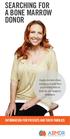 SEARCHING FOR A BONE MARROW DONOR Angela received a bone marrow transplant from an unrelated donor to treat her non-hodgkin s lymphoma. INFORMATION FOR PATIENTS AND THEIR FAMILIES For patients who need
4. All cord blood banks should be subject to the same standards, regulations and accreditation requirements.
 WMDA Policy Statement on the Utility of Autologous or Family Cord Blood Unit Storage The WMDA Board adopted this policy on 25 th of May 2006. Policy updated _April 2011 The Cord Blood Working Group and
cord blood saves lives...
 cord blood saves lives... ...by providing a rich source of blood stem cells that can be used to treat over 80 different diseases including leukemia, lymphoma, thalassemia, Tay-Sachs and sickle cell anemia.
Staff should not feel that the Quality Management staff are policing them. These thoughts
 Chapter IV and Patient Introduction This chapter is the responsibility of the Director/leader and everyone in the hospital, especially the senior leaders whose role is essential to implement the program.
COMMUNITY HOSPITAL REGISTERED NURSE PRINTED NAME:
 COMMUNITY HOSPITAL REGISTERED NURSE EMPLOYEE: PRINTED NAME: REPORTS TO: DEPARTMENT: FMLA STATUS: Date: Director of Med-Surg Nursing Non-exempt PURPOSE: The Registered Nurse is responsible for the ongoing
5. All cord blood banks should be subject to the same standards, regulations and accreditation requirements.
 WMDA Policy Statement for the Utility of Autologous or Family Cord Blood Unit Storage (This policy statement has been approved and adopted by the WMDA board on the 25 th of May 2006) The Cord Blood Registries
Corporate Medical Policy Cord Blood as a Source of Stem Cells
 Corporate Medical Policy Cord Blood as a Source of Stem Cells File Name: Origination: Last CAP Review: Next CAP Review: Last Review cord_blood_as_a_source_of_stem_cells 2/2001 3/2015 3/2016 3/2015 Description
CH CONSCIOUS SEDATION
 Summary: CH CONSCIOUS SEDATION It is the policy of Carondelet Health that moderate conscious sedation of patients will be undertaken with appropriate evaluation and monitoring. Effective Date: 9/4/04 Revision
Inpatient Anticoagulation Safety. To provide safe and effective anticoagulation therapy through a collaborative approach.
 Inpatient Anticoagulation Safety Purpose: Policy: To provide safe and effective anticoagulation therapy through a collaborative approach. Upon the written order of a physician, Heparin, Low Molecular Weight
Immunoablative therapy with autologous hematopoietic stem cell transplantation in the treatment of poor risk multiple sclerosis
 Immunoablative therapy with autologous hematopoietic stem cell transplantation in the treatment of poor risk multiple sclerosis T Kozák, P Lhotáková Department of Clinical Haematology, 3r d School of Medicine,