
FDOH Information and Privacy Awareness Training Learner Course Guide
|
|
|
- Maurice O’Brien’
- 10 years ago
- Views:
Transcription
1 Florida Department of Health FDOH Information and Privacy Awareness Training Learner Course Guide To protect, promote & improve the health of all people in Florida through integrated state, county, & community efforts.

2 Table of Contents SECTION SLIDE NUMBER - TITLE PAGE 1 Slide 1 Welcome Slide 1 Slide 2 How to Use Navigation 1 Slide 3 Section 1 Objectives 2 Slide 4 Section 1 Objectives 2 Slide 5 Federal and State Policies and Regulations 3 Slide 6 What is HIPAA? 3 Slide 7 What are the specific HIPAA rules? 4 Slide 8 What are the specific HIPAA rules? 4 Slide 9 Federal and State Policies and Regulations 5 Slide 10 Federal and State Policies and Regulations 5 Slide 11 Florida Public Records Act, Chapter , F.S. 6 Slide 12 Florida Public Records Act 6 Slide 13 Enterprise Security of Data and Information Technology Act, Chapter , F.S. 7 Slide 14 Enterprise Security of Data and Information Technology Act 7 FDOH Information and Privacy i

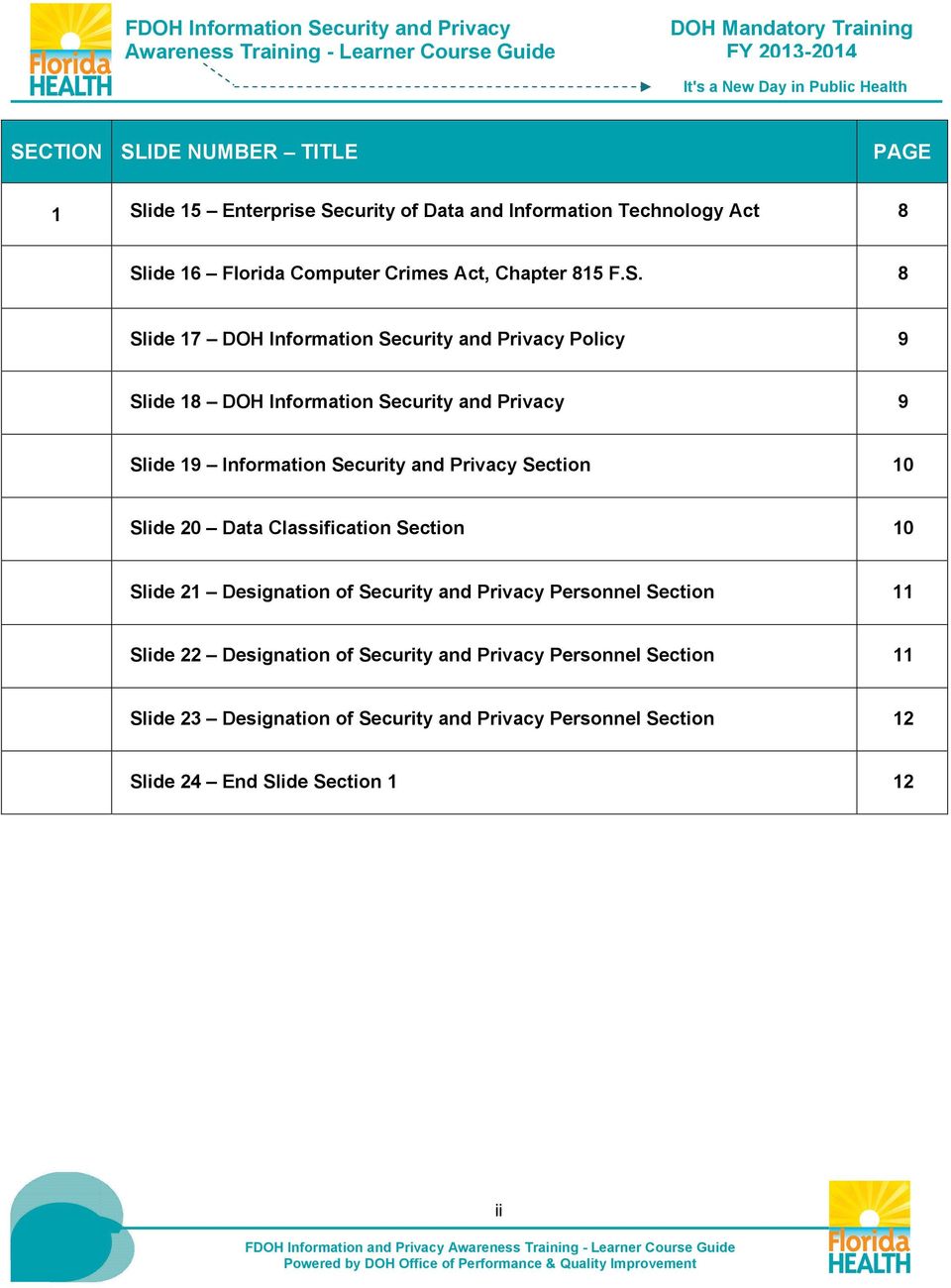
3 SECTION SLIDE NUMBER TITLE PAGE 1 Slide 15 Enterprise Security of Data and Information Technology Act 8 Slide 16 Florida Computer Crimes Act, Chapter 815 F.S. 8 Slide 17 DOH Information Security and Privacy Policy 9 Slide 18 DOH Information Security and Privacy 9 Slide 19 Information Security and Privacy Section 10 Slide 20 Data Classification Section 10 Slide 21 Designation of Security and Privacy Personnel Section 11 Slide 22 Designation of Security and Privacy Personnel Section 11 Slide 23 Designation of Security and Privacy Personnel Section 12 Slide 24 End Slide Section 1 12 FDOH Information and Privacy ii
4 Table of Contents SECTION SLIDE NUMBER - TITLE PAGE 2 Slide 1 Welcome Slide 13 Slide 2 How to Use Navigation 13 Slide 3 Section 2 Objectives 14 Slide 4 DOH Information Security and Privacy Policy 14 Slide 5 Acceptable Use and Confidentiality Agreement Section 15 Slide 6 Acceptable Use and Confidentiality Agreement Section 15 Slide 7 Acceptable Use and Confidentiality Agreement Section 16 Slide 8 Acceptable Use &Confidentiality Agreement Section 16 Slide 9 Acceptable Use & Confidentiality Agreement Section 17 Slide 10 Acceptable Use & Confidentiality Agreement Section 17 Slide 11 Acceptable Use & Confidentiality Agreement Section 18 Slide 12 Acceptable Use & Confidentiality Agreement Section 18 Slide 13 Security and Privacy Awareness Training Section 19 Slide 14 Secured Areas and Physical Security Procedures Section 19 FDOH Information and Privacy iii

5 SECTION SLIDE NUMBER - TITLE PAGE 2 Slide 15 Secured Areas & Physical Security Procedures Section 20 Slide 16 Secured Areas & Physical Security Procedures Section 20 Slide 17 DOH Information Security and Privacy Policy 21 Slide 18 Confidential Information Section 21 Slide 19 Confidential Information Section 22 Slide 20 Confidential Information Section 22 Slide 21 Confidential Information Section 23 Slide 22 Confidential Information Section 23 Slide 23 Confidential Information Section 24 Slide 24 Confidential Information Section 24 Slide 25 Disclosure of Confidential Information Section 25 Slide 26 Disclosure of Confidential Information Section 25 Slide 27 Disclosure of Confidential Information Section 26 Slide 28 End Slide Section 2 27 FDOH Information and Privacy iv

6 Table of Contents SECTION SLIDE NUMBER - TITLE PAGE 3 Slide 1 Welcome Slide 28 Slide 2 How to Use Navigation 28 Slide 3 Section 3 Objectives 29 Slide 4 DOH Information Security and Privacy Policy 29 Slide 5 Patient Privacy Rights Section 30 Slide 6 Patient Privacy Rights Section 30 Slide 7 Patient Privacy Rights Section 31 Slide 8 Patient Privacy Rights Section 31 Slide 9 Patient Privacy Rights Section 32 Slide 10 Patient Privacy Rights Section 32 Slide 11 Patient Privacy Rights Section 33 Slide 12 Public Health HIPAA Exemptions Section 33 Slide 13 Public Health HIPAA Exemptions Section 34 Slide 14 Public Health HIPAA Exemptions Section 34 FDOH Information and Privacy v

7 SECTION SLIDE NUMBER - TITLE PAGE 3 Slide 15 Public Health HIPAA Exemptions Section 35 Slide 16 Contract Providers and Business Associates Section 35 Slide 17 DOH Information Security and Privacy Policy 36 Slide 18 Retention, Archiving and Disposition of Records Section 36 Slide 19 Retention, Archiving and Disposition of Records Section 37 Slide 20 Risk Analysis Section 37 Slide 21 Contingency Planning Section 38 Slide 22 Contingency Planning Section: Continuity of Operations for Information Technology Pans COOP-IT Plan 38 Slide 23 Information Resource Management Security Section 39 Slide 24 Have Questions? 39 Slide 25 End Slide 40 FDOH Information and Privacy vi


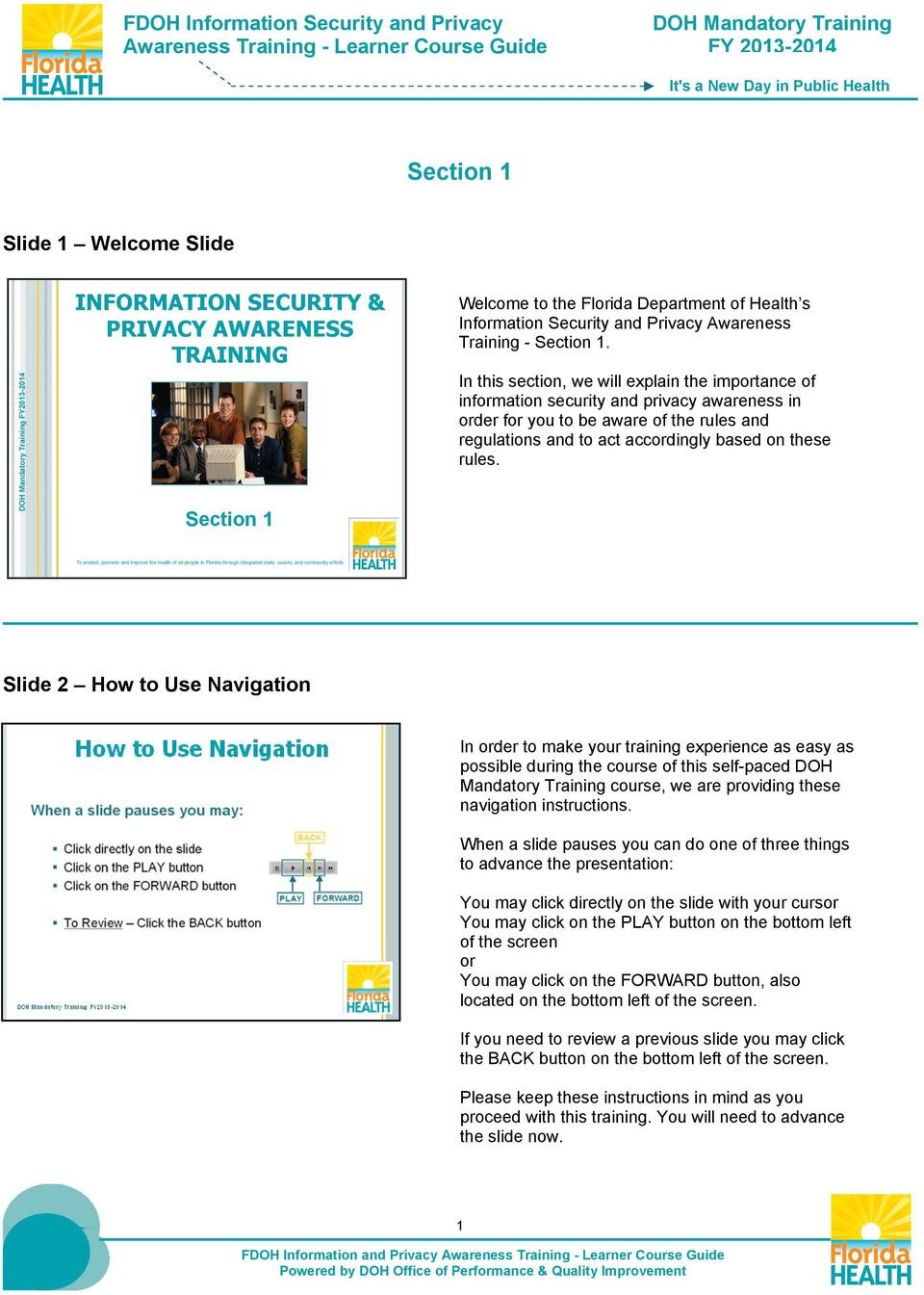
8 Section 1 Slide 1 Welcome Slide INFORMATION SECURITY & PRIVACY AWARENESS TRAINING Section 1 Welcome to the Florida Department of Health s Information Security and Privacy Awareness Training - Section 1. In this section, we will explain the importance of information security and privacy awareness in order for you to be aware of the rules and regulations and to act accordingly based on these rules. To protect, promote and improve the health of all people in Florida through integrated state, county, and community efforts. Slide 2 How to Use Navigation In order to make your training experience as easy as possible during the course of this self-paced DOH Mandatory Training course, we are providing these navigation instructions. When a slide pauses you can do one of three things to advance the presentation: You may click directly on the slide with your cursor You may click on the PLAY button on the bottom left of the screen or You may click on the FORWARD button, also located on the bottom left of the screen. If you need to review a previous slide you may click the BACK button on the bottom left of the screen. Please keep these instructions in mind as you proceed with this training. You will need to advance the slide now. 1 FDOH Information and Privacy
9 Slide 3 Section 1 Objectives Section 1 Objectives Recognize HIPAA rules, the federal & state rules, & regulations related to information security & privacy: 1. Public Records Act , F.S. 2. Enterprise Security of Data & Information Technology Act Chapter , F.S. 3. Florida Computer Crimes Act Chapter 815, F.S. Upon completion of this section, you will be able to recognize HIPAA rules, the federal and state rules, and regulations related to information security and privacy, such as 1. The Public Records Act, Chapter , Florida Statute, and 2. The Enterprise Security of Data and Information Technology Act, Chapter , Florida Statute, and 3. The Florida Computer Crimes Act, Chapter 815, Florida Statute Slide 4 Section 1 Objectives Section 1 Objectives Identify DOH Information Security & Privacy Policy Sections: 1. Information Security & Privacy 2. Data Classification 3. Designation of Key Security & Privacy Personnel You will also be able to identify the following sections of the Department of Health s Information Security and Privacy policy: 1. Information Security and Privacy 2. Data Classification and 3. Designation of Key Security and Privacy Personnel 2 FDOH Information and Privacy

10 Slide 5 Federal and State Policies and Regulations Federal & State Policies & Regulations This first section will give you a general idea about the Federal and State, Information Security and Privacy policy, statutes and regulations. We will answer these three questions: What is HIPAA? What are the specific HIPAA rules? What are the Federal & State Information Security & Privacy policy statutes & regulations? What is HIPAA? What are the specific HIPAA rules? and What are the Federal and State Information Security and Privacy policy statutes and regulations? Slide 6 What is HIPAA? What is HIPAA? Health Insurance Portability & Accountability Act, Public Law Establishes standards to improve the efficiency & effectiveness of the country s health care system Applies such practices to all health care providers in the United States Strengthens penalties for violations HIPAA is the acronym for the Health Insurance Portability and Accountability Act. It establishes standards to improve the efficiency and effectiveness of the country s health care system. HIPAA applies such practices to all health care providers in the United States and strengthens penalties for violations. 3 FDOH Information and Privacy

11 Slide 7 What are the specific HIPAA rules? What are the specific HIPAA rules? HIPAA Security Rule Sets national standards for the security of protected health information HIPAA Privacy Rule Protects the privacy of individually identifiable health information There are only two HIPAA rules, and they guide DOH information security and privacy. The first is the HIPAA Security Rule. It sets national standards for the security of protected health information. The second is the HIPAA Privacy Rule. It protects the privacy of individually identifiable health information. Slide 8 What are the specific HIPAA rules? What are the specific HIPAA rules? HIPAA Privacy Rule Sets boundaries on use & release of health records Holds people accountable if they violate patient rights Provides complaint mechanism for non-compliance Safeguards protected health information (PHI) for individually identifiable health information The HIPAA Privacy Rule sets boundaries on the use and release of health records. It is designed to hold people accountable if they violate patient rights. This rule provides complaint mechanisms for noncompliance and safeguards protected health information (PHI) that refers to individually identifiable health information. All employees must comply with HIPAA. You can get more information from the U.S. Department of Health & Human Services. All employees must comply with HIPAA rules 4 FDOH Information and Privacy

12 Slide 9 Federal and State Policies and Regulations Federal & State Policies & Regulations Public Law The American Recovery & Reinvestment Act of 2009 Title 45 Code of Federal Regulations - Federal law governing the operations & existence of the Department Chapter , F.S. - Defines a public record, the public s right of access, retention requirements & exceptions to the rule Chapter , F.S. - Establishes Department s information security program & requirements The Department s Information Security and Privacy Policy is governed by a number of federal and state rules, statutes and regulations. All employees should be familiar with this legislation. We will list some of these rules and regulations, and then explain the more important ones specifically. The rules, statutes, and regulations include, but are not limited, to the following: Public Law 111-5, The American Recovery and Reinvestment Act of 2009 Title 45 Code of Federal Regulations is the federal law governing the operations and existence of the Department of Health through the Department of Health and Human Services Chapter , Florida Statute, which defines a public record, the public s right of access, retention requirements and the exceptions to the rule and Chapter , Florida Statute, which establishes the Department s information security program and requirements Slide 10 Federal and State Policies and Regulations Federal & State Policies & Regulations F.A.C. 60DD - Rules concerning the State Technology Office Chapter 815, F.S. defines Florida Computer Crimes Act & the penalties for violation of this act. This chapter prohibits: Introduction of fraudulent records into a computer system Unauthorized use of computer facilities Alteration or destruction of computerized information Stealing of data from computer files Florida Administrative Code 60DD is the rule established by the Department of Management Services concerning the State Technology Office; and finally, Chapter 815, Florida Statute, which defines the Florida Computer Crimes Act and the penalties for violation of this act. It prohibits the introduction of fraudulent records into a computer system, the unauthorized use of computer facilities, the alteration, or destruction of computerized information and the stealing of data from computer files. Members of the DOH workforce who have access to a work computer and confidential information should be familiar with these policies. 5 FDOH Information and Privacy

13 Slide 11 Florida Public Records Act, Chapter , F.S. Florida Public Records Act Chapter , F.S. All state, county & municipal records are open for personal inspection & copying by any person Each agency is responsible for providing access to public records All DOH employees must comply with this Act Let s look at each rule and regulation in order to comprehend the basics. We will start with the Florida Public Records Act, Chapter , Florida Statute. Chapter , Florida Statute, states that all state, county and municipal records are open for personal inspection and copying by any person, and each agency is responsible for providing access to public records. All DOH employees must comply with the Florida Public Records Act. Slide 12 Florida Public Records Act Florida Public Records Act What records are & are not exempt from public disclosure? Refer to: Public Records Request Policy, DOHP 30-1 DOH Employee Handbook Health Information Management Training Guidelines The Public Records Act allows that some public records are exempt from disclosure. In order to determine which records are and are not exempt from public disclosure, you can use the following resources: The Public Records Request Policy, DOHP 30-1 The DOH Employee Handbook and The Health Information Management Training Guidelines 6 FDOH Information and Privacy

14 Slide 13 Enterprise Security of Data and Information Technology Act, Chapter , F.S. Enterprise Security of Data & Information Technology Act, Chapter , F.S. The State Technology Office: Consults with each state agency head Is responsible & accountable for assuring adequate level of security for all agency data & information technology resources The next statute we will cover is the Enterprise Security of Data and Information Technology Act, Chapter , Florida Statute. Information resources are valuable assets of the state and as such should be managed effectively. The Enterprise Security of Data and Information Technology Act states that the State Technology Office, in consultation with each state agency head, is responsible and accountable for assuring an adequate level of security for all data and information technology resources of each agency. Slide 14 Enterprise Security of Data and Information Technology Act Enterprise Security of Data & Information Technology Act Each agency is responsible for the following: Designate an information security manager Conduct & update a comprehensive risk analysis Develop & update written internal policies & procedures Under the Enterprise Security of Data and Information Technology Act, each agency is responsible for the following: Designation of an information security manager, who shall administer the agency security program Conduct and update a comprehensive risk analysis to determine the security threats to the data and information technology resources and To develop and update written internal policies and procedures to assure the security of agency resources 7 FDOH Information and Privacy

15 Slide 15 Enterprise Security of Data and Information Technology Act Enterprise Security of Data & Information Technology Act Additional Agency responsibilities: Implement appropriate cost-effective safeguards Ensure that periodic internal audits & evaluations of the security program Include appropriate security requirements in written specifications for procuring resources & services Additional agency responsibilities under the Enterprise Security of Data and Information Technology Act are to: Implement appropriate cost-effective safeguards to reduce, eliminate, or recover from the identified risks Ensure that periodic internal audits and evaluations of the security program are conducted Include appropriate security requirements in written specifications for the solicitation and procuring of information technology resources and services Slide 16 Florida Computer Crimes Act, Chapter 815, Florida Statute Florida Computer Crimes Act Chapter 815, F.S. Prohibits the following: Introduction of fraudulent records into a computer system Unauthorized use of computer facilities Alteration or destruction of computerized information Stealing of data from computer files The Florida Computer Crimes Act, Chapter 815, Florida Statute, prohibits the following: Introduction of fraudulent records into a computer system Unauthorized use of computer facilities Alteration or destruction of computerized information Stealing of data from computer files 8 FDOH Information and Privacy

16 Slide 17 DOH Information Security and Privacy Policy DOH Information Security & Privacy Policy Information Security & Privacy Data Classification Designation of Security & Privacy Personnel Now that we have discussed the specific federal and state, regulations and statutes that support the Department s information security and privacy policy, let s become familiar with the three key sections of this policy: Information Security and Privacy; Data Classification; Designation of Security and Privacy Personnel. Slide 18 DOH Information Security and Privacy DOH Information Security & Privacy Policies & standards apply to: Employees, contractors, volunteers All levels of management & personnel All information systems Mainframe, minicomputer, distributed processing, & networking environments of the state Information resources owned by others Information security policies and standards apply to: All members of the Department of Health workforce, including employees, contractors, and volunteers All levels of management and personnel All information systems that access, process, or have custody of data including automated information systems Mainframe, minicomputer, distributed processing and networking environments of the state, and They also apply to information resources owned by others, such as political subdivisions of the state or agencies of the federal government, in those cases where the state has a contractual or fiduciary responsibility to protect the resources while in the custody of the state 9 FDOH Information and Privacy

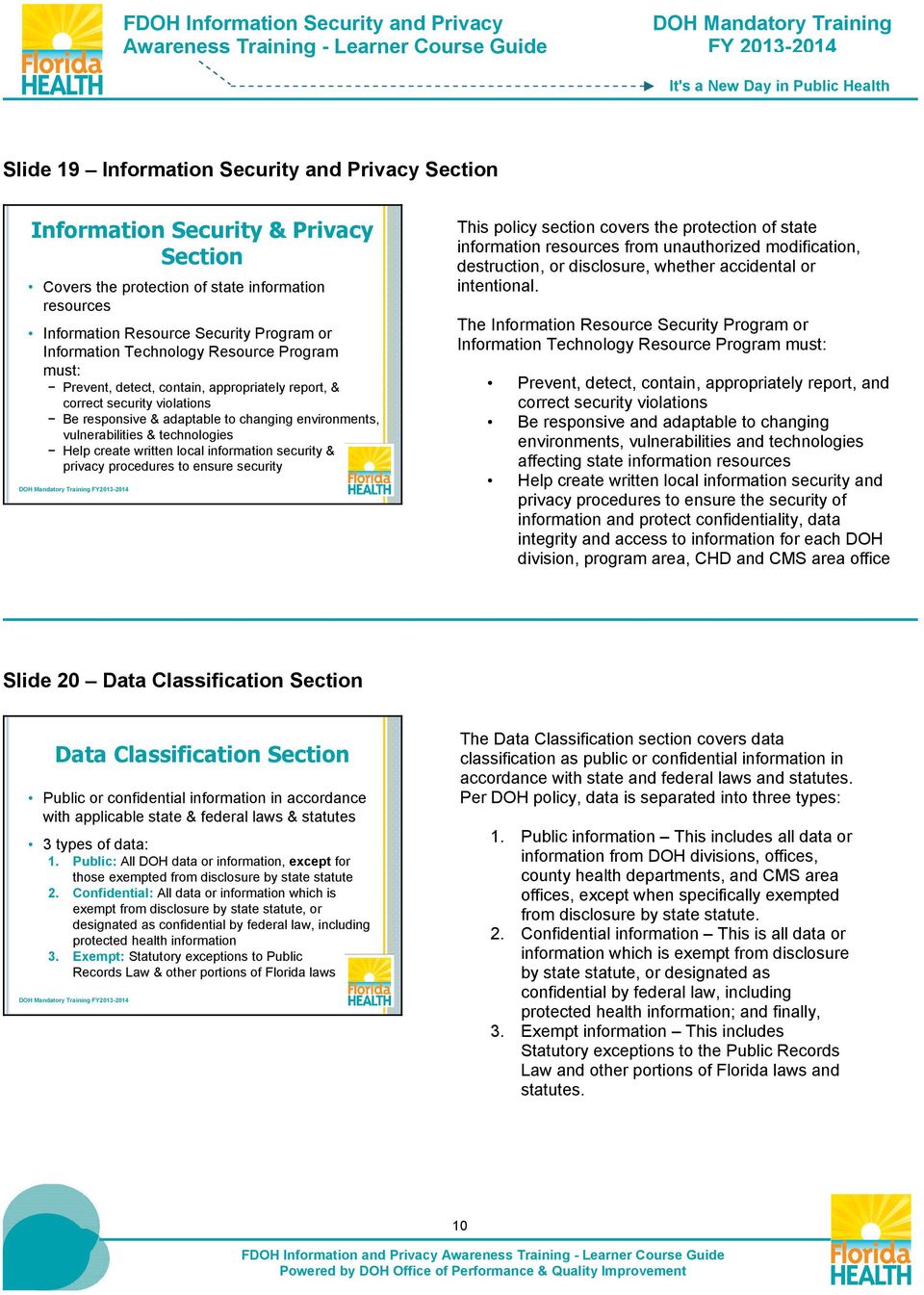
17 Slide 19 Information Security and Privacy Section Information Security & Privacy Section Covers the protection of state information resources Information Resource Security Program or Information Technology Resource Program must: Prevent, detect, contain, appropriately report, & correct security violations Be responsive & adaptable to changing environments, vulnerabilities & technologies Help create written local information security & privacy procedures to ensure security This policy section covers the protection of state information resources from unauthorized modification, destruction, or disclosure, whether accidental or intentional. The Information Resource Security Program or Information Technology Resource Program must: Prevent, detect, contain, appropriately report, and correct security violations Be responsive and adaptable to changing environments, vulnerabilities and technologies affecting state information resources Help create written local information security and privacy procedures to ensure the security of information and protect confidentiality, data integrity and access to information for each DOH division, program area, CHD and CMS area office Slide 20 Data Classification Section Data Classification Section Public or confidential information in accordance with applicable state & federal laws & statutes 3 types of data: 1. Public: All DOH data or information, except for those exempted from disclosure by state statute 2. Confidential: All data or information which is exempt from disclosure by state statute, or designated as confidential by federal law, including protected health information 3. Exempt: Statutory exceptions to Public Records Law & other portions of Florida laws The Data Classification section covers data classification as public or confidential information in accordance with state and federal laws and statutes. Per DOH policy, data is separated into three types: 1. Public information This includes all data or information from DOH divisions, offices, county health departments, and CMS area offices, except when specifically exempted from disclosure by state statute. 2. Confidential information This is all data or information which is exempt from disclosure by state statute, or designated as confidential by federal law, including protected health information; and finally, 3. Exempt information This includes Statutory exceptions to the Public Records Law and other portions of Florida laws and statutes. 10 FDOH Information and Privacy
18 Slide 21 Designation of Security and Privacy Personnel Section Designation of Security & Privacy Personnel Section Each division, office, CHD & CMS is responsible for local information security & privacy Key personnel must be designated Identity of designees must be documented Eleven designations of security & privacy personnel The Designation of Security and Privacy Personnel section covers the responsibility of each DOH division, office, county health department and CMS area office for the security and privacy of information within its jurisdiction. To accomplish this, key personnel with specific responsibility must be designated to coordinate the security and privacy of information. The identity of the designees must be documented in the local information security and privacy procedures, and their responsibilities must be included in the position description. There are eleven designations of security and privacy personnel. These designations will be explained in the following two slides. Slide 22 Designation of Security and Privacy Personnel Section Designation of Security & Privacy Personnel Section 11 designations of security & privacy personnel, The State Surgeon General 2. The HIPAA Privacy Officer 3. The HIPAA Complaint Officer 4. The Information Security Manager 5. The HIPAA Security Officer 6. DOH Division Directors/Administrators The first six designations of security and privacy personnel are as follows: 1. The State Surgeon General is ultimately responsible for the implementation of information security and privacy policies, protocols, and procedures. This includes designating headquarters security officials such as the HIPAA Privacy Officer, the HIPAA Privacy Complaint Officer, the Information Security Manager, and the HIPAA Security Officer. 2. The HIPAA Privacy Officer provides leadership for the development of policies and procedures. 3. The HIPAA Privacy Complaint Officer functions as the HIPAA Privacy Complaint Officer for all privacy violations. 4. The Information Security Manager is responsible for administering the Department s Data and Information Technology Security Program. 5. The HIPAA Security Officer administers the Department s Data and Information Technology Security Program and the HIPAA Security Rule. 6. DOH Division Directors and Administrators designates the Local Information Security and Privacy Coordinators. 11 FDOH Information and Privacy

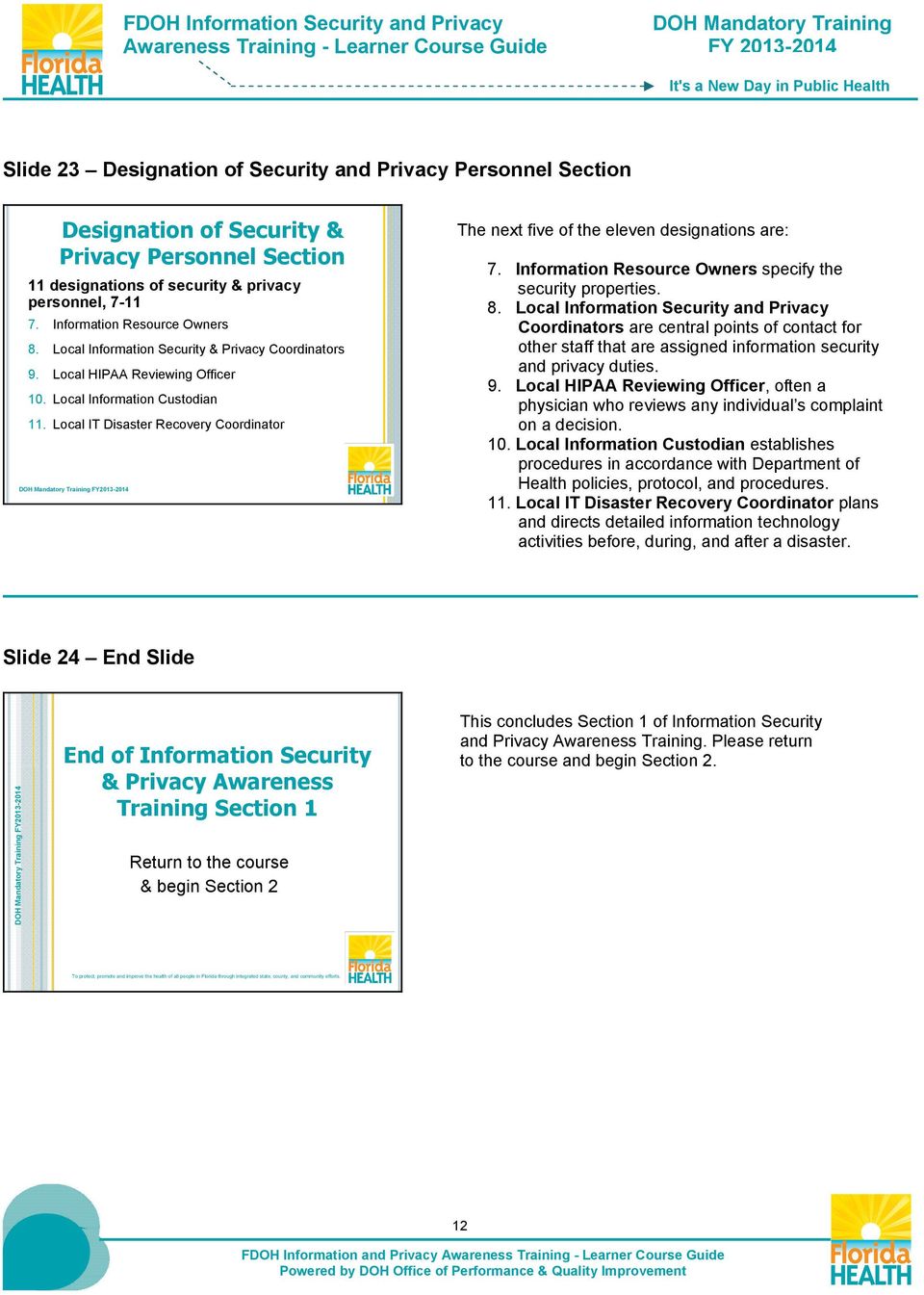
19 Slide 23 Designation of Security and Privacy Personnel Section Designation of Security & Privacy Personnel Section 11 designations of security & privacy personnel, Information Resource Owners 8. Local Information Security & Privacy Coordinators 9. Local HIPAA Reviewing Officer 10. Local Information Custodian 11. Local IT Disaster Recovery Coordinator The next five of the eleven designations are: 7. Information Resource Owners specify the security properties. 8. Local Information Security and Privacy Coordinators are central points of contact for other staff that are assigned information security and privacy duties. 9. Local HIPAA Reviewing Officer, often a physician who reviews any individual s complaint on a decision. 10. Local Information Custodian establishes procedures in accordance with Department of Health policies, protocol, and procedures. 11. Local IT Disaster Recovery Coordinator plans and directs detailed information technology activities before, during, and after a disaster. Slide 24 End Slide End of Information Security & Privacy Awareness Training Section 1 Return to the course & begin Section 2 This concludes Section 1 of Information Security and Privacy Awareness Training. Please return to the course and begin Section 2. To protect, promote and improve the health of all people in Florida through integrated state, county, and community efforts. 12 FDOH Information and Privacy
20 Section 2 Slide 1 Welcome Slide INFORMATION SECURITY & PRIVACY AWARENESS TRAINING Section 2 Hello, and welcome to Section 2 of Information Security and Privacy Awareness Training. In this section, we will explain more key sections of the DOH Information Security and Privacy policy. To protect, promote and improve the health of all people in Florida through integrated state, county and community efforts. Slide 2 How to Use Navigation In order to make your training experience as easy as possible during the course of this self-paced DOH Mandatory Training course, we are providing these navigation instructions. When a slide pauses you can do one of three things to advance the presentation: You may click directly on the slide with your cursor You may click on the PLAY button on the bottom left of the screen or You may click on the FORWARD button, also located on the bottom left of the screen If you need to review a previous slide you may click the BACK button on the bottom left of the screen. Please keep these instructions in mind as you proceed with this training. You will need to advance the slide now. 13 FDOH Information and Privacy
21 Slide 3 Section 2 Objectives Section 2 Objectives Identify DOH Information Security & Privacy Policy Sections: 1. Acceptable Use & Confidentiality Agreement 2. Security & Privacy Awareness Training 3. Secured Areas & Physical Security Procedures 4. Confidential Information 5. Disclosure of Confidential Information Upon completion this section, you will be able to identify the following sections of the Department of Health s Information Security and Privacy policy: 1. Acceptable Use and Confidentiality Agreement 2. Security and Privacy Awareness Training 3. Secured Areas and Physical Security Procedures 4. Confidential Information and 5. Disclosure of Confidential Information Slide 4 DOH Information Security and Privacy Policy DOH Information Security & Privacy Policy Acceptable Use & Confidentiality Agreement Security & Privacy Awareness Training Secured Areas & Physical Security Procedures The following slides will review the sections regarding the acceptable use and confidentiality agreement; security and privacy awareness training; and procedures for secured areas and physical security. 14 FDOH Information and Privacy
22 Slide 5 Acceptable Use and Confidentiality Agreement Section Acceptable Use & Confidentiality Agreement Section Covers protecting information from unauthorized modification, destruction, use or disclosure & safeguarding confidential information All members of the workforce are responsible for protecting information All DOH data, information & technology resources to be used only for state business Supervisors may monitor computer use observation, reviewing history & productivity The Acceptable Use and Confidentiality Agreement section covers protecting information from unauthorized modification, destruction, use or disclosure and safeguarding confidential information. All members of the workforce shall be held accountable for protecting information as stated in this policy. All DOH data, information and technology resources shall only be used for official state business. Supervisors may monitor computer use by direct observation, reviewing computer history files through the systems administrator, or reviewing work productivity and quality. Slide 6 Acceptable Use and Confidentiality Agreement Section Acceptable Use & Confidentiality Agreement Section Only authorized IT personnel can install DOH approved software & hardware No expectation of privacy while using DOH resources Written approval is required to use streaming media technologies Per this policy section, only authorized IT personnel can install DOH-approved software and hardware. Employees should have no expectation of privacy while using Department resources. To use streaming media technologies, you must receive written approval from your supervisor and the Information Security Manager or delegate. 15 FDOH Information and Privacy
23 Slide 7 Acceptable Use and Confidentiality Agreement Section Acceptable Use & Confidentiality Agreement Section Access to the internet, telephone systems, or service at DOH is a privilege, not a right Adhere to Department policies & procedures, as well as local, state & federal laws & regulations Supervisors will regularly review the access privileges of staff to ensure access is appropriate to job responsibilities Keep in mind that access to the Internet, telephone systems, or service is a privilege, not a right. As a Department employee, you must adhere to Department policies and procedures, local and state laws, as well as federal laws and regulations. It is important to note that supervisors will regularly review the access privileges of staff to ensure access is appropriate to job responsibilities. Slide 8 Acceptable Use and Confidentiality Agreement Section Acceptable Use & Confidentiality Agreement Section Computer Use DOH employees will have a user account Log off or lock your workstation/computer when leaving Secure workstations/computers with a password protected screensaver Respect & obey copyright laws regarding use or duplication of software The technology rules and regulations regarding computer use by DOH employees and staff are also covered in this section of the policy and are very important to the everyday functions of the Department. DOH employees are given a user account to access DOH information technology resources. Be sure to log off or lock your workstation or computer prior to leaving the work area. Your workstation or computer must be secured with a password-protected screensaver. Set the automatic activation feature for a delay of no more than 10 minutes. The Department and its employees shall respect the legitimate proprietary interests of intellectual property holders and obey the copyright law prohibiting the unauthorized use or duplication of software 16 FDOH Information and Privacy
24 Slide 9 Acceptable Use and Confidentiality Agreement Section Acceptable Use & Confidentiality Agreement Section Computer Use Personal passwords may not be shared or disclosed, do not include passwords in s Staff held accountable for all activities under their DOH user ID or password Change network passwords every 30 days Passwords should be at least 8 characters long, including letters & numbers The password for your computer is an important aspect of information security. Your user account grants access to DOH information technology resources. This access is based on the documented need provided by the appropriate hiring authority. Anyone who has or is responsible for a user account within the Department s network must take the appropriate steps to select and secure their passwords. It is your responsibility to take appropriate steps to select and secure your password. Password protection is important. Following these simple guidelines will help keep your computer and its data secure: Personal passwords may not be shared or disclosed. Do not include passwords in s. Staff will be held accountable for all activities that occur under their DOH user ID or password. Network passwords must be changed every 30 days. For better security passwords should be at least 8 characters long, including letters and numbers. Slide 10 Acceptable Use and Confidentiality Agreement Section Acceptable Use & Confidentiality Agreement Section Computer Use Permitted Activities Visiting non-doh-prohibited internet sites for personal reasons during non-work hours Access to non-doh-browser accounts As a Department employee, your computer is to be used primarily to accomplish your job duties and responsibilities. The Information Security and Privacy policy does allow for access to non-work related sites, but you must follow the guidelines for permitted and prohibited computer activities. Permitted activities include: Visiting non-doh-prohibited internet sites The use of for personal reasons during non-work hours within the limitations contained in this policy and Access to non-doh-browser based accounts, such as AOL or Yahoo However, these permitted activities must not interfere with your job duties, must not be used excessively and must not compromise the DOH network. 17 FDOH Information and Privacy
25 Slide 11 Acceptable Use and Confidentiality Agreement Section Acceptable Use & Confidentiality Agreement Section Computer Use Prohibited Activities Install unlicensed or unapproved software Introduce viruses, worms, trojan horses, bombs, etc. Access or download inappropriate material Access non-work related chat rooms Program s to forward to a non-doh address Per the Information Security and Privacy policy, prohibited activities include, but are not limited to: Installing, introducing, downloading, accessing, or distributing any unlicensed software or software not approved by the DOH Information Technology Standard Workgroup Introducing viruses, worms, trojan horses, bombs, etc. through willful intent or negligence Accessing or downloading inappropriate material Accessing non-work related chat rooms, news groups, political groups, singles clubs, or dating services Programming to automatically forward messages to an external destination outside the Department s network Slide 12 Acceptable Use and Confidentiality Agreement Section Acceptable Use & Confidentiality Agreement Section Computer Use Prohibited Activities Do not access unauthorized confidential/proprietary information Do not connect a DOH laptop to a non-doh wireless network Do not erase, destroy or hide web browsing audit trails Do not disable, alter or circumvent Department workstation security measures Do not access unauthorized confidential/proprietary information. Do not connect a DOH laptop to a non-doh wireless network. Do not erase, destroy or hide web browsing audit trails. Do not disable, alter or circumvent Department workstation security measures. If a DOH employee must perform any of these prohibited activities as part of their job duties and responsibilities, they must have written supervisory 18 FDOH Information and Privacy
26 Slide 13 Security and Privacy Awareness Training Section Security & Privacy Awareness Training Section DOH employees must receive security & privacy awareness training prior to accessing the DOH network. Before you: Provide services to clients Access confidential information Access information technology This training meets the these requirements! The Security and Privacy Awareness Training section of this policy requires that DOH employees must receive initial security and privacy awareness training prior to accessing the DOH network. This includes access used for providing services to clients, accessing confidential information and accessing information technology. Additionally, employees are required to take the annual update to the information security and privacy awareness training course. The training you are now taking meets these requirements. Slide 14 Secured Areas and Physical Security Procedures Section Secured Areas & Physical Security Procedures Section Secured Areas Designate & maintain secured areas for the security & privacy of information Protect confidentiality & data integrity Provide appropriate access to information using administrative, physical & technical controls Document each designated secured area in the local information security & privacy procedures Access only provided to those members with documented need-to-know authorization As stated in the Secured Areas and Physical Security Procedures policy section, the Department must designate and maintain secured areas to ensure the security and privacy of information and information technology resources. This is to protect confidentiality and data integrity. The Department must also provide appropriate access to information using administrative, physical and technical controls. Each designated secured area shall be documented in the local information security and privacy procedures. Access to the secured areas should only be provided to those members with documented needto-know authorization. For example, an employee who is responsible for billing Medicaid for a child s health assessment does not need to have the child s full medical record or even the assessment results. He or she only needs to know the information required to process the payment and will be provided the minimum necessary information to do the job. 19 FDOH Information and Privacy
27 Slide 15 Secured Areas and Physical Security Procedures Section Secured Areas & Physical Security Procedures Section Physical Security Procedures Visitors must always be escorted in secured areas Secured areas must have a reliable locking system Reliable locking systems must be used. Electronic locks must have a manual locking system as back-up Access should be limited to a documented list of authorized staff Physical security of secured areas is very important to prevent possible security breaches. Here are the procedures for the physical security of DOH secured areas: Visitors must always be escorted by an authorized DOH employee in secured areas. Secured areas must have reliable locking systems and construction that does not allow unauthorized access. If an electronic locking system is used, a reliable manual locking system must be in place as a back-up, in the event of a power outage. Access to the secured area should be limited to a documented list of authorized staff, and procedures for removing and returning the information must be in place. Slide 16 Secured Areas and Physical Security Procedures Section Secured Areas & Physical Security Procedures Section Physical Security Procedures For each secured area, a key custodian & alternate key custodian must be designated Access logs must be kept for staff needing temporary access to secured areas Any modifications or repairs to secured areas are to be coordinated with the local information custodian For each secured area, a key custodian and alternate key custodian must be designated. They are responsible for maintaining control of the keys, providing access to authorized staff and annually updating the inventory of information resources and information sets maintained in the designated secured area. Access logs must be kept and maintained for those persons that need temporary or occasional access but are not issued a key for each secured area. Any modifications or repairs to secured areas are to be coordinated with the local information custodian to document the actions being taken. 20 FDOH Information and Privacy
28 Slide 17 DOH Information Security and Privacy Policy DOH Information Security & Privacy Policy Confidential Information Security Disclosure of Confidential Information Recall from Section 1 of this course that information is classified as either public or confidential. The next section of this presentation will review the sections of the Information Security and Privacy policy regarding confidential information security and disclosure of confidential information. It is very important to make note of the regulations pertaining to confidential information, as violations of these regulations may result in disciplinary action. Slide 18 Confidential Information Section Confidential Information Section Covers classifying & securing confidential information using administrative, technical & physical safeguards Classify & handle the information/data by following policy guidelines Maintain the confidentiality of any & all confidential information/data in your possession The Confidential Information Section covers the classifying and securing of confidential information by using appropriate administrative, technical and physical safeguards. All DOH employees should be able to classify and handle data or information using these guidelines. You are responsible for maintaining the confidentiality of any and all confidential information or data in your possession. The next slide details some of the policy guidelines for protecting confidential information. 21 FDOH Information and Privacy
29 Slide 19 Confidential Information Section Confidential Information Section To protect confidential information: Position computer monitors to prevent viewing Designated people for file transfer from database Consultations involving confidential information in areas with restricted access Electronic transmission of confidential information must be encrypted Data back-ups must be locked in a secured area Do not use laptops to store any type of information To protect confidential information, position computer monitors to prevent unauthorized viewing. A person or persons shall be designated in the local operating procedures as responsible for the electronic file transfers of information from confidential databases. Consultations involving confidential information, such as information regarding employees and/or clients, or any other confidential information, must be held in areas with restricted access Please note - Discussions about employees and/or clients must be limited to information necessary to provide care or perform job functions. It is also important to note that access to reports and files, which contain patient identifying information for reasons other than treatment, payment and operations must be logged, tracked and periodically audited. Electronic transmission of confidential information must be encrypted. Data back-ups must be locked in a secured area. Do not use laptop computers to store any typed of information, confidential or otherwise. Slide 20 Confidential Information Section Confidential Information Section Telephone Communication Procedures Conduct conversations in private areas where they cannot be overheard Cell phones are not secure advise the caller of cell phone use Determine caller identity before releasing any information The Confidential Information Section also covers procedures for handling confidential information via telephone, mail, fax and . This slide and the following four slides will address these procedures. Telephone communication procedures include conducting discussions of confidential information by phone in private areas where the conversation cannot be overheard. Cell phones are not considered to be secure. Employee-initiated cell phone calls regarding confidential information should be limited to the minimum amount of information necessary. The person called should be advised that the discussion is taking place on a cell phone and the conversation is not guaranteed to be secure. The employee must determine the identity of the caller and what information can be disclosed to that person before releasing any information. 22 FDOH Information and Privacy
30 Slide 21 Confidential Information Section Confidential Information Section Mailing Confidential Information Secure mail intake sites for all incoming confidential mailings Secure mailrooms & mailboxes Double enveloping is required: The outside envelope addressed to recipient The inside envelope is marked confidential & specifies the recipient Mailing confidential information procedures include the following: A secured mail intake site must be used to receive incoming confidential information, such as laboratory results, patient medical records, or surveillance case reports. Mailrooms and mailboxes must be secured to prevent unauthorized access to incoming or outgoing mail. Double enveloping is required when mailing confidential or sensitive information. The outside envelope is addressed to the recipient, and the inside envelope is marked confidential and specifies the recipient. Slide 22 Confidential Information Section Confidential Information Section Faxing Confidential Information Keep fax machines in secured area with limited visual access Before faxing, obtain consent & authorization to release the confidential information Use a cover sheet marking the fax as confidential must include specific text Confidential information may be faxed using appropriate administrative, technical and physical safeguards. Faxing confidential information procedures include keeping fax machines designated to receive and transmit confidential information in a secured area with limited visual and physical access. Before faxing any confidential information such as employee, client, or medical information, you must obtain proper consent, authorization and release permissions. The designated information custodian for confidential information is responsible for the release of information from the specific information set. When faxing, you must use a cover sheet that specifically marks the fax transmission as Confidential. Specific text must also be on the cover sheet; this text is provided in the next slide. 23 FDOH Information and Privacy
31 Slide 23 Confidential Information Section Confidential Information Section Confidential Fax Cover Sheet Text This transmission may contain material that is CONFIDENTIAL under federal law & Florida Statutes & is intended to be delivered to only the named addressee. Unauthorized use of this information may be a violation of criminal statutes. If this information is received by anyone other than the named addressee, the recipient shall immediately notify the sender at the address or the telephone number above & obtain instruction as to the disposal thereof. Under no circumstances shall this material be shared, retained or copied by anyone other than the named addressee. A fax cover sheet marked Confidential and containing the following paragraph must accompany all transmissions: This transmission may contain material that is CONFIDENTIAL under federal law and Florida Statutes and is intended to be delivered to only the named addressee. Unauthorized use of this information may be a violation of criminal statutes. If this information is received by anyone other than the named addressee, the recipient shall immediately notify the sender at the address or the telephone number above and obtain instruction as to the disposal thereof. Under no circumstances shall this material be shared, retained or copied by anyone other than the named addressee. Slide 24 Confidential Information Section Confidential Information Section Procedures is generally public record & archived by the Department must be reviewed & confirmed by the General Counsel s Office prior to release s containing confidential information must be encrypted, including any attachments is generally considered public record, and archived copies are kept by the Department. However, all must be reviewed and confirmed as a public record by the General Counsel s Office prior to release. Confidential information cannot be sent by unless encryption is used for the and any attachments. 24 FDOH Information and Privacy
32 Slide 25 Disclosure of Confidential Information Section Disclosure of Confidential Information Section Covers disclosure of confidential information exempt from public disclosure & how to ensure its protection All records maintained by the Department are public records Available for inspection or copying by the public under the supervision of Department personnel with certain exceptions The Disclosure of Confidential Information section covers disclosure of confidential information which is exempt from public disclosure by state or federal law, rule, or regulation, and how to ensure its protection in accordance with these protocols. All records maintained by the Department of Health are public records. They are available for inspection or copying by the public at reasonable times under the supervision of Department personnel with certain exceptions. A charge for copying, preparing or searching a record for inspection may not exceed that specified in the public records law. Charges may not exceed that specified in the public records law Slide 26 Disclosure of Confidential Information Section Disclosure of Confidential Information Section Exceptions to public access of public records: Client Eligibility Applications: Bank account numbers Debit card numbers Credit card numbers Sealed Bids or Proposal Financial Statements Computer Software There are exceptions to public access to public records due to the confidential nature or security issues that appear in numerous places throughout the state and federal statutes. These exceptions are designated as confidential or non-disclosable. Some of these exceptions are: Client Eligibility Applications, which include all personal identifying information, bank account numbers, debit and credit card information contained in records relating to an individual s personal health or eligibility for health-related services Sealed bids or proposals that are received by the Department, which are not disclosable until the award date or 10 days after the opening Financial statements received by the Department for bid pre-qualifying and Computer software, which includes commercially available programs and data processing under a licensing agreement 25 FDOH Information and Privacy
33 Slide 27 Disclosure of Confidential Information Section Disclosure of Confidential Information Section Exceptions to public access of personnel files: Confidential or non-disclosable information, such as Social Security Numbers Location information Complaints of discrimination Medical information Exceptions to public access regarding information contained in personnel files of state employees are generally accessible by the public. There are certain exceptions that are designated as confidential or nondisclosable. Some of these are: Social Security Numbers, which are not releasable in any record, including personnel records, with the exception of medical treatment records, which rely on social security numbers as an identifier for the performance of legally prescribed duties and responsibilities Location information, including but not limited to, home addresses, telephone numbers, social security numbers, photographs and daycare information for the following people or their spouse: department personnel supporting abuse investigations, human resource employees, labor relations employees, assistant directors, managers, or assistant managers of any government agency Complaints of discrimination relating to race, color, religion, national origin, age, handicap, or marital status are confidential and not disclosable; and finally, Medical information pertaining to a prospective, current, or former officer or employee of an agency 26 FDOH Information and Privacy
34 Slide 28 End Slide End of Information Security & Privacy Awareness Training Section 2 This concludes Section 2 of Information Security and Privacy Awareness Training. Please return to the course and begin Section 3. Return to course & begin Section 3 To protect, promote and improve the health of all people in Florida through integrated state, county, and community efforts. 27 FDOH Information and Privacy
35 Section 3 Slide 1 Welcome Slide Information Security & Privacy Awareness Training Section 3 Hello, and welcome to Section 3 of the Department of Health s Information Security and Privacy Awareness Training. In this section, we will continue explaining the key sections of the DOH Information Security and Privacy policy. To protect, promote and improve the health of all people in Florida through integrated state, county and community efforts. Slide 2 How to Use Navigation How to Use Navigation How to Use Navigation In order to make your training experience as easy as possible during the course of this self-paced DOH Mandatory Training, we are providing these navigation instructions. When a slide pauses you can do one of three things to advance the presentation: You may click directly on the slide with your cursor You may click on the PLAY button on the bottom left of the screen or You may click on the FORWARD button, also located on the bottom left of the screen If you need to review a previous slide you may click the BACK button on the bottom left of the screen. Please keep these instructions in mind as you proceed with this training. You will need to advance the slide now. 28 FDOH Information and Privacy
36 Slide 3 Section 3 Objectives Identify the following DOH Information Security & Privacy Policy Sections: 1. Patient Privacy Rights 2. Public Health HIPAA Exemptions 3. Contract Providers & Business Associates 4. Retention, Achieving & Disposition of Records 5. Risk Analysis Section 3 Objectives Upon completion this section, you will be able to identify the following sections of the Department of Health s Information Security and Privacy Policy: 1. Patient Privacy Rights 2. Public Health HIPAA Exemptions 3. Contract Providers and Business Associates 4. Retention, Achieving and Disposition of Records 5. Risk Analysis 6. Contingency Planning and 7. Information Resource Management Security 6. Contingency Planning 7. Information Resource Management Security Slide 4 DOH Information Security and Privacy Policy DOH Information Security & Privacy Policy The following slides will review the sections regarding patient privacy rights, public health HIPAA exemptions, and contract providers and business associates. Patient Privacy Rights Public Health HIPAA Exemptions Contract Providers & Business Associates 29 FDOH Information and Privacy
37 Slide 5 Patient Privacy Rights Section Patient Privacy Rights Section Standards established to protect the privacy of medical records & protected health information HIPAA supports the DOH-established privacy standards HIPAA improves the efficiency & effectiveness of the country s health care system HIPAA helps health care providers eliminate waste, streamline & expand potential The Patient Privacy Rights Section covers information security policies and procedures relating to patients rights. To prevent the misuse of individually identifiable health care information, standards must be established to protect the privacy and security of medical records and other protected health information. HIPAA supports the DOH-established privacy standards. HIPAA is part of a plan to make the country s health care system more efficient and effective. HIPAA helps health care providers eliminate waste, streamline electronic transmission and expand the potential to share health information. Slide 6 Patient Privacy Rights Section Patient Privacy Rights Section HIPAA Privacy Rule Safeguards to protect privacy of health care information Sets boundaries on use & release of health records Holds people accountable if they violate patient rights Provides complaint mechanisms for non-compliance The HIPAA Privacy Rule establishes the safeguards to ensure the confidentiality of protected health information. This means that any information that can be reasonably used to identify the health records of specific individuals must be protected. It sets boundaries on the use and release of health records, holds people accountable if they violate patient rights and provides complaint mechanisms for non-compliance. Everyone who works for the Department is responsible for following and enforcing the Department s security policy and HIPAA rules. 30 FDOH Information and Privacy
38 Slide 7 Patient Privacy Rights Section Patient Privacy Rights Section Some Florida laws are more stringent than HIPAA requirements: family planning sexually transmitted diseases public health reporting vital statistics tuberculosis HIV/AIDS State laws are the ceiling what we do already HIPAA is the foundation minimum standards The HIPAA Privacy Rule does not take away existing confidentiality rules as long as they are compatible with HIPAA, such as rules governing mandatory reporting of certain diseases and reporting for public health purposes. HIPAA establishes the minimum standards that must be met. It does not prevent a state from applying more restrictive policies and procedures to protect client privacy. In many instances, Florida laws are more stringent than HIPAA requirements. Slide 8 Patient Privacy Rights Section Patient Privacy Rights Section Directs employees & volunteers to prevent unauthorized disclosure of protected health information Requires use of DOH forms that include HIPAA privacy language Provides DOH Notice of Privacy Practices Provides poster about client rights The Patient Privacy Rights section of the DOH policy directs employees and volunteers to prevent unauthorized disclosure of protected health information, except as permitted or required by law. To assure client s rights, the policy requires the use of certain Department forms that have been revised to include HIPAA privacy language. Also provided by policy is a Notice of Privacy Practices and a poster about client rights. 31 FDOH Information and Privacy
39 Slide 9 Patient Privacy Rights Section Patient Privacy Rights Section The DOH Notice of Privacy Practices Designed to inform clients about privacy rights The Department s duties to protect health information Explains when the Department may need permission to use client information Describes client s rights as they relate to the privacy of their health information How a client can file a grievance or complaint The Florida Department of Health s Notice of Privacy Practices is a document designed to inform clients about their privacy rights. This notice includes the Department s duties to protect health information. It explains to the client why we may need to use or share their personal health information, when we need their permission to use or share it, and when we do not. The notice also describes the client s rights as they relate to the privacy of their health information and provides information about how to file a grievance or complaint if they feel their protected health information is being used improperly. Slide 10 Patient Privacy Rights Section Patient Privacy Rights Section The DOH Notice of Privacy Practices Department of Health responsibilities Notifying all clients of their privacy rights Adopting & implementing privacy procedures Training staff on privacy procedures Ensuring business associates protect patient information Adopting privacy complaint procedures It is the Department s duty to inform clients about the Notice of Privacy Practices. The Department is responsible for: Notifying all clients of the Department about their privacy rights under HIPAA Adopting and implementing privacy procedures Training staff on privacy procedures Ensuring business associates protect patient information under HIPAA and Adopting a privacy complaint process 32 FDOH Information and Privacy
40 Slide 11 Patient Privacy Rights Section Patient Privacy Rights Section Rules regarding patient privacy Clients have the right to ask the Department to limit how it uses or discloses their protected health information The Department does not have to agree If a client s limits are denied, the client s record must be documented with reason for denial Patient privacy rights include the following rules: the right to ask the Department to limit how it uses or discloses patient protected health information except for those uses or disclosures that are required by law. However, even though the client can request that limits on use and disclosures be made, the Department does not have to agree to the client s restriction. In cases where a client s requested limits are denied, the client s records must be documented as to why the request was refused. Slide 12 Public Health HIPAA Exemptions Section Public Health HIPAA Exemptions Section Addresses health information kept as a result of activities not covered by HIPAA Privacy Rule Exemption Example: individual medical information recorded as a result of public health disaster, emergency, communicable disease surveillance or epidemiologic investigation Exemptions when Notice of Privacy Practices is not required & information is qualified as disclosable The Public Health HIPAA Exemptions section addresses certain health information kept by the Department as a result of public health activities that are not covered by the HIPAA Privacy Rule. Individual medical information recorded as a result of a public health disaster, emergency, communicable disease surveillance or epidemiologic investigation are exempt from HIPAA. There are also exemptions from the HIPAA Privacy Rule when the Notice of Privacy Practices is not required and certain public health information is qualified as disclosable. 33 FDOH Information and Privacy
41 Slide 13 Public Health HIPAA Exemptions Section Public Health HIPAA Exemptions Section Example Activities with exempted information: Syndromic surveillance & surveillance of communicable diseases Epidemiologic investigations of communicable disease outbreaks & contact investigations Locating contacts for communicable disease prevention & regulatory activities Some examples of activities that produce exempted information include: Syndromic surveillance and surveillance of communicable diseases or disease outbreaks Epidemiology investigations of communicable disease outbreaks and contact investigations Locating contacts for communicable disease prevention and regulatory activities Slide 14 Public Health HIPAA Exemptions Section Public Health HIPAA Exemptions Section Patient authorization is not required to disclose to the following registries: Tuberculosis Sexually Transmitted Diseases Cancer & Tumor Immunization Vital Statistics Client or patient authorization for release of medical records is not required for the information to be disclosed to the following registries: Tuberculosis Sexually Transmitted Diseases Cancer and Tumor Immunization and Vital Statistics 34 FDOH Information and Privacy
42 Slide 15 Public Health HIPAA Exemptions Section The law requires disclosure of medical records in response to: Child Abuse Law enforcement Neglect officers Domestic Violence Public Health HIPAA Exemptions Section Court orders Descendants Medical examiners Funeral directors The law requires disclosure of medical records in cases such as suspected child abuse, neglect, or domestic violence, and in response to a court order or to a law enforcement officer, descendents, medical examiners, or funeral directors. If you are in doubt about sharing protected health information, check with your supervisor or the local DOH privacy officer. Slide 16 Contract Providers and Business Associates Section Contract Providers & Business Associates Section Covers contract confidentiality & security of data, files & records related to contracts Contracts requiring access to confidential information must have standard contract language to implement security policy & procedures Contract providers with access to PHI must have a Business Associate Agreement The ITSW must be informed about contracts involving information technology Questions? Contact your local contract manager The Contract Providers and Business Associates section covers contract confidentiality and the security of all data, files and records, including client records, related to the contract. Each contract with the Department requiring the provider to have access to or produce confidential Department information must include standard contract language that requires the provider to implement policy and procedures to maintain confidentiality and security of all Department data, files and records related to the services detailed in the contract. Each contract provider that will have access to protected health information, or PHI, must have a Business Associate Agreement with the Department. All Department contracts involving information technology should be brought to the attention of the Information Technology Standards Workgroup, or ITSW. If you have questions regarding contracts, contract providers, or Business Associate Agreements, please contact your local contract manager. 35 FDOH Information and Privacy
43 Slide 17 DOH Information Security and Privacy Policy DOH Information Security & Privacy Policy Retention, Archiving & Disposition of Records Risk Analysis Contingency Planning Information Resource Management Security The following slides will review the final four sections of the Information Security and Privacy policy: Retention, Archiving, and Disposition of Records; Risk Analysis; Contingency Planning; and Information Resource Management Security Slide 18 Retention, Archiving and Disposition of Records Section Retention, Archiving & Disposition of Records Section Covers Retention, archiving & destroying information in accordance with General Schedule for State Government General Schedule for State Government provides: Guidelines for retention, transfer & disposition of public & confidential records Standards established with legal, fiscal, historical & administrative value considered Become familiar with the standards for confidentiality & security of records that you handle The Retention, Archiving, and Disposition of Records policy section covers the retention, archiving and destroying of Department information in accordance with the General Schedule for State Government. The standards set by the General Schedule for State Government provides the Department with guidelines for the retention, transfer and disposition of public and confidential records taking into consideration their legal, fiscal, historical and administrative values. As a member of the DOH workforce, you must become familiar with the standards for the confidentiality, security of archiving and documenting procedures for the records you handle. 36 FDOH Information and Privacy
44 Slide 19 Retention, Archiving and Disposition of Records Section Retention, Archiving & Disposition of Records Section For more information regarding Department standards: Contact your Local Records Management Liaison Officer Contact the Department s Records Manager Contact the Office of Information Technology Visit DOH Records Management Program website For more information regarding the Department s Retention, Archiving, and Disposition of Records standards, contact your Local Records Management Liaison Officer, who is responsible for quality control of Department records for your division, program area, CHD or CMS. You may also contact the Department s Records Manager, contact the Office of Information Technology, or visit the DOH Records Management Program website. Slide 20 Risk Analysis Section Risk Analysis Section Covers managing risks to data & information technology resources Risk to resources is determined through risk analysis Risk analysis should be performed annually Must include a corrective action plan Must use the DOH Information Security & Privacy Risk Assessment form Cooperate on any corrective action needed The Risk Analysis Section covers managing the risks to data and information technology resources. Risk to data and information technology resources is determined and handled through a risk analysis. A risk analysis should be performed annually and must include a corrective action plan. Documentation of the risk assessment and corrective action plan is confidential and not subject to public disclosure. To perform a risk analysis, designated DOH staff must use the current DOH Information Security and Privacy Risk Assessment form. It is your responsibility to cooperate with your local information custodian and local information security and privacy coordinator on any corrective actions resulting from the risk analysis. 37 FDOH Information and Privacy
45 Slide 21 Contingency Planning Section Contingency Planning Section Contingency plan provides essential functions & recovers critical information in the event of any disaster Contingency planning process: Should identify critical functions Should document practices for back up, storage & retrieval of electronically stored information Should annually test the plans Documentation shall be incorporated into local COOP & COOP-IT The Contingency Planning section covers developing and adopting a written, cost-effective contingency plan to provide essential functions and recover critical information in the event of any disaster, natural or intentional. The contingency planning process: Should identify critical functions Should document practices for the back up, storage and retrieval of electronically stored information Should annually test the plans and Documentation shall be incorporated into the local Continuity of Operations Plans, or COOP, and Continuity Operations for Information Technology Plans (COOP-IT), which are required by state and federal law Slide 22 Contingency Planning Section: Continuity of Operations for Information Technology Plans COOP-IT Plan Contingency Planning Section: Continuity of Operations for Information Technology Plans COOP-IT Plan Local IT Disaster Recovery Coordinator Responsible for planning & directing detailed information technology activities Ensures implementation of local COOP-IT Plans If you are involved in COOP: Be familiar with your responsibilities Be sure confidentiality of records is maintained Review & test plan annually Questions? Contact your supervisor The Local IT Disaster Recovery Coordinator is responsible for planning and directing the detailed information technology activities before, during and after a disaster on a local level. The Local IT Disaster Recovery Coordinator also ensures the implementation of the local Continuity of Operations for Information Technology Plans also known as the COOP-IT Plans. The Continuity of Operations Plans, or COOP, or COOP- IT, are the plans designed to set standards for disaster preparedness. If you are involved in the Continuity of Operations Plan for your division, program area, CHD or CMS area office, be familiar with your responsibilities and make sure you can maintain the confidentiality of records during activation of the plan. Be sure to review and test the plan annually. If you have any questions regarding your local COOP procedures, contact your supervisor. 38 FDOH Information and Privacy
46 Slide 23 Information Resource Management Security Section Information Resource Management Security Section Addresses confidentiality, integrity & availability of DOH information technology (IT) resources Department networks remain available & secure Only approved hardware & software permitted IT security responsible for processes, devices & software to implement security Access to data & information systems is on a need-to-know basis Proper security controls should be conducted The Information Resource Management Security section addresses the confidentiality, integrity, and availability of DOH information technology, or IT, resources. Department IT resources and their security are critical. As a member of the DOH workforce, you should be aware of the following key points: Department networks must remain available and secure Only approved hardware and software are permitted on DOH networks IT security is responsible for network processes, devices and software to implement security Access to data and information systems are on a need-to-know basis and Proper security controls should be implemented Slide 24 Have Questions? Have Questions? DOH Division of Information Technology Information Security Manager: phone (850) Information Security Intranet Page: If you have any questions about this training or would like more information regarding the Department s information security and privacy policies, please contact the Division of Information Technology, Information Security Manager, via phone at (850) , or visit the Information Technology intranet web page at 39 FDOH Information and Privacy
47 Slide 25 End Slide End of Information Security & Privacy Awareness Training Section 3 Return to the course & take the post-assessment This concludes Section 3 of Information Security and Privacy Awareness Training. This is the final presentation for this course. Please return to the course and take the post-assessment. To protect, promote and improve the health of all people in Florida through integrated state, county and community efforts. END 40 FDOH Information and Privacy
The Florida Department of Health. Information Security and Privacy Policy
 The Florida Department of Health Information Security and Privacy Policy Copyright 2005, 2007, 2008 by the Florida Department of Health. All rights reserved. The entire contents of this publication are
The Florida Department of Health. Information Security and Privacy Policy DOHP 50-10-10
 The Florida Department of Health Information Security and Privacy Policy DOHP 50-10-10 Copyright 2005, 2007, 2008, 2010 by the Florida Department of Health. All rights reserved. The entire contents of
13. Acceptable Use Policy
 To view the complete Information and Security Policies and Procedures, log into the Intranet through the IRSC.edu website. Click on the Institutional Technology (IT) Department link, then the Information
Information Security Policy
 Information Security Policy Touro College/University ( Touro ) is committed to information security. Information security is defined as protection of data, applications, networks, and computer systems
BEFORE THE BOARD OF COUNTY COMMISSIONERS FOR MULTNOMAH COUNTY, OREGON RESOLUTION NO. 05-050
 BEFORE THE BOARD OF COUNTY COMMISSIONERS FOR MULTNOMAH COUNTY, OREGON RESOLUTION NO. 05-050 Adopting Multnomah County HIPAA Security Policies and Directing the Appointment of Information System Security
SUBJECT: SECURITY OF ELECTRONIC MEDICAL RECORDS COMPLIANCE WITH THE HEALTH INSURANCE PORTABILITY AND ACCOUNTABILITY ACT OF 1996 (HIPAA)
 UNIVERSITY OF PITTSBURGH POLICY SUBJECT: SECURITY OF ELECTRONIC MEDICAL RECORDS COMPLIANCE WITH THE HEALTH INSURANCE PORTABILITY AND ACCOUNTABILITY ACT OF 1996 (HIPAA) DATE: March 18, 2005 I. SCOPE This
HIPAA Security. 2 Security Standards: Administrative Safeguards. Security Topics
 HIPAA Security SERIES Security Topics 1. Security 101 for Covered Entities 5. 2. Security Standards - Organizational, Security Policies Standards & Procedures, - Administrative and Documentation Safeguards
Information Resources Security Guidelines
 Information Resources Security Guidelines 1. General These guidelines, under the authority of South Texas College Policy #4712- Information Resources Security, set forth the framework for a comprehensive
Organizational Policy
 Approved by: City Manager/General Managers Report No.: n/a Effective: January 1, 2004 Reviewed: July 25, 2012 Amended: July 25, 2012 Next Review: July 25, 2013 Note: Purpose: on The purpose of this policy
BERKELEY COLLEGE DATA SECURITY POLICY
 BERKELEY COLLEGE DATA SECURITY POLICY BERKELEY COLLEGE DATA SECURITY POLICY TABLE OF CONTENTS Chapter Title Page 1 Introduction 1 2 Definitions 2 3 General Roles and Responsibilities 4 4 Sensitive Data
ELECTRONIC COMMUNICATION & INFORMATION SYSTEMS POLICY
 ELECTRONIC COMMUNICATION & INFORMATION SYSTEMS POLICY I. ELECTRONIC COMMUNICATION A. PURPOSE To better serve our citizens and give our workforce the best tools to do their jobs, the Common Council of the
Guidelines Applicability... 2. Guidelines Statements... 2. Guidelines Administration... 4. Management Responsibility... 4
 Guidelines Applicability... 2 Guidelines Statements... 2 Guidelines Administration... 4 Management Responsibility... 4 Administrative Data Ownership... 4 Data Custodian Responsibilities... 4 Data User
HIPAA Information Security Overview
 HIPAA Information Security Overview Security Overview HIPAA Security Regulations establish safeguards for protected health information (PHI) in electronic format. The security rules apply to PHI that is
PHI- Protected Health Information
 HIPAA Policy 2014 The Health Insurance Portability and Accountability Act is a federal law that protects the privacy and security of patients health information and grants certain rights to patients. Clarkson
HIPAA and Privacy Policy Training
 HIPAA and Privacy Policy Training July 2015 1 This training addresses the requirements for maintaining the privacy of confidential information received from HFS and DHS (the Agencies). During this training
City of Venice Information Technology Usage Policy
 City of Venice Information Technology Usage Policy The City of Venice considers information technology (IT) resources to be city resources. It shall be the policy of the city to maintain these resources
PINAL COUNTY POLICY AND PROCEDURE 2.50 ELECTRONIC MAIL AND SCHEDULING SYSTEM
 PINAL COUNTY POLICY AND PROCEDURE 2.50 Subject: ELECTRONIC MAIL AND SCHEDULING SYSTEM Date: November 18, 2009 Pages: 1 of 5 Replaces Policy Dated: April 10, 2007 PURPOSE: The purpose of this policy is
INFORMATION TECHNOLOGY Policy 8400 (Regulation 8400) Data Security
 INFORMATION TECHNOLOGY Policy 8400 (Regulation 8400) Data Security State Fair Community College shall provide a central administrative system for use in data collection and extraction. Any system user
What Virginia s Free Clinics Need to Know About HIPAA and HITECH
 What Virginia s Free Clinics Need to Know About HIPAA and HITECH This document is one in a series of tools and white papers produced by the Virginia Health Care Foundation to help Virginia s free clinics
HIPAA and Mental Health Privacy:
 HIPAA and Mental Health Privacy: What Social Workers Need to Know Presenter: Sherri Morgan, JD, MSW Associate Counsel, NASW Legal Defense Fund and Office of Ethics & Professional Review 2010 National Association
LAMAR STATE COLLEGE - ORANGE INFORMATION RESOURCES SECURITY MANUAL. for INFORMATION RESOURCES
 LAMAR STATE COLLEGE - ORANGE INFORMATION RESOURCES SECURITY MANUAL for INFORMATION RESOURCES Updated: June 2007 Information Resources Security Manual 1. Purpose of Security Manual 2. Audience 3. Acceptable
MONTSERRAT COLLEGE OF ART WRITTEN INFORMATION SECURITY POLICY (WISP)
 MONTSERRAT COLLEGE OF ART WRITTEN INFORMATION SECURITY POLICY (WISP) 201 CMR 17.00 Standards for the Protection of Personal Information Of Residents of the Commonwealth of Massachusetts Revised April 28,
How To Protect Decd Information From Harm
 Policy ICT Security Please note this policy is mandatory and staff are required to adhere to the content Summary DECD is committed to ensuring its information is appropriately managed according to the
MIT s Information Security Program for Protecting Personal Information Requiring Notification. (Revision date: 2/26/10)
 MIT s Information Security Program for Protecting Personal Information Requiring Notification (Revision date: 2/26/10) Table of Contents 1. Program Summary... 3 2. Definitions... 4 2.1 Identity Theft...
Data Management Policies. Sage ERP Online
 Sage ERP Online Sage ERP Online Table of Contents 1.0 Server Backup and Restore Policy... 3 1.1 Objectives... 3 1.2 Scope... 3 1.3 Responsibilities... 3 1.4 Policy... 4 1.5 Policy Violation... 5 1.6 Communication...
CREATIVE SOLUTIONS IN HEALTHCARE, INC. Privacy Policy
 CREATIVE SOLUTIONS IN HEALTHCARE, INC. Privacy Policy Amended as of February 12, 2010 on the authority of the HIPAA Privacy Officer for Creative Solutions in Healthcare, Inc. TABLE OF CONTENTS ARTICLE
How To Write A Health Care Security Rule For A University
 INTRODUCTION HIPAA Security Rule Safeguards Recommended Standards Developed by: USF HIPAA Security Team May 12, 2005 The Health Insurance Portability and Accountability Act (HIPAA) Security Rule, as a
EAA Policy for Accepting and Handling Credit and Debit Card Payments ( Policy )
 EAA Policy for Accepting and Handling Credit and Debit Card Payments ( Policy ) Background Due to increased threat of identity theft, fraudulent credit card activity and other instances where cardholder
Acceptable Use Policy
 Acceptable Use Policy TABLE OF CONTENTS PURPOSE... 4 SCOPE... 4 AUDIENCE... 4 COMPLIANCE & ENFORCEMENT... 4 POLICY STATEMENTS... 5 1. General... 5 2. Authorized Users... 5 3. Loss and Theft... 5 4. Illegal
micros MICROS Systems, Inc. Enterprise Information Security Policy (MEIP) August, 2013 Revision 8.0 MICROS Systems, Inc. Version 8.
 micros MICROS Systems, Inc. Enterprise Information Security Policy (MEIP) Revision 8.0 August, 2013 1 Table of Contents Overview /Standards: I. Information Security Policy/Standards Preface...5 I.1 Purpose....5
SAMPLE TEMPLATE. Massachusetts Written Information Security Plan
 SAMPLE TEMPLATE Massachusetts Written Information Security Plan Developed by: Jamy B. Madeja, Esq. Erik Rexford 617-227-8410 [email protected] Each business is required by Massachusetts law
INITIAL APPROVAL DATE INITIAL EFFECTIVE DATE
 TITLE AND INFORMATION TECHNOLOGY RESOURCES DOCUMENT # 1107 APPROVAL LEVEL Alberta Health Services Executive Committee SPONSOR Legal & Privacy / Information Technology CATEGORY Information and Technology
Index .700 FORMS - SAMPLE INCIDENT RESPONSE FORM.995 HISTORY
 Information Security Section: General Operations Title: Information Security Number: 56.350 Index POLICY.100 POLICY STATEMENT.110 POLICY RATIONALE.120 AUTHORITY.130 APPROVAL AND EFFECTIVE DATE OF POLICY.140
REGION 19 HEAD START. Acceptable Use Policy
 REGION 19 HEAD START Acceptable Use Policy 1.0 Overview Research, Evaluation, Assessment and Information Systems (R.E.A.I.S.) intentions for publishing an Acceptable Use Policy are not to impose restrictions
Network and Workstation Acceptable Use Policy
 CONTENT: Introduction Purpose Policy / Procedure References INTRODUCTION Information Technology services including, staff, workstations, peripherals and network infrastructures are an integral part of
FINAL May 2005. Guideline on Security Systems for Safeguarding Customer Information
 FINAL May 2005 Guideline on Security Systems for Safeguarding Customer Information Table of Contents 1 Introduction 1 1.1 Purpose of Guideline 1 2 Definitions 2 3 Internal Controls and Procedures 2 3.1
Policies and Compliance Guide
 Brooklyn Community Services Policies and Compliance Guide relating to the HIPAA Security Rule June 2013 Table of Contents INTRODUCTION... 3 GUIDE TO BCS COMPLIANCE WITH THE HIPAA SECURITY REGULATION...
Statement of Policy. Reason for Policy
 Table of Contents Statement of Policy 2 Reason for Policy 2 HIPAA Liaison 2 Individuals and Entities Affected by Policy 2 Who Should Know Policy 3 Exclusions 3 Website Address for Policy 3 Definitions
Town of Essex Comprehensive Public Records and Technology Policy
 Town of Essex Comprehensive Public Records and Technology Policy Introduction: Public records and the use of technology are inextricably linked in our modern age. As such, this policy covers both topics,
Health Insurance Portability and Accountability Act (HIPAA) and Health Information Technology for Economic and Clinical Health Act (HITECH)
 Health Insurance Portability and Accountability Act (HIPAA) and Health Information Technology for Economic and Clinical Health Act (HITECH) Table of Contents Introduction... 1 1. Administrative Safeguards...
Subject: Computers & Electronic Records. Responsible Party: Part C Coordinator
 POLICIES AND PROCEDURES NEW JERSEY EARLY INTERVENTION SYSTEM No: NJEIS-17 Subject: Computers & Electronic Records Effective Date: May 1, 2011 Responsible Party: Part C Coordinator I. Purpose To protect
Information Security and Electronic Communications Acceptable Use Policy (AUP)
 Policy No.: AUP v2.0 Effective Date: August 16, 2004 Revision Date: January 17, 2013 Revision No.: 1 Approval jwv / mkb Information Security and Electronic Communications (AUP) 1. INTRODUCTION Southwestern
ACRONYMS: HIPAA: Health Insurance Portability and Accountability Act PHI: Protected Health Information
 NAMI EASTSIDE - 13 POLICY: Privacy and Security of Protected Health Information (HIPAA Policies and Procedures) DATE APPROVED: Pending INTENT: (At present, none of the activities that NAMI Eastside provides
TECHNOLOGY RESPONSIBLE USE Policy Code: 3225/4312/7320
 TECHNOLOGY RESPONSIBLE USE Policy Code: 3225/4312/7320 The Edgecombe County Board of Education (the Board ) provides its students and staff access to a variety of technological resources. These resources
Information Security Program Management Standard
 State of California California Information Security Office Information Security Program Management Standard SIMM 5305-A September 2013 REVISION HISTORY REVISION DATE OF RELEASE OWNER SUMMARY OF CHANGES
HIPAA Security Alert
 Shipman & Goodwin LLP HIPAA Security Alert July 2008 EXECUTIVE GUIDANCE HIPAA SECURITY COMPLIANCE How would your organization s senior management respond to CMS or OIG inquiries about health information
Central Texas College District Human Resource Management Operating Policies and Procedures Manual Policy No. 294: Computer Security Policy
 Central Texas College District Human Resource Management Operating Policies and Procedures Manual Policy No. 294: Computer Security Policy I. PURPOSE To identify the requirements needed to comply with
DUVAL COUNTY PUBLIC SCHOOLS (DCPS) INFORMATION SECURITY PROGRAM SUBJECT: ACCEPTABLE USE POLICY (AUP) POLICY NUMBER: 8.71
 ACCEPTABLE USE POLICY (AUP) POLICY NUMBER: 8.71 PURPOSE/SCOPE: This establishes the School Board Policy for Acceptable Use of Information Resources and applies to all users of DCPS information resources.
INFORMATION TECHNOLOGY SECURITY POLICY COUNTY OF IMPERIAL
 INFORMATION TECHNOLOGY SECURITY POLICY COUNTY OF IMPERIAL 1 INTRODUCTION The County of Imperial Information & Technical Services (ITS) Security Policy is the foundation of the County's electronic information
MARIN COUNTY OFFICE OF EDUCATION. EDUCATIONAL INTERNET ACCOUNT Acceptable Use Agreement TERMS AND CONDITIONS
 MARIN COUNTY OFFICE OF EDUCATION EDUCATIONAL INTERNET ACCOUNT Acceptable Use Agreement TERMS AND CONDITIONS Please read the following carefully before signing this document. INTERNET access is coordinated
Policies and Procedures Audit Checklist for HIPAA Privacy, Security, and Breach Notification
 Policies and Procedures Audit Checklist for HIPAA Privacy, Security, and Breach Notification Type of Policy and Procedure Comments Completed Privacy Policy to Maintain and Update Notice of Privacy Practices
HIPAA 101: Privacy and Security Basics
 HIPAA 101: Privacy and Security Basics Purpose This document provides important information about Kaiser Permanente policies and state and federal laws for protecting the privacy and security of individually
California State University, Sacramento INFORMATION SECURITY PROGRAM
 California State University, Sacramento INFORMATION SECURITY PROGRAM 1 I. Preamble... 3 II. Scope... 3 III. Definitions... 4 IV. Roles and Responsibilities... 5 A. Vice President for Academic Affairs...
Appendix 4-2: Sample HIPAA Security Risk Assessment For a Small Physician Practice
 Appendix 4-2: Administrative, Physical, and Technical Safeguards Breach Notification Rule How Use this Assessment The following sample risk assessment provides you with a series of sample questions help
R345, Information Technology Resource Security 1
 R345, Information Technology Resource Security 1 R345-1. Purpose: To provide policy to secure the private sensitive information of faculty, staff, patients, students, and others affiliated with USHE institutions,
Valdosta State University. Information Resources Acceptable Use Policy
 Valdosta State University Information Resources Acceptable Use Policy Date: December 10, 2010 1. OVERVIEW... 3 2. SCOPE... 3 3. DESIGNATION OF REPRESENTATIVES... 3 3.1 UNIVERSITY PRESIDENT... 3 3.2 VICE
HIPAA SECURITY RISK ASSESSMENT SMALL PHYSICIAN PRACTICE
 HIPAA SECURITY RISK ASSESSMENT SMALL PHYSICIAN PRACTICE How to Use this Assessment The following risk assessment provides you with a series of questions to help you prioritize the development and implementation
NC DPH: Computer Security Basic Awareness Training
 NC DPH: Computer Security Basic Awareness Training Introduction and Training Objective Our roles in the Division of Public Health (DPH) require us to utilize our computer resources in a manner that protects
Conditions of Use. Communications and IT Facilities
 Conditions of Use of Communications and IT Facilities For the purposes of these conditions of use, the IT Facilities are [any of the University s IT facilities, including email, the internet and other
HIPAA PRIVACY AND SECURITY AWARENESS
 HIPAA PRIVACY AND SECURITY AWARENESS Introduction The Health Insurance Portability and Accountability Act (known as HIPAA) was enacted by Congress in 1996. HIPAA serves three main purposes: To protect
Department of Finance and Administration Telephone and Information Technology Resources Policy and Procedures March 2007
 Department of Finance and Administration Telephone and Information Technology Resources Policy and Procedures March 2007 I. Statement of Policy The Department of Finance and Administration (DFA) makes
Responsible Access and Use of Information Technology Resources and Services Policy
 Responsible Access and Use of Information Technology Resources and Services Policy Functional Area: Information Technology Services (IT Services) Applies To: All users and service providers of Armstrong
HIPAA Awareness Training
 New York State Office of Mental Health Bureau of Education and Workforce Development HIPAA Awareness Training This training material was prepared for internal use by the New York State Office of Mental
C.T. Hellmuth & Associates, Inc.
 Technical Monograph C.T. Hellmuth & Associates, Inc. Technical Monographs usually are limited to only one subject which is treated in considerably more depth than is possible in our Executive Newsletter.
B. Privacy. Users have no expectation of privacy in their use of the CPS Network and Computer Resources.
 Chicago Public Schools Policy Manual Title: ACCEPTABLE USE OF THE CPS NETWORK AND COMPUTER RESOURCES Section: 604.1 Board Report: 09-0722-PO3 Date Adopted: July 22, 2009 Policy: THE CHIEF EXECUTIVE OFFICER
State HIPAA Security Policy State of Connecticut
 Health Insurance Portability and Accountability Act State HIPAA Security Policy State of Connecticut Release 2.0 November 30 th, 2004 Table of Contents Executive Summary... 1 Policy Definitions... 3 1.
ORANGE REGIONAL MEDICAL CENTER Hospital Wide Policy/Procedure
 ORANGE REGIONAL MEDICAL CENTER Hospital Wide Policy/Procedure MANUAL: Hospital Wide SECTION: Information Technology SUBJECT: Acceptable Use of Information Systems Policy IMPLEMENTATION: 01/2011 CONCURRENCE:
APPROVED BY: DATE: NUMBER: PAGE: 1 of 9
 1 of 9 PURPOSE: To define standards for appropriate and secure use of MCG Health electronic systems, specifically e-mail systems, Internet access, phones (static or mobile; including voice mail) wireless
The City reserves the right to inspect any and all files stored in private areas of the network in order to assure compliance.
 1.0 PURPOSE: Internet access to global electronic information sources on the World Wide Web is provided by the City of Battle Creek to assist in obtaining work-related data and technology. The following
University of Sunderland Business Assurance Information Security Policy
 University of Sunderland Business Assurance Information Security Policy Document Classification: Public Policy Reference Central Register Policy Reference Faculty / Service IG 003 Policy Owner Assistant
Computer Security Incident Reporting and Response Policy
 SECTION: 3.8 SUBJECT: Computer Security Incident Reporting and Response Policy AUTHORITY: Executive Director; Chapter 282.318, Florida Statutes - Security of Data and Information Technology Resources;
HIPAA 203: Security. An Introduction to the Draft HIPAA Security Regulations
 HIPAA 203: Security An Introduction to the Draft HIPAA Security Regulations Presentation Agenda Security Introduction Security Component Requirements and Impacts Administrative Procedures Physical Safeguards
HIPAA Security Education. Updated May 2016
 HIPAA Security Education Updated May 2016 Course Objectives v This computer-based learning course covers the HIPAA, HITECH, and MSHA Privacy and Security Program which includes relevant Information Technology(IT)
Nationwide Review of CMS s HIPAA Oversight. Brian C. Johnson, CPA, CISA. Wednesday, January 19, 2011
 Nationwide Review of CMS s HIPAA Oversight Brian C. Johnson, CPA, CISA Wednesday, January 19, 2011 1 WHAT I DO Manage Region IV IT Audit and Advance Audit Technique Staff (AATS) IT Audit consists of 8
Wellesley College Written Information Security Program
 Wellesley College Written Information Security Program Introduction and Purpose Wellesley College developed this Written Information Security Program (the Program ) to protect Personal Information, as
HIPAA Security Training Manual
 HIPAA Security Training Manual The final HIPAA Security Rule for Montrose Memorial Hospital went into effect in February 2005. The Security Rule includes 3 categories of compliance; Administrative Safeguards,
United Cerebral Palsy of Greater Chicago Records and Information Management Policy and Procedures Manual, December 12, 2008
 United Cerebral Palsy of Greater Chicago Records and Information Management Policy and Procedures Manual, December 12, 2008 I. Introduction United Cerebral Palsy of Greater Chicago ( UCP ) recognizes that
Acceptable Use Policy
 1. Overview The Information Technology (IT) department s intentions for publishing an Acceptable Use Policy are not to impose restrictions that are contrary to Quincy College s established culture of openness,
Office 365 Data Processing Agreement with Model Clauses
 Enrollment for Education Solutions Office 365 Data Processing Agreement (with EU Standard Contractual Clauses) Amendment ID Enrollment for Education Solutions number Microsoft to complete 7392924 GOLDS03081
HIPAA Privacy and Security. Rochelle Steimel, HIPAA Privacy Official Judy Smith, Staff Development January 2012
 HIPAA Privacy and Security Rochelle Steimel, HIPAA Privacy Official Judy Smith, Staff Development January 2012 Goals and Objectives Course Goal: To introduce the staff of Munson Healthcare to the concepts
Information Technology Security Standards and Protocols. Coast Community College District
 Information Technology Security Standards and Protocols Coast Community College District 1 Contents DIT 01 - Information Security Program Overview... 7 1.0 Purpose, Scope, and Maintenance... 7 1.1 Purpose...
INFORMATION TECHNOLOGY SECURITY STANDARDS
 INFORMATION TECHNOLOGY SECURITY STANDARDS Version 2.0 December 2013 Table of Contents 1 OVERVIEW 3 2 SCOPE 4 3 STRUCTURE 5 4 ASSET MANAGEMENT 6 5 HUMAN RESOURCES SECURITY 7 6 PHYSICAL AND ENVIRONMENTAL
Information Technology Security Policies
 Information Technology Security Policies Randolph College 2500 Rivermont Ave. Lynchburg, VA 24503 434-947- 8700 Revised 01/10 Page 1 Introduction Computer information systems and networks are an integral
HIPAA Security. 2 Security Standards: Administrative Safeguards. Security. Topics
 HIPAA Security SERIES Security Topics 1. Security 101 for Covered Entities 5. 2. Security Standards - Organizational, Security Policies Standards & Proc - A edures, dministrativ and e Documentation Safeguards
MASSACHUSETTS IDENTITY THEFT RANKING BY STATE: Rank 23, 66.5 Complaints Per 100,000 Population, 4292 Complaints (2006) Updated January 17, 2009
 MASSACHUSETTS IDENTITY THEFT RANKING BY STATE: Rank 23, 66.5 Complaints Per 100,000 Population, 4292 Complaints (2006) Updated January 17, 2009 Current Laws: Identity Crime: A person is guilty of identity