
Eating disorders and depression
|
|
|
- Madlyn Clarke
- 10 years ago
- Views:
Transcription
1 Eating disorders and depression Fact sheet 42 Having an eating disorder is not a lifestyle choice, a diet gone wrong nor an attempt to get attention. A person with an eating disorder has a mental illness. Eating disorders are serious, potentially fatal conditions and most people with eating disorders need psychological treatment and/or physical health treatment (e.g. nutritional advice) to promote recovery. Many people who have an eating disorder will also experience depression and/or anxiety at some point in their lives. This fact sheet looks at the links between eating disorders and other mental health problems, such as depression and anxiety disorders. It also looks at where to get help, treatment options and what family and friends can do to support people with eating disorders. What are eating disorders? Eating disorders involve an unhealthy preoccupation with eating, exercise and body weight/shape. Distorted thoughts and emotions about body image and self-worth can lead to marked changes in eating and exercise behaviours these may include excessive dieting, fasting, overexercising, using medications (e.g. slimming pills, diuretics, laxatives), vomiting, or binge eating. Eating disorders vary in characteristics and causes, but can generally be linked to negative feelings and low self-esteem. An unhealthy relationship with food is often an attempt to deal with underlying mental health problems. Eating disorders are common and increasing. In Australia, one in four people knows someone who has experienced an eating disorder. About two to three in every 100 Australian females has anorexia or bulimia nervosa, and around four in 100 Australians have symptoms of binge eating disorder. 1 It is not uncommon for a person to progress from one eating disorder to another. Eating disorders can affect people from any age group, gender or socioeconomic and cultural background. Features of eating disorders Anorexia nervosa Bulimia nervosa Binge eating disorder Eating disorders not otherwise specified (EDNOS) Distorted body image and obsessive fear of gaining weight Extremely limited food intake and increased levels of exercise Can lead to a dangerously low body weight, malnutrition and starvation Often starts with dieting to lose weight Binge-eating followed by vomiting, fasting or overexercising Binge/purge/exercise cycle can become increasingly compulsive and uncontrollable over time Eating of excessive amounts of food, often when not hungry, as a distraction from other problems No purging, but feelings of intense guilt, shame and self-hatred after binges May involve sporadic fasts and repetitive diets EDNOS is a term used when a person shows signs of disordered eating, but does not meet all the criteria of a specific eating disorder. For example, a person could show all of the psychological signs of anorexia and be losing weight, but still be menstruating and not yet be underweight for their height. There are a number of types of EDNOS, though many may not be recognised or diagnosed by a doctor. See for more information on EDNOS. 1 of 6

2 Eating disorders and depression Fact sheet 42 Warning signs of an eating disorder Anyone experiencing several of the following warning signs should seek help straight away. Behavioural signs Dieting or overeating excessively Eating very quickly or very slowly Eating only certain types and amounts of food Avoiding social situations that involve food Playing with food rather than eating it Going to the bathroom straight after meals Wearing loose-fitting clothes to hide weight loss Preparing and cooking meals for others, but not actually eating Engaging in repetitive or obsessive behaviours relating to body shape and weight (e.g. weighing) Exercising excessively, feeling compelled to perform a certain number of repetitions of exercises or experiencing distress if unable to exercise Physical signs Weight loss or weight fluctuations Sensitivity to the cold or feeling cold most of the time, even in warm temperatures Changes in or loss of menstrual patterns Swelling around the cheeks or jaw, calluses on knuckles, or damage to teeth due to vomiting Fainting Emotional or psychological symptoms Thinking and talking a lot about body image, body weight and food Expressing extreme dissatisfaction with body or having a distorted body image Becoming irritable or withdrawing from family and friends Being sensitive to comments about food, exercise, weight or body shape Feeling depressed or anxious Having difficulty concentrating Having problems with relationships Having suicidal thoughts or behaviour Eating disorders can result in a wide range of physical health problems, including severe malnutrition, or brain, heart or kidney problems, which may lead to loss of consciousness or death. People with untreated anorexia and/or bulimia can die as a result of these illnesses. What are the links between eating disorders and depression? People with eating disorders are twice as likely to experience depression when compared to people in the wider community. One study found that close to 50 per cent of adolescents with eating disorders had high levels of depression and anxiety, especially those with bulimia. 2 However, it is unclear whether depression is a risk factor for an eating disorder, or occurs as a result of an eating disorder. Depression can make people more likely to feel negatively about their bodies and themselves this may put them at risk of developing an eating disorder. Eating disorders may also make people more at risk of developing depression, particularly if they experience rapid weight loss or starvation. The two conditions also share many risk factors: biological factors genetic factors e.g. a family history of mental health problems social factors e.g. media emphasis on a thin ideal of beauty psychological factors e.g. low self-esteem, ineffective coping strategies and poor relationships. Taking action against eating disorders All eating disorders are treatable. Because they are mental illnesses, most people experiencing them benefit from professional help. The sooner they get help, the easier it is to overcome the problem and the more likely they are to make a full recovery. A delay in seeking treatment can lead to serious longterm consequences for the person s physical and mental health. Helping yourself The first step If you suspect you may have an eating disorder, the first step is to acknowledge that something isn t quite right and that you have to do something about it. 2 of 6

3 Reaching out Once you have acknowledged you have a problem, it s good to seek help from others. Trying to tackle an eating disorder alone is very difficult as the underlying psychological issues are often complicated. You could start by talking to someone you know well and trust, before seeking professional help. Telling someone for the first time can be daunting, but can also bring a great sense of relief as you are no longer carrying your concerns alone. Getting professional help A good place to start is a health professional with specialist knowledge about eating disorders, such as a General Practioner (GP), psychiatrist, psychologist or dietitian. These health professionals can give an initial assessment of your physical state and diagnose the nature and severity of the eating disorder. A GP can also outline treatment options and provide referrals for further treatment, according to your personal circumstances and current physical state. To find out about where to get professional help, contact an Eating Disorder association in your state (see page 6 of this fact sheet). Helping someone else Getting someone with an eating disorder to acknowledge his or her problem can be difficult. People who experience eating disorders often go to great lengths to hide their illness due to feelings of shame or not wanting to give up their behaviour, or because it s their way of coping with an issue. Encouraging someone to seek professional help, and supporting them during the process, can be the most important thing that a family member, friend or partner can do. But ultimately, the responsibility for accepting help and getting better lies with the person themselves. Your aim should be to provide support for the person so that he/she feels safe and secure enough to seek treatment or to find someone else he/she can trust to talk to openly. Common myths about eating disorders The Myth Eating disorders only affect females. Eating disorders occur in only young people. Eating disorders are an attempt to get attention. Eating disorders are about appearance. People with eating disorders are always thin. The Facts Anorexia and bulimia nervosa are more common in females, but both males and females experience these disorders. Males and females experience binge eating disorder more equally. Females with eating disorders are more likely to focus on weight loss, while males are equally likely to focus on increasing muscle mass or weight loss. Eating disorders can be found in people as young as seven and as old as 70. Most eating disorders start in adolescence but if untreated, they can last long into adulthood. They can also develop for the first time or only become apparent in adult life. The causes of eating disorders are complex and often involve individual, biological, familial and socio-cultural factors. The behaviours associated with eating disorders may sometimes be interpreted as attention seeking, however, they are a sign that the person is struggling with issues and needs help. People with eating disorders often prefer to avoid drawing attention to themselves. Eating disorders are psychological illnesses and have little to do with food, eating, appearance or beauty. Eating disorders are usually related to emotional issues such as control and low self esteem. A person with an eating disorder can be underweight, within a healthy weight range, or overweight. 3 of 6

4 Offering your support 3 What is helpful? Learn as much as you can about eating disorders before approaching the person. Stay calm, and try to be non-judgmental, respectful and kind. Discuss your concerns with the person in an open and honest way. Try to use I statements that are not accusing, such as I am worried about you, rather than you statements such as You are making me worried. Give the person plenty of time to discuss his/her feelings and reassure the person that it s safe to be open and honest. Suggest that he/she may benefit from seeking professional help. Offer to assist the person in getting the help he/she needs, but be careful not to overwhelm the person with information and suggestions. What is unhelpful? Don t avoid talking to the person because you fear it might make him/her angry or upset, or make the problem worse. Don t approach the person in situations that may lead him/ her to become sensitive or defensive (e.g. when either of you is feeling angry, emotional, tired or frustrated). Don t be critical of the person. Don t give simple solutions to overcoming the person s problems, like saying All you have to do is eat. Don t make generalisations such as never and always (e.g. You re always moody or You never do anything but exercise ). Don t say or imply that what the person is doing is stupid or self destructive. Don t take negative reactions personally or show disappointment or anger. Don t make promises to the person that you cannot keep. Don t try to solve the person s problems for him/her. Treatment options Professional treatment for eating disorders involves managing physical health (including nutritional advice) and promoting mental health. In addition, drug treatment, support groups and some alternative therapies may be useful. Physical health management aims to monitor, restore and maintain a person s nutritional balance (avoid starving or overeating) and also treat the longer-term physical problems that result from unhealthy eating patterns. The treatment usually involves seeing a doctor and/or a dietitian, developing a plan for healthy eating and having regular check-ups. Facts about depression and anxiety disorders Depression Depression is more than just a low mood it s a serious illness. People with depression find it hard to function every day and may be reluctant to participate in activities they once enjoyed. Depression has serious effects on physical and mental health. It is very common for people with an eating disorder to experience a level of depression at some time or another. One in five females and one in eight males will experience depression in their lifetime. 4 Anxiety disorders Everyone feels anxious from time to time, but for some people, anxious feelings are overwhelming and cannot be brought under control easily. An anxiety disorder is different from feeling stressed it s a serious condition that makes it hard for the person to cope from day to day. Nearly one in seven people will experience some type of anxiety disorder in any one year (around one in six women and one in ten men) and one in four people will experience an anxiety disorder at some stage of their lives. 4 Depression and anxiety disorders are common, serious conditions, and getting help early assists treatment and promotes recovery. To find out about the symptoms of depression, anxiety and related disorders, effective treatments and how to help someone, visit or call the beyondblue info line on of 6

5 Some people need more intense and structured care in hospital. Being admitted to hospital for treatment of weight loss occurs only if the individual is very malnourished. Psychological treatment begins to address eating patterns and related thoughts, feelings and behaviours by helping people find new ways of thinking about and handling issues such as self-esteem, control, perfectionism and family problems. This can include individual and family therapy and psycho-education (information on psychological issues). These psychological therapies are also used to treat depression and anxiety: Cognitive Behaviour Therapy (CBT) Often people with eating disorders and/or depression have negative ways of seeing situations and themselves. Cognitive Behaviour Therapy is one of the most researched psychological therapies and has a lot of evidence to support its effectiveness in treating people for depression and anxiety disorders. CBT teaches people to think realistically about common difficulties, helping them to change their thought patterns and the way they react to certain situations. Behavioural therapy approaches have been shown to be very helpful for many anxiety disorders. Interpersonal Therapy (IPT) Interpersonal Therapy (IPT) has also been researched and found to be effective for treatment of depression. It helps people find new ways to get along with others and to resolve losses, changes and conflict in relationships. Medication Antidepressant medication can play a role when people become severely depressed or when other treatments are ineffective in the treatment of depression. Deciding which antidepressants are best for a person can be complex. There is a range of factors that should be discussed with a doctor before starting antidepressants. Antidepressant medication can take 14 to 21 days before beginning to work effectively. The prescribing health professional should dicuss differences in effects and possible side-effects of medications. Stopping medication should only be done gradually, on a doctor s recommendation and under supervision. Most people taking medication will benefit from psychological therapies as well, as this will reduce the likelihood of relapse once the medication is ceased. The Therapeutic Goods Administration (Australia s regulatory agency for medical drugs) and manufacturers of antidepressants do not recommend antidepressant use for depression in young people under the age of 18. For more information see beyondblue Fact sheet 11 Antidepressant medication. Things to remember Eating disorders often go hand in hand with one or more other mental illnesses, such as depression or anxiety disorders, due to the associated negative feelings and low self-esteem that are present with both conditions. Eating disorders can be difficult to detect. This is because the person may actively conceal their eating or exercise behaviours, deny that they have a problem, or find it difficult to ask for help from family members and friends. The sooner a person with an eating disorder gets help, the better. Recovery from an eating disorder and depression or anxiety requires appropriate support from family members, friends, the community and health professionals. Helping a family member or friend with an eating disorder involves providing support in a non-judgemental and respectful way. The most important step is to encourage the person to seek professional help and offer to assist him/her to find the help they need. Where to get help beyondblue: the national depression initiative Information on depression, anxiety and related disorders, available treatments and where to get help beyondblue info line Information on depression, anxiety and related disorders, available treatments and referral only (local call) Youthbeyondblue beyondblue s website for young people information on depression and anxiety and how to help a friend Lifeline National 24-hour telephone counselling service (local call cost) Kids Help Line Counselling for children and young people aged between 5 and 25 5 of 6

6 Eating disorders and depression Fact sheet 42 ReachOut.com Information to help young people through tough times headspace Information, support and help for young people SANE Australia ( SANE) Information about mental illness symptoms, treatments, where to go for support and help for carers Suicide Call Back Service Telephone support for those at risk of suicide, their carers and those bereaved by suicide Help for eating Disorders Eating Disorders Foundation of Victoria Support and information for people with eating disorders and their families in Victoria Eating Disorders Foundation of ACT (EDFACT) (02) Information and referral for people with eating disorders and their families in the ACT Eating Disorders Association Inc (QLD) (07) Support and referral for people with eating disorders and their families in QLD Eating Disorders Association of South Australia (08) Information and support for people with eating disorders, their friends and families in SA Tasmanian Eating Disorders Website Information about services, resources and support groups for around Tasmania Bridges Association Inc (WA) Information and support for all people affected by eating disorders in WA The Butterfly Foundation (national) (03) Support and referral for people with eating disorders and their families (national) The Butterfly Foundation (NSW) (02) Information for people with eating disorders, their family and friends in NSW Nutrition Australia Information about food and nutrition, healthy eating and healthy weight Sources This fact sheet was adapted from the following sources: 1 Victorian Centre of Excellence in Eating Disorders & Eating Disorders Foundation of Victoria (2004) An Eating Disorders Resource for Schools. A Manual to Promote Early Intervention and Prevention of Eating Disorders in Schools. 2 Patton GC, Coffey C & Sawyer SM (2003) The outcome of adolescent eating disorders: findings from the Victorian Adolescent Health Cohort Study. European Child & Adolescent Psychiatry 12: I/ Adapted from the Mental Health First Aid Training and Research Program (2008). Eating disorders: first aid guidelines for assisting adults. Melbourne: Orygen Youth Health Research Centre, University of Melbourne. Available at 4 Australian Bureau of Statistics (2008) 2007 National Survey of Mental Health and Wellbeing: Summary of Results (4326.0), Canberra, ABS. Eating Disorders Foundation of Victoria Russell S, Fuscaldo G and Ealey W (2008). Eating Disorders with Comorbid Depression and Anxiety: A Mapping Project of Eating Disorder Organisations in Australia. Beyondblue Limited: Melbourne Russell S, Fuscaldo G and Ealey W (2008). Eating Disorders with Comorbid Depression and Anxiety: Literature Review. Beyondblue Limited: Melbourne beyondblue would like to acknowledge the assistance of the Eating Disorders Foundation of Victoria in the production of this fact sheet. beyondblue: the national depression initiative, PO Box 6100, Hawthorn West VIC 3122 T: (03) beyondblue info line F: (03) E: [email protected] W: 10/09 6 of 6

Social Phobia. Fact sheet 39. What is Social Phobia? Signs and symptoms. How common is Social Phobia and who experiences it?
 Social Phobia Fact sheet 39 What is Social Phobia? It is normal to feel nervous in situations in which we could possibly come under the scrutiny of others, whether they are strangers or people we know.
Type 1 diabetes and eating disorders
 Type 1 diabetes and eating disorders The National Diabetes Services Scheme (NDSS) is an initiative of the Australian Government administered by Diabetes Australia. 1 Eating disorders are a considerable
Diabetes and eating disorders
 Diabetes and eating disorders The National Diabetes Services Scheme (NDSS) is an initiative of the Australian Government administered by Diabetes Australia. Eating disorders are a considerable issue for
Asthma, anxiety & depression
 Anxiety and are common in people with asthma. The good news is that there are effective treatments both for asthma and for anxiety and. With careful management, the symptoms of anxiety and can be treated
What is an eating disorder?
 What is an eating disorder? What is an eating disorder? People with an eating disorder experience extreme disturbances in their eating behaviours and related thoughts and feelings. Eating disorders are
Eating Disorders. 1995-2012, The Patient Education Institute, Inc. www.x-plain.com mhf70101 Last reviewed: 06/29/2012 1
 Eating Disorders Introduction Eating disorders are illnesses that cause serious changes in a person s daily diet. This can include not eating enough food or overeating. Eating disorders affect about 70
Depression and anxiety disorders in women
 Depression and anxiety disorders in women Fact sheet 13 Good mental health is essential to the overall health of both men and women, but women experience some mental health problems (including depression,
Eating Disorders. Symptoms and Warning Signs. Anorexia nervosa:
 Eating Disorders Eating disorders are serious conditions that can have life threatening effects on youth. A person with an eating disorder tends to have extreme emotions toward food and behaviors surrounding
Supporting the return to work of employees with depression or anxiety
 Supporting the return to work of employees with depression or anxiety Advice for employers Around one million Australian adults live with depression. Over two million have an anxiety disorder. On average,
INDEPENDENT MENTAL HEALTHCARE PROVIDER. Eating Disorders. Eating. Disorders. Information for Patients and their Families
 INDEPENDENT MENTAL HEALTHCARE PROVIDER Eating Disorders CARDINAL CLINIC Eating Disorders Information for Patients and their Families What are Eating Disorders? Eating Disorders are illnesses where there
Eating disorders what, who, why and how to help
 Eating disorders what, who, why and how to help St Andrews House, 48 Princess Road East, Leicester LE1 7DR, UK Tel: 0116 254 9568 Fax 0116 247 0787 E-mail [email protected] Website www.bps.org.uk What is
Eating Disorders Parent Support Guide
 Eating Disorders Parent Support Guide As difficult as it is for you as a parent to watch your child suffer, it is even more challenging for your child to admit to having a problem and then seeking help
Bulimia Nervosa. This reference summary explains bulimia. It covers symptoms and causes of the condition, as well as treatment options.
 Bulimia Nervosa Introduction Bulimia nervosa, or bulimia, is an eating disorder. A person with bulimia eats a large amount of food in a short amount of time. To prevent weight gain, the person then purges.
Seeking Help with Eating and Body Image Issues. Towson University Counseling Center
 Seeking Help with Eating and Body Image Issues Towson University Counseling Center Eating Disorders Eating disorders encompass a wide range of behaviors, symptoms and experiences. The behaviors usually
Understanding anxiety and depression
 Understanding anxiety and depression www.beyondblue.org.au 1300 22 4636 Anxiety Over two million people in Australia experience anxiety each year. On average, one in three women and one in fve men will
Understanding Eating Disorders in the School Setting
 Understanding Eating Disorders in the School Setting Let s Talk Eating Disorders Educational Program Funded by the Government of Newfoundland and Labrador Department of Health and Community Services Eating
Let s talk about Eating Disorders
 Let s talk about Eating Disorders Dr. Jane McKay Dr. Ric Arseneau Dr. Debbie Rosenbaum Dr. Samantha Kelleher Dr. Julia Raudzus Role of the Psychiatrist Assessment and diagnosis of patients with eating
In-text Figure Page 310. Lecture 19: Eating disorders and disordered eating. Eating Disorders. Eating Disorders. Nutrition 150 Shallin Busch, Ph.D.
 Lecture 19: Eating disorders and disordered eating In-text Figure Page 310 Nutrition 150 Shallin Busch, Ph.D. Eating Disorders Eating Disorders Determining an eating disorder first requires a definitions
Eating Disorders in Youth: Prevention and Early Detection
 Child Health Conference, KCC Eating Disorders in Youth: Prevention and Early Detection presented by: Mental Health America of Illinois (MHAI) Changing Minds, Changing Lives Who is Mental Health America
Normal behaviors might include: Risky behaviors would include
 Eating Disorders It is no small thing to say that adolescence is a time in our lives when some drastic changes take place. Probably the single most important thing that happens is what is called maturation.
Eating Disorder Policy
 Eating Disorder Policy Safeguarding and Child Protection Information Date of publication: April 2015 Date of review: April 2016 Principal: Gillian May Senior Designated Safeguarding Person: (SDSP) Anne
Contents. Overview Treatments Inpatient Services Day Programs The Clinic What are the Costs? How to Get Started How to Find Us
 Lakeside Clinic Contents Overview Treatments Inpatient Services Day Programs The Clinic What are the Costs? How to Get Started How to Find Us Overview At some point in their lives, as many as one-in-five
Your guide to. anxiety treatment. after a motor vehicle accident
 Your guide to anxiety treatment after a motor vehicle accident November 2003 ISBN 1 876958 16 2 Published by the Motor Accidents Authority of NSW Level 22, 580 George Street, Sydney 2000 Phone: 1300 137
The Road to Recovery begins here. eating disorders program
 The Road to Recovery begins here. eating disorders program Why choose Laureate? Our experience helps make recovery a reality. No one should face an eating disorder alone. At Laureate, we re your partner
Eating Disorders. Eating and enjoying food is an essential part of being alive.
 Eating Disorders Eating and enjoying food is an essential part of being alive. The nutrition from food keeps us healthy, alert, and feeling good. The tastes and smells of food are some of the nicest pleasures
Social and Emotional Wellbeing
 Social and Emotional Wellbeing A Guide for Children s Services Educators Social and emotional wellbeing may also be called mental health, which is different from mental illness. Mental health is our capacity
Understanding. Depression. The Road to Feeling Better Helping Yourself. Your Treatment Options A Note for Family Members
 TM Understanding Depression The Road to Feeling Better Helping Yourself Your Treatment Options A Note for Family Members Understanding Depression Depression is a biological illness. It affects more than
The sooner a person with depression seeks support, the sooner they can recover.
 Depression Summary Depression is a constant feeling of dejection and loss, which stops you doing your normal activities. Different types of depression exist, with symptoms ranging from relatively minor
Anxiety and depression in men
 Anxiety and depression in men Summary Anxiety and depression in men are common and treatable. Anxiety and depression are illnesses, not weaknesses, and effective treatments are available. Taking action
UNDERSTANDING AND LEARNING ABOUT STUDENT HEALTH
 Teacher Workshop Curriculum UNDERSTANDING AND LEARNING ABOUT STUDENT HEALTH Written by Corinna Rea, MD with help from Marina Catallozzi, MD UNDERSTANDING AND LEARNING ABOUT STUDENTS HEALTH Teacher Workshop
Eating Disorders: Anorexia Nervosa and Bulimia Nervosa Preferred Practice Guideline
 Introduction Eating Disorders are described as severe disturbances in eating behavior which manifest as refusal to maintain a minimally normal body weight (Anorexia Nervosa) or repeated episodes of binge
Meal Supervision and Support in an Eating Disorders Inpatient Program
 Meal Supervision and Support in an Eating Disorders Inpatient Program Rachel Barbara Eating Disorders Consultant Victorian Centre of Excellence in Eating Disorders Introduction Normalizing eating behaviour
Presently, there are no means of preventing bipolar disorder. However, there are ways of preventing future episodes: 1
 What is bipolar disorder? There are two main types of bipolar illness: bipolar I and bipolar II. In bipolar I, the symptoms include at least one lifetime episode of mania a period of unusually elevated
General Hospital Information
 Inpatient Programs General Hospital Information General Information The Melbourne Clinic is a purpose built psychiatric hospital established in 1975, intially privately owned by a group of psychiatrists
Serious injury and depression, anxiety and Post-Traumatic Stress Disorder
 Serious injury and depression, anxiety and Post-Traumatic Stress Disorder fact sheet 49 The physical harm and suffering associated with a serious injury can often have an impact on mental health. The emotional
Borderline personality disorder
 Understanding NICE guidance Information for people who use NHS services Borderline personality disorder NICE clinical guidelines advise the NHS on caring for people with specific conditions or diseases
Binge Eating Disorder
 Binge Eating Disorder U.S. DEPARTMENT OF HEALTH AND HUMAN SERVICES WIN Weight-control Information Network How do I know if I have binge eating disorder? Most of us overeat from time to time, and some of
Suicidal. Caring For The Person Who Is. Why might a person be suicidal?
 Caring For The Person Who Is Suicidal For further information see also the following MIND Essentials resource Conducting a suicide risk assessment. Suicidal thoughts and behaviours are not unique to mental
Wesley Mental Health. Drug and Alcohol Addiction Program. Wesley Hospital Ashfield. Journey together
 Wesley Mental Health Drug and Alcohol Addiction Program Wesley Hospital Ashfield Journey together Mission Continuing the work of Jesus Christ in Word and deed Wesley Mission is an organisation with a long
Eating Disorders. The Region s Premier Provider of Behavioral Health and Addiction Recovery Services
 Eating Disorders The Region s Premier Provider of Behavioral Health and Addiction Recovery Services What You Should Know About Eating Disorders Eating disorders affect children, adolescents and adults
Mental Health in the Workplace. Kate Hubl- Occupational Therapist
 Mental Health in the Workplace Kate Hubl- Occupational Therapist So what does the workplace have to do with mental health and mental health issues? Its not abnormal, weird, strange or weak to experience
HEALTH REPORT ISSUE #32
 ISSUE #32 DEPRESSION AND CHRONIC ILLNESS This edition of the Health Report looks at depression and chronic illness. Depression is a very real condition for many people living with a chronic illness, which
BHES Update. Website: www.bhes.us
 BHES Update Website: www.bhes.us President s Message E-Mail: [email protected] Plainfield 24402 W. Lockport St. Suite 218 Plainfield, IL 60544 (815) 609-1544 (815) 609-1670 Bucktown/ Wickerpark 1448 N. Milwaukee
Looking after someone with Depression or Anxiety. Providing services we would be happy for our own families to use
 Looking after someone with Depression or Anxiety Providing services we would be happy for our own families to use About this booklet: Picking up this booklet means that you are looking after someone with
Personality Difficulties
 Personality Difficulties The essential features of a personality disorder are impairments in personality (self and interpersonal) functioning and the presence of pathological personality traits. There
4.5 Specialist Health Expertise Guidelines
 Background Eating disorders are serious and potentially life threatening mental illnesses, in which a person experiences severe disturbances in eating and exercise behaviours because of distortions in
Diabetes, anxiety and depression
 Diabetes, anxiety and depression Living with and managing diabetes can be an emotional burden. Research shows that anxiety and depression are more common in people with diabetes than the general population.
Depression is a medical illness that causes a persistent feeling of sadness and loss of interest. Depression can cause physical symptoms, too.
 The Family Library DEPRESSION What is depression? Depression is a medical illness that causes a persistent feeling of sadness and loss of interest. Depression can cause physical symptoms, too. Also called
Northside Cremorne Clinic
 Northside Cremorne Clinic Contents Overview Treatments Inpatient Services Day Programs The Clinic What are the Costs? How to Get Started The Northside Group of Clinics How to Find Us Overview At some point
Alcohol Disorders in Older Adults: Common but Unrecognised. Amanda Quealy Chief Executive Officer The Hobart Clinic Association
 Alcohol Disorders in Older Adults: Common but Unrecognised Amanda Quealy Chief Executive Officer The Hobart Clinic Association The Hobart Clinic Association Not-for-profit private Mental Health Service
Walking a Tightrope. Alcohol and other drug use and violence: A guide for families. Alcohol- and Other Drug-related Violence
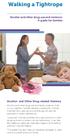 Walking a Tightrope Alcohol and other drug use and violence: A guide for families Alcohol- and Other Drug-related Violence Alcohol and other drug use and family violence often occur together. Families
Non-epileptic seizures
 Non-epileptic seizures a short guide for patients and families Information for patients Department of Neurology Royal Hallamshire Hospital What are non-epileptic seizures? In a seizure people lose control
Young People s Emotional Health
 Young People s Emotional Health For those working with young people aged 16-24 Key facts from research Warning signs Sources of help and further information Kindly supported by Auto Trader Introducing
A Guide to Bulimia Nervosa
 A Guide to Bulimia Nervosa People with bulimia nervosa have episodes of binge eating. This is followed by self-induced vomiting or other measures to counteract the excessive food intake. Treatments include
Supporting Friends and Family in Eating Disorder Treatment. Krista Crotty, C.E.D.S., L.M.F.T., Psy.D. Senior Director, Northwest Region
 Supporting Friends and Family in Eating Disorder Treatment Krista Crotty, C.E.D.S., L.M.F.T., Psy.D. Senior Director, Northwest Region We believe Families do NOT cause eating disorders. Yes, families can
Depression in children and adolescents
 Patient information from the BMJ Group Depression in children and adolescents Depression is an illness that affects people of all ages, including children and teenagers. It can stop a child or teenager
South Wilts Grammar School. When do teenage problems become Problems? A presentation by Dr. Anna Randle, Chartered Clinical Psychologist
 South Wilts Grammar School When do teenage problems become Problems? A presentation by Dr. Anna Randle, Chartered Clinical Psychologist Do you remember being a teenager? What were some of the dilemmas
Learning to LOVE your Body, Weight Loss, and Exercise
 Advanced Techniques for Dealing with Binge Eating and Bulimia CHARIS CENTER FOR EATING DISORDERS Anne Price Lewis, PhD, HSPP, LCAC Learning to LOVE your Body, Weight Loss, and Exercise ABOUT THE CHARIS
Symptoms of mania can include: 3
 Bipolar Disorder This factsheet gives information on bipolar disorder. It explains the symptoms of bipolar disorder, treatments and ways to manage symptoms. It also covers what treatment the National Institute
Eating disorders: core interventions in the treatment and management of anorexia nervosa, bulimia nervosa, and related eating disorders
 Eating disorders: core interventions in the treatment and management of anorexia nervosa, bulimia nervosa, and related eating disorders A guide for people with eating disorders, their advocates and carers,
Northside West Clinic
 Northside West Clinic Contents Overview Treatments Inpatient Services Day Programs The Clinic What are the Costs? How to Get Started The Northside Group of Clinics How to Find Us Overview At some point
EATING DISORDERS PROGRAM Unity St. Mary s Campus 89 Genesee Street Rochester, NY 14611. 585-368-3709 www.unityhealth.org
 EATING DISORDERS PROGRAM Unity St. Mary s Campus 89 Genesee Street Rochester, NY 14611 585-368-3709 www.unityhealth.org EATING DISORDERS THREATEN THE LIVES OF NINE MILLION WOMEN, MEN, AND CHILDREN IN
SPECIALIST ARTICLE A BRIEF GUIDE TO PSYCHOLOGICAL THERAPIES
 SPECIALIST ARTICLE A BRIEF GUIDE TO PSYCHOLOGICAL THERAPIES Psychological therapies are increasingly viewed as an important part of both mental and physical healthcare, and there is a growing demand for
Supporting Children with Mental Health Issues and their Families MARIE HARRINGTON ASWTL CUH
 Supporting Children with Mental Health Issues and their Families MARIE HARRINGTON ASWTL CUH The number one health issue for young people is their mental health Mental Health has been defined as a state
Definition of Terms. nn Mental Illness Facts and Statistics
 nn Mental Illness Facts and Statistics This section contains a brief overview of facts and statistics about mental illness in Australia as well as information that may be useful in countering common myths.
A Carer s Guide to Depression in People with a Learning Disability
 A Carer s Guide to Depression in People with a Learning Disability Fife Clinical Psychology Department Lynebank Hospital Halbeath Road Dunfermline Fife KY11 4UW Tel: 01383 565 210 December 2009 This booklet
Overcoming Food Abuse. Session #1. Admitting Food Addiction
 Overcoming Food Abuse Session #1 Admitting Food Addiction Introductory statements: 1. You are safe with me: I am one of you 2. You are loved by me: I accept you as you are 3. You will hear truth from me:
Registered Charity No. 5365
 THE MULTIPLE SCLEROSIS SOCIETY OF IRELAND Dartmouth House, Grand Parade, Dublin 6. Telephone: (01) 269 4599. Fax: (01) 269 3746 MS Helpline: 1850 233 233 E-mail: [email protected] www.ms-society.ie
Wesley Mental Health. Depression and Anxiety Programs. Wesley Hospital Ashfield. Journey together
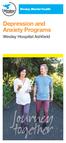 Wesley Mental Health Depression and Anxiety Programs Wesley Hospital Ashfield Journey together Mission Continuing the work of Jesus Christ in Word and deed Wesley Mission is an organisation with a long
What is an intervention?
 (Adapted from the Mayo Clinic, 2014) It's challenging to help a loved one struggling with any type of addiction. Sometimes a direct, heart-to-heart conversation can start the road to recovery. But when
Mental Health Needs Assessment Personality Disorder Prevalence and models of care
 Mental Health Needs Assessment Personality Disorder Prevalence and models of care Introduction and definitions Personality disorders are a complex group of conditions identified through how an individual
Weight Restoration in Anorexia Nervosa
 The Bella Vita Residential & Partial Hospitalization & Programs Outcome Report: May 212-September 214 The body mass indexes (BMI) of The Bella Vita clients diagnosed with anorexia nervosa were compared
Postnatal Depression. A guide for mothers, family and friends
 Postnatal Depression A guide for mothers, family and friends What is it? What is it? After giving birth, most mothers experience some degree of mood swings. There are three main kinds of postnatal mood
Helping Children and Youth with Depression Information for Parents and Caregivers
 Helping Children and Youth with Depression Information for Parents and Caregivers What is depression? It is normal for children and youth to feel sad from time to time. But this sadness doesn t stop them
t e e n e s t e e m A d o l e s c e n t p r o g r A m s
 Teen Esteem Adolescent programs A NE W JOURNEY A New Journey Eating Disorder Center is the first Adolescent Partial Day Treatment and Intensive Outpatient Program in Santa Monica, California. We offer
Specific Phobias. Anxiety Disorders Association of America
 Specific Phobias Everyone thinks that once I ve driven on the highway, I ve conquered it. They just don t understand... I don t understand. It s a day-in and day-out struggle. What is a phobia? We all
LOOKING AFTER YOURSELF AFTER A DISASTER
 LOOKING AFTER YOURSELF AFTER A DISASTER CONTENTS Introduction 3 Common reactions to an extraordinary event 4 Dealing with the emotional impact of a natural disaster 6 When the reaction or distress does
Mental Health Services
 Mental Health Services At Maitland Private Hospital our team of professionals are committed to providing comprehensive assessment, treatment and support of people experiencing mental health issues. Located
Diagnosis: Appropriate diagnosis is made according to diagnostic criteria in the current Diagnostic and Statistical Manual of Mental Disorders.
 Page 1 of 6 Approved: Mary Engrav, MD Date: 05/27/2015 Description: Eating disorders are illnesses having to do with disturbances in eating behaviors, especially the consuming of food in inappropriate
Eating Disorders in Schools: Prevention, Early Identification and Response. nedc.com.au
 Eating Disorders in Schools: Prevention, Early Identification and Response nedc.com.au Eating Disorders in Schools: Prevention, Early Identification and Response A professional resource developed by the
DO YOU KNOW SOMEONE WHO. might have an eating disorder?
 DO YOU KNOW SOMEONE WHO might have an eating disorder? A PRESENTATION FOR EATING DISORDERS AWARENESS WEEK Tasha Castor, M.S.Ed., LPC Kovacs Counseling; Columbus, Ohio Statistics U.S. At some point
Tool kit Domestic Violence
 Tool kit Domestic Violence A self-help resource to help people living with domestic violence Lifeline s domestic violence tool kit provides information about: Understanding what domestic violence is Developing
MedicinesTalk. Information for consumers and consumer groups about using medicines wisely. Using antidepressants 4
 MedicinesTalk Information for consumers and consumer groups about using medicines wisely Winter 2008 No. 26 Campaign to bridge cultural gaps 3 Using antidepressants 4 Non-drug treatments 6 Sources of info
Heart information. Cardiac rehabilitation
 Heart information Cardiac rehabilitation Contents 2 What is cardiac rehabilitation? 3 What are the benefits of cardiac rehabilitation? 4 Who should take part in cardiac rehabilitation? 4 When does cardiac
Linda S. Caley, MS, RD Nutrition Counseling P.O. Box 811 Colchester, CT 06415 860-204-2691 fax: 860-537-1768. Last Name First Name Middle Initial
 Linda S. Caley, MS, RD Nutrition Counseling P.O. Box 811 Colchester, CT 06415 860-204-2691 fax: 860-537-1768 CLIENT REGISTRATION INFORMATION (Please Print) Last Name First Name Middle Initial Street Address
Borderline. Personality
 A Guide to Accessing Ser vices for Borderline Personality Disorder in Victoria ABOUT THIS GUIDE: WHAT IS Borderline Personality Disorder (BPD)? This guide refers to the National Health and Medical Research
Chapter 14 Eating Disorders In Adolescents
 Chapter 14 Eating Disorders In Adolescents Anorexia Nervosa (AN) Bulimia Nervosa (BN) Refusal to maintain normal body weight (< 85%) Recurrent episodes of binge eating, marked by loss of control Intense
Name: Hour: Review: 1. What are some personality traits commonly associated with eating disorders?
 #300040 Name: Hour: VIDEO WORKSHEET Review: After watching Recovering: Anorexia Nervosa and Bulimia Nervosa, answer the following questions. 1. What are some personality traits commonly associated with
Wesley Mental Health. Depression and Anxiety Programs. Wesley Hospital Kogarah. Journey together
 Wesley Mental Health Depression and Anxiety Programs Wesley Hospital Kogarah Journey together Mission Continuing the work of Jesus Christ in Word and deed Wesley Mission is an organisation with a long
OCD and disordered eating: When OCD masquerades as eating disorders
 OCD and disordered eating: When OCD masquerades as eating disorders Brigette A. Erwin, PhD Director, OCD Program Anxiety and Agoraphobia Treatment Center Bala Cynwyd, PA A presentation conducted at the
dealing with a depression diagnosis
 tips for dealing with a depression diagnosis 2011 www.heretohelp.bc.ca No one wants to feel unwell. Talking to your doctor or other health professional about problems with your mood is an important first
New Beginnings: Managing the Emotional Impact of Diabetes Module 1
 New Beginnings: Managing the Emotional Impact of Diabetes Module 1 ALEXIS (AW): Welcome to New Beginnings: Managing the Emotional Impact of Diabetes. MICHELLE (MOG): And I m Dr. Michelle Owens-Gary. AW:
Levels of Care in Eating Disorder Treatment. A part of the Parent, Family & Friends Network (PFN) Webinar Series
 Levels of Care in Eating Disorder Treatment A part of the Parent, Family & Friends Network (PFN) Webinar Series Meet the Presenter Zoë Bisbing, LCSW Licensed therapist and member of the treatment team