
HEALTH SERVICE EXECUTIVE NATIONAL FINANCIAL REGULATION VALUE-ADDED TAX NFR-16
|
|
|
- Arlene Lloyd
- 10 years ago
- Views:
Transcription
1 HEALTH SERVICE EXECUTIVE NATIONAL FINANCIAL REGULATION VALUE-ADDED TAX NFR-16

2 NFR-16 Value-Added Tax 16.1 Introduction on page VAT Registration on page Supply of Goods on page Supply of Services on page Intra-Community Supplies on page Acquisitions from other EU Member States on page Imports on page Amount on which VAT is chargeable on page VAT due and VAT deductible on page Accounting for VAT on page Reverse Charge for Construction Services on page Invoices, Credit Notes on page Records to be Kept on page Vat Rates on page Interest and Penalties on page Changes in Rates of VAT on page Duties & Responsibilities on page Local Procedures on page Training on page Reporting of Irregularities on page Audit on page Assistance /Further Information on page Effective Date on page Appendices on page 19 Ver /12/2011 Page 2 of 83
3 16.1. Introduction Value-Added Tax (VAT) is a tax on consumer spending. It is collected by VATregistered traders on their supplies of goods and services effected within the State for consideration to their customers. Each such trader in the chain of supply from manufacturer through to retailer charges VAT on his or her sales and is entitled to deduct from this amount the VAT paid on his or her purchases. The effect of offsetting VAT on purchases against VAT on sales is to impose the tax on the added value at each stage of production - hence Value-Added Tax. The final consumer, who is not registered for VAT, absorbs VAT as part of the purchase price. The following example illustrates how this works: As may be seen from the above example, the consumer pays a total of 605 for the finished product, of which 105 is VAT Taxable person and accountable person - Definitions A taxable person is any person who independently carries out any business in the State. VAT law provides that VAT is chargeable on the supply of goods and services effected within the State for consideration by a taxable person acting as such, other than in the course or furtherance of an exempted activity. A person who is required to charge VAT is referred to as an accountable person. An accountable person is, therefore, a taxable person (an individual, partnership, company etc.) who supplies taxable goods or services in the State and who is, or is required to be, registered for VAT. Persons who are involved in the taxable supply of property and persons whose annual turnover from supplies of taxable goods and services in the State, or the value of whose acquisitions of goods from other EU Member States, exceed or are likely to exceed certain limits are obliged to register for VAT. While persons whose turnover from taxable activities does not exceed these limits are not obliged to register, they may register for VAT if they so wish. Additionally, persons who are in receipt of Fourth Schedule, or cultural, artistic, entertainment or similar services are accountable persons. A sub-contractor not Ver /12/2011 Page 3 of 83

4 established in the State who provides construction services in the State to principal contractors will not be regarded as an accountable person with effect from 1 September 2008, but may apply to become one in order to claim repayment of input VAT. Section 117 Finance Act 2010 provides for the taxation from 1 July 2010 of the activities of public bodies (Departments of State, local authorities and bodies established by enactment) that, in general, are not activities engaged in by virtue of a right or power conferred on the public body by an enactment. Section 117 was introduced to address the European Court of Justice (ECJ) judgement in case C-554/07 Commission V Ireland. Public bodies are taxable when their treatment as non-taxable (in relation to activities carried out under a right or power conferred on the public body by an enactment) could lead to something more than negligible distortion of competition. Public bodies performing other activities or transactions are treated as if they were normal commercial entities in respect of those activities or transactions and are obliged to register and account for VAT when certain turnover thresholds are exceeded or are likely to be exceeded in any twelve- month period. The turnover thresholds are set out as follows: VAT registration is obligatory where certain turnover thresholds are exceeded or are likely to be exceeded in any twelve- month period The principal thresholds applicable are outlined in section below. The HSE s business of the provision of health services will not be affected by the ECJ judgment and will therefore continue to be exempt from VAT for this portion of its business. The provisions of Section 117 are in addition to the VAT obligations that currently apply to the HSE bodies. These include accounting for VAT on services received from EU and non-eu countries, accounting for VAT on the acquisition of goods worth more than 41,000 in a year from suppliers in other EU Member States and accounting for VAT on the receipt of constructions services as a principal contractor. Refer Procurement of goods and services by the State, local authorities and bodies established by statute on the Revenue website Exemptions A person who makes exempt supplies, comes within the scope of the term taxable person but this has no bearing on his/her VAT status. Goods and services of the kind listed in Appendix A are exempt from VAT and suppliers of such goods and services are not obliged, nor indeed are they entitled, to register for VAT unless they also make taxable supplies. These persons may be required to register and account for VAT in respect of intra-community acquisitions, Fourth Schedule services or goods and services received by them Non-taxable entities Such bodies are not considered to be engaged in economic activities. They are not obliged or entitled to register and account for VAT on income from supplies made by them and they must bear VAT on their purchases of goods and services. VAT law provides that State bodies engaged in the provision of facilities for taking part in sporting activities may be required to register for VAT in certain circumstances Registration Revenue will issue a VAT registration number to a person on being satisfied that the person is carrying on a taxable business in the State. Ver /12/2011 Page 4 of 83
5 Rates The standard rate of VAT is 21%. There is also a reduced rate of 13.5% and a zero rate. Further details on these rates are contained in the appendices to this Guide. A list of the rates applicable to a large range of goods and services is available on the Revenue website at Reverse charge/self-accounting VAT is normally charged and accounted for by the supplier of goods or services. However, in certain limited circumstances the recipient of goods or services, rather than the supplier, is obliged to account for the VAT due. This applies: on the intra-community acquisition of goods from another Member State, on receipt from abroad of Fourth Schedule services, valuation, repair or contract work carried out on movable goods in another State in certain circumstances, where goods are installed or assembled for certain designated persons in the State by a supplier who is not established in the State (see paragraph 3.2), intra-community transport and ancillary services supplied by a nonestablished person to an accountable person in the State, with effect from 1 September 2008, construction services supplied to a principal contractor by a sub-contractor, whether or not the sub-contractor is established in the State, on the receipt of gas through the natural gas distribution system, or electricity, from a person not established in the State by certain categories of persons in the State VAT returns A VAT-registered person normally accounts for VAT on a two-monthly basis (January/February, March/April etc). The return made on the form VAT 3 together with a payment for any VAT due should be furnished to the Collector- General on or before the 19th of the month following the end of the taxable period. Traders are encouraged to submit their VAT returns using the Revenue Online Service (ROS) (see Amount on which VAT is chargeable The amount on which VAT is chargeable is the total sum the person supplying the goods or services becomes entitled to receive, including all taxes, commissions, costs and charges whatsoever but not including the VAT chargeable in respect of the transaction Basis of accounting Registered persons normally account for VAT on the invoice ( sales ) basis. This means that they become liable for VAT by reference to invoices issued and sales made by them irrespective of whether payment has actually been received Right to deduct VAT Ver /12/2011 Page 5 of 83
6 In computing the amount of VAT payable in respect of a taxable period, a registered person may deduct the VAT charged on most goods and services which are used for the purposes of the taxable business. No deduction may be made, however, for non taxable entities. Non-established sub-contractors providing construction services that are subject to reverse charge may register for VAT if they wish to claim a refund Records to be kept A VAT-registered person must keep full and true records of all business transactions which affect his or her liability to VAT. The records must be kept up to date and must be sufficiently detailed to enable that person to accurately calculate liability or repayment and to enable the Revenue to check the calculation, if necessary. Records must normally be retained for six years from the date of the latest transactions to which they refer Trade between different EU Member States In the European Single Market, VAT is accounted for on sales of goods between traders in different EU Member States by a system of intra-community supplies and acquisitions of goods. The supplies are zero-rated in the EU Member State of origin and VAT is accounted for by the VAT-registered recipient in the EU Member State of destination Imports (non-eu) For VAT purposes imports are goods brought into Ireland from non-eu countries. As a general rule, imported goods are liable to VAT at the point of entry into the State, at the same rate as applies to the sale within the State of similar goods Appeals A person has the right to appeal against Section 22 estimates or Section 23 assessments or against a determination made by Revenue in relation to the rate of VAT chargeable and in relation to whether an activity is an exempt activity. A person also has the right of appeal in relation to charges made in accordance with regulations, for example, in connection with an application for deregistration, and in relation to all claims for repayment. Any question of fact or law may be brought before the Appeal Commissioners, and the taxpayer if dissatisfied with the decision of the Appeal Commissioners may have the appeal re-heard by the Circuit Court. Both the taxpayer and Revenue may appeal to the High Court on a point of law and from there to the Supreme Court. Because VAT is governed by EU law, the Appeal Commissioners or any of the courts may refer the case to the European Court of Justice (ECJ). Matters which may be appealed also include: a charge to tax in connection with the issue of an incorrect invoice or the issue of an invoice showing tax by a non-registered person, compulsory group registration, refusal to allow group registration and the cancellation of an existing group registration, a determination in relation to certain sports and leisure activities, a determination of open market value in relation to certain supplies between connected persons, the treatment of a person who allows supplies to be made on land owned, occupied or controlled by him/her, as jointly and severally liable with another person, a charge to tax in accordance with regulations, a claim for repayment of VAT, a refusal by Revenue to treat a person as an accountable person, Ver /12/2011 Page 6 of 83
7 a refusal by Revenue to accept that an expression of doubt is genuine Letter of expression of doubt VAT law provides that where a person is in doubt about the application of VAT law to a transaction, including the rate of VAT, he/she may lodge a letter of expression of doubt with Revenue. If the expression of doubt is accepted by Revenue as genuine, interest will not apply to any tax payable until the matter in doubt is resolved. In the event that Revenue refuses to accept that the expression of doubt is genuine, it is open to the taxpayer to have such refusal referred to the Appeal Commissioners. Please see VAT Information Leaflet Expression of Doubt Internal Review procedures Where a taxpayer wishes to seek a review of Revenue s handling of his/her tax affairs, or a decision made by a Revenue official, he/she can ask for an internal review to be carried out either: by a senior Revenue official who was not involved in the original decision, or jointly by an External Reviewer and the Revenue official mentioned above Revenue website The Revenue website carries a broad range of important information on all taxes and duties. All Revenue forms, guides, and information leaflets mentioned in this Guide are available on the Revenue website at Revenue on-line Service (ROS) ROS is a secure on-line service that enables taxpayers and individuals to interact electronically with Revenue. It offers taxpayers a quick, secure and cost effective method to manage their tax affairs online. ROS enables a taxpayer to view his/her own current position with Revenue for various taxes and levies, to file tax returns, including the VAT 3 returns and annual Return of Trading Details (RTD) and to make payments online in a variety of methods. Traders can register for ROS by accessing the ROS web-site through Donated medical equipment Statutory Instrument No. 58/92 provides for repayment of VAT suffered by a hospital or a donor on the purchase of new medical instruments and appliances (excluding means of transport) which are funded by voluntary donations. The VAT refund may be claimed by whomever suffers the tax i.e. the hospital or the donor, as appropriate, but not, of course, both. The principal conditions are that the instrument or appliance must: cost 25,390 or more (exclusive of VAT); be designed and manufactured for use solely in medical research or in diagnosis, prevention or treatment of illness; not have been part-funded by the State, and be the subject of a recommendation by the Minister for Health & Children that, having regard to the requirements of the health services in the State, a refund of the VAT would be appropriate. Repayment claim form VAT 72 refers Property transactions New VAT on Property rules were introduced in the Finance Act 2008 and are effective from 1 July The new rules introduce a simpler and more rational basis for applying VAT to property transactions. The main features are: The first supply of newly developed property is taxable for a period of five years from completion, Ver /12/2011 Page 7 of 83
8 The second and subsequent supply is taxable for a period of two years following occupation, There is an option to tax the supply of properties where the supply would otherwise be exempt, Lettings are exempt but where the letting is between unconnected parties there is an option to tax the rents. The option to tax also applies where the parties are connected but the lessee is entitled to deduct over 90% of the VAT charged on the rent, A Capital Goods Scheme which ensures that the amount of VAT deductible on acquisition or development of a property will correspond with the use of the property over a period of 20 years (10 years in the case of refurbishment work), There are transitional rules to ensure that properties that have been developed under the old system will pass into the new system with a minimum of disruption. The new system is described in detail in the VAT on Property Guide VAT Registration This Chapter deals with the rules relating to registration for VAT purposes. It describes who is obliged to register, who may or may not register, procedures for registration etc Accountable persons supplies taxable goods or services in the State, makes intra-community acquisitions of goods in the State, receives taxable Fourth Schedule services (i.e. listed in the Fourth Schedule to the VAT Act, (Appendix E to this Guide) from abroad, receives cultural, artistic, entertainment or similar services provided by a person not established in the State, is involved in property transactions in the State and is obliged to register for VAT in the State, receives goods for installation or assembly in the State from a person not established in the State, is, from 1 September 2008, in receipt, as a principal contractor, of construction services in the State from a sub-contractor including a nonestablished sub-contractor, is in receipt of supplies of gas through the natural gas distribution system or electricity from a person not established in the State. Accountable persons are obliged to comply with all necessary requirements arising from such registration, if any of the appropriate thresholds outlined below are exceeded, or are likely to be exceeded, in any twelve-month period Thresholds In the case of supplies in the State and intra-community acquisitions, registration is obligatory where certain turnover thresholds are exceeded or are likely to be exceeded in any twelve-month period. However, it should be noted that in relation to Distance Selling, the threshold is based on a calendar year. The principal thresholds applicable are as follows- 37,500 in the case of persons supplying services, Ver /12/2011 Page 8 of 83
9 37,500 for persons supplying goods liable at the 13.5% or 21% rates which they have manufactured or produced from zero-rated materials, 35,000 for persons making mail-order or distance sales into the State, 41,000 for persons making intra-community acquisitions, 75,000 for persons supplying goods, 75,000 for persons supplying both goods and services where 90% or more of the turnover is derived from supplies of goods, a non-established person supplying taxable goods or services in the State is obliged to register and account for VAT irrespective of the level of turnover, a non-eu business supplying electronic services to private consumers in the State is obliged to register and account for VAT irrespective of the level of turnover. However, an optional scheme is available to enable the supplier to register in one EU Member State, a nil threshold for persons in receipt of Fourth Schedule or cultural, artistic etc. services from abroad. An accountable person established in the State is not required to register for VAT if his or her turnover does not reach the appropriate threshold above. However, they may elect to register for VAT. There is no threshold for taxable property transactions. For further details please refer to the VAT on Property Guide Exempt persons and non-taxable entities acquiring goods within the EU Exempt persons and non-taxable entities who acquire or are likely to acquire more than c41,000 worth of goods from other Member States in any period of twelve months are obliged to register for VAT in respect of those intra- Community acquisitions. It should be further noted that registration by exempt and non-taxable persons for receipt of intra-community acquisitions does not give VAT deduction rights Fourth Schedule services Persons who receive from abroad for business purposes any of the taxable Fourth Schedule services are obliged to register for and pay VAT by reverse charge in respect of all such services. For VAT purposes, the recipient of such services is regarded as the supplier of the services to itself Supplies of natural gas through the natural gas distribution system or of electricity. Persons not established in the State who supply natural gas through the natural gas distribution system or electricity to a recipient in the State where that recipient is: an accountable person, a Department of State, a body established by Statute, are not required or entitled to register for VAT. VAT is accounted for by the recipient Cultural, artistic, entertainment or similar services Where a person not established in the State provides cultural, artistic, entertainment or similar services in the State, the promoter, agent or other person, who receives these services for business purposes, must register and account for VAT thereon by reverse charge. There is no turnover threshold for the receipt of these services. Ver /12/2011 Page 9 of 83
10 Goods for installation or assembly by a non-established supplier Where a non-established supplier supplies goods in the State which are installed or assembled, with or without a trial run, by or on behalf of that person and where the recipient of those goods in the State is a taxable person, the HSE, a Government Department, a local authority, or a body established by statute, then the non-established supplier is not entitled to register for VAT. In such circumstances the customer must register and account by reverse charge for the VAT due. Typical examples of qualifying supplies are the supply, installation and assembly of exhibition stands, movable shop counters, computer systems or electrical generators Construction operators With effect from 1 September 2008 sub-contractors not established in the State who provide construction services to principal contractors which are within the scope of Relevant Contracts Tax (RCT) (as defined in section 530 of the Taxes Consolidation Act 1997) are not required to register for VAT. VAT must be accounted for by the principal as if he or she had supplied the service. Such sub-contractors may, however, register for VAT in order to claim credit for input VAT incurred. VAT must also be accounted for by a principal contractor in respect of construction services received from a sub-contractor established in the State. However, a sub-contractor established in the State is obliged to register for VAT, subject to the normal rules. Supplies by established and nonestablished contractors to persons other than those in the construction industry will continue to be treated under the existing system. For example, a builder who builds an extension for a private individual or an electrician who installs a new alarm system in a shop will charge and account for VAT on the supply. The reverse charge will not apply to these supplies Two-Thirds rule With effect from 1 September 2008 the two-thirds rule does not apply where the reverse charge applies for construction services. It applies, however, to other circumstances involving the supply of movable or immovable goods under an agreement for the supply of services. Non-established suppliers supplying goods/services in Ireland Non-established suppliers supplying taxable goods or services in the State are generally obliged to register and account for Irish VAT. The turnover thresholds for VAT registration which apply to Irish suppliers do not apply and nonestablished suppliers must generally register regardless of the level of their turnover. Non-established taxable suppliers will be required to register where they: supply goods within the State; supply goods on board vessels, aircraft or trains leaving the State for another EU Member State; engage in distance selling of excisable goods to a person who is not a taxable person in the State; engage in the transport of goods or ancillary transport activities within the State (other than intra-community transport services supplied to VATregistered persons), and intra-community transport services beginning in the State for a customer who is not registered for VAT; engage in cultural, artistic, sporting, scientific, entertainment or similar services in the State; engage in the valuation of movable goods, including contract work within the State; Ver /12/2011 Page 10 of 83

11 engage (in the case of suppliers established outside the EU), in the hire of movable goods for effective use within the State; engage in the supply of telecommunications services or telephone cards, or radio or television broadcasting services from outside the EU to a private individual in the State in certain circumstances; engage in the supply of telecommunications services or of telephone cards from an establishment in the State to a private individual outside the EU; engage in the supply of electronic services from outside the EU to private individuals whose usual place of residence is in the State. These services include the following: website supply, web-hosting, distance maintenance of programmes and equipment, supply of software and the updating of it, supply of images, text and information, and making databases available, supply of music, films and games, including games of chance and gambling games and of political, cultural, artistic, sporting, scientific and entertainment broadcasts and events Who may not register in respect of supplies of goods or services? A person carrying on only exempt activities or a person carrying on activities otherwise than in the course or furtherance of business may not register for VAT. However, a person carrying on exempt activities may be required to register in respect of intra-community acquisitions of goods, Fourth Schedule services received from abroad and cultural, artistic, entertainment and similar services received from persons not established in the State. There is no provision for deductibility of VAT on purchases of goods and services by such persons. There are circumstances where the State, HSE, local authorities and bodies established by statute are required to register and account for VAT on received supplies including construction services by a sub-contractor, Fourth Schedule services, supplies of natural gas and electricity and goods received for installation or assembly by a non-established supplier Where a premises provider allows a mobile trader, not established in the State, to supply goods on the premises for a period of less than seven days, he or she must provide details to the local Revenue District, including the following information, not later than fourteen days before the trader intends to trade on the land: the name and address of the trader, the dates on which the trader intends to trade on the premises provider s land, and the address of the land Supply of Goods If these details are not provided the premises provider may be made jointly and severally liable for the VAT due by that mobile trader. This Chapter describes the various ways in which supplies of goods for VAT purposes are made, and outlines the VAT treatment appropriate to each type of supply Taxable supplies of goods Ver /12/2011 Page 11 of 83
12 A taxable supply of goods means the normal transfer of ownership of goods by one person to another and includes the supply of goods liable to VAT at the zero rate. It means: the transfer of ownership of goods by agreement, the sale of movable goods on a commission basis by an auctioneer or agent acting in his or her own name but on the instructions of another person, the handing over of goods under a hire-purchase contract, the handing over by a person to another person of immovable goods (property) which have been developed, the seizure of goods by a sheriff or other person acting under statutory authority, the application by an accountable person of movable goods to some private or exempt use, the appropriation by an accountable person of goods other than for the purposes of his/her business, the provision of electricity, gas and any form of power, heat, refrigeration or ventilation, with some exceptions, the transfer of goods from a business in the State by a taxable person to the territory of another EU Member State for the purposes of the business Place of supply of goods The place of supply of goods rules determine whether a supply is subject to VAT in the State. The basic rule is that supplies of goods in the State are subject to VAT in the State. However, problems can arise in the context of supplies that involve the movement of goods across frontiers. The following is a summary of the place of supply rules, with examples: Where goods are not dispatched or transported, the place of supply is deemed to be the place where the goods are at the time of their supply. Example 1 - A French tourist on a visit to Ireland buys a sweater from a retailer in the State. Irish VAT arises on the purchase, as the place of supply is where the goods are when the purchase takes place. Where goods are installed or assembled, the place of supply is the place where the goods are installed or assembled. Example 2 - A VAT-registered Irish company engages an EU-based company to supply and install a machine in its premises in the State. The place of supply is the State. There is no obligation on the non-established supplier to register for VAT in Ireland as the recipient is one of those classes of persons who must account for the output VAT arising on the supply. If the goods have been bought for the purposes of its taxable business, a simultaneous input credit may be taken by the buyer thus making the transaction VAT neutral. The HSE are not allowed to claim this input credit Deposits/Payments received in advance deemed to be supplies Where a deposit or payment on account or other payment is received by an accountable person before he or she has made or completed a supply of goods or services, a supply is deemed to have taken place at the time of the receipt of the payment to the value of such payment. Tax is chargeable on that deposit or payment. Where, however, a deposit is retained by a supplier in the event of cancellation of the whole transaction by the customer the supplier may reduce his or her liability for the period in which the deposit is forfeit by an amount equal to the amount accounted for on the deposit. There are a number of conditions for this to apply: the supply does not take place because the customer has cancelled it, Ver /12/2011 Page 12 of 83

13 the cancellation is recorded as such in the books of the supplier, the deposit is not refunded to the customer, and no other consideration, benefit or supply is provided to the customer by any person in lieu of that amount Services taxable at the rate of goods (the two-thirds rule) With the exception of contract work, a transaction which may appear to be the supply of a service, is nevertheless taxable as a supply of goods, if the VAT exclusive cost of the goods to the supplier exceeds two-thirds of the total charge to the customer excluding VAT. With effect from 1 September 2008, the twothirds rule will not apply in circumstances where a principal contractor self accounts for VAT in respect of construction services received from subcontractors Auction and agency Sales The sale of movable goods by agents or auctioneers who conclude agreements in their own name but on the instructions of another person are treated as supplies of goods, at the appropriate rates, at the time that the agents or auctioneers make the sale. Please see VAT Information Leaflet Auctioneering Supply of Services This Chapter describes the various categories of services supplied for VAT purposes and outlines the VAT treatment appropriate to each type of supply What is a service? For VAT purposes a service is any commercial activity other than a supply of goods. Typical services include the services of caterers, mechanics, plumbers, accountants, solicitors, consultants, etc. and the hiring (other than hirepurchase) or leasing of goods. Electronically supplied services, including digitised goods delivered online and the physical supply of customised software are supplies of services for VAT purposes. Services also include refraining from doing something and the granting and surrendering of a right. Contract work, that is the handing over by a contractor to a customer of movable goods made or assembled by him or her from goods entrusted to him or her by the customer, is also regarded as a service Services taxable at the rate of goods (the two-thirds rule) A transaction which may appear to be a supply of a service is nevertheless taxable as a supply of goods if the value of the goods, that is their cost excluding VAT, to the service contractor used in carrying out the work exceeds two-thirds of the total charge, exclusive of VAT. For example, where the cost to the repairer of materials used in the repair of a washing machine is c120 exclusive of VAT, and the total charge for the repair work is c150, the 21% rate applicable to the materials applies, rather than the 13.5% rate which normally applies to repair services. Ver /12/2011 Page 13 of 83
14 Example 3 Ver /12/2011 Page 14 of 83

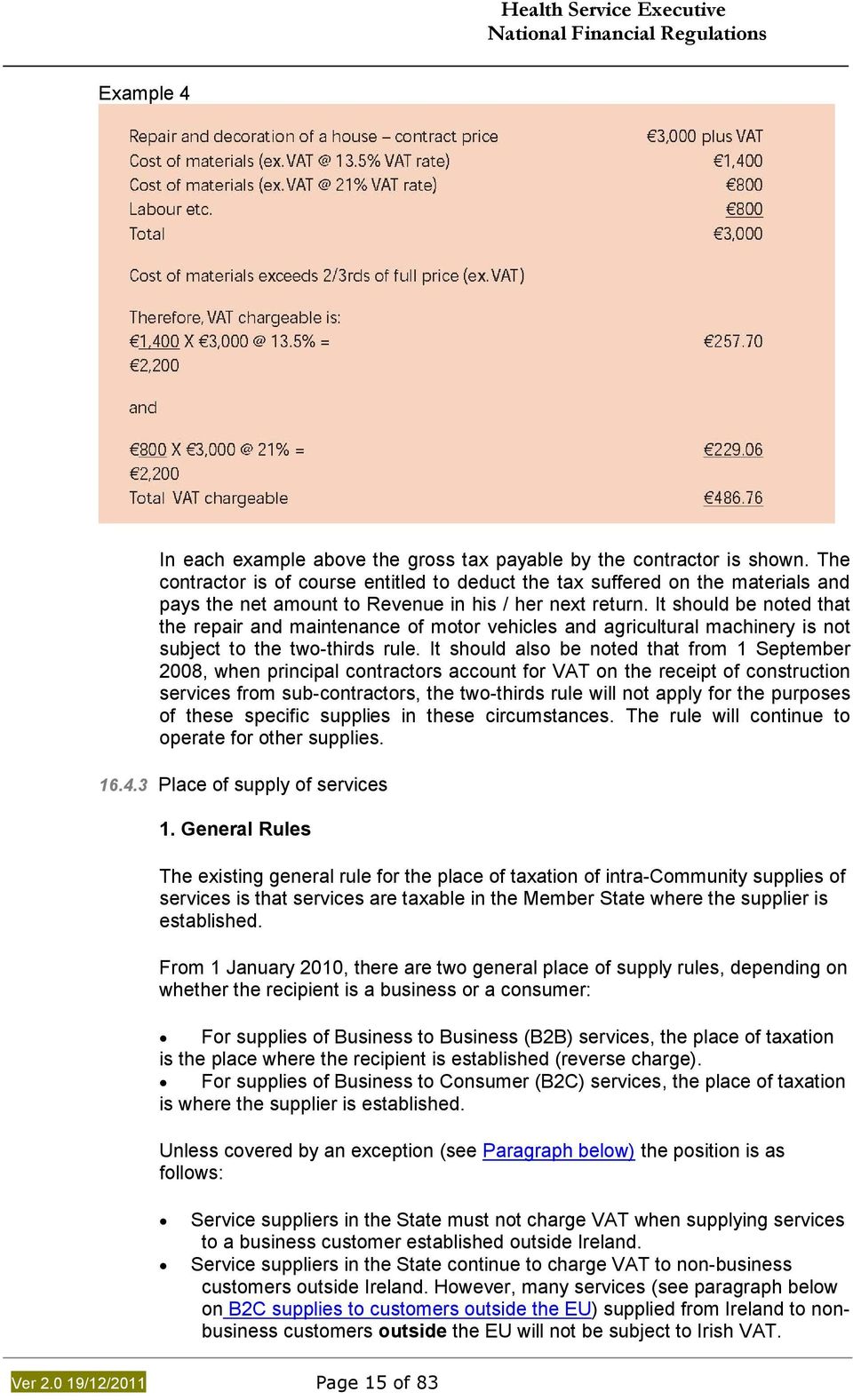
15 Example 4 In each example above the gross tax payable by the contractor is shown. The contractor is of course entitled to deduct the tax suffered on the materials and pays the net amount to Revenue in his / her next return. It should be noted that the repair and maintenance of motor vehicles and agricultural machinery is not subject to the two-thirds rule. It should also be noted that from 1 September 2008, when principal contractors account for VAT on the receipt of construction services from sub-contractors, the two-thirds rule will not apply for the purposes of these specific supplies in these circumstances. The rule will continue to operate for other supplies Place of supply of services 1. General Rules The existing general rule for the place of taxation of intra-community supplies of services is that services are taxable in the Member State where the supplier is established. From 1 January 2010, there are two general place of supply rules, depending on whether the recipient is a business or a consumer: For supplies of Business to Business (B2B) services, the place of taxation is the place where the recipient is established (reverse charge). For supplies of Business to Consumer (B2C) services, the place of taxation is where the supplier is established. Unless covered by an exception (see Paragraph below) the position is as follows: Service suppliers in the State must not charge VAT when supplying services to a business customer established outside Ireland. Service suppliers in the State continue to charge VAT to non-business customers outside Ireland. However, many services (see paragraph below on B2C supplies to customers outside the EU) supplied from Ireland to nonbusiness customers outside the EU will not be subject to Irish VAT. Ver /12/2011 Page 15 of 83
16 Businesses that receive services from a supplier outside Ireland will not be charged VAT by the supplier of those services, but the recipient will be required to account for Irish VAT unless the services concerned are exempt in Ireland (and the business has notified its supplier that such services are exempt from Irish VAT). The new place of supply rules will result in little change for many suppliers and recipients of intra-community services since most of the significant B2B services are already taxed where received on a reverse charge basis i.e. the current Fourth Schedule services. Table 2.1 A summary of the new Place of Supply rules (unless subject to exceptions or effective use and enjoyment provisions) are: Country of establishment of supplier Country in which customer established Status of Customer Place of supply Person liable to account for Irish VAT Ireland Other EU State Business Other EU State No Irish VAT Ireland Other EU State Private Ireland Supplier Ireland Outside EU Business Outside EU No Irish VAT Ireland Outside EU Private Other EU State Ireland Business Ireland Depends on the nature of the Service (see Paragraph 3.5 B2C supplies to customers outside the EU) Supplier (if VAT occurs) Business Customer Other EU State Ireland Private Other EU State No Irish VAT Outside EU Ireland Business Ireland Outside EU Ireland Private Depends on the nature of the Service Business Customer Depends on the nature of the Service if taxable in the State the supplier 2 Exceptions to the General Rules There are a number of exceptions to the general rules in 2.1 that more closely link the place of supply to where the service is performed. Unless covered by a reverse charge arrangement, the supplier will be required to register and account for VAT in the Member State of supply. The following table summarises the exceptions and sets out the current place of supply rule and the rule that will apply from 1 January 2010 onwards. Ver /12/2011 Page 16 of 83

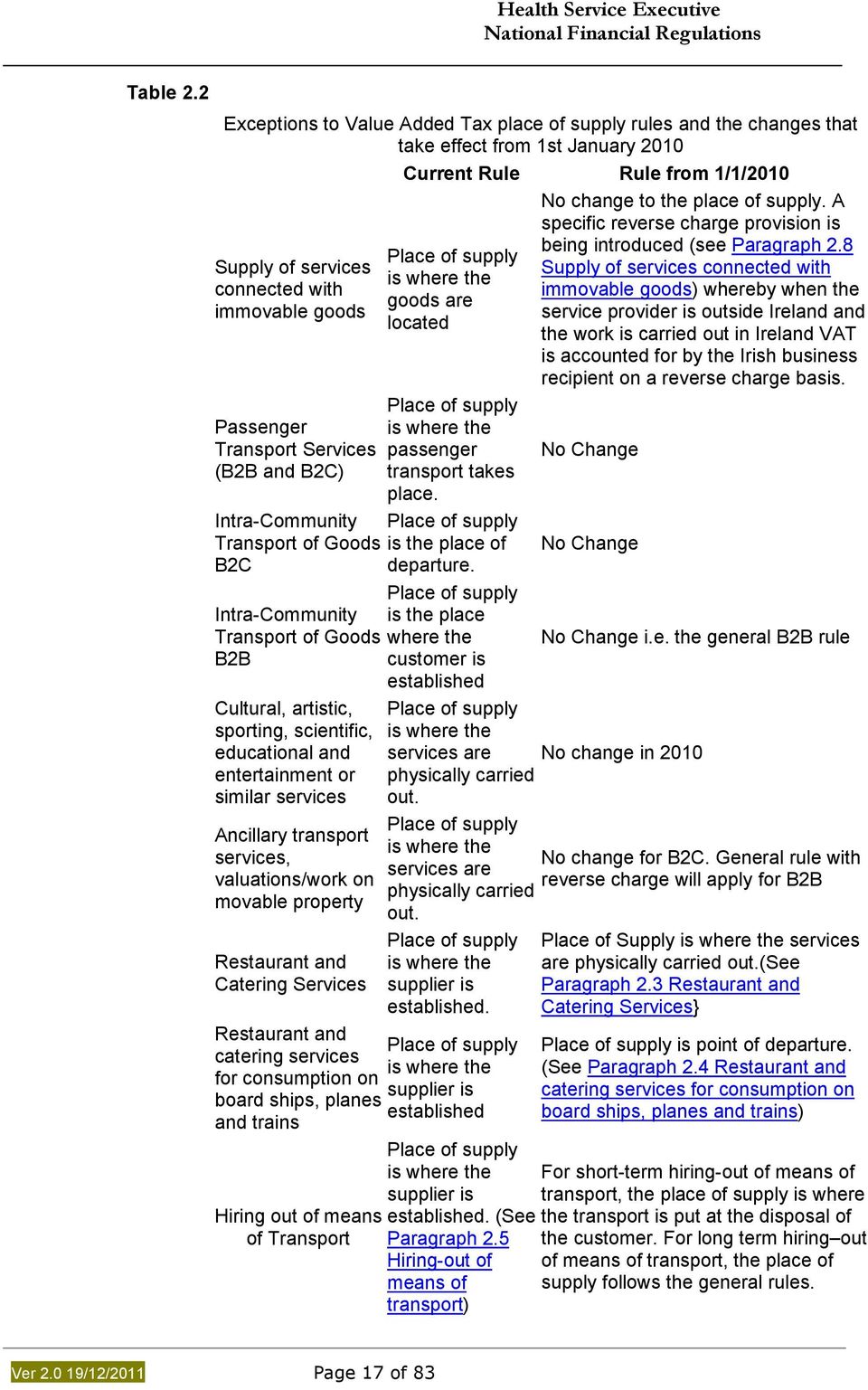
17 Table 2.2 Exceptions to Value Added Tax place of supply rules and the changes that take effect from 1st January 2010 Current Rule Rule from 1/1/2010 Supply of services connected with immovable goods Passenger Transport Services (B2B and B2C) Place of supply is where the goods are located Place of supply is where the passenger transport takes place. Intra-Community Place of supply Transport of Goods is the place of B2C departure. Place of supply Intra-Community is the place Transport of Goods where the B2B customer is established Cultural, artistic, sporting, scientific, educational and entertainment or similar services Ancillary transport services, valuations/work on movable property Restaurant and Catering Services No change to the place of supply. A specific reverse charge provision is being introduced (see Paragraph 2.8 Supply of services connected with immovable goods) whereby when the service provider is outside Ireland and the work is carried out in Ireland VAT is accounted for by the Irish business recipient on a reverse charge basis. No Change No Change No Change i.e. the general B2B rule Place of supply is where the services are No change in 2010 physically carried out. Place of supply is where the No change for B2C. General rule with services are reverse charge will apply for B2B physically carried out. Place of supply is where the supplier is established. Restaurant and Place of supply catering services is where the for consumption on supplier is board ships, planes established and trains Hiring out of means of Transport Place of supply is where the supplier is established. (See Paragraph 2.5 Hiring-out of means of transport) Place of Supply is where the services are physically carried out.(see Paragraph 2.3 Restaurant and Catering Services} Place of supply is point of departure. (See Paragraph 2.4 Restaurant and catering services for consumption on board ships, planes and trains) For short-term hiring-out of means of transport, the place of supply is where the transport is put at the disposal of the customer. For long term hiring out of means of transport, the place of supply follows the general rules. Ver /12/2011 Page 17 of 83
18 3 Restaurant and Catering Services The new place of supply rules for restaurant and catering services is that the place of supply is in the Member State where the services are physically carried out. The place of supply rule applies to supplies to both business and nonbusiness customers. For example, a catering supplier from another Member State who supplies catering services in this State will be required to register and account for Irish VAT on those catering services in the State. Similarly, a catering supplier in the State, who provides catering services in another Member State will be required to register and account for those services in that State. 4 Restaurant and catering services for consumption on board ships, planes and trains The place of supply of restaurant and catering services for consumption on board ships, planes and trains during part of a transport within the EU will be the place of departure. This mirrors the rules for supplies of goods for consumption on board. 5 Hiring-out of means of transport The place of supply for the short-term hiring of a means of transport is where the means of transport is actually put at the disposal of the customer. Short-term hire means up to 30 days for means of transport such as cars, vans etc. and up to 90 days for vessels. A means of transport will be considered as "actually put at the disposal of the customer" at the place where the means of transport is situated when the customer actually takes physical possession of it. Legal control (signature of contract, taking possession of the keys) is not in itself sufficient to determine the place where the means of transport was put at the disposal of the customer. The place of supply of long-term hiring out of a means of transport for both B2B and B2C supplies are covered by the general rules. There are circumstances where short-term hiring can become long-term hiring resulting in a change in taxable status. These are set out in Appendix 2. Further changes to the place of supply rules for the hiring of a means of transport come into effect from 1 January Intra-Community Transport of Goods The general rule will apply to B2B intra-community transport of goods i.e. the place of supply is where the customer is established. There is no change to B2C intra-community transport of goods. The place of supply is the place of departure. 7 Intermediary Services The place of supply of services to non-taxable persons by an intermediary acting in the name and on behalf of another person is the place where the underlying transaction is supplied. There is no change to this rule. The place of supply of services to taxable persons by an intermediary acting in the name and on behalf of another person is the place where that taxable person is established. This rule has changed the place of supply from where the underlying transaction is supplied to where the taxable person, who is in receipt Ver /12/2011 Page 18 of 83

19 of that supply, is established. For further information on intermediary services for travel agents see Travel Agent's Margin Scheme. 8 Supply of services connected with immovable goods The place of supply for services connected with immovable goods is the place where the goods are located. For the purposes of the Regulations, a supply of services connected with immovable goods includes the following: 1. a supply of services by experts or estate agents; 2. a provision of accommodation in a hotel or guesthouse or in an establishment having a similar function, or in a holiday camp or a site developed for use as a camping site; 3. a supply of services involving the preparation and co-ordination of construction work (including a supply of services of architects and of persons who provide on-site supervision). Specific arrangements for a reverse charge have been put in place in regard to theses services, with the exception of holiday accommodation and construction services (i.e. (b) and (c) above). From 1 January 2010, where a customer established in the State receives such services in connection with immovable goods in the State from a supplier who is established outside the State, the business customer is required to account for Irish VAT on these services. Note 1: There are no changes to the existing arrangements for reverse charge that apply to principal contractors and subcontractors involved in construction operations to which Relevant Contracts Tax applies (see Construction Services New VAT rules for Principal Contractors and Sub-contractors 9 Obligations of Irish suppliers 9.1 Identification of a Business for a B2B supply It will be a matter of fact whether the customer is a business or not. In the case of supplies to a business in another Member State, the supplier must obtain the customer s VAT number, insert it on the invoice and retain records of the transaction. The supplier will enter the details of all supplies of services to businesses in other Member States on his/her recapitulative VIES statement of intra-community supplies. The place of supply rules recognise that in a small number of cases, the recipient of the service may not yet have received a VAT number from the tax authority in the relevant Member State while the recipient is clearly engaged in an economic activity. In these cases, the recipient business will be required to provide an alternative tax identification number or a letter from the tax authority in that Member State confirming that it is a business. However, service suppliers are required to show details of the services supplied together with the correct VAT number of the recipient on their recapitulative VIES statement this may mean in practice that the details are entered on a recapitulative statement that covers a period subsequent to the period during which the supply of the service was made. Given that the correct accounting for VAT lies with the recipient of a B2B service there may be a temptation for a supplier to classify B2C services as B2B. If the status of a customer purchasing services from a trader in the State has been wrongly determined as B2B when it should have been taxed as B2C, and no Ver /12/2011 Page 19 of 83
20 VAT was charged, the supplier will be liable to pay the VAT at the appropriate rate together with interest and penalties in the event of a Revenue audit. When it comes to ascertaining the status of the customer, the supplier will be assumed to have acted in good faith, and therefore should not be liable for the VAT, when he/she has: 1. established whether the customer is a taxable person via the VAT number communicated or through such other proof presented to show that the customer is a taxable person or a non-taxable legal person (see Paragraph 3.3 Supplies of services to non-taxable legal persons) for VAT purposes, and 2. obtained confirmation of the validity of the VAT number of the customer and carried out a reasonable level of verification via existing security procedures. 9.2 Supplies of services used in whole or in part for non-business use Where a service is intended in part for the personal use of the customer (or staff) and in part for professional use, the supply of that service will be treated as B2B. The assessment of the purpose to which each service will be put, which is necessary to determine the place of supply of that service, will take into account only the circumstances existing at the time the supply is made. If there are reasonable indications that the service supplied is intended for the customer s own personal use or that of the staff of a business, who has communicated a VAT number or provided other proof to be a taxable person, the supplier should seek a self-declaration from the customer on the planned purpose of the acquired service. In this case, reasonable indications would be that the nature of the supply is not consistent with the nature of the business. 9.3 Supplies of services to non-taxable legal persons Non-taxable legal persons, public bodies, schools, political parties etc. who have been registered for VAT are considered to be a business for the purposes of the place of supply rules. These bodies are required to produce their VAT numbers to the supplier. 9.4 B2B supplies to customers outside the EU The general rule will apply for B2B supplies to customers outside the EU e.g. an electronic supply of software to a company in Turkey will not be subject to VAT, as the place of supply of that service is Turkey. In addition to proof as to the place of establishment of the customer outside the Community, the supplier must also furnish proof that the customer is a taxable person. To that end, the supplier must obtain sufficient evidence from his customer to show that the customer is a taxable person. This evidence may consist of the VAT number, or a similar number which is used to identify the business, allocated by the tax authority in the country of establishment. The evidence of the VAT number may be supplemented by other relevant information, including details obtained from the customer's competent tax authorities which confirm that the customer is a taxable person, the customer's order form containing his/her business address and trade registration number, and/or a printout of the customer's website, to confirm that the customer is conducting an economic activity. Ver /12/2011 Page 20 of 83

21 9.5 B2C supplies to customers outside the EU In respect of B2C supplies, the nature of the service will determine whether it is taxed under the general rule or is not subject to VAT. No VAT will be charged by the service provider on the following services supplied to non-business customers established outside the EU (unless the place of supply of the service is the State e.g. services connected with immovable goods): 1. transfers and assignments of copyrights, patents, licences, trade marks and similar rights; 2. advertising services; 3. the services of consultants, engineers, consultancy firms, lawyers, accountants and other similar services, as well as data processing and the provision of information; 4. obligations to refrain from pursuing or exercising, in whole or in part, a business activity or a right; 5. banking, financial and insurance transactions including reinsurance, with the exception of the hire of safes; 6. the supply of staff; 7. the hiring out of movable tangible property, with the exception of all means of transport; 8. the provision of access to, and of transport or transmission through, natural gas and electricity distribution systems and the provision of other services directly linked thereto; 9. telecommunications services; 10. radio and television broadcasting services; 11. electronically supplied services, in particular those referred to in Annex II of the VAT Directive (2006/112/EC). For these services to be supplied free of VAT, the supplier will need to provide proof that the customer is established outside the Community. The supplier must obtain the necessary information from the customer and verify the accuracy of that information via existing security procedures, such as credit card preauthorisation checks which verify that an address is associated with a card number. If a B2C supply made from the State is wrongly identified as being made to a person outside the Community when it was an intra-community supply, the supplier may be liable for Irish VAT and may incur interest and penalties in the event of a Revenue audit. Services not included in the list above, which are supplied to a non-business customer outside the EU are subject to Irish VAT at the appropriate rate. 9.6 Invoicing Where the service is supplied to a VAT registered customer in another Member State, the supplier must ascertain the VAT Number of the customer and that number, together with an indication that the reverse charge applies, must be included on the supplier s invoice, along with the supplier's own VAT Number and details of the transaction. It is possible to verify the format of a VAT Number at the EU Commission website or whether a VAT Number is appropriate to a particular trader by contacting the VIMA Office at [email protected]. Ver /12/2011 Page 21 of 83
22 10. Obligations for Businesses in the State receiving services from abroad 10.1 Requirement to Register A business in the State, which receives a taxable service from outside the State (both intra-community or from outside the Community) will be required to register and account for Irish VAT. This is a continuation of the existing arrangements, which applied in respect of services currently listed in the Fourth Schedule to the VAT Act 1972 (see Appendix 1) Accounting for VAT on received services For VAT purposes, the recipient of such services is regarded as the supplier of the services to himself or herself. The recipient of services from outside the State must account for tax on such services in Box T1 and T2 (if appropriate) in their periodic VAT returns on the invoiced amounts at the appropriate Irish VAT rate as if they had themselves made the supply. They must furnish their Irish VAT number to the supplier VAT-exempt persons VAT-exempt persons (e.g. bookmakers, banks, insurance companies), and persons whose activities are outside the scope of VAT, such as charitable organisations, who receive taxable services for business purposes from outside the State, must register and account for Irish VAT on these received services. Persons in the State who receive VAT-free services from a person established in another EU Member State on the basis that they are taxable persons or nontaxable legal persons are required to self-account for Irish VAT on those received services. They will receive periodic VAT returns from the Office of the Collector General and must account for VAT on these services in Box T1 of the return on the amounts charged to them, as if they had supplied such services to themselves within the State. Such persons who receive taxable services for the purposes of an exempt business are not entitled to a VAT input credit. Flat-rate farmers, fishermen and race-horse trainers who register in respect of receiving such services are entitled to retain their unregistered status in respect of their farming or fishing activities Public Bodies Non-taxable legal persons, local authorities, State agencies, semi-state bodies, etc. who have been allocated a VAT number are to be treated as taxable persons for the purposes of VAT on services received whether they engage in economic activities or not (see Paragraph 3.3 Supplies of services to non-taxable legal persons). These bodies are required to provide their VAT number to suppliers, and account for Irish VAT on services received where the place of supply is the State. 11. Other issues 11.1 Effective Use and Enjoyment The specific use and enjoyment rules already in place in the VAT Act will continue to operate under the new place of supply of services rules. These rules prevent double taxation, non-taxation or distortions of competition and better reflect the place where the actual service is received, which in turn is Ver /12/2011 Page 22 of 83
23 the place of taxation. These rules operate in two distinct ways as outlined at (a) and (b) below. 1. The place of supply of services provided in the State but effectively used and enjoyed outside the Community is deemed to be outside the Community. An example is the hiring out of means of transport. 2. The place of supply of services provided by persons established outside the Community but effectively used and enjoyed in the State is the State. Examples are as follows. o The hiring of movable goods. o Telecommunications services, telephone cards, radio or television broadcasting services when supplied to private individuals. o Banking, financial and insurance services, including reinsurance and financial fund management (but excluding the provision of safe deposit facilities) when supplied to private individuals. o Money transfer services supplied to persons in the State by an intermediary on behalf of a principal established outside the EU VAT 60A/B Procedure Prior to 1 January 2010 services listed in the Fourth Schedule to the VAT Act 1972 have been taxable on a reverse charge basis when supplied to taxable persons established outside the State. The majority of other services have been subject to Irish VAT. The customers of such services can obtain a refund of Irish VAT subject to certain conditions. The VAT 60A/B procedure allows a supplier to zero rate the supplies of non- Fourth Schedule services to specified customers. The supplier completes a form VAT 60A that is certified by his customer and submitted to the Revenue Commissioners. When the supplier receives authorisation from the Revenue Commissioners on form VAT 60B he can apply the zero VAT rate to subsequent supplies of services to that customer. After 1 January 2010 most services supplied to taxable persons abroad will, in line with the new rules for the place of supply of services, be taxable on a reverse charge basis. However a limited number of services, while supplied to taxable persons abroad will continue to be subject to Irish VAT. In such cases, the VAT 60A/B procedure can still apply where the necessary requirements are met. For more information on the VAT 60B procedure please contact VAT (UnRegistered) Repayments Section at [email protected] Future changes to the place of supply rules The changes to the place of supply rules are being implemented over a period of 5 years. There will be some changes to the place of supply rules for cultural, artistic, sporting, scientific, educational and entertainment services in 2011, further changes to the rules for hiring out of means of transport in 2013, with significant changes in 2015 to the place of supply rules for B2C services which will shift the place of taxation from the place of the supplier to the place of the customer. These will be legislated for at the appropriate time. Ver /12/2011 Page 23 of 83
24 Examples New intra-community VAT rules for services: Summary position for taxable person established in Ireland and supplying services to customers in other Member States. Ver /12/2011 Page 24 of 83
25 Case 1: Irish supplier supplying services to a business in another Member State concludes that the place of taxation is the other Member State, under the reverse charge procedure (new rules). Ver /12/2011 Page 25 of 83
26 Case 2: Irish business receiving services from a business in another Member State in a case where the place of taxation is Ireland, under the reverse charge procedure (new rules) Intra-Community supplies This section outlines the procedures to be followed when conducting trade between different EU Member States Single Market Following the introduction of the Single Market on 1 January 1993, the way in which VAT was charged on goods moving between EU Member States was changed. The concept of export and import was abolished for such trade and replaced by a system of intra-community supply and acquisition of goods. The VAT treatment of most services supplied to traders in other EU Member States did not change, however there were important changes relating to intra- Community goods transport and related services. A list of the VAT Territories of the EU appears in Appendix L Supplies of goods to other EU Member States The supply of goods by a VAT-registered trader in one EU Member State to a VAT-registered trader in another EU Member State normally qualifies as an Ver /12/2011 Page 26 of 83
27 intra-community supply. A VAT-registered trader in the State may zero-rate the supply of goods to a customer in another EU Member State if: the customer is registered for VAT in that other EU Member State, the customer s VAT registration number (including country prefix) is obtained and retained in the supplier s records, this number, together with the supplier s VAT registration number, is quoted on the sales invoice, the goods are dispatched or transported to that other EU Member State. If the four conditions listed above are not met the supplier is liable for VAT at the appropriate Irish rate. If the conditions for zero-rating are subsequently established the customer is entitled to recover the VAT paid from the supplier. The supplier can then make an adjustment in his/her VAT return for the period Triangular transactions - Triangulation Triangulation in the Single Market involves two supplies of goods between three VAT-registered traders with full deductibility in three different EU Member States e.g. where a trader in one Member State orders goods from a trader in a second Member State, to be delivered to a trader in a third Member State. To reduce the administrative and compliance burdens on traders and the relevant tax authorities with regard to registration and accounting, a simplification measure is in operation in such cases. The following chart shows two supplies of goods between three companies in three different Member States in which the goods are delivered directly from company A to company C as follows: Simplification measure Basically the simplification measure involves: the zero-rated intra-community supply from company A to company B, the supply is listed (in the VIES return) by company A to company B, as company B has quoted its VAT number, it has made an intra-community acquisition and accounts for this in its VAT return, company B makes a VAT-free supply to company C who accounts for this transaction in its VAT return as a received supply. In this way company C is deemed to have accounted for company B's VAT liability in Member State INTRASTAT returns Traders engaged in intra-community trade are also obliged to make a periodic INTRASTAT return, for statistical purposes, where the value of goods acquired by them from other EU Member States exceeds c191,000 per annum or the value of goods supplied by them to other EU Member States exceeds c635,000 Ver /12/2011 Page 27 of 83
28 per annum. Further information on INTRASTAT returns is available from the VIMA Office, Government Offices, Millennium Centre, Dundalk, Co. Louth. Phone number (042) or LoCall , or by to Acquisitions from other EU Member States This Chapter outlines the procedures to be followed when conducting trade between different EU Member States. This Chapter, however, refers in particular to supplies made by traders from other EU Member States to customers in the State. It should be read in conjunction with VAT Information Leaflet EU Intra- Community Acquisitions Acquisitions from other EU Member States The system of intra-community acquisition of goods is the means by which VAT is accounted for on the acquisition of goods from another EU Member State. VAT is not payable on such acquisitions at the point of entry to the State but is accounted for under the system of postponed accounting. Under this system: the supply is zero-rated in the EU Member State of dispatch as an EU intra- Community supply, the purchaser becomes liable for VAT on the acquisition of the goods at the rate appropriate to the goods in his/her EU Member State, as a VAT-registered person, he/she declares a liability for VAT in the VAT return for the period in which the acquisition took place, Exempt persons, the HSE, the State and bodies established by statute as well as accountable persons, must register and account for VAT on intra- Community acquisitions, subject to the threshold. The mechanism by which a person in the State accounts for the VAT charge arising in respect of goods acquired from another EU Member State is termed Postponed Accounting. VAT becomes due on the fifteenth day of the month following the acquisition, or if the supplier in the other EU Member State issued an invoice before that date, the date when the invoice was issued. VAT is payable with the VAT return for the period appropriate to the date when VAT becomes due. VAT is assessed on the price charged for the goods. If the supplier s invoice is in a foreign currency the rate of exchange applicable when the tax becomes due should be used. The VAT 3 return requires the taxable person to declare summary VAT details. It includes two statistical boxes in respect of intra-community transactions that must be completed (E1 and E2). The annual Return of Trading Details (RTD) is a more comprehensive document which requires a breakdown of the annual trading figures according to VAT rate Persons required to register solely because of intra-community acquisitions Wholly exempt businesses (e.g. insurance companies, building societies etc.) and entities whose supplies are outside the scope of VAT (e.g. public authorities, hospitals, charities etc.) are required to register for VAT in respect of their intra-community acquisitions where the value of these exceeds or is likely to exceed 41,000 in any continuous period of twelve months. Such bodies must account for VAT on their EU intra-community acquisitions through their VAT returns, at the appropriate rate. They are not entitled to any deduction in relation Ver /12/2011 Page 28 of 83
29 to the intra-community acquisition or any other VAT that they have paid on purchases or imports. Example 5 A County Council already VAT-registered for ICAs again acquires goods from a French company to the value of c5,000 for its own use in September September/October 2008 VAT return including ICA In such circumstances the County Council has a liability of c1,050, in respect of the VAT on the ICA Acquisitions of new means of transport The purchase of new means of transport in other EU Member States by private individuals and accountable persons is subject to VAT in the country of arrival. Please see VAT Information Leaflet Motor Vehicles Time when VAT becomes payable on new means of transport In the case of private individuals and other persons who are not entitled to a VAT deduction, VAT on the acquisition of a new motor vehicle is normally payable with the Vehicle Registration Tax (VRT) or, if no VRT is payable, not later than the 15th day of the month following that in which the intra-community acquisition occurs INTRASTAT returns Traders acquiring more than 191,000 worth of goods per annum from other Member States are required to make periodic INTRASTAT returns Imports This Chapter outlines the procedures to be followed when importing goods and services from outside the EU General For VAT purposes, imports are goods arriving from non-eu countries. In this context it should be noted that certain other territories, (for example the Canary Islands, the Channel Islands, overseas Departments of the French Republic, Mount Athos (Greece) and the Åland Islands (Finland)) are regarded as not being part of the EU for VAT purposes. A full list of the VAT territories of the EU is available at Appendix L. As a general rule, imported goods are liable to VAT Ver /12/2011 Page 29 of 83
30 at the same rate as that which applies to the sale within the State of similar goods. (The one exception to this is in the case of the importation of certain goods listed in Appendix G e.g. works of art, antiques etc). Accordingly, goods which are liable to VAT at a positive rate on sale within the State (most goods) are liable to VAT at a positive rate at importation and goods which are zerorated on sale within the State (for example, most food, children s clothing, books etc.) are zero-rated at importation. VAT and Customs Duty is normally payable at the point of importation unless the deferred VAT system is availed of When is VAT not payable on goods at importation? Where goods are imported and placed, without payment of customs duty: in a free zone (Shannon Airport or Ringaskiddy), under Customs warehousing arrangements, processing under customs control or inward processing (suspension) arrangements, under temporary importation arrangements (e.g. goods imported for exhibitions, professional equipment imported by non-residents etc.), or under external transit arrangements or transhipment arrangements. VAT is not payable in the case of certain importations where the goods qualify for permanent admission without payment of customs duty. Examples include used personal and household effects imported on transfer of residence, goods within travellers personal luggage allowances etc. (More detailed information on the temporary and permanent admission of goods without payment of import duty is available in the Customs & Excise sections of the Revenue website) Valuation for VAT purposes The value of imported goods for the purpose of Value-Added Tax is their value for Customs purposes increased by: the amount of any duty or other tax (but not including Value-Added Tax) payable in relation to their importation, any transport, handling and insurance costs between the place of introduction into the EU and the State, and onward transportation costs to the place of final destination, if known, at the time of importation Customs value declared in a foreign currency When the customs value of imported goods is expressed in a foreign currency, the amount in question is converted to euro in accordance with EU rules. The rate of exchange to be used is the rate determined on a calendar month basis under the monthly rates of exchange system for customs valuation purposes. Information regarding monthly rates of exchange is available from any Revenue District Deferred payment A general provision exists under the deferred payment scheme for deferment of payment of VAT to the 15th day of the month following the month in which VAT becomes due. It is a direct debit system and requires the lodgement of a guarantee and compliance with the conditions of the scheme Clearing taxable goods through Customs Whether or not an importer qualifies for the deferred payment facility (in his/her own right or through an agent) an import declaration must be made either on a hard copy of the Single Administrative Document (SAD), supported by an invoice and any other documents required, or electronically by Direct Trader Ver /12/2011 Page 30 of 83
31 Input (DTI), before imported goods can be released. If the importer is not entitled to the deferred payment facility, VAT must be paid before the goods are released. If the importer is entitled to the deferred payment facility or is availing of the agent s entitlement in this regard, the relevant authorisation number should be quoted The importance of quoting VAT numbers correctly It is of the utmost importance that an importer (or agent on his or her behalf) should quote his or her VAT number correctly on the SAD. Where an importer is using the services of an agent, the importer s VAT number, not the agent s VAT number, should be quoted on the SAD. Even if imported goods are not liable to VAT, the importer s VAT number must be quoted on the SAD Credit in VAT return for VAT on imported goods A VAT-registered trader is entitled to take credit in the VAT 3 return for VAT paid in respect of goods imported for the purposes of his or her business in the taxable period concerned subject to the normal restrictions (the HSE are not allowed to claim an input credit on goods purchased from abroad). A trader must retain evidence of VAT paid e.g. a copy of the SAD or the customs clearance slip Parcel post importations of taxable goods VAT is not payable at the time of importation by a VAT-registered trader on parcel post importations of taxable goods for the purposes of his or her business provided the value of each such consignment is c260 or less. However, VAT must be accounted for by the trader in box T1 of the VAT 3 return for the period. Importers of taxable goods should advise their foreign suppliers to quote the importer s VAT registration number on the customs declaration form or on the wrappers of green label packets. As above, the HSE are not allowed to claim an input credit on goods purchased from abroad VAT on parcel post importations of goods exceeding c260 in value or of alcohol or tobacco products Where the value of taxable goods imported in any one consignment exceeds c260 tax is chargeable at import. Where consignments are valued in excess of c260 but under c650 a customs docket will be attached to the parcel detailing the amount of import charges owing. An Post will collect this charge including their handling fee (currently c5) on delivery of the package. For consignments or parcels valued at c650 or over a customs declaration is required Amount on which VAT is chargeable This Chapter sets out in detail how the amount on which VAT is chargeable is determined in various different circumstances General rule In the case of the supply of goods or services and the intra-community acquisition of goods, the amount on which VAT is chargeable is normally the total sum paid or payable to the person supplying the goods or services including all taxes, commissions, costs and charges whatsoever but not including the VAT chargeable in respect of the transaction. Ver /12/2011 Page 31 of 83
32 Example Consideration not in money Where goods or services are supplied otherwise than for money, for example, where a customer agrees to pay the supplier in kind, or to release him or her from an obligation, the amount on which VAT is chargeable is the open market or arm s length value of the goods or services supplied Accounting for VAT on cost The amount on which VAT is chargeable in relation to the following shall be the cost excluding VAT to the person supplying the goods or services: goods seized by a person acting under statutory authority, movable goods applied from a taxable to an exempt area of a business, goods appropriated for purposes other than the taxable business, goods disposed of free of charge. certain services i.e. catering services and private use of business assets Rate of exchange In the case of amounts invoiced in foreign currency, the rate of exchange applicable when the VAT becomes due should normally be used Certain services received from abroad The amount on which VAT is chargeable in relation to Fourth Schedule services and intra-community goods transport services received from abroad will normally be the amount payable in respect of those services. Ver /12/2011 Page 32 of 83
33 Packing and containers When goods are supplied packed for sale and no separate charge is made for the packages in which the goods are contained, the rate of VAT chargeable is that applying to the goods. If containers are charged for separately from the goods, the transaction is regarded as consisting of separate sales of goods and of packages and each such separate sale is chargeable at the appropriate rate. Where containers are returnable and a separate charge in the nature of a deposit is raised for them on an invoice, the containers are regarded as the property of the supplier and they are not subject to VAT at the time of the handing over. VAT at the appropriate rate is, however, payable on the value of containers which are not returned to the supplier. This VAT should be accounted for at the time when the containers account is being balanced and a charge is being raised by the supplier against the customer for the value of containers not returned Postage and insurance - reimbursement Where amounts are charged separately for postage and insurance and paid over in their entirety to An Post or to the insurer on behalf of customers, suppliers may treat such charges as not being subject to VAT. If, for example, a trader charges an extra c5 for posting an order and such amount of postage is actually paid over to An Post, the c5 may be treated as exempt. Similarly, if a car hire company charges c50 for motor insurance and that amount is actually paid over in full to insurers the c50 is treated as exempt. However, if a charge is made for posting and/or insurance, and a lesser amount is paid over by the supplier to An Post or to the relevant insurance company, the charge made to the customer is regarded as part of the total price of the goods/service supplied, and is subject to the VAT rate applicable to the goods/service in question Treatment of mixed transactions There are special rules (which replaced what was known as the package rule ) on how the supply of a package comprising two or more elements, each potentially attracting VAT at different rates, is treated for VAT purposes. In general, these rules provide that the consideration payable in respect of goods or services supplied as a package in what is known as a multiple supply is to be apportioned between each of the individual elements in the supply. VAT applies to these elements at the rate that would apply to them if they were each sold separately. However, in relation to certain categories of supplies referred to as composite supplies, VAT is chargeable at the rate applicable to the principal element in the supply. See VAT Information Leaflet Goods and Services Sold Together Multiple Supply A multiple supply is where each of the items being sold together for one consideration is capable of being supplied independently in its own right. This means that each part of the supply is physically and economically dissociable from the other parts of the supply. The appropriate rate of VAT should be applied to each individual part. Where a trader has facilities at point of sale to segregate the consideration received between the 21% and the 13.5% rates, the trader should account for VAT on the individual components of the transaction at the appropriate rates. The concessionary practice of allowing the application of a composite rate is not permitted in such circumstances. The following are examples of multiple supply: Ver /12/2011 Page 33 of 83
34 Example Returned goods, discounts, bad debts etc. Where, after a supply, there is an adjustment in the consideration, e.g. because goods have been returned, or discounts or other price adjustments have been allowed, the VAT is correspondingly adjusted. Where any price reduction has been allowed by one VAT-registered person to another after the issue of an invoice showing VAT, and a corresponding VAT adjustment is actually made, the person who has issued the invoice is required to issue a credit note showing the amount of VAT by which the liability has been reduced VAT due and VAT deductible This Chapter describes the tax point i.e. the point in a transaction when VAT becomes due, or when a liability for VAT arises, and it also outlines the circumstances under which VAT is deductible by the accountable person General rule on when VAT becomes chargeable The general rule is that VAT becomes chargeable at the time when a supply of goods or services is made How the tax point is determined The general rule outlined in paragraph 9.1 is subject to the following qualifications: in dealings with taxable persons, VAT becomes due on the date of issue of the invoice, or on the date on which the invoice should have been issued, if the issue has been delayed and where payment in whole or in part in respect of a transaction is received before the date on which the VAT would normally be due, VAT is due on the payment received by reference to the date of receipt of the payment. The exceptions to this rule are as follows: Ver /12/2011 Page 34 of 83
35 VAT is normally due on intra-community acquisitions on the date of issue of the invoice but at the latest on the 15th day of the month following the month in which the goods arrive, VAT is due in respect of intra-community acquisitions of new motor vehicles normally at the time of payment of Vehicle Registration Tax (VRT) or, if no VRT is payable, not later than the fifteenth day of the month following that in which the intra-community acquisition occurs, In the case of continuous supplies of utilities (gas, electricity and telecommunications) to VAT-registered customers, VAT is due by reference to the date of issue of the bill, VAT is due in respect of goods imported from non-eu countries at the point of entry, VAT is due as an intra-community acquisition in the case of excisable goods by reference to the time when the excise duty becomes payable In the case of goods imported under a duty suspension arrangement, VAT is payable when those goods leave the suspension arrangement, With effect from 1 September 2008 a principal contractor in receipt of construction services from a sub-contractor (subject to RCT), will account for VAT by reference to the date on which the service is completed or payment is made, whichever is earlier Right to deduct VAT No deduction may be made for the VAT on goods and services used for VAT exempt activities. Persons required to register for VAT in respect of intra- Community acquisitions only are not entitled to a deduction in respect of that VAT Time limit The time limit for claiming a repayment of VAT is normally 4 years. 8th and 13th Directive claims must be submitted within 6 months from the end of the year in which the transaction took place Accounting for VAT This Chapter outlines when VAT becomes payable to the Collector-General, as distinct from when VAT becomes due. It also describes how VAT should be accounted for and what types of returns are required from a VAT-registered trader When VAT becomes payable The general rule is that every accountable person must, by the 19th day of the month following the end of each two-monthly taxable period (i.e. January/February, March/April and so on), furnish to the Collector-General on the prescribed form (VAT 3) a true and correct return for the period showing the amount of VAT due by him or her and the amount of VAT deductible by him or her. In addition, accountable persons are also required to complete a Return of Trading Details (RTD) Form annually. This form is issued along with the VAT 3 Return Form for the period in which the accountable persons accounting year ends. The RTD Form details purchases and sales for the year, broken down by VAT rate. A sample copy of the VAT 3 Return Form and RTD Form is at Appendix K VAT 3 return form A VAT 3 form is issued to each VAT-registered person towards the end of each taxable period. The name, address and registration number of the person and the period to be covered by the return are printed on the form. It is most Ver /12/2011 Page 35 of 83
36 important that the VAT 3 form issued to a person in respect of a particular taxable period should not be used for any other taxable period, nor should it be used to cover more than one taxable period Revenue On-Line Service (ROS) ROS is a secure service that enables accountable persons to interact electronically with Revenue, to view their own current position for various taxes and levies, file tax returns and forms (including VAT 3 returns and annual Return of Trading Details), and make payments for these taxes online in a variety of methods. Traders can register for ROS by accessing the ROS website at Completion of the VAT 3 return If the total VAT due exceeds the total VAT deductible, the difference is the amount of VAT payable, and a remittance for this amount together with the completed and signed VAT 3 form should be sent to the Office of the Collector- General. Cheques should be crossed and made payable to the Collector- General. Payment may also be made by Bank Giro and direct debit. If the deductible VAT exceeds the VAT due, the excess shown on the VAT return will be repaid to the registered trader by the Collector-General. This will normally take about ten working days from the date of receipt by the Collector- General of the VAT return form properly completed and signed. All traders must arrange to have repayments made directly into an account in a financial institution. For guidance on how to complete the VAT 3 return please see Appendix K Interest VAT law provides for payment of interest on refunds of VAT to a claimant in two circumstances i.e. where there is a mistaken assumption in the operation of the tax made by Revenue or where there is a delay of more than six months in processing a fully completed claim. The rate of interest is 0.011% per day. Where VAT becomes payable by an accountable person but is not paid, simple interest is chargeable at the rate of % per day, or part of a day during which the amount remains unpaid Estimates, assessments and appeals When a person fails to make a VAT return, Revenue has power to make an estimate of the VAT due. An appeal may be lodged against an estimate by the person concerned only on the grounds that he or she is not an accountable person. Estimates can be issued for a higher amount where the amount of the first estimate is found by Revenue to be insufficient on the basis of new information becoming available. When a trader makes a VAT return but understates the liability, Revenue may make an assessment for any further VAT due. Where an assessment is made by Revenue, an appeal may be made on the grounds that the assessment is excessive. Formal notices of both estimates and assessments are given. The amount of the estimate or assessment is payable unless it is successfully appealed or when properly completed VAT returns are submitted with the corresponding payment, if appropriate. An appeal against an estimate must be submitted in writing to the Revenue District responsible for the taxpayer s affairs within 14 days of service of the formal notice. An appeal against an assessment must be similarly submitted in writing within 21 days. Payment of an estimate or assessment does not relieve a trader of the obligation to furnish a VAT return. Failure to furnish a return leaves an entity liable to prosecution. The time limit for raising estimates and assessments is normally 4 years. There is no time limit in cases of fraud or neglect. Ver /12/2011 Page 36 of 83
37 When VAT on new means of transport is payable VAT in respect of intra-community acquisitions of certain new means of transport, where the VAT due is not deductible is payable with the VRT Reverse Charge for Construction Services From 1 September 2008, there are major changes in how principal contractors and sub-contractors in the construction industry account for VAT Who is affected? The new system applies to principal contractors and sub-contractors involved in construction operations to which Relevant Contracts Tax (RCT) applies. RCT applies when a principal contractor is obliged to deduct 35% from payments to a sub-contractor or would have to do so but for the fact that the principal contractor holds a Relevant Payments Card (RCT 47) for that subcontractor. Public bodies, including the HSE & Local Authorities, who receive construction services are principal contractors for RCT purposes and the person who contracts to provide such services to a public body is regarded as a subcontractor What is the change? Prior to 1 September 2008 the charge that a sub-contractor makes to a principal contractor includes VAT on that service. The principal pays the sub-contractor and the sub-contractor passes on the VAT to the Revenue Commissioners. From 1 September 2008 the charge the sub-contractor makes to a principal contractor does not include VAT. Instead the principal contractor calculates the VAT on the amount charged by the sub-contractor and pays the VAT directly to the Revenue Commissioners through his/her VAT return Does the new system apply to all services supplied by a sub-contractor? No. VAT on construction services that are not subject to RCT will continue to be taxed under the normal VAT system. For example, a builder who builds an extension for a private individual, or an electrician who installs a new alarm system in a shop should charge and account for VAT on the supply. The reverse charge does not apply to these supplies. As many construction service providers are involved in different types of contracts (e.g. a builder may be acting as principal in one contract, as a sub-contractor in another and supplying services that are not subject to RCT under another contract) it is important to be aware of how the system operates. System before 1 September 2008 Invoice & VAT Ver /12/2011 Page 37 of 83
38 The position up to 1 September 2008 is as follows: A VAT-registered sub-contractor invoices the principal contractor for construction services provided. The invoice shows the consideration plus the VAT rate(s) and the amount of VAT at the relevant rate(s). The principal contractor pays the sub-contractor for the services. This payment includes VAT. Unless the principal contractor holds a Relevant Payments Card for the subcontractor, the principal contractor deducts 35% from the full payment including VAT. The sub-contractor includes the VAT on the construction services in his/her VAT return to Revenue. System on or after 1 September 2008 From the 1 September 2008 the principal accounts for the VAT on services received from a sub-contractor under what is known as the reverse charge. The charge for services by the sub-contractor does not include VAT on the services. The VAT registered sub-contractor issues an invoice to the principal, which shows all the same information as appears on a VAT invoice, except the VAT Ver /12/2011 Page 38 of 83
39 rate and VAT amount. The invoice should include the VAT registration number of the sub-contractor. The invoice should also contain the statement VAT ON THIS SUPPLY TO BE ACCOUNTED FOR BY THE PRINCIPAL CONTRACTOR 1 The principal contractor pays the sub-contractor for the services. This payment should not include VAT. If RCT is to be deducted, it should be calculated on the VAT-exclusive amount. The principal contractor should include the VAT on the services received from the sub-contractor in his/her VAT return for the period in which the supply is made as VAT on Sales (T1). 2 1 If agreed by both the principal contractor and the sub-contractor the principal The construction company should may issue the invoice invoice. the County Council for 2 In the case of 1,000,000 a payment (it does in not advance charge VAT). of completion of the supply, the principal will include the VAT on the payment in his/her VAT return for the period in which the payment is made Government Departments, local authorities and public bodies The County Council should calculate the VAT ( 13.5% = 135,000) From 1 September and show ,000 Government as VAT on Departments, local authorities and public bodies who are Sales principal (T1) contractors its September/October for the purposes of RCT and who receive construction services 2008 VAT return. must be registered for VAT. They should no longer pay any VAT over to sub-contractors and instead should account for the VAT on services received from sub-contractors directly to Revenue through their VAT return. As these bodies are generally not carrying on any taxable activities they would not normally be entitled to claim any deduction for VAT incurred. 0 Example 8 The County Council is not entitled to any VAT deductibility so it should show VAT on purchases nil. It should pay 135,000 VAT to Revenue. Ver /12/2011 Page 39 of 83
40 A County Council contracts for the building of a road with D Ltd which charges a1, 000,000 for its services in September/October For RCT purposes the County Council is a principal contractor and the construction company is a subcontractor. September/October 2008 VAT Return - County Council Two-Thirds rule Where the VAT exclusive cost of goods supplied in the course of providing a service exceeds two-thirds of the total VAT exclusive charge for the supply, the rate of VAT applicable is the rate that applies to the goods. The two-thirds rule does not apply where the reverse charge applies Supply of goods only The reverse charge will not apply to a supply of goods where that supply is not part of a construction service that is subject to RCT Commencement The new system will apply with effect from 1 September It will not apply to any invoice that is issued before that date or that should have been issued before that date Invoices, credit notes etc. This Chapter sets out the rules relating to the issue of invoices, credit notes and other relevant documents. It should be read in conjunction with VAT Information Leaflet Invoicing Importance of invoices and credit notes The information given on invoices and credit notes normally establishes the VAT liability of the supplier of goods or services and the entitlement of the customer to a deduction, where applicable, for the VAT charged. Accountable persons are legally obliged to issue and carefully retain these documents. The checking of these documents forms a most important part of the periodic examination which Revenue makes of a trader s VAT position. Persons who issue invoices and credit notes, and persons to whom these documents are issued, should ensure that the documents accurately represent the transactions to which they refer. Failure to do so may have serious consequences for all parties concerned Who is obliged to issue a VAT invoice? An accountable person who supplies taxable goods or services is obliged to issue a VAT invoice where it is issued to the following: Another accountable person, A Department of State, A local authority, A body established by Statute such as the HSE, A person who carries on an exempt activity, A person other than a private individual in another EU Member State, An unregistered person in another EU Member State under distance selling rules, A person in another EU Member State where a reverse charge to VAT applies in the hands of the customer, Ver /12/2011 Page 40 of 83
41 If requested in writing, to an unregistered person in the State, who is entitled to a repayment of such VAT. With effect from 1 September 2008 where a sub-contractor registered for VAT in the State or a non-established sub-contractor supplies construction services to a principal contractor involved in construction operations in the State, as defined by Section 530 of the Taxes Consolidation Act 1997, VAT is accounted for on a reverse charge basis by the principal contractor. In such circumstances, such a sub-contractor is obliged to raise a document in respect of the supply which must indicate that the principal contractor is liable to account for the VAT chargeable on the supply. Alternatively, the principal, by agreement with the sub-contractor, may issue a settlement voucher in respect of the supply Form of VAT invoice An accountable person who supplies taxable goods or services is obliged to issue a VAT invoice showing the following particulars: the date of issue of the invoice, a sequential number, based on one or more series, which uniquely identifies the invoice, the full name, address and the registration number of the person who supplied the goods or services to which the invoice relates, the full name and address of the person to whom the goods or services were supplied, in the case of a reverse charge supply the Value-Added Tax identification number of the person to whom the supply was made and an indication that a reverse charge applies, the quantity and nature of the goods supplied or the extent and nature of the services rendered, the date on which the goods or services were supplied or, in the case of early payment prior to the completion of the supply, the date on which the payment on account was made, in so far as that date differs from the date of issue of the invoice, in respect of the goods or services supplied: the unit price exclusive of tax, any discounts or price reductions not included in the unit price, and the consideration exclusive of tax, in respect of the goods or services supplied, other than reverse charge supplies: the consideration exclusive of tax per rate of tax, and the rate of tax chargeable, the tax payable in respect of the supply of the goods or services, except: in the case of a reverse charge supply, or in the case of margin scheme goods, goods supplied under the special scheme for auctioneers or means of transport supplied under that special scheme, In the case where a tax representative is liable to pay the VAT in another EU Member State, the full name and address and the Value-Added Tax identification number of that representative. It should be noted that an accountable person is required if requested in writing to issue a VAT invoice in respect of a transaction with an unregistered person in the State who is entitled to a repayment of the VAT. An accountable person is not required to issue a VAT invoice to an unregistered person otherwise, but may do so if he or she so wishes. Ver /12/2011 Page 41 of 83
42 Increase in invoiced amounts Supplementary invoices Because the amount of VAT shown on an invoice affects the VAT liability of both the VAT-registered supplier and the VAT-registered customer, any change in the amount of VAT payable or deductible on an invoice must be properly vouched. If, subsequent to the issue of an invoice, the amount charged is increased, a supplementary invoice must be issued by the supplier on which the increase in the charge and the appropriate VAT must be shown Decrease in invoiced amounts Credit notes When the amount of VAT payable as shown on an invoice is reduced because of an allowance or discount or similar adjustment, the person who issues the VAT invoice must issue a credit note stating the amount of the reduction in the price and the appropriate VAT. The supplier may then reduce his or her liability by the amount on the credit note in the taxable period in which the credit note is issued. All credit notes must contain a reference to the corresponding invoices Settlement vouchers and debit notes Where settlement vouchers and debit notes are used instead of invoices and credit notes, as is often the case with commercial transactions, these documents must contain also the VAT registration number, if any, of the person issuing them and the VAT registration number of the supplier, in addition to all the other details required to be shown by an accountable person on invoices and credit notes Time limit for issuing VAT invoices and credit notes If a VAT invoice is required to be issued, it must be issued within fifteen days of the end of the month in which goods or services are supplied. Failure to issue a VAT invoice in time leaves a supplier open to prosecution Outsourcing of invoices etc. The issuing of invoices etc. may be outsourced by an accountable person provided the invoice is issued by a person who acts in the name and on behalf of the supplier and all conditions imposed by VAT law in relation to the form, content and issue of the invoice are met Incorrect rate of VAT charged Credit note and revised invoice required Where a person issues a VAT invoice that shows a rate of VAT which is subsequently found to be higher than the rate correctly applicable, the person must issue a credit note cancelling the invoice and must then issue a revised invoice. A VAT-registered trader who issues an invoice showing a greater amount of VAT than is correct for the transaction is liable for the whole amount of VAT invoiced. If the trader issues a credit note showing a lesser amount of VAT than is correct, he or she is liable for the deficiency. In either case the trader may also be liable to penalties Payments received in advance Where payment in full or by instalments for goods or services supplied to a VATregistered person is made before the completion of the supply, the person receiving payment must issue an invoice in the proper form not later than the 15th day of the month following that during which each such payment was received Invoices issued by unregistered persons Ver /12/2011 Page 42 of 83
43 Where an invoice showing an amount of VAT is issued by a person who is not registered for VAT, that person is liable for the VAT shown on the invoice and is also liable to prosecution Invoices, credit notes etc. issued in foreign currency Invoices issued for VAT purposes in amounts expressed in foreign (non-euro denominated) currency must contain the corresponding figures in euro. The copy of the invoice which is required to be retained must show the same figures. This applies also to credit notes etc Converting foreign currency invoices The selling rate recorded by the Central Bank at the time the VAT becomes due should be used when converting foreign currency invoices. It is possible, by agreement with Revenue, to use an alternative method of determining the exchange rate e.g. the rate determined on a calendar month basis under the monthly rate of exchange system for Customs valuation purposes, subject to the condition that the agreed method must be used in respect of all the person s foreign currency transactions. Traders who wish to avail themselves of this facility should write to their local Revenue District indicating the exchange rate method they propose to use Simplified invoicing Simplified arrangements for issuing invoices, credit notes, settlement vouchers or debit notes may be agreed with Revenue: when commercial, technical or administrative practices in a particular business sector make it difficult to comply with general invoicing requirements, or if the amount of the invoice is minor. Under a simplified arrangement the relevant documents must include the following details: the date of issue, the identification of the supplier, including the supplier s VAT number, the identification of the types of goods or services supplied, and the tax due or the information needed to calculate the tax due. Applications for approval of simplified invoicing arrangements should be made to VAT Interpretation Branch, Indirect Taxes Division, Revenue Commissioners, via the applicant s Revenue District Electronic (paperless) invoicing It is open to accountable persons to operate an electronic invoicing system provided the particulars to be contained in such invoices or other documents are recorded, retained and transmitted electronically by a system that ensures the integrity of those particulars and the authenticity of their origin. Invoices etc. may be transmitted between trading partners using either an electronic data interchange (EDI) system, or an advanced electronic signature (AES) and associated system, which satisfy the requirements set out below. An accountable person may also use a different electronic system to the EDI or AES systems, provided the requirements in question are met and the person notifies Revenue accordingly. The electronic system in use must be capable of: Ver /12/2011 Page 43 of 83
44 producing, retaining and storing, and making available to a Revenue officer on request, electronic records and messages in such form and containing such particulars as are required for VAT purposes, reproducing paper copies of such records or messages, allocating a unique identification number for each message transmitted, and maintaining the electronic records in such manner as allows their retrieval by reference to a trading partner or the unique identification number of the message. The system in use must also: preclude the repeated transmission of a message and the omission of a message from the electronic record, verify the origin or receipt of a message from a trading partner, and guarantee the integrity of the contents of a message or an electronic record related to that message during transmission and during the period for the retention of records for VAT purposes Construction services supplied to a principal contractor From 1 September 2008 a principal contractor receiving construction services from a sub-contractor must account for the VAT on a reverse charge basis. The VAT registered sub-contractor will issue a document to the principal, which will show all the same information as required on an invoice, except the VAT rate and VAT amount. The document will also contain a statement to the effect that the VAT is to be accounted for by the principal on the reverse charge basis. The principal will pay the sub-contractor the VAT-exclusive amount, less RCT (if relevant) calculated on the VAT-exclusive amount. The principal will account for the VAT in the relevant VAT return on the RCT inclusive basis and claim a simultaneous input credit in that period, where the principal is entitled to input credit Records to be kept This Chapter sets out the VAT record-keeping requirements that must be complied with by all VAT-registered persons General A VAT-registered person must keep full and true records of all business transactions which affect or may affect his or her liability to VAT and entitlement to deductibility. The records must be kept up to date and must be sufficiently detailed to enable a trader to accurately calculate liability or repayment and also to enable Revenue to verify the veracity of the underlying transactions if necessary. Advice on record-keeping is available from the local Revenue District Records of purchases The records of purchases should distinguish between purchases of goods intended for re-sale and goods or services not intended for re-sale in the ordinary course of business. The records should show the date of the purchase invoice and a consecutive number (in the order in which the invoices are filed), the name of the supplier, the cost exclusive of VAT and amount of VAT shown. Purchases at each rate must be recorded separately. The same information should be recorded in respect of imports and intra-community acquisitions Sales records Ver /12/2011 Page 44 of 83
45 In general, the record of sales must include the amount charged in respect of every sale to a VAT-registered person and a daily entry of the total amount charged in respect of sales to unregistered persons, distinguishing in all cases between taxable transactions liable at each different rate of VAT (including the zero rate) and exempt transactions. All such entries should be cross-referenced to relevant invoices, sales dockets, cash register tally rolls, delivery notes etc. A balanced cash book is essential for VAT Discounts and price reductions Discounts or reductions made or received, and affecting the amount charged, should be recorded in the same manner as purchases and sales Retention of records by accountable persons An accountable person must retain all books, records and documents relevant to the business, including invoices, credit and debit notes, receipts, accounts, cash register tally rolls, vouchers, VIES and Intrastat returns, stamped copies of SAD s and other import documents and bank statements. These business records must be preserved in their original form for six years from the date of the latest transaction to which they refer unless the written permission of the relevant Revenue District has been obtained for their retention for a shorter period. Invoices that have been issued in paper form must be retained in paper form. Electronic retention of invoices is only accepted where they were originally issued electronically. Copies of original invoices produced by microfilming or other copying process are not acceptable. Records not stored electronically in accordance with SI No. 504 of 2004 and Section 887 of the Taxes Consolidation Act 1997 i.e. paper records, must be stored within the State unless Revenue agrees otherwise, subject to conditions Electronic invoicing and storage A person who issues or receives electronic invoices etc. must retain and store them and related electronic records. In addition they must store details such as the form of encryption, electronic signature and details of the format in which they can be accessed Inspection of records Authorised Revenue officers have extensive powers in regard to the inspection of records and failure by accountable persons or their employees or associates to co-operate with the officers is an offence. These officers will have proof of their identity. They may check the person s VAT returns against their records and they may cross-check invoices against the suppliers and customers records. Returns for VAT may also be checked against the trading accounts submitted for other taxes including Income and Corporation tax. Failure to produce records on request by an authorized Revenue officer is an offence VAT Rates This Chapter outlines the different rates of VAT currently applicable and describes the circumstances under which such rates apply. A detailed listing of the rates applicable to an extensive listing of goods and services is available on the Revenue website at Goods and services attracting VAT at the standard rate, currently 21%. All goods and services other than those specified as being exempt or liable at the zero or 13.5% rates (see Appendices A to C and Appendix G in certain circumstances) are liable to VAT at the standard 21% rate. Ver /12/2011 Page 45 of 83
46 It would not be feasible to compile a definitive list of the coverage of the 21% rate but an indication of its scope is given at Appendix D Goods and services attracting VAT at the zero rate Goods and services which attract the zero rate of VAT include certain food and drink, oral medicine, certain books and booklets, certain animal feeding stuffs, certain fertilisers, seeds and plants used to produce food, clothing and footwear appropriate to children under 11 years of age. Full details are contained in Appendix B Goods and services attracting VAT at the 13.5% rate Goods and services which attract VAT at 13.5% include certain fuels, building services, newspapers, magazines and periodicals, repair, cleaning and maintenance services generally, certain photographic supplies, restaurant services, and provision of commercial sporting facilities. Full details are contained in Appendix C Exemptions The goods and services which are exempted from VAT are listed in Appendix A. Exempt goods and services consist principally of financial, medical and educational activities as well as admissions to and promotion of certain live theatrical and musical performances. Exemption from VAT means that the persons engaged in the exempt activities are not liable for VAT on their receipts and are not entitled to a credit or deduction for VAT borne on their purchases. It is emphasised that exempt persons are not entitled to receive taxable goods or services free of VAT, simply because they are exempt from charging VAT on their supplies Difference between exemption and zero-rating These terms appear to have the same meaning, but only to the extent that both exempt and zero-rated supplies do not attract what is referred to as a positive rate of VAT. They are different however to the extent that a VAT-registered person making zero-rated supplies (for example, a book shop or food store) is entitled to a refund of VAT on the business purchases (for example, shop fittings, wrapping materials, cash registers etc.) while normally a VAT exempt trader is not entitled to any refund of VAT on purchases in respect of the business Intra-Community acquisitions and imports VAT is chargeable on intra-community acquisitions of goods, imports of goods and certain services received from abroad, including Fourth Schedule services, at the rates which apply to supplies of similar goods and services within the State. Please see VAT Information Leaflets EU intra-community Acquisitions, EU intra-community Supplies, Fourth Schedule Services, VAT on Telecommunications Services and VAT on e-services and Broadcasting Formal determination of rate On the request in writing from an accountable person, Revenue will formally determine: whether or not any particular activity is an exempted activity, and the rate at which VAT is chargeable in relation to the supply of goods of any kind, the supply of goods in any particular circumstances or the supply of services of any kind. The purpose of a determination is to clarify areas of genuine doubt. Revenue may refuse to make a determination in certain circumstances. For example, they Ver /12/2011 Page 46 of 83
47 will not make one if a previous determination has been published in regard to the matter or if, in their opinion, the matter is sufficiently free from doubt. The determination will be notified to the person who requested it. It may also be published in Iris Oifigiúil. A determination takes effect from the date specified for the purpose in the determination. The person concerned, or, where the determination is published in Iris Oifigiúil, any accountable person who in the course or furtherance of business supplies goods or services of a kind or in the circumstances specified in the determination, may, if aggrieved by the determination, appeal against it by giving notice in writing to Revenue within twenty-one days Letter of expression of doubt VAT law provides that where a person is in doubt about the application of VAT law to a transaction, including the rate of VAT, he or she may lodge a letter of expression of doubt with Revenue. If the expression of doubt is accepted by Revenue as genuine, interest is not applied to any tax payable on the resolution of the matter in doubt. In the event that Revenue refuses to accept that the expression of doubt is genuine, the taxpayer may have such refusal referred to the Appeal Commissioners. Please see VAT Information Leaflet Expression of Doubt Interest and Penalties This Chapter sets out the rates of interest chargeable in certain circumstances. It also sets out the various penalties which can be imposed in various circumstances Interest on late payment of VAT and on overpayment of a VAT refund Where VAT becomes payable by an accountable person but is not paid, simple interest is charged at a rate of % per day, or part of a day, during which the amount remains unpaid. Simple interest on a daily basis at that rate is also charged in cases where a VAT refund had been made but either: no amount of VAT was properly refundable, or the amount of VAT refunded was greater than the amount which was properly refundable Interest on estimates and assessments VAT recoverable by Revenue by means of an estimate issued under the terms of Section 22 of the VAT Act for failing to make a VAT return is regarded as falling due for the taxable period to which the notice or estimate relates. Interest at a daily rate of % is calculated from the date on which the amount becomes payable. VAT recoverable by Revenue by means of an assessment issued under Section 23 of the VAT Act for an underpayment by or an overpayment to an accountable person is regarded as falling due for the taxable period (or later/latest taxable periods if there is more than one) to which the notice of the assessment relates. This applies whether a notice of appeal under Section 23 has been received. Interest is, therefore, calculated from the date on which the amount becomes payable and is chargeable at a daily rate of %, during which the amount remains unpaid. Ver /12/2011 Page 47 of 83
48 Interest on refunds of tax by Revenue Revenue may pay interest on refunds of VAT to a claimant in two circumstances i.e. where there is a mistaken assumption in the operation of the tax made by Revenue or where there is a delay of more than 93 days in processing a fully completed claim. Simple interest is calculated from the date on which the amount becomes payable and is chargeable at a rate of 0.011% per day, or part of a day, during which the amount remains unpaid. Interest will not be paid where it amounts to less than 10 or where any interest is paid due to the provisions of other legislation Penalties generally Penalties shall be imposed for the following: failure to register as an accountable person - 1,520 failure to keep proper books and records - 1,520 failure to comply with invoicing requirements - 1,520 failure to charge the tax and pay the tax over to Revenue - 1,520 in the case where the failures or acts referred to above are carried out by a body of persons the secretary of the body is liable for the payment of a separate penalty wilfully obstructing or delaying an officer authorized by the Revenue Commissioners in exercising his/her powers - 1,265 preventing or obstructing a person authorized by the Revenue Commissioners to inspect property for the purposes of valuing the property for VAT purposes - 1,265 assisting in making incorrect returns, invoices, credit notes etc Fraud or neglect In addition to the penalties mentioned above, VAT law also provides for penalties for fraud or neglect in regard to the furnishing of returns, the keeping of accounts and the use of false invoices or other false documents in connection with the tax. The amount of the penalty depends on the amount of tax evaded and on whether the evasion was by means of fraud or merely neglect. Higher penalties are prescribed for a body of persons such as a company or society, and in such a case the secretary is liable for a separate penalty. Penalties are also prescribed for a person who avoids tax on importation by means of false representation in regard to his/her registration or the nature of his/her business. Neglect is interpreted as referring to a deliberate neglect of a statutory duty, for example the duty to take proper care in completing the two-monthly return. A mistake through mere inadvertence would not make a taxpayer liable to penalties unless at a later stage he/she became aware of the mistake and failed to rectify it within a reasonable time Penalties for fraud or neglect - Where a person fraudulently or negligently furnishes an incorrect return, or makes use of incorrect invoices, credit notes or other documents in connection with the tax, the amount of the penalty is 125 plus an amount equal to the tax, which had been evaded through the fraudulent or negligent act. - Where a person fails to submit a return as a result of fraud or neglect, the penalty provided for is 125 plus an amount equal to the tax due. The tax due in this context is the difference between the amount of tax properly payable if the correct return had been made and the amount of tax (if any) paid in respect of the taxable period. - If the person guilty of fraud or neglect is a body of persons e.g. a company or society, the fixed portion of the penalty is increased from Ver /12/2011 Page 48 of 83
49 125 to 630 ( 1,265 in the case of fraud) and there is a separate penalty of 125 ( 250 in the case of fraud) on the secretary of the body. - Where a person innocently makes use of or submits any return, invoice etc. which is in fact incorrect and that person subsequently discovers the error, he/she is bound to remedy the error without unreasonable delay. If, in such circumstances, the error is not remedied, it will be deemed that the return, invoice etc. in question was made or submitted negligently and he/she shall be liable to pay the penalty of 125 plus an amount equal to the tax which had been evaded. - A penalty of 630 is provided for in the case where a person improperly procures the importation of goods without payment of tax in circumstances in which tax is chargeable. The person must also pay to Revenue the amount of tax that should have been paid on the importation of the goods. Penalties for breach of Customs law may also apply. - When an excess of tax is shown on an invoice or credit note notwithstanding that the excess may be recovered in accordance with other provisions of VAT law, the person who issues the document is subject to a penalty of 125 plus the amount of the excess tax shown on the invoice, or the deficiency of tax shown on the credit note Time limit The time limits for recovering penalties (normally six years) do not apply to proceedings for fraud or neglect Forfeiture of goods VAT law provides for the seizure and forfeiture of goods in certain cases, including the illicit circulation of zero-rated goods in the Community. Where the goods have been seized or detained a decision must be made within two months of the date of the seizure or detention as to whether the goods are liable to forfeiture and if they are not they must be released. Where the purchaser is not entitled to a VAT credit and fails to account for VAT in the State, forfeiture provisions apply to the intra-community acquisition of new means of transport when such goods are purchased VAT-free in another EU Member State (on the basis they are subject to VAT in the State) Customs Acts Provisions The provisions of the Customs Acts regarding forfeiture and condemnation of goods apply to goods liable to forfeiture under VAT law Arrest VAT law provides that an officer specially authorised by the Revenue Commissioners for the purpose, or a member of An Gárda Siochana, may arrest a person where they have reasonable grounds that a criminal offence in relation to tax (under the provisions of Section 1078 of the Taxes Consolidation Act 1997) has been committed by a person who is not established in the State or whom he believes is likely to leave the State Fraudulent claims There are severe penalties for making fraudulent claims including: a person making fraudulent claims for zero-rating may be penalised by seizure and forfeiture of zero-rated goods which have not been dispatched or transported outside the State, a person who acquires goods VAT-free in another EU Member State as a result of making a declaration of an incorrect VAT registration number shall be liable to a penalty of 630 plus an amount equal to the amount of tax which would have been chargeable, Ver /12/2011 Page 49 of 83
50 a person suspected of a criminal offence who is not established in the State, or whom an authorised Revenue officer or a Garda has reason to believe may leave the State is liable to arrest, civil and criminal penalties, up to 126,970 and imprisonment for a period of up to five years Changes in rates of VAT This Chapter explains the procedures to be followed by VAT-registered traders when increases or reductions in VAT rates take place Which VAT rate must the trader apply? Persons accounting for VAT on the invoice basis must apply the rate of VAT in force at the time they issue or are obliged to issue an invoice in the case of transactions with other VAT-registered persons Invoices VAT invoices issued by a VAT-registered person to another VAT-registered person on or after the date of a change in VAT rates (upwards or downwards) should show VAT at the new rates. This is so, even if the goods or services were supplied before the date of the change Credit notes Any credit note relating to a supply of goods or services which contains a VAT adjustment and which is issued to a VAT-registered person on or after the date of a change, must show VAT at the new rate even if the original invoice showed VAT at the old rate Payments in advance Payments, including deposits, received from VAT-registered persons before the date of a change in rate in respect of goods or services not supplied until on or after that date are, in the case of persons on the invoice basis of accounting, subject to VAT by reference to the rate in force at the time the invoice relating to the payment is issued or ought to have been issued, whichever is the earlier Contracts existing at time of a change in VAT rates VAT is generally due on supplies at the rate in force at the time of the supply, or at the time of issue of the invoice relating to the supply. In a situation where a contract has been entered into at a particular rate of VAT, and that rate changes before the contract is fulfilled, an adjustment to account for the change in the rate may be necessary. Where a contract to supply goods or services is entered into before the date of a change in a VAT rate, and the contract is not completed until after that date, then the agreed price is subject to an appropriate adjustment on account of the change in the VAT rate, unless there is agreement to the contrary between the contracting parties. Fixed interval payments becoming due before the date of a rate change in respect of a period of time spanning that date (for example, advance quarterly rentals on office equipment due and payable, say, one month before the date of a change) may be treated, for the purposes of transition only, as being taxable at the old rates if invoiced before the date of the change. Ver /12/2011 Page 50 of 83
51 Utilities In the case of VAT-registered customers the appropriate rate of VAT is the rate applicable when the bill issues Duties & Responsibility Responsibility for the processing and application of these VAT directives on dayto-day basis lies with senior managers in the designated locations. However, each location should develop a programme, to plan and implement future enhancements and additions, monitor procedures and arrange for appropriate staff training Local Procedures Each location must prepare and implement a procedure outlining the local process and officers designated for particular tasks. This procedure must be available for review purposes to Internal Audit and the Office of the Comptroller and Auditor General upon request All employees who are involved in the process must be fully inducted in the workings of the procedure These procedures shall designate individuals within the division to implement the policy and procedures Officers must fully understand their responsibilities and it is the responsibility of each location Manager to ensure that all officers are made aware of their roles and respective responsibilities Training Staff training must be part of policy implementation to ensure that every employee is taught the importance of the application of the directive s in this regulation Each location should train all current employees of the policies and procedures of this regulation and should train every new employee as part of the employee s initial induction Furthermore, the policy should set a schedule for continuing refresher training to ensure that employees remain vigilant with respect to their obligations Reporting of Irregularities Any member of staff who considers that there may have been an irregularity in the application of this regulation must inform their line manager immediately. The manager to whom the matter has been reported must inform their Local Health (LHO) Manager or equivalent, Assistant National Director of Finance, the HSE National Director of Audit and the National Director of HR for appropriate action Audit The external and internal auditors of the HSE have the right to unrestricted access to all vouchers, documents, books of account, and computer data and to any other information which they consider relevant to their enquiries and which Ver /12/2011 Page 51 of 83
52 is necessary to fulfil their responsibilities. Both internal and external auditors also have the right to direct access to any employee or person responsible with whom it is felt necessary to raise and discuss such matters Sample checks should take place at regular intervals in each financial year Every officer shall attend at such place and at such time as may be appointed by the Auditor and shall submit his/her books and accounts for examination and checking Where any irregularities are disclosed at the checking of the accounts of an officer, the Auditor shall report such irregularities to the National Director of Finance, who shall cause a full investigation to be made and shall take all necessary action Assistance / Further Information Additional information regarding this regulation should be addressed to the Assistant National Director of Finance, Annual Financial Statements (AFS) and Governance It is intended that this regulation will be regularly updated to reflect and incorporate new and additional legislative and other directives. Notifications will be issued on HSE National Intranet - at HSE National Intranet - and via communications Effective Date This National Financial Regulation is effective immediately and supersedes all prior regulations issued relating to VAT. This National Financial Regulation applies to all HSE employees. Ver /12/2011 Page 52 of 83
53 APPENDICES Appendix A - Exempted Activities An extensive list of over 2,500 VAT ratings is available on the Revenue website at The VAT Act defines exempted activities as supplies of certain immovable goods (property) which are not chargeable to VAT, or supplies declared by the Minister by order to be an exempted activity, and supplies of goods and services listed in the First Schedule to the Act as set out hereunder. (i) Financial services consisting of: (a) the issue, other than the issue of new stocks, new shares, new debentures or new securities made to raise capital, the transfer or receipt of, or any dealing in, stocks, shares, debentures and other securities, other than documents establishing title to goods, (b) the arranging for, or the underwriting of, an issue of stocks, shares, debentures and other securities, other than documents establishing title to goods, (c) the operation of any current, deposit or savings account and the negotiation of, or any dealings in, payments, transfers, debts, cheques and other negotiable instruments excluding debt collection and factoring, (d) the issue, transfer or receipt of, or any dealing in, currency, bank notes and metal coins, in use as legal tender in any country, excluding such bank notes and coins when supplied as investment goods or as collectors' pieces, (e) the granting and the negotiation of credit and the management of credit by the person granting it, (f) the granting of, or any dealing in, credit guarantees or any other security for money and the management of credit guarantees by the person who granted the credit, (g) the management of an undertaking specified in one of the following clauses, and such management may comprise any of the three functions listed in Annex II to Directive 2001/107/EC of the European Parliament and Council (being the functions included in the activity of collective portfolio management) where those functions are supplied by the person with responsibility for the provision of the functions concerned in respect of the undertaking, and which is: (I) a collective investment undertaking as defined in section 172A of the Taxes Consolidation Act 1997 (as amended by section 59 of the Finance Act 2000), or (Ia) a special investment scheme within the meaning of section 737 of the Taxes Consolidation Act, 1997, or (II) administered by the holder of an authorisation granted pursuant to the European Communities (Life Assurance) Regulations, 1984 (SI No 57 of 1984), or by a person who is deemed, pursuant to Article 6 of those regulations, to be such a holder, the criteria in relation to which are the criteria specified in relation to an arrangement administered by the holder of a licence under the Insurance Act, 1936, in section 9(2) of the Unit Trusts Act, 1990, or (III) a unit trust scheme established solely for the purpose of superannuation fund schemes or charities, or (IV) determined by the Minister for Finance to be a collective investment undertaking to which the provisions of this subparagraph apply, or (V) an undertaking which is a qualifying company for the purposes of section 110 of the Taxes Consolidation Act 1997; (h) services supplied to a person under arrangements which provide for the reimbursement of the person in respect of the supply by him of goods or services in accordance with a credit card, charge card or similar card scheme; Ver /12/2011 Page 53 of 83
54 (ii)children's or young people's education, school or university education, and vocational training or retraining (including the supply of goods and services incidental thereto, other than the supply of research services), provided by educational establishments recognised by the State, and education, training or retraining of a similar kind, excluding instruction in the driving of mechanically propelled road vehicles other than vehicles designed or constructed for the conveyance of goods with a capacity of 1.5 tonnes or more, provided by other persons; (iii) professional services of a medical nature, other than services specified in paragraph (iiib), but excluding such services supplied in the course of carrying on a business which consists in whole or in part of selling goods; (iiia) supply by dental technicians of services of a dental nature and of dentures or other dental prostheses; (iiib) professional services of a dental or optical nature; (iv) letting of immovable goods (which does not include the service of allowing a person use a toll road or a toll bridge) with the exception of-- (a) letting of machinery or business installations when let separately from any other immovable goods of which such machinery or installations form part; (b) letting of the kind to which paragraph (xiii) of Appendix C or paragraph (ii) of the Third Schedule refers; (bi) provision of facilities of the kind to which paragraph (viia) of Appendix C refers; (c) provision of parking accommodation for vehicles by the operators of car parks; and (d) hire of safes; (v) hospital and medical care or treatment provided by a hospital, nursing home, clinic or similar establishment; (va) services closely related to medical care covered by section 61 or 61A of the Health Act 1970 which are undertaken by or on behalf of the Health Services Executive or by home care providers duly recognized by that Executive under section 61A of that Act; The Health Services Executive has introduced a process, in line with legislation, which will allow home care providers to notify their LOCAL HEALTH OFFICE AREA that they are providing services closely related to medical care covered by Section 61/61A of the Health Act 1970 (as amended). The Health Services Executive can only issue a certificate in a certain format and the certificate will issue from the local health office directly to the homecare provider who will make the necessary arrangements to provide the relevant Revenue Office with a copy, if required to do so. (vi) services for the protection or care of children and young persons, and the provision of goods closely related thereto, provided otherwise than for profit and the supply of services for the protection or care of children and young persons, and the provision of goods closely related thereto, provided by persons whose activities may be regulated by regulations made under Part VII or Part VIII of the Child Care Act 1991; (vii) supply of goods and services closely related to welfare and social security by non-profit making organizations; [(viii) promotion of and admissions to live theatrical or musical performances, including circuses, but not including- (a) dances, or (b) performances in conjunction with which facilities are available for the consumption of food or drink during all or part of the performance by persons attending the performance; See VAT Information Leaflet Theatrical and Musical Events. Ver /12/2011 Page 54 of 83
55 (viiia) supply of cultural services and of goods closely linked thereto by any cultural body, whether established by or under statute or otherwise, which is recognised as such a body by the Revenue Commissioners for the purposes of this paragraph, not being services to which paragraph (viii) relates; (ix) agency services in regard to- (a) the arrangement of passenger transport or accommodation for persons, and (d) services specified in paragraph (i), excluding management and safekeeping services in regard to the services specified in paragraph (i)(a), not being services specified in subparagraph (g) of paragraph (i); (x).. (xi) insurance and reinsurance transactions, including related services performed by insurance brokers and insurance agents and, for the purposes of this paragraph, related services includes the collection of insurance premiums, the sale of insurance, and claims handling and claims settlement services where the supplier of the insurance services delegates the author ity to an agent and is bound by the decision of that agent in relation to that claim; (xia) public postal services (including the supply of goods and services incidental thereto) supplied by An Post including postmasters or by persons licensed in accordance with section 73 or subsection (1) of section 111 of the Postal and Telecommunications Services Act, 1983; (xii)... (xiii) the national broadcasting and television services, excluding advertising; (xiv) transport of passengers and their accompanying baggage; (xv) the acceptance of bets subject to excise duty imposed by section 67 of the Finance Act2002 and of bets exempted from excise duty by section 68 of the Finance Act 2002; (xvi) issue of tickets or coupons for the purpose of a lottery; (xvii) promotion of (other than in the course of the provision of facilities of the kind specified in paragraph (viia) of Appendix C), or the admission of spectators to, sporting events; (xviii) collection, storage, supply, intra-community acquisition or importation of human organs, human blood and human milk; (xviiia) supply, intra-community acquisition and importation of investment gold (within the meaning of section 6A) other than supplies of investment gold to the Central Bank of Ireland; (xviiib) supply of services of an intermediary (as defined in section 6A) acting in that capacity; (xix) funeral undertaking; (xx)... (xxi)... (xxii) supply of services and of goods closely related thereto for the benefit of their members by non-profit making organisations whose aims are primarily of a political, trade union, religious, patriotic, philosophical, philanthropic or civic nature where such supply is made without payment other than the payment of any membership subscription; (xxiia) supply of services by an independent group of persons (being a group which is an independent entity established for the purpose of administrative convenience by persons whose activities are exempt from or are Ver /12/2011 Page 55 of 83
56 not subject to tax) for the purpose of rendering its members the services directly necessary for the exercise of their activities and where the group only recovers from its members the exact reimbursement of each member's share of the joint expenses; (xxiii) provision of facilities for taking part in sporting and physical education activities, and services closely related thereto, provided... by nonprofit making organisations with the exception of facilities to which paragraph (viib) or (viic) of Appendix C refers; (xxiv) supply of goods other than a supply of immovable goods or a supply of goods of a kind specified in section 3(1) (g), by a person being goods- (a) which were used by him for the purposes of a business carried on by him, (b) in relation to the acquisition or application of which he had borne tax, and (c) which are of such a kind or were used in such circumstances that no part of the said tax was deductible under section 12; (xxv) catering services supplied- (a) to patients of a hospital or nursing home in the hospital or nursing home, and (b) to students of a school in the school; (xxvi) the importation of gas through the natural gas distribution system, or the importation of electricity. Ver /12/2011 Page 56 of 83
57 Appendix B Goods and Services Chargeable at the Zero Rate An extensive list of over 2,500 VAT ratings is available on the Revenue website at (i) The supply of goods- (a) subject to a condition that they are to be transported directly by or on behalf of the person making the supply- (I) outside the Community: Provided that this subparagraph shall not apply to a supply of goods to a traveller (within the meaning assigned by section 13(3B)) which such traveller exports on behalf of the supplier and such supply shall be deemed to be a supply of the type referred to in subparagraph (f ), or a 15(1) (II) to a registered person within the customs-free airport, (aa) subject to a condition that they are to be dispatched or transported directly outside the Community by or on behalf of the purchaser of the goods where that purchaser is established outside the State, (b) dispatched or transported from the State to a person registered for value added tax in another Member State, (c) being new means of transport dispatched or transported directly by or on behalf of the supplier to a person in the territory of another Member State, (cc) being excisable products dispatched or transported from the State to a person in another Member State when the movement of the goods is subject to the provisions of Chapter II of Part II of the Finance Act, 1992, and any other enactment which is to be construed together with that Chapter, which implement the arrangements specified in paragraph 4 and 5 of Article 7, or Article 16, of Council Directive No. 92/12/EEC of 25 February 1992, (d) by a registered person within a free port to another registered person within a free port (e) by a registered person within the customs-free airport to another registered person within the customs-free airport or a free port; The term free port means the land declared to be a free port for the purposes of the Free Ports Act, 1986, by order made under section 2 of that Act. At the time of this publication the only order made is that relating to Ringaskiddy free port. (f) which are a traveller's qualifying goods (within the meaning assigned by subsection (3B) of section 13), provided that the provisions of subsection (1A) of that section and regulations (if any) made thereunder are complied with; (ia) subject to such conditions and in such amounts as may be specified in regulations,-- (a) the supply of goods, in a tax-free shop approved by the Revenue Commissioners, to travellers departing the State for a place outside the Community, or (b) the supply, other than by means of a vending machine, of food, drink and tobacco products on board a vessel or aircraft to passengers departing the State for another Member State, for consumption on board that vessel or aircraft; (ii)..; (iii) the carriage of goods in the State by or on behalf of a person in execution of a contract to transfer the goods to a place outside the Community; (iiia) intra-community transport services involving the carriage of goods to and from the Azores or Madeira; (iiib) subject to and in accordance with regulations, the importation of goods which, at the time of the said importation, are consigned to another Member State (Article 143(d)) Ver /12/2011 Page 57 of 83
58 (iiic) the supply of goods or services to international bodies recognized as such by the public authorities of the host Member State, and to members of such bodies, within the limits and under the conditions laid down by the international conventions establishing the bodies or by the agreements between the headquarters of those bodies and the host Member State of the headquarters (iv) directly in connection with the disembarkation or embarkation of passengers or the importation or exportation of goods; (v) the supply, modification, repair, maintenance chartering and hiring of-- (a) sea-going vessels of a gross tonnage of more than 15 tons being vessels used or to be used- (I) for the carriage of passengers for reward, (II) for the purposes of a sea fishing business, (III) for other commercial or industrial purposes, or (IV) for rescue or assistance at sea, or (b) aircraft used or to be used by a transport undertaking operating for reward chiefly on international routes; (va) the supply repair, maintenance and hiring of equipment incorporated or used in aircraft to which subparagraph (b) of paragraph (v) relates (vaa) subject to and in accordance with regulations, if any, the supply, hiring, repair and maintenance of equipment incorporated or for use in sea-going vessels to which subparagraph (a) of paragraph (v) relates; (vb) the supply of goods of kind specified in paragraph (v) but not including goods for supply on board such vessels or r the fuelling and provisioning of seagoing vessels and aircraft of the aircraft to passengers for the purpose of those goods being carried off such vessels or aircraft; (vc) the supply of navigation services by the Irish Aviation Authority to meet the needs of aircraft used by a transport undertaking operating for reward chiefly on international routes; (vi) services, supplied by an agent acting in the name and on be half of another person, in procuring- (a the export of goods; (b) services specified in paragraphs (iii), (iiia) (iv), (v) or (x), or (c) the supply of goods or services outside the Community; (via) subject to and in accordance with section 13A, the supply of qualifying goods and qualifying services to, or the intra-community acquisition or importation of qualifying goods by, an authorised person in accordance with that section, excluding supplies of goods within the meaning of paragraph (e) or (f) of subsection (1) of section 3; This applies the zero rate to supplies of goods and services to authorised persons (vib) the supply of services in procuring a repayment of tax due on the supply of a traveller's qualifying goods (within the meaning assigned by subsection (3B) of section 13) or the application of the provisions of subparagraph (i)(f ) of this Appendix to that supply of goods, provided that the provisions of subsection (1A) of that section and regulations (if any) made there under are complied with;] (vii) animal feeding stuff, excluding feeding stuff which is pack aged, sold or otherwise designated for the use of dogs, cats, cage birds or domestic pets; (viii)fertiliser (within the meaning of the Fertilisers, Feeding Stuffs and Mineral Mixtures Act, 1955) which is supplied in units of not less than 10 kilograms and the sale or manufacture for sale of which is not prohibited under section 4 or 6 of the said Act; (ix) services provided by the Commissioners of Irish Lights in connection with the operation of lightships, lighthouses or other navigational aids; (x) gold supplied to the Central Bank of Ireland; Ver /12/2011 Page 58 of 83
59 (xi) life saving services provided by the Royal National Lifeboat Institution including the organisation and maintenance of the lifeboat service; (xii) food and drink of a kind used for human consumption, other than the supply thereof specified in paragraph (iv) of Appendix C, excluding- (a) beverages chargeable with any duty of excise specifically charged on spirits, beer, wine, cider, perry or Irish wine, and preparations thereof, (b) other beverages, including drinking water, juice extracted from and other drinking products derived from fruit juices or vegetables, water and syrups, concentrates, essences, powders, crystals or other products for the preparation of beverages, but not including- (I) tea and preparations thereof, (II) cocoa, coffee and chicory and other roasted coffee substitutes, and preparations and extracts thereof, (III) milk and preparations and extracts thereof, or (IV) preparations and extracts of meat, yeast, or egg; (c) ice cream, ice lollipops, water ices, frozen desserts, frozen yoghurts and similar frozen products, and prepared mixes and powders for making any such product or such similar product; (d) (I) chocolates, sweets and similar confectionery (including..., glacé or crystallized fruits), biscuits, crackers and wafers of all kinds, and all other confectionery and bakery products, whether cooked or uncooked, excluding bread, (II) in this subparagraph bread means food for human consumption manufactured by baking dough composed exclusively of a mixture of cereal flour and any one or more of the ingredients mentioned in the following subclauses in quantities not exceeding the limitation, if any, specified for each ingredient-- (1) yeast or other leavening or aerating agent, salt, malt extract, milk, water, gluten, (2) fat, sugar and bread improver, subject to the limitation that the weight of any ingredient specified in this subclause shall not exceed 2 per cent of the weight of flour included in the dough, (3) dried fruit, subject to the limitation that the weight thereof shall not exceed 10 per cent of the weight of flour included in the dough, other than food packaged for sale as a unit (not being a unit designated as containing only food specifically for babies) containing two or more slices, segments, sections or other similar pieces, having a crust over substantially the whole of their outside surfaces, being a crust formed in the course of baking, or frying or toasting, and (e) any of the following when supplied for human consumption without further preparation, namely- (I) potato crisps, potato sticks, potato puffs and similar products made from potato, or from potato flour or from potato starch, (II) savoury products made from cereal or grain, or from flour or starch derived from cereal or grain, pork scratching, and similar products (III) popcorn, and (IV) salted or roasted nuts whether or not in shells; A VAT information leaflet Food & Drink is available. (xiii) medicine of a kind used for human oral consumption; To qualify for the zero-rating the medicine must be of a type that is taken through the mouth and swallowed. Such items as lozenges and pastilles are subject to the zero rate only if they are pack aged and designated specifically for the treatment of a medical condition or the alleviation of discomfort arising from such a condition, and Revenue are satisfied that their use is entirely medicinal. In the case of items such as lozenges and pastilles being sold at the zero rate traders should, in their own interest, satisfy themselves that Revenue have agreed with the manufacturer or distributor that the zero rate properly applies. The zero-rating does not cover medicines for injection, gases for use in the Ver /12/2011 Page 59 of 83
60 treatment of patients, and similar products - these are liable at 21%. This rate also applies to wines. Chocolate, or chocolate substitute, covered biscuits as consumed by diabetics are also liable diabetic sweets and to manufactured beverages, including fruit juices and invalid to VAT at 21%. (xiv) medicine of a kind used for animal oral consumption, excluding medicine which is packaged, sold or otherwise designated for the use of dogs, cats, cage birds or domestic pets; (xv) seeds, plants, trees, spores, bulbs, tubers, tuberous roots, corms, crowns and rhizomes, of a kind used for sowing in order to produce food; This category includes, for example, all vegetable seeds and fruit trees but does not include flower seeds or shrubs. (xva) printed books and booklets including atlases but excluding- (a) newspapers, periodicals, brochures, catalogues, directories and programmes, (b) books of stationery, cheque books and the like, (c) diaries, organisers, yearbooks, planners and the like the total area of whose pages consist of 25 per cent or more of blank spaces for the recording of information, (d) albums and the like, and (e) books of stamps, of tickets or of coupons For more information refer to VAT Information Leaflet Printing and Printed Matter. (xvi) the supply of services consisting of work on movable goods acquired or imported for the purpose of undergoing such work within the Community and dispatched or transported out of the Community by or on behalf of the person providing the services (xvia) the supply of transport services relating to the importation of goods where the value of such services is included in the taxable amount in accordance with section 15(3) (of the VAT Act); (xvii) articles of children's personal clothing of sizes which do not exceed the sizes of those articles appropriate to children of average build of 10 years of age (a child whose age is 10 years or 10 years and a fraction of a year being taken for the purposes of this paragraph to be a child of 10 years of age), but excluding- (a) articles of clothing made wholly or partly of fur skin other than garments merely trimmed with fur skin, unless the trimming has an area greater than onefifth of the area of the outside material, and (b) articles of clothing which are not described, labelled, marked or marketed on the basis of age or size; Broadly speaking, clothing specifically designed for the use of children in sizes up to and including 32 chest or 26 waist as appropriate qualify for the zero rate. Other sizes are liable at 21%. The hiring of all clothing is liable at 21%. Adults clothing, irrespective of size, is liable also at 21%. Cleaning and repair is liable at 13.5%. (xviii) sanitary towels and sanitary tampons; (xix) articles of children's personal footwear of sizes which do not exceed the size appropriate to children of average foot size of 10 years of age (a child whose age is 10 years or 10 years and a fraction of a year being taken for the purposes of this paragraph to be child of 10 years of age), but excluding footwear which is not described, labelled, marked or marketed on the basis of age or size; Broadly speaking, children s footwear that is footwear designed specifically for the use of children up to and including sizes 51/2 (38 continental) qualifies for the zero rate. Other sizes are liable at21% as is all adult footwear. However, styles which are not designed specifically for children and which are manufactured in the full range of sizes from the smallest children s sizes to large Ver /12/2011 Page 60 of 83
61 adult- s sizes qualify concessionally for the zero rate in sizes up to and including size 51/2.A VAT Information Leaflet Footwear is available on request. The hiring of all footwear is liable at 21%. The repair of all footwear is liable at 13.5%. The term footwear should be understood as meaning shoes, boots, slippers etc. including fur footwear but not socks, stockings etc. (xixa) medical equipment and appliances being- (a) invalid carriages, and other vehicles (excluding mechanically propelled road vehicles), of a kind designed for use by invalids or infirm persons, (b) orthopaedic appliances, surgical belts, trusses and the like, deaf aids, and artificial limbs and other artificial parts of the body excluding artificial teeth, corrective spectacles and contact lenses, (c) walking frames and crutches, (d) parts or accessories suitable for use solely or principally with any of the goods specified in subparagraphs (a), (b) and (c) of this paragraph; (xx) (a), (b) wax candles and night-lights which are white and cylindrical, excluding candles and night-lights which are decorated, spiralled, tapered or perfumed Ver /12/2011 Page 61 of 83
62 Appendix C Goods and Services Chargeable at 13.5% An extensive list of over 2,500 VAT ratings is available on the Revenue website at [(i) (a) Coal, peat and other solid substances held out for sale solely as fuel, This category includes coke, turf and firewood but not other kinds of timber. Mineralised and power methylated spirits are regarded as qualifying for the 13.5% rate, but not industrial methylated spirits. (b) electricity: Provided that this subparagraph shall not apply to the distribution of any electricity where such distribution is wholly or mainly in connection with the distribution of communications signals, (c) gas of a kind used for domestic or industrial heating or lighting, whether in gaseous or liquid form, but not including motor vehicle gas within the meaning of section 42(1) of the Finance Act, 1976, gas of a kind normally used for welding and cutting metals or gas sold as lighter fuel, (d) hydrocarbon oil of a kind used for domestic or industrial heating, excluding gas oil(within the meaning of the Hydrocarbon (Heavy) Oil Regulations, 1989 (SI No 121 of1989)), other than gas oil which has been duly marked in accordance with Regulation6(2) of the said Regulations; Hydrocarbon oils of a kind used for domestic or industrial heating are liable at the 13.5% rate, as are marked gas oil, paraffin, kerosene jet fuel, marine diesel and tractor diesel. Petrol, road diesel, industrial methylated spirits, other gas oils and LPG motor gas are liable at the 21% rate. (ii) the provision of food and drink of a kind specified in paragraph (xii) of Appendix B in a form suitable for human consumption without further preparation-- (a) by means of a vending machine, (b)in the course of operating a hotel, restaurant, cafe, refreshment house, canteen, establishment licensed for the sale for consumption on the premises of intoxicating liquor, catering business or similar business, or (c) in the course of operating any other business in connection with the carrying on of which facilities are provided for the consumption of the food or drink supplied; (iii) the supply, in the course of the provision of a meal, of goods of a kind specified in subpara graph (c), (d) or (e) of paragraph (xii) of Appendix B, and fruit juices other than fruit juices chargeable with a duty of excise-- (a) in the course of operating a hotel, restaurant, cafe, refreshment house, canteen, establishment licensed for the sale for consumption on the premises of intoxicating liquor, catering business or similar business, or (b) in the course of operating any other business in connection with the carrying on of which facilities are provided for the consumption of the food or drink supplied (iv) the supply of food (other than bread as defined in subparagraph (d), of paragraph (xii) of Appendix B and drink (other than beverages specified in subparagraph (a) or (b) of paragraph (xii) of Appendix B) which is, or includes, food and drink which-- (a) has been heated, enabling it to be consumed at a temperature above the ambient air temperature, or Ver /12/2011 Page 62 of 83
63 (b) has been retained heated after cooking, enabling it to be consumed at a temperature above the ambient air temperature, or (c) is supplied, while still warm after cooking,... enabling it to be consumed at a temperature above the ambient air temperature, and is above the ambient air temperature [at the time it is provided to the customer; All supplies of hot takeaway food, including cooked chickens, are liable at the reduced rate of VAT (13.5%). However, the supply of freshly baked bread which may have retained some heat after baking (but has not been maintained heated) qualifies for the zero rate of VAT. (v) promotion of and admissions to cinematographic performances; (vi) promotion of and admissions to live theatrical or musical performances, excluding-- (a) dances, and (b) performances specified in paragraph (viii) of Appendix A; (vii) amusement services of the kind normally supplied in fairgrounds or amusement parks: Provided that this paragraph shall not apply to- (I) services consisting of dances (II) services consisting of circuses, (III) services consisting of gaming, as defined in section 2 of the Gaming and Lotteries Act, 1956 (including services provided by means of a gaming machine of the kind referred to in section 43 of the Finance Act, 1975), or (IV) services provided by means of an amusement machine of the kind referred to in section 120 of the Finance Act 1992; (viia) the provision by a person other than a non-profit making organisation of facilities for taking part in sporting activities (viib) the provision by a member-owned golf club of facilities for taking part in golf to any person, other than an individual whose membership subscription to that club at the time the facilities are used by that individual entitles that individual to use such facilities without further charge on at least 200 days (including the day on which such facilities are used by that individual) in a continuous period of twelve months, where the total consideration received by that club for the provision of such facilities has exceeded or is likely to exceed EUR 37,500 in any continuous period of twelve months and, for the purposes of this paragraph, the provision of facilities for taking part in golf shall not include the provision of facilities for taking part in pitch and putt; (viic) the provision by a non-profit making organisation, other than an organisation referred to in paragraph (viib), of facilities for taking part in golf to any person where the total consideration received by that organisation for the provision of such facilities has exceeded or is likely to exceed EUR 37,500 in any continuous period of twelve months and, for the purposes of this paragraph, the provision of facilities for taking part in golf shall not include the provision of facilities for taking part in pitch and putt; (viii) services consisting of the acceptance for disposal of waste material; (ix) admissions to exhibitions, of the kind normally held in museums and art galleries, of objects of historical, cultural, artistic or scientific interest, not being services of the kind specified in paragraph (viiia) of Appendix A (x) services of a kind supplied in the course of their profession by veterinary surgeons; (xi) agricultural services consisting of-- (a) field work, reaping, mowing, threshing, baling, harvesting, sowing and planting, (air) stock-minding, stock-rearing, farm relief services and farm advisory services [(other than farm accountancy or farm management services (b) disinfecting and ensilage of agricultural products, Ver /12/2011 Page 63 of 83
64 (c) destruction of weeds and pests and dusting and spraying of crops and land, (d) lopping, tree felling and similar forestry services; (xia) nursery or garden centre stock consisting of live plants, live trees, live shrubs, bulbs, roots and the like, not being of a type specified in paragraph (xv) of Appendix B, and cut flowers and ornamental foliage not being artificial or dried flowers or foliage; (xib) animal insemination services; (xic) livestock semen; (xid) live poultry and live ostriches; (xie) miscanthus rhysomes, seeds, bulbs, roots and similar goods used for the agricultural production of bio-fuels; (xii) printed matter consisting of: (a) newspapers and periodicals; (b) brochures, leaflets and programmes; (c) catalogues, including directories, and similar printed matter (d) maps, hydrographic and similar charts (e) printed music other than in book or booklet form; but excluding (i)other printed matter wholly or substantially devoted to advertising, (ii) the goods specified in subparagraphs (b) to (e) of paragraph (xva) of Appendix (iii) any other printed matter; (xiii) subject to and in accordance with regulations, if any (a) the letting of immovable goods (other than in the course of the provision of facilities of the kind specified in paragraph (viia)) (I) in the hotel or guesthouse sector, or (II) being a letting of all or part of a house, apartment or other similar establishment when that letting is provided in the short-term guest sector or holiday sector, or (III) in a caravan park, camping site or other similar establishment, Or (b) the provision of holiday accommodation (xiv) tour guide services; (xv) the hiring (in this paragraph referred to as the current hiring ) to a person of- (a) a vehicle designed and constructed, or adapted, for the conveyance of persons by road, (b) a ship, boat or other vessel designed and constructed for the conveyance of passengers and not exceeding 15 tonnes gross, (c) a sports or pleasure boat of any description, or (d) a caravan, mobile home, tent or trailer tent, under an agreement, other than an agreement of the kind referred to in section 3(1)(b), for any term or part of a term which, when added to the term of any such hiring (whether of the same goods or of other goods of the same kind) to the same person during the period of 12 months ending on the date of the commencement of the current hiring, does not exceed 5 weeks; (xva) children s car safety seats; (xvi) a work of art being- (a) a painting, drawing or pastel, or any combination thereof, executed entirely by hand, excluding hand-decorated manufactured articles and plans and drawings for architectural, engineering, industrial, commercial, topographical or similar purposes, (b) an original lithograph, engraving, or print, or any combination thereof, produced directly from lithographic stones, plates or other engraved surfaces, which are executed entirely by hand, or (c) an original sculpture or statuary, excluding mass-produced reproductions and works of craftsmanship of a commercial character, but excluding the supply of such work of art by a taxable dealer in accordance with the provisions of subsection (3) or (8) of section 10A or by an auctioneer within the meaning of Ver /12/2011 Page 64 of 83
65 section 10B and in accordance with the provisions of subsection (3) of section 10B (xvia) antiques being, subject to and in accordance with regulations, articles of furniture, silver, glass or porcelain, whether hand-decorated or not, specified in the said regulations, which are shown to the satisfaction of the Revenue Commissioners to be more than 100 years old, other than goods specified in paragraph (xvi), but excluding the supply of such antiques by a tax able dealer in accordance with the provisions of subsection (3) or (8) of section 10A or by an auctioneer within the meaning of section 10B and in accordance with the provisions of sub section (3) of section 10B; (xvii) literary manuscripts certified by the Director of the National Library as being of major nation al importance and of either cultural or artistic importance; (xviii) services consisting of- (a) the repair or maintenance of movable goods, or (b) the alteration of used movable goods, other than contract work or such services specified in paragraph (v), (va) or (xvi) of Appendix B, but excluding the provision in the course of any such repair, maintenance or alteration service of-- (I) accessories, attachments or batteries, or (II) tyres, tyre cases, interchangeable tyre treads, inner tubes and tyre flaps, for wheels of all kinds; (xix) services consisting of the care of the human body, excluding such services specified in Appendix A, but including services supplied in the course of a health studio business or similar business; (xixa) non-oral contraceptive products; (xx) services supplied in the course of their profession by jockeys; (xxa) greyhound feeding stuff, which is packaged, advertised or held out for sale solely as grey hound feeding stuff, and which is supplied in units of not less than 10 kilograms; (xxi) the supply to a person of photographic prints (other than goods produced by means of a photocopying process), slides or negatives, which have been produced from goods provided by that person; (xxii) goods being- (a) photographic prints (other than goods produced by means of a photocopying process), mounted or unmounted, but unframed, (b) slides and negatives, and (c) cinematographic and video film, which record particular persons, objects or events, supplied under an agreement to photo graph those persons, objects or events; (xxiii) the supply by a photographer of- (a) negatives which have been produced from film exposed for the purpose of his bus ness, and (b) film which has been exposed for the purposes of his business; (xxiv) photographic prints produced by means of a vending machine which incorporates a camera and developing and printing equipment (xxv) services consisting of (a) the editing of photographic, cinematographic and video film, and (b) microfilming; (xxvi) agency services in regard to a supply specified in paragraph (xxi); (xxvii) instruction in the driving of mechanically propelled road vehicles, not being education, training or retraining of the kinds specified in paragraph (ii) of Appendix A; (xxviii) immovable goods; (xxix) services consisting of the development of immovable goods and work on immovable goods including the installation of fixtures, where the value of movable goods (if any) provided in pursuance of an agreement in relation to Ver /12/2011 Page 65 of 83
66 such services does not exceed two-thirds of the total amount on which tax is chargeable in respect of the agreement (xxx) services consisting of the routine cleaning of immovable goods; (xxxi) food of a kind used for human consumption, other than that included in paragraph (xii) of Appendix B, being flour or egg based bakery products including cakes, crackers, wafers and biscuits, but excluding- (a) wafers and biscuits wholly or partly covered or decorated with chocolate or some other product similar in taste and appearance, (b) food of a kind specified in subparagraph (c) or (e)(ii) of paragraph (xii) of Appendix B (c) chocolates, sweets and similar confectionery; (xxxii) concrete ready to pour but excluding the supply of such goods by a taxable dealer in accordance with the provisions of subsection (3) or (8) of section 10A or by an auctioneer within the meaning of section 10B and in accordance with the provisions of subsection (3) of section 10B; (xxxiii) blocks, of concrete, of a kind which comply with the specification contained in the Standard Specification (Concrete Building Blocks, Part 1, Normal Density Blocks) Declaration, 1987 (Irish Standard 20: Part 1: 1987) but excluding the supply of such goods by a taxable dealer in accordance with the provisions of subsection (3) or (8) of section 10A or by an auctioneer within the meaning of section 10B and in accordance with the provisions of subsection (3) of section 10B. Concrete bricks, other bricks, paving slabs etc. are not included here. These are liable at 21%. Ver /12/2011 Page 66 of 83
67 Appendix D Goods and Services Chargeable at 21% All goods and services which are not specified in Appendices A, B, C, G and H as being exempt or liable at the zero per cent, 10% or 13.5% rates are liable at 21%. The only exceptions are live cattle, sheep, goats, pigs, deer and horses which are liable at 4.8%. It is virtually impossible to compile a comprehensive list of all goods and services the supply of which is liable at 21%. The following are examples of the coverage of this rate. An extensive list of over 2,500 VAT ratings is available on the Revenue website at Accountancy Adhesives Agricultural machinery Aircraft (certain) Alcoholic drinks Animals (excl. live cattle, sheep, goats, pigs, deer, horses and greyhounds) Artificial flowers Audio/visual equipment Auto LPG Bathroom fittings Bicycles (short-term hire 13.5%) Binoculars Boats (short-term hire 13.5%) Buckets Building materials (most) Buttons Calendars Cameras Camping equipment (short-term hire of tents 13.5%) Car parts and accessories (other than child car safety seats) Cars (short-term hire 13.5%) Caravans (short-term hire 13.5%) Carpets Cassettes (blank and recorded) Chemicals (certain) Clocks and watches Compact discs (inc. players) Computers and calculators Consultancy Contact lenses Cookers Copy books Cosmetics Cutlery Dances Delph and glassware Detergents Diaries Diesel (unmarked) Disinfectants Drawing materials Educational supplies (excl. books) Electrical goods Fridges Frozen desserts Frozen yoghurts Fruit juice Fur clothing Furniture and furnishings Ornaments Packaging material Paper Paper serviettes etc. Pens, pencils etc. Pet food (excl. certain greyhound feeding stuff ) Petrol Photocopying Polishes Radios Records Record players Sacks Safes Savoury snack products Scissors Soap Soft drinks Spectacles Stationery Tapes (blank and recorded) Tobacco Ver /12/2011 Page 67 of 83
68 Generators Handbags Hardware Heaters Hiring of lawnmowers, tools etc. Jewellery Kitchen equipment and utensils (incl. fridges and washing machines) Ladders Lawnmowers Light fittings Machinery Medicine (non-oral) Microscopes Mobile homes (short-term hire 13.5%) Musical Instruments Note books Office equipment Ointments Optical goods Toll charges (roads/bridges) Tools Toothpaste Toys Travel goods TV sets Twine Umbrellas Video recorders and tapes Walking sticks Wallpaper Washing machines Water Wrapping materials Writing pads Zips Ver /12/2011 Page 68 of 83
69 Appendix E Fourth Schedule to the VAT Act Services that, where taxable, are taxed where received (i) Transfers and assignments of copyright, patents, licences, trade marks and similar rights; (ia) hiring out of movable goods other than means of transport; (ii) advertising services; (iii) services of consultants, engineers, consultancy bureaux, lawyers, accountants and other similar services, data processing and provision of information (but excluding services connected with immovable goods); (iiia) telecommunications services; (iiib) radio and television broadcasting services; (iiic) electronically supplied services; (iiid) the provision of access to, and of transport or transmission through, natural gas and electricity distribution systems and the provision of other directly linkedservices; (iv) acceptance of any obligation to refrain from pursuing or exercising in whole or in part, any business activity or any such rights as are referred to in paragraph (i); (v) banking, financial and insurance services (including re-insurance and financial fund management functions, but not including the provision of safe deposit facilities); (vi) the provision of staff; (vii) the services of intermediaries who act in the name and for the account of a principal when procuring for him any services specified in paragraphs (i) to (vi). Ver /12/2011 Page 69 of 83
70 Appendix F Fifth Schedule to the VAT Act Agricultural production activities and services PART 1 Article 295(1) and Annex VII of Council Directive No. 2006/112/EC of 28 November 2006 LIST OF AGRICULTURAL PRODUCTION ACTIVITIES I. CROP PRODUCTION 1. General agriculture, including viticulture 2. Growing of fruit (including olives) and of vegetables, flowers and ornamental plants, both in the open and under glass 3. Production of mushrooms, spices, seeds and propagating materials; nurseries II. STOCK FARMING TOGETHER WITH CULTIVATION 1. General stock farming 2. Poultry farming 3. Rabbit farming 4. Beekeeping 5. Silkworm farming 6. Snail farming III. FORESTRY IV. FISHERIES 1. Fresh-water fishing 2. Fish farming 3. Breeding of mussels, oysters and other molluscs and crustaceans 4. Frog farming V. Where a farmer processes, using means normally employed in an agricultural, forestry or fisheries undertaking, products deriving essentially from his agricultural production, such processing shall also be regarded as agricultural production. PART II Article 295(1) and Annex VIII of Council Directive No. 2006/112/EC of 28 November 2006 LIST OF AGRICULTURAL SERVICES Supplies of agricultural services which normally play a part in agricultural production shall be considered the supply of agricultural services and include the following in particular: - field work, reaping and mowing, threshing, baling, collecting, harvesting, sowing and planting - packing and preparation for market, for example drying, cleaning, grinding, disinfecting and ensilage of agricultural products - storage of agricultural products - stock minding, rearing and fattening - hiring out, for agricultural purposes, of equipment normally used in agricultural, forestry or fisheries undertakings - technical assistance - destruction of weeds and pests, dusting and spraying of crops and land - operation of irrigation and drainage equipment - lopping, tree felling and other forestry services. Ver /12/2011 Page 70 of 83
71 Appendix G Eighth Schedule to the VAT Act Works of art, collectors items and antiques chargeable at 13.5% in the circumstances specified in section 11 (1AA) of the VAT Act (i) Works of art: Every work of art being- (a) a picture (other than a painting, drawing or pastel specified in paragraph (xvi) of the Sixth Schedule), collage or similar decorative plaque, executed entirely by hand by an artist, other than- (I) plans and drawings for architectural, engineering, industrial, commercial, topographical or similar purposes, (II) hand-decorated manufactured articles, and (III) theatrical scenery, studio back cloths or the like of painted canvas, (b) a sculpture cast the production of which is limited to eight copies and supervised by the artist or by the artist's successors in title provided that, in the case of a statuary cast produced before the 1st day of January, 1989, the limit of eight copies may be exceeded where so determined by the Revenue Commissioners, (c) a tapestry or wall textile made by hand from original designs provided by an artist, provided that there are not more than eight copies of each, (d) individual pieces of ceramics executed entirely by an artist and signed by the artist, (e) enamels on copper, executed entirely by hand, limited to eight numbered copies bearing the signature of the artist or the studio, excluding articles of jewellery, goldsmiths' wares and silversmiths' wares, or (f ) a photograph taken by an artist, printed by the artist or under the artist's supervision, signed and numbered and limited to 30 copies, all sizes and mounts included, other than photographs specified in paragraph (xxii)(a) of the Sixth Schedule; (ii) Collectors' items: Every collectors' item being one or more- (a) postage or revenue stamps, postmarks, first-day covers, pre-stamped stationery and the like, franked, or if unfranked not being of legal tender and not being intended for use as legal tender, or (b) collections and collectors' pieces of zoological, botanical, mineralogical, anatomical, historical, archaeological, palaeontological, ethnographic or numismatic interest; (iii) Antiques: Every antique being, subject to and in accordance with regulations, one or more goods which are shown to the satisfaction of the Revenue Commissioners to be more than 100 years old, other than goods specified in paragraph (xvi), (xvia) or (xxii)(a) of Appendix C or in paragraph (i) or (ii) of this Appendix. Ver /12/2011 Page 71 of 83
72 Appendix H VAT Rates and Registration Thresholds VAT Rates [See Table next page for rates prior to 2007] VAT Registration Thresholds in euro [See Table and next page for Thresholds prior to 2008] 1 Intra-Community acquisitions of goods for business purposes by a person in the State 2 Distance sales of goods by a foreign trader to non-registered customers in the State 3 Traders not established in the State but supplying goods and services here 4 Receipt of services set out in the Fourth Schedule for business purposes by a person in the State Table of Historic VAT Registration Thresholds [1972 to 2007] in Irish Pounds with euro equivalent up to 2002 and euro alone thereafter * Thresholds apply to six consecutive two-monthly periods ** Finance Act 2001 replaced Irish Pound amounts with standardised euro equivalents. Table of Historic VAT Rates [1972 to 2007] Ver /12/2011 Page 72 of 83
73 Ver /12/2011 Page 73 of 83 Health Service Executive
74 Appendix J Distance sales thresholds for EU Member States Thresholds are based on sales for a calendar year. Ver /12/2011 Page 74 of 83
75 Appendix K VAT 3 Return Form and RTD Form Ver /12/2011 Page 75 of 83
76 Ver /12/2011 Page 76 of 83 Health Service Executive
77 Ver /12/2011 Page 77 of 83 Health Service Executive
78 Ver /12/2011 Page 78 of 83 Health Service Executive
79 Appendix L VAT Territories of the European Union N.B. The Channel Islands and the territory of the Republic of San Marino (which form part of the EU customs territory, but do not form part of the territory of any of the individual Member States) and Andorra are excluded from the territory of the EU for the purposes of VAT. Ver /12/2011 Page 79 of 83
80 Appendix M Glossary of terms Accountable persons - An accountable person is a taxable person who is required to register for VAT in respect of the supply of taxable goods or services within the State. In addition, the following persons are accountable: those who supply immovable goods (in certain circumstances); those who are required to register in respect of intra-community acquisitions; those who are in receipt of Fourth Schedule services; those who are in receipt of cultural, artistic, entertainment or similar services from non-established performers; and those who are treated as a group for VAT purposes. The following persons, if they are not established in the State, are not regarded as accountable: those who only supply goods for installation or assembly in the State; those who only supply gas through the natural gas distribution system; those who only supply electricity; sub-contractors only supplying construction services to a principal contractor; and those only supplying cultural, artistic, entertainment or similar services. The persons who receive these services are regarded as the accountable persons for the transactions, and must register and account for the VAT on the services. Agent/Intermediary - A person who acts on behalf of a principal for the purpose of bringing his principal into contractual relations with third parties. Body of persons - Means any body politic, corporate, or collegiate, and any company, partnership, fraternity, fellowship and society of persons, whether corporate or not corporate. Business - Means an economic activity, whatever the purpose or results of that activity, and includes any activity of producers, traders or persons supplying services, including mining and agricultural activities, and activities of the professions, and the exploitation of tangible or intangible property for the purposes of obtaining income there from on a continuing basis. Consideration - Usually means money received by a supplier in exchange for the supply of goods or services but may be in the form of bartered goods or services or release from an obligation etc. Credit - Under the VAT system a taxpayer is entitled to reclaim VAT borne by him/her in the course or furtherance of business, subject to certain limitations. A VAT credit is when this input VAT is reclaimed or set off against VAT due on supplies. Deductible VAT - VAT borne on purchases, importations or intra-community acquisitions which can be reclaimed or set off against VAT liabilities. Distance sales - Distance selling in the Single Market arises when a supplier in one EU Member State sells goods to a person in another Member State who is not VAT registered and the supplier is responsible for delivery of the goods. It includes mail-order sales and tele-sales. ECJ - European Court of Justice Election - An election case is a trader who registers although not obliged to do so e.g. a shop under the registration limit or a plumber under the services limit or a farmer regardless of his/her turnover. Establishment Ver /12/2011 Page 80 of 83
81 Means any fixed place of business, but does not include a place of business of an agent or a person unless the agent has and habitually exercises general authority to negotiate the terms of and makes arrangements on behalf of the person or has a stock of goods with which he regularly fulfils on behalf of the person, agreements for the supply of goods. Exempt activity - A supply of goods and services which are listed in the First Schedule (see Appendix A and Section 1 of the VAT Act). Export - The supply of goods to a destination outside the European Union. Farmer - A farmer for VAT purposes is someone who engages in crop production and/or general stock farming and/or forestry and/or fish farming and whose supplies consist of agricultural produce produced by him/her and/or agricultural services provided by him/her. Fixtures - Goods which have become attached to buildings in such a way that they cannot be removed without substantial damage being caused to the goods themselves or to the buildings to which they have become attached. Flat-rate farmer - A farmer who is not an accountable person (or if he/she is an accountable person only because of the receipt of Fourth Schedule services or intra-community Acquisitions and is registered for that activity alone.) Fourth Schedule services - The Fourth Schedule which sets out the services which are taxable by reverse charge when received for business purposes from outside the State. Goods - All movable and immovable objects, but does not include things in action or money and references to goods include references to both new and used goods. The term includes electricity, gas and any form of power, heat, refrigeration or ventilation. Immovable goods - Land. Imports - The importation of goods from outside the EU either directly or through another EU Member State where VAT has not been charged. Independently - Independently, in relation to a taxable person excludes a person who is employed or who is bound to a employer by a contract of employment or by any other legal ties creating a relationship of employer and employee as regards working conditions, remuneration and the employer s liability. Input tax - VAT incurred on the purchase or importation of goods or services or intra-community acquisitions of goods. It may in certain circumstances be deductible. Intermediary - See agent. Intra-Community acquisitions - An intra-community acquisition of goods means movable goods supplied by a VAT-registered person in an EU Member State to a person in another EU Member State who is not a private individual and which have been dispatched from one EU Member State to another EU Member State as a result of the supply. A new means of transport received from another EU Member State is always regarded as an intra-community acquisition. Ver /12/2011 Page 81 of 83
82 Intra-Community supply - Supplies of goods to a person registered for VAT in another EU Member State. Livestock - Live cattle, horses, sheep, goats, pigs and deer. Movable goods - Goods other than immovable goods. Person - The word person does not refer simply to an individual but also to companies, PLC s, partnerships, trustees and unincorporated bodies of persons. Postponed accounting system - This term is generally associated with the deferment of payment of VAT at importation by arrangement with Customs. The term is also used for deferment of accounting until the next VAT return in the case of intra-community acquisitions. Qualifying activities - This term, used in Section 12 (1) of the VAT Act, refers to activities in respect of which a person who would not otherwise be entitled to reclaim VAT may claim a deduction for VAT borne on purchases. Reverse charge - A reverse charge occurs when the recipient of a supply is obliged to account for VAT e.g. on a intra-community acquisition, a received Fourth Schedule service, goods installed or assembled for him/her by a nonresident supplier or where a principal contractor is in receipt of construction services from a sub-contractor. Self-accounting - This term is essentially that of accounting for VAT on a reverse charge or a self-supply. Self-supply - A self-supply of goods arises when an accountable person applies business goods for use in an exempt or partially exempt activity or appropriates them to a non-business use or disposes of them free-of-charge. VAT due on a self-supply is not deductible. Service - Any supply which is not a supply of goods. Taxable goods - In relation to any supply, intra-community acquisition or importation, means goods, the supply of which is not exempted. Taxable period - A period of two months beginning on the first day of January, March etc. Taxable person - A person who independently carries out any business in the State. Taxable service - Means a service the supply of which is not an exempted activity. Threshold - When the value of a trader s supplies exceeds or is likely to exceed a set limit they are obliged to register for VAT. This limit is often called the threshold. Trader - A person who engages in commercial activity. Undisclosed agent - A person who, while purporting to act on his/her own behalf concludes agreements in his/her own name but on the instructions and for the account of another person. For VAT purposes an undisclosed agent is deemed to act as a principal. Ver /12/2011 Page 82 of 83
83 Appendix N List of VAT Information Advertising Services VAT Issues for Milk Production Partnerships Agricultural Services Alcohol Products Auctioneering Building and Associated Services Transfer of a Business or part thereof Conferences VAT Deductibility Dances Distance Sales in the Single Market eservices and Broadcasting Electricity Market EU Intra-Community Acquisitions EU Intra-Community Supplies Expression of Doubt Farmers & Intra-EU transactions Food & Drink Footwear Fourth Schedule Services Foreign Suppliers Doing Business in Ireland Gifts and Promotional Items Golf Horticultural Retailers Invoicing Leasing (International) of Means of Transport Margin Scheme Second-Hand Goods Money received basis of Accounting Motor Vehicles Plant & Machinery Printing & Printed Matter VAT and Property Transactions Property Services re Foreign Property VAT on Property Multiplier Repayments to Unregistered Persons Retail Export Scheme Service Charges in Hotels and Restaurants Special Schemes for Retailers Section 13A Zero rating of Goods and Services Solicitors Sports Facilities State Procurement VAT on Telecommunications Services Theatrical and Musical Events Goods Transport and Ancillary Services within the EU All these VAT Information Leaflets are available on the Revenue website Ver /12/2011 Page 83 of 83
Guide on the New Place of Supply of Services Rules
 Guide on the New Place of Supply of Services Rules Introduction: The new place of supply of services rules in the VAT Act (Chapter 406 of the Laws of Malta) are transposed from Council Directive 2008/8/EC
VAT GENERAL INFORMATION FOR BUSINESSES
 VAT GENERAL INFORMATION FOR BUSINESSES SUPPLIERS OF SERVICES These notes are mainly intended for suppliers of services who are registered under article 10 of the VAT Act. If you are registered as an exempt
Indirect Taxes Division VAT. Guide
 Indirect Taxes Division VAT Guide July 2008 VAT Guide 11th Edition Revenue Legislation Services Indirect Taxes Division This guide which sets out the current practice at the date of its issue is intended
Issued by Revenue January 2003. www.revenue.ie
 Issued by Revenue January 2003 www.revenue.ie Foreword The purpose of this Guide is to explain in general terms the principal features of the Irish VAT system and to update traders on all new developments
EU: 2015 Place of Supply Changes Changes to the VAT place of supply for e-services
 EU: 2015 Place of Supply Changes Changes to the VAT place of supply for e-services EU: 2015 Changes to the place of supply From 1 January 2015, supplies of telecommunications, broadcasting and electronically
VAT GENERAL INFORMATION FOR BUSINESSES
 VAT GENERAL INFORMATION FOR BUSINESSES ELECTRONIC SERVICES PROVIDERS These notes are intended for persons who provide Electronic Services and who are either established in Malta or established outside
VAT PROFILE, LATVIA. SORAINEN 2012 All rights reserved
 ZAB SORAINEN Kr. Valdemāra iela 21, LV-1010 Riga, Latvia phone +371 67 365 000 fax +371 67 365 001 [email protected] VAT reg no LV90002573483 Estonia Pärnu mnt 15, 10141 Tallinn phone +372 6 400 900,
Back to Basics How to Avoid Costly VAT Compliance Mistakes
 62 Back to Basics How to Avoid Costly VAT Compliance Mistakes Ethna Kennon Director, KPMG Anne Daly VAT Consultant, KPMG Introduction Given the economic climate, it is perhaps not surprising that businesses
FINANCE ACT 2011 VALUE-ADDED TAX NOTES FOR GUIDANCE
 FINANCE ACT 2011 VALUE-ADDED TAX NOTES FOR GUIDANCE Issued by VAT Policy and Legislation Branch, February 2011 55. Interpretation (Part 3) This section defines the Principal Act as the Value-Added Tax
55 Amendment of section 1 (interpretation) of the VAT Act 1972
 54 Interpretation (Part 3) This section contains definitions of the legal citations used in Part 3. This is a conventional provision in Finance Acts. It allows abbreviated terms to be used in reference
VAT on Telecommunications Services
 VALUE-ADDED TAX INFORMATION LEAFLET No. 7. on Telecommunications Services Information Leaflet No. 7 on Telecommunications Services General 1. Several provisions in the 1997 and 1998 Finance Acts relate
VAT Certificate Course
 VAT Certificate Course Session 6 VAT Registrations & Compliance Obligations Saviour Bezzina 26 November 2014 Session 6 Agenda 2 Part 1 VAT Registrations 1.1 Article 10 Registration 1.3 Article 12 Registration
VAT in the European Community APPLICATION IN THE MEMBER STATES, FACTS FOR USE BY ADMINISTRATIONS/TRADERS INFORMATION NETWORKS ETC.
 EUROPEAN COMMISSION DIRECTORATE-GENERAL TAXATION AND CUSTOMS UNION Indirect Taxation and Tax administration VAT and other turnover taxes VAT in the European Community APPLICATION IN THE MEMBER STATES,
Guide to the VAT mini One Stop Shop
 EUROPEAN COMMISSION DIRECTORATE-GENERAL TAXATION AND CUSTOMS UNION Indirect Taxation and Tax administration VAT Brussels, 23 October 2013 Guide to the VAT mini One Stop Shop Table of Contents Background...
ST. CHRISTOPHER AND NEVIS VALUE ADDED TAX REGISTRATION GUIDE
 ST. CHRISTOPHER AND NEVIS VALUE ADDED TAX REGISTRATION GUIDE Contents PURPOSE... 3 St. Kitts and Nevis Value Added Tax (VAT)... 3 Who is required to register?... 4 Who is a taxable person?... 5 What is
Malta: Country VAT Essentials
 Malta: Country VAT Essentials July 2013 Contents The contacts at KPMG in connection with this report are: [Name] [Group] Partner, [Location], [KPMG member firm] Tel: + Fax: + name.surname@kpmg.[...] [Name]
VALUE ADDED TAX (Law of 12.2.1979 as subsequently modified)
 Page 1/13 Recette Centrale B.P. 1004 L-1010 Luxembourg Tél. (1) : (+352) 44905-1 IBAN : LU31 1111 0114 1970 0000 Code BIC : CCPLLULL URL (1) : http://www.aed.public.lu Statutory deadline : Tax office :
ROYAL MALAYSIAN CUSTOMS GOODS AND SERVICES TAX GUIDE ON VALUERS, APPRAISERS AND ESTATE AGENTS
 ROYAL MALAYSIAN CUSTOMS GOODS AND SERVICES TAX GUIDE ON VALUERS, APPRAISERS AND ESTATE AGENTS CONTENTS INTRODUCTION... 1 Overview of Goods and Services Tax (GST)... 1 GST AND VALUERS, APPRAISERS AND ESTATE
VALUE ADDED TAX ACT, 2013 Act 870 ARRANGEMENT OF SECTIONS. Imposition of tax. Taxable person and taxable activity
 VALUE ADDED TAX ACT, 2013 Act 870 Section ARRANGEMENT OF SECTIONS Imposition of tax 1. Imposition of tax 2. Persons liable to pay tax 3. Rate of the tax 4. Taxable person 5. Taxable activity Taxable person
TELECOMUNICATION, TELEVISION & RADIO BROADCASTING AND ELECTRONICALLY SUPPLIED SERVICES JANUARY 2015
 TELECOMUNICATION, TELEVISION & RADIO BROADCASTING AND ELECTRONICALLY SUPPLIED SERVICES JANUARY 2015 INTRODUCTION 1. REGULATION AND GENERAL CONSIDERATIONS 2. MAIN CHANGES 3. OPERATORS INVOLVED INTRODUCTION
Turnover Tax in the Netherlands
 Turnover Tax in the Netherlands For entrepreneurs not based in the Netherlands If you buy or sell goods in the Netherlands or provide services, you will have to deal with the Dutch rules on VAT. In this
GLOBAL INDIRECT TAX. Netherlands. Country VAT/GST Essentials. kpmg.com TAX
 GLOBAL INDIRECT TAX Netherlands Country VAT/GST Essentials kpmg.com TAX b Netherlands: Country VAT/GST Essentials Netherlands: Country VAT/GST Essentials Contents Scope and Rates 2 What supplies are liable
EUROPEAN COMMISSION DIRECTORATE-GENERAL FOR TAXATION AND CUSTOMS UNION Indirect Taxation and Tax administration VAT and other turnover taxes
 EUROPEAN COMMISSION DIRECTORATE-GENERAL FOR TAXATION AND CUSTOMS UNION Indirect Taxation and Tax administration VAT and other turnover taxes TAXUD/1032/07-EN Part 9 VAT in the European Community APPLICATION
VAT Treatment of Cross Border Transactions in the Single Market
 RESPONSE TO GREEN PAPER COM (2010) 695 On the Future of VAT Introduction The European Council of Optometry and Optics (ECOO) would like to thank you for this opportunity to submit views. As an organisation
Number 31 of 2010 VALUE-ADDED TAX CONSOLIDATION ACT 2010 ARRANGEMENT OF SECTIONS. PART 1 Preliminary and General. PART 2 Accountable persons
 Number 31 of 2010 VALUE-ADDED TAX CONSOLIDATION ACT 2010 Section 1. Short title. ARRANGEMENT OF SECTIONS 2. Interpretation general. PART 1 Preliminary and General 3. Charge of value-added tax. PART 2 Accountable
No. 1501 1 VALUE ADDED TAX ACT
 No. 1501 1 VALUE ADDED TAX ACT NOTICES TO READERS: 1) Legal status The translation below is unofficial. It has been made for the purpose of facilitating the understanding of the Finnish value added tax
Address T ebohostická 12. Pavel Ku e [email protected] Tel. No. +420 274 822 502. Da z p idané hodnoty (DPH)
 CZECH REPUBLIC Name of the firm Ú etní s.r.o. Address T ebohostická 12 Prague 10 Contact Pavel Ku e [email protected] Tel. No. +420 274 822 502 Tax Partner www.ucetnispol.eu/en/ AT A GLANCE Name of the
The basic EU VAT rules for electronically supplied services explained for micro businesses
 The basic EU VAT rules for electronically supplied services explained for micro businesses From 1 January 2015, telecommunications, broadcasting and electronically supplied services are always taxed in
VAT guide for small businesses. VAT guide
 VAT guide Contents VAT guide for small businesses What is VAT? Contents What is VAT? VAT, or Value Added Tax, is a tax that is charged on most goods and services that VAT registered businesses provide
Value-Added Tax (VAT)
 June 2015 MY SMALL BUSINESS Value-Added Tax (VAT) What you need to know www.sars.gov.za 0800 00 7277 Value-Added Tax Value-Added Tax (VAT) is an indirect tax based on consumption of goods and services
Basic Rules of Issuing Invoices and Receipts 2014
 Basic Rules of Issuing Invoices and Receipts 2014 Most requirements pertaining to invoicing are contained in Act CXXVII of 2007 on Value Added Tax (hereinafter: VAT Act) and the decrees issued on the basis
CHAPTER 349 THE VALUE ADDED TAX ACT. Arrangement of Sections.
 CHAPTER 349 THE VALUE ADDED TAX ACT. Arrangement of Sections. Section PART I PRELIMINARY. 1. Interpretation. 2. Interpretation of fair market value. 3. Interpretation of associate. 4. Charge of tax. 5.
MFFA Belastingadvies Tax Advice
 MFFA Belastingadvies Tax Advice Specialized in Expats and International Companies Amsterdam Zwolle Assen The Netherlands VAT in Europe an introduction General comments European Union: 27 member states
Fundamentals Level Skills Module, Paper F6 (IRL)
 Answers Fundamentals Level Skills Module, Paper F6 (IRL) Taxation (Irish) December 2015 Answers and Marking Scheme Section A 1 C (40,000 + 12,000 + 100,000) = 152,000 152,000 x 85% x 4% = 5,168 2 B 80,000
Value Added Tax (VAT)
 PKF Taxation Services Ltd Value Added Tax (VAT) www.pkfea.com Global Expertise Local Knowledge Definition VAT is a general consumption tax assessed on the value of goods and services It applies to all
TABLE OF CONTENTS. 1.1 What is Value Added Tax?...2 2.1 How does VAT Work?...2 1.3 The Collection of VAT on a fully Taxed Supply...
 TABLE OF CONTENTS PAGE INTRODUCTION........1 CHAPTER 1 VALUE ADDED TAX BASICS 1.1 What is Value Added Tax?...2 2.1 How does VAT Work?...2 1.3 The Collection of VAT on a fully Taxed Supply...5 CHAPTER 2
ROYAL MALAYSIAN CUSTOMS GOODS AND SERVICES TAX GUIDE
 ROYAL MALAYSIAN CUSTOMS GOODS AND SERVICES TAX GUIDE ON EXPORT TABLE OF CONTENTS INTRODUCTION... 1 Overview of Goods and Services Tax (GST)... 1 EXPORTATION OF GOODS AND SERVICES... 1 TERMINOLOGY... 2
ROYAL MALAYSIAN CUSTOMS GOODS AND SERVICES TAX GUIDE
 ROYAL MALAYSIAN CUSTOMS GOODS AND SERVICES TAX GUIDE ON HIRE PURCHASE AND CREDIT SALE TABLE OF CONTENTS INTRODUCTION... 1 Overview of Goods and Services Tax (GST)... 1 OVERVIEW GENERAL OPERATIONS OF HP
VAT Refunds Irrecoverable Tax A Country by Country Detailed Guide
 VAT Refunds Irrecoverable Tax A Country by Country Detailed Guide EC VAT refunds Irrecoverable Tax VAT incurred in other EC Member States may be recovered in certain circumstances. However, some claims
Sales and Use Taxes: Texas
 Jay M. Chadha, Fulbright & Jaworski LLP A Q&A guide to sales and use tax law in Texas. This Q&A addresses key areas of sales and use tax law such as tax scope, multi-state transactions and collecting taxes
PART 9 LEVIES 2. Page 1 Part 9
 PART 9 LEVIES 2 OVERVIEW 2 SECTION 123 CASH CARDS 2 SECTION 123A DEBIT CARDS 2 SECTION 123B CASH, COMBINED AND DEBIT CARDS 2 SECTION 123C PRELIMINARY DUTY: CASH, COMBINED AND DEBIT CARDS 3 SECTION 124
A Revenue Guide to Rental Income
 A Revenue Guide to Rental Income 1 Contents Introduction 2 What types of rental income are there? 2 What expenses can be claimed? 3 What is the position with regard to interest paid on borrowings? 4 What
INTERPRETATION NOTE: NO. 64. DATE: 22 February 2012
 INTERPRETATION NOTE: NO. 64 DATE: 22 February 2012 ACT : INCOME TAX ACT NO. 58 OF 1962 (the Act) SECTION : SECTION 10(1)(e) SUBJECT : INCOME TAX EXEMPTION: BODIES CORPORATE ESTABLISHED UNDER THE SECTIONAL
Be prepared for Value Added Tax in Denmark
 www.pwc.dk Be prepared for Value Added Tax in Denmark A guide for non-resident businesses January 2012 This publication does not constitute and cannot replace professional consultancy. PricewaterhouseCoopers
Buying and selling an unincorporated business
 Introduction This section covers the main tax issues that arise when buying or selling a business owned by a sole trader, a partnership or a company. The tax consequences differ, depending on whether the
European VAT - Business and Taxation Guide EUROPEAN VALUE ADDED TAX (VAT)
 European VAT - Business and Taxation Guide EUROPEAN VALUE ADDED TAX (VAT) 2 European VAT - Business and Taxation Guide Preface This European Value Added Tax (VAT) guide was prepared by Bert Laman, LL.M,
INTERPRETATION NOTE: NO. 64 (Issue 3) DATE: 17 August 2015
 INTERPRETATION NOTE: NO. 64 (Issue 3) DATE: 17 August 2015 ACT : INCOME TAX ACT NO. 58 OF 1962 SECTION : SECTION 10(1)(e) SUBJECT : INCOME TAX EXEMPTION: BODIES CORPORATE, SHARE BLOCK COMPANIES AND ASSOCIATIONS
ROYAL MALAYSIAN CUSTOMS DEPARTMENT GOODS AND SERVICES TAX
 ROYAL MALAYSIAN CUSTOMS DEPARTMENT GOODS AND SERVICES TAX GUIDE ON CAPITAL GOODS ADJUSTMENT TABLE OF CONTENTS PAGE INTRODUCTION.. 2 Overview of Goods and Services Tax (GST)... 2 GST TREATMENT ON CAPITAL
EXPLANATORY NOTES - SERVICE TAX. The following changes are being proposed in the Finance Bill, 2006. [refer clause 68 of the Finance Bill, 2006]
![EXPLANATORY NOTES - SERVICE TAX. The following changes are being proposed in the Finance Bill, 2006. [refer clause 68 of the Finance Bill, 2006]](/thumbs/29/13210401.jpg "EXPLANATORY NOTES - SERVICE TAX. The following changes are being proposed in the Finance Bill, 2006. [refer clause 68 of the Finance Bill, 2006]") EXPLANATORY NOTES - SERVICE TAX The following changes are being proposed in the Finance Bill, 2006. [refer clause 68 of the Finance Bill, 2006] (I) Rate of service tax The rate of service tax is being
EXPLANATORY NOTES - SERVICE TAX The following changes are being proposed in the Finance Bill, 2006. [refer clause 68 of the Finance Bill, 2006] (I) Rate of service tax The rate of service tax is being
SENATE BILL No. 372 page 2
 SENATE BILL No. 372 AN ACT relating to sales taxation; concerning the sourcing of mobile telecommunications services; amending K.S.A. 2001 Supp. 79-3603 and repealing the existing section; also repealing
Address Bedrijvenzone Machelen Cargo 751 1830 Machelen. Taxe sur la Valeur Ajoutée (TVA) or Belasting over de Toegevoegde Waarde (BTW)
 BELGIUM Name of the firm Deny Cargo bvba Address Bedrijvenzone Machelen Cargo 751 1830 Machelen Contact Grégory Moortgat [email protected] Tel. No. +32 2 752 21 11 Managing Partner www.denycargo.be
Fiji Revenue & Customs Authority Revenue Collection Division Suva VALUE ADDED TAX
 Fiji Revenue & Customs Authority Revenue Collection Division Suva VALUE ADDED TAX 1 CONTENTS 1.0 INTRODUCTION & BACKGROUND TO VALUE ADDED TAX (VAT) 1.1 WHAT IS VAT? 1.2 WHY WAS VAT INTRODUCED? 1.3 EFFECTS
Multi Country Inventory (MCI) shipments and VAT
 Multi Country Inventory (MCI) shipments and VAT Do not let VAT be a barrier to using MCI Programme May 2014 All content in this webinar and this presentation is prepared by Meridian Global Services. Amazon
ROYAL MALAYSIAN CUSTOMS
 ROYAL MALAYSIAN CUSTOMS MALAYSIA GOODS AND SERVICES TAX (GST) GUIDE MANUFACTURING SECTOR (DRAFT) MALAYSIA GST GUIDE MANUFACTURING SECTOR Contents Page 1. Introduction 1 2. Background 1-3 3. General principles
Revision of Consumption Taxation on Cross-border Supplies of Services
 For foreign es Revision of Consumption Taxation on Cross-border Supplies of Services National Tax Agency, May 2015 In accordance with the Act for Partial Revision of the Income Tax Act and Other Acts (Act
Ministry Of Finance VAT Department. VAT Guidance for on the Treatment of Motor Vehicles Version 4: November 1, 2015
 Ministry Of Finance VAT Department VAT Guidance for on the Treatment of Motor Vehicles Version 4: November 1, 2015 Introduction This guide is intended to provide those selling or hiring vehicles by way
TOLLEY S VALUE ADDED TAX 2014 (SECOND EDITION)
 TOLLEY S VALUE ADDED TAX 2014 (SECOND EDITION) Excerpt from chapter 63: Special Schemes To order your copy of Tolley s Value Added Tax 2014 visit www.lexisnexis.co.uk or call 0845 370 1234. Special scheme
Ministry Of Finance VAT Department. The Bahamas VAT Guide Version 5: November 1, 2015
 Ministry Of Finance VAT Department The Bahamas VAT Guide Version 5: November 1, 2015 1 Introduction This Value Added Tax ( VAT ) guide aims to provide a general understanding of how VAT works, who needs
FISCAL ASPECTS REGARDING TRADING COMPANIES IN ROMANIA
 FISCAL ASPECTS REGARDING TRADING COMPANIES IN ROMANIA Author: Dragomir & Asociatii Law Office Law Firm: Dragomir & Asociatii Law Office Published on: August 2011 Updated on: August 2011 1. Premises In
Ministry Of Finance VAT Department. VAT Guidance for Land and Property Version 4: November 1, 2015
 Ministry Of Finance VAT Department VAT Guidance for Land and Property Version 4: November 1, 2015 Introduction This guide is intended to provide businesses supplying land and property within The Bahamas
DEPARTMENTAL INTERPRETATION AND PRACTICE NOTES NO. 14 (REVISED) PROPERTY TAX
 Inland Revenue Department Hong Kong DEPARTMENTAL INTERPRETATION AND PRACTICE NOTES NO. 14 (REVISED) PROPERTY TAX These notes are issued for the information of taxpayers and their tax representatives. They
GLOBAL INDIRECT TAX. Germany. Country VAT/GST Essentials. kpmg.com TAX
 GLOBAL INDIRECT TAX Germany Country VAT/GST Essentials kpmg.com TAX b Germany: Country VAT/GST Essentials Germany: Country VAT/GST Essentials Contents Scope and Rates 2 What supplies are liable to VAT?
2. The law For ease of reference the relevant sections of the Act are quoted in Annexure A.
 DRAFT DRAFT INTERPRETATION NOTE DATE: ACT : VALUE-ADDED TAX ACT NO. 89 OF 1991 SECTIONS : SECTIONS 11(2), (b), (c), (d), (e) AND 12(g) SUBJECT : THE VALUE-ADDED TAX TREATMENT OF SUPPLIES OF TRANSPORT SERVICES
Introduction to Accounts
 Introduction to Accounts Copyright statement Sage (UK) Limited, 2012. All rights reserved We have written this guide to help you to use the software it relates to. We hope it will be read by and helpful
Starting a Business The basic requirements for Tax purposes
 Starting a Business The basic requirements for Tax purposes RPC004448_EN_WB_L_3 This Guide is intended to describe the subject in general terms. As such, it does not attempt to cover every issue which
tes for Guidance Taxes Consolidation Act 1997 Finance Act 2014 Edition - Part 38
 Part 38 Returns of Income and Gains, Other Obligations and Returns, and Revenue Powers CHAPTER 1 Income tax: returns of income 876 Notice of liability to income tax 877 Returns by persons chargeable 878
tes for Guidance Taxes Consolidation Act 1997 Finance Act 2014 Edition - Part 13
 Part 13 Close companies CHAPTER 1 Interpretation and general 430 Meaning of close company 431 Certain companies with quoted shares not to be close companies 432 Meaning of associated company and control
Other notices on this or related subjects
 Foreword This notice cancels and replaces Notice 718 (January 2002). Details of any changes to the previous version can be found in paragraph 1.2 of this notice. Further help and advice If you need general
Self-employment and Universal Credit
 Self-employment and Universal Credit A detailed guide for advisers December 2013 1 Self-employment and Universal Credit A guide for advisers Section 1 - What counts as self-employment for UC? Section 2
Other notices on this or related subjects
 Notice 741A Place of supply of services Foreword This notice cancels and replaces Notice 741 (May 2008) with effect from 1 January 2010. Details of the changes to the previous version can be found in paragraph
This document is meant purely as a documentation tool and the institutions do not assume any liability for its contents
 2006L0112 EN 11.08.2010 010.001 1 This document is meant purely as a documentation tool and the institutions do not assume any liability for its contents B COUNCIL DIRECTIVE 2006/112/EC of 28 November
ROYAL MALAYSIAN CUSTOMS GOODS AND SERVICES TAX GUIDE ON TRAVEL INDUSTRY
 ROYAL MALAYSIAN CUSTOMS GOODS AND SERVICES TAX GUIDE ON TRAVEL INDUSTRY CONTENTS INTRODUCTION... 1 Overview of Goods and Services Tax (GST)... 1 OVERVIEW OF THE TRAVEL INDUSTRY... 1 Supply of Goods and
Tax-effective giving. made simple
 Tax-effective giving made simple July 2015 1 Sayer Vincent LLP Chartered accountants and statutory auditors Invicta House 108 114 Golden Lane London EC1Y 0TL Offices in London, Bristol and Birmingham 020
INTERPRETATION NOTE: NO. 41 (Issue 3) DATE: 31 March 2014
 INTERPRETATION NOTE: NO. 41 (Issue 3) DATE: 31 March 2014 ACT : VALUE-ADDED TAX ACT NO. 89 OF 1991 SECTIONS : SECTIONS 1(1), 8(13), 8(13A), 9(3)(e), 16( 3)(a), 16( 3)(d), 16 (3)(e), 17(2)(a), 17(2)(c)
GLOBAL INDIRECT TAX. Thailand. Country VAT/GST Essentials. kpmg.com TAX
 GLOBAL INDIRECT TAX Thailand Country VAT/GST Essentials kpmg.com TAX b Thailand: Country VAT/GST Essentials Thailand: Country VAT/GST Essentials Contents Scope and Rates 2 What supplies are liable to VAT?
COUNCIL OF THE EUROPEAN UNION. Brussels, 23 June 2010 (OR. en) 10858/10 Interinstitutional File: 2009/0009 (CNS) FISC 60
 COUNCIL OF THE EUROPEAN UNION Brussels, 23 June 2010 (OR. en) 10858/10 Interinstitutional File: 2009/0009 (CNS) FISC 60 LEGISLATIVE ACTS AND OTHER INSTRUMTS Subject: COUNCIL DIRECTIVE amending Directive
VAT & the cloud understanding your VAT obligation
 VAT & the cloud understanding your VAT obligation February 13, 2013 In brief Value Added Tax (VAT), including Goods and Services Tax (GST), and similar consumption tax systems have been implemented in
Saint Lucia Chamber Of Commerce, Industry & Agriculture. Questions on the VAT White Paper
 Saint Lucia Chamber Of Commerce, Industry & Agriculture Questions on the VAT White Paper Section Question Answer General comments Introduction The simulation presented (which is seriously flawed in its
Guide to Starting Self Employment or Business. Guide No.6 in the Tax Guide Series
 Guide to Starting Self Employment or Business Guide No.6 in the Tax Guide Series About This Guide This Guide has been prepared to help someone starting out in a new business or self employment venture
VAT GUIDES UPDATES Revision of VAT Guidance Notes
 VAT GUIDES UPDATES Revision of VAT Guidance Notes The VAT Act and Regulations now being law, some of the Guides have been amended: 1. The word Bill has been removed and replace with Act 2. Paragraph of
Reg. 1.5833-1 (Effective for tax years beginning on and after January 1, 1998) Allocation and apportionment of Vermont net income by corporations
 Reg. 1.5833 ALLOCATION AND APPORTIONMENT OF INCOME Reg. 1.5833-1 (Effective for tax years beginning on and after January 1, 1998) Allocation and apportionment of Vermont net income by corporations (a)
Processing Value Added Tax (Schools)
 Processing Value Added Tax (Schools) June 2015 Issued by the Chief Accountant s Team. For any queries on these procedures please email [email protected] Processing Value Added Tax (VAT) Introduction
Universal Social Charge. Frequently Asked Questions
 Universal Social Charge Frequently Asked Questions 23 October 2015 These FAQs have been updated on 23 October 2015. The changes from the previous version (published on 10 July 2015) are listed hereunder.
Exempt activities. Part 1 Activities in the public interest
 Section 2. SCHEDULE 1 Exempt activities Part 1 Activities in the public interest This Part sets out the exemptions for certain activities in the public interest in accordance with Chapter 2 of Title IX
EUROPEAN COMMISSION DIRECTORATE-GENERAL TAXATION AND CUSTOMS UNION Indirect Taxation and Tax administration VAT and other turnover taxes
 EUROPEAN COMMISSION DIRECTORATE-GENERAL TAXATION AND CUSTOMS UNION Indirect Taxation and Tax administration VAT and other turnover taxes TAXUD/1032/07-EN Part 14 VAT in the European Community APPLICATION
VAT CHANGE OF THE STANDARD RATE TO 20 PER CENT: A DETAILED GUIDE FOR VAT-REGISTERED BUSINESSES
 VAT CHANGE OF THE STANDARD RATE TO 20 PER CENT: A DETAILED GUIDE FOR VAT-REGISTERED BUSINESSES Version 2: December 2010 Contents Page 1 INTRODUCTION... 4 2 SALES... 7 2.1 WHEN DO I HAVE TO START CHARGING
Individual income tax
 International Tax Puerto Rico Tax Alert 12 June 2015 Tax reform enacted Contacts Francisco A. Castillo [email protected] Ricardo Villate [email protected] Michelle Corretjer [email protected]
This guide explains the basics of how VAT works. It tells you where you can find more information and advice. On this page:
 Introduction to VAT Value Added Tax (VAT) is a tax that's charged on most goods and services that VAT-registered businesses provide in the UK. It's also charged on goods and some services that are imported
Section 1: Georgia Sales and Use Tax Principles Presented by Ned A. Lenhart, CMI, CPA
 Page 1 of 9 Section 1: Georgia Sales and Use Tax Principles Presented by Ned A. Lenhart, CMI, CPA The objective of this section is to introduce and review some of the foundational components of Georgia
14. Corporate Tax and Depreciation
 14. Corporate Tax and Depreciation Corporate income tax is levied on income from the worldwide operations of Czech tax residents and on Czech-source income of Czech tax non-residents. Czech tax residents
VAT invoice requirements in Germany
 Tax Services / Leaflet, October 2013 VAT invoice requirements in Germany Businesses trading in Germany should ensure using the correct VAT rate to account for German VAT. The standard VAT rate is currently
PST-5 Issued: June 1984 Revised: August 2015 GENERAL INFORMATION
 Information Bulletin PST-5 Issued: June 1984 Revised: August 2015 Was this bulletin useful? THE PROVINCIAL SALES TAX ACT GENERAL INFORMATION Click here to complete our short READER SURVEY This bulletin
ACT : INCOME TAX ACT NO. 58 OF 1962 SECTION : SECTION 24 SUBJECT : INSTALMENT CREDIT AGREEMENTS AND DEBTORS ALLOWANCE CONTENTS
 INTERPRETATION NOTE: NO. 48 (Issue 2) DATE: 19 December 2014 ACT : INCOME TAX ACT NO. 58 OF 1962 SECTION : SECTION 24 SUBJECT : INSTALMENT CREDIT AGREEMENTS AND DEBTORS ALLOWANCE CONTENTS PAGE Preamble...
Explanatory notes VAT invoicing rules
 Explanatory notes VAT invoicing rules (Council Directive 2010/45/EU) Why explanatory notes? Explanatory notes aim at providing a better understanding of legislation adopted at EU level and in this case