
Small Business. Resource Guide for. SBA Resource Partners: Making the Network Work for You page 33. PAGE 6 Counseling.
|
|
|
- Erin Jordan
- 10 years ago
- Views:
Transcription
1 Resource Guide for Small Business U.S. Small Business Administration Montana SBA Resource Partners: Making the Network Work for You page 33 PAGE 6 Counseling PAGE 14 Capital PAGE 34 Contracting

2 content SMALL BUSINESS MONTANA FEATURES 3 Introduction 3 Administrator s Message 4 District Director s Letter 6 Counseling Getting Help to Start Up, Market and Manage Your Business 6 SBA Resource Partners 8 SBA s Learning Center 10 Reaching Underserved Communities 12 Are You Right for Small Business Ownership? 13 Writing a Business Plan 14 Capital Financing Options to Start or Grow Your Business 14 SBA Business Loans 16 What to Take to the Lender 25 Surety Bond Guarantee Program 26 Small Business Investment Company Program 26 Small Business Innovation Research Program 27 Small Business Technology Transfer Program 30 SBA Loan Program Chart 32 SBA Lenders Program Chart On the Cover: Amy Trelenberg and Megan Healty. See back cover for their success story. 33 Feature Article Making the Most of SBA s Resource Partner Network 34 Contracting Applying for Government Contracts 34 How Government Contracting Works 35 SBA Contracting Programs 39 Getting Started in Contracting 40 Disaster Assistance Knowing the Types of Assistance Available for Recovery 42 Advocacy and Ombudsman Watching Out for Small Business Interests 43 Additional Resources Taking Care of Start Up Logistics 46 Business Organization: Choosing your Structure 49 Other Assistance 55 Lender Listing Reni Publishing Publishers of Small Business Resource Advertising Phone: Fax: Staff President/CEO Joe Jensen [email protected] English/Spanish Small Business Resource Advertising Nicky Roberts [email protected] Martha Theriault [email protected] Kenna Rogers [email protected] Production Diane Traylor [email protected] SBA s Marketing Office: The Small Business Resource Guide is published under the direction of SBA s Office of Marketing and Customer Service. Director of Marketing Paula Panissidi [email protected] Graphic Design Gary Shellehamer [email protected] SBA s participation in this publication is not an endorsement of the views, opinions, products or services of the contractor or any advertiser or other participant appearing herein. All SBA programs and services are extended to the public on a nondiscriminatory basis. Printed in the United States of America While every reasonable effort has been made to ensure that the information contained herein is accurate as of the date of publication, the information is subject to change without notice. The contractor that publishes this guide, the federal government, or agents thereof shall not be held liable for any damages arising from the use of or reliance on the information contained in this publication. SBA Publication # MCS-0018 This publication is provided under SBA Contract # SBAHQ05C Montana Small Business Resource Visit us online:

3 The U.S. Small Business Administration FROM THE ADMINISTRATOR Let s Work Together When I took my oath as the new SBA Administrator I was energized to work on behalf of entrepreneurs like you. I know you ve risked so much to start and grow your small business, because I ve stood in your shoes. I ve started three small businesses of my own, including a community business bank that provided capital to other small businesses. This not only strengthened my knowledge of the challenges you face, it also strengthened my resolve to help you overcome those hurdles and succeed. When I started my first business almost 20 years ago, I experienced similar changes to the ones you face today. On any given day, I could be called upon to be my company s human resources director, CFO, COO, or chief sales officer all while competing against larger firms in highly competitive markets. I know you multitask your way through similar days to grow your business and provide good jobs for your employees. My message to you is a simple one: The SBA is here for you, to help you access capital, counseling, contracts, or assistance after a natural disaster. We have dedicated resource partners in every community in America whose job is to make your job easier. They will work with you one-on-one to answer your questions, and they will help you open new doors to new business opportunities. One of our resource partners is SCORE For the Life of Your Business-, who marks its 50th anniversary this year. SCORE s 11,000+ volunteer mentors are both working and retired business professionals who are dedicated to providing you with game-changing advice and support. You can learn more about SCORE and our other resource partners, Small Business Development Centers (SBDC) and Womens Business Centers (WBC) in the Counseling section of this guide. Our feature article also provides information about leveraging our resource partner network at different points in your small business journey and shares success stories of small businesses like you who have benefitted from SBA resource partner support. To find the location of your nearest SBA District Office or resource partner, visit At the SBA, taking care of business has been our business for 61 years. This agency has been an important force in America s economic recovery, but we re only getting started. We look forward to helping you become the next great American success story. Sincerely, Maria Contreras-Sweet Administrator U.S. Small Business Administration Visit us online: Montana Small Business Resource 3

4 Message From The District Director MONTANA SBA Staff Listing District Director Wayne Gardella Deputy District Director Roger Hopkins Lead Lender Relations Specialist District International Trade Officer Lorena Carlson Lender Relations Specialist Native American Affairs Tom White Business Opportunity Specialist 8(a)/Admin. Officer Kelly Dixon We Welcome Your Questions Economic Development Specialist PIO/Women s Business Ownership Rep. Crystal Baker [email protected] Economic Development Specialist Veteran s Affairs Officer John Donovan [email protected] Economic Development Specialist Sharon Franjevic [email protected] Senior Area Manager/ Alternate Work Site - Billings John Klaman [email protected] For extra copies of this publication or questions please contact: Montana District Office Federal Office Building 10 W. 15th Street, Suite 1100 Helena, MT This is not just a small business magazine this is your guide to small business success. The Montana District Office of the U.S. Small Business Administration (SBA) is pleased to offer you this year s Montana Small Business Resource Guide. For the last 15 years this publication has proven to be an extremely useful and valuable tool for start-up entrepreneurs and existing small business owners. Use this as a quick ready reference guide for information on programs and services available in Montana to help you start, grow and succeed. In this guide you will find practical information on starting, managing and expanding a small business. It includes the names, addresses, phone numbers and websites of state and local small business resources that are committed to assisting your small business. Rules For Success Like today s small businesses, large corporate success stories started with only an entrepreneur and a dream. This guide also details SBA s programs and services, including our three C s (counseling, capital and contracting). By offering the counseling you need, working capital loans or opening doors to federal contracting, SBA is committed to serving Montana s small business community. As you take the time to learn more about entrepreneurship and the programs and services to assist you, remember SBA is there every step of the way. I hope that the information in this guide will open your eyes to some new tools for your small business. Our staff is proud to be in your corner for your business. Please do not hesitate to contact the District Office at or visit our website at Sincerely, Wayne Gardella District Director of SBA s Montana District Office Tel: Fax: Website: 4 Montana Small Business Resource Visit us online:

5 Doing Business in Montana The SBA helps business owners grow and expand their businesses every day. THE MONTANA DISTRICT OFFICE The Montana District Office is responsible for the delivery of SBA s many programs and services. The District Office is located at Federal Office Building, 10 W. 15th Street, Suite 1100, Helena, MT. Office hours are from 8:00 AM until 4:30 PM, Monday through Friday. CONTACTING THE MONTANA DISTRICT OFFICE For program and service information, please contact the main line at For information on financing, please contact Rena Carlson at or [email protected] or contact Tom White at or via [email protected]. SERVICES AVAILABLE Financial assistance for new or existing businesses through guaranteed loans made by area bank and non-bank lenders. Free counseling, advice and information on starting, better operating or expanding a small business is available through SCORE Counselors to America s Small Business, the Small Business Development Center Network (SBDCs) and the Women s Business Center. They also conduct training events throughout the district - some require a nominal registration fee. Assistance to businesses owned and controlled by socially and economically disadvantaged individuals is also available through the 8(a) Business Development Program. A Women s Business Ownership Representative is available to assist women business owners. Please contact Crystal Baker at or [email protected]. Special loan programs are available for businesses involved in international trade. A Veterans Affairs Officer is available to assist veterans. Please contact John Donovan at or [email protected] or contact Tom White at or [email protected]. The SBA helps business owners grow and expand their businesses every day. With a lifelong passion for architecture and a strong belief that it can change the world for the better, Randy Hafer always knew he wanted to do more than design buildings; he wanted to make his community a better place to live. After spending 11 years of his professional career in Chicago, Illinois, Randy returned to his hometown of Billings, MT in He rekindled his love for the High Plains, a unique landscape that requires an equally unique style of architecture, and opened the doors with wife Janna, with 3 employees, to High Plains Architects in When Hafer started High Plains Architects, he set about renovating a 1918 downtown warehouse where he then relocated the office in The renovated warehouse is now listed in The National Register of Historic Places. Since that first redevelopment, High Plains has developed over a dozen downtown projects in Billings, including eight certified historic SUCCESS STORY Billings, MT Architecture Firm Makes Sustainable Attainable High Plains Architects Randy & Janna Hafer 2014 Small Business Person(s) of the Year tax credit projects. High Plains projects also include the first building in Montana to receive LEED Platinum certification from the U.S. Green Building Council. Since then it has achieved LEED Platinum certification on two additional urban revitalization projects and has three others nearing completion. Hafer s philosophy is that Sustainability should not be an upgrade; it should be the bar! High Plains sets the bar in all aspects of the business from the service that is provided to the delivery of excellence. They believe in rehabilitating and restoring a building; demolition is a last resort option. Featured as a speaker in Billings first TEDx Talk in January 2014, Hafer was also featured in the Nov/Dec 2013 issue of Montana Magazine in an article entitled, Saving Montana s Cities. Hafer also received the First Annual Montana BetterBricks Award in 2009 from Montana Governor Brian Schweitzer. Hafer has emerged as a highly influential force in regional urban revitalization, preserving historic buildings and shepherding communities resources to create high performance architecture that is respectful to past and future generations. High Plains first year in business generated $40,000 in gross sales in They have grown the business year after year and in 2012 ended the year at $650,000 in gross sales. Throughout the business s 14 years High Plains has taken advantage of four SBA 7(a) loans from operating lines to office improvement loans, all of which have been paid off, and received assistance via the Billings Small Business Development Center. The firm has also carefully expanded to 9 employees during years when Montana s economy has experienced a roller-coaster effect of high employment and stagnant business growth. Hafer is unequivocally an outstanding business man, philanthropist, and visionary exceeding every standard for enriching our community while developing, designing, and building the kind of architecture and urban environments that run deep with character. Hafer has undeniably developed an outstanding and growing business focused on innovated designs and an employee culture rich with vibrant ideas and seamless delivery. Visit us online: Montana Small Business Resource 5

6 COUNSELING Getting Help to Start, Market and Manage Your Business COUNSELING Every year, the U.S. Small Business Administration and its nationwide network of resource partners help millions of potential and existing small business owners start, grow and succeed. Whether your target market is global or just your neighborhood, the SBA and its resource partners can help at every stage of turning your entrepreneurial dream into a thriving business. If you re just starting out, the SBA and its resources can help you with business and financing plans. If you re already in business, you can use the SBA s resources to help manage and expand your business, obtain government contracts, recover from disaster, find foreign markets, and make your voice heard in the federal government. You can access SBA information at or visit one of our local offices for assistance. SBA S RESOURCE PARTNERS In addition to our district offices, which serve every state and territory, the SBA works with a variety of local resource partners to meet your small business needs: SCORE chapters, Small Business Development Centers (SBDCs), and Women s Business Centers (WBCs). This partner network reaches into communities across America: More than 13,000 business counselors, mentors and trainers available through over 900 Small Business Development Centers, 110 Womens Business Centers and 350 SCORE chapters. These professionals can help with writing a formal business plan, locating sources of financial assistance, managing and expanding your business, finding opportunities to sell your goods or services to the government, and recovering from disaster. To find your local district office or SBA resource partner, visit SCORE SCORE is a national network of more than 11,000 entrepreneurs, business leaders and executives who volunteer as mentors to America s small businesses. SCORE volunteers donated more than 1.1 million hours providing services to small business clients. SCORE leverages decades of experience from seasoned business professionals to help entrepreneurs to start and grow companies and to create jobs in local communities. SCORE does this by harnessing the passion and knowledge of individuals who have owned and managed their own businesses and want to share this real world expertise with you. Found in more than 350 chapters and 800 locations throughout the country, SCORE provides key services both face-to-face and online to busy entrepreneurs who are just getting started or are in need of a seasoned business professional as a sounding board for their existing business. As members of your community, SCORE mentors understand local business licensing rules, economic conditions and important business networks. SCORE can help you as they have done for many entreprenurs through the years by: Matching your specific needs with a business mentor Traveling to your place of business for an on-site evaluation Teaming with several SCORE mentors to provide you with tailored assistance in a number of business areas Across the country, SCORE offers more than 10,000 local businesseducational workshops and seminars ranging in topic and scope depending on the needs of the local business community. SCORE workshops cover all manner of business topics, including: an introduction to the fundamentals of a business plan, managing cash flow and marketing your business. For established businesses, SCORE offers more in-depth training in areas like customer service, hiring practices and home-based businesses. For around-the-clock business advice and information on the latest business news and trends visit or call for the SCORE office nearest you. More than 1,200 online mentors with over 150 business skill sets answer your questions about starting and running a business. For more information on SCORE and to get your own business mentor, visit SCORE - Billings Chapter 402 N. Broadway Billings, MT [email protected] SCORE - Bozeman Chapter 2000 Commerce Way Bozeman, MT [email protected] SCORE - Great Falls Chapter 100 1st Ave. N. Great Falls, MT [email protected] SCORE - Helena Chapter 225 Cruse Ave., Ste. D Helena, MT [email protected] SCORE - Northwest Montana Chapter 15 Depot Park Kalispell, MT Fax [email protected] SMALL BUSINESS DEVELOPMENT CENTERS The U.S. Small Business Administration s Small Business Development Centers (SBDC) mission is to build, sustain, and grow small businesses; as well as to promote small 6 Montana Small Business Resource Visit us online:

7 business development and enhance local economies by creating businesses and fulfilling its mission of creating jobs. The Small Business Development Centers, vital to SBA s entrepreneurial outreach, have been providing service to small businesses for almost 35 years. It is one of the largest professional small business management and technical assistance networks in the nation. With over 900 locations across the country, SBDCs offer existing and future entrepreneurs free one-on-one expert business counseling and low-cost training by qualified small business professionals. In addition to its core services, the SBDCs offer special focus areas such as green business technology, disaster recovery and preparedness, export assistance, international trade assistance, veteran s assistance, technology transfer and regulatory compliance. The program combines a unique combination of federal, state and private sector resources to provide, in every state and territory, the foundation for the economic growth of small businesses. The return on investment is demonstrated by the program s success during FY2013. Assisted more than 14,200 entrepreneurs to start new businesses equating to nearly 39 new business starts per day. Provided counseling services to more than 104,000 emerging entrepreneurs and over 96,000 existing businesses. Provided training services to approximately 330,000 clients. The efficacy of the SBDC program has been validated by a nationwide impact study. Of the clients surveyed, more than 80 percent reported that the business assistance they received from the SBDC counselor was worthwhile. The top five impacts of counseling cited by SBDC clients were revising marketing strategy, increasing sales, expanding products and services, improving cash flow and increasing profit margin. More than 40 percent of long-term clients receiving five hours or more of counseling reported an increase in sales and profit margins. For information on the SBDC program, visit Montana Lead Center Ann Desch, SBDC State Director [email protected] Small Business Development Center 301 S. Park Ave./P.O. Box Helena, MT Billings SBDC Dena Johnson, SBDC Director [email protected] Big Sky Economic Development Authority 222 N. 32nd St., Ste. 200 Billings, MT Bozeman SBDC Montana Community Development Corp. 222 E. Main St., Ste. 202 Bozeman, MT ext Butte SBDC Julie Jaksha, SBDC Director [email protected] Southwest Montana Headwaters RC&D 65 E. Broadway, 2nd Fl. Butte, MT COUNSELING Visit us online: Montana Small Business Resource 7

8 COUNSELING Colstrip SBDC John Sisson, SBDC Director Southeastern Montana Development Corp Main/P.O. Box 1935 Colstrip, MT Great Falls SBDC Jason Nitschke Great Falls Development Authority, Inc. 300 Central Ave., Ste. 406 Great Falls, MT Havre SBDC Joe LaPlante, SBDC Director Bear Paw Development Corporation 48 2nd Ave., Ryan Bldg. Havre, MT Helena SBDC Brandon Orr, SBDC Director Helena College at University of Montana 1115 N. Roberts Helena, MT Kalispell SBDC John Balsam, SBDC Director Flathead Valley Community College 777 Grandview Dr. Kalispell, MT Missoula SBDC Amita Patel, SBDC Director Montana Community Development Corp. 229 E. Main St. Missoula, MT Wolf Point SBDC Lorene Hintz, SBDC Director Great Northern Development Corporation 233 Cascade St. Wolf Point, MT WOMEN S BUSINESS CENTERS The SBA s Women Business Center (WBC) program is a network of over 100 community-based centers that provide business training, counseling, coaching, mentoring and other assistance geared toward women, particularly those who are socially and economically disadvantaged. WBCs are located in nearly every state and U.S. territory including the District of Columbia and the territories of Puerto Rico and American Samoa. They are partially funded through a cooperative agreement with the SBA. To meet the needs of women entrepreneurs, WBCs offer services at convenient times and locations, including evenings and weekends. WBCs are located within non-profit host organizations that offer a wide variety of services in addition to the services provided by the WBC. Many of the WBCs also offer training and counseling and provide materials in different languages in order to meet the diverse needs of the communities they serve. WBCs often deliver their services through long-term training or group counseling, both of which have shown to be effective. WBC training courses are often free or are offered for a small fee. Some centers will also offer scholarships based on the client s needs. While most WBCs are physically located in one designated location, a number of WBCs also provide courses and counseling via the Internet, mobile classrooms and satellite locations. WBCs have a track record of success. In fiscal year 2013, the WBC program counseled and trained nearly 134,000 clients, creating local economic growth and vitality. In addition, WBCs helped entrepreneurs access more than $25 million dollars in capital. Based on a 2010 Impact Study, of the WBC clients that have received three or more hours of counseling, 15 percent indicated that the services led to hiring new staff, 34 percent indicated that the services led to an increased profit margin, and 47 percent indicated that the services led to an increase in sales. In addition, the WBC program has taken a lead in preparing women business owners to apply for the Women-Owned Small Business (WOSB) Federal Contract program that authorizes contracting officers to set aside certain federal contracts for eligible women-owned small businesses or economically disadvantaged womenowned small businesses. For more information on the program, visit To find the nearest SBA WBC, visit Montana Women s Business Center Amanda Schultz, WBC Director [email protected] Prospera Business Network 2015 Charlotte St., Ste. 1 Bozeman, MT Montana Women s Business Center Sub-Center Julie Foster [email protected] Ravalli County Economic Development Authority 274 Old Corvallis Rd., Ste. A Hamilton, MT SBA EMERGING LEADERS The intense seven-month entrepreneurship training for small business leaders creates a learning environment to accelerate the growth of high-potential small businesses, stimulates job creation and helps drive economic development within their communities. A competitive selection process results in company executives participating in high-level training and peer-networking sessions led by professional instructors. Graduates are poised to create an economic ripple effect because they are now equipped with the support, resources and enhanced business skills to succeed in increasing their revenue, creating jobs and driving sustainable economic growth throughout their communities. Impact of Emerging Leaders: The initiative is currently offered in 27 underserved communities across the country with plans to expand to more communities in Over 2,500 businesses have participated in Emerging Leaders since its inception. An independent impact study of Emerging Leaders past participants reported that they: Created nearly 2,000 new full-time jobs Secured federal, state, local and tribal contracts awards over $1 Billion Accessed over $73 Million in new financing 95% were satisfied with the Emerging Leaders program. Visit for more information. SBA S LEARNING CENTER SBA s Learning Center is a virtual campus complete with free online courses, workshops, podcasts and learning tools. Key Features of the SBA s Learning Center: Training is available anytime and anywhere all you need is a computer (or mobile device) with Internet access. 8 Montana Small Business Resource Visit us online:

9 Nearly 50 free online and interactive courses and workshops available. Checklists and worksheets to get your business planning underway. Course topics include how to write a business plan, financing options that include SBA lending programs, mastering overseas markets through exporting, public sector procurement tactics, and specialty material for veterans, young entrepreneurs, and women business owners. Over 10 new courses launched in the last year; including a new Spanish-language version of a course for Young Entrepreneurs. This robust portal also includes video content, templates, and articles. Visit for these free resources. Montana Manufacturing Extension Center The Montana Manufacturing Extension Center is a statewide manufacturing outreach & assistance center staffed by fulltime professionals with degrees in engineering and extensive experience in manufacturing and business in a variety of industries. MMEC has a proven record of positive impact for client firms and the economy. We can assess your business operations today and help you move ahead for tomorrow. Our field staff are knowledgeable, unbiased, and forthright in their observations as we work with you to improve your business. Working from six field offices across the state, we drive right to your door for an initial consultation with you and your key people. If hands-on work is needed, MMEC will develop a proposal specifying: time frames services cost direct benefits Depending on your needs, we can help design and implement plans that yield lower costs, higher production, and increased product quality to meet your customer demands quickly, staying focused on doing the things that add value. After assessing where your business is today, our MMEC field engineer will work as your advocate to find, direct, and coordinate the proper mix of resources and skills needed to best assist you in growing and improving your business. If our solutions make you money, we want you to invest a reasonable portion in us so that we can continue to serve Montana manufacturers and will be here next time you need assistance. Fees are based on measurable results. Our MMEC engineer will manage your project from start to finish by coordinating the work of MMEC and outside experts, if required, while ensuring the project meets your expectations. You will receive monthly updates on the status of the project and opportunities for input and to measure results throughout the project. MMEC engineers work directly with you and your staff to ensure your satisfaction. We also answer questions over the telephone. When you are ready to improve your manufacturing business and partner with MMEC, call any of our field offices or or visit com. Let us help you stay ahead of the competition. Helena/Great Falls & North Central Montana: Todd Daniels Montana Department of Commerce 301 S. Park Helena, MT Fax [email protected] Kalispell & Northwestern Montana: Flathead Valley Community College Bill Nicholson, PE 777 Grandview Dr. Kalispell, MT Fax [email protected] Bozeman Area & Southwestern Montana: Mark Shyne University Technical Assistance Program P.O. Box Bozeman, MT Fax [email protected] Missoula & Southwestern Montana: Jeremy Wolf School of Business Administration The University of Montana Missoula, MT Fax [email protected] SBA S CLUSTER INITIATIVE Every small business must effectively connect into the key relationships necessary to drive success in its particular industry or market sector. Regional Innovation Clusters act as a networking hub to connect small businesses in a particular industry sector and geographic region with other business innovators in the same sector and with specialized suppliers, research institutions, large prime customers or contractors and investors who also operate in that sector. In addition, market success requires small businesses to know their customers and target their product development dollars efficiently. Therefore, through intensive, industry-specific technical assistance, our Clusters help small business innovators commercialize promising technologies needed by government and industry buyers in that particular sector. And then, through showcasing, networking and demonstration events, they help get these small businesses and their products in front of investment and other funding sources, research institutions and customers/buyers in order to bring products to market. Across the country, our resource partners work with our Regional Innovation Clusters: The resource partners provide the businesses with information and coaching on the key building blocks of business success, while the Cluster experts help them with the highly technical product development and relationship-building assistance necessary to get and keep customers and investors in their particular market sector (such as smart-grid, fuel cell energy storage, solar cells, imaging, aerospace, and agricultural processing technologies and networks). For more information on SBA s Cluster Initiative, go to FINANCIAL LITERACY If you want to start a business or learn how to better manage your business money, begin with Money Smart. SBA and FDIC jointly provide an instructor-led business training curriculum, Money Smart for Small Business, for free. This curriculum is designed to provide introductorystyle training for new and aspiring entrepreneurs. The 10 modules provide the most essential information on running a small business from a financial standpoint. In addition to grounding participants in the basics, the curriculum serves as a foundation for more advanced training and technical assistance. You can find this curriculum by visiting To learn more about the Financial Literacy and Education Commission, visit COUNSELING Visit us online: Montana Small Business Resource 9
10 COUNSELING The SBA also offers a number of programs specifically designed to meet the needs of the underserved communities.. REACHING UNDERSERVED COMMUNITIES WOMEN BUSINESS OWNERS Women entrepreneurs are changing the face of America s economy. In the 1970s, women owned less than 5 percent of the nation s businesses. Today, they are majority owners of about a third of the nation s small businesses and are at least equal owners of about half of all small businesses. SBA serves women entrepreneurs nationwide through its various programs and services, some of which are designed especially for women. The SBA s Office of Women s Business Ownership (OWBO) serves as an advocate for women-owned businesses. The office oversees a nationwide network over 100 Women s Business Centers that provide business training, counseling and mentoring geared specifically to women, especially those who are socially and economically disadvantaged. The program is a public-private partnership with locallybased nonprofits. Women s Business Centers serve a wide variety of geographic areas, population densities, and economic environments, including urban, suburban, and rural. Local economies vary from depressed to thriving, and range from metropolitan areas to entire states. Each Women s Business Center tailors its services to the needs of its individual community, but all offer a variety of innovative programs, often including courses in different languages. They provide training in finance, management, and marketing, as well as access to all of the SBA s financial and procurement assistance programs. VETERAN BUSINESS OWNERS The Office of Veterans Business Development (OVBD), established with Public Law , has taken strides in expanding assistance to veteran, service-disabled veteran small business owners and reservists by ensuring they have access to SBA s fullrange of business/technical assistance programs and services, and that they receive special consideration for SBA s entrepreneurial programs and resources. The SBA s Veterans Office provides funding and collaborative assistance for a number of special initiatives targeting local veterans, service-disabled veterans, and Reserve Component members. These initiatives include Veterans Business Outreach Centers (VBOCs), the business assistance tools Balancing Business and Deployment, and Getting Veterans Back to Business, which includes interactive CD ROMs for reservists to help prepare for mobilization and/or reestablishment of businesses upon return from active duty. The agency offers special assistance for small businesses owned by activated Reserve and National Guard members. Any self-employed Reserve or Guard member with an existing SBA loan can request from their SBA lender or SBA district office loan payment deferrals, interest rate reductions and other relief after they receive their activation orders. In addition, the SBA offers special low-interest-rate financing to small businesses when an owner or essential employee is called to active duty. The Military Reservist Economic Injury Disaster Loan Program (MREIDL) provides loans up to $2 million to eligible small businesses to cover operating costs that cannot be met due to the loss of an essential employee called to active duty in the Reserves or National Guard. Each of the SBA s 68 District Offices also has a designated veteran s business development officer. These local points-of-contact assist veteran small business owners/entrepreneurs with starting, managing and growing successful businesses. Yearly, OVBD reaches thousands of veterans, Reserve component members, transitioning service members and others who are or who want to become entrepreneurs and small business owners. In fiscal year 2012, the number of veterans assisted through OVBD programs exceeded 135,000. For more information about OVBD, please visit NATIONAL BOOTS TO BUSINESS INITIATIVE The aptly named Operation Boots to Business program (B2B) builds on SBA s role as a national leader in entrepreneurship training. The program s mission is to develop veteran entrepreneurs from the approximately 250,000 service members who transition from the military each year. Boots to Business is an entrepreneurial education program offered as an elective track within the Department of Defense s revised Transition Assistance Program called Transition Goals, Plans, Success (Transition GPS). The curriculum provides valuable assistance to transitioning service members exploring self-employment opportunities by leading them through the key steps for evaluating business concepts and the foundational knowledge required for developing a business plan. Participants are also introduced to SBA resources available to help access start up capital and additional technical assistance. Boots to Business is delivered in partnership with SBA resource partners and the Institute for Veterans and Military Families at Syracuse University. It is available free of charge at participating installations to service members and their dependents transitioning or retiring from the U.S. military. The program has three parts: 1) The Entrepreneurship Track Overview - an introductory video shown during the mandatory five day Transition GPS course; 2) Introduction to Entrepreneurship a two day classroom course offered as one of the three Transition GPS elective tracks; and, 3) Foundations of Entrepreneurship an eight week instructor led online course that offers in-depth instruction on the elements of a business plan and tips and techniques for starting a business. After completing the course, counselors and mentors from SBA s resource partner network remain available to work with veterans in their local communities. For more information about B2B, please visit CENTER FOR FAITH-BASED AND NEIGHBORHOOD PARTNERSHIPS SBA s Center for Faith-Based and Neighborhood Partnerships (The Partnership Center) works to engage and build strong partnerships with community and nonprofit organizations, both secular and faith-based, to support entrepreneurship, economic growth and promote prosperity for all Americans. The center works in coordination with other offices within the Agency to assist in formulating policies and practices with the goal of extending the reach and impact of SBA programs into communities. SBA recognizes the important role of community leaders and networks in economic development at the local and national level, and 10 Montana Small Business Resource Visit us online:

11 REACHING UNDERSERVED COMMUNITIES that partnerships provide effective and efficient leverage for SBA programs. Further, the center plays a key role in helping identify, engage and impact underserved communities. The program engages in outreach, technical assistance, education, formulates and administers training programs, coordinates entrepreneurial and business development opportunities and access to SBA s 68 district offices and extensive network of resource grant partners. The center additionally works with the White House Office of Faith- Based and Neighborhood Partnerships and the Faith-Based and Neighborhood Partnership Centers that are within 13 additional federal agencies, and participates in interagency working groups to ensure effective and efficient coordination of resources and initiatives. The center was established by, and follows the guidelines, operational policy and statutory requirements of Executive Order Fundamental Principles and Policymaking Criteria for Partnerships with Faith-Based and Other Neighborhood Organizations. NATIVE AMERICAN BUSINESS DEVELOPMENT The SBA Office of Native American Affairs (ONAA) ensures that American Indians, Alaska Natives and Native Hawaiians seeking to create, develop and expand small businesses have full access to business development and expansion tools available through the agency s entrepreneurial development, lending, and contracting programs. The office provides a network of training initiatives that include a Native Entrepreneurial Empowerment Workshop, a Native American 8(a) Business Development Workshop, a Money Smart Workshop, an Incubator Workshop and the online tool, Small Business Primer: Strategies for Growth. ONAA also is responsible for consulting with tribal governments prior to finalizing SBA policies that may have tribal implications. Visit for more information. eligible veterans owning or considering starting a small business. The SBA has 15 organizations participating in this cooperative agreement and serving as Veterans Business Outreach Centers (VBOC) across the country. Services provided by VBOC s include: pre-business plan workshops, concept assessments, business plan preparations, comprehensive feasibility analysis, entrepreneurial training and counseling, mentorship, and other business-development related services. VBOCs also provide assistance and training in such areas as international trade, franchising, Internet marketing, accounting, etc. For a VBOC directory, please visit SBA also administers two contracting and business development programs that are specifically designed to benefit underserved communities. For more information on the 8(a) Business Development Program and the HUBZone Program, see the Contracting section. Young Entrepreneurs The SBA recognizes the importance of fostering young entrepreneurs and small business owners and their role in the economy. The SBA offers different activities and resources throughout the year aimed at aspiring young entrepreneurs, including social media outreach and customized online courses. The SBA also works with other federal agencies to provide various activities for this market ( To find more information, visit Encore Entrepreneurs To help meet the needs of encore entrepreneurs, SBA and AARP have joined forces to mentor, counsel, and educate Americans age 50 and over on how to start or grow a small business. Through this partnership, SBA and AARP collaborate to connect the 50+ population to small business development resources, including online courses, live workshops, conferences, and mentoring activities. For additional information, visit COUNSELING VETERANS BUSINESS OUTREACH CENTERS The Veterans Business Outreach Program (VBOP) is designed to provide entrepreneurial development services such as business training, counseling and mentoring, and referrals for Visit us online: Montana Small Business Resource 11

12 ARE YOU RIGHT FOR SMALL BUSINESS OWNERSHIP? COUNSELING Most new business owners who succeed have planned for every phase of their success. Thomas Edison, the great American inventor, once said, Genius is 1 percent inspiration and 99 percent perspiration. That same philosophy also applies to starting a business. First, you ll need to generate a little bit of perspiration deciding whether you re the right type of person to start your own business. IS ENTREPRENEURSHIP FOR YOU? There is simply no way to eliminate all the risks associated with starting a small business, but you can improve your chances of success with good planning, preparation and insight. Start by evaluating your strengths and weaknesses as a potential owner and manager of a small business. Carefully consider each of the following questions: Are you a self-starter? It will be entirely up to you to develop projects, organize your time, and follow through on details. How well do you get along with different personalities? Business owners need to develop working relationships with a variety of people including customers, vendors, staff, bankers, employees and professionals such as lawyers, accountants, or consultants. Can you deal with a demanding client, an unreliable vendor, or a cranky receptionist if your business interests demand it? How good are you at making decisions? Small business owners are required to make decisions constantly often quickly, independently, and under pressure. Do you have the physical and emotional stamina to run a business? Business ownership can be exciting, but it s also a lot of work. Can you face six or seven 12 hour workdays every week? How well do you plan and organize? Research indicates that poor planning is responsible for most business failures. Good organization of financials, inventory, schedules, and production can help you avoid many pitfalls. Is your drive strong enough? Running a business can wear you down emotionally. Some business owners burn out quickly from having to carry all the responsibility for the success of their business on their own shoulders. Strong motivation will help you survive slowdowns and periods of burnout. How will the business affect your family? The first few years of business start-up can be hard on family life. It s important for family members to know what to expect and for you to be able to trust that they will support you during this time. There also may be financial difficulties until the business becomes profitable, which could take months or years. You may have to adjust to a lower standard of living or put family assets at risk. Once you ve answered these questions, you should consider what type of business you want to start. Businesses can include franchises, at-home businesses, online businesses, brick-and-mortar stores or any combination of those. FRANCHISING There are more than 3,000 business franchises. The challenge is to decide on one that both interests you and is a good investment. Many franchising experts suggest that you comparison shop by looking at multiple franchise opportunities before deciding on the one that s right for you. Some of the things you should look at when evaluating a franchise: historical profitability, effective financial management and other controls, a good image, integrity and commitment, and a successful industry. In the simplest form of franchising, while you own the business, its operation is governed by the terms of the franchise agreement. For many, this is the chief benefit for franchising. You are able to capitalize on a business format, trade name, trademark and/or support system provided by the franchisor. But you operate as an independent contractor with the ability to make a profit or sustain a loss commensurate with your ownership. If you are concerned about starting an independent business venture, then franchising may be an option for you. Remember that hard work, dedication and sacrifice are key elements in the success of any business venture, including a franchise. Visit for more information. HOME-BASED BUSINESSES Going to work used to mean traveling from home to a plant, store or office. Today, many people do some or all their work at home. Getting Started Before diving headfirst into a homebased business, you must know why you are doing it. To succeed, your business must be based on something greater than a desire to be your own boss. You must plan and make improvements and adjustments along the road. Working under the same roof where your family lives may not prove to be as easy as it seems. One suggestion is to set up a separate office in your home to create a professional environment. Ask yourself these questions: Can I switch from home responsibilities to business work easily? Do I have the self-discipline to maintain schedules while at home? Can I deal with the isolation of working from home? Legal Requirements A home-based business is subject to many of the same laws and regulations affecting other businesses. Some general areas include: Zoning regulations. If your business operates in violation of them, you could be fined or shut down. Product restrictions. Certain products cannot be produced in the home. Most states outlaw home production of fireworks, drugs, poisons, explosives, sanitary or medical products and toys. Some states also prohibit home-based businesses from making food, drink or clothing. Be sure to consult an attorney and your local and state departments of labor and health to find out which laws and regulations will affect your business. Additionally, check on registration and accounting requirements needed to open your home-based business. You may need a work certificate or license from the state. Your business name may need to be registered with the state. A separate business telephone and bank account are good business practices. Also remember, if you have employees you are responsible for withholding income and Social- Security taxes, and for complying with minimum wage and employee health and safety laws. 12 Montana Small Business Resource Visit us online:
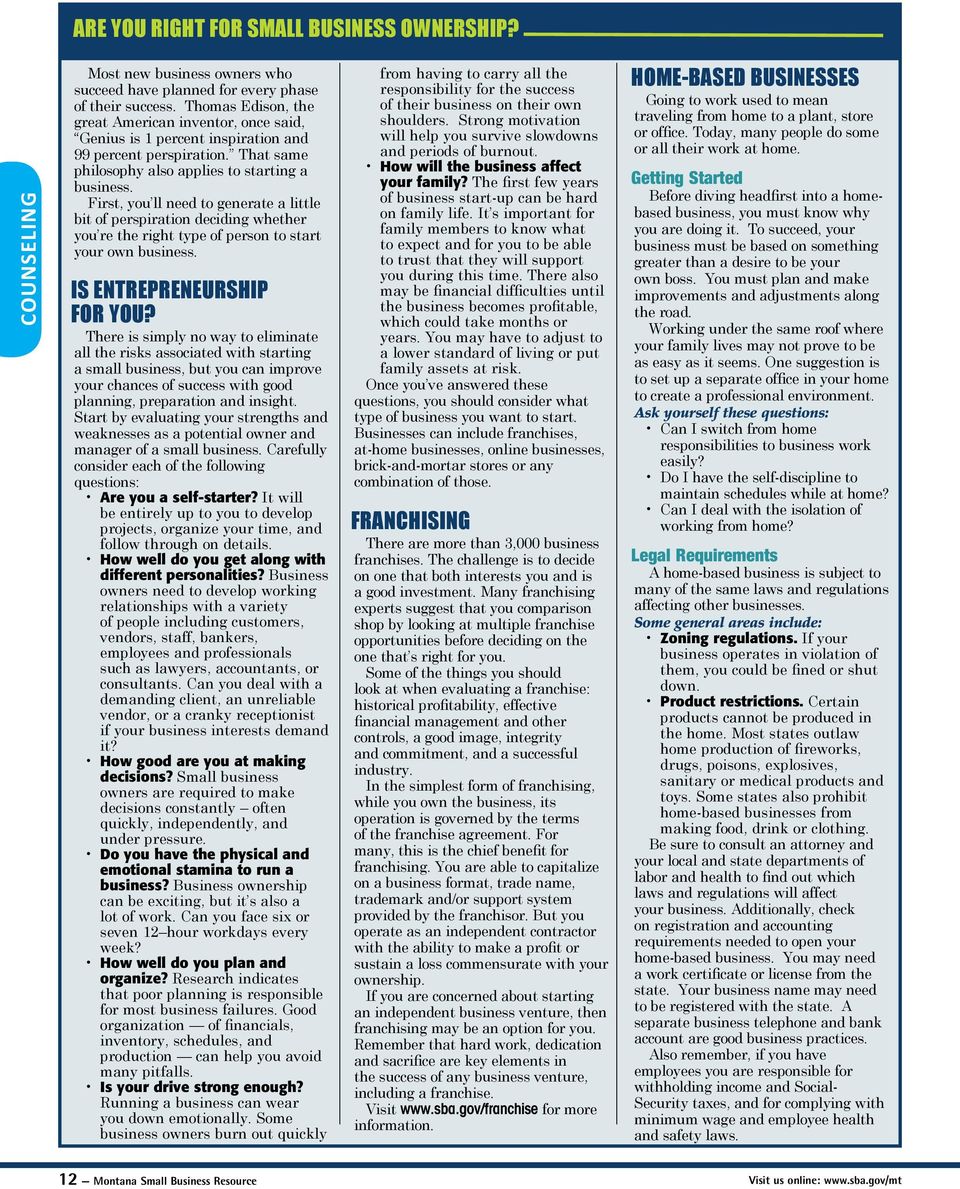
13 WRITING A BUSINESS PLAN After you ve thought about what type of business you want, the next step is to develop a business plan. Think of the business plan as a roadmap with milestones for the business. It begins as a pre-assessment tool to determine profitability and market share, and then expands as an in-business assessment tool to determine success, obtain financing and determine repayment ability, among other factors. Creating a comprehensive business plan can be a long process, and you need good advice. The SBA and its resource partners, including Small Business Development Centers, Women s Business Centers, Veterans Business Outreach Centers, and SCORE, have the expertise to help you craft a winning business plan. The SBA also offers online templates to get you started. In general, a good business plan contains: Introduction Give a detailed description of the business and its goals. Discuss ownership of the business and its legal structure. List the skills and experience you bring to the business. Discuss the advantages you and your business have over competitors. Marketing Discuss the products and services your company will offer. Identify customer demand for your products and services. Identify your market, its size and locations. Explain how your products and services will be advertised and marketed. Explain your pricing strategy. Financial Management Develop an expected return on investment and monthly cash flow for the first year. Provide projected income statements and balance sheets for a two-year period. Discuss your break-even point. Explain your personal balance sheet and method of compensation. Discuss who will maintain your accounting records and how they will be kept. Provide what if statements addressing alternative approaches to potential problems. Operations Explain how the business will be managed day-to-day. Discuss hiring and personnel procedures. Discuss insurance, lease or rent agreements. Account for the equipment necessary to produce your goods or services. Account for production and delivery of products and services. COUNSELING Concluding Statement Summarize your business goals and objectives and express your commitment to the success of your business. Once you have completed your business plan, review it with a friend or business associate and professional business counselor like SCORE, WBC or SBDC representatives, SBA district office economic development specialists or veterans business development specialists. Remember, the business plan is a flexible document that should change as your business grows. Visit us online: Montana Small Business Resource 13
14 CAPITAL Financing Options to Start or Grow Your Business qualify for credit on reasonable terms by themselves. In the case of microlenders, SBA lends monies to intermediaries at favorable rates so they can re-lend to businesses with financing needs up to $50,000. CAPITAL Many entrepreneurs need financial resources to start or expand a small business and must combine what they have with other sources of financing. These sources can include family and friends, venturecapital financing and business loans. This section of the Small Business Resource guide discusses SBA s primary business loan and equity financing programs. These are: the 7(a) Loan Program, the Certified Development Company or 504 Loan Program, the Microloan Program and the Small Business Investment Company Program. The distinguishing features for these programs are the total dollar amounts that can be borrowed, the type of lenders who can provide these loans, the uses for the loan proceeds and the terms placed on the borrower. The SBA does not provide grants to individual business owners to start or grow a business. SBA BUSINESS LOANS If you are contemplating a business loan, familiarize yourself with the SBA s business loan programs to see if they may be a viable option. The SBA has a variety of loan programs which are distinguished by their different uses of the loan proceeds, their dollar amounts, and the requirements placed on the actual lenders. The three principal players in most of these programs are the applicant small business, the lender and the SBA. The Agency does not actually provide the loan, but rather they guaranty a portion of the loan provided by a lender (except for microloans). The lender can be a regulated bank or credit union, or a community based lending organization. The business applies directly to a lender by providing them the documents they require. Generally an application includes a business plan that explains what resources will be needed to accomplish the desired business purpose including the associated costs, the applicants contribution, planned uses for the loan proceeds, a listing of the assets that will secure the loan (collateral), a history of the business and explanation of how the business generates income, and most important, an explanation of how the business will be able to repay the loan in a timely manner. The lender will analyze the application to see if it meets their criteria and make a determination if they will need an SBA guaranty in order to provide the loan. SBA will look to the lender to do much, if not all, of the analysis before it provides its guaranty to the lender s proposed loan. The SBA s business loan guaranty programs provide a key source of financing for viable small businesses that have real potential but cannot 7(a) LOAN PROGRAM The 7(a) Loan program is the SBA s primary business loan program. It is the agency s most frequently used non-disaster financial assistance program because of its flexibility in loan structure, variety of uses for the loan proceeds and availability. The program has broad eligibility requirements and credit criteria to accommodate a wide range of financing needs. Congress authorized SBA to provide financial assistance either directly or in cooperation with banks or other financial institutions through agreements to participate in section 7(a) of the Small Business Act. Historically, a 7(a) loan was provided either directly from SBA or from regulated lenders who provided the loan after they obtained a guaranty from SBA. Since 1996, all 7(a) loans have only been provided on a guaranteed basis, meaning from a lender participating in the 7(a) Loan Guaranty Program. The business loans that SBA guarantees do not come from the Agency, but rather from banks and other approved lenders. The loans are funded by these organizations and they make the decisions to approve or deny the applicants request for financial assistance. The guaranty that SBA provides the lender reduces the lender s risk of borrower non-payment because the guaranty assures the lender that if the borrower defaults, the lender can request that SBA pay the debt rather than the borrower. SBA only guarantees a portion or percentage of every loan not the whole debt, so in the event of default the lender will only get partially repaid by SBA. This means that if the borrower can t make the payments and defaults, the lender can recover the guaranteed portion of the defaulted debt from the SBA. The borrower is still obligated for the full amount. 14 Montana Small Business Resource Visit us online:

15 To qualify for an SBA guaranteed loan, a small business must meet the lender s criteria and the 7(a) program requirements. One of those requirements is that the lender must certify that it would not provide this loan under the proposed terms and conditions without an SBA guaranty. If the SBA is going to provide a lender with a guaranty, the applicant must be eligible and creditworthy and the loan structured under conditions acceptable to the SBA. The 7(a) Program includes ten (10) types of loans which all share certain eligibility requirements but which also have some different requirements so they can accommodate specific business needs and/or give lenders greater flexibility with loan structure. The most popular 7(a) loan type is the Basic 7(a) Loan, which can be used for the most diverse purposes. The other nine 7(a) loan types are variations of the Basic 7(a) Loan with different uses for the loan proceeds and alternative structures. To be eligible for any of the 7(a) loans, the recipients must be both eligible and creditworthy. In addition the applicant business must: 1. Be an operating business (except for loans to Eligible Passive Companies); 2. Be organized for profit; 3. Be located in the United States; 4. Be able to demonstrate a need for the desired credit. 5. Be a business, along with its Affiliates, that meets SBA s Size Standard Requirements. 6. Be a business that is not engaged in a prohibited business activity or owned by a non-qualified owner, or located at a prohibited place. 7. Use the Loan Proceeds for only acceptable purposes, which includes proceeds to start-up a new business, buy an existing business, acquire machinery & equipment and/or furniture & fixtures, acquire or renovat a building which the business will occupy, permanent working capital, and refinancing existing business debt under certain conditions. Proceeds from a Basic 7(a) cannot be used to buy investments that are held for their potential appreciation, or to be provided to an associate of the business except under very limited citcumstances. 8. Be able to demonstrate that it can t get the proceeds from its own resources or those of its principal owners and the lender must certify that they would only approve the loan if it is able to obtain a guaranty from SBA. 9. Have ownership that is of Good Character 10. Be able to satisfy any Miscellaneous Eligibility Requirements that may be imposed on a loan request based on the circumstances of the case including, but not limited to the purpose of the loan. THE BASIC 7(a) LOAN The Basic 7(a) Loan is the most commonly provided type of SBA business loan based on historical dollars approved. They are the most flexible types of SBA loans because they can help finance such a large variety of business purposes for the largest number of business types, engaged in the widest spectrum of activities. In the Federal Government s 2013 Fiscal Year (October 1, 2012 to CAPITAL Visit us online: Montana Small Business Resource 15

16 What to Take to the Lender CAPITAL Documentation requirements will vary depending upon the purpose of the loan. Contact your lender for the information you must supply. Common requirements include the following: A Business Plan that includes: Purpose of the loan History of the business Projections of income, expenses and cash flow as well as an explanation of the assumptions used to develop these projections Personal financial statements on the principal owners Resume(s) of the principal owners and managers. Amount of investment in the business by the owner(s) Projected opening-day balance sheet (new businesses) Lease details Proposed Collateral Financial Statements that include: Balance Sheet and Income Statement (P&L) for three years (existing businesses) (Tax Returns usually suffice) Interim Financial Statements dated within 180 days of the request for assistance Schedule of term debts (existing businesses) Aging of accounts receivable and payable (existing businesses) How the 7(a) Program Works Small Business applicants submit their loan application to a lender for the initial review. If the applicant is applying for their first business loan, it is recommended that the lender be the lender who maintains the personal account of the owner(s). The lender will generally review the credit merits of the request before deciding if they will make the loan themselves or if they will need an SBA guaranty. If a guaranty is needed, the lender will also review the application for SBA eligibility. The applicant should be prepared to complete some additional documents, if the only way the lender can approve the loan is to obtain an SBA guaranty. Applicants who feel they need more help with the process should contact their local SBA district office or one of the SBA s resource partners for assistance. There are several ways a lender can request a 7(a) Guaranty for a proposed business locan from SBA. The main differences between these different processing methods are related to the experience the lender has in requesting guarantees from SBA, the documentation the lender provides to SBA, the amount of review the SBA conducts after receiving the request, the amount of the loan and the lender responsibilities in case the loan defaults and the business assets must be liquidated. The current different processing methods are: Standard 7(a) Guaranty Certified Lender Program Preferred Lender Program SBA Express Export Express Community Advantage When a lender requests a 7(a) guaranty for a business loan they propose to provide a small business their application consist of two parts. The applicant fills out SBA Form 1919 while the lender completes SBA Form The Form 1919 is designed for the applicant to explain what they intend to do with the money and how they will repay the loan. The Form 1920 requires the lender to explain their analysis of the eligibility and credit merits of the request. When the request loan amount is smaller (generally under $350,000) the lender is allowed to provide SBA with less information in their application for guaranty but that does not mean the applicant business can provide the lender with less information. The lender has the ability to ask the applicant for as much detail as they believe is necessary for them to make their decision on the specific request. When the SBA receives a request for guaranty from a lender they will either re-analyze, review or trust the lender s eligibility and credit analysis before deciding to approve or reject the request. See the section on 7(a) Loan Processing from Lenders later on in this article for more detail on what SBA does when it receives a request for guaranty from the lender. By guaranteeing a loan, the SBA assures the lender that, in the event the borrower does not repay the loan, the government will reimburse the lending institution for a percentage of the amount owed. By providing this guaranty, the SBA is able to help tens of thousands of small businesses every year get financing they might not otherwise obtain. When an SBA guaranty is approved, the lender is notified and they will work with the applicant to make sure the terms and conditions designed for the specific loan are met before closing the loan, disbursing the funds, and assuming responsibility for payment collection and general servicing. The borrower makes loan payments directly to the lender. As with any loan, the borrower is obligated to repay the full amount of the loan in a timely manner. What the SBA Looks for: Ability to repay the loan on time from the projected operating cash flow; Owners and operators who are of good character; Feasible business plan; Management expertise and commitment necessary for success; Sufficient funds, including (but not limited to) the SBA guaranteed loan, to operate the business on a sound financial basis (for new businesses, this includes the resources to meet start-up expenses and the initial operating phase); Adequate equity invested in the business; and Enough collateral to fully secure the loan or, all worthwhile available business collateral plus personal real estate if the loan cannot be fully secured. The Impact of a Credit Score SBA also credit scores every business that is a potential recipient of a loan guaranteed by SBA. If the loan is for $350,000 or less, the credit score obtained will have a significant impact on the amount of work the lender has to complete when applying for an SBA guaranty. As such it is important for any owner of a potential business loan to be aware of their credit score and correct any discrepancies prior to approaching their lender. 16 Montana Small Business Resource Visit us online:
17 September 30, 2013) about 80 percent of the dollars and 38 percent of the number of all 7(a) loans guaranteed by SBA were Basic 7(a) Loans. The reciprocal percentages were divided between the nine other 7(a) Programs. The Basic 7(a) Loan is a term loan usually repaid with one monthly payment of principal and interest. Interest only repayment periods are permitted when needed, such as for a start-up business that doesn t achieve breakeven in its initial months of operation. Other repayment structures are also permitted depending upon the borrower s needs and the flexibility of the lender. A Basic 7(a) Loan does not revolve so the sum of the disbursements is the loan amount. SBA can guaranty revolving lines of credit, but that is accomplished through some of the nine variations to the Basic 7(a) Loan. The following aspects of the Basic 7(a) Loan are also applicable to all other 7(a) Loan unless specifically referenced as not applying to a specific Special 7(a) Loan SBA Peg Rate). Lenders are allowed to add an additional spread to the base rate to arrive at the final rate. For loans with maturities of less than seven years, the maximum spread will be no more than 2.25 percent. For loans with maturities of seven years or more, the maximum spread will be 2.75 percent. The spread on loans under $50,000 and loans processed through Express procedures have higher maximums. Most 7(a) term loans are repaid with monthly payments of principal and interest. For fixed-rate loans the payments stay the same because the interest rate is constant. For variable rate loans the lender can change the payment amount when the interest rates change. Applicants can request that the lender establish the loan with interest-only payments during the startup and expansion phases (when eligible) to allow the business time to generate income before it starts making full loan payments. Guaranty and Other Fees Loans guaranteed by the SBA are assessed a guaranty fee. This fee is based on the loan s maturity and the dollar amount guaranteed, not the total dollar amount of the loan. The guaranty fee is initially paid by the lender and then passed on to the borrower at CAPITAL Percentage of Guarantees and Loan Maximums SBA only guarantees a portion of any particular 7(a) loan so each loan will have an SBA share and an unguaranteed portion which gives the lender a certain amount of exposure and risk on each loan. The percentage of guaranty depends on either the dollar amount or the program the lender uses to obtain its guaranty. For loans of $150,000 or less the SBA generally guarantees as much as 85 percent and for loans over $150,000 the SBA generally provides a guaranty of up to 75 percent. The maximum dollar amount of a single 7(a) loan is $5 million and there is no minimum. The maximum dollar amount of the SBA share which can be provided to any one business (including affiliates) is $3,750,000. Interest Rates The actual interest rate for a 7(a) loan guaranteed by the SBA is negotiated between the applicant and lender but is subject to the SBA maximums. Both fixed and variable interest rate structures are available. The maximum rate comprises two parts, a base rate and an allowable spread. There are three acceptable base rates (Wall Street Journal Prime*, London Interbank One Month Prime plus 3 percent, and an Visit us online: Montana Small Business Resource 17

18 CAPITAL closing. The funds the business needs to reimburse the lender can be included in the overall loan proceeds. On any loan with a maturity of one year or less, the fee is just 0.25 percent of the guaranteed portion of the loan. On loans with maturities of more than one year, the normal guaranty fee is: 2.0 percent of the SBA guaranteed portion on loans up to $150,000; ** 3.0 percent on loans over $150,000 but not more than $700,000; and 3.5 percent on loans over $700,000. There is also an additional fee of 0.25 percent on any guaranteed portion over $1 million. * All references to the prime rate refer to the base rate in effect on the first business day of the month the loan application is received by the SBA. ** For all SBA-guaranteed loans of $150,000 or less that are approved between October 1, 2014 and September 30, 2015, the guaranty fee will be 0%. The lender may not charge a prepayment penalty if the loan is paid off before maturity but the SBA will charge the borrower a prepayment fee if the loan has a maturity of 15 or more years and is pre-paid during the first three years. 7(a) Loan Maturities The SBA s loan programs are generally intended to encourage longer term small-business financing, but actual loan maturities are based on the ability to repay, the purpose of the loan proceeds and the useful life of the assets financed. Maturity generally ranges from 7 to 10 years for working capital, business start-ups, and business acquisition type loans, and up to 25 years if the purpose is to acquire real estate or fixed assets with a long term useful life. Collateral The SBA expects every 7(a) loan to be secured first with the assets acquired with the loan proceeds and then with additional business and personal assets, depending upon the loan amount and the way the lender requests their guaranty. However, SBA will not decline a request to guaranty a loan if the only unfavorable factor is insufficient collateral, provided all available collateral is offered. When the lender says they will need an SBA guaranty, the applicant should be prepared for liens to be placed against all business assets. Personal guaranties are required from all the principal owners of the business. Liens on personal assets of the principals may also be required. Loans under $25,000 do not require collateral. Loan Structure The structure of a Basic 7(a) Loan is that repayment has to be set up so the loan is paid in full by maturity. Over the term of the loan there can be additional payments or payment relaxation depending on what Is happening with the business. Balloon payments and call provisions are not allowed on any 7(a) term loan. Eligibility 7(a) loan eligibility is based on a number of different factors, ranging from Size and Nature of Business to Use of Proceeds and factors that are case specific. Size Eligibility The first eligibility factor is size, as all loan recipients must be classified as small by the SBA. The size standards for all 7(a) loans are outlined below. A more in-depth listing of standards can be found at SBA Size Standards have the following general ranges: Manufacturing from 500 to 1,500 employees Wholesale Trades Up to 100 employees Services $2 million to $35.5 million in average annual receipts Retail Trades $7 million to $35.5 million in average annual receipts Construction $7 million to $33.5 million in average annual receipts Agriculture, Forestry, Fishing, and Hunting $750,000 to $17.5 million in average annual receipts There is an alternate size standard for businesses that do not qualify under their industry size standards for SBA funding. That Alternative is that the applicant business (plus affiliates can t have a tangible net worth exceeding $15 million and average net income exceeding $5 million for the last two years. This new alternate makes more businesses eligible for SBA loans and applies to SBA non-disaster loan programs, namely its 7(a) Business Loans and Certified Development Company programs. Nature of Business The second eligibility factor is based on the nature of the business and the process by which it generates income or the customers it serves. The SBA has general prohibitions against providing financial assistance to businesses involved in such activities as lending, speculating, passive investment, pyramid sales, loan packaging, presenting live performances of a prurient nature, businesses involved in gambling and any illegal activity. The SBA also cannot make loan guaranties to non-profit businesses, private clubs that limit membership on a basis other than capacity, businesses that promote a religion, businesses owned by individuals incarcerated or on probation or parole, municipalities, and situations where the business or its owners previously failed to repay a federal loan or federally assisted financing, or are delinquent on existing federal debt. Use of Proceeds The third eligibility factor is Use of Proceeds. A Basic 7(a) Loan can provide proceeds to purchase machinery, equipment, fixtures, supplies, and to make improvements to land and/ or buildings that will be occupied by the subject applicant business. Proceeds can also be used to: Expand or renovate facilities; Acquire machinery, equipment, furniture, fixtures and leasehold improvements; Acquire businesses; Start businesses; Permant Working Capital Acquire Land and Build a Location for the applicant business; and Refinance existing debt under certain conditions. SBA 7(a) loan proceeds cannot be used: 1. For the purpose of making investments. 2. To provide funds to any of the owners of the business except for ordinary compensation for actual services provided. 3. For Floor Plan Financing 4. For a purpose that does not benefit the business Miscellaneous Factors The fourth factor involves a variety of requirements such as SBA s credit elsewhere test where the personal resources of the owners need to be checked to see if they can make a contribution before getting a loan guaranteed by the SBA. It also includes the SBA s anti-discrimination rules and limitations on lending to agricultural enterprises because there are other agencies of the Federal government with programs to fund such businesses. 18 Montana Small Business Resource Visit us online:

19 Generally, SBA loans must meet the following criteria: Every loan must be for a sound business purpose; There must be sufficient invested equity in the business so it can operate on a sound financial basis; There must be a potential for longterm success; The owners must be of good character and reputation; and All loans must be so sound as to reasonably assure repayment. For more information, go to SPECIAL PURPOSE 7(a) LOAN PROGRAMS The 7(a) loan program is the most flexible of the SBA s lending programs. Over time, the Agency has developed several variations of the Basic 7(a) Loan in order to address specific financing needs for particular types of small businesses or to give the lender greater flexibility with the loan s structure. The general distinguishing feature between these loan types is their use of proceeds. These programs allow the proceeds to be used in ways that are not otherwise permitted in a basic 7(a) loan. These special purpose programs are not necessarily for all businesses but may be very useful to some small businesses. They are generally governed by the same rules, regulations, fees, interest rates, etc., as the basic 7(a) loan. Lenders can advise you of any variations. The Special Purpose Loans include: Guaranty Coverage The SBA can guaranty up to 90 percent of an ITL up to a maximum of $4.5 million, less the amount of the guaranteed portion of other SBA loans outstanding to the borrower. The maximum guaranty for any working capital component of an ITL is limited to $4 million. Any other working capital SBA loans that the borrower has are counted against the $4 million guaranty limit. Use of Proceeds For the facilities and equipment portion of the loan, proceeds may be used to acquire, construct, renovate, modernize, improve or expand facilities or equipment in the U.S. to produce goods or services involved in international trade, including expansion due to bringing production back from overseas if the borrower exports to at least one market. Working capital is an allowable use of proceeds under the ITL. Proceeds may be used for the refinancing of debt not structured on reasonable terms and conditions, including any debt that qualifies for refinancing under the standard SBA 7(a) Loan Program. Loan Term Maturities on the working capital portion of the ITL are typically limited to 10 years. Maturities of up to 10 years on equipment unless the useful life exceeds 10 years. Maturities of up to 25 years are available for real estate. Loans with a mixed use of fixedasset and working-capital financing will have a blended-average maturity. Exporter Eligibility Applicants must meet the same eligibility requirements as for the SBA s standard 7(a) Loan Program. Applicants must also establish that the loan will allow the business to expand or develop an export market or, demonstrate that the business has been adversely affected by import competition and that the ITL will allow the business to improve its competitive position. CAPITAL International Trade Loan Program The SBA s International Trade Loan (ITL) is designed to help small businesses enter and expand into international markets or, when adversely affected by import competition, to make the investments necessary to better compete. The ITL offers a combination of fixed asset, working capital financing and debt refinancing with the SBA s maximum guaranty--90 percent--on the total loan amount. The maximum loan amount is $5 million. SBA International Trade Programs Bryson Patterson Export Finance Manager, Export Solutions Group Office of International Trade, SBA U.S. Export Assistance Center 1999 Broadway, Ste Denver, CO [email protected] Visit us online: Montana Small Business Resource 19

20 CAPITAL Foreign Buyer Eligibility Foreign buyers must be located in those countries where the Export- Import Bank of the U.S. is not prohibited from providing financial assistance. Collateral Requirements Only collateral located in the U.S. (including its territories and possessions) is acceptable. First lien on property or equipment financed by the ITL or on other assets of the business is required. However, an ITL can be secured by a second lien position if the SBA determines there is adequate assurance of loan repayment. Additional collateral, including personal guaranties and those assets not financed with ITL proceeds, may be appropriate. A small business wanting to qualify as adversely impacted from import competition must submit supporting documentation that explains the impact, and a plan with projections that explains how the loan will improve the business competitive position. Export Working Capital Program The SBA s Export Working Capital Program (EWCP) assists businesses exporters in meeting their shortterm export working capital needs. Exporters can use the proceeds to make the products they will be exporting. They can also apply for such lines of credit prior to finalizing an export sale or contract. With an approved EWCP loan in place, exporters have greater flexibility in negotiating export payment terms secure in the assurance that adequate financing will be in place when the export order is won. Benefits of the EWCP Financing for suppliers, inventory or production of export goods. Export working capital during long payment cycles. Financing for stand-by letters of credit used as bid or performance bonds or advance payment guarantees. Reserves domestic working capital for the company s sales within the U.S. Permits increased global competitiveness by allowing the exporter to extend more liberal sales terms. Increases sales prospects in underdeveloped markets which may have high capital costs for importers. Low fees and quick processing times. Guaranty Coverage Maximum loan amount is $5,000, percent of principal and accrued interest up to 120 days. Low guaranty fee of one-quarter of one percent of the guaranteed portion for loans with maturities of 12 months or less. Loan maturities are generally for 12 months or less, but can be up to a maximum of 36 months. Use of Proceeds To pay for the manufacturing costs of goods for export. To purchase goods or services for export. To support standby letters of credit to act as bid or performance bonds. To finance foreign accounts receivable. Interest Rates The SBA does not establish or subsidize interest rates on loans. The interest rate can be fixed or variable and is negotiated between the borrower and the participating lender. Advance Rates Up to 90 percent on purchase orders. Up to 90 percent on documentary letters of credit. Up to 90 percent on foreign accounts receivable. Up to 75 percent on eligible foreign inventory located within the U.S. In all cases, not to exceed the exporter s costs. Collateral Requirements The export-related inventory and the receivables generated by the export sales financed with EWCP funds generally will be considered adequate collateral. The SBA requires the personal guarantee of owners with 20 percent or more ownership. How to apply Application is made directly to SBAparticipating lenders. Businesses are encouraged to contact SBA staff at their local U.S. Export Assistance Center (USEAC) to discuss whether they are eligible for the EWCP and whether it is the appropriate tool to meet their export financing needs. Participating lenders review/approve the application and submit the guaranty request to SBA staff at the local USEAC. CAPLines The CAPLines program for loans up to $5 million is designed to help small businesses meet their shortterm and cyclical working capital needs. The programs can be used to finance seasonal working capital needs; finance the direct costs of performing certain construction, service and supply contracts, subcontracts, or purchase orders; finance the direct cost associated with commercial and residential construction; or provide general working capital lines of credit. The maturity can be for up to 10 years except for the Builders Capline which is limited to 36 months after the first structure is completed. Guaranty percentages are the same as for a Basic 7(a) Loan. There are four distinct short term loan programs under the CAPLine umbrella: The Contract Loan Program is used to finance the cost associated with contracts, subcontracts, or purchase orders. Proceeds can be disbursed before the work begins. If used for one contract or subcontract, it is generally not revolving; if used for more than one contract or subcontract at a time, it can be revolving. The loan maturity is usually based on the length of the contract, but no more than 10 years. Contract payments are generally sent directly to the lender but alternative structures are available. The Seasonal Line of Credit Program is used to support buildup of inventory, accounts receivable or labor and materials above normal usage for seasonal inventory. The business must have been in business for a period of 12 months and must have a definite established seasonal pattern. The loan may be used over again after a clean-up period of 30 days to finance activity for a new season. These loans also may have a maturity of up to five years. The business may not have another seasonal line of credit outstanding but may have other lines for nonseasonal working capital needs. The Builders Line Program provides financing for small contractors or developers to construct or rehabilitate residential or commercial property. Loan maturity is generally three years but can be extended up to five years, if necessary, to facilitate sale of the property. Proceeds are 20 Montana Small Business Resource Visit us online:

21 used solely for direct expenses of acquisition, immediate construction and/or significant rehabilitation of the residential or commercial structures. The purchase of the land can be included if it does not exceed 20 percent of the loan proceeds. Up to 5 percent of the proceeds can be used for physical improvements that benefit the property. The Working Capital Line Program is a revolving line of credit (up to $5,000,000) that provides short term working capital. These lines are generally used by businesses that provide credit to their customers, or whose principle asset is inventory. Disbursements are generally based on the size of a borrower s accounts receivable and/ or inventory. Repayment comes from the collection of accounts receivable or sale of inventory. The specific structure is negotiated with the lender. There may be extra servicing and monitoring of the collateral for which the lender can charge up to 2 percent annually to the borrower. structured as a revolving line of credit the requirements for the payment of interest and principal are at the discretion of the lender and maturity can t exceed 7 years. Export Express SBA s Export Express loans offers flexibility and ease of use for both borrowers and lenders on loans up to $500,000. It is the simplest export loan product offered by the SBA. Use of Proceeds Loan proceeds may be used for business purposes that will enhance a company s export development. Export Express can take the form of a term loan or a revolving line of credit. As an example, proceeds can be used to fund participation in a foreign trade show, finance standby letters of credit, translate product literature for use in foreign markets, finance specific export orders, as well as to finance expansions, equipment purchases, and inventory or real estate acquisitions, etc. Ineligible Use of Proceeds Proceeds may not be used to finance overseas operations other than those strictly associated with the marketing and/or distribution of products/services exported from the U.S. Interest Rates Terms are negotiated between the borrower and lender but interest rates may not exceed Prime plus 4.5 percent on loans over $50,000 and Prime plus 6.5 percent on loans of $50,000 or less. Exporter Eligibility Any business that has been in operation, although not necessarily in exporting, for at least 12 full months and can demonstrate that the loan proceeds will support its export activity is eligible for Export Express. The one year in business operations requirement can be waived if the applicant can demonstrate previous successful business experience and exporting expertise and the lender does conventional underwriting, not relying solely on credit scoring. CAPITAL Other Guaranty Lines of Credit All the Special Purpose Programs listed above have SBA structured repayment terms meaning the Agency tells the lender how principal and interest is to be repaid. These programs also require the lender to use certain closing forms. Lenders with the ability to obtain 7(a) guarantees through any of the Express processes are considered experienced enough to be able to structure their own repayment terms and use their own closing documents. With this ability the lender can tailor a line of credit that it gets guaranteed by SBA to the needs of the business. Therefore, if a potential applicant sees that the previously listed Basic 7(a) or Special Purpose 7(a) Programs don t meet their needs they should discuss their options with a lender capable of providing an SBAExpress loan with an SBA guaranty. SBAExpress The SBAExpress Loan or Line of Credit is a flexible smaller loan up to $350,000 that a designated lender can provide to its borrower using mostly their own forms, analysis and procedures to process, structure, service, and disburse this SBA-guaranteed loan. When structured as a term loan the proceeds and maturity are the same as a Basic 7(a) Loan. When Visit us online: Montana Small Business Resource 21
22 CAPITAL Foreign Buyer Eligibility The exporter s foreign buyer must be a creditworthy entity and not located in countries prohibited for financial support on the Export-Import Bank s Country Limitation Schedule and the methods of payment must be acceptable to the SBA and the SBA lender. How to Apply Interested businesses should contact their existing lender to determine if they are an SBA Export Express lender. Application is made directly to the lender. Lenders use their own application material in addition to SBA s Borrower Information Form. Lenders approved requests are then submitted with a limited amount of eligibility information to SBA s National Loan Processing Center for review. 7(a) LOAN PROCESSES FOR LENDERS There are various procedures for lenders to follow when they apply to SBA for a 7(a) guaranty. Some are designed for experienced lenders who are fully committed to providing business loans guaranteed by SBA to their clientele that need them, while others are designed for lenders with limited experience or when there are certain issues that require SBA to thoroughly review the situation. The foundational process is called the Standard Loan Guaranty Process and it is used by lenders to request a guaranty from SBA when they are new to SBA lending or the request requires an SBA review. Other methods of processing have less requirements for SBA but more for the lender and the determining factors on which one a lender will use depends on the experience of the lender in dealing with SBA, the complexity of the case, the purpose of the loan, and the dollar amount being requested. Standard 7(a) Loan Processing After the applicant business and lender complete their required documents, the lender makes application to SBA for a guaranty by submitting them to SBA s Loan Guaranty Processing Center. The center will screen the application and, if satisfactory complete a thorough review of both eligibility and creditworthiness before making the decision to approve the issuance of a guaranty as submitted, approve with modifications (which will be discussed with the lender), or reject the request. When the lender makes application to SBA, they have already internally agreed to approve the recommended loan to the applicant if, and only if, the SBA provides a guaranty. Standard processing means a lender makes their request for guaranty using SBA Form 1920 and the applicant completes SBA Form 1919, even if the applicant previously completed the lender s required application forms. The analysis of eligibility starts with a review of the Eligibility Questionnaire, completed by the lender. The analysis of credit starts with a review of the SBA Form 1920 and the lender s credit memo which must discuss at least six elements: 1. Balance sheet and ratio analysis; 2. Analysis of repayment. It is not acceptable to base repayment ability solely on the applicant s credit score. 3. Assessment of the management skills of the applicant; 4. Explanation of the collateral used to secure the loan and the adequacy of the proposed collateral; 5. Lender s credit history with applicant including an explanation of any weaknesses; 6. Current financial statements and pro-forma financial spread. SBA pro-forma analysis reflects how the business will look immediately following disbursement, not one year after disbursement. SBA also expects that the lender s credit memo includes the intended use of the loan proceeds and any historical and current issues that require explanation. SBA also expects a discussion of the process by which the applicant business generates its income when it is not immediately obvious. An explanation of how the business conducts its operation is also expected. SBA has three days to screen and 10 days to process the request for guaranty from the lender. Any additional time a lender takes to make their determination prior to requesting a guaranty from SBA will add to the length of time to reach a final decision. If the guaranty is approved, SBA will prepare a loan authorization outlining the terms and conditions under which the guaranty is provided and prepare an approval letter for transmission to the lender. Certified Processing SBA has a Certified Lenders Program (CLP) which lenders with more experience and commitment to SBA lender can obtain which allows them to request a 7(a) guaranty through a process similar to the Standard process except the SBA will only review the lenders request rather than re-analyze. Preferred Processing SBA has a Preferred Lenders Program (PLP) designed for lenders who have been delegated the authority to make both the eligibility and credit decisions without a second look by SBA. This process is used by the most experienced lenders who have the most dedicated staffs ready to review requests for financial assistance from existing and potential customers in order to see if they need to become SBA guaranteed loans SBAExpress Processing The SBAExpress guaranty is available to lenders as a way to obtain a guaranty on smaller loans up to $350,000. The program authorizes select, experienced lenders to use mostly their own forms, analysis and procedures to process, structure, service, and disburse SBA-guaranteed loans. The SBA guarantees up to 50 percent of an SBAExpress loan. Loans under $25,000 do not require collateral. The use of proceeds for a term loan is the same as for any Basic 7(a) Loan. Like most 7(a) loans, maturities are usually five to seven years for working capital and up to 25 years for real estate or equipment. Revolving lines of credit are allowed for a maximum of seven years. Export Express Processing SBA Export Express offers flexibility and ease of use for lenders. Participating lenders may use their own forms, procedures and analyses. The SBA provides the lender with a response within 36 hours. This loan is subject to the same loan processing, closing, servicing and liquidation requirements as for other similar-sized SBA loans. Guaranty Coverage The SBA provides lenders with a 90 percent guaranty on loans up to $350,000 and a 75 percent guaranty on loans between $350,001 and $500,000. Montana World Trade Center The Montana World Trade Center (MWTC) works to increase international trade through public-private partnerships, business networking, and student education. In the entire state of Montana, and well beyond its borders, there is no other source of information and access to global trade opportunities 22 Montana Small Business Resource Visit us online:
23 that is comparable to the Montana World Trade Center. Since its inception, MWTC has undertaken a dual role as consultant and advocate, assisting our member businesses to establish and strengthen international commercial capabilities, while striving to develop untapped international trade opportunities. Developing a partnership with MWTC will help your business realize international sales and expansion goals that would otherwise be unattainable. Montana World Trade Center Gallagher Business Bldg., Ste. 257 The University of Montana Fax [email protected] U.S. Export Assistance Centers SBA trade finance specialists are located in 19 U.S. Export Assistance Centers throughout the U.S., which also are staffed by U.S. Department of Commerce and, in some locations, Export-Import Bank of the U.S. personnel, providing trade promotion and export-finance assistance in a single location. The USEACs also work closely with other federal, state and local international trade organizations to provide assistance to small businesses. To find your nearest USEAC, visit: us-export-assistance-centers. You can find additional export training and counseling opportunities by contacting your local SBA district office. Development Financial Institutions (CDFIs), Certified Development Companies (CDCs), and microlenders. These lenders provide technical assistance and economic development support to businesses located in underserved markets. The application process is the same as for a Basic 7(a) Loan. The main difference with this program from other SBA 7(a) loan programs is the lender who ultimately provides the loan funds is not a traditional SBA lender. Visit: for more information about this program. CERTIFIED DEVELOPMENT COMPANY LOAN PROGRAM (504 LOANS) The 504 Loan program is an economic development program that supports American small business growth and helps communities through business expansion and job creation. The 504 loan program provides long-term, fixedrate, subordinate mortgage financing for acquisition and/or renovation of capital assets including land, buildings and equipment. Some refinancing is also permitted. Most for-profit small businesses are eligible for this program. The types of businesses excluded from 7(a) loans (listed previously) are also excluded from the 504 loan program. The SBA s 504 Certified Development Companies (CDC) serve their communities by financing business expansion needs. Their professional staff works directly with borrowers to tailor a financing package that meets program guidelines and the credit capacity of the borrower s business. CDCs work with banks and other lenders to make loans in first position on reasonable terms, helping lenders retain growing customers and provide Community Reinvestment Act credit. The SBA 504 loan is distinguished from the SBA 7(a) loan program in these ways: The maximum debenture, or long-term loan, is: $5 million for businesses that create a certain number of jobs or improve the local economy; $5 million for businesses that meet a specific public policy goal, including loans for aiding rural CAPITAL USEAC Bryson Patterson Export Finance Manager, Export Solutions Group Office of International Trade, SBA U.S. Export Assistance Center 1999 Broadway, Ste Denver, CO [email protected] Montana Export Assistance Center Carey Hester, Director [email protected] Gallagher Business Bldg., Ste. 257 University of Montana Missoula, MT Community Advantage Loans The Community Advantage Pilot Program is aimed at helping businesses located in underserved communities gain access to capital by opening up 7(a) lending to mission-focused, communitybased lenders such as Community Visit us online: Montana Small Business Resource 23
24 CAPITAL development and expansion of small businesses owned by veterans, women, and minorities; and $5.5 million for manufacturers and energy related public policy projects. Recent additions to the program allow $5.5 million for each project that reduces the borrower s energy consumption by at least 10 percent; and $5.5 million for each project that generates renewable energy fuels, such as biodiesel or ethanol production. Projects eligible for up to $5.5 million under one of these two requirements do not have to meet the job creation or retention requirement, so long as the CDC portfolio reflects an average jobs to debenture portfolio ratio of at least 1 job per $65,000. Eligible project costs are limited to long-term, fixed assets such as land and building (occupied by the borrower) and substantial machinery and equipment. Most borrowers are required to make an injection (borrower contribution) of just 10 percent which allows the business to conserve valuable operating capital. A further injection of 5 percent is needed if the business is a start-up or new (less than two years old), and a further injection of 5 percent is also required if the primary collateral will be a singlepurpose building (such as a hotel). Two-tiered project financing: A lender finances approximately 50 percent of the project cost and receives a first lien on the project assets (but no SBA guaranty); A CDC (backed by a 100 percent SBA-guaranteed debenture) finances up to 40 percent of the project costs secured with a junior lien. The borrower provides the balance of the project costs. Fixed interest rate on SBA loan. The SBA guarantees the debenture 100 percent. Debentures are sold in pools monthly to private investors. This low, fixed rate is then passed on to the borrower and establishes the basis for the loan rate. All project-related costs can be financed, including acquisition (land and building, land and construction of building, renovations, machinery and equipment) and soft costs, such as title insurance and appraisals. Some closing costs may be financed. Collateral is typically a subordinate lien on the assets financed; allows other assets to be free of liens and available to secure other needed financing. Long-term real estate loans are up to 20-year term, heavy equipment 10- or 20-year term and are selfamortizing. Businesses that receive 504 loans are: Small net worth under $15 million, net profit after taxes under $5 million, or meet other SBA size standards. Organized for-profit. Most types of business retail, service, wholesale or manufacturing. For information, visit High Plains Financial, Inc. Jeremiah Johnson, Business Development Officer 300 Central Ave., Ste. 406 Great Falls, MT Fax [email protected] Montana Community Finance Corporation Linda Kindrick, Executive Director 825 Great Northern Blvd., Ste. 301 Helena, MT Fax [email protected] Big Sky Economic Development Brandon Berger, Director of Business Finance 222 N. 32nd St., Ste. 200 Billings, MT [email protected] MICROLOAN PROGRAM (LOANS UP TO $50,000) The Microloan program provides very small loans (up to $50,000) to women, low-income, minority, veteran, and other small business owners through a network of more than 100 Intermediaries nationwide. Under this program, the SBA makes funds available to nonprofit intermediaries that, in turn, make the small loans directly to start-up and existing businesses. Entrepreneurs work directly with the Intermediaries to receive financing, and business knowledge support. The proceeds of a microloan can be used for working capital, or the purchase of furniture, fixtures, supplies, materials, and/or equipment. Microloans may not be used for the purchase of real estate. Interest rates are negotiated between the borrower and the Intermediary. The maximum term for a microloan is six years. Because funds are borrowed from the Intermediary, SBA is not involved in the business loan application or approval process. And, payments are made directly from the small business to the Intermediary. The program also provides businessbased training and technical assistance to micro-borrowers and potential microborrowers to help them successfully start or grow their businesses. Such training and technical assistance may include general business education, assistance with business planning, industry-specific training, and other types of training support. 24 Montana Small Business Resource Visit us online:
25 Entrepreneurs and small business owners interested in small amounts of business financing should contact the nearest SBA district office for information about the nearest Microloan Program Intermediary Lender or go to Montana Community Development Corp. Missoula Location: 229 E. Main St. Missoula, MT Bozeman Location: 222 E. Main, Ste. 202 Bozeman, MT SURETY BOND GUARANTEE PROGRAM The Surety Bond Guarantee Program is a public-private partnership between the Federal government and surety companies to provide small businesses with the bonding assistance necessary for them to compete for public and private contracting and subcontracting opportunities. The guarantee provides an incentive for sureties to bond small businesses that would otherwise be unable to obtain bonding. The program is aimed at small businesses that lack the working capital or performance track record necessary to secure bonding on a reasonable basis through regular commercial channels. Through this program, the SBA guarantees bid, payment, performance and ancillary bonds issued by surety companies for individual contracts and subcontracts up to $6.5 million. The SBA reimburses sureties between 70 and 90 percent of losses sustained if a contractor defaults on the contract. On Federal contracts, SBA can guarantee bonds on contracts up to $10 million, if the contracting officer certifies that a guarantee would be in the best interest of the Government. SBA has two program components, the Prior Approval Program and the Preferred Surety Bond Program. In the Prior Approval Program, the SBA guarantees 90 percent of surety s paid losses and expenses on bonded contracts up to $100,000, and on bonded contracts greater than $100,000 that are awarded to socially and economically disadvantaged concerns, HUBZone contractors, and veterans, and service-disabled veteran-owned small businesses. All other bonds guaranteed in the Prior Approval Program receive an 80 percent guarantee. Sureties must obtain the SBA s prior approval for each bond guarantee issued. Under the Preferred Program, the SBA guarantees 70 percent, and sureties may issue, monitor and service bonds without the SBA s prior approval. Small businesses, surety companies, and bond producers are invited to visit our website at You may also call the program office at ACORA Surety & Insurance Services, LLC 3246 E. Hwy. 7 Montevideo, MN American Contractors Indemnity Company 601 S. Figueroa St. Los Angeles, CA American Surety Bonds Agency, LLC 1587 N.E. Expwy. Atlanta, GA Brooklyn Ventures, LLC dba SuretyBonds. com Dr. S.E., Ste. 102 Columbia, MT CB Insurance, LLC 1 S. Nevada Ave. Colorado Springs, CO CCI Surety, Inc N. Douglas Dr. Golden Valley, MN Capstone Brokerage, Inc W. Sahara Ave., Ste. 100 Las Vegas, NV Rocky Mountain Surety 3575 S. Sherman St. Englewood, CO Freedom Bonding, Inc Liberty Rd. Randallstown, MD CAPITAL Visit us online: Montana Small Business Resource 25
26 CAPITAL Global Indemnity Insurance Agency 195 Scott Swamp Rd. Farmington, CT Hub International Insurance Services th St. Denver CO Integrity Surety, LLC Midvale Ave. N. Seattle, WA JW Bond Consultants, Inc A Kellers Church Rd. Pipersville, PA KPS Insurance Services, Inc Treena St. San Diego, CA National Surety Services, Inc Dunwoody Village Pkwy. Atlanta, GA Roger Bouchard Insurance 101 Starcrest Dr. Clearwater, FL Rudnik Surety, Inc Knollwood Dr. Mounds View, MN Surety Solutions Insurance Services 3225 Monier Cir. Rancho Cordova, CA The Bond Exchange, Inc Pleasant Ridge Rd., Ste. 200 Little Rock, AZ The Surety Group Agency, LLC 3715 NorthSide Pkwy. Atlanta, GA Thomas Sauer Bond Agency 5619 S. Curtis St. Littleton, CO Viking Bond Service, Inc N. 19th Ave. Phoenix, AZ Wells Fargo Insurance Services USA, Inc Mark Dabling Blvd. Colorado Springs, CO SMALL BUSINESS INVESTMENT COMPANY PROGRAM The Small Business Investment Company (SBIC) program is a multibillion dollar program founded in 1958, as one of many financial assistance programs available through the U.S. Small Business Administration. The structure of the program is unique in that SBICs are privately owned and managed investment funds, licensed and regulated by SBA, that use their own capital plus funds borrowed with an SBA guarantee to make equity and debt investments in qualifying small businesses. The funds raise private capital and can receive SBAguaranteed leverage up to three times private capital, with a leverage ceiling of $150 million per SBIC and $225 million for two or more licenses under common control. Licensed SBICs are for-profit investment firms whose incentive is to share in the success of a small business. The U.S. Small Business Administration does not invest directly into small business through the SBIC Program, but provides funding through SBA guarantee debentures to qualified investment management firms with expertise in certain sectors or industries. THE SMALL BUSINESS INNOVATION RESEARCH PROGRAM The Small Business Innovation Research (SBIR) program is a highly competitive program that encourages domestic small businesses to engage in Federal Research/Research and Development (R/R&D) that has the potential for commercialization. Through a competitive awardsbased program, SBIR enables small businesses to explore their technological potential and provides the incentive to profit from its commercialization. By including qualified small businesses in the nation s R&D arena, high-tech innovation is stimulated and the United States gains entrepreneurial spirit as it meets its specific research and development needs. SBIR Program Eligibility Only United States small businesses are eligible to participate in the SBIR program. An SBIR awardee must meet the following criteria at the time of Phase I and II awards: 1. Organized for profit, with a place of business located in the United States; 2. No more than 500 employees, including affiliates; 3. Be a concern which is more than 50% directly owned and controlled by one or more individuals (who are citizens or permanent resident aliens of the United States), other small business concerns (each of which is more than 50% directly owned and controlled by individuals who are citizens or permanent resident aliens of the United States), or any combination of these; 4. Be a concern which is more than 50% owned by multiple venture capital operating companies, hedge funds, private equity firms, or any combination of these (for agencies electing to use the authority in 15 U.S.C. 638(dd)(1)); or 5. Be a joint venture in which each entity to the joint venture must meet the requirements set forth in paragraph (a)(1)(i) or (a)(1)(ii) of this section. A joint venture that includes one or more concerns that meet the requirements of paragraph (a)(1)(ii) of this section must comply with (b) concerning registration and proposal requirements. 6. No single venture capital operating company, hedge fund, or private equity firm may own more than 50% of the concern. 7. For awards from agencies using the authority under 15 U.S.C. 638(dd) (1), an awardee may be owned and controlled by more than one VC, hedge fund, or private equity firm so long as no one such firm owns a majority of the stock. 8. If an Employee Stock Ownership Plan owns all or part of the concern, each stock trustee and plan member is considered an owner. 9. If a trust owns all or part of the concern, each trustee and trust beneficiary is considered an owner. 10. Phase I awardees with multiple prior awards must meet the benchmark requirements for progress toward commercialization. For more information on the SBIR program visit or contact: U.S. Small Business Administration Office of Technology 409 Third St. S.W., 8th Fl. Washington, DC Montana Small Business Resource Visit us online:
27 Montana s SBIR Outreach Program assists businesses to become more competitive for federal research and development grant funding. Contact: Montana SBIR Outreach Program Montana Department of Commerce 301 S. Park/P.O. Box Helena, MT Fax SBIR-Participating Agencies Each year, Federal agencies with extramural research and development (R&D) budgets that exceed $100 million are required to reserve 2.9% (FY 15) of the extramural research budget for SBIR awards to small businesses. These agencies designate R&D topics and accept proposals. Currently, eleven agencies participate in the SBIR program: Department of Agriculture Department of Commerce - National Institute of Standards and Technology Department of Commerce - National Oceanic and Atmospheric Administration Department of Defense Department of Education Department of Energy Department of Health and Human Services Department of Homeland Security Department of Transportation Environmental Protection Agency National Aeronautics and Space Administration National Science Foundation For additional information visit Organized for profit, with a place of business located in the United States; At least 51 percent owned and controlled by one or more individuals who are citizens of, or permanent resident aliens in, the United States, and; No more than 500 employees, including affiliates. The nonprofit research institution must also meet certain eligibility criteria: Located in the US Meet one of three definitions: Nonprofit college or university Domestic nonprofit research organization Federally funded R&D center (FFRDC) STTR differs from SBIR in three important aspects: 1. The SBC and its partnering institution are required to establish an intellectual property agreement detailing the allocation of intellectual property rights and rights to carry out followon research, development or commercialization activities. 2. STTR requires that the SBC perform at least 40% of the R&D and the single partnering research institution to perform at least 30% of the R&D. 3. Unlike the SBIR program, STTR does not require the Principal Investigator to be primarily employed by the SBC. STTR-Participating Agencies Each year, Federal agencies with extramural research and development (R&D) budgets that exceed $1 billion are required to reserve 0.40% (FY 15) of the extramural research budget for STTR awards to small businesses. These agencies designate R&D topics and accept proposals. Currently, five agencies participate in the STTR program: Department of Defense Department of Energy Department of Health and Human Services National Aeronautics and Space Administration National Science Foundation For additional information visit CAPITAL SMALL BUSINESS TECHNOLOGY TRANSFER PROGRAM Small Business Technology Transfer (STTR) is another program that expands funding opportunities in the federal innovation research and development (R&D) arena. Central to the program is expansion of the public/ private sector partnership to include the joint venture opportunities for small businesses and nonprofit research institutions. The unique feature of the STTR program is the requirement for the small business to formally collaborate with a research institution in Phase I and Phase II. STTR s most important role is to bridge the gap between performance of basic science and commercialization of resulting innovations. STTR Program Eligibility Only United States small businesses are eligible to participate in the STTR program. The small business must meet all of the following criteria at time of award: Visit us online: Montana Small Business Resource 27
28
29 SBA ONLINE: WEB-BASED TOOLS FOR BUSINESS OWNERS The old adage time is money is perhaps one of the most pertinent statements that you can apply to small business owners. Whether you re starting a business or managing a growing one, entrepreneurs and business owners wear many hats and have many questions: What laws and regulations apply to my business? How do I start to write a business plan? Where can I get help with X, Y and Z? Many of us invariably turn to our networks and the Internet to find answers. But how can you trust that the information you are getting is truly applicable to your business and, let s face it, even accurate? As part of its mission to help business owners start, succeed and grow, SBA, through the SBA.gov website has developed numerous online tools and guides to help small businesses get information and answers they need quickly and efficiently. For example, these 10 Steps to Starting a Business and these 10 Steps to Hiring your First Employee guides are essential reading. Then there are the Licenses and Permits Search Tool and the Loans and Grants Search Tool. New Online Tools to Help Business Owners Plan, Manage and Grow Over the past couple of months, the SBA has expanded its capacity and selection of tools and information that business owners need by developing a whole range of new online features! Check them out: 1. Get to Know Your Market and Competition Better with the SizeUp Tool Want to know how your business stacks up against the competition? Where your potential competitors are located? Where the best places are to advertise your business? These are all critical inputs for your business plan and can also help back up any financing applications. Now with the new SizeUp tool you can crunch millions of data points and get customizable reports and statistics about your business and its competition. Just enter your industry, city, state and other details. SizeUp then runs various reports and provides maps and data related to your competition, suppliers and customers. It also highlights potential advertising opportunities. 2. Build a Business Plan Tool Business planning can seem a daunting task, but it doesn t have to be that way. To help you plan and steer your business, this new Build a Business Plan tool guides you through the process of creating a basic, downloadable business plan. The great thing about it is you can build a plan in smaller chunks of time, save your progress and return at your leisure. To use the tool, simply log into SBA.gov and enter information into a template for each section of the business plan including, market analysis, company description and financial projections. The tool is secure and confidential and will keep your plan on record for up to six months. You can also save, download or the plan at any time. 3. Size Standards Tool - Find Out Fast if You Qualify for Government Contracts In order to be eligible to sell to the government and compete for small business set-aside contracts, business owners had to rummage through various rules and matrices to find out if their business is truly small according to SBA size standards. Now, with this new Size Standards Tool, you can follow three simple steps to cut through the guesswork and quickly find out if you qualify for government contracting opportunities. SBA also offers other resources including government contracting training courses, and guides to help you register as a contractor. 4. Events Calendar - Locate Business Training and Seminars SBA and its partners, including Small Business Development Centers, Women s Business Centers, and SCORE, hold hundreds of small business training seminars and workshops across the country. Until now, there was no single repository for these events. Now, with SBA s Events Calendar, you can quickly find and sign up for training. Enter a date range and/ or zip code to locate events in your area. Results are filtered by topic such as starting a business, managing a business, business planning, and financing a business. CAPITAL Visit us online: Montana Small Business Resource 29
30 Loan Programs for Businesses Ways borrowers can use the money (Information current as of 10/15/2014) CAPITAL Program Who Qualifies Use of Proceeds Maturity Maximum Loan Amount Basic 7(a) International Trade Loan (ITL) Export Working Capital Loan (EWCP) Seasonal CAPlines Contract CAPlines Builders CAPlines For profit businesses that can meet SBA s size standards, nature of business, use of proceeds, credit elsewhere, and other miscellaneous eligibility factors. Same as Basic 7(a), plus, business must be engaged or preparing to engage in exporting or be adversely affected by competition from imports. Same as Basic 7(a). Plus, must be in business one year and engaged or preparing to engage in exporting. Same as Basic 7(a). Plus, in business for at least one year and can demonstrate seasonal financing needs. Same as Basic 7(a). Plus, will perform on contract or purchase order for some thirdparty buyer. Same as Basic 7(a). Plus, building/ renovating residential or commercial structure for re-sale without knowing buyer at time of approval. Acquire land; purchase existing building; convert, expand or renovate buildings; construct new buildings; acquire and install fixed assets; acquire inventory; purchase supplies and raw materials; purchase a business, start a business, leasehold improvements, term working capital; and, under certain conditions, to refinance certain outstanding debts Acquire, renovate, modernize facilities or equipment used in making products or services to be exported, plus, for permanent working capital and to refinance business debts currently on unreasonable terms. Short-term working capital to cover the costs of filling export orders, including ability to support an Export Stand-By Letter of Credit. To finance the seasonal increases of accounts receivable, inventory and labor. To finance the cost of one or more specific contract, sub-contract, or purchase order, including overhead or general and administrative expenses, allocable to the specific contract(s). For the direct expenses related to the construction and/or substantial renovation costs of specific residential or commercial buildings for resale, including labor, supplies, materials, equipment rental, direct fees. The cost of land is potentially eligible. Based on the use of proceeds and borrower s ability to repay. Not based on collateral. Maximum maturity: 10 years for working capital (seven years is common), 10 years for fixed assets, 25 years for real estate. Same as Basic 7(a). Can be up to a maximum of 36 months but generally 12 months or less. A Basic 7(a) can be for as much as $5 million. SBA s limit to any one business is $3.75 million so a business can have multiple loans guaranteed by SBA but the guaranteed portion combined cannot exceed $3.75 million. Same as Basic 7(a), but when borrower has both international trade and working capital loans guaranteed by the SBA, the limit to any one business is $4 million. Gross loan amount $5.0 million. SBA guaranteed portion $4.5 million Structure Term loans with one monthly payment of principal and interest (P&I). Borrower contribution required. Interest rate depends upon how lender applies for guaranty (see lender program chart). Cannot revolve, no balloon or call provisions. Same as Basic 7(a). Finance single or multiple transactions. Interest paid monthly, principal paid as payments from items shipped overseas are collected. Can be renewed annually. Extra fees apply. Percentage of guaranty up to 90%. Generally revolving. 10 years Same as Basic 7(a). Short-term financing for seasonal activities to be repaid at the end of the season when payment for the seasonal activity is made to business 10 years Same as Basic 7(a). Short-term financing for performance of approved contract, subcontract, or purchase order to be repaid when payment for the activity is made to business. Can be revolving or not. Maximum of three years to disburse and build or renovate. Extension possible to accommodate sale. Same as Basic 7(a). Short-term financing to build or renovate home or building for sale to unknown third party. Substantial means rehabilitation expenses of more than one-third of the purchase price or fair market value at the time of application. Can be revolving or not. Benefits to Borrower Business can obtain financing not otherwise available, fixed maturity, available when collateral is limited. Can establish or reaffirm relationship with lender. Same as Basic 7(a). Plus, longterm financing for export-related fixed assets and working capital. Provides U.S. exporters with a line of credit that can be separated from domestic operations line of credit. Can be used to finance 100% of the cost of filling export orders. Provides opportunity for seasonal businesses to get seasonal financing not otherwise available. Provides opportunity for contractors and sub-contractors to get financing not otherwise available. Provides opportunity for residential and commercial builders to get financing not otherwise available. 30 Montana Small Business Resource Visit us online:
31 Program Who Qualifies Use of Proceeds Maturity Maximum Loan Amount Working Capital CAPlines Lender Structured Domestic Loan or Line of Credit Lender structured Export Loan or Line of Credit 504 Loan Program Microloan Program Same as Basic 7(a). Borrower should sell on credit and/ or have inventory needing immediate replacement after the sale. Businesses needing a line of credit to conduct credit in the USA. Businesses needing a line of credit to support exporting activity. For-profit businesses that can meet the SBA s size standards, nature of business, use of proceeds, credit elsewhere, and other miscellaneous factors. Same as Basic 7(a). Plus, nonprofit childcare businesses. For short-term working capital and operating needs, including to finance export sales. Proceeds must not be used to pay delinquent withholding taxes or similar trust funds (state sales taxes, etc.) or for floor planning. Working capital Working capital 70 percent of which is to be used to support exporting activities. Non-7(a) Programs For the acquisition of long-term fixed assets, equipment with a useful life of at least 10 years; refinance loan-term fixed asset debt under certain conditions; working capital under certain conditions; to reduce energy consumption; and to upgrade renewable energy resources. Same as Basic 7(a). Structure 10 years Same as Basic 7(a). Structured with requirements for payment of principal tied to the businesses collection of payments from their clientele If revolving, sevenyear maximum, including term out period. If revolving, sevenyear maximum, including term out period. Non-7(a) Programs Based on the use of proceeds. Twenty years for real estate. Ten years for machinery and equipment. Shortest term possible, not to exceed six years. $350,000 Structure is established by individual lender. Lender must have SBA Express designation $500,000 Structure is established by individual lender. Lender must have Export Express designation The SBA portion of the financing can generally be up to $5.0 million but may be up to $5.5 million for manufacturing businesses or energy saving public policy goals. Maximum $50,000 to the small business at any given time. Loans packaged by Certified Development Companies (CDC) and designed to finance up to 40 percent of a project 1 secured with a 2nd position lien. Another loan from a third party lender financing up to 50 percent of the same project secured in 1st position, and borrower contribution of at least 10 percent. Extra contributions for specialpurpose properties and new businesses. The SBA provides a loan to a nonprofit micro-lender called an intermediary who uses the proceeds to make microloans to small businesses. Technical assistance can also be provided. Benefits to Borrower Provides opportunity for businesses that sell on credit to get revolving financing not otherwise available. Has availability for a line of credit to help with shortterm cash needs of the business. Has availability for a line of credit to help with shortterm cash needs of the business. Long-term Treasury fixed rates that are below market, low borrower contribution only 10 to 20 percent, full amortization with no call or balloon conditions. Direct loan from nonprofit intermediary lender, fixed-rate financing, can be very small loan amounts, and technical assistance is available. CAPITAL 1 Project is the purchase or lease, and/or improvement or renovation of long-term fixed assets by a small business, with 504 financing, for use in its business operations. All SBA programs and services are extended to the public on a nondiscriminatory basis. Visit us online: Montana Small Business Resource 31
32 Lender s Programs Chart Ways lenders can request guarantees (Information current as of 10/04/2014) CAPITAL Program Processing Standard Processing Certified Lender Program (CLP) Processing Preferred Lender Program (PLP) Processing SBA Express Processing Export Express Processing Community Advantage Which Lenders Qualify Lenders that have an executed participation agreement with the SBA. Same as Standard 7(a). Plus, an executed CLP agreement. Same as Standard 7(a). Plus, an executed PLP agreement. Same as Standard 7(a). Plus, an executed SBA Express agreement. Same as Standard 7(a). Plus, an executed Export Express agreement. Lenders that have an executed Community Advantage agreement. Types of Loans that can be Guaranteed Basic 7(a). International Trade, Export Working Capital, all CAPlines. Same as Standard 7(a) processing except no policy exceptions. Same as Standard processing except restrictions on loans involving some types of debt refinancing. Basic 7(a) with restrictions on some types of debt refinancing. Plus, lender structured term and revolving loans. Similar to export working capital loan and international trade loans which meet export related eligibility criteria. Basic 7(a) except restrictions on some types of refinancing. Maximum Allowable Interest Rates Base rate is Wall Street Journal prime, or LIBOR* one month rate plus 3 percent, or SBA Peg rate. Plus, an allowable spread from 2.25 to 2.75 percent based on term. Lender can add 2 percent if loan is$25,000 or less, and 1 percent if loan is $25,001 to $50,000. Can be fixed or variable. Same as Standard 7(a). Same as Standard 7(a). If $50,000 or less, cannot exceed prime percent. If over $50,000, cannot exceed prime percent. Prime may be lender prime. If $50,000 or less, cannot exceed prime percent. If over $50,000, cannot exceed prime percent. Prime may be lender prime. Prime + 6 percent. Eligibility Analysis Credit Analysis Maximum Loan Amount Lender completes eligibility questionnaire and SBA reviews eligibility during loan processing. Same as Standard 7(a). Lender completes Eligibility Checklist (SBA Form 7). Lender completes SBA Form 1920 Eligibility Information. Lender completes SBA Form 1920 Eligibility Information. Lenders complete SBA Form 1920 Eligibility Information. Lender to cover all aspects of prudent credit analysis with emphasis on applicant s ability to repay loan from operation. SBA conducts analysis of lender s analysis. Same as Standard 7(a) except SBA reviews lender s analysis work, not a re-analysis. Delegated to lender. Delegated to lender. Delegated to lender. Similar to Standard 7(a) except credit factors to consider are more defined. Maximum loan $5 million. Loans up to $150,000 guaranteed up to 85 percent; loans over $150,000 guaranteed up to 75 percent. Business with multiple SBA loans may get some variations. Maximum loan $5 million. Guaranty percentage same as Standard 7(a). Maximum loan $5 million. Guaranty percentage same as Standard 7(a). Maximum loan $350,000. Guaranty percentage 50 percent. Maximum loan $500,000. Guaranty percentage range between 75 and 90 percent. Maximum loan $250,000. Guaranty percentage same as Standard 7(a). London InterBank Offered Rate All SBA programs and services are extended to the public on a nondiscriminatory basis. 32 Montana Small Business Resource Visit us online:
33 Making the Most of SBA s Resource Partner Network by Paula Panissidi, SBA s Director of Marketing As you ve likely read the Counseling Section of this resource guide, you already know that SBA couldn t serve every aspiring entrepreneur and small business owner without the assistance of our resource partners. With approximately 86 SBA District and Branch Offices throughout the country and its territories, our vast network of resource partners expands our outreach capacity twentyfold. In fiscal year 2013, those efforts helped small businesses get more than $4.5 billion in capital infusion, start over 15,000 new companies, and create and/or save more than 68,000 jobs. SBA s resource partner network is comprised of SCORE, Small Business Development Centers (SBDC) and Women Business Centers (WBC). In addition, 16 organizations serve as Veterans Business Outreach Centers through cooperative agreements with SBA s Office of Veterans Business Development. Although each resource partner operates differently, they are all available to assist you with your small business and entrepreneurship needs. Some resource partners have specific areas of expertise or cater to certain audiences, but all provide outstanding individual consulting, training, counseling and entrepreneurial education. We all need different things at different points in our lives, and so, too, it is with a small business. This is why many of the small business success stories we profile are repeat customers of SBA and our resource partner network. They may work with an SBDC for a business plan during their start up, attend a training course or educational series at a WBC, and seek mentorship assistance from a retired business owner at SCORE many years later. At any point in between, they may have worked with their local SBA district office or resource partner to apply for an SBA-guaranteed loan or a small business government contracting program. Each small business owner has his or her small business journey, and SBA and its resource partners are available to help along the way. Take the story of Janell s Gluten-Free Market in Everett, Washington, for example. Instead of jumping head first into the business without any prior experience, business owner Janell Farnsworth reached out to the Washington WBC and the Veterans Business Outreach Center (VBOC) in Seattle. These two SBA resource partners are co-located, which made it easy for Farnsworth to go back and forth between the two, depending on her immediate need. After receiving free counseling and low-cost classes to help her target her efforts in getting the market up and running, the 1,200 square-foot shop opened its doors in Earning top-line revenue and profits each successive year, Farnsworth considered opening a second location and reached out again to the WBC, who helped her develop a business expansion plan. She then attended classes at both the WBC and VBOC to learn about such issues as managing employees, pricing to drive revenue, the benefits of trademarking, and changing a business structure from sole proprietorship to LLC/Corp. Her second location opened in December, Janell s Gluten-Free Market serves a community of shoppers who otherwise would have little or no available alternatives. When Farnsworth encourages other entrepreneurs to take advantage of SBA s resources, the Army captain with 20 years of service emphasizes the value of the classes offered by the SBA and its resource partners, which guided her business decisions and helped her to develop a well-grounded business plan. In closing, we would like to take a moment to recognize a major milestone for one of our resource partners. This year, SCORE celebrates its 50th anniversary. Since 1964, SCORE volunteers have provided mentoring and training support to more than 10 million entrepreneurs and small business owners. That s a number to be proud of, and SBA salutes SCORE and it mentors for their significant support and contributions to the success of this nation s entrepreneurs. To find the location of your nearest SBA District Office, SCORE, SBDC, or WBC, visit FEATURE Visit us online: Montana Small Business Resource 33
34 CONTRACTING Applying for Government Contracts CONTRACTING The U.S. government is the largest single purchaser of goods and services in the world, buying everything from armored tanks to paper clips. Every year, the federal government awards more than $500 billion in contracts, and a significant share of those contracts are specifically allotted to small businesses. The Small Business Administration works with agencies to award at least 23 percent of all prime government contracts to small businesses, with specific statutory goals for small business, small disadvantaged businesses (SDB), businesses that are women-owned (WOSB) or servicedisabled veteran-owned (SDVOSB), and businesses that are located in historically underutilized business zones (HUBZone firms). The agency ensures that small businesses have access to long-lasting development opportunities, which means working with small businesses to help them stay competitive, as well as encouraging federal agencies to award more contracts to small businesses. The SBA provides outreach programs, matchmaking events, and online training opportunities; and helps agencies identify contracting opportunities for small businesses. HOW GOVERNMENT CONTRACTING WORKS Sealed bidding vs. Negotiation There are two contracting methods the government uses to purchase goods and services, sealed bidding and negotiation. The first method, sealed bidding, involves the issuance of an invitation for bid by a procuring agency. Under the sealed bidding method, a contract is awarded to a responsible bidder whose bid, conforms to the requirements of a solicitation (Invitation for Bids (IFB)) that will be most advantageous to the government, considering only price and the price-related factors included in the IFB. The second method, negotiation, involves issuing a request for proposal (RFP) or request for quotation (RFQ). The business with the best proposal in terms of technical content, best value, price and other factors generally wins the contract. Types of Contracts Firm fixed-price contracts place the full responsibility for the costs and risk of loss on the contractor. Firm fixed-price contracts do not permit any adjustment on the basis of the contractor s costs during the performance of the contract. It provides maximum incentive for the contractor to control costs and perform effectively and imposes a minimum administrative burden upon the contracting parties. This type of contract is used in all sealed bid and some negotiated procurements. Cost reimbursement contracts provide for the payment of allowable costs incurred by the contractor, to the extent stated in the contract. The contract establishes a ceiling price, above which a contractor may not exceed without the approval of the contracting officer. Cost reimbursement contracts are commonly used in research and development contracts. Some contracts do not fit neatly into these two categories, such as time and material contracts (prices for hourly wages are fixed but the hours are estimated) and letter contracts (authorizes a contractor to begin work on an urgent requirement). Small Business Set-Asides A set-aside for small businesses reserves an acquisition exclusively for small business participation. This includes HUBZone Certified small businesses, SBA 8(a) Certified small businesses, Service-Disabled Veteran-Owned small businesses and Economically Disadvantaged/Women- Owned small businesses in specific industries. There are two ways in which set-asides can be determined. First, if an acquisition of goods or services has an anticipated dollar value of at least $3,000 but not exceeding $150,000, it is automatically reserved for small businesses. The acquisition will be set aside only if the contracting officer determines there are two or more responsible small businesses that are competitive in terms of prices, quality and delivery. Second, if an acquisition for goods or services is estimated at more than $150,000, and it is determined that offers will be obtained from two or more responsible small businesses, at a fair market price, the acquisition is reserved exclusively for small business participation. 34 Montana Small Business Resource Visit us online:
35 Reasonable expectations of small business competition may be evaluated using past acquisition history of an item or similar items. There are several exceptions and unique rules for specific kinds of small businesses and industries. For Research and Development (R&D) small business set-asides, there must be reasonable expectation of obtaining from small businesses the best scientific and technological sources consistent with the requirements of the proposed acquisition. For small business set-asides other than for services or construction services, any business proposing to furnish a product that it did not manufacture must furnish the product of a small business manufacturer unless the SBA has granted either a waiver or exception to this requirement, referred to as the Non-manufacturer rule. In industries where the SBA finds that there are no small business manufacturers, it may issue a waiver to the non-manufacturer rule. Waivers permit small businesses dealers or distributors to provide any domestic firm s product. Subcontracting Subcontracting opportunities are a great resource for small businesses, especially for those not ready to bid as prime contractors. Experience gained from subcontracting with a federal prime contractor can better prepare businesses to bid for prime contracts. Current regulations stipulate that for contracts offering subcontracting opportunities over $650,000 for goods and services, or $1.5 million for construction must offer the maximum practicable subcontracting opportunities to small businesses. In addition, potential large business prime contractors must submit a subcontracting plan with their proposal describing how they will successfully maximize subcontracting opportunities to small businesses. To find subcontracting opportunities, a list of federal prime solicitations is listed under the U.S. Small Business Administration Subcontracting Network (SUBNET) web.sba.gov/subnet/search/ index.cfm and through the General Services Administration (GSA) at Research the list of prime contractors and determine which are best suited to your business. Develop a marketing strategy, and then contact the Small Business Liaison Officer (SBLO) listed for each prime to schedule an appointment. SBA CONTRACTING PROGRAMS HUBZONE The Historically Underutilized Business Zones (HUBZone) program helps small businesses located in distressed urban and rural communities gain access to federal set-aside contracts and sole source contracts, as well as a price evaluation preference in full and open contract competitions. There is a statutory goal that HUBZone small business concerns be awarded not less than 3 percent of the total value of all prime contract and subcontract awards. The HUBZone program also establishes preference for award of federal contracts to small businesses in these areas. To qualify for the program, a business (except those that are tribally-owned) must meet the following criteria: It must be a small business by SBA size standards It must be owned and controlled at least 51 percent by U.S. citizens, or a Community Development Corporation (CDC), an agricultural cooperative, or an Indian tribe Its principal office must be located within a Historically Underutilized Business Zone, which includes lands considered Indian Country and military facilities closed by the Base Realignment and Closure Act At least 35 percent of its employees must reside in a HUBZone. Note: Different rules apply for Tribal Governments, Alaska Native Corporations, Community Development Corporations and small agricultural cooperatives. These are delineated in Title 13 of the Code of Federal Regulations, Part 126. Existing businesses that choose to move to qualified areas are eligible to apply for certification provided they meet all the eligibility requirements. To fulfill the requirement that 35 percent of a HUBZone firm s employees reside in a HUBZone, employees must live in a primary residence at a place for at least 180 days, or as a currently registered voter, and with intent to live there indefinitely. The SBA is responsible for: Determining whether or not individual concerns are qualified HUBZone small business concerns; CONTRACTING Visit us online: Montana Small Business Resource 35
36 CONTRACTING Maintaining a list of qualified HUBZone small business concerns for use by acquisition agencies in awarding contracts under the program; Adjudicating protests and appeals of eligibility to receive HUBZone contracts. For additional information, visit 8(a) BUSINESS DEVELOPMENT PROGRAM The 8(a) Business Development program is a nine-year program established to assist eligible socially and economically disadvantaged individuals to develop and grow their businesses. Business development assistance includes one-on-one counseling, training workshops, match-making opportunities with federal buyers and other management and technical guidance. There is a statutory requirement that small disadvantaged business concerns be awarded not less than 5 percent of the total value of all prime contract awards. All firms that become eligible for SBA s 8(a) business development assistance are also considered small disadvantaged business concerns for the purpose of federal contracting. To be eligible for the 8(a) Business Development program, a business must meet the following criteria: It must be a small business by SBA size standards; It must be owned (at least 51 percent) by one or more individuals who qualify as socially and economically disadvantaged, and who are U.S. citizens of good character; It must be controlled, managed, and operated full-time by one or more individuals who qualify as disadvantaged, and; It must demonstrate potential for success (generally by being in business for at least two full years) and have the capacity to perform on government and non-government contracts before applying. Socially disadvantaged individuals are those who have been subjected to racial or ethnic prejudice or cultural bias because of their identity as a member of a group without regard to their individual capabilities. The following individuals are presumed to be socially disadvantaged: Black Americans, Native Americans, Alaska Natives or Native Hawaiians, Hispanic Americans, Asian Pacific Americans, and Subcontinent Asian Americans. WHAT YOU SHOULD KNOW ABOUT YOUR BUSINESS To be eligible to bid on a federal contract, you must know your business. Answer the following three questions: 1. Are you a small business? Is your small business: Organized for profit? Located in the U.S.? Operated primarily within the U.S. or making a significant contribution to the U.S. economy through payment of taxes or use of American products, materials, or labor? Independently owned and operated? Not dominant in the field of operation in which it is bidding for government contracts? A sole proprietorship, partnership, corporation, or any other legal form? If the first six criteria apply to your business, ask yourself the second important question to find out if your business meets size standard requirements. 2. What is the size standard for your business? Size standards are used to determine whether a business is small or other than small. Size standards vary depending upon the industry. To determine the size standard for your business, you will need a North American Industry Classification code (NAICS). Every federal agency uses these codes when considering your business. To determine your NAICS code, go to Some SBA programs require their own unique size standards. To find out more about these requirements and other size standard information, go to An individual who is not a member of one of these groups must establish individual social disadvantage by a preponderance of evidence. Economically disadvantaged individuals are socially disadvantaged individuals whose ability to compete in the free-enterprise system has been impaired due to diminished capital and credit opportunities as compared to others in the same or similar line of business who are not socially disadvantaged. Firms owned by Alaska Native Corporations, Indian tribes, Native 3. Do you fall under a specific certification? Under the umbrella of small business, SBA has outlined several specific certifications that businesses may fall under. These certifications are divided into two categories: SBA-Certified and Self-Certified. The SBA-Certified Programs were created to assist specific businesses in securing federal contracts and therefore can only be issued by SBA administrators. For the Self-Certified Programs, you can determine for yourself if your business meets the requirements by referring to the Federal Acquisition Regulation (FAR). Just as Congress has given federal agencies a goal of procuring 23 percent of federal contracts from small businesses, so too must federal agencies meet specific contracting goals for other categories of small firms. These goals are: 23 percent of contracts for Small Businesses 5 percent of contracts to Small Disadvantaged Businesses 5 percent to Women-Owned Small Businesses 3 percent to Service-Disabled Veteran-Owned Small Businesses 3 percent to HUBZone Small Businesses Federal agencies have a strong incentive to fulfill these contracting goals. You should apply for those SBA- Certified and Self-Certified programs for which you qualify to take advantage of contracting opportunities. Hawaiian organizations, and Community Development Corporations can also apply to the SBA for 8(a) business development assistance. So that approved firms can obtain training, counseling, and business development assistance, SBA designates a staff person at a local SBA district office, geographically near the business to coordinate the firm s business development assistance. SBA is responsible for: Determining whether a business qualifies for the 8(a) Business Development program; 36 Montana Small Business Resource Visit us online:
37 Determining whether a business continues to qualify, during the nine-year term; Approving Mentor/Protégé agreements between 8(a) firms and large businesses; Providing technical guidance and business development assistance during the nine-year term. For additional information, visit Disadvantaged Business Enterprise (DBE Certification) The intent of the United States Department of Transportation DBE Program is to create a level-playing field to ensure small disadvantaged businesses can compete fairly for federally-assisted transportation projects. The Montana Disadvantaged Business Enterprise (DBE) Program is administered by the Montana Department of Transportation (MDT). The program also provides technical assistance and training for the development of DBE firms to compete successfully for contracting work in the highway construction and engineering/ planning industries. Certification is based on the eligibility standards set for a small, independent business owned and controlled by socially and economically disadvantaged individuals. Certified firms are listed in the DBE directory, which provides a brief description of the firm and the types of work performed. Currently, MDT is the only certifying agency for DBE certification in the state of Montana. To view the online DBE Directory or learn more about eligibility criteria and benefits of the DBE program in Montana go to MDT DBE web page at: civil/dbe.shtml or contact the DBE office directly at: or Montana 8(a) Firms Abatement Contractors of Montana, LLC P.O. Box 8747 Missoula, MT Affiliated Construction Group 608 Lincoln Rd. W. Helena, MT Bailey Construction Services, Inc. 251 Sunfield Dr. Belgrade, MT BioSeal, LLC P.O. Box 1125 Livingston, MT Chief Mountain Technologies, LLC 308 N. Piegen/P.O. Box 2613 Browning, MT Double Stud Construction 1792 Dry Gulch Dr. Helena, MT Fort Peck Tech Services, Inc. P.O. Box 1532 Poplar, MT Geranios Enterprises, Inc th Ave. N. Great Falls, MT J&J Concrete 4415 Mountain View Molt, MT Lapke Construction Hwy. 200 Simms, MT Midland Mechanical 240 Moore Ln. Billings, MT Peaks to Plains Design, P.C. 404 N. 31st St., Ste. 405 Billings, MT S&K Aerospace, Inc. P.O. Box 399 St. Ignatius, MT S&K Environmental, LLC P.O. Box 310 Arlee, MT S&K Global Solutions, LLC 145 S. Lake Crest, Ste. 2 Polson, MT S&K Logistics Services, LLC Old Hwy. 93, Ste. L St.Ignatius, MT Wharton Asphalt, LLC 1045 El Rancho Dr. Billings, MT PROCUREMENT TECHNICAL ASSISTANCE CENTERS (PTACs) Doing business with the government is a big step to growing your business. Procurement Technical Assistance Centers (PTACs) provide local, in-person counseling and training services for you, the small business owner. They are designed to provide technical assistance to businesses that want to sell products and services to federal, state, and/or local governments. PTAC services are available either free of charge, or at a nominal cost. PTACs are part of the Procurement Technical Assistance Program, which is administered by the Defense Logistics Agency. What can a PTAC do for you? Determine if your business is ready for government contracting. Pursuing government contracts is a challenge, and can be burden for your company if you do not have the resources or maturity to handle a contract. A PTAC representative can sit with you one-on-one and determine if your company is ready, and how to position yourself for success. Help you register in the proper places. There are numerous databases to register with to get involved with the government marketplace, including the Department of Defense s System for Award Management (SAM), GSA Schedules, and other government vendor sites. See if you are eligible in any small business certifications. Some government contracts are set aside for certain businesses that have special certifications, such as woman-owned, minority-owned, and HUBZone. A PTAC representative can help you obtain these certifications, if you are eligible, allowing for more government contract opportunities. Research past contract opportunities. A PTAC representative can look into past contracts, to see what types of contracts have been awarded to businesses like yours. In addition, a PTAC can help you identify and bid on a contract, and if you are awarded the contract, continue to provide you support through measuring your performance and helping with your contract audits. Don t hesitate to find the PTAC near you today to get started in government contracting or to improve your success. CONTRACTING Visit us online: Montana Small Business Resource 37
38 CONTRACTING Billings PTAC Deanna Langman Statewide PTAC Program Director Kathy Moody-Lund MTPTAC Counselor Big Sky Economic Development N. 32nd St., Ste. 200 Billings, MT Butte PTAC Jim Smitham Satellite Center Manager Butte Local Development Corporation E. Park St. Butte, MT Great Falls PTAC Lillian Sunwall Satellite Center Manager Great Falls Development Authority Central Ave., Ste. 406 Great Falls, MT Hamilton PTAC John Schneeberger Ravalli County MTPTAC Counselor Ravalli County Economic Development Authority Old Corvallis Rd. Hamilton, MT Kalispell PTAC Doug Bolender Sub-Center Manager ext. 5 [email protected] Montana West Economic Development Main Street Kalispell, MT Lewistown PTAC Kathie Bailey Satellite Center Manager [email protected] Snowy Mountain Development Corporation N.E. Main Lewistown, MT Missoula PTAC Patty Cox Sub-Center Manager [email protected] University of Montana Office of Research and Creative Scholarship University Hall 116 Missoula, MT Ronan PTAC Carol Cunningham [email protected] Lake County Community Development Corporation Main St. S.W. Ronan, MT Native American Development Corporation PTAC rd Ave. N., Ste. 250 Billings, MT SMALL DISADVANTAGED BUSINESS A Small Disadvantaged Business (SDB) is defined as a small business that is at least 51 percent owned and controlled by one or more individuals who are socially and economically disadvantaged. There is a federal government-wide goal of awarding at least 5 percent of prime contracting dollars to SDBs each year. Large prime contractors must also establish a 5% subcontracting goal for SDBs in their subcontracting plans which includes SBA 8(a) certified small businesses. Firms self-certify as SDB in the federal data base called the System for Award Management (SAM) without submitting any application to the SBA; however, firms approved by the SBA into the 8(a) Business Development Program are automatically certified as an SDB. To self certify, firms should access the website: By reading the information contained therein you will be given guidance as to what steps are required. SERVICE-DISABLED VETERAN- OWNED SMALL BUSINESS The Service-Disabled Veteran- Owned Small Business (SDVOSB) program has a federal government-wide goal of awarding at least 3 percent of prime and subcontracting dollars to Service-Disabled Veteran-Owned Small Businesses each year. Large prime contractors must also establish a subcontracting goal for SDVOSBs in their subcontracting plans. These subcontracting goals are reviewed at time of proposal by both the contracting officer and the SBA prior to the award of a contract. While the SBA does not certify companies as SDVOSBs, SDVOSB protest process is administered by SBA to ensure that only businesses owned by service-disabled veterans receive contracts reserved exclusively for them. When a business s SDVOSB self-certification is challenged, the SBA determines if the business meets the status, ownership and control requirements. To determine your eligibility, contact your local veterans business development officer, visit the various program websites, or contact SBA s Office of Veterans Business Development at WOMEN-OWNED SMALL BUSINESS FEDERAL CONTRACT PROGRAM On October 7, 2010, the SBA published a final rule effective February 4, 2011, aimed at expanding federal contracting opportunities for womenowned small businesses. The Women- Owned Small Business (WOSB) Federal Contract Program authorizes contracting officers to set aside certain federal contracts for eligible womenowned businesses and economically disadvantaged women-owned small businesses (EDWOSB) in industries where it has be determined WOSBs and EDWOSBs are underrepresented.. To be eligible, a firm must be at least 51 percent owned or controlled by one or more women. The women must be U.S. citizens and the WOSB or EDWOSB must be small under its primary industry in accordance with SBA s size standards established for under the North American Industry Classification code assigned to that industry. To be deemed economically disadvantaged its owners must demonstrate economic disadvantage in accordance with the requirements set forth in the final rule. For additional information, visit Protests under the WOSB Federal Contract Program are also administered by the SBA. When a company s WOSB or economically disadvantaged WOSB self-certification is challened, the SBA determines if the business meets ownership and control requirements. Large prime contractors must also establish a subcontracting goal for Woman-Owned Small Businesses in their Subcontracting Plans. These subcontracting goals are reviewed at time of proposal by both the contracting officer and the SBA prior to the award of a contract. 38 Montana Small Business Resource Visit us online:
39 GETTING STARTED IN CONTRACTING Once you have identified the important information regarding your business, it is time to start the process of procuring a government contract. 1. Identify your DUNS (Data Universal Numbering System) Number To register your business, obtain a DUNS number used to identify and track millions of businesses. You can obtain your free DUNS number when registering with the System for Award Management. Log on to for more information or by contacting Dun & Bradstreet at 2. Identify your EIN (Employer Identification Number) An EIN, otherwise known as a federal tax identification number, is generally required of all businesses. For more information, go to 3. Identify your NAICS (North American Industry Classification) codes The NAICS codes are used to classify the industry a particular business occupies. You will need at least one NAICS code to complete your registration, but be sure to list as many as apply. You may also add or change NAICS codes at any time. Visit to find NAICS codes. 4. Identify your SIC (Standard Industrial Classification) codes The SIC codes are four-digit numbers that are used to classify the industry a particular business occupies. While NAICS codes have largely replaced SIC codes, you will still need to provide your SIC code. SIC codes can be found at 5. Register with the System for Award Management (SAM), formerly the Central Contractor Registration (CCR) The SAM is an online federal government maintained database of companies wanting to do business with the federal government. Agencies search the database for prospective vendors. Register at After completing registration, you will be asked to enter your small business profile information through the SBA Supplemental Page. The information will be displayed in the Dynamic Small Business Search. Creating a profile in SAM and keeping it current ensures your firm has access to federal contracting opportunities. Entering your small business profile, including your business information and key word description, allows contracting officers, prime contractors, and buyers from state and local governments to learn about your company. 6. Register with the GSA Schedule The GSA (General Services Administration) Multiple Award Schedule (aka Federal Supply Schedule) is used by GSA to establish long-term, governmentwide contracts with commercial firms. Once these contracts are established, government agencies can order the supplies and services they need directly from the firms through the use of an online shopping tool. Becoming a GSA schedule contractor increases your opportunity for contracts across all levels of government. Businesses interested in becoming GSA schedule contractors should review the information available at ADDITIONAL PROCUREMENT RESOURCES 7. Make Sure Your Business is Financially Sound This critical step is absolutely necessary to make sure that your business is financially prepared for the journey ahead. Even if you are able to obtain a government contract, you will not be receiving all of the money at once. It helps to have a clear plan of how your business will stage the benefits of the contract. 8. Search Federal Business Opportunities (FedBizOpps) for Contracting Opportunities FedBizOpps, is an online service operated by the federal government that announces available business opportunities. FedBizOpps helps identify the needs of federal agencies and available contracting opportunities. To begin searching for contracting opportunities, go to 9. Marketing Your Business Registering your business is not enough to obtain a federal contract; you will need to market your business to attract federal agencies. Tips for good marketing are: Determine which federal agencies buy your product or service, and get to know them; Identify the contracting procedures of those agencies; Focus on opportunities in your niche and prioritize them. Although not required, you may want to obtain a PSC (Product Services Code) and/or a FSC (Federal Supply Classification). These codes provide additional information about the services and products your business offers. CONTRACTING The following federal procurement resources may also be of assistance: The Certificates of Competency (CoC) program allows a small business, which is the apparent successful offeror, to appeal a contracting officer s non-responsibility determination that it is unable to fulfill the requirements of a specific government contract. The SBA will conduct a detailed review of the firm s technical and financial capabilities to perform on the contract. If the business demonstrates the capability to perform, the SBA issues a Certificate of Competency to the contracting officer, requiring award of that contract to the small business. Procurement Center Representatives (PCR) and Commercial Marketing Representatives (CMR): PCRs work to increase the small business share of federal procurement awards. CMRs offer many services to small businesses, including counseling on how to obtain subcontracts. To find a PCR or CMR near you, go to PTACs (Procurement Technical Assistance Centers): PTACs provide assistance to businesses that want to sell products and services to federal, state, and/or local government. To find a PTAC in your state, go to Department of Defense (The DoD is the largest purchaser of goods from small businesses): Office of Federal Procurement Policy: Acquisition Forecast: _forecasts/index.html Federal Supply Schedule (FSS): GSA Center for Acquisition Excellence: Visit us online: Montana Small Business Resource 39
40 SBA DISASTER ASSISTANCE Knowing the Types of Assistance Available for Recovery SBA s largest direct loan program, and the only SBA program for entities other than small businesses. SBA is responsible for providing low-interest disaster loans to businesses of all sizes, private non-profit organizations, homeowners and renters following declared disasters. The SBA is authorized by the Small Business Act to make two types of disaster loans: Physical Disaster Loans Physical Disaster Loans are the primary source of funding for permanent rebuilding and replacement of uninsured or underinsured disastercaused damages to privately-owned real and/or personal property. SBA s physical disaster loans are available to businesses of all sizes, private nonprofit organizations, homeowners and renters. Businesses and private, nonprofit organizations of any size may apply for a loan up to $2 million (actual loan amounts are based on the amount of uncompensated damage) to repair DISASTER ASSISTANCEThe disaster program is or replace real property, machinery, equipment, fixtures, inventory and leasehold improvements. A homeowner may apply for a loan of up to $200,000 to repair or replace the primary residence to its pre-disaster condition. Homeowners or renters may apply for a loan up to $40,000 to help repair or replace personal property, such as clothing, furniture or automobiles, lost in the disaster. The SBA may increase a loan up to 20 percent of the total amount of physical loss as verified by SBA to make improvements that protect the property from similar future disasters. Economic Injury Disaster Loans Economic Injury Disaster Loans provide the necessary working capital after a declared disaster until normal operations resume. Small businesses, small agricultural cooperatives, small businesses engaged in aquaculture (fisheries, for example) and most private nonprofit organizations of all sizes are eligible for EIDL assistance, regardless of whether there was any physical damage. The loan limit is $2 million. The EIDL helps small businesses meet ordinary and necessary operating expenses as they recover from a disaster. The limit for physical and EIDL loans combined is $2 million. The Military Reservists Economic Injury Disaster Loan is a working capital loan for small businesses facing financial loss when the owner or an essential employee is called up to active duty in their role as a military reservist. The loan limit is $2 million and the business can use the funds to cover operating expenses until the essential employee or business owner is released from active duty. The SBA can only approve disaster loans to applicants having an acceptable credit history and repayment ability. The terms of each loan are established in accordance with each borrower s ability to repay. The law gives SBA several powerful tools to make disaster loans affordable: low-interest rates (around 4 percent), long-terms (up to 30 years), and refinancing of prior liens (in some cases). As required by law, the interest rate for each loan is based on SBA s determination of whether the 40 Montana Small Business Resource Visit us online:
41 applicant has credit available elsewhere the ability to borrow or use their own resources to recover from the disaster without causing undue hardship. More information on all of SBA s disaster assistance programs, including information for military reservists, is available at Apply online using the Electronic Loan Application (ELA) via SBA s secure Website at: Disaster Preparedness Recovering from a disaster doesn t begin with clearing the debris and returning to work. Imagine stepping into your store, or restaurant, or the office where you run your business, a day or two after the fire has been contained, the tornado has passed, or floodwaters have receded. First come the questions: How much will it cost to rebuild? Will my insurance cover all this? How will I pay my employees and vendors and cover the bills during the recovery phase? Before a disaster strikes is a good time to start, or update and test your business continuity plan. While SBA disaster loans go a long way toward revitalizing communities devastated by the economic fallout that follows disasters, with a solid preparedness plan in place, your business will be able to recover sooner, possibly without taking on new debt. Assessing your risks and needs are an important first step in developing your business continuity strategy. The American Red Cross Ready Rating program ( is a free online tool that helps businesses get prepared for disaster and other emergencies. With Ready Rating you can evaluate your level of disaster readiness, and you ll get customized feedback on how to establish or expand your disaster plan. Another useful site provided by FEMA Ready.gov ( provides practical disaster preparedness tips and checklists for homeowners, renters and businesses. SBA has teamed up with Agility Recovery Solutions to offer business continuity strategies through the PrepareMyBusiness website ( and monthly disaster planning webinars. Previous topics presented by experts in their fields have included crisis communications, testing the preparedness plan, and using social media to enhance small business recovery. At the website you can sign up for future webinars, view previous webinars, and download checklists that give you tips on risk assessment, evacuation plans and flood preparedness, that will help you develop a solid business continuity plan. Meanwhile, here are a few preparedness tips to consider: Review Your Insurance Coverage. Contact your insurance agent to find out if your coverage is right for your business and make sure you understand the policy limits. Ask about Business Interruption Insurance, which compensates you for lost income and covers operating expenses if your company has to temporarily shut down after a disaster. Establish a solid supply chain. If all your vital external vendors and suppliers are local and if the disaster is significantly widespread, you ll all be in the same boat, struggling to recover. It s a good idea to diversify your list of vendors for key supplies to companies outside your area or internationally, if possible. Create a contact list for important contractors and vendors you plan to use in an emergency and find out if those suppliers have a recovery plan in place. Keep this list with other documents filed in a place that s accessible, and also at a protected off-site location. Plan for an alternate location. Do some research well in advance of the disaster for several alternative places to relocate your company in the event a disaster forces you to shut down indefinitely. Some options include contacting a local real estate agent to get a list of available vacant office space. Make an agreement with a neighboring business to share office space if disaster strikes. If possible, make plans for employees to telecommute until the office has been rebuilt. The financial and emotional cost of rebuilding a business after a disaster can be overwhelming. However, with a business continuity plan in place, you ll be able to rebound and reopen quickly, and in a better position to contribute to the economic recovery of your community. As small businesses are leading America s economic recovery, many of them are investing time and money into their plans to grow and create jobs. Developing a strong disaster preparedness plan should be a critical and integral piece of those efforts. Planning for a disaster is the best way of limiting its effects. DISASTER ASSISTANCE Visit us online: Montana Small Business Resource 41
42 ADVOCACY AND OMBUDSMAN Watching Out for the Interests of Small Businesses ADVOCACY AND OMBUDSMAN OFFICE OF ADVOCACY The SBA s Office of Advocacy, the small business watchdog of the government, examines the role and status of small business in the economy and independently represents the views of small business to federal agencies, Congress, the president and federal appellate courts as friends of the court. The advocacy office compiles and interprets statistics on small business and is the primary entity within the federal government to disseminate small business data. Headed by the chief counsel for advocacy, the office also funds outside research of small business issues and produces numerous publications to inform policy makers about the important role of small businesses in the economy and the impact of government policies on small businesses. In addition, the office monitors federal agency compliance with the Regulatory Flexibility Act the law that requires agencies to analyze the impact of their proposed regulations on small entities (including small businesses, small governmental jurisdictions and small nonprofit organizations), and consider regulatory alternatives that minimize the economic burden on small entities. Advocacy s mission is enhanced by a team of regional advocates, located in the SBA s 10 regions. They are Advocacy s direct link to small business owners, state and local government entities, and organizations that support the interests of small entities. The regional advocates help identify regulatory concerns of small business by monitoring the impact of federal and state policies at the grassroots level. Learn more about the Office of Advocacy at OFFICE OF THE NATIONAL OMBUDSMAN: Bringing Fair Regulatory Enforcement to America s Small Businesses The National Ombudsman has helped thousands of small businesses save time and money by resolving difficult regulatory compliance and enforcement issues. As part of President Obama s mandate to promote a level playing field for small business, we work directly with federal regulators to facilitate practical and timely resolutions of Regulatory Enforcement Fairness (REF) matters impacting small businesses. The National Ombudsman oversees fair enforcement of small business regulation by: Providing small business owners a confidential way to report and resolve federal REF problems, like excessive enforcement action or disproportionate fines Escalating small business concerns to federal agencies for fairness review & resolution Grading federal agencies on their small business policies and practices Small businesses can connect with the National Ombudsman online at sba. gov/ombudsman, in-person, or through a national network of Regulatory Fairness Board Members. The National Ombudsman meets with small business owners around the country at listening sessions and regulatory fairness dialogues in all ten SBA Regions. These outreach events provide critical, realtime input from the small business community on REF issues impacting small business growth and help federal regulators better understand how government can best support small business success. Regional Regulatory Fairness Boards in each of SBA s 10 regions promote regulatory fairness by alerting federal regulators to important REF issues such as unintended consequences of a new rule or regulation. These Boards, each made up of five small business owners, also help raise awareness in their communities about resources available to small businesses through the SBA and the National Ombudsman. Every year, the National Ombudsman reports to Congress its findings on the impact of the policies and practices of every federal agency that touches small business. To learn more about how the National Ombudsman can help your small business, or to confidentially report a REF issue, call 888-REG-FAIR ( ) or complete the simple one-page form at sba.gov/ombudsman/ comment. 42 Montana Small Business Resource Visit us online:
43 ADDITIONAL RESOURCES Taking Care of Startup Logistics Even if you are running a small home-based business, you will have to comply with many local, state and federal regulations. Avoid the temptation to ignore regulatory details. Doing so may avert some red tape in the short term, but could be an obstacle as your business grows. Taking the time to research the applicable regulations is as important as knowing your market. Bear in mind that regulations vary by industry. If you re in the food-service business, for example, you will have to deal with the health department. If you use chemical solvents, you will have environmental compliances to meet. Carefully investigate the regulations that affect your industry. Being out of compliance could leave you unprotected legally, lead to expensive penalties and jeopardize your business. BUSINESS LICENSES There are many types of licenses, both state and local as well as professional. Depending on what you do and where you plan to operate, your business may be required to have various state and/or municipal licenses, certificates or permits. Licenses are typically administered by a variety of state and local departments. Consult your state or local government for assistance. Montana Department of Revenue One Stop Business Licensing The idea is simple: A business should be able to obtain or renew most, if not all, of the licenses, fees and permits required by state government from one centralized location. Nearly every state agency has some kind of license, fee or permit. House Bill 391 authorized a pilot project to begin implementation of one-stop business licensing on a limited scale. The pilot project focused on the specific licensing needs of grocery stores, convenience stores, gasoline stations and nurseries. For information on one-stop licensing in Montana call or log onto: onestop_licensing/default.mcpx Montana Secretary of State Business Services Division Flourishing businesses are critical to the economic vitality and stability of Montana. The Business Services Division is committed to working in close partnership with entrepreneurs who want to start, expand, or close a business in the state, as well as with out-of-state businesses seeking to open offices within Montana. Specifically, the division is responsible for registering businesses and maintaining private-sector documents directly related to business. These include such documents as corporate charters, applications for assumed business names, and registration of trademarks. Many business forms are available for download elsewhere on this website. The division is also responsible for filing commercial and agricultural liens, including those filed under the Uniform Commercial Code and the Federal Food Security Act. Information on current filings is maintained on the UCC Search database and is available to registered users online. A UCC lien is a financial document stating that a lender (a secured party) has a claim (security interest) in certain property (collateral) belonging to someone else (debtor). By filing a UCC lien, a lender establishes his or her priority for payment over subsequent lenders if the debtor defaults on the loan. Business Services Division P.O. Box State Capitol th Ave. Helena, MT Fax [email protected] FICTITIOUS BUSINESS NAME Search to determine if the name of your proposed business is already in use. If it is not used, register the name to protect your business. For more information, contact the county clerk s office in the county where your business is based. If you are a corporation, you ll need to check with the state. BUSINESS INSURANCE Like home insurance, business insurance protects your business against fire, theft and other losses. Contact your insurance agent or broker. It is prudent for any business to purchase a number of basic types of insurance. Some types of coverage are required by law, others simply make good business sense. The types of insurance listed below are among the most commonly used and are merely a starting point for evaluating the needs of your business. ADDITIONAL RESOURCES Visit us online: Montana Small Business Resource 43
44 ADDITIONAL RESOURCES Liability Insurance Businesses may incur various forms of liability in conducting their normal activities. One of the most common types is product liability, which may be incurred when a customer suffers harm from using the product. There are many other types of liability, which are frequently related to specific industries. Liability law is constantly changing. An analysis of your liability insurance needs by a competent professional is vital in determining an adequate and appropriate level of protection for your business. Property There are many different types of property insurance and levels of coverage available. It is important to determine the property insurance you need to ensure the continuation of your business and the level of insurance you need to replace or rebuild. You should also understand the terms of the insurance, including any limitations or waivers of coverage. Business Interruption While property insurance may pay enough to replace damaged or destroyed equipment or buildings, how will you pay costs such as taxes, utilities and other continuing expenses during the period between when the damage occurs and when the property is replaced? Business Interruption (or business income ) insurance can provide sufficient funds to pay your fixed expenses during a period of time when your business is not operational. Key Man If you (and/or any other individual) are so critical to the operation of your business that it cannot continue in the event of your illness or death, you should consider key man insurance. This type of policy is frequently required by banks or government loan programs. It also can be used to provide continuity of operations during a period of ownership transition caused by the death, incapacitation or absence due to a Title 10 military activation of an owner or other key employee. Automobile It is obvious that a vehicle owned by your business should be insured for both liability and replacement purposes. What is less obvious is that you may need special insurance (called non-owned automobile coverage ) if you use your personal vehicle on company business. This policy covers the business liability for any damage which may result from such usage. Officer and Director Under most state laws, officers and directors of a corporation may become personally liable for their actions on behalf of the company. This type of policy covers this liability. Home Office If you are establishing an office in your home, it is a good idea to contact your homeowners insurance company to update your policy to include coverage for office equipment. This coverage is not automatically included in a standard homeowner s policy. Accounting Assistance An accountant can assist a small business in establishing a sound bookkeeping system, preparing periodic financial statements, preparing state and federal income tax returns, preparing social security, withholding, property and other tax returns, budgeting and forecasting and consulting on various financial aspects of the business. Before hiring a Certified Public Accountant, be sure to contact the Montana Society of Certified Public Accountants and verify that the accountant is licensed and in good standing with the State Board. Montana Society of Certified Public Accountants th Ave. Helena, MT [email protected] Legal Assistance Many business owners consider legal services only when their firms are in trouble. However, costly and time-consuming legal problems can be averted by retaining a competent attorney who can advise on such business issues as: choosing the type of business organization that best suits your business; advising you as to local, state and federal regulations that affect your business; obtaining licenses and permits; preparing or inspecting contracts; assisting in obtaining financing; and providing advice on many business problems. For more information contact the following: State Bar of Montana P.O. Box 577 Helena, MT Fax [email protected] Montana Independent Contractors SB 108 Revision of Requirements for Independent Contractor Exemption Certificates Businesses or hiring agents who utilize independent contractors need to be aware of these changes in order to obtain the protections of the law. New legislation addressing Independent Contractors is effective April 28, 2005, and came about as a result of a study authorized by the 2003 legislative session. The legislation restores the conclusive presumption of an independent contractor exemption certificate that was previously overturned by a court decision. The law now requires that independent contractors either have the exemption or purchase workers compensation insurance coverage on themselves. Failure to obtain the exemption or workers compensation insurance may result in the worker being treated as an employee of the hiring agent. Hiring agents may be responsible for claims for injuries or occupational diseases and for payment of premium on their wages. To be conclusively presumed to be an independent contractor, the Department of Labor & Industry (DOLI) must: approve an application for an independent contractor exemption certificate based upon a submission of a complete application after April 28, 2005, and; the person must be working under the Independent Contractor exemption certificate Person means a sole proprietor, a working member of a partnership, a working member of a limited liability partnership, or a working member of a member-managed limited liability company. To be working under an Independent Contractor exemption certificate the worker must be performing the type of work listed on the certificate and the hiring agent and the independent contractor do not have a written or an oral agreement that the independent contractor s certificate holder s status is that of an employee. Obtaining The Exemption To now obtain an independent contractor exemption certificate from the DOLI, an applicant must swear to and acknowledge: 44 Montana Small Business Resource Visit us online:
45 that the applicant has been and will continue to be free from control or direction over the performance of the person s own services, both under contract and in fact; and (independent contractors and businesses/ hiring agents are encouraged to enter into written agreements expressing the terms of the services. A sample memorandum of understanding is available on the DOLI s website) that the applicant is engaged in an independently established trade, occupation, profession, or business and will provide sufficient documentation of that fact to the department. (a point system is being utilized to determine if an applicant meets this requirement.) Exception for persons in their own fixed business location The worker who regularly and customarily performs services at their own fixed business location is not considered to need an independent contractor exemption or coverage- (for example a Main Street business owner- or professional services, such as an attorney or CPA provides). Information For more information, questions, or to obtain the application forms, please visit the Independent Contractor Central Unit website at: or contact them by phone at TAXES Taxes are an important and complex aspect of owning and operating a successful business. Your accountant, payroll person, or tax adviser may be very knowledgeable, but there are still many facets of tax law that you should know. The Internal Revenue Service is a great source for tax information. Small Business/Self-Employed Tax Center: index.html. When you are running a business, you don t need to be a tax expert. However, you do need to know some tax basics. The IRS Small Business/ Self-Employed Tax Center gives you the information you need to stay tax compliant so your business can thrive. For Small Business Forms and Publications visit: businesses/small /article.html. FEDERAL PAYROLL TAX (EIN NUMBERS) An Employer Identification Number (EIN), also known as a Federal Employer Identification Number (FEIN), is used to identify a business entity. Generally, businesses need an EIN to pay federal withholding tax. You may apply for an EIN in various ways, one of which is to apply online at article/0,,id= ,00.html. This is a free service offered by the Internal Revenue Service. Call if you have questions. You should check with your state to determine if you need a state number or charter. FEDERAL SELF-EMPLOYMENT TAX Every employee must pay Social Security and Medicare taxes. If you are self-employed, your contributions are made through the self-employment tax. Validity of Exemptions Issued Prior to the New Law Independent contractor exemption certificates issued prior to the April 28, 2005 date will still be valid, but will not have the conclusive presumption attached. Any worker with the old exemption will need to be evaluated to determine if they are an independent contractor or if they are an employee for workers compensation purposes. In order to obtain the conclusive presumption status of the independent contractor exemption, businesses/ hiring agents may want to request that any independent contractors obtain a new exemption. Suspension or Revocation of an Independent Contractor Exemption by DOLI The DOLI may now suspend or revoke an independent contractor s exemption certificate. However, the suspension or revocation of the exemption does not invalidate the independent contractor s waiver of the rights and benefits of the Workers Compensation and Occupational Disease Acts until the DOLI gives notice of the suspension or revocation to the hiring agent. ADDITIONAL RESOURCES Visit us online: Montana Small Business Resource 45
46 The IRS has publications, counselors and workshops available to help you sort it out. For more information, contact the IRS at or BUSINESS ORGANIZATION: Choosing Your Business Structure ADDITIONAL RESOURCES SALES TAX EXEMPTION CERTIFICATE If you plan to sell products, you will need a Sales Tax Exemption Certificate. It allows you to purchase inventory, or materials, which will become part of the product you sell, from suppliers without paying taxes. It requires you to charge sales tax to your customers, which you are responsible for remitting to the state. You will have to pay penalties if it is found that you should have been taxing your products and now owe back taxes to the state. For information on sales tax issues, contact your state government. FEDERAL INCOME TAX Like the state income tax, the method of paying federal income taxes depends upon your legal form of business. Sole Proprietorship: You must file IRS Federal Form Schedule C along with your personal Federal Income Tax return (Form 1040) and any other applicable forms pertaining to gains or losses in your business activity. Partnership: You must file a Federal Partnership return (Form 1065). This is merely informational to show gross and net earnings of profit and loss. Also, each partner must report his share of partnership earnings on his individual Form 1040 based on the information from the K-1 filed with the Form Corporation: You must file a Federal Corporation Income Tax return (Form 1120). You will also be required to report your earnings from the corporation including salary and other income such as dividends on your personal federal income tax return (Form 1040). Billings th Ave. N. Billings, MT Bozeman 1805 S. 22nd Ave. Bozeman, MT Great Falls 11 5th St. N. Great Falls, MT There are many forms of legal structure you may choose for your business. Each legal structure offers organizational options with different tax and liability issues. We suggest you research each legal structure thoroughly and consult a tax accountant and/or attorney prior to making your decision. The most common organizational structures are sole proprietorships, general and limited partnerships and limited liability companies. Each structure offers unique tax and liability benefits. If you re uncertain which business format is right for you, you may want to discuss options with a business counselor or attorney. Sole Proprietorship One person operating a business as an individual is a sole proprietorship. It s the most common form of business organization. Profits are taxed as income to the owner personally. The personal tax rate is usually lower than the corporate tax rate. The owner has complete control of the business, but faces unlimited liability for its debts. There is very little government regulation or reporting required with this business structure. General Partnership A partnership exists when two or more persons join together in the operation and management of a business. Partnerships are subject to relatively little regulation and are fairly easy to establish. A formal partnership agreement is recommended to address potential conflicts such as: who will be responsible for performing each Helena 10 W. 15th St. Helena, MT Kalispell 275 Corporate Ave. Kalispell, MT Missoula 2681 Palmer St. Missoula, MT task; what, if any, consultation is needed between partners before major decisions, and what happens when a partner dies. Under a general partnership each partner is liable for all debts of the business. Profits are taxed as income to the partners based on their ownership percentage. Limited Partnership Like a general partnership, a limited partnership is established by an agreement between two or more persons. However, there are two types of partners. A general partner has greater control in some aspects of the partnership. For example, only a general partner can decide to dissolve the partnership. General partners have no limits on the dividends they can receive from profit so they incur unlimited liability. Limited partners can only receive a share of profits based on the proportional amount of their investment, and liability is similarly limited in proportion to their investment. LLCs and LLPs The limited liability company or partnership is a relatively new business form. It combines selected corporate and partnership characteristics while still maintaining status as a legal entity distinct from its owners. As a separate entity it can acquire assets, incur liabilities and conduct business. It limits liability for the owners. The limited liability partnership is similar to the LLC, but it is for professional organizations. FEDERAL PAYROLL TAX Federal Withholding Tax: Any business employing a person must register with the IRS and acquire an EIN and pay federal withholding tax at least quarterly. File Form SS-4 with the IRS to obtain your number and required tax forms. Call or if you have questions. 46 Montana Small Business Resource Visit us online:
47 MONTANA STATE PAYROLL TAX Montana Department of Revenue Sam W. Mitchell Bldg., Capitol Complex Helena, MT Fax Contribution Bureau Department of Labor and Industry P.O. Box 6339 Helena, MT IRS WEB PRODUCTS FOR SMALL BUSINESSES For the most timely and up-to-date tax information, go to businesses/small/index.html. VIRTUAL SMALL BUSINESS WORKSHOP The Virtual Small Business Tax Workshop is the first of a series of video products designed exclusively for small business taxpayers. This workshop helps business owners understand federal tax obligations. The Virtual Small Business Workshop is available on CD at businesses/small/article/0,,id=101169,00. html and online virtualworkshop/ if you are unable to attend a workshop in person. Small business workshops are designed to help the small business owner understand and fulfill their federal tax responsibilities. Workshops are sponsored and presented by IRS partners who are federal tax specialists. Workshop topics vary from a general overview of taxes to more specific topics such as recordkeeping and retirement plans. Although most are free, some workshops have fees associated with them. Fees for a workshop are charged by the sponsoring organization, not the IRS. The IRS s Virtual Small Business Tax Workshop is an interactive resource to help small business owners learn about their federal tax rights and responsibilities. This educational product, available online and on CD consists of nine stand-alone lessons that can be selected and viewed in any sequence. A bookmark feature makes it possible to leave and return to a specific point within the lesson. Users also have access to a list of useful online references that enhance the learning experience by allowing them to view references and the video lessons simultaneously. The Tax Calendar for Small Businesses and Self-Employed (Publication 1518) businesses/small/article/0,,id= ,00. html contains useful information on general business taxes, IRS and SSA customer assistance, electronic filing and paying options, retirement plans, business publications and forms, common tax filing dates, and federal legal holidays. SOCIAL SECURITY CARDS All employees must have a Social Security number and card. It must be signed by its owner, and you should always ask to see and personally record the Social Security number. Failure to do so may cause your employee to lose benefits and considerable trouble for yourself in back tracking to uncover the error. Each payday, your employees must receive a statement from you telling them what deductions were made and how many dollars were taken out for each legal purpose. This can be presented in a variety of ways, including on the check as a detachable portion or in the form of an envelope with the items printed and spaces for dollar deductions to be filled in. EMPLOYEE CONSIDERATIONS Taxes If you have any employees, including officers of a corporation but not the sole proprietor or partners, you must make periodic payments towards, and/or file quarterly reports about payroll taxes and other mandatory deductions. You may contact these government agencies for information, assistance and forms. Social Security Administration Federal Withholding U.S. Internal Revenue Service State Withholding Montana Department of Revenue Social Security s Business Services Online The Social Security Administration now provides free electronic services online at employer/. Once registered for Business Services Online, business owners or their authorized representative can: ADDITIONAL RESOURCES Visit us online: Montana Small Business Resource 47
48 ADDITIONAL RESOURCES file W-2s online; and verify Social Security numbers through the Social Security Number Verification Service, used for all employees prior to preparing and submitting Forms W-2. Federal Withholding U.S. Internal Revenue Service Health Insurance Compare plans in your area at Employee Insurance If you hire employees you may be required to provide unemployment or workers compensation insurance. Unemployment Insurance: Department of Labor & Industry Worker s Compensation Insurance: Montana State Fund WORKPLACE DISABILITY PROGRAMS Americans with Disabilities Act (ADA): For assistance with the ADA, call or visit U.S. CITIZENSHIP AND IMMIGRATION SERVICES The Federal Immigration Reform and Control Act of 1986 requires employers to verify employment eligibility of new employees. The law obligates an employer to process Employment Eligibility Verification Form I-9. The U.S. Citizenship and Immigration Services Office of Business Liaison offers a selection of information bulletins and live assistance through the Employer Hotline. For forms call , for the Employer Hotline call E-Verify: Employment Eligibility Verification E-Verify, operated by the Department of Homeland Security in partnership with the Social Security Administration, is the best and quickest way for employers to determine the employment eligibility of new hires. It is a safe, simple, and secure Internet-based system that electronically verifies the Social Security number and employment eligibility information reported on Form I-9. E-Verify is voluntary in most states and there is no charge to use it. If you are an employer or employee and would like more information about the E-Verify program, please visit or contact Customer Support staff: Monday Friday 8 a.m. 5 p.m. [email protected] SAFETY AND HEALTH REGULATIONS All businesses with employees are required to comply with state and federal regulations regarding the protection of employees. The Occupational Safety and Health Administration provides information on the specific health and safety standards adopted by the U.S. Department of Labor. Call or visit Billings Area Office - OSHA th Ave. N., Ste. 303 Billings, MT or Fax Safety and Health Bureau Bryan Page, Bureau Chief th Ave./P.O. Box 1728 Helena, MT Montana State University Extension Service Pollution Prevention Program Taylor Hall, P.O. Box Bozeman, MT or BUILDING CODES, PERMITS AND ZONING It is important to consider zoning regulations when choosing a site for your business. You may not be permitted to conduct business out of your home or engage in industrial activity in a retail district. Contact the business license office in the city or town where the business is located. BAR CODING Many stores require bar coding on packaged products. Many industrial and manufacturing companies use bar coding to identify items they receive and ship. There are several companies that can assist businesses with bar-coding needs. You may want to talk with an SBDC, SCORE or WBC counselor for more information. Federal Registration of Trademarks and Copyrights Trademarks or service marks are words, phrases, symbols, designs or combinations thereof that identify and distinguish the source of goods. Trademarks may be registered at both the state and federal level. To register a federal trademark, contact: U.S. Patent and Trademark Office P.O. Box 1450 Alexandria, VA STATE REGISTRATION OF A TRADEMARK Trademarks and service marks may be registered in a state. Caution: Federally registered trademarks may conflict with and supersede state registered business and product names. Patents A patent is the grant of a property right to the inventor by the U.S. Patent and Trademark Office. It provides the owner with the right to exclude others from making, using, offering for sale or selling the patented item in the United States. Additional information is provided in the publications, General Information Concerning Patents and other publications distributed through the U.S. Patent and Trademark Office. For more information, contact the: U.S. Patent and Trademark Office Montana Tech Patent Depository Center 1300 W. Park Butte, MT Copyrights Copyrights protect original works of authorship including literary, dramatic, musical and artistic, and certain other intellectual works. Copyrights do not protect facts, ideas and systems, although it may protect the way these things are expressed. For general information contact: U.S. Copyright Office U.S. Library of Congress James Madison Memorial Building Washington, DC Order Line Information Line 48 Montana Small Business Resource Visit us online:
49 OTHER ASSISTANCE OTHER SOURCES OF ASSISTANCE Employer Services Montana employers with questions or issues related to having employees can contact their local Job Service Workforce Center for direct assistance. The three main categories of employer assistance are: Advertising or recruiting for employees Designing effective human resource practices Information and basic employment law requirements For a list of Job Service Workforce Centers in Montana, log onto: or call BETTER BUSINESS BUREAU Serving Eastern Washington, North Idaho and Montana 152 S. Jefferson, Ste. 200 Spokane, WA or Fax requests to: [email protected] NATIVE AMERICAN COMMUNITY DEVELOPMENT CORPORATION 101 Pata St., First Fl./P.O. Box 3029 Browning, MT GOVERNOR S OFFICE OF ECONOMIC DEVELOPMENT John Rogers, Chief of Economic Development P.O. Box Helena, MT NATIVE AMERICAN DEVELOPMENT CORPORATION Leonard Smith, Program Manager rd Ave. N., Ste. 250 Billings, MT MONTANA RURAL DEVELOPMENT PARTNERS, INC. 118 E. 7th St., Ste. 2A Anaconda, MT F [email protected] MONTANA SECRETARY OF STATE P.O. Box Helena, MT MONTANA CHAMBER OF COMMERCE 900 Gibbon St./P.O. Box 1730 Helena, MT MONTANA NATIONAL FEDERATION OF INDEPENDENT BUSINESSES 491 S. Park Ave. Helena, MT MONTANA BUILDING INDUSTRY ASSOCIATION th Ave. Helena, MT MONTANA CONTRACTOR S ASSOCIATION th Ave. Helena, MT INDEPENDENT CONTRACTOR CENTRAL UNIT WORKERS COMPENSATION REGULATION BUREAU EMPLOYMENT RELATIONS DIVISION P.O. Box 8011 Helena, MT MONTANA DEPT. OF REVENUE Sam W. Mitchell Bldg. 125 N. Roberts, 3rd Fl. Helena, MT OFFICE OF GOVERNOR P.O. Box Helena, MT GOVERNOR S OFFICE OF INDIAN AFFAIRS P.O. Box Helena, MT DISTRICT VI HRDC 300 1st Ave. N., Ste. 203 Lewistown, MT F Certified Microbusiness Development Corporations Montana s Micro Business Development Corporations (MBDCs) are designed to work with Montana-based companies that have fewer than ten (10) full-time employees and gross annual revenue of less than $1 million. The MBDC s provide the financing and the technical assistance that could help start or expand a business enterprise. Qualified applicants may borrow up to $100,000 (although the typical loan size is much less). The loan proceeds may be used for working capital and fixed assets. Credit decisions are based on a business plan noting repayment ability, a credit report, and management capability. Because the MBDC works closely with each applicant, criteria such as collateral and credit history are evaluated on an individual basis. Terms and conditions of each loan depend on the applicant s need, the business plan feasibility, and the useful life of the collateral. For a list of MBDCs go to: USDA Rural Development Business and Cooperative Programs Promoting a dynamic business environment in rural America is the goal of Rural Development, Business and Cooperative Programs (BCP), Business Programs (BP). BP works in partnership with the private sector and the community-based organizations to provide financial assistance and business planning. BP helps fund projects that create or preserve quality jobs and/or promote a clean rural environment. The financial resources of BP are often leveraged with those of other public and private credit source lenders to meet business and credit needs in under-served areas. Recipients of these programs may include individuals, corporations, partnerships, cooperatives, public bodies, nonprofit corporations, Indian tribes, and private companies. MONTANA DEPARTMENT OF COMMERCE BUSINESS RESOURCES DIVISION The Business Resources Division is comprised of a variety of programs aimed at improving, enhancing, and diversifying Montana s economic and business climate. Working closely with the private sector, the Governor s Office, our economic and community development partners, other department divisions, state agencies, and federal and private programs, the division strives to enhance the economic base of Montana through business creation, expansion, and retention efforts. 301 S. Park Ave. Helena, MT P.O. Box Helena, MT F Local Development Organizations ANACONDA LOCAL DEVELOPMENT CORPORATION 118 E. 7th St. Anaconda, MT MONTANA ECONOMIC DEVELOPERS ASSN. 118 E. Seventh St., Ste. A Anaconda, MT BIG SKY ECONOMIC DEVELOPMENT 222 N. 32nd St., Ste. 200 Billings, MT NORTHERN ROCKY MOUNTAIN RC&D 207 W. Callender St. Livingston, MT PROSPERA BUSINESS NETWORK 2015 Charlotte St., Ste. 1 Bozeman, MT BROWNING COMMUNITY DEVELOPMENT CORP st Ave. S.W./P.O. Box 1218 Browning, MT NATIVE AMERICAN COMMUNITY DEVELOPMENT CORP. 101 Pata St. Browning, MT HEADWATERS RC&D 65 E. Broadway, 2nd Fl. Butte, MT BUTTE LOCAL DEVELOPMENT CORPORATION 480 E. Park St., Ste. 101 Butte, MT SOUTHEASTERN MONTANA DEVELOPMENT CORPORATION 6200 Main St./P.O. Box 1935 Colstrip, MT PONDERA REGIONAL PORT AUTHORITY 311 S. Main, Ste. D Conrad, MT EASTERN PLAINS RC&D/CRDC P.O. Box 332 Culbertson, MT ext. 101 CUT BANK DEVELOPMENT, INC. 4 N. Central Ave./P.O. Box 1329 Cut Bank, MT EUREKA RURAL DEVELOPMENT PARTNERS P.O. Box 1951 Eureka, MT [email protected] OTHER ASSISTANCE Visit us online: Montana Small Business Resource 49
50 OTHER ASSISTANCE OTHER ASSISTANCE SWEETGRASS DEVELOPMENT 521 1st Ave. N.W. Great Falls, MT TWO RIVERS ECONOMIC GROWTH 23 US Hwy. 2 E. Glasgow, MT ACTION FOR EASTERN MONTANA 2030 N. Merrill Ave. Glendive, MT DAWSON COUNTY ECONOMIC DEVELOPMENT COUNSEL 115 W. Valentine, Ste. C Glendive, MT GREAT FALLS DEVELOPMENT AUTHORITY 300 Central Ave., Ste. 406 Great Falls, MT RAVALLI COUNTY ECONOMIC DEVELOPMENT AUTHORITY 274 Old Corvallis Rd., #A Hamilton, MT TWO RIVERS PORT AUTHORITY 1015 N. Lessard Ave. Hardin, MT BEAR PAW DEVELOPMENT CORPORATION 48 2nd Ave./P.O. Box 170 Havre, MT INDIAN COUNTRY ECONOMIC DEVELOPMENT PROGRAM 301 S. Park Ave./P.O. Box Helena, MT MONTANA COMMUNITY FOUNDATION 1 N. Last Chance Gulch, Ste. 1 P.O. Box 1145 Helena, MT MONTANA BUSINESS ASSISTANCE CONNECTION 225 Cruse Ave. Helena, MT BEARTOOTH RC&D 110 S. Main St./P.O. Box 180 Joliet, MT MONTANA WEST ECONOMIC DEVELOPMENT & FLATHEAD COUNTY ECONOMIC DEVELOPMENT AUTHORITY 314 Main St. Kalispell, MT SNOWY MOUNTAIN DEVELOPMENT CORP. 613 N.E. Main Lewistown, MT KOOTENAI RIVER DEVELOPMENT COUNCIL 111 E Lincoln Blvd. Libby, MT PHILLCO ECONOMIC GROWTH COUNCIL P.O. Box 1637 Malta, MT MILES CITY AREA ECONOMIC DEVELOPMENT COUNCIL 1010 Main St. Miles City, MT MONTANA COMMUNITY DEVELOPMENT CORPORATION 229 E. Main St. Missoula, MT FERGUS COUNTY PORT AUTHORITY 712 W. Main St., Ste. #210 Lewistown, MT LAKE COUNTY COMMUNITY DEVELOPMENT 407 Main St. S.W./P.O. Box 128 Ronan, MT PORT OF NORTHERN MONTANA 112 1st St. S. Shelby, MT RICHLAND DEVELOPMENT CORPORATION 1060 S. Central Ave. Sidney, MT SANDERS COUNTY COMMUNITY DEVELOPMENT CORP Main St. Thompson Falls, MT JEFFERSON LOCAL DEVELOPMENT CORP. 309 E. Legion Ave./P.O. Box 1079 Whitehall, MT GREAT NORTHERN DEVELOPMENT CORPORATION 233 Cascade St. Wolf Point, MT Chambers of Commerce ANACONDA CHAMBER OF COMMERCE (DEER LODGE COUNTY) 306 E. Park Ave. Anaconda, MT AUGUSTA AREA CHAMBER OF COMMERCE (LEWIS/CLARK COUNTY) AugustaMontana.com BAKER CHAMBER OF COMMERCE (FALLON COUNTY) P.O. Box 849 Baker, MT BEAVERHEAD CHAMBER OF COMMERCE (DILLON) 10 W. Reeder/P.O. Box 425 Dillon, MT BELGRADE CHAMBER OF COMMERCE (GALLATIN COUNTY) 10 E. Main Belgrade, MT BIG SANDY CHAMBER OF COMMERCE/ AGRICULTURE (CHOTEAU COUNTY) P.O. Box 411 Big Sandy, MT BIG SKY CHAMBER OF COMMERCE (GALLATIN COUNTY) 55 Lone Mountain Tr./P.O. Box Big Sky, MT BIG TIMBER (SWEET GRASS COUNTY) See Sweet Grass Chamber of Commerce BIGFORK CHAMBER OF COMMERCE (FLATHEAD COUNTY) P.O. Box 237 Bigfork, MT BILLINGS CHAMBER OF COMMERCE (YELLOWSTONE COUNTY) 815 S. 27th St./P.O. Box Billings, MT BITTERROOT VALLEY CHAMBER OF COMMERCE (HAMILTON/RAVALLI COUNTY) 105 E. Main St. Hamilton, MT BOULDER CHAMBER OF COMMERCE (JEFFERSON COUNTY) BOZEMAN CHAMBER OF COMMERCE (GALLATIN COUNTY) 2000 Commerce Way Bozeman, MT F BRIDGER CHAMBER OF COMMERCE (CARBON COUNTY) P.O. Box 99 Bridger, MT BROADUS (POWDER RIVER COUNTY) See Powder River Chamber of Commerce BROWNING AREA CHAMBER OF COMMERCE (GLACIER COUNTY) 124 2nd Ave. N.W./P.O. Box 990 Browning, MT BUTTE/SILVER BOW CHAMBER OF COMMERCE (SILVER BOW COUNTY) 1000 George St. Butte, MT CARTER COUNTY CHAMBER OF COMMERCE (EKALAKA) CHESTER (LIBERTY COUNTY) See Liberty County Chamber of Commerce 50 Montana Small Business Resource Visit us online:
51 OTHER ASSISTANCE CHINOOK CHAMBER OF COMMERCE (BLAINE COUNTY) P.O. Box 744 Chinook, MT DANIELS COUNTY CHAMBER OF COMMERCE/AGRICULTURE (SCOBEY) P.O. Box 91 Scobey, MT F GARDINER CHAMBER OF COMMERCE (PARK COUNTY) 222 Park St./P.O. Box 81 Gardiner, MT HOT SPRINGS CHAMBER OF COMMERCE (SANDERS COUNTY) P.O. Box 627 Hot Springs, MT CHOTEAU CHAMBER OF COMMERCE (TETON COUNTY) P.O. Box 897 Choteau, MT DEER LODGE (POWELL COUNTY) See Powell County Chamber of Commerce DILLON (BEAVERHEAD COUNTY) See Beaverhead County Chamber of Commerce GARFIELD COUNTY CHAMBER OF COMMERCE/AGRICULTURE (JORDAN) P.O. Box 370 Garfield, MT HYSHAM CHAMBER OF COMMERCE (TREASURE COUNTY) P.O. Box 63 Hysham, MT CIRCLE CHAMBER OF COMMERCE/ AGRICULTURE (MCCONE COUNTY) P.O. Box 321 Circle, MT COLSTRIP CHAMBER OF COMMERCE (ROSEBUD COUNTY) P.O. Box 1100 Colstrip, MT COOKE CITY/COLTER PASS/SILVER GATE CHAMBER OF COMMERCE (PARK COUNTY) 206 W. Main St./P.O. Box 1071 Cooke City, MT COLUMBIA FALLS CHAMBER OF COMMERCE (FLATHEAD COUNTY) P.O. Box 312 Columbia Falls, MT COLUMBUS (STILLWATER COUNTY) See Stillwater County Chamber of Commerce CONRAD AREA CHAMBER OF COMMERCE (PONDERA COUNTY) 7 Sixth Ave. S.W. Conrad, MT F CULBERTSON CHAMBER OF COMMERCE/ AGRICULTURE (ROOSEVELT COUNTY) 208 Broadway Ave. Culbertson, MT CUT BANK AREA CHAMBER OF COMMERCE (GLACIER COUNTY) P.O. Box 1243 Cut Bank, MT DRUMMOND CHAMBER OF COMMERCE P.O. Box 364 Drummond, MT EAST GLACIER CHAMBER OF COMMERCE (GLACIER COUNTY) P.O. Box 260 East Glacier, MT EKALAKA (CARTER COUNTY) See Carter County Chamber of Commerce ENNIS CHAMBER OF COMMERCE (MADISON COUNTY) 201 E. Main St./P.O. Box 291 Ennis, MT EUREKA CHAMBER OF COMMERCE (LINCOLN COUNTY) P.O. Box 186 Eureka, MT FAIRFIELD CHAMBER OF COMMERCE (TETON COUNTY) P.O. Box 776 Fairfield, MT FAIRVIEW CHAMBER OF COMMERCE (RICHLAND COUNTY) P.O. Box 374 Fairview, MT FORSYTH CHAMBER OF COMMERCE/ AGRICULTURE (ROSEBUD COUNTY) P.O. Box 448 Forsyth, MT FORT BENTON CHAMBER OF COMMERCE (CHOTEAU COUNTY) P.O. Box 12 Fort Benton, MT GLASGOW AREA CHAMBER OF COMMERCE/AGRICULTURE (VALLEY COUNTY) 23 Hwy. 2 E./P.O. Box 832 Glasgow, MT GLENDIVE CHAMBER OF COMMERCE/ AGRICULTURE (DAWSON COUNTY) 808 North Merrill Glendive, MT GREAT FALLS AREA CHAMBER OF COMMERCE (CASCADE COUNTY) 100 1st Ave. N. Great Falls, MT HAMILTON (RAVALLI COUNTY) See Bitterroot Valley Chamber of Commerce HARDIN AREA CHAMBER OF COMMERCE/ AGRICULTURE (BIG HORN COUNTY) 10 E Railway/P.O. Box 446 Hardin, MT HARLOWTON CHAMBER OF COMMERCE/ AGRICULTURE (WHEATLAND COUNTY) P.O. Box 694 Harlowton, MT HAVRE AREA CHAMBER OF COMMERCE (HILL COUNTY) 130 5th Ave./P.O. Box 308 Havre, MT HELENA AREA CHAMBER OF COMMERCE (LEWIS & CLARK COUNTY) 225 Cruse St., Ste. A Helena, MT HOBSON (JUDITH BASIN COUNTY) See Judith Basin County Chamber of Commerce JORDAN (GARFIELD COUNTY) See Garfield County Chamber of Commerce JUDITH BASIN COUNTY CHAMBER OF COMMERCE (HOBSON) P.O. Box 5 Judith Basin, MT KALISPELL CHAMBER OF COMMERCE (FLATHEAD COUNTY) 15 Depot Park Kalispell, MT LAKESIDE/SOMERS CHAMBER OF COMMERCE (FLATHEAD COUNTY) P.O. Box 177 Lakeside, MT LAUREL CHAMBER OF COMMERCE (YELLOWSTONE COUNTY) 108 Main St. Laurel, MT LEWISTOWN CHAMBER OF COMMERCE (FERGUS COUNTY) 408 N.E. Main Lewistown, MT LIBBY AREA CHAMBER OF COMMERCE (LINCOLN COUNTY) 905 W. 9th/P.O. Box 704 Libby, MT LIBERTY COUNTY CHAMBER OF COMMERCE (CHESTER) 115 E. Washington, Ste. A/P.O. Box 632 Chester, MT LINCOLN CHAMBER OF COMMERCE (LEWIS & CLARK COUNTY) P.O. Box 985 Lincoln, MT OTHER ASSISTANCE Visit us online: Montana Small Business Resource 51
52 OTHER ASSISTANCE OTHER ASSISTANCE LIVINGSTON AREA CHAMBER OF COMMERCE (PARK COUNTY) 303 E. Park St. Livingston, MT MALTA AREA CHAMBER OF COMMERCE (PHILLIPS COUNTY) P.O. Box 1420 Malta, MT MANHATTAN AREA CHAMBER OF COMMERCE (GALLATIN COUNTY) P.O. Box 606 Manhattan, MT MEAGHER COUNTY CHAMBER OF COMMERCE (WHITE SULPHUR SPRINGS) P.O. Box 356 White Sulphur Springs, MT MILES CITY AREA CHAMBER OF COMMERCE (CUSTER COUNTY) 511 Pleasant Miles City, MT MINERAL COUNTY CHAMBER OF COMMERCE (SUPERIOR) 102 River St./P.O. Box 483 Superior, MT MISSOULA AREA CHAMBER OF COMMERCE (MISSOULA COUNTY) P.O. Box 7577 Missoula, MT MONTANA CHAMBER OF COMMERCE 900 Gibbon St./P.O. Box 1730 Helena, MT MUSSELSHELL VALLEY CHAMBER OF COMMERCE (ROUNDUP) 246 Main St./P.O. Box 751 Roundup, MT PHILIPSBURG CHAMBER OF COMMERCE (GRANITE COUNTY) P.O. Box 254 Philipsburg, MT PLAINS/PARADISE CHAMBER OF COMMERCE (SANDERS COUNTY) P.O. Box 1531 Plains, MT PLENTYWOOD (SHERIDAN COUNTY) See Sheridan County Chamber of Commerce/Agriculture POLSON CHAMBER OF COMMERCE (LAKE COUNTY) 418 Main St. Polson, MT POPLAR CHAMBER OF COMMERCE (ROOSEVELT COUNTY) P.O. Box 2 Poplar, MT POWDER RIVER CHAMBER OF COMMERCE (BROADUS) P.O. Box 484 Broadus, MT POWELL COUNTY CHAMBER OF COMMERCE (DEER LODGE) 1109 Main St. Deer Lodge, MT PRAIRIE COUNTY CHAMBER OF COMMERCE (TERRY) P.O. Box 667 Terry, MT RED LODGE AREA CHAMBER OF COMMERCE (CARBON COUNTY) 701 N. Broadway/P.O. Box 988 Red Lodge, MT RONAN CHAMBER OF COMMERCE (LAKE COUNTY) P.O. Box 254 Ronan, MT ROUNDUP (MUSSELSHELL COUNTY) See Musselshell Valley Chamber of Commerce RUBY VALLEY CHAMBER OF COMMERCE/ AGRICULTURE (TWIN BRIDGES/SHERIDAN) P.O. Box 134 Twin Bridges, MT SACO CHAMBER OF COMMERCE/ AGRICULTURE (PHILLIPS COUNTY) P.O. Box 318 Saco, MT SCOBEY (DANIELS COUNTY) See Daniels County Chamber of Commerce/ Agriculture SOMERS (FLATHEAD COUNTY) See Lakeside/Somers Chamber of Commerce STANFORD CHAMBER OF COMMERCE (JUDITH BASIN COUNTY) P.O. Box 102 Stanford, MT Also see Judith Basin Chamber of Commerce STEVENSVILLE (RAVALLI COUNTY) See Bitterroot Valley Chamber of Commerce STILLWATER COUNTY CHAMBER OF COMMERCE (COLUMBUS) P.O. Box 783 Columbus, MT SUPERIOR (MINERAL COUNTY) See Mineral County Chamber of Commerce SWAN LAKE CHAMBER/COMMUNITY CLUB (LAKE COUNTY) P.O. Box 5199 Swan Lake, MT SWEET GRASS COUNTY CHAMBER OF COMMERCE (BIG TIMBER) P.O. Box 1012 Big Timber, MT TERRY (PRAIRIE COUNTY) See Prairie County Chamber of Commerce THOMPSON FALLS CHAMBER OF COMMERCE (SANDERS COUNTY) 1213 Main St./P.O. Box 493 Thompson Falls, MT THREE FORKS CHAMBER OF COMMERCE (GALLATIN COUNTY) P.O. Box 1103 Three Forks, MT TOBACCO VALLEY (LINCOLN COUNTY) See Eureka Chamber of Commerce TOWNSEND AREA CHAMBER OF COMMERCE (BROADWATER COUNTY) 110 Broadway Townsend, MT TROY CHAMBER OF COMMERCE (LINCOLN COUNTY) P.O. Box 3005 Troy, MT TWIN BRIDGES (MADISON COUNTY) See Ruby Valley Chamber of Commerce/ Agriculture VICTOR (RAVALLI COUNTY) See Bitterroot Valley Chamber of Commerce VIRGINIA CITY CHAMBER OF COMMERCE (MADISON COUNTY) P.O. Box 218 Virginia City, MT WEST YELLOWSTONE CHAMBER OF COMMERCE (GALLATIN COUNTY) 30 Yellowstone Ave./P.O. Box 458 West Yellowstone, MT WHITE SULPHUR SPRINGS (MEAGHER COUNTY) See Meagher County Chamber of Commerce WHITEFISH AREA CHAMBER OF COMMERCE (FLATHEAD COUNTY) P.O. Box 1120 Whitefish, MT WHITEHALL CHAMBER OF COMMERCE (JEFFERSON COUNTY) P.O. Box 72 Whitehall, MT WIBAUX AREA CHAMBER OF COMMERCE (WIBAUX COUNTY) P.O. Box 159 Wibaux, MT WOLF POINT AREA CHAMBER OF COMMERCE (ROOSEVELT COUNTY) 218 3rd Ave. S., #B Wolf Point, MT County Extension Offices BEAVERHEAD COUNTY EXTENSION OFFICE 2 S. Pacific Dillon, MT F [email protected] BIG HORN COUNTY EXTENSION OFFICE P.O. Box 908 Hardin, MT F [email protected] 52 Montana Small Business Resource Visit us online:
53 OTHER ASSISTANCE BLAINE COUNTY EXTENSION OFFICE P.O. Box 519 Chinook, MT F [email protected] FT. BELKNAP RESERVATION EXTENSION OFFICE 656 Agency Main St. Harlem, MT F [email protected] BROADWATER COUNTY EXTENSION OFFICE 515 Broadway Townsend, MT F [email protected] CARBON COUNTY EXTENSION OFFICE P.O. Box 230 Joliet, MT F [email protected] CASCADE COUNTY EXTENSION OFFICE rd St. N.W. Great Falls, MT F [email protected] CHOUTEAU COUNTY EXTENSION OFFICE P.O. Box 459 Fort Benton, MT F [email protected] CUSTER COUNTY EXTENSION OFFICE 1010 Main St. Miles City, MT F [email protected] DANIELS COUNTY EXTENSION OFFICE P.O. Box 187 Scobey, MT F [email protected] DAWSON COUNTY EXTENSION OFFICE 207 W. Bell St. Glendive, MT F [email protected] DEER LODGE COUNTY EXTENSION OFFICE 800 S. Main St. Anaconda, MT F [email protected] FALLON-CARTER COUNTY EXTENSION OFFICE P.O. Box 850 Baker, MT F [email protected] FERGUS COUNTY EXTENSION OFFICE 712 W. Main St. Lewistown, MT F [email protected] FLATHEAD COUNTY EXTENSION OFFICE 800 S. Main Kalispell, MT F [email protected] GALLATIN COUNTY EXTENSION OFFICE 201 W. Madison Ave. Belgrade, MT F [email protected] GARFIELD COUNTY EXTENSION OFFICE P.O. Box 81 Jordan, MT F [email protected] BLACKFEET RESERVATION EXTENSION OFFICE P.O. Box 850 Browning, MT F [email protected] GLACIER COUNTY EXTENSION OFFICE 1210 E. Main St. Cut Bank, MT F [email protected] GRANITE COUNTY EXTENSION OFFICE P.O. Box 665 Philipsburg, MT F [email protected] HILL COUNTY EXTENSION OFFICE 315 4th St. Havre, MT F [email protected] JEFFERSON LOCAL DEVELOPMENT CORP. P.O. Box 1079 Whitehall, MT F [email protected] JUDITH BASIN COUNTY EXTENSION OFFICE P.O. Box 427 Stanford, MT F [email protected] FLATHEAD RESERVATION EXTENSION OFFICE 701-B 1st St. E. Polson, MT F [email protected] LAKE COUNTY EXTENSION OFFICE 300 3rd Ave. N.W. Ronan, MT F [email protected] LEWIS & CLARK COUNTY EXTENSION OFFICE 100 W. Custer Helena, MT F [email protected] LIBERTY COUNTY EXTENSION P.O. Box 607 Chester, MT F [email protected] LINCOLN COUNTY EXTENSION OFFICE P.O. Box 1140 Eureka, MT F [email protected] MCCONE COUNTY EXTENSION OFFICE P.O. Box 200 Circle, MT F [email protected] MINERAL COUNTY EXTENSION OFFICE P.O. Box 730 Superior, MT F [email protected] MISSOULA COUNTY EXTENSION OFFICE 2825 Santa Fe Court Missoula, MT F [email protected] MUSSELSHELL-GOLDEN VALLEY 116 1st St. W. Roundup, MT F [email protected] PARK COUNTY EXTENSION OFFICE 414 E. Callender Livingston, MT F [email protected] PHILLIPS COUNTY EXTENSION OFFICE P.O. Box 430 Malta, MT F [email protected] PONDERA COUNTY EXTENSION OFFICE 20 4th Ave. S.W. Conrad, MT F [email protected] POWDER RIVER COUNTY EXTENSION OFFICE P.O. Box 200 Broadus, MT F [email protected] POWELL COUNTY EXTENSION OFFICE 409 Missouri Deer Lodge, MT F [email protected] PRAIRIE COUNTY EXTENSION OFFICE P.O. Box 7 Terry, MT F [email protected] RAVALLI COUNTY EXTENSION OFFICE 215 S. 4th St. Hamilton, MT F [email protected] RICHLAND COUNTY EXTENSION OFFICE 123 W. Main Sidney, MT F [email protected] FORT PECK RESERVATION EXTENSION OFFICE P.O. Box 398 Poplar, MT F [email protected] ROOSEVELT COUNTY EXTENSION OFFICE P.O. Box 416 Culbertson, MT F [email protected] NORTHERN CHEYENNE P.O. Box 128 Lame Deer, MT F [email protected] ROSEBUD-TREASURE COUNTIES EXTENSION OFFICE P.O. Box 65 Forsyth, MT F [email protected] SANDERS COUNTY EXTENSION OFFICE 2504 Tradewinds Way Thompson Falls, MT F [email protected] SHERIDAN COUNTY EXTENSION OFFICE 100 W. Laurel Ave. Plentywood, MT F [email protected] OTHER ASSISTANCE Visit us online: Montana Small Business Resource 53
54 OTHER ASSISTANCE SILVER BOW COUNTY EXTENSION OFFICE 305 W. Mercury Butte, MT F [email protected] STILLWATER COUNTY EXTENSION OFFICE P.O. Box 807 Columbus, MT F [email protected] SWEET GRASS COUNTY EXTENSION OFFICE P.O. Box 640 Big Timber, MT F [email protected] TETON COUNTY EXTENSION OFFICE P.O. Box 130 Choteau, MT F [email protected] VALLEY COUNTY EXTENSION OFFICE 501 Court Sq./P.O. Box 12 Glasgow, MT F [email protected] WHEATLAND COUNTY EXTENSION OFFICE P.O. Box 733 Harlowton, MT F [email protected] WIBAUX COUNTY EXTENSION OFFICE P.O. Box 345 Wibaux, MT F [email protected] YELLOWSTONE COUNTY EXTENSION OFFICE P.O. Box Billings, MT F [email protected] TOOLE COUNTY EXTENSION OFFICE 226 1st St. S. Shelby, MT F [email protected] OTHER ASSISTANCE 54 Montana Small Business Resource Visit us online:
55 SBA PARTICIPATING LENDERS UNITED BANK, N.A. 3 Woodard St./P.O. Box 480 Absarokee, MT YELLOWSTONE BANK 2 Grove St./P.O. Box 10 Absarokee, MT MANHATTAN BANK 7175 Churchill Rd. Amsterdam, MT FIRST MONTANA BANK, INC. 123 Main Anaconda, MT GLACIER BANK 307 E. Park Anaconda, MT WELLS FARGO BANK, N.A. 120 W. Park Ave. Anaconda, MT ALASKA GROWTH CAPITAL BIDCO, INC C St., Ste. 302 Anchorage, AK VALLEY BANK Hwy. 93 Arlee, MT FIRST COMMUNITY BANK Custer and Main/P.O. Box 368 Ashland, MT BANK OF BAKER 116 S. Main/P.O. Box 739 Baker, MT WELLS FARGO BANK, N.A. 24 S. Main/P.O. Box 699 Baker, MT BIG SKY WESTERN BANK P.O. Box 390 Belgrade, MT Jackrabbit Ln. Belgrade, MT FIRST SECURITY BANK 511 W. Main/P.O. Box 910 Belgrade, MT STOCKMAN BANK 6345 Jackrabbit Ln./P.O. Box 49 Belgrade, MT VALLEY BANK 98 N. Broadway/P.O. Box 106 Belgrade, MT BELT VALLEY BANK 111 Castner St./P.O. Box 196 Belt, MT WELLS FARGO BANK, N.A. P.O. Box 278 Big Sandy, MT AMERICAN BANK OF MONTANA 1700 Big Sky Rd./P.O. Box Big Sky, MT BIG SKY WESTERN BANK 55 Lone Peak Dr./P.O. Box Big Sky, MT FIRST SECURITY BANK 78 Meadow Village Dr. P.O. Box Big Sky, MT AMERICAN BANK OF MONTANA 313 W. First St./P.O. Box 1066 Big Timber, MT CITIZENS BANK & TRUST 130 McLeod/P.O. Box 847 Big Timber, MT OPPORTUNITY BANK 101 McLeod St. Big Timber, MT MT Hwy. 35 Bigfork, MT FLATHEAD BANK OF BIGFORK 800 Grand Ave./P.O. Box 308 Bigfork, MT GLACIER BANK 8251 Hwy. 35 Bigfork, MT ROCKY MOUNTAIN BANK 8165 Montana Hwy. 35 P.O. Box 1440 Bigfork, MT OPPORTUNITY BANK OF MONTANA 455 S. 24th St. W./P.O. Box Billings, MT BEARTOOTH BANK 4130 King Ave. W. Billings, MT BIG SKY ECONOMIC DEVELOPMENT CORPORATION (CDC) 222 N. 32nd St., Ste. 200 Billings, MT Grand Ave. Billings, MT Main Street/P.O. Box Billings, MT Central Ave./P.O. Box Billings, MT N. 31st St./P.O. Box Billings, MT LITTLE HORN STATE BANK 2900 Central Ave. Billings, MT PNC BANK, N.A th Ave. N. Billings, MT ROCKY MOUNTAIN BANK 2615 King Ave. W./P.O. Box Billings, MT ROCKY MOUNTAIN BANK th St. W. Billings, MT ROCKY MOUNTAIN BANK rd Ave. N. Billings, MT STOCKMAN BANK - DOWNTOWN 402 N. Broadway Billings, MT STOCKMAN BANK KING 2700 King Ave. W./P.O. Box Billings, MT STOCKMAN BANK SHILOH 1450 Shiloh Rd./P.O. Box Billings, MT STOCKMAN BANK-BILLINGS HEIGHTS 800 Main St./P.O. Box Billings, MT U.S. BANK 6 24th St. W./P.O. Box Billings, MT U.S. BANK 303 N. Broadway/P.O. Box Billings, MT WELLS FARGO BANK, N.A. 175 N. 27th St./P.O. Box Billings, MT WESTERN SECURITY BANK st Ave. N./P.O. Box 2508 Billings, MT WESTERN SECURITY BANK 2675 King Ave. W. Billings, MT WESTERN SECURITY BANK 1546 Main St. Billings, MT YELLOWSTONE BANK 2000 Overland/P.O. Box Billings, MT YELLOWSTONE BANK 3010 Third Ave. N. Billings, MT YELLOWSTONE BANK 1511 Shiloh Rd. Billings, MT FIRST BOULDER VALLEY BANK 109 W. 2nd Ave./P.O. Box 207 Boulder, MT NATIVE AMERICAN BANK, N.A. RR1, Box 565 Box Elder, MT AMERICAN BANK OF MONTANA 1632 W. Main St./P.O. Box 1970 Bozeman, MT BANK OF BOZEMAN 875 Harmon Stream Blvd. P.O. Box Bozeman, MT BIG SKY WESTERN BANK 33 ICE Center Ln./P.O. Box 6579 Bozeman, MT BIG SKY WESTERN BANK 4150 Valley Commons Dr. P.O. Box 818 Bozeman, MT W. Main Bozeman, MT W. Main Bozeman, MT Burke St. Bozeman, MT FIRST MONTANA BANK, INC Stoneridge Dr. Bozeman, MT FIRST SECURITY BANK 670 S. 19th St. Bozeman, MT FIRST SECURITY BANK 208 E. Main St./P.O. Box 910 Bozeman, MT FIRST SECURITY BANK - COTTONWOOD BRANCH 642 Cottonwood Rd. Bozeman, MT MANHATTAN BANK 2610 W. Main Bozeman, MT OPPORTUNITY BANK 5 W. Mendenhall/P.O. Box 1048 Bozeman, MT OPPORTUNITY BANK 1455 W. Oak St./P.O. Box 3506 Bozeman, MT SBA PARTICIPATING LENDERS Visit us online: Montana Small Business Resource 55
56 SBA PARTICIPATING LENDERS SBA PARTICIPATING LENDERS ROCKY MOUNTAIN BANK 2901 W. Main Bozeman, MT ROCKY MOUNTAIN CREDIT UNION 8645 Huffine Ln. Bozeman, MT SKY FEDERAL CREDIT UNION P.O. Box 1430 Bozeman, MT STOCKMAN BANK 1433 N. 19th Bozeman, MT STOCKMAN BANK 1815 S 19th Bozeman, MT U.S. BANK 1460 N. 19th Ave./P.O. Box Bozeman, MT U.S. BANK 104 E. Main St./P.O. Box 730 Bozeman, MT WELLS FARGO BANK, N.A. 211 W. Main St./P.O. Box 370 Bozeman, MT WESTERN FINANCIAL SERVICES 1031 E. Olive St. Bozeman, MT YELLOWSTONE BANK P.O. Box Bozeman, MT BANK OF BRIDGER 101 S. Main St./P.O. Box 447 Bridger, MT ST BANK 201 N. Wilbur/P.O. Box 347 Broadus, MT NATIVE AMERICAN BANK, N.A.- BLACKFEET 125 N. Public Sq./P.O. Box 730 Browning, MT BANK OF BUTTE 3215 Harrison Ave. Butte, MT FIRST CITIZENS BANK 3220 Harrison Ave./P.O. Box 3149 Butte, MT FIRST MONTANA BANK, INC Dewey Blvd./P.O. Box 3071 Butte, MT GLACIER BANK 1880 Harrison Ave./P.O. Box 3048 Butte, MT GRANITE MOUNTAIN BANK 605 Dewey Blvd./P.O. Box 4899 Butte, MT OPPORTUNITY BANK 3401 Harrison Ave. Butte, MT U.S. BANK 10 S. Main St./P.O. Box 548 Butte, MT WELLS FARGO BANK, N.A. 202 N. Main St. Butte, MT STOCKMENS BANK 117 Central Ave./P.O. Box 345 Cascade, MT U.S. BANK 4 Adams Ave. E./P.O. Box 160 Chester, MT WELLS FARGO BANK, N.A. 11 E. Adams/P.O. Box 580 Chester, MT FIRST BANK OF MONTANA 327 Indiana St./P.O. Box 9 Chinook, MT WELLS FARGO BANK, N.A. 336 Indiana St./P.O. Box 129 Chinook, MT CITIZENS STATE BANK OF CHOTEAU 201 N. Main St./P.O. Box 858 Choteau, MT MCCONE COUNTY FEDERAL CREDIT UNION P.O. Box 79 Circle, MT WELLS FARGO BANK, N.A. 301 W. Main/P.O. Box 459 Circle, MT BANK OF THE ROCKIES 205 First St./P.O. Box 2 Clyde Park, MT MOUNTAIN WEST BANK 101 Ironwood Dr., Ste. 148 P.O. Box 1059 Coeur d Alene, ID Main St./P.O. Box 39 Colstrip, MT FREEDOM BANK 530 9th St. W./P.O. Box 2076 Columbia Falls, MT GLACIER BANK 822 Nucleus/P.O. Box 190 Columbia Falls, MT UNITED BANK, N.A. 36 N. 9th St. Columbus, MT YELLOWSTONE BANK 544 Pike Ave./P.O. Box 389 Columbus, MT STOCKMAN BANK 420 S. Main St./P.O. Box 727 Conrad, MT WELLS FARGO BANK, N.A. 419 S. Main/P.O. Box 816 Conrad, MT FIRST SECURITY BANK 297 Woodside Cutoff Rd. P.O. Box 393 Corvallis, MT RAVALLI COUNTY BANK 1070 Eastside Hwy./P.O. Box 550 Corvallis, MT FIRST COMMUNITY BANK 205 Broadway Ave./P.O. Box 579 Culbertson, MT BANK OF GLACIER COUNTY 24 E. Main St./P.O. Box 2000 Cut Bank, MT STOCKMAN BANK 125 W. Main St./P.O. Box 1139 Cut Bank, MT FARMERS STATE BANK 805 N. Main St./P.O. Box 310 Darby, MT FIRST SECURITY BANK 311 Milwaukee Ave./P.O. Box 629 Deer Lodge, MT PEOPLES BANK OF DEER LODGE 430 Main St./P.O. Box 599 Deer Lodge, MT PIONEER FEDERAL SAVINGS & LOAN P.O. Box 191 Deer Lodge, MT FARMERS STATE BANK OF DENTON 423 Broadway/P.O. Box 1047 Denton, MT PIONEER FEDERAL SAVINGS & LOAN 32 N. Washington/P.O. Box 1103 Dillon, MT STATE BANK & TRUST CO. A DIVISION OF THE BANK OF COMMERCE 110 S. Idaho St./P.O. Box 1257 Dillon, MT STOCKMAN BANK 590 N. Montana Dillon, MT WELLS FARGO BANK, N.A. 20 N. Montana St./P.O. Box 1127 Dillon, MT FLINT CREEK VALLEY BANK 26 A St. Drummond, MT DUTTON STATE BANK 101 W. Main St./P.O. Box 16 Dutton, MT SIGNAL BANK 1270 Yankee Doodle Rd. Eagan, MN INDEPENDENCE BANK DBA ENTERPRISE CAPITAL 1370 S. County Tr. East Greenwich, RI SUMMIT NATIONAL BANK, A BRANCH OF WYOMING 307 N. Main/P.O. Box 45 Ekalaka, MT BANK OF THE ROCKIES 307 Story Rd./P.O. Box 296 Emigrant, MT FIRST MADISON VALLEY BANK 132 E. Main/P.O. Box 307 Ennis, MT VALLEY BANK 118 Williams St./P.O. Box 1059 Ennis, MT Hwy. 93 N./P.O. Box 306 Eureka, MT GLACIER BANK OF EUREKA 222 Dewey Ave./P.O. Box 326 Eureka, MT CITIZENS STATE BANK OF CHOTEAU - FAIRFIELD BRANCH 321 Central/P.O. Box 9 Fairfield, MT MERCHANTS BANK 216 S. Ellery Ave./P.O. Box 465 Fairview, MT FARMERS STATE BANK 5501 Old Hwy. 93/P.O. Box 40 Florence, MT FIRST STATE BANK 880 Main St./P.O. Box 379 Forsyth, MT WELLS FARGO BANK, N.A. 325 N. 9th Ave./P.O. Box 1170 Forsyth, MT FIRST SECURITY BANK 1502 Main St./P.O. Box 279 Fort Benton, MT U.S. BANK 1304 Front St./P.O. Box 819 Fort Benton, MT Montana Small Business Resource Visit us online:
57 SBA PARTICIPATING LENDERS CLARK FORK VALLEY BANK P.O. Box 537 Frenchtown, MT FIRST COMMUNITY BANK 109 Main St./P.O. Box 128 Froid, MT P.O. Box 810 Gardiner, MT BASIN STATE BANK Main and Collins Sts./P.O. Box 327 Geraldine, MT FIRST COMMUNITY BANK 540 2nd Ave. S./P.O. Box 191 Glasgow, MT INDEPENDENCE BANK 125 4th St. S. Glasgow, MT VALLEY BANK 110 6th St. S./P.O. Box 511 Glasgow, MT WELLS FARGO BANK, N.A nd Ave. S./P.O. Box 69 Glasgow, MT COMMUNITY FIRST BANK 319 N. Merrill/P.O. Box 811 Glendive, MT STOCKMAN BANK 204 W. Bell/P.O. Box 491 Glendive, MT U.S. BANK 123 W. Bell/P.O. Box 1384 Glendive, MT th Ave. S./ P.O. Box 5010 Great Falls, MT rd St. N.W. Great Falls, MT Market Place Dr. Great Falls, MT th St. N. Great Falls, MT HIGH PLAINS FINANCIAL, INC. (CDC) 300 Central Ave., Ste. 406 P.O. Box 949 Great Falls, MT PRAIRIE MOUNTAIN BANK th St. S./P.O. Box 3063 Great Falls, MT STOCKMAN BANK 711 3rd St. N.W. Great Falls, MT STOCKMAN BANK th Ave. S. Great Falls, MT STOCKMAN BANK 25 5th St. N. Great Falls, MT U.S. BANK 300 Central Ave. Great Falls, MT U.S. BANK 120 First Ave. N./P.O. Box 2779 Great Falls, MT WELLS FARGO BANK, N.A rd St. N.W./P.O. Box 5011 Great Falls, MT WELLS FARGO BANK, N.A. 21 3rd St. N., Ste 200 Great Falls, MT FARMERS STATE BANK 1950 N. 1st St. Hamilton, MT N. 1st St./P.O. Box 2100 Hamilton, MT FIRST SECURITY BANK 100 Main St./P.O. Box 393 Hamilton, MT OPPORTUNITY BANK 711 S. 1st St. Hamilton, MT RAVALLI COUNTY BANK 224 Pinckney St. Hamilton, MT U.S. BANK 1265 N. 1st St./P.O. Box 2307 Hamilton, MT N. Center/P.O. Box 903 Hardin, MT LITTLE HORN STATE BANK 317 N. Custer/P.O. Box 530 Hardin, MT BANK OF HARLEM 101 S. Main/P.O. Box 129 Harlem, MT CITIZENS BANK & TRUST 32 N. Central Ave./P.O. Box 247 Harlowton, MT NATIONAL COOPERATIVE BANK 280 Trumbull St., #23rd Fl. Hartford, CT INDEPENDENCE BANK 435 Third St./P.O. Box 2090 Havre, MT INDEPENDENCE BANK 435 Third St./P.O. Box 2090 Havre, MT STOCKMAN BANK 324 Third Ave./P.O. Box 1271 Havre, MT U.S. BANK 235 1st St. Havre, MT US BANK 235 First St. Havre, MT WELLS FARGO BANK, N.A rd Ave./P.O. Box 831 Havre, MT BANK OF THE ROCKIES 2000 Prospect Ave. Helena, MT FIRST COMMUNITY BANK 2987 Prospect Ave. Helena, MT E. Lyndale Ave. Helena, MT Euclid Ave. Helena, MT N. Montana Ave. Helena, MT Colonial Dr. Helena, MT FIRST SECURITY BANK 1721 Eleventh Ave./P.O. Box 218 Helena, MT HELENA COMMUNITY CREDIT UNION P.O. Box 159 Helena, MT MONTANA COMMUNITY FINANCE CORPORATION (CDC) 825 Great Northern Blvd., Ste. 301/P.O. Box 916 Helena, MT OPPORTUNTIY BANK 1400 Prospect Ave./P.O. Box 4999 Helena, MT ROCKY MOUNTAIN CREDIT UNION 3400 N. Montana Ave. Helena, MT STOCKMAN BANK 5 W. Lyndale/P.O. Box 7329 Helena, MT STOCKMAN BANK 3094 N. Sanders St. Helena, MT U.S. BANK 302 N. Last Chance Gulch P.O. Box 1709 Helena, MT VALLEY BANK 3030 N. Montana Ave. P.O. Box 5269 Helena, MT WELLS FARGO BANK, N.A. 350 N. Last Chance Gulch P.O. Box 597 Helena, MT FIRST COMMUNITY BANK 203 Montana St./P.O. Box 127 Hinsdale, MT VALLEY BANK 101 Main St./P.O. Box 1000 Hot Springs, MT SMALL BUSINESS LOAN SOURCE, INC Westheimer Rd., Ste Houston, TX STOCKMAN BANK 719 Elliott Ave./P.O. Box 312 Hysham, MT CITICAPITAL SMALL BUSINESS FINANCE, INC. 250 E. Carpenter Frwy., 1FL-115 Irving, TX BANK OF JOLIET 128 E. Front St./P.O. Box 400 Joliet, MT GARFIELD COUNTY BANK 444 Main St./P.O. Box 6 Jordan, MT Main St./P.O. Box 7130 Kalispell, MT EVERGREEN 100 E. Cottonwood/P.O. Box 5388 Kalispell, MT Hutton Ranch Rd. Kalispell, MT E. Main St. Kalispell, MT SBA PARTICIPATING LENDERS Visit us online: Montana Small Business Resource 57
58 SBA PARTICIPATING LENDERS SBA PARTICIPATING LENDERS FIRST MONTANA BANK, INC. 85 N. Main St./P.O. Box 1996 Kalispell, MT FLATHEAD BANK OF BIGFORK KALISPELL 120 Hutton Ranch Rd. Kalispell, MT GLACIER BANK 202 Main St./P.O. Box 27 Kalispell, MT ROCKY MOUNTAIN BANK 2405 Hwy. 93 N. Kalispell, MT THREE RIVERS BANK 233 E. Idaho/P.O. Box 7250 Kalispell, MT THREE RIVERS BANK 552 N. Meridian Rd. Kalispell, MT U.S. BANK 1825 Hwy. 93, Ste. F/P.O. Box 1888 Kalispell, MT VALLEY BANK 41 3rd St. W./P.O. Box 48 Kalispell, MT WELLS FARGO BANK, N.A. P.O. Box 88 Kalispell, MT WEST ONE BANK 222 W. Idaho/P.O. Box 7758 Kalispell, MT WHITEFISH CREDIT UNION 234 Montana St. Kalispell, MT FLATHEAD BANK OF BIGFORK - LAKESIDE 7265 Hwy. 93/P.O. Box 769 Lakeside, MT GLACIER BANK P.O. Box 205 Lakeside, MT UNITED BANK 401 S.E. 4th St. Laurel, MT UNITED BANK, N.A. 401 S.E. 4th St. Laurel, MT WESTERN SECURITY BANK 20 Montana Ave./P.O. Box 277 Laurel, MT YELLOWSTONE BANK 12 1st Ave./P.O. Box 7 Laurel, MT BANK OF THE ROCKIES 401 W. Main St./P.O. Box 660 Lewistown, MT BASIN STATE BANK 102 W. Janeaux/P.O. Box 958 Lewistown, MT FIRST BANK OF MONTANA 224 Main St./P.O. Box 540 Lewistown, MT WELLS FARGO BANK, N.A. 404 W. Broadway/P.O. Box 1020 Lewistown, MT FIRST MONTANA BANK, INC. 504 Mineral Ave./P.O. Box 1550 Libby, MT GLACIER BANK 615 California/P.O. Box 749 Libby, MT FIRST BANK OF LINCOLN Main St./P.O. Box 9 Lincoln, MT AMERICAN BANK OF MONTANA 120 N. 2nd St./P.O.Box 2290 Livingston, MT BANK OF THE ROCKIES 1203 W. Park St. Livingston, MT nd & Callendar Sts./P.O. Box 672 Livingston, MT OPPORTUNITY BANK 123 S. Main/P.O. Box 1099 Livingston, MT SKY FEDERAL CREDIT UNION 111 N. B St./P.O. Box 1690 Livingston, MT WELLS FARGO BANK, N.A. 323 West Park Livingston, MT BITTERROOT VALLEY BANK Lolo Shopping Center Drawer # 9 Lolo, MT FIRST STATE BANK P.O. Box 910 Malta, MT FIRST SECURITY BANK 130 S. 1st E./P.O. Box 730 Malta, MT FIRST SECURITY BANK P.O. Box 730 Malta, MT FIRST STATE BANK OF MALTA 1 S. 1st St. E./P.O. Box 910 Malta, MT INDEPENDENCE BANK 216 2nd Ave. E. Malta, MT MANHATTAN BANK 124 S. Broadway/P.O. Box 690 Manhattan, MT Main St./P.O. Box 1237 Miles City, MT STOCKMAN BANK 700 Main St./P.O. Box 250 Miles City, MT U.S. BANK 619 Main St./P.O. Box 1139 Miles City, MT TWO RIVERS BANK 7676 Hwy. 200/P.O. Box 248 Milltown, MT AIRWAY BOULEVARD BANK 5600 Airway Blvd. Missoula, MT BANK OF MONTANA 125 Bank St. Missoula, MT COMMUNITY BANK-MISSOULA, INC American Way Missoula, MT FARMERS STATE BANK 3130 N. Reserve Missoula, MT E. Front St./P.O. Box 4667 Missoula, MT Brooks Missoula, MT N. Reserve Missoula, MT FIRST MONTANA BANK, INC. 201 N. Higgins Missoula, MT FIRST SECURITY BANK OF MISSOULA 1704 Dearborn/P.O. Box 4506 Missoula, MT MISSOULA FEDERAL CREDIT UNION 3600 Brooks St. Missoula, MT MONTANA COMMUNITY DEVELOPMENT CORPORATION (MICROLENDER) 110 E. Broadway Missoula, MT OPPORTUNITY BANK 200 N. Higgins Missoula, MT ROCKY MOUNTAIN CAPITAL LLC 269 W. Front St. Missoula, MT TREASURE STATE BANK 3660 Mullan Rd. Missoula, MT U.S. BANK 1635 S. Russell Missoula, MT U.S. BANK 2801 Brooks/P.O. Box 4787 Missoula, MT WELLS FARGO BANK, N.A S. Russell Missoula, MT MONTANA CITY BANK 9 Bankers Ln. Montana City, MT COMMUNITY BANK, INC. PABLO Major Houle Rd. Pablo, MT BORREGO SPRINGS BANK, N.A Panama City Beach Pkwy. Panama City, FL FLINT CREEK VALLEY BANK 139 E. Broadway/P.O. Box 10 Philipsburg, MT FIRST SECURITY BANK 510 W. Railroad Plains, MT ROCKY MOUNTAIN BANK 108 E. Railroad/P.O. Box 788 Plains, MT MONTANA STATE BANK 220 N. Main St./P.O. Box 415 Plentywood, MT ROCKY MOUNTAIN BANK 115 E. First Ave./P.O. Box 150 Plentywood, MT STOCKMAN BANK 102 S. Main St./P.O. Box 384 Plentywood, MT COMMUNITY BANK, INC. POLSON 1505 Hwy. 93 S./P.O. Box 1389 Polson, MT EAGLE BANK 80 Heritage Ln./P.O. Box 849 Polson, MT Montana Small Business Resource Visit us online:
59 SBA PARTICIPATING LENDERS FIRST CITIZENS BANK 213 First St. W. Polson, MT Second Ave. E./P.O. Box 1299 Polson, MT GLACIER BANK 14 2nd Ave. W. Polson, MT INDEPENDENCE BANK 214 2nd Ave. E./P.O. Box 188 Poplar, MT BANK OF RED LODGE 401 S. Broadway/P.O. Box 1548 Red Lodge, MT N. Broadway/P.O. Box 910 Red Lodge, MT WELLS FARGO BANK, N.A. 1 S. Broadway/P.O. Box 550 Red Lodge, MT STOCKMAN BANK P.O. Box 70 Richey, MT COMMUNITY BANK, INC. - RONAN 123 Hwy. 93/P.O. Box B Ronan, MT VALLEY BANK 815 Hwy. 93 S./P.O. Box 9 Ronan, MT FIRST SECURITY BANK 401 Main St./P.O. Box 657 Roundup, MT WELLS FARGO BANK, N.A. 12 Main St. Roundup, MT WELLS FARGO BANK, N.A. 5 Main St./P.O. Box 248 Rudyard, MT CITIZENS BANK & TRUST 121 E. 1st Ave./P.O. Box 190 Ryegate, MT BANK OF THE WEST 1400 River Park Dr., Ste. 200 Sacramento, CA INDEPENDENCE BANK 204 Main St./P.O. Box 500 Scobey, MT FIRST VALLEY BANK Hwy. 83 and Sycamore Ln. P.O. Box 720 Seeley Lake, MT FIRST STATE BANK 260 Main St./P.O. Box 913 Shelby, MT U.S. BANK 301 Main St./P.O. Box 724 Shelby, MT WELLS FARGO BANK, N.A. 131 Main St./P.O. Box 912 Shelby, MT RUBY VALLEY NATIONAL BANK 103 N. Main St./P.O. Box 587 Sheridan, MT RICHLAND FEDERAL CREDIT UNION 201 W. Holly St. Sidney, MT STOCKMAN BANK 101 S. Central Ave. Sidney, MT WELLS FARGO BANK, N.A nd Ave. S.W. Sidney, MT YELLOWSTONE BANK 120 2nd St. N.W. Sidney, MT STEARNS BANK, N.A nd St. S. St. Cloud, MN LAKE COUNTY BANK 102 Crystal/P.O. Box 138 St. Ignatius, MT MULLAN TRAIL BANK 37 Hwy. 135 St. Regis, MT BASIN STATE BANK 103 Central Ave./P.O. Box 428 Stanford, MT FARMERS STATE BANK 725 Main St./P.O. Box 280 Stevensville, MT ROCKY MOUNTAIN BANK 220 Main St./P.O. Box 199 Stevensville, MT MULLAN TRAIL BANK 208 River St. Superior, MT WELLS FARGO BANK, N.A. 112 Mullan Rd. W. Superior, MT STOCKMAN BANK 117 Logan/P.O. Box 6 Terry, MT FIRST SECURITY BANK P.O. Box 3500 Thompson Falls, MT VALLEY BANK 1222 Maiden Ln./P.O. Box 429 Thompson Falls, MT FIRST COMMUNITY BANK 120 S. Montana St./P.O. Box 1302 Three Forks, MT FIRST SECURITY BANK 320 S. Main St./P.O. Box 588 Three Forks, MT MANHATTAN BANK 2 Railway Ave./P.O. Box 1110 Three Forks, MT OPPORTUNITY BANK 416 Broadway Townsend, MT STATE BANK OF TOWNSEND 400 Broadway Townsend, MT FIRST MONTANA BANK, INC. 600 E. Missoula Troy, MT RUBY VALLEY NATIONAL BANK 107 S. Main St./P.O. Box 417 Twin Bridges, MT WELLS FARGO BANK, N.A. 502 Montana Ave. Valier, MT CITIZENS STATE BANK OF CHOTEAU - VAUGHN BRANCH 390 Post Ave. Vaughn, MT FARMERS STATE BANK 103 Main St./P.O. Box 190 Victor, MT FIRST SECURITY BANK 106 S. Electric/P.O. Box 550 West Yellowstone, MT YELLOWSTONE BASIN BANK 216 Grizzly Ave./P.O. Box 1810 West Yellowstone, MT BANK OF THE ROCKIES 205 W. Main St./P.O. Box 709 White Sulphur Springs, MT DUTTON STATE BANK 4261 Hwy. 12 E. White Sulphur Springs, MT AMERICAN BANK OF MONTANA 140 Baker Ave./P.O. Box 460 Whitefish, MT Spokane Ave./P.O. Box 100 Whitefish, MT GLACIER BANK 319 E. Second St./P.O. Box 220 Whitefish, MT WHITEFISH CREDIT UNION 300 Baker Ave./P.O. Box 37 Whitefish, MT ROCKY MOUNTAIN BANK 101 E. Legion/P.O. Box 599 Whitehall, MT STOCKMAN BANK 120 S. Wibaux/P.O. Box 299 Wibaux, MT FIRST COMMUNITY BANK 215 3rd Ave. S./P.O. Box 698 Wolf Point, MT WESTERN BANK OF WOLF POINT 111 3rd Ave. S./P.O. Box 638 Wolf Point, MT STOCKMAN BANK 2450 Main St./P.O. Box 249 Worden, MT SBA PARTICIPATING LENDERS Visit us online: Montana Small Business Resource 59
60 On the Cover: A PASSION FOR FASHION + E COMMERCE = SUCCESS Early SBA-Backed Investment and Business Advice Sets Brandywine Valley Fashionistas up to Take the Fashion World by Storm Like most teenage girls attending high school, best friends Amy Trelenberg and Megan Healy loved to shop for new clothes. Unlike most of their peers, they dreamed of owning their own store filled with trendy and affordable clothes. As adults, they actually opened the shop of their dreams. All with the help of the SBA And a little patience. Throughout college, Trelenberg and Healy maintained their friendship and their shopping habit. They continued to shop together and still dreamed of owning a boutique. Healy majored in merchandising management and Trelenberg studied accounting, setting the stage for a very fashionable entrepreneurial future. Together, they crafted a business plan around their childhood concept of a trendy, fashionable and affordable retail store. Determined to bring Brandywine Valley fashion sense center stage, Trelenberg and Healy turned to the SBA and SBA Women s Business Representative Arlene Brex herself a veteran of the fashion world, having owned designer fashion stores in Seattle and Portland for 12 years. After a series of business counseling sessions with Brex, Trelenberg and Healy restructured their business plan. They would break into the fashion marketplace as an e-commerce business with a supplemental traveling boutique business hosting spectacular fashion showcase parties in private venues across the Brandywine Valley. Thus, Shopmamie Trelenberg and Healy s fashion enterprise bearing a fused version of their names, Megan and Amy was born in Success created new concerns, including inventory maintenance and cash flow. Sales were strong, and their first show resulted in nearly a complete sellout of their inventory. Revisiting the SBA, Trelenberg and Healy secured a SBA guaranteed loan through a local lender to increase inventory and expand online marketing. Additionally, they received technical assistance and counseling from Paul Kalicky of the local SCORE chapter. So successful were these adjustments to the Mamie Girls, as they are now known, that a brickand-mortar shop was now in sight and, in Fall 2013, Trelenberg and Healy opened the doors of their shop and never looked back. Since opening, the shop has seen record foot traffic and record sales. Today, along with their own private clothing line and brisk online sales, Trelenberg and Healy call their shop a success, and are looking to open a second retail location in the Brandywine Valley. They say the entire process of starting Shopmamie.com has been a little surreal, a little crazy at times, and definitely hard work. It s been scary, challenging, and demanding, albeit incredibly rewarding. We have impressed ourselves each step of the way, trusting and believing in our dream, and at the end of the day, we look at each other and realize we love what we do. connect with facebook.com/sbagov twitter.com/sbagov youtube.com/sba
Small Business. Resource Guide for. SBA Resource Partners: Making the Network Work for You page 35. PAGE 10 Counseling.
 2015 Resource Guide for Small Business U.S. Small Business Administration North Carolina SBA Resource Partners: Making the Network Work for You page 35 PAGE 10 Counseling PAGE 18 Capital PAGE 36 Contracting
Small Business. Resource Guide for. Businesses Poised for Growth page 10. PAGE 12 Counseling. PAGE 21 Capital. PAGE 38 Contracting
 2015 Resource Guide for Small Business U.S. Small Business Administration San Diego Edition Businesses Poised for Growth page 10 PAGE 12 Counseling PAGE 21 Capital PAGE 38 Contracting content SMALL BUSINESS
Small Business. Resource Guide for. SBA Resource Partners: Making the Network Work for You page 30. PAGE 6 Counseling.
 2015 Resource Guide for Small Business U.S. Small Business Administration Boise District SBA Resource Partners: Making the Network Work for You page 30 PAGE 6 Counseling PAGE 15 Capital PAGE 31 Contracting
Lisa Claassen Business Opportunity Specialist. South Dakota District Office. www.sba.gov
 Lisa Claassen Business Opportunity Specialist South Dakota District Office www.sba.gov 1 Overview of SBA s Offices Office of Capital Access Lending and Bonding Office of Government Contracting and Business
Small Business. Resource Guide for. Businesses Poised for Growth page 8. PAGE 9 Counseling. PAGE 18 Capital. PAGE 34 Contracting
 2015-2016 Resource Guide for Small Business U.S. Small Business Administration Colorado Edition Businesses Poised for Growth page 8 PAGE 9 Counseling PAGE 18 Capital PAGE 34 Contracting content SMALL BUSINESS
How To Get The Most From The Small Business Resource Guide
 2015 Resource Guide for Small Business U.S. Small Business Administration Alabama SBA Resource Partners: Making the Network Work for You page 36 PAGE 12 Counseling PAGE 20 Capital PAGE 37 Contracting SMALL
Small Business. Resource Guide for. Businesses Poised for Growth page 12. PAGE 14 Counseling. PAGE 24 Capital. PAGE 43 Contracting
 2015-2016 Resource Guide for Small Business U.S. Small Business Administration Washington Metropolitan Area Edition Businesses Poised for Growth page 12 PAGE 14 Counseling PAGE 24 Capital PAGE 43 Contracting
Small Business. Resource Guide for. SBA Resource Partners: Making the Network Work for You page 35. PAGE 10 Counseling.
 2015 Resource Guide for Small Business U.S. Small Business Administration Tennessee SBA Resource Partners: Making the Network Work for You page 35 PAGE 10 Counseling PAGE 18 Capital PAGE 36 Contracting
Small Business. Resource Guide for. SBA Resource Partners: Making the Network Work for You page 35. PAGE 8 Counseling.
 2015 Resource Guide for Small Business U.S. Small Business Administration Santa Ana SBA Resource Partners: Making the Network Work for You page 35 PAGE 8 Counseling PAGE 17 Capital PAGE 36 Contracting
Small Business. Resource Guide for. Businesses Poised for Growth page 8 2015-2016. PAGE 9 Counseling. PAGE 19 Capital. PAGE 35 Contracting
 2015-2016 Resource Guide for Small Business U.S. Small Business Administration Oregon and SW Washington Businesses Poised for Growth page 8 PAGE 9 Counseling PAGE 19 Capital PAGE 35 Contracting content
SBA and Small Business Development
 2015 Resource Guide for Small Business U.S. Small Business Administration Fresno SERVING CENTRAL CALIFORNIA AND THE CENTRAL COAST SBA Resource Partners: Making the Network Work for You page 8 PAGE 9 Counseling
Small Business. Resource Guide for. SBA Resource Partners: Making the Network Work for You page 10. PAGE 12 Counseling.
 2015 Resource Guide for Small Business U.S. Small Business Administration Los Angeles SBA Resource Partners: Making the Network Work for You page 10 PAGE 12 Counseling PAGE 24 Capital PAGE 44 Contracting
U.S. Small Business Administration. Erica Choi Senior Area Manager Albany. www.sba.gov/ny/syracuse. [email protected]. (518) 446-1118 Ext.
 U.S. Small Business Administration Erica Choi Senior Area Manager Albany [email protected] (518) 446-1118 Ext. 231 www.sba.gov/ny/syracuse SBA Mission Help Small Business Owners Start Grow Succeed SBA
Small Business. Resource Guide for. Businesses Poised for Growth page 10. PAGE 12 Counseling. PAGE 22 Capital. PAGE 38 Contracting
 2015-2016 Resource Guide for Small Business U.S. Small Business Administration Maryland Edition Businesses Poised for Growth page 10 PAGE 12 Counseling PAGE 22 Capital PAGE 38 Contracting content SMALL
Small Business. Resource Guide for. SBA Resource Partners: Making the Network Work for You page 36. PAGE 8 Counseling.
 2015 Resource Guide for Small Business U.S. Small Business Administration Virginia SBA Resource Partners: Making the Network Work for You page 36 PAGE 8 Counseling PAGE 17 Capital PAGE 37 Contracting SMALL
Small Business. Resource Guide for. SBA Resource Partners: Making the Network Work for You page 10. PAGE 11 Counseling.
 2015 Resource Guide for Small Business U.S. Small Business Administration Kentucky SBA Resource Partners: Making the Network Work for You page 10 PAGE 11 Counseling PAGE 19 Capital PAGE 37 Contracting
Small Business. Resource Guide for. SBA Resource Partners: Making the Network Work for You page 37 2014-2015. PAGE 10 Counseling.
 2014-2015 Resource Guide for Small Business U.S. Small Business Administration Georgia SBA Resource Partners: Making the Network Work for You page 37 PAGE 10 Counseling PAGE 19 Capital PAGE 38 Contracting
Welcome to the City of Watervliet
 Welcome to the City of Watervliet Dear Friends, Starting and operating a business is both challenging and rewarding. Small businesses provide the majority of new job opportunities in the United States.
Small Business. Resource Guide for. SBA Resource Partners: Making the Network Work for You page 37. PAGE 10 Counseling.
 2015 Resource Guide for Small Business U.S. Small Business Administration Houston SBA Resource Partners: Making the Network Work for You page 37 PAGE 10 Counseling PAGE 19 Capital PAGE 38 Contracting SMALL
Small Business. Resource Guide for. SBA Resource Partners: Making the Network Work for You page 37. PAGE 12 Counseling.
 Resource Guide for Small Business U.S. Small Business Administration Iowa SBA Resource Partners: Making the Network Work for You page 37 PAGE 12 Counseling PAGE 20 Capital PAGE 38 Contracting Free Counseling
When you complete the course, you will have the option of receiving a course completion confirmation from the SBA.
 Market Research 1.1 Introduction The SBA Learning Center presents: Market Research. Produced by the SBA s Office of Entrepreneurship Education, this self-paced course provides an introduction to market
Welcome To. America s Small Business Resource
 Welcome To America s Small Business Resource Small Business in Colorado Small business plays a vital role in Colorado s economy There are more than 549,000 small businesses in Colorado and they represent
FREQUENTLY ASKED QUESTIONS
 FREQUENTLY ASKED QUESTIONS 1. Do I have what it takes to own/manage a small business? You will be your own most important asset, so an objective appraisal of your strengths and weaknesses is essential.
Small Business. Businesses Poised for Growth page 10. PAGE 12 Counseling. PAGE 22 Capital. PAGE 41 Contracting
 2015-2016 Resource Guide for Small Business U.S. Small Business Administration San Antonio Edition Businesses Poised for Growth page 10 PAGE 12 Counseling PAGE 22 Capital PAGE 41 Contracting content SMALL
U.S. SMALL BUSINESS ADMINISTRATION
 U.S SMALL BUSINESS ADMINISTRATION WASHINGTON, D.C. 20416 TESTIMONY OF MICHAEL A. CHODOS ASSOCIATE ADMINISTRATOR FOR ENTREPRENEURIAL DEVELOPMENT U.S. SMALL BUSINESS ADMINISTRATION BEFORE THE U.S. HOUSE
ACCESS TO CAPITAL FOR SMALL BUSINESSES
 ACCESS TO CAPITAL FOR SMALL BUSINESSES Annie Hudspeth [email protected] 210.403.5918 Lionel Davila [email protected] 210.403.5917 Lender Relations Specialists Mission Established on July 30, 1953
Partner Welcome Packet
 T O O L K I T Partner Welcome Packet READY // SET // GO Business Smart is a business education series developed by the U.S. Small Business Administration and the National Association of Government Guarantee
Small Business. Resource Guide for. SBA Resource Partners: Making the Network Work for You page 8. PAGE 10 Counseling.
 2015 Resource Guide for Small Business U.S. Small Business Administration Pittsburgh SBA Resource Partners: Making the Network Work for You page 8 PAGE 10 Counseling PAGE 20 Capital PAGE 38 Contracting
U.S. Small Business Administration
 U.S. Small Business Administration Office of Native American Affairs Advisor to Assistant Administrator: Nathan Segal [email protected] / (202) 401-1580 Overview The Office of Native American Affairs
BUSINESS 101 Evaluate a Business Idea. Funded in part through a Cooperative Agreement with the U.S. Small Business Administration.
 BUSINESS 101 Evaluate a Business Idea 2013 Funded in part through a Cooperative Agreement with the U.S. Small Business Administration. Workshop Agenda About the SBDC Self-Analysis License Requirements
A Guide For Business Operation, Start-Up, Relocation, and Expansion in Downtown Naples
 A Guide For Business Operation, Start-Up, Relocation, and Expansion in Downtown Naples This Section provides information on Financial Resources & Assistance. D owntown Naples, Florida is the ideal place
Small Business. Resource Guide for. SBA Resource Partners: Making the Network Work for You page 39. PAGE 10 Counseling.
 2015 Resource Guide for Small Business U.S. Small Business Administration Dallas/Ft. Worth SBA Resource Partners: Making the Network Work for You page 39 PAGE 10 Counseling PAGE 19 Capital PAGE 40 Contracting
U.S. Small Business Administration New York District Office
 U.S. Small Business Administration New York District Office Products and Services 25 million businesses 99.8% - small businesses 75% - no employees Most are sole-proprietorships 53% - home-based More than
Small Business. Resource Guide for. Businesses Poised for Growth page 12 2015-2016. PAGE 14 Counseling. PAGE 23 Capital. PAGE 38 Contracting
 2015-2016 Resource Guide for Small Business U.S. Small Business Administration Iowa Edition Businesses Poised for Growth page 12 PAGE 14 Counseling PAGE 23 Capital PAGE 38 Contracting content SMALL BUSINESS
Finance Primer: A Guide to SBA s Loan Guaranty Programs. Text File
 Finance Primer: A Guide to SBA s Loan Guaranty Programs Text File Slide 1 Finance Primer: A Guide to SBA s Loan Guaranty Programs Welcome to SBA s online training program, the Finance Primer: A Guide to
Small Business. Resource Guide for. SBA Resource Partners: Making the Network Work for You page 34. PAGE 10 Counseling.
 2015 Resource Guide for Small Business U.S. Small Business Administration West Virginia SBA Resource Partners: Making the Network Work for You page 34 PAGE 10 Counseling PAGE 18 Capital PAGE 35 Contracting
How To Help Your Business
 AVAILABLE ASSISTANCE TO BUSINESSES The Arlington EDA is pleased to offer local businesses access to the following incentives and information resources. TAX INCREMENT FINANCING Tax increment financing is
2015-2017 STRATEGIC PLAN SMALL BUSINESS DEVELOPMENT CENTER NETWORK ILLINOIS DEPARTMENT OF COMMERCE AND ECONOMIC OPPORTUNITY
 2015-2017 STRATEGIC PLAN SMALL BUSINESS DEVELOPMENT CENTER NETWORK ILLINOIS DEPARTMENT OF COMMERCE AND ECONOMIC OPPORTUNITY 1 INTRODUCTION Lead Economic Development Agency - The Department of Commerce
Business Startup Made Simple
 Indianapolis Chapter 6 Business Startup Made Simple 2012 MWBE Central Indiana Resource Fair about SCORE Successful business owners and experienced executives acting as volunteers Seminars and Workshops
Small Business Start-Ups: National Resources
 Small Business Start-Ups: National Resources U.S. Small Business Administration (SBA) www.sba.gov SDA Direct: http://www.sba.gov/sba-direct US Small Business Administration 409 3rd St, SW Washington DC
U.S. Small Business Administration
 Financing Small Businesses 1 of 16 What is SBA s Mission? The (SBA) is an independent agency of the federal government established in 1953 to help start, build and grow small businesses in the United States.