
Tax data analytics Gaining efficiency while addressing compliance
|
|
|
- Amelia Pope
- 10 years ago
- Views:
Transcription
1 Tax data analytics Gaining efficiency while addressing compliance

2 Increasingly, tax authorities in multiple countries are using data analytics tools to audit business tax data electronically. This trend has significant compliance implications for many companies. One of your most important tools for managing the increasing risk may be tax data analytics. Deloitte hosted a Dbriefs webcast to discuss global regulatory developments involving tax data and processes. Presenters explained the concept of tax data analytics and shared several examples of how to apply analytics tools in day-to-day tax operations. More than 1,600 participants shared their own views through responses to polling questions posed during the webcast. Enhancing value through evolving technologies As background to a discussion on tax data analytics, it is helpful to start with the evolution of a tax function s adoption and use of technology. Typically, this happens on a continuum, as depicted in the exhibit below. On the left side, you will see a static environment with almost no automation, limited controls, and no real rules maintenance; and on the right, a very progressive environment with processes that are highly integrated into the overall business. Most tax functions today fall somewhere in the middle. A leading global vision for the tax function is to develop highly integrated processes that break down silos in favor of an integrated lifecycle approach one that: Includes a high degree of integration between tax accounting and tax compliance. Uses tax-sensitized data for multiple purposes. Leverages technology-enabled processes and standardized work papers across all legal entities. This may seem a little like utopia, but various forces are converging to move tax operations in that direction. Two very significant forces are the increasing sophistication of technology tools and requirements by governments for electronic data submission. Global tax management challenges The current global regulatory trend began with the Sarbanes-Oxley (SOX) legislation in the United States, which introduced a requirement to report material weaknesses. Other countries quickly followed with similar legislation. As a result, companies had to build business control frameworks to address potential business risks. With respect to tax, as more and more material weaknesses were reported, tax became part of the business control framework. Evolution of tax function s adoption and use of technology Integrated enterprise tax solutions Value Limited technology Return Excel /similar No automation No rules maintenance Limited controls Independent country tax engines Return Single-country tax applications Some externally maintained rules Limited automation Portfolio of distinct tax technology tools Return, accounting and process Provision systems Tax classification systems Workflow and risk tools Limited multi-country systems Global tax process Integrated tax business process Global data warehouse Workflow and risk tools Executive dashboards Document management Enhanced data analysis for planning Static Reactive Maturity Pro-active Progressive As used in this document, Deloitte means Deloitte Tax LLP, a subsidiary of Deloitte LLP. Please see for a detailed description of the legal structure of Deloitte LLP and its subsidiaries. Certain services may not be available to attest clients under the rules and regulations of public accounting. 1

3 However, approaches around the world still vary. Authorities in the United Kingdom and Australia, like those in the United States, focus on obligations and responsibility. For example, since 2010 large businesses in Australia have been assigned a risk rating by the Australian Tax Office, derived by extending and enhancing data analytics and risk profiling techniques. In other countries, such as the Netherlands and China, authorities are looking at ways to cooperate with companies. For example, new Chinese regulations require large taxpayers to grant the tax authorities increased access to their internal tax risk control systems a horizontal monitoring arrangement based on trust and transparency where the audit takes place in real time. India, on the other hand, is moving toward more audit-based controls as opposed to physical controls, but coupling that relaxation of controls with introduction of strict penalty and prosecution provisions. Finally, some European countries are moving towards e-audits and delivery of a standard audit file to tax authorities. Clearly, technology plays a role in these developments and particularly the growing use of Extensible Business Reporting Language (XBRL), an interface that provides authorities access to a company s records electronically. Use of XBRL is mandatory in the United States and much of Western Europe, but also in countries like India, China and Japan. Notably, it is in development in various other countries, including Russia, Brazil, and Argentina. With access to data in electronic format, authorities have the ability to run tax data analytics and go beyond random checking, as they did in the past, to full audits using tax data analytics. While this isn t necessarily common practice at the moment, it is likely authorities will move in this direction and quicker than we think. Emergence of data analytics In today s business world, most organizations are drowning in data but need to be able to make sense of it in a short timeframe. Data analytics is a means of supplying decision makers with relevant data so that they can make more informed decisions. In practical terms, data analytics covers large populations of data rather than samples and draws data from multiple systems and data sources, extracting useful information to provide objective, factual results. It is used to supplement or replace other procedures, such as observation, inquiry or sampling in effect, improving our ability to identify trends, risks, and anomalies. Several major trends are driving the adoption of new approaches to business analytics. Taken together they underscore an unforgiving demand for improved performance and a wake-up call for more disciplined risk and information management. These include: Exponential growth in data volumes and technology capacity. Regulatory demands for deeper insight into risk, exposure, and public responsiveness. The need to remain competitive and drive profitable growth, which depends on being able to understand and meet customers needs. The growing complexity of enterprise data sources, including newer sources such as , Facebook and other social networks, or sensor-enabled facilities. The need to process unprecedented amounts of information in order to uncover hidden patterns that may otherwise go undetected. How does tax fit into this environment? Federal, state, and international taxing authorities are increasingly aggressive in pursuing revenues and, accordingly, interested in making sure you are compliant with their rules and regulations. In addition, organizations are under extreme pressure to meet the public s needs. At the end of the day, companies must have a proactive audit defense, run efficient tax operations, produce accurate reporting and tax accruals, and be SOX compliant. Data analytics can help on all counts. A practical approach to tax data analytics Over the past two decades, companies have invested heavily in origination and servicing systems to streamline their processes. This has resulted in a significant increase in organized data, as well as a shift in focus toward analyzing information to improve performance. Accordingly, the tax function must change its mindset from what I need to do to what I need to know. Advanced analytics enable us to do a number of things that operational reporting typically did not, including: Looking forward rather than back. Discovering and simulating rather than slicing and dicing. Predicting what will happen rather than just understanding what did happen. Modeling changes that could happen if we change facts and circumstances. Improving information rather than just analyzing it. Establishing and using key performance predictors (KPPs) rather than just key performance indicators (KPIs). Tax data analytics Gaining efficiency while addressing compliance 2

4 Example of tax data analytics approach I. Master Data Hidden data II. Tax Determination Accounts Payable Accounts Receivable The exhibit below illustrates an example of a tax data analytics approach that leverages hidden data. When you think of indirect tax, most of the master data required comes from transactions owned by other processes. Interactive tax data analytics allow you, for example, to access all of the hidden data and apply predefined rules in order to detect potential risks or opportunities and test indirect tax calculations. Most tax organizations and companies can benefit from data analytics; however, those more likely to benefit have: Large North American and/or global operations spanning many jurisdictions. Substantial numbers of business-to-business and intercompany transactions. Shared services centers for accounts payable (AP) and accounts receivable (AR) processes, as well as for tax compliance. Outsourced tax compliance in various Asia-Pacific countries. Substantial impact of indirect taxes on cash flow. A complex transfer pricing model. Together, these factors require an organized view of all taxes and the ability to have in hand at least the information that tax authorities also have. Tax Code Known output III. Tax Reporting Sales and Use Tax Excise Tax Customs A U.S. example of tax analytics: Sales and use tax For U.S. sales and use tax, the ability to analyze and scrutinize data for potential tax errors can be very valuable. While this isn t an exhaustive list, these are some of the potential tests an indirect tax function may need to conduct to detect errors: Jurisdictions where tax was charged or exempted Tax rate based on jurisdiction, customer, product, and other data drivers Self-accrued use tax Vendor charged sales tax Gross sales vs. taxable sales Taxation based on nexus profile Customer exemptions based on documentation held Taking valid exemptions based on use: resale, manufacturing, etc. For most tax organizations, resource and time constraints, coupled with the sheer volume of transactions and need to verify which tests are eligible for which transactions, makes executing this broad amount of data analysis impractical. With up to 7,500 tax jurisdictions and as many as 15,000 tax rates, many companies with a broad U.S. nexus profile have turned to transaction tax software bolt-on solutions to help ease the significant burden of maintaining rates and rules manually in an ERP system. Depending on the complexity of a company s tax determination and reporting requirements, the number of data elements passed from the ERP system to the transaction tax software for accurate calculation can be substantial. But the accuracy of the tax decision is dependent on the data inputs of different users responsible for supplying data at various points along a given business process. Manual review of data elements is simply too cumbersome; while a handful of high-dollar transactions may receive this kind of scrutiny, most data and resulting tax calculations are accepted as good enough. Transfer Pricing IFRS Cross border reporting Applying an analytics tool to the overall process enables you to extract data from the tax software database and automate the analysis to determine whether the system is producing the results as designed based upon user inputs. So, after collecting and mapping data into the analytics tool, a tax analyst should be able to see a highlevel snapshot of possible coding errors for example, incorrect, missing, or generic values in a variety of data groupings, such as use tax accrued amount, sales tax paid to vendor amount, plant, vendor, company code, jurisdiction, etc. 3

5 A data analysis and monitoring tool also allows tax departments to prepare for potential audits more effectively. In fact, continuous monitoring of tax data may help transform an indirect tax department from reactive audit defense mode to proactive error remediation mode. In addition, tax data analytics may help: Communicate to the business the benefit of correcting data errors Reduce time spent on manual data analysis activities often significantly Remediate data entry errors proactively and prevent them from happening in the future A global example of tax analytics: Value added tax Outside of the United States, the issues and methods are similar; however, the systems are a little different. Most countries have a value added tax (VAT) or a goods and services tax (GST) system. Unlike the U.S. sales and use tax, VAT is levied on all transactions goods as well as services in the supply chain, so there are many more transactions in most cases. For most companies, however, VAT should be a pass-through tax, taxed to the end customer and not a cost to the business. In practice, though, it can be much more complex, and the tax function may need to test these types of transactions to understand VAT compliance and tax determination: Duplicate invoice based on invoice number and amount Duplicate invoice based on supplier number/name, invoice number, month and amount Duplicate invoice based on invoice number, invoice date, and amount Transactions without a tax code Zero-value VAT transactions Posting and invoice date comparison Discrepancies between tax code at purchase order (PO) level and AP invoice Sales to domestic customers without VAT Sales to foreign customers with VAT Purchases from domestic vendors without VAT Purchases from foreign vendors with VAT Zero-rated EU sales postings without valid customer VAT numbers While bolt-on engines are quite common in the United States, elsewhere many companies use internal tax functionality in systems such as SAP and Oracle. Given the large number of local tax requirements, implementations outside the United States can be quite complex. One particular example of the value of tax data analytics is in addressing the European Union legal requirement to maintain the correct VAT numbers for customers and, as of January 12, 2012, the names and addresses of customers. Responsibility lies with the recipient, but the supplier of services also has obligations because, particularly in crossborder situations, the authorities want to make sure that VAT services have been reported correctly. Even though a VAT number was correct when entered into the system, this does not guarantee that it remains accurate; therefore, it is important to conduct regular checks of VAT numbers to determine that the customer master data is correct. A data analytics tool can automate monitoring and testing of the required VAT master data. These are just two examples of why it is important to remain aware of and, more importantly, be involved in your organization s discussions around analytics. Tax analytics help us make informed decisions and add value to the tax function. As tax leaders, we must continue to explore the art of the possible including our opportunities for using analytics to improve transactional-level data. Tax analytics help us make informed decisions and add value to the tax function. As tax leaders, we must continue to explore the art of the possible including our opportunities for using analytics to improve transactional-level data. Tax data analytics Gaining efficiency while addressing compliance 4

6 Tax executives perspectives Deloitte hosted a Dbriefs webcast to discuss global regulatory developments involving tax data and processes. Presenters explained the concept of tax data analytics and shared several examples of how to apply analytics tools in day-to-day tax operations. More than 1,600 participants shared their own views through responses to polling questions posed during the webcast. The changing environment around electronic data has had an impact on many tax functions access to data. About 34 percent of webcast participants said the changes have improved data access in a limited way, while another 16 percent said they have aggressively implemented data improvements beyond the minimum requirements. Fifteen percent said their tax functions continue to struggle to get accurate data without a lot of manual effort. Data analytics is critical to addressing compliance and other pressures in today s tax environment, but less than a quarter of webcast participants (22 percent) said their companies are extremely focused on analytics and using core data to drive corporate effectiveness and strategy. About 26 percent said their organizations are exploring the use of analytics but haven t seen tangible results yet. Another 21 percent said they have not yet embraced data analytics to any significant extent. Given the changing environment around electronic data, has your tax function s access to data been improved? Which of the following best describes your company s focus around data analytics? 16.4% 21.6% 34.8% 30.6% 33.9% 26.4% 14.9% Yes, we have aggressively implemented data improvements beyond the minimum requirements Somewhat, the changes required have allowed us to improve our data access but in a limited way No, we struggle with getting accurate data without a lot of manual effort 21.4% Our company is extremely focused on analytics and using core data to drive our corporate effectiveness and strategy Our company is exploring the use of data analytics but I have not seen tangible efforts as of yet Our company has not embraced the use of data analytics to any great extent Source: Deloitte s Tax Operations Dbriefs webcast, Tax Data Analytics: Gaining Efficiency While Addressing Compliance, held on March 15, Polling results presented herein are solely the thoughts and opinions of survey participants and are not necessarily representative of the total population. 5

7 When asked the same question, but about their tax function rather than their company as a whole, webcast participants indicated that tax is behind the rest of the organization in use of data analytics. Only 14 percent of respondents said their tax function is extremely focused on analytics and using core data to drive corporate effectiveness and strategy. Just over a quarter, or 26 percent, said their tax functions are using data analytics but haven t seen tangible results. Twenty-seven percent said their tax function has not embraced data analytics. Indirect taxes is one area of the tax function that can benefit significantly from tax data analytics, yet few (11 percent) of webcast participants said their tax functions are active in using indirect tax compliance data generated to perform analytics and drive value to the business. Just over a quarter, 27 percent, said they have not figured out how to leverage data that is available, beyond streamlining compliance efforts. Which of the following best describes your tax function s focus around data analytics? 13.8% From an indirect (VAT or Sales and Use) tax perspective, which of the following best describes your tax function s ability to leverage existing compliance data to deliver value through analytics? 11.1% 33.2% 26.0% 45.3% 27.3% 27.0% Our tax function is extremely focused on analytics and using core data to drive our effectiveness and strategy Our tax function is exploring the use of data analytics but I have not seen tangible results as of yet Our tax function has not embraced the use of data analytics to any great extent 16.3% Our function has been very active in using the compliance data generated to perform analytics and drive value to our organization Our function has not figured out how to leverage the data that is available beyond streamlining our compliance efforts Our function is not responsible for the indirect compliance or planning efforts Source: Deloitte s Tax Operations Dbriefs webcast, Tax Data Analytics: Gaining Efficiency While Addressing Compliance, held on March 15, Polling results presented herein are solely the thoughts and opinions of survey participants and are not necessarily representative of the total population. Tax data analytics Gaining efficiency while addressing compliance 6

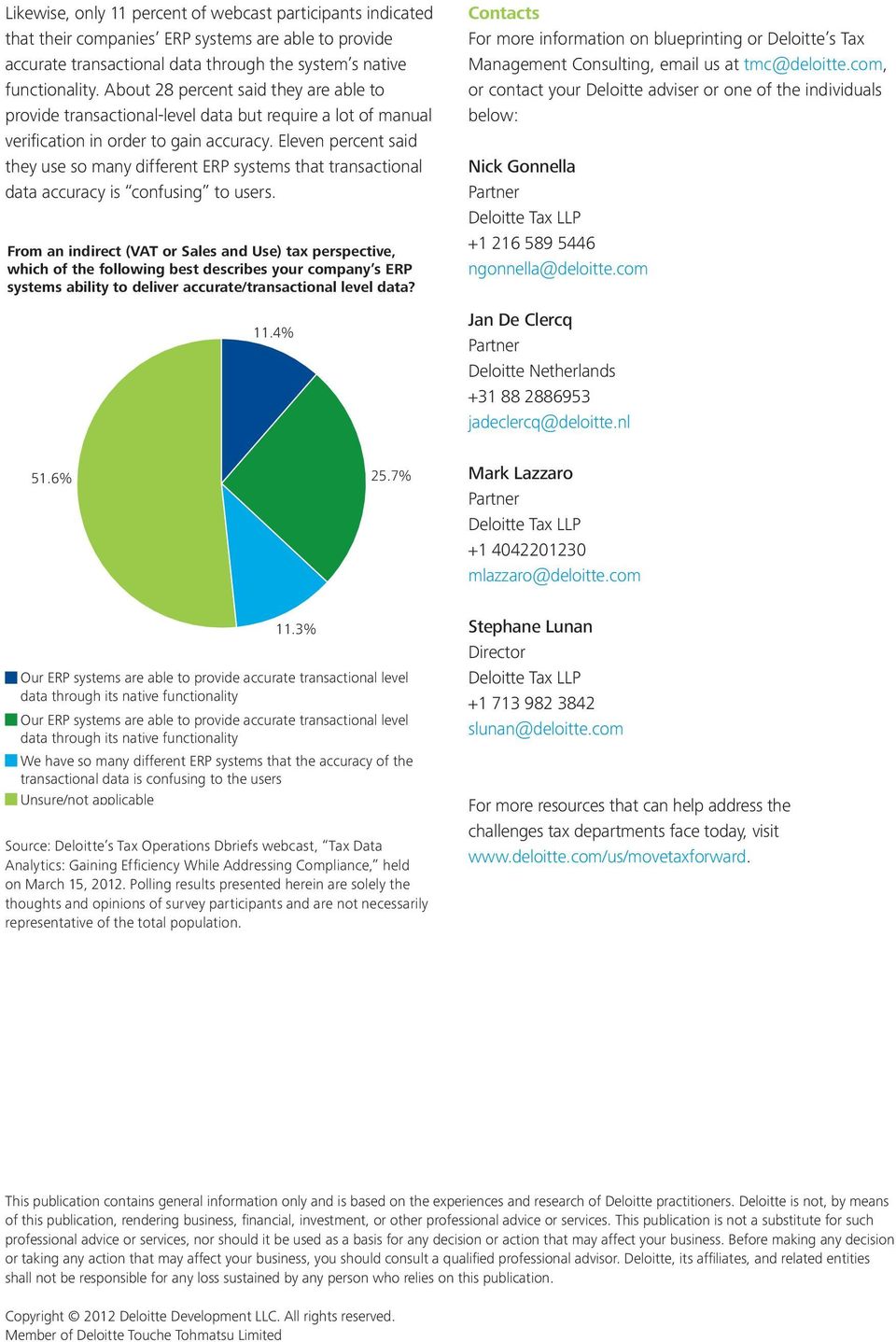
8 Likewise, only 11 percent of webcast participants indicated that their companies ERP systems are able to provide accurate transactional data through the system s native functionality. About 28 percent said they are able to provide transactional-level data but require a lot of manual verification in order to gain accuracy. Eleven percent said they use so many different ERP systems that transactional data accuracy is confusing to users. From an indirect (VAT or Sales and Use) tax perspective, which of the following best describes your company s ERP systems ability to deliver accurate/transactional level data? 11.4% Contacts For more information on blueprinting or Deloitte s Tax Management Consulting, us at [email protected], or contact your Deloitte adviser or one of the individuals below: Nick Gonnella Partner Deloitte Tax LLP [email protected] Jan De Clercq Partner Deloitte Netherlands [email protected] 51.6% 25.7% Mark Lazzaro Partner Deloitte Tax LLP [email protected] 11.3% Our ERP systems are able to provide accurate transactional level data through its native functionality Our ERP systems are able to provide accurate transactional level data through its native functionality We have so many different ERP systems that the accuracy of the transactional data is confusing to the users Source: Deloitte s Tax Operations Dbriefs webcast, Tax Data Analytics: Gaining Efficiency While Addressing Compliance, held on March 15, Polling results presented herein are solely the thoughts and opinions of survey participants and are not necessarily representative of the total population. Stephane Lunan Director Deloitte Tax LLP [email protected] For more resources that can help address the challenges tax departments face today, visit This publication contains general information only and is based on the experiences and research of Deloitte practitioners. Deloitte is not, by means of this publication, rendering business, financial, investment, or other professional advice or services. This publication is not a substitute for such professional advice or services, nor should it be used as a basis for any decision or action that may affect your business. Before making any decision or taking any action that may affect your business, you should consult a qualified professional advisor. Deloitte, its affiliates, and related entities shall not be responsible for any loss sustained by any person who relies on this publication. Copyright 2012 Deloitte Development LLC. All rights reserved. Member of Deloitte Touche Tohmatsu Limited
IPT 2015 Sales & Use Tax Symposium Indian Wells, CA. Tax Accrual Data Analytics Dashboards to Minimize Risk
 IPT 2015 Sales & Use Tax Symposium Indian Wells, CA Tax Accrual Data Analytics Dashboards to Minimize Risk Presenters Holly Hamby Weatherford IT Director Tax [email protected] Les Jackson Deloitte
Putting it all together Using technology to drive tax business processes
 Putting it all together Using technology to drive tax business processes For tax departments, the record-to-report cycle involves several distinct mega processes compliance, cash management, estimates
Data analytics and workforce strategies New insights for performance improvement and tax efficiency
 Data analytics and workforce strategies New insights for performance improvement and tax efficiency Leading organizations today are shaping effective workforce strategies through the use of data analytics.
Balance Sheet Integrity The Utopian Close: Creating a low risk, highly effective financial close
 Balance Sheet Integrity The Utopian Close: Creating a low risk, highly effective financial close Balance Sheet Integrity: The Utopian Close creating a low risk, highly effective financial close 1 Executive
Tax data analytics A new era for tax planning and compliance
 Tax data analytics A new era for tax planning and compliance 1 Like other business functions, tax departments face increasing demand to operate more efficiently. At the same time, expectations are growing
Tax data management A foundation of sustainable tax compliance, planning, and examination support
 Tax data management A foundation of sustainable tax compliance, planning, and examination support One of the biggest challenges for tax departments today is maintaining and being able to quickly retrieve
Financial close, consolidation, and reporting Leveraging process alignment and Oracle Hyperion EPM Tools
 Financial close, consolidation, and reporting Leveraging process alignment and Oracle Hyperion EPM Tools Deloitte Consulting LLP 11 Today s finance organizations face multiple priorities that include the
NCOE whitepaper Master Data Deployment and Management in a Global ERP Implementation
 NCOE whitepaper Master Data Deployment and Management in a Global ERP Implementation Market Offering: Package(s): Oracle Authors: Rick Olson, Luke Tay Date: January 13, 2012 Contents Executive summary
UK Indirect Tax Conference 2015 Automating Indirect Tax Compliance. Jilly McCullagh 11 November 2015
 UK Indirect Tax Conference 2015 Automating Indirect Tax Compliance Jilly McCullagh 11 November 2015 What we will cover today Setting the scene Step 1 Understanding the problem Step 2 - Outline current
International Financial Reporting Standards What it means for private company reporting
 International Financial Reporting Standards What it means for private company reporting IFRS: What it means for private company reporting This point of view discusses the movement toward International
Consumer products analytics The three-minute guide
 Consumer products analytics The three-minute guide Consumer products analytics The three-minute guide 1 Why it matters now Category captains are no longer enough. Retailers are looking for insight captains.
Integrating GRC with Performance Management Demands Enterprise Solutions
 As published in the April n May n June 2008 issue of Integrating GRC with Performance Demands Enterprise Solutions by Lee Dittmar, Principal, Deloitte Consulting LLP and Peter Vogel, Senior Manager, Deloitte
Legal billing and predictive coding A fresh way to assess your legal spend
 Legal billing and predictive coding A fresh way to assess your legal spend The legal technology industry didn t really come through with its promise of useful real-time analytics on a phase and activity
Intellectual Property Management Why Luxembourg is a good idea
 Intellectual Property Management Why Luxembourg is a good idea Introduction In today s economy knowledge is king and it is more and more common that it is a group s intellectual property that forms the
I Smart Managing tax credit and economic incentive engagements globally
 I Smart Managing tax credit and economic incentive engagements globally Countries that are widely known to offer credits and incentives Tax credits and economic incentives could be an important opportunity
Tax Technology. Our Approach. Service Line Overview
 Tax Technology TAX TECHNOLOGY RYAN HAS PROVIDED BASF OUTSTANDING VALUE BY RECOVERING OVERPAID TAXES WHILE IDENTIFYING AND IMPLEMENTING TAX AUTOMATION SOLUTIONS, STREAMLINING TAX DECISION PROCESSES, AND
An Oracle White Paper November 2011. Financial Crime and Compliance Management: Convergence of Compliance Risk and Financial Crime
 An Oracle White Paper November 2011 Financial Crime and Compliance Management: Convergence of Compliance Risk and Financial Crime Disclaimer The following is intended to outline our general product direction.
Deloitte 2010 lease administration benchmarking survey
 Deloitte 2010 lease administration benchmarking survey As used in this document, Deloitte means Deloitte LLP and its subsidiaries. Please see www.deloitte.com/us/about for a detailed description of the
Unlock your digital marketing potential
 Unlock your digital marketing potential 1 Our digital marketing alliance. 2 Deloitte & Adobe: better together Our roots run deep. We have a proven history of collaborating for client advantage. Our decade-long
ONESOURCE INDIRECT TAX
 THE ADVANTAGES OF AUTOMATING VAT DETERMINATION & COMPLIANCE By Kid Misso, EMEA Systems Engineer, Thomson Reuters ONESOURCE INDIRECT TAX THE ADVANTAGES OF AUTOMATING VAT DETERMINATION & COMPLIANCE Many
LOST? Follow these signs on the road to e-invoicing.
 LOST? Follow these signs on the road to e-invoicing. 3. Global Trading Partner Traffic Circle 1. Two-Way Document Traffic 5. Will Your Data Pass Inspection? START Time-intensive, error-prone, manual accounting
Real Estate Lifecycle Management
 Solution in Detail Enterprise Asset Management Executive Summary Contact Us Real Estate Lifecycle Management Boost Your Real Estate Portfolio Portfolio Management Optimized Management Managing corporate
Application Control Effectiveness for SAP. December 2007
 Application Control Effectiveness for SAP December 2007 Meeting Objectives Application Control Effectiveness Compliance at a glance Trends and challenges Technology issues Application Control Business
Process Control Optimisation with SAP
 Process Control Optimisation with SAP The procure-to-pay cycle, which includes all activities from the procurement of goods and services to receiving invoices and paying vendors, is a basic business process.
Analytics for Shared Services The three-minute guide
 Analytics for Shared Services The three-minute guide Don t squint. Select the full-screen option to view at full size. Analytics for Shared Services The three-minute guide 1 2 Why it matters now You may
TRANSFORM YOUR FINANCIAL PROCESSES. Efficiently capture, share and communicate information seamlessly across the business.
 TRANSFORM YOUR FINANCIAL PROCESSES Efficiently capture, share and communicate information seamlessly across the business. Meeting today s Information Management challenges Today, information can be your
Asia Pacific. Tax Management Consulting Why and What?
 Asia Pacific Tax Management Consulting Why and What? In an increasingly demanding and global environment, managing tax is becoming more complex. The world s leading tax departments integrate business strategy
Sustainability Analytics The three-minute guide
 Sustainability Analytics The three-minute guide Sustainability Analytics The three-minute guide 1 Why it matters now Sustainability isn t just good for your corporate image and conscience. It s good for
Risk Considerations for Internal Audit
 Risk Considerations for Internal Audit Cecile Galvez, Deloitte & Touche LLP Enterprise Risk Services Director Traci Mizoguchi, Deloitte & Touche LLP Enterprise Risk Services Senior Manager February 2013
M&A analytics The three-minute guide
 M&A analytics The three-minute guide M&A analytics The three-minute guide 1 Why it matters now Smarter decisions An M&A deal can be one of the biggest decisions a company makes, so it pays to do it right.
How to build a great compliance program for your U.S. imports
 How to build a great compliance program for your U.S. imports For the importer of record, compliance means the complete and accurate recording of all internal processes through books and records, from
ORACLE BUSINESS INTELLIGENCE APPLICATIONS FOR JD EDWARDS ENTERPRISEONE
 ORACLE BUSINESS INTELLIGENCE APPLICATIONS FOR JD EDWARDS ENTERPRISEONE Organizations with the ability to transform information into action enjoy a strategic advantage over their competitors. Reduced costs,
IT Audit Perspective on Continuous Auditing/ Continuous Monitoring KPMG LLP
 IT Audit Perspective on Continuous Auditing/ Continuous Monitoring KPMG LLP IT Audit Perspective on Continuous Auditing/Continuous Monitoring INTRODUCTION New demands from the board, senior organizational
When should becomes shall
 Deloitte Center for Regulatory Strategies When should becomes shall Rethinking compliance management for banks Contents Introduction 3 Find your baseline: Strategic self-assessment 4 Make the map: Strategic
SALES AND OPERATIONS PLANNING BLUEPRINT BUSINESS VALUE GUIDE
 Business Value Guide SALES AND OPERATIONS PLANNING BLUEPRINT BUSINESS VALUE GUIDE INTRODUCTION What if it were possible to tightly link sales, marketing, supply chain, manufacturing and finance, so that
Managing GST with data analytics
 www.pwc.com Managing GST with data analytics Adrian Abbott Partner, Australia Philippe Norre Global ITX Compliance Technology Leader, UK Agenda Indirect tax function of the future (and predictions) Data
Global Tax and Legal September 2014. OECD s BEPS initiative a global survey Multinational survey results
 Global Tax and Legal September 2014 OECD s BEPS initiative a global survey Multinational survey results OECD s BEPS initiative Multinational survey results The purpose of Deloitte s recent survey, OECD
Key Cyber Risks at the ERP Level
 Key Cyber Risks at the ERP Level Process & Industrial Products (P&IP) Sector December, 2014 Today s presenters Bhavin Barot, Sr. Manager Deloitte & Touche LLP Goran Ristovski, Manager Deloitte & Touche
Pulling it all together: Integrated Solutions for Governance, Risk and Compliance
 Customer Practice Profile Pulling it all together: Integrated Solutions for Governance, Risk and Compliance The business case for a new enterprise approach to GRC Integrated solutions for Governance, Risk
Convercent Predictive Analytics
 September 2015 Convercent Predictive Analytics Innovation in User Experience for Issue Reporting & Management SOLUTIONPERSPECTIVE Governance, Risk Management & Compliance Insight 2015 GRC 20/20 Research,
S24 - Governance, Risk, and Compliance (GRC) Automation Siamak Razmazma
 S24 - Governance, Risk, and Compliance (GRC) Automation Siamak Razmazma Governance, Risk, Compliance (GRC) Automation Siamak Razmazma [email protected] September 2009 Agenda Introduction to
Peters Advisors LLC. Presentation to the Multistate Tax Commission. Arm s Length Adjustment Project
 Peters Advisors LLC Presentation to the Multistate Tax Commission Arm s Length Adjustment Project October 6, 2014 IRS Circular 230 Notice: To ensure compliance with the requirements imposed by the IRS,
Outperform Financial Objectives and Enable Regulatory Compliance
 SAP Brief Analytics s from SAP SAP s for Enterprise Performance Management Objectives Outperform Financial Objectives and Enable Regulatory Compliance Drive better decisions and streamline the close-to-disclose
CFO Insights: Gaining fi nancial visibility into your project portfolio
 CFO Insights: Gaining fi nancial visibility into your project portfolio From simple research analyzing competitor data to complex ERP implementations, most work in modern corporations is done in projects.
Accounts Payable Automation Benefits
 W H I T E P A P E R Accounts Payable Automation Benefits Facts and best practices by leading analysts Purchase to Pay by ReadSoft. Automated accounts payable processing Author:Paul Steele, Wille Dahl,
Microsoft Axapta Financial Management consists of several individually packaged offerings: Microsoft Axapta Financials I and Financials II
 Microsoft Business Solutions Axapta Financial Management helps you effectively increase your business while maintaining control over your financial management processes. Key Benefits: Helps you increase
USING SPREADSHEETS TO MANAGE GOVERNANCE, RISK AND COMPLIANCE:
 USING SPREADSHEETS TO MANAGE GOVERNANCE, RISK AND COMPLIANCE: PROS, CONS AND HIDDEN DANGERS MIKE ROST CONTENTS INTRODUCTION... 3 GRC DISCIPLINES REQUIRE PURPOSE-BUILT TECHNOLOGY... 3 USING SPREADSHEETS
Sarbanes-Oxley Section 404: Compliance Challenges for Foreign Private Issuers
 Sarbanes-Oxley Section 404: Compliance s for Foreign Private Issuers Table of Contents Requirements of the Act.............................................................. 1 Accelerated Filer s...........................................................
Deloitte s Preconfigured SAP on HANA Service offering for Life Sciences
 Deloitte s Preconfigured SAP on HANA Service offering for Life Sciences Are you clear on the benefits of implementing SAP but afraid of taking a proposal to your management team? Are you worried about
Ellipse The Enterprise Asset Management (EAM) solution for asset intensive industries
 Ellipse The Enterprise Asset Management (EAM) solution for asset intensive industries Ellipse is a fully-integrated Enterprise Asset Management (EAM) application suite providing complete visibility and
Advanced Analytics for Better Insights. Part of the Insurance series: Benefits of a New Policy Administration System: Why Going Live is Not Enough
 Advanced Analytics for Better Insights Part of the Insurance series: Benefits of a New Policy Administration System: Why Going Live is Not Enough Abstract Insurance professionals agree that data is a key
ORACLE SUPPLY CHAIN AND ORDER MANAGEMENT ANALYTICS
 ORACLE SUPPLY CHAIN AND ORDER MANAGEMENT ANALYTICS KEY FEATURES & BENEFITS FOR BUSINESS USERS Provide actionable information to conduct intelligent analysis of orders related to regions, products, periods
VAT Fundamentals for U.S. Companies
 Presenting a live 110 minute teleconference with interactive Q&A VAT Fundamentals for U.S. Companies Buying or Selling in the European Union Ensuring VAT and U.S. Use Tax Compliance on Goods and Services
Tax @ KPMG. kpmgcampus.com
 Tax @ KPMG kpmgcampus.com b Tax @ KPMG Tax @ KPMG 1 We are making a significant investment in our people to help them grow and develop at KPMG Tax. Skip Robichaux, Tax Partner and People Leader The world
WHITE PAPER HOW TO REDUCE RISK, ERROR, COMPLEXITY AND DRIVE COSTS IN THE ACCOUNTS PAYABLE PROCESS
 WHITE PAPER HOW TO REDUCE RISK, ERROR, COMPLEXITY AND DRIVE COSTS IN THE ACCOUNTS PAYABLE PROCESS Based on a benchmark study of 250 companies with a total of more than 900 billion euro in Accounts Payable
Is business ready to grow? How human capital and talent technology are influencing global business
 Is business ready to grow? How human capital and talent technology are influencing global business Unified Human Capital Management and Talent Technology Survey Report August 2011 Contents 1 Key findings
UNDERSTANDING NEXUS TO AVOID UNEXPECTED LIABILITY
 UNDERSTANDING NEXUS TO AVOID UNEXPECTED LIABILITY ONESOURCE Indirect Tax The Tax & Accounting Business of Thomson Reuters Presenter: NICOLE HUBERTY February 7, 2013 Upcoming Events Webinars: February 12,
Leverage Your Financial System to Enable Sarbanes-Oxley Compliance: An Evaluator s Guide
 Leverage Your Financial System to Enable Sarbanes-Oxley Compliance: An Evaluator s Guide W H I T E P A P E R Summary This document provides an overview on how financial systems can provide companies with
Maximize return on investment with supplier invoice automation
 Viewpoint paper Maximize return on investment with supplier invoice automation Transform the procure-to-pay process Table of contents 1 Streamline the P2P process 1 Automate supplier invoicing 3 Automate
BEPS Action 13: Transfer Pricing Documentation and Country-by-Country Reporting
 United Kingdom BEPS Action 13: Transfer Pricing Documentation and Country-by-Country Reporting On 16 September 2014, ahead of the G20 Finance Ministers meeting on 20-21 September, the OECD published seven
How To Plan For Cloud Computing
 Minutes on Modern Finance Best Practice Series Tax Implications of Cloud Computing: What Every CFO Needs to Know Lost in the Cloud The Tax Implications of Cloud Computing If you re like most chief financial
Self-Assessment of Consumer Use Tax. Overlooking Consumer Use Tax could end up costing you in an audit. Are you prepared?
 Self-Assessment of Consumer Use Tax Overlooking Consumer Use Tax could end up costing you in an audit. Are you prepared? Self-Assessment of Consumer Use Tax Introduction For most companies, the imposition
OBIEE 11g Pre-Built Dashboards from Oracle Courtesy: Oracle OBIEE 11g Deployment on Vision Demo Data FINANCIALS
 FINANCIALS General Ledger The General Ledger module provides insight into key financial areas of performance, including balance sheet, cash flow, budget vs. actual, working capital, liquidity. Dashboard
Kofax TotalAgility Accounts Payable Automation
 Kofax TotalAgility Accounts Payable Automation Table of Contents CONTACT KOFAX AMERICAS Kofax, Inc. 15211 Laguna Canyon Road Irvine, CA 92618-3146 +1 949 783 1333 [email protected] EUROPE Kofax UK Ltd.
Indonesia. kpmg.com/id. Contact us. Siddharta & Widjaja Audit Services T: + 62 (0) 21 574 2333 / 574 2888 F: + 62 (0) 21 574 1777 / 574 2777
 Contact us Siddharta & Widjaja Audit Services T: + 62 (0) 21 574 2333 / 574 2888 F: + 62 (0) 21 574 1777 / 574 2777 KPMG Advisory Indonesia Tax Services T: + 62 (0) 21 570 4888 F: + 62 (0) 21 570 5888
www.pwc.co.uk Making payroll pay Managing risk and compliance in an unprecedented era of change
 www.pwc.co.uk Making payroll pay Managing risk and compliance in an unprecedented era of change Global megatrends Demographic and social change Shift in global economic power Rapid urbanisation Climate
Basware Invoice Automation Demonstration
 Basware Invoice Automation Demonstration Better Buying, Better Selling, Connected Commerce with Basware Thomas Noe Presales Engineer Mobile: 917-207-7689 Email: [email protected] Rich Roberts Account
The National Commission of Audit
 CA Technologies submission to The National Commission of Audit November, 2013 Kristen Bresch CA Technologies Executive Summary CA Technologies is pleased to present the National Commission of Audit the
US estate and gift tax rules for resident and nonresident aliens
 US estate and gift tax rules for resident and nonresident aliens Content Non-US citizens may be subject to US estate and gift taxation. If you fit into this category, do you understand the potential tax
CA HalvesThe Cost Of Testing IT Controls For Sarbanes-Oxley Compliance With Unified Processes.
 TECHNOLOGY BRIEF: REDUCING COST AND COMPLEXITY WITH GLOBAL GOVERNANCE CONTROLS CA HalvesThe Cost Of Testing IT Controls For Sarbanes-Oxley Compliance With Unified Processes. Table of Contents Executive
English UK VAT & Overseas Agents
 English UK VAT & Overseas Agents Deloitte Contacts Simon Prinn, Partner Tel. 0118 322 2825 Jack Stoakes, Senior Manager Tel. 01293 761249 Charlotte McMillan, Assistant Manager Tel. 01293 761392 July 2012
BENCHMARKING THE ENTERPRISE S B2B INTEGRATION MATURITY
 www.wipro.com BENCHMARKING THE ENTERPRISE S B2B INTEGRATION MATURITY Presanna Venkadesh Sundararajan Senior Architect in Wipro Technologies Table of contents 03...Background 03...Why do we have to measure
Accounts Payable Automation Benefits
 w h i t e pa p e r Accounts Payable Automation Benefits Facts and best practices by leading analysts Purchase to Pay by Medius, Powered by ReadSoft Author: ReadSoft, August 2011 Edited: Medius, June 2012
Insider. Manufacturing. Having Trouble Saying Goodbye to LIFO? You re Not Alone. In This Issue
 Manufacturing Insider Insights & Observations for the Manufacturing Industry Volume 3 :: Issue 2 In This Issue Having Trouble Saying Goodbye to LIFO? You re Not Alone...1, 2, 3 Case Study: Administrative
VAT & the cloud understanding your VAT obligation
 VAT & the cloud understanding your VAT obligation February 13, 2013 In brief Value Added Tax (VAT), including Goods and Services Tax (GST), and similar consumption tax systems have been implemented in
Operational Companies VAT Indirect Taxes. Why Luxembourg: VAT advantages for commercial companies*
 Operational Companies VAT Indirect Taxes Why : VAT advantages for commercial companies* Why : VAT advantages for commercial companies as an international decision-making, financing or distribution hub:
Kofax White Paper. Overcoming Challenges in Accounts Payable Automation. Executive Summary. Benefits of Accounts Payable Automation
 Kofax White Paper Overcoming Challenges in Accounts Payable Automation Executive Summary Accounts payable automation presents unique challenges. It is characterized by large volumes of data, arriving in
Enterprise Content Management for Procurement
 Enterprise Content Management for Procurement Extending SAP capabilities is a key aspect of advanced Enterprise Content Management Today s procurement departments need extended content management solutions,
Does Providing Tax Services Impair Auditor Independence? Evidence from Assessing Tax Accrual Quality
 Does Providing Tax Services Impair Auditor Independence? Evidence from Assessing Tax Accrual Quality By Choudhary, Koester, and Pawlewicz A Practitioner s Perspective Russ Hamilton Deloitte Tax LLP Agenda
Southern California AFP Luncheon
 Working Capital Unharness your Cash Flow Southern California AFP Luncheon Michael Diekmann Director, Bank of America Merrill Lynch October 10, 2014 Understanding Working Capital Working Capital... = Current
The Business Value of e-invoicing
 STERLING COMMERCE WHITE PAPER The Business Value of e-invoicing A new look at the challenges, trends and opportunities in the global marketplace Table of Contents 3 Executive summary 4 Situation overview
A Case Study in Global Supply Chain Risk Management: How AGCO Implemented an SCRM Solution to Save Millions
 Spend Matters. All rights reserved. 1 RESEARCH A Case Study in Global Supply Chain Risk Management: How AGCO Implemented an SCRM Solution to Save Millions By: Thomas Kase, VP of Research, Spend Matters