
Termite Management Systems
|
|
|
- Garey Houston
- 10 years ago
- Views:
Transcription
1 Termite Management Systems Advisory notes for builders and homeowners.

2 Termite Management The information provided in this publication relates to Class 1 (houses, townhouses, terrace houses etc) and Class 10A (private garages, carports etc) buildings as defined in Volume 2 of the Building Code of Australia (BCA). Termite infestations cause millions of dollars in damage each year to timber in homes across Australia. Termites (white ants) are a problem in most parts of Australia, but they are particularly active in hot, wet areas such as Coastal Queensland. The BCA requires all new homes to have some form of management to deter subterranean termite attack and there are many different methods available on the market. A home is usually the largest investment a person will make in their life, and the cheapest method of termite management may not be the most appropriate method for their specific site requirements. This publication informs builders, trade contractors, designers, pest controllers and owners of the facts behind the different types of termite management systems, and clarifies responsibilities for on-going maintenance requirements. A termite management system is intended to minimise the risk of termite damage to primary elements of a building through a concealed route. The installation of a termite barrier will not stop termite activity from occurring on the site. Owners must be proactive in the decision making process. And most importantly, they must ensure they arrange for appropriately licensed and qualified operators to carry out regular inspections. Owners must also ensure they do not disturb or breach termite management systems, to maintain their warranties and insurance entitlements. For example, installing a water tank against a perimeter wall of a dwelling may breach the visual inspection barrier, allow termites to infest the building undetected, and void any warranty and insurance entitlements.

3 Legal and Licensing Requirements Australian Standard Australian Standard Termite Management - New Building Work is referenced in the Building Code of Australia (BCA). It is part of a trilogy of standards including Part 2 that deals with existing buildings and Part 3 that deals with assessment for termite management systems. Licensing The licences needed for termite management include the licence classes Termite Management - Chemical and Termite Management - Physical. The latter class is restricted to particular physical systems such as graded stone or stainless steel mesh. A contractor must have one of these licences to provide advice or reports in relation to termite management systems or infestations. A QBCC licence is also required to install termite management systems in new building work. When applying a chemical system, a QBCC licence is required in addition to a Government issued (occupational) Pest Control Operator s licence. Professional indemnity insurance to a minimum value of $500,000 is also required for licensees holding a Termite Management - Chemical licence. Building Code of Australia (Queensland Provisions) The BCA as it applies in Queensland, has a variation that requires: The ability to replenish a chemical termite management system where the life of the chemical is significantly different to that of the building. For non-temporary Class 1 buildings this means that chemicals cannot be hand-sprayed unless it can be proven the chemicals will have at least a 50 year life span. If this cannot be achieved, it may be necessary for a reticulation system to be provided if chemicals are to be relied upon for termite management below a concrete slab For chemical perimeter systems, the requirement is to excavate trenches, treat the exposed trench with chemical, backfill with a suitable material, then treat the backfill. On completion a 300mm wide x 50mm deep concrete protection layer (mowing strip) must be installed. The definition of Primary Building Element is extended to include door jambs, window frames and reveals, and architraves and skirting, in addition to structural members. Installation of two durable notices in prominent locations. The performance requirements also take into consideration accessibility for installation, maintenance and inspection of termite management systems. For example, hand-sprayed chemical perimeter barriers will not be suitable for zero lot line housing. Termite resistant materials or some other form of termite management will need to be considered at the design stage.
4 What does building law require? The Building Code of Australia contains the minimum technical provisions of the Queensland Building Act 1975 related to the protection of buildings from damage by subterranean termites. Any termite management methods that can be shown to meet the BCA performance requirements with documented evidence, may be accepted by the building certifier or approval authority. In Queensland, the risk of primary building elements being damaged by subterranean termites must be minimised and provide for a 50 year design life. For houses and associated sheds, carports, garages, etc, clause of Volume 2 of the BCA specifies the means of satisfying the performance requirements. In the case of termite control, compliance with any of the systems (or a combination of them) detailed in AS satisfies BCA clause AS provides a range of termite management measures that may be used, including chemical or physical barriers or a combination of any of these. NOTE: Clause must be read in conjunction with the Queensland Amendment to the BCA. System solutions for termites Regular inspections Regardless of the system used, regular inspections should be carried out by a QBCC-licensed contractor with the appropriate Termite Management licence to ensure termites have not bridged the barrier. It is recommended that inspections be at least every 12 months, or more often in high risk areas. Most infestations occur at the perimeter of the building and usually result from owners being unfamiliar with good practice. For example, an existing termite management system can be bridged by building garden beds or placing wood chips up to the house, or by attaching unprotected structures such as carports, pergolas and fences to the house. Method of attack Attacks on buildings usually originate from a nest below the ground. Termites build mud galleries when they are at risk of being exposed to enable them to travel over piers or walls to attack wood and wood products in buildings. Usually, the nest is outside the building perimeter but occasionally a nest may be buried in the soil beneath the building. Termites can get inside a building via wall cavities, cracks in mortar or concrete slabs and voids adjacent to service entry points. To expose termite mud gallery into weephole opening - ensure 75mm minimum clearance to garden bed
5 1. Chemical Systems Chemical deterrent systems are normally used in conjunction with slab-on-ground construction. Traditional chemical treatments incorporate a chemical reticulation system under the slab and around the perimeter of the building. AS specifies the procedures to provide a chemical system that will deter termites from gaining concealed access to termite-susceptible elements in the building. Section 8 of the Standard does not refer to any specific chemical. Instead it allows the use of any chemical that is registered for the purpose by the Australian Pesticide and Veterinary Medicines Authority (APVMA). This allows for the introduction of any future approved chemical. (APVMA is a Commonwealth organisation responsible for the registration of all agricultural and veterinary chemicals). Most chemicals used in termite management have a limited life span. It is recommended you contact the manufacturers of products for information about the life expectancy of these products and details of the label conditions that must be adhered to when they are used in termite management systems. Queensland provisions of the BCA require proof that hand-sprayed chemicals under concrete slabs have a reasonable life span before they can be used. If, during the regular competent inspection of a building a termite infestation is discovered, re-treatment may be necessary to remove the problem and ensure the building is given protection to minimise the risk of termite damage. A convenient means of re-treating under slabs is through a reticulation system. Reticulation systems need to be installed under the slab prior to pouring concrete. A reticulation system will allow periodic re-charging from outside the building. Owners should educate themselves before making a final decision about the method of control to use. Ask your builder, designer or other competent person about the proposed termite control method, and on-going maintenance responsibilities. CHEMICAL SYSTEMS NOTE: IF THE EXPECTED LIFE OF THE CHEMICALS TO BE USED IS LESS THAN THE EXPECTED LIFE OF THE BUILDING AND THOSE CHEMICALS ARE INACCESSIBLE, A RETICULATION SYSTEM MUST BE INSTALLED TO ALLOW FOR REPLENISHMENT OF THOSE CHEMICALS

6 2. Physical Systems Until recently, physical systems have been restricted mainly to suspended floor construction (e.g. houses built on stumps). The traditional physical system is the ant cap. Ant caps are placed on the tops of stumps and piers etc. Ant caps do not prevent termites from getting into the building, they merely act as a barrier to concealed entry and encourage the termites into the open where they can be noticed during inspections. The metal flashing installed in cladframed slab-on-ground construction should not be confused with traditional ant capping. A termite management system such as an exposed slab edge is required in these circumstances. A number of other physical systems are available that are suited to slab-on-ground construction. In many cases they can also be used in elevated houses. 3. Graded Stone Graded stone systems incorporate carefully graded and shaped, high quality granite particles that can be placed in a layer under the entire concrete slab area, around the base of stumps in an elevated building, as a partial system around the perimeter of the building or around individual penetrations. Combinations of physical and chemical systems may sometimes be necessary. The system works on the principle that the particles, when placed and compacted, will not allow the termites to find a path through them. The particles are too hard to eat and are too small to allow the movement of termites between the abutted particles. METAL FLASHING GRADED STONE NOTE: under floor graded stone fill treatment (minimum compacted depth 75mm). Alternatively the underfloor graded stone can be omitted and the penetrations through the slab protected by an approved system.

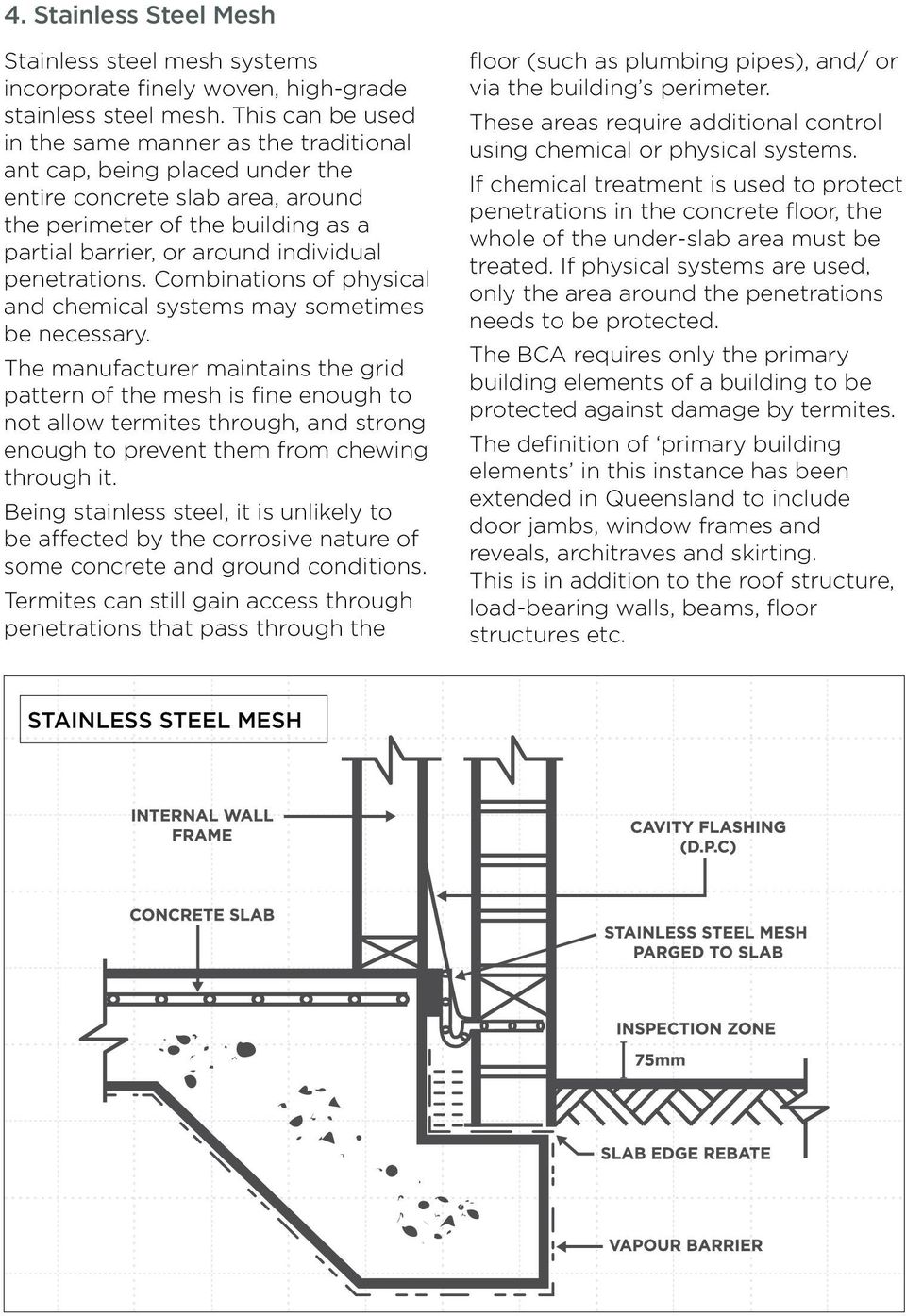
7 4. Stainless Steel Mesh Stainless steel mesh systems incorporate finely woven, high-grade stainless steel mesh. This can be used in the same manner as the traditional ant cap, being placed under the entire concrete slab area, around the perimeter of the building as a partial barrier, or around individual penetrations. Combinations of physical and chemical systems may sometimes be necessary. The manufacturer maintains the grid pattern of the mesh is fine enough to not allow termites through, and strong enough to prevent them from chewing through it. Being stainless steel, it is unlikely to be affected by the corrosive nature of some concrete and ground conditions. Termites can still gain access through penetrations that pass through the floor (such as plumbing pipes), and/ or via the building s perimeter. These areas require additional control using chemical or physical systems. If chemical treatment is used to protect penetrations in the concrete floor, the whole of the under-slab area must be treated. If physical systems are used, only the area around the penetrations needs to be protected. The BCA requires only the primary building elements of a building to be protected against damage by termites. The definition of primary building elements in this instance has been extended in Queensland to include door jambs, window frames and reveals, architraves and skirting. This is in addition to the roof structure, load-bearing walls, beams, floor structures etc. STAINLESS STEEL MESH
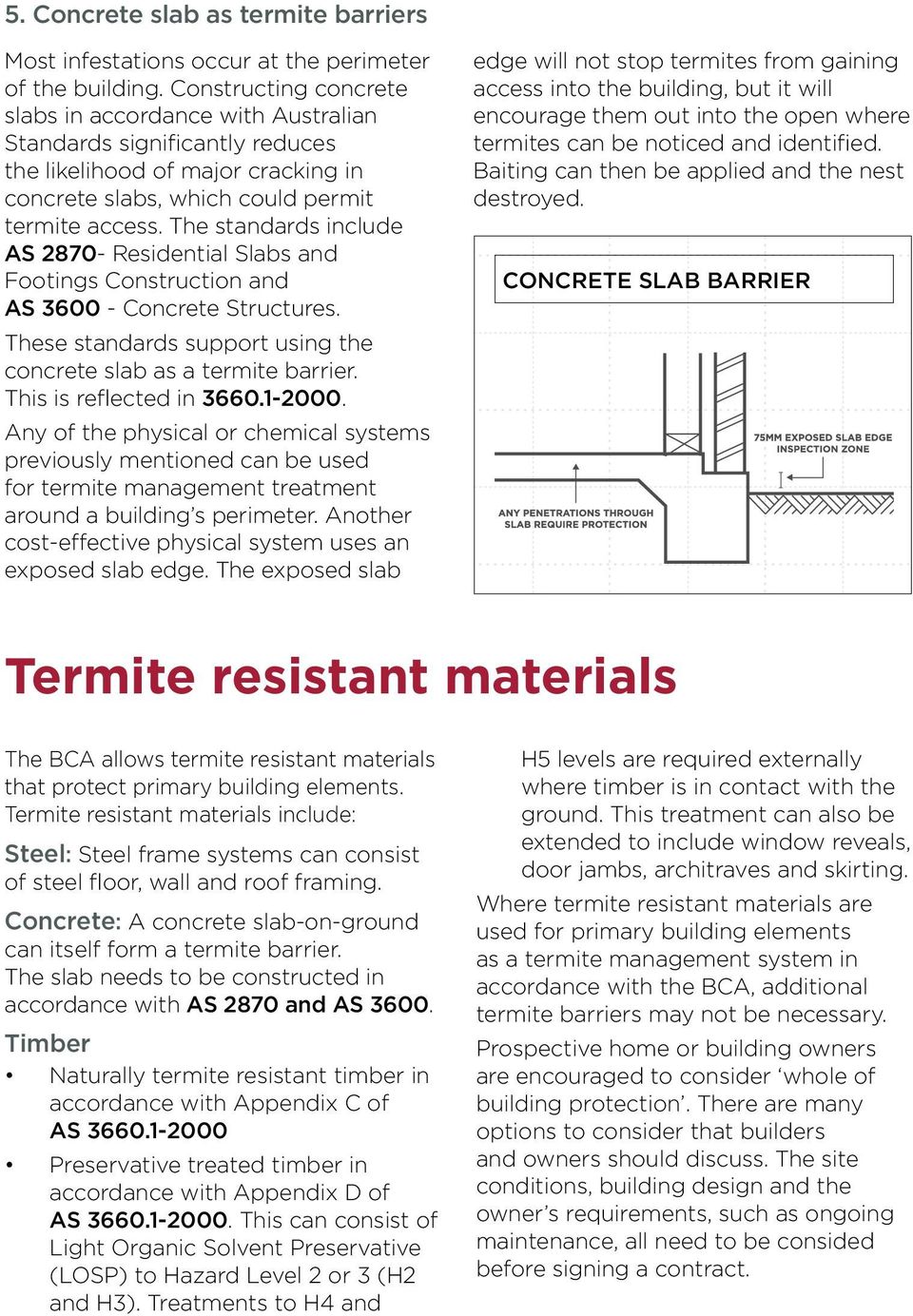
8 5. Concrete slab as termite barriers Most infestations occur at the perimeter of the building. Constructing concrete slabs in accordance with Australian Standards significantly reduces the likelihood of major cracking in concrete slabs, which could permit termite access. The standards include AS Residential Slabs and Footings Construction and AS Concrete Structures. These standards support using the concrete slab as a termite barrier. This is reflected in Any of the physical or chemical systems previously mentioned can be used for termite management treatment around a building s perimeter. Another cost-effective physical system uses an exposed slab edge. The exposed slab edge will not stop termites from gaining access into the building, but it will encourage them out into the open where termites can be noticed and identified. Baiting can then be applied and the nest destroyed. CONCRETE SLAB BARRIER Termite resistant materials The BCA allows termite resistant materials that protect primary building elements. Termite resistant materials include: Steel: Steel frame systems can consist of steel floor, wall and roof framing. Concrete: A concrete slab-on-ground can itself form a termite barrier. The slab needs to be constructed in accordance with AS 2870 and AS Timber Naturally termite resistant timber in accordance with Appendix C of AS Preservative treated timber in accordance with Appendix D of AS This can consist of Light Organic Solvent Preservative (LOSP) to Hazard Level 2 or 3 (H2 and H3). Treatments to H4 and H5 levels are required externally where timber is in contact with the ground. This treatment can also be extended to include window reveals, door jambs, architraves and skirting. Where termite resistant materials are used for primary building elements as a termite management system in accordance with the BCA, additional termite barriers may not be necessary. Prospective home or building owners are encouraged to consider whole of building protection. There are many options to consider that builders and owners should discuss. The site conditions, building design and the owner s requirements, such as ongoing maintenance, all need to be consided before signing a contract.
9 Alternative solutions There are several products on the market that may be accepted by Building Certifiers as meeting the performance requirements of the BCA. The use of alternative solutions must be discussed with the Building Certifier prior to any works commencing, for example before, but no later than at the Building Approval stage. Where a project design offers a combination of building systems, such as slab-on-ground and timber frame, and split-level floor system that does not suit a particular termite deterrent method, the owner or builder may choose an alternative or combination of methods that are cost-effective and most suited to the building design. Where a combination of different types of protection is proposed, ensure that warranties apply to the unique systems being used. Combination systems Some system installers may not be prepared to honour their warranties where a combination of systems is used. Split-level and zero-lot-line buildings are two examples of the need to incorporate physical deterrent systems or termite-resistant materials. A chemical deterrent system alone may not be adequate in some cases. Particular attention needs to be given where split level slab-on-ground or composite slab-on-ground and suspended floor framing are to be incorporated. It is likely that, as in the diagram, a combination of systems will need to be incorporated. COMBINATION TERMITE BARRIER SYSTEM

10 Suspended floors The area beneath a suspended floor is one of a building s most susceptible areas to termite activity. To be effective, termite management systems installed in this area rely totally on access for both inspection and treatment if termite activity is detected. To ensure access is always available to the sub-floor area, an access door or panel must also be provided. AS contains provisions for sub-floor clearance under suspended floors to allow for visual inspections. Where the building has a suspended floor, cross flow ventilation must be provided under the floor. This is to discourage termite activity and to reduce the likelihood of damage to sub-floor members by fungal attack. Depending on the location of the work, BCA sets out minimum requirements for ventilation per lineal metre of both internal and external walls. Ventilation openings must be placed below damp-proof courses but above the level of possible entry of surface water. A minimum clearance of 400mm is generally necessary between the finished ground level, structural components and any other obstruction (bearers, floor joists, plumbing pipes etc). The required clearance can be reduced from 400mm to 150mm provided the area slopes to and is not more than 2m from a point conforming with the required 400mm minimum clearance. COMBINATION TERMITE BARRIER SYSTEM

11 Choosing a system Termite management systems should be based on carefully selected deterrent methods and include regular competent inspection. QBCC recommends using an acknowledgement notice before signing a building contract. The notice confirms that termite management has been discussed in detail between the builder and owner before signing a contract. It details the termite management system to be incorporated into the works and acknowledges that alternative systems have been discussed between the builder and owner. Building associations and other organisations may also provide a similar document for this purpose. The cost of control methods and the effective life of the treatment can vary considerably, as can ongoing costs and renewal treatments. While comparing costs and the effective life-span of treatments, also compare the warranty benefits of the different control methods before committing Installation process Submitting an application The termite control method must be detailed on the drawings and specifications accompanying building applications. Check with your approving authority or building certifier to determine what systems are acceptable. For approved systems that use stainless steel mesh, granite particles or reticulation systems, the system may be acceptable by name. Where construction techniques, such as an exposed slab edge or termite resistant materials, are to be used, specific details are usually required. During construction The building certifier (or approving authority) may require the licensed installer to certify that the system has been installed according to AS Where an accredited product has been used, it must be installed according to the conditions specified in the accreditation certificate. Certain construction techniques or practices such as timber treatments or timber species need to be documented by the builder as evidence of building compliance with AS
12 The certificate should contain the following information: Date Owner s name Builder s name Property location Real property description Building description Details of termite deterrent work undertaken, including a diagram where appropriate Areas (m2) of the procedures for termite management which may be due to the building design or owner s requirements. Site practices Trade contractors need to take care when working in and around buildings where there is a risk of compromising termite management systems. It is essential to be familiar with the type of termite management system used, and its current status. If there is any ambiguity, clarification should be sought before undertaking any work. For example, a concreter may need to have treatment applied or a reticulation system installed beneath a concrete slab-on-ground where that slab abuts a building. This can include driveways, carport slabs and footpaths. A landscape contractor installing paving, concrete pathways or gardens adjacent to and abutting a building will also need to consider how to manage the termite risk. Plumbers and drainers need to pay particular attention to maintaining the termite deterrent system when installing pipe work connections to buildings. Installing concrete protection blocks over exposed pipe work and at inspection points can provide an easy point for concealed entry by termites. In the case of chemical perimeter systems, these protection blocks need to be placed in position after the system has been installed, being careful not to disturb the system. This also applies to electrical contractors who should be careful that electrical conduits do not provide an avenue for termite entry, and to contractors installing any other services connected to a building. Builders must be vigilant in supervising the building process to ensure the termite management system is installed correctly and not compromised by other aspects of the building process. This includes the removal of any debris and mortar slag from footings before or as part of site cleaning prior to the installation of a chemical system. All form work, set- out pegs and timber profiles also need to be removed well clear of the termite management system area. Where construction is of a composite nature, such as where a split level slab-on-ground forms part of the building or where retaining walls form part of the structure, special consideration is needed to establish an effective termite management system. A chemical system alone may be inadequate. When using chemical termite management, sandy loam is a suitable soil type. The use of crusher dust or stone and rubble is not appropriate. Termite management contractors need to check that soil conditions are suitable before applying any chemical.

13 At building completion When the work is finished, the builder should give the owner information on the termite management system installed and the owner s ongoing maintenance responsibilities. In the case of chemical systems, it may be appropriate for an owner to enter into a contract with a QBCC-licensed termite management contractor for inspection and ongoing treatment as recommended by the label on the product used to form the system. The owner may have to declare to the local government that they are aware of the termite control system used on the building including constraints and ongoing maintenance provisions. The declaration should be on a form approved by the local government. The declaration should describe the system used and contain details of the competent person who gave the advice on the management system and its constraints. Generally, advice from the builder and system installer/consultant should be sought. Notices The BCA requires a termite control notice to be permanently fixed to the building in a prominent location (such as the meter box). In Queensland, two durable notices are required, both indicating: The method of protection The date the termite management system was installed Where a chemical system is to be used, its life expectancy as listed on the APVMA label The installer s or manufacturer s recommendations for the scope and frequency of future inspections for termite activity. Future building owners should be made aware of the termite management system used on the building. The onus is on the buyer to make themselves familiar with the on-going maintenance requirements of the system. Termite management after moving in It is important for the owner to understand that properly installed and maintained termite management systems impede and discourage concealed termite entry into buildings. They do not always prevent unconcealed entry and therefore do not prevent termite attack. Owners should find out what type of termite management system has been installed in their home. For example, they should know what type of chemical and/or physical system has been installed (e.g. concrete slabs, exposed slab edge, metal shielding, stainless steel mesh or graded stone), if termite resistant materials have been used, or what combination of chemical and/or physical and/or termite resistant materials are in use. Termite management is required below and around the perimeter of the building. Generally, physical systems will be designed to last for the lifetime of the building with proper maintenance. Chemical systems have a limited life and therefore require ongoing treatment.

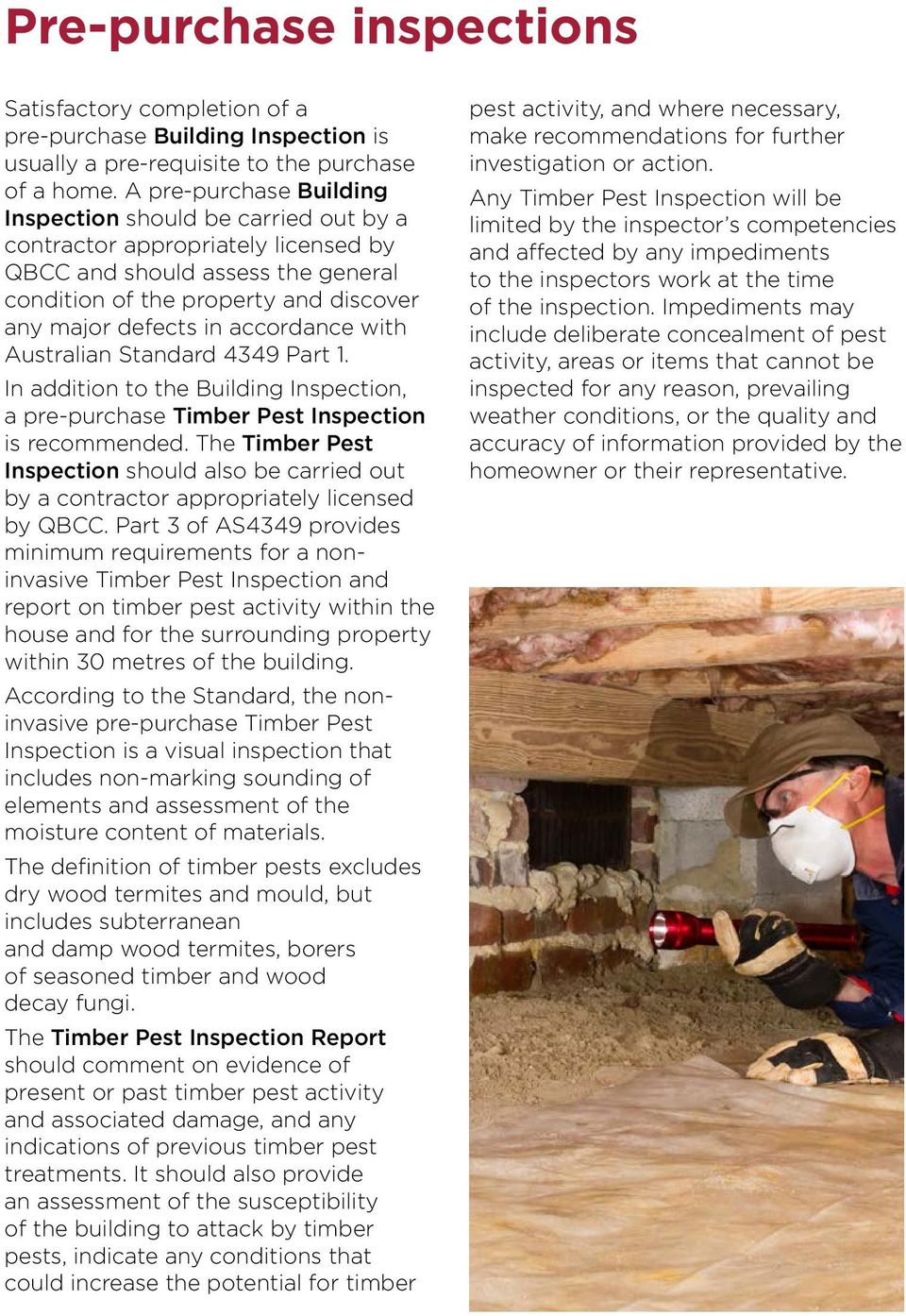
14 Pre-purchase inspections Satisfactory completion of a pre-purchase Building Inspection is usually a pre-requisite to the purchase of a home. A pre-purchase Building Inspection should be carried out by a contractor appropriately licensed by QBCC and should assess the general condition of the property and discover any major defects in accordance with Australian Standard 4349 Part 1. In addition to the Building Inspection, a pre-purchase Timber Pest Inspection is recommended. The Timber Pest Inspection should also be carried out by a contractor appropriately licensed by QBCC. Part 3 of AS4349 provides minimum requirements for a noninvasive Timber Pest Inspection and report on timber pest activity within the house and for the surrounding property within 30 metres of the building. According to the Standard, the noninvasive pre-purchase Timber Pest Inspection is a visual inspection that includes non-marking sounding of elements and assessment of the moisture content of materials. The definition of timber pests excludes dry wood termites and mould, but includes subterranean and damp wood termites, borers of seasoned timber and wood decay fungi. The Timber Pest Inspection Report should comment on evidence of present or past timber pest activity and associated damage, and any indications of previous timber pest treatments. It should also provide an assessment of the susceptibility of the building to attack by timber pests, indicate any conditions that could increase the potential for timber pest activity, and where necessary, make recommendations for further investigation or action. Any Timber Pest Inspection will be limited by the inspector s competencies and affected by any impediments to the inspectors work at the time of the inspection. Impediments may include deliberate concealment of pest activity, areas or items that cannot be inspected for any reason, prevailing weather conditions, or the quality and accuracy of information provided by the homeowner or their representative.
15 Reduce the risks To deter concealed termite entry to the dwelling, regular maintenance is essential. The following list is a guide to what owners should and should not do to protect their home from termites. Have the building inspected at least annually by a suitably qualified termite management contractor, licensed in Queensland by QBCC. A free licence history check can be performed at More frequent inspections may be required in high risk areas (such as areas near trees or bush). Owners should perform their own ongoing inspections between professional inspections. Owners should be careful not to compromise their termite management system. Termite infestations can occur when a perimeter system has been made Ineffective The most frequent cause of termite infestation is where a perimeter system has been bridged or breached, thus rendering it ineffective. Special care should be taken to protect the weep holes (vertical joints between bricks close to ground level that are left open to allow any moisture to escape outside the house). 75mm minimum clearance is recommended from the bottom of any weep hole to the top of the garden bed, concrete or unit paving. Freestanding structures should be built with a minimum 25mm inspection zone between the structure and the house. Some common practices that may increase the risk of termite problems include: Placing turf, paving, concrete paths, bark and garden beds up against the house wall (you may need to reestablish the termite system). NOTE: Concrete paths or driveways placed against a building may require a chemical reticulation system to be installed in the ground before concreting. Leaving loose timber stacked up or leaning against the house. Installing new services involving underground connections to the house (such as pay TV) Installing new water tanks against the dwelling spanning over the width of the termite management. Constructing a pergola (75mm minimum clearance is recommended between the finished ground or pavement level and the bottom of the timber posts) Attaching fences, carports, or garages to the home. You should ensure the soil surrounding members in contact with the ground is treated. More information on termite system maintenance can be found in Australian Standard Control of Buildings From Subterranean Termites - Part 1: New Buildings. See back page for more suppliers.
16 The Australian Standards mentioned in this publication can be purchased from SAI Global. For full information visit their website saiglobal.com.au. The following organisations may also be able to provide information on the legislative requirements applicable to termite management. You may also contact your local council or private building certifier Queensland Building and Construction Commission Telephone: Website: qbcc.qld.gov.au Building Codes Queensland Telephone: Website: dip.qld.gov.au Australian Environmental Pest Managers Association (AEPMA) Telephone: Website: aepma.com.au Timber Queensland Telephone: Website: timberqueensland.com.au Queensland Master Builders Association Telephone: Website: masterbuilders.asn.au Telephone: Website: hia.com.au Department of Employment, Economic Development and Innovation Telephone: Website: dpi.qld.gov.au Queensland Health Telephone: Website: health.qld.gov.au Building Designers Association of Queensland Telephone: Website: bdaq.com.au Insurance Council of Australia Telephone: Website: insurancecouncil.com.au Housing Industry Association Need more information? Visit qbcc.qld.gov.au or call us on QBCC _FCTbrTermite 299 Montague Road, West End Qld 4101 GPO Box 5099, Brisbane Qld 4001 T: F: W: qbcc.qld.gov.au
TERMITE MANAGEMENT SYSTEMS
 TERMITE MANAGEMENT SYSTEMS ADVISORY NOTES FOR HOMEOWNERS AND BUILDERS Protection of Buildings Against Subterranean Termites. DISCLAIMER: The information provided in this booklet is a guide only to the
A Guide To The New Termite Standards (revised 09/02/2001)
 Building Certifiers Building Designers rchitects Guide To The New Termite Standards (revised 09/02/2001) Introduction On 1 January 2001, the Building Code of ustralia (BC) was amended to incorporate new
BUILDER S GUIDE FOR TERMITE MANAGEMENT
 Master Builders Technical TECH01 12/2004 BUILDER S GUIDE FOR TERMITE MANAGEMENT THIS TECHNICAL CIRCULAR HAS BEEN PREPARED TO ASSIST BUILDERS TO UNDERSTAND THE OPTIONS NOW AVAILABLE FOR COMPLIANCE WITH
INFORMATION SHEET ON TERMITES & TERMITE MANAGEMENT PROCEDURES
 INFORMATION SHEET ON TERMITES & TERMITE MANAGEMENT PROCEDURES IMPORTANT INFORMATION: The Australian Standard AS 3660.2 Protection of buildings from subterranean termites provides details for minimising
What you need to know about. Termite management
 What you need to know about Termite management What is termite management? Termite management involves reducing the chances that major damage is caused to your house by termite infestations. Termites cause
Clayton South Report Prepared: 1 February 2015 TIMBER PEST REPORT. Portfolio Includes: Timber Pest Report
 Clayton South Report Prepared: 1 February 2015 TIMBER PEST REPORT Portfolio Includes: Timber Pest Report TIMBER PEST REPORT This report is the result of a VISUAL INSPECTION ONLY. Inspection of the subject
Visual Termite Inspection Report in accordance with AS 3660.2-2000 Important Information
 Pad 2/B Visual Termite Inspection Report in accordance with AS 3660.2-2000 Important Information Only structures, fences, trees etc within 50 m of the building but within the boundary of the property will
We re about to build.
 We re about to build. Get out there boys! every new home is a possible new dinner menu! What do we need to know about dealing with termites? A Managed Approach is Best! There are more than three hundred
Visual Termite Inspection Report in accordance with AS 3660.2-2000
 Visual Termite Inspection Report in accordance with AS 3660.2-2000 Account to: File No. /Ref: Phone: Fax / Email: Client: Agreement No / Job No: Purchaser: Vendor: Property address: Date and time of the
Proposed Minimum Subterranean Termite Treatment Standards
 Proposed Minimum Subterranean Termite Treatment Standards Introduction This document is intended to serve as a model for states considering the adoption of standards for soil application of termiticides.
Visual Termite Inspection Report in accord with AS 3660.2-2000 TERMS & CONDITIONS - READ THIS FIRST
 PO Box 721, Narrabeen NSW 2101 Phone: 02 9999 5510 Fax: 02 9999 5510 [email protected] ABN 26 044 178 173 Visual Termite Inspection Report in accord with AS 3660.2-2000 Account To: Amanda Gray 3 Foxall
PEST INSPECTION REPORT for: SAMPLE PEST INSPECTION REPORT. Inspected Property: 90 Wentworth Street, SAMPLETON
 PEST INSPECTION REPORT for: SAMPLE PEST INSPECTION REPORT Inspected Property: 90 Wentworth Street, SAMPLETON Reference Number: sample Pest Inspection Report CLIENT & SITE INFORMATION: COMMISSIONED BY:
Protect your home from termites
 Protect your home from termites FT030 July 2003 www.fairtrading.nsw.gov.au C ontents Additional copies This publication can be viewed or printed from the Publications page of our Web site at: www.fairtrading.nsw.gov.au
Timber Manual Datafile P5. Protecting Buildings from Subterranean Termites
 Timber Manual Datafile P5 Protecting Buildings from Subterranean Termites Revised Edition 2004 2 Contents Introduction...2 Termites...3 The Termite Colony...3 Distribution...3 How Termite Infestation Occurs
DRAFT TERMITE PROTECTION IN BUILDINGS
 DRAFT TERMITE PROTECTION IN BUILDINGS Protection of homes and businesses from termites in Florida requires the combined efforts of builders, pest management professionals, and building inspectors. The
YEAR TRANSFERRABLE TANALISED 25 YEAR TERMITE RESISTANT* STRUCTURAL TIMBER AND WOOD PRODUCTS GUARANTEE
 TRANSFERRABLE TANALISED 25 TERMITE RESISTANT* STRUCTURAL TIMBER AND WOOD PRODUCTS GUARANTEE Thank you for selecting Tanalised termite resistant* structural timber and wood products for your new home or
Visual Termite Inspection Report in accordance with AS 3660.2-2000
 Ph 0422 705 737 E [email protected] www.andrewmckinnon.com.au PO Box 897 Warners Bay NSW 2282 Visual Termite Inspection Report in accordance with AS 3660.2-2000 Important Information Any person
A guide to preventing structural damage
 A guide to preventing structural damage Home owners guide to planning landscaping and maintenance of foundations Structural damage can result from movement in clay soils caused by varying moisture conditions
VISUAL TERMITE INSPECTION TO AS 3660 EXECUTIVE SUMMARY
 Report Index VISUAL TERMITE INSPECTION TO AS 3660 2 EXECUTIVE SUMMARY 2 TERMS & CONDITIONS 3 IMPORTANT INFORMATION 4 PROPERTY DESCRIPTION 5 INTERIOR 6 ROOF VOID 6 SUBFLOOR 7 VENTILATION SUBFLOOR 7 GARAGING
Pre-Purchase Timber Pest Report
 Building and Timber Pest Inspections PO Box 162 Eastwood NSW 2122 Phone: 1300 556 156 Fax: (02) 9874 0105 Email: [email protected] Pre-Purchase Timber Pest Report 15 Sample Street Anytown NSW
TERMITE RESISTANT* TERMIFLOR AND R-FLOR PARTICLEBOARD FLOORING
 TERMITE RESISTANT* TERMIFLOR AND R-FLOR PARTICLEBOARD FLOORING TermiFlor and R-Flor Termite Resistant* particleboard flooring products are protected from termite attack by incorporation of an Australian
Banish Pest Control IMPORTANT DISCLAIMER. Summary Only
 Banish Pest Control P.O Box 642, Campbelltown NSW 2560 Ph: 4620-8022 Fax: 4620-8023 Email: [email protected] DX 5141 Campbelltown ABN: 19517539140 Visual Timber Pest Inspection & Report in accord
Visual Termite Inspection Report in accordance with AS 3660.2-2000 H
 Pa d (2/E Visual Termite Inspection Report in accordance with AS 3660.2-2000 H Client:, Re: Structure at: (ro t* 1 Ooi*f\c,\
Guide to Assessment and Repair of Flood Damaged Timber and Timber Framed Houses
 Technical Guide Guide to Assessment and Repair of Flood Damaged Timber and Timber Framed Houses ASSESSMENT OF DAMAGE Prior to any assessments or repairs being commenced, a licensed electrician must undertake
TIMBER PEST INSPECTION AGREEMENT
 TIMBER PEST INSPECTION AGREEMENT PROPERTY TO INSPECT: CLIENT NAME: AGREEMENT NUMBER: Inspection and Report: The inspection will be as outlined in Australian Standard AS4349.3-2010 Inspection of Buildings
Visual Timber Pest Inspection
 Visual Timber Pest Inspection Report in Accordance with AS 4349.3 Visual Timber Pest Inspection & Report in Accordance with AS 4349.3 CLIENT: MR BUYER We wish to advise that this inspection and report
NCMA TEK CONCRETE MASONRY FOUNDATION WALL DETAILS. TEK 5-3A Details (2003)
 NCMA TEK National Concrete Masonry Association an information series from the national authority on concrete masonry technology CONCRETE MASONRY FOUNDATION WALL DETAILS TEK 5-3A Details (2003) Keywords:
Termite Inspection Agreement
 PO Box 648 Wahroonga NSW 2076 Tel: (02) 9487 1919 Tel: 1300 30 40 42 Fax: (02) 9487 4648 www.northshorepestcontrol.com.au Quality service. On time. Every time. Termite Inspection Agreement PAD 10 Client:
TIMBER PEST INSPECTION AGREEMENT
 TIMBER PEST INSPECTION AGREEMENT Thank you for requesting Sydney Independent Building Inspections ( SIBI ) to undertake a Timber Pest Inspection on Your behalf. IT IS ESSENTIAL THAT YOU READ AND UNDERSTAND
The Ultimate Guide to Exterminating Termites
 TAKE ON THOSE TERRIBLE TERMITES! The Ultimate Guide to Exterminating Termites Prepared by: TERMITE TERROR: DESTRUCTION IN A FEW BITES Have you ever wondered why termites are such a problem? Home inspectors
Professional Builders trust HomeGuard for subterranean termite security from the ground up.
 www.homeguardptm.com.au Professional Builders trust HomeGuard for subterranean termite security from the ground up. CodeMark Certified and backed by the FMC HomeGuard Million Dollar 25 Year Manufacturer
Common Problems with Walls
 Common Problems with Walls Common Problems with Walls There are problems and concerns that are shared by all walls and siding installations. In this article, we will learn about the following commonly
123 Frontage Rd. Fort Worth 76555 Inspected Address City Zip Code
 TEXAS OFFICIAL WOOD DESTROYING INSECT REPORT Page 1 of 5 123 Frontage Rd. Fort Worth 76555 Inspected Address City Zip Code SCOPE OF INSPECTION A. This inspection covers only the multi-family structure,
What Home Builders Need To Know About Termites: Termite-deterring Construction Practices:
 Bug-Wise No. 9 Sept. 17, 2012 Office: 1-662-325-2085 What Home Builders Need To Know About Termites: There are a lot of important details that must be taken care of when building a new home. To build a
UNIFIED FACILITIES GUIDE SPECIFICATIONS
 USACE / NAVFAC / AFCEC / NASA UFGS-31 31 16.19 (February 2016) -------------------------------- Preparing Activity: NAVFAC Superseding UFGS 31 31 16.19 (August 2014) UFGS 31 31 16.20 (April 2006) UFGS
Guide to Assessment and Repair of Flood Damaged Timber and Timber Framed Houses (Revised 19 th Jan 2011)
 Technical Guide Guide to Assessment and Repair of Flood Damaged Timber and Timber Framed Houses (Revised 19 th Jan 2011) ASSESSMENT OF DAMAGE Prior to any assessments or repairs being commenced, a licensed
BUILDING OVER OR NEAR WATER & SEWER MAINS POLICY
 MURRAY SHIRE COUNCIL BUILDING OVER OR NEAR WATER & SEWER MAINS POLICY ADOPTED: 1 May 2012 1 BUILDING OVER OR NEAR WATER AND SEWER MAINS POLICY CONTENTS 1. Objective... 2 2. Requirements for Building Near
Soils, Foundations & Moisture Control
 Soils, Foundations & Moisture Control Soil The top loose layer mineral and/or organic material on the surface of the Earth that serves as a natural medium for the growth of plants and support for the foundations
H.O.W (Home Owners Warranty) / Defect Inspection Agreement Terms & Conditions
 ABN: 22 848 006 442 PO Box 2246 BOWRAL NSW 2576 Office: 02 48621914 [email protected] H.O.W (Home Owners Warranty) / Defect Inspection Agreement Terms & Conditions You agree that in signing
Residential Foundations and Basements
 Residential Foundations and Basements Disclaimer All of the following information is based on the 2006 International Residential Code with Kentucky Amendments. As some information is paraphrased, article
VISUAL TIMBER PEST INSPECTION & REPORT In accordance with A.S. 4349.3-2010
 VISUAL TIMBER PEST INSPECTION & REPORT In accordance with A.S. 4349.3-2010 BSA LICENCE NO: 1021149 Report Number: CQ 00111 Inspection Address: 101 SMITH STREET SMITHVILLE QLD 4444 Clients Name: JOHN SMITH
A home owner s guide to rebuilding after a flood
 A home owner s guide to rebuilding after a flood March 2015 Steps to repair a house after a flood Below are the recommended steps to repair and restore houses after a flood event: ensure initial safety
BUILDING OR RENOVATING
 A GUIDE TO BUILDING OR RENOVATING YOUR IDEAL HOME building work? What records should I keep? Is insurance required? W I need approval for? What do I need approval for? How do I obtain building work? How
Visual Timber Pest Inspection Report
 Visual Timber Pest Inspection Report Solicitor/Company Sample Street Mr & Mrs Purchaser Alpha Building Services Pty Ltd Trading As Inspect It >> ABN 47 103 963 471 1300 557 047 inspectit.com.au BRIEF SUMMARY:
UFGS-02362 (August 2004) UNIFIED FACILITIES GUIDE SPECIFICATIONS
 USACE / NAVFAC / AFCEC / NASA UFGS-31 31 16.20 (April 2006) Change 2-11/14 ----------------------------- Preparing Activity: NAVFAC Replacing without change UFGS-02362 (August 2004) UNIFIED FACILITIES
EXCAVATION AND PILING NEAR SEWERS, STORMWATER DRAINS AND WATER MAINS
 NMP 1.4 EXCAVATION AND PILING NEAR SEWERS, STORMWATER DRAINS AND WATER MAINS Index Purpose... 2 Application... 2 Referral Agency... 2 Associated Requirements... 2 Referenced Standards...2 Definitions...
OFFICIAL GEORGIA WOOD INFESTATION INSPECTION REPORT
 Company Name ABC Pest Group License No. Address PO Box 2831 Atlanta GA, 30346 Telephone 800 689-0233 Date of Issuance July 17, 2007 Seller John Doe Inspector Sam Eagleye File No. Purchaser(s) Main Structure
fire separating walls #2
 210108 fire separating walls #2 ISSUE BSA has identified a number of instances of defective fire separating walls in duplexes, town houses and multi-residential complexes. The system of fire separating
COMMONLY USED RESIDENTIAL BUILDING CODES
 COMMONLY USED RESIDENTIAL BUILDING CODES INTERNATIONAL RESIDENTIAL CODE (2009) form revised 5/10 FOUNDATION 1. DESIGN OF FORMWORK. Section 1906.1 IBC 2009, Section R404.1.2.3.6 IRC 2009, ACI 318 Section
Guide to Assessment and Repair of Flood Damaged Timber and Timber Framed Houses (Revised 2 nd Feb 2013)
 Technical Guide Guide to Assessment and Repair of Flood Damaged Timber and Timber Framed Houses (Revised 2 nd Feb 2013) ASSESSMENT OF DAMAGE Prior to any assessments or repairs being commenced, a licensed
Florida Building Code Advanced Training: Termites
 Florida Building Code Advanced Training: Termites Florida Building Commission Department of Community Affairs 2555 Shumard Oak Boulevard Tallahassee, FL 32399-2100 (850) 487-1824 http://www.floridabuilding.org
EAST LYME HIGH SCHOOL
 Overview: 1971 N 1966 GYM 1966 CLASSROOM WING 1966 AUD. 1971 GYM 1998 1998 POOL EAST LYME HIGH SCHOOL Original 1966 Building: The original East Lyme High School was constructed in 1966 and was composed
ARMOUR-THOR is a registered trademark of ENSYSTEX, INC. * Warranty is renewable each year for 50 years subject to a required annual inspection at
 ARMOUR-THOR is a registered trademark of ENSYSTEX, INC. * Warranty is renewable each year for 50 years subject to a required annual inspection at your expense. See Warranty document for complete details.
SECTION 1 Building Inspection Agreement
 The Australian Standard for building inspections 4349.1-2007 and timber pest inspections 4349.3 requires that every pre-purchase inspection has a pre-engagement agreement accepted by the home purchaser
ULTRA MARINE GRADE STAINLESS STEEL MESH TERMITE RESISTANT, POISON-FREE & LONG-LIFE
 TERMIMESH SYSTEM PRODUCT INFORMATION ULTRA MARINE GRADE STAINLESS STEEL MESH TERMITE RESISTANT, POISON-FREE & LONG-LIFE The Australian-developed is an environmentally friendly termite barrier which includes
2. DATE OF INSPECTION ARIZONA STRUCTURAL PEST CONTROL COMMISSION 7/17/2007 WOOD-DESTROYING INSECT INSPECTION REPORT 1B.
 1A. VA/HUD/FHA CASE NUMBER 2. DATE OF INSPECTION ARIZONA STRUCTURAL PEST CONTROL COMMISSION WOOD-DESTROYING INSECT INSPECTION REPORT 1B. 1D. WDIIR # ORIGINAL REPORT SUPPLEMENTAL REPORT 56754767657 THIS
symptoms of a faulty foundation
 symptoms of a faulty foundation How does drought impact your home's foundation? For many Texas families, their home becomes the single largest investment and also the family fortune. The home's foundation
Visual Timber Pest Inspection & Report in Accordance with AS 4349.3-2010. Undisclosed Eleebana NSW 2282
 Visual Timber Pest Inspection & Report in Accordance with AS 4349.3-2010 Undisclosed Eleebana NSW 2282 PURPOSE OF INSPECTION The purpose of the inspection is to give advice about the condition of the property
SECTION 19 RESIDENTIAL CONSTRUCTION IN FLOODZONES
 SECTION 19 RESIDENTIAL CONSTRUCTION IN FLOODZONES The purpose of the following information and documents are to clarify procedures used by the Sonoma County Permit & Resource Management Department to enforce
What Homebuilders Need To Know About Termites
 What Homebuilders Need To Know About Termites There are a lot of important details to take care of when you build a new home. To construct a building that will last, you must do certain things at the right
Contents. 2 Termite Risk Management
 Contents Introduction....................................................................... 3 Termite Behaviour.................................................................. 3 Termite Risk Management
SUGGESTED CONSTRUCTION SEQUENCE - Owner Builders
 SUGGESTED CONSTRUCTION SEQUENCE - Owner Builders ARRANGE SERVICES Arrange with your electrician a temporary supply of electricity. Also organise with your plumber a water supply for the duration of the
Lighthouse Engineering, L.L.C.
 Registered Engineering Firm (F: 9334) Phone: 214-577-1077 Fax: 214-224-0549 Website: www.lighthouseeng.com Email: [email protected] Thursday, September 04, 2014 TO: Our Client RE: Initial Engineering
Termite Control in the Home
 Engineered Home Inspections, PLLC Phillip Moss, P.E. www.engineeredhi.com TREC License #21634 TBPE License #110140 214-403-9146 [email protected] Termite Control in the Home Wood-destroying insects and
Elevating Your House. Introduction CHAPTER 5
 CHAPTER 5 Elevating Your House Introduction One of the most common retrofitting methods is elevating a house to a required or desired Flood Protection Elevation (FPE). When a house is properly elevated,
DESIGNERS GUIDE TO DOMESTIC CONSERVATORIES
 WBCA 403 DESIGNERS GUIDE TO DOMESTIC CONSERVATORIES A guide to assist those intending to install or who are involved in installing conservatories. Includes information about: conservatory and component
CITY OF VAUGHAN SCHEDULE O LOT GRADING DESIGN FOR RESIDENTIAL DEVELOPMENT
 Page 1 CITY OF VAUGHAN SCHEDULE O LOT GRADING DESIGN FOR RESIDENTIAL DEVELOPMENT CIVIC CENTRE 2141 MAJOR MACKENZIE DRIVE MAPLE ONTARIO L6A 1T1 905-832-2281 Page 2 SECTION 1 - GENERAL OBJECTIVES To provide
Comment Form on Proposed Gut Rehabilitation Alternatives
 Comment Form on Gut Rehabilitation Alternatives Name: Organization: Email: Instructions Submission: Please submit this form to [email protected] by October 10 th, 2012 with the subject line
Pest & Building Report
 ACN 166 451 476 M.B.A member No 1853699 Builders Lic No 199149C SYDNEY: EMAIL: CANBERRA: EMAIL: MELBOURNE: EMAIL: 1300 552 262 P.O Box 38. GLENFIELD NSW 2167 [email protected] 1300 552 262 P.O Box 4839,
UNIFIED FACILITIES GUIDE SPECIFICATIONS
 USACE / NAVFAC / AFCEC / NASA UFGS-31 31 16.13 (November 2014) -------------------------------- Preparing Activity: USACE Superseding UFGS-31 31 16 (August 2008) UNIFIED FACILITIES GUIDE SPECIFICATIONS
1-800-273-6050 ~ Tel: 201-865-7799 ~ Fax: 201-348-4015 SUBTERRANEAN TERMITE CONTROL SPECIFICATIONS TERMITE PROTECTION AGREEMENT
 SERVICE ADDRESS BILLING INFO. (If Different) SUBTERRANEAN TERMITE CONTROL SPECIFICATIONS INTERIOR TREATMENT q Drill interior concrete floors along perimeter, treat & re-cement. q Drill interior concrete
Three Counties Termite Control
 5356 Ordered by: Jake Birnberg [email protected] WOOD DESTROYING PESTS AND ORGANISMS INSPECTION REPORT Building No. Street City Zip Avenida Almendros San Jose 95123 8/25/2010 4 P.O. Box 954 Redwood
0331 Brick and block construction
 0331 BRICK AND BLOCK CONSTRUCTION This worksection has been written for Class 1 and 10a buildings that fully conform to the scope of AS 4773.1. If the works include isolated structures, (totally separate
10.ADDITIONAL COMMENTS (ALSO SEE PAGE 2.) See photos and graph addendum Proposal
 WOOD-DESTROYING INSECT INSPECTION REPORT 1B. 13-479 NOTE: Pursuant to: ARS 32-2321 (B) (1) (10), ARS 32-2324 (A) This form must be completed only by an Active Licensed Applicator or Qualifying Party. 2.
Termiticide Use Restrictions in Delaware
 Delaware Department of Agriculture Pesticide Compliance 2320 S. DuPont Hwy., Dover, DE 19901 Tel. (302) 698-4571 Fax (302) 697-4483 (800) 282-8685 DE Only Termiticide Use Restrictions in Delaware Prepared
JINHONG TPB - Installation Manual. Jinhong Australia Pty Ltd Suite 40, L2, 89-97 Jones Street, Ultimo, NSW 2007 ABN: 36 163 906 241
 Jinhong Australia Pty Ltd Suite 40, L2, 89-97 Jones Street, Ultimo, NSW 2007 ABN: 36 163 906 241 Jinhong Termite Protection Barrier (TPB) Installation Manual Copyright Jinhong Page 1 of 64 JTPBM 1.01.05.14
bout your HOUSE before you start Renovating Your Basement Structural Issues And Soil conditions
 A bout your HOUSE before you start Renovating Your Basement Structural Issues And Soil conditions CE 28 b Ground slopes towards window well No granular fill or connection to footing drain Ground floor
Residential Building Permits Information
 City of Bonham Building Department 514 Chestnut St. Bonham, Texas 75418 OFFICE: (903) 583-7555 FAX: (903)583-5761 Residential Building Permits Information Application for Permits: To apply for a permit,
Protect your most valuable assets
 Protect your most valuable assets Premise eliminates termites right around your home Termites are a very serious pest in Australia, causing damage that costs hundreds of millions of dollars to repair each
Energy Company Obligation (ECO): Technical Monitoring Questions
 Energy Company Obligation (ECO) Technical Monitoring Questions v1 30/05/2013 Energy Company Obligation (ECO): Technical Monitoring Questions Under ECO suppliers are required to instruct suitably qualified
Owner Builder permit. Owner builder application. Company application. Lease agreements. Owner builder course. Build better.
 Build better. Owner Builder permit Under the Queensland Building and Construction Commission Act 1991 you must obtain an Owner Builder permit before carrying out building work with a value of $11,000 or
MULTI-FAMILY, COMMERCIAL, INDUSTRIAL, AS GOVERNED BY THE BC BUILDING CODE PART 3
 TOWN OF SIDNEY Multi-Family, Commercial, Industrial and Institutional Building Permit Guide The information provided is intended as a guide only and does not replace current bylaws and regulations. Complete
Biflex Termiticide & Insecticide
 POISON KEEP OUT OF REACH OF CHILDREN READ SAFETY DIRECTIONS BEFORE OPENING OR USING Biflex Termiticide & Insecticide ACTIVE CONSTITUENT: 100 g/l BIFENTHRIN SOLVENTS: 562 g/l LIQUID HYDROCARBONS 50 g/l