
Roth IRA account opening kit
|
|
|
- Audrey Brooks
- 10 years ago
- Views:
Transcription
1 Each depositor insured to at least $250,000 Roth IRA account opening kit Here at Allstate Bank, we offer FDIC-insured IRA accounts that ll help you prepare for a financially secure retirement. Enclosed you ll find everything you need to open a Roth IRA with us. The IRA Simplifier package, which includes: Roth IRA Application (detach and return this form) Individual Retirement Custodial Account Agreement (keep for your records) IRA Disclosure Statement (keep for your records) Allstate Bank Deposit Account Agreement and Disclosure Statement booklet (keep for your records). Note: Original, signed and completed documents should be mailed to Allstate Bank, 3100 Sanders Road, Northbrook, IL Attn: New Accounts, N4A Your Allstate agent may provide a prepaid overnight DHL Letter Express envelope and label. Agents, please take advantage of the Allstate Bank Prepaid Federal Express service via this link: (User Name = allstatebank) - Case Sensitive! (Password = allstatebank1) - Case Sensitive Order Number = (LEAVE BLANK)! For other express mail services: Allstate Bank New Accounts, 3100 Sanders Road, Suite N4A, Northbrook, IL IF YOU RE MAKING AN IRA ROLLOVER OR TRANSFER, YOU LL ALSO NEED TO COMPLETE AND RETURN ONE OF THE ENCLOSED FORMS: Roth IRA Rollover and Conversion Certification Roth IRA Transfer Request Your Allstate agent will be happy to help you complete these documents and answer any questions you may have. Please note: Your IRA account cannot be opened until all original documents (IRA Application and Rollover or Transfer forms, if appropriate) and funds are received by Allstate Bank. IF YOU ALREADY HAVE A ROTH IRA CD AT ALLSTATE BANK AND WISH TO MAKE ANOTHER ROTH IRA CONTRIBUTION: You do not need to complete another IRA Application. Ask your agent for an IRA Contribution Form instead. If you are making the contribution via a transfer or rollover, you will still need to complete the appropriate Transfer or Rollover form in addition to the IRA Contribution Form. THANK YOU FOR CHOOSING ALLSTATE BANK A NAME YOU CAN TRUST. IRA Simplifier is a trademark of Ascensus, Inc.. FIN229-4 Allstate Bank P.O. Box 3000, Northbrook, IL Temporarily increased from $100,000 to $250,000 through 12 /31/2013
2 Roth IRA Custodian SIMPLIFIER Member FDIC
3

4 ROTH IRA ROTH IRA HOLDER S NAME AND ADDRESS Roth IRA Simplifier Roth Individual Retirement Account Application ROTH IRA CUSTODIAN S NAME, ADDRESS AND PHONE ALLSTATE BANK PO BOX 3000 NORTHBROOK, IL Driver s License Number or State ID Number IRA CD Term Home Phone 1 Year State Issue Date Expiration Date 2 Year 3 Year Business Phone 5 Year Social Security Number Date of Birth Address Roth IRA Account Identification Check here if this is an amendment to an existing Roth IRA. Roth IRA Contribution Type CONTRIBUTION INFORMATION Regular Conversion Contribution Date Contribution Amount Contribution For Tax Year* Transfer (from Roth IRA) Recharacterization Rollover (from Roth IRA) Rollover from eligible retirement plan *Only applicable for regular contributions (including spousal and catch-up contributions). DESIGNATION OF BENEFICIARY(ies) The following individual(s) or entity(ies) shall be my primary and/or contingent beneficiary(ies). If neither primary nor contingent is indicated, the individual or entity will be deemed to be a primary beneficiary. If more than one primary beneficiary is designated and no distribution percentages are indicated, the beneficiaries will be deemed to own equal share percentages in the Roth IRA. Multiple contingent beneficiaries with no share percentage indicated will also be deemed to share equally. If any primary or contingent beneficiary dies before I do, his or her interest and the interest of his or her heirs shall terminate completely, and the percentage share of any remaining beneficiary(ies) shall be increased on a pro rata basis. If no primary beneficiary(ies) survives me, the contingent beneficiary(ies) shall acquire the designated share of my Roth IRA. No. Beneficiary s Name and Address Date of Birth Social Security Number Relationship Primary or Contingent Share % 1. Primary Contingent % 2. Primary Contingent % 3. Primary Contingent % 4. Primary Contingent % SPOUSAL CONSENT This section should be reviewed if either the trust or the residence of the Roth IRA holder is located in a community or marital property state and the Roth IRA holder is married. Due to the important tax consequences of giving up one s community property interest, individuals signing this section should consult with a competent tax or legal advisor. CURRENT MARITAL STATUS I Am Not Married I understand that if I become married in the future, I must complete a new Roth IRA Designation Of Beneficiary form. I Am Married I understand that if I choose to designate a primary beneficiary other than my spouse, my spouse must sign below. CONSENT OF SPOUSE I am the spouse of the above-named Roth IRA holder. I acknowledge that I have received a fair and reasonable disclosure of my spouse s property and financial obligations. Due to the important tax consequences of giving up my interest in this Roth IRA, I have been advised to see a tax professional. I hereby give the Roth IRA holder any interest I have in the funds or property deposited in this Roth IRA and consent to the beneficiary designation(s) indicated above. I assume full responsibility for any adverse consequences that may result. No tax or legal advice was given to me by the Custodian. (Signature of Spouse) (Signature of Witness) SIGNATURES Important: Please read before signing. I understand the eligibility requirements for the type of Roth IRA deposit I am making and I state that I do qualify to make the deposit. I have received a copy of the Application, 5305-RA Plan Agreement, the Financial Disclosure and the Disclosure Statement. I understand that the terms and conditions which apply to this Roth IRA are contained in this Application and the Plan Agreement. I agree to be bound by those terms and conditions. Within seven (7) days from the date I open this Roth IRA I may revoke it without penalty by mailing or delivering a written notice to the Custodian. I assume complete responsibility for: 1. Determining that I am eligible for a Roth IRA each year I make a contribution. 2. Ensuring that all contributions I make are within the limits set forth by the tax laws. 3. The tax consequences of any contribution (including rollover contributions and conversions) and distributions. (Roth IRA Holder) (Date) (Witness) (Date) (Authorized Signature of Custodian) AGENT INFORMATION Please print (Agent use only) (Date) (Date) (Date) Writing Agent Name: Agent #: Region: Phone #: Participating Agent Name: Agent #: Region: Phone #: Check box if application will be faxed and mailed Toll-free Bank Fax Number: FIN230-5 (5/2009) 2009 Ascensus, Inc., Brainerd, MN

5 This page intentionally left blank.

6 ROTH INDIVIDUAL RETIREMENT CUSTODIAL ACCOUNT AGREEMENT Form 5305-RA under Section 408A of the Internal Revenue Code FORM (REV. MARCH 2002) The Depositor named on the Application is establishing a Roth Individual Retirement Account under section 408A to provide for his or her retirement and for the support of his or her beneficiaries after death. The Custodian named on the Application has given the Depositor the disclosure statement required by Regulations section The Depositor has assigned the custodial account the sum indicated on the Application. The Depositor and the Custodian make the following agreement: ARTICLE I Except in the case of a rollover contribution described in section 408A(e), a recharacterized contribution described in section 408A(d)(6), or an IRA Conversion Contribution, the Custodian will accept only cash contributions up to $3,000 per year for tax years 2002 through That contribution limit is increased to $4,000 for tax years 2005 through 2007 and $5,000 for 2008 and thereafter. For individuals who have reached the age of 50 before the close of the tax year, the contribution limit is increased to $3,500 per year for tax years 2002 through 2004, $4,500 for 2005, $5,000 for 2006 and 2007, and $6,000 for 2008 and thereafter. For tax years after 2008, the above limits will be increased to reflect a cost-of-living adjustment, if any. ARTICLE II 1. The annual contribution limit described in Article I is gradually reduced to $0 for higher income levels. For a single Depositor, the annual contribution is phased out between adjusted gross income (AGI) of $95,000 and $110,000; for a married Depositor filing jointly, between AGI of $150,000 and $160,000; and for a married Depositor filing separately, between AGI of $0 and $10,000. In the case of a conversion, the Custodian will not accept IRA Conversion Contributions in a tax year if the Depositor s AGI for the tax year the funds were distributed from the other IRA exceeds $100,000 or if the Depositor is married and files a separate return. Adjusted gross income is defined in section 408A(c)(3) and does not include IRA Conversion Contributions. 2. In the case of a joint return, the AGI limits in the preceding paragraph apply to the combined AGI of the Depositor and his or her spouse. ARTICLE III The Depositor s interest in the balance in the custodial account is nonforfeitable. ARTICLE IV 1. No part of the custodial account funds may be invested in life insurance contracts, nor may the assets of the custodial account be commingled with other property except in a common trust fund or common investment fund (within the meaning of section 408(a)(5)). 2. No part of the custodial account funds may be invested in collectibles (within the meaning of section 408(m)) except as otherwise permitted by section 408(m)(3), which provides an exception for certain gold, silver, and platinum coins, coins issued under the laws of any state, and certain bullion. ARTICLE V 1. If the Depositor dies before his or her entire interest is distributed to him or her and the Depositor s surviving spouse is not the designated beneficiary, the remaining interest will be distributed in accordance with (a) below or, if elected or there is no designated beneficiary, in accordance with (b) below: (a) The remaining interest will be distributed, starting by the end of the calendar year following the year of the Depositor s death, over the designated beneficiary s remaining life expectancy as determined in the year following the death of the Depositor. (b) The remaining interest will be distributed by the end of the calendar year containing the fifth anniversary of the Depositor s death. 2. The minimum amount that must be distributed each year under paragraph 1(a) above is the account value at the close of business on December 31 of the preceding year divided by the life expectancy (in the single life table in Regulations section 1.401(a)(9)-9) of the designated beneficiary using the attained age of the beneficiary in the year following the year of the Depositor s death and subtracting 1 from the divisor for each subsequent year. 3. If the Depositor s surviving spouse is the designated beneficiary, such spouse will then be treated as the Depositor. ARTICLE VI 1. The Depositor agrees to provide the Custodian with all information necessary to prepare any reports required by sections 408(i) and 408A(d)(3)(E), Regulations sections and , or other guidance published by the Internal Revenue Service (IRS). 2. The Custodian agrees to submit to the IRS and Depositor the reports prescribed by the IRS. FIN230-5 (5/2009) ARTICLE VII Notwithstanding any other articles which may be added or incorporated, the provisions of Articles I through IV and this sentence will be controlling. Any additional articles inconsistent with section 408A, the related regulations, and other published guidance will be invalid. ARTICLE VIII This Agreement will be amended as necessary to comply with the provisions of the Code, the related Regulations, and other published guidance. Other amendments may be made with the consent of the persons whose signatures appear on the Application. ARTICLE IX 9.01 Definitions: In this part of this Agreement (Article IX), the words you and your mean the Depositor, the words we, us and our mean the Custodian, Code means the Internal Revenue Code, and Regulations means the Treasury Regulations Notices and Change of Address: Any required notice regarding this Roth IRA will be considered effective when we send it to the intended recipient at the last address which we have in our records. Any notice to be given to us will be considered effective when we actually receive it. You, or the intended recipient, must notify us of any change of address Representations and Responsibilities: You represent and warrant to us that any information you have given or will give us with respect to this Agreement is complete and accurate. Further, you agree that any directions you give us, or action you take will be proper under this Agreement, and that we are entitled to rely upon any such information or directions. If we fail to receive directions from you regarding any transaction, or if we receive ambiguous directions regarding any transaction, or we, in good faith, believe that any transaction requested is in dispute, we reserve the right to take no action until further clarification acceptable to us is received from you or the appropriate government or judicial authority. We shall not be responsible for losses of any kind that may result from your directions to us or your actions or failures to act, and you agree to reimburse us for any loss we may incur as a result of such directions, actions or failures to act. We shall not be responsible for any penalties, taxes, judgments or expenses you incur in connection with your Roth IRA. We have no duty to determine whether your contributions or distributions comply with the Code, Regulations, rulings or this Agreement. We may permit you to appoint, through written notice acceptable to us, an authorized agent to act on your behalf with respect to this Agreement (e.g., attorney-in-fact, executor, administrator, investment manager), however, we have no duty to determine the validity of such appointment or any instrument appointing such authorized agent. We shall not be responsible for losses of any kind that may result from directions, actions or failures to act by your authorized agent, and you agree to reimburse us for any loss we may incur as a result of such directions, actions or failures to act by your authorized agent. You will have sixty (60) days after you receive any documents, statements or other information from us to notify us in writing of any errors or inaccuracies reflected in these documents, statements or other information. If you do not notify us within 60 days, the documents, statements or other information shall be deemed correct and accurate, and we shall have no further liability or obligation for such documents, statements, other information or the transactions described therein. By performing services under this Agreement we are acting as your agent. You acknowledge and agree that nothing in this Agreement shall be construed as conferring fiduciary status upon us. We shall not be required to perform any additional services unless specifically agreed to under the terms and conditions of this Agreement, or as required under the Code and the Regulations promulgated thereunder with respect to Roth IRAs. You agree to indemnify and hold us harmless for any and all claims, actions, proceedings, damages, judgments, liabilities, costs and expenses, including attorney s fees, arising from, or in connection with this Agreement. To the extent written instructions or notices are required under this Agreement, we may accept or provide such information in any other form permitted by the Code or applicable regulations Service Fees: We have the right to charge an annual service fee or other designated fees (e.g., a transfer, rollover or termination fee) for maintaining your Roth IRA. In addition, we have the right to be reimbursed for all reasonable expenses, including legal expenses, we incur in connection with the administration of your Roth IRA. We may charge you separately for any fees or expenses, or we may deduct the amount of the fees or expenses from the assets in your Roth IRA at our discretion. We reserve the right to charge any additional fee upon 30 days notice to you that the fee will be effective Ascensus, Inc., Brainerd, MN

7 9.05 Investment of Amounts in the Roth IRA: You have exclusive responsibility for and control over the investment of the assets of your Roth IRA. All transactions shall be subject to any and all restrictions or limitations, direct or indirect, which are imposed by our charter, articles of incorporation, or bylaws; any and all applicable federal and state laws and regulations; the rules, regulations, customs and usages of any exchange, market or clearing house where the transaction is executed; our policies and practices; and this Agreement. After your death, your beneficiary(ies) shall have the right to direct the investment of your Roth IRA assets, subject to the same conditions that applied to you during your lifetime under this Agreement (including, without limitation, Section 9.03 of this article). We shall have no discretion to direct any investment in your Roth IRA. We assume no responsibility for rendering investment advice with respect to your Roth IRA, nor will we offer any opinion or judgment to you on matters concerning the value or suitability of any investment or proposed investment for your Roth IRA. In the absence of instructions from you, or if your instructions are not in a form acceptable to us, we shall have the right to hold any uninvested amounts in cash, and we shall have no responsibility to invest uninvested cash unless and until directed by you. We will not exercise the voting rights and other shareholder rights with respect to investments in your Roth IRA unless you provide timely written directions acceptable to us. You will select the type of investment for your Roth IRA assets, provided, however, that your selection of investments shall be limited to those types of investments that we are authorized by our charter, articles of incorporation, or bylaws to offer and do in fact offer for investment in Roth IRAs Beneficiary(ies): If you die before you receive all of the amounts in your Roth IRA, payments from your Roth IRA will be made to your beneficiary(ies). You may designate one or more persons or entities as beneficiary of your Roth IRA. This designation can only be made on a form provided by or acceptable to us, and it will only be effective when it is filed with us during your lifetime. Unless otherwise specified, each beneficiary designation you file with us will cancel all previous ones. The consent of a beneficiary(ies) shall not be required for you to revoke a beneficiary designation. If you have designated both primary and contingent beneficiaries and no primary beneficiary(ies) survives you, the contingent beneficiary(ies) shall acquire the designated share of your Roth IRA. If you do not designate a beneficiary, or if all of your primary and contingent beneficiary(ies) predecease you, your estate will be the beneficiary. If your surviving spouse is the designated beneficiary, your spouse may elect to treat your Roth IRA as his or her own Roth IRA, and would not be subject to the required minimum distribution rules. Your surviving spouse will also be entitled to such additional beneficiary payment options as are granted under the Code or applicable Regulations. We may allow, if permitted by state law, an original Roth IRA beneficiary(ies) (the beneficiary(ies) who is entitled to receive distribution(s) from an inherited Roth IRA at the time of your death) to name a successor beneficiary(ies) for the inherited Roth IRA. This designation can only be made on a form provided by or acceptable to us, and it will only be effective when it is filed with us during the original Roth IRA beneficiary s(ies ) lifetime. Unless otherwise specified, each beneficiary designation form that the original Roth IRA beneficiary(ies) files with us will cancel all previous ones. The consent of a successor beneficiary(ies) shall not be required for the original Roth IRA beneficiary(ies) to revoke a successor beneficiary(ies) designation. If the original Roth IRA beneficiary(ies) does not designate a successor beneficiary(ies), his or her estate will be the successor beneficiary. In no event shall the successor beneficiary(ies) be able to extend the distribution period beyond that required for the original Roth IRA beneficiary Termination of Agreement, Resignation, or Removal of Custodian: Either party may terminate this Agreement at any time by giving written notice to the other. We can resign as Custodian at any time effective 30 days after we mail written notice of our resignation to you. Upon receipt of that notice, you must make arrangements to transfer your Roth IRA to another financial organization. If you do not complete a transfer of your Roth IRA within 30 days from the date we mail the notice to you, we have the right to transfer your Roth IRA assets to a successor Roth IRA custodian or trustee that we choose in our sole discretion, or we may pay your Roth IRA to you in a single sum. We shall not be liable for any actions or failures to act on the part of any successor custodian or trustee, nor for any tax consequences you may incur that result from the transfer or distribution of your assets pursuant to this section. If this Agreement is terminated, we may charge to your Roth IRA a reasonable amount of money that we believe is necessary to cover any associated costs, including but not limited to, one or more of the following: any fees, expenses or taxes chargeable against your Roth IRA; any penalties or surrender charges associated with the early withdrawal of any savings instrument or other investment in your Roth IRA. If we are required to comply with Regulations section (e), and we fail to do so, or we are not keeping the records, making the returns or sending the statements as are required by forms or Regulations, the IRS may, after notifying you, require you to substitute another trustee or custodian. We may establish a policy requiring distribution of the entire balance of your Roth IRA to you in cash or property if the balance of your Roth IRA drops below the minimum balance required under the applicable investment or policy established Successor Custodian: If our organization changes its name, reorganizes, merges with another organization (or comes under the control of any federal or state agency), or if our entire organization (or any portion which includes your Roth IRA) is bought by another organization, that organization (or agency) shall automatically become the trustee or custodian of your Roth IRA, but only if it is the type of organization authorized to serve as a Roth IRA trustee or custodian Amendments: We have the right to amend this Agreement at any time. Any amendment we make to comply with the Code and related Regulations does not require your consent. You will be deemed to have consented to any other amendment unless, within 30 days from the date we mail the amendment, you notify us in writing that you do not consent Withdrawals or Transfers: All requests for withdrawal or transfer shall be in writing on a form provided by or acceptable to us. The method of distribution must be specified in writing. The tax identification number of the recipient must be provided to us before we are obligated to make a distribution. Withdrawals shall be subject to all applicable tax and other laws and regulations, including possible early withdrawal penalties or surrender charges and withholding requirements. You are not required to take a distribution from your Roth IRA at age At your death, however, your beneficiary(ies) must begin taking distributions in accordance with Article V and Section 9.06 of this Agreement. We will make no distributions to you from your Roth IRA until you provide us with a written request for a distribution on a form provided by or acceptable to us Transfers from Other Plans: We can receive amounts transferred to this Roth IRA from the custodian or trustee of another Roth IRA as permitted by the Code. We reserve the right not to accept any transfer Liquidation of Assets: We have the right to liquidate assets in your Roth IRA if necessary to make distributions or to pay fees, expenses, taxes, penalties or surrender charges properly chargeable against your Roth IRA. If you fail to direct us as to which assets to liquidate, we will decide, in our complete and sole discretion, and you agree not to hold us liable for any adverse consequences that result from our decision Restrictions on the Fund: Neither you nor any beneficiary may sell, transfer or pledge any interest in your Roth IRA in any manner whatsoever, except as provided by law or this Agreement. The assets in your Roth IRA shall not be responsible for the debts, contracts or torts of any person entitled to distributions under this Agreement What Law Applies: This Agreement is subject to all applicable federal and state laws and regulations. If it is necessary to apply any state law to interpret and administer this Agreement, the law of our domicile shall govern. If any part of this Agreement is held to be illegal or invalid, the remaining parts shall not be affected. Neither your nor our failure to enforce at any time or for any period of time any of the provisions of this Agreement shall be construed as a waiver of such provisions, or your right or our right thereafter to enforce each and every such provision. FIN230-5 (5/2009) 2009 Ascensus, Inc., Brainerd, MN

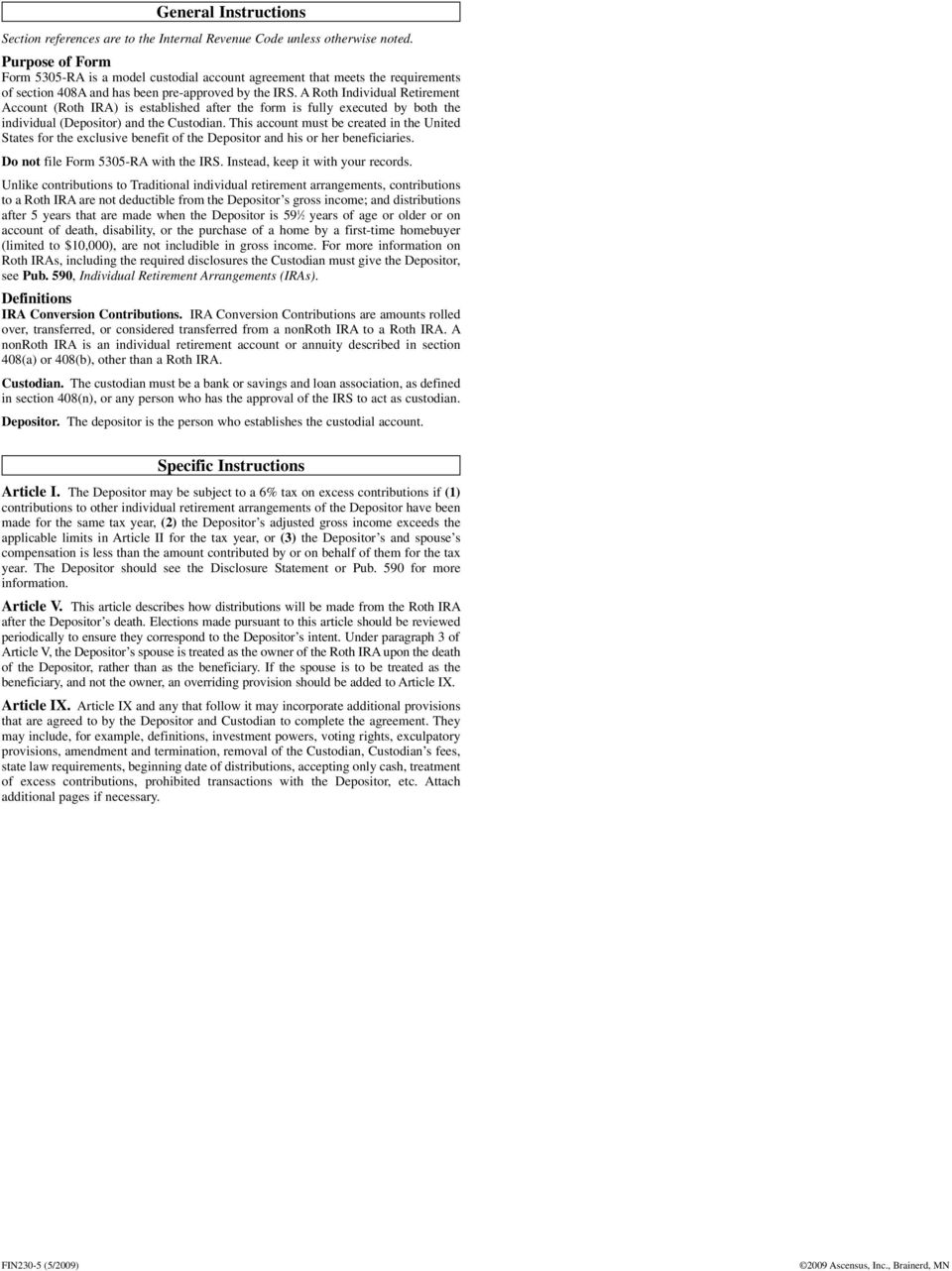
8 General Instructions Section references are to the Internal Revenue Code unless otherwise noted. Purpose of Form Form 5305-RA is a model custodial account agreement that meets the requirements of section 408A and has been pre-approved by the IRS. A Roth Individual Retirement Account (Roth IRA) is established after the form is fully executed by both the individual (Depositor) and the Custodian. This account must be created in the United States for the exclusive benefit of the Depositor and his or her beneficiaries. Do not file Form 5305-RA with the IRS. Instead, keep it with your records. Unlike contributions to Traditional individual retirement arrangements, contributions to a Roth IRA are not deductible from the Depositor s gross income; and distributions after 5 years that are made when the Depositor is years of age or older or on account of death, disability, or the purchase of a home by a first-time homebuyer (limited to $10,000), are not includible in gross income. For more information on Roth IRAs, including the required disclosures the Custodian must give the Depositor, see Pub. 590, Individual Retirement Arrangements (IRAs). Definitions IRA Conversion Contributions. IRA Conversion Contributions are amounts rolled over, transferred, or considered transferred from a nonroth IRA to a Roth IRA. A nonroth IRA is an individual retirement account or annuity described in section 408(a) or 408(b), other than a Roth IRA. Custodian. The custodian must be a bank or savings and loan association, as defined in section 408(n), or any person who has the approval of the IRS to act as custodian. Depositor. The depositor is the person who establishes the custodial account. Specific Instructions Article I. The Depositor may be subject to a 6% tax on excess contributions if (1) contributions to other individual retirement arrangements of the Depositor have been made for the same tax year, (2) the Depositor s adjusted gross income exceeds the applicable limits in Article II for the tax year, or (3) the Depositor s and spouse s compensation is less than the amount contributed by or on behalf of them for the tax year. The Depositor should see the Disclosure Statement or Pub. 590 for more information. Article V. This article describes how distributions will be made from the Roth IRA after the Depositor s death. Elections made pursuant to this article should be reviewed periodically to ensure they correspond to the Depositor s intent. Under paragraph 3 of Article V, the Depositor s spouse is treated as the owner of the Roth IRA upon the death of the Depositor, rather than as the beneficiary. If the spouse is to be treated as the beneficiary, and not the owner, an overriding provision should be added to Article IX. Article IX. Article IX and any that follow it may incorporate additional provisions that are agreed to by the Depositor and Custodian to complete the agreement. They may include, for example, definitions, investment powers, voting rights, exculpatory provisions, amendment and termination, removal of the Custodian, Custodian s fees, state law requirements, beginning date of distributions, accepting only cash, treatment of excess contributions, prohibited transactions with the Depositor, etc. Attach additional pages if necessary. FIN230-5 (5/2009) 2009 Ascensus, Inc., Brainerd, MN
9 This page intentionally left blank.

10 DISCLOSURE STATEMENT RIGHT TO REVOKE YOUR ROTH IRA You have the right to revoke your Roth IRA within seven (7) days of the receipt of the Disclosure Statement. If revoked, you are entitled to a full return of the contribution you made to your Roth IRA. The amount returned to you would not include an adjustment for such items as sales commissions, administrative expenses, or fluctuation in market value. You may make this revocation only by mailing or delivering a written notice to the Custodian at the address listed on the Application. If you send your notice by first class mail, your revocation will be deemed mailed as of the postmark date. If you have any questions about the procedure for revoking your Roth IRA, please call the Custodian at the telephone number listed on the Application. REQUIREMENTS OF A ROTH IRA A. CASH CONTRIBUTIONS Your contribution must be in cash, unless it is a rollover or conversion contribution. B. MAXIMUM CONTRIBUTION The total amount you may contribute to a Roth IRA for any taxable year cannot exceed the lesser of 100 percent of your compensation or $3,000 for years , $4,000 for years , and $5,000 for 2008, with possible cost-of-living adjustments in years 2009 and thereafter. If you also maintain a Traditional IRA (i.e., an IRA subject to the limits of Internal Revenue Code (Code) sections 408(a) or 408(b)), the maximum contribution to your Roth IRAs is reduced by any contributions you make to your Traditional IRA. Your total annual contribution to all Traditional IRAs and Roth IRAs cannot exceed the lesser of the dollar amounts described above or 100 percent of your compensation. Your Roth IRA contribution is further limited if your modified adjusted gross income (MAGI) equals or exceeds $150,000 if you are a married individual filing a joint income tax return, or equals or exceeds $95,000 if you are a single individual. Married individuals filing a joint income tax return with MAGI equaling or exceeding $160,000 may not fund a Roth IRA. Single individuals with MAGI equaling or exceeding $110,000 may not fund a Roth IRA. Married individuals filing a separate income tax return with MAGI equaling or exceeding $10,000 may not fund a Roth IRA. The MAGI limits described above are subject to cost-of-living increases for tax years beginning after If you are married filing a joint income tax return and your MAGI is between the applicable MAGI phaseout range for the year, your maximum Roth IRA contribution is determined as follows: (1) Begin with the appropriate MAGI phase-out maximum for the applicable year and subtract your MAGI from it; (2) divide the result by the difference between the phase-out range maximum and minimum; and (3) multiply this number by the maximum allowable contribution for the year, including catch-up contributions if you are age 50 or older. For example, if you are age 30 and your MAGI is $155,000, your maximum Roth IRA contribution for 2002 is $1,500. This amount is determined as follows: [($160,000 minus $155,000) divided by $10,000] multiplied by $3,000. If you are single and your MAGI is between the applicable MAGI phaseout for the year, your maximum Roth IRA contribution is determined as follows: (1) Begin with the appropriate MAGI phase-out maximum for the applicable year and subtract your MAGI from it; (2) divide the result by the difference between the phase-out range maximum and minimum; and (3) multiply this number by the maximum allowable contribution for the year, including catch-up contributions if you are age 50 or older. For example, if you are age 30 and your MAGI is $98,000, your maximum Roth IRA contribution for 2002 is $2,400. This amount is determined as follows: [($110,000 minus $98,000) divided by $15,000] multiplied by $3,000. C. CONTRIBUTION ELIGIBILITY You are eligible to make a regular contribution to your Roth IRA, regardless of your age, if you have compensation and your MAGI is below the maximum threshold. Your Roth IRA contribution is not limited by your participation in a retirement plan, other than a Traditional IRA. D. CATCH-UP CONTRIBUTION If you are age 50 or older by the close of the taxable year, you may make an additional contribution to your Roth IRA. The maximum additional contribution is $500 for years and $1,000 for years 2006 and beyond. E. CATCH-UP CONTRIBUTIONS ALLOWED IN CERTAIN EMPLOYER BANKRUPTCIES You may be eligible to contribute an additional catch-up contribution of up to $3,000 each year in 2006 through To be eligible, the following conditions must be met: 1) you were a participant in a 401(k) plan in which the employer matched at least 50% of your contributions to the plan with employer stock, 2) the employer must have been a debtor in a bankruptcy case in an earlier year and must have been indicted or convicted as a result of the events leading up to the bankruptcy, and 3) you must have been a participant in the 401(k) plan at least six months before the bankruptcy case was filed. If you choose to make these special catch-up contributions, you will not be eligible for the normal catch-up contribution for individuals age 50 and older. FIN230-5 (5/2009) F. NONFORFEITABILITY Your interest in your Roth IRA is nonforfeitable. G. ELIGIBLE CUSTODIANS The Custodian of your Roth IRA must be a bank, savings and loan association, credit union, or a person or entity approved by the Secretary of the Treasury. H. COMMINGLING ASSETS The assets of your Roth IRA cannot be commingled with other property except in a common trust fund or common investment fund. I. LIFE INSURANCE No portion of your Roth IRA may be invested in life insurance contracts. J. COLLECTIBLES You may not invest the assets of your Roth IRA in collectibles (within the meaning of Code section 408(m)). A collectible is defined as any work of art, rug or antique, metal or gem, stamp or coin, alcoholic beverage, or other tangible personal property specified by the Internal Revenue Service (IRS). However, specially minted United States gold and silver coins, and certain stateissued coins are permissible investments. Platinum coins and certain gold, silver, platinum or palladium bullion (as described in Code section 408(m)(3)) are also permitted as Roth IRA investments. K. BENEFICIARY PAYOUTS Your designated beneficiary is determined based on the beneficiary(ies) designated as of the date of your death who remains your beneficiary(ies) as of September 30 of the year following the year of your death. The entire amount remaining in your account will, at the election of your beneficiary(ies), either 1. be distributed by December 31 of the year containing the fifth anniversary of your death, or 2. be distributed over the remaining life expectancy of your designated beneficiary(ies). If your spouse is your sole designated beneficiary, he or she must elect either option (1) or (2) by the earlier of December 31 of the year containing the fifth anniversary of your death, or December 31 of the year you would have attained age Your designated beneficiary(ies), other than a spouse who is the sole designated beneficiary, must elect either option (1) or (2) by December 31 of the year following the year of your death. If no election is made, distribution will be calculated in accordance with option (2). In the case of distributions under option (2), distributions must commence by December 31 of the year following the year of your death. Generally if your spouse is the designated beneficiary, distributions need not commence until December 31 of the year you would have attained age , if later. If a beneficiary(ies) other than an individual or qualified trust as defined in the Regulations is named, you will be treated as having no designated beneficiary(ies) of your Roth IRA for purposes of determining the distribution period. If there is no designated beneficiary of your Roth IRA, the entire Roth IRA must be distributed by December 31 of the year containing the fifth anniversary of your death. A spouse who is the sole designated beneficiary of your entire Roth IRA will be deemed to elect to treat your Roth IRA as his or her own by either (1) making contributions to your Roth IRA or (2) failing to timely remove a required minimum distribution from your Roth IRA. Regardless of whether or not the spouse is the sole designated beneficiary of your Roth IRA, a spouse beneficiary may roll over his or her share of the assets to his or her own Roth IRA. L. WAIVER OF 2009 BENEFICIARY PAYMENT No beneficiary life expectancy payments are required from an inherited Roth IRA for calendar year If the five year rule applies to a Roth IRA with respect to any decedent, the five year period is determined without regard to calendar year For example, if a Roth IRA owner died in 2007, the beneficiary s five year period ends in 2013 instead of INCOME TAX CONSEQUENCES OF ESTABLISHING A ROTH IRA A. CONTRIBUTIONS NOT DEDUCTED No deduction is allowed for Roth IRA contributions, including transfers, rollovers and conversion contributions. B. CONTRIBUTION DEADLINE The deadline for making a Roth IRA contribution is your tax return due date (not including extensions). You may designate a contribution as a contribution for the preceding taxable year in a manner acceptable to us. For example, if you are a calendar year taxpayer, and you make your Roth IRA contribution on or before April 15, your contribution is considered to have been made for the previous tax year if you designate it as such. C. TAX CREDIT FOR CONTRIBUTIONS You may be eligible to receive a tax credit for your Roth IRA contributions. This credit may not exceed $1,000 in a given year. You may be eligible for this tax credit if you are age 18 or older as of the close of the taxable year, not a dependent of another taxpayer, and not a full-time student Ascensus, Inc., Brainerd, MN

11 The credit is based upon your income (see chart below), and will range from 0 to 50 percent of eligible contributions. In order to determine the amount of your contributions, add all of the contributions made to your Roth IRA and reduce these contributions by any distributions that you have taken during the testing period. The testing period begins two years prior to the year for which the credit is sought and ends on the tax return due date (including extensions) for the year for which the credit is sought. In order to determine your tax credit, multiply the applicable percentage from the chart below by the amount of your contributions that do not exceed $2,000. Adjusted Gross Income* Applicable Joint Head of a All Other Return Household Cases Percentage $1 30,000 $1 22,500 $1 15, ,001 32,500 22,501 24,375 15,001 16, ,501 50,000 24,376 37,500 16,251 25, Over 50,000 Over 37,500 Over 25,000 0 *Adjusted gross income includes foreign earned income and income from Guam, America Samoa, North Mariana Islands and Puerto Rico. AGI limits are subject to cost-of-living adjustments for tax years beginning after D. TAX-DEFERRED EARNINGS The investment earnings of your Roth IRA are not subject to federal income tax as they accumulate in your Roth IRA. In addition, distributions of your Roth IRA earnings will be free from federal income tax if you take a qualified distribution, as described below. E. TAXATION OF DISTRIBUTIONS The taxation of Roth IRA distributions depends on whether the distribution is a qualified distribution or a nonqualified distribution. 1. Qualified Distributions Qualified distributions from your Roth IRA (both the contributions and earnings) are not included in your income. A qualified distribution is a distribution which is made after the expiration of the five-year period beginning January 1 of the first year for which you made a contribution to any Roth IRA (including a conversion from a Traditional IRA), and is made on account of one of the following events: attainment of age , disability, the purchase of a first home, or death. For example, if you made a contribution to your Roth IRA for 1998, the fiveyear period for determining whether a distribution is a qualified distribution is satisfied as of January 1, Nonqualified Distributions If you do not meet the requirements for a qualified distribution, any earnings you withdraw from your Roth IRA will be included in your gross income and, if you are under age , may be subject to an early distribution penalty. However, when you take a distribution, the amounts you contributed annually to any Roth IRA account and any military death gratuity or Servicemembers Group Life Insurance (SGLI) payments that you rolled over to a Roth IRA, will be deemed to be removed first, followed by conversion contributions made to any Roth IRA on a first-in, firstout basis. Therefore, your nonqualified distributions will not be taxable to you until your withdrawals exceed the amount of your annual contributions, military death gratuity or SGLI payments, and your conversions. F. REQUIRED MINIMUM DISTRIBUTIONS You are not required to take distributions from your Roth IRA at age (as required for Traditional and SIMPLE IRAs). However, your beneficiary(ies) is generally required to take distributions from your Roth IRA after your death. See the section titled Beneficiary Payouts in this Disclosure Statement regarding beneficiary s(ies ) required minimum distributions. G. ROLLOVERS AND CONVERSIONS Your Roth IRA may be rolled over to another Roth IRA of yours, may receive rollover contributions, or may receive conversion contributions provided that all of the applicable rollover or conversion rules are followed. Rollover is a term used to describe a tax-free movement of cash or other property to your Roth IRA from another Roth IRA. Conversion is a term used to describe the movement of Traditional IRA or SIMPLE IRA assets to a Roth IRA. A conversion is generally a taxable event. The rollover and conversion rules are generally summarized below. These transactions are often complex. If you have any questions regarding a rollover or conversion, please see a competent tax advisor. 1. Roth IRA to Roth IRA Rollovers Funds distributed from your Roth IRA may be rolled over to a Roth IRA of yours if the requirements of Code section 408(d)(3) are met. A proper Roth IRA to Roth IRA rollover is completed if all or part of the distribution is rolled over not later than 60 days after the distribution is received. You may not have completed another Roth IRA to Roth IRA rollover from the distributing Roth IRA during the 12 months preceding the date you receive the distribution. Further, you may roll over the same dollars or assets only once every 12 months. Roth IRA assets may not be rolled over to other types of IRAs (e.g., Traditional IRA, SIMPLE IRA). FIN230-5 (5/2009) 2. Traditional IRA to Roth IRA Conversions If your MAGI is not more than $100,000 and you are not married filing a separate income tax return, you are eligible to convert all or any portion of your existing Traditional IRA(s) into your Roth IRA(s). Beginning in 2010, the $100,000 MAGI limit and the married filing separate tax filing restriction will be eliminated for conversion eligibility. If you are age or older you must remove your required minimum distribution prior to converting your Traditional IRA. The amount of the conversion from your Traditional IRA to your Roth IRA shall be treated as a distribution for income tax purposes, and is includible in your gross income (except for any nondeductible contributions). Although the conversion amount is generally included in income, the 10 percent early distribution penalty shall not apply to conversions from a Traditional IRA to a Roth IRA, regardless of whether you qualify for any exceptions to the 10 percent penalty. 3. SIMPLE IRA to Roth IRA Conversions If your MAGI is not more than $100,000 and you are not married filing a separate income tax return, you are eligible to convert all or any portion of your existing savings incentive match plan for employees of small employers (SIMPLE) IRA(s) into your Roth IRA(s), provided two years have passed since you first participated in a SIMPLE IRA plan sponsored by your employer. Beginning in 2010, the $100,000 MAGI limit and the married filing separate tax filing restriction will be eliminated for conversion eligibility. If you are age or older you must remove your required minimum distribution prior to converting your SIMPLE IRA. The amount of the conversion from your SIMPLE IRA to your Roth IRA shall be treated as a distribution for income tax purposes and is includible in your gross income. Although the conversion amount is generally included in income, the 10 percent early distribution penalty shall not apply to conversions from a SIMPLE IRA to a Roth IRA, regardless of whether you qualify for any exceptions to the 10 percent penalty. 4. Rollovers of Roth Elective Deferrals Roth elective deferrals distributed from a 401(k) cash or deferred arrangement or 403(b) tax-sheltered annuity may be rolled into your Roth IRA. 5. Rollovers from Employer-Sponsored Retirement Plans Distributions taken from your qualified retirement plan, 403(a) annuity, 403(b) tax-sheltered annuity, or 457(b) governmental deferred compensation plan after December 31, 2007 may be rolled over to your Roth IRA. If you are a spouse, nonspouse, or qualified trust beneficiary who has inherited a qualified retirement plan, 403(a) annuity, 403(b) tax-sheltered annuity, or 457(b) governmental deferred compensation plan, you may be eligible to directly roll over the assets to an inherited Roth IRA. The inherited Roth IRA is subject to the beneficiary distribution requirements. Roth IRA conversion rules, as described above, will apply to rollovers by beneficiaries or plan participants, including the requirement to include the taxable portion in income in the year distributed. 6. Beneficiary Rollovers from 401(k) or 403(b) Plans Containing Roth Elective Deferrals If you are a spouse, nonspouse, or qualified trust beneficiary of a deceased 401(k) or 403(b) plan participant who had made Roth elective deferrals to the plan, you may directly roll over the Roth elective deferrals, and their earnings, to an inherited Roth IRA. The Roth IRA must be maintained as an inherited Roth IRA, subject to the beneficiary distribution requirements. 7. Rollover of Military Death Benefits If you receive or have received a military death gratuity or a payment from the Servicemembers Group Life Insurance (SGLI) program, you may be able to roll over the proceeds to your Roth IRA. The rollover contribution amount is limited to the sum of the death benefits or SGLI payment received, less any such amount that was rolled over to a Coverdell education savings account. Proceeds must be rolled over within one year of receipt of the gratuity or SGLI payment for deaths occurring on or after June 17, For deaths occurring between October 7, 2001 and June 17, 2008, proceeds may be rolled over no later than one year from June 17, Any amount that is rolled over under this provision is considered nontaxable basis in your Roth IRA. 8. Qualified HSA Funding Distribution If you are eligible to contribute to a health savings account (HSA), you may be eligible to take a one-time tax-free HSA funding distribution from your Roth IRA and directly deposit it to your HSA. The amount of the qualified HSA funding distribution may not exceed the maximum HSA contribution limit in effect for the type of high deductible health plan coverage (i.e., single or family coverage) that you have at the time of the deposit, and counts toward your HSA contribution limit for that year. For further detailed information, you may wish to obtain IRS Publication 969, Health Savings Accounts and Other Tax-Favored Health Plans. 9. Rollovers of Settlement Payments from Bankrupt Airlines If you are a qualified airline employee who has received an airline settlement payment from a commercial airline carrier under the approval of an order of a Federal bankruptcy court in a case filed after September 11, 2001, and before January 1, 2007, you are allowed to roll over any portion of the proceeds into your Roth IRA by the later of 180 days after receipt of such amount, or June 21, To obtain more information on this type of rollover, you may wish to visit the IRS website at Ascensus, Inc., Brainerd, MN

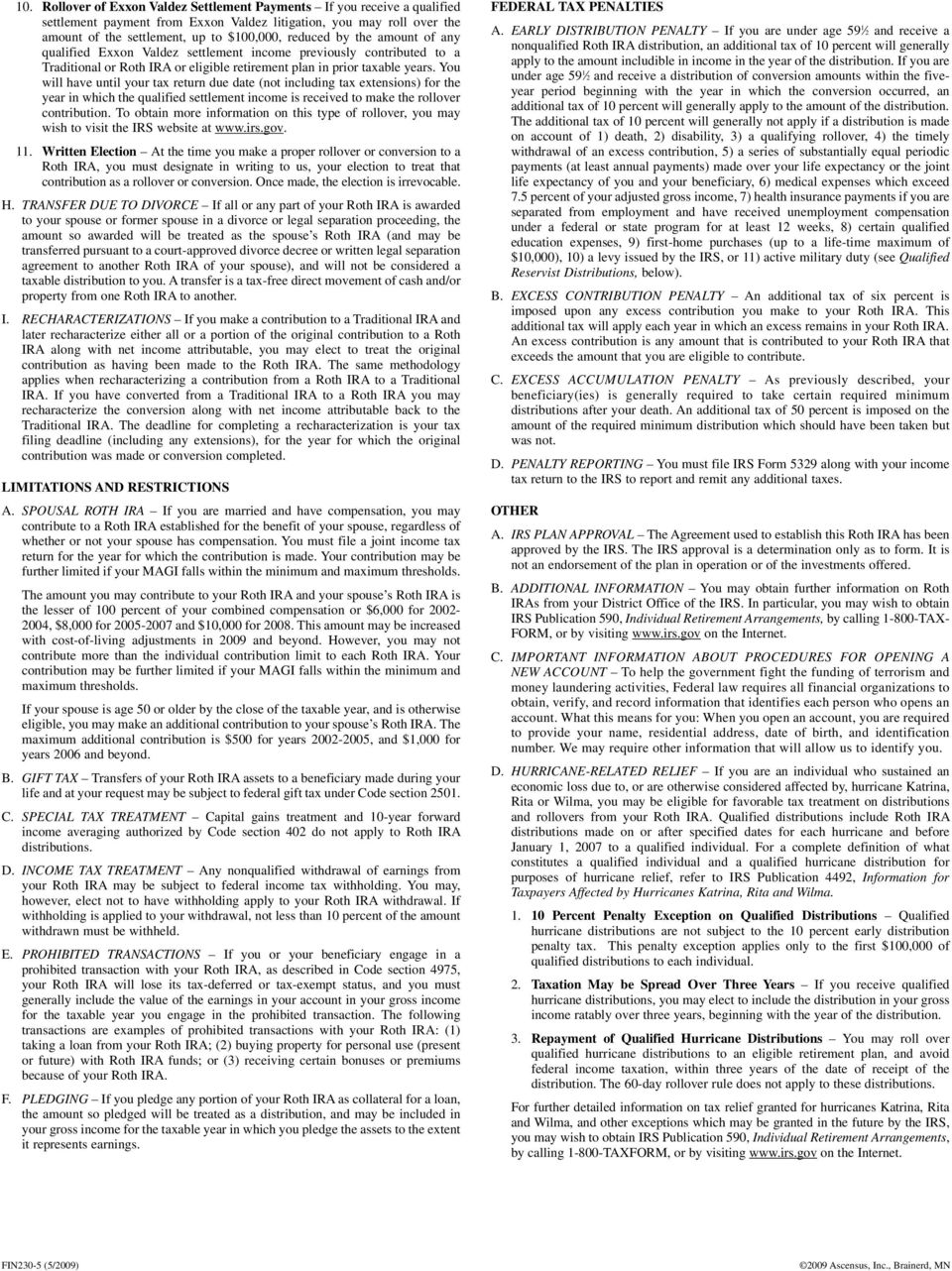
12 10. Rollover of Exxon Valdez Settlement Payments If you receive a qualified settlement payment from Exxon Valdez litigation, you may roll over the amount of the settlement, up to $100,000, reduced by the amount of any qualified Exxon Valdez settlement income previously contributed to a Traditional or Roth IRA or eligible retirement plan in prior taxable years. You will have until your tax return due date (not including tax extensions) for the year in which the qualified settlement income is received to make the rollover contribution. To obtain more information on this type of rollover, you may wish to visit the IRS website at Written Election At the time you make a proper rollover or conversion to a Roth IRA, you must designate in writing to us, your election to treat that contribution as a rollover or conversion. Once made, the election is irrevocable. H. TRANSFER DUE TO DIVORCE If all or any part of your Roth IRA is awarded to your spouse or former spouse in a divorce or legal separation proceeding, the amount so awarded will be treated as the spouse s Roth IRA (and may be transferred pursuant to a court-approved divorce decree or written legal separation agreement to another Roth IRA of your spouse), and will not be considered a taxable distribution to you. A transfer is a tax-free direct movement of cash and/or property from one Roth IRA to another. I. RECHARACTERIZATIONS If you make a contribution to a Traditional IRA and later recharacterize either all or a portion of the original contribution to a Roth IRA along with net income attributable, you may elect to treat the original contribution as having been made to the Roth IRA. The same methodology applies when recharacterizing a contribution from a Roth IRA to a Traditional IRA. If you have converted from a Traditional IRA to a Roth IRA you may recharacterize the conversion along with net income attributable back to the Traditional IRA. The deadline for completing a recharacterization is your tax filing deadline (including any extensions), for the year for which the original contribution was made or conversion completed. LIMITATIONS AND RESTRICTIONS A. SPOUSAL ROTH IRA If you are married and have compensation, you may contribute to a Roth IRA established for the benefit of your spouse, regardless of whether or not your spouse has compensation. You must file a joint income tax return for the year for which the contribution is made. Your contribution may be further limited if your MAGI falls within the minimum and maximum thresholds. The amount you may contribute to your Roth IRA and your spouse s Roth IRA is the lesser of 100 percent of your combined compensation or $6,000 for , $8,000 for and $10,000 for This amount may be increased with cost-of-living adjustments in 2009 and beyond. However, you may not contribute more than the individual contribution limit to each Roth IRA. Your contribution may be further limited if your MAGI falls within the minimum and maximum thresholds. If your spouse is age 50 or older by the close of the taxable year, and is otherwise eligible, you may make an additional contribution to your spouse s Roth IRA. The maximum additional contribution is $500 for years , and $1,000 for years 2006 and beyond. B. GIFT TAX Transfers of your Roth IRA assets to a beneficiary made during your life and at your request may be subject to federal gift tax under Code section C. SPECIAL TAX TREATMENT Capital gains treatment and 10-year forward income averaging authorized by Code section 402 do not apply to Roth IRA distributions. D. INCOME TAX TREATMENT Any nonqualified withdrawal of earnings from your Roth IRA may be subject to federal income tax withholding. You may, however, elect not to have withholding apply to your Roth IRA withdrawal. If withholding is applied to your withdrawal, not less than 10 percent of the amount withdrawn must be withheld. E. PROHIBITED TRANSACTIONS If you or your beneficiary engage in a prohibited transaction with your Roth IRA, as described in Code section 4975, your Roth IRA will lose its tax-deferred or tax-exempt status, and you must generally include the value of the earnings in your account in your gross income for the taxable year you engage in the prohibited transaction. The following transactions are examples of prohibited transactions with your Roth IRA: (1) taking a loan from your Roth IRA; (2) buying property for personal use (present or future) with Roth IRA funds; or (3) receiving certain bonuses or premiums because of your Roth IRA. F. PLEDGING If you pledge any portion of your Roth IRA as collateral for a loan, the amount so pledged will be treated as a distribution, and may be included in your gross income for the taxable year in which you pledge the assets to the extent it represents earnings. FEDERAL TAX PENALTIES A. EARLY DISTRIBUTION PENALTY If you are under age and receive a nonqualified Roth IRA distribution, an additional tax of 10 percent will generally apply to the amount includible in income in the year of the distribution. If you are under age and receive a distribution of conversion amounts within the fiveyear period beginning with the year in which the conversion occurred, an additional tax of 10 percent will generally apply to the amount of the distribution. The additional tax of 10 percent will generally not apply if a distribution is made on account of 1) death, 2) disability, 3) a qualifying rollover, 4) the timely withdrawal of an excess contribution, 5) a series of substantially equal periodic payments (at least annual payments) made over your life expectancy or the joint life expectancy of you and your beneficiary, 6) medical expenses which exceed 7.5 percent of your adjusted gross income, 7) health insurance payments if you are separated from employment and have received unemployment compensation under a federal or state program for at least 12 weeks, 8) certain qualified education expenses, 9) first-home purchases (up to a life-time maximum of $10,000), 10) a levy issued by the IRS, or 11) active military duty (see Qualified Reservist Distributions, below). B. EXCESS CONTRIBUTION PENALTY An additional tax of six percent is imposed upon any excess contribution you make to your Roth IRA. This additional tax will apply each year in which an excess remains in your Roth IRA. An excess contribution is any amount that is contributed to your Roth IRA that exceeds the amount that you are eligible to contribute. C. EXCESS ACCUMULATION PENALTY As previously described, your beneficiary(ies) is generally required to take certain required minimum distributions after your death. An additional tax of 50 percent is imposed on the amount of the required minimum distribution which should have been taken but was not. D. PENALTY REPORTING You must file IRS Form 5329 along with your income tax return to the IRS to report and remit any additional taxes. OTHER A. IRS PLAN APPROVAL The Agreement used to establish this Roth IRA has been approved by the IRS. The IRS approval is a determination only as to form. It is not an endorsement of the plan in operation or of the investments offered. B. ADDITIONAL INFORMATION You may obtain further information on Roth IRAs from your District Office of the IRS. In particular, you may wish to obtain IRS Publication 590, Individual Retirement Arrangements, by calling TAX- FORM, or by visiting on the Internet. C. IMPORTANT INFORMATION ABOUT PROCEDURES FOR OPENING A NEW ACCOUNT To help the government fight the funding of terrorism and money laundering activities, Federal law requires all financial organizations to obtain, verify, and record information that identifies each person who opens an account. What this means for you: When you open an account, you are required to provide your name, residential address, date of birth, and identification number. We may require other information that will allow us to identify you. D. HURRICANE-RELATED RELIEF If you are an individual who sustained an economic loss due to, or are otherwise considered affected by, hurricane Katrina, Rita or Wilma, you may be eligible for favorable tax treatment on distributions and rollovers from your Roth IRA. Qualified distributions include Roth IRA distributions made on or after specified dates for each hurricane and before January 1, 2007 to a qualified individual. For a complete definition of what constitutes a qualified individual and a qualified hurricane distribution for purposes of hurricane relief, refer to IRS Publication 4492, Information for Taxpayers Affected by Hurricanes Katrina, Rita and Wilma Percent Penalty Exception on Qualified Distributions Qualified hurricane distributions are not subject to the 10 percent early distribution penalty tax. This penalty exception applies only to the first $100,000 of qualified distributions to each individual. 2. Taxation May be Spread Over Three Years If you receive qualified hurricane distributions, you may elect to include the distribution in your gross income ratably over three years, beginning with the year of the distribution. 3. Repayment of Qualified Hurricane Distributions You may roll over qualified hurricane distributions to an eligible retirement plan, and avoid federal income taxation, within three years of the date of receipt of the distribution. The 60-day rollover rule does not apply to these distributions. For further detailed information on tax relief granted for hurricanes Katrina, Rita and Wilma, and other exceptions which may be granted in the future by the IRS, you may wish to obtain IRS Publication 590, Individual Retirement Arrangements, by calling TAXFORM, or by visiting on the Internet. FIN230-5 (5/2009) 2009 Ascensus, Inc., Brainerd, MN
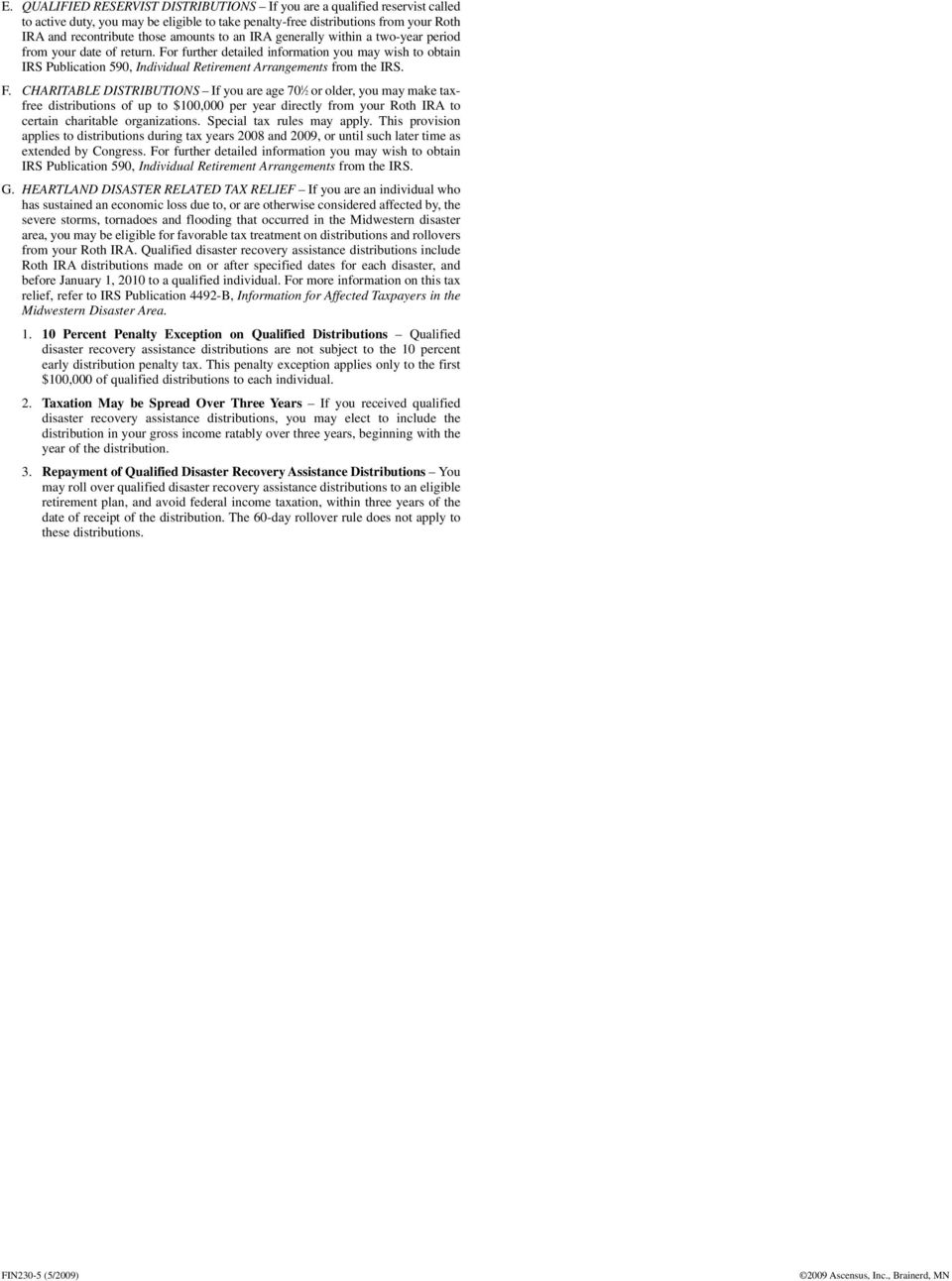
13 E. QUALIFIED RESERVIST DISTRIBUTIONS If you are a qualified reservist called to active duty, you may be eligible to take penalty-free distributions from your Roth IRA and recontribute those amounts to an IRA generally within a two-year period from your date of return. For further detailed information you may wish to obtain IRS Publication 590, Individual Retirement Arrangements from the IRS. F. CHARITABLE DISTRIBUTIONS If you are age or older, you may make taxfree distributions of up to $100,000 per year directly from your Roth IRA to certain charitable organizations. Special tax rules may apply. This provision applies to distributions during tax years 2008 and 2009, or until such later time as extended by Congress. For further detailed information you may wish to obtain IRS Publication 590, Individual Retirement Arrangements from the IRS. G. HEARTLAND DISASTER RELATED TAX RELIEF If you are an individual who has sustained an economic loss due to, or are otherwise considered affected by, the severe storms, tornadoes and flooding that occurred in the Midwestern disaster area, you may be eligible for favorable tax treatment on distributions and rollovers from your Roth IRA. Qualified disaster recovery assistance distributions include Roth IRA distributions made on or after specified dates for each disaster, and before January 1, 2010 to a qualified individual. For more information on this tax relief, refer to IRS Publication 4492-B, Information for Affected Taxpayers in the Midwestern Disaster Area Percent Penalty Exception on Qualified Distributions Qualified disaster recovery assistance distributions are not subject to the 10 percent early distribution penalty tax. This penalty exception applies only to the first $100,000 of qualified distributions to each individual. 2. Taxation May be Spread Over Three Years If you received qualified disaster recovery assistance distributions, you may elect to include the distribution in your gross income ratably over three years, beginning with the year of the distribution. 3. Repayment of Qualified Disaster Recovery Assistance Distributions You may roll over qualified disaster recovery assistance distributions to an eligible retirement plan, and avoid federal income taxation, within three years of the date of receipt of the distribution. The 60-day rollover rule does not apply to these distributions. FIN230-5 (5/2009) 2009 Ascensus, Inc., Brainerd, MN
14 FIN230-5 (5/2009) 2009 Ascensus, Inc., Brainerd, MN

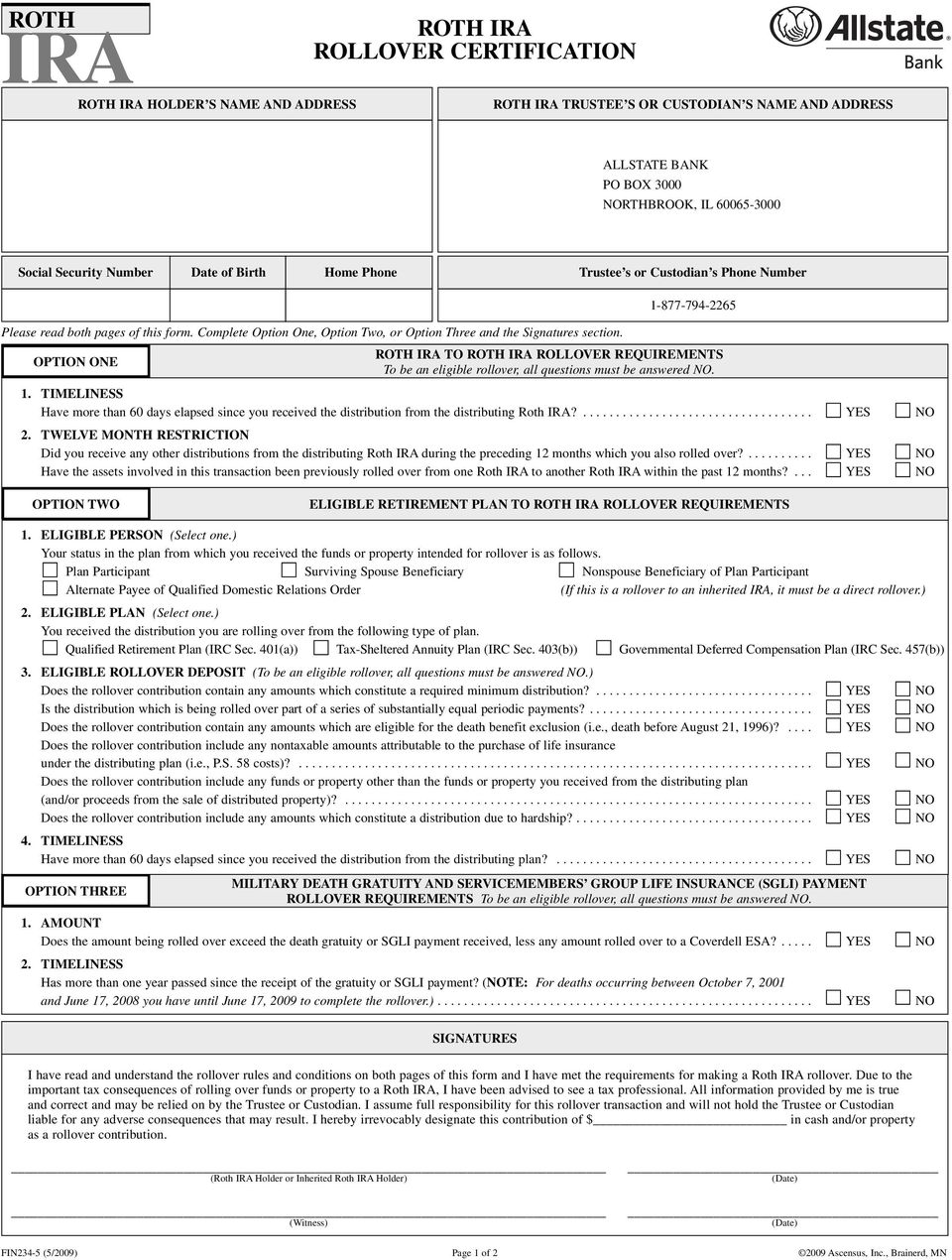
15 ROTH IRA ROTH IRA ROLLOVER CERTIFICATION ROTH IRA HOLDER S NAME AND ADDRESS ROTH IRA TRUSTEE S OR CUSTODIAN S NAME AND ADDRESS ALLSTATE BANK PO BOX 3000 NORTHBROOK, IL Social Security Number Date of Birth Home Phone Trustee s or Custodian s Phone Number Please read both pages of this form. Complete Option One, Option Two, or Option Three and the Signatures section. OPTION ONE ROTH IRA TO ROTH IRA ROLLOVER REQUIREMENTS To be an eligible rollover, all questions must be answered NO. 1. TIMELINESS Have more than 60 days elapsed since you received the distribution from the distributing Roth IRA? YES NO 2. TWELVE MONTH RESTRICTION Did you receive any other distributions from the distributing Roth IRA during the preceding 12 months which you also rolled over? YES NO Have the assets involved in this transaction been previously rolled over from one Roth IRA to another Roth IRA within the past 12 months?... YES NO OPTION TWO ELIGIBLE RETIREMENT PLAN TO ROTH IRA ROLLOVER REQUIREMENTS 1. ELIGIBLE PERSON (Select one.) Your status in the plan from which you received the funds or property intended for rollover is as follows. Plan Participant Surviving Spouse Beneficiary Nonspouse Beneficiary of Plan Participant Alternate Payee of Qualified Domestic Relations Order (If this is a rollover to an inherited IRA, it must be a direct rollover.) 2. ELIGIBLE PLAN (Select one.) You received the distribution you are rolling over from the following type of plan. Qualified Retirement Plan (IRC Sec. 401(a)) Tax-Sheltered Annuity Plan (IRC Sec. 403(b)) Governmental Deferred Compensation Plan (IRC Sec. 457(b)) 3. ELIGIBLE ROLLOVER DEPOSIT (To be an eligible rollover, all questions must be answered NO.) Does the rollover contribution contain any amounts which constitute a required minimum distribution? YES NO Is the distribution which is being rolled over part of a series of substantially equal periodic payments? YES NO Does the rollover contribution contain any amounts which are eligible for the death benefit exclusion (i.e., death before August 21, 1996)?.... YES NO Does the rollover contribution include any nontaxable amounts attributable to the purchase of life insurance under the distributing plan (i.e., P.S. 58 costs)? YES NO Does the rollover contribution include any funds or property other than the funds or property you received from the distributing plan (and/or proceeds from the sale of distributed property)? YES NO Does the rollover contribution include any amounts which constitute a distribution due to hardship? YES NO 4. TIMELINESS Have more than 60 days elapsed since you received the distribution from the distributing plan? YES NO OPTION THREE MILITARY DEATH GRATUITY AND SERVICEMEMBERS GROUP LIFE INSURANCE (SGLI) PAYMENT ROLLOVER REQUIREMENTS To be an eligible rollover, all questions must be answered NO. 1. AMOUNT Does the amount being rolled over exceed the death gratuity or SGLI payment received, less any amount rolled over to a Coverdell ESA?..... YES NO 2. TIMELINESS Has more than one year passed since the receipt of the gratuity or SGLI payment? (NOTE: For deaths occurring between October 7, 2001 and June 17, 2008 you have until June 17, 2009 to complete the rollover.) YES NO SIGNATURES I have read and understand the rollover rules and conditions on both pages of this form and I have met the requirements for making a Roth IRA rollover. Due to the important tax consequences of rolling over funds or property to a Roth IRA, I have been advised to see a tax professional. All information provided by me is true and correct and may be relied on by the Trustee or Custodian. I assume full responsibility for this rollover transaction and will not hold the Trustee or Custodian liable for any adverse consequences that may result. I hereby irrevocably designate this contribution of $ in cash and/or property as a rollover contribution. (Roth IRA Holder or Inherited Roth IRA Holder) (Witness) (Date) (Date) FIN234-5 (5/2009) Page 1 of Ascensus, Inc., Brainerd, MN
16 Rules And Conditions Applicable To Rollovers GENERAL INFORMATION A rollover is a way to move money or property from one Roth IRA or eligible retirement plan to another Roth IRA. The Internal Revenue Code (IRC) limits how many distributions may be rolled over, how quickly they must be completed and how the Trustee or Custodian must report them. By properly completing this form you are certifying to the Trustee or Custodian that you have satisfied the rules and conditions applicable to a rollover and that you are making an irrevocable election to treat the transaction as a rollover. ROTH IRA TO ROTH IRA ROLLOVER REQUIREMENTS (Option One) 1. TIMELINESS The funds you receive from the distributing Roth IRA must be deposited into another Roth IRA within 60 days after you receive them. However, this period is 120 days for certain rollovers relating to first-home purchases. When counting the 60 (or 120) days include weekends and holidays. Receipt generally means the day you actually have the funds in hand. For example, the 60 days would begin on the day following the day you pick up the check from the Trustee or Custodian or you receive the check in the mail. The IRS has the authority to grant extensions to the 60 (or 120) day rule in cases where a hardship would be related (e.g., casualty, disaster, etc.). Generally, in order to receive this relief you must apply for a Private Letter Ruling accompanied by the applicable user fee. An automatic waiver (no application to the IRS) is available if all the following are true: (1) the financial institution receives the funds prior to the expiration of the 60-day rollover period, (2) you follow all procedures required for depositing the funds into an eligible Roth IRA within the 60-day period, (3) the funds are not deposited due to financial institution error, (4) the funds are deposited into a Roth IRA within one year from the beginning of the 60-day rollover period, and (5) if the financial institution had deposited the funds as instructed, it would have been a valid rollover. 2. TWELVE MONTH RESTRICTION You are entitled to one distribution per year per Roth IRA which may be rolled over. Twelve (12) months must pass after receipt of one distribution which you roll over before you may take another distribution from the same Roth IRA to roll over. A Roth IRA is created by executing a plan agreement, not by depositing a contribution into a separate investment within an existing Roth IRA. You are entitled to roll over the same assets only once in a twelve (12) month period. Twelve (12) months must elapse between the time you receive a distribution of the assets to be rolled over until the time you receive another distribution of those same assets for rollover purposes. ELIGIBLE RETIREMENT PLAN TO ROTH IRA ROLLOVER REQUIREMENTS (Option Two) 1. ELIGIBLE PERSON Only an eligible person may roll funds from a 401(a), 403(b), or 457(b) Plan, into a Roth IRA. You will only be an eligible person if you were or are a participant in the distributing plan, the surviving spouse beneficiary of a deceased participant, or the alternate payee identified in a Qualified Domestic Relations Order (QDRO). A QDRO is a domestic relations order issued in a divorce proceeding which meets certain conditions and grants to an alternate payee (e.g., exspouse) the right to receive all or a portion of a participant s benefits under a QRP. If the alternate payee is a spouse or former spouse, the alternate payee may be able to roll over all or a portion of the amount received to a Roth IRA. In order to roll over retirement plan assets, other than designated Roth 401(k) or 403(b) contributions, you must meet the following eligibility requirements. If your modified adjusted gross income is not more than $100,000, and you are not married filing a separate income tax return, you are eligible to roll over the retirement plan assets to a Roth IRA. Beginning in 2010, these eligibility requirements will be eliminated. A nonspouse beneficiary may only roll over to an inherited Roth IRA. A rollover to an inherited Roth IRA must be done as a direct rollover from an eligible retirement plan. 2. ELIGIBLE PLAN A distribution will not be eligible to be rolled over unless that distribution is made from an eligible retirement plan. An eligible retirement plan is a plan that is qualified under IRC Section 401(a), 403(b), or 457(b). 3. ELIGIBLE ROLLOVER DEPOSIT Only certain types of eligible retirement plan distributions, called eligible rollover distributions, may be deposited into a Roth IRA. Eligible rollover distributions include most distributions from eligible plans except the following: Required Minimum Distributions Distributions which represent required minimum distributions paid during a participant s first distribution calendar year or later may not be rolled over. Substantially Equal Periodic Payments For purposes of determining an eligible rollover distribution, substantially equal periodic payments are defined as a series of substantially equal distributions made not less frequently than annually and calculated 1) over the life (or life expectancy) of the individual or the joint lives (or life expectancies) of the individual and the individual s beneficiary or, 2) for a specified period of 10 years or more. P.S. 58 Costs If you received distribution of a life insurance policy from a plan, the amounts attributable to the cost of life insurance purchased by the plan which have been previously taxed to the participant may not be rolled over. Property Distributions If property other than cash is distributed, only the same property or the proceeds from its sale may be rolled over. If you receive property but wish to roll over cash, you must actually sell the property and roll over the proceeds. Hardship Distributions Distributions taken on account of financial hardship are not eligible to be rolled over. Roth 401(k) or 403(b) Amounts Distributions of elective deferrals from a Roth 401(k) or 403(b) plan are eligible to be rolled over to a Roth IRA without tax consequences. 4. TIMELINESS If the check is payable to you, the funds you receive from the distributing plan must be deposited in a Roth IRA within 60 days after you receive them. When counting the 60 days include weekends and holidays. Receipt generally means the day you actually have the funds in hand. The IRS has the authority to grant extensions to the 60 day rule in cases where a hardship occurs (e.g. casualty, disaster, etc.). Generally, in order to receive this relief you must apply for a Private Letter Ruling accompanied by the applicable user fee. An automatic waiver (no application to the IRS) is available if all the following are true: (1) the financial institution receives the funds prior to the expiration of the 60-day rollover period, (2) you follow all procedures required for depositing the funds into an eligible Roth IRA within the 60-day period, (3) the funds are not deposited due to financial institution error, (4) the funds are deposited into a Roth IRA within one year from the beginning of the 60-day rollover period, and (5) if the financial institution had deposited the funds as instructed, it would have been a valid rollover. MILITARY DEATH GRATUITY AND SGLI PAYMENT ROLLOVER REQUIREMENTS (Option Three) AMOUNT AND TIMELINESS If you have received a military death gratuity or a payment from the Servicemembers Group Life Insurance program, you may be able to roll over the proceeds to a Roth IRA. The rollover contribution amount is limited to the sum of the death benefits received, less any such amount that was rolled over to a Coverdell education savings account. Proceeds must be rolled over within one year of receipt of the gratuity or SGLI payment for deaths occurring on or after June 17, For deaths occurring between October 7, 2001 and June 17, 2008, proceeds may be rolled over no later than one year from June 17, FIN234-5 (5/2009) Page 2 of Ascensus, Inc., Brainerd, MN

17 ROTH IRA ROTH IRA TRANSFER REQUEST ROTH IRA HOLDER S NAME AND ADDRESS (Transferring IRA) CURRENT ROTH IRA TRUSTEE S OR CUSTODIAN S NAME AND ADDRESS Social Security Number Date of Birth Home Phone Roth IRA Account Identification (Transferring Roth IRA) Trustee s or Custodian s Phone Number BENEFICIARY (or Former Spouse) INFORMATION This section should be completed by a beneficiary upon the Roth IRA holder s death or a former spouse as a result of a property settlement. DO NOT use this section to name or change your beneficiary(ies). Beneficiary s (or Former Spouse s) Name and Address TRANSFER INSTRUCTIONS Directly transfer all or part of the Roth IRA identified above in the following manner. Frequency: One-time Monthly Quarterly Annually Other Please make a check payable as follows: Social Security Number Phone Date of Birth Relationship ALLSTATE BANK as Trustee X Custodian (Name of Accepting Organization) of the Roth IRA. (Name of Roth IRA Holder) This transfer will will not close the Roth IRA. ASSET HANDLING INSTRUCTIONS Asset Quantity Or Amount Quantity Or Amount Liquidate Liquidate at Transfer Description In Roth IRA To Be Transferred Immediately Maturity In Kind BENEFICIARY TRANSFER INSTRUCTIONS FOR REQUIRED MINIMUM DISTRIBUTION (RMD) Complete this section, if applicable, only if you are the beneficiary of a Roth IRA. I authorize the Trustee or Custodian named above to distribute my RMD to me prior to transferring the Roth IRA assets, segregate and retain my RMD amount, or include the amount that represents my RMD in the transfer. SIGNATURE OF ROTH IRA HOLDER, BENEFICIARY OR FORMER SPOUSE I authorize the transfer of the Roth IRA assets in the manner described above and certify that all of the information provided by me is correct and may be relied upon by the Trustee or Custodian. I understand that I am responsible for determining my eligibility to transfer within the limits set forth by tax laws, related regulations and plan agreements. I assume responsibility for any tax consequences or penalties that may apply to the transfer of these assets and I agree that the Trustee or Custodian shall in no way be held responsible. (Roth IRA Holder, Beneficiary or Former Spouse) (Date) ACCEPTING ROTH IRA TRUSTEE OR CUSTODIAN Our organization agrees to serve as the new Trustee or Custodian for the account of the above-named individual, and as Trustee or Custodian, we agree to accept the assets being transferred. Account Identification of Accepting Roth IRA ALLSTATE BANK PO BOX 3000 NORTHBROOK, IL (Signature of Witness) (Date) (Authorized Signature of New Trustee or Custodian) (Date) FIN235-5 (5/2009) 2009 Ascensus, Inc., Brainerd, MN

18 ALLSTATE BANK DEPOSIT ACCOUNT AGREEMENT AND DISCLOSURE as of March, 2010 FIN791-4

19 Table of Contents Section Page Number Introduction 4 U. S. A. PATRIOT Act 11 Funds Availability Policy 11 Truth In Savings 13 Fair and Accurate Credit Transactions Act 16 Electronic Funds Transfer Agreement and Disclosure 16 Allstate Bank Privacy Policy 24 Schedule of Fees 26 DEPOSIT ACCOUNT AGREEMENT AND DISCLOSURE (As of March, 2010) INTRODUCTION. This Deposit Account Agreement and Disclosure (the "Deposit Agreement") contains the terms and conditions governing checking, savings and time and other deposit accounts (collectively "Accounts and individually Account ) opened at Allstate Bank (the "Bank"). As used in this Agreement, the terms "you" or "your" refer to each and all of the persons having an ownership interest in and the right to withdraw funds from an Account, as reflected on the Bank's records. The terms "we," "our" or "us" refer to the Bank. As used in this Deposit Agreement, the term "Agreement" means this Deposit Agreement, your account application, your current signature card, our Funds Availability Policy Disclosure, our Truth in Savings Disclosure, our Fee Schedule, and our Electronic Funds Transfer Agreement and Disclosure and, if you have an overdraft line of credit, our Overdraft Account Agreement and Disclosure. Each person signing a signature card for an Account acknowledges receipt of this Agreement, and agrees to its terms, as amended from time to time. DEPOSIT ACCOUNTS. From time to time, you may open a variety of Accounts. Each Account we offer is subject to these general terms and conditions and any specific terms and conditions relating to that type of account that may be set forth in this Agreement or established by the Bank. If you open more than one Account, this Agreement will cover all your Accounts with us. You must be age 18 or older to open an Account. FDIC INSURANCE COVERAGE. Deposit accounts at the Bank are insured by the Federal Deposit Insurance Corporation ("FDIC") as provided by law. Please talk to a Customer Care Representative if you need more information about FDIC insurance. INCOMPLETE ACCOUNT APPLICATIONS. If you submit an incomplete application for an Account, we cannot process the application or open the Account until we have received all of the necessary information to complete the application. Any funds received for deposit will be held without being credited to an Account or being credited interest until the application is completed and approved. If the application is not approved, the funds will be returned to you without interest. FORMS OF OWNERSHIP. We offer several forms of Account ownership: individual accounts, joint accounts with right of survivorship, payable on death, fiduciary, sole proprietor and organization accounts. The form of ownership for your Account is shown on the Account application. The terms that apply to each form of ownership are as follows: (a) Individual Accounts. An Individual Account is an account in the name of only one owner. Only that person, the person's duly appointed agent (if a power of attorney that we have approved is on file with us), or the person's duly appointed legal representative (if we have received proper evidence of appointment), may write checks against the Account or authorize withdrawals from the Account. (b) Joint Accounts. A Joint Account is an Account with two owners in which each owner, acting alone, has the current right to withdraw, whether or not any other owner is living. All Joint Accounts will be considered held by the parties as joint tenants with right of survivorship. Upon the death of one of the Joint Account owners, that person's ownership interest in the Account will immediately pass to the other Joint Account owner. Each of you will be jointly and severally liable to us for any debit balance in your Account, including, without limitation, overdrafts and Account charges. Each Joint Account owner, without the consent or joinder of the other Joint Account owner, and whether the other Joint Account owner is living or not, is authorized to transact any business with reference to the Account. This includes, for example, the right to (1) withdraw all or any part of the Account funds, (2) pledge the Account as collateral for any obligation, whether that of one or more Joint Account owners or of a third party, (3) endorse and deposit checks and other items payable to any Joint Account owner, (4) give stop payment orders on any check or item, whether drawn by that Joint Account owner or not, (5) ask us to change the address for the Joint Account owner on our records, and (6) close the Account, with the disbursement of Account proceeds as instructed by the Joint Account owner. Each Joint Account owner is authorized to act for the other Joint Account owner. If we believe there is a dispute between Joint Account owners or if we receive inconsistent instructions from Account owners, we may suspend or close the Account, require a court order to act, and/or require that both Joint Account owners agree in writing to any transaction concerning the Account. The obligations of Joint Account owners under the Agreement are joint and several. This means that each Joint Account owner is fully and personally obligated under the terms of the Agreement, including liability for overdrafts and debit balances as set forth above, irrespective of which Joint Account owner authorized the transaction or whether any Account owner benefited from the withdrawal. If we permit you to establish a Joint Account without the signature of the other Joint Account owner, you agree to hold us harmless for our reliance upon your designation of the other Joint Account owner listed on our records, and you agree to obtain the signature of the other Joint Account owner on documents we require within a reasonable time. A Joint Account is subject to the right of setoff for the debts of any Joint Account owner, as set forth below. 3 (c) Payable on Death Accounts. A Statutory Trust or Payable on Death Account is an Account that shall be held in the name of the person or persons as Trustee(s) payable on the death of the last surviving Trustee to the person or persons(s) designated on the Deposit Account Application Addendum of the Bank (the Beneficiary (ies) ). Any Trustee may change any Beneficiary without the knowledge or consent of any other Trustee or any Beneficiary (ies) by a written instrument accepted by the Bank. Any Trustee may make additional deposits to the Account and withdraw any part or all of the funds on deposit in the Account at any time without the knowledge or consent of any other Trustee or any Beneficiary (ies) subject to the rules of the Account and the Bank. All withdrawals shall constitute a revocation of the agreement as to the amount withdrawn and the Bank shall not be obligated to see to the application of any amounts withdrawn from the Account. Upon the death of the last surviving Trustee of the Account, the balance of the Account shall be paid to the Beneficiary, who is then living. If there are two or more Beneficiaries living at the time of the death of the last surviving Trustee, the balance of the Account shall be paid to the Beneficiaries in equal shares. If no Beneficiary is living at the time of the death of the last surviving Trustee, the 4

20 balance of the Account shall vest in the estate of the last surviving Trustee, and shall be payable to the representative of the Trustee s estate. This type of account is established pursuant to and incorporates by reference the Illinois Trust and Payable on Death Accounts Act as now existing or hereafter amended. (d) Fiduciary Accounts. In a Fiduciary Account one or more persons or institutions will own the Account as a fiduciary such as a guardian, executor or administrator for the benefit of another person or persons. The Bank may, when the Account is opened and from time to time thereafter, require evidence satisfactory to it of the fiduciary s authority to act as a fiduciary. (e) Sole Proprietor Accounts. If the Account is held as a sole proprietor, you agree that your estate shall indemnify and hold the Bank harmless from any claim or demand of any kind concerning any withdrawal or payment made from the Account at the direction of any authorized signer or person on the Account. You represent and warrant to the Bank that if you are doing business under an assumed name, that you have properly filed all assumed name certificates or any other documents or information required by the laws of your state. You agree to notify us promptly of any change in your form of ownership. In the event of the death of the sole proprietor, the balance of the Account shall be payable to the personal representative of the person s estate. (f) Organizational Accounts. Organizational accounts are those accounts that are owned and held by corporations, partnerships, limited liability companies, not-for-profit corporations, governmental units and unincorporated associations (the Organization ). The classification and form of ownership shall be designated on the application or Signature Card and Certification for the Account. You agree to notify us promptly of any change in your form of ownership. You agree that the Account is only payable to or on the order of the Organization and not to any individual director, shareholder, member, partner, manager or official thereof except as they may be a payee on a check or other item drawn on the Account. You represent and warrant to the Bank that the Organization has taken all action necessary to open and maintain the Account and that any resolutions, certifications, authorizations or other documents submitted to the Bank in connection with the Account are true, accurate, completed and will be kept up to date. You, and each person who signs the Signature Card and Certification or other documents for the Account, also represent and warrant to the Bank that each person whose name is listed on the Signature Card and Certification is duly authorized to bind the Organization in all transactions involving the Account. For any transaction involving the Account, we may act on the instructions of any persons we believe are authorized to act on behalf of the Organization. All withdrawals need to be submitted in writing. NOTICE TO CUSTOMERS OF RESTRICTED TRANSACTIONS Transactions that are restricted by the Unlawful Internet Gambling Enforcement Act of 2006 are prohibited from being processed through the account or account relationship. CHECKING ACCOUNTS. We offer three different checking accounts. Our Checking Plus Interest Account is an interest-bearing checking account. Our Regular Checking account does not pay interest. We also offer a Basic Checking account (Senior Value Checking) to persons age 65 and over. You can pick the account that's right for you. Checking Accounts may be opened only by a natural person (not available to organizations). Our Truth in Savings Disclosure contains detailed information on the specific types of Accounts offered, our policies relating to the payment of interest on deposited funds, and any minimum balance requirement that applies to your Account. Our Fee Schedule contains detailed information on the fees and charges applicable to Accounts. SAVINGS ACCOUNTS. We offer three different types of savings accounts. Our Regular Savings Account and Organization Savings is a convenient tool for managing funds and meeting longer-term savings goals. Our Insured Money Market Account (not available to Organizations) offers attractive rates with higher rates paid as your account balance grows. The following terms apply to your Savings Accounts and Insured Money Market Accounts: (a) Transfers and Withdrawals. Per Federal law, you are permitted to make no more than six transfers, withdrawals, or a combination of such transfers and withdrawals, per calendar month, to another account with us or to a third party by means of a preauthorized or automatic transfer, or telephonic (including data transmission) agreement, order or instruction, such transfers may be made by check, draft, debit card, point of sale (POS) or similar order made by you and payable to third parties. A preauthorized transfer includes any arrangement by the Bank to pay a third party from your account upon written or oral instruction (including an order received through an automated clearing house (ACH)) or any arrangement by the Bank to pay a third party from your account at a predetermined time or on a fixed schedule. You may make unlimited withdrawals from the account when such transfers or withdrawals are made by mail, messenger, automated teller machine, or in person or when such withdrawals are made by telephone (via check mailed to the depositor). If you exceed these restrictions federal law requires us to close or convert your account to a checking account for repeated violations. We will use the date the transaction is completed by us (as opposed to the date you initiate it) to apply the frequency limitations. If we honor a nonconforming request, we are not required to do so later. (b) Excess Transactions. In accordance with federal law, if you have more than the allowable preauthorized transfers or checks (for money market accounts) in any calendar month, your Account may be subject to closure by us and the funds placed in another account that you are eligible to maintain, or we may take away the transfer and draft capabilities of the Account. We may also impose a fee on each transaction in excess of legal limits, as stated in the Fee Schedule. TIME DEPOSITS. Time Deposits opened at the Bank are certificates of deposits that are issued in bookentry form. We do not issue a formal certificate. For Time Deposits, you have agreed to keep the funds on deposit until the maturity of your Account. Additional funds may not be added to the Account (other than accrued interest) before the next maturity date. If your Account has not matured, you must obtain 5 our consent to any early withdrawal, and any withdrawal of all or part of the funds from your Account (other than the payment of credited interest, if you have chosen to receive interest and not to allow it to remain in the Account) may result in an early withdrawal penalty. Withdrawal requests to redeem your Organization Time Deposit Account must be in writing. Withdrawal requests received via facsimile will not be accepted without the consent of the Bank. (a) Penalty. The early withdrawal penalty is calculated as a forfeiture of part of the accrued interest that has or would be earned on the Account. If your Account has not yet earned enough interest so that the penalty can be deducted from earned interest, or if the interest already has been paid, the difference will be deducted from the principal amount of your Account. The penalty will be as stated in the Truth in Savings Disclosure. (b) Exceptions. We will let you withdraw money from your Account before the maturity date without the stated early withdrawal penalty: (1) when one or more of the owners dies or is determined legally incompetent by a court or other administrative body of competent jurisdiction; or (2) within an applicable grace period as stated in the Truth in Savings Disclosure, but in that event the deposit will not earn interest after the maturity date. FEES AND CHARGES. Subject to applicable law, you agree to pay us the fees and charges shown in the Fee Schedule that is applicable to your Account and for other services performed by us. You agree that we may change the fees and charges from time to time, and you authorize us to charge your Account for their payment, whether or not any charge results in an overdraft of your Account. Existing and future charges may be based upon the overall costs of providing account services, and may or may not be based upon the direct cost or expense associated with providing the particular service involved. The charges may be based on consideration of profit, competitive position, and deterrence of misuse of account privileges by some customers, and the safety and soundness of the financial institution. We will notify you of the changes as required by law. DEPOSIT RULES. The following terms apply to deposits made to your Account. (a) Endorsements. You authorize us to accept checks and other items for deposit to your Account if they are made payable to, or to the order of, any one or more of you, whether or not they are endorsed by you. You authorize us to supply missing endorsements, and you warrant that all endorsements are genuine. All checks and other items deposited to your Account should be endorsed payable to the order of the Bank for deposit only, followed by your signature and Account number. All endorsements must appear on the back of the check or other item within the first inches from the left side of the item when looking at it from the front. While we may accept nonconforming endorsements, you will be responsible for any loss incurred by us due to the delay in processing the item for payment or in returning it. (b) Final Payment. All non-cash items (for example, checks) deposited to your Account are posted subject to our receipt of final payment by the payor bank. If final payment is not received or if any item deposited to your Account or which you cash is charged back to us for any reason, you authorize us to charge any of your Accounts, without prior notice and at any time, for the amount of the returned item, our returned item fee, any interest paid on that item, and any other fee we pay or incur. We reserve the right to refuse any item for deposit into your Account. (c) Direct Deposits. If we provide direct deposit services for automatic preauthorized deposits to your Account (e.g., payroll or Social Security) or automatic transfers from your other accounts with us, you must notify us at least thirty (30) days prior to the next scheduled direct deposit or preauthorized transfer if you wish to cancel the direct deposit or transfer service. If any amount deposited must be returned to the government for any reason, you authorize us to deduct the amount from your Account as provided in (b) above. (d) Availability of Deposits. Our Funds Availability Policy Disclosure reflects our policies relating to the availability of funds deposited to your checking or savings accounts. (e) Third Party Checks. The Bank does not accept third party checks (i.e., checks initially made payable to another person and endorsed to you). In the event that the Bank receives a third party check, you understand that the Bank will not deposit the check into your account at the Bank. Third party checks will be returned to you via U.S. mail. You agree that the Bank will not be liable to you for failing to deposit a third party check, or for any loss or damages if other items you have issued are not paid as a result of our refusing to deposit or collect third party items. In returning such checks to you, the Bank will not be liable for any checks that may be lost in the mail. (f) Cash Deposits. Please do not mail us cash deposits, (but you may deposit cash at ATMs where available). In the event that cash deposits are received by the Bank, you agree that the Bank's determination of the amount of the deposit will be conclusive. The Bank is not liable for any deposits, including cash, lost in the mail. WITHDRAWAL RULES. The following terms apply to withdrawals from your Account: (a) Manner of Withdrawal. You may make withdrawals from your Account in any manner that is permitted by us for the type of Account that you have opened. Withdrawals by mail will be posted to your Account as of the day the transaction is processed by us. If you do not obtain your checks from us or from a vendor approved by us, you must use a check printer that meets our requirements for check specifications and print quality. If you do not, we may refuse to handle the item. Withdrawals and transfers from your Account may be restricted as provided in the Agreement, or in the Fee Schedule, or by applicable law. (b) Withdrawal Restrictions and Overdrafts. If you do not have sufficient available funds on deposit in the Account, we do not have to allow you to make a withdrawal from your Account and we do 6

21 not have to pay an item drawn on your Account, subject to the terms of any Overdraft Account agreement you have established with us. If there are available funds to cover some, but not all, of the withdrawals or other debits (such as charges) to your Account, we may post those withdrawals or other debits for which there are sufficient available funds in any order we choose at our sole discretion. If there are insufficient available funds to cover some of the withdrawals or debits presented against your Account, such items will be handled in accordance with our overdraft procedures or in accordance with any other agreement you may have with us (such as an Overdraft Account Agreement). If we choose to pay one or more overdrafts, we are not obligated to cover any future overdrafts. We may determine the balance of your Account in connection with determining whether payment of an item will create an overdraft at any time between the time we receive the item and the deadline for us to take action on the item. We are not required to determine your account balance more than one (1) time during this period. A service charge as stated in our Fee Schedule may be assessed on any item or other debit that will overdraw the available account balance, regardless of whether we pay or dishonor (return) the item, unless the item is covered by your overdraft agreement. You agree, immediately upon notice from us, to deposit funds sufficient to cover any overdraft plus any service charges. We will not be liable for the dishonor of any item when the dishonor occurs because we set off a debt against your Account. We also may refuse to allow a withdrawal if there is a dispute about the Account (unless a court has ordered us to allow the withdrawal), the Account is garnished or attached, the Account has been pledged (with our consent) as collateral for a debt, the availability of the funds on deposit cannot be verified, any required documentation has not been presented, or you have failed to repay an obligation to us on time. (c) Notice Requirements. Federal regulations require us to retain the right to require you to give us at least seven (7) days notice in writing prior to any intended withdrawal from an interest bearing checking account, savings account or money market account. Although we usually pay withdrawals or checks without notice on these accounts, doing so does not mean that we give up the right to require the notice. (d) Postdated Items. You agree that when you write a check, you will not date the check in the future. If you do, and the check is presented for payment before the date of the check, we may pay it or return it unpaid. You agree that if we pay the check, the check will be posted to your Account on the date we pay the check, even though the posting date is prior to the date of the check. You further agree that we are not responsible for any loss to you in doing so. However, we won't pay a postdated check before the date on it if you give us advance notice in enough time and in a manner that affords us reasonable opportunity to act. The notice must be in writing and must specify the amount and number of the check, the date you placed on it, and the name of the payee. Notices are effective for the time periods stated under subsection (k) of this section, Stop Payment Orders, and are subject to the same fees. You agree that we may return a postdated check to the presenter. (e) Stale Checks. We reserve the right to pay or dishonor a check more than six (6) months old without prior notice to you. You agree that we are acting in good faith in paying such an item as long as there is not a stop payment request in effect when we pay the item. (f) Power of Attorney. A person executing a power of attorney is called the "principal" and the person acting for the principal is called the "agent." If you or your agent furnishes us with a copy of a power of attorney that includes authority over your Accounts or other assets held at the Bank, you will be deemed to be exercising that power in Illinois, and be subject to the provisions of Illinois law governing such agencies. We may refuse to comply with a power of attorney for reasonable cause, and we may require an affidavit from the agent stating that the power of attorney presented to us is a true copy and that, to the best of the agent's knowledge, the principal is alive and that the relevant powers of the agent have not been altered or terminated. We may presume, in the absence of actual knowledge to the contrary, that the agency was validly executed, that the principal was competent at the time of execution, and that, at the time of reliance, the principal is alive, the agency and the relevant powers of the agent have not terminated or been amended, and that the acts of the agent conform to the standard required by law. (g) Signatures. You authorize us to store and use account application and signature card information in any reasonable form we deem necessary, including any digitized signature capture process. If you use a facsimile signature or other form of signature, you agree that you shall have the sole responsibility for maintaining security of the facsimile signature or device by which it is affixed, and you shall bear the entire risk for unauthorized use thereof whether or not you are negligent. You agree that no facsimile signature we have been authorized to honor may be considered a forgery or an unauthorized signature, but that such facsimile signature shall be effective as your signature or endorsement, whether or not you have been negligent. You further agree to indemnify and hold us harmless from and against any and all loss, costs, damage, liability, or exposure (including reasonable attorney's fees) we or you may suffer or incur as a result of the unlawful use, unauthorized use, or misuse by any person of any such facsimile signature or the device by which it is affixed. If you use any form of facsimile signature device, you agree to deliver a sample signature to us if we request it. (h) Preauthorized drafts. If you voluntarily give information about your Account (such as our routing and transit number and your account number) to a person who is seeking to sell you goods or services over the telephone, collect a debt or otherwise electronically access your Account, we may consider any debit to your account initiated by the person to whom you gave the information as authorized by you, whether or not you in fact authorized the debit or physically delivered a check to the person. (i) Check Legends. We may disregard information on any check or item other than the signature of the drawer, the identification of the drawee financial institution and payee, the amount, the endorsements, and any other information that appears in the MICR line. In addition, we are not responsible to take action on, or for failure to notify you of restrictive language placed on checks or other items, including but not limited to terms such as "Void after 90 Days," "Paid in Full," "Two Signatures Required," "Void Over $100" or similar statements. We will agree to adhere to extraneous legends if you notify us in advance of such legends and we have specifically agreed in writing other than this Agreement to honor such legends. 7 (j) Check Examination Standards. In accordance with reasonable banking standards, most checks and other items are processed through automated processing and, except in limited circumstances and in our discretion, most items are not individually examined. You agree that we act within reasonable banking standards by processing most checks and other items through automated processing systems. (k) Stop Payment Orders. Subject to certain limitations, you may order us to stop payment on any check or other item payable from your Account, whether drawn by you or any other authorized signer. The stop payment request will be effective if we receive the order at such time and in such manner as to afford us a reasonable opportunity to act upon it. The stop payment order is effective for six (6) months, but it lapses after fourteen (14) calendar days if the original order was oral and was not confirmed in writing within that period. A stop payment order sent via a secured electronic message will be considered as having been given in writing. A stop payment order may be renewed for additional six (6) month periods if renewed during the effective time period. We will require you to provide the date, the amount, the number of the check, and the name of the payee. If you give us incorrect information, we will not be liable for failing to stop payment on the item. Our acceptance of a stop payment order will not constitute a representation that the item has not already been paid or that we have a reasonable opportunity to act upon the order. You may not stop payment on an official, certified, cashier's, or teller's check issued by us, or request us to stop payment if we have otherwise become accountable for the item. In addition, you may not stop payment on checks governed by separate agreement, such as a check guaranty agreement. Further, you may not stop payment on an item after acceptance of the item by us. ASSIGNABILITY. Any Account established under this Agreement is not assignable or transferable except with our prior written consent. We must approve any pledge of the Account, and any such pledge remains subject to any rights we have under the Agreement and applicable law, including our right of setoff. If ownership of an Account is proposed to be transferred, we may require the Account be closed and a new account opened in the name of the transferee or pledgee. FINANCIAL INSTITUTION LIABILITY. You agree that if we do not properly complete a transaction according to this Agreement, we will not be liable in any event for losses or damages in excess of the amount of the transaction, and we will not be liable if circumstances beyond our control prevent the transaction, or if the funds in your Account are or may be subject to legal process or other claim. In no event will we be liable for consequential damages. In receiving items for withdrawal or deposit, we act only as your agent. You are responsible for the condition of a check or item when you issue it. If a check or item is returned or payment is delayed as a result of any writing or marking that you or a prior endorser placed on the front or back of the check or item, you will be responsible for any cost and liabilities associated with such return or delay. We reserve the right to refuse any item for deposit or to reverse credit for any deposited items or to charge your Account for items should they become lost in the collection process. RIGHT OF SETOFF. Subject to applicable law, we may exercise our right of setoff against any and all of your Accounts without notice, for any liability or debt of any of you, whether joint or individual, whether direct or contingent, whether now or hereafter existing, and whether arising from overdrafts, endorsements, guarantees, loans, attachments, garnishments, levies, attorneys' fees, or other obligations. If the Account is a joint Account, each joint Account owner authorizes us to exercise our right of setoff against any and all Accounts of each Account owner. DORMANT ACCOUNTS. If you have not made a withdrawal from, or a deposit to your Account for an extended period of time and we have been unable to contact you, your Account may be classified by us as dormant. Checking, savings, money market, secure access money market, charter money market and senior value checking accounts are considered dormant after one (1) year from the date of the last transaction. Subject to applicable law, a dormant account fee will be charged on the Account, and the Account will be presumed to be abandoned. Time deposits are considered dormant one (1) year after the first renewal date or last date of contact, whichever is later. IRA s use the same rule however, the customer must be for an account to be considered dormant. There will be no dormant account fee charged for IRA or Time deposit dormant accounts. In accordance with law, funds in abandoned accounts will be remitted to the custody of the applicable state agency, and we will have no further liability to you for such funds. We reserve the right not to send statements on accounts we consider dormant, subject to applicable law. ACCOUNT STATEMENTS. Each month, we will provide you with an account statement showing all activity on your checking or money market Accounts. For savings Accounts, we also send statements monthly. However, if there is no activity in your Account for at least three (3) months, we reserve the right to send your statements quarterly instead of monthly. For certificate of deposit accounts, we will provide you with an account statement at least quarterly. For IRA Accounts, we will provide you with an account statement at least semi-annually. You should review your Account statement promptly to protect your rights, including your right to dispute transactions that you believe are unauthorized. You are responsible for promptly examining your Account statement and reporting any irregularities to us. The Account statement will be considered correct for all purposes and we will not be liable for any payment made and charged to your Account unless you notify us in writing within a reasonable period of time not exceeding sixty (60) calendar days after the periodic statement is sent or made available to you. However, if your Account is charged for multiple unauthorized signatures or alterations by the same wrongdoer, we will not be liable if you do not notify us in writing a reasonable period of time not exceeding thirty (30) calendar days after information about the first such irregularity was made available to you. If you do not notify us within the applicable time period, then you cannot recover any amount from us with respect to any forged, altered or otherwise unauthorized item. We have the right to request a police report, written statement and/or affidavit for any claim for a forged, altered or unauthorized item. Because we will truncate your checks, you understand that your original checks will not be returned to you. We will keep the original items for a short period of time, after which we will retain copies for seven (7) years. You agree that our retention of checks does not alter or waive your responsibility 8
22 to examine your Account statement or change the time limits for notifying us of any errors. Copies of your checks are available by contacting a Customer Care Representative. Mode of Delivery of Information The Bank may deliver any notice or other information that it is required to provide by United States mail or by any other means through which the recipient has agreed to receive account information. NOTICES. The following terms apply to notices relating to your Account: (a) Notice of Amendments. You agree that the terms and conditions of this Agreement, including without limitation all rates, fees, and charges, may be amended by us from time to time. We will notify you of amendments as required by applicable law. Your continued use of the Account after the effective date of the change constitutes your agreement to any amendment. Notices will be sent to the most recent address shown on our records for your Account. (b) Account Changes. Each Account owner or Organization and any person authorized to sign on an Account is required to notify us in writing if an account owner or other authorized signer dies or is declared incompetent by a court or an organization ceases operating or ceases to exist (e.g., Organization is dissolved. It is your responsibility to notify us of any change in your address or name. We are required to honor items drawn only in the listed Account names. Further, we are required to attempt to communicate with you only at the most recent address provided to us. Any notice to one Account owner constitutes notice to all Account owners. BACKUP WITHHOLDING/TIN CERTIFICATION Federal law may require us to report to the Internal Revenue Service (IRS) interest and certain other payments we make to you from time to time, and to include your Taxpayer Identification Number (TIN) on the report (generally, your TIN is your Social Security Number if you are an individual). Therefore we require you to provide us with your TIN and to certify that it is correct. If we do not receive your signature card signed to certify your TIN within thirty (30) days of account opening, your Account will be subject to backup withholding. We will debit your Account and remit any funds due to the IRS as required by applicable law. ACCOUNT TERMINATION. We may close your Account at any time without advance notice to you. Further, for security reasons, we may require you to close your Account and to open a new Account if (1) there is a change in authorized signers, (2) there has been a forgery or fraud reported or committed involving your Account, (3) any Account checks are lost or stolen, (4) you have too many transfers from your Account, if your account has transfer restrictions, (5) you violate any other provision of this Agreement or another agreement we have with you. If we close your Account, we will use our best efforts to send you written notice that the Account is closed on the date we close the Account. You agree to notify us of your intention to close your Account, and we hereby reserve the right to request the notice in writing. After the Account is closed, we have no obligation to accept deposits or pay any outstanding checks. Monthly service fees will be posted to the account prior to closing. You agree to hold us harmless for refusing to honor any check drawn on a closed account. However, at our discretion, we may re-open your account to post valid transactions to your account. If your Account balance falls below $10.00 we may assess a monthly service fee and close your Account without advance notice to you. GOVERNING LAW. Your Accounts at Allstate Bank are opened and maintained in the State of Illinois, and these terms, including provisions governing account ownership and the rights of persons upon death of an account owner, are governed by Illinois law and applicable federal laws. You agree that if there is any inconsistency between the terms of the Agreement and any applicable law, regulation, or rule, the terms of the Agreement will prevail to the extent any such law, regulation, or rule may be modified by agreement. VENUE / JURY WAIVER. THE PARTIES AGREE THAT THE COUNTY IN WHICH THE BANK S PRINCIPAL OFFICE IS LOCATED IS THE PLACE OF PERFORMANCE OF THIS AGREEMENT AND IS SOLE AND EXCLUSIVE VENUE FOR ANY ACTION OR PROCEEDING RELATING TO THIS AGREEMENT, WHETHER SUCH ACTION IS IN CONTRACT, TORT, OR OTHERWISE. BANK MAY BRING ANY ACTION OR PROCEEDING AGAINST YOU IN ANY STATE OR FEDERAL COURT IN SUCH COUNTY OR IN ANY OTHER JURISDICTION OR VENUE. YOU HEREBY IRREVOCABLY SUBMIT TO THE JURISDICTION AND VENUE OF SUCH COURTS AND WAIVE ANY OBJECTION YOU MAY NOW OR HEREAFTER HAVE AS TO JURISDICTION AND VENUE IN SUCH COURTS OR AS TO SUCH COURTS BEING AN INCONVENIENT FORUM. YOU AGREE THAT SERVICE OR PROCESS UPON IT MAY BE MADE BY CERTIFIED OR REGISTERED MAIL, RETURN RECEIPT REQUESTED, AT ITS ADDRESS SPECIFIED IN THE AGREEMENT OR IN ANY OTHER MATTER PERMITTED BY LAW. THE PARTIES HEREBY WAIVE ANY RIGHT TO TRIAL BY JURY. SYSTEMS AND SOFTWARE. We shall not be responsible to you for any loss or damages suffered by you as a result of the failure of systems and software used by you to interface with our systems or systems and software utilized by you to initiate or process banking transactions, whether such transactions are initiated or processed directly with our systems or through a third party service provider. You acknowledge that you are solely responsible for the adequacy of systems and software utilized by you to process banking transactions and the ability of such systems and software to do so accurately. MISCELLANEOUS PROVISIONS. If you or your Account becomes involved in any legal proceedings, your use of the Account may be restricted. We shall be entitled to act upon any legal process served upon us, which we reasonably believe to be binding, with no liability to you for doing so. You understand that supervisory personnel may randomly monitor and record customer service telephone conversations to ensure that you receive accurate, courteous, and fair treatment. If you, an authorized signer to the Account or any person purporting to be an authorized signer to the Account, ask us to follow instructions that we believe might expose us to any claim, liability, or damages, we may refuse to follow your instructions or may require a bond or other protection, 9 including your agreement to indemnify us. You are liable to us, to the extent permitted by law, for any loss, costs, attorney s fees, or expenses that we may incur as a result of any dispute or legal proceeding involving your Account. You authorize us to deduct any such loss, costs, attorney s fees, or expenses from any of your Accounts without prior notice to you, or to bill you separately. This obligation includes disputes between you and us involving your Account and situations where we become involved in disputes between you and another authorized signer, a joint owner, or a third party claiming an interest in your Account. It also includes situations where any action taken on your Account by you, an authorized signer, a joint owner, or a third party, causes us to seek the advice of an attorney, whether or not we actually become involved in a law suit regarding the dispute. Any action by us for reimbursement from you for any costs or expenses may also be made against your estate and legal representatives, who shall be liable for any claims made against and expenses incurred by us. You agree that we may waive, in our sole discretion, any fee, charge, term, or condition set forth in this Agreement at the time the Account is opened or subsequent thereto, on a one-time basis or for any period or duration, without changing the terms of this Agreement or your obligation to be bound by this Agreement, and we are not obligated to provide similar waivers in the future or waive our rights to enforce the terms of this Agreement. WIRE AND ACH TRANSACTIONS. With respect to wire transfers or other transfers of funds not governed by the Electronic Funds Transfer Act, you agree to enter into and comply with our Funds Transfer Agreement and to comply with our security procedures and this section. We advise you that any receiving financial institution (including us) is entitled to rely on any account or bank number you have provided even though that account or bank number may identify a person different from the person or entity you have described by name in any transfer order. (a) Provisional Payment. Credit given by us to you with respect to an ACH credit or wholesale (wire) funds transfer entry is provisional until we receive final settlement for such entry through a Federal Reserve Bank. If we do not receive final settlement, you are hereby notified and agree that we are entitled to a refund of the amount credited to your Account in connection with such entry, and the person (the originator of the entry) making payment to you via such entry shall not be deemed to have paid you the amount of such entry. (b) Notice of Receipt. Receipt of a wire transfer or ACH transaction may be confirmed by reviewing your Account statement. We will issue separate confirmations for each wire transfer, but not for ACH transactions. (c) Right to Reject a Funds Transfer. We reserve the right to reject an order for a funds transfer, for reasons that include insufficient funds in your account, or if your order is unclear or incomplete. We will notify you if we reject a payment order from your account. We are not obligated to notify you if we reject a payment order to your account. (d) Limitation of Liability. To the maximum extent permitted by law, we will not be liable for (a) events or circumstances beyond our control, (b) indirect, special, or consequential damages, or (c) failure to detect errors in beneficiary or amount of payment orders, or the existence of duplicate payment orders. Funds Transfer Agreement. If you use our funds transfer service, the following terms and conditions shall govern all transaction for our acceptance and processing of your payment orders, credits, and related requests. This Funds Transfer Agreement shall not govern debit and credit transfers by means of ACH transfers or transactions governed by the Electronic Funds Transfer Act. Issuance of withdrawal instructions ( Payment Orders ) by you or another person (Originator ). (a) Format, Cut-Off Time. A Payment Order is subject to Bank s acceptance, and will be received and processed only on Bank s funds transfer business days. All outgoing Payment Orders received after 2:00 p.m. Central Standard Time will be processed the next business day. The Bank must receive requests for cancellations or amendments of Payment Orders not later than 2:00 p.m., Central Standard Time, on the funds transfer business day proceeding the day for execution of the Payment Order. (b) Insufficient Funds/ Uncollected Funds. If honoring a Payment Order would cause the Account designated in the Payment Order to be overdrawn or exceeds available funds in the account the Bank may, but has no obligation to, execute the Payment Order, and (a) create an overdraft in such Account, (b) transfer to the designated Account from any other account of Originator, funds sufficient to cover the deficiency in the designated Account, (c) transfer available funds to the designated Account in accordance with Originator s Overdraft Account Agreement with the Bank or (d) return items that exceed available balance. An insufficient funds or uncollected funds fee may be applied to all overdrafts or uncollected funds, created by check, ATM withdrawal, or other electronic means, as applicable. Originator promises to repay any such overdraft not covered by an Overdraft Account Agreement, plus any overdraft fee, on demand, and to pay Bank s cost of collection and reasonable attorney s fees. (c) Rejection of Payment Order. Bank may notify Originator of its rejection of any Payment Order or request for an amendment or cancellation of a Payment Order by telephone, facsimile transmission, electronic transmission, or other written notice. (d) Cancellation of Payment Orders. Originator may cancel or amend a Payment Order only if Bank receives the communication before Bank s cut-off time and has a reasonable opportunity to act on it before accepting the Payment Order. However, Bank will have no liability if such cancellation or amendment is not effected. The communication of a cancellation or amendment must be presented in conformity with the same security procedures that have been agreed to for Payment Orders. In addition, prior to honoring any request to cancel or amend a Payment Order, the Bank may require the Originator to deliver an indemnification supported by a bond or other security in a form and amount acceptable to the Bank, and to take such other actions as reasonably requested by the Bank. 10
23 (e) Security Procedures. The Bank may rely on security procedures such as random requests for proof of identification, callbacks, recorded lines or other means of monitoring transactions. Originator agrees that any such security procedure is a commercially reasonable method of providing security against unauthorized payment orders in light of the amount of the Payment Order and other relevant factors. (f) Operational Procedures; Account Agreement. The Bank may issue administrative rules and procedures for time to time, which will be binding on Originator after it receives written notice of the rules and procedures. In addition, The Bank s rights and obligations with respect to Originator s Account are subject to the terms of The Bank s Deposit Agreement and Disclosure, as in effect from time to time. (g) Report of Discrepancies. Originator must promptly report in writing any discrepancy between Originator s records of Payment Orders and the notice Originator receives of the execution of any Payment Order. Originator agrees that fourteen (14) days is a reasonable time for Originator to notify Bank discrepancies, including unauthorized and erroneous Payment Orders. Originator will provide Bank with all information reasonably requested in connection with any discrepancy. Except as otherwise required by law, Originator will not be entitled to interest on any refundable amount. If Bank can prove that Originator failed to perform any duties with respect to an erroneous payment and that Bank has incurred a loss as a result of the failure, Originator will be liable to Bank for the amount of the loss not exceeding the amount of the Payment Order. (h) Service Fees and Access Charges. Originator will pay: (a) Bank s standard wire transfer service fees in effect from time to time (b) an amount equal to any sales or other taxes (other than income taxes) that Bank must pay in connection with the service fees, and (c) any access or transmission charges, transfer commissions, and other charges incurred by the Bank in connection with a Payment Order. Bank may debit this amount from any of the Originator s accounts at the Bank. (i) Name / Identifying Number Inconsistencies or Other Errors. In executing a Payment Order, Bank, the Beneficiary s Bank and other banks involved in the transfer may rely on the identifying number (e.g. Fed Wire routing number or account number) of any credit party as instructed in the Payment Order, even if that number identifies a person different from the named beneficiary. Originator assumes full responsibility for any inconsistency between the name and identifying number of any credit party. Bank is not responsible for detecting any error contained in Payment Order sent by Customer to Bank. (j) Limitation of Liability. To the maximum extent permitted by law, Bank will not be liable for (a) events or circumstances beyond its reasonable control, (b) indirect, special, or consequential damages, even if the Bank has been advised of the possibility of such damages, or (c) failure to detect errors in beneficiary or amount of Payment Orders, or the existence of duplicate Payment Orders. (k) Miscellaneous. The paragraph headings in this Agreement are for convenience only and should not be considered when interpreting the Agreement. U. S. A. PATRIOT ACT Customer Information: To help the government fight the funding of terrorism and money laundering activities, Federal Law requires all financial institutions to obtain, verify and record information that identifies each person who open an account. What this means for you: When you open an account, we will ask for your name, address, date of birth, and other information that will allow us to identify you. We may also ask to see your driver s license or other identifying documents. FUNDS AVAILABILITY POLICY DISCLOSURE This disclosure discusses when deposits you make into Checking (not available to organizations) or Savings Accounts (available to organizations) at Allstate Bank (the "Bank") will be available for withdrawal. You may make a deposit electronically (such as by direct deposit), through the mail, or at ATM machines (Organizational Savings accounts are not issued an ATM card). Contact a Customer Care Representative for assistance with locating participating members. We do not own or operate the machines that take ATM Network Deposits. Mail deposits received by us are processed at a processing facility located in Chicago, Illinois. Please do not send cash deposits. In the event the Bank receives cash deposits, you agree that the Bank's determination of the amount of the deposit will be conclusive. The Bank is responsible for mailed deposits only after the Bank has received them at its processing facility. The Bank is not liable for any deposits, including cash, lost in the mail. Remember: If you use the U.S. mail to make a deposit, you will need to allow extra time for the deposit to reach us. All check deposits must be payable to you. The Bank does not accept third-party checks. General Policy: The Bank's policy is to make funds from certain electronic deposits available to you on the business day the Bank receives the deposit, and to delay the availability of funds from your other deposits to afford us time to verify the deposit and make sure the deposit is collected. During the delay, you may not withdraw the funds in cash, and the Bank will not use the funds to pay checks you have written. Determining the Availability of a Deposit. The length of the delay is counted in business days from the day of your deposit. Every day is a business day, except Saturdays, Sundays, and federal holidays. 11 For mailed deposits, if the Bank receives your deposit by 11:00 a.m.central Standard Time on a business day the Bank is open, the Bank will consider that day to be the day of your deposit. However, if your mailed deposit is received after 11:00 a.m.central Standard Time or on a day the Bank is not open, we will consider that the deposit was made on the next business day we are open. For wire transfers and ATM deposits, our cut-off time for same-day credit is 2:00 p.m. Central Standard Time. Same-Day Availability. Funds from electronic payments such as direct deposits of payroll or electronic benefits, and from wire transfers will be available on the day the Bank receives the payment. Next-Day Availability. Funds from the following deposits (other than ATM Network Deposits) are available on the first business day after the day of your deposit: U.S. Treasury checks payable to you Checks drawn on Allstate Bank First $100 of non-next-day checks deposited Cash Second-Day Availability. The first $100, per account, from a deposit of the following checks (other than ATM Network Deposits) will be available on the first business day after the day of your deposit. The remaining funds will be available on the second business day after the day of deposit. Local Checks U.S. Postal Service money orders payable to you State or local government checks payable to you Cashier s, Teller s and Certified Checks payable to you Traveler s checks payable to you Federal Reserve Bank checks payable to you Federal Home Loan Bank checks payable to you ATM Network Deposits. The first $5,000 from any deposits (cash or checks) made at automated teller machines, which we do not own or operate, will be available on the fifth business day after the day of your deposit. The remaining funds will be available on the 9th business day after the day of your deposit. Organizational Savings accounts are not issued an ATM card. Local checks: The first $100, per account, from a deposit of local checks will be available on the first business day after the day of your deposit. The remaining funds from a deposit of local checks will be available on the second business day after the day of your deposit. For example, if you deposit a local check of $700 on Monday, $100 of the deposit is available on Tuesday. The remaining $600 is available on Wednesday. If you deposit checks totaling more than $5,000 on any one day, the amount in excess of $5,000 will have an additional four (4) business day hold. LONGER DELAYS MAY APPLY: Funds you deposited by check may be delayed for a longer period under the following circumstances: The Bank believes a check you deposited will not be paid: You redeposit a check that has been returned unpaid; You have overdrawn your account repeatedly in the last six months; or There is an emergency, such as failure of communications or computer equipment. The Bank will notify you by mail if the Bank delays your ability to withdraw funds for any of these reasons, and the Bank will tell you when the funds will be available. They will generally be available no later than the seventh business day after the day of your deposit. Special Rule for New Accounts:: If you are a new customer, the following special rules will apply during the first thirty (30) days your account is open: Funds from wire transfers and from electronic direct deposits to your account will be available on the day we receive the deposit. Cash deposits (other than ATM Network Deposits) and United States Treasury checks payable to you will be available on the first business day following your deposit. The first $5,000 of a day s total deposits of U.S. Postal Service money orders, traveler s, cashier s, certified, teller s and federal, state and local government checks (other than ATM Network Deposits) will be available the second business day after the day of your deposit, if the checks are payable to you. The excess over $5,000 will be available on the ninth (9 th ) business day after the day of your deposit. Funds from all other deposits will be available on the eleventh (11 th ) business day after the day of your deposit. ATM Network Deposits will be available on the eleventh (11 th ) business day after the day of your deposit. Organizational Savings accounts are not issued an ATM card. HOLD ON OTHER FUNDS (OTHER ACCOUNT). If we accept for deposit a check that is drawn on another bank, we may make the funds from the deposit available for withdrawal immediately, but delay your availability to withdraw a corresponding amount of funds that you have on deposit in another account with us. The funds in the other account would then not be available for withdrawal until the time periods that are addressed elsewhere in this disclosure for the type of check that you deposited. Change in Terms: The Bank will send a notice to you at least thirty (30) days before implementing a change to our availability policy, except when the change expedites the availability of funds. Then, the notice may be provided within thirty (30) days after implementation. TRUTH IN SAVINGS DISCLOSURE CHECKING ACCOUNTS. (Not available to Organizations) The Bank offers three types of checking accounts, all of which offer flexibility and low fees. Checking accounts come with a free ATM card. A MasterCard Debit Card is also available upon approval. 12
24 Regular Checking Account. (Not available to Organizations) Our Regular Checking Account can be opened for as little as $ You have unlimited check writing and ATM withdrawals, and 24-hour account access via telephone and over the Internet. Your first order of 50 checks is free (limited to certain styles). You can avoid a $7.00 monthly maintenance fee by keeping an average daily balance of at least $500 in the Account. The average daily balance is calculated by adding the principal in the account for each day of the period and dividing that by the number of days in the statement period. Convenient deposit options include direct deposit of payroll, wire transfers, and through the mail. We send you monthly statements through the mail, and your account information is also available online. Copies of your checks are available upon request, but we do not return your originals. We do not charge a fee to obtain a debit card (i.e. MasterCard Debit Card), but you must qualify for it. We do not charge you a fee for ATM withdrawals, transfers or balance inquiries at any ATM, or for purchases made from your Checking Account at merchant locations with your MasterCard Debit Card. However, when you use an ATM, which is not owned by us, you may be charged a fee by the ATM operator or any network used to complete the transfer (and you may be charged a fee for a balance inquiry). We will credit your account up to $6 per month for third-party ATM charges that you incur during that statement cycle. Fees applicable to our Regular Checking Account are shown in our Fee Schedule. Checking Plus Interest Account. (Not available to Organizations) Our Checking Plus Interest Account offers a competitive interest rate, which may change, and can be opened for as little as $ You have unlimited check writing and ATM withdrawals, and 24-hour account access via telephone and over the Internet. Your first order of 50 checks is free (limited to certain styles). You can avoid an $11.00 monthly maintenance fee by keeping an average daily balance of at least $2,000 in the Account. The average daily balance is calculated by adding the principal in the account for each day of the period and dividing that by the number of days in the period. Convenient deposit options include direct deposit of payroll, wire transfers, and through the mail. We send you monthly statements through the mail, and your account information is also available online. Copies of your checks are available upon request, but we do not return your originals. We do not charge a fee to obtain a MasterCard Debit Card, but you must qualify for it. We do not charge you a fee for ATM withdrawals, transfers or balance inquiries at any ATM, or for purchases made from your Checking Account at merchant locations with your MasterCard Debit Card. However, when you use an ATM, which is not owned by us, you may be charged a fee by the ATM operator or any network used to complete the transfer (and you may be charged a fee for a balance inquiry). We will credit your account up to $6 per month for third-party ATM charges that you incur during a statement cycle. Our current interest rates and the corresponding annual percentage yield are shown in the rate schedule that we provide at the time you open your Account. They are also available online at or by calling us at BANK (2265). Your Checking Plus Interest Account will earn interest on the daily balance in your account at the then-applicable interest rate for the period. Interest is compounded daily and credited at statement cycle time when the amount is equal or greater than $.01. We may change the interest rate and the annual percentage yield at any time. We use the daily balance method to calculate the interest on your account. This method applies a daily periodic rate to the principal in the account each day. Interest begins to accrue on the business day you deposit non-cash items (for example, checks). If you close your Checking Plus Interest Account before interest is credited, you will not receive the accrued interest. Fees applicable to our Checking Plus Interest Account are shown in the Fee Schedule. Basic Checking Account (Senior Value Checking). (Not available to Organizations) Our Basic Checking Account is an account that is offered to persons age 65 and over and can be opened for as little as $ There is no minimum balance requirement and no monthly maintenance fee. You have unlimited check writing and ATM withdrawals, and 24-hour account access via telephone and over the Internet. Your first order of 50 checks is free (limited to certain styles). Convenient deposit options include direct deposit of payroll, wire transfers, and through the mail. We send you monthly statements through the mail, and your account information is also available online. Copies of your checks are available upon request, but we do not return your originals. We do not charge a fee to obtain a MasterCard Debit Card, but you must qualify for it. We do not charge you a fee for ATM withdrawals, transfers or balance inquiries at any ATM, or for purchases made from your Checking Account at merchant locations with your MasterCard Debit Card. However, when you use an ATM, which is not owned by us, you may be charged a fee by the ATM operator or any network used to complete the transfer (and you may be charged a fee for a balance inquiry). We will credit your account up to $6 per month for third-party ATM charges that you incur during a statement cycle. Fees applicable to our Basic Checking Account are shown in our Fee Schedule. SAVINGS ACCOUNTS. The Allstate Bank Savings Account is a convenient tool for managing funds and meeting longer-term savings goals. The Account offers a competitive interest rate and can be opened for as little as $100. Organizational Savings Account requires a minimum deposit of $10,000 to open. You have 24-hour account access via telephone and over the Internet, and receive a free ATM Card. Organizational Savings accounts are not issued an ATM card. You may make up to 6 preauthorized withdrawals monthly. (For more information, see the Deposit Agreement.) You can avoid a $4.00 monthly maintenance fee by keeping an average daily balance of at least $250 in the Account. The average daily balance is calculated by adding the principal in the account for each day of the period and dividing that by the number of days in the period. Convenient deposit options 13 include direct deposit of payroll, wire transfers, and through the mail. We send you monthly statements through the mail. Your account information is also available online for individual account holders, not available to organizations. We do not charge you a fee for ATM withdrawals, transfers or balance inquiries at any ATM. However, when you use an ATM, which is not owned by us, you may be charged a fee by the ATM operator or any network used to complete the transfer (and you may be charged a fee for a balance inquiry). We will credit your account up to $6 per month for third-party ATM charges that you incur during a statement cycle. Our current interest rate and the corresponding annual percentage yield for the Savings Account are shown in the rate schedule that we provide at the time you open your Account. They are also available online at or by calling us at BANK (2265). Interest is compounded daily and credited monthly at statement time when the amount is equal or greater than $.01. We may change the interest rate and the annual percentage yield at any time. We use the daily balance method to calculate the interest on your account. This method applies a daily periodic rate to the principal in the account each day. Interest begins to accrue on the business day you deposit non-cash items (for example, checks). If you close your Savings Account before interest is credited, accrued interest will be paid to the date of withdrawal. Fees applicable to our Savings Account are shown in the Fee Schedule. INSURED MONEY MARKET ACCOUNTS. (Not available to Organizations) The Allstate Bank Insured Money Market Account offers attractive rates while maintaining liquidity. The Account offers a competitive, variable interest rate, and can be opened for as little as $500. Your first order of 50 checks is free (limited to certain styles). You have 24-hour account access via telephone and over the Internet, and receive a free ATM Card. You may make up to six (6) pre-authorized transfers or withdrawals per calendar month. Such transfers may be made by check, draft, debit card, or point of sale (POS). (For further information, see the Deposit Agreement.) You can avoid an $8.00 monthly maintenance fee by keeping an average daily balance of at least $250 in the Account. The average daily balance is calculated by adding the principal in the account for each day of the period and dividing that by the number of days in the period. Convenient deposit options include direct deposit of payroll, wire transfers, and through the mail. We send you monthly statements through the mail. Your account information is also available online. Copies of your checks are available upon request, but we do not return your originals. We do not charge you a fee for ATM withdrawals, transfers or balance inquiries at any ATM. However, when you use an ATM, which is not owned by us, you may be charged a fee by the ATM operator or any network used to complete the transfer (and you may be charged a fee for a balance inquiry). We will credit your account up to $6 per month for third-party ATM charges that you incur during a statement cycle. Interest earned on our Insured Money Market Account depends on the balance you keep in the account. Our current interest rates and the corresponding annual percentage yields are shown in the rate schedule that we provide at the time you open your Account. They are also available online at or by calling us at BANK (2265). Your Insured Money Market Account will earn interest at the then applicable highest interest rate tier for which you qualify on the daily balance in your account. The applicable interest rate and annual percentage yield will apply to the entire account balance. Interest is compounded daily and credited monthly at statement cycle time when the amount is equal or greater than $.01. We may change the interest rate and the annual percentage yield at any time. We use the daily balance method to calculate the interest on your account. This method applies a daily periodic rate to the principal in the account each day. Interest begins to accrue on the business day you deposit non-cash items (for example, checks). If you close your Insured Money Market Account before interest is credited, accrued interest will be paid to the date of withdrawal. Fees applicable to our Insured Money Market Account are shown in the Fee Schedule. TIME DEPOSIT ACCOUNTS. We offer competitive Time Deposit Accounts. These accounts meet the needs of customers that do not require immediate access to funds. Our current interest rates and annual percentage yields may be obtained from our current rate schedule, or are available online at or by calling us at BANK (2265). Maturity terms range from 30 days to 5 years. Opening Balance Requirement. You must deposit at least $1, to open a Time Deposit Account. You must deposit at least $10, to open an Organization Deposit Account. Rate Information. Rates on Time Deposit Accounts will vary based on the term requested. Time Deposit Accounts are offered in the following terms: 30 days, 90 days, 6 months, 1 year, 2 years, 3 years, and 5 years. The interest rate, annual percentage yield and initial maturity date for your Time Deposit Account are shown on the Deposit Confirmation you receive when you open the account. The interest rate and annual percentage yield on a Time Deposit Account are determined on the day we process and approve your application, unless you fund the account later than 14 calendar days after you open the account, in which case the interest rate and annual percentage yield will be determined on the date the account is funded. The Annual Percentage Yield that we disclose to you assumes that interest remains on deposit until maturity. A withdrawal of interest will reduce earnings. You must maintain the entire balance in the account until maturity to obtain the disclosed Annual Percentage Yield. We use the daily balance method to calculate the interest on a Time Deposit Account. This method applies a daily periodic rate to the principal in the account each day. Interest begins to accrue on the 14
25 business day you deposit non-cash items (for example, checks). Interest is compounded daily and credited to your account monthly when the amount is equal or greater than $.01. Optionally, you may request that interest be credited monthly to another account you have at the Bank or paid to you via a check. No additional deposits will be allowed to the Time Deposit Account before the maturity date. Early Withdrawal Penalty. We will not charge you an early withdrawal penalty if you make a withdrawal at the maturity of a Time Deposit Account. For accounts with a term of less than one year, we will impose a penalty of 30 days interest on the amount of principal withdrawn before the maturity date. For accounts with a term of one year, we will impose a penalty of 90 days interest on the amount of principal withdrawn before the maturity date. For accounts with a term of 2, 3, and 5 years, we will impose a penalty of 180 days of interest on the amount of principal withdrawn before the maturity date. Under certain circumstances, such as the death or incompetence of an account owner, federal regulations permit the early withdrawal penalty to be waived. See the Deposit Agreement. Maturity Options. Our Time Deposit Accounts renew automatically unless you redeem your account on the maturity date or within 14 calendar days after that date. If you withdraw your funds during the 14-day grace period, you do not earn interest after maturity. During that 14-day grace period, you may make additional deposits or withdraw the funds without penalty. Each renewal term will be the same as this original one. Interest earned during one term that is not withdrawn at maturity or within the 14- day grace period immediately after that term is added to principal for the renewal term. The interest rate and annual percentage yield for each renewal term of a Time Deposit Account will be determined by us on or just before the maturity date. You may call us on the maturity date and we can tell you what the interest rate will be for the next renewal term. IRA TIME DEPOSIT ACCOUNTS Traditional and Roth Opening Balance Requirement. You must deposit at least $1, to open an account. Rate Information. Rates will vary based on the term requested. IRA Time Deposit Accounts are offered in the following terms: 1, 2, 3, and 5 years. The interest rate, annual percentage yield and initial maturity date for your Time Deposit Account are shown on the Deposit Confirmation you receive when you open the account. The interest rate and annual percentage yield on a Time Deposit Account are determined on the day we process and approve your application, unless you fund the account later than 14 calendar days after you open the account, in which case the interest rate and annual percentage yield will be determined on the date the account is funded.. The Annual Percentage Yield that we disclose to you assumes that interest remains on deposit until maturity. A withdrawal of interest will reduce earnings. You must maintain the entire balance in the account until maturity to obtain the disclosed Annual Percentage Yield. We use the daily balance method to calculate the interest on a Time Deposit Account. This method applies a daily periodic rate to the principal in the account each day. Interest begins to accrue on the business day you deposit non-cash items (for example, checks). Interest is compounded daily and credited to your account monthly when the amount is equal or greater than $.01. Early Withdrawal Penalty. Withdrawals from an IRA Time Deposit Account without penalty will only be allowed at maturity. For accounts with a term of 1 year, we will impose a penalty of 90 days interest on the amount of principal withdrawn before the maturity date. For accounts with a term of 2, 3, and 5 years, we will impose a penalty of 180 days of interest on the amount of principal withdrawn before the maturity date. Under certain circumstances penalties from an IRA Time Deposit Account will be waived: 1. Customer is deceased. 2. The IRA owner is deceased and was taking mandatory distributions, the person who inherits the IRA continues taking the mandatory distribution no matter what their age. 3. Customer becomes disabled (as per IRS definition). Distributions for Traditional IRAs past age would have the penalties waived except for: Direct Trustee Transfer or Internal Transfer to upgrade interest rate. Roth s would not have any penalties waived unless 1, 2, or 3 above apply. Maturity Options. Our IRA Time Deposit Accounts renew automatically unless you redeem your account on the maturity date or within 14 calendar days after that date. If you withdraw your funds during the 14-day grace period, you do not earn interest after maturity. During that 14-day grace period, you may make additional deposits or withdraw the funds without penalty. Each renewal term will be the same as this original one. Interest earned during one term that is not withdrawn at maturity or within the 14-day grace period immediately after that term is added to principal for the renewal term. The interest rate and annual percentage yield for each renewal term of a Time Deposit Account will be determined by us on or just before the maturity date. You may call us on the maturity date and we can tell you what the interest rate will be for the next renewal term. Fees. Fees applicable to our Time Deposit Accounts are shown in the Fee Schedule on SCHEDULE OF FEES. The fees listed in the Schedule of Fees apply to all Checking, Savings, Money Market and Certificate of Deposit Accounts at Allstate Bank. FAIR and ACCURATE CREDIT TRANSACTIONS ACT We may report information about your account to credit bureaus. Late payments, missed payments, or other default on your account may be reflected in your credit report. 15 ELECTRONIC FUNDS TRANSFER AGREEMENT AND DISCLOSURE This agreement (the "EFT Agreement") governs your use of the Electronic Funds Transfer Services described below ("EFT Services") that are available for Accounts at Allstate Bank (the "Bank"), excluding Organizations. DEFINITIONS. In this EFT Agreement, "Checking Account" means a Regular Checking Account, a Basic Checking Account (Senior Value Checking), or a Checking Plus Interest Account at the Bank; "Account" includes any deposit account at the Bank; "Card" means an automated teller machine ("ATM") card or MasterCard Debit Card that accesses your Checking Account; "PIN" means the personal identification number you use in connection with your Card.; Originator means a person or company creating the transaction; "Password" means a User I.D. or password you use to access your Account on the Bank's Website or through a personal computer, telephone or other electronic terminal; "Access Device" means your Card, Password, or other device or code we make available to you to look up information about or transact business with regard to your Accounts; "Business Day" means Monday through Friday, except federal holidays; and "Authorized User" means any person you authorize or permit to use your Card, Password or other Access Device, whether that person uses the Access Device to obtain information or to conduct a transaction. This EFT Agreement is part of the Deposit Account Agreement and Disclosure (the "Deposit Agreement") between you and the Bank regarding your Accounts. Other capitalized terms used in this EFT Agreement are defined in the Deposit Agreement. EFT Services are subject to fees and charges described in our Fee Schedule. We offer the following types of EFT Services for your Account. ATM TRANSACTIONS. (NOT AVAILABLE FOR ORGANIZATIONS). You may use your ATM or MasterCard Debit Card and PIN issued to you to initiate transactions at ATMs within the networks identified on your Card. You may: Make deposits into your Checking, Savings or Money Market Account at participating ATMs. Contact a Customer Care Representative for assistance with locating participating members. Withdraw cash from your Checking, Savings or Money Market Account, up to your daily limit of $600 per cardholder* (subject to change by the Bank), or, if lower, the limit specified by the ATM owner, if you have sufficient funds in your Account. Obtain balance information on your Checking, Savings or Money Market Accounts at Network ATM's, where permitted. If you have requested and received approval from us, you may transfer funds between your Checking, Savings or Money Market Account at Network ATMs where permitted. At present, some of these services may not be available at all ATMs. Time Deposit Accounts are not available through a Card. ATM transactions may, at the Bank's discretion, be authorized even when the available balance is not sufficient. Any resulting overdraft is subject to the terms stated in the Deposit Agreement. We do not impose a charge for these transactions at ATM machines. However, when you use an ATM, which is not owned by us, you may be charged a fee by the ATM operator or any network used to complete the transfer (and you may be charged a fee for a balance inquiry). Surcharges for Electronic Funds Transfers cash withdrawals posting on the statement cycle day will accumulate and rebate in the next statement cycle period. POINT-OF-SALE TRANSACTIONS. (NOT AVAILABLE FOR ORGANIZATIONS) You may use a MasterCard Debit Card and PIN issued to you to pay for purchases from merchants who have agreed to accept the Card at point-of-sale terminals within the networks identified on your Card, and such other terminals as the Bank may designate from time to time. You may have to qualify to receive a Master Card Debit Card. Purchases made with your MasterCard Debit Card are referred to as point-of-sale ("POS") transactions, and will be charged against your Checking Account. There are dollar limits on the amount of a purchase that you can make with your MasterCard Debit Card. In general, your daily purchase limit is the lower of your available balance in your Checking Account or the maximum daily limit of $1500 per cardholder* (subject to change by the Bank). For security reasons, there may be times when we further limit these amounts. POS transactions may, at the Bank's discretion, be authorized even when the available balance is not sufficient. Any resulting overdraft is subject to the terms stated in the Deposit Agreement. *NOTE: The combined amount of ATM withdrawals and Point of Sale Transactions may not exceed $3000 per day per account for all cardholders (subject to change by the Bank). PREAUTHORIZED TRANSFERS. When you give another person authorization to make electronic transfers (other than wire transfers), including but not limited to transfers made by "electronic check" to or from your Account, the transfers are generally referred to as "preauthorized transfers." (Preauthorized transfers are not available from Time Deposit Accounts.) You are entitled to receive a copy of the written authorization you provide from the person to whom you give the authorization. You may arrange for us to complete the following kinds of preauthorized transfers to or from your Checking, Savings or Money Market Account: Pay certain recurring bills from your Account. ACH transfers via the enrollment form. Pay fund transfers initiated over the Internet. 16
26 Transfer funds for bill payment purposes through a Bill Payment service provider you contract with for the service. These transfers may be performed by telephone or by another electronic device. You must have sufficient funds in your Account to make the transfer. You should not arrange for your Savings Account or your Money Market Account to be the account you use for preauthorized transfers, because that could cause your account to exceed the number of transfers that are permitted monthly. See the Deposit Agreement for more information. International ACH Transactions (IAT) (effective September 18, 2009) Allstate Bank will process incoming IAT transactions from non sanctioned countries. Allstate Bank will not initiate outgoing IAT transactions. Cutoff Times. The Cutoff Time by which the Bank must receive instructions to have them considered entered on that particular business day for all transfers, unless noted to the contrary, is 2:00 PM Central Standard Time. The Cutoff Time is the time displayed on our internal system clocks and may not necessarily be synchronized with the internal clock displayed on your computer. For recurring transfers, we must receive your instructions at least five (5) business days or more in advance of the first transfer date. Instructions entered after the Cutoff Time or on days that are not Business Days will be considered entered on the next Business Day. Stop Payment Rights. If you have told us in advance to make regular electronic fund transfers in or out of your Account(s), you can stop any of these payments. Here's how: Call us at BANK (2265), or send an to us through our secure service or write the Bank at P.O. Box, 3000 Northbrook, Illinois in time for us to receive your request five (5) business days or more before the transfer is scheduled to be made. You must provide us with your account number, the name of the other party to the transfer and ABA routing number of ID if applicable, or dollar amount of the preauthorized electronic fund transfer. If you call, we may also require you to put your request in writing and get it to us within fourteen (14) days after you call. We will charge you a fee for each stop payment order you give, as reflected in our Fee Schedule. Limitation of Liability. You agree that we are not liable to you or any third party for any loss, damage or liability arising in any way out of the use of the preauthorized transfer or otherwise, regardless of the type or nature of any claim or action, whether in contract, tort or otherwise. IN NO EVENT WILL WE BE LIABLE FOR ANY EXEMPLARY, PUNITIVE, INCIDENTAL, INDIRECT, SPECIAL, AND CONSEQUENTIAL OR THIRD PARTY DAMAGES, ANY LOSS OF GOODWILL, PROFIT, DATA OR USE OF DATA FOR USE OF PREAUTHORIZED TRANSFERS. DIRECT DEPOSITS. You may arrange for us to accept direct deposits to your Checking, Savings or Money Market Account, such as from your employer, from other financial institutions, from the U.S. Treasury Department, or from a pension you are entitled to, an annuity payment you receive, or a dividend or similar regular payment. ONLINE ACCOUNT ACCESS. (NOT AVAILABLE FOR ORGANIZATIONS) This Online Account Access Agreement (the Online Agreement ) governs your use of Online Account Access Services described below (the "Online Services") that are available for Accounts at the Bank, excluding Accounts for Organizations. Online Services. You will have instant, real-time access to information about current account balances and transaction details, and you can also transfer funds although not all of the Online Services are available for all Accounts. You can open new accounts, (when make available to the bank) contact us by secure and you may also use Online Services to transfer funds between authorized Bank accounts or to perform transfers to or from your accounts at other financial institutions. You may transfer up to the available balance in your Account to another one of your Bank authorized Accounts. Account balances shown may differ from your records because they may not include deposits in progress, or other withdrawals, payments, or charges. If there are insufficient funds in an account from which you are requesting a funds transfer, the transfer will not be completed and you will be notified. Transfers to and from your external funding account are processed via the automated clearinghouse (ACH). Transfers to be processed on a specific business day must be set up no later than 2:00 PM Central Standard Time of that business day. Transfers set up after the cut off time or on a Saturday, Sunday or Holiday will be processed on the following business day. Eligibility. To use Online Services you must first enroll in the manner established by the Bank. All eligible Accounts will be linked to the Online Services. In order to activate the Services you must have at least one eligible Account with us. You must also designate an Online Services User ID and select a Password upon completion of your Online Services enrollment. Both your User ID and Password are case sensitive. Your User ID is a mandatory field and must be unique with a minimum of six (6) characters and a maximum of thirty-two (32) and must contain at least one (1) numeric character and one (1) alpha character. Your Password must be a minimum of eight (8) characters and a maximum of thirty-two (32) characters and contain at least one (1) numeric character. You can access your Accounts via the Internet by going to our Web site ( and entering the required information, including your online User ID and Password. Availability of the Online Services. Online Services are generally accessible 24 hours a day, seven days a week. You understand and agree that, although we will endeavor to make the Services available to you at all times, they may be unavailable, and you will be unable to access them, from time to time due to the performance of maintenance functions, servicing, upgrading and testing the 17 software, equipment and telecommunications devices we use in connection with the operation of the Services, malfunctions or failures of software, equipment or telecommunications devices, unusual transaction volume or similar reasons. We will endeavor to minimize the periods of time during which the Online Services are unavailable. You agree that we are not responsible for any losses, damages, costs or expenses of any kind which you may directly or indirectly suffer or incur as a result of the unavailability of the Online Services, regardless of whether it could be shown that we could have prevented or reduced the duration of such unavailability by taking any action within our reasonable control. We also are not responsible for any losses, damages, costs or expenses of any kind which you may suffer or incur as a result of your inability to access the Online Services caused directly or indirectly, in whole or in part, by your personal computer, the browser software or any other software installed on your personal computer, your inability to establish any connections to an internet service provider or capacity or other limitations or constraints of the World Wide Web. We may modify, suspend, or terminate access to the Online Services at any time and for any reason without notice. The Bank reserves the right to require you to periodically change your User ID and/or Password. Communications. If you choose to send us an message, we may retain the content of the , your address, and our response in order to service your needs. If you agree to receive offers or messages from the Bank, we may use the data that you provide to send you offers that may be of special interest to you. If you unsubscribe from these messages, you will not receive these messages from Allstate Bank via . Opt Out. If you no longer wish to receive offers or solicitations from the Bank, you may unsubscribe by following the instructions at the bottom of the s you receive. If you opt out of solicitations, the Bank reserves the right to contact you via to service and maintain your account relationship. For example, we may notify you about fraudulent activity on your account, respond to any customer inquiries or requests, or alert you to web site changes or outages. Equipment and Software Requirements. To use the Online Services you will need a computer with Internet access and a web browser capable of 128-bit encryption. In addition you must have JavaScript support enabled in order to view pages correctly You are responsible for providing a personal computer, the browser software and the connection to the Internet and for paying all costs, expenses and fees related to the use of those items. Virus Protection. You agree that the Bank is not responsible for any electronic virus that you may encounter using the Online Services. You agree to routinely scan your personal computer and diskettes using any reliable virus protection product to detect and remove any viruses found. User Identification and Password. The Online Services are accessed by entering the Bank s home logon page, a valid identification ( User ID ), and a corresponding valid password (User Password). To establish internet access to your account contact a Customer Care Representative at Monday-Friday, 8:00 A.M. to 7:00 P.M. CST. After the Online Services are initially set up, you may, from time to time, change the User Password. Simply go to the Services & Preferences page and click on the Change Password tab. You agree that all User IDs and User Passwords are confidential and that you will take or cause to be taken reasonable precautions to protect the confidentiality of the access information. You agree to notify us immediately if you believe your User ID, User Password or any account access information has been lost or stolen or you believe that someone has transferred or may transfer money from your account without your permission or if you suspect any fraudulent activity on your account. To notify us call the Customer Care Center at or contact us through our secure Help/assistance is also available via Online Services, and provides a central area for Frequently Asked Questions, Security Tips, and to see or print copies of our Deposit Account Agreement and Disclosures. User Security Procedures. You are responsible for keeping your User ID and/or password and account data confidential and in a secure location. You agree that the use of the combination of User ID and User Password constitutes a reasonable security procedure for limiting access to persons authorized to have access, and for permitting the Bank to verify that any access or communication originated from and was properly authorized by you. You acknowledge and agree that you have had the opportunity to investigate this security procedure and have determined that this security procedure is reasonable based upon your type and frequency of transactions you intend to originate through the use of the Online Services. We reserve the right to alter security procedures and/or impose additional security procedures at any time. Internet Security and Confidentiality. Communications of any type between you and the host computer server for the Online Services will travel over the Internet and World Wide Web, which are open communication networks not within our control. While we will attempt to employ reasonable security measures, such as data encryption, to verify the authenticity and protect against the inadvertent interception or disclosure of communications between you and us in connection with your use of the Online Services, you understand and agree that we can not and do not provide any assurance that communications between you and us in connection with your use of the Online Services will not be intercepted, corrupted, disclosed or misused by third persons. You agree that you have accepted the Online Services on this basis and that we have no liability to you for any interception, corruption, disclosure, misuse or similar event involving any communication between you and us in connection with your use of the Online Services. Authorization of Transactions. ANY PERSON HAVING ACCESS TO THE YOUR ACCOUNT, YOUR USER ID AND USER PASSWORD WILL BE ABLE TO ACCESS THE ONLINE SERVICES AND PERFORM ALL TRANSACTIONS, INCLUDING REVIEWING ACCOUNT INFORMATION AND MAKING FUND TRANSFERS BETWEEN YOUR ACCOUNTS AT THE BANK AND ACCOUNTS AT OTHER FINANCIAL INSTITUTIONS. WE ARE ENTITLED TO ACT ON TRANSACTION INSTRUCTIONS RECEIVED FROM ANY PERSON USING YOUR USER ID AND/OR PASSWORD, AND YOU AGREE THAT THE USE OF 18
27 THE USER ID AND/OR USER PASSWORD WILL HAVE THE SAME EFFECT AS YOUR SIGNATURE AUTHORIZING THE TRANSACTION(S) OR WILL AUTHENTICATE YOUR IDENTITY AND VERIFY THE INSTRUCTIONS YOU HAVE PROVIDED TO US. YOU UNDERSTAND THAT WE ARE NOT ABLE, AND HAVE NO RESPONSIBILITY, TO FURTHER VERIFY OR DETERMINE THAT SUCH PERSON HAS BEEN AUTHORIZED BY YOU TO ACCESS THE ONLINE SERVICES OR INITIATE TRANSACTIONS. IF OTHER PERSONS USE YOUR USER ID AND/OR USER PASSWORD IN ANY MANNER, THE USE WILL BE CONSIDERED UNLIMITED IN AMOUNT AND MANNER UNTIL YOU HAVE NOTIFIED US IN WRITING OR BY A MESSAGE THROUGH OUR CUSTOMER CARE CENTER, OR SECURE THAT YOU HAVE REVOKED THE AUTHORIZATION FOR THE USE, THE USE IS NOT AUTHORIZED OR YOU HAVE CHANGED YOUR USER ID AND/OR USER PASSWORD, AND YOU ARE RESPONSIBLE FOR ANY TRANSACTIONS MADE BY SUCH PERSONS UNTIL YOU NOTIFY US THAT TRANSFERS BY THAT PERSON OR INSTRUCTIONS REGARDING YOUR ACCOUNT(S) ARE NO LONGER AUTHORIZED AND WE HAVE A REASONABLE OPPORTUNITY TO ACT UPON THE CHANGE OF YOUR USER ID AND/OR PASSWORD.YOU AGREE THAT IF YOU GIVE OR CAUSE OR PERMIT TO BE GIVEN YOUR USER ID, USER PASSWORD OR ANY ACCOUNT ACCESS INFORMATION TO ANY PERSON, YOU ARE AUTHORIZING THAT PERSON TO TRANSMIT INSTRUCTIONS TO COMPLETE TRANSACTIONS ON YOUR BEHALF AND YOU ARE RESPONSIBLE FOR ANY TRANSACTIONS COMPLETED THROUGH THE USE OF THE SERVICES BY THAT PERSON. YOU AGREE THAT INSTRUCTIONS TRANSMITTED TO US THROUGH THE USE OF YOUR USER ID, USER PASSWORD OR ACCOUNT ACCESS INFORMATION ARE EFFECTIVE AS YOUR INSTRUCTIONS TO US WHETHER OR NOT IN FACT AUTHORIZED BY YOU. Limitation of Liability. You agree that we are not liable to you or any third party for any loss, damage or liability arising in any way out of the use of the Online Services or otherwise, regardless of the type or nature of any claim or action, whether in contract, tort or otherwise. WE SHALL INCUR NO LIABILITY TO YOU BY OUR ACCEPTANCE OR PERFORMANCE OF ANY INSTRUCTION TRANSMITTED THROUGH THE USE OF THE USER ID, USER PASSWORD OR ANY ACCOUNT ACCESS INFORMATION, EVEN THOUGH SUCH INSTRUCTION MAY NOT IN FACT HAVE BEEN AUTHORIZED BY YOU. You agree that you are liable for the full amount of any transactions that, whether or not in fact authorized by you, are initiated through the use of the Online Services by any person or persons who supplied the User ID, User Password or Account Access Information. IN NO EVENT WILL WE BE LIABLE FOR ANY EXEMPLARY, PUNITIVE, INCIDENTAL, INDIRECT, SPECIAL, AND CONSEQUENTIAL OR THIRD PARTY DAMAGES, ANY LOSS OF GOODWILL, PROFIT, DATA OR USE OF DATA. Fees for Online Services. We do not charge you a fee to access your account information online or to transfer funds using the Online Services. If you have initiated a transaction through the use of the Online Services and you do not have sufficient available funds in the account you designate for funding the transaction, you agree to pay an overdraft fee, even if the transaction is not effected because of the insufficient funds, in an amount equal to the fee then being charged by us for overdrafts. We reserve the right to change or establish new fees or charges for the Online Services from time to time, and you agree that any such change or new fee or charge will be effective upon the provision of notice thereof to you or such later date as we may designate in such notice. Please refer to the Allstate Bank Fee Schedule for fees for a Customer Care Representative assisted ACH transaction. Transaction Confirmations. You understand that transaction instructions you provide may not always be received or immediately acted upon by us. When you submit transaction instructions to us, you will be able to monitor the status of your instructions through use of the Online Services. When we act upon the instructions, we will show that the instructions have been accepted by us in the manner described. You are responsible for monitoring the status of the instructions and following up with us in the event that submitted instructions are not promptly shown as being released or are not shown as having been processed within anticipated time frames. If you attempt to initiate a transaction that is not processed within anticipated time frames, you should contact the Customer Care Center at , or contact us via our secure at Canceling Certain Scheduled Transfers and Payments. Through the use of the Online Services you may instruct the Bank to cancel any transaction we have not yet commenced to act upon or process. We have no obligation to cancel any transaction initiated through the use of the Online Services unless the persons at the Bank responsible for canceling transactions have actual knowledge of your request to cancel the transaction within a sufficient period of time to act upon or process the cancellation instruction. Transaction Limitations. When you use the Online Service, you agree that any instructions or transactions which are transmitted to us, such as instructions to make transfers between your accounts, wire transfers or ACH transactions are subject to the activity restrictions and limits then in effect. The Online Services will not accept or process any instruction or transaction that is in excess of, or would cause to be exceeded, any activity or transaction limitation. The daily limits apply to the business day we process the transaction. Thus, if you initiate or schedule a transaction on a day that is not a business day, we will process that transaction on the next business day and that transaction will be added to all other transactions processed that day for purposes of determining whether the transactions you initiate are within the daily limit. Force Majeure. We are not responsible for delays or failures in performance resulting from acts or conditions beyond our reasonable control. Such acts or conditions include, but are not limited to, acts of God, fires, strikes, lockouts, acts of war or terrorism, epidemics, governmental regulations imposed after the date hereof, communication line failures, power failures, equipment failures, earthquakes or other disasters. No Warranty. WE MAKE NO WARRANTIES, EXPRESS OR IMPLIED, CONCERNING THE ONLINE SERVICES, OR ANY PART THEREOF, INCLUDING, WITHOUT LIMITATION, ANY WARRANTIES OR MERCHANTABILITY, NON-INFRINGEMENT OR FITNESS FOR A PARTICULAR PURPOSE. 19 Amendment. The Bank may from time to time amend all or any part of this Online Agreement, including, without limitation by adding, modifying or eliminating services or changing transaction limitations. Unless otherwise required by applicable law, we may notify you of a change to the Online Agreement by, at our option, either mailing a notice to you at the postal address specified on your application (including placing the notice on or with any periodic account statement for the account from which the Online Services are conducted), or by transmitting a notice to you by electronic mail ( ) to the address you provided. You will be deemed to have received the notice on the business day we transmitted the notice, even though we may later receive an delivery failure notification. Unless otherwise required by applicable law, any change to this Online Agreement will become effective immediately or on any later date set forth in the change notice. Any communication with you by means of transmission does not evidence our agreement to conduct transactions of any type with you by electronic means. Denial of Access and Termination. We may at any time, with or without cause and without prior notice to you, discontinue the Online Services or deny you access to the Online Services. We may terminate this Online Agreement and your access to the Online Services in whole or in part at any time without prior notice to you. In the event we discontinue the Online Services or terminate this Online Agreement, any transactions which you have scheduled to occur on a future date or on a recurring basis using the discontinued Online Services will not be completed as scheduled. Cutoff Times. The Cutoff Time by which the Bank must receive instructions to have them considered entered on that particular business day for all transfers, unless noted to the contrary, is 2:00 PM Central Standard Time. The Cutoff Time is the time displayed on our internal system clocks and may not necessarily be synchronized with the internal clock displayed on your computer. For this reason we suggest that you transmit any instructions to us sufficiently in advance of such Cutoff Time to eliminate the possibly of missing the cutoff. Instructions entered after the Cutoff Time or on days that are not Business Days will be considered entered on the next Business Day. External Transfers. In order to make external transfers of funds in or out of your account at the Bank, you must have at least one deposit account at the Bank and at least one eligible account at another financial institution. You may make external transfers in amounts of up to $10,000 per incoming transfer per day and $10,000 per outgoing transfer per day in the aggregate from all your combined accounts. You authorize us to charge the accounts you designate for external transfers for all transfers of funds that you initiate through the Online Services and you agree to have sufficient funds in your account at the Bank or at your account at another financial institution to cover each such transfer on the Business Day we will withdraw or charge funds from your Bank account or the date we will send a request to withdraw funds from your account at another financial institution, and begin the delivery process. We will not be obligated to make any transfer you may request unless there are sufficient available funds in your accounts to cover the transfer. If there are insufficient available funds to cover a transfer we will not retry the transaction and the transfer will be immediately rejected. Instructions to make external transfers of funds in or out of your account at the Bank and the transmission and issuance of data related to such instructions shall be received pursuant to the terms of this Online Agreement and the rules of the National Automated Clearing House Association (NACHA) and the applicable automated clearing house (ACH) (collectively, the Rules) and you and we agree to be bound by such Rules as in effect from time to time. TELEPHONE ACCESS. Customers can access Allstate Bank via the telephone by dialing toll-free BANK (2265) and will be connected to an automated intelligent voice response system (IVR) which will help them get to the service or area of need or they can talk to one of our Customer Care Representatives. Information is available about our bank products and rates. Customers can inquire about their particular accounts (transaction history) for Regular Checking, Checking Plus Interest, Senior Value Checking, Insured Money Market, Savings and Certificates of Deposit accounts, Customers can also transfer funds between authorized accounts subject to the same limitations that apply to Online Account Access. In addition they can-should the need arise; reset their online Password, report lost and stolen ATM/Debit cards or request new or replacement cards. We do not charge a fee to receive account information or to transfer funds between your accounts through Telephone Access. MASTERCARD SECURECODE. MasterCard offers MASTERCARD SECURECODE, an optional service to enhance your existing MasterCard. Through this service you establish a private code for added protection against unauthorized use of your card when you shop at participating online merchants. To register your MasterCard Debit Card or to obtain more information about this service, please go to CONSUMER LIABILITY FOR UNAUTHORIZED TRANSACTIONS. MASTERCARD Debit Card Zero Liability Policy. If you use your MasterCard Debit Card in a point-of-sale transaction, for example, to purchase merchandise in a store or to shop online, your liability for unauthorized transactions is $0. There are some limitations on this policy. Your account must be in good standing. Also, you must notify us within a reasonable time of the loss or theft of your Card or its unauthorized use. A "reasonable time" is determined in our discretion based on all the facts and the circumstances. The "Zero Liability" policy does not apply to your use of a Card at an ATM, or to electronic fund transfers on an account that do not involve use of a Card. A transaction is considered "unauthorized" if it is initiated by someone other than you without your actual or apparent authority, and you receive no benefit from the transaction. For example, if you furnish the Card, Card number or other identifying information to another person and expressly or implicitly give that individual authority to perform one or more transactions, and the person exceeds that authority, those transactions are not 20
28 considered "unauthorized." In order to have the benefit of this policy, you must provide a written statement or affidavit in support of the claim within a reasonable time. If we have a strong basis for believing the facts and circumstances are not as you have claimed, you have made more that two claims of unauthorized use in the past 12 months, or you have been grossly negligent, we may deny your claim under this "Zero Liability" policy, and your rights are determined by the next section. Our liability under this "Zero Liability" policy is limited to reimbursing you for the face amount of any unauthorized transaction, and we will not be liable for any claims of special, indirect or consequential damages. Consumer Liability for other Unauthorized Transactions. If the above section does not fit your claim, or we deny the application of the "Zero Liability" policy to your claim, your liability for unauthorized transactions is determined under this section. Tell us AT ONCE if you believe your Card or other Access Device has been lost or stolen or if you think that your PIN or Password is no longer secure or confidential. Telephoning is the best way of keeping your possible losses down. You could lose all the money in your account (including any overdraft line of credit). If you tell us within two business days, you can lose no more than $50 if someone used your Card or other Access Device without your permission. If you do NOT tell us within two business days after you learn of the loss or theft of your Card or Access Device, and we can prove that we could have stopped someone from using your Card or Access Device without your permission if you had told us, you could lose as much as $500. Also, if your statement shows transactions that you did not make, TELL US AT ONCE. If you do not tell us within 60 days after the statement was mailed to you, you may not get back any money you lost after the 60 days if we can prove that we could have prevented the transaction if you had told us in time. If a good reason (such as a long trip or a hospital stay) kept you from telling us, we will extend the time periods. If you believe that you re Card or Access Device has been lost or stolen or that someone has transferred or may transfer money from your Account without your permission, call BANK (2265), or send an to us through our secure service. CONSUMER LIABILITY FOR AUTHORIZED USE. If you designate an Authorized User, that person is considered your agent. As such, you are liable for all activities of that person using the Access Devices you provide to them, including ATM/Debit Card transactions, ACH transfers, and any other withdrawals that may overdraw your Accounts. The agency relationship can be terminated only through written notification to us at P.O. Box, 3000 Northbrook, Illinois of your intent to terminate the agency relationship and you re retrieving the Access Devices or, in the case of any PIN, password or code, you re changing of that number. DOCUMENTATION. Periodic Statement. You will get a monthly Account statement on your Checking, Savings and Money Market Accounts if there are any transfers in that month. In any case, you will get the statement at least quarterly. Your Account information will also be available online for a period of ninety (90) days. Terminal Receipts. You can get a receipt at the time you make any transfer to or from your account using an ATM, or when you make a purchase at a POS terminal. Direct Deposits. If you have arranged to have direct deposits made to your Account at least once every sixty (60) days from the same person or company, to find out whether or not the deposit has been made you can check your account on the Bank's website; you can also call us at BANK (2265), or send an to us through our secure service, or write to the Bank at P.O. Box 3000, Northbrook, Illinois PREAUTHORIZED ELECTRONIC FUND TRANSFERS. Stop Payment Rights. If you have told us in advance to make regular electronic fund transfers out of your Account(s), you can stop any of these payments. Here's how: Call us at BANK (2265), or send an to us through our secure service or write the Bank at P.O. Box 3000, Northbrook, Illinois , in time for us to receive your request three (3) business days or more before the payment is scheduled to be made. You must provide us with the name of the originator and either the originator ID or dollar amount of the preauthorized electronic fund transfer. If you call, we may also require you to put your request in writing and get it to us within fourteen (14) days after you call. We will charge you a fee for each stop payment order you give, as reflected in our Fee Schedule. Notice of Varying Amounts. If these regular payments vary in amount, the person you are going to pay will tell you, ten (10) days before each payment, when it will be made and how much it will be. You may choose instead to get this notice only when the payment would differ by more than a certain amount from the previous payment, or when the amount would fall outside certain limits that you set. Liability for Failure to Stop Payment of Preauthorized Transfers. If you order us to stop one of these payments three (3) business days or more before the transfer is scheduled, and we do not do so, we will be liable for your proximately caused losses or damages (but not for consequential damages). FOREIGN TRANSACTIONS. If you use your Card to obtain cash or to purchase goods or services in another country, the amount of the charge in foreign currency will be converted to a U.S. dollar equivalent by the applicable network (e.g. MasterCard ). In making this conversion, the network will use the procedures set forth in its operating regulations. Conversion to U.S. dollars may occur on a date other than the date of the transaction; therefore, the currency conversion rate may be different from the conversion rate in effect on the transaction date. You understand that we do not determine the currency conversion rate used, and we do not receive any portion of the currency conversion rate. PREAUTHORIZATION HOLDS. When you use your Card at a point of sale location or when you use the MasterCard network enhancement feature of the Card to obtain goods or services or to obtain cash, the merchant may attempt to obtain preauthorization from us for the transaction. We 21 place up to a five (5)-business day hold on your Account for the amount of the preauthorization request (which may vary in some cases from the amount of the actual purchase, depending on the merchant's request). If the preauthorization request varies from the amount of the actual transaction, payment of the transaction may not remove the hold, which could remain on the account until five (5) business days have expired. This hold may affect the availability of funds from your Checking Account to pay checks or for other electronic funds transfers. We will not be responsible for damages for wrongful dishonor if any item is not paid because of the hold. OUR LIABILITY FOR FAILURE TO MAKE TRANSFERS. If we do not complete a transfer to or from your Account on time or in the correct amount according to our agreement with you, we will be liable for your proximately caused losses or damages (but not for consequential damages). However, there are some exceptions. We will NOT be liable, for instance, if: Through no fault of ours, you do not have enough money in your account to make the transfer. The money in your account is subject to legal process or other claim restricting the transfer. The transfer would go over the credit limit on any overdraft line you have with us. The terminal or system was not working properly and you knew about the breakdown when you started the transfer. Circumstances beyond our control (such as fire or flood) prevent the transaction, despite reasonable precautions that we have taken. There may be other exceptions stated in our agreement with you. IN CASE OF ERRORS OR QUESTIONS ABOUT YOUR ELECTRONIC TRANSFERS, telephone us at BANK (2265), or send an to us through our secure service, or write the Bank at P.O. Box, 3000 Northbrook, Illinois, , as soon as you can, if you think your statement or receipt is wrong or if you need more information about a transfer listed on the statement or receipt. We must hear from you no later than sixty (60) days after we sent the FIRST statement on which the problem or error appeared. Tell us your name and account number (if any). Describe the error or the transfer you are unsure about, and explain as clearly as you can why you believe it is an error or why you need more information. Tell us the dollar amount of the suspected error. If you tell us orally, we may require that you send us your complaint or question in writing within ten (10) business days. We will determine whether an error occurred within ten (10) business days after we hear from you and will correct any error promptly. If we need more time, however, we may take up to forty-five (45) days to investigate your complaint or question. If we decide to do this, we will provisionally credit your account within ten (10) business days for the amount you think is in error, so that you will have the use of the money during the time it takes us to complete our investigation. If we ask you to put your complaint or question in writing and we do not receive it within ten (10) business days, we may not provisionally credit your account. We will tell you the results within three (3) business days after completing our investigation. If we decide that there was no error, we will send you a written explanation. You may ask for copies of the documents that we used in our investigation. If a notice of error involves an electronic fund transfer that occurred within thirty (30) days after the first deposit to the account was made, the applicable time period for providing provisional credit shall be twenty (20) business days in place of ten (10) business days. If a notice of error involves an electronic fund transfer that was initiated in a foreign country, or is a point of sale debit card transaction, or that occurred within thirty (30) days after the first deposit to the account was made, the applicable time period for completing our investigation shall be ninety (90) calendar days in place of forty-five (45) calendar days. If a notice of error involves unauthorized use of your point of sale MasterCard Debit card when it is used as a debit card, we will provide provisional credit within five (5) business days after you notify us instead of within ten (10) or twenty (20) business days. We may withhold providing this accelerated provisional credit, to the extent allowed under applicable law, if the circumstances or account history warrant the delay. BUSINESS DAYS. For purposes of this EFT Agreement, our business days are Monday through Friday. Holidays are not included. CONFIDENTIALITY. We will disclose information to third parties about your account or the transfers you make: Where it is necessary to complete the transfer; To verify the existence and condition of your account upon the request of a third party, such as a credit bureau or merchant; or To comply with government agency or court orders; If you give us your written permission. As otherwise provided in the Allstate Bank Privacy Statement. PERSONAL IDENTIFICATION NUMBER (PIN) AND PASSWORD. The PIN and Password are issued to you for security purposes. The numbers are confidential and should not be disclosed to third parties or recorded on your Card or computer terminal. You are responsible for safekeeping your Card and PIN. You agree not to disclose or otherwise make your PIN or Password available to anyone not authorized to sign on your Account. NOTICES. All notices from us will be effective when we have mailed them or delivered them to your last known address on our records. Notices from you will be effective when received by us at the telephone number or the address specified in this EFT Agreement. 22
29 ENFORCEMENT. In the event we bring a legal action to enforce this Agreement or collect amounts owing as a result of any Account transaction, we shall be entitled to reasonable attorneys' fees and costs, including fees on any appeal, subject to any limits under applicable law. TERMINATION OF EFT SERVICES. We may terminate this Agreement and your use of the EFT Services, without advance notice to you, if: You or any authorized user of your Card or Access Device breach this or any other agreement with us; We have reason to believe that there has been an unauthorized use of your Card, PIN, Password or Access Device; or You abuse your account privileges, or you make a deposit at an ATM and we subsequently determine that there was no actual deposit or the deposit is substantially different from what you claimed when you entered the transaction. We may also terminate this Agreement in whole or in part if we decide not to offer the Service in that form any longer. If we terminate your use of the EFT Services, we will use reasonable efforts to notify you that we have cancelled or will cancel this Agreement. You may terminate this Agreement by notifying us in writing. Termination of service will be effective the first business day following receipt of your written notice. Termination of this Agreement will not affect the rights and responsibilities of the parties under this Agreement for transactions initiated before termination. If you or we cancel this EFT Agreement, you must surrender or destroy your Card or any other Access Device issued to you. OTHER PROVISIONS. Use of the EFT Services is subject to the Deposit Agreement governing your Account, and any future changes to the Deposit Agreement. There may be a delay between the time a deposit is made and when it will be available for withdrawal. You should review our Funds Availability Policy Disclosure to determine the availability of the funds deposited. We reserve the right to refuse any transaction, which would draw upon insufficient funds or exceed a credit limit. AMENDMENT. We reserve the right to change the terms and conditions upon which the EFT Services are offered. We will mail notice to you at least twenty-one (21) days before the effective date of any change, as required by law. If we notify you of a change to this EFT Agreement and you do not agree to the change or amendment, you must notify us prior to the effective date of the change or amendment and cancel your EFT Services and surrender or destroy your Access Devices. ATM SAFETY TIPS As issuers of Automated Teller Machine (ATM) access devices, we have provided for your information a list of safety precautions regarding the use of automated teller machines. Please read the following safety tips: Be aware of your surroundings when using an automated teller machine, particularly during the hours of darkness. Consider having someone accompany you when using the automated teller machine after dark. It is appropriate to politely ask someone who is uncomfortably close to you to step back before you complete your transaction. Refrain from displaying your cash. Pocket it as soon as your transaction is completed. Count the cash later in the safety of your car or home. Consider using another automated teller machine or coming back later if you notice anything suspicious. If you are in the middle of a transaction and you notice something suspicious, cancel the transaction, pocket your ATM card and leave. Go to the nearest public area where people are located if you are followed after making a transaction. Report all crimes to law enforcement officials and to the operator of the automated teller machine immediately. ALLSTATE BANK PRIVACY POLICY Important Notice How We Use and Protect Your Personal Information Allstate Bank shares your concerns about privacy. We understand that you want to know how we treat the personal information that we obtain from you or other sources in the course of providing you with products and services. As an Allstate Bank customer, you may be wondering What do we do with the personal information we have about you? What kind of personal information do we have, and where did we get it? How do we protect that information? How can you find out what information we have about you? We hope this notice will help answer those questions because our relationship with you is important to us. We want you to know-whether you're doing business with us through your local agent, our Customer Care Center, or allstatebank.com-that we respect the privacy of our customers. What do we do with the personal information we have collected about you? Allstate Bank does not disclose any of your personal information to companies or organizations not affiliated with us that would use the information we have provided them to contact you about their own products and services. Within Allstate, your personal information is available to our employees, agents, and service providers who may need to see it to fulfill and service your needs. Also, your Allstate agent or broker may use information in his or her files for marketing purposes or to help you with your overall insurance or banking program. We may also use your personal information to communicate with you about products, features, and options you have expressed an interest in or that we believe may be of interest to you. In addition, we may, as permitted by law and without your prior permission, provide information about you contained in our records or files to persons or organizations such as: Our affiliated companies, Persons who perform a business function for us, Your Allstate agent or broker, Businesses with whom we have an arrangement to market our products and services, Companies with whom we have arrangements to jointly offer products and services, Regulatory or law-enforcement authorities, and Persons requesting information pursuant to subpoena or court order. We may also decide to sell business assets or a business line, such as mortgage servicing rights. In these cases, we may transfer to the purchaser the related customer information. What kind of personal information do we have, and where did we get it? Much of the personal information that we have about you comes directly from you. You disclosed much of this information to us on your application or request for the products and services we offer. We may contact you by telephone or mail for additional information. We also keep information about the types of products and services you purchase from us, as well as account balances and transactions with us. Depending on the nature of the transaction you are completing with us, you may be required to provide Allstate Bank, our affiliates, agents, or other entities working on our behalf with information. That information may include, for example, your name, address, birth date, phone number, address, the types and numbers of the products you hold, mother's maiden name, Social Security number, driver's license number, annual income, or information about mortgages, or lien/lease holders. We may also collect information from our website such as your activity while using our site and information from online collecting devices known as "cookies" (for more information, see the Online Privacy Statement at We may also collect personal information from outside sources, including consumer-reporting agencies. This information includes credit reports and checking account history. How do we protect your personal information? When we share personal information with companies working on Allstate Bank's behalf, we protect that personal information where required by law with a confidentiality agreement that obligates those companies to conform to our standards and keep confidential any information about you that we give them. In addition, we communicate regarding the need to protect your information to those individuals who have access to it, and we've established physical, electronic, and procedural safeguards to protect your information. Finally, should your relationship with Allstate Bank end, your personal information will remain protected in accordance with our privacy practices as outlined in this Important Notice
30 Attention, Internet Users To better serve you, provides information about Allstate Bank, our products and services. You may also perform certain transactions on the website. When accessing please be sure to read the Privacy Statement that appears there. In addition to the information contained in this Important Notice, we adhere to the Allstate Online Privacy Statement at Allstate.com, which provides important information relating to your use of the website, including, for example, information regarding: 1) our use of "cookies," and 2) our collection of information such as IP address (the number assigned to your computer when you use the Internet), browser and platform types, domain names, access times, referral data, and your activity while using our site. The website notice also contains important information you should consider regarding the degree of security of information transmitted over the Internet. We hope you have found this Important Notice helpful. If you have any questions or would like more information, please don't hesitate to contact your Allstate agent, call our Customer Care Center at BANK (2265), or visit SAVINGS SCHEDULE OF FEES (As of March 2010) Minimum Deposit to Open $ Monthly Average Daily Balance Equal to or Greater Than $250 No Fee Monthly Average Daily Balance Less Than $250 $4.00 ATM surcharge rebate ORGANIZATION SAVINGS Savings Products Up to $6.00 per month Minimum Deposit to Open $10, Monthly Average Daily Balance Less Than $250 $4.00 INSURED MONEY MARKET ACCOUNT Minimum Deposit to Open $ Monthly Average Daily Balance Equal to or Greater Than $250 No Fee Monthly Average Daily Balance Less Than $250 $8.00 ATM surcharge rebate Up to $6.00 per month CERTIFICATES OF DEPOSIT Minimum Deposit to Open $1, ORGANIZATION CERTIFICATE OF DEPOSIT Minimum Deposit to Open $10, Transactional Products REGULAR CHECKING Minimum Deposit to Open $ Monthly Average Daily Balance $500 or More No Fee Monthly Average Daily Balance Less Than $500 $7.00 ATM surcharge rebate Up to $6.00 per month CHECKING PLUS INTEREST Minimum Deposit to Open $ Monthly Average Daily Balance $2,000 or More No Fee Monthly Average Daily Balance Less Than $2,000 $11.00 ATM surcharge rebate Up to $6.00 per month SENIOR VALUE CHECKING (ONLY AVAILABLE TO INDIVIDUALS 65 OR OLDER) Minimum Deposit to Open $ Minimum Balance Requirements None Monthly Maintenance Fee Free ATM surcharge rebate Up to $6.00 per month Other Service Fees 25 ATM or Check Card Replacement $5.00 each Official Checks $10.00 Duplicate Copy of Statement Express Mailings (Incl. ATM cards) $5.00 (per statement) $15.00 each Outgoing Domestic Wire $15.00 Insufficient Funds (NSF) Returned Items $25.00 each $20.00 each Collection Items $10.00 Uncollected Funds $25.00 Stop Payment Order Outgoing ACH (Phone, Fax, Mail)* $3.00 Account Research / Subpoenas / Levies / Citations $20.00 each $25.00 per hour Garnishments $75.00 Dormant Accounts (Checking, Savings, Money Market, Senior) $4.00 monthly fee, if balance below Checking, Secure Access Money Market, Charter Money Market) $250 any day of statement cycle Check Copies First 3 free, $3.00 each thereafter Checks First 50 free, thereafter cost depends on style and quantity * No fee for online originated ACH transfers 26
31 Each depositor insured to at least $250,000 Temporarily increased from $100,000 to $250,000 through 12/31/ FIN791-4
Effective January 1, 2015. All About Union Bank Simple Individual Retirement Custodial Account Agreement
 Effective January 1, 2015 All About Union Bank Simple Individual Retirement Custodial Account Agreement Table of Contents Form 5305-SA under section 408P of the Internal Revenue Code. INTRODUCTION...1
THE DAVENPORT FUNDS ROTH IRA Including: Disclosure Statement Custodial Agreement Financial Disclosure Application Transfer Form
 THE DAVENPORT FUNDS ROTH IRA Including: Disclosure Statement Custodial Agreement Financial Disclosure Application Transfer Form Table of Contents HOW TO ESTABLISH YOUR IRA PLAN. 1 ROTH IRA CUSTODIAL AGREEMENT.
Roth IRA. Plan Agreement & Disclosure Statement
 Roth IRA Plan Agreement & Disclosure Statement ROTH Individual Retirement Custodial Account - Plan Agreement Form 5305-RA under section 408A of the Internal Revenue Code. The depositor named on the application
HUSSMAN FUNDS ROTH IRA Including: Disclosure Statement Custodial Agreement Financial Disclosure Application Transfer Form
 HUSSMAN FUNDS ROTH IRA Including: Disclosure Statement Custodial Agreement Financial Disclosure Application Transfer Form Table of Contents HOW TO ESTABLISH YOUR IRA PLAN. 1 ROTH IRA CUSTODIAL AGREEMENT.
Davenport Core Fund ROTH IRA Including: Disclosure Statement Custodial Agreement Financial Disclosure Application Transfer Form
 Davenport Core Fund ROTH IRA Including: Disclosure Statement Custodial Agreement Financial Disclosure Application Transfer Form Table of Contents HOW TO ESTABLISH YOUR IRA PLAN. 1 ROTH IRA CUSTODIAL AGREEMENT.
Table of Contents HOW TO ESTABLISH YOUR IRA PLAN. 1 ROTH IRA CUSTODIAL AGREEMENT. 3 ROTH IRA DISCLOSURE STATEMENT... 7
 Table of Contents HOW TO ESTABLISH YOUR IRA PLAN. 1 ROTH IRA CUSTODIAL AGREEMENT. 3 ROTH IRA DISCLOSURE STATEMENT.... 7 ROTH IRA FINANCIAL DISCLOSURE... 12 HOW TO ESTABLISH YOUR ROTH IRA PLAN Please carefully
ROTH IRA AMENDMENT DISCLOSURE STATEMENT
 ROTH IRA AMENDMENT AMENDMENT TO YOUR ROTH IRA This Disclosure Statement and Roth Individual Retirement Trust Account Agreement updates your Roth individual retirement account (Roth IRA) documents that
MUTUAL FUND IRAs TRADITIONAL AND SEP IRA
 MUTUAL FUND IRAs TRADITIONAL AND SEP IRA CUSTODIAL ACCOUNT AGREEMENT AND DISCLOSURE STATEMENT Table of Contents Traditional and SEP IRA General Information Fee Schedule... 3 Contact Information... 3 Contribution
ROTH INDIVIDUAL RETIREMENT CUSTODIAL ACCOUNT AGREEMENT
 ROTH INDIVIDUAL RETIREMENT CUSTODIAL ACCOUNT AGREEMENT Form 5305 RA under section 408A of the Internal Revenue Code. FORM (Rev. March 2002) The depositor named on the application is establishing a Roth
Combined Traditional/Roth IRA Kit. First Trust Retirement, Custodian. For Investments in
 Combined Traditional/Roth IRA Kit First Trust Retirement, Custodian For Investments in Table of Contents IRA PROTOTYPE PLAN AGREEMENT AND DISCLOSURE STATEMENT These are the rules you agree to abide by
Sincerely, S. Sutherlin Manager Certificate, IRA and Trust Branch. Federally insured by NCUA. 2015 Navy Federal NFCU 602A (10-15) epn
 Dear Member: Enclosed are the documents necessary to open a Roth Individual Retirement Arrangement (IRA) at Navy Federal. By completing and returning the forms, you can establish a Roth IRA Savings Account,
S I M P L E. Savings incentive match plan for employees. Participant application kit
 S I M P L E Savings incentive match plan for employees Participant application kit SIMPLE IRA PARTICIPANT INSTRUCTIONS Follow these instructions if you are an employee whose employer has an existing SIMPLE
Thank you for your interest in opening a new SIMPLE IRA TradeKing Securities account.
 Thank you for your interest in opening a new SIMPLE IRA TradeKing Securities account. Opening a SIMPLE IRA account is easy. Simply complete and fax (866-699-0563) or mail to us these forms. Then, if you
NEW CENTURY PORTFOLIOS
 NEW CENTURY PORTFOLIOS SIMPLE IRA Including: Disclosure Statement Custodial Agreement Financial Disclosure Application Transfer Form Table of Contents HOW TO ESTABLISH YOUR IRA PLAN 1 SIMPLE IRA CUSTODIAL
FBP FUNDS TRADITIONAL IRA Including: Disclosure Statement Custodial Agreement Financial Disclosure Application Transfer Form
 FBP FUNDS TRADITIONAL IRA Including: Disclosure Statement Custodial Agreement Financial Disclosure Application Transfer Form Table of Contents HOW TO ESTABLISH YOUR IRA PLAN. 1 TRADITIONAL or SEP IRA CUSTODIAL
AMENDMENT TO YOUR TRADITIONAL IRA
 INDIVIDUAL RETIREMENT ANNUITY DISCLOSURE STATEMENT AMENDMENT This disclosure statement explains the rules governing a Traditional IRA. The term IRA will be used in this disclosure statement to refer to
IRA APPLICATION. SECTION 1: Account Information. SECTION 2: Contribution Type. SECTION 3: Investment Section. SECTION 4: Automatic Investment Plan
 IRA APPLICATION IMPORTANT: To help the government fight the funding of terrorism and money laundering activities, Federal law requires all financial institutions to obtain, verify, and record information
Sincerely, S. Sutherlin Manager Certificate, IRA and Trust Branch. Federally insured by NCUA. 2015 Navy Federal NFCU 602 (10-15) epn
 Dear Member: Enclosed are the documents to open a Traditional Individual Retirement Arrangement (IRA) at Navy Federal. By completing and returning the forms, you can establish an IRA Savings Account, IRA
ARTICLE I ARTICLE II ARTICLE III ARTICLE IV ARTICLE V ARTICLE VI
 Roth Individual Retirement Custodial Account (Under section 408A of the Internal Revenue Code) Form 5305-RA (Rev. March 2002) Department of the Treasury, Internal Revenue Service. Do not file with the
Street Address. City, State, ZIP
 ROTH IRA TRUST APPLICATION PACKET (FORM ) Please Print or Type CUID (Credit union will complete.) - - IRA Owner s Social Security Number IRA Owner s Name (First, Initial, Last) Street Address IRA Owner
Roth IRA Application. Part 1a. Employment Information. Part 1. Depositor Information. Part 2. IRA Election
 Roth IRA Application For additional information, please call (800) 539-FUND Send completed Roth IRA Application with check made payable to: Victory Funds, P. 0. Box 182593, Columbus, OH 43218-2593. Part
Traditional & Roth IRA Plan Document and Disclosure Statement
 IRACOMBO 512 Traditional & Roth IRA Plan Document and Disclosure Statement INVESTMENT OPTIONS NO-LOAD MUTUAL FUNDS The no-load funds eligible for your IRA investments are listed below. You may invest in
5305-RA (07/09) Roth Individual Retirement Custodial Account [under Section 408(A) of the Internal Revenue Code]
![5305-RA (07/09) Roth Individual Retirement Custodial Account [under Section 408(A) of the Internal Revenue Code]](/thumbs/26/8644633.jpg "5305-RA (07/09) Roth Individual Retirement Custodial Account [under Section 408(A) of the Internal Revenue Code]") 5305-RA (07/09) Roth Individual Retirement Custodial Account [under Section 408(A) of the Internal Revenue Code] The Depositor whose name appears on the form establishing this IRA (the Form ) is establishing
5305-RA (07/09) Roth Individual Retirement Custodial Account [under Section 408(A) of the Internal Revenue Code] The Depositor whose name appears on the form establishing this IRA (the Form ) is establishing
ARTICLE I ARTICLE II ARTICLE III ARTICLE IV
 SIMPLE Individual Retirement Custodial Account (Under section 408(p) of the Internal Revenue Code) Form 5305-SA (Rev. March 2002) Department of the Treasury, Internal Revenue Service. Do not file with
Recent Changes to IRAs
 Recent Changes to IRAs Federal legislation and new IRS regulations have created several changes to IRAs over the past few years. Only one IRA distribution within any 12-month period may be rolled over
TRADITIONAL/SEP IRA ROTH IRA CUSTODIAL AGREEMENT DISCLOSURE STATEMENT EMC-IR-001-0300
 TRADITIONAL/SEP IRA ROTH IRA CUSTODIAL AGREEMENT DISCLOSURE STATEMENT EMC-IR-001-0300 Traditional Individual Retirement Custodial Account (Under section 408(a) of the Internal Revenue Code) Form 5305-A
Sincerely, S. Sutherlin Manager Certificate, IRA and Trust Branch. Federally insured by NCUA. 2015 Navy Federal NFCU 602 (2-15) epn
 Dear Member: Enclosed are the documents to open a Traditional Individual Retirement Arrangement (IRA) at Navy Federal. By completing and returning the forms, you can establish an IRA Savings Account, IRA
ROTH IRA DISCLOSURE STATEMENT
 Toll Free: 1-800-962-4238 www.pensco.com ROTH IRA DISCLOSURE STATEMENT This Disclosure Statement summarizes the requirements for the Roth Individual Retirement Account (Roth IRA). The rules under which
CUSTODIAL AGREEMENT PTC ROTH IRA
 CUSTODIAL AGREEMENT PTC ROTH IRA Form 5305-RA under Section 408A of the Internal Revenue Code FORM (REV. MARCH 2002) The Depositor named on the Application is establishing a Roth Individual Retirement
PRIVACY POLICIES, DISCLOSURES, INSTRUCTIONS & AGREEMENTS FOR: INDIVIDUAL RETIREMENT ACCOUNT (IRA) TRADITIONAL IRA SEP IRA ROTH IRA
 Fairholme Funds Inc. PRIVACY POLICIES, DISCLOSURES, INSTRUCTIONS & AGREEMENTS FOR: INDIVIDUAL RETIREMENT ACCOUNT (IRA) TRADITIONAL IRA SEP IRA ROTH IRA FAIRHOLME FUNDS, INC. INDIVIDUAL RETIREMENT ACCOUNT
TRADITIONAL/SEP IRA ROTH IRA CUSTODIAL AGREEMENT DISCLOSURE STATEMENT 3-2009 HIM-IR-001-0200
 TRADITIONAL/SEP IRA ROTH IRA CUSTODIAL AGREEMENT DISCLOSURE STATEMENT 3-2009 HIM-IR-001-0200 Traditional Individual Retirement Custodial Account (Under section 408(a) of the Internal Revenue Code) Form
How To Know The Tax Laws For A Roth Ira
 Page 1 of 8 This Disclosure Statement is provided in accordance with the tax laws applicable to your Roth individual retirement account (Roth IRA). It provides only a summary of the rules that apply to
Table of Contents. 1. GENERAL... 1 1.1 Disclosure Statement and Master Terms of Individual Retirement Accounts... 1 1.2 Definitions...
 i Table of Contents 1. GENERAL... 1 1.1 Disclosure Statement and Master Terms of Individual Retirement Accounts... 1 1.2 Definitions... 1 2. IRA ESTABLISHMENT AND ELIGIBILITY... 3 2.1 Establishing an IRA...
Attached, please find the IRA Distribution form required for distribution requests from your Traditional, SEP, and Simple retirement accounts.
 Dear TradeKing Client: Attached, please find the IRA Distribution form required for distribution requests from your Traditional, SEP, and Simple retirement accounts. Please complete and return to TradeKing
Traditional IRA Custodial Agreement (Under section 408(a) of the Internal Revenue Code)
 Traditional IRA Custodial Agreement (Under section 408(a) of the Internal Revenue Code) Form 5303-A (Rev. March 2002) Department of the Treasury, Internal Revenue Service. Do not file with the Internal
USAA SIMPLE/SEP-IRA. Disclosure Statements and Custodial Agreements 49629-1215
 USAA SIMPLE/SEP-IRA Disclosure Statements and Custodial Agreements 49629-1215 Table of Contents A. SIMPLE IRA Custodial Agreement 2 B. SIMPLE IRA Disclosure Statement 3 C. SEP-IRA Custodial Agreement 7
THIRD AVENUE FUNDS INDIVIDUAL RETIREMENT ACCOUNT (IRA) TRADITIONAL IRA SEP IRA ROTH IRA
 THIRD AVENUE FUNDS INDIVIDUAL RETIREMENT ACCOUNT (IRA) TRADITIONAL IRA SEP IRA ROTH IRA TABLE OF CONTENTS COMBINED DISCLOSURE STATEMENT 3 TRADITIONAL INDIVIDUAL RETIREMENT ACCOUNT DISCLOSURE 4 ROTH INDIVIDUAL