
Information Security for Managers
|
|
|
- Samantha Montgomery
- 10 years ago
- Views:
Transcription
1 Fiscal Year 2015

2 Information Security for Managers Introduction Information Security Overview Enterprise Performance Life Cycle Enterprise Performance Life Cycle and the Risk Management Framework Categorize the System and Select Controls Implement and Assess the Controls Monitor the Controls and System Disposal Summary Appendix Information Security for Managers 2
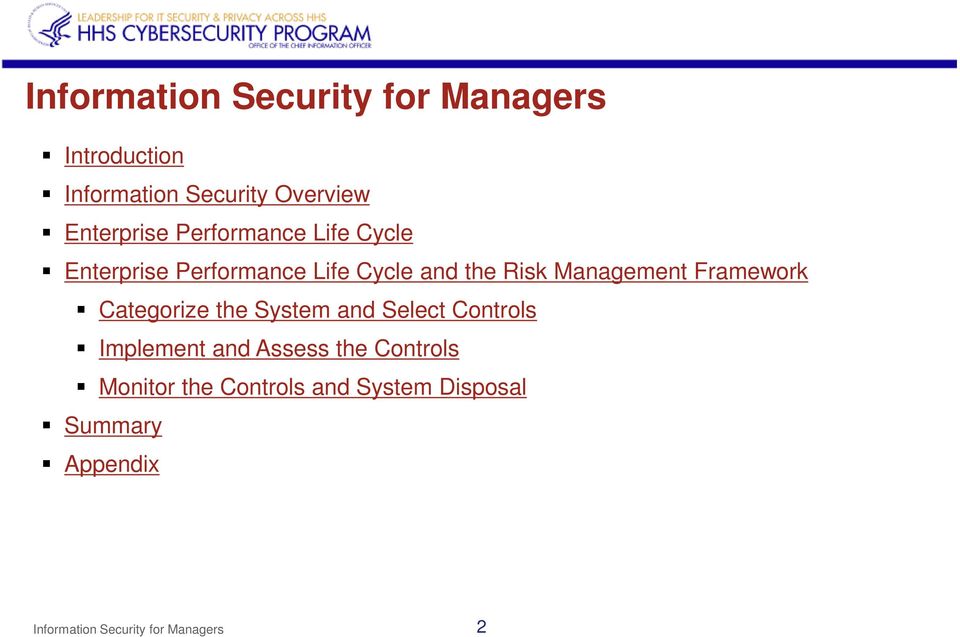
3 Introduction Welcome to Information Security for Managers As a Manager at the Department of Health and Human Services (HHS), you play a vital role in safeguarding HHS systems and information assets. This course will address a risk-based approach to enterprise-wide information security program management and provide an overview of your role in implementing and managing information systems. References to HHS information security policies, standards, and guidance are provided for various course topics. Refer to your Operating Division s (OpDiv) security policies and procedures, in most cases they will be more specific than Department policy. Information Security for Managers 3
4 Introduction Objectives At the end of this course you will be able to: Understand your role and responsibilities to protect information security as an HHS manager. Define the basic components of an information security program. Understand the Enterprise Performance Life Cycle (EPLC) and the Risk Management Framework (RMF) and how they relate to the development of information technology (IT) systems. Identify where to locate HHS policies, procedures, and guidance for developing, implementing, and managing information systems from beginning to end. Information Security for Managers 4
5 Introduction What happens if. A story appears in the national news about HHS data being stolen or disclosed to unauthorized personnel? The public loses confidence in HHS because of a security breach involving personal data? Criminals hack into HHS networks and steal information, threatening the privacy and financial security for millions of people? Information Security for Managers 5

6 Introduction Why is Information Security Important? The American people depend on HHS to keep sensitive information appropriately confidential and available, while maintaining integrity. HHS invests $7 billion annually in IT to support the wide-range of programs that the Department oversees and carries out as part of its mission. Information security professionals promote HHS commitment to better health and well-being by ensuring information is kept secure. Understanding the security risks that information systems are exposed to and taking steps to mitigate them will result in a secure operating environment. Information Security for Managers 6

7 Introduction Federal Information Security Management Act The Federal Information Security Management Act (FISMA) is the backbone of federal legislation regarding information security. It requires federal agencies to develop, document, and implement an enterprise information security program to costeffectively reduce risks to IT assets. Information Security for Managers 7

8 Introduction Federal Legislation and Guidance Other important security and privacy legislation includes: Clinger Cohen Act of 1996 Health Insurance Portability and Accountability Act (HIPAA) Privacy Act of 1974 Office of Management and Budget (OMB) Circular A-130 Paperwork Reduction Act Children s Online Privacy Protection Act (COPPA) The National Institute of Standards and Technology (NIST) issues standards and guidelines to assist federal agencies in implementing security and privacy regulations. The Department uses NIST Special Publications (SP) and Federal Information Processing Standards (FIPS) to develop internal policies, procedures, and guidance. Special publications and FIPS can be found on the NIST Publication Portal. Information Security for Managers 8

9 Introduction Department Governance The HHS Cybersecurity Program is the Department s information security program. Oversight is provided by the Office of the Chief Information Officer (CIO) and Chief Information Security Officer (CISO). The Program provides an enterprise-wide perspective, facilitates coordination among key stakeholders, sets standards and provides guidance to OpDivs, and supports streamlined reporting and metrics capabilities. Operating Divisions manage implementation of Department standards, provide business/domain expertise, develop policies and procedures specific to the OpDiv s operating environment, and manage ongoing operations. Information Security for Managers 9

10 Information Security Overview Information Security for Managers 10
11 Information Security Overview Introduction Individuals with responsibilities for the implementation and management of information systems must understand how their role relates to the information security program at the Department and OpDiv level. Such an understanding will enable mangers to perform their duties with a mindset of appropriate and adequate protection for HHS IT resources. Information Security for Managers 11

12 Information Security Overview Information Security Program Objectives The overall objective of an information security program is to protect the information and systems that support the operations of the Department. To safeguard each system at HHS is to ensure that the following security objectives can be realized for their information: Confidentiality - Protecting information from unauthorized access and disclosure. Integrity - Assuring the reliability and accuracy of information and IT resources by guarding against unauthorized information modification or destruction. Availability - Defending information systems and resources to ensure timely and reliable access to and use of information. Information Security for Managers 12
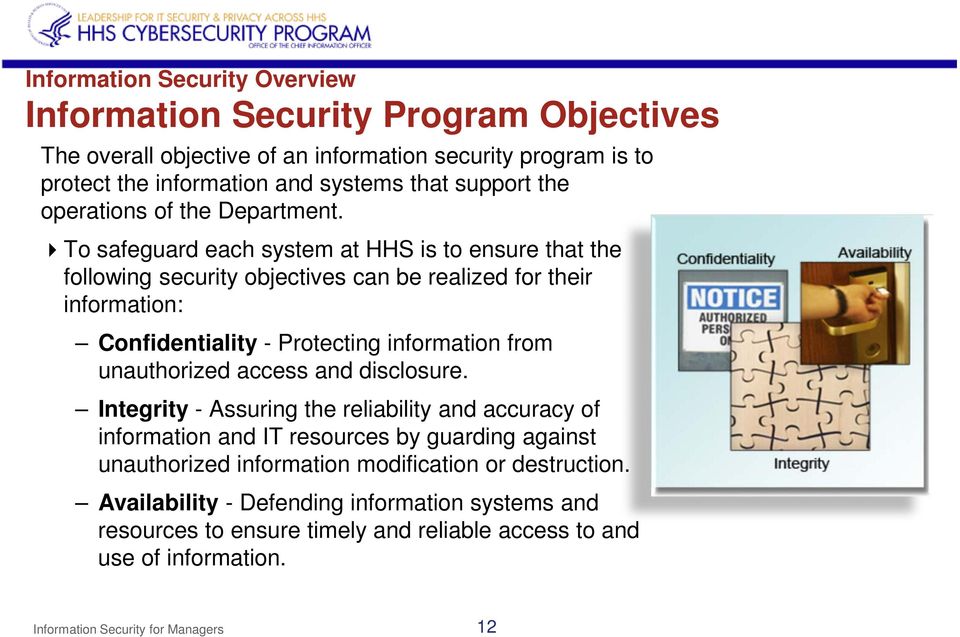
13 Information Security Overview Threats Information systems are not perfect, nor are the people that interact with them, or the environments in which they function. As such, systems are vulnerable to misuse, interruptions and manipulation. A threat is the potential to cause unauthorized disclosure, unavailability, changes, or destruction of an asset. Threats can come from inside or outside HHS: External forces can disrupt a system, such as a hacker maliciously accessing or corrupting data, or a storm disrupting power and network access. An example of an internal threat is an employee who inappropriately changes, deletes, or uses data. Information Security for Managers 13

14 Information Security Overview Vulnerability A vulnerability is any flaw or weakness that can be exploited and could result in a breach or a violation of a system s security policy. Some examples of vulnerabilities include: Poorly communicated or implemented policy; Inadequately trained personnel; and Improperly configured systems or controls. Information Security for Managers 14
15 Information Security Overview Risk A threat that exploits a vulnerability can allow information to be accessed, manipulated, deleted, or otherwise affected by those without the proper authority. It may also prevent data or a system from being accessed. Risk is the likelihood that a threat will exploit a vulnerability. For example, a system without a backup power source is vulnerable. A thunderstorm would create the threat of a power outage and increase the likelihood of system failure. Risk management is the process of identifying threats and vulnerabilities to IT assets and establishing acceptable controls to reduce the likelihood of a security breach or violation. Information Security for Managers 15

16 Information Security Overview Security Controls No information system is completely safe from threats, however controls help mitigate risks. Controls are policies, procedures, and practices designed to decrease the likelihood, manage the impact, or minimize the effect of a threat exploiting a vulnerability. Examples of controls include: Clearly documented roles and responsibilities; Security awareness and training program; Incident response planning; Physical security, like guards, badges, and fences; Environmental controls in server rooms; and Access controls, like PIV cards to log-on to the network. Information Security for Managers 16
17 Information Security Overview Recap The goal of the information security program is to keep information and information systems confidential, available, and with integrity. The likelihood and impact of a threat exploiting a vulnerability is a risk to the system. Example: Account privileges are not disabled when employees are terminated (vulnerability). A disgruntled former employee (threat) creates a risk that the organization s network and data will be compromised. There is an inherent risk in operating any information system. Controls help minimize and avoid some of the risk. Information Security for Managers 17
18 Enterprise Performance Life Cycle Information Security for Managers 18
19 Enterprise Performance Life Cycle Introduction The EPLC is a standardized project management methodology that guides HHS IT investments and ensures that mission objectives are being met throughout the lifetime of a system. Security is essential to developing or deploying a successful IT system. Information technology administrators, like yourself, should be part of the EPLC from the beginning. A detailed explanation of the EPLC can be found in the Enterprise Performance Life Cycle Framework Overview Document ( Information Security for Managers 19
20 Enterprise Performance Life Cycle Phases The EPLC consists of ten phases that guide the development process from initiation to termination. Ten Phases of the EPLC 1. Initiation 2. Concept 3. Planning 4. Requirements Analysis 5. Design 6. Development 7. Test 8. Implementation 9. Operations & Maintenance 10. Disposition Information Security for Managers 20
21 Enterprise Performance Life Cycle Benefits EPLC: Ensures that IT projects have financial support throughout the life cycle; Evaluates IT projects to determine whether they align with HHS and/or OpDiv goals; Plans for and allocates part of the budget for system security from the beginning of the project; and Determines that a similar IT asset does not exist, and the new project will meet the business need it is developed to address. The EPLC is flexible. Each phase can be tailored to meet specific characteristics of the project taking in to account the size, duration, complexity of the project, etc. Information Security for Managers 21
22 Enterprise Performance Life Cycle Stakeholders Stakeholders are an essential piece of the EPLC puzzle. There can be many stakeholders depending on the size and scope of the project. In general, every project will include: Project Managers are responsible for planning, executing and overseeing phase activities. They also are responsible for creating the deliverables for review in conjunction with the Critical Partners. Critical Partners are responsible for reviewing the project deliverables and validating policies in their functional areas. IT Governance Organizations approve projects and monitor baselines and performance metrics throughout the life cycle. They also approve projects to advance to the next phase based on the recommendations of the Critical Partners. Information Security for Managers 22
23 Enterprise Performance Life Cycle Deliverables The EPLC Framework Overview describes the documents and artifacts that need to be developed in each phase of the life cycle. Tailoring may reduce the level of effort and artifacts required for the phases. Changes to required documentation are identified in the Tailoring Agreement. For security documentation, at a minimum each system must have a System Security Plan (SSP), Risk Assessment, and Authorization to Operate (ATO). Documentation needs to be maintained throughout the life cycle of a system and should be stored accordingly. Information Security for Managers 23
24 Enterprise Performance Life Cycle Stage Gate Reviews Approval of the project s key elements happen at Stage Gate Reviews during each of the ten phases. Some reviews require governance oversight, while others are conducted internally. Stage Gate Reviews evaluate: Successful accomplishment of phase objectives; Plans for the next life cycle phase; and Risks associated with transitioning to the next phase. Critical Partners are involved in the review and provide recommended actions to take place before the project moves to the next phase. Information Security for Managers 24
25 Enterprise Performance Life Cycle Exit Criteria At the end of each phase, the project deliverables demonstrate evidence that the project has met the objectives of the phase. The EPLC Stage Gate Review Template lists the Mandatory Exit Criteria for each phase. Information Security for Managers 25
26 Enterprise Performance Life Cycle Recap The EPLC is HHS IT project management methodology. The EPLC ensures that IT systems meet business and mission objectives, are well managed, and cost-effective from inception to disposal. Building security into a system early in the design process is far more efficient than trying to add it on during or after development. Security Critical Partners ensure that security and privacy concerns are addressed during each phase of the life cycle. Information Security for Managers 26
27 EPLC and the Risk Management Framework Information Security for Managers 27
28 EPLC and the Risk Management Framework Introduction The RMF, as described in NIST SP Rev. 1, Guide for Applying the Risk Management Framework to Federal Information Systems, establishes a common risk management framework for all federal agencies to improve security and strengthen risk management processes. The RMF is a formal process used by HHS to ensure that security activities and artifacts are developed for all systems and applications at the right time. Information Security for Managers 28
29 EPLC and the Risk Management Framework Risk Management Framework At HHS, the RMF helps: Develop secure and compliant systems in a cost effective manner. Integrate security practices throughout the EPLC. Communicate security concepts and create a general understanding of security requirements. Provide support to project managers by helping them understand and comply with security requirements. Source: NIST SP Rev.1 Information Security for Managers 29
30 EPLC and the Risk Management Framework EPLC and RMF Integration The RMF is integrated into the EPLC so that IT security best practices and standards are built into a project from the beginning. The image below shows how the six steps of RMF are merged across the ten phases of the EPLC. Information Security for Managers 30
31 EPLC and the Risk Management Framework CATEGORIZE THE SYSTEM AND SELECT CONTROLS During this step: The system is categorized; and Controls are selected based on the system categorization Information Security for Managers 31
32 Categorize the System Risk Assessment Risk assessment or risk analysis is a process of identifying risks to agency operations (including mission, functions, image, or reputation), agency assets, or individuals. The process incorporates threat and vulnerability analysis. It includes determining the likelihood that a security incident could occur, the resulting impact, and additional security controls that would mitigate this impact. Risk assessments should initially be conducted during the Initiation and Development stage of the EPLC. A risk assessment is also a required part of the security documentation for a security authorization. Information Security for Managers 32
33 Categorize the System Determine Risk Impact Level FIPS 199 is used to determine the system categorization level of an IT system. Systems can be categorized as low, moderate, or high-impact for each of the security objectives: confidentiality, integrity, and availability. FIPS 200 is used to determine the system impact level, based on the categorization. Once the impact level is established, an appropriate set of controls, as identified in NIST SP Rev. 4, Security and Privacy Controls for Federal Information Systems and Organizations can be chosen. NIST SP Rev. 1, Guide for Mapping Types of Information and Information Systems to Security Categories is used to apply appropriate levels of controls for the system categorization. Information Security for Managers 33
34 Categorize the System Risk Impact Assessment FIPS 199 defines three categories of impact: Low: The potential impact is Low if the loss of confidentiality, integrity, and availability could be expected to have a limited adverse effect on organizational operations, organizational assets, or individuals. Moderate: The potential impact is Moderate if the loss of confidentiality, integrity, and availability could be expected to have a serious adverse effect on organizational operations, organizational assets, or individuals. High: The potential impact is High if the loss of confidentiality, integrity, and availability could be expected to have a severe or catastrophic adverse effect on organizational operations, organizational assets, or individuals. Information Security for Managers 34
35 Categorize the System High Water Mark The high water mark concept is employed because there are significant dependencies among the security objectives of confidentiality, integrity, and availability. In most cases, a compromise in one security objective ultimately affects the other security objectives as well. According to FIPS 200, a high water mark is the highest potential impact value assigned to each security objective for each type of information resident on those information systems. Example 1 A system has two moderate risk applications and one high risk application residing on it, the overall impact rating is high. Example 2 A system is categorized as low for availability, low for integrity, but high for confidentiality, the overall impact rating is high. Information Security for Managers 35
36 Select the Controls Control Selection Security controls are selected using NIST SP Rev. 4 in combination with the low/moderate/high risk management guidance in FIPS 199 and FIPS 200. HHS security procedures and practices reflect the NIST and FIPS recommendations and requirements. Information Security for Managers 36
37 Select the Controls System Controls NIST SP Rev. 4 divides controls into families. There are 18 security control families and eight privacy control families. In previous revisions, controls were organized in three classes - Management, Operational, and Technical. Although class designations have been eliminated from Rev. 4, it may be useful for an organization to apply them to individual security controls and their components. Management Controls: Focus on the management of the computer security system and the management of risk for a system. They are techniques and concerns that are normally addressed by management, through policy and documentation. Operational Controls: Address security issues related to mechanisms primarily implemented and executed by people (as opposed to systems). Often, they require technical or specialized expertise and rely upon management activities as well as technical controls. Technical Controls: Technical controls are security controls that are configured within the system. Technical controls can provide automated protection for unauthorized access or misuse, facilitate detection of security violations, and support security requirements for applications and data. Information Security for Managers 37
38 Select the Controls Security Control Families Management Operational Technical Security Assessments and Authorization Planning Risk Assessment System and Services Acquisition Program Management Awareness and Training Configuration Management Contingency Planning Incident Response Maintenance Media Protection Physical and Environmental Protection Personnel Security System and Information Integrity Access Control Audit and Accountability Identification and Authentication System and Communications Protection Information Security for Managers 38
39 Categorize the System and Select Controls Recap The categorization of the system directly effects the types of controls that are chosen for it. There are three categories of potential impact: low, moderate, or high. These three categories determine how secure a system must be to ensure confidentiality, integrity, and availability. NIST SP Rev. 4 contains a catalog of 18 security control families and eight privacy control families. Information Security for Managers 39
40 EPLC and the Risk Management Framework IMPLEMENT AND ASSESS THE CONTROLS During this step: Most of the security documentation is produced; and Controls are tested. Information Security for Managers 40
41 Implement the Controls System Security Plan The System Security Plan (SSP) for each system includes necessary information for the Authorizing Official (AO) to grant an ATO. The plan contains: System identification, which includes the system owner, general description and purpose of the system, and equipment list; A list of minimum security controls; and Security documents that were developed during the EPLC. The SSP should be reviewed and updated or verified at least annually once the system is operational. If the system has changed (system environment, software, hardware, user groups, etc.), the SSP should be updated as soon as the change is made. Information Security for Managers 41
42 Implement the Controls Contingency Plan A Contingency Plan for each system is required by law and includes the following key sections: System criticality; Responsibilities; Business impact analysis; Preventive controls; Damage assessment; Recovery and reconstitution; and Backup requirements. Information Security for Managers 42
43 Implement the Controls Configuration Management Plan Configuration management plans are documented for systems to ensure technical integrity of data within the system. Key components of the configuration management plan include: Roles and Responsibilities - Roles for system configuration management personnel and specific responsibilities (e.g., Executives, System Owners, Developers) are documented in detail. Configuration Control Process - Procedures are documented that specify the initiation, approval, change, and acceptance processes for all change requests. Supplemental Configuration Management Information - Information such as examples of change requests, explanation or user guidelines for automated configuration management tools should also be included in the plan. Information Security for Managers 43
44 Implement the Controls Privacy Impact Assessment A Privacy Impact Assessment (PIA) is an assessment process for identifying and mitigating the privacy risks posed by an information system. It is required for every system. At a minimum, PIAs must analyze and describe the following: What information is to be collected; Why the information is being collected (e.g., to determine eligibility); Intended use of the information (e.g., to verify existing data); and With whom the information will be shared (e.g., another agency for a specified programmatic purpose). Information Security for Managers 44
45 Implement the Controls Privacy Impact Assessment Additionally, PIAs must include information on: When and how individuals can consent to or decline particular uses of the information (other than required or authorized uses); How the information will be secured (i.e., management, operational, and technological controls); and Whether a system of records is being created under the Privacy Act of Information Security for Managers 45
46 Assess the Controls Security Control Assessment and Security Test & Evaluation A Security Control Assessment (SCA) is the formal evaluation of a system against a defined set of controls. It is conducted in conjunction with or independently of a full Security Test and Evaluation (ST&E), which is performed as part of the security authorization. The SCA and ST&E will evaluate the implementation (or planned implementation) of controls as defined in the SSP. The results are the risk assessment report. This report will document the system s areas of risk. Types of system tests conducted include audits, security reviews, vulnerability scanning, and penetration testing. Information Security for Managers 46
47 Assess the Controls Plan of Action and Milestones Plan of Action and Milestones (POA&M) are a FISMA requirement to effectively manage security program risk and mitigate program-and system-level weaknesses. Effective POA&M management increases the awareness of an OpDiv s security posture, identifies systemic areas to address, and contributes to developing informed risk based decisions. Every IT system should have a POA&M to identify, manage, and mitigate weaknesses. All security and privacy weaknesses shall be recorded and managed in the POA&M. Sources of these weaknesses can come from many locations such as audit reports, a security authorization cycle, and incidents. Information Security for Managers 47
48 Assess the Controls Authorization to Operate Authorization is required before a system may process, store, or transmit Department data. An AO or a designated representative reviews the security authorization package. The AO or designated representative will then give a system either an ATO or Denial of Authorization to Operate. An ATO signifies completion of an objective third party system evaluation and acceptance of any residual risk of the system to the agency. This means that the AO takes responsibility if a security incident related to a known risk were to occur. Denial of Authorization to Operate indicates that there are major weaknesses or deficiencies in the security controls employed within or inherited by the information system. This rarely occurs if the processes outlined in the EPLC Framework Overview are followed. Information Security for Managers 48
49 Implement and Assess the Controls Recap Most of the security documentation is finalized during this step. The documentation is used by the AO to determine if an ATO should be issued for the system. Every system must have an SSP, Risk Assessment, and ATO to operate. A POA&M is also required when weaknesses are identified. Information Security for Managers 49
50 EPLC and the Risk Management Framework MONITOR THE CONTROLS & SYSTEM DISPOSAL During this step: Controls are monitored and periodically tested; and Plans are made to securely terminate the system. Information Security for Managers 50
51 Monitor the Controls Configuration Management Once operational, systems are typically in a constant state of modification and enhancement, such as upgrades to components. Any change can have a significant impact on the security posture of the system. Therefore, continually documenting system changes and assessing the potential impact on the security is an essential aspect of maintaining system accreditation. Adherence to your OpDiv s configuration and change management procedures is necessary to maintain an accurate inventory of all changes to the system. Information Security for Managers 51
52 Monitor the Controls Patch Management Part of maintaining a system is to ensure system components are kept up-to-date with patches. Effective patch management entails maintaining an awareness of system vulnerabilities and available patches for mitigation. Patches are periodically released for operating systems, office suites, commercial software tools and applications, and commonly used utilities. Patches should be tested before deployment to a production environment to prevent adverse impacts to operational systems. Information Security for Managers 52
53 Monitor the Controls Continuous Monitoring FISMA requires periodic and continuous testing and evaluation of the security controls to ensure that they remain effective. The ongoing monitoring of security controls can be accomplished by one or a combination of the following: Security review; Security testing; Evaluation or audit; and Software/Hardware tools. Information Security for Managers 53
54 System Disposal Disposal of System Components Media sanitization is important either at the end of the system s life cycle or at any point when new hardware or media is replacing existing hardware or media. System disposal has five parts as stated in NIST SP Rev. 2, Security Considerations in the System Development Life Cycle: Building and Executing a Disposal/Transition Plan ensures that all stakeholders are aware of the future plan for the system and its information. This plan should account for the disposal / transition status for all critical components, services, and information. Information Preservation ensures that information is retained, as necessary, to conform to current legal requirements and to accommodate future technology changes that may render the retrieval method obsolete. Information Security for Managers 54
55 System Disposal Disposal of System Components (Continued) Media Sanitization ensures that data is deleted, erased, and written over as necessary to retain confidentiality. Hardware and Software Disposal ensures that hardware and software is disposed of as directed by the Information Systems Security Officer. System Closure ensures that the information system is formally shut down and disassembled. For additional information, see the HHS-OCIO Policy for Information Systems Security and Privacy and NIST SP , Guidelines for Media Sanitization. Information Security for Managers 55
56 System Disposal Planning for Disposal Disposing of systems is a predictable occurrence. Planning ahead for the integration of security measures into the replacement process helps you securely and conscientiously manage both disposal and introduction of new hardware or software. Ensure that the purchase and installation of new equipment does not conflict with the proper disposal of data and old equipment. This prevents creating unnecessary vulnerabilities or an incident which could cause embarrassment to or damage the reputation of HHS. Always take time to dispose of systems hardware and media properly! Information Security for Managers 56
57 Monitor the Controls & System Disposal Recap Once a system is operational, controls should be monitored for effectiveness and tested periodically. Changes in the configuration of the system could significantly impact security. It is critical to properly dispose of information systems and archive the data they contain. Plan and budget for disposal of the system early. Information Security for Managers 57
58 EPLC and the Risk Management Framework Recap The six steps of the RMF are integrated across the ten phases of the EPLC to improve security and strengthen risk management processes. Each phase requires activities and deliverables to ensure that security is addressed throughout the life of the IT system. Information Security for Managers 58
59 Summary Information Security for Managers 59
60 Summary Conclusion Building security into a system early in the design process is far more efficient than trying to add it during or after development. Security is part of the foundation of a system. Resources are needed to design, develop, implement, and test the security features of the system. The EPLC and the RMF will ensure that security is an integral part of information systems at HHS. Information Security for Managers 60
61 Summary Objectives You should now be able to: Understand your role and responsibilities to protect information security as an HHS manager. Define the basic components of an information security program. Understand the EPLC and the RMF and how they relate to the development of IT systems. Identify where to locate HHS policies, procedures, and guidance for developing, implementing, and managing information systems from beginning to end. Information Security for Managers 61
62 Appendix HHS Resources The HHS Cybersecurity Program is the Department s enterprise-wide information security and privacy program, helping to protect HHS against potential IT threats and vulnerabilities. The Program plays an important role in protecting HHS' ability to provide mission-critical operations, and is an enabler for e-government. HHS Cybersecurity Program Support provides assistance with IT security and privacy related questions. HHS Cybersecurity Program Support is staffed Monday through Friday from 8:00 AM to 5:00 PM eastern standard time (EST). Web: HHS Cybersecurity Program Phone: (202) [email protected] Information Security for Managers 62
63 Appendix HHS Resources HHS-OCIO Policy for Information Systems Security and Privacy The Enterprise Performance Life Cycle Framework Overview Document provides detailed information about how to complete each phase of the EPLC. It can be found at: Templates, practice guides, checklists and other artifacts used throughout the EPLC process, including the Stage Gate Reviews template can be found at: 0Gate%20Reviews/eplc_stage_gate_reviews.html. Information Security for Managers 63
64 Appendix Legislation and Guidance Legislation E-Government Act [includes FISMA] (P.L ), December Federal Information Security Management Act (P.L , Title III), December 2002 Paperwork Reduction Act (P.L ), May Standards NIST Federal Information Processing Standards (FIPS) Publication 199, Standards for Security Categorization of Federal Information and Information Systems, February NIST FIPS Publication 200, Minimum Security Requirements for Federal Information and Information Systems, March Information Security for Managers 64
65 Appendix Legislation and Guidance NIST Guidance NIST SP Rev. 1, Guide for Developing Security Plans for Federal Information Systems, February NIST SP Rev. A, Engineering Principles for Information Technology Security (A Baseline for Achieving Security), June NIST SP , Risk Management Guide for Information Technology Systems, July NIST SP Rev. 1, Guide for Applying the Risk Management Framework to Federal Information Systems, February NIST SP (Second Public Draft), Managing Risk from Information Systems: An Organizational Perspective, April NIST SP Rev. 4, Security and Privacy Controls for Federal Information Systems and Organizations, April Information Security for Managers 65
66 Appendix Legislation and Guidance NIST SP A, Guide for Assessing the Security Controls in Federal Information Systems: Building Effective Security Assessment Plans, July NIST SP , Guideline for Identifying an Information System as a National Security System, August NIST SP , Rev. 1, Guide for Mapping Types of Information and Information Systems to Security Categories, August NIST SP Rev. 2, Security Considerations in the System Development Life Cycle, October NIST SP , Rev. 1, National Checklist Program for IT Products--Guidelines for Checklist Users and Developers, September NIST SP , Guidelines for Media Sanitization, September Information Security for Managers 66
67 Congratulations You have completed the Information Security for Managers course. Information Security for Managers 67
Information Security for IT Administrators
 Fiscal Year 2015 Information Security for IT Administrators Introduction Safeguarding the HHS Mission Information Security Program Management Enterprise Performance Life Cycle Enterprise Performance Life
Information Security for Executives
 Fiscal Year 2015 Information Security for Executives Introduction Information Security Overview Information Security Policy and Governance Data Protection Security and Your Business Summary Appendix Information
Office of Inspector General
 DEPARTMENT OF HOMELAND SECURITY Office of Inspector General Security Weaknesses Increase Risks to Critical United States Secret Service Database (Redacted) Notice: The Department of Homeland Security,
Get Confidence in Mission Security with IV&V Information Assurance
 Get Confidence in Mission Security with IV&V Information Assurance September 10, 2014 Threat Landscape Regulatory Framework Life-cycles IV&V Rigor and Independence Threat Landscape Continuously evolving
FISH AND WILDLIFE SERVICE INFORMATION RESOURCES MANAGEMENT. Chapter 7 Information Technology (IT) Security Program 270 FW 7 TABLE OF CONTENTS
 TABLE OF CONTENTS General Topics Purpose and Authorities Roles and Responsibilities Policy and Program Waiver Process Contact Abbreviated Sections/Questions 7.1 What is the purpose of this chapter? 7.2
Independent Evaluation of NRC s Implementation of the Federal Information Security Modernization Act of 2014 for Fiscal Year 2015
 Independent Evaluation of NRC s Implementation of the Federal Information Security Modernization Act of 2014 for Fiscal Year 2015 OIG-16-A-03 November 12, 2015 All publicly available OIG reports (including
U.S. ELECTION ASSISTANCE COMMISSION OFFICE OF INSPECTOR GENERAL
 U.S. ELECTION ASSISTANCE COMMISSION OFFICE OF INSPECTOR GENERAL FINAL REPORT: U.S. Election Assistance Commission Compliance with the Requirements of the Federal Information Security Management Act Fiscal
Dr. Ron Ross National Institute of Standards and Technology
 Managing Enterprise Risk in Today s World of Sophisticated Threats A Framework for Developing Broad-Based, Cost-Effective Information Security Programs Dr. Ron Ross National Institute of Standards and
Final Audit Report -- CAUTION --
 U.S. OFFICE OF PERSONNEL MANAGEMENT OFFICE OF THE INSPECTOR GENERAL OFFICE OF AUDITS Final Audit Report Audit of the Information Technology Security Controls of the U.S. Office of Personnel Management
Minimum Security Requirements for Federal Information and Information Systems
 FIPS PUB 200 FEDERAL INFORMATION PROCESSING STANDARDS PUBLICATION Minimum Security Requirements for Federal Information and Information Systems Computer Security Division Information Technology Laboratory
FEDERAL HOUSING FINANCE AGENCY OFFICE OF INSPECTOR GENERAL
 FEDERAL HOUSING FINANCE AGENCY OFFICE OF INSPECTOR GENERAL Clifton Gunderson LLP s Independent Audit of the Federal Housing Finance Agency s Information Security Program - 2011 Audit Report: AUD-2011-002
Security Control Standard
 Department of the Interior Security Control Standard Risk Assessment January 2012 Version: 1.2 Signature Approval Page Designated Official Bernard J. Mazer, Department of the Interior, Chief Information
2012 FISMA Executive Summary Report
 2012 FISMA Executive Summary Report March 29, 2013 UNITED STATES SECURITIES AND EXCHANGE COMMISSION WASHINGTON, D.C. 20549 OI'!'ICEOI' lnstfl! C1'0R GENERAt MEMORANDUM March 29,2013 To: Jeff Heslop, Chief
HIGH-RISK SECURITY VULNERABILITIES IDENTIFIED DURING REVIEWS OF INFORMATION TECHNOLOGY GENERAL CONTROLS
 Department of Health and Human Services OFFICE OF INSPECTOR GENERAL HIGH-RISK SECURITY VULNERABILITIES IDENTIFIED DURING REVIEWS OF INFORMATION TECHNOLOGY GENERAL CONTROLS AT STATE MEDICAID AGENCIES Inquiries
Review of the SEC s Systems Certification and Accreditation Process
 Review of the SEC s Systems Certification and Accreditation Process March 27, 2013 Page i Should you have any questions regarding this report, please do not hesitate to contact me. We appreciate the courtesy
Cybersecurity Risk Management Activities Instructions Fiscal Year 2015
 Cybersecurity Risk Management Activities Instructions Fiscal Year 2015 An effective risk management program and compliance with the Federal Information Security Management Act (FISMA) requires the U.S.
Audit of the Department of State Information Security Program
 UNITED STATES DEPARTMENT OF STATE AND THE BROADCASTING BOARD OF GOVERNORS OFFICE OF INSPECTOR GENERAL AUD-IT-15-17 Office of Audits October 2014 Audit of the Department of State Information Security Program
POSTAL REGULATORY COMMISSION
 POSTAL REGULATORY COMMISSION OFFICE OF INSPECTOR GENERAL FINAL REPORT INFORMATION SECURITY MANAGEMENT AND ACCESS CONTROL POLICIES Audit Report December 17, 2010 Table of Contents INTRODUCTION... 1 Background...1
EVALUATION REPORT. Weaknesses Identified During the FY 2014 Federal Information Security Management Act Review. March 13, 2015 REPORT NUMBER 15-07
 EVALUATION REPORT Weaknesses Identified During the FY 2014 Federal Information Security Management Act Review March 13, 2015 REPORT NUMBER 15-07 EXECUTIVE SUMMARY Weaknesses Identified During the FY 2014
Information Security Program Management Standard
 State of California California Information Security Office Information Security Program Management Standard SIMM 5305-A September 2013 REVISION HISTORY REVISION DATE OF RELEASE OWNER SUMMARY OF CHANGES
Health Insurance Portability and Accountability Act Enterprise Compliance Auditing & Reporting ECAR for HIPAA Technical Product Overview Whitepaper
 Regulatory Compliance Solutions for Microsoft Windows IT Security Controls Supporting DHS HIPAA Final Security Rules Health Insurance Portability and Accountability Act Enterprise Compliance Auditing &
CMS SYSTEM SECURITY PLAN (SSP) PROCEDURE
 Chief Information Officer Office of Information Services Centers for Medicare & Medicaid Services CMS SYSTEM SECURITY PLAN (SSP) PROCEDURE August 31, 2010 Version 1.1 - FINAL Summary of Changes in SSP
5 FAH-11 H-500 PERFORMANCE MEASURES FOR INFORMATION ASSURANCE
 5 FAH-11 H-500 PERFORMANCE MEASURES FOR INFORMATION ASSURANCE 5 FAH-11 H-510 GENERAL (Office of Origin: IRM/IA) 5 FAH-11 H-511 INTRODUCTION 5 FAH-11 H-511.1 Purpose a. This subchapter implements the policy
VA Office of Inspector General
 VA Office of Inspector General OFFICE OF AUDITS & EVALUATIONS Department of Veterans Affairs Federal Information Security Management Act Audit for Fiscal Year 2013 May 29, 2014 13-01391-72 ACRONYMS AND
NATIONAL CREDIT UNION ADMINISTRATION OFFICE OF INSPECTOR GENERAL
 NATIONAL CREDIT UNION ADMINISTRATION OFFICE OF INSPECTOR GENERAL INDEPENDENT EVALUATION OF THE NATIONAL CREDIT UNION ADMINISTRATION S COMPLIANCE WITH THE FEDERAL INFORMATION SECURITY MANAGEMENT ACT (FISMA)
VA Office of Inspector General
 VA Office of Inspector General OFFICE OF AUDITS & EVALUATIONS Department of Veterans Affairs Federal Information Security Management Act Audit for Fiscal Year 2014 May 19, 2015 14-01820-355 ACRONYMS CRISP
Department of Veterans Affairs VA Handbook 6500. Information Security Program
 Department of Veterans Affairs VA Handbook 6500 Washington, DC 20420 Transmittal Sheet September 18, 2007 Information Security Program 1. REASON FOR ISSUE: To provide specific procedures and establish
FSIS DIRECTIVE 1306.3
 UNITED STATES DEPARTMENT OF AGRICULTURE FOOD SAFETY AND INSPECTION SERVICE WASHINGTON, DC FSIS DIRECTIVE 1306.3 REVISION 1 12/13/12 CONFIGURATION MANAGEMENT (CM) OF SECURITY CONTROLS FOR INFORMATION SYSTEMS
The Department of Health and Human Services Privacy Awareness Training. Fiscal Year 2015
 The Department of Health and Human Services Privacy Awareness Training Fiscal Year 2015 Course Objectives At the end of the course, you will be able to: Define privacy and explain its importance. Identify
NIST 800-53A: Guide for Assessing the Security Controls in Federal Information Systems. Samuel R. Ashmore Margarita Castillo Barry Gavrich
 NIST 800-53A: Guide for Assessing the Security Controls in Federal Information Systems Samuel R. Ashmore Margarita Castillo Barry Gavrich CS589 Information & Risk Management New Mexico Tech Spring 2007
CMS POLICY FOR THE INFORMATION SECURITY PROGRAM
 Chief Information Officer Office of Information Services Centers for Medicare & Medicaid Services CMS POLICY FOR THE INFORMATION SECURITY PROGRAM FINAL Version 4.0 August 31, 2010 Document Number: CMS-CIO-POL-SEC02-04.0
Fiscal Year 2014 Federal Information Security Management Act Report: Status of EPA s Computer Security Program
 U.S. ENVIRONMENTAL PROTECTION AGENCY OFFICE OF INSPECTOR GENERAL Information Technology Fiscal Year 2014 Federal Information Security Management Act Report: Status of EPA s Computer Security Program Report.
Audit Report. The Social Security Administration s Compliance with the Federal Information Security Management Act of 2002 for Fiscal Year 2013
 Audit Report The Social Security Administration s Compliance with the Federal Information Security Management Act of 2002 for Fiscal Year 2013 A-14-13-13086 November 2013 MEMORANDUM Date: November 26,
HHS Information System Security Controls Catalog V 1.0
 Information System Security s Catalog V 1.0 Table of Contents DOCUMENT HISTORY... 3 1. Purpose... 4 2. Security s Scope... 4 3. Security s Compliance... 4 4. Security s Catalog Ownership... 4 5. Security
BPA Policy 434-1 Cyber Security Program
 B O N N E V I L L E P O W E R A D M I N I S T R A T I O N BPA Policy Table of Contents.1 Purpose & Background...2.2 Policy Owner... 2.3 Applicability... 2.4 Terms & Definitions... 2.5 Policy... 5.6 Policy
Privacy Impact Assessment (PIA) for the. Certification & Accreditation (C&A) Web (SBU)
 Privacy Impact Assessment (PIA) for the Cyber Security Assessment and Management (CSAM) Certification & Accreditation (C&A) Web (SBU) Department of Justice Information Technology Security Staff (ITSS)
DEPARTMENT OF VETERANS AFFAIRS VA HANDBOOK 6500.5 INCORPORATING SECURITY AND PRIVACY INTO THE SYSTEM DEVELOPMENT LIFE CYCLE
 DEPARTMENT OF VETERANS AFFAIRS VA HANDBOOK 6500.5 Washington, DC 20420 Transmittal Sheet March 22, 2010 INCORPORATING SECURITY AND PRIVACY INTO THE SYSTEM DEVELOPMENT LIFE CYCLE 1. REASON FOR ISSUE: This
HEALTH INSURANCE MARKETPLACES GENERALLY PROTECTED PERSONALLY IDENTIFIABLE INFORMATION BUT COULD IMPROVE CERTAIN INFORMATION SECURITY CONTROLS
 Department of Health and Human Services OFFICE OF INSPECTOR GENERAL HEALTH INSURANCE MARKETPLACES GENERALLY PROTECTED PERSONALLY IDENTIFIABLE INFORMATION BUT COULD IMPROVE CERTAIN INFORMATION SECURITY
Security Control Standard
 Department of the Interior Security Control Standard Security Assessment and Authorization January 2012 Version: 1.2 Signature Approval Page Designated Official Bernard J. Mazer, Department of the Interior,
Security Control Standard
 Department of the Interior Security Control Standard Program Management April 2011 Version: 1.1 Signature Approval Page Designated Official Bernard J. Mazer, Department of the Interior, Chief Information
Final Audit Report. Report No. 4A-CI-OO-12-014
 U.S. OFFICE OF PERSONNEL MANAGEMENT OFFICE OF THE INSPECTOR GENERAL OFFICE OF AUDITS Final Audit Report Subject: AUDIT OF THE INFORMATION TECHNOLOGY SECURITY CONTROLS OF THE U.S. OFFICE OF PERSONNEL MANAGEMENT'S
Data Management Policies. Sage ERP Online
 Sage ERP Online Sage ERP Online Table of Contents 1.0 Server Backup and Restore Policy... 3 1.1 Objectives... 3 1.2 Scope... 3 1.3 Responsibilities... 3 1.4 Policy... 4 1.5 Policy Violation... 5 1.6 Communication...
UNITED STATES DEPARTMENT OF AGRICULTURE FOOD SAFETY AND INSPECTION SERVICE WASHINGTON, DC INFORMATION SYSTEM CERTIFICATION AND ACCREDITATION (C&A)
 UNITED STATES DEPARTMENT OF AGRICULTURE FOOD SAFETY AND INSPECTION SERVICE WASHINGTON, DC FSIS DIRECTIVE 1306.2 9/28/11 INFORMATION SYSTEM CERTIFICATION AND ACCREDITATION (C&A) I. PURPOSE This directive
Lots of Updates! Where do we start?
 NIH Security, FISMA and EPLC Lots of Updates! Where do we start? Kay Coupe NIH FISMA Program Coordinator Office of the Chief Information Officer Project Management Community Meeting October 18, 2011 .
U.S. Department of Energy Office of Inspector General Office of Audits and Inspections. Evaluation Report
 U.S. Department of Energy Office of Inspector General Office of Audits and Inspections Evaluation Report The Department's Unclassified Cyber Security Program 2011 DOE/IG-0856 October 2011 Department of
OFFICE OF INSPECTOR GENERAL. Audit Report. Evaluation of the Railroad Retirement Board Medicare Contractor s Information Security
 OFFICE OF INSPECTOR GENERAL Audit Report Evaluation of the Railroad Retirement Board Medicare Contractor s Information Security Report No. 08-04 September 26, 2008 RAILROAD RETIREMENT BOARD INTRODUCTION
Evaluation Report. Weaknesses Identified During the FY 2013 Federal Information Security Management Act Review. April 30, 2014 Report Number 14-12
 Evaluation Report Weaknesses Identified During the FY 2013 Federal Information Security Management Act Review April 30, 2014 Report Number 14-12 U.S. Small Business Administration Office of Inspector General
Risk Management Guide for Information Technology Systems. NIST SP800-30 Overview
 Risk Management Guide for Information Technology Systems NIST SP800-30 Overview 1 Risk Management Process that allows IT managers to balance operational and economic costs of protective measures and achieve
From Chaos to Clarity: Embedding Security into the SDLC
 From Chaos to Clarity: Embedding Security into the SDLC Felicia Nicastro Security Testing Services Practice SQS USA Session Description This session will focus on the security testing requirements which
OVERVIEW. In all, this report makes recommendations in 14 areas, such as. Page iii
 The Office of the Auditor General has conducted a procedural review of the State Data Center (Data Center), a part of the Arizona Strategic Enterprise Technology (ASET) Division within the Arizona Department
MANAGING THE CONFIGURATION OF INFORMATION SYSTEMS WITH A FOCUS ON SECURITY
 MANAGING THE CONFIGURATION OF INFORMATION SYSTEMS WITH A FOCUS ON SECURITY Shirley Radack, Editor Computer Security Division Information Technology Laboratory National Institute of Standards and Technology
2014 Audit of the Board s Information Security Program
 O FFICE OF I NSPECTOR GENERAL Audit Report 2014-IT-B-019 2014 Audit of the Board s Information Security Program November 14, 2014 B OARD OF G OVERNORS OF THE F EDERAL R ESERVE S YSTEM C ONSUMER FINANCIAL
NOTICE: This publication is available at: http://www.nws.noaa.gov/directives/.
 Department of Commerce National Oceanic & Atmospheric Administration National Weather Service NATIONAL WEATHER SERVICE Instruction 60-701 28 May 2012 Information Technology IT Security Assignment of Responsibilities
AUDIT REPORT. The Energy Information Administration s Information Technology Program
 U.S. Department of Energy Office of Inspector General Office of Audits and Inspections AUDIT REPORT The Energy Information Administration s Information Technology Program DOE-OIG-16-04 November 2015 Department
EPA Classification No.: CIO-2150.3-P-02.1 CIO Approval Date: 08/06/2012 CIO Transmittal No.: 12-003 Review Date: 08/06/2015
 Issued by the EPA Chief Information Officer, Pursuant to Delegation 1-19, dated 07/07/2005 INFORMATION SECURITY INTERIM AWARENESS AND TRAINING PROCEDURES V3.1 JULY 18, 2012 1. PURPOSE The purpose of this
TREASURY INSPECTOR GENERAL FOR TAX ADMINISTRATION
 TREASURY INSPECTOR GENERAL FOR TAX ADMINISTRATION Improvements Are Needed to the Information Security Program March 11, 2008 Reference Number: 2008-20-076 This report has cleared the Treasury Inspector
Information Technology Security Review April 16, 2012
 Information Technology Security Review April 16, 2012 The Office of the City Auditor conducted this project in accordance with the International Standards for the Professional Practice of Internal Auditing
DEPARTMENT OF THE INTERIOR. Privacy Impact Assessment Guide. Departmental Privacy Office Office of the Chief Information Officer
 DEPARTMENT OF THE INTERIOR Privacy Impact Assessment Guide Departmental Privacy Office Office of the Chief Information Officer September 30, 2014 Table of Contents INTRODUCTION... 1 Section 1.0 - What
FedRAMP Standard Contract Language
 FedRAMP Standard Contract Language FedRAMP has developed a security contract clause template to assist federal agencies in procuring cloud-based services. This template should be reviewed by a Federal
How To Improve Nasa'S Security
 DECEMBER 5, 2011 AUDIT REPORT OFFICE OF AUDITS NASA FACES SIGNIFICANT CHALLENGES IN TRANSITIONING TO A CONTINUOUS MONITORING APPROACH FOR ITS INFORMATION TECHNOLOGY SYSTEMS OFFICE OF INSPECTOR GENERAL
INFORMATION SECURITY. Additional Oversight Needed to Improve Programs at Small Agencies
 United States Government Accountability Office Report to Congressional Requesters June 2014 INFORMATION SECURITY Additional Oversight Needed to Improve Programs at Small Agencies GAO-14-344 June 2014 INFORMATION
Office of Inspector General
 Office of Inspector General DEPARTMENT OF HOMELAND SECURITY U.S. Department of Homeland Security Washington, DC 20528 Office of Inspector General Security Weaknesses Increase Risks to Critical DHS Databases
DIVISION OF INFORMATION SECURITY (DIS)
 DIVISION OF INFORMATION SECURITY (DIS) Information Security Policy Information Systems Acquisitions, Development, and Maintenance v1.0 October 15, 2013 Revision History Update this table every time a new
PHASE 9: OPERATIONS AND MAINTENANCE PHASE
 PHASE 9: OPERATIONS AND MAINTENANCE PHASE During the Operations and Maintenance Phase, the information system s availability and performance in executing the work for which it was designed is maintained.
CTR System Report - 2008 FISMA
 CTR System Report - 2008 FISMA February 27, 2009 TABLE of CONTENTS BACKGROUND AND OBJECTIVES... 5 BACKGROUND... 5 OBJECTIVES... 6 Classes and Families of Security Controls... 6 Control Classes... 7 Control
Automate Risk Management Framework
 Automate Risk Management Framework Providing Dynamic Continuous Monitoring, Operationalizing Cybersecurity and Accountability for People, Process and Technology Computer Network Assurance Corporation (CNA)
INFORMATION TECHNOLOGY POLICY
 COMMONWEALTH OF PENNSYLVANIA DEPARTMENT OF PUBLIC WELFARE INFORMATION TECHNOLOGY POLICY Name Of : DPW Information Security and Privacy Policies Domain: Security Date Issued: 05/09/2011 Date Revised: 11/07/2013
Overview. FedRAMP CONOPS
 Concept of Operations (CONOPS) Version 1.0 February 7, 2012 Overview Cloud computing technology allows the Federal Government to address demand from citizens for better, faster services and to save resources,
Office of the Auditor General Performance Audit Report. Statewide UNIX Security Controls Department of Technology, Management, and Budget
 Office of the Auditor General Performance Audit Report Statewide UNIX Security Controls Department of Technology, Management, and Budget December 2015 State of Michigan Auditor General Doug A. Ringler,
UF IT Risk Assessment Standard
 UF IT Risk Assessment Standard Authority This standard was enacted by the UF Senior Vice President for Administration and the UF Interim Chief Information Officer on July 10, 2008 [7]. It was approved
U.S. Department of Energy Office of Inspector General Office of Audits & Inspections. Evaluation Report
 U.S. Department of Energy Office of Inspector General Office of Audits & Inspections Evaluation Report The Department's Unclassified Cyber Security Program - 2012 DOE/IG-0877 November 2012 MEMORANDUM FOR
NIST Special Publication (SP) 800-64, Revision 2, Security Considerations in the System Development Life Cycle
 THE SYSTEM DEVELOPMENT LIFE CYCLE (SDLC) Shirley Radack, Editor Computer Security Division Information Technology Laboratory National Institute of Standards and Technology The most effective way to protect
FREQUENTLY ASKED QUESTIONS
 FREQUENTLY ASKED QUESTIONS Continuous Monitoring 1. What is continuous monitoring? Continuous monitoring is one of six steps in the Risk Management Framework (RMF) described in NIST Special Publication
HIPAA Security. 6 Basics of Risk Analysis and Risk Management. Security Topics
 HIPAA Security SERIES Security Topics 1. Security 101 for Covered Entities 2. Security Standards - Administrative Safeguards 3. Security Standards - Physical Safeguards 4. Security Standards - Technical
IT Security Management Risk Analysis and Controls
 IT Security Management Risk Analysis and Controls Steven Gordon Document No: Revision 770 3 December 2013 1 Introduction This document summarises several steps of an IT security risk analysis and subsequent
Sample CDC Certification and Accreditation Checklist For an Application That Is Considered a Moderate Threat
 Sample CDC Certification and Accreditation Checklist For an Application That Is Considered a Moderate Threat Centers for Disease and Prevention National Center for Chronic Disease Prevention and Health
NASA OFFICE OF INSPECTOR GENERAL
 NASA OFFICE OF INSPECTOR GENERAL OFFICE OF AUDITS SUITE 8U71, 300 E ST SW WASHINGTON, D.C. 20546-0001 April 14, 2016 TO: SUBJECT: Renee P. Wynn Chief Information Officer Final Memorandum, Review of NASA
Build (develop) and document Acceptance Transition to production (installation) Operations and maintenance support (postinstallation)
 It is a well-known fact in computer security that security problems are very often a direct result of software bugs. That leads security researches to pay lots of attention to software engineering. The
IBM Internet Security Systems October 2007. FISMA Compliance A Holistic Approach to FISMA and Information Security
 IBM Internet Security Systems October 2007 FISMA Compliance A Holistic Approach to FISMA and Information Security Page 1 Contents 1 Executive Summary 1 FISMA Overview 3 Agency Challenges 4 The IBM ISS
Privacy Impact Assessment. For Person Authentication Service (PAS) Date: January 9, 2015
 For Person Authentication Service (PAS) Date: January 9, 2015 Point of Contact and Author: Hanan Abu Lebdeh [email protected] System Owner: Ganesh Reddy [email protected] Office of Federal Student
EPA Classification No.: CIO-2150.3-P-09.1 CIO Approval Date: 08/06/2012 CIO Transmittal No.: 12-003 Review Date: 08/06/2015
 Issued by the EPA Chief Information Officer, Pursuant to Delegation 1-19, dated 07/07/2005 INFORMATION SECURITY INTERIM MAINTENANCE PROCEDURES V1.8 JULY 18, 2012 1. PURPOSE The purpose of this procedure
U.S. DEPARTMENT OF THE INTERIOR OFFICE OF INSPECTOR GENERAL Verification of Previous Office of Inspector General Recommendations September 2009
 U.S. DEPARTMENT OF THE INTERIOR OFFICE OF INSPECTOR GENERAL Verification of Previous Office of Inspector General Recommendations September 2009 ISD-EV-MOA-0002-2009 Contents Acronyms and Other Reference
Information Technology Security Training Requirements APPENDIX A. Appendix A Learning Continuum A-1
 APPENDIX A Appendix A Learning Continuum A-1 Appendix A Learning Continuum A-2 APPENDIX A LEARNING CONTINUUM E D U C A T I O N Information Technology Security Specialists and Professionals Education and
Office of the Auditor General Performance Audit Report. Statewide Oracle Database Controls Department of Technology, Management, and Budget
 Office of the Auditor General Performance Audit Report Statewide Oracle Database Controls Department of Technology, Management, and Budget March 2015 071-0565-14 State of Michigan Auditor General Doug
DIVISION OF INFORMATION SECURITY (DIS) Information Security Policy Threat and Vulnerability Management V1.0 April 21, 2014
 DIVISION OF INFORMATION SECURITY (DIS) Information Security Policy Threat and Vulnerability Management V1.0 April 21, 2014 Revision History Update this table every time a new edition of the document is
IT SECURITY EDUCATION AWARENESS TRAINING POLICY OCIO-6009-09 TABLE OF CONTENTS
 OFFICE OF THE CHIEF INFORMATION OFFICER Date of Issuance: May 22, 2009 Effective Date: May 22, 2009 Review Date: Section I. PURPOSE II. AUTHORITY III. SCOPE IV. DEFINITIONS V. POLICY VI. RESPONSIBILITIES
GAO. INFORMATION SECURITY Persistent Weaknesses Highlight Need for Further Improvement
 GAO For Release on Delivery Expected at time 1:00 p.m. EDT Thursday, April 19, 2007 United States Government Accountability Office Testimony Before the Subcommittee on Emerging Threats, Cybersecurity,
HHS OCIO Policy for Information Technology (IT) Enterprise Performance Life Cycle (EPLC)
 Office of the Chief Information Officer Office of the Assistant Secretary for Resources and Technology Department of Health and Human Services HHS OCIO Policy for Information Technology (IT) Enterprise
Section 37.1 Purpose... 1. Section 37.2 Background... 3. Section 37.3 Scope and Applicability... 4. Section 37.4 Policy... 5
 CIOP CHAPTER 37 Departmental Cybersecurity Policy TABLE OF CONTENTS Section 37.1 Purpose... 1 Section 37.2 Background... 3 Section 37.3 Scope and Applicability... 4 Section 37.4 Policy... 5 Section 37.5
Standards for Security Categorization of Federal Information and Information Systems
 FIPS PUB 199 FEDERAL INFORMATION PROCESSING STANDARDS PUBLICATION Standards for Security Categorization of Federal Information and Information Systems Computer Security Division Information Technology
Third Party Security Requirements Policy
 Overview This policy sets out the requirements expected of third parties to effectively protect BBC information. Audience Owner Contacts This policy applies to all third parties and staff, including contractors,