
ASBISc Enterprises Plc ANNUAL REPORT FOR THE FISCAL YEAR ENDED DECEMBER 31, 2013
|
|
|
- Dora Edwards
- 10 years ago
- Views:
Transcription
1 ASBISc Enterprises Plc ANNUAL REPORT FOR THE FISCAL YEAR ENDED DECEMBER 31, 2013 Limassol, March 27 th, 2014
2 Dear Shareholders, Siarhei Kostevitch Chairman & CEO The year we left behind was a period of successful transition of our business from pure IT distribution into IT distribution and own brands Company. We have rebuilt our strategy to increase margins and profitability on one side and improve cash flow on the other. This has lead us to decrease our engagement in low margin product lines in a number of countries, and in the same time to increase the smartphones and tablets business, both own brand and third party. As a result, our profitability grew together with changes in our product portfolio. The core of this growth was the development of our own brands. We have almost tripled this part of our business during 2013 and reached strong market position in many geographies. This base, recognition from customers and experience we gained allows us to plan further growth of own brands business in 2014 and increase profitability. Another development of 2013 was the significant improvement in our cash flows. We have turned cash from operations to positive and expect this to continue. This is mainly owed to working capital improvement efforts as well as to the increase in supply-chain financing lines. Therefore, in 2014 we want to fine tune this business to further increase profits. Geographically speaking we have not entered any new market, nor left one. However, we have strengthened up our market position in Western Europe due to the development of own brands sales and we expect this to continue. We have also prepared the ground to start selling our own branded products in new geographies in We expect that in 2014 we will continue to benefit from our strong market position and investments made towards the development of own brands. Therefore, we expect that if there will be no dramatic changes in the economic surrounding and situation in our regions, we expect to see further improvement in our results. The management and myself are confident and committed to making 2014 a very successful year for our shareholders, employees and stakeholders. Siarhei Kostevitch Chairman & CEO 2
3 Directors report on the Group operations For the fiscal year ended 31 December
4 TABLE OF CONTENTS PART I Item 1. Key Information`... 7 Item 2. Information on the Company Item 3. Operating and Financial Review and Prospects Item 4. Directors, Senior Management and Employees Item 5. Major Shareholders and Related Party Transactions Item 6. Financial Information Item 7. Additional Information PART II Item 8. Principal Accountant Fees and Services PART III Item 9. Financial Statements
5 ASBISc Enterprises Plc is one of the leading distributors of Information Technology ("IT") products in Europe, Middle East and Africa ( EMEA ) Emerging Markets: Central and Eastern Europe, the Baltic States, the Former Soviet Union, the Middle East and Africa, combining a broad geographical reach with a wide range of products distributed on a "one-stop-shop" basis. Our main focus is on the following countries: Russia, Slovakia, Ukraine, Poland, Czech Republic, Belarus, Romania, Croatia, Slovenia, Bulgaria, Serbia, Hungary, and Middle East countries (i.e. United Arab Emirates, Saudi Arabia, Qatar and other Gulf states). The Group distributes IT components (to assemblers, system integrators, local brands and retail) as well as A-branded finished products like desktop PCs, laptops, servers, tablet PCs, smartphones and networking to SMB, retail and telcos. Our IT product portfolio encompasses a wide range of IT components, blocks and peripherals, and mobile IT systems. We currently purchase the majority of our products from leading international manufacturers, including Intel, Advanced Micro Devices ("AMD"), Seagate, Western Digital, Samsung, Microsoft, Toshiba, Dell, Acer, Apple, Lenovo and Hitachi. In addition, a significant part of our revenue is comprised of sales of technology products under our private labels, Prestigio and Canyon. ASBISc commenced business in 1990 in Belarus and in 1995 we incorporated our holding company in Cyprus and moved our headquarters to Limassol. Our Cypriot headquarters support, through three master distribution centres (located in the Czech Republic, the United Arab Emirates and China), our network of 33 warehouses located in 26 countries. This network supplies products to the Group's in-country operations and directly to its customers in as much as 80 countries. The Company s registered and principal administrative office is at Diamond Court, 43 Kolonakiou Street, Ayios Athanasios, CY-4103 Limassol, Cyprus. We have prepared this annual report as required by Paragraph 82 section 1 point 3 of the Regulation of the Ministry of Finance dated 19 February 2009 on current and periodic information to be published by issuers of securities and rules of recognition of information required by the law of non-member country as equivalent. In this annual report all references to the Company apply to ASBISc Enterprises Plc and all references to the Group apply to ASBISc Enterprises Plc and its consolidated subsidiaries. Expressions such as "we", "us", "our" and similar apply generally to the Group (including its particular subsidiaries, depending on the country discussed), unless from the context it is clear that they apply to the Company alone. Shares refers to our existing ordinary shares traded on the Warsaw Stock Exchange. Forward-Looking Statements This annual report contains forward-looking statements relating to our business, financial condition and results of operations. You can find many of these statements by looking for words such as "may", "will", "expect", "anticipate", "believe", "estimate" and similar words used in this annual report. By their nature, forward-looking statements are subject to numerous assumptions, risks and uncertainties. Accordingly, actual results may differ materially from those expressed or implied by the forward-looking statements. We caution you not to place undue reliance on such statements, which speak only as of the date of this annual report. The cautionary statements set out above should be considered in connection with any subsequent written or oral forward-looking statements that we or persons acting on our behalf may issue. We do not undertake any obligation to review or confirm analysts expectations or estimates or to release publicly any revisions to any forward-looking statements to reflect events or circumstances after the date of this annual report. 5
6 Industry and Market Data In this annual report, we set out information relating to our business and the market in which we operate and compete. The information regarding our market, market share, market position, growth rates and other industry data relating to our business and the market in which we operate consists of data and reports compiled by various third-party sources, discussions with our customers and our own internal estimates. We have obtained market and industry data relating to our business from providers of industry data, including: Gartner - a leading research company on IT, IDC a dedicated organization on publishing data for IT industry, and Other independent research conducted on our sector, i.e. GfK We believe that these industry publications, surveys and forecasts are reliable, but we have not independently verified them and cannot guarantee their accuracy or completeness. The data of independent surveyors might not have taken into consideration recent developments in the markets we operate and therefore in certain instances might have become outdated and not represent the real market trends. In addition, in many cases we have made statements in this annual report regarding our industry and our position in the industry based on our experience and our own investigation of market conditions. We cannot assure you that any of these assumptions are accurate or correctly reflect our position in the industry, and none of our internal surveys or information have been verified by any independent sources. Financial and Operating Data This annual report contains financial statements and financial information relating to the Group. In particular, this annual report contains our audited consolidated financial statements for the twelve months ended 31 December The financial statements appended to this annual report are presented in U.S. dollars and have been prepared in accordance with International Financial Reporting Standards ("IFRS"). The functional currency of the Company is U.S. dollars. Accordingly, transactions in currencies other than our functional currency are translated into U.S. dollars at the exchange rates prevailing on the applicable transaction dates. Certain arithmetical data contained in this annual report, including financial and operating information, have been subject to rounding adjustments. Accordingly, in certain instances, the sum of the numbers in a column or a row in tables contained in this annual report may not conform exactly to the total figure given for that column or row. All numbers are presented in thousands, except share, per share and exchange rate data, unless otherwise stated. 6
7 PART I ITEM 1. KEY INFORMATION Currency Presentation and Exchange Rate Information Unless otherwise indicated, all references in this annual report to "U.S. $" or "U.S. dollars" are to the lawful currency of the United States; all references to " " or the "Euro" are to the lawful currency of the member states of the European Union that adopt the single currency in accordance with the EC Treaty, which means the Treaty establishing the European Community (signed in Rome on 25 March 1957), as amended by the Treaty on European Union (signed in Maastricht on 7 February 1992) and as amended by the Treaty of Amsterdam (signed in Amsterdam on 2 October 1997) and includes, for this purpose, Council Regulations (EC) No. 1103/97 and all references to "PLN" or "Polish Zloty" are to the lawful currency of the Republic of Poland. All references to U.S. dollars, Euro, Polish Zloty and other currencies are in thousands, except share and per share data, unless otherwise stated. The following tables set out, for the periods indicated, certain information regarding the average of the 11:00 a.m. buying/selling rates of the dealer banks as published by the National Bank of Poland, or NBP, for the złoty, the effective NBP exchange rate, expressed in Polish Zloty per dollar and Polish Zloty per Euro. The exchange rates set out below may differ from the actual exchange rates used in the preparation of our consolidated financial statements and other financial information appearing in this annual report. Our inclusion of the exchange rates is not meant to suggest that the U.S. dollars amounts actually represent such polish Zloty or Euro amounts or that such amounts could have been converted into Polish Zloty or Euros at any particular rate, if at all. Year ended December 31, Year (Polish Zloty to U.S. dollar) Exchange rate at end of period Average exchange rate during period (1) Highest exchange rate during period Lowest exchange rate during period The average exchange rate as certified for customs purposes by NBP on the last business day of each month during the applicable period 7
8 Month (Polish Zloty to U.S. dollar) Highest exchange rate during the month Lowest exchange rate during the month January February March April May June July August September October November December January February The following table shows for the dates and periods indicated the period-end, average, high and low Euro to U.S. dollar exchange rate as calculated based on the rates reported by the National Bank of Poland. Year ended December 31 (Euro to U.S. dollar) Exchange rate at end of period Average exchange rate during period (1) Highest exchange rate during period Lowest exchange rate during period The average NBP exchange rate, euro per U.S. $, on the last business day of each month during the applicable period Month (Euro to U.S. dollar) Highest exchange rate during the month Lowest exchange rate during the month January February March April May June July August September October November December January February
9 Selected Financial Data The following table set forth our selected historical financial data for the years ended December 31, 2013 and 2012 and should be read in conjunction with Item 3. Operating and Financial Review and Prospects and the consolidated financial statements (including the notes thereto) included elsewhere in the annual report. We have derived the financial data presented in accordance with IFRS from the audited consolidated financial statements. For your convenience, certain U.S. $ amounts as of and for the year ended 31 December 2013, have been converted into Euro and PLN as follows: Individual items of the balance sheet based at average exchange rates quoted by the National Bank of Poland 31 December 2013, that is: 1 US$ = PLN and 1 EUR = PLN. Individual items in the income statement and cash flow statement based at exchange rates representing the arithmetic averages of the exchange rates quoted by the National Bank of Poland for the last day of each month in a period between 1 January to 31 December 2013, that is 1 US$ = PLN and 1 EUR = PLN. 9
10 Period from 1 January to 31 December USD PLN EUR USD Revenue 1,920,427 6,078,728 1,443,536 1,744,878 Cost of sales (1,804,856) (5,712,912) (1,356,664) (1,658,551) Gross profit 115, ,817 86,872 86,327 Selling expenses (53,651) (169,822) (40,328) (41,332) Administrative expenses (29,982) (94,900) (22,536) (23,916) Profit from operations 31, ,095 24,007 21,079 Financial expenses (16,833) (53,280) (12,653) (11,081) Financial income 590 1, Other gains and losses 726 2, Negative goodwill on acquisition of subsidiary Share of loss from joint ventures (57) (181) (43) (74) Profit before taxation 16,365 51,800 12,301 11,252 Taxation (3,652) (11,561) (2,745) (2,205) Profit after taxation 12,712 40,238 9,556 9,047 Attributable to: Non-controlling interest Owners of the Company 12,666 40,092 9,521 9,010 12,712 40,238 9,556 9,047 USD (cents) PLN (grosz) EUR (cents) USD (cents) Earnings per share Weighted average basic and diluted earnings per share from continuing operations USD PLN EUR USD Net cash inflows/(outflows) from operating activities 11,019 34,877 8,282 (38,228) Net cash outflows from investing activities (3,245) (10,271) (2,439) (2,071) Net cash (outflows)/inflows from financing activities (2,891) (9,151) (2,173) 16,656 Net increase/(decrease) in cash and cash equivalents 4,883 15,455 3,670 (23,644) Cash at the beginning of the year (4,392) (13,903) (3,302) 19,251 Cash at the end of the year 490 1, (4,392) As of 31 December 2013 As of 31 December 2012 USD PLN EUR USD Current assets 592,676 1,785, , ,582 Non-current assets 31,291 94,248 22,726 29,287 Total assets 623,966 1,879, , ,869 Liabilities 510,518 1,537, , ,784 Equity 113, ,707 82, ,085 10
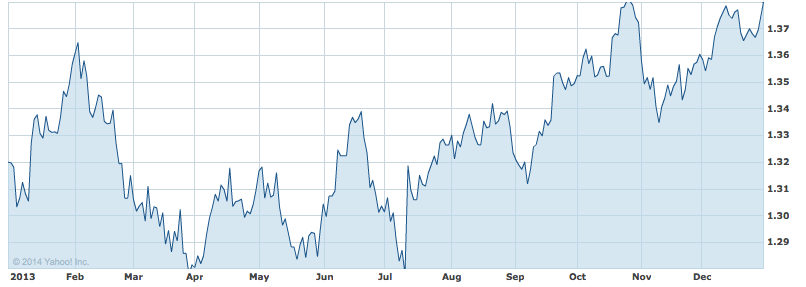
11 Risk Factors This section describes the significant risks and uncertainties affecting our business. The risks and uncertainties described below are not the only ones we face. There may be additional risks and uncertainties not presently known to us or that we currently deem immaterial. Any of these risks could adversely affect our business, financial condition, our results of operations or our liquidity. Risk factors relating to our business and industry Fluctuation in the value of currencies in which operations are conducted and activities are financed relative to the U.S. dollar could adversely affect our business, operating results and financial condition. The Company s reporting currency is the U.S. dollar. In 2013 approximately 40% of our revenues were denominated in U.S. dollars, while the balance is denominated in Euro and other currencies, certain of which are linked to the Euro. Our trade payable balances are principally (about 80%) denominated in U.S. dollars. In addition, approximately half of our operating expenses are denominated in U.S. dollars and the other half in Euro or other currencies, certain of which are linked to the Euro. As a result, reported results are affected by movements in exchange rates, particularly in the exchange rate of the U.S. dollar against the Euro and other currencies of the countries in which we operate, including the Russian Rouble, the Ukrainian Hryvnia, the Czech Crown, the Polish Zloty, the Croatian Kuna, the Kazakhstani Tenge and the Hungarian Forint. In particular, a strengthening of the U.S. dollar against the Euro and other currencies of the countries in which we operate may result in a decrease in our revenues, as reported in U.S. dollars, and foreign exchange loss relating to trade receivables and payables, which would have a negative impact on our operating and net profit despite a positive impact on our operating expenses. On the other hand, a devaluation of the U.S. dollar against the Euro and other currencies of the countries in which we operate may have a positive impact on our revenues, as reported in U.S. dollars, which would have a positive impact on operating and net profit despite a negative impact on our operating expenses. In addition, foreign exchange fluctuation between the U.S. dollar and the Euro or other currencies of the countries in which we operate may result in translation gains or losses affecting foreign exchange reserve. Furthermore, a major devaluation or depreciation of any such currencies may result in disruption in the international currency markets and may limit the ability to transfer or to convert such currencies into U.S. dollars and other currencies. The Group has adopted hedging strategies to tackle this problem and become successful. This was visible also in 2013, when despite fluctations in the currency environment (see below chart), the Company was again able to limit the FX influence on its results. However, despite all efforts of the Company there can be no 100% assurance that fluctuations in the exchange rates of the Euro and other currencies of the countries in which we operate against the U.S. dollar will not have a material adverse effect on our business, financial condition and results of operations. Therefore careful observation of currency environment remains crucial factor for our success. EUR/USD fluctuations in
12 Worldwide economic environment The world s financial crisis has eased throughout the last years. This included recovery signals from some of our markets (especially in the Former Soviet Union countries), and stabilization in some of others. Following partial recovery the Company undertook efforts to benefit from these signals both in revenues and profitablity. The revised strategy and adaptation to the new environment, i.e. by rebuilding our product portfolio, paid off in terms of increased market share and sales. However, there are many uncertainties about the world economy and especially the Euro-zone - followed by volatility of currencies and fragility of demand in many markets. Although the Company was able to secure itself from these factors in 2013 (i.e. there were no major currency losses), it is of extreme importance to follow this strategy in future periods and focus more on growing profitability and improving cash flow rather than just on growing revenues. It is undoudebtly one of our major risk factors since the financial and economic envirnonment dictates the business envirnonment in which the Company operates. Demand might be negatively affected and the results of the Company could be severely impacted if the instability within the financial markets occurs and continues for an extended period of time. Situation in Ukraine and the risk of the country entering into a war with Russia We have experienced during the course of 2014 to-date, a severe crisis in our third largest market, Ukraine, which has resulted into a lower demand from customers and a significant devaluation of the local currency (UAH) to US Dollar. Russia is also deeply involved in this crisis and this is significantly affecting our largest market in terms of revenues. If the situation is not eased and stability does not return soon to the region, the Group s/company s results will be adversely affected during The Group s/company is undertaking all possible measures to protect itself from this crisis. Credit risk faced by us due to our obligations under supply contracts and the risk of delinquency of customer accounts receivable could have a material adverse effect on our business, operating results and financial position. The Company buys components and finished products from its suppliers on its own account and resells them to its customers. The Company extends credit to some of its customers at terms ranging from 21 to 60 days or, in a few cases, to 90 and 120 days. The Company s payment obligations towards its suppliers under such agreements are separate and distinct from its customers' obligations to pay for their purchases, except in limited cases which the Company s arrangements with its suppliers require the Company to resell to certain resellers or distributors. Thus, the Company is liable to pay its suppliers regardless of whether its customers pay for their respective purchases. As the Company s profit margin is relatively low compared to the total price of the products sold, in the event where the Company is not able to recover payments from its customers, it is exposed to a financial liquidity risk. The Company has in place credit insurance which covers such an eventuality for approximately 60 percent of its revenue. Due to the recent market developments following the credit crisis that affected all countries the Group operates in, credit risk has become one of the most important factors that might affect the Group s results in the future. Despite the fact that the Group has managed to credit insure a large portion of its receivables, credit insurance companies are nowadays more risk averse and they are not easily granting credit limits to customers. As a result the Group is exposed to more credit risk and the ability of the Group to analyse and assess its credit risk is of extremely high importance. Competition and price pressure in the industry in which we operate on a global scale may lead to a decline in market share, which could have a material adverse effect on our business, operating results and financial condition. The IT distribution industry is a highly competitive market, particularly with regards to products selection and quality, inventory, price, customer services and credit availability and hence is open to margin pressure from competitors and new entrants. The Company competes at the international level with a wide variety of distributors of varying sizes, covering different product categories and geographic markets. In particular, in each of the markets in which the Company operates it faces competition from: 12
13 a) international distributors such as Avnet Inc., Tech Data Corp., Ingram Micro Inc. and Arrow Electronics Inc., which are much larger than the Company, but do not always cover the same geographic regions with local presence as the Company does, b) regional or local distributors, such as Elko, mainly in the Baltic States, Russia, Ukraine, Kvazar Micro and Merlion in the Former Soviet Union, AB, ABC Data and Action in Poland and ATC and ED System-BGS Levi in the Czech Republic and Slovakia. Competition and price pressures from market competitors and new market entrants may lead to significant reductions in the Company s sales prices. Such pressures may also lead to loss of market share in certain of the Group's markets. Price pressures can have a material adverse effect on the Company s profit margins and its overall profitability, especially in view of the fact that its gross profit margins, like those of most of its competitors, are low and sensitive to sales price fluctuations. The IT distribution business has low profit margins, which means that operating results are highly sensitive to increased operating costs, which if not successfully managed could have a material adverse effect on our business, results of operations and financial condition. In the traditional distribution business, the Company s gross profit margins, like those of other distributors of IT products, are low and the Company expects that in distribution arm of its business they will remain low in the foreseeable future. Increased competition arising from industry consolidation and low demand for certain IT products may hinder the Company s ability to maintain or improve its gross margins. A portion of the Company s operating expenses is relatively fixed, and planned expenditures are based in part on anticipated orders that are forecasted with limited visibility of future demand. As a result, the Company may not be able to reduce its operating expenses as a percentage of revenue in order to mitigate any reductions in gross margins in the future. Therefore the Company develops the own brands business, that allows to generate much higher gross profit margins. Since this business is already responsible for a significant part of total sales, it positively affects the overall gross profit margins and profitability of the Company. However this business is also connected with risks, including the risk of technology change, the risk of changes in demand and customer preferences. Additionally, no matter the product line and no matter if its own brand or third party, the margins shrink over time, due to more market entrants and market saturation. Therefore it is extremely important for the Company to foresee the market demand changes and offer new products on time to satisfy consumer needs and be able to sell the previous technology as well. Inventory obsolescence and price erosion in the industry in which we operate may have a material adverse effect on our business, financial condition and results of operations. The Company is often required to buy components and finished products according to forecasted requirements and orders of its customers and in anticipation of market demand. The market for IT finished products and components is characterized by rapid changes in technology and short product shelf life, and, consequently, inventory may rapidly become obsolete. Due to the fast pace of technological changes, the industry may sometimes face a shortage or, at other times, an oversupply of IT products. As the Company increases the scope of its business and, in particular, of inventory management for its customers, there is an increasing need to hold inventory to serve as a buffer in anticipation of the actual needs of the Company s customers. This increases the risk of inventory becoming devalued or obsolete and could affect the Company s profits either because prices for obsolete products tend to decline quickly, or as a result of the need to make provisions for write-offs. In an oversupply situation, other distributors may elect to proceed with price reductions in order to dispose of their existing inventories, forcing the Company to lower its prices to stay competitive. The Company s ability to manage its inventory and protect its business against price erosion is critical to its success. A number of the Company s most significant contracts with its major suppliers contain advantageous contract terms that protect the Company against exposure to price fluctuations, defective products and stock obsolescence. 13
14 For the own brands business division, the Company needs to balance between satisfying the consumer demand and risk of inventory obsolence or price erosion, by having the proper level of inventory and keeping adequate provisions in place at all times. Our business is highly dependent on distribution contracts with a limited number of suppliers; a loss of or change in the material terms of these contracts could have a material adverse effect on our business, operating results and financial condition. The part of our business consisting of distribution of third party products is dependent on the decisions and actions of a limited number of suppliers. In the year ended 31 December 2013, the company held contracts with namely Intel, Advanced Micro Devices (AMD), Seagate, Microsoft, DELL, Toshiba, Acer, Apple, Lenovo and other international suppliers. Contracts with these suppliers are typically on a nonexclusive basis, allow for termination with or without cause and are open-ended with respect to requirements and output rather than imposing any commitment to a specific volume of business or scope of work. We face the risk of termination of our distribution agreements, in the event that it does not perform pursuant to the supplier's expectations or for any other reason, including a number of factors outside our control. Changes in the suppliers' business strategies, including moving part or all of their distribution arrangements to our competitors, or directly distributing products to end-users, could result in the termination of the respective distribution contracts. Any of these suppliers may merge with, acquire or be acquired by, any of our competitors which already has its own distribution network in the market. Any supplier may consider us redundant as a distributor and may terminate our distribution agreement or may experience financial difficulties, as a result of which it may not be able to grant beneficial credit terms and/or honor financial terms in the relevant distribution agreements, such as those relating to price protection, stock returns, rebates, performance incentives, credit from returned materials and reimbursement of advertising expenses incurred during joint promotion campaigns. Termination or material change in the terms of a vendor contract due to any of the aforesaid factors could have a material adverse effect on our business, results of operations and financial condition. Our inability to maintain or renew our distribution and supply contracts on favorable terms with key customers and suppliers, could have a material adverse effect on our business, operating results and financial condition. In the part of our business related to distribution of third party products, we have significant contracts with a limited number of customers and other business partners, some of which are oral agreements, the precise terms of which and the enforceability of which, remain uncertain, or are agreements that may be terminated without cause or by written notice at the expiry of their term. In addition, a number of our most significant contracts with our major suppliers contain terms that protect us against exposure to price fluctuations, defective products and stock obsolescence. Specifically, our contracts terms including terms such as (i) a price protection policy, which allows us to request reimbursement from the suppliers for inventory in transit or held at our warehouses in the event that product prices decline; (ii) a stock rotation policy under which we have the right to return to the supplier slow moving inventory in exchange for credit, which reduces our exposure to obsolescence of inventory; and (iii) a return material authorization policy under which we can return defective items to our suppliers in return for either credit, replacements or refurbished products. If we are unable to maintain or enforce our significant contracts, or if any of our significant suppliers refuses to renew contracts with us on similar terms, or new significant suppliers of ours do not make such terms available to us, we could face a higher risk of exposure to price fluctuations and stock obsolescence, which given our narrow gross profit margins, could have a material adverse effect on our business, operating results and financial condition. 14
15 Our suppliers' increasing involvement in e-commerce activities, which would enable them to directly sell to our customers, could threaten our market share, and therefore adversely affect our business, operating results and financial condition. In the third party products distribution part of our business, we operate as a distributor, or a "middleman", between manufacturers and our customers. Manufacturers are sometimes able to outsource their sales and marketing functions by engaging the services of a distributor and concentrating on their core competencies. With the emergence, however, of new internet technologies and e-commerce, more manufacturers are developing their own online commerce platforms with the capability to accept orders and conduct sales through the internet. Global distributors have also set up their own web-sites to enable sales and purchases to be conducted online. Although we have developed the IT4Profit platform, an online purchasing platform for electronic dealing with our customers (B2B), there can be no assurance that any of our suppliers or competing distributors will not successfully implement similar electronic purchasing platforms and manage to fully satisfy our customers' needs, in which case our risks losing a significant part of our business. In addition, market prices of components may deteriorate as a result of increasing online competition, as online customers have the ability to search globally for the cheapest available components. If we are unable to effectively leverage our internet technologies and e-commerce or successfully compete with emerging competitors offering online services, this could have a material adverse effect on our business, operating results and financial condition. Our success is dependent on our own logistics and distribution infrastructure and on third parties that provide those services, a loss of which could adversely affect our business, operating results and financial performance. We maintain three large regional distribution centers from which the great majority of our products are shipped. As a result, we are highly dependent on third party providers for logistics such as courier and other transportation services. An interruption or delay in delivery services causing late deliveries could result in loss of reputation and customers and could force us to seek alternative, more expensive delivery services, thereby increasing operating costs, which would have an adverse effect on our business, operating results and financial performance. An important part of our strategy to achieve cost efficiencies while maintaining turnover growth is the continued identification and implementation of improvements to our logistics and distribution infrastructure. We need to ensure that our infrastructure and supply chain keep pace with our anticipated growth. The cost of this enhanced infrastructure could be significant and any delays to such expansion could adversely affect our growth strategy, business, operating results and financial performance. Therefore, any significant disruption to the services of these third party providers could have a material adverse effect on our business, results of operations and financial condition. Our inability to recruit and retain key executives and personnel could have a material adverse effect on our business, operating results and financial condition. Our business depends upon the contribution of a number of our executive Directors, key senior management and personnel, including Siarhei Kostevitch, our Chief Executive Officer, Chairman of the Board of Directors and principal shareholder. There can be no certainty that the services of Mr. Kostevitch and of other of our key personnel will continue to be available to us. We have in the past experienced and may in the future continue to experience difficulty in identifying expert personnel in our areas of activity, and particularly in the areas of information technology and sales and marketing, in the countries in which we operate. In addition, we do not currently maintain "key person" insurance. If we are not successful in retaining or attracting highly qualified personnel in key management positions, this could have a material adverse effect upon our business, operating results and financial condition. Our pursue to support strong growth of our own brands business may negatively affect our cash flows, while our inability to support strong growth of our own brands business may negatively affect our profitability. Since our own brand business share in our total revenues is growing with a double digit pace and its influence on our profitability is even higher, we have to invest in the development of new products, production and distribution. This adversely affects our cash flows, as the tablets and smartphones 15
16 business is much more cash consuming than our traditional product lines. On the other hand, in case that we could not support growth of our own brand business with certain amounts of invested funds, we may lose our market position; this would negatively affect our profitability. Significant growth of our own brand business and investment into their development may lead to increased cost of debt, that could adversely affect our profitability Having increased private label business implies a much higher need for cash available to support the growth. The Group has managed to raise cash from various financial institutions, however in certain cases the cost of this financing is above the weighted average cost of debt. Any further growth in these expenses may limit our profits generated from increased own brands business. Therefore, the Company should undertake all necessary steps to ensure lower cost of financing to be able to enjoy the benefits from its revenue growth. 16
17 ITEM 2. INFORMATION ON THE COMPANY History and Development of Asbisc Enterprises Plc and Business Overview Asbisc Enterprises Plc. is the parent entity for the Group described in this chapter, in the section "Group Structure and Operations". ASBISc Enterprises Plc is one of the leading distributors of Information Technology ("IT") products in Europe, Middle East and Africa ( EMEA ) Emerging Markets: Central and Eastern Europe, the Baltic States, the Former Soviet Union, the Middle East and Africa, combining a broad geographical reach with a wide range of products distributed on a "one-stop-shop" basis. Our main focus is on the following countries: Russia, Slovakia, Ukraine, Poland, Czech Republic, Belarus, Romania, Croatia, Slovenia, Bulgaria, Serbia, Hungary, and Middle East countries (i.e. United Arab Emirates, Saudi Arabia, Qatar and other Gulf states). The Group distributes IT components (to assemblers, system integrators, local brands and retail) as well as A-branded finished products like desktop PCs, laptops, servers, tablet PCs, smartphones and networking to SMB, retail and telcos. Our IT product portfolio encompasses a wide range of IT components, blocks and peripherals, and mobile IT systems. We currently purchase the majority of our products from leading international manufacturers, including Intel, Advanced Micro Devices ("AMD"), Seagate, Western Digital, Samsung, Microsoft, Toshiba, Dell, Acer, Apple, Lenovo and Hitachi. In addition, a significant part of our revenue is comprised of sales of technology products under our private labels, Prestigio and Canyon. ASBISc commenced business in 1990 in Belarus and in 1995 we incorporated our holding company in Cyprus and moved our headquarters to Limassol. Our Cypriot headquarters support, through three master distribution centres (located in the Czech Republic, the United Arab Emirates and China), our network of 33 warehouses located in 26 countries. This network supplies products to the Group's in-country operations and directly to its customers in approximately 80 countries. The Company s registered and principal administrative office is at Diamond Court, 43 Kolonakiou Street, Ayios Athanasios, CY-4103 Limassol, Cyprus. Our revenues amounted to U.S. $ 1,920,427 in 2013, compared to U.S. $ 1,744,878 in 2012, following changes in our product portfolio, development of our own brands sales and our stronger market position. This allowed us to significantly increase net profit after taxation that amounted to U.S. $ 12,712 in 2013, compared to U.S. $ 9,047 in Our headquarters are home to our centralized purchasing department and global control function, which centrally monitors and controls our global activities, including purchasing, warehousing and transportation operations. In line with our strategy of focusing on automation and innovation in order to increase our costefficiency, in 2002, we began developing the IT4Profit platform, our online purchasing platform for electronic trading with our customers (B2B) and electronic data interchange for the Company and its subsidiaries. Within this platform, we have also implemented our end-to-end online supply chain management system, in order to effectively manage our multinational marketplace and to increase automation and reporting transparency both internally and vis-à-vis our suppliers. Dealings through the IT4Profit online platform have grown to represent approximately 55% of our revenues in We combine the international experience of our central management team with the local expertise of our offices in each of the 26 countries in which we operate. With our broad local presence, we have developed in-depth knowledge and understanding of fast-growing IT markets in regions such as Central and Eastern 17
18 Europe and our diverse cultural, linguistic and legal landscape, which may form significant barriers to entry for most of our international competitors. The Directors believe that this advantage has helped us to quickly and cost-effectively penetrate emerging markets and strengthen our competitive position not only in Eastern Europe and the Former Soviet Union, but also in the Middle East and Africa ( EMEA ). History of the Group We were established in Minsk, Belarus in 1990 by Mr. Siarhei Kostevitch and our main activity was the distribution of Seagate Technology products in the territory of the Former Soviet Union. Then, in 1995, we were incorporated in Cyprus and moved our headquarters to Limassol. In 2002, in order to fund further growth, we privately placed U.S. $ 6,000 worth of shares with MAIZURI Enterprises Ltd (formerly named Black Sea Fund Limited), and U.S. $ 4,000 with Alpha Ventures SA. In 2006, we listed our common stock on Alternative Investment Market of London Stock Exchange (AIM), however after the successful listing on the Warsaw Stock Exchange (October 2007) the Board of Directors took a decision and cancelled the AIM listing as at 18 of March The changes in shareholders structure occurred in 2013 were the following: (1) On May 14th, 2013 the Company received notification on the basis of art. 69 of Act on Public Offering from KS Holdings Ltd who informed about change in the number of possessed shares of ASBISc Enterprises Plc, that was above 33% by at least 1%. The change resulted from the transaction of sale of 3,000,000 (three million) shares on May 13th, Before the abovementioned transaction KS Holdings Ltd held 25,676,361 shares of ASBISc Enterprises Plc of a nominal value 0,20 USD each, that were entitling to 25,676,361 votes at the General Meeting of Shareholders of ASBISc Enterprises Plc, that were equal to 46.26% in share capital of ASBISc Enterprises Plc and 46.26% in the total number of votes at its General Meeting of Shareholders. According to this notification, after the abovementioned transaction, KS Holdings Ltd holds 22,676,361 shares of ASBISc Enterprises Plc of a nominal value 0,20 USD each, that entitle it to 22,676,361 votes at the General Meeting of Shareholders of ASBISc Enterprises Plc, that were equal to 40.86% of the share capital of ASBISc Enterprises Plc and 40.86% of the total number of votes at its General Meeting of Shareholders. KS Holdings Ltd has also informed that it does not plan to further decrease its stake in ASBISc Enterprise Plc in the next 12 months from the date of notification. (2) On October 25th, 2013 the Company received from ALPHA VENTURES S.A. (further AV ) notification that AV descended below the threshold of 5% of total number of votes at the Company s General Meeting of Shareholders. Descending below the threshold occurred as a result of transaction of sale of Company s shares conducted on October 23rd, AV informed that before the abovementioned event it held Company s shares corresponding to 5,77% of the Company s share capital and entitling to votes which correspond to 5,77% of the total votes in the Company. According to the notification after the abovementioned event AV held Company s shares corresponding to 2,52% of the Company s share capital and entitling to votes which correspond to 2,52% of the total votes in the Company. (3) On December 17th, 2013 the Company has received from Noble Funds Towarzystwo Funduszy Inwestycyjnych S.A. notification that following the purchase of the Company s shares on December 13th, 2013, the total shares of Noble Funds Fundusz Inwestycyjny Otwarty, Noble Fund 2DB Fundusz Inwestycyjny Zamknięty and Noble Fund Opportunity Fundusz Inwestycyjny Zamknięty managed by Noble Funds Towarzystwo Funduszy Inwestycyjnych S.A. (altogether the Funds ) exceeded the threshold of 5% of total number of votes at the Company s General Meeting of Shareholders. According to the notification, before the abovementioned purchase of shares the Funds had in total Company s shares that were equal to 4,98% in the Company s share capital and had votes at the Company s General Meeting of Shareholders, that were equal to 4,98% of total 18
19 number of votes. According to the notification, at December 16th, 2013 the Noble Funds altogether held Company s shares, equal to 5,01% in the Company s share capital and had votes at the Company s General Meeting of Shareholders, equal to 5,01% of total number of votes Strengths of the Group The Directors consider that our key strengths are: Broad geographic coverage combined with strong local presence. Unlike most of our international competitors, we operate with active local presence in a number of countries across different regions. Since many of our competitors target the same markets from a number of different locations in Western Europe, we benefit from increased logistical cost efficiencies. In particular, our broad geographic coverage, combined with our centralized structure and automated processes, results in reduced shipping costs and lower revenue collection expense, as well as a consistent marketing approach, as compared to our competitors. As a result, we have become an authorized distributor for leading international suppliers wishing to penetrate a number of fast-growing markets served by us, offering them the ability to penetrate these markets in a cost-efficient manner and through a consistent marketing approach. Experienced management team, combined with local expertise. Our management team consists of experienced executives. Our Chief Executive Officer has been with the Company since inception in 1990, while most of our key executives have served for longer than ten years. In addition, our subsidiary operations are managed by teams of mainly local experienced managers, which provides us with strong expertise and understanding of the diverse markets in which we operate. The Directors believe that local presence represents a significant competitive advantage for us over our multinational competitors. Critical mass of operations. Having revenues exceeding 1,9 billion U.S. Dollars, sales in approximately 80 countries and facilities in 26 countries, we believe that we have become a strong partner for leading international suppliers of IT components and finished products, including Intel, AMD, Seagate, Samsung, Microsoft, Hitachi, Dell and Toshiba, Acer and Lenovo in most of our regions of operation. Thanks to our size and the scope of our regional reach, we have achieved authorized distributor status with leading international suppliers, either on a pan-european, regional, or on a country-by-country basis, thus enjoying a number of beneficial commercial terms and achieving agreements with respect to the distribution of products offering higher profit margins. Price protection and stock rotation policy for inventory. As an authorized distributor for a number of leading international suppliers of IT components, we are able to benefit from certain beneficial contract terms that provide protection from declining prices or slow moving inventory. In particular, such terms allow us to return part of the inventory to the respective distributors in the event market prices decline or such inventory becomes obsolete. See "Our Main Suppliers - Price Protection Policy and Stock Rotation Policy". In contrast, in some of the countries in which we operate, many of our major competitors tend to buy from the open market, which leaves them exposed to the risk of price changes and obsolete stock. One-stop-shop for producers and integrators of IT equipment. We distribute a broad range of IT components, blocks, peripherals and finished products supplied by a large number of leading international suppliers. As a result, we serve as a one-stop-shop, providing complete solutions to producers and integrators of server, mobile and desktop segments in the countries 19
20 in which we operate. The Directors consider this to be a significant advantage over competitors with more limited product offerings. Strong portfolio of own brands In the past years we have invested in the development of our own brands and built a strong market position. This paid off in terms of both revenues and profitability. To be exact, in 2013 revenues from own brands grew by % to a new historical record of U.S.$ 468,988, compared to U.S.$ 157,590 in Own brands contribution in total revenue was 24.42%, compared to 9.03% in The Directors consider our own brands to be a significant advantage over competitors. The Company was proactive enough to invest in the right segments of products (i.e. tablets and smartphones) following the market trend which led to transition from the mobile computing (laptops) towards enhanced mobility and access to internet through these products. Group Structure and Operations The following table presents our corporate structure as at December 31 st, 2013: Company ASBISC Enterprises PLC Asbis Ukraine Limited (Kiev, Ukraine ) Asbis PL Sp.z.o.o (Warsaw, Poland) ASBIS Estonia AS (formerly AS Asbis Baltic) (Tallin, Estonia) Asbis Romania S.R.L (Bucharest, Romania) Asbis Cr d.o.o (Zagreb, Croatia) Asbis d.o.o Beograd (Belgrade, Serbia) Asbis Hungary Commercial Limited (Budapest, Hungary) Asbis Bulgaria Limited (Sofia, Bulgaria) Asbis CZ,spoI.s.r.o (Prague, Czech Republic) UAB Asbis Vilnius (Vilnius, Lithuania) Asbis Slovenia d.o.o (Trzin, Slovenia) Asbis Middle East FZE (Dubai, U.A.E) Asbis SK sp.l sr.o (Bratislava, Slovakia) Asbis Limited (Charlestown, Ireland) FPUE Automatic Systems of Business Control (Minsk, Belarus) E.M. Euro-Mall Ltd (former ISA Hardware Limited Group) (Limassol, Cyprus) OOO Asbis -Moscow (Moscow, Russia) Asbis Morocco Limited (Casablanca, Morocco) EUROMALL CZ s.r.o. (formerly ISA Hardware s.r.o.) (Prague, Czech Republic) EUROMALL d.o.o. (formerly ISA Hardware d.o.o.) (Zagreb, Croatia) S.C. EUROMALL 2008 S.R.L (formerly ISA Hardware International S.R.L) (Bucharest, Romania) ISA Hardware s.r.o Slovakia (Bratislava, Slovakia) Euro-Mall SRB d.o.o. (former ISA Hardware d.o.o Beograd) (Belgrade, Serbia) Prestigio Plaza Sp. z o.o (Warsaw, Poland) Prestigio Plaza Ltd (formerly Prestigio Technologies) (Limassol, Cyprus) Prestigio Europe s.r.o (Prague, Czech Republic) ASBIS NL.B.V. (Amsterdam, Netherlands) Asbis Kypros Ltd (Limassol, Cyprus) Asbis TR Bilgisayar Limited Sirketi (Istanbul, Turkey) SIA ASBIS LV (Riga, Latvia) Consolidation Method Mother company Full (100% subsidiary) Full (100% subsidiary) Full (100% subsidiary) Full (100% subsidiary) Full (100% subsidiary) Full (100% subsidiary) Full (100% subsidiary) Full (100% subsidiary) Full (100% subsidiary) Full (100% subsidiary) Full (100% subsidiary) Full (100% subsidiary) Full (100% subsidiary) Full (100% subsidiary) Full (100% subsidiary) Full (100% subsidiary) Full (100% subsidiary) Full (100% subsidiary) Full (100% subsidiary) Full (100% subsidiary) Full (100% subsidiary) Full (100% subsidiary) Full (100% subsidiary) Full (100% subsidiary) Full (100% subsidiary) Full (100% subsidiary) Full (100% subsidiary) Full (100% subsidiary) Full (100% subsidiary) Full (100% subsidiary) 20
21 Asbis d.o.o. (former Megatrend d.o.o.) (Sarajevo, Bosnia Herzegovina) PTUE IT-MAX (Minsk, Belarus) ASBIS Close Joint-Stock Company (former CZAO ASBIS) (Minsk, Belarus) ASBIS IT S.R.L. (Rome, Italy) ASBIS Kazakhstan LLP (Almaty, Kazakhstan) Euro-Mall SRO (Bratislava, Slovakia) ASBIS Taiwan (Taipei City, Taiwan) Prestigio China Corp. (former AOSBIS TECHNOLOGY (SHENZHEN) CORP.) (Shenzhen, China) ASBIS DE GMBH, (Munchen, Germany) EUROMALL BULGARIA EOOD (Sofia, Bulgaria) Advanced Systems Company LLC (Riyadh, Kingdom of Saudi Arabia) SHARK ONLINE a.s. (Bratislava, Slovakia) SHARK Computers a.s. (Bratislava, Slovakia) Full (90% ownership) Full (100% subsidiary) Full (100% subsidiary) Full (100% subsidiary) Full (100% subsidiary) Full (100% subsidiary) Full (100% subsidiary) Full (100% subsidiary) Full (100% subsidiary) Full (100% subsidiary) Full (100% subsidiary) Full (100% subsidiary) Full (100% subsidiary) Asbisc Enterprises Plc is the parent company of the Group. Our subsidiaries are involved in diverse activities related to distribution of IT components and equipment. In particular, our subsidiaries operating under the ASBIS name are involved in the distribution of IT components, finished products and equipment, including distribution of products from worldwide leading manufacturers such as Intel, AMD, Seagate, Western Digital, Samsung, Microsoft, Hitachi Dell, Acer, Lenovo, Toshiba, Apple and many other well known international suppliers. Our subsidiaries operating under Prestigio and Canyon brands are primarily responsible for the procurement, quality control, marketing and wholesale distribution of our private label (Canyon and Prestigio) IT equipment. Changes in the Group s structure During the year ended December 31 st, 2013 there were the following changes in the structure of the Company and the Group: ISA Hardware Hungary Commercial Limited Liability Co (Budapest, Hungary) has been removed from the company register database. This was due to the fact that this subsidiary was inactive for a number of years since it was conducting no operations. Therefore, this subsidiary had no assets, no liabilities and no revenues. Removal from the register was a part of the Company s efforts to simplify its Group structure. On April 12th, 2013 the Company received information, that on April 12th, 2013 the Extraordinary General Meeting of Shareholders of Prestigio Plaza Sp. z o.o. (a subsidiary company) made a resolution on dissolution and liquidation of Prestigio Plaza Sp. z o.o. Decision on liquidation of Prestigio Plaza sp. z o.o. was made due to the fact that it was a non-active subsidiary, since all Group operations in Poland are already conducted through the Issuer's main subsidiary responsible for operations in Poland - Asbis PL Sp. z o.o. The Issuer expects to benefit from this decision due to decreased administrative expenses of the Group. On April 19th, 2013 the Company received information that following the decision of City Court in Sarajevo on April 15th, 2013, the Issuer s subsidiary in Bosnia and Herzegovina - Megatrend d.o.o. - changed its name to ASBIS d.o.o. The subsidiary s scope of operations consisting of distribution of IT hardware and software (including the Issuer s own brands) remains unchanged. AOSBIS TECHNOLOGY (SHENZHEN) CORP. (Shenzhen, China) changed its name to Prestigio China Corp. On May 16 th, 2013 the Company has purchased the remaining part of its subsidiaries in Slovakia - SHARK ONLINE a.s. and SHARK Computers a.s., and now controls 100% of their share capital. Asbis-Baltik (Tallin, Estonia) changed its name to ASBIS Estonia AS. This change had only a 21
22 technical character and is connected with the development of business in Estonia and with the Issuer s pursue for better recognition of the Company in specific countries. It will not have any impact on the subsidiary s operations in Estonia since the Company s subsidiary under the new name will have the same operations. E.M.EURO-MALL d.o.o. (former ISA Hardware s.r.o., Slovenia) was deregistered by the appropriate court following the Company s application. The Issuer will continue its operations in Slovenia without any change, through its other subsidiary - Asbis Slovenia d.o.o (Trzin, Slovenia). Asbis Europe B.V (Schiphol, Netherlands) was liquidated due to the fact that this company was dormant and not conducting any operations, since the Group conducts all operations in the Netherlands through its other subsidiary ASBIS NL B.V. Regional operations We operate as a one-stop-shop for the desktop PC, server, laptop, tablet PCs, smartphones and software segments. The management believes that the Company is currently the only IT component and A- Branded finished products distributor that covers substantially all of Eastern Europe, as part of a single supply chain with highly integrated sales and distribution systems. We also have operations in the Baltic States, the Balkans, the Former Soviet Union, the United Arab Emirates and other Middle East countries, Ireland and the Netherlands. In countries with a large geographic area and a less developed infrastructure, such as Russia, Ukraine, Belarus, Kazakhstan, Egypt, Morocco, Algeria and Tunisia, we have developed and manage sales through a network of local resellers. These resellers distribute products, supported by pre-sales and post-sales services provided by us. As the level of infrastructure development increases in these countries, the Directors intend to shift from an indirect to a direct sales model through establishing local operations. See "Directions of Further Development". We also provide technical support for all new products that we stock through product line sales managers. Sales personnel receive internal training and focus groups are established that have in-depth knowledge of their respective product lines. Our sales staff are also trained by our suppliers, such as Intel, AMD, Seagate, Werstern Digital, Apple, Samsung, Microsoft, Hitachi and others, as a result of our status as an authorized distributor of their products. The Directors consider that this organisational process allows us to provide added value to our customers and differentiate us from our competitors. 22
23 We are represented in the following locations: Key Markets and Regions Historically, the regions of Central Eastern Europe ( CEE ) and Former Soviet Union ( FSU ) have been the larger contributors of revenues of the Group. This has not changed in 2013, however CEE and Western Europe share in our total revenues grew as a result of strong development of our own brands sales. The following table presents a breakdown of our revenue by regions for the years ended 31 December 2013, 2012 and 2011: Year ended 31 December % Former Soviet Union Central and Eastern Europe Middle East & Africa Western Europe Other Total revenue
24 Products We are engaged in sales and distribution of a variety of products including IT components, laptops, server and mobile building blocks and peripherals to third party distributors, OEMs, retailers and e-tailers and resellers. Our customers are located mainly in Central and Eastern Europe, the Former Soviet Union, North and South Africa and the Middle East. We engage in three primary lines of business: sales and distribution of the IT components and blocks described below that we purchase from a variety of suppliers such as Intel, AMD, Seagate and Western Digital, sales of a wide range of finished products from worldwide manufacturers (Dell, Toshiba, Lenovo, Apple, Acer) as well as software (Microsoft and antivirus software producers), sales of a range of private label products (such as tablet PCs, smartphones, e-book readers, data storage devices, GPS devices, peripherals, accessories) with larger volumes and with profit potential selected by us and manufactured by ODM/OEM producers in the Far East under our own private label brands, Canyon and Prestigio. The products that are purchased from suppliers and distributed by us are divided into various categories, which consist of (i) central processing units, (ii) hard disk drives, (iii) memory modules, which includes random access memory and flash memory modules, (iv) mainboards and VGA cards, (v) software, (vi) peripherals, which are external or internal devices attached to a computer for added functionality such as a scanner or a printer, (vii) PC-mobile, which are mainly laptops, (viii) display products such as LCD TVs and monitors, (ix) optical and floppy drives, which include DVD drives, (x) desktop computers, (xi) servers and server blocks, (xii) accessories and multimedia, (xiii) networking products, and (xiv) other products, which include cameras, special customer orders and products purchased by our subsidiaries to service their customers and tablet PCs and smartphones. The following table presents revenues from each category of product in 2013, 2012 and 2011: Year ended 31 December (U.S. $) Central Processing Units 259, , ,408 Hard disk drives (HDD) (CPU) 181, , ,976 Software 137, , ,936 PC mobile (laptops) 240, , ,476 Mainboards & VGA cards 18,996 23,010 39,229 PC desktop 39,663 32,739 46,055 Peripherals 27,264 43,119 53,919 Display products 33,198 36,949 23,918 Memory modules (RAM) 16,408 12,271 27,707 Accessories & multimedia 88,494 94,661 75,228 Servers & server blocks 72,349 67,969 29,577 Tablets 334, ,041 28,284 24

25 Smartphones 357, , Optical & floppy drives 6,448 7,771 9,515 Flash memory 41,638 37,501 15,809 Networking products 38,538 33,264 20,055 Other 27, ,646 92,737 Total revenue 1,920,427 1,744,878 1,482,075 It is worth mentioning that in 2013 the Company continued changes in its product potfolio by decreasing share of large volume, low margin product lines (traditional components, laptops) in certain countries, and by increasing share of new booming product lines like smartphones and tablets (both third party and own brands). As a result, tablets and smartphones have become the leading product lines offered by the Company. In 2013 sales of traditional segments: CPUs, HDDs and Laptops have decreased by 11.94%, 10.24% and 34.33% respectively. Software has delivered higher profits despite lower revenues (10.11% decrease), while tablets and smartphones grew by % and % respectively. As a result, in 2013 the share of CPUs, HDDs, Laptops and Software in total revenue decreased significantly (to 42.62% in 2013 compared to 58.21% in 2012), while the combined share of tablets and smartphones grew to 36.01% in 2013 from 15.50% in The Company strategically develops this business, since it allows for higher gross margins. 25
26 Private labels: Prestigio and Canyon We have developed two private label brands, Canyon and Prestigio. We, mainly through our purchasing office in China, select products or ranges of products with high profit potential from a number of ODM/OEM producers in the Far Eastern region, particularly in Taiwan and China, and purchase these products at larger volumes in order to benefit from economies of scale. We then resell these products in the markets in which we operate under our own brands at more competitive prices than similar products sold by competitors. Canyon. Canyon was launched in 2001 as a supplier of motherboards and video graphics adaptors (VGA) cards to Eastern European markets. The brand has evolved and currently primarily targets retail chains with IT and consumer electronic peripherals and accessories, supplying products such as RAM and flash memory modules, web cams, mice, networking products, external HDD, MP3 players, handbags, phone accessories and speakers. Canyon is perceived to be a brand aimed at younger customers who want good quality products at affordable prices. Canyon uses attractive colors and packaging to promote this image. During 2013 Canyon launched several new products which proved very successful and we plan to continue these projects going forward. Prestigio. Prestigio was launched at the end of 2002 with the aim of becoming a supplier of premium quality IT products and now supplies data storage devices, peripherals and accessories. Prestigio's brand slogan "The Art of High Tech" reflects the positioning of these products in this premium, high-specification design segment. In 2011 Prestigio was recognized as the leading GPS Navigator device in the F.S.U. and CEE regions with about 500 thousand unit sales. Additionally, we have sold almost 150 thousand units of E-book readers and tablet PCs. In 2012 we have further developed sales of tablets and e-book readers under Prestigio brand in most of the countries of our operations with great success (in most of the countries we managed to gather position in top 5). In 2012 we have also decided to enter the smartphones segment with our own brand and started successfully selling Prestigio MultiPhones from Q These moves were connected with anticipated and observed changes in the markets, and proved the Company s ability to benefit from its experience and know-how in order to improve its market share. Further development of Prestigio product mix was conducted in 2013 and allowed to benefit from the techology change. In 2013 revenues from own brands grew by % to a new historical record of U.S.$ 468,988, compared to U.S.$ 157,590 in Own brands contribution in total revenue was 24.42% in 2013, compared to 9.03% in In parallel to the Prestigio and Canyon brands, we also offer, in all countries in which we operate, white label product platforms to enable our largest local customers create their own brand with exclusive designs. Unlike distribution of other manufacturers products, our own brands enable us to reach higher gross profit margins. Therefore, their contribution in our profitability is much higher than their contribution in total revenues. It is expected that revenues from own brands sales will further increase in 2014 and will further support our profitability. Suppliers and Procurement In the early 1990s when suppliers of IT components began expanding their business in Eastern Europe and the Former Soviet Union, we commenced strengthening our position by building our expertise and infrastructure in these markets and expanding our strategic alliances over the years with a number of leading international suppliers of IT components. 26
27 Our Main Suppliers We believe that establishing strong supplier relationships is a critical success factor for our business and have devoted considerable resources over the years to establish strong relationships based on mutual trust with our key suppliers. In that direction, we strive to provide full visibility to our suppliers by reporting to them crucial information on a daily/weekly basis, including stock levels, sales-out reports by country, thus assisting them in monitoring customers' demand and allowing them time to comprehend and react to specific market peculiarities, trends and dynamics. The following table presents the percentage of sales generated by product categories from our key suppliers for the years 2013 and Product Category Suppliers Y 2013 Y 2012 CPU & Mainboards INTEL, AMD 14.5% 17.3% Hard Disk Drives (HDD) Mobile Computers Seagate, HGST, Western Digital, Samsung, Toshiba Dell, Apple, Toshiba, Acer, Lenovo, HP 9.4% 10.3% 12.5% 18.3% In 2013, a significant portion of our revenues was generated from our ten biggest suppliers. However, the management believe that we place no reliance on anyone of our suppliers since we carry for every category a wide potfolio of brands. Additionally, since a growing part of our revenues is derived from sales of our own brands, our reliance on third party suppliers decreases. Acting as a non-exclusive distributor, we are generally responsible for promoting, marketing, advertising, selling, and providing training and after-sales support for each supplier's products in the respective markets. A monitoring mechanism is established by the suppliers to ensure that minimum sales targets are met, pursuant to which we are responsible for providing our suppliers with various reports, including weekly inventory reports and monthly point of sales reports. Price Protection Policy. In an attempt to reduce distributors' exposure to market price fluctuations, a number of our large suppliers provide in their standard contractual terms for protection from declines in product prices by allowing such distributors, including us, to request, within an agreed time frame, reimbursement for inventory in transit or held in warehouses. This is not, however, usually the case with smaller suppliers, where we are more exposed to potential price variations. Stock Rotation Policy. Our exposure to the risk of obsolescence of inventory is limited through the stock rotation policy provided by many of our large suppliers, but not generally under arrangements with smaller suppliers. In general under the stock rotation policy, we have the right to return to the supplier, within a pre-defined time frame, slow-moving inventory in exchange for credit. In practice, we can return a certain percentage of products we hold immediately after the end of each quarter, usually based on our sales performance in the preceding quarter. Return Material Authorization Policy ( RMA ). Subject to the specific provisions of each suppliers' RMA policy, we have the flexibility to return defective items to our major suppliers in return for either credit, replacements or refurbished products. Procurement Policies We operate a system of centralized purchasing through our headquarters in Limassol, Cyprus. Country managers communicate expected sales levels and targets, analyzed by product lines and suppliers, to our Product Line Managers ("PLMs") who then identify purchasing requirements for the forthcoming three 27
28 weeks and in turn forward this information to the Vice President of Product Marketing who verifies and, upon agreement, consolidates the information. The Vice President of Product Marketing then presents the relevant information to management, which holds meetings on a weekly basis to review and approve requirements. We strive to keep our stock, including stock in transit, for our main product lines at a level of four weeks of sales revenues, and to cover four to five weeks of sales revenues for other product lines in order to ensure adequate supply, while reducing the length of time over which we hold our inventory at our warehouses. Since we maintain a stable supplier base, there is no need for formal supplier take-on procedures. Sales and Marketing We focus on developing efficient online sales infrastructure and a rewarding profit commission scheme, as well as on investing in training our 780 sales managers in order to instil a thorough understanding of our product offerings with the goal of enhancing customer satisfaction. We also have the possibility to use some of our main suppliers marketing funds, to increase our sales and our clients satisfaction. Our marketing department is divided into two groups. The product marketing group establishes pricing policies, oversees product supply and communicates with suppliers with regards to the training of PLMs. The channel marketing group is responsible for both central and in-country activities such as public relations, marketing and website content management. Our marketing team consists of the Central Marketing Group and the Local Marketing Coordinators, both of which work in close coordination with suppliers, product managers and sales teams. Distribution We have developed our distribution model for small emerging markets and countries with less developed infrastructure over a period exceeding twenty years. Our key distribution objectives are to maintain availability of adequate in-country stock levels in order to meet customer demand, while keeping stock levels at our regional warehouses for periods no longer than days of lag time behind in-country sales. Distribution model. Our distribution model is based on a system of centralized purchasing operations at our headquarters in Cyprus, which is in direct contact with the suppliers. Suppliers replenish their product stocks with our warehouses weekly or even several times per week, after receiving our product orders, most of them by shipping their products directly to our three master distribution centers, leading to significant cost savings for us. Local in-country operations place their orders online through our IT4profit online platform and receive their goods directly from one of the three distribution centers. On the other hand, products such as memory modules and our private label products with small size, high-price dynamics and high value are supplied directly to our local in-country operations from the suppliers' factories. In countries where infrastructure is not optimum, such as Russia, Ukraine, Egypt, countries of the Middle East and North Africa, we operate through a system of authorized resellers (dealers). In these countries, sales and marketing efforts are carried out by our representative offices. We sell to resellers directly from our Cyprus headquarters, ship the products from our regional distribution centers, and provide different loyalty schemes designed on a country-specific basis. Distribution centers. Our three master distribution centers are located in Dubai, Prague and Shenzen. The facility in Prague is responsible for distribution across whole Europe; Dubai serves our operations in the Middle East and Africa, and Shenzen facility is primarily responsible for our purchasing activities and quality control in the Far East. The table below presents information with respect to the size and ownership of each of our three master distribution centers: 28
29 Facility Location Office Square Meters Warehouse Square Meters Total Square Meters Owned or Leased Prague 575 4,473 5,048 Leased Dubai 550 6,475 7,025 Owned China-Shenzen , Leased In order to ensure visibility and bottom-line efficiencies of our warehousing environment, we have connected our warehousing management system ("WMS"), of the J.D. Edwards platform, to IT4Profit. Thus when an order is placed on IT4Profit, the order is communicated to our relevant master distribution center, which can then process the order for delivery. This WMS is currently functional in the Prague and Dubai warehouses. The Directors believe that the advantages of operating the WMS connected through IT4Profit include the ability to meet or exceed shipping commitments, instant visibility of inventory movements, consistency of inventory management records, reduction of inventory write-offs and simplicity in shipment planning, lot replenishment and storage activities. In-Country Operations. We operate through 33 local offices in 26 countries. Customer orders are mainly served through the supply of the local offices, and in the event that local inventory levels are insufficient, additional inventory is drawn from one of the three distribution centers. Each local office operates its own logistics function and is responsible for direct shipments to its customers. Our headquarters monitor and assess the performance of each local logistics center by using a number of key performance indicators, including transit time of incoming shipments, order fulfilment, (such as pick, pack and ship time and the percentage of orders shipped to commitment by date and time), on-time delivery, transport, cost per kilogram shipped and cycle count performance. Distribution Operations Management - "Asbis on IT4Profit" The Directors consider that an efficient logistics and distribution model is one of the key contributors to maintaining our success in the distribution industry. Each in-country logistics center is focused on continuous improvement with key performance indicators in place to measure performance. IT4Profit is our online supply chain management software owned by us, which was internally developed, and which we are continuously in the process of improving. We use IT4Profit to effectively manage the flow of goods within our distribution network. This system collaborates and exchanges business data with our key suppliers, master distribution centers, subsidiaries and customers. Local subsidiaries place their orders online through our e-market place on and receive their goods directly from one of the three distribution centers. In addition, local logistics staff use this online system to ensure that every online order is picked, packed and shipped within the allocated timeframe. IT4Profit provides the following functions: interconnectivity with suppliers; B2B and B2C online shops to our customers for both front and back office administration; online supply chain management; statistics for product pricing and product content management; and comprehensive operational reports and a balanced scorecards management system. In addition, IT4Profit provides us with a platform that allows for future growth with additional modules and functionality. Productivity on IT4Profit is measured by the quantity of the processed steps during the order lines per hour (a step is defined as a change in the status of the order). At 150,000 transactions per hour, 29
30 the system will begin to slow down. We use Webserver Stress Test Tool Enterprise and real time loading to monitor the productivity of IT4Profit. Currently the system is working at a maximum daily level of 27,000 transactions per hour. Disaster Recovery We have developed, and will continue to enhance, an enterprise-wide business plan, incorporating a disaster recovery plan, that will enable us to restore all major procedures from offices around the world. For our servers, we use Intel, Dell and IBM hardware. In case of a system failure, spare servers kept at a number of locations where we operate can be made available within 24 hours. In addition to the daily back-ups that we maintain in Cyprus and Verizon, an external company, is outsourced by us for storing daily back-ups at an external site in Amsterdam. In the event of a system failure, Verizon is responsible for restoring the applications and the recovery of the data. In such an instance, this will enable us to continue operating with electronic means and servicing our clients. All sites follow the same procedures for backups. Every week a full back-up of each site is taken and stored off-site. There are also daily differential back-ups, which can be easily restored. Customers We served over 34,000 customers in approximately 86 countries in the year ended 31 December We have no reliance on any single customer, as our biggest customer is responsible only for about 1% of total revenues. Approximately 50% of our total sales was conducted on-line, based on our IT4Profit platform described above. We have managed to become a supplier of choice to most of the major OEMs (Original Equipment Manufacturers) and VARs (Value Added Resellers) as well as to smaller integrators. In each country in which we operate, customers from all tiers of the supply chain can purchase online via the Asbis B2B shops on IT4Profit. Industry Overview and competition European market characteristics The IT industry encompasses three areas of activity: hardware, software and IT services. Distribution plays a key role in the IT sector, especially with respect to hardware and software, by facilitating producers' access to end-users, extending product market reach and offering value added services, where distributors offer their customers logistical support, order management and delivery services such as justin-time ("JIT"). The IT hardware distribution landscape in Europe has changed significantly over the past decades as improved technology and competing business models have given IT vendors multiple options for distribution of their products. While one of the global leaders in IT hardware, Dell Inc., developed a highly successful direct sales franchise in the mature markets of the U.S and Western Europe, other sector players did not successfully replicate this business model, especially in the regions where we operate Having re-evaluated their distribution strategies, most hardware manufacturers reinforced their relationships with distributors. This is particularly true of the European market, where a diversity of national business practices, as well as cultural and language differences make it difficult to pursue efficient hardware distribution models without having strong local presence. In the Central and Eastern European and Former Soviet Union markets, different currencies, varying levels of economic development, import regulations and periodic episodes of political and economic instability create additional impediments to IT distribution not found in Western Europe. The European IT components distribution market is characterised by a three-tier structure: pan-european, regional and local distributors who buy directly from manufacturers and sell mainly to local Original Equipment Manufacturers ("OEMs"), value-added resellers ("VARs"), other resellers and local distributors, as well as to retailers and e-tailers that in turn resell to end users. 30
31 Historically European OEMs have relied on distribution companies to serve the Small and Medium Business ("SMBs") segment of the IT clientele since the SMB sector has been too small for OEMs to dedicate their selling efforts on. At the same time, leading manufacturers of IT components do not want to rely solely on multinational OEMs and world-wide distributors for distribution as this would reduce producers' bargaining power. Instead, producers use a mixture of direct sales to OEMs and sales to multinational and local distributors. We, as a pan-regional distributor of IT components, building blocks and peripherals, as well as a significant marketer of "private label" computer hardware and associated software, active mainly in the fast growing markets of Central and Eastern Europe, the Former Soviet Union, Africa and the Middle East take advantage of these market characteristics. Market trends The world s financial crisis eased from 2011 and therefore demand grew in many markets of our operations. However, due to a lot of uncertainties over the economic situation in the Euro-zone and a number of other economic uncertainties in different countries have shrinked overall gross margins. Thus, the Company decided to conduct more selective sales and focus more on profitability than just on revenues. This strategy included decrease in engagement in large volume, low margin product lines in countries where we do not have a leading position and at the same time increase in new booming segments of tablets and smartphones, as well as accessories, that allow for better margins. This included large investments in the development of our own brands sales. Independent market analysis shows that the smartphones business is already three times bigger than the whole PC segment and it is still growing. Thus the Company entered into a number of distribution agreements with various vendors and also started selling smartphones under its own brand. It became very successful strategy in 2013 since tablets and smartphones segments were growing very fast, while demand for laptops decreased significantly leaving many vendors and distributors in various countries with unsold stocks. The policy described above and the fact that the Company built solid market position and gained recognition from customers, allows the Company s management to be optimistic about 2014 and the years to follow. This is particularly true, because the Company already started preparation to introduce next generation of products under own brands, to satisfy consumer needs in the future. This next generation solutions includes for example MultiBoards, wearable IT products, SmartHome and SmartHealth solutions, as the Company s management believe that the idea of internet of things will dominate in the next couple of years. Having in mind the Company s geographical presence in markets that are less penetrated than those of Western Europe, and having seen trends in 2013 sales compared to 2012, the Company s management have grounds to believe that the Company s market share in 2014 has very good changes for further growth. This however does not mean that the Company leaves apart Western European market. It will be developed by the Company mostly by focusing on own brands sales. Similarly, the Company plans to penetrate some new markets, including South Europe and South America with own brands, mostly with Prestigio. As there are many factors affecting our business nowadays, it is hard to estimate the pace of growth at the general level of the IT industry. However, due to upgraded product portfolio, strong development of own brands and broad geographical presence, the management believes that in 2014 the Company will try to increase its revenues faster than the market itself and deliver a significant increase in its profitability. However growth in revenues is the Company aim only to the extent this allows for good margins, because the Company s main focus is on profitability. Competitive Landscape traditional distribution IT distribution in Central and Eastern Europe and the Former Soviet Union is fragmented. Major multinational players who dominate the U.S. and Western Europe markets (such as Ingram Micro, Tech 31
32 Data, Actebis or Bell Micro) are present in a few countries each. A large number of local distributors operate mostly in a single country with only a few operating in more than one country. Typically, these local players have the largest shares in each of the countries. The Directors consider us to be one of the largest distributors of IT components in Eastern Europe, with a distribution network covering the majority of countries in Eastern Europe, and one of the three largest distributors in the EMEA region for IT components such as HDDs and CPUs. As no other distributor has a pan-regional presence like ASBIS, we believe we are very much protected with our current set up and infrastructure. We compete with local distributors but the Directors consider that none of them have a comparable geographic coverage, nor carry as diverse a portfolio as we do. The Directors consider that we do not have one main competitor but rather a group of competitors varying from country-to-country. The key competitors are as follows: a) Elko (Riga) in the Baltic States, Russia and Ukraine; b) Kvazar Micro and Merlion in the Former Soviet Union; c) AB, ABC Data and Action in Poland; d) AT Computers and ED System-BGS-Levi in the Czech Republic and Slovakia; and e) CT Group and MSAN, ASESOFT in the Balkans and the Adriatic region. As some consolidation is seen on the market, and this trend may continue due to the effects of the recent world s financial crisis and limited abilities of the smaller distributors to finance themselves, ASBIS is ready to benefit from any opportunities that may arise. However, if we consider any acquisitions, they would be considered rather by access to interesting product lines or markets, not just adding same products or markets that we already have. Competitive Landscape Private Labels The Private labels, Canyon and Prestigio are competing with a variety of brands in all markets we operate. The market leaders of the tablet and smartphone segments are giants like Apple and Samsung. However, due to Prestigio positioning in the countries where we operate, we face the competition from brands in the same segment. Directions of further development Our strategy is to grow our business and increase profitability. Mainly by improving our operating efficiency in the distribution of IT products within all of regions we operate in, upgrading our product portfolio and increasing sales of our private label products. We intend to achieve this by: a) increasing sales and market share in particular countries of the Former Soviet Union, Central and Eastern Europe, Middle East and Africa ( EMEA ) taking advantage of the weakenesses of competition; b) decreasing dependence on traditional IT component business and other low margin product lines by adding more finished-goods (i.e. smartphones and tablets) to our product portfolio and improving the gross profit margin; c) further developing our private label business; d) decreasing own brands cost of financing e) controlling our cost structure, enhancing operating efficiency and automated processes, including our online sales channels; f) continuing successful foreign exchange hedging. 32
33 Increasing sales and market share in the EMEA region taking advantage of the weaknesses of competition. The last world s financial crisis has led some of our competitors to bankrupcy or to decision of moving out from particular markets. We have signed a number of agreements with suppliers for many countries, including Slovakia, Ukraine and the Middle East countries. We have also developed sales of our own brands in almost all regions of our operations. This resulted in increased market share in several countries of operations and this is expected to continue in As confirmed by independent market reports, IT penetration in the markets in which we operate is still significantly lower than in more developed Western European markets. As the current environment is getting better, demand for IT products in our markets will continue to grow. It is also expected that the investments we made in the tablets and smartphones business, including development of our own brands, will positively affect our sales in many countries, including Western Europe. All this is expected to boost the Group s revenues and profitability. Decreasing dependence from traditional IT component business and other low margin product lines by adding more finished-goods (i.e. smartphones and tablets) to our product portfolio and improving gross profit margin; Traditional IT components segment is characterized by high volumes, low gross profit margins. The same happened to the laptop business in 2012, and we have decreased engagement in this segment, and benefited from this strategy. Thus, the Company continues its efforts to rebuild its product portfolio by adding more finished-goods, namely smartphones and tablets, accessories and other products in order to benefit from growing sales and better margins. This paid off in many countries in 2013 and therefore the Company will continue this policy, in order to increase its overall gross profit margin in the future. Further developing our private label business; Our private label (branded) product lines, Canyon and Prestigio, are manufactured by leading Original Equipment Manufacturers ( OEM ) in the Far East (i.e. Taiwan and China), often based on designs developed by us, selected on the basis of their quality and potential for achieving high profit margins in our markets. We market and sell these products under our own brands, successfully competing with products of comparable quality marketed under international brands. We believe that increasing sales of private label products as was the case of will have a positive impact on the overall profitability, as these products deliver a higher profit margin, compared to international suppliers' products distributed by us. This is a result of the Company s investments made early enough in the fast growing segments of tablets and smartphones, that are expected to further grow in the next couple of years. We aim to continue expanding the range of our private label products and strengthening their promotion in our markets and we expect that this will have a positive impact on our revenues and profitability. Decreasing own brands cost of financing Increased private label business implies a much higher need for cash available to support this growth. The Group has managed to raise cash from various financial institutions however in certain cases the cost of this financing is above our weighted average cost of debt. The Company should undertake all necessary steps to ensure lower cost of financing to be able to enjoy the benefits from its revenue growth. Controlling our cost structure, enhancing operating efficiency and automated processes, including our online sales channels; We continue to focus on improving operating efficiency and enhancing our automated processes, with a view to reducing operating expenses and increasing our profit margins, mainly through enhancing our own 33
34 online, end-to-end supply chain management system, which operates over our IT4Profit platform. This automated system covers a wide range of our activities, from purchasing processes with key suppliers, to intercompany transactions, order processing and business data exchange with customers, as well as automated B2C (business-to-customer) connection with e-shops of resellers. More than 50% of our revenues were derived from online transactions with customers in 2013, and we aim to increase this percentage going forward. Continuing successful foreign exchange hedging; The hedging strategy that we implemented back in 2011 and continued to enhance later on shielded our 2013 results from any major currency losses, despite large currency volatility observed in the markets. However, since there is no such thing as perfect hedging, the currency environment needs to be closely monitored and FX hedging strategies to be updated as soon as new developments will be visible in the markets. This is especially true because of some non-predictable situations in particular countries, as is the case of Kazakhstan and Ukraine in the beginning of Real property and other tangible assets The table below presents our main real properties: Name of Subsidiary Country Square meters Plot Office Warehouse Total ASBISc Enterprises Plc Cyprus -- 1, ,720 Asbis CZ, spol.s.r.o. Czech Republic 5, ,300 1,532 Asbis Ukraine Limited Ukraine ,368 2,990 ZAO Automatic Systems Belarus -- 1, ,047 of Business Control-Minsk Asbis SK sp.l. sr.o. Slovakia 9,128 1,206 2,875 4,081 Asbis Middle East FZE United Arab Emirates 6, ,307 5,237 IT-MAX Belarus ,540 CJSC ASBIS (Asbis BY) Belarus I ASBIS BULGARIA LTD Bulgaria 3, ,855 T Our remaining premises are under lease. IT MAX Information regarding the real property owned by us and the relevant encumbrances are provided in the annual consolidated audited financial statements included elsewhere in this report. Other than this real property, we do not hold any other significant tangible assets. Intellectual Property We have registered the following trademarks, including their word and graphical representations in color and design. a) ASBIS b) "CANYON"; c) "PRESTIGIO" and its product group trademarks, which include Nobile, Cavaliere, Signore, Visconte, Emporio, and Prestigio MultiPad d) Euromall ; and e) PrestigioPlaza.com These trademarks are registered and protected in the countries in which we operate, both under international, regional and national registration schemes and systems, to the extent and other terms set forth in the provisions based on which they were registered. The registrations are mostly in the international class of goods 09, computers and IT prodcuts, and related classes of services. 34
35 In addition, we have registered a number of domain names for ASBIS, ISA Hardware, Canyon and Prestigio. The Company further owns a number of industrial design patents covering Europe and certain countries of FSU for such products as LCDs displays and monitors, portable HD storages, USB flash drives, external backup storage devices and GPS and a few utility model patents for LCDs and Multimedia devices, covering the territory of Russia and Czech Republic. Insurance We hold two different types of insurance: products insurance and credit insurance. Products insurance. We have a products insurance policy with M.N. Leons B.V. We assume the risks of products we receive from our suppliers only upon transfer of legal title, and thereafter. Under our product insurance policy, covering the twenty four months ending 31 December 2013 with tacit renewal thereafter our products are insured for a maximum of U.S. $ 4,000 from any single shipment of computers, monitors and supplies of accessories transported from country to country or warehouse to warehouse. Typical shipment values for each warehouse are as follows: Czech Republic: U.S. $ 120 and the Middle East: U.S. $ 140. Furthermore, goods held in storage at all distribution centers are insured as follows: The Czech Republic: U.S. $ 20,000. The Middle East: U.S. $ 15,000. The aforementioned insurance coverage approximates the typical value of stock held in each warehouse. Credit Insurance: We have a major credit insurance policy in place with Atradius Credit Insurance N.V. reducing our exposure in respect to possible non-recoverability of our receivables. The insurers have agreed to indemnify us for losses due to bad debts in respect of goods delivered and services performed during the policy period, which covers a term of twelve months, subject to annual renewal. We insured more than 60% of our 2013 revenues. The major insurance policy is held with Atradius Credit Insurance N.V. which was signed in April 2008 and is renewed every year. It covers Asbisc Enterprises PLC, the Company, Asbis Middle East FZE, Asbis Limited (Ireland), Asbis D.o.o. (Slovenia), Asbis NL B.V. (Netherlands), Asbis Turkey, Asbis CR d.o.o. (Croatia), Asbis Doo (Serbia), Asbis OOO (Russian Federation), ASBIS Polska Sp. z o.o. and ASBIS Hungary. Each buyer, primarily our large customers, who has an approved credit limit is insured for a coverage amounting to 85%. Atradius also offers us a discretionary credit limit up to a maximum of U.S. $ 65. We also hold individual credit insurance policies with Atradius in Slovakia covering the receivables of the country. For the Baltic region (LV, LT, Estonia) we hold a policy with COFACE Lietuva covering the receivables of the region. Finally for the receivables of Czech Republic we insured through a standalone policy with Euler Hermes in the Czech Republic. ITEM 3. OPERATING AND FINANCIAL REVIEW AND PROSPECTS The following Management's discussion and analysis of our financial position and results of operations reviews our historical financial results as at, and for the years ended, 31 December 2013 and The reader shall read the following discussion in conjunction with our audited financial statements as at and for the years ended 31 December 2013 and 2012, including the accompanying notes thereto, which are included elsewhere in this Annual Report, and have been prepared in accordance with IFRS and audited by KPMG Limited, our independent auditors and in conjunction with the information set forth under "Risk Factors" and "Information on the Company". 35
36 Unless we indicate otherwise, references to U.S. $, PLN and are in thousands except for share and per share data. Summary The principal events of 2013 were as follows: Revenues increased by 10.06% to U.S. $ 1,920,427 from U.S. $ 1,744,878 in Therefore revenues in Y2013 were close to the upper range of the Company s financial forecast. Gross profit in 2013 increased by 33.88% to U.S. $ 115,571 from U.S. $ 86,327 in This confirms the Company s strategy to focus more on margins and development of own brands sales rather than just on increasing revenues. Gross profit margin in 2013 increased by 21.64% to 6.02% from 4.95% in This followed changes in product portfolio and development of own brands sales. EBITDA in 2013 increased by 50.95% and reached U.S. $ 34,840 in comparison to U.S. $ 23,082 in Net profit after taxation in 2013 grew by 40.51% to U.S. $ 12,712 in comparison to U.S. $ 9,047 in Net profit in Y2013 exceeded the upper range of the Company s financial forecast (the Company forecasted NPAT for Y2013 to be in the range of U.S.$ 11.0 million and U.S.$ 12.5 million) and reconfirms the Company s ability to deliver for another consecutive year growing profits, well in line and even slightly exceeding its forecasts. Principal Factors Affecting Financial Condition and Results of Operations The Company s results of operations have been affected and are expected to continue to be affected by a number of factors, including the worldwide economic environment, the specific country s enviroment (i.e. Ukraine), currency fluctuations, competition and price pressures, low gross profit margins, potential inventory obsolescence and price erosion, credit risk, seasonality and development of own brands business. These factors are discussed in more detail below. Worldwide economic environment The world s financial crisis has eased throughout the last years. This included recovery signals from some of our markets (especially in the Former Soviet Union countries), and stabilization in some of others. Following partial recovery the Company undertook efforts to benefit from these signals both in revenues and profitablity. The revised strategy and adaptation to the new environment, i.e. by rebuilding our product portfolio, paid off in terms of increased market share and sales. However, there are many uncertainties about the world economy and especially the Euro-zone - followed by volatility of currencies and fragility of demand in many markets. Although the Company was able to secure itself from these factors in 2013 (i.e. there were no major currency losses) similarly to several previous periods, it is of extreme importance to follow this strategy in future periods and focus more on growing profitability and improving cash flow rather than just growing revenues. Specific In-country situation Ukraine We have experienced during the course of 2014 to-date, a severe crisis in our third largest market, Ukraine, which has resulted into a lower demand from customers and a significant devaluation of the local currency (UAH) to US Dollar. Russia is also deeply involved in this crisis and this is significantly affecting our largest market in terms of revenues. If the situation is not eased and stability does not return soon to 36
37 the region, the Group s/company s results will be adversely affected during The Group s/company is undertaking all possible measures to protect itself from this crisis. Currency fluctuations The Company s reporting currency is the U.S. dollar. About 40% of the Company s revenues are denominated in U.S. dollars, while the balance is denominated in Euro, RUB and other currencies, some of which are pegged to the Euro. Since most of the Company s trade payable balances are denominated in U.S. dollars (about 80%), the Company is exposed to foreign exchange risk that remains a significant risk factor that might affect the Group s results in the future. Although the problem persists and will persist as the Euro and other Eastern European currencies fluctuate in a steep manner against the U.S. Dollar, the Group s reporting currency, the Group has adopted hedging strategies to tackle this problem successfully. Competition and price pressure The IT distribution industry is a highly competitive market, particularly with regards to products selection and quality, inventory, price, customer services and credit availability and hence is open to margin pressure from competitors and new entrants. The Company competes at the international level with a wide variety of distributors of varying sizes, covering different product categories and geographic markets. In particular, in each of the markets in which the Company operates it faces competition from: a) international distributors such as Avnet Inc., Tech Data Corp., Ingram Micro Inc. and Arrow Electronics Inc., which are much larger than the Company, but do not always cover the same geographic regions with local presence as the Company does, b) regional or local distributors, such as Elko, mainly in the Baltic States, Russia, Ukraine, Kvazar Micro and Merlion in the Former Soviet Union, AB, ABC Data and Action in Poland and ATC and ED System-BGS Levi in the Czech Republic and Slovakia. Competition and price pressures from market competitors and new market entrants may lead to significant reductions in the Company s sales prices. Such pressures may also lead to loss of market share in certain of the Group's markets. Price pressures can have a material adverse effect on the Company s profit margins and its overall profitability, especially in view of the fact that its gross profit margins, like those of most of its competitors, are low and sensitive to sales price fluctuations. Low gross profit margins The Company is standing on two legs, traditional distribution of third party products and own brands sales. In the traditional distribution business, the Company s gross profit margins, like those of other distributors of IT products, are low and the Company expects that they will remain low in the foreseeable future. Increased competition arising from industry consolidation and low demand for certain IT products may hinder the Company s ability to maintain or improve its gross margins. A portion of the Company s operating expenses is relatively fixed, and planned expenditures are based in part on anticipated orders that are forecasted with limited visibility of future demand. As a result, the Company may not be able to reduce its operating expenses as a percentage of revenue in order to mitigate any reductions in gross margins in the future. The Company develops the own brands business, that allows to generate much higher gross profit margins. Since this business is already a significant part of total sales, it positively affects the overall gross profit margin and profitability of the Company. However, this business is also connected with risks, including the risk of technology change, the risk of changes in demand and customer preferences. Additionally, no matter the product line or if it is own brand or third party, the margins shrink over the time, due to more market entrants and market saturation. Therefore, it is extremely important for the Company to foresee the market demand changes and offer new products right on time to satisfy consumer needs and be able to sell the previous technology as well. 37
38 Inventory obsolescence and price erosion The Company is often required to buy components and finished products according to forecasted requirements and orders of its customers and in anticipation of market demand. The market for IT finished products and components is characterized by rapid changes in technology and short product shelf life, and, consequently, inventory may rapidly become obsolete. Due to the fast pace of technological changes, the industry may sometimes face a shortage or, at other times, an oversupply of IT products. As the Company increases the scope of its business and, in particular, of inventory management for its customers, there is an increasing need to hold inventory to serve as a buffer in anticipation of the actual needs of the Company s customers. This increases the risk of inventory becoming devalued or obsolete and could affect the Company s profits either because prices for obsolete products tend to decline quickly, or as a result of the need to make provisions for write-offs. In an oversupply situation, other distributors may elect to proceed with price reductions in order to dispose of their existing inventories, forcing the Company to lower its prices to stay competitive. The Company s ability to manage its inventory and protect its business against price erosion is critical to its success. A number of the Company s most significant contracts with its major suppliers contain advantageous terms that protect the Company against exposure to price fluctuations, defective products and stock obsolescence. For the own brands business division, the Company needs to balance between satisfying the consumer demand and risk of inventory obsolence or price erosion, by having the proper level of inventory not too small to satisfy demand and develop sales and market position, and not to big in order to avoid the risk of unsold inventories. Credit risk The Company buys components and finished products from its suppliers on its own account and resells them to its customers. The Company extends credit to some of its customers at terms ranging from 21 to 60 days or, in a few cases, to 90 and 120 days. The Company s payment obligations towards its suppliers under such agreements are separate and distinct from its customers' obligations to pay for their purchases, except in limited cases which the Company s arrangements with its suppliers require the Company to resell to certain resellers or distributors. Thus, the Company is liable to pay its suppliers regardless of whether its customers pay for their respective purchases. As the Company s profit margin is relatively low compared to the total price of the products sold, in the event where the Company is not able to recover payments from its customers, it is exposed to a financial liquidity risk. The Company has in place credit insurance which covers such an eventuality for approximately 60 percent of its revenue. Due to the recent market developments following the credit crisis that affected all countries the Group operates in, credit risk has become one of the most important factors that might affect the Group s results in the future. Despite the fact that the Group has managed to credit insure a large portion of its receivables, credit insurance companies are nowadays more risk averse and they are not easily granting credit limits to customers. As a result, the Group is exposed to more credit risk and the ability of the Group to analyse and assess its credit risk is of extremely high importance. Seasonality Traditionally the IT distribution industry in which the Company operates experiences high demand during the months prior to and leading up to the Christmas and New Year holiday period. In particular, IT distributors demand tends to increase in the period starting from September to the end of the year. After temporary changes in the traditional seasonality observed in 2008 and 2009, the trend returned in 2010 and continues since then. Although sales in 2013 were 10.06% higher than in 2012, it is important to underline, that it could have been even higher if the Company did not intentionally decreased engagement in low margin business. This was the case of certain finished goods, since the Company has decided to stay in these segments only in countries where it has a leading position. This piece of sales was 38
39 substituted by more profitable product lines, like the own brands. As a result, the Company has increased its profitability. If there will be no dramatic changes in the overall economic surrounding, traditional seasonality effect is expected to be also seen in Increased cost of debt Having increased private label business implies a much higher need for cash available to support this growth. The Group has managed to raise cash from various financial institutions, however in certain cases the cost of this financing is above the Company s weighted average cost of debt. The Company should undertake all necessary steps to ensure lower cost of financing to be able to enjoy more benefits from its revenue growth. Financial position and results of operations On March 21 st, 2013 we published the official forecast for the year According to this forecast, revenues were expected to reach between U.S. $ 1.85 billion and U.S.$ 1.95 billion, and net profit after tax between U.S. $ 11.0 million and U.S. $ 12.5 million. Actually, the Company: generated revenues of U.S.$ 1,920,427, which is close to the upper range of the Company s financial forecast for delivered net profit after tax amounting of U.S.$ 12,712, which exceeds the upper range of the Company s financial forecast for Year ended December 31, 2013 compared to year ended December 31, 2012 Revenues: Revenues increased by 10.06% to U.S. $ 1,920,427 from U.S. $ 1,744,878 in the corresponding period of Therefore, revenues in Y2013 were close to the upper range of the Company s financial forecast. The management considers this to be a good achievement, having in mind its focus on profitability. 39
40 The table below sets forth a breakdown of our revenues, by product, for the years ended 31 December 2013 and 2012: U.S. $ For the years ended 31 December percent of total revenues U.S. $ percent of total revenues Smartphones 357, % 147, % Tablets 334, % 122, % Central processing units (CPUs) 259, % 294, % PC-mobile (laptops) 240, % 366, % Hard disk drives (HDDs) 181, % 201, % Software 137, % 152, % Other 410, % 458, % Total revenue 1,920, % 1,744, % Revenues from sale of smartphones increased by % to U.S.$ 357,126 (18.60% of total revenues) for the year 2013 from U.S.$ 147,614 (8.46% of total revenues) in Revenue from sale of tablets increased by % to U.S.$ 334,444 (17.42% of total revenues) for the year 2013 from U.S.$ 122,786 (7.04% of total revenues) in Revenue from sale of central processing units ( CPUs ) decreased by 11.94% to U.S. $ 259,221 (13.50% of total revenues) for the year 2013 from U.S. $ 294,374 (16.87% of total revenues) for Revenue from sale of hard disk drives ( HDDs ) decreased by 10.24% to U.S. $ 181,105 (9.43% of total revenues) for the year 2013 from U.S. $ 201,760 (11.56% of total revenues) for Revenue from sale of software decreased by 10.11% to U.S. $ 137,263 (7.15% of total revenues) for the year 2013 from U.S. $ 152,704 (8.75% of total revenues) for Revenue from sale of PC-mobile ( laptops ) decreased by 34.33% to U.S. $ 240,925 (12.55% of total revenues) for the year 2013 from U.S. $ 366,845 (21.02% of total revenues) in The Company is also strategically developing its own brands, Canyon and Prestigio, as this delivers higher gross margins. Revenues from own brands grew by % to a new historical record of U.S.$ 468,988 in 2013 compared to U.S.$ 157,590 in Own brands contribution in total revenue was 24.42% in 2013 compared to 9.03% in The table below presents a geographical breakdown of sales for the years ended 31 December 2013 and 2012: For the years ended 31 December percent of percent of U.S. $ U.S. $ total revenues total revenues Former Soviet Union 730, , Central and Eastern Europe 741, , Western Europe 181, ,

41 Middle East & Africa 231, , Other 34, , Total revenues 1,920, ,744, The table below presents a country-by-country breakdown of sales for our most important markets for the years ended 31 December 2013 and 2012: Country Sales in U.S. $ thousands % of total revenues Country Sales in U.S. $ thousands % of total revenues 1. Russia 410, % Russia 403, % 2. Slovakia 221, % Slovakia 174, % 3. Ukraine 163, % Ukraine 167, % 4. United Arab Emirates 139, % United Arab Emirates 125, % 5. Bulgaria 107, % Bulgaria 82, % 6. Czech Republic 89, % Czech Republic 81, % 7. Belarus 78, % Kazakhstan 65, % 8. Kazakhstan 66, % Belarus 55, % 9. United Kingdom 56, % United Kingdom 47, % 10. Romania 49, % Lithuania 47, % 11. Other 536, % Other 493, % TOTAL 1,920, % TOTAL 1,744, % Gross Profit: Gross profit in 2013 increased by 33.88% to U.S. $ 115,571 from U.S. $ 86,327 in This confirms the Company s strategy, to focus more on products delivering higher gross margins and further development of own brands sales. 41
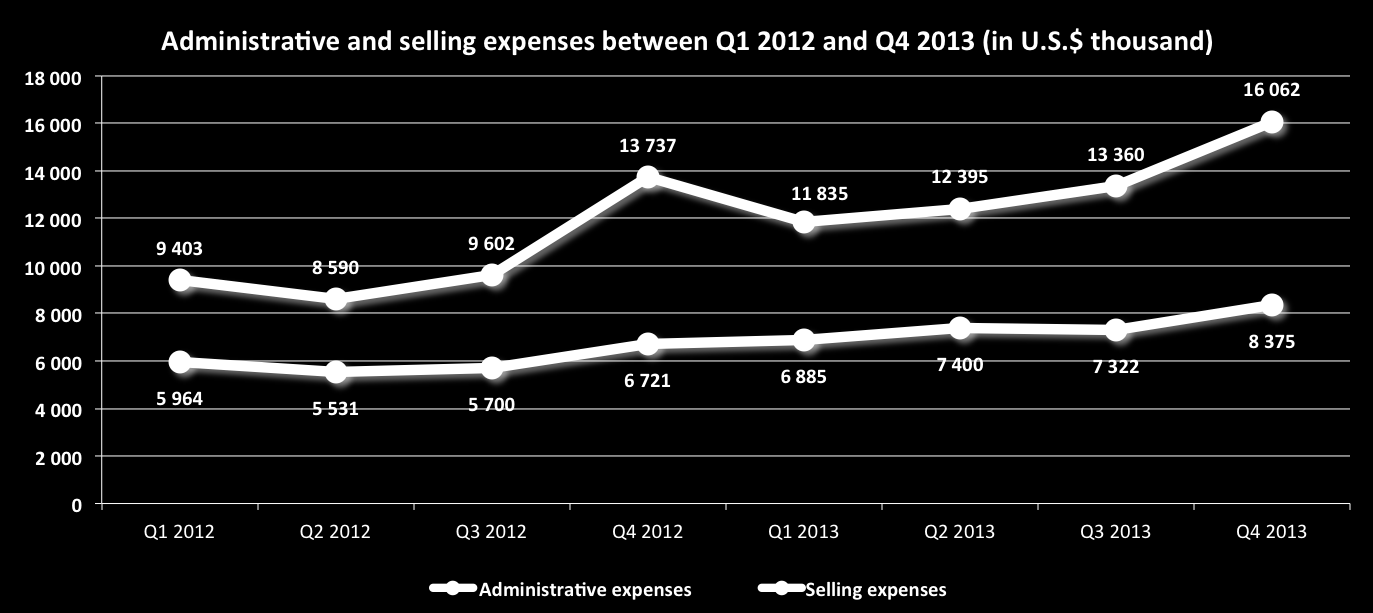
42 Gross profit margin (gross profit as a percentage of revenues): Due to changes in product portfolio, that included more own brands sales and distribution of third party products, the gross profit margin in 2013 increased by 21.64% to 6.02% from 4.95% in Selling Expenses: Selling expenses largely comprise of salaries and benefits paid to sales employees (sales, marketing and logistics departments), marketing and advertising fees, commissions, and traveling expenses. Selling expenses usually grow together (but not in-line) with growing sales and gross profit and as expected this was also the case of They were additionally increased by investments made in the development of own brands sales. However, at the same time, selling expenses grew slower than gross profit. Selling expenses in 2013 increased by 29.81% to U.S. $ 53,651 from U.S. $ 41,332 in Administrative Expenses: Administrative expenses largely comprise of salaries and wages of administration personnel and rent expense. They increased in 2013 mostly due to investments in own brands organization and higher number of employees. Administrative expenses in 2013 increased by 25.36% to U.S. $ 29,982 from U.S. $ 23,916 in Operating profit: Operating profit for the year ended 31 December 2013 grew significantly by 51.52% to U.S. $ 31,939, compared to U.S. $ 21,079 in This clearly shows a constant upgrade in the Company s operations and improved efficiencies that allow the Company s management to be optimistic about future results. Operating margin (operating profit as a percentage of revenues) amounted 1.66% for the year 2013, compared to 1.21% for 2012, posting a 37.67% growth. Profit Before Taxation: In 2013 profit before taxation grew by 45.44% to U.S.$ 16,365, compared to U.S.$ 6,367 in Profit After Taxation: In 2013 net profit after taxation grew by 40.51% to U.S. $ 12,712 in comparison to U.S. $ 9,047 in Net profit in Y2013 exceeded the upper range of the Company s financial forecast (the Company forecasted NPAT for Y2013 to be in the range of U.S.$ 11.0 million and U.S.$ 12.5 million) and reconfirms the Company s ability to deliver for another consecutive year growing profits, well in line and even exceeding its forecasts. 42
43 Liquidity and Capital Resources The Company has in the past funded its liquidity requirements, including ongoing operating expenses and capital expenditures and investments, for the most part, through operating cash flows, debt financing and equity financing. The following table presents a summary of cash flows for the twelve months ended December 31 st, 2013 and 2012: Twelve months ended December 31 st U.S. $ Net cash inflows/(outflows) from operating activities 11,019 (38,228) Net cash outflows from investing activities (3,245) (2,071) Net cash (outflows)/inflows from financing activities (2,891) 16,656 Net increase/(decrease) in cash and cash equivalents 4,883 (23,644) Net cash inflows/(outflows) from operations Net cash inflows from operations amounted to U.S. $ 11,019 for 2013, compared to outflows of U.S. $ 38,288 in This was primarily due to improved utilization of working capital and the employment of supply-chain financiers. The Company s aims to further improve its profitability and cash flow from operations. Net cash outflows from investing activities Net cash outflows from investing activities was U.S. $ 3,245 for 2013, compared to U.S. $ 2,071 in These outflows relate to on-going investments for fixed assets, such as computers, furniture etc. Net cash (outflows)/inflows from financing activities Net cash outflows from financing activities was U.S. $ 2,891 for 2013, compared to inflows of U.S. $ 16,656 in Net increase/(decrease) in cash and cash equivalents As a result of improved profitability and working capital management, cash and cash equivalents have increased by U.S. $ 4,883 in 2013, compared to a decrease of U.S. $ 23,644 in Capital Resources The Company s management believes that we have enough resources to finance our operations (as described in the audited financial statements attached to this annual report) going forward. As at 31 December 2013, we had total short-term and long-term debt (excluding amounts due to factoring creditors) of U.S. $ 76,214, including U.S. $ 73,642 of current maturities (due within one year from 31st, December 2013), compared to U.S. $ 75,211, including U.S. $ 71,736 of current maturities, as at 31 December The table below presents our principal debt facilities as at 31 December 2013: ENTITY Financial institution Type of facilities Credit limit Currency Rate US$ Equivalent Valid from Valid till Asbisc Enterprises Plc Cyprus Development Bank Overdraft Euro 0,74 $ Sep Nov.14 Asbisc Enterprises Plc Cyprus Development Bank L/C-Bank Guarantees USD 1,00 $ Sep Nov.14 Asbisc Enterprises Plc Cyprus Development Bank Overdraft USD 1,00 $ Sep Nov.14 43
44 Asbisc Enterprises Plc Cyprus Development Bank Loan Euro 0,74 $ Sep Nov.13 Asbisc Enterprises Plc Bank of Cyprus Overdraft- Multicurrency USD 1,00 $ Apr.10 non term Asbisc Enterprises Plc Bank of Cyprus Guarantees USD 1,00 $ Apr.10 non term Asbisc Enterprises Plc Bank of Cyprus Factors Factoring USD 1,00 $ Mar.11 non term Asbisc Enterprises Plc Bank of Cyprus Factors Factoring Euro 0,74 $ Mar.11 non term Asbisc Enterprises Plc Bank of Cyprus Overdraft USD 1,00 $ Nov.09 non term ASBIS Kypros Ltd Bank of Cyprus Overdraft Euro 0,72 $ Jul May.14 ASBIS Kypros Ltd Bank of Cyprus Factoring Euro 0,72 $ Jul Jul.14 ASBIS Kypros Ltd Bank of Cyprus Overdraft Euro 0,72 $ Aug May.14 Prestigio Plaza Cyprus Development Bank Overdraft Euro 0,72 $ Dec.11 non term Prestigio Plaza Bank of Cyprus Overdraft Euro 0,72 $ Jul Jul.14 Asbis CZ, spol s.r.o CSOB bank Revolving Koruna 19,89 $ Mar.13 non term Asbis CZ, spol s.r.o CSOB bank Overdraft Koruna 19,89 $ Jul.12 non term Asbis CZ, spol s.r.o Transfinance Factoring Koruna 19,89 $ Jun.09 non term Asbis PL, SP z.o.o BZ WBK Faktor Sp. z o.o. Factoring Polish Zloty 3,0120 $ Apr.12 unlimited period Asbis PL, SP z.o.o BOŚ Bank S.A. Overdraft Polish Zloty 3,0120 $ Oct Sep.14 Asbis PL, SP z.o.o Bank Zachodni WBK S.A. Revolving credit Polish Zloty 3,0120 $ Apr Sep.14 Asbis PL, SP z.o.o Bank Zachodni WBK S.A. Overdraft Polish Zloty 3,0120 $ Oct Sep.14 Asbis PL, SP z.o.o Bank Zachodni WBK S.A. Bank guarantee Polish Zloty 3,0120 $ Jan Sep.16 Asbis Baltic Swedbank AS Factoring Euro 0,73 $ May Jun.14 Asbis Baltic Swedbank AS Overdraft Euro 0,73 $ Apr Apr.14 Asbis Romania SRL Alpha Bank Overdraft RON 3,25 $ Oct Oct.14 Asbis Romania SRL Alpha Bank Bridge Loan RON 3,25 $ Oct Jan.14 Asbis SK spol s.r.o Tatrabanka a.s. Overdraft Euro 0,73 $ Nov Apr.14 Asbis SK spol s.r.o Tatrabanka a.s. Bank Guarantee Euro 0,73 $ Nov Apr.14 Asbis SK spol s.r.o Tatrabanka a.s. Revolving Credit Euro 0,73 $ Nov Apr.14 Asbis SK spol s.r.o Tatrabanka a.s. Long Term Loan Euro 0,73 $ Nov Jun.17 ASBIS Cr d.o.o Erste&Steiermarkische bank d.d. bank loan Hrk 5,55 $ Jan Jan Societe Generale-Splitska ASBIS Cr d.o.o bank guarantee Hrk $ Nov.13 3 months Banka D.D 5,55 respiro ASBIS Cr d.o.o Prvi faktor d.o.o. Factoring Hrk 5,55 $ Feb.10 no date Asbis D.o.o Beograd Societe Generale Short Term Loan rsd 83,13 $ Mar.13 4.Sep.14 Asbis D.o.o Beograd Societe Generale Overdraft ,00 rsd 83,13 $ Oct Oct.14 Asbis D.o.o Beograd Societe Generale Customs Guarantee ,00 rsd 83,13 $ Feb Feb.14 Asbis D.o.o Beograd Societe Generale Factoring $ Mar Mar ,00 rsd 83,13 Asbis Hungary Ltd Erste Bank Short term Loan Huf 215,67 $ Mar Mar.14 Asbis Siovenia d.o.o Nova ljubljanska banka d.d (Domzale) Overdraft Euro 0,72 $ Dec Dec.14 Asbis Siovenia d.o.o S-factoring d.o.o. Factoring Euro 0,72 $ Sep.13 Asbis Bulgaria Ltd Unicredit Bulbank Plc Revolving loan Bng 1, Sep Jan.15 Asbis Bulgaria Ltd Unicredit Bulbank Plc Bank guarantees USD 1, Sep May.14 Asbis Bulgaria Ltd Unicredit Factoring EAD Factoring line Bng 1, Sep.13 2.Nov.14 Asbis Bulgaria Ltd Citibank N.A. - Sofia Branch Factoring line Bng 1, Sep.13 non term 44
45 Asbis Middle East FZE National Bank of Fujairah Loan Dirham 3,68 $ Dec.06 TILL DATE Asbis Middle East FZE Asbis Middle East FZE Asbis Middle East FZE Asbis Ltd National Bank of Fujairah HSBC Bank Middle East Limited HSBC Bank Middle East Limited Bibby Financial Services Ltd Factoring / Discounting Import Line Facility Factoring / Discounting Invoice discounting Dirham 3,68 $ Dec.06 TILL DATE Dirham 3,68 $ May.13 TILL DATE Dirham 3,68 $ Jun.09 TILL DATE Euro 0,72 $ Aug.13 till date OOO Asbis-Moscow Moscow Credit bank factoring Rur 32,73 $ Jun.09 till date OOO Asbis-Moscow Moscow Credit bank Overdraft Rur 32,73 $ Apr Apr.14 OOO Asbis-Moscow Moscow Credit bank Short Term Loan Rur 32,73 $ Sep Sep.14 OOO Asbis-Moscow Moscow Credit bank Short Term Loan Rur 32,73 $ Apr.13 3.Apr.14 Megatrend SBERBANK BH d.d. Overdraft ,00 KM 1,42 $ May May.14 Megatrend SBERBANK BH d.d. Revolving ,00 KM 1,42 $ Jan Jan.14 Megatrend SBERBANK BH d.d. Revolving ,00 KM 1,42 $ Aug Apr.14 Megatrend UniCredit Bank d.d. Revolving ,00 KM 1,42 $ May May.14 Megatrend Raiffeisen Bank d.d. Bank guarantee ,40 KM 1,42 $ May Jun.14 Megatrend SBERBANK BH d.d. Bank guarantee ,00 USD 1,00 $ Feb Mar.14 Megatrend Raiffeisen Bank d.d. Revolving ,00 KM 1,42 $ Sep Mar.14 Megatrend Raiffeisen Bank d.d. Overdraft ,00 KM 1,42 $ Sep.13 6.Mar.14 Megatrend Raiffeisen Bank d.d. Revolving ,00 KM 1,42 $ Nov May.14 Megatrend Raiffeisen Bank d.d. Bank guarantee ,00 Megatrend Raiffeisen Bank d.d. Bank guarantee ,00 USD KM 1,00 1,42 $ May Jun.14 $ Jan Jan.14 IT Max Bank Moskva-Minsk Short Term Loan BLR 9 550,00 $ Oct.13 5.Sep.16 IT Max Bank Moskva-Minsk Short Term Loan USD 1,00 $ Sep.13 5.Sep.16 Asbis Latvia Pohjola bank plc filiāle Latvijā Overdraft EUR 0,72 $ Dec Dec.14 Asbis Lithuania Pohjola bank Overdraft eur 0,72 $ Aug.13 7.Aug.14 ASBIS Turkey GARANTI FACTORING Factoring USD AS 1,00 $ Sep.09 Till Date Zao Asbis (Asbis Bank Moscow-Minsk Short Term Loan Belarus) Byr 9 510,00 $ Sep Sep.16 Zao Asbis (Asbis Bank Moscow-Minsk Short Term Loan Belarus) Byr 9 510,00 $ Apr Apr.14 ASBC PRIORBank Short Term Loan Byr 9 210,00 $ Apr May.14 ASBIS Kazakhstan Kazkommertsbank Short Term Loans KZT 153,61 $ Dec.13 8.Jan.14 ASBIS Kazakhstan Kazkommertsbank Short Term Loans KZT 153,61 $ Dec Jan.14 ASBIS Ukraine UkrExImBank Factoring UAH 7,993 $ Oct.11 5.Mar.14 ASBIS Ukraine UkrExImBank Short Term Loans UAH 7,993 $ Oct Oct.18 Capital Expenditure Our total capital expenditure for tangible and intangible assets amounted to U.S. $ 3,818 for the year ended 31 December 2013, compared to U.S. $ 2,402 for the year ended 31 December Commitments and contingencies Commitments and contingencies are presented in the audited financial statements included elsewhere in this annual report. 45
46 Critical Accounting Policies The preparation of our financial statements under IFRS requires Management to select and apply certain accounting policies that are important to the presentation of our financial condition and results of operations. Certain of our accounting policies have been identified as critical accounting policies. A "critical accounting policy" is one that both (i) is significant to our financial condition and results of operations (in that the application of a different accounting principal or changes in related estimates and assumptions that Management could reasonably have used or followed would have a material impact on our financial condition and results of operations) and (ii) requires difficult, complex or subjective analysis to be made by Management based on assumptions determined at the time of analysis. Our accounting policies are reviewed on a regular basis and Management believes that the assumptions and estimates made in the application of such policies for the purposes of preparing our financial statements are reasonable; actual amounts and results, however, could vary under different methodologies, assumptions or conditions. Our accounting policies and certain critical accounting estimates and judgments with respect to the preparation of our financial statements are described in Note 2 to the financial statements included elsewhere in this annual report. Financial forecast for the year 2014 Due to the unstable economic environment and the political crisis in Ukraine also affecting Russia, the Company s management have decided not to publish a financial forecast for Y2014 as yet. We plan to announce it to the market at a later stage, once the situation crystalises. ITEM 4. DIRECTORS, SENIOR MANAGEMENT AND EMPLOYEES Board of Directors The Board of Directors is responsible for formulating, reviewing and approving our strategy, budgets and corporate actions. We intend to hold Board of Directors meetings at least four times each financial year and at other times as and when required. The following table sets out our current Directors: Name Year of Birth Position Siarhei Kostevitch 1965 Chairman, Chief Executive Officer Appointed to the Board Marios Christou 1968 Chief Financial Officer 28 December 2001 Constantinos Tziamalis 1975 Director of Credit & Investor Relations Expiry of term Nationality 30 August June 2016 Belarussian/Cypriot 4 June 2016 Cypriot 23 April 2007 Next AGM Cypriot Efstathios Papadakis 1936 Non Executive Director 5 May May 2015 Cypriot Chris Pavlou 1945 Non Executive Director 18 June June 2016 Cypriot The biographical details of the members of our Board of Directors are set out below: Siarhei Kostevitch, born in 1965, holds a Masters degree in radio engineering design from the Radio Engineering University of Minsk (1987). Between 1987 and 1992, Siarhei worked as a member of the 46
47 Research Center at the Radio Engineering University in Minsk, where he published a series of articles on microelectronics design in local and world-wide specialist magazines. In 1990, Siarhei established a design and manufacturing business in Minsk, Belarus, and within 15 years has built it into the leading computer component distributor in Eastern Europe and the Former Soviet Union. Siarhei is the Chairman and the CEO of the Group. Marios Christou, born in 1968, holds a B.A., dual major in Accounting and Information Systems and Economics, from Queens College of the City University of New York (C.U.N.Y.) (1992), and an M.B.A. in International Finance from St. John's University, New York (1994). Marios is also a Certified Public Accountant (CPA) and a member of the American Institute of Certified Public Accountants (AICPA). Marios worked with Deloitte & Touche Limassol, Cyprus, for four years, as an audit manager. Marios then worked as a Financial Controller at Photos Photiades Breweries Ltd (part of the Carlsberg Group of companies) for three years. Marios joined the Company in August 2001 and is the Chief Financial Officer. Constantinos Tziamalis, born in 1975, holds a B.Sc. in Banking and Financial Services (1998) and a Masters (M.Sc.) in Finance (1999) from the University of Leicester. Constantinos Tziamalis worked at the private banking department of BNP Paribas in Cyprus and then joined a brokerage house, Proteas Asset Management Limited, for 3 years as Investor Accounts Manager. Constantinos joined the Company in January 2002 as Financial Project Manager. He was promoted to his current position as Corporate Credit Controller & Investor Relations in March 2003 and became Director of Credit and Investor Relations as of 23 April In January 2010 Constantinos has been also appointed as head of the FX Risk Management team. Efstathios Papadakis, born in 1936, joined the Group in His career includes a number of positions related to business and public administration. Since 1962 he was involved in the petroleum business. Then he served as a member of the Board of Directors' of many Cyprus private and public companies, including KEO (Vice President), Amathus Navigation, Orphanides Supermarkets, A.S.G. and Phil. Andreou. He served as a Minister of Labour and Social Insurance Ministry ( ) and a president of the CYTA Board of Directors ( ). He also served on the BOD of Limassol s Chamber Of Commerce and on the Cyprus Commercial and Industrial Chamber centre of productivity. From the 1st of January 2009 he is a member of the Temporary Managing Committee of the Cyprus University of Technology (TEPAK). He also served as an Officer in Civil Defence and is a member of the Board of Directors of the Institute of Eurodemocracy and is a member of many charitable institutions. He graduated from the University of Economics and Commerce, Athens. Efstathios is the Company s Non-Executive Director. Chris Pavlou, born in 1945, joined the Group in Currently he is a Member of the Board, Chairman of the Board s Audit Committee and Chairman of the Board s Risk Committee at Marfin Laiki Bank (since December 2011). He specializes in risk management, foreign exchange risk management and team building. His career includes a number of positions related to banking business with international institutions. He started at Barclays Bank in 1966, and he stayed at this institution until During this time he held positions of Senior Trader, Chief Dealer, Head of Treasury and finally Deputy Chief Manager. Between 1986 and 1998 he was a Head of Treasury at HSBC. Between 1999 and 2004 he was a Member of the Board at Marfin Laiki Bank. Between 2006 and 2011 he held position of the Chairman of the Board at TFI Markets (financial services industry). Chris is the Company s Non-Executive Director. Directors remuneration Unless determined by ordinary resolution, the number of Directors shall be not less than three and there shall be no maximum number of Directors. Subject to our Articles of Association, we may by ordinary resolution appoint a person who is willing to act as a Director, either to fill a vacancy or as an addition to the existing Board of Directors. The remuneration of the Directors will from time to time be determined by the general meeting on the recommendation of the remuneration committee. Any Director performing special or extraordinary services 47
48 in the conduct of our business or in discharge of his or her duties as Director, or who travels or resides abroad in discharge of his or her duties as Director may be paid such extra remuneration as determined by the Directors, upon recommendation by the remuneration committee. Executive Directors are also entitled to receive a bonus every quarter depending upon our quarterly results. The bonus consists of a certain amount or percentage which is agreed and described in each Director s service agreements or contracts, as applicable, however, Directors only receive such a bonus to the extent that our profit meets certain pre-set budgetary figures. All such bonus amounts are included in the remuneration tables set forth below. The following table presents the remuneration (including bonuses) of Directors for the years ended 31 December 2013 and 2012, respectively (U.S.$): Name Salary Other benefits Total Salary Other benefits Total Share ownership Siarhei Kostevitch Marios Christou Constantinos Tziamalis Laurent Journoud Efstathios Papadakis Kyriacos Christofi Chris Pavlou The table below presents the beneficial interests of Directors in our issued share capital as at the date of the publication of this annual report: Name Number of Shares % of the share capital Siarhei Kostevitch (directly and indirectly) 22,718, % Marios Christou 248, % Constantinos Tziamalis 35, % Efstathios Papadakis 0 Chris Pavlou 0 Siarhei Kostevitch holds shares as the ultimate beneficial owner of KS Holdings Ltd. During 2013 there were the following changes in the number of shares possesed by the Directors: (1) On May 14th, 2013 the Company received notification from Mr. Siarhei Kostevitch, Chairman of the Board of Directors and the Company s CEO who announced about a change in the number of possessed shares of ASBISc Enterprises Plc, that was above 33% by at least 1%. The change resulted from a transaction of sale of 3,000,000 (three million) shares on May 13th, 2013 conducted by a related entity. Before the abovementioned transaction Mr. Kostevitch held (directly and indirectly) 25,718,127 shares that entitled him to 25,718,127 votes at the General Meeting of Shareholders of ASBISc Enterprises Plc, were equal to 46.34% in the share capital of ASBISc Enterprises Plc and 46.34% in the total number of votes at its General Meeting of Shareholders. This included: (1) Directly: 41,766 shares of ASBISc Enterprises Plc 0% 0% 48
49 of a nominal value 0,20 USD each, that were entitling him to 41,766 votes at the General Meeting of Shareholders of ASBISc Enterprises Plc, were equal to 0.08% in share capital of ASBISc Enterprises Plc and 0.08% in the total number of votes at its General Meeting of Shareholders. (2) Indirectly, through KS Holdings Ltd: 25,676,361 shares of ASBISc Enterprises Plc of a nominal value 0,20 USD each, that were entitling it to 25,676,361 votes at the General Meeting of Shareholders of ASBISc Enterprises Plc, were equal to 46.26% in share capital of ASBISc Enterprises Plc and 46.26% in the total number of votes at its General Meeting of Shareholders. Mr. Kostevitch has also announced that after the abovementioned transaction he holds (directly and indirectly) 22,718,127 shares, that entitle him to 22,718,127 votes at the General Meeting of Shareholders of ASBISc Enterprises Plc, equal to 40.93% in the share capital of ASBISc Enterprises Plc and 40.93% in the total number of votes at its General Meeting of Shareholders. This includes: (1) Directly: 41,766 shares of ASBISc Enterprises Plc of a nominal value 0,20 USD each, that entitle to 41,766 votes at the General Meeting of Shareholders of ASBISc Enterprises Plc, that are equal to 0.08% in share capital of ASBISc Enterprises PLC and 0.08% in the total number of votes at its General Meeting of Shareholders. (2) Indirectly, through KS Holdings Ltd: 22,676,361 shares of ASBISc Enterprises PLC of a nominal value 0,20 USD each, that entitle to 22,676,361 votes at the General Meeting of Shareholders of ASBISc Enterprises Plc, that are equal to 40.86% in the share capital of ASBISc Enterprises PLC and 40.86% in the total number of votes at its General Meeting of Shareholders. Mr. Kostevitch has also announced that he does not plan to further decrease his stake in ASBISc Enterprises Plc in the next 12 months from the date of notification. (2) On June 14 th, 2013 the Company received notification from Mr. Marios Christou, Director and the Company s CFO, who informed that on June 10 th and June 13 th, 2013 he sold a total number of 102,000 shares of the Company at an average price of PLN 5.09 per share. (3) On October 31 st, 2013 the Company received notification from one of Directors who informed that he sold 150,000 of the Company s shares at the average price of PLN 6.97 per share on September 26 th, 2013 in ordinary market transactions at the Warsaw Stock Exchange. Committees The Audit Committee of the Company, comprising Efstathios Papadakis and Chris Pavlou (both nonexecutive Directors) and Marios Christou (as attending member) is chaired by Efstathios Papadakis. The Audit Committee meets at least twice a year. The Audit Committee is responsible for ensuring that the Group s financial performance is properly monitored, controlled and reported. It also meets the auditors and reviews reports from the auditors relating to accounts and internal control systems. The Audit Committee meets at least once a year with the auditors. The Remuneration Committee of the Company, comprising Chris Pavlou and Efstathios Papadakis (both non-executive Directors) and Siarhei Kostevitch (as attending member) is chaired by Chris Pavlou. It sets and reviews the scale and structure of the executive Directors remuneration packages, including share options and terms of their service contracts. The remuneration and the terms and conditions of the nonexecutive Directors are determined by the Directors with due regard to the interests of the Shareholders and the performance of the Group. The Remuneration Committee also makes recommendations to the Board concerning the allocation of share options to employees. Changes in main management rules There were no changes to main management rules in List of all agreements signed with directors that gives right to compensation in case that the person resigns or is fired There were no changes in the service agreements of any of the directors. 49
50 Information about ownership of shares of any related parties - owned by the Directors None of our Directors holds shares of any of our subsidiary companies, other than disclosed. Employees As at 31 December 2013, we employed 1,815 employees, of whom 304 were employed by the Company and the remainder in the rest of the Company s offices worldwide. The split of employees by area of activity as at 31 December 2013 and 2012 is as follows: As at 31 December Sales and Marketing Administration and IT Finance Logistics Total 1,815 1,407 ITEM 5. MAJOR SHAREHOLDERS AND RELATED PARTY TRANSACTIONS Major Shareholders The following table presents shareholders possessing more than 5% of our shares as of the date of publication of this report, according to our best knowledge. The information included in the table is based on the information received from the shareholders pursuant to Art. 69, sec. 1, point 2 of the Act on Public Offering, conditions governing the introduction of financial instruments to organized trading and public companies. Name Number of shares % of share capital Number of votes % of votes KS Holdings Ltd 22,676, % 22,676, % Quercus Towarzystwo Funduszy Inwestycyjnych S.A. Quercus Parasolowy SFIO and Quercus Absolutnego Zwrotu FIZ)* 3,274, % 3,274, % ING OFE 2,872, % 2,872, % Noble Funds Towarzystwo Funduszy Inwestycyjnych S.A. 2,780, % 2,780, % (Noble Funds Fundusz Inwestycyjny Otwarty, Noble Fund 2DB Fundusz Inwestycyjny Zamknięty, Noble Fund Opportunity Fundusz Inwestycyjny Zamknięty)** Noble Funds Fundusz Inwestycyjny Otwarty*** 2,829, % 2,829, % ASBISc Enterprises PLC (buy-back program) 118, % 118, % * Including 2,775,045 shares corresponding to 5.00% votes at the AGM held by Quercus Parasolowy SFIO - according to notification from December 9th, ** According to notification from December 17 th, 2013 *** According to notification from March 4 th, 2014 Related Party Transactions During the year ended 31 December 2013 the Company did not have any material related party transactions exceeding the Polish Zloty equivalent of Euro 500 thousand other than typical or routine transactions. For ordinary course of business transactions, please refer to the notes on the audited financial statement attached on this annual report. 50
51 In the year 2013, a number of transactions have occurred between us and our subsidiaries and between our subsidiaries. In our opinion all of these transactions were based on terms that did not vary from market terms and their nature and conditions resulted from ongoing needs and operations of the Company and of the Group, such as contracts related to the purchases of goods for onward distribution to external clients. All of these transactions and related outstanding balances were eliminated in the Financial Statements included in this Annual Report and, as a result, did not have any impact on our consolidated financial results and on our financial position as a whole. ITEM 6. FINANCIAL INFORMATION Legal Proceedings Currently there are no legal proceedings pending against us or any of the members of our Group, whose single or aggregate value exceeds 10% of our equity. Information on loans given to any other party During the year ended 31 st December 2013 we have not granted any loan to any other party other than our subsidiaries which are disclosed in the third part of this report (audited financial statements). Information on given guarantees We give certain guarantees to some of our vendors and to certain customs authorities. All our guarantees are reported in the financial statements section of this annual report. The total bank guarantees and letters of credit raised by the Group (mainly to Group suppliers) as at December 31 st, 2013 was U.S. $ 8,044 as per note number 16 to the financial statements which is less than 10% of the Company s equity. Additionally, as at December 31 st, 2013 the Company has granted corporate guarantees of U.S.$ 188,815 to support its subsidiaries local financing, which represents more than 10% of the Company s equity. Evaluation of financial resources management (including ability to pay back commitments) and information about actions undertaken to avoid risks This has been discussed in note 32 of our financial statements to this annual report under the headline Financial Risk management. Evaluation of possibility of realisation of investment intentions The Company has completed all its current investments in prior years and in 2014 intends to grow organically, therefore there is no risk connected with the realization of current investment intentions. Characteristics of structure of assets and liabilities in the consolidated balance sheet including characteristics from the point of view of Company liquidity The structure of assets and liabilities in the balance sheet including characteristics from the point of view of the Company s liquidity has been discussed in detail in the financial statements included in this annual report: a) note 13 - Trade receivables - Ageing analysis of receivables b) note 32 Financial risk management point 1.3. Liquidity risk Information about the structure of main deposits and capital investments in 2013 There were no deposits other than those disclosed as pledged deposits in the financial statements to this annual report. There were no other capital investments than the ones disclosed in note 9 of the financial statements included in this annual report. 51
52 Information about relevant off balance sheet positions as at December 31 st, 2013 There were no relevant off balance sheet positions as at December 31 st, 2013 other than Bank Guarantees disclosed in note 22 of the audited financial statements. DIVIDEND POLICY Our dividend policy is to pay dividends at levels consistent with our growth and development plans, while maintaining a reasonable level of liquidity. After a temporary pause in dividend payout in (caused by the fact that results were not satisfactory enough due to world s financial crisis effects), in 2012 the Company started to pay dividend again and continued since. Following the strong results of 2013, the Board of Directors will recommend to the forthcoming Annual General Meeting of Shareholders to pay a dividend of US$ 0.06 per share, amounting to US$ 3,330,000. Any future dividends will be solely at the discretion of the Board of Directors and the general meeting of shareholders after taking into account various factors, including business prospects, future earnings, cash requirements, financial position, expansion plans and requirements of the Cypriot law. The Cyprus law does not limit dividends that may be paid out except that it states that dividends may only be paid out of profits and may not be higher than recommended by the Board of Directors. Material Contracts Contract with Intel International B.V. We entered into a distribution agreement with Intel International B.V. ("Intel") on 1 August 1998, pursuant to which we are to act as a non-exclusive distributor of Intel's products in the territories to be agreed in writing between the parties from time-to-time. We were also appointed as a non-exclusive distributor of Intel services on Intel's "Distributor Cost List". Such appointment is terminable 'at will' without prior notice and without liability. Under the contract Intel gives limited warranties regarding the products delivered, limits the remedies for breach of warranty and has the ability to vary the limited warranties given. There are also limitations on any warranties that we may give to our customers and exclusions of liability for any loss of profits or incidental, consequential or special damages irrespective of whether Intel has prior notice of the possibility of such damages. The agreement may be renewed each year for an additional period of one year, unless prior to that date either party has given 30 days' notice of its intention not to renew. In addition, either party may terminate the agreement at any time with or without cause and without liability (except in regard to possible return of inventory) upon 60 days' written notice. Contract with AMD ISA Hardware Limited ("ISA Hardware") entered into a commercial distribution agreement dated 31 December 2003 with AMD pursuant to which ISA Hardware was appointed as a non-exclusive commercial distributor to promote and distribute AMD integrated circuits, electronic devices and other products listed in the agreement within the territories allocated to ISA Hardware under the agreement. This agreement has been transferred to ASBISc Enterprises Plc ( ASBIS ) as of 1 January The prices that ASBIS is charged are described as the "distributor's best buy" price for each product, as published in AMD's pricing supplement, unless otherwise agreed in writing between the parties. The agreement continues in force unless terminated by 30 days' written notice of either party. AMD also has the right to terminate upon 24 hours' notice for cause, including insolvency or such similar event whereby ASBIS discontinues its business or if there is a change of control. In addition, AMD has the right to terminate upon 24 hours' notice if ASBIS fails to pay invoices after a warning or if it misrepresents or falsifies information or if it is in breach of any of its representations, warranties covenants, obligations or duties under the agreement. If the agreement is so terminated, all outstanding amounts payable by ASBIS to AMD will become immediately due. 52
53 Contract with Seagate Technology International We entered into a distributor agreement with Seagate Technology International ("Seagate") on 26 June 2001 by which we were appointed as a non-exclusive distributor of certain products as described in Seagate's distribution price list in territories across Europe and the Middle East. This price list is subject to change at Seagate's discretion. We are also under an obligation to actively promote products in the territories in which we operate. Pursuant to the agreement we are entitled to an early payment discount of 1%, which may be amended or discontinued by Seagate at any time without prior notice to us. A credit line is also available under the contract but at the sole discretion of Seagate. We are authorized under the agreement to use Seagate's current and future trademarks, service marks and trade names solely in connection with the marketing and distribution of Seagate products. The agreement may be terminated by either party upon 30 days' written notice. Alternatively, it may be terminated for cause including an event of force majeure, petition for bankruptcy or a material breach which remains uncured. Contract with Microsoft Ireland Operations Limited Asbis Romania entered into an International Distribution Agreement with Microsoft Ireland Operations Limited ("Microsoft Ireland") dated 1 April 2006, for the distribution of Windows operating systems and applications within the territory of Romania. Asbis Romania is able to ship software packages, software licences and hardware under the terms of the agreement and is liable for royalty fees on a "per item" basis. These fees are calculated in accordance with a price schedule. Software royalties are payable within 75 days and hardware royalties within 60 days with late payment charges applicable. All products distributed by Asbis Romania are covered by the Microsoft warranty which accompanies the particular hardware or software. Unless terminated earlier, the agreement will continue until 30 June 2009, at which date it will automatically end. Either party may negotiate a new fixed term by mutual consent, which will be governed by the same terms and conditions as the present agreement. In any event, either party may terminate the agreement upon 30 days' written notice or immediately if the other party becomes insolvent, is subject to bankruptcy proceedings, is subject to reorganisation or receivership, is unable to pay its debts, or makes or attempts to make an assignment for the benefit of creditors. Agreements with DELL ASBISc Enterprises PLC (ASBIS) has entered into a several DELL International Distributor Agreements since with DELL pursuant to which ASBIS was appointed as a non-exclusive distributor to market, distribute, sell and support DELL Products and DELL Branded Services listed in the agreements within the territories allocated to ASBIS under the agreements. DELL provides ASBIS from time to time with its latest price list for the sale of Products and DELL Services for the territories. The agreements continue in force for an initial period of one year. Thereafter agreements continue in force for a further four year period unless terminated by of either party giving the other 3 months written notice. DELL also has right to terminate agreements or any part of it immediately on giving notice in writing to ASBIS if there is a change of control or if any export control requirement or regulation is breached or could be breached or if any of the sales targets is failed to achieve or if ASBIS enters into arrangements which could result in a conflict of interest with DELL. In addition, agreements may be terminated by either party forthwith on giving notice in writing if continuance of agreements becomes unduly difficult by the reason of diplomatic relations between the respective countries of the parties or if any material or persistent breach of any terms of agreements is committed and shall have been failed after warning in writing or if party shall have a receiver or administrative receiver or the equivalent appointed of it or a court of competent jurisdiction shall make an order to that effect or if party shall enter into any voluntary arrangement with its creditors. If the agreements are so terminated, all outstanding unpaid invoices shall become immediately payable by ASBIS in place of the payment terms previously agreed between parties. Agreements with TOSHIBA ASBISC Enterprises PLC (ASBIS) has entered into several TOSHIBA Authorised Distributor Agreements in 2006 with TOSHIBA (TEG) pursuant to which ASBIS was appointed as authorised non-exclusive 53
54 distributor to sell and distribute a range of computer hardware/software products, particularly portable personal computers and a range of mobile storage products listed in the agreements in the Territories allocated to ASBIS under the agreements. The prices payable by ASBIS for the products shall be TEG s Distributor Price List current at the date upon which each order is accepted, less any discounts offered by TEG, if any. The agreements continued to be effective until 31 of March 2007 and are automatically renewed for succeeding 1 year periods unless a termination notice is given by either party at least 3 months prior to expiration of the term then in effect. Agreements may be terminated by TEG at any time if ASBIS is in material breach hereof and has not remedied that breach within 30 days of receipt of TEG s written notice or if ASBIS goes into liquidation including insolvency or such similar event whereby ASBIS discontinues its business or if there is a change of control. ITEM 7. ADDITIONAL INFORMATION Corporate Governance Report on Application of Corporate Governance Rules in 2013 I. Specification of the set of corporate governance rules to which the Issuer is subject, and place where text of such set of rules is available to public The Company applies the rules of Corporate Governance according to Warsaw Stock Exchange Code of Best Practices as approved by the Company s Board of Directors. These rules are changed by the Warsaw Stock Exchange from time to time. Current rules (obligatory from 2013) and rules that were obligatory in 2012 can be found at the WSE dedicated website: The Company s Statement on Corporate Governance, information on application of its rules and any deviations can be found on the Company s internet site for investors, at and II. Indication of which corporate governance rules were not applied by the issuer and indication of under what circumstances and for what reasons the specific rule was not applied, and how the company intends to remove effects, if any, of not having applied a given rule and what steps it intends to take to mitigate the risk of the specific rule not being applied in the future The following table summarizes information about application of corporate governance rules applied, not applied, partially applied or non-applicable for the Company in 2013: No. RULE YES/NO Partially N/A COMMENTS INTRODUCTION Note: Companies formed under Cyprus laws do not have a supervisory board or a management board. Cyprus companies have a board of directors, members of which are appointed to fill certain executive (the Executive Directors ) and non-executive positions (the Non-executive Directors ) (the Board of Directors ). The Non-executive Directors (called independent directors), generally, are neither officers nor employees of Cyprus companies as opposed to the Executive Directors, who generally, are officers and employees of Cyprus companies. Generally, officers of a Cyprus law corporation may be treated as the management authority of a corporation, which however should not be equated with a management board within the meaning of Polish law. The management of the business and the conduct of the affairs of Asbisc Enterprises PLC (the Company ) are vested in the Board of Directors. The Board of Directors takes its decisions in a group by majority voting. In case of an equality of votes, the chairman has a casting vote. Due to a fact that Cyprus companies do not have either a supervisory board or a management board these terms used in this Best Practices refer to the Board of Directors of the Company. 54
55 I RECOMMENDATIONS FOR BEST PRACTICE FOR LISTED COMPANIES 1. A company should pursue a transparent and effective information policy using both traditional methods and modern technologies and latest communication tools ensuring fast, secure and effective access to information. Using such methods to the broadest extent possible, a company should in particular: - maintain a company website whose scope and method of presentation should be based on the model investor relations service available at - ensure adequate communication with investors and analysts, and use to this purpose also modern methods of Internet communication. YES The company uses different channels to make communication with investors as effective as it can be. Some of the channels are: - ESPI reports - Company s website - Press releases - Press conferences - Cyclic meetings and contact with analysts and portfolio managers - Meetings with individual investors - Dedicated team taking care about contact with investors, as well as answering investors questions The Company provides dedicated websites for investors both in English and Polish available at and that contain all information required by WSE Additionally the Company introduced a system for fast answering investors questions through internet communication. The company still develops new channels of communication to ensure best possible access to information for investors. 2. [deleted] A company should make every effort to ensure that any cancellation of a General Meeting or change of its date should not prevent or restrict the exercise of the shareholders right to participate in a General Meeting. YES 4. Where securities issued by a company are traded in different countries (or in different markets) and in different legal systems, the company should strive to ensure that corporate events related to the acquisition of rights by shareholders take place on the same N/A Company is listed only at Warsaw Stock Exchange. 55
56 dates in all the countries where such securities are traded. 5. A company should have a remuneration policy and rules of defining the policy. The remuneration policy should in particular determine the form, structure, and level of remuneration of members of supervisory and management bodies. Commission Recommendation of 14 December 2004 fostering an appropriate regime for the remuneration of directors of listed companies (2004/913/EC) and Commission Recommendation of 30 April 2009 complementing that Recommendation (2009/385/EC) should apply in defining the remuneration policy for members of supervisory and management bodies of the company. 6. A member of the Supervisory Board should have appropriate expertise and experience and be able to devote the time necessary to perform his or her duties. A member of the Supervisory Board should take relevant action to ensure that the Supervisory Board is informed about issues significant to the company. 7. Each member of the Supervisory Board should act in the interests of the company and form independent decisions and judgments, and in particular: - refuse to accept unreasonable benefits which could have a negative impact on the independence of his or her opinions and judgments; - raise explicit objections and separate opinions in any case when he or she deems that the decision of the Supervisory Board is contrary to the interest the company. 8. No shareholder may be given undue preference over other shareholders with regard to transactions and agreements made by the company with shareholders and their related entities. 9. The WSE recommends to public companies and their shareholders that they ensure a balanced proportion of women and men in management and supervisory functions in companies, thus reinforcing the creativity and innovation of the companies economic business. YES YES YES YES YES Remuneration committee chaired by non-executive members reviews and approves remuneration of members of the company governing bodies. Due to a fact that Cyprus companies do not have either a supervisory board or a management board these terms used in this Best Practices refer to the Board of Directors of the Company and its non-executive Directors. (see the Introduction Note). Due to a fact that Cyprus companies do not have either a supervisory board or a management board these terms used in this Best Practices refer to the Board of Directors of the Company. (see the Introduction Note). Members of the Company s Board of Directors are appointed by the General Meeting of Shareholders. 10. If a company supports different forms or artistic and cultural expression, sport activities, educational or scientific activities, and considers its activity in this area to be a part of its business mission and development strategy, impacting the innovativeness and competitiveness of the enterprise, it is good practice to publish, in a mode adopted by the company, the rules of its activity in this area. YES 11. As part of a listed company s due care for the adequate quality of reporting practice, the company should take a position, expressed in a communication published on its website, unless the company considers other measures to be more adequate, wherever with regard to the company: - published information is untrue or partly untrue from the 56
57 beginning or at a later time; - publicly expressed opinions are not based on material objective grounds from the beginning or as a result of later circumstances. YES This rule concerns opinions and information expressed publicly by company representatives in the broad sense or by other persons whose statements may have an opinion-making effect, whether such information or opinions contain suggestions advantageous or disadvantageous to the company. 12. A company should enable its shareholders to exercise the voting right during a General Meeting either in person or through a plenipotentiary, outside the venue of the General Meeting, using electronic communication means. YES II BEST PRACTICE FOR MANAGEMENT BOARDS OF LISTED COMPANIES 1. A company should operate a corporate website and publish on it, in addition to information required by legal regulations: 1) basic corporate regulations, in particular the statutes and internal regulations of its governing bodies; 2) professional CVs of the members of its governing bodies; 2a) on an annual basis, in the fourth quarter information about the participation of women and men respectively in the Management Board and in the Supervisory Board of the company in the last two years; 3) current and periodic reports; 4) [deleted] 5) where members of the company s governing body are elected by the General Meeting the basis for proposed candidates for the company s Management Board and Supervisory Board available to the company, together with the professional CVs of the candidates within a timeframe enabling a review of the documents and an informed decision on a resolution; 6) annual reports on the activity of the Supervisory Board taking account of the work of its committees together with the evaluation of the internal control system and the significant risk management system submitted by the Supervisory Board; 7) shareholders questions on issues on the agenda submitted before and during a General Meeting together with answers to those questions; 8) information about the reasons for cancellation of a General Meeting, change of its date or agenda together with grounds; 9) information about breaks in a General Meetings and the grounds of those breaks; 9a) a record of the General Meeting in audio or video format; 10) information on corporate events such as payment of the dividend, or other events leading to the acquisition or limitation of rights of a shareholder, including the YES Due to a fact that Cyprus companies do not have either a supervisory board nor a management board annual reports on the activity of the Supervisory Board taking account of the work of its committees together with the evaluation of the work of the Supervisory Board and of the internal control system and the significant risk management system are not published on the company website. 57
58 deadlines and principles of such operations. Such information should be published within a timeframe enabling investors to make investment decisions; 11) information known to the Management Board based on a statement by a member of the Supervisory Board on any relationship of a member of the Supervisory Board with a shareholder who holds shares representing not less than 5% of all votes at the company s General Meeting; 12) where the company has introduced an employee incentive scheme based on shares or similar instruments information about the projected cost to be incurred by the company from to its introduction; 13) a statement on compliance with the corporate governance rules contained in the last published annual report, as well as the report referred to in 29.5 of the Exchange Rules, if published; 14) information about the content of the company s internal rule of changing the company authorised to audit financial statements or information about the absence of such rule. 2. A company should ensure that its website is also available in English, at least to the extent described in section II Before a company executes a significant agreement with a related entity, its Management Board shall request the approval of the transaction/agreement by the Supervisory Board. This condition does not apply to typical transactions made on market terms within the operating business by the company with a subsidiary where the company holds a majority stake. For the purpose of this document, related entity shall be understood within the meaning of the Regulation of the Minister of Finance issued pursuant to Article 60.2 of the Act on Public Offering, Conditions Governing the Introduction of Financial Instruments to Organised Trading, and Public Companies (Dz.U. No. 184, item 1539, as amended). 4. A member of the Management Board should provide notification of any conflicts of interest which have arisen or may arise, to the Management Board and should refrain from taking part in the discussion and from voting on the adoption of a resolution on the issue which gives rise to such a conflict of interest. YES N/A YES This rule is non-applicable as the company has only one Board of Directors. Cyprus Companies have only one Board. Individual Board members are obliged to disclose to the board any conflict of interest in connection with the performed function or of the risk of such conflict. 5. [deleted] A General Meeting should be attended by members of the Management Board who can answer questions submitted at the General Meeting. YES There is no Management Board. But the Company s Board of Directors members attend the General Shareholders Meeting in the number that makes it possible to answer all questions submitted by the shareholders. Company treats presence of Board of Directors members in the General Meeting as a substitute of Management Board members presence 58
59 7. A company shall set the place and date of a General Meeting so as to enable the participation of the highest possible number of shareholders. 8. If a company s Management Board is informed that a General Meeting has been summoned pursuant to Article of the Code of Commercial Partnerships and Companies, the company s Management Board shall immediately perform the actions it is required to take in connection with organising and conducting a General Meeting. This rule shall also apply if a General Meeting is summoned on the basis of authorisation given by the registration court pursuant to Article of the Code of Commercial Partnerships and Companies. YES N/A called in this rule. The Company believes that the system of voting at its shareholders meeting allows the participation of as many shareholders as possible. It is the practice of the Company to hold its shareholders meeting at its registered office. What is more, the Company intends to start internet transmition of the General Shareholders meetings if it is considered necessary to improve the shareholders attendance. The Company is registered in Cyprus and complies with Cyprus law. Additionally the Company has the Board of Directors, and does not have the Management Board and Supervisory Board. III BEST PRACTICE FOR SUPERVISORY BOARD MEMBERS 1. In addition to its responsibilities laid down in legal provisions the Supervisory Board should: 1) once a year prepare and present to the Ordinary General Meeting a brief assessment of the company s standing including an evaluation of the internal control system and the significant risk management system; 2) [deleted] 3) review and present opinions on issues subject to resolutions of the General Meeting. 2. A member of the Supervisory Board should submit to the company s Management Board information on any relationship with a shareholder who holds shares representing not less than 5% of all votes at the General Meeting. This obligation concerns financial, family, and other relationships which may affect the position of the member of the Supervisory Board on issues decided by the Supervisory Board. N/A YES There is no supervisory board. The Directors and Auditors report together with the accounts are available to shareholders before the holding of the Annual General Meeting. A copy of every set of financial statements which is to be laid before the Company in an Annual general meeting, together with a copy of the Directors and Auditors report, shall be available to every shareholder of the Company not less than twenty-one days before the date of the meeting. The Company meets this criteria by publishing proper reports and by publishing documents at its websites dedicated for investors. 3. A General Meeting should be attended by members of the There is no Supervisory 59
60 Supervisory Board who can answer questions submitted at the General Meeting. 4. A member of the Supervisory Board should notify any conflicts of interest which have arisen or may arise to the Supervisory Board and should refrain from taking part in the discussion and from voting on the adoption of a resolution on the issue which gives rise to such a conflict of interest. 5. A member of the Supervisory Board should not resign from this function if this action could have a negative impact on the Supervisory Board s capacity to act, including the adoption of resolutions by the Supervisory Board. 6. At least two members of the Supervisory Board should meet the criteria of being independent from the company and entities with significant connections with the company. The independence criteria should be applied under Annex II to the Commission Recommendation of 15 February 2005 on the role of nonexecutive or supervisory directors of listed companies and on the committees of the (supervisory) board. Irrespective of the provisions of point (b) of the said Annex, a person who is an employee of the company or an associated company cannot be deemed to meet the independence criteria described in the Annex. In addition, a relationship with a shareholder precluding the independence of a member of the Supervisory Board as understood in this rule is an actual and significant relationship with any shareholder who has the right to exercise at least 5% of all votes at the General Meeting. YES YES YES YES Board. But the Company s Board of Directors members attend the General Shareholders Meeting in the number that makes it possible to answer all questions submitted by the shareholders The Company treats presence of Board of Directors members in the General Meeting as a substitute of Management Board members presence called in this rule. There is no Supervisory Board. But members of the Board of Directors are to notify any conflicts of interest and are to act according to this rule. The Company treats nonexecutive directors in its Board as independent from the Company. Thus the Company always aims to have a number of nonexecutive directors in its Board who are called independent directors (see Introduction Note). However, because under Cyprus law there is only one Board and the management of the business and the conduct of the affairs of the Company are vested in the Directors it is not possible to have at least half of the Directors to be non-executive since it may hinder the operations of the Company. 7. [deleted] Annex I to the Commission Recommendation of 15 February 2005 on the role of non-executive or supervisory directors... should apply to the tasks and the operation of the committees of the Supervisory Board. YES Companies formed under Cyprus laws do not have a supervisory board or management board. Instead of that Board of Directors exists that include nonexecutive Directors. 9. Execution by the company of an agreement/transaction with a related entity which meets the conditions of section II.3 requires the approval of the Supervisory Board. NO Companies formed under Cyprus laws do not have a supervisory board or management board Instead of that Board of Directors exists. 60
61 However agreements or transactions with a related entity which meets the conditions of section II.3 is a matter of approval of all members of the Board of Directors including independent non-executive members. IV BEST PRACTICES FOR SHAREHOLDERS 1. Presence of representatives of the media should be allowed at General Meetings. 2. The rules of General Meetings should not restrict the participation of shareholders in General Meetings and the exercising of their rights. Amendments of the rules should take effect at the earliest as of the next General Meeting. YES YES 3. [deleted] A resolution of the General Meeting concerning an issue of shares with subscription rights should specify the issue price or the mechanism of setting it or obligate the competent body to set it before the date of subscription rights within a timeframe enabling an investment decision. N/A Board of Directors makes the decision regarding issue of shares. 5. Resolutions of the General Meeting should allow for a sufficient period of time between decisions causing specific corporate events and the date of setting the rights of shareholders pursuant to such events. 6. The date of setting the right to dividend and the date of dividend payment should be set so to ensure the shortest possible period between them, in each case not longer than 15 business days. A longer period between these dates requires detailed grounds. 7. A resolution of the General Meeting concerning a conditional dividend payment may only contain such conditions whose potential fulfillment must take place before the date of setting the right to dividend. YES YES YES 8. [deleted] A resolution of the General Meeting to split the nominal value of shares should not set the new nominal value of the shares at a level which could result in a very low unit market value of the shares, which could consequently pose a threat to the correct and reliable valuation of the company listed on the Exchange. YES 10. A company should enable its shareholders to participate in a General Meeting using electronic communication means through: 1) real-life broadcast of General Meetings; 2) real-time bilateral communication where shareholders may take the floor during a General Meeting from a location other than the General Meeting. YES 61
62 III. Characteristic of applied internal control system and management of the risk regarding preparation of interim reports and financial statements These characteristics can be clearly read in the audited financial statements in the third part of this report. The Company s Board of Directors is responsible for its internal control system and its effectiveness in course of the process applied in the preparation of our financial statements and interim reports which are to be prepared and published in accordance with the provisions of the Decree of the Minister of Finance dated February 19, 2009 on current and periodic information to be published by issuers of securities. The effectiveness of the Company s internal control system applied in the process of preparing financial statements is based on the general assumption of ensuring adequacy and correctness of financial information included in the financial statements and interim reports. An effective internal control and risk management system for the process of financial reporting has been built according to the following principles: Defined scope of financial reporting applied by the Company. Defined division of duties and organization of work in the financial reporting process. Regular review of the Company s results using the applied financial reporting method. Regular independent review of published financial statements of the Company by an auditor. Principles of authorizing financial reports prior to their publication. Involving internal audit function in assessing effectiveness of the control mechanisms used. Defined scope of financial reporting applied by the Company The Company carries out annual reviews of its strategy, development, results and plans. Based on conclusions drawn from that review, a detailed budgeting process is performed including all functional areas of the Company, with the participation of the medium and top level management. The budget prepared for the following year is adopted and approved by the Board of Directors. During the course of the year, the Board of Directors analyzes the current financial results, product portfolio development, market position and compares them with the budget, using the management reporting system, built based on the accounting policies accepted by the Company (IFRS), and takes into consideration the format and detailed content of financial data presented in interim financial statements of the Company and the Group. Accounting policies adopted by the Company in respect to statutory reporting are used both during this process and in the course of preparing the interim management reports. The Company applies coherent accounting principles for the recognition and disclosure of financial data in financial statements, interim financial reports and other reports made available to investors. Defined division of duties and organization of work in the financial reporting process The ASBISc Group Financial Department, headed by the CFO and also member of the Board of Directors, Mr. Marios Christou is responsible for preparing the financial statements, interim financial reports and interim management reports of the Company. The financial statements of the Company are prepared by medium level managers based on the financial data from the Company s IT system and from monthly management reports, after their acceptance by the Group s CFO and taking into consideration other, supplementary operating data supplied by dedicated employees from other departments. The financial statements are verified by the head of the Financial Department prior to their issue to the independent auditor (in case of half-year and annual reports). Interim reports of the Company are prepared by the Group reporting team within the Credit and Investor Relations Department based on the financial data from monthly management reports, after their acceptance by the Group s CFO, taking into consideration other, supplementary operating data supplied by dedicated employees from other departments. The prepared interim reports are verified by the Board of Directors prior to their issue to the independent auditor (in case of half-year and annual reports). Regular review of the Company s results using the applied financial reporting method Financial data on which financial statements and interim reports are based, are derived from the monthly financial and operational reports system used by the Company and from its dedicated IT system. After 62
63 general ledger closing each calendar month, the executive Directors jointly analyze financial results of the Company comparing these with the assumptions and divided by each business segment. Identified mistakes are immediately adjusted in the Company s ledgers and the Group s reporting system, according to the adopted accounting policy. The process of preparing financial statements and interim reports begins once the preliminary results of the reporting period are accepted by the Group s CFO and double-checked and verified after the final results are accepted by the Group s CFO. Regular independent review of published financial statements of the Company by an auditor Half-year and annual financial statements and financial reports before their publishing, as well as financial data on which such reports are based, are reviewed (half-year) and audited (annual) by the Company s external auditor. Adequacy of financial data and the scope of the necessary disclosures particularly scrutinised. Results of half-year reviews or full year audits are presented by the auditor to the Company s Board of Directors and its Audit Committee. Principles of authorizing financial reports prior to their publication Financial statements and interim reports are submitted to the Board of Directors members prior and after the review or audit are complete. The Audit Committee holds a meeting prior to acceptance of interim financial statements for publication by the Board of Directors, during which the Company s CFO presents key aspects of the quarterly/semiannual/annual financial statements underlining changes to accounting policies, if any, important estimates and accounting judgments, major disclosures and business transactions. The Audit Committee reviews interim financial statements taking into consideration information presented by the CFO and the independent auditor, and thereafter recommends to the Board of Directors approval of such documents. IV. Information about shareholders with a significant stake in the Company s share capital (directly or indirectly) This has been presented in Item 5, page 50 of this annual report. V. Information about shareholders with preference shares There are no shareholders with preference shares. VI. Information about any limitations of shareholders rights Voting rights Each share confers the right to cast one vote. Each shareholder is entitled to attend the meeting, to address the meeting, and, if voting rights accrue to him or her, to exercise such voting rights. Shareholders may attend meetings in person or be represented by a proxy authorized in writing. For a shareholder to be recognized as being entitled to attend and vote at a general meeting he or she must present to the meeting proper evidence of his or her shareholding as of the Record Date to the satisfaction of the chairman of the meeting. A depository certificate issued by an entity maintaining the securities account of a shareholder will be deemed sufficient evidence of a shareholding. Therefore, in order to be able to participate and vote at the general meeting, the Company's shareholders holding their shares in dematerialized form through securities accounts with participants of the NDS shall present depository certificates issued in accordance with the relevant provisions of the Act on Trading, accompanied by a sworn English translation. Pursuant to the Articles of Association, no objection shall be raised to the qualification of any voter except at the meeting or adjourned meeting at which the vote objected to is given or tendered and every vote not 63
64 disallowed at such meeting shall be valid for all purposes. Any such objection made in due time shall be referred to the Chairman of the meeting whose decision shall be final and conclusive. The Company will publish in a daily paper distributed nationwide a notice to the shareholders on the date of the decision to hold a general meeting. The notice will state a date (the "Record Date") which will be used to ascertain which shareholders are entitled to participate in the General Meeting as well as detailed conditions of participation in the general meeting. With respect to the shareholders holding their shares in dematerialized form through securities accounts with participants of the NDS, additionally the Company shall send such written notice to the NDS, which will then pass it on to the NDS participants and publish such information in a current report form. Subject to any rights or restrictions attaching to any class of shares, voting at meetings shall be conducted in person or by proxy or attorney and, where the shareholder is a corporate body, by representative. All shares have equal rights. No shareholder shall be entitled to vote at any general meeting unless all calls or other sums presently payable by him in respect of shares in the Company have been paid. No business shall be transacted at any general meeting unless a quorum of shareholders is present at the time when the meeting proceeds to business. Save as otherwise provided in the Articles of Association, a quorum shall be three shareholders present, in person or through telephone or other telecommunication connection or by proxy, and entitled to vote upon the business to be transacted. The provisions governing the quorum are set forth in Articles of the Articles of Association. At any general meeting, any resolution put to the vote of the meeting shall be decided on a show of hands, or in the case of participation by a telephone or other telecommunication connection by an oral declaration, unless (before or upon the declaration of the result of the show of hands or oral declaration) a poll is demanded: (a) (b) (c) (d) by the chairman of the general meeting (the "Chairman"); or by at least three shareholders present in person or by proxy; or by a shareholder or shareholders present in person or through a telephone or other telecommunication connection or by proxy and representing not less than 10% of the total voting rights of all the shareholders having the right to vote at the meeting; or by a shareholder or shareholders present in person or through a telephone or other telecommunication connection, holding shares in the Company conferring a right to vote at the meeting, being shares on which an aggregate sum has been paid up equal to not less than 10% of the total sum paid on all the shares conferring that right. It is impossible to hold a poll through a telephone or other telecommunication connections. Unless a poll be so demanded, a declaration by the Chairman that a resolution has on a show of hands or by a declaration been carried or carried unanimously, or by a particular majority, or lost, shall be final (and an entry to that effect in the book containing the minutes of the proceedings of the Company shall be conclusive evidence of the fact, without proof of the proportion of the votes recorded in favor of or against such resolution). In accordance with Cypriot law, the instrument appointing a proxy shall be in writing under the hand of the appointer or of his attorney duly authorized in writing, or, if the appointer is a corporation, either under seal or under the hand of an officer or attorney duly authorized. A proxy need not be a shareholder of the Company. 64
65 In accordance with Cypriot law, the instrument appointing a proxy must contain the agenda of the general meeting. The instrument appointing a proxy shall be deemed to confer authority to demand or join in demanding a poll. The instrument appointing a proxy, which should contain such language as is set out in Article 82 of the Articles of Association set forth in Annex A, and the power of attorney or other authority, if any, under which it is signed, or a notarized certified copy of that power or authority, shall be deposited at the Registered Office of the Company, or at such other place within Cyprus as is specified for that purpose in the notice convening the meeting, at any time before the time for holding the meeting or adjourned meeting at which the person named in the instrument proposes to vote, or, in the case of a poll, at any time before the time appointed for the taking of the poll, and in default the instrument of proxy shall not be treated as valid. For more detailed information regarding the proxy, see Articles of the Articles of Association. Other Rights attaching to Shares and limitations of those rights In addition to the voting rights, the shareholders of the Company have the following rights: A right to participate share in the Company's profits through a dividend distribution if such dividend is decided to be paid by the general meeting following a proposal by the Board of Directors. The dividends are subject to a lien by the Company if any amount is owed by the shareholder to the Company. A right to transfer his or her shares to any person by signing an instrument of transfer in a form approved by the Directors. A right to pledge any share as security for any loan, debt or obligation of such shareholder, without the approval of the Board of Directors. A right to sell or otherwise dispose of a forfeited share on such terms and in such manner as the Directors think fit. At any time before a sale or disposition such forfeiture may be cancelled on such terms as the Directors think fit. A share may be forfeited by resolution of the Directors if a shareholder fails to pay any amount owed to the Company after a written notice was given to that effect. Pursuant to Cyprus legislation, a right to receive the annual accounts of the Company together with the Directors' Report and the Auditors' Report. A right to share in any surplus in the event of liquidation of the Company in proportion to shareholding. For existing shareholders, pre-emption rights when new shares are issued in the same class. The new shares have to be offered first to the existing shareholders in proportion to their current shareholding. Under Cypriot law, the Company has to notify all shareholders in writing of its intention to issue new shares and the price of the shares to be issued. Each individual notice should include the number of shares each shareholder is entitled to buy, a period during which a shareholder may exercise its preemptive rights and purchase the offered shares, and the price per share. In general, under Cypriot law, a shareholder may exercise its right by sending to the Company the signed form together with payment for shares up to the maximum amount allowed to be purchased. If the shareholder does not exercise his or her pre-emptive rights within the period specified, the shares may be sold to third party buyers. 65
66 With respect to the shareholders holding their shares in dematerialized form through securities accounts with participants of NDS, such notice will be sent to NDS. Furthermore, the Company shall comply with disclosure obligations according to Polish law. Notwithstanding the above, any issuance of shares after the Company's listing on the WSE will, in accordance with the stipulations of the Polish Act on Public Offering, require an offering prospectus to be prepared and approved by the Polish Commission, unless expressly exempted by the Polish Act on Public Offering. The prospectus will contain terms and conditions upon which shareholders will be able to exercise their pre-emptive rights. Pre-emption rights may be waived by an ordinary resolution of the general meeting following a proposal by the Board of Directors. The Board of Directors cannot waive pre-emption rights without the approval of the general meeting. No special rights attach to any specific shares and there are no different classes of shares. The Company cannot redeem ordinary shares. The Company may by ordinary resolution convert any paid up shares into stock, and reconvert any stock into paid up shares of any denomination. The Company may by ordinary resolution: (a) consolidate and divide all or any of its share capital into shares of larger amount than its existing shares or (b) subdivide its existing shares, or any of them, into shares of smaller amount than is fixed by the Memorandum of Association subject to Cypriot law under which in the case of non-fully paid up shares if there is a subdivision, that subdivision must be in a way that the new shares have the same percentage of paid and non-paid proportion per share as the old shares. VII. Transfer of shares and limitation of transfer of shares In accordance with the Articles of Association, any shareholder may transfer all or any of his shares by an instrument in writing in any usual or common form, or any other form, including electronic form, which the Directors may approve. The Company shall be entitled to retain any instrument of transfer which is registered, but any instrument of transfer which the Board of Directors refuses to register shall be returned to the person lodging it when notice of the refusal is given. The Board of Directors may refuse to register the transfer of a share which is not fully paid or on which the Company has a lien and unless the instrument of transfer: (a) (b) (c) is lodged, duly stamped, at the office or at such other place as the Board of Directors may appoint, accompanied by the certificate for the shares to which it relates and such other evidence as the Board of Directors may reasonably require to show the right of the transferor to make the transfer; is in respect of only one class of shares; and is in favor of not more than four transferees. The Board of Directors must refuse to register any transfer of shares when required by the Cypriot Companies Law for example in the case of certificated shares when the transfer is not supported by an approved instrument of transfer or if a court order is issued by a court of competent authority. If the Board of Directors decline to register a transfer, the Company must within 2 months after the date of lodgment of such transfer give to the lodging party written notice of the refusal and the reasons for it. However, in the case of dematerialized shares listed on the WSE, the Board of Directors may not decline to register a transfer of such shares, since the procedure for making such transfer does not require notification to or acceptance of the Board of Directors. This means that the Board of Directors has no influence on the registration and is not in the position to refuse to register a transfer of WSE listed shares. 66
67 The Articles of Association shall not preclude any share from being issued, held, registered, converted, transferred or otherwise dealt with in uncertificated form via a specialized system for such purpose. In relation to any share which is in uncertificated form, these rules shall have effect subject to the following provisions: a) the Company shall not be obliged to issue a certificate evidencing title to shares, and all references to a certificate in respect of any shares held in uncertificated form shall be deemed inapplicable to such shares or securities which are in uncertificated form; and b) the registration of title in a securities account to and transfer of any shares in uncertificated form shall be sufficient for our purposes and shall not require a written instrument of transfer. Description of Lock up As a result of listing of our shares on the Warsaw Stock Exchange there was a lock up period signed for all shareholders owning more than 1% of the total share capital. The lock up period ended on 30 October VIII. Information on rules of calling and removing of Directors and information about Directors powers (including decision of shares issue) Pursuant to article 89 the Company may, by ordinary resolution appoint any Director up to the maximum permitted by the Articles or the decision of the Company. At the moment there is no maximum number of Directors imposed. In addition, pursuant to article 90 the Board of Directors has a right to appoint any Director up to the maximum permitted by the Articles or the decision of the Company. In the event of appointment by the Board the Director shall retire at the next Annual General Meeting but he will be eligible for re-election. In addition at every Annual General Meeting 1/3 of the Directors (who are the longest serving) shall retire but are eligible for re-election. The Company may by ordinary resolution remove any Director from his office. Alternate Every Director has the right to nominate any other person to be his alternate and such alternate Director shall have all the rights of a director when his appointer is not present. Powers Pursuant o the article 104 the management of the business and the conduct of the affairs of the Company are vested in the Directors. Pursuant to article 103 the Directors may exercise all the powers of the Company to borrow money, and to charge or mortgage its undertaking, property and uncalled capital, or any part thereof, and to issue debentures, debenture stock and other securities whether outright or as security for any debt, liability or obligation of the Company or of any third party. It is possible for the Board of Directors to delegate any of its powers to any sub-committee or any third party. Shares 67
68 Pursuant to regulation 4.1 Any original shares for the time being unissued and not allotted and any new shares from time to time to be created shall be at the disposal of the Board of Directors which has the right, at its absolute discretion, to issue or generally dispose of the same to such persons, at such times and under such terms, conditions and restrictions which it deems to be most beneficial to the Company. However regulation 4.2 adopt re-iterates the Cyprus law provision which stipulates that all new shares in the Company issued in consideration of cash must be offered in the first instance to the Members on a date certain as determined by the Directors and in proportion to their participation in the share capital of the Company. Each member will have no less than 14 days following its receipt of the notice of the offer, which notice will identify the proposed terms and conditions of the offer, to notify the Company of its desire to exercise its pre-emption right on the same terms and conditions proposed in the notice. The Company may by ordinary resolution of a general meeting, before the issue of such new shares, disapply the Members pre-emption rights as to the issue of such new shares. IX. Information on the rules of changing the Company s statute Pursuant to section 12 of the Cyprus Companies Law Cap.113 the Company may change its articles by a special resolution. Special resolution requires at least ¾ majority of the votes cast. Articles of the Company are available on the Company website, at and X. Description of the procedures of the General Meeting and its main powers and the rights of the shareholders and procedures of their execution The rules of conducting Shareholders meetings are found in the articles of association of the company. Pursuant to article 59 an annual general meeting and a meeting called for the passing of a special resolution shall be called by twenty one days notice in writing at the least, and all other meetings shall be called by fourteen days notice in writing at the least. No business shall be transacted at any general meeting unless a quorum of Members is present at the time when the meeting proceeds to business. Three Members present in person or through telephone or other telecommunication connection or by proxy and entitled to vote upon the business to be transacted shall be a quorum. The voting procedure is stipulated in article 67 and it is as follows At any general meeting, any resolution put to the vote of the meeting shall be decided on a show of hands or in the case of participation by a telephone or other telecommunication connection, by an oral declaration, unless a poll is (before or on the declarations of the result of the show of hands or by oral declaration) demanded: (a) (b) (c) (d) by the Chairman; or by at least three Members present in person or by proxy; or by a Member or Members present in person or through a telephone or other telecommunication connection or by proxy and representing not less than 10% of the total voting rights of all the Members having the right to vote at the meeting; or by a Member or Members present in person or through a telephone or other telecommunication connection, holding shares in the Company conferring a right to vote at the meeting being shares on which an aggregate sum has been paid up equal to not less than 10% of the total sum paid on all the shares conferring that right. 68
69 Unless a poll be so demanded, a declaration by the Chairman that a resolution has on a show of hands or by a declaration been carried or carried unanimously, or by a particular majority, or lost and an entry to that effect in the book containing the minutes of the proceedings of the Company shall be conclusive evidence of the fact without proof of the number of proportion of the votes recorded in favor of or against such resolution At a poll every share has one vote. At the annual general meeting the following issues are decided: declaring a dividend, the consideration of the financial statements and the reports of the Directors and auditors, the election of Directors in the place of those retiring and the appointment of, and the fixing of the remuneration of the auditors. Any other issue can be decided upon at an extraordinary general meeting. The General Meeting of shareholders has the power to decide on any matter put forward for decision and it has the power to refrain the Directors from taking actions that the General Meeting disagrees with. A general meeting may be convened on the request of the Board of Directors or at the request of shareholders holding at least 10% of the issued share capital of the company. XI. Members of the Board of Directors and its committees and description of its operations during the year ended December 31 st, 2013 The following table sets out our current Directors: Name Year of Birth Position Siarhei Kostevitch 1965 Chairman, Chief Executive Officer Appointed to the Board Marios Christou 1968 Chief Financial Officer 28 December 2001 Constantinos Tziamalis 1975 Director of Credit & Investor Relations Expiry of term Nationality 30 August June 2016 Belarussian/Cypriot 4 June 2016 Cypriot 23 April 2007 Next AGM Cypriot Efstathios Papadakis 1936 Non Executive Director 5 May May 2015 Cypriot Chris Pavlou 1945 Non Executive Director 18 June June 2016 Cypriot During the year ended December 31 st, 2013 there were the following changes in the Board of Directors members: On November 15 th, 2013 Mr. Laurent Journoud, executive Director of the Company has resigned from his position. His resignation was approved by the Company s Board of Directors. Mr. Journoud did not disclose reasons of his resignation. On June 4th, 2013 at the Company s AGM - with immediate effect Mr. Chris Pavlou has been appointed again as a Non-Executive Director on the Company s Board of Directors. On June 4 th, 2013 at the Company s AGM with immediate effect Mr. Siarhei Kostevitch and Mr. Marios Christou have been been re-elected to the Board of Directors, both as executive Directors. During the year ended December 31 st, 2013, the Board of Directors had conducted a total number of five formal meetings. Main purpose and issues discussed during those meetings were: - Discussion and approval of interim reports and financial statements (including 2012 annual report, 2013 six months report, 2013 Q1 and Q3 reports) - Approval of budget for the year 69
70 - Discussion and approval of the Company s financial forecasts - Discussion of the results compared to forecasts - Discussion on latest developments of the Company and perspectives - Discussion and decision on dividend payment - Discussion on buyback program and utilization of shares bought to date - Application of corporate governance rules - Investor Relations Plan going forward - Review of the Board role and effectiveness Additionally to formal meetings, Directors were in constant contact regarding the Company business. During the year ended December 31 st, 2013, the Audit Committee - comprising Efstathios Papadakis and Chris Pavlou (both non-executive Directors) and Marios Christou (as attending member) and chaired by Efstathios Papadakis - had conducted a total number of two meetings. Issues discussed on the Audit Committee meetings were then presented to the Board of Directors. There were no specific reasons to call a formal meeting of the remuneration committee - comprising Chris Pavlou and Efstathios Papadakis (both non-executive Directors) and Siarhei Kostevitch (as attending member) and chaired by Chris Pavlou therefore any issues were discussed directly during the Board of Directors meetings. PART II ITEM 8. PRINCIPAL ACCOUNTANT FEES AND SERVICES We enter into agreements with our principal auditors, KPMG Limited, as well as other auditors of group companies, to review interim (period ending 30 June) and audit annual financial statements (fiscal year ending 31 December). The last agreement has been signed on 6 th July, The following table presents a summary of accountant fees and services for the twelve months ended December 31, 2013 and 2012 : (U.S. $) Auditors fees regarding annual report (1) Auditors fees regarding other approval services Auditors fees for tax advisory Auditors fees for other services Total fees (1) Positions in the table include fees and expenses for certain services (i.e. in relation to reviews and audits of financial statements) for the periods covered by the fiscal year, notwithstanding when the fees and expenses were billed. 70
71 PART III ITEM 9. FINANCIAL STATEMENTS The consolidated financial statements of ASBISc Enterprises Plc presented as a part of this annual report are included on pages 1 through 62 as follows: Page Management representations Officers and professional advisers 1 Declaration by the members of the Board of Directors and the company officials responsible for the drafting of the consolidated financial statements 2 Directors report 3 4 Auditors report 5 6 Consolidated income statement 7 Consolidated statement of comprehensive income 8 Consolidated statement of financial position 9 Consolidated statement of changes in equity 10 Consolidated statement of cash flows 11 Parent company comprehensive income statement 12 Parent company statement of financial position 13 Parent company statement of changes in equity 14 Parent company statement of cash flows 15 Notes to the financial statements
72 MANAGEMENT REPRESENTATIONS In accordance with the requirements of the Decree of the Minister of Finance of February 19th, 2009 on current and periodic information to be published by issuers of securities and on rules of recognition of information required by law of a non-member country as equivalent, the Board of Directors of ASBISc Enterprises Plc hereby represents that: - to its best knowledge, the annual consolidated financial statements and the comparative data have been prepared in accordance with the applicable accounting policies and that they give a true, fair and clear reflection of the Group s financial position and its results of operations, and that the annual Directors Report gives a true view of the Group s development, achievements and position, including a description of the basic risks and threats; - the registered audit company which audited the annual consolidated financial statements was appointed in accordance with the legal regulations and the said company and the registered auditors who performed the audit fulfilled the conditions for issuing an unbiased and independent oppinion on audited annual consolidated financial statements, in accordance with the principles of compulsory law regulations and professional standards. Limassol, March 31st, 2013 Siarhei Kostevitch Chairman, Chief Executive Officer Member of the Board of Directors... Marios Christou Chief Financial Officer Member of the Board of Directors... Constantinos Tziamalis Director of Credit and Investor Relations Member of the Board of Directors 72
73 ASBISC ENTERPRISES PLC REPORT AND CONSOLIDATED FINANCIAL STATEMENTS FOR THE YEAR ENDED 31 DECEMBER 2013
74 ASBISC ENTERPRISES PLC REPORT AND FINANCIAL STATEMENTS FOR THE YEAR ENDED 31 DECEMBER 2013 CONTENTS PAGE Officers and professional advisers 1 Declaration by the members of the Board of Directors and the Company officials responsible for the drafting of the consolidated financial statements 2 Directors report 3 4 Independent Auditors report 5 6 Consolidated income statement 7 Consolidated statement of comprehensive income 8 Consolidated statement of financial position 9 Consolidated statement of changes in equity 10 Consolidated statement of cash flows 11 Parent company statement of comprehensive income 12 Parent company statement of financial position 13 Parent company statement of changes in equity 14 Parent company statement of cash flows 15 Notes to the financial statements 16 64
75 ASBISC ENTERPRISES PLC OFFICERS AND PROFESSIONAL ADVISERS Board of Directors Siarhei Kostevitch (Belarusian/Cypriot) Chairman and Chief Executive Officer Marios Christou (Cypriot) Laurent Journoud (French) (resigned on 15 November 2013) Constantinos Tziamalis (Cypriot) Efstathios Papadakis (Cypriot) Non-Executive Director Christakis Pavlou (Cypriot) Non-Executive Director Secretary Alfo Secretarial Limited Limassol, Cyprus Registered office Kolonakiou 43, Diamond Court Ayios Athanasios, 4103, Limassol, Cyprus Independent auditors KPMG Limited Limassol, Cyprus Legal adviser Costas Tsirides & Co. Law Office Limassol, Cyprus Bankers Credit Bank of Moscow Bank Moscow-Minsk Tatra banka, a.s. Bank of Cyprus Public Company Ltd The Cyprus Development Bank Public Company Ltd Ceskoslovenska obchodni banka, a. s. (CSOB bank) BRD Groupe Societe Generale Raiffeisen Bank International AG Erste & Steiermarkische Bank d.d. Unicredit Bulbank Plc National Bank of Fujairah HSBC Bank Middle East Limited BZ WBK Faktor Sp. z o.o. Bank Ochrony Srodowiska S.A Transfinance a.s Toyota Tsusho Europe S.A. 1
76 ASBISC ENTERPRISES PLC DECLARATION BY THE MEMBERS OF THE BOARD OF DIRECTORS AND THE COMPANY OFFICIALS RESPONSIBLE FOR THE DRAFTING OF THE CONSOLIDATED FINANCIAL STATEMENTS (In accordance with the provisions of Law 190(I)/2007 on Transparency Requirements) In accordance with Article 9 sections (3c) and (7) of the Transparency Requirements (Traded Securities in a Regulated Market) Law 190 (1) / 2007 (the Law ) we, the members of the Board of Directors and the Financial Controller responsible for the drafting of the consolidated financial statements of Asbisc Enterprises Plc (the Company ) and its subsidiaries (the Group ) and the Company s separate financial statements for the year ended 31 December 2013, confirm to the best of our knowledge that: a) the consolidated financial statements of the Group and the Company s separate financial statements for the year ended 31 December 2013 which are presented on pages 7 to 62: (i) have been prepared in accordance with International Financial Reporting Standards, as adopted by the European Union and Article 9(4) of the Law, and (ii) give a true and fair view of the assets and liabilities, the financial position and the profit or loss of the Group and the Company, and b) the Board of Directors report provides a fair review of the developments and the performance of the business and the financial position of the Group and the Company, together with a description of the principal risks and uncertainties that they face. Members of the Board of Directors: Siarhei Kostevitch (Belarusian/Cypriot) Chairman and Chief Executive Officer Marios Christou (Cypriot) Executive Director Constantinos Tziamalis (Cypriot) Executive Director Efstathios Papadakis (Cypriot) Non-Executive Director Christakis Pavlou (Cypriot) Non-Executive Director Financial Controller responsible for the drafting of the financial statements Loizos Papavassiliou (Cypriot) Financial Controller Limassol, 31 March
77 ASBISC ENTERPRISES PLC DIRECTORS REPORT FOR THE YEAR ENDED 31 DECEMBER 2013 The Directors present their annual report on the affairs of Asbisc Enterprises Plc (the Company or the parent company ) and its subsidiaries (the Group ) together with the Group s and the Company s audited financial statements for the year ended 31 December Principal activity The principal activity of the Group and the Company continues to be the worldwide trading and distribution of computer hardware and software. Group financial statements The consolidated financial statements include the financial statements of the Company and those of its subsidiary companies. The names and more details about the subsidiaries are shown in note 9 to the financial statements. Results The consolidated profit for the year attributable to the members was US$ 12,665,962 compared to US$ 9,010,216 in Details of the consolidated results of the Group are presented on page 7 of the financial statements. Significant events after the end of the financial year There are no significant events after the reporting date that require disclosure in or adjustment to the financial statements. Existence of branches The Group also operates through a branch maintained in Switzerland and a warehouse in Czech Republic. Expected future developments of the Group and the Company The Directors do not expect any significant changes in the activities of the Group and the Company for the foreseeable future. Review of the development, financial performance and current position of the Group and the Company and the description of its major risks and uncertainties The Group s and Company s development to date, financial results and position as presented in the financial statements are considered satisfactory, given the overall economic climate that the Group operates in. The Group has reached revenues for the year of US$ 1,920,427,254 as compared to US$ 1,744,877,804 in 2012, representing a growth of 10%. This represents an overall improvement of the Group s market share and a significant growth in own brand sales in an effort to grow gross and net profit. The Group and the Company face the following major risks and uncertainties: competitive pressures in the market places it operates that may significantly affect gross and net margins; national and international economic and geopolitical factors; technological changes and other market trends; financial risks as described in note 32. The Company has systems and procedures in place to maintain its expertise and keep it aware of changes in its market places to help mitigate market risks. It also has rigorous controls to help mitigate financial risks. Dividends Our dividend policy is to pay dividends at levels consistent with our growth and development plans, while maintaining a reasonable level of liquidity. The Board of Directors paid a final dividend for the year 2012 of US$2,768,081 during the year i.e US$ 0.05 per share and also proposes the payment of a final dividend of US$ 0.06 per share for the year 2013, amounting to US$ 3,330,000, based on improved profitability in
78 ASBISC ENTERPRISES PLC DIRECTORS REPORT (CONTINUED) FOR THE YEAR ENDED 31 DECEMBER 2013 Share Capital On 31 December 2013 the issued and fully paid up share capital of the Company consisted of ordinary shares of US$ 0,20 each. There were no changes in the share capital of the Company during the year and up to the date of the financial statements. Following the annual general meeting of the shareholders on 4 June 2013, a share buyback program with the following conditions was approved: - the maximum amount of money that can be used to realize the program is US$ the maximum number of shares that can be bought within the program is shares - the program's time frame is 12 months from the resolution s date - the shares purchased within the program could be held for a maximum of two years from acquisition - the minimum price for transaction of purchase of shares within the program is PLN 4.0 per share with the maximum price of PLN 6.0 per share At the end of 2013 the Company held a total of 118,389 (2012: 188,389) shares purchased for a total consideration of US$ 79,515 (2012: US$ 130,834). Board of Directors The members of the Board of Directors at 31 December 2013 and at the date of this report are set out on page 1. They were all members of the Board of Directors throughout the year, except Mr. Laurent Journoud, executive Director of the Company, who resigned on 15 November There were no significant changes in the assignment of the responsibilities of the members of the Board of Directors. The remuneration of the members of the Board of Directors is disclosed in notes 5 and 27 to the financial statements. In accordance with the Company's Articles of Association Mr. Costas Tziamalis who is subject to retirement by rotation, retire at the next annual general meeting of the Company and, being eligible, offer themselves for re-election. Corporate Governance The Directors of the Company recognize the importance of the corporate governance policies, practices and procedures. Being listed on the Warsaw Stock Exchange in Poland, the Company follows the provisions of Corporate Governance of the Warsaw Stock Exchange Code of Best Practices, to the extent where practicable and appropriate for a public company of the size of the Company. Those rules, information on their application and any deviation can be found on the Company s internet site for investors at and The Board of the Company has two committees: - the Audit Committee and - the Remuneration Committee The Remuneration Committee consists of the two non-executive Directors together with the Chairman. The Audit Committee consists of the two non-executive Directors. Auditors The auditors of the Company, Messrs KPMG Limited, have expressed their willingness to continue in office and a resolution authorising the Board of Directors to fix their remuneration will be submitted at the forthcoming annual general meeting. BY ORDER OF THE BOARD OF DIRECTORS Director... Limassol, 31 March
79 ASBISC ENTERPRISES PLC INDEPENDENT AUDITORS REPORT TO THE MEMBERS OF ASBISC ENTERPRISES PLC Report on the consolidated and the separate financial statements of Asbisc Enterprises Plc We have audited the accompanying consolidated financial statements of Asbisc Enterprises Plc ( the Company ) and its subsidiaries (together with the Company, the Group ) and the separate financial statements of the Company on pages 7 to 64, which comprise the consolidated statement of financial position of the Group and the statement of financial position of the Company as at 31 December 2013, and the consolidated income statement, and statements of comprehensive income, changes in equity and cash flows of the Group, and the income statement, and statements of comprehensive income, changes in equity and cash flows of the Company for the year then ended, and a summary of significant accounting policies and other explanatory information. Board of Directors Responsibility for the Financial Statements The Board of Directors is responsible for the preparation of consolidated and separate financial statements of the Group and the Company that give a true and fair view in accordance with International Financial Reporting Standards as adopted by the European Union (EU) and the requirements of the Cyprus Companies Law, Cap. 113, and for such internal control as the Board of Directors determines is necessary to enable the preparation of consolidated and separate financial statements that are free from material misstatements, whether due to fraud or error. Independent Auditors Responsibility Our responsibility is to express an opinion on these consolidated and separate financial statements of the Group and the Company based on our audit. We conducted our audit in accordance with International Standards on Auditing. Those Standards require that we comply with ethical requirements and plan and perform the audit to obtain reasonable assurance about whether the consolidated and separate financial statements are free from material misstatement. An audit involves performing procedures to obtain audit evidence about the amounts and disclosures in the financial statements. The procedures selected depend on the auditors judgment, including the assessment of the risks of material misstatement of the consolidated and separate financial statements, whether due to fraud or error. In making those risk assessments, the auditors consider the internal control relevant to the entity's preparation of consolidated and separate financial statements that give a true and fair view in order to design audit procedures that are appropriate in the circumstances, but not for the purpose of expressing an opinion on the effectiveness of the entity's internal control. An audit also includes evaluating the appropriateness of accounting policies used and the reasonableness of accounting estimates made by the Board of Directors, as well as evaluating the overall presentation of the consolidated financial statements. We believe that the audit evidence we have obtained is sufficient and appropriate to provide a basis for our audit opinion. Opinion In our opinion, the consolidated financial statements of the Group and the separate financial statements of the Company give a true and fair view of the financial position of the Group and the Company as at 31 December 2013, and of their financial performance and their cash flows for the year then ended in accordance with International Financial Reporting Standards as adopted by the European Union and the requirements of the Cyprus Companies Law, Cap
80 ASBISC ENTERPRISES PLC Report on Other Legal and Regulatory Requirements Pursuant to the additional requirements of the Auditors and Statutory Audits of Annual and Consolidated Accounts Laws of 2009 and 2013, we report the following: We have obtained all the information and explanations we considered necessary for the purposes of our audit. In our opinion, proper books of account have been kept by the Company, so far as appears from our examination of those books. The consolidated and the separate financial statements are in agreement with the books of account. In our opinion and to the best of the information available to us and according to the explanations given to us, the consolidated and separate financial statements give the information required by the Cyprus Companies Law, Cap. 113, in the manner so required. In our opinion, the information given in the report of the Board of Directors on pages 3-4 is consistent with the consolidated and the separate financial statements. Pursuant to the requirements of the Directive DI of the Cyprus Securities and Exchange Commission, we report that a corporate governance statement has been made for the information relating to paragraphs (a), (b), (c), (f) and (g) of article 5 of the said Directive, and it forms a special part of the Report of the Board of Directors. Other Matter This report, including the opinion, has been prepared for and only for the Company s members as a body in accordance with Section 34 of the Auditors and Statutory Audits of Annual and Consolidated Accounts Laws of 2009 and 2013 and for no other purpose. We do not, in giving this opinion, accept or assume responsibility for any other purpose or to any other person to whose knowledge this report may come to. Sylvia A. Loizides Certified Public Accountant and Registered Auditor for and behalf of KPMG Limited Certified Public Accountants and Registered Auditors KPMG Center, No.11, 16 th June 1943 Street, 3022 Limassol, Cyprus. Limassol, 31 March
81 ASBISC ENTERPRISES PLC CONSOLIDATED INCOME STATEMENT FOR THE YEAR ENDED 31 DECEMBER Note US$ US$ Revenue 3 1,920,427,254 1,744,877,804 Cost of sales (1,804,856,301) (1,658,550,700) Gross profit 115,570,953 86,327,104 Selling expenses (53,651,018) (41,331,477) Administrative expenses (29,981,472) (23,916,354) Profit from operations 31,938,463 21,079,273 Financial income 6 590, ,216 Financial expenses 6 (16,832,647) (11,081,415) Other gains and losses 4 725, ,627 Negative goodwill on acquisition of subsidiary 31-41,363 Share of loss from joint ventures 9 (57,029) (73,508) Profit before tax 5 16,364,793 11,251,556 Taxation 7 (3,652,435) (2,204,519) Profit for the year 12,712,358 9,047,037 Attributable to: Owners of the Company 12,665,962 9,010,216 Non-controlling interests 46,396 36,821 12,712,358 9,047,037 US$ cents US$ cents Earnings per share Basic and diluted from continuing operations The notes on pages 16 to 64 form an integral part of these financial statements 7
82 ASBISC ENTERPRISES PLC CONSOLIDATED STATEMENT OF COMPREHENSIVE INCOME FOR THE YEAR ENDED 31 DECEMBER US$ US$ Profit for the year 12,712,358 9,047,037 Other comprehensive income: Items that are or may be reclassified to profit or loss Exchange difference on translating foreign operations 232, ,019 Reclassification adjustments relating to foreign operations liquidated and disposed of in the year 121,285 (15,423) Other comprehensive income for the year 353, ,596 Total comprehensive income for the year 13,065,876 9,955,633 Total comprehensive income attributable to: Owners of the Company 13,013,071 9,916,173 Non-controlling interests 52,805 39,460 13,065,876 9,955,633 The notes on pages 16 to 64 form an integral part of these financial statements 8
83 ASBISC ENTERPRISES PLC CONSOLIDATED STATEMENT OF FINANCIAL POSITION AS AT 31 DECEMBER Note US$ US$ ASSETS Non-current assets Property, plant and equipment 8 27,981,605 26,719,271 Intangible assets ,789 1,189,736 Investment in joint ventures 9-57,029 Available-for-sale financial assets 11 11,794 11,794 Goodwill 31 1,969, ,517 Deferred tax assets , ,416 Total non-current assets 31,290,867 29,286,763 Current assets Inventories ,965, ,266,827 Trade receivables ,048, ,390,086 Other current assets 14 16,323,358 20,335,161 Derivative financial asset 25 42,043 47,379 Current taxation 7 519, ,153 Cash at bank and in hand 26 36,776,501 30,997,616 Total current assets 592,675, ,582,222 Total assets 623,966, ,868,985 EQUITY AND LIABILITIES Equity Share capital 15 11,100,000 11,100,000 Share premium 23,518,243 23,518,243 Retained earnings and other components of equity 78,670,332 68,326,230 Equity attributable to owners of the parent 113,288, ,944,473 Non-controlling interests 159, ,674 Total equity 113,448, ,085,147 Non-current liabilities Long term borrowings 17 2,712,201 3,543,167 Other long term liabilities , ,465 Deferred tax liabilities , ,567 Total non-current liabilities 3,237,858 4,037,199 Current liabilities Trade payables 317,002, ,798,436 Other current liabilities 21 45,762,464 22,709,370 Short term borrowings ,251, ,040,472 Derivative financial liability , ,086 Current taxation 7 870, ,275 Total current liabilities 507,280, ,746,639 Total liabilities 510,517, ,783,838 Total equity and liabilities 623,966, ,868,985 The financial statements were approved by the Board of Directors on 31 March Constantinos Tziamalis Marios Christou Director Director The notes on pages 16 to 64 form an integral part of these financial statements 9
84 ASBISC ENTERPRISES PLC CONSOLIDATED STATEMENT OF CHANGES IN EQUITY FOR THE YEAR ENDED 31 DECEMBER 2013 Attributable to equity holders of the parent Share capital Share premium Treasury stock Translation of foreign operations Retained earnings Total Non-controlling interests Total US$ US$ US$ US$ US$ US$ US$ US$ Balance at 1 January ,100,000 23,518,243 (3,857) (1,880,083) 62,641,996 95,376, ,835 95,771,134 Total comprehensive income Profit for the year ,010,216 9,010,216 36,821 9,047,037 Other comprehensive income for the year , ,957 2, ,596 Transactions with owners recorded directly in equity Payment of final dividend (2,214,643) (2,214,643) - (2,214,643) Acquisition of shares from non-controlling interests (6,379) (6,379) (293,621) (300,000) Buyback of shares - - (126,977) - - (126,977) - (126,977) Balance at 31 December ,100,000 23,518,243 (130,834) (974,126) 69,431, ,944, , ,085,147 Total comprehensive income Profit for the year ,665,962 12,665,962 46,396 12,712,358 Other comprehensive income for the year , ,109 6, ,518 Transactions with owners recorded directly in equity Payment of final dividend (2,768,081) (2,768,081) - (2,768,081) Acquisition of shares from non-controlling interests (note 31) ,368 16,368 (33,678) (17,310) Share-based payments ,319-31,425 82,744-82,744 Balance at 31 December ,100,000 23,518,243 (79,515) (627,017) 79,376, ,288, , ,448,376 The retained earnings shown above at 31 December 2013 were readily distributable up to the amount of US$ 31,730,572 which represents the retained earnings of the Company. The remaining amount in retained earnings of US$ 47,646,292 represents the earnings retained in the subsidiary companies of the Group. The notes on pages 16 to 64 form an integral part of these financial statements 10
85 ASBISC ENTERPRISES PLC CONSOLIDATED STATEMENT OF CASH FLOWS FOR THE YEAR ENDED 31 DECEMBER Note US$ US$ Profit for the year before tax 16,364,793 11,251,556 Adjustments for: Exchange difference arising on consolidation 206, ,155 Depreciation of property, plant and equipment 8 2,479,214 2,327,506 Amortisation of intangible assets , ,220 Share of loss from joint ventures 9 57,029 73,508 (Profit)/loss from the sale of property, plant and equipment and intangible assets 4 (179,483) 18,157 Provision for bad debts and receivables written off 4,953,753 3,466,163 Bad debts recovered 4 (46,794) (64,830) Profit arising on business combinations - (40,888) Interest received 6 (173,489) (219,207) Interest paid 6 7,210,405 5,887,184 Share based payments 82,744 - Operating profit before working capital changes 31,377,741 23,819,524 (Increase)/decrease in inventories (60,934,593) 1,237,972 Increase in trade receivables (56,111,586) (78,710,068) Decrease/(increase) in other current assets 4,027,162 (10,495,761) Increase in trade payables 55,925,370 12,249,873 Increase in other current liabilities 22,783,984 5,504,434 Increase in other non-current liabilities 43,660 47,093 Increase in factoring creditors 24,261,569 15,506,776 Cash inflows/(outflows) from operations 21,373,307 (30,840,157) Interest paid 6 (7,210,405) (5,887,184) Taxation paid, net 7 (3,144,422) (1,500,975) Net cash inflows/(outflows) from operating activities 11,018,480 (38,228,316) Cash flows from investing activities Purchase of intangible assets 10 (171,113) (263,801) Purchase of property, plant and equipment 8 (3,647,086) (2,138,174) Proceeds from sale of property, plant and equipment and intangible assets 384, ,356 Interest received 6 173, ,207 Buyback of ordinary shares - (126,977) Net payments on business combinations (64,125) (285,524) Net cash acquired on business combinations 79, ,574 Net cash outflows from investing activities (3,244,961) (2,071,339) Cash flows from financing activities Payment of final dividend (2,768,081) (2,214,643) Repayments of long term loans and long term obligations under finance lease (830,966) (613,137) Proceeds of short term borrowings and short term obligations under finance lease 708,023 19,483,818 Net cash (outflows)/inflows from financing activities (2,891,024) 16,656,038 Net increase/(decrease) in cash and cash equivalents 4,882,495 (23,643,617) Cash and cash equivalents at beginning of the year (4,392,311) 19,251,306 Cash and cash equivalents at end of the year ,184 (4,392,311) The notes on pages 16 to 64 form an integral part of these financial statements 11
86 ASBISC ENTERPRISES PLC PARENT COMPANY STATEMENT OF COMPREHENSIVE INCOME FOR THE YEAR ENDED 31 DECEMBER Note US$ US$ Revenue 6 1,089,170, ,446,611 Cost of sales (1,066,394,078) (910,167,732) Gross profit 22,776,697 20,278,879 Selling expenses (11,031,339) (9,385,885) Administrative expenses (8,242,766) (6,419,138) Profit from operations 3,502,592 4,473,856 Financial income 6 2,015, ,962 Financial expenses 6 (2,292,968) (2,316,771) Other gains and losses 4 968,697 (70,407) Profit before tax 5 4,193,710 2,827,640 Taxation 7 (581,680) (579,441) Profit for the year 3,612,030 2,248,199 Other comprehensive income for the year - - Total comprehensive income for the year 3,612,030 2,248,199 The notes on pages 16 to 64 form an integral part of these financial statements 12
87 ASBISC ENTERPRISES PLC PARENT COMPANY STATEMENT OF FINANCIAL POSITION FOR THE YEAR ENDED 31 DECEMBER Note US$ US$ ASSETS Non-current assets Property, plant and equipment 8 6,147,776 6,193,447 Intangible assets , ,074 Investment in subsidiary companies 9 9,587,157 8,887,819 Deferred tax assets 20 26,320 22,708 Total non-current assets 16,429,702 15,886,048 Current assets Inventories 12 90,062,049 28,718,871 Trade receivables 13 99,669,528 97,575,905 Other current assets 14 95,195,245 80,229,780 Cash at bank and in hand 26 16,528,966 13,891,351 Total current assets 301,455, ,415,907 Total assets 317,885, ,301,955 EQUITY AND LIABILITIES Equity Share capital 15 11,100,000 11,100,000 Share premium 23,518,243 23,518,243 Retained earnings and other components of equity 31,730,572 30,803,879 Total equity 66,348,815 65,422,122 Non-current liabilities Long term borrowings ,171 1,579,036 Deferred tax liabilities ,364 90,097 Total non-current liabilities 1,056,535 1,669,133 Current liabilities Trade payables 215,451, ,339,569 Other current liabilities 21 19,881,135 9,121,112 Short term borrowings 16 14,732,013 8,247,086 Derivative financial liability , ,648 Current taxation 7 129, ,285 Total current liabilities 250,480, ,210,700 Total liabilities 251,536, ,879,833 Total equity and liabilities 317,885, ,301,955 The financial statements were approved by the Board of Directors on 31 March Constantinos Tziamalis Marios Christou Director Director The notes on pages 16 to 64 form an integral part of these financial statements 13
88 ASBISC ENTERPRISES PLC PARENT COMPANY STATEMENT OF CHANGES IN EQUITY FOR THE YEAR ENDED 31 DECEMBER 2013 Share Treasury Retained Share capital premium stock earnings Total US$ US$ US$ US$ US$ Balance at 1 January ,100,000 23,518,243 (3,857) 30,901,157 65,515,543 Total comprehensive income for the year Profit for the year ,248,199 2,248,199 Transactions with owners recorded directly in equity Payment of final dividend (2,214,643) (2,214,643) Buyback of shares - - (126,977) - (126,977) Balance at 31 December ,100,000 23,518,243 (130,834) 30,934,713 65,422,122 Total comprehensive income for the year Profit for the year ,612,030 3,612,030 Transactions with owners recorded directly in equity Payment of final dividend (2,768,081) (2,768,081) Share-based payments ,319 31,425 82,744 Balance at 31 December ,100,000 23,518,243 (79,515) 31,810,087 66,348,815 The retained earnings of US$ 31,810,087 shown above at 31 December 2013 are all distributable. Treasury stock represents buyback of own shares during 2011 and 2012 (note 15). Companies which do not distribute 70% of their profits after tax, as defined by the relevant tax law, within two years after the end of the relevant tax year, will be deemed to have distributed as dividends 70% of these profits. Special contribution for defence at 20% for the tax years 2012 and 2013 and 17% for 2014 and thereafter will be payable on such deemed dividends to the extent that the shareholders (companies and individuals) are Cyprus tax residents. The amount of deemed distribution is reduced by any actual dividends paid out of the profits of the relevant year at any time. This special contribution for defence is payable by the Company for the account of the shareholders. Dividends paid to non-cyprus tax resident shareholders are not subject to withholding tax in Cyprus. Dividends paid to Cyprus tax resident physical persons are subject to withholding tax at the above rates. The notes on pages 16 to 64 form an integral part of these financial statements 14
89 ASBISC ENTERPRISES PLC PARENT COMPANY STATEMENT OF CASH FLOWS FOR THE YEAR ENDED 31 DECEMBER Note US$ US$ Profit for the year before tax 4,193,710 2,827,640 Adjustments for: Depreciation of property, plant and equipment 8 465, ,579 Amortisation of intangible assets , ,371 (Profit)/loss from the sale of property, plant and equipment and intangible assets 4 (68,308) 26,275 Loss from the disposal of investment 4 170, ,040 Provision for bad debts and receivables written off 212, ,433 Bad debts recovered - (25,048) Share based payments 82,744 (126,977) Impairment charge - investments in subsidiaries 4 38,270 - Dividend income 4 (886,024) (40,000) Interest received 6 (1,544,911) (245,489) Interest paid 6 1,091,138 1,025,831 Operating profit before working capital changes 3,899,675 4,674,655 (Increase)/decrease in inventories (61,343,178) 3,899,941 Increase in trade receivables (2,306,571) (12,572,399) Increase in other current assets (14,638,727) (7,104,008) Decrease in non-current assets (26,320) - Increase/(decrease) in trade payables 64,112,206 (10,499,583) Increase in other current liabilities 10,731,692 2,683,302 Increase in non-current liabilities 32,975 - Decrease in factoring creditors (584,389) (94,435) Cash outflows from operations (132,637) (19,012,527) Interest paid 6 (1,091,138) (1,025,831) Taxation paid, net 7 (641,065) (32,945) Net cash outflows from operating activities (1,864,840) (20,071,303) Cash flows from investing activities Purchase of intangible assets 10 (20,270) (15,657) Purchase of property, plant and equipment 8 (458,336) (308,289) Proceeds from sale of property, plant and equipment and intangible assets 106,764 83,142 Interest received 6 1,544, ,489 Dividends received 886, ,038 Proceeds from disposal of investment - 14,476 Net increase in investment in subsidiary companies (870,000) (2,438,198) Net decrease in investment in joint ventures - 240,000 Net proceeds for loans to related parties (365,008) 2,554,352 Net cash inflows from investing activities 824, ,353 Cash flows from financing activities Payment of final dividend (2,768,081) (2,214,643) Repayments of long term loans (622,865) (84,589) Proceeds of short term borrowings 16,814 8,412 Net cash outflows from financing activities (3,374,132) (2,290,820) Net decrease in cash and cash equivalents (4,414,887) (21,393,770) Cash and cash equivalents at beginning of the year 7,871,519 29,265,289 Cash and cash equivalents at end of the year 26 3,456,632 7,871,519 The notes on pages 16 to 64 form an integral part of these financial statements 15
90 ASBISC ENTERPRISES PLC NOTES TO THE CONSOLIDATED FINANCIAL STATEMENTS FOR THE YEAR ENDED 31 DECEMBER Incorporation and principal activities Asbisc Enterprises Plc (the Company or the parent company ) was incorporated in Cyprus on 9 November 1995 with limited liability. The Group s and the Company s principal activity is the trading and distribution of computer hardware and software in a number of geographical regions as disclosed in note 23. The main shareholder of the Company is K.S. Holdings Limited, a company incorporated in Cyprus. The details of the Company s registered office are disclosed on page 1. The Company is listed on the Warsaw Stock Exchange since 30th October Summary of significant accounting policies The principal accounting policies adopted in the preparation of these consolidated financial statements are set out below. These policies have been consistently applied to all years presented in these separate and consolidated financial statements unless otherwise stated. Statement of compliance The separate and consolidated financial statements have been prepared in accordance with International Financial Reporting Standards (IFRSs) as adopted by the European Union (EU) and the requirements of the Cyprus Companies Law, Cap.113. The financial statements were approved by the Board of Directors and authorised for issue on 31 March Basis of preparation The financial statements which are expressed in United States Dollars, the Group s presentation and the Company s presentation and functional currency, have been prepared under the historical cost convention except for certain financial instruments that are measured at fair value, as explained in the accounting policies below. Historical cost is generally based on the fair value of the consideration given in exchange for assets. Use of estimates and judgements The preparation of financial statements in conformity with IFRSs requires the use of certain critical accounting estimates and requires management to exercise its judgment in the process of applying the Group s and Company's accounting policies. It also requires the use of assumptions that affect the reported amounts of assets and liabilities and disclosure of contingent assets and liabilities at the date of the financial statements and the reported amounts of revenues and expenses during the reporting period. Although these estimates are based on management's best knowledge of current events and actions, actual results may ultimately differ from those estimates. The estimates and assumptions, that have a significant risk of causing a material adjustment to the carrying amounts of assets and liabilities within the next financial year, are discussed on page 29 16
91 ASBISC ENTERPRISES PLC NOTES TO THE CONSOLIDATED FINANCIAL STATEMENTS FOR THE YEAR ENDED 31 DECEMBER Accounting policies (continued) Adoption of new and revised International Financial Reporting Standards In the current year, the Group and the Company have adopted all of the new and revised standards and interpretations issued by the International Accounting Standards Board (the IASB) and the International Financial Reporting Interpretations Committee (the IFRIC) of the IASB that are relevant to its operations and effective for annual periods beginning on 1 January The following Standards, Amendments to Standards and Interpretations have been issued but were not yet effective for the year ended 31 December 2013: IFRS 10 ''Consolidated Financial Statements'' (effective the latest, as from the commencement date of its first financial year starting on or after 1 January 2014). IFRS 11 ''Joint Arrangements'' (effective the latest, as from the commencement date of its first financial year starting on or after 1 January 2014). IFRS 12 ''Disclosure of Interests in Other Entities'' (effective the latest, as from the commencement date of its first financial year starting on or after 1 January 2014). Investment Entities - Amendments to IFRS 10, 12 and IAS 27 (effective the latest, as from the commencement date of its first financial year starting on or after 1 January 2014). Transition Guidance - Amendments to IFRS 10, 11 and 12 (effective the latest, as from the commencement date of its first financial year starting on or after 1 January 2014). IAS 27 (Revised) ''Separate Financial Statements'' (effective the latest, as from the commencement date of its first financial year starting on or after 1 January 2014). IAS 28 (Revised) ''Investments in Associates and Joint ventures'' (effective the latest, as from the commencement date of its first financial year starting on or after 1 January 2014). IAS 32 (Amendments) ''Offsetting Financial Assets and Financial Liabilities'' (effective for annual periods beginning on or after 1 January 2014). IAS 36 (Amendments) ''Recoverable Amount Disclosures for Non-Financial Assets'' (effective for annual periods beginning on or after 1 January 2014). IAS 39 (Amendments) ''Novation of Derivatives and Continuation of Hedge Accounting'' (effective for annual periods beginning on or after 1 January 2014). IFRS 7 (Amendments) ''Financial Instruments: Disclosures'' ''Disclosures on transition to IFRS 9'' (effective for annual periods beginning on or after 1 January 2015). IFRS 9 ''Financial Instruments'' (effective for annual periods beginning on or after 1 January 2015). IFRS 9 ''Financial Instruments: Hedge accounting and Amendments to IFRS 9, IFRS 7 and IAS 39)'' (effective for annual periods beginning on or after 1 January 2015). IFRS 14 ''Regulatory Deferral Accounts'' (effective for annual periods beginning on or after 1 January 2016). IAS 19 (Amendments) ''Defined Benefit Plans: Employee Contributions'' (effective for annual periods beginning on or after 1 July 2014). Improvements to IFRSs (effective for annual periods beginning on or after 1 July 2014). Improvements to IFRSs (effective for annual periods beginning on or after 1 July 2014). The Board of Directors expects that the adoption of these standards or interpretations in future periods will not have a material effect on the financial statements of the Group and the Company. Basis of consolidation The consolidated financial statements incorporate the financial statements of the Company and entities (including special purpose entities) controlled by the Company (its subsidiaries). Control is achieved when the Company has the power to govern the financial and operating policies of an entity so as to obtain benefits from its activities. Income and expenses of subsidiaries acquired or disposed of during the year are included in the consolidated statement of comprehensive income from the effective date of acquisition and up to the effective date of disposal as appropriate. Total comprehensive income of subsidiaries is attributed to the owners of the Company and to the non-controlling interest even if this results in the non-controlling interest having a deficit balance. Where necessary, adjustments are made to the financial statements of subsidiaries to bring their accounting policies in line with those used by the Group. All intra Group transactions, balances, income and expenses are eliminated in full on consolidation. 17
92 ASBISC ENTERPRISES PLC NOTES TO THE CONSOLIDATED FINANCIAL STATEMENTS FOR THE YEAR ENDED 31 DECEMBER Accounting policies (continued) Business combinations Acquisitions of subsidiaries and businesses are accounted for using the acquisition method. The consideration of each acquisition is measured as the aggregate of the fair values (at the date of exchange) of assets given, liabilities incurred or assumed, and equity instruments issued by the Group in exchange for control of the acquiree. Acquisition-related costs are recognised in profit or loss as incurred. Where applicable, the consideration for the acquisition includes any asset or liability resulting from a contingent consideration arrangement, measured at its acquisition-date fair value. Subsequent changes in such fair values are adjusted against the cost of acquisition where they qualify as measurement period adjustments. All other subsequent changes in the fair value of contingent consideration classified as an asset or liability are accounted for in accordance with relevant IFRSs. Changes in the fair value of contingent consideration classified as equity are not recognised. The acquiree s identifiable assets, liabilities and contingent liabilities that meet the conditions for recognition under IFRS 3 (2008) are recognised at their fair value at the acquisition date, except that: deferred tax assets or liabilities and liabilities or assets related to employee benefit arrangements are recognised and measured in accordance with IAS 12 Income Taxes and IAS 19 Employee Benefits respectively; liabilities or equity instruments related to the replacement by the Group of an acquiree s share-based payment awards are measured in accordance with IFRS 2 Share-based Payment; and assets (or disposal groups) that are classified as held for sale in accordance with IFRS 5 Non-current Assets Held for Sale and Discontinued Operations are measured in accordance with that Standard. Non-controlling interests in subsidiaries are identified separately from the Group s equity therein. The interests of non-controlling shareholders may be initially measured either at fair value or at the non-controlling interests proportionate share of the fair value of the acquiree s identifiable net assets. The choice of measurement basis is made on an acquisition-by-acquisition basis. Subsequent to acquisition, the carrying amount of non-controlling interests is the amount of those interests at initial recognition plus the non-controlling interests share of subsequent changes in equity. Total comprehensive income is attributed to non-controlling interests even if this results in the non-controlling interests having a deficit balance. 18
93 ASBISC ENTERPRISES PLC NOTES TO THE CONSOLIDATED FINANCIAL STATEMENTS FOR THE YEAR ENDED 31 DECEMBER Accounting policies (continued) Changes in the Group s ownership interests in existing subsidiaries Changes in the Group's ownership interests in subsidiaries that do not result in the Group losing control over the subsidiaries are accounted for as equity transactions. The carrying amounts of the Group's interests and the non-controlling interests are adjusted to reflect the changes in their relative interests in the subsidiaries. Any difference between the amount by which the non-controlling interests are adjusted and the fair value of the consideration paid or received is recognised directly in equity and attributed to the owners of the Company. When the Group loses control of a subsidiary, the profit or loss on disposal is calculated as the difference between (i) the aggregate of the fair value of the consideration received and the fair value of any retained interest and (ii) the previous carrying amount of the assets (including goodwill), and liabilities of the subsidiary and any non-controlling interests. Amounts previously recognised in other comprehensive income in relation to the subsidiary are accounted for in the same manner as would be required if the relevant assets or liabilities were disposed of (i.e. reclassified to profit or loss or transferred directly to retained earnings). The fair value of any investment retained in the former subsidiary at the date when control is lost is regarded as the fair value on initial recognition for subsequent accounting under IAS 39 Financial Instruments: Recognition and Measurement or, when applicable, the cost on initial recognition of an investment in an associate or jointly controlled entity. Interests in joint ventures A joint venture is a contractual arrangement whereby the Group and other parties undertake an economic activity that is subject to joint control (i.e. when the strategic financial and operating policy decisions relating to the activities of the joint venture require the unanimous consent of the parties sharing control). When a Group entity undertakes its activities under joint venture arrangements directly, the Group's share of jointly controlled assets and any liabilities incurred jointly with other venturers are recognised in the financial statements of the relevant entity and classified according to their nature. Liabilities and expenses incurred directly in respect of interests in jointly controlled assets are accounted for on an accrual basis. Income from the sale or use of the Group's share of the output of jointly controlled assets, and its share of joint venture expenses, are recognised when it is probable that the economic benefits associated with the transactions will flow to/from the Group and their amount can be measured reliably. Joint venture arrangements that involve the establishment of a separate entity in which each venturer has an interest are referred to as jointly controlled entities. The Group reports its interests in jointly controlled entities using the equity method of accounting, whereby an interest in jointly controlled entity is initially recorded at cost and adjusted thereafter for the post-acquisition change in the venturer s share of net assets of the jointly controlled entity. The Group s share of the venturer s profit or loss is recognised in the consolidated statement of comprehensive income. Any goodwill arising on the acquisition of the Group s interest in a jointly controlled entity is accounted for in accordance with the Group s accounting policy for goodwill arising in a business combination. When a Group entity transacts with its jointly controlled entity, profits and losses resulting from the transactions with the jointly controlled entity are recognised in the Group' consolidated financial statements only to the extent of interests in the jointly controlled entity that are not related to the Group. Investments in subsidiary, associate and jointly controlled companies In the individual accounts of the Company, investments in subsidiary, associate and jointly controlled companies are presented at cost less provision for impairment. 19
94 ASBISC ENTERPRISES PLC NOTES TO THE CONSOLIDATED FINANCIAL STATEMENTS FOR THE YEAR ENDED 31 DECEMBER Accounting policies (continued) Goodwill Goodwill arising in a business combination is recognised as an asset at the date that control is acquired (the acquisition date). Goodwill is measured as the excess of the sum of the consideration transferred, the amount of any non-controlling interests in the acquiree, and the fair value of the acquirer s previously held equity interest in the acquiree (if any) over the net of the acquisition-date fair value amounts of the identifiable assets acquired and the liabilities assumed. If, after reassessment, the Group s interest in the fair value of the acquiree s identifiable net assets exceeds the sum of the consideration transferred, the amount of any non-controlling interests in the acquiree and the fair value of the acquirer s previously held equity interest in the acquiree (if any), the excess is recognised immediately in profit or loss as a bargain purchase gain. For the purpose of impairment testing, goodwill is allocated to each of the Group s cash-generating units expected to benefit from the synergies of the combination. Cash-generating units to which goodwill has been allocated are tested for impairment annually, or more frequently when there is an indication that the unit may be impaired. If the recoverable amount of the cash-generating unit is less than its carrying amount, the impairment loss is allocated first to reduce the carrying amount of any goodwill allocated to the unit and then to the other assets of the unit pro-rata on the basis of the carrying amount of each asset in the unit. An impairment loss recognised for goodwill is not reversed in a subsequent period. On disposal of a subsidiary, the attributable amount of goodwill is included in the determination of the profit or loss on disposal. Segmental reporting The Group is organised by geographical segments and this is the primary format for segmental reporting. Each geographical segment is subject to risks and returns that are different from those of other segments. Revenue recognition Sale of goods Revenue represents amounts invoiced to customers in respect of sales of goods during the year and is stated net of trade discounts, rebates, customer returns and other similar allowances. Revenue from the sale of goods is recognised when all the following conditions are satisfied: the Company/Group has transferred to the buyer the significant risks and rewards of ownership of the goods the Company/Group retains neither continuing managerial involvement to the degree usually associated with ownership nor effective control over the goods sold; the amount of revenue can be measured reliably; it is probable that the economic benefits associated with the transaction will flow to the entity; and the costs incurred or to be incurred in respect to the transaction can be measured reliably 20
95 ASBISC ENTERPRISES PLC NOTES TO THE CONSOLIDATED FINANCIAL STATEMENTS FOR THE YEAR ENDED 31 DECEMBER Accounting policies (continued) Dividend and interest income Dividend income from investments is recognised when the shareholder s right to receive payment has been established. Interest income is recognised when it is probable that the economic benefits will flow to the Group/Company and the amount of revenue can be measured reliably. Interest income is accrued on a time basis, by reference to the principal outstanding and at the effective interest rate applicable, which is the rate that exactly discounts estimated future cash receipts through the expected life of the financial asset to that asset s net carrying amount. Borrowing costs All borrowing costs are recognised in the income statement in the period in which they are incurred using the effective interest method. Foreign currencies The individual financial statements of each Group entity are presented in the currency of the primary economic environment in which the entity operates (its functional currency). For the purpose of the consolidated financial statements, the results and financial position of each entity are expressed in United States Dollars (US$), which is the functional currency of the Company and the presentation currency for both the consolidated and separate financial statements. In preparing the financial statements of the individual entities, transactions in currencies other than the entity s functional currency (foreign currencies) are recorded at the rates of exchange prevailing at the dates of the transactions. At the end of each reporting period, monetary items denominated in foreign currencies are retranslated at the rates prevailing at that date. Non-monetary items carried at fair value that are denominated in foreign currencies are retranslated at the rates prevailing at the date when the fair value was determined. Non-monetary items are measured in terms of historical cost in a foreign currency and are not retranslated. Exchange differences are recognised in the profit and loss in the period in which they arise. For the purpose of presenting the consolidated financial statements, the assets and liabilities of the Group s foreign operations are expressed in United States Dollars using the exchange rates prevailing at the end of the reporting period. Income and expense items are translated at the average exchange rates for the period, unless exchange rates fluctuated significantly during the period, in which case the exchange rates at the date of the transactions are used. Exchange differences arising, if any, are recognised in other comprehensive income and accumulated in equity (attributed to non-controlling interests as appropriate). On the disposal of a foreign operation (i.e. a disposal of the Group s entire interest in a foreign operation, or a disposal involving loss of control over a subsidiary that includes a foreign operation, loss of joint control over a jointly controlled entity that includes a foreign operation, or loss of significant influence over an associate that includes a foreign operation), all of the accumulated exchange differences in respect of that operation attributable to the Group are reclassified to profit or loss. Any exchange differences that have previously been attributed to non-controlling interests are reclassified to other comprehensive income. Goodwill and fair value adjustments arising on the acquisition of a foreign operation are treated as assets and liabilities of the foreign operation and translated at the closing rate. Tax Income tax expense represents the sum of the tax currently payable and deferred tax. Current tax The tax currently payable is based on taxable profit for the year. Taxable profit differs from profit reported in the income statement because it excludes items of income or expenses that are taxable or deductible in other years and it further excludes items that are never taxable or deductible. The Group s liability for current tax is calculated using the tax rates that have been enacted or substantively enacted by the end of the reporting period. 21
96 ASBISC ENTERPRISES PLC NOTES TO THE CONSOLIDATED FINANCIAL STATEMENTS FOR THE YEAR ENDED 31 DECEMBER Accounting policies (continued) Deferred tax Deferred tax is recognised on temporary differences between the carrying amounts of assets and liabilities in the financial statements and the corresponding tax bases used in the computation of taxable profit. Deferred tax liabilities are generally recognized for all taxable temporary differences, and deferred tax assets are generally recognized for all deductible temporary differences to the extent that it is probable that taxable profits will be available against which those deductible temporary differences can be utilised. Such deferred tax assets and liabilities are not recognized if the temporary differences arise from goodwill or from the initial recognition (other than in a business combination) of other assets and liabilities in a transaction that affects neither the taxable profit nor the accounting profit. The carrying amount of deferred tax assets is reviewed at the end of each reporting period and reduced to the extent that it is no longer probable that sufficient taxable profits will be available to allow all or part of the asset to be recovered. Deferred tax assets and liabilities are measured at the tax rates that are expected to apply in the period in which the liability is settled or the asset realised, based on tax rates (and tax laws) that have been enacted or substantially enacted by the end of the reporting period. The measurement of deferred tax liabilities and assets reflects the tax consequences that would follow from the manner in which the Group expects, at the end of the reporting period, to recover or settle the carrying amount of its assets and liabilities. Deferred tax assets and liabilities are offset when there is legally enforceable right to set off current tax assets against current tax liabilities and when they relate to income taxes levied by the same taxation authority and the Group intends to settle its current tax assets and liabilities on a net basis. Current and deferred tax for the period Current and deferred tax are recognised as an expense or income in profit or loss, except when they relate to items that are recognised in other comprehensive income, in which case the tax is also recognised in equity. Dividend distribution Dividend distribution to the shareholders is recognized in the financial statements in the year in which dividends are approved. 22
97 ASBISC ENTERPRISES PLC NOTES TO THE CONSOLIDATED FINANCIAL STATEMENTS FOR THE YEAR ENDED 31 DECEMBER Accounting policies (continued) Property, plant and equipment Property, plant and equipment are carried at cost less accumulated depreciation and any accumulated impairment losses. Properties in the course of construction for own use are carried at cost less any recognized impairment loss. Such properties are classified to the appropriate categories of property, plant and equipment when completed and are ready for their intended use. Depreciation of these assets, on the same basis as other property assets, commences when the assets are ready for their intended use. Depreciation is provided at rates calculated to write off the cost less the estimated residual value of property, plant and equipment (other than freehold land and properties under construction) on a straight-line basis over their estimated useful economic lives as follows: Leasehold property Buildings Computer Hardware Warehouse machinery Motor vehicles Furniture, fittings and office equipment Over the remaining period of the right for usage of the land 33 years 5 years 3 5 years 5 years 10 years Assets held under finance leases are depreciated over their expected useful lives on the same basis as owned assets. However, when there is no reasonable certainty that the ownership will be obtained by the end of the lease term, assets are depreciated over the shorter of the lease term and their useful lives. No depreciation is provided on land. An item of property, plant and equipment is derecognised upon disposal or when no future economic benefits are expected to arise from the continued use of the asset. The gain or loss arising on the disposal or retirement of an item of property, plant and equipment is determined as the difference between the sale proceeds and the carrying amount of the asset and is recognized in the profit and loss. The estimated useful life and depreciation method are reviewed at the end of each annual reporting period, with the effect of any changes in estimate being accounted for on a prospective basis. Intangible assets Intangible assets consist of computer software, patents and licences which are stated at cost less accumulated amortisation and accumulated impairment losses. Amortisation is provided at rates calculated to write off the cost less the estimated residual value of the assets using the straight line method as follows: Computer software Patents and licences 3-10 years 3 years The estimated useful life and amortisation method are reviewed at the end of each reporting period, with the effect of any changes in estimate being accounted for on a prospective basis. An intangible asset is derecognised on disposal, or when no future economic benefits are expected from its use. Gains or losses arising from derecognition of an intangible asset, measured as the difference between the net disposal proceeds and the carrying amount of the asset, are recognised in profit or loss when the asset is derecognised. 23
98 ASBISC ENTERPRISES PLC NOTES TO THE CONSOLIDATED FINANCIAL STATEMENTS FOR THE YEAR ENDED 31 DECEMBER Accounting policies (continued) Repairs and maintenance Expenditure for repairs and maintenance of property, plant and equipment and costs associated with maintenance of computer software programmes are recognised as an expense as incurred. Impairment of tangible and intangible assets excluding goodwill At the end of each reporting period, the Group and the Company reviews the carrying amounts of its tangible and intangible assets to determine whether there is any indication that those assets have suffered an impairment loss. If any such indication exists, the recoverable amount of the asset is estimated in order to determine the extent of the impairment loss (if any). Where it is not possible to estimate the recoverable amount of an individual asset, the Group and the Company estimates the recoverable amount of the cash-generating unit to which the asset belongs. Where a reasonable and consistent basis of allocation can be identified, corporate assets are also allocated to individual cash-generating units, or otherwise they are allocated to the smallest group of cash-generating units for which a reasonable and consistent basis of allocation is identified. Recoverable amount is the higher of fair value less costs to sell and value in use. In assessing value in use, the estimated future cash flows are discounted to their present value using a pre-tax discount rate that reflects current market assessments of the time value of money and the risks specific to the asset for which the estimated of future cash flows have not been adjusted. If the recoverable amount of an asset (or cash-generating unit) is estimated to be less than its carrying amount, the carrying amount of the asset (or cash-generating unit) is reduced to its recoverable amount. An impairment loss is recognised immediately in profit or loss, unless the relevant asset is carried at a revalued amount, in which case the impairment loss is treated as a revaluation decrease. Where an impairment loss subsequently reverses, the carrying amount of the asset (or cash-generating unit) is increased to the revised estimate of its recoverable amount, but so that the increased carrying amount does not exceed the carrying amount that would have been determined had no impairment loss been recognised for the asset (or cash-generating unit) in prior years. A reversal of an impairment loss is recognised immediately in profit or loss, unless the relevant asset is carried at a revalued amount, in which case the reversal of the impairment loss is treated as a revaluation increase. Leasing Leases are classified as finance leases whenever the terms of the lease transfer substantially all the risks and rewards of ownership to the lessee. All other leases are classified as operating leases. Finance leases Assets held under finance leases are initially recognised as assets of the Company/Group at their fair value at the inception of the lease or, if lower, at the present value of the minimum lease payments. The corresponding liability to the lessor is included in the statement of financial position as a finance lease obligation. Lease payments are apportioned between finance charges and reduction of the lease obligation so as to achieve a constant rate of interest on the remaining balance of the liability. Finance charges are charged directly to profit or loss, unless they are directly attributable to qualifying assets, in which case they are capitalised. Contingent rentals are recognised as expenses in the periods in which they are incurred. 24
99 ASBISC ENTERPRISES PLC NOTES TO THE CONSOLIDATED FINANCIAL STATEMENTS FOR THE YEAR ENDED 31 DECEMBER Accounting policies (continued) Operating leases Operating lease payments are recognised as an expense on a straight-line basis over the lease term, except where another systematic basis is more representative of the time pattern in which economic benefits from the leased asset are consumed. Contingent rentals arising under operating leases are recognised as an expense in the period in which they are incurred. In the event that lease incentives are received to enter into operating leases, such incentives are recognised as a liability. The aggregate benefit of incentives is recognised as a reduction of rental expense on a straight-line basis, except where another systematic basis is more representative of the time pattern in which economic benefits from the leased asset are consumed. Financial instruments Financial assets and financial liabilities are recognised when a Group entity becomes a party to the contractual provisions of the instrument. Financial assets and financial liabilities are initially measured at fair value. Transaction costs that are directly attributable to the acquisition or issue of financial assets and financial liabilities (other than financial assets and financial liabilities at fair value through profit or loss) are added to or deducted from the fair value of the financial assets or financial liabilities, as appropriate, on initial recognition. Transaction costs directly attributable to the acquisition of financial assets or financial liabilities at fair value through profit or loss are recognised immediately in profit or loss. Financial assets Financial assets are classified into the following specified categories: available-for-sale' (AFS) financial assets and loans and receivables'. The classification depends on the nature and purpose of the financial assets and is determined at the time of initial recognition. All regular way purchases or sales of financial assets are recognised and derecognised on a trade date basis. Regular way purchases or sales are purchases or sales of financial assets that require delivery of assets within the time frame established by regulation or convention in the marketplace. Available-for-sale financial assets (AFS financial assets) Available-for-sale financial assets (AFS) are non-derivative financial assets that are either designated as AFS or are not classified as (a) loans and receivables, (b) held to maturity investments, or (c) financial assets at fair value through profit and loss. The Group also has investments in unlisted shares that are not traded in an active market and that are also classified as AFS financial assets. AFS are recognised initially at fair value and are subsequently also remeasured at fair value. The resulting gain or loss is recognised in the statement of comprehensive income. AFS equity investments that do not have a quoted market price in an active market and whose fair value cannot be reliably measured are measured at cost less any identified impairment losses at the end of each reporting period. Derivative financial instruments The Company/Group enters into derivative contracts to manage its exposure to foreign exchange rate risks. Derivatives are initially recognised at fair value at the date the derivative contracts are entered into and are subsequently remeasured to their fair value at the end of each reporting period. The resulting gain or loss is recognised in profit or loss immediately. A derivative with a positive fair value is recognised as a financial asset whereas a derivative with a negative fair value is recognised as a financial liability. A derivative is presented as a non-current asset or a non-current liability if the remaining maturity of the instrument is more than 12 months and it is not expected to be realised or settled within 12 months. Other derivatives are presented as current assets or current liabilities. 25
100 ASBISC ENTERPRISES PLC NOTES TO THE CONSOLIDATED FINANCIAL STATEMENTS FOR THE YEAR ENDED 31 DECEMBER Accounting policies (continued) Loans and receivables Loans and receivables are financial assets with fixed or determinable payments that are not quoted in an active market. Loans and receivables comprise cash and cash equivalents, and trade and other receivables: Trade receivables Trade receivables are measured at initial recognition at fair value, and are subsequently measured at amortized cost using the effective interest rate method. Factored trade receivables Certain Group companies have entered into various invoice discounting agreements with factoring companies from which a percentage of approved invoices are collected in advance. The invoices which are given for collection in advance are with recourse and included within trade receivables, whereas the amount collected from the factoring company is presented in the consolidated statement of financial position under current liabilities until the date of settlement by the debtors. Factoring expenses are charged to the consolidated statement of comprehensive income. Loans granted Loans granted by the Company/Group to the borrower are categorized as loans. They are measured at initial recognition at fair value and are subsequently measured at amortized cost. Fair value is defined as the fair value of cash consideration given to originate those loans as is determined by reference to market prices at granting date. All loans are recognized when cash is advanced to the borrower. An allowance for loan impairment is established if there is objective evidence that the Company/Group will not be able to collect all amounts due according to the original contractual terms of loans. Cash and cash equivalents Cash and cash equivalent are measured at initial recognition at fair value, and are subsequently measured at amortized cost using the effective interest rate method, The Company/Group considers all short-term highly liquid instruments with maturities of 3 months or less which are subject to insignificant risk of changes in value to be cash equivalents. Derecognition of financial assets The Company/Group derecognises a financial asset only when the contractual rights to the cash flows from the asset expire, or when it transfers the financial asset and substantially all the risks and rewards of ownership of the asset to another entity. If the Company/Group neither transfers nor retains substantially all the risks and rewards of ownership and continues to control the transferred asset, the Company/Group recognises its retained interest in the asset and an associated liability for amounts it may have to pay. If the Company/Group retains substantially all the risks and rewards of ownership of a transferred financial asset, the Company/Group continues to recognise the financial asset and also recognises a collateralised borrowing for the proceeds received. On derecognition of a financial asset in its entirety, the difference between the asset's carrying amount and the sum of the consideration received and receivable and the cumulative gain or loss that had been recognised in other comprehensive income and accumulated in equity is recognised in profit or loss. Financial liabilities and equity instruments issued by the Company/Group Classification as debt or equity Debt and equity instruments are classified as either financial liabilities or as equity in accordance with the substance of the contractual arrangement, and the definitions of a financial liability and an equity instrument. 26
101 ASBISC ENTERPRISES PLC NOTES TO THE CONSOLIDATED FINANCIAL STATEMENTS FOR THE YEAR ENDED 31 DECEMBER Accounting policies (continued) Equity instruments An equity instrument is any contract that evidences a residual interest in the assets of an entity after deducting all of its liabilities. Equity instruments issued by the Group are recorded at the proceeds received, net of direct issue costs. Repurchase of the Company s own equity instruments is recognised and deducted directly in equity. No gain or loss is recognised in profit or loss on the purchase, sale, issue or cancellation of the Company s own equity instruments. Accounting for financial guarantee contracts A financial guarantee contract is a contract that requires the issuer to make specified payments to reimburse the holder for a loss it incurs because a specified debtor fails to make payments when due in accordance with the terms of a debt instrument. Financial guarantee contracts issued by the Company/Group are accounted for in accordance with IAS 39 and measured initially at their fair values, and subsequently measured at the higher of: the amount of the obligation under the contract, as determined in accordance with IAS 37 Provisions, Contingent Liabilities and Contingent Assets; and the amount initially recognised less, where appropriate, cumulative amortisation recognised in accordance with the revenue recognition policies as set out below. Bank borrowings Interest-bearing bank loans and overdrafts are recorded at the proceeds received, net of direct issue costs. Finance charges, including premiums payable on settlement or redemption and direct issue costs, are accounted for on an accrual basis to the income statement using the effective interest method and are added to the carrying amount of the instrument to the extent that they are not settled in the period in which they arise. Trade payables Trade payables are measured at initial recognition at fair value, and are subsequently measured at amortized cost using the effective interest rate method. Derecognition of financial liabilities The Group and the Company derecognises financial liabilities when, and only when, the Group s and the Company s obligations are discharged, cancelled or expired. The difference between the carrying amount of the financial liability derecognised and the consideration paid and payable is recognised in profit or loss. Effective interest method The effective interest method is a method of calculating the amortized cost of a financial asset or liability and allocating interest income or expense over the relevant period. The effective interest rate is the rate that exactly discounts estimated future cash flows (including all fees on points paid or received that form an integral part of the effective interest rate, transaction costs and other premiums or discounts) through the expected life of the financial asset or liability, or, where appropriate, a shorter period. Inventories Inventories comprise IT products (components and finished products) which are stated at the lower of cost and net realizable value. Cost is determined on the basis of standard cost method for the price- protected stock items and on the weighted average cost method for the non price-protected stock items and comprises the cost of acquisition plus any other costs that are incurred to bring the stock items to their present location and condition. Net realizable value represents the estimated selling price for inventories less all costs necessary to make the sale. 27
102 ASBISC ENTERPRISES PLC NOTES TO THE CONSOLIDATED FINANCIAL STATEMENTS FOR THE YEAR ENDED 31 DECEMBER Accounting policies (continued) Provisions A provision is recognized in the statement of financial position when the Company/Group has a legal or constructive present obligation as a result of a past event, it is probable that an outflow of economic benefits will be required to settle the obligation, and a reliable estimate can be made of the amount of the obligation. The amount recognized as a provision is the best estimate of the consideration required to settle the present obligation at the end of the reporting period, taking into account the risks and uncertainties surrounding the obligation. Where a provision is measured using the cash flow estimated to settle the present obligation, its carrying amount is the present value of those cash flows. When some or all of the economic benefits required to settle a provision are expected to be recovered from a third party, the receivable is recognized as an asset if it is virtually certain that the reimbursement will be received and the amount of the receivable can be measured reliably. Warranties Provisions for the expected cost of warranty are recognized at the date of sale of the relevant products, at the Directors best estimate of the expenditure required to settle the Company s/group s obligations. Impairment (i) Non-derivative financial assets Financial assets not classified as at fair value through profit or loss, including an interest in an equity-investee, are assessed at each reporting date to determine whether there is objective evidence of impairment. Financial assets measured at amortised cost The Group considers evidence of impairment for these assets at both an individual asset and a collective level. All individually significant assets are individually assessed for impairment. Those found not to be impaired are then collectively assessed for any impairment that has been incurred but not yet individually identified. Assets that are not individually significant are collectively assessed for impairment. Collective assessment is carried out by grouping together assets with similar risk characteristics. An impairment loss is calculated as the difference between an asset s carrying amount and the present value of the estimated future cash flows discounted at the asset s original effective interest rate. Losses are recognised in profit or loss. When the Group considers that there are no realistic prospects of recovery of the asset, the relevant amounts are written off. If the amount of impairment loss subsequently decreases and the decrease can be related objectively to an event occurring after the impairment was recognised, then the previously recognised impairment loss is reversed through profit or loss. Available-for-sale financial assets Impairment losses on available-for-sale financial assets are recognised by reclassifying the losses accumulated in the fair value reserve to profit or loss. The amount reclassified is the difference between the acquisition cost and the current fair value, less any impairment loss previously recognised in profit or loss. If the fair value of an impaired available-for-sale debt security subsequently increases and the increase can be related objectively to an event occurring after the impairment loss was recognised, then the impairment loss is reversed through profit or loss; otherwise, it is reversed through other comprehensive income. Equity-accounted investees An impairment loss in respect of an equity-accounted investee is measured by comparing the recoverable amount of the investment with its carrying amount. An impairment loss is recognised in profit or loss, and is reversed if there has been a favourable change in the estimated used to determine the recoverable amount. 28
103 ASBISC ENTERPRISES PLC NOTES TO THE CONSOLIDATED FINANCIAL STATEMENTS FOR THE YEAR ENDED 31 DECEMBER Accounting policies (continued) (ii) Non-financial assets At each reporting date, the Group reviews the carrying amounts of its non-financial assets to determine whether there is any indication that those assets have suffered an impairment loss. An impairment loss is recognised if the carrying amount of an asset or cash-generating unit (CGU) exceeds its recoverable amount. Where it is not possible to estimate the recoverable amount of an individual asset, the Group estimates the recoverable amount of the CGU to which the asset belongs. Goodwill is tested annually for impairment. Recoverable amount is the higher of fair value less costs to sell and value in use. In assessing value in use, the estimated future cash flows are discounted to their present value using a pre-tax discount rate that reflects current market assessments of the time value of money and the risks specific to the asset. If the recoverable amount of an asset (or CGU) is estimated to be less than its carrying amount, the carrying amount of the asset (CGU) is reduced to its recoverable amount. An impairment loss is recognised immediately in profit or loss, unless the relevant asset is carried at a revalued amount, in which case the impairment loss is treated as a revaluation decrease. Where an impairment loss subsequently reverses, the carrying amount of the asset (CGU) is increased to the revised estimate of its recoverable amount, but so that the increased carrying amount does not exceed the carrying amount that would have been determined had no impairment loss been recognised for the asset (CGU) in prior years. A reversal of an impairment loss is recognised immediately in profit or loss, unless the relevant asset is carried at a revalued amount, in which case the reversal of the impairment loss is treated as a revaluation increase. Critical judgements in applying the entity s accounting policies and key sources of estimation uncertainty The preparation of financial statements in conformity with IFRSs requires the use of certain critical accounting estimates and requires management to exercise its judgement in the process of applying the Group s accounting policies. It also requires the use of assumptions that affect the reported amounts of assets and liabilities and disclosure of contingent assets and liabilities at the date of the financial statements and the reported amounts of revenues and expenses during the reporting period. Although these estimates are based on management s best knowledge of current events and actions, actual results may ultimately differ from those estimates. The estimates and assumptions, that have a significant risk of causing a material adjustment to the carrying amounts of assets and liabilities within the next financial year, are discussed below: Revenue recognition In making its judgment, management considers the detailed criteria for the recognition of revenue from the sale of goods as set out in IAS18 Revenue and, in particular, whether the Company/Group has transferred to the buyer the significant risks and rewards of ownership of the goods on the basis of the relevant incoterms rules. The management is satisfied that the significant risks and rewards have been transferred and the recognition of the revenue in the current year is appropriate. Provision for bad and doubtful debts The Company/Group reviews its trade and other receivables for evidence of their recoverability. Such evidence includes the customer s payment record, the customer s overall financial position and expected recovery from credit insurance. If indications of irrecoverability exist, the recoverable amount is estimated and a respective provision for bad and doubtful debts is made. The amount of the provision is charged through the income statement. The review of credit risk is continuous and the methodology and assumptions used for estimating the provision are reviewed regularly and adjusted accordingly. 29
104 ASBISC ENTERPRISES PLC NOTES TO THE CONSOLIDATED FINANCIAL STATEMENTS FOR THE YEAR ENDED 31 DECEMBER Accounting policies (continued) Provision for obsolete and slow-moving inventory The Company/Group reviews its inventory records for evidence regarding the saleability of inventory and its net realizable value on disposal. The provision for obsolete and slow-moving inventory is based on management s past experience, taking into consideration arrangements with suppliers for price protection and for returning defective stock; the value of inventory as well as the movement and the level of stock of each category of inventory. The amount of provision is recognized in the income statement. The review of the net realizable value of the inventory is continuous and the methodology and assumptions used for estimating the provision for obsolete and slow-moving inventory are reviewed regularly and adjusted accordingly. Useful lives of property, plant and equipment and intangible assets The estimation of the useful life of an item of property, plant and equipment and intangible assets is a matter of management judgement based upon experience with similar assets. In determining the useful life of an asset, management considers the expected usage, estimated technical obsolescence, physical wear and tear and the physical environment in which the asset is operated. Changes in any of these conditions of estimates may result in adjustments for future depreciation and amortisation rates. Impairment of investments in subsidiaries, associated and jointly controlled enterprises The Company periodically evaluates the recoverability of investments in subsidiaries, associates and jointly controlled enterprises whenever indicators of impairment are present. Indicators of impairment include such items as declines in revenues, earnings or cash flows or material adverse changes in the economic or political stability of a particular country, which may indicate that the carrying amount of an asset is not recoverable. If facts and circumstances indicate that the investment in subsidiaries/associates/jointly controlled enterprises may be impaired, the estimated future undiscounted cash flows associated with these entities would be compared to their carrying amounts to determine if a write-down to fair value is necessary. Warranty provisions Warranty provisions represent the Company s/group s best estimate of the liability as a result of the warranties granted on certain products and is based on past experience and industry averages for defective products. Impairment of goodwill Determining whether goodwill is impaired requires an estimation of the value in use of the cash-generating units to which goodwill has been allocated. The value in use calculation requires the entity to estimate the future cash flows expected to arise from the cash-generating unit and a suitable discount rate in order to calculate present value. Income taxes Significant judgment is required in determining the provision for income taxes. There are transactions and calculations for which the ultimate tax determination is uncertain during the ordinary course of business. The Company/Group recognizes liabilities for anticipated tax audit issues based on estimates of whether additional taxes will be due. Where the final tax outcome of these matters is different from the amounts that were initially recorded, such difference will impact the income tax and deferred tax provisions in the period in which such determination is made. 30
105 ASBISC ENTERPRISES PLC NOTES TO THE CONSOLIDATED FINANCIAL STATEMENTS FOR THE YEAR ENDED 31 DECEMBER Accounting policies (continued) Comparatives The following changes in the presentation of the financial statements have been made: (i) Due to the fact that the Group has increased the use of short-term derivative financial instruments to minimise the risk on balances and material transactions denominated in currencies other than US Dollars, the Group s reporting currency, currency movements on gross profit have been reclassified from the face of the statement of comprehensive income to financial income and/or financial expenses. The balance is now netted off with the foreign exchange gain or loss previously included in financial income or financial expenses (Note 6). (ii) As derivative charges now form a higher proportion of financial expenses, they were detached from bank charges and are now shown separately within financial expenses (Note 6). (iii) Factoring creditors amount is considered to be too material to be classified under other current liabilities. Therefore, for a better interpretation of the financial statements, factoring creditors have been reclassified from other current liabilities to short term borrowings (Note 21 and Note 16). (iv) Finance leases amount is considered to be immaterial to be shown on the face of the consolidated statement of financial position, therefore it has been reclassified to short term borrowings and long term borrowings (Note 16 and Note 17). (v) Deferred tax assets and liabilities that were previously netted off have grossed up and disclosed separately (Note 20). 31
106 ASBISC ENTERPRISES PLC NOTES TO THE CONSOLIDATED FINANCIAL STATEMENTS FOR THE YEAR ENDED 31 DECEMBER Revenue Revenue analysis by geographical market The Group The Group operates as a trader and distributor of computer hardware and software in a number of geographical regions. The following table produces an analysis of the Group s sales by geographical market, irrespective of the origin of the goods US$ US$ Former Soviet Union 730,683, ,191,019 Central Eastern Europe 741,548, ,562,459 Western Europe 181,659, ,032,777 Middle East & Africa 231,996, ,302,370 Other 34,539,453 56,789,179 1,920,427,254 1,744,877,804 Revenue analysis by currency The Group The Company US$ US$ US$ US$ Euro 593,030, ,815,536 91,694,982 80,383,404 US Dollar 560,640, ,083, ,948, ,539,122 Russian Rouble 255,567, ,143, ,527,243 40,524,085 Belarusian Ruble 72,371,899 56,314, Kazakhstan Tenge 62,422,882 58,101, Bulgarian Lev 55,071,952 44,609, Czech Koruna 53,964,396 37,534, Romanian New Lei 46,790,723 35,917, Ukraine Hryvnia 42,717,805 9,792, Saudi Riyal 39,734,368 38,197, Croatian Kuna 31,693,251 26,106, Polish Zloty 25,022,058 11,972, Hungarian Forint 21,629,701 17,945, Other 59,770,029 69,341, ,920,427,254 1,744,877,804 1,089,170, ,446, Other gains and losses The Group The Company US$ US$ US$ US$ Dividend received ,024 40,000 Profit/(loss) on disposal of property, plant and equipment 179,483 (18,157) 68,308 (26,275) Impairment of investments - - (38,270) - Loss on disposal of investment - - (170,662) (237,040) Other income 272, , ,140 7,927 Bad debts recovered 46,794 64,830-25,048 Rental income 227, , , , , , ,697 (70,407) 32
107 ASBISC ENTERPRISES PLC NOTES TO THE CONSOLIDATED FINANCIAL STATEMENTS FOR THE YEAR ENDED 31 DECEMBER Profit before tax The Group The Company US$ US$ US$ US$ Profit before tax is stated after charging : (a) Amortisation of intangible assets (Note 10) 422, , , ,371 (b) Depreciation (Note 8) 2,479,214 2,327, , ,579 (c) Auditors' remuneration audit fees 499, , , ,357 (d) Auditors' remuneration non audit fees 72,237 13,104 72,237 13,104 (e) Directors remuneration executive (Note 27) 1,207, , , ,397 (f) Directors remuneration non-executive (Note 27) 46,616 43,829 46,616 43, Financial expense, net The Group The Company US$ US$ US$ US$ Financial income Interest income 173, ,207 1,538,921 2,254 Interest income from loans to subsidiary companies (Note 27) - - 5, ,235 Other financial income 416, , , ,473 Net exchange gain , , ,216 2,015, ,962 Financial expense Bank interest 7,210,405 5,887,184 1,091,138 1,025,831 Bank charges 1,612,572 1,276, , ,598 Derivative charges 680, , , ,046 Factoring interest 4,886,053 1,867, , ,836 Factoring charges 552, ,447 12,852 18,045 Other financial expenses 202, , Other interest 390, , , ,809 Net exchange loss 1,297, , ,606 16,832,647 11,081,415 2,292,968 2,316,771 Net (16,242,590) (10,383,199) (277,579) (1,575,809) 7. Tax The Group The Company US$ US$ US$ US$ Payable/(receivable) balance 1 January 126,122 (338,289) 189,285 (105,967) Provision for the year 3,229,703 1,765, , ,007 Under provision of prior year periods 64, ,123 54, ,190 Exchange difference on retranslation 75,328 40, Amounts paid, net (3,144,422) (1,500,975) (634,411) (32,945) Net payable balance 31 December 351, , , ,285 33
108 ASBISC ENTERPRISES PLC NOTES TO THE CONSOLIDATED FINANCIAL STATEMENTS FOR THE YEAR ENDED 31 DECEMBER Tax (continued) The Group The Company US$ US$ US$ US$ Tax receivable (519,296) (545,153) - - Tax payable 870, , , ,285 Net 351, , , ,285 The taxation charge of the Group comprises corporation tax charge in Cyprus on the taxable profits of the Company and those of its subsidiaries which are subject to tax in Cyprus and corporation tax in other jurisdictions on the results of the foreign subsidiary companies. The Company and all Cyprus resident companies of the Group are subject to corporation tax at the rate of 12.5% (2012: 10%). The tax rates of subsidiaries range between 0% to 23% (2012: 0% to 27,5%). Dividends received by the Cyprus companies of the Group are exempt from corporation tax and they are also exempt from Special Defence Contribution. Bank interest received by the Company and all Cyprus resident companies of the Group are subject to defence tax of 15% up to 28 April 2013 and 30% from that date onwards. With effect as from 1/1/2012, dividends received by a Cyprus resident company from another Cyprus resident company are exempt from Special Defence Contribution, provided such dividends are indirectly distributed within four years from the end of the year in which the profits distributed as dividends were earned. Otherwise, such dividends are subject to Special Defence Contribution at the rate of 20% and 17% for 2014 and thereafter. The Group The Company US$ US$ US$ US$ Provisions and withholding tax for the year 3,229,703 1,765, , ,007 Under/(over) provision of prior years 64, ,123 54, ,190 Deferred tax charge 357, ,436 6, ,244 3,652,435 2,204, , ,441 The charge for taxation is based on the Group s profits for the year as adjusted for tax purposes. The reconciliation of the charge for the year is as follows: The Group The Company US$ US$ US$ US$ Profit before tax 16,364,793 11,251,556 4,193,710 2,827,640 Corporation tax thereon at the applicable tax rates 2,785,745 1,315, , ,764 Tax on income not taxable in determining taxable profit. (256,672) (59,479) (219,891) (4,221) Effect of using tax losses brought forward (421,911) (320,368) - (281,660) Effect of unused current year tax losses 145,331 88, Temporary differences (80,699) 520,253 3, ,820 Tax on non-allowable expenses 1,055, , ,957 77,020 3,227,211 1,762, , ,723 Special contribution to defence fund 2,492 3,284 2,492 3,284 Under provision of prior years 64, ,123 54, ,190 Deferred tax charge 357, ,436 6, ,244 Tax charge 3,652,435 2,204, , ,441 34
109 ASBISC ENTERPRISES PLC NOTES TO THE CONSOLIDATED FINANCIAL STATEMENTS FOR THE YEAR ENDED 31 DECEMBER Property, plant and equipment The Group Land and Assets under Computer Warehouse Motor Furniture and Office Total buildings construction hardware machinery vehicles fittings equipment US$ US$ US$ US$ US$ US$ US$ US$ Cost At 1 January ,816,881-5,625, ,324 3,220,417 2,212,224 2,627,340 37,676,481 Additions from acquisitions of subsidiaries ,461-49, , , ,682 Additions 219, ,263 3, , , ,783 2,138,174 Disposals upon disposal of subsidiaries - - (3,551) - (575) (8,150) - (12,276) Disposals (218,595) - (173,320) (17,792) (350,312) (97,638) (34,739) (892,396) Foreign exchange difference on retranslation 261, ,198 1,290 99,898 53, , ,915 At 31 December ,079,113-6,448, ,539 3,327,183 2,552,366 3,347,033 39,915,580 Additions from acquisitions of subsidiaries 94,491-32, ,672 77, , ,128 Additions 133, ,269 1,363,654 18,297 1,029, , ,977 3,647,086 Disposals (46,303) - (714,519) (5,398) (1,003,499) (176,061) (182,872) (2,128,652) Transfers 107,803 (107,803) Foreign exchange difference on retranslation 237,557 2,413 90,339 (32) 47,986 29,347 23, ,761 At 31 December ,605,978 24,879 7,220, ,406 3,653,398 3,061,788 3,764,420 42,504,903 Accumulated depreciation At 1 January ,244,479-4,147,589 48,456 2,049,312 1,147,232 1,415,039 11,052,107 Charge for the year 581, ,389 19, , , ,205 2,327,506 Additions from acquisitions of subsidiaries ,893-17,835 66,318 30, ,380 Disposals upon disposal of subsidiaries - - (853) - (96) (1,087) - (2,036) Disposals (105,786) - (169,944) (12,121) (273,827) (62,490) (6,612) (630,780) Foreign exchange difference on retranslation 47, , ,960 20,167 90, ,132 At 31 December ,767,311-4,895,599 55,925 2,262,500 1,407,507 1,807,467 13,196,309 Acquisitions through business combinations 40,129-27, ,799 68, , ,310 Charge for the year 571, ,726 19, , , ,927 2,479,214 Disposals (8,296) - (705,080) (309) (985,242) (150,359) (74,934) (1,924,220) Foreign exchange difference on retranslation 22,424-79, ,266 27,501 27, ,685 At 31 December ,393,288-5,067,589 75,480 1,985,309 1,761,161 2,240,471 14,523,298 Net book value At 31 December ,212,690 24,879 2,152,445 98,926 1,668,089 1,300,627 1,523,949 27,981,605 At 31 December ,311,802-1,552, ,614 1,064,683 1,144,859 1,539,566 26,719,271 Land and buildings of a total cost value of US$ 24,605,978 (2012: US$ 24,079,113) have been mortgaged for financing purposes. The cost of fully depreciated assets of the Group that are still in use amounted to US$ 5,959,898 (2012: US$ 4,193,087). 35
110 ASBISC ENTERPRISES PLC NOTES TO THE CONSOLIDATED FINANCIAL STATEMENTS FOR THE YEAR ENDED 31 DECEMBER Property, plant and equipment (continued) The Company Land and Computer Motor Furniture and Office Total buildings hardware vehicles fittings equipment US$ US$ US$ US$ US$ US$ Cost At 1 January ,680,198 2,163, , , ,471 9,954,428 Additions 30, ,198 96,879 11,335 16, ,289 Disposals - (43,933) (147,111) (28,203) (12,081) (231,328) At 31 December ,710,813 2,272, , , ,652 10,031,389 Additions - 222, ,395 23,127 38, ,336 Disposals - (1,041) (376,943) - (329) (378,313) At 31 December ,710,813 2,493, , , ,073 10,111,412 Accumulated depreciation At 1 January ,487 1,773, , , ,298 3,453,472 Charge for the year 119, , ,055 21,343 64, ,579 Disposals - (25,067) (79,775) (12,739) (6,528) (124,109) At 31 December ,967 1,922, , , ,812 3,837,942 Charge for the year 119, , ,099 19,050 66, ,551 Disposals - (719) (338,913) - (225) (339,857) At 31 December ,946 2,078, , , ,026 3,963,636 Net book value At 31 December ,969, , , , ,047 6,147,776 At 31 December ,089, , ,832 99, ,840 6,193,447 The land and buildings have been mortgaged as securities for financing purposes. The cost of fully depreciated assets of the Company that are still in use amounted to US$ 2,451,197 (2012: US$ US$ 1,718,077). 9. Investments a. Investment in subsidiary companies US$ US$ The Company Shares at cost of acquisition or written down value 9,587,157 8,887,819 Balance at 1 January 8,887,819 6,701,137 Increase in investments 870,000 1,920,366 Transfer from investment in joint ventures - 240,000 Establishments during the year - 277,832 Disposals during the year - (251,516) Liquidation of investments (170,662) - At 31 December 9,587,157 8,887,819 During the year 2013 the Company increased its investment in its wholly owned subsidiary CJSC "ASBIS" by US$ 870,000. In addition ASBIS Europe B.V. with a cost of investment of US$ 170,662, went into liquidation. During the year 2012 the Company increased its investment in its wholly owned subsidiaries ASBC F.P.U.E. by US$ 260,000 and ASBIS PL SP.Z O.O. by US$ 1,390,366. In addition, the Company acquired the remaining 33,33% of the share capital of CJSC "ASBIS" in Belarus and the remaining 52% of the share capital of AOSBIS Technology (Shenzhen) Corp. in China for US$ 270,000 and US$ 277,832 respectively, and sold 100% of the share capital of ASBIS KOREA CO. LTD of US$251,516, realising a loss of US$237,
111 ASBISC ENTERPRISES PLC NOTES TO THE CONSOLIDATED FINANCIAL STATEMENTS FOR THE YEAR ENDED 31 DECEMBER Investments (continued) At the year end the Company held a participation in the following subsidiaries: Subsidiary Company Country of incorporation Percentage of participation % % ASBIS UKRAINE LTD - Group Ukraine ASBIS PL SP.Z O.O. Poland ASBIS-BALTIC AS Estonia ASBIS ROMANIA SRL Romania ASBISC-CR D.O.O. Croatia ASBIS D.O.O. Serbia ASBIS HUNGARY COMMERCIAL LTD Hungary ASBIS BULGARIA LTD Bulgaria ASBIS CZ, SPOL S.R.O. Czech Republic ASBIS VILNIUS UAB Lithuania ASBIS D.O.O. Slovenia ASBIS ME FZE - Group United Arab Emirates ASBIS SK SPOL S.R.O. Slovakia ASBIS Europe BV (i) Netherlands ASBIS LIMITED Ireland ASBC F.P.U.E. Belarus E.M. EURO-MALL LTD (formerly ISA HARDWARE LTD) - Group Cyprus ASBIS LTD Russia ASBIS MOROCCO SARL dormant Morocco ASBIS LV SIA Latvia ASBIS KYPROS LIMITED Cyprus ASBIS NL BV (formerly Canyon Technology BV) Netherlands PRESTIGIO PLAZA LTD (formerly Prestigio Technologies (Cyprus) Ltd) Cyprus PRESTIGIO EUROPE SPOL S.R.O. (iv) Czech Republic ISA HARDWARE SRO dormant (ii) Czech Republic EURO MALL D.O.O. (ii) Croatia ISA HARDWARE HUNGARY COMMERCIAL LTD dormant (i) Hungary S.C. EUROMALL S.R.L. (formerly ISA Hardware International SRL) (ii) Romania EURO-MALL SRO (formerly ISA HARDWARE SRO) Group (ii) Slovakia ISA HARDWARE D.O.O - dormant (ii) Serbia ASBIS d.o.o. Bosnia Herzegovina ISA HARDWARE SRO (i) Slovenia PRESTIGIO PLAZA SP.ZO.O. (formerly ISA Hardware Sp.z.o.o.) (ii) Poland ASBIS TR BILGISAYAR LIMITED SIRKETI (v) Turkey PTUE IT-MAX (v) Belarus CJSC ASBIS Belarus ASBIS IT S.R.L. Italy ADVANCED SYSTEMS COMPANY LLC (v) Saudi Arabia
112 ASBISC ENTERPRISES PLC NOTES TO THE CONSOLIDATED FINANCIAL STATEMENTS FOR THE YEAR ENDED 31 DECEMBER Investments (continued) Subsidiary Company Country of incorporation Percentage of participation % % ASBIS Kazakhstan LLP Kazakhstan ASBIS TAIWAN CO., LTD Taiwan ASBIS DE GMBH Germany EUROMALL BULGARIA EOOD (ii) Bulgaria Prestigio China Corp (iii) China SHARK ONLINE a.s. (iii) & (vi) Slovakia SHARK Computers a.s. (iii) & (vi) Slovakia (i) Liquidated during 2013 (ii) Held by E.M. Euro-Mall Ltd - Cyprus (iii) Established/acquired during 2013 (iv) Held by Prestigio Plaza Ltd (v) Held by Asbis Middle East FZE (vi) Held by Euro-mall s.r.o The principal activity of all subsidiary companies is the trading and distribution of computer hardware and software. b. Investment in joint ventures The Group The Company US$ US$ US$ US$ Cost At 1 January 386, , ,000 Full acquisition of joint venture (Note 31(1.1.a)) (386,400) (240,000) - (240,000) At 31 December - 386, Accumulated share of losses from joint ventures At 1 January (329,371) (238,775) - - Share of losses from joint ventures during the year (57,029) (73,508) - - Full acquisition of joint venture (Note 31(1.2.a)) 386,400 (17,088) - - At 31 December - (329,371) - - Investments in joint ventures recorded under the equity method of consolidation - 57, The Group During 2013 the Group acquired the remaining 50% of the share capital of SHARK Computers a.s. in Slovakia and obtained the total 100% of its share capital. During 2012 the Group acquired the remaining 52% of the share capital of AOSBIS Technology (Shenzhen) Corp. in China and obtained the total 100% of its share capital. 38
113 ASBISC ENTERPRISES PLC NOTES TO THE CONSOLIDATED FINANCIAL STATEMENTS FOR THE YEAR ENDED 31 DECEMBER Intangible assets The Group Computer Patents and software licenses Total US$ US$ US$ Cost At 1 January ,306,937 1,033,834 7,340,771 Additions 127, , ,801 Disposals upon disposal of subsidiaries (1,878) - (1,878) Disposals/ write-offs (51,993) (47,423) (99,416) Foreign exchange difference on retranslation 98,771 5, ,602 At 31 December ,479,284 1,128,596 7,607,880 Additions from acquisitions of subsidiaries 76,012-76,012 Additions 144,904 26, ,113 Disposals/ write-offs (8,587) (1,053) (9,640) Foreign exchange difference on retranslation 16,974 (8,270) 8,704 At 31 December ,708,587 1,145,482 7,854,069 Accumulated amortisation At 1 January ,141, ,904 5,833,568 Charge for the year 361, , ,220 Disposals upon disposal of subsidiaries (544) - (544) Disposals/ write-offs (49,862) (655) (50,517) Foreign exchange difference on retranslation 97,923 3, ,417 At 31 December ,550, ,624 6,418,144 Charge for the year 270, , ,720 Additions from acquisitions of subsidiaries 76,012-76,012 Disposals/ write-offs (8,508) (602) (9,110) Foreign exchange difference on retranslation 15,955 2,559 18,514 At 31 December ,904,126 1,022,154 6,926,280 Net book value At 31 December , , ,789 At 31 December , ,972 1,189,736 The cost of fully amortized intangibles of the Group that are still in use amounted to US$ 4,150,965 (2012: US$ 3,984,945). The Company Computer Patents and software licenses Total US$ US$ US$ Cost At 1 January ,571, ,194 6,012,445 Acquisitions 10,741 4,916 15,657 Disposals/write-offs (3,063) - (3,063) At 31 December ,578, ,110 6,025,039 Acquisitions - 20,270 20,270 At 31 December ,578, ,380 6,045,309 Accumulated amortisation At 1 January ,569, ,194 5,010,459 Charge for the year 232, ,371 Disposals/write-offs (865) - (865) At 31 December ,801, ,813 5,242,965 Charge for the year 130,969 2, ,895 At 31 December ,932, ,739 5,376,860 Net book value 31 December ,808 21, , December ,777 4, ,074 The cost of fully amortized intangible assets of the Company that are still in use amounted to US$ 3,565,582 (2012: US$ 3,541,960). 39
114 ASBISC ENTERPRISES PLC NOTES TO THE CONSOLIDATED FINANCIAL STATEMENTS FOR THE YEAR ENDED 31 DECEMBER Available-for-sale financial assets The details of the investments are as follows: Country of incorporation Participation % Cost US$ Impairment US$ 2013 US$ 2012 US$ The Group Investments held in related companies E-Vision Ltd Cyprus 18% 90,000 (90,000) - - Other investments Asekol s.r.o. Czech Republic 9.09% 9,580-9,580 9,580 Regnon S.A. Poland 0.01% 2,214-2,214 2, ,794 (90,000) 11,794 11,794 Country of incorporation Participation % Cost US$ Impairment US$ 2013 US$ 2012 US$ The Company Investments held in related companies E-Vision Ltd Cyprus 18% 90,000 (90,000) - - (i) The remaining 82% is held by the main shareholder of the company, KS Holdings Limited. (ii) The above available for sale investments are private equity investments with no quoted market price. Due to the fact that the fair value cannot be measured reliably they are measured at cost less any identified impairment losses. 12. Inventories The Group The Company US$ US$ US$ US$ Goods in transit 17,825,607 14,464,674 13,253,581 9,331,075 Goods held for resale 156,255,514 98,190,659 78,212,959 20,349,258 Provision for slow moving and obsolete stock (2,115,332) (2,388,506) (1,404,491) (961,462) 171,965, ,266,827 90,062,049 28,718,871 The Group As at 31 December 2013, inventories pledged as security for financing purposes amounted to US$ 42,944,204 (2012: US$ 36,210,049). The Company As at 31 December 2013, inventories pledged as security for financing purposes amounted to US$ 580,743 (2012: nil). Movement in provision for slow moving and obsolete stock: The Group The Company US$ US$ US$ US$ On 1 January 2,388,506 1,879, , ,475 Net movement for the year (293,860) 452, , ,987 Exchange difference 20,686 57, On 31 December 2,115,332 2,388,506 1,404, ,462 40
115 ASBISC ENTERPRISES PLC NOTES TO THE CONSOLIDATED FINANCIAL STATEMENTS FOR THE YEAR ENDED 31 DECEMBER Trade receivables The Group The Company US$ US$ US$ US$ Trade receivables 372,917, ,024,321 99,760,629 98,954,551 Allowance for doubtful debts (5,869,386) (6,634,235) (91,101) (1,378,646) The Group 367,048, ,390,086 99,669,528 97,575,905 As at 31 December 2013, receivables of the Group that have been assigned as security for financing purposes amounted to US$ 132,838,364 (2012: US$ 85,926,473). In 2013, the Group has recognised a loss of US$ 4,953,753 (2012: US$ 3,466,163) for the impairment of its trade receivables. The loss has been included in selling expenses in the income statement. The Company As at 31 December 2013, receivables of the Company that have been assigned as security for financing purposes amounted to US$ 1,048,907 (2012: US$ 2,070,070). In 2013, the Company has recognised a loss of US$ 1,378,718 (2012: US$ 16,574) for the impairment of its trade receivables. Movement in provision for doubtful debts: The Group The Company US$ US$ US$ US$ On 1 January 6,634,235 6,654,725 1,378,646 1,378,646 Provisions during the year 4,953,753 3,466, ,574 Provision on acquisition of subsidiaries 66, Amount written-off as uncollectible (5,795,610) (3,710,498) (1,308,325) (16,574) Bad debts recovered (46,795) (64,830) - - Exchange difference 57, , On 31 December 5,869,386 6,634,235 91,101 1,378,646 The Group Ageing of non-impaired receivables Year Total receivables Outstanding but not yet due Overdue 1-30 days Overdue between days Overdue more than 60 days US$ US$ US$ US$ US$ ,048, ,718,663 36,753,816 6,797,089 12,778, ,390, ,364,719 36,786,666 11,377,574 18,861,127 Ageing of impaired receivables (provision for bad debts): Year Total Overdue Overdue Overdue more 1-90 days days than 120 days US$ US$ US$ US$ ,869,386 27,229 1,430 5,840, ,634, , ,899 6,133,488 41
116 ASBISC ENTERPRISES PLC NOTES TO THE CONSOLIDATED FINANCIAL STATEMENTS FOR THE YEAR ENDED 31 DECEMBER Trade receivables (continued) The Company Ageing of non-impaired receivables Year Total receivables Outstanding but not yet due Overdue 1-30 days Overdue between days Overdue more than 60 days US$ US$ US$ US$ US$ ,669,528 77,252,052 16,934,089 3,673,738 1,809, ,575,905 73,316,330 15,571,742 6,164,060 2,523,773 Ageing of impaired receivables (provision for bad debts): Year Total Overdue Overdue Overdue more 1-90 days days than 120 days US$ US$ US$ US$ , , ,378, ,378, Other current assets The Group The Company US$ US$ US$ US$ Deposits and advances to service providers 832, , Employee floats 83, , VAT and other taxes refundable 10,817,197 15,259, ,817 51,500 Other debtors and prepayments 4,590,505 4,048,314 1,519,070 1,313,470 Amount due from subsidiary companies (Note 27) ,329,317 78,491,190 Loans due from subsidiary companies (Note 27) - - 9, ,620 16,323,358 20,335,161 95,195,245 80,229,780 42
117 ASBISC ENTERPRISES PLC NOTES TO THE CONSOLIDATED FINANCIAL STATEMENTS FOR THE YEAR ENDED 31 DECEMBER Share capital US$ US$ Authorised 63,000,000 (2012: 63,000,000) shares of US$ 0.20 each 12,600,000 12,600,000 Issued and fully paid 55,500,000 (2012: 55,500,000) ordinary shares of US$ 0.20 each 11,100,000 11,100,000 On 31 December 2013 the issued and fully paid share capital of the Company consisted of ordinary shares of US $0.20 each. Following the annual general meeting of the shareholders on 4 June 2013, a share buyback program with the following conditions was approved: - the maximum amount of money that can be used to realize the program is US$ the maximum number of shares that can be bought within the program is shares - the program's time frame is 12 months since the resolution s date - the shares purchased within the program could be held for a maximum of two years from acquisition - the minimum price for transaction of purchase of shares within the program is PLN 4.0 per share with the maximum price of PLN 6.0 per share At the end of 2013 the Company held a total of 118,389 (2012: 188,389) shares purchased for a total consideration of US$ 79,515 (2012: US$ 130,834). The treasury shares held at 31 December 2012 were acquired from previous share buyback programs. 16. Short term borrowings The Group The Company US$ US$ US$ US$ Current borrowings Bank overdrafts (Note 26) 36,286,317 35,389,927 13,072,334 6,019,832 Current portion of long term loans 813, , , ,133 Bank short term loans 36,542,091 35,665, Short term obligations under finance leases (Note 19) 76,709 32, Total short term debt 73,718,533 71,768,580 13,222,281 6,152,965 Factoring creditors 69,533,461 45,271,892 1,509,732 2,094, ,251, ,040,472 14,732,013 8,247,086 43
118 ASBISC ENTERPRISES PLC NOTES TO THE CONSOLIDATED FINANCIAL STATEMENTS FOR THE YEAR ENDED 31 DECEMBER Short term borrowings (continued) Summary of borrowings and overdraft arrangements The Group As at 31 December 2013 the Group enjoyed factoring facilities of US$ 108,434,684 (31 December 2012: US$ 61,552,577). In addition, the Group as at 31 December 2013 had the following financing facilities with banks in the countries that the Company and its subsidiaries are operating: - overdraft lines of US$ 57,134,972 (31 December 2012: US$ 59,091,759) - short term loans/revolving facilities of US$ 85,348,277 (31 December 2012: US$ 45,041,320) - bank guarantee and letters of credit lines of US$ 8,043,997 (31 December 2012: US$ 8,569,791) The Group had for the year ending 31 December 2013 cash lines (overdrafts, loans and revolving facilities) and factoring lines. The Weighted Average Cost of Debt (cash lines and factoring lines) for the year was 8.7% (31 December 2012: 7.8%). The factoring, overdraft and revolving facilities as well as the loans granted to the Company and its subsidiaries by their bankers are secured by: - Floating charges over all assets of the Company - Mortgage on land and buildings that the Group owns in Cyprus, Czech Republic, Belarus, Middle East, Bulgaria, Slovakia and Ukraine - Charge over receivables and inventories - Corporate guarantees to the extent of facilities granted to subsidiary companies - Assignment of insurance policies - Pledged deposits of US$ 3,103,256 (31 December 2012: US$ 2,344,577) The Company The Company, as at 31 December 2013 enjoyed the following financing facilities from its bankers: - overdraft facilities of US$ 15,700,045 (2012: US$ 17,884,417) - long term loan facilities 1,144,757 (2012: US$ 1,712,167) - bank guarantee facilities US$ 3,200,407 (2012: US$ 4,635,392) The Company had for the year 2013 cash lines (overdrafts and revolving facilities) with average cost for the year of 6,6% (2012: 6,7%). The overdraft, revolving and factoring facilities granted to the Company are secured by: - Floating charges over all assets of the Company - Pledged deposits US$ 580,743 (2012: US$ 658,166) - Mortgages on immovable properties in the amount of US$ 8,811,520 44
119 ASBISC ENTERPRISES PLC NOTES TO THE CONSOLIDATED FINANCIAL STATEMENTS FOR THE YEAR ENDED 31 DECEMBER Long term borrowings The Group The Company US$ US$ US$ US$ Bank loans 2,572,295 3,474, ,171 1,579,036 Long term obligations under finance leases (Note 19) 139,906 68, The Group (i) The long-term bank loans mainly represent loans received in Slovakia and Cyprus. 2,712,201 3,543, ,171 1,579,036 The subsidiary company Asbis SK Spol s.r.o. obtained a loan for the purchase of land and erection of buildings in Slovakia. The loan bears interest at 1M BRIBOR +1,5% per annum and is due for repayment on 3 June The loan is secured via mortgage on the land and buildings of the subsidiary. The parent company obtained a loan for the acquisition of land and buildings in Cyprus. The loan bears interest at 6M EURIBOR + 6.2% per annum and is due for repayment on 30 June The loan is secured via mortgage on the acquired land and buildings. The Company (ii) The long-term bank loan mainly represents a loan received by the parent company for the acquisition of land and buildings. The loan bears interest at 6M BRIBOR + 6.2% per annum and is due for repayment on 30 June The loan is secured via mortgage on the acquired land and buildings. (iii) The bank loan granted to the Company is secured by: - Pledged deposits US$ 580,743 (2012: US$ 658,166) - Mortgages on immovable properties in the amount of US$ 8,811, Other long term liabilities The Group The Company US$ US$ US$ US$ Pension provision 382, , Finance leases The Group The Company US$ US$ US$ US$ Obligation under finance lease 216, , Less: Amount payable within one year (Note 16) (76,709) (32,966) - - Amounts payable within 2-5 years inclusive 139,906 68,
120 ASBISC ENTERPRISES PLC NOTES TO THE CONSOLIDATED FINANCIAL STATEMENTS FOR THE YEAR ENDED 31 DECEMBER Deferred tax The Group Temporary differences between accounting and tax NBV of PPE and intangibles (note i) Tax losses (note ii) Other temporary differences (note iii) Total US$ US$ US$ US$ Credit/(debit) balance on 1 January ,171 (783,514) (205,167) (870,510) Deferred tax charge/(credit) for the year 37, ,063 (10,023) 279,436 Exchange difference on retranslation - (3,827) (7,948) (11,775) Credit/(debit) balance on 31 December ,567 (535,278) (223,138) (602,849) Deferred tax (credit)/charge for the year (29,038) 365,331 21, ,872 Exchange difference on retranslation 17,003 (25,822) (3,342) (12,161) Credit/(debit) balance on 31 December ,532 (195,769) (204,901) (257,138) The Company Temporary differences between accounting and tax NBV of PPE and intangibles (note i) Tax losses (note ii) Other temporary differences (note iii) Total US$ US$ US$ US$ Credit/(debit) balance on 1 January ,171 (302,026) - (183,855) Deferred tax (credit)/charge for the year (28,074) 302,026 (22,708) 251,244 Credit/(debit) balance on 31 December ,097 - (22,708) 67,389 Deferred tax charge/(credit) for the year 10,266 - (3,612) 6,654 Credit/(debit) balance on 31 December ,363 - (26,320) 74,043 Note (i) The Group and the Company The deferred tax liability relates to excess of capital allowances over depreciation. Note (ii) The Group The deferred tax asset arises from the tax losses that can be carried forward and set-off against the first available taxable profits of the Group. The Company The deferred tax asset arises from the tax losses that can be carried forward and set-off against the first available taxable profits of the Company. In accordance with the Cyprus tax legislation, tax losses can be carried forward indefinitely. 46
121 ASBISC ENTERPRISES PLC NOTES TO THE CONSOLIDATED FINANCIAL STATEMENTS FOR THE YEAR ENDED 31 DECEMBER Deferred tax (continued) Note (iii) The Group and the Company Other temporary differences relate mainly to difference between treatment in accordance with IFRSs and treatment in accordance with local tax standards and mainly consist of unrealised profits/losses on revaluation of working capital and different treatment in valuing inventory. Note (iv) The Company Deferred tax assets and liabilities are offset when there is a legally unforeseeable right to set-off current tax assets against current tax liabilities and when the deferred taxes relate to the same fiscal authority US$ US$ Deferred tax assets (26,320) (22,708) Deferred tax liabilities 100,363 90,097 Net deferred tax liabilities 74,043 67, Other current liabilities The Group The Company US$ US$ US$ US$ Salaries payable and related costs 1,848,821 1,602, , ,402 Amount due to directors - executive (Note 27) 481,506 5,272-5,272 VAT payable 15,789,382 7,203,435 2,677,241 1,477,138 Accruals and deferred income 20,376,016 8,762,066 10,217,586 4,301,040 Provisions of warranties 3,859,668 1,600,074 3,679,182 1,594,172 Non-trade accounts payable 3,407,071 3,258, , ,985 Unpaid consideration for full acquisition of joint venture - 277, ,832 Amount due to subsidiary companies (Note 27) - - 1,915, ,271 45,762,464 22,709,370 19,881,135 9,121, Commitments and contingencies As at 31 December 2013 the Group was committed in respect of purchases of inventories of a total cost value of US$ 1,315,130 (2012: US$ 3,369,260) which were in transit at 31 December 2013 and delivered in January Such inventories and the corresponding liability towards the suppliers have not been included in these financial statements since, according to the terms of purchase title of the goods has not passed to the Group at year end. As at 31 December 2013 the Group was contingently liable in respect of bank guarantees and letters of credit lines of US$ 8,043,997 (31 December 2012: US$ 8,569,791) which the Group has extended mainly to its suppliers. The liabilities towards the Company s and the Group s suppliers covered by these guarantees are reflected in the financial statements under trade payables. As at 31 December 2013 the Company was contingently liable for the amount of US$ 188,815,093 (2012: US$ 109,781,833) in respect of corporate guarantees issued to financial institutions as security for financing facilities granted to the subsidiary companies. The liabilities of the subsidiary companies covered by the said corporate guarantees are reflected in note 16 of the financial statements. 47
122 ASBISC ENTERPRISES PLC NOTES TO THE CONSOLIDATED FINANCIAL STATEMENTS FOR THE YEAR ENDED 31 DECEMBER Operating segments 1.1 Segment information The Group mainly operates in a single industry segment as a distributor of IT products. Information reported to the chief operating decision maker for the purposes of allocating resources to the segments and to assess their performance is based on geographical locations. The Group operates in four principal geographical areas Former Soviet Union, Eastern Europe, Western Europe and Middle East & Africa. 1.2 Segment revenues and results Segment revenue Segment operating profit US$ US$ US$ US$ Former Soviet Union 730,683, ,191,019 8,964,805 7,595,217 Central Eastern Europe 741,548, ,562,459 15,362,609 8,144,525 Western Europe 181,659, ,032,777 2,061,628 2,870,708 Middle East & Africa 231,996, ,302,370 5,233,723 1,909,603 Other 34,539,453 56,789, , ,220 Total 1,920,427,254 1,744,877,804 31,938,463 21,079,273 Net financial expenses (16,242,590) (10,383,199) Other gains and losses 725, ,627 Negative goodwill on acquisition of subsidiary - 41,363 Share of loss from joint ventures (57,029) (73,508) Profit before taxation 16,364,793 11,251, Inter-segment revenues Selling segment Purchasing segment US$ US$ Western Europe Middle East & Africa 130,534 1,548,327 Revenue reported above represents revenue generated from external customers (note 1.2), as well as revenues from transactions with other operating segments of the same entity (note 1.3). The accounting policies of the reportable segments are the same as the Group s accounting policies described in note 2. Segment profit represents the profit earned by each segment without allocation of finance costs, other income and income tax expense. This is the measure reported to the chief operating decision maker for the purposes of resource allocation and assessment of segment performance. 48
123 ASBISC ENTERPRISES PLC NOTES TO THE CONSOLIDATED FINANCIAL STATEMENTS FOR THE YEAR ENDED 31 DECEMBER Operating segments (continued) 1.4 Segment capital expenditure (CAPEX) and depreciation & amortisation The following is an analysis of the Group s capital expenditure in both tangible and intangible assets as well as their corresponding charges in the income statement: Segment CAPEX Segment depreciation and amortisation US$ US$ US$ US$ Former Soviet Union 6,208,510 5,824, , ,459 Central Eastern Europe 13,796,935 11,432, ,716 1,000,816 Western Europe 154, ,187 96, ,745 Middle East & Africa 3,602,488 3,715, , ,893 Unallocated 7,115,509 7,263, , , Segment assets and liabilities 30,878,403 28,459,524 2,901,934 2,861,726 Segment assets US$ US$ Former Soviet Union 278,748, ,096,826 Central Eastern Europe 136,434, ,750,203 Western Europe 88,810,232 43,191,478 Middle East & Africa 71,725,239 59,456,572 Total 575,717, ,495,079 Assets allocated in capital expenditure (1.4) 30,878,403 28,459,524 Other unallocated assets 17,369,969 15,882,844 Consolidated assets 623,966, ,837,447 For the purposes of monitoring segment performance and allocating resources between segments only assets were allocated to the reportable segments. As the Group liabilities are mainly used jointly by the reportable segments, these were not allocated to each segment. 1.6 Geographical information Since the Group s operating segments are based on geographical location and this information has been provided above ( ) no further analysis will be included. 1.7 Information about major customers During 2013 (same for 2012) none of the Group s customers accounted for more than 3% of total sales; it is of strategic importance for the Group not to rely on any single customer. 49
124 ASBISC ENTERPRISES PLC NOTES TO THE CONSOLIDATED FINANCIAL STATEMENTS FOR THE YEAR ENDED 31 DECEMBER Derivative financial liability Derivative financial liabilities carried at fair value through profit or loss The Group The Company US$ US$ US$ US$ Foreign currency derivative contracts 391, , , ,648 Fair value measurement of derivative financial liabilities The Group Nominal amount Nominal amount Fair value Fair value US$ US$ US$ US$ Buying US$/Selling EUR 10,001,370 3,649,328 17,621 84,325 Buying US$/Selling BGN 100,000 1,889, ,288 Buying US$/Selling CZK 4,452, ,000 32,269 1,900 Buying US$/Selling RUB 11,782,000 3,941,000 52, ,846 Buying US$/Selling HRK 992,354 2,975,885 5,081 3,997 Buying US$/Selling RON 5,155,000 2,582,000 56, ,440 Buying US$/Selling GBP 615, Buying EUR/Selling CZK 809,790 2,080,000 (8,859) 22,986 Buying EUR/Selling RON 551,098-6,548 - Buying EUR/Selling HRK 569, Buying CZK/Selling USD 2,899,000 - (19,776) - Buying CZK/Selling EUR 1,127,266-37,228 - Buying RUB/Selling USD 77,000 - (50) - Charges on open contracts , ,304 39,131,429 17,537, , ,086 The Company Nominal amount Nominal amount Fair value Fair value US$ US$ US$ US$ Buying US$/Selling EUR 9,701,370 3,649,328 16,814 84,235 Buying US$/Selling RUB 11,782,000 3,941,000 52, ,846 Buying US$/Selling RON 230,000-4,357 - Buying EUR/Selling CZK 220, Buying CZK/Selling US$ 1,395, Buying RUB/Selling US$ 77,000 - (50) - Charges on open contracts ,563 86,567 23,406,138 7,590, , ,648 (i) The Group and the Company enter into currency derivative contracts, namely forward and future currency derivatives, as part of their overall hedging strategy in order to minimise the exposure to foreign currency fluctuations. (ii) A foreign currency forward derivative contract is a contractual agreement between two parties to exchange two currencies at a given exchange rate at some point in the future. The fair value of the derivative can be either positive (asset) or negative (liability) as a result of fluctuations in the forward exchange rates. (iii) A foreign currency future derivative contract is a contractual agreement between two parties to buy or sell currency at a predetermined price in the future. The fair value of the derivative can be either positive (asset) or negative (liability) as a result of fluctuations in the period end exchange rate. (iv) During the year the Group realised gains from execution of foreign currency derivative contracts of US$ 1,252,146 (2012: losses of US$ 1,242,096) and the Company realized gains of US$ 1,438,426 (2012: losses of US$ 777,041). 50
125 ASBISC ENTERPRISES PLC NOTES TO THE CONSOLIDATED FINANCIAL STATEMENTS FOR THE YEAR ENDED 31 DECEMBER Derivative financial asset The Group The Company US$ US$ US$ US$ Derivative financial assets carried at fair value through profit or loss Foreign currency derivative contracts 42,043 47, Fair value measurement of derivative financial assets The Group Nominal amount Nominal amount Fair value Fair value US$ US$ US$ US$ Buying US$/Selling GBP - 1,396,990-15,297 Buying US$/Selling RSD - 150,000 - (1,253) Buying US$/Selling EUR 331,833 2,127,816 (214) (12,032) Buying PLN/Selling EUR 492,091-4,082 - Buying PLN/Selling USD 2,080,437-38,912 - Buying HUF/Selling EUR 206,503-3,471 Buying EUR/Selling RSD - 860,000-8,326 Buying EUR/Selling PLN 571,085 2,645,737 (4,208) 37,041 3,681,949 7,180,543 42,043 47,379 (i) The Group and the Company enter into currency derivative contracts, namely forward and future currency derivatives, as part of their overall hedging strategy in order to minimise the exposure to foreign currency fluctuations. (ii) A foreign currency forward derivative contract is a contractual agreement between two parties to exchange two currencies at a given exchange rate at some point in the future. The fair value of the derivative can be either positive (asset) or negative (liability) as a result of fluctuations in the forward exchange rates. (iii) A foreign currency future derivative contract is a contractual agreement between two parties to buy or sell currency at a predetermined price in the future. The fair value of the derivative can be either positive (asset) or negative (liability) as a result of fluctuations in the period end exchange rate. (iv) During the year the Group realised gains from execution of foreign currency derivative contracts of US$ 1,252,146 (2012: losses of US$ 1,242,096) and the Company realized gains of US$ 1,438,426 (2012: losses of US$ 777,041). 26. Cash and cash equivalents The Group The Company US$ US$ US$ US$ Cash at bank and in hand 36,776,501 30,997,616 16,528,966 13,891,351 Bank overdrafts (Note 16) (36,286,317) (35,389,927) (13,072,334) (6,019,832) The Group 490,184 (4,392,311) 3,456,632 7,871,519 The cash at bank and in hand balance includes an amount of US$ 3,103,256 (31 December 2012: US$ 2,344,577) which represents pledged deposits. The Company The cash at bank and in hand balance includes an amount of US$ 580,743 (31 December 2012: US$ 658,166) which represents pledged deposits. 51
126 ASBISC ENTERPRISES PLC NOTES TO THE CONSOLIDATED FINANCIAL STATEMENTS FOR THE YEAR ENDED 31 DECEMBER Related party transactions and balances Main shareholders The following table presents shareholders possessing directly or indirectly more than 5% of the Company s shares and shares held by the Company under the share buyback program as at 31 December 2012: Name Number of votes/shares Votes/share capital % % KS Holdings Ltd 22,676, Quercus Towarzystwo Funduszy Inwestycyjnych S.A. 3,274, ING OFE 2,872, Noble Funds Towarzystwo Funduszy Inwestycyjnych S.A. 2,780, Asbisc Enterprises Plc (Share buyback program) 118, Other 23,776, Total 55,500, Transactions between the Company and its subsidiaries have been eliminated on consolidation. The Company In the normal course of business, the Company undertook during the year transactions with its subsidiary companies as follows: Intercompany transactions Sales of goods Purchases of goods US$ US$ US$ US$ Subsidiaries 683,921, ,822,079 32,924,038 28,480,973 Sales of services Purchases of services US$ US$ US$ US$ Subsidiaries 1,624, ,759 1,309,164 1,436,517 Intercompany balances (Note 14) Amounts owed by subsidiary companies Amounts owed to subsidiary companies US$ US$ US$ US$ Subsidiaries 93,329,746 78,491,190 1,915, ,271 Loans to subsidiary companies US$ US$ Total loans to subsidiary companies 9,041 4,626,314 Provision for doubtful loans - (4,252,694) Net loans to subsidiary companies (Note 14) 9, ,620 Net loans included in other current assets 9, ,620 9, ,620 52
127 ASBISC ENTERPRISES PLC NOTES TO THE CONSOLIDATED FINANCIAL STATEMENTS FOR THE YEAR ENDED 31 DECEMBER Related party transactions and balances (continued) The total loans to subsidiary companies before provision for doubtful loans are analysed below: Subsidiary companies Interest rate % US$ US$ ASBIS ME FZE (Note i) 9% - 80,290 ASBIS NL BV (Note v) - - 4,252,694 ASBC F.P.U.E. (Note vi) 3% 9, ,330 9,041 4,626,314 The total interest received from subsidiary companies before provision for doubtful loans are analysed below: Subsidiary companies US$ US$ ASBIS ME FZE (Note i) - 120,246 PRESTIGIO PLAZA LTD (Note ii) ASBIS PL SP.Z O.O. (Note iii) - 116,012 ASBIS EUROPE B.V. (Note iv) - 1,308 ASBC F.P.U.E. (Note vi) 5,990 5,103 Total interest received (Note 6) 5, ,235 Notes on the loans provided to subsidiary companies (i) The subsidiary company ASBIS ME FZE entered into a loan agreement with the Company on 13 January The loan was unsecured and it was fully repaid in the beginning of (ii) The subsidiary company PRESTIGIO PLAZA LTD entered into a loan agreement with the Company on 6 April The loan was repaid during (iii) The subsidiary company ASBIS PL SP.Z O.O. entered into a loan agreement with the Company on 14 October The loan was repaid during (iv) The subsidiary company ASBIS EUROPE B.V. entered into a loan agreement with the Company on 17 December The loan was repaid during (v) The subsidiary company ASBIS NL BV entered into a loan agreement with the Company on 18 December The loan was fully provided for at the year end. The loan was repaid during (vi) The subsidiary company ASBC F.P.U.E. entered into a loan agreement with the Company on 30 July The loan is unsecured and it was fully repaid in the beginning of The outstanding amount at the year-end represents a new loan granted to the subsidiary on 5 April The loan was fully repaid in the beginning of Transactions and balances of key management The Group The Company US$ US$ US$ US$ Directors remuneration and benefits - executive 1,042, , , ,819 Directors termination benefits - executive 165, Directors remuneration - non executive 46,616 43,829 46,616 43,829 Employer s contributions 17,764 33,933 17,764 33,993 1,271, , , ,641 Amount due to Directors - executive 481,506 5, ,506 5, ,506 5, ,506 5,272 53
128 ASBISC ENTERPRISES PLC NOTES TO THE CONSOLIDATED FINANCIAL STATEMENTS FOR THE YEAR ENDED 31 DECEMBER Personnel expenses and average number of employees The Group The Company US$ US$ US$ US$ Salaries and other benefits 46,680,549 37,483,737 7,204,247 6,162,992 The average number of employees was 1,581 1, Earnings per share US$ US$ Profit for the year attributable to members 12,665,962 9,010,216 Weighted average number of shares for the purposes of basic and diluted earnings per share 55,500,000 55,500,000 US$ Cents US$ Cents Basic and diluted earnings per share Dividends Our dividend policy is to pay dividends at levels consistent with our growth and development plans, while maintaining a reasonable level of liquidity. The Board of Directors paid a final dividend of U$ 2,768,081 during the year i.e US$ 0,05. per share and also proposes the payment of a final dividend of US$ 0.06 per share for the year 2013, amounting to US$ 3,330,000, based on improved profitability in Business combinations The Group 1. Acquisitions 1.1.a. Acquisition of shares from non-controlling interests to 31 December 2013 During the year, the Group has acquired the remaining 49% of the share capital of SHARK Online a.s. in Slovakia from the non-controlling interests and now owns the full 100% of its share capital. From the difference between the Group s interest in the net assets acquired and the consideration paid, the following gain arose: - Gain on the acquisition of shares from non-controlling interest of SHARK Online a.s. of US$ 16,368 which was credited directly to equity. Name of entity Type of operations Date acquired % acquired % owned SHARK Online a.s. Information Technology 16 May % 100% 1.1.b. Acquisition of shares from non-controlling interests 2012 During the year 2012, the Group has acquired the remaining 33,33% of the share capital of CJSC "ASBIS" in Belarus from the non-controlling interests and now owns the full 100% of its share capital. From the difference between the Group s interest in the net assets acquired and the consideration paid, the following loss arose: - Loss on the acquisition of shares from non-controlling interest of CJSC "ASBIS" of US$ 6,379 which was debited directly to equity. Name of entity Type of operations Date acquired % acquired % owned CJSC "ASBIS" Information Technology 1 June ,33% 100% 54
129 ASBISC ENTERPRISES PLC NOTES TO THE CONSOLIDATED FINANCIAL STATEMENTS FOR THE YEAR ENDED 31 DECEMBER Business combinations (continued) 1. Acquisitions (continued) 1.2.a. Acquisition of remaining shares of joint venture to 31 December 2013 On 16 May 2013, the Group has acquired the remaining 50% of the share capital of SHARK Computers a.s. in Slovakia and obtained the total 100% of its share capital. From the difference between the Group s interest in the net assets acquired and the consideration paid, the following goodwill arose: - Goodwill on the acquisition of shares of SHARK Computers a.s. in Slovakia of $1,422,923 was capitalised in the statement of financial position. Name of entity Type of operations Date acquired % acquired % owned SHARK Computers a.s. Information Technology 16 May % 100% 1.2.b. Acquisition of remaining shares of joint venture 2012 During the year 2012, the Group has acquired the remaining 52% of the share capital of AOSBIS Technology (Shenzhen) Corp. in China and obtained the total 100% of its share capital. The finalization of acquisition formalities and the effect of changes in the ownership interest, took place during the three months ended 31 December From the difference between the Group s interest in the net assets acquired and the consideration paid, the following gain arose: - Negative goodwill on the acquisition of shares of AOSBIS Technology (Shenzhen) Corp. in China of $ which was credited directly to income statement. Name of entity Type of operations Date acquired % acquired % owned AOSBIS Technology Information Technology 18 May % 100% (Shenzhen) Corp Acquired assets and liabilities The net carrying value of underlying separately identifiable assets and liabilities transferred to the Group at the date of acquisition was as follows: US$ US$ Tangible and intangible assets 98,517 1,444,219 Inventories 777,901 1,978,505 Receivables 730,439 3,168,983 Other receivables 36, ,566 Short term loans (345,542) (485,313) Payables (2,678,926) (5,133,469) Other payables and accruals (154,941) (238,843) Cash and cash equivalents 228, ,498 Net identifiable assets and liabilities (1,307,378) 1,457,146 Group s interest in net (liabilities)/assets acquired (1,342,430) 869,904 Share of loss/(profits) previously recognized as joint venture 386,400 (17,088) Total purchase consideration (cash) (450,525) (817,832) Net (loss)/gain (1,406,555) 34,984 Gain/(loss) on the acquisition through equity 16,368 (6,379) Negative goodwill credited in income statement - 41,363 Goodwill capitalised in statement of financial position (1,422,923) - (1,406,555) 34,984 55
130 ASBISC ENTERPRISES PLC NOTES TO THE CONSOLIDATED FINANCIAL STATEMENTS FOR THE YEAR ENDED 31 DECEMBER Business combinations (continued) 1.4. Financial information regarding acquired entities 1 January to 31 December 2013 US$ Acquisition date to 31 December 2013 US$ Revenue for the year/period 9,114,561 6,373,689 (Loss)/profit for the year/period (72,202) 16,295 1 January to 31 December 2012 US$ Acquisition date to 31 December 2012 US$ Revenue for the year/period 33,428,166 23,236,640 Loss for the year/period (385,611) (445,536) 1.5. Goodwill arising on acquisitions US$ US$ At 1 January 550, ,517 Additions 1,422,923 - Foreign exchange difference on retranslation (4,431) - At 31 December (Note i) 1,969, ,517 (i) The capitalized goodwill arose from the business combinations of the following subsidiaries: US$ US$ ASBIS d.o.o. (BA) (formerly Megatrend D.O.O. Sarajevo) 481, ,517 SHARK Computers a.s. 1,487,942-1,969, ,517 The remeasurement to fair value of the Group s existing 50% interest in Shark Computers a.s. resulted in no gain or loss: Profit or loss US$ Consideration transferred (386,400) Fair value of previously held equity - Share of loss previously recognized as joint venture 386,
131 ASBISC ENTERPRISES PLC NOTES TO THE CONSOLIDATED FINANCIAL STATEMENTS FOR THE YEAR ENDED 31 DECEMBER Business combinations (continued) 1.6. Impairment testing For ASBIS d.o.o. (BA) (formerly Megatrend D.O.O. Sarajevo), a detailed impairment analysis was performed and based on the results it has been concluded that no impairment is required. For SHARK Computers a.s., the recoverable amount was estimated by applying the following significant assumptions: Budgeted EBIT which ranged from US$ 444,500 to US$ 2,636,330 based on expected efficiency improvements. Pre-tax discount rate calculated based on the company s weighted average cost of capital of 9%. Budgeted revenue growth rate of 15% to 30% per year based on expected expansion to local and foreign markets. 2. Disposals of subsidiaries 2.1.a. Disposals to 31 December 2013 During the year the following Group s subsidiaries went into liquidation. No gains or losses arose on the events. Name of disposed entity Type of operations Date liquidated % liquidated - ISA Hardware Hungary Information Technology 31 March % Commercial Ltd - Asbis Europe B.V. Information Technology 11 October % - E.M. Euro-Mall d.o.o. Information Technology 11 December % 2.1.b. Disposals 2012 During the year the Group sold 100% of the share capital of ASBIS KOREA CO. LTD. From the difference between the Group s interest in the net assets sold and the consideration received, the following loss arose: - Loss on sale of ASBIS KOREA CO. LTD of US$ 475 which was debited to the income statement Name of disposed entity Type of operations Date sold % sold ASBIS KOREA CO. LTD Information Technology 22 June % 2.2. Disposed assets and liabilities The net carrying value of underlying separately identifiable assets and liabilities disposed from the Group at the date of disposal were as follows: US$ US$ Tangible and intangible assets - 11,574 Inventories - 135,411 Receivables - 30,526 Other receivables - 60,430 Payables and accruals - (92,800) Short term loans - (17,387) Cash and cash equivalents - (112,803) Net identifiable assets and liabilities - 14,951 Group s interest in net assets and liabilities sold - 14,951 Loss on sale of subsidiaries - (475) Total sale consideration received - 14,476 Net cash flow arising on transfer: Total sale consideration received - 14,476 Cash and cash equivalents disposed - 112,803 Net cash inflow - 127,279 57
132 ASBISC ENTERPRISES PLC NOTES TO THE CONSOLIDATED FINANCIAL STATEMENTS FOR THE YEAR ENDED 31 DECEMBER Financial risk management 1.Financial risk factors The Group s activities expose it to credit risk, interest rate risk, liquidity risk and currency risk arising from the financial instruments it holds. The risk management policies employed by the Group to manage these risks are discussed below: 1.1.Credit risk Credit risk is defined as the risk of failure of debtors to discharge their obligations towards the Group. The Group sets up and maintains specific controls to mitigate its credit risk, as it realizes its importance for the Group s viability. The Group had established and systematically follows a thorough procedure prior to registering new customers into its system. Every new customer is checked both internally and via various reputable credit sources prior to such registration and, more importantly, prior to granting of any credit. The Group runs an internal credit department consisting of local, regional and corporate credit managers. Corporate managers decide for all significant credit line requests and review the work of regional and local managers. The Group uses all available credit tools i.e. credit insurance, credit information bureaus, letter of guarantee to safeguard itself from the credit risk. We insured more than 53% of our 2013 receivables. During 2013 (same for 2012) none of the Group s customers accounted for more than 1% of total sales; it is of strategic importance for the Group not to rely on any single customer. On-going credit evaluation is performed on the financial condition of accounts receivable and, where appropriate, credit insurance is purchased. The credit risk on liquid funds and derivative financial instruments is determined by the credit ratings assigned to the financial institutions with which these funds are held. As at 31 December 2013 the Group and the Company held liquid funds and financial instruments in financial institutions with credit ratings of A1, A2, A3, AA3, B1, B2, BAA1, BA2, CA, CAA2 for long-term and P-1, P-2, P-3 for short-term, based on Moody s international credit rating agency. At the date of signing this report liquid funds held with lower rated financial institutions were not material and any exposure to credit risk was limited. 1.2.Interest rate risk Interest rate risk is the risk that the value of financial instruments will fluctuate due to changes in market interest rates. The Group s income and operating cash flows are dependent on changes in market interest rates. The Group deposits excess cash and borrows at variable rates. The Group s management monitors the interest rate fluctuations on a continuous basis and acts accordingly. At the reporting date the profile of interest-bearing financial instruments was: The Group The Company US$ US$ US$ US$ Variable rate instruments Overdrafts 36,286,317 35,389,927 13,072,334 6,019,832 Short-term loans 37,355,507 36,345, , ,133 Long-term loans 2,572,295 3,474, ,171 1,579,036 Factoring advances 69,533,461 45,271,892 1,509,732 2,094, ,747, ,482,451 15,688,184 9,826,122 Sensitivity analysis An increase of 100 basis points in interest rates at 31 December 2013 would have decreased equity and profit and loss by the amounts shown below. This analysis assumes that all other variables, in particular foreign currency rates, remain constant, as well as it assumes that financial facilities outstanding at the end of the reporting period were also outstanding for the whole year. For a decrease of 100 basis points there would be an equal and opposite impact on the profit and loss and equity. 58
133 ASBISC ENTERPRISES PLC NOTES TO THE CONSOLIDATED FINANCIAL STATEMENTS FOR THE YEAR ENDED 31 DECEMBER Financial risk management (continued) Profit or loss The Group The Company US$ US$ US$ US$ Variable rate instruments Overdrafts 362, , ,723 60,198 Short-term loans 373, ,457 1,499 1,331 Long-term loans 25,723 34,750 9,562 15,791 Factoring advances 695, ,719 15,097 20, Liquidity risk 1,457,476 1,204, ,881 98,261 Liquidity risk is the risk that arises when the maturity of assets and liabilities does not match. An unmatched position potentially enhances profitability, but can also increase the risk of losses. The Group/Company has procedures with the object of minimising such losses such as maintaining sufficient cash and other highly liquid current assets and by having available an adequate amount of committed credit facilities. The following tables detail the Group s/company s remaining contractual maturity for its financial liabilities. The tables had been drawn up based on the earliest date on which the Group/Company can be required to pay and include only principal cash flows. The Group 31 December 2013 Carrying amounts 3 months or less 3-12 months 1-2 years 2-5 years More than 5 years US$ US$ US$ US$ US$ US$ Bank loans 39,927,802 24,835,051 12,520, ,097 1,227, ,178 Bank overdrafts 36,286,317 16,879,716 19,406, Factoring advances 69,533,461 62,545,324 6,988, Trade and other payables 363,636, ,951,114 1,685, Other short and long term liabilities 990,538 19, ,283 72, , ,374, ,230,429 41,049, ,980 1,676, , December 2012 Carrying amounts 3 months or less 3-12 months 1-2 years 2-5 years More than 5 years US$ US$ US$ US$ US$ US$ Bank loans 39,820,632 17,495,268 18,850, ,516 1,839, ,257 Bank overdrafts 35,389,927 10,293,614 25,096, Factoring advances 45,271,892 44,435, , Trade and other payables 282,179, ,979,977 2,199, Other short and long term liabilities 966, , ,262 29, ,628, ,204,848 47,541,791 1,064,778 1,868, ,257 59
134 ASBISC ENTERPRISES PLC NOTES TO THE CONSOLIDATED FINANCIAL STATEMENTS FOR THE YEAR ENDED 31 DECEMBER Financial risk management (continued) The Company 31 December 2013 Carrying amounts 3 months or less 3-12 months 1-2 years 2-5 years More than 5 years US$ US$ US$ US$ US$ US$ Bank loans 1,106,118 47, , , , ,431 Bank overdrafts 13,072,334 13,072, Factoring advances 1,509,732 1,509, Trade and other payables 235,462, ,332, , Other short and long term liabilities 285, , ,436, ,962, , , , , December 2012 Carrying amounts 3 months or less 3-12 months 1-2 years 2-5 years More than 5 years US$ US$ US$ US$ US$ US$ Bank loans 1,712,169 33,283 99, , , ,257 Bank overdrafts 6,019,832 6,019, Factoring advances 2,094,121 2,094, Trade and other payables 160,717, ,717, Other liabilities 313, , Currency risk 170,857, ,864, , , , ,257 Currency risk is the risk that the value of financial instruments will fluctuate due to changes in foreign exchange rates. Currency risk arises when future commercial transactions and recognised assets and liabilities are denominated in a currency that is not the Group companies measurement currency. The Group uses short-term derivative financial instruments to minimise the risk on balances and material transactions denominated in currencies other than US Dollars, the Group s reporting currency. As a significant portion of the Group s cash flow is denominated in Russian Rouble, Euro and other local currencies (i.e. the Czech Crown, the Polish Zloty, the Hungarian Forint, etc), the Group raises debt in such currencies in order to hedge against foreign exchange risk. The carrying amounts of the Group s/company s monetary assets and monetary liabilities at the reporting date are denominated in the following currencies: The Group 2013 Cash at bank Receivables Trade and other Borrowings and in hand liabilities US$ US$ US$ US$ US Dollar 15,568, ,496,831 (243,364,142) (16,572,140) Euro 5,087,058 71,607,113 (94,035,125) (8,643,096) Russian Rouble 4,245,678 76,293,013 (55,332,181) (9,578,831) Polish Zloty 15,192 19,211,676 (8,621,958) (7,610,011) Czech Koruna 3,026,850 10,078,247 (7,049,559) (4,208,466) Belarusian Rouble 128,699 7,941,892 (882,488) (6,738,878) Croatian Kuna 820,878 3,920,766 (925,478) (3,514,147) Romanian New Lei 2,644,990 12,854,363 (1,860,731) (6,139,367) Bulgarian Lev 553,981 7,690,787 (5,165,508) (4,901,875) Hungarian Forint 151,310 2,809,971 (578,216) (1,741,600) Kazakhstan Tenge 580,681 10,338,572 (441,836) (1,926,442) UAE Dirham 546,380 15,558,804 (6,671,037) (1,315,428) Saudi Riyal 107,602 7,570,008 (508,476) - Other 3,298,441 15,041,839 (8,124,833) (3,922,578) 36,776, ,413,882 (433,561,568) (76,812,859) 60
135 ASBISC ENTERPRISES PLC NOTES TO THE CONSOLIDATED FINANCIAL STATEMENTS FOR THE YEAR ENDED 31 DECEMBER Financial risk management (continued) The Group 2012 Cash at bank Receivables Trade and other Borrowings and in hand liabilities US$ US$ US$ US$ US Dollar 15,897, ,370,881 (172,793,539) (10,565,186) Euro 2,273,127 78,483,958 (84,392,113) (23,065,465) Russian Rouble 3,171,120 47,950,771 (49,158,463) (4,260,039) Polish Zloty 23,293 17,471,175 (6,592,564) (12,676,106) Czech Koruna 1,544,643 7,231,024 (4,775,216) (3,198,358) Belarusian Rouble 227,123 6,686,953 (486,535) (3,868,130) Croatian Kuna 474,791 5,141,097 (216,040) (3,405,047) Romanian New Lei 1,272,490 8,702,260 (1,890,417) (3,229,436) Bulgarian Lev 2,690,336 8,246,634 (3,744,794) (5,377,713) Hungarian Forint 27,756 2,320,022 (471,866) (1,277,028) Kazakhstan Tenge 528,732 7,419,502 (406,203) (667,175) UAE Dirham 475, Saudi Riyal 317,836 10,983,050 (134,886) (4,802) Other 2,072,817 14,765,299 (2,915,423) (4,055,727) 30,997, ,772,626 (327,978,059) (75,650,212) The Company 2013 Cash at bank Receivables Trade and other Borrowings and in hand liabilities US$ US$ US$ US$ US Dollar 13,799, ,048,549 (223,225,118) (9,495,669) Euro 1,113,275 21,338,561 (10,957,676) (4,668,416) Czech Koruna 1,532, ,687 (3,074,795) - Russian Rouble - 9,977, Swiss Franc 83,509 78, Other - 41,238 - (14,367) 16,528, ,864,773 (237,257,589) (14,178,452) The Company 2012 Cash at bank Receivables Trade and other Borrowings and in hand liabilities US$ US$ US$ US$ US Dollar 12,359, ,112,944 (149,934,363) (1,234,495) Euro 695,685 23,034,264 (11,351,816) (6,495,833) Czech Koruna 835, ,866 (1,602,367) - Russian Rouble - 3,441,373 (201,928) - Other ,238 (34,650) (1,673) 13,891, ,805,685 (163,125,124) (7,732,001) The Company is not exposed to any material foreign exchange risk, as most of its operations are conducted in US Dollars, the Company s reporting currency. Its exposure to foreign exchange risk is restricted to monetary assets denominated in foreign currencies, mainly Euro and Russian Ruble and this risk is mitigated by the appropriate use of currency derivative contracts. 61
136 ASBISC ENTERPRISES PLC NOTES TO THE CONSOLIDATED FINANCIAL STATEMENTS FOR THE YEAR ENDED 31 DECEMBER Financial risk management (continued) 2.Fair values The Group and The Company Financial instruments comprise financial assets and financial liabilities. Financial assets mainly consist of bank balances, receivables and investments. Financial liabilities mainly consist of trade payables, factoring balances, bank overdrafts and loans. The Directors consider that the carrying amount of the Company s/group s financial instruments approximate their fair value. Financial assets and financial liabilities carried at fair value through profit or loss represent foreign currency derivative contracts categorized as a Level 1 (quoted prices (unadjusted) in active markets for identical assets or liabilities) fair value hierarchy. 3.Capital risk management The Group manages its capital to ensure that entities in the Group will be able to continue as a going concern while maximizing the return to stakeholders through optimization of debt and equity. The Group s overall strategy remains unchanged from The capital structure of the Group consists of debt, which includes borrowings, cash and cash equivalents and equity attributable to equity holders of the parent, comprising issued capital, reserves and retained earnings. Gearing ratio The Group s risk management committee reviews the capital structure on a semi-annual basis. As part of this review, the committee considers the cost of capital and the risk associated with it. The gearing ratio at the year-end was as follows: US$ US$ Debt (i) 145,747, ,482,451 Cash at bank and in hand (36,776,501) (30,997,616) Net debt 108,971,079 89,484,835 Equity (ii) 113,448, ,085,147 Net debt to equity ratio 96% 87% (i) (ii) Debt includes short-term (factoring advances, overdrafts and short-term loans) and long-term borrowings. Equity includes all capital and reserves. 62
137 ASBISC ENTERPRISES PLC NOTES TO THE CONSOLIDATED FINANCIAL STATEMENTS FOR THE YEAR ENDED 31 DECEMBER Financial risk management (continued) 4.Fair value estimation The table below analyses financial instruments carried at fair value by valuation method. The different levels have been defined as follows: Quoted prices (unadjusted) in active markets for identical assets or liabilities (level 1). Inputs other than quoted prices included within level 1 that are observable for the asset or liability, either directly (that is, as prices) or indirectly (that is, derived from prices) (level 2). Inputs for the asset or liability that are not based on observable market data (that is, unobservable inputs) (level 3). The following table presents the fair value hierarchy of the Company's assets: The Group The Company Level 2 Level 2 US$ US$ Assets Derivative financial assets 42,043 26,320 Liabilities Derivative financial liabilities 391,798 - The fair value of financial instruments that are not traded in an active market (for example, unlisted equity securities) is determined by using valuation techniques. These valuation techniques maximise the use of observable market data where it is available and rely as little as possible on entity specific estimates. If all significant inputs required to fair value an instrument are observable, the instrument is included in level Other risks Operational risk Operational risk is the risk that derives from the deficiencies relating to the Group s/company s information technology and control systems as well as the risk of human error and natural disasters. The Group s/company s systems are evaluated, maintained and upgraded continuously. Compliance risk Compliance risk is the risk of financial loss, including fines and other penalties, which arises from non-compliance with laws and regulations of the state. The risk is limited to a significant extent due to the supervision applied by the Compliance Officer, as well as by the monitoring controls applied by the Group/Company. Litigation risk Litigation risk is the risk of financial loss, interruption of the Group s operations or any other undesirable situation that arises from the possibility of non-execution or violation of legal contracts and consequentially of lawsuits. The risk is restricted through the contracts used by the Group/Company to execute its operations. 63
138 ASBISC ENTERPRISES PLC NOTES TO THE CONSOLIDATED FINANCIAL STATEMENTS FOR THE YEAR ENDED 31 DECEMBER Other risks (Continued) Reputation risk The risk of loss of reputation arising from the negative publicity relating to the Group s/company s operations (whether true or false) may result in a reduction of its clientele, reduction in revenue and legal cases against the Group. The Group/Company applies procedures to minimize this risk. Other risks The general economic environment may affect the Group s/company s operations to a great extent. Concepts such as inflation, unemployment, and development of the gross domestic product are directly linked to the economic course of every country and any variation in these and the economic environment in general may create chain reactions in all areas hence affecting the Group/Company. Situation in Ukraine and the risk of the country entering into a war with Russia We have experienced during the course of 2014 to-date, a severe crisis in our third largest market, Ukraine, which has resulted into a lower demand from customers and a significant devaluation of the local currency (UAH) to US Dollar. Russia is also deeply involved in this crisis and this is significantly affecting our largest market in terms of revenues. If the situation is not eased and stability does not return soon to the region, the Group s/company s results will be adversely affected during The Group s/company is undertaking all possible measures to protect itself from this crisis. 34. Operating lease arrangements Operating leases relate to office, warehouse and car facilities with lease terms between 1 to 10 years. The Group Non-cancellable operating lease arrangements Cars Offices and warehouses Cars Offices and warehouses US$ US$ US$ US$ Within 1 year 840,281 1,284, ,356 1,255,321 Between 2 to 5 years 1,134,204 1,157, ,816 1,862,109 More than 5 years , ,843 1,974,485 2,442,037 1,595,708 2,978,587 The payment recognised as an expense during the year amounted to US$ 3,269,495 (2012: US$ 2,510,004). The Company During 2012 and 2013, the Company had no operating leases. 64
ASBISc Enterprises Plc ANNUAL REPORT FOR THE FISCAL YEAR ENDED DECEMBER 31, 2012
 ASBISc Enterprises Plc ANNUAL REPORT FOR THE FISCAL YEAR ENDED DECEMBER 31, 2012 Limassol, March 27 th, 2013 Dear Shareholders, The year we left behind us was full of hard work towards improving our market
ASBISc Enterprises Plc ANNUAL REPORT FOR THE FISCAL YEAR ENDED DECEMBER 31, 2008
 ASBISc Enterprises Plc ANNUAL REPORT FOR THE FISCAL YEAR ENDED DECEMBER 31, 2008 Limassol, March 30 th, 2009 1 Dear Shareholders, 2008 began very positively for Asbis despite growing turmoil in the financial
ASBISc Enterprises plc INTERIM REPORT FOR THE THREE MONTHS ENDED 31 MARCH 2009
 ASBISc Enterprises plc INTERIM REPORT FOR THE THREE MONTHS ENDED 31 MARCH 2009 Limassol, 6 May 2009 1 TABLE OF CONTENTS Page PART I ADDITIONAL INFORMATION 4 PART II FINANCIAL STATEMENTS 21 2 We have prepared
Office Rents map EUROPE, MIDDLE EAST AND AFRICA. Accelerating success.
 Office Rents map EUROPE, MIDDLE EAST AND AFRICA Accelerating success. FINLAND EMEA Office Rents H2 212 NORWAY Oslo 38.3 5.4% 7.% 295, SWEDEN Stockholm 44.7 4.5% 3.% 5, Tallinn 13.4 44,2 21. 5.25% 1.% 12,
Forward Looking Statement
 Forward Looking Statement This presentation contains forward-looking statements which are statements that refer to expectations and plans for the future and include, without limitation, statements regarding
Management s Discussion and Analysis
 Management s Discussion and Analysis of Financial Conditions and Results of Operations For the quarter and six months ended June 30, 2012 All figures in US dollars This Interim Management s Discussion
Case No COMP/M.4987 - IBM / COGNOS. REGULATION (EC) No 139/2004 MERGER PROCEDURE. Article 6(1)(b) NON-OPPOSITION Date: 24/01/2008
 EN Case No COMP/M.4987 - IBM / COGNOS Only the English text is available and authentic. REGULATION (EC) No 139/2004 MERGER PROCEDURE Article 6(1)(b) NON-OPPOSITION Date: 24/01/2008 In electronic form on
Hydrogenics Reports Fourth Quarter and Full Year 2015 Results
 PRESS RELEASE Hydrogenics Reports Fourth Quarter and Full Year 2015 Results Kolon, Alstom, and China Wins Highlight 2015 Achievements Mississauga, Ontario. March 9, 2016 Hydrogenics Corporation (NASDAQ:
Results for the quarter ended December 31, 2013 under IFRS
 Results for the quarter ended December 31, 2013 under IFRS FOR IMMEDIATE RELEASE Net Income Grew 27% YoY IT Services Operating Margin Expanded by 54 basis points sequentially IT Services Revenue grew 20%;
American Funds Insurance Series. New World Fund. Summary prospectus Class 2 shares May 1, 2015
 American Funds Insurance Series New World Fund Summary prospectus Class 2 shares May 1, 2015 Before you invest, you may want to review the fund s prospectus and statement of additional information, which
SANDVINE REPORTS Q3 2015 RESULTS
 PRESS RELEASE SANDVINE REPORTS Q3 2015 RESULTS Waterloo, Canada; October 8, 2015 Sandvine, (TSX:SVC) a leading provider of intelligent network policy control solutions for fixed and mobile operators, today
JT Family Holding Oy
 [This is unofficial translation from Finnish original] JT Family Holding Oy ANNUAL REPORT 31.12.2012 ANNUAL REPORT 31.12.2012 page Board of Director s Review 3 Consolidated income statement 7 Consolidated
SUMMARY. Capitalised terms are defined in the section headed Definitions.
 This summary aims to give you an overview of the information contained in this prospectus. As this is a summary, it does not contain all the information that may be important to you. You should read the
Verifone Reports Results for the Second Quarter of Fiscal 2016
 Verifone Reports Results for the Second Quarter of Fiscal 2016 SAN JOSE, Calif. (BUSINESS WIRE) Verifone (NYSE: PAY), a world leader in payments and commerce solutions, today announced financial results
Forward-Looking Statements
 MANAGEMENT S DISCUSSION AND ANALYSIS For the three months ended March 31, 2010 Dated May 21, 2010 Management's Discussion and Analysis ( MD&A ) is intended to help shareholders, analysts and other readers
FOR IMMEDIATE RELEASE
 FOR IMMEDIATE RELEASE O-I REPORTS FULL YEAR AND FOURTH QUARTER 2014 RESULTS O-I generates second highest free cash flow in the Company s history PERRYSBURG, Ohio (February 2, 2015) Owens-Illinois, Inc.
MALTA TRADING COMPANIES
 MALTA TRADING COMPANIES Malta Trading Companies Maltese Registered Companies and Trading Operations in Malta Malta, an EU Member State since May 2004, has developed into a leading and reputable financial
Consolidated Financial Results for the First Three Quarters of the Fiscal Year Ending March 31, 2016 (Japan GAAP)
 Consolidated Financial Results for the First Three Quarters of the Fiscal Year Ending March 31, 2016 (Japan GAAP) Name of Listed Company: Yokogawa Electric Corporation (the Company herein) Stock Exchanges
Accenture Reports Third-Quarter Fiscal 2015 Results. -- Revenues of $7.8 billion, up 0.4% in U.S. dollars and 10% in local currency --
 Accenture Reports Third-Quarter Fiscal 2015 Results -- Revenues of $7.8 billion, up 0.4% in U.S. dollars and 10% in local currency -- -- EPS of $1.24 include a $0.06 non-cash pension settlement charge.
The ReThink Group plc ( ReThink Group or the Group ) Unaudited Interim Results. Profits double as strategy delivers continued improved performance
 The ReThink Group plc ( ReThink Group or the Group ) Unaudited Interim Results Profits double as strategy delivers continued improved performance The Group (AIM: RTG), one of the UK s leading recruitment
GrandVision reports 2.8 billion Revenue and 449 million EBITDA for 2014
 GrandVision reports 2.8 billion Revenue and 449 million EBITDA for 2014 Schiphol, the Netherlands 18 March 2015. GrandVision N.V. publishes Full Year and Quarter 2014 results. 2014 Highlights Revenue grew
Contact: Ken Bond Deborah Hellinger Oracle Investor Relations Oracle Corporate Communications 1.650.607.0349 1.212.508.7935
 For Immediate Release Contact: Ken Bond Deborah Hellinger Oracle Investor Relations Oracle Corporate Communications 1.650.607.0349 1.212.508.7935 [email protected] [email protected] ORACLE
MALTA TRADING COMPANIES IN MALTA
 MALTA TRADING COMPANIES IN MALTA Trading companies in Malta 1. An effective jurisdiction for international trading operations 410.000 MALTA GMT +1 Located in the heart of the Mediterranean, Malta has always
Media Contact: Mike Conway Director, Corporate Communications Sherwin-Williams Direct: 216.515.4393 Pager: 216.422.3751 mike.conway@sherwin.
 The Sherwin-Williams Company Reports First Quarter 2012 Financial Results Consolidated net sales increased 15.1% to a record $2.14 billion Diluted net income per common share increased 50.8% to a record
Thomas A. Bessant, Jr. (817) 335-1100
 Additional Information: Thomas A. Bessant, Jr. (817) 335-1100 For Immediate Release ********************************************************************************** CASH AMERICA FIRST QUARTER NET INCOME
ASML - Summary IFRS Consolidated Statement of Profit or Loss 1,2
 ASML - Summary IFRS Consolidated Statement of Profit or Loss 1,2 Three months ended, Nine months ended, Sep 28, Sep 27, Sep 28, Sep 27, 2014 2015 2014 2015 Net system sales 884.5 975.3 3,157.5 3,356.3
Contact: Ken Bond Deborah Hellinger Oracle Investor Relations Oracle Corporate Communications 1.650.607.0349 1.212.508.7935
 For Immediate Release Contact: Ken Bond Deborah Hellinger Oracle Investor Relations Oracle Corporate Communications 1.650.607.0349 1.212.508.7935 [email protected] [email protected] ORACLE
Contact: Ken Bond Karen Tillman Oracle Investor Relations Oracle Corporate Communications 1.650.607.0349 1.650.607.0326
 For Immediate Release Contact: Ken Bond Karen Tillman Oracle Investor Relations Oracle Corporate Communications 1.650.607.0349 1.650.607.0326 [email protected] [email protected] ORACLE REPORTS
Discover our combined power
 Discover our combined power YOUR PREFERRED PARTNER IN MOVING AND LOGISTICS Gosselin Moving, constantly caring. Whether moving your home across the street or relocating a factory around the world, we take
Forward Looking Statement
 Forward Looking Statement This presentation contains forward-looking statements which are statements that refer to expectations and plans for the future and include, without limitation, statements regarding
FOSSIL GROUP, INC. REPORTS FOURTH QUARTER AND FISCAL YEAR 2014 RESULTS; Fourth Quarter Net Sales of $1.065 Billion; Diluted EPS Increases 12% to $3.
 FOSSIL GROUP, INC. REPORTS FOURTH QUARTER AND FISCAL YEAR 2014 RESULTS; Fourth Quarter Net Sales of $1.065 Billion; Diluted EPS Increases 12% to $3.00 Fiscal Year 2014 Net Sales Increase 8% to $3.510 Billion;
Makita Corporation. Consolidated Financial Results for the nine months ended December 31, 2007 (U.S. GAAP Financial Information)
 Makita Corporation Consolidated Financial Results for the nine months ended (U.S. GAAP Financial Information) (English translation of "ZAIMU/GYOSEKI NO GAIKYO" originally issued in Japanese language) CONSOLIDATED
ASM INTERNATIONAL N.V. REPORTS THIRD QUARTER 2015 RESULTS
 Almere, The Netherlands October 28, 2015 ASM INTERNATIONAL N.V. REPORTS THIRD QUARTER 2015 RESULTS ASM International N.V. (Euronext Amsterdam: ASM) today reports its third quarter 2015 operating results
INVESTOR CALL RESULTS OF THE FISCAL YEAR 2014/15
 INVESTOR CALL RESULTS OF THE FISCAL AR 2014/15 Mannheim, 13 May 2015 Oliver Windholz CEO Helmut Fischer CFO Disclaimer 2015 PHOENIX Pharmahandel GmbH & Co KG This document has been prepared by PHOENIX
Performance Food Group Company Reports First-Quarter Fiscal 2016 Earnings
 NEWS RELEASE For Immediate Release November 4, 2015 Investors: Michael D. Neese VP, Investor Relations (804) 287-8126 [email protected] Media: Joe Vagi Manager, Corporate Communications (804) 484-7737
TORSTAR CORPORATION REPORTS SECOND QUARTER RESULTS
 PRESS RELEASE TORSTAR CORPORATION REPORTS SECOND QUARTER RESULTS TORONTO, ONTARIO (Marketwired July 30, 2014) Torstar Corporation (TSX:TS.B) today reported financial results for the second quarter ended
Central & Eastern Europe Executing our strategy
 Central & Eastern Europe Executing our strategy Analyst & Investor Conference, London June 19, 2013 Gábor Kepecs Management Board Member Chief Executive Officer CEE Michal Biedzki Chief Executive Officer
Consolidated Financial Results for the First Two Quarters of the Fiscal Year Ending March 31, 2016 (Japan GAAP)
 Consolidated Financial Results for the First Two Quarters of the Fiscal Year Ending March 31, 2016 (Japan GAAP) Name of Listed Company: Yokogawa Electric Corporation (the Company herein) Stock Exchanges
ASML - Summary US GAAP Consolidated Statements of Operations 1,2
 ASML - Summary US GAAP Consolidated Statements of Operations 1,2 (in millions EUR, except per share data) Six months ended, Jun 29, Jun 28, Jun 29, Jun 28, 2014 2015 2014 2015 Net system sales 1,243.0
ASML - Summary IFRS Consolidated Statement of Profit or Loss 1,2
 ASML - Summary IFRS Consolidated Statement of Profit or Loss 1,2 Three months ended, Mar 30, Mar 29, 2014 2015 Net system sales 1,030.0 1,246.5 Net service and field option sales 366.5 403.4 Total net
The consolidated financial statements of
 Our 2014 financial statements The consolidated financial statements of plc and its subsidiaries (the Group) for the year ended 31 December 2014 have been prepared in accordance with International Financial
BlackBerry Reports Strong Software Revenue and Positive Cash Flow for the Fiscal 2016 First Quarter
 FOR IMMEDIATE RELEASE June 23, BlackBerry Reports Strong Software Revenue and Positive Cash Flow for the Fiscal 2016 First Quarter Waterloo, ON BlackBerry Limited (NASDAQ: BBRY; TSX: BB), a global leader
MANAGEMENT S DISCUSSION AND ANALYSIS OF FINANCIAL CONDITION AND RESULTS OF OPERATIONS
 thescore, Inc. MANAGEMENT S DISCUSSION AND ANALYSIS OF FINANCIAL CONDITION AND RESULTS OF OPERATIONS For the Three and Six Months Ended February 28, 2015 The following is Management's Discussion and Analysis
ASML - Summary IFRS Consolidated Statement of Profit or Loss 1,2
 ASML - Summary IFRS Consolidated Statement of Profit or Loss 1,2 Three months ended, Six months ended, Jun 29, Jun 28, Jun 29, Jun 28, 2014 2015 2014 2015 Net system sales 1,243.0 1,134.5 2,273.0 2,381.0
PRESS RELEASE. Indesit Company s Board of Directors examines the results for 2 nd quarter 2012 and approves the 1 st half management report
 PRESS RELEASE Indesit Company s Board of Directors examines the results for 2 nd quarter and approves the 1 st half management report Growth in 2 nd quarter revenues and market share. Operating margin
Intel Reports Second-Quarter Results
 Intel Corporation 2200 Mission College Blvd. Santa Clara, CA 95054-1549 CONTACTS: Mark Henninger Amy Kircos Investor Relations Media Relations 408-653-9944 480-552-8803 [email protected] [email protected]
Perrigo Company Acquisition of Elan Corporation plc Exchange of Perrigo common shares Frequently Asked Questions & Answers
 Perrigo Company Acquisition of Elan Corporation plc Exchange of Perrigo common shares Frequently Asked Questions & Answers On November 18, 2013, Perrigo Company ( Perrigo ) announced that its shareholders
Dear shareholders, TAKKT highlights during the first six months of 2001. The TAKKT group. Half-year report 2001
 Half-year report 2001 Stuttgart, July 2001 Dear shareholders, TAKKT AG continued its dynamic development during the first six months of 2001. Compared to the same period last year, the group increased
Note 24 Financial Risk Management
 Note Financial Risk Management Risk management principles and process Stora Enso is exposed to several financial market risks that the Group is responsible for managing under policies approved by the Board
Securities services fees and commissions
 Securities services fees and commissions EQUITIES TRADING LITHUANIA, LATVIA, ESTONIA, trading shares on-line AB Nasdaq OMX Vilnius, AB Nasdaq OMX Riga, AB Nasdaq OMX Tallinn stock exchanges http://www.omxgroup.com
How To Profit From Trailer Production
 Design the future Second quarter results 215 Detlef Borghardt, CEO Wilfried Trepels, CFO August 6, 215 Agenda 1 Market Development 3 2 Financial information 5 3 Outlook 17 2 Truck and trailer market development
FOSSIL GROUP, INC. REPORTS THIRD QUARTER 2014 RESULTS. Third Quarter Net Sales Increase 10% to $894 Million; Diluted EPS Increases 24% to $1.
 FOSSIL GROUP, INC. REPORTS THIRD QUARTER RESULTS Third Quarter Net Sales Increase 10% to $894 Million; Diluted EPS Increases 24% to $1.96 Updates Full Year Guidance and Provides Fourth Quarter Guidance
ROFIN-SINAR REPORTS RESULTS FOR THE FIRST QUARTER OF FISCAL YEAR 2016
 - PRESS RELEASE - Contact: Katharina Manok ROFIN-SINAR 011-49-40-733-63-4256 - or - 734-416-0206 ROFIN-SINAR REPORTS RESULTS FOR THE FIRST QUARTER OF FISCAL YEAR 2016 Quarterly earnings per share increased
Ontex Q3 2015: Trading in line with Company expectations and full year outlook reiterated
 Ontex Q3 2015: Trading in line with Company expectations and full year outlook reiterated Aalst-Erembodegem, November 5, 2015 - Ontex Group NV (Euronext Brussels: ONTEX; Ontex, the Group or the Company
Contact: Ken Bond Deborah Hellinger Oracle Investor Relations Oracle Corporate Communications 1.650.607.0349 1.212.508.7935
 For Immediate Release Contact: Ken Bond Deborah Hellinger Oracle Investor Relations Oracle Corporate Communications 1.650.607.0349 1.212.508.7935 [email protected] [email protected] ORACLE
Emerging Markets Value Stock Fund
 SUMMARY PROSPECTUS PRIJX March 1, 2016 T. Rowe Price Emerging Markets Value Stock Fund A fund seeking long-term growth of capital through investments in undervalued stocks of companies in emerging market
condensed consolidated interim financial statements 2015
 January march 2015 condensed consolidated interim financial statements 2015 (unaudited) contents 1. Income Statement 1 2. Statement of Comprehensive Income 2 3. Balance Sheet 3 4. Statement of Changes
PONSSE PLC, STOCK EXCHANGE RELEASE, 26 OCTOBER 2010, 9:00 a.m. PONSSE S INTERIM REPORT FOR 1 JANUARY 30 SEPTEMBER 2010
 PONSSE PLC, STOCK EXCHANGE RELEASE, 26 OCTOBER 2010, 9:00 a.m. PONSSE S INTERIM REPORT FOR 1 JANUARY 30 SEPTEMBER 2010 - Net sales were EUR 171.8 (Q1-Q3/2009 EUR 98.9) million. - Q3 net sales were EUR
Zebra Technologies Announces Record Sales for Second Quarter of 2006
 FOR IMMEDIATE RELEASE Zebra Technologies Announces Record Sales for Second Quarter of 2006 Vernon Hills, IL, July 26, 2006 Zebra Technologies Corporation (NASDAQ: ZBRA) today announced that net income
OPTION REPORTS FULL YEAR 2013 RESULTS
 OPTION REPORTS FULL YEAR 2013 RESULTS Leuven, Belgium March 13, 2014 Option N.V. (EURONEXT Brussels: OPTI; OTC: OPNVY), a global leader in wireless connectivity, security and experience, today announced
BlackBerry Reports Software and Services Growth of 106 Percent for Q4 and 113 Percent for Fiscal 2016
 April 1, FOR IMMEDIATE RELEASE BlackBerry Reports Software and Services Growth of 106 Percent for Q4 and 113 Percent for Fiscal Company reports positive free cash flow for eighth consecutive quarter and
*See note 4 to our Summary Financial Information table below concerning our current operational and reporting structure
 INTERIM REPORT 1(39) Nokia Corporation Interim Report for Q1 2014 FINANCIAL AND OPERATING HIGHLIGHTS First quarter 2014 highlights for continuing operations*: Nokia s non-ifrs diluted EPS in Q1 2014 of
Second Quarter Results of Operations
 PRESS RELEASE Besi Posts Strong Q2 and H1-15 Results. Significant Expansion of Net Cash Position vs. 14 Duiven, the Netherlands, July 23, - BE Semiconductor Industries N.V. (the Company" or "Besi") (Euronext
Significant Accounting Policies
 Apart from the accounting policies presented within the corresponding notes to the financial statements, other significant accounting policies are set out below. These policies have been consistently applied
Oracle Corporation (Exact name of registrant as specified in its charter)
 Table of Contents UNITED STATES SECURITIES AND EXCHANGE COMMISSION Washington, D.C. 20549 FORM 8-K CURRENT REPORT Pursuant to Section 13 OR 15(d) of The Securities Exchange Act of 1934 Date of Report (Date
Sberbank of Russia. Interim Condensed Consolidated Financial Statements and Review Report
 Sberbank of Russia Interim Condensed Consolidated Financial Statements and Review Report Interim Condensed Consolidated Financial Statements and Review Report CONTENTS Review Report... 3 Interim Condensed
Intel Reports Fourth-Quarter and Annual Results
 Intel Corporation 2200 Mission College Blvd. P.O. Box 58119 Santa Clara, CA 95052-8119 CONTACTS: Reuben Gallegos Amy Kircos Investor Relations Media Relations 408-765-5374 480-552-8803 [email protected]
eqube Gaming Limited Management Discussion and Analysis For the Three and Nine Month Periods Ended November 30, 2015
 FORM 51-102F1 1. Introduction The following management s discussion and analysis ( MD&A ) for eqube Gaming Limited (the Company ) should be read in conjunction with the Company s unaudited condensed interim
Garmin Reports Best Quarter and Best Year in Company History, Announces Share Repurchase Program, Offers 2008 Guidance
 INVESTOR CONTACT: Polly Schwerdt Phone 913/397-8200 E-Mail [email protected] MEDIA CONTACT: Ted Gartner Phone 913/397-8200 E-Mail [email protected] Garmin Reports Best Quarter and
TO OUR SHAREHOLDERS DYNAMIC FIRST HALF YEAR
 HALF YEAR REPORT AS OF JUNE 30, 2015 TO OUR SHAREHOLDERS Patrik Heider, Spokesman of the Executive Board and CFOO The Nemetschek Group maintained its dynamic development from the first quarter of 2015
Amadeus Global Travel Distribution, S.A.
 Amadeus Global Travel Distribution, S.A. Consolidated Interim Financial Statements as of June 30, 2002, prepared in accordance with International Accounting Standard 34 and Review Report of Independent
Howelliott.Com Is A Major Supplier Of Aeroceo
 Almere, The Netherlands March 4, 2015 ASM INTERNATIONAL N.V. REPORTS FOURTH QUARTER 2014 RESULTS ASM International N.V. (NASDAQ: ASMI and Euronext Amsterdam: ASM) reports today its fourth quarter 2014
VOLEX INTERIM RESULTS TO OCTOBER 5 2014. Christoph Eisenhardt, CEO Nick Parker, CFO November 2014
 VOLEX INTERIM RESULTS TO OCTOBER 5 2014 Christoph Eisenhardt, CEO Nick Parker, CFO November 2014 Disclaimer This Presentation has been prepared by Volex PLC (the Company ) in connection with the publication
Life & Protection. Scott Ham CEO. John Hunter COO. Analyst & Investor Conference
 Life & Protection Scott Ham CEO John Hunter COO Analyst & Investor Conference New York City, December 2010 Key messages Grow profitable new sales Leverage expertise to increase recruiting and expand existing
Contact: Ken Bond Deborah Hellinger Oracle Investor Relations Oracle Corporate Communications 1.650.607.0349 1.212.508.7935
 For Immediate Release Contact: Ken Bond Deborah Hellinger Oracle Investor Relations Oracle Corporate Communications 1.650.607.0349 1.212.508.7935 [email protected] [email protected] ORACLE
FINANCIAL SUMMARY. (All financial information has been prepared in accordance with U.S. generally accepted accounting principles)
 FINANCIAL SUMMARY FY2015 First Quarter (April 1, 2014 through June 30, 2014) English translation from the original Japanese-language document TOYOTA MOTOR CORPORATION FY2015 First Quarter Consolidated
Terms and Conditions for the EU/EFTA and CEE Non-EU/EFTA Windows Server Hyper-v deployment Cash Back Promotion
 The terms and conditions listed below are to be included in the online form where the reseller submits a redemption request. The reseller must agree to the terms and conditions to be considered for redemption.
Financial Results Q1 2014. Jacques Purnode, Chief Finance Officer
 Financial Results 2014 Jacques Purnode, Chief Finance Officer Forward Looking Statements This Presentation may include forward-looking statements. Forward-looking statements are statements regarding or
DATA GROUP LTD. ANNOUNCES FIRST QUARTER RESULTS FOR 2014
 For Immediate Release DATA GROUP LTD. ANNOUNCES FIRST QUARTER RESULTS FOR 2014 HIGHLIGHTS Q1 2014 First quarter 2014 ( Q1 ) Revenues of 77.9 million, Q1 Gross Profit of 18.8 million and Q1 Net Income of
Financial Information
 Financial Information Solid results with in all key financial metrics of 23.6 bn, up 0.4% like-for like Adjusted EBITA margin up 0.3 pt on organic basis Net profit up +4% to 1.9 bn Record Free Cash Flow
NSS Resources Inc. MANAGEMENT DISCUSSION AND ANALYSIS For the year ended June 30, 2015
 This Management Discussion and Analysis ( MD&A ) of NSS Resources Inc., ( NSS or the Company or the Issuer ) provides an analysis of the Company s performance and financial condition for the 12 months
The Community Innovation Survey 2010 (CIS 2010)
 The Community Innovation Survey 2010 (CIS 2010) THE HARMONISED SURVEY QUESTIONNAIRE The Community Innovation Survey 2010 FINAL VERSION July 9, 2010 This survey collects information on your enterprise s
O KEY GROUP ANNOUNCES AUDITED FINANCIAL RESULTS FOR 2014
 Press Release 19 March 2015 O KEY GROUP ANNOUNCES AUDITED FINANCIAL RESULTS FOR 2014 O KEY Group S.A (LSE: OKEY), a leading food retailer in Russia, today released audited consolidated financial results
Greece Country Profile
 Greece Country Profile EU Tax Centre March 2013 Key factors for efficient cross-border tax planning involving Greece EU Member State Double Tax Treaties With: Albania Estonia Lithuania Serbia Armenia Finland
HARMONIC DRIVE SYSTEMS INC. AND CONSOLIDATED SUBSIDIARIES CONSOLIDATED FINANCIAL STATEMENTS MARCH 31, 2013
 HARMONIC DRIVE SYSTEMS INC. AND CONSOLIDATED SUBSIDIARIES CONSOLIDATED FINANCIAL STATEMENTS MARCH 31, 2013 HARMONIC DRIVE SYSTEMS INC. AND CONSOLIDATED SUBSIDIARIES CONSOLIDATED BALANCE SHEETS ASSETS
TRADING STATEMENT FINANCIAL YEAR 2014/15
 METRO GROUP TRADING STATEMENT FINANCIAL YEAR 2014/15 P. 1 TRADING STATEMENT FINANCIAL YEAR 2014/15 METRO GROUP achieves sales target and confirms EBIT guidance Like-for-like sales growth of 1.5% in financial
Abbey plc ( Abbey or the Company ) Interim Statement for the six months ended 31 October 2007
 Abbey plc ( Abbey or the Company ) Interim Statement for the six months ended 31 October 2007 The Board of Abbey plc reports a profit before taxation of 18.20m which compares with a profit of 22.57m for
CENTRAL EUROPEAN MEDIA ENTERPRISES LTD. REPORTS RESULTS FOR THE SECOND QUARTER AND SIX MONTHS ENDED JUNE 30, 2015
 Exhibit 99.1 CENTRAL EUROPEAN MEDIA ENTERPRISES LTD. REPORTS RESULTS FOR THE SECOND QUARTER AND SIX MONTHS ENDED JUNE 30, 2015 SECOND QUARTER - Net revenues increased 8% at constant rates to US$ 166.8
Key performance indicators
 The information included in the following sheets of this Excel file forms an integral part of the Aegon press release on the Q2 results 2013 as published on August 8, 2013. Cautionary note regarding non-ifrs