
Network Station - Thin Client Computing - Overview
|
|
|
- Gwenda Chandler
- 10 years ago
- Views:
Transcription
1 Network Station - Thin Client Computing - Overview Overview The objective of this document is to help develop an understanding of a Server Based Computing/Thin-Client environment using MS Windows NT 4.0, MS Terminal Server 4.0, Citrix Metaframe, IBM Network Station Manager, and IBM Network Stations. It provides an overview of the different components involved in an enterprise Network Computing solution design and implementation. In order to migrate to a server based, or thin client model, three important factors must be considered: the applications requirements, the server configuration and the network capacity. The systems integration of applications, servers, and size/speed of the network is most critical, and should receive proper analysis and architecting considerations before a migration begins. Network, or server based computing, isn't just network, or thin clients, or servers. It is the sound integration of all of those components after having gained an understanding of the footprint requirements of the applications and the level of user demand upon the system. Applications and Capacity Planning Applications and capacity planning have always been a significant aspect in the design of any computer system, but it is especially important when designing a Server-Based Network Computing solution. The traditional Windows-based distributed computing environment in its simplest form provides users with an operating system running on the local PC workstation and access to local and remote applications and network resources. The computing environment that is provided by Windows Terminal Server is significantly different. The Windows Terminal Server provides users with the desktop (operating system), applications, and network resources via remote network communications between the client, and the WTS. Capacity planning for the WTS begins by identifying the factors that impact system performance and how they affect performance. Factors that should be considered in any capacity planning strategy include the following: WTS applications, user characteristics, and the network environment. In essence, you should become familiar with how your applications, users, and network environment will impact WTS performance.

2 Know Your Applications It is important to understand how a particular application will operate on a WTS. Applications executing on a WTS may react very differently than when operating in a traditional Windows-based computing environment. Knowing your application may require asking the following questions: How graphics-intensive is the application? How much memory does the application require? How much of the application's memory is shareable between users? How does the application refresh the screen? Does the application require a lot of typing? Applications need only be installed once on Terminal Server for multiple users to have access to them. Thus, upgrading in much easier if required in the future, the upgrade need only be done once. Limiting MS-DOS Applications Take care when deploying applications written for MS-DOS. Standard MS-DOS applications will require more memory because each application will spawn its own 16-bit Windows on Windows (WOW) subsystem. Know Your Users User usage patterns have a significant impact on WTS performance and should be considered carefully when designing a capacity planning strategy. Knowing your user may require asking the following questions: Do your users leave the applications open? When do users log on? Do the users stay logged on throughout the day? Are logons evenly distributed throughout the day or are most logons at a specific time of the day? Know Your Network Understanding the network environment is especially important when designing a WTS solution that involves WAN communications. Because WTS provides both applications and the desktop to the user, network communications are very important. Even infrequent network slowdowns can provide unacceptable performance to WTS users. Knowing your network may include the following questions: How fast do your users type? Are the applications graphics-intensive? What is the typical display resolution of your client workstations? What is the network bandwidth required for a user running the application?

3 Server Configuration Considerations Boot Server (Base Code Server) The boot server provides the base operating system of the IBM Network Station (the kernel), all application modules for the native applications such as the 3270 and 5250 emulators, the NC Navigator browser, etc., the fonts file, and the Java classes. Configuration Server The terminal configuration server provides the terminal based hardware preferences. These are all the configuration files that set the characteristics of the terminal (the IBM Network Station) itself, regardless of which user is actually using it. In other words, this is all the configuration data BEFORE the user identifies itself by logging into the Network Station. Authentication Server The authentication server provides basically all the configuration data that is specific to a particular user. DHCP Server Dynamic Host Configuration Protocol (DHCP) Server provides the Network Stations with an IP address. Once a DHCP server responds positively to the client, giving him an IP address to use for a specified period of time, the client becomes operational and uses the allocated IP address to communicate on the network. Using a DHCP server is always the preferred method for a thin client to get its network configuration data. However, if a DHCP server is not available or not possible, the Setup utility of the thin client can be used to enter the required network and boot configuration data into its NVRAM (IBM Network Stations require additional User Definable Options in the DHCP Scopes). RAS Server Remote access allows you to access remote network resources or access the main network from a remote location. Windows NT does this through remote access server service. The remote access server is usually a Windows NT 4.0 Server with the remotes access server services installed (there are other remote access server applications available from third party vendors that maybe used instead of Microsoft's RAS Server).

4 Primary Domain Controller Server - (PDC) The domain server that contains the master copy of the security, computer, and accounts database and that can authenticate workstations. By default, every NT domain contains at least one NT Server that has been installed as a PDC. Backup Domain Controller Server - (BDC) A BDC off loads logon authentication from the PDC and provides fault tolerance in the event that the PDC becomes unavailable. The BDCs receive automatic updates of the security and user databases from the PDC. Separation of Servers Network Architecture and Design Considerations Generally, you should consider the network infrastructure when deploying Terminal Server. This step is especially important when you are replacing legacy systems with Network Stations or personal computers and you must connect these new systems to the network so they can gain access to Terminal Server. In most cases effective deployment will depend on careful planning in a number of areas related to the infrastructure. When you add any new systems to the network, be sure to include a physical path to the servers and domains to which they need to gain access. Take a particular care to configure routers correctly to establish a network path from the client to the server. Place all servers running Terminal Server on a backbone for optional bandwidth usage. Use the highest bandwidth segment available on your network. For example, do not use a 10-Mbps segment if 100-Mbps segment is available. NT Domain It's important to remember that no single domain design should be considered "correct." Every organization will have a different architecture to accommodate different needs and limitations, and you must plan the Terminal Server deployment accordingly. However, you should keep in mind a few rules when planning to implement a Terminal Server solution: Terminal Server need not be in a Windows NT Server domain to function, but without a domain architecture, users must have separate accounts on every computer running Terminal Server. This limits scalability and makes it more difficult to administer groups of users.

5 Consult your Windows NT documentation for more information on setting up Windows NT Server domains. Administrators can choose to add attributes that are specific to Terminal Server to user accounts. This adds a small amount of information, typically 1 KB or less, to each user's entry in the domain's Security Accounts Manager (SAM) database. This additional information is not necessary, but it allows the administrator to exercise additional control over individual user settings. Every Windows NT Server domain has at least one server that functions as a domain controller. We strongly recommend that you not run Terminal Server on any computer that is also a domain controller because of the resource load that Terminal Server places on the system. Also, because Terminal Server is designed to perform like Windows NT Workstation at the end-user level, the system will not assign top priority to critical domain-level processes such as user account replication, logon requests, logon script replication, and authentication requests. In addition, domain controllers cannot be cloned because the security identifiers (SIDs) will be duplicated across the cloned servers and will therefore be unable to join the domain. An exception might be a company with no preexisting Windows NT Server domains that requires only a few servers running Terminal Server. If this company wants to use global groups to apply user policies and to create user accounts that can be used across multiple servers, it might be appropriate to install a server running Terminal Server as a domain controller rather than as a member server. Small organizations without many users typically use a single domain. TCP/IP In order for the Network Station to communicate with your servers, you need a TCP/IP network. If you understand your TCP/IP network, installing and configuring your Network Station and IBM Network Station Manager program is much easier. DHCP Dynamic Host Configuration Protocol (DHCP) is also a TCP/IP protocol. DHCP provides a way for a server to automatically allocate IP addresses and configuration information without forcing the administrator to record and track the MAC addresses of the networked computers. DHCP is capable of assigning either a permanent IP address or a temporary IP address for every host or Network Station within a predetermined range of IP addresses. It is also capable of assigning IP addresses either statically or dynamically.

6 DNS A Domain Name server is a server whose responsibility it is to keep track of host names and IP addresses. Having an administrator manually update a list of names and addresses might be manageable in a very small environment with a somewhat low rate of change, but it quickly becomes unmanageable in large networks and in networks that have a number of mobile workers who move quickly from one location to another and need to retain the same name, yet have a different address every day or every week, or whatever might be the case. This is why a facility is required to allow a dynamic update to the list of names and addresses maintained by a Domain Name Server. WINS You can configure Terminal Server so that clients can connect to it using Windows Internet Naming Service (WINS). If you select this method for name resolution, you must register all running Terminal Servers with the primary and backup WINS servers. Remote Access Terminal Server can provide remote users with access to applications that would otherwise be unusable because of poor performance across dial-up connections (the screen, mouse, and keyboard information sent by Terminal Server typically uses less bandwidth than an application that must be downloaded and then run locally on a remote user's machine). Flash Boot The flash memory card support enables the use of a PCMCIA flash memory card to boot the IBM Network Station. Since the IBM Network Station has no disk storage devices, all the software required to make it operational must be loaded from a server. In environments where there is no local server, transferring megabytes of code over a network can take several minutes. In order to reduce the time needed to boot in these environments, the Network Station operating system and applications can be stored on a flash memory card. The flash memory cards supported are from a select subset of PCMCIA Series D type II cards (listed in the PRPQ documentation) and may be purchased from several third party vendors. In addition to individual Network Stations each being able to boot from their own flash card, the offering also provides the capability for several Network Stations to boot from one Network Station which contains a flash memory card. This additional function is called "peer boot" or "buddy boot".

7 System Software What is a Windows applications server? A Windows application server is a machine that executes Windows applications on behalf of clients that cannot run these same applications on their own processor. The client does not have to be a network computer, or an X-station, but it can be any machine, even one capable of executing Windows applications itself. A typical case for example might be an old PC, with a slow processor and limited local storage capacity. This PC might be adequate to run a 3270 emulator for example, which requires little local storage and processing power but once in a while it needs to execute an application that require a fast processor and large files. In that case, the PC can take advantage of a Windows application server and connect to the server when this application needs to be executed. This is also a good way to reduce the maintenance associated with these applications by making them available on a server; therefore, when it is time to upgrade these applications, it can more easily be done by upgrading a few servers rather than a much larger number of PCs. Terminal Server system diagram Microsoft Windows NT Terminal Server Edition, or WTS, Microsoft Windows NT Server 4.0, Terminal Server Edition is an extension of the Windows NT product line that provides support for remote access by using thin client software that runs on a new class of Windows-based terminals and on desktop systems running under 16-bit and 32-bit Windows. Terminal Server allows users to run both the Windows desktop operating system and Windows-based applications directly off the server, extending the scaleable Windows family and providing users of low-cost terminal devices and legacy hardware with access to the latest Windows NT based technology and the latest Windows-based applications. Terminal Server has three parts. The server itself is a new edition of Microsoft Windows NT Server 4.0 with the ability to host multiple, simultaneous client sessions. Remote Desktop Protocol (RDP) is the protocol that allows a super-thin client to communicate with Terminal Server over a network. Terminal Server Client is a super-thin client application that connects to Terminal Server from a Windows-based terminal, Microsoft Windows for Work groups 3.11, Microsoft Windows 95 or Windows 98, or Windows NT. Citrix MetaFrame / WinFrame Citrix MetaFrame is thin-client/server system software for Microsoft 's Windows NT Server 4.0, Terminal Server Edition. Citrix MetaFrame system software, which incorporates Citrix's Independent Computing Architecture

8 (ICA), provides a complete thin-client/server computing solution for multi-user NT 4.0 environments. MetaFrame provides value-added functionality for all types of Windows clients including Windows 95, Windows CE, Windows NT Workstation, Windows for Work groups and Windows 3.x systems. MetaFrame also supports non-windows clients including DOS, UNIX, Mac OS, Java and OS/2 Warp and a broad range of client hardware including legacy PCs, Pentium PCs, Windows-based terminals, network computers, wireless devices and information appliances. MetaFrame connects users to the network through standard telephone lines, WAN links (T1, T3, 56Kb, X.25), broadband connections (ISDN, Frame Relay, ATM), wireless connections, corporate intranets and the Internet. MetaFrame supports popular LAN and WAN protocols including TCP/IP, IPX, SPX, NetBIOS, and direct asynchronous connections. WinFrame is the predecessor to MetaFrame and is based on Windows NT 3.51 platform. Both WinFrame and MetaFrame are supported with the IBM Network Stations. NCD WinCenter NCD WinCenter for MetaFrame is an add-on product for enterprises using Microsoft Windows NT 4.0, Terminal Server Edition and Citrix MetaFrame. Highlights: Integrates security between NT and UNIX systems using NIS Optional NFS package to share files with UNIX servers Cut-and-paste between UNIX and Microsoft applications Supports UNIX workstation floppy drives NCD WinCenter for MetaFrame uses the open systems X Protocol for display presentation so no additional desktop software needs to be installed on your UNIX workstations. This approach offers optional performance (for both UNIX and Windows applications) because it frees the UNIX desktop from locally running Windows emulation software, and gives your Windows applications a dedicated server. IBM Network Station Manager - NSM IBM Network Station Manager for Windows NT Server 4.0 provides central client management for all (or to specifically designated) IBM Network Stations. These IBM Network Stations can be connected to a LAN or a WAN in which a PC Server (Boot Server or Base Code Server) running the IBM Network Station Manager code is an addressable node. Implement the IBM Network Station Manager for Windows NT Server 4.0 software to take advantage of leading-edge application technologies such as Corporate intranets, the Internet, and Java With IBM Network Stations, you can access applications resident on attached PC Servers and on other servers on the network (for

9 instance, AS/400, RS/6000, S/390, and other systems) and to the myriad number of servers on the Internet as well. The data and applications do not reside on the IBM Network Station. As access to applications is required by the IBM Network Station, the IBM Network Station Manager for Windows NT Server 4.0 downloads the required code from the PC Server. Supported application access software includes 5250, 3270, X-terminal, NC Navigator, the IBM Network Station Browser, and Java running either within the Web Browser or within the IBM Network Station Java Virtual Machine. The Boot Server may reside on one of the following platforms: PC Server, AS/400, RS/6000 and S/390. This document will only cover a PC based Boot Server implementation using MS Windows NT 4.0. We recommend that you install NSM on a Stand Alone Server. The current version of NSM for NT is Release Thin Client Devices There are three IBM Network Station models. All IBM Network Station models are designed to: access multiple servers (IBM and others), run Windows applications via multi-user implementations of Windows NT, support 3270 and 5250 terminal applications and work with applications on AIX and UNIX servers using X-Windows server support. Model 100 The Series 100 is an ideal desktop solution for users in multiple-server environments who need to access a variety of business applications even on different platforms. Organizations aiming to provide terminal users more access to contemporary business applications and at their desktops. Model 300 The IBM Network Station Series 300 is the Internet network computer. It's the option for corporate Intranet and Internet access. It is the ideal solution when your desktop-computing focus extends beyond mainline business applications and data presentation. The Model 300 is ideal when users spend a lot of time on your corporate Intranet or the Internet. Model 1000 The IBM Network Station Series 1000 is the Java network computer. The IBM Network Station Series 1000 offers robust support for running business-critical

10 applications and personal productivity tools that take advantage of Java. This IBM Network Station lets you run Java Applets and applications directly on the Network Station. Document ID: ROSN-46BN5B Copyright 1998 IBM Corporation

SETUP MANUAL. Midmark Products over Thin Client Environments
 SETUP MANUAL Midmark Products over Thin Client Environments Version 1.8 Part Number: 3-100-1126 Revision B Table of Contents I. INTRODUCTION... 1 A. RELATED DOCUMENTS... 1 B. CAUTIONARY NOTE... 1 C. GLOSSARY
Comparison of Thin Client Solutions
 Comparison of Thin Client Solutions Reviewed: March 10, 1999 Revised: April 7, 1999 Introduction As your network grows in size, the costs of hardware, maintenance and support become issues that impact
Expanding the Value of the Windows Terminal Server Investment. HOBLink JWT HOB Enhanced Terminal Services
 Expanding the Value of the Windows Terminal Server Investment HOBLink JWT HOB Enhanced Terminal Services 2001 by HOB electronic GmbH & Co. KG Information in this document is subject to change without notice,
MAS 200 Supported Platform Matrix
 The information in this document applies to MAS 200 Level 3.60 and higher. Best Software only supports the current MAS 200 level and one major level back. As of the Level 3.70 release, MAS 200 Levels 3.51
Label Gallery Software for Microsoft Windows Terminal Services and Citrix MetaFrame
 Label Gallery Software for Microsoft Windows Terminal Services and Citrix MetaFrame White Paper Version 20100716 2009 SATO CORPORATION. All rights reserved. http://www.satoworldwide.com [email protected]
Terminal Server Software and Hardware Requirements. Terminal Server. Software and Hardware Requirements. Datacolor Match Pigment Datacolor Tools
 Terminal Server Software and Hardware Requirements Datacolor Match Pigment Datacolor Tools January 21, 2011 Page 1 of 8 Introduction This document will provide preliminary information about the both the
FileMaker Pro 13. Using a Remote Desktop Connection with FileMaker Pro 13
 FileMaker Pro 13 Using a Remote Desktop Connection with FileMaker Pro 13 2007 2013 FileMaker, Inc. All Rights Reserved. FileMaker, Inc. 5201 Patrick Henry Drive Santa Clara, California 95054 FileMaker
Product Description. Licenses Notice. Introduction TC-200
 User Manual TC-200 Introduction TC-200 Product Description The TC-200 provides the fastest Thin Client performance on the market, It runs embedded Linux, swing user interface, Citrix 6.3, Microsoft RDP
FileMaker Pro 12. Using a Remote Desktop Connection with FileMaker Pro 12
 FileMaker Pro 12 Using a Remote Desktop Connection with FileMaker Pro 12 2007 2012 FileMaker, Inc. All Rights Reserved. FileMaker, Inc. 5201 Patrick Henry Drive Santa Clara, California 95054 FileMaker
Terminal Services for InTouch 7.1/7.11. Terminal Services for InTouch 7.1/7.11 PRODUCT POSITION PRODUCT DATASHEET
 Terminal Services for InTouch 7.1/7.11 PRODUCT POSITION Terminal Services for InTouch 7.1/7.11 PRODUCT DATASHEET Terminal Services for InTouch 7.1/7.11 provides manufacturing users with all the benefits
NCDware Publications Roadmap
 NCDware Publications Roadmap Part Number 9300671 Rev. A November, 1998 Network Computing Devices, Inc. 350 North Bernardo Avenue Mountain View, California 94043 Telephone (650) 694-0650 FAX (650) 961-7711
Release Version 3 The 2X Software Server Based Computing Guide
 Release Version 3 The 2X Software Server Based Computing Guide Information in this document is subject to change without notice. Companies, names, and data used in examples herein are fictitious unless
2X ThinClientServer: How it works An introduction to 2X ThinClientServer, its features and components
 2X ThinClientServer: How it works An introduction to 2X ThinClientServer, its features and components 2X ThinClientServer provides a complete solution for the central deployment, configuration and management
Thin-Client Computing:
 Thin-Client Computing: Competitive Edge for Retail and Banking Sectors A National Semiconductor White Paper Thin Client Table of Contents Competitive Edge for Retail and Banking Sectors Executive Summary
Embedded Operating Systems Selection Guide
 Embedded Selection Guide Common features........................................................2 Advantages of embedded operating systems and thin client hardware................... 3 Windows XP Embedded
Implementing, Managing, and Maintaining a Microsoft Windows Server 2003 Network Infrastructure
 Question Number (ID) : 1 (jaamsp_mngnwi-025) Lisa would like to configure five of her 15 Web servers, which are running Microsoft Windows Server 2003, Web Edition, to always receive specific IP addresses
Release Version 4.1 The 2X Software Server Based Computing Guide
 Release Version 4.1 The 2X Software Server Based Computing Guide Information in this document is subject to change without notice. Companies, names, and data used in examples herein are fictitious unless
Enterprise Edition Technology Overview
 Enterprise Edition Technology Overview The Scholastic Achievement Manager, SAM, is the management system and technology platform for all Scholastic Enterprise Edition (EE) applications. Previous versions
MN-700 Base Station Configuration Guide
 MN-700 Base Station Configuration Guide Contents pen the Base Station Management Tool...3 Log ff the Base Station Management Tool...3 Navigate the Base Station Management Tool...4 Current Base Station
Citrix MetaFrame Presentation Server 3.0 and Microsoft Windows Server 2003 Value Add Feature Guide
 Citrix MetaFrame Presentation Server 3.0 and Microsoft Windows Server 2003 Value Add Feature Guide Advanced Functionality Basic Functionality Feature MANAGEMENT Microsoft Management Console Enhanced Connection
LOWER TOTAL COST OF OWNERSHIP & INCREASED PRODUCTIVITY
 InTouch 9.0 for Terminal Services b Lower Total Cost of Ownership b Increased Productivity b Flexible Software Deployment Visualize Analyze Optimize PRODUCT HIGHLIGHTS Multiple Platforms and Devices Ease
Delphi+ System Requirements
 Delphi+ System Requirements Revision 1.1 Newmarket International, Inc. October 24, 2013 Delphi+ System Requirements Users Up to 15 Up to 25 Up to 50 Up to 90 Up to 200 Over 200 Minimum 2008 Server Hardware
WhitePaper CHOOSING THE RIGHT THIN CLIENT DEVICES, OS & MANAGEMENT SOFTWARE. What to look out for when buying thin client software and hardware
 CHOOSING THE RIGHT THIN CLIENT DEVICES, OS & MANAGEMENT SOFTWARE What to look out for when buying thin client software and hardware CHOOSING THE RIGHT THIN CLIENT DEVICES, OS & MANAGEMENT SOFTWARE Server
Course Description and Outline. IT Essential II: Network Operating Systems V2.0
 Course Description and Outline IT Essential II: Network Operating Systems V2.0 Course Outline 1. Operating System Fundamentals 1.1 Operating System Basics 1.1.1 Overview of PC operating systems 1.1.2 PCs
CBE system requirements
 CBE system January 2012 minimum system The following tables detail the minimum hardware and software that must be met before applying for a CBE licence. Note: During the course of the 2012/13 licence period;
Propalms TSE Deployment Guide
 Propalms TSE Deployment Guide Version 7.0 Propalms Ltd. Published October 2013 Overview This guide provides instructions for deploying Propalms TSE in a production environment running Windows Server 2003,
FileMaker Pro 11. Running FileMaker Pro 11 on Citrix XenApp
 FileMaker Pro 11 Running FileMaker Pro 11 on Citrix XenApp 2007 2010 FileMaker, Inc. All Rights Reserved. FileMaker, Inc. 5201 Patrick Henry Drive Santa Clara, California 95054 FileMaker is a trademark
Installation Prerequisites for MetaFrame Presentation Server 3.0
 3 Installation Prerequisites for MetaFrame Presentation Server 3.0............................................... Terms you ll need to understand: Terminal Services Licensing Terminal Services Client Access
Delphi 2015 SP1-AP1 System Requirements
 Delphi 2015 SP1-AP1 System Requirements Revision 1.2 Newmarket International Inc. July 24,2015 newmarketinc.com Copyright 2015 Newmarket International, Inc., an Amadeus company. All rights reserved. This
Citrix MetaFrame XP Security Standards and Deployment Scenarios
 Citrix MetaFrame XP Security Standards and Deployment Scenarios Including Common Criteria Information MetaFrame XP Server for Windows with Feature Release 3 Citrix Systems, Inc. Information in this document
20 System Overview. Note: It is a good idea to schedule an automatic backup of your configuration. See Scheduling for details. ACP ThinManager 6.
 2 System Overview 2.1 Quick Start Checklist Microsoft Build a terminal server with the Microsoft Windows 2003 or 2008 Server operating system. Add the Terminal Services/Remote Desktop Services Role. See
NiceLabel Software for Microsoft Windows Terminal Services and Citrix MetaFrame
 www.nicelabel.com [email protected] NiceLabel Software for Microsoft Windows Terminal Services and Citrix MetaFrame White Paper Version 20072711-08 2007 Euro Plus & Niceware International. All rights
WINSCRIBE HARDWARE SPECIFICATIONS
 WINSCRIBE HARDWARE SPECIFICATIONS Technology Overview proposes centralization of resources by providing a networked solution that fits into the existing framework of your server environment with minimal
Functions of NOS Overview of NOS Characteristics Differences Between PC and a NOS Multiuser, Multitasking, and Multiprocessor Systems NOS Server
 Functions of NOS Overview of NOS Characteristics Differences Between PC and a NOS Multiuser, Multitasking, and Multiprocessor Systems NOS Server Hardware Windows Windows NT 4.0 Linux Server Software and
Networking Best Practices Guide. Version 6.5
 Networking Best Practices Guide Version 6.5 Summer 2010 Copyright: 2010, CCH, a Wolters Kluwer business. All rights reserved. Material in this publication may not be reproduced or transmitted in any form
Internetworking Microsoft TCP/IP on Microsoft Windows NT 4.0
 Internetworking Microsoft TCP/IP on Microsoft Windows NT 4.0 Course length: 5 Days Course No. 688 - Five days - Instructor-led Introduction This course provides students with the knowledge and skills required
Agent vs. Agent-less auditing
 Centennial Discovery Agent vs. Agent-less auditing Building fast, efficient & dynamic audits As network discovery solutions have evolved over recent years, two distinct approaches have emerged: using client-based
Load Manager Administrator s Guide For other guides in this document set, go to the Document Center
 Load Manager Administrator s Guide For other guides in this document set, go to the Document Center Load Manager for Citrix Presentation Server Citrix Presentation Server 4.5 for Windows Citrix Access
Choosing the right thin client devices, OS & management software
 Choosing the right thin client devices, OS & management software What to look out for when buying thin client software and hardware Server Based Computing is a must for any company wanting to control spiraling
Network operating systems typically are used to run computers that act as servers. They provide the capabilities required for network operation.
 NETWORK OPERATING SYSTEM Introduction Network operating systems typically are used to run computers that act as servers. They provide the capabilities required for network operation. Network operating
Creating the Conceptual Design by Gathering and Analyzing Business and Technical Requirements
 Creating the Conceptual Design by Gathering and Analyzing Business and Technical Requirements Analyze the impact of Active Directory on the existing technical environment. Analyze hardware and software
NetSupport Manager v11
 Remote Support For Any Environment NetSupport Manager v11 NetSupport Manager has been helping organizations optimize the delivery of their IT support services since 1989 and while the use of Remote Control
WinConnect Server ES User Manual
 THINSOFT PTE LTD 23 Tai Seng Drive, #06-00, Singapore 535224, Fax (65) 6289-7308 www.thinsoftinc.com WinConnect Server ES User Manual Document Version 1.0 1 WinConnect Server ES User Manual Copyright 2007
How To Connect To Bloomerg.Com With A Network Card From A Powerline To A Powerpoint Terminal On A Microsoft Powerbook (Powerline) On A Blackberry Or Ipnet (Powerbook) On An Ipnet Box On
 Transport and Security Specification 15 July 2015 Version: 5.9 Contents Overview 3 Standard network requirements 3 Source and Destination Ports 3 Configuring the Connection Wizard 4 Private Bloomberg Network
Network Configuration Settings
 Network Configuration Settings Many small businesses already have an existing firewall device for their local network when they purchase Microsoft Windows Small Business Server 2003. Often, these devices
Sage MAS 200 ERP Level 3.71 Version 4.30 Supported Platform Matrix
 The information in this document applies to Sage MAS 200 ERP Level 3.71 through version 4.30. Sage generally supports only the current Sage MAS 200 level and one prior major level. As of the version 4.10
H0/H2/H4 -ECOM100 DHCP & HTML Configuration. H0/H2/H4--ECOM100 DHCP Disabling DHCP and Assigning a Static IP Address Using HTML Configuration
 H0/H2/H4 -ECOM100 DHCP & HTML 6 H0/H2/H4--ECOM100 DHCP Disabling DHCP and Assigning a Static IP Address Using HTML 6-2 H0/H2/H4 -ECOM100 DHCP DHCP Issues The H0/H2/H4--ECOM100 is configured at the factory
Server based computing An introduction to server based computing, its advantages and how it works.
 Server based computing An introduction to server based computing, its advantages and how it works. This whitepaper explains the concept of server based computing and defines the main components of its
Windows Server 2003 default services
 Windows Server 2003 default services To view a description for a particular service, hover the mouse pointer over the service in the Name column. The descriptions included here are based on Microsoft documentation.
This guide provides all of the information necessary to connect to MoFo resources from outside of the office
 REMOTE ACCESS GUIDE INTRODUCTION This guide provides all of the information necessary to connect to MoFo resources from outside of the office Links to topics in this document Connect remotely from your
2X ThinClientServer Enterprise Edition / PXES Edition Version 3 Manual
 2X ThinClientServer Enterprise Edition / PXES Edition Version 3 Manual Copyright 2006, 2X Software ltd. 2X SOFTWARE Ltd. http://www.2x.com E-mail: [email protected] Information in this document is subject to
Running FileMaker Pro 5.0v3 on Windows 2000 Terminal Services
 Running FileMaker Pro 5.0v3 on Windows 2000 Terminal Services 2000 FileMaker, Inc. All Rights Reserved. FileMaker, Inc. 5201 Patrick Henry Drive Santa Clara, California 95054 www.filemaker.com FileMaker
Minimum Management Requirements
 Minimum Management Requirements Rev.12/15 www.dolphinimaging.com [email protected] 800.548.7241 +1.818.435.1368 The minimum hardware and software requirements for running Dolphin Management are listed
Medical 360 Network Edition and Citrix
 WHITE PAPER Dragon Medical 360 Network Edition and Citrix A White Paper from Nuance Healthcare HEALTHCARE DRAGON MEDICAL 360 AND CITRIX Contents Introduction... 3 Citrix Overview... 4 Dragon Medical 360
Information in this document, including URL and other Internet Web site references, is subject to change without notice. Unless otherwise noted, the
 Information in this document, including URL and other Internet Web site references, is subject to change without notice. Unless otherwise noted, the example companies, organizations, products, domain names,
Pearl Echo Installation Checklist
 Pearl Echo Installation Checklist Use this checklist to enter critical installation and setup information that will be required to install Pearl Echo in your network. For detailed deployment instructions
QuickSpecs. Overview. Compaq Remote Insight Lights-Out Edition
 Overview M ODELS Remote Insight Lights-Out Edition 157866-001 New Remote Insight Lights-Out Edition provides virtual graphical control using any standard browser to your remote or data centre server, giving
ABSTRACT INTRODUCTION SOFTWARE DEPLOYMENT MODEL. Paper 341-2009
 Paper 341-2009 The Platform for SAS Business Analytics as a Centrally Managed Service Joe Zilka, SAS Institute, Inc., Copley, OH Greg Henderson, SAS Institute Inc., Cary, NC ABSTRACT Organizations that
How To Understand The History Of The Network And Network (Networking) In A Network (Network) (Netnet) (Network And Network) (Dns) (Wired) (Lannet) And (Network Network)
 COMPUTER NETWORKS LECTURES DR.PETER G. GYARMATI Research professor Lectures of P. G. Gyarmati 1. page 1999.-2006. 1999.-2006. This page is intentionally left blank Lectures of P. G. Gyarmati 2. page 1999.-2006.
HELP DOCUMENTATION E-SSOM INSTALLATION GUIDE
 HELP DOCUMENTATION E-SSOM INSTALLATION GUIDE Copyright 1998-2013 Tools4ever B.V. All rights reserved. No part of the contents of this user guide may be reproduced or transmitted in any form or by any means
MCSE TestPrep: Windows NT Server 4, Second Edition - 3 - Managing Resources
 MCSE TestPrep: Windows NT Server 4, Second Edition - CH 3 - Managing Resources Page 1 of 36 [Figures are not included in this sample chapter] MCSE TestPrep: Windows NT Server 4, Second Edition - 3 - Managing
Niagara IT Manager s Guide
 3951 Westerre Parkway, Suite 350 Richmond, VA 23233 804.747.4771 Phone 804.747.5204 FAX Niagara IT Manager s Guide A White Paper An IT Manager s Guide to Niagara This document addresses some of the common
Remote Application Server Version 14. Last updated: 25-02-15
 Remote Application Server Version 14 Last updated: 25-02-15 Information in this document is subject to change without notice. Companies, names, and data used in examples herein are fictitious unless otherwise
FileMaker. Running FileMaker Pro 10 on Citrix Presentation Server
 FileMaker Running FileMaker Pro 10 on Citrix Presentation Server 2004-2009 FileMaker, Inc. All rights reserved. FileMaker, Inc. 5201 Patrick Henry Drive Santa Clara, California 95054 FileMaker, the file
www.perkinelmer.com TotalChrom/Citrix MetaFrame XP Installation
 TotalChrom/Citrix MetaFrame XP Installation Introduction This document provides an overview of Citrix Metframe XP 1.0 Server, and reviews installation and configuration issues impacting use of the product
Ultra Thin Client TC-401 TC-402. Users s Guide
 Ultra Thin Client TC-401 TC-402 Users s Guide CONTENT 1. OVERVIEW... 3 1.1 HARDWARE SPECIFICATION... 3 1.2 SOFTWARE OVERVIEW... 4 1.3 HARDWARE OVERVIEW...5 1.4 NETWORK CONNECTION... 7 2. INSTALLING THE
Total Protection for Enterprise-Advanced
 System Requirements Total Protection for Enterprise-Advanced One integrated solution, one console, proven comprehensive protection McAfee Alert Manager 4.7.1 Free disk space 1.5 MB (complete installation)
Broadband Router ALL1294B
 Broadband Router ALL1294B Broadband Internet Access 4-Port Switching Hub User's Guide Table of Contents CHAPTER 1 INTRODUCTION... 1 Broadband Router Features... 1 Package Contents... 3 Physical Details...
IIIIII in. Windows NTV2000 Thin Client Solutions: Implementing Terminal Services and Citrix MetaFrame. Todd W. Mathers.
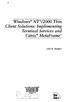 Windows NTV2000 Thin Client Solutions: Implementing Terminal Services and Citrix MetaFrame Todd W. Mathers HLuHB Darmstadt IIIIII in? > _, 15480173 Contents at a Glance Introduction 1 Part I An Overview
DeltaV Remote Client. DeltaV Remote Client. Introduction. DeltaV Product Data Sheet. Remote engineering and operator consoles
 January 2013 Page 1 DeltaV Remote Client Remote engineering and operator consoles View Multiple DeltaV Systems from a single workstation Remote Operator Station over low speed and dial up communications
Sage 100 Premium ERP Version 2015 Supported Platform Matrix Created as of April 6, 2015
 The information in this document applies to Sage 100 Premium ERP Version 2015.Detailed product update information and support policies can be found on the Sage Support web site at: https://support.na.sage.com/
Remote Application Server Version 14. Last updated: 06-02-15
 Remote Application Server Version 14 Last updated: 06-02-15 Information in this document is subject to change without notice. Companies, names, and data used in examples herein are fictitious unless otherwise
WEB CONFIGURATION. Configuring and monitoring your VIP-101T from web browser. PLANET VIP-101T Web Configuration Guide
 WEB CONFIGURATION Configuring and monitoring your VIP-101T from web browser The VIP-101T integrates a web-based graphical user interface that can cover most configurations and machine status monitoring.
Selecting the Right NAS File Server
 Selecting the Right NAS File Server As the network administrator for a workgroup LAN, consider this scenario: once again, one of your network file servers is running out of storage space. You send out
Thin Clients and PCs A comparative study to find suitability for different computing environments
 Thin Clients and PCs A comparative study to find suitability for different computing environments Tanmay K. Mohapatra Choosing between thin clients and PCs requires a rational evaluation. Often a correct
Infor Web UI Sizing and Deployment for a Thin Client Solution
 Infor Web UI Sizing and Deployment for a Thin Client Solution Copyright 2012 Infor Important Notices The material contained in this publication (including any supplementary information) constitutes and
Network Client. Troubleshooting Guide FREQUENTLY ASKED QUESTIONS
 Network Client Troubleshooting Guide 1 Network Client Troubleshooting Guide The first section of this guide answers some frequently asked questions (FAQs) about the operation of Intellex and the Network
Sage 100 Premium Version 2016 Supported Platform Matrix Created as of November 25, 2015
 The information in this document applies to Sage 100 Premium Version 2016. Detailed product update information and support policies can be found on the Sage Support web site at: https://support.na.sage.com/.
Windows Services. Support Windows and mixed-platform workgroups with high-performance, affordable network services. Features
 Windows Services Support Windows and mixed-platform workgroups with high-performance, affordable network services. Features File and print services Integrated Samba 3 for native SMB/CIFS protocol support
Thin Client Total Cost of Ownership & ACP ThinManager Enterprise Software Advantages. White Paper
 Thin Client Total Cost of Ownership & ACP ThinManager Enterprise Software Advantages ABSTRACT: This document shows the cost savings associated with adopting Thin Clients and ACP s ThinManager centralized
Virtual Server in SP883
 Virtual Server in SP883 1 Introduction: 1.1 Micronet SP883 is a hard QoS broadband router, means its guaranteed service can provide absolute reservation of resource (bandwidth) for specific traffic;not
QuickSpecs. HP Compaq t5525 Thin Client. Overview
 Overview 1. 10/100 RJ-45 6. PS/2 Connector 2. Security lock 7. DC Power Input 3. Parallel Connector 8. Video Connector 4. USB Connectors 9. Serial Connector 5. Audio connector (mic in/line out) DA - 12265
Chapter 1 - Web Server Management and Cluster Topology
 Objectives At the end of this chapter, participants will be able to understand: Web server management options provided by Network Deployment Clustered Application Servers Cluster creation and management
X Series Application Note 43:
 X Series Application Note 43: Using the Remote Viewing & Web Pages of the X - Series & GR Series Recorders The Remote Viewing function of the X-Series and GR Series Recorders provide the user with the
This unit contains the following two lessons:
 Unit 5 Networking Operating Systems Overview Description This unit contains two lessons. The first lesson describes the characteristics of the four major Internetworking Systems, including Windows NT Server,
Desktop Virtualization: A Buyer s Guide
 Desktop Virtualization Buyer s Guide Desktop Virtualization: A Buyer s Guide Published: May, 2008 TABLE OF CONTENTS INTRODUCTION... 2 A BRIEF OVERVIEW OF THE DESKTOP DELIVERY APPROACH... 3 User experience
WW HMI SCADA-08 Remote Desktop Services Best Practices
 Slide 1 WW HMI SCADA-08 Remote Desktop Services Best Practices Steven L. Weygandt Portfolio Product Manager - Device Integration /Wonderware social.invensys.com @InvensysOpsMgmt / #SoftwareRevolution /InvensysVideos
EVOLUTION OF NETWORKED STORAGE
 EVOLUTION OF NETWORKED STORAGE Sonika Jindal 1, Richa Jindal 2, Rajni 3 1 Lecturer, Deptt of CSE, Shaheed Bhagat Singh College of Engg & Technology, Ferozepur. [email protected] 2 Lecturer, Deptt
Virtualization: What does it mean for SAS? Karl Fisher and Clarke Thacher, SAS Institute Inc., Cary, NC
 Paper 347-2009 Virtualization: What does it mean for SAS? Karl Fisher and Clarke Thacher, SAS Institute Inc., Cary, NC ABSTRACT SAS groups virtualization into four categories: Hardware Virtualization,
CentreWare Internet Services Setup and User Guide. Version 2.0
 CentreWare Internet Services Setup and User Guide Version 2.0 Xerox Corporation Copyright 1999 by Xerox Corporation. All rights reserved. XEROX, The Document Company, the digital X logo, CentreWare, and