
to Fausto de SANTIS (President of the CEPEJ from 2007 to 2010)
|
|
|
- Hilary Hines
- 10 years ago
- Views:
Transcription
1 to Fausto de SANTIS (President of the CEPEJ from 2007 to 2010)

2 Contents Chapter 1. The evaluation process of the CEPEJ The European Commission for the Efficiency of Justice The Scheme for evaluating judicial systems Data collection, validation and analysis General methodological issues General economic and demographic figures Analysing the findings of the report Chapter 2. Public Expenditures: courts, prosecution system and legal aid Public expenditure on the operation of judicial system: overview Public budget allocated to the courts Public budget allocated to the public prosecution services Public budget allocated to the legal aid system Public budget allocated to all courts and public prosecution (without legal aid) Public budget allocated to all courts and legal aid (excluding prosecution services) Public budget allocated to all courts, public prosecution services and legal aid Trends and conclusions Chapter 3. Access to justice Various types of legal aid The budget for legal aid Conditions for granting legal aid Court fees, taxes and reimbursement The revenues of the judicial system Trends and conclusions Chapter 4. Users of the courts: rights and public confidence Provisions regarding supply of information to the court users Protection of vulnerable persons Role of the public prosecutor in protecting the rights or assisting the victims of crimes Compensation procedures Compensation of the users for dysfunction of the judicial system and complaints Assessment of the satisfaction of users Trends and conclusions Chapter 5. Courts Court organisation Budgetary powers within courts Information and communication technology (ICT) in the courts (e-justice and e-courts) Quality and performance of the courts Evaluation Trends and conclusions Chapter 6. Alternative Dispute Resolution (ADR) Different forms of ADR Mediation Arbitration, conciliation and other forms of ADR Trends and conclusions Chapter 7. Judges Introduction Professional judges Professional judges sitting occasionally Non-professional judges Trial by jury and participation of citizens Trends and conclusions Chapter 8. Non-judge staff Non-judge staff: number and distribution Rechtspfleger Trends and conclusions Chapter 9. Fair trial and court activity Legal representation in court

3 9.2 Possibility to challenge a judge Cases related to Article 6 of the European Convention on Human Rights Civil (and commercial) litigious and non-litigious cases in first instance courts Land register cases Business register cases Enforcement cases (non-criminal litigious cases) Administrative law cases Clearance rate for the total number of civil, commercial and administrative law cases Criminal law cases (severe criminal offences) and misdemeanour cases (minor offences) in 1 st instance courts Comparing case categories: procedure and length Measures to increase the efficiency of judicial proceedings Trends and conclusions Chapter 10. Prosecutors Number of public prosecutors, persons with similar duties and staff Role and powers of public prosecutors Case proceedings managed by public prosecutors Trends and conclusions Chapter 11. Status and career of judges and prosecutors Recruitment and nomination Status of prosecutors Training Salaries of judges and prosecutors Bonuses and other profits for judges and prosecutors Career of judges and prosecutors Responsibility of judges and prosecutors Trends and conclusions Chapter 12. Lawyers Number of lawyers Organisation of the profession and training Practice of the profession Trends and conclusions Chapter 13. Execution of court decisions Enforcement of court decisions in civil, commercial and administrative law Execution of court decisions in criminal matters Trends and conclusions Chapter 14. The notaries Status, number and functions Supervision of the profession of notary Trends and conclusions Chapter 15. Judicial experts Different kinds of judicial experts Selection of judicial experts Number of judicial experts (technical experts) Quality of judicial experts and protection of the title and the function of judicial expert Trends and conclusions Chapter 16. Court interpreters Number of court interpreters Title and function of court interpreters Selection of court interpreters by the courts Trends and conclusions Chapter 17. Judicial Reforms Chapter 18. Towards more efficiency and quality in the European judicial systems Access to justice Effective functioning of the judicial systems Quality of the public service of justice delivered to the users Protection of the independence of the judiciary and the statute of judges and prosecutors

4 Appendix Additional tables Scheme for evaluating judicial systems Explanatory note to the scheme for evaluating judicial systems

5 Chapter 1. The evaluation process of the CEPEJ This first chapter describes the evaluation process carried out by the CEPEJ to prepare this report. It lays out the working principles and methodological choices used in this exercise, and introduces the general demographic and economic data. 1.1 The European Commission for the Efficiency of Justice The European Commission for the Efficiency of Justice (CEPEJ) was set up by the Committee of Ministers of the Council of Europe in September 2002, and is entrusted primarily with proposing concrete solutions, suitable for use by Council of Europe member states for: promoting the effective implementation of existing Council of Europe instruments used for the organisation of justice (normative "after sale customer service"); ensuring that public policies concerning the courts take account of the needs of users of the justice system; and helping to reduce congestion in the European Court of Human Rights by offering states effective solutions prior to application to the Court and preventing violations of Article 6 of the European Convention on Human Rights. The CEPEJ is today a unique body for all European States, made up of qualified experts from the 47 Council of Europe member states, to assess the efficiency of judicial systems and propose practical tools and measures for working towards an increasingly efficient service to the citizens. According to its Statute, the CEPEJ must "(a) examine the results achieved by the different judicial systems (...) by using, amongst other things, common statistical criteria and means of evaluation, (b) define problems and areas for possible improvements and exchange views on the functioning of the judicial systems, (c) identify concrete ways to improve the measuring and functioning of the judicial systems of the member states, having regard to their specific needs". The CEPEJ shall fulfil these tasks, for instance, by "(a) identifying and developing indicators, collecting and analysing quantitative and qualitative figures, and defining measures and means of evaluation, and (b) drawing up reports, statistics, best practice surveys, guidelines, action plans, opinions and general comments". The statute thus emphasizes the comparison of judicial systems and the exchange of knowledge on how they function. The scope of this comparison is broader than just efficiency in a narrow sense: it also emphasizes the quality and the effectiveness of justice. In order to fulfil these tasks, the CEPEJ has undertaken a regular process for evaluating judicial systems of the Council of Europe's member states. 1.2 The Scheme for evaluating judicial systems In comparison with the previous exercise (2010 Edition of the Report, based on the 2008 data), the CEPEJ wished to settle the scheme meant to gather, from the member states, qualitative and quantitative information on the daily functioning of judicial systems. The main goal in keeping such consistency was to ensure the collection of homogeneous data from one exercise to another, thus allowing for comparisons over time, on the basis of the compilation and analysis of initial statistical series (see below). Hence, the evaluation scheme used for this current cycle 1 remains very similar to the one used for the cycle. Only a few questions were either clarified or completed to take into account new issues of concern, such as gender issues within the judiciary or the use of video-conference in courts.. In addition, the explanatory note 2 was completed to minimize as far as possible the difficulties of interpretation and to facilitate a common understanding of the questions by all national correspondents, allowing therefore to guarantee uniformity of the data collected and processed. To answer each question, a careful reading of the explanatory note has been recommended to all national correspondents. The Scheme for understanding a judicial system was designed and used by the CEPEJ on the basis of the principles identified in the Resolution Res(2002)12 which establishes the CEPEJ, and relevant Resolutions and Recommendations by the Council of Europe in the field of efficiency and fairness of justice. The Evaluation Scheme was reviewed by the CEPEJ at its 16th plenary meeting (December 2010). The scheme and the explanatory note were submitted to the member states in May 2011, in order to receive new 1 See Appendix. 2 See Appendix. 5

6 data at the end of 2011, using the electronic version of this scheme, allowing each national correspondent to access a secure website to transfer its responses to the Secretariat of the CEPEJ. 1.3 Data collection, validation and analysis This report is based on figures from As the majority of the states and entities were only able to issue judicial figures for 2010 in the summer or autumn of 2011, the CEPEJ was not able to gather figures before the beginning of This left only a few months for member states to collect and consolidate their individual replies to the Evaluation Scheme and less than four effective working months for the experts to process them and prepare the report. Methodologically, the collection of figures is based on reports by member states and entities, which were invited to appoint national correspondents, entrusted with the coordination of the replies to the Scheme for their respective states or entities. The CEPEJ instructed its Working Group, under the chairmanship of Mr Jean-Paul JEAN (France), with the preparation of the report 3. The Secretariat of the Council of Europe appointed Ms Svetlana SPOIALA (Consultant in public administration and analysis of judicial systems, Moldova), as scientific expert in charge of analysing the national figures submitted by member states and preparing the report together with the Secretariat of the CEPEJ 4. The national correspondents were considered to be the main interlocutors of the Secretariat and the experts when collecting new figures, and the first to be held liable for the quality of figures used in the survey. All individual replies were recorded in a database by the scientific expert. The scientific expert has done extensive work to verify the quality of data submitted by the states. Therefore, she was frequently in contact with national correspondents to validate or clarify the figures (see box below) and their adjustment continued until shortly before the final version of the report. The CEPEJ experts agreed that the figures would not be changed ex officio, unless the correspondents explicitly agreed to such changes. Thus, all data changes have been approved by the relevant national correspondents. Yet, following discussions with the national correspondents, the experts have decided to exclude some data that seemed insufficiently accountable to be worthy of publishing. The meeting between the scientific experts, the CEPEJ-GT-EVAL and the network of national correspondents (Strasbourg, May 2012) was an essential step of the process, aimed at validating figures, explaining or amending, on the same questions, significant variations between 2004, 2006, 2008 and 2010 data, discussing decisions of the experts and improving the quality of the figures provided. Responding states By May 2012, 46 member states had participated in the process: Albania, Andorra, Armenia, Austria, Azerbaijan, Belgium, Bosnia and Herzegovina, Bulgaria, Croatia, Cyprus 5, Czech Republic, Denmark, Estonia, Finland, France, Georgia, Germany, Greece, Hungary, Iceland, Ireland, Italy, Latvia, 3 The Working Group of the CEPEJ on the evaluation of judicial systems (CEPEJ-GT-EVAL) was composed of: Ms Munira DOSSAJI, Principal Operational Research Analyst, Strategy and Innovation Team, Human Rights and International Directorate, United Kingdom, Mr Ramin GURBANOV, Chief of reforms Division, General Department of organisation and supervision, Co-ordinator of Judicial Modernisation Project, Ministry of Justice, Azerbaijan, Ms Beata Z. GRUSZCZYŃSKA, Institute of Justice, Ministry of Justice, Poland, Mr Adis HODZIC, Head of the Budget and Statistics Department, Secretariat of the High Judicial and Prosecutorial Council of Bosnia and Herzegovina, Mr Jean-Paul JEAN, Public Prosecutor, Court of Appeal of Paris, Associated Professor at the University of Poitiers, France (President of the CEPEJ-GT-EVAL), Mr John STACEY, Ministry of Justice, International Department, United Kigdom (President of the CEPEJ), Mr Georg STAWA, Head of Department for Projects, Strategy and Innovation, Federal Ministry of Justice, Austria, Mr Frans van der DOELEN, Programme Manager of the Department of the Justice System, Ministry of Justice, Netherlands. The Group was also actively supported by the scientific experts Mr Julien LHUILLIER, Ms Daria SOLENIK, Ms Christel SCHURRER and Mr Marco VELICOGNA. 4 The Turkish authorities have made available to the Secretariat of the CEPEJ Mr. Hasan HENDEK, judge, to work as Special Adviser. 5 The data provided by Cyprus does not include data of the territory which is not under the effective control of the Government of the Republic of Cyprus. 6

7 Lithuania, Luxembourg, Malta, Moldova 6, 7, Monaco, Montenegro, the Netherlands, Norway, Poland, Portugal, Romania, the Russian Federation, San Marino, Serbia 8, Slovakia, Slovenia, Spain, Sweden, Switzerland, "the former Yugoslav Republic of Macedonia" 9, Turkey, Ukraine and the United Kingdom 10. Only Liechtenstein has not been able to provide data for this report. Germany, which was not able to participate in the previous cycle, has been able to provide their data this time. It should be noted that in federal states or states with a decentralised system of judicial administration, the data collection has different characteristics compared to those of centralised states. The situation is frequently more complex in those cases. In these states, data collection at a central level is limited, while at the level of the federated entities, both the type and the quantity of figures collected may vary. In practice, several federations have sent the questionnaire to each of their entities. Some states have conceived their answers for the whole country from the figures made available from the entities, taking into account the number of inhabitants for each component. To facilitate the data collection process, a modified version of the electronic scheme has been developed, at the initiative of Switzerland. All the figures provided by individual member states have been made available on the CEPEJ website: National replies also contain descriptions of the legal systems and comments that contribute greatly to the understanding of the figures provided. They are therefore a useful complement to the report although not all of this information has been included in it, in the interest of conciseness and consistency. Thus, a genuine data base on the judicial systems of the Council of Europe member states is easily accessible to all citizens, policy makers, law practitioners, academicians and researchers. 1.4 General methodological issues Objectives of the CEPEJ This report does not claim to have exploited exhaustively all the relevant information that has been put forward by member states, given the large amount of data submitted. As for the previous editions of this report, the CEPEJ tried to address the analytical topics bearing in mind, above all, the priorities and the fundamental principles of the Council of Europe. Beyond the figures, the interest of the CEPEJ report lies in the display of the main trends, evolutions and common issues for European states. This report is part of an on-going and dynamic process carried out by the CEPEJ. Throughout the elaboration of the report, experts and national correspondents were encouraged to bear in mind the long term objective of the evaluation process: defining a set of key quantitative and qualitative data to be regularly collected and equally processed in all member states, bringing out shared indicators of the quality and efficiency of court activities in the member states of the Council of Europe and highlighting organisational reforms, practices and innovations, which enable improvement of the service provided to court users. The quality of data The quality of the figures in this report depends very much on the type of questions asked in the data collection instrument, the definitions used by the countries, the system of registration in the countries, the efforts supplied by national correspondents, the national figures available to them and the manner in which the figures have been processed and analysed. In spite of the improvements resulting from previous experiences, it is reasonable to assume that some variations occurred when national correspondents interpreted the questions for their country and tried to match the questions to the information available to them. The reader should bear this in mind and always interpret the statistical figures given in the light of their attached narrative comments and the more detailed explanations given in the individual national replies. The CEPEJ has chosen to process and present only the figures which offered a high level of quality and accountability. It decided to disregard the figures which were too disparate from one country to another, or from one evaluation exercise to another, or did not present sufficient guarantee of reliability. The information 6 The data provided by Moldova does not include data of the territory of Transnistria which is not under the effective control of the Government of Moldova. 7 The official name of the country is Republic of Moldova. 8 The data provided by Serbia does not include data of the territory of Kosovo. 9 Mentioned as "the FYROMacedonia" in the tables and graphs below. 10 The results for the United Kingdom are presented separately for England and Wales, Scotland and Northern Ireland, as the three judicial systems are organised on different basis and operate independently from each other. 7

8 that was not included in this report has been collected and is available on the CEPEJ website ( The control and the coherence of data A specific effort of validation has been committed to ensure the coherence and accountability of data and allow to compose and analyse, for the first time within this process, a few statistical series. These series are designed to measure evolutions, if at all possible between 2006 and 2010, and, more often, between 2008 and 2010, depending on the homogeneity of the data available. As regards the accuracy of figures, statistical rules (see below) have been applied to compare the 2006, 2008 and 2010 data, which has enabled us to identify the answers showing large or small variations which can hardly be explained. Through these comparisons, methodological problems have been identified and corrected. On the other hand, in some cases, strong variations have been explained by the evolution of economic situations, structural and organisational reforms, political decisions or the implementation of new mechanisms, procedures or measures. Methodology and procedure for validating data Before any steps could be taken to validate data, it has been necessary to re-build the intervention framework for the four evaluation cycles (2004, 2006, 2008 and 2010 data). To do so, a data base has been set up, which brings together all information available from the first to the last cycle. As the questionnaire was slightly modified and/or adjusted from one cycle to another one, the scientific expert recoded several variables and used some data mapping methods on the figures provided for the three exercises. All data (some 2.5 million entries, without counting comments) have been submitted to the validation procedure. The methodology chosen, which is specially adapted for this exercise is the "method of timeseries mapping on three levels. This methodology brings together three validation procedures for quantitative data. First of all, significant differences (of more than 20%) between the entries for the same item and for the three exercises have been identified. In order to guarantee the validity of this procedure, data have also been examined according to the Grubbs' test. This has enabled to isolate the true "outliers" (extreme values which, in addition to being different from previous entries, [differences of more than 20%] were difficult to be compared with, or were not comparable at all with the entries for the year 2010 for the other states). If some values presenting differences of more than 20% from one year to another one could be explained by the national correspondents, all other "outliers" have been corrected, without exception. The third validating element through the "time-series mapping on three levels is the check of the internal validity. This procedure has mainly been applied to complex items, namely those made of several entries. Among the variables submitted to this procedure appear budgetary items and the cases addressed by the courts. For this purpose, a specific validation scheme has been set up by the scientific expert. The elements which are part of the complex variables have been horizontally verified (correspondence between the sum of the elements with the entry corresponding to the total) and sometimes also vertically verified (inclusion or exclusion of the elements within the total). The validation has been made according to very rigorous methodology. However, it is not possible to guarantee the full reliability of all data. One must take into account the fact that the exactitude of some entries was confirmed by national correspondents without specific explanation as regards the difference which had been noted. Generally, such entries have been either excluded from the analyses, or kept with disclaimers in the text as regards the interpretation of the results of the analyses taking these elements into account. The CEPEJ has set up in 2008 a peer evaluation process concerning the systems for collecting and processing judicial data in the member states. This process aims at supporting the states in the improvement of the quality of their judicial statistics and the development of their statistical system so that such statistics are in line with common indicators defined through the CEPEJ's Evaluation Scheme. It also allows to facilitate the exchange of experiences between national systems, share good practices, identify benchmarks and facilitate the transfer of knowledge. Thus it contributes to ensuring the transparency and accountability of the CEPEJ process for evaluating European judicial systems. To date, the systems have been examined by the peers for 14 volunteer member states in order to analyse the organisation of CEPEJ's data collection and communication to the Secretariat of the Council of Europe: Austria, Azerbaijan, Bosnia and Herzegovina, France, Malta, Netherlands, Poland, Russian Federation and Turkey. Furthermore, a visit was organized in Norway, bringing together as well experts from Denmark, Finland, Iceland and Sweden. During these visits, the experts appointed by the CEPEJ-GT- 8

9 EVAL precisely analysed the practical way of responding to selected questions of the Evaluation Scheme and on the content of these answers, namely questions related to budgetary issues, types and number of judges, litigious civil cases and methods of calculating the length of proceedings. Moreover, the CEPEJ gave its assent to the guidelines on judicial statistics for the services in member states which collect and process statistics in the justice field. 11 These guidelines aim at ensuring the quality of the judicial statistics collected and processed by the member states, as a tool for public policy. They should also facilitate comparison of data between European countries by ensuring adequate homogeneity despite the substantial differences between countries (as regards judicial organisation, economic situation, demography, etc.). Comparing data and rules Indeed the comparison of quantitative figures from different countries revealing varied geographical, economic and legal situations is a delicate job. It should be approached with great caution by the experts writing the report and by the readers consulting it and, above all, by those who are interpreting and analysing the information it contains. In order to compare the various states and their various systems, the particularities of the systems, which might explain differences from one country to another one (different judicial structures, organisation of courts and the use of statistical tools to evaluate the systems, etc.), must be borne in mind. Special efforts have been committed to define words and ensure that concepts had been addressed according to a common understanding. For instance, several questions have been included in the Scheme, with clear definitions in the explanatory note, to address the number of courts (both through an institutional and a geographical perspective) or the number of judges (different categories have been specified). Particular attention has been paid to the definition of the budget allocated to courts, so that the figures provided by member states correspond to similar expenditures. However, the particularities of some systems might prevent achieving shared concepts. In these cases, specific comments have been included with the figures. Therefore only an active reading of this report can allow analyses and conclusions to be drawn; figures cannot be passively taken one after the other, but must be interpreted in the light of the subsequent comments. The report aims to give an overview of the situation of the European judicial systems, not to rank the best judicial systems in Europe, which would be scientifically inaccurate and would not be a useful tool for the public policies of justice. Indeed, comparing does not mean ranking. However, this report gives the reader tools for an in-depth study which would then have to be carried out by choosing relevant clusters of countries: according to the characteristics of the judicial systems (for instance civil law and common law countries; countries in transition or with old judicial traditions), geographical criteria (size, population) or economic criteria (for instance within or outside the Euro zone). Secondly, the CEPEJ will carry out, as for the previous cycle, its own analysis on the basis of this report. The CEPEJ scheme was completed by small states. Andorra, Monaco and San Marino are territories which are not operating at a scale comparable to the other states surveyed in the report. Consequently the figures of these states must be interpreted cautiously, taking into account the specificities of the national structural indicators. Monetary values are reported in Euros. Because of this, some problems have occurred while using exchange rates for states outside the Eurozone. Exchange rates vary from year to year. Since the report focuses mainly on 2010, the exchange rates of 1 January 2011 were used. For states experiencing high inflation rates, this choice may generate very high figures which must be interpreted within their specific context. The high variation of the exchange rate might have a considerable effect on the figures for the countries outside the Eurozone. For some of them, a more favourable exchange rate than in 2009 has strengthened the growth of budgetary or monetary increase once expressed in Euros. Therefore, it is necessary to pay attention to this issue while comparing monetary figures of the 2010 and 2012 editions. A specific table (Table 1.3) shows the variation of the exchange rate for the countries outside the Eurozone. The evolution of judicial systems Since 2010, a few member states of the Council of Europe have implemented fundamental institutional and legislative reforms of their legal systems. For these states, the situation described in this report may be completely different from today s situation when reading the report. Therefore the states were invited to 11 Document CEPEJ(2008)11. 9

10 indicate whether reforms had been implemented since 2010 or whether other reforms are under way. This enables us to identify main trends related to prioritised reforms in the various justice systems. On the contrary, the economic situation has decreased in some countries since 2010 because of the crisis, which has had an impact on the functioning of justice. For such states too, the situation described in this report might have evolved in Greece for instance, the budgets voted in 2010 have not been executed as foreseen. Displaying the data In the evaluation cycle, the CEPEJ has tried to take a global approach of 48 states and entities judicial systems. In order to highlight some particularities of European judicial systems, several indicators have been developed or calculated: ratios, rates, averages and/or medians, indexes, etc. Several tables include replies as provided by the countries. Other tables show the replies processed together or presented according to aggregated figures. Graphs show, more often than not, global answers at a European level. Some indicators are shown using maps. In order to propose some references for reading the results of the analyses at a European level, the CEPEJ has used the following indicators of central tendency: Average: represents the arithmetic mean which is the outcome of dividing the sum of the observations of a distribution (data supplied) by the total number of countries which have indicated the information included into the distribution. The average is sensitive to extreme values (too high or too low). Median: represents the middle point of a set of ordered observations (ranked according to an increasing or decreasing order). The median is the value that divides the data supplied by the countries concerned into two equal groups so that 50% of the countries are above this value and 50% are below it. When there is an odd number of observations, the median is the value that is just in the middle of these two groups. The median is sometimes better to use than the average, as it is less sensitive to extreme values. The effect of the extreme values is then neutralised. In addition to the average and the median, the minimum and maximum have been included in several tables: Minimum: the lowest recorded value in the given column of the Table. Maximum: the highest recorded value in the given column of the Table. Often in this report is presented the indicator of average annual variation Average annual variation: represents the result of the calculation (in %) of the variation observed between several given years. This value enables to establish the trend of the general evolution on the period examined. Then, a country which shows a great decrease between 2006 and 2008 and a slight increase between 2008 and 2010 will have, however, a negative indicator of the average annual variation. This indicator takes into account the values of each year and not only the values of the first and the last year, which allows a more accurate reading of the given phenomenon on several years. On several graphs, the reader will also find the coefficient of determination (R 2 ). Coefficient of determination: can have values between 0 (0%) and 1 (100%). The stronger is the explanation link between two variables, the closer to 1 the coefficient of determination will be. If, for instance, the R 2 between two variables is equal to 0.7, this can be interpreted as follows: the variable Y explains 70% of the variability of the variable X. The CEPEJ has also attempted to include a more complex analysis: factorial analysis followed by classifications. Such analysis, often used in social sciences, enables us to consider a greater number of data and highlight trends, similarities or differences. Therefore the models which result from such a presentation are obviously approximations. The advantage of this method lies in its capacity to present a synthesis of the information on a unique graph or table and to avoid presenting selected raw data one by one. This allows for the creation of clusters. In this report, groups of countries have been created around main elements. 1.5 General economic and demographic figures These figures, which almost every state was able to provide, give comprehensive information on the general context in which this study was conducted. In particular, they enable, as it was the case in the previous exercise, to relativize the other figures and put them in context, particularly budgetary figures and figures relating to court activity. 10

11 The figures also enable the reader to measure the variations in the population and the size of the countries concerned, from Monaco, with less than inhabitants, to the Russian Federation with almost 143 million. This demographic variable must always be borne in mind. The population concerned by this study is roughly 800 million people, which is almost the whole population of the Council of Europe s jurisdiction - since only Liechtenstein is absent from the 2012 Edition. The data also demonstrate the large differences regarding wealth and living standards in the various countries through per capita GDP and partially by the amount of the global public expenditure (national and regional). The average annual gross salary gives an interesting overview of the wealth and living standards as it involves economic, social (welfare system) and demographic figures. Though this indicator is not perfect, it nevertheless highlights, again, substantial disparities between the citizens of the member states. Finally, the influence of the monetary exchange rate between the "Euro zone" countries and the "others" must be taken into account, as it strongly modifies what salaries represent vis-à-vis the quality of life for the inhabitants of each country. Therefore comparisons must always be limited to what can be compared. The results that each member state would want to measure against other states that appear comparable to it must be balanced, taking into account the specific context. There are obviously threshold effects according to the level of population or level of living standards which are measured through ratios regarding the number of inhabitants and the per capita GDP. The data regarding public expenditure (Q2) seem to be tied to various public accounting techniques, both as regards defined perimeters and, for instance, the presentation of deficits. The problematic effects of national and regional budgets on public competences as a whole also gives rise to further methodological problems. Therefore, these figures are only given as information in the table of general economic and demographic figures. It was decided, mainly for budgetary comparisons with graphs, to use only two ratios usually used in such surveys for comparisons: the number of inhabitants and the per capita GDP. The figures on population were provided by all member states. They will be used in all ratios which measure an impact per inhabitant (most of the time per inhabitants). Figures related to the GDP per inhabitant were provided by all the participating states. Here again, very large disparities in the per capita GDP can be noted and must always be kept in mind when considering the subsequent results. For instance, two extremes can be noted: on the one hand the countries with a per capita GDP below (Georgia, Moldova), and on the other hand, Luxembourg with a reported per capita GDP more than 40 times higher. The national annual gross salary has also been used several times for comparing the salaries of judges and prosecutors. This was made so as to guarantee an internal comparability with the standards of living conditions in each country. 11

12 Table 1.1 Economic and demographic data in 2010, in absolute values (Q1 to Q4) 12 States/entities Population Total annual State public expenditure including regional and federal entity levels GDP Per capita Average gross annual salary Albania Andorra NA Armenia Austria Azerbaijan Belgium Bosnia and Herzegovina Bulgaria NA Croatia Cyprus Czech Republic Denmark Estonia Finland France Georgia Germany Greece Hungary Iceland Ireland Italy Latvia Lithuania Luxembourg Malta Moldova Monaco Montenegro Netherlands Norway Poland Portugal Romania Russian Federation San Marino Serbia Slovakia Slovenia Spain Sweden Switzerland The FYROMacedonia Turkey Ukraine UK-England and Wales UK-Northern Ireland UK-Scotland NA Comments Austria: the figure gives the average gross income including taxes and social expenses borne by the employee, but not employer s contribution for social insurance - this is in line with the figures given in Q 132 (gross annual salary of judges and prosecutors), but not with previous periods.

13 Bosnia and Herzegovina: state public expenditures include B&H government, consolidated entity-fbh Government, Cantons, local governments (municipalities and cities), social security funds and PE for road reconstruction and maintenance of entity FBiH, Tuzla and Central-Bosnia Canton; Consolidated Entity - RS Government, local governments (municipalities and cities), social security funds and PE for road reconstruction and maintenance, and Brcko District Government, Brcko District Health insurance Fund, Brcko District Employment Fund. The annual gross salary includes net payments and taxes and contributions paid on the burden of employees (contributions paid by the employers are not included). Croatia: state public expenditures refer to general government, which includes the subsectors according to the IMF methodology GFS 2001: budgetary central government (the national budget); the extrabudgetary users (funds) i.e. the Croatian Waters, the Fund for Environmental Protection and Energy Efficiency, etc; local government. The statistical data for local government since the year 2001 include the operations of 53 largest local units (20 counties, the City of Zagreb and 32 other large cities), which participate through a series of years with 70-80% of total local government operations. The data include the GFS 2001 category of expense (Table 2) and the GFS category of net acquisition of nonfinancial assets (Table 31), on cash basis. Estonia: the decreased in state public expenditure is due to cuts in public sector spending, in public demand and to the depreciation of the building sector. Rethinking the revenue had also an impact on the decrease of the total annual public expenditure - an increase in taxes and due to the increase of unemployed the tax revenues decline. Germany: the average gross is the income of private households per month ( 3.711) in 2009 (x12), excluding households of the self-employed and farmers and households with a monthly income of and above. Iceland: the increase in the state public expenditures can be explained by the strengthening of the ISK. Public expenditure has increased due to a higher index of consumer prices by 10.5%, and increasing salaries by 12% between 2008 and 2009 and an additional 5% until The difference in the GDP between the years can be explained to the bank crises and changes in the currency. The average salary is based on full time employees in the private sector. Latvia: the decrease in annual public expenditure and in the GDP are due to the financial crisis in Latvia. Monaco: the Department of Social Affairs and Health has recently evaluated the average salary. Montenegro: population at 31 March Netherlands: the figures on state public expenditure reported for the previous years were compiled differently. Expenditure on state level includes central and local governments and social security funds. Poland: in previous exercises public expenditure were given only at state level. Here it also includes the regional levels. Romania: the annual state expenditure is less than 2008 due to the macroeconomic context. Portugal: population at 31 December The value of the average gross annual salary is still provisional. Russian Federation: population at 1 January The amount of state public expenditure reflects the executed budget. Spain: expenditure at state level includes central, state and local governments and social security funds. Sweden: the exchange rate explains the increase of the total annual public expenditure by 29.6% - the variation in Swedish crowns is an increase by 6.97 %. The same applies to GDP - the increase in GDP in is by 24,3%; in Swedish crowns by 2.59 % only. As regards the average gross salary the increase in euros is by 26,93% whereas in Swedish crowns it is limited to 4,80 % (the net annual salary includes taxes but excludes social expenses). Switzerland: the evolution of the figures between 2008 and 2010 must be considered with care as the exchange rate between CHF and must be taken into account it was 0,67 in 2008 and 0.80 in 2010, which means an increase of about 20 % which is only due to the decrease of Euro. Turkey: general public expenses include the central administration budget, the local administrations, revolving fund organizations, unemployment insurance fund, social security organizations, general health insurance, and funds. The difference between this period and the previous one results from the fact that while the total annual expenditure declared for the year 2008 was based on the data on the central administration budget, the data pertaining to the year 2010 covered the total public expenditure (central administration budget, local administrations, organizations with circulating capital, unemployment insurance fund, social security institutions, general health insurance, and all the relevant funds). Apart from that, an increase of % was observed in the payments made from the unemployment insurance fund, in connection with the increase in the number of enterprises closed due to global economic crisis. In addition, more individuals were taken under the coverage of general health insurance as from which explains the % increase in the share of the General Health Insurance premiums. The average annual gross salary is the salary of a public servant, including the social security contributions. Ukraine: the state general fund revenues have increased and this permitted to increase the level of minimum monthly wage in Ukraine. UK-England and Wales: regional data for GVA rather than GDP. The euro figure increase can be explained by the conversion rates used. UK-Scotland: population is an estimate at 30 June Analysing the findings of the report The ultimate aim of the regular evaluation exercise is to develop recommendations and set up concrete tools to improve the quality, equity and efficiency of judicial systems. Some qualitative indications and main trends are highlighted in the report. They appear in the conclusion. However it is only during a second stage that the CEPEJ will be able to make a more in-depth analysis, on the basis of the entire data brought into perspective. *** 13

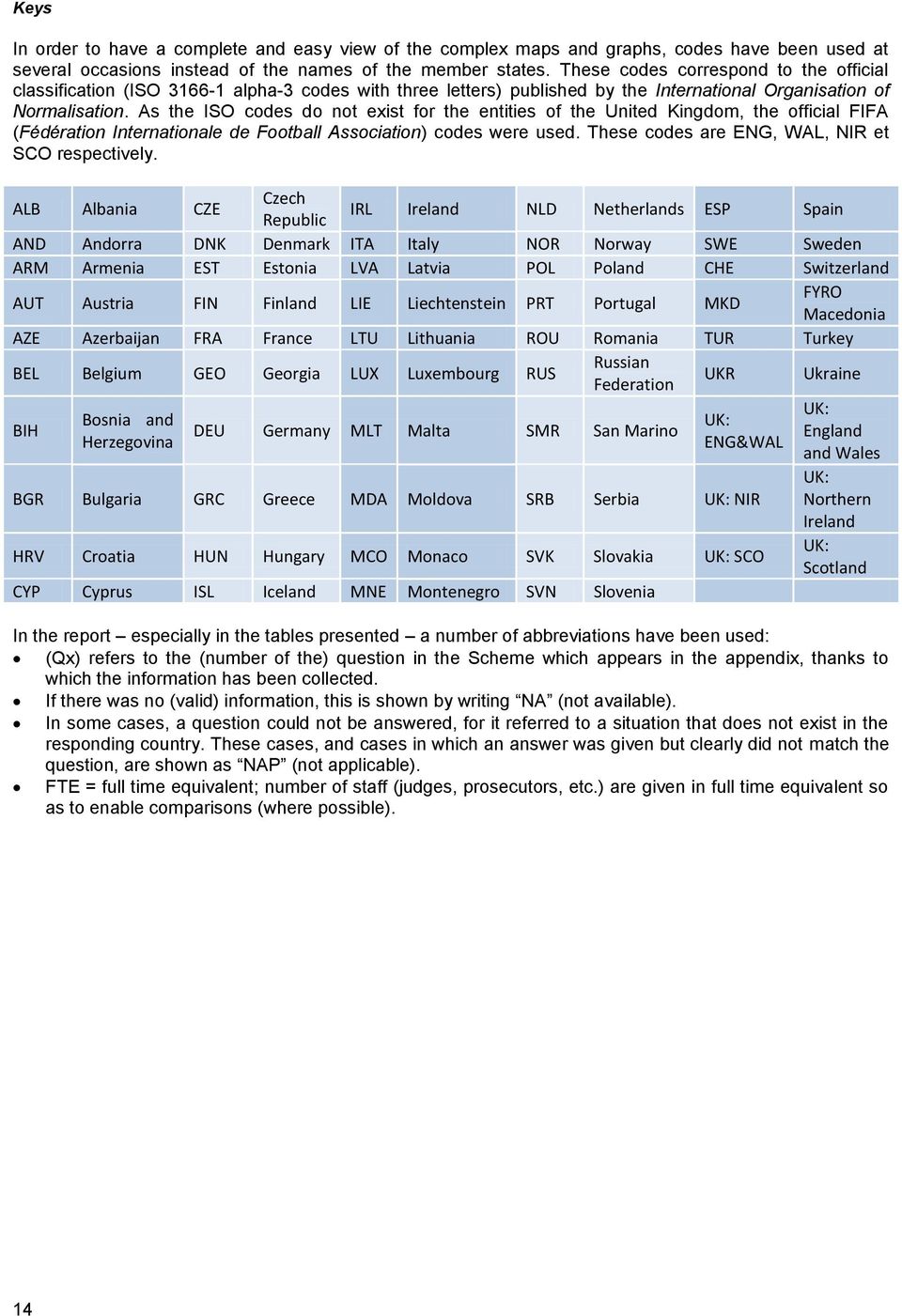
14 Keys In order to have a complete and easy view of the complex maps and graphs, codes have been used at several occasions instead of the names of the member states. These codes correspond to the official classification (ISO alpha-3 codes with three letters) published by the International Organisation of Normalisation. As the ISO codes do not exist for the entities of the United Kingdom, the official FIFA (Fédération Internationale de Football Association) codes were used. These codes are ENG, WAL, NIR et SCO respectively. ALB Albania CZE Czech Republic IRL Ireland NLD Netherlands ESP Spain AND Andorra DNK Denmark ITA Italy NOR Norway SWE Sweden ARM Armenia EST Estonia LVA Latvia POL Poland CHE Switzerland AUT Austria FIN Finland LIE Liechtenstein PRT Portugal MKD FYRO Macedonia AZE Azerbaijan FRA France LTU Lithuania ROU Romania TUR Turkey BEL Belgium GEO Georgia LUX Luxembourg RUS Russian Federation UKR Ukraine BIH UK: Bosnia and UK: DEU Germany MLT Malta SMR San Marino England Herzegovina ENG&WAL and Wales BGR Bulgaria GRC Greece MDA Moldova SRB Serbia UK: NIR UK: Northern Ireland HRV Croatia HUN Hungary MCO Monaco SVK Slovakia UK: SCO UK: Scotland CYP Cyprus ISL Iceland MNE Montenegro SVN Slovenia In the report especially in the tables presented a number of abbreviations have been used: (Qx) refers to the (number of the) question in the Scheme which appears in the appendix, thanks to which the information has been collected. If there was no (valid) information, this is shown by writing NA (not available). In some cases, a question could not be answered, for it referred to a situation that does not exist in the responding country. These cases, and cases in which an answer was given but clearly did not match the question, are shown as NAP (not applicable). FTE = full time equivalent; number of staff (judges, prosecutors, etc.) are given in full time equivalent so as to enable comparisons (where possible). 14

15 Figure 1.2 Level of population and per capita GDP in Europe in 2010 (Q1, Q3) Note to the reader: the maps used in this report indicate with colours the data given by the member states for the territories which are effectively concerned (except the territories of member states which are located beyond the European continent often islands). Therefore the coloured zones do not correspond necessarily to the geographical borders of the member states. Thus, information for Serbia does not concern Kosovo, as the Serbian authorities have not been able to provide data for this territory. Furthermore, the information provided does not concern the part of the territory of Cyprus which is not under the effective control of the Government of the Republic of Cyprus. The same applies to Moldova as regards to Transnistria. 15

16 Table 1.3 Exchange rates vis-à-vis on 1 January 2009 and 1 January 2011 and its evolution States/entities Exchange rate from national currency to on 1 Jan 2009 Exchange rate from national currency to on 1 Jan 2011 Exchange rate bi-annual variation of the national currency with regard to the euro Albania ,77-12,8% Armenia ,16-10,6% Azerbaijan 1,245 1,056 15,2% Bosnia and Herzegovina 1, , ,0% Bulgaria 1, , ,0% Croatia 7, , ,7% Czech Republic 26,83 25,06 6,0% Denmark ,31-0,3% Georgia 2,3475 2,37-1,0% Hungary 265,48 278,85-5,0% Iceland ,8 9,5% Latvia 0, , ,0% Lithuania 3,4528 3,4528 0,0% Moldova 14, ,1045-9,3% Norway 9,695 8,01 17,4% Poland 4,2181 3,9603 6,1% Romania 3,9852 4,2848-7,5% Russian Federation 41, ,4876 2,3% Serbia ,0% Sweden 10,8405 8,95 17,4% Switzerland 0,67 0,8 19,4% The FYROMacedonia 61,4 61,1 0,5% Turkey 2,133 2,07 3,0% Ukraine 10,855 10,57 2,6% UK-England and Wales 0,9609 0, ,5% UK-Northern Ireland 0,9609 0, ,5% UK-Scotland 0,9609 0, ,5% 16

17 Chapter 2. Public Expenditures: courts, prosecution system and legal aid 2.1 Public expenditure on the operation of judicial system: overview This chapter focuses on the financial means allocated to courts, public prosecution services and legal aid. The methodology used to present the figures remains close to the one followed in the 2010 Edition of this evaluation report. According to the states, there are common and distinct ways of financing courts, public prosecution services and legal aid. Consequently, like in the 2010 report, it is for example impossible, for 8 states, to provide separate data for courts and public prosecution services, since they are included in a single budget (Austria, Belgium, France, Germany, Greece, Luxembourg, Spain and Turkey). Denmark (the public prosecution service s budget partially depends on the police budget) has not been able to provide any data on the budget allocated to the prosecution system, hence restricting this country from a significant number of tables and figures within this chapter. Contrary to the previous report, Portugal, San Marino and UK-Northern Ireland have managed to do so and should be commended on such efforts which improve the overall budget analysis. Regarding legal aid, the budgetary data could be isolated for 40 states or entities. It was impossible to isolate the budget allocated to legal aid in Andorra, Cyprus, San Marino, Serbia, Slovakia, the former Yugoslav Republic of Macedonia, Ukraine and UK-Scotland. Contrary to the previous report, Croatia has managed to do so, whereas Andorra, San Marino, Slovakia, the former Yugoslav Republic of Macedonia 12, Ukraine and UK-Scotland have not been able to provide such data this time. Of the 48 states or entities concerned, 8 have not been able to give the total of the three budgets (courts + prosecution service + legal aid): Andorra, Cyprus, Norway, San Marino, the former Yugoslav Republic of Macedonia, Ukraine, UK-Scotland (legal aid budget not available) and Denmark (public prosecution budget not available). Bearing such differences in mind and regarding the complexity of these questions, the CEPEJ has chosen to break down as much as possible the various elements of the budgets in order to allow a progressive approach. Therefore, three budgets were taken into account: the budget allocated to the courts, which will be related to the part of the report on the activities of the courts (chapter 5), the budget allocated to the public prosecution, which will be related to the part of the report on the activities of public prosecutors (chapter 10), the budget allocated to legal aid which constitutes an indicator of the efforts devoted by a state or entity to making its judicial system accessible, and which will be related to the part of the report on access to justice (chapter 3). Table 2.1 presents the background information which enables comparisons for each of these three budgets: the courts (C) (first column), the legal aid system (LA) (second column), the public prosecution (PP) (third column). The table also makes it possible to provide a study of the budgets on comparable basis: 4 th column: budget allocated to access to justice and the courts (LA + C): total budget allocated to the courts and to legal aid in 2010; 5 th column: budget allocated to all bodies dealing with prosecution and judgment (PP + C): total budget allocated to the courts and to the public prosecution in 2010 (without legal aid); 6 th column: budget allocated to all three budgets (C + LA + PP): total budget allocated to the courts, legal aid and the public prosecution in As a result, any state or entity will be able to compare itself to other states or entities deemed as similar. It will then, in the same way, be able to refer to the results on activity. 12 the former Yugoslav Republic of Macedonia did not provide data for legal aid, because the Law on free legal aid which was adopted in December 2009, started to be implemented from July

18 In order to contribute to a better understanding of these reasoned comparisons, all the reported and studied figures have been made available. Ratios have been highlighted, in order to allow comparisons between comparable categories, by connecting the budgetary figures to the number of inhabitant and the GDP per capita, in the form of figures. Following the main table, figures are presented with the ratio of the budget per inhabitant and the ratio as a percentage of the GDP per capita, to compare realistically comparable categories. The CEPEJ report aims at highlighting statistical series, showing the evolution of indicators over the years, by referring to the data of previous evaluation cycles (see Figure 3). Generally, the CEPEJ has chosen to refer to the three last cycles (2006, 2008 and 2010 data). When the 2006 data have not been considered as solid enough, the comparison is limited to the two last cycles. Note for the reader: The budgets indicated correspond in principle (unless specifically mentioned otherwise) to the amounts as voted and not as effectively spent. This might have an impact on the results provided by several member states, which did not execute in 2010 the budget voted at the end of 2009, due to the effects of the financial and economic crisis. This is in particular the case for Greece, which has indicated, as requested, the budget as voted by the Parliament, but which did not spent the budget as initially planned due to the crisis. In addition, it must be stressed that the financial and economic crisis might have had a serious impact on the situation of the public budgets since the 2010 year of reference: budgets might have been reduced since then, or, on the contrary, some states might have decided to dedicate further efforts to the justice system to face the challenges of the crisis. All the amounts are given in Euros. For the countries which are not part of the Euro zone, the CEPEJ was very attentive to variations in exchange rates between the national currency and the Euro (unless stated otherwise, the value is taken on 1 January 2011). Inflation may also explain a few significant budgetary evolutions. This fact must fully be taken into account while interpreting variations in states or entities outside the Euro zone (see table 1.3 in chapter 1). For a more in-depth analysis of the specificities in the budgets of the various member states or entities, the reader is invited to examine the detailed answers given by each state or entity which appear on the CEPEJ's website: 18

19 Table 2.1 Public budget allocated to courts, legal aid and public prosecution in 2010, in (Q6, Q12, Q13) States/entities Total annual approved public budget allocated to all courts with neither prosecution nor legal aid Total annual approved public budget allocated to legal aid Total annual approved public budget allocated to the public prosecution system Total annual approved budget allocated to all courts and legal aid Total annual approved budget allocated to all courts and public prosecution Total annual approved public budget allocated to all courts, public prosecution and legal aid Albania Andorra NA NA NA Armenia Austria NA NA NA Azerbaijan Belgium NA NA NA Bosnia and Herzegovina Bulgaria Croatia Cyprus NA NA NA Czech Republic Denmark NAP NA NA Estonia Finland France NA NAP NA Georgia Germany NA NA NA Greece NA NA NA Hungary Iceland Ireland Italy Latvia Lithuania Luxembourg NA NAP NA Malta Moldova Monaco Montenegro Netherlands Norway NA NA NA Poland Portugal Romania Russian Federation San Marino NA NA NA Serbia NA Slovakia Slovenia Spain NA NA NA Sweden Switzerland The FYROMacedonia NA NA NA Turkey NA NAP NA Ukraine NA NA NA UK-England and Wales UK-Northern Ireland UK-Scotland NA NA NA Average Median Maximum Minimum

20 Comments Albania: the 2010 approved budget has decreased compared to 2008, as the activity of 8 courts has been discontinued in August Armenia: 6 specialised courts were closed down in 2009 which resulted in the reduction of staff and training expenses in Azerbaijan: as a result of its rapid economic development, this country keeps conducting large-scales judicial-legal reforms and increasing significantly the overall budget of judiciary. Belgium: the budget for constructing new courts or maintaining existing buildings is excluded from the budget of the Federal Justice Public Service. Real property of the Belgium State is managed by the Régie des Bâtiments which does not hold separate a specific part for justice. Bosnia and Herzegovina: the amounts given are estimations of the executed budget. Unlike previous cycles, the lawyers' costs for mandatory defense and costs for lawyers for indigent persons are not included. Czech Republic: cuts in the justice expenses are due to the economic crisis. Denmark: part of the prosecution budget depends on the budget of the police; therefore the budget of the prosecution system cannot be indicated. France: the total annual budget allocated to all courts amounts breaks down into judicial justice and administrative justice + cost estimation for transportation of defendants under escort, cost evaluation of prosecuting officers under the Ministry of the Interior, cost estimation of guarding courtrooms (229 millions) + the amount of the rental value of court buildings made available for free to the state by local authorities as part of the shift in costs following decentralisation (66,9 millions) + a part of the expenses paid by the central administration of the Ministry of justice for the functioning of the courts according to the budgetary rules. The legal aid budget includes amounts coming from the reintegration of amounts taken from the recovering of 11,5 million and from a tax expenditure related to the application of a reduced VAT rate of 5,5% to the lawyers working under the legal aid regime. Georgia: as a result of merging the district (city) courts of first instances in , 9 unified courts were established in addition, where the salaries of staff members were increased. All the above mentioned resulted in the increased budget that had been allocated for salaries. Unlike 2008, the amounts include the data of the budget of common courts, among them those of the Supreme Court. Germany: budgetary data from Germany are limited as some Länder have not been able to specify the budget of the prosecution offices from the court budget. For more details, please refer to the detailed answers provided by Germany on Greece: contrary to 2008, this budget includes the budget approved for the Court of Auditors. The increase noted between 2008 and 2010 is the effect of the implementation of the law which provides an increase in judges gross salaries. However the budget voted for 2010 was not executed, due to the financial crisis. Contrary to 2008, and according to the explanatory note, the amounts provided exclude, under justice expenses, the payment of lawyers under the legal aid system. Latvia: the budget dedicated to the salaries of judges and court employees have been reduced of about 15 % due to the financial crisis. Lithuania: at the end of 2008 the salaries of judges were increased, but due to the crisis they were cut in 2009 and remained decreased in 2010 as well. The increase of the budget for justice system is due to the fact that the budget of Ministry of Justice and Prison department were not involved for the year Luxembourg: these figures are provisional and the actual spending can be higher or lower once the budget is executed. When the previsions were made by the authorities, it was expected that the expenses would be higher than the years before and therefore the figures put into the provisional budget for 2010 were higher than those in Moldova: data does not include the budget allocated to military courts. The budget of the whole justice system (column 1) indicated for 2010 cannot be compared with the budget indicated for 2008, as the figures do not include the same elements. Indeed, the budget of the whole justice system remained stable between 2008 and Montenegro: Montenegro being devoted to EU accession, numerous activities for strengthening justice capacities are supported by the EU and other international partners, which provide donor support in both training and supplying equipment for the judicial authorities. The budget for courts includes the budget of the Constitutional Court. Poland: all the budgetary data are affected by two important factors: the exchange rate złoty-euro (approx raise 7%) and the EU financed programs which covered many of the nation expenditures. The budget of the Public Prosecution Service for 2010 is separated from the budget of Justice. The amounts provided are an outcome of budgetary transfers caused by the separation of Public Prosecution Service from Ministry of Justice. Russian Federation: the budget allocated to all courts (column 2) includes 1) the budget allocated to the Supreme Commercial Court and the system of commercial courts, 2) the budget allocated to the Supreme Court (the highest instance court of general jurisdiction), 3) the budget allocated to the Judicial Department of the Supreme Court and the system of inferior courts of general jurisdiction. Slovakia: legal aid is financed from two different parts of the budget allocated to the justice system: the budget of the Legal Aid Centre and the budget of the courts. The sum stated in the table represents exclusively the approved budget of the Legal Aid Centre. This sum does not include the payments from the budgets of the courts to the lawyers providing legal aid in civil or criminal proceedings, i. e. the costs of the lawyers appointed free of charge to the participant by the judge in the civil proceedings and the costs of the ex officio appointed counsels in the criminal proceedings. The sum of these costs is included in the budget of courts and it is not possible to extract it. Sweden: due to differences in nomenclature within different audit systems there is an inherent problem in comparing 2008 and 2010 numbers. As a result, the figures presented in question 6 should be used with prudence. The figures are 20

21 not approved budget but executed expenses. Corrected figures show an increase since 2008 by 17,20 %, mainly due to the exchange rate. The difference in Swedish crowns would actually be a decrease by 3,24 %. Switzerland: the amounts provided are extrapolated for the whole federal state from a significant number of cantons. Between 2008 and 2010 the justice systems in the cantons and of the Confederation have prepared the implementation of the new single unified civil and criminal procedures (instead of 27): some cantons have already amended their legislation (new organisation, increased number of courts and prosecution offices) and others have chosen to wait and act at a later stage if necessary. 20 % of the difference between the amounts provided in 2008 and 2010 is due to the exchange rate. Turkey: the data given in Table 2.1 do not cover the Constitutional Court, the Court of Cassation, the Council of State, the Supreme Election Board, and the Military Courts. On the other hand, the data in the first column includes the budget of the Ministry of Justice which covers also the budget of the Court of Jurisdictional Disputes, the Supreme Election Board and the Forensic Medicine Institution and the budget of the Prison Workshops Institution, the budget of the Turkish Justice Academy, and the allocations transferred to the Union of Turkish Bar Associations by the Ministry of Finances. "the former Yugoslav Republic of Macedonia": the courts budget includes the budget of the Court Council and Academy for training of judges and public prosecutors. Additional resources are allocated to computerisation and investments in new (court) buildings from international organisations (World Bank, USAID). The new legislation (November 2010) establishes a fixed percentage for financing the judiciary, amounting to 0,8 % of GDP, which is twice as high as the current court budget. This level of 0,8 % of the GDP will be reached progressively, with equal increases until 2015.In case of rebalancing the state budget, the funds allocated to the judicial power cannot be decreased. Within the court budget there are contingency funds as current reserve, which cannot exceed 2% of current expenditures of the court budget. At least 2,5% of the court budget must be spent on vocational training of judges, law clerks, court police and other employees of courts. UK-England and Wales : this figure does not include Capital (spending on capital items such as land, buildings, plant and machinery which will be used by the business in more than one financial year and which will be shown on the balance sheet as fixed assets) Public expenditure on the operation of the overall justice system The CEPEJ aims to identify, understand and analyse the operation of the judicial system (operation of the courts). Hence, the report focuses essentially on budgets for courts, prosecution services and legal aid. It is however interesting to study, before any further analysis on the budgets of the judicial system, the efforts committed by public authorities towards courts in comparison with the efforts carried out for the operation of the overall justice system which may include, for instance, the prison systems budget, the operation of the Ministry of Justice or other institutions such as the Constitutional Court or the Council of Justice, the judicial protection of youth, etc. Note for the reader: data in the first column of table 2.1 is indicated for information purposes only. Each member state or entity was invited to include all the budgets allocated to justice, but, as it appears in table 2.2, the budgets indicated do not all represent the same reality, taking into account the various powers given to justice according to the states and entities. It is in particular relevant to specify the member states which have included the budget of the prison system into the overall budget of justice from those which have not. Thus Andorra, Bulgaria, Czech Republic, Ireland, San-Marino and Spain do not include the budget of the prison system in the budget allocated to the whole justice system (see column 4 in the table 2.2). 21
22 Table 2.2 Total annual approved budget allocated to the whole justice system in 2010, in (Q10) States/entities 22 Total annual approved budget allocated to the whole justice system *Albania Andorra Armenia NA *Austria *Azerbaijan *Belgium *Bosnia and Herzegovina Bulgaria *Croatia *Cyprus Czech Republic *Denmark *Estonia *Finland *France Georgia NA *Germany *Greece *Hungary *Iceland *Ireland *Italy *Latvia *Lithuania *Luxembourg *Malta *Moldova *Monaco *Montenegro *Netherlands *Norway *Poland *Portugal *Romania *Russian Federation San Marino *Serbia *Slovakia *Slovenia Spain *Sweden *Switzerland *The FYROMacedonia *Turkey *Ukraine *UK-England and Wales *UK-Northern Ireland *UK-Scotland Average Median Maximum Minimum Note: * indicates the countries including their prison system as budgetary element in the calculation of the whole justice system budget
23 Strong disparities between the European states must be highlighted regarding the budgetary commitment of public authorities on the operation of justice. However, when analysing data, one should keep in mind the non-homogeneous levels of prosperity among the member states. Thus, it is worth restricting the comparisons to the states which are considered to be reasonably comparable regarding their standards of living. In addition, the elements which are or not considered under this overall budget must be taken into account for relevant analysis. For the first time, the CEPEJ is able to indicate the budgetary elements which are considered by the member states when providing the overall budget of justice. Therefore, for this edition, the CEPEJ has decided not to compare with specific amounts the evolution of this budget between the previous years and It is hoped that such evolution can be measured in the next evaluation cycles, while considering similar perimeters. Nevertheless, trends can be indicated from the elements provided by several member states. The overall budget of justice has increased in several states since 2008 (while taking into account the evolution of the exchange rates), - of less than 5 % (Austria, Bulgaria, Montenegro, Netherlands), - between 5 and 10 % (Bosnia and Herzegovina, Finland, Italy, Monaco, Slovenia), - between 10 % and 20 % (Belgium, Denmark, France, Luxembourg, Spain), - between 20 and 50 % (Lithuania, Norway, Portugal), - of more than 50 % (Azerbaijan 13, Cyprus, Turkey). Some member states explicitly refer to economic investments in the judiciary (Sweden has invested to safeguard effective public prosecution services the quality of the judiciary, the effective prison and probation systems and to strengthen the victim perspective throughout the justice system), significant investments in courts buildings (Azerbaijan, Cyprus), developments in the prison system (Azerbaijan, Bosnia and Herzegovina) or large investment in IT applications (Azerbaijan, Portugal). On the contrary, other member states indicate a decrease in the overall budget of justice due to the financial and economic crisis (Albania, Estonia, Hungary, Ireland, Latvia, Romania, Serbia, Slovakia, the former Yugoslav Republic of Macedonia ). 13 This development must be tempered by a favorable evolution of the exchange rate of +15.2% between 2008 and
24 2.3 Budgetary elements those are included in the whole justice system (Q11) States/entities Courts Legal aid Albania Andorra Armenia Austria Azerbaijan Belgium Bosnia and Herzegovina Bulgaria Croatia Cyprus Czech Republic Denmark Estonia Finland France Georgia Germany Greece Hungary Iceland Ireland Italy Latvia Lithuania Luxembourg Malta Moldova Monaco Montenegro Netherlands Norway Poland Portugal Romania Russian Federation Serbia Slovakia Slovenia Spain Sweden Switzerland The FYROMacedonia Turkey Ukraine UK-England and Wales UK-Northern Ireland UK-Scotland 24 Public Prison prosecution system services Probation services Council of the judiciary Judicial protection of juveniles Functioning of the Ministry of Justice Refugees and asylum seekers services Yes No NA/NAP Note: San Marino is not included in the table 2.3. All given answers to the question 11 are negative. 2 Comments Malta: as regards the budget of the whole justice system (column 1), the Police Force also fell under the remit of the Ministry of Justice and Home Affairs in 2010 and the total budget allocated to the Police Force was of Slovenia: judicial protection of juveniles does not mean special services for juveniles (like education, housing, etc.). The budget of the justice system covers criminal procedures against juveniles, but not other (social) expenditures. Similarly, the category Probation services involves the work of probation commissions at the Ministry of Justice, but not other possible expenses. Spain: refugees and asylum' services and the prison system depend on the Ministry of Interior and the judicial protection of juveniles has been transferred to the Autonomous Regions. Switzerland: the answers correspond to the situation in the major part of the cantons. Among the «other» elements which constitute the overall budget of justice, can be mentioned inter alia constitutional courts (Latvia, Moldova, Turkey), national judicial management bodies (Moldova), the state Other
25 advocacy (Albania), enforcement services (Albania, Finland, Moldova), community justice services (UK- Scotland), notariat (Moldova), centres for the harmonization of legislation and institutes of justice (Moldova), official publication bodies (Albania), forensic medicine and/or judicial expertise (Albania, Moldova, Sweden, Turkey), election expenditures or bodies (Finland, Turkey), insurances or social funds for judicial staff (Latvia) or various agencies entrusted for instance with adoption (Albania), data protection (Finland), property restitution (Albania), crime prevention (Finland, Sweden), drugs (UK-Scotland), victims and compensation funds (Sweden, UK-Scotland). In some member states the police is also included in this overall budget (Sweden, UK-Scotland). Note: once again, this information must be analysed with care, considering namely the perimeter of the overall budget of justice, and in particular the inclusion of the prison system or not Budgetary commitment to courts In order to calculate the proportion taken by the budget for the judicial system within the overall budget for justice, the CEPEJ has chosen to restrict the scope of the public expenditure devoted to the operation of courts, stricto sensu (excluding the budgets for public prosecution services and legal aid), hence enabling a comparison of homogeneous data, despite the diversity of answers given to question 10. On a methodological point of view, comparing data is therefore scientifically relevant. States whose answers to question 10 were not relevant were excluded from this study. As a result, 34 member states or entities (2 more than in the last evaluation cycle) are considered here. 25
26 Note: the 8 states which could not provide separate data for courts and public prosecution services are not considered here (Austria, Belgium, France, Germany, Greece, Luxembourg, Spain and Turkey). Even if the information provided does not cover all member states, it can be noticed that the situation in Europe is very uneven when identifying budget priorities for states in matters of justice. More than half of the European states or entities commit more budgetary resources in other areas of justice than for the operation of courts. In 4 states or entities (Norway, Ireland, UK-Northern Ireland and UK-Scotland), courts represent less than 10% of the public budgetary commitment to justice. In opposition, 8 of the responding European states devote more than 50% of their budget for justice to the operation of courts (Bulgaria, Montenegro, Croatia, Czech Republic, Romania, the former Yugoslav Republic of Macedonia, Switzerland and Slovenia). This reflects in particular the differences in the organisation of the judicial system, as the core tasks of courts may differ. In some countries courts perform tasks in land and business registers (for instance Austria, Poland), whereas in other countries these tasks are performed by separate, specialized bodies (Azerbaijan,the Netherlands for instance). 26
27 2.2 Public budget allocated to the courts This section measures the efforts that each state or entity makes for the proper functioning of its courts. Among 48 states or entities, 40 were included in this analysis. The figures take into consideration only those states providing distinct budgets allocated to courts and to the public prosecution service. This does not include the budget allocated to legal aid Public budget allocated to all courts The data is considered per inhabitant and in relation to the GDP per capita (in %), so as to take into account respectively, within the analysis, the dimensions of states or entities and the levels of wealth of countries. Note: data given by small states (San Marino, Monaco) must be reported to the small number of their inhabitants when comparing budgetary efforts per inhabitant. Therefore these states are not always considered in the following analysis. The budgetary efforts dedicated per inhabitant to the functioning of courts differ significantly among the member states, from small amounts of less than 10 per inhabitants in Eastern European states where the economic development remains fragile (Moldova, Albania, Armenia, Georgia, Azerbaijan, Ukraine) to amounts exceeding 100 per inhabitant in richer states such as Switzerland. However the economic situation in the member states is not the only explanations: some member states give a high priority in the functioning of the courts, whereas other have more balanced priorities between the various components of their justice system. 27
28 A different perspective is shown when analysing the budget allocated to the courts by comparing it to the states prosperity in terms of the GDP per capita. States that benefit from large scale assistance to improve the Rule of Law, in particular from the European Union or other international organisations, automatically allocate relatively high proportions of their budget to their court system. This is the case in particular for Montenegro, Bosnia and Herzegovina and "the former Yugoslav Republic of Macedonia". Consequently, Western European states or entities, which have higher national levels of wealth such as Denmark, Finland, Norway, Ireland, Iceland, the Netherlands, Switzerland, Sweden, UK-England and Wales, seem to spend a smaller amount (GDP per capita) to finance courts. This distorting effect must be taken into consideration when making possible comparisons, in order not to make the wrong comment according to which a wealthy state or entity would not allocate a significant budget to the functioning of its courts. 28
29 The variation of the budget allocated to courts between 2008 and 2010 can be measured in 36 of the 48 states or entities. In average in Europe, the budget has increased of 4 %, in spite of the economic and financial crisis. However the situation (given in euros) is not homogenous among the member states: 21 of the responding states have increased the budget allocated to the functioning of courts, while 15 states have decreased this part. Part of these results must be tempered because of the variation of the exchange rate between national currencies and euro (Azerbaijan, Czech Republic, Poland, Sweden) and must even be completely attributed to this factor as regards Switzerland 14. However the increase in several states can also be explained in particular by the increase of the official pay rate (Armenia) or major investments in buildings (Moldova). In Azerbaijan, following the economic development and intensive judicial and legal reforms, large-scale projects for improving the judiciary have been implemented, especially investments for developing a unified concept (standards) for designing court buildings, the construction of innovative court buildings (court complexes), the implementation of modern ICT projects in courts and a significant increase in the number of judges and court staff. The Russian Federation seems to have pursued its continuous efforts towards the reforms of the court system. Czech Republic also explains the increase by the evolution of the economic situation and the need for the state to follow the escalation of the VAT rates, of the cost of energies, water, etc. On the contrary, it can be noted that the financial and economic crisis of 2008 has had a negative impact on this budgetary effort in more than one third of the European states, which had to reduce the budget of courts, most of the time together with other (general) cuts in public budgets. Some decreases in the budgets are also explained by a negative effect of the evolution of the exchange rate, which does not reflect the same trend in national currencies: the budgets in national currencies have actually slightly increased in Albania, UK-Scotland and Romania. The effect of the decrease is more limited then as regards UK-England and Wales. 14 See table 1.3 above. 29
30 2.2.2 Composition of the budget allocated to courts In order to analyse more precisely the budgets allocated to courts, the CEPEJ studies the different components of these budgets, by singling out various parts: gross salaries of staff, Information Technologies - IT - (computers, software, investments and maintenance), court fees (such as the remuneration of interpreters or experts), costs for hiring and ensuring the operation of buildings, investments in buildings, training. 24 of the 48 states or entities concerned have been able to indicate figures regarding such details, and 18 others come very close to that objective, which is a major qualitative improvement in the data processed compared to the previous evaluation cycle, on which member states must be commended. This positive evolution towards a more precise knowledge of court budgets is encouraging and allows to create a relevant break-down of the main components of court budgets. Note: for Austria, Belgium, France, Greece, Germany, Luxembourg, Spain and Turkey the amounts indicated below include both the courts and the prosecution system, as it has not been possible for these states to specify both budgets. Table 2.9 Break-down by component of court budgets in 2010 (Q6) States/entities Annnual oublic budget allocated to (gross) salaries Annnual oublic budget allocated to computerisation (equipment, investments, maintenance) Annnual oublic budget allocated to justice expenses Annnual oublic budget allocated to court buildings (maintenance, operating costs) Annnual oublic budget allocated to investments in new buildings Annnual oublic budget allocated to training and education Albania NA Andorra NA NAP NAP Armenia Austria NAP Azerbaijan NAP Belgium Bosnia and Herzegovina NAP Bulgaria NA Croatia Cyprus Czech Republic NAP Denmark NAP NA Estonia NA Finland NA NA France Georgia Germany Greece NAP Hungary NA NAP Iceland NA NA NA NA NA NA Ireland Italy NA Latvia NA Lithuania NAP Luxembourg NAP Malta NAP Moldova NA Monaco NA NA NA Montenegro NAP NAP Netherlands NAP Norway NAP Poland Portugal NAP NA Romania Russian Federation San Marino NA Serbia NAP NAP NAP NAP Slovakia NAP Slovenia NAP Spain NA NA NA NA NA Sweden NA NA Switzerland The FYROMacedonia Turkey NA Ukraine NA NA NA UK-England and Wales UK-Northern Ireland NA NA UK-Scotland NAP Other 30
31 Comments Finland: as regards computerization, the increase results are mainly due to the planning and preparation of the new data system (new criminal case management system). Germany: the amounts provided here are only estimations and must be considered with care, as some Länder have not been able to specify the breakdowns. For more details, please refer to the detailed answers provided by Germany on Monaco: the decrease between 2008 and 2010 for the part «others» can be explained by the fact that in 2008, allocated to legal aid were included into the part others. Montenegro: category "other" includes the payments for other personal incomes ( ) and meal allowances and reimbursements, fees for renting apartments of judges, several compensation for judges and court staff, payments to commercial courts for expenses in liquidation procedures, purchase of office material, business trips, representation, electricity, fuel for official vehicles, heating of court rooms, telephones, mail services, etc. Montenegro being devoted to EU accession, numerous activities for strengthening justice capacities are supported by the EU and other international partners, which provide donor support in both training and supplying equipment for the judicial authorities. Netherlands: the reported figures do not include the budget for the High Council (the highest appeal court) and the justice expenses of the Raad van State (Council of State). the former Yugoslav Republic of Macedonia : the difference in some categories between 2008 and 2010 (especially parts of the budget allocated to justice expenses and the functioning of courts) is due to the fact that different methodology has been used, which enables to have more precise data in UK Northern Ireland : there have been a few profiling changes since 2008 to ensure that court costs are accurately recorded in the correct categories. Major changes in recognition of expenses in comparison to previous years are recognised below. - Other includes auditors remuneration, income, staff travel, HR allowances (previously recognised in staff salaries ), GIA Queens University, criminal appeals, administration costs (previously recognised in Court buildings ), consultancy costs and other. In previous years NI Legal Services Commission (NILSC) was recognised within Other, as NICTS is now an NI Agency it no longer accounts for NDPB s. - Justice fees now includes coroners, interpreters, summon servers fees and income these were all previously recognised in Court buildings. - Court Buildings no longer includes administration costs, coroners, interpreter costs or safety camera expenses. But is inclusive of capital spent on buildings. - Computerisation includes capital spent on information technology. In the previous return all capital was categorised into Investment in new buildings, in this return it has been profiled into their respective category, NICTS has no new court buildings. 31
32 Salaries Knowing the obvious existence of significant differences between states, on average, at a European level (average of the 29 states for which data is available), the highest expenditure for courts remains the overall salaries for judges and court staff (66.1%). Extreme differences vary from 96.2% of the courts budget allocated to salaries in Greece (it must be reminded that the amounts voted by the Parliament had not finally been distributed as such due to the crisis) to 36.1% in UK-Scotland. In general, common law countries, operating systems with a large number of lay judges (with the exception of Ireland), spend lower 32
33 budgets on wages even though this must be put into perspective by the high amount of wages paid (see Chapter 7 below). Comments Estonia: probation supervision has been transferred from the courts to the prison system, which explains mainly the decrease in the salaries, which can also be partly explained by the cuts due to the economic crisis. However the state fees have increased. Georgia: since January 2009, salaries of judges of the courts of all instances were increased. As a result of merging the district (city) courts of first instances in , 9 unified courts were established in addition, where the staff salaries were increased. All the above mentioned resulted in the increased budget that had been allocated for salaries. Greece: the amounts voted for the salaries had not been executed due to the crisis. Latvia: the budget dedicated to the salaries of judges and court employees have been reduced of about 15 % due to the financial crisis. Lithuania: in the previous report, all the taxes related to the salaries were indicated as other matters; these taxes concerned a huge percentage of the salaries. Norway: the differences in the currency rate between January 2009 and January 2011 is the main reason for the reported increase in budget dedicated to salaries; the real increase in the budget for salaries is NOK 12, 8 %. Only 10 % corresponds to an increase in salaries. The additional increase in budget relates to increased numbers of employees. Poland: the increase of the budget dedicated to salaries is connected with the major change in legal rules as regards the based for calculating judges and prosecutors salaries. Romania: in 2008 the amounts paid for sentences regarding salary rights were superior than in 2010, this explaining the decrease in the budged allocated to salaries in Russian Federation: the amount of salaries includes gross salaries (with income tax) of judges and non-judge staff of the courts, as well as insurance and pension contributions paid by the employers for their employees. It does not include the salaries of the staff of the Judicial Department of the Supreme Court. Serbia: the 2010 reform of judiciary resulted in a reduction of the number of judges and prosecutors and subsequently in a decrease in the budget allocated to salaries. The amounts allocated to salaries have increased of an average of less than 5 % between 2008 and 2010, whereas this increase was of more than 30 % between 2006 and 2008, which shows in particular that the main phase of strong increases in judicial salaries in several states which were then in transition has come to an end. Indeed, it is worth noting that in the previous report several states had more than doubled their effort in two years ( ) whereas between 2008 and 2010 the variation is of a maximum between 40 and 60 % for some few states only (Poland, Turkey, Greece). Although part of the explanation might be linked with exchange rates 15, it can also be stressed that some states which were in transition had previously made significant efforts to build new systems and display a priority to upgrade judicial profession (often with the support of international donors) and have progressively been coming to a more regular and limited rhythm of expansion (Bosnia and Herzegovina, Bulgaria, Slovakia). In some of these states a decrease can even be noted (Latvia, Montenegro), partly due to the financial and economic crisis and the subsequent decrease in direct salaries. 15 See table 1.3 above. 33
34 A significant decrease in the budget allocated to salaries (between 20 % and 40 %) can be noted in Serbia, Latvia, UK-Scotland, Romania and Spain - this decrease, though real, must be tempered in Serbia, UK-Scotland and Romania because of the unfavourable evolution of the exchange rate. This decrease does not always affect directly individual salaries, but the global amount, which often means a decrease in the number of human resources. New technologies In Europe, 3% of the court budget (average of 29 European countries for which data is available) is devoted to computerization. The level of investment in IT tools remains very low in Greece (less than 0.1% of the budget of the courts), whereas a major effort (between 4 and 7% of the court budget) is focused on IT in Belgium, Switzerland, Croatia, Azerbaijan, Austria and even exceptional effort can be noticed in the Netherlands (nearly 10% of the court budget) and Malta (nearly 13%). Comments Azerbaijan: the increase in the budget allocated to computerization of courts is due to a major political investment of state towards e-government and e-justice systems. Georgia: during , the judiciary system was completely equipped with IT appliances, which resulted in the reduction of the budget envisaged for system computerization. Latvia: An increase in the budget allocated to computerization is due to the partial replacement of outdated hardware taken from the funds allocated to the remuneration of judges and court staff in temporary incapacity (sickness), as well as corresponding to vacancies. The higher amounts for computer maintenance (outsourced service) are due to the advanced payment for the first half of 2008 already made in Poland: the computerization budget decreased because of the funding deadlines foreseen in the programme payments for the further steps of the reform will be reflected in the next evaluation. Portugal: the increase of 24.95% of the budget allocated to computerization between 2008 and 2010 is due to a major political investment in this area: one of the governments key objectives was to consolidate, strengthen and expand the computer applications available to the justice s agents, such as the CITIUS application (case management programme). Russian Federation: the increase of % of the budget allocated to computerization between 2008 and 2010 is due to the implementation of the Federal Target Program "Development of the Russian Judicial System" for Slovakia: in the comparison with the previous evaluation cycle, the budget allocated to the computerization has lowered. Significant investments in computerization are expected in 2011 and Turkey: the income from the Department of Prison Workshops is partly used in judicial services. Therefore for the 2010 data the amount used by the Department of Prison Workshops for court computerization has been included in the general total. In addition, the investments in infrastructure, as well as in computers and hardware have been further increased in the year 2010, in order to render the National Judicial Network Project (UYAP) more efficient. 34
35 Between 2008 and 2010 in Europe, the budgets for computerization of courts have increased significantly by almost 30%. These budgets are actually rising in 22 states. They have doubled in Turkey, Cyprus, and even larger investments are to be noted in the Russian Federation, Czech Republic, Spain, Albania, Montenegro and Moldova. Conversely, these budgets have declined in 17 states, significantly in Romania, Armenia, San Marino and Bulgaria. These decreases must be interpreted in the light of the variations in exchange rates. However such developments can also be explained by strong previous investments that have now been reduced, the courts being deemed to be equipped (Georgia has explicitly mentioned it). Cuts in public budgets are also mentioned (Italy). Justice expenses Justice expenses represent on average 7% of the court budgets in Europe (for the 29 states considered), while emphasizing significant differences between the states where the part is more than 20% of the court budgets (Slovenia, Georgia, Germany) and the states where this part is limited to less than 1% of the budget (Greece, Armenia, Netherlands, Lithuania, Cyprus, Slovakia, Russian Federation, Romania, Ireland). The differences in the organisation of the judicial system and in the procedures explain inter alia these disparities. Comments Finland: all court expenses (interpretation and translation expenses, court mediator expenses, expert expenses, witness's fees borne by state, damages borne by state) have increased considerably. Georgia: compared to 2008, certain types of expenses were increased significantly in 2010, namely as regards forensic service, translation, communication, fuel used for heating, electricity and water. Unlike 2008, the budget of 2010 allocated for justice administration expenses contains the costs incurred for equipping the buildings. Hungary: the significant increase is due to the new legislation (2009) increasing the fees for legal expertise. Latvia: the fundamental increase in the budget allocated to justice expenses is due to the financial crisis and the subsequent increase of civil cases related to payment procedure. Netherlands: Justice expenses exclude those for criminal cases. Justice expenses for criminal cases are included in the budget of the public prosecution service. Russian Federation: commercial courts do not have a separate budget for justice expenses. The savings in the other areas of spending are used to cover such expenses, when necessary. Ukraine: 87.20% decrease in the budget for education and training between 2008 and 2010 is due to the redistribution of state spending to other programs. 35
36 On average, justice expenses paid by the courts declined by nearly 15% between 2008 and 2010, and significantly in Romania, Cyprus, Andorra, Czech Republic and Slovakia. The variation in the exchange rates may explain some differences. Similarly, it appears that some states have better understood the question they were asked than in previous cycles and have therefore responded differently (Georgia, Ireland). In such cases, significant changes can be fully or partially virtual. However, it can be assumed that some jurisdictions have had to make savings in legal costs because of the economic situation. Nevertheless, too little information was provided by the states to allow further analysis. Court buildings The budget part devoted to courts buildings is on average 11.5% in the 29 states studied, broken down between the maintenance and operation of these buildings (nearly 8%) and investments in new courts and renovation - (3%). These amounts may fluctuate significantly as regards investments, as real estate programmes have been conducted or not in a given year (even if these investments are generally amortized over several years). An effort in the 2010 budget may be noted in Ireland, Azerbaijan (modernization of the court infrastructure and construction of judicial complexes), Cyprus. As regards operation, UK-Scotland, UK-England and Wales and Norway spend a large share of the budget for court buildings, although this information must be interpreted wisely: because of the organisation of judicial systems in these countries, other budget parts (e.g. salaries) are more limited, what comes to substantially change the distribution. Court buildings are not a heavy load (less than 2%) for court budgets (these charges can be referred to other public budgets) in Greece, Montenegro, Malta, Luxembourg, Georgia, Czech Republic. Comments Sweden: the difference between the 2008 and the 2010 budget allocated to court buildings (33,71 %) is mainly due to the exchange rate. In Swedish crowns the increase is only of 10,45 %. Turkey: the significant difference between the amounts allocated to maintenance of court buildings between 2008 and 2010 can be explained by the increase in the number and size of the court buildings - it should also be noted that the transfers made from the budget of the Department of Prison Workshops were not included in the 2008 data, while they were included in the 2010 data. Operating costs of court buildings have increased on average by 12% in European countries concerned between 2008 and The rising cost of fluids explains some of this increase. Construction of additional buildings may also explain some increases. On the other hand, the decrease in these budgets in some states is related to the need for savings due to the constraints on public budgets. Bulgaria, Malta and 36
37 Montenegro have not provided the information for interpreting the significant variations, which may be due more to a different interpretation of the question from one exercise to another than major changes in the budgetary policy. Comments Belgium: the budget for constructing new courts or maintaining existing buildings is excluded from the budget of the Federal Justice Public Service. Real property of the Belgium State is managed by the Régie des Bâtiments which does not hold separate a specific part for justice. Georgia: unlike 2008, the budget allocated for investing in new courthouses in 2010 does not include the expenses incurred for equipping the buildings. Repair-reconstruction works of most part of courthouses were finished in This resulted in the reduction of budget allocated to new courthouses. Greece: the answer given for 2008 as regards court buildings had not included the respective budget of a supervised (by the Ministry) entity of public law (Court Buildings Fund-CBF). Lithuania: budgets allocated to investments in new (court) buildings are located within the Ministry of Justice and are not included in the budget of the courts. Luxembourg: a new Court city was built in 2008 which houses the Court of Cassation, the Constitutional Court, the Court of Appeal, the District Court of Luxembourg, the justice of the peace of Luxembourg as well as prosecution services and specialized courts (labour, youth, trade). New buildings of the justice of peace of Esch-sur-Alzette were also inaugurated. Although these projects have cost more than 100 million for one, and around 15 million for the other, these figures are not included in the court budget but in the budget of public buildings; in addition, these amounts are shared over several years, which does not enable specifying figures Moldova: two courts were built in Basarabeasca and in CeadÎr Lunga. Slovenia: there is a considerable difference in the figures allocated to new court buildings ( in 2008 and in 2010): all the funds are devoted to the building of a new court palace in Ljubljana that would accommodate first instance courts that are now scattered between different locations. The 2008 funds were spent for research of the terrain (geo-mechanical and archaeological research) that would be used for the project documentation. The 2009 and 2010 funds were spent for project documentation. None of the funds were devoted to the actual construction of the new court building, as the construction has not started yet. Given the economic situation the question remains, if and when the actual construction might start. the former Yugoslav Republic of Macedonia : resources are much bigger in practice than the ones presented in the table, because IPA and USAID projects are not counted in the court budget. Turkey: unlike the 2008 data, the amounts allocated to the construction of new court buildings through the transfers from the budget of the Department of Prison Workshops have been included in the 2010 data. The amounts allocated from the general budget for the court buildings being constructed during the year 2010 in İstanbul (the largest court buildings of Europe and the World) were also included in the 2010 data. Despite budgetary constraints in Europe, some states have conducted real estate programmes for justice between 2008 and 2010 (Moldova, Cyprus, Romania, Ireland, Turkey, Malta) which can be tied with reforms in the judicial map (France). The decrease in budgets spent on immovable investments in other states can be explained by significant investments in the past that were either completed before 2010, or limited since 2008 because of budgetary choices. 37
38 Judicial training Less than 1% of court budgets is spent on training of judges and prosecutors in Europe in This can be considered as a spending priority (more than 2% of the court budgets) in Armenia, the Netherlands, Georgia, France, Azerbaijan. This budgetary effort is very limited (less than 0.1% of the court budget) in Greece, Malta, UK-England and Wales, Czech Republic. The amounts indicated by Lithuania, Poland, Romania and Slovenia do not include the separate budgets of training institutes, which explains the limitation of the training budget indicated does not match with the reality of the effort in judicial training undertaken by the authorities. Comments Albania: the budget allocated to training and education has increased between 2008 and 2010 because of the increased number of judges participating in professional training developed by the School of Magistrates. Armenia: 6 specialised courts were abrogated in 2009 which resulted in the reduction of staff and training expenses in Belgium: the creation of the Institut de formation judiciaire led to a reform of the financing of training and education and explains the increase of % of the budget allocated to this issue between 2008 and Estonia: the budget allocated to training and education between 2008 and 2010 has decreased by 53 % due to the general cuts in the state budget in in 2012 this budget is twice as big as in France: the increase in the training expenses is due both to budgetary efforts in the training and to the transfer of the remuneration of trainees (judges) from the budget of the Ecole Nationale de la Magistrature to the amounts allocated to remuneration ( 25 million). Latvia: the decrease in the training budgets due to the financial crisis: starting from 2008 the budget expenditure for all public institutions was reduced. Lithuania: budgets allocated to training and education are located within the Ministry of Justice and are not included in the budget of the courts. Malta: Due to the fact that training is not compulsory at present, the budget allocated to training is rather low. Nevertheless, in comparison with 2008, the budget for 2010 was doubled, and in the following years, this was further increased. Poland: the decrease in training and education budget is connected to the fact that since 2009 the National School for Judiciary and Prosecution has been fully operational; this transferred the budgetary stress from the training performed in regional and district courts (as well as prosecution service) to the centralized training. Since judicial training is financed by the National School, the courts expenditures have decreased subsequently. Moreover since 2008 many EU financed training programmes have been implemented, which has also decreased the level of training and education expenditures. Romania: the amounts paid for the training of judges and auxiliary staff were not included, as they come from the SCM (NIM and NSC) which has its own budget and which is not linked with the court budget. This amount is of The right amount for the Annual public budget allocated to training and education is then Slovenia: the budget covering training and education does not include the resources provided for education of judges and court staff by the Ministry of Justice to its Judicial Training Centre. The Judicial Training Centre, part of the Ministry 38
39 of Justice, spent in 2010 for the education of judges, court staff, prosecutors and state attorneys. The difference in the budget allocated to training and education between 2008 and 2010 can be attributed to the effect of the economic and financial crisis. Turkey: in the 2010 data, the amounts used by the Academy of Justice and the Department of Prison Workshops for training and education purposes, as well as the training-education expenses and the expenses made for ensuring the attendance in courses by the Department of Education of the Ministry of Justice, and purchasing of other services were also included in the total amount. In the previous years, including 2008, the expenses made for the training and education of judges, prosecutors, and other staff employed within the judiciary were met by the Foundation for Supporting the Judicial Organisation. This Foundation ensures the fulfilment of the judicial services in the best way, and therefore it can be considered as a public entity. The amounts transferred to the Ministry of Justice by the said Foundation to be used in meeting the training and education expenses were not included in the 2008 data. On the other hand, following the amendments made in the national legislation, all of the judges and prosecutors have attended an intensive educational program, particularly within the context of harmonization with the EU Acquis Communautaire. Ukraine: the decrease of 87.20% in the budget allocated to training and education between 2008 and 2010 is due to the redistribution of state expenditures towards other programmes. On average in Europe, the budget for the training of judges and prosecutors has increased by over 15% between 2008 and 2010 for the 29 states studied. The creation of new institutions (Belgium, Switzerland) and pursuing an active policy of training (Russian Federation, Moldova, Albania) partly explain this trend. Besides the changes in exchange rates, major decreases in the budget contribution to the formation can be explained by the decreasing number of staff to be trained (Armenia) or economic (Estonia, Latvia, Slovenia, Ukraine). 39
40 Budgetary process on court funding 40
41 The budgetary process (from the preparation to the adoption, the management and the evaluation of budgetary expenditures) is, in most member states, organised in a similar way. The Ministry of Justice is most of the time responsible for preparing the budget (proposals). In some states or entities, other Ministries may take on that responsibility: this is especially true for states with specialised courts that do not depend on the Ministry of Justice, for example when a labour court is funded by the Ministry of Social Affairs. The Ministry of Finances is often involved in (part of) the budgetary process for courts. The courts themselves (23 states or entities), the Council of Justice (14 states or entities) or the Supreme Court (14 states or entities) play a central role in the stage of preparation. National court administrations (Norway) or specific bodies may also participate in 12 states or entities (for example the Office of the judicial budget administration in Albania, the Council of Court Presidents in Armenia, the National Audit Office of Denmark, the Office of Judicial Services in Monaco (which is similar in its functions and duties to the Ministry of Justice), the Court budget Council in "the former Yugoslav Republic of Macedonia", the State Planning Organisation in Turkey, the Management Board of the Court Service of UK-Scotland). The Parliament intervenes only rarely (Austria) when preparing the budget. The responsibility of adopting budget proposals lies with Parliament allowing sometimes for other bodies to be involved. Some states or entities have reported that the Ministry of Justice or other Ministries may be involved in this field. However, it is possible that these answers reflect a misunderstanding of question Q14 regarding the formal adoption of the budget. One should be aware of the specific role of federal and autonomous entities in some federal or decentralised states (for instance Spain). Either judicial bodies (courts and/or supreme courts and/or councils of justice), the executive power (Ministry of Justice and/or Ministry of Finances) of national court administrations (Lithuania, Norway, Sweden, Ukraine, UK-Scotland) manage most often the overall budget of the judicial system, allowing for frequent participation of several actors combining the executive power and judicial entities (14 states or entities). In some states, ad hoc bodies may be involved in preparing the budget and often have a role to play in managing that budget (see above). The evaluation of the proper implementation of the budget is widely operated in Europe by the executive power, divided between the Ministry of Justice and other Ministries (mostly Finances). Parliament (19 states or entities) or an independent inspection service (18 states or entities) such as an auditing body (Azerbaijan, Bulgaria, Estonia, Finland, Iceland, Latvia, Lithuania, Luxembourg, Malta, Montenegro, Norway, Poland, Sweden) or a court accountant (Romania, Turkey, UK-Scotland) may get involved, alone or combined with other executive (sometimes Ministry of Finances) or judicial powers institutions. 2.3 Public budget allocated to the public prosecution services The tables below refer only to the 39 states or entities (3 more than in the previous evaluation cycle) that were able to identify a specific budget for public prosecution. In 8 states or entities, the budget for courts includes the budget allocated to public prosecution (Austria, Belgium, France, Germany, Greece, Luxembourg, Spain and Turkey). Denmark (the public prosecution service s budget partially depends on the police budget) has not been able to provide any data on the budget allocated to the prosecution system. Contrary to the previous report, Portugal, San Marino and UK-Northern Ireland have managed to do so. The analysis of the budgets of the public prosecution services must consider the scope of the powers of the latter in criminal proceedings, as well as possible powers outside the criminal field for a number of member states (see Chapter 10 below). 41
42 Comments Bosnia and Herzegovina: Prosecutor s office carries out the whole investigation procedure in criminal matters; there is no investigation judge which explains that the budget is pretty high. Netherlands: in 2002, 15% of the total annual approved public budget allocated to the public prosecution services concerned justice expenses, including all kinds of costs, like wiretaps, interpreters, compensation for witnesses, etc. This has gradually declined to 7% in Taking this 7% as an estimate, around can be found (rough estimate). UK-England and Wales: other Government Departments and local authorities may undertake public prosecutions in certain specific cases, usually regulatory offences, but the above figure represents the vast majority of approved public budget allocated for public prosecutions. The European average and median amount allocated to the prosecution per capita has remained stable since states or entities (Italy, UK-Northern Ireland, UK-Scotland, Netherlands, Monaco 16 and Switzerland) spend more than 20 per inhabitant on prosecution services. 10 states spend less than 5 per capita (Moldova, Armenia, Georgia, "the former Yugoslav Republic of Macedonia", Ukraine, Iceland, Albania, Serbia, Norway, Azerbaijan). 16 The data needs to be put into perspective by considering the low number of inhabitants. 42
43 Keeping in mind the prosperity of each country allows a more precise evaluation of the public authorities commitment towards prosecution services.. Thus, one should read the analysis per capita by relating it to the GDP. Other realities appear when comparing the public prosecution budget to the level of wealth per capita in each state. The European average has remained stable since One may notice that Bulgaria, Montenegro, Bosnia and Herzegovina, Romania, Ukraine, Lithuania, Azerbaijan, Moldova, allow a major budgetary priority for public prosecution services. 43
44 Comment Switzerland: the increase by about 35% of the budget of the public prosecution services is explained both by the variation of the exchange rates (20%) and by the fact that some cantons which had investigation judges have anticipated the transition to the system of criminal investigation by prosecutors foreseen in 2011 by increasing already in 2010 the resources granted to the prosecution services (15% of the explanation). The annual average variation was calculated on the basis of data provided since It was possible to analyse complete data series for 36 of the 39 states or entities concerned (which is again the proof of a qualitative improvement in the CEPEJ data base). Like in the previous period analysed ( ), budgets allocated to prosecuting bodies between 2008 and 2010 have been relatively stable at a European level. Situations are nevertheless split among member states: 20 of the 36 states concerned have increased their budgetary effort while 15 have decreased it (the budget has remained stable in Malta). Public authorities in 5 states or entities have committed large budgets to prosecution services between 2008 and 2010 (increase above 20%), though part of the explanation lies on the exchange rates for some of these states (Azerbaijan, Iceland, Switzerland): in Azerbaijan, the government allocates significant funds for improving the prosecution system especially through investments in infrastructures, renewing the administrative buildings and application of IT projects. Norway and Bulgaria have not explained the significant increase in the budget. On the contrary, Latvia, Lithuania and Armenia have seriously decreased this effort in two years (below - 20 %), though part of the variation can be explained by the difference in the exchange rate as regards Armenia. Budgetary cuts due to the economic crisis can partially explain this trend. Other states have inverted the trend from an increasing one in to a decreasing one in this new period (Ireland, Moldova). Although, it is possible to use the variation in exchange rates as an explanation for part of the downward evolution, it is equally interesting to highlight the fact that some of these countries are currently undergoing large-scale judicial reforms and rebalancing the role of judges, within the legal system, in relation to a traditionally powerful Prokuratura (Armenia, Georgia, Moldova). 44
45 Decreases noticed for Serbia and England and Wales (UK) are virtual, due to the evolution of the exchange rates. 2.4 Public budget allocated to the legal aid system Legal aid is understood here in a broad sense, including also, for example, the costs of legal aid structures, information policies of court users or mechanisms to support the parties in the proceedings for preventing trials. 7 per inhabitant is spent on average by the public authorities to promote access to justice through the legal aid system. However, it seems more relevant to consider the median value in Europe: 2 per inhabitant. The Northern European states commit the largest budgets to the legal aid systems. As it was the case in previous evaluation years, Northern European states have a strong tradition of generous legal aid systems: a relatively high budget (more than 20 per inhabitant) for legal aid (gross data per inhabitant) is spent in UK-Northern Ireland, UK-England and Wales, Netherlands and Sweden. A relatively high amount of the budget (more than 10 per inhabitant) can also be seen in Ireland, Denmark, Switzerland, Iceland, Finland. Average = 6,8 per inhabitant Median = 2,1 per inhabitant Comments: Czech Republic: only the public budget for legal aid is indicated - the Czech Bar Association also contributes to legal aid on its own costs. 45
46 France : the budget allocated to legal aid takes into account the budgetary amounts from the re-establishment of amounts coming from the recovery of 11.5 million, and a tax expenditure regarding the application of a reduced VAT rate of 5, 5% for services provided by lawyers and solicitors in legal aid. The procedure for re-establishing authorized amounts in terms of legal aid allows expenditure above the appropriations. In 2010, the amounts recovered were of 11.5 million. Moreover, lawyers are paid by the funds of lawyers (CARPA) whose the cash flow evolution ( M in 2010) is an adjustment variable. Russian Federation: in the previous evaluation cycle information was provided only about the budget for legal aid lawyers allocated to the courts of general jurisdiction. The sum specified for the year 2010 includes, in addition, the budget for the State-run legal bureaus and the budget for legal aid lawyers allocated to the bodies entitled to conduct criminal inquiry or investigation or participate in them. Slovakia: there is a duality for granting legal aid, financed both from the budget of the Legal Aid Centre and from the court budget. The amount indicated here corresponds exclusively to the approved budget of the Legal Aid Centre. This sum does not include the payments from the budgets of the courts to the lawyers providing legal aid in civil or criminal proceedings, i. e. the costs of the lawyers appointed free of charge to the participant by the judge in the civil proceedings and the costs of the ex officio appointed counsels in the criminal proceedings. The sum of these costs is not available. Switzerland : data extrapolated at the national level from data provided by 20 cantons out of 26. Turkey: there is a dual system of legal aid: in criminal law, only courts are authorized to provide legal aid, while in civil law, Bars can also provide legal aid. The amounts provided both by the courts and by the bars have been provided here. UK-England and Wales: figures are based on actual spend. 17 Similarly to previous analysis, introducing the reference to the GDP is useful to measure the impact of the budgetary amount allocated to legal aid, in relation to the states prosperity, to help people who do not have sufficient means find access to justice. When comparing the effort dedicated to the legal aid budget to the level of wealth of the states, the situation of the states that have a more generous system is not radically changed. It allows however to highlight the efforts, supported by European and international funds, of Bosnia and Herzegovina in access to justice. 17 Report explaining legal aid figures: 46
47 Comments Romania: significant raise in the expenses for public legal aid should be understood, on one hand, as a consequence of the entering into force of the new legislation which extends significantly the number of cases for which legal aid is granted, and on the other hand, as a consequence of the increase of the lawyers fees for juridical assistance services. Russian Federation: data does not appear in this figure as the authorities have changed their calculation methodology since the previous evaluation cycle. Slovenia: the huge increase is due both to an increased number of incoming cases ( incoming cases in 2008 and incoming cases in 2010) which is the consequence of a better awareness of the public as regards the possibility of free legal aid and to a higher amount of funds dedicated to legal aid because of the economic crisis, which hit the parties in court proceedings. Additionally, an increase in the number of bankruptcy cases can be noted and a subsequent adoption of new legislation. Turkey: legal aid is considered as a priority for public policies both in the criminal and civil law field. Contrary to the practice in force during the previous evaluation cycles, amounts were deposited in 2010 by the Ministry of Finances in the bank account of the Union of Turkish Bar Associations. UK-England and Wales: since the previous evaluation cycle data of the legal aid budget has been updated as incorrect figures were made available to the CEPEJ. 35 member states have been considered as regards the evolution of their budget allocated to legal aid (only 30 were considered in the previous evaluation exercise, which must be stressed as a positive improvement in the report). This enables to highlight a positive European trend regarding access to justice through the indicator of amount allocated to legal aid; such trend being consistent with the requirements and spirit of the European Convention on Human Rights. An encouraging average increase of 17.6 % between 2008 and 2010 can be underlined in Europe, though 7 member states have decreased their legal aid budget (Ireland, Hungary, Lithuania, Georgia, Armenia, Bulgaria, Latvia). The variation in the exchange rate explains part of ( Armenia) or the whole (Hungary) evolution, however some member states have clearly indicated that the decrease in the budget allocated to legal aid is due to general budgetary cuts (Latvia, Lithuania). Changes in the legislation can explain increasing variations of the legal aid budgets, like in Romania, Slovenia or Switzerland. An increase in the number of incoming cases can be the explanations of the increase in the legal aid budget for some member states (Slovenia, Sweden). A positive exchange rate explains part of the variation in Switzerland. Other states having recently implemented legal aid systems still hold commitments and should be encouraged to follow such path (Moldova). 47
48 2.5 Public budget allocated to all courts and public prosecution (without legal aid) The following analysis, which concerns 47 states or entities (7 more than in the previous evaluation cycle), refers to the sum of the budgets for courts and prosecution services. This data allows for the integration of states where the court budget cannot be separated from the budget allocated to prosecution services (Austria, Belgium, France, Germany, Greece, Luxembourg, Spain, Turkey). It was however not possible to include Denmark in this analysis, as this state cannot indicate the budget of the prosecution services. Three zones can still be identified from the geographical distribution of sums allocated to court and prosecution services budgets: given their transitional economic systems, Eastern and South-eastern European states report the lowest budgets; Central European states, much of which have now joined the European Union, stand at an intermediate level, together with the Russian Federation; Western European states spend the largest budgets per capita in accordance with the state of their economy, joined, since the previous evaluation cycle, by Slovenia. In Europe, the average budget allocated to courts and prosecution services is 53 per capita. The median level is 42. San Marino, Switzerland, Monaco, and Luxembourg spend the largest amounts (more than 100 per capita) for courts and public prosecution services. It must be borne in mind that sums per inhabitant in small states should always be put into perspective regarding the small number of inhabitants. Azerbaijan, Albania, Georgia, Ukraine, Armenia and Moldova spend less than 10 per inhabitant on legal aid, the systems being more recent. A ratio including the GDP per capita must be analysed in order to compare these sums to the state s prosperity. One can observe that efforts of public authorities are higher than what the raw data suggest in these countries. According to the previous analysis, the relative commitments of public authorities (supported by European and international funds) in the judicial system remain high in Montenegro, Bosnia and Herzegovina, Bulgaria, Poland, Romania, Ukraine. 48
49 The variation between 2008 and 2010 of these aggregated budgets follows the variation of the respective budgets of the courts and prosecution services individually analysed above (see chapters 2.2 and 2.3 above). 49
50 2.6 Public budget allocated to all courts and legal aid (excluding prosecution services) In this section, it is possible to compare with each other budgetary figures for courts and legal aid of 33 states or entities. In certain states, the legal aid budget is an integral part of the court budget and cannot be isolated. It is now possible to take these countries or entities into account in the following analysis. 50
51 In this analysis, 41,3 is the average amount spent per inhabitant in Europe, excluding the public prosecution service. Once again, the median value is more relevant to stress: The financial government commitment to courts and legal aid may again be related to the level of wealth of each state by calculating a ration including the GDP per capita. The analysis is similar to those completed above. States or entities that have developed positive legal aid systems are placed further forward: Switzerland, UK-Northern Ireland, Netherlands, Sweden, UK- England and Wales, Finland, Denmark. 51
52 The variation between 2008 and 2010 of such aggregated budgets follows the variation of the respective budgets of courts and legal aid analysed individually above (see chapters 2.2 and 2.4 above). 52
53 2.7 Public budget allocated to all courts, public prosecution services and legal aid This part gives an overview of the budget allocated to the judicial system, when studying courts, legal aid and prosecution services together. This global analysis allows for the evaluation of 40 on 48 states or entities participating in this report. Only the following countries are missing: Andorra, Cyprus, Norway, San Marino, the former Yugoslav Republic of Macedonia, Ukraine and UK-Scotland, which could not provide data on legal aid, and Denmark, which could not provide data on public prosecution services. 53
54 57,4 per capita is the average amount of resources spent on the judicial system in Europe. Almost half of the European countries considered here are above the European average. Yet, in order to take into account extreme values, it is more appropriate to use within this analysis the median value for the budgetary commitment, that is 44,1 per capita. The same three geographical areas in Europe as those highlighted under chapter 2.5 above (budget of courts and prosecution service) can also be distinguished on the basis of the level of economic growth of the known states or entities: given their transitional economic systems, Eastern European States report the lowest budgets; Central European States, much of which have recently joined the European Union, stand at an intermediate level, though Slovenia and to a certain extent Croatia have joined the last group of the European countries (North and West of Europe) spending the largest budgets per capita in accordance with the state of their economy. 5 states spend less than 10 per capita on the judicial system: Moldova, Armenia, Georgia, Albania and Azerbaijan. 6 states allocate 100 or more per inhabitant: Switzerland, Monaco, Luxembourg, UK- Northern Ireland, the Netherlands and Germany (again, one must notice the reservation for using the ratio for micro-states with small populations; it must also be stressed that the exchange rate amplifies the result of Switzerland). Similarly to previous analysis, it is interesting to compare raw data with the wealth of each state or entity by calculating the ratio including the GDP per capita. The budgetary commitments to judicial systems (with the frequent support of European and international funds) in Montenegro, Bosnia and Herzegovina, Serbia, Bulgaria, Croatia, Poland, Romania, Hungary are favourable and highlight the undergoing reforms of the judicial systems within these South-East European states as well as the Central European states that joined the European Union. 54
55 Note to the reader: the data of the wealthiest states or entities must here be reported once more to the level of prosperity of the state; otherwise it might be wrongly interpreted that they allocate a little amount of budget to their judicial system, because of their high GDP. This is namely the case for Norway, Luxembourg, Finland, France, Sweden, Monaco and to a certain extent for Austria and Belgium. This fact must be taken into account if relevant comparisons between comparable states had to be drawn. 55

56 Figure 2.33 Total annual public budget allocated to all courts, public prosecution and legal aid per inhabitant and as part of the GDP per capita in 2010, in (Q6, Q12, Q13) 56
57 Comments Greece: the budget voted by the Parliament was indicated, but it was not executed as such in 2010 because of the financial and economic crisis. The expenses were limited, in particular as regards salaries. Turkey: contrary to the previous cycles, 2010 data includes the expenses made from the budget of the Prison Workshops Institution. On the other hand, in preparing the 2010 data, the amounts stated in the final account law (the budget which is prepared at the end of the year and is passed by the Parliament) were taken as basis. The increased importance attached by the authorities to the investments in the judicial field is also effective in that regard. In addition, there are also allocations provided by the Ministry of Finances to the Union of Turkish Bar Associations for legal aid. It is possible to measure changes between 2008 and 2010 budgets aggregating the budget of courts, prosecutors and legal aid for 36 states or entities. 23 states concerned have increased their budget whereas 13 states have decreased it. An average growth of 6% in Europe can be noticed as regards the evolution of the public budget allocated to the overall judicial system. Yet, this evolution must be tempered by variations in exchange rates that inflate artificially some data provided by countries outside the Euro zone (for instance Azerbaijan, Iceland, Poland, Czech Republic, Sweden, Switzerland). Beyond the technical explanations mentioned above, the effects of the financial and economic crisis can be seen in some countries where the budgets of judicial systems have been decreased (Bosnia and Herzegovina, Bulgaria, Finland, Hungary, Latvia (mainly a reduction in the salaries), Lithuania). The case of Greece must be considered apart, as the budgets voted and indicated here (in significant increase compared with the previous report) were not executed as such because of the crisis. Indirect impacts of the crisis on the volume of cases can also be observed for judicial systems: commercial, bankruptcy and labour litigations are affected by the worsening economic situation. This increase in litigation provokes further costs for justice, as specified in particular by France and the Netherlands. On the other hand, a majority of states have continued to increase the budget of their judicial system, though this increase is much more limited than in previous periods observed. 57
58 Some states that had launched major reforms on their judicial systems, often supported by international funds, have now entered into a cruising speed (Montenegro, Moldova, Bulgaria). On the contrary, other states have maintained a sustained rhythm (more than 10 % in two years) in the increase of their judicial budget (Azerbaijan, Czech Republic, Slovenia, Malta), and others have even accentuated the effort dedicated to their judicial system (Turkey, Switzerland). While being still valid, however, these considerations must be put into perspective because of the variations in the exchange rates, particularly for Azerbaijan, Switzerland and to a lesser extent the Czech Republic which had a favourable rate evolution between 2008 and 2010 (see table 1.3 above). Other states have clearly inverted the trend from a decrease in the period to an increase in their budget between 2008 and 2010 (Sweden, Iceland). Specific efforts for increasing the budget of judicial systems can also be noted in Belgium, Luxembourg, Poland, Austria. Other states have pursued the same increasing trend, though slowing down the rhythm (Spain, France, Netherlands, Italy). While being still valid, however, these considerations must be put into perspective because of the variations in the exchange rates, particularly for Iceland, Poland, Sweden which had a favourable rate evolution between 2008 and 2010 (see table 1.3 above). The distribution of the financial commitment to courts, prosecution services and legal aid have been established for 31 states or entities (are excluded the states or entities that are not able to isolate one of the three components of the budget of the judicial system). For these states, on average, 65 % of the budgets allocated to the judicial systems were devoted to the operation of courts, 25 % to the prosecution services and 10 % to the legal aid system. 58
59 This figure enables to distinguish priorities set by the states or entities within their budgetary commitment. Such priorities are indicative of fundamental policy choices made by the states to conduct their judicial policies and current evolutions in those systems. Thus, in a system lead by the Habeas Corpus, the entities of the United Kingdom give priority to legal aid. This priority remains a significant characteristic of Northern European systems (Finland, Iceland, Ireland, Netherlands, Sweden). These same states or entities spend a smaller share of their budgets on the operation of courts, partly for the reason that the sum allocated to salaries is lower in Common Law systems, which allow for an important number of lay judges to sit (with the exception of Ireland). For the Northern European states, part of the explanation lies also in the tendency for society to be less litigious compared to the rest of Europe: part of the litigation is diverted from court proceedings (example: divorce, please see chapter 9 below) and assigned to administrative bodies. Traditionally, prosecution services in some Eastern and South-eastern European states boast a strong position (more than 30 % of the budget) like in Albania, Armenia, Azerbaijan, Bulgaria, Georgia, Latvia, Lithuania, Moldova, Romania, Slovakia, as well as in UK-England and Wales and in the Netherlands. One can also observe that some countries have not allocated major priorities (less than 2 % of the budget) to legal aid yet (Albania, Armenia, Azerbaijan, Croatia, Hungary, Latvia, Montenegro, Malta, Poland, Romania, Slovakia). This figure enables to compare clusters of countries which are comparable due to similarities as regards the level of wealth. This analysis between the level of prosperity of states or entities and the budgetary commitment to the judicial system shows that there is a strong correlation between the GDP per capita and the level of resources allocated per capita to the operation of the judicial system. 65 % of this phenomenon can be 59
60 explained on the basis of these two variables only. One can assume that, when the GDP increases, the budget allocated to the judicial system will also evolve upwards. Yet, even if this correlation is generally high, one must highlight the differences between the states and entities which GDP per capita is comparable (for example a group such as Austria, Belgium, France, Finland, Germany, Netherlands and Sweden). This figure gives also additional explanations to previous figures. For example, it was observed that Norway had often the lowest budgetary parts (prosecution, legal aid) in the GDP per capita. The reason for this is explained by the high GDP per capita and not by the underfunding of certain parts in the judiciary budget. 2.8 Trends and conclusions Concerning budget issues, it is noticeable that the proportion of replies which can be exploited is higher cycle after cycle. For the first time also, the CEPEJ is able to establish clearly a correlation between the European states GDP per capita and their total budget for courts, legal aid and public prosecution. The scope of the observed states has never been wider. CEPEJ data influenced important policy decisions on major changes related to the increase in budgets and number of judges (Azerbaijan). Between 2008 and 2010, the European trend is still increasing budgets for justice in general and the judicial system in particular (+ 6%). The development of the judicial system remains a priority for governments in Europe. However, the disparities among the member states are higher than before and the number of member states where the budget is decreasing is more important now than in 2008 (from 4 to 9 states). Although the results observed in tables and figures must partly be tempered because of the variation of the exchange rate between national currencies and euro, some conclusions can be drawn as regards decreasing budgets of judicial systems: some states, which had carried out major economic and institutional reforms in the last decade, have now reached a level which explains that they are coming to a more regular and limited rhythm of expansion of their judicial system. Furthermore, the effects of the financial and economic crisis in Europe can be seen in such results: the budgets of judicial systems have been reduced, together with general reductions of public expenses (Croatia, Bosnia and Herzegovina, Hungary, Serbia, Estonia, Lithuania, Latvia). In the same time, the crisis has indirect impacts on the budgets: social, commercial and labour litigations are affected by the worsening economic situation (social litigations, bankruptcy, etc.). This increase in litigation provokes further costs for justice. Different political choices - or structural ways for building justice organisation can be highlighted in Europe: more than half the member states spend more resources to other areas of justice than the judicial system (prison system, etc.), while others direct public budgetary efforts mainly to court operation. The analysis of the breakdown of the court budgets shows that the budgetary investments in the judicial system cover all the components of the judicial system, although from one country to another, specific effort can be focused on specific items. For instance, the common law states, which rely in particular on nonprofessional judicial staff (with the exception of Ireland) and hire a smaller number of judges (usually much experienced), devote a smaller share of their resources to salaries, while this part is the largest one in the budget of the continental law systems. Similarly, a larger budget is devoted to the prosecution system in states where prosecutors have traditionally occupied a prominent position in the functioning of justice. Systems that rely on a wide access to justice can be identified, with public policies of justice guided by the principles of Habeas Corpus and generous as regards legal aid, in particular in the entities of the United Kingdom and in the North of Europe. The budget part devoted to salaries can be stressed. The trend is still an increasing one, but on a limited rhythm compared to previous studies (+5% between 2008 and 2010): some countries which used to make huge efforts to keep up with standard salaries for the judiciary in Europe have now entered into a cruising speed. In addition, the effects of the financial and economic crisis can often hit (mainly the number of) human resources. Computerization of the court system remains an increasing priority in Europe (+ 30 % between 2008 and 2010, representing 3 % of the court budget), in spite of disparities between the member states. An increase can be noted in the average budget allocated to judicial training in Europe (+ 15 % between 2008 and 2010), however the effort remains limited to 1 % of the court budget; judicial training should be a higher priority for European states (though some of them, taken individually have made major efforts). 60
61 Some countries have not allocated major priorities (less than 2 % of the budget) to legal aid yet, but the general trend is positive vis-à-vis the European Convention on Human Rights. An encouraging average increase of 18 % between 2008 and 2010 can be underlined in Europe. Some member states suffering from a decrease in the budget allocated to legal aid have clearly indicated that it is due to general budgetary cuts. 61
62 Chapter 3. Access to justice Legal aid is essential to guaranteeing equal access to justice for all, as provided for by Article 6.3 of the European Convention on Human Rights regarding criminal law cases. Especially for citizens who do not have sufficient financial means, it will increase the possibility, within court proceedings, of being assisted by legal professionals for free (or at a lower cost) or of receiving financial aid. Beyond the European Convention on Human Rights and the case law of the Strasbourg Court, the Council of Europe encourages its member states to develop legal aid systems, and it has adopted several Recommendations and Resolutions in this field: Resolution (76) 5 on legal aid in civil, commercial and administrative matters; Resolution (78) 8 on legal aid and advice; Recommendation No. R (93) 1 on effective access to the law and justice for the very poor and Recommendation Rec (2005) 12 containing an application form for legal aid abroad for use under the European Agreement on the transmission of applications for legal aid (CETS No. 092) and its additional protocol 18. Legal aid is defined in the explanatory note of the Evaluation Scheme as aid given by the State to persons who do not have sufficient financial means to defend themselves before a court (or to initiate court proceedings). In this definition, legal aid mainly concerns legal representation before the court. However, legal aid consists also in legal advice. In fact, not all citizens who face legal problems initiate judicial proceedings before the court. In some cases legal advice can be sufficient to solve a legal issue. Therefore, legal aid is made up of two components which might differ according to the states concerned: on the one hand, it is an aid for access to law (information and legal advice, aid for an alternative to a judicial hearing alternative dispute resolution, or ADR), on the other hand, it is an aid to safeguard individual rights within the framework of a judicial proceeding, be it as a claimant or a defendant in a civil proceeding, or as an accused or a victim in a criminal proceeding. 3.1 Various types of legal aid All the member states provide legal aid both in criminal law and civil law fields, which is indeed welcome when considering the requirements and the spirit of the European Court of Human Rights. However, in many central and eastern European states, legal aid remains mainly focused on the criminal law field (Romania, Latvia, Bulgaria, Russian Federation, Turkey, Czech Republic). Legal aid systems in the civil law field are often new in these states and should be further developed in the coming years. This is also the case for Italy. The allocation of legal aid is more balanced between criminal law and civil law in the north of Europe (UK-England and Wales, Iceland, Denmark, Norway) and in Albania. The amounts allocated to legal aid are unbalanced in favour of civil law cases in other member states (Germany, France, Switzerland, the Netherlands). Legal aid is understood here in a broad sense and includes also, for example, the costs of legal aid structures, information policies regarding court users or mechanisms to support the parties in proceedings for preventing trials. 18 This Recommendation enables the use of forms common to the European Union and the Council of Europe which are in line with Directive 2003/8/CE of 27 January 2003 on legal aid. 62
63 Note: this figure includes only the states which were able to distinguish legal aid in civil and criminal law and which reported at least one of the two budgets for this system. Comments Albania: legal aid for non-criminal matters was introduced in Czech Republic: only the public budget for legal aid is indicated the Czech Bar Association also contributes to legal aid at its own cost. France: the budget allocated to legal aid takes into account the budgetary amounts from the re-establishment of amounts coming from the recovery of 11,5 million, and a tax expenditure regarding the application of a reduced VAT rate of 5,5% for services provided by lawyers and solicitors in legal aid. The procedure for re-establishing authorized amounts in terms of legal aid allows expenditure above the appropriations. In 2010, the amounts recovered were of 11,5 million. Moreover, lawyers are paid by the funds of lawyers (CARPA) whose cash flow evolution (+10,8 million in 2010) is an adjustment variable. Russian Federation: in the previous evaluation cycle information was provided only about the budget for legal aid lawyers allocated to courts of general jurisdiction. In addition, the sum specified for the year 2010 includes the budget for the state-run legal bureaux and the budget for legal aid lawyers allocated to the bodies entitled to conduct criminal inquiries or investigations or participate in these. Legal aid at the expense of the state is not provided for in the system of commercial courts. Switzerland: data extrapolated to the national level from the data provided by 20 cantons out of 26. Turkey: there is a dual system of legal aid: in criminal law cases, only courts are authorized to provide legal aid, while in civil law disputes the bar can also provide legal aid. The amounts provided both by courts and by the bar have been indicated here. In the majority of member states, legal aid is provided for legal representation, legal advice or other forms of (legal) assistance. On the basis of the replies received, it is possible to arrange the member states in four distinct categories (from the lowest level legal aid only in criminal matters, to the widest range of legal aid legal advice and representation in criminal and non-criminal cases (including other forms of legal aid). The following figure and table lay out the categories. 63

64 Figure 3.2 Types of legal aid in criminal and other than criminal cases (Q16) ISL SWE FIN NOR UK : SCO EST UK:NIR DNK LVA RUS IRL LTU UK : ENG&WAL NLD BEL DEU POL BLR LUX CZE UKR FRA CHE LIE AUT SVN HRV SVK HUN ROU MDA PRT ESP AND MCO ITA SMR BIH MNE SRB MKD BGR GEO ARM AZE ALB GRC TUR MLT (1) [Representation in court + legal advice] in [criminal + other than criminal cases]. This category includes a large share of the states or entities (37 out of 48 which were able to provide information for this question). Thus, more than three quarters of the states or entities widely grant legal aid to cover the users' needs. (2) [Representation in court + legal advice] in [criminal cases] + [representation in court] in [other than criminal cases]. 2 states (Moldova, Ukraine). (3) [Representation in court] in [criminal cases] + [Representation in court + legal advice] in [other than criminal cases]. Greece is the only state where more types of legal aid are made available in other matters than in criminal matters. (4) [Representation in court] in [criminal + other than criminal cases]. 6 states grant legal aid only for the representation in court, but both in criminal and non-criminal cases: Azerbaijan, Italy, Malta, Monaco, Poland, San Marino, Switzerland. CYP Legal aid can be restricted to particular categories of users. In Greece, for instance, legal aid is restricted to European Union citizens or citizens of third countries provided that the users are residents of a European Union member state (with some exceptions for certain administrative cases). In criminal matters, legal aid can be limited to a specific public institution such as the State Advocate who can defend the accused persons (San Marino). It can also be more or less granted for the whole or a part of criminal procedure (legal aid can be granted for pre-trial investigation in Estonia, Ukraine, for instance) or for more or less broad categories of parties in the proceedings (for instance, legal aid can be granted to victims of offences in France, San Marino or Sweden). The state can also bear the costs of the proceedings when the accused person is acquitted (Iceland). Outside the criminal law field, legal aid can be more or less granted according to the types of cases concerned. Several states grant legal aid in the main legal fields such as the civil law field or the administrative law field (Estonia, France). In some member states the scope of cases which can carry entitlement to legal aid is more limited: thus, for instance, legal aid is restricted to some administrative law cases involving mandatory psychiatric treatment or legal incapacity (Georgia, Moldova), or cases regarding media campaigns where public interests are at stake (Albania). 64
65 Table 3.3 Fees covered by legal aid (Q17, Q18) Legal aid includes the Legal aid can be coverage of or the granted for fees that States/entities exemption from court are related to the fees enforcement of judicial decisions Albania Andorra Armenia Austria Azerbaijan Belgium Bosnia and Herzegovina Bulgaria Croatia Cyprus Czech Republic Denmark Estonia Finland France Georgia Germany Greece Hungary Iceland Ireland Italy Latvia Lithuania Luxembourg Malta Moldova Monaco Montenegro Netherlands Norway Poland Portugal Romania Russian Federation San Marino Serbia Slovakia Slovenia Spain Sweden Switzerland The FYROMacedonia Turkey Ukraine UK-England and Wales UK-Northern Ireland UK-Scotland TOTAL 39 states / entities 30 states / entities In most of the member states and entities, legal aid can take the form of an exemption from court fees. This exemption can be directly considered as part of the legal aid budget when it is financially counted within the state budget allocated to legal aid (Finland). In the UK-England and Wales, the system does not take the form of court fee exemption but consists in the effective bearing of court fees by the legal aid system. For the 65
66 other states, exemption from court fees is an aid which cannot be specifically valued; it is addressed in the chapter on court fees below (see chapter 3.5). 30 states or entities foresee the possibility of granting legal aid as regards the enforcement of judicial decisions. Some systems enable granting legal aid within the framework of Alternative Dispute Resolution (ADR) or transactional procedures (Bulgaria, France, the Netherlands, Portugal, Slovakia) 19. Legal aid can also consist in bearing the fees of technical advisors or experts in the framework of judicial expertise (Belgium, Slovenia, Spain), preparing the documents that are needed to file a judicial proceeding (Bulgaria, Estonia, Latvia, Lithuania, UK-Scotland), or bearing (fully or partially) the cost of other legal professionals such as notaries, bailiffs (Greece, Turkey) or even private detectives (Italy). Travel costs can also be borne by the legal aid system (Sweden). Finally, it is worth pointing out that in 2010 only 2 member states have provided free access to all courts: France 20 and Luxembourg. This generalised access to court must be kept in mind when comparing the legal aid budgets of these states with the budgets of other states which also draw revenues from court fees. 3.2 The budget for legal aid In chapter 2, data are provided on the budget for legal aid in the member states in absolute figures, per inhabitant and as a percentage of per capita GDP. In addition to this information, it is useful to identify the number of cases (criminal and other than criminal cases) that are supported through legal aid. On this basis, the average amount of legal aid allocated per case can be calculated. Only 21 states or entities were able to provide data on the number of cases where legal aid had been granted (versus 27 in the previous report, which can be noted as a disappointment for the CEPEJ). It is therefore possible to calculate the average amount of legal aid per case. 19 See Chapter below. 20 The legislation changed in 2011: a contribution to legal aid amounting to 35 was established on 1 October This contribution aims to complete the funding of legal aid and ensure financial solidarity between users of public service of justice and enables additional funding as regards legal aid. A right has been established for the parties who wish to appeal, as part of the reform of the appeal procedure. It is accompanied by the removal of the obligation for the parties to have a solicitor (avoué). 66
67 Table 3.4 Number of legal aid cases per inhabitants and average amount allocated in the public budget for legal aid per case in 2010 (Q12, Q20) States/entities Total number of cases granted with legal aid per inhabitants Criminal cases granted with legal aid per inhabitants Other than criminal cases granted with LA per inhabitants Average amout of legal aid allocated per case Average amout of legal aid allocated per criminal case Average amout of legal aid allocated per other than criminal case Austria 213,1 213, Azerbaijan 63,0 63, Bosnia and Herzegovina 185,5 118,1 67,4 829 Bulgaria 567,5 445,4 122, Croatia 74,6 74,6 70 Finland 1557,2 697,5 859,7 694 France 1402,3 606,1 796, Georgia 226,9 211,5 15,4 107 Germany 862,4 862, Hungary 80,1 2,8 77,4 38 Ireland 1412,4 1209,5 202, Italy 262,6 170,0 92, Lithuania 1452,9 1057,2 395,7 83 Moldova 240,6 240, Monaco 1964,8 1616,5 348,4 318 Netherlands 3074,0 774,5 2299, Norway 512,8 470,9 41,9 Portugal 1415,0 343 Slovenia 469,1 68,1 401,0 607 Turkey 127,9 117,2 10, UK-England and Wales 1286,2 1016,3 269, Comments Average 831,0 522,7 397,3 625,1 688,9 2060,5 Median 512,8 445,4 208,0 469,2 682,8 691,2 Maximum 3074,0 1616,5 2299,5 3550,7 2395,7 7899,3 Minimum 63,0 2,8 10,7 36,7 36,7 86,0 Austria: the figure for legal aid (8,4 million ) represents only the lump sum paid for legal representation. Court fees, fees for interpreters and experts are not included which are also covered by legal aid, but not indicated separately within the budget. Finland: part of the expenses for legal aid comes from cases which are not heard before the courts. Netherlands: part of the expenses for legal aid comes from cases which are not heard before the courts (Legal advice, stand by duty cases). The budget and cases of the Legal Counters (one of the modes of primary legal aid) are not included. The budgets and cases of stand by duty cases concerning the division into criminal and non-criminal law are estimated by assuming that the distribution of assignments between these types of cases is the same within the stand by duty cases. Turkey: there is a dual system of legal aid: in criminal law cases, only courts are authorized to provide legal aid, while in civil law disputes the bar can also provide legal aid. The amounts provided both by courts and by the bar have been indicated here. 67

68 Moldova Hungary Azerbaijan Croatia Lithuania Bulgaria Georgia Monaco Portugal France Germany Slovenia Finland Netherlands Italy Bosnia and Herzegovina Turkey Austria Ireland UK-England and Wales Netherlands Monaco Finland Lithuania Portugal Ireland France UK-England and Wales Germany Bulgaria Slovenia Italy Moldova Georgia Austria Bosnia and Herzegovina Turkey Hungary Croatia Azerbaijan Logarithmic scale on base Figure 3.5 Number of cases granted with legal aid per inhabitants and average amount allocated in the public budget for the legal aid per case in 2010 (Q12, Q20) Total number of cases granted with legal aid per inhabitants Average amount allocated in the public budget for the legal aid per case 3500, , ,0 2000, , , , ,0 0 Total number of cases granted with legal aid per inhabitants Average amount allocated in the public budget for the legal aid per case Note: in the figure above, the same data are presented in two various formats so as to enable various levels of analysis. The first figure highlights the number of cases granted with legal aid for inhabitants, whereas the second figure stresses more the amount allocated per case concerned by legal aid. The results concern 20 states or entities. 68
69 Comments Austria: the figure for legal aid (8,4 million ) represents only the lump sum paid for legal representation. Court fees, fees for interpreters and experts are not included which are also covered by legal aid, but not indicated separately within the budget. The Netherlands: the interpretation of the calculated average amount for legal aid per case (= dividing the budget for legal aid in the widest sense by the rather limited number of court cases) should be handled with care for the Netherlands. The Netherlands has a legal aid policy which aims at solving judicial problems of citizens without people going to court. More expenditure for this so called primary legal aid (legal advice, stand by duty cases) contributes to fewer people going to court. As a result the average amount of legal aid per court case will increase. The average amount for a legal aid per court case is 2.077, while the average amount per legal aid cases (including advice) is 700. Calculating the total budget for legal aid per court case does not reflect the efficiency and effectiveness of the Legal aid system in the Netherlands. The global legal aid budgets increased by 18 % on average between 2008 and 2010 in Europe, but this increase is not indicative of the significant discrepancies between several groups of states or entities: UK-England and Wales grant an average of per case some other states allocate also a significant amount to legal aid (more than per case): Ireland, Austria in the group of states which grant 500 and 1000 per case Germany, Slovenia, Finland, the Netherlands, Italy, Bosnia and Herzegovina and Turkey can be named several states spend between 300 and 500 per case: Monaco, Portugal, France other states grant slightly more (Georgia) or less (Moldova, Hungary, Azerbaijan, Croatia, Lithuania, Bulgaria) than 100 per case, but the evolution is positive in states where the legal aid systems are being developed since recently. The amount allocated per case must be taken in conjunction with the level of wealth in the state concerned when analysing this issue more in-depth. Furthermore, the amounts allocated per case can be fully understood only when considering the volume of cases concerned, which makes more evident the political choices of the states in terms of legal aid. Comparisons can be made on quantity (number of cases concerned) and quality (amount allocated per case). Some states have a low number of cases that can benefit from legal aid but allocate high amounts per case (Austria, Turkey, Bosnia and Herzegovina, Italy, Slovenia), whereas other states, on the contrary, have chosen to limit the amounts allocated per case but to open more widely the conditions for receiving legal aid (for example France, Portugal, Monaco, Lithuania). Other states are both generous as regards the amounts allocated per case and the number of cases which can benefit from legal aid (UK-England and Wales, Ireland, the Netherlands, Finland). 69
70 In some member states, significant efforts have been made towards the development of legal aid both in terms of quantity and quality: the number of cases granted with legal aid has significantly increased, while the amount of legal aid granted per case increased as well (Bosnia and Herzegovina, Moldova, Portugal), sometimes considerably (Slovenia). The same trend can be observed in a more limited way in France and Italy. In other states, the increase in the number of cases concerned has resulted in a decrease in the share of the budget allocated to a single case (Georgia, Lithuania, Ireland). In another group of states, quality has been given priority before quantity: the budget granted per case has increased while the number of cases concerned decreased (Turkey, England and Wales (UK), and to a lesser extent, Finland). In Bulgaria, the legal aid system is on the decrease both as regards the quantity of cases concerned and the amount granted per case (the same can be noted for Hungary, but this is rather virtual as it is mainly due to the evolution of exchange rates). 3.3 Conditions for granting legal aid For the types of cases eligible for legal aid, which vary according to the states or entities (see paragraph 3.1 above), there are, as a rule, conditions for granting legal aid, which depend on the financial situation of the applicant concerned and/or on the merits of the case The merits of the case The merits of the case or whether the case is well grounded in order to be granted legal aid are irrelevant for criminal law cases. In non-criminal matters, in 11 states it is not possible to refuse legal aid for lack of merit of the case. For the member states of the European Union, Directive 2003/8/CE provides that it is in principle possible to refuse legal aid in other than criminal cases for lack of merit, although Bulgaria and Portugal seem not to have changed their procedure so far. The decision to grant or refuse legal aid on the basis of the merit of the case is usually taken by the court (11 states or entities) or by an external authority (15 states or entities), or by a court and/or an external authority (11 states or entities) or by a mixed body composed of judges and non-judges (9 states or entities). The Bar association may be entrusted with such decisions (Croatia, Turkey). Prosecutors or the police have such power for the cases in which they have jurisdiction in Estonia. 70
71 Figure 3.7 Authority in charge to take the decision to grant or refuse legal aid (Q25) States/entities Court Authority external to the court Mixed decisionmaking authority (court and external bodies) Albania Andorra Armenia Austria Belgium Bosnia and Herzegovina Bulgaria Croatia Cyprus Czech Republic Denmark Estonia Finland France Georgia Germany Greece Hungary Iceland Ireland Italy Latvia Lithuania Luxembourg Malta Moldova Monaco Montenegro Netherlands Norway Poland Portugal Romania San Marino Serbia Slovakia Slovenia Spain Sweden Switzerland The FYROMacedonia Turkey Ukraine UK-England and Wales UK-Northern Ireland UK-Scotland TOTAL

72 Comments Cyprus: when legal aid is requested, a report is prepared by the welfare office in which the socio-economic status of the applicant is stated. There is no specific amount above which legal aid is refused. However, according to the fund for investors law, legal aid is granted to investors to file an action for the purchase of shares, where their family income does not exceed Cyp. This aid is not given by the court but is provided from a fund, and is given exclusively to investors. France: the request for legal aid is studied by the legal aid offices established at each district court, the Conseil d Etat, the Court of cassation and the national Court of asylum rights. These panels are chaired by active or honorary judges and are composed of civil servants and auxiliaries of justice (including at least one lawyer) and one person appointed on behalf of court users. Their decisions are decisions of a judicial administration and can be challenged. Where legal aid had not been granted but the judge decided that the case was well-founded, the court fees and expenses are reimbursed up to a limit of the amount which would have been granted within the framework of the legal aid system according to the level of the applicant s resources. The Netherlands: the Legal Aid Council is responsible for granting or refusing legal aid. Switzerland: the specific criteria for the refusal of legal aid is that the action or remedy has no chance of success Figure 3.8 Possibility to refuse a request for legal aid for lack of merit in other than criminal cases, and authority responsible for granting or refusing legal aid (Q24, Q25) ISL SWE FIN NOR UK : SCO EST UK:NIR DNK LVA RUS IRL LTU UK : ENG&WAL NLD BEL DEU POL BLR LUX CZE UKR FRA CHE LIE AUT SVN HRV SVK HUN MDA ROU PRT ESP AND MCO ITA SMR BIH SRB MNE MKD BGR GEO ARM AZE ALB GRC TUR MLT CYP The level of resources of the parties In criminal matters as in non-criminal, legal aid is usually granted according to the level of resources of the parties. In the great majority of states and entities, the level of resources is examined on a case-by-case basis (namely in Bulgaria, Estonia, Malta, Montenegro, Poland, Switzerland, UK-Northern Ireland). The law can determine the level of legal aid resources to be granted, wholly or partly, (Belgium, France, Norway, the Netherlands, Romania, Spain, UK-Scotland) or define specific methods for assessing or calculating the level of resources (Moldova, Slovakia, Slovenia) which can, for instance, depend on the minimum living wage in the country or in a given entity (Russian Federation). The level of resources can be assessed by an ad hoc body (often the body entrusted with the decision regarding the merit of the case submitted for legal aid; see paragraph above), the court clerk s office or the court (see paragraph above). The maximum level is determined by the Bar association in Croatia. In Turkey, court users can be granted legal aid upon presentation of a social certificate. The examination of the level of resources can depend on the type of legal aid concerned: in Latvia, for instance, there is an examination of resources only for the purpose of granting legal advice but not for that of granting representation in court in criminal matters. 72
73 Some states or entities determine the categories of persons who are eligible for legal aid without prior examination of the means of the individuals concerned: categories of socially vulnerable persons (Andorra, Belgium, Finland, Luxembourg, Turkey, UK-Scotland), minors or victims of some offences (France). Some states do not require preliminary assessment of the financial situation of the parties for specific types of proceedings, such as serious criminal law cases or cases having a serious impact on the integrity of persons (Norway), in urgent situations such as police custody (France, Moldova), in the disciplinary field or as regards solitary confinement in prison (France). Several states grant access to legal aid without conditions as regards access to their territory (Belgium). In UK-England and Wales, where the legal aid system is quite comprehensive, various modalities can be combined: definition of categories of beneficiaries, maximum levels of resources and case-by-case assessment of the circumstances. More general exceptions can in some instances be required. Thus, legal aid can be granted to persons without taking into account the maximum level of resources, due to case merits or foreseeable costs of the procedure (France) or, for member states of the European Union (Directive 2003/8/CE) for cross-border civil and commercial law cases where the parties can prove that they cannot bear the court costs because of the differences in the living conditions in the two states concerned. In the systems where the state shares the financial and managerial burden of legal aid with the Bar association, when legal aid is refused by the court the parties can turn to the Bar and request the pro bono assistance of a lawyer (Croatia, Czech Republic). 3.4 Court fees, taxes and reimbursement In almost all the states or entities (42), the parties must pay court taxes or fees to initiate non-criminal law proceedings. Even for some criminal law proceedings, in some states or entities parties must pay court taxes or fees: Belgium, Cyprus, Portugal, Serbia, Switzerland, UK-Northern Ireland. In 2010, only 2 member states provided for a free access to all courts: France 21 and Luxembourg. This policy, which aims to facilitating a wide access to courts, must be taken into account when analysing the legal aid policy in these states. 21 The legislation changed in 2011: a contribution to legal aid amounting to 35 was established on 1 October This contribution aims to complete the funding of legal aid and ensure financial solidarity between users of public service of justice and enables additional funding as regards legal aid. A right has been established for the parties who wish to appeal, as part of the reform of the appeal procedure. It is accompanied by the removal of the obligation for the parties to have a solicitor (avoué). 73

74 Figure 3.9 General requirements to pay a court fee or tax to initiate a proceeding before a court of general jurisdiction (Q8) ISL SWE FIN NOR UK : SCO EST RUS UK:NIR IRL DNK LTU LVA UK : ENG&WAL NLD BEL DEU POL BLR LUX CZE UKR FRA CHE LIE AUT SVN HRV SVK HUN ROU MDA PRT ESP AND MCO ITA SMR BIH SRB MNE MKD BGR GEO ARM AZE ALB GRC TUR MLT Comments CYP Greece: free access to all courts applies only to those who have been granted legal aid. Hungary: fees must be paid in a criminal law case only when there is a private prosecution or for a civil claim. Portugal: the assistente, i.e. the parties claiming damages, have been included in the circle of persons allowed to start proceedings before a court in accordance with the Portuguese Code of Criminal Procedure. Switzerland: in criminal matters, advance on fees is generally requested at the second-instance level only. One development facilitating access to justice in European states is related to the growth of private legal expense insurance. Citizens can insure themselves for covering the costs of legal advice, the costs related to court proceedings or obtaining the assistance of a lawyer. In 34 states or entities the citizens can take out insurance for the cost of judicial proceedings, representation in court or legal advice. The system of private insurance for legal costs does not exist in 14 European states. In this last group, taxes and fees are requested only in non-criminal matters. Several states indicate that they establish a direct link between the granting of legal aid and the existence of private insurance covering court fees. Public legal aid is not granted when the insurance covers court fees, or only takes into account the part not covered by the insurance (Denmark, Finland, France, Lithuania, Sweden). 74
75 Table 3.10 Private system of legal expense insurance enabling individuals to finance court proceedings (Q26) Yes (34 States/entities) Albania Andorra Austria Azerbaijan Belgium Croatia Cyprus Czech Republic Denmark Estonia Finland France Georgia Germany Greece Hungary Iceland Italy Lithuania Luxembourg Monaco Netherlands Norway Poland Portugal Slovakia Slovenia Spain Sweden Switzerland Ukraine UK-England and Wales UK-Northern Ireland UK-Scotland No (14 States/entities) Armenia Bosnia and Herzegovina Bulgaria Ireland Latvia Malta Moldova Montenegro Romania Russian Federation San Marino Serbia The FYROMacedonia Turkey The costs of judicial proceedings do not only consist of the costs of legal representation, legal advice, court fees/court taxes, but may also include costs to be paid by the losing party. This can include compensation, costs related to the damage caused or all the legal costs that were engaged by the successful party. The court costs must usually be reimbursed by the losing party or when the criminal court decides that the party is not guilty. In all the responding states or entities (48), the decision of the judge has an impact on who bears the legal costs in cases other than criminal. The judicial decision does not have any effect on the liability for the costs in criminal cases in: Armenia, Georgia, Germany, Ireland, Malta, Moldova, Monaco, the Netherlands, UK-Scotland. 75

76 Figure 3.11 Impact of the judicial decision on who bears the legal costs paid by the parties during the procedure (Q27) ISL SWE FIN NOR UK : SCO EST RUS UK:NIR DNK LVA IRL LTU UK : ENG&WAL NLD BEL DEU POL BLR LUX CZE UKR FRA CHE LIE AUT SVN HRV SVK HUN ROU MDA PRT ESP AND MCO ITA SMR BIH MNE SRB MKD BGR GEO ARM AZE ALB GRC TUR MLT CYP 3.5 The revenues of the judicial system With the exception of the 2 states which apply the principle of free access to courts (France 22, Luxembourg), a part of the budget of the judicial system in all states and entities comes from court fees and taxes, in varying proportions. 22 The legislation changed in 2011: a contribution to legal aid amounting to 35 was established on 1 October This contribution aims to complete the funding of legal aid and ensure financial solidarity between users of public service of justice and enables additional funding as regards legal aid. A right has been established for the parties who wish to appeal, as part of the reform of the appeal procedure. It is accompanied by the removal of the obligation for the parties to have a solicitor (avoué). 76
77 Table 3.12 Annual amount of court fees (or taxes) received by the state and the approved allocated budget for the courts (Q6, Q9) States/entities Total annual approved budget allocated to the courts Annual income of court fees (or taxes) received by the State Share of court fees (or taxes) in the court budget Albania ,1% Andorra NA Armenia NAP Austria NA Azerbaijan ,9% Belgium NA Bosnia and Herzegovina ,3% Bulgaria ,0% Croatia ,9% Cyprus ,2% Czech Republic ,8% Denmark ,3% Estonia ,2% Finland ,9% France NA NAP Georgia NA Germany NA Greece NA Hungary ,3% Iceland NAP Ireland ,8% Italy ,7% Latvia ,8% Lithuania ,7% Luxembourg NA NA Malta ,3% Moldova NA Monaco NA Montenegro ,3% Netherlands ,3% Norway ,5% Poland ,8% Portugal ,2% Romania ,0% Russian Federation ,6% San Marino ,8% Serbia ,7% Slovakia ,6% Slovenia ,5% Spain NA Sweden ,8% Switzerland ,2% The FYROMacedonia ,4% Turkey NA Ukraine ,5% UK-England and Wales ,4% UK-Northern Ireland ,6% UK-Scotland ,2% Average 28,3% Median 29,7% Minimum 0,8% Maximum 76,7% The amount of these court fees and taxes can vary according to the complexity of the case and the disputed amount. Most of the states and entities provide for exemptions on court fees. In many states or entities, such exemption is automatic for those persons entitled to legal aid (Czech Republic, France, Luxembourg, 77
78 Monaco, Norway, "the former Yugoslav Republic of Macedonia", UK-Northern Ireland) (see chapter 3.1 above). Exemptions from court fees can concern categories of vulnerable persons such as those in receipt of welfare support/social benefits (Andorra, Belgium, Croatia, Finland, Turkey, UK-Scotland), disabled persons, invalids and war victims (Bosnia and Herzegovina, Croatia, Estonia, Ukraine), or minors, students, foreigners subject to reciprocity (Bosnia and Herzegovina). Public bodies can be exempted (Bulgaria, Croatia, Estonia, Lithuania) as well as NGOs and humanitarian organisations (Bosnia and Herzegovina, Croatia, Portugal, Ukraine) such as the Red Cross (Bulgaria). In the majority of member states, the exemption from court fees is also aimed at specific cases, for instance some civil procedures (Albania), procedures related to the defence of constitutional rights and values (Portugal), administrative law (Bulgaria, Estonia), labour law and/or social law (Armenia, Azerbaijan, Bosnia and Herzegovina, Bulgaria, Croatia, Estonia, Italy, Lithuania, Moldova, Poland, Romania, Slovenia, Switzerland), family or juvenile law (Finland, Ireland, Italy, Lithuania, Moldova, Norway, Spain, Poland, Portugal, Romania), civil status (Spain), agriculture (Italy), taxes (Portugal), electoral law (Romania) or as regards house rentals (Switzerland). Some states require that court fees be paid only at the end of the proceedings (Finland). Exemption from court fees can also take the form of free notices in legal journals (Spain, Turkey). In certain states or entities, court fees or court taxes are used to cover the operational costs of courts. These states or entities have chosen to generate a certain level of income for the courts. When the annual revenue from court fees or court taxes received by states or entities is compared with the budget allocated to courts, it can be noted that in some member states or entities this revenue is almost equal to (Portugal, UK-Northern Ireland, Slovakia, Denmark, Latvia, Estonia, San Marino) or even exceeds (Bulgaria, Malta, Serbia) a half of the budget allocated to courts. In other member states this revenue represents around one-third of the court budget (Slovenia, Cyprus, Switzerland, Montenegro, Ireland, UK-England and Wales, Bosnia and Herzegovina, "the former Yugoslav Republic of Macedonia", Poland). However, in the majority of states where court fees or court taxes are applied, these receipts are not "earmarked" for the payment of the costs related to the operation of courts but are defined as general revenue for the state or regional budget. To a large extent, the high level of court fees can be explained by the fact that courts are responsible for the land registers. Fees are charged for retrieving information from these registers or for recording modifications. In three of such states (Austria, Germany and Poland), revenues are also generated through business registers. For Italy and the Netherlands there is no clear relationship between court fees and registers. It is possible that in these states and in other states as well court fees are only connected with judicial proceedings (and not with registration tasks). In Austria, generally, court users have to pay a certain fee for most of the judicial services. The level of court fees depends on the type and complexity of a case as well as on the value of the claim. The corollary of this system is the existence of a developed legal aid system: accessing justice and court registries has a cost, but if the users do not have proper financial means to do so, access to courts is not denied to them owing to legal aid. A high degree of standardization and computerization of the judiciary and the use of Rechtspfleger, especially in the branches with a high numbers of cases (land registry, business registry, family law, enforcement cases, and payment orders), enable courts to keep the costs low and allow the revenue (derived from court fees) to be distributed to other parts of the court system (for example, criminal proceedings). 78
79 Comments Courts in France and Luxembourg do not generate revenue from court fees, as they apply in 2010 the principle of free access to court. 79
80 Comments Latvia: the increase in the annual income from taxes or fees received by the state is due to the fact that number of court cases increased, especially during Slovenia: the difference in the annual income from taxes or fees received by the state is the consequence of the increase in the number of incoming cases and the change in the Court Fees Act (some court fees are set in accordance with the disputed value). The analysis of the evolution of the courts' financial receipts resulting from court fees shows an increasing trend in the majority of states or entities (21) for which data is available (28). The fluctuation of the exchange rates vis-à-vis the euro can certainly technically account for a part of this phenomenon in Azerbaijan, Czech Republic, Poland. However the increase in the number of incoming cases also explain such variations (for instance in Latvia, Slovenia), as well as changes in the legislation (Slovenia) or variation of economic indicators to which court fees are attached (Turkey). But generally speaking, it can also be noted that this trend was a negative one in the previous periods analysed. Therefore it could be thought that confronted with the economic and financial crisis, more and more states have chosen to review the way they distribute this burden between court users (who are requested to participate more in the funding of the system) and tax payers. This is in particular true for Latvia, Estonia, Romania, Ukraine and Bulgaria which have more than doubled the participation of the court users in the financing of the justice system since This strong European trend can be confirmed by the fact that only few states experienced a decreasing trend in the revenues perceived by the judicial system from court fees: Malta, Montenegro, Norway, Sweden, Finland, the former Yugoslav Republic of Macedonia (the decrease observed for Albania is due to the fluctuation of the exchange rate), and in a limited way compared to the increases. Assuming that revenues perceived by the state from taxes and other judicial fees can be used to fund the judicial system beyond the sole operation of the courts, the CEPEJ has chosen to observe the same phenomenon reported in the total budget of the judicial system (court operating, legal aid and public prosecution services). In addition to the observations outlined above which remain relevant, it may be noted here that Austria (which has not been able to isolate the court budget and therefore is not included in the analysis above) more than self-finances its judicial system through the fees collected from users: it makes a profit. 80
81 3.6 Trends and conclusions For a relevant analysis of the legal aid policies implemented, a (non-exhaustive) set of elements should be considered that constitute the system of access to justice: The level of fees and taxes linked to judicial proceedings. Payment of court fees is now characteristic of the whole Europe, since France has chosen to abandon the system of free access to courts as from For a majority of European states and entities, and ever more, the court fees constitute a significant financial resource, allowing some to cover a major part of the court operating costs, or even to generate a net profit. Such a system, if accompanied by an effective legal aid system for enabling access to court to litigants who would not have sufficient means otherwise, is part of the current strong trend of public policy aimed at partly balancing the costs of public services borne by the users and the tax payers. However, in this regard, it is important to distinguish, on the one hand, fees for obtaining information, making or modifying entries in land or commercial registers, and, on the other hand, the costs of judicial proceedings. Regarding this last aspect, it is important for ensuring an effective access to justice that the court fees do not become an obstacle for citizens for initiating judicial proceedings. The level of fees may be directly related to the overall costs of judicial proceedings or the type of case (for instance, in UK-England and Wales, the level of court fees is linked to the operational costs of court proceedings). Land and commercial registries can be part of the public service falling within the courts responsibility. But again, the levels of fees required to access land (or commercial) registers should not represent an obstacle for the citizens requiring these services. The amount of public legal aid allocated per case and the number of cases eligible for legal aid (limited either by the legal matter or the procedure concerned or by elements attached to the quality or the level of means of the court users). 81
82 All European state implement public policies aimed at supporting the access to court for the users that otherwise would not have the necessary resources. This applies universally to criminal cases, and a positive trend is observed as regards non-criminal cases: on the whole, the budgets allocated to legal aid in Europe are on the increase (+ 18 % since the previous exercise). Another positive trend can be highlighted over the two last years, despite the fact that in each member state taken separately there are significant differences in the quantitative and qualitative development of the legal aid. With regard to all European states scrutinised, the budget allocated to legal aid per case increased, while at the same time the number of cases concerned decreased. All in all, in the member states there seems to be a tendency to grant more aid to a smaller number of users: to help less frequently but to help better in some way. The existing arrangements for facilitating access to court out of public assistance (pro bono systems provided by the bar associations, private insurance covering the costs of proceedings). The practice of facilitating access to justice in Europe through developing the system of private insurance for covering the costs of judicial proceedings seems to be developing. Statistical data on the number of cases concerned by legal aid and on the budgetary amounts allocated to such legal aid. In order to improve the access to justice, it is important that member states of the Council of Europe are in the position to provide accurate information regarding the number of cases concerned by legal aid and the amount of budget allocated to such legal aid. The number of states or entities that were able to provide such data has decreased compared to the previous study. Member states or entities should be encouraged to develop their statistical systems in this direction. 82
83 Chapter 4. Users of the courts: rights and public confidence The justice system is entrusted with a public service mission to serve the interests of the citizens. Thus the rights of court users must be safeguarded. These rights can be protected and improved in various ways. One of the means of doing so is to provide them with information not only about relevant legal texts, case law of higher courts, electronic forms and courts, but also concerning the foreseeable timeframes of judicial proceedings as well as assistance and compensation programmes for victims of crimes (Item 4.1). When court proceedings are introduced, facilities can be provided for certain categories of citizens, in particular vulnerable people such as victims, minors, minorities, disabled persons, etc. (Item 4.2.) The prosecutor can also play a specific role in protecting the rights and assisting the victims of crimes (Item 4.3). In criminal proceedings, a compensation procedure can enable a victim of crime or his/her relatives to be compensated (Item 4.4). Dysfunctions may occur within the courts. Therefore court users must be entitled to means of redress (for instance the possibility of appealing or seeking review or filing a complaint and/or to initiating a compensation procedure) (Item 4.5). Furthermore, courts may have already introduced a quality control system within their organisation. As a part of this system, court user satisfaction surveys can be conducted (Item 4.6). This chapter describes the means and procedures implemented by the public services of justice to protect and improve court users rights. 4.1 Provisions regarding supply of information to the court users General information Information is essential for effective access to justice. With the ever-expanding possibilities of the internet, it is very easy to obtain information regarding laws, procedures, forms, documents and courts, from official websites. Every state or entity has established websites, referencing national legislation, within the Ministry of Justice, Parliament, Official Journal, etc. These websites, such as those providing case law of the higher courts, are often used by practitioners. Users seeking practical information about their rights or the courts, or directly the forms enabling them to enforce their rights, will make more use of specific websites offered by the relevant courts or those created in their interest by the Ministry of Justice. These "practical" websites are being developed in Europe but currently do not exist in Andorra, Cyprus, and Romania. These are mainly small states where it is easy to move directly to the court to gather information. For additional information on all existing official websites concerning legal texts, high courts case-law and other documents which can be accessed by the general public, free of charge, see Table in Appendices. Information on timeframes of proceedings It is not only important to provide general information on the rights and proceedings via the websites, but also to provide court users with information, in accordance with their expectations, concerning the foreseeability of procedures, i.e. the expected timeframe of a court procedure. This specific information, provided in the interests of the users, but not yet general across Europe, can only be given by states which have experienced an efficient case management system within their jurisdictions. Factors such as increases in the court case load, the complexity of issues which may require expert opinions and commitment of significant court resources to a case, make this requirement difficult to meet: indeed, it is not easy for the court to provide the parties with a detailed timetable of the proposed procedure or a specific and reliable date for the final hearing. More and more member states (even if the number is still low) are obliged to provide this information. This table illustrates the efforts made by some states to inform the users, 83
84 and therefore increase their confidence, rather than the means implemented to limit the lengths of proceedings. Figure 4.1 Obligation to provide information to the parties concerning the foreseeable timeframes of the proceedings (Q29) There is no obligation to provide information to the parties concerning the foreseeable timeframes of proceedings in Andorra, Malta, Monaco and San Marino. The 12 states or entities (6 in the previous exercise) which stated having an obligation to provide information to the parties concerning the foreseeable timeframes of proceedings are: Albania, Bulgaria, Finland, France, Hungary, Italy, Latvia, Montenegro, Norway, UK-England and Wales, UK-Northern Ireland and "the former Yugoslav Republic of Macedonia". Some member states also indicate that ongoing reforms are planning to introduce this requirement. This is the case for Romania, in the new Civil Procedure Code and the new Criminal Procedure Code, and for Serbia in the new Code of Civil Procedure. This obligation is not necessarily applied the same way in every member state. In Hungary, it is only applied to criminal cases. In Norway, the procedural rights of victims have been strengthened so that police and prosecutors must provide such information, and especially to certain types of victims (such as of sexual offenses, serious violence, domestic violence, forced marriage, trafficking in human beings or genital mutilations). This information requirement may also take different forms. Latvia, for example, set up since November 2008 a new electronic service called "track court proceedings" free of charge and available online, on which one can follow any Latvian legal procedure. Information is provided, notably on the scheduled hearings. In some states, the obligation to provide information does not exist. However, sometimes they do offer of information on foreseeable timeframes of proceedings. For example, in UK-Scotland there is no specific rule or obligation; nevertheless it is usual to do so. Azerbaijan set up a unified web-portal ( including all the courts of the country and consisting of detailed information necessary for court users, in particular as regards the foreseeability of judicial timeframes. Information for victims of crimes Victims of crime form a category of court users that requires special attention. For victims of criminal offences, the state should establish structures which are known to the public, easily accessible and free of 84
85 charge. They should be able to find (practical) information about their (legal) rights and adequate remedies. Most of the member states or entities (43) have set up such structures. Figure 4.2 Free of charge specific system to inform and to help victims of crimes (Q30) Andorra and Monaco: No; Malta and San Marino: Yes. There are 4 states (9 in the previous exercise) which have not yet set up a public free of charge specific system to inform and to help victims of crimes: Andorra, Armenia, Bosnia and Herzegovina and Monaco. Such mechanisms, whether set up for victims in general or by categories (victims of rape, victims of domestic violence, children and juveniles, etc..), tend to provide various information (mainly legal advice, psychological counselling or a social support) directly or indirectly by guiding victims to other services or specialized NGOs (for instance in Belgium, Croatia, Denmark, Finland, France, Portugal). In concrete terms, member states have set up free telephonic structures (for instance in Croatia, France, Ireland, Moldova, Romania), distribute information leaflets (for instance in Iceland and Turkey) or encourage and/or conduct awareness raising campaigns for specific victims (for instance in Greece, Moldova and Romania). Numerous states indicate having established assistance websites or information areas dedicated to victims on ministries website (in particular Albania, Austria, Belgium, Bulgaria, Croatia, Czech Republic, Estonia, Hungary, Italy, Latvia, Lithuania, Malta, Poland, Romania, Russian Federation, Slovakia, Sweden, Turkey, Ukraine, UK-Northern Ireland, UK-Scotland). 4.2 Protection of vulnerable persons For vulnerable persons (victims of rape, terrorism, children witnesses/victims, victims of domestic violence, ethnic minorities, disabled persons, juvenile offenders), special mechanisms may be used to protect and to strengthen their rights during court proceedings. There are different ways to do so, for example, by introducing specific information mechanisms (telephone hotlines, websites, leaflets, etc.) for the various vulnerable groups. Another possibility is the use of special hearing procedures. For example, minors can be protected by holding in camera court sessions. Victims of certain crimes can be protected during a court hearing by making use of a one-way screen. Specific procedural rights can also strengthen the status of vulnerable persons. For ethnic minorities this can be related to the use of court interpreters and the possibility to speak in their own language. 85
86 Table 4.3 Special favourable arrangements applied during judicial proceedings to certain categories of vulnerable persons (Q31) The table presented above is based on the following color code: Victims of rape Victims of terrorism Children (witness/victims) Victims of domestic violence Ethnic minorities Disabled persons Juvenile offenders Other States/entities Information Mechanism Special hearing modalties Other special arrangements Total (cumulated possibilities) Albania 16 Andorra 7 Armenia 8 Austria 24 Azerbaijan 16 Belgium 12 Bosnia and Herzegovina 9 Bulgaria 16 Croatia 16 Cyprus 16 Czech Republic 4 Denmark 8 Estonia 16 Finland 11 France 17 Georgia 18 Germany 8 Greece 7 Hungary 6 Iceland 21 Ireland 10 Italy 7 Latvia 10 Lithuania 6 Luxembourg 9 Malta 10 Moldova 10 Monaco 12 Montenegro 8 Netherlands 18 Norway 16 Poland 11 Portugal 15 Romania 22 Russian Federation 8 San Marino 7 Serbia 16 Slovakia 21 Slovenia 10 Spain 15 Sweden 8 Switzerland 6 The FYROMacedonia 15 Turkey 18 Ukraine 5 UK-England and Wales 13 UK-Northern Ireland 8 UK-Scotland 11 Total number of countries Average : 12 possibilities This table gives a comprehensive picture of all existing specific rules during legal proceedings according to categories of vulnerable persons for all the states involved in this cycle. There has been a global increase in favourable and particular procedures applicable during judicial proceedings for vulnerable persons. The measure that is the most used for vulnerable persons concerns the manner in which hearings are conducted, especially for children victims (every member state having participated in the evaluation exercise have such procedures), victims of rape and juvenile offenders. Information mechanisms are also more and more used, although some states indicate that they have no specific information mechanisms at all: Bosnia and Herzegovina, Italy, Lithuania, Moldova, Montenegro, Russian Federation, Sweden, Ukraine and UK-Northern Ireland. Moreover, these states, except Italy and Bosnia and Herzegovina, indicate having no other specific devices for vulnerable persons. 86
87 States or entities having indicated the most specific devices (information mechanisms, special procedures and other information) for vulnerable persons are: Albania, Austria, Azerbaijan, Bulgaria, Croatia, Cyprus, Estonia, France, Georgia, Iceland, Netherlands, Norway, Romania, Serbia, Slovakia and Turkey. On the contrary, states having few specific devices for vulnerable persons are: Andorra, Armenia, Czech Republic, Denmark, Germany, Greece, Hungary, Italy, Lithuania, Montenegro, Russian Federation, San Marino, Sweden, Switzerland, Ukraine and UK-Northern Ireland. States or entities which take into account the greatest number of categories of vulnerable persons to establish specific mechanisms (mechanisms for information and/or special procedures for hearing and/or others) are: Albania, Austria, Bosnia and Herzegovina, Bulgaria, Croatia, Cyprus, Estonia, France, Georgia, Iceland, Montenegro, Netherlands, Norway, Portugal, Romania, Russian Federation, Serbia, Slovakia, Slovenia, Sweden, "the former Yugoslav Republic of Macedonia", Turkey and UK-Northern Ireland, with at least one specific mechanism planned for 7 or 8 categories of vulnerable persons. Finally, a group of states or entities have few special devices for categories of vulnerable persons and victims: Andorra, Czech Republic, Greece, Luxemburg, San Marino, Switzerland and UK-Scotland, with the consideration of four or even less categories of vulnerable persons. Almost all the different mechanisms (information mechanism, particular hearing modalities and others) are widely applied to cases involving children (witnesses and victims) for juvenile offenders and for victims of rape. Several information mechanisms are made available for victims of domestic violence. Particular hearing modalities tend to be developed for disabled persons. Fewer arrangements are planned for victims of terrorism and ethnic minorities. Several states indicate that they do not recognise this last category. Information mechanisms for all the different categories of vulnerable persons are applied on average in 24 states or entities. The highest average concerns the categories of particular hearing modalities (33 states or entities). 87
88 4.3 Role of the public prosecutor in protecting the rights or assisting the victims of crimes Even if the public prosecutor's role is primarily to represent the interests of society, rather than the interests of victims, the public prosecutor can play a specific role in the protection and assistance of victims during criminal proceedings: - the public prosecutor can provide victims with information about their rights, in particular to receive compensation (for example in Austria, in Azerbaijan or in Portugal) or information on certain stages of the procedure such as the final decision or the moment when the defendant is released (for example in Austria and in Norway); - in many cases, the role of the public prosecutor also includes supporting or introducing civil claims on behalf of the victims (for example in Andorra, in Finland, in Spain), in particular when the victim is not able to do so (for example Bulgaria, Romania), or making sure the victim receives compensation (for example the Netherlands); - the public prosecutor may also use victims support associations (as in France) or have the duty to inform other services (such as social services in Serbia). Figure 4.5 Specific role of the public prosecutor with respect to the protection and assistance of victims of criminal offences (Q35) Andorra and Malta: Yes; Monaco and San Marino: No. 40 states or entities have indicated that the public prosecutor has a specific role in relation to victims. This large majority may appear so clearly, as it is difficult to argue that the prosecutor does not have to be concerned about protecting the victims. In comparison with the previous edition of the Report, Croatia, Georgia, Germany, Montenegro, Serbia, Slovakia, and Ukraine have indicated a specific role for public prosecutors towards victims. In total, 8 states or entities have indicated that the prosecutor has no specific competences in respect of victims of crime. 88
89 Figure 4.6 The right to dispute the public prosecutor s decision to discontinue a case (Q36) Andorra and Malta: No; Monaco and San Marino: Yes. Comment Andorra: the Code of Criminal Procedure does not allow public prosecutors to discontinue a case. There is no principle of discretionary prosecution in this model. However each victim can appeal directly to a judge. Sometimes, public prosecutors can decide to discontinue a case and to stop criminal investigation procedures: for the states where public prosecutors are free to act as described, there should be a possibility for a victim of crime to contest the decision of public prosecutors (34 states or entities replied that there is a possibility to contest a decision of a public prosecutor to discontinue a case); in the states where such a possibility does not exist, the right of victims to have their case heard is often guaranteed in different ways (for example Bosnia and Herzegovina reported the possibility to file a complaint against a prosecutor - in many other countries this is also possible). Hungary and Serbia mention the possibility (after closing the procedure) of a private request for prosecution. In many states or entities, the victim may also bring a legal action against the responsible if the prosecutor decides to discontinue the case without judgment (in France, Monaco and Slovenia for instance). Finally, in the states where prosecutors do not have the power to discontinue a case without judgment, the victim is often given the right to contest the decision by the judge to discontinue a case (for example in Spain). 4.4 Compensation procedures In criminal proceedings, a compensation procedure can enable a victim of crime or his/her relatives to be compensated. Sometimes there is a special public fund for which a judicial intervention is not requested. In other cases, a judgment is necessary to benefit from such public funds. Only one state (Greece) indicates that there is both a private and public mechanism and that sometimes a court decision is required to get compensation. The table below provides a classification of the states according to whether the compensation procedure consists of private funds, public funds or result from a judicial decision (or a combination thereof). A column is also provided for the states which do not provide compensation procedures: Andorra and Malta (for this state, a compensation procedure does exist but it cannot be linked to a defined category). These states are an exception at the European level. 89
90 Table 4.7 Compensation procedures for the victims of criminal offences (Q32, Q33) Public fund, Private fund & damages to be paid by the responsible person (decided by a court decision) No compensation Damages to be paid by the responsible person (decided by a court decision) Public fund Public fund & damages to be paid by the responsible person (decided by a court decision) 1 State 2 States/Entities 8 States/Entities 10 States/Entities 27 States/Entities Greece Andorra Armenia Azerbaijan Albania Malta Bosnia and Herzegovina Finland Austria Croatia Germany Belgium Georgia Lithuania Bulgaria Montenegro Luxembourg Cyprus San Marino Poland Czech Republic Serbia Slovenia Denmark Ukraine Switzerland Estonia The FYROMacedonia France UK-Scotland Hungary Iceland Ireland Italy Latvia Moldova Monaco Netherlands Norway Portugal Romania Russian Federation Slovakia Spain Sweden Turkey UK-England and Wales UK-Northern Ireland Out of the 48 states or entities which replied, 46 indicated that they have a compensation procedure for victims. Among them, 27 countries or entities have indicated that compensation procedures are based on public funds and require a court decision. Ten states or entities have compensation procedures based on public funds without the need for a court decision. Compensation procedures of 37 states or entities are then provided from public funds. Studies have been undertaken in 8 states or entities (among the 46 where a compensation procedure exists) to assess the rate of recovery of damages: Denmark, Finland, France, Hungary, Netherlands, Norway, Poland, and Sweden. Most of the studies do not specify the exact level of recovery. In Denmark, the recovery rate is 2% for However in Norway and the Netherlands, a recovery rate of 90% is common (but only in criminal cases, and within three years after receipt by the agency in charge of the compensation for the Netherlands), Switzerland indicates that 100% of the victims received the sum that the state owed them. In France, statistics on the activity of the compensation commissions for victims make it possible to estimate that victims collect almost the entire compensation granted to them. They also show that 40% of the amount owed to victims has been paid in advance. 4.5 Compensation of the users for dysfunction of the judicial system and complaints All court users should have the right to apply to a national court for compensation for the damage he/she has suffered due to a dysfunction of the judicial system. This dysfunction may consist in excessive length of proceedings, non-enforcement of court decisions, wrongful arrest or wrongful conviction. All the responding states and entities have a compensation mechanism in case of dysfunctions of justice, excepted UK-Northern Ireland and UK-England and Wales. All have a procedure for wrongful arrest or conviction (excepted, for this last case, for Belgium, Georgia, Malta and UK-Scotland). Thirty-three states or entities report having compensation procedures for excessive length of proceedings and 25 for the nonexecution of court decisions. 90
91 Therefore, in case of dysfunctions of the judicial system, several particular circumstances give right to compensation. The table below classifies the states by coloured category depending on whether or not they have taken these circumstances into account. Figure 4.8 System for compensating users in several particular circumstances (Q37) Categories represented according to the colours on the map: states or entities have set up a compensation procedure for the 4 circumstances contained in the questionnaire (a) excessive length of proceedings, (b) non-execution of court decisions, (c) wrongful arrest and (d) wrongful conviction: Andorra, Austria, Azerbaijan, Cyprus, France, Germany, Hungary, Ireland, Luxembourg, Monaco, Montenegro, Norway, Poland, Portugal, Romania, Russian Federation, Serbia, Spain, Sweden, "the former Yugoslav Republic of Macedonia" (in dark red on the map) states have set up a compensation procedure for the 3 following circumstances only (a) excessive length of proceedings, (c) wrongful arrest and (d) wrongful conviction: Bosnia and Herzegovina, Croatia, Czech Republic, Denmark, Finland, Iceland, Italy, Lithuania, Slovakia, Slovenia and Switzerland (in dark blue on the map) states have set up a compensation procedure for the 2 following circumstances only (c) wrongful arrest and (d) wrongful conviction: Armenia, Estonia, Latvia, Netherlands, and Ukraine (in green on the map) states have set up a compensation procedure for the 3 following circumstances only (b) non execution of court decisions, (c) wrongful arrest and (d) wrongful conviction: Albania, Bulgaria, Greece, Moldova and Turkey (in pink on the map). 5. In Georgia and UK-Scotland, the only compensation available is in the category of (c) wrongful arrest (in orange on the map). 6. In Belgium and Malta, compensation is available for the two following categories: (a) excessive length of proceedings and (c) wrongful arrest. In Belgium, there is also a possibility to claim compensation for a wrongful pre-trial detention (in brown on the map). 7. It was impossible to establish the categories for which compensation is possible in San-Marino, UK- Northern Ireland and in UK-England and Wales (in light blue on the map). Comment Montenegro: before initiating the procedure, it is mandatory to try to conclude with the party concerned an Agreement on the compensation for damages. 91
92 The majority of states or entities apply compensations for wrongful arrest and wrongful conviction and close to two thirds for excessive length of proceedings. In almost half of the states or entities, compensation is planned for non-execution of court decisions. In addition to the possibility of a compensation procedure, in almost all of the responding states or entities (45) there is a national or local procedure for complaining about the functioning (for example the handling of a case by a judge or length of proceedings) of the judicial system. Only in Ireland 23, Monaco and UK- Scotland does such a facility not exist. Various organs or authorities can be entrusted with the examination and processing of the complaint. It might be the court concerned, a higher court, the Ministry for Justice, the Judicial Council or another external body, such as the ombudsman. Generally, there are always several bodies to which it is possible to address complaints. In the majority of cases, a court of higher instance is responsible. Specialised courts, the Ministry of Justice or a Council for the Judiciary may also be responsible for dealing with such complaints. The shared configuration of the complaint (a mixed configuration between 2 and 5 authorities) is a recurrent feature. It is relevant to know if this competent body is also given a timeframe in order to reply to the complaint, as well as to process the complaint. 32 among the 41 states or entities which set up a national complaint system are given a timeframe to reply to the complaint. Apart from Albania, Armenia, Croatia, Estonia, Montenegro, Norway, Portugal, Serbia and Sweden, these states or entities are also given a timeframe to process the complaint. However Georgia, Hungary and UK-England and Wales indicate the existence of timeframes to process with the complaint, but no timeframes for replying. It is not always easy for a court user to understand whom he/she should contact to complain about dysfunctions of the judicial system. In addition, imposing deadlines to the relevant bodies to reply to the complaint enables dissatisfied users to know that they have been heard. It would also be useful to analyse what are the outcomes of these complaints in order to perform a realistic analysis of the effectiveness of redress procedures with respect to such users. 23 Draft legislation has recently been published in Ireland (August 2010) which would establish a complaint procedure concerning judicial misconduct. 92
93 Court concerned Higher court Ministry of Justice High Council of the Judiciary Other external bodies Court concerned Higher court Ministry of Justice High Council of the Judiciary Other external bodies Court concerned Higher court Ministry of Justice High Council of the Judiciary Other external bodies Table 4.10 Time limits given to the authorities responsible for responding to and dealing with complaints on the functioning of the judicial system (Q41) Time limit to respond Time limit for dealing with the complaints No time limit Country Albania Andorra Armenia Austria Azerbaijan Belgium Bosnia and Herzegovina Bulgaria Croatia Cyprus Czech Republic Estonia Finland France Georgia Germany Hungary Iceland Italy Latvia Lithuania Luxembourg Malta Moldova Monaco Montenegro Netherlands Norway Poland Portugal Russian Federation Serbia Slovakia Slovenia Spain Sweden Switzerland The FYROMacedonia Turkey Ukraine UK-England and Wales TOTAL Assessment of the satisfaction of users Information on the level of court users and court personnel (judges and staff) satisfaction (and trust) in the courts are relevant tools for the policies of quality of judicial systems. Within the framework of the CEPEJ working group on the quality of justice, a report and a model questionnaire and its subsequent guide of methodology have been prepared by Jean-Paul Jean and Hélène Jorry 24. The use of these documents has been tested by the CEPEJ with its Network of pilot courts before being provided to the member states for their courts in 2011, together with a court coaching programme aimed at voluntary courts. Surveys to measure the level of satisfaction are conducted with persons who have actually had contact with a court (litigants, victims, lawyers, other legal professionals - legal experts, interpreters, representatives of 24 CEPEJ(2010)1 and CEPEJ(2010)2. 93

94 government agencies, etc.), and directly involved in the procedure (e.g. parties, victims). General surveys of opinion which measure only general representations of justice at a given time are not feasible. This also applies to satisfaction surveys conducted among court staff (judges and non-judge court) or the public prosecution system (prosecutors or non-prosecutor staff). Thirty-three countries have indicated that they use such surveys aimed at court users or legal professionals. In 15 countries this is not the case (see next table). There is consequently an increase in the number of states or entities which perform such investigations (28 states or entities in the exercise) and it is hoped that the spread of these investigations may still grow with the new tool set up by the CEPEJ, available to states and their courts. Small states do not often organise satisfaction surveys (Andorra, Cyprus, San Marino); this may be due to greater proximity between court users, professionals and the courts. Figure 4.11 Surveys conducted among users or legal professionals to measure public confidence and/or satisfaction (Q38) Andorra, Malta and San Marino: No surveys; Monaco: To both professionals and clients of the courts. It may be noted that 6 states (Austria, Denmark, Germany, Netherlands, Russian Federation, and Sweden) have indicated that they organise surveys at all levels (court users, professionals, the public). This demonstrates their efforts to ensure that the service of justice is consistent with the expectations of users and those who work there daily. In 7 countries (Belgium, Bulgaria, Estonia, Finland, France, Serbia and Ukraine) only users are involved in the investigations, while in 3 states (Lithuania, Portugal and Turkey) surveys are only for justice professionals. The largest category of those who organise surveys are the states or entities that conduct surveys not only aimed at court users (parties, victims, other users) but also at the professionals who are "attached" to the court (judges, court staff) and those who may not be, such as lawyers and prosecutors (16 states or entities). These professionals involved in the surveys vary from state to state: Lithuania and Turkey (judges and prosecutors), Austria, Denmark, Germany, Netherlands, Russian Federation and Sweden (all professionals), Spain (judges and lawyers). 94
95 Comments Italy: no surveys of this kind were carried out in However, in 2011 two satisfaction surveys were carried out in the Italian pilot courts of Turin (North Italy) and Catania (South Italy). They were aimed at court visitors (i.e. parties, victims, witnesses, interpreters, experts, relatives of the parties, ). At present these surveys are to be considered as occasional. However, depending on the goodness of the results this kind of surveys might be extended to other courts across the Country. In Catania two additional surveys were carried out: one aimed at lawyers and one aimed at court staff. 25 Latvia: in 2010, a survey assessing the quality of court work was carried out by the Judicial Training Centre with the participation of the Marketing and Social Survey Agency. There were two different questionnaires addressed to two target groups of the justice users: 1) society - anybody who has been involved in litigation parties, victims, witnesses and others and has participated in a court hearings during the period targeted and 2) lawyers and prosecutors. 8 courts participated in the survey. Questions regarding the following areas were included in the questionnaire: evaluation of courthouses and premises, evaluation of court documentation, work done by court staff, work done by judges in the court room, evaluation of the judgments (only to lawyers and prosecutors). The survey was supplemented with general questions on trust in the judiciary and satisfaction with the courts functioning in general. The same survey was carried out in the Supreme Court (in 2011). In the table above, a balance can be found between the different groups of professionals or users covered by satisfaction surveys. The category of victims is the least concerned with user satisfaction surveys. Logically, parties are the most consulted. The professional group the least consulted is the group of prosecutors. This table gives no indication on the frequency of surveys, thus a state may appear in the table having completed only one survey occasionally, in the same category as other states which have conducted frequent surveys. In the following table, the frequency and the level of surveys are presented. Only those states or entities conducting surveys are counted in the table (33 countries). Out of them, 18 states or entities always conduct surveys at a regular interval (at the national level, at the Court level, or both). 21 states or entities use surveys (at a national level, at a Court level, or both) occasionally. Austria, Azerbaijan, Belgium, Estonia, the Russian Federation, Slovenia, Switzerland, Turkey and UK- Scotland conduct at the same time surveys both in a systematic and occasional way. 25 Additional material on these surveys can be found at the following webpage: 95
96 Table 4.13 Frequency and level of the satisfaction surveys (Q39) REGULAR SURVEYS OCCASIONAL SURVEYS Both national level and court level National level Court level Both national level and court level National level Court level 7 States / Entities 10 States / Entities 1 State 9 States / Entities 6 States / Entities 6 States / Entities Austria Azerbaijan Switzerland Austria Estonia Belgium France Belgium Azerbaijan Hungary Italy Georgia Bulgaria Finland Latvia Serbia Netherlands Estonia Monaco Spain Slovenia Russian Federation Ireland Norway Turkey Switzerland Spain Lithuania Poland Ukraine UK-Scotland UK-England and Wales Slovenia Portugal Turkey Russian Federation UK-Northern Ireland Sweden UK-Scotland 4.7 Trends and conclusions Information to the courts users is a growing trend in Europe. Easy access to such types of information seems to become, day after day, a European trend. Indeed, there is a trend in Europe by which citizens and legal professionals can retrieve information about relevant laws, courts and legal proceedings easily and free of charge via the internet. Specific information, intended to victims of crime, seems to be widespread since it is provided in 44 states or entities. Another trend is apparent: even if only a limited number of countries have already introduced them, specific arrangements are developing in Europe in order to inform the (potential) users of the courts on the foreseeability of procedures (i.e. the expected timeframes of a procedure) and/or on the efficiency of procedures. With respect to vulnerable persons (even if the definition of vulnerability could be different among the states or entities concerned), victims of rape, children, and juvenile offenders are the categories which are the best protected in judicial proceedings. This is done mostly by providing these categories with special hearing arrangements, special procedural rights or support in terms of a specific supply of information adapted to their needs. In 40 states or entities (34 in 2008), public prosecutors have a role to play in assisting victims of crimes. The majority of countries also have a compensation procedure for victims of crimes. Often a public fund is set up. A judicial decision is usually necessary to obtain compensation. As a part of the protection of the court users against dysfunctions of the courts, judicial systems may implement compensation procedures. In 33 countries or entities, there is a compensation mechanism for excessively long proceedings and in 25 countries or entities for non-execution of a court decision. Almost all the countries have provision for compensating a person in cases of wrongful arrest or wrongful conviction. Due to the increasing attention paid to the needs and expectations of the court users, there is a growing trend in Europe for the introduction and use of specific tools, such as surveys, to evaluate the court users level of satisfaction or public confidence in courts. In several European countries, it is common practice to conduct a survey at national level or court level on a regular basis. The model survey and the methodological guide provided by the CEPEJ facilitate future implementation of the surveys conducted among court users to improve the quality of the public service of justice (a training program by the CEPEJ is available for the courts, at their request to the Secretariat: 96
97 Chapter 5. Courts A court is defined in the explanatory note as a body established by law and appointed to adjudicate on specific type(s) of judicial disputes within a specified administrative structure where one or several judge(s) is/are sitting, on a temporary or permanent basis. The major on-going or planned reforms of the court systems are listed in Chapter Court organisation st instance courts of general jurisdiction and specialised 1 st instance courts and geographic locations In this section, a difference is made between: first instance courts of general jurisdiction (legal entities): these courts deal with all issues which are not attributed to specialised courts owing to the nature of the case, first instance specialised courts (legal entities), all courts considered as geographical locations: these are premises or court buildings where judicial hearings take place. If there are several court buildings in the same city, they must be taken into account. The figures include the locations for first instance courts of general jurisdiction and first instance specialised courts, as well as the locations for High Courts and/or Supreme Courts. 97
98 Table 5.1 Number of 1 st instance courts as legal entities and number of all the courts as geographic locations from 2006 to 2010 (Q42) States/entities 1 st instance courts of general Specialised 1 st instance courts % of All the courts jurisdiction (legal entities) (legal entities) Total number (geographic locations) of 1 st specialised 1 st instance instance courts courts in 2010 in Albania ,3% Andorra ,0% Armenia ,9% Austria ,3% Azerbaijan ,5% Belgium ,7% Bosnia and Herzegovina ,2% Bulgaria NA Croatia ,5% Cyprus ,7% Czech Republic NAP NAP NAP Denmark ,0% Estonia ,3% Finland ,9% France ,9% Georgia NAP NAP NAP Germany ,8% Greece Hungary ,2% Iceland ,0% Ireland ,0% Italy ,6% Latvia ,9% Lithuania ,8% Luxembourg ,0% Malta ,0% Moldova ,2% Monaco ,0% Montenegro ,0% Netherlands ,5% Norway ,0% Poland ,1% Portugal ,4% Romania ,1% Russian Federation ,9% NA NA NA San Marino ,0% 1 1 Serbia ,8% Slovakia ,3% Slovenia ,3% Spain ,0% Sweden ,7% Switzerland ,8% The FYROMacedonia ,7% Turkey ,1% Ukraine NAP UK-England and Wales ,0% UK-Northern Ireland NA 19 NA UK-Scotland NA NAP Comments 98 TOTAL (1) (2) (3) (4) (5) (6) (7) (8) (9) (10) Average ,1% Median ,7% Minimum ,0% Maximum ,7% Armenia: there are in general 21 courts (legal entities). For question 42.3 the answer is 27 because the administrative court has seven court buildings in the territory (one in the capital and the six in regions). Azerbaijan: as a result of on-going judicial-legal reforms, the number of courts has decreased due to the merging of regional military courts. Croatia: the decrease of 43.9% in the number of first instance specialised courts between 2008 and 2010 is the result of judicial reform aiming to rationalize judicial network. Finland: at the beginning of the year 2010, the number of district courts was reduced from 51 to 27. Georgia: there was an institutional reorganisation of the judicial system in : 30 district (city) courts of first instance were merged, and 9 unified courts were established instead. Poland: the main change in the number of geographic court locations between 2006 and 2008 is the result of a methodological mistake in the 2006 data. The number of court buildings remains relatively stable. Russian Federation: since 2010, commercial cassational courts have been entitled to examine, as first instance courts, complaints lodged under the Federal law "On the compensation for the violation of the right to trial within reasonable time and the right to execution of judicial acts within reasonable time" (30 April 2010, no. 68-FZ). Serbia: since 1 January 2010, a reform of the overall judicial system has taken place, resulting in a reduction in the number of courts and judges, as well as in the structure of the judiciary. Courts of general jurisdiction have been established (Supreme Court of Cassation, Courts of Appeal, High Courts and Basic Courts), as well as courts for
99 specialised jurisdiction (Administrative Court, Commercial Courts, Misdemeanour Courts and High Misdemeanour Court). Slovakia: there has been a decrease of 25% in the number of first instance specialised courts between 2008 and 2010 and 3 military district courts have been abolished. Turkey: the 2008 data included only the number of court buildings. However, the 2010 data is the total number of the judicial and administrative service buildings, as well as the buildings of high courts. The number of courts in 2008 was 5758 and 750 in UK-England and Wales: the figures for 1st instance courts as legal entities in 2010 include: 330 Magistrates Courts, 219 County Courts, 1 High Court and 77 Crown Courts. The entry of 627 courts under the specialised 1 st instance court heading counts the same courts considered as 1 st instance courts of general jurisdictions. UK-Scotland: in some situations, reference is made to specialist courts; however, such courts (for example, domestic abuse courts, youth courts) are under the jurisdiction of sheriff courts and specialised procedures. Courts perform different tasks according to the competences that are described in the law. In the majority of cases, courts are responsible for dealing with civil and criminal law cases, and possibly administrative matters. In addition, courts may have a responsibility for the maintenance of registers (land, business and civil registers) and have special departments for enforcement cases. Therefore, a comparison of the court systems between the member states or entities needs to be addressed with care, considering the actual jurisdictions. Nearly all member states or entities have specialised courts, except Czech Republic, Georgia, Greece (since 2010), Ukraine (since 2010) and UK-Scotland. Bosnia and Herzegovina has specialised courts since Because of their small size, Andorra and San Marino have one single court. UK-Northern Ireland has not responded to the question. As a European average, specialised first instance courts represent 24% of all the first instance courts considered as legal entities (19% of 2008). The court system with the highest percentage of specialised first instance courts considered as legal entities can be found in Belgium, with 90.7%. Most of these courts are related to the Justice of the Peace. Malta (75%), Cyprus (64.7%) and France (59.9%) have also a relatively significant number of specialised courts. For Croatia, the number decreased from almost 65% in 2008 to 51.5% in Conversely, in the Russian Federation (0.9%), Latvia (2.9%) and Norway (3%) there are only few specialised courts. Specialised first instance courts deal with various matters. Most of the responding states or entities mentioned specialised administrative courts, commercial courts and labour courts. Several states or entities listed courts that deal with family, minors and wardship, insurance and social welfare, military, (specialised) criminal offences, enforcement of criminal sanctions and rent and tenancies. Particular courts exist for example in Finland (High Court of Impeachment: charges against Ministers), Spain (violence against women) and Turkey (civil and criminal intellectual property courts). In Azerbaijan there are regional specialised courts dealing with both administrative and economic cases. A process of specialisation of judges on these two types of cases is currently being implemented. 99

100 Figure 5.2 Number of first instance courts of general jurisdiction (legal entities) per inhabitants in 2010 (Q42) BLR Most of the states or entities (19) have less than 1 first instance court of general jurisdiction per inhabitants (only 11 in 2008). In 15 states, the rate is between 1 and 2 first instance courts per inhabitants (24 in 2008). 13 states have more important rates, but of these, only Turkey, Russian Federation and Monaco have indicated more than 5 courts per inhabitants. The figure reported by Monaco must be considered taking into account the small number of inhabitants, which has a distorting impact on ratios per inhabitants. 100
101 Note: Monaco is not included in the figure above due to a very high ratio of first instance courts compared to the size of the population. The average variation on two years of the ratio of first instance courts per inhabitants is -4.1%. As the average variation in figure 5.3 shows, between 2006 and 2010, 7 states have decreased significantly (more than 10%) the number of first instance courts, in particular Serbia (-33.5%) and Finland (-32.5%), but also Georgia, Croatia, France, Ireland and Sweden. In the same period, only Romania has increased the number of first instance courts by more than 10% (12.3%) in addition to Andorra, which has increased the number of courts from 1 to 2. As shown in figure 5.4, between 2006 and 2010, there has been a reduction in first instance courts (legal entities) in 15 states or entities: Armenia, Bosnia and Herzegovina, Croatia, Cyprus, Finland, France, Georgia, Germany, Ireland, Norway, Portugal, Serbia, Sweden, Switzerland, UK-England and Wales). An increase can be noted in 13 states or entities: Albania, Andorra, Austria, Greece, Poland, Romania, Russian Federation, Slovakia, Spain, Turkey, Ukraine, UK-Northern Ireland, UK-Scotland). In 18 states 101

102 the number has remained the same: Azerbaijan, Belgium, Czech Republic, Denmark, Estonia, Hungary, Iceland, Italy, Latvia, Lithuania, Luxembourg, Malta, Moldova, Monaco, Montenegro, Netherlands, Slovenia, the former Yugoslav Republic of Macedonia. For Bulgaria and San Marino data is missing. It is worth highlighting that data for several states or entities should be interpreted very carefully, considering the small absolute number of courts. This is the case, for example, for Ireland, which shows a decrease of 25% between 2006 and 2010, but the change in absolute numbers is only 1 court (4 in 2006 and 3 in 2010). Figure 5.5 Number of all courts (geographic locations) per inhabitants in 2010 (Q42) BLR states: Armenia, Czech Republic, Denmark, France, Georgia, Malta and Netherlands have less than 1 court per inhabitants. On the other hand, Andorra, Croatia, Greece, Iceland, Montenegro, Portugal, San Marino, Slovenia have between 3 and 5 courts per inhabitants. The highest rate (5 courts or more per inhabitants) can be found in Switzerland. Most of the states or entities indicate nearly the same number of first instance courts considered as legal entities and geographic locations. Significant differences can be noted in Estonia, Netherlands, and in particular in Ireland, which have more geographic locations than legal entities: the same court can be located in various premises. Monaco and Spain reported a larger number of courts as legal entities than court locations. For Monaco, being a small country, there is just one geographical location. In the case of Spain, first instance courts are constituted by single judges. This implies that the same building/geographical location can comprise several general and/or specialised first instance courts. 102
103 As shown by the average variation in figure 5.6, the highest decrease in the number of geographical court locations (more than 10%) between 2006 and 2010 can be observed in Croatia, Finland, France, Georgia, Ireland, Serbia and Sweden. A significant increase can be seen in Slovakia, Bulgaria, UK-Scotland and Armenia. Overall, the number of courts (geographic locations) decreased in 23 states or entities and increased in
104 As shown in figure 5.7, only 14 out of the 40 responding states or entities have not experienced any change in the total number of courts (geographic locations) between 2006 and In two other states, Azerbaijan 26 and Germany, the change was minimal (less than 1%). Including those two countries, in 13 states, the number has decreased (more than 10% in Ireland, Croatia, Finland, Georgia, Serbia, Sweden, France) and in 14 states or entities it has increased (more than 10% in Iceland, Latvia, Bulgaria, Slovakia, UK-Scotland, Armenia) First instance courts competent for small claims, dismissals and robbery cases Table 5.8 Number of 1 st instance courts competent for cases concerning: debt collection for small claims, dismissal and robbery (geographic locations) in 2010 (Q45) States/entities Debt collection for small claims Dismissal Robbery Absolute number Per inhabitants Absolute number Per inhabitants Absolute number Per inhabitants Albania 22 0, , ,69 Andorra 1 1,18 1 1,18 1 1,18 Austria 141 1, , ,19 Azerbaijan 85 0, ,94 5 0,06 Belgium 187 1, , ,25 Bosnia and Herzegovina 53 1, , ,25 Croatia 73 1, , ,86 Cyprus 6 0,75 1 0, ,24 Estonia 4 0,30 4 0,30 4 0,30 Finland NAP NAP 27 0, ,50 France 307 0, , ,25 Germany 661 0, , ,81 Hungary 111 1, , ,31 Iceland 8 2,51 8 2,51 8 2,51 Ireland 117 2,55 NAP NAP 115 2,51 Italy 846 1, , ,64 Latvia 34 1, , ,75 Lithuania 54 1, , ,66 Luxembourg 3 0,59 3 0,59 2 0,39 Malta 2 0,48 2 0,48 2 0,48 Moldova 47 1, , ,32 Monaco 1 2,79 1 2,79 2 5,57 Montenegro 17 2, , ,74 Netherlands 54 0, , ,11 Norway 66 1, , ,34 Poland 320 0, , ,96 Portugal 1 0, , ,15 Romania 179 0, , ,84 Russian Federation , , ,71 San Marino 1 3,02 1 3,02 1 3,02 Serbia 50 0, , ,47 Slovakia 54 0, , ,99 Slovenia 44 2,15 4 0, ,54 Spain , , ,39 Sweden 48 0, , ,51 The FYROMacedonia 26 1, , ,26 Turkey 854 1, , ,36 UK-England and Wales 219 0,40 NA NA 77 0,14 UK-Northern Ireland 7 0,39 NA NA 20 1,11 UK-Scotland NAP NAP NAP NAP 49 0,94 Average 1,38 0,97 1,23 Median 1,18 0,66 0,97 Minimum 0,01 0,12 0,06 Maximum 5,27 3,02 5,57 Note: Armenia, Bulgaria, Czech Republic, Denmark, Georgia, Greece and Ukraine replied NAP to all categories of Q45, while for Switzerland the data is not available for all categories. 26 To note that the court system re-organisation reforms have resulted in a very limited variation in the number of courts between 2006 and
105 Comments Finland: the number of district courts changed at the beginning of 2010 from 51 to 27. All first instance courts are competent for dismissal and robbery cases. Serbia: since 1 January 2010, Serbia has reformed its judicial system which resulted in a reduction in the number of courts and judges, as well as in a change of the structure of judiciary. Small claims The European average and European median being 1.38 and 1.18 courts, respectively, per inhabitants, a relatively large number of first instance courts competent for debt collection of small claims (over 3 courts per inhabitants) can be observed in the Russian Federation (5.27), Spain (3.15) and San Marino (3.02). A low number (less than 0.5 courts per inhabitants) can be noted in Estonia (0.3), Netherlands (0.32), UK-Northern Ireland (0.39), UK-England and Wales (0.40) and France (0.47). However, this indicator is very sensitive to the definition of a small claim. Indeed, there is a large variety between the states or entities with respect to the financial amount of the dispute. The lowest value is observed in Lithuania ( 72,41 ), the highest in Norway ( ). These differences may partly be due to the specific economic situation of the countries, the civil procedural rules that are applies and the level of specialisation of courts in this area. Table 5.9 Monetary value of a small claim in 2010 (Q45) States/entities Monetary value of small claims States/entities Monetary value of small claims Albania Luxembourg Andorra Malta Armenia No definition Moldova No definition Austria Monaco Azerbaijan No definition Montenegro 500 Belgium Netherlands Bosnia and Herzegovina Norway Bulgaria No definition Poland Croatia Portugal Cyprus No definition Romania 2333,83 Czech Republic No definition Russian Federation Denmark No definition San Marino No definition Estonia Serbia Finland No definition Slovakia 500 France Slovenia Georgia No definition Spain Germany 600 Sweden Greece No definition Switzerland No definition Hungary The FYROMacedonia Iceland No definition Turkey Ireland Ukraine No definition Italy UK-England and Wales Latvia UK-Northern Ireland No definition Lithuania 72,41 UK-Scotland Comments Albania: there is no specific definition for small claims, but lawsuits that are worth 20 million ALL or less are adjudicated by 1 judge. For lawsuits that are worth more, if a party requests so in the preliminary hearing, the court adjudicates with a panel of three judges. Belgium: the magistrate hears all requests where the monetary claim does not exceed 1.860, except those exempted by law within its jurisdiction. Bosnia and Herzegovina: small claim disputes are those where the monetary claim does not exceed Small claim disputes also include disputes which are not of pecuniary nature but for which the plaintiff has stated in the complaint that s/he will accept certain a monetary sum that does not exceed this amount. Croatia: small claim disputes are monetary claims that do not exceed HRK In the proceedings before commercial courts, the small value disputes shall not exceed the amount of HRK Cyprus: no definition of a small claim, but the Directive of 2008 on European procedure for solving small claims disputes which incorporates the EU Regulation 861/07 states that small claims are for less than Czech Republic: no special definition for small claims, but applications will be inadmissible for appeal if the amount in dispute does not exceed CZK (399 ). Estonia: there are several meanings for small claims : 1. claims below In this case, the court may adjudicate the case by way of simplified proceedings. All general courts are competent to solve these cases. 2. claims that can be 105
106 filed to the order of payment procedure (up to ). In 2008, they could be filed with any general court. Since 2009, these claims can only be filed electronically and are solved only in one courthouse. Finland: small claims do not exist as a legal term. Undisputed civil matters can be dealt with in a summary proceeding. France: a small claim does not exceed currently under the local jurisdiction ( juges de proximité ) 307 courts. Between and , the district court is competent (302 courts). Ireland: small claims include business small claims and consumer small claims, provided that the amount of the claim does not exceed Latvia: the definition for small claims is not applicable for statistical data in The legislation on small claims procedure exists only since 3 September It is a written procedure concerning monetary and maintenance claims not exceeding (1.500 LATS). Lithuania: small claims are claims for which the sum does not exceed 250 litas (72,41 ). Malta: a small claim is considered to be a claim not exceeding Monaco: a dispute not exceeding a monetary claim of more than Montenegro: small claims concern cases where the request of the plaintiff is related to a monetary claim not exceeding 500. Cases of small claims are also disputes in which the subject of the plaintiff s request is not money, but a movable asset whose value does not exceed 500. Cases on immovable property, labour cases and cases for disturbing possession are not considered as cases of small value. In the proceeding in commercial disputes, cases of small value are cases in which the plaintiff s request is related to money claims not exceeding Cases of small claims are also disputes in which the subject of the plaintiff s request is not money, but the plaintiff stated that he accepts, instead of fulfilling a certain request, an amount not exceeding Cases of small claims are also disputes in which the subject of the plaintiff s request is not money, but giving movable asset whose value is not exceeding Netherlands: small claims are claims smaller than Small claims and dismissal cases are handled by the kanton sector of the 19 district courts; they preside in the 19 district court locations and 35 separate kanton locations (54 in total) Norway: the Dispute Act of 2005 (enforced 1 st January 2008) introduced a simplified procedure for small claims. Small claims are cases which do not exceed NOK ( ). Poland: small civil claims are property claims based on contracts and breach of contracts relations, with a total value not exceeding PLN, rent payment disputes in housing matters, court deposits. Portugal: a small civil claims procedure applies whenever a party wishes to confer an enforceable status on a request for fulfilment of pecuniary obligations arising from contracts not exceeding Portugal has only 1 court for debt collection of small claims because the debt collection has been centralised with the establishment of the Order for Payment one stop shop (Balcão Nacional de Injunções). The Balcão Nacional de Injunções is a General Secretariat with exclusive competence in electronic debt collection of small claims. The Balcão Nacional de Injunções deals exclusively with electronic debt collection, Portuguese first instance courts are competent for debt collection. However, the majority of small claims procedures are dealt by the Balcão Nacional de Injunções as the parties prefer the electronic debt collection. Romania: there is no specific definition for small claims. Monetary claim not exceeding 23.33,83 and under the competence of first instance courts. 1. those with a higher value are handed to trainee judges; 2. those with a value of up to ,31, in commercial matters, are given to other judges; 3. those with a value of up to ,56, in civil matters, are given to other judges. Russian Federation: in civil cases, the monetary value of small claims shall not exceed Russian Roubles (1.235 ), and they shall be heard in the first instance by justices of the peace. In commercial cases, the monetary value of small claims shall not exceed or Russian Roubles (494 or 49 ), depending on whether the debtor is a legal entity or an individual entrepreneur. Such cases shall be heard in the first instance by way of a simplified procedure by commercial courts of the federal entity level. Comparability note: in the previous evaluation cycle, a wrong figure was indicated for the number of courts competent to hear debt collection cases (it should have been instead of 7.554). San Marino: no definition is provided for small claims, but a distribution of functional competence is established between two offices: the Law Commissioner Judge and the Judge of Peace, if the value of the claim is less than or above Serbia: small claims in civil proceedings are claims with a monetary value of not more than (this includes debt collection, damages, restitution of movable property). Small claims in commercial proceedings are claims with a monetary value not exceeding Slovakia: a small claim is a claim that does not exceed 500 at the time when the claim is filed at the court, excluding all interests, expenses and disbursements. Slovenia: a small claim dispute shall denote a dispute on a monetary claim where the amount of the dispute does not exceed 2.000, disputes on non-monetary claims in respect of which the plaintiff has declared his willingness to accept, instead of satisfaction of the claim, a sum of money not exceeding 2.000, and disputes on claims for delivery of movable property where the stated amount in dispute does not exceed Small claim disputes do not include disputes relating to immovable property, disputes arising out of copyright, disputes relating to the protection and use of inventions and marks of distinctiveness or to the right to use a company title, disputes relating to the protection of competition, and disputes for disturbance of possession Spain: oral proceedings concerning claims not exceeding Sweden: small claims are disputes where the value of the claim is less than one-half times the basic amount. The base amount is approximately the former Yugoslav Republic of Macedonia : the amount of the small claims cannot exceed Denars ( ). Turkey: small claims up to (7.230 TL) are considered as small claims, and can be heard by the civil courts of peace. UK-England and Wales: there are three routes, called tracks (small claims track, fast track and multi-track): 1) small claims track generally for lower value and less complex claims with a value of up to (although there are some 106
107 exceptions); 2) fast track claims with a value of between and ; and 3) multi-track very complex claims with a value of or more. UK-Scotland: a small claim is an action for payment of up to in value. Small claim cases are heard within the 49 Sheriff Courts; however the courts do not enforce the decrees or collect the debts. Employment dismissal cases A lower number of first instance courts are competent for employment dismissal cases. The European average and median for employment dismissal cases courts per inhabitants are 0.97 and 0.66, respectively. The highest number of courts per inhabitants can be found in San Marino (3,02) and Monaco (2,79) - both ratios are calculated using a very small number of courts and inhabitants and should therefore be considered with care -, Iceland (2,51), and Montenegro (2,42). Cyprus presents the lowest number (0,12) followed by Germany (0,15), Austria, Romania, Belgium (0,19) Slovenia and Hungary (0,20). A correlation between the number of courts competent for dismissal cases and the existence of labour courts cannot be analysed here, due to too little information available. In Serbia, for example, employment dismissal cases are under the competence of Basic Courts (Labour Dispute Department). In Finland all first instance courts are competent for dismissal cases. In Turkey, competence for cases of dismissal is under the 157 labour courts, and where there are no labour courts, such cases are heard by civil courts of general jurisdiction (figure 5.7 provides the overall number). Robberies The highest number of courts competent for robbery cases per inhabitants can be found in Monaco (5.57; ratio calculated using a very small number of courts and inhabitants), Spain (3,39), San Marino (3,02; ratio calculated using a very small number of courts and inhabitants), Montenegro (2,74), Iceland and Ireland (both 2,51) and Portugal (2,15). On the contrary, Azerbaijan (0,06), Netherlands (0,11), UK- England and Wales (0,14), Austria (0,19), Belgium and France (both 0,25) present the lowest numbers of courts. Because of the lack of relevant information about specialised courts for less serious criminal offences, a comparison between the numbers of courts competent for robbery cases cannot be established. Comments Serbia: data concerning robberies under the jurisdiction of only the Basic Courts. However, there are several types of grand theft and robberies which fall under the jurisdiction of the Higher Courts. Turkey: 2010 data covers only the number of high criminal courts (including the juvenile high criminal courts) dealing only with the cases of theft which involve an act of violence, and which are generally defined as robbery in the criminal law, as well as the number of high criminal courts having jurisdiction. Data provided in 2008, comprised all kinds of thefts, including those which do not involve an act of violence. Accordingly, criminal courts of peace and criminal courts of first instance were also included in the total number of courts. 107
108 5.2 Budgetary powers within courts Figure 5.10 takes into account 48 states or entities. The organisation of the competence and responsibility for the budgets differs from one state or entity to another. When examining the role of each instance, it can be noted that the court president is the most involved authority in all the stages of the budget s management. In one third of the states or entities, the court president is responsible for the preparation, allocation, day-to-day management and also evaluation and control of the budget. In more than half of the states, she/he is involved in the preparation of the budget. In a little bit less than half of cases in the day-to-day budget management, the evaluation and control of the budget, the budget allocation. In one third of the states the court president is not responsible for any of such activities. Amongst the other authorities that can be involved, it can be noted that the Ministry of Justice or one of its bodies (Austria, Azerbaijan for the budget for the 1 st instance courts, Belgium, Germany, Latvia, Luxembourg, Romania and Slovakia except for the Supreme Court which governs its own budget, Turkey, UK-England and Wales), the Ministry of Finances (Azerbaijan, Luxembourg, Monaco, Montenegro, Ukraine), the Presidents of higher courts (Austria, "the former Yugoslav Republic of Macedonia"), a Supreme Court Management Board (Estonia) or Department (Russian Federation), the national court administration (Azerbaijan, Denmark, Georgia, Ireland, Ukraine, UK-Northern Ireland, UK-Scotland), a State Audit Office (Latvia, Ireland, Malta, Montenegro, "the former Yugoslav Republic of Macedonia"), the Office of the General Prosecutor (Luxembourg, Turkey) or court accountants (Albania, Bosnia and Herzegovina, Cyprus - Supreme court accounting department for the Supreme court budget, Croatia, Germany, Lithuania, Russian Federation). In several states, the budget allocation, management and control for the Supreme Court is differentiated from that of the other courts (Estonia, Slovakia). Where appropriate, the court administrative director is also often present during all the stages of the budget s cycle, especially in the day-to-day management (a little bit less than half of the states) and budget preparation (more than one third of the states). The head of the court clerk office, when involved with the budget, is often involved in its day-to-day management, while the management board, when involved, deals more with budget evaluation and control, preparation and allocation. Only in Iceland, the Netherlands and UK-Northern Ireland, the management board in charge of the day-to-day management of the court budget. 108
109 The budgetary process for the court may be arranged at different levels (from national level to regional or local level) and may be different for each instance. At each level and for each court instance, various actors are involved in the process. At all the stages of the management of court budgets, the instances are involved in the same proportions, except for the greater role of the Head of the court clerk offices and court administrative directors in day-today management and of other actors in the evaluation and control of budget use. At all the stages, namely for the preparation, the court president is the most involved instance. 5.3 Information and communication technology (ICT) in the courts (e-justice and e-courts) 27 The use of information and communication technologies (ICT), ranging from end user applications such as smart phones, personal computers, tablet PCs, to information infrastructures, such as internet and the derived services, are taken more and more for granted. Introduced as a tool to improve performance, ICT is proving to be more than a technical element, changing the relations between individuals and between individuals and organisations, both in the private and the public sector. It is no surprise, therefore, that the CEPEJ evaluation exercises have shown since 2004 with factual data that ICT is playing a growing role within the justice administration and the justice service provision. Examples range from the support of case and file management, to the use by judges of templates to support the formulation of judicial decisions, on-line access to law and jurisprudence databases, availability of web services, use of electronic filing, and exchange of electronic legal documents. ICT can be used to enhance efficiency, but also to facilitate the user s access to the courts and to reinforce the safeguards laid down in Article 6 ECHR: access to justice, impartiality, independence of the judge, fairness and reasonable duration of proceedings. 28 However, as many empirical examples show, this endeavour is more complex than expected. This is because the nature of ICT and its action is not just technical, but also organisational and (especially in judiciaries), normative. In order to perform a technology must not just be technically functional, but also 27 Detailed information is described in: Velicogna M. (2007), Use of Information and Communication technology in European Judicial systems, CEPEJ Study N 7 (Strasbourg). 28 Consultative Council of European Judges (CCJE), Opinion No.(2011)14 Justice and information technologies (IT) adopted by the CCJE at its 12th plenary meeting (Strasbourg, 7-9 November 2011). 109
110 normatively performative and institutionally sound 29 (i.e. it should not compromise the human and symbolic faces of justice 30 ). The data collection and analysis conducted by CEPEJ on the one hand allows to take stock of the efforts and changes that are taking place across Europe, and on the other hand support the sharing of positive and less positive experiences in order to allow judiciaries to learn from one another. For the analysis of the installation of computer facilities within the European courts, three areas have been distinguished: Computer facilities used for the direct assistance of judges and court clerks: one of the "basic" applications concerns word processing/office facilities where a judge or staff member can draft his/her decisions or the preparation of a court case in an "electronic file". In the field of legal research, various tools and applications, from CD-ROMs to Intranet and Internet software, make it possible for a judge to gain access to statute law, appeal decisions, rules, court working methods, etc. Office applications, together with tools for jurisprudence, can be combined with facilities in the field of "standard-decisions" models or templates that can be used by judges to reduce their workload when drafting a judgment. Other computer facilities used for the direct assistance of judges and court clerks are electronic databases of jurisprudence, facilities and internet connections. Systems for the registration and management of cases: traditional court docket books and other registers are replaced by computerised databases with court records. These systems are not limited to registration of case information, but they introduce functionalities in the area of the management of cases. Fields of applications are: the generation of information concerning the performance of courts, financial management of courts and non-judicial case management support systems (for case tracking, case planning and document management). Electronic communication and information exchange between the courts and their environment: regarding court users one of the most common tools is a court website providing different information on the court activities (e.g. the follow-up of cases online) and organisation. Typically, it will offer downloadable forms or enable a claim to be submitted electronically. There also exists electronic registers such as business registers and land registers. Text-messaging can keep parties informed of the position of their case in the court list. Regarding technology in the courtroom, this includes a range of hardware and software made available to assist the parties in presenting their case to the court, including for instance video conferencing, electronic evidence presentation software, overhead projectors, scanning and bar-coding devices, digital audio technology and real-time transcription. Table 5.12 is based on a point system and presents the use of different computer facilities for the three areas mentioned. Issues relating to the implementation of tools for audio and video recording in judicial proceedings or detailed information about other means of electronic communication have not been submitted to member states. However, it is relevant to mention that Ireland and Slovenia are the pioneers in these fields. Reading keys for the table 5.12 The total number of points is provided only for information. It was calculated when the data were available for the totality of the categories, but also when only one category was missing per country. The questionnaire allows only a very general categorisation (100%, >50%, <50%, >10%), therefore only a general overview can be applied. From a methodological point of view, no rigorous interpretation should be based on the analysis of national features. 100% (4 points) >50% (3 points) <50% (2 points) <10% (1 point) = 0% (0 point) 29 On the subject see: Contini, F. and Lanzara, G.F. (eds) ICT and Innovation in the Public Sector - European Studies in the Making of E-Government, New York, Palgrave Macmillan, CCJE Opinion No.(2011)14 Justice and information technologies (IT) see above. 110
111 Word processing Electronic database of jurisprudence Electronic files Internet connection Case registration system Court management information system Financial information system Videoconferencing Electronic web forms Website Follow-up of cases online Electronic registers Electronic processing of small claims Electronic processing of undisputed debt recovery Electronic submission of claims Videoconferencing Other electronic communication facilities Table 5.12 Computer facilities used within the courts for three areas of use (Q62, Q63, Q64) Direct assistance to judges and court clerks Administration and management Communication between courts and the parties States/entities Total number of points Albania 50 Andorra 24 Armenia 48 Austria 72 Azerbaijan 59 Belgium 35 Bosnia and Herzegovina 51 Bulgaria 45 Croatia 59 Cyprus 34 Czech Republic 61 Denmark 40 Estonia 72 Finland 68 France 55 Georgia 46 Germany 53 Greece 20 Hungary 51 Iceland 36 Ireland 51 Italy 53 Latvia 57 Lithuania 63 Luxembourg 52 Malta 72 Moldova 34 Monaco 45 Montenegro 37 Netherlands 56 Norway 38 Poland 49 Portugal 72 Romania 50 Russian Federation 49 San Marino 24 Serbia 36 Slovakia 49 Slovenia 63 Spain 51 Sweden 46 Switzerland 46 The FYROMacedonia 48 Turkey 50 Ukraine 30 UK-England and Wales 54 UK-Northern Ireland 49 UK-Scotland
112 Comments Albania: in January 2010, the implementation of IT for court administration and case management was finalised. The introduction of the Integrated Case Management Information System (CCMIS/ICMIS) was financed by the European Community. The CCMIS/ICMIS project started in This new system includes case registration, lottery assignment of cases to judges, statistics, webpage etc. CCMIS/ICMIS will replace the existing Ark IT system, which is active in some courts for the moment and which facilitates the day to day work for all courts and court users. Azerbaijan: the Government has invested consistently to further computerise the courts and, in particular, to complete the e-justice system, electronic case and documents systems, and to establish an e-network amongst courts. Germany: preparations are currently being made for the introduction of electronic justice and electronic files. A schedule has already been drawn up. Hungary: court registration proceedings and final settlement, company registration (change registration) is an electronic process operated by the court for business/ company registrations. Ireland: electronic submission of small claims is a function allocated to the offices serving a single jurisdiction, namely the district court, and is available nationwide (more than 50% of court office locations). Montenegro: is currently working on establishing a web portal for the judiciary that will allow the publishing of statements, decisions, case law and information to all courts. Norway: the courts do not have a major role when it comes to registers. The Brønnøysund Register Centre is a government body controlled by the Ministry of Trade and Industry, and consists of several different national computerised registers. Russian Federation: electronic submission of claims is only available in the commercial courts and case files in electronic form are used by judges and court clerks only in such courts. Slovenia: all the registers kept by the court are in electronic form the court register (for companies) (SRg) and the land register (ezk). An ICT application, the Legal Enforcement Procedure for Money Claims (CoVL) allows e-filing in cases for the enforcement of authentic documents. Paper filings (which are a minority) are converted to electronic form. The system also includes automatic checking and processing of enforcement proposals, IT supported decision-making and central printing, enveloping and dispatching services. The procedure is centralised: a Central department has been set up in the local court in Ljubljana to relieve other Slovenian courts. As a consequence of the new system, the work, previously done by around 350 court employees and judges in 44 courts, now involves just 4 judges and 62 support personnel 31. Spain: courts are implementing electronic submission of claims. With its strategic plan for modernising the justice system , Spain is developing a secure document exchange system (Lexnet) that facilitates communications between the courts and several legal actors (prosecutors, solicitors, court clerks, etc.). Approx users currently access it. Furthermore, a judicial interoperability platform (EJIS) has been set up to allow court networking and real time data exchange on particular matters or persons. The implementation of both facilities is part of a new system, whose aim is to achieve a flexible and efficient justice system. Sweden: beside the commercial tools, the Swedish national courts administration has recently developed a knowledge management system that can be used by courts. The knowledge management system is currently in use in a small number of courts. The aim, however, is to achieve a general adoption of the system in the courts. There are a number of different electronic register systems used by the courts, none of which are maintained by the national courts administration. As far as other electronic communication facilities are concerned, an increasing number of courts are using a service for sending text messages to cell phones. The number of courts using this service is expected to rise. In criminal cases, the judgment is transferred electronically to the police authority, which is administering the criminal records and to the Swedish national council for crime prevention. The courts have access to the national database of addresses managed by the national tax agency. Since some years there is an ongoing project concerning information management in the justice system. The government authorities throughout the justice system chain are working extensively to reduce the amount of paperwork and change over to providing information electronically. Case management from police report to enforcement of judgment can then be more efficient and of higher quality. These efforts also contribute to new knowledge that can be used in fighting crime and improving the possibilities of providing good service to the public. There are 4 states or entities which have a 100% implantation of computer facilities in all the sectors listed in the questionnaire: Austria, Estonia, Malta and Portugal. 3 states (Greece, San Marino, and Andorra) reported a relatively low level of computerisation compared to other states or entities. Generally speaking, the use of ICT in courts is constantly increasing in Europe. In some cases changes may not be measured anymore on a quantitative level, for example when hardware and software are being renewed. Many states or entities reported recent, on-going or planned reforms and ICT innovation projects (Bosnia and Herzegovina, Bulgaria, Greece, Portugal, Serbia, "the former Yugoslav Republic of Macedonia"; see also chapter 17 focusing on judicial reforms in the field of Information technologies). The matter that remains the least developed in Europe is communication between courts and the parties. 31 For a more detailed analysis of the Slovenian case see : Strojin, G. COVL: Central Department for Enforcement on the basis of Authentic Document of the Slovenian Judiciary Building Interoperability for European Civil Proceedings Online, Bologna, June 2012, 12%20GST%20FINAL.pdf 112

113 Figure 5.13 Level of availability of computer equipment for direct assistance to judges and/or court clerks (Q62) ISL FIN NOR SWE RUS UK : SCO EST IRL UK:NIR DNK LTU LVA UK : ENG&WAL BEL NLD DEU POL BLR LUX CZE UKR FRA CHE LIE SVK AUT HUN SVN HRV ROU MDA PRT ESP AND MCO SMR ITA BIH SRB MNE MKD ALB BGR GEO ARM AZE GRC TUR MLT CYP The level of IT to directly assist judges and non-judge staff is relatively high. The majority of states or entities (31) scores high (19 to 20 points) in having computer equipment. 9 states scored 17 to 18 points. 5 states scored 15 to 16 points, though data should be read with care for Andorra, Cyprus and Sweden due to a missing answer and on maximum values for all other replies. Finally, Montenegro scored 14, San Marino 12 and Greece scored 10. A great majority of the states or entities (apart from those who have 100% of equipment = 20 points) stated that the main problem is the lack (or insufficiency) of electronic files at the disposal of judges and court clerks, scoring an average (taking into account only the countries who responded) of 2.9 points against an average of 3.8 for electronic database of jurisprudence and 3.9 for the other three categories. 113

114 Figure 5.14 Availability of computer equipment for the communication between the court and the parties (Q64) ISL FIN NOR SWE RUS UK : SCO EST IRL UK:NIR DNK LTU LVA UK : ENG&WAL BEL NLD LUX DEU CZE POL BLR UKR FRA CHE LIE AUT SVN HRV SVK HUN ROU MDA PRT ESP AND MCO SMR ITA BIH SRB MNE MKD ALB BGR GEO ARM AZE GRC TUR MLT CYP Given the greater complexity of the task in a technological, organisational and normative perspective, it can normally be noted that scores concerning computer equipment for facilitating the communication between the parties and the courts are lower than those of computer facilities used for the direct assistance of judges and court clerks and of systems for the registration and management of cases. Nevertheless, the trend is encouraging. A good level of computer facilities for communication can also be found in one third of the states or entities. However, it must be kept in mind that this indicator does not assess the performance of such systems. Austria, Czech Republic, Estonia, Finland, Malta, Portugal 32 have particularly high scores. Italy is now finally succeeding in deploying its on-line trial infrastructure 33 and in France the e-barreau system 34 that allows data and document exchange between lawyers and courts, is now operative. In some cases, instead of addressing the complexity of enabling electronic communications between all competent courts and court users, it has been decided to create state wide electronic jurisdictions centralising specific, simple but quantitatively conspicuous procedures such as those for the enforcement of authentic documents and creating ad-hoc units for dealing with them ( Slovenia, UK-England and Wales). This has helped reducing the organisational and technological complexity of the implementation of the systems in a large number of courts and developing specialised competences and skills. 32 For an analysis of the Portuguese case see : Gomes, C., Fernandes, D., Fernando, P. Citius Payment Order Procedure, Building Interoperability for European Civil Proceedings Online, Bologna, June 2012, 33 Carnevali, D., Andrea Resca, A., The Civil Trial On-Line (TOL): A True Experience of e-justice in Italy, Building Interoperability for European Civil Proceedings Online, Bologna, June 2012, 34 For an analysis of the complexity of developing e-barreau see: Velicogna, M., Errera A.; Derlange, S., e-justice in France: the e-barreau experience, Utrecht Law Review, Volume 7, Issue 1 (January) 2011, pp , 114
115 Table 5.15 Level of computerisation of courts for the three areas of application (Q62, Q63, Q64) < 35 points 35 to < 50 points 50 to < 60 points 60 points and over (6 States/entities) (17 States/entities) (16 States/entities) (9 States/entities) Andorra Armenia Albania Austria Cyprus Belgium Azerbaijan Czech Republic Greece Bulgaria Bosnia and Herzegovina Estonia Moldova Denmark Croatia Finland San Marino Georgia France Lithuania Ukraine Iceland Germany Malta Monaco Hungary Portugal Montenegro Ireland Slovenia Norway Italy UK-Scotland Poland Latvia Russian Federation Luxembourg Serbia Netherlands Slovakia Romania Sweden Spain Switzerland Turkey The FYROMacedonia UK-England and Wales UK-Northern Ireland As observed before, most of the states or entities have achieved high or acceptable results and can provide the court users with a range of developed facilities. Insufficient funding might explain the delays of other states in developing e-justice systems (Greece). The next step, which is now being attempted by a consortium of Ministries of Justice (or their representative) of 15 European states 35 is the development of an information infrastructure to support cross-border electronic access of citizens and businesses to legal means in Europe, as well as to improve the interoperability between legal authorities of different countries and improve cross-border judicial cooperation. The electronic services which have so far been selected and which will be piloted are: European Payment Order, European Small Claim procedure, European Arrest Warrant (EAW), and the Secure cross-border exchange of sensitive data 36. Use of videoconferencing The use of video-conferencing is increasing in European judiciaries, to speed up procedures and reduce costs in non-criminal cases, to interview parties, experts and witnesses, but also when particular conditions of security or privacy arise in criminal cases, in order to allow victims and witnesses (especially victims of violent crimes, children and witnesses who are otherwise vulnerable), accused/convicted persons who are in custody, to safely attend hearings or be interviewed from safe locations. 35 Austria, Belgium, Czech Republic, Estonia, France, Germany, Greece, Hungary, Italy, Malta, Netherlands, Portugal, Romania, Spain, Turkey. 36 For more information see : 115

116 Figure 5.16 Use of videoconferencing in criminal cases (Q65) ISL FIN NOR SWE RUS UK : SCO EST IRL UK:NIR DNK LTU LVA UK : ENG&WAL BEL NLD DEU POL BLR LUX CZE UKR FRA CHE LIE AUT SVN HRV SVK HUN ROU MDA PRT ESP AND MCO ITA SMR BIH SRB MNE MKD ALB BGR GEO ARM AZE GRC TUR MLT CYP Comments Italy: videoconferencing is mainly used in criminal proceedings in order to question detainees subjected to special security measures so that they do not need to be taken from the prison to another location. Videoconferencing as more effective means of communication and for other uses other than in criminal proceedings is presently under testing. Latvia: courts are being facilitated with videoconferencing equipment within the Latvian-Swiss cooperation programme project Court modernization in Latvia that started in 2009 and it is planned to fully conclude it in 2012, when every court and prison in Latvia is going to be facilitated with videoconferencing equipment. In 2010 courts and prisons were not equipped with the videoconference equipment. Currently, the legal framework for videoconferencing is provided only in the Criminal Procedure Law: (Article 140). In almost 80% of the states or legal entities, video-conferencing is used in criminal cases. The videoconference technology offers judges and prosecutors the possibility to question people summoned to a court that is nearest to their domicile and equipped with a video-conference system (Austria) or accused/convicted persons who are in custody and benefit from specially equipped rooms in detention (France, Italy, Netherlands 37 for specific cases). Child victims and witnesses of violent crime are increasingly questioned in specially equipped questioning rooms (Azerbaijan, Germany). In other cases, questioning of undercover investigators can be carried out in a secret location in criminal proceedings by disguising the voice and face ( Azerbaijan, Germany) or police officers may present evidence from their police station (UK-England and Wales). 37 For an analysis of the situation in the Netherlands see: Ng, G.Y., & F. Henning. "The Challenge of Collaboration ICT implementation networks in courts in the Netherlands." TRASTransylvanian Review of Administrative Sciences, no. 28 (2009):

117 Figure 5.17 Use of the videoconferencing in other than criminal cases (Q65) ISL FIN NOR SWE RUS UK : SCO EST IRL UK:NIR DNK LTU LVA UK : ENG&WAL BEL NLD DEU POL BLR LUX CZE UKR FRA CHE LIE AUT SVN HRV SVK HUN ROU MDA PRT ESP AND MCO ITA SMR BIH SRB MNE MKD ALB BGR GEO ARM AZE GRC TUR MLT Video-conferencing is less widely used in other than criminal cases, with less than 60% of the states or entities actively using it. Interesting experiences are being made in the field of cross border judicial proceedings (Austria, Azerbaijan, Czech Republic, Germany) or when a witness lives outside the country (Azerbaijan, Portugal). CYP Figure 5.18 Specific legislation on the conditions for using videoconferencing (Q65) ISL FIN NOR SWE RUS UK : SCO EST UK:NIR IRL DNK LTU LVA UK : ENG&WAL BEL NLD DEU POL BLR LUX CZE UKR FRA CHE LIE AUT SVN HRV SVK HUN ROU MDA PRT ESP AND MCO ITA SMR BIH SRB MNE MKD ALB BGR GEO ARM AZE GRC TUR MLT CYP While nowadays video-conferencing is becoming more and more available to the general public through the use of PCs, webcams and more or less freely downloadable software applications, the use of video- 117
118 conferencing in a context such as that of the courts require the introduction of norms to define the range of applications of the new tools and govern their use. Specific legislation is needed in order to allow the use of video-conference technologies during judicial proceedings. Between the scopes of video-conferencing legislation is ensuring the respect of fair trial as they are some differences, which are not always obvious differences, from that of a traditional trial (i.e. the direct visual control of the judge for the accused/convicted person in order to assess if he/she is under coercion by someone not visible on the teleconference screen; storing and availability of recordings; etc.). Technical and procedural requirements are directed to guarantee this. In Spain, for example, the law requires to ensure that there is a two-way simultaneous transmission of the image and sound, as well as visual, auditory and verbal interaction between the persons who are in the different geographical locations, and that it is possible at all times for each party to question and counter the other party's evidence, guaranteeing the right to a fair trial. In some countries, though, there is no specific legislation on the conditions of using video-conferencing in judicial proceedings and the decision on the modalities of using of video-conference is left to the single judge (UK-England and Wales). In Belgium where such legislation is not yet available, video-conference is used only in pilot courts in civil cases; all parties must have given their consent. In the field of video-conferencing too, sharing of experiences between European states has a topical role, as shown by the example of the Latvian-Swiss cooperation project Court modernisation in Latvia, which aims at providing a legal framework and video-conferencing facilities to every court and prison in Latvia. 5.4 Quality and performance of the courts Evaluation Quality standards and performance targets To underline the growing importance of the development of a quality policy for courts and the judiciary, the CEPEJ has created a special working group and has adopted a Checklist for the promotion of the quality of justice and courts: a practical tool that can be used by the courts to introduce specific quality measures. Another important area is the court users. A specific Handbook for setting up and implementing satisfaction surveys by the court users has been drafted and published by the CEPEJ. Furthermore, a specific Study on quality systems with courts in Europe has been published by the CEPEJ (see: Report on conducting satisfaction surveys of court users in Council of Europe member states, Jean-Paul Jean and Hélène Jorry, CEPEJ Study N

119 Figure 5.19 States or entities which have defined quality standards and specialised staff entrusted with quality policy and/or quality systems (Q78, Q79) ISL FIN NOR SWE RUS UK : SCO EST UK:NIR IRL DNK LTU LVA UK : ENG&WAL BEL NLD DEU POL BLR LUX CZE UKR FRA CHE LIE AUT SVN HRV SVK HUN ROU MDA PRT ESP AND MCO ITA SMR BIH SRB MNE MKD ALB BGR GEO ARM AZE GRC TUR MLT Reading keys for map 5.19 (1) No quality standards defined and no specialised staff entrusted with quality policy (24 states or entitles) (2) Specific quality standards defined, but no specialised court staff for dealing with these standards (15 states or entities) (3) Specialised court staff but no general quality policy (2 states or entities) (4) Quality standards defined and specialised court staff (7 states or entities). CYP Most of the responding states or entities (24) have no defined quality standards and do not have any qualified staff entrusted with this task. However, 22 states or entities reported having quality standards for the courts (18 in 2008) and 9 have specialised staff. 7 states (3 more than in 2008): Croatia, Germany, Greece, Netherlands, Slovakia, Spain and "the former Yugoslav Republic of Macedonia" indicated having both a quality policy and specialised staff. Several states or entities reported that general quality policies are set up by law (Greece, Hungary, Russian Federation, Turkey) or by a judicial authority (Croatia). Finland provided information on quality projects in the courts of appeal of Rovaniemi and Helsinki and mentioned a cooperation project between administrative courts. In some countries, such as France, there are no specific quality standards for the judiciary but those of the public administration apply. Latvia reported on existing standards regarding the quality of service provided to court users and visitors. In Montenegro, strict deadlines for the announcement of decisions for several procedural acts exist and Poland uses the judgement stability ratio as a major indicator. In Slovenia, a pilot project for a quality system started in 2008 and in 2010, new criteria for the assessment of quality of the court work have been adopted by the Judicial Council. There is now a 3-year trial period in which some pilot courts will be monitored regarding the selected criteria. After the trial period the criteria will be revised and then adopted at state level. Furthermore, in 2009 a pilot project for self-evaluation was launched in three pilot district courts and is now being extended to other courts. In Spain, the National Quality Commission has approved a new quality system to be implemented in the new Judicial Offices. It comprises verifiable procedural indicators, as well as mechanisms for monitoring the number of cases and timeframes for each indicator. Germany also provided a number of useful experiences. The Baden-Würtemberg Land, for example, is currently testing and implementing a large number of strategies for quality assurance in the judiciary. Tools of quality assurance are the cost and performance accounting, judicial control, staff cost budgeting, benchmark proceedings, the Balanced Scorecard, the EFQM model, various tools of personnel and organisation development, personnel requirements calculation, process optimisation, questionnaires among lawyers, citizens and staff, as well as evaluation tools both for the individual judicial and public prosecution work, and for the courts and public 119
120 prosecution offices as organisational units. Monaco does not have a system to evaluate the performance of the courts. Nevertheless, each head of court evaluates the performance of his/ her court. Moreover, on the occasion of the swearing in ceremony, an evaluation of the judicial activity of the past year is presented. Indeed, data shows that this field still requires exploration by many judiciaries to find viable solutions, and that it would be important to have an increasing number of useful examples to be followed up in order to benefit from other countries experiences, avoiding their mistakes and at the same time not reinventing the wheel. All states or entities excepting Andorra, Armenia, Belgium, Bulgaria. Cyprus, Hungary, Ireland, Luxembourg, Malta, Romania 39 and Ukraine, have indicated that they have regular systems to evaluate the performance of the courts (Q69). Table 5.20 Performance and quality indicators for a proper functioning of courts (Q71) States/entities Incoming cases Length of Closed cases proceedings (timeframes) Pending cases and backlogs Productivity of judges and court staff Percentage of cases cs that are processed by a single sitting judge Enforcement of penal decisions Satisfaction of court staff Satisfaction of users Judicial quality and organisation al quality of the courts Costs of the judicial procedures Other Performance and quality indicators per state/entity Albania 5 Andorra 4 Armenia 4 Austria 4 Azerbaijan 4 Bosnia and Herzegovina 4 Bulgaria 8 Croatia 5 Cyprus 4 Czech Republic 4 Denmark 4 Estonia 7 Finland 4 France 4 Georgia 5 Germany 4 Greece 4 Hungary 4 Iceland 4 Ireland 5 Italy 4 Latvia 6 Lithuania 4 Moldova 4 Monaco 4 Montenegro 4 Netherlands 4 Norway 4 Poland 4 Portugal 4 Romania 4 Russian Federation 5 Serbia 4 Slovakia 4 Slovenia 4 Spain 5 Sweden 4 Switzerland 4 The FYROMacedonia 4 Turkey 4 UK-England and Wales 4 UK-Northern Ireland 4 UK-Scotland 4 TOTAL European Average : 4 performance and quality indicators There are five main indicators highlighted by the responding states or entities: 1. indicator of the length of proceedings (37 states or entities), 2. indicator of the number of closed cases (36 states or entities), 3. indicator of pending cases and backlogs (36 states or entities), 4. indicator of the number of incoming cases (28 states or entities), and 5. indicator of the productivity of judges and court staff (20 states or entities only 11 in 2008). 39 In Romania there is not a formally adopted (by law or by subsequent regulatory act) periodic evaluation system of the activity (performance and result) of each court, although the SCM uses a series of performance indicators concerning the activity of courts. 120

121 Other indicators are of lesser significance in justice systems across Europe. Nevertheless, there are several states or entities mentioning them as important in their systems: judicial quality and organisational quality of the courts is evaluated in 7 states: Albania, Cyprus, Georgia, Greece, Latvia, Serbia and "the former Yugoslav Republic of Macedonia", percentage of cases that are dealt with by a single sitting judge was highlighted by 7 states: Albania, Azerbaijan, Bulgaria, Estonia, Georgia, Moldova and Netherlands, satisfaction of court users regarding the services delivered by the courts is one of the priorities for 7 states or entities: Armenia, Denmark, Ireland, Netherlands, Spain, UK-Northern Ireland and UK- Scotland, enforcement of penal decisions is stressed as one of the main indicators in Bulgaria, Ireland and UK- England and Wales, costs of the judicial proceedings are mainly evaluated in 2 states: Estonia and Bulgaria, satisfaction of employees in Ireland and UK-Scotland. Performance indicators are often negotiated and agreed upon between courts and judicial councils or Ministries of Justice, such as in Estonia, where there have been and probably will be in the future, so-called protocols/agreements for collective intentions between the first and second instance courts and the Ministry of Justice. The targets are set in cooperation of the president of a court and the Ministry of Justice. Figure 5.21 Performance targets defined for an individual judge and at the court level (Q72, Q74) ISL SWE FIN NOR UK:NIR UK : SCO DNK EST LVA RUS IRL LTU UK : ENG&WAL BEL NLD DEU POL BLR LUX CZE UKR FRA CHE LIE AUT SVN HRV SVK HUN ROU MDA PRT ESP AND MCO ITA SMR BIH SRB MNE MKD ALB BGR GEO ARM AZE GRC TUR MLT 13 states or entities reported having defined performance targets for individual judges and at the court level while in another 15 states they are defined at court level only. 6 states or entities have defined performance targets for individual judges while 14 states still do not have any targets. CYP Evaluation and monitoring As part of the management of courts, a periodic evaluation and monitoring of the quality of justice and of the court performance is recommended. Also, for the external orientation of the judiciary, annual (public) reports should be produced and provided to the public. 121
122 Table 5.22 Modalities of monitoring systems (Q67, Q68) States/entities Annual activity report Monitoring of the number of incoming cases Monitoring of the number of decisions Monitoring number of postponed cases Monitoring length of proceedings (timeframes) Monitoring of the other elements Modalities of monitoring systems per state/entity Albania 6 Andorra 3 Armenia 5 Austria 6 Azerbaijan 5 Belgium 5 Bosnia and Herzegovina 5 Bulgaria 5 Croatia 5 Cyprus 4 Czech Republic 4 Denmark 6 Estonia 6 Finland 5 France 6 Georgia 5 Germany 5 Greece 4 Hungary 6 Iceland 5 Ireland 3 Italy 5 Latvia 6 Lithuania 6 Luxembourg 3 Malta 4 Moldova 5 Monaco 5 Montenegro 6 Netherlands 5 Norway 5 Poland 6 Portugal 5 Romania 6 Russian Federation 6 San Marino 5 Serbia 4 Slovakia 6 Slovenia 5 Spain 6 Sweden 4 Switzerland 5 The FYROMacedonia 5 Turkey 6 Ukraine 1 UK-England and Wales 5 UK-Northern Ireland 6 UK-Scotland 5 TOTAL European average : 5 modalities of monitoring systems A high number of states or entities reported that courts are required to prepare an annual activity report and to have monitoring systems on the number of incoming cases, number of decisions and length of proceedings. Cyprus, Czech Republic, Greece and Sweden do not require annual reports from courts. In Cyprus, for example, the Supreme Court prepares an activity report on the reserved judgments and the period for which they are reserved but there is no report prepared by each court on the number of cases. Ukraine does not have any monitoring systems. Andorra, Ireland, Luxembourg and Malta do not use monitoring systems on the length of proceedings. One of the relatively underrepresented systems is the monitoring of postponed cases. This system is applied in 39 states or entities. States which do not have this system are: Andorra, Germany, Iceland, Ireland, Luxembourg, Norway, Serbia, Sweden and Ukraine. UK-England and Wales commented that not all activities used in Table 5.22 are measured in all its courts. 122

123 Some other elements are monitored in 20 states or entities. For instance, in Albania, the cases adjudicated by individual judges are also measured. Spain monitors the number of enforcements, appeals filed and returned while Sweden, among other elements, monitors the number and duration of hearings and the number of cancelled hearings in a case. Often the number and type of criminal offences are evaluated (France, Turkey, UK Scotland) and in Denmark, the most violent types of offences are being monitored. In Turkey, in addition to statistics on number of files, verdicts, pending cases and the average duration of the cases, through the ICT infrastructure (UYAP) case type, judgment type, offence type, number of accused persons, age groups, nature of the conviction decisions can also be monitored regularly. Figure 5.23 Systems measuring backlogs (Q80) ISL FIN NOR SWE RUS UK : SCO EST UK:NIR IRL DNK LTU LVA UK : ENG&WAL BEL NLD DEU POL BLR LUX CZE UKR FRA CHE LIE AUT SVN HRV SVK HUN ROU MDA PRT ESP AND MCO ITA SMR BIH SRB MNE MKD ALB BGR GEO ARM AZE GRC TUR MLT CYP In addition to the previously described modalities of monitoring the justice system performance, a large majority of states or entities use specific systems in order to measure backlogs. 35 states or entities have a system to measure the backlogs in civil, criminal and administrative matters. In 6 states or entities: Austria, Azerbaijan, Belgium, Greece, Italy and UK-England and Wales, the backlogs are measured in civil and criminal cases. In 7 states: Andorra, Bulgaria, Ireland, Germany, Luxembourg, San Marino and Ukraine do not have any measurement system. Most of the time, the states or entities that apply a measurement system for backlogs also monitor the length of proceedings (timeframes). This is not the case for Malta. On the other hand, Bulgaria, Germany and San Marino do not measure the backlogs, but use a monitoring system for the length of proceedings (timeframes). However, considering the few answers given to the specific question on the average length of proceedings (Q102 see Chapter 9), such systems deserve to be further developed. To this end, the CEPEJ's SATURN Centre could play an important role in the sharing of information on positive experiences and also on possible problems that can be avoided or better managed when properly anticipated. 123
124 Table 5.24 States or entities that use a way of analysing the waiting time during court procedures (Q81) Yes (25 States/entities) Albania Armenia Azerbaijan Bosnia and Herzegovina Croatia Estonia Finland France Georgia Hungary Ireland Latvia Lithuania Malta Monaco Montenegro Netherlands Poland Russian Federation Slovenia Spain The FYROMacedonia Turkey UK-England and Wales UK-Scotland No (23 States/entities) Andorra Austria Belgium Bulgaria Cyprus Czech Republic Denmark Germany Greece Iceland Italy Luxembourg Moldova Norway Portugal Romania San Marino Serbia Slovakia Sweden Switzerland Ukraine UK-Northern Ireland More than 50% of states or entities mentioned explicitly the use of management information systems for analysing the length of proceedings, backlogs, waiting times or other steps in the proceedings. As an example of such activities, in Finland, the courts perform self-inspections with the support of their case management systems. In Bosnia and Herzegovina courts are required to send reports every six months on time structure of pending cases, i.e. when each case was initiated and if there is an appeal, when the appeal was received by a higher instance court. In addition, the HJPC uses an information system to collect monthly time structures of pending cases in order to publish them on its website. The information system is increasingly used to monitor length of each phase in the court procedure. In Estonia, the control is centralised by the Ministry of Justice which sends extracts of the courts information system to the court presidents. In Croatia, the waiting period during court procedures is analysed in cases of protection of the right to trial within a reasonable time. Statistics of individual performance of judge also allows an effective monitoring of the duration of court proceedings, while in Azerbaijan and Georgia, the High Council of Justice studies the reasons for excessive length of time-frames according to statistical data, as well as by onsite visits. In Slovenia, cases are considered as backlogs when they exceed a specific time limit from the filing, which varies according to the type of case. For the states or entities that provided a negative reply, this does not necessarily mean that some experiences are not carried out. In Portugal for example, waiting time during court procedures is not generally measured, but in some courts this is a common procedure, while in Switzerland it is done in 10 Cantons out of 26 and in Iceland the Supreme Court considers the timeframe of proceedings at the district courts when handling appeals. 124

125 Figure 5.25 Defined performance indicators concerning court activities and regular evaluation systems of each court s performance (Q69, Q70) ISL SWE FIN NOR UK : SCO EST RUS UK:NIR DNK LVA IRL LTU UK : ENG&WAL BEL NLD DEU POL BLR LUX CZE UKR FRA CHE LIE AUT SVN HRV SVK HUN ROU MDA PRT ESP AND MCO ITA SMR BIH SRB MNE MKD ALB BGR GEO ARM AZE GRC TUR MLT CYP A great majority of the states or entities (35) have a regular system to evaluate the performance of each court and court performance indicators. Azerbaijan and San Marino reported that they have regular systems to evaluate the performance of each court but do not have performance indicators. 5 states apply performance indicators, but do not have a regular evaluation system: Andorra, Bulgaria, Cyprus, Ireland and Romania. Another 6 states (Armenia, Belgium, Luxembourg, Malta, Monaco, Ukraine) do not use any regular evaluation system and have not defined performance indicators. 125
126 5.4.3 Responsible authorities Table 5.26 Authorities responsible for setting the targets for each judge and for the courts (Q73, Q75) States/entities Executive power (for example : Ministry of Justice Authorities setting targets for each judge Other Legislative power Judicial power (for example : High Judicial Council or a Higher Court) Executive power (for example : Ministry of Justice Authorities setting targets for the courts Other Legislative power Judicial power (for example : High Judicial Council or a Higher Court) Albania Andorra Armenia Austria Azerbaijan Belgium Bosnia and Herzegovina Bulgaria Croatia Cyprus Czech Republic Denmark Estonia Finland France Georgia Germany Greece Hungary Iceland Ireland Italy Latvia Lithuania Luxembourg Malta Moldova Monaco Montenegro Netherlands Norway Poland Portugal Romania Russian Federation San Marino Serbia Slovakia Slovenia Spain Sweden Switzerland The FYROMacedonia Turkey Ukraine UK-England and Wales UK-Northern Ireland UK-Scotland TOTAL It is mainly the judicial power itself that sets targets for individual judges (17 states or entities) and at the court level (18 states or entities). The executive power can also set targets for the courts (11 states or entities), but typically does not for individual judges to avoid the risk of interfering with the individual work of judges. 126
127 Table 5.27 Authorities responsible for the evaluation of the performances of the courts (Q77) States/entities High Council of judiciary Ministry of Justice Inspection authority Supreme Court External audit body Other Total number of authorities per state/entity Albania 2 Andorra 1 Armenia 1 Austria 2 Azerbaijan 1 Belgium 0 Bosnia and Herzegovina 1 Bulgaria 1 Croatia 2 Cyprus 1 Czech Republic 1 Denmark 1 Estonia 4 Finland 2 France 1 Georgia 1 Germany 1 Greece 1 Hungary 1 Iceland 4 Ireland 1 Italy 3 Latvia 3 Lithuania 1 Luxembourg 1 Malta 1 Moldova 1 Monaco 1 Montenegro 1 Netherlands 1 Norway 2 Poland 2 Portugal 1 Romania 1 Russian Federation 3 San Marino 3 Serbia 2 Slovakia 2 Slovenia 4 Spain 2 Sweden 1 Switzerland 3 The FYROMacedonia 1 Turkey 1 Ukraine 1 UK-England and Wales 3 UK-Northern Ireland 2 UK-Scotland 1 TOTAL European Average : 2 authorities 127
128 5.5 Trends and conclusions Considering the evolution of the number of first instance courts in Europe, it is difficult to conclude that there is a strong trend as regards the organisation of the judicial map. A majority of states or entities have not modified their court organisation between 2006 and Among those states which have modified their judicial maps, looking at the variations, two different trends can be observed: some states or entities have reduced the number of courts, mainly for budgetary reasons, seeking more financial efficiency of scale and specialisation. On the contrary, other states or entities have increased the number of courts, often within the framework of larger strategies of justice reform. A majority of European states have specialised courts, representing a European average of 24% of all first instance courts (considered as legal entities), which seems to be an increasing trend - they represented 19% of first instance courts in A positive evolution can be noted as regards ICT in courts even if the results are not always visible when examining quantitative data. The development of e-justice and e-courts is a strong European trend. Many states or entities provided information regarding recent or on-going reforms in fields such as electronic registers, databases for judicial decisions, electronic court files and electronic signature or case management systems. The results of these reforms are clearly visible in the improvement of computer equipment for the direct assistance to judges and court clerks and for communication between the court and the parties concerned. Several countries have now developed and implemented ICT systems to support simplified procedures such as payment orders and small claims. In some cases, the creation of a single national electronic jurisdiction for the management of such claims has resulted in reduced complexity and more efficient use of resources. The use of video-conferencing is increasing in European judicial systems mainly for penal cases. However, there is a need to develop norms in order to define the range of application of the new video tools and govern their use. There are no European standards on this issue at this stage. It is a foreseeable tendency that ICT will continue to be used in the judicial systems to increase effectiveness and quality, and that new interesting solutions will be implemented. With respect to the operation of courts, there is a trend towards rationalisation and an increasing use of performance and quality indicators, in order to make justice more efficient. 128
129 Chapter 6. Alternative Dispute Resolution (ADR) Since the importance of the use of ADR is growing in the various European states or entities, the CEPEJ has decided to present this topic in a separate chapter. The use of ADR can help improve judicial efficiency by providing citizens alternatives to regular judicial proceedings. The Committee of Ministers of the Council of Europe has adopted several Recommendations on mediation. Recommendation Rec(98)1 concerns mediation in family matters, particularly in the area of divorce (and custody cases of children). The aim of this Recommendation is not only to reduce the workload of the courts, but also to create a more acceptable solution for the parties and (in the case of children) to better protect the welfare of children. Recommendation Rec(99)19 concerning mediation in criminal matters aims to enhance the active participation of the victim and the offender in criminal proceedings. The recommendation seeks, on the one hand, to recognise the legitimate interest of victims to have a stronger voice in dealing with the consequences of their victimisation and to communicate with the offender, and on the other hand, to encourage the offenders sense of responsibility by offering possibilities of reintegration and rehabilitation. Mediation in civil matters is addressed in Recommendation Rec (2002)10, where a definition is given: a dispute resolution process whereby parties negotiate over the issues in dispute in order to reach an agreement with the assistance of one or more mediators. This definition is used for the purposes of this report. Guidelines have been adopted by the CEPEJ in 2007 to facilitate the proper implementation of these recommendations in the member states Different forms of ADR The use of ADR has gained widespread acceptance in various European countries both among the general public and the legal profession. It helps improve efficiency and effectiveness of the justice system by providing users alternatives to regular judicial proceedings. Different kinds of ADR exist in the member states of the Council of Europe: Mediation: this is a voluntary, non-binding private dispute resolution process in which a neutral and independent person assists the parties in facilitating the discussion between the parties in order to help them resolve their difficulties and reach an agreement. It exists in civil, administrative and criminal matters. Conciliation: the conciliator s main goal is to conciliate, most of the time by seeking concessions. She/he can suggest to the parties proposals for the settlement of a dispute. Compared to a mediator, a conciliator has more power and is more proactive. Arbitration: parties select an impartial third party, known as an arbitrator, whose (final) decision is binding. Parties can present evidence and testimonies before the arbitrators. Sometimes there are several arbitrators selected who work as a court. Arbitration is most commonly used for the resolution of commercial disputes as it offers greater confidentiality. Several member states reported offering also other forms of ADR. The scope of the different forms of ADR may differ. For example, in France, the negotiations between a prosecutor and the defendant concerning the modality of the sanction is a form of mediation, while in other countries this is not the case (e.g. the Netherlands). Plus, the distinction between mediation and conciliation is not always evident. For these reasons the following data and figures must be interpreted with care. 40 See 129

130 Figure 6.1 Types of Alternative Dispute Resolution applied in European states or entities in 2010 (Q168) ISL SWE FIN NOR UK : SCO EST UK:NIR IRL DNK LVA LTU UK : ENG&WAL NLD BEL LUX DEU CZE POL BLR UKR RUS FRA CHE LIE AUT SVN HRV SVK HUN ROU MDA PRT ESP AND MCO ITA SMR BIH SRB MNE MKD ALB GRC BGR TUR GEO ARM AZE MLT Note: Andorra applies conciliation, Monaco and Malta: mediation, arbitration and conciliation, San Marino: No ADR. In a majority of states or entities there are at least 2 forms of ADR: mediation and arbitration. UK-Northern Ireland applies only mediation. Armenia applies only arbitration. Only four states (Azerbaijan, Bulgaria, Czech Republic and San Marino) stated that they did not offer any form of ADR. CYP 130
131 Table 6.2 Types of Alternative Dispute Resolution applied in European states or entities in 2010 (Q168) States/entities Mediation Arbitration Conciliation Other types of ADR Type(s) of ADR Albania 3 Andorra 1 Armenia 1 Austria 2 Belgium 3 Bosnia and Herzegovina 3 Bulgaria 1 Croatia 4 Cyprus 2 Denmark 3 Estonia 3 Finland 4 France 4 Georgia 1 Germany 4 Greece 3 Hungary 4 Iceland 2 Ireland 4 Italy 4 Latvia 3 Lithuania 3 Luxembourg 3 Malta 3 Moldova 3 Monaco 3 Montenegro 3 Netherlands 3 Norway 4 Poland 3 Portugal 3 Romania 3 Russian Federation 3 Serbia 3 Slovakia 3 Slovenia 4 Spain 3 Sweden 3 Switzerland 4 The FYROMacedonia 3 Turkey 3 Ukraine 2 UK-England and Wales 3 UK-Northern Ireland 1 UK-Scotland 4 TOTAL Average : 3 types of ADR per State/entity 131
132 Mediation and Arbitration are the forms of ADR which are used by the highest number of European states or entities (40 states or entities). 6.2 Mediation This chapter concerns judicial mediation. In this type of mediation, there is always the intervention of a judge or a public prosecutor who advises on, decides on or/and approves the procedure. For example, in civil disputes or divorce cases, judges may refer parties to a mediator if they believe that more satisfactory results can be achieved for both parties. In criminal law cases, a public prosecutor can propose that he/she mediates a case between an offender and a victim (for example to establish a compensation agreement) Authorities responsible for mediation Table 6.3 Authorities responsible for mediation procedures in 2010 (Q164) States/entities Court annexed mediation Private mediator Public authority (other than the court) Judge Public prosecutor Albania Austria Belgium Bosnia and Herzegovina Bulgaria Croatia Czech Republic Denmark Estonia Finland France Germany Greece Hungary Iceland Ireland Italy Latvia Lithuania Luxembourg Malta Moldova Monaco Montenegro Netherlands Norway Poland Portugal Romania Russian Federation Serbia Slovakia Slovenia Spain Sweden Switzerland The FYROMacedonia Turkey UK-England and Wales UK-Northern Ireland Total
133 In table 6.3 are included the 40 states or entities that provide for a system of mediation. All of them provided information. Private mediation is currently the main system of mediation in European states or entities (31 states or entities). Private mediators can be specially trained professionals, certified lawyers or other private (legal) professionals hired by the parties. Private mediation proposed by a judge or a court annexed mediation is present in 26 states or entities. The third most important type of mediation is the one performed by a public authority other than the court (23). Mediation by judges or court staff nominated as mediator ("in-house" service - the "multi-door courthouse principle") exists in a smaller group of states or entities (15). In 7 states, prosecutors can perform mediation duties such as arranging (financial) compensation for the victim of a crime. In Austria, Belgium, France, Greece, Serbia and Turkey, prosecutors intervene only in criminal cases. In Croatia, prosecutors may also manage several categories of civil cases Types of Mediation proceedings Table 6.4 Judicial mediation in civil and commercial cases in 2010 (Q164) Court annexed mediation - 22 States/entities - Private mediator - 26 States/entities - Public authority - 9 States/entities - Judge - 13 States/entities - Public prosecutor - 1 State/entity - Belgium Albania Bosnia and Herzegovina Albania Croatia Croatia Belgium Finland Croatia Denmark Bosnia and Herzegovina Germany Denmark Finland Bulgaria Hungary Finland Germany Croatia Malta Germany Greece Estonia Montenegro Iceland Hungary Finland Portugal Italy Ireland France Serbia Lithuania Lithuania Germany Spain Monaco Malta Hungary Norway Monaco Ireland Russian Federation Netherlands Italy Serbia Romania Lithuania Sweden Russian Federation Luxembourg Serbia Netherlands Slovenia Norway Spain Poland Sweden Romania Switzerland Russian Federation Turkey Serbia UK-England and Wales Slovakia UK-Northern Ireland Slovenia Sweden The FYROMacedonia UK-England and Wales UK-Northern Ireland Mediation within a judicial process is largely provided in civil and commercial matters (36 states or entities). Countries not providing mediation in civil and commercial matters are: Andorra, Armenia, Austria, Azerbaijan, Cyprus, Czech Republic, Georgia, Latvia, Moldova, San Marino, Ukraine and UK-Scotland. The highest number of states or entities apply these mediations through a private mediator (26 states or entities). 133
134 Table 6.5 Judicial mediation in family law cases in 2010 (Q164) Court annexed mediation - 20 States/entities - Private mediator - 25 States/entities - Public authority - 14 States/entities - Judge - 14 States/entities - Prosecutor - no country - Belgium Albania Bosnia and Herzegovina Albania Croatia Belgium Croatia Croatia Denmark Bosnia and Herzegovina Denmark Denmark Finland Bulgaria Finland Finland France Estonia Germany Germany Germany Finland Hungary Iceland Hungary France Ireland Italy Lithuania Germany Lithuania Lithuania Malta Hungary Montenegro Monaco Monaco Ireland Norway Norway Netherlands Lithuania Portugal Russian Federation Romania Luxembourg Serbia Serbia Russian Federation Malta Spain Sweden Serbia Netherlands UK-England and Wales UK-England and Wales Slovenia Norway Spain Poland Sweden Romania Switzerland Russian Federation UK-England and Wales Serbia UK-Northern Ireland Slovakia Slovenia Sweden The FYROMacedonia UK-England and Wales UK-Northern Ireland Table 6.6 Judicial mediation in employment dismissal cases in 2010 (Q164) Court annexed mediation - 15 States/entities - Private mediator - 23 States/entities - Public authority - 10 States/entities - Judge - 13 States/entities - Prosecutor - 0 States/entities - Belgium Albania Bosnia and Herzegovina Albania Croatia Belgium Croatia Croatia Finland Bosnia and Herzegovina Finland Finland Germany Bulgaria Hungary Germany Hungary Croatia Italy Iceland Lithuania Estonia Montenegro Italy Monaco Finland Portugal Lithuania Netherlands France Russian Federation Monaco Romania Germany Serbia Norway Russian Federation Hungary Turkey Russian Federation Serbia Lithuania Serbia Slovenia Luxembourg Sweden Spain Netherlands UK-England and Wales Sweden Norway Switzerland Poland Romania Russian Federation Serbia Slovakia Slovenia Sweden The FYROMacedonia UK-England and Wales 134
135 In 2010, Judicial mediation in family law cases and in employment dismissal cases are also reported by many states or entities (respectively 34 and 31 states or entities). Again, most of the time, mediation is provided by a private mediator on the proposal of a judge (25 and 23), or by a court annexed mediation (21 and 15). Table 6.7 Judicial mediation in administrative cases in 2010 (Q164) Court annexed mediation - 8 States/entities - Private mediator - 12 States/entities - Public authority - 2 States/entities - Judge - 6 States/entities - Prosecutor - 0 States/entities - Croatia Albania Croatia Albania Germany Bulgaria Switzerland Croatia Monaco Estonia Germany Netherlands France Iceland Norway Germany Monaco Serbia Netherlands Norway Spain Norway Turkey Poland Portugal The FYROMacedonia UK-England and Wales UK-Northern Ireland Mediation in administrative cases is only applied in a minority of member states or entities (17). Table 6.8 Judicial mediation in criminal cases in 2010 (Q164) Court annexed mediation - 11 States/entities - Private mediator - 12 States/entities - Public authority - 10 States/entities - Judge - 4 States/entities - Prosecutor - 7 States/entities - Croatia Austria Austria Albania Austria Czech Republic Bosnia and Herzegovina Belgium Austria Belgium France Bulgaria Finland Iceland Croatia Greece Estonia France Serbia France Hungary Hungary Hungary Greece Luxembourg Latvia Ireland Serbia Romania Luxembourg Latvia Turkey Serbia Moldova Montenegro Slovakia Poland Portugal Spain Romania Sweden Turkey Switzerland The FYROMacedonia Twenty-nine states or entities apply mediation procedures in criminal cases. Private mediation (proposed by a judge or court annexed mediation), direct private mediation and mediation by a public authority (other than the court) are performed in a rather equal number of states or entities. However, it must be underlined that judicial mediation in criminal matters is the only kind of mediation where court annexed mediation is more used by Member states than private mediators acting on the proposal of a judge. 135
136 Table 6.9 Types of cases concerned by judicial mediation in 2010 (Q164) Civil and Family law cases Administrative Employment Criminal cases States/entities commercial cases cases dismissal Albania Austria Belgium Bosnia and Herzegovina Bulgaria Croatia Czech Republic Denmark Estonia Finland France Germany Greece Hungary Iceland Ireland Italy Latvia Lithuania Luxembourg Malta Moldova Monaco Montenegro Netherlands Norway Poland Portugal Romania Russian Federation Serbia Slovakia Slovenia Spain Sweden Switzerland The FYROMacedonia Turkey UK-England and Wales UK-Northern Ireland TOTAL On average, mediation is applied for 4 types of disputes. However, there are big differences between States and entities; indeed, Austria, Czech Republic, Latvia, Moldova provide mediation only in criminal cases, whereas mediation is available in all types of cases in Bulgaria, Croatia, Estonia, France, Iceland, Poland, and Portugal, Serbia, Spain, Switzerland and the former Yugoslav Republic of Macedonia. It is noticeable that some countries have reduced the types of cases concerned by judicial mediation in 2010 in comparison with 2008, while the European trend is to increase it. As an example, in 2008, in Austria and Czech Republic, all types of cases were concerned by judicial mediation. The trend is that mediation can be provided by private mediators only (as in Czech Republic). 136
137 Table 6.10 Numerical classification by types of cases concerned by judicial mediation in 2010 (Q164) 1 type (4 States/entities) 2 types (3 States/entities) 3 types (6 States/entities) 4 types (15 States/entities) 5 types (12 States/entities) Austria Denmark Ireland Belgium Albania Czech Republic Greece Italy Bosnia and Herzegovina Bulgaria Latvia Malta Lithuania Finland Croatia Moldova Russian Federation Germany Estonia Slovenia Hungary France UK-Northern Ireland Luxembourg Iceland Monaco Poland Montenegro Portugal Netherlands Serbia Norway Spain Romania Switzerland Slovakia The FYROMacedonia Sweden Turkey UK-England and Wales Number of Accredited Mediators Data presented by Monaco (=1) are not included in this graph in order to not create statistical discrepancies. Comments Bosnia and Herzegovina: the Association of Mediators provided the number of accredited mediators. It confirmed that there has been a considerable increase in the number of accredited mediators and offered the explanation that mediation, as a career choice, has become more popular over the last couple of years. Czech Republic: in connection with the new Criminal Code, at the end of 2009 there were 90 new people engaged as probate servants who were trained in the field of mediation and can mediate between offender and victim. That is the reason for the increase. 137
138 Montenegro: the figures are due to the activities defined in the Action plan for the implementation of the Judicial Reform Strategy which contains a Chapter devoted to Promotion Alternative Dispute Resolution Slovakia: The Ministry of justice of the Slovak republic is obliged to register the person who complies with the statutory conditions for being the mediator. The increase of the total number means that there are more qualified persons interested to be a mediator. The accessibility of mediation services is one of the aspects of access to Justice. Regarding the number of accredited mediators per inhabitants, it is noticeable that there is a European trend to increase this number among the responding member States. Except for a few Member States (Croatia, Belgium and Hungary), the average bi-annual variation is positive between 2006 and Most of the responding Member states and entities have a number of accredited mediators which is less or equal to 10 mediators per inhabitants. 138
139 Comments Bosnia and Herzegovina: mediators are private professionals, i.e. they are not employed by the Association of Mediators Croatia: the number of accredited conciliators is not final because mediators continue to register for accreditation. Ireland: twenty-five qualified family mediators work for the State funded Family Mediation Service. Many lawyers and others persons have been trained and practice as mediators. Numbers for these are not available. Switzerland: figures provided by only 2 cantons. Some other cantons have mediators but they do not use an accreditation system. UK-England and Wales: in total, there are more than 600 family mediation services which have multiple mediators in several offices across England and Wales. There are 100 Employment Judges trained in judicial mediation. Accreditation may be granted by the courts, a national authority or an NGO. Member states were asked to provide an official figure. As in 2008, no more than 20 states or entities were able to indicate a number of court accredited mediators which limit the analysis and comparability of data. The profession is sometimes self-regulated (Latvia, Slovenia and UK England and Wales) and figures are hard to collect. However, it is noticeable that there are important differences between the States and entities. The Netherlands has a relatively high number of mediators (over 20 per inhabitants). The number of 2,8 mediators per inhabitants for Monaco is not significant (only one mediator). 139
140 Table 6.14 Number of judicial mediation procedures and number of accredited mediators in 2010 (Q166, Q167) Country Categories based on types of cases concerned by judicial Total number of mediation procedures Civil cases Family cases of which: Administrative cases Employment dismissal cases Criminal cases Average number of cases per mediator mediation Croatia 5 NA 541 NA NA NA NA 8,8 NA Cyprus 5 NA NA NA NA NA NA NAP Estonia 5 NA NA NA NA NA NA 5,9 NA Iceland 5 NA NA NA NA NA NA NAP Poland ,5 5,98 Portugal NA ,4 11,19 Romania ,1 0,39 Spain 5 NA NA 2242 NA NA NA NA Switzerland 5 NA NA NA NA NA NA 1,5 NA The FYROMacedonia 5 NA NA NA NA NA NA 6,4 NA Germany 4a NA NA NA NA NA NAP NAP Monaco 4a NA NA NA NA NA NAP 2,8 NA Netherlands 4a NA NAP 24,1 0,97 UK-England and Wales 4a NAP NA Norway 4a NA NA NA NAP NA Hungary 4b NA NA NA NAP NA NA 11,9 NA Belgium 4b NA NA NA NAP NA ,1 NA Bosnia and Herzegovina 4b NAP 0 3 2,7 0,42 Finland 4b NA NA NA NAP NA NA NAP Italy 4b NA NA NA NAP NA NA NA Montenegro 4b NAP ,7 17,33 Slovakia 4b NA NA NA NAP NA NA 9,0 NA Sweden 4b NA NA NA NAP NA NA NAP Turkey 4c NA NA NAP NA NA NA NA UK-Northern Ireland 3a NA NA NA NA NAP NAP NA Ireland 3b NA NA NA NAP NAP NA 0,5 NA Lithuania 3c NA NA NA NAP NA NAP 1,3 NA Russian Federation 3c NA NA NA NAP NA NAP NA Slovenia 3c NAP 322 NAP 16,8 6,51 Denmark 2 NA NA NA NAP NAP NAP NA Malta 2 NA NA NA NAP NAP NAP 12,0 NA Austria NAP NAP NAP NAP 6007 NAP Czech Republic NAP NAP NAP NAP 726 2,7 2,58 Latvia NAP NAP NAP NAP 440 NAP Moldova 1 15 NAP NAP NAP NAP 15 2,9 0,14 Andorra 0 NAP NAP NAP NAP NAP NAP NAP Armenia 0 NAP NAP NAP NAP NAP NAP NAP Azerbaijan 0 NAP NAP NAP NAP NAP NAP NAP San Marino 0 NAP NAP NAP NAP NAP NAP NAP UK-Scotland 0 NAP NAP NAP NAP NAP NAP NAP Comment Number of accredited mediators per inhabitants Switzerland: Figures provided by only 2 cantons. Some other cantons have mediators but they do not use an accreditation system. Twenty-five states or entities were able to present figures on the number of mediation procedures. The data is quite fragmentary: only 13 states were able to provide a total. The comparison between member states and entities could not be done without taking into consideration the types of cases concerned by judicial mediation in each of them. Based on the replies sent by the national correspondents, the CEPEJ has divided the member States in several categories (5, 4a, 4b, 4c, 3a, 3b, 3c, 2, 1, 0). This is among the States within each category that comparisons can be the most relevant. 140

141 6.2.4 Mediation Proceedings and Legal Aid Figure 6.15 Legal aid for mediation procedures (Q163, Q165) ISL SWE FIN NOR UK : SCO EST RUS UK:NIR IRL DNK LTU LVA UK : ENG&WAL BEL NLD DEU POL BLR LUX CZE UKR FRA CHE LIE AUT SVN HRV SVK HUN ROU MDA PRT ESP AND MCO ITA SMR BIH SRB MNE MKD BGR GEO ARM AZE ALB GRC TUR MLT Malta and Monaco grant legal aid for mediation procedures. In Andorra, San Marino, judicial mediation does not exist. Thirty-four states or entities grant legal aid for mediation in judicial proceedings. Since 2006, 12 more member states provide legal aid for mediation procedures, and this trend seems to be on the increase (7 states in the last two years). 6.3 Arbitration, conciliation and other forms of ADR Thirty-nine states or entities have indicated that arbitration is offered in their system. Arbitration concerns especially commercial and (intellectual) property disputes. On a less common basis, in Malta, arbitration is mandatory in cases related to traffic accidents which do not exceed in value and which do not include bodily injury and disputes regarding water and electricity bills. In Russian Federation, arbitration covers collective labour disputes. In Hungary, arbitration may also cover sport disputes and in Netherlands, construction cases. The organisation of arbitration can be very different from one country to another. Permanent arbitration tribunals are often attached to Commercial Chambers (i.e. Finland, Hungary) or offered by (lawyers ) associations (i.e. Hungary). In Slovakia, a permanent arbitration court may be established by legal persons with the authorisation of the Ministry of Justice. Arbitration is mostly regulated through special arbitration laws, but may also be introduced in the civil procedure codes (Bulgaria, Estonia, Romania and Turkey). It may be based under the UNCITRAL model-law on International Commercial Arbitration (Ireland). Furthermore, some states have specified that the decision pronounced by an arbitrator is generally final and enforceable (Bosnia and Herzegovina). The decision can be challenged before the court on special grounds in Slovakia. Conciliation is available in 34 states or entities. This procedure is performed in various areas, such as family law (i.e. Finland), labour disputes (i.e. Hungary), banking and credit (i.e. Italy), consumer protection and telecom (i.e. Hungary and Italy), etc. Eighteen states or entities also reported offering other types of ADR: the transaction or settlement in civil and sometimes criminal matters (Finland, France, Luxembourg, "the former Yugoslav Republic of Macedonia", Turkey), alternatives to prosecution (e.g. composition pénale in France that is reserved for first time offenders and may lead to a fine, a specific obligation to do or not to do, or a requirement to attend a course), CYP 141
142 Extrajudicial settlement certified by a public notary (Croatia) A consumer may choose to bring a case before the Consumer Complaints Board or another relevant complaints body approved by the Minister of Business and Growth instead of, or before, bringing it before the courts (Denmark). Financial and debtor s advices (Finland), Consumers (Denmark), including binding advice in consumer and insurance cases by the national Ombudsman (the Netherlands) 6.4 Trends and conclusions ADR continue to be developed in Europe. Italy, Montenegro, Romania, and the former Yugoslav Republic of Macedonia have recently launched projects to change the legislation in order to make ADR more effective. In Italy in 2010, a large reform on ADR (decreto 28/2010) was approved and, since March 2011, a number of matters in the civil sector requires that a mandatory mediation procedure is executed before the case can be treated in court. In March 2012, the mediation procedure became mandatory for additional subjects of the civil sector. Interesting and attractive forms of ADR have been described by several countries and may inspire other member states or entities. To ensure access to justice in mediation proceedings, 32 states or entities grant legal aid for mediation in judicial proceedings. Since 2006, 12 more member states provide legal aid for mediation procedures, and this trend seems to be on the increase (7 states in the last two years). It is still difficult to obtain valuable information about the number of mediators and the number of performed mediations, as mediations are often organised and conducted outside the judicial system. However, a categorisation based on types of mediations seems to be an interesting means to start to analyse the actual situation and to make some careful comparisons. 142
143 Chapter 7. Judges 7.1 Introduction A judge is a person entrusted with giving, or taking part in, a judicial decision opposing parties who can be either natural or physical persons, during a trial. This definition should be viewed in the light of the European Convention on Human Rights and the case law of the European Court of Human Rights. More specifically, "the judge decides, according to the law and following organised proceedings, on any issue within his/her jurisdiction". To better take into account the diversity in the status and functions which can be linked to the word "judge", three types of judges have been defined in the CEPEJ's scheme: professional judges are described in the explanatory note of the evaluation scheme (Q 46) as those who have been trained and who are paid as such, and whose main function is to work as a judge and not as a prosecutor (see Chapter 10) professional judges sit in a court on an occasional basis and are paid as such (Q48) non-professional judges are volunteers who are compensated for their expenses and who give binding decisions in courts (Q49). Prosecutors are therefore excluded from this chapter. They are dealt with in Chapter 10. For these three categories, and in order to better assess the actual activity, member states have been requested to specify in full time equivalents (FTE) the number of professional judges positions effectively occupied, whether they are practicing full time or on an occasional basis. 143
144 Absolute number Per inhabitants Absolute number Per inhabitants Absolute number Per inhabitants Table 7.1 Type and number of judges in 2010 (Q46, Q48 and Q49) Professional judges (FTE) Professional judges sitting in courts occasionally (gross figures) Non-professional judges (lay judges) (gross figures) States/entities Albania ,7 NAP NAP Andorra 24 28,2 2 2,4 NA Armenia 220 6,7 NAP NAP Austria ,8 NAP NA Azerbaijan 600 6,7 NAP NAP Belgium ,8 NAP ,5 Bosnia and Herzegovina , , ,3 Bulgaria ,8 NA NA Croatia ,8 NAP NAP Cyprus ,9 NAP NAP Czech Republic ,1 NAP ,8 Denmark 501 9,0 NA ,7 Estonia ,7 NAP NA Finland ,0 NAP ,6 France , , ,4 Georgia 234 5,2 NAP NAP Germany ,3 NA ,0 Greece ,0 NAP NAP Hungary ,0 NAP ,9 Iceland 52 16,3 NA NAP Ireland 147 3,2 NAP NAP Italy ,0 NAP ,1 Latvia ,2 NAP 10 0,4 Lithuania ,6 NAP NAP Luxembourg ,7 NAP NAP Malta 39 9,3 NAP NAP Moldova ,4 NAP NAP Monaco , , ,9 Montenegro ,9 25 4,0 2 0,3 Netherlands , ,4 NAP Norway ,2 44 0, ,9 Poland ,8 NAP ,8 Portugal ,4 NAP NA Romania ,0 NAP NAP Russian Federation ,6 NAP NAP San Marino 14 42,2 1 3,0 NAP Serbia ,7 NAP ,4 Slovakia ,9 NAP NA Slovenia ,9 NAP ,0 Spain , , ,7 Sweden , , ,0 Switzerland , , ,8 The FYROMacedonia ,3 NAP ,8 Turkey ,6 NAP NAP Ukraine ,3 NAP NAP UK-England and Wales , , ,1 UK-Northern Ireland NA NA NA UK-Scotland 185 3,5 99 1, ,4 144 TOTAL Average 21,3 6,9 125,1 Median 18,0 3,0 46,8 Maximum 100,3 41,8 873,9 Minimum 3,2 0,9 0,3
145 This table includes information about the number of professional judges sitting in court on a permanent basis, professional judges sitting in court on an occasional basis and non-professional judges. Where no data is included for these last two categories, this means either that those do not exist within the judicial system concerned or that the state concerned has not provided information about them for distinguishing these two categories. UK-Northern Ireland did not provide any data on the number of judges, and NA is therefore mentioned in all columns. Bulgaria, Denmark and Iceland indicated that the data on the number of judges sitting on an occasional basis is not available ( NA ) without specifying if this category of judges exists or not. The data is not available for Germany neither ("NA") since the professional judges sitting on an occasional basis are included in the number of professional judges. The Netherlands and Spain indicate that the figures are approximate because they do not relate to the reference year The scheme asked the states to specify, if possible, besides the raw data, the full-time equivalent data: among the 13 states that reported having in their system judges sitting occasionally, only Ireland (147 fte) and Sweden (46 fte) were in a position to do so. Andorra, Austria, Bulgaria, Portugal and Slovakia were not in a position to provide figures on nonprofessional judges. 7.2 Professional judges Professional judges may be defined as judges who have been recruited and are paid to practice solely as a judge. This chapter does not deal with professional judges sitting on an occasional basis (see chapter 7.3). Data provided should include only the judges who are currently discharging judicial functions (explanatory note question 46). Only some states have indicated details (judges seconded to the ministries, judges on maternity leave, for instance): Austria, Slovakia, Slovenia, Spain, Turkey. It is common that some positions of judges remain temporarily vacant, especially during the maternity leave of female judges; the profession being highly feminised (see Chapter 11, part ). Significant differences can thus be seen from one year to another concerning the number of professional judges, depending on the importance of these unrecorded vacancies this is the case in Ukraine with a gap of nearly 20%. 145
146 Figure 7.2 Number of professional judges sitting in courts (FTE) for inhabitants, in 2010 (Q46) Comments Denmark: data includes only judges and legal assessors but not deputy judges who are, however, included in question 55. France : Only judges working in courts dealing with judicial matters and administrative matters on 31 December 2010 are counted. Table only for judges working in courts dealing with judicial matters (without administrative matters): Total Males Females Total number of professional judges ( ) Number of professional judges of first instance Number of professional judges in courts of appeal (2nd instance) Number of professional judges in supreme courts Greece: the total number given refers to the judicial officials of the civil-penal and administrative courts; 159 judicial officials of the Council of State and 551 Magistrates are not included. Norway: in addition there are 160 deputy judges in the first instance courts. Deputy judges are judges by definition. However, they are temporarily appointed for a period of maximum 3 years, appointed by the Chief Judge. With few exceptions they do the same work as judges appointed for lifetime by the King in Council. Due to the fact that they are not appointed on a permanent basis, they are not included in the reporting of professional judges. Slovakia: the number 1351 represents the judges actually performing their functions on 31 December The total number of the judges in the documentation of the Ministry of justice is This total number includes also the judges not performing the function of a judge, e.g. the judges temporarely assigned to other institutions (Ministry of justice, Judicial Academy, other judicial institutions), the judges on maternity leaves etc. Slovenia: on , there were 1024 judicial posts. This number represents all the posts which are formally occupied although some posts are de facto vacant, since the judge is actually absent e.g. due to maternity leave. According to some estimations of the Ministry of Justice, this kind of post represents around 15-20% of all judicial posts. Accordingly, calculations were made that included the actual number of working hours. These calculations excluded the judges that were on maternity leave, judges on sick leave, but included the annual leave. The final number of judicial posts according to these calculations (934) would be the number of actual working hours in 2010, divided by judges (952), from which 17 judges are subtracted, since they do not perform judicial functions but are assigned to other duties (1 general secretary of the Supreme Court, 11 appointed to the Registry Department of the Supreme Court, 2 appointed to the Judicial Council and 4 appointed to the Ministry of Justice). However, for reasons of comparability, the number of judicial posts is indicated in the table. The figures about the actual working hours serve just as an indication. Spain: the figures presented refer to the number of professional judges on active service on 1 January 2011, except for those who were on leave. 146
147 The European average of 21,3 judges per inhabitants is a stable average over two exercises. However, the number of professional judges sitting in courts varies considerably according to countries and judicial systems. Generally speaking, an imbalance can be noticed between Western and Eastern European states or entities, as there are more judges per inhabitant in Eastern Europe. This difference can partly been explained because some systems rely completely on professional judges (Albania, Andorra, Armenia, Austria, Azerbaijan, Cyprus, Croatia, Georgia, Greece, Ireland, Iceland, Malta, Moldova, Montenegro, the Netherlands, Romania, Russian Federation, Serbia, Turkey, Ukraine) whereas other systems, such as in the United Kingdom or in Norway, give a pre-eminent role to lay judges / magistrates. The European States which have the highest number of professional judges (more than 30 judges per inhabitants) can be found essentially in the states coming from the former Yugoslavia (Croatia, Montenegro, Serbia, Slovenia, "the former Yugoslav Republic of Macedonia"). Data of Luxembourg and Monaco must be related to the small number of inhabitants, which has an impact on the indicator given per inhabitants, and to the cases concerned with economic activity. Among the systems where professional judges have a pre-eminent position, a low number of judges (less than 7 per inhabitants) can be found in the Caucasus countries (Armenia, Azerbaijan and Georgia) and in Ireland. The comparison with UK-England and Wales and UK-Scotland, which also have a low number of professional judges (less than 4 per 100,000 inhabitants), is irrelevant insofar as they have a justice system using with many lay judges. This figure has been established on the basis of states or entities having provided figures on the three exercises. Only Albania, Germany, San Marino and UK-Northern Ireland have provided data for two exercises only. When comparing the trend since 2006, it can be noted that in Europe, the number of professional judges per inhabitants has increased in average by + 1.6%, and at the same time, a trend towards relative stability in the number of judicial staff in the majority of European states or entities is discernible. In 16 states or entities out of 48, essentially in Western Europe, the number of professional judges per inhabitants has decreased. This trend must be interpreted in the light of the comments made by the 147
148 member states which follow table 7.2 above. The analysis of the gross number of judges between 2008 and 2010 explains this trend as resulting essentially from demographic effects: the states concerned are small states where the general population has significantly increased, which constitutes the main explanation for the variation in the ratio. In fact, among those states where professional judges per inhabitant are decreasing (in absolute figures), the number of judges in 2010 decreases significantly only in Greece. The decrease in Switzerland, Sweden and UK-Scotland is older and the number of professional judges has actually increased since Some other states or entities (UK-England and Wales) may have modified their methods of calculation or of data collection, but without providing the corresponding information. Structural reforms can result in the reduction of posts, some states or entities having chosen to increase the number of assistant judges or non-professional judges. By contrast, some states in transition continue their reforms by increasing human resources devoted to the judicial function (Azerbaijan, Bosnia and Herzegovina, Montenegro, "the former Yugoslav Republic of Macedonia" and Ukraine). The influence of recent membership of, or application to, the European Union may be an explanation for this trend of increasing numbers of judges (Bulgaria, Turkey). Denmark, the Netherlands and Poland, also increased significantly the number of professional judges. Some decreases or increases can also simply be explained by the filling of existing free places for judges (Russian Federation or Lithuania). Comments Andorra: the Superior Court is the highest court of the judicial organisation of the Principality. It has the ability to judge all appeals against the decisions taken in the first instance court by the Batllia of Andorra, in civil and administrative order, within the limits set by the law, and in criminal matters by the Court of Corts. The Court of Corts (Court of Appeal and court for serious offenses) has the ability to judge, at first instance, serious offences and to enforce its sentences and other resolutions. It has, through its President, the functions of supervisory jurisdiction on the prison system and the enforcement of sentences. It handles the appeals against sentences decided by the judges which affect the freedom of the accused person or grant provisional measures in periods of instruction or drop the procedure or make right to a charge or complaint. It judges on appeal criminal convictions decided by the Batlles in cases involving minor offenses, and by the judges in cases involving criminal offences. The Batllia of Andorra is the court of first instance and instruction in all jurisdictional domains. 148
149 Bosnia and Herzegovina: there are 3 courts of general jurisdiction in Bosnia and Herzegovina that are included in the supreme court category. Firstly, at the entity level, the Federation of Bosnia and Herzegovina Supreme Court and the Republika Srpska Supreme Court. Both are competent to decide in the respective entity on legal remedies for decisions of the lower courts. Consequently, each entity Supreme Court is the highest court in the relevant entity. Secondly, there is the Court of Bosnia and Herzegovina at the state level. Its powers are regulated by the Law on the Court of BiH and are related to criminal, administrative and appellate jurisdiction. However, the Court of Bosnia and Herzegovina has no jurisdiction over the decisions adopted by the entity Supreme Court level. Within its criminal jurisdiction, the Court of BiH addresses cases pertaining to the crimes laid down by the laws of BiH, which include war crimes, organised crime, economic crime and corruption cases. Administrative jurisdiction means that the Court of BiH adjudicates cases pertaining to the decisions issued by BiH institutions and other organisations in charge of public functions, such as property disputes related to the performance of public functions between the states and the entities, breaches of the election law, etc. Its Appellate Division only decides on appeals against the decisions of the Court s first instance divisions. Croatia: the number of professional judges in first instance courts includes judges of municipal, commercial and magistrates courts. The number of judges in second instance courts includes judges of the county courts, High Commercial Court, High Magistrates Court and Administrative Court. Germany: a judge working part-time is counted as a fraction of 1 which corresponds to the proportion of his/her working hours to full-time (e.g. 0.5 for a judge working half the usual number of hours). The information from personnel deployment has been used as a basis re 1 and 2. Personnel deployment is ascertained according to a complex calculation scheme as an annual average of the actual personnel deployed. The total staff from the two-year statistics on judges as per 31 December 2010 has been used as a basis re 3. The personnel file of judges at the end of the year, which does not permit a breakdown to be made by first instance and appeal court, shows the following total result in job shares: a total of ,45, of which ,19 males and 7.848,26 females. Ireland: figures correct at 1st Jan There are 4 categories of judges: Supreme, High, Circuit & District Court judges. 1 = District & Circuit Court Judges - Total number of Circuit Court Judges was 38 = 26 males and 12 females. Total number of District Court Judges was males and 16 females. Lithuania: the regional courts have both the functions of first instance courts and courts of appeal. Therefore the number of judges in these courts (158) were put in section 1. The Supreme Administrative Court has not only the function of appeal, but also forms the practice of administrative courts. Nevertheless, the number of its judges (16) is included in the number of the judges of the court of appeals. Luxembourg: the figure includes 35 judges, both from the Court of appeal and the Court of Cassation, as both courts form together the Superior Court of Justice, as well as the judges of the Administrative Court. The judges of the Constitutional Court have not been counted separately, since they have a primary assignment either to the ordinary courts or to administrative courts. Malta: there is no Supreme Court and the Court of Appeal is the Court of Second Instance. The Constitutional Court is presided over by the 5 judges who compose the Court of second Instance also known as the Court of Appeal in its Superior Jurisdiction. Monaco: two courts can be called supreme courts: - the Supreme Court, whose jurisdiction is both administrative and constitutional, composed of five members and two alternate members, appointed by the Prince, for a period of four years; the court meets in session and the judges are compensated for their work and their disbursements; - the Court of Revision, at the top of the judicial pyramid, composed of eight judges: a president, a vice president and six councilors, appointed by sovereign order and asked to sit in the order of their appointment. Montenegro: in the second instance proceeding, judges of the Appellate court and high courts can decide. Therefore the number of second instance professional judges includes also judges of high courts who work in departments of second instance. Netherlands: figures include court presidents. They are not presented in full time equivalents, since it is not possible to give FTE by gender and first/second instance. On 31 December 2010, the total of first and second instance (males and females) is, in FTE, (1) without judges of Trade and Industry Tribunal, including judges overig RA that cannot be assigned to either 1st or 2nd instance; (2) is without judges of Raad van State (council of state); (3) are included the president (1) and vice-presidents (6). Poland: the court system contains district courts (1st instance courts), regional courts (1st and 2nd instance courts) and appellate courts (2nd instance courts). Therefore some second instance court judges sit also in first instance cases. It is impossible to provide the exact figures because some judges sit in 1st and 2nd instance cases in regional courts. The figures provided are constructed exactly as in previous evaluations. Romania: the hierarchy of courts is as follows: - courts of first instance, - law courts, which are generally courts of appeal but also judge in first instance, - courts of appeal, which are appeal courts, but also judge in first instance, - HCCJ, unique and supreme court, which mainly judges the reviews against the judgments of the courts of appeal and other judgments, in the cases stipulated by law. Russian Federation: 1) Each court of general jurisdiction can function as a first instance court; it means that all the second instance courts fall within two rows of the table simultaneously (and the Supreme Court of the Russian Federation falls within all the three rows). 2) The same applies to commercial cassational courts, which can function as both first and second instance courts. 3) Moreover, the systems of courts of general jurisdiction and commercial courts are organised in four levels (first instance, appellate, cassational and supervisory proceedings), not three. In such a situation, only the first rows of the tables in questions 46 and 47 can be filled in. The male / female proportion for the justices of the peace is NA, thus only the total number of professional judges can be specified in the table. The 149
150 available figures reflect the number of professional judges who were actually working in 2010, including court presidents, and are based on the information provided by the Judicial Department of the Supreme Court, the Supreme Court and the Supreme Commercial Court: - Supreme Court judges (81 males and 26 females), - inferior courts of general jurisdiction: judges (9 137 males and females) justices of the peace, - commercial courts judges (1213 males and 2506 females), - Supreme Commercial Court - 56 judges (26 males and 30 females), - commercial cassational courts judges (141 males and 246 females), - commercial appellate courts judges (152 males and 392 females), - commercial courts of the federal entity level judges (894 males and 1838 females). San Marino: supreme court judges means judges from the third instance. Serbia: the total number of professional judges includes judges of the Supreme Court of Cassation, Courts of Appeal, Commercial Courts of Appeals, Higher Courts, High Misdemeanour Courts, Administrative Courts, Misdemeanour Courts and Basic Courts. The total number of judges sitting in the courts of first instance includes judges of the Basic Courts, Higher Courts, Commercial Courts, Administrative Courts and Misdemeanour Courts. Total number of judges sitting in the courts of second instance includes judges of the Courts of Appeals, Commercial Courts of Appeal, Higher Courts and High Misdemeanour Courts. Slovenia: First instance courts: - Local courts (44): 483 judges (83 males, 400 females), - District courts (11): 265 judges (62 males, 203 females), - Labour and social disputes courts (4): 45 judges (9 males, 36 females), Second instance courts: - Higher courts (4): 144 judges (40 males, 104 females), - Administrative court (1): 35 judges (6 males, 29 females), - Higher labour and social disputes court (1): 15 judges (7 males, 8 females), Supreme court: 37 judges (22 males, 15 females). Spain: differences in vertical consistency are due to territorial judges; 31 territorial judges (23 males and 8 females) cannot be counted in any case as they are attached to second instance courts but most of them practice in first instance courts. For this reason, they are included in the total number of professional judges. Alternatively, they can be counted among the number of second instance professional judges and the sum would be as follows: 4689 (total number) =3209 (first instance) (second instance) +79 (supreme courts) (total number) = 1402 (first instance) (second instance) + 70 (supreme courts) (total number) = 1807 (first instance) (second instance) + 9 (supreme courts). Turkey: the number of judges is divided as follows: - Judges of judicial courts: Judges of administrative courts: Investigation judges of the court of cassation: Investigation judges of the council of state: Judges working at the Ministry of justice: Rapporteur judges working at the Constitutional court: 17 - Members of the court of cassation : Members of the council of state : 79 5 judges working at the Turkish Academy of Justice, 5 judges working at the General Directorate of Prisons and Detention Houses, and 5 judges working at the Personnel Training Centres have not been included in the total number given above. The figures given about high courts also include the presidents of those courts. Since the military judicial system is organised as a separate branch of the judiciary, the figures related the military judicial system have not been included in the overall total. In total 210 judges are working at the military courts; 157 at first instance courts (155 males- 2 females) and 53 at high courts (all of them are males). Ukraine: the mentioned number of supreme court professional judges concerns the judges of the High Specialised Court on Civil and Criminal Cases, the High Administrative Court, the High Commercial Court, as well as the judges of the Supreme Court. UK-England and Wales: judiciary are not referred to as first instance or second instance judges, and it is not clear that Supreme Court here is intended to mean the same thing as in UK-England and Wales. UK-Scotland: the Head of the Scottish Judiciary is the Lord President he is also counted as an Inner House Judge in the response to question 46. First instance professional judges include: 22 Outer house Senators, 1 Scottish land Judge, 141 Sheriffs and 4 Stipendiary Magistrates. Thirty-eight states or entities provided data specifying the distribution of professional judges from different jurisdictions. The diversity of the judicial organisation within states has nevertheless led them to support their replies with detailed comments (see below), specifying what should be included in the various jurisdictions. It should be noted, when reading these comments, that such a distribution is not always obvious, some courts of second instance for example, being competent to adjudicate some cases of first instance, and some courts belonging to the highest level of the judicial hierarchy acting as court of appeal in certain cases. The Russian Federation and UK-England and Wales were not able to provide the information. Cyprus has been excluded from the comparison as the only Court of Appeal is also the Supreme Court. Iceland, Luxembourg, Malta, San Marino, Turkey and UK-Scotland have not been included in the table above insofar as at least one third of the requested data was missing. 150
151 In most states or entities, 70% to 85% of all professional judges are judges of first instance, judges of the second instance representing then 12% to 30% of the total. Only Romania and Bulgaria report having more judges of second instance (respectively 56% and 51%) than judges of first instance. But again, Romania specifies that law courts, recognised as courts of second instance, are also judges of first instance for certain categories of cases, which explains the high number of judges working there. Hungary also counts 39% of appellate judges for 58% of judges of first instance. Logically, in most states or entities, judges of supreme courts represent less than 10% of all judges. With the exception of the very small states like Monaco and Andorra, which count nearly 40% of judges working in the highest court of the state, but which cannot be compared to other states because of their size, Bosnia and Herzegovina, Greece, Latvia and Moldova are states which have the highest proportion of judges of supreme courts, approaching 10%. 7.3 Professional judges sitting occasionally In order to tackle a legitimate demand from their citizens for neighbourhood and rapid justice, some states or entities have reinforced the number of judges by bringing in judges who occasionally preside over a case. These professional judges are sometimes called non presiding judges or deputy judges. This option is available in particular in Common-Law states or entities to lawyers who are to become full-time judges. They are therefore experienced legal professionals who have a solid basis of legal training and who have already benefited from specific training for judicial functions. Practicing as an occasional judge usually means a limited number of court sessions throughout the month: maximum 6 sessions of 4 days per month for the neighbourhood judges ( juges de proximité ) in France and between 15 and 30 days per year for UK-England and Wales. These judges are working part-time, occasionally and generally paid according to the number of sessions they have undertaken during the month. Thirteen states or entities (Andorra, Bosnia and Herzegovina, France, Monaco, Montenegro, Netherlands, Norway, San Marino, Spain, Sweden, Switzerland, UK-England and Wales and UK- Scotland) provided data concerning professional judges sitting occasionally. Among occasional judges, a distinction must be made between those judges who act when there is a need, to support permanent judges (Bosnia and Herzegovina, Montenegro, Norway) and those who sit in a specific court which does not operate permanently (Andorra, Monaco and San Marino). The purpose of the evaluation exercise is more to examine the number of judges acting if needed because this illustrates the state's efforts to find specific, smooth and accurate solutions in particular to reduce court backlogs by seconding permanent professional judges. It can be noted that in the Netherlands, in Spain and in Switzerland, occasional judges contribute in a way to the resolution of disputes. In UK-England and Wales, there are more occasional judges than professional judges (roughly 4 for 1), which is one of the specificities of the Common-Law systems. Twelve states have explicitly indicated that they had no occasional judges: Albania, Croatia, Cyprus, Denmark, Hungary, Ireland, Italy, Lithuania, Malta, Moldova, Slovenia and Ukraine. It may be deduced from the answers provided by the 21 other states that this arrangement does not exist in those states either. 7.4 Non-professional judges Non-professional judges can be lay judges without any legal training. Lay judges can be recruited (usually on a case-by-case basis) for their specific expertise or to ensure citizens participation in legal activities. Lay judges often sit in panels. In UK-England and Wales for example, in the Magistrates courts, a panel of lay judges has the power to rule on offences, for which the penalty is no more than 6 months imprisonment and/or 500 fine. It is estimated that 95% of criminal offences are handed by non-professional judges. But there are cases when a lay judge sits as a single judge. Another type of non-professional judge is the justice of the peace. These judges deal principally with the treatment of civil complaints of minor importance (or minor offences). In certain countries, the justice of the peace is a professional judge (even if he/she can be paid on an occasional basis), whereas, in other countries, he/she is considered to be a non-professional judge, as they are not paid but only their expenses 151
152 are covered. In order to compare the courts' capacity to give judicial decisions, this element must be taken into consideration, as well as the number of court hearings and the number of cases they handle. This level of detail cannot be given in such a general study but deserves a specific study. The states or entities could not provide for each category the requested effective number of working days per month. Non-professional judges are primarily concerned with dealing with non-criminal cases. They intervene in cases related to labour and commercial law. However, in some states, they sit only for criminal cases and not (Slovakia), or no more (Slovenia) for civil cases. They are sometimes elected by local or regional councils (Czech Republic, Slovakia) or by the members of their own sector of activity (courts specialised in labour law in France, Luxembourg, Monaco, Romania and in commercial matters in France and Monaco). They often sit as assessors in some panels (Czech Republic, Estonia, France, Northern Ireland (RU), Luxembourg, Poland, Portugal, Slovenia). This category does not deal with arbitrators or citizens sitting in a jury (see para 7.5) which explains why Monaco, which has included them in this category, has not been considered here. Comments Austria: in labour-law cases, there are panels of judges comprising in all instances one or more professional judges and one lay judge from the body of employers and one lay judge from the body of employees. Commercial cases: In the case of commercial cases on which panels of judges (and not a single judge alone) decide, a lay judge from the commercial field participates in the Courts of First and Second Instance (but not in the Supreme Court). Denmark: in 2010 lay judges appeared in penal cases. Two lay judges appeared in each case which means that a total of lay judges appeared in cases in It must be noticed, however, that the same lay judge appears in approximately three or four cases per year. Finland: there are 3689 lay members in District Courts. France: lay judges in labour courts (conseillers prud homaux), juges consulaires, assessors in minor courts, lay judges in agriculture real estate courts, social security courts. Latvia: since 1 July 2009, lay judges do not exist anymore - only in cases that have been started before 1 July Luxembourg: there are no lay judges but assessors. Montenegro: the law provides that the president may hire a person who has expertise, or form a team of experts or an expert working party for clarification of certain technical issues, to assist judges in the professional preparation of cases for trial and judgment making, research and studying of case law and other issues are of importance for the efficient operation of courts and judges. The persons referred to are entitled to compensation in the amount fixed by the court president. Based on these statutory provisions, the President of the Supreme Court of Montenegro in 2010 hired one person (retired judge) to assist judges in making judgments, and the President of the Administrative Court one person (retired judge). 152
153 Russian Federation: in courts of general jurisdiction, lay judges were abolished on 1 February 2003 in respect of civil proceedings and on 1 January 2004 in respect of criminal proceedings (new civil and criminal procedure codes). According to the Russian Commercial Procedure Code, upon a request of a party, two lay judges (commercial assessors) can be invited to assist a professional judge in first instance proceedings, in the light of the particular complexity of the case and (or) the need for specialised knowledge in the spheres of economics, finance and administration. Commercial assessors can participate only in the examination of cases arising from civil law relations. Commercial assessors receive not only compensation for the costs and expenses incurred in connection with their participation in the court proceedings, but also remuneration proportional to the number of days devoted to the administration of justice. That is why they are not mentioned under question 49 of the questionnaire. According to the information provided by the Supreme Commercial Court of the Russian Federation, 400 citizens were engaged as assessors in the proceedings before the commercial courts in Slovakia: the president of each district court determines the required number of the lay judges per district. The lay judges are elected by the local/municipal council for a 4 year term. Lay judges perform their function only in criminal proceedings for the cases specified by the Code of criminal procedure. The total number of lay judges is not available. Slovenia: the number given represents a pool of lay-judges, but data on actual sitting days are not available. The number is taken from the Act on setting the number of lay judges at the district courts (1968), together with the number from the Act on setting the number of lay judges at the labour and social courts (1476). Together, the pool of lay judges is thus of Although lay-judges are in full judicial capacity as a member of a panel of judges, they cannot hear cases on their own and therefore none of the cases can be solved by them without the presence of a professional judge, who also takes care of all procedure. According to the Criminal Procedure Act, the district courts address cases involving criminal offences punishable by fifteen or more years of imprisonment before panels of five judges (two professional and three lay judges), and cases of criminal offences punishable by three to fifteen years of imprisonment before panels of three judges (one professional or presiding judge and two lay judges). Since the change in law in 2008, lay judges are not involved in civil trials anymore. The Civil Procedure Act prescribed panels of three judges (one professional or presiding judge and two lay judges) in family law matters and in intellectual property rights disputes. Now, only professional judges decide in these matters. Switzerland: two cantons, as well as federal judicial authorities, do not have lay judges; data indicated correspond to 20 cantons; 4 cantons have not been able to provide figures. Twenty two states or entities out of the 47 which indicated the number of professional judges, also indicated the number of lay judges. Estonia, Portugal and UK-Northern Ireland, which had provided data for the previous exercises, have not been able to indicate the number of lay judges. In raw data, 6 states have not changed this number, or with very minor changes (Finland, France, Hungary, Monaco, Spain and Switzerland), 11 states have decreased this number (Belgium, Czech Republic, Italy, Latvia, Montenegro, Norway, Poland, Slovenia, Sweden, UK-England and Wales and UK-Scotland) and 3 states have increased it (Bosnia and Herzegovina, Denmark and the former Yugoslav Republic of Macedonia ). Germany and Serbia did not provide any data for the previous evaluation cycles. Differences between states, sometimes significant, compared to the last evaluation cycle, may come either from a data error in the previous exercises (Poland), because of the system (Montenegro where such judges are recruited if required by the President of the Supreme Court, taking into account that the needs, and therefore the numbers, are not the same every year), or because these countries have introduced reforms in this field (for example in Latvia, where the non-professional judges have been abolished in 2009). The reader must be very cautious when interpreting the ratio of the number of non-professional judges for inhabitants. Indeed, non-professional judges are indicated in gross numbers and not in full time equivalent. It might happen that a non-professional judge works only a few hours per year, whereas others can sit very regularly. Actually, the aim of this figure is not to establish a relevant comparison between states as regards the number of non-professional judges; it simply provides data concerning the number of persons who, for a variable time, participate in the administration of justice. This ratio especially reveals some states such as Denmark, Norway and Slovenia, where the judiciary is composed of a high number of non-professional judges, contrary to states which have an entirely professionalised system. 153
154 7.5 Trial by jury and participation of citizens This part examines mechanisms for the appointment of citizens (mainly drawn at random) to participate in a jury entrusted with deciding on criminal cases. Serbia and United Kingdom indicated that they have juries also in civil law matters. It is, however, difficult for these states to find this data because the distinction is not always clear between lay judges who sit occasionally and jurors (Austria, Luxembourg where there are lay judges for social issues but they are not recorded, neither as lay judges nor as a member of a jury, and Slovenia). Figure 7.6 Jury and participation of citizens (Q50 and Q51) Comments Austria: lay judges are intended for offences which are punishable with at least five years of imprisonment. Azerbaijan: according to the Criminal Procedural Code, the judge may appoint the court investigation to include the participation of a jury in the following circumstances: - if for the crime committed by the accused imprisonment for life is provided as a punishment; - if, a person who is accused of committing, a very grave crime demands that the criminal case be considered with participation of jury. This provision of the Criminal Procedural Code will enter into force after the adoption of the relevant law regulating the activity of juries. Belgium: Court of Assises established for all criminal matters and for political and press offenses, except for press offenses motivated by racism or xenophobia (Art 150 Constitution) Bulgaria: penal cases, where the provided punishment is a term of imprisonment of more than 5 years 2 jurors, if the punishment is a term of imprisonment of more than 15 years 3 jurors. Croatia: Criminal proceedings envisage the participation of associate judges in the trial. Czech Republic: lay judges are engaged in District Courts and Regional Courts. They are elected by Local Councils of their respective community or region. The panel consists of one professional judge and two lay judges. Such a panel decides at District Court level in criminal proceedings and in civil proceedings in employment cases; at Regional Court level as the court of first instance in criminal proceedings such a panel may decide criminal cases where the law provides that the minimum term of imprisonment exceeds five years. Individual lay judges usually sit 20 calendar days in one calendar year. Denmark: at the Municipal Courts, penal cases include trial by jury if the district attorney claims as a minimum a sentence of four years of prison. At the High Courts, appeal cases include trial by jury if the municipal trial included this. France: Law No of 10 August 2011 on the participation of citizens in the functioning of criminal justice and the trial of juveniles provides that citizens may be called as jurors to complete the criminal court and criminal appeals, and that the court in the enforcement of sentences and the chamber of the enforcement of sentences of the court of appeal. For the judgment of offenses listed in Article of the Criminal Procedure Code and violations related to these 154
155 offenses (Article 399-2), the magistrate s court is composed of three professional judges and two citizens assessors. Similarly, when the appeal relates to offenses under articles and above, the criminal appeals division of the appellate court is composed, in addition to its president and two counsellors, by two citizens assessors. Finally, in the enforcement of sentences matters, for the consideration of appeals against judgments referred to in Article of the Code of Criminal Procedure (decisions relating to the raising of the safety period, the parole or suspension of sentence), the chamber of the enforcement of sentences of the court of appeal is composed, in addition to the President and two assistant judges, of two citizens assessors. The institution of assessors for ordinary citizens and enforcement of sentences was introduced on 1 January 2012 as an experiment in the jurisdiction of two courts of appeal. For criminal cases in first instance and on appeal (respectively 9 and 12 members), and two assessors citizens with a professional judge for offenses and crimes committed by minors. In addition, Law No of 10 August 2011 introduced citizen assessors in the judgment of offenses and the enforcement of sentences. Georgia: if the accusation envisages arrest as a sentence, the case is heard by a jury unless based on the joint motion of the parties the court agrees to hear the case without a jury. Because jury hearings are a novelty for Georgia, until October , the jury system shall function only in Tbilisi City Court and shall hear cases of aggravated murder. From October 2012 Kutaisi City Court shall also start hearing the same cases by jury system. Germany: there are no jurors in German criminal procedure, but lay judges participate in a large share of the trial courts (court with lay judges in the Local Courts, grand and small criminal chambers, as well as youth chambers in the Regional Courts). They exercise their honorary judicial office (section 31 of the Courts Constitution Act [Gerichtsverfassungsgesetz GVG]) in the main hearing in full and with the same voting rights as professional judges (section 30 subs. 1 of the Courts Constitution Act). Professional judges and honorary judges rule together on the guilt of the defendant and the trends of the sentence. In accordance with section 240 subs. 2 of the Code of Criminal Procedure (StPO), they have the right to directly question defendants, witnesses and experts in the main hearing. They deliberate on the judgment together with the professional judges (section 260 of the Code of Criminal Procedure). Greece: There is a mixed jury of judges and jurors which tries certain felonies. Ireland: Cases classed as non-minor offences under the Constitution or in which either the accused or the prosecution has exercised an entitlement to have the case tried before a jury. Italy: Only for serious criminal offences, such as murder. Malta: This applies to cases involving crimes punishable by imprisonment for more than 10 years or, in the case of cases punishable by imprisonment for more than four years, should the accused choose to avail themselves of the trial by jury Monaco: Concern the cases before the Criminal Court which is the equivalent of the Cour d Assises in France. Montenegro: In the first instance criminal cases except for cases of criminal offenses of organized crime, corruption, terrorism and war crimes. Norway: All criminal cases in Norway start in the first instance courts. The jury system is attached to the second instance appellate proceedings. The jury decides on the question of guilt in appeals where the indictment concerns penal provisions with a sentencing framework exceeding six years. This means in criminal cases a trial by jury is mandatory in the appeal court, when the appeal concerns assessment of evidence for guilt and the prescribed penalty scale for the offence exceeds six years. The jury decides whether the indicted is to be found guilty or not. Portugal: Whenever a trial by jury is required by the Public Prosecution, the plaintiff or the defendant, it is up to a jury panel court to judge cases that refer to crimes against cultural identity and personal integrity and crimes against the State security or to those crimes in which the sanction, abstractedly applied, is greater than 8 years of imprisonment and which are not or cannot be judged by a singular court. Russian Federation: According to Article 30 (2) of the Russian Criminal Procedure Code, upon a request of the accused person, the criminal case in respect of him can be examined by a professional judge and 12 jurors. Trial by jury is an option in cases initiated in respect of the more serious crimes that fall within the cognizance of the courts of general jurisdiction of the federal entity level and are listed in Article 31 (3) of the Russian Criminal Procedure Code (this list was amended throughout the year 2010). The status of jurors is defined in the Federal Law On the jury in the federal courts of general jurisdiction in the Russian Federation (20 August 2004, no. 113-FZ). Serbia: In both criminal and civil proceedings. Spain: Jury tries the following offences: against the person committed by public officials in the exercise of their duties, against liberty and security, arson. Sweden: Only press libel/freedom of speech cases include trial by jury. Switzerland: In 2010, some cantons still used the jury. This court formation is no longer under the Swiss Criminal Procedure Code which came into force on However, the canton of Tessin has kept the jury on the basis of a cantonal law. FYROM: There is no trial by jury. However, in some types of cases lay judges are included in court panels Ukraine: All types of cases UK-England and Wales: Criminal, civil and coroner cases UK-Northern Ireland: Crown Court, Coroner s Court and some High Court civil cases. UK-Scotland: Criminal - In serious criminal cases, prosecutors can elect to proceed through solemn procedure which results in trial with a jury (of 15). The judges sentencing powers are higher than summary. Around 5% of criminal cases in Scotland are solemn cases. Civil: in the highest civil court (Court of Session) there is provision for a proof before a jury (of 12). A small fraction of 1% of civil cases per annum would proceed this way in any year. 23 states or entities have explicitly mentioned the use of juries as defined above, that is to say with citizen juries. Only 9 of them were able to indicate the number of citizens who participated in a jury in The map shows the distribution in Europe between states with and without the mechanism providing for the participation of citizen jurors. The map shows a core of states or entities of Central and Eastern Europe in which the jury system is unknown. This system is now a characteristic of the Western European states or 155
156 entities. It concerns also the Russian Federation. For Azerbaijan and Georgia, it seems that a law on juries exists but has not entered into force. Within this latter category, the extent of the use of citizen-jurors is not the same state by state. The example of the Scandinavian countries shows the degree of dispersion of this practice. In Sweden, 0.4 per citizens are called to be jurors, 23 in Denmark and 136 in Norway; Spain with 6 citizens for inhabitants, Russian Federation with 22, Montenegro with 24 and Malta with 136 fall within the middle range. Two entities of the United Kingdom are ranked at the top. This figure rises to 328 people per inhabitants for UK-England and Wales and 1389 for UK-Northern Ireland. 7.6 Trends and conclusions In general, the judicial systems of the member states of Central and Eastern Europe operate with a ratio of judges to inhabitants higher than in the states or entities of Western Europe. There is a trend in the majority of European states or entities towards stability in the number of judges in the period , although some states in transition continue their reforms by increasing human resources devoted to the judicial function (Azerbaijan, Bosnia and Herzegovina, Bulgaria, Lithuania, Montenegro, and Turkey). The composition of the judiciary as between professional judges, occasional judges and lay judges features strongly in different types of judicial systems. Some systems are fully professionalised, or rarely use lay judges, while other systems (Northern Europe) rely heavily on lay judges who can either intervene in autonomy or as members of panels chaired by professional judges. For states experiencing the coexistence of professional and lay judges, the evolution tends mainly towards an emphasis of the professionalization of the judiciary. Sometimes occasional judges may assist permanent judges in order to cope with an increase in caseload. Some member states (Netherlands) use occasional judges to overcome specific (vacancies) or structural (judicial backlogs difficult to eliminate) difficulties, but this does not constitute a strong trend. Europe is divided on the use of juries, and a fairly clear division can be noted between Western Europe (to which are added Azerbaijan and the Russian Federation), supporting such a system for specific types of cases (mainly crimes), and Central and Eastern Europe, whose states do not provide such a system - or turned away from such systems which could appear as a feature of the judicial systems as they used to be before the transition to democracy. The composition of the judiciary, more or less professionalised, affects strongly the budgets dedicated to courts, including the allocation of budget items, largely spent on salaries in systems focusing on professional judges and relatively limited in the states or entities relying on Magistrates such as in the United Kingdom (see chapter 2). 156
157 Chapter 8. Non-judge staff The existence, alongside judges, of competent staff with defined roles and a recognised status is an essential condition for the efficient functioning of the judicial system. A distinction is made between five types of non-judge staff: The Rechtspfleger function, which is inspired by the German and Austrian systems. The European Union of Rechtspfleger and Court Clerks (EUR) defines the Rechtspfleger as an independent judicial body, anchored in the constitution and performing the tasks that are attributed to it by law. In its Green Paper for a European Rechtspfleger published in 2008, the European Union of Rechtspfleger and Court Clerks (EUR) indicated that judicial tasks as well as tasks concerning the judicature, which are allocated to other institutions than the courts, are assigned to the European Rechtspfleger for independent and self-dependent handling and completion. He is an objective independent organ of judicature. In his decisions he is only submitted to law and justice. The Rechtspfleger does not assist the judge but works alongside judge and may carry out various legal tasks, for example, in the areas of family and guardianship law, the law of succession, the law of land registry, commercial registers. He/she is also competent for making independently judicial decisions on granting nationality, payment orders, execution of court decisions, auctions of immovable goods, criminal cases, the enforcement of judgments in criminal cases (including issuing arrest warrants), orders enforcing non-custodial sentences or community service orders, prosecution in district courts, decisions concerning legal aid, etc.; Non-judge staff whose task is to assist judges directly. They may be referred to as judicial advisors or registrars. For the most part, they play a role in hearings, assisting judges or panels of judges; they provide assistance in drafting judgments or research the case law; Staff responsible for different administrative matters, as well as court management. For example, heads of courts administrative units, financial departments or information/technology departments would fall into this category. Administrative staff responsible for the registration or filing of cases is also included in this category; Technical staff. For example, personnel responsible for IT equipment, security and cleaning; Other types of non-judge staff, including all staff that may not be included in the other four categories listed above. The European Union of Rechtspfleger and Court Clerks (EUR) has been consulted for preparing this chapter. 8.1 Non-judge staff: number and distribution Forty states or entities (except Denmark, Iceland, Spain, Sweden, Ukraine, UK-Northern Ireland and UK- England and Wales) provided the total number of non-judge staff working in courts. 5 of these 7 states or entities provided this number from the previous exercise. France, Greece and Turkey were not able to give separate figures for the staff working for judges and the staff working for prosecutors; the figure indicated includes both and has not been taken into account when calculating European averages and medians. Only 34 states have been able to communicate detailed figures on the non-judge staff according to the proposed categories. Spain, for instance, reported that it was not possible to allocate the staff to the proposed categories, as they do not fully correspond to the description, and in some cases their court staff performs functions that would correspond to several categories. The same situation can be found in Finland and Slovenia. Some states gave data for the different categories, while indicating that they were different in their national system (Slovakia). Furthermore, not all the countries have interpreted the different categories in the same way (e.g. Belgium, Lithuania and San Marino regarding staff in charge of administrative tasks and management, technical staff and other non-judge staff ) and even in a single state, the staff has not been classified according to the same categories in the course of two exercises (the Russian Federation, Serbia). Several states classified into "other non-judge staff" categories of staff which were part of other categories in the previous exercises, or detailed more precisely the distribution of staff between 2008 and 2010 ( the former Yugoslav Republic of Macedonia, Turkey). A variation in absolute numbers by category would therefore be difficult to analyse. In addition, some tasks performed by court officials in some states are carried out by private companies on a contractual basis (hardware maintenance, security and building maintenance, etc.). These elements should be reflected in the allocation of budget items of the courts, between staff and cost of external services (see chapter 2 above). 157
158 The fifth category "Other non-judge staff" has been understood in different ways, and in particular as follows: trainees (the Czech Republic, Montenegro), persons providing documents to the parties (the Czech Republic), courts assistants (Bulgaria, Poland), enforcement agents (Cyprus), advisers to the president, secretaries of the hearings, heads of offices, accountants (Finland), judicial assistants and temporary staff (France), assistants, receptionists, porters (Italy), those responsible for compiling in particular the case law of the Supreme Court (Latvia), temporary staff (Luxembourg), judges-assistants, legal assistants and probation counsellors (Romania), secretariat staff and administrative support (San Marino), psychologists, educators, social workers of some courts (Turkey). Considering the diversity of tasks assigned to these persons, it is obvious that other states ranked them in the other categories, which made the categories comparison difficult. All these elements have to be considered when analysing the data provided in this chapter. Table 8.1 Distribution of non-judge staff in courts (Q52) States/entities Total number of non-judge staff working in courts Non-judge staff (Rechtspfleger or similar body) Absolute number (FTE) % Non-judge staff whose task is to assist the judge such as registrars Absolute number (FTE) % Staff in charge of administrative tasks & management of the courts Absolute number (FTE) % Absolute number (FTE) Technical staff % Other non-judge staff Absolute number (FTE) % Albania 775 NAP ,3% 92 11,9% ,9% ,0% Andorra ,9% 83 73,5% 8 7,1% 3 2,7% 1 0,9% Armenia 618 NA NA NA NA NA Austria ,3% 26 0,6% ,2% 43 0,9% 0 0,0% Azerbaijan 2295 NAP ,7% ,2% ,1% NAP Belgium 5632 NAP ,4% ,9% ,7% NAP Bosnia and Herzegovina ,6% ,5% ,3% ,5% 0 0,0% Bulgaria 5866 NAP ,6% ,1% ,2% 120 2,0% Croatia ,6% ,0% 355 5,1% ,2% NAP Cyprus 463 NAP ,5% ,5% ,7% 48 10,4% Czech Republic ,2% ,1% ,6% 833 8,8% 44 0,5% Denmark NA 275 NA NA NA NA Estonia ,9% ,0% ,7% 91 9,3% 11 1,1% Finland 2285 NAP NA NA NA NA France NAP ,2% ,1% 927 4,4% 489 2,3% Georgia 1622 NAP ,8% ,4% 159 9,8% NAP Germany ,8% ,3% ,9% ,4% ,6% Greece 6760 NAP NA NA NA NA Hungary ,6% ,2% NAP ,1% NAP Iceland NA NAP NA NA NA NA Ireland ,8% ,7% ,5% NAP NAP Italy NAP ,3% 107 0,4% 702 2,8% ,4% Latvia 1601 NAP ,6% ,1% ,0% 5 0,3% Lithuania 2489 NAP ,7% ,3% ,1% 148 5,9% Luxembourg 303 NAP ,5% ,6% 5 1,7% 40 13,2% Malta 374 NAP ,3% ,7% NAP NAP Moldova 1570 NAP ,6% ,9% ,5% NAP Monaco 38 NAP 18 47,4% 14 36,8% 6 15,8% NAP Montenegro ,1% ,4% 62 5,8% ,9% ,8% Netherlands 6674 NAP NA NA NA NA Norway 799 NAP NA 25 3,1% NA NA Poland ,2% ,4% ,6% ,8% ,9% Portugal 6631 NAP ,6% 339 5,1% 273 4,1% 9 0,1% Romania 8481 NAP ,8% ,8% ,4% NAP Russian Federation NAP ,1% ,8% ,1% NAP San Marino 50 NAP 9 18,0% 1 2,0% NA 40 80,0% Serbia NAP ,9% ,3% ,8% NAP Slovakia ,2% ,7% ,1% NAP NAP Slovenia ,3% NA NA NA NA Spain NA 4456 NA NA NA NA Sweden NA NAP NA NA Switzerland ,4% ,8% ,8% 44 1,0% 87 2,0% The FYROMacedonia 2302 NAP ,5% ,4% 170 7,4% 178 7,7% Turkey NAP ,5% 511 2,3% 692 3,1% 442 2,0% Ukraine NA NAP NA NA NA NA UK-England and Wales NA NA NA NA NA NA UK-Northern Ireland NA NA NA NA NA NA UK-Scotland 1500 NAP ,0% ,0% NAP NAP Average 9042,5 1289,1 9,9% 5320,7 49,3% 2097,3 27,4% 1506,9 15,0% 1267,6 11,5% Median 2988,0 513,0 8,1% 1280,5 48,0% 743,5 26,7% 400,0 10,6% 87,0 2,3% Minimum 38,0 1,0 0,1% 9,0 0,6% 1,0 0,4% 3,0 0,9% 0,0 0,0% Maximum 96128,0 8460,0 22,2% 46272,0 92,5% 27665,0 82,2% 22191,0 64,9% 14153,0 80,0% Note: for France and Greece, there is no differentiation between non-judge staff attached to judges and prosecutors. Comments Andorra: Since the number of judges in the first instance (BATLLIA) has increased from 10 to 12, there was a need to increase the assisting staff. However, the budget for 2010 was never approved by the Parliament, and the budget for 2009 was used. As a result, vacant posts could not be filled. With the 2009 budget, it was possible to increase the IT and maintenance staff by one more post. It is evident that for such a small country, it is inappropriate to rely on percentages. For example, in the present case, there was one IT staff member, and it was increased by another staff member, so it 158
159 results in a very high increase in terms of percentage. In the first category, all clerks of three jurisdictions have been included. In the second category, all the staff responsible for helping the clerks or those who have responsibilities as regards summons and judicial proceedings have been included. They are sworn in. In the third category, the staff members of the High Council of Justice in charge of general services have been included. In the technical staff, the IT technician and maintenance staff have been added. For other non-judge staff, the person in charge of the court library has been added. Austria: some members of the cleaning personnel are still employed by the courts and are counted in the category technical staff. In case of retirements, the posts are usually not filled any longer because this kind of work is done by external cleaning companies. Belgium: figure of "non-judge staff who assist the judges" includes clerks and legal advisors, figure of "staff in charge of different administrative tasks" includes administrative personnel of the clerk s office, HRM-attachés, personnel delegated to specific divisions of the judicial organisation. Denmark: the position of Rechtspfleger as described above appears similar to the position of a deputy judge at the Danish courts. Finland: the office staff: 1479, summoners: 272, trainee district judges: 130, junior district judges: 15, referendaries: 389. France: the total includes staff working in the administrative jurisdictions. Georgia: data of 2008 did not include the data of the Supreme Court of Georgia. Italy: the high percentage of other non-judge staff in Italy is due to a very strict interpretation of the definition of the main categories. Latvia: a. In the section Non-judge staff whose task is to assist the judge, the following staff are counted: assistants to judges, court hearing secretaries, court interpreters. b. In the section Staff in charge of different administrative tasks and of the management of the courts, the following staff are counted: assistant to chief judge, head of Chancellery, deputy head of Chancellery, court secretary, archivist, administrator and consultant. c. In the section Technical staff, the following staff are counted: court couriers, physical work performers. Lithuania: staff in charge of different administrative tasks: chancellors and their support, advisors of the chairman of the court, financiers, secretaries of administration of the courts, IT specialists, accountants, etc. Technical staff: employees working under labour agreements, i.e. cleaners, drivers, etc.; Other: other helping staff (civil servants and working under labour agreements). Luxembourg: as set out in the 2008 evaluation, the figure of technical staff does also contain temporary personnel with employment contracts limited in time. At the time of the 2010 report, the figure was down to 5. The Registry of the Constitutional Court has no specific staff; its tasks are performed by the Registry of the Superior Court of Justice. The figure provided does not include IT staff, because this service depends on the State IT Centre. It should also be noted that the work of some clerks also includes administrative tasks. Monaco: total number of non-judge staff in charge of assisting the judges in the same manner as clerks includes all clerks of first instance courts, courts of appeal and the Supreme Court of Justice. Total number of staff responsible for tasks related to administration and management of courts includes the following categories in the courts of three jurisdictions: chief accountants, heads of chancellery, heads and officials of the archives, post service managers, couriers, shippers, auxiliary service chiefs, chiefs of economic and administrative services, the president's advisers, consultants, specialists, documentation and copying service managers, translators. The figures for 2008 included the number of non-judge staff of first instance courts and courts of appeal according to the staffing plan. The difference between the total numbers of non-judge staff assisting the judges in the same manner as clerks in 2008 and 2010 is explained by the fact that in 2008 it also included the president's advisers, consultants, translators and interpreters. Romania: 5325 represents the number of clerks with judicial tasks; 1427 the number of registering clerks, documentary clerks, statistician clerks, archivist clerks and public servants; 1729 the number of IT staff, contractual personnel and other personnel (ushers, procedural agents, drivers). Russian Federation: the figures for the year 2008 cannot be compared to the figures for the year Slovakia: due to the different categorisation, it is not possible to exclude the number of technical staff and other nonjudge staff from the number of staff in the category No. 3. The category 'Rechtspfleger' includes 738 higher court officers and 75 mediation and probation officers. Slovenia: the number 3274 (valid as of ) contains the following categories: secretaries of courts: 18; senior judicial advisers: 398; other court staff: In addition, there are following staff not included in this figure: court clerks: 436; local courts land register court clerks: 198; local courts enforcement court clerks: 200: district courts commercial register clerks: 38. Spain: the total number of 'Secretarios Judiciales' (category 1) includes 3477 professional and 979 occasional staff. In relation to the reforms of the judicial system, the Council of Ministers approved the creation of 150 new judicial units in 2010: 134 courts, 16 posts for judges (National High Court and Regional High Courts of Justice) and 50 posts for territorial judges. The latter are a new figure foreseen by the Strategic Plan for Modernisation of the Justice System to promote coverage of judicial posts by highly qualified professional judges. Switzerland: the category of Rechtspfleger is known only in two cantons (Glarus and Thurgau): there are in total 16 Rechtspfleger in these two cantons. Regarding the rest of the staff, four cantons were not able to provide detailed data. It is for this reason that the indicated data are summarised from 22 cantons and the federal judiciary. Turkey: it should be noted that in Turkish judicial system, the positions of court staff/prosecution office staff have a flexible nature. According to the needs, places of appointment of those staff can be changed by the justice commissions, within their areas of jurisdiction. For that reason, it is very difficult to make a distinction between the court staff and the prosecution office staff. UK-England and Wales: Her Majesty's Courts and Tribunals Service (HMCTS) was created on 1 April 2011, unable to provide specific numbers for the categories above. On 30 October 2011, the number of staff employed by HMCTS was 19535,46 FTE. 159
160 Many states have significantly increased their non-judge staff because of judicial reforms (60% in Azerbaijan since 2006), creation of posts or new functions such as court managers, chief clerks or reception staff (Azerbaijan, Georgia), or modifications in the jurisdiction of the courts, resulting in the redeployment of the court staff (Serbia). Figure 8.2 takes into account 34 states or entities which provided detailed data. Some of them used only two or three of the proposed categories. Armenia, Finland, Greece, the Netherlands, Norway, Slovenia provided a total number of non-judge staff working in courts without being able to distribute the staff among the various proposed categories, often different from their national categories. Denmark and Spain provided only the data concerning Rechtspfleger or similar body. Iceland, Sweden, Ukraine, UK-England and Wales and UK-Northern Ireland provided no data at all or insufficient data. Therefore, none of these countries appear in figure 8.2. Major disparities between states can be observed regarding non-judge staff in courts (other than Rechtspfleger). Such differences result from different interpretations of the various categories (in particular of the category «Other non-judge staff» which did not exist in the previous evaluations and which appears, as a result of its imprecision, as a catch-all category) or approaches of court organisation among member states or entities. Therefore, it does not allow any specific conclusion about the efficiency of the court work. In most of the European states or entities, the majority of non-judge staff working in courts is entrusted with direct assistance to judges. In Turkey, this category represents 92,5% of the non-judge staff, 90,6% in Portugal, and 86,7% in Ireland. However, a small number of non-judge staff members (less than 15% of the total of the non-judge staff working in courts) are entrusted with assisting the judge in Montenegro (10,4%) and in the former Yugoslav Republic of Macedonia (14,5%). The very low figure of Austria (0,6%) is not indicative as judges are assisted by Rechtspfleger (which represent 16.3% of the non-judge staff). Similar disparities are frequent in the case of staff in charge of administrative tasks and management and of technical staff. 82,2% of the non-judge staff in Austria is entrusted with administrative tasks and management and 0,9% are technical staff, whereas Croatia uses only 5.1% of its non-judge staff for administrative tasks and management and 11.2% for its technical staff. 160

161 For France and Greece, figures 8.3 and 8.4 below concern the number of non-judge and non-prosecutor staff per judge or per prosecutor, as these states were not able to distinguish the non-judge staff from the non-prosecutor staff. Figure 8.3 Number of non-judge staff per one professional judge (Q46, Q52) BLR LIE In the majority of states or entities (25 out of 47), there are 3 to 4 non-judge staff working for one professional judge. The highest ratio (5 and over) can be found in Georgia, Ireland, Malta and UK- Scotland. It can be noted that in Malta, more than 10 persons work for one professional judge. In Luxemburg, Monaco and Norway, less than 2 non-judge staff work for one professional judge. The fact that the ratio applies only to professional judges overstates the percentage of the Common Law states, and more precisely UK-Scotland, the only one which provided data, where a large proportion of nonjudge staff assist non-professional judges. Numerous states have increased the number of non-judge staff per judge since the last evaluation exercise. For example, Azerbaijan has created new positions of assistants to judge, IT consultants in courts, etc. in order to raise, in the near future, the number of non-judge staff from 3 to 4 per one professional judge. This ratio provides general information on human resources that states reserve to their judicial system. Figure 8.4 shown below is more detailed as it provides information on the concrete and specific assistance for the judge when managing the judicial proceedings until the decision. 161

162 Figure 8.4 Number of non-judge staff whose task is to assist the judge per one professional judge (Q46, Q52) BLR LIE The majority of states (23 states) have less than 2 assistants per professional judge while Croatia, France, Sweden and Turkey have between 2.6 and 2.8 assistants per judge. Portugal, Ireland and UK-Scotland show the highest ratio (from 3 to more than 7). 162
163 Non-judge staff (per inhabitants): - Average = 71,5 - Median = 62,3 Professional judges (per inhabitants): - Average = 22,7 - Median = 18,4 France and Greece: number of professional judges or prosecutors vs. number of non-judge and nonprosecutor staff. The European median is 62,3 non-judge staff per inhabitants, with extreme positions such as Norway and Armenia (less than 20 non-judge staff per inhabitants), and Serbia, Montenegro, Slovenia and Croatia (more than 150 non-judge staff per inhabitants). The latter 4 states present also a high number of judges per inhabitants and there seems to be a correlation: a high number of judges work with a high number of staff and vice versa. However, the same correlation cannot be observed for all the states: in Luxembourg and Romania, a high number of judges work with a relatively low number of staff. Once again, the data for Andorra, Monaco and San Marino have to be interpreted with caution, given their low population numbers. 163
164 France and Greece: concerns the total number of non-judge and non-prosecutor staff in relation to the total number of judges and prosecutors. For 35 states or entities, it was possible to calculate the average annual variation indicator between 2006 and 2010 (Germany, Bulgaria, and Georgia are reported only for information as the data are incomplete). In many states or entities, a variation can be noted, but it is impossible to speak of a general positive or negative trend (the European average variation is 1.9% and the European median 1.9%). For example, in Belgium, Bosnia and Herzegovina, Croatia, Cyprus, Czech Republic, Hungary, Moldova, Norway, Romania, the former Yugoslav Republic of Macedonia and the Russian Federation, the ratio of nonjudge staff to professional judges remained the same or nearly the same between 2008 and Nevertheless, over three reference years (2006, 2008 and 2010), different changes can be highlighted: a significant reduction of the ratio of non-judge staff to professional judges (Armenia, Ireland) or the opposite (UK-Scotland). But one should keep in mind that a decrease seen in the graph may simply be due to a significant reduction of staff, in absolute figures, and it may be the same for an increase. Internal organisational changes can also explain important differences from one period to another, like in Turkey where, in 2006 and 2008, no distinction was made between the court staff and prosecutor office staff, whereas in 2010, such distinction was made, which explains the decrease at this date. However, once again, the variations observed must be interpreted very cautiously. In fact, from a methodological point of view, there is no certainty that the responding states have a common understanding of the various categories of the non-judge staff. 8.2 Rechtspfleger Fifteen European countries indicated that they have a Rechtspfleger system (or a system operating with staff having powers and status close to the Rechtspfleger): Andorra, Austria, Bosnia and Herzegovina, 164
165 Croatia, Czech Republic, Denmark, Estonia, Germany, Hungary, Ireland, Poland, Slovakia, Slovenia and Spain. In Switzerland, only 2 cantons out of 26 (Glaris and Thurgovie) mention the function of a Rechtspfleger. Serbia clarified during this evaluation exercise that, contrary to what was mentioned by mistake in the previous exercise, the Rechtspfleger system never existed in this country. Montenegro had made no mention of Rechtspfleger in 2008 and mentions one in 2010, which does not allow to conclude that a reform establishing the function of Rechtspfleger has been implemented in that state. These two examples demonstrate once again the fragility of such a distribution of non-judge staff, as the categories can be interpreted in various ways. Bosnia and Herzegovina reported that in December 2008, the Republika Srpska Constitutional Court declared unconstitutional the provisions of the Republika Srpska legislation giving the judicial associates (similar to Rechtspfleger) authority to decide cases themselves. The Constitutional Court found that those legal provisions were contradictory to the Republika Srpska Constitution, which prescribes that only judges can perform judicial functions. However, the power of the judicial associates in the courts of first instance in the Federation of Bosnia and Herzegovina to decide cases on their own has not been withdrawn. It can be observed that the absolute number of the Rechtspfleger (or the staff executing similar functions) is generally comparable from year to year. Nevertheless, even though the Czech Republic significantly decreased the number of Rechtspfleger between 2006 and 2008, an opposite trend can be observed between 2008 and 2010, with 550 more posts in this category. Estonia, Germany and Ireland also appear to have reduced the number of Rechtspfleger, whereas one can see a slight increase in Austria, Bosnia and Herzegovina, Croatia, Poland and Spain. 165
166 In figure 8.8, 16 states or entities that provided the number of Rechtspfleger (or the staff executing similar functions) in 2010 are presented. It is important to stress the straightforward correlation between the numbers of Rechtspfleger and judges in this group of states or entities: where the number of professional judges is low, the number of Rechtspfleger is low too. The opposite is also true. This allows to conclude that Rechtspfleger in these states or entities are correctly employed as a support for the judges work. No specific disproportion in absolute numbers can be observed. 166

167 Figure 8.9 Delegation of certain services to private providers (Q54) ISL FIN NOR SWE RUS UK : SCO EST IRL UK:NIR DNK LTU LVA UK : ENG&WAL BEL NLD DEU POL BLR LUX CZE UKR FRA CHE LIE AUT SVN HRV SVK HUN ROU MDA PRT ESP AND MCO ITA SMR BIH SRB MNE MKD ALB BGR GEO ARM AZE GRC TUR MLT CYP Figure 8.9 shows, in the present general framework of privatisation of certain services for economic or efficiency reasons, how states have decided to delegate in their courts some of their functions such as computer maintenance, staff training, security, archives, cleaning. This is the first time that such information is requested; the CEPEJ always tries to observe as close as possible the emerging trends in judicial systems. Out of 49 states or entities having answered this question, their large majority (33) replied that the courts delegated some services. On the other hand, 16 states kept on carrying out different services. One may regret not having received enough comments from states about the various services that are now privatised; it is however easy to imagine that this primarily concerns important positions in terms of number of staff, but specific and technical in terms of competence, as for example the court security and computer maintenance. 8.3 Trends and conclusions Two categories of duties for non-judge staff can be identified in the court systems of member states or entities. The first and most significant category is legal professional and consists either of assisting the judge in the procedural actions or in the decision-making process, or of fulfilling quasi-judicial tasks at the staff member s own initiative (Rechtspfleger). The second category of duties is essentially administrative and technical, and supports the judiciary indirectly. Generally speaking, the data on non-judge staff in courts was stable between 2006 and This is true both for the absolute numbers of staff and for the distribution of the different categories of staff within the courts and the ratio between the numbers of staff and those of judges. Further analysis of a possible relationship between the organisation of the courts and the number of courts may be interesting. In the vast majority of member states, certain non-judicial activities of courts are performed by private entities. 167
168 Chapter 9. Fair trial and court activity One of the essential elements for a smooth functioning of courts is the safeguarding of the fundamental principle of a fair trial within a reasonable time (Article 6 of the European Convention on Human Rights). This principle must be fully taken into account when managing the workload of a court, the duration of proceedings and specific measures to reduce their length and improve their efficiency and effectiveness. As part of the survey, states and entities were asked to provide information concerning cases brought before the European Court of Human Rights under Article 6, cases brought before national courts, and measures designed to promote effective court proceedings. Basic facts and figures on the performance of courts are given in this chapter. Most of the figures provided are related primarily to first instance courts. For the other courts (appeal and supreme courts), the relevant tables can be found in the Appendix. In the last part of the chapter, examples are given of possible measures that may increase the efficiency and quality of justice. These vary from the introduction of simplified procedures, through procedures for urgent cases, to specific procedural arrangements between judges and lawyers. Detailed case information is also given in this chapter on the court activity related to land register cases, business register cases, administrative law cases and enforcement cases. The definition of civil cases and the calculation of their number remain difficult. However, a distinction has been made between litigious cases on the one hand, and non-litigious and registers cases, on the other hand. This distinction makes it possible to separate categories which can be easily identified in each system. The same applies to the distinction between severe criminal cases and minor criminal offences. Again, given the different legal categories of offences depending on the state, the CEPEJ has chosen to rely on the Anglo-Saxon distinction between petty offences and crimes which makes it possible to have common reference in a majority of states or entities. Nevertheless, the problem of comparability of data remains. In fact, the data is used here in an identical manner to that of the European Sourcebook of the Council of Europe which was the methodological reference of the report regarding the categories of criminal cases. The CEPEJ has chosen to develop performance indicators of courts at a European level. The GOJUST Guidelines 41 invite the member states to organise their data collection system so as to be able to provide the relevant information for calculating such indicators. The first indicator is the clearance rate. This allows a useful comparison even though the parameters of the cases concerned are not identical in every respect. This indicator can be used to see if the courts are keeping up with the number of incoming cases without increasing their backlog. The second indicator is the calculated disposition time. By making use of a specific calculation method, it is possible to generate data concerning the estimated time that is needed to bring a case to an end. This method can provide relevant information on the overall functioning of the courts of a state or entity. Gradually, the report of the CEPEJ will enable a comparative evaluation of the functioning of judicial systems in dealing with case-flows coming in and going out of the courts. Clearance rate The clearance rate, expressed as a percentage, is obtained when the number of resolved cases is divided by the number of incoming cases and the result is multiplied by 100: A clearance rate close to 100 % indicates the ability of the court or of a judicial system to resolve more or less as many cases as the number of incoming cases within the given time period. A clearance rate above 100 % indicates the ability of the system to resolve more cases than received, thus reducing any potential backlog. Finally, if the number of incoming cases is higher than the number of resolved cases, the clearance rate will fall below 100 %. When a clearance rate goes below 100 %, the number of unresolved cases at the end of a reporting period (backlog) will rise. Essentially, a clearance rate shows how the court or judicial system is coping with the in-flow of cases. 41 CEPEJ(2008)11 168
169 Disposition time Apart from the clearance rate indicator, a case turnover ratio and a disposition time indicator provide further insight into how a judicial system manages its flow of cases. Generally, a case turnover ratio and disposition time compares the number of resolved cases during the observed period and the number of unresolved cases at the end of the observed period. The ratios measure how quickly a judicial system (or a court) turns over the received cases that is, how long it takes for a type of case to be resolved. The relationship between the number of cases that are resolved during an observed period and the number of unresolved cases at the end of the period can be expressed in two ways. The first measures the share of resolved cases from the same category in the remaining backlog. The case turnover ratio is calculated as follows: The second possibility, which relies on the first data, determines the number of days necessary for a pending case to be solved in court. This prospective indicator, which is of direct interest for the users, is an indicator of timeframe, more precisely of disposition time, which is calculated by dividing 365 days in a year by the case turnover ratio as follows: The translation of the result into days simplifies the understanding of what this relationship entails. For example, a lengthening of a judicial disposition time from 57 days to 72 days is much easier to grasp than a decline in case turnover ratio from 6.4 to 5.1. This conversion into days also makes it more relevant for comparing a judicial system s turnover with the projected overall length of proceedings or established standards for the duration of proceedings. It needs to be mentioned that this ratio does not provide a clear estimate of the average time needed to process each case. For example, if the ratio indicates that two cases will be processed within 600 days, one case might be resolved on the 30 th day and the second on the 600 th day. The ratio fails to indicate the mix, concentration, or validity of the cases. Case level data from functional (and cost-intensive) ICT systems are needed in order to review these details and make a full analysis. In the meantime, this formula offers valuable information on the estimated length of proceedings. A shorter version of calculated disposition time formula can be also used: Note: the CEPEJ developed "GOJUST Guidelines" 42 and SATURN Guidelines on judicial time management (see as tools for internal use by its stakeholders. The purpose is to help justice systems to collect appropriate information and analyse relevant aspects of the duration of judicial proceedings with a view to reducing undue delays, ensuring effectiveness of the proceedings and providing the necessary transparency and foreseeability to the users of the justice systems. Inability of courts or the judiciary to produce data needed for calculation of clearance rate could clearly demonstrate insufficiently developed tools described in such documents, which would help to assess the overall length of proceedings, to establish sufficiently specified typology of cases, to monitor the course of proceedings and means to promptly diagnose delays and mitigate their consequences. 9.1 Legal representation in court One aspect of the principle of a fair trial according to Article 6 of the European Convention on Human Rights concerns legal representation of the parties before a court. In certain situations, users may not be present at a court hearing. The European Court of Human Rights considers (see Krombach vs. France, 2001) that even when absent, a person may always be represented by a lawyer. The percentage of criminal cases tried in the presence of the accused is an indicator of the quality and efficiency of a system: the accused person can 42 CEPEJ(2008) 11 and CEPEJ (2011)10 169
170 France Montenegro The FYROMacedonia Turkey Luxembourg Denmark San Marino Monaco present a defence to the charge in front of the judge, the judgment is better understood and notified in the presence of the persons concerned, which promotes respect for the decision and facilitates its enforcement. In the following table, information is given on the percentage of first instance judgments in criminal cases where the accused person was absent from the court hearing or not represented by a legal professional (default cases). 60% Figure 9.1 Percentage of 1 st instance judgements in criminal matters where the accused person does not attend in person or is not represented by a legal professional during the court session in 2010 (Q84) Not Applied Albania 50% 40% 38% 40% 49% Bosnia and Herzegovina 30% Germany 20% 10% 4% 6% 7% 11% 19% Italy Malta 0% Ukraine Fourteen states were able to provide information, whereas 7 did so in the previous report. The values provided vary between 4% for France and 49% for Monaco. Seven member states explicitly stated that such procedure does not apply to their judicial systems. 9.2 Possibility to challenge a judge The principle of fair trial implies also that the parties can request that a judge be challenged if they have concerns about on his/her impartiality. Table 9.2 Number of successful challenges of a judge in 2010 (Q85) States/entities Number of successful Number of successful States/entities challenges in 2008 challenges in 2010 Cyprus 0 Bulgaria 0 Luxembourg 0 Luxembourg 0 Monaco 0 Monaco 0 San Marino 1 Croatia 1 Russian Federation 4 Georgia 20 Netherlands 39 Netherlands 21 Bosnia and Herzegovina 52 Bosnia and Herzegovina 76 Serbia 82 Montenegro 104 Montenegro 224 Turkey 640 Poland 961 Poland 1098 The FYROMacedonia 1395 The FYROMacedonia 1546 Hungary 2282 Almost all the states and entities replied that they have a procedure to effectively challenge a judge; 11 states were able to provide the number of successful challenges. Compared to 2008 data, an increase in the number of successful challenges of a judge was recorded in "the former Yugoslav Republic of Macedonia" (151), Poland (137), Bosnia and Herzegovina (24) and a decrease in Montenegro (120) and the Netherlands (18). 170
171 9.3 Cases related to Article 6 of the European Convention on Human Rights The Council of Europe and its European Court of Human Rights pay specific attention to the "reasonable time" of judicial proceedings and the effective execution of judicial decisions. The countries were asked to provide information with respect to civil and criminal cases regarding duration of proceedings and/or nonexecution of decisions on: the number of cases declared inadmissible by the European Court, the number of friendly settlements, the number of cases concluded by a judgment of violation or non-violation of Article 6 of the European Convention on Human Rights. It is therefore important that member states are able to give data on the cases related to Article 6 ECHR before the Court in Strasbourg. Such developments in the statistical systems have been continuously encouraged by the CEPEJ in the previous reports, as they are an essential tool for remedying the dysfunctions highlighted by the Court and preventing further violations of the Convention. Therefore the CEPEJ welcomes the 30 member states which have set up such a follow-up system. It encourages Albania, Armenia, Bulgaria, Estonia, Georgia, Iceland, Latvia, Liechtenstein, Malta, Norway, Sweden, UK-England and Wales, UK-Northern Ireland and UK-Scotland to provide for such a system, and Belgium, France, Ireland, Lithuania and San Marino to improve their systems to make them more comprehensive. Note: contrary to previous reports, the CEPEJ has chosen to remain in line with the general approach to preparing this report, relying only on data received from the member states and not relying on the official statistics available from the European Court of Human Rights, as the purpose of this exercise is primarily to encourage member states to keep a logbook of specific cases brought before the Court and argued on the provisions of Article 6 ECHR. These declarative data from the member states may not always correspond to the statistics of the Court, also available on the Court website: Indeed, these statistics only correspond to the situation at a given moment, and differences in the calculation of the cases handled may occur. Such information should then be analysed with caution. 171
172 172 Civil proceedings Criminalproceedings Total Per inhabitants Civil proceedings Criminalproceedings Total Per inhabitants Civil proceedings Criminalproceedings Total Per inhabitants Civil proceedings Criminalproceedings Total Per inhabitants Table 9.3. Number of cases regarding Article 6 of the European Convention of Human Rights: length of proceedings, in 2010 (Q86) Cases declared inadmissible by the Court Friendly settlements Judgements establishing a violation Judgements establishing a non violation States/entities Albania NA NA NA NA NA NA NA NA NA NA NA NA NA NA NA NA Andorra Armenia NA NA NA NA NA NA NA NA NA NA NA NA NA NA NA NA Austria , , , Azerbaijan Belgium ,02 NA NA NA NA ,03 NA NA NA NA Bosnia and Herzegovina Bulgaria NA NA NA NA NA NA NA NA NA NA NA NA NA NA NA NA Croatia , , , Cyprus Czech Republic , , Denmark Estonia NA NA NA NA NA 2 NA NA NA NA NA NA NA 1 NA NA Finland , , , France 2 NA NA NA NA NA NA NA ,003 NA NA NA NA Georgia NA NA NA NA NA NA NA NA NA NA NA NA NA NA NA NA Germany NA NA NA NA , , Greece ,04 NA 3 NA NA , ,04 Hungary , , , Iceland NA NA NA NA NA NA NA NA NA NA NA NA NA NA NA NA Ireland NA NA NA NA NA NA NA NA NA 1 NA NA NA NA NA NA Italy , , ,005 Latvia NA NA NA NA NA NA NA NA NA NA NA NA NA NA NA NA Lithuania NA NA NA NA NA NA NA NA , ,1 Luxembourg , ,2 Malta NA NA NA NA NA NA NA NA NA NA NA NA NA NA NA NA Moldova , Monaco Montenegro , , ,2 Netherlands , Norway NA NA NA NA NA NA NA NA NA NA NA NA NA NA NA NA Poland NA NA NA NA NA NA NA NA NA NA NA NA Portugal NA NA NA NA , , Romania , , , ,005 Russian Federation , , , ,002 San Marino NA NA NA NA ,2 NA NA NA NA NA NA NA NA Serbia , , , ,04 Slovakia , , , Slovenia 10 NA NA NA 89 NA NA NA 2 NA NA NA 0 NA NA NA Spain NA 1 NA NA NA NA NA NA Sweden NA NA NA NA NA NA NA NA NA NA NA NA NA NA NA NA Switzerland NA NA NA NA The FYROMacedonia 1 NA NA NA , ,4 NA NA NA NA Turkey , , , Ukraine NA NA NA NA , , UK-England and Wales NA NA NA NA NA NA NA NA NA NA NA NA NA NA NA NA UK-Northern Ireland NA NA NA NA NA NA NA NA NA NA NA NA NA NA NA NA UK-Scotland NA NA NA NA NA NA NA NA NA NA NA NA NA NA NA NA
173 Note: The table above should be considered as a dashboard to monitor cases relating to Article 6 ECHR brought before the European Court of Human Rights. These data reflect neither the number of cases lodged in 2010 concerning the length of procedure, nor the number of cases pending in the matter by state or entity. Indeed, from the time the application is submitted to the moment when a decision or a decision is adopted, it generally takes more than a year. In addition, the Committees of the Court declare many cases inadmissible each year, including those relating to length of procedure, when clearly inadmissible without even informing the states concerned. The introduction by a state of a new domestic remedy, or the existence of a pilot proceeding giving the state a deadline for introducing a domestic remedy concerning length of proceedings, may also affect significantly the figures in a given year. Therefore, it is not possible to draw from this snapshot conclusions about the extent of the difficulties encountered by a state as regards "fair trials within a reasonable time." Furthermore, the number of relevant cases should be seen in the context of the population of each state. Concerning Article 6 ECHR, the number of cases addressed by the Court might give an indication of the level of dissatisfaction of the users vis-à-vis the judicial system. However, this does not reveal as such effective dysfunctions within the judicial system. Generally speaking, a complaint does not automatically involve an effective dysfunction. Italy was found against 50 times in 2010, which reveals that the structural difficulties of this state have not been solved so far. While interpreting data with due consideration to the number of inhabitants in the states or entities, the 2010 data show specific difficulties vis-à-vis excessive lengths of proceedings in Turkey (83 violations and 46 friendly settlements), Ukraine (59 violations and 6 friendly settlements), Romania (46 violations and 2 friendly settlements), Greece (33 violations), Slovakia (30 violations and 44 friendly settlements), Hungary (13 violations and 32 friendly settlements), "the former Yugoslav Republic of Macedonia" (9 violations and 31 friendly settlements) and Slovenia, where the majority of civil proceedings (89) were concluded by friendly settlements (2 violations). Croatia, Luxembourg, Montenegro also have data higher than 0.1 per inhabitants because of the small populations, but the absolute number of cases remains limited. Most of the excessive lengths of proceedings concern civil law cases. Another indicator of the smooth functioning of the judicial system is the effective execution of court decisions. Thirty states or entities were able to provide the statistics on this specific issue at the European Court of Human Rights. 173
174 Table 9.4 Number of cases regarding Article 6 of the European Convention on Human Rights: civil proceedings non-execution States/entities Cases declared inadmissible by the Court Friendly settlements Judgements establishing a violation Judgements establishing a violation per inhabitants Judgements establishing a non violation Albania NA NA NA NA NA Andorra Armenia NA NA NA NA NA Austria ,02 1 Azerbaijan Belgium NA NA NA NA NA Bosnia and Herzegovina Bulgaria NA NA NA NA NA Croatia ,02 0 Cyprus Czech Republic Denmark Estonia NA NA NA NA NA Finland France 2 NA NA NA NA Georgia NA NA NA NA NA Germany NA Greece NA NA 6 0,05 NA Hungary Iceland NA NA NA NA NA Ireland NA NA NA NA NA Italy NA NA NA NA NA Latvia NA NA NA NA NA Lithuania NA NA 2 0,06 NA Luxembourg Malta NA NA NA NA NA Moldova ,03 0 Monaco Montenegro Netherlands Norway NA NA NA NA NA Poland NA 0 2 0,005 NA Portugal NA Romania ,03 1 Russian Federation ,001 0 San Marino NA 5 NA NA NA Serbia NA NA 1 0,01 NA Slovakia Slovenia NA NA NA NA NA Spain NA NA Sweden NA NA NA NA NA Switzerland 0 NA The FYROMacedonia NA NA 1 0,05 NA Turkey ,008 0 Ukraine NA 5 1 0,002 0 UK-England and Wales NA NA NA NA NA UK-Northern Ireland NA NA NA NA NA UK-Scotland NA NA NA NA NA Structural problems as regards the execution of court decisions in non-criminal matters appear in particular in Romania (6 violations and 3 friendly settlements), Turkey (6 violations and 1 friendly settlement), Greece (6 violations) and Ukraine (1 violation and 5 friendly settlements). 174
175 9.4 Civil (and commercial) litigious and non-litigious cases in first instance courts Member states have been invited to provide information on civil litigious and non-litigious cases and the number of administrative law cases (if applicable). For each of the main types of cases, the number of pending cases at the beginning of the year (1 January 2010), the number of incoming cases, the number of judgments and pending cases at the end of the year (31 December 2010) have been requested. To give a comparative view of the different judicial systems in Europe, separate tables are generated for civil litigious and civil non-litigious cases. The reason for this separation is that there are states where nonlitigious cases, for example, land register cases or business register cases, form a major part of the workload of the courts, whilst in other states these tasks are dealt with by other instances Litigious civil (and commercial) cases The absolute numbers of civil (commercial) litigious cases in first instance courts in 2010 appear in the Appendix. The highest numbers can naturally be found in the largest states (Russian Federation, Turkey, France, Spain and Italy). Beyond the absolute numbers, more accurate analyses can be carried out on the basis of the following figures and tables. In the above figure, significant elements can be noticed regarding the number of incoming and resolved cases by first instance courts in the judicial systems of 42 European states or entities. 175
176 On average, at the European level in 2010, the first instance courts were able to resolve more or less (slightly more) the same number of cases as the number of new incoming cases: on average 2738 incoming cases per inhabitants and 2663 resolved cases per inhabitants. Nevertheless, at the state or entity level, main variations can be highlighted. The number of incoming cases per inhabitants is lower than the number of resolved cases in Luxembourg (38%), Italy (18%), Czech Republic (3%) and Ukraine (3%). These states were able to reduce their previous backlogs in 2010, at the state (entity) level. The opposite trends are also visible in this figure and highlight the states or entities which have increased the backlogs at the state (entity) level: Monaco (there are 32% more incoming cases than resolved cases), Greece (27%), San Marino (20%), Cyprus (19%), Latvia (17%), Malta (13%) and Romania (11%). Other states or entities are closer to a balance between incoming and resolved cases. When considering the volume of civil (commercial) cases addressed by first instance courts, serious discrepancies can be noticed between the member states. Just as in the previous evaluation cycle, same patterns emerged. Citizens seem to be more prone to go to court to solve disputes (more than 3000 new cases per inhabitants) in the Central and Eastern European states (Russian Federation, Lithuania, Czech Republic, Croatia), South-eastern European states (Bosnia and Herzegovina, Romania, Serbia) and in the countries of southern Europe (Italy, Portugal, Spain) than in the countries of northern Europe (Finland, Norway, Sweden) and the states of the South Caucasus (Georgia, Azerbaijan, Armenia) where less than 1000 new cases were filed per inhabitants per year. This report is not the place for a sociological analysis of these trends, but it might be useful to use this information for in-depth researches. On the other hand, it would also be useful to do a comparative research of the typology and classification of civil (commercial) cases among these countries, in order to identify common subcategories. This would lead to a better understanding of the judicial systems and would provide additional insight and improve comparisons between the systems. 176
177 Comments Georgia: the number of cases filed with courts is increasing annually (except criminal cases), which is mostly the result of increased public trust in the judiciary, improved economic relationships, increased public awareness and other factors. In addition, the number of finished cases has increased significantly, which is caused by the correct case flow management and effective performance of courts. Russian Federation: the figures cannot be compared to the data submitted in the previous evaluation cycle because of a different approach taken to interpretation of categories and distribution of cases among them. Spain: the total number of pending cases on 31 December 2010 is not the outcome of the sum as requested, but a regularised figure. In other words, when inspection services find out that the number of pending cases is not very accurate, they correct it. For this reason, the data provided are not horizontally consistent. The economic crisis increased significantly the number of civil cases, particularly small claims (38.5%). Switzerland: the increase is primarily due to variations in the data received from the cantons in 2010 compared to In the canton of Zurich alone, the number of civil and commercial dispute brought increased from in 2008 to in 2010; solved cases followed a similar evolution in this canton. In addition, it cannot be excluded that the entry into force of the new unified civil procedure at federal level in early 2011 led to an increased number of trials under the old cantonal procedures in
178 Interesting developments occurred in the period of as presented in the figure above. Some judicial systems faced a surge in new incoming cases followed by an increase in the number of resolved cases, while other judicial systems reduced the number of incoming cases, which is accompanied by an almost proportional reduction in the number of resolved cases. However, positive median values for incoming cases (9.4%) and resolved cases (7.6%) show that, in general, the number of incoming and resolved cases is growing. The number of incoming cases increased significantly in Georgia (106.5%), Romania (52.7%), Andorra (38%), Montenegro (37%) and decreased in Luxembourg (-35.7%), Italy (-15%) and Albania (-7.4%). The number of resolved cases decreased in Luxembourg (-35.7%), Slovakia (-12.9%), Albania (-6.5%) and Armenia (-1.2%). Resolved cases decreased also in San Marino (19%), "the former Yugoslav Republic of Macedonia" (4%) and Monaco (0.9%) but a worrying diverging trend is present in these states: while the number of incoming cases is rising, the number of resolved cases is dropping. An increase in backlogs can be feared Non-litigious civil (and commercial) cases The absolute number of civil (and commercial) cases appears in the Appendix. 178
179 Comments Estonia: incoming non-litigious cases have decreased for example, there are less contract disputes and service contract disputes. Norway: first instance courts have experienced a significant increase in the number of incoming civil cases. This has led to an increase in backlogs. The causes are several and complex, but the financial recession in the society must be mentioned. The increase is most significant in the category civil (and commercial) non-litigious cases, inter alia bankruptcy and probate cases. These are cyclically dependent cases, and the highest increase can be found in bankruptcy cases. The former Yugoslav Republic of Macedonia : the very high number of resolved civil non-litigious cases in connection with incoming cases is the result of activities undertaken to decrease backlogs of payment orders. In all courts in 2010, there were incoming cases (payment orders), while there were resolved cases (payment orders). Most of these cases were resolved in the biggest court Basic Court Skopje 2 which is a civil court. In 2010, additional court clerk staff was involved in solving payment orders as assistants of judges. As a result of these activities, in 2010 in Basic Court 2, there were incoming cases (payment orders) and resolved cases. The above figure presents the results for 32 states or entities. Only Belgium explicitly stated that the category of non-litigious civil cases did not apply. For the other states or entities, data was not available. The strong differences between member states or entities in the number of non-litigious cases can be explained in particular by the presence or absence within courts of land and commercial registers, as it is necessary to pay to be registered and this generates significant financial resources for the judicial systems concerned (see Chapter 3.5 above). On average, at the European level in 2010, the first instance courts were able to address more or less (slightly less) the same number of non-litigious civil cases as the number of new incoming non-litigious cases: on average 2421 incoming cases per inhabitants and 2758 resolved cases per inhabitants. These average indicators are very similar to those of litigious cases. Nevertheless, at the state or entity level, variations can be highlighted. In several states, the number of incoming non-litigious cases is higher than the number of resolved cases, which in fact leads to a backlog: Serbia (17% more incoming cases than resolved cases), Andorra (3%) and Slovenia (3%). On the other hand, 5 states are reducing the already existing backlog from previous years: "the former Yugoslav Republic of Macedonia" (there are 88% more resolved than incoming cases), Estonia (16%), Hungary (15%), Denmark (10%) and Slovakia (5%). The other states or entities have reached a balance. The states where courts perform tasks related to registers are confronted with large numbers of non-litigious civil cases. This is especially true for: Austria, Hungary, Estonia, Croatia, Poland, and Finland. The activity of registers might be a source of income for the courts (see Chapter 3.5 above) Litigious and non-litigious civil (commercial) cases compared The figure below provides information for 31 states or entities for which data on litigious and non-litigious cases were available. When data on litigious and non-litigious civil cases are compared across states or entities, it appears that, at first instance, the court workload is heavily influenced by non-litigious cases in some states (entities), whilst in other states (entities) litigious cases constitute the main work of the first instance courts; in these latter states, the part of activity which is directly assigned to the judges solving a dispute is much higher. 179
180 180
181 For 11 states or entities, the activity of the first instance court, as regards the volume of cases, mainly comes from non-litigious civil (and commercial) cases: Finland, Austria, "the former Yugoslav Republic of Macedonia", UK-England and Wales, Poland, Estonia, Hungary, Croatia, Albania, Latvia and Monaco. In other states, the significant volume of cases (more than 6,000 per 100,000 inhabitants) is almost (Russian Federation) or exclusively (Belgium and Lithuania) due to litigious cases. Clearance rate Calculating the clearance rate may make it possible to analyse the consequences of the volume and the allocation of civil (and commercial) cases for the court activity (see the introduction of this chapter above). The figure below has been produced on the basis of data from 39 states or entities (36 in the previous evaluation cycle). 181
182 Comment "The former Yugoslav Republic of Macedonia": civil (and commercial) non-litigious cases include cases related to uncontested payment orders. Thirteen states or entities have a clearance rate higher than 100 % for litigious cases and 16 states or entities have a clearance rate higher than 100 % for non-litigious cases, which means that the first instance courts are having difficulties in coping yearly with the volume of pending cases in litigious or non-litigious matters. 182
183 It is worth mentioning that only five states (Denmark, Czech Republic, Hungary, Norway and Austria) have clearance rate higher than 100 % in both litigious and non-litigious cases; these results are interesting, especially heaving in mind that the mentioned states faced an increased number of incoming civil litigious cases, while the number of incoming non-litigious cases was stagnating (except for Hungary and Austria, where the number of incoming non-litigious decreased in 2010 compared to 2008). Considering the data available, it is possible to highlight the evolution of the clearance rate for litigious civil (commercial) law cases between 2006 and 2010 in 30 states. In 20 of the 30 states concerned, the clearance rate of civil litigious cases at first instance remained relatively stable (± 5%) when comparing 2006 and 2010 values. When comparing 2006 and 2010 values, Portugal appears with a decrease of 4,2% in the clearance rate. This decrease does not reflect a trend but is explained by the introduction, in 2006, of exceptional measures to relieve the courts which have resulted in a notable improvement of the clearance rate during this period. Other trends to be observed can be divided into two quite equal groups: negative trends can be noted in 19 states and positive trends are characteristic of 11 states. Major improvements of the clearance rate can be observed in particular in Italy (118%), which can be explained rather by a decrease in the number of incoming cases (introduction of new court taxes that litigants are required to pay to initiate particular type of proceedings) than an increase in the number of solved cases. On the contrary, the clearance rate has decreased sharply in Moldova in 2008 and remained stable in 2010 (94.8%). Monaco, Malta, Montenegro and Romania (to some extent) experienced negative trends. In Germany, Slovakia, Estonia, Croatia, Finland, Poland and Azerbaijan (to some extent) the trend is decreasing, which might alter the performance of the relevant bodies in the future if this trend is confirmed, but for the time being, the clearance rates remain positive (or very close to 100%). 183
184 Calculated disposition time in first instance courts The calculated disposition time measures how quickly the judicial system (or a court) disposes of received cases. It determines the number of days that are necessary to resolve the cases pending in first instance courts (see the specific definition in the introduction to this chapter). The figure above presents the disposition time (calculated in days) for 39 states (34 in the previous exercise). Significant differences can be observed between the states. The number of days needed for resolving the totality of the litigious cases in 1 st instance courts in 2010 varies from 13 days in the Russian Federation to 936 days in San Marino. The states which have the highest indicators of disposition time for litigious cases (more than a year) are: Portugal, Slovenia, Croatia, Italy, Cyprus, Monaco, Bosnia and Herzegovina, Malta and San Marino. With very few exceptions, the lowest indicators of disposition time for litigious cases can be observed in Eastern European states. Logically, non-litigious cases are usually quickly resolved (generally at least twice as quickly as litigious cases). Exceptions can be observed in the Russian Federation, Norway and Monaco, where the time required to resolve non-litigious cases is longer than for litigious cases. 184
185 Median disposition time for litigious cases (200 days) for 39 states is quite low compared to the average disposition time for litigious cases (287 days) due to high values of disposition time in San Marino, Malta, Bosnia and Herzegovina and Monaco. Similarly, median disposition time for non-litigious cases (78 days) is quite low compared to average disposition time for litigious cases (122 days) due to high values of disposition time in Monaco. The map below depicts the clearance rates and the disposition time for member states (32 in the previous version) Disposition Time and Clearance Rate of litigious civil (and commercial) cases in first instance courts in 2010 (Q91) Andorra: from 90% to less than 100%; Malta, Monaco and San Marino: less than 90% Comment Lithuania: data on case-flow and their classification are made according to the specific regulations and are mainly based on the Civil, Criminal Codes and the codes of Civil and Criminal procedures, as well as the Code of Administrative Offences and the law on Administrative procedure. Therefore some of the types of cases are unavailable because there is no such classification. When reading the results presented in this map, the most productive civil (and commercial) first instance court systems which do not generate backlogs (clearance rate equal to or higher than 100 %) and can quickly resolve a filed case (less than 100 days) can be found in Ukraine and Lithuania. The indicators also show that Russian Federation, Azerbaijan, Czech Republic, Austria, Switzerland, Norway and Hungary had relatively productive first instance civil (commercial) courts in On the contrary, the first instance courts have more difficulties in resolving the incoming cases in Romania, Montenegro and Spain. Of the 12 states which have the highest disposition time (more than 300 days), only 3 (Italy, Portugal, Croatia) have clearance rates equal to or higher than 100%, which resulted in an improvement, even a 185
186 limited one, of their situation in Nine other states (Serbia, Latvia, Slovakia, Slovenia, Cyprus, Monaco, Bosnia and Herzegovina, Malta and San Marino) have not reached a 100% clearance rate for civil litigious cases which means that the backlog of unresolved cases in these court systems is growing and their disposition time is deteriorating. 9.5 Land register cases The absolute numbers of land register cases in first instance courts in 2010 appear in the Appendix. Bosnia and Herzegovina Figure 9.14 Number of 1 st instance incoming and resolved land register cases per inhabitants in 2010 (Q91) Malta Romania Montenegro Turkey Estonia Austria Poland Croatia Slovenia Denmark Germany Land register RESOLVED cases per inhabitants Land register INCOMING cases per inhabitants Logarithmic scale on base Not applicable Armenia Czech Republic Finland France Ireland Italy Latvia Luxembourg Netherlands Norway Portugal Russian Federation San Marino Serbia Slovakia Spain Sweden The FYROMacedonia Ukraine UK-England and Wales Unknown Albania Andorra Azerbaijan Belgium Bulgaria Cyprus Georgia Greece Hungary Iceland Lithuania Moldova Monaco Switzerland UK-Northern Ireland UK-Scotland Twelve states were able to specify data on land register cases; 20 other states or entities explicitly stated that this category of cases was not to be dealt with by first instance courts. For Malta, Romania, Montenegro and Turkey, land register cases constitute only a small share of civil courts activity. They are an important proportion of the court case-load in Denmark. 186
187 This information makes it possible to measure the importance of land register cases in the court activity and the number of non-judge staff allocated to such duties. The case-load composed of land register cases is not a problem for the responding states, as all the courts are able to cope with the volume of cases (the clearance rate is very close to or higher than 100 %), which is normal as this concerns essentially the registration of property titles and the delivery of certificates in systems which are increasingly computerised. It is important for citizens that such files are addressed promptly. The high values for Montenegro and Malta (clearance rates of 155% and 118% respectively) should be related to the low absolute number of land register cases. 187
188 Comments Lithuania: issues related to land registry are managed by the Real Property Register and Cadastre. In most of the states concerned, the clearance rate of land register cases at first instance remained relatively stable (± 5%). A negative clearance rate trend can be seen in Slovenia with disposition time of 68 days (see table 9.22 below). A significant positive clearance rate trend can be seen in Malta, Turkey and Montenegro, but this is caused by the low absolute number of land register cases. 188
189 9.6 Business register cases The absolute numbers of business register cases in first instance courts in 2010 appear in the Appendix. Comment Estonia: statistics provided for 2010 do not include (data not available) enforcement and business registry cases. Even though Ukraine and UK-England and Wales showed the numbers of business register cases in courts in 2006, this activity is not reported in courts in Eleven states were able to specify data on business register cases. This concerns essentially registering cases and the delivery of certificates, which are increasingly managed electronically. The timeframes must improve, as this issue is at stake for contractors and for the development of the economy. More and more states are abandoning paper (land and commercial) registers for electronic registers. For Denmark and Switzerland, business register cases do not constitute an important proportion of the civil court activities. They are a major share of the court activity in Hungary, Austria, Montenegro and Croatia. 189
190 For most of the responding states, business registers cases are not a problem for first instance courts. The exceptions of Switzerland and Denmark can be stressed; however, this information is not significant considering the very low number of cases processed. In most of the states concerned, the clearance rate of business register cases at first instance remained relatively stable (± 5%). Negative clearance rate trend can be seen in Bosnia and Herzegovina, but clearance rate is still above 100% with disposition time of 32 days (see table 9.22 below). A significant positive clearance rate trend can be seen in Slovakia. 190
191 9.7 Enforcement cases (non-criminal litigious cases) The absolute numbers of enforcement cases (in non-criminal matters) in first instance courts in 2010 appear in the Appendix. Twenty-six states or entities were able to specify data on enforcement cases. Differences between the states or entities can be explained by the diversity in legislation, which may or may not facilitate judicial review against the principle according to which a first instance judicial decision can be immediately enforced, and/or which may or may not favour mandatory timeframes before enforcement by force. For Slovakia, "the former Yugoslav Republic of Macedonia", Finland, Hungary, UK-England and Wales, enforcement cases do not constitute a main component of the activity of civil courts. They are a main part of the court activity in several states of central Europe and South-eastern Europe (Austria, Bosnia and Herzegovina, Slovenia and Serbia). 191
192 Comments Bosnia and Herzegovina: thanks to a backlog reduction initiative, the number of resolved enforcement cases (other than criminal law cases) was significantly increased. Serbia: public distribution companies initiated a number of enforcement proceedings concerning payment of communal services. Therefore, such an increase in the number of enforcement proceedings (approximately ) resulted in an overall increase is the total of other than criminal law cases / incoming cases in The former Yugoslav Republic of Macedonia : in the courts in 2010 there were only old enforcement cases which were not transferred by the parties to the bailiffs. From 1 July 2011 all old enforcement cases were transferred from the courts to bailiffs. Clearance rate was calculated for 21 states. Addressing in due time the volume of cases is a difficulty in several states, where the backlogs are increasing. The high clearance rate was achieved by Bosnia and Herzegovina (109%) due to the backlog reduction initiative that resulted in a significant improvement, having in mind the clearance rate of 2008 (40.8%). A low clearance rate can be noticed in particular in Spain, Portugal, Andorra, San Marino and Serbia and the majority of the responding states have experienced an increasing backlog in this field. *** In order to isolate the first instance court performance as regards the specific workload tied with registers and enforcement cases, a specific table shows the disposition time indicator for these three case categories, for 35 states for which relevant data are available (27 states in the previous exercise). 192
193 Table 9.22 Disposition Time of enforcement, land register and business register cases in first instance courts in 2010, in days (Q91) Disposition Time of Disposition Time of Disposition Time of States/entities Enforcement cases Land register cases Business register cases Andorra 818 Armenia NAP NAP NAP Austria Belgium NAP Bosnia and Herzegovina Croatia Czech Republic 17 NAP Denmark Finland 121 NAP NAP France 102 NAP NAP Hungary 112 Ireland NAP NAP NAP Italy 413 NAP NAP Latvia NAP NAP NAP Luxembourg NAP Malta Montenegro Netherlands NAP NAP NAP Norway 179 NAP NAP Poland Portugal NAP NAP Romania NA Russian Federation NAP NAP San Marino 849 NAP NAP Serbia 209 NAP NAP Slovakia 551 NAP 32 Slovenia Spain NAP NAP Sweden NAP NAP NAP Switzerland The FYROMacedonia NAP NAP Turkey Ukraine NAP NAP NAP UK-England and Wales NAP NAP UK-Scotland NAP NAP Significant discrepancies can be observed between the states concerned. Half of the 35 responding states take more than 200 days or resolve an enforcement case, more than 50 days to resolve a land register case and more than 15 days for resolving a business register case. Very high figures for enforcement cases can be highlighted for "the former Yugoslav Republic of Macedonia", Portugal, Spain and Bosnia and Herzegovina and for land register cases in the case of Malta. For Portugal, the explanation for the high figures for the disposition time of enforcement cases lies in the fact that there is a mixed and very different enforcement system. Although enforcement agents, mostly liberal professionals, can be asked to play an important role, the court gets involved in any collection even in those carried out by liberal professionals from the beginning until its very end or its termination (either by the payment of the debt or by the conclusion that the claim is uncollectible). Therefore, also for statistical purposes, all the cases remain on record with more or fewer interventions of the court - until they are concluded. In such enforcement systems, enforcement cases take longer because they only end with the payment of the debt, whereas in other systems, enforcement cases can consist of a single intervention of the court for a specific question or issue (for example, a permission to enter a residency). For Malta, the resolving rate is very positive, but the number of pending cases at the end of the period is 5 times higher than the number of resolved cases (39 and 210 respectively). 193
194 9.8 Administrative law cases Disputes between a citizen and the government can be settled as civil law proceedings. However, in a number of states, administrative law is a separate area of law. The settlement of these disputes can be within the competence of specialised administrative law tribunals or units within a court of general jurisdiction. Administrative law cases are addressed separately here in order to take into account the systems which have either a specific judicial order or specific ways of addressing administrative cases within ordinary courts. The absolute numbers of administrative law cases at first instance level in 2010 appear in the Appendix. 194
195 Comments Azerbaijan: administrative courts have started to operate from 1 January 2011: it was thus impossible to provide data. Latvia: during the financial crisis there was an increase of the volume of pending complicated administrative law cases at the Administrative Regional court and in the court of first instance. For 2010, all data provided by national correspondents were taken into consideration and the figure above starts from 0 and not from 50 as in the previous report. Thirty-three states were able to specify data on administrative law cases, and 6 states or entities stated that administrative law cases data were not gathered into a separate category: Austria, Azerbaijan, Ireland, Italy, Norway, and UK-England and Wales. The case load of administrative law cases differ according to the states concerned: in 3 states the courts address around cases per inhabitants: Ukraine, Sweden and Spain, high rates (between 200 and cases per inhabitants) can also been observed in Germany, Greece, Slovakia, Netherlands, Montenegro, Turkey, Finland, "the former Yugoslav Republic of Macedonia", Romania, Bulgaria, Croatia, San Marino, France, Estonia, Georgia, Switzerland, Cyprus, Lithuania, Bosnia and Herzegovina, Armenia, Serbia, Latvia, Andorra and Slovenia, the volume of administrative law cases is much more limited (less than 200 cases per inhabitants) in Poland, Moldova, Hungary, Albania, Luxembourg and Malta. In two thirds (24) of the responding states, backlogs are increasing in the first instance courts dealing with administrative law cases. The very low data for Malta are not indicative considering the very low absolute number of cases concerned. The states with positive clearance rates are mainly those which experience significant volumes of cases addressed by the courts. 195
196 A more precise analysis should take into account the specifics of the judicial systems as regards administrative law, specifying those states which have distinct judicial orders for administrative law (namely Armenia, Bulgaria, Croatia, Czech Republic, Finland, France, Lithuania, Luxembourg, Poland, Sweden, Switzerland, Turkey), and the other states where administrative law cases are addressed by ordinary courts. States that have difficulties to cope with the volume of cases are mainly in the categories of states that do not have a judicial order for specific administrative law. However, it cannot be concluded that one system is more productive than the other. It was possible to measure the evolution of the clearance rate for administrative law cases between 2006 and 2010 in 26 states. The values for Albania, Czech Republic, Greece, Luxembourg, Malta, Russian Federation, San Marino, Switzerland and "the former Yugoslav Republic of Macedonia" are presented for information purposes only, because the set of annual data needed to calculate the evolution of the clearance rate is missing. When analysing the results from the figure above, important fluctuations of the clearance rate can be observed. Clearance rate variation (presented as a blue line in the chart above) shows that many responding states are having difficulties in reaching or maintaining a 100% clearance rate on a regular basis. With regard to three states that demonstrate the highest number of administrative law cases, encouraging positive clearance rate trends are present in Ukraine and Spain, while Sweden faced a clearance rate reduction to 88.5% in Clearance rate for the total number of civil, commercial and administrative law cases The figure below shows how the first instance non-criminal courts in Europe are able to cope with case-flows in civil, commercial and administrative law matters. 196
197 The figure concerns 42 states (39 in the previous exercise), as data are missing or not fully available for Belgium, Iceland, Ireland, UK-England and Wales, UK-Northern Ireland and UK-Scotland. Figure 9.26 Clearance Rate and Disposition Time of the total number of first instance civil, commercial and administrative law cases, in % (Q91) Andorra: from 90% to less than 100%; Malta, Monaco and San Marino: less than 90% On average, it appears that at the European level, first instance courts are able to deal with the volume of civil, commercial and administrative law cases. However, out of 42 European states for which data are available, 16 attained a clearance rate above 100% on civil, commercial and administrative law cases in first instance courts. The high value of clearance rate given for "the former Yugoslav Republic of Macedonia" (168%) can be explained by more precise data gathering related to resolved payment orders which are part of non-litigious cases. Major improvements of clearance rate can be noticed in Luxembourg (133%), Lithuania (126%) and in Italy (118%). In case of Italy, high clearance rate is also explained by the introduction of new court taxes that litigants are required to pay to initiate particular types of proceedings, which resulted in a lower number of incoming litigious cases and a favourable clearance rate. The main difficulties with clearance rate in 2010 can be found in Greece (79%), Cyprus (83%), San Marino (84%), Monaco (87%), Malta (88%), Romania (88%) and Serbia (89%). However, according to disposition time indicator (DT), Malta (DT 856 days), San Marino (DT 788 days), Monaco (DT 756 days), Bosnia and Herzegovina (DT 666 days), Cyprus (DT 564 days), Greece (DT 510 days), Portugal (DT 417 days), Italy (DT 393 days), Slovenia (DT 327 days) and Spain (DT 303 days) have accumulated backlogs of mainly civil and commercial litigious cases that is causing an increase in the overall length of proceedings. Mitigation of this problem requires maintaining the clearance rate above 100% in future years. 197
198 Comment Montenegro: the negative trend of the clearance rate is due to the increase in civil and commercial litigious cases while the number of judges remained the same. The evolution of the clearance rate between 2006 and 2010 was measured for 18 states. Eighteen other states are presented for information purposes only, as no trend can be calculated due to the lack of reliable data. "The former Yugoslav Republic of Macedonia" experienced an average annual increase of 30% in 2006, 2008 and 2010, and, as already mentioned above, some important changes in the counting method were probably made. The clearance rate for this state amounted to 168% in The clearance rate is decreasing in 9 of the 18 responding states. This negative trend can be considered only as requiring continued observation in those states which nevertheless keep a clearance rate close to or higher than 100 %: Slovakia, Croatia, Slovenia and Georgia. This trend must be considered more seriously in the other states which experience a negative trend, in particular in Armenia, Serbia, Montenegro and Sweden. Among the group of states with positive trends, it must be noted that this encouraging trend is still insufficient for preventing backlogs in Andorra. A high fluctuation of the clearance rate in Armenia, Latvia, Spain and Estonia shows that these states are struggling to stabilise their clearance rate around the benchmark of 100% Criminal law cases (severe criminal offences) and misdemeanour cases (minor offences) in 1 st instance courts In the Evaluation scheme, states or entities were asked to submit information concerning criminal law cases. These cases are categorized by the CEPEJ into two types corresponding to the way they are classified in a 198
199 majority of member states or entities: severe criminal cases and minor offences (misdemeanours). Examples of severe criminal cases are: murder, rape, organised crime, fraud, drug trafficking, trafficking of human beings, etc. Minor offences may be shoplifting, certain categories of driving offences, disturbance of the public order, etc. However, it should be noted that for both types of cases there is a possibility that states classify criminal law cases in a different manner. For instance, there may be states where small traffic offences are not part of the criminal law, but are dealt with by the administrative law. Furthermore, what is defined as a minor offence or a misdemeanour in a given state or entity can be a severe criminal case in other states or entities. The CEPEJ has decided to use the same terminology and definitions as in the "European Sourcebook of Crimes and Criminal Justice". The total number of criminal offences includes all offences defined as criminal by any law, including traffic offences (mostly dangerous and drunk driving). Criminal offences include acts which are normally prosecuted by a public prosecutor, whereas offences which are prosecuted directly by the police, such as minor traffic offences and certain breaches of public order are not included. Due to the high variation in the classifications used in criminal cases by the various states, the data presented should be interpreted with care, since the figures provided may not reflect the real situation in a state. However, to understand better the main trends in Europe, a distinction between minor criminal offences and severe criminal acts is necessary, since for minor criminal offences, shorter court proceedings and/or other details of the treatment of a case (the imposition of an administrative fine, a sanction imposed by a public prosecutor without the intervention of a judge, police sanctions, etc.) may be used, compared with severe criminal cases. Special tribunals, courts or judges can also be competent for small criminal offences (for example, misdemeanour courts, police courts or police judges, administrative tribunals). In addition, there may be a possibility to use mediation for minor criminal offences. The absolute numbers of criminal cases at first instance level in 2010 appear in the Appendix. For several states, it was impossible to calculate the rate per inhabitants because the categorisation into severe criminal offences and misdemeanour cases cannot be applied (this is the case for Finland, Romania, San Marino and Sweden). Note: generally speaking, it seems impossible to define common criteria for the European states for defining severe offences and misdemeanours. Comparisons between states including those concepts are then not applicable, although it remains relevant to analyse for the different states how courts manage the case flow, distinguishing between serious offences and misdemeanours. 199
200 Table 9.28 Number of incoming criminal cases (severe criminal offences) and misdemeanour cases (minor offences) in first instance courts. Absolute figures and per inhabitants, in 2010 (Q94) Total number Number of Number of Per inhabitants of criminal severe criminal misdemeanour Misdemeanour States/entities Severe criminal cases offences cases and/or minor Total and/or minor offences offences' cases offences Albania ,2 1,9 263,3 Andorra ,2 241, ,1 Armenia ,6 0,7 114,8 Austria ,0 311,8 412,2 Azerbaijan ,4 17,4 137,0 Belgium NA NA 420,2 Bosnia and Herzegovina , , ,0 Bulgaria ,8 581, ,5 Croatia , , ,6 Cyprus NA , ,1 Czech Republic NA NA 928,7 Denmark ,4 491, ,2 Estonia ,6 707,3 363,8 Finland NAP NAP 1 146,5 France ,8 904,7 727,1 Georgia NA NA 258,1 Germany ,8 967,0 478,8 Greece NA NA NA Hungary , , ,4 Iceland NA NA NA Ireland NA NA NA Italy , ,1 408,7 Latvia ,7 418,0 28,7 Lithuania NA NA 555,2 Luxembourg ,4 7, ,3 Malta ,4 386, ,4 Moldova 9962 NA NA 279,8 Monaco NA NA NA Montenegro ,8 78, ,2 Netherlands , , ,9 Norway NA NA 318,8 Poland , , ,5 Portugal , ,1 77,4 Romania NAP NAP 800,1 Russian Federation NA NA 744,9 San Marino NAP 2 310, ,5 Serbia NA NA 925,6 Slovakia NA NA 757,8 Slovenia ,8 908, ,5 Spain ,1 750, ,5 Sweden NAP NAP 981,7 Switzerland , , ,0 The FYROMacedonia ,1 731, ,7 Turkey , , ,2 Ukraine NA NA 437,5 UK-England and Wales NA NA 250,9 UK-Northern Ireland NA NA NA UK-Scotland ,3 105, ,0 Average 2 355,7 752, ,3 Median 1 525,8 731, ,9 Minimum 115,6 0,7 28,7 Maximum , , ,1 Note: some data for the Russian Federation do not appear in the table above, because of changes in the calculation method since the last CEPEJ report. Comments Austria: misdemeanour and/or minor criminal cases include all offences which are fined or punished with a prison sentence of up to one year and must not be decided by a jury. 200
201 Bosnia and Herzegovina: examples of severe criminal cases: criminal acts against the state, homicide, organised crime, criminal acts against official duty, theft and other crimes against property, rape and other crimes against sexual integrity, traffic accidents where a person suffered grievous bodily injury or a significant damage and other crimes against public transportation etc. Examples of minor offences: traffic offences, violations of public order, begging etc. Bulgaria: severe crimes and crimes of significant public interest (organised crime, corruption, money laundering, misuse of EU funds, crimes against the monetary and credit systems, tax crimes, crimes related to drugs and illegal traffic of people, over 5 years deprivation of liberty (the upper limit is over 5 years). Czech Republic: the classification of cases between severe criminal cases and misdemeanour and/or minor criminal cases. Severe criminal cases i.e. crimes for which the law provides a minimum term of imprisonment of 5 years, are decided by regional courts in the first instance. Minor criminal cases are tried by district courts in the first instance, regional courts being appellate courts in such cases. Denmark: the divising line is that misdemeanour and/or minor criminal cases are set so that those cases defined as court cases without use or participation of a lay assessor are categorized as misdemeanour and/or minor criminal cases. Severe criminal cases are then all other criminal cases. Estonia: misdemeanour cases are cases where the punishment is a monetary penalty or arrest. Severe criminal cases are cases where the punishment is imprisonment over 5 years. Finland: the classification of cases between severe criminal law cases and misdemeanour cases is not in statistical use in Finland. Georgia: the Criminal Code of Georgia does not classify the cases as felony and misdemeanour. All crimes included in the Code are serious criminal cases as they pose a danger to the society. All other minor cases which do not pose a danger to the society are included in the Code on Administrative Offences of Georgia. Broadly speaking, severe cases include severe and extremely severe crimes; misdemeanour may imply less severe crimes. Germany: the category severe criminal cases includes proceedings in accordance with the Criminal Code and ancillary criminal laws. The category minor criminal cases includes the regulatory offence proceedings pursued by the administrative authorities. Greece: as severe criminal cases are considered the felonies which are offences punished by the law by a sentence of incarceration (5 to 20 years) or death penalty. As misdemeanour cases are considered the crimes punished by the law by a sentence of imprisonment (10 days to 5 years). Ireland: severe criminal cases include all cases required to be tried on indictment (e.g. robbery (i.e. stealing with force/threat of force)), assault causing serious harm, rape, aggravated sexual assault, manslaughter, murder). Misdemeanour and /or minor criminal cases include all cases triable summarily (e.g. common assault, public order offences, burglary or theft in other than aggravated circumstances). Italy: there is no formal definition of minor criminal cases. For the purposes of this report we have defined Minor criminal cases as those proceedings dealt with by the Justice of Peace Offices. Latvia: Minor criminal cases are criminal cases with the prosecuted persons in age from 14 to 17 years (included) are involved. Severe criminal cases are other criminal cases without involving the prosecuted persons aged from 14 up to (and including) 17 years. Misdemeanour cases are not criminal cases according to criminal law. Malta: all cases which could lead to more than six months imprisonment were indicated as "severe criminal cases" whilst all those who could give rise to up till six months imprisonment were indicated as "misdemeanour". Netherlands: minor offences are mainly traffic offences (speeding, running red light), vagrancy, littering etc. while severe offences are driving while drunk, grand theft, violent crimes, sex and drugs offences etc. Poland: misdemeanour cases (minor offences) are the offences for which the law restricts a maximum penalty up to 1 month of detention or fine or both. This category covers all cases where the motion for penalty for committing misdemeanour has been filed to the court. All other criminal cases constitute severe cases. Portugal: severe criminal cases includes all criminal processes. The misdemeanour and minor criminal cases includes criminal and labour-criminal transgressions. Romania: there is no classification of severe and less severe offences in the Romanian judiciary. The statistical data is provided only with regard to the total of criminal cases. Russian Federation: for the evaluation cycle, a different type of cases was put under the misdemeanour/minor offences category (offences defined in the Russian Code of Administrative Offences). For this type of cases, only the number of resolved cases is monitored. That is why, unlike in the previous evaluation cycles, complete information for this category of cases cannot be provided. Slovakia: the statistical data collected by the Ministry of justice of the Slovak republic do not distinguish between the two types of criminal offences. Ukraine: the information about the exact number of the severe criminal offences and misdemeanour/minor offences cases is not available. UK Scotland: examples of severe cases are serious assault, fraud, assault and robbery. Examples of misdemeanour/minor cases are theft, assault, road traffic offences etc. In a large number of states, the court workload attributable to misdemeanour cases is more voluminous than the workload attributable to severe offences. In the responding European states or entities, the median number of misdemeanour cases per inhabitants is 1325 whereas the median number of severe criminal offences is 738 cases per inhabitants. A high number of misdemeanour cases (more than 3000 per inhabitants) can be found in Malta, Slovenia, Bosnia and Herzegovina, Andorra (to be considered with care and related to the small number of inhabitants), "the former Yugoslav Republic of Macedonia", Croatia. A small number (less than 300 per inhabitants) can be observed in the case of Armenia, Azerbaijan and Portugal. Several exceptions can however be highlighted. In Italy, Germany and Portugal and to some extent in Hungary, 201
202 Estonia and Latvia, there are more criminal cases than minor cases filed in first instance courts. This probably is due to the particularity of the national systems where less serious offences are dealt with outside courts (ADR for instance). As regards severe criminal cases, a high volume (more than 1000 per inhabitants) can be found in the first instance courts of Bosnia and Herzegovina, Croatia, Hungary, Italy, Netherlands, Poland, Portugal, San Marino, Switzerland and Turkey. On the contrary, the volume is limited (less than 100 per inhabitants) in Albania, Armenia and Azerbaijan, in particular. This might depend partly on the criminal policies carried out in the states, but in any case, such figures must be analysed with care as the states do not use the same definitions of severe and minor cases. The data in the graph presents the total number of pending criminal law cases at 31 December, 2010 in first, second and highest instance courts of 41 states or entities that were able to provide required data. Pending criminal law cases include both severe and misdemeanour (or minor offence) cases. The data follows the expected pattern, the largest number of pending cases being found in the first instance courts, their number declining in the second instance courts and finally, with the smallest number of pending cases found in highest instance courts. While the absolute number of first instance pending criminal law cases varies from 1,429,300 in Turkey to 646 in San Marino, the data should be also observed in relation to the ability of courts to handle incoming criminal law and minor offence cases. This is done under figure
203 Table 9.30 Part of first instance incoming criminal cases (severe criminal offences) vs. misdemeanour cases (minor offences) criminal in 2010 (Q94) States/entities Severe criminal offences Misdemeanou r and/or minor offences Total number of criminal cases Part of severe Part of criminal misdemeanour offences in the and/or minor total number offences in the of criminal total number cases of criminal cases Albania ,7% 99,3% Andorra ,2% 95,8% Armenia ,6% 99,4% Austria ,1% 56,9% Azerbaijan ,3% 88,7% Bosnia and Herzegovina ,4% 68,6% Bulgaria ,2% 63,8% Croatia ,7% 88,3% Denmark ,9% 76,1% Estonia ,0% 34,0% Finland NAP NAP France ,4% 44,6% Germany ,9% 33,1% Hungary ,3% 44,7% Italy ,6% 15,4% Latvia ,6% 6,4% Luxembourg ,2% 99,8% Malta ,2% 91,8% Montenegro ,1% 92,9% Netherlands ,5% 54,5% Poland ,7% 52,3% Portugal ,9% 7,1% Romania NAP NAP San Marino 766 NAP ,0% Slovenia ,6% 79,4% Spain ,8% 74,2% Sweden NAP NAP Switzerland ,8% 53,2% The FYROMacedonia ,6% 86,4% Turkey ,8% 60,2% UK-Scotland ,6% 96,4% Average 37,0% 65,3% Median 33,8% 68,6% Maximum 100,0% 99,8% Minimum 0,2% 6,4% Comments Malta: traffic offences, per se, have been decriminalised; as a result, these are not heard in courts, but before the Commissioners for Justice, who do not fall within the structure of the courts. Certain traffic offences relating to drunk driving and driving without a license and/or without insurance, however, are still heard in courts, and are thus included in the figures related criminal courts. Montenegro: on 1 September 2010, the new Law on misdemeanours entered into force, which transferred the competence of the ministries, other state authorities and local self-government for deciding on misdemeanours in all 203
204 legislation areas exclusively to courts. Due to this mixed system in 2010, it is not possible to provide comprehensive and precise data on the whole misdemeanour system in It was possible to calculate the proportion of the severe and misdemeanour incoming cases in 2010 in 30 states or entities (28 in the previous exercise). The objective of this figure is to show the range of criminal court organisation types and legislative frameworks. This figure must be analysed with care because the variety in the systems means it is not possible to make relevant comparisons. However, if judged by the median values, it appears that the ratio between misdemeanour and/or minor offences and severe criminal offences is almost 2:1, meaning that in European states for every severe offence there are two misdemeanour and/or minor offences. 204

205 Figure 9.32 Clearance rate of criminal law cases in first instance courts (Q94) BLR San Marino: less than 90%; Malta: from 90% to less than 100%; Andorra: 120% and over; Monaco: data not supplied. It was possible to calculate the clearance rate for 30 states or entities. At the European level, the volume of criminal law cases is not a difficulty for the first instance courts, as the average clearance rate for severe criminal offences is 100.2% (median: %), and for misdemeanour cases 100.2% (median: 100.0%). Generally speaking, courts are more efficient in coping with criminal than civil cases (without taking into account the exceptional clearance rate for misdemeanour cases observed in Estonia). However, due to a clearance rate below 100%, some states are facing an increase in backlogs of misdemeanour cases with already relatively high disposition time like Turkey (293 days), Cyprus (254 days), Malta (287 days) and Italy (240 days). States like Bosnia and Herzegovina, Portugal, Croatia and the former Yugoslav Republic of Macedonia all have disposition time of more than 200 days, but their clearance rate is above 100% and the backlog of misdemeanour cases is decreasing. France did not provide data regarding pending misdemeanour cases, but the clearance rate of 86% shows that the backlog of misdemeanour cases is increasing. Regarding severe cases, the volume of cases to be addressed by the first instance court creates a backlog only in a limited number of states, but some of these states such as Spain (504 days), Albania (353 days), Italy (345 days) and the former Yugoslav Republic of Macedonia (267 days) already have a high disposition time. The high disposition time values of Armenia, San Marino and Malta are not so relevant considering the relatively low absolute number of cases concerned, but they deserve the attention of policy makers in these states. This court performance is of particular importance vis-à-vis the fundamental principles of Articles 5 and 6 ECHR, as the cases concerned might involve sanctions of deprivation of liberty, including pre-trial custody while waiting for the case to be resolved. When considering all criminal cases together, it is possible to depart from the various ways of specifying severe and minor criminal cases. 205
206 The figure above shows the information for 43 states and entities. Important differences among the states or entities can be observed as regards the volume of criminal cases per inhabitants to be addressed by first instance courts. Such differences can essentially be explained by the way cases are processed (in particular the development of simplified or quasi-computerised procedures for taking a judicial decision) and the respective roles of the prosecutors and the judges for taking a judicial decision in criminal matters. In some states, such as France, prosecutors can terminate a case using alternatives to prosecution, whereas in Italy a decision by the judge is always needed as regards the orientation of the prosecution or the dropping of a case (cf. supra the section referring to the answers to question 100). Most of the courts of first instance in the European states can cope with the volume of criminal cases. The main exception of San Marino can be technically explained and related to the low number of cases concerned. However, some of the remaining states that achieved a clearance rate below 100% and increased the backlog of criminal cases already had high disposition time values. More specifically, Serbia increased the backlog of criminal cases by 28.7% and reached a disposition time of 504 days. It is possible that the reason is the overall reorganisation of the judiciary that took place in 2010 and possibly affected court productivity. Likewise, Malta (disposition time 331 days), Italy (329 days), Turkey (314 days) and Cyprus (254 days) also had clearance rates below 100%, and the backlog of criminal cases increased. Other states have a large volume of criminal cases to address, including South-eastern European states which used to share the same system (Croatia, "the former Yugoslav Republic of Macedonia", Bosnia 206
207 and Herzegovina, Slovenia, Montenegro), but their systems show an ability to achieve this in a productive way. The evolution of the clearance rate between 2006 and 2010 was measured for 28 states. Fifteen other states are presented only for information purposes, as no trend can be calculated due to the lack of data. Georgia and Estonia experienced a positive clearance rate trend in 2006, 2008 and 2010, and in 2010 achieved a disposition time of 36 and 60 days respectively. A negative clearance rate trend can be considered only as requiring continued observation in those states which nevertheless keep a clearance rate close to 100 %: Romania, Norway, France and Sweden. It appears that Italy keeps the clearance rate of total criminal cases unchanged at 94% for 2006, 2008 and Comparing case categories: procedure and length To get a better understanding of the workload of the courts in Europe, and to compare the figures in a more reliable manner, four case categories have been selected in the Evaluation Scheme for additional analysis, according to the "GOJUST" Guidelines adopted by the CEPEJ in December The case categories concerned are based on the assumption that, in all courts in Europe, these are dealt with in quite a similar way. The four categories are defined in the explanatory note to the Evaluation Scheme as follows: 1. Litigious divorce cases: i.e. the dissolution of a marriage contract between two persons, by the judgment of a competent court. The data should not include: divorce ruled by an agreement between the parties 43 CEPEJ(2008)
208 concerning the separation of the spouses and all its consequences (procedures by mutual consent, even if they are processed by the court) or ruled on through an administrative procedure. 2. Employment dismissal cases: cases concerning the termination of (an) employment (contract) at the initiative of the employer (working in the private sector). These do not include dismissals of public officials, following a disciplinary procedure for instance. 3. Robbery concerns stealing from a person with force or threat of force. If possible these figures should include: muggings (bag-snatching, armed theft, etc.) and exclude pick-pocketing, extortion and blackmail (according to the definition of the European Sourcebook of Crime and Criminal Justice). The data should not include attempts. 4. Intentional homicide is defined as the intentional killing of a person. Where possible the figures should include: assault leading to death, euthanasia (where this is forbidden by the law), infanticide and exclude suicide assistance (according to the definition of the European Sourcebook of Crime and Criminal Justice). The data should not include attempts. Note for the reader: less than half of the 48 states or entities provided data, and in particular data on the length of proceedings, for litigious divorce cases, employment dismissal, robberies and intentional homicides. The data collected shows, within this evaluation cycle, a progress compared to previous cycles. The CEPEJ welcomes the efforts made by these states to follow the "GOJUST guidelines" in this field and use essential tools for improving the efficiency of their judicial systems. The CEPEJ encourages the other member states to organise their judicial statistics systems in order to be able to provide such data for the next evaluation cycle. It is expected that the work of the SATURN Centre of the CEPEJ and its European observatory of timeframes of judicial proceedings to be set up will support the member states in improving the collection of relevant data on judicial timeframes, per type of cases, as a better knowledge of the situation on the length of proceedings is a prerequisite to the improvement of the system. Considering the limited number of responding states, the CEPEJ invites the reader to interpret the data below with care. Any attempt at ranking would be hampered by this consideration. Some data on the percentages of appeals and long-pending cases of dismissals, robberies and intentional homicides appear in the Appendix Litigious divorces Thirty-six member states or entities out of 48 (34 in the previous exercise) were able to provide absolute figures on the number of litigious divorce cases in first instance courts (Q101). 208
209 Comment Switzerland: data presented comes from 12 cantons. Note for the reader: these indicators should be used with caution. The ratio of divorce cases per inhabitant does not reflect the real scope of the divorce phenomenon. As with most demographical indicators, its meaning only extends to the reference population, which is, here, the number of married couples and the number of married people. This indicator should not be used to describe the density of divorce within the population. The figure above only takes into account litigious divorces, which explains partly the considerable differences which can be noted according to the states or entities. Indeed, in some systems (Norway for instance), divorces are mainly pronounced by non-judicial bodies and are only dealt with by the courts under specific (litigious) circumstances. First instance courts cannot cope with the volume of litigious divorce cases in 17 responding states or entities, where such cases create backlogs. This is mainly the case in UK-England and Wales and San Marino, where the courts must face a significant volume of incoming cases (more than 200 per inhabitants). Other states experience high numbers of litigious divorce cases, but are still able to deal with the incoming volume (Cyprus, Russian Federation, Moldova, Hungary, Ukraine). The situation of Belgium is only given for information purposes, as data also includes non-litigious cases. 209
210 Comment Cyprus: there seems to be a significant increase in the number of divorce cases in 2010; it should be noted that 2008 data were not available. The evolution of the clearance rate between 2006 and 2010 was measured for 28 states. Fourteen other states are presented for information purposes only, as no trend can be calculated due to the lack of data. Most of the countries have stable numbers of incoming litigious divorce cases without any significant relative fluctuations. Sweden, Ireland, Latvia and Azerbaijan are the exception, with significant fluctuations in the numbers of incoming divorce cases. With regard to the evolution of clearance rates between 2006 and 2010, a negative value is present in nine states but Slovakia, Lithuania, Slovenia and Austria still manage to keep a clearance rate above 100%. Bulgaria, Romania, Latvia, Denmark, Portugal, Cyprus and Ukraine are the states that, having had a clearance rate below 100% in 2006, in 2010 resolved more litigious divorce cases than they received and managed to achieve a clearance rate above 100%. 210
211 Table 9.37 Appeal percentage, long pending cases and average length of litigious divorce proceedings in 2010 (Q101, Q102) States/entities % of decisions subject to appeal % of pending cases more than 3 years Length of proceedings at 1st instance courts (in days) [Provided] Disposition time at 1st instance courts (in days) [Calculated] Length of proceedings at 2nd instance courts (in days) [Provided] Length of proceedings - Total of procedure (in days) [Provided] Albania 101,7 Armenia NAP NAP NAP 98,4 NAP NAP Austria ,7 Azerbaijan , Belgium 436 Bosnia and Herzegovina 5,38 3, , Bulgaria 10,67 130,7 Cyprus 196,0 Czech Republic 153,8 Denmark 15, , Estonia 2,6 0, ,1 134 Finland 0, ,2 77 France 11, Georgia 2,8 75,9 Germany Hungary 3 151,6 Italy ,0 453 Latvia ,9 99 Lithuania 41,3 Moldova 1,5 60,1 Monaco 510 Montenegro 5,13 0,37 125,14 98,9 55,45 180,6 Netherlands Norway NAP NAP NAP NAP NAP Poland 3,27 0,39 162,3 Portugal ,1 120 Romania ,3 Russian Federation NA 30,4 San Marino ,4 Slovakia 170,5 150 Slovenia 1,4 0,54 200,5 201,6 45,6 Spain ,0 329 Sweden NAP ,8 NAP Switzerland 255,7 The FYROMacedonia ,5 73 Turkey NAP ,0 NAP Ukraine 46,1 UK-England and Wales In addition to the number of incoming cases, information was requested regarding the percentage of decisions subject to appeal, the percentage of cases pending for more than 3 years and the average length of proceedings in days. Only a few countries were able to provide detailed information for the four case categories concerned. 211
212 Note: states which indicated "NAP" (Armenia, Malta, Norway) in their figures are not shown in the graph, because these data are to be considered as null value(s). Comments Netherlands: the number of divorce cases in 2010 was The total number of litigious divorce cases at the end of the procedure in 2010 is approximately This is only 10% of the total number of all divorce cases. In 1993 the percentage of litigious cases was still 80%. Thus the number on non-litigious divorce cases increased in twenty years time from 20% to 90%. The litigious divorce cases that are brought to court are only the most complicated cases which take a long time as the ex-spouses are mostly highly antagonistic. This explains why the average length of proceedings of litigious divorce cases is increasing during the years. In the category litigious divorce cases there are no relatively easy and simple divorce cases left, and cases become more and more complex. Russian Federation: the length of court proceedings, for the purposes of statistics, starts on the date when the case is received by the court and ends on the date when a corresponding final decision is delivered. It includes any periods of time when the proceedings remained suspended (for instance, pending an expert examination or an applicant's illness). An increase in the length of proceedings does not necessarily mean that the courts efficiency decreased. The length of litigious divorce proceedings in first instance varies between the states and entities concerned according to the family law (civil law) procedure and the volume of cases filed in courts. The calculated disposition time shows the duration for which an incoming case remains in the court before being resolved at the level of this court. This indicator shows rapid procedures (less than 150 days) in the "the former Yugoslav Republic of Macedonia" and longer procedures (more than 500 days) in Monaco and Italy. However, divergent trends are present in some of the states. While Latvia and Spain are seeing the number of incoming divorce cases reduced since 2006, their average length of proceedings for litigious divorce cases in first instance courts is increasing. It appears that in other states such as Sweden, France, Italy and Bosnia and Herzegovina, a decrease in the number of incoming divorce cases is followed by a shorter average length of proceedings. 212
213 In any case, a comparative analysis of the length of divorce litigation procedures cannot be made without taking into account the specific features of divorce proceedings in different states, briefly presented below, which can highly influence the result of the proceedings. Albania: as regards non-litigious divorce cases, a draft agreement is presented to the court signed by both partners. The court may, after consultation with each partner alone and together, approve the agreement by decision. If the judge believes that the agreement does not provide enough security for the children or one of the partners, he or she shall suspend the procedure for three months. If, after the suspension of the procedure, the partners have not rectified the agreement accordingly, the judge shall refuse the approval for the non-litigious divorce. Austria: the procedure of a litigious divorce is almost identical to regular civil proceedings a decision is only taken about the dissolution of the marriage (not about alimony, child custody etc.). For a non-litigious divorce the couple has to agree on the dissolution of the marriage, but also on all legal consequences and effects of the divorce such as alimony for the dependent spouse and children, child custody and division of the joint property, and then the court issues an order about the dissolution of the marriage. Azerbaijan: according to the Family Code, the length of consideration of the divorce case is 3 months (90 days) (but when one side does not agree the judge has the right to give a term of no more than 3 months (90 days) for conciliation). So the maximum length of this type of cases is 6 months (180 days). One month is allowed for submitting an appeal and three months for the consideration of the case at the Appeal Court. Two months are allowed for submitting an appeal to the Supreme Court and two months for consideration of the case at the Supreme Court. Thus the total is 13 months (390 days) with a conciliation period and 12 months (360 days) without a conciliation period. Bosnia and Herzegovina: the laws regulating family relations govern how courts conduct divorce proceedings, i.e. first instance courts adjudicate divorce cases. Divorce proceedings are initiated in one of the following ways: a spouse files a law suit requesting divorce; or both spouses file a joint request for the marriage to be dissolved. Prior to taking one of the above legal actions, the couple with underage children must try to reconcile through a legally prescribed procedure which is handled by municipal social workers. A court decision by which a marriage is divorced may be appealed, in principle, only on the ground of grave procedural mistakes. There is no mandatory timeframe for the divorce case to be decided upon. Bulgaria: safeguard proceedings are applied to divorce through mutual consent while adversary proceedings are applied to divorce through claims procedure. Czech Republic: if a marriage has existed for at least 1 year, the spouses have not lived together for more than 6 months and the petition for divorce by one spouse is joined by the other, the court does not establish the grounds for the breakdown of marriage and issues a judgment of divorce under several conditions. If there is a minor child (minor children) the court decides, before issuing the judgment of divorce, on the rights and duties of parents with respect to the child or children, in particular, which of them will be entrusted with custody of a child or children and what their duties to (financially) support and maintain the children are. Marriage may not be dissolved until the decision on the position of children after divorce becomes final and binding. The decision on parental responsibility may be replaced by an agreement of the parents which must be approved by a court in order to be valid. Estonia: divorce is a litigious case. A registration office or a court may grant a divorce. A court grants a divorce either at the request of a spouse if the spouses disagree about the divorce, at the wish of a spouse to resolve disputes concerning a child and disputes concerning support or division of joint property or if the registration office is incompetent in granting the divorce. Upon granting a divorce, a court shall, at the request of the spouses, settle disputes concerning a child and disputes concerning support or division of joint property. If a court does not satisfy a petition for divorce, requests within disputes concerning a child, support or division of joint property shall not be heard. Finland: a marriage may be dissolved by a court order after a reconsideration period of six months or after the spouses have lived separately for the past two years without interruption. The divorce is dealt with at the District Court by written application, which can be made by the spouses together or one spouse alone. When a divorce is handled at the District Court for the first time, the handling will be postponed until further notice. Thereafter the District Court shall grant the spouses a divorce when the six-month reconsideration period has expired and the spouses demand together or one of them demands that the spouses be granted divorce. A divorce case shall lapse if the demand for the granting of divorce is not made within one year from the beginning of the reconsideration period. However, the spouses can be granted a divorce immediately without the otherwise obligatory six-month reconsideration period if they have lived separately for the past two years without interruption. France: all divorces in France involve the intervention of a judge; there is a variety of procedures depending on whether or not divorce is consenting. Georgia: if there is a property dispute between spouses, or if they have juvenile children, their divorce case is heard by the court which adopts a decision within 2 months after admission of the lawsuit, if the case is difficult within a maximum period of 5 months. If there is no dispute between spouses, or if they have no juvenile children, their divorce may take place in a territorial unit of the Civil Registry Agency. Germany: the family court has exclusive jurisdiction over marriage cases and other family cases. The family court is a department of the Local Court. Anyone wishing to bring a marriage case to court, that is anyone wishing to divorce, must be represented by a solicitor. The respondent also needs to be represented by a lawyer if motions are to be lodged. As a rule, the spouses are to pay half the court costs of the divorce case and the ancillary cases; plus, each spouse pays their own legal costs. It is possible to apply for legal aid. Spouses wishing to divorce can reduce the costs of the proceedings by the respondent agreeing to the divorce for the record of the court registry or in the oral hearing without appointing a solicitor. Greece: divorce cases are resolved under a special procedure as described in the code of civil procedure. This means that the procedure in the special court panels is faster and simplified compared to the ordinary civil procedure. 213
214 Ireland: the applicant lodges an application for a divorce decree, specifying the grounds on which the decree is sought and the facts supporting the application and relevant to the issues of maintenance, custody, access etc. (as appropriate). If the respondent opposes the application, he/she must enter a defence/answer within a specified time from service on him/her of the application. Hence, even where the parties consent to a divorce decree, the court is required to enquire as to whether proper provision exists or will be made for a spouse or dependant. Lithuania: divorce on the basis of the fault of one or both of the spouses. Divorce on the application of one of the spouses. Divorce by the mutual consent of the spouses. Malta: in Malta, till June 2011 there existed no divorce proceedings, whether litigious or non-litigious. On the other hand, there exist separation proceedings, which may be either litigious or non-litigious, as well as annulment proceedings, which are always litigious. Moldova: The family Code states that the agreement between the spouses who have no minor children, common or adopted by both spouses, in the absence of any dispute regarding the sharing or maintenance the husband unable to work, marriage can be annulled by the registry office of the territorial division of a spouse, with the obligatory participation of both spouses. Similarly, at the request of either spouse, the marriage can be annulled by the registry office where the other spouse has been declared incompetent or declared missing or sentenced to imprisonment for a period longer than 3 years (paragraph 2 of Article 36 of the Family Code). In such cases, annulment of marriage and the certificate of divorce takes place one month after the period of one month from the date of filing the divorce petition. In case of existence of disputes between spouses concerning the children, sharing or maintenance of the husband unable to work and that requires a material support; annulment of marriage is through the courts. Similarly, if after the annulment by the registry office there are disputes between the spouses concerning the children, sharing or maintenance of the husband unable to work and who requires material support, it shall be settled through the courts. Norway: with very few exceptions the dissolution of a marriage in Norway follows a non-judicial procedure. Poland: the termination of marriage can take the form of divorce or separation. Separation is decided by the court when there is a complete (but not irreversible) disintegration of matrimonial life. The most significant difference is that separated spouses are not allowed to remarry. Dissolution cases are first instance litigation and examined by the Circuit Court. The dissolution petition can include requests for additional decisions such as property division, custody of minor children, child support or alimony. The petitioner must pay an interim court fee, unless he/she is granted legal aid. The service of a lawyer is not mandatory. Hearing of both parties is mandatory. If there is a prospect of restoring the marriage, the court may order a mediation proceeding with the consent of both parties. Judgment is pronounced orally. The party may request a written copy of the judgment within 7 days. The appeal can be filed within 14 days. Romania: the litigious divorce is in the competence of the court of first instance and is judged according to the common law procedure. The non-litigious divorce is in the competence of the court of first instance, notary public or civil status officer. The procedure is different depending on each authority, but has some commons rules. Russian Federation: according to the Russian Family Code, spouses can apply for divorce either to civil status registration offices or to courts. Article 19 of the Code allows divorce in civil status registration offices when both spouses agree with the divorce and they have no common minor children, when one of the spouses has been declared missing or legally incapable by a court, or when he/she has been sentenced to more than three years of imprisonment for having committed a crime. Civil status registration offices effectuate the divorce no earlier than one month after the submission of the application. Other divorce cases are heard by the courts of general jurisdiction by way of civil proceedings. According to Article 22 (2) of the Code, courts can make use of conciliatory measures or postpone the hearing of the case for up to three months to allow the spouses to reconcile. Slovakia: there is no non-litigious divorce procedure in the Slovak legal system. Slovenia: litigious divorce cases include the following two types of divorce proceedings: divorces involving children and divorces without children. The data given exclude divorces as a result of mutual agreement between the parties (i.e. the non-litigious divorce). Spain: divorce in Spain does not require a previous judicial separation nor the concurrence of causes legally determined. This means that it is possible to sue directly to get a divorce without an invocation of a cause (divorce needs always a judicial decision). The divorce procedure can be initiated at the request of one of the spouses, at the request of one of them with the consent of the other, or at the request of both spouses. When divorce is asked at the request of only one of the spouses, the claim must include a proposal of the measures that should regulate the effects derived from the divorce or the separation. These measures will be the object of debate during the process, with the judge deciding on them if there is no agreement between the spouses. If the divorce is asked at the request of one spouse with the consent of the other or by both spouses, then the claim must include an agreement reached between the spouses on the measures that are to be adopted. Sweden: if neither of the spouses live together with their own children and they have jointly applied for a divorce, the district court may issue a judgment as soon as possible. If the spouses have children living at home (their own, the wife's/husband's or common children), or if one of the spouses does not agree to the divorce, there will always be a period of reconsideration. If the spouses have lived apart for more than two years they can have a divorce directly, even if they have children or if one of the spouses does not agree to the divorce. In that event the husband or wife should enclose a certificate of separate living. Turkey: divorce cases are handled by family courts. According to the Law on the Establishment, Functions and Trial Procedure of Family Courts, before considering the merits of the case the family courts shall, if appropriate, by involving specialists, encourage the parties to resolve the problems peacefully. If the conflict is not resolved in this way, then the court is entitled to hear the case Employment dismissals 27 states or entities were able to provide data allowing the calculation of a clearance rate for employment dismissals. 214
215 Comments Denmark: available statistics do not show employment dismissal separately. Netherlands: employment dismissal cases include both litigious and request cases. The former Yugoslav Republic of Macedonia : data provided include all labour dispute cases and not only employment dismissal cases. The first instance courts concerned have difficulties in coping with the volume of incoming cases for employment dismissals in a majority of the responding states or entities, although this volume differs considerably between the states having more than 300 incoming cases per inhabitants ("the former Yugoslav Republic of Macedonia"), between 200 and 300 (Spain, France) or less than 10 (Armenia, Ukraine, Georgia, Azerbaijan) incoming cases per inhabitants. The difference in the volume of cases might be explained partly by the economic situation, but mainly by the level of development of the legal framework protecting employees. States with a high volume of cases ("the former Yugoslav Republic of Macedonia", Spain, France) might experience increasing backlogs due to clearance rate below 100%. A similar situation is observed in Montenegro, Romania, Albania, Moldova, Portugal and San Marino which also have a clearance rate of less than 100% but receive less than 100 cases per inhabitants. Notably, high clearance rates are achieved in Slovenia, Lithuania and Latvia. 215
216 The evolution of the clearance rates between 2006 and 2010 was measured for 17 states. Twenty other states are presented only for information purposes, as no trend can be calculated due to a lack of data. In a group of states that receive more than 200 incoming cases per inhabitants, Spain is facing a constant growth of incoming cases which is also followed by a growth in the number of resolved cases, which is nevertheless insufficient to achieve a clearance rate above 100%. Significant variations of clearance rates in Azerbaijan and Armenia can be attributed to a low number of incoming cases. 216
217 Table 9.41 Appeal percentage, long pending cases and average length of proceedings for employment dismissal cases in 2010 (Q101, Q102) States/entities % of decisions subject to appeal % of pending cases more than 3 years Length of proceedings at 1st instance courts (in days) [Provided] Disposition time at 1st instance courts (in days) [Calculated] Length of proceedings at 2nd instance courts (in days) [Provided] Length of proceedings - Total of procedure (in days) [Provided] Albania 157,8 Armenia NAP NAP NAP 113,6 NAP NAP Austria 176 Azerbaijan 30 29, Bosnia and Herzegovina 70,45 4, , Bulgaria 77,14 158,1 Cyprus 604,6 Estonia 19 1, ,9 176 Finland ,3 312 France 42, Georgia 18 77,4 Germany Hungary 246,2 Latvia ,2 99 Lithuania 128,6 Moldova ,2 Montenegro 89 0,49 210,58 351, ,06 Netherlands 21 NAP Poland 14,97 1,3 176,0 Portugal ,6 150 Romania ,4 Russian Federation 38,5 Slovenia 36, ,6 212,2 127 Spain , Switzerland 243,5 The FYROMacedonia ,9 81 Turkey ,9 NAP Ukraine 124,5 UK-England and Wales NAP NAP NAP NAP NAP Note: San Marino faces once again the problem of small states with small case volumes its disposition time is very high (1277,5 days) because of very low numbers of resolved cases (=2) and pending cases (=7) at 31 December. The information is not relevant there. 217
218 Comments Austria: the figure for employment dismissal cases is taken from the average length of proceedings in civil labour categories. The figures concerning length of proceedings are calculated as follows: average length in months x 4,33 x 7. Azerbaijan: the length of consideration of an employment dismissal case is 30 days. One month is provided for submitting an appeal and three months for the consideration of the case at the Appeal Court. Two months are provided for submitting an appeal to the Supreme Courts and two months for the consideration of the case at the Supreme Court. The total is thus 9 months (270 days). Italy has the highest value (619 days) of average length of proceedings for employment dismissal cases but the data are provided for 2006 only. States with an increasing trend of incoming employment dismissal cases and a clearance rate below 100% (Spain and Finland) experience an increasing trend of the average length of proceedings. Estonia is also facing an increased number of incoming cases, but due to clearance rate above 100% the average length of proceedings is becoming shorter. The number of incoming cases in the Netherlands is decreasing, and this decrease is followed by a shorter average length of proceedings. 218
219 Robberies Eighteen states or entities (21 in the previous exercise) were able to provide data allowing the calculation of a clearance rate for robbery cases. Eight states (France, Germany, Netherlands, Portugal, Slovakia, Slovenia, Spain and UK-England and Wales) provided data on incoming or resolved cases only. Comments Netherlands: robbery cases include blackmail. Bosnia and Herzegovina: as regards robbery cases, the 2008 data included only cases of mugging, whereas the 2010 data includes both muggings and theft with violence. Romania: the number of robbery cases is lower than the number of cases of robbery with violence. Turkey: robbery cases and intentional homicide cases also include attempts. First instance criminal courts have difficulties in coping with the volume of incoming robbery cases in half of the responding states, including those where the number of cases is not very high (Switzerland). The states which experience a high absolute number of robbery cases are able to address them in due time so as to avoid increasing backlogs (Ukraine, "the former Yugoslav Republic of Macedonia", Russian Federation and Lithuania) even though Ukraine and "the former Yugoslav Republic of Macedonia" are slightly below the 100% clearance rate. 219
220 The evolution of the clearance rate between 2006 and 2010 was measured for 13 states. Twenty-one other states are presented for information purposes only, as no trend can be calculated due to a lack of data. In a group of states that receive more than 100 incoming robbery cases per inhabitants appear Ukraine, Spain and "the former Yugoslav Republic of Macedonia". Noteworthy significant drops in incoming and resolved robbery cases occurred in Lithuania, Georgia, Montenegro and Albania. 220
221 Table 9.45 Appeal percentage, long pending cases and average length of proceedings for robbery cases in 2010 (Q101, Q102) Country % of decisions subject to appeal % of pending cases more than 3 years Length of proceedings at 1st instance courts (in days) [Provided] Disposition time at 1st instance courts (in days) [Calculated] Length of proceedings at 2nd instance courts (in days) [Provided] Length of proceedings - Total of procedure (in days) [Provided] Albania 196,2 Armenia NAP NAP NAP 114,1 NAP NAP Azerbaijan NAP 128,8 NAP NAP Bosnia and Herzegovina 23,52 23, ,0 247 Bulgaria 31,66 137,0 Czech Republic Estonia ,9 Finland , France Georgia 28,7 64,6 Latvia ,7 50 Lithuania 133,9 Moldova 141,5 Montenegro 51,54 1,75 268,86 91,3 NAP 343,53 Netherlands 39 Portugal Romania 0 156,3 Russian Federation 37,0 Slovakia NAP 300 Spain Sweden NAP NAP NAP NAP NAP Switzerland 103, The FYROMacedonia ,5 Turkey NAP ,1 Ukraine 80,4 UK-England and Wales
222 Netherlands and Albania (2008 data) are the only two states with average length of proceedings in robbery cases below 100 days. Spain, Bosnia and Herzegovina, Czech Republic and Portugal have average lengths of proceedings in robbery cases above 300 days. 222
223 Intentional homicides Eighteen states or entities were able to provide data allowing the calculation of a clearance rate for robbery cases. 8 states (France, Germany, Netherlands, Portugal, Slovakia, Slovenia, Spain and UK-England and Wales) provided data on incoming or resolved cases only. Comments Georgia: the following three elements can explain the high clearance rate in the above figure. First of all, the establishment of a common practice within the judiciary (common interpretation and use of the law) contributed to a faster resolution of cases. Secondly, intentional homicide cases involve situations when pre-trial detention is used against the accused person. When pre-trial detention is used, the law envisages very strict timeframes for the resolution of such cases, and usually such cases area priority for courts. Thirdly, the continuous improvement of qualifications of judges and staff is a significant element for a faster resolution of intentional homicide cases. This also explains the 24.9% clearance rate in figure Netherlands: intentional homicide cases include all types of manslaughter, including attempts. Russian Federation: cases concerning some specific types of homicide were not included in the figures under the intentional homicide category because they are counted together and cannot be separated. These cases concern such crimes as the killing of a new-born baby by the mother, heat-of-passion killing, homicide in excess of reasonable defence, infliction of death by negligence, and incitement to suicide. In 8 of the responding states with a clearance rate below 100%, the volume of intentional homicides cannot be addressed in due time in first instance criminal courts to avoid backlogs. It might be interesting to analyse the variations in the volume of cases experienced by the first instance criminal courts from the point of view of criminology, but this is not the purpose of this report. It must be noted that the high volume of cases mentioned for the Netherlands include attempts, and that in the Russian Federation some cases 223
224 concerning specific types of homicide were not included in the figures under the intentional homicide category, which can substantially modify the data. The evolution of the clearance rate between 2006 and 2010 was measured for 13 states. Twenty-two other states are presented for information purposes only, as no trend can be calculated due to a lack of data. In a group of states that receive more than 8 incoming homicide cases per inhabitants appear Turkey and Russian Federation. Noteworthy significant drops in homicide cases occurred Turkey, Russian Federation, Estonia and the Netherlands. 224
225 Table 9.49 Appeal percentage, long pending cases and average length of proceedings for cases of intentional homicides in 2010 (Q101, Q102) States/entities % of decisions subject to appeal % of pending cases more than 3 years Length of proceedings at 1st instance courts (in days) [Provided] Disposition time at 1st instance courts (in days) [Calculated] Length of proceedings at 2nd instance courts (in days) [Provided] Length of proceedings - Total of procedure (in days) [Provided] Armenia NAP NAP NAP 116,6 NAP NAP Azerbaijan NAP 85,5 NAP NAP Belgium 369 Bosnia and Herzegovina 57,76 50, , Bulgaria 87,35 156,1 Czech Republic Estonia ,5 93 Finland , Georgia 68,70% 103,9 Latvia ,6 84 Lithuania 206,2 Moldova 135,3 Montenegro 96,45 1, ,2 95,5 775,5 Netherlands Portugal Romania 0 246,9 Russian Federation 65,1 San Marino 0 0 NAP NAP NAP Slovakia 686 Spain 1006 NAP 1339 Sweden NAP NAP NAP NAP NAP Switzerland 893 The FYROMacedonia ,2 60 Turkey NAP ,8 NAP Ukraine 174,7 UK-Northern Ireland NAP NAP NAP NAP NAP 225
226 Seven states (Czech Republic, "the former Yugoslav Republic of Macedonia", Finland, Netherlands, Latvia, Lithuania and Poland) out of 15 that submitted data deal with intentional homicide cases within 200 days on average. France (2006 data), Spain and Montenegro have average lengths of proceedings for intentional homicide cases above 600 days Measures to increase the efficiency of judicial proceedings Urgent procedures Out of the 48 states or entities which provided data, 45 apply specific urgent procedures to civil cases, 42 to criminal cases and 33 to administrative cases. Thirty states or entities have urgent procedures for the three types of cases. No urgent procedures are made available in Finland and Ukraine. Nevertheless, in Finland, under the administrative law, several laws exist including urgency provisions (when necessary and when the law provides for it, cases are processed urgently, although there is no specific procedure for urgent matters). Some national legislatures have set up general rules for enabling the judge to apply urgent procedures when the situation justifies it (France, Italy, Malta). Generally speaking, almost all the states or entities provide for protective measures vis-à-vis institutions, persons, health, goods, etc. 226

227 Figure 9.51 Cases for which are applied specific procedures for urgent matters (Q87) ISL FIN NOR SWE RUS UK : SCO EST UK:NIR IRL DNK LTU LVA UK : ENG&WAL BEL NLD DEU POL BLR LUX CZE UKR FRA CHE LIE SVK AUT HUN SVN HRV ROU MDA PRT ESP AND MCO ITA SMR BIH SRB MNE MKD ALB BGR GEO ARM AZE GRC TUR MLT CYP Andorra: civil and criminal cases; Malta and Monaco: civil, criminal and administrative cases; San Marino: civil and administrative cases. In civil law, urgent procedures are mostly related to the following situations: to prevent imminent danger or irreversible damage to the claimant (Austria, Hungary), to secure evidence (Bosnia and Herzegovina, Georgia, Montenegro), in disputes where an interim/preliminary decision is necessary (Albania, Cyprus, France, Netherlands), in employment disputes (Azerbaijan, Bosnia and Herzegovina, Croatia, France, Moldova, Montenegro, Serbia, "the former Yugoslav Republic of Macedonia", Ukraine), to secure the property interests of the claimant (Bosnia and Herzegovina, Lithuania, Montenegro, "the former Yugoslav Republic of Macedonia"), to secure money claims (Azerbaijan, Austria, Norway, Poland, Turkey), in bankruptcy cases (Serbia, "the former Yugoslav Republic of Macedonia"), in matrimonial cases (Bosnia and Herzegovina, Estonia, Georgia, Hungary, Latvia, Montenegro, Serbia,), alimony disputes (Azerbaijan, Hungary, Moldova, Ukraine), in cases concerning the protection of rights and welfare of children and minors (Bosnia and Herzegovina, Croatia, Denmark, Estonia, Georgia, Hungary, Italy, Moldova, Montenegro, Norway, Russian Federation, Slovakia, Sweden, UK-Scotland). In criminal law, urgent procedures are provided for: juvenile offender cases (Bosnia and Herzegovina, France, Hungary, Moldova, Montenegro, Norway, Serbia, "the former Yugoslav Republic of Macedonia"), matrimonial violence (San Marino, Slovakia), slander/defamation (San Marino) pre-trial investigation phase and custody (Bosnia and Herzegovina, Bulgaria, Croatia, Czech Republic, Denmark, Finland, France, Hungary, Lithuania, Moldova, Monaco, Montenegro, Norway, Poland, Portugal, Romania, Russian Federation, Serbia, Slovakia, "the former Yugoslav Republic of Macedonia", Sweden, UK-Scotland), activities within the framework of a police investigation (Denmark), flagrante delicto (France, Latvia, Monaco, Romania), organised crime (Montenegro), extradition requests (Moldova, "the former Yugoslav Republic of Macedonia"). 227

228 Examples of urgent procedures in administrative law cases are: electoral law (Russian Federation, Serbia, "the former Yugoslav Republic of Macedonia"), dissolution of a municipal council (Croatia), labour disputes of civil servants (Azerbaijan, Croatia, Serbia), public procurement ("the former Yugoslav Republic of Macedonia"), asylum matters (Croatia, "the former Yugoslav Republic of Macedonia"), situations where the party requests a temporary suspension of administrative decisions / acts (France, Luxembourg, Romania) Simplified procedures One way to increase the efficiency of judicial proceedings concerns the introduction of simplified procedures. These procedures are often less costly and the decision-making process in the court is shorter. One of the most popular simplified civil procedures that has been introduced in many states or entities relates to uncontested financial claims (for example Mahnverfahren in Germany and Moneyclaim online in UK- England and Wales). For criminal law and administrative law cases, simplified procedures can also be implemented. Figure 9.52 Cases for which simplified procedures are applied (Q88) ISL FIN NOR SWE RUS UK : SCO EST UK:NIR IRL DNK LTU LVA UK : ENG&WAL BEL NLD DEU POL BLR LUX CZE UKR FRA CHE LIE SVK AUT HUN SVN HRV ROU MDA PRT ESP AND MCO ITA SMR BIH SRB MNE MKD ALB BGR GEO ARM AZE GRC TUR MLT CYP Andorra, Malta and Monaco: Criminal cases (petty offences); San Marino: Civil cases. Out of the 48 responding states or entities, 46 use simplified procedures for civil cases (small claims) and 46 apply such procedures to criminal cases (petty offences). Eighteen states or entities have provisions on simplified procedures for administrative cases. Simplified procedures can be of different types: judicial decision without hearing or hearing in the judge's office, decision by a single judge, accelerated procedure, simplified judgment, alternatives to sanctions, etc. In at least half of the responding states, the simplified procedure in civil cases refers to payment orders and/or small claims procedures. In addition, the member states of the European Union are subject to the European Small Claims Procedure designed to simplify and speed up litigation concerning small claims in cross-border cases, and to reduce costs (the European Small Claims Procedure is available to litigants as an 228
229 alternative to the procedures existing under the laws of the member states of the EU). It can also be an order to do something (France). Simplified procedures can also be applied to enforcement acts (Croatia, Hungary), labour disputes (Bosnia and Herzegovina, Azerbaijan, "the former Yugoslav Republic of Macedonia") and commercial disputes (Russian Federation, "the former Yugoslav Republic of Macedonia"). Examples of simplified criminal law procedures are found mostly in the area of minor criminal offences, punishable by a fine or a prison sentence for a limited period (Bosnia and Herzegovina, Czech Republic, Finland, Ireland, Serbia, Montenegro, Norway, Portugal, Turkey) or minor traffic offences (Netherlands, Iceland). In Poland, there is a short procedure for certain criminal offences dealt with by "24-hour courts". In the Netherlands certain small criminal offences can be dealt with within the field of the administrative law. Examples of simplified administrative law procedures are cases that entail only a warning or a fine and are not disputed by the offender (Russian Federation); a simplified procedure also applies to offences captured using recording devices (Russian Federation). Simplified administrative law procedure is applied for administrative cases up to 13,000 (Spain) and judgments given by a single judge (Turkey). Modalities of the procedure To improve the efficiency of judicial proceedings, the parties (and their lawyers) should be free to negotiate with the judge of how to process a case. More than half of the states or entities that responded stated that such action is effective in their country. Such action can be presentation of information/evidence in court (France, "the former Yugoslav Republic of Macedonia", Georgia, Sweden), setting hearing dates (Denmark, Finland, France, "the former Yugoslav Republic of Macedonia", Moldova), time allowed to the defence for providing an answer (counterclaim) (Georgia), questions of law and fact that can be accepted by the parties before the hearing (Ireland), setting a date of mailing of the findings of a lawyer to a court (Monaco), reduced time limits prescribed by law or established by the court with the agreement of the parties (Norway) or use of judicial mediation and an accelerated settlement of a civil litigation (Slovenia) Trends and conclusions Member states or entities continue their efforts to obtain a more detailed knowledge of the activity of their courts in terms of monitoring the compliance with the fundamental principles enshrined in the European Convention on Human Rights, as well as in terms of workflow and length of proceedings. The CEPEJ encourages member states or entities to stay on this path, following in particular the recommendations in the CEPEJ's "GOJUST Guidelines". A better understanding of the courts activity is indeed indispensable for improving their performance. The CEPEJ is now able to draw preliminary conclusions from the analysis of the two main indicators that have been established: the clearance rate and the disposition time. The analysis of the data currently available indicates that first instance courts in Europe are generally better able to cope with the flows of criminal cases than with civil cases. Generally speaking, citizens seem to be more litigious in Central and Eastern European states and Southeastern and southern European states than in Northern Europe and the Caucasus states. Case throughput varies between the states depending on whether or not they have to address noncontentious civil cases (this is normally associated with the holding or not by the courts of land and commercial registers). The volumes of such cases might also vary. But in general, non-contentious matters, if they can increase the workload of courts, are rarely the cause of lack of effectiveness of jurisdictions. The situation regarding the treatment of cases differs significantly between member states or entities. Having to handle a high volume of cases is not in itself an obstacle to a smooth functioning of the courts, and some states manage to handle significant volumes of cases relatively quickly (Austria, Azerbaijan, Russian Federation, Georgia). Some states are able to absorb the flow of incoming cases and/or reduce the backlog, while others see backlogs of pending cases increasing. Between these two categories, it is worth pinpointing those states where the efficiency in addressing cases tends to decrease, although, at this stage, they are still able to cope with the flows of incoming cases; they should follow closely the evolution of the indicators that are currently flashing orange (a cause for continued observation). If first instance court performance in 2010 is observed only from quantitative aspects, only Austria and Czech Republic achieved a clearance rate above 100% in litigious and non-litigious civil (and commercial) 229
230 and in criminal cases and also managed to maintain the disposition time below 180 days in these types of cases. The good performance of the courts of several states (including Georgia, Russian Federation) is especially worth highlighting. Indeed, the current reforms and investment in the judiciary seem to lead to encouraging results. 230
231 Chapter 10. Prosecutors In Recommendation Rec (2000)19, adopted by the Committee of Ministers of the Council of Europe on 6 October 2000, prosecutors are defined as: "public authorities who, on behalf of society and in the public interest, ensure the application of the law where the breach of the law carries a criminal sanction, taking into account both the rights of the individual and the necessary effectiveness of the criminal justice system." All the states or entities have, sometimes under different titles, a public authority entrusted with qualifying and carrying out prosecutions. It can be noted that, while the office of the judge seems to be relatively homogeneous in the states or entities, that of the prosecutor is much less so. In all European states or entities, they play an important role in the prosecution of criminal cases. In most of the member states or entities, they also have a responsibility in civil and even administrative law area. Another important aspect that needs to be taken into account is related to the different levels of autonomy of prosecutors. In some states or entities, they benefit from protection of their independence on an equal level with judges, while in other states or entities, the criminal policies are directed from the Ministry of Justice and the level of independence is limited. When reading this chapter, these different elements should be kept in mind in order to understand the differences in the statutes and functions of public prosecutors. 231
232 10.1 Number of public prosecutors, persons with similar duties and staff Table Public prosecutors, persons with similar duties as public prosecutors and nonprosecutor staff attached to public prosecution services in 2010, in FTE (Q55, Q57, Q60) 232 States/entities Number of Public Prosecutors Number of prosecutors per inhabitants Number of persons with similar duties as public prosecutors Number of persons with similar duties as public prosecutors per inhabitants Number of nonprosecutor staff attached to the public prosecution service Number of nonprosecutor staff per inhabitants Number of nonprosecutor staff per prosecutor Albania 314 9,8 Andorra 3 3,5 5 5,9 1,7 Armenia ,1 Austria 346 4, , ,0 1,4 Azerbaijan , ,9 1,2 Belgium 835 7, ,5 3,3 Bosnia and Herzegovina 308 8, ,3 1,8 Bulgaria ,8 Croatia ,0 38 0,9 0,1 Cyprus , ,4 0,9 Czech Republic , ,5 1,2 Denmark ,5 Estonia ,1 6 0,4 80 6,0 0,5 Finland 372 6,9 NAP 168 3,1 0,5 France , ,7 Georgia 356 8,0 21 0, ,4 0,7 Germany , , ,6 2,0 Greece 543 4,8 Hungary , ,5 1,3 Iceland 81 25,4 Ireland 191 4, ,2 1,0 Italy , , ,5 4,8 Latvia , ,7 1,0 Lithuania , ,9 0,9 Luxembourg 46 9,0 7 1,4 37 7,2 1,0 Malta 30 7,2 NA 39 9,3 1,3 Moldova , ,4 0,6 Monaco 4 11,1 6 16,7 1,5 Montenegro , ,6 1,1 Netherlands 786 4, ,9 4,8 Norway ,7 Poland ,8 NA ,4 1,3 Portugal , ,5 1,2 Romania , ,2 1,3 Russian Federation ,1 NAP ,3 0,4 San Marino 1 3,0 8 24,1 8,0 Serbia 611 8, ,6 1,7 Slovakia , ,0 0,8 Slovenia 165 8,0 26 1, ,0 1,4 Spain ,2 NA ,2 0,8 Sweden , ,4 0,6 Switzerland 434 5, , ,2 1,7 The FYROMacedonia 201 9, ,0 1,0 Turkey , ,9 3,1 Ukraine ,9 UK-England and Wales , , ,7 1,7 UK-Northern Ireland 169 9, ,0 2,2 UK-Scotland NA ,7 Total Average , , ,1 1,6 Median 611 9, , ,9 1,3 Maximum , , ,5 8,0 Minimum 1 3,0 6 0,4 5 0,9 Note: the gender breakdown among the prosecutors is provided in Chapter ,1 Comments Andorra: the prosecutors are competent vis-à-vis all jurisdictions. Armenia: in addition to the above data, 9 prosecutor posts were vacant. Austria: due to a change in the Code of Criminal Procedure in 2008, the number of prosecutors increased together with the number of non-prosecutorial staff.
233 Azerbaijan: all members of prosecution system except technical staff are called prosecutors. In 2010, the number of prosecutors was 994, of which 155 were allowed to defend the state accusation in the courts. Cyprus: twenty-five public prosecutors function only in the first instance courts. All other prosecutors function in all courts. Finland: the figure includes the Prosecutor General, the Deputy Prosecutor General, 17 State Prosecutors and 353 prosecutors working in local prosecution offices. The prosecutorial system consists of the Office of the Prosecutor General and 13 local prosecutor offices with 27 service bureaus. Most criminal matters (about cases annually) are dealt with by the local prosecutor offices. 168 non-prosecutorial staff are placed in local offices, and in addition, the number of staff in the Office of the Prosecutor General is 18. France: data as of 31 December Georgia: the number provided includes all employees having the status of prosecutors. However, prosecutors in managerial positions or prosecutors in charge of other administrative tasks generally do not carry out prosecutorial functions such as representation in the courts. The prosecutors involved in court proceedings have competence to exercise their functions in the courts of all levels. Germany: data as of 31 December Hungary: prosecutors of the departmental offices do not appear here. Ireland: data as of 31 December It includes 191 staff of whom 82 are lawyer/prosecutors. Italy: the title given to persons with duties similar to public prosecutors is Honorary Deputy Prosecutors (Vice Procuratori Onorari). Their functions are regulated by law. Latvia: staff includes prosecutors assistants (70 persons) who do not have any procedural prosecutorial functions, but only technical duties. Lithuania: in 2008, public servants were not included in the number of staff. Now they are included: 229 public servants and 546 other employees of the Lithuanian prosecution service. Montenegro: staff includes 10 professional associates, 27 trainees, 10 volunteers-graduated lawyers, and 87 employees. Portugal: as regards persons with duties similar to public prosecutors, it was not possible to indicate their number or indicate if they were included in the number of public prosecutors, because the statistics did not separate this data. Spain: Includes all staff from the Ministry of Justice, Public Prosecutor s Office and Autonomous Regions. The 2008 figure excluded the Autonomous Regions. Sweden: includes prosecutors from the Swedish Prosecution Authority, as well as the Swedish Economic Crime Authority. Switzerland: includes in total the prosecutors both from the Confederation and cantons. Turkey: includes 4017 prosecutors of the courts of original jurisdiction, 170 prosecutors of the Court of Cassation, 54 prosecutors of the Council of State. Since the military judicial system is organised as a separate branch of the judiciary, its figures have not been included in the total. The number of staff is calculated as of 31 December UK-England and Wales: includes legally qualified Crown Prosecution Service prosecutors of all levels as of 31 March

234 Figure 10.2 Number of public prosecutors per inhabitants in 2010 (Q55) LIE The highest number of public prosecutors (20 or more prosecutors per inhabitants) can be found in Central and Eastern European states (Lithuania, Moldova, Slovakia, the Russian Federation, Ukraine), as well as in Iceland. Eight states (Andorra, Austria, France, Greece, Ireland, Italy, the Netherlands, San Marino) have the lowest number (less than 5 prosecutors per inhabitants). Only 10 states or entities were able to provide data on persons fulfilling tasks similar to the task of a public prosecutor (Austria, Estonia, France, Georgia, Germany, Italy, Luxembourg, Slovenia, Switzerland, UK-England and Wales), even though persons exercising these functions exist in a larger number of states or entities. They may be counted within the overall number of prosecutors. In Austria, specifically trained officers of the Public Prosecutor s Office (Bezirksanwälte) are allowed to act under the supervision of a prosecutor (quite similar to the Rechtspfleger but with a lower range of competences and fewer qualifications). Police officers and public prosecutors have similar competences in Iceland, Greece, Malta, Poland and France (officier du ministère public). In UK-England and Wales, some government Departments have prosecutors specialised in offences specifically related to the areas of the Departments concerned. In Finland, the Chancellor of Justice of the Government and the Parliamentary Ombudsman may also prosecute. In Ireland, much of the work of the Director of Public Prosecutions is carried out by lawyers in private practice rather than by lawyers employed by the state. 234

235 France: Data includes the number of judges and prosecutors vs. the number of non-judge and non-prosecutor staff. 235
236 Note: With 1 prosecutor and 8 non-prosecutor staff, San Marino is facing the common situation of small states or entities and has to be considered in a different way. The organisation of the prosecution office differs from one state or entity to another. In the majority of member states or entities (28), prosecutors work with a number of staff approximately equal or higher than the number of prosecutors (in Austria, Ireland, Latvia, Montenegro, "the former Yugoslav Republic of Macedonia" the number is approximately equal). In some states or entities, a limited number of prosecutors work with a high number of staff, who can take on a significant part of preparatory tasks (Belgium, Italy and the Netherlands), whereas such states as Croatia, Estonia, Finland, Georgia, Moldova, the Russian Federation and Sweden have a high number of prosecutors but a low number of staff. As regards the evolution of the number of prosecutors between 2006 and 2010, their total for all member states has increased. However, as regards their number per state, significant decreasing and increasing trends can be observed. An important decrease (of more than 10%) is characteristic of Andorra, Armenia, Georgia, Latvia and Norway. On the contrary, a significant increase (of more than 10%) is notable for Austria, Denmark, Ireland, Malta, Montenegro, Slovakia, Spain and UK-Northern Ireland; Austria still had a particularly low number of prosecutors in The increase in Andorra must be put into perspective as the absolute number of prosecutors is very low in this country. 236
237 10.2 Role and powers of public prosecutors Criminal law Note: see the country profiles in Appendix. Comment Cyprus: The Office of the Attorney General instructs the police when carrying out investigations and provides it with the necessary legal assistance. The police asks for guidance and assistance in relation to any problems in fulfilling its mandate to harmonise legal actions and exercise its functions effectively. The role of the prosecutor is preeminent in the initial and intermediate stages of the criminal procedure, while relatively limited in the final ones. All the responding states or entities (48) stated that prosecutors are authorised to present the case in court. In 46 states or entities, the prosecutor may appeal the judgment. The only exceptions are San Marino and UK-Northern Ireland. In 45 states or entities, the prosecutor may bring charges against the defendant. Only in Greece, UK-Northern Ireland and UK-Scotland this cannot be done. In 40 states or entities, prosecutors can conduct or supervise police investigations. Member states or entities which do not entrust this task to prosecutors are: Albania, Belgium, Finland, Ireland, Malta, Slovenia, UK- England and Wales and UK-Northern Ireland. In 38 states or entities, the prosecutor may request the judge to order specific investigation measures. This is not possible for prosecutors in: Armenia, Azerbaijan, Cyprus, Ireland, Norway, the Russian Federation, Serbia, Sweden, UK-England and Wales and UK- Northern Ireland. Prosecutors from 37 states or entities can suggest a sentence to the judge. Such a competence is not granted in the following states or entities: Albania, Austria, Cyprus, Ireland, Italy, San Marino, "the former Yugoslav Republic of Macedonia", Ukraine, UK-England and Wales, UK-Northern Ireland and UK-Scotland. Forty-five states or entities indicated that prosecutors could end cases by dropping them without the need for a judicial decision. This is not possible in Andorra, Cyprus and Spain. Only 22 states or entities allow prosecutors to end the case by imposing or negotiating a penalty or a measure without a judicial decision. In 18 member states or entities, the prosecutors may have other significant powers. In France, prosecutors may play a role in local policies for security and prevention or, for example, against domestic violence. In Latvia, they protect the interests of minors and disabled persons and prisoners. In Austria, Belgium, Croatia, France, Greece, Serbia, Turkey prosecutors can perform mediation duties (see Chapter 6 above). 237

238 Areas other than criminal law It is obvious that the public prosecutors main task is to prosecute criminal cases. Nevertheless, in the majority of the member states or entities (36) public prosecutors can also play a role in civil or administrative cases. In these fields, their role in 6 states or entities is limited to a few specific cases: Albania, Austria, Italy, the Netherlands, Norway and UK-Scotland, whereas in 30 other states or entities they are competent in a broader spectrum of civil and administrative matters. Only 12 states or entities do not allow prosecutors to play any role in civil or administrative cases: Denmark, Estonia, Finland, Georgia, Germany, Iceland, Ireland, Malta, Sweden, Switzerland, UK-England and Wales and UK-Northern Ireland. Figure 10.7 Role of public prosecutors in civil and/or administrative cases (Q106) ISL FIN NOR SWE RUS UK : SCO EST IRL UK:NIR DNK LTU LVA UK : ENG&WAL BEL NLD DEU POL BLR LUX CZE UKR FRA CHE LIE AUT SVN HRV SVK HUN ROU MDA PRT ESP AND MCO ITA SMR BIH SRB MNE MKD ALB BGR GEO ARM AZE GRC TUR MLT CYP About one third of the member states mentioned that public prosecutors represented the public interest and protected the legality in civil and/or administrative proceedings (Armenia, Austria, Bosnia and Herzegovina, the Czech Republic, France, Lithuania, Luxembourg, Moldova, Monaco, Poland, the Russian Federation, Slovakia, Slovenia, Spain, "the former Yugoslav Republic of Macedonia", Turkey and Ukraine). Eleven member states pointed out that prosecutors represented the State and defended the interests of state institutions in trials (Armenia, Azerbaijan, Croatia, Georgia, Greece, Malta, Moldova, Portugal, the Russian Federation, Slovakia and Ukraine). In civil cases, the public prosecutor (in 18 states and entities) often defends the interest of vulnerable persons such as minors, victims, disabled, incapable and disappeared persons and plays an important role in family law cases (Albania, Andorra, Austria, Bulgaria, the Czech Republic, France, Hungary, Italy, Moldova, Norway, Portugal, Romania, the Russian Federation, San Marino, Slovakia, Spain, Turkey and Ukraine). They can have responsibilities concerning the annulment of marriages, determining a person s legal capacity, the declaration in respect of a disappeared or dead person, the obtaining of a nationality, the restoration of the custody over a child (or improper removal of a child), the deprivation of parental rights and a child s adoption. Other areas of jurisdiction in the field of civil law include bankruptcy cases (the Czech Republic and Slovakia), compensation for victims (Norway), labour accidents and professional illnesses (Portugal), forfeiture of assets (UK-Scotland). In the Russian Federation, public prosecutors also defend the rights and liberties of citizens and have, for example, reception hours on specific days. The same is true in Croatia (see Chapter 6). In France, prosecutors may nominate public officials and 238
239 supervise their actions whereas in Monaco, they supervise the list of trustees and jurisconsultes. In Azerbaijan, prosecutors also participate in administrative infringement cases (minor offences) where underage persons are involved. Fourteen states reported that public prosecutors are involved in administrative law cases: Armenia, Azerbaijan, Bulgaria, Lithuania, Moldova, the Netherlands, Portugal, the Russian Federation, Serbia, Slovenia, Spain, "the former Yugoslav Republic of Macedonia", Turkey and Ukraine. In the Netherlands, prosecutors may impose administrative fines for minor traffic violations. In Spain, public prosecutors may act in proceedings for the protection of fundamental rights against acts of public administrations Case proceedings managed by public prosecutors The following table provides information on the number of criminal cases addressed by the prosecutors in the first instance. Eight states or entities (Cyprus, Greece, Iceland, Malta, San Marino, Serbia, Ukraine and UK-Northern Ireland) were not able to provide the data for 2010, while 26 others (Armenia, Azerbaijan, Bosnia and Herzegovina, Bulgaria, Croatia, Estonia, Finland, Ireland, Italy, Latvia, Lithuania, Luxembourg, Moldova, Monaco, Montenegro, the Netherlands, Romania, the Russian Federation, Slovakia, Spain, Sweden, Switzerland, the former Yugoslav Republic of Macedonia, Turkey, Ukraine, UK England and Wales) provided information on some points and not on others. Austria s estimation of received cases includes also non-criminal cases. Twenty-seven states or entities were able to indicate that traffic cases were included (Armenia, Albania, Andorra, the Czech Republic, France, Finland, Germany, Hungary, Italy, Ireland, Latvia, Luxembourg, Monaco, the Netherlands, Norway, Poland, Portugal, Romania, the Russian Federation, Slovakia, Slovenia, Spain, Sweden, Switzerland, the former Yugoslav Republic of Macedonia, UK-England and Wales, UK-Scotland) in the figures provided, whereas 10 states or entities (Azerbaijan, Austria, Belgium, Bosnia and Herzegovina, Croatia, Denmark, Lithuania, Moldova, Montenegro, Turkey) indicated that traffic cases were not included. Thus, 11 states or entities (Bulgaria, Cyprus, Estonia, Georgia, Greece, Iceland, Malta, San Marino, Serbia, Ukraine, UK-Northern Ireland) did not specify whether traffic cases were included or not in the figures provided. Note to reader: whether the traffic offences were included or not in the data below obviously changes significantly the number of cases handled by the prosecutors. Therefore, relevant analysis based on a comparison of states or entities can be done only in considering clusters of states / entities having or not having included traffic offences. 239
240 Table 10.8 Case management by the public prosecutor in 2010 (Q107, Q108) Country Received by the public prosecutor Total discontinued Discontinued because the offender could not be identified Of which: Discontinued due to an impossibility of fact or a specific legal situation Discontinued for reasons of opportunity Concluded by a penalty or a measure imposed or negotiated by the public Brought by the public prosecutor before the courts Ratio of law cases brought by the public prosecutor before the courts on the total of law cases received by the public prosecutor Ratio of law cases brought by the public prosecutor before the courts on the total non discontinued law cases [cf. receiveddiscontinued] prosecutor Albania NAP ,5% 97% Andorra NAP NAP NAP NAP ,2% Armenia NAP NA NA Austria ,3% 93% Azerbaijan NA ,6% 40% Belgium ,0% 10% Bosnia and Herzegovina NA NA NA ,5% 29% Bulgaria NA NA NA NA NA Croatia NA ,4% 75% Cyprus NA NA NA NA NA NA NA Czech Republic NAP NAP ,6% 41% Denmark NAP NAP NAP ,0% 63% Estonia NA Finland NA NA NA ,5% 82% France ,9% 38% Georgia NA NAP NAP Germany ,4% 51% Greece NA NA NA NA NA NA NA Hungary NAP ,3% 94% Iceland NA NA NA NA NA NA NA Ireland NA NA NA NA Italy NA NA NAP ,4% 46% Latvia NA Lithuania NA NA NA NA ,4% -23% Luxembourg NA NA NA ,5% 34% Malta NA NA NA NA NA NA NA Moldova NAP NA ,9% 68% Monaco NA ,1% 89% Montenegro NAP NA NA 382 Netherlands NAP NA ,2% 63% Norway ,0% 41% Poland NAP ,4% Portugal NA NA NA NA NA ,5% Romania NA ,8% 4% Russian Federation NA NA NAP NA NAP NAP San Marino NAP NAP NA NA NA NAP NAP Serbia NA NA NA NA NA NA NA Slovakia NA NA ,7% 34% Slovenia NAP ,1% 72% Spain NA NA NAP NA NA Sweden NA ,8% 51% Switzerland NA NA NA ,6% 7% The FYROMacedonia NAP ,0% 72% Turkey NA NA NA ,4% 71% Ukraine NA NA NA NA NA NA NA UK-England and Wales NA NA NAP ,6% 100% UK-Northern Ireland NA NA NA NA NA NA NA UK-Scotland NAP ,7% 54% Comments Albania: in 2010, 37 criminal cases were registered for trafficking in human beings. Accordingly, 27 defendants were brought to the court and 18 were tried. Austria: the number of criminal cases declined in 2010, as well as in Bosnia and Herzegovina: the courts decide on a plea bargaining negotiated by the prosecutors. Estonia: the decrease in the number of cases negotiated by the prosecutor is due to the overall decrease in the number of cases sent to the courts: cases were sent to the courts in In 2010, 8952 cases were sent. Therefore, the number of settlement proceedings decreased as well. The above figure relating to the cases concluded by a penalty, imposed or negotiated by the public prosecutor refers to the number of cases sent to the courts for adjudication through settlement proceedings. The number of cases brought by the public prosecutors before the courts includes the discontinued cases for opportunity reasons. Finland: in addition to the cases charged or discontinued by the public prosecutors, there are also cases such as the restrictions of pre-trial investigation, prosecutor's decisions and prosecutor's notices. The total number of cases discontinued by the public prosecutors is 9848: procedural non-prosecution cases, and sanctionary nonprosecution cases. Germany: the information above includes first instance criminal cases at the public prosecution offices of the Regional Courts and the Higher Regional Courts (proceedings against accused persons who are known). The number of investigation proceedings against unknown persons has not been shown. Italy: the prosecutors cannot discontinue or conclude a case on their own. They must always obtain a court decision regarding the outcome of a case. Latvia: the number of cases sent to the first instance courts has decreased because fewer cases were received for criminal prosecution from investigatory institutions. 240
241 Lithuania: based on the data provided by the Prosecutor General s Office, it should be noted that the total number of cases submitted to the courts increased between 2008 and 2010: cases in 2008, cases in 2009, cases in It should be noted that the number of pre-trial investigations conducted by the Prosecutor s Office decreased from 277 in 2008 to 229 in 2010, but the number of pre-trial investigations conducted by the pre-trial investigatory institutions increased. Luxembourg: the data provided relates to the judicial year of The concept of the judicial year is defined by the law on judicial organisation: therefore the statistics is available based on that. There are several explanations to the increase of 38.63% of the total number of 1st instance criminal cases received by the public prosecutors between 2008 and 2010, one of which - and by far the most important is the increase in the petty crime, included in the figures provided. The second explanation is the change of policy in money laundering cases, where, in accordance with the recommendations of the FATF, this offense is systematically prosecuted, even if almost all the elements of the case are situated outside of Luxembourg. There is an increase of % of the total number of 1st instance criminal cases concluded by a penalty or a measure imposed or negotiated by the public prosecutor between 2008 and The public prosecutors had more systematic recourse to alternative measures such as the mediation. It must, however, be stressed that the increase must be seen in relation to the overall increase in the number of cases referred to the prosecutors. Moldova: the number of received cases refers only to those cases which are retained for further processing in By comparison, the 2008 table referred to all pending cases, including those initiated before Montenegro: in 2010, the State Prosecution Office worked on criminal charges against known adult suspects. Against 2815 persons, criminal charges were dropped because of an absence of well-founded suspicion. Through applying the postponed criminal prosecution, 382 cases were solved. Investigations were carried out against 2923 persons. The number of prosecuted persons is 5588, out of which indictments against 2473 persons were made based on the investigations carried out, and against 210 persons direct indictments were made based on the results of inquests (charges without conducting investigations), while against 2905 persons proposals were filed to indict. Acting upon indictments of the prosecutors, the courts brought decisions against 7014 persons, including convictions of 5977 persons, acquittals of 602 persons and rejecting verdicts against 435 persons. The State Prosecutor s Office, dissatisfied by the penal policy of the courts, filed appeals on the first instance verdicts against 1606 persons, and appeals against acquittals of 721 persons. Netherlands: in 2010, the police has delivered a substantial lower amount of cases than in the years before. This can be partially explained by a decrease of widespread crime, as shown in the victim surveys among civilians and companies. Romania: the number of the cases indicated in 2008 ( ) represented the total workload for the prosecutor's offices in 2008, while the figure in 2010 refers only to the new cases ( ). Russian Federation: according to the statistical reports of the Prosecutor General s Office, this figure has been decreasing over the past years ( cases, cases, cases, cases, cases). A penalty can be imposed only by a court. Only less serious criminal cases, which are subject to inquiry (but not investigation), can be discontinued by the prosecutor. Criminal cases cannot be discontinued if it appears to be impossible to identify the offender. This is only grounds for a suspension of the investigation. The investigation cannot be suspended by a prosecutor. Criminal cases cannot be discontinued for reasons of opportunity. Spain: the figures given refer to criminal cases received, discontinued and dealt with by the court since the investigative stage in criminal proceedings remains under the responsibility of the investigating judge. The public prosecutors cannot impose penalties. Sweden: in 2008, the number of cases concluded by a penalty imposed by a public prosecutor was In 2010, this number is higher because it includes not only the penalties (51913) but also other measures which allow the prosecutors, under certain circumstances, to drop the charges against the suspects. This measure is not a penalty but it is shown in the criminal records. There were such cases in Data includes information from the Swedish Prosecution Authority and the Swedish Economic Crime Authority. Turkey: a change was made in the systems of keeping the crime and justice statistics and data collection. Therefore, while the 2008 data was collected based on files, the 2010 data was collected and evaluated based on crimes. The number of files incoming to the prosecutors includes the total number of files in the hands of chief public prosecution offices as of the year 2011 (both the pending files from the previous year, and the newly coming files). That total number is file-based. According to the work status table of the prosecution offices, the total number of incoming files to the prosecution offices is In the course of the year, of those files were concluded, and remained pending for the year of Within the year of 2010, in total investigation files were concluded, and crime-based decisions were made: of those decisions ended up with a verdict of non-prosecution: 9131 due to fulfilment of an obligation in advance and non-prosecution due to conciliation, due to a lapse of time, due to various other reasons crime-based decisions ended up with a verdict of filing a criminal case, and the remaining ended up with other verdicts (incompetence, lack of jurisdiction, joining, or conveying to another office). In 2008, all of the figures regarding such verdicts were file-based. That is, only one verdict was taken as the basis for each file. However, in 2010, the crimes of each suspect contained in the file were counted separately, and the number included verdicts for each crime. Since the file may contain more than one crime, more than one suspect and more than one verdict, this explains the increase. UK-England and Wales: Crown prosecutors do not impose or negotiate penalties; these can only be imposed by the courts after a finding of guilt. The number of cases discontinued by the public prosecutors because the offender could not be identified represents the number of defendants whose case was dropped by the Crown Prosecution Service (CPS) after charges because identification evidence was found to be unreliable or was missing. Cases dropped by the CPS are recorded under the following explanatory categories: dropped on evidential considerations; dropped for public interest reasons; dropped because a prosecution was unable to proceed (e.g. because a witness failed to attend the court); 5885 dropped for other reasons. UK-Scotland: data relates to the financial year of Cases where the offender is not identified are not received by the prosecutor. Cases are discontinued if there is insufficient admissible evidence, if they are time barred, cases 241
242 which are not a crime and cases where the prosecutor has no jurisdiction, as well as due to other reasons for discontinuation. It can be noted that states or entities with the highest numbers of received cases per prosecutor (Andorra, Austria, France, Spain, Turkey) have the lowest numbers of prosecutors per inhabitants. Italy is an exceptional case as there are also 1178 non-professional public prosecutors exercising. States and entities with the lowest numbers of cases per prosecutor can be found in Eastern European states, which, however, have a high number of prosecutors per inhabitants (in particular Armenia, Lithuania, Latvia, Moldova). The Russian Federation did not provide the above data, however in 2008 it indicated very low number of cases per prosecutor (6.2), whereas the number of prosecutors was very high in 2008 as well as in
243 The number of closed cases is calculated as a sum of discontinued cases, cases concluded by a penalty or a measure and cases brought before the courts. Twenty states or entities are considered here. There is a balance in the number of cases received and closed (received cases closed cases). In most of the states or entities, the workload of prosecutors is balanced. Prosecutors can cope with the number of incoming cases. France, on the one hand, and Albania, Finland, Hungary, Montenegro, Slovakia on the other hand, constitute the extreme positions. For many states or entities, a large amount of incoming cases per prosecutor per year can be noted, but a relatively low number of closed cases (Belgium, Turkey). On the other hand, Denmark, the Netherlands, the former Yugoslav Republic of Macedonia have a relatively low to average number of cases received per prosecutor, but a significant number of closed cases per year. 243
244 The figure takes into account 39 states or entities. While is some states (Denmark, Slovakia) there has been a decrease in 2010 of more than 50% in the number of received cases by the prosecutors per inhabitants, in other states (Hungary, Luxembourg, Montenegro, Romania) there has been an increase of more than 20%. 244
245 Table Number of cases concluded by a penalty or a measure imposed or negotiated by the prosecutor and cases brought by the prosecutor before courts in 2010 (Q107) States/entities Cases concluded by a penalty or a measure imposed or negotiated per one prosecutor (A) Cases concluded by a penalty or a measure imposed or negotiated by the prosecutor per inhabitants Cases brought before courts per one prosecutor (B) Cases brought by the public prosecutor before courts per inhabitants Ratio between (B) and (A) (=B/A) Albania 20,0 196,7 22,9 225,0 1,1 Andorra 223,7 789,3 104,0 367,0 0,5 Austria 83,8 345,8 212,4 876,3 2,5 Azerbaijan 0,9 9,7 Belgium 10,3 79,6 25,3 194,6 2,4 Bosnia and Herzegovina 43,3 347,2 53,5 428,6 1,2 Bulgaria 15,5 307,0 31,6 624,7 2,0 Croatia 45,2 634,6 Czech Republic NAP 66,9 789,1 Denmark 72,7 978,6 122, ,4 1,7 Estonia 16,5 216,0 51,2 668,0 3,1 Finland 3,1 21,2 164, ,0 53,8 France 306,1 923,2 326,0 983,2 1,1 Georgia 46,0 366,8 41,8 333,3 0,9 Germany 38,0 243,6 206, ,6 5,4 Hungary 6,1 106,0 103, ,3 17,1 Ireland 40,6 169,5 Italy NAP 370, ,8 Latvia 3,6 62,6 Lithuania 13,9 357,8 Luxembourg 25,1 186,4 347, ,6 13,8 Moldova 14,3 295,2 Monaco 48,0 535,1 386, ,5 8,1 Montenegro 3,2 61,6 Netherlands 78,2 369,2 150,4 709,7 1,9 Norway 164, ,1 156, ,5 0,9 Poland NAP 66,3 983,9 Portugal 50,8 704,7 Romania 43,8 475,8 18,0 195,7 0,4 Russian Federation NAP 30,4 672,0 Slovakia 7,7 132,4 33,3 573,0 4,3 Slovenia NAP 89,4 719,8 Sweden 100, ,9 215, ,4 2,2 Switzerland 306, ,5 24,2 133,3 0,1 The FYROMacedonia 54,2 529,4 63,2 617,7 1,2 Turkey 2,2 12,6 679, ,3 315,6 UK-England and Wales NAP 337, ,7 UK-Scotland 1 492, ,6 Average 67,8 504,8 136,1 1088,2 19,2 Median 42,0 345,8 66,6 709,7 2,0 Maximum 306, ,1 679, ,5 315,6 Minimum 2,2 12,6 0,9 9,7 0,1 Twenty-seven states or entities stated that prosecutors were able to impose or negotiate a penalty or a measure (in some of them a judicial decision was necessary). The workload of courts may be reduced in these states or entities. In Albania, Andorra, Bosnia and Herzegovina, Denmark, France, Georgia, Norway, Romania, Switzerland, "the former Yugoslav Republic of Macedonia" and UK-Scotland cases concluded by penalties or measures were significant compared to the cases brought before courts. On the contrary, in Finland, Hungary, Luxembourg and Turkey prosecutors did not often exercise this power. 245
246 10.4 Trends and conclusions The tasks of public prosecutors differ quite significantly from one member state or entity to another. The differences are particularly important in fields outside criminal law and are related to the status of the prosecutors (see the following chapter 11). A comparison between the member states or entities must take this situation into account. At a European level, the number of public prosecutors and the number of received cases or cases brought before courts have not undergone significant changes between 2008 and One overall trend that can be observed is that the number of public prosecutors as well as the number of cases decreased approximately in one third of states. In some States or entities, the low number of prosecutors per inhabitants has as a consequence that prosecutors from these countries have to face a very high number of received cases. In most states or entities, globally, prosecutors are able to cope with the volume of cases to be addressed. However, the practice of a prosecutor differs quite significantly taking into consideration the number of received and closed law cases per prosecutor within a year. 246
247 Chapter 11. Status and career of judges and prosecutors Citizens see their judges as a personification of the judiciary. They expect them to be independent and impartial in the judicial practice throughout the career, namely in matters of: recruitment and nomination, training, salaries, exercise of other activities and the evaluation of their work. The Consultative Council of European Judges (CCJE) affirms in its Opinion N 1 (2001): Their independence is not a prerogative or privilege in their own interests, but in the interests of the rule of law and of those seeking and expecting justice. In the same Opinion, the CCJE underlines that : every decision relating to a judge s appointment or career should be based on objective criteria and be either taken by an independent authority or subject to guarantees to ensure that it is not taken other than on the basis of such criteria (CCJE s Opinion N 1 (2001) par.37). Considering the diversity of the prosecutor s status according to the member states or entities of the Council of Europe, it is not possible to apply equally the above principles, followed by judges, to public prosecutors. The Recommendation Rec(2000)19 on the role of public prosecution in the criminal justice system describes that: the recruitment ( ) of public prosecutors [is] carried out according to fair and impartial procedures embodying safeguards against any approach which favours the interests of specific groups, and excluding discrimination. However, in order to make further observations, both professions shall be inevitably compared. The various professional associations granted with an observer status with the CEPEJ have been consulted in the elaboration of this chapter Recruitment and nomination Recruitment and nomination of judges The methods used to recruit judges are a sensitive subject because it involves the issue of the independence of the judiciary. Several recruitment methods can be found in the member states or entities of the Council of Europe and are presented in the following figure. Figure 11.1 Modalities of recruitment of judges (Q110) ISL SWE FIN NOR UK : SCO EST RUS IRL UK:NIR DNK LTU LVA UK : ENG&WAL BEL NLD DEU POL BLR LUX CZE UKR FRA CHE LIE AUT SVN HRV SVK HUN ROU MDA PRT ESP AND MCO ITA SMR BIH SRB MNE MKD ALB BGR GEO ARM AZE GRC TUR MLT Andorra : competitive exam ; Malta and Monaco : Other ; San Marino : Combination of both. CYP Most of the member states recruit judges on the basis of a competitive exam and working experience. Sometimes the procedure varies depending on the qualifications of the applicant and the office she/he 247
248 applied for (Estonia, France, Lithuania, Monaco, San Marino, "the former Yugoslav Republic of Macedonia", UK-England and Wales, for instance). In some member states a solid legal experience is requested to be appointed as judges (Malta, Switzerland, UK-England and Wales, UK-Northern Ireland). In other member states, such an experience is a second way to be appointed as judge, next to competitive exam for more junior persons (France, Estonia, the former Yugoslav Republic of Macedonia, Turkey). As for other specific modalities of recruitment of judges, Finland, Hungary, Sweden informed that judges are generally nominated after a practical training in courts, and, in Denmark, the applicants must, in addition, prove themselves as temporary judges. Serbia or Slovenia requires that applicants succeeded in the lawyer s national exam and gained working experience. Contrary to the previous evaluation, no distinction among common law entities and continental European states can be made. Irrespective of the modalities of recruitment, it is important that the authorities competent for the recruitment of judges have a certain degree of independence. A large majority of the member states or entities have mixed (judges and non-judges) authorities ensure recruitment. In a limited number of states or entities, the recruitment is under the competence of a non-judge authority (Andorra, Czech Republic, Luxembourg and Slovenia) or in the hands of judges only (Austria, Cyprus and Latvia). Often there are two authorities involved in the recruitment and nomination of judges. In many member states, a council for the judiciary (Andorra, Albania, Belgium, Bosnia and Herzegovina, Bulgaria, Croatia, France, Georgia, Moldova, Montenegro, Poland, Romania, San Marino and Serbia) or a special council for judicial appointments (Azerbaijan, Denmark, Estonia, Finland, Iceland, Ireland, Latvia, Netherlands, Norway, Russian Federation, Slovenia, Sweden, Switzerland for some cantons, "the former Yugoslav Republic of Macedonia", Turkey, UK-England and Wales and UK-Scotland) play important roles. Such bodies are independent and often composed of members of the judiciary and law practitioners. They are responsible for carrying out the selection procedures and for making proposals for nominations. In Estonia and Iceland, the Supreme Court is itself responsible for nominating judges within the court. In Hungary, trainee judges who have passed through a competitive exam and a three year training period can apply for becoming a judge to the president of the court. In Italy, Luxembourg or Malta, the recruitment process is managed by the Ministry of Justice. The authority entrusted with the formal nomination and appointment of a judge is, in many states or entities, the executive power, the Head of State (Albania, Czech Republic, Denmark, Estonia, France, Finland, Hungary, Ireland, Lithuania, Luxembourg, Malta, Moldova, Monaco and the Netherlands), the Government (Malta, Sweden) or the Minister of Justice (Austria and Iceland). In UK-England and Wales, the Lord Chancellor or the Queen, in UK-Northern Ireland the Lord Chancellor and in UK-Scotland the Scottish Minister appoint judges; in Cyprus, it is the Supreme Council of the Judiciary, composed of the judges of the Supreme Court, that carries out this function for first instance judges (Supreme court judges are appointed by the Head of State). 248

249 Nominations resulting from the legislative power are less common (Serbia and Slovenia). In the case of specialized courts, some states have chosen to nominate their judges by their peers (France: judges of labour courts responsible for disputes between employers and labour court judges responsible for disputes regarding employment contracts). In Switzerland, candidates for the cantons supreme courts and for the federal courts are proposed by the political parties and elected by the legislative power; a balanced representation of the different national languages is also taken into account. In general first instance judges are elected by the citizens or nominated by the cantons supreme court. There are no major changes compared to 2006 regarding the authority responsible for a judge s nomination Recruitment and nomination of prosecutors As for judges, some states or entities make a distinction between the procedures for recruitment and nomination of a General Prosecutor or a state prosecutor and the procedures related to an ordinary public prosecutor, since the former are responsible for the control and policy making of the public prosecution and are more influenced by politics (see for instance Finland, Georgia, Slovenia and "the former Yugoslav Republic of Macedonia"). Figure 11.3 Modalities of recruitment of prosecutors (Q116) ISL SWE FIN NOR UK : SCO EST RUS IRL UK:NIR DNK LTU LVA UK : ENG&WAL BEL NLD DEU POL BLR LUX CZE UKR FRA CHE LIE AUT SVN HRV SVK HUN ROU MDA PRT ESP AND MCO ITA SMR BIH SRB MNE MKD ALB BGR GEO ARM AZE GRC TUR MLT Andorra: competitive exam; Malta: working experience, Monaco: Other; San Marino: Combination of both. CYP The majority of states or entities apply both methods of recruitment (competitive exam and working experience). Among the 9 states which indicated "other modalities", Finland mentioned that prosecutors are recruited after finishing Law school and a training period. In a majority of states (29), the recruitment modalities for judges and for prosecutors are the same (see figures 11.1 and 11.3). They differ in Albania, Armenia, Austria, Azerbaijan, Denmark, Estonia, Hungary, Latvia, Iceland, Malta, Norway, Russian Federation, Slovakia, Sweden, Ukraine, UK-England and Wales, UK-Northern Ireland and UK-Scotland. 249
250 Most of the states or entities entrust the recruitment of prosecutors to mixed authorities composed of prosecutors and non-prosecutors: Albania, Armenia, Belgium, Bosnia and Herzegovina, Bulgaria, Croatia, Estonia, France, Georgia, Italy, Lithuania, Malta, Montenegro, Norway, Portugal, Romania, Serbia, Slovenia, Spain, "the former Yugoslav Republic of Macedonia", Turkey, UK-England and Wales and UK-Scotland. In most of the states or entities, the prosecutor is, on the one hand, an actor of the judicial system, and, on the other hand, a representative of the state (sometimes executive) power, as a result of his specific function. He/she is also, in some states, independent from judicial and executive powers. Therefore, the modalities of recruitment of prosecutors may indicate the way powers have been balanced within the states. In some states, as for example in the Russian Federation, prosecutors are, as required by the law, independent of the legislative, executive and judicial powers. A strong influence of the executive power in nominations was indicated by Albania, Czech Republic, Denmark, Finland, France, Georgia, Germany, Greece, Iceland, Italy, Luxembourg, Monaco, the Netherlands, Turkey and Slovenia and also exists in Austria, Malta, Poland. Exceptionally, the parliament nominates the prosecutors, for example in Montenegro, Serbia, Slovenia (for the election of the State prosecutor General on recommendation of the government) or in some cantons of Switzerland, or gives its consent to the executive power (Azerbaijan). In Estonia, Finland, Georgia, Hungary, Norway, Slovakia, (some) prosecutors are appointed by the General Public Prosecutor and, in Croatia, Cyprus, Montenegro, Poland, Russian Federation, "the former Yugoslav Republic of Macedonia", Ukraine by a special council composed of prosecutors (and nonprosecutors for Croatia). The High Council for the Judiciary appoints prosecutors in Belgium, Bulgaria, San Marino. A public service commission intervenes in Cyprus or Malta. As for the judges, often two authorities are involved in the nomination of prosecutors. Councils of Prosecutors play an important role in the nominations in Albania, Austria, Greece, Netherlands, and Serbia Status of prosecutors In a state governed by the Rule of Law, judges are independent from the executive and legislative powers. The situation might appear more complex regarding public prosecutors, whose status differ in a significant way according to the states. 250

251 Figure 11.5 Status of the public prosecution (Q115) ISL FIN SWE NOR RUS UK : SCO EST IRL UK:NIR DNK LTU LVA UK : ENG&WAL BEL NLD DEU POL BLR LUX CZE UKR FRA CHE LIE AUT SVN HRV SVK HUN ROU MDA PRT ESP AND MCO ITA SMR BIH SRB MNE MKD ALB BGR GEO ARM AZE GRC TUR MLT Andorra and Monaco: Other; Malta and San Marino: Under authority of Minister of Justice. CYP In a majority of states or entities (27), public prosecutors enjoy an independent status, often organized according to a centralized and hierarchical structure or not (Italy). They might be considered as part of the judicial power (Albania, Azerbaijan, Italy, Latvia, Moldova, Slovenia) or not (Cyprus, Montenegro, Portugal, Russian Federation, Serbia, Slovakia, Spain, in 12 Swiss cantons, UK-England and Wales). They might be accountable vis-à-vis the Parliament (Hungary). In 15 member states, public prosecutors are under the authority of the Minister of Justice. They can then usually receive instructions of general nature from the government but not as regards specific cases where they act independently (France, Monaco, Netherlands, Romania, in 9 Swiss cantons, Turkey). Their subordination can be limited to financial and recruitment issues (Greece). 6 states declared that they have another specific position, for instance outside the executive power but receiving instructions of general nature from the government (Andorra) Training Training of judges The Consultative Council of European Judges (CCJE) underlines that the authority competent for supervising the quality of the training programmes should be independent of the Executive and the Legislature and that at least half its members should be judges (CCJE s Opinion N 4 (2003), par. 13 & 16). The CCJE recommends also that training should be ensured by an independent body with its own budget and which is competent for the preparation of training programmes (par. 17). Compulsory initial training: the specific knowledge which is necessary to practice the function of a judge is often acquired through an initial training period. In a large majority of states or entities, this is mandatory (41 out of 48 states or entities). The initial training is not mandatory in 7 states or entities: Bosnia and Herzegovina, Cyprus, Finland, Malta, Montenegro, Switzerland, UK-Northern Ireland. In states which train their judges in schools for judicial studies, but also in Denmark, Finland, Poland and Turkey, which organise internship programmes, the initial training takes several years, whereas in states which appoint their judges among experienced professionals, the training may take only a couple of days - for instance, in UK-England and Wales, it takes the form of an intensive 5 days course with additional days sitting-in and supervised sittings. 251
252 Compulsory in-service training (general and others): 22 states or entities require a general in-service training. Among these countries, in-service training can also be mandatory for practising specialised functions (16), for managing courts (12) or to use computer facilities in court (9). In addition, some few states limit mandatory in-service training to specialised functions, management tasks or the use of computer facilities. In most of the member states, general in-service trainings are organised regularly. Regular inservice training for specific cases is organised in more and more member states.. Table 11.6 Types of compulsory trainings for judges (Q127) States/entities Initial training General in-service training In-service training for specialised judicial functions In-service training for management functions of the court In-service training for the use of computer facilities in the court Total number of compulsory trainings per country Albania 1 Andorra 1 Armenia 5 Austria 1 Azerbaijan 5 Belgium 2 Bosnia and Herzegovina 1 Bulgaria 1 Croatia 3 Czech Republic 1 Denmark 1 Estonia 3 France 4 Georgia 1 Germany 1 Greece 3 Hungary 1 Ireland 4 Italy 1 Latvia 3 Lithuania 1 Luxembourg 5 Moldova 3 Monaco 2 Montenegro 1 Netherlands 3 Norway 4 Poland 2 Portugal 1 Romania 5 Russian Federation 5 San Marino 5 Serbia 4 Slovakia 1 Slovenia 2 Spain 3 Sweden 1 The FYROMacedonia 5 Turkey 1 Ukraine 2 UK-England and Wales 4 UK-Northern Ireland 1 UK-Scotland 5 TOTAL 40 States/entities 22 States/entities 21 States/entities 14 States/entities 12 States/entities European Average for compulsory trainings : 3 Comments Lithuania: Judges have to increase their qualification every 5 years. Trainings are for the provided specialisations and management functions. The latter trainings are compulsory for the judges who become court president for the first time. 252
253 Table 11.7 Distribution of states according to different combinations of types of compulsory trainings for judges (Q127) At least initial and general in service (19 States/entities) At least general inservice and specialised for judicial functions (18 States/entities) At least initial, general in-service and specialised for judicial functions (16 States/entities) At least general inservice, specialised for judicial functions and use of computer facilities (9 States/entities) No compusory trainings (5 States/entities) Armenia Armenia Armenia Armenia Cyprus Azerbaijan Azerbaijan Azerbaijan Azerbaijan Finland Croatia Croatia Croatia Ireland Iceland Estonia Estonia Estonia Luxembourg Malta France France France Romania Switzerland Greece Greece Greece Russian Federation Ireland Ireland Ireland San Marino Latvia Latvia Latvia The FYROMacedonia Luxembourg Luxembourg Luxembourg UK-Scotland Netherlands Moldova Romania Poland Romania Russian Federation Romania Russian Federation San Marino Russian Federation San Marino Serbia San Marino Serbia The FYROMacedonia Serbia The FYROMacedonia UK-England and Wales The FYROMacedonia Ukraine UK-Scotland Ukraine UK-England and Wales UK-England and Wales UK-Scotland UK-Scotland Table 11.8 Nature and frequency of the trainings for judges (Q128) GENERAL IN-SERVICE TRAINING IN-SERVICE TRAINING FOR SPECIALISED JUDICIAL FUNCTIONS IN-SERVICE TRAINING FOR MANAGEMENT FUNCTIONS OF THE COURT IN-SERVICE TRAINING FOR THE USE OF COMPUTER FACILITIES IN THE COURT Annual : 28 countries Annual : 19 countries Annual : 17 countries Annual : 15 countries Regular : 13 countries Regular : 12 countries Regular : 10 countries Regular : 8 countries Occasional : 7 countries Occasional : 16 countries Occasional: 16 countries Occasional: 22 countries No training: 0 country No training: 1 country No training: 5 countries No training: 3 countries Training of prosecutors According to Recommendation R(2000)19, paragraph 7, training is an important aspect to the practice of public prosecutors. 11 states mentioned explicitly that the prosecutors follow similar trainings, at least at the beginning of the career, to those of judges: Albania, Austria, Bosnia and Herzegovina, Croatia, France, Moldova, Poland, Romania, Switzerland, "the former Yugoslav Republic of Macedonia", Turkey. Compulsory initial training: 38 responding states or entities require an initial training for the prosecutors. In 6 states (10 in 2008), the initial training is facultative (Croatia, Cyprus, Finland, Iceland, Malta and Serbia). Most of the states or entities organise the initial training on a regular basis or annually. 253
254 Compulsory in-service training (general and other): according to Recommendation R(2000)19, the inservice training is necessary to optimise international cooperation and keep account of the state of affairs and evolution of crime. In 2010, general in-service training is provided by 26 states or entities, in the majority of states and entities on a regular basis. The in-service training of prosecutors continues to be developed in European states. Table 11.9 Types of compulsory trainings for prosecutors (Q129) States/entities Initial training General in-service training In-service training for specialised judicial functions In-service training for management functions of the court In-service training for the use of computer facilities in the court Total number of compulsory trainings per country Albania 1 Andorra 1 Armenia 5 Austria 1 Azerbaijan 5 Belgium 2 Bosnia and Herzegovina 1 Bulgaria 1 Croatia 2 Czech Republic 1 Denmark 2 Estonia 3 France 3 Georgia 3 Germany 1 Greece 3 Hungary 1 Iceland 1 Ireland 5 Italy 1 Lithuania 1 Luxembourg 5 Moldova 2 Monaco 1 Montenegro 1 Netherlands 4 Norway 1 Poland 2 Portugal 1 Romania 5 Russian Federation 5 San Marino 5 Serbia 4 Slovakia 1 Slovenia 5 Spain 2 Sweden 3 Switzerland 1 The FYROMacedonia 5 Turkey 1 Ukraine 3 UK-England and Wales 5 UK-Northern Ireland 4 UK-Scotland 5 European TOTAL Average for 38 States/entities 26 States/entities 20 States/entities 17 States/entities 14 States/entities compulsory trainings : 3 Comments Iceland: a report is under preparation for organising initial and in-service training of prosecutors. 254
255 Switzerland: there is no specific compulsory training. Generally, only the full legal studies as well as some professional experience (e.g. in a court or a law firm) are required for access to the function of prosecutor. Table Distribution of states according to different combinations of types of mandatory trainings for prosecutors (Q129) At least initial and No compusory trainings general in service (21 States/entities) At least general inservice and specialised for judicial functions (17 States/entities) At least initial, general in-service and specialised for judicial functions (16 States/entities) At least general inservice, specialised for judicial functions and use of computer facilities (12 States/entities) (4 States/entities) Armenia Armenia Armenia Armenia Cyprus Azerbaijan Azerbaijan Azerbaijan Azerbaijan Finland Croatia Estonia Estonia Ireland Latvia Estonia Greece Greece Luxembourg Malta France Ireland Ireland Netherlands Georgia Luxembourg Luxembourg Romania Greece Netherlands Netherlands Russian Federation Ireland Romania Romania San Marino Luxembourg Russian Federation Russian Federation Slovenia Moldova San Marino San Marino The FYROMacedonia Netherlands Serbia Serbia UK-England and Wales Poland Slovenia Slovenia UK-Scotland Romania The FYROMacedonia The FYROMacedonia Russian Federation UK-England and Wales UK-England and Wales San Marino UK-Northern Ireland UK-Northern Ireland Serbia Ukraine UK-Scotland Slovenia UK-Scotland The FYROMacedonia UK-England and Wales UK-Northern Ireland UK-Scotland Table Nature and frequency of the trainings for prosecutors (Q130) GENERAL IN-SERVICE TRAINING IN-SERVICE TRAINING FOR SPECIALISED JUDICIAL FUNCTIONS IN-SERVICE TRAINING FOR MANAGEMENT FUNCTIONS OF THE COURT IN-SERVICE TRAINING FOR THE USE OF COMPUTER FACILITIES IN THE COURT Annual : 24 countries Annual : 14 countries Annual : 12 countries Annual : 10 countries Regular : 11 countries Regular : 12 countries Regular : 8 countries Regular : 5 countries Occasional : 13 countries Occasional : 21 countries Occasional: 23 countries Occasional: 29 countries No training: 0 country No training: 1 country No training: 5 countries No training: 4 countries Comment Italy: the training of judges and prosecutors was delivered by the High Council. A law decree of 2006 has created the School for the judiciary (Scuola superiore della magistratura) under the management of the Ministry of Justice in cooperation with the High Council. The beginning of this training activity is expected by the end of
256 Specialised institutions for training of judges and prosecutors Many European states or entities have specialised institutes (judicial schools) for training judges (34) and, to a lesser extent, prosecutors (29) - Denmark, Ireland, Latvia, UK-Northern Ireland and UK-Scotland have specialised institutions for training judges but not prosecutors. In 19 states or entities, judges and prosecutors are trained in a single institution. Most of these specialised institutions provide both initial and in-service training. In Greece, this training is limited to initial training for judges and prosecutors. In Estonia, specialised institutions only provide in-service training for judges and prosecutors, in different institutions. In Ukraine, judges are provided with initial and in-service training whereas prosecutors are only provided with in-service training through different specialised public institutions. These institutes can be attached to the Ministry of Justice (in Finland, France, Slovakia, Slovenia, Turkey for example), to the High Council for the Judiciary (Spain), to the Supreme (Montenegro) and the Prosecutor Office (Estonia, Russian Federation for instance) or function according to an independent or autonomous status (Albania, Croatia for example). In states where there is no specific training institution, judicial training can be devoted to the Supreme Court (Cyprus). In states where there is no specific institutions for the training of prosecutors, this training is usually organised within the prosecution service (Denmark and UK-England and Wales). 256
257 Table Public training institutions for judges and/or prosecutors (Q131) States/entities Institution for judges Institution for prosecutors Institution for judges and prosecutors Institution for judges Institution for prosecutors Institution for judges and prosecutors Institution for judges Institution for prosecutors Institution for judges and prosecutors Total number of trainings per country Albania 1 Armenia 2 Azerbaijan 3 Belgium 1 Bosnia and Herzegovina 1 Bulgaria NA NA NA NA NA NA NA NA NA 0 Croatia 1 Czech Republic 1 Denmark NAP 1 Estonia 2 Finland NAP NAP NAP NAP NAP NAP NAP NAP NAP 0 France 1 Georgia 2 Germany NAP NAP 1 Greece 1 Hungary 2 Iceland NAP NAP NAP NAP NAP NAP NAP NAP NAP 0 Ireland NA NA NA NA NA NA 3 Italy NAP NAP NAP NAP NAP NAP NAP NAP NAP 0 Latvia 1 Lithuania 2 Moldova 1 Monaco NAP NAP NAP NAP NAP NAP NAP NAP NAP 0 Montenegro NAP NAP NAP NAP NAP NAP 1 Netherlands NAP NAP NAP NAP NAP NAP 1 Norway NAP NAP NAP NAP NAP NAP NAP NAP NAP 0 Poland NAP NAP NAP NAP NAP NAP 1 Portugal 1 Romania 1 Russian Federation 2 Serbia 1 Slovakia 1 Slovenia 1 Spain 2 Sweden NAP NAP NAP NAP NAP NAP NAP NAP NAP 0 Switzerland 0 The FYROMacedonia 1 Turkey NAP NAP NAP NAP 1 Ukraine NAP NAP NAP 2 UK-England and Wales 2 UK-Northern Ireland NA NA NA 1 UK-Scotland 1 TOTAL European average: 1 training Comments Initial training only Continuous training only Initial and Continuous training Andorra: agreement for the in-service training of judges and prosecutors with the training institutions of France and Spain. Bosnia and Herzegovina: initial and in-service judicial training is organised through two training institutions for judges and prosecutors at the entity level. Germany: in addition to the German Judicial Academy, which is funded jointly by the Federation and the Länder, some Länder maintain their own judicial academies. Italy: the law decree of 2006 has organised the School for the judiciary entrusted with initial and in-service training of judges and prosecutors, but which is not yet operational (opening foreseen at the end of 2012). Luxembourg: there is no training institution, but judges and prosecutors follow their trainings at the French judicial training institution. Monaco: judges and prosecutors are mainly trained by the French judicial training institution. Switzerland: a facultative Judicial training institution (initial training), attached to universities, has recently been established. the former Yugoslav Republic of Macedonia : the new law on the Academy for judges and public prosecutors was adopted in July
258 Table Budget of training institutions for judges and/or prosecutors in 2010 (Q131) Azerbaijan The budget of Justice Academy is Euro All judges, court staff, lawyers, justice employees, candidates to the position of judge and to the position of public prosecutor are to pass the initial training in the Justice Academy. The prosecutors run continuous training in the training center of the Prosecution system. Belgium The budget of the Judiciary Training Institute is 4.52 million Euro. (Training for magistrates (judges and prosecutors) of th e Judiciary). Bosnia and Herzegovina Judicial education in Bosnia and Herzegovina is organized through two training institutions for judges and prosecutors (Centers for Judicial and Prosecutorial Training i.e. JPTC's) at entity level. The governments of the Federation of Bosnia and Herzegovina and Republika Srpska provide respective annual budgets for the functioning of the JPTC's. The amount of their combined budget fo r 2010 is JPTC's offer both initial and continuous training for judges as well as for prosecutors. Bulgaria The budget of the institution for both judges and prosecutors for 2010 in is Croatia The budget for training for both judges and prosecutors in 2010 was Czech Republic The budget of the Judicial Academy in 2010 was EUR Denmark One institution for judges: 2010-budget of the institution: Approximately Denmark France One Budget institution : 23,969 for million judges: euro budget of the institution: Approximately Denmark Germany 4 million (Federal budget)* In addition to the German Judicial Academy, which is funded jointly by the Federation and the Länder, some Länder maintain th eir own judicial academies. * Not including information from Mecklenburg-Western Pomerania, Thuringia, North Rhine-Westphalia and Bremen. Denmark Greece One Budget institution of the National for judges: School 2010-budget of Judicial of Officers: the institution: ,10 Approximately Denmark Hungary One The budget institution allocated for judges: to institutions 2010-budget in charge of the of institution: judges' trainings Approximately : EUR The budget allocated to institutions in charge of prosecutors' trainings : EUR. Denmark Latvia One Formally institution Judicial for Training judges: Center 2010-budget is responsible of the institution: for training Approximately of judges, but in the last years Judicial Training Center also organizes several regular training programs for prosecutors approximately once in 2-3 months. In total for prosecutor training in 2010 has been spent EUR
259 Denmark Lithuania One The budget institution allocated for judges: to institutions 2010-budget in charge of the of institution: judges' trainings Approximately : EUR The budget allocated to institutions in charge of prosecutors' trainings : EUR Denmark Moldova One The budget institution of the for National judges: 2010-budget Institute of the of the Judiciary institution: is 454 Approximately 618 Euro Denmark Netherlands One Stichting institution Studiecentrum for judges: Rechtspleging 2010-budget (SSR) of the in institution: Zutphen. Annual Approximately budget SSR (2010): 34,7 million euro, of which 17 million for salaries for fulltime trainees ( Raios ) (12 mln for Judiciary, 5 mln for prosecutors) and 17 mln for trainings/courses (11 mln for Ju diciary, 6 mln for prosecutors office) Denmark Portugal One Budget institution of the institution: for judges: budget of the institution: Approximately Denmark Romania One Budget institution of the institution for judges: in 2010-budget in : 4,840,952 of the institution: Approximately Denmark Russian Federation One The budget institution of the for Russian judges: Academy 2010-budget of Justice of the institution: 2010 was Approximately Russian Roubles ( Euros). This sum is included in the budget of the Supreme Court of the Russian Federation. The budget of the Academy of the Prosecutor General's Office of the Russian Federation in 2010 was Russian Rouble s ( Euros). This sum is included in the budget of the Prosecutor General's Office of the Russian Federation. Training of judges and prosecutors is not restricted to these specialized institutions. Denmark Slovakia One The Judicial institution Academy for judges: is the 2010-budget non-profit budgetary of the institution: organisation Approximately of the Ministry of justice of the Slovak republic. Its budget in Denmark Slovenia One The budget institution of the for Judicial judges: Training 2010-budget Centre of for the the institution: year 2010 Approximately was of EUR. Denmark Turkey One Education institution is given for to judges: the judges 2010-budget and prosecutors of the institution: at the Turkish Approximately Academy of Justice, which is a public institution budge t of the academy was Euro Denmark Ukraine One Training institution institution for judges: for prosecutors 2010-budget is the of National the institution: Academy Approximately of Prosecution of Ukraine (special institute within the Academy). The general budget of the National Academy of Prosecution of Ukraine for 2011 is around 3 million euros. Initial and continuous training institution for judges is the National School of Judges of Ukraine. Its budget for 2011 is around 7 thousand euros. Denmark UK-Northern Ireland One The budget institution for the for judges: institution 2010-budget for training of judges the institution: is 106, Approximately
260 11.4 Salaries of judges and prosecutors The remuneration of judges is a sensitive subject. The objective is to give the judge a fair remuneration which takes into account the difficulties related to the practice of this function and which allows her/him to be protected from any pressure which might challenge her/his independence and impartiality. The remuneration is composed of a basic salary, which may be supplemented with bonuses and/or other various (material or financial) advantages (see the following title 11.5). Recommendation R(94)12, on the independence, efficiency and the role of judges, provides that the judges remuneration should be guaranteed by law and commensurate with the dignity of their profession and burden of responsibilities. The CCJE s Opinion N 1 (2001) par. 61 confirms that an adequate level of remuneration is necessary to guarantee that judges can work freely and shield from pressures aimed at influencing their decisions and more generally their behaviour. Two different indicators are further analysed. The first concerns the judge s salary at the beginning of her or his career. Differences are evident between states recruiting (young) judges graduating from a school for judicial studies and states recruiting judges among legal professionals who benefit from long working experiences often as lawyers. The second indicator is related to the average judge s salary at the Supreme Court or at the Highest Appellate Court. At this level, differences between states may be more significant as they are not attributed to the kind of recruitment or a previous career. A comparison between the salaries at the beginning and at the end of the career allows to measure a judge s possible progression within a state and to evaluate the consideration attributed to her/his social position. The ratio of the judge s salary to the national average salary deepens the analyses and removes any biases inflicted by the exchange rate or GDP. In any case, data which are presented in the next table must be interpreted with caution. The allocated salaries depend on several factors which are connected to the exchange rate for non-euro states but also to the living standards, modalities of recruitment, seniority etc. It is important to take into account the special features for each state presented in the comments. Similar reserves to those made to the salary of judges should be made for prosecutors. The salaries of prosecutors are composed of a basic salary that can be supplemented with bonuses and/or other benefits (see the following title 11.4). Paragraph 5 d. of Recommendation R(2000)19 provides that: reasonable conditions of service should be governed by law, such as remuneration, tenure and pension commensurate with the crucial role of prosecutors as well as an appropriate age of retirement. 260
261 Salaries at the beginning of the career Table Gross and net annual salaries of judges and prosecutors at the beginning of the career, in 2010 (Q132) States/entities Gross annual salary of a 1st instance professional judge Gross salary of a judge in regard to national average gross annual salary Net annual salary of a 1st instance professional judge Gross annual salary of a Public Prosecutor Gross salary of a prosecutor in Net annual regard to salary of a national Public average gross Prosecutor annual salary Albania , , Andorra , , Armenia , Austria , , Azerbaijan , , Belgium , , Bosnia and Herzegovina , , Bulgaria , , Croatia , , Cyprus , , Czech Republic , ,7 Denmark , ,0 Estonia , , Finland , , France , , Georgia , , Germany , ,9 Greece , , Hungary , , Iceland , ,5 - Ireland , Italy , , Latvia , , Lithuania , , Luxembourg , ,9 Malta ,7 Moldova , , Monaco , , Montenegro , , Netherlands , , Norway , , Poland , , Portugal , ,7 Romania , , Russian Federation , , Serbia , , Slovakia , ,9 Slovenia , , Spain , ,5 Sweden , ,4 Switzerland , , The FYROMacedonia , , Turkey , , Ukraine , , UK-England and Wales , ,1 UK-Scotland , , Average , , Median , , Maximum , , Minimum , ,
262 Comments Albania: the increase in the salaries since 2008 is mainly due to the evolution of the exchange rate the real increase in only of about 2 % between 2008 and The figures provided do not include any benefits as bonuses or benefits for special working conditions. Azerbaijan: first instance judges are granted with different salaries according to the type of court in which they are working. Belgium: the net annual salary of a judge is calculated on a married judge, taken into account 3 years of work experience and two children. At the level of the Court of Cassation, it corresponds to a married judge without taking into account any children. Bosnia and Herzegovina: for the salary of a judge or a prosecutor, 3 years of work experience were taken into account. At the Supreme court, 20 years of experience have been taken into account. Unlike the previous evaluation cycles, the contributions paid by the employers have not been taken into account so as to compare the amount with the average gross salary. Croatia: the salary of a judge or a prosecutor at the beginning of the career corresponds to 10 years of service, as it takes approximately 10 years for a Law Bachelor to be appointed as judge or prosecutor. Denmark: the gross annual salary excludes pensions. Estonia: additional remuneration for years of service are not taken into account (more or less 1% per year of service). France: net salaries include financial bonuses. Greece: the salary for the highest instance judges corresponds to the salary of the President of the Supreme Court. Monaco: judges of the highest instance do not seat on a permanent basis and are remunerated according to their working time. Romania: salaries include financial bonuses for psychological risks and confidentiality. Slovakia: the gross salaries do not include bonuses and extra pays. According to the law, the average monthly salary of a judge is equal to the monthly salary of a member of the parliament. The salary of the judge at the beginning of the career is 90% of the average monthly salary of the judge. The gross annual salaries were calculated on a 14 - months basis as judges and prosecutors have the right to two additional monthly salaries paid in May and November. Switzerland: the judge s and prosecutor s salaries correspond to the average salary paid in 22 cantons. "the former Yugoslav Republic of Macedonia": in 2009, the Parliament adopted a legislation in which public prosecutors are paid an equal salary to judges on the same instance level. A comparison of the salaries at the beginning of the career between the states must always take into account the different kinds of recruitment which may heavily influence the level of remuneration of judges and prosecutors. At the European level, judges and prosecutors at the beginning of their carrier are better paid than the average national gross salary (2,4 times more for judges and 1,9 times more for prosecutors). This average trend is confirmed for all member states, except for Germany where judges and prosecutors earn a little bit less than the average salary when entering the career (but the average national gross salary is high in this country when comparing it with other European states). The difference can be significant, like in Azerbaijan, Bosnia and Herzegovina, Bulgaria, Estonia, Georgia, Romania, Slovakia. These are countries which made the choice to support strongly the position of the judiciary within the society with the transition of their justice system, sometimes to fight corruption within the judiciary. The difference in Ireland, UK-England and Wales, UK-Scotland can be partially explained, as regards judges, by the fact that judges are recruited among lawyers with a solid judicial or legal experience. 262
263 At the European level, judges earn in average 0.5 time more than public prosecutors at the beginning of the career. However there are significant differences according to the systems, according to the powers and status of public prosecutors. 19 states do not apply any difference between the salaries of the judges and prosecutors at the beginning of their career: Albania, Andorra, Belgium, Bosnia and Herzegovina, Bulgaria, Croatia, France, Germany, Italy, Latvia, Luxembourg, Monaco, Montenegro, Poland, Portugal, Romania, Spain, Sweden, Turkey. In a majority of other states or entities, the difference is limited. It is more significant, in favour of judges, in 8 states or entities: in Azerbaijan, Estonia, Lithuania, Russian Federation this can be the result of a political will to support judicial power in countries which had experienced strong prosecution services in the former regime. In Denmark or Norway this is explained by the organisation of the prosecution system, as well as the way of recruiting judges among experienced lawyers (UK England and Wales, UK-Scotland). Austria and Slovenia have a particular situation: the salary of a prosecutor is higher than the judge s salary at the beginning of the career. Yet, the differences observed remain fairly minor. Looking at these important differences in salaries, it can be easily understood that the functions and responsibilities related to these professions can be very different and a simple comparison between these two professions is not possible. However, when considering the results from figure 11.12, the national features are to be taken into account (i.e. number of judges and prosecutors at the beginning and at the end of their career, particular status, functions, etc.). 263
264 Variation of the gross annual salary Average = 10,6% Median = 6,5% Variation in regard to national Gross salary Average = -0,8% Median = -0,5% Comments Bosnia and Herzegovina: contrary to the previous evaluation cycles, the contributions paid by the employers are no longer included in the gross salary, which has an impact on the variation of the amounts. Greece: 2008 figures must be considered with caution as the Ministry of Justice keeps payroll data of judges only since the end of Poland: the increase is mainly due to changes in the regulation on salaries for judges and prosecutors. For 44 states or entities (38 in the previous report), it was possible to analyse the evolution between 2006 and 2010 of the gross salaries of judges at the beginning of the career and to observe the variation of these salaries in regard to national average gross salaries. The variation of absolute values outside the euro zone can partially be explained by variations in the exchange rates between 2006 and However this limitation disappears when comparing the salary of judges with the average national gross salary. At the European level, although the judges salaries have increased in absolute value by 10,6 % between 2006 and 2010, it can be stressed judges salaries have slightly decreased considering the evolution of the overall salaries in the member states: - 0,8 % vis-à-vis the average gross salary. This can be seen as an effect of the financial and economic crisis which has had an impact of the salaries of public officials. Strong increases in judges salaries, both in absolute value and taking into account the variation of the average national salary can be observed in Romania (+ 93 % in absolute value and almost + 60 % vis-à-vis the average salary) and to a lesser extent in Georgia (+ 64 %, limited to + 13 % reported to the average salary) or in Bulgaria, Malta, Cyprus, Italy, Croatia. The increase is much more limited in a number of member states, and decreases reported to the average salaries can be highlighted in spite of the increase in absolute values, like in Azerbaijan (-20 % reported to the average national salary), Moldova, Montenegro or to a lesser extent in Turkey, Lithuania, Czech Republic, Russian Federation. Salaries of judges have been hit in a significant way in Sweden (- 30 % reported to the national average salary), Iceland and to a lesser extent in UK-England and Wales, Bosnia and Herzegovina, Latvia or Hungary. 264
265 Estonia declared explicitly a decrease due to cuts in public sector spending resulting from economic crises (in 2009 the salaries of judges, including supreme court judges, were frozen at the level of 2007). The same situation applies to Latvia (reduction of all public salaries, for judges by 27 % in 2010) or Lithuania. In Iceland too, the economic crisis led to savings in government operations, including salaries of public officials. For Greece, such a decrease will mainly be noted as from 2010, in the next evaluation cycles, resulting from the measures for the application of the support mechanism for the Greek economy by the Euro area member states and IMF. The same variation has been assessed for 41 states or entities as regards the prosecutors gross salaries (33 in the previous report). The same reservations as mentioned for figure must be taken into account. At the European level, although the prosecutors salaries have increased in absolute value by 11%, it can be stressed prosecutors salaries have decreased considering the evolution of the overall salaries in the member states: -1,3 % reported to the average gross salary. Like for judges, the economic crisis had an impact for several countries (see above). Like for judges, strong increases in prosecutors salaries, both in absolute value and taking into account the variation of the average national salary can again be observed in Romania (+ 80 % in absolute value and almost + 50 % reported to the average salary) and to a lesser extent in Bulgaria, Italy, Croatia. However such increases must also be noted, unlike for judges, in Ukraine (almost + 60 % reported to the average salary), Armenia, UK-England and Wales. On the contrary, prosecutors salaries have decreased in Georgia in comparison with the average national salary ( - 8%). In spite of positive evolutions of absolute values, the same decreasing trend as for judges can be noted, reported top the average national salaries, for Azerbaijan, Montenegro, Moldova (salaries have not increased between 2008 and 2010; the variation in the exchange rate explains the difference), Turkey, Lithuania, Czech Republic, Russian Federation, as well as for the former Yugoslav Republic of Macedonia. Salaries of prosecutors have been hit in a significant way, like judges, in Hungary (more than 30 % reported to the average salary), Sweden, Bosnia and Herzegovina. The decreasing phenomena are much more accentuated than for judges in the Netherlands or Latvia (economic crisis). As already mentioned for the judges salaries, it is very important to take into account that variations are relative, and every state had special features (salaries at the beginning of the comparison period in 2006, 265
266 reforms, adjustments etc.) which should be considered when comparing the trends at the general European level Salaries at the end of the career Table Gross and net annual salaries of judges and prosecutors at the Supreme Court or at the Highest Appellate Court in 2010 (Q132) States/entities Gross annual salary of a judge of the Supreme Court or the Highest Appellate Court Gross salary of a judge in regard to national average gross annual salary Net annual salary of a judge of the Supreme Court or the Highest Appellate Court Gross annual Gross salary of a salary of a Public prosecutor in Prosecutor of the regard to national Supreme Court or average gross the Highest annual salary Appellate Instance Net annual salary of a Public Prosecutor of the Supreme Court or the Highest Appellate Instance Albania , , Andorra , Armenia , Austria , , Azerbaijan , , Belgium , , Bosnia and Herzegovina , , Bulgaria , , Croatia , , Cyprus , , Czech Republic , ,8 Denmark , ,7 Estonia , , Finland , , France , , Georgia , , Germany , ,7 Greece , , Hungary , , Iceland , ,1 Ireland ,1 Italy , , Latvia , , Lithuania , , Luxembourg , ,6 Malta ,7 Moldova , , Monaco , , Montenegro , , Netherlands , Norway , , Poland , , Portugal , ,2 Romania , , Russian Federation , , Serbia , , Slovakia , ,4 Slovenia , , Spain , ,6 Sweden , ,8 Switzerland , The FYROMacedonia , , Turkey , , Ukraine , , UK-England and Wales , ,7 UK-Scotland ,0 Average , , Median , , Maximum , , Minimum , ,
267 Comments Albania: the figures provided do not include any other benefits as bonuses or benefits for special working conditions. Andorra: the figures provided for the prosecutor s salary corresponds to the salary of the General Prosecutor, including the compensation for housing (contrary to previous cycles). Belgium: the net annual salary of a judge is based on the salary of a married prosecutor without children. Bosnia and Herzegovina: for the salary of a judge or a prosecutor, 20 years of work experiences were taken into account. Greece: the salary for the highest instance prosecutor corresponds to the salary of the Prosecutor General. Monaco: it should be taken into account that the members of the Supreme Court do not work full time but only in sessions (several by year). The Supreme Court is not a permanent Court. As a result, is was more relevant to provide the data concerning the President of the Court of Appeal. Slovakia: the gross salaries do not include bonuses and extra pays. The salary of the judge or prosecutor at the Supreme Court is 130% of the monthly salary of a member of the parliament. The gross annual salaries were calculated on a 14 - months basis as judges and prosecutors have the right to two additional monthly salaries paid in May and November. Switzerland: the function of a General Prosecutor of the Supreme Court does not exist. «the former Yugoslav Republic of Macedonia : in 2009 the Parliament has adopted a law by which prosecutors from a certain level (instance) have the same salary as judges at the same level (instance). The ratio between the salary of a judge or prosecutor at the Supreme Court or at the Highest Appellate Court and the national average gross annual salary is an interesting indicator to measure differences between states by removing the biases resulting from the modes of recruitment, age, previous career, the exchange rate or GDP. The Common Law entities, UK-Scotland, Ireland, UK-England and Wales, as well as Ukraine, Romania, Russian Federation, Georgia, Italy, Bulgaria grant judges at the Supreme Court or at the Highest Appellate Court with the highest salaries related to the national average gross annual salary, between 7 and 8 times higher. However such a difference is true as regards prosecutors at the highest level only for Bulgaria, Italy. Prosecutors at the highest level in Ukraine, Russian Federation, UK-England and Wales earn between 2,3 and 3,7 times the average gross salary, a proportion which is close to the European average (3.6). Only in Greece the salary of prosecutors at the end of the career is slightly higher than the ones of judges. There is no real reversion of the curve between judges and prosecutors salaries at the beginning or end of career, though a very limited change can be noticed in Slovenia or Austria. 267
268 For 43 states or entities (39 in the previous report), it was possible to calculate the variation of the absolute figures of the gross salaries for the judges at the Supreme Courts or the highest appellate courts. The trends in the evolution of the salaries of judges at the Supreme Courts are quite similar to the trends already observed for the salaries of judges at the beginning of the career both at the European level and for a majority of states (see figure 11.13). Although the average European absolute prosecutors salaries at the end of the career has increased by 6,9% % between 2006 and 2010, the value has indeed decreased by 6,1 %reported to the average salary. Like for judges at the beginning of the career, effective increases for judges at the end of the career can be noted, both in absolute terms and reported to the average salary, in Bulgaria, Italy, Cyprus. It is also relevant to stress significant increase in Poland, Denmark, and to a lesser in the former Yugoslav Republic of Macedonia, Croatia, Greece or Finland. Like for judges at the beginning of the career, false increases (in absolute value but not reported to the average salary) can be stressed for Azerbaijan, Montenegro or Russian Federation. Contrary to judges at the beginning of the career, this is also the case for Georgia or Romania. More important decreases, both in absolute terms and reported to the average salary can be noted in Sweden, Iceland, Bosnia and Herzegovina (same trend as for judges salaries at the beginning of the career). The decrease is also topical for Ukraine, Lithuania, Latvia, Germany and, to a lesser extent, for Spain. 268
269 Comment Sweden: the 2008 data referred to the salary of the Prosecutor General and not to the average of the salaries of the prosecutors at the Supreme court, which also includes prosecutors working temporarily in the Supreme court, thus earning less than prosecutors working there on a permanent basis. The figures on the variation of the prosecutors salaries are available for 36 states or entities (30 in the previous report). The main trend as those observed above can be noted, sometimes strengthened. The decreasing trend for prosecutors salaries at the end of the career, reported to the average salary, is accentuated vis-à-vis the situation of judges (- 6, 1 % v. - 2,9 %). 269
270 Comparison of the salaries at the beginning and at the end of the career Comments Andorra: the salary of a judge at the Supreme Court is lower than the salary of a judge at the beginning of her/his career as that judges in the courts of appeal are not full time workers and are employed depending on the workload of the courts (they come from France and Spain), whereas first instance judges are Andorran and work permanently in the Principality. Malta: the judges salaries do not evolve as judges are the highest members of the Judiciary and no promotion exists. The salaries of judges at the supreme courts are distributed across Europe quite in the same way than the salaries of the judges at the beginning of a career. Nevertheless, several specific situations can be observed, for instance, in Italy, where the difference between lowest and highest salaries are more significant, as well as, to a lesser extent, in the Czech Republic, Poland or the Russian Federation. On the contrary, the variations between both salaries are of lower importance in Iceland, Sweden, Germany, Malta, Estonia. On average, in Europe, a judge at the end of her or his career earns 1,9 time more than a judge at the beginning of her or his career. Major differences can be noticed among the member states or entities, mainly due to the status of judges and the organisation of the career (in particular regarding the age for entering the profession). In the Russian Federation, Bulgaria, France, Italy and Poland salaries increase significantly throughout the career of a judge (the salary at the end of the career is around 3 or more times higher than the first salary). For France, the fact that, on average, a junior judge is only 25 years old and that the evolution of her or his career extends over four decades explains this important increase. Slovenia and UK-Scotland, who both reported the lowest and highest salary, the wage is respectively multiplied by 2 and
271 As the status and functions of prosecutors differ among the member states (contrary to those of judges), the distribution of salaries in Europe is logically much less linear than for judges. However, on average, in Europe, a prosecutor at the end of her or his career earns 1,8 time more than a prosecutor at the beginning of her or his career (quite similarly to the situation of judges). In Luxembourg, Belgium, Austria, Spain, France, Portugal, Poland, Czech Republic, Estonia, Azerbaijan and even more significantly in Italy, Greece, UK-England and Wales, the salaries increase significantly during the career. For France, the same explanation given for judges is also effective for prosecutors: on average, junior prosecutors are quite young (25 years old). 271
272 11.5 Bonuses and other profits for judges and prosecutors Figure Additional benefits for judges in 2010 (Q133) ISL SWE FIN NOR UK : SCO EST UK:NIR DNK LVA RUS IRL LTU UK : ENG&WAL BEL NLD DEU POL BLR LUX CZE UKR FRA CHE LIE AUT SVN HRV SVK HUN ROU MDA PRT ESP AND MCO ITA SMR BIH SRB MNE MKD ALB BGR GEO ARM AZE GRC TUR MLT In half of the states and entities, judges may have additional benefits to the basic remuneration. CYP Sometimes, the additional benefits are granted only to judges of the Supreme Court (and presidents of the district court). This is the case in Iceland, Norway and Switzerland, for the special retirement pension, and in Cyprus for the representation costs. Other benefits for judges can be: salary bonuses (Albania, Malta, Montenegro, San Marino and Turkey), bonuses for specific important responsibilities (Cyprus, Denmark, France, Hungary and Turkey), workload and working conditions (Albania, Georgia and Lithuania), allowances for running and representation costs (Cyprus, Czech Republic, Hungary, Montenegro), dismissal compensation (Estonia and Latvia), specific health and/or life insurances (Estonia, Hungary, Latvia, Montenegro and Romania), housing facilities (Hungary and Montenegro) and availability of a car and driver (Malta) or transport facilities (Romania). Hungary grants also house moving assistance, social and schooling aid as well as family support. 272

273 Figure Additional benefits for prosecutors in 2010 (Q133) ISL SWE FIN NOR UK : SCO EST UK:NIR DNK LVA RUS IRL LTU UK : ENG&WAL BEL NLD DEU POL BLR LUX CZE UKR FRA CHE LIE AUT SVN HRV SVK HUN ROU MDA PRT ESP AND MCO ITA SMR BIH SRB MNE MKD ALB GRC BGR TUR GEO ARM AZE MLT More states and entities do not provide additional benefits to prosecutors (28 versus 22 as regards judges). This illustrates that, in a number of states, prosecutors have a different status than judges, are less protected and sometimes are not socially recognised in the same way, depending on the functions and the position of prosecutors inside or outside of the judicial power. CYP Reduced taxation is no more a benefit granted to judges or prosecutors in European states. 273
274 Only 5 states reported that additional financial bonus is granted on the basis of the achievement of specific quantitative targets: France, Georgia, Italy, Montenegro and Spain. Slovenia informed that a system, which granted bonuses to judges who exceeded the minimum amount of expected work, was introduced in June 2007, but the Constitutional Court challenged it in 2008 and the new law passed in December 2009 dropped this possibility Career of judges and prosecutors Terms of the judges and prosecutors' offices As for the last evaluation period, judges and prosecutors offices are of undetermined terms in a great majority of states or entities: 43 regarding the judges and 41 regarding the prosecutors. This is not the case, for both functions, in Andorra and Switzerland. In Latvia, UK-England and Wales and UK-Northern Ireland, judges are appointed for a determined period, contrary to prosecutors. On the opposite, prosecutors are appointed for a determined period in Azerbaijan, Estonia, Iceland, Serbia and Ukraine, whereas judges are appointed for life. For judges and prosecutors appointed for a determined period, terms of reference varies from 3 to 6 years, except for UK-England and Wales and UK-Northern Ireland where the length is not specified. Such period is generally renewable. Judges and prosecutors appointed for life can be requested to work through a probation period before the definitive appointment. This is the case in 18 states as regards judges, for whom the probation period varies between 1 to 5 years. For prosecutors, probation periods concern 21 states or entities and vary from 3 months to 5 years. The undetermined period might usually be interrupted only through disciplinary sanctions or resignation. The retirement age of judges varies between 63 years (Cyprus) and 72 years (Ireland); the retirement age of prosecutors between 63 years (Cyprus) to 70 years (Czech Republic). In several states, the retirement age is higher for judges at the Supreme Court or other High Courts than for the judges of the lower courts. Two states, Bulgaria and Hungary have mentioned the irremovability of judges, gained after three to five years of practice. Five other countries have reported a similar situation for prosecutors: Croatia, Hungary, Latvia, Lithuania (for judicial office in a court of first instance) and Moldova Several states informed about other adjustments. In Belgium, Estonia and Montenegro, the term of office of judges with leading positions is fixed. 6 states mentioned the same situation for prosecutors: Azerbaijan, Belgium, Latvia (5 years), Lithuania (7 years), Moldova (5-10 years) and "the former Yugoslav Republic of Macedonia" (6 years). On the contrary, in Iceland, the General Prosecutor is given a term of office for an undetermined period whereas the office of the other prosecutors is determined. In France, the function of some judges and prosecutors (i.e. the presidents of the Appellate Courts) are limited in time (5 to 8 years); some judges might also be recruited on a temporary basis for a non renewable 7 year period. In UK- England and Wales, fee-paid judicial office holders are initially appointed for usually 5 years and the secondment of French judges and prosecutors in Monaco is fixed for 3-6 years. Bosnia and Herzegovina, Finland and Norway employ some judges (or prosecutors for Finland) on a temporary basis (see Chapter 7). 274
275 Table Terms of office of judges and prosecutors in 2010 (Q121, Q122, Q123, Q124, Q125, Q126) States/entities Undetermined Terms of office of judges If renewable, Probation period length Terms of office of prosecutors If renewable, Undetermined Probation period length Albania Yes NAP Yes NAP Andorra No 6 No 6 Armenia Yes Yes NAP Austria Yes NAP Yes NAP Azerbaijan Yes 5 Yes 5 5 Belgium Yes 0 Yes Bosnia and Herzegovina Yes Yes Bulgaria Yes Yes NAP Croatia Yes NAP Yes NAP Cyprus Yes 2 Yes 2 Czech Republic Yes NAP Yes NAP Denmark Yes NAP Yes NAP Estonia Yes 3 Yes 5 NAP Finland Yes NAP Yes NAP France Yes 3 Yes 3 Georgia Yes 3 Yes 1 Germany Yes 5 Yes 5 Greece Yes 1 year 6 months Yes 1 year 6 months Hungary Yes 3 Yes 3 Iceland Yes NAP No 5 NAP Ireland Yes 0 Yes 1 Italy Yes NAP Yes NAP Latvia No 3 6 months Yes from 3 till 7 months Lithuania Yes NAP Yes 2 Luxembourg Yes 2 Yes 2 Malta Yes NAP Yes NAP Moldova Yes 5 Yes NAP Monaco Yes 2 2 Yes 3 NAP Montenegro Yes NAP Yes Netherlands Yes NAP Yes 1 Norway Yes NAP Yes NAP Poland Yes NAP Yes NAP Portugal Yes 2 Yes 2 Romania Yes 1 Yes 1 Russian Federation Yes NAP Yes 6 months San Marino Yes 3 Yes 3 Serbia Yes 3 No 6 3 Slovakia Yes NAP Yes NAP Slovenia Yes NAP Yes NAP Spain Yes 2 Yes 9 months Sweden Yes NAP Yes 2 years and 9 months Switzerland No 4 NAP No 4 0 The FYROMacedonia Yes NAP Yes NAP Turkey Yes 2 Yes 2 Ukraine Yes 5 No 5 1 UK-England and Wales Yes NAP Yes NA UK-Northern Ireland No No length specified NA Yes 1 UK-Scotland Yes NAP Yes 1 Comments Serbia: a reform which is effective since 2010 plans that the term of office of a judge be renewable after 3 years. Switzerland: in a minority of cantons, the judges and prosecutor s terms of office are undetermined. UK-England and Wales: judges may be removed from office by the Lord Chancellor, with the concurrence of the Lord Chief Justice, on grounds of misbehaviour or inability to perform the duties of the office. Such decisions are taken in accordance with the procedures contained in the Judicial Discipline (Prescribed Procedures) Regulations Gender issues within the judiciary Following the adoption by the Committee of Ministers on 12 May 2009 of a Declaration entitled "Making equality between women and men a reality in practice", the Council of Europe has implemented a policy of equality between men and women within its member States. In this context, the CEPEJ has decided to amend the Evaluation Scheme of the cycle to obtain from its member states specific data on the distribution of male/female among professional judges (questions 46 and 47) and amongst prosecutors (questions 55 and 56). 275
276 Through the dissemination of such data and its analysis, as well as by development, if necessary, of measures and recommendations enabling judicial systems to modify their approach towards a greater gender equality, the CEPEJ wishes to provide practical support of these specific policies which are, or should be very topical issues at European level. This chapter analyses the objective data provided by the member states on the gender distribution among professional judges, court Presidents, prosecutors, heads of prosecution services, both in a general manner and according to the various instances. The CEPEJ is nevertheless aware that gender issues should not/cannot be limited to such an analysis. Table Number of male and female professional judges per category of courts (first instance, second instance and Supreme Court) (Q46) States/entities Professional judges sitting in First instance Courts Professional judges sitting in Second instance Courts Professional judges sitting in Supreme Courts Males Females Males Females Males Females Albania Andorra Armenia Austria Azerbaijan Belgium Bosnia and Herzegovina Croatia Cyprus Czech Republic Estonia Finland France Georgia Greece Hungary Iceland Ireland Italy Latvia Lithuania Luxembourg NA NA Moldova Monaco Montenegro Netherlands Norway Poland Portugal Romania San Marino Slovakia Slovenia Spain Sweden Switzerland The FYROMacedonia Turkey NA NA UK-Scotland NA NA 276
277 Table summarises the gender distribution per category of courts. It concerns 39 states or entities. Bulgaria, Denmark, Germany, Malta, Russian Federation, Serbia, UK-England and Wales, UK- Northern Ireland did not provide data on gender distribution per category of courts. The Russian Federation, for example, indicated that, because of the specificity of its judicial organisation, the gender distribution among professional judges could be given, but only according to the Russian structure of courts which is different from the one proposed in questions 46 and 47. Figure summarises the gender distribution among the total number of professional judges in 42 States or entities. Bulgaria, Denmark, Germany, Russian Federation have not been able to provide such data, as well as UK-Northern Ireland which did not provide the raw data on the number total professional judges. From a general point of view, one can nearly note within the judiciary a gender equality, with an average for all states or entities of 52% of men and 48% of women. A group of about fifteen European states respect a relative gender equality among its judges, in a range from 40% to 60%. Malta, for example, indicated that in the past ten to fifteen years, the authorities have promoted the appointment of women in the judicial field, and the vast majority of the women currently appointed as judges and magistrates have been so appointed in the same period. If 15 states have more than 50% of women amongst their judges, some states such as Serbia, Slovenia, Latvia and Romania have more than 70%. In contrast, 23 states or entities have more than 50% of male judges and 6 of them have more than 70% (91% of men in Azerbaijan). In this group, the gender percentage of small states should be interpreted with care because of their low total number of judges, like in San Marino (14) and in Monaco (36). 277
278 Figure analyses the gender distribution among judges in first instance, second instance or at the Supreme Court. Besides the States or entities that have not been able to fulfil table 11.29, Iceland, Luxembourg, San Marino, Turkey, and Scotland (UK) do not figure in this table because of incomplete data for some jurisdictions (inability to specify or absence of second instance courts and / or supreme courts). Among the 33 states listed in the table, a general trend of decrease should be noted in the percentage of women judges in comparison with men judges when considering the progress in the judicial hierarchy. For these states, the proportion of women in first instances is almost similar to that of women considered for all instances (in absolute terms, the judges of first instance courts are the most numerous), but the proportion of women decreases at the level of supreme courts. Reversely, the proportion of women in supreme courts is higher than in first instance courts in Sweden, in Romania, Moldova and in Norway. In most states the supreme courts have more men than women as judges (respectively 93% and 92% for Portugal and Cyprus). In contrast, in Romania, for example, only 22% of the judges in supreme courts are men. 278
279 Table Number of male and female court presidents (professional judges) per category of courts (first instance, second instance and Supreme Court) (Q47) States/entities Court presidents of First instance Courts Court presidents of Second instance Courts Court presidents of Supreme Courts Males Females Males Females Males Females Albania Andorra Armenia Austria Azerbaijan Belgium Bosnia and Herzegovina Bulgaria Croatia Cyprus Czech Republic Denmark Estonia Finland France Georgia Greece Hungary Iceland 7 1 NAP NAP 0 1 Ireland 2 1 NAP NAP 1 0 Italy Latvia Lithuania Luxembourg Moldova Monaco Montenegro Netherlands Norway Poland Romania San Marino Slovakia Slovenia Spain NA NA Sweden Switzerland The FYROMacedonia Turkey NA NA 3 0 Ukraine NA NA NA NA

280 As regards the access to functions of responsibility, it can be noted that the fragile balance between men and women currently being put in place in many European countries as regards judicial staff has not yet 280
281 been reached concerning the heads of jurisdictions. Fewer women than men chair jurisdictions, and this is especially true when considering the progress in the judicial hierarchy. Among the 26 states that provided data, only 8 had a woman at the head of the Supreme Court (or equivalent) in The "glass ceiling" impeding women s access to the hierarchical progression seems to exist also in the field of justice. The years to come will show whether this trend will tend to be inverted. Table Number of male and female public prosecutors per category of courts (first instance, second instance and Supreme Court) (Q55) States/entities Public prosecutors in Public prosecutors in Public prosecutors in First instance Courts Second instance Courts Supreme Courts Males Females Males Females Males Females Albania Armenia Austria Belgium Bosnia and Herzegovina NAP NAP Croatia Czech Republic Denmark France Germany Greece Hungary Iceland NAP NAP 2 5 Italy Latvia Lithuania Luxembourg NA NA 6 6 Malta NA NA Moldova Monaco Montenegro Netherlands Norway Poland Portugal Romania Russian Federation San Marino Serbia Slovakia Slovenia Spain Sweden NA NA NA NA 6 4 The FYROMacedonia Turkey NA NA UK-Scotland NA NA NA NA 281
282 Table summarises the gender distribution prosecutors for the 40 states or entities that responded to question 55. It can be noted that 18 states or entities have more than 50% of women prosecutors (50% to 75%) and 22 states or entities less than 50% of women prosecutors among their staff (5 states with less than a quarter of women prosecutors). In Monaco, all prosecutors are men. However, this must be seen in the context of 4 prosecutors in total for this country. The state where the feminization of the function of prosecutor is the most present is Cyprus with 75% of women. 282
283 Figure analyses the breakdown in the allocation gender prosecutors amongst the jurisdictions where they performed their functions (first instance courts, courts of appeal, supreme courts). The following States or entities have not been unable to provide data: Bosnia and Herzegovina, Bulgaria, Iceland, Luxembourg, Malta, San Marino, Sweden, Turkey, Ukraine, UK-England and Wales, UK-Scotland, Andorra, Azerbaijan, Cyprus, Estonia, Georgia, UK-Northern Ireland, Finland, Ireland and Switzerland. In most states or entities represented in the figure, a decrease in the percentage of women prosecutors visà-vis men prosecutors can be seen when considering the progress in the judicial hierarchy. The increase indicated by Italy, with a male / female distribution of 59% / 41% before the first instance courts and 93% / 7% before the supreme Court can be noticed in particular. The same trend can be stressed for Greece or Belgium for example. 7 states or entities indicate some stability in the gender distribution of prosecutors in the various instances (Denmark, Armenia, Lithuania, Moldova, Romania, Russian Federation and Portugal). Only Montenegro indicates a reverse trend in which the proportion of women prosecutors increases when considering the progression in the judicial hierarchy. Concerning the gender distribution of prosecutors in each level of jurisdiction, out of the 28 states or entities represented in the figure, a majority of states or entities (15) indicate that there are more women than men prosecutors practicing in first instance. This trend is reversed before the appeal courts and even with more accuracy before the Supreme Court (9 states or entities indicate that prosecutors are more women than men before the courts of appeal and 5 indicate the same situation before the supreme court). However, these changes vary according to the different states or entities considered. Thus, some States such as Slovakia, which show a balance in the distribution at first instance, show an imbalance in appeal courts which increases before the supreme Court. Conversely, Slovenia starts with an unbalanced distribution (31% males / 69% females) at first instance but reaches a perfect balance before the supreme court. For some states, the imbalance widens with the progress in the judicial hierarchy (like in Greece) to result in Spain in a total reversal of the trend (30% of men / 70% of women at first instance, 73% of men / 27% of women before the Supreme Court). 283
284 Table Number of men and women heads of prosecution offices per category of courts (first instance, second instance and Supreme Court) (Q56) States/entities Heads of prosecution offices Heads of prosecution offices Heads of prosecution offices first instance Courts second instance Courts Supreme Courts Males Females Males Females Males Females Albania Austria Belgium Bosnia and Herzegovina 13 4 NAP NAP 3 0 Bulgaria Croatia NA Czech Republic Denmark France Hungary NA Iceland 13 3 NAP NAP 0 1 Ireland 1 NAP NAP NAP NAP NAP Italy Latvia Lithuania NA NA Luxembourg 2 0 NA NA 1 1 Moldova Monaco Montenegro Netherlands Norway Poland Romania Russian Federation San Marino Slovakia Slovenia Spain Sweden NA NA NA NA 2 1 The FYROMacedonia NA 1 NA Turkey NA NA 2 0 Ukraine NA NA NA NA 1 0 UK-Scotland NA NA NA NA 284

285 Comment: Italy: Statistically speaking in recent years the number of female judges and prosecutors is increasing. This will presumably lead to a balance of genders in both the courts of appeal and the Supreme Court in the future. 285
286 Data on the distribution between men and women regarding specifically heads of prosecution services follow the evolution observed for presidents of courts, namely a strong general imbalance in favour of men, which increases progressively when considering the progress in the judicial hierarchy. Again, the "glass ceiling" impedes women acceding to the hierarchical progression Promotion In more than half of the responding states or entities (25 out of 45), the authority responsible for the recruitment of the judges is the same as the one which deals with their promotion: Andorra, Armenia, Belgium, Bosnia and Herzegovina, Bulgaria, Croatia, Cyprus, Denmark, Estonia, Finland, Georgia, Iceland, Latvia, Lithuania, Moldova, Monaco, Montenegro, Poland, Romania, Russian Federation, Serbia, Slovakia, Sweden, "the former Yugoslav Republic of Macedonia" and UK- England and Wales. In the 20 other states or entities, a different authority is entrusted with the promotion of judges, for instance the Council for the Judiciary in Italy, Portugal and Spain. In 31 states or entities, the body dealing with the appointment of prosecutors is also responsible for the management of their career (Andorra, Armenia, Azerbaijan, Belgium, Bosnia and Herzegovina, Bulgaria, Croatia, Cyprus, Czech Republic, Denmark, Hungary, Iceland, Ireland, Lithuania, Malta, Moldova, Monaco, Montenegro, Norway, Poland, Romania, Russian Federation, San Marino, Serbia, Sweden, Switzerland, "the former Yugoslav Republic of Macedonia", UK-England and Wales, UK- Northern Ireland and UK-Scotland). Recommendation Rec(2000)19 states that the transfer or the promotion of prosecutors should be governed by known and objective criteria and by the needs of the service and: "carried out according to fair and impartial procedures embodying safeguards against any approach which favours the interests of specific groups " Combination of work with other activities To sufficiently guarantee the independence and impartiality of judges many states prohibit or limit the possibility for judges to exercise other professions at the same time as practicing their function as a judge. As the Consultative Council of European Judges (CCJE) recommends, judges should refrain from any professional activity that might divert them from their judicial responsibilities or cause them to exercise those responsibilities in a partial manner (CCJE Opinion N 3: 2002; para. 37). Recommendation R(2000)19 underlines that prosecutors must act in an impartial manner and must be exclusively attentive to the smooth functioning of the criminal law system. Therefore, it would not be recommended for a prosecutor to exercise another profession which may interfere with his/her decisions or ways of prosecuting. Furthermore, the Recommendation foresees possibilities restricting the freedom of conscience, expression and association of prosecutors only where such exceptions would be absolutely necessary to guarantee the role of the prosecutor and would be provided for by the law. 286
287 As regards judges, there is no objection to having activities (even remunerated) besides the ones inherent to their office in Austria, Finland and the Netherlands whilst in Ireland only unpaid teaching, research, publication and cultural function are admitted. The main activities with which a judge can combine her/his function are teaching and research, (compensated or not compensated; 38 states of entities for teaching and 42 for research). In addition UK- England and Wales, UK-Northern Ireland and UK-Scotland do not permit any kind of teaching, and Estonia does not allow publications in newspapers. Many member states and entities (30) allow judges to exercise activities in the cultural field. In more than one third of these states, however, the activity must be unremunerated. Albania and UK-Northern Ireland also mentioned the involvement in charitable organisations as another function that judges may exercise. The liberty given to judges by the states has limits. Estonia, Finland, France, Italy, the Netherlands, Norway and Slovenia reported that judges need to inform or request permission before exercising a second activity. Additionally, Austria, Slovenia and UK-England and Wales stressed that such activities are not in any way to affect the judicial function of the judge and its impartiality. Thus, Luxembourg and "the former Yugoslav Republic of Macedonia", for instance, prohibit political functions and, in UK-England and Wales, fee-paid judges are free to combine their judicial work with other activities and continue their primary activity as a barrister or solicitor as long as it is not contentious and does not present a conflict of interest. The combination of work as a judge and that of an arbitrator is forbidden in most of the states or entities (34). In an even larger number of states or entities (41), working as a consultant is forbidden too. Figures and list the states which allow such activities (remunerated and unremunerated). The situation for prosecutors is very similar to that of the judges regarding the activities that are allowed and the limits under which they can be exercised. Denmark, Ireland (though not other function ) and the Netherlands have not indicated restrictions to the exercise of additional (even remunerated) activities. On the other hand, Cyprus and UK-Northern Ireland do not allow any other function. In Malta, only unpaid teaching, research and publication are permitted for prosecutors. There are 3 states or entities which do not allow any teaching and research even when such activities are uncompensated: Cyprus, UK-England and Wales and UK-Northern Ireland. Turkey does not allow any teaching. UK-England and Wales stressed that employees of the Crown prosecution Service have to seek permission if they want to take outside appointments. 287
288 Table States and entities which allow the combination of the function of judge or prosecutor with arbitration (Q135, Q137) Judges Public prosecutors Remunerated in 10 States/entities Not remunerated in 7 States/entities Remunerated in 9 States/entities Not remunerated in 7 States/entities Estonia Finland Denmark Germany Finland Germany Germany Greece Germany Greece Greece Iceland Greece Iceland Iceland Ireland Iceland Netherlands Ireland Montenegro Montenegro Slovenia Montenegro Netherlands Netherlands UK-Scotland Netherlands Norway Norway Norway Slovenia UK-England and Wales Sweden Table States and entities which allow the combination of the function of judge or prosecutor with consultancy (Q135, Q137) Judges Public prosecutors Remunerated in 6 States/entities Not remunerated in 5 States/entities Remunerated in 8 States/entities Not remunerated in 5 States/entities Austria Finland Austria Germany Czech Republic Germany Czech Republic Iceland Finland Iceland Denmark Ireland Germany Latvia Germany Latvia Iceland Netherlands Ireland Netherlands Netherlands Latvia Netherlands UK-England and Wales Comment UK-England and Wales: prosecutors may take other work provided they declare their intentions before starting such work; it does not conflict with the performance of their duties and or their role as a civil servant and they have been given permission by the organisation to do so Responsibility of judges and prosecutors Individual evaluation of professional activity of judges and prosecutors In two third of the member states an individual evaluation of judges is foreseen, and even in more states as regards prosecutors. The individual evaluation of the professional activities of judges and public prosecutors may involve qualitative aspects. Such system might have an influence on judges and public prosecutors careers and may have an impact on disciplinary issues. Indeed the existence of such individual evaluations might either prevent disciplinary proceedings in intervening before difficulties arise, or, on the contrary, be the basis for more disciplinary proceedings in contributing to detect problems. Therefore this information is interesting to make relevant analysis of disciplinary issues as they can partially explain the number of disciplinary proceedings (see below). Such an evaluation does not seem to be in accordance with systems where judges are elected. 288
289 Table System of qualitative individual assessment of the activity of the judges and of the public prosecutors (Q114, Q120) System of qualitative individual assessment of the JUDGES' activity System of qualitative individual assessment of the PUBLIC PROSECUTORS' activity exists in 32 States/entities does not exist in 16 States/entities exists in 36 States/entities does not exist in 12 States/entities Albania Andorra Albania Andorra Austria Armenia Armenia Belgium Azerbaijan Belgium Austria Denmark Bosnia and Herzegovina Denmark Azerbaijan Estonia Bulgaria Finland Bosnia and Herzegovina Finland Croatia Georgia Bulgaria Georgia Cyprus Iceland Croatia Iceland Czech Republic Ireland Cyprus Luxembourg Estonia Latvia Czech Republic Malta France Luxembourg France Slovakia Germany Norway Germany Spain Greece Slovakia Greece UK-Northern Ireland Hungary Spain Hungary Italy Switzerland Ireland Lithuania UK-Northern Ireland Italy Malta UK-Scotland Latvia Moldova Lithuania Monaco Moldova Montenegro Monaco Netherlands Montenegro Poland Netherlands Portugal Norway Romania Poland Russian Federation Portugal San Marino Romania Serbia Russian Federation Slovenia San Marino Sweden Serbia The FYROMacedonia Slovenia Turkey Sweden Ukraine Switzerland UK-England and Wales The FYROMacedonia Turkey Ukraine UK-England and Wales UK-Scotland Disciplinary proceedings and sanctions against judges The European Charter on the Status of Judges states that compensation for harm wrongfully suffered as a result of the decision or the behaviour of a judge in the exercise of his or her duties is guaranteed by the state. The state has the possibility of applying, within a fixed limit, for reimbursement from the judge by way of legal proceedings in the case of a gross and inexcusable breach of the rules governing the performance of judicial duties. This possibility is exceptional and in the majority of cases the only sanction imposed concerns disciplinary proceedings. In spite of being independent during the exercise of their functions, judges have a series of responsibilities which may lead to disciplinary proceedings in case of non-fulfilment. The legality principle requires that 289
290 disciplinary sanctions can only be imposed on judges in cases expressly defined by the judges status, where one must find the list of the various sanctions that can be imposed. Several states or entities explicitly reported that ethical rules for judges exist and/or that a catalogue of faults and sanctions are laid down in the law (Bosnia and Herzegovina - where the Ethical Code is not mandatory -, Bulgaria, Hungary, Moldova, Montenegro, Poland, Romania). UK-England and Wales mentioned the Judicial Discipline Regulations which describe the procedures in disciplinary matters. In the following tables, a distinction is made between the number of initiated disciplinary proceedings and the number of sanctions pronounced. The difference between these two figures includes discontinued cases and the fact that the years of reference are not necessarily the same, because of the length of the proceedings and the deliberation of the case. Table Distribution of the disciplinary proceedings initiated against judges in 2010 (Q144) States/entities Total number Breach of professional ethics Professional inadequacy Criminal offence Andorra NA Austria NA Azerbaijan 10 NA NA NA 10 Belgium 16 NA NA NA NA Bosnia and Herzegovina Bulgaria NA NA Croatia NA NA Cyprus Czech Republic Estonia Finland 590 NA NA NA NA France NA Georgia 24 NAP NAP NA 24 Germany Greece NAP NAP Hungary NA NA Iceland Italy 175 NA NA NA NA Latvia Lithuania NA 16 Luxembourg Moldova NA NA Monaco Montenegro Netherlands 4 NA NA NA NA Norway 44 NA NA NA NA Poland NAP Portugal Romania NA Russian Federation NA NA NA NAP NA Slovakia NAP 17 Slovenia Spain Sweden 2 NA 2 NA NA Switzerland The FYROMacedonia Turkey 199 NA NA NA NA Ukraine 877 NA NA NA NA UK-England and Wales NA 12 Comments 749 Azerbaijan: other means violation of the legislation Italy: information corresponds both to judges and prosecutors, as it was not possible to breakdown the figure. Malta: disciplinary proceedings are instructed and held in camera. Therefore, no data is available. Norway: the total number of proceedings initiated does not include complaints that were dropped. Portugal: professional inadequacy cannot be specified from breach of professional ethics. Other 290
291 Romania: data on criminal investigations against judges only refers to cases where the High Council for the Judiciary was solicited for approving precautionary measures. Russian Federation: criminal offences are not addressed within the scope of disciplinary proceedings. The legislation provides for two types of sanctions: warning and preterm termination of powers. Slovakia: criminal offences are not addressed within the scope of disciplinary proceedings. Slovenia: the low number of proceedings initiated (1) cannot be considered as a trend as in 2011 there was 9 proceedings initiated. Switzerland: data for 16 cantons. Turkey: information corresponds both to judges and prosecutors, as it was not possible to breakdown the figure. UK-England and Wales: information corresponds to situation where an investigation of some degree was undertaken which can be limited to listening to a tape of a hearing. This differs from the previous report where were counted only those cases where disciplinary action was ultimately taken. 40 states or entities were able to provide information on disciplinary procedures initiated against judges. Most of the disciplinary proceedings are initiated for reasons of breach of professional ethics and for professional inadequacy. Among the category other, violation of legislation (Azerbaijan) or negligence (non-intentional breach of the law) can be a ground for initiating a procedure (Latvia, Slovenia), as well as breach of court internal prescriptions (Switzerland). Inadequate behaviours of judges are also mentioned (UK-England and Wales) such as regular delays at work (Slovenia), malpractice in road traffic (Slovakia) or alcoholism (France). Bosnia and Herzegovina reported that the number of disciplinary proceedings initiated against judges had increased as the Office for Disciplinary Council was better organised: staff was increased and working modalities were improved. The same can be observed in Portugal. A better information of the court users on the possibility to complaint against judges might also explain an increase in the proceedings initiated (Lithuania, Moldova). Changes in the legislation, which broaden the scope for complaining, might also explain an increasing number of disciplinary proceedings (Poland). Note: as Italy and Turkey cannot distinguish the proceedings initiated against judges of those initiated against prosecutors, the said number is reported to the cumulative number of judges and prosecutors. The number of proceedings initiated against professional judges is relatively low at the European level. Only 5 states reported a significant number of proceedings (more than 5 proceedings per 100 judges): Lithuania, Norway, Ukraine, Georgia and Moldova. In Denmark, disciplinary proceedings can be initiated by citizens (see figure below). 291
292 It seems to be difficult to draw conclusions from a given number of proceedings initiated and sanctions decided as many states mentioned that data are fluctuant according to the years. 292
293 Citizen Court Higher Court or Supreme Court Judicial Council Disciplinary court or body Ombudsman Parliament Minister of Justice (executive power) Other Table Authorities responsible to initiate the disciplinary proceedings against judges (Q144) States/entities Total number of authorities (or other) per country Albania 1 Andorra 4 Armenia 1 Austria 1 Azerbaijan 1 Belgium 2 Bosnia and Herzegovina 1 Bulgaria 4 Croatia 4 Cyprus 1 Czech Republic 5 Denmark 3 Estonia 3 Finland 3 France 3 Georgia 8 Germany 5 Greece 3 Hungary 2 Iceland 6 Ireland 1 Italy 2 Latvia 4 Lithuania 4 Luxembourg 2 Malta 2 Moldova 1 Monaco 2 Montenegro 1 Netherlands 1 Norway 6 Poland 1 Portugal 1 Romania 1 Russian Federation 2 Serbia 1 Slovakia 5 Slovenia 4 Spain 3 Sweden 3 Switzerland 3 The FYROMacedonia 3 Turkey 1 Ukraine 1 UK-England and Wales 1 UK-Northern Ireland 1 UK-Scotland 1 TOTAL Average : 3 authorities per country Comments Czech Republic: Ombudsman can initiate the disciplinary proceedings only against presidents and vice-presidents of the courts. Finland: there are two kinds of Ombudsman: the Chancellor of Justice and the Parliamentary Ombudsman. UK-England and Wales: Office for Judicial Complaints (OJC) is an associated Office of the Ministry of Justice which supports the Lord Chancellor and the Lord Chief Justice in their joint responsibility for judicial conduct and discipline. The OJC consider and investigate complaints and conduct issues involving judicial office holders in England and Wales. Tribunal Presidents consider and investigate complaints and conduct issues in relation to tribunal judicial office holders and local Advisory committees consider and investigate the same for magistrates. Different authorities may be responsible for initiating disciplinary proceedings. Generally, it is the hierarchical superior such as the head of the court or a Higher/Supreme Court, but the Judicial Council and the Minister of Justice are also often mentioned. In 9 states, citizens may initiate the disciplinary proceedings by making a complaint (Andorra, Azerbaijan, Finland, France, Georgia, Iceland, Lithuania, Norway, Russian 293
294 Total number Reprimand Suspension Removal of cases Fine Temporary reduction of salary Degradation of post Transfer to another geographical (court) location Dismissal Other Federation). In France, this possibility was recently established (in force from January 2011). There are 5 states in which an Ombudsman may start proceedings on her/his own initiative (Czech Republic, Finland, France, Slovakia and Sweden). The Parliament plays a role in Ireland for conducting impeachment proceedings and in Switzerland, the authority responsible for the nomination of judges is entrusted with disciplinary matters. In Malta the Parliament also intervenes in disciplinary matters of judges. In Austria, the judge who has been accused can initiate a disciplinary proceeding at her/his own initiative to prove her/his innocence. In 19 states or entities, a single authority is competent for initiating disciplinary proceedings. Often, this is the Judicial Council (Bosnia and Herzegovina, Cyprus, Malta, Moldova, Portugal, San Marino, Spain) or a disciplinary body that comes under the control of the Council (Romania). In other states, the Minister of Justice holds this function (Albania, Armenia, Monaco). It might happen that different hierarchical authorities are competent depending on the function of the judge against whom the proceedings have been initiated. In Norway, proceedings related to a dismissal may only be initiated by the King in Council. Table Number of sanctions pronounced against judges in 2010 (Q145) States/entities Andorra NA Austria 2 1 NA NA NA NA NA NA NA 1 Azerbaijan 6 4 NA NA NA NA NA 1 NA 1 Belgium 5 4 NA NA NA 1 NA NA NA NA Bosnia and Herzegovina NAP NAP 2 0 NAP 0 3 Bulgaria 42 NAP 3 NAP NAP 15 6 NAP 8 10 Croatia NA 1 NA NA 2 NA NA NA 1 NA Cyprus Czech Republic NAP NAP 7 0 NAP 0 9 Estonia NAP 0 1 NAP NAP 0 0 Finland 56 1 NA NA NA NA NA NA NA 55 France NAP NAP Georgia 23 1 NAP 1 NAP NAP NAP NAP 1 20 Germany Greece NAP 1 NAP NAP NAP 1 NAP Hungary 8 3 NA NA NA 4 NA NA 1 NA Iceland Italy NAP NAP NAP NAP Latvia NAP 0 NAP NAP 0 4 Lithuania 11 6 NAP NAP NAP NAP NAP NAP 1 4 Luxembourg 0 NA NA NA NA NA NA NA NA NA Moldova 12 5 NA NA NA NA NA NA NA 7 Monaco Montenegro Netherlands 1 NA NA NA NA NA NA NA NA NA Norway 6 6 NA NA NA NA NA NA NA NA Poland NA NA NA NA 1 4 NA NA Portugal NA Romania 18 5 NAP NAP NAP 10 NAP 1 2 NA Russian Federation NA NAP NAP NAP NAP NAP NAP NAP NA NA Slovakia NAP NAP 0 1 Slovenia Spain Switzerland The FYROMacedonia NAP NAP 0 NAP NAP 2 0 Ukraine NA NA NA NA NA NA NA NA UK-England and Wales NA NA NA NA NA NA 25 Comments 53 Italy: information corresponds both to judges and prosecutors, as it was not possible to breakdown the figure. Estonia: suspension is not a separate disciplinary sanction but a preventive measure taken during the proceedings. Finland: other sanctions include recommendations/opinions, matter redressed in the course of investigation. Most of the complaints do not call for any action. In most of the cases no measure is taken, because there is not incorrect procedure found to have been followed or no grounds to suspect incorrect procedure. 294
295 Germany: deprivation of pension can be applied as sanction against judges who are already retired (Baden- Würtemberg). Malta: disciplinary proceedings are held in closed sessions. Norway: the number of sanctions in 2010 is higher than in previous or next years (3 sanctions in 2011) years, which has no specific explanation but the normal fluctuation. Switzerland: data has been provided by 16 cantons (out of 26). Turkey: information corresponds both to judges and prosecutors, as it was not possible to breakdown the figure. UK-England and Wales: under reprimand sanctions of formal advice, formal warning as well as formal reprimand have been included. 37 states or entities were able to indicate the total number of sanctions pronounced against judges. However, regarding the disciplinary proceedings, insufficient information was provided on the different kinds of sanctions existing. Therefore, a comparison between the states would not be relevant. The reprimand is the most common sanction imposed on judges. In other states, such kind of decisions is not taken formally within the disciplinary procedure. Dismissals are rarely pronounced: only 45 judges were dismissed in European states within the 37 responding states or entities -, among which 25 in UK-England and Wales. Among the other sanctions can be noted formal warnings (Bosnia and Herzegovina, Georgia, Moldova, Turkey, UK-England and Wales), remarks (Bulgaria) or guidance about the level of conduct expected (UK- England and Wales), order for paying the cost of the proceedings (Austria), prohibition to drive a car for a given period (Slovakia) or discussion on the judges behaviour (Azerbaijan). The judge can also be discharged from his/her disciplinary punishment (Czech Republic). Note: as Italy and Turkey cannot distinguish the proceedings initiated against judges of those initiated against prosecutors, the said number is reported to the cumulative number of judges and prosecutors. Comment Netherlands: in 2010 possible disciplinary measures are only the written warning and a dismissal. Between this light and heavy measures there was nothing. There was not much room for nuance. This is the reason why disciplinary measures are seldom applied in the recent past. In 2012 the arsenal of possible disciplinary sanctions will be extended with written reprimand and suspension. Also order and control measures (transfer within the court, verbal warning) will be introduced. The number of sanctions pronounced per 100 judges may appear to be low. An average of 1,1 sanction per 100 judges is characteristic of the 35 responding states or entities. It must be noted that in the states which 295
296 have a much higher level of sanctions formal warnings have been taken into account. Only 3 states imposed more than 2 sanctions per 100 judges: UK-England and Wales, Finland and Georgia. the figures for UK- England and Wales must be considered with care: in these countries, as part of these sanctions are mentioned as other, it is impossible to stress whether such sanctions are severe or not though UK- England and Wales is the only states mentioning that 25 judges were dismissed. The difference more or less stressed between the number of open disciplinary proceedings (3255) and the number of finally imposed sanctions (579) is explained by the fact that some cases are discontinued or ended mainly due to the lack of an established violation most complaints are rejected as they are mainly due to dissatisfaction with judicial decisions of length of proceedings. It can also happen because of the judge s resignation before the final decision or because the case were considered as criminal and transferred to criminal courts. In Ukraine, which experienced the highest number of proceedings initiated (877), only about 5 % (46) of complaints may lead to a sanction. As already mentioned above, it must be kept in mind that not all of the initiated proceedings were closed at the end of 2010 and that cases decided in 2010 may have been initiated in previous years. Azerbaijan reported that the improvement in the selection of judges resulted in a better qualification of judges and subsequently a decrease in disciplinary proceedings against judges. In Moldova, the increase in the number of sanctions can be linked with the new legislation on the High Council of the Judiciary. 296
297 Court Higher Court or Supreme Court Judicial Council Disciplinary court or body Ombudsman Parliament Minister of Justice (executive power) Other Table Authorities with disciplinary power against judges (Q142) States/entities Total number of authorities (or other) per state/entity Albania 1 Andorra 1 Armenia 1 Austria 1 Azerbaijan 1 Belgium 3 Bosnia and Herzegovina 1 Bulgaria 1 Croatia 1 Cyprus 1 Czech Republic 1 Denmark 1 Estonia 2 Finland 2 France 1 Georgia 3 Germany 5 Greece 1 Hungary 1 Iceland 3 Ireland 1 Italy 1 Latvia 1 Lithuania 1 Luxembourg 1 Malta 1 Moldova 1 Monaco 2 Montenegro 1 Netherlands 2 Poland 1 Portugal 1 Romania 1 Russian Federation 1 Serbia 1 Slovakia 1 Slovenia 1 Spain 2 Sweden 1 Switzerland 2 The FYROMacedonia 1 Turkey 1 Ukraine 1 UK-England and Wales 1 UK-Northern Ireland 1 UK-Scotland 1 TOTAL Average : 1 authority Comment: Russian Federation: according to Article 12.1 (1) of the Federal Law "On the status of judges in the Russian Federation" (26 June 1992, no ), decisions to impose disciplinary sanctions on judges are taken by qualification panels of judges. Qualification panels of judges are bodies of the judicial community that deal with recruitment, promotion and dismissal of judges on the basis of the Federal Law "On the bodies of judicial community" (14 March 2002, no. 30-FZ). 297
298 In most of the responding states or entities (36 out of 46), the sanction is imposed by a single authority. This authority is in more than half of these states a disciplinary court or independent disciplinary body (Lithuania, Norway), that is either part of the Judicial Council (Georgia, Moldova, Montenegro) or part of other courts (Estonia, Hungary, Poland, Slovakia). Generally, the disciplinary court is composed only of judges (Austria, Estonia, Latvia, Slovenia), yet in Georgia and Norway also non-judge staff may attend. The Judicial Council has the decision-making power of in 21 states or entities. In Iceland, Monaco and Norway, the dismissal of a judge is decided by an authority different from the one responsible for the other sanctions. The Ministry of Justice is the highest disciplinary authority in Germany. Some states mentioned the possibility to appeal against the sentence of the Judicial Council (Azerbaijan, Bosnia and Herzegovina, Moldova, Poland, Slovakia, Slovenia), generally before a higher instance within this body or the high court (Estonia, Conseil d Etat in France, Georgia, Hungary). However, in Andorra no objection against the decision of the Judicial Council is possible. In Turkey, there is an effective remedy against the High Council decisions, to the plenary session or, against dismissal decisions, to the Council of State (the High Administrative Court). In Czech Republic, the disciplinary court is no longer composed only of judges - the disciplinary panels against judges are composed of 6 members, 3 judges (the judge from the Supreme Administrative Court is the presiding judge), 1 public prosecutor, 1 lawyer-member of the Bar, and 1 lawyer practicing a different legal profession. (In the disciplinary proceeding against public prosecutors there are 2 judges (the judge from the Supreme Administration Court is the presiding judge), 2 public prosecutors, 1 lawyer-member of the Bar, and 1 lawyer practising a different legal profession.) Disciplinary proceedings and sanctions against prosecutors Contrary to judges who benefit from a strong independence in exercising their functions, prosecutors are subject to additional obligations which could generate disciplinary proceedings. However, according to the principle of legality, prosecutors can only be sanctioned in cases determined by the law. 298
299 Table Distribution of the disciplinary proceedings initiated against prosecutors in 2010 (Q144) States/entities Total number Breach of professional ethics Professional inadequacy Criminal offence Other Albania 8 NA 7 1 NA Andorra NA Armenia NA NA Austria 4 2 NA 2 NA Azerbaijan Belgium 4 NA NA NA NA Bosnia and Herzegovina Bulgaria NA NA Croatia 2 NA 1 NA 1 Czech Republic Estonia Finland 201 NA NA NA NA France 2 NA NA 1 1 Georgia 5 NA 4 1 NA Germany Greece NAP NAP Hungary 6 6 NA NA NA Iceland Ireland Latvia Lithuania 33 NA NA NA NA Luxembourg Moldova NA NA Monaco Montenegro Netherlands 31 NA NA NA NA Norway 0 NA NA NA NA Poland NAP Portugal NA NA Romania NA Slovakia NAP 9 Slovenia Spain Switzerland The FYROMacedonia Ukraine NA NA UK-England and Wales UK-Scotland 2 NA 1 1 NA Comments Italy: information corresponds both to judges and prosecutors, as it was not possible to breakdown the figure. Malta: disciplinary proceedings are instructed and held in camera. Therefore, no data is available. Romania: the breach of professional ethics, professional inadequacy and criminal offence are not disciplinary violations. For the first category, no sanctions are applied, the two latter present grounds for dismissal from office. Switzerland: data have been provided by 16 cantons (out of 26). Turkey: information corresponds both to judges and prosecutors, as it was not possible to breakdown the figure. Similarly to judges, proceedings for professional inadequacy represent the highest number of cases, followed by proceedings for breach of professional ethics and for criminal offence. 299
300 Lithuania reported that the heads of department in prosecutor offices evaluate more objectively and with more professionalism the activities of the prosecutors, which has an impact on a decreasing number of complaints. In Moldova the new legislation on the prosecution service (2009) organises a new procedure for enforcing disciplinary sanctions, which resulted in a decrease in the number of sanctions decided on prosecutors. In Poland legislative changes broadening the scope of the law on pre-trial proceedings conducted by prosecutors had an impact on the decreasing number of sanctions pronounced against prosecutors. In Romania, as for judges, the breach of professional ethics, professional inadequacy and criminal offence by prosecutors are not disciplinary violations. In Austria, the disciplinary procedure for prosecutors is similar to the disciplinary procedure for judges. Note: as Italy and Turkey cannot distinguish the proceedings initiated against judges of those initiated against prosecutors, the said number is reported to the cumulative number of judges and prosecutors. The number of proceedings per 100 prosecutors was calculated for 35 states and entities. Only Ukraine, Moldova and Azerbaijan had more than 5 proceedings per 100 prosecutors. The same average number of proceedings initiated can be noted in Europe for judges and prosecutors (though these indicators cannot be truly compared as they are not based on the same number of responding states). 300
301 301
302 Table Authorities responsible to initiate disciplinary proceedings against prosecutors (Q141) States/entities Citizens Head of the organisational unit or hierarchical superior public prosecutor Prosecutor General / State public prosecutor Public prosecutorial Council (and Judicial Council) Disciplinary Court or body Ombudsman Professional body Executive power Other Total number of authorities (or other) per state/entity Albania 1 Andorra 5 Armenia 2 Austria 1 Azerbaijan 2 Belgium 2 Bosnia and Herzegovina 1 Bulgaria 5 Croatia 2 Czech Republic 3 Denmark 1 Estonia 4 Finland 4 France 3 Georgia 1 Germany 5 Greece 3 Hungary 1 Iceland 3 Ireland 2 Italy 2 Latvia 2 Lithuania 2 Luxembourg 1 Malta 1 Moldova 1 Monaco 4 Montenegro 1 Netherlands 2 Norway 2 Poland 1 Portugal 1 Romania 1 Russian Federation 2 Serbia 1 Slovakia 2 Slovenia 2 Spain 1 Sweden 2 Switzerland 4 The FYROMacedonia 3 Turkey 1 Ukraine 2 UK-England and Wales 2 UK-Northern Ireland 3 UK-Scotland 3 TOTAL Average : 2 authorities Comment UK-England and Wales : there is no specific professional body for prosecutors, however as practising solicitors or barristers they are subject to regulation by the Law Society or Bar Standards Council. Different persons and authorities can be responsible for initiating disciplinary proceedings against prosecutors. As for the judges, generally, it is the hierarchical superior such as the head of the organisational unit and the General prosecutor. An Ethics Committee might be consulted within the prosecution service (Armenia). The power for initiating disciplinary proceedings can also be granted to the president of the court to which prosecutors are attached (Andorra), or a specific commission entrusted with the administration of justice (Malta). 11 states or entities mentioned that it could concern the executive power (often the Minister of Justice). As a characteristic of prosecutors, and contrary to the proceedings brought against judges, professional bodies are authorized to initiate proceedings in Ireland, Norway and UK-Scotland. Citizens are allowed to file on their own a complaint against a prosecutor in 6 member states (Andorra, Estonia, Finland, France, Iceland, Russian Federation). In a majority of member states, a single authority, such as the hierarchical superior or the Judicial Council, is competent for initiating a disciplinary proceeding. 302
303 Total number Reprimand Suspension Removall of cases Fine Temporary reduction of salary Degradation of post Transfer to another geographical (court) location Dismissal Other Table Number of sanctions pronounced against prosecutors in 2010 (Q145) States/entities Albania 8 4 NA NA NA NA NA NA NA 4 Andorra NA Armenia 3 2 NA NA NA NA NA NA NA NA Austria 0 NA NA NA NA NA NA NA NA NA Azerbaijan NA NA NA NA NA NA 5 5 Belgium 1 1 NA NA NA NA NA NA NA NA Bosnia and Herzegovina NAP NAP 1 0 NAP 0 0 Bulgaria 26 NAP 2 NAP NAP 6 6 NAP 5 7 Croatia 2 1 NA NA NA NA NA NA NA 1 Czech Republic NAP NAP 3 0 NAP 0 6 Estonia Finland 13 1 NA NA NA NA NA NA NA 12 France NAP NAP Georgia 3 NA NA NA NA 1 NA NA NA 2 Germany Greece NAP 12 NAP NAP NAP 4 NAP Hungary 5 5 NA NA NA NA NA NA NA NA Iceland Ireland Latvia NA NA Lithuania Luxembourg 0 NA NA NA NA NA NA NA NA NA Moldova NA NA NA NA 1 NA NA 49 Monaco Montenegro Netherlands 31 NA NA NA NA NA NA NA 9 NA Norway 0 NA NA NA NA NA NA NA NA NA Poland NA NA NA NA NA Portugal NA 17 NA NA NA NA 3 Romania 6 3 NAP NAP NAP 2 NAP 0 1 NA Russian Federation NA NA NAP NAP NAP NAP NAP NAP NA NA Slovakia NAP Slovenia Spain Switzerland 1 NA NA NA NA NA NA NA NA 1 The FYROMacedonia Ukraine NA NA NA NA NA NA 19 NA UK-England and Wales NA NA NA NA 1 NA NA NA UK-Scotland 2 NA NA NA NA NA NA NA NA Comments 2 Italy: information corresponds both to judges and prosecutors, as it was not possible to breakdown the figure. Switzerland: data have been provided by 16 cantons (out of 26). Turkey: information corresponds both to judges and prosecutors, as it was not possible to breakdown the figure. The reprimand seems to be the most common sanction imposed on prosecutors (147 cases), but the answers of the states are very fragmentary regarding the different types of sanctions pronounced. Therefore, further analysis is not possible. 303
304 Results presented in this figure are based on the data provided by 38 states or entities (33 in the previous report). An average of 1,4 sanctions has been pronounced against 100 prosecutors. Ukraine, Azerbaijan and Moldova pronounced the highest number (more than 5) of sanctions per 100 prosecutors. In Azerbaijan, most of the sanctions were pronounced as the result of continuous increasing vigilance at national level accorded to the probity and the professionalism of the prosecutors. 304
305 Supreme Court Head of the organisational unit/hierarchical superior public prosecutor Prosecutor General / State public prosecutor Public prosecutorial Council (and Judicial Council) Disciplinary court or body Ombudsman Professional body Executive power Other Table Authorities with disciplinary power against prosecutors (Q143) States/entities Total number of authorities (or other) per State/entity Albania 1 Andorra 1 Armenia 2 Austria 1 Azerbaijan 4 Belgium 3 Bosnia and Herzegovina 1 Bulgaria 1 Croatia 1 Czech Republic 1 Denmark 1 Estonia 2 Finland 2 France 1 Georgia 1 Germany 5 Greece 1 Hungary 1 Iceland 6 Ireland 2 Italy 1 Latvia 2 Lithuania 1 Luxembourg 1 Malta 1 Moldova 1 Monaco 3 Montenegro 3 Netherlands 2 Norway 2 Poland 1 Portugal 1 Romania 1 Russian Federation 2 Serbia 1 Slovakia 1 Slovenia 1 Spain 3 Sweden 1 Switzerland 3 The FYROMacedonia 2 Turkey 1 Ukraine 2 UK-England and Wales 2 UK-Northern Ireland 3 UK-Scotland 3 TOTAL Average : 2 authorities As for judges, in most of the responding states or entities, the sanction is imposed by a single authority, which is in most states a body within the Office of the Prosecutor General (22) or within the prosecution service (12). A governmental body (mainly the Minister of Justice) intervenes in 7 states. 305
306 11.8 Trends and conclusions - Similarities and differences between judges and prosecutors can be noticed, firstly, regarding recruitment, training and nomination : Concerning judges, in many member states, there are two authorities which may be involved in the recruitment of judges: a council for the judiciary or a special council for judicial appointments. Concerning the prosecutors, most of the states or entities entrust the recruitment of prosecutors to mixed authorities composed of prosecutors and non-prosecutors. However, the recruitment modalities for judges and for prosecutors are quite the same in the majority of states: most of the member states recruit judges and prosecutors on the basis of a competitive exam and working experience. In most of the member states, general in-service trainings are organised regularly. Regular in-service training for specific cases is also organised in more and more member states. By comparison with the previous years, it is noticeable that in 2010, general in-service training is provided in the majority of states and entities on a regular basis and that the in-service training of judges and prosecutors continues to be developed in European states. Many European states or entities have specialised institutes (judicial schools) for training judges and, to a lesser extent, prosecutors. Several countries have indicated that they had set up reforms in these fields, mainly Eastern European countries, where the training for the judiciary has been reinforced following the Council of Europe s opinions. Judges are independent from the executive and legislative powers. The situation might appear more complex regarding public prosecutors, whose status differs in a significant way according to the states. Even if the main trend is that in the majority of states or entities, public prosecutors enjoy an independent status, there are also many states and entities where public prosecutors are under the authority of the Minister of Justice. - Some trends can also be noticed concerning the level of development of careers: Generally, several Eastern European countries have deeply increased judges and prosecutors salaries since The objective was not only to make these professions more attractive but also to save the independence and impartiality (of judges), to avoid corruption and to give more social consideration to the professions. However, differences as regards the level of remuneration for the two professions are noticeable (most of the time in favour of the judges). At the same time, at the European level, although the judges salaries have increased in absolute value between 2006 and 2010, it can be stressed that judges salaries have slightly decreased considering the evolution of the overall salaries in the member states. This can be seen as an effect of the financial and economic crisis which has had an impact on the salaries of the public officials. From a general point of view, it is possible to see a feminisation of the judiciary resulting in a near gender equality, with an average for all states or entities of 52% men and 48% women. However, to make the equality between women and men a reality in practice, some additional efforts are needed: among the responding states, a general trend of decrease in the percentage of women judges in comparison with men judges as one moves up the judicial hierarchy should be noted. Individual evaluation of judges and prosecutors is growing in European practice, which could be seen as a positive aspect (except for states where judges and prosecutors are elected). Such system might have an influence on judges and public prosecutors careers and may have an impact on disciplinary issues. Indeed, the existence of such individual evaluations might either prevent disciplinary proceedings in intervening before difficulties arise, or, on the contrary, be the basis for more disciplinary proceedings in contributing to detect problems. 306
307 Chapter 12. Lawyers Respecting the lawyer s mission is essential to the Rule of Law. Recommendation Rec(2000)21, on the freedom of exercise of the profession of lawyer, defines the lawyer as a person qualified and authorised according to the national law to plead and act on behalf of his or her clients, to engage in the practice of law, to appear before the courts or advise and represent his or her clients in legal matters. It results from this definition that a lawyer may be entrusted with legal representation of a client before a court, as well as the responsibility to provide legal assistance. In certain states or entities, other titles and definitions of a lawyer are used, such as solicitor (a person who gives legal advice and prepares legal documents) and barrister (a person who represents his/her clients in court). In UK-England and Wales, in the 1990s solicitors gained additional qualifications of solicitoradvocate and were allowed to plead before the higher courts. Insofar as Ireland is concerned, solicitors have had full rights of audience in all courts since the early 1970s. The word attorney is also used and is similar to the term lawyer as mentioned in this report (a person authorized to practice law, conduct lawsuits or give legal advice). For practical purposes, the report and questionnaire use the definition of a lawyer as stated in Recommendation Rec(2000)21. Where possible, a distinction will be made between the above-mentioned categories. 307
308 12.1 Number of lawyers Table 12.1 Absolute number of lawyers and legal advisors, number per inhabitants and number per professional judge (Q1, Q46, Q146, Q147, Q148) States/entities 308 Total number of practicing lawyers (without legal advisors) Number of legal advisors Number of Number of lawyers and legal practicing advisors lawyers (without legal advisors) per inhabitants Number of Number of lawyers and legal practicing advisors per 100 lawyers (without 000 inhabitants legal advisors) per professional judge Number of lawyers and legal advisors per professional judge Albania ,3 13,5 Andorra ,8 178,8 6,3 6,3 Armenia ,6 5,1 Austria NAP 89,5 5,0 Azerbaijan 761 NAP 8,5 1,3 Belgium NAP 152,4 10,3 Bosnia and Herzegovina NAP 33,8 1,4 Bulgaria NAP 160,6 5,4 Croatia NAP 93,7 2,2 Cyprus NA NAP ,3 23,1 Czech Republic NAP 96,6 3,3 Denmark ,6 11,6 Estonia ,8 3,5 Finland NAP 35,2 2,0 France NAP 79,6 7,5 Georgia NA ,6 14,8 Germany ,4 7,9 Greece NAP 369,5 20,5 Hungary NAP 121,2 4,2 Iceland ,8 18,5 Ireland ,3 58,7 Italy NAP 349,6 31,9 Latvia NAP 61,0 2,9 Lithuania NAP 51,2 2,2 Luxembourg ,8 10,1 Malta NA NAP ,1 41,0 Moldova NAP 47,1 3,8 Monaco 25 NAP 69,7 0,7 Montenegro ,0 2,4 Netherlands ,4 6,5 Norway ,9 135,4 9,4 12,1 Poland NAP 77,1 2,8 Portugal NAP 259,4 14,1 Romania ,2 5,1 Russian Federation ,9 2,0 San Marino NA ,9 8,1 Serbia NAP 110,7 3,2 Slovakia NAP 83,6 3,4 Slovenia ,1 1,3 Spain ,3 368,9 26,7 36,2 Sweden NAP 53,1 4,6 Switzerland ,8 8,9 The FYROMacedonia ,6 3,2 Turkey NAP 96,9 9,1 Ukraine NA ,0 11,6 UK-England and Wales ,1 83,2 UK-Northern Ireland ,6 UK-Scotland ,5 58,0 Comments Average 127,1 256,6 9,8 26,3 Median 98,5 298,3 5,1 14,8 Maximum 371,8 383,1 58,7 83,2 Minimum 8,5 77,6 0,7 6,3 Albania: the number includes practicing and practicing not (non-active) lawyers and this means that even if all of them possess the license of lawyer, only a part of them are practicing (those who do not practice are judges/prosecutors/lawyers in public administration, etc.). Azerbaijan: the number of lawyers covers only the members of Bar Association. But in practice the number of persons representing the clients in courts is higher. It was not possible to submit the number of this type of representatives.
309 Czech Republic: lawyers were recorded as active practitioners in the list of lawyers kept by the Czech Bar Association on 31 December 2010, and 978 discontinued their practising. Finland: the number of lawyers includes members of the Finnish Bar Association who are entitled to use the professional titles asianajaja or advokat. In addition, there is an important number of jurists (persons who have a Master s Degree in law) who may offer similar legal services as members of the Bar. Germany: the number of solicitors does not include employee legal advisers. These are those solicitors who are active as a lawyer in a secondary profession with a non-legal employer. In addition to solicitors, certain other individuals may also appear in court as legal advisers ; there are no statistical data on these individuals. Ukraine: the number indicates the number of members of the Union of Lawyers of Ukraine which means practicing legal professions. It appears that the number of legal professionals practicing in Ukraine is higher than the number of lawyers, however, there is no other mechanism of calculation except maybe the number of certificates of advocates which is UK-England and Wales: this total includes solicitors (15000 barristers and solicitors) - further solicitors with practicing certificates The distinction between lawyers and legal advisors is relevant only in a few member states or entities. Most member states or entities explicitly indicated that this category does not exist as such. However, for Cyprus, Georgia, Malta, San Marino and Ukraine, it is likely that the number of legal advisors is included in the general category of lawyers. The following figures must be interpreted with care, as the number of lawyers and legal advisors does not refer systematically to the same reality, according to their duties and powers in the different member states or entities. Finally, the importance of legal professionals can only be measured when taking into account the number of notaries (see chapter 14). When analysing the numbers of lawyers with and without legal advisors, it can be noted that several Eastern and Northern European states have a low number of lawyers per inhabitants (less than 50), whereas Southern states tend to have larger bar associations: Greece, Italy, Spain, Portugal have more than 250 lawyers per inhabitants. In these states, individuals are more prone to go to court than in other parts of Europe (see chapter 9). The figures for Luxembourg and San Marino must be related to the small number of inhabitants, which might distort the ratios, though the specific banking activity in Luxembourg and it being the location for the headquarters of the Court of Justice of the European Union might partly explain the relatively high number of lawyers. 309
310 The number of lawyers per professional judge varies considerably across the member states or entities. When legal advisors are excluded, one can observe that there are states or entities which have less than or equal to 2 lawyers per professional judge (Monaco, Slovenia, Azerbaijan, Bosnia and Herzegovina, Finland and Russian Federation). The highest numbers (more than 20 lawyers per one professional judge) can be found in Ireland, UK-Scotland, Italy, Spain and Greece. However, in these states, lawyers have wide powers that go beyond activities directly related to courts. For further studies of comparable states or entities, the number of lawyers without legal advisors could also be related to the number of professional judges and the amount of litigation in each state or entity. 310
311 In most of the member states or entities, the number of lawyers increased between 2006 and The only exceptions are Monaco, Ireland and UK-Scotland. The median value of the average annual variation for the responding states or entities is +6.1% per year. The most important increases (around 20%) can be noted in Luxembourg, Azerbaijan, Armenia, Latvia and Moldova. For states in transition, such as Azerbaijan, Armenia and Moldova (where the number of lawyers remains limited) this increase can be explained by the on-going development of new legal and judicial systems. The situation is different for Luxembourg, which is a small state with developed consulting and legal activities which could explain the increase in the number of lawyers though, once again, the evolution in figures must be interpreted with care when relating the number of lawyers to a small number of inhabitants. States with an average annual variation value of 5% or lower can be considered as relatively stable: Greece, UK-North Ireland, Belgium, France, Austria, Spain, Poland, Lithuania, Slovakia, Bosnia and Herzegovina, Bulgaria, Finland, Russian Federation, Poland and Romania Organisation of the profession and training While the training and qualification in member states or entities may differ, in general, to become a lawyer, the persons concerned must obtain the relevant diploma, pass the relevant examinations and be admitted to a bar association. 311
312 Figure 12.5 Types of compulsory training required to accede to and to perform the profession of lawyer (Q151, Q152, Q153) Andorra requires no training. Monaco requires initial training but Malta and San Marino require initial and continuous compulsory trainings. Comments Albania: the National Chamber of Advocacy has started in 2011 a pilot project for the training of lawyers and assistant lawyers. However, the continuous legal education of lawyers and assistant lawyers would not be mandatory before 2013, after the approval of legal amendments by the Albanian Parliament. Germany: each lawyer is obliged to undergo further training. Almost all the states or entities (46 out of 48) require of the person to complete an initial training before starting legal practise. This usually involves passing the relevant university exams and qualifications (stage, internship etc.). Most of the states or entities (33) require also a continuous training and/or a specific training for a specialisation. Ten states or entities ask lawyers to attend trainings at all three levels (initial, continuous and for the specialisation). Only Andorra and Spain do not require any specific initial or mandatory continuous professional training to practise as a lawyer. In Spain, a new law entered into force on 31 October 2011 which sets new requirements for access the profession of lawyer: law-degree holders have to go through a specialised training (both theoretical and practical) and a qualifying exam. In Germany, there is no special training for lawyers and solicitors have the same training as the other classical legal professions of judge and public prosecutor; the qualification for judicial office is acquired by anyone who completes law studies at a university (at least four years) with a first examination and a subsequent preparatory service (two years) with a second State examination. Lawyers are, in Bosnia and Herzegovina and France, free to decide how to comply with their continuing training duty. In Bosnia and Herzegovina, if Bar associations are obliged to provide and organise the professional training for the lawyers, there is no mandatory number of trainings that the lawyers need to take during the calendar year. In Romania, in some legal fields, the continuous training has a direct influence on the recognition of a specialisation. In some countries, there are no obligatory rules about continuous training for lawyers (for instance in Slovenia). Concerning the specialisation, there are three possibilities. Some states or entities do not recognise any specialisation (e.g. Ireland, Lithuania). For the others, the recognition can be based on two different principles: learning-by-doing or specific training. The Learning-by-doing recognition exists for example in Belgium (Francophone Bar Association, only), Croatia, France and Slovenia, where an attorney at law who 312
313 would like to have his/her specialization in a particular branch of law acknowledged by the Bar Association should fulfil certain requirements. Most of the time, these are the length of practice as an attorney, the prevailing engagement in a certain branch of law, and the publication of professional and scientific papers. A special commission from the Bar shall then determine whether a candidate meets the requirements and it shall suggest the recognition of a specialisation. However, the learning-by-doing recognition can also be a consequence of the number of continuous trainings followed (Romania). For the recognition following a specific training in the Netherlands (where there are 24 specialist associations) or in Switzerland, it is necessary to follow a specific training to become a specialist. Table 12.6 Types of compulsory training classified per number of states or entities (Q151, Q152, Q153) Specific initial training and/or examination to enter the profession of lawyer 45 States/entities Mandatory general system for lawyers requiring in-service professional training 28 States/entities Specialisation in some legal fields tied with specific training, levels of qualification, specific diploma or specific authorisations 17 States/entities Albania Albania Belgium Armenia Austria Croatia Austria Azerbaijan Cyprus Azerbaijan Belgium France Belgium Bosnia and Herzegovina Germany Bosnia and Herzegovina Bulgaria Moldova Bulgaria Croatia Netherlands Croatia Cyprus Portugal Cyprus Denmark Romania Czech Republic Estonia Serbia Denmark Finland Slovenia Estonia France Switzerland Finland Germany The FYROMacedonia France Hungary Ukraine Georgia Ireland UK-England and Wales Greece Italy UK-Northern Ireland Hungary Lithuania UK-Scotland Iceland Luxembourg Ireland Malta Italy Netherlands Latvia Norway Lithuania Portugal Luxembourg Romania Malta San Marino Moldova Sweden Monaco UK-England and Wales Montenegro UK-Northern Ireland Netherlands UK-Scotland Norway Poland Portugal Romania Russian Federation San Marino Serbia Slovakia Slovenia Sweden Switzerland The FYROMacedonia Turkey Ukraine UK-England and Wales UK-Northern Ireland UK-Scotland 313


314 Figure 12.7 Organisation of the profession of lawyer (Q150) ISL SWE FIN NOR UK : SCO EST UK:NIR DNK LVA RUS IRL LTU UK : ENG&WAL NLD BEL LUX DEU CZE POL BLR UKR FRA CHE LIE AUT SVN HRV SVK HUN ROU MDA PRT ESP AND MCO ITA SMR BIH SRB MNE MKD ALB GRC BGR TUR GEO ARM AZE MLT CYP Andorra, Malta, Monaco and San Marino have a national bar. Figure 12.8 Organisational structure of the lawyer profession (by states structural features and cumulated) (Q150) % 23% 2% 6% 4% 50% National bar (24 States/entities) National and regional bars (11 States/entities) National and local bars (7 States/entities) National, regional and local bars (1 State) Local bar (3 States/entities) Local and regional bars (2 States/entities) National bar Regional bar Local bar In all member states or entities, the profession is regulated by bar associations (which can be national, regional or local), regulation being shared in some instances with other entities. Lawyers are, in a large majority of states or entities (43), organised in national bars. Exceptions are Belgium, Bosnia and Herzegovina, France, Greece and Luxembourg, where the bar associations are regional and/or local. Additionally, more than half of the states or entities (27 out of 48) consider the presence of one bar association as sufficient. Yet, there are several other states or entities that have, in addition to the national or regional bar, a local and/or regional bar. In Azerbaijan and Spain, lawyers are organised in national, regional and local bar associations at the same time. 314
315 12.3 Practice of the profession Monopoly of representation before a court Although the monopoly of lawyers before the courts is regularly discussed in some states, most of the member states or entities grant lawyers a monopoly in order to ensure a high degree of protection and knowledge of citizens rights. It may also be a guarantee for a smoother and more efficient progress of the judicial proceedings. Nevertheless, mandatory representation by a lawyer can also be seen as a financial obstacle to an open access to court, at least in small cases. Therefore, the correlation between the monopoly of lawyers and the scope of the legal aid system is particularly relevant (see Chapter 3). In 10 states, such a monopoly is effective in civil, criminal and administrative matters, at least for most of the procedures: Belgium, Cyprus, Denmark, France, Greece, Italy, Malta, San Marino, Spain and Turkey. Twelve other states indicated that they do not impose a monopoly in any of the examined fields: Albania, Austria, Bosnia and Herzegovina, Bulgaria, Finland, Germany, Hungary, Ireland, Romania, Sweden, UK- England and Wales and UK-Scotland. Belgium has indicated that family members and spouses can represent a client before the justice of the peace. Denmark, Estonia, Sweden also reported that under certain circumstances, this kind of possibility exists in their legislation in civil cases, criminal cases (both defendant and victim) and administrative cases: family members, trade unions, NGOs and others can represent a client. The monopoly of lawyers is particularly important in criminal matters as they concern sensitive domains and fundamental rights and values. A legal representation of the defendant is generally necessary in 35 states or entities and the representation of the victim in 20 states, as for civil matters. Fourteen states or entities organise a monopoly in administrative cases. The monopoly of legal representation may vary depending on the issues involved (Austria, Belgium, France, Greece, Hungary), the amount subject to litigation (for instance, in Austria a mandatory representation in civil matters is requested when the litigation value exceeds 5000, in Croatia when the litigation value exceed 6600 ) or the instance concerned (for instance, in Albania, Austria, Azerbaijan, Estonia, Hungary, Norway and Slovenia, the mandatory representation is not requested at first instance courts). Similarly, in Monaco and Portugal, a party is not obliged be assisted by a lawyer before the justice of the peace. In Cyprus, individuals can appear before any court. They can defend themselves and prepare the pleadings but the practice is that almost everybody appoints a lawyer in order to get the best legal presentation. In Norway, it is possible according to the law, as a legal advisor and representative (not a lawyer) to apply for a special permission to represent someone in court. Such an application is rarely approved. As a consequence, there is de facto a monopoly of representation for the lawyers in Norway. 315
316 Table 12.9 Monopoly of legal representation (Q149) States/entities Albania Andorra Armenia Austria Azerbaijan Belgium Bosnia and Herzegovina Bulgaria Croatia Cyprus Czech Republic Denmark Estonia Finland France Georgia Germany Greece Hungary Iceland Ireland Italy Latvia Lithuania Luxembourg Malta Moldova Monaco Montenegro Netherlands Norway Poland Portugal Romania Russian Federation San Marino Serbia Slovakia Slovenia Spain Sweden Switzerland The FYROMacedonia Turkey Ukraine UK-England and Wales UK-Northern Ireland UK-Scotland Comments Civil cases Monopoly of representation by lawyers in legal proceedings Criminal cases Administrative cases Defendant Victim TOTAL 20 States/entities 35 States/entities 20 States/entities 14 States/entities Belgium: lawyers have a monopoly of representation with the exception of certain fields. Czech Republic: no monopoly exists apart from cases brought before supreme courts. France: a monopoly exists in general, with several exceptions in certain criminal matters. Ireland: while solicitors are engaged in all cases, a barrister will appear as an advocate for the client when instructed by the client's solicitor to do so. Malta: a party has to be assisted by a lawyer before the superior courts and by a lawyer or a Legal Procurator, before the inferior courts. 316
317 Norway: only advocates are entitled to lead cases before the Supreme Court. In other courts, any advocate may represent a party. With the special permission of the court, some other suitable persons may represent a party. Even though the court may approve representation from persons other than lawyers; the number of such approvals is very low compared to the representation by lawyers. Switzerland: in principle, there is no obligation to be represented by a lawyer before the courts, except in criminal proceedings in case of severe offences where, if necessary, a public defender has to be appointed. However, when a party wants to be represented in court, this is generally by a lawyer or by a person with similar competences Lawyers fees In most of the states or entities (41), the lawyers remuneration is freely negotiated. This is not the case in Cyprus, Germany, Netherlands, San Marino, Serbia, Slovenia and UK-Northern Ireland. In Italy, the Ministry of Justice lists minimum and maximum applicable fees every two years. Generally, in a lot of states or entities, basic principles exist and the remuneration has to be adequate and proportionate to the value and complexity of the case. Often, hourly rates are applied. In some member states, there are also possibilities of lump-sum agreements, conditional fee arrangement ( no win, no fee ) or agreements paid on result. The initial information given by the defendant on lawyers' fees is deemed by the national correspondents transparent and loyal in 36 states or entities. Armenia, Latvia, Lithuania, Luxembourg, Monaco, Poland, Romania, Spain, Sweden UK-England and Wales, UK-Northern Ireland and UK-Scotland mentioned that clients cannot easily establish the lawyers fees. Some improvements concerning the information on fees still remain to be made. UK-England and Wales explained that solicitors are required to tell clients at the beginning of a case how they calculate their charges and give an estimate of the total cost, but this figure may increase as the case progresses. In Ireland, it is a requirement on the part of solicitors by statute and on the part of barristers by their professional rules, to provide estimates of fees in advance. 317
318 Table Lawyers fees (Q154, Q155, Q156) States/entities Law Lawyers' fees regulated by: Bar association Freely negotiated Users can easily establish lawyers' fees Albania Andorra Armenia Austria Azerbaijan Belgium Bosnia and Herzegovina Bulgaria Croatia Cyprus Czech Republic Denmark Estonia Finland France Georgia Germany Greece Hungary Iceland Ireland Italy Latvia Lithuania Luxembourg Malta Moldova Monaco Montenegro Netherlands Norway Poland Portugal Romania Russian Federation San Marino Serbia Slovakia Slovenia Spain Sweden Switzerland The FYROMacedonia Turkey Ukraine UK-England and Wales UK-Northern Ireland UK-Scotland TOTAL 28 States/entities 22 States/entities 41 States/entities 36 States/entities 318
319 Comments Austria: usually hourly rates, lump-sum agreements, caps or fees according to the lawyers tariff act (Rechtsanwaltstarifgesetz) are agreed. The latter is a federal law providing fee schedules, which are necessary as a basis for a courts decision on the procedural fees the losing party has to reimburse to the winning party. Belgium: the bar recommends to the lawyers to properly advise their clients in order to create transparent and predictable fees; it does not give any indication about the amount of fees. An agreement based only on the results is forbidden. Bulgaria: in the case of free negotiation, the remuneration cannot be lower than the regulatory minimum, as set out in the order of the Supreme Bar Council. Cyprus: in practice, lawyers remuneration is freely negotiated and if there is no special agreement between the lawyer and the client, the scales of fees that are set by the Supreme Court apply. France: a fees agreement (amount per service or per hour) is not an obligation, except if there are complementary fees based on the result. Ireland: fees are freely negotiated but the State sets the fees in criminal and civil legal aid cases. In the case of a dispute regarding fees, the paying party is entitled to an independent adjudication of fees by a court official. Italy: minimum and maximum fees are approved every two years. Norway: lawyers are required to inform the clients at the beginning of a case how they calculate their fees and give an estimate to what the total cost will be and to notify the client if this figure increases as the case progresses. Portugal: fees should be an adequate/reasonable economic compensation for the services provided considering the difficulty and urgency of the matter, the intellectual creativity of the service provided, the time spent, the responsibility placed on the lawyer, the final result and other professional usages (for instance, having regard to the client s financial situation, etc.). Switzerland: the rules are established at regional level (by the Swiss «cantons» themselves) in 16 cantons; they are established by the Bar associations in 5 other cantons; there are no rules in the 5 other ones. the former Yugoslav Republic of Macedonia : lawyers' fees are clearly established in the Tariff for reward and expenses for lawyers' work. UK-Scotland: when tendering for business, or at the earliest practical opportunity upon receiving instructions to undertake any work on behalf of a client, the solicitor must provide an estimate of the total fee to be charged for the work, including VAT and outlays which may be incurred in the course of the work; or the basis upon which a fee will be charged for the work, including VAT and outlays which may be incurred in the course of the work Quality standards and supervision of lawyers The quality of the service provided by lawyers is fundamental for the protection of the rights of citizens. Some minimal quality standards are therefore necessary, the breach of which can lead to disciplinary sanctions. A significant part of the states or entities (31 out of 48) apply written quality standards when evaluating lawyers activity. In almost all these states or entities (except Ukraine, Monaco and UK-Northern Ireland), the Bar association is entrusted (partially or exclusively) to formulate quality standards. 319

320 Figure Quality standards for lawyers (Q157, Q158) ISL SWE FIN NOR UK : SCO EST UK:NIR DNK LVA RUS IRL LTU UK : ENG&WAL NLD BEL LUX DEU CZE POL BLR UKR FRA CHE LIE AUT SVN HRV SVK HUN ROU MDA PRT ESP AND MCO ITA SMR BIH SRB MNE MKD ALB GRC BGR TUR GEO ARM AZE MLT CYP Andorra and San Marino: quality standards do not exist. Malta: quality standards formulated by the bar association and the legislator. Monaco: quality standards formulated by other institutions. Comment Cyprus: all registered practising lawyers are obliged to follow the Code of conduct published by the Cyprus Bar Association. Under the Advocate s law the Disciplinary Board and the CBA are the appropriate bodies to deal with all complaints concerning the performance of the advocates. Therefore lawyers provide and keep the quality standards high since the code of conduct is very strict. Seventeen states and entities answered that they do not have quality standards. However, 6 of them request a high qualification (continuous and/or specialised trainings) for lawyers: Belgium, Bosnia and Herzegovina, Italy, "the former Yugoslav Republic of Macedonia", France, Hungary (see figure 12.5). This apparent contradiction can be explained by the fact that countries that have not enacted such quality standards, adhere to the traditional ethical principles to evaluate the activity of lawyers (according to the Council of Bars and Law Societies of Europe (CCBE)). Given the numerous variations within the transmitted data, the following tables and figures to are provided for information purposes only and for specific comparisons between comparable states or entities. 320
321 Table Number of disciplinary proceedings initiated against lawyers (without legal advisors) (Q161) Breach of Professional States/entities TOTAL Criminal offence Other professional ethics inadequacy Andorra Armenia 27 Azerbaijan Bosnia and Herzegovina 3 Croatia 226 Czech Republic Estonia 33 Finland 477 Georgia NAP NAP NAP Greece 833 Hungary Ireland* Italy 334 Latvia 13 Lithuania Moldova Monaco Montenegro 49 Netherlands 1251 Norway 507 Poland 911 Portugal Russian Federation NAP San Marino Slovakia Slovenia Spain Sweden 862 Switzerland* The FYROMacedonia Turkey 756 Ukraine UK-England and Wales UK-Northern Ireland* 1 Notes Albania, Austria, Belgium, Bulgaria, Cyprus, Denmark, France, Germany, Iceland, Luxembourg, Malta, Norway, Romania, Serbia, UK-Scotland are not included in the table because of lack available information. Ireland, Switzerland and UK-Northern Ireland provided figures from some disciplinary courts only or some categories of professionals only. They are indicated with a * in the table. For all these reasons, the figures and the following figures should be interpreted and compared very cautiously. Comments Albania: only 30% of the complaints received in 2010 (numbering some 80 or so in total) complied with the formal requirements stipulated by the Law and the Code of Ethics and were therefore valid. Azerbaijan: disciplinary proceedings are initiated because of a breach of legislation. Belgium: only pronounced disciplinary sentences are known. Czech Republic: a different approach was used in 2008; the comparable data should be that in 2008 (168 disciplinary proceedings initiated against lawyers). Greece: there is no detailed data from the Bar Associations. Ireland: this figure relates to disciplinary proceedings arising out of complaints made to the Society. It does not therefore include proceedings taken against solicitors due to financial irregularities. This figure covers the period 1 September 2010 to 31 August The Society does not take disciplinary proceedings arising out of complaints of inadequate professional services. The statistic above does not include service complaints or complaints of a minor nature. Malta: proceedings are held in closed chambers and are private, as a result of which, no data is published. Norway: complaints against lawyers are dealt with by the Supervisory Council for Legal Practice in first instance for lawyers that are members of the Norwegian Bar Association, and by the Disciplinary Board for Legal Practice for lawyers 321
322 that are not members of the Bar Association. The latter body is the appellate body for decisions by the Supervisory Council for Legal Practice. The number of complaints is composed of complaints to the Supervisory Council for Legal Practice and complaints to the Disciplinary Board in first instance complaints. Several bodies are vested with the authority to sanction lawyers. As for today, it is not possible to provide exact and reliable data on the number and nature of sanctions, even though we generally can indicate that several sanctions are pronounced every year. Sweden: the number indicates cases finalised by the Disciplinary Committee in The number of cases initiated at the Swedish Bar Association 2010 was 538. Switzerland: data provided from 17 cantons (out of 26). Ukraine: 142 disciplinary proceedings were initiated against lawyers for reasons of non-appearance before the court in a hearing. UK-Northern Ireland: information only available for barristers. UK-Scotland: the principal grounds on which misconduct was established between 1 November 2009 and 31 October 2010 were: Failure to reply to Law Society and/or clients (4), Conflict of interest (4), Failure to deal with trust/executory in a proper manner (1), Failure to deal with court proceedings and prosecuting claims in a proper manner (1), Failure to complete conveyancing procedures in a proper manner (4), Excessive delay (2), Failure to implement mandates (2), Misleading the Law Society and/or other parties (1), Failure to comply with the accounts rules (7), Failure to comply with other professional obligations (5), Other conduct unbecoming a solicitor (0), Dishonesty (2), Money Laundering (4). Thirty-three states or entities were able to provide figures on disciplinary proceedings against lawyers. Most disciplinary proceedings have been initiated for breach of professional ethics, whereas only a few proceedings were opened for criminal offences and professional inadequacy. In all member states, it is possible to complain about the performance of lawyers, and in 41 states or entities, complaints are also possible in respect of the amount of lawyers fees. This complaint about the amount of lawyers fees is not possible in 7 states/entities: Armenia, Azerbaijan, Georgia, Romania, Russian Federation, Ukraine and UK- Scotland. Figure Possibility to file a complaint about the performance of lawyers and/or the amount of fees (Q159). Authority responsible for disciplinary procedures (Q160) It appears that the complaints which are filed against lawyers are always related to the performance of lawyers; however, complaints focused only on the performance are relatively rare (less than 15%) because financial aspects are taken into consideration. It means that most of the time, it is not the performance itself which is problematic, but the performance delivered regarding the fees paid. In other words, it seems that complains reflect less a problem of competence, than a problem of efficiency. In almost all the states, the supervision and control of the lawyer s profession belongs to the Bar association. The latter can, independently from all judicial proceedings, order an inquiry following a complaint or ex officio. It is its responsibility to defer to the disciplinary bodies in case of professional fault. In 32 states or entities, the professional authority is the only authority responsible for disciplinary proceedings. In other states, the control is divided between the professional authority and a judge (Hungary, Ireland, Monaco), the professional authority and the Ministry of Justice (Czech Republic), professional and other authorities (Austria, Slovenia, UK-Scotland) The judge is the only authority responsible for 322
323 disciplinary proceedings in Germany; the controlling mission is shared with other authorities in Iceland. Other authorities than a professional authority, the judge and the ministry of justice are responsible for disciplinary procedures in Georgia, Greece, Latvia, Norway, Sweden and UK-England and Wales. Ireland, Switzerland and UK-Northern Ireland provided figures from some disciplinary courts only or some categories of professionals only. Since 2006, Finland indicated a significant number of proceedings initiated against lawyers (with a number of proceedings initiated higher than 25% of the number of lawyers), whereas this number remains very low in other countries, with a number of proceedings initiated lower than 1% of the number of lawyers (Moldova, Switzerland, Russian Federation, Bosnia and Herzegovina, UK-Northern Ireland, Latvia, Italy and Monaco). 323
324 Comment Turkey: figures taken into consideration include different categories of disciplinary proceedings in 2006 and The number of disciplinary actions initiated against lawyers in 2006 addressed professional ethics. Further disciplinary reasons are not included. As for 2010, this number includes the total of disciplinary actions initiated. Therefore, 2006 and 2010 data are not comparable. The figure shows that, between 2006 and 2010, the evolution of the number of proceedings per lawyers (without legal advisors) varies considerably from one state (or entity) to another. Indeed, some states or entities are relatively stable (Poland, Lithuania, Finland, Czech Republic and Netherlands remain between -20% and +20%), whereas in other states or entities a decrease in the number of complaints initiated against lawyers can be noted (Georgia, Moldova, Bosnia and Herzegovina). An increase can be stressed in particular for Azerbaijan and Slovakia. The figure shows also that within the same State or entity, the variation from one year to another is significant. 324
325 Table Number of sanctions pronounced against lawyers (without legal advisors) in 2010 (Q162) States/entities TOTAL Reprimand Suspension Removal Fine Other Andorra 1 1 Armenia 16 Azerbaijan Bosnia and Herzegovina Bulgaria 87 NAP Croatia Czech Republic Denmark Estonia Finland Georgia 6 1 NAP NAP NAP NAP Greece 76 Hungary Italy NAP NAP Latvia Lithuania NAP NAP NAP NAP Moldova Monaco Montenegro 0 Netherlands Poland Portugal Romania Russian Federation 2881 NAP NAP NAP San Marino Slovakia Slovenia Spain 1719 Sweden 146 Switzerland [55] The FYROMacedonia Turkey NAP Ukraine 116 UK-England and Wales [120] UK-Northern Ireland [4] 4 UK-Scotland Comments Belgium: there are no statistics available. Czech Republic: Others means here discharge from disciplinary punishment (15), discontinuance of proceedings (22), acquittal of disciplinary charges (31), temporary disbarment (13), 14 procedures are not finished. Finland: sanctions were 71 reprimands and 28 warnings. Lithuania: the reasons for the significant difference between the number of disciplinary proceedings and the number of sanctions are that some proceedings ended up with no sanction for lawyers, but the majority of the cases are still under consideration in the Court of Honour of Advocates. Malta: proceedings are held in closed chambers and are private, as a result of which no data are published. Poland: Others means here temporary suspension of the right to practice a profession. Portugal: before reprimands we have the warning (total of 183) which is the lightest sanction applied. Sweden: the sanctions that can be taken against a lawyer are reprimand, warning and disbarment. Fine is not used as a separate sanction. In 2010, the number of actions taken is distributed as follows: Statements (29), Reprimands (86), Warnings (17), Warnings and Fines (13), Disbarments (1). Switzerland: data was provided from 13 cantons (out of 26). Others means here temporary or definitive suspension of the right to practice a profession. Only half of the cantons provided data. Any extrapolation to the national level would therefore be unreliable. Consequently, the 2010 data cannot be compared with those of previous reports. UK-England and Wales: these figures do not include solicitors. Others means here advised (7), compensation (1), complete continuing professional development (11), disbarred (12), prohibited from accepting public access instructions (1). 325
326 The figures about the different sanctions pronounced against lawyers are again very fragmentary. Several figures under the total heading are presented between brackets, because they do not include the totality of the distribution requested in the questionnaire. Switzerland and UK-England and Wales provided figures from some disciplinary courts only or some categories of professionals only. Therefore, a comparison with the previous evaluation periods is difficult. The most common imposed sanction is suspension, followed by reprimand, fine, other sanctions and finally the removal. Effective sanctions against lawyers are not very frequent, except in Spain, Sweden and Finland. While comparing the number of initiated proceedings with the number of sanctions pronounced, it can be highlighted that states which initiate a significant number of proceedings against lawyers do not often pronounce sanctions. The role of proceedings in these states is probably more dissuasive than repressive. For the states mainly Eastern European states where the procedures are often finalised by a sanction, it can be assumed that proceedings are mainly initiated for more serious offences, or end generally with less severe sanctions (reprimand), while taking into account that most of sanctions are not severe (reprimand). While comparing the number of initiated proceedings with the number of sanctions pronounced, it could occur that in a state, within the same year, there were more sanctions than proceedings (Hungary, in 2010). This can be explained by the fact that one proceeding may finally lead to several sanctions and also by the fact that the proceedings initiated at the end of the year can lead to sanctions pronounced only the next year. 326
327 12.4 Trends and conclusions Between 2006 and 2010, the number of lawyers has increased in Europe in almost all the member states, which shows continuity with the trend already observed between 2004 and The financial and economic crisis has until now no measurable consequences on this variable at European level. However, it is important to keep in mind that even when a lawyer is registered, it does not necessarily mean that he/she is also gaining an income as a lawyer; in addition, even though the number of lawyers has increased during the last couple of years, the overall income level might have decreased. The number of lawyers is characteristic of various geographical zones in Europe. The states of Southern Europe have the highest number of lawyers compared to the population. Societies are more prone to litigation in such states than in the states of Northern Europe. It would be an inappropriate shortcut to establish from this report a correlation between the number of lawyers and the volume and lengths of proceedings. Nevertheless, this is currently being studied, in order to see whether the number of lawyers and the organisation of the profession have a relevant impact on the court workload or not. The sole presence of a sufficient number of lawyers is not a guarantee by itself of the effective protection of citizens' rights. The profession needs to be regulated by an appropriate organisation. While it is difficult to present a full panorama of all the duties and obligations that lawyers have in each state or entity, it can be said that the profession is generally well organised and the training of lawyers ensures a good performance of their functions. 327
328 Chapter 13. Execution of court decisions The effective execution of court decisions is an integral part of compliance with Article 6 of the European Convention o Human Rights. Having regard to the volume of cases currently before the Court and the recent instruments adopted by the Council of Europe in the field of execution, the CEPEJ has decided to pay particular attention to this issue in this Report 44. In non-criminal matters, the Committee of Ministers of the Council of Europe has adopted two relevant Recommendations in the area of enforcement. Enforcement is defined in Recommendation Rec(2003)17 on enforcement as the putting into effect of judicial decisions, and also other judicial or non-judicial enforceable titles in compliance with the law which compels the defendant to do, to refrain from doing or to pay what has been adjudged. This Recommendation is primarily oriented towards the civil law area, whilst Recommendation Rec(2003)16 is focused on the execution of judicial decisions in administrative matters. It is difficult to assess the smooth execution of court decisions in civil or commercial matters on the basis of relevant statistics, as execution is not automatic: it is up to the parties who have won the case to decide, where appropriate, whether to request or not the execution of the court decision. Therefore, this report does not focus on the rate of execution of court decisions, but mainly on the organisation of the execution and the role of enforcement agents. The CEPEJ has, however, tried to assess the length of enforcement procedures, which is counted within the principle of reasonable time of proceedings considered by the case-law of the European Court of Human Rights. In Recommendation Rec(2003)17, the tasks and duties of the enforcement agents are described, as well as the enforcement procedure and the rights and duties of the claimant and the defendant. The enforcement agent is defined in this Recommendation as "a person authorised by the state to carry out the enforcement process irrespective of whether that person is employed by the state or not". This definition is used for the purposes of this report. This definition includes the fact that enforcement agents can be public officials (i.e. judges) or private officers (i.e. bailiffs). Moreover, both statuses may coexist within a state or entity (mixed system). The enforcement of sentences in criminal matters is of a different nature. It concerns the state authority, often under the supervision of the judge and depends on the choices of criminal policies Enforcement of court decisions in civil, commercial and administrative law Organisation of the profession Skills required to enter the profession of enforcement agent The professional training of enforcement agents is important for the proper administration of enforcement itself. It is essential to instruct future execution agents on their responsibilities in order to guarantee a uniformity of skills. In Europe, candidates for enforcement agent posts are often required to have completed a practical traineeship and/or hold a law degree. The prerequisite skills for enforcement agents should place them at the same level of expectation and training as judges and lawyers. 44 The CEPEJ has also carried out a specific study on this issue: J. LHUILLIER, D. SOLENIK, G. NUCERA, J. PASSALACQUA, Enforcement of court decisions in Europe, CEPEJ Studies No. 8,
329 Table 13.1 Initial training or examination to enter the profession of enforcement agent (Q171, Q172) Belgium Estonia Armenia France Austria Hungary Azerbaijan Andorra Latvia Albania Iceland Bosnia and Herzegovina Lithuania Bulgaria Italy Denmark Luxembourg Croatia Malta Finland Moldova Cyprus Spain Ireland Monaco Czech Republic Sweden Montenegro Poland Georgia Turkey Norway Romania Germany Ukraine Russian Federation Slovakia Greece UK-Northern Ireland San Marino Slovenia Netherlands Switzerland UK-Scotland Serbia The FYROMacedonia Portugal UK-England and Wales Yes (12 countries) No (10 countries) Yes (14 countries) No (0 country) Yes (10 countries) Public Private Mix of statuses No (2 countries) Regarding the training provided to future agents and the possible existence of a final selection procedure, different systems can be noted among the member states. Around three quarter of the responding states or entities (36 out of 48) said that there was specific initial training (as opposed to the in-service training provided to already practising agents) or an examination for entry into the profession of enforcement agent. It is noticeable that this trend is growing (70% in 2010) and that initial training in the field of enforcement is becoming a European standard. It appears to be a link between the status of agents (public or private) and the existence of initial training or a final selection process. The states or entities with no specific initial training or examination often entrust the enforcement of court decisions to civil servants working in the administration of justice under the authority of a competent judge (Andorra) or to court employees (Denmark, Montenegro); when they use the service of bailiffs, such bailiffs usually work directly in a public institution (Bosnia and Herzegovina, Denmark, Finland, Ireland, Norway, Serbia), or at least, within a system mixing statuses (private and public), like in UK-England and Wales or Switzerland. Conversely, initial trainings or final selection procedures are requested in all the states where the enforcement agents have exclusively a private status. Status of enforcement agents Almost all the member states or entities have defined a status for their enforcement, including bailiffs. However, in several states, enforcement agents are clerks and deputy judges (Denmark), juridical secretaries (Spain) or lawyers (Iceland). In Switzerland, all systems exist, varying from one canton to another. 329
330 Table 13.2 Status of enforcement agents (Q171) Andorra Armenia Austria Azerbaijan Bosnia and Herzegovina Finland Iceland Ireland Belgium Italy Estonia Albania Malta France Bulgaria Montenegro Hungary Croatia Norway Latvia Cyprus Russian Federation Lithuania Czech Republic San Marino Luxembourg Denmark Serbia Moldova Georgia Spain Monaco Germany Sweden Poland Greece Turkey Romania Netherlands Ukraine Slovakia Portugal UK-Northern Ireland Slovenia Switzerland UK-Scotland The FYROMacedonia UK-England and Wales Public Private Mix of statuses In some states, the enforcement agents practice exclusively within a private profession governed by public authorities. In other states or entities, bailiffs work in a public institution. The rest of the member states or entities combine the status of bailiffs working in public institutions with bailiffs practicing within a private profession, or combine private or public status with other enforcement agents who could themselves have public or private status, such as in Belgium (notaries, enforcement agents in tax affairs), in France (huissiers du Trésor, responsible for the collection of taxes), in Germany (Senior Judicial Officers), in Ireland (sheriff/solicitor and revenue sheriffs responsible for the collection of taxes), in Portugal (Court officials) and in UK-Scotland (Sheriff Officers and Messengers at Arms). To conclude, the status of enforcement agents can be public, private or mixed. Enforcement agents have private status in 14 states or entities; in 19 states or entities, they have a public status and there is a mix of statuses in 13 states or entities. A comparison with the previous CEPEJ s study confirms clearly the trend already noticed between 2006 and 2008: state enforcement agents still exist in many states and entities, but the European trend is in favour of reducing their existence, sometimes for the benefit of a mix of statuses (where private and state statuses coexist) but mainly for the benefit of a private status. 330

331 Figure 13.3 Status of enforcement agents (Q171) ISL FIN NOR SWE RUS UK : SCO EST UK:NIR DNK LVA IRL LTU UK : ENG&WAL BEL NLD DEU POL BLR LUX CZE UKR FRA CHE LIE AUT SVN HRV SVK HUN ROU MDA PRT ESP AND MCO ITA SMR BIH SRB MNE MKD ALB BGR GEO ARM AZE GRC TUR MLT CYP Andorra, Malta and San Marino : public; Monaco : private. Organisational structure Wheter national, regional and/or local, the degree of centralisation of the professional body where one exists varies greatly among member states or entities, without any relevant link to the status of the profession. In a majority of European states (27), the structure is purely national. The obvious preference for the national structure could be explained by the fact that there is a great interest in creating a group dynamic by establishing a feeling of professional identity while homogenizing competences and practices. A national structure can also be more relevant for a state primarily seeking an official spokesperson for the whole profession. It can also be more relevant for the profession, which makes economies of scale regarding communication with its members: in this way, the profession can speak to the state with a single voice. This is the most widespread system. The profession can also be organised only at a regional level (Austria) or at a local level (Finland, UK- Northern Ireland). A low degree of centralisation probably fosters the presence at the local level. Such proximity makes it easier to take into account the problems enforcement agents encounter and thus, communicate such problems upwards. However, it is certainly more difficult to have an overall view of the difficulties encountered by the profession. Some member states choose neither a purely national body nor a purely regional or local body. They tend to have multiple levels, either to combine the advantages of systems or because of the number of enforcement agents, the structure or the area of the state (Azerbaijan, Belgium, France, Germany, Greece, Poland, Switzerland, Ukraine). 331

332 Figure 13.4 Bodies organising the profession of enforcement agents (Q173) ISL FIN NOR SWE RUS UK : SCO EST IRL UK:NIR DNK LTU LVA UK : ENG&WAL BEL NLD DEU POL BLR LUX CZE UKR FRA CHE LIE AUT SVN HRV SVK HUN ROU MDA PRT ESP AND MCO ITA SMR BIH SRB MNE MKD ALB BGR GEO ARM AZE GRC TUR MLT CYP Andorra, Malta, Monaco and San Marino: non applicable. Number of enforcement agents In 2010, 46 member states provided the number of their enforcement agents. This information is presented in Table In order to increase comparability, the status of enforcement agents is also reported (the country is indicated in blue when the status is public, in red when the status is private, in green when there is a mix of statuses). 332
333 Table 13.5 Number of enforcement agents according to their status. Evolution in absolute values between 2008 and 2010 (Q170) States/entities Number of enforcement agents in 2008 Number of enforcement agents in 2010 Evolution in absolute values between 2008 and 2010 Albania % Andorra 6 NAP Armenia % Austria % Azerbaijan % Belgium % Bosnia and Herzegovina % Bulgaria % Croatia NA 71 Cyprus 169 Czech Republic % Denmark NA NA Estonia % Finland % France % Georgia % Germany 5862 Greece % Hungary % Iceland % Ireland % Italy % Latvia % Lithuania % Luxembourg % Malta % Moldova % Monaco 2 2 0% Montenegro % Netherlands % Norway % Poland % Portugal % Romania % Russian Federation % San Marino % Serbia 413 Slovakia % Slovenia % Spain NAP 4456 Sweden % Switzerland % The FYROMacedonia % Turkey % Ukraine 6357 UK-England and Wales % UK-Northern Ireland % UK-Scotland NA
334 Comments Armenia: in 2008: 281 bailiffs ; in 2010: 349 bailiffs Czech Republic: there are bailiffs working at courts (339) and private executors - private individuals licensed by the state and organised under the Chamber of Executors (145). Finland: there are 86 bailiffs and 650 associate bailiffs in 22 district enforcement offices. France: data on1 January Ireland: the sheriffs in Dublin and Cork (4) are solicitors in private practice appointed by the Government. The sheriffs in the other 24 counties are solicitors who combine their work as County Registrars with that of sheriff. There are also 12 Revenue Sheriffs who collect monies from defaulting tax payers. Moldova: new law on Judicial Officers adopted in 2010 which introduces a new system with private status for enforcement agents - bailiffs are no longer under the state authority. Netherlands: 384 bailiffs; 565 junior bailiffs. UK England and Wales: total 2.915, in which 512 County Court Bailiffs, 64 High Court Enforcement Officers, 373 Civilian Enforcement Officers, Certificated Bailiffs. 334
335 Comments Albania: the number of bailiffs has increased due to the implementation of reforms undertaken by the Ministry of Justice to improve the system of execution of court decisions through the establishment and functioning of the institute of private bailiff service. Thus, in 2010, 62 licensed private bailiffs carry out their activity in addition to state court bailiffs. Poland: Poland is struggling with the time of enforcement procedures conducted by the bailiffs. This data is not disclosed in the CEPEJ Evaluation reports because the enforcement cases statistics include only the court cases. Because of the struggle with the time for bailiffs actions, the Ministry of Justice carried out research which proved that the number of bailiffs should increase that is why the MoJ took actions aimed to increase the number of bailiffs. The increase rate is high because of the low initial number of bailiffs. Portugal: according to the Commission for Enforcement Procedures (Comissão para a Eficácia das Execuções), the number indicated only refers to the number of Private Enforcement Agents ( other enforcement agents ) in December Romania: Order of the Minister of 1 March Russian Federation: the figure reflects the number of bailiffs responsible for enforcement proceedings actually employed as of the end of Serbia: 2008 data concerns only the number of enforcement agents for the territory of Belgrade. Suisse: variation calculated from data extrapolated from 18 to 19 cantons, according to the years considered : 2008: 1489 (extrapolation from 19 cantons) 2010: 1892 (extrapolation from 18 cantons); The increase can be explained because the agents within the prosecution services are explicitly included in the statistics as from 2010 only; in the previous years, only some cantons had included them. Turkey: the number of enforcement agents has been increased in order to respond to the needs which have arisen due to existing work loads (approximately 13 million files), an insufficient number of staff, and the new enforcement offices established. The figures provided reflect the actual rate of increase (34.89%). In 24 states or entities, the number of enforcement agents is stable (the annual adjusted variation is less than +/- 10%). Due to the introduction of private enforcement agents in addition to a public enforcement system, Albania presented the highest variation. However, it is important to keep in mind that absolute numbers are low (the increase concerns 62 agents), so trends should be interpreted with care. The decrease in Moldova may be explained by the replacement of public enforcement agents by private ones. In 2010, of 46 states or entities which provided the number of enforcement agents, 34 are under the European average value (which is 7.3 agents per inhabitants). Only 9 states (Armenia, Finland, Ukraine, Russian Federation, Greece, Cyprus, Sweden, Switzerland and San Marino) had more than 10 agents per inhabitants in Taking into account only states where enforcement agents are bailiffs practicing exclusively as private professionals and states or entities where they are bailiffs working exclusively in public institutions (states or entities with a mix of statuses being excluded), a correlation becomes visible between the status and the number of bailiffs. For several states or entities, it was possible to calculate the number of bailiffs per inhabitants according to their status. In Figure 13.6 three groups of states or entities are presented: the median in the group of public bailiffs is clearly higher (6,2 bailiffs per inhabitants) than the median in the group of private bailiffs (3,8 bailiffs per inhabitants). The median in the group with a mix of statuses logically falls between the two (5,7 bailiffs per inhabitants). Moreover, the comparison between two of these groups ( public bailiffs and private bailiffs ) shows that the annual average variations are stable in both of them. In the past 2 years, the number of public bailiffs might have increased in some states (Armenia, San Marino, Turkey), but the European average remained stable because of the decrease in other states (Bosnia and Herzegovina, Malta, Sweden). The conclusion is exactly the same in the private bailiffs group, where the number of bailiffs increased in some states (Latvia, Romania, the former Yugoslav Republic of Macedonia ), but such increases were compensated at the European level by the decrease observed in other states (Moldova). 335
336 Efficiency of enforcement services The existence of quality standards Table 13.8 Are quality standards formulated for enforcement agents? (Q179) Armenia Austria Azerbaijan Finland Iceland Andorra Belgium Albania Ireland Bosnia and Herzegovina Estonia Bulgaria Russian Federation Denmark Hungary Croatia San Marino Italy Latvia Czech Republic Spain Malta Luxembourg France Georgia Sweden Montenegro Poland Lithuania Germany Turkey Norway Romania Moldova Netherlands Cyprus Ukraine Serbia Slovenia Monaco Portugal Greece UK-Scotland UK-Northern Ireland The FYROMacedonia Slovakia UK-England and Wales Switzerland Yes (13 States/entities) Comment No (9 States/entitiess) Yes (9 States/entities) No (5 States/entities) Yes (9 States/entities) Public Private Mix of statuses Switzerland: only two cantons use Quality standards. No (3 States/entities) Quality standards for enforcement agents are available in more than half of the states or entities which have enforcement agents. In Europe, the variation between 2008 and 2010 shows clearly that the trend is to adopt standards (in 2008: 26 states versus 19 states; in 2010: 31 states versus 17 states). The existence of quality standards is an important guarantee for the proper enforcement of court decisions. Through their dissemination, these standards help ensure greater efficiency of enforcement services and equality before the law 45. For example, in Germany, they are used to standardise the procedure and for quality assurance. There are different kinds of quality standards: the most frequent ones are Codes of Ethics / Manual of Deontology / etc.( Albania, Azerbaijan, Belgium, etc.). These standards are most of the time quite similar from one country to another: for example, in Georgia, the criteria are professionalism, respectability, managerial and communication skills in line with the Code of Conduct. some standards are based on the collection of statistical data, determined in advance and harmonised to increase comparability. They can be discussed with the enforcement agents themselves. For example, in Finland, there are annual negotiations between the local enforcement authorities and the National Administrative Office for Enforcement. These negotiations are part of the method called Management by results. The quality standards are defined in the course of negotiations. The main standards used are length of proceedings and the efficiency of the special collecting. Targets defined for the long term are for example the following: reduction of the number of debtors, reduction of the collection charges. some countries mix the two aspects, such as Poland, where there are procedural standards of quality (timeframe, time limits, etc.), stipulated by law, and ethical standards (professionalism, proficiency, secrecy, etc.), established by the corporation, which handles the development of dignity and ethical standards. some standards are less common among member states, and it is not obvious to consider them as quality standards of enforcement. For example, in Armenia, standards are standards of health. some standards are based on the proposition of standards made by the CEPEJ to member states 46, for example in Portugal. There appears to be a link between the status of agents (public or private) and the existence of quality standards. The states or entities where enforcement of court decisions is entrusted to public agents, had until 2008 no significant differences between agents subject to standards and agents having none, however since 2010, the proportion of states having standards is increasing. Conversely, in states where enforcement agents have an exclusively private status, the proportion of quality standards had always been clearly higher. 45 On the European Standards on execution, please see: CEPEJ, Guidelines for a better implementation of the existing Council of Europe's Recommendation on enforcement, CEPEJ(2009)11REV2. 46 See CEPEJ, Guidelines for a Better Implementation of the Existing CEPEJ Recommendations on Enforcement - Rec (2009)
337 Authorities responsible for supervision or control of activities Table 13.9 Authority responsible for the supervision and the control of enforcement agents and number of authorities responsible in each state or entity (Q178) States/entities Professional body Judge Ministry of Justice Public Prosecutor Albania Andorra Armenia Austria Azerbaijan Belgium Bosnia and Herzegovina Bulgaria Croatia Cyprus Czech Republic Denmark Estonia Finland France Georgia Germany Greece Hungary Iceland Ireland Italy Latvia Lithuania Luxembourg Malta Moldova Monaco Montenegro Netherlands Norway Poland Portugal Romania Russian Federation San Marino Serbia Slovakia Slovenia Spain Sweden Switzerland The FYROMacedonia Turkey Ukraine UK-England and Wales UK-Northern Ireland UK-Scotland TOTAL Other 337
338 Supervision of activities means the process whereby an authority makes observations to the enforcement agent on his or her working methods (scheduling problems, lack of courtesy, etc.); it is a sort of simplified control that does not involve actual examination of a complaint, but the aim of which is to guarantee proper administration of justice. Control of activities means control of the lawfulness of the actions carried out by enforcement agents. Supervision and control of the activities of enforcement agents are systematic. In civil matters, prosecutors are responsible for the supervision and control of enforcement agents in 6 states, but they are never the only responsible body. Prosecutors may share this task with a judge (Monaco) or with a professional body (France). Often they even share it with several bodies (Russian Federation). The very existence of a professional body leads to the assumption that states use it to supervise and control enforcement agents. Twelve states or entities have indeed chosen a professional body as the competent authority. This may seem a low proportion in view of the large number of member states or entities having a professional body (35 states). The proportion of professional bodies with powers to supervise and control enforcement agents appears to be linked to the status of enforcement agents: a professional body is more likely to be the competent authority when enforcement agents have a private status. While 14 states or entities have decided to entrust judges with the responsibility to supervise and control the activities of enforcement agents, a trend is apparent according to the year when states joined the Council of Europe: of the 48 states with a control authority, the proportion of states in which judges are the authority is higher among the states that became members more recently (only 4 of the old member states use a judge, while 10 of the new states do so). This may reflect a certain judge culture within the process of controlling enforcement activities in the states of Central and Eastern Europe. In almost half of the states or entities, the Ministry of Justice is entrusted with the supervision of the activity of enforcement agents. The trend is strongest where enforcement agents are bailiffs working in a public institution (14 states out of 30). Where the Ministry of Justice is the authority responsible, it is not so rare to have a joint judge-ministry system of control and supervision (7 states out of 22). In practice, supervisions are often supported by the analysis of statistical data or by inspections. In Portugal, a specific Commission (Commission for the Efficiency of the Enforcement Procedures) was set up in 2009: the aim is to create a system for monitoring the execution and to gather information useful for issuing recommendations on the efficiency of the system and the training of enforcement agents. 338
339 Complaints against enforcement agents Table Reasons for complaints concerning enforcement procedures (Q183) Excessive length 34 States/entities Excessive cost 20 States/entities Unlawfull practices 17 States/entities Non execution 14 States/entities Lack of information 10 States/entities Other 7 States/entities Non execution of court Insufficient supervision decisions against public authorities 5 States/entities 4 States/entities Albania Belgium Armenia Andorra Armenia Austria Azerbaijan Georgia Andorra Bulgaria Austria Bosnia and Herzegovina Azerbaijan Montenegro Bosnia and Herzegovina Malta Armenia Croatia Azerbaijan Cyprus Belgium Norway Moldova Switzerland Belgium Cyprus Bulgaria France Estonia Portugal Russian Federation Turkey Bosnia and Herzegovina Czech Republic Czech Republic Hungary Iceland Sweden Ukraine Bulgaria Finland Estonia Ireland Lithuania Switzerland Croatia France Finland Malta Malta UK-Scotland Cyprus Germany Germany Monaco Portugal Czech Republic Greece Latvia Montenegro Slovakia Denmark Hungary Lithuania Poland UK-Scotland Estonia Latvia Romania Portugal Finland Lithuania Russian Federation Serbia France Luxembourg Slovenia The FYROMacedonia Germany Malta Switzerland UK-England and Wales Greece Poland The FYROMacedonia Hungary Slovakia Turkey Ireland Slovenia UK-England and Wales Italy Switzerland Latvia The FYROMacedonia Malta UK-England and Wales Moldova Monaco Montenegro Poland Romania Russian Federation Serbia Slovakia Slovenia Spain Switzerland Turkey Ukraine UK-Northern Ireland In 2010, states and entities have indicated grounds for complaints in a different proportion than in 2008: complaints are more diverse and the variation in their distribution is more pronounced. Excessive length of enforcement procedures is the main ground for complaint in the member states (34 states or entities). The second most frequent ground for complaint concerns excessive cost of enforcement procedures ; 20 states or entities declared that they are confronted with this problem. Seventeen states or entities mentioned unlawful practices as one of the main problems; there is an increase compared to the answers provided in 2008 (12 states or entities) and this ground is now the third ground for complaint, before that of delay in execution. Fourteen states or entities mentioned non-execution at all as one of the main problems; this is a result between the result of 2006 (12 states) and 2008 (17 states). An increase between the 2008 and 2010 data is noted for the ground lack of information (from 7 states or entities in 2008 to 10 in 2010). It is also interesting to relate the complaints with the existence of quality standards (see figure 13.11). 339
340 Where states have quality standards, the proportion of states in which there are complaints about non execution against public authorities, lack of information, excessive cost, unlawful practices and excessive length is greater. Conversely, the proportion is lower for complaints regarding the non execution at all. How is this finding, at first sight surprising, to be explained? One hypothesis is that quality standards play a dual role: on the one hand, they help reduce certain failings in enforcement systems ( no execution at all ), which would have the effect of reducing the number of such complaints; on the other hand, they enhance the identification of certain unacceptable behaviours ( non execution of court decisions against public authorities, unlawful practices, excessive cost and length) and help raise awareness of certain gaps (lack of information), which would have the effect of increasing the proportion of such complaints. If the most common grounds of complaint are taken into consideration, it is notable that the states with quality standards give the main complaints in the following order: 1) excessive length 2) unlawful practices, 3) excessive cost, while the states that do not have quality standards give the main complaints in a different order: 1) excessive length 2) non execution at all and excessive cost (placed equal) Disciplinary proceedings and disciplinary sanctions The number of complaints, lodged against enforcement agents seems to be a useful indicator. It should, however, be analysed with extreme caution for two reasons. Firstly, the number of complaints is to some extent increased by proceedings that have nothing to do with breaches of discipline (proceedings concerning the principle of the enforcement itself or the principle of the court decision, proceedings to apply for postponement of enforcement and payment). Secondly, disciplinary proceedings and efficiency of services are not synonymous: the larger or smaller number of proceedings including in relative terms compared with the number of enforcement agents working can in no case be interpreted as a lack of competence or honesty on behalf of enforcement agents, since the number of proceedings may equally well be an indication of a more litigious society or simply of greater zeal or suspicion on the part of disciplinary authorities. It is interesting to compare the proceedings for breach of professional ethics and for professional inadequacy with the existence of quality standards. The proportion of states with these sorts of proceedings is higher in member states that have quality standards. These findings are not surprising: quality standards can help define the concepts (professional ethics and professional inadequacy) and may be used to justify proceedings when the objective is not reached. 340
341 Table Number of disciplinary proceedings initiated against enforcement agents in 2010 (Q187) States/entities Total number For breach of professional ethics For professional inadequancy For criminal offence Other Albania 6 Andorra Austria Belgium Bosnia and Herzegovina Bulgaria Czech Republic Finland 207 Georgia Germany Greece Hungary Ireland Italy Latvia 15 Lithuania Luxembourg Moldova Monaco Montenegro Netherlands 907 Poland 30 Portugal Romania 9 9 Russian Federation Slovakia Slovenia Spain Sweden Switzerland The FYROMacedonia Turkey
342 The number of disciplinary measures against enforcement agents cannot be considered a sufficient indicator of the system efficiency, neither can the number of proceedings. A large number of measures in a state including measures in relation to the number of working enforcement agents may equally well reflect a society s high tendency to litigate or to be more rigorous. Considering the 35 states or entities which were able to provide figures on the sanctions pronounced, reprimand appears to be the main sanction in 12 of them; the second main sanction is a fine (6 states: Bosnia and Herzegovina, Bulgaria, Greece, Romania, Slovakia and the former Yugoslav Republic of Macedonia ); and then come suspensions and dismissals. Six other states (Czech Republic, Finland, Germany, Portugal, Slovenia and Sweden) report that other types of measures are frequent as well. 342
343 Table Number of sanctions pronounced against enforcement agents in 2010 (Q188) States/entities Total number Reprimand Suspension Dismissal Fine Other Andorra Armenia Austria Azerbaijan Belgium Bosnia and Herzegovina Bulgaria Czech Republic Finland Georgia Germany Greece Hungary Ireland Italy Latvia Lithuania Luxembourg Moldova Monaco Montenegro Netherlands Poland Portugal Romania Russian Federation Slovakia Slovenia Spain Sweden Switzerland The FYROMacedonia Turkey Ukraine UK-Scotland
344 Efficiency of enforcement measures The efficiency of enforcement measures is assessed in terms of systems for monitoring the execution, timeframes for the enforcements and costs. Systems for monitoring the execution 30 states or entities have a system for monitoring the procedures, and half of them (24) have a system for monitoring the execution in specific cases (most of them have systems of statistical data or inspections, please see above). When a system for monitoring the execution in a specific case exists, it is not rare that the parties can initiate the proceedings (i.e. Albania, France, Luxembourg, Monaco, Poland, Spain and the former Yugoslav Republic of Macedonia ). Some states or entities have specific mechanisms for executing court decisions rendered against public authorities. It is interesting to compare these mechanisms with the systems for monitoring the execution: 13 states or entities do not have any specific mechanisms for executing court decisions rendered against public authorities, nor any systems of monitoring the execution; 11 states have a specific mechanism for executing court decisions rendered against public authorities and also have a system for monitoring the execution; 19 states or entities do not have a specific mechanism for executing court decisions rendered against public authorities, but have a system for monitoring the execution; 5 states have a specific mechanism for executing court decisions rendered against public authorities, but do not dispose of any system for monitoring the execution. 344

345 Figure Specific mechanisms for executing court decisions rendered against public authorities and systems for monitoring the execution (Q181 and Q182) ISL FIN NOR SWE RUS UK : SCO EST UK:NIR IRL DNK LTU LVA UK : ENG&WAL BEL NLD DEU POL BLR LUX CZE UKR FRA CHE LIE SVK AUT HUN SVN HRV ROU MDA PRT ESP AND MCO ITA SMR BIH SRB MNE MKD ALB BGR GEO ARM AZE GRC TUR MLT Andorra: No-No. Monaco and San Marino: No-Yes. Malta: Yes-No. CYP Notification timeframes It is difficult to determine a foreseeable timeframe for enforcing decisions, as, in a number of states or entities, the enforcement depends not only on the steps taken by the creditor, but also on the solvency of the debtor. However, the timeframe for notification, which depends also on its procedural form, may be approached in a concrete way either through an enforcement agent or in a simplified form by registered mail. So the timeframe depends either on the diligence of the enforcement agent or on the more or less proper operation of the postal service. Each state or entity in such a situation evaluates an average timeframe as an indicator of efficiency. 345
346 Table Timeframe for the notification of a court decision on debt recovery to a person living in the city where the court is sitting (Q186) Between 1 and 5 days - 15 States/entities - Between 6 and 10 days - 14 States/entities - Between 11 and 30 days - 8 States/entities - Armenia Albania Czech Republic Austria Andorra Iceland Azerbaijan Bulgaria Ireland Bosnia and Herzegovina Croatia Netherlands Denmark Cyprus Serbia Georgia Finland Slovakia Germany Greece Spain Luxembourg Hungary UK-Scotland Malta Latvia Monaco Lithuania Norway Moldova Sweden Montenegro Switzerland Romania Turkey San Marino UK-England and Wales More than 30 days - 0 States/entities - More than half of the states or entities (29) stated that they were to notify the person in a timeframe of between 1 and 10 days. For the first time since this data is collected, there is no state which needs more than 30 days to notify the decision to the person concerned. Compared to previous years (2004, 2006 and 2008 data), several states have reduced these timeframes: Bulgaria, Croatia, Czech Republic, Georgia, Greece, Sweden and Moldova. Other states stated that their timeframes increased: Iceland and Serbia. Enforcement costs In matters other than criminal ones, it is generally up to the creditor to appreciate the opportunity of enforcing a decision with respect to the costs of the enforcement. Of 48 states or entities, 5 have replied that users cannot easily establish what the fees of enforcement agents will be (Albania, Andorra, Bosnia and Herzegovina, Montenegro and San Marino). 346
347 Table Enforcement fees (Q174, Q175 and Q176) States/entities Transparency of the enforcement fees for court users NA Enforcement fees may be freely negotiated Enforcement fees are regulated by law Albania Andorra Armenia Austria Azerbaijan Belgium Bosnia and Herzegovina Bulgaria Croatia Cyprus Czech Republic Denmark Estonia Finland France Georgia Germany Greece Hungary Iceland Ireland Italy Latvia Lithuania Luxembourg Malta Moldova Monaco Montenegro Netherlands Norway Poland Portugal Romania Russian Federation San Marino Serbia Slovakia Slovenia Spain Sweden Switzerland The FYROMacedonia Turkey Ukraine UK-England and Wales UK-Northern Ireland UK-Scotland TOTAL Comment Russian Federation: bailiffs do not receive any enforcement fees from court users, they receive monthly salaries as employees of a public institution. The enforcement costs consist of the enforcement expenses stricto sensu (cost of the procedures) and of the fee of the enforcement agent, which can depend when it exists on the result obtained. In questions 174 and 175, states and entities were invited to indicate whether the fees were regulated by law or freely 347
348 negotiated between the enforcement agent and the creditor. In the great majority of states or entities (43), procedural costs are strictly regulated by the state. Netherlands and UK-England and Wales were the only ones to indicate that the fees are freely negotiated, but even in these circumstances, it is in reality an intermediary situation: enforcement costs are mainly regulated by law; however, they may also be negotiated. This question is very important, as, whether in private or mixed systems, enforcement agents are paid in part or in total by enforcement fees, or by bonuses resulting thereof. It must be noted in addition that when the fees are freely negotiated, it should be only for the creditor: debtors fees should be determined by law. Where procedural costs are regulated by the state, this allows a relevant supervision of the cost of the act, but does not make it possible to check its expediency. It therefore often comes with the possibility of lodging a complaint against the enforcement agent and/or allowing the judge to decide on the payment of unjustified costs by the enforcement agent Execution of court decisions in criminal matters The CEPEJ has deliberately excluded the prison system from its evaluation of justice systems, since it is addressed by other bodies of the Council of Europe (for instance, the European Committee for the Prevention of Torture CPT, the Council for Penological Co-operation PC-CP 47 ). Therefore this chapter is limited to a few data directly linked with the functioning of courts. The enforcement of decisions in criminal matters is, in almost all the member states, in the hands of a public structure. However, there is great disparity within the competent authorities. In 24 states, execution is entrusted to a judge specifically in charge of the enforcement of decisions in criminal matters. Other bodies may intervene: prosecutors (Albania, France, Germany, Greece, Italy, Lithuania, Luxembourg, Monaco, the Netherlands and Turkey), prison and probation services (25 states), police (Cyprus, Ireland, Latvia, Montenegro, Norway, Sweden), parties (France) or specialised entities from the Ministry of Justice (Finland). 47 AEBI M.F., DELGRANDE N., Council of Europe Annual Penal Statistics SPACE I: Survey p., Council of Europe,
349 Table Authority in charge of the enforcement of judgments in criminal matters (Q189) States/entities Judge Public prosecutor Prison and Probation Services Other authority Albania Andorra Armenia Austria Azerbaijan Belgium Bosnia and Herzegovina Bulgaria Croatia Cyprus Czech Republic Denmark Estonia Finland France Georgia Germany Greece Hungary Iceland Ireland Italy Latvia Lithuania Luxembourg Malta Moldova Monaco Montenegro Netherlands Norway Poland Portugal Romania Russian Federation San Marino Serbia Slovakia Slovenia Spain Sweden Switzerland The FYROMacedonia Turkey Ukraine UK-England and Wales UK-Northern Ireland UK-Scotland TOTAL
350 It should be noted that only 9 states or entities have carried out studies on the effective collection of fines. In all these states, fines are imposed by a criminal jurisdiction: Azerbaijan, France, Georgia, Ireland, Luxembourg, Netherlands, Poland, UK-England and Wales and UK-Scotland. In states where the fines are not imposed by a judge, there are no studies at all on this topic. Generally, these studies are earned out annually. Georgia, UK-England and Wales and UK-Scotland reported a recovery rate of between 80% and 100% (very high) while Azerbaijan, France, Ireland, Luxembourg, Netherlands and Poland reported a recovery rate between 50% an 79% (moderate). No country reported a low rate (less than 50%). Table Recovery rates of fines decided or not by a criminal court evaluated by studies (Q190, Q191) States/entities Recovery rates of fines are decided by a % 50-79% Less than 50% Not estimated criminal court Albania Andorra Armenia Austria Azerbaijan Belgium Bosnia and Herzegovina Bulgaria Croatia Cyprus Czech Republic Denmark Estonia Finland France Georgia Germany Greece Hungary Iceland Ireland Italy Latvia Lithuania Luxembourg Malta Moldova Monaco Montenegro Netherlands Norway Poland Portugal Romania Russian Federation San Marino Serbia Slovakia Slovenia Spain Sweden Switzerland The FYROMacedonia Turkey Ukraine UK-England and Wales UK-Northern Ireland UK-Scotland TOTAL
351 13.3 Trends and conclusions The orrganisation of the profession, the efficiency of the enforcement services and the efficiency of the enforcement measures all contribute to the effective execution of court decisions. Considering Article 6 of the European Convention on Human Rights, this is a relevant indicator of fair administration of justice. Since 2004, the global number of enforcement agents has continued to grow. The status of enforcement agents is highly variable in the different member states or entities. Judges can play a role in the enforcement procedure, but in most cases their role is limited to the supervision of such procedures. However, a clear trend is noticeable since 2006: the proportion of countries using only state enforcement agents is decreasing while the proportion of countries using private enforcement agents only or at least a mix of statuses is growing constantly. It is essential that enforcement agents be provided with reliable and suitable training. Therefore, it can be noticed that the proportion of countries where a specific initial training exists (as opposed to the in-service training given to already practising agents) has increased since Entrance exams and initial training in the field of enforcement are clearly becoming European standards. These should be hightlighted as essential in order: to provide enforcement agents with adequate qualifications for applying enforcement proceedings efficiently and reasonably, while safeguarding the fundamental rights and individual freedoms. In Europe, the variation between 2008 and 2010 shows clearly that the trend is to adopt standards of quality for enforcement within the member states. It is therefore coherent that the control of such activity applies not only to the consistency of the proceedings undertaken according to the law, but also to the opportunity of the acts taken by the enforcement agent. To this end, the CEPEJ has published European Standards on execution 48 now recognized as a reference among practitioners. 48 CEPEJ, Guidelines for a better implementation of the existing Council of Europe's Recommendation on enforcement, CEPEJ(2009)11REV2. 351
352 Chapter 14. The notaries The notary is a legal official who has been entrusted, by public authority, with the safeguard of the freedom of consent and the protection of rightful interests of individuals. A signature by the notary confers on the legal acts the character of authenticity. Furthermore, notaries have duties that exceed the simple authentication of acts and, indeed, often advise citizens about the different possibilities available regarding the adoption of acts and their derived legal consequences. As a guarantor of legal security, the notary has an important role to contribute to the limitation of litigation between parties. In this function, he/she is a major actor of preventive justice. It is under this aspect that the CEPEJ has addressed the profession, being aware that notaries, depending on each state or entity, may intervene in other fields, such as the social or economic fields. A notary is generally in charge of receiving acts, acknowledging signatures and statements, providing evidence, ensuring that documents comply with the law and, in some states or entities, issuing subpoenas or executing court decisions Status, number and functions Notarial offices are widely spread among the member states. Out of the 47 responding states or entities, only Serbia reported that this office was not a separate profession within its legal system. In most states or entities (26), notaries are private professionals. Most of the time, they are ruled by public authorities (23), which implies that they exercise an independent practice though they are supervised by a public authority, but it could also happen that there is no control from public authorities, as it is in Sweden, UK-England and Wales and UK-Northern Ireland. The second most common status of notaries (11 states or entities) is a public one. 5 states (Azerbaijan, Portugal, Russian Federation, Switzerland and Ukraine) stated that notaries are ruled by a mix of statuses. In Denmark, the function of notary is an integrated function of the city courts. In Greece and Slovakia, notaries are directly appointed by the Minister of Justice. In Russian Federation, there are notaries employed in public notary offices and private practitioners. In Poland, notaries are likely to be compared to public officials. Table 14.1 Status of notaries (Q193) 1=> Private worker ruled by the public authorities (23 States/entities) 2=> Private without control from public authorities (3 States/entities) 2=> Public (11 States/entities) 3=> Other (4 States/entities) 4=> Mix of statuses (5 States/entities) Albania Sweden Andorra Bulgaria Azerbaijan Serbia Armenia UK-England and Wales Belgium Denmark Portugal Austria UK-Northern Ireland Finland Poland Russian Federation Bosnia and Herzegovina Germany Spain Switzerland Croatia Greece Ukraine Cyprus Iceland Czech Republic Latvia Estonia Luxembourg France Malta Georgia Norway Hungary Turkey Ireland Italy Lithuania Moldova Monaco Montenegro Netherlands Romania San Marino Slovakia Slovenia The FYROMacedonia 5=> Notaries do not exist (1 State) 352
353 Table 14.2 Status and number of notaries in 2008 and 2010 (Q193). Evolution between 2008 and 2010 (in %) States/entities Private professional Total number Private Public Other ruled by the public (calculated sum) (%) Albania ,3% Andorra 4 NA 4 NA Armenia ,2% Austria ,2% Azerbaijan ,0% Belgium ,3% Bosnia and Herzegovina ,8% Bulgaria ,9% Croatia ,0% Cyprus NA NA NA NA Czech Republic ,2% Denmark NA NA NA NA NA Estonia ,0% Finland NA 136 NA 136 France ,3% Georgia ,6% Germany Greece NA NA NA NA Hungary ,3% Iceland 24 NA 24 NA Ireland ,0% Italy 4750 NA NA 4750 Latvia ,0% Lithuania ,1% Luxembourg ,0% Malta NA NA NA Moldova ,1% Monaco ,0% Montenegro 34 NA 34 Netherlands ,6% Norway ,5% Poland ,9% Portugal ,2% Romania ,4% Russian Federation NA 7357 NA 55 NA 7412 San Marino 114 NA 114 Serbia NAP NAP Slovakia ,1% Slovenia ,1% Spain ,0% Sweden ,6% Switzerland ,0% The FYROMacedonia ,6% Turkey ,4% Ukraine NA 6834 UK-England and Wales ,8% UK-Northern Ireland NA NA UK-Scotland NA NA NA Comments Average 2,3% Median 0,3% Maximum 30,0% Minimum -18,6% Austria: the Austrian civil law notary is appointed by the Federal Minister of Justice; he/she is entrusted with official functions but practices within the frame work of a liberal profession. Belgium: candidates are not included in the calculation. Bulgaria: there are 647 open positions for notaries, but 619 are actually occupied. Czech Republic: the number of notaries is limited by a numerus clausus system. Germany: data on 1 January Netherlands: the category of junior notaries, which represented persons, was excluded from the final data. Norway: the calculation of the number of public notaries has also taken into consideration 66 district courts, East- Finnmark Chief of Police and the District Governors Office at Svalbard. However, Norwegian Embassies or Consulates abroad and certain public offices with limited notary authority have not been included. Switzerland: in many cantons, it is possible to cumulate the professions of notaries and lawyers. Data provide from 23 cantons only. Russian Federation: data on 1 January
354 The evolution of the total number of notaries between 2008 and 2010 is stable (3,7%) and many states and entities are within the limits between -5% and +5%. In 20 states or entities, the total number has increased, whereas it has decreased in 12 of them. A significant increase (more than 10%) can be noticed in Ireland, Switzerland and "the former Yugoslav Republic of Macedonia", and a significant decrease (more than - 10%) can be noticed in Norway and Sweden. All the states and entities where the total number has decreased are Eastern or Northern European states. The percentage of change of Switzerland should be considered carefully since, in 2008 and 2010, different numbers of cantons were considered when calculating the number of notaries. Note: San Marino is not included in this figure. Small initial data for the number of notaries versus population gives a too high ratio (343.9). On average, in the responding states or entities, 7.3 notaries per can be counted in Considering the diversity in the status and roles of notaries in Europe, it would not be relevant to make comparisons between the member states. For example, the very high number of notaries in Switzerland is due to the fact that lawyers can in many cantons cumulate their functions with those of notaries. Moreover, it is not possible to establish a correlation between the status (figure 14.1) and the number of practicing notaries. 354
355 Table 14.4 Functions of notaries number of states/entities (Q194) States/entities Albania Andorra Armenia Austria Azerbaijan Belgium Bosnia and Herzegovina Bulgaria Croatia Cyprus Czech Republic Denmark Estonia Finland France Georgia Germany Greece Hungary Iceland Ireland Italy Latvia Lithuania Luxembourg Malta Moldova Monaco Montenegro Netherlands Norway Poland Portugal Romania Russian Federation San Marino Slovakia Slovenia Spain Sweden Switzerland The FYROMacedonia Turkey Ukraine UK-England and Wales UK-Northern Ireland Civil procedure Legal advice Authenticity of legal deeds and certificates Other TOTAL
356 Like in other sectors, the functions of notaries vary considerably according to the various states or entities. Obviously, the main duty notaries provide is the authentication of legal deeds (almost all European states). There are only few states and entities that stated that the notary s duty is limited to the authentication of legal deeds (Denmark, Greece). In more than half of the states or entities (24), notaries can also provide legal advice. 21 states or entities entrust notaries with the performance of duties within the framework of civil procedure. 28 of the responding states or entities also stated other functions to be performed by notaries. For example, notaries often can receive money, and other objects in deposit, for delivery to third persons (Croatia, Estonia, Moldova, Montenegro, Russian Federation, Slovenia, "the former Yugoslav Republic of Macedonia", Turkey) or for bailment (Latvia). In a few states or entities, they can handle complaints regarding bills, cheques or promissory notes (Finland, Moldova, Norway, Romania, Ukraine). In other states or entities, notaries may be executors of wills, administrators of estates (Bulgaria, France) or trustees in bankruptcy and composition proceedings (Czech Republic). They provide various services within the framework of real estate transactions and corporate affairs (Albania, Austria, Croatia, France, Germany, Netherlands) and perform different commercial activities (Switzerland). They can also be in charge of authentication of contraction of marriage or civil partnerships (France, Hungary, Netherlands) and divorce (Estonia, Latvia). In Belgium and Bosnia and Herzegovina, notaries have monopoly on the organisation of public sales of property, rents and mortgages. In Estonia, notaries are in charge of issue of apostils. The public working notary in a local register office handles the notarisation of, amongst other things, signatures, copies of certificates and the authentication of curriculum vitae, factual situation (Finland, Poland, Portugal, Spain and Sweden). In addition he handles the opening and closing of safe-deposit boxes as well as the monitoring of lotteries. Sometimes, they can also divide the sales price in the enforcement proceedings (Bosnia and Herzegovina) or be in charge of mediation and arbitration (Slovakia). In some countries, notaries play a major role as regards e-government. They can even have a leading position in the field of electronic archives in countries where authentic instruments can be set up electronically (Austria) Supervision of the profession of notary The control and supervision of the notaries is often shared between several bodies. One of the main authorities which supervises and controls notaries in the European states is the Ministry of Justice (31 states or entities). For more than half of the states or entities (24), professional bodies are entrusted with this role. In one-third of the states (15), the supervision is entrusted to judges. The role of prosecutors and other authorities in the supervision is relatively limited compared to other authorities mentioned above. Some states mentioned that the supervision and control are conducted on a regular basis and occasionally upon a complaint. In UK-Northern Ireland (where notaries are private professionals not under the control of public authorities), no authority is entrusted with the supervision and the control of notaries. In Cyprus, this is the role of the Ministry of Interior. 356
357 Table 14.5 Authority entrusted with the supervision and the control of the notaries in 2010 (Q196) States/entities Professional body Judge Ministry of Justice Prosecutor Other Andorra Armenia Austria Azerbaijan Belgium Bosnia and Herzegovina Bulgaria Croatia Cyprus Czech Republic Denmark Estonia Finland France Georgia Germany Greece Hungary Iceland Ireland Italy Latvia Lithuania Luxembourg Malta Moldova Monaco Montenegro Netherlands Norway Poland Portugal Romania Russian Federation San Marino Slovakia Slovenia Spain Sweden Switzerland The FYROMacedonia Turkey Ukraine UK-England and Wales UK-Northern Ireland Court Ministry of the Interior The president of the specific court Ministry of the Interior Chancellor of Justice Parliamentary Ombudsman District Attorney of the Court of First Instance President of the county court Administration of Register and Control of the formal legality of acts Monitoring Commission of notarial offices Disciplinary board Bureau Financieel Toezicht County Administrative Board Master of the Court of Faculties of the Archbishop of Canterbury TOTAL
358 Comments Finland: public notaries are in generic matters under the administration of Ministry of the Interior but in legal matters under the Ministry of Justice. Authorities are also supervised by the Chancellor of Justice and the Parliamentary Ombudsman. Germany: the supervision of notaries is carried out by the Land administrations of justice and the court presidents of the Higher Regional Courts and the Regional Courts which report to them. Greece: the Ministry of Justice (mainly for issues relative to exams, appointment, transfer and retirement of notaries) and the District Attorney of the Court of First Instance (for disciplinary proceeding). Ireland: the Chief Justice appoints public notaries. Luxembourg: the Registration and Domains Administration is in charge of the formal accountability of the acts produced by notaries. Netherlands: the Financieel Toezicht Bureau, a disciplinary board, checks and investigates the financial situation and administration of notary offices. UK- England and Wales: the Faculty Office on behalf of the Archbishop of Canterbury carries out the admission to and the regulation of the notarial profession Trends and conclusions Notarial offices are widely spread among the member states even the functions of notaries vary considerably according to the various states or entities. Notaries might be granted a public status, but the European trend goes toward more and more private status, either through a mix of statuses (where private and public statuses coexist), or more often through private professionals ruled by public authorities. The evolution of the total number of notaries, between 2008 and 2010, is stable in Europe. It can be noted that all the states and entities where the number of notaries has decreased are Eastern or Northern European states. It seems that there is no direct link between the number of notaries and their status of notaries (private/public). The control and supervision of the notaries are often shared between several bodies. Among these bodies, one of the main authorities which supervises and controls notaries in the European states is the Ministry of Justice. In many states, the profession of notaries is at the forefront of electronic processing services (Albania, Austria, Czech Republic, Lithuania, Moldova, Slovenia). 358
359 Chapter 15. Judicial experts Regarding to the importance of judicial experts in many cases, the CEPEJ has decided to present this topic in a separate chapter. The role of experts contributes to improve judicial efficiency by providing judges clear and substantiated replies on specific and complex problems they have to face. There is neither consensus, nor European standards on what a judicial expert is. It is true that, in 1959, the European Convention on mutual assistance in criminal matters dealt with such matters (as rogatory letters for the examination of experts, summoning of experts) but this part of the document is short and limited to criminal matters Different kinds of judicial experts Different kinds of judicial experts exist in the member states of the Council of Europe, and in particular: Technical experts: who put their scientific and technical knowledge on issues of fact at the court's disposal. Expert-witnesses: who are requested by the parties to bring their expertise to support their argumentation. Law experts: who might be consulted by the judge on specific legal issues or requested to support the judge on preparing the judicial work (but do not take part in the decision). The missions of judicial experts may differ. Some countries, as the Russian Federation, also make a difference between experts (experts perform expert examinations and prepare expert reports ) and specialists (specialists assist in performing procedural actions and provide written or oral consultations). 359
360 Table 15.1 Mission of the experts in judicial procedures (Q202) States/entities "Experts Witnesses", who are requested by the parties to bring their expertise to support argumentation "Technical experts", who put their scientific and technical knowledge on issues of fact at the court's disposal "Law experts", who might be consulted by the judge on specific legal issues or requested to support the judge on preparing the judicial work (but do not take part in the decision) Albania 1790 Andorra Armenia Austria 8998 Azerbaijan Belgium Bosnia and Herzegovina 1303 Bulgaria Croatia 3429 Cyprus Czech Republic Denmark Estonia Finland France Georgia Germany Greece Hungary 516 Iceland Ireland Italy Latvia 272 Lithuania 355 Luxembourg 1348 Malta Moldova 299 Monaco Montenegro 520 Netherlands 195 Norway Poland Portugal Romania 4587 Russian Federation San Marino Serbia 5351 Slovakia 2802 Slovenia 1600 Spain Sweden Switzerland The FYROMacedonia 2126 Turkey Ukraine 7328 UK-England and Wales UK-Northern Ireland TOTAL
361 Comment Switzerland: technical experts are used in all of the 26 cantons when experts witnesses are used only in 6 cantons and law experts only in 3 of them. In a majority of states or entities there are at least 2 types of judicial experts: technical experts and expertwitnesses. UK-Northern Ireland knows only expert-witnesses. Only 2 states (Liechtenstein and UK- Scotland) stated that they do not use any kind of judicial experts. Technical expertise is the form of expertise which is used by the highest number of European states or entities (46 states or entities). Only 3 states or entities do not use this kind of expertise: Liechtenstein, UK- Northern Ireland and UK-Scotland. Expert-witnesses (32 states or entities) is a kind of expertise which looks to be more developed in the common Law systems and in Northern Europe. Law expertise (8 states) is used in Estonia, Germany, Ireland, Malta, Netherlands, Norway, Poland and Russian Federation Selection of judicial experts This chapter concerns judicial experts, which means experts certified or accredited by a court or another authority to provide their expertise to the judicial administration. 361
362 Table 15.2 Selection of the judicial experts by the courts (Q 207) States/entities Albania Andorra Armenia Austria Azerbaijan Belgium Bosnia and Herzegovina Bulgaria Croatia Cyprus Czech Republic Denmark Estonia Finland France Georgia Germany Greece Hungary Iceland Ireland Italy Latvia Liechtenstein Lithuania Luxembourg Malta Moldova Monaco Montenegro Netherlands Norway Poland Portugal Romania Russian Federation San Marino Serbia Slovakia Slovenia Spain Sweden Switzerland The FYROMacedonia Turkey Ukraine UK-England and Wales UK-Northern Ireland UK-Scotland Recruitement and/or appointment by the court for a specific term of office Recruitement Selection not and/or made by the appointment by Court the court on an ad hoc basis, according to the specific needs of given proceedings TOTAL
363 Judicial experts can be recruited and/or appointed by a court. Only 12 states or entities do not consider that the courts must be responsible for selecting judicial experts. When experts are not recruited and/or appointed by the court, their selection is ensured most of the time by the Ministry of Justice directly or through one of its components (Azerbaijan, Hungary, Romania, Serbia, Slovenia). But they can also be selected directly by the parties (Denmark, Ireland, UK-England and Wales) or even by other ways, as a National Bureau of Forensic Expertise or licensed private legal entities (Georgia). As an example, in Romania, the quality of judicial technical expert is acquired based on exam/interview, organised by the Ministry of Justice. The person acquiring this capacity is registered in a nominal table, drawn up on specialities and counties, by the Central Office for Judicial Technical Expertise within the Ministry of Justice. The local offices for judicial technical and accounting expertise within law courts communicate to the courts, to the criminal prosecution bodies and to other bodies with jurisdiction attributions the list of the experts and specialists who may perform judicial expertise. When experts are recruited and/or appointed by a court (34 states or entities), it can be either for a long term of office (10) for instance, they can be registered on a list on which the judge can choose the experts for given proceedings or on a case by case basis, according to the specific needs in a given proceeding (12). There are only few states or entities where experts are selected exclusively for a specific term of office. Netherlands can be cited as an example, where the courts play a role in the appointment (but not in the recruitment). It has to be noticed that the appointment is then possible by the court as well as by the prosecutor. Experts are mainly selected on an ad hoc basis, according to the specific needs of the given procedures. Then, courts select them from an official list provided by the Ministry of Justice (Bosnia and Herzegovina, Luxembourg, Slovakia, Sweden) or from a list of persons recognised for their competence (Portugal), sometimes with the agreement of the parties (Luxembourg, Portugal). It could also happen that the decision of the judge only identifies an expertise institution, which will decide by itself who is the employee the most available and qualified to reply (Moldova). Sometimes, the court is supposed to choose by preference in the list provided by the Ministry but can also select and appoint an ad hoc expert in the situation, when there is no expert in the list for desired field of activity or the registered expert is not able to act (Slovakia). As an example, in Finland, the court shall obtain a statement on this question from an agency, a public official or another person in the field where is known to be honest and competent. Before an expert witness is appointed, the parties shall be heard on this. In Montenegro, experts are selected by a Commission established by the President of the Supreme Court and composed by five members (two judges, two representatives of the Association of Court Experts, one from the Ministry of Justice). In the Russian Federation, judges appoint individual experts and specialists or choose expert institutions with regard to the opinions of the parties. In Switzerland, there is only one canton where the experts are not appointed by the Court in an ad hoc practice, but for a specific term. In some states or entities, the authority responsible for the selection of experts depends on the matters, whatever is the mission of the expert (Estonia). It is also worth noticing that in several states or entities, not only natural persons but also legal persons can be registered as experts (France, Slovakia, Spain, Turkey) Number of judicial experts (technical experts) This chapter concerns technical experts only. In this type of expertise, the expert is putting his/her scientific and technical knowledge on issues of fact at the court's disposal. 363
364 Comments Czech Republic: data on 30 November Norway: the number includes technical experts and other experts. There is no data available regarding technical experts only. 46 countries stated that they use technical experts, but only 20 of them have been able to provide the number of experts used in In 7 states this question was considered as not applicable. Among the 19 other states, the absence of data could mainly be explained by the mode of selection of judicial experts: in 6 of them, the selection is not ensured by the courts (Azerbaijan, Cyprus, Denmark, Georgia, Hungary, UK- England and Wales) and in 10 others, the experts are appointed by the courts but exclusively on an ad hoc basis, taking into consideration the specific needs in a given proceeding (Andorra, Bulgaria, Germany, Greece, Iceland, Italy, Monaco, Portugal, Russian Federation, Spain). Therefore data collection seems to be more complicated. 364
365 15.4 Quality of judicial experts and protection of the title and the function of judicial expert For the first time, a Council of Europe s comparative study has taken into consideration not only binding provisions regarding to the exercise of the function of judicial experts but also protection of the title and the function of judicial expert Binding provisions regarding the exercise of the function of judicial expert Figure 15.5 Binding provisions regarding the exercise of the function of judicial expert in 2010 (Q206) ISL FIN NOR SWE RUS UK : SCO EST IRL UK:NIR DNK LTU LVA UK : ENG&WAL BEL NLD DEU POL BLR LUX CZE UKR FRA CHE LIE AUT SVN HRV SVK HUN ROU MDA PRT ESP AND MCO ITA SMR BIH SRB MNE MKD ALB BGR GEO ARM AZE GRC TUR MLT CYP 36 states or entities indicated binding provisions regarding the quality of judicial experts. Often, these requirements are provided for by the law (Albania, Georgia, Germany, Greece, Iceland, Lithuania, Montenegro, Netherlands, Norway, Portugal, Romania, Russian Federation, Slovakia, Spain, the former Yugoslav Republic of Macedonia, Turkey). Most of the times, binding provisions specify time limits (Albania, Austria, Bosnia and Herzegovina, Bulgaria, Finland, Greece, Hungary, Iceland, Ireland, Italy, Montenegro, Netherlands, Norway, Portugal, Serbia, Slovenia, Spain, the former Yugoslav Republic of Macedonia, UK-England and Wales). However, this is not the case in every country; in the Russian Federation, the time-limits for expert examinations are set by the judges and there are no binding provisions in the law on this regard; in Ukraine too, there is no binding provisions on this issue. Concerning the time-limits, more or less flexibility can be attached to the exercise of the function of judicial expert. There are three main options: - the time-limit can be assorted by the law with a maximum threshold: in Albania, maximum time limits vary between 16 days and 6 months; in Italy, the maximum is 60 days; in Portugal, 30 days, in the former Yugoslav Republic of Macedonia between 45 and 60 days, in Turkey between 3 and 6 months; - the time-limit can be fixed by the judge when the law allows it. Then, the judge decides the maximum (Russian Federation, Serbia, Slovakia, UK-England and Wales); - the time-limit can result from an agreement allowed by law, as it is in the Netherlands where the commissioner and the expert agree upon the timeframe. 365
366 The non-respect of a time-limit can have financial consequences for the expert (in Montenegro, if the expert does not submit his/her findings and opinion in a given time-limit, he/she may be punished by a fine of up to euros). Aside time-limits, binding provisions specify the scopes where an agreement is needed (in Belgium, concerning DNA expertise), rules about continuous training (Slovakia), incompatibilities (Finland, Spain), deontology (UK-Northern Ireland) or conditions which are necessary to be registered as an expert (Slovakia) Protection of the title and function of judicial expert Table 15.6 Title, function and number of judicial experts in 2010 (Q203, Q204, Q205) States/entities Albania Andorra Armenia Austria Azerbaijan Belgium Bosnia and Herzegovina Bulgaria Croatia Cyprus Czech Republic Denmark Estonia Finland France Georgia Germany Greece Hungary Iceland Ireland Italy Latvia Liechtenstein Lithuania Luxembourg Malta Moldova Monaco Montenegro Netherlands Norway Poland Portugal Romania Russian Federation San Marino Serbia Slovakia Slovenia Spain Sweden Switzerland The FYROMacedonia Turkey Ukraine UK-England and Wales UK-Northern Ireland UK-Scotland Is the title of judicial experts protected? Is the function of judicial experts regulated? TOTAL
367 Comment Russian Federation: only the title of public forensic expert is protected. In 28 states or entities the judicial expert is granted with a protected title ; to be appointed as a judicial expert, pre-conditions are requested (often tied with the skills and moral behaviour) and the expert s work is followed by the authorities (often judicial authorities). In some member states, there are expert associations (boards) which might be placed under the authority of the court. Experts are guided by standards in 35 member states (see above) Trends and conclusions This is the first time that the CEPEJ has introduced a chapter on judicial experts in its evaluation report. This chapter will be further elaborated in the next evaluation report, from this new basis. When observing the missions of judicial experts, it can be noticed that technical experts are used almost in every member states and that expert-witnesses are often requested. Three quarter of the member states consider that the courts must be in charge of the selection process. When experts are not recruited and/or appointed by the court, their selection is most of the time ensured by the Ministry of Justice or by the parties. When experts are recruited and/or appointed by a court, they are mainly selected according to the specific needs of given procedures. In several states or entities, not only natural persons but also legal persons can be registered as experts. Binding (legal) provisions exist in a large proportion of states or entities when organising the missions of judicial experts. 367
368 Chapter 16. Court interpreters Court interpreters play a major role in guaranteeing access to justice for court users who do not understand and/or speak the official language of the court. The fair trial and equality of arms principles of the ECHR include the right to understand and participate actively in the proceedings as well as the right to be informed of the evidence presented and thus, to reply with any necessary observations and to organise the defence system. This is even more important in such a linguistically rich environment as the member states of the Council of Europe. However, the comparison of court interpreters between countries should be handled with care, because there is no consensus between the member states on what should be the requirements applied to court interpreters and translators. Only EU members have set up common European standards for judicial interpretation and translation 49, but the Directive has not been implemented yet and is limited to criminal proceedings Number of court interpreters All states indicated having court interpreters. However, only a few states were able to indicate the total number of court interpreters. In 2010, Sweden could only provide a figure for 2009 and distinguished between certified legal interpreters and other authorised interpreters, and Switzerland based its total number on data from 5 cantons only (out of 26). For all these reasons, one must be very careful when making comparisons between the states. Comment Czech Republic: data on November 30th, The evolution between 2008 and 2010 is particularly variable from one state or entity to another. The number of certified court interpreter remains stable (-10% to +10%) only in a few countries (Serbia, Austria, Lithuania, Croatia). Netherlands is the only country where the number of interpreters is strongly decreasing (-67,8%), which could be explained by the new 'Sworn Interpreters and Translators Act' ('Wet Beëdigde Tolken en Vertalers') implemented in 2009, which has set stricter conditions for interpreters and translators50. In Luxembourg or Montenegro, the number of interpreters is increasing by more than one 49 Directive on the right to interpretation and translation in criminal proceedings. 50 The Sworn interpreters and translators Act set up a registry and a procedure of complaint. For being introduced in the registry (it is legally obliged to use interpreters and translators from the registry), requirements on quality and integrity are needed. The procedure of complaints may lead to removal from the registry. 368
369 third (35 % to 50%). In Luxembourg, it could be explained by the coming new EU directive concerning translation and interpretation in court. "The former Yugoslav Republic of Macedonia" and Romania report a very high number of court interpreters (in absolute numbers and per professional judge). In Romania, the situation can be explained by the entry into force in 2007 of a law which has successfully promoted access to the profession of court interpreter that was previously insufficient. This country further reported that not all accredited court interpreters actually practice the profession. The same is probably true for the "the former Yugoslav Republic of Macedonia". In Luxembourg, the high number of court interpreters could be explained by the fact that the population counts 45% of foreigners. 369

370 As previously said, the comparison of court interpreters between countries should be handled with care. However, the number of court interpreter per inhabitants is an aspect of access to justice and it will be interesting in the future to observe the evolution in each country Title and function of court interpreters Figure 16.4 Title and function of court interpreters (Q197, Q198) ISL SWE FIN NOR IRL UK:NIR UK : SCO DNK EST LTU LVA RUS UK : ENG&WAL NLD BEL LUX DEU CZE POL BLR UKR FRA CHE LIE AUT SVN HRV SVK HUN ROU MDA PRT ESP AND MCO ITA SMR BIH SRB MNE MKD BGR GEO ARM AZE ALB GRC TUR MLT CYP Andorra: the court interpreter title is protected and the function is regulated. Malta, Monaco and San Marino: the court interpreter title is not protected and the function is not regulated. 370
371 Comment Switzerland: only 6 cantons (out of 26) regulate the function of court interpreters, whereas the title is not protected in any canton. Most states or entities regulate the function of court interpreters. However, the title is protected in only half of the responding states and 14 other states or entities neither protect the title nor regulate the function. The trend is currently increasing compared to 2008 data. Table 16.5 Title and function of court interpreters number of states or entities (Q197, Q198) States/entities Title of Court interpreter protected Functions of Court interpreter regulated Title of Court interpreter is not protected nor are his functions regulated Albania Andorra Armenia Austria Azerbaijan Belgium Bosnia and Herzegovina Bulgaria Croatia Cyprus Czech Republic Denmark Estonia Finland France Georgia Germany Greece Hungary Iceland Ireland Italy Latvia Lithuania Luxembourg Malta Moldova Monaco Montenegro Netherlands Norway Poland Portugal Romania Russian Federation San Marino Serbia Slovakia Slovenia Spain Sweden Switzerland The FYROMacedonia Turkey Ukraine UK-England and Wales UK-Northern Ireland UK-Scotland TOTAL
372 Table 16.6 Binding provisions regarding the quality of court interpreters in judicial proceedings (Q200) Andorra Armenia Albania Austria Azerbaijan Belgium Bosnia and Herzegovina Croatia Denmark Georgia Iceland Latvia Lithuania Luxembourg Monaco Montenegro Netherlands Poland Serbia Slovakia Slovenia The FYROMacedonia UK-England and Wales UK-Northern Ireland UK-Scotland Bulgaria Cyprus Czech Republic Estonia Finland France Germany Greece Hungary Ireland Italy Malta Moldova Norway Portugal Romania Russian Federation San Marino Spain Sweden Switzerland Turkey Ukraine Yes (23 States/entities) No (25 States/entities) Comment Switzerland: only 1 canton (out of 26) indicate having provisions regarding judicial interpretation. 23 states or entities indicated binding provisions regarding the quality of court interpreters. Often, these requirements are provided for by the law (Albania, Austria, Croatia, Denmark, Georgia, Iceland, Latvia, Lithuania and Slovakia). In UK-England and Wales, the Code of Conduct of the National Register of Public Service Interpreters applies to the registered interpreters, and in UK-Northern Ireland, interpreters are bound by their agency s Code of Practice and by Terms of Reference agreed between the Northern Ireland Court Service and the interpreting agency. Several states or entities require the interpreters to pass an exam in order to evaluate and ascertain their skills (Bosnia and Herzegovina, Croatia, Poland, UK-England and Wales, UK-Northern Ireland). Often a certain level of experience is necessary (Austria, Serbia and Slovakia) and the accreditation is only for a limited duration (Iceland, Slovenia). It is also common to require high level of confidentiality and clear interpretation (Albania, Estonia). Those criteria are sometimes combined in order to achieve a higher quality of interpretation Selection of court interpreters by the courts Courts are often responsible (35 states or entities) for the selection of court interpreters. The nature of the participation of the court may vary. In some countries, the court is competent for the recruitment and 372
373 appointment of court interpreters, and in other states, the court is competent to select a court interpreter in a given proceeding. Table 16.7 Selection of court interpreters by the courts (Q201) States/entities Albania Andorra Armenia Austria Azerbaijan Belgium Bosnia and Herzegovina Bulgaria Croatia Cyprus Czech Republic Denmark Estonia Finland France Georgia Germany Greece Hungary Iceland Ireland Italy Latvia Lithuania Luxembourg Malta Moldova Monaco Montenegro Netherlands Norway Poland Portugal Romania Russian Federation San Marino Serbia Slovakia Slovenia Spain Sweden Switzerland The FYROMacedonia Turkey Ukraine UK-England and Wales UK-Northern Ireland Recruitment Recruitment and/or and/or appointment for a specific term of office appointment on an ad hoc basis, according to the specific needs of given proceedings No selection of interpreters by the courts TOTAL The 13 states or entities that do not bestow the courts with the responsibility of selecting court interpreters are: Cyprus, Finland, Hungary, Iceland, Monaco, Montenegro, San Marino, Serbia, Slovenia, Spain, "the former Yugoslav Republic of Macedonia", Ukraine, UK-England and Wales. In most of these countries, the Ministry of Justice is responsible for the selection of court interpreters. In Iceland, the Minister of the Interior appoints a Test committee of three persons for a duration of 4 years (for each individual language, the Minister appoints a Test committee of three persons for that language). In Sweden, the National Police Board provides interpreting services on behalf of all governmental agencies, including the 373
374 courts. In Ireland, the Courts Service has a contract with a private company to supply interpreters for court proceedings as required. Frequently, certified court interpreters are appointed on an official list (Albania, Bosnia and Herzegovina, Croatia, Cyprus, France, Montenegro, Netherlands, Poland, Slovakia). Often this list is made public Trends and conclusions The organisation of an efficient court interpretation system is part of a fair trial and a quality court system. The growing European concern is the promotion of efficient access to translation and interpretation and the quality of these services. The comparison between Member states and entities is difficult because of the absence of a consensus on what the requirements for being an interpreter should be. However, the CEPEJ has established criteria for comparison which will be used in the future to observe the situation of each country. There are only few European countries where an exam is mandatory to be selected as an interpreter. The title and the function of court interpreters are not protected in all European countries and it is also not a European standard to give to the courts the responsibility to select their own interpreters; then the Ministry of Justice plays usually an important role within the selecting process of interpreters. 374
375 Chapter 17. Judicial Reforms The quality of justice remains a priority for all member states of the Council of Europe. Numerous institutional and legislative reforms aiming to create a modern, accessible and efficient justice system have been undertaken by all member states that responded to question 208. These changes are summarized below. They cover a diverse spectre of areas (comprehensive) reform plans, courts and judges, public prosecution, management and working methods of the courts, reforms in civil, criminal and administrative law, judicial efficiency and cases backlogs, legal aid, mediation and other ADR, judicial training and schools and more. For more details on these reforms we invite you to visit the country profiles and the states' answers to the Evaluation scheme on (COMPREHENSIVE) REFORM PLANS ALBANIA Action plan for sectorial justice strategy (20/7/2011). BOSNIA AND Implementation in progress of the Justice Sector Reform Strategy HERZEGOVINA CROATIA New Action plan to implement the Judicial reform strategy for 2012 to strengthen the independence, accountability, impartiality of the judiciary. FRANCE The Constitutional Law of 23 July 2008 on the modernisation of the institutions of the Fifth Republic, which introduced the priority issue of constitutionality, introduced the reform of the Higher Council of the Judiciary, and set up a Rights Defender. Reform of the judicial map ( ) Law of 12 May 2009 on the simplification and clarification of law and the reduction of procedures Law of December 2010 on the enforcement of judicial decisions and on conditions of practice of some regulated professions and experts. Law of 13 December 2011 relating to the distribution of litigations and the reduction of some juridictional procedures Reinforcement of assistance to victims: opening, since 2009, of offices devoted to help victims and implementation in 2008 of the Service for the Recovery Assistance for Victims (SARVI); Development of houses of justice and of law, county councils access to the law and the right of access points (including prison). ITALY Overall reform of the judicial system (in stand-by in the Parliament). MOLDOVA Action plan for implementing the Strategy of reorganization in the field of justice for the years MONACO Draft law relating to judicial administration and organisation. MONTENEGRO Strategy for the reform of the judiciary ( ) and Action plan for its implementation. PORTUGAL Reform of the judicial system, including the court organisation. Reforms regarding the acceleration of judicial proceedings. Measures aimed to increase efficiency, reduce costs, avoid waste and centralize the management of facilities and equipment. RUSSIAN FEDERATION Extension of the Federal target programme: Development of the Russian judicial system until 2012, aiming at enhancing transparency, openness and accessibility of justice and improving efficiency and quality of court activity. SAN MARINO Introduction of major reform of the judicial system including the court organisation, the incompatibility with judges mandates, recruitment, duration of the mandate, the Judge in chief, the Council of the Judiciary, the abstention and challenge of judges, trade union action. SERBIA New strategy for judicial reform SWEDEN Reform of the Instrument of government; strengthening the provisions concerning fundamental rights and freedoms and changing the provisions judicial review. SWITZERLAND Replacement of the 27 codes of civil procedure and the 27 codes of criminal procedure of the cantons and the Confederation by a Code of civil procedure and a Code of criminal procedure applicable throughout Switzerland from Simultaneous adaptation of the cantonal judicial organisation in many cantons and within the federal authorities. TURKEY Strategic plan of the Ministry of Justice ( ). Judicial reform strategy aiming at ensuring the integration within the EU Acquis Communautaire (on-going). UKRAINE: Law on judicial system and status of judges, comprehensively reforming the judicial 375
376 system in accordance with European standards. UK-SCOTLAND Extensive reforms to criminal, civil and administrative justice : Making justice work (a four year change programme). BUDGET AND FINANCING OF JUDICIAL SYSTEM ANDORRA On-going reorganisation of the independence of the courts in budget execution. AUSTRIA New budget law starting in BELGIUM Major reform aiming at introducing measures of decentralization and accountability of budget management BOSNIA AND Initiative for improvements in planning and implementing the budgets for the judicial HERZEGOVINA bodies. CZECH REPUBLIC Modification of the Law of court fees resulting in an average increase of 30 to 50% of legal costs (2011). MOLDOVA Law of 2011 reforming the budget process and payments to pay the sums awarded in accordance with securities enforcement. NETHERLANDS Strategic action programme Freedom and Responsibility (2010) announcing a budget cut in public expenditures. Strategic programme to strengthen the court fees designed to cover the cost of the performance of these courts (people with low incomes will be compensated) for administrative and civil litigation - put on hold by parliament in May Adjustment of legal aid, with the need to control spending. SERBIA Coordination of activities between Ministry of Justice, High Judicial Council and State Prosecutorial Council regarding the budget. THE FORMER Amendments on the Law on Court Budget, establishing a fixed percentage of the GDP YUGOSLAV for financing of judiciary. REPUBLIC OF MACEDONIA UKRAINE New Law on court fees entered into force, for filing claims and complaints and issuing documents. UK-ENGLAND AND Introduction of fees for the Employment Tribunal, in the study. WALES FUNCTIONING OF COURTS AND PUBLIC PROSECUTION SERVICES ANDORRA Development of a functional programme for the construction of a new courthouse. Comprehensive reform of current information systems with the introduction of the electronic folder. Transverse reorganisation of the court registry. AUSTRIA Newly introduced centralized prosecution office fighting corruption and business crimes. Reorganisation of translation services. Reorganisation of the court circuit map by reducing the number of small district courts. AZERBAIJAN Judicial Modernization Project, funded jointly with the World Bank for improving court infrastructure: finalization of the construction of court complexes in regions covering all the country; implementation process of electronic case management and document management systems and unified information database in courts. Adoption of the law on free legal aid expected. BELGIUM Governmental agreement on reducing the number of judicial districts. Reform of the staff of the judiciary. BOSNIA AND Expansion of basic courts network (depending on budget). HERZEGOVINA Amendments to the legislation on the court system increasing the number of municipal courts. New system (under development) measuring the production of judges. Preparing of a regulation on the predictability and on optimum timing of court proceedings, inspired by the SATURN guidance from the CEPEJ. Establishment of a monitoring structure to assess the implementation of plans to reduce backlogs. CROATIA Merge of municipal courts and correctional courts, county courts and commercial courts and of prosecution services. ESTONIA Setting up of the Payment order centre solving about 50% of civil cases (2009). FINLAND Reorganisation and development of the network structure of the courts of appeal and the network structure of the administrative courts (reform to come). Reduction of the number of courts by reorganising the District Courts (2010). Expansion of the authority of public prosecutors from local level to national level (2012). 376
377 FRANCE Reform of the judicial map Law of 12 May 2009 on the simplification and clarification of law and the reduction of procedures Law of 13 December 2011 relating to the distribution of litigations and the reduction of some juridictional procedures The Office of Enforcement of Judgements Decree of 29 April 2010 on electronic communication in civil proceedings GEORGIA On-going institutional reform of judicial system envisaging enlargement of the courts and creation of 26 enlarged district (city) courts. Installment of Electronic case management system (completed). GERMANY Discussion underway for merging specialized courts governed by public law. GREECE New courts of appeal. New prosecutor offices. Reforms concerning the acceleration of judicial proceedings in civil, criminal and administrative matters (in preparation). Merge of Magistrate s courts. HUNGARY New constitution on the basis of which was adopted a law on court organization (entry into force in January 2012): these changes will effectively rebuild the system of supervision of the national judiciary. IRELAND Proposals for the introduction of a Court of Appeal, in order to relieve the Supreme Court (implementation subject to approval by referendum). ICELAND Proposal to create a third level of jurisdiction or three tier system. ITALY Reduction of first instance courts (under way). Reform of the Civil sector for improving the efficiency and simplification of procedures. LATVIA Land registry offices incorporated into the structure of regional (city) courts and powers of land registry judges extended (2012). LITHUANIA Organisation of territorial prosecutor s office (2012). Unification of district courts (2013). LUXEMBOURG MOLDOVA MONACO Consideration of the reform of the supreme courts and of their operation. Law of 2012 reorganising economic institutions and trade bodies and planning the liquidation of the Economic Court of Appeal. Law of 2011 on State compensation for damages caused by the violation of the law to trial within a reasonable time or at reasonable cost for the enforcement of judicial decisions. Modernization process of computerization whose ultimate objective is to achieve electronic processing of the court record. MONTENEGRO Law on free legal aid (2011). NETHERLANDS Revision of the judicial map to guarantee a certain minimum quality of justice in all the regions. Innovative programme on the establishment of e-justice simplifying procedures and ADR. Development of online dispute resolution. POLAND PORTUGAL RUSSIAN FEDERATION Plan to reduce the number of courts. Increase of weight and influence of the courts of second instance in reviewing questions of fact. Reform of the judicial map. Measures ensuring the specialization of legal operators. Introduction of a definition of the number of cases that a judge or prosecutor can handle at one time. Limitation of the participation of judges and prosecutors in service commissions outside the judiciary. Establishment of a real performance evaluation for judges and prosecutors, to be conducted by the Supreme Councils. Measures providing the courts with a professional management and the necessary technical support. Creation of a pool of judges in order to quickly respond to chronic delays. Creation of a support office for each court or group of courts so that judges can devote themselves solely to their most essential tasks. Improvement of management control and information systems. Simplification of procedures to ensure effective and expeditious judicial procedures. New rules making obligatory to hold a preliminary hearing. Appellate stage of proceedings introduced in the courts of general jurisdiction by January 2012 in civil cases and by January 2013 in criminal cases: the scope of 377
378 SERBIA SLOVAKIA SWEDEN SWITZERLAND THE FORMER YUGOSLAV REPUBLIC OF MACEDONIA TURKEY UKRAINE UK - ENGLAND AND WALES UK - NORTHERN IRELAND cassation and supervisory review will be changed accordingly. Adoption of the Federal law On legal aid in the Russian Federation (into force in January 2012) aims to promote the development and optimize the structure of public and non-governmental legal aid systems. Introduction of a court dealing with intellectual rights (before February 2013). Development of information technologies in the judiciary. Renovation and construction of new buildings. Adoption in 2011 of important amendments on acts governing the role of judges and prosecutors, functioning of courts and the Judicial Council (amendments suspended by the Constitutional Court). New organisation for the general administrative courts in first instance including a reduction of the number of county administrative courts. New law concerning the declaration of priority cases in courts enters into force in January Setting up of new Land and Environment courts, as well as a Land and Environment court of appeals. On-going project of the information management between the Police, the Prosecution authority, the Courts of Sweden, the Swedish Prisons and Probation Service and the Swedish Tax Agency. Increase in numbers and competences of prosecutors in the confederation and in the cantons where exist investigative judges to take over the tasks related to criminal investigations in addition to prosecution in criminal proceedings. Amendments to the Law on Judicial Council including the procedure and objective and measurable criteria for monitoring and evaluating the work of judges. Amendments to the Law on courts redefining the competence of basic (lower) courts with basic and extended competence, the general conditions for the election of judges and introducing the new Higher Administrative Court. Establishment of an automated computer system to manage cases; working group to manage the processing of cases in courts (2010). Adoption of the law on Litigation reducing the duration of procedures and establishing a coordination body dealing with the hearings recorded (effective in September 2011). Establishment of Regional Courts of Justice (in progress). Use of contractual staff in the judiciary. Amendments on procedural codes, with the aim of optimizing the court proceedings and reducing their length. Closure of some courts and county courts. Reduction of the number of geographic areas of the "Crown Prosecution Service". Criminal justice system called "efficiency plan benefits" aiming to make justice more efficient and operational through greater use of electronic records by all organisations, improving processes of business administration, and a greater use of video technology for court hearings. Reforms aiming to reduce delays in the criminal justice system and to accelerate the processing time of criminal cases. COUNCIL OF THE JUDICIARY BOSNIA AND Draft amendments to the Law on the High Judicial and Prosecutorial Council of BiH. HERZEGOVINA BULGARIA Establishment of an administrative unit within the Inspectorate of the Supreme Judicial Council. FRANCE Law of 23 July 2008 on the modernisation of the institutions of the Fifth Republic which introduces in its article 31 the reform of the High Judicial Council Organic and the Law of 22 July 2010, which implements it, on the application of Article 65 of the Constitution. GEORGIA Creation of a quality control department, establishing quality indicators for the judiciary. Creation of a Human Resource Department in the High Council of Justice. HUNGARY Suppression of the National Council of Justice: administration of justice entrusted to the national Office of Justice and professional matters entrusted to the Supreme Court (Curia). IRELAND Draft Law establishing a Judicial Council. LUXEMBOURG Plan of creation of a High Judicial Council. SWITZERLAND Institution set up in some cantons with various powers: High Council of Justice in Tessin and in Geneva, Administrative commission of courts in Soleure, Council of judges and prosecutors in Fribourg, directorate of judges and prosecutors in Berne and 378
379 TURKEY Administrative commission administrative of judicial authorities in Neuchâtel. Amendment changing the structural organisation and functioning of the High Council of Judges and Prosecutors. JUDICIAL AND LEGAL PROFESSIONALS ANDORRA Draft law on the establishment of judicial career. AUSTRIA Trainee lawyers included as members of the Bar by the law of 2010 in order to strengthen the independence of the profession (2010). AZERBAIJAN Introduction of mechanisms for evaluating the effectiveness of the performance of lawyers and Bar Association as well as the legal aid system. BOSNIA- New strategy (in preparation) for training in legal reasoning and generalization of HERZEGOVINA training. FRANCE Law of 2011 on the reform of the representation in front of the appellate courts in order to merge in January 2012 the professions of lawyer and confessed. Law of 2011 of modernization of the legal profession and of some regulated professions. GREECE Liberalization of legal professions such as lawyers. HUNGARY Initial training of judges and prosecutors ensured by the Ministry of public administration and justice in a single institution. Gradual increase of retirement age of judges to 65 years old. MALTA Code of Ethics of judges recently approved by the Commission of administration of justice. MOLDOVA Bill on the selection, career and performance evaluation of judges developed to implement the Programme of activities of the Government for the years MONACO Proposal to amend the legislation on the professions of defense lawyer and attorney. MONTENEGRO Chamber of Notaries established in NETHERLANDS New more flexible and transparent system of disciplinary sanctions for judges. System of more external supervision on the functioning of lawyers. PORTUGAL Improvement in the recruitment and training system for judges and prosecutors. ROMANIA Adoption of the new regulations on the disciplinary liability of magistrates and on the procedure for appointing magistrates at the High Court for Cassation and Justice (2011). RUSSIAN Draft federal law on notaries and notary activities (provides for the removal of public FEDERATION notary offices and the unification of profession, sets stricter requirements to candidate notaries and stricter control over the practice of profession, introduces new functions and aims to improve accessibility of notaries for citizens and organizations in hard-toreach and low populated areas). SERBIA Institution of notaries and bailiffs as private professionals. SLOVENIA New State Prosecutor's Office Act (2011). SWEDEN Reform to the system for appointing permanent judges (2011). THE FORMER YUGOSLAV REPUBLIC MACEDONIA SWITZERLAND TURKEY UKRAINE OF Law on Academy for Judges and Public Prosecutors aiming to recruit high profile professional judges and prosecutors (2010). Suppression of professional judges working on an occasional basis in Thurgovie. Cooperation with the Turkish Union of Bar Associations and lawyers' associations to ensure more effective participation of lawyers in judicial activities. Formulation of professional principles of notaries, through the establishment of a cooperation between the Turkish Union of Notaries and the Department of Justice Amendments to the Law on the Judges and Prosecutors. Adoption of the Law on judicial system and status of judges introducing a new mechanism for the selection of judges, improving the disciplinary procedures for judges and defining the procedure for appointing judges to administrative positions in courts (2010). Bill on defense, following the recommendations of the Venice Commission and other experts of the Council of Europe. Bill amending the Law on Notaries. Establishment of the High qualification commission of notaries (2010). REFORMS OF CIVIL, CRIMINAL AND ADMINISTRATIVE LAW ANDORRA Study of a draft law on civil procedure. Reorganisation of the criminal jurisdiction. 379
380 AUSTRIA BELGIUM BULGARIA CROATIA FINLAND FRANCE GEORGIA New legislation notably family law, sections for the civil law association, law of inheritance. New legislation notably for the furniture on goods safety, family law, succession law for disabled survivors in a dependent situation, inabilities, arbitration, judicial experts and expertise. Forthcoming reform of the Criminal instruction Code and the Criminal Code. Adaptation of the Criminal Code (pending). Reform of the civil procedure (under way). Reform of the Administrative judicial procedure Act. Law of 25 February 2008 on the security retention of and the statement for criminal irresponsibility due to mental disorder. Law of 10 March 2010 aimed at reducing the risk of criminal recidivism and containing various provisions of criminal procedure. Law of 4 January 2010 on the protection of the confidentiality of journalists' sources. Law of 2 March 2010 strengthening the fight against violence from groups and the protection of persons charged with a public service mission. Law of 9 July 2010 on violence against women specifically, violence within couples and the impact they have on children. Law of 2011 including experimental dispositions concerning the participation of citizens in criminal justice performance. Reform of the Criminal Code in order to bring it in compliance with international standards. LITHUANIA Law amending the Code of civil procedure (2011). LUXEMBOURG On-going reforms of divorce, adoption, abortion, bankruptcy. Large reform of sentences enforcement tabled in Parliament. Introduction of a Chamber of sentences enforcement. MALTA MONACO MONTENEGRO NORWAY PORTUGAL Amendments to the Code of organisation and civil procedure. Law of 2009 amending the penal code on counterfeit currency. Draft law on various measures in terms of state responsibility and way of recourses. Draft law on the reform of the Penal Code and Code of criminal procedure on corruption and investigation techniques. Implementation of the Code of criminal procedure (2010), in cases involving organised crime, corruption, terrorism and war crimes. Adoption of the Law on misdemeanour (2011). Law on treatment of juveniles in the course of criminal procedure (2011). Law on Amnesty of persons (2010). Amendments to the law on enforcement of criminal sanctions (2011). Proposition to amend the General civil and penal Code, the Criminal procedure Act, the Penal implementation Act, the Conflict Council Law (regarding children and punishments). Adoption of the Statute of the child. Revision of the Civil code regime governing disqualifications. Amendment of the Law governing protective and educational measures regarding juvenile crime. Creation of a new paradigm for the declaratory action and for the executory action in order to reduce the number of pending civil suits. Revision of the Penal Code and the Code of criminal procedure to broaden the application of, and effectively implement, the summary procedure in the case of persons who are detained further to flagrante offenses. ROMANIA New Civil Code (2011). Preparation of the judicial system for the implementation, in stages, of the codes the new Civil Code, which, is already in force, as well as for the new Civil Procedure Code, Criminal Code and Criminal Procedure Code. Revision of the legal framework in civil and criminal matters mainly by drafting the laws for the implementation of the civil and criminal procedure codes, as well as the acts on the enforcement of punishments and measures involving deprivation of liberty, on enforcement of punishments, educational measures and measures not involving deprivation of liberty imposed by judicial bodies during criminal proceedings, on the setting up and functioning of the probation system. RUSSIAN FEDERATION SERBIA Introduction of the procedure of appeal in civil and criminal matters. Introduction of a court dealing with intellectual rights (before February 2013). Implementation of a New Civil procedure Code and a Criminal procedure Code. 380
381 New Law on administrative procedure and security. SLOVENIA Amendment of the Criminal Code (2011). SWEDEN Implementation of the EU Framework Decision on combating organised crime leading to amendments in the Penal Code. SWITZERLAND New law to protect the adult fundamentally altering the current approach of the right of guardianship and curatorship. Establishment of two authorities entrusted with the concrete implementation of criminal sanctions and acting on the terms of sentences enforcement. One of the most important judicial reforms of the Swiss federal state into force in January 2011: New Code of civil procedure for the cantons and the Confederation; new Code of criminal procedure for the cantons and the Confederation and new law unifying the criminal procedure applicable to minors; obligation for the cantons to provide an appeal body. HE FORMER Adoption of a new law on criminal procedure (2010). Law on expert evidence. YUGOSLAV REPUBLIC MACEDONIA TURKEY UKRAINE OF UK-ENGLAND AND WALES Amendments of the Commercial Code, the Code of obligations and the Code of civil procedure. New law on the establishment and rules of procedure of the Constitutional Court. Proposed amendments to the Law on debt enforcement and bankruptcy. Amendments to the Commercial Code and Commercial procedural Code, the Civil procedural Code, the Code of administrative proceedings, the Laws on consumer rights protection, on access to judicial decisions, on execution procedure and the Decree on State duty. Draft of a new Criminal procedural Code submitted to the Council of Europe bodies for consideration. Plan for the reform of family law. ENFORCEMENT OF COURT DECISIONS AZERBAIJAN Planned recommendations for improving the effectiveness of the court judgments enforcement procedure. BELGIUM On-going reform of the status of bailiffs. BOSNIA AND Project of adoption of a control structure that provides guidelines and quality standards HERZEGOVINA for enforcement officers. Newly formed trade association for enforcement officers. FRANCE Law of 1 July 2008, introducing new rights for victims and improving the enforcement of punishments Creation of Offices for the enforcement of punishments Law of 2010 on the enforcement of judicial decisions and on conditions of practice of some regulated professions and experts. MONTENEGRO Law on public executors (2011). PORTUGAL Reform on the executory action. Measures to accelerate insolvency proceedings. RUSSIAN FEDERATION Issues of granting the "law enforcement body" status to the Federal Bailiff Service and introducing stricter requirements to candidate bailiffs under debate. SERBIA New Law on Enforcement procedure and security. SLOVAKIA New regulation on the enforcement of the decisions on the upbringing of the minors (in force in January 2012). SWITZERLAND THE FORMER YUGOSLAV REPUBLIC OF MACEDONIA UKRAINE UK - ENGLAND AND WALES Suppression of public officers notifying law suits, replaced by postal notification, in Jura. Amendments to the Law on enforcement; setting up the Rules on supervision over the work of Chamber of enforcement agents and the enforcement agents (2010). New tariff list for fees and compensation of other costs related to the work of enforcement agents (January 2011). Adoption of the Law on State guarantees of enforcement of the courts judgments (2011). Further consideration of Enforcement orders, particularly in relation to child contact. Family proceedings rules regarding the enforcement of financial orders (2010).. MEDIATION AND OTHER ADR AUSTRIA Implementation of the Directive 2008/52/EC of the European Parliament and of the 381
382 Council of 21 May 2008 on certain aspects of mediation in civil and commercial matters in the national law. AZERBAIJAN Identification of needs for development and further improvement of mediation and other ADR, with the support of the World Bank. Publication of information brochures CROATIA Out-of-court mediation and in-court mediation. CZECH REPUBLIC Mediation Act in non-criminal matters (under way). FINLAND New mediation procedure in child custody cases (2011). FRANCE Transposition of the European Directive of 21 May 2008 on civil and commercial mediation Decree of 1 October 2010 on conciliation and oral proceedings in civil, commercial and social law GREECE Strategy on ways of alternative dispute resolution. ITALY Increasing in the categories of civil proceedings where a mediation procedure is mandatory (March 2012). LATVIA Development of a law on mediation (under way). LUXEMBOURG Transposing the European Directive on mediation in civil and commercial matters. NETHERLANDS New programme for the judicial system aiming to implement Resolution 2008/52/EG of the European Commission regarding mediation in civil and trade disputes. Further development of mediation skills of administrative bodies and online Dispute Resolution. Innovative programme on the establishment of e-justice simplifying procedures and ADR. PORTUGAL Development of arbitration-based justice. Measures to ensure a proximity justice and the de-judicialisation of conflicts. SERBIA New Law on mediation. SWEDEN Proposed changes concerning mediation and conciliation. SWITZERLAND Substantive proceedings preceded by an attempt of conciliation in front of a conciliation authority January With the agreement of the parties, replacement of conciliation by mediation. TURKEY Draft law on mediation in civil disputes. Draft law on Istanbul Arbitration Centre. Studies to increase mediation within the framework of the Criminal procedure law. Strategic Plan of the Ministry of Justice on mediation. UKRAINE Joint Programme of the European Commission and Council of Europe on Transparency and efficiency of the judicial system of Ukraine including the introduction of mediation measures. FIGHT AGAINST CRIME AND PRISON SYSTEM AZERBAIJAN Huge process of modernization of the penitentiary system by renewing all penitentiary facilities through construction of very modern interrogation buildings and prisons in capital and regions which will improve the living conditions and access of relatives of convicted/accused persons to penitentiary buildings in regions. BELGIUM Legislation allowing the court of the execution of sentences to control sentences of less than three years. CROATIA Increasing in the capacity of the courts to handle corruption and organised crime cases. Use of legal tools for seizure and confiscations of assets in corruption and organised crime cases. DENMARK Raising of the legal age for criminal acts from 14 to15 years. FRANCE Criminal Law of 24 November 2009 Law of 9 July 2010 aimed to facilitate seizure in criminal law Law of 2 March 2010 strengthening the fight against violence from groups and the protection of persons charged with a public service mission Law of 25 February 2008 on the security retention of and the statement for criminal irresponsibility due to mental disorder Law of 10 March 2010 aimed at reducing the risk of criminal recidivism and containing various provisions of criminal procedure. GREECE New prison facilities. ITALY Creation of the act of Codice antimafia aiming to fight against mafia and all other criminal organisations. Medium term programme for the building of new prisons (2010). LUXEMBOURG Important penitentiary reform, including the construction of a separate prison for 382
383 remand prisoners and a strengthened system of alternative sanctions. MONTENEGRO Action Plan for the improvement of the penitentiary system (2011). Law on enforcement of criminal sanctions introducing a special organisational unit for probation release (2011). Introduction of the state prosecutor-led investigation in cases of organised crime, corruption, terrorism and war crimes (2010). NORWAY Proposal for the introduction of new penal sanctions for minors between 15 and 18 years who have committed serious or repeated offences. PORTUGAL Extension of periods of detention for crimes that are punishable by prison sentences of more than three years. Strengthening of the penal status of victims. RUSSIAN FEDERATION Strengthening of the supervision of short-term releases and of the parole regime. Approval of the concept of development of the penitentiary system of the Russian Federation until 2020, to enhance and optimize the penitentiary system to meet the European standards, make the conditions of serving sentence and detention more humane, improve the efficiency of the work on social and psychological re-adaptation of convicts. SLOVENIA New open department for prisoners (2010). New Forensic Psychiatric Department within Maribor Psychiatric Hospital. SWEDEN Reform to introduce harsher sentences for serious crimes and recidivism, such as human trafficking, murder, manslaughter, terrorist crimes and crimes like child pornography (2010). New legislation on imprisonment and detention where each prisoner receives an individual implementation plan (in force in April 2011). TURKEY Development of criminal execution system and Probation services matching with international standards. UKRAINE Presidential Decree on the State policy regarding organised crime (2011). INTERNATIONAL COOPERATION AUSTRIA Intention of ratifying several Hague Conventions. MONTENEGRO Bilateral agreements with Serbia and Croatia guaranteeing the extradition of nationals for criminal offenses identified as organised crime or corruption. Law confirming the agreement between Montenegro and Bosnia and Herzegovina on legal aid in civil and criminal matters (2010). Law confirming the agreement between Montenegro and Bosnia and Herzegovina on mutual enforcement of court decisions in criminal matters (2010). Law confirming the European Convention on non-applicability of statutory limitation to war crimes and crimes against Humanity (2010). Law confirming the European Convention on exercise of children s rights (2010). Law conforming Convention on the taking of evidence abroad in civil and commercial matters (2011). TURKEY Establishment of the Department of Human Rights within the body of the General Directorate of International Law and Foreign Relations. UK - ENGLAND Family Procedure Rules 2010 securing the operation of the 1996 Hague Convention on AND WALES Jurisdiction, applicable law, recognition, enforcement and co-operation in respect of parental responsibility and measures for the protection of children. Application of the EU Regulation 4/2009 on jurisdiction, applicable law, recognition and enforcement of decisions and cooperation in matters relating to maintenance obligations (2011). 383
384 Chapter 18. Towards more efficiency and quality in the European judicial systems From the analysis of the judicial data between 2004 and 2010, it can be noted that the European judicial landscape has evolved. The CEPEJ has tried, on the basis of statistical data and qualitative information which appear in this report, to describe this landscape and its main trends. The Commission was created in 2002 with the aim of improving the efficiency and quality of justice in the European member states or entities of the Council of Europe. Key areas of interest include the protection of the independence of judges and the statute and role of legal professionals, the safeguard of the principles of a fair trial within a reasonable time, the promotion and protection of access to justice, efficient and effective court organisation, adequate judicial proceedings adapted to the needs and expectations of the society, as well as the development of the public service of justice aimed at court users. Looking at these key areas and confronting them with the facts and figures addressed in this report, it is possible to draw some conclusions and highlight main trends for the European judicial systems. It is understood that these various issues deserve to be further studied, within the framework of an in-depth analysis that the CEPEJ will carry out in a second phase of this evaluation process Access to justice States must take measures to ease financial barriers for citizens who do not have sufficient means to initiate a judicial proceeding. In practice this implies the introduction of a legal aid system. In all the Council of Europe member states, legal aid systems are now made available, at least in criminal matters in the form of legal representation or legal advice. The growing trend is to go beyond this requirement, legal aid being often made available beyond criminal cases. A general trend can be noticed in Europe: the average budget allocated to legal aid per case has increased, even though the number of cases involved is decreasing. Greater support is given by the states to a smaller number of users - helping less often, but seeking to help better. However differences are significant between groups of member states. Some of them have chosen to allocate large amounts of money to a limited number of cases, whereas other states have made the opposite choice. A limited number of states are generous both as regards the amounts allocated per case and the volume of cases concerned. Beyond the legal aid system, it should be noted that only 2 states (5 in 2008) that applied in 2010 the principle of free access to courts (one of them had abandoned this principle in 2011). Several states of Central and Eastern Europe which did not have legal aid systems a few years ago are now strongly involved in developing such systems, which is an encouraging trend since the two last evaluation exercises. Legal aid may be used to cover (partly or as a whole) the costs for hiring a lawyer. In certain states, lawyers may provide their services for free as part of the legal aid system - pro bono system. Legal aid may also be needed where the parties have to pay court taxes or court fees (see below) - it is common in Europe for litigants to pay court fees/taxes for initiating a proceeding before the court; in a limited number of states this is necessary for certain criminal law cases (compensation procedures for victims of crime and their families). Access to justice is not limited to financial resources, but is also related to the time that is needed to see a judge (geographical access to justice). Considering the evolution of the number of first instance courts in Europe, it is difficult to perceive a strong and unique trend as regards the organisation of judicial maps. While a majority of states have not modified their court organisation between 2004 and 2010, some of them have decreased the number of courts and other have increased this number. Amongst those states or entities which are modifying their judicial map, the trend in Western and Northern European states would be globally in favour of limiting the number of courts, mainly for budgetary reasons, but sometimes also for seeking more efficiency through specialization and economies of scale. On the contrary, the main trend in Eastern European states, which have embarked on major judicial reforms, leans towards an increase in the number of courts: access to the court for the highest number of users is therefore a priority. The consequences regarding proximity and geographical access to courts may be partly compensated by other measures. One of the concrete examples is the use of Information and Communication Technology (ICT) for this purpose. A positive evolution can be noted as regards ICT use in courts even if the results are not always visible confronting quantitative data. The development of e-justice and e-courts is a strong European trend. A lot of states informed about recent or on-going reforms in fields such as electronic registers, databases for judicial decisions, electronic court files, electronic signature or case management systems. The results of these reforms are clearly visible in the improvement of computer equipment for the direct assistance of judges and court clerks and for the communication between the courts and the parties. Several states have now developed and implemented ICT systems to support simplified procedures such as payment orders and small claim procedures. In some cases, the setting up of a single national electronic 384
385 jurisdiction for the management of such claims has resulted in a reduced complexity and a more efficient use of resources. New interesting solutions will be implemented, such as the possibility of making use of electronic (registration) forms and electronic exchange of documents between litigants, lawyers and courts, or the recovery procedure for uncontested claims through the Internet. In addition, the use of videoconferencing is increasing in European judiciaries mainly for penal cases. However, it is needed to establish norms to define the range of application of the new tools and govern their use. There is no European standard on this issue; most of the European states are introducing specific legislations on this issue. It is foreseeable that ICT will keep being used in the judicial systems in order to increase effectiveness and quality. As long as the judicial debate can always take place and that the rights of defence are safeguarded, the development of e-justice may have a positive effect on access to justice; it should contribute to reduce backlogs and to shorten court proceedings or at least to improve their foreseeability. Lawyers have an essential role in guaranteeing access to justice. The number of lawyers (as defined by the Council of Europe) has increased in Europe between 2004 and 2010 in almost all member states - this is particularly a clear trend between 2008 and It seems that the financial and economic crisis has not had - until now - measurable consequences on this variable at European level. However, it is worth keeping in mind that even when a lawyer is registered as such, it does not necessarily mean that he/she receives income as a lawyer; in addition, even if the number of lawyers have increased over the past two years concerned, the overall level of fees received has meanwhile declined. The number of lawyers varies between different geographical locations, and according to functions which are more or less diverse, beyond the legal representation before courts. The states of Southern Europe have the highest ratio of lawyers per inhabitant; the level of judiciarisation of the society in such states is usually higher than in the states of Northern Europe. The sole presence of a sufficient number of lawyers is not a guarantee per se of the effective protection of citizens' rights. The profession needs to be regulated by an appropriate body entrusted with rules and ethics. It is difficult to present a full panorama of all lawyers duties and obligations in each member state, but a positive trend can be noticed towards a better organisation of the profession and in an improvement of the training of the lawyers, which can be considered as a progress. Access to justice may also be facilitated through the promotion of Alternative Dispute Resolution (ADR). They contribute to limiting the need to bring issues before a court and to involving professionals other than judges in the process. From the 2010 data, it can be inferred that mediation (recommended, carried out or approved by justice) is growing in Europe: more and more states are introducing mediation and the number of accredited mediators is increasing. Mediation is successfully applied in many states or entities especially in the field of family law (divorce cases), commercial disputes and criminal law (compensation procedures for victims). An increasing number of states or entities grant legal aid for initiating a mediation procedure and this trend seems to be in acceleration. It must also be noted that other kinds of ADR, such as arbitration and conciliation, are widely used in some member states or entities. With respect to the protection of access to justice, special attention is given to vulnerable persons. Victims of rape, child victims and juvenile offenders are the categories which are the best protected in judicial proceedings. This is done mostly by providing these categories with special hearing facilities, special procedural rights or support in terms of a specific supply of information adapted to their needs. To a lesser extent, disabled persons or minorities receive support in particular with special hearing facilities. A growing attention is paid in Europe to the position of victims in judicial procedures. The role of public prosecutors in assisting victims of crimes is being generalised. A majority of states or entities also have a compensation procedure for victims of crime. Often a public fund is set up for that reason - a judicial decision is usually necessary to obtain compensation. Needs and expectations of court users are more en more taken into account within the framework of public policies of justice. There is a growing trend in Europe for the introduction and use of surveys to evaluate court users level of satisfaction or public confidence in courts. In several European countries, it is common practice to conduct a survey at a national level or court level on a regular basis. 385
386 18.2 Effective functioning of the judicial systems The distribution of responsibilities between the legislative, executive and judicial powers as regards the operation of justice is arranged differently across the European states. In a majority of states, the Ministry of Justice is responsible for the management of the overall budget for the courts, the public prosecution and legal aid. In certain states or entities, this responsibility may be (partly) given to judicial authorities, such as the Council for the Judiciary or the Supreme Court. With respect to the management of individual courts, it is first of all the court president, or a court (administrative) director who is responsible for the management of financial resources. Since 2010, the European trend has been an increasing one as regards the amounts of the budgets for justice in general and the judicial system in particular. The development of the judicial system remains a priority for European governments. However, the disparities amongst the states and entities are higher than before and the general trend is a slowing down in the increase. The budgets of judicial systems have increased in most of the European states until the year But the number of member states where the budgets have decreased is more important than it was in The effects of the financial and economic crisis can be felt in several states. Other explanations can also be given to the slowing down in the European average trend: some states, which are economically in transition have made or are achieving significant efforts for reforming their judicial system, which explains that they are now reaching a more regular and limited rhythm of expansion, which can be subsequently noticed on judicial budgets. Although it is not for the CEPEJ at this stage to define the proper level of financial resources to be allocated to the justice system, a correlation can be noted between the lack of performances and efficiency of some judicial systems and the weakness of their financial resources. However, the opposite is not always true: high financial resources do not always guarantee good performance and efficiency of judicial systems. Other elements must be considered here (efficient organisation of judicial systems, relevance of the procedures, management of human and financial resources, responsibilisation of the players in the judicial system, training, etc.). More than half of the states or entities spend more resources in other areas of justice than the judicial system (e.g. the prison system, protection of minors, etc.), while others direct public budgetary efforts mainly to court operations. Within the framework of the budget allocated to the judicial system, the highest budgetary amounts are allocated to the salaries (65% of the budget at European level), apart from the states which rely in particular on non-professional judicial staff and hire a smaller number of judges, usually very experienced (they are generally Common Law states or entities, with the exception of Ireland). The trend is still an increasing one, but a slow one when comparing to the previous study. It can be explained by the end of the transitional phase in some states which were before strongly increasing the salaries of judges to reach the European standards and have now entered into a cruising speed, but also by the effect of the financial and economic crisis, which means in several states a decrease in the number of human resources. The budget for the prosecuting authorities (prosecutor) is relatively stable in the states and entities between 2008 and The operating costs of court buildings have risen on average by 8% between 2008 and The rising cost of fluids explains partly the increase. The investment in court buildings has continued to be raised, but in a limited proportion (4 %). But in some states the decline noticed on these budgets allocated to buildings is also related to the need to make savings due to the constraints on public budgets. The portion of the budget allocated in Europe to ICT in courts and e-justice (3 %) has not increased in volume since 2006, which can be partly explained by a decrease in the cost of materials and the writing off of the cost of infrastructures: ICT remains a priority field in which states must be encouraged to invest in the coming years. More specifically, the part of the budget devoted specifically to the computerization of courts is increasing by nearly 30%. The portion of the budget allocated to judicial training (1%) is still too weak, although the specific efforts made by the some states which have invested more recently in this field, can be highlighted. For a majority of European states, the fees perceived by the courts constitute significant financial resources, allowing some states to cover a major part of the court operating costs, or even, for some of them, to generate a net profit which comes mainly from the resources attached to the handling of the business and land registries. Such a system, if accompanied by an effective legal aid system for enabling access to court to litigants who would not have proper financial means, is part of the current trend of public management aimed at partly balancing the costs of public services between the users and the tax payers. However, in this regard, it is important to distinguish, on the one hand, fees to obtain information, make changes in land or commercial registries or other records, and, on the other hand, the costs of judicial 386
387 proceedings themselves. Regarding this last aspect, it is important - to ensure the effectiveness of the right of access to justice that the fees do not become an obstacle for individuals to initiate a judicial proceeding. In general, the judicial systems of the states of Central and Eastern Europe operate with a ratio of judges per capita higher than in the states of Western Europe. A majority of European states or entities tend to have a stable number of judicial staff per capita in the period , although structural and organisational reforms in a few Council of Europe s member states (Greece for instance) lead to a decrease in the number of permanent judges, some states making use of occasional judges. On the contrary, some states continue their reforms by increasing human resources devoted to the judicial function (Azerbaijan, Bosnia and Herzegovina, Montenegro, "the former Yugoslav Republic of Macedonia", Ukraine). The influence of recent membership or application to the European Union may be an explanation for this trend of increasing numbers of judges (Bulgaria, Turkey). The composition of the judiciary between professional judges, occasional judges and lay judges feature strongly different types of judicial systems. Some systems are fully professionalised, or rarely use lay judges, while other systems (Northern Europe) rely heavily on lay judges. For states experiencing the co-existence of professional and lay judges, the evolution is mainly towards an increasingly professional judiciary. Europe is divided on the use of juries, and a fairly clear division can be noted between Western Europe (in addition to Azerbaijan and the Russian Federation), supporting such a system for specific types of cases (mainly the most serious criminal offences), and Central and Eastern Europe, whose states and entities do not provide such a system. At a European level, the number of public prosecutors has not undergone significant changes between 2004 and The highest number of public prosecutors per capita can be found in Central and Eastern European states. The tasks of public prosecutors differ a lot from one state or entity to another. The differences are particularly important in fields beyond the criminal law. In some states or entities, the low number of prosecutors per inhabitants has as a consequence that prosecutors from these states or entities have to face an important number of received cases. In most of the states or entities the workload of the prosecutors is balanced: generally, prosecutors are able to cope with the volume of cases to be addressed. Several Eastern European states or entities have increased considerably judges and prosecutors salaries since 2004, not only to make these professions more attractive but also to ensure (regarding judges) their impartiality and independence, to prevent corruption and guarantee sufficient respect from society. However, differences can be noted between the levels of remuneration in both functions, most of the time in favour of judges. Generally speaking, data on non judge-staff in courts are stable between 2004 and In most of the European states or entities, a majority of non-judge staff working in courts is entrusted with the direct assistance to judges. Major disparities between the states or entities can be highlighted regarding the nonjudge staff in courts. In 15 states or entities, non judge staff similar to Rechtspfleger is entrusted with quasijudicial powers, which might influence the organisation of the judiciary Quality of the public service of justice delivered to the users An increasing attention is paid in Europe to the needs and expectations of the court users. In a large majority of states or entities, courts draft annual reports and have monitoring systems to measure and manage case flows and the timeframes of proceedings. It can be noticed that techniques and methods inspired by new public management and by case management are increasingly implemented and imply the definition of quantified objectives and the evaluation of performances. Sometimes resources are allocated to courts according to the results achieved. Performance and quality indicators are increasingly used. However a limited number of European states or entities carry out complete quality systems. Such models measure the satisfaction of the users, but also take into account other elements such as the management of courts, (personnel, financial and material) resources, access to law and justice, processes used in the courts, etc. This trend remains too weak at this stage and should be further developed in the coming years. The introduction and use of specific tools is being developed in Europe to evaluate court users level of satisfaction or public confidence in courts. The model survey and the methodological guide provided by the CEPEJ should facilitate the implementation of the surveys conducted among court users to improve the quality of the public service of justice. 387
388 In order to protect court users against dysfunctions of the courts, judicial systems have implemented compensation procedures. In 33 states or entities, there is a compensation mechanism for excessive lengths of proceedings; compensation also exists for non-execution of court decisions (25 states or entities in 2010; only 20 in 2008). Almost all the states have provision for compensating individuals in cases of wrongful arrest or wrongful conviction. Individual evaluation of judges and prosecutors is growing in European practice (except for states or entities where judges and prosecutors are elected), which should be seen as a positive aspect as it contributes to identify problems, prevent disciplinary proceedings in intervening before difficulties arise, and, when necessary, to initiate more disciplinary proceedings. For the time being, violations of Article 6 of the European Convention on Human Rights on excessive duration of judicial proceedings remain the first reason for the European Court of Human Rights to condemn European states. Member states continue their efforts towards a more detailed knowledge of the activity of their courts in monitoring compliance with fundamental principles as enshrined in the Convention and managing workflow and length of proceedings. A larger number of states or entities are able to collect the necessary data to analyse timeframes of judicial procedures. The CEPEJ encourages states and entities to continue on this path, following in particular the recommendations in the CEPEJ's "GOJUST Guidelines". A better understanding of the activity of the courts is indeed necessary to improve the performance of courts. The quantity and the quality of the information available from the courts as regards case flow management and timeframes of judicial proceedings is improving, although further continued efforts are necessary in order to better compare the performance of the justice systems from one state to another. In setting up its permanent European observatory of judicial timeframes, the CEPEJ's SATURN Centre is working towards such a better understanding of the problems related to lengths of proceedings. The CEPEJ is able to draw conclusions on the analysis of two main indicators of court efficiency: the clearance rate and the disposition time. The analysis of the data currently available can emphasize that first instance courts in Europe are generally better able to cope with the flows of criminal cases than civil cases. Citizens seem to go to court more easily in the Central and Eastern European states or entities, in South-Eastern European states or entities and in Southern European states or entities than in Northern European states or entities and in the states of the Caucasus. The court activity varies between the states whether they have or not to address non-contentious civil cases (this is normally associated with the managing or not, by the courts, of land and commercial registers). The volume of such cases might also vary. However, in general, non-contentious matters, which can increase the workload of courts, are rarely the cause of lack of court efficiency. The situations in the management of cases differ significantly between states or entities. Having to handle a high volume of cases is not in itself an obstacle to the smooth functioning of the courts, some states or entities manage to handle relatively quickly significant volumes of cases. Some states or entities are able to absorb the flow of incoming cases and/or reduce the backlog, while others see backlogs of pending cases increasing. Between these two categories, it is worth underlining those states or entities where the efficiency in addressing cases tends to decrease, although, at this stage, they are still able to cope with the flows of incoming cases. They should follow closely the evolution of the indicators that are currently flashing orange (points of vigilance). A special mention should be made for the improvement of the performance of the courts of several states or entities (including Georgia and the Russian Federation) which current reforms and investment in the judiciary seem to lead to encouraging results. For a limited number of states the non-execution of judicial decisions remains a significant problem, given the relatively high number of violations referring specifically to this issue. However, the evolution between 2008 and 2010 shows that the trend is to adopt standards of quality for enforcement within the states. One of the solutions lies in the improvement of the execution mechanisms and the development of the role of the enforcement agents. The 2010 data shows that there is a large variety in the number and status of enforcement agents. In half of the states or entities, the enforcement agents are public officials, whereas in the other half of the states or entities they are either private agents or have a mixed status. Since 2004, the global number of enforcement agents has grown constantly; moreover, a trend can be noticed since 2006: the proportion of states using only state enforcement agents is decreasing when the proportion of states using private enforcement agents or at least a mix of statuses is growing. It is essential that enforcement agents have a reliable and suitable training. Thus it can be noted that the proportion of states where a specific initial training exists (as opposed to the in-service training given to agents already practising) has grown since Entrance exams and initial training in the field of enforcement are becoming European standards. Many states are undertaking court reforms. Courts are being restructured, court locations have been changed and other working methods have been introduced, including for ensuring a better follow up of the 388
389 court activities. It should result in an improvement of the efficiency and quality of judicial proceedings and a reduction of a number of cases received by the European Court of Human Rights Protection of the independence of the judiciary and the statute of judges and prosecutors Recommendations from the Council of Europe are fundamental principles in the protection and strengthening of the judges independence (in particular Recommendation Rec(2010)12 on judges: independence, efficiency and responsibilities) and try to guarantee the statutory protection of prosecutors (Recommendation Rec(2000)19 on the role of public prosecution in the criminal justice system). These elements are mainly defined by recruitment mechanisms, training, promotion and financial remuneration. With respect to the recruitment, nomination and promotion of judges and prosecutors, there is, in many states, a strong involvement of judges and prosecutors representatives in competent bodies. However, it is regrettable that there are still a few states where judges and prosecutors are not represented in such bodies. The budget allocated to training, which is indispensable for improving the functioning of justice, is increasing significantly in several central and eastern European states. In most of the states, an initial training for judges or prosecutors is mandatory and its duration can vary from several months to several years. General inservice training is often provided. To a lesser extent, a trend can be noted towards an increasing training in the area of administration and management of courts and in the field of ICT. However, in general, the member states could be encouraged to invest more financial and human resources in the training of judges and prosecutors. The salaries of judges and prosecutors must be in accordance with their status and their responsibilities. The European trend is to increase judges' and prosecutors' salaries at a significant level compared to the gross salary in the country, though large discrepancies can be noted between the states or entities. Moreover, at European level, although the salaries of judges and prosecutors have increased in absolute value between 2006 and 2010, it can be stressed that such salaries have slightly decreased considering the evolution of the average national salaries. This can be seen as an effect of the financial and economic crisis which has had an impact on the salaries of public officials in several member states. From a general point of view, a feminisation within the judiciary can be noted, resulting in a near gender equality when considering the whole staff. However, to make equality between women and men a reality in practice, some additional efforts are needed: indeed, a general trend can be noted where the percentage of women decrease vis-à-vis men when considering the progress within the hierarchy, for judges and even more as regards prosecutors: the glass ceiling remains a reality within the European judges and prosecutors. *** The aim of this Report is to present a detailed review of the public service of justice and to initiate an evaluation of its operation within the member states of the Council of Europe. Its final objective is to improve its performance to serve the interests of all citizens. For this purpose, the CEPEJ designs tools for analysing and improving the court activities according to two priorities: efficiency and quality. This evaluation must fully take into account the specificity of this public service: the essential principle of the independence of the judiciary and the impartiality of judges, which are pillars to any state governed by the Rule of Law. It is only within this framework that policy-makers and judicial practitioners have the duty to work towards more efficiency and quality of their judicial systems, for the sake of 800 million Europeans. 389
390 Appendix Additional tables for further exploring some analyses are available on the Internet CEPEJ website: The tables address the following issues: Table 1 (Chapter 2) Total annual budget of the justice system and budget allocated to the courts and public prosecution in 2010, in (Q1, Q6, Q10, Q12) Table 2 (Chapter 4) Official Internet sites/portal to which the general public may have free access (Q28) Table 3 (Chapter 4) Categories of users and/or legal professionals concerned by the surveys of trust and/or satisfaction (Q38) Table 4 (Chapter 9) number of civil (and commercial) litigious cases at 1 st instance courts in 2010 (Q91) Table 5 (Chapter 9) number of civil (and commercial) non-litigious cases at 1 st instance courts in 2010 (Q91) Table 6 (Chapter 9) number of land registry cases at 1 st instance courts in 2010 (Q91) Table 7 (Chapter 9) number of business registry cases at 1 st instance courts in 2010 (Q91) Table 8 (Chapter 9) number of administrative law cases at 1 st instance courts in 2010 (Q91) Table 9 (Chapter 9) number of enforcement cases at 1 st instance courts in 2010 (Q91) Table 10 (Chapter 9) number of criminal cases (severe criminal cases) at 1 st instance courts in 2010 (Q94) Table 11 (Chapter 9) number of misdemeanour cases at 1 st instance courts in 2010 (Q94) Table 12 (Chapter 9) number of litigious divorce cases at 1 st instance courts in 2010 (Q101) Table 13 (Chapter 9) number of employment dismissal cases at 1 st instance courts in 2010 (Q101) Table 14 (Chapter 9) number of robbery cases at 1 st instance courts in 2010 (Q101) Table 15 (Chapter 9) number of intentional homicide cases at 1 st instance courts in 2010 (Q101) Table 16 (Chapter 9) 2 nd instance courts: total number of civil (and commercial) litigious and non-litigious, enforcement, land registry, business register, administrative and other law cases (Q97) Table 17 (Chapter 9) 2 nd instance courts: number of civil (and commercial) litigious cases (Q97) Table 18 (Chapter 9) 2 nd instance courts: number of non-litigious civil (and commercial) cases (Q97) Table 19 (Chapter 9) 2nd instance courts: number of enforcement cases (Q97) Table 20 (Chapter 9) 2 nd instance courts: number of business register cases (Q97) Table 21 (Chapter 9) 2 nd instance courts: number of land register cases (Q97) Table 22 (Chapter 9) 2 nd instance courts: number of administrative law cases (Q97) Table 23 (Chapter 9) 2 nd instance courts: number of other civil law cases (Q97) Table 24 (Chapter 9) 2 nd instance courts: total number of criminal [severe and misdemeanour] cases (Q98) Table 25 (Chapter 9) 2 nd instance courts: number of severe criminal offences cases (Q98) Table 26 (Chapter 9) 2 nd instance courts: number of misdemeanour and/or minor offences cases (Q98) 390
391 Table 27 (Chapter 9) Highest instance courts: total number of civil (and commercial) litigious and nonlitigious, enforcement, land registry, business register, administrative and other law cases (Q99) Table 28 (Chapter 9) Highest instance courts: number of litigious civil (and commercial) cases (Q99) Table 29 (Chapter 9) Highest instance courts: number of non-litigious civil (and commercial) cases (Q99) Table 30 (Chapter 9) Highest instance courts: umber of enforcement cases (Q99) Table 31 (Chapter 9) Highest instance courts: number of business register cases (Q99) Table 32 (Chapter 9) Highest instance courts: number of administrative law cases (Q99) Table 33 (Chapter 9) Highest instance courts: number of other civil law cases (Q99) Table 34 (Chapter 9) Highest instance courts: total number of criminal [severe and misdemeanour] cases (Q100) Table 35 (Chapter 9) Highest instance courts: number of severe criminal offences cases (Q100) Table 36 (Chapter 9) Highest instance courts: number of misdemeanour and/or minor offences cases (Q100) Table 37 (Chapter 9) Litigious divorce cases (Q102) Table 38 (Chapter 9) Employment dismissal cases (Q102) Table 39 (Chapter 9) Robbery cases (Q102) Table 40 (Chapter 9) Intentional homicide (Q102) Table 41 Role and attributions of public prosecutors in criminal procedures (Q105) Table 42 (Chapter 11) Activities with which judges are allowed to combine their function (Q135) Table 43 (Chapter 11) Activities with which prosecutors are allowed to combine their function (Q137) 391
392 Scheme for evaluating judicial systems 1. Demographic and economic data 1.1 Inhabitants and economic information 1. Number of inhabitants (if possible on 1 January 2011) 2. Total of annual public expenditure at state level and where appropriate, public expenditure at regional or federal entity level (in ) - (If data is not available, please indicate NA. If the situation is not applicable in your country, please indicate NAP). 392 State level NA Regional / federal entity level (total for all regions / federal entities) NA NAP 3. Per capita GDP (in ) 4. Average gross annual salary (in ) 5. Exchange rate of national currency (non-euro zone) in on 1 January 2011 A.1 Please indicate the sources for questions 1 to 4 and give comments concerning the interpretation of the figures supplied if appropriate: 1.2. Budgetary data concerning judicial system 6. Annual approved public budget allocated to the functioning of all courts, in (if possible without the budget of the public prosecution services and without the budget of legal aid): TOTAL annual approved budget allocated to the functioning of all courts ( ) Amount (in ) / NA 1. Annual public budget allocated to (gross) salaries / NA 2. Annual public budget allocated to computerisation (equipment, investments, maintenance) 3. Annual public budget allocated to justice expenses (expertise, interpretation, etc), without legal aid. NB: this does not concern the taxes and fees to be paid by the parties. 4. Annual public budget allocated to court buildings (maintenance, operating costs) / NA / NAP / NA / NAP / NA / NAP 5. Annual public budget allocated to investments in new (court) buildings / NA / NAP 6. Annual public budget allocated to training and education / NA / NAP 7. Other (Please specify) / NA / NAP 7. If you cannot separate the budget of the public prosecution services and the budget of legal aid from the budget allocated to all courts, please indicate it clearly. If other, please specify: 8. Are litigants in general required to pay a court tax or fee to start a proceeding at a court of general jurisdiction: for criminal cases? Yes No for other than criminal cases? Yes No If yes, are there exceptions to the rule to pay court a tax or fee? Please provide comments on those exceptions: 9. Annual income of court taxes or fees received by the State (in ) NA NAP 10. Annual approved public budget allocated to the whole justice system, in (this global budget does not include only the court system as defined under question 6, but also the prison system, the judicial protection of juveniles, the operation of the Ministry of Justice, etc.) NA
393 11. Please indicate the budgetary elements that are included in the whole justice system: Court system Yes No NA NAP Legal aid Yes No NA NAP Public prosecution services Yes No NA NAP Prison system Yes No NA NAP Probation services Yes No NA NAP Council of the judiciary Yes No NA NAP Judicial protection of juveniles Yes No NA NAP Functioning of the Ministry of Justice Yes No NA NAP Refugees and asylum seekers services Yes No NA NAP Other Yes No NA NAP If other, please specify: 12. Annual approved public budget allocated to legal aid, in. - If one or several data are not available, please indicate NA. If the situation is not applicable in your country, please indicate NAP. Amount (in ) Total annual approved public budget allocated to legal aid ( / NA / NAP 12.2) 12.1 Annual public budget allocated to legal aid in criminal law cases / NA / NAP 12.2 Annual public budget allocated to legal aid in other than criminal law cases / NA / NAP 13. Total annual approved public budget allocated to the public prosecution services, in NA Please indicate any useful comment to explain the figures provided: 14. Authorities formally responsible for the budgets allocated to the courts (multiple options possible): Ministry of Justice Other ministry Parliament Supreme Court High Judicial Council Courts Inspection body Other Preparation of the total court budget Adoption of the total court budget Management and allocation of the budget among the courts Evaluation of the use of the budget at a national level 15. If any other Ministry and/or inspection body and/or other, please specify (considering question 14): A.2 You can indicate below: - any useful comments for interpreting the data mentioned in this chapter - the characteristics of your budgetary system and the main reforms that have been implemented over the last two years - if available, an organisation scheme with a description of the competencies of the different authorities responsible for the budget process Please indicate the sources for answering questions 6, 9, 10, 11, 12 and 13: 2. Access to Justice and to all courts 2.1 Legal aid 393
394 16. Does legal aid apply to: Criminal cases Other than criminal cases Representation in court Yes No Yes No Legal advice Yes No Yes No 17. Does legal aid include the coverage of or the exemption from court fees? Yes No 394 If yes, please specify: 18. Can legal aid be granted for the fees that are related to the enforcement of judicial decisions (e.g. fees of an enforcement agent)? Yes No If yes, please specify: 19. Can legal aid be granted for other costs (different from questions 16 to 18, e.g. fees of technical advisors or experts, costs of other legal professionals (notaries), travel costs etc.)? Criminal cases Other than criminal cases If yes, please specify: Yes No Yes No 20. Number of cases referred to the court and for which legal aid has been granted. If data is not available, please indicate NA. If the situation is not applicable in your country, please indicate NAP. This question concerns only the annual number of cases for which legal aid has been granted to those referring a case to a court. It does not concern legal advice provided for cases that are not brought before the court. Total / NA / NAP Criminal cases / NA / NAP Other than criminal cases / NA / NAP Please specify when appropriate: 21. In criminal cases, can individuals who do not have sufficient financial means be assisted by a free of charge (or financed by a public budget) lawyer? Accused individuals Yes No Victims Yes No If yes, please specify: 22. If yes, are individuals free to choose their lawyer within the framework of the legal aid system? Yes No 23. Does your country have an income and assets evaluation for granting legal aid to the Applicant. If you have such a system but no data available, please indicate NA. If you do not have such a system, please indicate NAP. for criminal cases Yes amount of annual income (if possible for one person) in No NA NAP for other than criminal cases? amount of assets in NA NAP Yes amount of annual income (if possible for one person) in NA NAP amount of assets in NA NAP Please provide comments to explain the figures provided: 24. In other than criminal cases, is it possible to refuse legal aid for lack of merit of the case (for example for frivolous action or no chance of success)? Yes No No
395 If yes, please explain the exact criteria for denying legal aid: 25. Is the decision to grant or refuse legal aid taken by: the court? an authority external to the court? a mixed authority (court and external bodies)? 26. Is there a private system of legal expense insurance enabling individuals (this does not concern companies or other legal persons) to finance court proceedings? Yes No If appropriate, please inform about the current development of such insurances in your country; is it a growing phenomenon? 27. Can judicial decisions direct how legal costs, paid by the parties during the procedure, will be shared, in : Yes No criminal cases? other than criminal cases? *** B.1 You can indicate below: - any useful comments for interpreting the data mentioned in this chapter - the characteristics of your legal aid system and the main reforms that have been implemented over the last two years Please indicate the sources for answering questions 20 and 23: 2.2 Users of the courts and victims Rights of the users and victims 28. Are there official internet sites/portals (e.g. Ministry of Justice, etc.) for which the general public may have free of charge access to the following: legal texts (e.g. codes, laws, regulations, etc.)? Yes No Internet address(es): case-law of the higher court/s? Yes No Internet address(es): other documents (e.g. downloadable forms, online registration)? Yes No Internet address(es): The websites mentioned could appear in particular on the internet website of the CEPEJ. Please specify what documents and information the addresses for other documents include: 29. Is there an obligation to provide information to the parties concerning the foreseeable timeframes of proceedings? Yes No If yes, please specify: 30. Is there a public and free-of-charge specific information system to inform and to help victims of crime? Yes No If yes, please specify: 31. Are there special favourable arrangements to be applied, during judicial proceedings, to the following categories of vulnerable persons: This question does not concern the police investigation phase of the procedure and does not concern compensation mechanisms for victims of criminal offences, which are addressed under questions 32 to 34. Victims of rape Victims of terrorism 395
396 396 Children (witnesses or victims) Victims of domestic violence Ethnic minorities Disabled persons Juvenile offenders Other (e.g. victims of human trafficking) If other vulnerable person and/or other special arrangements, please specify: 32. Does your country allocate compensation for victims of crime? Yes No If yes, for which kind of offences? 33. If yes, does this compensation consist in: a public fund? damages to be paid by the responsible person (decided by a court decision)? a private fund? 34. Are there studies that evaluate the recovery rate of the damages awarded by courts to victims? Yes No If yes, please inform about the recovery rate, the title of the studies, the frequency of the studies and the coordinating body: 35. Do public prosecutors have a specific role with respect to the victims (protection and assistance)? Yes No If yes, please specify: 36. Do victims of crime have the right to dispute a public prosecutor s decision to discontinue a case? Please verify the consistency of your answer with that of question 105 regarding the possibility for a public prosecutor "to discontinue a case without needing a judicial decision". Yes No NAP (the public prosecutor cannot decide to discontinue a case on his/her own. A judicial decision is needed). If necessary, please specify: Confidence of citizens in their justice system 37. Is there a system for compensating users in the following circumstances: excessive length of proceedings? Yes No non execution of court decisions? Yes No wrongful arrest? Yes No wrongful condemnation? Yes No Where appropriate, please give details on the compensation procedure, the number of cases, the result of the procedures and the existing mechanism for calculating the compensation (e.g. the amount per day for unjustified detentions or convictions): 38. Does your country have surveys aimed at legal professionals and court users to measure their trust and/or satisfaction with the services delivered by the judicial system? (multiple options possible) (Satisfaction) surveys aimed at judges (Satisfaction) surveys aimed at court staff (Satisfaction) surveys aimed at public prosecutors (Satisfaction) surveys aimed at lawyers (Satisfaction) surveys aimed at the parties (Satisfaction) surveys aimed at other court users (e.g. jurors, witnesses, experts, interpreters, representatives of governmental agencies)
397 (Satisfaction) surveys aimed at victims If possible, please specify their titles, object and websites where they can be consulted: 39. If possible, please specify: Surveys at a regular interval (for example annual) Occasional surveys Surveys at national level Surveys at court level 40. Is there a national or local procedure for making complaints about the functioning of the judicial system? (for example the handling of a case by a judge or the duration of a proceeding) Yes No 41. Please specify which authority is responsible for dealing with such complaints and inform whether there is or not a time limit to respond and/or a time limit for dealing with the complaint (multiple options possible): Court concerned Higher court Ministry of Justice High Council of the Judiciary Other external bodies (e.g. Ombudsman) Time limit to respond (e.g. to acknowledge receipt of the complaint, to provide information on the followup to be given to the complaint, etc.) Time limit for dealing with the complaint Please give information concerning the efficiency of this complaint procedure: 3. Organisation of the court system 3.1 Courts No time limits 42. Number of courts considered as legal entities (administrative structures) and geographic locations First instance courts of general jurisdiction (legal entities) / NA 42.2 First instance specialised courts (legal entities) / NA 42.3 All the courts (geographic locations) (this includes 1 st instance courts of general jurisdiction, first instance specialised courts, all second instance courts and courts of appeal and all supreme courts) / NA 43. Number (legal entities) of first instance specialised courts (or specific judicial order). Total (must be the same as the data given / NA / NAP under question 42.2) Commercial courts / NA / NAP Labour courts / NA / NAP Family courts / NA / NAP Rent and tenancies courts / NA / NAP Enforcement of criminal sanctions courts / NA / NAP Administrative courts / NA / NAP Insurance and / or social welfare courts / NA / NAP Military courts / NA / NAP Other specialised 1 st instance courts / NA / NAP 397
398 If other specialised 1 st instance courts, please specify: 44. Is there a foreseen change in the structure of courts [for example a reduction of the number of courts (geographic locations) or a change in the powers of courts]? Yes No If yes, please specify: 45. Number of first instance courts (geographic locations) competent for a case concerning: a debt collection for small claims / NA / NAP a dismissal / NA / NAP a robbery / NA / NAP Please give the definition for small claims and indicate the monetary value of a small claim: Please indicate the sources for answering questions 42, 43 and 45: 3.2 Judges and non-judge staff Please make sure that public prosecutors and their staff are excluded from the following figures (they will be part of questions 55-60). If a distinction between staff attached to judges and staff attached to prosecutors cannot be made, please indicate it clearly. Please indicate the number of posts that are actually filled at the date of reference and not the theoretical budgetary posts. 46. Number of professional judges sitting in courts (if possible on 31 December 2010). (please give the information in full-time equivalent and for permanent posts actually filled for all types of courts - general jurisdiction and specialised courts ) Total Males Females Total number of professional judges / NA / NA / NA NAP ( ) 1. Number of first instance / NA / NA / NA NAP professional judges 2. Number of second instance (court / NA / NA / NA NAP of appeal) professional judges 3. Number of supreme court / NA / NA / NA NAP professional judges Please provide any useful comment for interpreting the data above : 47. Number of court presidents (professional judges). If data is not available, please indicate NA. If the situation is not applicable in your country, please indicate NAP. Total Males Females Total number of court presidents ( ) 1. Number of first instance court presidents 2. Number of second instance (court of appeal) court presidents 3. Number of supreme court presidents / NA / NA / NA NAP / NA / NA / NA NAP / NA / NA / NA NAP / NA / NA / NA NAP 48. Number of professional judges sitting in courts on an occasional basis and who are paid as such (if possible on 31 December 2010): Gross figure / NA / NAP If possible, in full-time equivalent / NA / NAP If necessary, please provide comments to explain the answer under question 48: 49. Number of non-professional judges who are not remunerated but who can possibly receive a simple defrayal of costs (if possible on 31 December 2010) (e.g. lay judges and juges consulaires, but not arbitrators and persons sitting in a jury): Gross figure / NA / NAP 50. Does your judicial system include trial by jury with the participation of citizens? Yes No 398
399 If yes, for which type of case(s)? 51. Number of citizens who were involved in such juries for the year of reference: NA NAP 52. Number of non-judge staff who are working in courts for judges (if possible on 31 December 2010) (this data should not include the staff working for public prosecutors; see question 60) (please give the information in full-time equivalent and for permanent posts actually filled) Total non-judge staff working in courts ( ) / NA / NAP 1. Rechtspfleger (or similar bodies) with judicial or quasijudicial / NA / NAP tasks having autonomous competence and whose decisions could be subject to appeal 2. Non-judge staff whose task is to assist the judges / NA / NAP (case file preparation, assistance during the hearing, court recording, helping to draft the decisions) such as registrars 3. Staff in charge of different administrative tasks and of / NA / NAP the management of the courts (human resources management, material and equipment management, including computer systems, financial and budgetary management, training management) 4. Technical staff / NA / NAP 5. Other non-judge staff / NA / NAP If other non-judge staff, please specify: 53. If there are Rechtspfleger (or similar bodies) in your judicial system, please describe briefly their status and duties: 54. Have the courts delegated certain services, which fall within their powers, to private providers (e.g. IT services, training of staff, security, archives, cleaning)? Yes No If yes, please specify: C.1 You can indicate below: - any useful comments for interpreting the data mentioned in this chapter - the characteristics of your judicial system and the main reforms that have been implemented over the last two years Please indicate the sources for answering questions 46, 47, 48, 49 and Public prosecutors and staff 55. Number of public prosecutors (if possible on 31 December 2010 (please give the information in full-time equivalent and for permanent posts actually filled, for all types of courts ordinary and specialised jurisdictions) Total Males Females Total number of prosecutors ( ) 1. Number of prosecutors at first instance level 2. Number of prosecutors at second instance (court of appeal) level 3. Number of prosecutors at supreme court level / NA / NA / NA NAP / NA / NA / NA NAP / NA / NA / NA NAP / NA / NA / NA NAP Please provide any useful comment for interpreting the data above : 399
400 56. Number of heads of prosecution offices. If data is not available, please indicate NA. If the situation is not applicable in your country, please indicate NAP. Total Males Females Total number of heads of prosecution / NA / NA / NA NAP offices ( ) 1. Number of heads of prosecution / NA / NA / NA NAP offices at first instance level 2. Number of heads of prosecution / NA / NA / NA NAP offices at second instance (court of appeal) level 3. Number of heads of prosecution / NA / NA / NA NAP offices at supreme court level Please provide any useful comment for interpreting the data above : 57. Do other persons have similar duties to public prosecutors? Yes Number (full-time equivalent) / NA No 58. If yes, please specify their title and function: 59. If yes, is their number included in the number of public prosecutors that you have indicated under question 55? Yes No 60. Number of staff (non-public prosecutors) attached to the public prosecution service (if possible on 31 December 2010) (without the number of non-judge staff, see question 52) (in full-time equivalent and for permanent posts actually filled). NA C.2 You can indicate below: - any useful comments for interpreting the data mentioned in this chapter - the characteristics of your judicial system and the main reforms that have been implemented over the last two years Please indicate the sources for answering questions 55, 56 and Court budget and New Technologies 61. Who is entrusted with responsibilities related to the budget within the court? Preparation of the budget Arbitration and allocation Day to day management of the budget Evaluation and control of the use of the budget Management Board Court President Court administrative director Head of the court clerk office Other If other, please specify: 62. For direct assistance to the judge/court clerk, what are the computer facilities used within the courts? 100% of courts +50% of courts - 50% of courts - 10 % of courts 0 % of courts Word processing Electronic data-base of case-law Electronic files Internet connection 400
401 63. For administration and management, what are the computer facilities used within the courts? 100% of courts / +50% of courts / - 50% of courts - 10 % of courts / 0 % of courts Case registration system Court management information system Financial information system Videoconferencing 64. For the electronic communication and exchange of information between the courts and their environment, what are the computer facilities used by the courts? 100% of courts / +50% of courts / - 50% of courts - 10 % of courts / 0 % of courts Electronic web forms Website Follow-up of cases online Electronic registers Electronic processing of small claims Electronic processing of undisputed debt recovery Electronic submission of claims Videoconferencing Other electronic communication facilities If there are other electronic communication facilities, please specify: 65. The use of videoconferencing in the courts (details on question 63): 65.1 In criminal cases, do courts or prosecution offices use videoconferencing for hearings in the presence of defendants or witnesses? Yes No 65.2 If yes, can such court hearing be held in the police station and/or in the prison? Yes No 65.3 Is there any specific legislation on the conditions for using videoconferencing in the courts / prosecution offices, especially in order to protect the rights of the defence? Yes No 65.4 Is videoconferencing used in other than criminal cases? Yes No Please give any clarification on the legal framework and the development of videoconferencing in your country C.3 You can indicate below: - any useful comments for interpreting the data mentioned in this chapter - the characteristics of your judicial system and the main reforms that have been implemented over the last two years 3.5 Performance and evaluation 66. Is there a centralised institution that is responsible for collecting statistical data regarding the functioning of the courts and judiciary? Yes No If yes, please indicate the name and the address of this institution: 67. Are individual courts required to prepare an annual activity report (that includes, for example, data on the number of cases processed or pending cases, the number of judges and administrative staff, targets and assessment of the activity)? Yes No 68. Do you have, within the courts, a regular monitoring system of court activities concerning: 401
402 The monitoring system aims to assess the day-to-day activity of the courts (namely, what the courts produce) thanks in particular to data collections and statistical analysis (see also questions 80 and 81). Number of incoming cases? Number of decisions delivered? Number of postponed cases? Length of proceedings (timeframes)? Other? If other, please specify: 69. Do you have a system to evaluate regularly the activity (in terms of performance and output) of each court? The evaluation system refers to the performance of the court systems with prospective concerns, using indicators and targets. The evaluation may be of more qualitative nature (see questions 69-77). It does not refer to the evaluation of the overall (good) functioning of the court (see question 82). Yes No 402 Please specify: 70. Concerning court activities, have you defined performance and quality indicators (if no, please skip to question 72) Yes No 71. Please select the 4 main performance and quality indicators that have been defined: incoming cases length of proceedings (timeframes) closed cases pending cases and backlogs productivity of judges and court staff percentage of cases that are processed by a single sitting judge enforcement of penal decisions satisfaction of court staff satisfaction of users (regarding the services delivered by the courts) judicial quality and organisational quality of the courts costs of the judicial procedures other: If other, please specify: 72. Are there quantitative performance targets (for instance a number of cases to be addressed in a month) defined for each judge? Yes No 73. Who is responsible for setting the targets for each judge? Executive power (for example the Ministry of Justice) Legislative power Judicial power (for example a High Judicial Council or a higher court) Other If other, please specify: 74. Are there performance targets defined at the level of the court (if no please skip to question 77)? Yes No 75. Who is responsible for setting the targets for the courts? Executive power (for example the Ministry of Justice) Legislative power Judicial power (for example High Judicial Council, Higher Court) Other If other, please specify: 76. Please specify the main targets applied to the courts:
403 77. Who is responsible for evaluating the performance of the courts (see questions 69 to 76)? (multiple options possible) High Council of judiciary? Ministry of Justice? Inspection authority? Supreme Court? External audit body? Other? If other, please specify: 78. Are quality standards determined for the whole judicial system (are there quality systems for the judiciary and/or judicial quality policies)? Yes No If yes, please specify: 79. Do you have specialised court staff that is entrusted with these quality standards? Yes No 80. Do you monitor backlogs and cases that are not processed within a reasonable timeframe for: civil law cases? Yes No criminal law cases Yes No administrative law cases? Yes No 81. Do you monitor waiting time during court procedures? Yes No If yes, please specify: 82. Is there a system to evaluate the overall (smooth) functioning of courts on the basis of an evaluation plan (plan of visits) agreed beforehand? This question does not concern the specific evaluation of performance indicators. Yes No Please specify the frequency of the evaluation: 83. Is there a system for monitoring and evaluating the performance of the public prosecution service? Yes No If yes, please give further details: C.4 You can indicate below: any useful comments for interpreting the data mentioned in this chapter the characteristics of your court monitoring and evaluation systems 4. Fair trial 4.1 Principles 84. Percentage of first instance criminal in absentia judgments (cases in which the suspect is not attending the hearing in person nor represented by a legal professional)? / NA / NAP 85. Is there a procedure to effectively challenge a judge if a party considers that the judge is not impartial? Yes Number of successful challenges (in a year): / NA No 86. Number of cases regarding Article 6 of the European Convention of Human Rights on duration and nonexecution. If data is not available, please indicate NA. 403
404 Civil proceedings - Article 6 1 (duration) Civil proceedings - Article 6 1 (non-execution) Criminal proceedings - Article 6 1 (duration) Cases declared inadmissible by the Court Friendly settlements Judgments establishing a violation Judgments establishing a non violation / NA / NA / NA / NA / NA / NA / NA / NA / NA / NA / NA / NA Please indicate the sources: D.1 You can indicate below any useful comments for interpreting the data mentioned in this chapter 4.2 Timeframes of proceedings General information 87. Are there specific procedures for urgent matters as regards: civil cases? Yes No criminal cases? Yes No administrative cases? Yes No If yes, please specify: 88. Are there simplified procedures for: civil cases? (small disputes) Yes No criminal cases? (small offences) Yes No administrative cases? Yes No If yes, please specify: 89. Do courts and lawyers have the possibility to conclude agreements on arrangements for processing cases (presentation of files, decisions on timeframes for lawyers to submit their conclusions and on dates of hearings)? Yes No If yes, please specify: Case flow management and timeframes of judicial proceedings The national correspondents are invited to pay special attention to the quality of the answers to questions 91 to 102 regarding case flow management and timeframes of judicial proceedings. The CEPEJ agreed that the subsequent data would be processed and published only if answers from a significant number of member states taking into account the data presented in the previous report are given, enabling a useful comparison between the systems. 90. First instance courts: number of other than criminal and criminal law cases 91. Number of other than criminal law cases. If data is not available, please indicate NA. If the situation is not applicable in your country, please indicate NAP. The total of other than criminal cases includes all of the following categories (categories 1 to 7; contrary to the previous questionnaire). Total of other than criminal law cases ( ) 1. Civil (and commercial) litigious cases (if feasible without administrative law cases, see category 6) Pending cases Pending cases Incoming cases Resolved cases on 1 Jan. 10 on 31 Dec. 10 NA / NAP NA / NAP NA / NAP NA / NAP NA / NAP NA / NAP NA / NAP NA / NAP 404
405 2. Civil (and commercial) NA / NAP NA / NAP NA / NAP NA / NAP non-litigious cases, e.g. uncontested payment orders, request for a change of name, etc. (if feasible without administrative law cases; without enforcement cases, registration cases and other cases, see categories 3-7) 3. Enforcement cases NA / NAP NA / NAP NA / NAP NA / NAP 4. Land registry cases NA / NAP NA / NAP NA / NAP NA / NAP 5. Business registry cases NA / NAP NA / NAP NA / NAP NA / NAP 6. Administrative law cases (litigious and non-litigious) NA / NAP NA / NAP NA / NAP NA / NAP 7. Other cases (e.g. insolvency registry cases) NA / NAP NA / NAP NA / NAP NA / NAP Note 1: the cases mentioned in categories 3 to 5 (enforcement, land registry, business register) should be presented separately in the table. The cases mentioned in category 6 (administrative law cases) should also be separately mentioned for the countries which have specialised administrative courts or separate administrative law procedures or are able to distinguish in another way between administrative law cases and civil law cases. Note 2: please check if the figures submitted are (horizontally and vertically) consistent. Horizontal consistent data means that: "(pending cases on 1 January incoming cases) resolved cases" should give the correct number of pending cases on 31 December Vertical consistency of data means that the sum of the individual case categories 1 to 7 should reflect the total number of other than criminal law cases. 92. If courts deal with civil (and commercial) non-litigious cases, please indicate the case categories included: 93. If other cases, please indicate the case categories included: 94. Number of criminal law cases. Pending cases on 1 Jan. 10 Incoming cases Resolved cases Pending cases on 31 Dec. 10 Total of criminal cases (8+9) NA NA NA NA 8. Severe criminal cases NA / NAP NA / NAP NA / NAP NA / NAP 9. Misdemeanour and / or minor criminal cases NA / NAP NA / NAP NA / NAP NA / NAP Note: please check if the figures submitted are (horizontally and vertically) consistent. Horizontal consistent data means that: "(pending cases on 1 January incoming cases) resolved cases" should give the correct number of pending cases on 31 December Vertical consistency of data means that the sum of the categories 8 and 9 for criminal cases should reflect the total number of criminal cases. 95. The classification of cases between severe criminal cases and misdemeanour and/or minor criminal cases may be difficult. Some countries might have other ways of addressing misdemeanour offences (for example via administrative law procedures). Please indicate, if feasible, what case categories are included under "severe criminal cases" and the cases included under "misdemeanour and /or minor criminal cases". 96. Comments on questions 90 to 95 (specific situation in your country e.g. NA-answers and the calculation of the total number of other than criminal law cases, differences in horizontal consistency etc.) 97. Second instance courts: total number of cases Number of other than criminal law cases. The total of other than criminal cases includes all of the following categories (categories 1 to 7; contrary to the previous questionnaire). 405
406 Pending cases on 1 Jan. 10 Incoming cases Resolved cases Pending cases on 31 Dec. 10 Total of other than criminal law cases ( ) NA / NAP NA NAP NA / NAP NA / NAP 1. Civil (and commercial) litigious cases (if feasible without administrative law cases, see category 6) 2. Civil (and commercial) nonlitigious cases, e.g. uncontested payment orders, request for a change of name, etc. (if feasible without administrative law cases; without enforcement cases, registration cases and other cases, see categories 3-7) NA / NAP NA / NAP NA / NAP NA / NAP NA / NAP NA / NAP NA / NAP NA / NAP 3. Enforcement cases NA / NAP NA / NAP NA / NAP NA / NAP 4. Land registry cases NA / NAP NA / NAP NA / NAP NA / NAP 5. Business registry cases NA / NAP NA / NAP NA / NAP NA / NAP 6. Administrative law cases (litigious and non-litigious) NA / NAP NA / NAP NA / NAP NA / NAP 7. Other cases (e.g. insolvency registry cases) NA / NAP NA / NAP NA / NAP NA / NAP 98. Number of criminal law cases Pending cases on 1 Jan. 10 Total of criminal cases (8+9) Incoming cases Resolved cases Pending cases on 31 Dec. 10 NA / NAP NA / NAP NA / NAP NA / NAP 8. Severe criminal cases NA / NAP NA / NAP NA / NAP NA / NAP 9. Misdemeanour and / or minor criminal cases NA / NAP NA / NAP NA / NAP NA / NAP Comments: 99. Highest instance courts: total number of cases Number of other than criminal law cases: The total of other than criminal cases includes all of the following categories (categories 1 to 7; contrary to the previous questionnaire). Pending cases on 1 Jan. 10 Incoming cases Resolved cases Pending cases on 31 Dec. 10 Total of other than criminal law cases ( ) NA / NAP NA / NAP NA / NAP NA / NAP 1. Civil (and commercial) litigious cases (if feasible without administrative law cases, see category 6) NA / NAP NA / NAP NA / NAP NA / NAP 2. Civil (and commercial) non-litigious cases, e.g. uncontested payment orders, request for a change of name, etc. (if feasible without administrative law cases; without enforcement cases, registration cases and other cases, see categories 3-7) NA / NAP NA / NAP NA / NAP NA / NAP 3. Enforcement cases NA / NAP NA / NAP NA / NAP NA / NAP 4. Land registry cases NA / NAP NA / NAP NA / NAP NA / NAP 5. Business registry cases NA / NAP NA / NAP NA / NAP NA / NAP 6. Administrative law cases (litigious and non-litigious) NA / NAP NA / NAP NA / NAP NA / NAP 7. Other cases (e.g. insolvency registry cases) NA / NAP NA / NAP NA / NAP NA / NAP 406
407 100. Number of criminal law cases Pending cases on 1 Jan. 10 Incoming cases Resolved cases Pending cases on 31 Dec. 10 Total of criminal cases (8+9) NA / NAP NA / NAP NA / NAP NA / NAP 8. Severe criminal cases NA / NAP NA / NAP NA / NAP NA / NAP 9. Misdemeanour and / or minor criminal cases NA / NAP NA / NAP NA / NAP NA / NAP Comments: 101. Number of litigious divorce cases, employment dismissal cases, robbery cases and intentional homicide cases received and processed by first instance courts: Pending cases on 1 Jan. 10 Incoming cases Resolved cases Pending cases on 31 Dec 10 Litigious divorce cases Employment dismissal cases Robbery cases NA / NAP NA / NAP NA / NAP NA / NAP NA / NAP NA / NAP NA / NAP NA / NAP NA / NAP NA / NAP NA / NAP NA / NAP Intentional homicide NA / NAP NA / NAP NA / NAP NA / NAP 102. Average length of proceedings, in days (from the date the application for judicial review is lodged). The average length of proceedings has to be calculated from the date the application for judicial review is lodged to the date the judgment is made, without taking into account the enforcement procedure. New: the question concerns first, second and third instance proceedings. Litigious divorce cases Employme nt dismissal cases Robbery cases Intentional homicide % of decisions subject to appeal % of pending cases for more than 3 years Average length in 1 st instance (in days) Average length in 2 nd instance (in days) Average length in 3 rd instance (in days) NA / NAP NA / NAP NA / NAP NA / NAP NA / NAP NA / NAP NA / NAP NA / NAP NA / NAP NA / NAP NA / NAP NA / NAP NA / NAP NA / NAP NA / NAP NA / NAP NA / NAP NA / NAP NA / NAP NA / NAP Average total length of the total procedure (in days) NA / NAP NA / NAP NA / NAP NA / NAP 103. Where appropriate, please inform about the specific procedure as regards divorce cases (litigious and non-litigious): 104. How is the length of proceedings calculated for the four case categories? Please give a description of the calculation method Role and powers of the public prosecutor in the criminal procedure (multiple options possible): to conduct or supervise police investigation to conduct investigations when necessary, to request investigation measures from the judge to charge 407
408 to present the case in the court to propose a sentence to the judge to appeal to supervise the enforcement procedure to discontinue a case without requiring a judicial decision (ensure consistency with question 36!) to end the case by imposing or negotiating a penalty or measure without requiring a judicial decision other significant powers If other significant powers, please specify: 106. Does the public prosecutor also have a role in civil and/or administrative cases? Yes No If yes, please specify: 107. Case proceedings managed by the public prosecutor Total number of 1 st instance criminal cases Total number of 1st instance criminal cases Received by the public prosecutor Cases discontinued by the public prosecutor (see 108 below) Cases concluded by a penalty or a measure imposed or negotiated by the public prosecutor Cases charged by the public prosecutor before the courts NA / NAP NA / NAP NA / NAP NA / NAP 108. Total cases which were discontinued by the public prosecutor Total cases which were discontinued by the public prosecutor (1+2+3) NA / NAP 1. Discontinued by the public prosecutor because the offender could not be identified NA / NAP 2. Discontinued by the public prosecutor due to the lack of an established offence or a specific legal situation NA / NAP 3. Discontinued by the public prosecutor for reasons of opportunity NA / NAP 108. Do the figures include traffic offence cases? Yes No D.2 You can indicate below: any useful comments for interpreting the data mentioned in this chapter the characteristics of your system concerning timeframes of proceedings and the main reforms that have been implemented over the last two years Please indicate the sources for answering questions 91, 94, 97, 98, 99, 100, 101, 102, 107 and Career of judges and public prosecutors 5.1 Recruitment and promotion 110. How are judges recruited? 408 mainly through a competitive exam (for instance, following a university degree in law) mainly through a recruitment procedure for legal professionals with long-time working experience in the legal field (for example lawyers) a combination of both (competitive exam and working experience) other If other, please specify: 111. Authority(ies) in charge Are judges initially/at the beginning of their career recruited and nominated by: (ex )
409 This question strictly concerns the authority entrusted with the decision to recruit (not the authority formally responsible for the nomination if different from the former). an authority made up of judges only? an authority made up of non-judges only? an authority made up of judges and non-judges? Please indicate the name of the authority(ies) involved in the whole procedure of recruitment and nomination of judges. If there are several authorities, please describe their respective roles: 112. Is the same authority competent for the promotion of judges? Yes No If no, which authority is competent for the promotion of judges? 113. Which procedures and criteria are used for promoting judges? Please specify 114. Is there a system of qualitative individual assessment of the judges activity? Yes No 115. Is the status of prosecution services: independent? under the authority of the Minister of justice? other Please specify: 116. How are public prosecutors recruited? mainly through a competitive exam (for instance, following a university degree in law) mainly through a recruitment procedure for legal professionals with long-time working experience in the legal field (for example lawyers) a combination of both (competitive exam and working experience) other If other, please specify: 117. Authority(ies) in charge Are public prosecutors initially/at the beginning of their career recruited by: This question concerns the authority entrusted with the responsibility to recruit only (not the authority formally responsible for the nomination if different from the former). an authority composed of public prosecutors only? an authority composed of non-public prosecutors only? an authority composed of public prosecutors and non-public prosecutors? Please indicate the name of the authority(ies) involved in the whole procedure of recruitment and nomination of public prosecutors. If there are several authorities, please describe their respective roles: 118. Is the same authority formally responsible for the promotion of public prosecutors? Yes No If no, please specify which authority is competent for promoting public prosecutors: 119. Which procedures and criteria are used for promoting public prosecutors? Please specify: 120. Is there a system of qualitative individual assessment of the public prosecutors activity? Yes No 121. Are judges appointed to office for an undetermined period (i.e. "for life" = until the official age of retirement)? Yes No If yes, are there exceptions (e.g. dismissal as a disciplinary sanction)? Please specify: 409
410 122. Is there a probation period for judges (e.g. before being appointed "for life")? If yes, how long is this period? If the situation is not applicable in your country, please indicate NAP. Yes Duration of the probation period (in years): No 123. Are public prosecutors appointed to office for an undetermined period (i.e. "for life" = until the official age of retirement)? Yes No If yes, are there exceptions (e.g. dismissal as a disciplinary sanction)? Please specify: 124. Is there a probation period for public prosecutors? If yes, how long is this period? Yes Duration of the probation period (in years): No 125. If the mandate for judges is not for an undetermined period (see question 121), what is the length of the mandate (in years)? Is it renewable? length of the mandate (in years): Renewable? Yes No 126. If the mandate for public prosecutors is not for an undetermined period (see question 123), what is the length of the mandate (in years)? Is it renewable? length of the mandate (in years): Renewable? Yes No E.1 You can indicate below: any useful comments for interpreting the data mentioned in this chapter the characteristics of the selection and nomination procedure of judges and public prosecutors and the main reforms that have been implemented over the last two years 5.2 Training 127. Training of judges: Initial training (e.g. attend a judicial school, traineeship in the court) General in-service training In-service training for specialised judicial functions (e.g. judge for economic or administrative issues) In-service training for management functions of the court (e.g. court president) In-service training for the use of computer facilities in courts Compulsory Optional No training offered 128. Frequency of the in-service training of judges : Annual/Regular (e.g. every 3 months) General in-service training In-service training for specialised judicial functions (e.g. judge for economic or administrative issues) In-service training for management functions of the court (e.g. court president) In-service training for the use of computer facilities in courts Occasional (e.g. at times) No training proposed 410
411 129. Training of public prosecutors: Initial training General in-service training In-service training for specialised functions (e.g. public prosecutor specialised on organised crime) In-service training for management functions of the court (e.g. Head of prosecution office, manager) In-service training for the use of computer facilities in office Compulsory Optional No training proposed 130. Frequency of the in-service training of public prosecutors: Annual/Regular (e.g. every 3 months) General in-service training In-service training for specialised functions (e.g. public prosecutor specialised on organised crime) In-service training for management functions of the court (e.g. Head of prosecution office, manager) In-service training for the use of computer facilities in office Occasional (e.g. at times) No training proposed 131. Do you have public training institutions for judges and / or prosecutors? If yes, what is the budget of such institution(s)? Initial training Continuous Initial and 2010 budget of the only training only continuous training institution, in One institution for judges NA / NAP One institution for prosecutors One single institution for both judges and prosecutors NA / NA / NAP NAP If your judicial training institutions do not correspond to these criteria, please specify it: E.2 You can indicate below: any useful comments for interpreting the data mentioned in this chapter comments regarding the attention given in the curricula to the European Convention on Human Rights and the case law of the Court the characteristics of your training system for judges and public prosecutors and the main reforms that have been implemented over the last two years 5.3 Practice of the profession 132. Salaries of judges and public prosecutors: First instance professional judge at the beginning of his/her career Judge of the Supreme Court or the Highest Appellate Court (please indicate the average salary of a judge at this level, and not the salary of the Court President) Gross annual salary, in, on 31 December 2010 NA NA Net annual salary, in, on 31 December 2010 NA NA 411
412 Public prosecutor at the beginning of his/her career Public prosecutor of the Supreme Court or the Highest Appellate Instance (please indicate the average salary of a public prosecutor at this level, and not the salary of the Public prosecutor General) NA NA NA NA Comments and sources: 133. Do judges and public prosecutors have additional benefits? Judges Public prosecutors Reduced taxation Yes No Yes No Special pension Yes No Yes No Housing Yes No Yes No Other financial benefit Yes No Yes No 134. If other financial benefit, please specify: 135. Can judges combine their work with any of the following other functions? Yes with remuneration Yes without remuneration No Teaching Research and publication Arbitrator Consultant Cultural function Political function Other function 136. If rules exist in your country (e.g. authorisation needed to perform these activities), please specify. If other function, please specify Can public prosecutors combine their work with any of the following other functions? Yes with remuneration Yes without remuneration No Teaching Research and publication Arbitrator Consultant Cultural function Political function Other function 138. Please specify existing rules (e.g. authorisation to perform the whole or a part of these activities). If other function, please specify: 139. Productivity bonuses: do judges receive bonuses based on the fulfilment of quantitative objectives in relation to the delivery of judgments (e.g. number of judgments delivered over a given period of time)? Yes No 412 If yes, please specify the conditions and possibly the amounts: 5.4 Disciplinary procedures 140. Who has been authorised to initiate disciplinary proceedings against judges (multiple options possible)? Citizens Relevant Court or hierarchical superior High Court / Supreme Court High Judicial Council Disciplinary court or body Ombudsman Parliament Executive power Other?
413 If "executive power" and/or "other", please specify: 141. Who has been authorised to initiate disciplinary proceedings against public prosecutors: (multiple options possible): Citizens Head of the organisational unit or hierarchical superior public prosecutor Prosecutor General /State public prosecutor Public prosecutorial Council (and Judicial Council) Disciplinary court or body Ombudsman Professional body Executive power Other? If "executive power" and/or "other", please specify: 142. Which authority has disciplinary power on judges? (multiple options possible) Court Higher Court / Supreme Court Judicial Council Disciplinary court or body Ombudsman Parliament Executive power Other? If "executive power" and/or "other", please specify: 143. Which authority has the disciplinary power on public prosecutors? (multiple options possible): Supreme Court Head of the organisational unit or hierarchical superior public prosecutor Prosecutor General /State public prosecutor Public prosecutorial Council (and Judicial Council) Disciplinary court or body Ombudsman Professional body Executive power Other? If "executive power" and/or "other", please specify: 144. Number of disciplinary proceedings initiated against judges and public prosecutors. If data is not available, please indicate NA. If the situation is not applicable in your country, please indicate NAP. If disciplinary proceedings are undertaken because of several mistakes, please count the proceedings only once and for the main mistake. Judges Public prosecutors Total number ( ) / NA / NAP / NA / NAP 1. Breach of professional ethics / NA / NAP / NA / NAP 2. Professional inadequacy / NA / NAP / NA / NAP 3. Criminal offence / NA / NAP / NA / NAP 4. Other / NA / NAP / NA / NAP If other, please specify: 145. Number of sanctions pronounced against judges and public prosecutors. If data is not available, please indicate NA. If the situation is not applicable in your country, please indicate NAP. Judges Public prosecutors Total number (total 1 to 9) / NA / NAP / NA / NAP 1. Reprimand / NA / NAP / NA / NAP 2. Suspension / NA / NAP / NA / NAP 3. Withdrawal from cases / NA / NAP / NA / NAP 4. Fine / NA / NAP / NA / NAP 413
414 5. Temporary reduction of salary / NA / NAP / NA / NAP 6. Position downgrade / NA / NAP / NA / NAP 7. Transfer to another geographical / NA / NAP / NA / NAP (court) location 8. Dismissal / NA / NAP / NA / NAP 9. Other / NA / NAP / NA / NAP If other, please specify. If a significant difference between the number of disciplinary proceedings and the number of sanctions exists, please indicate the reasons. E.3 You can indicate below: any useful comments for interpreting the data mentioned in this chapter the characteristics of your system concerning disciplinary procedures for judges and public prosecutors and the main reforms that have been implemented over the last two years 6. Lawyers Please indicate the sources for answering questions 144 and Status of the profession and training 146. Total number of lawyers practising in your country: / NA 147. Does this figure include legal advisors who cannot represent their clients in court (for example, some solicitors or in-house counsellors)? Yes No 148. Number of legal advisors who cannot represent their clients in court: / NA NAP 149. Do lawyers have a monopoly on legal representation in (multiple options are possible): Civil cases? Yes No Criminal cases - Defendant? Yes No Criminal cases - Victim? Yes No Administrative cases? Yes No There is no monopoly If there is no monopoly, please specify the organisations or persons that may represent a client before a court (for example a NGO, a family member, a trade union, etc) and for which types of cases: 150. Is the lawyer profession organised through? (multiple options possible) a national bar? a regional bar? a local bar? 151. Is there a specific initial training and/or examination to enter the profession of lawyer? Yes No If not, please indicate if there are other specific requirements as regards diplomas or university degrees: 152. Is there a mandatory general system for lawyers requiring in-service professional training? Yes No 153. Is the specialisation in some legal fields tied with specific training, levels of qualification, specific diploma or specific authorisations? Yes No If yes, please specify: F.1 Please indicate the sources for answering questions 146 and 148: Comments for interpreting the data mentioned in this chapter: 414
415 6.2 Practising the profession 154. Can court users establish easily what the lawyers fees will be (i.e. do users have easy access to prior information on the foreseeable amount of fees, is the information transparent and accountable)? Yes No 155. Are lawyers' fees freely negotiated? Yes No 156. Do laws or bar association standards provide any rules on lawyers fees (including those freely negotiated)? Yes laws provide rules Yes standards of the bar association provide rules No, neither laws nor bar association standards provide rules F.2 Useful comments for interpreting the data mentioned in this chapter: 6.3 Quality standards and disciplinary proceedings 157. Have quality standards been determined for lawyers? Yes No If yes, what are the quality criteria used? 158. If yes, who is responsible for formulating these quality standards: the bar association? the Parliament? other? If other, please specify: 159. Is it possible to file a complaint about : the performance of lawyers? the amount of fees? Please specify: 160. Which authority is responsible for disciplinary procedures? The judge Ministry of Justice a professional authority Other If other, please specify: 161. Disciplinary proceedings initiated against lawyers If disciplinary proceedings are undertaken because of several mistakes, please count the proceedings only once and for the main mistake. Total number of disciplinary proceedings initiated (1 + / NA / NAP ) 1. Breach of professional ethics / NA / NAP 2. Professional inadequacy / NA / NAP 3. Criminal offence / NA / NAP 4. Other / NA / NAP If "other", please specify: 162. Sanctions pronounced against lawyers:. Total number of sanctions ( ) / NA / NAP 1. Reprimand / NA / NAP 2. Suspension / NA / NAP 3. Removal / NA / NAP 4. Fine / NA / NAP 5. Other (e.g. disbarment) / NA / NAP 415
416 If "other", please specify. If a significant difference between the number of disciplinary proceedings and the number of sanctions exists, please indicate the reasons. F.3 You can indicate below any useful comments for interpreting the data mentioned in this chapter 7. Alternative Dispute Resolution 163. Does the legal system provide for judicial mediation procedures? If no please skip to question 168. Judicial mediation: in this type of mediation, there is always the intervention of a judge or a public prosecutor who facilitates, advises on, decides on or/and approves the procedure. For example, in civil disputes or divorce cases, judges may refer parties to a mediator if they believe that more satisfactory results can be achieved for both parties. In criminal law cases, a public prosecutor can propose that he/she mediates a case between an offender and a victim (for example to establish a compensation agreement). Yes No 164. Please specify, by type of cases, the organisation of judicial mediation: Civil and commercial cases Family law cases (ex. divorce) Administrative cases Employment dismissals Criminal cases Court annexed mediation Private mediator Public authority (other than the court) Judge Public prosecutor 165. Is there a possibility to receive legal aid for judicial mediation procedures? Yes No 416 If yes, please specify: 166. Number of accredited or registered mediators who practice judicial mediation: / NA / NAP 167. Number of judicial mediation procedures. Total number of cases (total ) / NA / NAP civil cases / NA / NAP family cases / NA / NAP administrative cases / NA / NAP employment dismissal cases / NA / NAP criminal cases / NA / NAP Please indicate the source 168. Does the legal system provide for the following ADR: Mediation other than judicial mediation? Yes No Arbitration? Yes No Conciliation? Yes No Other alternative dispute resolution? Yes No If other, please specify: G.1 You can indicate below: any useful comments for interpreting the data mentioned in this chapter the characteristics of your system concerning ADR and the main reforms that have been implemented over the last two years
417 Please indicate the source for answering question 166: 8. Enforcement of court decisions 8.1 Execution of decisions in civil matters Functioning 169. Do you have enforcement agents in your judicial system? Yes No 170. Number of enforcement agents / NA / NAP 171. Are enforcement agents (multiple options are possible): judges? bailiffs practising as private professionals under the authority (control) of public authorities? bailiffs working in a public institution? other enforcement agents? Please specify their status and powers: 172. Is there a specific initial training or examination to become an enforcement agent? Yes No 173. Is the profession of enforcement agents organised by: a national body? a regional body? a local body? NAP (the profession is not organised) 174. Are enforcement fees easily established and transparent for the court users? Yes No 175. Are enforcement fees freely negotiated? Yes No 176. Do laws provide any rules on enforcement fees (including those freely negotiated)? Yes No Please indicate the source for answering question 170: Efficiency of enforcement services 177. Is there a body entrusted with supervising and monitoring the enforcement agents activity? Yes No 178. Which authority is responsible for supervising and monitoring enforcement agents? a professional body the judge the Ministry of Justice the public prosecutor other If other, please specify: 179. Have quality standards been determined for enforcement agents? Yes No If yes, what are the quality criteria used? 180. If yes, who is responsible for establishing these quality standards? a professional body the judge the Ministry of Justice other 417
418 If other, please specify: 181. Is there a specific mechanism for executing court decisions rendered against public authorities, including for supervising such execution? Yes No If yes, please specify: 182. Is there a system for monitoring the execution? Yes No If yes, please specify: 183. What are the main complaints made by users concerning the enforcement procedure? Please indicate a maximum of 3. no execution at all non execution of court decisions against public authorities lack of information excessive length unlawful practices insufficient supervision excessive cost other If other, please specify: 184. Has your country prepared or established concrete measures to change the situation concerning the enforcement of court decisions in particular as regards decisions against public authorities? Yes No If yes, please specify: 185. Is there a system measuring the length of enforcement procedures: for civil cases? Yes No for administrative cases? Yes No 186. As regards a decision on debts collection, please estimate the average timeframe to notify the decision to the parties who live in the city where the court sits: between 1 and 5 days between 6 and 10 days between 11 and 30 days more If more, please specify: 187. Number of disciplinary proceedings initiated against enforcement agents. If disciplinary proceedings are undertaken because of several mistakes, please count the proceedings only once and for the main mistake. Total number of initiated disciplinary proceedings ( ) / NA 1. For breach of professional ethics / NA / NAP 2. For professional inadequacy / NA / NAP 3. For criminal offence / NA / NAP 4. Other / NA / NAP If other, please specify: 188. Number of sanctions pronounced against enforcement agents. Total number of sanctions ( ) / NA 1. Reprimand / NA / NAP 2. Suspension / NA / NAP 3. Dismissal / NA / NAP 4. Fine / NA / NAP 5. Other / NA / NAP 418
419 If other, please specify. If a significant difference between the number of disciplinary proceedings and the number of sanctions exists, please indicate the reasons: H.1 You can indicate below: any useful comments for interpreting the data mentioned in this chapter the characteristics of your enforcement system of decisions in civil matters and the main reforms that have been implemented over the last two years Please indicate the sources for answering questions 186, 187 and 188: 8.2 Execution of decisions in criminal matters 189. Which authority is in charge of the enforcement of judgments in criminal matters? (multiple options possible) Judge Public prosecutor Prison and Probation Services Other authority Please specify his/her functions and duties (initiative or monitoring functions). If other authority, please specify: 190. Are the effective recovery rates of fines decided by a criminal court evaluated by studies? Yes No 191. If yes, what is the recovery rate? % 50-79% less than 50% cannot be estimated Please indicate the source for answering this question: H.2 You can indicate below: any useful comments for interpreting the data mentioned in this chapter the characteristics of your enforcement system of decisions in criminal matters and the main reforms that have been implemented over the last two years 9. Notaries 192. Do you have notaries in your country? If no please skip to question 197. Yes No 193. Are notaries: private professionals (without control from public authorities)? Yes Number / NA private professionals under the authority (control) of public authorities? Yes Number / NA public agents? Yes Number / NA / NAP Other? Yes Number / NA / NAP If other, please specify: 194. Do notaries have duties (multiple options possible): within the framework of civil procedure? in the field of legal advice? to certify the authenticity of legal deeds and certificates? other? If other, please specify: 195. Is there an authority entrusted with supervising and monitoring the the notaries activity? Yes No 196. Which authority is responsible for supervising and monitoring notaries: a professional body? the judge? the Ministry of Justice? the public prosecutor? other? If other, please specify: 419
420 I.1 You can indicate below: any useful comments for interpreting the data mentioned in this chapter the characteristics of your system of notaries and the main reforms that have been implemented over the last two years Please indicate the sources for answering question 193: 10. Court interpreters 197. Is the title of court interpreters protected? Yes No 198. Is the function of court interpreters regulated by legal norms? Yes No 199. Number of accredited or registered court interpreters: / NA / NAP 200. Are there binding provisions regarding the quality of court interpretation within judicial proceedings? Yes No If yes, please specify (e.g. having passed a specific exam): 201. Are the courts responsible for selecting court interpreters? Yes for recruitment and/or appointment for a specific term of office for recruitment and/or appointment on an ad hoc basis, according to the specific needs of given proceedings No If no, which authority selects court interpreters? *** J.1 You can indicate below any useful comments for interpreting the data mentioned in this chapter: Please indicate the sources for answering question 199: 11. Judicial experts 202. In your system, what type of experts can be requested to participate in judicial procedures (multiple choice possible): NA / NAP "expert witnesses", who are requested by the parties to bring their expertise to support their argumentation, "technical experts" who put their scientific and technical knowledge on issues of fact at the court's disposal, "law experts" who might be consulted by the judge on specific legal issues or requested to support the judge in preparing the judicial work (but do not take part in the decision) Is the title of judicial experts protected? Yes No 204. Is the function of judicial experts regulated by legal norms? Yes No 205. Number of accredited or registered judicial experts (technical experts) / NA / NAP 206. Are there binding provisions regarding the exercise of the function of judicial expert within judicial proceedings? Yes No If yes, please specify, in particular the given time to provide a technical report to the judge: 207. Are the courts responsible for selecting judicial experts? Yes No for recruitment and/or appointment for a specific term of office for recruitment and/or appointment on an ad hoc basis, according to the specific needs of given proceedings If no, which authority selects judicial experts? 420
421 K.1 You can indicate below any useful comments for interpreting the data mentioned in this chapter: Please indicate the sources for answering question 205: 12. Foreseen reforms 208. Can you provide information on the current debate in your country regarding the functioning of justice? Are there foreseen reforms? Please inform whether these reforms are under preparation or have only been envisaged at this stage. If possible, please observe the following categories: (Comprehensive) reform plans / Budget / Courts and public prosecution services (e.g. powers and organisation, structural changes - e.g. reduction of the number of courts -, management and working methods, information technologies, backlogs and efficiency, court fees, renovations and construction of new buildings) / High Judicial Council / Legal professionals (judges, public prosecutors, lawyers, notaries, enforcement agents, etc.): organisation, education, etc. / Reforms regarding civil, criminal and administrative laws, international conventions and cooperation activities / Enforcement of court decisions / Mediation and other ADR / Fight against crime and prison system / Other 421
422 Explanatory note to the scheme for evaluating judicial systems I. Introduction Background At their 3 rd Summit, organised in Warsaw on 16 and 17 May 2005, the Heads of State and government of the member states of the Council of Europe "[decided] to develop the evaluation and assistance functions of the European Commission for the Efficiency of Justice (CEPEJ). The CEPEJ decided, at its 16 th plenary meeting, to launch the fifth evaluation cycle , focused on 2010 data. The CEPEJ wishes to use the methodology developed in the previous cycles to get, with the support of the national correspondents, a general evaluation of the judicial systems in the 47 member states of the Council of Europe. This will enable policy makers and judicial practitioners to take account of such unique information when carrying out their activities. The present Scheme was adapted by the Working group on evaluation (CEPEJ-GT-EVAL) in view of the previous evaluation cycles and considering the comments submitted by CEPEJ members, observers, experts and national correspondents. The Scheme s adaptation was restricted to strengthening the corpus of data collected at regular intervals and to making it easier to draw comparisons and assess trends. The CEPEJ adopted this new version of the Scheme at its 16th plenary meeting (9 10 December 2010). General recommendations The aim of this study is to compare the functioning of judicial systems in their various aspects, to have a better knowledge of the trends of the judicial organisation and to suggest reforms to improve the efficiency of justice. The evaluation Scheme and the analysis of the outcoming results should become a genuine tool in favour of public policies on justice, for the sake of the European citizens. Most probably, all states will not be able to answer every question, because of the diversity of the judicial systems in the member states concerned. Therefore the objective of the Scheme is also to stimulate the collection of data by the states in those fields where such data are still not available. The CEPEJ Guidelines on judicial statistics - GOJUST (CEPEJ(2008)11) should help national correspondents answer the questionnaire and facilitate the collection of homogenous judicial statistics from all member states. It must be noted that the Scheme neither aims at including an exhaustive list of indicators nor aims at being an academic or scientific study. It contains indicators which have been considered relevant for states who wish to assess the judicial systems situation and better understand the functioning of their own systems. At the same time, the data collected will enable to further the work in promising fields in terms of improvement of the quality and efficiency of justice. In order to make the data collection and data processing easier, the Scheme has been presented in an electronic form, accessible to national correspondents entrusted with the coordination of the data collection in the member states. National correspondents are kindly requested to provide the national answers to the Scheme by using this electronic questionnaire. II. Comments concerning the questions in the Scheme This note aims to assist the national correspondents and other persons entrusted with replying to the questions in the Scheme. a. General remarks (alphabetical order) Check: please always check the data inserted. Check, in particular, the figures inserted (for instance the number of zeros!) and compare your answers with the previous evaluation rounds to ensure reliability and comparability of your answers (see Variations from previous evaluation rounds below). Civil law cases: for the purpose of this Scheme, and unless specified otherwise in a specific question (see for instance question 80, 90, 147), "civil law cases" refer to other than criminal law cases and include namely family law cases, commercial law cases, employment dismissal cases and administrative law cases. Comments: in the "comments" area, space is given to explain the answers and to give detailed information on the specificity of the domestic judicial system. Such comments will be helpful when analysing the replies and processing data. It is not required to fill in this area systematically, but comments can be added where it is deemed useful. Please indicate the number of the questions concerned by the comments. 422
423 Cut and paste: when an answer to a specific question remains unchanged from one evaluation process to the other, it is possible to "cut and paste" from the previous evaluation round. Euros: all financial amounts have to be given in Euros. This is essential to avoid any misinterpretations or problems of comparability. For countries outside the euro zone, the exchange rate, on 1 st January 2011, has to be indicated in question 5. Numbers: With respect to the numerical information, please provide only numbers without a blank (1 000), a point (1.000), a comma (1,000) or an apostrophe (1 000). This will avoid misinterpretations and problems regarding the electronic exportation of your data. The correct number in the example is Please always check the figures inserted (number of zeros!). Gross figures and full-time equivalent of posts: the gross figures include the total number of persons working independently of their working hours. The full-time equivalent, on the other hand, indicates the number of persons working the standard number of hours; the number of persons working part time is converted to full-time equivalent. For instance, when two people work half the standard number of hours, they count for one "full-time equivalent", one halftime worker should count for 0.5 of a full-time equivalent. Help desk: Should you have any question regarding this Scheme and the way to answer it, please send an to Stéphane Leyenberger ([email protected]) or Muriel Décot ([email protected]). Year of reference: the year of reference for this Scheme is If 2010 data are not available, please use the most recent figures and indicate the year of reference used. NA and NAP: When answering questions, it may not always be possible to give a number or to choose between Yes or No. If some information is not available ( NA ) or not applicable ( NAP ) please use the abbreviations indicated within the brackets. The answers NA or NAP are very different from each other, please observe these rules, any mistake will lead to wrong interpretations. Two examples: Question 90: Number of enforcement, land registry, business register and other cases: E.g. no. 1. In your country, 1 st instance courts are not responsible for activities related to business registers or land registers. The correct answer is therefore NAP (= not applicable). Pending cases on 1 Jan. 10 Incoming cases Resolved cases Enforcement cases Land registry cases NAP NAP NAP NAP Business register cases NAP NAP NAP NAP Pending cases on 31 Dec. 10 E.g. no. 2. In your country, 1 st instance courts are responsible for activities related to business registers and land registers but you have no figures relating to pending cases on 1 January The correct answers for pending cases on 1 January 2010 and, therefore, also for pending cases on 31 December 2010, are NA (= not available). Pending cases on 1 Jan. 10 Incoming cases Resolved cases Enforcement cases Land registry cases NA NA Business register cases NA NA Pending cases on 31 Dec. 10 Rules and exceptions: Please give answers, if possible, according to the general situation in your country and not according to exceptions. You may indicate exceptions to the rules in the comment. Example Question 8: Are litigants required to pay a court tax or fee to start proceedings before a court of general jurisdiction? In your country, for other than criminal cases, litigants have to pay, in general, a court tax. Only in some exceptional cases provided for by the law (for instance: family law cases, dismissal cases and social welfare cases) litigants do not have to pay a court tax or fee. Your correct answer is therefore: Yes. You may indicate the exceptions in the comment box. For other than criminal cases? Yes No Sources: please indicate the sources of your data, if possible. The source" concerns the institution which has provided the information to answer the question (e.g. the National Institute of the Statistics or the Ministry of Justice). This will help check the reliability of the data. 423
424 Variations from previous evaluation rounds: Please compare the data indicated for the year of reference with the ones provided for the previous evaluation rounds. By this, you ensure the reliability and comparability of your data. Please explain any difference in qualitative answers (e.g. changes in the laws, structural reforms). Avoid choosing a different interpretation for questions, from one evaluation cycle to another, if it does not reflect any real change in the situation in your country; your data will not be comparable nor capable of being validated. For figures, explain if the difference is significant, i.e. more than 20% variations. Two examples of a qualitative question: Question 14: Authorities formally responsible for the budget allocated to the courts: preparation of the total court budget Preparation of the total court budget (2004) (q10) Preparation of the total court budget (2006) (q18) Preparation of the total court budget (2008) (q18) Preparation of the total court budget (2010) Ministry of Justice Other ministry Parliament Supreme Court High Judicial Council Courts Inspection body Other x x x x Comment (ex 1): The Court Administration is responsible for preparing the court budget. As in our country, it can not be compared to the High Judicial Councils of other countries, we changed our answer for The answers of the successive evaluation periods are not comparable. This is due to a change in the way the question was interpreted rather than a change in the country s situation. Answers should be harmonised for all the evaluation periods which means that either the 2010 answer or the answers should be amended. Comment (ex 2): Since 1 January 2009, the newly formed Court budget Council is responsible for preparing the total court budget. The 2010 answer is reliable and can be validated. Example with numbers: Question 42: Number of first instance courts of general jurisdiction (legal entities) First First First First instance instance instance instance courts of courts of courts of general jurisdiction (2004) [q33] general jurisdiction (2006) (q45) general jurisdiction (2008) (q45) courts of general jurisdiction (2010) Diff (%) Diff (%) Diff (%) Comment (e.g. no.1): Reduction of courts on 1 st January 2009 according to the reorganisation plan adopted by Parliament on 21 June figures and comments are reliable and can be validated. Comment (e.g. no.2): The 2008 figure included, unlike to the 2010 figure, all first instance courts (not only first instance courts of general jurisdiction). the 2008 figure is not reliable and should be amended (the same is probably true for 2004 and 2006). b. Comments question by question 1. Demographic and economic data Regarding the data requested in this Chapter, please use, if possible, the data available at the Council of Europe. In the absence thereof, the OECD may also provide relevant data to ensure a homogenous calculation of the ratios between member states. If the data for your country is not available from both of these organisations, please use another source, which shall be specified. Question 1 424
425 The number of inhabitants should be given as of 1 January If this is not possible, please mention which date has been used in the comment box at the end of the chapter. Question 2 The total annual amount of public expenditure includes all expenses made by the state or public bodies, including public deficits. For federal states, please indicate the total public expenditure at regional or federal level. UK-England and Wales, UK- Northern Ireland and UK-Scotland must indicate separate figures. Replies to this question will enable to determine ratios measuring the total investment which member states actually committed to the functioning of justice. Question 3 Please indicate the Gross Domestic Product (GDP) of your country for the reference year (i.e. the total value of goods and services provided in a country during the year). The GDP can be measured by adding up all the economy's incomes (salaries, interests, profits) or expenditures (consumption, investments, public works or supply contracts and net exports - minus imports). This data is very useful to calculate several ratios that enable to carry out comparative analysis. Question 4 Please indicate the average gross annual salary and not the net salary in your country. The gross salary is calculated before any social expenses and taxes have been deducted; it is the amount that the employer actually has to pay per employee, but not to the employee. The annual gross average salary is important information in order to calculate ratios allowing to measure and compare the salaries, for example of judges and public prosecutors. Question 5 The exchange rate of the national currency applicable on 1 January 2011 should be given. UK-England and Wales, UK-Northern Ireland and UK-Scotland shall indicate the same exchange rate. Information on the exchange rate may be used in the analysis of the replies. Question 6 The annual approved budget allocated to the functioning of all courts covers the functioning of the courts (without the public prosecution services and without legal aid), whatever the source of this budget is. It is defined by the CEPEJ (see categories below) and may differ from the member states definitions. For comparability reasons, please observe the CEPEJ categories. If you cannot separate the budget of the public prosecution services and / or the budget of legal aid from the budget allocated to the functioning of all courts, it is absolutely necessary to indicate it and give an estimate of the budget allocated to the functioning of all courts (compared with the public prosecution budget), if possible. The figures presented must be the figures of the approved budget, e.g. the budget that has been formally approved by the Parliament (or another competent public authority), but not the one effectively executed. Where appropriate, the annual approved budget allocated to the functioning of all courts must include both the budget at national level and at the level of regional or federal entities. The total must absolutely equal the sum of the amounts indicated under categories 1-7: 1. (Gross) salaries are those of all judicial and non-judicial staff working within courts, excluding, if appropriate, the public prosecution system (and the staff working for the prosecution services). This amount should include the total salary costs for the employer: if, in addition to the gross salary proper, the employer also pays insurances and/or pensions, these contributions should be included. 2. Computerisation includes all the expenses for the installation, use and maintenance of computer systems (including the expenses paid to the technical staff). 3. Justice expenses borne by the state (or by the justice system) refer to the amounts that the courts should pay out within the framework of judicial proceedings, such as expenses paid for expert opinions or court 425
426 interpreters. Any expenses to be paid by the parties (court fees and taxes; see question 8-9) or aimed at legal aid should not be indicated here (see question 12). 4. Court buildings' budget includes all the costs that are related to the maintenance and operation of court buildings (costs for rental, electricity, security, cleaning, maintenance etc.). It does not include investments in new buildings. 5. Investments in new court buildings include all the costs that are connected with investments in new court buildings. 6. Training and education includes all the costs that are related to training courses or the education of judges and court staff. 7. Other includes all figures that you can not subsume under categories 1 to 6. The annual approved budget allocated to all courts does not include in particular: - the budget for the prison and probation systems; - the budget for the operation of the Ministry of Justice (and/or any other institution which deals with the administration of justice); - the budget for the operation of other institutions (other than courts) attached to the Ministry of Justice; - the budget of the prosecution system (see question 13); - the budget of the judicial protection of youth (social workers, etc); - the budget of the Constitutional courts; - the budget of the High Council for the Judiciary (or similar body); - the annual income of court fees or taxes received by the state (see questions 8 et 9), - the budget for legal aid (see question 12). Questions 8 and 9 There may be a general rule in some states according to which a party is required to pay a court tax or fee to start a proceeding at a court of general jurisdiction. Court taxes or fees do not concern lawyers' fees. If this general rule has exceptions, please indicate them. For the purposes of this question, courts of general jurisdiction are those courts which deal with civil law and criminal law cases. A portion of the budget of courts can be financed by an income resulting from the payment by the parties of such court taxes or fees. Question 10 This question takes into account the approved budget allocated to the whole justice system (contrary to question 6 which concerns only the court system). The figures presented must be the figures of the approved budget, for instance, the budget that has been formally approved by the Parliament (or another competent public authority), but not the one effectively executed. The public annually approved budget allocated to the whole justice system should include, in particular: the budget of the prison system; the budget for the functioning of the Ministry of Justice or other bodies, the budget for the judicial protection of youth; the budget for the public prosecution system; the budget for the courts and the judiciary; the budget for high councils for the judiciary; the budget for legal aid; the budget for probation services; the budget for refugees and asylum seekers services etc. (please specify the other possible elements) This figure will enable, for instance, to assess the part of this budget dedicated to the functioning of all courts, as stated in question 6. Question 12 Annual approved public budget allocated to legal aid refers to the amount of the public budget allocated to legal aid in its widest sense. This includes aid provided for representation before the courts, legal advice and other types of judicial aid (further information will be given in Chapter II). The total amount should include only the sums to be paid to those benefiting from legal aid or their lawyers (excluding administrative costs). 426
427 The figures presented must be the figures of the approved budget, i.e. the budget that has been formally approved by the Parliament (or by another competent body), but not the one effectively executed. Question 13 The Public Prosecutor should be understood according to the following definition contained in Recommendation Rec(2000)19 of the Committee of Ministers of the Council of Europe on the role of public prosecution in the criminal justice system: "( ) authorities who, on behalf of society and in the public interest, ensure the application of the law where the breach of the law carries a criminal sanction, taking into account both the rights of the individual and the necessary effectiveness of the criminal justice system". If there is a single budget for judges and public prosecutors, please indicate, if possible, the proportion of this budget intended for public prosecutors. If part of the public prosecution s budget is allocated to the police budget, or to any other budget, please indicate it. The figures presented must be the figures of the approved budget, namely the budget that has been formally approved by the Parliament (or another competent public authority), but not the one effectively executed. Questions 14 and 15 The aim of this question is to identify the bodies involved in the various phases of the process regarding the global budget allocated to the courts. This question does not concern the management of the budget at the level of each individual court, to be addressed under question 61. Various answers are possible, because, in certain countries, the management and the allocation of the budget to the courts is, for example, a combined responsibility of the Ministry of Justice and a Council for the Judiciary. Where applicable, please give a brief description on the way responsibilities related to the allocation of court budgets are organised. 2. Access to justice and to all courts As the European Convention on Human Rights guarantees legal aid in criminal matters, the questionnaire distinguishes legal aid in criminal cases from legal aid in other than criminal cases. For the purposes of this Scheme, legal aid is defined as the aid provided by the state to persons who do not have sufficient financial means to defend themselves before a court. For more information on the characteristics of legal aid, please refer to Resolution Res(78)8 of the Committee of Ministers of the Council of Europe on Legal Aid and Advice. Question 18 It is possible that legal aid covers costs that are different from those related to questions 20 to 23, e.g. fees of technical advisors or experts, costs of other legal professionals (notaries), travel costs etc. Should this be the case in your country, please specify. Question 21 According to article 6 of the European Convention on Human Rights (fair trial) any accused individual who does not have sufficient financial means has the right to be assisted by a free of charge (or financed by public budget) lawyer in criminal cases. Is this right observed? This measure can also be applied to victims, if this is the case in your system, please specify. Question 22 Regarding legal aid, according to the different systems, lawyers can be appointed ex officio, proposed on a list or freely chosen by the parties. Question 23 It is possible that legal aid is limited to people with a standard of living that is deemed modest. The threshold below which legal aid is granted may be defined in terms of revenues and / or assets of the parties. Question 26 This question concerns only individuals (not companies or other legal persons). The insurance system might concern for instance bearing court taxes or fees, lawyers' fees and other services related to the settlement of the dispute. Question 27 Judicial costs include all costs of legal proceedings and other services related to the case paid by the parties during the proceedings (taxes, legal advice, legal representation, travel expenses, etc). 427
428 Question 29 This question can apply to all types of cases. A mandatory provision of information to individuals on the foreseeable timeframe of the case to which they are parties is a concept to be developed to improve judicial efficiency. It can be simple information to the parties or for instance a procedure requiring the relevant court and the parties concerned to agree on a jointly determined time-limit, to which both sides would commit themselves through various provisions. Where appropriate, please give details on the existing specific procedures. Question 30 The question aims to specify if the state has established structures which are known to the public, easily accessible and free of charge, for victims of criminal offences. Question 31 This question aims to learn how states protect the groups of people who are particularly vulnerable in judicial proceedings. It does not concern the police investigation phase of the procedure nor compensation mechanisms for the victims of criminal offences, which are addressed under questions 32 to 34. Ethnic minorities must be addressed in line with the Council of Europe s framework convention for the protection of national minorities (CETS N 157). It does not concern foreigners involved in a judicial procedure. Special measures for these groups can be, for instance: language assistance during court proceedings or special measures to protect the right to a fair trial and to avoid discrimination. Information mechanisms might include, for instance: a public, free of charge and personalised information mechanism, operated by the police or the justice system, which enables the victims of criminal offences to get information on the follow-up to the complaints they have launched; the obligation to inform beforehand the victim of rape, in case of the release of the offender, the obligation of the judge to inform the victims of all his/her rights. Special arrangements in court hearings might include, for instance, the possibility for a child to have his/her first declaration recorded so that he/she does not have to repeat it in further steps of the proceedings; live audio or videoconferencing of the hearing of a vulnerable person so he/she is not obliged to appear before the accused, in camera hearing, excluding the public, of a victim of rape, the obligation (or the right to request) that statements of a vulnerable person (e.g. child) are made in the presence of a probation counsellor, the testimony of minors under 16 can not be received under oath. Please specify if other specific modalities are provided, for instance, the possibility of an in camera proceeding, excluding the public, language assistance during a court proceeding for ethnic minorities or disables persons, the obligation to hear the opinion of an association protecting the interest of a minor accused of a crime, the right for a woman who is a victim of family violence to enjoy the use of the common house, physical protection during the time of the judicial proceeding, the right of an association protecting and defending the interest of a group of vulnerable person to exercise the civil rights granted to the plaintiff, prohibition on publishing personal details and photographs of minor defendants and witnesses, Question 35 In certain countries, the public prosecutor can play a role in the assistance to victims of crime (for example, by providing them with information or assisting them during judicial proceedings, etc). If this is the case, please specify it. Question 36 This question is related to situations where public prosecutors can discontinue a case, for example due to the lack of evidence, when a criminal offender could not be identified or, in some legal systems, for discretionary reasons. It aims to know whether victims of crime may have the possibility to dispute such a decision, to force the public prosecution services to carry on with a criminal case. 428
429 This question does not concern countries where the public prosecutors can not decide whether to discontinue the case without needing a judicial decision. Anyway, in such countries, victims can dispute the court decision. This is why the correct answer for such countries is NAP ( not applicable ). Please verify the consistency of your answer with that of question 105 regarding the possibility (or impossibility) for a public prosecutor "to discontinue a case without needing a judicial decision". Questions 38 and 39 These questions concern the surveys aimed at persons who were in direct contact with a court and who were directly involved in proceedings. It does not concern general opinion surveys. Questions 40 and 41 These questions refer to the existence of a procedure enabling every user of the justice system to complain about a fact that he/she thinks is contrary to the good functioning of the judicial system. An example of a specific type of complaint could be the (possible) case of a corrupt judge, public prosecutor or court staff and public prosecution offices. If there are situations known in your country (underlined in particular in the reports published by the Group of States against Corruption GRECO), please specify. Please indicate in particular the number of complaints, the characteristics of the corruption cases and the number of persons convicted for corruption. 3. Organisation of the court system For the purposes of this Scheme, a court means a body established by law appointed to adjudicate on specific type(s) of judicial disputes within a specified administrative structure where one or several judge(s) is/are sitting, on a temporary or permanent basis. Questions 42 and 43 A court can be considered either as a legal entity or a geographical location. Therefore it is required to number the courts according to both concepts, which allow in particular to give information on the accessibility of courts for the citizens. For the number of legal entities (administrative structure), the possible different divisions of a court shall not be counted individually (for instance it is not correct to indicate 3 for the same court which includes one civil division, one criminal division and one administrative division. The correct answer is 1 ). The different court buildings are not counted (contrary to the question regarding the number of courts on a geographic location point of view, see below). For the purpose of this question, a court of general jurisdiction is a court which deals with all the issues which are not attributed to specialised courts owing to the nature of the case. Please, count as specialised courts only the courts which are indeed considered as such in your system. Are not considered here as specialised courts, for instance: chambers responsible for "family cases" or "administrative law cases" that are under the authority of the same court of general jurisdiction, a Supreme Court or a High Court dealing with all types of cases; they belong to the ordinary organisation of the judiciary. Please note that questions 42.1, 42.2 and 43 (contrary to question 42.3) only concern 1st instance courts. The total of question 46 must correspond to the number indicated in question 42.2 Courts (geographic locations): For the purposes of this question, please indicate the total number of geographical locations (premises or court buildings) where judicial hearings are taking place, numbering the courts of first instance of general jurisdiction, the specialised courts of first instance, second instance and appeal courts, as well as the premises of the Supreme Court or High Courts. Please include in the data the various buildings, with court rooms, belonging to the same tribunal (for instance, when the same tribunal is split into two buildings, please count "2"). Question 43 Courts should be included only if they are actually specialised courts. For example, if family law cases are dealt with by ordinary courts, the answer to the 4th row of the table should be: "NAP" (not applicable). This question concerns only the courts of first instance. Question 45 This question aims to compare the number of courts for some specific cases (geographic locations). It should enable a comparison of member states despite the differences regarding judicial organisation. 429
430 The notion of small claims (i.e. a civil case where the financial value of the claim is relatively low) does not prevent from taking into account the differences in the living conditions in European states. For this reason, please specify the maximum amount included, in your country, within the definition of a "small claim", which is generally used as criteria for procedural jurisdiction. Questions 46 to 52 These questions aim at numbering all persons entrusted with the task of delivering or participating in a judicial decision. Please make sure that public prosecutors and their staff are excluded from these figures (if it is not possible, please indicate this clearly). Please indicate the number of posts that are actually filled at the date of reference (possibly 31 December 2010) and not the theoretical budgetary posts. For the purposes of this Scheme, a judge must be understood according to the case law of the European Court of Human Rights. In particular, the judge decides, according to the law and following an organised procedure, on any issue within his/her jurisdiction. He/she is independent from the executive power. Therefore, judges deciding in administrative or financial matters (for instance) must be counted if they are included in the above mentioned definition. Questions 46 and 47 For the purposes of this question, professional judges are those who have been trained and who are paid as such. The information should be given for permanent posts that are actually filled (not the theoretical number included in the budget) and in full-time equivalent. Full-time equivalent indicates the number of persons working the standard number of hours (whereas the gross figure of posts includes the total number of persons working independently of their working hours). The indication of the full-time equivalent implies that the number of part time working persons has to be converted: for instance, one half-time worker should count for 0.5 of a full-time equivalent, two people that work half the standard number of hours count for one "full-time equivalent". The data concerns all general jurisdiction and specialised courts. In order to better understand gender issues in the judiciary, please specify the number of women and men who practice in the different court levels and specify the number of women and men who practice as court presidents. As this is a new element in the scheme, the CEPEJ has not applied this question to non-judge or non-prosecutorial staff. This may be added in a further evaluation. Question 48 This question concerns occasional professional judges who do not perform their duty on a permanent basis but who are fully paid for their function as a judge. At first, in order to measure to what extent part-time judges participate in the judicial system, the gross data could be indicated. Secondly, in order to compare the situation between member states, the same indication could be given, if possible, in full-time equivalent (see note on question 49). Question 49 For the purposes of this question, non-professional judges are those who sit in courts (as defined in question 46) and whose decisions are binding but who do not belong to the categories mentioned in questions 46 and 48 above. This category includes namely lay judges and the (French) "juges consulaires". Neither the arbitrators, nor the persons who have been sitting in a jury (see question 50) are subject to this question. See note on question 46 for the notion of gross figure. Question 50 This category concerns for instance the citizens who have been drawn to take part in a jury entrusted with the task of judging serious criminal offences. Question 52 The whole non-judge staff, working in all courts, must be counted here in full-time equivalent for permanents posts. Please make sure that the figures presented exclude staff working for the public prosecution services (otherwise mention the situation in the comment). 430
431 1. The Rechtspfleger is defined as an independent judicial authority according to the tasks that were delegated to him/her by law. Such tasks can be connected to: family and guardianship law, law of succession, law on land register, commercial registers, decisions about granting a nationality, criminal law cases, enforcement of sentences, reduced sentencing by way of community service, prosecution in district courts, decisions concerning legal aid, etc. The Rechtspfleger has a quasi judicial function. 2. Non-judge (judicial) staff directly assist a judge with judicial support (assistance during hearings, (judicial) preparation of a case, court recording, judicial assistance in the drafting of the decision of the judge, legal counselling - for example court registrars). If data has been given under the previous category (Rechtspfleger), please do not add this figure again under the present category. 3. Administrative staff are not directly involved in the judicial assistance of a judge, but are responsible for administrative tasks (such as the registration of cases in a computer system, the supervision of the payment of court fees, administrative preparation of case files, archiving) and/or the management of the court (for example a head of the court secretary, head of the computer department of the court, financial director of a court, human resources manager, etc.). 4. Technical staff are staff in charge of execution tasks or any technical and other maintenance related duties such as cleaning staff, security staff, staff working at the courts computer departments or electricians. 5. Other non-judge staff include all non-judge staff that aren t included under the categories 1-4. The total number indicated in the first column must absolutely correspond to the total of categories 1 to 5. Question 53 For the definition of Rechtspfleger see question 52 above. Question 54 This question is new. It aims at knowing if courts delegate certain services to private providers and comparing this issue with the number of court staff. Questions 55 and 56 For the definition of the public prosecutor see question 13. The information should be given in full-time equivalent for permanent posts that are actually filled (not the theoretic number which appears in the budget) (see note on questions 46 and 47). Questions 57 and 59 In some countries, there are persons who are specifically entrusted with duties similar to those exercised by public prosecutors, for instance police officers that are able to bring a case before court or to negotiate sentences. This excludes lawyers that bring charges to a criminal hearing and victims who can go directly to the judge without having the public prosecution services intervene. Please specify whether these persons are included in the data concerning the number of public prosecutors and give information on these categories (status, number, duties). For the notion of full-time equivalent, please see the note on question 46. Question 60 For the purposes of this question, please number the non-prosecutor staff working for the prosecution system, even when this staff appears in the budget of the court. This figure should not include the number of staff working for judges. The information should be given in full time equivalent for posts which are actually filled (not the theoretic number included in the budget). (see note on question 46). Question 61 Contrary to question 14 which concerns the elaboration of the budget before it is actually allocated between the courts, this question concerns those persons within the courts who enjoy specific powers as regards the budget. Multiple answers are possible. If available, please give a description of the responsibilities of the various actors regarding the individual court budget. Questions 62 to 65 These questions aim to evaluate the quality of the computerised support of the courts. Please tick the boxes according to the rate of courts which are equipped with the computer facilities indicated in the table. For instance, if it is not possible in your country to file a claim by electronic form, tick the case -10% of courts in the row electronic form. 431
432 New additional questions about different forms of e-justice systems and in particular about the use of videoconferencing are asked. The aim is to receive accurate information about the use of new IT in courts and to share it within the member states of the Council of Europe. Question 66 The CEPEJ recommends that the collection of judicial statistics be centralised within a specific department. Questions 68 to 81 Various court activities (including judges and administrative court staff) are nowadays subject, in numerous countries, to monitoring and evaluation systems. The monitoring system aims to assess the day-to-day activity of the courts, and namely what the courts produce, thanks in particular to data collections and statistical analysis (see questions 68, 80 and 81). The evaluation system refers to the performance of the court systems with prospective concerns, using indicators and targets. This evaluation can have a more qualitative nature. Questions 72 and 73 The questions address here quantitative targets to measure the individual work of each judge, participating in the work of the whole court, e.g. a defined number of cases to be handled per month or per year. They do not cover a possible more general assessment of the judge, which may include elements such as qualitative indicators and / or behaviour (addressed in Chapter 5, question 114). Questions 78 and 79 A recent trend in Europe concerns the introduction of quality systems in courts, for example in the Netherlands (rechtspraaq) and in Finland (Court of appeal of Rovamieni). It is important to identify these countries and to see if specialised staff working in the courts are also responsible for the quality policy. See also the reference material on the CEPEJ website concerning court quality. Question 80 Backlogs are composed of filed cases which have not yet been decided. Please give details concerning your system to measure backlogs. Question 81 Waiting time means time during which nothing happens in a procedure (for instance because the judge is waiting for an expert s report). It is not the general length of the procedure. Question 82 This question does not specifically concern the evaluation of performance indicators, but the overall evaluation of the (smooth) functioning of the court. The supervision of the courts may be done here thanks to inspection visits. These visits might be organised by making use of programmed inspection rounds, where courts or groups of courts in a certain region are regularly visited, annually, bi-annually or at any other frequency, this plan of visits being known in advance. Please indicate, if appropriate, the frequency of these inspection visits Fair trial Question 84 This question refers to situations in which a judgment is given with not effective defence. This may occur in some judicial systems when a suspect has absconded or does not show up for trial and is not represented by a legal professional during the court session. The aim of this question is to find out if the right to an adversarial trial is respected, in particular in criminal cases at first instance. The right to an adversarial trial means the opportunity for the parties to have knowledge of and comment on the observations filed or evidence adduced by the other party (see amongst others Ruiz-Mateos vs. Spain, judgment of the European Court of Human Rights of 23 June 1993, Series A no. 262, p.25, para. 63). Question
433 This question aims to provide information on procedures which allow to guarantee for the court users that the principle of judges' impartiality is respected, in accordance with Article 6 of the European Convention on Human Rights. If possible, please indicate the number of cases successfully challenged within the year of reference. Question 86 This table concerns the number of cases regarding (the violation) of Article 6 of the European Convention on Human Rights for the year of reference, specifying civil (including commercial and administrative law cases) and criminal cases. The main focus of this question is on cases related to the duration of court proceedings and (for civil cases) the nonexecution of decisions. European Convention on Human Rights - Article 6 Right to a fair trial In the determination of his civil rights and obligations or of any criminal charge against him, everyone is entitled to a fair and public hearing within a reasonable time by an independent and impartial tribunal established by law. Judgment shall be pronounced publicly but the press and public may be excluded from all or part of the trial in the interests of morals, public order or national security in a democratic society, where the interests of juveniles or the protection of the private life of the parties so require, or to the extent strictly necessary in the opinion of the court in special circumstances where publicity would prejudice the interests of justice. Question 87 Such a procedure for urgent cases (accelerated) can be used in order for the judge to take a provisional decision (e.g. decision on the right to control and care for a child) or when it is necessary to preserve evidence or when there is a risk of imminent or hardly repairable damage (for instance emergency interim proceedings). Question 88 Such a simplified procedure can be used in civil matters for instance when it concerns the enforcement of a simple obligation (e.g. payment order). For criminal matters, the question aims to know whether petty offences (for instance minor traffic offences or shoplifting) can be processed through administrative or simplified procedures. These offences are considered as subject to sanctions of criminal nature by the European Court of Human Rights and shall therefore be processed in respect of the subsequent procedural rights. Question 89 This question refers to agreements between lawyers and the courts which can be entered into in order to facilitate the dialogue between the main actors of the proceeding and, in particular, to improve lengths of proceedings. Such agreements can concern the submission of files, fixing deadlines to finalise the case, dates for hearings, etc. Questions 91 to 102 The national correspondents are invited to pay special attention to the quality of the answers to questions 91 to 102 regarding case flow management and lengths of judicial proceedings. The CEPEJ agreed that the subsequent data would be processed and published only when answers from a significant number of member states taking into account the data presented in the previous report are given, enabling thus a useful comparison between the systems. The member states are asked to provide information on the caseload of the courts (from first instance courts to the highest instance courts). Pending cases are cases which have not been completed within a given period. Please provide both the number of pending cases within the previous year (pending cases on 1 January) and within the reference year (pending cases on 31 December). Resolved cases include all the procedures which have come to an end at the level considered (first instance or appeal) during the year, either through a judgment or through any other decision which ended the procedure (provisional decisions or decisions regarding the proceeding should not be counted here). Please check that your figures are horizontally consistent. This means that the outcome of the sum "(pending cases per 1 January incoming cases) resolved cases" should result in the total number of pending cases on 31 December If this is not the case, please adjust your figures or explain the difference in the comments. Two examples regarding horizontal consistency: 1. Enforcement cases: Pending cases on 31 December 2010 = (pending cases per 1 January incoming cases) resolved cases = ( ) 70 =
434 2. Land register and business register cases: you have no figures about pending cases on 1 January 10, but you have figures on incoming and resolved cases in The correct answers for pending cases on 1 January 2010 and on 31 December 2010 are therefore NA (= not available ). Pending cases on 1 Jan. 10 Incoming cases Resolved cases Enforcement cases = 60 Land registry cases NA NA Business register cases NA NA Other than criminal law cases Pending cases on 31 Dec Litigious civil (and commercial) cases are for instance litigious divorce cases or disputes regarding contracts. In some countries commercial cases are addressed by special commercial courts, whilst in other countries these cases are handled by ordinary (civil) courts. Bankruptcy proceedings must be understood as litigious proceedings. Despite the organisational differences between countries in this respect, all the information concerning civil and commercial cases should be included in the same figures. If appropriate, litigious civil (and commercial) cases do not include administrative law cases (see category 6). 2. Non-litigious civil (and commercial) cases concern for example uncontested payment orders, request for a change of name, divorce cases with mutual consent (for some legal systems), etc. If courts deal with such cases, please indicate the different case categories included In certain member states, registration tasks (business registers and land registers) and enforcement cases are dealt with by special units or entities of the courts. These are non-litigious civil cases. Activities related to business registers could be the registration of new businesses or companies in the business register of the court or the modification of the legal status of a company. Changes in the ownership of immovable goods (like land or houses) may be a part of court activities which are related to the land register. 6. Administrative law cases (litigious or non-litigious) concern disputes between citizens and (local, regional or national) authorities, for instance: asylum refusals or refusals of construction permit applications. Administrative law cases are in some countries addressed by special administrative courts or tribunals, whilst in other countries they are handled by the ordinary civil courts. If countries have special administrative courts/tribunals or separate administrative law procedures or are anyway able to distinguish between administrative law cases and civil law cases, these figures should be indicated separately under administrative law cases. If the data is not available, please indicate NA (see 2 nd example below). Other countries should answer NAP (not applicable; see 1 st example below). 7. The category other can be related for example to the management of insolvency registers (or bankruptcy registers). If these registration tasks are part of the court activities, please mention the number of cases concerned. Please check that your figures are vertically consistent. This means that the total of the civil cases includes all civil cases as described under categories 1 to 7 (contrary to the previous questionnaire). For countries where the courts do not deal with civil law cases enumerated under categories 2-7, the correct answer is NAP (= not applicable). The answer is NA (= not available) if the courts deal with a civil law case enumerated under categories 2 to 7 but the data is not available. If appropriate, please don t forget to comment on the specific situation in your country (including answers NA and the calculation of the total of other than criminal law cases ). Two examples of the vertical consistency: 1. In your country, 1 st instance courts are responsible for civil (and commercial) litigious cases, civil (and commercial) non-litigious cases and enforcement cases. They aren t responsible for any activities related to business register or land register cases. Administrative cases are handled by the courts of general jurisdiction and do not have a separate procedure. Courts do not deal with other cases. The correct answers for are NAP. The total of other than criminal law cases is calculated out of categories 1 to 3. Total of other than criminal law cases (total ) 1. Civil (and commercial) litigious cases 2. Civil (and commercial) nonlitigious cases Pending cases on 1 Pending cases Incoming cases Resolved cases Jan. 10 on 31 Dec
435 3. Enforcement cases 4. Land registry cases 5. Business register cases 6. Administrative law cases 7. Other cases (e.g. insolvency register cases) NAP NAP NAP NAP NAP NAP NAP NAP NAP NAP NAP NAP NAP NAP NAP NAP 2. In your country, 1 st instance courts are responsible for civil (and commercial) litigious cases, civil (and commercial) non-litigious cases and enforcement cases; the data on enforcement cases are not available. The courts don t deal with business register and land register cases. Courts of general jurisdiction deal with administrative cases, for which a separate procedure exists. However the figures can not be distinguished from the civil (and commercial) litigious cases, the initial figures include both. Courts do not deal with other cases. The correct answers for 3 and 6 are NA (not available) and to 4, 5 and 7 NAP. The total of other than criminal law cases can not be calculated and is NA as figures for enforcement cases are not available (the figures for administrative cases are included in the 1 st category). Please comment this situation. Total of other than criminal law cases (total ) 1. Civil (and commercial) litigious cases 2. Civil (and commercial) nonlitigious cases 3. Enforcement cases 4. Land registry cases 5. Business register cases 6. Administrative law cases 7. Other cases (e.g. insolvency register cases) Pending cases on 1 Pending cases Incoming cases Resolved cases Jan. 10 on 31 Dec. 10 NA NA NA NA NA NA NA NA NAP NAP NAP NAP NAP NAP NAP NAP NA NA NA NA NAP NAP NAP NAP Criminal law cases The total of criminal law cases include all offences defined as criminal by the law, including traffic offences (mostly dangerous offences and drink driving). Criminal cases include acts, which are normally processed by the public prosecutor, whereas offences processed directly by the police, such as minor traffic offences and certain breaches of public order are not included. For criminal law cases there may be a problem of classification of cases between severe criminal cases and misdemeanour and/or minor criminal cases. Some countries might have other ways of addressing misdemeanour and/or minor criminal cases (for example via administrative law procedure). Please indicate if possible what case categories are included under "severe criminal cases" and the cases included under "misdemeanour and/or minor criminal cases". Please check that your figures are horizontally and vertically consistent (the total of the criminal cases includes the cases of categories 1 and 2). If appropriate, please don t forget to comment on the specific situation in your country (including answers NA and the calculation of the total of criminal law cases). Example of vertical consistency: Your country is unfortunately not able to distinguish figures for severe criminal offences and misdemeanour and/or minor offences cases. The correct answers for these two categories are therefore NA. Pending cases on 1 Jan. 10 Incoming cases Resolved cases Pending cases on 31 Dec
436 Total of criminal cases (8+9) 8. Severe criminal cases 9. Misdemeanour and / or minor criminal cases NA NA NA NA NA NA NA NA Questions 101 and 102 Please refer to the CEPEJ Guidelines on judicial statistics GOJUST (CEPEJ(2008)11) and the SATURN Guidelines on judicial time management (CEPEJ(2008)8) and to their shared appendix: EUGMONT, which invite all the member states to be able, through the organisation of their statistic system, to give detailed data on the timeframes of judicial proceedings for four specific case categories. The four case categories, which are (mostly) common in Europe, can be defined as follows: 1. Litigious divorce cases: i.e. the dissolution of a marriage contract between two persons, following a judgment of a competent court. The data should not include: divorce ruled by an agreement between the parties concerning the separation of the spouses and all its consequences (procedure of mutual consent, even if they are processed by the competent court) or ruled through an administrative procedure. If your country has a totally non-judicial procedure as regards divorce or if you can not isolate data concerning adversarial divorces, please specify it and give the subsequent explanations. Furthermore, as regards divorce, if there are in your country compulsory mediation procedures or fixed timeframes for reflection or if the conciliation phase is excluded from the judicial proceeding, please specify it and give the subsequent explanations. 2. Employment dismissal cases: cases concerning the termination of (an) employment (contract) at the initiative of the employer (working in the private sector). It does not include dismissals of public officials, following a disciplinary procedure for instance. 3. Robbery concerns stealing from a person with force or threat of force. If possible these figures should include muggings (bag-snatching, armed theft, etc) and exclude pick pocketing, extortion and blackmail (according to the definition of the European Sourcebook of Crime and Criminal Justice). The data should not include attempts. The case should be counted here when the robbery is either the only offence concerned or the main offence concerned in the case. 4. Intentional homicide is defined as the intentional killing of a person. Where possible the figures should include assaults leading to death, euthanasia, infanticide and exclude suicide assistance (according to the definition of the European Sourcebook of Crime and Criminal Justice). The data should not include attempts. The case should be counted here when the intentional homicide is either the only offence concerned or the main offence concerned in the case. The average length of proceedings concerns the first, second and third instance proceedings. It has to be calculated from the lodging of court proceedings until the judicial decision is given, without taking into account the enforcement procedure. If it is not calculated from the lodging of court proceedings, please specify the starting point for the calculation. The average length of proceedings has to be presented in days. If you only have information on the length of proceedings in months (or years), please recalculate the length of proceedings in days. Question 103 The information requested will enable to explain and to take into account the differences between the member states as regards divorce procedures, and in particular the mandatory timeframes prescribed by the legislation of some countries. Question 104 An explanation can be given on how the lengths of court proceedings are measured and which methods are used. Question 106 In civil matters, the public prosecutor can, in some member states, be entrusted for instance with the responsibility of safeguarding the interest of children or persons under guardianship. In administrative matters, he/she can, for instance, represent the interests of children against the state or one of its bodies. This issue is addressed by the Consultative Council of European Prosecutors (CCPE) in its Opinion N 3 (2008) on the "Role of prosecution services outside the Criminal Law Field" ( Question
437 Discontinued criminal cases are cases received by the public prosecutor, which have not been brought before the court and for which no sanction or any other measure has been taken. Please indicate the number of cases discontinued because the case could not be processed, either (i) where no alleged offender was identified or (ii) due to the lack or absence of an established offence or a specific legal situation (e.g. amnesty) or (iii) for discretionary reasons, where the legal system allows it. Traffic cases represent a large volume of cases, please specify whether the data indicated includes or not such cases. Relevant analyses based on a comparison of states or entities can be done only by considering clusters of states or entities which have or have not included traffic offences. 5. Career of judges and public prosecutors Questions 110 to 112 and 116 to 118 If judges and public prosecutors are recruited and/or promoted according to the same procedure and/or by the same authorities, please indicate it in the comment at the end of this chapter. Questions 114 and 120 Contrary to question 72, individual assessments of the professional activities of judges and public prosecutors may involve qualitative aspects. They might have an influence on judges and public prosecutors careers and may have an impact on disciplinary issues. The answer to this question is interesting to make a relevant analysis of the answers to questions 144 and 145. Such an evaluation does not seem to be in accordance with systems where judges or prosecutors are elected. This is not a recommendation by the CEPEJ. The aim of the question here is only to assess the current situation in the member states. Question 115 This question aims at getting information on the status of public prosecutors, which may vary fundamentally from one member state to another. In several member states, there is a debate to determine where prosecution services stand, sometimes between the executive and the judicial powers; public prosecutors can be subject to instructions of general nature, to specific instructions on given cases or are not subject to any instructions (exempted, or not, from instructions from a higher authority within the prosecution services). Questions 121 and 124 A mandate for an undetermined period means that judges and public prosecutors are appointed for life (until their official age of retirement) and cannot be removed from office (unless severe disciplinary proceedings/sanctions against a judge or a public prosecutor are ordered, knowing that the highest sanction is a dismissal). It is possible for judges/public prosecutors to be appointed for life after a probation period. Question 131 This question only concerns member states that have public bodies specifically entrusted with the training of judges and/or prosecutors (schools, academies). The latter can be trained together (in a single institution) or separately. Training can be only initial, only continuous or both initial and continuous. Several institutions can therefore co-exist. The budgets to be indicated should only correspond to the single budget of those bodies, and not to the total public budget for the training of judges and prosecutors (in particular if part of the training is provided by a University or private institutes). The total budget for training must be indicated under question 6. The table unfilled means that your country does not have public schools or institutions specifically responsible for training judges and prosecutors. Question 132 Two different indicators are analysed: the salary at the beginning of the career (at a first instance court for a judge/public prosecutor; starting salary at his/her salary scale) and the salary at the end of the career (at the Supreme Court or the Highest Appellate Court). They represent the salary at full-time equivalent. If a bonus given to judges significantly increases their income, please specify it and, if possible, indicate the annual amount of such bonus or the proportion that the bonus takes in the judge's income. This bonus does not include the bonus mentioned under question 129. For the salary at the Supreme Court or the Highest Appellate Court, the average salary of a judge or a public prosecutor at this level is to be indicated, not the salary of the court s President or the Prosecutor General. The gross salary is calculated before any welfare costs and taxes have been paid (see question 4). 437
438 The net salary is calculated after the deduction of welfare costs (such as pension schemes) and taxes (for those countries where they are deducted beforehand and automatically from the sources of income; when this is not the case, please indicate that the judge has to pay further income taxes on this "net" salary, so that it can be taken into account in the comparison). If it is not possible to indicate a determined amount, please indicate the minimum and maximum annual gross and net salary. Questions 135 to 138 Teaching includes for instance practising as a University professor, participating in conferences, participating in educational activities in schools, etc. Research and publication includes for instance publishing articles in newspapers, participating in drafting legal norms, etc. Cultural function includes for instance performing in concerts and theatre plays, selling his/her own paintings, etc. If rules in this field exist in your country, which require in particular an authorisation to perform the whole or a part of these activities, please specify it. Questions 144 and 145 This question, which appears as a table, specifies the number of disciplinary proceedings against judges or public prosecutors and the sanctions actually decided against judges or public prosecutors. If a significant difference between those two figures exists in your country and if you are aware of the reasons, please specify. Breach of professional ethics (e.g. rude behaviours against a lawyer or another judge), professional inadequacy (e.g. systematic slowness in delivering decisions), criminal offence (offence committed in the private or professional framework and open to sanction) refer to some mistakes made by judges or public prosecutors which might justify disciplinary proceedings against them. Please complete the list where appropriate. The same applies to the type of possible sanctions (e.g. reprimand, suspension, dismissal, fine, withdrawal of a case, transfer of the file to another court or department, temporary reduction of salary). If the disciplinary proceedings are undertaken because of several mistakes, please count the proceedings only once and for the main mistake. Specific comments could in particular be developed, where appropriate, as regards the procedures initiated and the sanctions pronounced in the case of corruption of judges and public prosecutors, namely by taking into account the reports by the Group of States against Corruption (GRECO) and possibly by Transparency International. 6. Lawyers For the purposes of this chapter, lawyers refer to the definition of the Recommendation Rec(2000)21 of the Committee of Ministers of the Council of Europe on the freedom of exercise of the profession of lawyer, as follows: a person qualified and authorised according to national law to plead and act on behalf of his or her clients, to engage in the practice of law, to appear before the courts or advise and represent his or her clients in legal matters. Questions 147 and 148 Legal advisors (for instance some solicitors) are legal professionals who give legal advice and prepare legal documents but have no competence to represent users in courts. Question 149 This question aims to measure the scope of the "monopoly of lawyers" and/or to get information concerning other persons entitled, according to the type of cases, to represent clients before courts. In some countries a legal representation by a lawyer is mandatory for criminal cases, whilst in other countries this might not be the case (a representation, by for example, a family member is possible). A similar principle can be found in civil law cases. In certain countries for civil cases with a small financial value there may not be the obligation to hire a lawyer to defend such cases before the court. The answer to this question might vary whether first or second instances are considered. If appropriate, please specify it. Question 153 Specialisation in some legal fields refers to the possibility for a lawyer to use officially and publicly this specificity, such as "lawyer specialised in real estate law". 438
439 Questions 157 and 158 Similar to courts or other lawyers might use quality standards, as developed by (national, regional or local) bar associations. If this is the case, please specify which quality standards and criteria are used. Question 159 A complaint about the performance of lawyers: it might be introduced by clients who are not satisfied with the performance of the lawyer responsible for their case. The complaint can concern for instance delays in the proceeding, the omission of a deadline, the violation of professional secrecy. Where appropriate, please specify. Please specify also, where appropriate, which body is entrusted with receiving and addressing the complaint. Questions 160 to 162 The question refers to disciplinary proceedings which are generally introduced by other lawyers or judges. Disciplinary proceedings can be within the competence of bar associations, a special chamber at a court, the ministry of justice or a combination of some of them. If the disciplinary proceedings are undertaken because of several mistakes, please count the proceedings only once and for the main mistake. Where appropriate, please complete the list of reasons for disciplinary proceedings and the type of sanctions mentioned in the second column. If there is a significant difference between the number of disciplinary proceedings and the number of sanctions, please specify its reasons. 7. Alternative Disputes Resolutions Question 163 Mediation: this is a voluntary, non-binding private dispute resolution process in which a neutral and independent person assists the parties in facilitating the discussion between the parties in order to help them resolve their difficulties and reach an agreement. It exists in civil, administrative and criminal matters. Judicial mediation: in this type of mediation, there is always the intervention of a judge or a public prosecutor who facilitates, advises on, decides on or/and approves the procedure. For example, in civil disputes or divorce cases, judges may refer parties to a mediator if they believe that more satisfactory results can be achieved for both parties. In criminal law cases, a public prosecutor can propose that he/she mediates a case between an offender and a victim (for example to establish a compensation agreement). Conciliation: the conciliator s main goal is to conciliate, most of the time by seeking concessions. She/he can suggest to the parties proposals for the settlement of a dispute. Compared to a mediator, a conciliator has more power and is more proactive. Arbitration: parties select an impartial third party, known as an arbitrator, whose (final) decision is binding. Parties can present evidence and testimonies before the arbitrators. Sometimes there are several arbitrators selected who work as a court. Arbitration is most commonly used for the resolution of commercial disputes as it offers higher confidentiality. Question 164 Court annexed mediation: this is a particular kind of mediation, based on the American model of mediation and which takes place in a court-annexed place. The mediation may be conducted by private mediators or by judges and court employees specially trained and accredited. Private mediators: for example lawyers who are accredited mediators or psychologists with a mediation specialisation. For the purposes of this specific question, "civil cases" exclude family cases and employment dismissal cases, to be addressed in the specific rows below in the table. Question 166 Please indicate the number of accredited or registered mediators, either by the court or by another national authority or a NGO. The aim of this request is to have an objective basis for counting the number of mediators. Question
440 The interest of this question is to understand in which field judicial mediation is more used and considered as a successful procedure. For the purposes of this specific question, "civil cases" exclude family and employment dismissal cases, to be addressed specifically below. 8. Enforcement of court decisions Question 169 In accordance with the definition contained in Recommendation Rec(2003)17 of the Committee of Ministers of the Council of Europe on enforcement of court decisions: the enforcement agent is a person authorised by the state to carry out the enforcement process irrespective of whether that person is employed by the state or not. Please note that questions 169 to 183 only concern the enforcement of decisions in civil matters (which include commercial matters or family law issues for the purpose of this Scheme). Questions 174 and 175 These questions aim to provide information on the way enforcement fees are determined and on the possibility for users to have easy access to prior information on the foreseeable amount of fees requested by an enforcement agent to execute the judicial decision. Questions 177 and 178 Enforcement agents are entrusted with public duties. It is therefore important to know who supervises them, even if their status can be very different. In addition it is important to know if specific quality criteria are used in the profession of the enforcement agents and which criteria are defined. Question 182 Taking into account the amount of cases brought before the European Court of Human Rights regarding, in particular, the non-execution of court decisions rendered against public (national, regional of local) authorities, it might be interesting, in order to better assess the situation in the member states, to comment specifically on this situation, if you consider it as a major issue in your country. Question 183 The previous evaluation rounds have proven that all the countries that answered provided in their legislation for complaints which can be filed by users against enforcement agents. The answers should provide more information on the reasons of such complaints and if a quality policy has been defined for the enforcement agents. Question 184 Please indicate, where appropriate, which are the items that your country wishes to improve on, which are the foreseen or the adopted measures undertaken to improve the situation and, where appropriate, which are the difficulties in this field. In other words, please evaluate the situation in the country concerning the enforcement procedures. Question 185 This question refers to the implementation of a statistical system enabling to indicate, in number of days for example, the length of the enforcement procedure as such, from the time the parties receive the decision. One of the reasons for the difficulty to keep a statistical data base in this field can be that, in civil matters, the execution of the decision depends on the wish of the winning party. Question 186 The aim of this question is to compare the situation between countries concerning the notification of the judicial decision enabling the enforcement procedure to begin. 440
441 9. Notaries Question 196 In addition to the differentiation between the public and the private status of the notaries, this question aims to differentiate those countries where the notary practices a fully private function, with no public nature (first choice), and those where, while exercising an independent profession, the notary is entrusted with a public power (second choice), under the supervision of a public authority (for instance the public prosecutor or the judge). Please indicate only one possibility. 10. Court interpreters Questions 197 to 201 Court interpreters play a major role in guaranteeing access to the judge for the court users who do not have the ability to understand and/or speak the official language of the court. For some countries, quality criteria were defined and interpreters are certified. To get a better understanding of the role of court interpreters in court proceedings four general questions have been asked. Some questions are derived from the report Hertog e. and van Gucht J. (2008), Status Quaestionis: questionnaire on the provision of legal interpreting and translation in the EU, Intersentia (Antwerp, Oxford, Portland). Question 199 Please indicate the number of accredited or registered interpreters, either by the court or by another authority. The objective of this request is to have an objective basis for counting the number of interpreters. Question 201 The interpreters can be recruited and/or appointed by the court, either for a long term of office (for instance, they can be registered on a list on which the judge can choose the interpreter for given proceedings) or on a case by case basis, according to the specific needs in a given proceeding. 11. Judicial experts Question 202 The role and function of experts are very different depending on their position within the procedure, which varies especially between continental and common law systems. There is a need to differentiate several types of experts: the "expert witnesses", mainly used in adversarial systems (in particular in common law countries), who are requested by the parties to bring their expertise to support the parties' argumentation, the "technical experts" who put at the judge's disposal their scientific and technical knowledge on issues of fact (for instance in forensic medicine, psychiatry, criminal sciences, biology, architecture, arts) the "law experts" who might be consulted by the judge on specific legal issues or requested to support the judge in preparing the judicial work (but do not take part in the decision). Question 205 Please indicate the number of accredited or registered experts, either by the court or by another authority. The objective of this request is to have an objective basis for counting the number of judicial experts. Question 207 The judicial experts can be recruited and/or appointed by the court, either for a long term of office (for instance, they can be registered on a list on which the judge can choose the experts for given proceedings) or on a case by case basis, according to the specific needs in a given proceeding. 441
442 12. Foreseen reforms Question 208 As a general conclusion, this question offers the possibility to indicate general or more specific remarks concerning the situation in the countries which replied to the scheme and the necessary reforms to be undertaken to improve the quality and the efficiency of justice. Though it is not compulsory to reply to this question, concrete suggestions from national experts would be very useful for the future work of the CEPEJ. 442
European Commission for the Efficiency of Justice (CEPEJ)
 European judicial systems Edition 2014 (2012 data): Efficiency and quality of justice An overview European Commission for the Efficiency of Justice (CEPEJ) 2 The European Commission for the Efficiency
Judicial systems of the European Union countries
 Judicial systems of the European Union countries Analysis of data by the European Commission for the Efficiency of Justice (CEPEJ) Council of Europe Jean-Paul Jean Advocate General at the Court of Cassation
Analysis of statistics 2015
 Analysis of statistics 215 January 216 ECHR Analysis of Statistics 215 Table of Contents Overview of the Court s statistics in 215... 4 A. Number of new applications... 4 B. Applications disposed of judicially
EXECUTIVE SUMMARY. Measuring money laundering at continental level: The first steps towards a European ambition. January 2011 EUROPEAN COMMISSION
 MONEY LAUNDERING IN EUROPE Measuring money laundering at continental level: The first steps towards a European ambition EXECUTIVE SUMMARY January 2011 EUROPEAN COMMISSION DG HOME AFFAIRS FIGHT AGAINST
Energy prices in the EU Household electricity prices in the EU rose by 2.9% in 2014 Gas prices up by 2.0% in the EU
 92/2015-27 May 2015 Energy prices in the EU Household electricity prices in the EU rose by 2.9% in 2014 Gas prices up by 2.0% in the EU In the European Union (EU), household electricity prices 1 rose by
VULNERABILITY OF SOCIAL INSTITUTIONS
 VULNERABILITY OF SOCIAL INSTITUTIONS 2 December 2014 Paris Seminar in Demographic Economics Falilou FALL Senior Economist OECD Economics Department 1 Introduction and outline Social institutions and the
UEFA Futsal EURO 2013/14 Preliminary & Main Rounds Draw Procedure
 UEFA Futsal EURO 2013/14 Preliminary & Main Rounds Draw Procedure UEFA Futsal EURO 2013/14 Preliminary & Main Round Draw Procedure Date: Tuesday, 4 December 2012 Time: Location: 14.00 hours CET UEFA Headquarters,
Government at a Glance 2015
 Government at a Glance 2015 Size of public procurement Strategic public procurement E-procurement Central purchasing bodies 135 Size of public procurement Public procurement refers to the purchase by governments
MEDAL STANDINGS. WU23CH Racice, Czech Republic 23-26 July 2009. As of SUN 26 JUL 2009. INTERNET Service: www.worldrowing.com.
 MEDAL STANDINGS As of SUN 26 JUL 2009 Men G S B Total Women G S B Total Total G S B Total 1 GER - Germany 3 3 3 9 2 3 1 6 5 6 4 15 1 2 NZL - New Zealand 3 3 1 1 3 1 4 3 3 ITA - Italy 2 1 1 4 1 1 2 2 1
Youth football. the average age when mixed football ends. WU13 WU15 WU17 age categories with the most organised youth leagues in Europe
 Women s Football across the national associations 2015-2016 Contents Infographics - Overview 3 - Domestic football 4 - National teams 5 - Coaching and Refereeing 6 - Media, TV and attendances 7 - Finance
Direct Life Insurance Carrier Lines Europe Report
 Brochure More information from http://www.researchandmarkets.com/reports/3106712/ Direct Life Insurance Carrier Lines Europe Report Description: DIRECT LIFE INSURANCE CARRIER LINES EUROPE REPORT The Direct
Market Performance Report - For Business & Country
 Brochure More information from http://www.researchandmarkets.com/reports/3107242/ Credit Card Issuing Lines Europe Report Description: CREDIT CARD ISSUING LINES EUROPE REPORT The Credit Card Issuing Lines
Master's in midwifery: challenging the present, protecting the future? Valerie Fleming R.M., Ph.D.
 Master's in midwifery: challenging the present, protecting the future? Valerie Fleming R.M., Ph.D. Master s graduates Demonstrate knowledge and understanding that is founded upon and extends and/or enhances
Term 1 Assignment AP European History
 Term 1 Assignment AP European History To Incoming Sophomores Enrolled in AP European History for the 2015-2016 Year: This course is probably different than any you have completed thus far in your educational
NERI Quarterly Economic Facts Summer 2012. 4 Distribution of Income and Wealth
 4 Distribution of Income and Wealth 53 54 Indicator 4.1 Income per capita in the EU Indicator defined National income (GDP) in per capita (per head of population) terms expressed in Euro and adjusted for
Technical & Trade Schools Europe Report
 Brochure More information from http://www.researchandmarkets.com/reports/3106479/ Technical & Trade Schools Europe Report Description: TECHNICAL & TRADE SCHOOLS EUROPE REPORT The Technical & Trade Schools
TREATY MAKING - EXPRESSION OF CONSENT BY STATES TO BE BOUND BY A TREATY
 A 355043 COUNCIL OF EUROPE CONSEIL DE L'EUROPE TREATY MAKING - EXPRESSION OF CONSENT BY STATES TO BE BOUND BY A TREATY CONCLUSION DES TRAITÉS - EXPRESSION PAR LES ÉTATS DU CONSENTEMENT À ÊTRE LIÉS PAR
UNLEASH YOUR CREATIVITY AGAINST POVERTY
 UNLEASH YOUR CREATIVITY AGAINST POVERTY The participation in the competition and the use of the www.wecanendpoverty.eu website constitutes agreement with the following terms and conditions. A CALL FOR
DCA QUESTIONNAIRE V0.1-1 INTRODUCTION AND IDENTIFICATION OF THE DATA CENTRE
 DCA QUESTIONNAIRE V0.1-1 INTRODUCTION AND IDENTIFICATION OF THE DATA CENTRE Introduction - The EuroVO-DCA Census questionnaire The Euro-VO Data Centre Alliance (http://www.euro-vo.org/pub/dca/overview.html)
July 2015. Figure 1. 1 The index is set to 100 in 2000. House prices are deflated by country CPIs in most cases.
 July 2015 Globally, house prices continue a slow recovery. The Global House Price Index, an equally weighted average of real house prices in nearly 60 countries, inched up slowly during the past two years
Collaboration Grant. How to APPLY. Contents. Introduction. Eligibility criteria who is eligible and what is eligible? What we don t fund
 Collaboration Grant How to APPLY Contents Introduction 2 Eligibility criteria who is eligible and what is eligible? 3 What we don t fund 6 How we assess the applications 7 Application form 6 INTRODUCTION
CCBE LAWYERS STATISTICS 2015 Total n of women lawyer members of the Bar Austria 31/12/2014 5.940 1.210 80
 Austria 31/12/2014 5.940 1.210 80 Belgium (OBFG) 01/12/2014 7.756 Pas de statistiques par sexe Belgium (OVB) 01/12/2014 10.418 (5.907 male s + 24 on B-list; 4.472 s + 15 on B-list). 4.472 s + 15 on B-list
PORTABILITY OF SOCIAL SECURITY AND HEALTH CARE BENEFITS IN ITALY
 PORTABILITY OF SOCIAL SECURITY AND HEALTH CARE BENEFITS IN ITALY Johanna Avato Human Development Network Social Protection and Labor The World Bank Background study March 2008 The Italian Social Security
Technical & Trade School Lines Europe Report
 Brochure More information from http://www.researchandmarkets.com/reports/3106478/ Technical & Trade School Lines Europe Report Description: TECHNICAL & TRADE SCHOOL LINES EUROPE REPORT The Technical &
European judicial training 2014. Justice
 European judicial training 2014 Justice Europe Direct is a service to help you find answers to your questions about the European Union. Freephone number (*): 00 800 6 7 8 9 10 11 (*) Certain mobile telephone
Replacement Migration
 Population Division Department of Economic and Social Affairs United Nations Secretariat Replacement Migration United Nations ST/ESA/SER.A/206 Population Division Department of Economic and Social Affairs
COMMUNICATION FROM THE COMMISSION
 EUROPEAN COMMISSION Brussels, 17.9.2014 C(2014) 6767 final COMMUNICATION FROM THE COMMISSION Updating of data used to calculate lump sum and penalty payments to be proposed by the Commission to the Court
Judicial performance and its determinants: a cross-country perspective
 No. 05 JUNE 2013 Judicial performance and its determinants: a cross-country perspective A GOING FOR GROWTH REPORT Box 1. Description of the data The data used in this study come primarily from three
Health financing policy: performance and response to economic crisis
 Division of Health Systems & Public Health Health financing policy: performance and response to economic crisis Tamás Evetovits Head of Office a.i., Senior Health Financing Specialist WHO Barcelona Office
Cross-country comparison of health care system efficiency
 Cross-country comparison of health care system efficiency Isabelle Joumard, OECD, Economics Department IMF conference, June 21, 2011 Public Health Care Reforms: Challenges and Lessons for Advanced and
GfK PURCHASING POWER INTERNATIONAL
 GfK PURCHASING POWER INTERNATIONAL 1 Agenda 1. Europe 3 2. Americas 45 3. Asia & Near East 54 4. Afrika 66 5. Australia 68 6. Overview of countries and available levels 70 2 2 EUROPE 4 GfK
Pan- European region
 Call for photographs in support of UNEP s assessment work in the PanEuropean region Background The United Nations Environment Programme (UNEP) is requesting interested persons to participate in this call
Transfer issues and directions for reform: Australian transfer policy in comparative perspective
 Transfer issues and directions for reform: Australian transfer policy in comparative perspective Peter Whiteford, Social Policy Research Centre, University of New South Wales [email protected] 1
Source: http://www.nationsonline.org/oneworld/countrycodes.htm
 Source: http://www.nationsonline.org/oneworld/countrycodes.htm International Country Codes One World - Nations Online the countries of the world This listing contains the two letter code (ISO alpha-2)
Residential Mental, Health & Substance Abuse Facility Lines Europe Report
 Brochure More information from http://www.researchandmarkets.com/reports/3107065/ Residential Mental, Health & Substance Abuse Facility Lines Europe Report Description: RESIDENTIAL MENTAL, HEALTH & SUBSTANCE
OPEN CALL to participate in ECF s 2014 Idea Camp
 OPEN CALL to participate in ECF s 2014 Idea Camp The European Cultural Foundation (ECF) invites you to submit an innovative, daring idea for cross-sectoral collaboration that engages Europeans in re-defining
Statistical Data on Women Entrepreneurs in Europe
 Statistical Data on Women Entrepreneurs in Europe September 2014 Enterprise and Industry EUROPEAN COMMISSION Directorate-General for Enterprise and Industry Directorate D SMEs and Entrepreneurship Unit
Camden Asset Recovery Inter-Agency Network (CARIN)
 Camden Asset Recovery Inter-Agency Network (CARIN) The History, Statement of Intent, Membership and Functioning of CARIN MANUAL CARIN MANUAL Secretariat, Camden Asset Recovery Inter-Agency Network (CARIN)
1.7 A film that has been submitted during a previous edition, won t be accepted.
 1.0 General requirements for entry 1.1 Films are eligible for Go Short competitions if: - The film is not longer than 40 minutes. - The film is produced in (geographical) Europe 1, its director or producer
Lucerne, Switzerland 13th-15th July 2007 OVERALL STANDING
 OVERALL STANDING Rk Nation Pts. LinzAmster. Lucern W1x M1x W2- M2- W2x M2x M4- LW2x LM2x LM4- W4x M4x W8+ M8+ 1 GBR 161 62 40 59 6 4 4 6 6 3 5 8 8 1 4 4 2 GER 112 47 32 33 6 5 6 4 6 6 3 CHN 101 38 58 5
16 th European Senior Chess Championship 4-14 June 2016 Yerevan Armenia
 16 th European Senior Chess Championship 4-14 June 2016 Yerevan Armenia 1. Invitation This is the official invitation to all European Chess Federations affiliated to FIDE and ECU to participate in the
Unofficial payments and health financing policy: WHO s perspective
 Unofficial payments and health financing policy: WHO s perspective Joseph Kutzin WHO Regional Advisor, Health Systems Financing Visiting Fellow, Imperial College Centre for Health Management 8 th annual
GDP per capita, consumption per capita and comparative price levels in Europe
 Economy and finance Author: Lars SVENNEBYE Statistics in focus 2008 GDP per capita, consumption per capita and comparative price levels in Europe Final results for 2005 and preliminary results for 2006
About us. As our customer you will be able to take advantage of the following benefits: One Provider. Flexible Billing. Our Portal.
 About us At RoamingExpert we specialise in mobile roaming tariffs which are tailored to the specific needs of the yachting industry. Our unique offering generates significant savings when compared to standard
B Financial and Human Resources
 Chapter B Financial and Human Resources Invested In Education Education at a Glance OECD 2011 203 chapter B Classification of al expenditure Educational expenditure in this chapter is classified through
1. Perception of the Bancruptcy System... 2. 2. Perception of In-court Reorganisation... 4
 Bankruptcy Systems and In-court Reorganisation of Firms, 2010 Content: 1. Perception of the Bancruptcy System... 2 2. Perception of In-court Reorganisation... 4 3. Perception of Creditor Committees, Fast
13 th Economic Trends Survey of the Architects Council of Europe
 13 th Economic Trends Survey 13 th Economic Trends Survey of the Architects Council of Europe 13 th Economic Trends Survey Breakdown of responses COUNTRY ANSWERS France 1464 Belgium 399 Spain 365 Italy
4 Distribution of Income, Earnings and Wealth
 4 Distribution of Income, Earnings and Wealth Indicator 4.1 Indicator 4.2a Indicator 4.2b Indicator 4.3a Indicator 4.3b Indicator 4.4 Indicator 4.5a Indicator 4.5b Indicator 4.6 Indicator 4.7 Income per
The investment fund statistics
 The investment fund statistics Narodowy Bank Polski (NBP) publishes data reported by investment funds which have been defined in Art. 3 section 1 of the Act of 27 May 2004 on investment funds (Journal
CRI(2004)37 ECRI GENERAL POLICY RECOMMENDATION NO. 9 ON THE FIGHT AGAINST ANTISEMITISM ADOPTED ON 25 JUNE 2004
 CRI(2004)37 ECRI GENERAL POLICY RECOMMENDATION NO. 9 ON THE FIGHT AGAINST ANTISEMITISM ADOPTED ON 25 JUNE 2004 Strasbourg, 9 September 2004 Published by the European Commission against Racism and Intolerance
Higher education in "Erasmus for all : Hopes and fears. Dr. Siegbert Wuttig, DAAD Brussels, 27 March 2012
 Higher education in "Erasmus for all : Hopes and fears Dr. Siegbert Wuttig, DAAD Brussels, 27 March 2012 What I am going to talk about? 1. Current European policy agendas and EU programmes: main achievements
PORTABILITY OF SOCIAL SECURITY AND HEALTH CARE BENEFITS IN THE UNITED KINGDOM
 PORTABILITY OF SOCIAL SECURITY AND HEALTH CARE BENEFITS IN THE UNITED KINGDOM Johanna Avato Human Development Network Social Protection and Labor The World Bank Background study March 2008 The UK Social
your own success? Locate addresses exactly Visualise your company data Analyse connections Make the right decisions Use your full potential
 PTV MAP&MARKET BASIC How can you map out your own success? Locate addresses exactly Visualise your company data Analyse connections Make the right decisions Use your full potential A unique combination
in Scotland for holidaymakers from overseas
 in Scotland for holidaymakers from overseas In Scotland, most health care is provided by the National Health Service (NHS). If you are coming to Scotland on holiday or to visit friends or relatives, you
Child Benefit if you are coming from abroad or going abroad
 Child Benefit if you are coming from abroad or going abroad Please keep these notes for future reference CH5 Notes Contents Introduction 3 Definitions 3 How to contact us for help 4 Coming to the United
Special Feature: Trends in personal income tax and employee social security contribution schedules
 Special Feature: Trends in personal income tax and employee social security contribution schedules TAXING WAGES 211 OECD 212 27 1. Introduction Taxes on labour income including personal income taxes and
Size and Development of the Shadow Economy of 31 European and 5 other OECD Countries from 2003 to 2015: Different Developments
 January 20, 2015 ShadEcEurope31_January2015.doc Size and Development of the Shadow Economy of 31 European and 5 other OECD Countries from 2003 to 2015: Different Developments by Friedrich Schneider *)
COUNCIL OF EUROPE BRIGHTON CONFERENCE 18-20 APRIL 2012
 COUNCIL OF EUROPE BRIGHTON CONFERENCE 18-20 APRIL 2012 Conference Programme Wednesday 18 April 2012 18:30 20:30 Welcoming Reception Brighton Museum and Art Gallery Thursday 19 April 2012 08:00 09:00 Arrival
Funding and network opportunities for cluster internationalization
 BSR Innovation Express: Cluster- to- Cluster Conference Funding and network opportunities for cluster internationalization Jens Peter Vittrup Special Adviser Email: [email protected] Why international R&I cooperation?
Business Mobile Plans
 PRODUCT SOLUTIONS Business Mobile Plans GUERNSEY Whatever the size of your business, we can provide the ideal mobile solution for you. Our tariffs are flexible to suit all kinds of businesses and are designed
Architecture. Young Talent. Award 2016. Rules. January 2016. Organised by:
 Young Talent Architecture Award 2016 Rules. January 2016 Organised by: Founding partner: Sponsored by: Supported by: i Contents YTAA Presentation YTAA - EU Mies Award YTAA Concept What is it about? YTAA
Joint Declaration. On the Establishment of the Regional Co-operation Council (RCC)
 Joint Declaration On the Establishment of the Regional Co-operation Council (RCC) Representatives of the Participating States of the South East European Co-operation Process (SEECP), the United Nations
No of EU lawyers registered under their home-country professional title (Art. 2 of Directive 98/5/EC) and their origins
 Austria 31/12/2013 5.805 (without EU s that have gained admission to profession of in host Member State under Article 10 of Directive 98/5) 1.143 (without EU s that have gained admission to profession
International Call Services
 International Call Services Affordable rates for business calls. Wherever you are in the world. We ve got plenty to say when it comes to staying in touch when you re overseas. We have agreements with 443
THE COUNCIL OF EUROPE'S FRAMEWORK CONVENTION FOR THE PROTECTION OF NATIONAL MINORITIES
 Pamphlet No. 8 THE COUNCIL OF EUROPE'S FRAMEWORK CONVENTION FOR THE PROTECTION OF NATIONAL MINORITIES Summary: The European Framework Convention for the Protection of National Minorities is the most comprehensive
ERASMUS+ MASTER LOANS
 ERASMUS+ MASTER LOANS Erasmus+ Master Loan: opening up access to more affordable lending for cross-border studies The Erasmus+ programme makes it possible for students who want to take a full Masters level
Application Form: Receptionist / PA to the Senior Leadership Team
 Application Form: Receptionist / PA to the Senior Leadership Team This application form is written in BLACK ink. Please answer the questions in dark blue and return electronically to Lesley Starkes, Finance
The Structure of the European Education Systems 2014/15:
 The Structure of the European Education Systems 2014/15: Schematic Diagrams November 2014 Eurydice Facts and Figures Education and Training at is Eurydice The Eurydice Network provides information on and
International Wire Transfers Help Guide Transfer Funds to Overseas Banks
 PERSONAL ONLINE BANKING International Wire Transfers Help Guide Transfer Funds to Overseas Banks Follow the instructions within this guide to Create, Edit, Cancel or Make a new wire transfer from an existing
SEPA. Changes in the Payment System Implementation of the European SEPA Regulations for Kuna and Euro Payments
 SEPA Changes in the Payment System Implementation of the European SEPA Regulations for Kuna and Euro Payments SEPA The Single Euro Payments Area (SEPA) stands for a European Union (EU) payments integration
41 T Korea, Rep. 52.3. 42 T Netherlands 51.4. 43 T Japan 51.1. 44 E Bulgaria 51.1. 45 T Argentina 50.8. 46 T Czech Republic 50.4. 47 T Greece 50.
 Overall Results Climate Change Performance Index 2012 Table 1 Rank Country Score** Partial Score Tendency Trend Level Policy 1* Rank Country Score** Partial Score Tendency Trend Level Policy 21 - Egypt***
Teachers. and School Heads. European Commission
 Teachers and School Heads Salaries and Allowances in Europe, 2009/10 European Commission Teachers' and School Heads' Salaries and Allowances in Europe, 2009/10 CONTENTS Overview 3 Part I: Cross country
AMADEUS: Analyse MAjor Databases from EUropean Sources - A financial database of 4 million European companies, including Eastern Europe MODULE.
 AMADEUS http://amadeus.bvdep.com/ip AMADEUS: Analyse MAjor Databases from EUropean Sources - A financial database of 4 million European companies, including Eastern Europe MODULE. General AMADEUS contains
Report on the Possibility for Insurance Companies to Use Hedge Funds 1
 CEIOPS-DOC-06/05 Rev.1 Report on the Possibility for Insurance Companies to Use Hedge Funds 1 December 2005 1. Introduction The purpose of this survey is to gather information at Community level on the
INTERCHANGE RATES MASTERCARD AND VISA
 INTERCHANGE RATES MASTERCARD AND VISA UK Domestic UK Domestic Fees Effective: as at 1 December 2014 Commercial Card Interchange Rates Corporate Card Purchasing Card Business Card Commercial Prepaid Prepaid
Teachers and School Heads Salaries and Allowances in Europe, 2011/12. Eurydice Report. Education and Culture
 Teachers and School Heads Salaries and Allowances in Europe, 2011/12 Eurydice Report Education and Culture Eurydice Report Teachers' and School Heads' Salaries and Allowances in Europe, 2011/12 CONTENTS
168/2014-4 November 2014. At risk of poverty or social exclusion 2 rate in the EU28, 2008-2013 (% of total population)
 168/2014-4 November 2014 At risk of poverty or social exclusion in the EU28 More than 120 million persons at risk of poverty or social exclusion in 2013 Almost 1 out of every 4 persons in the EU in this
DEBT LEVELS AND FISCAL FRAMEWORKS. Christian Kastrop Director of Policy Studies Branch Economics Department
 DEBT LEVELS AND FISCAL FRAMEWORKS Christian Kastrop Director of Policy Studies Branch Economics Department Introduction OECD average gross government debt increased from 73% of GDP in 2007 to 111% in 2013.
International Hints and Tips
 International Hints and Tips Content Q: What is the cut off time for processing International payments? A: International payments must be submitted and fully approved within the cut off time indicated
The Legal Protection Insurance Market in Europe. October 2013
 The Legal Protection Insurance Market in Europe October 2013 The Legal Protection Insurance Market in Europe October 2013 In its latest publication RIAD, the International Association of Legal Protection
31/01/2013 S22 European Investment Bank - Service contract - Contract notice - Restricted procedure
 31/01/2013 S22 European Investment Bank - Service contract - Contract notice - Restricted procedure L-Luxembourg: EIB - Assistance to the Palestinian Water Authority (PWA) for the implementation of the
Monthly Report on Asylum Applications in The Netherlands and Europe
 Asylum Trends Monthly Report on Asylum Applications in The Netherlands and Europe November 2013 2014 November 2014 Colophon Title Subtitle Author Asylum Trends Monthly Report on Asylum Applications in
United Kingdom signs up to the 1996 Hague Child Protection Convention: What Family Lawyers Need to Know
 United Kingdom signs up to the 1996 Hague Child Protection Convention: What Family Lawyers Need to Know David Truex Barrister and Solicitor (Australia) Solicitor (England and Wales) Taylor Hampton Solicitors
FAO Regional Office (REU) - Budapest
 Regional Office for Europe and Central Asia (REU) FAO Regional Office (REU) - Budapest Norbert Winkler-Ráthonyi (Forestry Officer) CI - SFM Regional Workshop Zagreb, Croatia, 26-27 March 2013 Regional
Klicken Sie, um das Titelformat. zu bearbeiten. The Eurocrisis: new challenges for the EU s. economic policy. Thomas Westphal. 23th of February 2015
 The Eurocrisis: new challenges for the EU s Klicken Sie, um das Titelformat economic policy zu bearbeiten Thomas Westphal Klicken Director Sie, General um das European Format Policy des Untertitel-Masters
CABINET OFFICE THE CIVIL SERVICE NATIONALITY RULES
 ANNEX A CABINET OFFICE THE CIVIL SERVICE NATIONALITY RULES Introduction The Civil Service Nationality Rules concern eligibility for employment in the Civil Service on the grounds of nationality and must
Family benefits Information about health insurance country. Udbetaling Danmark Kongens Vænge 8 3400 Hillerød. A. Personal data
 Mail to Udbetaling Danmark Kongens Vænge 8 3400 Hillerød Family benefits Information about health insurance country A. Personal data Name Danish civil registration (CPR) number Address Telephone number
ERA-EDTA YOUNG FELLOWSHIP PROGRAMME GENERAL RULES
 ERA-EDTA YOUNG FELLOWSHIP PROGRAMME GENERAL RULES PURPOSE The purpose of the ERA-EDTA Young Fellowship Programme is to support basic and clinical research in the field of Nephrology in the ERA-EDTA geographical
Introduction 4 Definition of Words 5 Key Cover 6 What Is Covered? 6 What Is Not Covered Under This Policy? 6 How to make a Claim 7 Making a Key
 Key Insurance Contents Introduction 4 Definition of Words 5 Key Cover 6 What Is Covered? 6 What Is Not Covered Under This Policy? 6 How to make a Claim 7 Making a Key Insurance Claim when in the UK 7
The education system and lifelong learning in Finland. October 2015 Petri Haltia
 The education system and lifelong learning in Finland October 2015 Petri Haltia FINLAND Population: year 2012: 5,421,827 density: 16/km 2 Area: total 338,424 km 2 water 10 % GDP (nominal) 2011 estimate:
72/2015-21 April 2015
 72/2015-21 April 2015 Provision of deficit and debt data for 2014 - first notification Euro area and EU28 government deficit at 2.4% and 2.9% of GDP respectively Government debt at 91.9% and 86.8% In 2014,
Greece Country Profile
 Greece Country Profile EU Tax Centre March 2013 Key factors for efficient cross-border tax planning involving Greece EU Member State Double Tax Treaties With: Albania Estonia Lithuania Serbia Armenia Finland
Asylum in the EU The number of asylum applicants in the EU jumped to more than 625 000 in 2014 20% were Syrians
 53/2015-20 March 2015 Asylum in the EU The number of asylum applicants in the EU jumped to more than 625 000 in 2014 20% were Syrians Over a year, the number of asylum applicants 1 registered in the European
187/2014-5 December 2014. EU28, euro area and United States GDP growth rates % change over the previous quarter
 187/2014-5 December 2014 This News Release has been revised following an error in the data for Gross Fixed Capital Formation. This affects both the growth of GFCF and its contribution to GDP growth. All
Earnings related schemes: Design, options and experience. Edward Whitehouse
 Earnings related schemes: Design, options and experience Edward Whitehouse World Bank core course Washington DC, March 2014 Objectives Primary objective: ensuring older people have a decent standard of
VOLUNTARY HEALTH INSURANCE AS A METHOD OF HEALTH CARE FINANCING IN EUROPEAN COUNTRIES
 VOLUNTARY HEALTH INSURANCE AS A METHOD OF HEALTH CARE FINANCING IN EUROPEAN COUNTRIES Marta Borda Department of Insurance, Wroclaw University of Economics Komandorska St. No. 118/120, 53-345 Wroclaw, Poland
The Architectural Profession in Europe
 The Architectural Profession in Europe - A Sector Study Commissioned by the Architects Council of Europe PART ONE F I N A L 18 December 2008 Mirza & Nacey F I N A L The Architectural Profession in Europe