
Dana Wright, Director for Academic Program Development
|
|
|
- Coleen Heath
- 10 years ago
- Views:
Transcription
1 Office of Programs and Academic Assessment (MC 103) 2630 University Hall 601 South Morgan Street Chicago, IL February 14, 2014 TO: FROM: Ilene Harris, Chair Senate Committee on Educational Policy Dana Wright, Director for Academic Program Development I am submitting for review and action by the Senate Committee on Educational Policy the attached Proposal to Establish the Clinician Executive Master of Healthcare Administration (CEMHA). The proposal was approved by the Division of Health Policy and Administration s Education Policy Committee on September 17, 2013; the School of Public Health s Committee on Education Programs on December 12, 2013; and the School s Executive Committee on January 15, Further, the proposal was approved by the Graduate College Executive Committee on February 14, ATTACHMENT

2 Notice of Intent, New Degree Campus: University of Illinois Chicago Degree Title: Clinician Executive Masters of Healthcare Administration (CEMHA) Level of Proposed Program: Master s Degree Region*: 10 - Chicago Zip Code of Proposed Location: Requested CIP Code**: ( ) Health Services Administration Proposed Date for Enrollment of First Class: January 2015 Description of Program Objectives, Target Demographics and Delivery Modes: The Clinician Executive Master of Healthcare Administration Program (CEMHA) produces clinician executives who have been educated to make essential contributions to the health care organization s leadership team in the current and future American health care system. The program admits individuals who have extensive experience as practicing clinicians and prepares them with substantial management expertise to facilitate the key integrative role between practicing clinicians and the administrative structure of the health care delivery organization. The CEMHA Program has five unique characteristics that distinguish it from a traditional Master of Healthcare Administration or Master of Business Administration program. First, all admitted students must bring extensive experience as practicing clinicians. Second, the course work focuses traditional management and leadership education on the essential collaboration between clinicians and administrators for effective and efficient leadership unique to the health care industry, emphasizing population health sciences principles and methods as a central theme. Third, a cohort approach (student experience occurs with a single group of colleagues) takes full benefit of the prior experience of student participants and the value of interaction both during the program and in career paths following graduation. Fourth, all students engage in a special management project directly related to the health care organization in which they currently work, under the guidance of an executive mentor. Fifth, the program schedule accommodates the continuing clinical responsibilities and professional commitments of mid-career clinicians through optimal use of distance education techniques, while also maximizing opportunities for personal *Map: **CIP 2010:
3 interaction of the members of the cohort and faculty through intense, though short, on-campus periods intermittently throughout the program. The CEMHA program will sustain a strong collaborative partnership with the existing Master of Healthcare Administration (MHA) Program in several ways. The academic content of many of the existing MHA courses are largely consistent with the content in the CEMHA program, with modest to moderate changes in emphasis appropriate to the experienced clinician student. Several faculty in the MHA Program will serve the CEMHA Program, although the course schedule will be entirely separate, as will some of the content. Although the CEMHA Program will include more adjunct faculty from healthcare delivery organizations, those faculty will be available to contribute as well to the MHA program, though less intensively. Marketing of the CEMHA Program will differ substantially from the MHA Program, because of the different student population, but nonetheless the MHA Program will benefit secondarily from the CEMHA marketing efforts. Health services and health policy research opportunities for faculty in both programs will be enhanced by access to health care delivery organizations represented by the mid-career students in the CEMHA Program. The critical theme of the CEMHA Program is the integration of the insights and skills of the experienced clinician with the perspectives and skills of the organizational executive. The unique characteristics of the health care enterprise and the intimate services provided to each patient demand the integration of these clinician and executive special insights that have no parallel in any other industry. This is a particular challenge because the professional development of clinicians does not generally provide understanding of the management and population-based perspectives necessary for administration of an organization. In fact the development of a clinician typically emphasizes skills and attitudes almost opposite to the education of an organizational executive as illustrated in the following table. Clinician Today-Oriented Tactical, Short-Term Reactive Decider Autonomous- Independent Patient Advocate Professional Identification Executive Future-Oriented, Strategic, Long Term Proactive Delegator Collaborative- Participative Organization Advocate Organizational Identification Students admitted to the CEMHA Program are predominantly physicians and other clinicians with ten or more years of clinical practice experience who are beginning to emerge as potential leaders in their organizations. Typical organizations are large group practices, integrated health care delivery systems, hospitals, academic departments in health professions schools, insurance industry, state and national societies of health professionals, and others. *Map: **CIP 2010:

4 Additionally, an essential characteristic of the CEMHA Program is scheduling that accommodates the continuing professional obligations of the students while enrolled. Following is the typical schedule for a given cohort of students. Year 1 Timeline Semester 1 Semester 2 August full week on Begin courses 1-4 on campus campus August-December Tele/video conferences four times monthly and online work courses 1-4 First week in January Conclude courses 1-4 on campus full week on campus Second week in Begin courses 5-8 on campus January full week on campus February-June Tele/video conferences four times monthly and online work courses 5-8 First week in July full week on campus Conclude courses 5-8 on campus and begin plans for special management project with faculty consultation Year 2 Timeline Semester 3 Semester 4 Second week in July Begin courses 9-12 on campus full week on campus August-December Tele/video conferences four times monthly and online work courses 9-12 August-December Develop special management project with mentor consultation First week in January Conclude courses 9-12 on campus full week on campus Second week in Begin courses on campus January full week on campus February-June Tele/video conferences four times monthly and online work courses February-June Continue and conclude special management project with mentor consultation First week in July full week on campus Conclude courses on campus and graduate However alternative schedules are also feasible, depending upon the nature of the student cohorts. For example, a student cohort that is derived from a single large health care system or collaboration among a small number of large health care organizations can be more easily accommodated with a variety of alternative schedules. Additionally a single health care system cohort can potentially convene intense sessions at the facilities of the health care system to accomplish optimal convenience for the student cohort members. *Map: **CIP 2010:

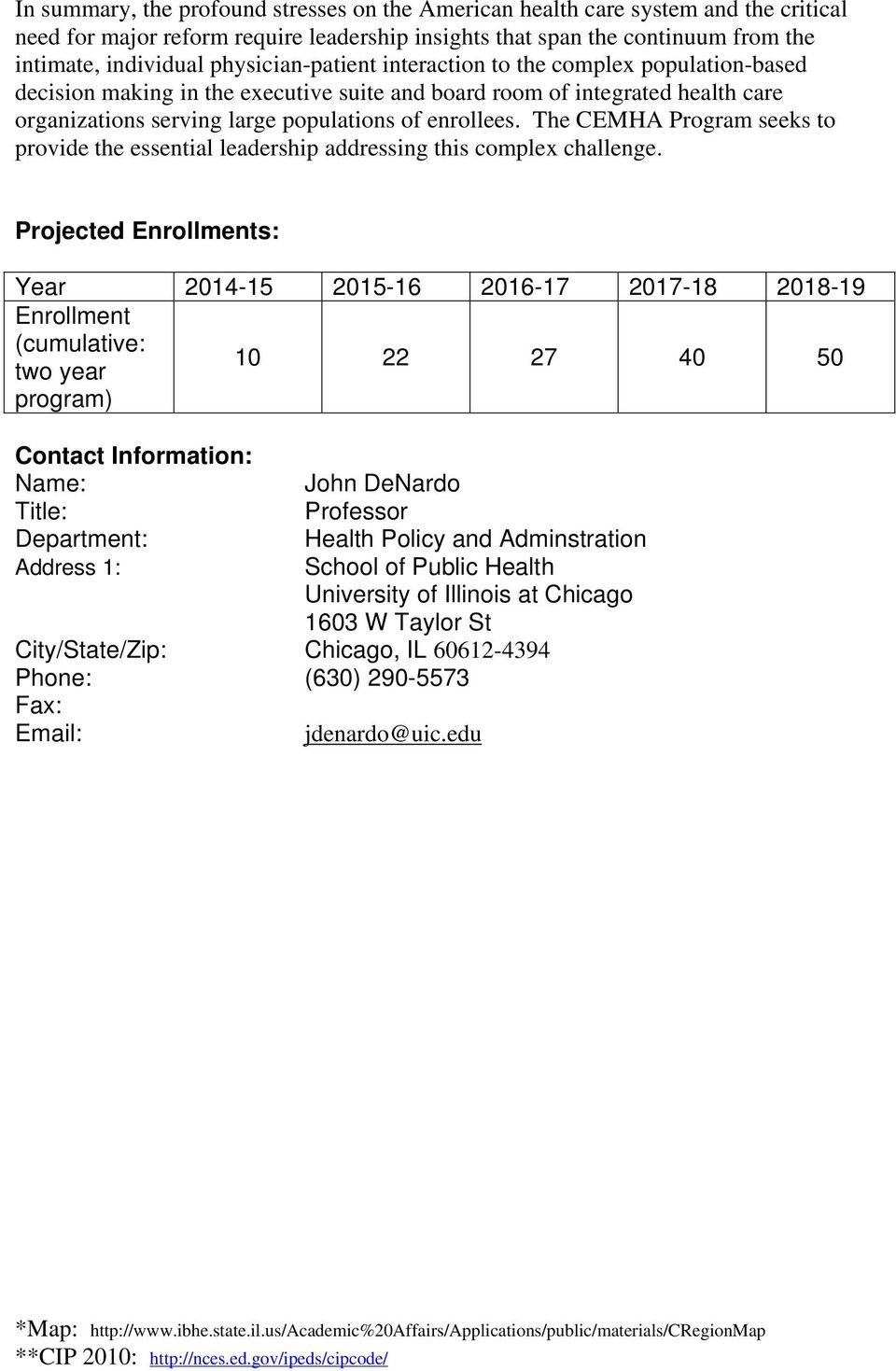
5 In summary, the profound stresses on the American health care system and the critical need for major reform require leadership insights that span the continuum from the intimate, individual physician-patient interaction to the complex population-based decision making in the executive suite and board room of integrated health care organizations serving large populations of enrollees. The CEMHA Program seeks to provide the essential leadership addressing this complex challenge. Projected Enrollments: Year Enrollment (cumulative: two year program) Contact Information: Name: Title: Department: Address 1: John DeNardo Professor Health Policy and Adminstration School of Public Health University of Illinois at Chicago 1603 W Taylor St City/State/Zip: Chicago, IL Phone: (630) Fax: [email protected] *Map: **CIP 2010:
6 1. Degree Program Title and Overview What is the specific title of the proposed degree program as it would be listed in the IBHE Program Inventory? The name should be what typically is used for similar programs nationally. Provide a short description of the program, including highlights of the program objectives, and the careers, occupations, or further educational opportunities for which the program will prepare graduates. Program Title: Clinician Executive Master of Healthcare Administration (CEMHA) The Clinician Executive Master of Healthcare Administration program is designed to produce clinician executives who can integrate their extensive clinical experience with a thorough understanding of the complex factors affecting the delivery and sustainability of healthcare organizations. This program targets individuals who already have extensive experience as practicing clinicians (usually 5 to 10 years practice experience following completion of degree education and clinical training) and some leadership experience, and trains them to become strategic executives who will impact the future direction of their organizations. The goal is to provide educational resources and team based, inter professional experiences to healthcare professionals who want to broaden their thinking about the dependencies that exist in healthcare and to maximize their organization s impact for their patients, employees, and for society at large. What makes the CEMHA program special is that it is specifically designed for clinician executives, allowing them to leverage their own experience and learn from the experiences of other executives in discussions and course projects. This program will examine various stakeholders and will emphasize value based perspectives for leading healthcare systems in an increasingly complex environment. The School of Public Health s competency with inter professional education will give students a broad understanding of the issues facing health care, and allow them to consider multiple healthcare perspectives in addressing those problems. As students progress through the program with their cohort, they will learn from the prior experience of their peers, and build relationships with other healthcare professionals. Classes will be delivered using a blended approach, using both in class and distance modalities giving students the flexibility to engage in learning while continuing to work. Courses will focus on traditional management and leadership education, with specific application to the healthcare industry. 2. Classification of Instructional Program (CIP) Code Recommend the University s preferred six-digit CIP code for this program. ( ) Health Services Administration A program that focuses on the application of policy analysis, public administration, business management, and communications to the planning and management of health services delivery systems in the public and private sectors, and prepares individuals to function as health services administrators and managers. Includes instruction in health systems planning, public health organization and management, public health policy formulation and analysis, finance, business Approved November 19, 2010 Part 1 [Page 1 of 41 ]

7 and operations management, economics of health care, organizational and health communications, marketing, human resources management, and public health law and regulations. 3. Enrollment and Degree Projections for the First and Fifth Years of the Program In the Excel table below, summarize enrollment and degrees conferred projections for the program for the first and the fifth years of operation. If possible, indicate the number of full-time and part-time students to be enrolled each fall term in the notes section. If it is not possible to provide fall enrollments or fall enrollments are not applicable to this program, please indicate so and give a short explanation. The degree projections should encompass the fiscal year as reported to the IBHE. Table 1 STUDENT ENROLLMENTAND DEGREE PROJECTIONS FOR THE PROPOSED PROGRAM 5 th Year (or when fully implemented) Year One Number of Program Majors (Fall Headcount) Annual Full-time-Equivalent Majors (Fiscal Year) Annual Number of Degrees Awarded 0 25 Students are to be enrolled in a cohort. To facilitate continuity in the cohort model, all students will be enrolled full time. 4. Background Briefly describe the historical and institutional context of the program s development. Include a short summary of any existing program(s) upon which this program will be built and of any existing administrative unit(s) and program(s) that will share resources with this program. (Note: Student and occupational demand for the program is addressed in #6, below.) The School of Public Health currently offers a Master s degree in Healthcare Administration (MHA) for individuals hoping to advance their careers in the administrative domain of healthcare management. Students who have applied to this program in the past have tended to fall into three broad categories: 1) applicants who applied to the program straight from their undergraduate program; 2) applicants who have had some experience working in junior level administrative positions, but wish to progress into more senior positions; and 3) applicants who have clinical terminal degrees and wish to advance their careers into departmental management. In the past, these three groups had been admitted into the same program. However, we believe that each group has its own set of competencies and constraints, which warrants consideration of new programs to accommodate the specific needs of each group. Approved November 19, 2010 Part 1 [Page 2 of 41 ]

8 The most significant difference appears to be for group three individuals in relatively senior clinical positions who have limited administrative experience. Applicants with a clinical background have extensive training in a specific aspect of the provision of health care. Their clinician commitment to healthcare leads them to perceive the world through the lens of treatment benefitting a patient. In the new role they seek, it is critical that they learn to shift their perspective to seek community, organization, and group benefit through the delivery of healthcare services. As they transition into an administrative role, though, they will need additional education in leadership, as well as core business functions and inter professional collaboration to give them a broader understanding of the challenges and opportunities facing health care. We expect graduates of this program will assume bridge spanning roles in their health care delivery organizations by combining continued clinical practice with executive responsibilities. This combined role and the attendant joint clinical and administrative perspective is critically important to innovative and effective future directions of the health care system. Additionally, in seeking further education, these professionals may be more constrained than individuals in the other two groups, by the demands of their jobs. Due to the unique clinical competencies of this group, and the time constraints that exist as a function of their work, we propose the Clinician Executive Master of Healthcare Administration (CEMHA) program for this third group. This program, offered through the School of Public Health, is a good fit for healthcare professionals because of its overall philosophy emphasizing values and population based management. We will build on UIC s unique competencies in inter professional education and distance learning to provide relevant instruction and flexibility for our students. We will also recruit highly recognized professionals from UIC and other Chicago organizations, with clinical and managerial experience to deliver specific content through lectures and to teach classes on topics with which they have content expertise, so that students can learn from their experience. 5. Mission Illinois Administrative Code: (a)(1): A) The objectives of the unit of instruction, research or public service are consistent with the mission of the college or university; B) The objectives of the unit of instruction, research or public service are consistent with what the unit title implies. Briefly describe how this program will support the University s mission, focus, and/or current priorities. Demonstrate the program s consistency with and centrality to that mission. One aspect of UIC s mission is to train professionals in a wide range of public service disciplines, serving Illinois as the principal educator of health science professionals and as a major healthcare provider to underserved communities. As the healthcare system in the United States continues to grow, clinician managers who can effectively provide strategic direction in these organizations will be needed as healthcare organizations work to deliver high quality care at a reasonable cost. Approved November 19, 2010 Part 1 [Page 3 of 41 ]

9 As we will document below, the healthcare sector is a large employer in Illinois. Chicago supports a large and dynamic healthcare sector, including a number of hospitals, variety of insurance plans, and several physician groups located in large urban areas. In 2013, 721,100 people were employed in the health services sector in Illinois, 12% of the entire workforce (BLS, 2013). In addition, the Affordable Care Act is expected to increase demand for healthcare services the number of eligible Medicaid recipients in Illinois is expected to rise 25.8% by 2019 (according to Kaiser s State Health Facts website: statehealthfacts.org). To manage this new growth, healthcare organizations will need to train employees with clinical skills to manage the strategic aspects of their organizations. At the same time, national policy is emphasizing the need for quality care. As the healthcare system evolves, a national emphasis on demonstrable Community Benefit and Accountable Care Organizations (ACOs) will lead healthcare organizations to become increasingly responsible for addressing the varied needs of the populations they serve. This population based philosophy is integrated throughout the CEMHA program, and students will be trained to think of the population based implications of organizational policies and programs, in addition to the impact those policies will have on revenues and costs. More than ever before, healthcare organizations will need effective executives who can combine a clinical understanding of both the values associated with health care delivery and the implications of their decision to the larger population with general management skills. Consistent with this mission, the CEMHA program will train senior level health science professionals to address the challenges facing health care in the United States. 6. Need for the Program and Future Employment and Additional Educational Opportunities for Graduates Illinois Administrative Code: (a)(6): A) The unit of instruction, research or public service is educationally and economically justified based on the educational priorities and needs of the citizens of Illinois. Explain how the program will meet the needs of regional and state employers, including any state agencies, industries, research centers, or other educational institutions that expressly encouraged the program s development. (If letters of support are available, include them in the appendix as an Adobe Acrobat (pdf) document.) Discuss projected future employment and or additional educational opportunities for graduates of this program. Compare estimated demand with the estimated supply of graduates from this program and existing similar programs in the state. Where appropriate, provide documentation by citing data from such sources as employer surveys, current labor market analyses, and future workforce projections. (Whenever possible, use state and national labor data, such as that from the Illinois Department of Employment Security at and/or the U.S. Bureau for Labor Statistics at Approved November 19, 2010 Part 1 [Page 4 of 41 ]
10 Illinois healthcare is increasingly dominated by large integrated health systems, including hospitals, clinics, and large physician group practices. Collaborative leadership among hospital and clinic administrators and clinicians is essential for addressing the strategic challenges of health care delivery. The unique characteristics of care delivery in health care and the intimate service provided to each patient demand special insights that have few parallels in any other industry. However, the professional development of many healthcare professionals, including physicians and nurses, does not generally provide understanding of the management and population based perspective necessary for administration of an organization. The proposed CEMHA program provides educational resources and team based, inter professional experiences for emerging healthcare leaders. The effectiveness, efficiency, and quality of the health care delivery system depend upon the collaborative efforts and insights of clinicians and administrators. This program will produce professionals with both clinical and executive perspectives and competencies. A needs assessment was conducted with physician leaders and non clinician healthcare executives in the fall winter of The needs assessment included analysis by the Continuing and Professional Education Learning Collaborative of the competitive landscape nationally for master s degree programs designed to prepare clinician executives. The analysis indicated that there are only eight similar programs nationally and none in the Upper Midwest (two each in Massachusetts and Pennsylvania and one each in California, Alabama, Tennessee, and Texas). Additionally a market survey was conducted through 24 intensive telephone interviews with individuals at a variety of levels in healthcare and related organizations including: Senior operating executives including medical officers Medical directors and department chairs Hospitalists, practicing physicians, medical professionals and residents aspiring to management and leadership positions Hospital executives with responsibility for Finance and HR and a former Chief Learning Officer. Surveys of these individuals confirmed the need for executive education among healthcare professionals, including physicians. As the demand for health care services increases, due to changes in legislation and an aging population, there is a need for administrators who understand the clinical implications of providing care, but who can also balance the costs of providing care with the needs of patients. This program will train students to develop innovative strategies for improving the quality of health care while reducing health care costs. Additionally, employment in the health care sector in Illinois is expected to grow in the coming years. According to data from the Illinois Department of Employment Security (IDES.illinois.gov), health care in Illinois is projected to grow 13.2% over the next decade. Approved November 19, 2010 Part 1 [Page 5 of 41 ]
11 Nationally, employment in medical and health services management is expected to grow by 22% (BLS, 2013). Employment in 2010 Projected Employment in 2020 Annual Growth Rate All Occupations 143,068, ,537, % All Management 8,776,100 9,391, % Occupations Health Care Practitioners and Technical Occupations (Federal) 7,799,300 9,819, % Health Care Practitioners and Technical Occupations (Illinois) Medical and Health Services Managers 334, , % 303, , % The growing size of health care will require qualified clinician executives, who can understand the needs of different stakeholders within the organization and populations in the larger environment, and who can respond to the increasing complexity of health care. This will create opportunities for graduates of this program to advance in their organizations and to make important health care contributions in Illinois, or across the country. 7. Comparable Programs in Illinois Illinois Administrative Code: (a)(6): B) The unit of instruction, research or public service meets a need that is not currently met by existing institutions and units of instruction, research or public service. Identify similar programs and sponsoring institutions in the state, at both public and private colleges and universities. Compare the proposed program with these programs, and discuss its potential impact upon them. For additional information about similar programs, check the Degree Program Inventory on the IBHE website ( and review the Notice of Intent website for programs being planned ( In Illinois, there are currently NO programs with the focus on executive level programs in health care administration designed for clinical practitioners who want to move into managerial roles, or find themselves taking on more managerial responsibilities. Approved November 19, 2010 Part 1 [Page 6 of 41 ]

12 Somewhat comparable programs exist which explicitly examine business functions in a health care context at the Master s level. They are of two basic types: 10 oriented towards training Baccalaureate trained nurses with a Master s program in Nursing Administration and MHA programs (much like our existing one) that focus on students who typically have limited experience in the health care system. They include: M.B.A. in Health Industry Management from Northwestern University the caveat is that this program is for medical students pursuing both an M.D. and M.B.A. This program is not designed for practicing clinicians seeking to expand their managerial skills. M.S.N. and MBA in Nursing Administration from St. Xavier University M.S.N. in Health Services Management from Loyola University of Chicago (enroll. 44) M.S. in Nursing (Health Care & Nursing Administration) from Southern Illinois University (Edwardsville) (enroll. 22) M.S. in Health Systems Management from Rush University (enroll. 22) MBA in Healthcare Management from Loyola University Master of Health Administration from Governors State University Ultimately, none of these programs are designed for students who already have extensive clinical experience and hold a doctoral degree in a clinical field. However, as we mention above, there is a need for such programs, which can supplement practicing clinicians knowledge with information about basic managerial functions. The CEMHA at UIC will be distinct from the existing MHA in that it will be directed at practicing clinicians who already have a clinical doctoral degree and extensive clinical experience. This is also different from dual Master s programs like the M.D. M.B.A. program at Northwestern, which targets medical students pursuing an M.D. and allows them to pick up an additional degree in a shorter amount of time. It is possible that in the past, some clinician executives may have applied to the other Master s programs around the state. As we mention in the background section, the MHA program at UIC receives applications from three groups of students, including our proposed clinician executives. The CEMHA program is unique in that it is designed for clinicians, who already have experience with the clinical aspects of healthcare, but who want to improve their understanding of the administrative aspects of managing healthcare systems. Second, our program is inter professional targeting many types of health care professionals, beyond physicians alone. This is distinct from the nursing administration degree programs and the MD MBA at Northwestern. The emphasis on inter professional education will ensure that our clinician executives receive a multi faceted understanding of the assumptions underlying the concerns of various stakeholders in the health system. When working in teams to solve problems, this inter professional perspective will also lead to nuanced solutions that consider multiple points of view. Third, our program will be a hybrid program. While the M.D. M.B.A. at Northwestern and the MHA program at UIC are both completed on site, our CEMHA courses will be conducted both on site and online. Clinician executives are balancing their work load with school, and may not have regular weekly periods of time to attend classes. Offering online courses allows them Approved November 19, 2010 Part 2 [Page 7 of 41 ]
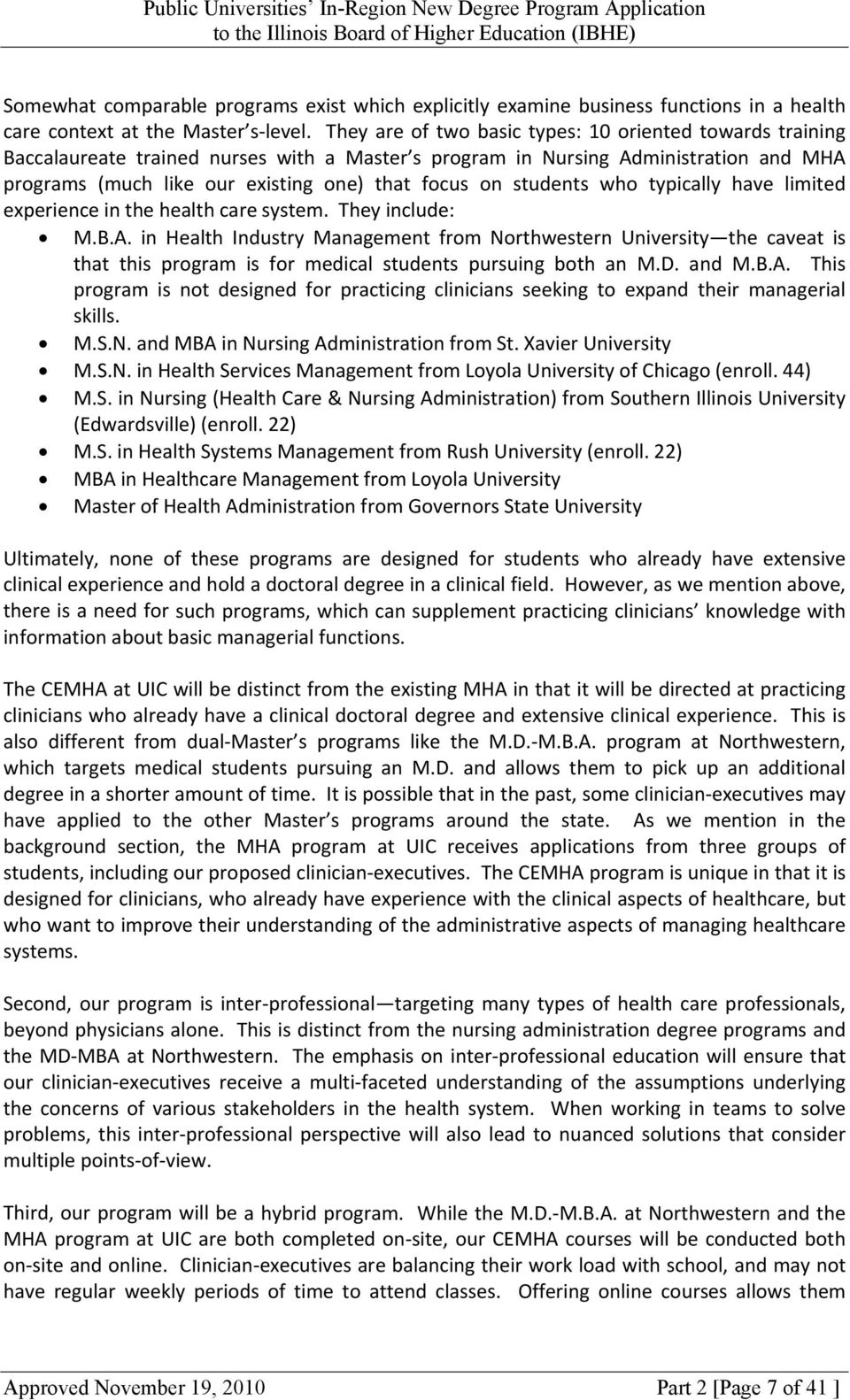
13 some flexibility to complete their work on their own time, an important feature of the program intended to accommodate the schedules of practicing clinicians. The online courses will allow clinicians to cover the same material at a time that is convenient to them during the week, allowing them flexibility to balance the program with their work. Complementing the online delivery will be limited on site class sessions that will follow a full time mode (classes 8 hours a day) which facilitates the development of collegial cohorts as students get to know each other and their professors face to face. These onsite class sessions will occur in a combination of full week and weekend blocks at times scheduled eight times during the program. Although we expect student enrollment from throughout the country there seems to be a growing demand for this program in Chicago itself, so we do not expect these on site class sessions will hinder our enrollment. In fact, we believe that these on site class sessions will enhance interest in the program because of the opportunity for personal interactions with faculty and colleague students unlike complete online programs. Fourth, the cohort model is an essential element of the program. In essence students will move through all their courses as colleagues with their peers. We are interested in helping students to build social connections with other health care leaders at similar stages in their careers. While some other programs take a cohort perspective, the CEMHA will again be a cohort exclusively of clinician executives. Thus, the CEMHA provides an additional resource, in terms of a network of people that the students can go to for support and/or advice, even after they have graduated from the program. Finally, rather than being offered through a business school, our program will be offered through the School of Public Health, which will ensure that the program will emphasize on values based management and population based health (as does the current MHA program). This perspective provides a useful change for clinicians. Doctors are taught to first, do no harm, a critical value for treating individual patients. With population health they will be exposed to a different approach to ethical values that emphasizes equity and justice and the need to weigh tradeoffs. Our program incorporates this approach as a critical aspect for an effective healthcare organization. Our Ethical Issues in Healthcare Management course will present clinician executives with scenarios that they are likely to experience in their jobs, and will provide frameworks for balancing the needs of the organization against the needs of the populations they serve. The Health Policy and Politics course will take a population based approach to managing the needs of a community, while considering the effects of the political environment, economic and social factors, and public opinion on the delivery and access of health care. Overall, this program will emphasize multiple stakeholders and value based perspectives for executives to consider while managing a healthcare organization in an increasingly complex environment. The current UIC MHA program and other programs across the state do not specifically address graduate executive education for clinicians. As noted previously regarding needs assessment, only eight such programs exist nationally and none are in Illinois or the Upper Midwest. As health care continues to expand, there is a growing need for clinician executives who can develop new and innovative solutions for delivering health care effectively and efficiently. While our program may draw some students away from other programs in the state, we expect that we will also attract clinicians at later stages of their careers, who may not have planned to pursue health care administration or to go back to school at all. Approved November 19, 2010 Part 2 [Page 8 of 41 ]

14 8. The Illinois Public Agenda for College and Career Success Illinois Administrative Code: (a)(6): A) The unit of instruction, research or public service is educationally and economically justified based on the educational priorities and needs of the citizens of Illinois Demonstrate how the proposed program will support one or more goals of The Illinois Public Agenda, the Illinois Board of Higher Education s Strategic Initiative. Each program does not have to contribute to every goal, but it must contribute to at least one. (For more information about each of the four goals of The Illinois Public Agenda, go to the IBHE website: Goal 1. EDUCATIONAL ATTAINMENT. Increase educational attainment to match the bestperforming states. Goal 2. COLLEGE AFFORDABILITY. Ensure college affordability for students, families, and taxpayers. Goal 3. HIGH QUALITY CREDENTIALS TO MEET ECONOMIC DEMAND. - Increase the number of high-quality post-secondary credentials to meet the demands of the economy and an increasingly global society. Goal 4. INTEGRATION OF EDUCATIONAL, RESEARCH, & INNOVATION ASSETS. Better integrate Illinois educational, research, and innovation assets to meet economic needs of the state and its regions. While we believe that this program will contribute to all four of the goals outlined above, we believe that the primary goal for the program will be Goal 3: to increase the number of high quality credentials to meet economic demand. As we mention above, the size of the health care industry is expanding, and there is increasing demand for health care managers who can operate in such a complex environment. Unfortunately, the State of Illinois has few comparable programs available to practicing clinicians who already have extensive training in their own clinical area, but wish to expand their understanding of their health care organization, or the health care industry, more broadly. In addition, while the clinical education they received taught them the skills they need to succeed in their clinical specialty, it may not have formally prepared them to supervise other employees, to build organizational strategy, or to understand economic or financial principles that affect organizational operations. Some of the students who will enter our program will probably have informally acquired some of these skills on thejob. The goal of this program is to help them to formalize the information, to build upon what they have already learned, and to help them to navigate best practices to allow them to become high quality clinician executives. Approved November 19, 2010 Part 3 [Page 9 of 41 ]

15 9. Program Description and Requirements Illinois Administrative Code: (b)(1) [applicable only to new units of instruction]: A) The caliber and content to the curriculum assure that the objectives of the unit of instruction will be achieved; B) The breadth and depth of the curriculum are consistent with what the title of the unit of instruction implies; C) The admission and graduation requirements for the unit of instruction are consistent with the stated objectives of the unit of instruction (b)(3): Appropriate steps shall be taken to assure that professional accreditation needed for licensure or entry into a profession as specified in the objectives of the unit of instruction is maintained or will be granted in a reasonable period of time (a)(2)(c) Requirement for Programs in which State Licensure is Required for Employment in the Field: In the case of a program in which State licensure is required for employment in the field, a program can be found to be in good standing if the institution is able to provide evidence that program graduates are eligible to take the appropriate licensure examination and pass rates are maintained as specified in the objectives of the unit of instruction. If there is no such evidence, the institution shall report the program as flagged for review. a. Admission Requirements Provide a brief narrative description of the minimum admission requirements for this program. Where relevant, include information about licensure requirements, student background checks, GRE and TOEFL scores, and admission requirements for transfer students. Admission Requirements In addition to the Graduate College minimum requirements, applicants must meet the following program requirements: Clinician Executive Master of Healthcare Administration Baccalaureate Degree Required. Advanced Graduate Professional Clinical Doctoral Degree Required (M.D., Pharm. D., DNP Doctor of Nursing Practice, or doctoral degree in other clinical disciplines; exceptions to the doctoral degree requirement may be made for clinical disciplines not characterized by a doctoral degree or for candidates with exceptionally extensive clinical experience). Work Experience Clinical practice experience characteristics and duration are very important criteria for admission. Admission requires a minimum of 5 years clinical practice experience following completion of graduate and postgraduate education and training working in a professional practice organization capacity. Experience in excess of five years will receive additional admission consideration at the discretion of the admissions committee and program director. Experience in a leadership or supervisory role in a healthcare organization is preferred. Tests Required All CEMHA applicants must have achieved the relevant licensure and certification for their clinical field Letters of Recommendation Three professional references required, preferably from those who know the applicant in a clinical and managerial professional capacity. Personal Statement Required; addressing the applicant s goals for graduate study and career development. Qualified candidates will demonstrate prior success and Approved November 19, 2010 Part 3 [Page 10 of 41 ]

16 professional experience in a clinical role in a healthcare system as well as evidence of leadership potential. b. Program Description Provide a description of the proposed program and its curriculum, including a list of the required core courses and short ( catalog ) descriptions of each one. (This list should identify all courses newly developed for the program. The learning objectives on which the curriculum is based are discussed in Section 10) This section also should discuss: The unique qualities of this program Its delivery method (face-to-face, online, hybrid, etc.) Its curriculum s alignment with national standards (if applicable) The School of Public Health (SPH) offers a two year graduate program composed of 48 semester hours leading to the Clinician Executive Master of Healthcare Administration (CEMHA). The Clinician Executive Master of Healthcare Administration is a program designed for professionals with extensive clinical experience who would like to pursue upper level management careers in health services organizations such as hospitals, community based ambulatory care centers, managed care plans, the health supply chain, physician group practices, and long term care providers. Students enter the program with a cohort of other healthcare professionals, allowing them to build relationships and to gain insight from a diverse range of inter professional experience. Our intent is that these cohorts would remain intact until graduation although personal or professional contingencies may force some students to leave their cohort and follow a more individualized schedule. We expect that this will be the exception. Clinicians are trained to provide high quality care to individual patients, but this training does not prepare them with the management and population based perspective necessary for administration of health care organizations. In fact the development of a clinician emphasizes skills and attitudes almost opposite to the education of an organizational executive as illustrated in the following table. Clinician Today Oriented Tactical, Short Term Reactive Decider Autonomous Independent Patient Advocate Professional Identification Executive Future Oriented, Strategic, Long Term Proactive Delegator Collaborative Participative Organization Advocate Organizational Identification Approved November 19, 2010 Part 3 [Page 11 of 41 ]
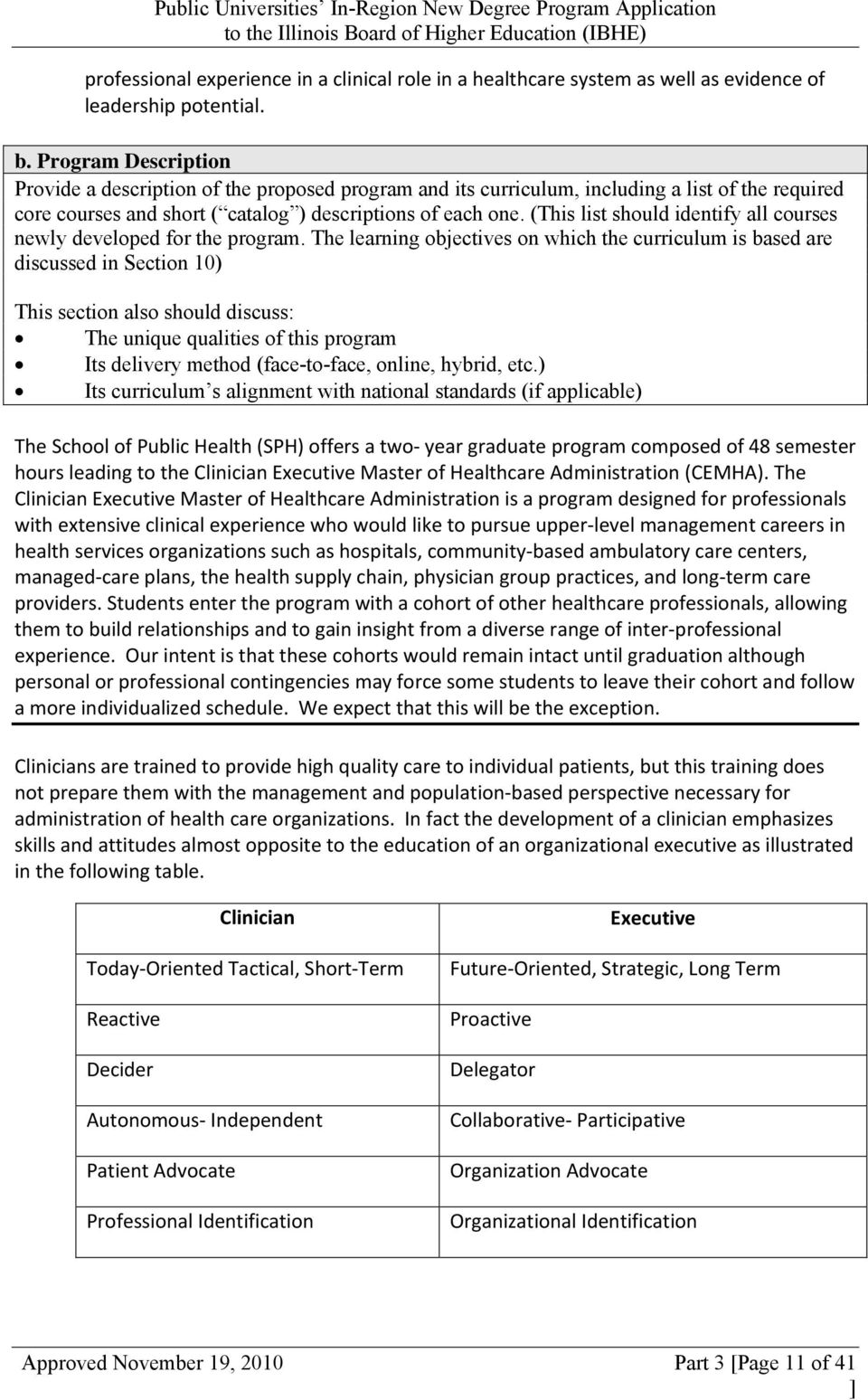
17 Our overall goal is to enable our students to integrate these two perspectives to enable them to serve as effective bridges between these two world views. This bridging will be increasingly essential for the US health care system as the ACA is implemented. Students will benefit from the rigorous educational curriculum that combines competence in management with an in depth knowledge of the healthcare sector and of the management issues it faces. Required core courses emphasize financial management, strategic management, leadership, quantitative decision making, informatics, and health policy. The capstone associated with the program will build practical experience through a team based project which addresses an inter professional issue in an organization. These courses will follow a hybrid structure, combining online and face to face instruction. This combination provides students with the face to face experience which enhances personal interactions between faculty and students and between students with the flexibility of the distance (mostly synchronous as well as some asynchronous mode). Students will mostly be able to continue with their work although their supervisors would have to agree to scheduled week long absences for the face to face components. The UIC Clinician Executive Master in Healthcare Administration (CEMHA) program is available to experienced clinicians to enhance their organizational knowledge and leadership abilities so that they can apply their clinical skills to careers in healthcare management. It is intended to be engaged through a hybrid distance learning model (to provide flexibility and continuity) with brief periods of on site instruction (to provide intensity and cohort building). The CEMHA will be pursued through a series of modules, each consisting of a few classes examining important aspects of healthcare management (e.g., Strategic Management; Financial Management; Organizational Leadership; Health Policy; and Quantitative Analysis in Healthcare). There are a number of features that make this program unique from other programs offered at UIC. All admitted students must have extensive experience working as practicing clinicians. Coursework will focus on traditional management concepts, with specific applications in the healthcare industry. A cohort approach will allow students to progress through their coursework with a single group of colleagues. This allows them to take full advantage of the prior experience of their peers and increases the value of interaction, both during the program and in career paths following graduation. The capstone course will allow students to gain practical experience as they develop solutions for complex problems facing the healthcare organizations in which they currently work, under the guidance of an executive mentor, preferably one assigned by their organization, but one assigned by program leadership otherwise. Students will work in teams to address an issue that exists in a healthcare system. They will systematically analyze the issue, develop solutions, and implement a plan to improve system outcomes or processes. Students will spend the equivalent of two weeks on campus each semester (i.e., Fall, Spring, and/or Summer). Students will also spend 2 days on campus for orientation at the beginning of Approved November 19, 2010 Part 3 [Page 12 of 41 ]
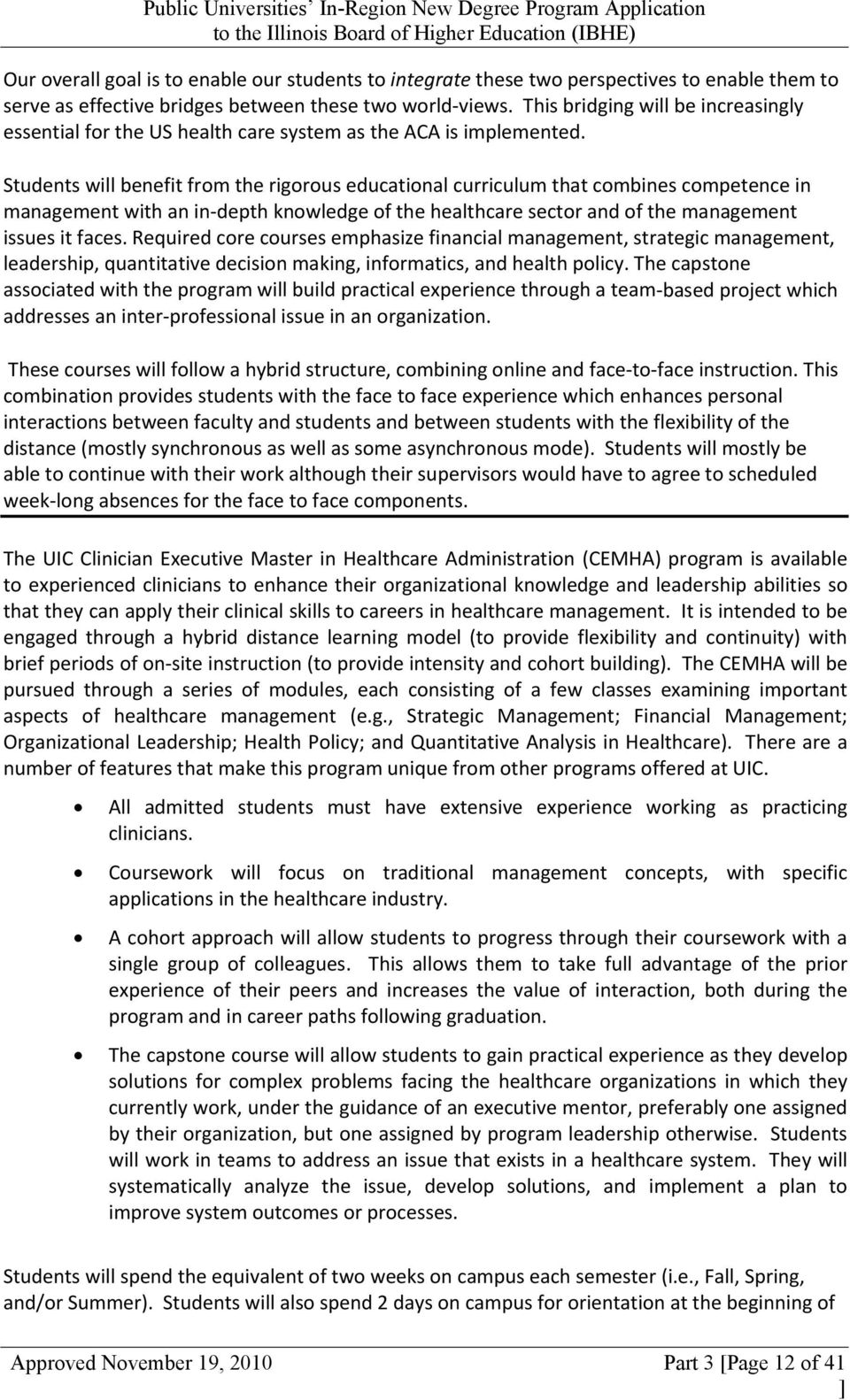
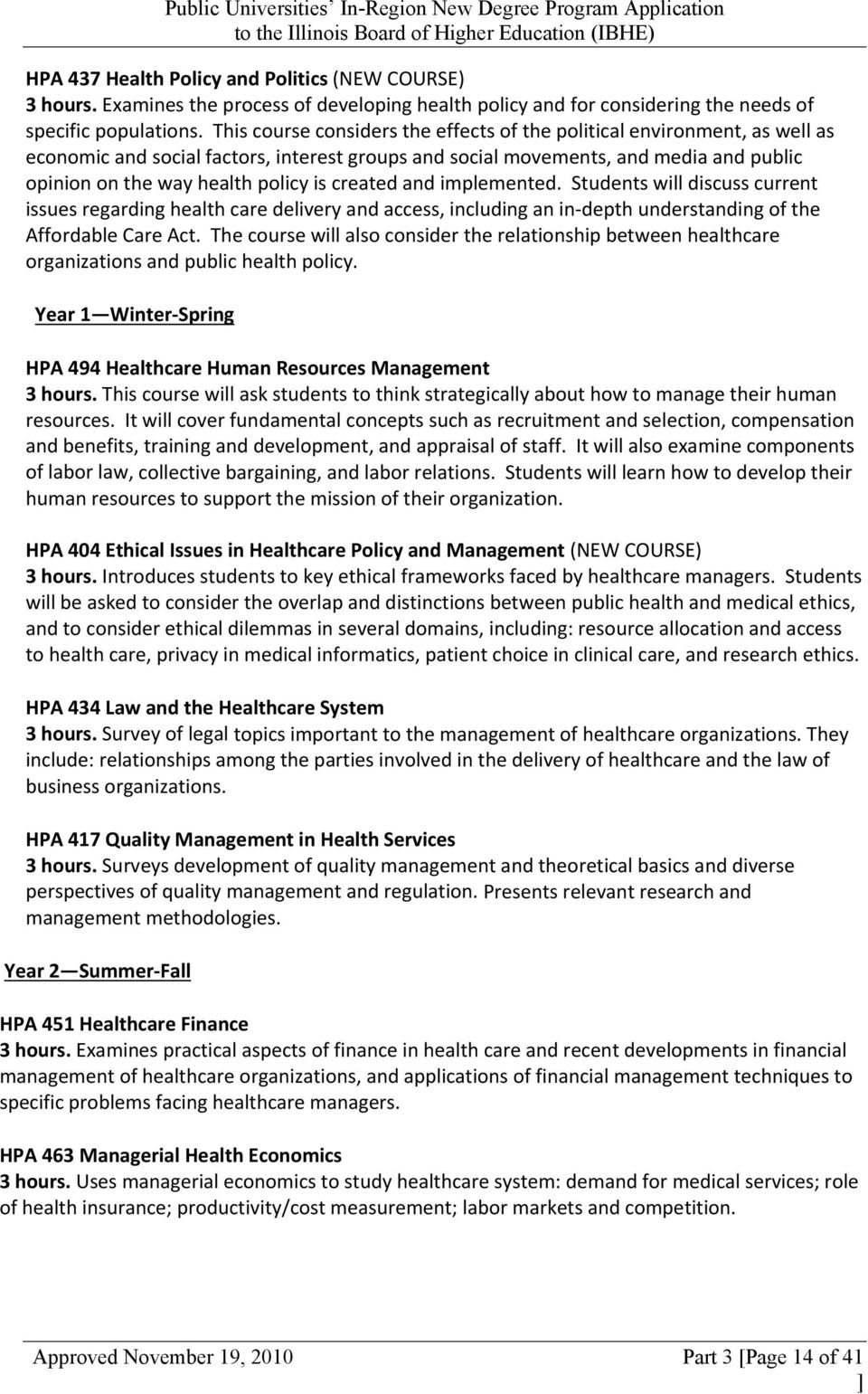
18 the program, and four additional days on campus at the end of the program, for the capstone presentations. This is an important issue. The cohort value is much enhanced by intensive time on campus. The CEMHA program will build upon several existing courses in the MHA program although each course will be delivered separately from the existing course both because of major differences in distance format as well as additional faculty in some cases and variation in content. There are three new courses in the CEMHA program that do not exist in the MHA program and five courses required in the MHA program do not exist in the CEMHA program. These differences are planned specifically because of the admission requirements of the CEMHA program which require a doctoral level terminal clinical degree and extensive clinical experience, with preexisting knowledge about health care delivery. Additionally, because of the CEMHA students previous academic and professional experience, some courses required for the traditional MHA program are not optimal for the CEMHA program. Finally, the anticipated future leadership roles of the CEMHA graduates will be substantially different from the MHA graduates future roles, although complementary and collegial. In fact it is the need for a bridge spanning role between the clinician professionals and administrative professionals in healthcare delivery organizations that the CEMHA program is specifically designed to address. The MHA biostatistics course is not required because CEMHA students have previously experienced graduate biostatistics in their doctoral programs and clinical practice. Accounting and Finance content will also differ in keeping with the role differences between health care finance executive s and clinician executives roles. And the Preceptorship and Special Topics courses do not match the experience and needs of the CEMHA students. Finally, the relevant content for HPA 525 Population based Program Planning will be subsumed in the new Policy course HPA 437 (the ACA s emphasis on population health) and Ethics course HPA 404 (the ethical tradeoffs between resources and patient needs). The pre existing academic and professional experience and credentials of the CEMHA students necessitates a substantially different level and focus of the coursework. The following courses are designated where appropriate with the existing MHA course numbers except for those courses that are entirely new (indicated as NEW COURSE ). However it is understood that the courses will have different delivery methods as well as content differences, but nonetheless will derive from existing courses and in many cases will be taught by the same faculty. Prerequisite for each course will be: Admission to CEMHA Program and consent of the instructor. The following course schedule is preliminary and illustrative at this time: Year 1 Summer Fall HPA 410 Healthcare Organizational Leadership. 3 hours. Examines the roles, responsibilities, and impact of leaders of organizations in the health industry. Critical structures and techniques of effective organizational leaders are taught. HPA 403 U.S. Healthcare System. 3 hours. Overview of the U.S. healthcare system, including its evolution, utilization patterns, providers human, institutional and organizational financing, regulating, evaluating, and reforming. Approved November 19, 2010 Part 3 [Page 13 of 41 ]

19 HPA 437 Health Policy and Politics (NEW COURSE) 3 hours. Examines the process of developing health policy and for considering the needs of specific populations. This course considers the effects of the political environment, as well as economic and social factors, interest groups and social movements, and media and public opinion on the way health policy is created and implemented. Students will discuss current issues regarding health care delivery and access, including an in depth understanding of the Affordable Care Act. The course will also consider the relationship between healthcare organizations and public health policy. Year 1 Winter Spring HPA 494 Healthcare Human Resources Management 3 hours. This course will ask students to think strategically about how to manage their human resources. It will cover fundamental concepts such as recruitment and selection, compensation and benefits, training and development, and appraisal of staff. It will also examine components of labor law, collective bargaining, and labor relations. Students will learn how to develop their human resources to support the mission of their organization. HPA 404 Ethical Issues in Healthcare Policy and Management (NEW COURSE) 3 hours. Introduces students to key ethical frameworks faced by healthcare managers. Students will be asked to consider the overlap and distinctions between public health and medical ethics, and to consider ethical dilemmas in several domains, including: resource allocation and access to health care, privacy in medical informatics, patient choice in clinical care, and research ethics. HPA 434 Law and the Healthcare System 3 hours. Survey of legal topics important to the management of healthcare organizations. They include: relationships among the parties involved in the delivery of healthcare and the law of business organizations. HPA 417 Quality Management in Health Services 3 hours. Surveys development of quality management and theoretical basics and diverse perspectives of quality management and regulation. Presents relevant research and management methodologies. Year 2 Summer Fall HPA 451 Healthcare Finance 3 hours. Examines practical aspects of finance in health care and recent developments in financial management of healthcare organizations, and applications of financial management techniques to specific problems facing healthcare managers. HPA 463 Managerial Health Economics 3 hours. Uses managerial economics to study healthcare system: demand for medical services; role of health insurance; productivity/cost measurement; labor markets and competition. Approved November 19, 2010 Part 3 [Page 14 of 41 ]
20 HPA 470 Quantitative Methods for Healthcare Managers 2 hours. Builds on basic statistical skills, teaching other quantitative methods within the context of specific decision making issues encountered by healthcare managers and leaders. EPID 400 Epidemiology 3 hours. Epidemiologic methods and emphasis on content addressing delivery, rationale, and cost benefit/cost effectiveness analysis of population based health promotion and disease prevention as well as critical analysis of medical literature and related biostatistics principles. Year 2 Winter Spring HPA 465 Health Information and Decision Support Systems 4 hours. Provides a framework for analyzing an organization s information needs and implementing information technology (IT) policies. Topics include: privacy, usability, interoperability, and challenges of implementation. This course will discuss the set of health information technologies available to health systems, and addresses the opportunities and challenges of implementing them to generate value to consumers, by increasing quality, safety and efficiency, and to the organization, by reducing costs or increasing demand. HPA 441 Strategic Management of Healthcare Organizations 3 hours. Strategic management emphasizes the conceptual and technical considerations of planning and implementing the organization s future direction. Topics include: the organization s mission, vision, and values; the internal and external environments; plans for implementing organizational strategies; and an application of the material learned throughout the program. Students will learn a number of tools to analyze the organization s strategy, and to manage the goals, strategy, and structure of healthcare organizations. Case studies will be used to reinforce the concepts. HPA 551 Marketing of Healthcare Organizations 3 hours. This course will emphasize market research and the application of marketing strategies in healthcare organizations. Students will learn about marketing planning and strategy, market segmentation and positioning, new product development in health systems, and decisions about distribution, pricing, and promotion of health services. Coursework Continuing Throughout the Two Year CEMHA Program Independent Study Special Topics (select 2 of the following, which are completed at any time during the program by registering for Independent Study, Course. 3 hours. Population Health Evaluation Community Based Health Needs Assessment Long term care Managed care Practice Management Pharmaceutical and medical device industries Healthcare entrepreneurship Healthcare Innovation Approved November 19, 2010 Part 3 [Page 15 of 41 ]
21 Environmental health sciences Global health HPA 496 Capstone Course 3 hours. Group based course The capstone leads students to identify and select an important organizational challenge or opportunity to be worked up within the framework of the CEMHA problem solving process. As the students progress through the curriculum, they apply the skills and concepts they have acquired to their final project report and presentation. Usually the project will be selected for its relevance to a problem in the healthcare delivery organization in which the student works. The Capstone Course will continue throughout the two years of the CEMHA program. c. Graduation Requirements Provide a brief narrative description of all graduation requirements, including, but not limited to, credit hour requirements, and, where relevant, requirements for internship, practicum, or clinical. For a graduate program, summarize information about the requirements for completion of the thesis or dissertation, including the thesis committees, and the final defense of the thesis or dissertation. If a thesis or dissertation is not required in a graduate program, explain how the functional equivalent is achieved. Degree Requirements In addition to the Graduate College minimum requirements, students must meet the following program requirements: Clinician Executive Master of Healthcare Administration Minimum Semester Hours Required 48 Course Work Required Courses: HPA 410 Healthcare Organizational Leadership (Healthcare Management) (3 credit hours) HPA 403 U.S. Healthcare System (3 credit hours) HPA 437 Health Policy and Politics (3 credit hours) HPA 494 Healthcare Human Resources Management (3 credit hours) HPA 404 Ethical Issues in Healthcare Policy and Management (3 credit hours) HPA 434 Law and the Healthcare System (3 credit hours) HPA 417 Quality Management in Health Services (3 credit hours) HPA 451 Healthcare Finance (3 credit hours) HPA 463 Managerial Health Economics (3 credit hours) HPA 470 Quantitative Methods for Healthcare Managers (2 credit hours) EPID 400 Epidemiology (3 credit hours) HPA 465 Health Information and Decision Support Systems (4 credit hours) HPA 441 Strategic Management of Healthcare Organizations (3 credit hours) HPA 551 Strategic Planning and Marketing (3 credit hours) HPA 496 Capstone Project Individual or group based project (3 credit hours) Approved November 19, 2010 Part 3 [Page 16 of 41 ]
22 HPA 490 Independent Study Course (each group selects two special issue topic, which could include, but not limited to, the following) (3 credit hours) o Long term care o Managed care o Practice Management o Pharmaceutical and medical device industries o Healthcare entrepreneurship o Healthcare Innovation o Environmental health sciences o Global health Enrichment Experiences Orientation Team Building Activity HPA 490 Lecture Series Inter professional education day Comprehensive Examination None. Thesis, Project, or Course Work Only Options A team based capstone course which addresses an inter professional issue in an organization is required. No other options are available. Other Requirements Students must maintain an overall GPA of 3.0 in the program, in accordance with the Graduate School requirements. Each student must complete a capstone project (HPA) and present it to HPA faculty and representatives from the organization. Credit will be granted for completion of the tasks in the published capstone syllabus, and submission of an acceptable paper, presentation, and set of deliverables that is the primary academic product of the CEMHA Capstone. d. Specialized Program Accreditation Describe the institution s plan for seeking specialized accreditation for this program. Indicate if there is no specialized accreditation for this program or if it is not applicable. The MHA program is currently CAHME accredited. We have designed this program with CAHME in mind and will pursue CAHME accreditation for the CEMHA program. The program will also pursue CEPH accreditation. e. Licensure or Certification for Graduates of the Program If this program prepares graduates for entry into a career or profession that is regulated by the State of Illinois, describe how it is aligned with or meets licensure, certification, and/or entitlement requirements. Not applicable 10. Plan to Assess and Improve Student Learning Illinois Administrative Code: (b)(1)(D) Provision is made for guidance and counseling of students, evaluations of student performance, continuous monitoring of progress of students toward their degree objectives and appropriate academic record keeping. Approved November 19, 2010 Part 3 [Page 17 of 41 ]
23 a. List the program s student learning objectives. Each objective should identify what students are expected to know and/or be able to do upon completing this program. We expect our students to leave the program with a range of analytical and conceptual tools for thinking about issues in health care, but it is the ability to combine the clinician and management perspectives that is the most important goal aspect of our program. Our primary focus is on the application of these tools to the types of issues that they are likely to face as clinician executives in collaboration with administrators. Since our students will already have obtained a terminal clinical degree, and will likely have some experience with leadership, we will measure success in the following five categories of learning objectives: 1 Clinical Leadership in the Community, 2 Clinical Leadership in the Healthcare Organization, 3 Strategic Thinking from a Clinical Perspective, 4 Management of Clinical Operations, 5 Critical Thinking. Clinical Leadership in the Community: Achieve mastery of how to plan and develop programs that respond to the healthcare needs of a community and also advance organizational mission as clinicians and executives in healthcare. Analyze the specific clinical health needs of the community and respond with specific program development and implementation to effectively meet the needs. Understand the socio cultural issues affecting the health of the target population and impact health policy to improve health status. Develop partnerships between public and private healthcare organizations to improve the accessibility and quality of community healthcare programs. Address core ethical precepts of their organization and the conflicts that may arise and create a strategy for addressing those potential conflicts in an open, constructive and honest way. Clinical Leadership in the Healthcare Organization: Demonstrate the ability to organize, manage, and continuously improve requirements of various levels of clinical delivery systems. Identify and act on the strengths and weaknesses of an organization in its delivery of clinical services to create continuous momentum for improvement. Take initiative in creating effective solutions to the interface of clinical services of the healthcare organization and community needs. Relate to the variety of clinical healthcare professionals in various healthcare organizations in order to build collaboration. Communicate clearly with community leaders and constituents to bring about desired changes in clinical services. Develop effective working relationships with medical staff, board members and other organizational leaders and translate the varying perspectives of clinicians, non clinician administrators, and board members to enhance collaboration on improving patient care throughout the organization. Approved November 19, 2010 Part 3 [Page 18 of 41 ]
24 Strategic Thinking from a Clinical Perspective: Demonstrate command of current health policy issues as they affect clinical services, formal/informal influences that influence the organization, and ability to analyze concepts and use analytical, financial and marketing tools to develop optimal approaches to delivering clinical services. Identify, develop and apply alternative strategies to effectively respond to changing incentives for compensation of clinical services in order to achieve organizational goals. Identify, develop and apply successful and ethical marketing and sales strategies that are understandable to patients and purchasers of services. Apply working knowledge of health care financing, cost accounting methodologies and reimbursement policy and practices and convey information in a manner that is sensitive to the perspectives of patients and clinicians. Apply working knowledge of current health policy issues and utilize this knowledge to create future scenarios for strategy. Effectively organize collaborations among clinicians and administrators in health care delivery and management to create an environment of continuous improvement. Management of Clinical Operations: Master the ability to identify, analyze, create, and apply appropriate tools in relationship to the governing body, the clinician providers, and executives that respond effectively to the expectations of ethically advancing the organization s mission. Demonstrate and apply working knowledge of health care financing, cost accounting methodologies, reimbursement practice, financial reporting, operating budgets, capital budgets, and treasury functions in health care delivery settings; translate this knowledge to clinicians in the organization in a manner that is understandable from the clinician s perspective. Identify, analyze and apply human resource policy and practice in health care delivery. Demonstrate and apply working knowledge of the roles of executives as managers and leaders in the complex environment of health care delivery and the interface between executive and clinicians Apply working knowledge of the key roles of quality and effectiveness in continuous improvement of clinical services to patients. Identify, analyze and apply working knowledge of information systems in contemporary health care delivery with particular expertise in electronic medical records and effective utilization by clinicians. Critical Thinking: Capacity to apply analytical skills to make critical decisions, manage programs, and assess their effectiveness in provision of direct clinical services Demonstrate working knowledge of how the concepts and tools of statistics, epidemiology, and marketing fit together to provide a basis for decision making in support of effective delivery of clinical services Apply knowledge areas acquired to the "real life" setting of problems faced by clinicians in collaboration with executives and support staff in delivery of clinical services Comprehensively analyze complex clinical delivery problems and design and implement workable solutions. Create and apply alternate solutions to a problem in response to current and future social trends affective provision of clinical services. Approved November 19, 2010 Part 3 [Page 19 of 41 ]
25 b. Describe how, when, and where these learning objectives will be assessed. Your description should demonstrate that the assessment will: be systematic (that is, occur at different points throughout the program, including courseby-course and end-of-program); include multiple, discipline-appropriate measures of student learning; emphasize direct measures (e.g., assessments of learning via capstone courses, internships, portfolios, recitals, exhibits, theses, dissertations; standardized, locallydeveloped, comprehensive, or professional licensure and certification exams; and so on); and include indirect assessments from key stakeholders such as current students, alumni, employers, graduate schools, etc. These may include job placement/career advancement/graduate school acceptance rates of graduates, graduate/employer satisfaction survey results etc. Students will be evaluated in their courses, by their ability to complete required assignments and projects in a professional, creative, and effective manner. They will also be evaluated on their performance on a final group project, which will require them to enter an existing organization, collect data, and develop real solutions for an organizational issue. This program is intended to train graduates who will manage large health services organizations. Therefore, although we intend to provide a range of analytical and conceptual tools for our students, our focus will be on enhancing the students ability to apply these tools to the types of issues they will likely face as managers. One important aspect of this program is its focus on applying knowledge to real issues that students might face at work. We intend to identify practitioners in the healthcare management arena who will lend their expertise by teaching in the proposed program, allowing our students to obtain some expertise from actual clinician executives from a variety of clinical specialties. An Advisory Board has been developed to advise this program. One of their tasks will be to ensure that the program remains current by updating required competencies as new topics emerge in the field (e.g., information management or patient safety assurance). c. Identify faculty expectations for students achievement of each of the stated student learning objectives. What score, rating, or level of expertise will signify that students have met each objective? Provide rating rubrics as necessary. Students will receive a printed syllabus during the first week of instruction. For each course, faculty will delineate and communicate course assignments and expectations for the assignment of Grades A F at the start of the term. The Capstone Project will serve as a major faculty evaluation of student achievement. Each student will have one or more faculty members who will oversee, advise, and mentor them on their Capstone Project. Additionally, since the Capstone Project will address a current healthcare delivery organization challenge, evaluation from the leadership and relevant staff of the organization will also be solicited. Approved November 19, 2010 Part 3 [Page 20 of 41 ]
26 d. Explain the process that will be implemented to ensure that assessment results are used to improve student learning. Each course includes multiple graded assignments. Faculty will notify students deemed to be at risk of under performance who will be counseled by program faculty. In such cases, students will work with relevant faculty members to generate a plan for improving performance in the course. It is expected that some students will fall behind because of unexpected challenges faced in their professional roles in their healthcare organizations and, if deemed appropriate the program may subsequently counsel those students to defer continuation until later and consider readmission in a later cohort. 11. Plan to Evaluate and Improve the Program Illinois Administrative Code: (a)(2): The design, conduct, and evaluation of the unit of instruction, research or public service are under the direct and continuous control of the sponsoring institution s established processes for academic planning and quality maintenance (a)(1) Three years after approval of a new program, the institution shall provide a program progress report to the Board as part of the institution's annual report. The third year progress report shall describe the institution's performance in meeting program objectives and show where any improvements are necessary. The placement of a program in voluntary temporary suspension will not negate the requirement of submitting a third year progress report. Describe the program s evaluation plan.* This plan should identify the methods of program evaluation (e.g., faculty self study, curriculum committee review, external review, feedback from key stakeholders such as current students, alumni, employers, and/or staff at residency/internship/practicum sites) as well as its key elements (e.g., curriculum, teaching, research, public services, diversity, quality, cost effectiveness, employer demand, etc., as is relevant to the program), and the goals that will be set for each one. It also should illustrate the existence of regular review and feedback processes to ensure that results of the evaluation will be used to improve the curriculum, instruction, and the overall quality of the program. Your discussion may include (but is not limited to) the following items: Faculty/student collaboration in research, community service, or other projects; Faculty productivity (in research, scholarship, creative activities, instruction, and public service); Student engagement in integrative learning activities (internships, practica, service learning, study abroad, etc.); External funding such as research grants and contracts; Support of one or more of the Goals of The Illinois Public Agenda; Results of student learning assessment; Employer, alumni, and other satisfaction survey results; Percent of students involved in faculty research or other faculty led projects; Percent of graduate students in the program presenting or publishing papers; Pass rate of graduates on the end-of-program, comprehensive, standardized, and/or certification/licensure examinations; Approved November 19, 2010 Part 3 [Page 21 of 41 ]
27 Retention, graduation, and time-to-degree completion rates; and Job placement, career advancement, and/or graduate school acceptance rates. *This plan may be based on the institution s process for the submission of a progress report to the IBHE at the end of the 3 rd year of operation and the program s participation in the IBHE s 8-year program review process or the program s specialized accreditation review process. We will use several layers of self and external assessment to identify ineffective aspects of the program. The first layer is the Course Evaluation Questionnaire (CEQ) process. These written evaluations provide formal feedback regarding the course content, faculty teaching methods and ability, course books and assignments, and effectiveness of the teaching assistants. We intend to conduct end or near end of program assessment of student learning in the following manner. We will ask potential employers to assess the project groups readiness and ability to perform during their interaction with the final project groups. The mentors of the project groups (and the organizational contacts for the project groups) will be asked to assess observed improvements in the students competencies relevant to their work. Capstone projects will be evaluated with an eye to students mastery of the competencies listed above. Graduating students will be administered a Graduate Exit Survey. The graduates will be asked to assess the quality and value of the curriculum, faculty, and administrative support; and whether the program was successful in helping them find new jobs or advance within their current positions. The feedback will be one of the bases for the evolution of the CEMHA curriculum and the program as a whole. Curricular changes will be reviewed and approved by the relevant committees at both the SPH and campus levels. There are four primary external bodies that will provide feedback. First, the current MHA Advisory Board will also advise the CEMHA program. This Board largely consists of representatives of major regional healthcare employers as well as some alumni representatives. They will provide feedback on program content and emphasis. The Advisory Board will conduct an annual program review assessing the degree to which the program has accomplished its goals and providing recommendations for improvement. We will augment the current MHA Advisory Board with additional members representing professional clinician executives associated with organizations exemplified by the American Medical Association, American College of Physician Executives, and the Medical Group Management Association. The following table lists the current MHA Advisory Board: Master of Healthcare Administration Advisory Board Kevin Scanlan President/CEO Jeffrey Murawsky Network Director Metropolitan Chicago Healthcare Council VA Great Lakes Health Care Approved November 19, 2010 Part 4 [Page 22 of 41 ]
28 System Kim Byas Regional Executive American Hospital Association Margaret McDermott Executive Vice President and CEO (retired) Saints Mary and Elizabeth Medical Center Susan Nordstrom Lopez President Advocate Illinois Masonic Medical Center Beverly Hancock Director, Educational Programs American Organization of Nurse Executives Jay Burkett Partner Grant Thornton LLP John DeNardo Clinical Assistant Professor and MHA Program Director UIC School of Public Health Kyle Kingston AFHA President UIC School of Public Health Boyede Sobitan Senior Consultant Quorum Health Resources Knitasha Washington Chicago Midwest Chapter President NAHSE Alejandro Clavier Medical Director Centro de Salud Esperanza Richard Sewell Associate Dean, Community and Public Health Practice UIC School of Public Health Second, we will seek CEPH and CAHME accreditation. Because the unit of accreditation for CEPH is the school, all degrees awarded from the school are considered to be from an accredited school/program, including those that come on line in the interim between regular accreditation reviews. Once the program is approved, we will notify CEPH of the additional degree. CEPH will generally review the addition in depth at the time of the next regular accreditation review. Thus, the CEMHA program will be CEPH accredited from the start. Our MHA program recently achieved CAHME accreditation. Once the CEMHA has graduated one or two classes, we will request CAHME accreditation for that program as well. These accreditation processes will require us to paint a very detailed portrait of the program to an experienced accreditation team and their report will certainly identify the areas that require improvement. Third, IBHE will periodically assess the success of the program in meeting its objectives. This scrutiny will incorporate the broader perspective of the educational needs and priorities of the State of Illinois. Approved November 19, 2010 Part 5 [Page 23 of 41 ]
29 Finally, we will conduct a comprehensive evaluation of the program once the program s operations have become relatively stable. This evaluation will be performed by a two person evaluation team consisting of an experienced health management educator who will serve as a paid outside evaluator, in collaboration with a senior administrator at UIC who will provide detailed institutional knowledge of the program s context. The evaluation will have a strategic orientation: to re examine the program after the completion of its initial phase and after the matriculation and graduation of several cohorts of students. At that stage, it would be especially valuable to identify shortcomings in recruitment strategies, curricular contents and program design and outcomes. 12. Budget Narrative Fiscal and Personnel Resources Illinois Administrative Code: (a)(5): A) The financial commitments to support the unit of instruction, research or public service are sufficient to ensure that the faculty and staff and support services necessary to offer the unit of instruction, research or public service can be acquired and maintained; B) Projections of revenues necessary to support the unit of instruction, research or public service are based on supportable estimates of state appropriations, local tax support, student tuition and fees, private gifts, and/or governmental grants and contracts. Budget Rationale Provide financial data that document the university s capacity to implement and sustain the proposed program and describe the program s sources of funding. a. Is the unit s (Department, College, School) current budget adequate to support the program when fully implemented? If new resources are to be provided to the unit to support the program, what will be the source(s) of these funds? Is the program requesting new state funds? (During recent years, no new funds have been available from the state (IBHE) to support new degree programs). The program is intended to be fully self supporting and is projecting no state support. Tuition is projected at $25,000 per year resulting in $250,000 in the first year (10 students) and $1,250,000 annually at full enrollment (25 students/year, 50 students total). We estimate that 65% of the tuition revenue would accrue to the program ($162,500 in the first year and $812,500 in year 5); because of the population serve we anticipate no graduate tuition waivers. The program would cover its costs in year 3. The losses in years 1 and 2 would be absorbed by the offering unit (Health Policy and Administration). b. Will current faculty be adequate to provide instruction for the new program or will additional faculty need to be hired? If additional hires will be made, please elaborate. Approved November 19, 2010 Part 5 [Page 24 of 41 ]
30 Faculty for the CEMHA program will build upon faculty and several existing courses in the current MHA program although each course will be separate from the existing course both because of major differences in hybrid delivery format as well as some variation in content, given the student population as experienced clinicians. Initially 5 program faculty (1.25 FTE or $125,000), the program director ($125,000) and 2 adjunct faculty will serve the first cohort of students and first year classes. When fully implemented with the full complement of courses in the second year faculty FTE will increase to 11 faculty (2.5 FTE or $250,000), 4 adjunct faculty and the program director. The increase in FTE will be accommodated largely by increasing the FTE appointment of current MHA faculty. The adjunct faculty will be experienced clinician executives and administrators from healthcare delivery organizations. c. Will current staff be adequate to implement and maintain the new program or will additional staff be hired? Will current advising staff be adequate to provide student support and advisement, including job placement and or admission to advanced studies? If additional hires will be made, please elaborate. We anticipate the need for an additional 0.5 FTE of support staff at a expense of $25,000 initially will increase to $50,000 at full implementation. Student advising is a faculty responsibility, initially at least by the Program Director; at full enrollment, the advising load may be spread more broadly. d. Are the unit s current facilities adequate to support the program when fully implemented? Will there need to be facility renovation or new construction to house the program? (Refer to Section #13.1). See Section 13.1 e. Are library resources adequate to support the program when fully implemented? (Refer to Section #13.2). See Section 13.2 f. Are any sources of funding temporary (e.g., grant funding)? If so, how will the program be sustained once these funds are exhausted? We are not anticipating any grant funding. g. If this is a graduate program, please discuss the intended use of graduate tuition waivers. If the program is dependent on the availability of waivers, how will the unit compensate for lost tuition revenue? Because of the population served we anticipate no graduate tuition waivers. Approved November 19, 2010 Part 5 [Page 25 of 41 ]
31 h. Complete the budget Table 2 below ESTIMATED COSTS OF THE PROPOSED PROGRAM 5 th Year Category Unit of Measurement Year One (or when fully implemented) Personnel $25,000 $50,000 Faculty FTE Faculty $ $250,000 $375,000 Other Personnel Costs $ $ $ Supplies, Services, Equipment 1 $ $35,000 $45,000 Facility Costs (e.g., rental, $ $0 $0 maintenance) Other Costs (itemized): $ Adjunct Faculty $ $20,000 $40,000 $ $ $ $ $ $ Total $ $330,000 $510,000 Approved November 19, 2010 Part 5 [Page 26 of 41 ]
32 13. Facilities and Equipment Illinois Administrative Code: (a)(4): A) Facilities, equipment and instructional resources (e.g., laboratory supplies and equipment, instructional materials, computational equipment) necessary to support high quality academic work in the unit of instruction, research or public service are available and maintained; B) Clinical sites necessary to meet the objectives of the unit of instruction, research or public service; C) Library holdings and acquisitions, owned or contracted for by the institution, that are necessary to support high quality instruction and scholarship in the unit of instruction, research and public service, are conveniently available and accessible, and can be maintained. a. Describe the facilities and equipment that are available, or that will be available, to develop and maintain high quality in this program. Summarize information about buildings, classrooms, office space, laboratories and equipment, and other instructional technologies for the program. Currently, School of Public Health Psychiatric Institute (SPHPI) building has a number of classrooms available for the program. Due to the hybrid nature of this program where classes occur both online and in the classroom, we will not need a designated space on a weekly basis. Rather, we plan to use the classrooms periodically during the long on site weekends, when the rooms tend to be less utilized. Computer Facilities for Instruction and Research The Academic Computing and Communications Center (ACCC) of UIC provides computing and networking services to the UIC community for use in instruction and research. The ACCC provides the following services for use by all UIC faculty, students and staff without charge: Public Personal Computer Labs and Instructional Facilities: There are 15 public personal computer laboratories (520 machines in total), six of which are instructional facilities that are available for public use when they are not being used for a class. There are both PCs and Macs in the labs and all are connected to the ADN ii network and to the ACCC's local area network. Consulting: The ACCC provides free general consulting on issues related to the ACCC systems, the ADN ii network, micro computing and electronic mail among other things. Seminars: The ACCC offers free short courses on various topics of general interest. Electronic Mail: The ACCC provides all faculty, students and staff with free access to electronic mail. Instructional Support: The ACCC strongly encourages the use of its facilities for instructional purposes and provides assistance to faculty who wish to integrate computers and computing into their courses. There are currently several hightechnology lecture centers on campus that the ACCC supports, including one located in the SPH building at 1603 West Taylor Street. To help faculty better use Approved November 19, 2010 Part 5 [Page 27 of 41 ]
33 the digital classrooms, the ACCC supports multimedia centers, which are available to faculty who wish to develop their own class materials and need access to multimedia equipment, software and expertise. Software: The ACCC offers a wide variety of software on all of its machines. It also distributes some personal computer and workstation software at reduced cost under university site licenses. No charge is assessed for using ACCC facilities, but there is a small charge for each page printed on an ACCC printer. (Minimal charges are also made for the purchase of personal copies of the microcomputer software packages the ACCC distributes under university site license agreements.) Each member of the UIC community has a monthly "educational allotment" applied automatically to his or her charges. Students will probably find that their educational allotment covers all of their printing needs. SPH Computer Laboratories: The School of Public Health operates three personal computer labs. One lab, located on the fifth floor of the SPH West building has 26 Pentium class personal computers, a laser printer, a display device, a projection screen and a white board. An overhead projector is available on request. All of the computers in the lab are connected to the UIC ACCC s local area network via Ethernet connection. This connection provides a wide variety of software, and and Internet access. Two computer labs are located in the SPHPI building at 1603 West Taylor Street. The larger of the two labs is equipped with 31 hard wired terminals and a high capacity laser printer, a display device, a projection screen and a white board. The smaller lab is located in the SPH Reference Center and has 17 hard wired terminals and a high capacity laser printer. The labs are available for public use when not being used by a class. A validated UIC identification card is needed to enter the SPH after normal business hours and on weekends. Support Staff Academic program, sponsored program, and administrative staff of the school are vital to the ability of the school to achieve its mission. The Health Policy and Administration Division (department) has three administrative support staff. Two support the HPA academic programs and one provides administrative support to the entire Division. The number of state funded staff is relatively stable. The school also supports both its academic and research missions with temporary staff. This includes extra help, undergraduate students and hourly employees. The program will utilize both SPH and HPA support for the developing the distance component of this program. Since these courses require different skills than teaching in the classroom, staff will provide assistance with building online curriculum, and using technology to maximize learning effectiveness. This process will be accelerated by the collaboration between MHA faculty and the College of Nursing s Nursing Administration program which is entirely provided on a distance education basis. This collaboration has provided training to several MHA faculty in the technical and pedagogical complexities raised by distance education. We intend to broaden this training over time so that all faculty teaching in the CEMHA program will be trained in these skills. Equipment and Other Resources Approved November 19, 2010 Part 5 [Page 28 of 41 ]
34 Space: The CEMHA program will be housed on the 7 th floor of 1603 West Taylor Street (School of Public Health Psychiatric Institute or SPHPI). This building provides study facilities for faculty, students, staff, and community groups and organizations. The Office of the Dean of SPH and its administration, the Community Health Sciences Division, the Epidemiology and Biostatistics Division, and the Health Policy and Administration Division are housed in the SPHPI. The SPHPI building also offers an auditorium, a multi purpose activity room for special events, a parenting room, the Alan W. Donaldson Student Lounge, and a café. Student Lounges and Study Areas: In SPHPI, a café, vending machine area and a parenting room are located on the first floor. In addition, The Alan W. Donaldson Student Lounge as well as other lounge areas are provided for student use and are located on the first floor. Two group study rooms and five smaller interview rooms are also located on the first floor. Students may reserve these rooms by signing the reservation sheet located on the doors to each room. Common areas are also located on floors six, seven and eight of SPHPI. b. Summarize information about library resources for the program, including a list of key textbooks, a list of key text and electronic journals that will support this program, and a short summary of general library resources of the University that will be used by the program s faculty, students, and staff. Students will have access to the library resources available to other full time students in the regular MHA program. The program will also use case studies developed by the professors or available for a fee online. University Library System: The University Library of the University of Illinois at Chicago (UIC), consisting of the Richard J. Daley Library and four sites of the Library of Health Sciences, provides collections for students in all curricular areas, for graduate programs, for faculty research and for health care. Library holdings number more than 8.7 million items, including 2.7 million books and bound periodicals, and over 6 million other items. The University Library currently receives 65,398 print or electronic serials. Students and faculty have full access to books and other materials shelved on the open stacks, and both on site and remote access to the library's rich collection of electronic databases, books and journals, including 400,000 e books. Library of the Health Sciences: The Library of the Health Sciences (LHS) serves the faculty, staff and students of the UIC as well as members of the general public seeking health information. The LHS collection of over 500,000 volumes and over 6,200 current health sciences journals supports education, research and clinical practice in the Colleges of Medicine, Dentistry, Nursing, Applied Health Sciences and Pharmacy, and the School of Public Health; the University of Illinois Hospital and Clinics; and other affiliated health care institutions. LHS also serves as the Regional Medical Library for ten Midwestern states under a contract awarded by the National Library of Medicine. The UIC Library supports a large collection of electronic journals, databases Approved November 19, 2010 Part 5 [Page 29 of 41 ]
35 and textbooks. Included are MEDLINE, ABI/INFORM, Business Source Complete, ERIC, AccessMedicine, and much more. The library provides interlibrary loan for items not in the collection. The UIC Library has an extensive collection of online journals in business, economics, and the health sciences, including health care administration. The Library subscribes to more than 500 databases, including more than 50 in the health sciences. Health Administration and Library faculty find that current resources are adequate, so no additional University Library funding will be necessary. Table 12.1 below identifies the journals that MHA students might be expected to use. This collection would support the proposed program. Table 12.1 Library Journals for Clinician Executive Master of Healthcare Administration Program Subject Area Aging Ambulatory Care Behavioral Health Community Health Disability Economics Finance/Health/Management Governance Hospice Insurance Medical Journal Name Research on Aging Journal of Ambulatory Care Management Journal of Behavioral Health Service and Research Psychiatric Services Journal of Community Health Disability and Society Medical Economics PharmacoEconomics Frontiers Health Affairs Healthcare Manager Health Service Research Health Progress Hospital Topics Journal of Healthcare Finance Journal of Healthcare Management Medical Care Medicare & Medicaid Research Review Trustee American Journal of Hospice and Palliative Care Health Plan Inquiry New England Journal of Medicine Ethnicity and Disease Family Practice Journal of American Medical Association Approved November 19, 2010 Part 5 [Page 30 of 41 ]
36 Nursing Policy Public Health Qualitative Research Women s Health Journal of Practical Nursing Nursing Economics Nursing Forum Nursing Outlook Nursing Forum Nursing Outlook Journal of Health Politics and Law Journal of Law, Medicine, and Ethics Yale Journal of Health Policy Law & Ethics Health Affairs CQ Researcher National Journal American Journal of Public Health Bulletin of World Health Organization Nation s Health Public Health Public Health Nursing Qualitative Health Research Qualitative Inquiry Women s Health Issues 14. Faculty and Staff Illinois Administrative Code: (a)(3): A) The academic preparation and experience of faculty and staff ensure that the objectives of the unit of instruction, research or public service are met; B) The academic preparation and experience of faculty and staff, as evidenced by level of degrees held, professional experience in the field of study and demonstrated knowledge of the field, ensure that they are able to fulfill their academic responsibilities; C) The involvement of faculty in the unit of instruction, research or public service is sufficient to cover the various fields of knowledge encompassed by the unit, to sustain scholarship appropriate to the unit, and to assure curricular continuity and consistency in student evaluation; D) Support personnel, including but not limited to counselors, administrators, clinical supervisors, and technical staff, which are directly assigned to the unit of instruction, research or public service, have the educational background and experience necessary to carry out their assigned responsibilities. a. Describe the personnel resources available to develop and maintain a high quality program, including faculty (full- and part-time, current and new), staff (full- and parttime, current and new), and the administrative structure that will be in place to oversee the program. Also include a description of faculty qualifications, the faculty evaluation and reward structure, and student support services that will be provided by faculty and staff. Initially, we will use some personnel resources from the MHA program to advise us on course content and teach some of the classes in the CEMHA program. The MHA faculty includes many distinguished professors, with experience in hospital administration, consulting, and labor relations. Additionally, the HPA division has a number Approved November 19, 2010 Part 5 [Page 31 of 41 ]
37 of faulty members with expertise in health policy and health economics. We believe these faculty members could cover some of the courses. However, since this program will add additional students and courses to the HPA division, we expect that we will need to hire additional adjunct professors to cover the remaining courses. Ideally, we would like practitioners, who are themselves clinician executives, to guest lecture or to teach some of the classes. Their experience would provide valuable insight into the decisions awaiting our students after graduation. Additionally, it is important that these adjunct professors represent various professional backgrounds. To reinforce the inter professional nature of this program, we would like to recruit faculty members from nursing and other disciplines to teach in our program. Faculty Qualifications The core faculty for the program include current faculty in SPH. We intend to supplement them using adjunct faculty. Faculty from SPH who will be teaching in the program include: Frank Borgers, PhD, the Ohio State University, Employment and Labor Relations Frank Borgers is a Clinical Assistant Professor in the Master of Healthcare Administration program in Health Policy and Administration. He holds a BA in Human Geography from the University of Reading, UK, an MA degree in Political Economic Geography from The Ohio State University, Certification from the Institute for International Labor Studies in Bologna, Italy, and a PhD in Employment and Labor Relations from Fisher College of Business at the Ohio State University. Frank Borgers has over twenty years of academic and applied experience in international and US employment and labor relations, with almost a decade of applied experience in healthcare labor relations. Professor Borgers currently teaches Healthcare HR Management and is the Faculty Administrator for the Special Topics in Healthcare Management and Administration seminar series. His research interests include the work place and organizational challenges surrounding reform of the healthcare safety net in the post Affordable Care Act era, outcome and policy research around competing nurse staffing models, and the organizational dynamics of healthcare delivery redesign. Barbara Braun, PhD, University of Illinois at Chicago Barbara I. Braun PhD is Adjunct Assistant Professor in the Department of Health Policy Administration at the University of Illinois at Chicago (UIC) School of Public Health. She also works as Associate Director of The Joint Commission s Department of Health Services Research in Oakbrook Terrace IL. An independent, not for profit organization, The Joint Commission accredits and certifies more than 20,000 health Approved November 19, 2010 Part 5 [Page 32 of 41 ]
38 care organizations and programs in the United States. At The Joint Commission, she is responsible for designing and implementing collaborative multi site research projects related to improving quality of care and infection prevention across settings. She has been involved in research, evaluation, and national performance measurement activities for more than 20 years and is a member of standing committees for the Agency for Healthcare Research and Quality and the National Institute of Occupational Safety and Health. Prior to this position, she worked for the Veterans Administration health services research department in Hines IL on studies related to home care, long term care, and infectious diseases. She received a PhD from the University of Illinois, School of Public Health, Chicago, IL. She is a certified Green Belt in Robust Process Improvement, a blended form of Lean and Six Sigma methodologies. Leatrice Berman Sandler, Medicaid Program Integrity Specialist in Medicaid Integrity Group Leatrice Berman Sandler is an adjunct professor in Health Policy and Administration. She is also the current Medicaid Program Integrity Specialist at the Centers for Medicare and Medicaid, a position she has held since She previously worked as a health law attorney at McDermott Will & Emery, as principal health care consultant for LHB and Associates and as the Prenatal Care Director at the University of Chicago Hospitals. Professor Berman Sandler s background as an attorney and intimate experience working with Medicare and Medicaid directly inform her course materials. She currently teaches HPA 434: Law and the Health Care System. Jay Canna, MHA, Northwestern University James Canna is a Visiting Assistant Professor in Health Policy and Administration. He directs the Field Placement program in MHA. Professor Canna has a BBA in Management from the University of Notre Dame and an MBA in Hospital and Health Services Management from Northwestern University. Before coming to UIC he was the Director of the Howe Center for the Illinois Department of Human Services after spending 10 years as Vice President of System Services for the Sinai Health System. Catherine Carow, BS University of Illinois, MBA Clemson University Catherine Carow is an adjunct professor in Health Policy and Administration, where she teaches in the Master of Healthcare Administration program. She is the founder of her own consulting firm providing public health services consultations to various organizations. Prior to this she was the Director of Planning at Northwest Community Hospital in Arlington Heights, IL. Professor Carow has an MBA from Clemson University and a BS from the University of Illinois Professor Carow is a fellow with the American College of Healthcare Executives and is a member of their Education and Networking Board. She is also a member of the Society for Healthcare Strategists, the Forum for Healthcare Strategists and the National Rural Health Association. Approved November 19, 2010 Part 5 [Page 33 of 41 ]
39 John DeNardo, MPH, University of Michigan, Director of the Master of Healthcare Administration Program John DeNardo is the Director of the Master of Healthcare Administration program in Health Policy and Administration. He took over the position in 2012 after a distinguished career in hospital administration beginning at Lakeside VA Medical Center in Chicago where he served as Associate Director/Chief Operating Officer before moving on to become the Director/Chief Executive Officer at the West Side VA Medical Center in Chicago and then the Director/Chief Executive Officer at the Hines VA Hospital in Hines, IL. He became the Executive Director of the University of Illinois Chicago Medical Center in 2000 and during this time served three years as Associate Vice Chancellor for Health Affairs. He became Chief Executive Officer for the Healthcare System at the University in Professor DeNardo has a Master of Public Health degree from the University of Michigan and an MS in Pharmacy from the University of Illinois Chicago. He is a Life Fellow of the American College of Healthcare Executives and the 2012 recipient of the ACHE Regent s Career Achievement Award. Professor DeNardo teaches HPA 403: U.S. Health Care System Julie Darnell, PhD, University of Chicago, Social Service Administration Julie Darnell is an Assistant Professor in Health Policy and Administration. She has a PhD in Social Service Administration from the University of Chicago and a Master of Health Services Administration in Health Policy from George Washington University. Dr. Darnell has taught students in the Master of Healthcare Administration program, the Clinical Research Methods Certificate program and those pursuing a doctorate. She previously taught courses on the Health Services System and Social Intervention at the University of Chicago. With a background in health policy and social work, Dr. Darnell s research is focused on access to, and the financing and delivery of, health care services for poor and vulnerable populations. She received the Gabriel G. Rudney Memorial Award for Outstanding Dissertation in Nonprofit and Voluntary Action Research from the Association for Research on Nonprofit Organizations and Voluntary Actions. Her research has appeared in leading journals such as Medical Care, Archives of Internal Medicine, Cancer, Health Education and Behavior, Community Health Center Management and Nutrition: The International Journal of Applied and Basic Nutritional Sciences as well as in the Handbook of Health Social Work and the Encyclopedia of Health Services Research. Dr. Darnell has presented her research for many prestigious organizations including the National Association of Free Clinics, the American Public Health Association and the American Medical Association. Professor Darnell teaches HPA 475: The Context of Clinical Research and HPA 590: Grant Writing Jon Dopkeen, PhD, Boston University, Health Policy Jonathan Dopkeen is a Clinical Assistant Professor in Health Policy and Administration. He has a PhD from the Health Policy Institute at Boston University, where he was a Pew Doctoral Fellow. He has an MA in Urban Affairs and Policy Approved November 19, 2010 Part 5 [Page 34 of 41 ]
40 Analysis from the New School for Social Research. He is also Vice President for Consumer Advisers, Inc. Before coming to UIC, Professor Dopkeen was an Assistant Director at the Illinois Department of Public Health. Benn Greenspan, PhD, University of Illinois at Chicago, Public Health Benn Greenspan is a Clinical Assistant Professor in Health Policy and Administration. He is the founder and former director of the Master of Healthcare Administration program. He has a Master of Public Health from the University of Pittsburgh and PhD in Public Health from UIC. Before founding the MHA program, Professor Greenspan was the President and Chief Executive Officer at Sinai Health System for 13 years. He currently is Chairman of the Illinois Affiliate Board of the Health Care Service Corporation (Blue Cross/Blue Shield of Illinois) and served for several years on the Board of the Cook County Health and Hospital System. He has served on numerous other boards including the Family Health Network (Chairman), Horizon Hospice, and the West Side Health Partnership. He is a member of the editorial board of the Journal of Consumer Marketing. His work has appeared in Encyclopedia of Disability, Encyclopedia of Health Services Research, Mistakes in Healthcare Management and periodicals such as Journal of Consumer Marketing, Frontiers of Health Services Management, and Public Health Reports. He is a Life Fellow of the American College of Healthcare Executives, and was the 2000 recipient of the ACHE Regent s Senior Executive Award. Lindsey Leininger, PhD, University of Chicago, Health Policy Lindsey Leininger is an Associate Professor in Health Policy and Administration. She did her undergraduate work at Princeton, earned an MA in Economics from Northeastern University and a PhD in Public Policy Studies from the University of Chicago. Prior to coming to UIC she previously worked as Lecturer at Northeastern University and the University of Chicago. Professor Leininger s research is focused on child health and well being. Her work has been published in Health Care Financing Review, Social Science and Medicine, Journal of Marriage and Family, Journal of Policy Analysis and Management, Forum for Health Economics and Policy and Pediatric Annals. James Lifton, FACHE, BS University of Illinois, MS Wayne State University, MBA University of Chicago James Lifton is Adjunct Lecturer in Health Policy and Administration, where he teaches in the Master of Healthcare Administration program and supervises the student consulting projects. He is founder of Lifton Associates, LLC, providing consultation services to hospitals, health systems, and other healthcare providers. Prior to this he was Vice President at Arista Associates and Chi Systems, both healthcare consulting firms. Mr. Lifton earned his BS from the University of Illinois, MS from Wayne State University and MBA from the University of Chicago. Approved November 19, 2010 Part 5 [Page 35 of 41 ]
41 Mr. Lifton is a public board member of the American Board of Medical Specialties, a Fellow of the American College of Healthcare Executives and a member of the Society for Healthcare Strategy & Market Development. Edward Mensah, PhD, University of Chicago, Health Economics Edward Mensah is the founder and director of the Public Health Informatics program and an Associate Professor in Health Policy and Administration. He received a Master s degree in Production Economics and Operations Research from Ibadan University in Nigeria and a PhD in Economics from Iowa State University. He did his post doctoral work at the University of Chicago. Professor Mensah s research is focused on Public Health Informatics. His work has appeared frequently in Health Economics, Health Services Research, and Health Policy. He is also the founder and Editor in Chief of the Online Journal of Public Health Informatics. Dr. Mensah is a member of the Steering Committee for Patient Centered Care Collaborative to Improve Minority Health at the U.S. Department of Health and Human Services and is an economic consultant for the Centers for Disease Control. Jay Noren, BA. BS, MD University of Minnesota, MPH, Harvard University Jay Noren is the Director of the Clinician Executive Master of Healthcare Administration program in Health Policy and Administration. He takes over this position after a distinguished academic career. He was Vice Chancellor for Health Sciences at the University of Wisconsin Madison, Interim Chancellor of the Minnesota State Colleges and Universities, Faculty and Chair of the PhD Committee at the University of Wisconsin Madison, President of the Health Science Center and Vice Chancellor for Health Affairs at Texas A&M University, Director of the Health Workforce Project for the National Institute of Health Policy, Executive Vice President and Provost at the University of Nebraska, Founding Dean of the College of Public Health at the University of Nebraska Medical Center and President of Wayne State University. Dr. Noren is an MD from the University of Minnesota and an MPH from Harvard University. John Skorburg, Staff Lecturer in Economics at University of Illinois at Chicago John Skorburg is an associate managing editor of Budget & Tax News and a lecturer in economics at the University of Illinois at Chicago. Before joining Heartland, Skorburg was the chief economist for the Chicagoland Chamber of Commerce. Prior to joining the Chamber, he was Director of Public Policy Planning and Analysis for the corporate office of Sears, Roebuck and Company, as well as manager of economic forecasting for 13 years. John Skorburg was born in Champaign, Illinois and attended the University of Illinois where he received a B.S. and M.A. degree in economics. Airica Steed, Ed.D., Chief Experience Officer UIHHSS Dr. Airica Steed, Ed.D, MBA, RN, CSSMBB holds a faculty appointment as an adjunct professor in Health Policy and Administration, where she teaches in the Master of Healthcare Administration program. She also serves as the first appointed Approved November 19, 2010 Part 5 [Page 36 of 41 ]
42 Enterprise Chief Experience Officer (CXO) for the University of Illinois Health System (UI Health), which includes the accountability for a diverse portfolio of strategic and operational areas. She is charged with spearheading an enterprise wide cultural and operational transformation effort to elevate the organizational experience for patients, families, physicians, and employees to a world class organization and leading large scale strategy initiatives across the health system and university to drive profitable growth, organizational efficiency, customer loyalty/retention, and value optimization. Prior to her current role, Dr. Steed served as the Vice President of Professional Services for Advocate Healthcare and as a Senior Management Consultant for PricewaterhouseCoopers. Additionally, Dr. Steed holds faculty appointments at Loyola University Quinlan School of Business and Walden University Health Sciences program. Dr. Steed has published numerous peer reviewed articles and book chapters and has been an active speaker in the industry on a regional, national, and international level. She is a member of many professional organizations including the American College of Healthcare Executives, Chicago Health Executives Forum, National Association for Health Services Executives, American Society for Quality, Society for Health System, and has served several terms on the Board of Examiners for the Malcolm Baldrige National Quality Award. She attained a Bachelors of Science in Nursing from Rush University, a Masters of Business Administration from Governors State University, and a Doctorate in Ethical Leadership from Olivet Nazarene University in addition to numerous credentials and certifications, including a Master Black Belt and International Accreditation in Lean Six Sigma. Additionally, Dr. Steed has been awarded the 2013 Modern Healthcare Up & Comers Award for distinguished healthcare leaders under 40 making a difference in the industry. Emily Stiehl, PhD, University of Pittsburgh, Organizational Behavior Emily Stiehl is an Assistant Professor in Health Policy and Administration. She received her PhD in Organizational Behavior/Human Resources from the University of Pittsburgh where she was awarded an Ahlbrandt Sr. Fellowship. Prior to coming to UIC she worked as an Instructor and Research Assistant at Katz Graduate School of Business, Center for Health and Care Work at the University of Pittsburgh. Professor Stiehl s research examines how poverty affects work outcomes (e.g. job attachment, extra role behavior and career development). Her work has appeared in academic publications such as Organization Science, Academic Journal of Geriatric Psychiatry, The Gerontologist and Journal of Labor Relations. She received the prestigious Aspen Institute Award for Best Dissertation Proposal. Professor Stiehl teaches Introduction to Organizational Behavior and Strategic Health Care Management Michael Swarzman, BA Butler University, MA Loyola University, MBA Loyola University Michael Swarzman is a lifelong Chicago resident, having graduated from New Trier High School in 1970, and Butler University in After working in manufacturing and materials management consulting, he began a career in health care, and has Approved November 19, 2010 Part 5 [Page 37 of 41 ]
43 worked in that industry for over thirty years in variety of positions and organizations. Michael received a Masters of Arts degree (English) in 1980, and a Masters of Business Administration in 1985, both from Loyola University of Chicago. Currently Michael is the vice president clinical institutes, hospital based programs and business development at Advocate Illinois Masonic Medical Center, a comprehensive, tertiary, teaching institution in Chicago. Michael also leads system sales for Advocate Physician Partners. Michael is a faculty member of the graduate school of public health at the University of Illinois, Chicago, chairs the advisory committee at Loyola University's MBA Health Care Management Program, and also chairs the Board of Visitors for the College of Liberal Arts and Sciences at Butler University. Michael is a frequent speaker on health care reform and its effect on business development in health systems. Michael is active in a variety of civic organizations, including Vice Chairman of Hispanocare, Inc., volunteer coach in his community, and has been awarded a Chicago Community Builder Award. He is an avid chess enthusiast, and plays for the North Shore and Touch Chess clubs. Paul Voss, BS University of Illinois, JD, Loyola University Paul Voss is an adjunct professor in Health Policy and Administration, where he teaches in the Master of Healthcare Administration program. He is also an adjunct professor at Loyola University School of Law and in Loyola s Graduate School of Business, and serves as a consultant for the Law Offices of Thomas J. Reed, Ltd. He has a BS in Biology from the University of Illinois and JD from Loyola University Chicago. Professor Voss s work appears in the 2013 edition of the textbook Problems in Healthcare Law, in 2014 edition of The Law of Medical Practice in Illinois and on the American College of Radiology s website. Larry Wrobel, BS Drake University, MHA Governors State University, DHA Medical University of South Carolina Larry Wrobel is member of the faculty in Health Policy and Administration where he teaches in the Master of Healthcare Administration Program and coordinates the Preceptorship program for its students. Prior to joining UIC he had a career in health care administration working in both the acute care and medical group management environments. The past 17 years he spent with Advocate Health Care in progressively responsible senior management positions culminating in his position as Chief Operating Officer for the Advocate Medical Group. He obtained a B. S. Degree in Pharmacy from Drake University, an MHA Degree from Governors State University and a Doctor of Health Administration Degree from the Medical University of South Carolina. Jack Zwanziger PhD, RAND Graduate School, Professor Health Policy and Administration Dr. Zwanziger has had a somewhat unusual career path. After completing his PhD in Theoretical Physics at Cornell University, he went to work for Bell Canada helping develop, maintain and apply a complex corporate planning model. Having acquired a Approved November 19, 2010 Part 5 [Page 38 of 41 ]
44 taste for policy while completing his MBA at McGill University, he then joined the Ministry of Transportation and Communication of Ontario, Canada, eventually becoming Manager of the Telecommunication Policy Office. He then went to RAND and completed a PhD in Policy Analysis and worked there as a resident consultant. After an appointment as Associate Professor in the Department of Community and Preventive Medicine at the University of Rochester, he is currently Director of the Health Policy and Administration Division, the School of Public Health and Associate Director, Center for Clinical and Translational Sciences at the University of Illinois at Chicago. His research interests relate to the use of different system wide and interventionspecific approaches to increasing the efficiency of the health care system. Specific interests include the effects of competition on hospital behavior, antitrust policy and health care markets, managed care contracting strategies and the use of costeffectiveness analyses as part of the evaluation of new health care technologies. Evaluation of Faculty Competence and Performance Within the School of Public Health faculty evaluation is carried out primarily through the Annual Performance Report and the promotion and tenure review. In 1999 the school instituted a teaching evaluation program which includes additional review that is focused on the teaching component of faculty performance. Annual Performance Report: At the end of each academic year, all tenured and tenure track faculty complete and submit to their division director the Annual Performance Report. Upon completion of review at the division level, the reports are forwarded to the dean and the senior associate dean for review. The report addresses the research, teaching and service components of faculty responsibility. The administration uses these reports to evaluate faculty performance for determination of merit salary increases and to monitor progress toward achieving tenure or promotion. Promotion and Tenure Review: At the end of the academic year, a faculty member who wants to be considered for promotion or for tenure discusses this with his or her division director and assists in the initiation of the process. Any tenured or tenure track faculty member who wishes to pursue this process may participate. In the fall of the subsequent academic year, the promotion and tenure papers, which include information on teaching, research and community service activities, are prepared. These then are reviewed by division faculty members who have at least the rank and tenure status that the candidate is seeking. A vote and recommendation are made by this review committee. Following this review, the papers are reviewed by the Promotion and Tenure The Subcommittee of the SPH Executive Committee votes and makes a recommendation to the Executive Committee. The Executive Committee members who are at least at the same rank and tenure status the candidate seeks vote and make a recommendation to the dean. Campus review follows the SPH process and includes review by the dean of the Graduate College and a campus wide promotion and tenure committee both of whom Approved November 19, 2010 Part 5 [Page 39 of 41 ]
45 make recommendations to the provost. The provost makes recommendations to the chancellor and the chancellor makes recommendations to the board of trustees. Demonstration of teaching/scholarship effectiveness and course evaluation Teaching Evaluation: As described below, we assess the various dimensions of each faculty member s teaching portfolio. In addition to student evaluation of faculty performance, we also use peer evaluation and administrative evaluation of faculty teaching and advising. Peer evaluation of classroom teaching for those at the rank of assistant professor is conducted at the end of the second and fifth appointment years. This timing is based on the usual timing of tenure consideration (year six). The division director and faculty member meet to select one or two faculty reviewers per course. Administrative evaluation of teaching for assistant professors is conducted in years three and six. These reviews are timed to coincide with the Mid Probationary Tenure Review and the Tenure Review. For tenured faculty, the peer evaluation and the administrative evaluation are conducted every five years subsequent to the granting of tenure. This timing was based on the likelihood of the implementation of a campus wide post tenure review system. Student Evaluation of Teaching and Advising: The assessment of teaching effectiveness is a crucial aspect of faculty review both for purposes of promotion and tenure and for annual performance evaluation. Teaching, the major responsibility of faculty in the school and the university as a whole, requires a multidimensional evaluation approach. The "teaching portfolio" consists of the following: Course Evaluation Questionnaires (CEQs) Student Evaluation of Academic Advising Student Evaluation of Research Advising Self Evaluation of Classroom Teaching Self Evaluation of Nonclassroom Teaching Peer Evaluation of Classroom Teaching Administrative Review of Faculty Teaching and Advising Efforts The SPH students complete the CEQs after the faculty member has left the room. Students are asked to assess, among other things, the over all quality and value of the course, the appropriateness of its content, and performance of the faculty teaching the course. The resulting forms are analyzed and a summary report for each faculty member is generated. The summary report, along with the original forms, is returned to the SPH for distribution to faculty and administrators. In addition, copies are kept in the SPH Reference Center and are available for students and other faculty to review. These evaluations are then used to identify problem areas either in the design of the courses or in the teaching approach used by the faculty member. Faculty Reward Structure: In SPH, faculty are rewarded for teaching well. A faculty member s annual evaluation and salary increase depends upon performance in teaching, research, and service. Approved November 19, 2010 Part 5 [Page 40 of 41 ]
46 b. Summarize the major accomplishments of each key faculty member, including research/scholarship, publications, grant awards, honors and awards, etc. Include an abbreviated curriculum vitae or a short description. See Section 14.1 above Approved November 19, 2010 Part 5 [Page 41 of 41 ]
47 Comparison of Degree Requirements for the Master of Healthcare Administration (MHA) and Proposed Clinician Executive Master of Healthcare Administration (CEMHA) Master of Healthcare Administration (MHA) Required Courses: ACTG 500: Introduction to Financial Accounting (4 hours) BSTT 400: Biostatistics I (4 hours) EPID 400: Principles of Epidemiology (3 hours) FIN 500: Introduction to Corporate Finance (4 hours) HPA 403: US Healthcare System (3 hours) HPA 410: Health Organizational Leadership (3 hours) HPA 417: Quality Management in Health Services (3 hours) HPA 434: Law and the Health Care System (3 hours) HPA 441: Strategic Management of Healthcare Organizations (3 hours) HPA 451: Health Care Finance (3 hours) HPA 463: Managerial Health Economics (3 hours) HPA 465: Health Information and Decision Support Systems (4 hours) HPA 470: Quantitative Methods for Healthcare Managers (2 hours) HPA 490: Topics in Healthcare Leadership (1 hour) HPA 495: MHA Preceptorship (1 to 3 hours) HPA 496: MHA Capstone (1 hour) HPA 525: Population Based Healthcare Services Planning (3 hours) HPA 551: Marketing Health Programs (3 hours) MGMT 553: Human Resource Management (4 hours) Electives: As needed to reach a minimum of 60 hours Proposed Clinician Executive Master of Healthcare Administration (CEMHA) Required Courses: ELIMINATED ELIMINATED SAME ELIMINATED SAME SAME SAME SAME SAME SAME SAME SAME SAME HPA 490: Topics in Healthcare Leadership (3 hours) ELIMINATED HPA 496: MHA Capstone (3 hours) ELIMINATED SAME HPA 494: Healthcare Human Resources Management (3 hours) HPA 437: Health Policy and Politics (3 hours) HPA 404: Ethical Issues in Healthcare Policy and Management (3 hours) ELIMINATED Minimum Semester Hours Required: 60 Minimum Semester Hours Required: 48 Comprehensive Exam: None SAME Thesis, Project, or Course-Work-Only Options: SAME A capstone project (HPA 496) is required. No other options are available. Other Requirements: Other Requirements: Each student must complete a preceptorship (HPA Each student must complete a capstone project (HPA 495). Credit will be granted for completion of the tasks 496) and present it to HPA faculty and representatives in the published preceptor syllabus, and submission of from the organization. Credit will be granted for an acceptable portfolio that is the primary academic completion of the tasks in the published capstone product of the MHA Preceptorship. syllabus, and submission of an acceptable paper, presentation, and set of deliverables that is the primary academic product of the CEMHA Capstone
Healthcare Administration
 University of Illinois at Chicago 1 Healthcare Administration Mailing Address: MHA Program Division of Health Policy and Administration School of Public Health (MC 923) 1603 West Taylor Street Chicago,
NEW UNITS OF INSTRUCTION, PUBLIC SERVICE, AND RESEARCH AT PUBLIC UNIVERSITIES
 Item #10 April 1, 2008 NEW UNITS OF INSTRUCTION, PUBLIC SERVICE, AND RESEARCH AT PUBLIC UNIVERSITIES Submitted for: Action. Summary: This item requests approval of seven degree programs and one center
Doctor of Nursing Practice (DNP)
 REQUEST FOR NEW PROGRAM APPROVAL Catalog Copy for New Program Doctor of Nursing Practice (DNP) The doctor of nursing practice (DNP) degree prepares nurses with a blend of clinical, organizational, economic,
School of Public Health
 School of Public Health MHA and CEMHA Degree Student Handbook 2014-2015 Revised August 2014 2014-2015 University of Illinois at Chicago School of Public Health - MHA Student Handbook P a g e 2 TABLE OF
Health Policy and Administration (HPA)
 University of Illinois at Chicago 1 Health Policy and Administration (HPA) Courses HPA 400. Principles of Management in Public Health. 3 A detailed discussion of the conceptual and theoretical foundations
School of Public Health. Academic Certificate Student Handbook 2012-2013
 School of Public Health Academic Certificate Student Handbook 2012-2013 Revised August 2012 Page 2 TABLE OF CONTENTS ACADEMIC CERTIFICATE PROGRAM OVERVIEW... 3 BASIC COMMUNITY PUBLIC HEALTH PRACTICE...
Master of Arts in Higher Education (both concentrations)
 Higher Education Dickinson Hall, Room 419 (501) 569-3267 Master of Arts and Doctor of Education The Master of Arts in Higher Education is designed for those individuals who are interested in entering or
School of Public Health
 School of Public Health Academic Certificate Student Handbook 2014-2015 Revised August 2014 TABLE OF CONTENTS P a g e 2 TABLE OF CONTENTS ACADEMIC CERTIFICATE PROGRAM OVERVIEW... 3 BASIC COMMUNITY PUBLIC
January 4, 2012. Kim Neumann, Director for Academic Programs
 Office of Programs and Academic Assessment (MC 103) 2630 University Hall 601 South Morgan Street Chicago, Illinois 60607-7128 January 4, 2012 TO: FROM: Ilene Harris, Chair Senate Committee on Educational
Intent to Plan for Master of Science in Nursing
 Shepherd University Board of Governors October 12, 2006 Agenda Item No. 6 Intent to Plan for Master of Science in Nursing Board of Governors approval is sought to plan a Master of Science in Nursing (MSN)
Delivered in an Online Format. Revised November 1, 2014. I. Perspectives
 1 Prospectus of the Ed.D. in Curriculum and Instruction Delivered in an Online Format Revised November 1, 2014 I. Perspectives The online Doctor of Education (Ed.D.) in Curriculum is a graduate degree
CALIFORNIA STATE UNIVERSITY, BAKERSFIELD ACADEMIC SENATE NEW MINOR: HEALTH CARE MANAGEMENT RES 1213021 AAC/BPC
 CALIFORNIA STATE UNIVERSITY, BAKERSFIELD ACADEMIC SENATE NEW MINOR: HEALTH CARE MANAGEMENT RES 1213021 AAC/BPC RESOLVED: that the Academic Senate recommends that the President approve the proposed Public
Post Graduate/APRN Certificate Programs
 POST-GRADUATE CERTIFICATE Post Graduate/APRN Certificate Programs Purpose This distance education program is designed for the experienced registered nurse who has earned a master s or doctoral degree in
COLLEGE OF HEALTH & HUMAN SERVICES
 COLLEGE OF HEALTH AND HUMAN SERVICES 195 COLLEGE OF HEALTH & HUMAN SERVICES The College of Health and Human Services provides quality education for professional practice in a variety of areas associated
COLLEGE OF HEALTH & HUMAN SERVICES
 COLLEGE OF HEALTH AND HUMAN SERVICES 159 COLLEGE OF HEALTH & HUMAN SERVICES Degree Program Dothan Campus Montgomery Campus The College of Health and Human Services provides quality education for professional
Purpose. Admission Requirements NURSING EDUCATION STUDENT LEARNING OUTCOMES RESIDENCY REQUIREMENTS. Clinical Requirements
 NURSING EDUCATION Purpose This program is designed for professional nurses who have earned a Master s or Doctoral Degree in Nursing and seek further education in advanced nursing practice. Concentrations
Bachelor of Applied Science in Healthcare Technology and Management Bellevue College
 November 2011 Bachelor of Applied Science in Healthcare Technology and Management Bellevue College Introduction Bellevue College proposes to offer a Bachelor of Applied Science in Healthcare Technology
BOARD OF GOVERNORS STATE UNIVERSITY SYSTEM OF FLORIDA NEW DOCTORAL DEGREE PROPOSAL STAFF ANALYSIS
 BOARD OF GOVERRS STATE UNIVERSITY SYSTEM OF FLORIDA NEW DOCTORAL DEGREE PROPOSAL STAFF ANALYSIS Program: Doctor of Social Work CIP Code: 51.1503 Institution: Florida Atlantic University Proposed Implementation
NEW GRADUATE CONCENTRATION PROPOSALS ARIZONA STATE UNIVERSITY
 NEW GRADUATE CONCENTRATION PROPOSALS ARIZONA STATE UNIVERSITY GRADUATE COLLEGE This form should be used for academic units wishing to propose a new concentration for existing graduate degrees. A concentration
School of Public Health
 School of Public Health Academic Certificate Student Handbook 2015-2016 Revised August 2015 TABLE OF CONTENTS P a g e 2 TABLE OF CONTENTS ACADEMIC CERTIFICATE PROGRAM OVERVIEW... 3 BASIC COMMUNITY PUBLIC
COLLEGE OF HEALTH & HUMAN SERVICES
 COLLEGE OF HEALTH AND HUMAN SERVICES 187 COLLEGE OF HEALTH & HUMAN SERVICES The College of Health and Human Services provides quality education for professional practice in a variety of areas associated
TABLE OF CONTENTS. Accreditation and Educational Outcomes 1. Curriculum of the Post-Master s DNP Program 1-2. Program of Study 2-3
 DNP 2015 2016 TABLE OF CONTENTS Accreditation and Educational Outcomes 1 Curriculum of the Post-Master s DNP Program 1-2 Program of Study 2-3 Course Descriptions for Core Courses 4-6 The E-Portfolio 6-7
Guidelines for Massachusetts Early Educator Preparation Programs Participating in the Early Childhood Educator Scholarships Program.
 Guidelines for Massachusetts Early Educator Preparation Programs Participating in the Early Childhood Educator Scholarships Program Background The Departments of Higher Education and Early Education and
Doctorate of Nursing Practice (DNP)
 Doctorate of Nursing Practice (DNP) Earn Your Doctorate & Advance the Profession of Nursing Are you an experienced clinician who wants to take your practice to the next level? Pursuing a doctoral degree
Last Review: Outcome: Next Review:
 SITE VISIT REPORT , Program Type: Purpose of Visit: Date of Visit: Master's I. GENERAL INFORMATION Nursing Education Unit
BOARD OF GOVERNORS STATE UNIVERSITY SYSTEM OF FLORIDA NEW DOCTORAL DEGREE PROPOSAL STAFF ANALYSIS 0% $0 0% $0 0% 0% $0 0% $0 0% $0
 BOARD OF GOVERRS STATE UNIVERSITY SYSTEM OF FLORIDA NEW DOCTORAL DEGREE PROPOSAL STAFF ANALYSIS Program: Doctor of Nursing Practice, Nurse Anesthetist CIP Code: 51.3804 Institution: University of North
PUBLIC ADMINISTRATION (MPA) AND HEALTH CARE MANAGEMENT (MSA-HCM)
 MPA Program Advisor: T. Martinez MSA-HCM Program Advisor: BJ Moore Program Office: Business Development Center, 112 Telephone: (661) 654-3406 email: [email protected] email: [email protected] Website:
HAMPTON UNIVERSITY ONLINE Hampton University School of Business PhD in Business Administration
 Program Overview The PhD in Business Leadership and Administration is designed for professionals located nation wide who desire an advanced degree in business to excel in their careers. In addition, the
NORTHERN ILLINOIS UNIVERSITY. College: College of Business. Department: Inter-Departmental. Program: Master of Business Administration
 NORTHERN ILLINOIS UNIVERSITY College: College of Business Department: Inter-Departmental Program: Master of Business Administration CIP Code: 52.0201 Northern Illinois University s M.B.A. program follows
Submitted to the Faculty Senate APC by the Stillman School of Business September 2013
 Proposal for New Graduate Accounting Certificate and Request for Approval to offer Accounting/Tax Certificates and Graduate Business Degree Programs at Verizon and other Corporate Locations Submitted to
COMMISSION FOR HIGHER EDUCATION Friday, October 14, 2011
 COMMISSION FOR HIGHER EDUCATION Friday, October 14, 2011 DISCUSSION ITEM D: New Program Proposal Guidelines Staff Recommendation Background For discussion only. Drafts of the New Program Proposal Guidelines
Public Health Policy and Administration will be one of the required courses for the Master of Public Health program.
 1. Explain briefly and clearly the proposed improvement. Public Health Policy and Administration will be one of the required courses for the Master of Public Health program. The description for the Public
Standards for Accreditation of Master s Programs in Library and Information Studies. Introduction
 Standards for Accreditation of Master s Programs in Library and Information Studies Adopted by approval of the Council of the American Library Association, February 2, 2015 Purpose of Accreditation Introduction
MASTER OF SCIENCE IN SCHOOL BUILDING LEADERSHIP
 School of Education / 99 DEPARTMENT OF EDUCATIONAL LEADERSHIP MASTER OF SCIENCE IN SCHOOL BUILDING LEADERSHIP Purpose The Master of Science in School Building Leadership Program prepares practicing teachers
Health Care Administration Program - Houston Center
 1 Health Care Administration Program - Houston Center Program Director: Gerald R. Goodman, Professor Location: IHSH 7010 Phone: 713-794-2061 Fax: 713-794-2350 E-mail: [email protected] Graduate Degree
RN-MS Program. Purpose. Admission Requirements. State Requirements for Online/Distance Education. Degree Requirements
 RN-MS PROGRAM RN-MS Program Purpose This accelerated program is designed for the experienced, practicing registered nurse who plans to continue nursing studies through the master's level and does not hold
MENNONITE COLLEGE OF NURSING
 192 MENNONITE COLLEGE OF NURSING 312 Edwards Hall, (309) 438-7400 Nursing.IllinoisState.edu Dean: Janet Krejci, 312 Edwards Hall. Graduate Program Coordinator: Caroline Mallory. Graduate Faculty: K. Astroth,
2.12 DISTANCE EDUCATION OR EXECUTIVE DEGREE PROGRAMS
 Criterion 2.12 DISTANCE EDUCATION OR EXECUTIVE DEGREE PROGRAMS If the school offers degree programs using formats or methods other than students attending regular on-site course sessions spread over a
Marine Science (MS) - Marine Conservation
 UNIVERSITY OF SOUTH ALABAMA MARINE SCIENCE (MS) - MARINE CONSERVATION 1 Marine Science (MS) - Marine Conservation Degree Requirements Master Of Science (M.S.) In Marine Conservation And Resource Management
Review of the M.A., M.S. in Psychology 42.0101
 Review of the M.A., M.S. in Psychology 42.0101 Overview of the program. The M.A., M.S. in Psychology program is housed in the Department of Psychology within the College of Arts and Sciences. Other programs
Commission on Peer Review and Accreditation
 Commission on Peer Review and Accreditation Network of Schools of Public Policy, Affairs, and Administration ACCREDITATION STANDARDS For Master s degree programs Adopted October 16, 2009 at the NASPAA
Doctorate in Occupational Therapy (OTD) Program Program Guide
 V1.5 July 8, 2013 Doctorate in Occupational Therapy (OTD) Program Program Guide A.T. Still University Home of the world s first osteopathic medical school, established in 1892, A.T. Still University is
Coppin State University: Doctor of Nurse Practice
 BOARD OF REGENTS SUMMARY OF ITEM FOR ACTION, INFORMATION OR DISCUSSION TOPIC: COMMITTEE: Coppin State University: Doctor of Nurse Practice Education Policy DATE OF COMMITTEE MEETING: March 24, 2010 SUMMARY:
BOARD OF HIGHER EDUCATION REQUEST FOR BOARD ACTION
 BOARD OF HIGHER EDUCATION REQUEST FOR BOARD ACTION NO.: BHE 06-15 BOARD DATE: May 31, 2006 MOVED: The Board of Higher Education hereby approves the expedited application of the University of Massachusetts
Health Care Administration Program - Houston Center
 Texas Woman's University 1 Health Care Administration Program - Houston Center Program Director: Gerald R. Goodman, Professor Location: IHSH 7114 Phone: 713-794-2061 Fax: 713-794-2350 E-mail: [email protected]
DOCTORATE IN in EDUCATIONAL LEADERSHIP
 1 DOCTORATE IN in EDUCATIONAL LEADERSHIP Cabrini College s Doctor of Education (Ed.D) in Educational Leadership program is a 60-credit post-master s program that continues Cabrini s dedication to academic
PHD NURSING PROGRAM INFORMATION
 PHD NURSING PROGRAM INFORMATION INTRODUCTION The PhD Program is designed for MSN or BSN graduates who are interested in earning a doctoral degree in nursing. The primary focus of the PhD Program is scientific
FACULTY OF MANAGEMENT THE LEON RECANATI GRADUATE SCHOOL OF BUSINESS ADMINISTRATION
 FACULTY OF MANAGEMENT THE LEON RECANATI GRADUATE SCHOOL OF BUSINESS ADMINISTRATION Graduate Programs http://recanati.tau.ac.il Graduate Programs Master of Business Administration (MBA) Master of Science
Agenda Items I.1.a.(1) and I.1.a.(2)
 June, 2015 Agenda Items I.1.a.(1) and I.1.a.(2) REQUEST FOR AUTHORIZATION TO IMPLEMENT A DOCTORATE OF EDUCATION DEGREE IN STUDENT AFFAIRS ADMINISTRATION AND LEADERSHIP AT UW-LA CROSSE PREAPARED BY UW-LA
RE: Revised Standards for Accreditation of Master s Programs in Library and Information Studies
 EBD #10.9 2013-2014 TO: ALA Executive Board RE: Revised Standards for Accreditation of Master s Programs in Library and Information Studies ACTION REQUESTED/INFORMATION/REPORT: For information purposes.
Master of Science. Doctor of Education
 Master of Science in Administration and Preliminary Administrative Services Credential Doctor of Education in Educational Leadership, Administration, and Policy for change DR. ROBERT R. BARNER Program
California State University Dominguez Hills. College of Business Administration & Public Policy 2014-2015. Program website: http://mpa.csudh.
 California State University Dominguez Hills College of Business Administration & Public Policy 2014-2015 Program website: http://mpa.csudh.edu Master of Public Administration Student Handbook Program policies
Marine Science (MS) - Marine Conservation
 UNIVERSITY OF SOUTH ALABAMA MARINE SCIENCE (MS) - MARINE CONSERVATION 1 Marine Science (MS) - Marine Conservation Degree Requirements Master Of Science (M.S.) In Marine Conservation And Resource Management
Sciences Center New Orleans
 Louisiana State University Health Catalog/Bulletin 2013 2014 Sciences Center New Orleans [ARCHIVED CATALOG] Nursing, MN Delete this section RN to MN and MSN Track 1. Submit a completed application. 2.
Dana Wright, Director of Academic Program Development
 Academic Program Development 61 University Hall (MC 10) 601 South Morgan Street Chicago, Illinois 60607-716 January 18, 015 TO: FROM: Ilene Harris, Chair Senate Committee on Educational Policy Dana Wright,
The UCSC Master of Arts in Education and Teacher Credential Program Philosophy of the Master of Arts in Education/ Teacher Credential Program
 " The UCSC Master of Arts in Education and Teacher Credential Program prepares teachers for California's underserved students. Through a combination of coursework, classroom placements and research projects,
The University of Kansas MS Degree in Information Technology
 1 The University of Kansas MS Degree in Information Technology According to the U.S. Department of Labor, employment opportunities in information technology (IT) will be among the fastest growing in the
Master of Health Administration
 Master of Health Administration TABLE OF CONTENTS Online Master of Health Administration...3 Master of Health Administration Curriculum...4 Management Intensives Develop Your Leadership Competencies...5
Program Description. Doctorate of Health Sciences to Be Offered by Indiana State University, Terre Haute, IN
 Program Description Doctorate of Health Sciences to Be Offered by Indiana State University, Terre Haute, IN 1. Characteristics of the Program a. Campus(es) Offering Program: Indiana State University, Terre
EDUCATIONAL ADMINISTRATION AND FOUNDATIONS (EAF)
 Educational Administration and Foundations 155 EDUCATIONAL ADMINISTRATION AND FOUNDATIONS (EAF) 331 DeGarmo Hall, (309) 438-5422 Education.IllinoisState.edu/EAF Chairperson: Wendy Troxel. Office: 331 DeGarmo
College of Business Administration
 College of Business Administration Accounting Liautaud Graduate School of Business (MC 077) University of Illinois at Chicago Campus Location: 220 RB Program Code: 20FS1000MS E-mail: [email protected] Web Site:
The Doctor of Nursing Practice. Bringing care to the next level.
 The Doctor of Nursing Practice Bringing care to the next level. The Doctor of Nursing Practice (DNP) is an advancedlevel practice, terminal degree that focuses on the clinical aspects of nursing rather
Permanent Status Program Review MS in Health Services Administration
 Note Oct. 28, 2006: Based on the file properties, this undated self-study was finalized by Professor Purnell sometime in Dec. 2005 and sent to the department chair prior to Jan. 8, 2006. (Chuck Mason,
Program in Rehabilitation Counseling
 Program in Rehabilitation Counseling The RC Profession Work and working are highly valued in our society. Rehabilitation Counselors provide and coordinate services for individuals with a range of physical,
EXECUTIVE SUMMARY. List all of the program s learning outcomes: (regardless of whether or not they are being assessed this year)
 STUDENT LEARNING ASSESSMENT REPORT SUBMITTED BY: C.KOPAC AND M. VENZKE DATE: JUNE 26, 2014 REVISED JANUARY 2015 TO MEET UAC RECOMMENDATIONS SEE BELOW- HEADING HIGHLIGHTED IN GREY BRIEFLY DESCRIBE WHERE
Department of Public Administration
 The University of Texas at San Antonio 1 Department of Public Administration The Department of Public Administration offers the Master of Public Administration, as well as the Graduate Certificate in Nonprofit
A Master Plan for Nursing Education In Washington State
 A Master Plan for Nursing Education In Washington State Implementation Recommendations Washington Center for Nursing www.wacenterfornursing.org December 2009 This work was funded by Grant N14191 from the
6A. UNC Degree Program Proposals... Courtney Thornton
 Committee on Educational Planning, Policies and Programs September 17, 2015 6A. UNC Degree Program Proposals... Courtney Thornton Situation: North Carolina State University requests authorization to establish
Health Management and Policy
 University of Iowa 2015-16 General Catalog 1 Health Management and Policy Head Keith J. Mueller Graduate degrees: M.H.A.; M.S. in health policy; Ph.D. in health services and policy Faculty: http://www.public-health.uiowa.edu/hmp-facultylist/
National Standards. Council for Standards in Human Service Education. http://www.cshse.org 2013 (2010, 1980, 2005, 2009)
 Council for Standards in Human Service Education National Standards BACCALAUREATE DEGREE IN HUMAN SERVICES http://www.cshse.org 2013 (2010, 1980, 2005, 2009) I. GENERAL PROGRAM CHARACTERISTICS A. Institutional
Doctor of Nursing Practice (DNP)
 2014-2015 Creighton University Catalog 1 Doctor of Nursing Practice (DNP) Creighton University College of Nursing offers a program of study in nursing leading to the degree of Doctor of Nursing Practice
Southwest Baptist University
 Doctoral Program in Educational Leadership Application Packet Southwest Baptist University College of Education and Social Sciences Department of Graduate Studies in Education Page 1 Overview of Program
TITLE 135 PROCEDURAL RULE WEST VIRGINIA COUNCIL FOR COMMUNITY AND TECHNICAL COLLEGE EDUCATION
 TITLE 135 PROCEDURAL RULE WEST VIRGINIA COUNCIL FOR COMMUNITY AND TECHNICAL COLLEGE EDUCATION SERIES 11 DEGREE DESIGNATION, GENERAL EDUCATION REQUIREMENTS, NEW PROGRAM APPROVAL, AND DISCONTINUANCE OF EXISTING
Mississippi Nursing Degree Programs Accreditation Standards Effective June 1, 2015
 Mississippi Nursing Degree Programs Accreditation Standards Effective June 1, 2015 Office of Academic and Student Affairs 3825 Ridgewood Road Jackson, Mississippi 39211 662.432.6501 http://www.mississippi.edu/nursing/
Specific Majors/Degrees Granted: Masters of Arts Human Resources Training and Development
 Program Review Committee Report Police Graduate Studies Program Specific Majors/Degrees Granted: Masters of Arts Human Resources Training and Development Overview/History I. Goals and Objectives (Are there
SCHOOL PSYCHOLOGY PROGRAM
 SCHOOL PSYCHOLOGY PROGRAM THE UNIVERSITY OF ALABAMA Handbook of General Program Policies and Procedures ON-CAMPUS PROGRAM ONLY * For new students entering the on-campus program in 2015 School Psychology
GRADUATE PROGRAM REVIEW POLICY. Texas Southern University
 GRADUATE PROGRAM REVIEW POLICY Texas Southern University The Purposes of Graduate Program Review Graduate program review at Texas Southern University exists to ensure that programs are functioning at the
Doctor of Nursing Practice (DNP) Program PSYCHIATRIC MENTAL HEALTH NURSE PRACTITIONER (PMHNP) (ACROSS THE LIFESPAN)
 Doctor of Nursing Practice (DNP) Program PSYCHIATRIC MENTAL HEALTH NURSE PRACTITIONER (PMHNP) (ACROSS THE LIFESPAN) The Vision of the College of Nursing is to be a force for innovation, learning and discovery
Health Informatics 2010. Master s Degree. Standards and Interpretations for Accreditation of Master s Degree Programs in Health Informatics
 Health Informatics 2010 Master s Degree Standards and Interpretations for Accreditation of Master s Degree Programs in Health Informatics Who We Are The Commission on Accreditation for Health Informatics
ESSENTIAL DUTIES AND RESPONSIBILITIES. Program Duties and Responsibilities:
 An Invitation to Apply: Simmons College School of Nursing and Health Sciences: Department of Nursing Director of the Doctor of Nursing Practice (DNP) Program THE SEARCH Simmons College School of Nursing
2010-2015 Strategic Plan Template. Department of Special Education and Child Development 2010-2015 Strategic Plan
 2010-2015 Strategic Plan Template Department of Special Education and Child Development 2010-2015 Strategic Plan I. EXECUTIVE SUMMARY 1-2 pages A. Mission and goals: The mission of the Department Special
How To Become A Doctor Of Nursing Practice
 Department of Health Sciences Moss School of Nursing Doctor of Nursing Practice: Family Nurse Practitioner (DNP) DNP Program Information Packet The Doctor of Nursing Practice (DNP) degree is designed for
Dana Wright, Director for Academic Program Development
 Office of Programs and Academic Assessment (MC 103) 2630 University Hall 601 South Morgan Street Chicago, IL 60607 February 1, 2014 TO: FROM: Ilene Harris, Chair Senate Committee on Educational Policy
National Standards. Council for Standards in Human Service Education. http://www.cshse.org 2013 (2010, 1980, 2005, 2009)
 Council for Standards in Human Service Education National Standards ASSOCIATE DEGREE IN HUMAN SERVICES http://www.cshse.org 2013 (2010, 1980, 2005, 2009) I. GENERAL PROGRAM CHARACTERISTICS A. Institutional
THE MASTER OF ARTS PROGRAM IN INDUSTRIAL/ORGANIZATIONAL PSYCHOLOGY GRADUATE SCHOOL OF ARTS AND SCIENCE NEW YORK UNIVERSITY
 THE MASTER OF ARTS PROGRAM IN INDUSTRIAL/ORGANIZATIONAL PSYCHOLOGY GRADUATE SCHOOL OF ARTS AND SCIENCE NEW YORK UNIVERSITY Information Booklet for Applicants Director: Barry H. Cohen, Ph.D Telephone: 212-998-7815
SELF-STUDY FORMAT FOR REVIEW OF EXISTING DEGREE PROGRAMS
 SELF-STUDY FORMAT FOR REVIEW OF EXISTING DEGREE PROGRAMS Although programs engage in continual self-assessment and review of their work, periodic program reviews are designed to provide a broader view
Management Fundamentals in Healthcare Organizations
 Management Fundamentals in Healthcare Organizations University of Minnesota School of Public Health LEARNING MODEL The learning model underlying the Management Fundamentals Certificate is an application
Doctor of Education Higher Education with Concentration in Community College Administration Program Handbook
 Doctor of Education Higher Education with Concentration in Community College Administration Program Handbook College of Education Graduate Education and Research Texas Tech University Box 41071 Lubbock,
COLLEGE OF NURSING Anita G. Hufft, Ph.D., R.N., Dean Room 224, S. Walter Martin Hall
 COLLEGE OF NURSING Anita G. Hufft, Ph.D., R.N., Dean Room 224, S. Walter Martin Hall The College of Nursing offers a program that leads to a Master of Science in Nursing (M.S.N.) degree. Master s nursing
Master of Science in Nursing
 Master of Science in Nursing 36-41 Hour Program The School of Health Sciences offers a graduate program of study leading to the Master of Science in Nursing which produces a nursing leader in the areas
SORRELL COLLEGE OF BUSINESS
 45 The vision of the Sorrell College of Business is to be the first choice for higher business education students in their quest to succeed in a dynamic and global economy. Sorrell College of Business
DRAFT: Master of Sustainable Transportation University of Washington Seattle
 March 2011 DRAFT: Master of Sustainable Transportation University of Washington Seattle Introduction Beginning fall 2011, the University of Washington (UW) proposes to offer a Master of Sustainable Transportation