
IOOF Employer Super insurance guide (IOF.03)
|
|
|
- Sheila Warren
- 10 years ago
- Views:
Transcription
1 IOOF Employer Super Issued: 1 July 2015 IOOF Employer Super insurance guide (IOF.03) Employer Division Personal Division If you want to purchase insurance cover (or vary your existing cover) through your super, this guide contains detailed information to help you make your decision. This guide contains important information including the definitions, exclusions and limitations to any cover you may decide to purchase through your super. It is a summary of the main terms and conditions of the Policy we have with the Insurer. We recommend that you read this entire guide. The insurance cover provided is subject to the terms and conditions contained in the insurance policies issued to the Trustee by the Insurer. The terms and conditions of the policies prevail over any inconsistent information in the Product Disclosure Statement (PDS) and this insurance guide. Section 1 Insurance coverage choose what is right for you 3 Automatic Acceptance Employer Division 3 Applying for cover Personal Division 6 What will the premiums be? 7 Who provides the insurance? 7 What are the main insured benefits available? 8 Section 2 Details of the insurance available by application 9 What insurance can you purchase? 9 Application process 10 Information you must provide your duty of disclosure 10 When does cover commence? 10 Treatment of certain occupations 10 Our responsibility 11 Privacy and complaints resolution 11 Section 3 How to make changes to your insurance cover 12 How to increase your cover 12 How to cancel or reduce your cover 12 How to re-apply for cover 12 How changes to the Administration Fee and adviser commission affect your cover 12 Section 4 How much is your insurance cover going to cost? 13 Estimating insurance premiums 13 1

2 Payment of premiums 15 Changes in premium rates 15 Insufficient funds 15 Section 5 General information 16 Types of insured benefits payable and the Insurer s definitions of each benefit 16 Limitations and exclusions to your insured cover 27 When does cover cease? 29 What do you need to know about making a claim? 30 Moving between products in the Fund 32 Ceasing to be a member of the Fund 32 Transfer of insurance to a personal product 32 Section 6 Significant risks 34 Main risks that may affect your insurance 34 Section 7 Key words explained 35 General advice warning 42 Important notice 42 Insurer 42 Insurance terms and conditions 42 This guide forms part of the IOOF Employer Super Product Disclosure Statement (PDS). Together with the general reference guide (IOOF Employer Super general reference guide (IOF.02)) and investment guide (IOOF Employer Super investment guide (IOF.01)), these documents should be considered before making a decision to acquire the products. Key words There may be words in this guide you may not be familiar with. To help you understand these terms we have defined them in Section 7 of this guide and they are capitalised throughout the document. 2

3 Section 1 Insurance coverage choose what is right for you Everyone s lifestyle is different. Only you truly understand the effect your death, disablement or inability to work would have on you and your family. The right insurance cover can provide you with the peace of mind that you or your family will be able to financially survive an unexpected death, Illness or Injury. If you are unable to earn an income, the right insurance cover could help you meet repayments and may prevent you from losing any car, home and other assets you may already have. Many individuals and families experience severe financial hardship following an unexpected death, Illness or Injury an added burden at an already difficult time. Arranging adequate insurance to protect your family and lifestyle can be done through your super account. Further details, including the Administration Fee we charge for this service, is described in the Product Disclosure Statement (PDS). Death and Total and Permanent Disablement (TPD) cover provides a lump sum benefit whereas Income Protection provides you with a regular monthly benefit while you are off work due to Illness or Injury. This guide is designed to explain to you, as a member of IOOF Employer Super, the insurance options available and the terms and conditions under the group life and Income Protection policies. Employer Division If you are a member of an Employer Plan, your employer may have arranged group insurance for its employees. This means that you may automatically receive a basic level of insurance cover with no forms, no health checks and no Underwriting (subject to the eligibility requirements for Automatic Acceptance under the Policy). This is called Customised Cover throughout this document. If your employer has not arranged cover for you a default level of insurance cover may be provided. This is called Default Cover throughout this document. Your employer may negotiate special rates so your premiums are charged in accordance with the tailored rate tables rather than the standard rate tables. You can apply individually for insurance if you would like cover additional to what your employer may have arranged on your behalf. Personal Division If you are a member of the Personal Division, you can purchase insurance through the group life and Income Protection insurance policies we have arranged with the Insurer. This can be achieved by paying premiums for the insurance you need with pre-tax dollars through your super account. Further details, including the Administration Fee we charge for this service, is described in the PDS. Automatic Acceptance Employer Division Automatic Acceptance means you can receive insurance cover up to a certain amount without the need to provide the Insurer with any health evidence. If your Employer Plan is eligible for Automatic Acceptance you may automatically receive the type and amount of cover arranged by your Employer provided you meet the At Work requirements as outlined on page 4 under Default Cover and other relevant terms and conditions of the Policies. Your Member Schedule will indicate any insurance you have under Automatic Acceptance. If you are eligible to receive automatic cover, it will be provided in addition to any cover you may already hold in another account within this product or any other IOOF product. However, the total insurance cover you may hold with IOOF will be subject to the insurance policies terms and conditions, including any maximum benefit limits. Please contact our Client Services Team if you wish to change your level of cover. 3
4 You will also receive an Employer Plan Summary that details the default insurance and Automatic Acceptance arrangements (if any) organised by your employer on your behalf. Customised Cover Where your employer has nominated an insurance benefit design, provided you satisfy the relevant eligibility criteria and other requirements under the Policy you may be automatically entitled to the amount of cover nominated by your employer. Where your employer has not nominated an insurance benefit design the Insurer will provide Default Cover for new members. Default Cover Default Cover is provided automatically to eligible members (who are not provided Customised Cover) who are aged 69 or younger when they join IOOF Employer Super. The amount of Default Cover provided is based on a fixed premium of $3.00 per week for Death & TPD. Please refer to the Standard Rates on our website for the amount of cover that will apply to you. Your employer may negotiate special rates so your premiums may then be charged in accordance with the Tailored Rate tables rather than the Standard Rate tables. Plus, if you are aged less than 65 and are Gainfully Employed for at least 15 Hours Per Week when you join the Fund, Default Cover also includes Default Income Protection cover with a regular monthly income of $2,000 (subject to a maximum replacement ratio of 75 per cent of pre-disability income) if you become Totally Disabled or Partially Disabled because of Illness or Injury and are unable to work and earn your income. The Benefit Payment Period for Default Income Protection is for up to two years after a 90 day Waiting Period. If you join the Employer Plan within 120 days of the date on which you were first eligible for membership but you are not At Work on the day on which you were first eligible for membership, any Default Cover or Customised Cover you may be provided will be Limited Cover until you are At Work. If you join the Employer Plan more than 120 days after the date on which you were first eligible for membership, then any Default Cover or Customised Cover you may be provided with will be Limited Cover until: 12 months after your cover most recently commenced or recommenced, and you are At Work for ten consecutive days after the end of the 12 month period referred to above. How do I obtain cover? Provided you meet the eligibility criteria, there are two ways in which you can obtain insurance cover: Automatic Acceptance (Customised Cover or Default Cover), or Application for insurance. If you are not eligible for Customised Cover or Default Cover, and/or you wish to increase or add to the level of cover you have, you will need to submit an Insurance application form. All applications for increases or improvements to your insurance cover are subject to acceptance by the Insurer. The Insurer will assess your application and provide us with written notification of whether or not your cover is accepted or declined and any conditions imposed. The Insurer may impose special conditions of acceptance including exclusions and/or an increase in the premium payable for the cover to be provided. Once accepted, we will deduct all relevant insurance premiums from your Cash Account and pay these to the Insurer. When does cover commence? Generally if your Employer Plan has Customised Cover or Default Cover, your cover will commence automatically on the date you meet the eligibility criteria, provided that your employer makes an employer contribution on your behalf to the Fund within 120 days of the date you commenced employment or the date you first became eligible to join the Fund. If you join your Employer Plan more than 120 days after the date on which you were first eligible for membership or your employer makes the first employer contribution for you more than 120 days of the date that you commenced employment or the date you first became eligible to join the Fund, your cover will commence from the date you joined the Employer Plan (or the date of the employer contribution, whichever is later) and will be Limited Cover (as explained above). Otherwise, insurance cover will only commence when acceptance is notified in writing to you by the Trustee. 4

5 In relation to Death only or Death & TPD insurance, your employer may have selected the benefit option applicable to you. If you are not satisfied with the benefit option selected by your employer or your employer has not selected a benefit option, you can apply for a more suitable benefit option. This may impact on your ability to have the level of cover which has been prearranged by your employer, and may require you to provide health evidence. You should be aware that any additional cover you have requested in excess of Customised Cover or Default Cover will require you to provide health evidence. You need to be open and honest, providing as much detail as possible when completing an application. This is called your duty of disclosure. If you fail to mention something relevant and you end up making a claim, the Insurer may decline your claim or amend any benefit payable. For full information on your duty of disclosure, see the Information you must provide your duty of disclosure on page 10. We will notify you when your application has been accepted by the Insurer. The following benefit options may have been selected by your employer when determining your insurance cover (or, in the case of the first two, may be selected by you): Fixed premium you or your employer may choose to pay a fixed premium which will provide you with the level of cover available for this premium each year. Your level of cover may increase or decrease each year on 1 July as a result of the increase in your age. For example: If you pay a $3.00 per week premium your Sum Insured will normally reduce once you have passed a certain age. Fixed cover you or your employer can choose the amount of the benefit you may receive. Premiums may increase or decrease each year on 1 July due to increases in your age. Please note, under this option, the level of TPD cover will reduce annually on 1 July by 20 per cent from age 71, to zero upon reaching age 75 (refer Automatic reduction of TPD Benefit on page 23). Formula based cover option your employer may select insurance cover for you which will vary based on a mathematical formula of a percentage of salary multiplied by the number of years to age 75 (for example, 10 per cent of salary times years to age 75). If your Salary is $100,000 with ten years until you turn 75, your cover will be (10% times $100,000 times 10) = $100,000. Multiple of salary cover option your employer may select insurance cover for you which will be a multiple of your salary. If your salary changes during the year, and we are advised of the change by your employer, your cover (and premium) will be recalculated based on the new salary at the 1 July following notification. Please note that under this option, the level of TPD cover will reduce annually on 1 July by 20 per cent from age 71, to zero upon reaching age 75 (refer Automatic reduction of TPD Benefit on page 23). If your salary is $100,000 and you have a benefit option of two times salary, your cover will be (2 times $100,000) = $200,000. The benefit option selected will be disclosed in your Employer Plan Summary. The amount of insurance you have received will be detailed in your Member Schedule. Income Protection If the Income Protection cover provided as part of any Customised Cover or Default Cover does not meet your needs, you may tailor an Income Protection package to suit your individual requirements. The options available include a choice of: income levels up to 75 per cent of Declared Earned Income (eg. 50 per cent, 66 2/3 per cent or 75 per cent), Waiting Periods, ie. 30, 60 or 90 days, Benefit Payment Periods ie. two years, five years, or to age 65, and up to ten per cent of your Declared Earned Income as Superannuation Contributions Benefit when a disability benefit is payable. This enables you to maintain your superannuation contributions during periods of disability. Forward Underwriting Limit for Customised Cover If a part of your Customised Cover was subject to Underwriting and was accepted by the Insurer, then the Insurer may agree with the Trustee to accept future Sum Insured increases according to the Customised Cover formula of the benefit design of your Employer Plan up to a Forward Underwriting Limit, without requiring further health evidence from you, subject to the limit on automatic increases in cover specified under the Policy (as outlined on page 6 under Limit on automatic benefit increases ). 5
6 The Insurer will only agree to a Forward Underwriting Limit for you when: medical and any other evidence required has been provided to their satisfaction the Insurer has notified its written acceptance of your insurance cover to the Trustee, which includes the Forward Underwriting Limit, and your benefit formula contains a salary component. Customised Cover changes in the insured benefit If your Employer Plan has Customised Cover on a formula-based or multiple of salary benefit option, your insurance cover may increase automatically as a result of changes to your salary on 1 July following notification of the change to us by your employer, provided you are At Work on 1 July when the increase of salary is notified. If you are not At Work on this date, any increased cover will be Limited Cover until you have been At Work for ten consecutive working days. This increase is subject to the Trustee being notified of your new salary by your employer and the additional premium being paid. The maximum amount of the increase in cover is the highest of the following: amount allowed under the Customised Cover Forward Underwriting Limit, or limit on automatic increases in cover as outlined below. Except in the above three situations, you will always need to submit an Insurance application form if you would like to increase your cover. Please note additional eligibility requirements may apply. Limit on automatic benefit increases Automatic increases in the amount of cover in any 12 month period commencing 1 July, as a result of your Employer Plan s benefit design formula, is limited to a maximum of 25 per cent of the amount of cover last accepted by the Insurer, if: your Employer Plan has less than 200 insured members, and your cover is based on a formula-based benefit option, and your Death and/or TPD cover exceeds $200,000 Exceptions to these limits include where: the increase is due to a change in your work hours under your contract of employment, or the Insurer agrees in writing to the increase. Applying for cover Personal Division To apply for insurance, or additional insurance, you have to complete an Insurance application form and submit it to us. You need to be open and honest, providing as much detail as possible when completing an application. This is called your duty of disclosure. If you fail to mention something relevant and you end up making a claim, the Insurer may decline your claim or amend any benefit payable. For full information on your duty of disclosure, see the Information you must provide your duty of disclosure section on page 10. The Insurance application form asks questions about your health and medical history, occupation, pursuits, pastimes and other details the Insurer needs to assess an application. In some cases, further information may be required, for example, a medical examination, blood tests or more detailed financial information. Once the Insurer receives your application, they may ask us to contact you for further details, to provide medical records or to even take a few tests. We will notify you when your application has been accepted or declined by the Insurer. 6

7 Important Note If you have insurance cover under the Employer Division and you leave your employer, you will be transferred to the Personal Division and your cover will continue in the Personal Division effective from the date you leave your employer, subject to your account balance exceeding $2,000 and other relevant terms and conditions. There may, however, be changes to your insurance calculation basis and insurance premiums. Please contact our Client Services Team, on , for further information. If your work circumstances change you may need to reconsider your insurance needs. What will the premiums be? Premiums are the annual cost that you ll have to pay out of your super account to have cover. The insurance premiums you pay may differ depending on factors such as: your age and gender the type and amount of cover you choose. For insurance cover outside that provided under Customised Cover or Default Cover the insurance premiums you pay may also differ depending on factors such as: your occupation and leisure activities your health and medical history whether your Employer has negotiated special rates so that your premiums are in accordance with the Tailored Rate tables rather than the Standard Rate tables any loadings placed on your cover by the Insurer. To help you estimate how much you are likely to pay for the amount of insurance cover you want, you should talk to the Employer Plan s financial adviser (Employer Division), your own financial adviser (Personal Division) or call our Client Services Team. Your insurance premium is reviewed and recalculated on 1 July each year to take into account changes in your age and salary (where applicable). The new premium will be shown on your Annual Statement. Who provides the insurance? Although you re applying for insurance as an individual, you do not actually own the Policy. You are covered under a group Policy issued by the Insurer and owned by the Trustee. If you need to make a claim, then you need to contact us. We cannot pay you an insured benefit until it has been paid to us by the Insurer. 7

8 What are the main insured benefits available? Type of insurance What is it? How much? Default Cover Customised Cover Death Death cover provides your family with financial security in the event of your death. If you die, your insured benefit will be paid to your dependants or your estate in addition to your super account balance. The amount of Death & TPD Benefit that can be purchased for $3.00 per week. Subject to Automatic Acceptance, this is based on the Customised Cover design chosen by the employer. There s no limit to the amount of Death Benefit that you can apply for. Terminal Illness (included in the death benefit) Terminal Illness cover provides you and your family with financial security in the event you become Terminally Ill. If this happens, your insured benefit may be paid to you in addition to your super account balance. The maximum Terminal Illness benefit available is $5 million. Total & Permanent Disablement (TPD) TPD cover provides you and your family with financial security in the event you become Totally and Permanently Disabled. If this happens, your insured benefit may be paid to you in addition to your super account balance. The maximum TPD Benefit available is $5 million. Income Protection Income Protection cover provides you with a regular monthly income if you become Totally Disabled or Partially Disabled because of Illness or Injury and are unable to work and earn your income. The maximum amount of Income Protection insurance you can apply for is 75% of your Declared Earned Income (plus up to 10% of your Declared Earned Income as Superannuation Contributions Benefit) not exceeding $30,000 per month. You can choose a Benefit Payment Period of two years, five years, or to age 65 after a 30, 60 or 90 day Waiting Period. Income Protection cover with a regular monthly income of $2,000 (subject to a maximum replacement ratio of 75 per cent of pre-disability income) if you become Totally Disabled or Partially Disabled because of Illness or Injury and are unable to work and earn your income. Your Benefit Payment Period is two years after a 90 day Waiting Period. Subject to Automatic Acceptance, this is based on the Customised Cover design chosen by the employer. 8

9 Section 2 Details of the insurance available by application This section provides you with details of the types of cover available, the eligibility requirements, as well as how to go about applying for cover. It also provides you with information about your duty of disclosure and when your cover commences. What insurance can you purchase? Death cover Death cover provides your family with financial security in the event of your death or if you become Terminally Ill. In the event of your death or Terminal Illness, your insured benefit may be payable as a lump sum in addition to your super account balance. There s no limit to the amount of Death cover that you can apply for, however, the maximum amount of Terminal Illness Benefit will be restricted to $5 million (refer to Section 5 under the heading Lump Sum Insured benefits available for more information). The higher the level of cover you choose, the higher the annual premiums you will pay. To be eligible for Death cover you must be within the eligible age range, which is from age 16 (next birthday) to age 75 (next birthday). Death & TPD cover For an additional cost, you can add TPD cover to your Death cover, which provides a lump sum benefit should you become Totally and Permanently Disabled. In some circumstances, depending on which definition of TPD applies, you may not receive your TPD Benefit at the time of claim; instead your TPD Benefit may be paid into your super account. Keep in mind that you will only be able to access this benefit if you meet a condition of release for super law purposes. You can apply for TPD cover of up to $5 million. The higher the level of cover you choose, the higher the annual premiums you will pay. To be eligible for TPD cover you must be within the eligible age range, which is from age 16 (next birthday) to age 70 (next birthday). Income Protection cover Income Protection cover may provide you with a regular monthly payment if you become Totally Disabled or Partially Disabled because of Illness or Injury. To be eligible to apply for Income Protection cover you must be within the eligible age range, which is from age 16 (next birthday) to age 65 (next birthday) and working at least 15 Hours Per Week. Income Protection is not available for non-working members or members who are working less than 15 Hours Per Week. Depending on your agreed level of cover, Income Protection cover can provide you with a benefit payment of the lesser of an agreed percentage up to a maximum of 75 per cent of your Declared Earned Income or your insured cover at claim time with: a 30, 60 or 90 day Waiting Period a Benefit Payment Period of two or five years or to age 65 a Superannuation Contributions Benefit of up to ten per cent of your Declared Earned Income. 9
10 Application process All applications for insurance are subject to acceptance by the Insurer. The Insurer may accept your application, decline the cover, or impose special conditions of acceptance including exclusions and/or an increase in the premium payable for the cover to be provided. It will be your decision then if you still want to go ahead with the insurance. Interim Accident cover applies for up to 180 days from the date that your application is received by us while your application for insurance is being processed (conditions apply). Information you must provide your duty of disclosure You have a duty under the Insurance Contracts Act 1984 (Cth) to disclose to the Insurer every matter that you know or could reasonably be expected to know, that is relevant to the Insurer s decision whether to accept the risk of insurance and, if so, on what terms. You have the same duty to disclose those matters to the Insurer before you apply: to vary your existing insurance cover for new cover for any lapsed cover to be reinstated. Your duty, however, does not require disclosure of a matter that: diminishes the risk to be undertaken by the Insurer is common knowledge the Insurer knows or, in the ordinary course of their business, ought to know the Insurer has waived. Your duty of disclosure continues until the insurance cover has been accepted by the Insurer and confirmation is issued to the Trustee. If you do not disclose to the Insurer every matter that you know, or could reasonably be expected to know, that would be relevant to its decision to accept the risk, the Insurer may avoid the cover in respect of any insurance provided for you within three years of entering into it. If the Insurer is entitled to avoid insurance cover, it may elect not to avoid it but reduce the sum that you have been insured for in accordance with a formula that takes into account the premium that would have been payable if you had disclosed all relevant matters to the Insurer. If your non-disclosure is fraudulent, the Insurer may avoid your cover at any time. When does cover commence? If your application is accepted by the Insurer, we will notify you in writing of the date your insurance cover commenced, the premium and other details of your insurance. We will also notify you in the event that your application for insurance is declined or if any special conditions apply. Treatment of certain occupations Hazardous Occupations There are certain occupations considered by the Insurer to be hazardous or uninsurable. If you are working in such an occupation at the time you apply for cover or an increase in cover you may not be accepted for Income Protection cover or may have a modified definition for TPD cover. 10
11 If your Employer Plan is eligible for Customised Cover or Default Cover, you will automatically be covered for any occupation, including a Hazardous Occupation, and receive the type and amount of cover arranged by your employer provided you meet the At Work requirements. If you are working in a Hazardous Occupation at the time you apply for cover or, if you have cover under Customised Cover or Default Cover and are applying to increase in your cover, you may not be accepted for the insurance cover, or the increased insurance cover, you want. You will not lose the cover you have under Customised Cover or Default Cover. Once you have been accepted for cover, or are entitled to cover under Customised Cover or Default Cover, and subsequently change employment to a Hazardous Occupation, including leaving your Employer Plan and transferring within the Fund to a personal super product, your cover will remain in place provided you remain an eligible member of the Fund (however terms and conditions may change including the premiums payable). Hazardous Occupations include unskilled workers, those involved in hazardous or very heavy manual work and/or specific occupations as decided by the Insurer (such as professional divers, fishermen, labourers, truck drivers, factory workers involved in highly repetitive unskilled duties, mining groups or drilling, exploration and explosive related industries, as well as any underground/underwater workers, forestry workers, workers at heights including riggers, scaffolders, roof workers, antenna erectors, seasonal workers/industries like fruit picking, prison services, firemen, police, ambulance drivers, paramedics, those performing full time Domestic Duties, professional sportspeople or entertainers and pilots and crew of commercial airlines). Casual and contract workers Casual and contract workers may be eligible for Death only cover, Death & TPD cover and Income Protection cover subject to the eligibility rules. For Income Protection cover, you need to be working at least 15 Hours Per Week at the time cover commences. However, when you make a claim, a different definition of TPD and Total Disability may apply where your hours of work fall below 15 Hours Per Week (see the definitions in Section 5 General information for more information). Our responsibility We do not guarantee the payment of an insured benefit or the performance of the Insurer. Any insurance benefit received by us from the Insurer is credited to your Cash Account. It will only be paid to you in accordance with the Trust Deed of the Fund and relevant super law requirements. Privacy and complaints resolution It s important to read the complaints resolution process in the PDS. Please take note of the privacy policy on our website at and the privacy statement which forms part of the insurance application procedure. 11
12 Section 3 How to make changes to your insurance cover How to increase your cover You can use the insurance application to: add further insurance for instance, you may have Death only cover and would like Death & TPD cover increase your current level of cover make any changes to your insurance cover. New members of the Employer Division may be able to top up their default insurance arrangements with reduced health assessment requirements; see the Insurance application top-up default form available from our website or contact our client service team. You may also apply for an increase to your Death only, Death & TPD or Income Protection cover with reduced health assessment requirements if one of the prescribed Life Events has occurred. Further details appear on page 24 of this guide. How to cancel or reduce your cover If you no longer want part or all of your insurance cover, you need to advise us. This request needs to be signed and dated and must specify which cover you want to cancel or the amount by which you want it reduced. Your insurance cover will be reduced or cancelled from the date on which we receive your request. Premiums cannot be refunded once they are deducted from your account. Important Note If you choose to vary in any way the cover provided under Customised Cover or Default Cover, you will need to apply and be Underwritten if you subsequently want to increase your cover. If you cancel any insurance cover which you have under Customised Cover or Default Cover, you will no longer be eligible for any cover under Customised Cover or Default Cover. How to re-apply for cover You cannot restart your insurance at any time. You must re-apply and meet the eligibility conditions. Your application will then be assessed by the Insurer. As a result of this assessment, you may not receive the same level of cover or pay the same premium as you previously paid under the cancelled or lapsed cover. If your Income Protection cover ceases under the cover cessation situation six months from the date you ceased to be last employed (refer to the cover cessation situations on page 29 for further information) then, if you return to Gainful Employment working at least 15 Hours Per Week within 12 months from ceasing to be employed, you may be eligible to apply to reinstate the Income Protection cover you previously held without the need for Underwriting. How changes to the Administration Fee and adviser commission affect your cover If the Trustee reduces or removes the Administration Fee and/or your Employer Plan s financial adviser reduces or removes the amount of commission payable in relation to your Employer Plan and this results in an increase in your Death only or Death & TPD cover (for example, if your cover is based on a fixed premium), then any increase in cover will be Limited Cover if you are not At Work on the date your death only or Death & TPD cover increase. Limited Cover will continue to apply until you have been At Work for ten consecutive working days. 12
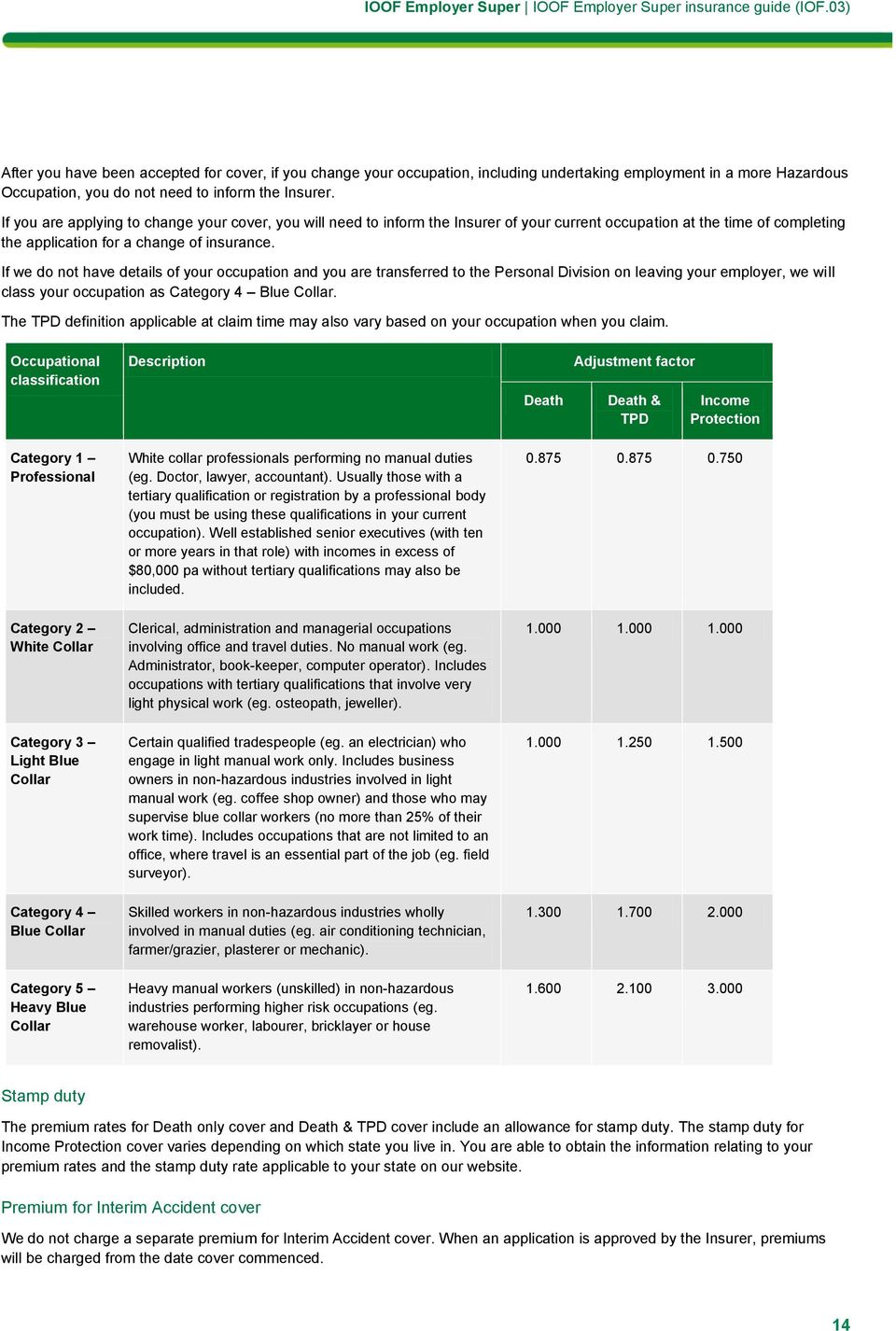
13 Section 4 How much is your insurance cover going to cost? Estimating insurance premiums There are a number of factors which affect the calculation of your premium. The Employer Plan s financial adviser (Employer Division) or your own financial adviser (Personal Division) can assist you to calculate an approximate premium. The premium rates vary depending on what has been negotiated by your employer. A copy of the premium rates is available on our website. Factors affecting your insurance premium It s important to be aware of the various factors that may impact the premiums payable for your insurance cover. These include: type of cover you have or choose (Death only, Death & TPD and Income Protection) level of cover (Sum Insured, etc.) whether your Employer Plan uses plan rating factors and are on the Tailored Rate tables or Standard Rate tables occupation age gender state of health sporting/recreational activities financial adviser commission stamp duty. Level of cover The amount of cover you have will affect the premium you pay. As the amount of insured benefit increases, generally so does the premium (for example $500,000 of Death only cover has a higher premium than $100,000 of Death only cover). Plan Rating Factor in Employer Plans Your premium rates may be affected by the other members in the Employer Plan. The premium rates for an Employer Plan generally include a plan rating factor. The plan rating factor is a number that takes into account the industry in which the employer is involved, the occupational classification and salaries of all employees of the Employer Plan and the previous claims history of the Employer Plan. This plan rating factor is applied to adjust the underlying premium rates that apply to all members of the Employer Plan, regardless of individual occupations and circumstances. Plan rating factors can apply to both Customised Cover and Default Cover. Employer Plan premium rates do not normally vary based on the specific occupations of individuals unless the Employer Plan does not offer the insurance which you have applied for in the Employer Plan s benefit design. The plan rating factor is set by the Insurer. The premium rates vary between male and female members but do not vary based on a member s smoking status. Your plan rating factor can be obtained by contacting our Client Services Team. Under special circumstances an Employer Plan can negotiate separate rates depending on the number of employees. This can result in a number of different premium structures for different Employer Plans. Occupation Your premium rate may also depend on your occupational classification. The following table is intended as a guide to how some occupations might be classified. You should check with us to obtain your own current occupational classification and details of any adjustment factor that may apply. 13

14 After you have been accepted for cover, if you change your occupation, including undertaking employment in a more Hazardous Occupation, you do not need to inform the Insurer. If you are applying to change your cover, you will need to inform the Insurer of your current occupation at the time of completing the application for a change of insurance. If we do not have details of your occupation and you are transferred to the Personal Division on leaving your employer, we will class your occupation as Category 4 Blue Collar. The TPD definition applicable at claim time may also vary based on your occupation when you claim. Occupational classification Description Death Adjustment factor Death & TPD Income Protection Category 1 Professional Category 2 White Collar Category 3 Light Blue Collar Category 4 Blue Collar Category 5 Heavy Blue Collar White collar professionals performing no manual duties (eg. Doctor, lawyer, accountant). Usually those with a tertiary qualification or registration by a professional body (you must be using these qualifications in your current occupation). Well established senior executives (with ten or more years in that role) with incomes in excess of $80,000 pa without tertiary qualifications may also be included. Clerical, administration and managerial occupations involving office and travel duties. No manual work (eg. Administrator, book-keeper, computer operator). Includes occupations with tertiary qualifications that involve very light physical work (eg. osteopath, jeweller). Certain qualified tradespeople (eg. an electrician) who engage in light manual work only. Includes business owners in non-hazardous industries involved in light manual work (eg. coffee shop owner) and those who may supervise blue collar workers (no more than 25% of their work time). Includes occupations that are not limited to an office, where travel is an essential part of the job (eg. field surveyor). Skilled workers in non-hazardous industries wholly involved in manual duties (eg. air conditioning technician, farmer/grazier, plasterer or mechanic). Heavy manual workers (unskilled) in non-hazardous industries performing higher risk occupations (eg. warehouse worker, labourer, bricklayer or house removalist) Stamp duty The premium rates for Death only cover and Death & TPD cover include an allowance for stamp duty. The stamp duty for Income Protection cover varies depending on which state you live in. You are able to obtain the information relating to your premium rates and the stamp duty rate applicable to your state on our website. Premium for Interim Accident cover We do not charge a separate premium for Interim Accident cover. When an application is approved by the Insurer, premiums will be charged from the date cover commenced. 14
15 Payment of premiums Insurance premiums are deducted from your Cash Account monthly in arrears from the date your cover commences. Your annual insurance premium is shown on your Member Schedule and your Annual Statement. Your Annual Statement shows the premiums paid for the previous financial year. As your insurance premiums are deducted from your super account, it s important when choosing the level of cover to consider the effect these regular costs will have on your retirement savings. Increasing your insurance premiums will reduce your retirement benefit. You can find up to date information on your insurance premium by visiting IOOF Online. Employer payment of premiums In some Employer Plans, the employer has agreed to pay the insurance premiums on behalf of its employees. If this is the case, it will be detailed in your Employer Plan Summary. If your employer is paying your insurance premiums for you, the premium(s) will be deducted from your Cash Account monthly in arrears. Your employer will then make an additional voluntary employer contribution to cover the amount of the premium that has been deducted from your Cash Account. If your employer fails to make this additional voluntary employer contribution, the premium deducted from your Cash Account will not be refunded. Changes in premium rates Premium changes due to your age and/or salary may (depending upon the design of your cover), take place automatically without notification each 1 July. We have the ability to increase your premium rates at any time provided we give you 30 days prior written notice. Any increase in Government charges may be passed on to you at any time by increasing your premium payable without notification. Insufficient funds You should ensure your account balance is sufficient to cover all fees and charges, including insurance premiums. We may redeem sufficient assets to pay fees, charges and insurance premiums. If, at the time a premium is due to be deducted, your account balance is not sufficient to meet the premium, you will have 90 days to increase your account balance so that the full amount of the premiums outstanding can be deducted. If after 90 days your account balance is still insufficient to deduct the total premium owing including for the 90 day period, your insurance cover will cease. We will normally send you a notification 28 days prior to your cover lapsing. To reinstate your cover after it has lapsed, you will need to notify us and go through the Underwriting process which begins with a new application for insurance. This application will need to be accepted in writing by the Insurer before you are covered. The Trustee bears no responsibility and accepts no liability for your insurance cover lapsing as a result of: you having an insufficient account balance to pay premiums, or not informing you that your cover is about to lapse or has lapsed. You should monitor your account balance regularly. 15
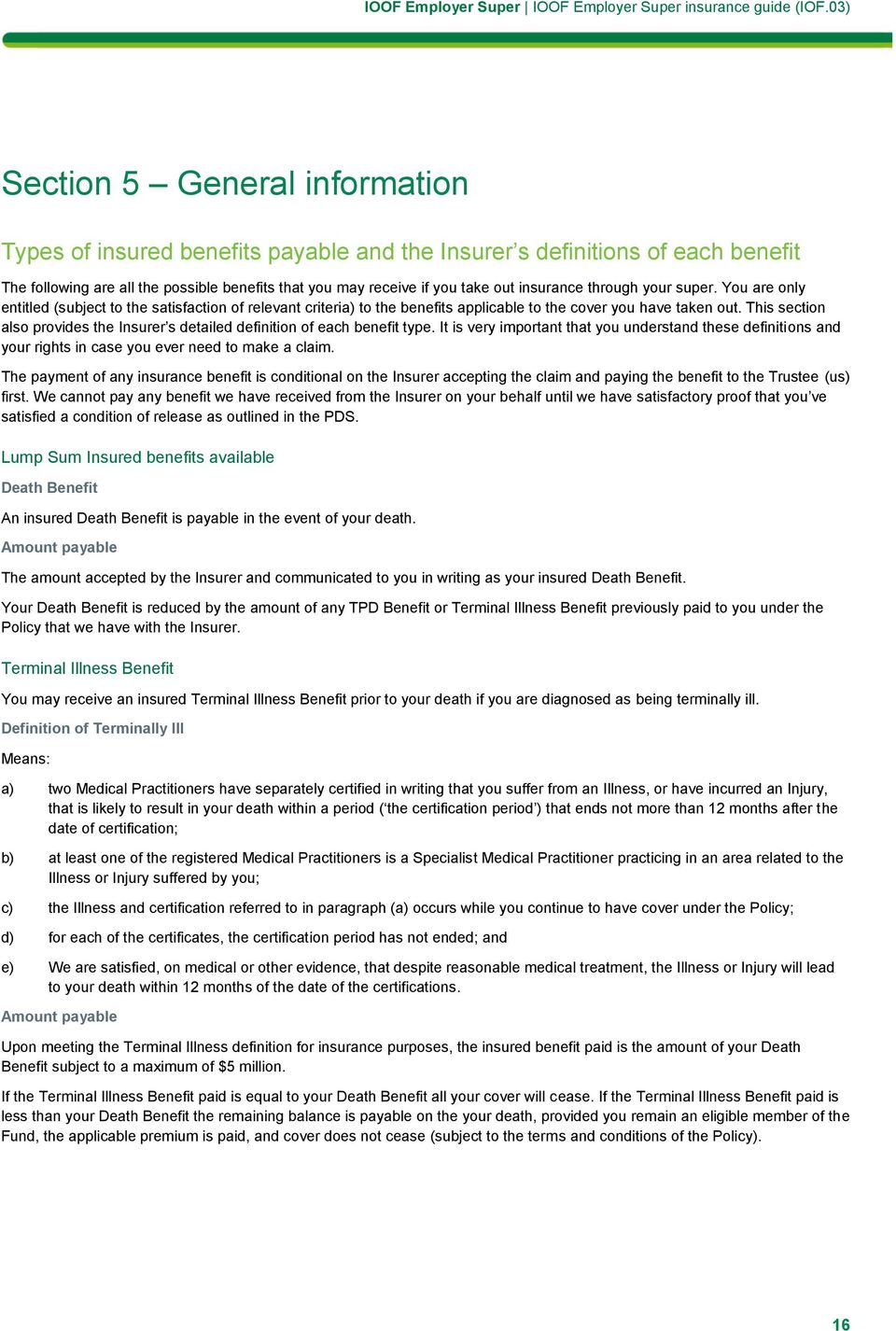
16 Section 5 General information Types of insured benefits payable and the Insurer s definitions of each benefit The following are all the possible benefits that you may receive if you take out insurance through your super. You are only entitled (subject to the satisfaction of relevant criteria) to the benefits applicable to the cover you have taken out. This section also provides the Insurer s detailed definition of each benefit type. It is very important that you understand these definitions and your rights in case you ever need to make a claim. The payment of any insurance benefit is conditional on the Insurer accepting the claim and paying the benefit to the Trustee (us) first. We cannot pay any benefit we have received from the Insurer on your behalf until we have satisfactory proof that you ve satisfied a condition of release as outlined in the PDS. Lump Sum Insured benefits available Death Benefit An insured Death Benefit is payable in the event of your death. Amount payable The amount accepted by the Insurer and communicated to you in writing as your insured Death Benefit. Your Death Benefit is reduced by the amount of any TPD Benefit or Terminal Illness Benefit previously paid to you under the Policy that we have with the Insurer. Terminal Illness Benefit You may receive an insured Terminal Illness Benefit prior to your death if you are diagnosed as being terminally ill. Definition of Terminally Ill Means: a) two Medical Practitioners have separately certified in writing that you suffer from an Illness, or have incurred an Injury, that is likely to result in your death within a period ( the certification period ) that ends not more than 12 months after the date of certification; b) at least one of the registered Medical Practitioners is a Specialist Medical Practitioner practicing in an area related to the Illness or Injury suffered by you; c) the Illness and certification referred to in paragraph (a) occurs while you continue to have cover under the Policy; d) for each of the certificates, the certification period has not ended; and e) We are satisfied, on medical or other evidence, that despite reasonable medical treatment, the Illness or Injury will lead to your death within 12 months of the date of the certifications. Amount payable Upon meeting the Terminal Illness definition for insurance purposes, the insured benefit paid is the amount of your Death Benefit subject to a maximum of $5 million. If the Terminal Illness Benefit paid is equal to your Death Benefit all your cover will cease. If the Terminal Illness Benefit paid is less than your Death Benefit the remaining balance is payable on the your death, provided you remain an eligible member of the Fund, the applicable premium is paid, and cover does not cease (subject to the terms and conditions of the Policy). 16
17 TPD Benefit An insured TPD Benefit is payable to you in the event of your Total and Permanent Disablement. Definition of TPD TPD means that, in the Insurer s opinion, while insured by the Insurer, you: 1. are under the care of and following the advice of a Medical Practitioner, and 2. if your cover commenced or recommenced on or after 1 July 2014, you meet the Permanent Incapacity definition under the Superannuation Industry (Supervision) Regulations 1994 (Cth), as amended from time to time, and 3. meet one of the following definitions Parts A, B, C, D or E as applicable. The definition of TPD applicable to you will be determined by the Insurer at the time of claim in accordance with the following criteria: If you are under 65 and not working in a Hazardous Occupation but are performing Domestic Duties, or are Gainfully Employed for 15 or more Hours Per Week (averaged over the 13 week period prior to the Date of Disablement or such shorter period if employed for less than 13 weeks immediately prior to the Date of Disablement) or have been unemployed for a period of less than six months from Gainful Employment where you worked 15 or more Hours Per Week (excluding a Hazardous Occupation or Domestic Duties), you need to satisfy Part A, B, C or D of the definition of TPD below, otherwise not working in a Hazardous Occupation or Domestic Duties, and are Gainfully Employed for less than 15 Hours Per Week (averaged over the 13 week period prior to the Date of Disablement or such shorter period if employed for less than 13 weeks immediately prior to the Date of Disablement) or have been unemployed for a period of more than six months from Gainful Employment where you worked 15 or more Hours Per Week (excluding a Hazardous Occupation or Domestic Duties), you need to satisfy Part A, B, C or E of the definition of TPD, or If you are age 65 or older, or are working in a Hazardous Occupation, you need to satisfy Part A or C of the definition of TPD below. Part A. Solely because of Illness or Injury, you have suffered the permanent loss of: i. the use of two limbs(where limb is defined as the whole hand below the wrist or whole foot below the ankle), or ii. iii. OR the sight in both eyes, or the use of one limb and the sight in one eye. Part B. Solely because of Illness or Injury, you: i. have suffered at least 25 per cent Whole Person Impairment ii. iii. are not engaged in any occupation, and are disabled to such an extent as to render you unlikely to ever be engaged in any occupation for which you are reasonably suited by education, training or experience. Where Whole Person Impairment means the same as that term in the latest edition of the American Medical Association publication Guides to the Evaluation of Permanent Impairment, or an equivalent guide approved by the Insurer. OR Part C. Solely because of Illness or Injury, you are unlikely ever to be able to perform at least two of the following Activities of Daily Living: dressing the ability to put on and take off clothing without assistance bathing the ability to bathe or shower without assistance toileting the ability to use the toilet including getting on and off without assistance mobility the ability to get in and out of bed and a chair without assistance, or 17

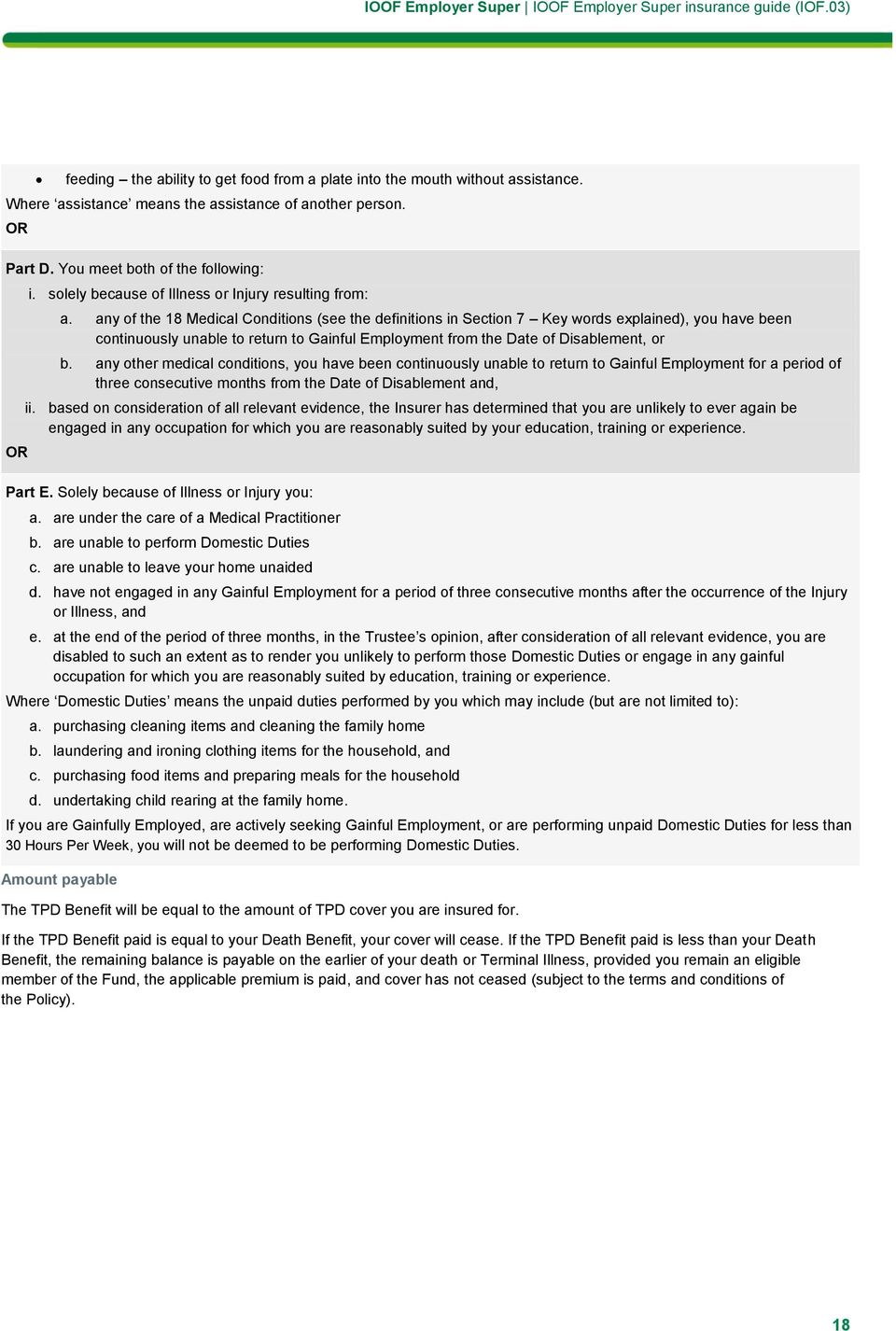
18 feeding the ability to get food from a plate into the mouth without assistance. Where assistance means the assistance of another person. OR Part D. You meet both of the following: OR i. solely because of Illness or Injury resulting from: a. any of the 18 Medical Conditions (see the definitions in Section 7 Key words explained), you have been continuously unable to return to Gainful Employment from the Date of Disablement, or b. any other medical conditions, you have been continuously unable to return to Gainful Employment for a period of three consecutive months from the Date of Disablement and, ii. based on consideration of all relevant evidence, the Insurer has determined that you are unlikely to ever again be engaged in any occupation for which you are reasonably suited by your education, training or experience. Part E. Solely because of Illness or Injury you: a. are under the care of a Medical Practitioner b. are unable to perform Domestic Duties c. are unable to leave your home unaided d. have not engaged in any Gainful Employment for a period of three consecutive months after the occurrence of the Injury or Illness, and e. at the end of the period of three months, in the Trustee s opinion, after consideration of all relevant evidence, you are disabled to such an extent as to render you unlikely to perform those Domestic Duties or engage in any gainful occupation for which you are reasonably suited by education, training or experience. Where Domestic Duties means the unpaid duties performed by you which may include (but are not limited to): a. purchasing cleaning items and cleaning the family home b. laundering and ironing clothing items for the household, and c. purchasing food items and preparing meals for the household d. undertaking child rearing at the family home. If you are Gainfully Employed, are actively seeking Gainful Employment, or are performing unpaid Domestic Duties for less than 30 Hours Per Week, you will not be deemed to be performing Domestic Duties. Amount payable The TPD Benefit will be equal to the amount of TPD cover you are insured for. If the TPD Benefit paid is equal to your Death Benefit, your cover will cease. If the TPD Benefit paid is less than your Death Benefit, the remaining balance is payable on the earlier of your death or Terminal Illness, provided you remain an eligible member of the Fund, the applicable premium is paid, and cover has not ceased (subject to the terms and conditions of the Policy). 18
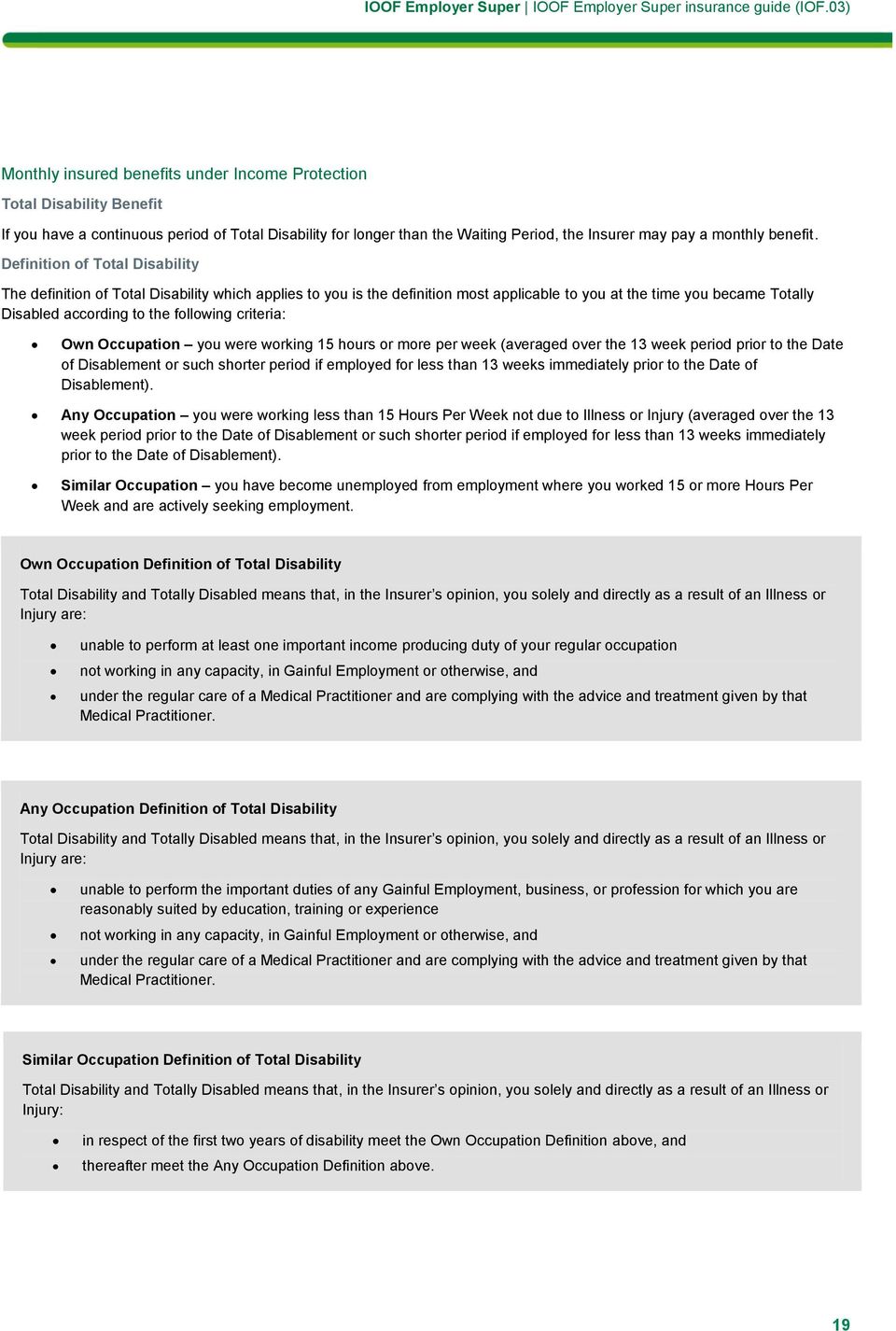
19 Monthly insured benefits under Income Protection Total Disability Benefit If you have a continuous period of Total Disability for longer than the Waiting Period, the Insurer may pay a monthly benefit. Definition of Total Disability The definition of Total Disability which applies to you is the definition most applicable to you at the time you became Totally Disabled according to the following criteria: Own Occupation you were working 15 hours or more per week (averaged over the 13 week period prior to the Date of Disablement or such shorter period if employed for less than 13 weeks immediately prior to the Date of Disablement). Any Occupation you were working less than 15 Hours Per Week not due to Illness or Injury (averaged over the 13 week period prior to the Date of Disablement or such shorter period if employed for less than 13 weeks immediately prior to the Date of Disablement). Similar Occupation you have become unemployed from employment where you worked 15 or more Hours Per Week and are actively seeking employment. Own Occupation Definition of Total Disability Total Disability and Totally Disabled means that, in the Insurer s opinion, you solely and directly as a result of an Illness or Injury are: unable to perform at least one important income producing duty of your regular occupation not working in any capacity, in Gainful Employment or otherwise, and under the regular care of a Medical Practitioner and are complying with the advice and treatment given by that Medical Practitioner. Any Occupation Definition of Total Disability Total Disability and Totally Disabled means that, in the Insurer s opinion, you solely and directly as a result of an Illness or Injury are: unable to perform the important duties of any Gainful Employment, business, or profession for which you are reasonably suited by education, training or experience not working in any capacity, in Gainful Employment or otherwise, and under the regular care of a Medical Practitioner and are complying with the advice and treatment given by that Medical Practitioner. Similar Occupation Definition of Total Disability Total Disability and Totally Disabled means that, in the Insurer s opinion, you solely and directly as a result of an Illness or Injury: in respect of the first two years of disability meet the Own Occupation Definition above, and thereafter meet the Any Occupation Definition above. 19
20 Amount payable The Total Disability Benefit is payable monthly in arrears by way of instalments from the expiry of the Waiting Period until the earliest of: the first day on which you are not Totally Disabled the end of your Benefit Payment Period the date you reach age 65 the date of your death. If the Total Disability Benefit is payable for a period of less than one month, the amount payable shall be calculated as 1/365th of the benefit for every day that it is payable. The Waiting Period is the continuous period of days as accepted by the Insurer at application for the Income Protection cover, commencing from the date a Medical Practitioner certifies you as Totally Disabled, and for which you have to be disabled before the Total Disability benefit or Partial Disability benefit is payable. If, during the Waiting Period, you return to employment, the Waiting Period will still be regarded as continuous if your return to work is for five days or less and you again become disabled as a result of the same Injury or Illness. The days for which the Insured Person was in employment will be added to the Waiting Period. If you return to employment for more than five days, then a new Waiting Period will commence from when you are next Totally Disabled. There may be circumstances where you participate in an Approved Rehabilitation Program which includes a return to Gainful Employment during the Waiting Period. If you are unsuccessful in returning to Gainful Employment as part of an Approved Rehabilitation Program at the same capacity as prior to becoming disabled, the Waiting Period will still be deemed to commence as at the first day you became Totally Disabled. Any days of Gainful Employment as part of an Approved Rehabilitation Program will not be added to the Waiting Period. The monthly benefit available is up to 75 per cent of your Declared Earned Income (which, together with the Superannuation Contributions Benefit, if selected, cannot exceed $30,000 per month) subject to a maximum of the selected insured percentage (which may be lower than 75 per cent). If you claim while unemployed from employment where you worked 15 or more Hours Per Week within the first six months following unemployment, if you have Income Protection cover, the definition of Totally Disabled that will apply is the Own Occupation definition. Partial Disability Benefit If you have been Totally Disabled for at least 14 consecutive days and you return to work in a partial capacity, you may be entitled to a Partial Disability Benefit, subject to meeting the applicable Waiting Period. If you are Partially Disabled, the Insurer may pay an insured monthly benefit from the later of the first day after the Waiting Period and immediately upon you ceasing to be Totally Disabled. Definition of Partial Disability You are Partially Disabled if you were Totally Disabled for at least 14 consecutive days and as a direct result of the same Illness or Injury that caused your Total Disability, you: are incapable of undertaking the same amount of hours as performed in the 12 months preceding the Date of Disablement, or are unable to perform at least one important income producing duty of your regular occupation, or you do not have the capacity to work at the same level you were working at prior to commencement of Total Disability, you suffer a reduction of your Declared Earned Income, and you are under the regular care and following the advice of a Medical Practitioner and, in the Insurer s reasonable opinion, are complying with the advice and treatment given by that Medical Practitioner. All work undertaken by you must be approved by the Insurer and your Medical Practitioner. 20

21 Amount payable The Partial Disability Benefit is payable monthly in arrears by way of instalments from the expiry of the Waiting Period until the earliest of: the first day on which you are not Partially Disabled the end of your Benefit Payment Period the date you reach age 65 the date of your death. If the Partial Disability Benefit is payable for a period of less than one month, the amount payable shall be calculated as 1/365th of the benefit for every day that it is payable. A Partial Disability Benefit is a proportionate benefit of the monthly benefit you would receive if you were Totally Disabled and is calculated as follows: where (A B) x Total Disability Benefit A A is your Declared Earned Income B is your Return to Employment Income Superannuation Contributions Benefit This Income Protection option allows you to continue to build your super while you are not working and are entitled to a Total or Partial Disability Benefit. This means the Insurer may make contributions to your super account on your behalf while you are receiving a Total Disability or Partial Disability Benefit. Amount payable If you have this benefit, the maximum Superannuation Contributions Benefit payable is the lesser of the actual percentage of superannuation contributions made by you or your employer on your behalf and ten per cent of your Declared Earned Income. For the purpose of calculating your Declared Earned Income for this benefit your employer s mandated and/or voluntary superannuation contributions (but not including any salary sacrifice contributions made at your request) are not included. These contributions by the Insurer are taxed at 15 per cent in the Fund and are treated as concessional contributions for the purposes of the contributions caps. Interim Accident Benefit Prior to acceptance by the Insurer of an application for insurance, the Insurer may provide you with Interim Accident cover for the type of cover you applied for (Death only, Death & TPD or Income Protection cover), where the claim results directly from an Accident. 21
22 When is an Interim Accident Benefit payable? You are entitled to an Interim Accident Benefit if the Accident occurred after we receive your fully completed Insurance application form and before the earliest of: the application is withdrawn the Insurer advises the Trustee that it has cancelled the Interim Accident cover (where permitted to do so by law) the Insurer declines the application the Insurer accepts the application, conditionally or unconditionally then either: 30 days from the date that the Insurer notifies the Trustee of your acceptance, or the date the cover commences in the Fund 90 days from the date the Insurer receives the fully completed application, however, if the Insurer requests further information and that information is received prior to the end of the 90 days, the period of cover may be extended by a further 30 days and will continue to be extended for a further 30 days subject to receipt of required information to a maximum of 180 days in case of an application to increase cover, the date you cease to be an insured member of the Fund, or the earlier of 90 days after the date you exceed your Customised Cover or Default Cover or Forward Underwriting Limit. If the application is for Death only or Death & TPD, Interim Accident cover will begin on the date we receive your fully completed Insurance application form. If the application is for Income Protection then if, as a result of an Accident, you have a continuous period of Total Disability for longer than the Waiting Period, an interim disability benefit is payable from the first day after the Waiting Period until the earliest of: the first day upon which, in the Insurer's reasonable opinion, you are no longer Totally Disabled or Partially Disabled the date you reach 65 years of age the date of your death, or the end of your Benefit Payment Period. An Accident is defined to be an unforeseen, violent, external and visible event occurring during the period of cover. An Interim Accident Benefit is not payable if the Injury: can reasonably be attributed to a Pre-existing Condition is due to suicide is self-inflicted (whether intentional or not) is due to any exclusion the Insurer would have applied to the cover if it had been accepted is, for Total Disability or Partial Disability due to: uncomplicated pregnancy or childbirth; war or acts of war, whether declared or not; service in the armed forces of any national or international organisation (other than non-active service within Australian armed forces reserve units). Also, an Interim Accident Benefit will not be payable if you failed to comply with your duty of disclosure when applying for cover. 22
23 Amount payable The amount of the benefit payable under the Interim Accident cover will be the amount of the benefit you specify when applying for insurance, subject to a maximum of $2,000,000 for Death only cover and Death & TPD cover, (less any existing cover you have) and a maximum of $15,000 per month for Income Protection cover (and the maximum insured percentage). Death Benefit when receiving a disability benefit If you die while receiving an insured Total Disability or Partial Disability Benefit you will receive an additional lump sum. Amount payable The additional lump sum will be equal to one quarter of the annual Total Disability Benefit payable. Automatic reduction of TPD Benefit Where your TPD Sum Insured does not reduce as you get older (such as a fixed dollar amount or a fixed multiple or percentage of salary), your TPD Sum Insured will reduce annually as at 1 July from age 72 next birthday, as shown in the following table. As at 1 July, your age next birthday Death Benefit TPD Benefit (as % of matching amount of Death Benefit when 100%) 71 or less 100% 100% % 80% % 60% % 40% % 20% 76* Nil Nil * Cover will cease on your 75th birthday. Example: Insurance cover based on a fixed Death & TPD Benefit of $250,000 As at 1 July, your age next birthday Death Benefit TPD Benefit 71 or less $250,000 $250,000 (as % of Death Benefit) 72 $250,000 $200, $250,000 $150, $250,000 $100, $250,000 $50,000 76* Nil Nil * Cover will cease on your 75th birthday. 23
24 Life Events Cover increases You may apply for an increase to your Death only, Death & TPD or Income Protection cover if one of the following Life Events occurs: you marry the birth of your child the adoption of a child by you your dependant child starts secondary school you divorce you take out a mortgage on the purchase of your primary place of residence (either alone or jointly with another person) you increase your existing mortgage for the purpose of building or renovating your primary place of residence. You may apply for an increase of your cover due to a Life Event only once in any 12 month period. To apply for this increase in cover, you need to: submit the application to us within 90 days of the life event or 30 days from the date of your first annual Member Statement following the Life Event provide us with satisfactory evidence of the occurrence of the Life Event within the required timeframe. For Death only or Death & TPD cover, the maximum increase for each Life Event application should be the lesser of the following: 25 per cent increase from the existing cover the total amount or amount of increase of the mortgage you are taking out (where applicable) $200,000. The total level of cover after the increase can be no more than $3 million. For Income Protection cover, the maximum increase for each Life Events cover application should be the lesser of: $2,500 per month 25 per cent increase from the existing cover. The total level of cover after the increase will be the lesser of the following: $25,000 per month your selected insured percentage or 75 per cent of your Earned Income, plus Superannuation Contributions Benefit of up to ten per cent of your Earned Income (if you have selected this cover). You are not eligible for a Life Events cover increase if: your insured benefit has increased during the previous 12 months for a Life Event your insured benefit following the increase will exceed the maximum benefit allowed following a Life Event increase in any 12 month period, the amount of benefit increase exceeds 25 per cent of your insured benefit before the benefit increase you have applied for an increase of cover during the previous 12 months you have had an application for Death only, Death & TPD or Income Protection cover declined or had a loading, limitation or exclusion added 24
25 you suffer from a serious Illness that may cause a Terminal Illness or permanent inability to work you have been diagnosed with an Illness that reduces your life expectancy to less than 12 months you are above age 60 you are engaged in a Hazardous Occupation due to an Illness, Accident or Injury, you are off work (or have been off work in the previous 12 months for more than six days), or unable to perform your full and normal duties on a full-time basis (for at least 30 Hours Per Week) even though your actual employment may be full-time, part-time or casual you have made, or are entitled to make, a claim for any Injury or Illness through Workers Compensation, sickness benefit, invalid pension or any insurance policy providing TPD cover, accident or sickness cover. An application for Life Events cover may be accepted or rejected by the Insurer. If your Life Events cover increase is accepted by the Insurer it will commence from the date the Insurer accepts your application. If you are not At Work on the commencement date, your Life Events cover increase will be Limited Cover for the first 12 months and from the expiry of the 12 month period until the date you have been At Work for ten consecutive working days. Life Events cover increases are subject to the current exclusions and limitations under the Policies including any exclusions and limitations applying to your existing cover and that the increase will not be payable if your claim arises from suicide or an intentional self-inflicted act or Injury within the first 13 months of the commencement date. You may be eligible for Interim Accident cover in relation to your Life Events cover increase application. Adjusting Income Protection with salary increases If your Income Protection cover is not automatically increased by your employer providing salary updates to us, you may apply for an increase of your Income Protection cover within 60 days of the effective date of your salary increase. When you apply, you must provide us proof of your new salary, the effective date and the amount of the increase in your salary. For your Income Protection cover to increase due to salary increase, the requested increase of your cover must be agreed by the Insurer based on your application. The Insurer may agree to increase your Income Protection cover without Underwriting, if you meet each of the following conditions: your employer confirms your salary increase in writing your insured benefit has not increased during the previous 12 months. The maximum increase should be the lesser of: $2,500 per month 25 per cent increase from the existing cover. The total level of cover after the increase will be the lesser of the following: $25,000 per month your selected insured percentage or 75 per cent of your Earned Income, plus Superannuation Contributions Benefit of up to ten per cent of your Earned Income (if you have selected this cover). You are not eligible for an increase if any of the following applies to you: your insured benefit has increased during the previous 12 months your insured benefit following the increase will exceed the maximum benefit allowed following a Salary increase in any 12 month period, the amount of benefit increase exceeds 25 per cent of your insured benefit before the benefit increase you have applied for an increase of cover during the previous 12 months 25
26 you have had an application for Death only, Death & TPD or Income Protection cover declined or had a loading, limitation or exclusion added you suffer from a serious Illness that may cause a Terminal Illness or permanent inability to work you have been diagnosed with an Illness that reduces your life expectancy to less than 12 months you are above age 60 you are engaged in a Hazardous Occupation due to an Illness, Accident or Injury, you are off work (or have been off work in the previous 12 months for more than six days), or unable to perform your full and normal duties on a full-time basis (for at least 30 Hours Per Week) even though your actual employment may be full-time, part-time or casual you have made, or are entitled to make, a claim for any Injury or Illness through Workers Compensation, sickness benefit, invalid pension or any insurance policy providing TPD cover, accident or sickness cover. An application may be accepted or rejected by the Insurer. If your cover increase is accepted by the Insurer it will commence from the date the Insurer accepts your application. If you are not At Work on the commencement date, your cover increase will be Limited Cover for the first 12 months and from the expiry of the 12 month period until the date you have been At Work for ten consecutive working days. The cover increase is subject to normal exclusions and limitations under the Policy. You may be eligible for Interim Accident cover while you are applying for cover due to a salary increase. Other insured benefits Upgrade of benefits Generally, any improvement in benefits which is made to the Policy the Insurer has with the Trustee will be provided to all existing members, not just new members. The improvement will only apply to future claims and not past or current claims or any claims resulting from health conditions or events which began or took place before the effective date of the improvement. Other Income Protection Benefits Type of benefit Definition Amount payable Approved rehabilitation benefit If you are suffering a Total Disability or Partial Disability, the Insurer may pay for the cost of approved rehabilitation if the Insurer reasonably considers the program likely to assist in your rehabilitation, provided the Insurer and your Medical Practitioner have approved the program of rehabilitation prior to the program being undertaken. The cost of the approved rehabilitation program. Benefit escalation If you have been receiving a Total Disability or Partial Disability Benefit for a continuous period of 12 months or more, the Insurer will increase your benefit payments from each anniversary date of the claim. The benefit payments will be increased annually whilst on claim, by the lesser of the increase in the CPI and 5%. The increase will occur on the first payment of the benefit after your benefit payment anniversary. Premium waiver The Insurer will waive the insurance premium for your Income Protection cover while you are entitled to a Total Disability or Partial Disability Benefit. The amount of the Income Protection premium due at that time. 26
27 Limitations and exclusions to your insured cover Cover while on leave without pay While on employer approved leave without pay, provided premiums continue to be paid and you remain insured: a. Your Death cover will continue. b. Your TPD cover will continue subject to the following: i. For the first 12 months of leave without pay you will have your claim assessed in accordance with TPD definition applicable to you based on your occupation before you took the leave without pay. ii. At the conclusion of the 12 months period referred to in (b)(i) above you will have your claim assessed against the applicable TPD definitions excluding Part D. c. Your Income Protection cover will continue for up to 12 months unless the Insurer agrees in writing to an extension before the expiry of the 12 month period. For the first 12 months of leave without pay your claim will be assessed in accordance with the definition of Total Disability applicable to you based on your occupation immediately before you took the leave without pay. Cover while unemployed Death & TPD cover Your TPD cover will continue even if you become unemployed but the definition of TPD under which you can claim may change. If you are under age 65, did not work in a Hazardous Occupation prior to ceasing employment, and meet the following conditions: 1. worked 15 or more Hours Per Week (averaged over the 13 week period prior to the date of being unemployed or such shorter period if employed for less than 13 weeks immediately prior to the Date of Disablement) prior to ceasing employment and have been unemployed for a period of less than six months you need to satisfy Part A, B, C or D of the TPD definition, otherwise 2. you need to satisfy Part A, B, C or E of the definition of TPD. If you are age 65 or older, or worked in a Hazardous Occupation prior to ceasing employment, you need to satisfy Part A or C of the TPD definition below. Income Protection cover The Similar Occupation definition of Total Disability for Income Protection cover applies to you while you are unemployed and actively seeking employment. However, if you do not find employment within six months, your Income Protection cover will cease. Cover while overseas You are covered worldwide 24 hours a day, seven days a week, subject to the terms of the insurance Policy. If you are residing, travelling overseas or employed overseas provided premiums continue to be paid, your Death, TPD and Income Protection cover may continue for up to three years subject to limitations and exclusions described above. At the conclusion of the three year period all cover will cease unless the Insurer s prior written consent to continue the cover has been given. It is your responsibility to advise the Trustee accordingly. Permanently moving overseas If you permanently leave Australia, your cover will cease. It is your responsibility to advise the Trustee accordingly. Limitations to insured Death Benefits Any Death Benefit paid to your account or your estate will be reduced by the amount of any benefit you may have already received under these insurance arrangements for Terminal Illness or TPD. It is important to note that, in the situation where your cover for Death is higher than the TPD or Terminal Illness Benefit, the Death cover reduced by the amount of any TPD or 27
28 Terminal Illness payment will continue even after a TPD or Terminal Illness claim has been paid subject to the relevant premiums continuing to be paid and other relevant Policy terms and conditions. Limitations to Income Protection Benefits Any insured Total Disability or Partial Disability Benefit payable to you may be reduced by all amounts paid or payable from: a. Workers Compensation schemes b. motor accident compensation c. statutory compensation, pension, social security or similar schemes d. benefits paid under state or federal legislation, such as the Department of Veterans Affairs e. income benefits from other disability income insurance policies or super funds f. employer funded sick leave entitlements. The reduction in the Total Disability Benefit or Partial Disability Benefit will be by an amount so that the total received by you from all sources does not exceed the agreed insured percentage of your Declared Earned Income. Any Superannuation Contributions Benefit payable to you will be reduced by all amounts paid or payable for you from other sources such as the employer s superannuation guarantee obligations, award or industrial agreement obligations or additional voluntary contributions during a period of Total or Partial Disability. Exclusions Except for insurance cover provided under Customised Cover or Default Cover no insured Death, Terminal Illness or TPD Benefit shall be payable where a claim arises from any of the following: a. suicide occurring in the first 13 months after the date that the cover commences or is reinstated after having lapsed for any reason b. TPD as a result of an intentional self-inflicted act or intentional self-inflicted injury by you c. any such exclusion as the Insurer may apply to you as a condition of acceptance of cover. No Income Protection Benefit of any type is payable if your Total Disability or Partial Disability arises from any of the following: a. intentional self-inflicted injury b. uncomplicated pregnancy or childbirth c. war or acts of war whether declared or not d. service in the armed forces of any national or international organisation (other than non-active service within Australian armed forces reserve units within Australia) e. any exclusion or restriction the Insurer may apply to you as a condition of acceptance of cover. 28
29 When does cover cease? Your cover will continue without the need to provide any further health evidence subject to the terms and conditions outlined in this guide. Your cover will cease, without any notification from us or the Insurer, when any of the following events occur. Situation Death TPD Income Protection On the day you reach age 65 N/A N/A On the day you reach age 75 or for Customised Cover the age it ceases, whichever is the lesser N/A The date the Trustee accepts your request to terminate your cover The date the Policy that the Trustee has with the Insurer terminates The expiry of 12 months of the approved leave without pay, unless otherwise agreed by the Insurer in writing prior to the expiry of such leave N/A N/A The expiry of the three year period as outlined in the Cover while employed overseas section of this guide 60 days from the date you cease to be a member of the Fund 1 The date the Insurer makes a payment of the total insured amount under the Policy N/A The end of the Benefit Payment Period applicable to you on a claim N/A N/A 28 days after the Trustee has issued a lapse notice to you and the premium remains unpaid The date of your death 2 If you permanently move overseas Six months from the date you ceased to be last employed N/A N/A 3 The date you permanently retire from the workforce N/A N/A If you transfer part of your balance to another superannuation fund and your remaining account balance is less than $10,000 If you transfer to the Personal Division with an account balance of $2,000 or less Note: means that the insurance cover specified in the relevant column will cease upon occurrence of the event described in the relevant row. N/A means the event described in the relevant row is not applicable to the cessation of the insurance cover in the relevant column. 1 Subject to your options to transfer your cover between funds or between products within the same Fund. 2 A claim may still be able to be made for any eligible Death Benefit. 3 Where your Income Protection cover ceases due to you ceasing to be employed for more than six months, if you then return to gainful employment (working at least 15 hours Per Week) at any time within the 12 months after your employment ceased, when you commence the employment you can apply to reinstate the Income Protection cover you previously held which ceased without the need for Underwriting provided you are eligible for cover. 29
30 If you have both TPD and Income Protection cover you may be able to make a claim for TPD, even if you have claimed a Total Disability Benefit under Income Protection, provided the relevant terms and conditions to claim each benefit are satisfied. What do you need to know about making a claim? While we hope you do not ever need to make a claim, the following information will assist with the claims process. Any insured benefit to which you may be entitled for Death only and Death & TPD will be paid in addition to your super account balance (less applicable fees and taxes). How to make a claim To make a claim, you need to notify us in writing as soon as you can of an event that is likely to give rise to a claim. Once you have informed us about the claim, we will send you (or your Legal Personal Representative in the case of your death) a list of the initial requirements and the claim forms which need to be completed and returned to us. The claim forms will generally require relevant medical certificates, Medical Practitioner s reports, employer reports and relevant evidence for the claim. You are responsible for meeting any costs in completing the claim forms including any associated documents. The sending of your claim form by us to the Insurer does not constitute an admission of liability in respect of any claim. To assist with the assessment of your claim, you may receive a request for additional information or be required to undergo an examination by a Medical Practitioner or relevant professional of the Insurer s choice including pathology tests. The Insurer will meet the costs in relation to this additional information. If you fail to attend any pre-arranged medical examination then you will be liable to pay any fees incurred. It is important that all information requested is submitted otherwise the claim may be delayed while waiting for that information. Payment of a claim After considering the evidence provided, we and the Insurer will decide if you meet the relevant definition of your cover and whether you re entitled to payment. Payment of your Sum Insured will be made to us and we will credit the proceeds to your super account. A claim for a Death or TPD Benefit will not be released until the claim is approved by our claims committee. Income Protection claims, once approved, will be paid to you by us after the applicable tax is deducted. Please note that as the insurance benefits are paid by the Insurer, the Trustee s payment of the insurance benefit is conditional on the Insurer accepting the claim and paying the benefit to us. Incorrect age If your age is incorrectly stated, we and the Insurer have the right to adjust the premium or the benefit based on your correct age. Incorrect salary If you are in the Employer division and the cover provided to you is based on your salary, your participating employer is required to provide us with updated salary information at each annual review date. If your employer does not supply us with updated salary information at least annually (at the annual review date), even if it is a confirmation that the salaries have not changed, any benefit at claim time, will be based on the lesser of your insured benefit or salary at the date of claim. If you are in the Employer division and your benefit is based on your salary and your salary has increased from the salary last advised by the employer at the last annual review: The Insurer will need to agree that the salary increase is reasonable and acceptable for any changes to the benefit, and premiums will be required to be paid from the date of the salary increase on the increased amount. If your salary has decreased then your benefit will decrease accordingly. 30
31 If at claim time we ascertain that you had left the employer before the claim date then we will deem you to have been a Personal Division member from the date you left the employer and the relevant rules for the Personal Division in relation to claims calculation and payment will apply. Claims after your cover has ceased If a claim event occurs prior to the date your cover ceased or terminated you may still be eligible for that claim to be considered by the Insurer, subject to the terms and conditions of the Policy. Claims whilst overseas In the event you suffer TPD whilst overseas, the Insurer may require you to return to Australia at your own expense for assessment of the claim. If you are receiving a Total Disability or Partial Disability Benefit whilst outside Australia, benefits will cease six months after the date of commencement of the benefit, unless you have permanently returned to Australia at your own expense. What to do if your claim is declined If you are not happy with a decision made about your claim, you can request us to reconsider the decision. Our claims committee will review your claim and may make a representation to the Insurer on your behalf. If you are not satisfied with the outcome you can raise the issues with the Superannuation Complaints Tribunal (SCT). More details about the complaints process and contact details for the SCT can be found in the Complaints section in the PDS. Special conditions relating to Income Protection claims Payment of benefit before notification The Insurer will not pay a Total Disability or a Partial Disability Benefit for any period more than 14 days before the date that the Insurer is notified of a claim. Waiting Period A Total Disability benefit or Partial Disability benefit will only be payable after the expiry of the Waiting Period. The Waiting Period is the continuous period of days as accepted by the Insurer at application for the Income Protection cover, commencing from the date a Medical Practitioner certifies you as Totally Disabled, and for which you have to be disabled before the Total Disability benefit or Partial Disability benefit is payable. If, during the Waiting Period, you return to employment, the Waiting Period will still be regarded as continuous if your return to work is for five days or less and you again become disabled as a result of the same Injury or Illness. The days for which you were in employment will be added to the Waiting Period. If you return to employment for more than five days, then a new Waiting Period will commence from when you are next Totally Disabled. There may be circumstances where you participate in an Approved Rehabilitation Program which includes a return to Gainful Employment during the Waiting Period. If you are unsuccessful in returning to Gainful Employment as part of an Approved Rehabilitation Program at the same capacity as prior to becoming disabled, the Waiting Period will still be deemed to commence as at the first day you became Totally Disabled and will not recommence if the return to employment is greater than five days. Any days of Gainful Employment as part of an Approved Rehabilitation Program will also not be added to the Waiting Period. 31
32 Example of a Waiting Period Joe has Income Protection cover with a 90 day Waiting Period, a Benefit Payment Period of five years and a monthly benefit of $3,000. On 1 July 2015 Joe was injured and submitted a claim to the Insurer which was accepted. Joe does not receive any benefit during the Waiting Period which ends 90 days after 1 July, being 28 September Joe is entitled to receive his first monthly benefit of $3,000 from 29 September Benefits are paid monthly in arrears. He continues to receive his monthly benefit payment while he remains Totally Disabled, or a lesser amount if Partially Disabled, until 27 September 2020 (subject to the Policy terms and conditions). Recurrent claims If you ve been receiving an Income Protection Benefit payment and return to Gainful Employment, but within six months of benefit payments ending you again become Totally Disabled or Partially Disabled as a result of the same or related Illness or Injury, the Insurer will regard it as a continuation of your previous claim. The Waiting Period will not apply and the Insurer will pay the benefit as a continuation of the previous claim. However, your Benefit Payment Period will be reduced by the period that a benefit was paid or payable under your previous claim. Moving between products in the Fund We have a range of products within the Fund. If you move to another IOOF super product in the Fund, you may be able to continue your cover without the need for further acceptance by the Insurer. Applicants transferring from another IOOF super product may be entitled to maintain their existing Death only or Death & TPD and Income Protection cover without the need for further acceptance by the Insurer subject to the terms and conditions in this guide and the relevant insurance policies. Please contact us to confirm the requirements in relation to transfers. Ceasing to be a member of the Fund When you cease to be a member of the Fund, you need to be aware of the following. Extension of cover Your insurance cover will continue for up to 60 days from the date on which you ceased to be a member of the Fund. For Income Protection cover, this is subject to you maintaining employment during this time. Transfer of insurance to a personal product Death & TPD cover If you have insurance cover and you leave your Employer Plan, your cover will continue in the Personal Division effective from the date you leave your employer, subject to your account balance exceeding $2,000 (otherwise your cover will cease). There may, however, be changes to your insurance calculation basis and insurance premiums. Please contact our Client Services Team, on , for further information. On transfer to the Personal Division, the amount of cover transferred will depend on the basis of the cover in the Employer Plan and: the cover at the time of transfer, and the corresponding premium in the Standard Rate table for the same occupational rating that applied to you immediately prior to transfer to the personal super product and which is subject to increases with age. As the premiums under some Employer Plans are different and may be subject to a plan rating factor, your premium may increase (or cover decrease for a fixed premium). 32
33 Income Protection cover If you cease to be employed by a participating employer, your existing cover will be transferred to the Personal Division, at the same or similar benefit level and benefit type as you had in your Employer Plan, without the need for further Underwriting (subject to your account balance exceeding $2,000). In general, you will not need to complete an insurance application. On transfer to the Personal Division, the amount of cover transferred will be fixed based on: the cover at the time of transfer, and the corresponding premium in the Standard Rate table for the same occupational rating that applied to you immediately prior to transfer to the personal super product and which is subject to increases with age. As the premiums under some Employer Plans are different and may be subject to a Tailored Rate table, your premium may increase (or cover decrease for a fixed premium). 33
34 Section 6 Significant risks As with the purchase of any financial product, you should consider the risks that may impact your super insurance arrangement. Main risks that may affect your insurance Pre-existing Conditions risk Non-disclosure risk Variation of terms and conditions risk Variation of premium rates risk Change of Insurer risk Replacing or changing your insurance Future insurability Limitations and exclusions to cover Low account balance Employer failure to pay Superannuation Guarantee contributions If you apply for cover, or an increase in cover, you must disclose any Pre-existing Conditions with your request for cover or increase in cover. Non-disclosure could result in a claim being declined or the Insurer avoiding your insurance cover. If you fail to comply with your duty of disclosure the Insurer may be able to decline a claim, void your insurance cover or reduce the amount of benefit payable to you. The Trustee is able to change the terms and conditions of your insurance arrangements by giving at least 30 days prior written notice. The Trustee has the right to increase the premium rates (outside of the normal age changes which take place automatically each 1 July) by giving you 30 days prior written notice. The Trustee has the right to change the Insurer by giving you 30 days prior notice. The terms and conditions between insurance policies can vary significantly and it is important that you compare the differences when you are looking at replacing or cancelling your insurance cover. There is a risk that your new cover may not provide the same benefits or have preexisting restrictions or other limitations that did not exist under your old insurance arrangement or Policy. It is important that you also consider the risk that you might not be covered for a period of time if you cancel your insurance before the new insurance commences. There is a risk as you get older that you may not be able to obtain insurance or insurance without a significant premium loading/restriction. Therefore it is recommended that you consider your insurance needs now or take this into consideration if you are contemplating the cancellation of your cover. Insurance policies tend to have various limitations and exclusions which apply that vary between insurance policies. It is important that you understand the limitations and exclusions which apply to your cover. There is a risk that your cover might lapse if there are insufficient funds in your super account to pay your insurance premiums. To avoid this happening you may need to make further contributions to ensure that there are sufficient funds in your super account to pay the premiums when due. There is a risk that your cover may lapse if your employer does not pay your Superannuation Guarantee (SG) contributions on time. Your cover may also lapse if your SG contributions do not cover your insurance premiums. To avoid this happening you may need to make personal contributions to ensure that there are sufficient funds in your account to pay the premiums when due. 34
35 Section 7 Key words explained This section helps explain some of the key terms used in this guide. Accident Approved Rehabilitation Program At Work Automatic Acceptance Benefit Payment Period Consumer Price Index (CPI) Date of Disablement (Death only and Death & TPD) Date of Disablement (IP) Declared Earned Income An unforeseen, violent, external and visible event during the period of cover. A program, device or course of treatment certified in writing by a Medical Practitioner to be necessary for the rehabilitation of a person but excluding any program providing hospital treatment or an ancillary health service within the meaning of the National Health Act 1953 (Cth) or any other program which might cause the Policy to cease to be exempt from the relevant Health Insurance Legislation. A person who is: a. employed with an employer: The person is actively performing or capable of actively performing all of the duties and work hours (for at least 30 Hours Per Week) of their usual occupation with their employer free from any limitation due to Illness or Injury. A person who is on employer approved leave for reasons other than Illness or Injury, who would otherwise be capable of performing their usual occupation (for at least 30 Hours Per Week), will be considered as having met the requirements of this definition, or b. Self-employed: The person is actively performing or capable of actively performing all of the duties and work hours (for at least 30 Hours Per Week) of their usual occupation free from any limitation due to Illness or Injury, or c. unemployed: The person is capable of actively performing all of the duties and work hours (for at least 30 Hours Per Week) of their usual occupation prior to becoming unemployed, free from any limitation due to Illness or Injury, or d. engaged exclusively in unpaid Domestic Duties on a full time basis: The person is actively performing all of their domestic duties free from any limitation due to Illness or Injury, and the person is not entitled to, or receiving, income support benefits relating to an Illness or Injury, from any source including but not limited to Workers Compensation benefits, statutory transport accident benefits and disability income benefits. The amount of insurance cover which the Insurer will provide without requiring evidence of state of health. The maximum period for which an Income Protection Benefit is payable in relation to the same or related Illness or Injury, excluding the Waiting Period. The percentage change in the Consumer Price Index (Weighted Average All Capital Cities) as last published by the Australian Bureau of Statistics prior to the effective date of calculation. The later of: the date you cease to work due to Injury or Illness, or the date a Medical Practitioner examines you and certifies in writing that you suffer from an Illness or Injury that is the principal cause of your inability to work. Means the commencement of the Waiting Period. For the purposes of determining the level of Income Protection Benefit available, means the lesser of: your annual earnings most recently agreed by the Insurer and the Trustee in writing, and the sum calculated in accordance with the Earned Income definition. 35
36 Default Cover Earned Income Employer Plan Forward Underwriting Limit Insurance cover that the Insurer has agreed to provide under Automatic Acceptance provisions, provided you satisfy the relevant eligibility criteria under the Policy where your employer: has not nominated an insurance benefit design has established the Employer Plan as the Standard Fund, and meets the other requirements under the Policy. The amount of Default Cover is the amount of Death & TPD cover that can be purchased for $3.00 per week based on the Standard Rate tables and occupational factors stated in the Policy, unless your employer has negotiated Tailored Rates. Plus, if you are aged 55 less than 65 and are working at least 15 Hours Per Week when you join your employer, Default Cover also includes Standard Income Protection cover with a regular monthly income of $2,000 (subject to a maximum of 75 per cent of Declared Earned Income) if you become Totally Disabled or Partially Disabled because of Illness or Injury and are unable to work and earn your income. The Benefit Payment Period for Standard Income Protection cover is two years after a 90 day Waiting Period. If you are employed this means the annual wages or salary last agreed between you and your employer immediately before commencement of Total Disability plus: any commissions paid by your employer under a provision in a contract to you in the 12 month period immediately before commencement of Total Disability, and all other regular (cash and non-cash) payments or benefits provided to you by your employer under a provision in a contract in the 12 month period immediately before commencement of Total Disability, which when combined, the Insurer reasonably considers as your remuneration package. For the avoidance of doubt, Earned Income: a. does not include: i. superannuation guarantee obligations ii. iii. award or industrial agreement obligations additional voluntary contributions b. includes employer superannuation contributions made under an effective salary sacrifice arrangement in accordance with Superannuation Guarantee Legislation. If you are Self-employed or unemployed this means the annual income generated by you from your personal exertion, calculated by averaging your net income per year for the two years immediately preceding commencement of Total Disability. For the purposes of this definition, net income means your gross income received as remuneration or recompense for services rendered, less all expenses incurred by you in earning that income but does not include investment income, profit distributions or similar payments. A superannuation plan established by an employer for its employees within the Employer Division of the Fund. This could also be the Standard Fund into which an employer will make Superannuation Guarantee contributions if a member has not nominated a choice fund in the Superannuation Choice environment. The amount (if any): which may be provided by the Insurer in respect of an insured member of the Fund or group of members of the Fund with salary related benefit options, after the assessment of the relevant insured member s evidence of state of health, and up to which the Insurer may accept future increases in the relevant insured member s cover without the requirement to provide further evidence of their state of health. 36
37 Gainfully Employed/Gainful Employment Hazardous Occupation Hours Per Week Illness Injury Limited Cover Means employed or Self-employed for gain or reward, or in the expectation of gain or reward, where gain or reward envisages the receipt of remuneration such as salary, wages, business income, bonuses, commissions, fees or gratuities, in return for personal exertion. Means an occupation that the Insurer determines as an Occupation involving hazardous or very heavy manual work or such other Occupation presenting particular underwriting difficulties. Includes unskilled workers, those involved in hazardous or very heavy manual work and/or specific occupations as decided by the Insurer such as the following (however this is not an exhaustive list): oil and gas refinery worker fishermen forest worker workers in mining or drilling and explosive underground/underwater workers workers at heights, including riggers, scaffolders seasonal workers/industries with a high proportion of seasonal or casual workers (such as fruit picking) airline and airforce workers prison services brick and concrete labourers firemen and policemen truck drivers interstate, long distance, oil and gas, tow professional sportspeople bicycle courier. Hours per week is based on the terms of your usual employment (or previous employment if unemployed) and averaged over the consecutive 13 week period prior to the relevant date of application of this definition, for example Date of Disablement in case of TPD cover, or prior to the date cover commences in case of Income Protection cover, or such shorter period if employed for less than 13 weeks immediately prior to the applicable date. Sickness or disease that occurs during the period during which you have cover under the Policy. Bodily injury solely resulting from an Accident that occurs during the period during which you have cover under the Policy. Cover for claims arising from an Illness for which the symptoms first became apparent or an Injury which first occurred on or after the date cover commenced, recommenced, was reinstated or increased and the Illness or Injury is not caused directly or indirectly from an Illness or Injury the signs or symptoms existed prior to the commencement of the Limited Cover. 37
38 Medical Conditions Medical Practitioner Means one of the following medical conditions: Blindness, Cardiomyopathy, Chronic Lung disease, Dementia and Alzheimer s disease, Diplegia, Hemiplegia, Loss of Hearing, Loss of Speech, Major Head Trauma, Motor Neurone disease, Multiple Sclerosis, Muscular Dystrophy, Paraplegia, Parkinson s disease, Primary Pulmonary Hypertension, Quadriplegia, Severe Rheumatoid Arthritis, and Tetraplegia. The definition for each of these Medical Conditions is provided at the end of this section. Means, unless the Insurer agrees otherwise: 1. a medical practitioner legally qualified and registered to practice in Australia, or 2. if the claimed condition is a psychological condition diagnosed in accordance with the latest edition of the Diagnostic and Statistical Manual of Mental Disorders (DSM), the definition of a Medical Practitioner means a person who is legally qualified and registered as a practicing psychiatrist by the relevant medical registration boards and/or the Specialist Recognition Advisory Committee coordinated through the Australian Health Insurance Commission, but shall not include chiropractors, physiotherapists, psychologists or alternative health providers. A Medical Practitioner cannot be you, your spouse, relative, business associate or partner, shareholder, employer or employee. Policy Pre-existing Condition Return to Employment Income Specialist Medical Practitioner Standard Fund Sum Insured The group life policy or group Income Protection policy issued by the Insurer to the Trustee, including any Policy endorsements, as amended from time to time. The Policy does not form part of this guide and is a legal agreement between the Insurer and the Trustee. An Illness, Injury or a symptom which, at the time of an application for cover or increased cover, you: Means: were aware of, or a reasonable person in your position should have been aware of, should have sought advice or treatment for (conventional or alternative) from a Medical Practitioner or other allied health professional (in circumstances where a reasonable person would have sought advice or treatment) or had a medical consultation or were prescribed medication or therapy. If you are employed, the annual remuneration in the form of wages or salary paid by your employer in respect of work performed by you (including commissions, bonus and other payments that the Insurer reasonably considers form part of your remuneration package) in the period that a Partial Disability benefit is payable. If you are Self-employed or unemployed, your gross income, less all expenses incurred by you in earning that income in the period that a Partial Disability benefit is payable. A Medical Practitioner practicing in an area related to the Illness or Injury suffered by you. A complying superannuation fund that your employer has selected as the fund into which it will pay employer Superannuation Guarantee Contributions on your behalf, unless you exercise Choice of Fund in accordance with Superannuation Guarantee Legislation. The amount for which you are covered under the Policy, as agreed by the Insurer. 38
39 Terminal Illness Totally Disabled Underwriting/Underwritten Waiting Period Means: (a) (b) (c) (d) two Medical Practitioners have separately certified in writing that you suffer from an Illness, or have incurred an Injury, that is likely to result in your death within a period ( the certification period ) that ends not more than 12 months after the date of certification; at least one of the registered Medical Practitioners is a Specialist Medical Practitioner practicing in an area related to the Illness or Injury suffered by you; the Illness and certification referred to in paragraph (a) occurs while you continue to have cover under the Policy; for each of the certificates, the certification period has not ended; and We are satisfied, on medical or other evidence, that despite reasonable medical treatment, the Illness or Injury will lead to your death within 12 months of the date of the certifications. Means you satisfy the relevant Total Disability definition which applies based on your employment status and the number of Hours Per Week you are working at the Date of Disablement. The process by which the Insurer reviews your personal, medical, financial and other circumstances to decide if it will accept your application for insurance or increase in insurance and, if accepted whether it will apply Standard Rates or add extra loadings or exclusions to your cover. The continuous period commencing from the date a Medical Practitioner certifies you as Totally Disabled, and for which you have to be disabled before the Total Disability Benefit or Partial Disability Benefit is payable. If, during the Waiting Period, you return to employment, the Waiting Period will still be regarded as continuous if your return to work is for five days or less and you again become disabled as a result of the same Injury or Illness. The days for which you were in employment will be added to the end of the Waiting Period. If you return to employment for more than five days, then a new Waiting Period will commence from when you are next Totally Disabled. There may be circumstances where you participate in an Approved Rehabilitation Program which includes a return to employment during the Waiting Period. If you are unsuccessful in returning to employment as part of an Approved Rehabilitation Program at the same capacity as prior to becoming disabled, the Waiting Period will still be deemed to commence as at the first date you became Totally Disabled and will not recommence if the return to employment is greater than five days. Any days of Gainful Employment as part of an Approved Rehabilitation Program will also not be added to the Waiting Period. Depending on your cover, the Waiting Periods are 30, 60 or 90 consecutive days for which you must be Totally Disabled. The Waiting Period starts on the day you first became Totally Disabled. An example of a 90 day Waiting Period appears in the section entitled What do you need to know about making a claim? 39
40 Medical Condition Blindness Cardiomyopathy Chronic Lung disease Dementia and Alzheimer s disease Diplegia Hemiplegia Loss of Hearing Loss of Speech Major Head Trauma Motor Neurone Disease Definition The permanent loss of sight in both eyes, whether aided or unaided, due to Illness or Injury to the extent that visual acuity is 6/60 or less in both eyes or to the extent that the visual field is reduced to 20 degrees or less of arc, as certified in writing by an Ophthalmologist. A condition of impaired ventricular function of variable aetiology (often not determined) resulting in significant physical impairment, that is Class 3 on the New York Heart Association classification of cardiac impairment. Permanent end stage respiratory failure with FEV1 test results of consistently less than one litre, requiring continuous permanent oxygen therapy. The clinical diagnosis of dementia (including Alzheimer s disease) as confirmed by a Consultant Neurologist, Psycho-geriatrician, Psychiatrist or Geriatrician. The diagnosis must confirm permanent irreversible failure of brain function resulting in significant cognitive impairment for which no other recognisable cause has been identified. Significant cognitive impairment means a deterioration in the person s Mini-Mental State Examination scores to 24 or less and deterioration would continue but for any effective treatment. Dementia related to alcohol, drug abuse or AIDS is excluded. The total loss of function of both sides of the body due to Illness or Injury, where such loss of function is permanent. The total loss of function of one side of the body due to Illness or Injury, where such loss of function is permanent. Complete and irrecoverable loss of hearing, both natural and assisted, from both ears as a result of Illness or Injury, as certified in writing by an appropriate Specialist Medical Practitioner. The total and irrecoverable loss of the ability to produce intelligible speech as a result of permanent damage to the larynx or its nerve supply or the speech centres of the brain. The loss must be certified in writing by an appropriate Specialist Medical Practitioner. An Injury to the head resulting in neurological deficit causing, as certified in writing by a Consultant Neurologist, either: a. a permanent loss of at least 25% of whole person function as defined in the latest edition of the American Medical Association publication Guides to the Evaluation of Permanent Impairment or an equivalent guide to the evaluation of impairment approved by the Insurer, or b. the permanent and irreversible inability to perform without the assistance of another person any one of the following activities of daily living: i. dressing the ability to put on and take off clothing, ii. iii. iv. bathing the ability to wash or shower without assistance, toileting the ability to use the toilet, including getting on and off, mobility the ability to get in and out of bed or a chair, v. continence the ability to control bowel and bladder function, or vi. feeding the ability to get food from a plate into the mouth. Motor neurone disease diagnosed by a Consultant Neurologist. 40
41 Multiple Sclerosis The unequivocal diagnosis of multiple sclerosis as confirmed by a Consultant Neurologist and characterised by demyelination in the brain and spinal cord evidenced by Magnetic Resonance Imaging or other investigations acceptable to the Insurer. There must have been more than one episode of well-defined neurological deficit with persisting neurological abnormalities. Muscular Dystrophy The unequivocal diagnosis of muscular dystrophy by a Consultant Neurologist. Paraplegia The permanent loss of use of both legs, or both arms, resulting from spinal cord Illness or Injury. Parkinson s disease The unequivocal diagnosis of Parkinson s disease by a Consultant Neurologist where the Consultant Neurologist confirms that the condition: a. is the established cause of two or more of the following: i. muscular rigidity, ii. iii. resting tremor, or bradykinesia, and b. has caused significant progressive physical impairment, likely to continue progressing but for any treatment benefit. The person must be following the advice and treatment of a Specialist Neurologist. Primary Pulmonary Hypertension Hypertension associated with right ventricular enlargement established by cardiac catheterisation resulting in significant permanent physical impairment to the degree of at least Class 3 of the New York Heart Association classification of cardiac impairment. Quadriplegia The permanent loss of use of both arms and both legs resulting from spinal cord Illness or Injury. Severe Rheumatoid Arthritis The unequivocal diagnosis of Severe Rheumatoid Arthritis by a Rheumatologist. The diagnosis must be supported by, and evidence, all of the following criteria: a. at least a six week history of severe Rheumatoid Arthritis which involves three or more of the following joint areas: i. proximal interphalangeal joints in the hands, ii. iii. metacarpophalangeal joints in the hands, and metatarsophalangeal joints in the foot, wrist, elbow, knee or ankle, b. simultaneous bilateral and symmetrical joint soft tissue swelling or fluid (not bony overgrowth alone), and c. typical rheumatoid joint deformity and at least two of the following criteria: i. morning stiffness, ii. iii. rheumatoid nodules, erosions seen on X-ray imaging, or iv. the presence of either a positive rheumatoid factor or the serological markers consistent with the diagnosis of Severe Rheumatoid Arthritis. Degenerative osteoarthritis and all other arthritidies are excluded. Tetraplegia The total and permanent loss of use of both arms and both legs, together with loss of head movement, due to brain Illness or Injury or spinal cord Illness or Injury. 41
42 General advice warning The information contained in this guide: does not and is not intended to contain any recommendations, statements of opinion or advice is of a general nature only and does not take into account your individual objectives, financial situation or needs. You should consider the appropriateness of this information having regard to your objectives, financial situation and needs and you may want to seek advice before making a decision about purchasing insurance through super. Important notice This guide has been prepared and issued by IOOF Investment Management Limited (IIML) (ABN ) AFS Licence No IIML is a company in the IOOF group comprising IOOF Holdings Ltd (ABN ) and its related bodies corporate. IOOF Employer Super is issued by IIML as Trustee of the IOOF Portfolio Service Superannuation Fund (ABN ). A Product Disclosure Statement is available by downloading a copy from our website ( or by calling us on You should consider the Product Disclosure Statement before making an investment decision. Insurer Insurance cover available is provided by TAL Life Limited (TAL) ABN AFSL No or another insurance provider approved by the Trustee (the Insurer/s). Insurance terms and conditions The information outlined in this guide is subject to the Insurer continuing to offer insurance under the terms and conditions contained in the relevant insurance policies. You ll be informed if the terms and conditions change. The Insurer may accept or reject any request for insurance or impose different terms and conditions based on their assessment of a member s health, occupation and pastimes. All insurance is subject to written acceptance by the Trustee and the Insurer. The Trustee and the Insurer will assess all claims based on their criteria and in accordance with the terms and conditions of the relevant Policy document. The Trustee is only liable to pay (if the Trust Deed and super law permits) the insured component of a benefit upon acceptance of the claim by the Insurer and on receipt of the proceeds from the Insurer. Please note that while every effort has been made to ensure that the information contained in this guide is accurate, the terms and conditions of the Policy documents issued by the Insurer to the Trustee will prevail to the extent that they are inconsistent with the information contained in this guide. The information contained in this guide: does not and is not intended to contain any recommendations, statements of opinion or advice is of a general nature only and does not take into account your individual objectives, financial situation or needs. You should consider the appropriateness of this information having regard to your objectives, financial situation and needs and you may want to seek advice before deciding whether to acquire this product. 42
Insurance Booklet. IOOF Portfolio Service Corporate Superannuation IOOF Portfolio Service Employer Superannuation
 Insurance Booklet IOOF Portfolio Service Corporate Superannuation IOOF Portfolio Service Employer Superannuation Part 3: Insurance Booklet Supplementary Product Disclosure Statement Dated: 1 November 2007
IGO fact sheet 12: Insurance through personal super
 IGO fact sheet 12: Insurance through personal super IOOF Portfolio Service Personal Superannuation IOOF Portfolio Service Wholesale Personal Superannuation Issued 1 March 2010 If you want to purchase insurance
Insurance in your superannuation 3. Death and Total and Permanent Disablement (TPD) cover 3. Income protection cover 8. The Insurer s definitions 12
 1 July 2014 JUMP TO Insurance in your superannuation 3 Death and Total and Permanent Disablement (TPD) 3 Income protection 8 The Insurer s definitions 12 Nominating your beneficiary 16 The information
The Insurer s definitions 12. Nominating your beneficiary 16
 Russell iq Super 1 July 2014 JUMP TO Insurance in your superannuation 3 The Insurer s definitions 12 Nominating your beneficiary 16 The information in this document provides additional information to the
JUMP TO. Insurance in your superannuation 3. Types of insurance cover within Russell SuperSolution 4. Income protection cover 11
 Russell SuperSolution General Division 1 July 2015 JUMP TO Insurance in your superannuation 3 Types of insurance cover within Russell SuperSolution 4 Death and Total and Permanent Disablement (TPD) cover
Insurance guide. Personal Division. This guide contains important information about your NSF Super insurance options.
 Insurance guide Personal Division This guide contains important information about your NSF Super insurance options. Contents Contents 1. Death and TPD insurance cover... 3 2. Income Protection insurance
2part. BT Business Super. Part 2 Insurance booklet. This Product Disclosure Statement (PDS) has 2 parts: Information to get you started
 BT Business Super Part 2 Insurance booklet This Product Disclosure Statement (PDS) has 2 parts: > > Part 1 Information booklet Information to get you started > > Part 2 Insurance booklet Everything you
SUPERANNUATION. Integra Super OnePath Life Limited. Insurance Guide
 SUPERANNUATION Integra Super OnePath Life Limited Insurance Guide 27 February 2012 Integra Super Entity details in this Insurance Guide Name of legal entity Registered numbers Abbreviated terms used throughout
INSURANCE GUIDE. The Tidswell Master Superannuation Plan. Contact details. Issued on 2 July 2014. Tidswell Financial Services Ltd
 The Tidswell Master Superannuation Plan INSURANCE GUIDE Issued on 2 July 2014 Contact details 50 Hindmarsh Square ADELAIDE SA 5000 Phone: (08) 8223 1676 Fax: (08) 8232 1675 Email: [email protected]
Understanding the insurance changes to your Asgard Employee Super Account
 Understanding the insurance changes to your Asgard Employee Super Account Effective 1 May 2015 In conjunction with AIA Australia Limited (AIA), we are making changes to the insurance premium rates and
ENERGY SUPER INSURANCE GUIDE. Prepared and issued 1 July 2015
 ENERGY SUPER INSURANCE GUIDE Prepared and issued 1 July 2015 CONTENTS Insurance Overview 1 Death & TPD cover 1 Income Protection cover 10 Other insurance information 18 Definitions 19 ABOUT THIS ENERGY
BT Lifetime Super Employer Plan
 BT Lifetime Super Employer Plan Additional Information Booklet Part 3 Insurance Dated: 1 July 2015 Last updated: 1 July 2015 About this Additional Information Booklet This document is Part 3 of the Additional
Insurance guide. SignatureSuper AMP Life Association and Personal fact sheet. Issued ₁ July ₂₀₁₅
 Issued ₁ July ₂₀₁₅ Insurance guide SignatureSuper AMP Life Association and Personal fact sheet AMP Corporate Super Registered trademark of AMP Life Limited ABN 84 079 300 379. The information in this document
5. Your insurance options
 5. Your insurance options You work hard for your super savings, so it makes sense to protect it with insurance. At Child Care Super, we provide you with great value insurance cover at some of the best
Death and Total and Permanent Disablement (TPD) Cover Fact Sheet
 Death and Total and Permanent Disablement (TPD) Cover Fact Sheet Who should read this fact sheet? The information in this fact sheet applies to most Defined Contribution (accumulation) members of Energy
Specimen copy of the Master Policy. Life Protection for Superannuation Accounts
 Specimen copy of the Master Policy Life Protection for Superannuation Accounts Asgard Capital Management Limited ABN 92 009 279 592 AFSL 240695 is the Trustee and Administrator and is the owner of this
Insurance guide. SignatureSuper AMP Life fact sheet. Issued ₁ July ₂₀₁₅
 Issued ₁ July ₂₀₁₅ Insurance guide SignatureSuper AMP Life fact sheet AMP Corporate Super Registered trademark of AMP Life Limited ABN 84 079 300 379. The information in this document forms part of the
Wealthpac Superannuation Service Insurance Options
 Date Issued: 12 October 2009 SUPPLEMENTARY PRODUCT DISCLOSURE STATEMENT Wealthpac Superannuation Service Insurance Options Important Notice For Members and Employers This notice is supplementary to the
Sunsuper for life. Insurance guide. Learn more about your insurance Identify your insurance needs
 Sunsuper for life Insurance guide Learn more about your insurance Identify your insurance needs Preparation date: 9 June 2015 Issue date: 1 July 2015 INSURANCE IN YOUR SUPER Contents 1 Why have insurance?
SignatureSuper Insurance Guide Fact Sheet Association and SignatureSuper Personal Plans AMP Life Limited
 SignatureSuper Insurance Guide Fact Sheet Association and SignatureSuper Personal Plans AMP Life Limited Issued 30 June 2014 AMP Corporate Super The information in this Fact Sheet forms part of the SignatureSuper
REST Super Insurance Guide
 REST Super Insurance Guide Including Application for insurance Effective 1 January 2016 The information in this document forms part of the REST Super Product Disclosure Statement (PDS) effective 1 October
BT Business Super. Additional Information Booklet Part 3 Insurance. Dated: 1 July 2015 Last updated: 1 July 2015
 BT Business Super Additional Information Booklet Part 3 Insurance Dated: 1 July 2015 Last updated: 1 July 2015 About this Additional Information Booklet This document is Part 3 of the Additional Information
Insurance and your PSSap super
 Insurance and your PSSap super Issued 1 July 2013 The information in this document forms part of the Product Disclosure Statement for the Public Sector Superannuation accumulation plan (PSSap), sixth edition,
How To Get Insurance With Nfsf Super
 Insurance guide Employer Sponsored Division This guide contains important information about your NSF Super insurance options. Contents Contents 1. Automatic Death and TPD insurance cover... 3 2. Voluntary
ANZ Smart Choice Super. Insurance Guide For employers and their employees
 ANZ Smart Choice Super Insurance Guide For employers and their employees INSURANCe GUIDE 11 NOVEMBER 2013 ANZ Smart Choice Super Entity details in this Insurance Guide Name of legal entity Registered numbers
WA Super Insurance Guide
 MY SUPER APPROVED WA Super Insurance Guide The information in this document forms part of the WA Super Product Disclosure Statement, November 2013 You should read the PDS in conjunction with this Member
Asgard Personal Protection Package
 Asgard Personal Protection Package Supplementary Product Disclosure Statement (SPDS) This SPDS is dated 1 February 2009 and relates to the Product Disclosure Statement (PDS) dated 18 February 2008 for
POLICY NO. MP9958, MP9959, MP9961 - ENDORSEMENT 01
 AIA Australia Limited (ABN 79 004 837 861 AFSL 230043) PO Box 6111 St Kilda Road Central VIC 8008 Phone : 1800 333 613 Fax : 1800 832 266 AIA.COM.AU POLICY NO. MP9958, MP9959, MP9961 - ENDORSEMENT 01 This
Insurance in your super
 Insurance in your super Fact sheet Information in this fact sheet is current as at 1 July 2015 Contents Overview 1 What is Life cover? 5 How your Life cover works 6 When is your insured benefit payable?
Insurance Guide. Super. 1 October 2015
 Super Insurance Guide 1 October 2015 The information in this document forms part of the Product Disclosure Statement (PDS) for the Mine Wealth and Wellbeing Superannuation Fund. You should read the PDS
Insurance guide. SignatureSuper MetLife fact sheet. Issued ₁ July ₂₀₁₅
 Issued ₁ July ₂₀₁₅ Insurance guide SignatureSuper MetLife fact sheet AMP Corporate Super Registered trademark of AMP Life Limited ABN 84 079 300 379. The information in this document forms part of the
Tasplan Super Insurance Booklet ISSUED JANUARY 2015
 Tasplan Super Insurance Booklet ISSUED JANUARY 2015 TASPLAN INSURANCE BOOKLET Contact Details Head Office: Level 8, 1 Franklin Wharf Hobart TAS 7000 Postal Address: GPO Box 1547 Hobart TAS 7001 Telephone:
Important changes to insurance
 Important changes to insurance Effective 1 July 2013 rest.com.au 1800 063 627 Contents Why have these changes been made? 2 New cover levels 2 New insurance costs 5 Access to higher cover under the new
Product Disclosure Statement Insurance Guide ING Life Limited
 Product Disclosure Statement Insurance Guide ING Life Limited Effective 1 October 2007 The Employer PDS is comprised of: Employer Guide Member Guide Investment Choice Guide Insurance Guide (this guide)
Personal Choice Private Insurance Service
 Personal Choice Private Insurance Service Product Disclosure Statement I Issue date: 28 March 2011 Life Protection Total & Permanent Disablement (TPD) Salary Continuance Please read this Product Disclosure
Insurance Guide. Employer Sponsored Division. www.amist.com.au [email protected] Issued: 20 April 2015. AMIST Super Hotline
 Insurance Guide Employer Sponsored Division AMIST Super Hotline 1800 808 614 The information in this document forms part of the Product Disclosure Statement for AMIST Super Employer Sponsored Division
Zurich Wealth Protection
 Issue Date: 21 December 2015 Zurich Wealth Protection Product Disclosure Statement including policy conditions This PDS, prepared on 25 November 2015, is provided in two parts: Part 1 Policy information
Flexible Lifetime Super
 Issued ₁ July ₂₀₁₅ Flexible Lifetime Super Insurance fact sheet Registered trademark of AMP Life Limited ABN 84 079 300 379. This document is a fact sheet for the product disclosure statement (PDS) dated
Please note that the factsheet A better fit improved insurance in Corporate Super explains changes and improvements made in July 2007.
 Please note that the factsheet A better fit improved insurance in Corporate Super explains changes and improvements made in July 2007. Subsequent changes and improvements include: Eligible members can
SuperSure Insurance Plan for Self-Managed Super Funds Supplementary Product Disclosure Statement
 SuperSure Insurance Plan for Self-Managed Super Funds Supplementary Product Disclosure Statement 16 February 2015 TAL Life Limited ABN 70 050 109 450, AFSL 237848 (TAL) is the issuer of this Supplementary
PERPETUAL WEALTHFOCUS SUPER PLAN
 PERPETUAL WEALTHFOCUS SUPER PLAN Insurance Book INSURANCE BOOK Dated 17 April 2015 Issued by Perpetual Superannuation Limited ABN 84 008 416 831 AFSL 225246 RSE L0003315 IMPORTANT NOTES This Insurance
Group Insurance. Product Disclosure Statement. pr tect. Depend on our people to. your people
 Group Insurance Product Disclosure Statement pr tect Depend on our people to your people This booklet contains Product Disclosure Statements for: Group Life Group Salary Continuance Issue number 9, 28
 AIA Australia Limited (ABN 79 004 837 861 AFSL 230043) PO Box 6111 St Kilda Road Central VIC 8008 Phone : 1800 333 613 Fax : 1800 832 266 AIA.COM.AU POLICY NO. MP 9926 ENDORSEMENT 3 To be attached to and
we make it easy for you
 Insurance Guide PDS Supplement we make it easy for you Dated 10 November 2015 CARE Super Pty Ltd (Trustee) ABN 91 006 670 060 AFSL 235226 CARE Super (Fund) ABN 98 172 275 725 PDS Supplement The information
Inside... Back cover. 1: Your insurance options at a glance 03 2: Death and TPD cover 04 3. Payment of TPD benefits 06 4: Income Protection cover 10
 Issued 1 July 2015 Insurance in Your Super booklet The information in this document forms part of the Mercy Super Product Disclosure Statement (PDS) Issued by Mercy Super Pty Ltd (ABN 98 056 047 324, AFSL
Transferring your insurance cover into Bendigo and Adelaide Bank Staff Super
 Staff Superannuation Plan a sub-plan of IOOF Employer Super 1 January 2014 Transferring your insurance cover into Bendigo and Adelaide Bank Staff Super If you hold insurance cover in another superannuation
Insurance Guide Date of issue: 1 March 2015
 www.mtaasuper.com.au Phone: 1300 362 415 / Fax: 1300 365 142 Insurance Guide Date of issue: 1 March 2015 The information in this document forms part of the Product Disclosure Statement for MTAA Super dated
Issued ₁ July ₂₀₁₅. Insurance Guide. SignatureSuper AIA fact sheet. AMP Corporate Super Registered trademark of AMP Life Limited ABN 84 079 300 379.
 Issued ₁ July ₂₀₁₅ Insurance Guide SignatureSuper AIA fact sheet AMP Corporate Super Registered trademark of AMP Life Limited ABN 84 079 300 379. The information in this document forms part of the product
Insurance Guide. Insured Benefits for Self-Employed Members. NESS Super... we ve got you covered. 1 July 2015
 Insurance Guide 1 July 2015 NESS Super... we ve got you covered Insured Benefits for Self-Employed Members Issued 1 July 2015 by NESS Super Pty Ltd ABN 28 003 156 812 RSE Licence No L0000161 as trustee
Insurance in your super
 Insurance in your super Employer-sponsored and personal superannuation members. This document was prepared on 3 August 2015. The information in this document forms part of the Statewide product disclosure
Insurance in your super
 Insurance in your super The information in this document forms part of the: UniSuper Accumulation 1 Product Disclosure Statement issued on 3 January 2015 UniSuper Defined Benefit Division and Accumulation
PROTECT YOUR INCOME IF YOU CAN T WORK
 This document forms part of the NGS Super Member Guide (Product Disclosure Statement) dated 1 April 2014 PROTECT YOUR INCOME IF YOU CAN T WORK FACT SHEET 7 1 APRIL 2014 It s vital that you re prepared
ADDITIONAL DESCRIPTION DATE INSURANCE GUIDE FOR EMPLOYERS AND THEIR EMPLOYEES 25 MAY 2015. Tailored Employer Plans
 ANZ Smart Headline Choice goes Super here ADDITIONAL DESCRIPTION DATE INSURANCE GUIDE FOR EMPLOYERS AND THEIR EMPLOYEES 25 MAY 2015 Tailored Employer Plans Legal entity referred to in this Guide Name of
Insurance Guide. 15 December 2014. Contents. Important information. For more information
 Insurance Guide 15 December 2014 Contents 1. Insurance in your Super... 2 2. Complete Super at a glance... 2 3. Death and TPD cover... 2 4. Income Protection insurance cover... 4 6. Group Income Protection
Member Details form. Member Application Form. Step 1 Your details. Complete this form to become a member of LUCRF Super.
 Member Details form Member Application Form w Complete this form to become a member of LUCRF Super. Please complete all relevant sections using CAPITAL LETTERS and a BLACK or BLUE pen. Step 1 Your details
CommInsure Protection
 CommInsure Protection Combined Product Disclosure Statement (PDS) and Policy Issue date: 11 May 2014 Product Disclosure Statement This Product Disclosure Statement (PDS) is issued by the insurer, The Colonial
Insurance Variation Form
 Insurance Variation Form SEND YOUR COMPLETED FORM TO: Australian Ethical Super, Locked Bag 5125, Parramatta NSW 2124. Please use BLOCK LETTERS and BLACK ink. Important notes Please use this form if you
Macquarie Life. Macquarie Life Smart insurance solutions made simple
 Macquarie Life Macquarie Life Smart insurance solutions made simple Product Disclosure Statement issued by Macquarie Life Limited ABN 56 003 963 773 AFSL 237 497 Dated 9 November 2007 Contents 01 The importance
Insurance Guide Dated 1 July 2012
 www.mtaasuper.com.au Phone: 1300 362 415 / Fax: 1300 365 142 Insurance Guide Dated 1 July 2012 The information in this document forms part of the Product Disclosure Statement for MTAA Super dated 1 July
Transferring your insurance cover into JR Super
 The JR Superannuation Fund is a division of IOOF Employer Super. IOOF Employer Super is one of many products and services offered by the IOOF group. Transferring your insurance cover into JR Super If you
Insurance and your super
 SUP E R ANNUATION Insurance and your super GESB Super and West State Super Important note The information in this document forms part of the Product Information Booklets for GESB Super and West State Super,
BT Lifetime Personal Super
 BT Lifetime Personal Super Additional Information Booklet Part 3 Insurance Dated 24 December 2015 Things you should know The information in this document forms part of the Product Disclosure Statement
SMSF. Comprehensive life insurance cover for members of self managed super funds. Product Disclosure Statement
 SMSF Comprehensive life insurance cover for members of self managed super funds Product Disclosure Statement Issued: 18 April 2013 Contents About Insure Me Now 3 About Hannover 3 Explaining this Product
MLC Personal Protection Portfolio MLC Life Cover Super
 MLC Personal Protection Portfolio MLC Life Cover Super Product disclosure statement This Product Disclosure Statement was prepared by: MLC Limited ABN 90 000 000 402 AFSL 230694 Issuer of MLC Personal
Westpac Protection Plans
 Westpac Protection Plans Supplementary Product Disclosure Statement and Policy Addendum (SPDS) Dated 1 July 2014 This SPDS is dated 1 July 2014 and supplements the information contained in the Westpac
Simply Smarter Life Insurance. Budget Direct Life Insurance and Budget Direct Accidental Death Insurance Product Disclosure Statement
 Simply Smarter Life Insurance Budget Direct Life Insurance and Budget Direct Accidental Death Insurance Product Disclosure Statement Budget Direct Life Insurance and Budget Direct Accidental Death Insurance
Suncorp Life Protect Product Disclosure Statement
 Suncorp Life Protect Product Disclosure Statement Prepared on: 20 February 2015 Effective date: 30 March 2015 Important Information This is the Product Disclosure Statement (PDS) for Suncorp Life Protect.
Member guide. Superannuation and Personal Super Plan. The information in this document forms part of the Hostplus Product Disclosure Statement issued
 Member guide. Superannuation and Personal Super Plan Product Disclosure Statement The information in this document forms part of the Hostplus Product Disclosure Statement issued Section 8. Insurance in
Personal super insurance changes Adviser Q&A
 Personal super insurance changes Adviser Q&A What is happening? During 2010/2011, IOOF negotiated new insurance terms and conditions with the Insurer of the IOOF Portfolio Service Superannuation Fund,
LIFE INSURANCE. Product Disclosure Statement
 LIFE INSURANCE Product Disclosure Statement This product and Product Disclosure Statement are issued by Suncorp Life & Superannuation Limited ABN 87 073 979 530 AFSL 229880 under the brand, AAMI. Contents
Core Super MySuper. Insurance & Other Important Information 3 August 2015
 Core Super MySuper Insurance & Other Important Information 3 August 2015 As a Core Super MySuper member you have Income Protection as well as Life and Total and Permanent Disablement [TPD] Insurance available
BT Protection Plans. Product Disclosure Statement and Policy Document (PDS)
 BT Protection Plans Product Disclosure Statement and Policy Document (PDS) Dated 19 May 2014 Who s responsible for BT Protection Plans The Insurer is Westpac Life Insurance Services Limited ABN 31 003
Insurance. Who should read this? What you re covered for. What you should know up front. Why should I have Death, TPD and IP cover?
 PSSap11 04/12 Insurance Who should read this? Members who want information about death, total permanent disability (TPD) income protection (IP) insurance. What you should know up front It is important
Transferring your insurance cover into the Medical & Associated Professions Superannuation Fund
 AMA Financial Services Medical & Associated Professions Transferring your insurance cover into the Medical & Associated Professions If you hold insurance cover in another superannuation fund or directly
Product Disclosure Statement
 Product Disclosure Statement For NAB Mortgage Protect Preparation Date: 23 June 2012 Issue No. 1 This Product Disclosure Statement (PDS) is issued by: MLC Limited, ABN 90 000 000 402 AFSL 230694 You ve
Death & Total and Permanent Disablement (TPD) insurance cover (Prime division)
 FACT SHEET Death & Total and Permanent Disablement (TPD) insurance cover (Prime division) 1 May 2014 Please note before reading this fact sheet: As a member of Prime Super, you will generally be allocated
ANZ Super Advantage INSurANce GuIde
 ANZ Super Advantage Insurance Guide 27 February 2012 ANZ Super Advantage Entity details in this Insurance Guide Name of legal entity Registered numbers Abbreviated terms used throughout this Guide OnePath
Total and Permanent Disability (TPD)
 Total and Permanent Disability (TPD) What is a TPD Benefit? A TPD Benefit is a sum of money paid in situations where a Local Government Super (LGS) Accumulation Scheme member has to leave the wkfce early
Insurance Guide. Superannuation Master Fund. 1 June 2015. Super Accelerator Super Wrap. Issuer/trustee details: netwealth Investments Limited
 Insurance Guide Superannuation Master Fund 1 June 2015 Super Accelerator Super Wrap Gold rating Standard Income Stream and Personal Super* SuperRatings does not issue, sell, guarantee or underwrite this
REST Corporate Insurance Guide
 REST Corporate Insurance Guide Including Application for insurance Effective 1 October 2015 The information in this document forms part of the REST Corporate Product Disclosure Statement (PDS), effective
LifeProtect Insurance
 LifeProtect Insurance LifeProtect Insurance Brochure Dated: 1 July 2010 Issued by Avanteos Investments Limited (Trustee) ABN 20 096 259 979 AFS Licence No. 245531 Locked Bag 3460 GPO Melbourne VIC 3001
Insurance and your PSSap super
 Insurance and your PSSap super Issued 22 June 2012 The information in this document forms part of the Product Disclosure Statement for the Public Sector Superannuation accumulation plan (PSSap), fourth
INSURANCE GUIDE For members of Apex Super Fund
 INSURANCE GUIDE For members of Apex Super Fund Apex Super The information in this document forms part of the Product Disclosure Statement of Apex Super Fund dated 1 October 2014. 1 October 2014 Introduction
Product Information GROUP INSURANCE PRODUCT DISCLOSURE STATEMENT. Steadfast 1
 Product Information GROUP INSURANCE PRODUCT DISCLOSURE STATEMENT Steadfast 1 CONTENTS OVERVIEW Overview 3 General advice notice 3 How to read this document 3 How to contact us 3 About MetLife 4 About Steadfast
Important insurance changes are on the way
 LGsuper Level 20, 333 Ann Street Brisbane Qld 4000 GPO Box 264 Brisbane Qld 4001 Toll free 1800 444 396 Facsimile 07 3244 4344 [email protected] www.lgsuper.org The Queensland Local Government Superannuation
Professional Insurance Portfolio
 Product Disclosure Statement Please read this Product Disclosure Statement carefully. It contains important information about the above product. Version 9 Issued 6 June 2014 Professional Insurance Portfolio
Suncorp Financial Protection Plan Product Disclosure Statement
 Suncorp Financial Protection Plan Product Disclosure Statement Suncorp Financial Protection Plan Product Disclosure Statement Prepared on: 29 September 2003 Issuer: Suncorp Life & Superannuation Ltd (
Super for creative people. INSURANCE GUIDE. Issued 1 July 2014 MY SUPER AUTHORISED PRINT. MEDIA. ENTERTAINMENT. ARTS.
 Super for creative people. INSURANCE GUIDE Issued 1 July 2014 PRINT. MEDIA. ENTERTAINMENT. ARTS. MY SUPER AUTHORISED CONTENTS 1. Protection when you need it most 3 Three types of cover available 3 Which
Suncorp Employee Superannuation Plan
 Suncorp Employee Superannuation Plan Insurance premium rates guide Issued 29 October 2011 Contents Insurance 3 Why is insurance important? 3 Why have insurance through super? 3 About this guide 3 Understanding
LIFE, DISABILITY AND INCOME PROTECTION
 This document forms part of the NGS Super Member Guide (Product Disclosure Statement) dated 14 August 2015 LIFE, DISABILITY AND INCOME PROTECTION * FACT SHEET 6 14 AUGUST 2015 It s vital that you re prepared
Suncorp Financial Protection Plan. Product Disclosure Statement Prepared on: 1st September 2006. Effective date: 23rd October 2006.
 Suncorp Financial Protection Plan Product Disclosure Statement Prepared on: 1st September 2006. Effective date: 23rd October 2006. 2 Suncorp Financial Protection Plan Product Disclosure Statement Prepared:
FIRSTCHOICE EMPLOYER SUPER
 FIRSTCHOICE EMPLOYER SUPER Insurance Issue No 2015/1, dated 18 May 2015 Investments in FirstChoice Employer Super are offered from the Colonial First State FirstChoice Superannuation Trust ABN 26 458 298