
Review of VP Securities Services. in relation to
|
|
|
- Barry Marsh
- 10 years ago
- Views:
Transcription
1 Review of VP Securities Services in relation to Recommendations for Securities Settlement Systems 30 September 2004

2 2 1. INTRODUCTION AND INTERNATIONAL BACKGROUND 5 2. REVIEW OF VP THE ROLE OF LEGAL FRAMEWORK FOR THE ACTIVITIES OF VP AND THE DFSA DELINEATION OF THE REVIEW OF VP THE PURPOSE OF AND COOPERATION ON THE REVIEW OF VP APPROACH 7 3. OVERALL CONCLUSION 8 4. DESCRIPTION OF THE SYSTEM AND MARKET INFRASTRUCTURE SYSTEM OWNER SECURITIES BOOK-ENTERED AT VP MARKET PARTICIPANTS AND VOLUMES OF TRADE TRADING SYSTEMS AND REPORTING TO VP PARTICIPATION IN THE VP SYSTEM OPERATION OF THE VP SYSTEM VP's 24-hour settlement period Cash settlement at Danmarks Nationalbank DvP settlement Legal protection of settlement REVIEW IN RELATION TO THE INDIVIDUAL RECOMMENDATIONS RECOMMENDATION I - WELL-FOUNDED LEGAL FRAMEWORK Description Assessment References RECOMMENDATION II - TIMELY TRADE CONFIRMATION Description Assessment References RECOMMENDATION III - TIMELY AND EFFICIENT TRADE SETTLEMENT Description Assessment Comments References RECOMMENDATION IV - EVALUATION OF BENEFITS/COSTS OF CENTRAL COUNTERPARTIES23

3 Description Assessment References RECOMMENDATION V - BASIS FOR SECURITIES LENDING Description Assessment References RECOMMENDATION VI - IMMOBILISATION/DEMATERIALISATION OF SECURITIES Description Assessment References RECOMMENDATION VII - DELIVERY VERSUS PAYMENT Description Assessment References RECOMMENDATION VIII - SETTLEMENT FINALITY Description Assessment References RECOMMENDATION IX - COMPLETION OF SETTLEMENT (MULTILATERAL NETTING) Description Assessment Comments References RECOMMENDATION X - CENTRAL BANK MONEY Description Assessment References RECOMMENDATION XI - OPERATIONAL RELIABILITY Description Assessment References RECOMMENDATION XII - PROTECTION OF INVESTORS' SECURITIES Description Assessment References 37

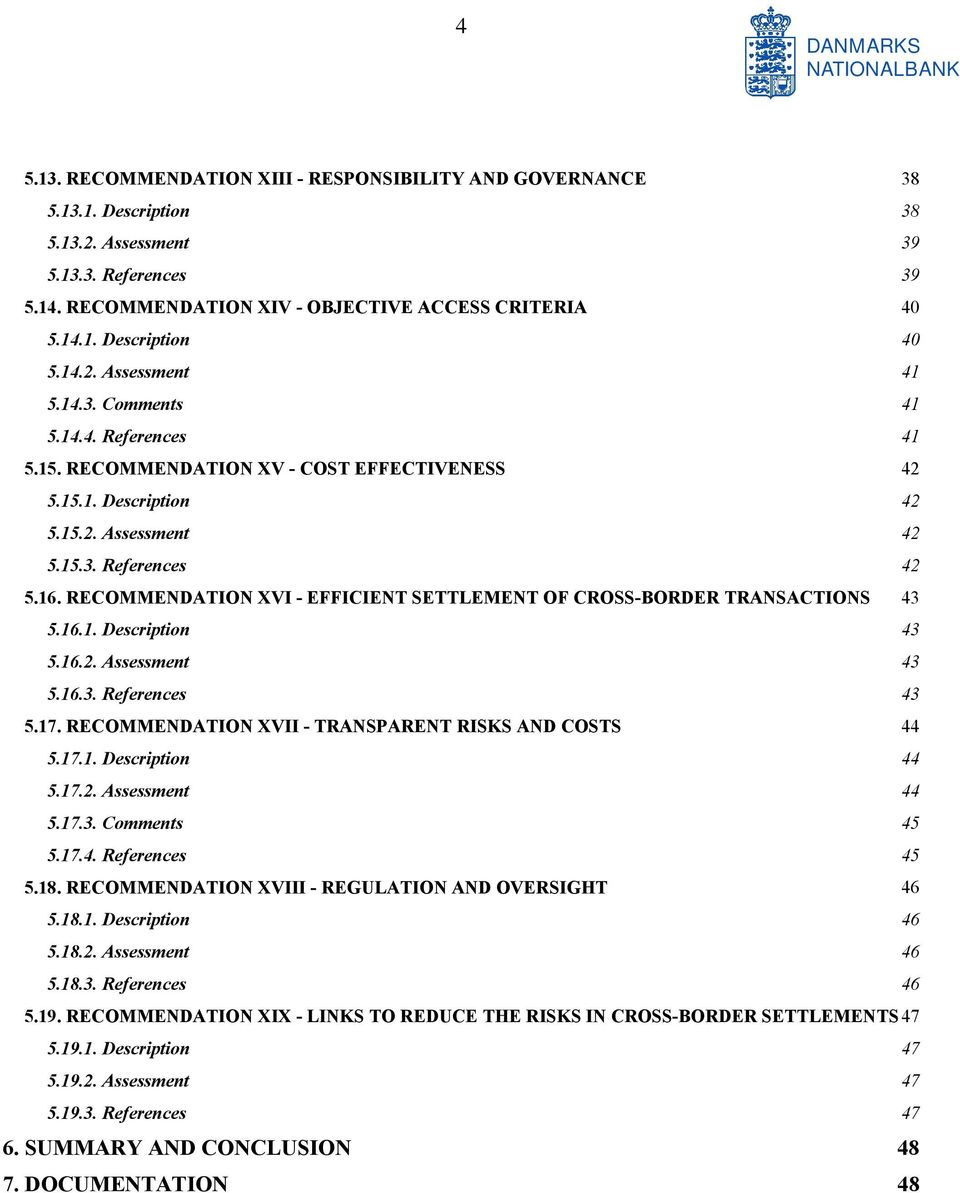
4 RECOMMENDATION XIII - RESPONSIBILITY AND GOVERNANCE Description Assessment References RECOMMENDATION XIV - OBJECTIVE ACCESS CRITERIA Description Assessment Comments References RECOMMENDATION XV - COST EFFECTIVENESS Description Assessment References RECOMMENDATION XVI - EFFICIENT SETTLEMENT OF CROSS-BORDER TRANSACTIONS Description Assessment References RECOMMENDATION XVII - TRANSPARENT RISKS AND COSTS Description Assessment Comments References RECOMMENDATION XVIII - REGULATION AND OVERSIGHT Description Assessment References RECOMMENDATION XIX - LINKS TO REDUCE THE RISKS IN CROSS-BORDER SETTLEMENTS Description Assessment References SUMMARY AND CONCLUSION DOCUMENTATION 48
5 5 1. Introduction and international background This report by the Danish Financial Supervisory Authority (DFSA) and Danmarks Nationalbank assesses VP Securities Services (limited company) (Værdipapircentralen A/S - VP) according to the Recommendations for Securities Settlement Systems 1 (RSSS). In November 2001 the Bank for International Settlements, BIS, and IOSCO (see below) published the RSSS report prepared by the Committee on Payment and Settlement Systems and IOSCO. IOSCO is the International Organisation of Securities Commissions, including the DFSA. The report contains 19 recommendations concerning the arrangement of securities settlement systems (SSSs). The recommendations cover the legal framework for SSSs, risk-management procedures in relation to presettlement risk, settlement risk, operational risk and custody risk as well as other issues such as governance, fair and open access, efficiency and requirements of clear and understandable rules and procedures. This report reviews VP in relation to each of the 19 recommendations. The RSSS report, targeted at SSS owners worldwide, emphasises the need for central banks, securities regulators and other relevant authorities to ensure that systems in their jurisdiction have implemented the recommendations. In November 2002 BIS/IOSCO published the assessment guidance report Assessment methodology for "Recommendations for Securities Settlement Systems". The basis for the assessment is the systems' own responses to a number of questions on each recommendation, to be considered by the authorities. First, this report sets out the background to and structure of the assessment work, including cooperation with the SSS owner, as well as a summary conclusion of the review. This is followed by an overall description of the SSS, including structure, ownership and participants, and a detailed review of the system in relation to each of the 19 recommendations. A summary of the review is then presented, and a conclusion is made. Finally the report contains a list of the underlying documentation. In view of the global nature of the recommendations the ESCB (central banks in the EU) and CESR (Committee of European Securities Regulators) have established a working group at European level with the purpose of adapting the recommendations to European conditions. The work had not been completed at the time of preparation of this review of VP. The ESCB-CESR Working Group will no doubt also be assigned the task of preparing an assessment methodology for implementation of the socalled ESCB-CESR standards. Against this background, it was not possible to consider the conclusions of the work in this report. 2. Review of VP This section outlines Danmarks Nationalbank's role and the legal framework for the activities of VP and the DFSA. Furthermore, focus of the review is delineated mainly to VP, and the purpose of oversight is described The role of Danmarks Nationalbank 1 The report is available at BIS' website
6 6 Central banks worldwide have been assigned the task of overseeing payment and securities settlement systems. The primary purpose of oversight is to promote the smooth operation of the systems by contributing to their stability and efficiency, whereas financial supervision is aimed mainly at individual participants. Pursuant to the Danmarks Nationalbank Act Danmarks Nationalbank is entrusted with the task of maintaining a safe and secure currency system and to facilitate and regulate the traffic in money, which in Danmarks Nationalbank's view includes monitoring the stability and efficiency of payment and securities settlement systems. So far, Danmarks Nationalbank's oversight of SSSs has been conducted in cooperation with the other European central banks, including the European Central Bank (ECB) and its predecessor, the EMI. Initially, oversight was based on the 1990 Lamfalussy standards. Later it was based on the so-called user standards, the "Standards for the use of EU Securities Settlement Systems in ESCB credit operations" from January , most of which will be replaced by the new ESCB-CESR standards Legal framework for the activities of VP and the DFSA The activities of VP and the DFSA in this area are regulated by the Danish Securities Trading Act (the Act), cf. Consolidated Act no of 19 December 2003 as amended by Act no. 491 of 9 June Clearing-centre and depository business can be administered separately or together in one company as in the case of VP. The taking up of business as clearing-centre or business as a central securities depository requires prior authorisation by the DFSA, cf. Section 8 of the Act. The Danish Securities Council and the DFSA shall ensure that the Act and the rules issued in pursuance thereof are observed, cf. Section 84 of the Act. To ensure a single supervisory authority, the DFSA acts as the secretariat of the Danish Securities Council. Section 86 of the Act specifies that, in the exercise of its duty, the DFSA shall supervise the business of central securities depositories and clearing centres, and that their rules, procedures, control and safeguard arrangements, also in respect of electronic data processing, are adequate. This is ensured via e.g. on-site inspection at VP Delineation of the review of VP This review focuses on VP's activities and to a certain extent on DMdata A/S, to which VP has outsourced its central data processing operations. See section 4.2 on securities registered at VP and thus covered by the review. The review does not include any custodian banks as securities accounts are usually opened at singleinvestor level at VP. VP administers approximately 2.8 million securities accounts. The use of omnibus 2 The report was published by the European Monetary Institute (EMI), the ECB's predecessor, and can be found at the ECB's website For a detailed discussion of these standards, see also Jesper Berg and Mogens Kruse, Securities Settlement in an International Perspective, Danmarks Nationalbank, Monetary Review, 2nd Quarter ESCB is short for European System of Central Banks. Monetary Reviews are available at Danmarks Nationalbank's website

7 7 accounts, whereby ownership of securities appears from internal investor registrations with custodian banks, thus plays a minor role in Denmark The purpose of and cooperation on the review of VP The purpose of reviewing VP is to assess whether VP observes the recommendations as part of ensuring efficiency and stability in the payment and securities settlement systems and in the financial markets generally. The DFSA's and Danmarks Nationalbank's joint review of VP is in accordance with the expected role of central banks and regulators pursuant to RSSS recommendation 18 on regulation and oversight. Irrespective of its non-disclosure obligation the DFSA may disclose information to Danmarks Nationalbank provided that the information is necessary for the bank in its capacity as monetary authority or for the bank's monitoring of payment systems, cf. Section 84a(5)(11) of the Act. Furthermore, Danmarks Nationalbank and the DFSA have entered into a formal Memorandum of Understanding laying down the framework for cooperation between the DFSA and Danmarks Nationalbank concerning Danish payment and securities settlement systems 3. This implies inter alia exchange of information and coordination by the DFSA and Danmarks Nationalbank to avoid duplicate work for system owners and for the DFSA and Danmarks Nationalbank. The report was prepared against this background by the DFSA and Danmarks Nationalbank jointly. Its conclusions are based on a review as at 30 September In addition to this domestic review of VP, the increased international focus on the area has caused the IMF and the World Bank to jointly review systemically important payment and securities settlements systems in the member countries in their FSAP (Financial Sector Assessment Programme) consultations. The FSAP consultations also consider whether central banks and other authorities observe the recommendations and principles in a number of areas, including payment and securities settlement systems. The preparation of this report can be regarded as part of the preliminary work for such an FSAP Approach The assessment of VP in relation to RSSS is based on the above-mentioned report, Assessment methodology for "Recommendations for Securities Settlement Systems". The evaluation of VP's implementation of the 19 recommendations was based on VP's own responses to the questions in the report in relation to the individual recommendations. In addition, a stress test was defined and carried out in relation to recommendation 9 on timely settlement in the event of inability to settle by the participant with the largest obligation. Moreover, Danmarks Nationalbank and the DFSA have received all requested documentation. The 3 Cf. Memorandum of Understanding between Danmarks Nationalbank and the Danish Financial Supervisory Authority Concerning Payment Systems and Clearing Centres, Danmarks Nationalbank, Monetary Review, 2nd Quarter 2001.

8 8 documentation is listed in section 7. This has provided the basis for Danmarks Nationalbank's and the DFSA's assessment of VP. 3. Overall conclusion The Table below shows the overall conclusions of the assessment in relation to the individual recommendations. A conclusion can be in one of five categories: Observed, Broadly observed, Partly observed, Non-observed or Not applicable. For each recommendation the assessment methodology report provides guidance on how to assign a category. The assignment of categories is in accordance with common usage and may be summarised as follows: Observed used when all criteria are met without any real shortcomings. Broadly observed used when only minor shortcomings are found, and these do not cause major concern. Partly observed used when not all criteria are met, and the shortcomings are material. Non-observed used when major shortcomings have been found, and as a result of that, the recommendation is considered to be non-observed. Not applicable used when the recommendation does not apply, owing to structural, legal or institutional conditions. Table 1. Overall conclusions Recommendation no. Conclusion 1 Well-founded legal framework Observed 2 Timely trade confirmation Observed 3 Timely and efficient trade settlement Observed 4 Evaluation of benefits/costs of central counterparties Observed 5 Basis for securities lending Not applicable 6 Immobilisation/dematerialisation of securities Observed 7 Delivery versus payment Observed 8 Settlement finality Observed 9 Completion of settlement (multilateral netting) Observed 10 Central bank money Observed 11 Operational reliability Observed
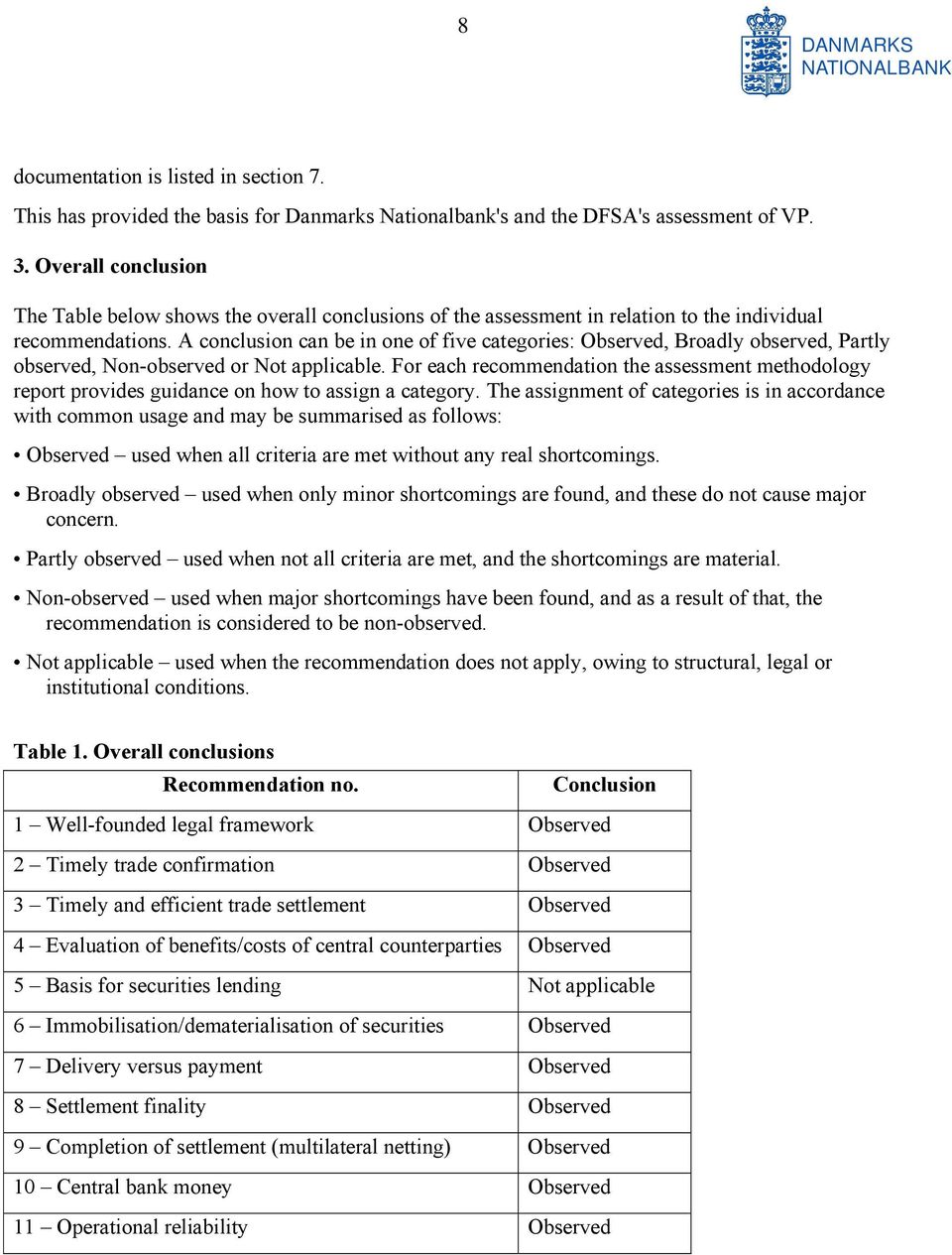
9 9 12 Protection of customers' securities Observed 13 Responsibility and governance Observed 14 Objective access criteria Observed 15 Cost effectiveness Observed 16 Communication procedures and standards Observed 17 Transparent risks and costs Broadly observed 18 Regulation and oversight Observed 19 Links to reduce the risks in cross-border settlements Observed 4. Description of the system and market infrastructure 4.1. System owner VP was established in 1980 and started book-entering and settling dematerialised bonds in In 1988, shares were included. The adoption of the Danish Securities Trading Act in 1995 brought an end to VP's monopoly of securities registration. At that time, VP was an independent institution with a board appointed by the Minister of Economic Affairs. On 1 January 2000, VP was converted into a limited company by virtue of the Danish Securities Trading Act. VP's shareholders are agents in the securities market. Of VP's shares, 32% is owned by banks and investment companies, 28% by bond-issuing companies, 24% by Danmarks Nationalbank, 8% by share issuers and 8% by institutional investors. The mutual relations of the shareholders are regulated by a statutory shareholders' agreement. VP is still the only institution authorised by the DFSA to undertake business as a clearing centre and central securities depository (CSD) apart from the FUTOP Clearing Centre, which guarantees the performance of futures and options contracts traded on the Copenhagen Stock Exchange. All Danish securities traded on the Copenhagen Stock Exchange are issued in book entry form and are thus registered and settled electronically at VP. In the financial year 2003 VP's profit before tax was DKK 73.9 million. Of the DKK million balance-sheet total net capital accounted for DKK million. Under Section 82 of the Danish Securities Trading Act the total capital capability of a central securities depository shall be at least DKK 1 billion by way of assets charged for the benefit of the depository in question, and account controllers at VP shall contribute to the total capital capability in the form of such charges Securities book-entered at VP Shares, bonds, etc. traded on the Copenhagen Stock Exchange (listed securities) are issued through a

10 10 CSD, in practice VP, which registers the electronic securities and to a large extent also the trading in those securities. VP may decide to also register other securities, such as unlisted shares and units in collective investment undertakings, as well as transfers via links from other CSDs (at present VPC in Sweden and VS in Iceland). Breakdown of issues at end-2003 (values in DKK billion): Series Nominal value Market value Bonds 2,289 2,447 2,569 Shares, etc ,034 Units in collective investment undertakings account for most of the share series. The Danish securities market is predominantly based on the above issues. A couple of hundred limited companies (mostly Danish) are listed on the equity market. By contrast, as shown in the Table, the bond market comprises more than 2,000 different listed bonds primarily government and mortgage bonds. The bond market, which accounts for the largest percentage share of the Danish securities market, is large, even by international standards. These issued bonds essentially constitute the collateral basis for Danmarks Nationalbank's monetary-policy operations Market participants and volumes of trade In 2003, the turnover of bonds at VP was DKK 31,056 billion in nominal terms, equivalent to DKK 125 billion per trading day. The turnover of shares, etc. in 2003 amounted to DKK 397 billion in nominal terms, equivalent to DKK 1.6 billion per trading day. In market-value terms the turnover of shares totalled DKK 1,420 billion. On 2 January 2004 the turnover of bonds reached a record high of DKK 460 billion on a single day, mainly due to the refinancing of adjustable-rate loans. The major part of bond trading concerned trades among securities dealers whereas share trading primarily took place among securities dealers and their clients. As a result, 4.6 million of the total of 6.2 million transactions settled at VP in 2003 concerned shares, etc. whereas the remaining 1.6 million were related to bond settlement. The volume of bonds traded on the Copenhagen Stock Exchange in 2003 was DKK 6,753 billion in nominal terms, equivalent to a market value of DKK 6,877 billion. On the equity market the market value of the total volume of trade was DKK billion in The measures of volumes at VP and on the Copenhagen Stock Exchange are not directly comparable. At VP, volumes reflect the nominal values of holdings shifted from one VP account to another, whereas volumes on the Copenhagen Stock Exchange are mainly stated as trades executed in the trading system or other trades reported to the system by the responsible persons. The difference between volumes at VP and on the Copenhagen Stock Exchange can primarily be explained by the fact that collateralisation is included in the VP volumes. In 2003 the daily volume of repo transactions amounted to DKK 69 billion. The average daily volume of trade in Danish government securities on the trading platform MTS amounted to approximately DKK 4 billion from the introduction of MTS on 4 November 2003 to the

11 11 end of Part of the trading on the MTS platform must be reported to the Copenhagen Stock Exchange and is thus included in the Stock Exchange trade. The derivatives market, or the FUTOP market, is relatively small, especially by international standards. At the end of 2003 the Copenhagen Stock Exchange had 42 members in the equity market. 16 of these were remote members, i.e. members participating in the market without being domiciled in Denmark. 24 of them also participated in the bond market. At the same time VP had 131 clearing members, 87 of which held cash settlement accounts at Danmarks Nationalbank. Finally there were 13 primary dealers in MTS Denmark, including several international banks Trading systems and reporting to VP The Copenhagen Stock Exchange is member of the NOREX Alliance together with Stockholmsbörsen, the Iceland Stock Exchange and Oslo Børs. In 2004 Finnish HEX Integrated Markets HEXIM joined the NOREX Alliance. In the Alliance, securities are traded via the SAXESS trading system. Trades can be transferred automatically from SAXESS via NOREX STP for clearing and settlement at VP. This facility is used primarily by the remote members since VP's single-investor registration implies that the account controllers must add further information before reporting to VP. Trading in the wholesale market, i.e. the inter-dealer market for Danish government securities, takes place electronically on the trading platform MTS where also the government securities of most other EU member states are traded. Clearing and settlement of trades executed on MTS Denmark take place at VP. At present, work is ongoing to enable the market participants to make their own choice of place of settlement. Presumably, the choice will lie between VP, Euroclear Bank (Euroclear) and Clearstream International (Clearstream). MTS is based on central clearing instructs and straight-through processing (STP). When a trade has been executed between two market participants on the trading platform, the MTS system sends direct (SWIFT) messages to the relevant clearing/settlement centre(s). Otherwise, trading in bonds, including mortgage bonds, takes place in the informal telephone market (OTC). As the first step in a settlement both securities dealers report the trade to VP in the form of a preadvice. Private individuals cannot report trades reporting must be undertaken by the clearing members of VP and, in the event of a sale, also by the securities account controller. After receiving the preadvices VP checks that the details of the trade correspond (i.e. matching). VP then makes output data available to the parties and any other participants in the settlement of the trade in question. One of the matching criteria is correspondence as regards the choice of settlement day and, where relevant, the choice of settlement block, see below concerning VP's 24-hour settlement period. To make a trade ready for settlement, the parties must report a confirmation, also referred to as an instruct. Preadvice and instruct may be submitted together. The parties can arrange for any settlement day from the trade date T+0 until T+365. The market convention is T+3. As regards OTC, most securities dealers also carry out the above procedure on an STP basis from the moment the dealer has entered the trade to the relevant institution's securities system.

12 Participation in the VP system Participation in clearing and settlement is open to securities dealers, clearing centres and Danmarks Nationalbank. Securities dealers are banks, investment companies and mortgage-credit institutes. The participants enter into a participation agreement with VP and choose an account controller, possibly VP, to administer their securities account unless they choose to become account controllers, see below. Furthermore, participants are required to open settlement accounts at Danmarks Nationalbank according to separate terms and conditions for accounts or enter into an indirect cash settlement agreement with a participant holding an account at Danmarks Nationalbank. If VP members wish to perform custody functions, they must enter into a participation agreement with VP on becoming an account controller entitled to undertake reporting for book entry at VP, also on behalf of a third party. Thus, securities accounts at VP are administered on a decentralised basis via account controllers, which may under certain circumstances register ownership of securities in omnibus accounts. Likewise, securities are issued on a decentralised basis via a bank or securities dealer that, in its capacity of account controller, has concluded a special agreement with VP on the taking up of issue administrator functions. The market is relatively concentrated. While no actual survey has been carried out, it is estimated that Danske Bank as account controller has just over 30% of the market and Nordea Bank Danmark A/S just under 20% whereas Jyske Bank and Sydbank each accounts for just under 10%. At the end of 2003, VP comprised a total of 169 account controllers Operation of the VP system VP's 24-hour settlement period VP's 24-hour settlement period commences at 18:00 and ends immediately prior to 18:00 on the following weekday, which is also the value date. For each 24-hour settlement period VP runs five net settlement blocks of securities trades with the following legal-effect times: 18:00, 23:45, 6:00, 10:30 and 13:35. The first three blocks are settled in both Danish kroner and euro, the fourth block only in Danish kroner and the last block only in euro. The 24-hour settlement period is illustrated in Chart 1 below, while Table 2 shows settlements broken down by the different blocks. The first three nightly blocks correspond with two settlement blocks in the international CSD Euroclear. The purpose of the three blocks is thus to operate a DvP link between VP and Euroclear, the latter holding an omnibus account at VP. When Danmarks Nationalbank's RTGS payment system KRONOS is open to transfers in Danish kroner, the participants can settle individual trades via real-time gross settlement, cf. section

13 13 VP'S 24-HOUR SETTLEMENT PERIOD, INCLUDING LINK TO EUROCLEAR CHART 1 A code of conduct exists, requiring settlements to be completed as soon as possible in the settlement process, and participants are required to have a liquidity buffer. Non-compliance may be subject to sanctions. Table 2 shows settlements broken down by VP settlement blocks in 2003, stated as a percentage of the number of transactions and of the nominal volume of trade in shares and bonds, respectively. VP10 VP20 VP30 VP40 VP50 Share transactions Shares, nominal volume of trade Bond transactions Bonds, nominal volume of trade Cash settlement at Danmarks Nationalbank 4 4 For a detailed discussion, see Financial Institutions' Accounts at and Pledging of Collateral to Danmarks Nationalbank, Danmarks Nationalbank, Monetary Review, 4th Quarter 2001.

14 14 Danmarks Nationalbank's "monetary-policy day" commences at 16:00 and ends at 15:30 on the following day, one of the reasons being VP's need for nightly settlement. Within this period Danmarks Nationalbank provides a non-interest-bearing intraday facility giving participants access to unlimited settlement credit against appropriate collateral. Recourse to the credit facility must be covered by the end of the monetary-policy day, i.e. at 15:30, cf. also Danmarks Nationalbank's Documentation for monetary-policy instruments and settlement of payments in DKK, EUR, SEK and ISK. To minimise the risk that a participant's total debt to Danmarks Nationalbank exceeds the value of the collateral, valuation haircuts are required in connection with collateralisation. During the opening hours of the European euro payment system TARGET euro payments may also be effected via Danmarks Nationalbank's RTGS system, KRONOS. The system is open for euro payments from 7:00 to 18:00. Therefore, euro settlement in the nightly VP settlements of blocks 10 to 30 are initially conducted in Danish kroner, subsequently converted into euro in block 33, i.e. the PvP block. By transfer from their main account to a separate VP settlement account participants can set aside amounts for VP settlement. In the period from 16:00 to 16:30 transfers in the KRONOS system are conducted either manually or by standing orders to the nightly settlements in blocks 10 to 30. Prior to settlement of a block Danmarks Nationalbank notifies VP of the participants' settlement account balances in the form of maximum drawing facilities. Accordingly, Danmarks Nationalbank guarantees to VP that payments will be registered on specific terms, including that the participants' drawings do not exceed the notified maximum credit facility, and that the transactions in each currency equal out so as to achieve zero-balance settlement. In addition, participants may draw on automatic collateralisation accounts. VP administers the collateral for these accounts as a sort of floating charge that can be based on the participants' bookentered holdings and on the inflow of purchased securities in a settlement block. The largest VP members have linked their own holdings of eligible bonds to these accounts, which has provided them with considerable excess liquidity. The introduction of this facility required special authority in the Danish Securities Trading Act. Since it is only possible to transfer cash for nightly settlements in the period from 16:00 to 16:30, the drawing facility in VP 20 corresponds to the original drawing facility adjusted for the result of VP 10, and the same applies to VP 30. After the nightly settlements the amounts are transferred back from the settlement accounts to the participants' main accounts for their free disposal. The participants are subsequently able to supply liquidity for the last settlement block in Danish kroner (VP 40), which ensures that all trades are executed on the value date. Real-time gross settlement of single trades in Danish kroner according to BIS DvP model 1 takes place after VP has reserved the securities on the cash side directly via the current account linked to the KRONOS RTGS system DvP settlement Prior to settlement of the various settlement blocks VP checks that the seller has sufficient cover for the sale of securities (securities check), and that the purchaser has cover for the payment thereof (cash check). Both checks are conducted on a net basis through multilateral netting according to BIS DvP model 3.

15 15 To limit the effects of insufficient securities or cash cover VP is entitled to seek information in the reported data and subsequently complete the transactions for which cover can be obtained. Through this postponement mechanism VP seeks to complete the largest proportion possible of the total settlement volume reported for the settlement block in question. Postponed trades will be resubmitted for settlement in the next settlement block and onwards for the next five settlement days. Thus, insufficient securities or cash cover does not imply unwinding of an already executed clearing run. When VP has prepared a settlement block, VP notifies Danmarks Nationalbank of the book-entry basis. After performing the checks described in section Danmarks Nationalbank acknowledges receipt and books the payments on the participants' settlement accounts, and VP books the trades on the relevant securities accounts. The settlement is now final, and the legal effect of book entry occurs simultaneously for all trades. The trades are considered to be completed at the above legal-effect times, which are the starting times of the different blocks Legal protection of settlement In 1995 provisions on netting were added to the Danish Securities Trading Act in compliance with the requirements of the subsequent Settlement Finality Directive. These rules provide for a CSD to introduce netting provisions into its contractual framework according to which clearing and settlement can proceed irrespective of the insolvency of a participant. It appears from VP's contractual framework that securities transactions reported to VP for settlement with binding effect ("ready for settlement") before VP has received notification of the liquidation, etc. of the participant will be submitted for completion as usual until 18:00 on the date of liquidation. This time indicates the end of the settlement period. Since the major part of VP settlement takes place as nightly settlements and thus outside the opening hours of the bankruptcy court, a participant in liquidation will in effect only participate in further settlement to a limited extent. 5. Review in relation to the individual recommendations The review in relation to each recommendation begins with a review of the issues found to be of relevance to the recommendation based on Assessment methodology for "Recommendations for Securities Settlement Systems" as described in section 2.5. A conclusion is drawn on the extent to which the recommendation is observed, and the conclusion is followed by comments. Where the system is found to not fully observe the recommendation, comments and proposals are given to address the areas causing such non-observance. Where the system is found to fully observe the recommendation, various comments may be given on special issues, assessments or proposals for improvements, etc. The review of each recommendation ends with a list of references to the documentation on which the review is based. The reference section is structured as a table in which the first column states the number of the relevant document, as listed in Chapter 7, and the second column refers to specific sections in the documentation.
16 Recommendation I - Well-founded legal framework Securities settlement systems should have a well-founded, clear and transparent legal basis in the relevant jurisdictions Description The legal framework for VP's activities is predominantly the Danish Securities Trading Act with appurtenant executive orders. The contractual rights and obligations of the parties involved in clearing and settlement are regulated by Danish law in general, as regards both clearing and book-entry business. An essential principle of Danish law is freedom of contract, especially in business. Furthermore, electronic communication is acknowledged as a valid judicial act and admissible evidence in Danish courts. The contractual framework for VP's activities primarily consists of VP's Participation Agreement, a standard agreement whose contents vary solely with the VP participants' choice of functions, etc. Furthermore, the participants who are primary cash providers hold settlement accounts at Danmarks Nationalbank. The relations with Danmarks Nationalbank are governed by terms and conditions for accounts. Finally, VP and Danmarks Nationalbank have concluded a Settlement Agreement on the conditions for cash settlement in connection with VP's activities. The contractual basis specifies which services each party must provide, when and how, as well as contingency procedures and provisions applying in the event of liquidation, etc. of a participant. VP's Clearing Rules must be notified to the Danish Securities Council, whose secretariat is the DFSA, which may instruct VP to amend the rules. According to Section 57 of the Danish Securities Trading Act the rules pertaining to netting must be submitted to the DFSA, which will ascertain that the netting agreement contains objective criteria regarding the circumstances under which netting can be carried out. The legislation is accessible to the public from the DFSA's website 5, which contains important financial legislation, including English versions of the essential documents. Danmarks Nationalbank's terms and conditions for accounts have also been published at e.g. Danmarks Nationalbank's website, also in an English version. VP's Participation Agreement, etc. are available in Danish and English, for instance at VP's website, which also provides a general description of the legal framework and a link to the legislation database at the DFSA's website. The bilateral Settlement Agreement between VP and Danmarks Nationalbank has not been published since it does not involve the VP participants. Securities transactions are generally protected by law, enabling a creditor to make a claim through the legal system, e.g. in connection with purchases of securities. This may take the form of individual proceedings, such as levying execution against the debtor's property, and, if the debtor is insolvent, also bankruptcy proceedings. The Danish Financial Business Act and the Danish Securities Trading Act protect the rights of holders 5 The address is:

17 17 of electronic securities in the event of compulsory liquidation, etc. of an account controller. This applies to both single-investor accounts registered at VP and cases where securities are held in omnibus accounts. Thus, the investor's assets will not be included in the estate in the event of compulsory liquidation of a custodian bank, cf. the description under recommendation 12. Securities issued via VP are book-entered at VP on issuance. Securities issued at VP are dematerialised in that they are solely in book-entry form, i.e. no share certificates or other physical securities can be issued at the same time. Protection against a third party of agreements concerning securities, e.g. securities purchases, is solely related to the book entry of the securities at VP. The VP system is designated in accordance with the provisions of the Settlement Finality Directive, whereby multilateral netting in VP settlements is protected as described in section on legal protection of settlement, also in the event of liquidation, etc. of a VP participant. This legal protection is expressly stated in the DFSA's Executive Order no of 13 December The directive on financial collateral arrangements, or the Collateral Directive, was implemented in Part 18 a of the Danish Securities Trading Act at the end of This implementation supports and expands the scope in Danish legislation for protecting claims via provision of collateral in the form of conventional pledges or the transfer of ownership, including repos and securities lending. In accordance with the directive, Danish legislation provides access to effective realisation of collateral provided as cash or securities and substitution thereof, as well as the provision of additional collateral, i.e. top-up collateral on a mark-to-market basis. Finally, the amendment of the Danish Securities Trading Act authorises the Minister for Economic and Business Affairs to ratify the Hague Convention on the law applicable to certain rights in respect of securities held with an intermediary as from the effective date of the convention in relation to the European Union. Danish law assumes that a purchase shall be performed by both parties simultaneously. This is the principle of simultaneity as stated expressly in Section 14 of the Danish Sale of Goods Act. Thus, Danish legislation supports VP's DvP (delivery versus payment) procedures as described in detail in VP's Clearing Rules. Reference is made to section 4.6.3, which also states that settlements are final when VP has booked the trades to the relevant securities accounts. Furthermore, the Settlement Finality Directive has been implemented in Danish law via the Securities Trading Act, and Danish insolvency law never comprised a zero hour rule, whereby transactions completed after midnight on the day of the opening of insolvency proceedings are automatically avoided. As mentioned in section 4.3 the Danish market has a considerable share of foreign participation. The bond market is large, even in an international perspective, as stated in section 4.2. A significant part of international settlements takes place via Euroclear's link to VP as illustrated in Chart 1 in section This link is assessed together with other links under recommendation 19. Like the other participants, the foreign participants have all accepted VP's netting rules, Danish law as the choice of governing law and Denmark as the choice of venue, including that any disputes between the parties shall, as a general rule, be settled by arbitration. 6 Executive Order on the clearing centres and payment systems with which legally effective agreements can be concluded pursuant to Sections 57(1) and 57 b(1) and (2) of the Danish Securities Trading Act.

18 18 As mentioned in the introductory provisions of VP's Clearing Rules, a legal opinion is required of foreign participants resident in countries that have not implemented the Settlement Finality Directive establishing that in the event of liquidation, etc. VP's rules on settlement are enforceable against the foreign participant and, where relevant, his estate in liquidation Assessment The legal framework for VP is found to be sufficient and well documented. Thus, recommendation 1 is observed References Documentation no. Sections 2 III and IV 3 Chapter 3 4 Danmarks Nationalbank's terms and conditions for accounts concerning VP settlement 5, 6 and 7 All
19 Recommendation II - Timely trade confirmation Confirmation of trades between direct market participants should occur as soon as possible after trade execution, but no later than the trade date (T+0). Where confirmation of trades by indirect market participants (such as institutional investors) is required, it should occur as soon as possible after trade execution, preferably on T+0, but no later than T Description The first step in settling a securities trade is to ensure that the purchaser and the seller agree on the terms of the transaction, a process referred to as trade confirmation. This should occur as soon as possible after trade execution. Trade confirmations can be delivered by VP, which conducts matching immediately after receipt of reporting by the purchaser and seller and makes the information available to the participants concerned. Section 4.4 describes in more detail the types of reporting to VP, including reporting from trading systems. Reporting to VP from MTS is confirmed to the participants prior to the reporting. Other trades are reported by the participants themselves to VP or the SAXESS system of the Copenhagen Stock Exchange. VP is open for reporting from 05:00 to 01:45 on the following day. Acknowledgement information from VP is immediately made available to the participants in the trade and any other parties to the settlement. The general practice among securities dealers is to seek confirmation of all trades already on T+0. This normally takes place immediately after trade execution, in view of the securities dealers' obligation to immediately notify the Copenhagen Stock Exchange of the trade, cf. the reporting provisions. 7 VP's trade confirmation system does not show the time of execution of a reported trade. Only the dates of confirmation of the trades prior to the settlement day are available. In August % of all trades between direct market participants were confirmed 3 days prior to the settlement day, 97.7% were confirmed 2 days prior to the settlement day, and 99.8% were confirmed on the day before the settlement day. As described under recommendation 3, substantial market segments are settled on T+2. In addition, securities lending under e.g. Danmarks Nationalbank's lending scheme for government securities is settled on T+1. Thus, the percentages mentioned above cannot be taken as an indication that trades are generally confirmed on the trade date (T+0). Therefore, collection of information from the market participants was necessary to verify the standard practice of confirming trades on T+0. Where confirmation on T+0 was not achieved, the reason was the cross-border nature of the trade, which is one of the reasons for maintaining the T+3 settlement cycle as described under recommendation 3. For a trade to be included in a VP settlement block the reporting from both parties must be received by VP and matched with a positive result prior to the legal-effect time for the relevant trade settlement block. Positive trade confirmations can form the basis for settlement on the settlement day (or in the 7 Executive Order no. 414 on Reporting of Transactions Involving Securities Listed on a Stock Exchange, etc. of 21 May 2001.

20 20 settlement block) chosen by the parties and five settlement days ahead. There is no system for confirmation of trades between direct and indirect market participants, and there is no requirement of confirmation of such trades. Institutional investors may participate in VP as major clients and report trades to VP themselves. Cross-border participation in the market can be direct participation as a member of the Copenhagen Stock Exchange and MTS or indirect participation. Direct participation on the Copenhagen Stock Exchange requires membership of VP as a clearing member, which so far also applies to MTS. Indirect market participants usually take part in the clearing and settlement at VP as private individuals, i.e. a VP member undertakes reporting to VP on the VP accounts of the indirect participants Assessment Recommendation 2 is found to be observed, considering the standard practice of confirming trades immediately after trade execution References Documentation no. Sections 7 Introductory Provisions and Securities Trading

21 Recommendation III - Timely and efficient trade settlement Rolling settlement should be adopted in all securities markets. Final settlement should occur no later than T+3. The benefits and costs of a settlement cycle shorter than T+3 should be evaluated Description VP applies rolling settlement, systemically supporting any agreed settlement day for up to one year from trade execution (from T+0 to T+365). According to the Danish market conventions bonds, shares, etc. are settled three days after trade execution, i.e. T+3. Treasury bills are settled on T+2, and the same applies to the considerable volume of repos in bonds related to the money market. Settlement on the agreed settlement day, i.e. the value date, occurred for approximately 98.7% of all trades reported for settlement in VP in This settlement ratio was improved to 99.3% according to a sample for January and March The settlement ratio in value terms was also 99.3% in this period. The period of delay is on average slightly more than one settlement day. According to current market conventions the VP participants must ensure sufficient securities and cash cover for timely settlement of the executed trades. Unless otherwise agreed, timely settlement means settlement in VP's first settlement block, i.e. block 10, although securities provided via the Euroclear link are required to be settled in block 20, cf. the illustration of the link in section In addition to cash cover of the total net purchase there must be a liquidity buffer, enhancing a participant's ability to settle its obligations, even if other participants fail to settle their obligations to that participant. Failure to settle, whereby a VP participant overdraws its cash account, is subject to a sanction. In the event of repeated violations over a 6-month period, the sanction is gradually increased to DKK 50,000. In such cases VP will also inform the company's management and report the violation to the DFSA. VP participants have an additional incentive for timely settlement. According to market conventions delay of payment beyond the value date incurs interest claims. Non-delivery of securities is not invoked by VP participants according to market conventions. Such delays often benefit the purchaser, because the purchaser can claim interest on the purchase sum until delivery takes place as the purchase sum remains unchanged, including with respect to accrued interest. There are no facilities for mitigating the effects of delayed settlement, neither in terms of liquidity nor in terms of market risk, etc. Ultimately, it is up to the participants themselves to handle these effects bilaterally via close-out clauses. In 2001 VP investigated the potential for reducing the settlement cycle to T+2. The conclusion was that in terms of both bonds and shares, etc. it was too risky to deviate from T+3, which is regarded as the standard for cross-border participation in VP, including in connection with the links between VP and international CSDs, particularly Euroclear. Furthermore, it must be borne in mind that, as stated in section 4.6.1, VP's 24-hour settlement period starts at 18:00 on the day before the value date, i.e. S-1 (S stands for settlement day), when most of the settlement is run. Thus, in practice settlement already occurs on T+2, i.e. on the day before the agreed value date.
22 Assessment Recommendation 3 is found to be observed, especially considering that the relatively low number of delayed trades does not seem to imply major risks Comments The settlement practices apply to market participants who are VP members and not to private investors. Nevertheless, many of the international share dealers in the Danish market have settled on the same terms as private investors, which has been one of the factors causing delayed settlement of share transactions. In 2003 a working group was established under the auspices of VP, consisting of representatives from the financial sector, including the Association of Danish Mortgage Banks, the Danish Bankers Association and Danmarks Nationalbank. The working group considered whether these dealers should be subject to VP's sanction system, but decided that the dealers should initially be comprised by VP's selective holding check, as described in section The implementation of the decision is sought completed by the end of 2004 and is expected to contribute significantly to reducing the number of delayed share transactions References Documentation no. Sections 7 Settlement Practices in the VP System 9 and 20 All
23 Recommendation IV - Evaluation of benefits/costs of central counterparties The benefits and costs of a central counterparty (CCP) should be evaluated. Where such a mechanism is introduced, the CCP should rigorously control the risks it assumes Description VP's clearing and settlement system does not operate with a CCP. The introduction of a CCP has been discussed on several occasions in various national and Nordic fora among market participants, stock exchanges and CSDs. The conclusion so far has been that the establishment of a CCP would not be cost-effective. This applies especially at national level. According to the latest survey the limited national demand for a CCP can be attributed primarily to the fact that a CCP offers no liquidity benefits in view of VP's efficient multilateral netting system and the participants' access to collateralisation through the flexible automatic collateralisation scheme described in section There appears to be no other considerations which would justify the costs of establishing a CCP, such as risk considerations. The introduction of the electronic trading platform MTS, where the participants do not choose their counterparties, does not seem to influence this, particularly in view of the volume of trade, cf. section Assessment Recommendation 4 is found to be observed, considering the assessments of the benefits and costs of establishing a CCP References Documentation no. Sections 12 All
24 Recommendation V - Basis for securities lending Securities lending and borrowing (or repurchase agreements and other economically equivalent transactions) should be encouraged as a method for expediting the settlement of securities transactions. Barriers that inhibit the lending of securities for this purpose should be removed Description As described under recommendation 3, VP's settlement ratio was approximately 99% before implementation of the steps taken to improve it, cf. section In view of the increasing use of SSSlinked securities lending systems, VP, together with the participants, has on several occasions looked into the potential for introducing a securities lending system. The conclusion so far has been that, even though securities lending occurs in the market and Danmarks Nationalbank's securities lending scheme offers government and mortgage bonds, demand is so limited that VP's introduction of a lending scheme would not be cost-effective. In view of the low estimated demand the current lending activity is assumed to have no significant impact on the stability of VP's settlement system. In connection with these preliminary investigations VP has not identified any impediments to the introduction of a lending scheme, which could be implemented quickly if required, cf. also Section 53 of the Danish Securities Trading Act Assessment Recommendation 5 is found to be not applicable References Documentation no. Sections 29 All
25 Recommendation VI - Immobilisation/dematerialisation of securities Securities should be immobilised or dematerialised and transferred by book entry in CSDs to the greatest extent possible Description All issues at VP are dematerialised, including issues listed on the Copenhagen Stock Exchange, defined in the Danish Securities Trading Act as electronic securities. Securities issued via VP are in book entry form only, i.e. no physical certificates are issued. However, physical securities such as mortgage deeds and unlisted shares are still used in Denmark. Rights of ownership pertaining to electronic securities, including in purchases and pledging, must be registered with VP to be protected from the transferor's creditors and from transferees. The registration alone is a legally valid act of perfection, and its legal effect is in force as from the time of final verification at VP, cf. Section 66 of the Danish Securities Act. Section 4.6 describes book entry at VP in connection with settlement of trades whereby the electronic securities are debited to the seller's VP account and credited to the purchaser's VP account subject to immediate finality in the various settlement blocks Assessment Recommendation 6 is found to be observed as all issues at VP are dematerialised and protection of rights of ownership pertaining to securities is solely related to registration at VP References Documentation no. Sections 2 Chapter 22
26 Recommendation VII - Delivery versus payment CSDs should eliminate principal risk by linking securities transfers to funds transfers in a way that achieves delivery versus payment Description VP settlement primarily takes place in settlement blocks in accordance with BIS DvP model 3 with multilateral netting on the cash and securities sides. Thus, the participants' cash and securities positions are calculated so that each participant shall receive or pay one amount and receive or transfer one securities holding, calculated on a security-by-security basis (ISIN by ISIN). During the opening hours of Danmarks Nationalbank's RTGS system there is access to real-time gross settlement of single trades in accordance with BIS DvP model 1. Furthermore, securities may be transferred free of payment (FOP), which applies to unilateral transfers between VP accounts. However, VP's clearing members make only limited use of this facility as more than 98% of all trades among them are settled on a DvP basis. VP's settlement system is described in more detail in section 4.6. VP clearing members may also minimise principal risk on their private customers by acquiring a right of collateral on a customer's purchased securities via VP's automatic collateralisation system, cf. Section 55 of the Danish Securities Trading Act, or by making a reservation concerning payment, cf. Section 72 of the Act. The latter is the most widely used Assessment Recommendation 7 is found to be observed, considering VP's DvP procedures and the participants' observance thereof References Documentation no. Sections 2 3 and 4 7 All
27 Recommendation VIII - Settlement finality Final settlement should occur no later than the end of the settlement day. Intraday or real-time finality should be provided where necessary to reduce risks Description As described in section 4.6.1, VP runs five settlement blocks in each 24-hour settlement period. During the daytime, when Danmarks Nationalbank's RTGS payment system, KRONOS, is open for transfers in Danish kroner, the participants may also settle single trades in real time. Furthermore, securities may be transferred as unilateral transactions free of payment in principle in the entire time period for reporting to VP, i.e. from 05:00 to 01:45 on the following day. According to VP's Clearing Rules, a trade transaction is ready for settlement when both parties have submitted instructs. After this submission the transaction cannot be unilaterally cancelled or revoked by either party or by a third party. See also section 4.4. It follows from VP's Clearing Rules that settlement in the settlement blocks is final and irrevocable once the block has been completed. For real-time gross settlement finality occurs upon transfer of the securities to the purchaser. This is described in more detail in section Collateral to Danmarks Nationalbank is primarily provided via a single VP account, i.e. a pooling pledge account where securities are held for collateral for any debt to Danmarks Nationalbank incurred in connection with monetary-policy operations or intraday credit. During the day Danmarks Nationalbank's counterparties may unilaterally deposit securities in or withdraw securities from this account, provided there is excess collateral, and may also change the provision of collateral by substitution. Thus, the VP system fully accommodates the participants' needs for provision of collateral to Danmarks Nationalbank and thereby also their access to liquidity. Links have been established between VP and four foreign CSDs. There are bilateral FOP links between VP and VPC in Sweden and between VP and VS, the Icelandic CSD. In addition, there is a DvP link between Clearstream and VP, serviced by Danske Bank. Finally, there is the DvP link described in section between Euroclear and VP. In connection with the latter link, the three nightly VP settlement blocks are scheduled to correspond with the two nightly settlement blocks in Euroclear. Euroclear participates in VP on largely the same terms as the other participants and holds a cash settlement account at Danmarks Nationalbank. This link provides for executing back-to-back transactions (intraday settlement of acquired securities sold on the same value date) several times during a 24-hour settlement period without losing value dates. This facility is constantly in demand in the market. All transfers of securities via the links mentioned above are final and irrevocable Assessment Recommendation 8 is found to be observed as VP's facilitites for final intraday settlement fully meet the market's needs, including in relation to provision of collateral to Danmarks Nationalbank and servicing of links to foreign CSDs.
28 References Documentation no. Sections 7 Introductory Provisions and Securities Trading
29 Recommendation IX - Completion of settlement (multilateral netting) CSDs that extend intraday credit to participants, including CSDs that operate net settlement systems, should institute risk controls that, at a minimum, ensure timely settlement in the event that the participant with the largest payment obligation is unable to settle. The most reliable set of controls is a combination of collateral requirements and limits Description VP does not grant overdrafts on securities accounts or extend credit to its participants since cash settlement is undertaken by Danmarks Nationalbank. As described in section 4.6.2, Danmarks Nationalbank grants unlimited collateralised settlement credit to VP participants. Settlement at VP is based on BIS DvP model 3. The VP settlement system is described in section 4.6 where it appears that the participants only participate in the settlement in so far as they have sufficient securities and cash cover. In practice, this also applies in the event of compulsory liquidation of a participant, which then participates to a limited extent in the further settlement process. The system for ensuring timely settlement is based on VP completing, at the times specified in the settlement blocks, the settlements with sufficient securities and cash cover. VP may without delay reduce a settlement block to a size where there is sufficient cover, no matter how many participants are removed. According to VP's Clearing Rules, all participants are required to have a liquidity buffer to minimise the risk of a participant's failure to settle its obligations preventing the other participants from settling their obligations. The liquidity buffer should be viewed in conjunction with the automatic collateralisation scheme described in section In practice this scheme enables the participants to hold considerable excess liquidity. Under the scheme VP administers the participants' collateral based on their book-entered holdings at VP and on the inflow of securities in connection with a settlement block. As described in section 4.3, bonds account for almost all of the total settlement volume, and Danmarks Nationalbank accepts bonds as collateral for settlement purposes under the scheme. Thus, as a main rule, non-performance of a participant's purchase is not likely to have any major impact on the counterparty's ability to settle its payment obligations to other participants. The reason is that in the event of failure to settle a purchase obligation, the counterparty's securities remain in its own collateral basis vis-à-vis Danmarks Nationalbank. In case of non-performance by the participant with the largest payment obligation if this participant is excluded from the settlement, this should not imply any major liquidity pressure on the other participants, see below. In connection with the redesign of VP in 1996, when the current settlement system was implemented, possible steps to protect settlement completion were discussed with the participants. The introduction of a loss sharing agreement was a central issue, but agreement was not reached. One of the reasons was fear of the moral hazard associated with an unsuitable incentive structure as regards counterparty risk control. Another reason was that protection of settlement would have a disrupting influence on the participants' own general management of counterparty risk as a current net position subject to netting
30 30 by close-out in the event of non-performance, including liquidation. Failure to settle, including as a result of liquidation, by the participant with the largest payment obligation will have the strongest impact on VP's block 10 for settlement at 18:00, i.e. the beginning of the 24-hour settlement period. This settlement block accounts for the largest part by far of the settlement volume in a 24-hour settlement period, see Table 2 in section Historically, liquidation of VP participants has generally occurred in the morning, i.e. before settlement of block 40 (the last settlement block in Danish kroner) at 10:30. As described in section 4.6.4, VP will continue to seek normal completion of this settlement block, including a participant subject to liquidation, until 18:00. If VP does not succeed, other participants that will be affected by any failure to settle may supply new liquidity to block 40, and to a certain extent remedy any insufficient cover in securities prior to this settlement. Thus, the participants have ample opportunity to still achieve timely settlement of their obligations on the value date. Furthermore, the participants will have ample time to adjust their liquidity management to take account of the failure to settle. The period for such adjustment runs from the time of liquidation until the end of the monetary-policy day at 15:30. From the time of liquidation until 18:00,when the next 24-hour settlement period begins, the participants may also provide for the consequences of the failure on the securities side by covering purchases of securities in the market. Liquidation later than the morning hours will hardly entail liquidity problems for the participants since the participants' liquidity is normally in place shortly after the settlement of block 40. VP has conducted a stress test to gain insight into the implications of failure to settle by participants with the largest payment obligations for the VP system and the other participants. The stress test excluded the largest participants from VP's settlement block 10. Since VP applied data from already completed settlements, it was not possible to take into account the consideration that the participants would normally have been able to accommodate to a certain extent the effects of the failure to settle, as described above. Thus, the stress test illustrates the worst-case scenario, i.e. liquidation of a participant or a participant encountering technical problems immediately before the completion of block 10, which accounts for the major part of the settlement volume. The test provided satisfactory confirmation of the above assumption that settlement completion would be ensured by e.g. the automatic collateralisation scheme in the event of failure to settle by the participants with the largest payment obligations. On the test days the settlement ratio without excluding any participants from block 10 (before the inflow of holdings via the Euroclear link) was approximately 95-97%. Exclusion of the largest participants one by one reduced the settlement ratio in the remaining settlement block to approximately 88-95%. The declining settlement ratio can be attributed to insufficient securities holdings, as expected. As assumed, the exclusion of major participants does not imply any considerable liquidity pressure on the remaining participants, owing to the automatic collateralisation scheme Assessment Recommendation 9 is found to be observed, considering that VP can always settle the volumes for which there is securities and cash cover, and that the exclusion of major participants does not entail systemic risks with further implications for the remaining participants.
31 Comments Assessment methodology for "Recommendations for Securities Settlement Systems", as described in section 2.5, states that if a CSD extends credit to issuers for corporate actions, the CSD should institute risk controls for these exposures. As mentioned initially, VP does not extend credit to its participants, which also applies to corporate actions settled on a collateralised basis via accounts at Danmarks Nationalbank. Settlement credit to issuers of securities for corporate actions is granted, if required, by the account controllers. Their management of such risks and risks associated with corporate actions in general is thus evaluated independently of this assessment References Documentation no. Sections 7 Settlement Practices in the VP System 8 All
32 Recommendation X - Central bank money Assets used to settle the ultimate payment obligations arising from securities transactions should carry little or no credit or liquidity risk. If central bank money is not used, steps must be taken to protect CSD members from potential losses and liquidity pressures arising from the failure of the cash settlement agent whose assets are used for that purpose Description In VP's clearing and settlement system cash settlement takes place in central bank money via accounts at Danmarks Nationalbank, as described in section Despite the relatively high degree of concentration in the Danish financial sector, 87 out of VP's 131 clearing members had a VP settlement account at Danmarks Nationalbank by the end of Instead of opening a VP settlement account at Danmarks Nationalbank, VP clearing members may enter into an agreement on indirect cash settlement with a holder of such an account, i.e. a primary cash provider. This facility is mainly used by foreign market participants who usually conclude a cash settlement agreement with one of the major banks operating in Denmark. The foreign cross-border VP clearing members may themselves open a settlement account with appurtenant credit facilities in Danish kroner at Danmarks Nationalbank via remote access. Furthermore, the very small Danish VP participants use the nearest regional bank for cash settlement purposes. All primary cash providers are subject to supervision, and both the DFSA and Danmarks Nationalbank pay special attention to the risks associated with indirect cash settlement. In addition to Danish kroner, trades are settled in euro, also via accounts at Danmarks Nationalbank. In principle, settlement in euro is unlimited, but there is no theoretical risk of Danmarks Nationalbank being unable to immediately settle its obligations in euro. This is due to two technical factors. First, Danmarks Nationalbank's extension of credit in euro is limited, occurring in cooperation with the Eurosystem in connection with Danmarks Nationalbank's participation in TARGET. Second, any additional euro amounts comprised by the settlement will be from the participants' own transfers to Danmarks Nationalbank in TARGET. Consequently, equivalent amounts will be credited to Danmarks Nationalbank's intermediary TARGET accounts at the other central banks participating in TARGET. The participants may make reservations for VP settlement by transferring funds from their main accounts in Danish kroner or euro to separate VP settlement accounts. The transfers are made in Danmarks Nationalbank's RTGS system KRONOS. As an element of its oversight Danmarks Nationalbank has ensured that KRONOS observes the Core Principles For Systemically Important Payment Systems 8. The funds transferred to the settlement accounts are reserved in the period from Danmarks 8 This CPSS report from 2001 is available at BIS' website, and Danmarks Nationalbank's assessment of KRONOS is available at Danmarks Nationalbank's website.
33 33 Nationalbank's notification to VP concerning the account holders' maximum drawing facilities until registration of the account holders' settlement account balances. The funds are then transferred directly from the settlement accounts to the participants' main accounts, freely available to the participants. This does not apply to nightly settlements, however, as the balances on the various settlement accounts form the basis for new maximum drawing facilities. Thus, by the opening time of KRONOS, the participants have the balance of the nightly settlements at their disposal, and during the daytime the funds are only tied when required for the settlement of a settlement block Assessment Recommendation 10 is found to be observed, especially considering the access to use central bank money in VP's settlement system, the current recourse to this facility and the limited reservation of liquidity References Documentation no. Sections 4 Terms and conditions for current accounts and VP settlement accounts in Danish kroner and euro and framework for intraday overdrafts in euro at Danmarks Nationalbank 5 2 and 3 as well as 1 and 2 in the Annex 7 Cash Settlement at Danmarks Nationalbank, Cash Settlement through a Primary Cash Provider and Trade Settlement in Euro 13 All
34 Recommendation XI - Operational reliability Sources of operational risk arising in the clearing and settlement process should be identified and minimised through the development of appropriate systems, controls and procedures. Systems should be reliable and secure and have adequate, scalable capacity. Contingency plans and backup facilities should be established to allow for timely recovery of operations and completion of the settlement process Description VP has a clear policy on identification and management of operational risk. This is set out in written procedures prepared on the basis of VP's Security Policy, as approved by VP's Board. An overall risk assessment is carried out once a year, reviewing the threats and the protection measures in place. When the system is changed, it is evaluated whether the change implies new risks or threats for VP. If this is the case, a risk assessment is carried out using a model 9, and the risk is categorised according to the consequences of a realised threat and the probability thereof. If the risk is categorised as high, an action plan is prepared. VP's central security administration unit (under the IT department) participates in this work. VP has adequate data management facilities ensuring data protection via access controls with encryption of external communication. The VP system is also protected by firewalls. In addition to SWIFT communication, the participants may also be connected to VP via the VP cryptonet, which is structured as a closed Internet with Cisco routers, or otherwise via the Internet through a virtual private network, the configuration of which is controlled and monitored by VP. VP employs an audit trail, including logging of access to production data and changes of production programs. Finally, VP applies a "four-eyes" principle to implementation of system changes, and the functions of program development, system programming and operations are separate. The VP system has a high degree of operational reliability. In 11 out of the 13 months from May 2003 up to and including May 2004 the system availability was 100%, while it was 99.97% and 99.73% in the remaining two months. The system availability of less than100% in these two months could be attributed to other factors than system errors. In April 2004, however, a software error delayed settlement of VP's block 40 for three hours during which time it was not possible to transfer securities. No data was lost. Furthermore, there are contingency plans to mitigate the effects on VP's operations of any operational problems in Danmarks Nationalbank's settlement system. VP has contingency plans that are tested annually. They provide for relocating the production within one hour to a second site at a suitable physical distance from the primary site. VP also has other office facilities located at a suitable distance from VP. The production can be quickly moved to a second site because all data to and from VP is mirrored at the second site. Thus, the second site operates as a hot backup centre in parallel with VP. It is ensured that data cannot be lost, because VP does not issue acknowledgement material, etc. before data storage at both sites. Furthermore, VP has stored taped data 9 The SPRINT model developed by Information Security Forum.
35 35 at several locations, enabling relocation to a third site within a few days with only limited data losses. Once a year the Management submits a statement on operational reliability to the Board. As described under recommendations 12 and 13, VP is subject to internal information systems audit and external audit, including systems audit, and has an audit committee. The audit comprises systems audit as well as audit of VP's contingency plans and monitoring of the testing of contingency plans. In 2002 VP outsourced its central data processing operations to DMdata A/S, whereby VP operates its own systems, but leases hardware and operation of hardware from DMdata. The agreement between VP and DMdata sets out the requirements of quality of delivery as well as security issues and ensures that VP is informed about all issues pertaining to VP's systems at DMdata, including audit information. The agreement provides VP with IT capacity for five times VP's average consumption. In addition, VP may obtain extra capacity within a few hours. Prior to changes of activity a test is conducted, including the required capacity. System performance is monitored on an ongoing basis. By operating its own system VP retains the operational responsibility and control of operational reliability. By outsourcing VP has saved operational costs and improved its disaster recovery plan in that the recovery time at the second site was reduced to one hour, as described above. VP also obtained enhanced operational capacity and flexible access to more capacity, as described above Assessment Recommendation 11 is found to be observed as the VP system is operationally reliable and VP has a clear policy on management of operational risk, including contingency plans and backup facilities References Documentation no. Sections 5 4 of the Annex 21, 22, 23 and 25 All
36 Recommendation XII - Protection of customers' securities Entities holding securities in custody should employ accounting practices and safekeeping procedures that fully protect customers' securities. It is essential that customers securities be protected against the claims of a custodian's creditors Description As appears from section 4.5, only account controllers can perform custody functions. Pursuant to Section 62 of the Danish Securities Trading Act only financial institutions including clearing centres or public authorities, as well as Danmarks Nationalbank can be account controllers. All financial institutions resident in Denmark are supervised by the DFSA. By e.g. on-site inspection the DFSA supervises both procedures and routines of the financial institutions, including their performance as account controllers. Non-resident institutions are in principle supervised by the supervision authorities in their home country. The account controllers undertake reporting to VP for book entry, predominantly on single-investor accounts, for which reason there are approximately 2.8 million accounts at VP. These accounts only contain an investor's own securities, and the investor's securities are thus efficiently segregated from assets belonging to other investors, including the account controllers. Where customers' securities are held in omnibus accounts, Section 72 of the Danish Financial Business Act states that unless an exception is made by the DFSA in special cases, the securities shall be segregated from the account controller's own securities. If securities are held in an omnibus account, the customer should be informed of this and of the legal consequences. In the event of compulsory liquidation, etc. of an account controller, holdings in the said investor accounts will not be included in the estate. The same applies to omnibus accounts, as stated expressly in Section 72 of the Danish Financial Business Act. In pursuance of Section 64 of the Danish Securities Trading Act an account controller in compulsory liquidation loses the right to undertake reporting to VP for book entry on these accounts with immediate effect. Subsequently, all VP accounts are moved to another account controller. If it is not possible to find another account controller, which has never yet been the case, VP takes over this role for a period of up to four months, cf. Section 64 of the Danish Securities Trading Act. After this period the account holder's registrations are transferred to the account controllers responsible for the issue. VP is liable for any loss resulting from errors in connection with the registration, alteration or cancellation of rights on accounts or payments related to accounts even if such errors are fortuitous, i.e. on an objective basis, cf. Section 80 of the Danish Securities Trading Act. If an error can be ascribed to an account controller, the liability rests with the account controller. This liability in damages is, in relation to VP, backed up by the capital capability referred to in section 4.1 and, in relation to Danish account controllers, by joint and several liability between these institutions, cf. Section 81 of the Danish Securities Trading Act. Several procedures exist to ensure agreement between the volume of securities in circulation and the obligations of issuers. A VP participant acting as issue administrator has the exclusive right to increase or decrease the volume of securities in circulation through VP against corresponding book entries in
37 37 VP's ledger of accounts for issued electronic securities for which the participant is the registered issue administrator. On issue (change in ledger) and for corporate actions, VP checks that the volume in circulation and the entries in the ledger are in agreement. Furthermore, VP undertakes complete reconciliation of all book-entered securities once a week. Finally, VP's electronic controls ensure that securities cannot appear or disappear in a transaction (double-entry account principle). In addition, Section 68 of the Danish Securities Trading Act and the Executive Order on registration specify comprehensive rules including procedures for the issue of change notifications and regular statements to account holders. All Danish financial undertakings entitled to become account controllers are required by Danish law to employ at least one state-authorised public accountant. In pursuance of the Executive Order on systems audit VP is subject to systems audit. This includes an obligation on VP to have a state-authorised public accountant as its information systems auditor appointed by the General Meeting, as well as an information systems audit department headed by a Chief IS Auditor appointed by the Board of VP. Major account controllers are also required to have an internal audit regime. Pursuant to the Executive Order on audit, accountants in account controllers holding customers' securities in omnibus accounts shall check in particular that the account controller's own register clearly specifies each investor's ownership of securities Assessment Recommendation 12 is found to be observed, especially considering that VP's statutory registration at single-investor level protects the customers' right to their securities References Documentation no. Sections Sub-agreement on issue administrator functions 3, 10 and 11 All
38 Recommendation XIII - Responsibility and governance Governance arrangements for CSDs and CCPs should be designed to fulfil public interest requirements and to promote the objectives of owners and users Description As appears from section 4.1, VP is a limited company whose shareholders represent agents in the securities market. As in other limited companies the shareholders exert their influence through the General Meeting, which is VP's supreme authority. In this capacity the General Meeting appoints VP's Board. The management of VP is shared between the Board, which is responsible for the general governance of VP, and the Management, which is responsible for day-to-day operations. By virtue of a shareholders' agreement all shareholder groups are guaranteed representation on VP's Board and thus influence on VP's general governance. The same applies to VP's employees, who are guaranteed representation on the Board under the Danish Companies Act. Public interest is served inter alia by the establishment in the Danish Securities Trading Act of a general framework for management, specifying e.g. that the consent of the DFSA is required for management decisions in a variety of specific areas. The participation rules, as described under recommendation 14, are an example of the fulfilment of public interest requirements in the Danish Securities Trading Act. VP's Board consists of 15 members, 10 of whom are appointed by the General Meeting and the remaining five by the employees. According to the shareholders' agreement the right to appoint Board members is distributed as follows between five shareholder groups: Banks and investment companies appoint four members, bond-issuing companies appoint three members, and Danmarks Nationalbank, share issuers and institutional investors each appoints one member. Danmarks Nationalbank is represented on VP's Board in order to work for a stable and efficient VP system, including observance of international standards and related requirements of fair and open access, etc., and to safeguard the interests of the central government as issuer of government bonds. Users are secured considerable influence in VP through their representation on VP's Board. As a result, the shareholder groups only appoint experienced Board members, who are usually managers in the shareholding institutions. In addition, under Section 9 of the Danish Securities Trading Act the DFSA shall approve all members of the Board and the Management, cf. the requirement for fit and proper management referred to in the explanatory notes. More specifically, the requirement concerns the experience, expertise and integrity of members 10. Those of VP's users who are not shareholders can exert influence via e.g. the customer forum mentioned under recommendation 15. The Management consists of one member, who as in other limited companies is employed by the Board and must follow the guidelines and instructions given by the Board. The Board has prepared guidelines for the distribution of tasks between the Board and the Management, which also establish the Management's duty to report to the Board. 10 A guide can be found at the DFSA's website: FN004 of 31/05/2000.
39 39 The Board and the Management have to prepare an Annual Report, including accounts and directors' report on VP's operations, for the year in question. The Annual Report is submitted to the General Meeting and is accessible to the public, see below. For control of certain management decisions, among other things, the General Meeting appoints an external financial auditor and an external systems auditor. The auditors, who must fulfil the auditing requirements of the General Meeting, also perform the functions of an independent company body. In this capacity the audit function is regulated in the legislation and other general sources of law on good auditing practice. The auditors are thus also the public's representatives, checking e.g. that the Annual Report presents a true and fair view. Under Section 14 of the Danish Securities Trading Act the Annual Report shall, together with the auditors' report, be submitted to the DFSA, which forwards the Annual Report to the Danish Commerce and Companies Agency for publication. Furthermore, VP has a systems audit committee consisting of chief auditors from the audit departments of the owners, including Danmarks Nationalbank. According to its mandate the committee supervises the work of VP's Chief IS Auditor as referred to in recommendation 12. In addition, the committee advises both the Management and the Chief IS Auditor on security- and audit-related issues. VP has a number of objectives for its activities, as well as a set of basic values. These are accessible from VP's website, which contains a company information section with facts about VP, VP's mission and vision and VP's values. In addition, VP's Statutes include the objects clause as required by companies legislation. This clause states that VP shall carry on business within the framework of the Danish Securities Trading Act, including as accessory business. Furthermore, it specifies that VP shall aim at providing a VP system whose products and functionality are always sustainable and in compliance with international standards. Also, VP's object is to support through fair conditions for the registration of securities broad-based participation in the Danish securities market, including a broad-based share culture. The Statutes are also accessible at VP's website. In addition to the above-mentioned public information VP's website also provides information on VP's ownership structure and the composition of its management Assessment Recommendation 13 is found to be observed as the rules ensure that VP's management sufficiently serves both VP's and the public's interests References Documentation no. Sections 2 Chapter 3 17, 18, 19 and 26 All
40 Recommendation XIV - Objective access criteria CSDs and CCPs should have objective and publicly disclosed criteria for participation that permit fair and open access Description Participation in VP in its capacity as clearing centre and central securities depository is regulated in Parts 16 and 21 of the Danish Securities Trading Act. Under Section 54 of the Act only securities dealers, including credit institutions and investment companies, i.e. both Danish and foreign companies under financial supervision, are entitled to clear and settle on behalf of third parties. Other companies that only undertake clearing on their own behalf, such as institutional investors, may also conclude a participation agreement with VP. Pursuant to Section 54 the detailed conditions for participation are stipulated by the clearing centre in the agreement. However, in the explanatory notes for Section 54 it is emphasised that the requirements must be objective and non-discriminating, such as capital requirements and technical requirements. It is also stated that the rejection of an application to become a clearing member can be brought before the Danish Securities Council, cf. Section 88 of the Danish Securities Trading Act. Furthermore, the Danish Securities Council can instruct a clearing centre to amend its participation rules to ensure smooth operation of the market, including efficient competition, cf. Section 83 of the Danish Securities Trading Act. The access requirements are contained in VP's Standard Participation Agreement as referred to under recommendation 1 with related Clearing Rules. Initially it appears that participation in clearing on behalf of the participant and third parties is open to all securities dealers, cf. the concept of the Act, as well as clearing centres and Danmarks Nationalbank. In addition, major clients and foreign clearing centres can participate in clearing on their own behalf. For all participants a technical connection will be established. The connection must be tested, and the results must satisfy VP. In addition, a legal declaration, duly signed, is required of foreign participants establishing that the participant can enter into the participation agreement and is bound by all its provisions. Furthermore, where the foreign participant is from a country that has not implemented the Settlement Finality Directive, a legal opinion establishing that VP's rules on settlement are enforceable under the legislation of that country is also required. The access requirements are accessible in both Danish and English from VP's website together with a special guide for foreign participants. In addition, VP's website contains a link to the legislation database referred to under recommendation 1. A clearing member may terminate its participation in relation to VP or one or more of individual clearing functions at three months' notice to expire on the last day of a month, always provided that all obligations have been discharged before the expiry of the notice of termination. As mentioned under recommendation 12, an account controller in compulsory liquidation loses the right to undertake reporting to VP with immediate effect. In addition, it follows from the breach provision of the Participation Agreement that where an account controller commits a material or repeated breach of the Agreement, VP will report this to the DFSA, which will then decide whether the
41 41 Agreement is terminable. In case of termination the securities of the account holders are transferred to other account controllers. If a clearing member, which is not an account controller, grossly or repeatedly disregards the conditions for participation, VP may terminate the Participation Agreement. The same applies if the clearing member becomes subject to compulsory liquidation, suspension of payments, etc. The termination and breach provisions of the Participation Agreement are also accessible from VP's website Assessment Recommendation 14 is found to be observed, considering that VP's public access requirements and breach provisions are clear and non-discriminating Comments Concerning the access requirements in the Clearing Rules, references to sections in the Danish Securities Trading Act are incorrect due to a recent change. This should be rectified as soon as possible References Documentation no. Sections 2 Parts 16 and 21 6 All 7 Introductory Provisions
42 Recommendation XV - Cost effectiveness While maintaining safe and secure operations, securities settlement systems should be cost-effective in meeting the requirements of users Description As described under recommendation 11, the system's availability is close to 100%. In addition, the indirect costs of using the system are low e.g. since the participants are able to communicate inexpensively using VP's system-to-system platform, which also makes it easy for users to automate their procedures or, in other words, achieve STP. Furthermore, the liquidity burden of cash settlement is carefully adjusted to the wishes of the participants. VP regularly seeks to compare its prices and costs with those of other CSDs even though there is no benchmark. As a limited company VP has a market- and business-oriented approach and strives to achieve more than full cover of costs in its activities. VP regularly reviews its service levels and new initiatives in dialogue with the participants, including in a formalised form through regular meetings in VP's customer forum, which is a standing VP committee comprising representatives of VP's users. VP reviews the operational reliability of the system, both on a regular basis and prior to activity changes, including the need for system capacity. The capacity can be expanded within a few minutes by blocking the test environment and transferring the spare capacity to production. As mentioned under recommendation 11, VP can obtain additional capacity within a few hours Assessment Recommendation 15 is found to be observed as the VP system is both operationally reliable and costeffective References Documentation no. Sections 27 and 28 All
43 Recommendation XVI - Communication procedures and standards Securities settlement systems should use or accommodate the relevant international communication procedures and standards in order to facilitate efficient settlement of cross-border transactions Description Participants can communicate with VP via a standard system (3270) or via direct data communication on a system-to-system basis. This is a system developed by VP and based on VP's own message formats which are used by the account controllers. As regards VP's other functionalities, it is possible to communicate via SWIFT or a web-based service called VPonline. The performance of custody functions by account controllers requires considerable exchange of information and must be effected through VP's own system. The reporting of trades and receipt of information relating to trades can take place via SWIFT or VPonline. Information on corporate actions is also accessible through SWIFT. VP supports the most recent SWIFT standard, ISO Furthermore, VP uses ISIN, cf. ISO 6166, to identify securities. Cross-border communication between VP and remote members is usually effected through SWIFT or VPonline. However, also for remote members the volume of transactions may become so large that they start using VP's own communication system Assessment Recommendation 16 is found to be observed as it is possible to settle cross-border securities transactions in the VP system using international communication procedures and standards References Documentation no. Sections 23 All
44 Recommendation XVII - Transparent risks and costs CSDs and CCPs should provide market participants with sufficient information for them to identify and evaluate accurately the risks and costs associated with using the CSD or CCP services Description At VP's website there is a section called "About VP". Among other things this section contains subsections on regulation and supervision, Statutes and rule sets, as well as participation. The subsection on Statutes and rule sets comprises VP's Clearing Rules, which are part of the Participation Agreement and provide information on the functionality of the VP system and on the risks involved. For instance, the Clearing Rules contain provisions on how settlement is influenced by a participant's inadequate securities or cash cover, by a participant's compulsory liquidation, etc. or by force majeure situations, etc. Finally, the Clearing Rules contain provisions on settlement practices in the VP system, including the mutual agreement between participants on settlement practices to ensure the necessary securities cover, as well as rules on liquidity buffers to stabilise settlement. In connection with the description of the legislation at VP's website there is a link to the legislation database at the DFSA's website mentioned under recommendations 1 and 14. This database also contains English versions of the essential documents. In addition, VP offers comprehensive customer service at their website. This customer service section is reserved for VP participants, who use a password to access it. It contains a variety of guides from business guides including price lists over registration and clearing guides to an actual systems guide. VP has responded to a questionnaire to illuminate the risks of VP, i.e. the CPSS/IOSCO Disclosure Framework of 10 October Furthermore, VP has responded to the Association of Global Custodians Depository Questionnaire from 2003/2004 and contributed to a status report on ISSA's (International Securities Services Association) recommendations from VP has also prepared special guides for foreign participants on market practice and securities settlement. Finally, VP has responded to the questions mentioned in section 2.5 in relation to the RSSS report, which will also be published at VP's website. Danmarks Nationalbank and the DFSA have both published an English and a Danish version of this review of VP at their respective websites. The contents of VP's website are regularly updated. As mentioned above, the information is accessible at VP's website, and printed versions are available from VP. All material, except the above-mentioned questionnaires and the special publications addressed to foreign participants, is available in Danish. The Participation Agreement, including the Clearing Rules, is available in an English version, and so is much of the other information on VP. However, the very detailed customer guides, including VP's pricing information, have not been translated into English Assessment Recommendation 17 is found to be broadly observed as VP's customer guides are not sufficiently
45 45 accessible to foreign participants Comments VP states that they do not have all material in both Danish and English, but evaluates the need for translations on a case-by-case basis. However, VP should review the customer guides and assess which parts might be of interest to foreign participants. The price lists are a good example. Furthermore, VP should consider introducing a more formalised procedure for updating the material as e.g. the Clearing Rules mentioned under recommendation 14 are not fully up to date. Also, the above-mentioned CPSS/IOSCO Disclosure Framework of 10 October 2002 does not comprise the most recent improvements of the recovery time following VP system breakdowns References Documentation no. Sections 7 and 14 All
46 Recommendation XVIII - Regulation and oversight Securities settlement systems should be subject to transparent and effective regulation and oversight. Central banks and securities regulators should cooperate with each other and with other relevant authorities Description VP is supervised by the DFSA as described under section 2.2 and overseen by Danmarks Nationalbank as stated under section 2.1. As appears from the descriptions, the DFSA performs its function under explicit statutory authority, cf. Sections 84 and 86 of the Danish Securities Trading Act, whereas Danmarks Nationalbank's mandate is of a more general nature. However, in the Settlement Agreement on the conditions for cash settlement in connection with VP's activities Danmarks Nationalbank states its presumption that VP will fulfil the general requirements made by Danmarks Nationalbank of the clearing and settlement system from time to time. As described in section 2.4, Danmarks Nationalbank and the DFSA undertake this joint review of the VP system as one of the tasks under the Memorandum of Understanding concerning payment systems and clearing centres. The Memorandum of Understanding stipulates that joint tasks concerning verification of the compliance of e.g. clearing centres with the RSSS recommendations shall, to the greatest possible degree, be coordinated in pursuance of the recommendation. The Memorandum of Understanding is accessible from both parties' websites, in Danmarks Nationalbank's case in the Monetary Review referred to in note 3 in section 2.4. This Monetary Review also contains an article on Danmarks Nationalbank's oversight of payment and securities settlement systems. The supervisory function of the DFSA is clearly defined in the Danish Securities Trading Act. The DFSA and Danmarks Nationalbank consider themselves able to perform these tasks efficiently Assessment Recommendation 18 is found to be observed as supervision and oversight of the VP system is considered to be clear and efficient References Documentation no. Sections 2 I, III, IV and V and 16 All
47 Recommendation XIX - Links to reduce the risks in cross-border settlements CSDs that establish links to settle cross-border trades should design and operate such links to reduce effectively the risks associated with cross-border settlements Description The two international European single-purpose banks acting as CSDs, Euroclear and Clearstream International, both have DvP links to VP. Securities issued at VP can be registered at the respective units and be transferred and retransferred with concurrent cash settlement. The Euroclear link, which is illustrated in Chart 1 in section 4.6.1, is the most frequently used link. It is also the most efficient link, cf. the description under recommendation 8, with Euroclear holding a securities account at VP and a cash settlement account at Danmarks Nationalbank. The Clearstream link is also a direct link in the sense that Clearstream holds a securities account at VP in its own name, but this VP account is serviced by Danske Bank as account controller, just as Danske Bank undertakes cash settlement via its account at Danmarks Nationalbank. The effectiveness of this link is such that VP's first block (VP 10) corresponds with Clearstream's first nightly settlement block, which in turn corresponds with VP's fourth block (VP 40). In addition, VP has bilateral direct FOP links with the Swedish CSD VPC and the Icelandic CSD VS. Thus, these CSDs register securities issued at VP, and VP registers Icelandic and Swedish securities. However, the use of these links is limited. Risk analyses have been undertaken in respect of the VP system, including the said links. In their links with VP Euroclear and Clearstream achieve DvP in the same way as VP's other participants, with Euroclear having its own drawing facility at Danmarks Nationalbank as mentioned above and Clearstream obtaining its drawing facility through Danske Bank. Both Euroclear and Clearstream ensure that their participants have sufficient cash and securities cover prior to sending settlement instructs to VP, in Clearstream's case through Danske Bank. All securities transfers via all links are final and irrevocable, i.e. registration at the CSD to which a security is transferred does not take place until after final transfer of the security to the omnibus account held by that CSD at the CSD where the security was issued. As regards VP's link to VPC in Sweden and VS in Iceland, reconciliation takes place on a daily basis Assessment Recommendation 19 is found to be observed as all established links reduce risk in cross-border settlement References Documentation no. Sections 24 All
48 48 6. Summary and conclusion Overall, VP is found to observe the RSSS recommendations. As appears from Table 1 in section 3, VP was assigned the category Observed in relation to 17 of the 19 recommendations. Of the remaining two recommendations, one is found to be Not applicable, and the other to be Broadly observed. In relation to recommendation 17, cf. section , which is found to be Broadly observed, there are two matters to be addressed by VP: The customer guides are only available in Danish. VP should review the guides to establish which parts of them are of interest to foreign participants. These parts should be translated into English. VP should introduce a more formalised procedure for the timely updating of information material, etc. as e.g. the Clearing Rules and the CPSS/IOSCO Disclosure Framework are not fully up to date. After this review of VP, it is found that VP strives to constantly comply with the requirements of international recommendations. Examples are: VP's redesign in 1996 with the introduction of procedures enabling VP to exclude a participant who cannot meet some or all its obligations from the settlement as part of the daily routines. VP's outsourcing of central data processing operations to DMdata A/S in 2002, which has made it technically possible to reduce the system's recovery time at a second site from four hours to less than one hour in case of disaster. 7. Documentation For the review of VP in relation to RSSS a number of sources have been used to illuminate the individual recommendations. Most of the documentation is listed below. 1. VP's responses to the questions in the BIS/IOSCO report Assessment methodology for "Recommendations for Securities Settlement Systems", November Danish Securities Trading, etc. Act, cf. Consolidated Act no of 19 December 2003 as amended by Act no. 491 of 9 June Executive Order no on the registration, etc. of elelctronic securities at a central securities depository of 15 December 2003 (Executive Order on registration) (in Danish). 4. Documentation for monetary-policy instruments and settlement of payments in DKK, EUR, SEK and ISK - Danmarks Nationalbank. 5. Settlement Agreement between VP and Danmarks Nationalbank (containing conditions for cash settlement at Danmarks Nationalbank in connection with VP's clearing and settlement) with appurtenant appendices.
49 49 6. Standard VP Participation Agreement whose contents only vary with the VP participant's choice of functions, etc. 7. VP's Clearing Rules of 22 December Results of data simulations undertaken by VP in cooperation with the DFSA and Danmarks Nationalbank. 9. Recommendation of the Danish Bankers Association and of the Danish Securities Dealers Association that Settlement Administrators comply with a number of settlement practices and professional rules concerning interest claims as notified to the Danish Competition Authority on 26 June 1998 (in Danish). 10. Executive Order no on Auditing Financial Undertakings and Financial Groups of 15 December 2003 (Executive Order on audits). 11. Executive Order no on the performance of systems audits in central securities depositories of 7 December 2001 (Executive Order on systems audits) (in Danish). 12. Directors' report, inter alia, from the Annual Report Second assessment of KRONOS in relation to Core Principles for Systemically Important Payment Systems based on data until 13 May VP's responses to CPSS/IOSCO Disclosure Framework of 10 October Memorandum of Understanding between Danmarks Nationalbank and the Danish Financial Supervisory Authority Concerning Payment Systems and Clearing Centres, Danmarks Nationalbank, Monetary Review, 2nd Quarter Danmarks Nationalbank's Oversight of Payment and Securities Settlement Systems, Danmarks Nationalbank, Monetary Review 2nd Quarter Shareholders' agreement concerning VP (in Danish). 18. Rules of procedure for the Board of VP of 19 February 2001 (in Danish). 19. VP's Statutes as adopted by the General Meeting on 25 April 2003 (in Danish). 20. VP's analysis of 18 April 2001 concerning a reduction of the settlement cycle to T+2 (in Danish). 21. VP's security rules 2001 (in Danish). 22. Annual statement by VP's Management to the Board of Directors on operational reliability of 18 February 2004 (in Danish). 23. Description of VP's data communication (in Danish). 24. Procedures for the daily reconciliation of Swedish and Icelandic electronic securities in VP (in Danish). 25. Assessment of operational reliability on the outsourcing of VP's mainframe operations of 11 June 2002 (in Danish).
50 Terms of reference for VP's systems audit committee (in Danish). 27. VP's 2004 price lists for participation and basic services. 28. Material prepared by VP concerning price comparisons (in Danish). 29. Material prepared in VP's customer forum from October 2002 and March 2003 (in Danish). Much of this documentation is available at VP's, the DFSA's and Danmarks Nationalbank's websites: and
Assessment of the VP settlement system
 1 Assessment of the VP settlement system against the ESCB/CESR Recommendations for Securities Settlement Systems March 2012 2 Contents 1 Introduction...3 1.1 Recommendations for securities settlement systems...
Assessment of Monte Titoli s observance of the ESCB-CESR Recommendations for Securities Settlement Systems
 Assessment of Monte Titoli s observance of the ESCB-CESR Recommendations for Securities Settlement Systems Premise Monte Titoli is Italy s central securities depository (CSD). It manages the securities
The assessment report on the kdpw_stream s compliance with the ESCB-CESR recommendations for securities settlement systems
 The assessment report on the kdpw_stream s compliance with the ESCB-CESR recommendations for securities settlement systems 1 I. Introduction General Presented assessment of securities settlement system
RISK MANAGEMENT IN NETTING SCHEMES FOR SETTLEMENT OF SECURITIES TRANSACTIONS
 RISK MANAGEMENT IN NETTING SCHEMES FOR SETTLEMENT OF SECURITIES TRANSACTIONS A background paper for the 4th OECD/World Bank Bond Market Workshop 7-8 March 02 by Jan Woltjer 1 1 Introduction Settlement
VPO NOK Rules. Rules for the Central Securities Settlement. in Norwegian Kroner
 Entry into force: 29. April 2015 Version: 1.1 Published 27. April 2015 VPO NOK Rules Rules for the Central Securities Settlement in Norwegian Kroner This document is a translation from the original Norwegian
TAKASBANK Compliance to Securities Settlement Systems and CPSS-IOSCO Recommendations for Securities Settlement Systems-2008
 TAKASBANK Compliance to Securities Settlement Systems and CPSS-IOSCO Recommendations for Securities Settlement Systems-2008 This questionnaire addresses each of the joint CPSS-IOSCO recommendations relating
Act on Undertakings for Collective Investment in Transferable Securities (UCITS), Investment Funds and Professional Investment funds
 This is an English translation. The original Icelandic text, as published in the Law Gazette (Stjórnartíðindi), is the authoritative text. Should there be discrepancy between this translation and the authoritative
Agreement on Account Management, Settlement and Collateralisation between... (name of the Bank) and. For Norges Bank
 Page 1 of 13 Agreement on Account Management, Settlement and Collateralisation between. (name of the Bank) and Norges Bank Type of account (please mark one): Ordinary account Contingency account Oslo,
Issues and corporate actions in the book-entry system Decision of Euroclear Finland s CEO. To: Issuers Account operators Issuer agents
 Issues and corporate actions in the book-entry system Decision of Euroclear Finland s CEO To: Issuers Account operators Issuer agents Reference to the Rules: 2.1.13, 3.1.11, 3.1.12,3.1.13, 3.1.14, 3.1.19
Federal Reserve Policy on Payments System Risk
 Federal Reserve Policy on Payments System Risk As amended effective January 11, 2007 INTRODUCTION RISKS IN PAYMENTS AND SETTLEMENT SYTEMS I. RISK MANAGEMENT IN PAYMENTS AND SETTLEMENT SYSTEMS A. Scope
(Legislative acts) REGULATIONS
 28.8.2014 Official Journal of the European Union L 257/1 I (Legislative acts) REGULATIONS REGULATION (EU) No 909/2014 OF THE EUROPEAN PARLIAMENT AND OF THE COUNCIL of 23 July 2014 on improving securities
DISCLOSURE FRAMEWORK FOR SECURITIES SETTLEMENT SYSTEMS. Central Register of Short-term Securities maintained by the National Bank of Slovakia
 DISCLOSURE FRAMEWORK FOR SECURITIES SETTLEMENT SYSTEMS Central Register of Short-term Securities maintained by the National Bank of Slovakia Introduction The following document comprises the answers formulated
DISCLOSURE FRAMEWORK FOR SECURITIES SETTLEMENT SYSTEMS SITEME. Markets and Reserve Management Department
 DISCLOSURE FRAMEWORK FOR SECURITIES SETTLEMENT SYSTEMS SITEME Markets and Reserve Management Department SEPTEMBER 2004 DISCLAIMER This document comprises the answers given by Banco de Portugal (the Portuguese
Evaluation of the Securities Settlement System
 of the Securities Settlement System September 2007 Introduction This note presents an evaluation of the securities settlement system managed by S.D. Indeval S.A. de C.V., Mexico s central securities depository,
Member s Profile. KELER Ltd. (hereinafter referred to as: KELER) Total Shareholders Equity: USD 121 million
 Member s Profile Organization Name: KELER Ltd. (hereinafter referred to as: KELER) Country/ Region: Hungary Name of CEO: György Dudás Capital (US$): Total Shareholders Equity: USD 121 million Share capital:
Securities Trading, etc. Act 1
 Securities Trading, etc. Act 1 Consolidated Act no. 214 of 2 April 2008 This is an Act to consolidate the Securities Trading, etc. Act, cf. Consolidated Act no. 1077 of 4 September 2007 with amendments
COMMITTEE ON PAYMENT AND SETTLEMENT SYSTEMS (CPSS) TECHNICAL COMMITTEE OF THE INTERNATIONAL ORGANIZATION OF SECURITIES COMMISSIONS (IOSCO)
 COMMITTEE ON PAYMENT AND SETTLEMENT SYSTEMS (CPSS) TECHNICAL COMMITTEE OF THE INTERNATIONAL ORGANIZATION OF SECURITIES COMMISSIONS (IOSCO) Consultative Report January 2001 RECOMMENDATIONS FOR SECURITIES
STATUTORY INSTRUMENTS. CENTRAL BANK (SUPERVISION AND ENFORCEMENT) ACT 2013 (SECTION 48(1)) CLIENT ASSET REGULATIONS 2015 FOR INVESTMENT FIRMS
 STATUTORY INSTRUMENTS. S.I. No. )04, of 2015 CENTRAL BANK (SUPERVISION AND ENFORCEMENT) ACT 2013 (SECTION 48(1)) CLIENT ASSET REGULATIONS 2015 FOR INVESTMENT FIRMS S.I. No. (74 of 2015 CENTRAL BANK (SUPERVISION
PAYMENT AND SETTLEMENT SYSTEMS IN SPAIN
 Francisco Linares Payment Settlement Systems Unit Manager Jesús Pérez Bonilla Securities Settlement Systems Unit Manager Payments Week 2005 Madrid 20 June 2005 PAYMENT SYSTEMS DEPARTMENT AGENDA PAYMENT
OPERATING RULES OF THE CENTRAL SECURITIES DEPOSITORY AND CLEARING HOUSE. (Consolidated text reflecting amendments entered into force Jan, 19, 2015)
 OPERATING RULES OF THE CENTRAL SECURITIES DEPOSITORY AND CLEARING HOUSE (Consolidated text reflecting amendments entered into force Jan, 19, 2015) Page 1 I. BASIC PROVISIONS 1. [1] The Central Securities
CSD Member s Profile Organization Name: Country/ Region: Name of CEO: Capital (US$): Number of Officers and Employees: Ownership and Governance :
 Member s Profile Organization Name: Euroclear Sweden AB Country/ Region: Sweden Name of CEO: Yannic Weber Capital (US$): million 34,5 Number of Officers and Employees: 67 Ownership and Governance : Euroclear
2013-03-01. Participation in Euroclear Sweden AB
 2013-03-01 Participation in Euroclear Sweden AB TABLE OF CONTENTS 1 INTRODUCTION... 3 2 CLEARING AND SETTLEMENT... 3 AM SUB-MARKET... 3 PM SUB-MARKET... 3 3 SAFEKEEPING... 3 OWNER- REGISTERED ACCOUNT...
Financial Services and Markets - Regulation No 397/2000 on electronic registration of securities in a central securities depository.
 This is an English translation. The original Icelandic text, as published in the Law Gazette (Stjórnartíðindi), is the authoritative text. Should there be discrepancy between this translation and the authoritative
OVERSIGHT OF THE PAYMENT SYSTEM IN LATVIA
 OVERSIGHT OF THE PAYMENT SYSTEM IN LATVIA Latvijas Banka, 2004 The source is to be indicated when reproduced. Riga 2004 LATVIJAS BANKA 2 CONTENTS INTRODUCTION... 3 1. OVERSIGHT OF SYSTEMICALLY IMPORTANT
Act on Payment Services
 Act on Payment Services No. 120 27 September 2011 Entered into force 1 December 2011. EEA Agreement: Annex IX, Directive 2007/64/EC. Amended by Act No. 17/2013 (entered into force on 1 April 2013; EEA
Bond terms. have been admitted for trading (listed) in one or more regulated markets for securities. Issuer and liability. Purpose of the bonds
 Final terms under Prospectus for bonds issued in pursuance of section 33 e of the Danish Mortgage-Credit Loans and Mortgage-Credit Bonds etc. Act (junior covered bonds) (issued in the period from 1 March
Official Journal of the European Communities
 11. 6. 98 EN Official Journal of the European Communities L 166/45 DIRECTIVE 98/26/EC OF THE EUROPEAN PARLIAMENT AND OF THE COUNCIL of 19 May 1998 on settlement finality in payment and securities settlement
AGREEMENT. between the Ministry of Finance and Central Bank Iceland on Treasury debt management
 AGREEMENT between the Ministry of Finance and Central Bank Iceland on Treasury debt management 1. Foundation of the Agreement Pursuant to Article 1 of the Act on the Government Debt Management, no. 43/1990,
Securities settlement in Norway
 Securities settlement in Norway How will developments in Europe affect the Norwegian system? Vigdis Husevåg, senior economist, Banking Department, and Kristin Bjerkeland, economist, Financial Infrastructure
Unofficial English translation
 Annex 3.0. GENERAL DESCRIPTION OF THE TAX ASPECTS OF THE X/N SETTLEMENT SYSTEM Taxation rules for the operation of the settlement system mentioned in Article 1 (1) of the Law of 6 August 1993 on transactions
TITLE 5 BANKING DELAWARE ADMINISTRATIVE CODE
 TITLE 5 BANKING 900 Regulations Governing Business of Banks and Trust Companies 1 905 Loan Limitations: Credit Exposure to Derivative Transactions 1.0 Purpose This regulation sets forth the rules for calculating
Barcelona Stock Exchange Clearing and Settlement Service SCLBARNA. Disclosure Framework for Securities Settlement Systems
 Barcelona Stock Exchange Clearing and Settlement Service SCLBARNA Disclosure Framework for Securities Settlement Systems February, 2014 0 Table of contents Disclosure framework SCLBARNA I. Basic information...
How To Settle Cross Border Trades
 Committee on Payment and Settlement Systems Technical Committee of the International Organization of Securities Commissions Recommendations for securities settlement systems November 2001 Organización
Act on Investment Firms 26.7.1996/579
 Please note: This is an unofficial translation. Amendments up to 135/2007 included, May 2007. Act on Investment Firms 26.7.1996/579 CHAPTER 1 General provisions Section 1 Scope of application This Act
MTS DENMARK SPECIFIC MARKET RULES
 MTS DENMARK SPECIFIC MARKET RULES Effective as of 2 nd June 2014 1 These Specific Market Rules together with the MTSAM Common Market Rules collectively constitute the rulebook for MTS Denmark and should
International Monetary Fund Washington, D.C.
 2012 International Monetary Fund July 2012 IMF Country Report No. 12/186 Indonesia: CPSS-IOSCO Recommendations for Securities Settlement Systems The Equity and Corporate Bonds Securities Settlement Systems
OVERSIGHT STANDARDS FOR EURO RETAIL PAYMENT SYSTEMS
 OVERSIGHT STANDARDS FOR EURO RETAIL PAYMENT SYSTEMS 1 Introduction The oversight of payment systems is an essential function of central banks and aims to ensure the smooth functioning of payment systems
COUNCIL OF THE EUROPEAN UNION. Brussels, 24 February 2014 (OR. en) 6828/14 Interinstitutional File: 2012/0029 (COD) EF 57 ECOFIN 179 CODEC 527
 COUNCIL OF THE EUROPEAN UNION Brussels, 24 February 2014 (OR. en) 6828/14 Interinstitutional File: 2012/0029 (COD) EF 57 ECOFIN 179 CODEC 527 "I" ITEM NOTE From: General Secretariat of the Council To:
Financial Stability Standards for Securities Settlement Facilities
 Attachment 4 Financial Stability Standards for Securities Settlement Facilities Introduction The Financial Stability Standards for Securities Settlement Facilities (SSF Standards) are determined under
(Informal Translation) Chapter One. General Provisions. 1- The deposit of securities with the Company or with any licensed entity;
 CAPITAL MARKET AUTHORITY (Informal Translation) Central Securities Depository and Registry Law No. 93 of 2000 Chapter One General Provisions Article 1 In this Law, the Company means a company licensed
Clearing and Settlement of Retail Payments in Denmark
 D A N I S H B A N K E R S A S S O C I A T I O N M E M O Clearing and Settlement of Retail Payments in Denmark Introduction The majority of retail payments in Denmark are cleared and settled via two interbank
Oversight of payment and settlement systems
 Oversight of payment and settlement systems The efficiency of the financial system depends on the smooth functioning of various payment and settlement systems, because all financial transactions are performed
Agreement between the Ministry of Finance and Central Bank of Iceland on Treasury debt management
 Agreement between the Ministry of Finance and Central Bank of Iceland on Treasury debt management 1. Foundation of the Agreement Under Article 1 of Act No. 43/1990 on the National Debt Management Agency,
JOINT WORK OF THE EUROPEAN SYSTEM OF CENTRAL BANKS AND THE COMMITTEE OF EUROPEAN SECURITIES REGULATORS IN THE FIELD OF CLEARING AND SETTLEMENT
 JOINT WORK OF THE EUROPEAN SYSTEM OF CENTRAL BANKS AND THE COMMITTEE OF EUROPEAN SECURITIES REGULATORS IN THE FIELD OF CLEARING AND SETTLEMENT RESPONSE TO THE CALL FOR CONTRIBUTIONS FROM INTERESTED PARTIES
957.1. Federal Act. Intermediated securities. (Federal Intermediated Securities Act, FISA) Chapter 1: Purpose, Scope and Definitions
 English is not an official language of the Swiss Confederation. This translation is provided for information purposes only and has no legal force. Federal Act on Intermediated Securities (Federal Intermediated
RULES. The Central Securities Depository of Poland (KDPW) CHAPTER I GENERAL PROVISIONS
 rules_ of The Central Securities Depository of Poland (KDPW) Valid as of 3 February, 2014 RULES Of The Central Securities Depository of Poland (KDPW) CHAPTER I GENERAL PROVISIONS 1 1. The Rules of the
CORPORATE BUSINESS CONDITIONS
 Raiffeisen Bank Zrt. Number of operating license: 22/1992 Date of operating license: 3 April 1992 Company registration number: 01-10-041042 Registered office: 1054 Budapest, Akadémia u. 6. Contact address:
CENTRAL BANK OF MALTA
 CENTRAL BANK OF MALTA DIRECTIVE NO 2 in terms of the CENTRAL BANK OF MALTA ACT (CAP. 204) PAYMENT AND SECURITIES SETTLEMENT SYSTEMS Ref: CBM/02 DIRECTIVE NO 2 PAYMENT AND SECURITIES SETTLEMENT SYSTEMS
62 BANQUE CENTRALE DU LUXEMBOURG ANNUAL REPORT 2002 III
 62 BANQUE CENTRALE DU LUXEMBOURG ANNUAL REPORT 2002 I II III Iv annual report 2002 IV PART iv PAYMENT AND SECURITIES SETTLEMENT SYSTEMS 63 Payment and securities settlement systems iv Payment and securities
Central Counterparties and Settlement Systems
 Central Counterparties and Settlement Systems Greg Johnston Reserve Bank of Australia Workshop On Developing Government Bond Market in APEC Economies Shanghai National Accounting Institute, P.R. China
Client Asset Requirements. Under S.I No.60 of 2007 European Communities (Markets in Financial Instruments) Regulations 2007
 Client Asset Requirements Under S.I No.60 of 2007 European Communities (Markets in Financial Instruments) Regulations 2007 Instructions Paper November 2007 1 Contents 1 Contents 2 Introduction 1 2.1 Scope
Disclosure Framework for Securities Settlement Systems. Rejestr Papierów Wartościowych (Securities Register)
 Disclosure Framework for Securities Settlement Systems Rejestr Papierów Wartościowych (Securities Register) Domestic Operations Department Warszawa, April 2014 Compiled in: Domestic Operations Department
Executive Order on Book-Entry etc. of Investment Securities with a Central Securities Depository
 Executive Order on Book-Entry etc. of Investment Securities with a Central Securities Depository Executive Order no. 1168 of 1 December 2004 EXCLUDING MINOR AMENDMENTS The following shall be laid down
DISCLOSURE FRAMEWORK FOR SECURITIES SETTLEMENT SYSTEMS
 COMMITTEE ON PAYMENT AND SETTLEMENT SYSTEMS INTERNATIONAL ORGANIZATION OF SECURITIES COMMISSIONS DISCLOSURE FRAMEWORK FOR SECURITIES SETTLEMENT SYSTEMS February 1997 Response updated as of 31 December
T2S Special Series I Issue No 1 I April 2012 I T2S benefits: much more than fee reductions
 T2S Special Series I Issue No 1 I April 2012 I T2S benefits: much more than fee reductions T2S Special Series Issue No 2 October 2012 T2S Auto-collateralisation Author: Mehdi Manaa, T2S Programme Office,
PRIMARY DEALER AGREEMENT REGARDING SWEDISH GOVERNMENT BONDS
 PRIMARY DEALER AGREEMENT REGARDING SWEDISH GOVERNMENT BONDS 29 November 2013 [THE PRIMARY DEALER] and THE KINGDOM OF SWEDEN REPRESENTED BY RIKSGÄLDSKONTORET NOTICE: This is an unofficial translation of
Development Trends in the Danish Money Market
 97 Development Trends in the Danish Money Market Palle Bach Mindested, Market Operations, and Lars Risbjerg, Economics INTRODUCTION AND SUMMARY A well-functioning money market ensures a clear transmission
EVLI SWEDEN EQUITY INDEX FUND
 EVLI SWEDEN EQUITY INDEX FUND FUND-SPECIFIC RULES The fund rules consist of fund-specific rules and common rules based on the UCITS IV Directive. 1 The Fund The name of the mutual fund will be Sijoitusrahasto
Consolidated Insurance Mediation Act 1
 Consolidated Insurance Mediation Act 1 Act no. 930 of 18 September 2008 This is an Act to consolidate the Insurance Meditation Act, cf. Consolidated Act no. 401 of 25 April 2007, as amended by section
Rules for the admission of shares to stock exchange listing (Listing Rules)
 Rules for the admission of shares to stock exchange listing (Listing Rules) TABLE OF CONTENTS: 1. GENERAL... 3 2. CONDITIONS FOR ADMISSION TO LISTING... 3 2.1 GENERAL CONDITIONS... 3 2.1.1 Public interest,
DIRECTIVE 2014/9/EAC OF THE COUNCIL OF MINISTERS
 DIRECTIVE 2014/9/EAC OF THE COUNCIL OF MINISTERS of (Date of Approval by Council of Ministers) DIRECTIVE OF THE EAST AFRICAN COMMUNITY ON CENTRAL SECURITIES DEPOSITORIES Preamble: The Council of Ministers
AIFMD means Directive 2011/61/EU of the European Parliament and of the Council of 8 June 2011 on Alternative Investment Fund Managers, as amended.
 Glossary Accounting Period means the annual accounting period for the Company ending on 31 December in each calendar year. The first annual accounting period will end on 31 December 2015. Acts means the
Clearing Conditions for Eurex Clearing AG Page 1. Chapter I General Provisions. Part 1 General Rules. 1.5 Settlement of transactions
 Clearing Conditions for Eurex Clearing AG Page 1 ( ) Chapter I General Provisions Part 1 General Rules ( ) 1.5 Settlement of transactions (1) Eurex Clearing AG is contractual partner for all deliveries
Euroclear UK & Ireland. Becoming a client. What you need to know about the CREST system and how to become a member
 What you need to know about the CREST system and how to become a member Why become a client of? 1 Who can become a client of? 2 How to become a client of 3 How does the CREST system work? 5 Tariff 9 Further
How To Write A Memorandum Of Understanding Between Danish Nationalbank And Finanstilsynet
 Memorandum of Understanding between Danmarks Nationalbank and Finanstilsynet Purpose of the Memorandum of Understanding 1. The purpose of this Memorandum of Understanding is to lay down the overall framework
Insolvency and. Business Recovery. Procedures. A Brief Guide. Compiled by Compass Financial Recovery and Insolvency Ltd
 Insolvency and Business Recovery Procedures A Brief Guide Compiled by Compass Financial Recovery and Insolvency Ltd I What is Insolvency? Insolvency is legally defined as: A company is insolvent (unable
NASDAQ OMX Clearing. Investor Risks. 1 Introduction. 2 Background. Version 1.1/5.11.13
 Version 1.1/5.11.13 NASDAQ OMX Clearing Investor Risks 1 Introduction This document describes the levels of protection and the costs associated with the different levels of segregation offered by, and
PARTNERSHIP AGREEMENT
 PARTNERSHIP AGREEMENT I. INTRODUCTORY The parties to this agreement,, hereinafter referred to as the first party, and, hereinafter referred to as the second party, and both hereinafter referred to as the
Financial Business Act 1
 Financial Business Act 1 Consolidated Act no. 793 of 20 August 2009 This is an Act to consolidate the Financial Business Act, cf. Consolidating Act no. 897 of 4 September 2008 with amendments consequential
GENERAL TERMS OF ORDERS AND DEFINITIONS FOR A PROFESSIONAL INVESTOR. April 2007
 1 I. SCOPE OF APPLICATION OF THE GENERAL TERMS OF ORDERS AND DEFINITIONS 1 Purpose and scope of application of the Terms of Orders These Terms of Orders shall be applied to the Order Relationship on the
Primary Dealer in Danish Government Bonds. Contract
 Primary Dealer in Danish Government Bonds Contract The Danish Government Debt Management at Danmarks Nationalbank, agent of the Ministry of Finance, herein subsequently referred to as Government Debt Management,
Requirements for Clearing & Settlement Systems
 Requirements for Clearing & Settlement Systems Jan Woltjer De Nederlandsche Bank Why is the infrastructure for Clearing, settlement and custody so important? Europe ==> Key to integration of the financial
RULES AND REGULATIONS OF NASDAQ OMX DERIVATIVES MARKETS
 CONTENTS 4 CONTRACT SPECIFICATIONS Part II 4.30 VINX30 Options (Options in the Nordic VINX30 share index)... 2010-06-22 4.31 VINX30 Futures (Futures Contract in the Nordic VINX30 share index)2010-06-22
Retail Interest Rates in Denmark and the Euro Area
 73 Retail Interest Rates in Denmark and the Euro Area Sabina Persson, Statistics INTRODUCTION AND SUMMARY In January 003 the euro area member states and Denmark introduced harmonised interest-rate statistics
Disclosure Framework for. Securities Settlement Systems
 Disclosure Framework for Securities Settlement Systems Updated version December 2014 Table of Contents Introduction... 3 I. Basic information... 4 II. Rules and procedures of the SSS... 13 III. Relationships
Term Sheet ISIN: NO 0010672827. FRN Marine Harvest ASA Senior Unsecured Open Bond Issue 2013/2018 (the Bonds or the Loan )
 Term Sheet ISIN: NO 0010672827 FRN Marine Harvest ASA Senior Unsecured Open Bond Issue 2013/2018 (the Bonds or the Loan ) Settlement date: Expected to be 12 March 2013 Issuer: Currency: Loan Amount / First
Bulgarian National Bank DISCLOSURE FRAMEWORK FOR SECURITIES SETTLEMENT SYSTEMS. Fiscal Services Department December 2008 B N B G S S S
 DISCLOSURE FRAMEWORK FOR SECURITIES SETTLEMENT SYSTEMS B N B G S S S Fiscal Services Department December 2008 7, Positano St., 1301 Sofia, Bulgaria Telex: 067 24090; Fax: +359 2 9802425 INTRODUCTION The
ARTICLES OF ASSOCIATION NEUROSEARCH A/S. (CVR-no. 12546106)
 Unauthorised translation ARTICLES OF ASSOCIATION OF NEUROSEARCH A/S (CVR-no. 12546106) Name, registered office and objects Article 1. The name of the company is NeuroSearch A/S. Article 2. The objects
ACT ON BANKS. The National Council of the Slovak Republic has adopted this Act: SECTION I PART ONE BASIC PROVISIONS. Article 1
 ACT ON BANKS The full wording of Act No. 483/2001 Coll. dated 5 October 2001 on banks and on changes and the amendment of certain acts, as amended by Act No. 430/2002 Coll., Act No. 510/2002 Coll., Act
ARTICLES OF ASSOCIATION NEUROSEARCH A/S. (CVR-no. 12546106)
 Unauthorised translation ARTICLES OF ASSOCIATION OF NEUROSEARCH A/S (CVR-no. 12546106) Name, registered office and objects Article 1. The name of the company is NeuroSearch A/S. Article 2. The objects
2003 ISDA. Credit Derivatives. Definitions ISDA INTERNATIONAL SWAPS AND DERIVATIVES ASSOCIATION, INC.
 2003 ISDA Credit Derivatives Definitions ISDA INTERNATIONAL SWAPS AND DERIVATIVES ASSOCIATION, INC. Copyright 2003 by INTERNATIONAL SWAPS AND DERIVATIVES ASSOCIATION, INC. 360 Madison Avenue, 16 th Floor
ORDER to promulgate the Act on Prevention of Late Payment (ZPreZP)
 Legal notice All effort has been made to ensure the accuracy of this translation, which is based on the original Slovenian text. All translations of this kind may, nevertheless, be subject to a certain
Ordinance on Collective Investment Schemes
 English is not an official language of the Swiss Confederation. This translation is provided for information purposes only and has no legal force. Ordinance on Collective Investment Schemes (Collective
Principles for financial market infrastructures
 Committee on Payment and Settlement Systems Technical Committee of the International Organization of Securities Commissions Principles for financial market infrastructures April 2012 This publication is
UNCITRAL - Third International Colloquium on Secured Transactions Presentation by José Angelo Estrella Faria. José Angelo Estrella Faria 1
 SPHERE OF APPLICATION OF THE UNIDROIT CONVENTION ON SUBSTANTIVE RULES FOR INTERMEDIATED SECURITIES AND FUTURE WORK BY UNIDROIT ON A LEGISLATIVE GUIDE FOR EMERGING FINANCIAL MARKETS José Angelo Estrella
International Swaps and Derivatives Association, Inc. COLLATERAL LAW REFORM GROUP UNITED KINGDOM COUNTRY REPORT
 International Swaps and Derivatives Association, Inc. COLLATERAL LAW REFORM GROUP UNITED KINGDOM COUNTRY REPORT Supplement to Collateral Arrangements in the European Financial Markets: The Need for National
33 BUSINESS ACCOUNTING STANDARD FINANCIAL STATEMENTS OF FINANCIAL BROKERAGE FIRMS AND MANAGEMENT COMPANIES I. GENERAL PROVISIONS
 APPROVED by Order No. VAS-6 of 12 May 2006 of the Director of the Public Establishment the Institute of Accounting of the Republic of Lithuania 33 BUSINESS ACCOUNTING STANDARD FINANCIAL STATEMENTS OF FINANCIAL
PART I GENERAL. Chapter 1. General provisions. Section 1. General scope of application of the Act
 1(49) Unofficial translation Amendments up to 258/2013 included 746/2012 Issued in Helsinki on 14 December 2012 Securities Markets Act Pursuant to the decision of Parliament, the following is enacted:
Terms and Conditions for Pledging of Collateral for Credit Facilities in Euro at Danmarks Nationalbank
 Terms and Conditions for Pledging of Collateral for Credit Facilities in Euro at Danmarks Nationalbank The collateral pledged for credit facilities in euro at Danmarks Nationalbank may be VPregistered
APPENDIX B A CREDITORS GUIDE TO ADMINISTRATORS REMUNERATION SCOTLAND
 APPENDIX B A CREDITORS GUIDE TO ADMINISTRATORS REMUNERATION SCOTLAND This guide applies to all appointments on or after 6 April 2006. Any creditor requiring guidance on a case where the Insolvency Practitioner
COMMISSION STAFF WORKING DOCUMENT SUMMARY OF THE IMPACT ASSESSMENT. Accompanying the document
 EUROPEAN COMMISSION Brussels, 7.3.2012 SWD(2012) 23 final COMMISSION STAFF WORKING DOCUMENT SUMMARY OF THE IMPACT ASSESSMENT Accompanying the document Proposal for a Regulation of the European Parliament