
How To Manage Costs
|
|
|
- Francis Hopkins
- 5 years ago
- Views:
Transcription

1 Managerial accounting is the process of measuring, analyzing and reporting financial and nonfinancial information that helps managers that helps managers make decisions to fulfill the goals of an organization. Managers use management accounting information to: 1. Develop, communicate and implement strategies 2. Coordinate product design, production and marketing decisions and evaluate a company s performance Financial accounting focuses on reporting to external users including investors, creditors and governmental agencies. Financial statements must be based on GAAP/IFRS. Strategic Cost Management focuses specifically on the cost dimension within a firm s overall strategy. The Value Chain is the sequence of business functions by which a product is made progressively more useful to customers.

2 Strategy and Management Accounting Strategic cost management focuses specifically on the cost dimension within a firm s overall strategy. Management accounting helps answer important questions such as: - Who are our most important customers, and how do we deliver value to them? - What substitute products exist in the marketplace, and how do they differ from our own? - What is our critical capability? - Will we have enough cash to support our strategy or will we need to seek additional sources? Basic Cost Terminology Cost: sacrificed resources to achieve a specific objective Actual cost: a cost that has occurred Budgeted cost: a predicted cost Cost object: anything of interest for which a cost is desired Cost accumulation: a collection of cost data in an organized manner Cost assignment: a general term that includes gathering accumulated costs to a cost object this includes: Tracing accumulated costs with a direct relationship to the cost object, Allocation accumulated costs with an indirect relationship to a cost object. Direct cost can be conveniently and economically traced to a cost object. Indirect cost cannot be conveniently or economically traced to a cost object. Instead of being traced, these costs are allocated to a cost object in a rational and systematic manner. Total Dollars Cost per Unit Variable Costs Fixed Costs Change in proportion with output More output = More cost Unchanged in relation to output Unchanged in relation to output Change inversely with output More output = lower cost per unit Cost driver: a variable that causally affects costs over a given time span. Relevant range: the band of normal activity level (or volume) in which there is a specific relationship between the level of activity (or volume) and a given cost. Unit costs (or average cost) should be used cautiously. Because unit costs change with a different level of output or volume, it may be more prudent to base decisions on a total dollar basis. - Unit costs that include fixed costs should always reference a given level of output or activity. - Unit costs are also called average costs. - Managers should think in terms of total costs rather than unit costs.

3 Types of product costs (also known as inventoriable costs) Direct materials acquisition costs of all materials that will become part of the cost object. Direct labor compensation of all manufacturing labor that can be traced to the cost object. Indirect manufacturing (overhead) factory costs that are not traceable to the product in an economically feasible way. Examples include lubricants, indirect manufacturing labor, utilities and supplies. Management Accounting Guidelines Cost-benefit approach is commonly used: benefits generally must exceed costs as a basic decision rule. Behavioral and technical considerations people are involved in decision, not just dollars and cents. Managers use alternative ways to compute costs in different decision-making situations: different costs for different purposes Learning objectives 1. classify the types of costs that are incurred by organizations, by distinguishing product costs from period costs, and direct from indirect costs 2. identify various concepts of costs, such as opportunity costs, out-of-pocket costs, sunk costs, differential costs, marginal costs, and average costs 3. execute a cost-volume-profit analysis and apply alternative cost accounting systems like job-order costing and activity-based costing 4. use alternative cost-estimation methods and interpret the behaviour of different cost functions 5. describe a typical organization s process of budget administration 6. distinguish between static and flexible budgets, and execute a variance analysis for direct and marketing costs for organizations using standard costing 7. analyze and evaluate the organizational implications of alternative models of responsibility accounting, transfer pricing and performance measurement 8. select what accounting information is useful to support internal decision-making, planning and control decisions

4 Cost Terminology - Variable costs: costs that change in total in relation to some chosen activity or output. - Fixed costs: costs that do not change in total in relation to some chosen activity or output. - Mixed cost: costs that have both fixed and variable components; also called semi-variable costs. Linear costs functions illustrated Criteria for classifying variable and fixed components of a cost 1. Choice of cost object: different objects may result in different classification of the same cost 2. Time horizon: the longer the period, the more likely the cost will be variable 3. Relevant range: behavior is predictable only within this band of activity Total, average and marginal costs Total cost (TC) = Fixed Cost (FC) + Variable Cost (VC) Average cost (AC) = TC/Y AC at first fall as output grows, but as higher levels of output they increase again. Marginal cost (MC): additional cost incurred in producing an additional unit of output - slope of total cost curve = dtc/dy Average costs vs. marginal costs AC curve reflects the effects of: - Spreading out fixed costs (AC>MC at low volume) - Diminishing returns to scale increase AVC (machine breakdowns, overtime payments etc.)

5 Cost estimation methods 1. Industrial engineering method 2. Conference method 3. Account analysis method 4. Quantitative analysis method - High-low method - Regression analysis Steps in estimating a cost function using quantitative analysis 1. Choose the dependent variable (the cost to be predicted). 2. Identify the independent variable or cost driver. 3. Collect data on the dependent variable and the cost driver. 4. Plot the data. 5. Estimate the cost function using the high-low method or regression analysis 6. Evaluate the cost driver of the estimated cost function High-low Method - Simplest method of quantitative analysis - Uses only the highest and lowest observed values High-low Method Plot

6 Steps in the High-Low Method 1. Calculate variable cost per unit of activity { - } Variable Cost associated with Cost associated with Cost per = highest activity level lowest activity level Unit of Activity Highest activity level - Lowest activity level 2. Calculate total fixed costs Total Cost from either the highest or lowest activity level - (Variable Cost per unit of activity X Activity associated with above total cost) Fixed Costs 3. Summarize by writing a linear equation Y = Fixed Costs + ( Variable cost per unit of Activity * Activity ) Y = FC + (VCu * X) Regression Analysis Regression analysis is a statistical method that measures the average amount of change in the dependent variable associated with a unit change in one or more independent variables. Is more accurate than the high-low method because the regression equation estimates costs using information from all observations; the high-low method only uses two observations. Sample regression model plot Alternative Regression Model Plot

7 Regression Terminology - Goodness of fit (R 2 ): indicates the strength of the relationship between the cost driver and costs. - Residual term: measures the distance between actual cost and estimated cost for each observation. Criteria to evaluate alternative cost drivers: 1. Economic plausibility 2. Goodness of fit 3. Significance of the independent variable Nonlinear Cost Functions 1. Economies of scale 2. Quantity discount 3. Step cost functions resources increase in lot sizes, not individual units 4. Learning curves labor hours consumed decrease as workers learn their jobs and become better at them 5. Experience curve broader application of learning curve that includes downstream activities including marketing and distribution Nonlinear Cost Functions Illustrated Learning Curve - A systematic relationship between the amount of experience in performing a task and the time required to carry out the task. - The average time per task declines by a constant percentage each time the quantity of tasks doubles - Mathematical relationship Y x b ax b ln(%learning) ln2 Y x cumulative average time per unit X cumulative number of units produced a time required to produce first unit b rate of learning


8 Types of Learning Curves - Cumulative average-time learning model: cumulative average time per unit declines by a constant percentage each time the cumulative quantity of units produced doubles. - Incremental unit-time learning model: incremental time needed to produce the last unit declines by a constant percentage each time the cumulative quantity of units produced doubles. The Ideal Database 1. The database should contain numerous reliably measured observations of the cost driver and the costs. 2. In relation to the cost driver, the database should consider many values spanning a wide range. Data Problems - The time period for measuring the dependent variable does not match the period for measuring the cost driver. - Fixed costs are allocated as if they are variable. - Data are either not available for all observations or are not uniformly reliable. - The relationship between the cost driver and the cost is not stationary. - Extreme values of observations occur from errors in recording costs. Foundational Assumptions in CVP Changes in productions/sales volume are the sole cause for cost and revenue changes. Total costs consist of fixed costs and variable costs. Revenue and costs behave and can be graphed as a linear function (a straight line). Selling price, variable cost per unit, and fixed costs are all known and constant. In many cases only a single product will be analyzed. If multiple products are studied, their relative sales proportions are known and constant. The time value of money (interest) is ignored. Basic Formula

9 CVP: Contribution Margin Manipulation of the basic equations yields an extremely important and powerful tool extensively used in cost accounting: contribution margin (CM). Total contribution margin equals revenue less variable. Contribution margin per unit equals unit selling price less unit variable costs. Contribution margin percentage is the contribution margin per dollar/euro of revenue. Cost-Volume-Profit Equation Revenue Variable Costs Fixed costs = Operating Income (Selling price*sales Quantity) (Unit Variable Costs*Sales Quantity) Fixed Costs = Operating Income Breakeven Point At the breakeven point, a firm has no profit or loss at the given sales level. Sales Variable Costs Fixed Costs = 0 Calculation of breakeven number of units Breakeven Units = Fixed Costs / Contribution Margin per Unit Calculation of breakeven revenues Breakeven Revenue = Fixed Costs / Contribution Margin Percentage Breakeven Point, extended: Profit Planning The breakeven point formula can be modified to become a profit planning tool. - Profit is now reinstated to be the BE formula, changing it to a simple sales volume equation. - Quantity of Units = (Fixed Costs + Operating Income) Required to be sold Contribution Margin per Unit CVP: Graphically Cost = x Revenue = 200x Costs = revenue where x = 200x 2000 = 80x 2000/80 =25 Profit should be profit fixed costs = 4000/80 =50 Contribution margin per product = 80

10 CVP: PV-Graph CVP and Income Taxes After-tax profit can be calculated by: Net Income = Operating Income * (1 tax rate) Net income can be converted to operating income for use in CVP equation Operating income = Net Income / (1 tax rate) Margin of Safety One indicator of risk, the margin of safety (MOS), measures how far actual revenues can fall below budgeted revenues before the breakeven point is reached MOS = Budgeted revenues Break even revenues The MOS ratio removes the firm s size from the output, and expresses itself in the form of a percentage MOS Ratio = MOS / Budgeted revenues Operating Leverage The degree of operating leverage (DOL) is the effect that fixed costs have on changes in operating income as changes occur in units sold and contribution margin. DOL = Contribution Margin/Operating Income Notice these two items are identical, except for fixed costs.

11 What is the relationship beween DOL and break-even (BE)? Draw a graph (Price-variable cost) * Quantity / ((price-variable cost) * Quantity) Fixed cost DOL is a function of Quantity, thus the operating leverage is different at different levels of output Operating leverage is a measure of how sensitive net operating income is to a given percentage change in sales. 1. Contribution Margin. Contribution margin is the amount remaining from sales revenue after variable expenses have been deducted. It contributes towards covering fixed costs and then towards profit. 2. Degree of operative leverage * percentage in sales = percentage change in operating income DOL +1 0 Q BE = F/(p-v)

12 Operating leverage and risk Operating leverage has the potential to increase returns but also increases risk. Once the break-even point is reached, sales contribute to profits much more than they would if more of the costs were variable. However, if sales fall short of expectations, fixed costs still have to be covered. Thus, operating leverage also increases bankruptcy risk of the firm. Cost Terminology Cost pool: any logical grouping of related cost objects Cost-allocation base: a cost driver is used as a basic upon which to build a systematic method of distributing indirect costs. (For example, let s say that direct labor hours cause indirect costs to change. Accordingly, direct labor hours will be used to distribute or allocate costs among objects based on their usage of that cost driver.) Allocation of overhead Most plants or departments produce/deliver a diverse set of outputs, not a single homogeneous product/service. Volume (i.e. capacity) is measured not in terms of output but rather in terms of a common input such as direct labor hours, machine time, or direct labor euros. The Budgeted volume or denominator level is estimated at the beginning of the accounting period (normally the fiscal year). Allocation of overhead Terminology BOH = Budgeted Overhead VOH = Variable Overhead FOH = Fixed Overhead OHR = Overhead Rate (total) VOHR = Variable Overhead Rate FOHR = Fixed Overhead Rate Costing Systems Job-costing: system accounting for distinct cost objects called jobs. Each job may be different from the next, and consumes different resources. (E.g. customer support, aircraft, advertising, consulting or auditing engagement) Process-costing: system accounting for mass production of identical or similar products. (E.g. Oil refining, orange juice, soda pop) Costing Approaches Actual costing allocates: - Indirect costs based on the actual indirect-cost rates times the actual activity consumption Normal costing allocates: - Indirect costs based on the budgeted indirect-cost rates times the actual activity consumption Both methods allocate direct costs to a cost object the same way: by using actual direct-cost rates times actual consumption


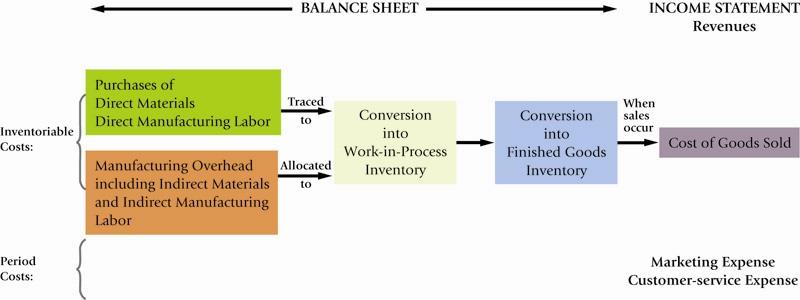
13 7-Steps Job Costing 1. Identify the job that is the chosen cost object. 2. Identify the direct costs of the job. 3. Select the cost-allocation base(s) to use for allocating indirect costs to the job. 4. Match indirect costs to their respective cost-allocation base(s). 5. Calculate an overhead allocation rate (OHR). Budgeted Manufacturing = Budgeted Manufacturing Overhead Costs Overhead Rate Budgeted Total Quantity of Cost-Allocation Base 6. Allocate overhead costs to the job: Budgeted Allocation Rate * Actual Base Activity For the Job 7. Compute total job costs by adding all direct and indirect costs together Job Costing Overview Flow of Costs Illustrated

14 Accounting for Overhead Actual costs will almost never be equal to budgeted costs. - If Overhead Control > Overhead Allocated, this is called Underallocated Overhead - If Overhead Control < Overhead Allocated, this is called Overallocated Overhead This difference will be eliminated in the end-of-period adjusting entry process, using one of three possible methods. The choice of method should be based on such issues as materiality, consistency, and industry practice. Three Methods for Adjusting Over/Underapplied Overhead Adjust allocation rate approach: all allocations are recalculated with the actual, exact allocation rate. Proration approach: the difference is allocated between cost of goods sold, work-in-process, and finished goods based on their relative sizes. Write-off approach: the difference is simply written off to costs of goods sold. Allocation of overhead Simple Methods (less accurate) Complex methods (more accurate) Broad Averaging Historically, firms produced a limited variety of goods while their indirect costs were relatively small. Allocating overhead costs was simple: use broad averages to allocate costs uniformly regardless of how they are actually incurred. Consequence: overcosting and undercosting

15 Over-/Undercosting and Cross-subsidization Overcosting: a product consumes a low level of resources but is allocated high costs per unit. Undercosting: a product consumes a high level of resources but is allocated a low cost per unit. The results of overcosting one product and undercosting another: - The overcosted product absorbs too much cost, making it seem less profitable than it really is - The undercosted product is left with too little cost, making it seem more profitable than it really is An example: Plastim Criticism of traditional allocation method Assumes all overhead is volume-related Organization-wide or departmental rates all related to single indirect-cost pool Departmental focus, not process focus Focus on cost incurred, not cause of costs Consequences: - Cost defined less accurately than possible - Biased and unfair cost allocation Activity-Based Costing (ABC) Purpose of ABC: Allocation of indirect costs based on causal activities Attempts to identify direct link between cost and cost object Results in better (i.e. more accurate) allocation Yet, ABC does not provide a true cost

16 Traditional vs ABC allocation method Traditional allocation method: Costs Products Activity-Based Costing: Costs Activities Products First stage Second stage Plastim and ABC Illustrated ABC Cost Hierarchy A cost hierarchy is a categorization of costs into different costs pools on the basis of the different types of cost drivers (cost-allocation bases) or different degrees of difficulty in determining cause-andeffect relationships Not all costs are volume related Cost-hierarchy: - Output unit-level - Batch-level - Product or Service-sustaining level - Facility-sustaining level Advantages of ABC/ABM Shifts focus from managing costs to managing activities Aids in recognizing, measuring and controlling complexity Promotes understanding of why costs are incurred Provides better (e.g. more accurate) cost allocation information

17 When is ABC most beneficial? Significant amounts of indirect costs are allocated using only one or two cost pools All or most costs are identified as output unit-level costs Products make diverse demands on resources because of differences in volume, process steps, batch size or complexity Products that a company is well suited to make and sell show small profits while products for which a company is less suited show large profits Complex products appear to be very profitable and simple products appear to be losing money Operations staff have significant disagreements with the accounting staff about the production costs and marketing products and services. ABC and accuracy: trade-offs Chapter 15: Allocating Costs of a Supporting Department to Operating Departments Supporting (service) department provides the services that assist other internal departments in the company Operating (production) department directly adds value to a product or service Direct Method Allocates support costs only to operating departments. Direct method does not allocate support-department costs to other support departments. Direct Allocation Method

18 Step-Down Method Also called the sequential allocation method Allocates support-department costs to other support departments and to operating departments in a sequential manner Partially recognized the mutual services provided among all support departments Step-Down Allocation Method Illustrated Reciprocal Method Allocates support-department costs to operating departments by fully recognizing the mutual services provided among all support departments. Reciprocal method fully incorporates interdepartmental relationships into the support-department cost allocation. Reciprocal Allocation Method (Linear Equations) Illustrated

19 Five-step decision-making process Roles of accounting information Decision-making role of accounting information: - Reduce ex-ante uncertainty - Improve judgment and decision-making Decision-control role of accounting information: - Motivate, evaluate and reward - Help to mitigate so-called agency problems (i.e. dysfunctional behavior) Interdependencies between the two roles - Information and incentives are inextricably linked Crucial accounting information attributes 1. Accuracy - Ability to reliably measure economic activities - Freedom from bias 2. Timelines 3. Relevance - different costs for different purposes Key features of relevant information Different alternatives can be compared by examining differences in expected total future revenues and future costs: - Key questions: What difference will it make? What are the opportunity costs? - Opportunity costs: benefits foregone by choosing the best alternative rather than the next best nonselected alternative. Sunk (historical) costs may be helpful as a basis for making predictions. However, past costs themselves are always irrelevant when making decisions. - Beware: Sunk costs can be relevant for decision-control! Pay attention to excess or surplus capacity Identify available from unavailable costs Due weight must be given to qualitative factors and quantitative non-financial factors


20 Two potential problems in relevant-cost analysis Watch out for incorrect general assumptions, like: - All variable costs are relevant - All fixed costs are irrelevant (it applies only within relevant range) Misleading unit-cost data - Fixed costs per unit at different output levels - Keep focusing on total revenues and total costs, Role of product costs in pricing Understanding how to analyze product costs in crucial for pricing decisions: - Even when prices are set by overall market supply and demand forces and the firm has little or no influence on product prices, management still has to decide the best mix of products to manufacture and sell. Economic pricing model Limitations of economic pricing model 1. Firm s demand and marginal revenue curves are difficult to determine with precision 2. The marginal cost, marginal revenue paradigm is not valid for all forms of market organization 3. Cost accounting systems are not designed to measure the marginal charges in cost incurred as production and sales increase by unit. To measure marginal cost would entail a very costly information system: Role of accounting product costs in pricing

21 Cost-plus pricing Price = cost + (markup percentage x cost) Cost base may vary: - Full cost - Variable cost Full cost pricing formula Advantages: - In the long run, the price must cover all costs and a normal profit margin (stability and cost recovery) - Full (or absorption) cost information is provided by a firm s cost-accounting system, because it is required for external financial reporting (simplicity) - Full cost pricing formulas provide a justifiable price that tends to be perceived as equitable by all parties (fairness) - Most firms use full cost for their cost-based pricing decisions Disadvantage: - Full costs formula pricing obscure the cost behavior pattern of the firm Variable cost pricing formula Advantages: - Variable-cost data do not obscure the cost behavior pattern by unitizing fixed costs and making them appear variable. - Variable cost-data do not require allocation of common fixed costs to individual product lines. Disadvantages: - Managers may perceive the variable cost of a product or service as the price floor. - Fixed costs may be overlooked in pricing decisions, resulting in prices that are too low to cover total costs. The markup rate Just as prices depend on demand conditions, markup increase with the strength of demand: - If more customers demand more of a product, then the firm is able to command a higher markup Markups also depend on the elasticity of demand: - Demand is said to be elastic if customers are very sensitive to the price, that is, if a small increase in the price results in a large decrease in the demand. - Markups are smaller when demand is more elastic. Markups also fluctuate with the intensity of competition - If competition is intense, it is more difficult for a firm to sustain a price much higher than its incremental cost. Target costing Target cost = Target price per unit Target profit per unit The target costing process is a system of profit planning and cost management that is price led, customer focused, design centered and cross-functional Target costing initiates cost management at the earliest stages of product development and applies it throughout the product life cycle by actively involving the entire value chain.

22 Target costing Target costing vs Standard costing Value engineering Value engineering is a systematic evaluation of all aspects of the value chain, with the goal of reducing costs while improving quality and satisfying customer need. Managers must distinguish: - Value-added costs: a cost that, if eliminated, would reduce the actual or perceived value or utility (usefulness) customers obtain from using the product or service. Non-value-added costs: a cost that, if eliminated, would not reduce the actual or perceived value or utility customers obtain from using the product or service. It is a cost the customer is unwilling to pay for. Cost incurrence arise when a resource is sacrificed or forgone to meet a specific objective. - Research and Development - Design - Manufacturing - Marketing - Distribution - Customer Support Locked-in-costs are those costs that have not yet been incurred but which, based on decision that have already been made, will be incurred in the future (design-in costs).
23 Cost incurrence and Locked-in costs Behavioral accounting Despite the quantitative nature of some aspects of decision making, not all mangers will choose the best alternative for the firm. Managers could engage in self-serving behavior such as delaying needed equipment maintenance in order to meet their personal profitability quotas for bonus consideration. Let s focus on behavioral implications of accounting information with regards to accuracy. Less accurate cost systems When and why to deliberately measure costs less accurately to improve decision making? Three forms of less accurate cost systems: 1. Cost biased upward 2. Cost biased downward 3. Cost defined less precisely than is possible Cost biased upward Why do some persons set their watch 5 minutes ahead? - Even though they know that their watch shows biased information, it helps them to overcome their propensity to be late Rational in cost accounting is overstate product costs: - Positive effects on pricing decisions in competitive situations, for instance protection against the tendency to shave profit margins.
24 Cost biased downward Rationale in cost accounting to understate produce costs: - Target costing: cost standards based on estimates of what an item should cost. In a target costing system unfavorable variances do not necessarily signify shirking or waste. - Other rationale: to stimulate the consumption of service Cost defined less precisely than possible Rationale: - To focus attention on areas critical for competitive advantage - To reduce the occurrence of dysfunctional behavior and effectively increase control. Example: Activity-Based-Costing (ABC) Costs of ABC implementation: 2 main sources: 1. The out-of-pocket costs associated with implementing the new system and make it function. 2. Agency costs, i.e. the costs inherently associated with using an agent (e.g. the risk that agents will use organizational resource for their own benefit) - from principal-agent theory Lecture 6 Basic Business Strategies Product differentiation: an organization s ability to offer products or services perceived by its customers to be superior and unique relative to the products or services of its competitors - Leads to brand loyalty and the willingness of customers to pay high prices Cost leadership: an organization s ability to achieve lower costs relative to competitors through productivity and efficiency improvements, elimination of waste, and tight cost control - Leads to lower selling prices The Balanced Scorecard The Balance Scorecard translates an organization s mission and strategy into a set of performance measures that provides the framework for implementing its strategy. It is called Balanced Scorecard because it balances the use of financial and nonfinancial performance measures to evaluate performance.

25 The Financial Perspective Evaluates the profitability of the strategy Uses the most objective measures in the scorecard The other three perspectives eventually feed back into this dimension The Customer Perspective Identifies targeted customer and market segments and measures the company s success in these segments. The Internal Business Perspective Focuses on internal operations that create value for customers that, in turn, furthers the financial perspective by increasing shareholder value Includes three sub-processes: 1. Innovation 2. Operations 3. Post-sales service The Learning and Growth Perspective Identifies the capabilities the organization must excel at to achieve superior internal processes that create value for customers and shareholders.

26 Strategy Map Features of a Good Balanced Scorecard Tells the story of a firms strategy, articulating a sequence of cause-and-effect relations the links among the various perspectives that describe how strategy will be implemented. Helps communicate the strategy to all members of the organization by translating the strategy into a coherent and linked set of understandable and measurable operational targets. Must motivate managers to take actions that eventually result in improvements in financial performance o Mainly applies to for-profit firms, but has applications to not-for-profit organizations as well Limits the number of measures, identifying only the most critical ones Highlights less-than-optimal trade-offs that managers may make when they fail to consider operational and financial measures together. Balanced Scorecard Implementation Pitfalls Managers should not assume the cause-and-effect linkages are precise: they are merely hypotheses. Managers should not seek improvements across all of the measures all of the time. Managers should not use only objective measures: subjective measures are important as well. Managers must include both cost and benefits of initiatives placed in the balanced scorecard: costs are often overlooked Managers should not ignore nonfinancial measures when evaluating employess. Managers should not use too many measures. The Management of Capacity Managers can reduce capacity-based fixed costs by measuring and managing unused capacity. Unused capacity is the amount of productive capacity available over and above the productive capacity employed to meet consumer demand in the current period. Analysis of Unused Capacity Engineered costs result from a cause-and-effect relationship between the cost driver and the resources used to produce that output. Discretionary costs have two part: o They arise from periodic (annual) decisions regarding the maximum amount to be incurred. o They have no measurable cause=and effect relationship between output and resources used.
27 Differences Between Engineered and Discretionary Costs Illustrated Customer Revenues and Customer Costs Customer-profitability analysis is the reporting and analysis of revenues earned from customers and costs incurred to earn those revenues. An analysis of customer differences in revenues and costs can provide insight into why differences exist in the operating income earned from different customers.

28 Firms should be prepared to ask and answer detailed questions about their customer and marketing strategies to understand customer profitability issues. Customer Revenues Price discounting is the reduction of selling prices to encourage increases in customer purchases. o Lower sales price is a trade-off for larger sales volumes. Discounts should be tracked by customers and salespersons. Customer Cost Analysis Customer cost hierarchy categorizes costs related to customers into different cost pools on the basis of different: Types of drivers Cost-allocation bases Degrees of difficulty in determining cause-and-effect or benefits-received relationship Customer Cost Hierarchy Example 1. Customer output unit-level costs 2. Customer batch-level costs 3. Customer-sustaining costs 4. Distribution-channel costs 5. Corporate-sustaining costs Other Factors in Evaluating Customer Profitability Likelihood of customer retention Potential for sales growth Long-run customer profitability Increases in overall demand from having well-known customers Ability to learn from customers
29 Customer Lifetime Value Customer Lifetime Value (CLV) CLV with Churn Churn rate (1-r): proportion of contractual customers or subscribers who leave a supplier during a given time period. In short: if we assume that the retention rate and CF is constant over time

30 Sales Variances Level 1: Static-budget variance the difference between an actual result and the static-budgeted amount. Level 2: Flexible-budget variance the difference between an actual result and the flexible-budgeted amount Level 2: Sales-volume variance Level 3: Sales-quantity variance Level 3: Sales-mix variance Sales-Mix Variance Measures shifts between selling more or less of higher or lower profitable product. Sales-Mix Variance = Actual Units of All Products Sold X Actual Sales-Mix Percentage Budgeted Sales-Mix Percentage X Budgeted Contribution Margin per Unit Sales-Quantity variance Measures shifts between selling more or less total products. Sales- Quantity Variance = Actual Units of All Products Sold Budgeted Units of all Products Sold X Budgeted Sales-Mix Percentage X Budgeted Contribution Margin per Unit

31 Sales Variances Summarized Lecture 7 Responsibility accounting: Various concepts and tools used to measure performance of divisions and personnel in order to foster goal congruence (or alignment) Transfer pricing Definition: a transfer price (TP) is the amount charged when one division of an organization sells goods or services to another division Why are transfer prices used? o Taxation: in international transaction TP policy has implications on tax liabilities and import duties E.g. multinational companies have incentives to set TP that increase(decrease) revenues in low(high) tax couuntries. o Do not use tax if not indicated in an assignment Why are TP used? - Allocation: on the basis of the TP autonomous divisions have to make the decision that is the best interest of the organization as a whole.
32 - Performance evaluation: the reported results of a division need to reflect the contribution of the contribution of the division to the results of the entire organization. The goal in setting TP is to provide incentives for each of the division managers to act in the company s best interest. A general TP formula to ensure goal congruence: TP with perfect and imperfect information With perfect information, opportunity costs are known With imperfect information: opportunity costs need to be estimated o Each division tries to maximize its own contribution margin. o This can lead to suboptimal decisions: the contribution margin of the organization as a whole might not be maximized. As proxy of opportunity costs, different TP systems can be adopted: o Market-based TP o Cost-based: variable- or full cost TP o Negotiated TP The choice of TP method does not merely reallocate total company profits among divisions, but it also affects the firm s total profits. Market-based transfer price External market-based TP: o If 1) the good produced externally is the same as the good produced internally, 2) selling divisions at capacity, and 3) market is perfectly competitive. Measurement of opportunity costs is complicated by lack of perfect information because: o There may be no external market (captive division). o The external market may not be perfectly competitive. o There may be technological or demand dependence among divisions. Cost-based transfer price Variable-cost based TP: o Appropriate in case of excess capacity, since the opportunity cost component in the TP formula is zero. Disadvantages: o Production department can not recover all costs o Variable cost might vary with output o Production department has incentives to classify fixed costs as variable costs.

33 Full-cost based TP: o As a plant begins to reach capacity, full-costs provide a closer approximation to opportunity costs. Disadvantages o Opportunity costs overstated o Production department can transfer inefficiencies to selling department Negotiated transfer price Because of opposite interests of buying and selling departments, the outcome can be an agreed TP. Final agreement of TP between external market price (ceiling) and variable costs (floor). o The final TP depends on the bargaining power of buying and selling divisions Thus, negotiations are time consuming and can lead to conflicts o If transfer pricing becomes sufficiently dysfunctional reorganization of the firm might be the next suitable option. Re-cap on transfer pricing The choice of TP method does not merely reallocate total company profits among divisions, but it also affects the firm s total profits. TP based on opportunity costs gives divisions incentives to take decisions that are in the best interest of the company as a whole. When excess capacity exists, the opportunity costs component in the TP formula is zero. Performance evaluation Drawback of using Net Income as performance measure: o No consideration of the investment used to achieve the net income Problem can be overcome by using ROI type measure: o ROI focuses on income and investment o Removes the bias of larger investment over smaller investment. ROI was developed in DuPont in the early 1900 s as the product of sales margin and capital turnover. Drawback of using ROI as a performance measure for an investment center: Problem can be solved by Residual Income.

34 Performance evaluation (continued) Residual Income (RI) corrects Net Income for the opportunity cost of capital: Residual Income = Net Income (Cost of capital x Investment) Drawback: larger divisions have larger RI than smaller divisions o However, it is possible to vary cost of capital according to the risk associated to different investment centers Economic Value Added (EVA) is a performance measure developed by the consulting form Stern Stewart & Co. EVA is a more sophisticated version of RI adjusted for accounting distortions. Primary distortion is related to R&D: o Under GAAP, R&D is expensed immediately o To compute EVA, R&D is capitalized and amortized over a number of future accounting periods. EVA: The logic behind it EVA: The formula
35 EVA: pro s and con s EVA introduces 4 powerful incentives (pro s) Growth, but only if investments can earn the cost of capital Redeploy capital from underperforming operations Capitalize expenses that have multi-period benefits Provides details of corporate performance Disadvantages (con s) Complicated computations Accounting adjustments are prone to gaming and manipulations Choice of performance measures Obtaining performance measures that are more sensitive to employee performance in critical for implementing strong incentives: o Sensitive measures means that: 1) measures change significantly with the manager s performance 2) do not change much with changes in factors that are beyond the manager s control Timeliness of performance measures depends largely on how critical the feedback is for the: o Success of the organization o Specific level of management involved o Sophistication of the organization
36 Choice of performance measures (continued) Other critical issues in performance evaluation: o How large should the incentive (variable) component be relative to salary? o Benchmarks and relative performance evaluation o Subjective versus formula-based performance appraisal o Managerial time orientation (i.e. myopia) o Measurement of intangibles (e.g. leadership) o Environmental and ethical responsibilities

37 Resource based 21 st century enterprise Identifying the right non-financial drivers


38 Non-financial Leading indicators Customer satisfaction (i.e. intangible) is not fully reflected in balance sheet financial accounting measures. From traditional performance measurement Heavy reliance on management intuition and unsophisticated guesses Fixation on the four buckets of the balanced scorecard Attempting to apply a seemingly endless set of measurement frameworks pushed by consultants Measurement of an ever-increasing list of Key Performance Indicators to avoid missing anything important. To Action-to-Value Framework Levers of control Levers of Control (devised by Robert Simons, Harvard): o Diagnostic Control Systems o Boundary Systems o Belief Systems o Interactive Control Systems Each lever is important and needs to be monitored Levers should be interdependent and collectively represent a living system of business conduct.

39 Diagnostic Control Systems Diagnostic Control Systems evaluate whether a firm is performing to expectations by monitorting and evaluating critical performance metrics, including: ROI, Residual Income, EVA Operational performance (e.g. quality) Intangibles (e.g. customer satisfaction) It must be balanced by the other levers of control in order to avoid or mitigate dysfunctional behavior, like: Budgetary slack Cooking the books (Fraud) Managerial myopia ( short-termism or tunnel vision ) Boundary Systems Boundary Systems describe standards of behavior and codes of conduct expected of all employees. Highlights actions that are off-limits A code of conduct describes appropriate and inappropriate individual behaviors Belief Systems Belief Systems articulate the mission, purpose, and core values of a company They describe the accepted norms and patterns of behavior expected of all managers and employees with respect to each other, shareholders, customers, and communities. Intrinsic Motivation: Desire to achieve self-satisfaction from good performance regardless of external rewards such as bonuses or promotion Interactive Control Systems Interactive Control Systems are formal information systems that mangers use to focus organizational attention and learning on key strategic issues. Tracks strategic uncertainties that businesses face Result is ongoing discussion and debate about assumptions and action plans New strategies emerge from dialogue and critical evaluation of opportunities and threats. The evolving role of management accounting
MGT402 - Cost & Management Accounting Glossary For Final Term Exam Preparation
 MGT402 - Cost & Management Accounting Glossary For Final Term Exam Preparation Glossary Absorption costing : Includes all manufacturing costs --- including direct materials, direct labor, and both variable
1) Cost objects include: A) customers B) departments C) products D) All of these answers are correct.
 Preliminary Test of Cost Accounting Knowledge--Does not affect your grade! Name Mark one letter for each question response. Note that in some cases there are options like ʺD) Both A and C are correct.ʺ
Mc Graw Hill Education
 Managerial Accounting for Managers F o u r t h Edition Eric W. Noreen, Ph.D., CMA Professor Emeritus University of Washington Peter C. Brewer, Ph.D. Wake Forest University Ray H. Garrison, D.B.A., CPA
The Changing Role of Managerial Accounting in a Dynamic Business Environment 2
 Cost Management Systems 23 Managerial Accounting as a Career 23 Professional Organizations 23 Professional Certification 24 Managerial Accounting and the Ethical Climate of Business 24 The Changing Role
The Demise of Cost and Profit Centers
 07-030 The Demise of Cost and Profit Centers Robert S. Kaplan Copyright 2006 by Robert S. Kaplan Working papers are in draft form. This working paper is distributed for purposes of comment and discussion
Management Accounting and Decision-Making
 Management Accounting 15 Management Accounting and Decision-Making Management accounting writers tend to present management accounting as a loosely connected set of decision making tools. Although the
ACC 121 PRINCIPLES OF MANAGERIAL ACCOUNTING
 PRINCIPLES OF MANAGERIAL ACCOUNTING COURSE DESCRIPTION: Prerequisites: ACC 120 Corequisites: None This course includes a greater emphasis on managerial and cost accounting skills. Emphasis is on managerial
House Published on www.jps-dir.com
 I. Cost - Volume - Profit (Break - Even) Analysis A. Definitions 1. Cost - Volume - Profit (CVP) Analysis: is a means of predicting the relationships among revenues, variable costs, and fixed costs at
Content Specification Outlines Certified Management Accountant (CMA) Examinations
 Effective January 1, 2015 Content Specification Outlines Certified Management Accountant (CMA) Examinations The content specification outlines presented below represent the body of knowledge that will
CE2451 Engineering Economics & Cost Analysis. Objectives of this course
 CE2451 Engineering Economics & Cost Analysis Dr. M. Selvakumar Associate Professor Department of Civil Engineering Sri Venkateswara College of Engineering Objectives of this course The main objective of
CIMA VISITING PROFESSOR LECTURE MANAGEMENT ACCOUNTING CHANGE: ORGANIZATIONAL CAUSES AND INDIVIDUAL EFFECTS
 CIMA VISITING PROFESSOR LECTURE MANAGEMENT ACCOUNTING CHANGE: ORGANIZATIONAL CAUSES AND INDIVIDUAL EFFECTS MICHAEL SHIELDS MICHIGAN STATE UNIVERSITY MAY 2007 THE ONLY CONSTANT IS CHANGE Organizations are
Management and Cast Accaunting
 COLIN DRURY Management and Cast Accaunting Second edition CHAPMAN AND HALL University and Professional Division LONDON. NEW YORK. TOKYO. MELBOURNE. MADRAS Contents Preface XVI Part I: Introduction to Management
Principles of Managerial Accounting ACC-102-TE. TECEP Test Description
 Principles of Managerial Accounting ACC-102-TE This TECEP tests the material usually taught in a one-semester course in managerial accounting. It focuses on the information that managers need to make decisions
Performance Management (F5) December 2014 to June 2015
 Performance Management (F5) December 2014 to June 2015 This syllabus and study guide is designed to help This syllabus and study guide is designed to help with planning study and to provide detailed information
The following are guidelines on the type of questions and their approximate weightings:
 Purpose Advanced Management Accounting [MA2] Examination Blueprint 2014-2015 The Advanced Management Accounting [MA2] examination has been constructed using an examination blueprint. The blueprint, also
Chapter 6 Cost-Volume-Profit Relationships
 Chapter 6 Cost-Volume-Profit Relationships Solutions to Questions 6-1 The contribution margin (CM) ratio is the ratio of the total contribution margin to total sales revenue. It can be used in a variety
Part II Management Accounting Decision-Making Tools
 Part II Management Accounting Decision-Making Tools Chapter 7 Chapter 8 Chapter 9 Cost-Volume-Profit Analysis Comprehensive Business Budgeting Incremental Analysis and Decision-making Costs Chapter 10
Please see current textbook prices at www.rcgc.bncollege.com
 BUS 106 MANAGERIAL ACCOUNTING SYLLABUS LECTURE HOURS/CREDITS: 3/3 CATALOG DESCRIPTION Prerequisite: BUS103 This course provides basic principles of managerial accounting as applied to the manufacturing
Break-Even Point and Cost-Volume-Profit Analysis
 9 Break-Even Point and Cost-Volume-Profit Analysis Objectives After completing this chapter, you should be able to answer the following questions: LO.1 LO.2 LO.3 LO.4 LO.5 LO.6 What is the break-even point
Financial Analysis, Modeling, and Forecasting Techniques
 Financial Analysis, Modeling, and Forecasting Techniques Course #5710A/QAS-5710A Course Material Financial Analysis, Modeling, and Forecasting Techniques (Course #5710A/QAS-5710A) Table of Contents PART
Chapter 4 Job Order Costing. Job Costing vs. Process Costing Procedure of Job Costing Actual vs. normal Costs
 Chapter 4 Job Order Costing Job Costing vs. Process Costing Procedure of Job Costing Actual vs. normal Costs 1 Building Block Concepts of Costing Systems The following five terms constitute the building
Introduction To Cost Accounting
 Page 1 Introduction To Cost Accounting 15.501/516 Accounting Spring 2004 Professor S. Roychowdhury Sloan School of Management Massachusetts Institute of Technology April 28, 2004 6 Outline Overview of
CENGAGE Learning" Australia Grazil«Japan Korea Mexico Singapore» Spain United Kingdom «United States
 COLIN DRURY COST AND MANAGEMENT ACCOUNTING AN INTRODUCTION EIGHTH EDITION visit the Website at drury-online.com CENGAGE Learning" Australia Grazil«Japan Korea Mexico Singapore» Spain United Kingdom «United
Chapter 5 Revenue & Cost Analysis
 Chapter 5 Revenue & Cost Analysis 1. General Cost data are subject to great misunderstanding than are value data. The main reason: although the various categories of costs have precise meaning to the accountant,
Module 6: Transfer pricing
 Page 1 of 18 Module 6: Transfer pricing Overview Module 6 focuses on decentralization and the impact of transfer pricing on decision making and costs within organizations. The self-test for the module
CHAPTER 17 DIVISIONAL PERFORMANCE EVALUATION
 CHAPTER 17 DIVISIONAL PERFORMANCE EVALUATION CHAPTER SUMMARY This chapter is the second of two chapters on performance evaluation. It focuses on the measurement of divisional performance. It begins by
CPA Mock Evaluation Management Accounting Module (Core 2) Page 1
 CPA Mock Evaluation Management Accounting Module (Core 2) Page 1 Overview The Core 1 and 2 examinations are a mix of objective format and case questions. The maximum length for an individual case will
Accounting Building Business Skills. Learning Objectives: Learning Objectives: Paul D. Kimmel. Chapter Fourteen: Cost-volume-profit Relationships
 Accounting Building Business Skills Paul D. Kimmel Chapter Fourteen: Cost-volume-profit Relationships PowerPoint presentation by Kate Wynn-Williams University of Otago, Dunedin 2003 John Wiley & Sons Australia,
11.3 BREAK-EVEN ANALYSIS. Fixed and Variable Costs
 385 356 PART FOUR Capital Budgeting a large number of NPV estimates that we summarize by calculating the average value and some measure of how spread out the different possibilities are. For example, it
Management Accounting Theory of Cost Behavior
 Management Accounting 63 Management Accounting Theory of Cost Behavior Management accounting contains a number of decision making tools that require the conversion of all operating costs and expenses into
Your Guide to Profit Guard
 Dear Profit Master, Congratulations for taking the next step in improving the profitability and efficiency of your company! Profit Guard will provide you with comparative statistical and graphical measurements
Management Accounting 2 nd Year Examination
 Management Accounting 2 nd Year Examination August 2012 Exam Paper, Solutions & Examiner s Report NOTES TO USERS ABOUT THESE SOLUTIONS The solutions in this document are published by Accounting Technicians
Performance Management (F5) September 2015 to June 2016
 Performance Management (F5) September 2015 to June 2016 This syllabus and study guide is designed to help with planning study and to provide detailed information on what could be assessed in any examination
Review of Production and Cost Concepts
 Sloan School of Management 15.010/15.011 Massachusetts Institute of Technology RECITATION NOTES #3 Review of Production and Cost Concepts Thursday - September 23, 2004 OUTLINE OF TODAY S RECITATION 1.
Management Accounting 2 nd Year Examination
 Management Accounting 2 nd Year Examination August 2010 Paper, Solutions & Examiner s Report NOTES TO USERS ABOUT THESE SOLUTIONS The solutions in this document are published by Accounting Technicians
RAPID REVIEW Chapter Content
 RAPID REVIEW BASIC ACCOUNTING EQUATION (Chapter 2) INVENTORY (Chapters 5 and 6) Basic Equation Assets Owner s Equity Expanded Owner s Owner s Assets Equation = Liabilities Capital Drawing Revenues Debit
Management Accounting 243 Pricing Decision Analysis
 Management Accounting 243 Pricing Decision Analysis The setting of a price for a product is one of the most important decisions and certainly one of the more complex. A change in price not only directly
CSUN GATEWAY. Managerial Accounting Study Guide
 CSUN GATEWAY Managerial Accounting Study Guide Table of Contents 1. Introduction to Managerial Accounting 2. Introduction to Cost Terms and Cost Concepts 3. Allocation of Manufacturing Overhead Costs 4.
Performance Review for Electricity Now
 Performance Review for Electricity Now For the period ending 03/31/2008 Provided By Mark Dashkewytch 780-963-5783 Report prepared for: Electricity Now Industry: 23821 - Electrical Contractors Revenue:
Building a financial perspective into an engineering program
 Building a financial perspective into an engineering program P.J.Gregory Department of Mechanical Engineering, Monash University, Clayton Campus, Victoria, Australia ([email protected]) Abstract
THE CORE & SPECIAL COMPETENCIES MODEL FOR MANAGERIAL ACCOUNTING 1C -- DE ANZA COLLEGE MALLORY MCWILLIAMS, SJSU KEN HARPER, DE ANZA COLLEGE
 BY MALLORY MCWILLIAMS, SJSU KEN HARPER, DE ANZA COLLEGE 2 THE CALIFORNIA CORE COMPETENCY MODEL WITH SPECIAL COMPETENCIES -- DE ANZA COLLEGE SOME SPECIFIC NOTES ABOUT OUR COMPETENCY MODEL The primary objective
KB 2 Business Management Accounting Suggested Answers and Marking Guide
 KB 2 Business Management Accounting Suggested Answers and 1 SECTION 1 Question 01 Relevant learning outcome/s: 1.1.1 Assess the key features of the absorption costing method and the ABC method. 1.1.2 Demonstrate
STUDENT NAME: STUDENT ID: UWDIR/Quest Id:
 MIDTERM EXAM AFM 102: Introduction to Managerial Accounting Sections 001, 002, 003 and 005 February 27, 2009: 4:30 6:00 PM Instructors: Robert Ducharme; Thomas Vance; Yutao Li STUDENT NAME: STUDENT ID:
STUDENT NAME: STUDENT ID:
 MIDTERM EXAM AFM 102: Introduction to Managerial Accounting Sections 001, 002, 003 and 004 February 29, 2008: 4:30 6:00 PM Instructors: Rob Ducharme; Thomas Vance STUDENT NAME: STUDENT ID: TUTORIAL: Room:
BREAK-EVEN ANALYSIS. In your business planning, have you asked questions like these?
 BREAK-EVEN ANALYSIS In your business planning, have you asked questions like these? How much do I have to sell to reach my profit goal? How will a change in my fixed costs affect net income? How much do
REVIEW FOR FINAL EXAM, ACCT-2302 (SAC)
 REVIEW FOR FINAL EXAM, ACCT-2302 (SAC) CHAPTER 13 1. Corporate Organization: a. Application for incorporation. b. State grants Charter or Articles of Incorporation. c. By-laws: rules and procedures of
The Customer Relationship Management Process
 The Customer Relationship Management Process E d u c a t i n g t h e W o r l d s B e s t A i r F o r c e Slide 1 The Supply Chain Management Processes Information Flow Supply Chain Management Processes
Cost-Volume-Profit Analysis
 CHAPTER 3 Overview Cost-Volume-Profit Analysis This chapter explains a planning tool called costvolume-profit (CVP) analysis. CVP analysis examines the behavior of total revenues, total costs, and operating
The term marginal cost refers to the additional costs incurred in providing a unit of
 Chapter 4 Solutions Question 4.1 A) Explain the following The term marginal cost refers to the additional costs incurred in providing a unit of product or service. The term contribution refers to the amount
2. Advantages and Disadvantages of Decentralization
 The Fuqua School of Business International Strategy: WBA 434 Duke University Professors Heath, Huddart, & Slotta 1. Overview An essential feature of decentralized firms is responsibility centers (e.g.,
Management Accounting 305 Return on Investment
 Management Accounting 305 Return on Investment Profit or net income without question is a primary goal of any business. Any business that fails to be profitable in the long run will not survive or will
Decision Making using Cost Concepts and CVP Analysis
 CHAPTER 2 Decision Making using Cost Concepts and CVP Analysis Basic Concepts Absorption Costing * Assigns direct costs and all or part of overhead to cost units using one or more overhead absorption rates.
Statement #4/Managerial Cost Accounting Concepts and Standards for the Federal Government
 Statement #4/Managerial Cost Accounting Concepts and Standards for the Federal Government Executive Office of the President Office of Management and Budget "Managerial Cost Accounting Concepts and Standards
Inventory Decision-Making
 Management Accounting 195 Inventory Decision-Making To be successful, most businesses other than service businesses are required to carry inventory. In these businesses, good management of inventory is
2 Theoretical background and literature review
 2 Theoretical background and literature review This sections presents, in a manner similar to a SWOT analysis, the theoretical background and literature review of the value chain analysis approach and
In this chapter, we build on the basic knowledge of how businesses
 03-Seidman.qxd 5/15/04 11:52 AM Page 41 3 An Introduction to Business Financial Statements In this chapter, we build on the basic knowledge of how businesses are financed by looking at how firms organize
Running Head: Management 1
 Running Head: Management 1 Topic : Management Accounting Techniques Paper Type : Coursework Word Count : 3000 Words Pages : 12 pages Referencing Style : APA Referencing Education Level: Bachelors Management
Teaching Special Decisions In A Lean Accounting Environment Daniel Haskin, University of Central Oklahoma, USA
 Teaching Special Decisions In A Lean Accounting Environment Daniel Haskin, University of Central Oklahoma, USA ABSTRACT Lean accounting has become increasingly important as more and more companies adopt
Accounting 610 2C Cost-Volume-Profit Relationships Page 1
 Accounting 610 2C Cost-Volume-Profit Relationships Page 1 I. OVERVIEW A. The managerial accountant uses analytical tools to advise line managers in decision making functions. C-V-P (CVP) analysis provides
Chapter 3 Unit 1. IET 35000 Engineering Economics. Learning Objectives Chapter 3. Learning Objectives Unit 1
 Chapter 3 Unit 1 The Accounting Equation Depreciation, Inventory and Ratios IET 35000 Engineering Economics Learning Objectives Chapter 3 Upon completion of this chapter you should understand: Accounting
Questions 1, 3 and 4 gained reasonable average marks, whereas Question 2 was poorly answered, especially parts (b),(c) and (f).
 General Comments This sitting produced a reasonable pass rate for a resit paper although there was a large variation in pass rates between centres. It was clear that well-prepared candidates did not have
Department of Accounting and Finance
 Department of Accounting and Finance Modules, other than Introductory modules may have pre-requisites or co-requisites (please, see module descriptions below) and a student must have undertaken and passed
UG802: COST MEASUREMENT AND COST ANALYSIS
 UG802: COST MEASUREMENT AND COST ANALYSIS April 6, 2014 Kanokporn Rienkhemaniyom, Ph.D. Managerial Accounting - Overview Definition: A profession that involves partnering in management decision making,
Classification of Manufacturing Costs and Expenses
 Management Accounting 51 Classification of Manufacturing Costs and Expenses Introduction Management accounting, as previously explained, consists primarily of planning, performance evaluation, and decision
INCORPORATION OF LEARNING CURVES IN BREAK-EVEN POINT ANALYSIS
 Delhi Business Review Vol. 2, No. 1, January - June, 2001 INCORPORATION OF LEARNING CURVES IN BREAK-EVEN POINT ANALYSIS Krishan Rana Suneel Maheshwari Ramchandra Akkihal T HIS study illustrates that a
P2 Performance Management November 2014 examination
 Management Level Paper P2 Performance Management November 2014 examination Examiner s Answers Note: Some of the answers that follow are fuller and more comprehensive than would be expected from a well-prepared
University of Waterloo Final Examination
 University of Waterloo Final Examination Term: Winter Year: 2006 Student Name UW Student ID Number Place an X by the section in which you are registered: 1 (MWF 8:30 am to 9:20 am) 2 (MWF 9:30 am to 10:20
Cost Concepts and Behavior
 Chapter 2 Cost Concepts and Behavior McGraw-Hill/Irwin Copyright 2011 by The McGraw-Hill Companies, Inc. All rights reserved. Learning Objectives L.O. 1 Explain the basic concept of cost. L.O. 2 Explain
C 5 - COST BEHAVIOR: ANALYSIS AND USE notes-c5.doc Written by Professor Gregory M. Burbage, MBA, CPA, CMA, CFM
 C 5 - COST BEHAVIOR: ANALYSIS AND USE notes-c5.doc CHAPTER LEARNING OBJECTIVES: MAJOR: - Use the High-Low method to determine and calculate the structure of a cost. - Define, explain and use variable,
HUMAN RESOURCE MANAGEMENT
 HUMAN RESOURCE MANAGEMENT 1. a) HRM Strategies b) Difference between Recruitment and Selection 2. a) Techniques of Performance Appraisal b) Methods of Executive Development 3. a) Methods of wage determination
COST CLASSIFICATION AND COST BEHAVIOR INTRODUCTION
 COST CLASSIFICATION AND COST BEHAVIOR INTRODUCTION LESSON# 1 Cost Accounting Cost Accounting is an expanded phase of financial accounting which provides management promptly with the cost of producing and/or
Introduction to Strategic Supply Chain Network Design Perspectives and Methodologies to Tackle the Most Challenging Supply Chain Network Dilemmas
 Introduction to Strategic Supply Chain Network Design Perspectives and Methodologies to Tackle the Most Challenging Supply Chain Network Dilemmas D E L I V E R I N G S U P P L Y C H A I N E X C E L L E
Paper P2 Management Accounting Decision Management
 May 2007 Examinations Managerial Level Paper P2 Management Accounting Decision Management Question Paper 2 Examiner s Brief Guide to the Paper 20 Examiner s Answers 21 The answers published here have been
COST ACCOUNTING : AN INTRODUCTION
 27 COST ACCOUNTING : AN INTRODUCTION After passing your senior secondary examination, if you set up a small manufacturing unit, say manufacturing of packing boxes, a problem will arise what price of each
Accounting 2910, Summer 2002 Practice Exam 4. 1. The cost of materials entering directly into the manufacturing process is classified as:
 Accounting 2910, Summer 2002 Practice Exam 4 1. The cost of materials entering directly into the manufacturing process is classified as: a. direct labor cost b. factory overhead cost c. burden cost d.
SU 8: Responsibility Accounting and Performance Measures 415. 8.5 Financial Measures
 SU 8: Responsibility Accounting and Performance Measures 415 8.5 Financial Measures 57. A firm earning a profit can increase its return on investment by A. Increasing sales revenue and operating expenses
Chapter 25 Cost-Volume-Profit Analysis Questions
 Chapter 25 Cost-Volume-Profit Analysis Questions 1. Cost-volume-profit analysis is used to accomplish the first step in the planning phase for a business, which involves predicting the volume of activity,
Accounting for Long-term Assets,
 1 Accounting for Long-term Assets, Long-term Debt and Leases TABLE OF CONTENTS Introduction 2 Long-term Assets 2 Acquiring or creating 2 Tangible assets 2 Intangible assets 3 Depreciating, amortizing and
C 6 - ACRONYMS notesc6.doc Instructor s Supplemental Information Written by Professor Gregory M. Burbage, MBA, CPA, CMA, CFM
 C 6 - ACRONYMS notesc6.doc Instructor s Supplemental Information ACRONYMS (ABBREVIATIONS) FOR USE WITH MANAGERIAL ACCOUNTING RELATING TO COST-VOLUME-PROFIT ANALYSIS. CM Contribution Margin in total dollars
elements of costs like material, labour and expenses can be classified into direct and indirect. They are mentioned below. i. Direct and Indirect
 3. Costing: [12] Importance and basic principles, a brief introduction to methods of costing and elements of cost. Marginal costing, nature, scope and importance, Break-even analysis, its use and limitations,
Unit Title: Managerial Accounting Unit Reference Number: D/502/4812 Guided Learning Hours: 160 Level: Level 5 Number of Credits: 18
 Unit Title: Managerial Accounting Unit Reference Number: D/502/4812 Guided Learning Hours: 160 Level: Level 5 Number of Credits: 18 Unit objective and aim(s): This unit aims to give learners a comprehensive
Evaluating and Improving Costing in Organizations
 Professional Accountants in Business Committee July 2009 International Good Practice Guidance Evaluating and Improving Costing in Organizations Page 1 of 29 The Professional Accountants in Business (PAIB)
Chapter 9: Inventories. Raw materials and consumables Finished goods Work in Progress Variants of valuation at historical cost other valuation rules
 Chapter 9: Inventories Raw materials and consumables Finished goods Work in Progress Variants of valuation at historical cost other valuation rules 1 Characteristics of Inventories belong to current assets
Paper P1 Performance Operations Post Exam Guide March 2011 Exam. General Comments
 General Comments Performance overall in March 2011 was comparable to the September 2010 diet. While the pass rate was acceptable, it could have been significantly improved if candidates had worked through
Module 1: Basic concepts of management accounting
 Module 1: Basic concepts of management accounting Required reading Chapter 1, pages 4-23 ERH, Section C3: "Code of ethical principles and rules of conduct" Reading 1-1: "Moral responsibility within the
CHAPTER 10 In-Class QUIZ
 CHAPTER 10 In-Class QUIZ 1. A mixed cost function has a constant component of $20,000. If the total cost is $60,000 and the independent variable has the value 200, what is the value of the slope coefficient?
Management Accounting (F2/FMA) September 2015 (for CBE exams from 23 September 2015) to August 2016
 Management Accounting (F2/FMA) September 2015 (for CBE exams from 23 September 2015) to August 2016 This syllabus and study guide are designed to help with teaching and learning and is intended to provide
Financial ratio analysis
 Financial ratio analysis A reading prepared by Pamela Peterson Drake O U T L I N E 1. Introduction 2. Liquidity ratios 3. Profitability ratios and activity ratios 4. Financial leverage ratios 5. Shareholder
Incremental Analysis and Decision-making Costs
 Management Accounting 161 Incremental Analysis and Decision-making Costs Nature of Incremental Analysis Decision-making is essentially a process of selecting the best alternative given the available information
The CPA Way 4 - Analyze Major Issues
 The CPA Way 4 - Analyze Major Issues This document focuses on Analyze Major Issue(s), the third part of The CPA Way, as shown in the following diagram. Analysis is usually the most time-consuming part
Financial Statements for Manufacturing Businesses
 Management Accounting 31 Financial Statements for Manufacturing Businesses Importance of Financial Statements Accounting plays a critical role in decision-making. Accounting provides the financial framework
Management Accounting 303 Segmental Profitability Analysis and Evaluation
 Management Accounting 303 Segmental Profitability Analysis and Evaluation Unless a business is a not-for-profit business, all businesses have as a primary goal the earning of profit. In the long run, sustained
Dr. Baldwin AC 314 Chapter 2
 Dr. Baldwin AC 314 Chapter 2 2-16 (15 min.) Computing and interpreting manufacturing unit costs. 1. (in millions) Supreme Deluxe Regular Total Direct material cost $ 84.00 $ 54.00 $ 62.00 $200.00 Direct
Breakeven Analysis Simple & Complex
 Professor Ken Homa Georgetown University Strategic Business Analytics SBA Toolkit Breakeven Analysis Simple & Complex Proprietary Material K.E. Homa Overview A method for calibrating the uncertainty associated