
How To Get A Job At A Job In A Farmhouse
|
|
|
- Magnus Snow
- 5 years ago
- Views:
Transcription
1 Manual of Policies and Procedures ADULT PROTECTIVE SERVICES PROGRAM STATE OF CALIFORNIA HEALTH AND HUMAN SERVICES AGENCY DEPARTMENT OF SOCIAL SERVICES Distributed Under the Library Distribution Act

2 This page is intentionally left blank.

3 This User's Manual is issued as an operational too. It contains the following: a) Regulations adopted by the California Department of Social Services (CDSS) for the governance of its agents, licensees, and/or beneficiaries; b) Regulations adopted by other State Departments affecting CDSS programs; c) Statutes from appropriate Codes which govern CDSS programs; d) Court decisions; and e) Operational standards by which CDSS staff will evaluate performance within CDSS programs. Regulations of CDSS are printed in gothic type as in this sentence. Handbook material, which includes reprinted statutory material, other department's regulations and examples, is separated from the regulations by double lines and phrases "HANDBOOK BEGINS HERE", "HANDBOOK CONTINUES", and "" in bold print. Please note that both other departments' regulations and statutes are mandatory, not optional. In addition, please note that revised language in this manual letter will be identified by a vertical line in the left margin. Questions relative to this Users' Manual should be directed to your usual program policy office. Page 1

4 This page is intentionally left blank.

5 TABLE OF CONTENTS DIVISION 33 ADULT PROTECTIVE SERVICES PROGRAM Chapter Chapter Chapter Chapter Chapter General Jurisdiction Adult Protective Services Activities Additional Program Components Case Records Page 2

6 This page is intentionally left blank.

7 GENERAL TABLE OF CONTENTS CHAPTER GENERAL Section General Requirements Goals Scope Eligibility Data Collection and Statistical Reporting Requirements Definitions Definitions - Forms MANUAL LETTER NO. APS Effective 1/23/02 Page 3

8 This page is intentionally left blank.

9 Regulations GENERAL CHAPTER GENERAL GENERAL REQUIREMENTS The requirements in this division are equally binding upon all agencies, public and private, engaged in the delivery of adult protective services programs, whether directly or by contract, subcontract, or other formal agreement, coming under the single supervisory purview of the California Department of Social Services, hereafter referred to as the Department..2 Pursuant to the provisions of Section of the Welfare and Institutions Code, the Department is designated as the single state agency bearing responsibility for supervising or administering directly, by delegation, or through contracts, adult protective services programs in the State of California..21 Section of the Welfare and Institutions Code states: It is hereby declared that provision for public social services in this code is a matter of statewide concern. The department is hereby designated as the single state agency with full power to supervise every phase of the administration of public social services, except health care services and medical assistance, for which grants-in-aid are received from the United States government or made by the state in order to secure full compliance with the applicable provisions of state and federal laws..3 The requirements specified in Division 33 shall be met by the county in the administration of adult protective services programs only to the extent that funds are provided in the annual Budget Act for the adult protective services program, as specified in Section of the Welfare and Institutions Code..31 Section of the Welfare and Institutions Code states: This chapter shall become operative on May 1, Commencing with the fiscal year, this chapter shall be implemented only to the extent funds are provided in the annual Budget Act..4 In administering these regulations, the adult protective services agency must comply with all civil rights laws, and the rules, and regulations of Division 21. This provision also applies to contractors and subcontractors performing any and all adult protective services function. NOTE: Authority cited: Sections and 10554, Welfare and Institutions Code and Senate Bill 2199 (Chapter 946, Statutes of 1998), Section 14 uncodified. Reference: Sections 10600, 15750, 15763, 15765, and 15766, Welfare and Institutions Code and Sections through , Government Code. Page 4

10 GENERAL Regulations GOALS The goal of the adult protective services program is to provide adult protective services to elders and dependent adults who are unable to protect their own interests or to care for themselves..2 The adult protective services program is to prevent and remedy the abuse, neglect, or exploitation of elders and dependent adults who have been harmed or are at risk of harm..3 Whenever possible, the adult protective services program shall seek to maintain the elder or dependent adult safely in his or her normal environment and by strengthening his or her capacity for self-maintenance..4 These goals may be accomplished through the direct provision of adult protective services or by linking the elder or dependent adult with appropriate community based resources. NOTE: Authority cited: Sections and 10554, Welfare and Institutions Code and Senate Bill 2199 (Chapter 946, Statutes of 1998), Section 14 uncodified. Reference: Sections 15600, , 15700, and 15750, Welfare and Institutions Code SCOPE The adult protective services program is intended to provide intervention activities directed toward safeguarding the well-being of elders and dependent adults suffering from or at risk of abuse or neglect, including self-neglect..2 The adult protective services program is not intended to be a long-term, on-going case management activity..3 The adult protective services program will offer appropriate adult protective services in accordance with client s individual needs and acceptance..4 Adult protective services shall be aimed at preventing or remedying elder or dependent adult abuse or neglect..5 Adult protective services shall promote self-sufficiency and reduce the need for further reliance on the adult protective services program. Page 5

11 Regulations GENERAL (Cont.) SCOPE (Continued) Adult protective services shall attempt to create a stable environment where the individual can safely function without requiring additional intervention from the adult protective services program. Adult protective services include:.61 Response to reports of known or suspected abuse or neglect..62 Investigations..63 Time-limited case management and arrangement for delivery of services..64 Emergency shelter/in-home protection..65 Tangible resources..66 Multidisciplinary personnel teams..7 The adult protective services program is not intended to interfere with the life style choices of elders or dependent adults, nor to protect those individuals from all the consequences of such choices..8 An elder or dependent adult who has been abused, as defined in Section (a)(3), may refuse or withdraw consent at any time to preventive and remedial services offered by an adult protective services agency..81 If the adult protective services worker believes the elder or dependent adult is incapacitated to the extent he/she is unable to give or deny consent to adult protective services, a petition for temporary conservatorship may be initiated in accordance with Sections 2250(a) and (b) of the Probate Code..811 Section 2250(a) of the Probate Code states in part: On or after the filing of a petition for appointment of a guardian or conservator, any person entitled to petition for appointment of the guardian or conservator may file a petition for appointment of: (1) A temporary guardian of the person or estate or both. (2) A temporary conservator of the person or estate or both. HANDBOOK CONTINUES Page 6

12 (Cont.) GENERAL Regulations SCOPE (Continued) HANDBOOK CONTINUES.812 Section 2250(b) of the Probate Code states: The petition shall state facts which establish good cause for appointment of the temporary guardian or temporary conservator. The court, upon such petition or other showing as it may require, may appoint a temporary guardian of the person or estate or both, or a temporary conservator of the person or estate or both, to serve pending the final determination of the court upon the petition for the appointment of the guardian or conservator..9 The physical or mental incapacity, or both, of an elder or dependent adult shall not in itself result in a determination by the adult protective services agency that adult protective services are necessary. NOTE: Authority cited: Sections and 10554, Welfare and Institutions Code and Senate Bill 2199 (Chapter 946, Statutes of 1998), Section 14 uncodified. Reference: Sections 2250(a) and (b), Probate Code; Sections 15600, , 15636, 15760, and 15763, Welfare and Institutions Code ELIGIBILITY Any elder or dependent adult, regardless of income, is eligible for adult protective services if they:.11 Reside in other than a long-term care facility, state hospital, or state developmental center;.12 Are alleged to have been abused and/or neglected; and.13 Have been determined by the adult protective services agency to be in need of services..2 Being an elder or dependent adult in and of itself does not result in a presumption of need for adult protective services..3 Adult protective services shall be provided as specified in Section of the Welfare and Institutions Code. Page 7

13 Regulations GENERAL ELIGIBILITY (Continued) Section of the Welfare and Institutions Code states: Adult protective services means those preventive and remedial activities performed on behalf of elders and dependent adults who are unable to protect their own interests, harmed or threatened with harm, caused physical or mental injury due to the action or inaction of another person or their own action as a result of ignorance, illiteracy, incompetence, mental limitation, substance abuse, or poor health, lacking in adequate food, shelter, or clothing, exploited of their income and resources, or deprived of entitlement due them. NOTE: Authority cited: Sections and 10554, Welfare and Institutions Code and Senate Bill 2199 (Chapter 946, Statutes of 1998), Section 14 uncodified. Reference: Sections 2250(a) and (b), Probate Code; Sections 15600, , 15636, 15760, and 15763, Welfare and Institutions Code DATA COLLECTION AND STATISTICAL REPORTING REQUIREMENTS.1 Each county shall maintain a system of recording and reporting adult protective services activity data for the purpose of meeting statistical, fiscal, and program reporting as required by the Department in regulation..2 Each adult protective services agency shall submit data as required by Sections 15658(b)(1) and (2) of the Welfare and Institutions Code..21 Sections 15658(b)(1) and (2) of the Welfare and Institutions Code state in part: (b)(1)...the information reported shall include, but shall not be limited to, the number of incidents of abuse, the number of persons abused, the type of abuse sustained, and the actions taken on the reports. For purposes of these reports, sexual abuse shall be reported separately from physical abuse. (2) The county s report to the department shall not include reports it receives from the longterm care ombudsman program pursuant to subdivision (c)..3 Each adult protective services agency shall submit the required statistical reports in accordance with instructions and time frames on the SOC 242 provided by the Department. NOTE: Authority cited: Sections and 10554, Welfare and Institutions Code and Senate Bill 2199 (Chapter 946, Statutes of 1998), Section 14 uncodified. Reference: Sections 10809, 15658, and 15750, Welfare and Institutions Code. MANUAL LETTER NO. APS Effective 1/23/02 Page 8

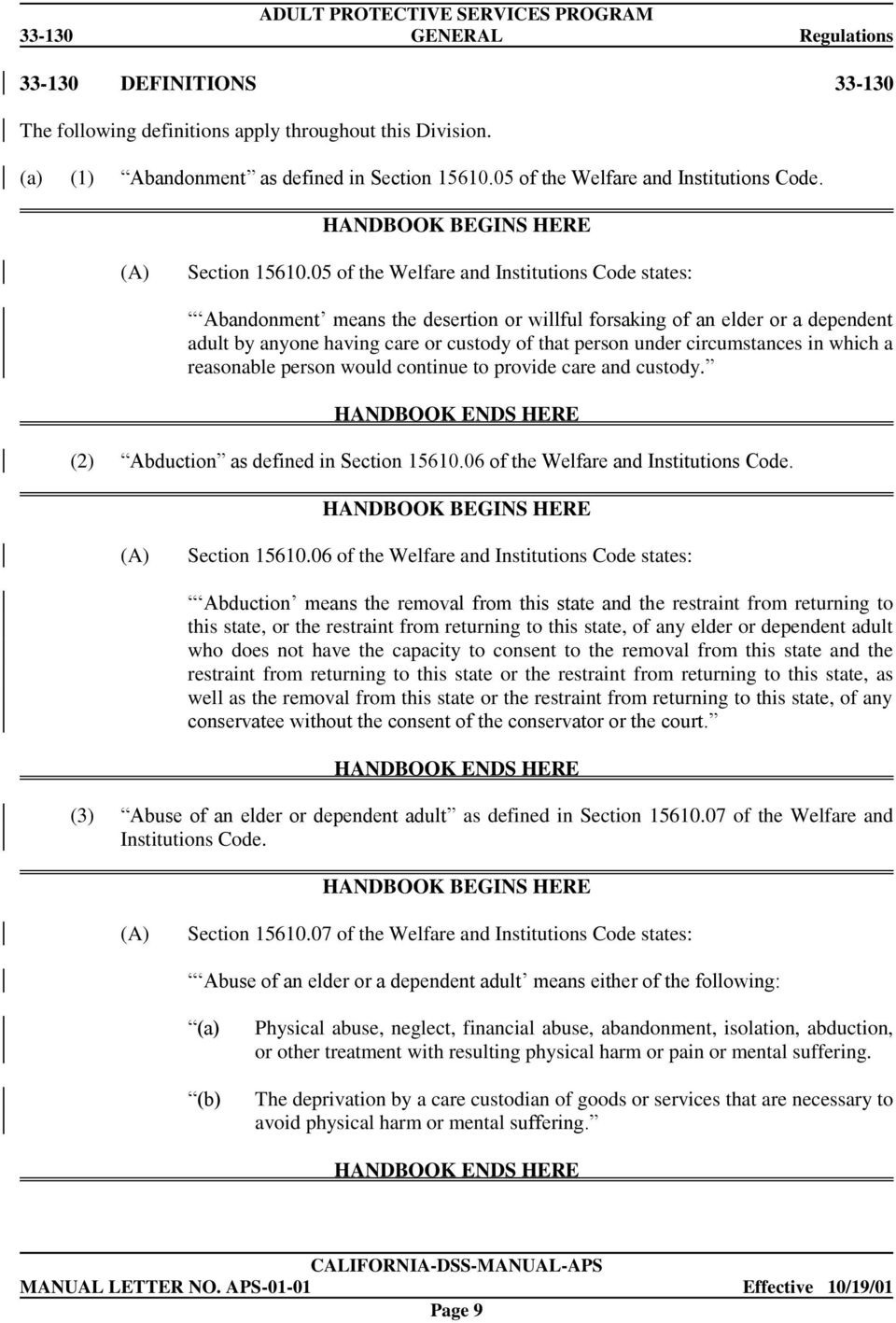
14 GENERAL Regulations DEFINITIONS The following definitions apply throughout this Division. (a) (1) Abandonment as defined in Section of the Welfare and Institutions Code. (A) Section of the Welfare and Institutions Code states: Abandonment means the desertion or willful forsaking of an elder or a dependent adult by anyone having care or custody of that person under circumstances in which a reasonable person would continue to provide care and custody. (2) Abduction as defined in Section of the Welfare and Institutions Code. (A) Section of the Welfare and Institutions Code states: Abduction means the removal from this state and the restraint from returning to this state, or the restraint from returning to this state, of any elder or dependent adult who does not have the capacity to consent to the removal from this state and the restraint from returning to this state or the restraint from returning to this state, as well as the removal from this state or the restraint from returning to this state, of any conservatee without the consent of the conservator or the court. (3) Abuse of an elder or dependent adult as defined in Section of the Welfare and Institutions Code. (A) Section of the Welfare and Institutions Code states: Abuse of an elder or a dependent adult means either of the following: (a) (b) Physical abuse, neglect, financial abuse, abandonment, isolation, abduction, or other treatment with resulting physical harm or pain or mental suffering. The deprivation by a care custodian of goods or services that are necessary to avoid physical harm or mental suffering. Page 9
15 Regulations GENERAL (Cont.) DEFINITIONS (Continued) (B) Neglect is defined in Section (n)(1). (4) Adult day health center as defined in Section (b) of the Health and Safety Code. (A) Section (b) of the Health and Safety Code states: Adult day health center or adult day health care center means a licensed and certified facility which provides adult day health care. (5) Adult protective services as defined in Section of the Welfare and Institutions Code. (A) Section of the Welfare and Institutions Code states: Notwithstanding Section 15753, adult protective services shall include investigations, needs assessments, remedial, and preventative social work activities, and the necessary tangible resources such as food, transportation, emergency shelter, and in-home protective care, the use of multidisciplinary teams, and a system in which reporting of abuse can occur on a 24-hour basis. (6) Adult protective services agency as defined in Section of the Welfare and Institutions Code. (A) Section of the Welfare and Institutions Code states: Adult protective services agency means a county welfare department, except persons who do not work directly with elders or dependent adults as part of their official duties, including members of support staff and maintenance staff. Page 10

16 (Cont.) GENERAL Regulations DEFINITIONS (Continued) (7) Adult protective services program, for the purpose of this division, means the adult protective services system as described in Section of the Welfare and Institutions Code. (A) Section of the Welfare and Institutions Code states: Each county welfare department shall establish and support a system of protective services to elderly and dependent adults who may be subjected to neglect, abuse, or exploitation or who are unable to protect their own interest. This system shall be known as the county adult protective services system. (8) Adult protective services worker means a county merit system civil service or county civil service employee who performs one or more of the following adult protective services functions: (A) (B) Investigating allegations of elder and dependent adult abuse; or, Performing case management activities, and the delivery of services, either directly or indirectly, relating to elder and dependent adult abuse cases. (9) Assessment means activity to gather and document information relevant to the client s situation and to appraise the client s services needs based upon that information. (b) Reserved (c) (1) Care custodian as defined in Section of the Welfare and Institutions Code. (A) Section of the Welfare and Institutions Code states: Care custodian means an administrator or an employee of any of the following public or private facilities or agencies, or persons providing care or services for elders or dependent adults, including members of the support staff and maintenance staff: HANDBOOK CONTINUES Page 11

17 Regulations GENERAL (Cont.) DEFINITIONS (Continued) HANDBOOK CONTINUES "(a) "(b) "(c) "(d) "(e) "(f) "(g) "(h) "(i) "(j) "(k) "(l) "(m) "(n) "(o) "(p) "(q) "(r) Twenty-four-hour health facilities, as defined in Sections 1250, , and of the Health and Safety Code. Clinics. Home health agencies. Agencies providing publicly funded in-home supportive services, nutrition services, or other home and community-based support services. Adult day health care centers and adult day care. Secondary schools that serve 18- to 22-year-old dependent adults and postsecondary educational institutions that serve dependent adults or elders. Independent living centers. Camps. Alzheimer s Disease day care resource centers. Community care facilities, as defined in Section 1502 of the Health and Safety Code, and residential care facilities for the elderly, as defined in Section of the Health and Safety Code. Respite care facilities. Foster homes. Vocational rehabilitation facilities and work activity centers. Designated area agencies on aging. Regional centers for persons with developmental disabilities. State Department of Social Services and State Department of Health Services licensing divisions. County welfare departments. Offices of patients rights advocates and clients rights advocates, including attorneys. HANDBOOK CONTINUES Page 12

18 (Cont.) GENERAL Regulations DEFINITIONS (Continued) HANDBOOK CONTINUES "(s) "(t) "(u) The office of the long-term care ombudsman. Offices of public conservators, public guardians, and court investigators. Any protection or advocacy agency or entity that is designated by the Governor to fulfill the requirements and assurances of the following: "(1) The federal Developmental Disability Assistance and Bill of Rights Act, as amended, contained in Chapter 75 (commencing with Section 6000) of Title 42 of the United States Code, for protection and advocacy of the rights of persons with developmental disabilities. "(2) The Protection and Advocacy for the Mentally Ill Individuals Act of 1986, as amended, contained in Chapter 114 (commencing with Section 10801) of Title 42 of the United States Code, for the protection and advocacy of the rights of persons with mental illnesses. "(v) Any other protective, public, sectarian, mental health, or private assistance or advocacy agency or person providing health services or social services to elders or dependent adults. (2) Case record means a record for each elder or dependent adult receiving adult protective services, and that contains all of the documentation and information required by the Division 33 regulations. (3) Client means an elder or dependent adult who has been determined to be in need of adult protective services, as specified in Section of the Welfare and Institutions Code. (4) Community care facility as defined in Sections 1502(a)(1), (2), and (7) of the Health and Safety Code means a facility licensed by the Department s Community Care Licensing Division including, but not limited to, an adult day care facility, social rehabilitation facility, or adult day support center as defined in Section of the Health and Safety Code, and adult residential facility as defined in Section 80001a.(7) of Division 6 of Title 22 of the California Code of Regulations. Page 13

19 Regulations GENERAL (Cont.) DEFINITIONS (Continued) (A) Sections 1502(a)(1), (2), and (7) of the Health and Safety Code state in part: "(a) Community care facility means any facility, place, or building that is maintained and operated to provide nonmedical residential care, day treatment, adult day care, or foster family agency services for children, adults, or children and adults, including, but not limited to, the physically handicapped, mentally impaired, incompetent persons, and abused or neglected children, and includes the following: "(1) Residential facility means any family home, group care facility, or similar facility determined by the director, for 24-hour nonmedical care of persons in need of personal services, supervision or assistance essential for sustaining the activities of daily living or for the protection of the individual. "(2) Adult day care facility means any facility that provides nonmedical care to persons 18 years of age or older in need of personal services, supervision, or assistance essential for sustaining the activities of daily living or for the protection of the individual on less than a 24- hour basis. "(7) Social rehabilitation facility means any residential facility that provides social rehabilitation services for no longer than 18 months in a group setting to adults recovering from mental illness who temporarily need assistance, guidance, or counseling. (B) Section of the Health and Safety Code states in part:...a community care facility pursuant to Section 1502 includes a adult day support center. A adult day support center means a community-based group program designed to meet the needs of functionally impaired adults through an individual plan of care in a structured comprehensive program that provides a variety of social and related support services in a protective setting on less than a 24-hour basis. (C) Section 80001a.(7) of Division 6 of Title 22 of the California Code of Regulations states: Adult Residential Facility means any facility of any capacity which provides 24- hour a day nonmedical care and supervision to adults except elderly persons. Page 14

20 (Cont.) GENERAL Regulations DEFINITIONS (Continued) (5) Criminal activity against an elder or dependent adult refers to crimes committed against elders and dependent adults as described in Section 368 of the Penal Code. (6) Crisis in an existing case means a change in the circumstances where the existing protective, supportive, or remedial measures will not protect the elder or dependent adult from risk of serious harm, and action by the adult protective services agency is necessary and appropriate to address the harm. (7) Cross report means to provide copies of an abuse report received by the adult protective services agency to law enforcement and other public agencies that are authorized to receive it. (A) Public agencies are described in Section (p)(2). Cross-reporting responsibilities are specified in Section (d) (1) Dependent adult as defined in Section of the Welfare and Institutions Code. (A) Section of the Welfare and Institutions Code states: (a) (b) Dependent adult means any person residing in this state, between the ages of 18 and 64 years, who has physical or mental limitations that restrict his or her ability to carry out normal activities or to protect his or her rights including, but not limited to, persons who have physical or developmental disabilities or whose physical or mental abilities have diminished because of age. Dependent adult includes any person between the ages of 18 and 64 who is admitted as an inpatient to a 24-hour health facility, as defined in Sections 1250, , and of the Health and Safety Code. (e) (1) Elder as defined in Section of the Welfare and Institutions Code. (A) Section of the Welfare and Institutions Code states: Elder means any person residing in this state, 65 years of age or older. Page 15

21 Regulations GENERAL (Cont.) DEFINITIONS (Continued) (f) (1) Financial abuse as defined in Section of the Welfare and Institutions Code. (A) Section of the Welfare and Institutions Code states: (a) Financial abuse of an elder or dependent adult occurs when a person or entity does any of the following: (1) Takes, secretes, appropriates, or retains real or personal property of an elder or dependent adult to a wrongful use or with intent to defraud, or both. (2) Assists in taking, secreting, appropriating, or retaining real or personal property of an elder or dependent adult to a wrongful use or with intent to defraud, or both. (b) A person or entity shall be deemed to have taken, secreted, appropriated, or retained property for a wrongful use if, among other things, the person or entity takes, secretes, appropriates or retains possession of property in bad faith. (1) A person or entity shall be deemed to have acted in bad faith if the person or entity knew or should have known that the elder or dependent adult had the right to have the property transferred or made readily available to the elder or dependent adult or to his or her representative. (2) For purposes of this section, a person or entity should have known of a right specified in paragraph (1) if, on the basis of the information received by the person or entity or the person or entity s authorized third party, or both, it is obvious to a reasonable person that the elder or dependent adult has a right specified in paragraph (1). (c) For purposes of this section, representative means a person or entity that is either of the following: (1) A conservator, trustee, or other representative of the estate of an elder or dependent adult. (2) An attorney-in-fact of an elder or dependent adult who acts within the authority of the power of attorney. (g) Reserved Page 16
22 (Cont.) GENERAL Regulations DEFINITIONS (Continued) (h) Reserved (i) (1) Immediate life threat means the elder or dependent adult is presently at risk of serious physical harm, injury, or death through either his/her own action(s) or inaction, or as a result of the actions or inaction of another person. (2) Imminent danger means a substantial probability that an elder or dependent adult is in imminent or immediate risk of death or serious physical harm, through either his/her own action(s) or inaction, or as a result of the actions or inaction of another person. (3) In-person means a face-to-face meeting between the adult protective services worker and the individual reported to be in need of, or who has been determined to be in need of adult protective services, as defined in Section of the Welfare and Institutions Code. (4) Investigation as defined in Section of the Welfare and Institutions Code. (A) Section of the Welfare and Institutions Code states: Investigation means that activity undertaken to determine the validity of a report of elder or dependent adult abuse. (5) Isolation as defined in Section of the Welfare and Institutions Code. (A) Section of the Welfare and Institutions Code states: (a) Isolation means any of the following: (1) Acts intentionally committed for the purpose of preventing, and that do serve to prevent, an elder or dependent adult from receiving his or her mail or telephone calls. HANDBOOK CONTINUES Page 17
23 Regulations GENERAL (Cont.) DEFINITIONS (Continued) HANDBOOK CONTINUES (2) Telling a caller or prospective visitor that an elder or dependent adult is not present, or does not wish to talk with the caller, or does not wish to meet with the visitor where the statement is false, is contrary to the express wishes of the elder or the dependent adult, whether he or she is competent or not, and is made for the purpose of preventing the elder or dependent adult from having contact with family, friends, or concerned persons. (3) False imprisonment, as defined in Section 236 of the Penal Code. (4) Physical restraint of an elder or dependent adult, for the purpose of preventing the elder or dependent adult from meeting with visitors. (b) (c) The acts set forth in subdivision (a) shall be subject to a rebuttable presumption that they do not constitute isolation if they are performed pursuant to the instructions of a physician and surgeon licensed to practice medicine in the state, who is caring for the elder or dependent adult at the time the instructions are given, and who gives the instructions as part of his or her medical care. The acts set forth in subdivision (a) shall not constitute isolation if they are performed in response to a reasonably perceived threat of danger to property or physical safety. (j) (k) Reserved Reserved (l) (1) Licensing agency means the public agency with the authority to perform licensing, monitoring, and complaint investigation duties. Such agencies include, but may not be limited to: (A) The licensing agency for community care facilities, residential care facilities for the chronically ill, and residential care facilities for the elderly means the California Department of Social Services, Community Care Licensing Division. 1. Residential care facility for the chronically ill means any place, building, or housing arrangement which is maintained and operated to provide care and supervision to all or any of the following: 1) Adults with HIV disease or AIDS; 2) emancipated minors with HIV disease or AIDS. Page 18
24 (Cont.) GENERAL Regulations DEFINITIONS (Continued) Residential care facility for the elderly means a housing arrangement chosen voluntarily by the resident, the resident s guardian, conservator, or other responsible person, where 75 percent of the residents are 60 years of age or older and where varying levels of care and supervision are provided. (B) (C) (D) (E) The licensing agency for health facilities, clinics, adult day health care facilities, referral agencies, home health agencies, and hospice programs means the California Department of Health Services, Licensing and Certification Division. The licensing agency for state developmental centers and state hospitals means the California Department of Health Services, Licensing and Certification Division. The licensing agency for alcoholism or drug abuse recovery or treatment facilities means the California Department of Alcohol and Drug programs. The licensing agency for psychiatric health facilities means the California Department of Mental Health. (2) Local law enforcement agency as defined in Section of the Welfare and Institutions Code. (A) This definition of local law enforcement agency has a more limited scope than what is generally recognized, and applies only for the purposes of the adult protective services program under this division. This definition does not include other investigative agencies. (B) Section of the Welfare and Institutions Code states: Local law enforcement agency means a city police or county sheriff s department, or a county probation department, except persons who do not work directly with elders or dependent adults as part of their official duties, including members of support staff and maintenance staff. (3) Long-term care facility as defined in Section of the Welfare and Institutions Code. Page 19
25 Regulations GENERAL (Cont.) DEFINITIONS (Continued) (A) Section of the Welfare and Institutions Code states: Long-term care facility means any of the following: (a) (b) (c) (d) (e) Any long-term health care facility, as defined in subdivision (a) of Section 1418 of the Health and Safety Code. Any community care facility, as defined in paragraphs (1) and (2) of subdivision (a) of Section 1502 of the Health and Safety Code, whether licensed or unlicensed. Any swing bed in an acute care facility, or any extended care facility. Any adult day health care facility as defined in subdivision (b) of Section of the Health and Safety Code. Any residential care facility for the elderly as defined in Section of the Health and Safety Code. (B) Section of the Health and Safety Code states in part: (k) Residential care facility for the elderly means a housing arrangement chosen voluntarily by persons 60 years of age or over, or their authorized representative, where varying levels and intensities of care and supervision, protective supervision, or personal care are provided, based upon their varying needs, as determined in order to be admitted and toremain in the facility. Persons under 60 years of age with compatible needs may be allowed to be admitted or retained in a residential care facility for the elderly as specified in Section (4) Long-term care ombudsman as defined in Section of the Welfare and Institutions Code. Page 20
26 (Cont.) GENERAL Regulations DEFINITIONS (Continued) (A) Section of the Welfare and Institutions Code states: Long-term care ombudsman means the State Long-Term Care Ombudsman, local ombudsman coordinators, and other persons currently certified as ombudsmen by the Department of Aging as described in Chapter 9 (commencing with Section 9700) of Division 8.5. (5) Long-term health care facility as defined in Section 1418(a) of the Health and Safety Code. (A) Section 1418(a) of the Health and Safety Code states in part: As used in this chapter: (a) Long-term health care facility means any facility licensed pursuant to Chapter 2 (commencing with Section 1250) that is any of the following: (1) Skilled nursing facility. (2) Intermediate care facility. (3) Intermediate care facility/developmentally disabled. (4) Intermediate care facility/developmentally disabled habilitative. (5) Intermediate care facility/developmentally disabled--nursing. (6) Congregate living health facility. (7) Nursing facility. Page 21
27 Regulations GENERAL (Cont.) DEFINITIONS (Continued) (m) (1) Mandated reporter as defined in Section 15630(a) of the Welfare and Institutions Code. (A) Section 15630(a) of the Welfare and Institutions Code states: Any person who has assumed full or intermittent responsibility for care or custody of an elder or dependent adult, whether or not that person receives compensation, including administrators, supervisors, and any licensed staff of a public or private facility that provides care or services for elder or dependent adults, or any elder or dependent adult care custodian, health practitioner, or employee of a county adult protective services agency or a local law enforcement agency is a mandated reporter. (2) Mental suffering as defined in Section of the Welfare and Institutions Code. (A) Section of the Welfare and Institutions Code states: Mental suffering means fear, agitation, confusion, severe depression, or other forms of serious emotional distress that is brought about by forms of intimidating behavior, threats, harassment, or by deceptive acts performed or false or misleading statements made with malicious intent to agitate, confuse, frighten, or cause severe depression or serious emotional distress of the elder or dependent adult. (3) Multidisciplinary personnel team as defined in Section of the Welfare and Institutions Code. (A) Section of the Welfare and Institutions Code states: (a) Multidisciplinary personnel team means any team of two or more persons who are trained in the prevention, identification, and treatment of abuse of elderly or dependent persons and who are qualified to provide a broad range of services related to abuse of elderly or dependent persons, as defined in Section HANDBOOK CONTINUES Page 22
28 (Cont.) GENERAL Regulations DEFINITIONS (Continued) HANDBOOK CONTINUES (b) A multidisciplinary personnel team may include, but is not limited to, all of the following: (1) Psychiatrists, psychologists, or other trained counseling personnel. (2) Police officers or other law enforcement agents. (3) Medical personnel with sufficient training to provide health services. (4) Social workers with experience or training in prevention of abuse of elderly or dependent persons. (5) Public guardians. (n) (1) Neglect as defined in Section of the Welfare and Institutions Code. (A) Section of the Welfare and Institutions Code states: (a) Neglect means either of the following: (1) The negligent failure of any person having the care or custody of an elder or dependent adult to exercise that degree of care that a reasonable person in a like position would exercise. (2) The negligent failure of the person themselves to exercise that degree of care that a reasonable person in a like situation would exercise. HANDBOOK CONTINUES Page 23
29 Regulations GENERAL (Cont.) DEFINITIONS (Continued) HANDBOOK CONTINUES (b) Neglect includes, but is not limited to, all of the following: (1) Failure to assist in personal hygiene, or in the provision of food, clothing, or shelter. (2) Failure to provide medical care for physical and mental health needs. No person shall be deemed neglected or abused for the sole reason that he or she voluntarily relies on treatment by spiritual means through prayer alone in lieu of medical treatment. (3) Failure to protect from health and safety hazards. (4) Failure to prevent malnutrition or dehydration. (5) Failure of a person to provide the needs specified in paragraphs (1) to (4), inclusive, for themselves due to ignorance, illiteracy, incompetence, mental limitation, substance abuse, or poor health. (o) Reserved (p) (1) Physical abuse as defined in Section of the Welfare and Institutions Code. (A) Section of the Welfare and Institutions Code states: Physical abuse means any of the following: (a) (b) (c) (d) Assault, as defined in Section 240 of the Penal Code. Battery, as defined in Section 242 of the Penal Code. Assault with a deadly weapon or force likely to produce great bodily injury, as defined by Section 245 of the Penal Code. Unreasonable physical constraint, or prolonged or continual deprivation of food or water. HANDBOOK CONTINUES Page 24
30 (Cont.) GENERAL Regulations DEFINITIONS (Continued) HANDBOOK CONTINUES (e) Sexual assault, that means any of the following: (1) Sexual battery, as defined in Section of the Penal Code. (2) Rape, as defined in Section 261 of the Penal Code. (3) Rape in concert, as defined in Section of the Penal Code. (4) Spousal rape, as defined in Section 262 of the Penal Code. (5) Incest, as defined in Section 285 of the Penal Code. (6) Sodomy, as defined in Section 286 of the Penal Code. (7) Oral copulation, as defined in Section 288a of the Penal Code. (8) Sexual penetration, as defined in Section 289 of the Penal Code. (f) Use of a physical or chemical restraint or psychotropic medication under any of the following conditions: (1) For punishment. (2) For a period beyond that for which the medication was ordered pursuant to the instructions of a physician and surgeon licensed in the State of California, who is providing medical care to the elder or dependent adult at the time the instructions are given. (3) For any purpose not authorized by the physician and surgeon. (2) Public agency means the agency with the statutory authority to investigate known or suspected abuse of an elder or dependent adult. (A) This definition of public agency has a more limited scope than what is generally recognized as a public agency, and applies only for the purposes of the adult protective services program under this division. Page 25
31 Regulations GENERAL (Cont.) DEFINITIONS (Continued) Examples of public agencies may include, but are not limited to: adult protective services agencies; Office of the Long-Term Care Ombudsman; California Department of Mental Health; California Department of Developmental Services; California Department of Justice, Bureau of Medi-Cal Fraud and Elder Abuse; California Department of Consumer Affairs, Division of Investigation; licensing agencies; and professional licensing agencies. Professional licensing agency includes the various agencies, boards, bureaus, commissions, committees, departments, divisions, examining committees, or programs of the California Department of Consumer Affairs with the authority to issue a license, certificate, registration, or other means to engage in a business or profession regulated by the California Business and Professions Code. Examples include the Board of Dental Examiners, Board of Registered Nursing, Board of Behavioral Sciences, Medical Board of California, etc. (q) Reserved (r) (1) Reasonable suspicion as defined in Section of the Welfare and Institutions Code. (A) Section of the Welfare and Institutions Code states: Reasonable suspicion means an objectively reasonable suspicion that a person would entertain, based upon facts that could cause a reasonable person in a like position, drawing when appropriate upon his or her training and experience, to suspect abuse. (2) Reassessment means the activity to gather and document information relevant to the client s current circumstances, review past assessments, and re-examine the service needs of the client and his/her family. The reassessment document is used to evaluate the effectiveness of the service plan and to review the progress that has been made toward achieving the objectives identified in the service plan. Page 26
32 (Cont.) GENERAL Regulations DEFINITIONS (Continued) (3) Refer means to direct a caller to law enforcement or another agency with the express authority to investigate the known or suspected abuse or neglect of an elder or dependent adult. (4) Report of known or suspected abuse or neglect means either a verbal or written account of the incident of suspected elder/dependent adult abuse. (s) (1) State developmental center means a health facility for the care and treatment of persons with developmental disabilities, under the administration of the California Department of Developmental Services. (2) State hospital means a health facility for the care, treatment, and education of persons with mental illness, under the administration of the California Department of Mental Health. (t) (u) (v) (w) (x) (y) (z) Reserved Reserved Reserved Reserved Reserved Reserved Reserved NOTE: Authority cited: Sections and 10554, Welfare and Institutions Code and Senate Bill 2199 (Chapter 946, Statutes of 1998), Section 14 uncodified. Reference: Sections , , , , , , , , , , , , , , , , , , 15630(a), 15750, 15760, and 15766, Welfare and Institutions Code; Sections 1204, 1250, 1400, 1418, 1502, 1502(a)(1), (2), and (7), , , , (b), 1575, 1726, 1747, 1760, and , Health and Safety Code; and Section 368, Penal Code. Page 27
33 Regulations GENERAL DEFINITIONS FORMS The following forms are incorporated by reference: (a) through (r) (Reserved) (s) (1) SOC 242 (Rev. 1/01) Adult Protective Services and County Services Block Grant Monthly Statistical Report (2) SOC 341 (Rev. 6/00) Report of Suspected Dependent Adult/Elder Abuse (3) SOC 343 (Rev. 6/01) Investigation of Suspected Dependent Adult/Elder Abuse (t) through (z) (Reserved) NOTE: Authority Cited: Sections and 10554, Welfare and Institutions Code. Reference: Section 15658, Welfare and Institutions Code. MANUAL LETTER NO. APS Effective 1/23/02 Page 27.1
34 This page is intentionally left blank.
35 ADULT PROTECTIVE SERVIES PROGRAM JURISDICTION TABLE OF CONTENTS CHAPTER JURISDICTION Section Adult Protective Services Program Jurisdiction Page 28
36 This page is intentionally left blank.
37 Regulations JURISDICTION (Cont.) CHAPTER JURISDICTION ADULT PROTECTIVE SERVICES PROGRAM JURSIDICTION An adult protective services agency shall investigate all reports of known or suspected abuse or neglect of an elder or dependent adult residing in their county, except those that occur in or under the supervision of a long-term care facility, a state hospital, state developmental center, or other county or state..11 This section shall not prohibit an adult protective services agency from initiating or participating in an abuse investigation when:.111 The elder or dependent adult is away from the facility and facility personnel were not responsible for direct care and supervision when the alleged abuse occurred, or (a) Example: Abuse occurred when the client was away from the facility during an approved absence, and family members provided care and supervision..112 The alleged perpetrator is not affiliated with the facility, or.113 At the time the initial report of known or suspected abuse or neglect is received, it is unknown if the abuse occurred in a long-term care facility, state hospital, or state developmental center. (a) When an adult protective services agency determines the abuse or neglect occurred in a long-term care facility, state hospital, or state developmental center, the agency shall refer the report of known or suspected abuse or neglect as specified in Section When jurisdiction to investigate reports of known or suspected abuse or neglect is shared with another public agency, county, or state, the adult protective services agencies shall investigate the specific allegations contained in the report that are within the adult protective services agency s jurisdiction, and cross report, as specified in Section , all other issues to the appropriate agency..21 Example: Client resides in County A and abuse occurred in County B, or scope of the investigation encompasses County B..22 Example: During the course of an investigation, the adult protective services agency determines another agency also has authority to investigate certain allegations. Errata Page 29
38 (Cont.) JURISDICTION Regulations ADULT PROTECTIVE SERVICES PROGRAM JURSIDICTION (Continued) When an adult protective services agency has reasonable cause to believe a service provider or facility does not possess a required license, the agency shall report the suspected unlicensed provider or facility to the appropriate licensing agency for investigation..31 An adult protective services agency shall investigate reports of known or suspected abuse or neglect that occur in unlicensed facilities, except all reports related to unlicensed community care facilities shall be referred to the long-term care ombudsman as specified in Section An adult protective services agency shall refer, as specified below, all reports of known or suspected abuse or neglect which it does not have jurisdiction to investigate..41 Reports of known or suspected abuse or neglect of an elder or dependent adult that occur in:.411 A long-term care facility or under the supervision of the facility s personnel shall be referred to the long-term care ombudsman..412 A state hospital or under the supervision of state hospital personnel shall be referred to the California Department of Mental Health..413 A state developmental center or under the supervision of state developmental center personnel shall be referred to the California Department of Developmental Services..414 Another county or state shall be referred to that county s or state s adult protective services authority..42 Persons making in-person or telephone reports of known or suspected abuse or neglect shall be referred directly to the appropriate agency..421 If the adult protective services agency believes that the reporting party will not follow through with the referral, the agency may accept a report of the incident and as soon as possible refer it via facsimile, or communicate the content of the report by telephone, to the appropriate agency..43 Written reports of known or suspected abuse or neglect shall be transmitted as soon as possible via facsimile, or the content of the report shall be communicated by telephone, to the appropriate agency..431 The original written report shall be sent to the appropriate agency within two working days of transmission of the telephone or facsimile report..44 When applicable, the report of known or suspected abuse or neglect shall be transmitted as soon as possible via facsimile, or the content of the report shall be communicated by telephone, to the appropriate licensing agency. Page 30
39 Regulations JURISDICTION ADULT PROTECTIVE SERVICES PROGRAM JURSIDICTION (Continued) A copy of the original written report of known or suspected abuse or neglect shall be sent to the appropriate licensing agency within two working days of the telephone or facsimile report. NOTE: Authority cited: Sections and 10554, Welfare and Institutions Code and Senate Bill 2199 (Chapter 946, Statutes of 1998), Section 14 uncodified. Reference: Sections 15600(i), 15630(b)(1)(A), (B), and (C), 15630(c)(2), (3), (4), and (5), 15640(a)(1) and (2), 15640(b), (c), and (e), 15650(a), (b), and (c), and 15763(b), Welfare and Institutions Code. Page 31
40 This page is intentionally left blank.
41 ADULT PROTECTIVE SERVIES PROGRAM ADULT PROTECTIVE SERVICES ACTIVITIES TABLE OF CONTENTS CHAPTER ADULT PROTECTIVE SERVICES ACTIVITIES Section 24-Hour System Initial Evaluation Response to Reports Cross Reporting Case Management Services Assessment Service Plan Service Plan Monitoring Reassessment Case Closure Page 32
42 This page is intentionally left blank.
43 Regulations ADULT PROTECTIVE SERVICES ACTIVITIES CHAPTER ADULT PROTECTIVE SERVICES ACTIVITIES HOUR SYSTEM Each adult protective services agency shall provide free public telephone access to a 24-hour hotline system to receive reports of known or suspected abuse or neglect of elders or dependent adults. The service may be provided by either a toll-free number or by accepting collect calls..11 Public access to the 24-hour hotline shall include access for the deaf and hearing impaired via a Telecommunications Device for the Deaf (TDD/TTY)..12 County adult protective services agencies may establish their 24-hour hotline system in cooperation with neighboring counties. Cooperating counties must enter into a written agreement that at a minimum provides for compliance with applicable federal and state laws, and identifies each county s financial responsibilities..2 A county adult protective services agency may utilize private or non-profit telephone answering services to process adult protective services calls after normal working hours. In utilizing telephone answering services either:.21 The answering service staff must immediately transfer all adult protective services related calls to an adult protective services worker except those clearly seeking only routine information; or.22 Specially trained answering service staff may take reports of known or suspected abuse or neglect of an elder or dependent adult, that occurred prior to the date of the call, if the elder or dependent adult is not currently at risk. Specially trained answering service staff must have the following qualifications:.221 Education and/or experience in providing mental health and/or crisis intervention. Each county shall establish minimum education and experience standards for this requirement, and.222 Training on the adult protective services program. This training must be received within three months of employment..3 At the start of each business day, answering service staff shall transmit by facsimile or electronically transfer to the adult protective services agency a written report of all adult protective services activity occurring since the previous business day. The adult protective services agency shall then follow up on all reports of past known or suspected abuse or neglect that were not directly referred to the adult protective services social worker pursuant to Section NOTE: Authority cited: Sections and 10554, Welfare and Institutions Code and Senate Bill 2199 (Chapter 946, Statutes of 1998), Section 14 uncodified. Reference: Sections 15658(a)(1), 15763(a), and 15766, Welfare and Institutions Code and 28 CFR and.162. Page 33
44 ADULT PROTECTIVE SERVICES ACTIVITIES Regulations INITIAL EVALUATION Upon receiving a report of known or suspected abuse or neglect of an elder or dependent adult, each county adult protective services worker shall determine:.11 If the incident meets the definition of abuse or neglect of an elder or dependent adult; and.12 If the county adult protective services agency has jurisdiction to investigate the incident. NOTE: Authority cited: Sections and 10554, Welfare and Institutions Code and Senate Bill 2199 (Chapter 946, Statutes of 1998), Section 14 uncodified. Reference: Sections , , and 15650(a), (b), and (d), Welfare and Institutions Code RESPONSE TO REPORTS When a report of known or suspected abuse or neglect of an elder or dependent adult is determined to be within the jurisdiction of the adult protective services agency, documentation of an allegation of abuse or neglect shall be made on the SOC 341 provided by the Department. The adult protective services worker shall:.11 If there is a report of an immediate life threat, imminent danger, or a crisis in an existing case, attempt to immediately make in-person contact with the elder or dependent adult for purposes of intake or intervention..111 Provide an immediate in-person response when the local law enforcement agency requests it..12 Respond to all other reports of danger of abuse or neglect as soon as necessary to protect the elder or dependent adult, but in no case shall the response be more than 10 calendar days from the initial report..13 Investigate all incidents of known or suspected abuse or neglect of an elder or dependent adult when a violation of the Penal Code has been alleged..2 An in-person response is not required under the following circumstances:.21 The adult protective services worker has made repeated attempts to locate the elder or dependent adult or their family, but has been unsuccessful..22 The elder or dependent adult has moved out-of-state or out-of-county. The adult protective services worker must report the alleged abuse or neglect to the appropriate county or out-ofstate adult protective services agency..23 The elder or dependent adult is deceased and there is no indication that another elder or dependent adult is at risk. MANUAL LETTER NO. APS Effective 1/23/02 Page 34
45 Regulations ADULT PROTECTIVE SERVICES ACTIVITIES (Cont.) RESPONSE TO REPORTS (Continued) The report of known or suspected abuse or neglect is of a past occurrence without new allegations of abuse or neglect and there are no present risks to the elder or dependent adult. The adult protective services worker may confirm that there are no present risks to the elder or dependent adult through contacts with other agencies..25 Pursuant to Sections 15763(b)(2), (3), and (5) of the Welfare and Institutions Code..251 Section of the Welfare and Institutions Code states in part: (b)(2) An immediate or 10-day in-person response is not required when the county, based upon an evaluation of risk determines, and documents, that the elder or dependent adult is not in imminent danger and that an immediate or 10-day in-person response is not necessary to protect the health or safety of the elder or dependent adult. (3) Until criteria and standards are developed to implement paragraph (2), the county's evaluation pursuant to paragraph (2) shall include and document all of the following: (A) The factors that led to the county's decision that an in-person response was not required. (B) The level of risk to the elder or dependent adult, including collateral contacts. (C) A review of previous referrals and other relevant information as indicated. (D) The need for intervention at the time. (E) The need for protective services. (5) Paragraphs (2) and (3) shall become inoperative on January 1, Section inclusive shall be inoperative on January 1, 2001 pursuant to Chapter 670, Statutes of 1999 (Senate Bill 1003, Vasconcellos)..3 When the adult protective services worker does not provide an in-person response in accordance with Section , the following information shall be documented in the case record..31 The adult protective services worker shall document in the case record all facts justifying not making an in-person response..32 The adult protective services supervisor must document in the case file approval of not making an in-person response..4 In investigating a report of alleged abuse or neglect, the adult protective services worker shall: Page 35
46 (Cont.) ADULT PROTECTIVE SERVICES ACTIVITIES Regulations RESPONSE TO REPORTS (Continued) Attempt to obtain the consent of the elder or dependent adult to enter their residence to meet privately without the presence of the person s caretaker, attendant, or family or household members..42 If the elder or dependent adult does not give consent for a private meeting at his/her residence, the adult protective services worker shall:.421 Make attempts to meet with the elder or dependent adult privately at some other convenient place, or.422 Make attempts to meet with the elder or dependent adult in the presence of a person of the elder s or dependent adult s choice..5 The adult protective services worker shall request the assistance of law enforcement in attempting to enter the elder s or dependent adult s residence if:.51 The adult protective services worker has been denied access to the elder s or dependent adult s residence by someone other than the elder or dependent adult, and.52 If the adult protective services worker has reason to believe the elder or dependent adult is subject to abuse or neglect. NOTE: Authority cited: Sections and 10554, Welfare and Institutions Code and Senate Bill 2199 (Chapter 946, Statutes of 1998), Section 14 uncodified. Reference: Sections 15636(a), 15650, 15750, 15755, 15762, and 15763, Welfare and Institutions Code. Page 36
47 Regulations ADULT PROTECTIVE SERVICES ACTIVITIES CROSS REPORTING Each adult protective services agency shall report by telephone or facsimile as soon as possible every known or suspected instance of abuse or neglect of an elder or dependent adult to:.11 The law enforcement agency having jurisdiction over the case if it is suspected that any incident of criminal activity has occurred..12 Any public agency given responsibility for investigation pursuant to Section An adult protective services agency shall report by telephone or facsimile known or suspected abuse or neglect of elders or dependent adults to the appropriate professional licensing agency when the adult protective services agency has determined, based on its investigation, that the alleged abuser is or contends to be a health care practitioner licensed under Section 510(h) of Division 2 of the Business and Professions Code, or any related statute..21 Section 510(h) of Division 2 of the Business and Professions Code states: For purposes of this section, health care practitioner means a person who is described in subdivision (f) of Section Section 900(f) of the Business and Professions Code states: For the purposes of this chapter, health care practitioner means any person who engages in acts which are the subject of licensure or regulation under this division or under any initiative act referred to in this division..23 Transmittal of the report to the appropriate licensing agency shall not relieve the adult protective services agency of the responsibility to continue its own investigation..3 Each adult protective services agency shall send the appropriate agency a written copy of the report of known or suspected abuse or neglect within two working days of transmission of the telephone or facsimile report. NOTE: Authority cited: Sections and 10554, Welfare and Institutions Code and Senate Bill 2199 (Chapter 946, Statutes of 1998), Section 14 uncodified. Reference: Sections 15640(a)(1), (b), and (e), Welfare and Institutions Code. Page 37
48 ADULT PROTECTIVE SERVICES ACTIVITIES Regulations CASE MANAGEMENT SERVICES Case management services shall be provided on behalf of elders and dependent adults who are determined to be in need of adult protective services..11 The purpose of case management is:.111 To stabilize the client in his/her environment in order to minimize or alleviate the risk of abuse or neglect..112 To assist the clients to make changes that enhance their ability to protect themselves in the future..113 To enhance the client s problem-solving and coping capacities..114 To improve the client s protection and quality of life by linking them with resources and services..2 Case management services shall be performed only by adult protective services workers..3 As appropriate for individual clients, case management services shall include:.31 An inquiry and examination of the protection issues, including the client s social, medical, environmental, physical, emotional, socio-economic, or developmental needs..32 An assessment, pursuant to Section Development of a service plan, pursuant to Section Adult protective services counseling, as part of the development of the service plan, for the client and his/her family..35 Monitoring of the service plan, pursuant to Section A reassessment and modification of the service plan pursuant to Section NOTE: Authority cited: Sections and 10554, Welfare and Institutions Code and Senate Bill 2199 (Chapter 946, Statutes of 1998), Section 14 uncodified. Reference: Sections 15763(a)(1) and (c) and 15766, Welfare and Institutions Code. Page 38
49 Regulations ADULT PROTECTIVE SERVICES ACTIVITIES ASSESSMENT When it has been determined, based on the adult protective services agency s investigation of the report of known or suspected abuse or neglect, that adult protective services are to be provided, the adult protective services worker shall complete a case assessment..2 The case assessment shall be completed as soon as appropriate for the elder or dependent adult, depending on the risk involved, but no later than 21 calendar days from the date of the initial inperson contact with the client..21 The purpose of the assessment is to identify:.211 The client s capacity and ability to protect him/herself..212 The client s willingness to be involved in the problem-solving process..213 The client s need for protective intervention..214 Immediate and ongoing risk factors..215 Resources available to the client and/or his/her family that could alleviate the risk of abuse or neglect..3 If during the assessment process it is determined that the client does not need adult protective services, the reasons why services are not needed shall be documented in the file, and the case closed..4 The case assessment shall include written documentation of the following information:.41 The reason for the referral..42 A summary of the investigative findings..43 Identification of the concerns and needs of the client and, when appropriate, his/her family, household members, or other significant individuals..44 Identification of resources needed by and available to the client..45 A description of the functional level of the client, analysis of his/her strengths, limitations, and problems, and the risk factors that are present..46 A description of the client s history with adult protective services or other agencies. NOTE: Authority cited: Sections and 10554, Welfare and Institutions Code and Senate Bill 2199 (Chapter 946, Statutes of 1998), Section 14 uncodified. Reference: Sections 15763(a)(1) and (c), Welfare and Institutions Code. Page 39
50 ADULT PROTECTIVE SERVICES ACTIVITIES Regulations SERVICE PLAN For each person receiving adult protective services a written service plan shall be developed based upon the assessment. The service plan shall:.11 Be completed within 30 calendar days from the initial in-person contact; and.12 Provide for the safety of the client in the least restrictive environment..2 The purpose of the service plan is as follows:.21 To identify the problems to be alleviated, based on the assessment, and to develop the desired outcomes and strategies to be used in attaining those outcomes..22 To identify resources to be used in order to attain the outcomes and stabilize the situation..3 The service plan shall include:.31 The identification of priorities and desired outcomes..32 Strategies and resources to be used to attain the desired outcomes..33 Identification of the services to be provided by the adult protective services agency or other service providers..34 The frequency and duration of services while the case is open..35 The planned frequency of contact between the client and the adult protective services worker..36 The length of time the case is expected to remain open..4 The adult protective services worker shall ensure the client s input in the development of the service plan and shall discuss with the client the voluntary nature of the adult protective services program..5 The services identified in the service plan shall be delivered only with the consent of the elder or dependent adult..51 The adult protective services worker shall document in the case record the client s agreement to the service plan or shall request the client to sign a document that indicates the client s willingness to receive the services in accordance with the service plan..52 The client may refuse or withdraw consent to the provision of any or all services at any time. Page 40
51 Regulations ADULT PROTECTIVE SERVICES ACTIVITIES (Cont.) SERVICE PLAN (Continued) If a violation of the Penal Code has been alleged, the adult protective services agency shall continue with the investigation of the report of known or suspected abuse or neglect, even though the client refuses services..6 If the client refuses or withdraws consent for adult protective services, the adult protective services worker shall:.61 Refer the client to other agencies for services, as appropriate..62 Document in the case file the client s refusal of services including, if available, the reasons for the refusal..7 Upon completion of the service plan, the adult protective services worker shall sign and date the plan..8 The adult protective services worker s supervisor shall document, in the case record, approval of the service plan within five working days of completion..9 A copy of the service plan shall be provided to the client if requested. NOTE: Authority cited: Sections and 10554, Welfare and Institutions Code and Senate Bill 2199 (Chapter 946, Statutes of 1998), Section 14 uncodified. Reference: Sections and 15763(a)(1) and (c), Welfare and Institutions Code SERVICE PLAN MONITORING The adult protective services worker shall monitor the service plan and the progress of the client..11 The purpose of the service plan monitoring is:.111 To evaluate the client s progress in meeting the desired outcomes and the strategies and resources used to attain the desired outcomes..112 To ensure a timely response to the client s changing needs and circumstances..113 To ensure that case management is being provided at an appropriate level of intensity to meet the client s needs..114 To ensure provider services are delivered in accordance with the service plan. Page 41
52 (Cont.) ADULT PROTECTIVE SERVICES ACTIVITIES Regulations SERVICE PLAN MONITORING (Continued) In monitoring the service plan, the adult protective services worker shall:.21 Evaluate the progress towards achieving service plan outcomes..22 Respond timely and appropriately to complaints or problems regarding the delivery of services..23 Confirm that the services being provided meet the client s needs..24 Modify the service plan, as appropriate, with the client s consent..241 Within five working days of any modification, the adult protective services worker s supervisor shall document in the case record approval of the modification..3 The adult protective services worker shall conduct in-person monitoring visits with the client once every 30 calendar days except as specified in Section The adult protective services worker may, based on the risks and needs of the client, develop a written visitation plan calling for a visit less than once every 30 calendar days..41 The written visitation plan shall be included in the case record and include:.411 A justification explaining why it is not necessary to visit the client in person once every 30 calendar days. (a) If the justification is based on other professionals visiting the client, the plan shall indicate: (1) The frequency of planned visits by those professionals; and (2) The frequency of planned contact between the adult protective services worker and those professionals..412 How often the adult protective services worker will visit the client..42 Approval of the written visitation plan shall be documented in the case record. Until the written visitation plan is documented and approved by the appropriate supervisor, the adult protective services worker must visit the client at least once every 30 calendar days. Page 42
53 Regulations ADULT PROTECTIVE SERVICES ACTIVITIES SERVICE PLAN MONITORING (Continued) The adult protective services worker s first-level supervisor may grant approval of the written visitation plan only under the following circumstances: (a) (b) (c) The client is temporarily hospitalized or placed in a skilled nursing facility, and another professional is monitoring the client s condition. Permanent protective measures for the client are pending a court disposition, and temporary protective measures for the client are in place. In addition to the two circumstances in Sections (a) and (b), the adult protective services worker must have continued contact with other professionals visiting the client in person as outlined in Section (a)..422 In all other circumstances the written visitation plan must be approved by either, the adult protective services worker s second-level supervisor, or a case review team. (a) The case review team shall consist of two or more adult protective services supervisors..5 The adult protective services worker shall document in the case record all of the following:.51 The results of all contacts and visits between the client and other professionals and service providers..511 If the adult protective services worker determines that the other professionals and service providers have not visited the client as indicated in the written visitation plan, the adult protective services worker shall reassess the situation and determine if an in-person visit is necessary by the adult protective services worker..52 The findings of each adult protective services monitoring visit (e.g., problems, necessary modifications, progress of client, etc.)..6 Service plan monitoring shall continue until the case is closed. NOTE: Authority cited: Sections and 10554, Welfare and Institutions Code and Senate Bill 2199 (Chapter 946, Statutes of 1998), Section 14 uncodified. Reference: Sections 15763(a)(1) and (c)(8), Welfare and Institutions Code. Page 43
54 ADULT PROTECTIVE SERVICES ACTIVITIES Regulations REASSESSMENT A written reassessment shall be completed as often as necessary based on the client s needs and progress, but no less frequently than once every 90 calendar days..2 The purpose of the reassessment is to:.21 Determine the effectiveness of the service plan by reviewing the client s progress and success in meeting the service plan s desired outcomes..22 Determine if any new risks, impediments, or problems exist which may require services..23 Determine the need for continued services and whether there continues to be a purpose in keeping the case open in order to avoid unnecessary intervention in the life of the client..3 In completing the reassessment, the adult protective services worker shall review prior assessments and examine the current circumstances of the client..4 When completing the reassessment, the adult protective services worker shall address:.41 The appropriateness of the existing service plan..42 Changes in the client s situation that would alter the service plan s desired outcomes, strategies and/or resources..43 The continued need for services..5 Within five working days of completion of the reassessment, the adult protective services worker s supervisor shall document in the case record approval of the continued need to keep the case open..6 The adult protective services worker s second level supervisor shall document in the case record, within five working days of the reassessment, approval of all cases open beyond 12 months..61 The county welfare department director may designate a supervisory level, other than the second level supervisor, to perform the review and approval of all cases open beyond 12 months. NOTE: Authority cited: Sections and 10554, Welfare and Institutions Code and Senate Bill 2199 (Chapter 946, Statutes of 1998), Section 14 uncodified. Reference: Sections 15763(a)(1) and (c), Welfare and Institutions Code. Page 44
55 Regulations ADULT PROTECTIVE SERVICES ACTIVITIES (Cont.) CASE CLOSURE Whenever possible, the closure of a case shall be a joint decision between the adult protective services worker and the client..2 Adult protective services cases shall be closed when:.21 The client does not consent to services..22 The client withdraws consent for services..23 Adult protective services are no longer needed..24 The client dies..241 Closing a case in the event of a client s death does not preclude the adult protective services agency from cooperating with other agencies in the ongoing prosecution of an abuse or neglect case..25 The client is unavailable for services due to permanent long-term care placement..26 The client moves out of the adult protective services agency s jurisdiction and, if appropriate, has been referred to another adult protective services agency..27 Repeated attempts to locate the client have been unsuccessful..28 The client has been referred to another agency/resource that has accepted responsibility for the client and protection issues have been resolved..3 Section shall not require case closure if:.31 There is any ongoing activity that requires the case to remain active..32 The case is to be closed under Section or.22 and the adult protective services worker believes that the client is acting under undue influence or duress; or lacks capacity to act on his own behalf..33 The case is to be closed under Section or.22; however, the report of known or suspected abuse or neglect alleges a violation of the Penal Code. The case may remain open for purposes of the investigation..4 At case closure the adult protective services worker shall complete a written closure summary that includes: Page 45
56 (Cont.) ADULT PROTECTIVE SERVICES ACTIVITIES Regulations CASE CLOSURE (Continued) The reason the case was closed..42 The services provided..43 Supportive resources now in place..44 The extent to which the desired outcomes of the service plan were accomplished..5 The adult protective services worker s supervisor shall document approval of all case closures..51 The effective date of case closure shall be the date the adult protective services worker s supervisor approves closure and documents the closure date in the service plan. NOTE: Authority cited: Sections and 10554, Welfare and Institutions Code and Senate Bill 2199 (Chapter 946, Statutes of 1998), Section 14 uncodified. Reference: Sections and 15763(a)(1), (b), and (c), Welfare and Institutions Code. Page 46
57 ADULT PROTECTIVE SERVIES PROGRAM ADDITIONAL PROGRAM COMPONENTS TABLE OF CONTENTS CHAPTER ADDITIONAL PROGRAM COMPONENTS Section Multidisciplinary Teams Emergency Shelter/In-Home Protection Tangible and Non-Tangible Support Services Resource Directory Page 47
58 This page is intentionally left blank.
59 Regulations ADDITIONAL PROGRAM COMPONENTS (Cont.) CHAPTER ADDITIONAL PROGRAM COMPONENTS MULTIDISCIPLINARY TEAMS Each adult protective services agency shall establish multidisciplinary personnel teams, as defined in Section (m)(3) whose purpose shall be to:.11 Develop interagency treatment strategies,.12 Ensure maximum coordination with community resources,.13 Ensure maximum access on behalf of elders and dependent adults, and.14 Avoid duplication of efforts. NOTE: Authority cited: Sections and 10554, Welfare and Institutions Code and Senate Bill 2199 (Chapter 946, Statutes of 1998), Section 14 uncodified. Reference: Sections 15760, 15761, 15763(a)(3), and 15763(e), Welfare and Institutions Code EMERGENCY SHELTER/IN-HOME PROTECTION Emergency shelter and in-home protection shall be provided on a temporary basis to frail and disabled elders and dependent adults who require assistance with activities of daily living..11 Section 15763(d) of the Welfare and Institutions Code states: To the extent resources are available, each county shall provide emergency shelter in the form of a safe haven or in-home protection for victims. Shelter and care appropriate to the needs of the victim shall be provided for frail and disabled victims who are in need of assistance with activities of daily living..2 The adult protective services worker shall, consistent with the health and safety needs of the client, give priority to providing in-home protection rather than removing the client from his/her home..3 In considering the use of emergency shelter, the adult protective services worker shall:.31 Consider the client s needs including his/her medical needs, such as medications and dietary needs, or psychological care..32 Document in the service plan the strategy for returning the client to his/her home or other appropriate placement. Page 48
60 (Cont.) ADDITIONAL PROGRAM COMPONENTS Regulations EMERGENCY SHELTER/IN-HOME PROTECTION (Continued) Acceptable emergency shelters include, but are not limited to:.41 A home of a family member or friend..42 An adult residential care facility or residential care facility for the elderly that:.421 Is licensed by the State of California; and.422 Has a written agreement with the adult protective services agency for the provision of emergency shelter..43 A 24-hour health facility licensed by the California Department of Health Services..44 Any other appropriate living quarters, such as hotels, motels, or apartments when the elder and dependent adult does not require care and supervision..5 The adult protective services worker shall be present when a client is admitted to an adult residential facility or a residential care facility for the elderly..51 The adult protective services worker shall remain with the client until:.511 He/she is oriented to his/her new surroundings; and.512 The facility personnel have accepted the client for the emergency placement..52 The adult protective services worker shall provide the adult residential facility or residential care facility for the elderly all information necessary for placement, including the anticipated length of stay as indicated in the client s service plan. NOTE: Authority cited: Sections and 10554, Welfare and Institutions Code and Senate Bill 2199 (Chapter 946, Statutes of 1998), Section 14 uncodified. Reference: Sections 15763(a)(2) and (d), Welfare and Institutions Code. Page 49
61 Regulations ADDITIONAL PROGRAM COMPONENTS (Cont.) TANGIBLE AND NON-TANGIBLE SUPPORT SERVICES To the extent resources are available, each adult protective services agency shall provide tangible and non-tangible support services..11 Tangible and non-tangible support services may include, but are not limited to: (a) (b) (c) (d) (e) (f) (g) (h) (i) (j) (k) Food. Clothing. Repair or replacement of essential appliances. Plumbing and electrical repair. Blankets, linens, and other household goods. Advocacy with utility companies. Transportation. Emergency response units, such as LifeLine, ambulances, etc. Emergency medical supplies. One-time payment of professional evaluations necessary for the development or implementation of the service plan. One-time payment of utility bills under emergency circumstances, for the duration of that emergency..2 To the extent possible, the adult protective services agency shall provide the services identified in Section through existing public or private sources, particularly those to which the client has entitlement..21 For example: emergency medical supplies may be available through county health programs, Medi-Cal, or individual health plans and should be utilized, if available. Page 50
62 (Cont.) ADDITIONAL PROGRAM COMPONENTS Regulations TANGIBLE AND NON-TANGIBLE SUPPORT SERVICES (Continued) For the purposes of contracting out, tangible and non-tangible support services shall not include:.31 Emergency response..32 Adult protective services investigations..33 Case management..34 Adult protective services counseling performed by the adult protective services worker..341 Adult protective services agencies may contract out for other counseling services necessary to implement the service plan..35 Any other activity requiring the exercise of discretion or judgement by the adult protective services worker. NOTE: Authority cited: Sections and 10554, Welfare and Institutions Code and Senate Bill 2199 (Chapter 946, Statutes of 1998), Section 14 uncodified. Reference: Sections 15760, 15763, and 15766, Welfare and Institutions Code RESOURCE DIRECTORY Pursuant to Section 15650(e) of the Welfare and Institutions Code each adult protective services agency shall maintain an inventory of all public and private service agencies available to assist elder or dependent adult victims of abuse or neglect..11 Section 15650(e) of the Welfare and Institutions Code states: This inventory shall be used to refer victims in the event that the county adult protective services agency cannot resolve the immediate needs of the victim, and to serve the victim on a long-term, followup basis. The intent of this section is to acknowledge that limited funds are available to resolve all suspected cases of abuse reported to a county adult protective services agency. NOTE: Authority cited: Sections and 10554, Welfare and Institutions Code and Senate Bill 2199 (Chapter 946, Statutes of 1998), Section 14 uncodified. Reference: Section 15650(e), Welfare and Institutions Code. Page 51
63 ADULT PROTECTIVE SERVIES PROGRAM CASE RECORDS TABLE OF CONTENTS CHAPTER CASE RECORDS Section Case Record Requirements Page 52
64 This page is intentionally left blank.
65 Regulations CASE RECORDS CHAPTER CASE RECORDS CASE RECORD REQUIREMENTS The adult protective services agency shall develop and maintain a case record for each adult protective services client..2 Each case record shall contain:.21 The SOC All written assessments and reassessments as specified in Sections and The written service plan as specified in Section Any written visitation plan prepared pursuant to Section The chronological narrative of contacts made with, or on behalf of, the elder/dependent adult..26 Documentation of any refusal of services including, if known, the reasons for the refusal..27 Copies of all documents, relating to the client, that have been received or sent by the adult protective services agency..28 Case closure summary, as specified in Section Documentation of all supervisory approvals, as specified in Sections , , , , and The case record may also contain any other information or documents that the adult protective services agency believes are necessary to maintain a proper record of the client s case..31 Example: Other information or documents may include either the SOC 343, which is voluntary, or a form that the county determines is equivalent to the SOC Case records shall be retained a minimum of three years from the last date adult protective services were provided..41 The adult protective services agency shall retain case records longer than three years if instructed to do so by the Department because of a pending criminal or civil matter. NOTE: Authority cited: Sections 10553, 10554, 10851, and 15763, Welfare and Institutions Code and Senate Bill 2199 (Chapter 946, Statutes of 1998), Section 14 uncodified. Reference: Sections and 15763, Welfare and Institutions Code. MANUAL LETTER NO. APS Effective 1/23/02 Page 53
66 This page is intentionally left blank.
PCP: Page 1 of 5. SECTION: Personnel. POLICY AND PROCEDURE: Personnel Training: Elder Abuse Reporting
 PCP: Page 1 of 5 SECTION: Personnel POLICY AND PROCEDURE: Personnel Training: Elder Abuse Reporting Approved date: Approved by: Effective date: Revised date: Revised date: POLICY: Any mandated reporter
STATE OF CALIFORNIA - HEALTH AND HUMAN SERVICES AGENCY. August 12, 1999
 STATE OF CALIFORNIA - HEALTH AND HUMAN SERVICES AGENCY DEPARTMENT OF SOCIAL SERVICES 744 P Street, Sacramento, California 95814 GRAY DAVIS, Governor August 12, 1999 ALL COUNTY LETTER NO. 99-53 REASON FOR
Elder and Dependent Adult Abuse. Adult Protective Services Contra Costa County
 Elder and Dependent Adult Abuse Adult Protective Services Contra Costa County Objectives As a result of this training, participants will be able to: Define elder and dependent adult abuse Define the responsibilities
The following are clues for recognizing signs of physical elder abuse. It is not intended to be exhaustive.
 Updated 1/5/15 Recognizing and Reporting Elder Abuse FACT SHEET CANHR is a private, nonprofit 501(c)(3) organization dedicated to improving the quality of care and the quality of life for long term care
SEAVIEW IPA. App. By: I. Purpose/Goals:
 SEAVIEW IPA DEPARTMENT: POLICY/PROCEDURE: Health Services Department ELDER & ADULT ABUSE- INVESTIGATION/REPORTING (Physician Office) PREPARED BY: R. Grimm, RN Eff. Date: May 15, 1998 REVISION DATE(s):
SAN MATEO COUNTY MENTAL HEALTH SERVICES DIVISION. Assaults on Clients: Suspected or Reported
 SAN MATEO COUNTY MENTAL HEALTH SERVICES DIVISION DATE: March 22, 2001 MENTAL HEALTH POLICY: MH 01-03 SUBJECT: Assaults on Clients: Suspected or Reported AUTHORITY: California Welfare and Institution Codes
What Everyone Needs to Know About Elder Abuse 1 Rebecca C. Morgan Stetson University College of Law
 What Everyone Needs to Know About Elder Abuse 1 Rebecca C. Morgan Stetson University College of Law I. WHAT IS ELDER ABUSE? A. Although abuse, neglect and exploitation are separate problems with separate
How To Report Child Abuse
 REPORTING CHILD ABUSE AND ELDER ABUSE Safe Church Practices Training for Presbyterian Ministers, Elders, Deacons, and adults who work with children and youth April 28, 2013 Adults Only No One Under 18
414 MANDATED REPORTING OF CHILD NEGLECT OR PHYSICAL OR SEXUAL ABUSE
 I. PURPOSE 414 MANDATED REPORTING OF CHILD NEGLECT OR PHYSICAL OR SEXUAL ABUSE The purpose of this policy is to make clear the statutory requirements of school personnel to report suspected child neglect
MANDATED REPORTING OF CHILD NEGLECT OR PHYSICAL OR SEXUAL ABUSE
 POLICY #414 MANDATED REPORTING OF CHILD NEGLECT OR PHYSICAL OR SEXUAL ABUSE I. PURPOSE The purpose of this policy is to make clear the statutory requirements of school personnel to report suspected child
Rights for Individuals in Mental Health Facilities
 HANDBOOK Rights for Individuals in Mental Health Facilities Admitted Under the Lanterman-Petris-Short Act C A L I F O R N I A D E P A R T M E N T O F Mental Health How to Reach Your Patients Rights Advocate
MANDATED REPORTING OF CHILD NEGLECT OR PHYSICAL OR SEXUAL ABUSE
 No. _414 I. PURPOSE MANDATED REPORTING OF CHILD NEGLECT OR PHYSICAL OR SEXUAL ABUSE The purpose of this policy is to make clear the statutory requirements of school personnel to report suspected child
MANDATED REPORTING OF CHILD NEGLECT OR PHYSICAL OR SEXUAL ABUSE 214. A. Child means a person under age 18.
 I. PURPOSE It is the policy of Lakes International Language Academy (the school ) to maintain this policy on mandated reporting of child neglect or physical or sexual abuse. The purpose of this policy
Montana Elder and Persons With Developmental Disabilities Abuse Prevention Act
 Montana Elder and Persons With Developmental Disabilities Abuse Prevention Act 52-3-801. Short title. This part may be cited as the "Montana Elder and Persons With Developmental Disabilities Abuse Prevention
MANDATED REPORTING OF CHILD NEGLECT OR PHYSICAL OR SEXUAL ABUSE
 MANDATED REPORTING OF CHILD NEGLECT OR PHYSICAL OR SEXUAL ABUSE I. PURPOSE The purpose of this policy is to make clear the statutory requirements of school personnel to report suspected child neglect or
WELFARE AND INSTITUTIONS CODE SECTION 15630-15632
 WELFARE AND INSTITUTIONS CODE SECTION 15630-15632 Elder or Dependent Adult Abuse Reporting 15630. (a) Any person who has assumed full or intermittent responsibility for care or custody of an elder or dependent
California Child Abuse and Neglect Reporting Law
 California Child Abuse and Neglect Reporting Law The first child abuse reporting law in California was enacted in 1963. That early law mandated only physicians to report physical abuse. Over the years,
INDEPENDENT SCHOOL DISTRICT #877 POLICY. Buffalo-Hanover-Montrose
 INDEPENDENT SCHOOL DISTRICT #877 POLICY Buffalo-Hanover-Montrose INDEX TITLE Employee/Personnel SERIES NO. 400 Mandated Reporting of Child Neglect or POLICY TITLE Physical or Sexual Abuse CODE NO. 414.
Reporting Dependent Adult/Elder Abuse and Neglect Policy
 Dependent Adult/Elder Abuse and Neglect Policy Effective Date Revision Date 7/91 7/28/08 Policy lt is the policy of the (DBH) that ali elder or dependent adult care custodians, medica! practitioners, and
To ensure compliance with State and Federal mandated reporting requirements. To ensure appropriate documentation of significant events.
 Vermont State Hospital Policy Mandatory Reporting Policy Replaces version dated: 1/20/10 Updated X Effective Date: 3/04/10 Approved by the Commissioner of the Department of Mental Health: Date: 1/20/10
OREGON LAWS 2014 Chap. 104 CHAPTER 104
 OREGON LAWS 2014 Chap. 104 CHAPTER 104 AN ACT HB 4151 Relating to vulnerable persons; creating new provisions; amending ORS 124.050, 441.373, 441.677, 441.715 and 443.455 and section 23, chapter 70, Oregon
DPSS 4362 (05/14) A Mandated Reporter s Guide to Elder Dependent Adult Abuse Reporting ADULT SERVICES DIVISION
 DPSS 4362 (05/14) A Mandated Reporter s Guide to Elder Dependent Adult Abuse Reporting C o u n t y o f R i v e r s i d e D e p a r t m e n t o f P u b l i c S o c i a l S e r v i c e s ADULT SERVICES DIVISION
North Los Angeles County Regional Center Board of Trustees. Zero Tolerance Policy for Consumer Abuse or Neglect
 North Los Angeles County Regional Center Board of Trustees Zero Tolerance Policy for Consumer Abuse or Neglect 1. Scope Pursuant to the requirements in Article 1, section 17 of NLACRC s master contract
A BILL FOR AN ACT ENTITLED: "AN ACT REVISING LAWS RELATING TO GUARDIANSHIP; REVISING
 HB0.0 HOUSE BILL NO. INTRODUCED BY J. ESSMANN, M. FUNK A BILL FOR AN ACT ENTITLED: "AN ACT REVISING LAWS RELATING TO GUARDIANSHIP; REVISING LAWS RELATING TO THE COMMITMENT OF INCAPACITATED PERSONS; PROVIDING
Abuse and Neglect. Office of Long-Term Living Protective Services Service Coordinator Webinar September 2013
 Abuse and Neglect Office of Long-Term Living Protective Services Service Coordinator Webinar September 2013 Protective Services AGENDA What is the Purpose of This Webinar? What is Abuse? Protective Services
Abuse and Neglect of Vulnerable Adults
 RIGHTS & REALITY II Abuse and Neglect of Vulnerable Adults Kristin Kerschensteiner, Attorney Wisconsin Coalition for Advocacy Scope of the problem Introduction Elder abuse is a very serious problem in
Informational Packet REISSUE Amendments to 55 PA Code 6000, ODP Statement of Policy, Subchapter Q as a result of Adult Protective Services
 Informational Packet REISSUE Amendments to 55 PA Code 6000, ODP Statement of Policy, Subchapter Q as a result of Adult Protective Services ODP Communication Number: Packet 031-15 The mission of the Office
State of Nevada Aging and. Disability Services Division. Presents
 State of Nevada Aging and Disability Services Division Presents Elder Abuse Training Don t Abuse Elders! It s a Crime! Persons Convicted of Elder Abuse in Nevada Could Serve up to 20 Years in Prison! What
Minnesota Patients Bill of Rights
 Minnesota Patients Bill of Rights Legislative Intent It is the intent of the Legislature and the purpose of this statement to promote the interests and well-being of the patients of health care facilities.
ABUSE, NEGLECT, SELF- NEGLECT & EXPLOITATION OF VULNERABLE ADULTS
 ABUSE, NEGLECT, SELF- NEGLECT & EXPLOITATION OF VULNERABLE ADULTS INDEX CODE: 1810 EFFECTIVE DATE: 01-29-09 Contents: I. Purpose II. Definitions III. Investigative Procedures IV. Protective Services V.
SUPPORT AND ASSISTANCE FOR ABUSED AND NEGLECTED ADULTS - ONTARIO
 SUPPORT AND ASSISTANCE FOR ABUSED AND NEGLECTED ADULTS - ONTARIO Advocacy Centre for the Elderly February, 2001 In Ontario, support and assistance for abused and neglected adults is reflected in a variety
CHAPTER 9: NURSING HOME RESPONSIBILITIES REGARDING COMPLAINTS OF ABUSE, NEGLECT, MISTREATMENT AND MISAPPROPRIATION
 CHAPTER 9: NURSING HOME RESPONSIBILITIES REGARDING COMPLAINTS OF ABUSE, NEGLECT, MISTREATMENT AND MISAPPROPRIATION 9.1. PURPOSE Effective protection of residents in long term care facilities from abuse,
Minnesota Patients Bill of Rights Legislative Intent
 Minnesota Patients Bill of Rights Legislative Intent It is the intent of the Legislature and the purpose of this statement to promote the interests and well-being of the patients of health care facilities.
Module 4 Chapter 3: Minnesota Criminal Code - Chapter 609
 : Minnesota Criminal Code - Chapter 609 Overview This chapter provides an overview of Minnesota s Criminal Code, Chapter 609 of Minnesota Statutes, to help you recognize the most common types of criminal
Adult Protective Services (APS)
 Adult Protective Services (APS) A program of the Lake County Department of Social Services (LCDSS) APS Purpose and Objectives APS protects elderly persons (age 65 and older) and dependent adults from abuse,
MODEL POLICY REPORTING CHILD ABUSE AND NEGLECT FOR SCHOOL OFFICIALS IN DUPAGE COUNTY
 MODEL POLICY REPORTING CHILD ABUSE AND NEGLECT FOR SCHOOL OFFICIALS IN DUPAGE COUNTY The DuPage County State s Attorney s Office, the DuPage Regional Superintendent of Schools, the School District, the
OFFICE OF MENTAL HEALTH AND SUBSTANCE ABUSE SERVICES BULLETIN
 OFFICE OF MENTAL HEALTH AND SUBSTANCE ABUSE SERVICES BULLETIN ISSUE DATE April 15, 2015 EFFECTIVE DATE: April 1, 2015 NUMBER: OMHSAS-15-01 SUBJECT: BY: Community Incident Management & Reporting System
IMPORTANT DEFINATIONS FROM THE ILLINOIS DEPARTMENT ON AGING S ELDER ABUSE AND NEGLECT PROGRAM STANDARDS AND PROCEDURES MANUAL
 IMPORTANT DEFINATIONS FROM THE ILLINOIS DEPARTMENT ON AGING S ELDER ABUSE AND NEGLECT PROGRAM STANDARDS AND PROCEDURES MANUAL A complete copy of the Illinois Department on Aging's Elder Abuse and Neglect
1 MINNESOTA STATUTES 2014 626.556
 1 MINNESOTA STATUTES 2014 626.556 626.556 REPORTING OF MALTREATMENT OF MINORS. Subdivision 1. Public policy. The legislature hereby declares that the public policy of this state is to protect children
REPORTING REQUIREMENTS
 REPORTING REQUIREMENTS REPORTING REQUIREMENTS Consistent with state law, you must report known or suspected abuse, neglect, and/or exploitation of children and certain adults. Different rules apply to
Adult Protective Services
 Chapter 7.E Guardianship/conservatorship and Mental Health Board A. Guardianship/Conservatorship 1. A guardian or conservator is a person or entity appointed by a court of competent jurisdiction to have
Policy for the Protection of Elders and Dependent Adults
 Called to Right Relationship Policy for the Protection of Elders and Dependent Adults The Episcopal Diocese of California www.diocal.org/safechurch Policy for the Protection of Elders and Dependent Adults
Sec. 17-136d page 1. Department on Aging TABLE OF CONTENTS
 Department on Aging Sec. 17-136d page 1 TABLE OF CONTENTS An Act Creating a Nursing Home Ombudsman Office Purpose... 17-136d- 1 Nursing home ombudsman office... 17-136d- 2 Complaints and reports of abuse,
Alabama s Mandatory Child Abuse and Neglect Reporting Law
 CODE OF ALABAMA TITLE 26. INFANTS AND INCOMPETENTS. CHAPTER 14. REPORTING OF CHILD ABUSE OR NEGLECT. 26-14-1. Definitions. For the purposes of this chapter, the following terms shall have the meanings
Legal FAQs Regarding Child Abuse
 Legal FAQs Regarding Child Abuse In Pennsylvania, The Child Protective Services Act codifies effective ways that services can be provided for children (including infants) who may be suffering from child
Resident Rights. Here is a listing of those rights: A Right to Dignity the right to:
 Resident Rights If you are considering placing a loved one in a nursing home or know of someone already receiving care, it is important to know under Michigan law, residents of long term care are guaranteed
NURSE AIDE RESIDENT ABUSE PREVENTION TRAINING ACT Act of Jun. 9, 1997, P.L. 169, No. 14 AN ACT Providing for Statewide nurse aide training programs
 NURSE AIDE RESIDENT ABUSE PREVENTION TRAINING ACT Act of Jun. 9, 1997, P.L. 169, No. 14 Cl. 24 AN ACT Providing for Statewide nurse aide training programs relating to nursing facilities. The General Assembly
TABLE OF CONTENTS CHAPTER 31-100 INTAKE. General... 31-101. Emergency Response Protocol... 31-105. In-Person Investigations...
 INTAKE TABLE OF CONTENTS CHAPTER 31-100 INTAKE Section General... 31-101 Emergency Response Protocol... 31-105 In-Person Investigations... 31-110 In-Person Immediate Investigation... 31-115 In-Person Investigation
Westside Regional Center. Zero Tolerance Policy for Abuse or Neglect October 1, 2013
 Westside Regional Center Zero Tolerance Policy for Abuse or Neglect October 1, 2013 POLICY: Westside Regional Center (WRC) will protect the rights of adults and children with developmental disabilities.
N.Y.S. PROTECTION OF PEOPLE WITH SPECIAL NEEDS ACT NOTICE TO MANDATED REPORTERS. Justice Center Guidance June 11, 2013
 N.Y.S. PROTECTION OF PEOPLE WITH SPECIAL NEEDS ACT NOTICE TO MANDATED REPORTERS Justice Center Guidance June 11, 2013 This Notice provides Mandated Reporters with an overview of their legal duties under
PROTECTING OUR MOST VULNERABLE RESIDENTS
 2014-2015 SANTA CLARA COUNTY CIVIL GRAND JURY REPORT PROTECTING OUR MOST VULNERABLE RESIDENTS Summary The 2014-2015 Santa Clara County Civil Grand Jury (Grand Jury) received a complaint regarding the purported
FLORIDA STATE UNIVERSITY POLICE DEPARTMENT Chief David L. Perry
 FLORIDA STATE UNIVERSITY POLICE DEPARTMENT Chief David L. Perry 830 West Jefferson Street 850-644-1234 VICTIMS' RIGHTS BROCHURE YOUR RIGHTS AS A VICTIM OR WITNESS: ------- We realize that for many persons,
MANDATORY REPORTING LAWS & RULES
 Janet Napolitano Governor Joey Ridenour Executive Director Arizona State Board of Nursing 4747 North 7th Street, Suite 200 Phoenix AZ 85014-3653 Phone (602) 889-5150 Fax (602) 889-5155 E-Mail: [email protected]
SENATE BILL No. 795. Introduced by Senator Blakeslee. February 18, 2011. An act to amend Section 1370 of the Penal Code, relating to competency.
 SENATE BILL No. Introduced by Senator Blakeslee February, 0 An act to amend Section 0 of the Penal Code, relating to competency. legislative counsel s digest SB, as introduced, Blakeslee. Competency: involuntary
Domestic Violence: Can the Legal System Help Protect Me?
 Domestic Violence: Can the Legal System Help Protect Me? What is domestic violence? Domestic violence is a pattern of physically and/or emotionally abusive behavior used to control another person with
A Guide for Larimer County Parents
 Services Child Protection A Guide for Larimer County Parents This booklet was prepared by the Program Committee of the Larimer County Child Advocacy Center in consultation with the Larimer County Department
Code of Alabama Title 26. Infants and Incompetents. Chapter 14. Reporting of Child Abuse or Neglect. ALA.CODE 26-14-2. 26-14-1. Definitions.
 ALA.CODE 26-14-1 26-14-1. Definitions. For the purposes of this chapter, the following terms shall have the meanings respectively ascribed to them by this section: (1) ABUSE. Harm or threatened harm to
Parent s Guide. to Child Protective Services (CPS) Children s. Administration. Division. of Children. and Family. Services
 Parent s Guide to Child Protective Services (CPS) Children s Administration Division of Children and Family Services Table Of Contents Topic Page What Is Child Protective Services (CPS)?... What Is Child
DEPARTMENT OF HUMAN SERVICES OFFICE OF PUBLIC GUARDIAN
 DEPARTMENT OF HUMAN SERVICES OFFICE OF PUBLIC GUARDIAN A GUIDE TO GUARDIAN SERVICES IN UTAH 2014 OFFICE OF PUBLIC GUARDIAN Page 2 Table of Contents Introduction 3 Guardianship 4 & 5 Guardianships & Responsibilities
A GUIDE TO CHILD WELFARE SERVICES
 A GUIDE TO CHILD WELFARE SERVICES State of Hawaii Department of Human Services Social Services Division Child Welfare Services Branch Revised March 2013 NEIL ABERCROMBIE GOVERNOR PATRICIA McMANAMAN DIRECTOR
Domestic Violence Laws and the Illinois Domestic Violence Act
 CHAPTER 8 Domestic Violence Laws and the Illinois Domestic Violence Act Although clergy and other spiritual leaders may not be directly involved in the legal procedures described below, it is important
Elder Abuse in Indiana: A Legal Primer. Kerry Hyatt Blomquist, JD
 Elder Abuse in Indiana: A Legal Primer Kerry Hyatt Blomquist, JD Defined: Elder Abuse Elder abuse is a term referring to any knowing, intentional, or negligent act by a caregiver or any other person that
Standards for Investigating Child Abuse and Neglect (CA/N) Reports (Levels 1, 2, 3)
 Standards for Investigating Child Abuse and Neglect (CA/N) Reports (Levels 1, 2, 3) Rhode Island Department of Children, Youth and Families Policy: 500.0050 Effective Date: July 7, 1984 Revised Date: January
A GUIDE TO UNDERSTANDING THE CHILD PROTECTION REGISTRY
 A GUIDE TO UNDERSTANDING THE CHILD PROTECTION REGISTRY Think of the Child First Over the years many changes have been made to the laws regarding child abuse and neglect within the State of Delaware. Most
Legal Techniques. for. MEDICAL & PERSONAL PLANNING for ALZHEIMER S FAMILIES IN NEW HAMPSHIRE
 Legal Techniques for MEDICAL & PERSONAL PLANNING for ALZHEIMER S FAMILIES IN NEW HAMPSHIRE NH BUREAU OF ELDERLY AND ADULT SERVICES 1-800-351-1888, Extension 9203 HELP LINE TTY/TDD RELAY 1-800-735-2964
Elder Abuse. Together We Can Make This My World..Your World..Our World, Free of Elder Abuse!
 Elder Abuse Together We Can Make This My World..Your World..Our World, Free of Elder Abuse! What is Elder Abuse? Elder abuse is a term referring to any knowing, intentional, or negligent act by a caregiver,
DOMESTIC VIOLENCE IN FLORIDA
 DOMESTIC VIOLENCE IN FLORIDA The Petitioner may go to court on his/her own (without an attorney) to petition for an injunction to protect him/her against domestic violence (assault or battery by your spouse
CRIMES AGAINST ELDERLY ONLINE
 CRIMES AGAINST ELDERLY ONLINE PRESENTED BY: DPS Law Enforcement Academy Santa Fe, New Mexico Date: 1 GOALS Students will learn the purpose of the Resident Abuse and Neglect Act. Students will learn how
What Happens Next? A PARENTS' A PARENTS GUIDE TO NEW YORK STATE CHILD PROTECTIVE SYSTEM
 What Happens Next? A PARENTS' A PARENTS GUIDE TO NEW YORK STATE CHILD PROTECTIVE SYSTEM Revised: April 2012 Adapted by Prevent Child Abuse New York, Inc. from a piece of the same name by Margo Hittleman,
414 MANDATED REPORTING OF CHILD NEGLECT OR PHYSICAL OR SEXUAL ABUSE
 414 MANDATED REPORTING OF CHILD NEGLECT OR PHYSICAL OR SEXUAL ABUSE I. PURPOSE The purpose of this policy is to make clear the statutory requirements of school personnel to report suspected child neglect
105 CMR 155.000: PATIENT AND RESIDENT ABUSE PREVENTION, REPORTING, INVESTIGATION, PENALTIES AND REGISTRY
 105 CMR 155.000: PATIENT AND RESIDENT ABUSE PREVENTION, REPORTING, INVESTIGATION, PENALTIES AND REGISTRY Section 155.001: Purpose 155.002: Scope 155.003: Definitions 155.004: Procedure for Reporting of
MODULE TWELVE. Dealing with Abusive Behavior and Difficult Situations. Contra Costa AIDS Program Final June 2009
 MODULE TWELVE Dealing with Abusive Behavior and Difficult Situations XII/1 Policy Occasionally medical case managers will need to address abusive behaviors and difficult client situations. In each instance,
Your Legal Duty...Reporting Elder and Dependent Adult Abuse
 Your Legal Duty Reporting Elder and Dependent Adult Abuse. Failure to report elder or dependent adult abuse in long-term health care facilities is a crime. To ensure that the staff of these facilities
Education Code 26.0091; Family Code 261.111(1)
 ANTI- VICTIMIZATION PROGRAM The District shall provide child abuse anti-victimization programs in elementary and secondary schools. Education Code 38.004 DUTY TO REPORT BY ANY PERSON Any person who has
Policy on Sexual Assault, Stalking, Dating Violence, and Domestic Violence
 Administrative Regulation 6:2 Responsible Office: Title IX Coordinator / VP Student Affairs Date Effective: 12/3/2014 Supersedes Version: 9/30/2014 (Interim) Policy on Sexual Assault, Stalking, Dating
Your Rights. as an Adult Receiving Treatment in a Mental Health Facility in Indiana. Revised November 2008
 Your Rights as an Adult Receiving Treatment in a Mental Health Facility in Indiana Revised November 2008 The Protection and Advocacy System for Indiana Member: National Disability Rights Network The information
Appendix B. Model Acknowledgement Forms
 Appendix B Model Acknowledgement Forms STATEMENT ACKNOWLEDGING REQUIREMENT TO REPORT CHILD ABUSE Name: Title: Campus: California law requires certain people to report known or suspected child abuse or
MINIMUM STANDARDS FOR CERTIFIED NURSE AIDS
 MINIMUM STANDARDS FOR CERTIFIED NURSE AIDS Title 15: Mississippi State Department of Health Part 3: Office of Health Protection Subpart 1: Health Facilities Licensure and Certification Post Office Box
NEW HAMPSHIRE. Downloaded January 2011 HE P 803.08 NURSING HOME REQUIREMENTS FOR ORGANIZATIONAL CHANGES.
 NEW HAMPSHIRE Downloaded January 2011 HE P 803.08 NURSING HOME REQUIREMENTS FOR ORGANIZATIONAL CHANGES. (a) The nursing home shall provide the department with written notice at least 30 days prior to changes
court. However, without your testimony the defendant might go unpunished.
 Office of State Attorney Michael J. Satz VICTIM RIGHTS BROCHURE YOUR RIGHTS AS A VICTIM OR WITNESS: CRIMINAL JUSTICE PROCESS The stages of the criminal justice system are as follows: We realize that for
An Overview of the Florida Statutes Dealing with Elder Abuse
 An Overview of the Florida Statutes Dealing with Elder Abuse By: Joseph W. Jay Fleece, III 2014 BaskinFleece Historically, Florida has a large retirement population most of whom are over the age of 65.
HIPAA Privacy Rule CLIN-203: Special Privacy Considerations
 POLICY HIPAA Privacy Rule CLIN-203: Special Privacy Considerations I. Policy A. Additional Privacy Protection for Particularly Sensitive Health Information USC 1 recognizes that federal and California
Client Rights Handbook. Your rights and responsibilities as a consumer of Access Family Services, Inc.
 Client Rights Handbook Your rights and responsibilities as a consumer of Access Family Services, Inc. Key Contacts Chief Executive Officer 704 521 4977 Chief Operating Officer 704 521 4977 President Southeastern
Illinois DCFS Flowchart How to Report Suspected Child Abuse or Neglect
 Illinois DCFS Flowchart How to Report Suspected Child Abuse or Neglect Organize the Information for your report. Gather ONLY the information you need to make the report of abuse/neglect to the Hotline.
WHAT HAPPENS NEXT? A guide to the NORTH DAKOTA CHILD PROTECTION SERVICES. This guide is made available by
 WHAT HAPPENS NEXT? A guide to the NORTH DAKOTA CHILD PROTECTION SERVICES This guide is made available by NORTH DAKOTA CHILD PROTECTION SERVICES CHILDREN AND FAMILY SERVICES North Dakota Department of Human
NOTICE OF PRIVACY PRACTICES UNIVERSITY OF CALIFORNIA DAVIS HEALTH SYSTEM
 NOTICE OF PRIVACY PRACTICES Effective Date: April 14, 2003 UNIVERSITY OF CALIFORNIA DAVIS HEALTH SYSTEM THIS NOTICE DESCRIBES HOW MEDICAL INFORMATION ABOUT YOU MAY BE USED AND DISCLOSED AND HOW YOU CAN
CHAPTER 5-4 ABUSE OF ELDERS AND VULNERABLE ADULTS
 CHAPTER 5-4 ABUSE OF ELDERS AND VULNERABLE ADULTS GENERAL PROVISIONS 5-4-1 Definitions Unless the context clearly requires otherwise, the definitions in this section apply throughout this Chapter. (a)
Chapter I PATIENT BILL OF RIGHTS: ADMINISTRATIVE POLICIES AND PROCEDURES
 Chapter I PATIENT BILL OF RIGHTS: ADMINISTRATIVE POLICIES AND PROCEDURES Section 1. Authority. The Board of Charities and Reform, Pursuant to W.S. 25-10-120, is authorized to promulgate rules creating
Victim Services Programs. Core Service Definitions
 Victim Services Programs Core Service Definitions EFFECTIVE MAY 2012 1 P a g e Core Services Overview The Criminal Justice Coordinating Council (CJCC) strives to be a responsible and exemplary steward
BP 5141.4(a) Students CHILD ABUSE PREVENTION & REPORTING
 Students BP 5141.4(a) CHILD ABUSE PREVENTION & REPORTING The Governing Board is committed to supporting the safety and well-being of district students and desires to facilitate the prevention of and response
REPORTING AND INVESTIGATING ABUSE AND NEGLECT IN ILLINOIS
 REPORTING AND INVESTIGATING ABUSE AND NEGLECT IN ILLINOIS This publication is made possible by funding support from the Centers of Medicare and Medicaid Services, the Illinois Department of Public Health
RESOURCE GUIDE FOR ELDER ABUSE
 FIRST RESPONDER & CITIZEN FIRST RESPONDER & CITIZEN RESOURCE GUIDE FOR ELDER ABUSE MONROE COUNTY 2013 TABLE OF CONTENTS Elderly Crisis Services in Monroe County...1 What is Elder Abuse?... 2 What are the
California Mandated Reporting Requirements
 California Mandated Reporting Requirements Our Commitment Thistrainingwas created asa a reminder to all employees and contracted providers that California law requires mandatory reporting of known or suspected:
Summary Guide for MANDATED REPORTERS in New York State
 Summary Guide for MANDATED REPORTERS in New York State Table of Contents Who Are Mandated Reporters?... 2 When Am I Mandated to Report?... 3 What Is Abuse and Maltreatment?... 4 How Do I Recognize Child
A BILL FOR AN ACT ENTITLED: "AN ACT ALLOWING A TERMINALLY ILL PATIENT TO REQUEST
 SB00.0 SENATE BILL NO. 0 INTRODUCED BY DICK BARRETT A BILL FOR AN ACT ENTITLED: "AN ACT ALLOWING A TERMINALLY ILL PATIENT TO REQUEST MEDICATION TO END THE PATIENT'S LIFE; ESTABLISHING PROCEDURES; PROVIDING
* Use tag F224 for deficiencies concerning mistreatment, neglect, or misappropriation of resident property.
 F223 483.13(b) Abuse The resident has the right to be free from verbal, sexual, physical, and mental abuse, corporal punishment, and involuntary seclusion. Intent 483.13(b) Each resident has the right
Chapter 39.--MENTALLY ILL, INCAPACITATED AND DEPENDENT PERSONS;SOCIAL WELFARE. Article 18.--DEVELOPMENTAL DISABILITIES REFORM
 Chapter 39.--MENTALLY ILL, INCAPACITATED AND DEPENDENT PERSONS;SOCIAL WELFARE Article 18.--DEVELOPMENTAL DISABILITIES REFORM 39-1801. Citation of act. The provisions of K.S.A. 1999 Supp. 39-1801 through
THE BAKER ACT: MENTAL HEALTH
 CHAPTER 32 THE BAKER ACT: MENTAL HEALTH by George F. Indest III, JD, MPA, LL.M SCOPE This chapter discusses FLorida's Baker Act, the Law which allows the involuntary commitment of individuals who poses