
National Institute for Health Research Coordinated System for gaining NHS Permission (NIHR CSP)
|
|
|
- Piers Chandler
- 10 years ago
- Views:
Transcription
1 National Institute for Health Research Coordinated System for gaining NHS Permission (NIHR CSP) Operating Manual Please check the CRN Website for the latest version. Version: 6.0 Status: Consultation in Use Effective: November 2014

2 NIHR CSP Operating Manual Table of Contents 1 Introduction Purpose Updates to the NIHR CSP Operating Manual Additional Documentation General Requirements Overview of NIHR CSP Eligibility Roles Standard Correspondence CSP Module NIHR CSP Study Wide Process Study Wide Application Study-wide Review Eligibility Decision Suspending Studies in NIHR CSP Principles of Suspension Suspend Status Criteria for Submitting a Suspend Status Assessing a Suspend Review Suspension of Studies Unsuspending a Review Delays to the Review Use of Single SSI Forms Overview Process Criteria for Secondary Care Musketeer s Memorandum Criteria for Subsidiary or Continuing Care sites Criteria for Primary Care NIHR CSP Local Process Submission of the SSI Applications for a Research Site Local Review Granting NHS Permission for Research NHS Assurance Primary Care Version 6.0
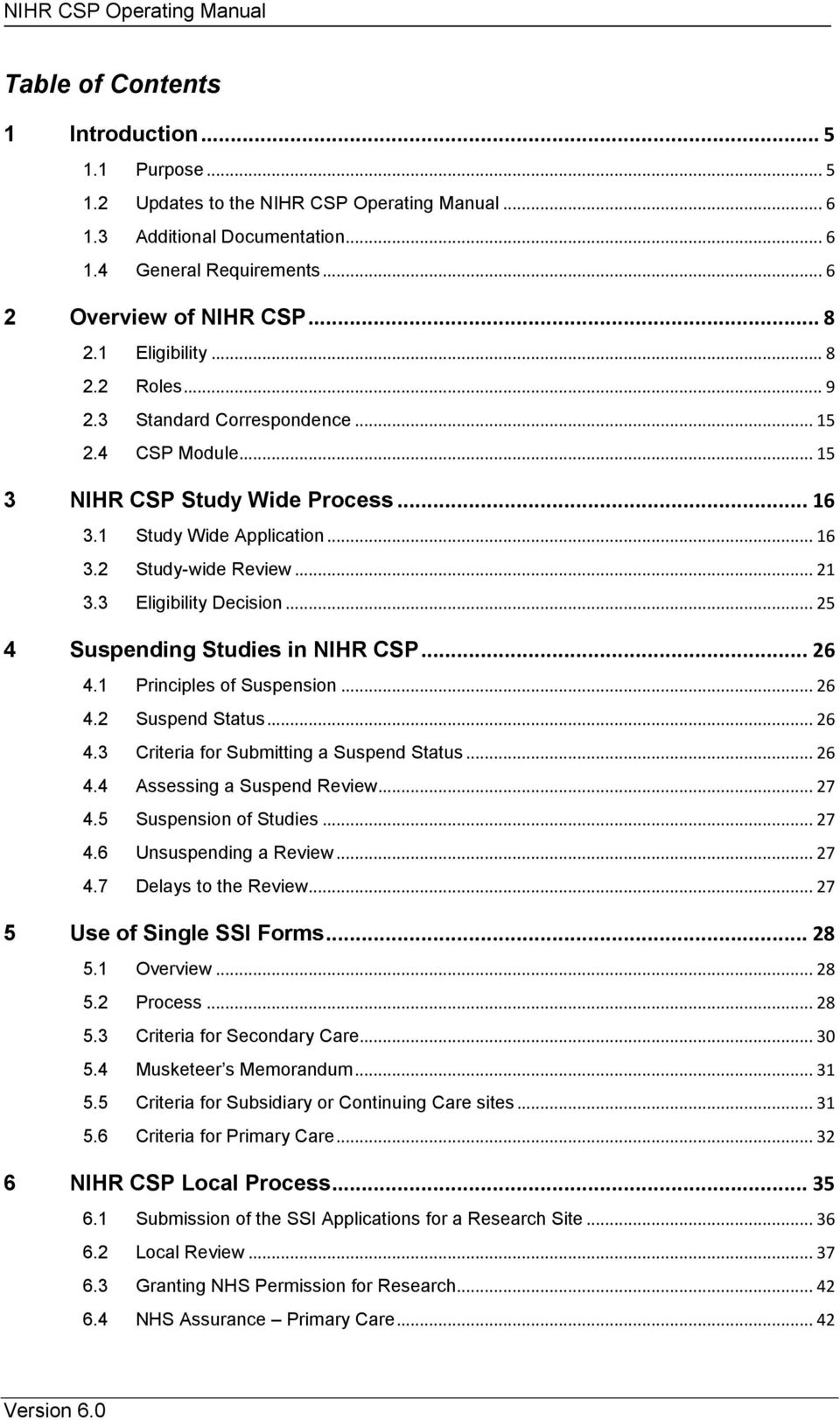
3 NIHR CSP Operating Manual 6.5 PIC Approval Amendments To NIHR CSP Studies Overview of Amendments Impact of Amendments on NHS Organisations Amendment Categories Amendments Process Abandoning Studies in NIHR CSP Not Eligible for the NIHR Clinical Research Network (CRN) Portfolio Chief Investigator Does Not Proceed with the Study Abandoning Studies or Sites During a Review Key Features of NIHR CSP Study Wide Application Flow diagram of Single SSI process Local Application Study Amendments Handling of Revised R&D Submissions CSP Module Document Repository Management Responsibility for Uploading Documents File Format Standard Correspondence Portfolio Application Form Correspondence R&D Submission Correspondence Site Specific Information (SSI) Submission Correspondence CSP Review Correspondence Suspending Studies Correspondence Single SSI process correspondence Study Amendments Correspondence Abandoning Studies Correspondence Correspondence for Studies Involving Devolved Administrations Correspondence Relating to Handling of Revised R&D Forms Performance Management CSP Metrics Calculation Validation Targets CSP Process Improvement Targets Legal Responsibilities Version 6.0

4 NIHR CSP Operating Manual Appendix 1 Appendix 2 Appendix 3 Appendix 4 Devolved Administration Contacts Study Wide Criteria by Study Type Study Wide Review Criteria UK Study-wide governance report Appendix 5 Costs and Contracts Review Procedure Section 1 CSP integrated costs and contract review process flow chart Section 2 CSP integrated costs and contract review process flow chart step instructions Section 3 CSP integrated protocol amendment costs and contract review process flow chart 166 Section 4 CSP integrated protocol amendment costs and contract review process flow chart step instructions Section 5 CSP integrated cost and contract review process: study-wide cost completion checklist Section 6 CSP integrated cost and contract review process: study-wide contract modification checklist Section 7 CSP integrated cost and contract review process: review delegation process Appendix 6 Appendix 7 Appendix 8 Appendix 9 Appendix 10 Appendix 11 Appendix 12 Common Examples of Criteria for Study Status of Suspend Reasons for Delay in Completion of Review Guide to Authorisations Required for a Single SSI Form Single SSI Form Summary Review Local Criteria by Study Type Local and PIC Review Criteria Amendment Categorisation Examples of the how amendments are categorised into the three different categories Glossary Document Control Version 6.0

5 NIHR CSP Operating Manual Introduction 1 INTRODUCTION The National Institute for Health Research Coordinated System for gaining NHS permission (NIHR CSP) is a process for gaining: Permission for NHS organisations to perform clinical research studies in England Approval for NHS organisations to act as participant identification centres (PICs) for clinical research studies in England Permission to continue research after an amendment is made to a study which has been processed through NIHR CSP NIHR CSP standardises and streamlines R&D approval for commercial and noncommercial studies. NIHR CSP has been in operation since November It is funded by the Department of Health via the NIHR Clinical Research Networks (NIHR CRN). It operates as a partnership between: The NIHR CRN Coordinating Centre The Local Clinical Research Networks The NHS Partner Organisations NIHR CSP is supported by other linked systems within the NIHR CRN National Coordinating Centre (NIHR CRN CC) such as Portfolio eligibility. The CSP Module is the supporting IT system which manages the NIHR CSP process. NIHR CSP has arrangements to coordinate with the NHS permission systems in the Devolved Administrations. This includes Northern Ireland, Scotland and Wales, and will fulfil a commitment to UK wide working. 1.1 PURPOSE This is the Operating Manual for NIHR CSP. Its purpose is to define: The standard business process for gaining NHS permission for research supported by the NIHR How the NIHR CSP process is managed in CSP Module The role of the various participants within NIHR CSP including the investigators, Portfolio Application Team (PAT), CSP Unit (CSPU) and Local Clinical Research Networks (LCRNs) The reviews for the different study types received Version 6.0 5

6 NIHR CSP Operating Manual Introduction 1.2 UPDATES TO THE NIHR CSP OPERATING MANUAL The NIHR CSP Operating Manual will undergo a periodic review. It will be updated to reflect changes in the NIHR CSP process. The main changes will be recorded, please refer to Document Control on page 232. To provide feedback on the manual, please contact the CSP Helpdesk [email protected]. 1.3 ADDITIONAL DOCUMENTATION The NIHR CSP Operating Manual defines the usual business processes for NIHR CSP. This manual sits within the study set up part of the Research Delivery Pathway 1. This manual does not cover any additional processes which are issued separately by the NIHR. This includes expedited research for use in a pandemic which will result in alternative processes being followed. This manual does not describe how to use CSP Module. Please refer to the CSP Module User Manual for guidance 2. This manual does not describe how to use IRAS. Please refer to the IRAS E-Learning Module for guidance 3. This manual does not detail the full eligibility review process for commercial or noncommercial studies applying for CRN support and inclusion in the NIHR CRN Portfolio GENERAL REQUIREMENTS CSP Module users should have access to The Proportionate and Pragmatic CSP e-learning training modules. Users should also have access to any local training and support workshops, if provided by the LCRN Training on the CSP Module. This is provided by the LCRN on a one to one or group basis 1 Programme/lcrnguidancesuite/researchdelivery/Research%20Delivery/LCRN%20Guidance%20S6%20- %20Research%20Delivery%20v1.1.pdf Further information on this and access to the NIHR Clinical Research Network: Eligibility and adoption process for non-commercial studies Standard Operating Procedure v1.8 8 January 2014 can be obtained from the Portfolio Application Team [email protected]. Version 6.0 6
7 NIHR CSP Operating Manual Introduction CSP Module users should be competent to deliver NIHR CSP and use the CSP Module as their individual role requires Version 6.0 7

8 NIHR CSP Operating Manual Overview of NIHR CSP 2 OVERVIEW OF NIHR CSP NIHR CSP helps investigators by providing: An efficient process for gaining NHS permission, assurance or PIC approval. The process is available to studies that are: o NIHR Infrastructure supported o Eligible for the NIHR CRN Portfolio o Potentially eligible for the NIHR CRN Portfolio Support and advice from the LCRNs Access to NHS service support for non-commercial studies. This is provided through the eligibility process for the NIHR CRN Portfolio Access to CRN support for commercial studies. This is provided through the eligibility process for the NIHR CRN Portfolio A single point of entry is provided via the Integrated Research Application System (IRAS) for English led studies Note: The CSP Unit (CSPU) and LCRNs cannot give NHS permission or PIC approval. Their role is to facilitate and support the process in a coordinated way. 2.1 ELIGIBILITY The following studies can use NIHR CSP: Studies that are eligible for consideration for CRN support and inclusion in the NIHR CRN Portfolio. Refer to the portfolio website 5 for details. Studies applying for the NIHR CRN portfolio can use NIHR CSP whilst an eligibility decision is made. If they are deemed not eligible they cannot continue to use NIHR CSP. There will be a ten day appeal window before this is confirmed within NIHR CSP. Note: The NIHR CRN non-commercial eligibility and adoption process and the commercial eligibility and feasibility process are separate parallel processes which must be completed prior to the completion of NIHR CSP with NHS permission. Studies that are supported through NIHR Infrastructure funding and not through NIHR CRN support. Refer to the NIHR website for details on the types of awards this covers & Version 6.0 8

9 NIHR CSP Operating Manual Overview of NIHR CSP 2.2 ROLES There are several roles which play a part in the NIHR CSP process Investigator Role in NIHR CSP Chief Investigator/ Sponsor The sponsor and Chief Investigator are responsible for the overall management of the study. This may include deferring some responsibilities to a study coordinator. The Chief Investigator applies for the study wide review and eligibility (portfolio) assessment for their study. This involves: Submitting the Portfolio Application Form (PAF) Submitting the NHS R&D Application Form with supporting documents identified in the IRAS R&D Application Form Checklist Selecting the Lead LCRN (England led studies) or confirming they wish to use NIHR CSP (Devolved Administration led studies) The Chief Investigator will work with RM&G staff in the Lead LCRN for study set up and delivery support. This includes resolving any issues with the PAF and R&D application forms. The Chief Investigator is also responsible for submitting amendments to NIHR CSP studies. Amendments are submitted via IRAS. Amendment documentation is attached to the IRAS R&D Form Checklist and resubmitted from the R&D esubmission tab. Note: Previous documentation should be removed from the IRAS checklist by the Chief Investigator when submitting a further amendment as any attached documents will be resubmitted and form part of the subsequent amendment submission. Principal Investigator Principal Investigators are responsible for the management of the study at NHS organisations. They apply for NHS permission for a study at a specific NHS organisation. This involves: Submitting the SSI Application Forms with supporting documents identified in the IRAS SSI Application Form Checklist Principal Investigators will work with RM&G staff in the participating LCRN for study set up and delivery support. This includes resolving any issues with the SSI application forms. Version 6.0 9
10 NIHR CSP Operating Manual Overview of NIHR CSP Relationship between the RM&G Team and Investigators Research management and governance (RM&G) staff are available within the CRN to help investigators obtain NHS permission for their studies. The role of each RM&G team is to: Advise and assist investigators on the applications and approvals required for their studies Help investigators obtain authorisations within NHS organisations that feed into the NHS permission process Undertake reviews required for the studies and: o Work with the investigators and NHS organisations to resolve any difficulties o Provide evidence of the outcome of the review o Work with NHS organisations to issue NHS permission NHS Organisation Roles in NIHR CSP Each NHS organisation is a separate legal entity. NHS permission or PIC approval must be granted at every NHS organisation involved. NHS organisations participating in a study are either research sites or a participant identification centres (PICs). A research site: Receives the local and study wide governance reports and decides if NHS permission to perform research is granted at the site Receives details of amendments to studies which have already been granted NHS permission and decides if permission continues A PIC: Receives the local and study wide governance reports and decides if PIC approval is granted to support the participant identification process for a study The NHS permission signatory for the NHS organisation is responsible for signing NHS permission letters, PIC approval letters, Notification of Continued NHS Permission letters (research site), agreements and contracts. All NHS partner organisations in England work within their LCRNs to provide research infrastructure to support NIHR CRN Portfolio studies. Version
11 NIHR CSP Operating Manual Overview of NIHR CSP Relationship between the RM&G Team and NHS Organisations RM&G staff work with Principal Investigators and all departments in an NHS organisation. This helps to facilitate the timely set up and delivery of studies to indicated timelines. This may include working with clinical departments, laboratories, pharmacies, data protection officers, trust finance, NIHR CRN staff, and more. NHS organisations work with RM&G staff to provide clarity regarding: What internal authorisations are required for studies. Note: There are best practice examples available where some NHS organisations do not require signatures or reviews for involvement. They have adopted a risk based approach to providing authorisation through service improvement development. This is consistent with the principles of the Research Support Service (RSS) 7 to ensure proportionate and pragmatic procedures Where service support resources are placed Who in the NHS organisation is the NHS permission signatory. This includes details of any delegation Local Clinical Research Network Roles in NIHR CSP LCRNs facilitate partnerships within their geography to set up and deliver clinical research within the NHS. There are several NHS organisations within one LCRN. LCRNs work closely with their NHS organisations to provide RM&G services to investigators, see NHS Organisation Roles in NIHR CSP on page 10 for details. There are two main roles for LCRNs: Participating LCRN Lead LCRN Participating CRNs Any LCRN with NHS organisations or PICs participating in a study is a Participating CRN. They ensure that all issues relating to a specific study site are addressed. The key tasks undertaken by the RM&G team in the Participating LCRN are: Contacting Principal Investigators and helping with study set up. Principal Investigators are identified from the R&D submission Helping Principal Investigators with the SSI submission where necessary. 7 Version
12 NIHR CSP Operating Manual Overview of NIHR CSP Note: It is the Principal Investigator s responsibility to discuss an application with an R&D representative within the NHS organisation in accordance with Q23 of the SSI form Performing the local review for the study Working proactively with the Principal Investigator and internal departments to resolve any governance, costing or contracting issues. This may be supported by the LCRN Industry Operations Manager for commercial studies Working with the Lead CRN to resolve any issues not relevant to a specific site. The CSPU can be used for support and escalation. This ensures that the Chief Investigator has to deal only with one main contact point They may undertake quality control reviews after the local review is complete. This should take into account the complexity of the study and the experience of the local reviewer Uploading issued NHS permission letters to the CSP Module. This marks the end of the NHS permissions process at this research site, unless an amendment is submitted Ensuring participating NHS organisations are aware of any amendments Ensuring any sites that have withdrawn permission are recorded using the Objection Review task if NHS Permission has been previously granted In rare cases, ensuring the sponsor is informed about any sites that are not able to implement an optional amendment but are able to continue in the study Lead LCRN The Lead LCRN is identified by the Chief Investigator/ sponsor in the IRAS submission pages. It is usually the LCRN covering the geographic area where the Chief Investigator is employed and the Lead NHS R&D Office is based. Note: Some LCRNs will lead on more studies than others. This is due to the research portfolios of the academic and clinical organisations within their area. If a LCRN has reached capacity, it is possible to appoint a Lead LCRN in a different geographic area to the Chief Investigator. Note: Discussions can be enhanced by the submission of a draft R&D form from IRAS. This may occur without any previous contact between the Lead LCRN and the Chief Investigator. A draft R&D form will contain the contact details for the Chief Investigator. The Lead LCRN can use this to establish contact and offer support. This would form part of the pre-application study support service. A staff member of the Lead LCRN RM&G team is nominated as the key point of contact for the study. For commercial studies this may be an LCRN Industry Operations Manager. This contact works with the Chief Investigator. The key tasks undertaken by the Lead LCRN within NIHR CSP are: Contacting Chief Investigators and helping with study set up. This may include liaising with Principle Investigators and CSPU Version
13 NIHR CSP Operating Manual Overview of NIHR CSP Helping Chief Investigators with the R&D submission where necessary Undertaking the study-wide review Undertaking the cost and contract review procedure for a commercial study Working proactively with the Chief Investigator to resolve any identified issues that are not relevant to a specific site Assessing whether a revised R&D submission is required Validating a revised R&D submission if a previous submission was deemed valid Communicating with the Portfolio Application Team (PAT) where issues with the application are identified Undertaking quality control reviews after all the study-wide reviews are complete. This ensures that local reviewers have confidence in the study-wide review Support for the progress of the study through NIHR CSP Discussing issues related to an R&D submission from a Devolved Administration with the relevant permissions centre or unit. This may include liaising with CSPU Validate and classify any amendments as notifiable to participating sites, or nonnotifiable Reviewing all study-wide amendment documentation that has been submitted via IRAS and assessing the impact of the amendment Entering amendment details in the Amendment Classification task window The Lead LCRN can call on the support of CSPU for assistance with queries relating to other Participating LCRNs or process clarifications and as an escalation route if necessary NIHR CRN National Coordinating Centre Roles in NIHR CSP Staff in the NIHR CRN CC play a key role in the management of studies in the NIHR CSP process. CSP Management Group The CSP Management Group is responsible for: The management oversight of NIHR CSP and associated processes Ensuring NIHR CSP delivers benefits for investigators and NHS organisations The development and improvement of business processes The CSP Management Group also assesses requests to use a single SSI application form for research sites or a sub group of research sites on a study. Participating LCRNs are notified of their involvement by . Version
14 NIHR CSP Operating Manual Overview of NIHR CSP Portfolio Application Team (PAT) The PAT is responsible for: Accepting studies into NIHR CSP Note: exceptions to this would be NIHR Infrastructure supported and Devolved Administration studies which do not receive a PAF. Assessing whether or not studies are eligible for CRN support and inclusion in the NIHR CRN Portfolio The PAT provides the link between NIHR CSP and the NIHR CRN Portfolio Team and NIHR CRN Industry team. It coordinates the process for reviewing the eligibility of studies to receive CRN support and be included in the NIHR CRN Portfolio. These teams will liaise with the Chief Investigator or study coordinator regarding the eligibility decision process. These teams work closely together and with the CSP Unit within the NIHR CRN CC Research Delivery Directorate. CSP Unit (CSPU) The CSPU has an overview of a study across all sites. It provides a central information hub for sharing study information across all NHS sites and the NIHR CRN. The CSPU provides support to LCRN-funded RM&G staff working on the study. The main functions of CSPU are: Validating the first final R&D submission. A RM&G Coordinator will perform the validation. They will liaise with the Chief Investigator or study coordinator during this part of the process. The name of the RM&G Coordinator will be recorded in the study record Providing support to the Lead LCRN for communications and queries relating to Participating CRNs if required Providing an oversight of the NIHR CSP process from a national perspective Confirming study wide suspension requests Acting as an escalation route when necessary Identify and confirm Lead LCRN for studies led by a Devolved Administration Discussing issues related to a R&D submission from a Devolved Administration with the Lead LCRN. The CSPU will raise issues with the lead Devolved Administration if required CSP Helpdesk The CSP Helpdesk: Version
15 NIHR CSP Operating Manual Overview of NIHR CSP Provides advice on the purpose and use of NIHR CSP Identifies areas for improvement in NIHR CSP. These are discussed within the CSP Management Group Collates suggestions and feedback for the development of CSP processes and supporting documentation Receives complaints about NIHR CSP Note: Correspondence and progress reports about a particular study are not handled by the CSP Helpdesk. These should be sent directly to the CSP Unit. 2.3 STANDARD CORRESPONDENCE The NIHR CSP process involves communication via . Some of this correspondence is automatically generated within the CSP Module. Some will be created by the user. There are defined communication points for the NIHR CSP Process. Communication to Chief Investigators, Study Coordinators and Principal Investigators must be correct and consistent. Standardised correspondence ensures this requirement is met. These s must be uploaded to the document repository in a.pdf format. See 11 Standard Correspondence on page 64 for details about standard s. 2.4 CSP MODULE NIHR CSP is supported by bespoke CSP Module software. The software: Integrates the work of PAT, CSPU, Lead LCRN and Participating LCRNs by providing access to study data and the ability to edit study records as criteria are completed Provides an electronic document repository for all study documentation Generates the Governance Report after CSP Sign-off (Local) is complete Generates reports of NIHR CSP activity and performance through the CSP Reporting Module A separate user manual providing detailed information regarding the use of CSP Module is available Version
16 NIHR CSP Operating Manual NIHR CSP Study Wide Process 3 NIHR CSP STUDY WIDE PROCESS Study wide applications for NIHR CSP are applied for via IRAS as an e-submission to the CSP Module in England led studies. The Chief Investigator/ sponsor will select the Lead CRN when submitting the PAF and R&D applications. This will be a manual submission where the study is led by a Devolved Administration. The Chief Investigator/ sponsor will confirm that they wish the study to use NIHR CSP and the CSPU will allocate a Lead CRN. IRAS holds the standard dataset to apply for a range of regulatory approvals including Ethics and NHS permission. Investigators can generate application forms from the completed IRAS dataset. The questions in the IRAS Project Filter are used to route to the relevant forms and submission process to apply for NHS permission through NIHR CSP 9. Note: The investigator must answer the appropriate questions in the IRAS Project Filter to generate an application form for NIHR CSP. Question 3a allows the investigator to indicate that the lead research site is in England. Question 5a and 5b allow the investigator to indicate if they want to use NIHR CSP. Note: Industry investigators using NIHR CSP are expected to use unmodified model agreements. These can be found on the NIHR website 10. Delays may occur for legal reviews if an alternative agreement is used. Please refer to Appendix 5 Costs and Contracts Review Procedure on page STUDY WIDE APPLICATION There are two study wide submissions. 1. Portfolio Application Form (PAF) 2. NHS R&D Application Form with supporting documents Note: A Portfolio Application Form will not be generated if the study is funded entirely by an NIHR Infrastructure award. These studies have access to NHS infrastructure for research such as service support costs through this funding. Note: A Portfolio Application Form will not be generated if the study is led by a Devolved Administration See suite of model agreements on the NIHR website Version

17 NIHR CSP Operating Manual NIHR CSP Study Wide Process Submission of the Portfolio Application Form Note: A PAF can be submitted whilst an application for funding is in progress. Following receipt of an R&D submission, a final decision cannot be made without secured funding for the full research costs of the study. The target for validating the PAF and assessing whether the application is potentially eligible for CRN support and inclusion in the NIHR CRN Portfolio is two working days. The Lead LCRN is alerted when a PAF of a potential study in their area has been validated and the study is deemed potentially eligible. Note: If the study is commercially sponsored, the company or Contract Research Organisation (CRO) is encouraged to contact the NIHR CRN Industry Team before submission of the PAF to discuss eligibility for the NIHR CRN Portfolio through the Industry Application Gateway (IAG) 11. Note: If the study is led by a Devolved Administration, there will be no PAF and the eligibility process will start on the receipt of the R&D submission Validation and Potential Eligibility Review Process for the Portfolio Application Form The PAF is validated and reviewed by the Portfolio Application Team (PAT) to decide if the study is potentially eligible for NIHR for CRN support and inclusion on the CRN Portfolio. The validation and review ensures the PAF meets the following criteria: All relevant fields of the IRAS project filter and PAF have been completed Chief Investigator is based in England Study is funded by an eligible or potentially eligible funder The PAF is assessed as being either: Invalid. Details of issues/ omissions will be supplied Study is potentially eligible for inclusion on the NIHR CRN Portfolio Study is ineligible for inclusion on the NIHR CRN Portfolio confirmation is sent by PAT. See 11.1 Portfolio Application Form Correspondence on page Version
18 NIHR CSP Operating Manual NIHR CSP Study Wide Process Submission of the NHS R&D Application The second stage of the study-wide application process is the submission of the NHS R&D application. An R&D application e-submission cannot be made until the PAF is validated. Note: If the study is led by a Devolved Administration, the R&D application is validated and reviewed by the Devolved Administration. The application then is sent to CSPU to manually input it into NIHR CSP. CSPU will liaise with the Chief Investigator regarding the use of NIHR CSP. Please refer to Appendix 1 Devolved Administration Contacts on page 102 for details. The Chief Investigator can discuss the R&D submission with the Lead LCRN. This is part of the pre-application support offered within the study support service 12. This discussion will ensure all information is included before it is submitted. A draft R&D form can be submitted to facilitate discussion before the final submission. R&D Applications can be submitted before regulatory approvals have been received. The application can be assessed, but the study wide review cannot be completed until all necessary regulatory approvals have been received. For commercial studies, the optimum time to start the application process is when the regulatory packages are prepared and ready for submission. The optimum time to start the R&D application process for a non-commercial study.is after a grant has been awarded An R&D application cannot be validated until funding has been secured and evidence of the source has been provided. This must be at least one of the funding elements in the case of multiple funders. A final decision on an application cannot be made until sufficient funding has been secured to cover the full research costs of the study. The R&D submission should include the supporting documents detailed in the IRAS R&D Form checklist except those not included in the agreed UK wide Checklist (see paragraphs below). Any supporting documents which are not available when submitting the form must be submitted to the Lead LCRN when they are available. This must be limited to those not required in the original submission for example, regulatory approvals. There is an agreed UK wide checklist which differs slightly from that provided within the IRAS R&D form Checklist generated for NIHR CSP applications. The R&D validator will not request any documents not contained within the UK wide Checklist to ensure alignment Programme/lcrnguidancesuite/researchdelivery/Research%20Delivery/LCRN%20Guidance%20S6%20- %20Research%20Delivery%20v1.1.pdf Version
19 NIHR CSP Operating Manual NIHR CSP Study Wide Process CSP UK wide Principle (for removal R, for addition A) Interview Schedules or topic guides for participants Validated Questionnaire Summary CV for CI R covered in the Sample diary card/ patient card and protocol R no governance issues R assessed as PI at site Pharmacy Manual Laboratory Manual A to highlight this is required prior to site initiation visit to prevent delays A to highlight this is required prior to site initiation visit to prevent delays Checklist items moved Item CSP UK wide Instructions for use of medical device Project Information Documents required prior to site initiation visit Note: Supporting documents not received through the IRAS Interface can be manually uploaded to the CSP Module document repository Validation Process for the First Final R&D Submission The target for validating the R&D application, to ensure it is complete and that funding for the study is secured, is three working days. The CSPU validates the first final R&D submission for a study. This will include all R&D submissions which have been resubmitted after an initial submission has been assessed as invalid. Revised R&D submissions requested during the study wide review are validated by the Lead LCRN. The validation will ensure that: 1. The application is written in English, comprehensible and contains sufficient information. 2. All relevant sections of the R&D Form have been completed and contain the relevant electronic authorisations. The IRAS R&D Form Checklist contains details on the documents submitted with the R&D submission. The checklist should have a list of version numbers of the submitted documents. The list will be cross checked with the documents to confirm that the version numbers and names are consistent. Version

20 NIHR CSP Operating Manual NIHR CSP Study Wide Process 3. The IRAS R&D Form Checklist contains valid reasons any document are not included with the R&D submission if necessary. A query should be raised if a reason has not been provided. Note: Some documents, such as approvals from regulatory bodies, may not be available when the R&D Form is submitted. These documents need to be provided through IRAS as soon as they are available. These are indicated in the IRAS R&D Form Checklist section headed Documents required for NHS permission. 4. An R&D Submission with minor issues can be queried and left pending a response from the Chief Investigator or Sponsor. An stating the required action will be sent. See CSPU Notification that the R&D Submission requires further documents/clarification on page 72. The validation task is marked pending response until the issue is resolved. A R&D submission pending response will be invalidated after 14 calendar days if the issue is not rectified. 5. A full description of the first final R&D validation process can be found in the document Validation of First Final R&D Submission v The RM&G Coordinator will confirm if the submission is valid or invalid. A confirmation will be sent to the Chief Investigator, sponsor s representative, and Study Coordinator. See 11.2 R&D Submission Correspondence on page 69 for details of the standard s.a confirmation message will be sent from the CSP Module to the esubmission tab in the R&D Form page of the IRAS study record within the History section. 7. The RM&G Coordinator will export a valid R&D submission (form in pdf and xml and documents) to any Devolved Administration identified within the Project filter question 3 where the study is led by England Note: Electronic authorisations are invalidated when an invalid R&D Form is rejected in CSP Module and the resubmitted form has been updated. Electronic authorisations must be reapplied to the revised form. A validated R&D form and all associated documents are made available to the Lead LCRN and Participating LCRNs and NHS organisations named on the form through the CSP Module. This: Enables the LCRNs to support the investigator with the R&D application Gives advance warning of the study to the NHS organisations involved prior to the local application. This enables them to support the investigator in the study set up 13 AL.pdf Version

21 NIHR CSP Operating Manual NIHR CSP Study Wide Process Devolved Administration Led Studies Note: The location of the Lead NHS R&D contact determines which country leads the study. If the study is led by a Devolved Administration, the study wide application process requires interaction with the system for gaining NHS permission in that Devolved Administration. Please refer to Appendix 1 Devolved Administration Contacts on page 102 for details. In these cases, the CSPU will allocate a Lead LCRN for the study once agreed with the LCRN concerned. Northern Ireland Primary Care does not have an NHS Permissions coordinating function. If the study is led by a Devolved Administration, the R&D submission is validated by the Devolved Administration. These studies cannot be electronically submitted through IRAS to the CSP Module and documents cannot be attached to the IRAS Checklists. These submissions will be ed in the first instance to the CSPU by the NHS Permission coordinating function of the Devolved Administration for the manual creation of the study record. An will be sent by CSPU to confirm to the CI the Lead LCRN in England who will be coordinating with the lead devolved administration. See CSPU Confirmation of Receipt of R&D Submission from a Devolved Administration and Lead LCRN for England on page 96. Subsequent documentation and the governance report will be supplied by the devolved administration directly to the Lead LCRN. Note: If the study is set up originally as a single site study in Scotland and then additional sites are added in England, NRS PCC will forward the study wide documentation. The study will then become English led for the purposes of CSP. 3.2 STUDY-WIDE REVIEW A validated R&D application undergoes a study-wide review. The Lead LCRN undertakes the study wide review based on information provided within the R&D submission. This is viewable by all Participating LCRNs in the CSP Module. Note: When performing a study-wide review, it is important to read through the R&D Application Form and associated documents, especially the Participant Information Sheet. This will give a sense of the study as a whole and help to highlight any potential issues early in the process. Version
22 NIHR CSP Operating Manual NIHR CSP Study Wide Process Study-wide Review Criteria Study-wide reviews are based on criteria which apply to studies as a whole. The criteria are used to: Support the R&D application review undertaken on behalf of all NHS organisations participating in the study Provide assurance that studies are compliant with applicable regulations and with the key domains of the Research Governance Framework (Ethics, Science, Health & Safety, Information and Finance & Intellectual Property) The set of criteria undertaken for each study is determined by the study type (e.g. Clinical Trial of an Investigational Medicinal Product). Reviewers are expected to review only the criteria that apply to the research study they are reviewing. See Appendix 2 Study Wide Criteria by Study Type on page 103 for details. Guidelines are provided for the criteria to: Ensure a standard and consistency of lead review across the NHS in the UK Allow for judgement to be used to manage specific situations Identify the information and communication required to support the review Each criterion has a category and a unique number. The category is represented by a letter. The study matrix in Appendix 2 Study Wide Criteria by Study Type on page 103 shows which criteria are relevant to the different study types. Each criterion describes: Introduction: introduces the criterion to be considered Study-wide considerations: identifies the areas of the criterion the lead reviewer should consider when conducting the review Notes/ Resources: the notes provide further information about the criterion under consideration that may assist the reviewer in completing the review. The resources provide further sources of information that the reviewer may wish to refer to in conducting the review, e.g. reference material, web addresses. Reviewers are expected to be familiar with all the resources. The Research Governance Framework is not included in the resources as this is relevant to all aspects of the review. The outcome of the review of each criterion should be described. Additional information to support the assessment should be recorded. Version
23 NIHR CSP Operating Manual NIHR CSP Study Wide Process Note: Comments entered for study-wide criteria provide assurance to the RM&G staff working on the local review. Extra care should be taken to ensure a clear and professional standard of commenting is used. The comments also appear in the Governance Report that is issued to the NHS permission signatory. See Appendix 3 Study Wide Review Criteria on page 107 Study Wide Criteria by Study Type for details of the criteria Study-wide Review Process 1. Use the study matrix to determine the relevant study-wide criteria for the study type in Appendix 2 Study Wide Criteria by Study Type on page 103. This will be automatically generated as a list for IRAS study types in the CSP Module 2. Conduct a rapid initial assessment to identify studies with complex arrangements or unclear information. This will highlight at an early stage if additional information is required or particular expertise is required to support the study. This will assist NHS research sites and NHS PICs in their local reviews. Identify any issues that are likely to have a major impact on the ability of NHS organisations to issue NHS permission, NHS assurance or PIC approval for the study 3. Discuss any issues or required clarifications with the sponsor or Chief Investigator. Allow them the opportunity to respond to a query prior to placing a study-wide review in suspension. See 4 Suspending Studies in NIHR CSP on page 26 for guidance on suspending a study. 4. A revised R&D submission will be required if a substantive change is required. For example, if an issue is identified in the project filter to ensure there is access to the necessary information 5. The Chief Investigator may request a change which would require a revised R&D form. The reason for the revision must be provided in writing to the Lead LCRN when the revised R&D submission is made 6. If the Chief Investigator submits a revised R&D form without informing the Lead LCRN of the changes, the Lead LCRN will contact the Chief Investigator for clarification. After clarification is received, the information should be circulated to the Participating LCRNs by and then uploaded to the study record. The information should be uploaded as a study wide document with the filename Revised R&D form update [insert date]. If there is no response within 14 calendar days, the submission will be rejected 7. Subsequent documents submitted during the review are to be downloaded and sent to any devolved administrations by the Lead LCRN as soon as possible after receipt 8. Where a study is submitted from industry, ensure that the costings and contracts processes are followed. See Appendix 5 Costs and Contracts Review Procedure on page 156 for details 9. Review and identify issues that only need to be looked at once for the study in a proportionately risk-based manner. This includes risks to patients, staff, or study delivery and potential problems 10. Identify mitigation strategies that can be assessed locally. Where information is unclear or inadequate, request the information once for the study and make it available to local reviewers. Where there are hazards or problems with the study arrangements, obtain clarification once for the study or highlight the implications to the applicant and local reviewers 11. Highlight information to support the local review. Provide additional clarity on the study. Provide information for reviewers to work from. Clarify whether any local criteria are not relevant. Describe if there are arrangements that need to be managed locally Version
24 NIHR CSP Operating Manual NIHR CSP Study Wide Process 12. Highlight where different issues or risks may exist for the different types of research site. This includes subsidiary sites, continuing care sites, data collection centres, principal treatment centres etc 13. Highlight where different issues or risks may exist for PICs 14. Highlight any country specific issues that need to be addressed in each participating nation 15. Within the Study-Wide Governance Report there is no requirement to set out the criteria that are satisfied by the information provided in the application. Where information or clarification has been obtained following further questioning of the Sponsor or applicant this must be clearly set out in the Study-Wide Governance Report as it is important that participating organisations do not raise duplicate queries. Record information within the criteria comments boxes in the CSP Module. Comments can be supported by documentation in the document repository if necessary 16. Where a lead reviewer is uncertain of the requirements of the governance criterion being considered, they should seek advice from another member of staff with relevant research governance knowledge 17. If the study has research sites in a Devolved Administration, the Lead LCRN will send the study-wide review in the study-wide governance report to the Devolved Administration. See Appendix 4 UK Study-wide governance report on page 151. Please refer to Appendix 1 Devolved Administration Contacts on page 102 for contact details. Criteria can be marked with the following outcomes from the drop down list: Not Started In Progress Completed Minor Issue (i.e. review completed but a minor issue to note that does not prevent NHS permission insert comment) Completed Proceed (i.e. all OK) Suspend (i.e. review is suspended due to study wide suspension) Criteria that are not applicable to the study should be marked as Completed Proceed, and a note should be entered into the associated Comments box for each of these criteria saying Not Applicable because [insert reason] Devolved Administration Led Studies If the study is led by a Devolved Administration, the study-wide review is performed by the Devolved Administration. They will provide a study wide governance report to the Lead LCRN. The Lead LCRN will review for any aspects of English law where this differs from the legislation within a devolved administration Study-wide Quality Control Study-wide QC is carried out by the Lead LCRN when all criteria have been completed in a study-wide review. Version
25 NIHR CSP Operating Manual NIHR CSP Study Wide Process Study-wide QC gives assurance that: A study-wide review has been performed correctly The comments associated with each criterion comply with the guidance specified in Appendix 3 Study Wide Review Criteria on page 107. If the study-wide review has not been performed correctly, the QC reviewer will indicate in the Perform Governance QC task those criteria that require further review. They should work with the person performing the review to reach the required standard. Note: A proportionate risk-based approach is recommended. Small discrepancies, such as a wrongly assigned category in the document repository may not stop the Study-wide CSP Governance Quality Control being confirmed, but will need to be rectified immediately so that other LCRNs are not affected. Information in the criteria comments and the document repository will be printed on the Governance Report Study Wide Governance Report The study-wide governance report will be exported to the necessary Devolved Administrations where the study is led by England. This can be downloaded as an excel document from the CSP Module for export. These must be sent on a per study basis to ensure clarity. The governance report can be used by the NHS organisations to decide whether to grant permission for research or approval to act as a PIC. 3.3 ELIGIBILITY DECISION The process for conducting the eligibility assessment is described elsewhere 14. The study must be eligible for the NIHR CRN Portfolio to complete CSP. If the study is ineligible, it will exit CSP at this point. See 8.3 Abandoning Studies or Sites During a Review on page Further information on this and access to the NIHR Clinical Research Network: Eligibility and adoption process for non-commercial studies Standard Operating Procedure v1.8 8 January 2014 can be obtained from the Portfolio Application Team [email protected]. The NIHR CRN website contains further information on eligibility processes: & Version
26 NIHR CSP Operating Manual Suspending Studies in NIHR CSP 4 SUSPENDING STUDIES IN NIHR CSP A study wide review may be suspended in NIHR CSP. This occurs if no further activity, discussion or negotiation can proceed due to circumstances outside the control of the NHS or Clinical Research Network. 4.1 PRINCIPLES OF SUSPENSION Suspension requests will be rejected if negotiations are on-going, or other activity may still proceed A suspended status should only be granted where delays have occurred due to factors outside of NHS or CRN control A suspended status should not be used to try to control metrics regarding recruiting the first participant 4.2 SUSPEND STATUS If a reviewer wants to suspend the study wide review, they will set the outcome of one of the study wide review criteria to Suspend. 4.3 CRITERIA FOR SUBMITTING A SUSPEND STATUS In order to assign a suspend status; the study must fulfil all of the following criteria: The review is still on-going All other criteria have been completed as far as is possible and no further review can be undertaken. As soon as this stage is reached the study may be suspended Where the request to suspend a study relates to awaiting a response from another party, there must have been at least two requests for the information over a period of several days or communication regarding a specific delay. Please specify these requests within the comments or provide in a supporting . Sufficient information about the delay has been recorded in the criteria comments box (not the task comments box) A clear explanation of the reason for the suspension request must be provided in relevant the criteria comment field. This must include any details of information requests made or reference appropriately where delays have been communicated by the sponsor. This can be supported by an additional sent to [email protected] if this information is held in an chain. See Lead LCRN Request for Suspension on page 86. Version
27 NIHR CSP Operating Manual Suspending Studies in NIHR CSP 4.4 ASSESSING A SUSPEND REVIEW Once a suspension request is submitted, CSPU will receive a task to assess the suspension. The decision by CSPU will be made in line with the principles and criteria above. If the reason for suspension does not meet the criteria, CSPU will resume the governance workflow. Consultation may be required with the Lead LCRN. The Lead LCRN will be notified by of the outcome of the assessment. See CSP Module CSPU Confirmation of Suspend Review on page SUSPENSION OF STUDIES A suspension period starts when the governance reviewer selects Suspend for a criterion and submits a review. The governance reviewer retains the ability to unsuspend the review. If a suspension is lifted prior to review by the CSPU or assessed as Invalid, the suspend start date is removed and no period of time is removed from the metrics. If a suspend review is assessed as Valid, the period of the suspension starts on the suspend submission date and ends on the date when the reviewer lifts the suspension. 4.6 UNSUSPENDING A REVIEW As soon as the review can proceed again, the Lead LCRN reviewer can lift the suspension of the review. This takes the study out of the suspended status. 4.7 DELAYS TO THE REVIEW Delays due to factors outside the direct control of R&D offices or the Lead LCRN, but incurred as part of the NHS review or CSP process may not be used to suspend a study. Such delays can be noted within the review comments but will continue to be included in metrics. Metrics are intended to measure the whole of the NHS Permissions process, not the direct activity of RM&G staff. See Appendix 7 Reasons for Delay in Completion of Review on page 185. Version
28 NIHR CSP Operating Manual Use of Single SSI Forms 5 USE OF SINGLE SSI FORMS 5.1 OVERVIEW The concept of a single or generic SSI application has been piloted in CSP since 2009, where it was originally used as a means to ensure fast and expedited NHS permission during the swine flu epidemic. The Single SSI form is a means to reduce the researcher burden in producing multiple copies of SSIs for site-specific assessment (SSA) where the site activity is the same. These can be used on studies where all sites or a sub set of sites meet the criteria outlined. The research activity undertaken at the sites using a Single SSI form must be the same. The Single SSI form is a process in operation for CSP in England and can only be used for English NHS organisations. Northern Ireland and Wales have no equivalent process. Scotland has a generic SSI form process for Health Boards but the researcher will need to request this separately. 5.2 PROCESS 1. The Lead LCRN is to identify as early as possible that a study may be suitable for the use of a Single SSI form for all or sub section(s) of sites. The earlier this is identified the better and this may be at the pre application stage. If this is identified before the R&D form, this allows optimum communications with sites and completion of the study wide governance criteria to guide these sites. 2. An initial conversation is to be undertaken by the Lead LCRN contact and RM&G Operations Manager (NIHR CRN CC). If the latter is unavailable, an appropriate member from a peer group of experts will be available. The Lead LCRN is to provide background information by to allow an informed discussion. This step can be omitted if the study clearly meets the Single SSI criteria. 3. A discussion is to take place between the CI/research team and Lead LCRN. The expectations regarding the responsibility of the research team are to be made clear. The sites required are to be clearly identified. Blanket coverage of sites should not be used where prior conversations with the named PIs, who have confirmed their willingness to participate in this capacity, and the research site have not taken place where necessary. 4. Where there are different types of sites within the study that will be using Single SSI forms, this should be clearly identified. A different Single SSI will be required for each sub set of sites to ensure that the sites using a particular form will be performing the research activity detailed within that form. 5. There are three options of authorised declaration that can be made within Part D of the Single SSI form: The CI takes on responsibility for the activity at each of the sites. No PI is required. The Single SSI form is not authorised before submission. The PI at the site signs the form. This may be done after NHS permission but before study start up at that site if the risk assessment indicates that this is appropriate. This can Version
29 NIHR CSP Operating Manual Use of Single SSI Forms take place as part of the decision making process for the independent practitioner in order to fulfil regulatory compliance as they will be taking on the responsibility of the study within their practice. The Single SSI form is not authorised before submission. The PI at the main site signs the form. This is to be used for subsidiary or continuing care sites. 6. A full request for CSP Management approval is to be sent to CSP Helpdesk [email protected] to include: a one page descriptive summary for sites a completed summary review form (Appendix 9 Single SSI Form Summary Review on page 187) an R&D form or protocol (if these are on the CSP Module can refer to here) Where more than one Single SSI form is being requested due to their being different sub sets of sites on a study, an application will be required for each Single SSI form. 7. The CSP Management Group will have the standard 6 working days response time as stated within the CSP Helpdesk SOP but will endeavour to process at a more reactive rate. The approval or rejection of the use of the Single SSI on a study will be communicated by . See 11.6 Single SSI process correspondence on page 87. This decision will: Be based on whether the scenario meets one of the listed criteria Be based on whether the scenario could potentially be managed in this way (identifying new criteria) Note whether there is any Devolved Administration involvement There is an anticipation that no further questions will be required due to the discussion occurring in step 2 where there may be a question as to whether the study could be pragmatically set up in this manner. 8. The sent in response will be uploaded to the CSP Module study record as a study wide document by the Lead LCRN. 9. If the use of a Single SSI form is approved, an will be sent to Participating LCRNs by the Lead LCRN for cascade to partner organisations. This will inform the potential sites of an imminent Single SSI submission on the study along with the rest of the study pack. 10. The researcher will submit a Single SSI form using the ODS code for a named site as an e-submission through IRAS. See Appendix 8 Guide to Authorisations Required for a Single SSI Form on page 186 for guidance on the authorisation of the Single SSI form.the Lead LCRN will download this form in a pdf and xml format. These will be sent with the supporting documentation to the CSP Unit [email protected] for a manual SSI submission to be created. The CSP Unit will upload the latest copy of spreadsheet with PI or local collaborator names as a study wide document if applicable. 11. Where a PI is necessary and can be identified in advance this should be supplied on a supporting spreadsheet or other document (this can be Part C of the R&D form) by the research team. This will provide the name and contact details of the PI. It would be helpful for the sponsor to indicate the Principal Investigators identified that have already been approached so the NIHR Clinical Research Network is aware of these. The site should be added only once this is available to prevent confusion and miscommunication. This would not be expected where it is necessary for a rapid patient transfer or for rapid permission in pandemics and rare disease patient presentation. For primary care, the site will often be identified where a patient is recruited in the secondary care setting but activity will be taking place in the GP practice and it will not be known where this is until recruitment occurs. As the decision Version
30 NIHR CSP Operating Manual Use of Single SSI Forms is made by the independent practitioner, this would not preclude NHS assurance being completed. 12. For Primary Care studies, the Single SSI is recommended to be submitted on an LCRN basis where possible. This will ensure that the study record is available within the LCRN to the necessary staff whilst minimising duplication of effort. There may be specific cases where this is not sufficient ie where there are multiple primary care Research Management teams within an LCRN supporting independent providers. The NHS assurance gained from a Single SSI form can be used to support the independent providers decision when further sites identified and approached. For lower risk studies where a management link or local collaborator would be expected due to the research procedures being within their capacity of delivering clinical care, a study wide review for NHS Assurance may be sufficient. However, it will still be necessary to provide a supporting statement which clearly indicates the localities and the research activities that will be taking place to support and enable an informed decision. Within Primary Care as the independent practitioner decides to take part in the study and will liaise with the Chief Investigator and sponsor for access to the site, named personnel will not be required at the application stage. 13. The Lead LCRN proactively manages the Single SSI process by liaising with Participating LCRNs where necessary and creating FAQs to upload to the study record as a referral point if required. Research Delivery Managers within the LCRNs can be used to help the progress of the study. For Primary Care studies Research Delivery Managers in Division 5 can assist with the identification of practices or the practice can inform the sponsor of a named individual to take on this role within the communication of their decision. The RM&G Operations Manager (NIHR CRN CC) can be used as an escalation point, if required. 14. The Lead LCRN is to provide feedback to CSP Helpdesk [email protected] on the set up of study at site/ researcher level as inbuilt continual improvement mechanism for study criteria for use of Single SSI. 5.3 CRITERIA FOR SECONDARY CARE 1. Studies involving questionnaires or interviews with NHS staff and Studies involving questionnaires or interviews Qualitative research 2. Postal or online questionnaires with patients 3. Studies of a low risk nature where research activity is the same at each location This will not include studies where there is randomisation occurring at the site. This can include studies where the site is randomised to perform one activity or research intervention for all its patients which may involve more than one Single SSI form operating on a study. 4. Studies where a central research team are undertaking all the research procedures at the sites (i.e. no local research team) Clarity on Letters of Access and Research Passports should be provided within the Single SSI submission 5. Studies that require rapid NHS Permission (Urgent Public Health or Rare Disease) It is necessary for patients to be invited to participate in the research when they present due to the nature of the disease. Version
31 NIHR CSP Operating Manual Use of Single SSI Forms 5.4 MUSKETEER S MEMORANDUM To facilitate the Musketeer s Memorandum 15 developed by the NIHR Collaborative Group for Genetics in Healthcare 16, studies deemed by the CRN: Genetics to come within the remit of the agreement will utilise a Single SSI form to distribute to the 23 Regional Genetics Centres and any other signatories to this agreement. These will not be requested or approved through the CSP Management Group. The Lead LCRN, which should have the Lead NHS Trust acting under the agreement as a partner organisation, will ensure that Schedule 1 is uploaded to the CSP Module and the Single SSI form in pdf and xml format will be distributed to the CSP Unit [email protected] in order to create the SSI submissions to each site. 5.5 CRITERIA FOR SUBSIDIARY OR CONTINUING CARE SITES These are research sites that have a relationship with a main research site such that they perform certain research protocol activity(ies). The participant will be consented and any randomisation will occur at the main research site. A subsidiary or continuing care site can range from: Undertaking a specific activity ie performing a scan where the site would be expected to be listed within the SSI form for the main research site. This type of activity can also be managed within a Service Level Agreement (SLA). Data collection may be required from these locations to create a full data record for the purposes of the study due to the patient pathway. Where the patient requires a specialist hospital for their treatment but is then released for continuing care to another hospital within another NHS organisation to be nearer to the family home. This is often seen in Children s Cancer and Leukaemia and paediatrics. There may be instances where these relationships are well defined such as within Children s Cancer Networks (CCN) with Principal Treatment Centres (PTC) and Paediatric Oncology Shared Care Units (POSCU). There is an expectation that there will be agreements relating to research collaboration in place between these sites. 1. Subsidiary sites which are undertaking routine or non-clinical interventions in support of research at a main site(s). The activity would be deemed within the professional competency of the staff concerned. Informed consent is not taking place at this location but is occurring at the main research site which this site would fall beneath. The subsidiary or shared care site is being determined by the patient pathway and is not pre-selected as a research sites by the sponsor Version
32 NIHR CSP Operating Manual Use of Single SSI Forms 2. Subsidiary sites which provide existing data from medical records to a separate main research site or a central research team for a specific study 5.6 CRITERIA FOR PRIMARY CARE Introduction Since the abolishment of Primary Care Trusts (PCTs) in 2013, NHS Assurance has been provided to sponsors, Chief Investigators and to the independent providers themselves. NHS Assurance differs from NHS Permission as this is not issued by an NHS Organisation with a duty of care for the NHS Participants. NHS Assurance is an assessment of a project against research criteria relevant to an organisation s level of study involvement that assures independent contractors that the research is conducted to high scientific and ethical standards. This has been performed by Primary Care Research Management teams or Primary Care Units (PCUs) 17 which are hosted by a variety of organisations. These will henceforth be referred to as Primary Care Research Management (PCRM) team. The Clinical Commissioning Groups (CCG) took on the commissioning functions but not the provider functions of PCTs. Although the PCRMs provide NHS Assurance, they do not have any legal liabilities. They provide a service to the independent practitioners to provide assurance that the study has been reviewed at a local level. The decision and legal responsibility resides with the independent practitioners who decide that their practice can participate. Many studies are low risk as they are within routine clinical competencies such as taking blood and urine samples, providing data for studies that patients have consented to elsewhere or of a qualitative nature such as questionnaires and interviews. This means that there is the potential to rationalise the burden for the researcher in reducing the amount of applications that they need to make to reach patient populations within primary care. Where research costs or service support costs are required in order for a primary care site to participate in the study these should be identified. For research costs, it may be pragmatic for these to be handled through a recharge to the main site when acting as a subsidiary or shared care site and direct recruitment is not occurring at that site. 17 This is not an exhaustive list of names for which these teams are referred to and may differ between the Local Clinical Research Networks. Version
33 NIHR CSP Operating Manual Use of Single SSI Forms Criteria for Primary Care Single SSI forms 1. Studies involving questionnaires or interviews with NHS staff Qualitative research If the activity in primary care is the same throughout the country, the study wide review could be sufficient for NHS Assurance. In the particular scenario that independent practitioners are being questioned through their professional body as regards their professional opinion on a particular condition or service NHS assurance would not be required. 2. Studies involving questionnaires or interviews - Qualitative research. Patients are being consented for their data to be used at site where a Single SSI application approach is being used. This has been used for example in relation to drug safety research into the short term/ long term safety of licensed medicines. 3. Studies of a lower risk nature where the activity is the same at each location and within the risk range or slightly higher of standard medical care. This can include Type A and B Clinical Trials of an Investigative Medicinal product where the research procedures are comparable to the risk of standard medical care 18. A named PI must have been identified and declared their authorisation for the study to proceed at that site prior to recruitment. 4. Studies where a central research team are undertaking all the research procedures at the sites (i.e. no local research team) or where they are undertaking the majority of procedures with some procedures supported by CRN staff Clarity on Letters of Access and Research Passports should be provided within the Single SSI submission. 5. Studies that require rapid NHS Assurance (Urgent Public Health or Rare Disease) It is necessary for patients to be invited to participate in the research when they present due to the nature of the disease. 6. Subsidiary sites which are undertaking routine or non-clinical interventions in support of research at a main site(s). Informed consent is not taking place at this location. The activity would be deemed within the professional competency of the staff concerned. 18 Risk-adapted Approaches to the Management of Clinical Trials of Investigational Medicinal Products. Version: 10 October Version
34 NIHR CSP Operating Manual Use of Single SSI Forms This would include (this list is indicative and not exclusive) blood samples; urine samples; cheek swabs; blood pressure measurement and prescribing licensed medication within usual dosage levels and according to licenced indications. Set up of this activity within primary care is more efficient when the possibility of providing this option to patients is identified by the researcher early on. 7. Subsidiary sites which provide existing data from medical records to a separate main research site or a central research team for a specific study. Informed consent is not taking part at this location. Version
35 NIHR CSP Operating Manual NIHR CSP Local Process 6 NIHR CSP LOCAL PROCESS The Chief Investigator or study sponsor will identify which NHS organisations they want to participate in the study in the R&D application form. NHS organisations can be: Research sites. Each may perform different activities for a study Participant Identification Centres (PICs) Note: It is possible for an NHS organisation to act as a research site and a PIC. Different hospital locations may have different roles within a study. The CSP Module does not support the application for these occurring at the same time. In this instance, the NHS organisation should be listed as a research site in Part C of the form and not as a PIC. Each research site requires a Site Specific Information (SSI) application. Each SSI form is validated within the CSP Module. This ensures that the information submitted is adequate for the local review process. After submission, each SSI form should be validated within 3 working days. Note: A satellite clinic may be physically based within an NHS organisation it is not a part of. The duty of care for the patient resides with the NHS organisation for the satellite clinic. In this instance, the SSI application is made to the NHS organisation for the satellite clinic. PICs are listed under a research site in Part C of the R&D form. There is no separate application to an NHS Organisation and the review is generated once the R&D submission has been validated. PICs are generated by the Chief Investigator selecting: o Yes to IRAS Project Filter Question 5, Will any research sites in this study be NHS organisations o Yes to Question A73-1, Will potential participants be identified through any organisations other than the research sites listed above? o Yes to Question A73-2, if yes, will any of these organisations be NHS organisations? Other participating LCRNs and their partner NHS organisations will rely on the studywide review undertaken by the Lead LCRN. Version
36 NIHR CSP Operating Manual NIHR CSP Local Process 6.1 SUBMISSION OF THE SSI APPLICATIONS FOR A RESEARCH SITE The local application process is the submission of any Site Specific Information (SSI) applications. SSI applications cannot be submitted until the R&D application has been validated in the study-wide application process. The Principal Investigator or study coordinator will submit the SSI application forms through IRAS. The SSI application should be submitted with the supporting documents detailed in the IRAS SSI Form checklist. The Principal Investigator will coordinate the SSI applications at their relevant NHS organisation. The RM&G team in the Participating LCRN will help obtain the required internal authorisation for study set up and delivery and ensure there is clarity over resources and contracts. A single SSI form may be used for groups of NHS research sites within a study. The single SSI form must be approved by the CSP Management group before using it. For more information refer to 5 Use of Single SSI Forms on page Submission of the SSI Applications for Devolved Administration Led Studies The SSI submissions will be sent to the CSPU for manual creation of a site record within that study in the CSP Module Validation Process for the SSI Submission Each SSI application is validated by the RM&G team in the Participating LCRN to ensure that it is complete. For commercial studies it is advised that the company or CRO notify the Participating LCRN when the SSI has been transferred to the PI or research team for submission to support swift study set-up. The validation will ensure that: 1. The application is written in English, comprehensible and contains sufficient information 2. All relevant sections of the SSI form have been completed and the form has been electronically authorised by the Principal Investigator 3. Q23 has been completed to indicate that a discussion regarding the study has been held with the RM&G team for the NHS organisation. They can help identify which internal processes are required for study set up and delivery 4. The IRAS SSI Form Checklist contains details of the documents submitted with the SSI form. The checklist should have a list of version numbers of the submitted documents. The list should be cross checked with the documents to confirm that the version numbers and names are consistent. Version
37 NIHR CSP Operating Manual NIHR CSP Local Process Note: Local versions of the Participant Information Sheet and Participant Consent Form refers to the need for details of specific contact points or emergency contact numbers for that site. It does not require that these documents are submitted on headed paper for that NHS organisation 5. An SSI submission with minor issues can be queried to obtain necessary documents or clarify an aspect of the form. The validation task is marked pending response until the issue is resolved. A SSI submission pending response will be invalidated after 14 calendar days if the issue is not rectified 6. The Participating LCRN will confirm if the submission is valid or invalid. A confirmation will be sent to the Principal Investigator, Chief Investigator and Study Coordinator. A confirmation message will be sent from the CSP Module to the esubmission tab in the SSI Form page of the IRAS study record within the History section. The Department of Health has issued guidance on the definition of a Valid Research Application with principles on the activity that can occur before the SSI submission. This has been developed for those NHS Organisations reporting on the 70 day benchmark 19. As NIHR CSP has a study wide and local application process, there are aspects of this definition that are covered by the study wide validation/ review i.e. funding secured and regulatory approvals occurring in parallel. See 11.3 Site Specific Information (SSI) Submission Correspondence on page 79 for details of the standard s used. Note: Electronic authorisations are invalidated when an invalid SSI Form is rejected in CSP Module and the resubmitted form has been updated. This can be as a result of just clicking within a question field. Electronic authorisations must be reapplied to the revised form. 6.2 LOCAL REVIEW The reviewer should use the study-wide review to gain an understanding of the study as a whole, before starting the local review Local Review Overview for a Research Site Validated SSI applications undergo local reviews at that particular NHS organisation. The RM&G team in the NHS organisation or within the Participating LCRN perform the local review. The aim of the review is to ensure that the NHS organisation can assess what the study involves and make a decision on the feasibility and ability to deliver the study at this site. This will allow them to work effectively with those setting up the study. This includes the Principal Investigator, members of the research team and LCRN staff Version
38 NIHR CSP Operating Manual NIHR CSP Local Process Local Review Overview for a Participant Identification Centre A Participant Identification Centre (PIC) is an NHS organisation responsible for: Identifying potential participants for a study taking place in another NHS organisation. This includes informing them about opportunities to participate, but excludes clinical referrals Providing information to the public about a specific study Note: The term referral is commonly used to describe the process where a healthcare professional provides information about a research study to a potential participant, and either invites the patient to contact the research team, or agrees to pass on their details to the research team. This is not the same as a clinical referral, and the responsibilities of clinical referral do not apply to PICs. A PIC is not a research site and does not require a SSI application. It is not responsible for the conduct of research procedures specified in the research protocol of a study. Research procedures include informed consent of participants, and any eligibility assessment or screening intervention to determine if a participant is eligible for randomisation. For example, a blood test or X-ray. The Chief Investigator or study sponsor will identify which NHS organisations they want to participate in the study in the R&D application form. Note: If a large number of PICs are identified, an alternative format of listing the PICs may be used at the discretion of the Lead LCRN and the CSP Management Group. The format should include the name of the research site associated with each PIC. It should include the dates when new PICs are added. Updates should be notified to the Participating LCRNs. If the PIC involvement is limited to using study-specific leaflets or posters in public areas, the NHS organisation only needs to be registered as potentially involving its patients in the study. This will be assessed within the study wide review and local reviews are not required. The PIC can only display recruitment material approved in the study-wide review. Version
39 NIHR CSP Operating Manual NIHR CSP Local Process Local Review Overview for Primary Care Involvement Following the abolishment of the Primary Care Trusts in April 2013, the provider responsibilities under the Research Governance Framework reside with the independent contractors such as GPs, community pharmacists and dentists. The Clinical Commissioning Groups commission the providers of NHS care and thus although Primary Care Research Management (PCRM) 20 who issue assurance may be within these organisations, this does not mean that these responsibilities fall within their remit. The local review performed to provide assurance for the study and highlight any issues to the independent provider can often be conducted at an area level. This means that Primary Care studies can usually be suitable for the use of a Single SSI form. The local review should be focussed on the issues that are specific to that area and have not been identified during the study wide review. An SSI submission at the independent contractor level should only be required in rare occasions for example when a GP surgery is acting as a main research site for a CTIMP. Local Review Criteria Local reviews are based on criteria which apply to the local NHS organisation whether acting as a research site or PIC. The criteria are used to: Support the SSI application review undertaken on behalf of the participating NHS organisation for a research site Support the local review undertaken on behalf of the participating NHS organisation for a PIC Provide assurance that studies are compliant with applicable regulations and with the key domains of the Research Governance Framework (Ethics, Science, Health & Safety, Information and Finance & Intellectual Property) Provide evidence to the NHS permission signatory that the review has been performed The set of criteria undertaken for each study is determined by the study type (e.g. Clinical Trial of an Investigational Medicinal Product). See Appendix 10 Local Criteria by Study Type on page 189 for a list of the criteria for different study types. See Appendix 11 Local and PIC Review Criteria on page 193 for details of the criteria and procedures for a local review. 20 This is not an exhaustive list of names for which these teams are referred to and may differ between the Local Clinical Research Networks. Version
40 NIHR CSP Operating Manual NIHR CSP Local Process Local Review Process 1. Use the study matrix to determine the relevant local criteria for the study type. This will be automatically generated as a list for IRAS study types in the CSP Module 2. Refer to the study-wide review. Review any issues and resolution or mitigation described in the study-wide review. Where the study-wide and local reviews are being undertaken in parallel, the study-wide criteria should be reviewed regularly during the local review 3. Complete the NIHR Research Support Services (RSS) planning assessment. Identify any showstopper criteria that will prevent permission being issued by the site. Identify any rate-limiting criteria that will affect the organisation s ability to issue permission swiftly. Review the rate-limiting criteria first and put in place arrangements to minimise any delaying factors 4. Rely on local quality assurance. Following RSS principles, take account of local systems and processes within the organisation or the research team that can be relied on as assurances that the criteria have been addressed. Local quality assurance (QA) systems such as SOPs or policies, monitoring systems and audits within the host organisation allow the organisation to minimise the need for up-front detailed review by relying on effective systems for identifying and addressing issues as they arise 5. Take a proportionate and pragmatic risk based approach. Different studies and situations require different approaches. Consider any hazards, consequences, mitigation and opportunity cost 6. Any internal authorisations required by organisational policies and standard operating processes from relevant experts in clinical and service departments should be provided during the local review. These should be appropriate for the study. Note: Where internal authorisations are required there should be cover arrangements in place for sick and annual leave 7. Discuss any issues with the Principal Investigator to clarify or correct parts of the application. It is not necessary to require the Principal Investigator to resubmit the SSI Form to reflect the correction 8. The reviewer may identify an issue which impacts on the study as a whole. They must contact the Lead LCRN in this scenario who will contact the Chief Investigator for a resolution or clarification of the issue. This ensures the Chief Investigator has a single point of contact for the review process Criteria can be marked with the following outcomes from the drop down list: Not Started In Progress Completed Minor Issue (i.e. review completed but a minor issue to note that does not prevent NHS permission insert comment) Completed Proceed (i.e. all OK) The comments box can be used to describe the findings from the assessment and the decision made. All comments should provide a risk-based, proportionate assessment. Version
41 NIHR CSP Operating Manual NIHR CSP Local Process Note: Comments entered for local criteria provide the NHS permission signatory with information to assess whether the study can be delivered locally to all applicable standards and requirements. A standard format should be followed when entering comments to assure NHS permission signatories of the quality of the reviews. The format and content of local review comments is for local discretion. This requires an element of judgement and common sense. A pragmatic approach is recommended, with the emphasis on what the reader will need to know Local Quality Control Local Governance QC is carried out by the Participating LCRNs on criteria completed in a local review. This will not be performed by default but can be used when selected at a study location especially when supporting those new to the reviewer role. Local CSP Governance Quality Control provides assurance that: Local reviews have been performed correctly before the Governance Report is presented to the NHS permission signatory at each research site The comments associated with each local criterion comply with the guidance. See Appendix 11 Study Wide Review Criteria on page 193 for details If the review has not been performed correctly, the RM&G lead will indicate in the Perform Governance QC for Study task those criteria that require further review. They should work constructively with the person performing the review to reach the required standard Local Governance Reports Governance Reports are produced for an NHS organisation which contains both the study-wide and local review after QC is complete. Governance Reports can be used to confirm to the NHS permission signatory that all criteria have been reviewed. It highlights any identified risks or issues and mitigations. Governance Reports are provided with associated study documentation to support NHS organisations in granting NHS permission. The Governance Report is produced automatically by CSP Module and summarises: Basic study details (CSP ID, Study Type, Full Title, Short Title, Chief Investigator, Sponsor(s), LCRN, NHS organisation, Principal Investigator) Reviews undertaken and the comments related to each criterion (as entered in the Comments field when the criterion was completed) Supporting documentation (stating the filename, document category, document type and version number of the documents provided) Version
42 NIHR CSP Operating Manual NIHR CSP Local Process The contact details of the NHS organisation (Participating LCRN) contact. This is manually added to the report Note: The NHS permission signatory can access the reviews directly through NIHR CSP. 6.3 GRANTING NHS PERMISSION FOR RESEARCH NHS permission can be granted after: Applications have been made and validated; and Reviews are complete; and The study is confirmed as eligible for the NIHR CRN Portfolio A Grant NHS Permission task is generated for the NHS organisation. This must be processed on the same day as the NHS Permission is granted or as soon as possible after this date in exceptional circumstances NHS Permission Granted The NHS permission signatory issues the NHS permission letter to the Principal Investigator, copied to the Chief Investigator or Study Coordinator. Research can begin only at sites which have received the NHS permission letter. When the signed letter of NHS permission is received, the NHS organisation (Participating LCRN) must upload it to the CSP Module document repository as a local document, recording the date of the letter. The date when NHS permission is granted for the NHS organisation marks the point at which a study can begin at that research site. If the NHS organisation assesses that they are unable to deliver the study, they will communicate this to the CI, sponsor and study coordinator. If this is time limited, this will be communicated at the same time and it will be a decision for the CI and sponsor how they wish to proceed with regards to study set up and delivery. 6.4 NHS ASSURANCE PRIMARY CARE NHS assurance is a means of confirming to the Chief Investigator or sponsor and independent contractors that due diligence has been undertaken and any risks and issues have been highlighted. It is up to the independent contractor to decide if it is feasible for the research to be conducted and delivered at their organisation. Version
43 NIHR CSP Operating Manual NIHR CSP Local Process 6.5 PIC APPROVAL The NHS permission signatory issues the PIC approval letter to the Principal Investigator, copied to the Chief Investigator or Study Coordinator. When the signed letter of PIC approval is received, the NHS organisation (Participating LCRN) must upload it to the CSP Module document repository as a local document, recording the date of the letter. The date when PIC approval is granted for the NHS organisation marks the point at which it can start acting as a PIC. The research site where potential participants are being referred must have issued NHS Permission prior to the PIC supplying any information Studies not Achieving NHS Organisation approval through NIHR CSP Studies which do not satisfy all the applicable NIHR CSP criteria or studies withdrawn by the investigator will exit NIHR CSP. See 8.1 Not Eligible for the NIHR Clinical Research Network (CRN) Portfolio on page 51 for details. Permission or assurance to conduct studies or PIC approval outside of NIHR CSP is granted by the NHS organisation. Note: If a study exited NIHR CSP because a regulatory criterion was not satisfied, it is unlikely that the study will be given permission. If the study has exited NIHR CSP because it was not eligible for inclusion on the NIHR CRN Portfolio, an NHS organisation may agree to give permission if all NHS service support costs are provided by the research team or funder. Version
44 NIHR CSP Operating Manual Amendments To NIHR CSP Studies 7 AMENDMENTS TO NIHR CSP STUDIES This chapter defines the process for the handling of amendments to studies processed through NIHR CSP. This process will also be implemented by the Health Research Authority for non NIHR CRN Portfolio studies, Health & Social Care Research & Development (HSC R&D), Northern Ireland, the Chief Scientist Office (CSO), Scotland and the National Institute for Social Care and Health Research (NISCHR), Wales OVERVIEW OF AMENDMENTS Any change to a research study following initial regulatory authorisation and/ or ethical opinion is an amendment (or change request). A research study Sponsor is responsible for determining if the amendment is substantial or non-substantial. Research study Sponsors are responsible for the preparation and submission of a Notice of Amendment application (form and document set) to the relevant review bodies. They are also responsible for obtaining the necessary regulatory authorisations, ethical opinion and NHS research permissions. Sponsors retain this responsibility even if they delegate this task to other appropriate individuals. Participating NHS organisations consider Notices of Amendment and their impact on the study s local risk profile, any financial or service implications and changes to resource and staff in conducting the research study should they implement the amendment. This process allows participating host NHS organisations to process amendments in a risk proportionate approach. This will reduce the significant workload for NHS Research and Development (R&D) offices for the management of amendments. Note: For changes to research prior to or during review by the REC, please see section 1.77 to 1.83 of the NRES SOP 22. These changes should be handled as revisions to the REC submission. All correspondence with the REC must be submitted as part of the R&D application. This will be either as part of the initial application or as additional information. The facility to process amendments through NIHR CSP is only available to: 21 This process is the operationalisation within NIHR CSP of Effective Management of Amendments PRINCIPLES FINAL and UK Compatibility Group Processing amendments to multi-nhs organisation research studies. (CONSULTATION IN USE) 11 Nov Version 1.0 FINAL 22 Version
45 NIHR CSP Operating Manual Amendments To NIHR CSP Studies Studies granted NHS Permission through NIHR CSP Studies currently progressing through NIHR CSP which have received REC approval Both substantial and non-substantial amendments are submitted to NIHR CSP by attaching documents to the Amendments section of the R&D checklist within IRAS. Note: When a new amendment requires submission or a revised R&D form is required, any existing documents must be deleted otherwise they will be resubmitted within the amendment submission or create a new amendment submission when not required. This can be done by a click on the paperclip and then delete from the upload document box. The Lead LCRN categorises the amendment which determines whether it requires review by the research site(s) on the study. Where the study-wide review has been completed, the criteria affected by the amendment cannot be modified retrospectively in the CSP Module. This information will be contained in the Amendments field. Note: If the use of PICs as a method of identifying potential participants is covered by the existing REC approval, the addition of a PIC is not an amendment. However, if PICs are introduced as a new method of identifying potential participants for a study, this does constitute an amendment. Note: There may be amendments of a confidential nature that the Sponsor is required to submit to the MHRA. Such amendments will have no implications for, or affect, the participating NHS organisations hosting the research study. Therefore these amendments will not be notified to the NHS organisations. 7.2 IMPACT OF AMENDMENTS ON NHS ORGANISATIONS Amendments may affect the whole study and all participating research sites, or just one research site. For example, a revision to the inclusion/exclusion criteria in the study protocol may affect every site, whilst a change to the Principal Investigator would only affect one site. Amendments could affect the NHS organisation in a number of ways, such as: 1. The resources and staff required to support the amended study 2. The role of support departments (such as pharmacy, radiology, laboratories, pathology, etc.) 3. The subjects eligibility for inclusion on the NIHR CRN Portfolio 4. The study end-point NHS organisations need to be aware of all amendments to a study which have implications for them. They need to implement amendments in a timely manner if they continue to grant NHS permission for the study. Version
46 NIHR CSP Operating Manual Amendments To NIHR CSP Studies By default, NHS permission continues until the NHS organisation withdraws from the study by objecting to an amendment. In rare cases it may be possible for an NHS organisation to continue in the study having objected to an amendment. NHS organisations may need to instigate change control processes to ensure that amendments are managed appropriately. For example, change to the existing agreement with the study Sponsor. The impact of amendments on NHS organisations is not related to their classification as either substantial or non-substantial. 7.3 AMENDMENT CATEGORIES Submitted amendments are categorised by the Lead LCRN into: 1. Category A - Amendment to a research study that ALL participating NHS organisations are expected to consider (previously referred to as Notifiable amendments). This category includes any amendment to a research study that has implications for, or affects, ALL participating NHS organisations hosting the research study. All participating NHS organisations will be informed of, and have access to the amendment. All participating NHS organisations are expected to consider the amendment to determine whether they are able to continue NHS research permission. 2. Category B 23 - Amendment to a research study that only those participating NHS organisations affected by the amendment are expected to consider (previously referred to as Notifiable amendments). This category includes any amendment to a research study that has implications for, or affects, SPECIFIC participating NHS organisations hosting the research study. Only those participating NHS organisations affected by the amendment will be informed of the amendment. However, all participating NHS organisations will have access to the amendment through the CSP Module. Only those participating NHS organisations affected by the amendment are expected to consider the amendment to determine whether they are able to continue NHS research permission. 3. Category C - Amendment to a research study that participating NHS organisations are not expected to consider (previously referred to as non notifiable amendments). This category includes any amendment to a research study that has no implications that require management or oversight by the participating NHS organisations hosting the research study. All participating NHS organisations will have access to the amendment. Participating NHS organisations are NOT expected to consider the amendment or give continued permission for these amendments. 23 Where the amendment is the addition of a new research site, the submission of an SSI application for a new research site should proceed through the NHS permission process. Version
47 NIHR CSP Operating Manual Amendments To NIHR CSP Studies When the researcher submits the amendment, the category will trigger the 35 day or non-35 day process. The 35 day timeline for amendments is the maximum time allowed for processing the amendment. This includes the validation and classification by the Lead LCRN (or other national coordinating function when led by a devolved administration) and the sites time to review the amendment. Sites are encouraged to notify of continuing NHS permission as soon as it is possible. Note: Amendments requiring other regulatory approval may not be implemented until the approvals are in place. Note: Urgent Safety Measures require immediate implementation at sites and a formal letter of confirmation must be sent as soon as possible. These are not handled by the UK wide amendments process. Note: PICs with a status of PIC approval will not receive an Amendment Review task, as PICs are excluded from the amendments process. Where a notifiable amendment has an impact on a PIC, this should be highlighted to any NHS organisations with PIC approval via for their awareness. Note:The NIHR CSP amendments process does not replace the responsibility of the Chief Investigator or Sponsor to notify Principal Investigators and other local staff. It is not the responsibility of the LCRN or an NHS Organisation to supply amendments to the local Principal Investigator. 7.4 AMENDMENTS PROCESS 1. Process start for NIHR CRN led studies. The Chief Investigator or Sponsor can contact their Lead LCRN for advice on preparing the amendment and its associated documentation 2. The Chief Investigator or Sponsor submits the amendment form and supporting documents through IRAS. The form is submitted to the REC and other regulatory bodies such as MHRA as required Note: It is recommended that the amendment is submitted to the Lead LCRN in parallel to submissions to the relevant regulatory bodies 3. If a Participating LCRN or a Participating NHS Organisation R&D Office receives an amendment, this should be returned to sender with a note that the process will be coordinated by the Lead LCRN and the submission must be made through IRAS. 4. The Lead LCRN Amendment Validator receives a task to validate the amendment application. The target for validation is three calendar days. If it is not complete, the Lead LCRN will work with the Chief Investigator or Sponsor to correct the problem and resubmit the amendment application Version
48 NIHR CSP Operating Manual Amendments To NIHR CSP Studies 5. The Lead LCRN Amendment Classifier will determine whether the amendment is Category A or B (previously notifiable) or Category C (previously non-notifiable). The target for categorisation is two calendar days. See Appendix 12 Amendment Categorisation on page 219 for details. They will enter details in the Classify Amendment task. The Lead LCRN informs the Chief Investigator or Sponsor of the classification and clarifies the timetable for implementation of the amendment. See CSP Module Lead LCRN Notification that the amendment submission is Category A/B or Category C on page The Lead LCRN will export the amendment submission to the NHS permission coordinating functions of any Devolved Administrations participating in the study (add reference to OM Appendix 1 for contact details) 7. For Devolved Administration led studies. A manual amendment submission is created by CSPU and the process starts at this point. For further information please see Devolved Administration led studies on page For Category C (previously non notifiable) the amendments process ends at this point 9. Amendment Reviewers at the Participating NHS Organisations receive an Amendment Review task and should review the amendment for impact at their site 10. The 35 day period does not stop if regulatory bodies are awaiting further information to support the amendment application. If any documents are revised as a result of a REC or MHRA review, they should be submitted through IRAS with any relevant REC or MHRA correspondence. The Process Manager at the Lead LCRN will receive an FYI to notify them of this 11. When a MHRA or REC Letter is received, the Chief Investigator or Sponsor submits a copy to IRAS using the document submission function. The Process Manager at the Lead LCRN will receive an FYI to notify them of this 12. Updated documents and regulatory approvals will be exported by the Lead LCRN to the NHS Permission coordinating functions of any Devolved Administrations participating in the study as soon as they have been received 13. Participating NHS organisations should issue a Notification of Continued NHS Permission to the Principal Investigator, copied to the Chief Investigator and Sponsor. See CSP Module Notification of No Objection to Category A or Category B Amendment on page 92 for details 14. Participating LCRNs upload the Notification of Continued NHS Permission to the document repository in CSP Module as a study-wide document in the permission category Version
49 NIHR CSP Operating Manual Amendments To NIHR CSP Studies 15. If the Participating NHS Organisation objects to an amendment they need to issue a communication the Principal Investigator, copied to the Chief Investigator and sponsor. 16. Where the initial amendment submission is rejected by a regulatory body, a revised amendment may be submitted. As outlined in NRES procedures 25, this should be processed within 14 days, unless the site advises that they require additional review time or withdraws NHS Permission Note: When a valid amendment is received before NIHR CSP Quality Control (Study-wide) is completed, the Lead LCRN will incorporate review of the amendment in the studywide review Devolved Administration led studies Where the study is Devolved Administration led the received amendment documentations will be validated and categorised by the NHS Permission Coordinating function. They will then the amendment package to the other participating devolved administrations. For NIHR CSP purposes this will be sent to CSPU who will then create a manual submission on the CSP Module. The Lead LCRN will progress the amendments workflow within the CSP Module to completion of the categorisation (classification) of the amendment using the information supplied within the devolved administration amendment package. For Category A and Category B (previously notifiable) amendments this will mean that the 35 day timeframe will be miscalculated within the CSP Module. The correct date will be communicated within the notification sent by the devolved administration. Please ensure that this is added within the Classify amendment task within the field Amendment affects following aspects of study or the top field when multiple reasons are selected. Any approvals or revised documents supplied following validation and categorisation by a devolved administration will be forwarded to the Lead LCRN Escalation of an issue with the amendment categorisation Where a Participating LCRN or NHS Organisation disagrees with a categorisation, the following process must be followed: 1. This will be escalated to the Lead LCRN, the RM&G Operations Manager in the National Coordinating Centre and if the study is devolved administration led, the Lead devolved administration coordinating function Version
50 NIHR CSP Operating Manual Amendments To NIHR CSP Studies 2. The participating national coordinating functions will discuss the situation to reach a resolution of how to manage this particular instance. 3. Any lessons to be learned will be identified and reflected in an update to training or process documents Notification of Research Sites where the Amendment cannot be implemented If it is not feasible for a participating NHS organisation to work to the amendment, the following process should be followed: 1. The participating NHS organisation sends a letter of objection to the Principal Investigator via . This should be copied it to the Chief Investigator, and the Sponsor. See CSP Module Notification of Objection to Category A or Category B Amendment on page The Participating LCRN informs the Lead LCRN that the amendment is not locally feasible 3. The Lead LCRN liaises with the NHS organisation (Participating LCRN) to assess any study-wide implications and takes appropriate action Revisions to the R&D Form Amendments may require changes to some of the study arrangements. Investigators do not need to update the IRAS dataset for every change. It may be appropriate to submit a revised R&D Form if the change enables additional sections of the IRAS dataset. If amendments are supplied to NIHR CSP as described in 0 Submitted amendments are categorised by the Lead LCRN into: 4. Category A - Amendment to a research study that ALL participating NHS organisations are expected to consider (previously referred to as Notifiable amendments). This category includes any amendment to a research study that has implications for, or affects, ALL participating NHS organisations hosting the research study. All participating NHS organisations will be informed of, and have access to the amendment. All participating NHS organisations are expected to consider the amendment to determine whether they are able to continue NHS research permission. Version
51 NIHR CSP Operating Manual Amendments To NIHR CSP Studies 5. Category B - Amendment to a research study that only those participating NHS organisations affected by the amendment are expected to consider (previously referred to as Notifiable amendments). This category includes any amendment to a research study that has implications for, or affects, SPECIFIC participating NHS organisations hosting the research study. Only those participating NHS organisations affected by the amendment will be informed of the amendment. However, all participating NHS organisations will have access to the amendment through the CSP Module. Only those participating NHS organisations affected by the amendment are expected to consider the amendment to determine whether they are able to continue NHS research permission. 6. Category C - Amendment to a research study that participating NHS organisations are not expected to consider (previously referred to as non notifiable amendments). This category includes any amendment to a research study that has no implications that require management or oversight by the participating NHS organisations hosting the research study. All participating NHS organisations will have access to the amendment. Participating NHS organisations are NOT expected to consider the amendment or give continued permission for these amendments. When the researcher submits the amendment, the category will trigger the 35 day or non-35 day process. The 35 day timeline for amendments is the maximum time allowed for processing the amendment. This includes the validation and classification by the Lead LCRN (or other national coordinating function when led by a devolved administration) and the sites time to review the amendment. Sites are encouraged to notify of continuing NHS permission as soon as it is possible. Note: Amendments requiring other regulatory approval may not be implemented until the approvals are in place. Note: Urgent Safety Measures require immediate implementation at sites and a formal letter of confirmation must be sent as soon as possible. These are not handled by the UK wide amendments process. Note: PICs with a status of PIC approval will not receive an Amendment Review task, as PICs are excluded from the amendments process. Where a notifiable amendment has an impact on a PIC, this should be highlighted to any NHS organisations with PIC approval via for their awareness. Note:The NIHR CSP amendments process does not replace the responsibility of the Chief Investigator or Sponsor to notify Principal Investigators and other local staff. It is not the responsibility of the LCRN or an NHS Organisation to supply amendments to the local Principal Investigator. Amendments on page 46, it is not necessary for the Chief Investigator or Sponsor to resubmit an amended R&D Form unless there are additional research sites. A revised R&D Form must be submitted for any addition of research sites or PICs. Version
52 NIHR CSP Operating Manual Abandoning Studies in NIHR CSP 8 ABANDONING STUDIES IN NIHR CSP A study or research site may be abandoned or withdrawn at any point during NIHR CSP. A study may be withdrawn or fail to complete the NIHR CSP process for a number of reasons. The study or research site will be abandoned if this occurs as part of the review. Details will be recorded within the CSP Module. The CSP Module will only be updated at the NHS Organisation level if the local review has begun and if PICs need to be removed to allow the NHS Organisation to be added as a research site. 8.1 NOT ELIGIBLE FOR THE NIHR CLINICAL RESEARCH NETWORK (CRN) PORTFOLIO Not eligible following PAF validation and review Some studies will be identified as ineligible for the NIHR CRN Portfolio on the basis of the information in the Portfolio Application Form (PAF). The Portfolio Application Team (PAT) will notify the Chief Investigator and Lead LCRN by that the study is not eligible for CRN support or inclusion on the NIHR CRN Portfolio. See CSP Unit Confirmation of Abandon at Study Wide on page 94. This will prevent R&D and SSI submissions occurring from IRAS Not eligible following review of the validated R&D submission. Following validation of the R&D submission, studies deemed potentially eligible after PAF validation and review are reviewed against the DH Eligibility Criteria for CRN Support by the CRN Portfolio team 26. This occurs in parallel with the study-wide review. If a study is deemed not eligible it cannot receive CRN support, be included on the CRN Portfolio or continue to be processed through CSP Note: studies identified at this point as being solely supported exclusively by NIIHR infrastructure funding will be marked as non-portfolio studies. These studies can continue to use CSP to seek NHS permission but will not receive CRN support or be included on the NIHR CRN Portfolio Version
53 NIHR CSP Operating Manual Abandoning Studies in NIHR CSP Note: LCRNs should assist the Chief Investigator to access other routes to gaining NHS Permission. A partial Governance Report showing progress to date should be forwarded to the participating NHS organisations, along with any supporting documentation. This information may be retrieved from the CSP Module in order to provide it to the relevant staff. There is currently a 10 working day grace period between the original notification of the study being assessed as ineligible and not eligible for CRN support or inclusion on the NIHR CRN Portfolio and the study being abandoned. This allows for any appeals to be received and considered. When a study is assessed as not eligible for CRN support or inclusion in the NIHR CRN Portfolio, the study should be abandoned within the CSP Module. To abandon a study see Study Wide on page CHIEF INVESTIGATOR DOES NOT PROCEED WITH THE STUDY Standard messages notify the Chief Investigator at various key steps in NIHR CSP that they must inform the Lead LCRN as soon as they decide not to proceed with a study. To abandon a study see Study Wide on page ABANDONING STUDIES OR SITES DURING A REVIEW If the study wide review has not provided satisfactory assurance, the Lead LCRN will notify the Chief Investigator and provide the reasons why. The study will be unable to proceed at any participating NHS Organisation. If the local review has not provided satisfactory assurance, the Participating LCRN will notify the Principal Investigator and provide the reasons why. The study will be unable to proceed at that NHS Organisation Study Wide The Lead LCRN study abandon authoriser should the CSPU [email protected] to request for the study to be abandoned. This should be sent on the understanding that this study reference number will no longer be able to be used if the study recommences at any point and a new study record would need to be created in IRAS. See 11.8 Abandoning Studies Correspondence LCRN Request for Abandon on page 93. Version
54 NIHR CSP Operating Manual Abandoning Studies in NIHR CSP This will abandon the study at a study-wide level and will close any remaining tasks at all research sites or Participant Identification Centres (PICs). Once the task has been completed, an will be sent by CSPU confirming that the study has been abandoned. See CSP Unit Confirmation of Abandon at Study Wide on page Local The Participating LCRN should use the Abandon button within the site review to abandon the study at a research site or PIC. Note: If a site or is abandoned it will complete the workflow. This should only be used when there are not continuing efforts to open the study at that site. If a site or PIC wants to participate following being abandoned, a request must be sent to the CSP Helpdesk ([email protected]) to request that the previous review record is removed to allow this. The reviewer at the site or PIC must download the governance report and upload as a local document prior to this request being sent to retain an audit of activity. Version
55 NIHR CSP Operating Manual Key Features of NIHR CSP 9 KEY FEATURES OF NIHR CSP 9.1 STUDY WIDE APPLICATION PAF required? No Submission of R&D Application by Chief Investigator (Sponsor/ CRO) Valid Yes Submission of PAF by Chief Investigator (sponsor/ CRO) Validation and review of PAF by PAT 2 days Invalid PAF returned to Chief Investigator for correction Not eligible Eligibility Review of R&D submission by PAT Eligible Abandon study in NIHR CSP R&D Application returned to Chief Investigator for correction No response after 14 days Invalid Invalid Major Issues Validation of R&D Application by CSPU 3 days Invalid Minor Issues Issues queried Chief Investigator for correction Valid Issues Resolved Study wide Review of R&D Application. Lead CRN works with Chief Investigator to resolve issues. Study wide QC of R&D Application by Lead CRN End of study wide application process. Study wide application ready for Governance Report. 15 days Version
56 NIHR CSP Operating Manual Key Features of NIHR CSP 9.2 FLOW DIAGRAM OF SINGLE SSI PROCESS Lead LCRN discusses potential Single SSI study with RM&G Operations Manager. Lead LCRN discusses with the CI/ research team the use of Single SSI form(s) on the study. Lead LCRN prepares application(s) for CSP Management team inclusive of a summary statement prepared by the CI/ research team if appropriate. Lead LCRN communicates to the CI/ research team that Single SSI form(s) will not be used on the study. NO Application sent to CSP Management who assess the request and respond within 6 days. YES CI prepares and submits the Single SSI form(s) through IRAS to CSP Module is sent to the Participating LCRNs by the Lead LCRN to inform their partner organisations of an imminent Single SSI form Lead LCRN prepares Single SSI submission and sends to [email protected] to create the necessary manual submissions. NHS organisation receives submission and completes review on basis of Lead LCRN summary review form. Any queries are made to the Lead LCRN. Lead LCRN updates Frequently asked question section for Single SSI form. NHS organisation issues NHS Permission (NHS Assurance for primary care) or declines to participate. Lead LCRN provides feedback to CSP Helpdesk on set up of the study using the Single SSI form(s) Version
57 NIHR CSP Operating Manual Key Features of NIHR CSP 9.3 LOCAL APPLICATION R&D Application validated SSI application transfer from sponsor/ CRO/ CI Submission of SSI Applications by Principal Investigator SSI Application returned to Principal Investigator for correction No response after 14 days Invalid Invalid Major Issues Validation of SSI Application by participating CRN 3 days Invalid Minor Issues Issues queried Principal Investigator for clarification Valid Issues Resolved Local review of SSI Application. Participating CRN works with Principal Investigator to resolve issues Local QC of SSI Application by Participating CRN End of local application process. Local application ready for Governance Report. 15 days Version
58 NIHR CSP Operating Manual Key Features of NIHR CSP 9.4 STUDY AMENDMENTS All actions below are undertaken by the relevant CSP roles except where otherwise stated. Urgent safety measures are implemented immediately by the research team. Notice of amendment submitted with supporting documents for review Lead permission co-ordinating function categorises amendment for NHS organisations i (within 5 calendar days) Other nations, CI, sponsor and study co-ordinator informed of amendment and category CATEGORY A Amendment to a research study that ALL participating NHS organisations are expected to consider CATEGORY B ii Amendment to a research study that only those participating NHS organisations affected by the amendment are expected to consider CATEGORY C Amendment to a research study that participating NHS organisations are not expected to consider ALL participating NHS organisations hosting research sites will have access to the amendment ALL participating NHS organisations hosting research sites will have access to the amendment ALL participating NHS organisations hosting research sites will have access to the amendment ALL participating NHS organisations hosting research sites are expected to consider the amendment Only SPECIFIC participating NHS organisations hosting research sites are expected to consider the amendment NO participating NHS organisations hosting research sites are expected to consider the amendment NHS organisations hosting research sites issue continuing permission or object to the amendment in 35 days NHS organisations hosting research sites issue continuing permission or object to the amendment in 35 days Amendment implemented UNLESS regulatory authorisations/ approvals are outstanding i Urgent safety measures are exempt from this process ii Where the amendment is the addition of a new research site, the submission of a SSI application for a new research site should proceed through the NHS permission process appropriate to the addition of a new research site in accordance with the requirements of the nation where the new research site is to be added. Version
59 NIHR CSP Operating Manual Key Features of NIHR CSP 9.5 HANDLING OF REVISED R&D SUBMISSIONS Where a Lead LCRN is advising applicants about the requirement for resubmission, the decision tree in Figure 1 below should be used. Where a revised R&D Submission is submitted without being requested, the decision tree in Figure 2 below should be used. Version
60 NIHR CSP Operating Manual Key Features of NIHR CSP Figure 1 Decision Tree for Submitting Revised Forms (Investigator Contact) Researcher contacts Lead CRN RM&G staff to discuss study Lead CRN RM&G staff need to ascertain: Change requested by regulatory body to their submission impacts on integrated dataset Change to Part C with the addition of new research sites or new PICs Change during parallel regulatory submission Change post regulatory approval Revised R&D Form Submission requested & submitted through IRAS by Chief Investigator Clarification that can be noted using correspondence Substantial or nonsubstantial amendment required Place in Document Repository and notify Participating LCRNs (via CSPU) Amendments process Version
61 NIHR CSP Operating Manual Key Features of NIHR CSP Figure 2 Decision Tree for Revised R&D Form Received without being requested Revised R&D Submission received YES Has Lead CRN received notification from Chief Investigator? NO Has the study received regulatory approvals? Chief Investigator corresponds with Lead CRN Lead CRN s Chief Investigator for clarification (section ) NO YES No response received after 1 month Revised R&D Submission validated (section ) Amendment Process Submission rejected with explanation Version
62 NIHR CSP Operating Manual Appendix 1 10 CSP MODULE DOCUMENT REPOSITORY MANAGEMENT The CSP Module provides a study-wide and local electronic facility for storing documents. Documents or correspondence connected with the set-up of a study processed through NIHR CSP should be stored in the document repository, unless they contain confidential information RESPONSIBILITY FOR UPLOADING DOCUMENTS The Investigator is responsible for submitting documents through the IRAS system for the R&D, SSI and amendment submissions. The responsibility for uploading documents relating to study-wide review rests with the Lead LCRN. This includes: Standard correspondence including clarification on revised R&D submissions Current study wide document list for greater version control and clarity when multiple document amendments are being made Documents relating to local criteria should be uploaded by each participating NHS organisation (Participating LCRN). The CSPU is responsible for uploading documents for studies led by a Devolved Administration within and R&D or amendment submission. The Lead LCRN is responsible for uploading any other study wide documents received Access to Uploaded Documents Access to uploaded documents within the CSP Module document repository is limited to users depending on their user account and document level. When uploading documents in the capacity of a Lead LCRN, these must be uploaded to the studywide view to allow users in all LCRNs associated with the study to view the documents. NHS organisations (Participating LCRN) should upload documents to the local view Documents Supplied as Hard Copy Documents received as hard copy should be scanned and stored electronically in the document repository, unless they contain confidential information. Version
63 NIHR CSP Operating Manual Appendix Confidential Documents Documents containing industry sensitive or confidential information, such as salary details, National Insurance numbers or industry contracted costs, should not be stored in the document repository. These should be stored outside CSP Module, and details of their location in the local filing system should be logged within the document repository in CSP Module (using the same method as for uploading a document, but specifying the Document Location instead of browsing to select the file to be uploaded) FILE FORMAT To ensure that all CSP Module users are able to view the documents stored in the document repository, Adobe Portable Document Format (.pdf) should be used, and investigators are requested to submit documents as.pdfs wherever possible. If documents are received in other file formats, such as Microsoft Word, these should be converted to.pdf before being uploaded. This will not apply to those that are received from IRAS to the CSP Module as there is no limitation to the document type submitted through IRAS. Exceptions apply for template documents that are placed in the repository as a resource Document File Names Where possible, the document should be uploaded to the document repository using the original file name provided by the Chief Investigator or Principal Investigator. Where the original file name is unsuitable, the document should be renamed, and the new filename should identify the document s context (e.g. Ethics, ARSAC, MHRA) and purpose (e.g. Application, Request for further information, Conditional approval). If required, the file name should be changed in the local folder before upload, as files cannot be renamed within the document repository. Where a document has been renamed, the original file name must be recorded when the file is uploaded Recording Date and Version The document version number and/or date must be recorded in the appropriate boxes when a document is uploaded. For documents submitted to the CSP Module through IRAS, the document version and/or date will be recorded in the associated IRAS Form Checklist. Where a version number has not been assigned to the document, the date recorded within the relevant document should be entered in the Version field. Where a document does not have either a version number or a date within the document, the date of receipt should be entered in the Version field. Version
64 NIHR CSP Operating Manual Appendix Document Category and Document Type Documents must be assigned a Document Category and Document Type at upload, using the options provided in CSP Module (Refer to the NIHR CSP Module User Guide 27 ) Version
65 NIHR CSP Operating Manual Appendix 1 11 STANDARD CORRESPONDENCE This section defines the standard s to be used in the NIHR CSP process. These s will be used by the Portfolio Application Team (PAT), CSP Unit (CSPU) and Local Clinical Research Network (LCRN). s marked CSP Module are automatically generated after the completion of a task within the CSP Module. They are sent to the user s account to edit and send to the appropriate addresses. Note: Fields marked ##xxxx## are auto-populated by the CSP Module. The s contain additional instructions to the user and places which require editing. These are highlighted in yellow in the descriptions below. They should be edited or removed before sending the message. Notes: Where details of a Study Coordinator have been provided in the Portfolio Application Form (PAF) and R&D Form, all correspondence should be copied to them. This is particularly important for commercially sponsored studies. All correspondence must be uploaded to the document repository as a.pdf document. Version
66 NIHR CSP Operating Manual Appendix PORTFOLIO APPLICATION FORM CORRESPONDENCE CSP Module PAT Notification that the Portfolio Application Form is Invalid This is to be sent by PAT to the Chief Investigator if the submitted PAF is incomplete. Subject: To: For Action: NIHR CSP Ref. ##CSP ID## - Portfolio Application Form Review ( of user who completed Validate PAF task) To: ##CI address##, ##Study Coordinator address##, ##Sponsor Representative address## Dear ##Chief Investigator Name## Re: ##CSP ID## - ##Study Short Title## Thank you for submitting your Portfolio Application Form through IRAS. Unfortunately some of the information we need is missing from the form or requires further clarification. [PAT to add any fields that require completion before sending] To allow us to process your application, please return to IRAS, amend the fields mentioned above and resubmit the revised PAF: We look forward to receiving this information so we can continue to progress this study. Kind regards, CRN Portfolio Application Team National Coordinating Centre NIHR Clinical Research Network [email protected] Version
67 NIHR CSP Operating Manual Appendix CSP Module PAT Notification that the Portfolio Application Form is Potentially Eligible for Inclusion in the NIHR Clinical Research Network Portfolio This is to be sent by PAT to the Chief Investigator when the study has been identified as potentially eligible for the NIHR CRN Portfolio. For the non-commercial studies a Top Tips document is attached as guidance for the researcher. A Non Commercial Study Subject: To: For Action: NIHR CSP Ref. ##CSP ID##- Portfolio Application Form Review (insert Specialty) ( of user who completed Potential Portfolio Eligibility task) To: ##CI address##, ##Study Coordinator address##, ##Sponsor Representative address## CC: RM&G Lead, Lead LCRN generic mailbox, Lead Specialty Dear ##Chief Investigator Name## Re:##CSP ID## - ##Study Short Title## (insert Specialty) Thank you for submitting your Portfolio Application Form. Your study has been registered on NIHR Coordinated System for gaining NHS Permissions (CSP) and you can now make your completed R&D Submission (R&D form plus documents) via IRAS. Your R&D submission will be reviewed and you will be advised of any additional information required for your study to progress through NIHR CSP. If your study is to be considered for Clinical Research Network (CRN) support, we will aim to you within 30 working days of receiving your R&D to confirm whether your study is eligible. If your study is not funded by the NIHR, other area of central government or an NIHR non-commercial Partner, you will be contacted by the appropriate Clinical Research Network, who will arrange for your study to be assessed for access to CRN support. [The following text is to be included in the only where a new funder has been identified Please be aware that the Department of Health has determined that studies funded by NIHR, other areas of Government and NIHR non-commercial partners are automatically eligible to be included in the NIHR CRN Portfolio. The funder for your study, [FUNDER NAME], will be askedto provide a self-declaration that they meet the criteria to become an NIHR Partner Organisation before we are able to make a final decision on the eligibility of your project.] We look forward to receiving your R&D Submission so we can continue to progress this study. In order to help us process your application as quickly as possible, please can we direct you towards the attached word document containing Top Tips Checklist for NIHR CRN Support & Portfolio Application. Version
68 NIHR CSP Operating Manual Appendix 1 Your Lead Local Clinical Research Network (LCRN) will contact you in a few days to offer assistance in compiling the documentation to support your R&D application. Kind regards CRN Portfolio Applications Team National Coordinating Centre NIHR Clinical Research Network Tel: [email protected] B Commercial Study Subject: For Action: NIHR CSP Ref. ##CSP ID##- Portfolio Application Form Review (insert Specialty) To: CI CC: Sponsor, RM&G Lead, Lead LCRN generic mailbox, Lead Specialty Dear Re:NIHR CSP Ref and the study short title (Insert specialty) Thank you for submitting your Portfolio Application Form. Your study has been registered on CSP and you can now make your completed R&D Submission (R&D form plus documents) via IRAS. Your R&D submission will be reviewed and you will be advised of any additional information required for your study to progress through CSP. As you may be aware, in order to continue through CSP, studies must be eligible for inclusion on the NIHR CRN Portfolio. The NIHR Clinical Research Network has launched a new feasibility process for commercial studies, details of which can be found at This is the route for commercial studies to become included on the NIHR CRN Portfolio, and to access CRN support. The information provided in your Portfolio Application Form indicates that your application is for a commercially sponsored study requiring adoption to the NIHR CRN Portfolio. If this is correct, and you have not already done so, please contact the Industry team for guidance on the new feasibility process by ing [email protected] and quoting your IRAS project code in the subject line of your message (this is the code that appears in the subject line of this message). We look forward to receiving your R&D submissions so we can continue to progress your study. Your Lead LCRN will contact you in a few days to offer assistance in compiling the necessary documentation to support your R&D application. Kind regards CRN Portfolio Applications Team National Coordinating Centre NIHR Clinical Research Network Tel [email protected] Version
69 NIHR CSP Operating Manual Appendix CSP Module PAT Notification that the Portfolio Application Form is Not Eligible for Inclusion in the NIHR Clinical Research Network Portfolio This is to be sent by PAT to the Chief Investigator when the PAF has been identified as not eligible for NIHR CRN Portfolio. Subject: To: For Action: NIHR CSP Ref. ##CSP ID##- Portfolio Application Form Review (insert Specialty) ( of user who completed Portfolio Eligibility Review Task) To: ##CI address##, ##Study Coordinator address##, ##Sponsor Representative address## CC: Sponsor, RM&G Lead, Lead LCRN generic mailbox, Lead Specialty Dear ##Chief Investigator Name## Re:##CSP ID## - ##Study Short Title## (insert Specialty) Thank you for submitting your Portfolio Application Form to NIHR CSP. Unfortunately your study is not eligible to use NIHR Coordinated System for gaining NHS Permission (CSP ) as it is funded by an organisation which does not meet the criteria specified by the Department of Health for studies to receive Clinical Research Network (CRN) support. Further information about Eligibility for studies to receive CRN support, is available on our web site at: To continue with your application through your local R&D Office [Insert R&D Office Name from PAF here], please return to IRAS and select the Project Filter link (at the top of the left-hand menu). Scroll down to Question 5b and click No, and then click the Navigate button at the bottom of the page; the Portfolio Application Form is now removed from the Project Forms list. For instructions on how to proceed, please refer to the notes on the Submission tab in the NHS/HSC R&D Form area. Contact details for your local R&D office can be found on the R&D Forum website Kind regards CRN Portfolio Applications Team National Coordinating Centre NIHR Clinical Research Network Tel: [email protected] Version
70 NIHR CSP Operating Manual Appendix Lead LCRN Confirmation of Lead LCRN This is to be sent by the Lead LCRN once they have been notified of a study record to make initial contact with the Chief Investigator. This may be at the Draft R&D Form stage. Subject: To: NIHR CSP Ref CSP ID Confirmation of Lead CRN Chief Investigator; Study Coordinator (if applicable) Dear Chief Investigator name Re: Study title (CSP ID) Confirmation of Lead LCRN Thank you for your recent submission to NIHR CSP. We can confirm that name of Lead LCRN will support you through the CSP process and we look forward to working with you on this study Please notify us as soon as possible in the event of any amendments to the study. If you have any questions or require assistance please contact name of the Lead LCRN main study contact at address and/or telephone number. Should you decide not to proceed with this study, please inform us as soon as possible. Further information on NIHR CRN Portfolio and NIHR CSP can be found on Kind regards Your name Research Management and Governance Manager Lead LCRN name LCRN Contact Details 11.2 R&D SUBMISSION CORRESPONDENCE First submission The CSPU RM&G Coordinator will validate the R&D Form and associated documents to determine whether the information it contains is valid. Subsequent submissions The Lead LCRN will validate the form and associated documents to determine whether the information it contains is valid. Version
71 NIHR CSP Operating Manual Appendix CSP Module Confirmation that the Submitted R&D Submission is Valid Subject: NIHR CSP Ref. ##CSP ID## - Confirmation of Valid R&D Submission To: ( of user who completed Validate R&D task ) To: ##CI address##, ##Study Coordinator address##, ##Sponsor Representative address## Dear ##Chief Investigator Name## Re:##CSP ID## - ##Study Short Title## Thank you for your R&D Submission. We are pleased to confirm that your study is proceeding through NIHR CSP. The study wide review will be conducted by Lead LCRN Name. Any other LCRNs participating in your study will contact the Principal Investigators listed in the R&D Form, in order to provide assistance with the SSI Submissions for the study sites in England. If new research sites or Participant Identification Centres (PICs) are added to the study, you should amend the list of sites in Part C of the R&D Form and resubmit via IRAS. Please inform the Lead LCRN at this time. Local reviews will commence once a valid SSI submission has been received. Reviews for PICs listed in Part C will commence now this R&D submission has been confirmed as valid. [Delete as appropriate retain when validation performed by CSPU] Please contact the Lead LCRN, ##Lead LCRN Name##, for this study if you require any further information. Further information on NIHR CRN Portfolio and NIHR CSP can be found at Should you decide not to proceed with this study, please inform the Lead LCRN as soon as possible. Kind regards ##RAF Name## RM&G Coordinator, CSP Unit National Coordinating Centre NIHR Clinical Research Network [email protected] [Delete as appropriate retain when validation performed by Lead CRN] Further information on NIHR CRN Portfolio and NIHR CSP can be found at As your Lead LCRN please contact us if you require any further information or if you decide not to proceed with this study. Kind regards Research Management and Governance Manager ##Lead LCRN Name## ##Lead LCRN Central Address## Version
72 NIHR CSP Operating Manual Appendix CSP Module Notification that the Submitted R&D Submission is Invalid Subject: To: FOR ACTION: NIHR CSP Ref. ##CSP ID## - R&D Submission is Invalid and Requires Amendment ( of user who completed Validate R&D task) To: ##CI address##, ##Study Coordinator address##, ##Sponsor Representative address## Dear ##Chief Investigator Name## Re:##CSP ID## - ##Study Short Title## Thank you for your R&D Submission. Unfortunately some of the information we need is missing, or requires further clarification. To allow us to progress your application, please return to your R&D Form in IRAS, update the following items, and then submit the revised form (and documents as required): [insert missing fields or information needing to be clarified] [Delete as appropriate retain when validation performed by CSPU] [Delete when form requires changes] Please note although you are not required to make changes to the application form, your form does need to be resubmitted with your supporting documents. Please do not hesitate to contact the Lead LCRN (##Lead LCRN Name##) for this study if you require any further information or assistance. This is copied to ##Lead CRN Name## at ##Lead CRN Central Address## for information. Kind regards ##RAF Name## RM&G Coordinator, CSP Unit National Coordinating Centre NIHR Clinical Research Network [email protected] [Delete as appropriate retain when validation performed by Lead LCRN] As your Lead LCRN please contact us if you require any further information or assistance. Kind regards Research Management and Governance Manager ##Lead LCRN Name## ##Lead LCRN Central Address## Version
73 NIHR CSP Operating Manual Appendix CSPU Notification that the R&D Submission requires further documents/clarification in order to be valid This is to be sent by CSPU to the Chief Investigator when the R&D submission requires an omitted document to be requested or has a minor issue to be clarified. Subject: NIHR CSP Ref. CSP ID - R&D Submission Validation Query ACTION REQUIRED To: Chief Investigator; Study Coordinator (if applicable) Cc: Sponsor contact, Lead LCRN Dear Chief Investigator Name Re: CSP ID - Study Short Title Thank you for your R&D submission. To allow us to progress your application, please upload/submit/and or clarify the following item(s) via IRAS / via by enter date (14 days). If we have not received the requested items by this date, your R&D form will automatically be returned to IRAS and it will need to be resubmitted along with the outstanding documents. Contract/site agreement between Sponsor and research site This is a commercial study and as such we would expect a standard site contract to be included in the submission. If you do not intend to use one, please explain why not. Evidence of sponsor insurance / indemnity Costing Template This information is required to prevent any delays in the set-up of your study. If you require any assistance, please do not hesitate to contact me. Kind regards RM&G Coordinator, CSP Unit National Coordinating Centre NIHR Clinical Research Network [email protected] Version
74 NIHR CSP Operating Manual Appendix CSP Module PAT Study is Eligible for the NIHR CRN Portfolio (R&D Form) This is to be sent by PAT to the Chief Investigator, when the study has been reviewed and assessed as eligible for the NIHR CRN Portfolio, based on the information provided in the R&D Submission. A- Eligible after review Subject: To: FOR INFORMATION Study eligible for NIHR CRN support NIHR CSP Ref. ##CSP ID## (insert Specialty) ( of user who completed Final Portfolio Eligibility Review task) To: ##CI address##, ##Study Coordinator address##, ##Sponsor Representative address## CC: RM&G Lead, Lead LCRN generic mailbox, Lead Specialty Dear ##Chief Investigator Name## Re: ##CSP ID## - ##Study Short Title## (insert Specialty) I am pleased to inform you that your study has been deemed eligible for consideration for NIHR Clinical Research Networksupport. Further information about Eligibility for Studies to receive CRN support, is available on our web site at: Your study will continue through NIHR CSP and you will receive further communications as your study moves through the process of gaining NHS Permission. Please note your study has provisionally been assigned to the CRN: [Insert Specialty name] Specialty. A member of the Specialty portfolio team will be in touch to collect any additional information required for inclusion of your study on the Portfolio Database. However if you have any queries please don t hesitate to contact [insert Specialty contact name and generic ]. Kind regards CRN Portfolio Applications Team National Coordinating Centre NIHR Clinical Research Network Tel: [email protected] Version
75 NIHR CSP Operating Manual Appendix 1 B- Eligible after appeal Subject: FOR INFORMATION Study eligible for NIHR CRN support NIHR CSP Ref. ##CSP ID## (insert Specialty) To: CI CC: Sponsor, RM&G Lead, Lead LCRN generic mailbox, Lead Specialty Dear RE: [Insert IRAS Project code and the study title/acronym if available] Following a review of the study details which you provided, I am pleased to inform you that the Eligibility Appeal Reviews/Portfolio Application Team (delete as appropriate) consider that this study does meet the eligibility criteria for NIHR Clinical Research Network (CRN) support outlined below (please see link). The previous eligibility decision has therefore been overturned and your study is now eligible for consideration for CRN support. Further information about Eligibility for Studies to receive CRN support, is available on our web site at: Your study will continue through NIHR CSP, and you will receive further communications as your study moves through the process of gaining NHS permission. Please note your study has provisionally been assigned to the CRN: [Insert Specialty name] Specialty. A member of the Specialty portfolio team will be in touch to collect any additional information required for inclusion of your study on the Portfolio Database. However if you have any queries please don t hesitate to contact [insert Specialty contact name and ] Kind regards CRN Portfolio Applications Team National Coordinating Centre NIHR Clinical Research Network Tel [email protected] CSP Module PAT Study is Not Eligible for the NIHR CRN Portfolio (R&D Form) This is to be sent by PAT to the Chief Investigator, when the study has been reviewed and assessed as not eligible for the NIHR CRN Portfolio, based on the information provided in the R&D Submission. A Ineligible open to appeal To: CI CC: Sponsor, RM&G Lead, Lead LCRN generic mailbox Subject: For Action - by [date]: IRAS ID [xxx] - NIHR CRN Portfolio Eligibility Decision Version
76 NIHR CSP Operating Manual Appendix 1 Dear Chief Investigator RE: [Insert IRAS Project code and the study title/acronym if available] Following a review of the study details you have provided, we are writing to inform you that unfortunately your study is not eligible to receive NIHR Clinical Research Network (CRN) support. This decision was based on the reason given in the table below. The table also indicates the stage which your application has reached. This decision means that your study is not eligible to be processed for NHS Permissions through the Coordinated System for gaining NHS Permissions (CSP). Should you wish to make a formal appeal, you may do so in writing within 10 working days of this letter. Please send your response to the contact below addressing the issue raised in the table, with evidence if appropriate. Your appeal will be checked against the same criteria by which it was originally reviewed. Should your appeal be successful the study will continue through the eligibility process, from the stage that it has already reached. If we do not hear from you within this allowed time period your study will be withdrawn from the CSP process. If you do not wish to appeal this decision, please continue with your application through your local R&D Office, [Insert R&D Office Name from R&D here]. In order to do this please return to IRAS and select the Project Filter link (at the top of the left-hand menu). Scroll down to Question 5b and click No, and then click the Navigate button at the bottom of the page; the Portfolio Application Form is now removed from the Project Forms list. For instructions on how to proceed, please refer to the notes on the Submission tab in the NHS/HSC R&D Form area. Contact details for your local R&D office can be found on the R&D Forum website, Key steps in determining eligibility Portfolio Application Form (PAF) potentially eligible? Is there a research question? Is the research going on in the NHS? Is the study funded? Status of check Check complete Check complete/check Not Satisfied Check complete/check Not Satisfied Check not yet completed/ Check complete/check Not Satisfied Comments Your study has not been identified as a structured research project, which is defined as a structured activity, with a defined research question, intended to provide new knowledge which is generalisable. Your study has been identified as a Disease Registry/ Databank Cohort or other resource/ Audit/ banking of biological samples/ Local Service Evaluation/ Local Needs Assessment/ Local Quality Improvement which is not a research project in its own right (ie there is no research question ) The study is not taking place at NHS sites, using NHS staff, NHS patients or resources There is no funding for the study Version
77 NIHR CSP Operating Manual Appendix 1 Has the study had appropriate peer review? Has the funding been awarded in open competition? Is the study of clear value to the NHS? Does the study take account of the priorities, needs and realities of the NHS? Check not yet completed/ Check complete/check Not Satisfied Check not yet completed/check Complete/ Check Not Satisfied Check not yet completed/check Complete/ Check Not Satisfied Check not yet completed/check Complete/ Check Not Satisfied The research funds were not awarded with high quality peer review The research funds were not awarded as a result of open competition across England The study was determined not to be of clear value to the NHS The study was determined not to take appropriate account of the priorities, needs and realities of the NHS Kind regards CRN Portfolio Applications Team National Coordinating Centre NIHR Clinical Research Network Tel [email protected] Version
78 NIHR CSP Operating Manual Appendix 1 B- Ineligible after appeal Subject: FOR INFORMATION- Appeal Outcome: Study ineligible for NIHR CRN support NIHR CSP Ref. ##CSP ID## To: ( of user who completed Final Portfolio Eligibility Review task) To: ##CI address##, ##Study Coordinator address##, ##Sponsor Representative address## CC: Sponsor. RM&G Lead, Lead LCRN generic mailbox, Lead Specialty Dear ##Chief Investigator Name## Re: ##CSP ID## - ##Study Short Title## Following a review of the study details you have provided, we are writing to inform you that unfortunately (Delete as appropriate) the Eligibility Appeal Expert Reviewers/ Portfolio Application Team have upheld the original decision that this study is not eligible for NIHR Clinical Research Network (CRN) support and can no longer be processed through CSP. The criteria which have not been met are listed below. This decision was based on the reason given below: [Delete as appropriate]: The research funds were not awarded as a result of open competition across England with high quality peer review The research is not of clear value to the NHS The study is not of clear value to the NHS The study does not take appropriate account of the needs, priorities and realities of the NHS Your study has not been identified as a structured research project, which is defined as a structured activity, with a defined research question intended to provide new knowledge which is generalisable. Your study has been identified as relating to the establishment or operation of a [delete as appropriate] tissue bank /disease registry /data bank /cohort or other resource which underpins a number of research studies, but which is not a research project in its own right (i.e. there is no research question ). We recommend that you contact your Lead LCRN to discuss how to proceed, as NHS Permission must now be processed following the NHS Organisation s procedure for non-portfolio studies. Kind regards CRN Portfolio Application Team National Coordinating Centre NIHR Clinical Research Network Tel: [email protected] Version
79 NIHR CSP Operating Manual Appendix CSP Module PAT Study identified as solely supported by non-crn NIHR Infrastructure This is to be sent by PAT to the Chief Investigator, when the study has been reviewed and assessed as not eligible for the NIHR CRN Portfolio as it is exclusively funded by an NIHR Infrastructure award. Subject: To: CI For Information: NIHR CSP Ref. CSP ID - NIHR CRN Portfolio Eligibility Decision CC: : Sponsor, RM&G Lead, Lead LCRN generic mailbox, Lead Specialty Dear CI RE: [Insert IRAS Project code and the study title/acronym if available] Your study has been identified as being funded by an NIHR Biomedical Research Centre (BRC) / Biomedical Research Unit (BRU) / CLAHRC (Collaboration for Leadership in Health Research and Care) / Experimental Cancer Medicine Centre (ECMC) award. Department of Health policy states that studies funded by NIHR BRC / BRU / CLAHRC / ECMCs awards may use CSP to obtain NHS Permissions; however, these studies are not eligible for inclusion in the NIHR Clinical Research Network Portfolio as they do not require any additional Clinical Research Network infrastructure support. CSP has been updated to reflect the status of your study and you may continue to use CSP to gain NHS permissions. However, your study is not eligible to receive NIHR CRN support nor to be included on the NIHR CRN Portfolio. Kind regards CRN Portfolio Applications Team National Coordinating Centre NIHR Clinical Research Network Tel: [email protected] Version
80 NIHR CSP Operating Manual Appendix LCRN Confirmation of NHS Organisation (Participating LCRN) This is to be sent by a NHS organisation (Participating LCRN) to make initial contact with the Principal Investigator when the R&D Submission has been validated. Subject: To: NIHR CSP Ref CSP ID Confirmation of Participating LCRN Principal Investigator, Study Coordinator (if applicable) Dear Principal Investigator name Re: Study title (CSP ID) Confirmation of Participating LCRN We have been notified that you may be participating in the above study. If the Chief Investigator or Study Coordinator confirms this, name of Participating LCRN will support you locally through the NIHR CSP process and we look forward to working with you on this project. Further information on NIHR CRN Portfolio and NIHR CSP can be found at If you have any questions or need further assistance, please contact name of Participating LCRN main study contact on telephone number and/or . Kind regards Your name Research Management and Governance Manager Participating LCRN name LCRN contact details 11.3 SITE SPECIFIC INFORMATION (SSI) SUBMISSION CORRESPONDENCE On receiving an SSI Submission, the LCRN-funded RM&G staff will determine whether the information it contains is valid. Version
81 NIHR CSP Operating Manual Appendix CSP Module Participating LCRN Confirmation the Submitted SSI Submission is Valid This is to be sent by the LCRN to the Principal Investigator when the submitted SSI Submission has been validated. Subject: To: NIHR CSP Ref. ##CSP ID## - SSI Submission Confirmation ##Study Site Name## (user who completed the Validate SSI task) To: ##PI address##, ##CI address##, ##Study Coordinator address##, ##Sponsor Representative address## Dear ##Principal Investigator Name## Re:##CSP ID## - ##Study Short Title## Thank you for SSI submission for ##Study Site Name##. We are pleased to confirm that your study is proceeding through NIHR CSP. Further information on NIHR CRN Portfolio and NIHR CSP can be foundat. If you have any questions or need further assistance, please contact us using the contact details below. Should you decide not to proceed with this study, please inform us as soon as possible. Kind regards [Your name] Research Management and Governance Manager ##Participating LCRN Name## ##Participating LCRN Central Address## [May wish to add personal contact details] Version
82 NIHR CSP Operating Manual Appendix CSP Module NHS Organisation (Participating LCRN) Notification the Submitted SSI Submission is Invalid This is sent by the LCRN when the submitted SSI Submission is invalid as some of the information is missing or requires further clarification. Subject: To: NIHR CSP Ref. ##CSP ID## - SSI Submission Requires Amendment ##Study Site Name## (user who completed the Validate SSI task) To: ##PI address##, ##CI address##, ##Study Coordinator address##, ##Sponsor Representative address## Dear ##Principal Investigator Name## Re:##CSP ID## - ##Study Short Title## Thank you for SSI submission for ##Study Site Name##. Unfortunately some of the information needed is missing or requires further clarification To allow us to progress your application, please return to your SSI Form in IRAS, update the following items, and then submit the revised form (and documents as required): [insert missing fields or information needing to be clarified] [Delete when form requires changes] Please note although you are not required to make changes to the application form, your form does need to be resubmitted with your supporting documents. We look forward to receiving your amended form in the near future. Please contact us using the contact details below if you require any further information. Kind regards [Your name] Research Management and Governance Manager ##Participating LCRN Name## ##Participating LCRN Central Address## [May wish to add personal contact details] Version
83 NIHR CSP Operating Manual Appendix CSP REVIEW CORRESPONDENCE CSP Module LCRN Confirmation of Study-wide review completion This is to be sent to the Chief Investigator when the Study-wide review has been completed for the study by the Lead LCRN. Subject: To: NIHR CSP- Ref ##CSP ID## - Study-wide Review Complete ( of user who completed review task) To: ##CI address##, ##Study Coordinator address##, ##Sponsor Representative address## Dear ##Chief Investigator Name## Re: ##CSP ID## - ##Study Short Title## We are writing to inform you that all study-wide review criteria have been undertaken for your study. If you have not already done so, you should now make your SSI submission for each participating research site to enable the local review to begin. When the local review has been completed for each participating NHS organisation, each R&D office will be provided with a Governance Report which includes all the necessary information to grant NHS Permission. Please note that you cannot commence the study at a particular site until you have received a letter of NHS Permission for that site. For further information regarding how to notify us of any amendments to the study please refer to the Amendments Guidance for Researchers Please contact us if you require any further information. Kind regards [Your name] Research Management and Governance Manager ## Lead LCRN Name## ##Lead LCRN Central Address## Version
84 NIHR CSP Operating Manual Appendix CSP Module NHS Organisation (Participating LCRN) Local review completion Subject: To: NIHR CSP- Ref ##CSP ID## - Local Review Complete at ##Study Site Name## (user who completed review) To: ##PI address##, ##CI address##, ##Study Coordinator address##, ##Sponsor Representative address## Dear ##Principal Investigator Full Name## Re: ##CSP ID## - ##Study Short Title## We are writing to inform you that all local review criteria have been undertaken for your study at ##Study Site Name##. Please note that you cannot commence the study at ##Study Site Name## until you have received a letter of NHS Permission. For further information regarding how to notify us of any amendments to the study please refer to the Amendments Guidance for Researchers Please contact us if you require any further information. Kind regards [Your name] Research Management and Governance Manager ##Participating LCRN Name## ##Participating LCRN Central Address## CSP Module Lead LCRN Notification that CSP Study-wide Review has Failed This is to be sent by the Lead LCRN if the study-wide review has failed to satisfy a criterion. Subject: To: NIHR CSP- Ref ##CSP ID## -Study-Wide Review Failed (user who completed Governance) To: ##PI address##, ##CI address##, ##Study Coordinator address##, ##Sponsor Representative address## Dear ##Chief Investigator Name## Re: ##CSP ID## - ##Study Short Title## Unfortunately during the research review of your study the following problem(s) with the study arrangements were identified: [Major issues identified] This means that your study can no longer proceed through NIHR CSP. If you have any further questions please contact us and we will be able to answer your queries and advise you on how to proceed. Kind Regards [Your name] Research Management and Governance Manager ## Lead LCRN Name## ##Lead LCRN Central Address# Version
85 NIHR CSP Operating Manual Appendix CSP Module LCRN Notification that CSP Local Review has failed This is to be sent by the NHS organisation (Participating LCRN) if the local review has failed to satisfy a criterion. Subject: To: NIHR CSP- Ref ##StudyID## - Local Review Failed at ##Study Site Name## (user who completed Governance) To: ##PI address##, ##CI address##, ##Study Coordinator address##, ##Sponsor Representative address## Dear ##Principal Investigator Full Name## Re: ##CSP ID## - ##Study Short Title## Unfortunately during the research review of your study at ##Study Site Name## the following problem(s) with the study arrangements were identified: [Major issues identified] This means that your study can no longer proceed through NIHR CSP at this site. If you have any further questions please contact us and we will be able to answer your queries and advise you on how to proceed. Kind Regards Your name Research Management and Governance Manager ##Participating LCRN Name## ##Participating LCRN Central Address## CSP Module NHS Organisation (Participating LCRN) Notification of NHS Permission/PIC Authorisation Subject: To: NIHR CSP Ref. ##CSP ID## - NHS Permission Granted for ##Study Site Name## (user who completed the Grant Permission task) To: ##PI address##, ##CI address##, ##Study Coordinator address##, ##Sponsor Representative address## Dear ##Principal Investigator## Re:##CSP ID## - ##Study Short Title## NHS permission/pic Authorisation for the above research study was granted at the following site(s): ##Study Site Name## [Insert Date] Reminder: to attach NHS Permission letter For further information regarding how to notify us of any amendments to the study please refer to the Amendments Guidance for Researchers Kind regards #NHS Signatory Facilitator Name# #Study Site Name# Version
86 NIHR CSP Operating Manual Appendix SUSPENDING STUDIES CORRESPONDENCE CSP Module CSPU Confirmation of Suspend Review This is to be sent to the Lead LCRN for a study wide suspension. These s are auto generated by the CSP Module. For Valid Reviews: Subject: NIHR CSP Ref #Study ID# Confirmation of Suspension at #Study Wide# From: CSP Unit To: User who completed Suspend Review task CC: Lead LCRN address, PAT To: Study wide #CI address#, #Study Coordinator address# #Lead LCRN address# # Suspension Requestor address# Dear #LCRN# LCRN name Re: #Study ID# #Study Short Title# We are writing to confirm that we have reviewed your request for this suspension. This has been judged to be Valid Once you are ready for the governance review to resume, please unsuspend using the task within your task view. Kind regards Your Name RM&G Coordinator, CSP Unit National Coordinating Centre NIHR Clinical Research Network [email protected] Version
87 NIHR CSP Operating Manual Appendix 1 For Invalid Reviews: Subject: NIHR CSP Ref #Study ID# Rejection of Invalid Suspension at Study Wide From: CSP Unit To: User who completed Suspend Review task To: Study wide #CI address#, #Study Coordinator address# #Lead LCRN address# # Suspension Requestor address# Dear #LCRN# LCRN name Re: #Study ID# #Study Short Title# We are writing to confirm that we have reviewed your request for this suspension. This has been judged to be Invalid on the basis that [State reason]. This suspension has been removed and the governance review has been resumed. Kind regards Your Name RM&G Coordinator, CSP Unit National Coordinating Centre NIHR Clinical Research Network [email protected] Insert personal contact numbers Lead LCRN Request for Suspension This is to be sent from the Lead LCRN for a study wide suspension if required to supplement the information in the review comments. Subject: From: To: Dear CSP Unit NIHR CSP Ref IRAS project ID Request for Suspension at (Study Wide/Local NHS organisation) Lead LCRN CSP Unit Re: IRAS Project ID Study Short Title We are writing to confirm that we wish to suspend this study at Study Wide] and have completed a review criteria as Suspend. This is because [insert description of reason to support governance review comments]. Kind regards [Your Name] Research Management and Governance Manager LCRN Name LCRN Central Address Version
88 NIHR CSP Operating Manual Appendix SINGLE SSI PROCESS CORRESPONDENCE CSP Helpdesk Notification that the use of a Single SSI is approved This is to be sent by the CSP Helpdesk to the Lead LCRN enquirer if the Single SSI request is approved. Subject: To: Dear Name NIHR CSP Helpdesk Ref No CSP Ref: IRAS project ID Notification that the use of a Single SSI is approved Lead LCRN Enquirer Re: Study title (IRAS project ID) Single SSI Request Thank you for your request for the use of a Single SSI on this study. We are pleased to inform you that this has been approved. We will inform any Devolved Administrations who are participating in this study that the study is being managed in this way in England. Please be aware that this approval is limited to England and does not apply to any sites within Northern Ireland, Scotland and Wales. [Add details of any sub types of Single SSIs if multiple being used that this covers.] [Add details of any sub types of Single SSIs if multiple being used that are refused and the reason(s) why.] After informing the Participating LCRNs of the approach being taken by , please send the Single SSI form in xml and pdf format along with other supporting documentation to [email protected]. This will include a list of the sites to be added to the submission along with any supporting details of Principal Investigators or Local Collaborators. Please ensure if any updates are made to this list that these are clearly identified in future s. Kind regards Your name CSP Helpdesk NIHR CRN CC Details CSP Helpdesk Notification that the use of a Single SSI on study is rejected This is to be sent by the CSP Helpdesk to the Lead LCRN enquirer if the Single SSI request is refused. Version
89 NIHR CSP Operating Manual Appendix 1 Subject: NIHR CSP Helpdesk Ref No CSP Ref IRAS project ID Notification that the use of a Single SSI is rejected To: Dear Name Lead LCRN Enquirer Re: Study title (IRAS project ID) Single SSI Request Thank you for your request for the use of a Single SSI on this study. Unfortunately it has been judged that this is not a relevant candidate for this approach for the following reason(s). [Add details of basis of refusal] Please liaise with the CI regarding this. Kind regards Your name CSP Helpdesk NIHR CRN CC Details 11.7 STUDY AMENDMENTS CORRESPONDENCE CSP Module Lead LCRN- Notification that Amendment Submission is Invalid Subject: NIHR CSP Ref. ##Study ID## - Receipt of an Incomplete Amendment To: User who completed the Validate Amendment task To: ##CI address##, ##Study Coordinator address##, ##Sponsor Representative address## Dear ##Chief Investigator## Re: ##Study ID## - ##Study Short Title## - Amendment ##Amendment ID## Thank you for submitting the above amendment. Unfortunately some of the information we need is missing or requires further information. To allow us to progress your submission, please return to IRAS and resubmit providing the following information [insert information required here] Please do not hesitate to contact us if you require any further information or assistance. Kind regards [Your name] Research Management and Governance Manager ##Lead LCRN Name## ##Lead LCRN Central Address## Version
90 NIHR CSP Operating Manual Appendix CSP Module Lead LCRN Notification that the amendment submission is Category A/B or Category C Subject: NIHR CSP Ref. ##Study ID## - Receipt of an Amendment To: User who completed the Amendment Classifier task Documents: amendment documents are attached when study includes devolved administrations. To: ##CI address##, ##Study Coordinator address##, ##Sponsor Representative address## [please add any Devolved Administration contacts as required] Dear ##Chief Investigator## Re: ##Study ID## - ##Study Short Title## - Amendment ##Amendment ID## Date of Submission to REC date [If amendment is Category A/B] Thank you for submitting the above amendment. As your Lead LCRN, we have made this amendment available to each participating NHS Organisation. As such, local governance review is now under way at each site that has issued NHS Permission. Sites that have not yet issued NHS Permission (if applicable) have also been notified of the amendment and will consider it as part of their overall governance review. If applicable, please ensure you send copies of your regulatory approval(s) (REC, MHRA and other supporting documents) to this address or through the IRAS document submission. We will make these available to all participating sites. Subject to the three conditions below, you will be able to implement the amendment on dd/mmm/yy, at all sites already in receipt of NHS Permission: - You may not implement this amendment until and unless you receive, and forward to us, all required regulatory approvals (where applicable) - You may not implement this amendment at any site which informs you that they require additional review time, until they notify you that this review has been satisfactorily completed. - You may not implement this amendment at any site that withdraws its NHS Permission. Note: you may only implement changes that were described in the amendment notice or letter. If you receive your regulatory approvals after this date, and submit the document(s) to us, you may then immediately implement at all sites that have NHS Permission in place and that have not requested addition review time, or withdrawn NHS Permission. As it is the responsibility of each individual NHS Organisation to notify you if you may not locally implement the amendment, you are not required to wait for receipt of the Notification of Continued NHS Permission from an NHS Organisation in relation to the amendment before you may implement on the above date. Version
91 NIHR CSP Operating Manual Appendix 1 Please note that as Chief Investigator/Sponsor, it remains your responsibility to ensure the PIs at each of your sites (if applicable) are informed of this amendment. FOR INTERNAL CATEGORISATION USE ONLY Amendment Category [Enter A or B] Sites Affected {If A, All, if B, list affected UK sites Please contact name if you require any further assistance. Kind regards [Your name] Research Management and Governance Manager ##Lead LCRN Name## ##Lead LCRN Central Address## [If amendment is non-notifiable] [If amendment is Category C] Thank you for submitting the above amendment. This amendment does not require review by individual NHS Organisations and so you may proceed to implement the amendment at sites when you have any other relevant approvals in place. If applicable, please ensure you send copies of your regulatory approval(s) (REC, MHRA and other supporting documents) to this address or through the IRAS document submission. We will make these available to all participating sites. Please note that as Chief Investigator/Sponsor, it remains your responsibility to ensure the PIs at each of your sites (if applicable) are informed of this amendment. Please contact name if you require any further assistance. Kind regards [Your name] Research Management and Governance Manager ##Lead LCRN Name## ##Lead LCRN Central Address## CSP Module Notification of Amendment Withdrawn due to Not Receiving Regulatory Approval Subject: NIHR CSP Ref. ##Study ID## - Amendment did not receive regulatory approval To: User who completed Confirm REC and/or MHRA Review task Version
92 NIHR CSP Operating Manual Appendix 1 To: ##CI address##, ##Study Coordinator address##, ##Sponsor Representative address## Dear ##Chief Investigator## Re: ##Study ID## - ##Study Short Title## - Amendment ##Amendment ID## We have been notified that regulatory approval has not been granted for the above amendment. This will mean that the amendment has been withdrawn and will not be implemented. Kind regards [Your name] Research Management and Governance Manager ##Lead LCRN Name## ##Lead LCRN Central Address## CSP Module Notification of Amendment for new sites only Subject: To: NIHR CSP Ref. ##Study ID## - New Sites Only Amendment User who completed the Validate Amendment task To: ##CI address##, ##Study Coordinator address##, ##Sponsor Representative address## Dear ##Chief Investigator## Re:##Study ID## - ##Study Short Title## - Amendment ##Amendment ID## The amendment that you have submitted has been identified as only including new sites. The new sites participating in your study will contact the principal investigators for the new sites listed in the R&D Form, in order to provide assistance with the SSI Form submissions for the other study sites. Kind regards [Your name] Research Management and Governance Manager ##Lead LCRN Name## ##Lead LCRN Central Address## Version
93 NIHR CSP Operating Manual Appendix CSP Module Notification of No Objection to Category A or Category B Amendment Subject: To: NIHR CSP Ref. ##Study ID## - No Objection to Amendment User who completed the Amendment Review task To: ##PI address##, ##CI address##, ##Study Coordinator address##, ##Sponsor Representative address## Dear ##Principal Investigator## Re: ##Study ID## - ##Study Short Title## - Amendment ##Amendment ID## This amendment has been reviewed at ##Study Site Name## and can be implemented. [Attach letter of continuing permission if applicable] Please contact us using the contact details below if you require any further information. Kind regards [Your name] Research Management and Governance Manager #Study Site Name# ##Participating LCRN Name## ##Participating LCRN Central Address## [may wish to add personal contact details] CSP Module Notification of Objection to Category A or Category B Amendment Subject: To: NIHR CSP Ref. ##Study ID## - Objection to Amendment User who completed the Amendment Review task To: ##PI address##, ##CI address##, ##Study Coordinator address##, ##Sponsor Representative address## Dear ##Principal Investigator## Re: ##Study ID## - ##Study Short Title## - Amendment ##Amendment ID## This amendment has been reviewed at ##Study Site Name## and unfortunately cannot be implemented. Please find attached our letter of objection. Please contact us using the contact details below if you require any further information. Kind regards [Your name] Research Management and Governance Manager #Study Site Name# ##Participating LCRN Name## ##Participating LCRN Central Address## [may wish to add personal contact details] Version
94 NIHR CSP Operating Manual Appendix CSP Module Notification that Category A or Category B Amendment can be implemented Subject: To: NIHR CSP Ref. ##Study ID## - Amendment can be implemented User who completed Confirm REC and/or MHRA Review task To: ##CI address##, ##Study Coordinator address##, ##Sponsor Representative address## Dear ##Chief Investigator## Re: ##Study ID## - ##Study Short Title## - Amendment ##Amendment ID## This amendment has received the necessary regulatory approvals and been reviewed by all participating study sites. It can now be implemented at all sites unless a site has objected and withdrawn NHS Permission. Please contact us using the contact details below if you require any further information. Kind regards [Your name] Research Management and Governance Manager ##Lead LCRN Name## ##Lead LCRN Central Address## 11.8 ABANDONING STUDIES CORRESPONDENCE LCRN Request for Abandon This is to be sent from the nominated Lead LCRN representative to abandon the study and the Participating LCRN to abandon the study at a local NHS organisation if required to supplement the information in the review comments. Subject: From: To: Dear CSP Unit NIHR CSP Ref IRAS project ID Request for Abandon at (Study Wide/Local NHS organisation) Lead (Study-wide) or Participating (Local) LCRN CSP Unit Re: IRAS Project ID Study Short Title We are writing to confirm that we wish to abandon this study at Study Wide/[Name of NHS organisation] and have completed a governance criteria as Completed- Major Issue. This is because [insert description of reason to support governance review comments]. Kind regards [Your Name] Research Management and Governance Manager LCRN Name LCRN Central Address Version
95 NIHR CSP Operating Manual Appendix CSP Unit Confirmation of Abandon at Study Wide This is to be sent to the Lead LCRN for a study wide abandon. Subject: From: To: Cc: Dear LCRN name NIHR CSP Ref IRAS project ID Confirmation of Abandon at Study Wide CSP Unit Lead LCRN generic CSP Mailbox (Study-wide), Participating CRNs generic CSP Mailbox (Study-wide), PAT Re: IRAS Project ID Study Short Title We are writing to confirm that we have abandoned this study. I have added this research study/ site to the spreadsheet which is sent to IS sporadically. Please allow a couple of weeks for the status to update. Kind regards Your Name CSP Unit National Coordinating Centre NIHR Clinical Research Network [email protected] Insert personal contact numbers. Version
96 NIHR CSP Operating Manual Appendix CORRESPONDENCE FOR STUDIES INVOLVING DEVOLVED ADMINISTRATIONS CSPU Notification to Devolved Administrations of Valid R&D Submissions For studies led from England. This is to be sent by CSPU with the valid R&D Submission Subject: To: Cc: NIHR CSP Ref CSP ID R&D Submission NRS Permissions CC /NISCHR PCU /Northern Ireland Research Gateway Lead LCRN Dear NRS Permissions CC /NISCHR PCU /NI Research Gateway [Add if known] REC Reference number: XXXXXXXX Short Title: XXXXXXXXXXXXXXX Please find the attached validated R&D Submission in respect of the above mentioned study. [Insert Lead LCRN name] will be the Lead LCRN on this English-led study. The staff at the LCRN can be contacted on:- Telephone: Core team central phone number central CSP address Should you have any questions regarding this study, please contact [Insert Lead LCRN name] in the first instance Kind regards Name RM&G Coordinator, CSP Unit National Coordinating Centre NIHR Clinical Research Network [email protected] Version
97 NIHR CSP Operating Manual Appendix Lead LCRN Notification to Devolved Administrations of Additional/Final Versions of Supporting Documentation and/or Study-wide Governance Report For studies led from England. This is to be sent by the Lead LCRN with the R&D Form additional or final versions of supporting documentation and/or study-wide Governance Report. Subject: To: NIHR CSP Ref CSP ID [select as appropriate] R&D Submission Supporting Documentation /Study-wide Governance Report NRS Permissions CC /NISCHR PCU/ Northern Ireland Research Gateway Dear NRS Permissions CC /NISCHR PCU /NI Research Gateway With reference to the above study, please find the attached [select as appropriate] additional/final versions of Supporting Documentation and/or Study-wide Governance Report for study CSP ID and REC ref number. Kind regards Name Job Title Name of LCRN CSPU Confirmation of Receipt of R&D Submission from a Devolved Administration and Lead LCRN for England This is to be sent by CSPU once they have created a study record and to inform the Chief Investigator of contact within England. Subject: From: To: Cc: NIHR CSP - Ref. XXXXXX - R&D Submission Confirmation CSPU Chief Investigator Sponsor Contact, Study Coordinator Version
98 NIHR CSP Operating Manual Appendix 1 Dear Chief Investigator Name Thank you for your R&D submission, which we have received from NRSPCC/NISCHR PCU/the Northern Ireland Research Gateway, who will forward the study-wide governance review and final versions of the documents to the English lead CRN when complete. We are pleased to confirm that your study is proceeding through NIHR CSP. [Insert Lead LCRN name] [Insert Lead LCRN address] will take the lead on this study in England. Any other LCRNs participating in your study will contact the Principal Investigators listed in the R&D Form, in order to provide assistance with the SSI Form submissions for the other study sites. The relevant LCRNs for the sites that you have listed in Part C of your form can be found within the LCRN partner organisations for CSP link which can be found at Please contact the Lead CRN for this study if you require any further information. If new research sites or PICs are added to the study, you should amend the list of sites in Part C of the R&D Form and resubmit via IRAS. Please inform the Lead CRN at this time. Further information on NIHR CRN Portfolio and NIHR CSP can be found at Should you decide not to proceed with this study, please inform the Lead CRN as soon as possible. Kind regards Name RM&G Coordinator, CSP Unit National Coordinating Centre NIHR Clinical Research Network [email protected] CORRESPONDENCE RELATING TO HANDLING OF REVISED R&D FORMS Lead LCRN Request for information on the submitted revised R&D Form This is sent by the Lead LCRN when no information has been provided on the reason for any changes and/or the nature of the changes are not clear for the submitted revised R&D Submission. Subject: Status: From: To: Cc: NIHR CSP Ref CSP ID R&D Form Revision Information required Should be set as High Lead LCRN Chief Investigator Lead CRN generic CSP Mailbox (if not sent from here), Sponsor, and Study Coordinator (if applicable) Version
99 NIHR CSP Operating Manual Appendix 1 Dear Chief Investigator Name, Re: Study title (CSP ID) Thank you for submitting your revised R&D Form through IRAS. To allow us to progress your application, please could you provide information on whether the revision is due to: - REC substantial amendment - Non substantial amendment - Change requested by a regulatory body during review - New sites or new PICs (please specify) - Other reason (please provide details) Please do not hesitate to contact me if you require any further information or assistance. Please note that if no information is received on the nature of the revision by one month post receipt, the received R&D Form will be rejected. If the revised R&D Form was submitted in error, please return to your IRAS account and Recall the form from the submission tab. Kind regards Lead LCRN Staff Contact Name Name of LCRN address Version
100 NIHR CSP Operating Manual Appendix 1 12 PERFORMANCE MANAGEMENT 12.1 CSP METRICS CALCULATION The NIHR CRN has a number of High Level Objectives (HLOs) regarding performance. HLO4 is reduce the time taken for NIHR studies to achieve NHS Permission through CSP. This is measured as the proportion of studies obtaining all NHS permissions or assurance within 40 calendar days from the receipt of a valid complete application by NIHR CRN Calculation method from 1 April 2012 Study-wide Processes Time to complete study-wide processes = Number of calendar days between the date of receipt of first valid Final R&D submission (date valid R&D submission received) and the date study-wide processes end (The date the study wide process ends is derived from two dates: date study-wide reviews complete and date study adopted. The later of these two dates is the date that the study wide process ends. Where a study does not go through the NIHR CRN Portfolio Eligibility Process the date study wide review complete will be used. Any period from an R&D validation being placed into pending response to the date the relevant information being received from the CI/sponsor will be deducted from the processing time. Any time the study spent in a suspended status will be deducted from the total time taken.). Study-wide review Time to complete study-wide review = Number of calendar days between the date of receipt of first valid Final R&D submission (date valid R&D submission received) and the date study-wide review was completed. Any period from the an R&D validation being placed into pending response to the date the relevant information being received from the CI/sponsor will be deducted from the processing time. Any time the study spent in a suspended status will be deducted from the total time taken Local Review Time to complete local review = Number of calendar days between the date Site Specific Information (SSI) submission received and the date the NHS Permission granted VALIDATION TARGETS The PAF will be validated within 2 working days. Version
101 NIHR CSP Operating Manual Appendix 1 85% of R&D submissions will be validated within 3 working days. SSI submissions will be validated within 3 working days CSP PROCESS IMPROVEMENT TARGETS These are defined within the Performance and Operating Framework as: 15 calendar days for study wide review Measured from Date Valid R&D submission received to completion of study wide review 15 calendar days for local review Measured from Site Specific Information Form submission (Valid Research Application) to NHS permission or assurance for each site. More details and guidance on these targets can be found in the document Understanding the CSP Process Improvement Targets Flowchart of how Study Wide Suspend Reviews affect performance management metrics Suspend submitted Reviewer unsuspends No CSPU review performed No suspension period recorded Suspend submitted CSPU assess as Invalid and review automatically unsuspended No suspension period recorded Suspend submitted CSPU assess as Valid Reviewer unsuspends Suspension period recorded 28 Performance and Operating Framework working dr/nihr CRN Performance and Operating Framework pdf 29 Version
102 NIHR CSP Operating Manual Appendix 1 13 LEGAL RESPONSIBILITIES The legal responsibilities of NHS organisations are unaffected by NIHR CSP (including compliance with the Research Governance Framework and other applicable regulations). NIHR CSP generates a standard set of evidence which includes the Governance Report. This is viewable in the CSP Module. The evidence is intended to inform the decision of the person authorised to give permission on behalf of each host organisation (or Consortia acting on behalf of NHS organisations). The host organisation retains legal responsibility for granting permission. NIHR CSP helps by assembling the evidence. It does not change the position in relation to potential liability. The CSP Unit and LCRNs are not legal bodies and cannot, therefore, assume any of the legal responsibilities of NHS organisations or sign documents, agreements or contracts on behalf of NHS organisations. Version
103 NIHR CSP Operating Manual Appendix 1 Appendix 1 DEVOLVED ADMINISTRATION CONTACTS UK Wide Coordination The table below provides information on the coordination of studies within each devolved administration. Devolved Administration Scotland Wales Northern Ireland Primary Care Northern Ireland Secondary Care Coordination NRS Permissions Coordinating Centre [NRS Permissions CC]. National Institute for Social Care and Health Research (NISCHR) Permissions Coordinating Unit (PCU). None. Studies are considered as being led by England for NIHR CSP purposes. Research Gateway Scotland NHS Research Scotland Permissions Coordinating Centre (NRS Permissions CC) Generic address [email protected] Wales National Institute for Social Care and Health Research (NISCHR) Permissions Coordinating Unit (PCU) Generic address [email protected] Northern Ireland Secondary Care Research Gateway Generic address [email protected] (028) Version
104 NIHR CSP Operating Manual Appendix 2 Appendix 2 STUDY WIDE CRITERIA BY STUDY TYPE Grey columns indicate where this is not an IRAS study category as these are not covered within the UK wide agreed study wide review criteria Reference A A1 B Review Criteria Application Package Clinical trial of an investigational medicinal product Clinical investigation or other study of a medical device Combined trial of an investigational medicinal product and an investigational medical device Other clinical trial to study a novel intervention or randomised clinical trial to compare interventions in clinical practice 30 Basic science study involving procedures with human participants Study administering questionnaires/interviews for quantitative analysis, or using mixed quantitative/qualitative methodology IRAS Project filter completed correctly Risk assessment (risks to participants). Study administering questionnaires/interviews for quantitative analysis, or using mixed quantitative/qualitative methodology ANONYMISED DATA ONLY Study administering questionnaires/interviews TO NHS STAFF for quantitative analysis, or using mixed quantitative/qualitative methodology Study involving qualitative methods only Study limited to working with human tissue samples (or other human biological samples) and data (specific project only) 31 Study limited to working with data and/or human tissue samples or other human biological samples (specific project only) ANONYMISED ONLY Study limited to working with data (specific project only) Other research Participant Identification Centres Where there are no NHS research sites 30 Formerly and appears in CSP Module as Other clinical trial or clinical investigation 31 Formerly and appears in CSP Module as Study limited to working with data and/or human tissue samples or other human biological samples (specific project only) Version
105 NIHR CSP Operating Manual Appendix 2 Reference Review Criteria Clinical trial of an investigational medicinal product Clinical investigation or other study of a medical device Combined trial of an investigational medicinal product and an investigational medical device Other clinical trial to study a novel intervention or randomised clinical trial to compare interventions in clinical practice 30 Basic science study involving procedures with human participants Participant information and consent documents and () B1 process C Risk assessment (risk to study) C2 Protocol Assessment D Risk assessment (risks to organisation) Risks to NHS organisations assessed (In CSP Module no D1 longer used) Allocation of responsibilities and rights is agreed and D2 documented D3 Insurance/indemnity arrangements assessed Study administering questionnaires/interviews for quantitative analysis, or using mixed quantitative/qualitative methodology Study administering questionnaires/interviews for quantitative analysis, or using mixed quantitative/qualitative methodology ANONYMISED DATA ONLY Study administering questionnaires/interviews TO NHS STAFF for quantitative analysis, or using mixed quantitative/qualitative methodology Study involving qualitative methods only Study limited to working with human tissue samples (or other human biological samples) and data (specific project only) 31 Study limited to working with data and/or human tissue samples or other human biological samples (specific project only) ANONYMISED ONLY Study limited to working with data (specific project only) Other research Participant Identification Centres Where there are no NHS research sites Version
106 NIHR CSP Operating Manual Appendix 2 Reference D4 F F1 F2 F6 G G1 Review Criteria Clinical trial of an investigational medicinal product Clinical investigation or other study of a medical device Combined trial of an investigational medicinal product and an investigational medical device Other clinical trial to study a novel intervention or randomised clinical trial to compare interventions in clinical practice 30 Basic science study involving procedures with human participants Study administering questionnaires/interviews for quantitative analysis, or using mixed quantitative/qualitative methodology Financial management arrangements assessed Legal compliance Data Protection Act and data security issues assessed CTIMPs - Arrangements for compliance with the Clinical Trial Regulations assessed Compliance with any other applicable laws and regulations Approvals and authorisations Research Ethics Committee favourable opinion received Study administering questionnaires/interviews for quantitative analysis, or using mixed quantitative/qualitative methodology ANONYMISED DATA ONLY Study administering questionnaires/interviews TO NHS STAFF for quantitative analysis, or using mixed quantitative/qualitative methodology Study involving qualitative methods only Study limited to working with human tissue samples (or other human biological samples) and data (specific project only) 31 Study limited to working with data and/or human tissue samples or other human biological samples (specific project only) ANONYMISED ONLY Study limited to working with data (specific project only) Other research Participant Identification Centres Where there are no NHS research sites Version
107 NIHR CSP Operating Manual Appendix 2 Reference Review Criteria Clinical trial of an investigational medicinal product Clinical investigation or other study of a medical device Combined trial of an investigational medicinal product and an investigational medical device Other clinical trial to study a novel intervention or randomised clinical trial to compare interventions in clinical practice 30 Basic science study involving procedures with human participants Study administering questionnaires/interviews for quantitative analysis, or using mixed quantitative/qualitative methodology Study administering questionnaires/interviews for quantitative analysis, or using mixed quantitative/qualitative methodology ANONYMISED DATA ONLY Study administering questionnaires/interviews TO NHS STAFF for quantitative analysis, or using mixed quantitative/qualitative methodology Study involving qualitative methods only Study limited to working with human tissue samples (or other human biological samples) and data (specific project only) 31 Study limited to working with data and/or human tissue samples or other human biological samples (specific project only) ANONYMISED ONLY Study limited to working with data (specific project only) Other research Participant Identification Centres Where there are no NHS research sites G2 G3 G5 CTIMPs Clinical Trial Authorisation (CTA) letter received Devices MHRA notice no objection received Other regulatory approvals and authorisations Version
108 NIHR CSP Operating Manual Appendix 3 Appendix 3 STUDY WIDE REVIEW CRITERIA A (1) APPLICATION PACKAGE The Integrated Research Application System (IRAS) is the single system for applying for the permissions and approval for health and social care/ community research in the UK. It has been used for all new applications for NHS R&D permission since A.1 (1.1) IRAS project filter completed correctly Considerations Introduction The completion of the project filter tailors the application information required for the type of research study, by enabling only those questions and sections that are relevant to the study. The accurate completion of the IRAS project filter is crucial to each study application. The integrated dataset required for the study will be created from the answers given to the questions in the IRAS project filter. The system will generate only those questions and sections that (a) apply to the study type and (b) are required by the bodies reviewing the study. In addition, certain questions are enabled in response to questions in the form itself. Study-wide Considerations Consider the study as a whole, using the study information provided by the applicant Have the IRAS project filter questions been answered correctly? Is the project research? The HRA decision tool ( is available for sponsor organisations to inform their decision making process. If a multi-centre study, have the correct nations been identified, and are sites listed in Part C? Have any NHS organisations been correctly identified as Participant Identification Centres (PICs), and detailed in Part C? Source IRAS Project Filter questions as part of the NHS R&D Form Research protocol or project proposal Participant information sheet Part C of NHS R&D Form When reviewing the IRAS project filter, particular care should be taken where studies involve: Version
109 NIHR CSP Operating Manual Appendix 3 a) Ionising radiation, and specifically research exposures. Procedures involving ionising radiation include: i. Diagnostic X-rays, CT scans or DXA scans; ii. Radiotherapy (including brachytherapy and therapy using unsealed sources; or iii. Radionuclide imaging (including diagnostic imaging and in vivo measurements) Magnetic Resonance Imaging or ultrasound investigations do not involve ionising radiation b) Human tissue samples i. New tissue samples are those where the research will involve collecting samples from participants primarily for research purposes. ii. Existing tissue samples are those where the research will involve the use of residual material left over from routine clinical or diagnostic procedures, or existing stored samples from an archived collection or tissue bank. c) Participants who are children Research studies with participants who are under 16 years of age are considered to have children as participants. This also includes the use of samples or data from participants who are under 16 years of age. d) Participants who are adults lacking capacity to consent for themselves This includes research studies where the research could at any stage include adults (aged 16 and over) who are unable to consent for themselves due to physical or mental incapacity (including temporary incapacity). Particular care should be given to the potential for the research study to include further research procedures on or in relation to such participants (including collection of new samples or data) following loss of capacity to consent during the study. In Scotland consent given before the loss of capacity endures after the loss. e) Students undertaking research as part of an educational qualification An educational project means any research study undertaken for the purposes of an academic award. This includes doctoral research. If the research study is undertaken as part of a PhD or other Version
110 NIHR CSP Operating Manual Appendix 3 doctorate the student should normally be named as the Chief Investigator. (N.B. In the case of a clinical trial of an investigational medicinal product, the Chief Investigator must be an authorised health care professional as defined in the Medicines for Human Use (Clinical Trials) Regulations 2004, as amended. This can be a doctor, a dentist a nurse or a pharmacist; each role is defined in the regulations. For a study involving significant clinical risk (other than a CTIMP), it may be appropriate for the Chief Investigator to be medically qualified). If the research study is undertaken as part of an undergraduate or Masters level award the student should complete the application, but should generally not be named as the Chief Investigator. Normally the student s academic supervisor should be named as the Chief Investigator. Students conducting research in the NHS should have on-site supervision from NHS staff (including honorary). In Northern Ireland students, including PhD students cannot act as the Chief Investigator; this can only be undertaken by the academic supervisor. Notes / Resources Help - Reference - Collated Guidance - Project Filter in IRAS List of materials considered to be relevant materials under the Human Tissue Act umantissue_act_2004.pdf The Medicines for Human Use (Clinical Trials) Regulations B (2) RISK ASSESSMENT (RISK TO PARTICIPANTS) NHS organisations have a duty to ensure potential participants receive accurate information on any research that they may be approached to take part in, and for ensuring any legislation relating to that research is followed thereby mitigating any risk to those participants. Version
111 NIHR CSP Operating Manual Appendix 3 B.1 (2.1) Participant information & consent documents and process Considerations Introduction Potential participants in any study need information upon which to base their decision to take part or not. Participant information sheets and consent forms are only part of the information given to potential participants during the informed consent process. The process of seeking informed consent also involves a discussion between members of the research team and the potential participant. The potential participant may also have discussions with an independent person e.g. family member, GP. Where Participant Identifications Centres are to be used there should be a clear process for providing information to potential participants and who is responsible for the consent process. Research ethics committees consider the ethical implications of the information provided to potential participants, and of the consent process, where relevant. NHS organisations need to be assured that potential participants receive accurate information on the research and that any legislation relating to that research is followed. Study-wide considerations Consider the proposed consent process to ensure that any legal implications presented by the study are highlighted. Any specific requirements within the participant information sheet and consent process that may have local implications should be highlighted. Consider the accuracy of the information describing which organisation is responsible for providing care to the participant Consider the accuracy of the information relating to insurance/indemnity and compensation Consider the accuracy of any specific requirements relating to study treatment and a participant s care after their participation in the study Ensure that the arrangements for care after research do not lead to expectations by participants of care that cannot be guaranteed. Where specific arrangements for post-study care are described, the sponsor must specifically describe the arrangements for provision. Source Research protocol or project proposal Participant consent form Participant information sheet Advertisement materials for research participants Letter of invitation to participant NHS REC favourable opinion letter, when available Notes / Resources Version
112 NIHR CSP Operating Manual Appendix 3 C (3) RISK ASSESSMENT (RISK TO STUDY) The study sponsor is ultimately responsible for the study design however NHS organisations are responsible for reviewing protocols to ensure risks to the study are addressed through the study management arrangements. C.2 (3.1) Protocol assessment Considerations Introduction The protocol should describe the objectives, design, methodology, statistical considerations (or other methods of data analysis) and the organisation of the study. It is recommended that a protocol describes the monitoring of the study and dissemination of the study findings. The content of a protocol may vary depending on study type. A study must follow the protocol agreed by the study sponsor and approved by the relevant regulatory bodies. It is the Sponsor s responsibility to ensure the study has scientific review that is proportionate to the study type. Source Research protocol or project proposal Participant information sheet R&D Form Study-wide considerations Confirm the conduct and management of the study at the NHS research site(s) has been described in the protocol D RISK ASSESSMENT (RISK TO ORGANISATION) A complex array of organisations and individuals may be involved in a study. There should be appropriate clear agreement of the allocation of responsibilities and rights. Examples of agreements include, but are not limited to: the protocol; contracts; R&D form; sponsor-site agreements; material transfer agreements. Version
113 NIHR CSP Operating Manual Appendix 3 D.1 Risk to NHS organisation assessed Criteria to be used to enter any comments on 3.1 Protocol assessment. D.2 (4.1) Allocation of responsibilities and rights is agreed and documented Considerations Introduction Where an agreement between sponsor and site is required, in additional to study documentation, it is strongly recommended that a model agreement is used. These agreements should be used as set out in their accompanying guidance. Where the model agreements have been altered this should be highlighted and the impact of the alteration considered. Where template model agreements are not available the sponsor, under the research governance framework, is responsible for providing template study-specific agreements for the organisations responsible for the research sites, if required. It is the sponsors responsibility to determine the requirement for agreements and in general commercially sponsored studies, CTIMPs and studies where there are transfers of funds are the types of studies that require agreements. Source Research protocol or project proposal Contract / study agreement When working in [Country] with... England Scotland Wales Northern Ireland Model agreements The UKCRC model agreements have been negotiated with English law and governance arrangements at their core. Use versions modified for use under the legal systems and administrative arrangements of Scotland. Use versions modified for use under the legal systems and administrative arrangements of Wales. Use versions modified for use under the legal systems and administrative arrangements of Northern Ireland. Study-wide considerations Confirm if a template agreement is to be used for the study or whether any acceptable modifications in the template have been made. Confirm if the template agreement is a model agreement, a modified model agreement or where no model agreement is available ensure the sponsor provides a template study-specific Version
114 NIHR CSP Operating Manual Appendix 3 agreement for the organisations responsible for the research sites, if appropriate Although not legally required it is recommended to use a material transfer agreement for the transfer of tissues, as being compliant with Human Tissue Act(s). This may be embodied within the Contract/ Study Agreement or a separate Material Transfer Agreement. Where a separate agreement is to be used obtain a copy of the template. Provide clarification on the form of the agreement between the sponsor and NHS Research sites Notes / Resources Model commercial and collaborative agreements Model agreements An agreement would normally specify: The sponsor organisation for the study The distribution of the key responsibilities And, where appropriate: The arrangements for financial management with reference to criteria 4.3 The arrangements for monitoring of the study, pharmacovigilance or safety reporting The level of compensation for negligent and non-negligent (for commercial studies or if specified by the REC) harm Any services contracted out to a third party (eg central laboratory services; centralised ECG interpretation; study monitoring and data collection). Some of the information may be contained in other documents. D.3 (4.2) Insurance/indemnity arrangements assessed It is a sponsor s responsibility to ensure there is provision for indemnity or compensation in the event of injury or death attributable to a study, and any insurance or indemnity to cover the liability of the investigator and sponsor(s). Considerations Source Version
115 NIHR CSP Operating Manual Appendix 3 Introduction A copy of the relevant policy must be provided, or if not available then a copy of the insurance certificate and confirmation from the Sponsor that there are no applicable exclusions that would affect the insurance cover available for study participants. Where two or more organisations (usually a NHS organisation and a University) are co-sponsors, the relevant information about insurance/ indemnity for each partner should be assessed. There is no requirement for NHS organisations to request renewals of insurance certificates since it is the sponsor s responsibility to maintain insurance as set out to the REC. Any change to the insurance arrangements would constitute a substantial amendment. Evidence of Sponsor insurance or indemnity (non- NHS Sponsors only) Contract / study agreement Participant Information Sheet Negligent harm indemnity: The policy/ insurance certificate shall usually specify Public & Products liability (including Clinical Trials Liability, where relevant) and Professional/ Employers liability. Management of the study: The sponsor will normally hold insurance or provide indemnity to cover their liabilities as sponsor which would cover the overall management of the study. For commercial studies where a company is sponsor then insurance will be provided through an insurance scheme. A copy of the relevant policy/ certificate must be provided, where not included within the contract/study agreement. For non-commercial studies where a university or higher education institution is sponsor then insurance will be provided through an insurance scheme. A copy of the relevant policy/ certificate must be provided. Where an NHS organisation is a sponsor, then indemnity is provided through NHS schemes. No proof of indemnity is required for NHS sponsored research. If a NHS member of staff performs research activities in a non-nhs location then NHS indemnity still applies. Design of the study: The design of the research is the responsibility of the protocol author and normally the employer of the author will hold insurance or provide indemnity to cover their liabilities. For commercial studies the insurance will be provided through an insurance scheme. A copy of the relevant policy/ certificate must be provided, where not included within the contract/study agreement. For non-commercial studies where the protocol author is employed by a university or higher education institution, or the design of the research has been undertaken in the course of an honorary arrangement with a university or higher education institution then insurance will be provided through an insurance scheme. A copy of the relevant policy/ certificate must be provided. This situation applies to researchers employed by a Version
116 NIHR CSP Operating Manual Appendix 3 university, regardless of whether or not they hold any honorary contract with an NHS organisation. For non-commercial studies where the protocol author is the substantive employee of an NHS organisation, then indemnity is provided for harm arising from the design of the study through NHS schemes. No proof of indemnity is required. Conduct of the study: The conduct of the research refers to the study procedures, as described in the protocol or proposal, which are conducted by the research team with participants, data or tissues. Employers of the research team are normally responsible for the actions of their staff who conduct research procedures as part of their employment. A study may be of differential risk to different NHS Organisations depending upon their role in the study. Where the research involves NHS patients under the care of NHS organisations, indemnity for harm to participants resulting from clinical negligence is provided through NHS indemnity schemes. Formal permission from the NHS organisation (NHS R&D Permission) must be obtained in writing before the start of the research. No proof of indemnity is required. Primary Care: Independent contractors (e.g. GP practices, NHS dental practices) or the staff members they employ are not normally covered by NHS indemnity. Where the research involved NHS patients under the care of independent contractors, indemnity for harm to participants resulting from clinical negligence is provided through professional indemnity. Independent contractors are usually covered for clinical negligence through Medical Defence organisations or similar bodies. The cover provided is normally for the services they are providing to the NHS under contract. Independent contractors should ensure that they are covered to undertake research activity through this cover or through separate arrangements. Non-negligent harm indemnity (also known as No Fault compensation): For commercial studies, arrangements for no fault compensation will normally be provided in accordance with the Association of British Pharmaceutical Industry (ABPI) or Association of British Healthcare Industry (ABHI) schemes. A copy of the form of indemnity (unsigned) to be used should be included in the model agreement. For non-commercial studies, arrangements for no fault compensation cannot be made in advance by the NHS or other public bodies (e.g. MRC). Such organisations, although not accepting liability, may consider making an ex gratia payment on a voluntary basis in the event of a claim. It is the role of RECs to decide whether or not a study can go ahead without a scheme of compensation for harm caused where there is no negligence. For non-commercial studies, some universities or higher education institutions may choose to provide no Version
117 NIHR CSP Operating Manual Appendix 3 fault compensation for research involving their employees. If this is the case a copy of the policy should be provided. Equipment indemnity: Occasionally a research site might not have access to a necessary piece of specific equipment to undertake the study, e.g. an ECG machine that transmits data directly to a central reading facility. In this case the Sponsor might make arrangements for the piece of equipment to be loaned or gifted to the research site. The equipment might be provided to all sites or to individual sites. Although it might be arranged by the Sponsor, the supplier of the equipment is not usually the Sponsor. Where equipment is loaned or gifted to a research site there should be confirmation that the supplier(s) of the equipment has registered with the Master Indemnity Agreement scheme(s) in the UK countries in which the study is to be conducted. If the supplier has not registered with the appropriate scheme(s) the Chief Investigator and/or the Sponsor should be informed that the equipment supplier(s) will need to complete one of the following forms and provide evidence of Public and Product Liability Insurance of at least 5 million for each. Form of Indemnity A (see Resources section) if the equipment is to be returned at the end of the study Form of Indemnity B (see Resources section) if ownership of the equipment is to be transferred to the NHS organisation Registration occurs once only in each UK country and only one Form of Indemnity need be completed for each country. Study-wide considerations Before a study is initiated an agreement about compensation in the event of harm to participants should have been reached. If any organisation, or the sponsor themselves, offers compensation without proof of negligence, they should have made the necessary arrangements. Review the following aspects of the insurance/ indemnity arrangements: Assess whether an insurance certificate / policy is required (not required for studies where NHS indemnity covers the liability that arises from the management, design or conduct of the study) The level of insurance/ indemnity and if it is appropriate to the study type and purpose Any specific exclusions to the cover provided If the study is being conducted by independent contractors (e.g. GP practices, NHS dental practices) For studies where study specific equipment is to be loaned or gifted to a research site confirm that the supplier(s) of the equipment have registered with the Master Indemnity Agreement scheme(s) in the UK Version
118 NIHR CSP Operating Manual Appendix 3 countries in which the study is to be conducted. Although this is often arranged at a site level the Study- Wide reviewer should, if known, flag on the Study-Wide Governance Report that a piece of equipment is to be loaned or gifted. There is no master indemnity agreement scheme in place for Northern Ireland. Equipment indemnity is covered and managed as part of each HSC Trust Policy for the Management of Medical Devices, which has an indemnity form to be completed by suppliers of all equipment on loan or gifted to HSC Trusts. Notes / Resources The Medicines for Human Use (Clinical Trials) Regulations 2004 SI 2004/ The Medicines for Human Use (Clinical Trials) Amendment Regulations 2006 SI 2006/1928, Schedule 1, Part 2, (14) Responsibilities, liabilities and risk management in clinical trials of medicines Arrangements for Clinical Negligence Claims in the NHS Association of the British Pharmaceutical Industry (ABPI) Indemnity Form (England and Wales) (Scotland) Association of British Healthcare Industries (ABHI) Indemnity Form Equipment Indemnity England: Scotland: Wales: Ireland: HSC R&D Office contact details can be obtained from Version
119 NIHR CSP Operating Manual Appendix 3 D.4 (4.3) Financial management arrangements assessed The way in which a study is financed is important to NHS organisations as they are legally accountable for use of public funds in compliance with the law and the rules set out by HM Treasury. Considerations Introduction It is important that NHS organisations are aware of the activity involved in supporting a study and what it costs. NHS organisations need to be aware of the planned expenditure and attribution of costs to ensure financial probity, compliance with the law and with the rules set out by HM Treasury regarding the use of public funds. Where the study is funded through one or more programme grant(s), the R&D Form should reflect the amount or percentage of funding that is to be used for the study. This will give a clearer indication of the study funding than the value of the total programme grant. Some studies may have standard costing templates available and these should be reviewed to ensure that all potential costs have been identified and appropriately attributed. Alternatively, confirm that a validation of the information provided has been undertaken to provide assurance that the attribution is appropriate. Source Letter from funder (if applicable) Costing template, or equivalent Contract / study agreement Cost attribution template (Activity Capture And costing Template (ACAT), or equivalent Study-wide considerations: Non-Commercial Studies Ensure the letter from funder is received (if applicable) Consider whether the financial management arrangements have been appropriately described. Consider the appropriateness of arrangements to reimburse other parties. Where an attribution template has been completed: confirm that the UKCRN, or equivalent, has carried out a review of costs and their attribution Where no attribution template is available: Assess the appropriateness of the cost identification and the attribution of costs for the study and the Version
120 NIHR CSP Operating Manual Appendix 3 study procedures. Assess whether the arrangements to cover the following are appropriate and in line with any guidance applicable to the attribution of cost: Research costs NHS service support costs (Excess) treatment costs HEI costs where members of the research team are employed by a HEI Commercial Studies: Ensure the letter from funder is received (if applicable) Consider whether the financial management arrangements have been appropriately described. Assess the appropriateness of the cost identification and the attribution of costs for the study and the study procedures. Consider the appropriateness of arrangements to reimburse other parties. In Scotland Please follow the relevant NRS guidance for Determining a Price for Commercial Research Studies across Scotland and the relevant process for non-commercial costings and detail in National Differences section of Study-Wide Governance Report if applicable. Notes / Resources Attributing the costs of health & social care Research & Development (AcoRD) NIHR Industry Costing Templates Version
121 NIHR CSP Operating Manual Appendix 3 F (5) LEGAL COMPLIANCE F.1 (5.1) Data Protection Act and data security issues assessed Considerations Introduction The NHS treats the largest pool of patients in the world, providing services from a person s birth to their death. The NHS therefore is a vast source of patient data. The use of a patient s data is covered by a large range of legal and professional obligations. There are also a number of statutes that describe how a patient s data may be disclosed and used. Source IRAS questions on data Contract / study agreement (data access agreements) NHS organisations are expected to protect the way identifiable data is handled in accordance with the Data Protection Act 1998, ensure privacy is maintained in accordance with the Human Rights Act 1998 and satisfy the obligation of confidentiality in common law. Under common law all research using identifiable patient data requires the express (explicit) consent of the patients involved or another legal basis. In certain circumstances, and with the necessary approvals, the common law duty of confidentiality may be set aside so that information that identifies patients can be used without their consent. It should be noted that an assurance of maintaining confidentiality by someone receiving identifiable data does not provide a basis for access unless the access is given with consent or another legal basis. The NHS has a number of codes of practice regarding information governance that should be followed in relation to the disclosure and use of patient s data. These include: Confidentiality: NHS Code of Practice Information Security Management: NHS Code of Practice Records Management: NHS Code of Practice NHS Information Governance Guidance on Legal and Professional Obligations Version
122 NIHR CSP Operating Manual Appendix 3 Any research study involving identifiable NHS patient data must abide by the responsibilities set out in the Research Governance Framework. Researchers have to gain NHS REC favourable opinion for their study 32, obtain informed consent from participants, or Section 251 support (where applicable), and meet the requirements of the Data Protection Act. The Data Protection Act states that information should be available to patients that makes them aware of the potential uses of their data. The Organisation where the data collected will reside may be, or may host, an Accredited Safe Haven. In England and Wales these are regulated under section 251 of the NHS Act 2006 and allows for the processing of data that might be personally identifiable in a controlled environment. Study-wide considerations The Sponsor is responsible for ensuring that the protocol and study-wide management arrangements comply with the law. Sponsors may, however, not be familiar with NHS-specific standards or codes. Consider the use of patient data to identify and approach potential participants as well as the consent, confidentiality and security of the disclosure and use of a participant s data in the study. Has the disclosure and use of a participant s data been adequately described? Have the requirements of the Data Protection Act been considered? Have the measures for data security been considered? Is a safe haven being utilised, if so, please highlight on study-wide report? Patient Information Sheets and Consent Under common law, informed consent must be obtained before personal data can be collected. Information should be provided on: The purposes for which the data are to be processed 32 Under paragraph of the Governance Arrangements for Research Ethics Committees (2011) GAfREC certain studies do not require NHS REC favourable opinion. Version
123 NIHR CSP Operating Manual Appendix 3 What data are to be collected Who the information will be disclosed to Whether any uses or disclosures are optional. Consent is not required when using anonymised 33 data Data confidentiality and security Research participant data needs to be maintained confidentially and securely and consideration should be given to: The flow of data between parties involved in the research study Who will access the data and what information they will be able to access and whether this is covered by consent How the data will be stored and what security measures (both physical security and electronic security) are in place to make sure the data is secure Will the data be used in an identifiable; coded or anonymised format and if it is coded or anonymised are the methods of coding or anonymisation clearly described Whether the disclosure and use of a participant s data been adequately described and justified Whether the minimum necessary participant identifiable information is being used Security of data whilst physically transporting, either electronic (e.g. USB) or paper Particular consideration should be given to situations where there is a risk of access to sensitive health information (i.e. mental or sexual health) through access to full medical records. Prior to participant consent only the clinical care team have the right to access patient data. Use of identifiable data without consent It is possible, in certain circumstances, for the common law duty of confidentiality to be set aside so that 33 Data that contain personal information can be subject to different degrees of de-identification, these are: Identified these data contain personal identifiers from which individuals can be distinguished. Coded identifiable information is substituted by a code of randomly assigned numbers and/or letters. The data is anonymous to the research team and the key to the code is held securely by those responsible for the participants care or a third party. Anonymised all personal identifiers or codes are removed. Version
124 NIHR CSP Operating Manual Appendix 3 information which identifies participants can be used without their consent. In England and Wales researchers must seek approval from the Health Research Authority through the Confidentiality Advisory Group (CAG). In Scotland advice should be sought from the National Services Scotland, Privacy Advisory Committee on access to ISD data. In Northern Ireland, researchers should refer to the Privacy Advisory Committee (Northern Ireland) Code of Practice and seek advice from HSC Trust Data Guardians. Where researchers require Patient Identifiable Information without consent, the information should still describe: Explicit details about data flows and who will access what identifiable information Evidence why consent is not practicable Full justification why someone external to the clinical care team needs to access patient identifiable data Details of how patients and service users or representatives from relevant patient and service user organisations have been engaged and how their views influenced the methodology and whether they regard the use of patient information without consent acceptable Justification why each item of identifiable information is required Justification why the use of identifiable information achieves the purpose of the study The lead nation responsible for conducting the study-wide review should highlight to the other UK nations their participation in the study using identifiable data without consent. The participating nations can then assess this aspect of the study according to their own nation s processes. When working in [Country] with... England Scotland Wales Northern Ireland Data without consent Section 251 of the NHS Act 2006 applies No equivalent to section 251 of the NHS Act 2006 Caldicott applies Section 251 of the NHS Act 2006 applies No equivalent to section 251 of the NHS Act 2006 Version
125 NIHR CSP Operating Manual Appendix 3 Transfer of data to a country or territory outside the European Economic Area (EEA) The eighth core principle of the Data Protection Act says that data should be transferred only to countries with adequate security. This means the transfer of personal data to a country or territory outside the EEA is prohibited unless that country of territory ensures an adequate level of protection for the rights and freedoms of the individuals to whom those personal data belong. The EEA consists of the member states of the European Union plus the European Free Trade Association States. The reviewer is strongly advised not to make an assessment of adequacy. Information should describe the country or territory to which the personal data is being transferred. The United States takes a different approach to privacy to that of the EU and a safe-harbor framework was developed to provide information that an organisation would need to evaluate and join the U.S.-EU Safe Harbor program. ( The reviewer conducting the study-wide review should highlight to others that the data is being transferred outside the EEA. Use of patient or service user records to identify potential participants The searching of patient or service user records for potential research subjects can be done legally by fulfilling any of the following criteria: The researcher gains the explicit consent of every patient with a record in the population pool being assessed The search is conducted by a health or social care professional who has a legitimate relationship with the patient, such as a clinical or social worker The search is conducted by a researcher who is part of the clinical team The search makes use of privacy enhancing technologies Support under section 251 regulations is granted for the research (in England and Wales) Notes/Resources: Data Protection Act Confidentiality: NHS Code of Practice: Version
126 NIHR CSP Operating Manual Appendix 3 England: A guide to confidentiality in health and social care A guide to confidentiality in health and social care references Scotland: identiality%20-%20final.pdf Wales: Northern Ireland: Information Security Management: England, Wales and Northern Ireland: NHS Code of Practice: Scotland: Records Management: England, Wales and Northern Ireland NHS Code of Practice: and England, Wales and Northern Ireland: Scotland: NHS Information Governance Guidance on Legal and Professional Obligations England, Wales and Northern Ireland: England & Wales: Section 251 of NHS Act 2006 approval for the use of data without consent through the HRA Confidentiality Advisory Group Version
127 NIHR CSP Operating Manual Appendix 3 Scotland: Approval is sought from National Services Scotland, Privacy Advisory Committee for access to ISD data. ( Where access to locally held identifiable data is required Caldicott Guardian approval may be required from Boards. Northern Ireland: Researchers should refer to the Privacy Advisory Committee (Northern Ireland) Code of Practice and HSC Trust Data Guardians. F.2 (5.2) Arrangements for compliance with the Clinical Trials Regulations assessed Considerations Introduction The conduct of clinical trials of investigational medicinal products (CTIMPs) in the UK is regulated by the Medicines for Human Use (Clinical Trials) Regulations 2004, as amended. The regulations include a number of provisions that are important to the protection of public health. Source Research protocol or project proposal Contract / study agreement Good Clinical Practice The requirement to conduct all CTIMPs in accordance with the principles of good clinical practice (GCP) helps ensure that all CTIMPs conducted in the UK are to the appropriate high standard and the risks to participants are minimised. Good Manufacturing Practice The requirement to manufacture all investigational medicinal products (IMPs) to good manufacturing practice (GMP) standards ensures participants do not receive poor quality or badly prepared medicines. Inspections Inspections by the Medicines and Healthcare products Regulatory Agency (MHRA) to check the principles of GCP and GMP are being followed improves the overall quality of CTIMPs conducted in the UK and identifies areas of non-compliance. Protection for incapacitated adults There are provisions for the additional protection of adults unable to give informed consent, who should be able to participate in a CTIMP and maybe benefit from an improved condition. Version
128 NIHR CSP Operating Manual Appendix 3 Protection for minors There are provisions for additional protection of minors (i.e. persons under the age of 16) who are being considered for participation in a CTIMP. Pharmacovigilance arrangements Investigators and Sponsors together must record safety information and report serious unexpected adverse reactions thought to be caused by the IMP to the MHRA. When considering granting a Clinical Trial Authorisation (CTA), the MHRA assess the information and data relating to both the handling and safety of the IMP. The MHRA does not review the participant information sheet or review the arrangements for the monitoring or pharmacovigilance of the CTIMP (although a check for safety reporting provisions is conducted). When considering giving a favourable opinion, the NHS Research Ethics Committee (REC) reviews the participant information sheet and the overall arrangements for monitoring safety during the study. Study-wide considerations Under the regulations the Sponsor has specific responsibilities in relation to the initiation, management and financing (or arranging the financing) of a CTIMP. The Sponsor may delegate tasks within these responsibilities to third parties or to the research site. When reviewing the compliance with the Medicines for Human Use (Clinical Trials) Regulations 2004, as amended, consideration should be given to the following: Conduct of the CTIMP at the research site i. Assess whether the protocol sets out clearly the arrangements for the conduct of the CTIMP at the research site, so that research sites will understand what is expected of them. ii. Assess whether the template clinical trial agreement between the Sponsor (or their representative) and the research site, sets out clearly the arrangements for the conduct of the CTIMP at the research site. Where there is no clear description of the arrangements for the conduct of the CTIMP at the research site obtain clarification from the Chief Investigator/ Sponsor. Version
129 NIHR CSP Operating Manual Appendix 3 Delegation of activities i. Highlight those activities that the Sponsor is delegating to a third party and any expectations of the third party when working with the research site. ii. Highlight those activities the Sponsor is delegating to the research site and identify any specific requirements the research site might have to achieve to carry out the delegated activities. Participant information and consent i. Where there are differing types of participant information sheets or consent forms, is there clear guidance regarding the circumstances in which different documents should be used. ii. Consider if there clear guidance and information relating to the consent of participants to take part in the CTIMP. If relevant, is there specific information and guidance on the consent of adults lacking capacity, ongoing consent relating to changes in the CTIMP, ongoing consent relating to the loss of capacity, arrangements for the withdrawal of participants. Management of the CTIMP at the research site i. Assess whether the arrangements for the management of the CTIMP at the research site has been clearly described especially in relation to the: o Monitoring of the CTIMP at the research site and processes for source data verification; o Pharmacovigilance of the CTIMP at the research site and the processes for reporting adverse events; o Verification of the consent process and participant s consent to take part in the CTIMP; o Handling of the Investigational Medicinal Product (IMP) and the processes for its storage, preparation and dispensing; and o Maintaining security, and processes for storage and archiving of trial materials such as documents and samples. Adults with Incapacity in Scotland i. Where the CI is professionally registered in Scotland, the trial must go to Scotland A REC for review. Notes / Resources Version
130 NIHR CSP Operating Manual Appendix 3 Medicines for Human Use (Clinical Trials) Regulations 2004, as amended Annex 13, Investigational Medicinal Products, Volume 4 EU Guidelines to The Good Manufacturing Pharmacovigilance Practice Guide EudraLex - Volume 10 Clinical trials guidelines Clinical trials for medicines ICH Topic E 6 (R1), Guideline for Good Clinical Practice Section Monitoring Consent Guidance ICH Topic E 6 (R1), Guideline for Good Clinical Practice Section Supplying and Handling Investigational Product(s) Archiving of Documents F.3 Arrangements for compliance with the Mental Capacity Act assessed No study wide review required. Version
131 NIHR CSP Operating Manual Appendix 3 F.4 Principal Investigator (PI)/research team Human Resources arrangements in place No study wide review required. F.5 Radiation Arrangements for compliance with IRMER assessed No study wide review required. F.6 (5.3) Compliance with any other applicable laws and regulations Considerations Introduction There are some key differences in research related legislation across the UK. When reviewing a study that is not specifically covered by the Medicines for Human Use (Clinical Trial) Regulations 2004, as amended, it is important that the applicable laws are considered. The study-wide reviewer will be responsible for considering the study according to the national legislation of their nation alone. However, the study-wide reviewer must highlight to the other participating UK nations where there are differences in legislation that will need to be considered. The differences in legislation across the UK are detailed below: Source R&D form Participant consent form Participant information sheet Research protocol or project proposal When working in [Country] with... Adults unable to consent for themselves (non-ctimp) England Scotland Wales Northern Ireland The Mental Capacity Act 2005 applies The Adults with Incapacity (Scotland) Act 2000 applies The Mental Capacity Act 2005 applies No equivalent legislation Version
132 NIHR CSP Operating Manual Appendix 3 Human Tissue and Licensing Language The Human Tissue Act 2004 applies No equivalent legislation The Human Tissue (Scotland) Act 2006 applies to tissue from the deceased. The Human Tissue Authority s remit and licensing requirements in relation to research do not extend to Scotland except in relation to DNA No equivalent legislation The Human Tissue Act 2004 applies Welsh Language Act 1993 applies The Human Tissue Act 2004 applies No equivalent Legislation* *A draft Mental Health Capacity Bill (NI) consultation document is under consideration and therefore there may be forthcoming changes if passed by the NI Assembly. Study-wide considerations Adults unable to consent for themselves (non-ctimp) Confirm the study has received favourable opinion from an appropriate Research Ethics Committee (REC) i.e. a REC that has been flagged to review Research Involving Adults Lacking Capacity. Research conducted in England / Wales and Scotland requires separate approvals under the Mental Capacity Act and the Adults with Incapacity (Scotland) Act 2000 respectively. Separate applications are required to be flagged RECs in each jurisdiction. In Scotland, the application must be made to the Scotland A REC and should include a patient information sheet and consent form for the guardian, welfare attorney or adult s nearest relative. If the research is taking place in England and Wales as well as Northern Ireland, only one application is required. This should be made to a recognised REC in England and Wales. The REC will liaise with a committee in Northern Ireland in reviewing the documentation to be used in Northern Ireland. The usual practice is for an assent form to be used to seek agreement from relatives in Northern Ireland to recruit a person lacking capacity. Version
133 NIHR CSP Operating Manual Appendix 3 Human Tissue and Licensing When a study involves human tissue the most important considerations are: Is the study using existing or new human tissue samples or both? The consent required to use the human tissue samples The licensing required to use/ store the human tissue samples The handling of human tissue samples The arrangements for subsequent storage or disposal of samples Outline the use of human tissue in the study taking into account the considerations above and confirm if the use of human tissue meets the requirements set out by legislation (see notes). Language Where the study is to take place in Wales, this should be highlighted to the reviewers in Wales to consider this before satisfying the check (see notes). Notes/Resources Adults unable to consent for themselves (non-ctimp) This applies to any intrusive* research, wherever it takes place, except for clinical trials of investigational medicinal products (CTIMPs). Intrusive research is the type of research that would be unlawful if it was carried out on or in relation to a person who had capacity to consent to it, but without this consent. * Intrusive relates to the Mental Capacity Act only, in Scotland it applies to any research involving adults lacking capacity In England & Wales Approval under Section 30 of the Mental Capacity Act must be sought from a recognised REC. A personal or nominated consultee provides ADVICE on the assumed will of the adult. An information sheet and DECLARATION FORM for the consultee is needed. In Scotland Approval under the Adults with Incapacity (Scotland) Act must be sought from the Scottish A REC. The guardian, welfare attorney or adult s nearest relative provides CONSENT on behalf of the adult. Version
134 NIHR CSP Operating Manual Appendix 3 An information sheet and CONSENT FORM for the guardian, welfare attorney or adult s nearest relative is needed. If an amendment is submitted that involves Adults with Incapacity, for the first time, the amendment must be submitted to Scotland A REC. In Northern Ireland Section 30 approval from England/ Wales will suffice as the REC will liaise with the committee in Northern Ireland to agree the assent form for relatives to allow recruitment. NB: Studies reviewed by a Scottish REC must also be reviewed by an appropriate REC in England or Wales. Human tissue and Licensing (i) When a study involves human tissue, the following applies: England, Wales and Northern Ireland The Human Tissue Act The Human Tissue Act 2004 sets out a legal framework for regulating the storage and use of human organs and tissue from the living, and the removal, storage and use of human organs, tissue and cells from the deceased, for specified health-related purposes including research in connection with disorders or the functioning of the human body. Scotland The Human Tissue (Scotland) Act 2006 applies to tissue from the deceased. For research purposes this Act sets out provisions for the use of organs, tissues and samples (including skin, nails and hair) from the deceased, i.e. body parts or fluids that are removed post mortem, and are subsequently used for research. For research, it does not regulate the use of tissue from the living. In relation to DNA the relevant section of The Human Tissue Act 2004 applies in Scotland (ie it is an offence to analyse DNA without the consent of the person from whom the tissue came or of those close to them if they have died. Version
135 NIHR CSP Operating Manual Appendix 3 The consent required to use the human tissue samples In England, Wales and Northern Ireland Existing samples o Consent is required to store or use human tissue from the living for research unless: It is obtained before 01 September 2006, or It is from the living and is NON-IDENTIFIABLE to the research and is for a specific project approved by a Research Ethics Committee. o Consent is required to store or use human tissue from the deceased for research unless: It was obtained before 01 September For the deceased appropriate consent is sought. Appropriate consent means: The consent of the deceased person given before death, If there was no prior consent by the deceased person, the consent of a nominated representative, If no representative was appointed, a person in a qualifying relationship (i.e. family members and occasionally friends). For a deceased child the person who had parental responsibility immediately prior to the child s death or another person in a qualifying relationship Persons in a qualifying relationship are ranked according to the closeness of relationship to the deceased. o For tissue obtained before 01 September 2006 it is considered best practice to consent for the use of human tissue samples, but consideration must be given to: The feasibility of identifying and re-contacting tissue donors Any distress that maybe caused through reminding tissue donors/ relatives of serious illness or injury Any clinical significance that the research may have for the tissue donor Version
136 NIHR CSP Operating Manual Appendix 3 New samples o Informed consent is always required to remove, store and use human tissue from the living for research. o For the deceased appropriate consent is sought to remove, store or use human tissue for research unless: The person died more than 100 years ago. In Scotland Existing samples o Consent is legally required for research if the tissue is: From a living person and samples are identifiable; or From a living person and samples are anonymised but there is no approval from a Research Ethics Committee From a deceased person and collected after 01 September 2006 (for both anonymous and identifiable samples). o The following material is exempted from the requirements of the Act and can legally be used for research without consent: Existing samples obtained before 01 September 2006, including any identifiable or anonymous material from the living or deceased. The licensing required to use/ store the human tissue samples In England, Wales and Northern Ireland Living donors o A licence is required to store human tissue from the living for research in connection with disorders or the functioning of the human body unless: It is for a specific project approved by a Research Ethics Committee (or pending approval) Storage is incidental to transportation It is stored with the intent to render the sample acellular Version
137 NIHR CSP Operating Manual Appendix 3 Deceased donors o A licence is required to store human tissue from the deceased for research in connection with disorders or the functioning of the human body unless: It is more than 100 years old It is for a specific project approved by a Research Ethics Committee (or pending approval) Storage is incidental to transportation It is stored with the intent to render the sample acellular [ACELLULAR: Acellular products are tissue-derived products that have been formed by cells but have been rendered acellular during processing. They include but are not limited to: a) Demineralised bone matrix; b) Sterile bone chips; c) Irradiated cancellous bonel d) Acellular skin material Other examples are listed on the Human Tissue Authority website ( The Human Tissue Authority maintains Lists of licensed establishments according to the activities the establishments carry out. PDF listing of the licensed establishments can be downloaded by sector from the Authority s website at: In Scotland - There is no licensing scheme in Scotland. iii) The handling of human tissue samples licensing required to use/ store the human tissue samples In England, Wales and Northern Ireland - The Human Tissue Authority s Code of Practice for Import and export of human bodies, body parts and tissue says that the designated individual is responsible for ensuring a Service Version
138 NIHR CSP Operating Manual Appendix 3 Level Agreement (SLA) or Material Transfer Agreement (MTA) is in place with the end user, confirming the requirements, processes and systems that should be in place for import to and export from England, Wales and Northern Ireland. In Scotland - Although there is no licensing scheme in Scotland a NHS National Research Scotland Material Transfer Agreement should be in place for all tissue involving a designated Biorepository. Language The Welsh Language Act (1993) establishes the principle that the Welsh and English languages should be treated on a basis of equality, in the conduct of public business in Wales. Since 2011, the requirement to satisfy the Welsh Language Act governance check has been that confirmation that the study Participant Information Sheet and Participant Consent Form will be translated into Welsh/ provided bilingually, should this be requested by a participant at a research site. At the time of publication the NISCHR Academic Health Science Collaboration (AHSC) are undertaking a scoping exercise to establish a Wales wide translation service that would enable consistent translation of patient facing documents and would facilitate a streamlined approach to compliance with the Welsh Language Act (1993). An addendum to this guidance regarding the translation of participant information sheets and consent forms will be added once this scoping exercise is completed. G (6) APPROVALS AND AUTHORISATIONS G.1 (6.1) Research Ethics Committee favourable opinion received Considerations Introduction The Governance Arrangements for Research Ethics Committees (2011) GAfREC, sets out the requirements for the ethical review of research to be conducted in the NHS. Source REC favourable opinion letter and all correspondence Version
139 NIHR CSP Operating Manual Appendix 3 The following Research Ethics Committees (RECs) are established in accordance with GAfREC: All RECs appointed within the National Health Service and Northern Ireland Health and Social Care Service ( NHS RECs ). The Gene Therapy Advisory Committee (GTAC). The Social Care Research Ethics Committee for England. All these RECs are able to review research within the NHS but in some cases the remit is limited: Under paragraph of GAfREC, review by a NHS REC is not normally required for research involving healthcare or social care staff recruited as research participants by virtue of their professional role. There are certain scenarios where such studies 34 would require NHS REC review because they raise a significant ethical issue or another provision of GAfREC applies. GTAC reviews gene therapy research, research into stem cell therapy derived from stem cell lines, and trials of other advanced therapy medicinal products, and is incorporated into NHS RECs. Social Care REC for England can review social care research involving NHS patients/staff or NHS research involving social sciences methodology, provided the research does not involve any change to standard clinical care. For social care research led from another UK nation, the review should be conducted by a NHS REC. Recognised RECs are recognised by the United Kingdom Ethics Committee Authority (UKECA) for the review of clinical trials of investigational medicinal products (CTIMPs), in accordance with The Medicines for Human Use (Clinical Trials) Regulations 2004, for the class of research and geographical area indicated. Recognised RECs can also review non-ctimp research. Authorised RECs are established under the Governance Arrangement for Research Ethics Committees (GAfREC) but not recognised by UKECA for the purposes of reviewing CTIMPs. An authorised REC may review all applications except those relating to CTIMPs. Certain types of study (medical devices, adults lacking capacity, prisoners, research funded by the US DHHS 34 Further information on when a study would require NHS REC review can be found in the Health Research Authority (HRA) National Research Ethics Service (NRES) guidance Does my project require review by a Research Ethics Committee? Version
140 NIHR CSP Operating Manual Appendix 3 or one of its agencies) may be reviewed by a flagged REC with specific expertise in the relevant area. The Ministry of Defence (MoD) REC is not established by the Department of Health. It reviews research sponsored by MoD or its agencies, or recruiting through the UK Armed Forces. Where participants are transferred into the NHS separate review by another REC is not required. For studies requiring review by a REC, the review of an application for ethical opinion can be carried out in parallel to the review by the NHS organisation for NHS R&D permission. An NHS organisation should not delay beginning its review until the REC grants a favourable opinion. There is no requirement for the Chief Investigator to supply a copy of the REC application for ethical opinion, submitted to the REC, to the NHS organisation for review as well. For studies requiring review by a REC, the NHS organisation should not grant NHS R&D permission until the study has been granted a favourable opinion by the REC. Study-wide considerations For studies requiring review by a REC, confirm the REC favourable opinion has been granted by the appropriate REC. It is not necessary to review all documents submitted/ listed on REC letters. Only documents received as part of the R&D document set should be reviewed. Has the REC favourable opinion letter and all correspondence been received? It is important that the REC favourable opinion letter and all correspondence is collated and distributed to all participating nations to ensure that : a) Any queries raised and addressed as part of the REC review are not re-examined unnecessarily b) The applicant is unable to revise a study document leaving out information previously requested by the REC. When reviewing if the REC favourable opinion letter has been received, consideration should be given to the Version
141 NIHR CSP Operating Manual Appendix 3 following: a) REC favourable opinion without additional conditions A REC favourable opinion letter without additional conditions should be accepted as received. i. Confirm the REC favourable opinion letter lists the documents that were reviewed and granted approval as part of the favourable opinion. ii. Confirm that the documents received with the application for NHS R&D permission match (including version numbers and dates) those granted approval as part of the REC favourable opinion. b) REC favourable opinion with conditions A REC favourable opinion letter may be received indicating conditions as part of the favourable opinion. i. Confirm that there is evidence that the conditions of the favourable opinion have been met. ii. If necessary, correspondence between the Chief Investigator/ Sponsor and the REC related to addressing any conditions should have been received. c) REC provisional opinion with request for further information, clarification or revision During their ethical review the REC may issue a provisional opinion with a request for further information, clarification or revision relating to the application. i. If the REC has issued a provisional opinion with a request for further information clarification or revision this should be highlighted to the research site. ii. The related correspondence between the Sponsor/ Chief Investigator and the REC should be received to confirm that the requirements of the provisional opinion have been addressed in the REC issuing their favourable opinion letter. iii. Where the REC has requested revision to the application, confirm the revised information has been received as part of the application for NHS R&D permission. d) Amendments i. Confirm that any substantial amendments requiring review by the REC for continued favourable Version
142 NIHR CSP Operating Manual Appendix 3 opinion have been granted continued favourable opinion. ii. Confirm the REC continued favourable opinion letter lists the documents that were reviewed and granted approval as part of the favourable opinion for the amendment. iii. Confirm that the documents received with the application for NHS R&D permission match those granted approval as part of the REC continued favourable opinion. Notes/Resources Governance arrangements for research ethics committees Certain conditions detailed within REC favourable opinion letters are standard and should not be considered to be additional conditions. These include obtaining NHS R&D permission from the host organisation and regulatory approvals where applicable. G.2 (6.2) CTIMPs Clinical Trial Authorisation (CTA) letter received Considerations Introduction No clinical trial of investigational medicinal product (CTIMP) in the UK can be started or carried out, recruit participants or advertise to recruit participants until it has been authorised by the Medicines and Healthcare products Regulatory Agency (MHRA) and have been given a favourable opinion by an NHS Research Ethics Committee (REC). For certain types of trials (see notes) notification to the MHRA is possible under the Clinical Trial Notification Scheme. For those trials eligible for the Notification Scheme the MHRA acknowledge the application with an accompanying note stating the trial may go ahead 14 days from the receipt of notification of no objections have been raised. Source Clinical trial authorisation (or acknowledgement letter, where appropriate) from MHRA and relevant correspondence Amendments notification The Sponsor is responsible for determining whether a research study is a CTIMP requiring a Clinical Trial Authorisation from the MHRA. The MHRA review of an application for Clinical Trial Authorisation can be carried out in parallel to the review by the NHS organisation for NHS R&D permission. An NHS organisation should not delay beginning its review until the MHRA grants a Clinical Trial Authorisation. There is no requirement for the Sponsor to supply a copy of the application for Clinical Trial Authorisation, Version
143 NIHR CSP Operating Manual Appendix 3 submitted to the MHRA, to the NHS organisation for review as well. The NHS organisation should not grant NHS R&D permission until the CTIMP has been granted Clinical Trial Authorisation (or equivalent under the Clinical Trial Notification Scheme). Risk-adapted review For certain types of Type A trials, authorisation is not required and a notification is sufficient. These are trials involving medicinal products licensed in any EU Member State if: they relate to the licensed range of indication, dosage and form or they involve off-label use (such as in paediatrics and oncology, etc) if this off-label use is established practice and supported by sufficient published evidence and / or guidelines. The notification consists of the standard EudraCT application form and accompanying documents. This will be acknowledged by the MHRA with an accompanying note to say that the trial may go ahead after 14 days from receipt of notification, if the MHRA has not raised any objections. This means that the acknowledgement letter will act as the authorisation. Study-wide considerations Confirm the CTIMP has been granted Clinical Trial Authorisation by the MHRA. For trials that fall under the Clinical Trial Notification Scheme the acknowledgement letter from the MHRA acts as the authorisation as long as no objections have been raised by the MHRA. Has the MHRA Clinical Trial Authorisation letter for the CTIMP been received? When reviewing if the MHRA Clinical Trial Authorisation letter for the CTIMP has been received, consideration should be given to the following: a) Clinical Trial Authorisation without conditions A MHRA Clinical Trial Authorisation letter without conditions should be accepted as received. Version
144 NIHR CSP Operating Manual Appendix 3 b) Clinical Trial Authorisation with conditions A MHRA Clinical Trial Authorisation letter may be received indicating conditions as part of the authorisation. i. Confirm that there is evidence that the conditions of the Clinical Trial Authorisation have been met. ii. If necessary, correspondence between the Sponsor and the MHRA related to addressing any conditions should have been received. c) Clarifications made in the application submitted to the MHRA for Clinical Trial Authorisation During their review of an application for Clinical Trial Authorisation the MHRA may request clarifications in relation to the application. i. If correspondence is received relating to any clarifications made in application submitted to the MHRA for Clinical Trial Authorisation, the clarifications should be highlighted to the research site. ii. In some cases it may not be necessary or appropriate to view all correspondence between the Sponsor and the MHRA, as the correspondence may be commercially confidential or not relevant to the NHS organisation s review for NHS R&D permission. d) Amendments Confirm that any substantial amendments requiring review by the MHRA for continued Clinical Trial Authorisation have been granted continued authorisation. Notes/Resources For eligibility for the MHRA Notification Scheme MHRA letters granting authorisation are sent unsigned. G.3 (6.3) Devices MHRA notice no objection received Considerations Introduction Source MHRA Notice of No Version
145 NIHR CSP Operating Manual Appendix 3 The sponsor is responsible for determining whether a study involving a medical device is an investigation that requires a notice of no objection from the Medicines and Healthcare products Regulatory Agency (MHRA). A Notice of No Objection must be obtained from MHRA Devices for a clinical investigation of a medical device undertaken by the manufacturer for CE marking purposes. This will be either an investigation of a non-ce marked product, or an investigation of a CE marked product that has been modified or is to be used outside its intended purpose. Objection letter (medical devices) and relevant correspondence MHRA approval is not always required in the case of: Medical devices manufactured "in-house" in a healthcare establishment Clinician led off-label use of a medical device. The MHRA review of an application for Medical Device applications can be carried out in parallel to the review by the NHS organisation for NHS R&D permission. An NHS organisation should not delay beginning its review until the MHRA grants a Notice of no objection. There is no requirement for the Sponsor to supply a copy of the Medical Device application, submitted to the MHRA, to the NHS organisation for review as well. The NHS organisation should not grant NHS R&D permission until the Medical Device application has been granted a Notice of no objection. Study-wide considerations Where required confirm the Medical Device application has been granted a Notice of no objection by the MHRA. Has the MHRA Notice of no objection letter for the Medical Device application been received? When reviewing if the MHRA Notice of no objection has been received, consideration should be given to the following: a) Notice of no objection without conditions Version
146 NIHR CSP Operating Manual Appendix 3 A MHRA Notice of no objection letter without conditions should be accepted as received. b) Notice of no objection with conditions A MHRA Notice of no objection letter may be received indicating conditions as part of the authorisation. i. Confirm that there is evidence that the conditions of the Notice of no objection have been met. ii. If necessary, correspondence between the Sponsor and the MHRA related to addressing any conditions should have been received. c) Clarifications made in the Medical Device application submitted to the MHRA During their review of a Medical Device application the MHRA may request clarifications in relation to the application. iii. If correspondence is received relating to any clarifications made in Medical Device application submitted to the MHRA, the clarifications should be highlighted to the research site. iv. In some cases it may not be necessary or appropriate to view all correspondence between the Sponsor and the MHRA, as the correspondence may be commercially confidential or not relevant to the NHS organisation s review for NHS R&D permission. d) Amendments Confirm that any substantial amendments requiring review by the MHRA for continued Notice of no objection have been granted a continuation of the no objection. G.4 Radiation Administration of Radioactive Substances Advisory Committee (ARSAC) approval received No study-wide review required. G.5 (6.4) Other regulatory approvals and authorisations received Considerations Introduction There are some occasions where other regulatory approvals and authorisations are required for research studies. Where this is the case the study-wide reviewer must also consider these alongside any other Source R&D form Research protocol or project Version
147 NIHR CSP Operating Manual Appendix 3 regulatory approvals and authorisations that are applicable to the research study. proposal Administration of Radioactive Substances Under the Medicine (Administration of Radioactive Substances) Regulations 1978 ( MARS ), administrations of radioactive medicinal products to humans must be conducted under certificates issued by the Health Ministers. For research studies involving the administration of radioactive materials which are additional to normal care, nuclear medicine professionals at each site require a research certificate from the Administration of Radioactive Substances Advisory Committee (ARSAC). Procedures involving the administration of radioactive materials include: PET-CT Nuclear Medicine Bone Scans MUGA Diagnostic X-rays, CT scans and DXA do not involve the administration of radioactive materials. The Health Research Authority application to the ARSAC consists of a project ( Preliminary Research Assessment (PRA) ) form and a shorter site specific ( Research Certificate Application (RCA) ) form. The PRA form should be submitted by the sponsor s representative to the ARSAC Support Unit as soon as the application for ethical review has been submitted. The RCA form(s) may then be submitted by the local certificate holder(s). Accessing patient information without consent The Health Research Authority s (HRA) Confidentiality Advisory Group (CAG), has been established to provide independent expert advice to the HRA on whether applications to access confidential patient information without consent for research should or should not be approved. The role of CAG is to review applications and advise whether there is sufficient justification to access the requested confidential patient information. Applications to the CAG are required for access to: Version
148 NIHR CSP Operating Manual Appendix 3 Identifiable patient information relating to people living in, or receiving healthcare in England and Wales without explicit consent, prior to the disclosure of confidential information, or Central Register (formerly NHSCR) information (either with or without consent), or Hospital Episode Statistics / Secondary Uses Services (HES/SUS) for either identifiable or sensitive data (either with or without consent), or Human Fertilisation and Embryology Authority (HFEA) Register Data The Health Research Authority Confidentiality Advisory Group should also be informed of substantial amendments to the study, for example to the study design or methodology, as the Section 251 support may be affected by the amendment. Substantial amendments should normally be submitted using the same information sent to the Research Ethics Committee or by letter. The amendments are then considered by the group who will confirm continued Section 251 support. All amendments, substantial or non-substantial must be listed in the annual review that the applicant is required to submit to the group. In Scotland Approval is sought from the National Services Scotland, Privacy Advisory Committee for access to ISD data. Caldicott Guardian approval may also be required from the Scottish Health Boards. In Northern Ireland Applicants should refer to the Privacy Advisory Committee (Northern Ireland) Code of Practice. Approval from the Medical Directors of the Northern Ireland Health and Social Care Trusts is required. Accessing Criminal Offenders In England and Wales if the project is with Prisons or Probation Trusts an application to the National Offender Management Service (NOMS) will be required via IRAS. Please refer to the NOMS website ( for more information. The NOMS approval process extends to research in Young Offenders Institutions (YOIs), but excludes research in Secure Training Centres, Secure Children s Homes or with Youth Offending Teams applications to conduct research in these areas should be directed to the Youth Justice Board. Human Fertilisation and Embryology Authority Version
149 NIHR CSP Operating Manual Appendix 3 A licence from HFEA is required for: Research involving human embryos and gametes Disclosure of protected information from the HFEA Register Human Tissue Authority (HTA, England and Wales) The HTA does not approve individual projects or license activity itself but organisations that store human tissue for research, including the following activities: Removal of relevant material from the deceased for the scheduled purpose of research Storage of relevant material (from both the living and the deceased) for the scheduled purpose of research A licence is not required for storage in connection with a specific research project with approval from a REC. Organisations where clinicians or clinical units collect and supply samples or data to a research tissue bank or research database are not considered to be research sites. For example, a hospital may provide samples surplus to diagnostic use to a research tissue bank. If the sample or data is not collected specifically for the purposes of a particular research project then the organisation is a Tissue Collection Centre (TCC). Study-wide considerations ARSAC As ARSAC certificates are issued at a site level there is no requirement for ARSAC certificates to be issued prior to completing the study-wide review. It may be appropriate to advise the applicant to submit the projectlevel Preliminary Research Assessment form. Accessing Patient Information without consent Confirm the study has received the appropriate approvals to access patient information without the patient s consent. Each nation considers the request to access patient information without consent differently. The study-wide reviewer should also highlight that the approval to access patient information without consent may not be appropriate to another nation, and that the reviewers in those other nations should consider this before satisfying the check. Version
150 NIHR CSP Operating Manual Appendix 3 Accessing Criminal Offenders Confirm the study has received the appropriate approvals to access criminal offenders. Each nation considers the access to criminal offenders for research studies differently. The study-wide reviewer should also highlight that the approval to access criminal offenders may not be appropriate to another nation, and that the reviewers in those other nations should consider this before satisfying the check. In England and Wales Confirm that a letter of approval from NOMS has been issued. In Scotland After obtaining clearance from the Scottish Prison Service Research Access and Ethics Committee (RAEC) applications for research proceed as per standard processes via IRAS. In Northern Ireland NOMS is not applicable to Northern Ireland. Advice on health and social care research involving prisoners in Northern Ireland, can be obtained from [email protected] Studies funded by the US Department of Health and Human Services (DHHS) Confirm that the study has been reviewed by an appropriate Research Ethics Committee (REC), i.e. a REC that has been flagged IRB Registered. As well as being flagged to review research studies funded by the DHHS they must also be able to review the type of study being supported. For example, a clinical trial of an investigational medicinal product (CTIMP) with funding support from the DHHS must be reviewed by a committee that is both recognised to review the relevant type of CTIMP and registered with the OHRP. Details of the committees that are registered with the US Office for Human Research Protections (OHRP) can be obtained from the National Research Ethics Service (NRES) Central Allocation System (CAS). HFEA Confirm that an HFEA licence has been issued. HTA (England and Wales) Version
151 NIHR CSP Operating Manual Appendix 3 Where the application refers to a licensed tissue bank, confirm that an HTA licence has been issued. Where the research involves collection of tissue from sites for a licensed research tissue bank, highlight that the sites are Tissue Collection Centres. Version
152 NIHR CSP Operating Manual Appendix 4 Appendix 4 UK STUDY-WIDE GOVERNANCE REPORT UK Study-Wide Governance Report The following Governance Report is intended to aid the streamlined and consistent governance review of research study applications for NHS R&D Permission 35 within the UK. The study-wide (global) governance review of a research study application is generic to the study and is undertaken once through a UK permissions coordinating function on behalf of all organisations being asked to host the research study. It is the intention of this Governance Report to assemble the evidence to aid the host NHS organisation in making their decision whether to grant NHS R&D Permission or not. Although the study-wide (global) governance review is conducted through a UK permissions coordinating function on behalf of the host organisations, as legal entity it still remains the host NHS organisation s decision to grant NHS R&D Permission or not. Described in the following pages of this report are the details of: the governance criteria considered as per the UK Study-Wide Governance Criteria for R&D Review; the authorisations and approvals; and the associated documents of the research study. 35 In the UK, NHS R&D Permission is granted by the NHS Trusts of England, the Health and Social Care Trusts of Northern Ireland, the Health Boards of Scotland, and the Health Boards and NHS Trusts of Wales. Version
153 NIHR CSP Operating Manual Appendix 4 Study details: The study-wide (global) governance review has been completed for the research study below: IRAS Reference: Enter the complete IRAS Ref N o from the NHS R&D Form used to complete the governance review. The study governance review should be completed using the NHS R&D Form authorised/ signed by both the Chief Investigator and Sponsor. Study Title: Enter the short title of the study from the NHS R&D Form project filter. Study Type: Enter the study category selected in Qu.2 of the NHS R&D Form project filter. Chief Investigator: Enter the Chief Investigator name. Sponsor: Enter the Sponsor organisation name from Qu. A64 of the NHS R&D Form. Funder: Enter the Funding organisation name from Qu. A65 of the NHS R&D Form. Lead NHS R&D office location: Enter the location of the Lead NHS R&D office from Qu. 3a of the NHS R&D Form. The location of the Lead NHS R&D office determines which UK nation s permission coordinating function is responsible for undertaking the study-wide (global) governance review. Lead Nation: Enter the lead nation responsible for completing the study-wide (global) governance review. Review completed by: Enter the details of the organisation completing the study-wide (global) governance review for the permission coordinating function. NB: In some UK nations a lead organisation is nominated to carry out the review for the permissions coordinating function. Correspondence address: Date: REC reference (if available): UKCRN Portfolio study (if applicable): Enter the correspondence address of the organisation completing the study-wide (global) governance review for the permission coordinating function. Enter the date the governance report is completed. If known enter the REC Ref N o for the research study. If unknown enter Unknown. If known, enter if the research study is a UKCRN Portfolio study (i.e. Yes or No ). If unknown enter Unknown. Version
154 NIHR CSP Operating Manual Appendix 4 List of reviewed documents Please find below a list of documents reviewed during the study-wide governance review. Document Subtitle Version Enter the document type as it appears on the NHS/HSC R&D submission checklist Enter any document sub-title, or additional information that aids document identification Enter the document version and/ or date NB: Only list those current documents used to complete the study-wide (global) governance review upon receipt of all regulatory and ethical authorisations/ approvals, as applicable. Version
155 NIHR CSP Operating Manual Appendix 4 Governance review Please find below the governance criteria considered during the review of this research study and the comments associated with these criteria. Attach study wide criteria report generated from the CSP Module. A.1 Comparative Table of Study Wide Criteria NIHR CSP UK WIDE ACTION Ref Description Ref Description A1 IRAS Project Filter completed correctly 1.1 IRAS application completed correctly No change - Rename B1 Participant information and consent documents and 2.1 Participant information/ consent documents and consent process No change - Rename process 3.1 Protocol assessment New criteria D1 Risks to NHS Organisations Criteria D2 D3 D4 F1 F2 F6 G1 G2 G3 G5 assessed Allocation of responsibilities and rights are agreed and documented Insurance/ indemnity arrangements assessed Financial management arrangements assessed Data Protection Act and Data security issues assessed Arrangements for compliance with the Clinical Trials Regulations assessed Compliance with any applicable laws or regulations Research Ethics Committee Favourable opinion received CTIMPs- Clinical Trial Authorisation (CTA) letter received Devices MHRA Notice no objection received Other regulatory approvals and authorisations 4.1 Allocation of responsibilities and rights are agreed and documented 4.2 Insurance/ indemnity arrangements assessed 4.3 Financial arrangements assessed 5.1 Compliance with the Data Protection Act and data security issues assessed 5.2 CTIMPs- Arrangements for compliance with the Clinical Trials Regulations assessed 5.3 Compliance with any applicable laws or regulations 6.1 NHS Research Ethics Committee favourable opinion received for applicable studies 6.2 CTIMPs- Clinical Trial Authorisation (CTA) letter received 6.3 Devices MHRA Notice no objection received 6.4 Other regulatory approvals and authorisations received removed No change No change No change- Rename No change - Rename No change No change Rename No change No change No change D1 Risks to NHS Organisations criteria comment box should be used within the CSP Module to provide information for the the new UK wide criteria 3.1 Protocol assessment. Additional information Please find below additional information relating to this research study that has not been covered within the governance review of this research study. Version
156 NIHR CSP Operating Manual Appendix 4 Additional information Enter any additional information/ comments relating to the research study that should be highlighted to the hosting NHS organisation that have not been covered within the study-wide (global) governance review of the research study. Version
157 NIHR CSP Operating Manual Appendix 5 Appendix 5 COSTS AND CONTRACTS REVIEW PROCEDURE SECTION 1 CSP INTEGRATED COSTS AND CONTRACT REVIEW PROCESS FLOW CHART Owner Costing Task Contract Timeline Companies are encouraged to contact the networks as early as possible to support the completion of the required documents Company 1. Costing template completed by Company and submitted as part of R&D SUBMISSION with draft model agreement Maximum of 3 working days for completion of R&D submission validation R&D submission validator at CSP Unit (CSPU) 2. R&D submission validation i.e. confirms costing template and draft model agreement are submitted Study-wide review assigner 3. Lead LCRN notified of validated R&D submission complete document set to initiate STUDY-WIDE REVIEW of model agreement and costing template Lead LCRN or delegate 3a. Network study-wide costing template completion check using the protocol schedule of events only No adjustment needed 3b. Network study-wide model agreement modification check using latest version of ABPI model agreement Missing items as per schedule of events: adjust template and include comment(s) in document and CSP Module. Notify Company of adjustments for discussion with site(s) if required Modified or Sponsor template: Include comment(s) in document and CSP Module. Notify Company of requirement for unmodified model agreement Version
158 NIHR CSP Operating Manual Appendix 5 Lead LCRN or delegate 4. Review comments and revised documents (where applicable) uploaded into CSP Module. Confirm study wide review of costing template and model agreement is complete Maximum 2 working days from R&D submission validation Participating LCRN 5. Participating LCRN initiates LOCAL REVIEW of model agreement and costing template Anticipated within maximum of 10 calendar days from R&D submission validation Participating LCRN 6. Participating LCRNs will request and share any additional information relevant to other sites via the Lead LCRN Participating Site(s) 6a. Costing and relevant information shared with support department(s) No adjustment needed 6b. Model agreement is reviewed and terms agreed between Company and NHS Organisation Target of 15 calendar days for local review, negotiation and agreement final cost and contract terms Adjustment required: All amendments must be justified enabling negotiation Adjustment required: All amendments must be justified enabling Participating Site(s) 7. Agreement of final cost and model agreement terms Company and Participating site NHS Organisation Participating site 8. Contract sign off and notification of relevant parties 9. NHS permission issued Target of 15 calendar days in total from SSI submission validation (complete document set receipt) to obtain NHS permission Version
159 NIHR CSP Operating Manual Appendix 5 SECTION 2 CSP INTEGRATED COSTS AND CONTRACT REVIEW PROCESS FLOW CHART STEP INSTRUCTIONS Step No. Requirements Pre- R&D Companies are recommended to contact the Network as early as possible to enable the appropriate support to be provided and help facilitate swift progress through the process e.g. Costing template completion and use of model agreements. Supporting information available at: The costing template The Company downloads the latest version of the relevant costing template from the website at - Industry Costing Template (IMP/NIMP studies) for Primary or Secondary Care sites - Medical Technology Costing Template for Primary or Secondary Care sites The completed costing template is uploaded as an excel file as per the IRAS checklist request in the R&D submission. This should be a generic template i.e. non-site specific version which prevents participating sites accessing other Organisation s costs when negotiation has occurred prior to R&D submission of the costing template. Templates and supporting document to help with completion are available at 1 The model agreement The model trial agreement should be downloaded from the NIHR website and submitted as part of the R&D submission as per the IRAS checklist in a word document format without alteration to the terms when working with NHS Trust sites. This nationally accepted contract is by the endorsed by the Association of the British Pharmaceutical Industry (ABPI), the Bio Industry Association (BIA), the NHS, UK Health Departments, National Institute for Health Research, and the Medical Schools Council. Its use is designed to remove the need for in-depth site-by-site reviews or local legal agreements to be drawn up for each study. Study specific information can be included at this stage, for example study title or insurance level. However no site specific information should be included as this will be discussed with each site during the local review for example number of patients recruited or site costs. The model clinical trial agreements are available at Version
160 NIHR CSP Operating Manual Appendix 5 Step No a. Requirements Validation of the R&D submission is performed by the CSP Unit and should take no longer than 3 working days from submission. Upon completion of the R&D submission validation, an automatic notification (a Perform Governance review task) will be sent to the Lead LCRN: usually where the CI is located or as selected by the Company for the study. The costing template and draft contract are part of the required study-wide documentation for a valid submission. At this stage the Lead LCRN will contact the Speciality Lead if required to ensure they are aware of the study and should inform the Lead Trust that the study wide costings/contract review will be undertaken by the Lead LCRN or Speciality Lead as appropriate. It is recommended that all Participating LCRNs are contacted by the Lead LCRN to assure them the review is underway and advise of an anticipated date when the local sites will be able to access the network reviewed templates to avoid duplication of this check in the meantime. NOTE: The network study-wide review of costs and contract documentation is not an endorsement of the content for all participating sites. The costing template is reviewed against the criteria detailed in the CSP Operating Manual for study wide review: - D4 (Financial management arrangements assessed) which requires a validation of the template. The use of the costing template enables the D4 criterion requirements to be deemed adequate. The network template review occurs at a study-wide level and is managed by the Lead LCRN. The network review is performed against the protocol schedule of events and the study-wide completion review checklist. See Appendix 5Section 5 CSP integrated cost and contract review process: study-wide cost completion checklist on page 171. This is a completion check to ensure the template is completed correctly and all items listed in the protocol schedule of events are included. It is not a review or approval of the costs or values. This should take no more than 2 days following receipt of valid R&D submission. If this review has already been performed prior to R&D submission as noted on the coversheet by a Speciality Lead or participating Trust (as delegate of the Lead LCRN) who have used the supporting checklist, this review does not need to be repeated and can be noted as complete. No adjustments required No adjustments to the template contents will be made, other than to complete the study-wide assessment completion check box on the coversheet. The reviewed costing template will be saved with the prefix SW assessed DATE and uploaded into CSP. Additional comments such as no study wide cost changes required can be included within the CSP Module Version
161 NIHR CSP Operating Manual Appendix 5 Step No. Requirements comments if deemed necessary. Adjustment required If items are missing from the template that are included in the schedule of events, these will be added to the costing template by the reviewer. Where changes are made, the relevant cells will be highlighted in yellow and a comment box inserted to detail the change (as per the study wide cost completion check task list instructions). The study-wide assessment completion check box on the coversheet should be completed and the adjusted template saved with the prefix SW assessed DATE before being uploaded into CSP. Additional comments can be included within the CSP Module comments if deemed necessary and help direct the user to the correct document version (as historical versions are also held in CSP). The Lead LCRN or delegate will notify the company of any changes made during this review to enable discussion during the local review by the site(s) if required and to notify the company of the review status. If the costing template is not used, a comment will be included in CSP Module comments. 3b. The model agreement is reviewed against the criteria detailed in the CSP Operating Manual for study wide review: - D1 (Risk to the NHS organisation) - D2 (Allocation of responsibilities and rights is agreed and documented) - D3 (Insurance/Indemnity arrangements assessed) The use of the model agreements supports the completion of D1, 2 and 3 criterion requirements to be deemed adequate. The model agreement network review occurs at a study-wide level and is managed by the Lead LCRN. The network review is performed against the latest version of the ABPI model agreement to identify if any modifications to the recommended terms or if an alternative contract (other than the model agreement) has been used. This is a modification check to ensure an unmodified model agreement template is used. It is not a review or approval of any additional terms. The compare function on the review toolbar of MS word can be used to compare the Sponsor uploaded model agreement against the latest relevant version available at which will generate a new document identifying any modifications as track changes. This should take no more than 2 days following receipt of valid R&D submission. Unmodified model agreement used To highlight that an unmodified model agreement will be used, a comment with the text SW ASSESSED COMMENT: unmodified model agreement should be included on the cover page of the model agreement document. The document should be saved with the prefix SW assessed DATE and Version
162 NIHR CSP Operating Manual Appendix 5 Step No. Requirements uploaded into CSP Module. Additional comments can be included within the CSP Module comments if deemed necessary. The included comments should also direct the user to the correct document version (as historical versions are also held in CSP). Modified or non model agreement used To highlight that the model agreement has been modified or an alternative contract format has been used, a comment with the text SW ASSESSED COMMENT: modified model agreement or SW ASSESSED COMMENT: non model agreement should be included on the cover page of the model agreement document. The document should be saved with the prefix SW assessed DATE and uploaded into CSP Module. Additional comments can be included within the CSP Module comments if deemed necessary. The included comments should also direct the user to the correct document version (as historical versions are also held in CSP). The Lead LCRN or delegate will notify the company of the requirement for the unmodified template in order to meet the standard timelines. If the company agree to revert to the model agreement, this will be recorded in CSP Module comments by the Lead LCRN or delegate and participating site(s) should be notified directly to make them aware of this change. 4 5 The completion of the study-wide review is recorded in CSP Module by the assigned reviewer under the corresponding study-wide CSP criterion. Notification to the site of participation (e.g. SSI form) and completion of the study-wide review enables the costing template and model agreement to undergo local review by the participating site(s). 6 Occasionally, additional study specific information may be required for the local level review of the costs, for example sample processing instruction document. If the information is likely to be relevant to other sites, the Lead LCRN should request the information from the company and ask the company to submit the documents or information to CSP. If additional information has been requested, this should be included by the Lead LCRN in the CSP Module comments. 6a. The costing template is reviewed against the criteria detailed in the CSP Operating Manual for local review: - D4 (Financial management arrangements assessed) The local review requires review of the costs by each site (or one site on behalf of others when using single site sign off or other models of costing best practice). The review is performed against the protocol to assess whether the times allocated for each procedure are appropriate and the costs are acceptable to the Trust. The local reviewer should co-ordinate the review with the PI, research team, and Trust finance and support departments as required. Version
163 NIHR CSP Operating Manual Appendix 5 Step No. Requirements The best practice model is that the support departments approve the costing template values each year to remove need for individual study cost review by these departments (any non-standard costs can be reviewed when identified by the local reviewer). The recommendation is that should take no more than 15 calendar days after submission of a valid SSI submission. No adjustment required No adjustments to the costing will be made, other than to complete the approval section of the template coversheet, save the file using the prefix TRUST NAME approved DATE and provide directly to the company. Adjustment required If times and/or costs require adjustment these should be made by the local reviewer in conjunction with the supporting departments/ research team during the review and proposed directly to the Company with justification. The changed cells should be highlighted in green within the costing template by the Trusts and a comment included in the relevant cell to provide detail for the change before returning directly to the Company. The local reviewer should manage the negotiation with the company and liaise with support departments and the research team as necessary to agree any changes suggested during the local review. When all costs have been agreed, the approval section of the template coversheet is completed and the file is saved locally using the prefix TRUST NAME approved DATE and provided directly to the company. 6b. The model agreement is reviewed against the criteria detailed in the CSP Operating Manual for local review: - D1 (Protocol Assessment) - D2 (Allocation of responsibilities and rights are agreed and documented) - D3 (Insurance/Indemnity arrangements assessed) The use of the model agreements enables the D1, 2 and 3 criterion requirements to be deemed adequate. The local review requires review of the contract terms by each site (or one site on behalf of others in when applying the best practice for cost review). If the model agreement has been used unmodified, this review will be limited to the variable items such as the insurance level, site/study specific information, timelines and financial appendix. In other cases a legal review may be required to confirm the acceptance of proposed terms. The Local reviewer should co-ordinate the review. The recommendation is that should take no more than 15 calendar days after submission of a valid SSI submission. Model agreement used Only comments on any of the variable items (study specific information, insurance level, and financial appendix) will be provided where required. Modified or non model agreement used Version
164 NIHR CSP Operating Manual Appendix 5 Step No. Requirements If the model agreement has been modified or an alternative contract format has been used, the site will arrange for legal review as required. The NIHR CRN and Health Research Wales have issued a practical guide regarding modifications to the commercial model agreements for Trust reference as required. 36 The local reviewer should liaise with the company to agree terms. Local contract reviews may identify areas for concern that could impact upon multiple sites, for example a company modification that changes the country law from English to French. This can be raised to the Lead LCRN using the generic CSP mailbox for the Lead LCRN and copying in the SW assessment reviewer (who performed the network review), the Lead RM&G Manager and the Industry Manager of the Lead LCRN with subject title SW contract review query DATE. The Lead LCRN, or participating site nominee, should co-ordinate joint discussions with the company and site(s) to provide a single response to the proposed modifications. The Lead LCRN should upload the query resolution referenced as SW contract review resolution DATE for all sites to access as required. Additional support regarding model agreement modifications can be provided by the NIHR CRN via [email protected] 7 8 Once the costs and contract terms are agreed between the parties, responsibility for provision of the final version for signature should be agreed along with a timeline for provision. NOTE: Once the final version of the contract is agreed only changes as a result of a protocol amendment should be included. A recommended maximum of 15 working days adheres for the CSP process improvement target for local review. To reduce the signature timelines, the following best practice recommendations are: - Where possible sign and electronically send signature pages, following up with wet-ink versions where necessary. - Where the NHS Organisation is provided with the final model agreement version by the company for approval, the R&D should ask permission to sign and return that version rather than waiting for paper copies to arrive on headed paper. These can be generated in parallel with the signature process if required. - The use of electronic signatures could be considered. Further information on the use of electronic signatures can be found at The local reviewer should notify relevant parties (e.g. NHS Organisation support departments, PI) that the model agreement has been signed as 36 or s://portal.nihr.ac.uk/sites/rmg/sitecollectiondocuments/search%20results.aspx Version
165 NIHR CSP Operating Manual Appendix 5 Step No. Requirements soon as possible. 9 NOTE NOTE NOTE The final contract or signed contract may be needed for NHS permission to be given depending on the NHS Organisation procedures. These may be signed at the same time. Timeline expectations: The proposed target timelines are for studies using the Industry Costing Template, unmodified model agreements and CSP only. For pre-selected sites or pre-r&d submission review: Costing discussions and review may occur prior to R&D submission. The Company can populate the costing template and request the relevant Network review and/or local site review in order to facilitate correct completion prior to R&D submission. A note should be made on the coversheet of the uploaded costing template to detail this has been previously reviewed by Speciality Lead or participating NHS Organisation. This will aid local reviews and avoid duplication of checks. The review should follow the same steps as detailed in this supplement, however as CSP upload will not be possible prior to R&D submission, the reviewed document marked SW assessed DATE should be provided back to the company directly for inclusion in the R&D submission or distribution to sites prior to R&D submission (if required by company). Where multiple templates are already being negotiated prior to R&D submission, the lead site costing network reviewed template should be uploaded into CSP with explanatory notes within the CSP Module costing template section to highlight the costing review status to avoid duplicated reviews. This also prevents participating sites accessing other Organisation s costs when local negotiation has occurred prior to R&D submission of the costing template. When a review has already been conducted prior to R&D submission, as noted on the costing template coversheet, or all sites are known to be in active negotiations the study-wide review can be marked as complete with the relevant comment. It does not need to be performed twice. The costing will not be considered approved until the local review by each participating site has been completed within CSP. For studies involving sites in the Devolved Administrations: Current process of communication following submission to a country s permission centre should continue NOTE For studies based in GP Practices are excluded from this process for the following reasons: - The costing is agreed and contracted directly between the GP Practices and the companies. Version
166 NIHR CSP Operating Manual Appendix 5 Step No. Requirements - There is a model agreement for GP Practices and companies. NOTE NOTE For studies with PIC payments included: - During the study-wide review the Primary Care Speciality Lead can review the PIC payments proposed or provide guidance to the company if these are excluded. - During local review the Primary Care Speciality Lead will support the approval of PIC payments for each GP Practice involved and support the Trust/company to include any required wording within the model agreement with regard to these payments. For single site studies - The network study wide review can be incorporated into the local site review by the single study site. Version
167 NIHR CSP Operating Manual Appendix 5 SECTION 3 CSP INTEGRATED PROTOCOL AMENDMENT COSTS AND CONTRACT REVIEW PROCESS FLOW CHART Owner Costing Task Contract Timeline Company 1. Provision of all required amendment documentation to CI Chief Investigator/ Company 2. Submission of complete amendment application via IRAS using the IRAS R&D Form checklist and submitting from the R&D esubmission tab Lead LCRN Amendment Validator 3. Lead LCRN amendment reviewer validates amendment application Maximum 3 days from amendment submission to validation Lead LCRN Study wide Amendment Classifier 4. Lead LCRN Study-wide Amendment Classifier begins classifies amendment LCRN Study wide Amendment Classifier 4a. Studywide costing template impact confirmation No impact Lead LCRN Amendment Classifier inform participating site(s) via CSP Amendment Classification task window 4b. Studywide model agreement impact confirmation Maximum 2 days from amendment submission validation to classification Potential Impact on costing e.g. additional procedures Potential impact on contract e.g. additional responsibilities Participating LCRNs 5. If notifiable, local Reviewers at the NHS organisations (Participating LCRNs) receive amendment notification Participating Site(s) 5a. Local costing template impact assessed and shared with support departments No impact Each site confirms continued permission 5b. Model agreement is reviewed and revised terms agreed between Company and NHS Organisation Version
168 NIHR CSP Operating Manual Appendix 5 Amendment required: All amendments must be justified enabling negotiation Amendment required: All amendments must be justified enabling negotiation Participating Site(s) Participating Site(s) Company & Participating site NHS Organisation 6. Amendment is implemented and continued permission confirmed 7. Agreement of revised cost and/or model agreement terms between site and company and model agreement amendment paperwork generated 8. Model agreement amendment sign off and notification of relevant parties Maximum of 35 calendar days from receipt of valid amendment, conditional on regulatory approval where required Sign off may follow after implementation Version
169 NIHR CSP Operating Manual Appendix 5 SECTION 4 CSP INTEGRATED PROTOCOL AMENDMENT COSTS AND CONTRACT REVIEW PROCESS FLOW CHART STEP INSTRUCTIONS Step No. Requirements a 4b Company provides Chief Investigator with required documentation for amendment submission as listed on the IRAS R&D Form Checklist. IRAS amendment process information can be found at The Chief Investigator/Company submits the amendment via IRAS (ideally in parallel to other regulatory body approvals) Validation of the amendment submission is performed by the Lead LCRN Amendment Validator Upon completion of the validation, the Lead LCRN Amendment Classifier commences the classification. The revised protocol is reviewed for any potential impact on the study costing e.g. If amendment is a change in inclusion/exclusion reference ranges, this is unlikely to impact the cost of the study. The Speciality Leads are consulted where required. No cost adjustment required The protocol amendment does not require revisions to the costing template. The amendment is classified as non-notifiable (if no other elements are notifiable). Cost adjustment required If the protocol amendment requires revisions to the costing template, e.g. a new procedure added, the amendment is classified as notifiable. The revised protocol is reviewed for any potential impact on the study contract terms eg if the amendment requires the use of new equipment, an additional indemnity may be required. The Speciality Leads are consulted where required. The majority of protocol amendments are unlikely to affect the contractual terms and if the financial appendix is formatted well, and additional invoices can be raised as needed without amending the contract terms. No contract adjustment required The protocol amendment does not require revisions to the study contract. The amendment is classified as non-notifiable (if no other elements are notifiable). Version
170 NIHR CSP Operating Manual Appendix 5 Step No. Requirements Contract adjustment required If the protocol amendment requires revisions to the study contract, e.g. new equipment indemnity, the amendment is classified as notifiable. 5 Local Reviewers receive amendment notification. The revised protocol is reviewed by the local site for the site specific impact on the study costing. No cost amendment required The local reviewer should inform the Sponsor that there is no cost change required for the study at that site. 5a Cost amendment required The local reviewer should uses the latest agreed version of the costing template and revises to include the cost changes as a result of the protocol amendment with justifications for the cost change in conjunction with the PI, Research team and/or support departments are required. Changes should be highlighted in purple to highlight the differences from the original agreed contract cost. Version control should be used to include Amendment # DATE in the file name. This will ensure latest version is used should subsequent amendments follow. The company and local reviewer should discuss and negotiate the changes in order to agree the cost revisions. The revised protocol is reviewed by the local site for the site specific impact on the study contract. 5b 6 7 No contract adjustment required The local reviewer should inform the Sponsor that there are no contract changes required for the study at that site. Contract adjustment required The local reviewer should propose revised terms to the Sponsor as a result of the protocol amendment with justifications for the change. The company and local reviewer should discuss and negotiate the changes in order to agree the contract revisions. The amendment is implemented within 35 days of receipt of the valid amendment into CSP, conditional on regulatory approvals. Finalising the contract and costing arrangements can follow implementation. Agreement of any cost of contractual term changes may result in the generation of a contract amendment. At this stage responsibility should be defined with the Sponsor as to who generates this amendment paperwork. The format should be agreed so that it is ready to sign when regulatory Version
171 NIHR CSP Operating Manual Appendix 5 Step No. Requirements approvals have been provided. 8 The revised contract can be signed. NOTE NOTE NOTE For revised amendments: The timelines may be reduced as the majority of the review will have been completed for the initial amendment and only the revisions will need further review Studies based in GP Practices do not require local review of costing and contracting arrangements. For studies involving sites in the Devolved Administrations: Current process of communication following submission to a country s permission centre should continue Version
172 NIHR CSP Operating Manual Appendix 5 SECTION 5 CSP INTEGRATED COST AND CONTRACT REVIEW PROCESS: STUDY-WIDE COST COMPLETION CHECKLIST The commercial study-wide cost completion check is a quick and simple check that all required procedures, investigations and tasks are included in the NIHR CRN Industry Costing Template, not the cost value of these items (which are identified during the local site review). The aim of this check is to confirm that the template is completed correctly and identify any potential multi-site issues in relation to the costing template completion (e.g. a missing procedure or visit) so they can be addressed once rather than raised by each site during local review. All procedures and investigations must be listed in the template for the study wide cost completion regardless of standard care status. Any standard care items will be identified by the local site and the costs adjusted as necessary. The only changes that can be made during the study-wide costing completion check must be related to the schedule of events which provides the justification for any changes to minimise negotiations. Any Speciality review comments in relation to recommendations for cost or time changes MUST only be included as suggested comments for sites to consider during review only included when applicable to all sites involved as these suggestions. Where any changes are required, the template is amended by the reviewer with alternations clearly highlighted (as described in the 4. Response section in the checklist below). Queries regarding any changes made should be discussed between the site and Company during budget negotiation. The checked template will then be used by the site(s) during local review to consider the detail of the costing i.e. time adjustments, local cost changes or local standard care. The local check should not duplicate the study-wide cost completion check, details of which are listed below. Speciality support for local cost reviews is encouraged. If a Speciality or site have been involved in generating the costing prior to R&D submission this will be marked on the coversheet. This involvement should be limited to study-wide aspects and should not exceed the checklist tasks listed below. Any additional suggestions and requirements will be incorporated into each local site review. A checkbox column is included to help track the progress of the review. This checklist is for reference only. There is no requirement to print and retain checklists for each review. Check Step 1. Preparation Area Instructions Status Study Information Ensure the relevant documentation is available to identify all the chargeable tasks in the study and perform the basic template completion check. At a minimum this should Complete Version
173 NIHR CSP Operating Manual Appendix 5 Check Step Area Instructions Status Template use be the schedule of events from the protocol and the costing template. If the costing provided is not in the NIHR CRN Industry Costing Templates, this check should not be performed. The Lead LCRN contacts the company directly to explain the requirements for the use of the NIHR CRN Industry Costing Template. Industry Network Representatives from the coordinating centre should be included in the communication. Complete 2. Check if the template is already marked as reviewed by a network or NHS Organisation representative or the costs are agreed by a NHS Organisation by looking for completion of reviewer or NHS Organisation approver details in the red boxes on the coversheet. If these are completed, include a comment on the coversheet review box to note that a the network review has already been performed and upload checked costing template with this comment into CSP with the file name prefix SW assessed DATE to demonstrate completion of the check. If these are not completed, the remainder of the checklist should be followed. Complete Worksheet Review General overview Check that the latest template version is being used reference the NIHR CRN website to confirm the latest version Complete NOTE: The release of a new template may overlap with submission resulting in the use of a superseded version. Unless a site has commenced negotiation using a previous version, the most recent version of the costing template should be used to reflect the latest costs where possible. Pragmatically, duplication of previous negotiations should be avoided if both the site and company are happy with the agreed costs in an older version. If an older version if submitted with the R&D submission, the study-wide check as per this checklist should still be performed where applicable (i.e. to see that all procedures from the protocol are included correctly), however a comment should be included on the version number on the coversheet that the template Version
174 NIHR CSP Operating Manual Appendix 5 Check Step Area Instructions Status has been superseded and the company informed. Each NHS Organisation can make the decision as to whether they are able to accept an older version of the template as ultimately they agree the study costs. If the site wishes to use the latest costing template version, each NHS Organisation would request/populate this with the Sponsor. This approach will avoid any forced rework should a review already have taken place prior to R&D submission, encourage companies to utilise the most recent version and review process. Review each worksheet individually as per instructions below to ensure the relevant worksheets have been completed correctly. Complete Study Info Worksheet Per Patient Budget Worksheet NOTE: Times and staff allocation The local level review on behalf of the site(s) will have responsibility to review if the time and staff allocated for a task is deemed sufficient for the study and their site e.g. impact of requirement for PK sample an hour later or spin/package/send within a certain time from sample, assessment or consent time in vulnerable or frail patient groups. This is not part of the study-wide costing completion checks. Check this is completed as fully as possible for the study e.g. study information section, estimated average number of patients per site and additional questions. The Market Forces Factor (MFF) may be selected as blank if the costing template will be used on study with multiple (two or more) UK sites. Use an accurate schedule of events from the protocol for an effective review. Checks should include: All tasks included in both the procedures and investigations sections of the worksheet Number of visits and arms (e.g. long term follow-up) included and named as per the protocol schedule of events. For multiple arms usually this has to be separated out Complete Complete Complete Version
175 NIHR CSP Operating Manual Appendix 5 Check Step Area Instructions Status onto individual costing templates Correct naming of visit titles Complete Correct procedures and number of procedures (E.g. 2 x vital signs or PK sampling) included for the correct corresponding visits. Complete Review of any footnotes or associated narrative within the schedule of events which can affect the information included. Complete If possible from the schedule of events, identify any grouped or multi activities named as one procedure (hidden costs) e.g. multiple questionnaires or multiple vital signs before, during and after infusions. Include as separate procedures as required. Any procedures or investigations with undefined times or staff allocation will be discussed at the site level review and do not need to be included by the reviewer at this point. Complete Postage and packaging line item if requirement is detailed or implied in the schedule of events e.g. for returning of diaries or information sheets Requirement for overnight stays if can be identified from schedule of events CRF/eCRF completion or transcription time CRF medical sign-off, regardless of who completes the entry Complete Complete Complete Complete Additional Itemised If readily available confirm tests that are analysed centrally and add/remove investigations as appropriate These tasks are those that cannot be captured as a per patient cost (i.e. may only Complete Version
176 NIHR CSP Operating Manual Appendix 5 Check Step Area Instructions Status Costs Worksheet be performed as required or are not associated with a study visit). Any missing required costs for the study should be noted. Examples may include: Provision of instructions, user training, transcription and review of any patient diaries (including e-diaries) or questionnaires Complete Safety reports and AE/SAEs tasks (time and staff allocation should be left blank as it will be dependent on complexity/nature of the study and is for the sites to negotiate) Complete Monitoring visit support time (also may be included in the per patient section) Complete Pharmacy Worksheet Any unscheduled visits, ad hoc non-standard procedures or investigations (e.g. unscheduled blood sample) or if required procedures/investigations are included. Check if the following areas have been included (the Pharmacy department review will confirm if the detail of the information included is correct for the study): A set-up category has been selected IMP management cost has been included based on the duration of the project in years (or part of) from month of site initiation visit to month of site close out visit Complete Complete Complete All study drugs and comparators have a corresponding per patient section Complete Set-up and Other Costs Worksheet Number of visits for dispensing is correct for per patient section Confirm an R&D set-up fee, training and archiving is included. If Primary Care PIC payments are included, ensure relevant speciality industry teams (Primary Care Speciality Lead and any other speciality involved) are made aware. Complete Complete Complete Version
177 NIHR CSP Operating Manual Appendix 5 Check Step Area Instructions Status Check mileage and refreshment costs included if appropriate Complete Summary sheet Check that the correct data pulls through and the totals reflect those of each section (this is often a problem if rows have been inserted manually) Complete 3. Completion Formula error Check for any error messages within formula cells and correct or highlight for attention during local review Complete Confirm whether or not changes have been made Complete If changes have been made, the Company must be notified of the changes using the following method for easy identification: Complete 4. Response Review information to be supplied to the Company Annotating the template with comment boxes (ensure the comments are viable by selecting show all comments from the comments box in the review ribbon of the top excel window tool bar). Shade the amended cells in yellow colour to highlight In addition a summary or list of changes can be generated if more than one change is made Complete If no changes have been made during the review, please include a comment on the coversheet check box to highlight that no changes were required. The company must be made aware that the amended version will be used for the site(s) review and any issues with the changes made can be raised with the site when negotiating budgets during local review. Complete Any feedback or rationale provided by the Version
178 NIHR CSP Operating Manual Appendix 5 Check Step Area Instructions Status study sponsor can be captured within the corresponding SW criteria comment to make available to all participating sites for consideration if appropriate Complete As per the initial instructions, the only changes that can be made during the studywide costing completion check must be related to the schedule of events which provides the justification for any changes to minimise negotiations Complete Detail completion of the check on the Cover worksheet Record and upload checked costing template and comments into CSP with the file name prefix SW assessed DATE for sites to access (directly if the reviewer has access to CSP or via the reviewer if the task has been allocated to someone who is not a CSP Module user) Complete Complete Version
179 NIHR CSP Operating Manual Appendix 5 SECTION 6 CSP INTEGRATED COST AND CONTRACT REVIEW PROCESS: STUDY-WIDE CONTRACT MODIFICATION CHECKLIST The commercial study-wide contract modification check is a quick and simple check to highlight any modifications to the model agreement or that the model agreement has not been used. The Review function of Microsoft Word enables the comparison of the Sponsor provided template with the latest model agreement to generate an electronic record of any differences This check is only to highlight the modifications. The network is not required to provide opinion regarding the modification, although those reviewers with such experience can do so if desired. The local review of the contract will address any modifications in order to agree terms between the company/cro and NHS Organisation. This checklist is for reference only. There is no requirement to print and retain checklists for each review. Check Step Instructions Status 1.Preparation Download the Sponsor contract template from CSP Module. Download the latest model agreement for England from the NIHR website at Complete Complete 2.Comparison Use the Review function within excel to access the compare facility to generate a document showing the changes from the NIHR website template and the Sponsor uploaded template. Complete NOTE: Microsoft office help provides additional support to help with the use of this tool if required. Confirm the contract provided by the Sponsor is the model agreement Complete 3. Review NOTE: Occasionally, a model agreement may not be suitable for a specific study design. Where possible a model agreement should be recommended to use as a starting point to agree suitable, relevant contract terms. A word comparison review function without a relevant template may not be beneficial and therefore an explanatory comment will be sufficient for the Version
180 NIHR CSP Operating Manual Appendix 5 Check Step Instructions Status study wide review. Complete If a Sponsor agreement is used: The Lead LCRN should contact the company to explain that the relevant model agreement is required by sites when suitable and provide the NIHR website address in Check Step1 for further information The contract title (or a location at the top of the front page) should be annotated with a comment box to state that the model agreement has not been used and that the company have been requested by the network to use the model agreement Complete If the model agreement is used: Confirm the latest version of the model agreement has been used by comparing to the latest version downloaded from the website in Check Step 1. The contract title should be annotated with a comment box to state that the latest model agreement version has been used For model agreements, confirm whether or not modifications have been made Complete If no modifications have been made to the model agreement: The contract title should be annotating with a comment box to state that no modifications have been made to the model agreement. Complete If modifications have been made to the model agreement: The modifications should remain visible as track changes in the Sponsor provided template or the generated comparison document The contract title should be annotating with a comment box to state that modifications have been made to the model agreement and are shown as track changes The contact details for the contract review should be Version
181 NIHR CSP Operating Manual Appendix 5 Check Step Instructions Status included for future correspondence is required regarding the modifications If modifications have been made to the ABPI Clinical Compensation Guidelines appendix or the indemnity clause, check against the R&D form (which is identical to the REC form) to look for any discrepancy. For example, if the REC have been informed the Sponsor will by the ABPI compensations guidelines, but the contract does not reflect this statement can help support the sites to re-instate the guidelines in the contract. Complete Record and upload checked contract template (or review document where required to highlight modifications not shown as track changes) and comments into CSP with the file name prefix SW assessed DATE for sites to access (directly if the reviewer has access to CSP or via the reviewer if the task has been allocated to someone who is not a CSP Module user) Complete Any feedback or rationale provided by the study sponsor can be captured within the corresponding SW criteria comment to make available to all participating sites for consideration if appropriate Complete Version
182 NIHR CSP Operating Manual Appendix 5 SECTION 7 CSP INTEGRATED COST AND CONTRACT REVIEW PROCESS: REVIEW DELEGATION PROCESS Upon notification of R&D submission, the Lead LCRN should consider the resource available for the network cost and contract review As required, the responsible Lead LCRN may delegate the cost and contract network review task e.g. due to resource issues at the Lead LCRN As a participating LCRN or Speciality it is expected that where resource is available, the responsibility for review will be transferred as required The table below details the delegation chain: Initial responsibility First delegate(s) Second delegate(s) Escalation Lead CRN Participating LCRN(s) Participating Speciality(s) Relevant coordinating centre Industry Team A contact list has been developed to provide the contact details for the Industry Manager at each LCRN for initial delegation contact if required. If an Industry Manger at any participating LCRN is unable to fulfil the responsibility for review, the relevant Speciality representative listed should then be contacted. This is available on the RM&G and IM portals A FIRST DELEGATION (LCRN) Where delegation is necessary the R&D submission notification should be forwarded to all participating LCRNS with the following standard text to resign responsibility and notify participating LCRNs as soon as possible to enable confirmation of network reviewer before notification of R&D submission validation Subject: Dear Participating LCRNs NETWORK COST AND CONTRACT REVIEW REQUIRED [R&D submission FYI title] As Lead LCRN for this new R&D submission, we are unable to fulfil the cost and contract network review at this time and this is resignation of our responsibilities to do so. Please confirm as soon as possible and prior to R&D submission validation notification (maximum three days) which participating LCRN is able to perform this review as per the CSP Integrated costs and contract review process detailed in the CSP Operating Manual. Kind regards Version
183 NIHR CSP Operating Manual Appendix 5 B FIRST DELEGATION CONFIRMATION (LCRN) The participating LCRN delegate able to perform the review should respond as soon as possible to the addressing the Lead LCRN in the To line and copying all other participating LCRNS in the Cc line with the following standard text to confirm responsibility of network reviewer: Subject: RE: CONFIRMATION OF NETWORK COST AND CONTRACT REVIEW [R&D submission FYI title] Dear Lead LCRN As participating LCRN for this new R&D submission, we able to fulfil the cost and contract network review at this time and this is confirmation of our responsibility to do so as per the CSP Integrated costs and contract review process detailed in the CSP Operating Manual. Once the network review is completed and the SW assessed costing template and model agreement documents are loaded into CSP, notification will be provided to the Lead LCRN to evidence the completion of these tasks as part of the their governance review. Kind regards Follow-up telephone confirmation may be required if a response if not received prior to R&D submission validation. C SECOND DELEGATION (SPECIALITY) Where delegation is necessary and participating LCRNs are unable to perform the review the R&D submission notification should be forwarded to the participating Speciality(s) with the following standard text to resign responsibility and notify the participating Speciality(s) as soon as possible to enable confirmation of network reviewer before notification of R&D submission validation. Subject: NETWORK COST AND CONTRACT REVIEW REQUIRED [R&D submission FYI title] Dear participating Speciality(s) As Lead LCRN for this new R&D submission, we, and the other participating LCRNs are unable to fulfil the cost and contract network review at this time and this is resignation of our responsibilities to do so. Please confirm as soon as possible and prior to R&D submission validation notification (maximum three days) if a participating Speciality is able to perform this review as per the CSP Integrated costs and contract review process detailed in the CSP Operating Manual. Kind regards Version
184 NIHR CSP Operating Manual Appendix 5 D SECOND DELEGATION CONFIRMATION (SPECIALITY) The participating Speciality delegate able to perform the review should respond as soon as possible to the addressing the Lead LCRN in the To line and copying all other participating Speciality(s) in the Cc line with the following standard text to confirm responsibility of network reviewer: Subject: RE: CONFIRMATION OF NETWORK COST AND CONTRACT REVIEW [R&D submission FYI title] Dear Lead LCRN As participating Speciality for this new R&D submission, we able to fulfil the cost and contract network review at this time and this is confirmation of our responsibility to do so as per the CSP Integrated costs and contract review process detailed in the CSP Operating Manual. Once the network review is completed and the SW assessed costing template and model agreement documents are loaded into CSP, notification will be provided to the Lead LCRN to evidence the completion of these tasks as part of the their governance review. Kind regards Follow-up telephone confirmation may be required if a response if not received prior to R&D submission validation. If no response is received or no other participating LCRN or Speciality had resource to perform the review, the relevant coordinating centre Industry team should be notified to help locate non-participating LCRNS or Speciality(s) with resource to perform the review. The Lead LCRN will retain overall responsibility for ensuring the review has been completed as this is required as part of the review role. Any delegated reviewers will aid the Lead LCRN by providing confirmation of the review completion; however the Lead LCRN may need to follow-up with the delegated reviewer to confirm completion when confirmation is not provided. Version
185 NIHR CSP Operating Manual Appendix 6 Appendix 6 COMMON EXAMPLES OF CRITERIA FOR STUDY STATUS OF SUSPEND Studywide/Local Action Required by Issue Category Description Study-wide Sponsor/CI Sponsor/CI issue CI Replacement Study-wide Sponsor/CI Amendments Study-wide Sponsor/CI Insurance/Indemnity Study-wide Sponsor/CI Sponsor/CI issue Amendment required (substantial or minor) Insurance/Indemnity Certificates outstanding CI unable to progress study temporarily (description required) Study-wide Sponsor/CI Sponsor/CI action pending Awaiting information or clarification, awaiting Research Passport application, awaiting training or appointment of key staff Study-wide MHRA MHRA approval MHRA approval pending Study-wide HTA HTA Licensing HTA Licensing Pending Study-wide CAG ECC approval CAG approval pending Study-wide REC REC favourable opinion REC favourable opinion pending Study-wide Funder Funding pending Confirmation of funding or additional funding pending Version
186 NIHR CSP Operating Manual Appendix 7 Appendix 7 REASONS FOR DELAY IN COMPLETION OF REVIEW The following circumstances may not be assigned the status Suspend. Studywide/Local Action Required by Issue Category Description Study-wide Portfolio Eligibility Assessment Pending Portfolio eligibility process not completed Study-wide NHS Costing Costing agreement pending Study-wide NHS Treatment Costs Confirmation of funding of (Excess) Treatment Costs Version
187 NIHR CSP Operating Manual Appendix 8 Appendix 8 GUIDE TO AUTHORISATIONS REQUIRED FOR A SINGLE SSI FORM Study type Postal/online questionnaires Questionnaires/interviews with NHS staff Subsidiary sites (non- CTIMP) Subsidiary sites (CTIMP) Signature on SSI Form CI CI CI if X1 main site PI at relevant main site CI if X1 main site PI at relevant main Local contact Local collaborator (if appropriate) Local collaborator (if appropriate) Local research team PI at each subsidiary site site Central research team CI Local collaborator (if appropriate) CVs No CV for local collaborator No CV for local collaborator No CV for local team as within clinical competence No CV PI as within clinical competence No CV for local collaborator. CVs for central research team needed. Rapid NHS permission PI on hard copy PI at each site CV for PI and research nurses needed Existing data from medical records for a specific project Existing tissue/samples for a specific project CI CI Local collaborator (if appropriate) Local collaborator (if appropriate) No CV for local collaborator No CV for local collaborator Version
188 NIHR CSP Operating Manual Appendix 9 Appendix 9 SINGLE SSI FORM SUMMARY REVIEW Part 1 CSP Ref (IRAS ID): Study title: Chief investigator: Lead CRN Lead CRN contact details ( /phone) Study contact details ( /phone) Funder Sponsor: Study type: Study synopsis Number of sites: Number of recruits per site: Site requirements (e.g. expected disease presentation rate, facilities, resource requirements) Rationale for the use of the Single SSI Any governance issues identified. Use insert from . Part 2 Date of CSP Management Group approval: Indicative Service support requirements: Excess treatment costs: Signing of SSI Form (select one): Study-wide status (add date if completed) CI / PI at main site (subsidiary/ continuing care) / PI rapid permission *:Suggested Relevant Local Review Criteria (Delete as necessary for study type) Local Criteria Comment B1.2 - Risk to participants (Participant information & consent documents & process) D1.2 - Risk to NHS Organisation D2.2 - Risk to NHS Organisation (allocation of responsibilities) D4.2 - Risk to NHS Organisation (financial Version
189 NIHR CSP Operating Manual Appendix 9 management arrangements) D5.2 - Risk to organisation (implications for internal departments assessed) E1.2 - Risks to Researcher assessed F1.2 - Legal Compliance (Data Protection / Data Security) F3.2 - Legal Compliance (compliance with MCA) F4.2 - Legal Compliance (PI/Research Team HR arrangements assessed) F6.2 - Legal Compliance (compliance with other applicable regulations) *These criteria should cover all those relevant to Single SSI Form Studies; however it would be advisable to conduct a manual review for each study. Part 3 FAQ Answer Version
190 NIHR CSP Operating Manual Appendix 10 Appendix 10 LOCAL CRITERIA BY STUDY TYPE Grey columns indicate where this is not an IRAS study category Reference B B1 B2 C Review Criteria Study-wide Local single SSI Participant Identification Centres Clinical trial of an investigational medicinal product Clinical investigation or other study of a medical device Combined trial of an investigational medicinal product and an investigational medical device Other clinical trial or clinical investigation (changed to Other clinical trial to study a novel intervention or randomised clinical trial to compare interventions in clinical practice) Basic science study involving procedures with human participants Study administering questionnaires/interviews for quantitative analysis, or using mixed quantitative/qualitative methodology Study administering questionnaires/interviews for quantitative analysis, or using mixed quantitative/qualitative methodology ANONYMISED DATA ONLY Study administering questionnaires/interviews TO NHS STAFF for quantitative analysis, or using mixed quantitative/qualitative methodology Study involving qualitative methods only Study limited to working with data and/or human tissue samples or other human biological samples (specific project only) (changed to Study limited to working with human tissue samples (or other human biological samples) and data (specific project Study limited to working with data and/or human tissue samples or other human biological samples (specific project only) ANONYMISED ONLY Risk assessment (risks to participants). Participant information and S L S only consent documents and () process Emergency /Backup /Support L S only arrangements assessed Risk assessment (risk to study) Study limited to working with data (specific project only) Other research Version
191 NIHR CSP Operating Manual Appendix 10 Reference C1 D D1 D2 D4 D5 D6 E Review Criteria Study-wide Local single SSI Participant Identification Centres Clinical trial of an investigational medicinal product Clinical investigation or other study of a medical device Combined trial of an investigational medicinal product and an investigational medical device Other clinical trial or clinical investigation (changed to Other clinical trial to study a novel intervention or randomised clinical trial to compare interventions in clinical practice) Basic science study involving procedures with human participants Study administering questionnaires/interviews for quantitative analysis, or using mixed quantitative/qualitative methodology Study administering questionnaires/interviews for quantitative analysis, or using mixed quantitative/qualitative methodology ANONYMISED DATA ONLY Study administering questionnaires/interviews TO NHS STAFF for quantitative analysis, or using mixed quantitative/qualitative methodology Study involving qualitative methods only Study limited to working with data and/or human tissue samples or other human biological samples (specific project only) (changed to Study limited to working with human tissue samples (or other human biological samples) and data (specific project Study limited to working with data and/or human tissue samples or other human biological samples (specific project only) ANONYMISED ONLY Principal Investigator L S only (PI)/research team suitability assessed. Risk assessment (risks to organisation) Risks to NHS organisations S L assessed Allocation of responsibilities S L and rights is agreed and documented Financial management S L arrangements assessed Implications for internal L departments assessed Adequacy of facilities L S only assessed Risk assessment (risks to researcher) Study limited to working with data (specific project only) Other research Version
192 NIHR CSP Operating Manual Appendix 10 Reference Review Criteria Study-wide Local single SSI Participant Identification Centres Clinical trial of an investigational medicinal product Clinical investigation or other study of a medical device Combined trial of an investigational medicinal product and an investigational medical device Other clinical trial or clinical investigation (changed to Other clinical trial to study a novel intervention or randomised clinical trial to compare interventions in clinical practice) Basic science study involving procedures with human participants Study administering questionnaires/interviews for quantitative analysis, or using mixed quantitative/qualitative methodology Study administering questionnaires/interviews for quantitative analysis, or using mixed quantitative/qualitative methodology ANONYMISED DATA ONLY Study administering questionnaires/interviews TO NHS STAFF for quantitative analysis, or using mixed quantitative/qualitative methodology Study involving qualitative methods only Study limited to working with data and/or human tissue samples or other human biological samples (specific project only) (changed to Study limited to working with human tissue samples (or other human biological samples) and data (specific project Study limited to working with data and/or human tissue samples or other human biological samples (specific project only) ANONYMISED ONLY Risks to researcher L E1 assessed. F Legal compliance Data Protection Act and data F1 security issues assessed S L Arrangements for compliance S L with the Clinical Trial F2 Regulations assessed Arrangements for compliance L with the Mental Capacity Act F3 assessed Principal Investigator L may be (PI)/research team Human CI Resources arrangements in F4 place. Study limited to working with data (specific project only) Other research Version
193 NIHR CSP Operating Manual Appendix 10 Reference F5 F6 G G4 RSS Plan ning Tool Review Criteria Radiation Arrangements for compliance with IRMER assessed Compliance with any other applicable laws and regulations Approvals and authorisations Radiation ARSAC approval received Administrative Check to be shown with criteria Have you used the RSS Planning Tool for this study at your site? Yes /No Study-wide S Local L L L L single SSI Participant Identification Centres Clinical trial of an investigational medicinal product Clinical investigation or other study of a medical device Combined trial of an investigational medicinal product and an investigational medical device Other clinical trial or clinical investigation (changed to Other clinical trial to study a novel intervention or randomised clinical trial to compare interventions in clinical practice) Basic science study involving procedures with human participants Study administering questionnaires/interviews for quantitative analysis, or using mixed quantitative/qualitative methodology Study administering questionnaires/interviews for quantitative analysis, or using mixed quantitative/qualitative methodology ANONYMISED DATA ONLY Study administering questionnaires/interviews TO NHS STAFF for quantitative analysis, or using mixed quantitative/qualitative methodology Study involving qualitative methods only Study limited to working with data and/or human tissue samples or other human biological samples (specific project only) (changed to Study limited to working with human tissue samples (or other human biological samples) and data (specific project Study limited to working with data and/or human tissue samples or other human biological samples (specific project only) ANONYMISED ONLY Study limited to working with data (specific project only) Other research Version
194 NIHR CSP Operating Manual Glossary Appendix 11 LOCAL AND PIC REVIEW CRITERIA A INITIAL ASSESSMENT A.1 IRAS project filter completed correctly No local review required. B RISK ASSESSMENT (RISK TO PARTICIPANTS) B.1 Participant information & consent documents and process Potential participants in any study need information upon which to base their choice to take part. Information sheets and consent forms are only one part of the process of seeking informed consent. The National Research Ethics Service (NRES) provides guidance on information sheets and consent forms. It advises that the length and level of detail in any information sheet should take account of the complexity and risk of the research. Where appropriate the information sheet could be divided into two parts. The Research Ethics Committee (REC) will consider whether the information given to potential participants: Provides brief clear information on the essential elements of the study Provides information of the condition or treatment under study Describes the voluntary nature of taking part Describes what will happen during and after the study Describes the participant s responsibilities Describes the potential risks, inconveniences and benefits. Additional information on aspects such as confidentiality and data protection, access to medical records by researchers, regulators and auditing staff, indemnity and compensation, publication, treatment available after the study (where applicable) and if applicable communication with the GP may be included if appropriate. The REC will only consider the ethical implications of the information provided to potential participants, and of the consent process. NHS organisations have a duty to ensure participants receive accurate information on the research that may affect their care, and for ensuring any legislation relating to that research is followed. Version
195 NIHR CSP Operating Manual Glossary It may be more appropriate for certain legal aspects and important issues to be included as separate consent statements or forms, especially if these elements are optional for participants. The REC will consider whether such arrangements are necessary. Examples might include: Participant identifiable information the collection of participant identifiable information, e.g. initials, date of birth, normally requires explicit consent; Genetic testing; Additional invasive tests or samples required for study purposes; The use of audio/video recording, with possible use of verbatim quotes or photographs; Transfer of data/samples to countries with differing laws and regulations for data protection; Agreement to receive individual feedback from any study results; and Studies involving children or adults lacking capacity. Where tissues samples are taken as part of the research, the REC will consider whether: Tissue is to be stored in a participant identifiable format Tissue will be used for human application in research such as transplantation Tissue may produce information from the analysis of genetic material Where necessary, it should be flagged as to what happens to the tissue samples at the end of the study. B.1.1 Study-wide Refer to study wide considerations. See Appendix 3B (2) Risk Assessment (risk to participants) on page 109. B.1.2 Local Research Site Participants should normally receive information that is local to the site where they are participating in the study. Ensure local information given to potential participants provides: o Information about the site e.g. name of site, address and telephone number (usually included in the letterhead of the site) o Contact details of the local investigator(s), and if applicable, other members of the research team, e.g. research nurses o Emergency contact information, if appropriate o Contact information for complaints and, where appropriate, independent advisors. Assess whether the arrangements for seeking consent at the site (including the staff involved) can be conducted in accordance with the protocol. Version
196 NIHR CSP Operating Manual Glossary Where it is planned to include participants who may not adequately understand verbal explanations or information written in English, assess the practical arrangements to be made at a site for the provision of information to participants in a format that meets their needs. Primary Care: For primary care studies with independent contractors such as GP practices and NHS dental practices, it is the responsibility of the independent contractor to ensure that the local information is provided and is in place before the research is started. B.1.3 Local Participant Identification Centre Where it is planned to include participants who may not adequately understand verbal explanations or information written in English, assess the practical arrangements to be made at a site for the provision of information to participants in a format that meets their needs. B.1.4 Resources Consent guidance and forms B.2 Emergency/Backup/Support arrangements assessed NHS organisations need to ensure that the safety of study participants, the research staff and other staff is given priority at all times. Therefore NHS organisations must ensure that adequate safeguards have been put in place to minimise risk and to provide protection. This will include processes/procedures to provide emergency care in the event of harm but also to provide backup and support to study participants, research staff and other staff. It is also important that all those involved in the study are aware of the arrangements for emergency/backup/support and can implement them appropriately should the need arise. The extent and type of arrangements will vary according to the nature of the study. B.2.1 Local Research Site Assess whether the potential risks have been clearly described and where there are areas of concern, whether suitable risk management plans and safeguards can be implemented to minimise potential risks (e.g. the effects of additional treatments or changes in treatment; the effects of additional invasive procedures or exposures). Assess whether any emergency procedures that may be necessary have been clearly described and can be conducted at the site in accordance with the protocol (e.g. to protect the participant in the event of a life-threatening incident or adverse event). Version
197 NIHR CSP Operating Manual Glossary Assess whether any other backup/support arrangements that may be necessary have been clearly described and can be conducted at the site in accordance with the REC approved arrangements (e.g. to support a participant or research staff when discussing upsetting/embarrassing topics or news; sensitivity to a participant s confidentiality/data security; notification of other health or social care staff with an interest in the participant s care). Consider whether appropriate mechanisms for identifying and reporting safety concerns/incidents can be implemented locally (including out of hours, if relevant). Consider any arrangements that might need to be put in place to ensure that other healthcare professionals are aware of the participant s involvement in the study, and are able to report any safety concerns/incidents. Primary Care: For primary care studies conducted by an independent contractor it is the responsibility of the independent contractor to ensure that appropriate emergency/backup/support arrangements are implemented and are in place before the study is initiated. However, the independent contractor should be following any policies implemented by the NHS organisation to which they provide services under NHS contract. For primary care studies with NHS staff it is the responsibility of the NHS organisation to ensure that appropriate emergency/backup/support arrangements are implemented and are in place before the study is initiated. C RISK ASSESSMENT (RISK TO STUDY) C.1 Principal Investigator (PI)/research team suitability assessed Each individual involved in carrying out research activities in a study should be qualified by education, training, and experience to perform their task(s). The Medicines for Human Use (Clinical Trials) Regulations 2004, as amended, (Regulation 28) states that no person shall conduct a trial other than in accordance with the conditions and principles of Good Clinical Practice; it therefore follows that each person involved in a clinical trial should receive training in Good Clinical Practice at an appropriate level and frequency commensurate with their roles and responsibilities. The frequency of training is not defined in the regulations. However, in accordance with Regulation 28, all staff must conduct the trial in accordance with the conditions and principles of GCP defined in the legislation. Hence the training should be given at intervals appropriate to ensure staff members maintain current awareness of UK regulations and applicable European guidelines. Version
198 NIHR CSP Operating Manual Glossary There is no legal requirement for training in the conditions and principles of Good Clinical Practice for research studies outside the scope of the Medicines for Human Use (Clinical Trials) Regulations 2004, as amended. However, the principles of good clinical practice are relevant to research outside with scope of the regulations, and appropriate training should be undertaken where relevant, including training for specific aspects of the research (e.g. in ISO for device studies or in arrangements for adults lacking capacity). C.1.1 Local Research Site Are there any concerns about whether the Principal Investigator is appropriately qualified and trained to undertake their task(s) in the study and assume responsibility for the conduct of the study at the site? Are there any concerns about whether the other members of the research team are appropriately qualified and trained to undertake their task(s) in the study at the site? Are there any concerns about whether the management of the study within the NHS organisation can be appropriately conducted by the PI and the research team? Consider whether any possible conflict of interest from personal involvement with the sponsor or funder has been declared by the PI or research team member, and ensure their employer is aware of this. Ensure any necessary local clinical or management supervision is arranged. C.1.2 Resources IRAS CV Template (log in and go to My Account) The Medicines for Human Use (Clinical Trials) Regulations 2004 SI 2004/ The Medicines for Human Use (Clinical Trials) Amendment Regulations 2006 SI 2006/1928, Schedule 1, Part 2, (2) D RISK ASSESSMENT (RISK TO ORGANISATION) D.1 Risk to NHS organisation assessed When an NHS organisation is considering hosting a study any potential risks to the organisation need to be taken into consideration. Risks to an NHS organisation can arise from harm to patients or wider population, inadequate communications and failure to comply with legal and governance frameworks. This can potentially lead to a decline in research through an inability to obtain funding, to obtain acceptance as a sponsor for research, or to lose the status of being an acceptable research site. Version
199 NIHR CSP Operating Manual Glossary The following areas are examples of areas that may present risk to an NHS organisation and should be considered during the review: Reputation e.g. impact on services provision and resources; reputation of funding source; undesirable publicity from poor compliance with legal and governance frameworks; possible fraud and misconduct; undertaking research of poor quality. Ethics e.g. consent processes; confidentiality and data protection; sensitive participant populations or research area. Feasibility e.g. time for recruitment and the process; recruitment criteria; Financial risk e.g. inappropriate cost identification and attribution; financial implications of continued treatment beyond the study. Service delivery e.g. impact of changing patient care pathways, or of implementing new clinical procedures Intellectual property opportunity e.g. overlooked opportunities; lost opportunities through inappropriate disclosure. Liability e.g. liability arrangements with collaborators; complaints. Collaborations/partnerships e.g. whether the conduct of a study with a collaborator/partner organisation could impact on the relationships with other collaborators/partner organisations. For each risk identified, the consequences should be considered. Arrangements for mitigation of the risk should be identified, whether through existing systems and monitoring or through study-specific arrangements. D.1.1 Study-wide Refer to study wide considerations. See Appendix 3C.2 (3.1) Protocol assessment on page 111. D.1.2 Local Review any potential hazards to the NHS organisation, consider the consequences, and where there are areas of concern ensure suitable risk management plans and safeguards are introduced to minimise and control the probability and/or impact of potential risks. For commercial studies Area 4 (Financial Risk) is covered by the use of the NIHR CRN costing template. Primary Care: For primary care studies, the considerations of risk and implementation of suitable risk management plans and safeguards is the responsibility of the independent contractor. However the independent contractor should be following any policies implemented by the NHS organisation to which they provide services under NHS contract. Version
200 NIHR CSP Operating Manual Glossary D.1.3 Resources Research Support Services (RSS) guidance on risk management: NIHR Research Support Services Framework, May %20Research%20Support%20Services%20Framework,%20May% pdfhttp:// Practical guide regarding modifications to the commercial model agreements or earch%20results.aspx D.2 Allocation of responsibilities and rights is agreed and documented A complex array of organisations and individuals may be involved in a study. There should be appropriate clear agreement of the allocation of responsibilities and rights. Examples of agreements include, but are not limited to: the protocol; contracts; service level agreements; technical agreements; or delegation of responsibility logs. Where the NHS organisation obtains services in support of the study (e.g. X-rays; CT or MRI scans; echocardiograms) from another organisation, the supporting organisation should not undertake a full review of the study. The supporting organisation should only be determining if they can provide the requested service for the duration of the study. For primary care studies with independent contractors, it is unlikely but not impossible that there will be implications for support departments of the NHS organisations. Where a department is to provide support to study with independent contractors, separate agreements between the sponsor and the support department of the NHS organisation will be required. The agreement for the provision of support to the study must be in place before the study is initiated. D.2.1 Study-wide Refer to study wide considerations. See Appendix 3D.2 (4.1) Allocation of responsibilities and rights is agreed and documented on page 112 D.2.2 Local- Research Site Assess whether the allocation of responsibilities between the parties is appropriate to the study without creating unnecessary burden. Assess whether the delivery of the allocated responsibilities can be sustained for the duration of the study. Ensure that appropriate agreements are in place before the study is initiated. Version
201 NIHR CSP Operating Manual Glossary For studies where the NHS organisation obtains services in support of the study (e.g. X-rays; CT or MRI scans; echocardiograms) from another organisation, who in essence is acting as a sub-contractor, then the NHS organisation should ensure that appropriate agreements (e.g. sub-contracts; service level agreements) are in place before the study is initiated. Primary Care: For primary care studies with independent contractors such as GP practices and NHS dental practices, the agreement will normally be between the sponsor and the independent contractor. It will therefore be the independent contractor s responsibility to ensure that fully signed and appropriate agreements are in place before the study is initiated. For primary care studies with employees of the NHS organisation, it is the responsibility of the NHS organisation to ensure that fully signed and appropriate agreements are in place before the study is initiated because of their responsibilities as an employer. In some instances, the allocation of responsibilities and rights may be described in another document such as a GP agreement or GP information sheet. D.2.3 Resources Model industry and collaborative agreements Model agreements Practical guide regarding modifications to the commercial model agreements or earch%20results.aspx D.3 Insurance/indemnity arrangements assessed No local review required D.4 Financial management arrangements assessed The way in which a study is financed is important to NHS organisations. NHS organisations are legally accountable for use of public funds and must comply with the law and the rules set out by HM Treasury. Version
202 NIHR CSP Operating Manual Glossary NHS organisations need to be aware of the activity involved in supporting a study and what it costs. Details of the planned expenditure and attribution of costs need to be available to NHS organisations. This ensures financial probity, compliance with the law and with the rules set out by HM Treasury regarding the use of public funds. Where the study is funded through programme grants, the R&D Form should reflect how much is to be used for the study. This can be an amount or a percentage of each programme grant. This gives a clearer indication of the study funding than the total value of the programme grant. Some studies may have standard costing templates. These should be reviewed to ensure that all potential costs have been identified and appropriately attributed. Alternatively, confirm that a sense-check or validation of the template has been undertaken. To perform this review for commercial studies, confirm that a completion check of the template has been undertaken. See Appendix 5 Costs and Contracts Review Procedure on page 156. D.4.1 Study-wide Refer to study wide considerations. See Appendix 3D.4 (4.3) Financial management arrangements assessed on page 118. D.4.2 Local- Research Site Assess whether all the study costs have been appropriately identified and attributed. Consider whether the NHS organisation would be willing to support the study within the financial arrangements described. The PI/research team at the study site should discuss the study costs with the NHS organisation R&D office to ensure that costs have been appropriately attributed and the study can be adequately supported. Primary Care: For primary care studies with independent contractors, the negotiations regarding financial management and costs will normally be between the sponsor and the independent contractor, particularly for commercial studies. It would be the independent contractor s responsibility to ensure that financial management arrangements and costs are appropriate, and have been documented before signing an agreement with the sponsor. For non-commercial studies, review of financial arrangements may be undertaken on behalf of GPs by the NHS research review. For primary care studies with NHS staff and/or which use NHS facilities e.g. laboratories or x-ray, the NHS organisation should ensure that financial management arrangements and costs are appropriate, and have been documented before signing an agreement with the sponsor. Version
203 NIHR CSP Operating Manual Glossary D.4.3 Resources Attributing the costs of health & social care Research & Development (ACORD) Guidance/DH_ NIHR Industry Costing Templates and supporting documentation D.5 Implications for internal departments assessed When an NHS organisation agrees to undertake a study it is important that any additional work to be undertaken by the organisation has been assessed and agreed. This includes assessment and agreement from the relevant clinical divisions/departments as well as support departments of the organisation (e.g. pharmacy, pathology, X-ray), where relevant. The agreement to undertake any additional work should be supported by appropriate internal management authorisation/agreement. Arrangements for internal authorisations vary, but it is recommended that, where possible, this is coordinated through R&D staff and that streamlined and efficient systems for review and authorisation (including delegation of authorisation) are put in place in the NHS organisation. D.5.1 Local- Research Site If any division/department is to undertake additional work to support a study, then they need to ensure that it is able to support the study for the duration of their required support, and that the impact of any additional work on their routine work has been assessed. Account should be taken of activities required during the planning, conduct and archiving phases of the study. Assess the additional workload required to support the study for the duration of the required support. Assess the impact of the additional workload on the division s/department s ability to deliver their services to non-research activities required by the organisation. Consider the implementation of any additional processes or procedures to support the research activity. Consider any additional resources, equipment or facilities required to support the activity. Consider any long term retention/archiving requirements e.g. imaging, study records, pharmacy worksheets, etc. Version
204 NIHR CSP Operating Manual Glossary It is important that the division/department and the principal investigator/research team at the study site have discussed the implications of the study and the support being requested before the authorisation signatory signs off their agreement. Certain departments may require additional information/documents to support study set-up. These are not part of the R&D application package as their purpose relates to the conduct of the study. These discussions and agreement should be completed before the study is initiated. Where a study involves treatment that is not included in NICE guidelines or a local prescribing policy, this should not influence the decision to undertake the study locally, since the purpose of research is to obtain evidence to inform future guidelines and policy. The REC will have considered the arrangements for post-study treatment. If any specific arrangements are agreed, the sponsor is required to make any necessary financial and practical arrangements for post-study treatment. Local prescribing policies should, therefore, not influence these arrangements. Primary Care: For primary care studies with independent contractors it is the responsibility of the independent contractor to ensure the relevant internal management authorisations are in place before the study is initiated (e.g. senior practice partner; Caldicott Guardian of the practice). D.5.2 Local- Participant Identification Centre Assess the additional workload required to support the study for the duration of the required support. Consider whether the NHS Organisation would be willing to act as a PIC within the financial arrangements described. D.6 Adequacy of facilities assessed It is important that any NHS organisation agreeing to undertake a study has adequate resources, equipment and facilities to conduct the research activities in a safe manner. Where the NHS organisation obtains services in support of the study (e.g. X-rays; CT or MRI scans; echocardiograms) from another organisation, the supporting organisation (or subsidiary site) must also be able to support the conduct of the obtained service for the duration of the whole study. The supporting organisation should not undertake a full review of the study as they should only be determining if they can provide the requested service for the duration of the study. Where the provision of such a service forms part of an existing clinical arrangement, additional documentation of the arrangement may not be necessary, although the supporting organisation should give permission for the research activity they are providing. Where care during a study is shared across sites, the shared care sites must give permission for their involvement in the study. Version
205 NIHR CSP Operating Manual Glossary D.6.1 Local- Research Site If an NHS organisation is to agree to undertake a study, the organisation needs to be able to support the conduct of the study for the duration of the whole study. Assess the adequacy of facilities for any novel procedures or for procedures not part of existing clinical activity. Assess the ability of the local facility to meet any quality requirements of the sponsor. Assess the availability of resources required and any additional resources needed. Assess the availability of equipment needed and any additional equipment and storage requirements. Assess the availability and use of facilities and any additional facilities required. Consider the impact of undertaking a study on current resources, equipment and facilities. E RISK ASSESSMENT (RISK TO RESEARCHER) E.1 Risks to researcher assessed The employer of the researcher carries primary responsibility for the safety and wellbeing of the researcher. E.1.1 Local- Research Site Where the NHS organisation is the employer of the researcher: o Take account of the following risks to the researcher s career and reputation: service pressures on time available for research, inadequate patient recruitment, non-completion of research, and damage to reputation arising from misconduct. o Obtain the relevant clinical or management internal authorisation to confirm that the research activities will be managed within that department/unit/practice, and that the employer is aware of the risks to the employee. Where the NHS organisation is not the employer of the researcher: o Use the pre-engagement checks assessment and the Research Passport or NHS-to-NHS arrangements to ensure that the employer is aware of the employee s activities. 37 Where students or junior staff are involved in conducting research: o Ensure that adequate clinical/management supervision arrangements are in place. Ensure that occupational health and health and safety requirements are addressed through the above arrangements. 37 See F4. Principal Investigator (PI)/research team Human Resources arrangements in place Version
206 NIHR CSP Operating Manual Glossary Assess any risks to the researcher arising from the location of the research procedures and identify any specific arrangements required (e.g. where lone worker arrangements need to be put in place). Assess any risks to the researcher arising from the participant population and identify any specific arrangements required, and whether the researchers have the relevant experience to be able to assess and to deal with possible risks (e.g. prison research). E.1.2 Resources Research in the NHS: HR Good Practice Resource Pack F LEGAL COMPLIANCE F.1 Data Protection Act and data security issues assessed There are a range of complex legal and professional obligations that limit, prohibit or set conditions in respect of the management, use and disclosure of information and, similarly, a range of statutes that permit or require information to be used or disclosed. NHS organisations must protect the way identifiable information is handled in accordance with the Data Protection Act 1998, ensure privacy is maintained in accordance with the Human Rights Act 1998 and satisfy the common-law duty of confidentiality. Those who work within or under contract to NHS organisations are expected to comply with NHS-specific codes of practice and to demonstrate high standards of information governance. The Confidentiality: NHS Code of Practice sets out the required standards of practice concerning confidentiality and patients consent to use their health records. It is based on legal requirements and best practice. The Information Security Management: NHS Code of Practice is a guide to the methods and required standards of practice in the management of information security. It is based on current legal requirements, relevant standards and professional best practice. The Records Management: NHS Code of Practice sets out the required standards of practice in the management of records, based on current legal requirements and professional best practice. NHS Information Governance Guidance on Legal and Professional Obligations, is best practice guidance, which outlines the likely impact of these provisions to NHS information. Version
207 NIHR CSP Operating Manual Glossary F.1.1 Study-wide Refer to study wide considerations. See Appendix 3F.1 (5.1) Data Protection Act and data security issues assessed on page 120 F.1.2 Local Research Site If the research only involves processing of data that have already been anonymised or pseudonymised, further review is not required. For other studies, the review required will depend on the nature of activities relating to the use of personal identifiable information. Review by a Data Protection Officer or Caldicott Guardian may be delegated to suitably experienced RM&G staff when this would provide a proportionate approach. Where relevant, assess whether the individuals who will have access to personal identifiable information, for which the NHS organisation is responsible, are in accordance with the organisation s policies. Ensure arrangements are in place for secure access to, and processing of, personal identifiable information in accordance with the organisation s policies. Ensure that the arrangements for anonymisation or pseudonymisation of personal identifiable information set out in the protocol can be undertaken locally, if relevant. Assess whether the arrangements for transfer of data to other organisations are in accordance with the organisation s policies. Ensure that the arrangements are agreed between the relevant parties, e.g. in a Data Transfer Agreement. Assess the compliance of any archiving arrangements with NHS policies. Ensure that the arrangements for storage of data at the site during and after the study can be undertaken locally. Primary Care: Where research is being undertaken through independent contractors, it is the independent contractor s responsibility to ensure that arrangements meet local policies and standards. Independent contractors may seek advice to meet their responsibilities. The RSS planning assessment should have identified any unusual features of the project that may require additional or different systems or resources to be put in place during the permission process. Note that where internal forms are used to collect information for internal monitoring and reporting as part of normal healthcare delivery, these should not be presented to sponsors as additional local application forms. It is expected that LCRN-funded staff will support the provision of relevant local information. Version
208 NIHR CSP Operating Manual Glossary F.1.3 Local Participant Identification Centre Where relevant, assess whether the individuals who will have access to personal identifiable information, for which the NHS organisation is responsible, are in accordance with the organisation s policies. Ensure arrangements are in place for secure access to, and processing of, personal identifiable information in accordance with the organisation s policies. Ensure that the arrangements for anonymisation or pseudonymisation of personal identifiable information set out in the protocol can be undertaken locally, if relevant. Assess whether the arrangements for transfer of data to other organisations are in accordance with the organisation s policies. F.1.4 Resources Data Protection Act Confidentiality: NHS Code of Practice Information Security Management: NHS Code of Practice Records Management: NHS Code of Practice and NHS Information Governance - Guidance on Legal and Professional Obligations England & Wales: Section 251 of NHS Act 2006 approval for the use of data without consent through the HRA Confidentiality Advisory Group The Caldicott Guardian Manual The Medicines for Human Use (Clinical Trials) Regulations 2004 SI 2004/ The Medicines for Human Use (Clinical Trials) Amendment Regulations 2006 SI 2006/1928, Schedule 1, Part 2, (9) Version
209 NIHR CSP Operating Manual Glossary F.2 Arrangements for compliance with the Clinical Trials Regulations assessed NHS organisations are responsible for ensuring that clinical trials of investigational medicinal products (CTIMPs) that meet the definitions set out by MHRA 38 are conducted locally in accordance with the requirements of the UK Clinical Trials Regulations, as amended. MHRA assesses the information relating to the handling of the IMP and the data relating to the safety of the IMP, in issuing a Clinical Trial Authorisation. MHRA does not review the participant information sheet or the monitoring or pharmacovigilance arrangements (although a check for safety reporting provisions is conducted). The REC will review the participant information sheet and the overall arrangements for monitoring safety during the study. However, the REC will not review the site-level monitoring or pharmacovigilance arrangements. F.2.1 Study-wide Refer to study wide considerations. See Appendix 3F.2 (5.2) Arrangements for compliance with the Clinical Trials Regulations assessed on page 126 F.2.2 Local Research Site Determine whether the site has SOPs/policies and systems in place to undertake the activities expected by the sponsor. If not, ensure that study-specific arrangements are put in place. Assess whether there are local arrangements in place for identifying personal or professional legal representatives where the study involves adults unable to consent for themselves. Assess whether the research team and other relevant staff suitably resourced and trained to comply with: o the research procedures set out in the protocol and other supporting information such as study manuals or procedures o the requirements for reporting to the sponsor on progress and pharmacovigilance o the monitoring arrangements expected by the sponsor o the arrangements approved by the REC for seeking consent in particular where the study involves adults unable to consent for themselves, participants under the age of 16 or emergency research o the arrangements for handling of IMP o the arrangements for security, storage and archiving of trial material, e.g. documents and samples 38 nicaltrialauthorisationctarequired/index.htm Version
210 NIHR CSP Operating Manual Glossary Where the sponsor is providing the IMP, ensure that it will provide evidence of Qualified Person (QP) certification for each batch of IMP once available (which will be after permission is issued). Such assurance may be a copy of the QP certification document or a letter or confirmation from the sponsor (the communication may apply to more than one batch of IMP). 39 Primary Care: Where research is being undertaken through independent contractors, the arrangements may be agreed directly between the independent contractor and the sponsor. Independent contractors may seek advice to meet their responsibilities. The site may be assured that information reviewed by the MHRA is compliant with the regulations. 40 The NHS organisation may be able to rely on clinical trials units and research teams within their organisation that regularly undertake clinical trials having systems and resources in place to undertake commercial and/or non-commercial clinical trials. Evidence of these arrangements can be assessed on a generic basis rather than always requiring study-specific review. The RSS planning assessment should have identified any unusual features of the project that may require additional or different systems or resources to be put in place during the permission process. Examples might include IMP requiring unusual or unfamiliar handling, an early phase trial in a unit without prior experience or a trial with demanding research procedures. On-going host QA arrangements may allow the NHS organisation to be satisfied about the capability of the site to meet the requirements. Study-specific review may therefore be adjusted proportionately. F.2.3 Resources Medicines for Human Use (Clinical Trials) Regulations 2004, as amended Annex 13, Investigational Medicinal Products, Volume 4 EU Guidelines to the Good Manufacturing Pharmacovigilance Practice Guide actice/frequentlyaskedquestions/index.htm#im ngclinicaltrialsubmissionstothemhra/index.htm Version
211 NIHR CSP Operating Manual Glossary EudraLex Volume 10 Clinical trials guidelines Clinical trials for medicines s/index.htm ICH Topic E 6 (R1), Guideline for Good Clinical Practice Section 5.18 Monitoring 9/WC pdf Consent Guidance Topic E 6 (R1), Guideline for Good Clinical Practice Section 5.14 Supplying and Handling Investigational Product(s) 9/WC pdf Archiving of Documents F.3 Arrangements for compliance with the Mental Capacity Act assessed NHS organisations are responsible for ensuring that all interventional research other than clinical trials of investigational medicinal products (CTIMPs) is conducted in accordance with the requirements of the Mental Capacity Act. The requirements for ethical review for studies involving adults lacking capacity dependent on the parts of the UK involved. The sponsor is responsible for ensuring that the protocol and study-wide arrangements comply with the legal requirements. The Mental Capacity Act sets out the study-wide arrangements that a REC within the NRES must review. F.3.1 Local Research Site Determine whether the site has SOPs/policies and systems in place to undertake the activities approved by the REC. If not, ensure that study-specific arrangements are put in place. Assess whether there are local arrangements in place for identifying personal or nominated legal consultees separate from the research team. Assess whether the research team is suitably resourced and trained to comply with the requirements for: o Initial assessment of capacity o On-going assessment of capacity Version
212 NIHR CSP Operating Manual Glossary o Arrangements for adults who may become incapacitated during the course of the research o Research involving emergency treatment Primary Care: Where research is being undertaken through independent contractors, it is the independent contractor s responsibility to ensure that arrangements meet local policies and standards. Independent contractors may seek advice to meet their responsibilities. Units and teams that regularly undertake research in specific therapy areas such as dementia would be expected to have training, systems and resources in place to meet legal requirements. NHS organisations may have systems in place to ensure that staff training to meet legal requirements is kept up to date. The RSS planning assessment should have identified any unusual features of the project that may require additional or different systems or resources to be put in place during the permission process. Examples might include staff unfamiliar with assessing capacity to consent, or research involving emergency treatment. On-going host QA arrangements may allow the NHS organisation to be satisfied about the capability of the site to meet the requirements. Study-specific review may therefore be adjusted proportionately. F.3.2 Resources: Requirements for REC review for studies involving adults lacking capacity across the UK Adults lacking capacity online toolkit Guidance on nominating a consultee for research involving adults who lack capacity to consent F.4 Principal Investigator (PI)/research team Human Resources arrangements in place NHS organisations are responsible for ensuring that appropriate management and supervision arrangements are in place for individuals undertaking research activities in or through the organisation. This includes compliance with relevant employment law. Version
213 NIHR CSP Operating Manual Glossary Where pre-engagement checks are not required, this criterion does not require specific review, and the letter of access may be issued as part of the letter of NHS permission. Where a single SSI Form is used across all sites or a sub-set of sites, the requirements relating to any central research team may be reviewed once by the Lead LCRN for these sites. F.4.1 Local Research Site/ Participant Identification Centre Consider whether the site has HR systems in place to ensure appropriate management and supervision of researchers. If not, ensure that study-specific arrangements are put in place. Ensure the arrangements are documented in appropriate contracts or agreements. For employees of the NHS organisation (including those with honorary clinical contracts) or employees of independent contractors providing services to the NHS: The employer is responsible for ensuring that staff only undertake activities that are appropriate to the job and competencies of the individual, and that appropriate supervision is in place. Ensure that internal authorisation from the relevant department/directorate/practice is obtained in accordance with the organisation s standard procedures. For other individuals not employed by the organisation (including students): Following the guidance in the Research in the NHS Human Resources (HR) Good Practice Resource Pack, undertake the following for all individuals performing research activities in or through the research site: Review the pre-engagement checks required for each individual, taking account of the activities to be undertaken. Where required, review the pre-engagement checks assured by the employer or place of study, using the Research Passport or relying on NHS-to-NHS assurances. Put in place arrangements for issuing Honorary Research Contracts, Letters of Access or other agreements/contracts or verify that an appropriate organisational level agreement is in place (e.g. students on an educational placement) Put in place arrangements for day-to-day management and supervision, as appropriate. For GPs, dentists, opticians and pharmacists who are independent contractors: It is the responsibility of the individual and the practice to ensure that the research activities are appropriately managed and supervised. Version
214 NIHR CSP Operating Manual Glossary The RSS planning assessment should have identified any unusual or unexpected features of the project or the researchers involved that may require additional or different systems or resources to be put in place during the permission process. For example an organisation with low levels of research activity involving external researchers may be unfamiliar with using Research Passports. On-going host QA arrangements may allow the NHS organisation to be satisfied about the capability of the site to meet the requirements. Study-specific review of the local aspects may therefore be adjusted proportionately. For example, an organisation with appropriate systems for identifying changes in the research team and putting necessary HR arrangements in place before research activities are commenced, may be able to issue permission prior to HR arrangements being completed. F.4.2 Resources IRAS guidance on student applications Research in the NHS: HR Good Practice Resource Pack F.5 Radiation Arrangements for compliance with IRMER assessed NHS organisations are responsible for compliance with legislation relating to radiation. In relation to research, each NHS employer is responsible for compliance with the Ionising Radiation (Medical Exposure) Regulations 2000 in relation to the exposure of patients or other persons voluntarily participating in medical or biomedical diagnostic or therapeutic, research programmes undertaken by its staff. Procedures involving ionising radiation may include: Diagnostic X-rays, CT scans or DXA (DEXA) scans Invasive procedures conducted under radiological guidance Radiotherapy (including brachytherapy and therapy using unsealed sources) Radionuclide imaging (including diagnostic imaging and in vitro measurements). Magnetic Resonance Imaging (MRI) or ultrasound investigations do not involve ionising radiation. The additional requirements relating to Research Certificates for administration of radioactive substances, e.g. nuclear medicine bone scans, MUGA, PET, is reviewed separately. Version
215 NIHR CSP Operating Manual Glossary All research involving ionising radiation as part of the protocol (whether additional or standard care) i.e. research exposures must be reviewed by a Research Ethics Committee within the National Research Ethics Service, which will consider the risks and benefits of the use of radiation and the information relating to these issues that will be provided to potential participants. A research exposure is any exposure required by the protocol following initial consent by participants (including exposures which would be considered normal clinical care outside the study). The application to the REC includes a study-wide assessment by lead radiation experts, taking into account potential variation between sites. A dose/risk assessment is completed by a Lead Medical Physics Expert ( Lead MPE ), who is a clinical scientist with experience of the modality. A clinical assessment is completed by a Lead Clinical Radiation Expert ( Lead CRE ), who is a radiologist, oncologist, nuclear medicine consultant or other equivalent registered healthcare professional with relevant clinical experience. F.5.1 Local Research Site The employer is responsible for reviewing all research involving radiation research exposures to ensure compliance with the Ionising Radiation (Medical Exposure) Regulations It will also be responsible for any additional requirements for compliance with any other relevant legislation such as the Ionising Radiation Regulations The individuals responsible will vary across organisations, and depend on the radiation modalities involved. A research exposure is defined as any exposure required by the research protocol following initial consent from the participant. It includes all exposures carried out on the participant as determined by the protocol, including those which would otherwise be part of routine clinical care for patients treated outside the research setting. It includes exposures required by the screening procedures for the protocol. Ensure that appropriate internal authorisation is obtained to confirm that the employer s responsibility relating to research exposures is met. Primary Care: Where research is being undertaken through independent contractors, it is the independent contractor s responsibility to ensure that arrangements meet local policies and standards. Independent contractors may seek advice to meet their responsibilities. Use of ionising radiation in primary care is rare, but may be relevant to research conducted by dentists. The RSS R&D Operational Capability Statement should identify the relevant individuals to review and authorise the use of research exposures in the NHS organisation. Version
216 NIHR CSP Operating Manual Glossary The RSS planning assessment should have identified any capacity issues that could affect the ability of the relevant staff to review compliance with IRMER during the permission process. F.5.2 Resources IRAS guidance on ionising radiation NRES guidance on approval for research involving ionising radiation Section 5 Notes for Guidance on the Clinical Administration of Radiopharmaceuticals and Use of Sealed Radioactive Sources March The Ionising Radiation (Medical Exposure) Regulations 2000 (together with notes on good practice) F.6 Compliance with any other applicable laws and regulations NHS organisations are responsible for complying with any legislation that applies to research for which the organisation is responsible. F.6.1 Study-wide Refer to study wide considerations. See Appendix 3F.6 (5.3) Compliance with any other applicable laws and regulations on page 130 F.6.2 Local - Research Site Assess whether the NHS organisation is able to comply with the requirements of any other relevant legislation. For studies involving tissue ensure that arrangements for any transfer and for disposal or long-term use of the tissue are agreed and documented. Ensure that any local Human Tissue Authority (HTA) licences are in place, together with arrangements for compliance with the Human Tissue Act For studies involving devices regulated by MHRA, investigators are required to comply with the standards in BS EN ISO There is no requirement for GCP under the Medical Devices Directive or Regulations. In order to meet the requirements of the Directive, ISO should be followed instead of GCP for medical device studies. Ensure that appropriate investigators are appropriately trained. Version
217 NIHR CSP Operating Manual Glossary Primary Care: Where research is being undertaken through independent contractors, it is the independent contractor s responsibility to ensure that arrangements meet local policies and standards. Independent contractors may seek advice to meet their responsibilities. The RSS planning assessment should have identified any studies with unfamiliar aspects, for which internal or external expert advice may need to be sought. F.6.3 Resources UK Stem Cell Toolkit Experimental Medicine Toolkit Data and Tissues Toolkit MHRA devices BS EN ISO : NRES guidance on studies involving medical devices National Offender Management Service (NOMS) Youth Board Human Tissue Authority G APPROVALS AND AUTHORISATIONS G.1 Research Ethics Committee favourable opinion received No local review required. G.2 CTIMPs Clinical Trial Authorisation (CTA) letter received No local review required. G.3 Devices MHRA notice no objection received No local review required. Version
218 NIHR CSP Operating Manual Glossary G.4 Radiation Administration of Radioactive Substances Advisory Committee (ARSAC) approval received The sponsor is responsible for ascertaining whether a study requires a certificate at each site from ARSAC. The Medicines (Administration of Radioactive Substances) Regulations 1978 (MARS) provides a system of prior authorisation for doctors who wish to administer radioactive medicinal products to humans for diagnosis, treatment or research. ARSAC Certificates are only required for the administration of radioactive medicinal products, e.g. nuclear medicine bone scans, MUGA, PET etc., not for other exposures to ionising radiation. ARSAC Research Certificates are only required for a research study that involves medical exposures additional to routine practice, and are site specific. The standard of proof for whether an exposure is additional to routine practice at the site is whether there is a documented imaging pathway for the specific condition. The certificate is applied for by the relevant practitioner at the site. In some studies, alternative methods of assessment may be set out in the protocol, of which only one type requires an ARSAC Research Certificate, e.g. a choice between MUGA (requires ARSAC) or echocardiography (does not require ARSAC). An ARSAC Research Certificate will, therefore, only be required at those sites adopting the assessment involving administration of a radioactive substance. All research involving administration of radiation as part of the protocol (whether additional or standard care) must be reviewed by a Research Ethics Committee within the National Research Ethics Service, which will consider the risks and benefits of the use of radiation and the information relating to these issues that will be provided to potential participants. The application to the REC includes a study-wide assessment by lead radiation experts, taking into account potential variation between sites. A dose/risk assessment is completed by a Lead Medical Physics Expert ( Lead MPE ), who is a clinical scientist with experience of the modality. A clinical assessment is completed by a Lead Clinical Radiation Expert ( Lead CRE ), who is a radiologist, oncologist, nuclear medicine consultant or other equivalent registered healthcare professional with relevant clinical experience. G.4.1 Local Research Site The employer is responsible for reviewing all research involving radiation. It will also be responsible for any additional requirements for compliance with any other relevant legislation such as the Ionising Radiation Regulations The individuals responsible will vary across organisations, and depend on the radiation modalities involved. Version
219 NIHR CSP Operating Manual Glossary Confirm that there is an ARSAC Research Certificate for the study. The relevant local practitioner can provide confirmation, which may be provided by rather than by providing a copy of the certificate. The RSS R&D Operational Capability Statement should identify the local practitioners to review and authorise the use of research exposures in the NHS organisation. The RSS planning assessment should have identified any capacity issues that could affect the ability of the relevant staff to apply for an ARSAC Research Certificate during the permission process. G.4.2 Resources Notes for Guidance on the Clinical Administration of Radiopharmaceuticals and Use of Sealed Radioactive Sources March The Ionising Radiation (Medical Exposure) Regulations 2000 (together with notes on good practice) Guidance/DH_ The Ionising Radiation (Medical Exposure) (Amendment) Regulations 2006, SI 2006/ The Medicines (Administration of Radioactive Substances) Regulations 1978, SI 1978/1006) London: HMSO (not available online) The Medicines (Administration of Radioactive Substances) Amendment Regulations 2006, SI 2006/ NRES guidance on approval for research involving ionising radiation G.5 Other regulatory approvals and authorisations received No review required. Version
220 NIHR CSP Operating Manual Glossary Appendix 12 AMENDMENT CATEGORISATION Examples of the how amendments are categorised into the three different categories. The following table gives examples of how amendments are categorised into the three different categories, and NHS R&D offices are expected to assess the amendment in a manner appropriate to the scale of the amendment. (This list is adapted from the Standard Operating Procedures for Research Ethics Committees, Version 5.1, March 2012.) This list of examples is not intended to be exhaustive, and those responsible for categorising amendments should take a considered approach to this exercise. The list also shows the classification of amendments into substantial and non-substantial amendments as required for Research Ethics Committee purposes. R&D categorisation of classification of amendments amendments N o Amendment Category A Category B Category C Substantial Nonsubstantial 01. Changes to the procedures undertaken by participants. 02. Changes to procedures undertaken by participants with no impact on cost/ resource or risk, for example a change to interview questions. 03. Changes likely to have a significant impact on the safety or physical or mental integrity of participants, or to the risk/benefit assessment for the study. 04. Significant changes to study documentation such as participant information sheets, consent forms, questionnaires, letters of invitation, letters to GPs or other clinicians, information sheets for relatives or carers with impact on cost resource or risk Changes to study documentation such as participant information sheets, consent forms, questionnaires, letters of invitation, 41 Amendments to documents approved by a NHS Research Ethics Committee (REC) will require favourable opinion for the amendments. Version
221 NIHR CSP Operating Manual Glossary R&D categorisation of amendments N o Amendment Category Category Category A B C letters to GPs or other clinicians, information sheets for relatives or carers without impact on cost resource or risk A change to the payments, benefits or incentives to be received by participants in connection with taking part in the study. classification of amendments Substantial Nonsubstantial 07. Temporary halt of a study to protect participants from harm, and the planned restart of a study following a temporary halt. 08. Temporary halt at a study site to protect participants from harm, and the planned restart at a study site following a temporary halt. 09. Changes to the design or methodology of the study, or to background information, likely to have a significant impact on its scientific value. 10. Changes to the design or methodology of the study, or to background information, likely to have a significant impact on procedures/ methods or resources at the research site. 11. A change to the definition of the end of the study. 12 Extension of the study beyond the period specified in the application form. 13. Any other significant change to the protocol or to the terms of the application for MHRA Clinical Trial Authorisation Any other significant change to the protocol or to the terms of the application for REC Favourable Opinion Early closure or withdrawal of a study. 16. Early closure or withdrawal of a study site. 17. Minor changes to the protocol or other study documentation, e.g. 42 Amendments to documents approved by a NHS Research Ethics Committee (REC) will require favourable opinion for the amendments. 43 Except for those that have been previously seen by the participating NHS organisations, e.g. Urgent Safety Measures. 44 Except for those that have been previously seen by the participating NHS organisations, e.g. Urgent Safety Measures. Version
222 NIHR CSP Operating Manual Glossary R&D categorisation of amendments N o Amendment Category Category Category A B C correcting errors, updating contact points, minor clarifications. 18. Appointment of a new Chief Investigator, or temporary arrangements to cover the absence of a Chief Investigator. 19. A change giving rise to a possible conflict of interest on the part 45 of the Chief Investigator. 20. A change giving rise to a possible conflict of interest on the part of any Principal Investigator or Local Collaborator. classification of amendments Substantial Nonsubstantial 21. Changes to the Chief Investigator s research team requiring a research passport to access participating NHS organisations. 22. Changes to the Chief Investigator s research team not requiring a research passport to access participating NHS organisations Changes to the research team at particular trial sites (other than appointment of a new Principal Investigator). 24. A change to the payments, benefits or incentives to be received by researchers in connection with taking part in the conduct of the study. 25. Changes to the radiation dose given to a participant taking part in a study. 26. Changes to the requirements of an ARSAC certificate at a research site. 27. Changes in the logistical arrangements for storing samples. 28. Changes in the logistical arrangements for transporting samples. 29. Issue of an updated Investigator s Brochure or Summary of Product Characteristics relating to an investigational medicinal product This specific to the Chief Investigator s NHS organisation only. It is the responsibility of the Chief Investigator s employing organisation to inform the Sponsor of the any conflict of interest. 46 The Research Passport and Streamlined Human Resource Arrangements Version
223 NIHR CSP Operating Manual Glossary R&D categorisation of classification of amendments amendments N o Amendment Category A Category B Category C Substantial Nonsubstantial 30. A change of Sponsor(s) or Sponsor s legal representative. 31. Changes to contact details for the Sponsor (or the Sponsor s representative), Chief Investigator or other project staff A change in the contact details of the insurer to the continuing insurance arrangements for the study. 33. A temporary halt/ stop to the insurance or indemnity arrangements for the study. 34. Changes in funding arrangements: the contact details of the funder. 35. Changes in funding arrangements: the funding envelope (i.e. the availability of funding to support the research study). 36. In a Clinical Trial of Investigational Medicinal Product (CTIMP), addition of a new site not listed in the original application. 37. In a non-ctimp, addition of any new NHS site It is important that a copy of updated Investigator s Brochure or Summary of Product Characteristics is supplied to the pharmacy department at the research site. 48 This does not require another letter for continuing NHS Permission. This is notified for internal action eg updating contact details. 49 Where the amendment is the addition of a new research site, the submission of a SSI application for a new research site should proceed through the NHS permission process appropriate to the addition of a new research site in accordance with the requirements of the nation where the new research site is to be added. 50 If the site was not included in the list of proposed trial sites in the original REC application, then the applicant must submit a substantial amendment to the REC only. There is no requirement to notify the MHRA. 51 Where the amendment is the addition of a new research site, the submission of a SSI application for a new research site should proceed through the NHS permission process appropriate to the addition of a new research site in accordance with the requirements of the nation where the new research site is to be added. Version
224 NIHR CSP Operating Manual Glossary GLOSSARY Term Adopted Definition A Portfolio Eligibility status used for potentially eligible studies that have been reviewed through the "non-commercial adoption" process or the "commercial feasibility and Portfolio inclusion" process and deemed eligible for consideration for CRN support. Adoption commercial - Superseded by Commercial feasibility and Portfolio inclusion Adoption Amendment (or change request) Anonymisation ARSAC Automatically eligible BRC BRU CAG Commercial feasibility and Portfolio inclusion - Commercial Feasibility and Portfolio Inclusion review replaced the commercial adoption process in spring It is delivered through the Industry Application Gateway (IAG) Adoption non-commercial - Non-commercial adoption is the formal process through which potentially eligible studies (studies which are funded by overseas governments or charities and Investigator Initiated trials/research) can be assessed for eligibility for CRN support. The adoption process includes review by subject specific experts (usually Clinical Study Group members and/or Specialty Group members) which address key aspects of the Eligibility criteria. Any change to a research study following initial regulatory authorisation and/or ethical opinion. The process of ensuring that data does not identify an individual directly, by removing the name, address, full post code and any other combination of details that might support identification. Administration of Radioactive Substances Advisory Committee. Studies that are automatically eligible for consideration for NIHR CRN support are studies that are funded by the NIHR, other areas of central Government, or NIHR non-commercial Partner organisations and which fulfil the eligibility criteria definition of a research study. Biomedical Research Centre Biomedical Research Unit Confidentiality Advisory Group Version
225 NIHR CSP Operating Manual Glossary Term Caldicott Guardian Categorising Clinical Commissioning Group (CCG) Chief Investigator (CI) CLAHRC Clinical Trial of an Investigational Medicinal Product (CTIMP) LCRN-funded Research Management and Governance Consent Definition Caldicott Guardians are responsible for agreeing and reviewing internal protocols governing the protection and use of patientidentifiable information by the staff of their organisations. The process of classifying a Notice of Amendment into a category described in the principles document Effective management of amendments to research studies: Principle for new UK approach and within Appendix 1 of this Operating Manual. Clinical Commissioning Groups are groups of GP Practices that are responsible for commissioning most health and care services for patients within their local communities. The investigator with overall responsibility for the research. In a multi-site study, the CI has co-ordinating responsibility for research at all sites. Collaborations for Leadership in Applied Health Research and Care Any investigation in human subjects, other than a noninterventional trial, intended (a) to discover or verify the clinical, pharmacological or other pharmacodynamics effects of one or more medicinal products, (b) to identify any adverse reactions to one or more such products, or (c) to study absorption, distribution, metabolism and excretion of one or more such products, with the object of ascertaining the safety or efficacy of those products. Staff funded by LCRNs to support Research Management and Governance in their constituent Trusts. Different LCRNs have different configuration models (e.g. devolved, core staff or mixed models) and this term relates to each of these models. A process by which a subject voluntarily confirms his or her willingness to participate in a particular trial, after having been informed of all aspects of the trial that are relevant to the subject s decision to participate. Informed consent is documented by means of a written signed and dated informed consent form. Version
226 NIHR CSP Operating Manual Glossary Term Continuing Care Site CRN CRN Coordinating Centre CSP ID CSP Quality Control CTA CT Label Devolved Administration Eligible GAfREC Definition Refer also to Subsidiary site. A continuing care site is a research site that arises due to a participant being transferred to another NHS organisation during the conduct of the study. This scenario usually arises where a participant is recruited into a specialised research site due to their condition. They will then be transferred to another NHS organisation to be nearer to the family s point of residence so more often occur in studies involving children. The existing research site continues to be the main research site but the continuing care site will be required to issue NHS permission for delivery of the study. The Principal Investigator at this site may not be identifiable until the point of transfer but must be identified as part of the transfer process prior to the participant s arrival. Clinical Research Network The body commissioned by the DH to performance manage, monitor and provide guidance to the LCRN's, in conjuntion with Host organisations. The CRN Coordinating Centre is responsible for managing the overall performance of the Networks. In addition to this, the Coordinating Centre team develops and delivers streamlined central systems (CSP), and undertakes specialist cross-cutting activites to support the commercial life-sciences industry, develop the research workforce, and promote patient and public involvement in clinical trials. This is the reference number for the study in NIHR CSP. It is the same as the IRAS Project ID. A quality assurance process, designed to give assurance that the relevant review has been performed and that the correct documentation is in place before the Governance Report is issued. In the CSP Module this is set to occur as a default for study-wide review and not to occur but can be selected for the local review. Clinical Trial Authorisation The drug label used in a clinical trial. Where this term is used, it is used to collectively refer to the coordination with the NHS Permission systems in Northern Ireland Secondary Care, Scotland and Wales. A study that has been deemed to meet the Department of Health Eligibility Criteria for NIHR CRN support Governance Arrangements for Research Ethics Committees Version
227 NIHR CSP Operating Manual Glossary Term Study-wide Criterion Good Clinical Practice (GCP) GTAC Definition A study-wide criterion is a criterion that applies to all study sites, and which is performed only once for the study. Good clinical practice is a set of internationally recognised ethical and scientific quality requirements which must be observed for designing, conducting, recording and reporting clinical trials that involve the participation of human subjects. Gene Therapy Advisory Committee considers and advises on the acceptability of proposals for gene therapy research on human subjects, on ethical grounds, taking account of the scientific merits of the proposals and the potential benefits and risks. Honorary Research Contract (HRC) HFEA HRA Human Tissue Act (2004) IMP Manufacturing Authorisation HRCs are required for investigators who are not employees of the NHS and whose activities could have a foreseeable and direct impact on patient care. Human Fertilisation and Embryology Authority Health Research Authority A regulatory framework for regulating the storage and use of human organs and tissue from the living and the removal, storage and use of organs from the deceased, for specified health related purposes and public display. The required authorisation to manufacture or import investigational medicinal products. Indemnity Indemnity provides protection against any action by an individual, a group or an organisation that believes it received bad or negligent services, and incurred a loss as a result. Most professional bodies have professional indemnity cover; in some cases it is compulsory. The limit of an indemnity policy relates to the maximum amount of money that an individual or organisation will pay out in the event of a claim being made. Intellectual Property Intellectual Property (IP) can be described as the novel or previously undescribed tangible output of any intellectual activity. It has an owner and can be bought, sold or licensed and must be adequately protected. It can include inventions, industrial processes, software, data, written works, designs and images. Version
228 NIHR CSP Operating Manual Glossary Term Investigators Brochure (IB) IRAS Definition A document containing a summary of the clinical and non-clinical data relating to an investigational medicinal product which are relevant to the study of the product in human subjects. Integrated Research Application System IRMER Ionising Radiation (Medical Exposure) Regulations 2000 IIT Investigator initiated trial (or Investigator Initiated Research). These are studies that are initiated by non-commercial investigators (eg University or NHS staff) and sponsored by a non-commercial organisation (eg a University or NHS Trust) but funded by a commercial company. Lead LCRN LoA Local Criterion LCRN Medical Device Mental Capacity Act (2005) MHRA The LCRN nominated to take a lead in working with the Chief Investigator in the study set up phase. Within CSP, the Lead LCRN is responsible for undertaking the study-wide review for a study. Letter of Access. See Research Passport Guidance for more information. A local criterion is a criterion that applies to a specific study site, and which is performed once for each study site. Local Clinical Research Network Medical devices may be classified as Class I, Class IIa, IIb and III, with Class III covering the highest risk products. Classification of a medical device will depend upon a series of factors, including: how long the device is intended to be in continuous use, whether or not the device is invasive or surgically invasive, whether the device is implantable or active whether or not the device contains a substance, which in its own right is considered to be a medicinal substance and has action ancillary to that of the device. The Mental Capacity Act 2005 provides a statutory framework to empower and protect vulnerable people who are not able to make their own decisions. It makes it clear who can take decisions, in which situations, and how they should go about this. Medicines and Healthcare Products Regulatory Agency. MHRA (Medicines) is the competent authority for the UK in relation to the EU Directive and the Clinical Trials Regulations. MHRA (Devices) is the competent authority for the UK in relation to the Medical Devices Regulations Version
229 NIHR CSP Operating Manual Glossary Term Monitoring Multisite National Coordinating Function NISCHR PCU NRS PCC ODS (Organisational Data Service) Code PAF PAT Participant Information Sheet (PIS) Definition The act of overseeing the progress of a clinical trial, and of ensuring that it is conducted and recorded in accordance with the protocol, Standard Operating Guidelines (SOP s), Good Clinical Practice (GCP) and the applicable regulatory requirement(s). Multisite studies are those with more than one participating NHS organisation, located within more than one LCRN. The national body that takes the lead in the processing of Notices of Amendment and communicating the amendment to NHS Organisations. National Institute for Social Care and Health Research Permissions Co-ordinating Unit. Coordinating centre for NHS Permissions in Wales. NHS Research Scotland Permissions Coordinating Centre These codes provide a unique identification for organisational entities of interest to the NHS, for example NHS Trusts or PCTs, organisation sites such as hospitals, or GP Practices. The codes are distributed to the wider NHS and uploaded on to IT systems, thus providing a set of organisational data and organisation types, names, addresses etc. that are consistent across the board. This allows those IT systems to identify precise locations reliably, quickly and easily. This requirement for systems to ensure that only valid data is exported is a normal function of any IT system and is essential for the correct exchange of information. Within the CSP Module these will ensure that the study will be routed to the organisations participating directly, without the need of a conduit through Participating LCRNs. Portfolio Application Form Portfolio Application Team A document explaining all relevant study information to assist the study volunteer in understanding the expectations and requirements of participation in a clinical trial. Version
230 NIHR CSP Operating Manual Glossary Term Pharmacovigilan ce Definition Is the process of: monitoring the use of medicines in everyday practice to identify previously unrecognised adverse effects or changes in the patterns of adverse effects; assessing the risks and benefits of medicines in order to determine what action, if any, is needed to improve their safe use; providing information to healthcare professionals and patients to optimise safe and effective use of medicines; and monitoring the impact of any action taken. Phase I Study A clinical trial to study the pharmacology of an investigational medicinal product when administered to humans, where the sponsor and investigator have no knowledge of any evidence that the product has effects likely to be beneficial to the subjects of the trial. Phase II Study Phase II studies assess whether a medicine works in patients with a particular condition or disease and identify common short term side effects. Several hundred people are often involved. Phase III Study Phase III studies gather further information on how well a medicine works and how safe it is in the general population, looking in more detail at the range and degree of side effects. The results inform the labelling and patient information for when it is marketed. Several hundred to several thousand people are often involved at this stage depending on the type of trial. Phase IV Study PIC PIS Portable Document Format (PDF) After a drug has been approved by the MHRA, phase IV studies are conducted to compare the drug to a competitor, explore additional patient populations, or to further study any adverse events. Participant Identification Centre Participant Information Sheet An electronic file format used to publish documents. This is the preferred format for CSP, since it is not easily editable. Portfolio Study Studies that have been deemed Eligible for consideration to receive CRN Support are which are included on the CRN Portfolio. Version
231 NIHR CSP Operating Manual Glossary Term Potentially Eligible Definition A study that has not yet received an eligibility decision. This may be a study that has received a positive outcome from the PAF review, but for which an R&D submission has not been received; or following receipt of an R&D submission a study that has not yet been assessed by the Portfolio Team reviewer or has been assessed but identified as requiring further assessment via either the non-commercial adoption process or the commercial feasibility and Portfolio inclusion process Principal Investigator (PI) Protocol Pseudo anonymisation REC REC Favourable Opinion Letter Regulatory and Governance Advice Service The Investigator responsible for the local research site. There should be one PI for each research site. In a single site study the CI and PI will normally be the same person. A document that describes the objectives, study design, methodology, statistical considerations or other methods of data analysis and organisation of a research study. Pseudo-anonymised data is data that have been given unique identifier or random codes in order to break the link to the data subject. The pseudo-anonymised data must be stored separately to the identifiable data. A Research Ethics Committee in any part of the UK in accordance with GAfREC. The final letter issued by the REC confirming a favourable ethical opinion. The UKCRC R&G Advice Service provides support for local advice providers and a route for handling more complex queries such as those involving more than one regulatory issue. It also provides access to a range of web-based resources including tool kits and Frequently Asked Questions. Research Governance Framework RPA The NHS Research Governance Framework (RGF) defines the broad principles of good research governance and is key to ensuring that health and social care research is conducted to high scientific and ethical standards. The latest version of the Research Governance Framework is available from the Department of Health website. Radiation Protection Advisor Version
232 NIHR CSP Operating Manual Glossary Term RSS Shared Care Single site SmPC Specialty Definition Research Support Services. s.aspx. This aims to introduce the use of proportionate and pragmatic procedures for the undertaking of review for NHS Permissions. This is complimentary to improvements made to the NIHR CSP process and the initiatives should not be viewed as separate processes. Refer to subsidiary site. Single site studies are those with only one participating NHS organisation. Summary of Product Characteristics Research areas supported by the CRN, clustered according to related clinical conditions are organised into groups known as specialty groups. Sponsor SSI Subsidiary site The sponsor is the individual, organisation (or group of individuals or organisations) that takes on responsibility for confirming there are proper arrangements to initiate, manage and monitor, and finance a study. Site Specific Information Otherwise known as shared care or continuing care sites. Arrangements are in place between two or more organisations, where each is responsible for the conduct of some protocol procedures. Where facilities or equipment at a different location from the site are used, but the participant remains under the responsibility of the main site or the activity is within the remit of professional clinical expertise, the NHS permission for that site can be coordinated through the same application. It should be made clear to the subsidiary site, exactly what activities will be undertaken at the site, and which main site is responsible for the research. Summary of Product Characteristics (SmPC) The summary of product characteristics provides a description of a medicinal product s properties and the conditions attached to its use. Validation The process of confirming that the information provided in a submission is complete and correct. Version
233 NIHR CSP Operating Manual Document Control DOCUMENT CONTROL The controlled version of this document is maintained electronically and accessed via the NIHR CSP website. If you are reading this in printed form or as a local copy, you should refer to the NIHR CSP website to ensure that you are using the latest version. Document Information Title National Institute for Health Research Coordinated System for Gaining NHS Permission (NIHR CSP) Operating Manual Version 6.0 Effective Date TBC Version Description of Change 1.0 First issue 2.0 Changes following Pilot Stage Update to add process for Participant Identification Centres, updates to Standard Correspondence and minor text changes. 4.0 Revised edition to support process changes implemented on 7 September Please refer to the NIHR CSP Operating Guidelines v4_0 Change History document. 4.1 Revisions following consultation in use, including updated communications flow and amendments process. 4.2 Revisions following consultation in use, including updated amendments process, devolved administrations processes and PIC information. 5.0 Substantial review to governance review guidance, and addition of process for handling revised forms 5.1 Substantial review to remove all references to CSP ReDA (apart from within section 7) and other associated databases previously used in the management of CSP. Designed to sit alongside the CSP Module User Guide which will be the primary source of the buttons and navigation to undertake to proceed through the tasks generated during CSP. Operating Guidelines v4.2 remain in use for the use of governance checks in CSP ReDA and Operating Manual v5.0 for the updated processes and governance criteria use in CSP ReDA. 5.2 Revisions for an interim Operating Manual prior to substantial review for Operating Manual v6.0 with release 2.0 of the CSP Module. The following sections have been amended: Purpose, Section Validation, Section 4.2 Governance comments, Section 5 Suspend/Abandon/Delays, Section 7 Devolved Administrations and Section 12 Performance Management. Sections 3.9, 3.11, and have been removed along with all reference to the CSP Application Form. Release of this document will replace the use of Operating Manual v5.1 and Operating Guidelines Substantial rewrite of the Operating Manual, incorporation of the three supplements to this document and relevant additions from the CSP Operational Update September A clearer split between study wide and local review process has been established and a greater use of process flows to assist understanding. A UK wide study wide governance review framework developed by the UK wide NHS Permissions Compatibility Group (National Research Scotland (NRS), National Institute for Social Care and Health Research (NISCHR), Northern Ireland Research Gateway and Health Research Authority) has been inserted. The framework consists of a study Version
234 NIHR CSP Operating Manual Document Control Version Description of Change type matrix, study wide governance criteria and study-wide governance report. The piloted Single SSI Process has been updated and added. Version
235 NIHR CSP Operating Manual Document Control Tel: Web: Version
An introduction to Research Management and Governance (RM&G) in the NHS
 An introduction to Research Management and Governance (RM&G) in the NHS Rachel Davis Assistant RM&G Project Manager Natassia Embury R&D Facilitator 14/04/2014 Delivering clinical research to make patients,
RESEARCH AND DEVELOPMENT GAINING NHS RESEARCH PERMISSION FROM CARDIFF AND VALE UHB - GUIDANCE FOR RESEARCHERS. Research Governance Group
 RESEARCH AND DEVELOPMENT GAINING NHS RESEARCH PERMISSION FROM CARDIFF AND VALE UHB - GUIDANCE FOR RESEARCHERS Reference No: UHB 074 Version No: 5 Previous Trust / LHB Ref No: N/A Documents to read alongside
Document Title: Trust Approval and Research Governance
 Document Title: Trust Approval and Research Governance Document Number: SOP034 Staff involved in development: Job titles only Document author/owner: Directorate: Department: For use by: RM&G Manager, R&D
Summary of the role and operation of NHS Research Management Offices in England
 Summary of the role and operation of NHS Research Management Offices in England The purpose of this document is to clearly explain, at the operational level, the activities undertaken by NHS R&D Offices
This document explains the main differences between two sets of performance metrics:
 Document Version 2.0 Date November 2013 The (70 day benchmark) and the NIHR Clinical Research Network High Level Objectives: a description of purpose, definition and differences Introduction This document
Proportionate Review (PR) IRAS Application & Documents. Authorisations & Signatures. Contact CBS Team
 Proportionate Review (PR) What is Proportionate Review? Is my study suitable for Proportionate Review? IRAS Application & Documents What is an IRAS application form? What documents do I need? Completing
Document Title: Research Database Application (ReDA)
 Document Title: Research Database Application (ReDA) Document Number: SOP035 Staff involved in development: Job titles only Document author/owner: Directorate: Department: For use by: RM&G Manager, R&D
Study-wide considerations: identifies the areas of the criterion the lead reviewer should consider when conducting the review
 UK STUDY-WIDE GOVERNANCE CRITERIA FOR R&D REVIEW INTRODUCTION The following document is intended to provide operational guidance to the person taking the UK lead in conducting the R&D Study-Wide review
Table of Contents 1. Contents...1
 Table of Contents 1. Contents...1 1.1 Introduction/Getting Started...1 1.1.1 Creating an Account...1 1.1.2 Logging In...2 1.1.3 Forgotten Password...2 1.1.4 Creating a New Project...3 1.2 My Projects...3
ROLES, RESPONSIBILITIES AND DELEGATION OF DUTIES IN CLINICAL TRIALS OF MEDICINAL PRODUCTS
 ROLES, RESPONSIBILITIES AND DELEGATION OF DUTIES IN CLINICAL TRIALS OF MEDICINAL PRODUCTS STANDARD OPERATING PROCEDURE NO SOP 09 DATE RATIFIED 4/7/13 NEXT REVIEW DATE 4/7/14 POLICY STATEMENT/KEY OBJECTIVES:
QUALITY ASSURANCE MODEL: GUIDANCE NOTES
 QUALITY ASSURANCE MODEL: GUIDANCE NOTES Quality assurance principles, criteria, application process and on-going quality assurance arrangements for becoming an SCQF Credit Rating Body scqf scotland s
COMPLAINTS FROM RESEARCH SUBJECTS ABOUT UCL SPONSORED STUDIES AND TRIALS
 COMPLAINTS FROM RESEARCH SUBJECTS ABOUT UCL SPONSORED STUDIES AND TRIALS Dr Susan Kerrison Clinical Research Support Office [email protected] Services 1 of 8 COMPLAINTS FROM RESEARCH SUBJECTS ABOUT
Marie-Claire Rickard, GCP & Governance Manager Rachel Fay, GCP & Governance Manager Elizabeth Clough, R&D Operations Manager
 Standard Operating Procedures (SOP) for: Monitoring SOP 28 Version 7.0 Number: Number: Effective Date: 29 th November 2015 Review Date: 6 th January 2017 Author: Reviewer: Reviewer: Authorisation: Name
Complaints Standard. for Suppliers. Categorised as Basic (B or F)
 Complaints Standard for Suppliers Categorised as Basic (B or F) (UK version) Contents Introduction 3 Definitions 3 1. Process, Procedures and Controls 5 2. Regulatory Standards 7 3. Employees 7 4. Publicising
STANDARD OPERATING PROCEDURE FOR RESEARCH. Management of Essential Documents and Trial Folders
 STANDARD OPERATING PROCEDURE FOR RESEARCH Management of Essential Documents and Trial Folders Author Linda Ward Author s Job Title QA Coordinator Division Department Version number 2 Ref SOP/CLN/001/2
Network Certification Body
 Network Certification Body Scheme rules for assessment of railway projects to requirements of the Railways Interoperability Regulations as a Notified and Designated Body 1 NCB_MS_56 Contents 1 Normative
Submitting a Decision Support Tool for Ratification
 1.0 Introduction Submitting a Decision Support Tool for Ratification 1.1 This guidance sets out the procedure to be followed once an assessment for continuing healthcare has been submitted to NHS Sheffield
A Guide to the Wellcome Trust Grant Application & Management System (WT Grant Tracker )
 INTERNAL USER GUIDE A Guide to the Wellcome Trust Grant Application & Management System (WT Grant Tracker ) A Quick Guide for Applicants applying for funding from the Wellcome Trust Wellcome Trust Grant
Practice Note. 10 (Revised) October 2010 AUDIT OF FINANCIAL STATEMENTS OF PUBLIC SECTOR BODIES IN THE UNITED KINGDOM
 October 2010 Practice Note 10 (Revised) AUDIT OF FINANCIAL STATEMENTS OF PUBLIC SECTOR BODIES IN THE UNITED KINGDOM The Auditing Practices Board (APB) is one of the operating bodies of the Financial Reporting
STANDARD OPERATING PROCEDURE. Risk Assessment of STH sponsored CTIMPs
 Research Department STANDARD OPERATING PROCEDURE of STH sponsored CTIMPs SOP History None SOP Number C118 Created STH Research Department (EW) Reviewed STH Research Department (EW) Superseded Version 1.0,
Attributing the costs of health and social care Research & Development (AcoRD)
 Frequently Asked Questions Annex B Q1. Why have you revised the guidance on attributing Research Costs, Support Costs and Treatments Cost in the NHS? A. The definitions of Research Costs, NHS Support Costs
Risk Management Policy and Process Guide
 Risk Management Policy and Process Guide Status: pending Next review date: December 2015 Page 1 Information Reader Box Directorate Medical Nursing Patients & Information Commissioning Operations (including
www.portsmouth.gov.uk Part 3D - Officers' Employment Procedure Rules 1
 Part 3D - Officers' Employment Procedure Rules 1 These rules determine procedures to be followed in the recruitment of senior officers of the council and in any disciplinary action which may become necessary
Compliance. Group Standard
 Group Standard Compliance Serco is committed to good governance practices and the management of risks supported by a robust business compliance process SMS-GS-G2 Compliance July 2014 v1.0 Serco Public
.CITY & GUILDS..CENTRE MANUAL.
 .CITY & GUILDS..CENTRE MANUAL. Version 7.0 February 2015 CENTRE INFORMATION Document change history This is the 7th version of the, previously referred to as the Supporting Customer Excellence Centre Manual.
ACADEMIC POLICY FRAMEWORK
 ACADEMIC POLICY FRAMEWORK Principles, Procedures and Guidance for the Development & Review of Academic Policies [V.1] Page 2 of 11 TABLE OF CONTENTS 1. FRAMEWORK OVERVIEW... 3 2. PRINCIPLES... 4 3. PROCESS...
University Hospital Southampton NHS Foundation Trust
 University Hospital Southampton NHS Foundation Trust EDGE was developed within the National Cancer Research Network in 2000 as an information system solution to help front line clinical research staff
This SOP may also be used by staff from other NHS areas, or organisations, with prior agreement.
 Standard Operating Procedure: SOP Number: SOP-QA-32 Version No: 1 Author: Date: (Gary Cooper, Named Sponsor Archivist, NHS Grampian and University of Aberdeen) 1-9-15 Approved by: Date: 1-9-15 (Professor
TRANSPORT FOR LONDON (TfL) LOW EMISSIONS CERTIFICATE (LEC) GUIDANCE NOTES FOR THE COMPANY AUDIT PROCESS. LEC (Company Audit) Guidance Notes
 TRANSPORT FOR LONDON (TfL) LOW EMISSIONS CERTIFICATE (LEC) GUIDANCE NOTES FOR THE COMPANY AUDIT PROCESS LEC (Company Audit) Guidance Notes Glossary of Terms Transport for London (TfL) London Low Emission
Process for advising on the feasibility of implementing a patient access scheme
 Process for advising on the feasibility of implementing a patient access scheme INTERIM September 2009 Patient Access Schemes Liaison Unit at NICE P001_PASLU_Process_Guide_V1.3 Page 1 of 21 Contents (to
Establishing and operating HEA accredited provision policy
 Page 1 of 13 Establishing and operating HEA accredited provision policy 1. Introduction The Higher Education Academy (HEA) accredits initial and continuing professional development provision delivered
Q1. Why have you revised the guidance on attributing Research Costs, Support Costs and Treatments Cost in the NHS?
 Annex B Frequently Asked Questions Updated May 2015 Q1. Why have you revised the guidance on attributing Research Costs, Support Costs and Treatments Cost in the NHS? A. The definitions of Research Costs,
gsop-32-02 - Vendor Assessment SOP page 1 of 10
 gsop-32-02 - Vendor Assessment SOP page 1 of 10 Hertfordshire Hospitals R&D Consortium Incorporating West Herts Hospitals NHS Trust and East & North Herts NHS Trust VENDOR ASSESSMENT Research & Development
HEALTH INSURANCE (PERFORMERS LIST FOR GENERAL MEDICAL PRACTITIONERS) (JERSEY) REGULATIONS 201-
 HEALTH INSURANCE (PERFORMERS LIST FOR GENERAL MEDICAL PRACTITIONERS) (JERSEY) REGULATIONS 201- Report Explanatory Note These Regulations establish a performers list for general medical practitioners. They
COMPLIANCE FRAMEWORK AND REPORTING GUIDELINES
 COMPLIANCE FRAMEWORK AND REPORTING GUIDELINES DRAFT FOR CONSULTATION June 2015 38 Cavenagh Street DARWIN NT 0800 Postal Address GPO Box 915 DARWIN NT 0801 Email: [email protected] Website:
Scheme Document. How could it be used to assess a multi-tenanted asset?
 Page: 1 of 21 1 DOCUMENT DETAILS Scope To formalise BREEAM In-Use operating procedures between BRE Global Ltd, BREEAM In- Use Clients and BREEAM In-Use Auditors. This document is applicable to UK and International
The Health Research Authority. Janet Wisely. April 2015
 The Health Research Authority Janet Wisely April 2015 The HRA as an organisation A Non-Departmental Public Body January 2015 Public sector employees on NHS terms Volunteer members of committees A Special
Archiving of Research Documentation
 Suspension, Termination & Completion Standard Operating Procedure VERSION / REVISION: 2.0 EFFECTIVE DATE: 28 05 12 REVIEW DATE: 28 05 14 AUTHOR(S): CONTROLLER: APPROVED BY: Clinical Trials Manager; Recruitment
Information Integrity & Data Management
 Group Standard Information Integrity & Data Management Serco recognises its responsibility to ensure that any information and data produced meets customer, legislative and regulatory requirements and is
Assistant Chief Officer (ACO) Application to Attend the Strategic Command Course (SCC)
 Assistant Chief Officer (ACO) Application to Attend the Strategic Command Course (SCC) Guidance Notes for Applications 2014 Limited (2014) All rights reserved. No part of this publication may be reproduced,
Job Description Payroll Service Specialist Band 7
 Job Description Payroll Service Specialist Band 7 Post: Payroll Shared Service Specialist Band: 7 Location: College Street, Belfast Reports to: Head of Payroll Service Responsible to: Assistant Director
CLINICAL RESEARCH NETWORK
 CLINICAL RESEARCH NETWORK Introduction The vision of the National Institute for Health Research (NIHR) is to improve the health and wealth of the nation through research. This document sets out how the
DESCRIPTION OF THE MEDICINES FOR HUMAN USE (CLINICAL TRIALS) REGULATIONS 2004
 DESCRIPTION OF THE MEDICINES FOR HUMAN USE (CLINICAL TRIALS) REGULATIONS 2004 Page 1 of 17 TABLE OF CONTENTS INTRODUCTION 4 EXECUTIVE SUMMARY 4 PUBLIC HEALTH BENEFITS 5 Good clinical practice 5 Good manufacturing
Issue date: October 2009. Guide to the single technology appraisal process
 Issue date: October 2009 Guide to the single technology appraisal process Guide to the single technology appraisal process Issued: October 2009 This document is one of a series describing the processes
Transport for London. INVITATION TO TENDER FOR BRIDGE DESIGN CONSULTANCY SERVICES ITT REF: TfL/90711 PUBLICATION DATE: 13 FEBRUARY 2013
 Transport for London INVITATION TO TENDER FOR BRIDGE DESIGN CONSULTANCY SERVICES ITT REF: TfL/90711 PUBLICATION DATE: 13 FEBRUARY 2013 Invitation to Tender TfL/90711 Bridge Design Consultancy Services
Health Informatics Service Accreditation Manual. Assessment Process. May 2013, Version 1
 Health Informatics Service Accreditation Manual Assessment Process May 2013, Version 1 Contents 1. Contacts... 2 2. Introduction... 3 3. Assessment principles... 6 4. Assessment outcome... 7 5. Planning
ABB s Supplier Qualification System Registration in Achilles Power & Tech Frequently Asked Questions (FAQs) June 2013
 ABB s Supplier Qualification System Registration in Achilles Power & Tech Frequently Asked Questions (FAQs) June 2013 ABB Supplier FAQ Version 2.0 03042014 Page 1 of 16 Contents Overview... 4 Why has ABB
GUIDELINE NO. 22 REGULATORY AUDITS OF ENERGY BUSINESSES
 Level 37, 2 Lonsdale Street Melbourne 3000, Australia Telephone.+61 3 9302 1300 +61 1300 664 969 Facsimile +61 3 9302 1303 GUIDELINE NO. 22 REGULATORY AUDITS OF ENERGY BUSINESSES ENERGY INDUSTRIES JANUARY
Procedure for approving intermediaries under the Debt Relief Order scheme
 Procedure for approving intermediaries under the Debt Relief Order scheme Introduction AdviceUK has been been notified by Insolvency Service that it has been designated by the Secretary of State as a Competent
London College of Business Management. Review for Educational Oversight by the Quality Assurance Agency for Higher Education
 London College of Business Management Review for Educational Oversight by the Quality Assurance Agency for Higher Education November 2012 Key findings about London College of Business Management As a result
Standard Operating Procedures (SOP) for: Reporting of Serious Breaches of GCP or the Trial Protocol sponsored CTIMP s. Lisa Austin, Research Manager
 Standard Operating Procedures (SOP) for: Reporting of Serious Breaches of GCP or the Trial Protocol sponsored CTIMP s Author: Lisa Austin, Research Manager Purpose and Objective: To identify and standardise
QUEEN S UNIVERSITY BELFAST STUDENT FINANCE FRAMEWORK C O N T E N T S
 FINAL QUEEN S UNIVERSITY BELFAST STUDENT FINANCE FRAMEWORK C O N T E N T S Section 1. Introduction 2. Tuition Fees Setting and Approval Mechanism 2.1 Approval Process 2.2 Fees set by Government 2.3 Calculation
The new EU Clinical Trials Regulation How NHS research and patients will benefit
 the voice of the NHS in Europe Briefing September 2014 Issue 19 The new EU Clinical Trials Regulation How NHS research and patients will benefit Who should read this briefing? This briefing will be of
Research in the NHS HR Good Practice Resource Pack
 Research in the NHS HR Good Practice Resource Pack Acknowledgements The Research Passport system was first developed in Greater Manchester by a partnership of NHS organisations and the University of Manchester.
Position Description
 Position Description Position Title Human Resources Officer Position No 5023 Directorate Department Unit Appointment Type Chief Executive Officer Organisational Development Human Resources Permanent Full
Introduction 2. 1. The Role of Pharmacy Within a NHS Trust 3. 2. Pharmacy Staff 4. 3. Pharmacy Facilities 5. 4. Pharmacy and Resources 6
 Index Index Section Page Introduction 2 1. The Role of Pharmacy Within a NHS Trust 3 2. Pharmacy Staff 4 3. Pharmacy Facilities 5 4. Pharmacy and Resources 6 5. Prescription Charges 7 6. Communication
Ofcom guidance on security requirements in sections 105A to D of the Communications Act 2003
 Ofcom guidance on security requirements in sections 105A to D of the Communications Act 2003 Guidance Publication date: 08 August 2014 About this document The legislation that applies to telecoms providers
Trust/Host Site Approval. Presented by: Anika Kadchha Research Governance Officer
 Trust/Host Site Approval Presented by: Anika Kadchha Research Governance Officer Joint Research & Enterprise Office Training 19 th January Outline What is Research NHS Ethics (if required) Host Site Approval
RTO Delegations Guidelines
 RTO Delegations Guidelines ISBN 0 7594 0389 9 Victorian Qualifications Authority 2004 Published by the Victorian Qualifications Authority This publication is copyright. Apart from any use permitted under
How To Get A Masters Degree By Research
 REGULATION 23 MASTERS DEGREES BY RESEARCH 1. General The University confers Masters Degrees by Research in line with the Framework for Higher Education Qualifications in England, Wales and Northern Ireland
Guidance linked to the model Industry Collaborative Research Agreement (micra)
 GUIDANCE RELATING TO THE MODEL AGREEMENT FOR COLLABORATIVE COMMERCIAL CLINICAL RESEARCH CONDUCTED BY COMPANIES IN THE PHARMACEUTICAL AND BIOTECHNOLOGY INDUSTRIES IN ASSOCIATION WITH UNIVERSITIES AND NHS
JRO RMG RSS SOP 12. Standard Operating Procedure (SOP) for Study Closedown and Archiving Royal Free site specific SOP
 Office Location: 1 st Floor Maple House 149 Tottenham Court Road London W1T 7DN Joint Research Office Tel No. 0845 1555 000 Web-sites: www.uclh.nhs.uk; www.ucl.ac.uk/jro Postal Address: UCL, Gower Street
Risk Management Policy
 Principles Through a process of Risk Management, the University seeks to reduce the frequency and impact of Adverse Events that may affect the achievement of its objectives. In particular, Risk Management
Second Clinical Safety Review of the Personally Controlled Electronic Health Record (PCEHR) June 2013
 Second Clinical Safety Review of the Personally Controlled Electronic Health Record (PCEHR) June 2013 Undertaken by KPMG on behalf of Australian Commission on Safety and Quality in Health Care Contents
Trial Delivery SOP 05 Trial Archiving
 Gloucestershire Research and Development Consortium Standard Operating Procedure R&D SOP TD 05Trial Archiving Trial Delivery SOP 05 Trial Archiving IT IS THE RESPONSIBILITY OF ALL USERS OF THIS SOP TO
Standard 1. Governance for Safety and Quality in Health Service Organisations. Safety and Quality Improvement Guide
 Standard 1 Governance for Safety and Quality in Health Service Organisations Safety and Quality Improvement Guide 1 1 1October 1 2012 ISBN: Print: 978-1-921983-27-6 Electronic: 978-1-921983-28-3 Suggested
OPERATING PROCEDURE IT CHANGE MANAGEMENT PROCEDURES MANUAL. PREPARED BY: AEMO DOCUMENT NO: Enter Document ID VERSION NO: 6.
 OPERATING PROCEDURE IT CHANGE MANAGEMENT PROCEDURES MANUAL PREPARED BY: AEMO DOCUMENT NO: Enter Document ID VERSION NO: 6.6 STATUS FINAL Approvals The undersigned have approved the release of Version 6.6
www.gdc-uk.org Standards for Education Standards and requirements for providers of education and training programmes
 www.gdc-uk.org Standards for Education Standards and requirements for providers of education and training programmes November 2012 GDC Standards for Education The Standards for Education and the requirements
Rolls Royce s Corporate Governance ADOPTED BY RESOLUTION OF THE BOARD OF ROLLS ROYCE HOLDINGS PLC ON 16 JANUARY 2015
 Rolls Royce s Corporate Governance ADOPTED BY RESOLUTION OF THE BOARD OF ROLLS ROYCE HOLDINGS PLC ON 16 JANUARY 2015 Contents INTRODUCTION 2 THE BOARD 3 ROLE OF THE BOARD 5 TERMS OF REFERENCE OF THE NOMINATIONS
Guidance on IRB Continuing Review of Research
 NOTE: THIS GUIDANCE SUPERSEDES OHRP S JANUARY 15, 2007 GUIDANCE ENTITILED GUIDANCE ON CONTINUING REVIEW. CLICK HERE FOR THE JANUARY 15, 2007 GUIDANCE. Office for Human Research Protections Department of
CRN: South London Funding Model
 Summary of Partnership Group Agreement to Clinical Research Network: South London Funding Model Proposal 1. Introduction The Clinical Research Network: South London (CRN: South London) was formed in April
Code of Practice. for Inspecting and Certifying Buildings and Works. Building Control Regulations 2014
 for Inspecting and Certifying Buildings and Works Building Control Regulations 2014 February, 2014 Table of Contents 1. Introduction 1 1.1 Status and Purpose of Code 1 1.2 Overview of Code 1 1.3 Application
QUEEN S UNIVERSITY BELFAST. STUDENT FINANCE FRAMEWORK 2015-16 Revised November 2014 C O N T E N T S
 QUEEN S UNIVERSITY BELFAST Annex A STUDENT FINANCE FRAMEWORK 2015-16 Revised November 2014 C O N T E N T S Section 1. Introduction 2. Tuition Fees Setting and Approval Mechanism 2.1 Approval Process 2.2
Property Directorate
 Property Directorate POLICY INSTRUCTION MOD BUILDING REGULATIONS COMPLIANCE SYSTEM Number: PI 02/10 Property Directorate Sponsor: Ray Dickinson Date of issue: 01 Jan 14 Contact if different from Property
FNS40211 CERTIFICATE IV FINANCIAL SERVICES BOOKKEEPING
 FNS40211 CERTIFICATE IV FINANCIAL SERVICES BOOKKEEPING POWER UP YOUR CAREER WITH A QUALIFICATION THAT MAKES A DIFFERENCE It is a must have qualification for individuals who possess significant theoretical
Guidance for Third Party Users of ECOES
 Guidance for Third Party Users of ECOES 1. Introduction The Electricity Central Online Enquiry Service (ECOES) is governed under the Master Registration Agreement (MRA) and funded by all licensed electricity
SITE PLAN APPROVAL PROCESS INTRODUCTION
 SITE PLAN APPROVAL PROCESS INTRODUCTION File Manager System for Site Plan Approval Process Site Plan Control in the City of London The City of London utilizes site plan control to ensure high quality site
e-recruitment Guide Job Requisition
 e-recruitment Guide Job Requisition 1 Contents Page 3 Page 4 Page 5-15 Page 5-6 Page 6-7 Page 8 Page 9-11 Page 12-14 Page 15 Page 16 Page 17 Page 18 Page 19 Page 20 Page 21 22 The Job Requisition Process
PROCUREMENT & LOGISTICS DEPARTMENT
 PROCUREMENT & LOGISTICS DEPARTMENT Tender/OJEU Procedure Overview This procedure applies to all purchases over 50,000 not covered by existing contracts and should be followed in conjunction with the Tender/OJEU
ACADEMIC AWARD REGULATIONS Framework and Regulations for Professional Doctorates. Approval for this regulation given by :
 ACADEMIC AWARD REGULATIONS Framework and Regulations for Professional Doctorates Name of regulation : Purpose of regulation : Approval for this regulation given by : Responsibility for its update : Regulation
Policy: D9 Data Quality Policy
 Policy: D9 Data Quality Policy Version: D9/02 Ratified by: Trust Management Team Date ratified: 16 th October 2013 Title of Author: Head of Knowledge Management Title of responsible Director Director of
Information Governance and Management Standards for the Health Identifiers Operator in Ireland
 Information Governance and Management Standards for the Health Identifiers Operator in Ireland 30 July 2015 About the The (the Authority or HIQA) is the independent Authority established to drive high
Memorandum of Understanding between the NSW Ministry of Health and Sydney Water Corporation
 Page 1 of 11 Memorandum of Understanding between the NSW Ministry of Health and Sydney Water Corporation This work is copyright. It may be reproduced in whole or in part for study or training purposes
GUIDELINE ON THE APPLICATION OF THE OUTSOURCING REQUIREMENTS UNDER THE FSA RULES IMPLEMENTING MIFID AND THE CRD IN THE UK
 GUIDELINE ON THE APPLICATION OF THE OUTSOURCING REQUIREMENTS UNDER THE FSA RULES IMPLEMENTING MIFID AND THE CRD IN THE UK This Guideline does not purport to be a definitive guide, but is instead a non-exhaustive
The Study Site Master File and Essential Documents
 The Study Site Master File and Essential Documents Standard Operating Procedure Office of Health and Medical Research Queensland Health SOP reference: 002 Version number: 1 Effective date: 01 June 2010
Clinical Research Nurse (CRN)
 1 JOB IDENTIFICATION Job title: Responsible to: Department: Division/directorate: Job reference no.: No. of CRNs: Last update: (CRN) Senior Research Nurse Consultant/ Unit Manager /PI Add local specifications
Operations. Group Standard. Business Operations process forms the core of all our business activities
 Standard Operations Business Operations process forms the core of all our business activities SMS-GS-O1 Operations December 2014 v1.1 Serco Public Document Details Document Details erence SMS GS-O1: Operations
INFORMATION GOVERNANCE OPERATING POLICY & FRAMEWORK
 INFORMATION GOVERNANCE OPERATING POLICY & FRAMEWORK Log / Control Sheet Responsible Officer: Chief Finance Officer Clinical Lead: Dr J Parker, Caldicott Guardian Author: Associate IG Specialist, Yorkshire
Procedures for validation and accreditation
 Procedures for validation and accreditation Published by the Quality and Academic Support Office, Directorate of Students and Education Support Latest Edition (March 2002, updated August 2009 and 2013