
List of Undesirable Substances 2009
|
|
|
- Warren Goodman
- 10 years ago
- Views:
Transcription
1 List of Undesirable Substances 2009 Environmental Review No Orientering fra Miljøstyrelsen

2

3 Contents PREFACE 5 1 EU CHEMICALS LEGISLATION THE UNIVERSE OF CHEMICAL SUBSTANCES REACH CLASSIFICATION 12 2 THE FORMAT OF LOUS 13 3 SELECTION CRITERIA SELECTION CRITERIA FOR INCLUSION OF SUBSTANCES IN LOUS THE SYSTEMATIC SELECTION OF SUBSTANCES FOR INCLUSION IN LOUS The EU List of hazardous substances The Danish EPA s Advisory list for self-classification of dangerous substances (the Self-classification list) The EU List of possible PBT/vPvB substances Substances on the EU Priority list of substances for further evaluation of their role in endocrine disruption Priority substances with regard to the Water Framework Directive Use in Denmark SUPPLEMENTAL SELECTION OF SUBSTANCES FOR INCLUSION IN LOUS Substances being phased out Substances with partial restrictions on use Substances of concern for waste streams Substances that are the subject of particular focus in Denmark Substances of concern for groundwater REMOVAL OF SELECTION CRITERIA USED IN LOUS THE LIST OF EFFECTS 23 4 LIST OF UNDESIRABLE SUBSTANCES Alkylphenols and alkylphenol ethoxylates 25 1,4-benzenediol, 2,5-bis(1,1-dimethylethyl)- 26 Benzyl chloride 26 Biphenyl 26 Bisphenol-A 27 Bisphenol A diglycidyl ether polymer 28 Lead and lead compounds 28 Boric compounds (classified) 30 Certain brominated flame retardants 31 Cadmium and cadmium compounds 32 Chlorinated paraffins (short and medium chain) 34 3

4 N,N-dimethylformamide 36 2,3-epoxypropyl neodecanoate 36 Fluorinated greenhouse gases (HFCs, PFCs and sulphur hexafluoride 36 Formaldehyde 37 Certain phthalates 37 n-hexane 39 1,6-hexanediol diglycidyl ether 39 2,2 -Iminodiethanol 40 Certain isocyanates MDI and TDI 40 Certain copper compounds 41 Mercury and mercury compounds 42 Manganese(II) sulphate 43 Methanol 43 MTBE 44 1-Methyl-2-pyrrolidinone 44 Molybdenum trioxide 45 Naphthalene 45 Sodium and calcium hypochlorite 46 Nickel (metal) 46 Certain oil and coal derivatives 47 Organic solvents 48 Certain parabens (propyl and butyl paraben) for specific purposes 50 Perfume ingredients 50 C.I. Pigment yellow PFOA and PFOS compounds 52 Phenol 52 N -tert-butyl-n-cyclopropyl-6-(methylthio)-1,3,5-triazine-2,4-diamine 53 Trisodium nitrilotriacetate 54 Tris(2-chlor-1-methylethyl)phosphate 54 ANNEX A: OVERVIEW OF SUBSTANCES IN LOUS ANNEX B: SUBSTANCES ON THE EU PRIORITY LIST OF SUBSTANCES FOR FURTHER EVALUATION OF THEIR ROLE IN ENDOCRINE DISRUPTION. 57 ANNEX C: CRITERIA FOR IDENTIFICATION OF PERSISTENT, BIOACCUMULATIVE AND TOXIC SUBSTANCES (PBT) AND VERY PERSISTENT AND VERY BIOACCUMULATIVE SUBSTANCES (VPVB). 63 ANNEX D: SUBSTANCES REMOVED FROM THE PREVIOUS LOUS 65 ANNEX E: NEW SUBSTANCES IN LOUS ANNEX F: SELECTION CRITERIA NO LONGER USED 71 ANNEX G: TRANSLATION TABLE FOR EXISTING AND NEW CLASSIFICATION 73 ANNEX H: EXPLANATION OF ASTERISKS IN THE NEW CLASSIFICATION 83 4

5 Preface The provision of the List of Undesirable Substances as a guide The Danish Environmental Protection Agency s ( the Danish EPA ) List of Undesirable Substances (LOUS) is intended as a guide for enterprises. It indicates substances of concern whose use should be reduced or halted completely. Companies should themselves initiate substitution of these substances with others. Substances are included in LOUS if they have a number of undesirable effects and are used in Denmark in significant quantities. There is a wide overlap between criteria for inclusion in LOUS and for inclusion in the REACH candidate list. LOUS has wider aims than the candidate list. It also focusses in particular on substances that are used in Denmark. Enterprises wanting to be a step ahead can use LOUS whilst work on the REACH candidate list is ongoing. When seeking substitute substances one should, in addition to verification of technical applicability, ensure that the alternative is less harmful to health and the environment than the original substance even if the alternative does not appear in LOUS. One should always endeavour to use alternatives the effects of which have been investigated and fully proven. It is also important to be aware of potential effects on the environment and on health with specific reference to the new use of the substitute substance. This applies both to the quantities of alternative substances used compared to the original substance and to the patterns of consumption in relation to exposure of employees, consumers and the environment. LOUS 2009 is comprised of 40 chemical substances and groups of substances which have been documented as dangerous or which have been identified as problematic using computer models. For inclusion in the list, substances must fulfil several specific criteria. The substances can lead to very serious and long-term adverse effects on health or the environment. To adapt the list to the Danish market, only substances which are used industrially in large quantities in Denmark, i.e., over 100 tonnes per year, are included. Figures are from It should be pointed out that the list is not exhaustive and that new knowledge, changing patterns of consumption and new international initiatives must always be taken into account. New knowledge can also mean that substances can be less dangerous than assumed here, as some substances have been included on the basis of computer modelling (QSAR). Who can use the list? The list can be used by product developers, manufacturers, professional purchasers and other actors in connection with environmentally-friendly production and purchasing, and by other parties interested in the use of chemical substances in products. Use of the list does presuppose a certain level of 5

6 knowledge in environmental matters and chemistry in order to be able to evaluate the use of the substances in products, the properties of alternatives and their suitability, etc. Compiling LOUS and the List of Effects The first list of undesirable substances was published in It was decided then that monitoring and information dissemination on substances of concern should be ongoing. Revised lists were published in 2000 and The new, updated list for 2009 is published exclusively as an electronic version. The selection criteria have been changed in certain areas compare to earlier publications. This and new patterns of consumption mean that several chemical substances or groups of substances no longer appear on the list. The substances/groups of substances concerned are listed in Annex D. Newly included substances are listed in Annex E. Certain criteria are no longer used at systematic selection. These are outlined in Annex F. More detailed information on selection criteria is given in the section on selection criteria. The basis of LOUS 2009 is the Danish EPA s List of Effects 2009, which contains approximately 19,500 chemical substances. The List of Effects contains substances which fulfil the same criteria as apply for LOUS. The List of Effects does not however consider the substances' use or non-use in Denmark. The new List of Effects is published electronically as a separate document. LOUS 2009 and the List of Effects 2009 are snapshots because the use of chemicals changes continuously and new knowledge is acquired. In the event of discrepancies between LOUS and the law, the law takes precedence. No responsibility can be accepted for printing errors. Danish Environmental Protection Agency

7 Glossary Additive: Restrictions on use: Article: CAS no: CLP Regulation: CMR: EINECS: List of Effects: Exposure: Consumer product: QSAR: A substance added to an article without chemical binding in the article. Restriction on how a given substance may be used. This can for example be a prohibition, a restriction to permitted concentrations, restrictions with regard to type of articles the substance may be used in, or the way it is used in the production of chemical products or articles. An object which during production is given a special shape, surface or design which determines its function to a greater degree than does its chemical composition. Global identification number for chemicals assigned by the Chemical Abstracts Service. Abbreviation for the Classification Regulation (Classification, Labelling and Packaging): Classification of a substance as carcinogenic (C), mutagenic (M) or toxic to reproduction (R). Substances are labelled as Category 1, 2 or 3 depending on the weight of evidence for the relevant effect, with Category 1 representing substances with the greatest weight of evidence. Substances that are CMR classified in categories 1 or 2 are not permitted in chemical products for use by the general public. The EU identification numbering system for chemical substances (European Inventory of Existing Commercial Chemical Substances). The Danish EPA s list of substances which fulfil the criteria for inclusion in LOUS, irrespective of the use or non-use of the substance in Denmark. Exposure to a chemical substance via the skin/eyes, ingestion or inhalation, and environmental exposure. Product (substance/mixture or article) for use by the general public. A computer-based programme for the evaluation of the properties of chemical substances based on the substance s chemical structure and its comparability with substances whose properties are well documented. QSAR stands for Quantitative Structure Ac- 7

8 tivity Relationships. Substances that have been evaluated and classified using QSAR models are listed in the Danish EPA s Advisory list for self-classification of dangerous substances. Harmonised classifycations: The EU official classification system for chemical substances and products that are hazardous to human health and to the environment. Identification number: CAS no and EINECS no. Entry: Candidate list: The Classification: List of hazardous substances: LOUS: The name, classification/labelling and identification number of the substance. The list of substances of very high concern under REACH which are candidates for inclusion in the Authorisation Regulation in REACH. Substances can be subsequently moved from the candidate list to Annex XIV. This annex shall contain a regularly updated list of substances which may only be used for purposes that have been authorised by the authorities. Regulation: EU regulation on the classification, labelling and packaging of substances and mixtures. Also known as the CLP Regulation. Annex VI of the Classification Regulation is now the List of hazardous substances. The EU s harmonised list of classified hazardous substances. Contained in Annex VI of the Classification Regulation. The Danish EPA s List of Undesirable Substances. The list is an industry guide indicating substances that the Danish EPA wants to phase out, and for which substitutes should be found. PBT/vPvB substances: Non-degradable substances (Persistent), and which accumulate in humans and animals (Bioaccumulative) and are toxic (Toxic)/very persistent and very bioaccumulative. The Danish Product Register: REACH: Register of the industry s use of hazardous chemicals in Denmark. European Union regulation on chemicals legislation which came into force on 1 June 2007 and will be implemented in phases through to REACH stands for Registration, Evaluation and Authorisation of Chemicals. 8

9 R and H statements: Risk and hazard statements. These specify the danger associated with the substance. Self-classification List: The Danish EPA s Advisory list for self-classification of dangerous substances that have been evaluated and classified according to their intrinsic properties using QSAR computer models. Safeguard clause: Substitution: A special clause allowing EU member states to impose a stricter classification of a substance if it can be shown that the substance has particularly undesirable effects which are grounds for a supplementary classification in the member state. The replacement of a chemical substance by another chemical substance which has a similar function but which is less harmful to the environment and to health during production, use, and the waste phase. 9

10 10

11 1 EU chemicals legislation The universe of chemical substances 1.1 REACH REACH 1 is a fundamental new regulation under the EU policy on chemicals which came into force on 1 June 2007 and will be fully implemented in REACH stands for Registration, Evaluation and Authorisation of Chemicals. The legislation is intended to help protect people and the environment from harmful effects. Manufacturers and importers of chemical substances must register these with ECHA, the European Chemicals Agency, if the substances are produced in or imported from countries outside the EU in quantities above 1 tonne per year. The legislation gives companies responsibility for evaluating chemical substances for their health and environmental risks before they are used. If substances constitute a risk, they must be regulated either by prohibition, partial restriction on use, an authorisation, or harmonised classification. Furthermore, one of the central elements in REACH is to encourage the development of alternative test methods to replace animal testing and to support the internal market and enhance competitiveness and innovative capability. The cornerstone of REACH is that companies themselves must secure evidence that the chemical substance they wish to import, produce, place on the market or use is safe from a health and environment perspective for that specific use. This means that there has been a reversal in the burden of proof compared to previously, when authorities were obliged to provide evidence of the dangerous nature of the substance before regulation could take place. There are three deadlines for the registration by manufacturers and importers of chemical substances already on the market. Substances produced in large quantities (over 1,000 tonnes per manufacturer/importer per year), or substances which are CMR classified, or are harmful to the aquatic environment and are produced in amounts exceeding 100 tonnes, must be registered in Substances produced/imported in quantities exceeding 100 tonnes must be registered in 2013, and substances which are produced/imported in quantities exceeding 1 tonne must be registered in Regulation (EC) No 1907/2006 of the European Parliament and of the Council of 18 December 2006 concerning the Registration, Evaluation, Authorisation and Restriction of Chemicals (REACH), establishing a European Chemicals Agency, amending Directive 1999/45/EC and repealing Council Regulation (EEC) No 793/93 and Commission Regulation (EC) No 1488/94 as well as Council Directive 76/769/EEC and Commission Directives 91/155/EEC, 93/67/EEC, 93/105/EC and 2000/21/EC. 11

12 For certain chemical substances classified as hazardous, the registrant must compile a so-called chemical safety report and exposure scenarios in order to inform customers about safe use. The registration requirement applies to the specific chemical substance, irrespective of whether it is produced or imported as a pure substance or as a component of a chemical product. Furthermore, substances which are intended to be released from articles must also be registered. Alongside the registration obligations, REACH also contains an Authorisation Regulation, as mentioned. In future, there will be ongoing identification of substances subject to this regulation. Substances included in the Authorisation Regulation may only be used for purposes that have been authorised by the authorities. Companies must apply for authorisation for each specific use and the application must also state which alternatives are available. The Authorisation Regulation is thus expected to significantly support the substitution of problematic chemicals. 1.2 Classification Classification is the EU system under which the intrinsic properties of the chemical substance, that is its physical properties and hazards, are stated. The hazards of chemicals are identified in relation to human health and the environment. Classification is stated using danger symbols and risk phrases. Producers or importers are responsible for classification, unless the substance is included on the EU harmonised list of hazardous substances 2. The rules for classification and labelling are now contained in the EU Classification Regulation (also known as the CLP Regulation) 3, which introduces a new classification system building in part on the Global Hazard System (GHS). This entails the introduction of new methodology for evaluating the hazards of chemicals, new classification codes, hazard statements and hazard pictograms. Annex VI, Table 3 of the Classification Regulation is now the List of hazardous substances. The new classification and labelling system will be phased in during the period up to 1 June More information on EU chemicals legislation can be found on the Danish EPA website: 2 The List of hazardous substances is Table 3 in Annex VI of the Classification Regulation (see footnote 3) Until 20 January 2009, it was Annex I to Directive 67/548/EEC of 27 June 1967 on the approximation of the regulations relating to the classification, packaging and labelling of dangerous substances as implemented by Statutory Order no 923 of 28 September 2005 as the list of dangerous substances. 3 Regulation (EC) No 1272/2008 of the European Parliament and of the Council of 16 December 2008 on classification, labelling and packaging of substances and mixtures, amending and repealing Directives 67/548/EEC and 1999/45/EC, and amending Regulation (EC) No 1907/2006. (The Classification Regulation or CLP regulation). 12

13 2 The format of LOUS Chemical substances on the Danish EPA s List of Undesirable Substances 2009 (LOUS 2009) are listed alphabetically using their most common name. Some substances are listed discreetly whilst others are grouped according to function or chemical substance group. A general overview of substances is given in Annex A. Substances on the list have been selected according to specific criteria determined by the Danish EPA. The list is not legally binding but is intended to represent a guide for the industry as to which substances the Danish EPA considers should be prioritised for substitution. The substances and substance groups are listed with trivial name, systematic name and identification numbers (CAS and EINECS numbers). The substance s use and classification under existing and new classification rules are also stated. Both classifications are as under the EU s List of hazardous substances. Annex G is a translation table between existing and new classification. An explanation of the reference asterisks (*), which are part of the new classification methodology is given in Annex H. Only substances on the List of hazardous substances have harmonised classifications, i.e. are part of the official EU classification system. Substances under the EPA Advisory list for self-classification of dangerous substances 4 (the Self-classification list) are classified based on their expected effects as derived from computer evaluation methods (so-called QSAR methods). As there is some uncertainty in connection with the use of QSAR, this classification is for guidance purposes only and not legally binding. This also means that if there is test data showing that substances should not have the proposed classification, the test data must be used instead. Translation of the stated classification of substances on the QSAR list to the new classification must be based on the Classification Regulation Annex VII which is also attached as Annex G to the LOUS. Some substances which do not appear on the List of hazardous substances or on the Self-classification list, such as for example substances with particular focus in Denmark, have no classification. 4 The Danish EPA s Advisory list for self-classification of dangerous substances, which is based on computer models called QSAR (the Self-classification list) is described in Environment project no 1303, 2009: The Advisory List for self- classification of dangerous substances and can be found on the Danish EPA website 13

14 14 However, additional information is given on the regulation of the substance within the Ministry of the Environment s remit, along with other relevant information. Focus is solely on the use of substances in chemical products or consumer articles; use in foodstuffs or medicine is not considered here.

15 3 Selection criteria 3.1 Selection criteria for inclusion of substances in LOUS 2009 Substances on LOUS have either been selected systematically because they possess a clearly defined undesirable property or because there is a focus in Denmark on finding substitutes for them. The first step in the systematic selection of LOUS substances is the clarification of properties considered to be most problematic and thus undesirable, using defined selection criteria. The Danish EPA has decided that the principles behind the Authorisation Regulation in the EU chemicals legislation, REACH, should be reflected in the criteria for selecting substances for inclusion in LOUS Thus, the definitions of very problematic substances, the so-called Substances of Very High Concern (SVHC) used in REACH have been applied as part of the criteria for inclusion in LOUS. The systematic selection therefore identifies substances which fulfil clearly defined criteria such as classification as substances of concern, for example CMR categories 1, 2 or 3 or because they are potential hormone disruptors. Other substances which have not been captured by the systematic selection but nonetheless possess several undesirable effects, can have particular focus in Denmark, for example because they constitute a special problem in connection with drinking water or the waste stream. The Danish EPA has laid down the following selection criteria for the inclusion of substances in LOUS 2009: Properties of concern according to the EU List of hazardous substances Properties of concern identified using computer-based model calculations outlined in the Danish EPA s Advisory list for self-classification of dangerous substances (the Self-classification list). PBT/vPvB substances as identified by the EU Substances on the EU Priority list of substances for further evaluation of their role in endocrine disruption Substances that are the subject of particular focus in Denmark In order to provide the best protection of human health and the environment against undesirable substances in Denmark, a tonnage threshold has been used. Substances used in quantities exceeding 100 tonnes per year in Denmark have been included in LOUS For substances which are the subject of special focus in Denmark, the tonnage threshold can be different. Consumer figures and areas of use are based on the industry s own obligatory re- 15

16 ports to the Danish Product Register which is administered by the Danish Working Environment Authority. LOUS 2009 contains a total of 40 chemical substances or substance groups. 3.2 The systematic selection of substances for inclusion in LOUS The following section examines the criteria used by the Danish EPA for the systematic selection of substances with properties of concern. The substances were chosen from the lists below The EU List of hazardous substances The List of hazardous substances 2 contains an overview of substances which the EU has evaluated and classified for their physicochemical properties, their hazards for human health and their effects on the environment. Each of the approximately 8,000 substances/substance groups is cited along with the EU harmonised hazard classification, including hazard statements which indicate the intrinsic hazardous properties of the substance. The Danish EPA has used the List of hazardous substances as a starting point for concentrating on substances which can lead to very serious and long-term damage. In other words, these are substances which can have chronic effects or which can damage future generations. They include substances classified as CMR categories 1, 2 or 3 (carcinogenic, mutagenic or reproductive toxicity). CMR substances in categories 1 and 2 have been identified as Substances of Very High Concern in REACH and are covered by an Authorisation Regulation. The Danish EPA has also included as relevant for LOUS 2009 substances which pose a serious health risk at long-term exposure, and substances that are highly toxic to aquatic organisms and/or can cause adverse long-term effects in the aquatic environment. This means that substances classified with regard to one or more of the following properties are relevant for LOUS: R33 Danger of cumulative effects. R39 Danger of very serious irreversible effects. R40 Limited evidence of a carcinogenic effect. R45 May cause cancer. R46 May cause heritable genetic damage. R48 Danger of serious damage to health by prolonged exposure. R49 May cause cancer by inhalation. R50/53 Very toxic to aquatic organisms; may cause long-term adverse effects in the aquatic environment R58 May cause long-term adverse effects in the environment R59 Dangerous for the ozone layer. R60 May impair fertility. R61 May cause harm to the unborn child. R62 Possible risk of impaired fertility. R63 Possible risk of harm to the unborn child. R64 May cause harm to breastfed babies. R68 Possible risk of irreversible effects. 16

17 The prioritisation of substances for LOUS 2009 means that only substances used in quantities exceeding 100 tonnes per annum in Denmark are included. For each substance on LOUS, the part of the classification which fulfils the criteria for inclusion in LOUS is emphasised in bold print. This is also true of substances from the Self-classification list The Danish EPA s Advisory list for self-classification of dangerous substances (the Self-classification list) Lack of data on chemical substances is a significant problem, among other things in connection with the evaluation of hazardous properties of chemicals. The Danish EPA believes that for up to 90% of the nearly 100,000 substances or chemical compounds in the European Inventory of Existing Commercial Chemical Substances (EINECS), there are insufficient test results from animal experiments and similar tests. Producers/importers have an obligation to evaluate whether substances placed on the market are dangerous on the basis of existing knowledge on the substance. Experience shows that lack of data on chemical substances makes it very difficult to fulfil this obligation. It is however expected that the registration requirements under the EU s new chemicals legislation reform, REACH, will make a significant contribution towards furnishing data for the majority of chemical substances on the market by The Danish EPA has compiled an advisory list using computer-based QSAR models (Quantitative Structure Activity Relationships) for the selfclassification of dangerous substances. The models are used to predict how substances should be classified. Using information on the substance s structure and physicochemical properties as well as comparing it with other substances with known hazardous properties allows a prediction of the intrinsic properties of a substance and thus its hazards. The exactness of the models used is around 80%. For approximately 20% of substances, the QSAR models overvalue or undervalue the hazard associated with the substance (false positive/false negative). The Danish EPA has applied QSAR models to approximately 49,000 organic substances in EINECS, that are suitable for (Q)SAR testing. (That is to say, among other things, metal compounds and substances consisting of several discrete substances are not included). The Self-classification list includes advisory classifications for more than 30,000 substances with regard to the following properties: Mutagenic effect Carcinogenic effect Reproductive toxicity (developmental toxicant) Dangerous to the aquatic environment Acute lethal effects on ingestion Sensitising effect on skin contact 17

18 Substances from the self-classification list are included in LOUS 2009 if they have an advisory classification for mutagenic effect (Mut3;R68), (Carc 3, R40), reproductive toxicity effect (Rep3, R63), are dangerous to the aquatic environment (N; R50/53) or if they are used in quantities exceeding 100 tonnes per year in Denmark The EU List of possible PBT/vPvB substances Under EU chemicals legislation, REACH, CMR categories 1 and 2 are not the only substances which may be covered by the requirement for authorisation before use. This also applies to so-called PBT substances (Persistent, Bioaccumulative and Toxic) and to vpvb (very persistent and very bioaccumulative substances). Substances with PBT/vPvB properties are also included in LOUS 2009 precisely because they are of very high concern. Criteria for PBT/vPvB substances are defined in REACH 5. The EU has compiled a list of substances which are currently believed to have PBT or vpvb properties 6. Annex C contains a concise description of the criteria for determining whether a substance has PBT or vpvb properties. The EU is revising the criteria, with work expected to be finished at the end of The Danish EPA has chosen to incorporate all substances on the EU list of PBT/vPvB substances in LOUS if they are used in quantities exceeding 100 tonnes per year in Denmark. This will ensure increased focus on substances of very high concern. It is however important to emphasise that work on identifying new PBT/vPvB substances or clearing suspected PBT/vPvB substances is ongoing. A technical working group in the EU constantly evaluates new scientific test data to determine whether specific chemical substances have PBT or vpvb properties. This means that some substances will be labelled as PBT/vPvB substances, whilst others will be cleared of these properties. Until a decision has been made, the substances in question are suspected PBT/vPvB substances. LOUS will state the status of the substance. PBT/vPvB substances in LOUS 2009 are all substances which fulfil the current EU criteria. As the evaluation of these substances is an ongoing process, investigation into the properties of a substance can mean that it will be considered as a PBT/vPvB substance in 2009, but this may not be the case in 2011 because new knowledge will have cleared the suspicion. The opposite may also occur Substances on the EU Priority list of substances for further evaluation of their role in endocrine disruption Potential hormone disruptors classified as CMR categories 1 and 2 are subject to the Authorisation Regulation in REACH. Other substances which are po- 5 Annex XIII to REACH states the criteria for identification of PBT/vPvB substances.. 6 The EU list of substances with PBT/vPvB properties: 18

19 tential hormone disruptors may be subject to the Authorisation Regulation after special evaluation of the substance. This is because there are still no internationally accepted test methods for investigating whether a substance is a hormone disruptor, and therefore there are no fully standardised criteria for enabling classification of all hormone disruptors. At the current time the EU work in prioritising substances for further evaluation of their role in endocrine disruption when recognised test methods have been developed, has resulted in a list of 194 substances. There are large differences in the evidence supporting inclusion of substances on the EU list. 7 The list is dynamic. Gradually, as more knowledge on the area is acquired, substances can be added to or removed from the list. The Danish EPA has opted to include in LOUS all substances appearing in the EU Priority list of substances for further evaluation of their role in endocrine disruption if they are used in quantities exceeding 100 tonnes per year in Denmark unless they are already regulated by a prohibition or Authorisation Regulation. Substances on the EU Priority list of substances for further evaluation of their role in endocrine disruption are listed in Annex B. This can also be found on the Danish EPA website: er/hormonforstyrrende+stoffer/eus+liste+over+hormonforstyrrende+stoffer/ Priority substances with regard to the Water Framework Directive Substances included in LOUS 2009 have been checked against those included in the EU Water Framework Directive 8. There are currently 33 substances/substance groups which are prioritised because of their incidence in the aquatic environment and their possible harmful effects on humans and the environment. Entries are designated either as priority substances, or priority hazardous substances which are potentially the most harmful substances. For all priority substances including the most hazardous, a progressive reduction in discharges (emissions, emission by air and losses) into the aquatic environment must be made with a view to fulfilling the quality objectives for the aquatic environment by 2015 at the latest. Furthermore, a halt to discharges to the aquatic environment of priority hazardous substances must be made by 2020 at the latest (within a generation). Many of these substances are covered by the pesticides 9 and/or biocides regulations 10 and are therefore not included in LOUS The remaining sub- 7 The EU Priority list of substances for further evaluation of their role in endocrine disruption er/hormonforstyrrende+stoffer/eus+liste+over+hormonforstyrrende+stoffer/ 8 Directive 2000/60/EC of the European Parliament and of the Council of 23 October 2000 establishing a framework for Community action in the field of water policy (the Water Framework Directive). 9 Council Directive 91/414/EEC of 15 July 1991 concerning the placing of plant protection products on the market (The Pesticide Driective) 10 Directive 98/8/EC of the European Parliament and of the Council of 16 February 1998 concerning the placing of biocidal products on the market (the Biocidal Products Directive). 19

20 stances, when used in quantities exceeding 100 tonnes in Denmark, are included in LOUS. Entries in LOUS stipulate whether the substance is a priority substance or a priority hazardous substance as noted in the Water Framework Directive Use in Denmark After identification of substances with properties of concern, extracts from the Danish Product Register are used to ascertain the quantities being used in Denmark and the respective purposes. The focus is on tonnage thresholds and areas of use, including special reasons for including or omitting individual substances in LOUS Extracts from the Product Register In Denmark, dangerous chemical products must be registered in the Product Register if they are for commercial use. Manufacturers and importers are obliged to update information. The Danish Product Register is an important resource which gives an overview of specific chemical substances used in Denmark and the location of their use. The figures used in compiling the present List of undesirable substances relate to The Danish Product Register has investigated which substances fulfil the criteria for properties of concern and are used in Denmark Tonnage thresholds Substances with properties of concern used in quantities exceeding 100 tonnes per annum in Denmark are included in LOUS. Tonnage thresholds are set in order to focus on the substances of concern which are used in the largest quantities and thus present the greatest risk of exposure to consumers or the environment in Denmark. Tonnage thresholds are not set for substances included as a result of supplemental selection, including substances with special focus in Denmark Substitution of hazardous substances When substituting substances it is import to ensure that the alternative does not have effects which are as dangerous as those of the initial substance. All substances with one or more of the properties of concern defined using the same criteria as for LOUS, are listed in the Danish EPA's 'List of Effects', see section 3.5. The List of Effects does not feature tonnage thresholds and all substances of concern are included, irrespective of whether they are used in Denmark De-selection criteria for substances in LOUS Even if a chemical substance fulfils all the criteria for inclusion in LOUS 2009 with regard to properties of concern and use, there may be circumstances that mean that the substance has not been included. For example, substances that are used exclusively as biocides and pesticides are not included as these substances are regulated via an Authorisation Regulation. However, biocides and pesticides are included if they are also used in 20

21 another application and this use exceeds 100 tonnes per year. Similarly, substances that are used exclusively in connection with synthesis of other chemicals and in closed production systems, have been de-selected. Substances used exclusively in the pharmaceutical industry or as laboratory chemicals have also been de-selected. These are seen as presenting a minor risk of exposure with regard to human health and environment, or are subject to other research or control regulations. Substances used in motor fuels and in combustion are not included in the list even if they are classified as substances of concern. This is because the uses indicated are not seen as undesirable. The same is true for petroleum derivatives. Undesirable uses do not arise from the natural processes involved in petrol products but only when the uses occur in other connections. Consumer data, as reported to the Danish Working Environment Authority Product Register, is confidential. A special evaluation has thus been made of use of the substances, which are used by only 1-3 companies in Denmark. If the use is deemed safe, the substance is not included in LOUS. Substances which are created in various industrial processes are not included on the list, as the list covers only those substances used as chemical substances. This means that substances such as dioxins or furans are not included as they are not directly used but may be created as by-products in connection with processes such as combustion. These substances are still the focus of studies but work under the cross-ministerial Dioxin Action Plan, which aims to continue minimising dioxin discharge and to develop more knowledge on previously unknown sources of dioxin, ceased in Control and monitoring of sources of dioxin pollution continues, amongst other things in connection with Council Directive 2002/32/EC on undesirable substances in feedstuffs, and the substances are covered by the global Stockholm Convention on Persistent Organic Pollutants. All substances included in LOUS because of their inclusion on the Selfclassification list are subsequently evaluated by experts in QSAR. Only substances for which this additional expert evaluation supports QSAR data are included in LOUS. 3.3 Supplemental selection of substances for inclusion in LOUS In connection with previous efforts to minimise as far as possible adverse effects of chemical substances on humans and the environment, some substances/substance groups were previously identified as substances of concern because of their effects on the environment and on health. These may be substances presenting a particular problem in the waste stream or groundwater, for instance. To ensure that LOUS represents all substances deemed by the Danish EPA to be of concern for health and/or the environment, a more pragmatic selection of substances has been undertaken in addition to the systematic selection. The selection was undertaken using the following five criteria: 21
22 Substances being phased out Substances with partial restriction on use Substances of concern in the waste stream Substances that are the subject of particular focus in Denmark Substances of concern for groundwater Substances being phased out Substances being phased out nationally, in the EU, or globally due to health and environment risks, where time limits for certain areas of use have not yet been set because there is as yet no technically or economically feasible alternative, or substances for which restrictions on use are imminent or under consideration in the EU Substances with partial restrictions on use Substances that are only subject to partial restrictions on use but for which other uses are also considered to be a cause for concern with regard to health and the environment Substances of concern for waste streams Substances that make the use of the residual products of waste streams (fluegas cleaning products, slag, sludge and compost) problematic Substances that are the subject of particular focus in Denmark Substances that are the subject of focus in Denmark with regard to phasing out or restrictions on use Substances of concern for groundwater Substances that are considered to be a cause of concern for groundwater. 3.4 Removal of selection criteria used in LOUS 2004 Only one criterion used in the previous LOUS of 2004 has been removed: R42 May cause sensitisation by inhalation. This is because the Danish EPA investigated substances included on LOUS 2004 purely as a result of this classification. The investigation showed that there was no risk for consumers in relation to exposure to these substances in consumer products. Use in consumer products was very limited, and in cases in which the substances were used, there was no exposure for consumers. There is therefore no reason to identify these substances as undesirable. The professional use of these substances in industry is regulated by other legislation with rules on substitution, containment or personal protection, or is regulated by other means so that employees are not exposed to health risks. 22
23 3.5 The List of Effects The List of Effects contains all substances which fulfil the criteria for inclusion in LOUS 2009 without consideration of the use or non-use of the substance in Denmark. The List of Effects contains approximately 19,500 substances selected according to the following criteria which were described in the earlier chapter on selection criteria: Properties of concern according to the EU List of hazardous substances Properties of concern identified using computer-based model calculations outlined in the Danish EPA s Advisory list for self-classification of dangerous substances (the QSAR list). PBT/vPvB substances as identified by the EU Substances on the EU Priority list of substances for further evaluation of their role in endocrine disruption. The List of Effects assists companies in avoiding substances with similar effects when searching for better alternatives. Substances included in LOUS 2009 because of special focus in Denmark are therefore also included in the List of Effects. The List of Effects is only published in an electronic version as a separate document on the Danish EPA website The List of Effects can be found here: ffektlisten+-+saerligt+miljoe+og+sundhedsbelastende+stoffer/ 23
24 24
25 4 List of Undesirable Substances 2009 Alkylphenols and alkylphenol ethoxylates CAS no: EINECS no: Name Product groups/functions: Classification: Classification under CLP Regulation: Reason for selection: Activity/further information: This group consists of many compounds, so no CAS number is given. Examples from the group: Nonylphenol, octylphenol, nonylphenol ethoxylates Surfactants used in paint and varnish hardeners and adhesives amongst other things. Nonylphenol (CAS no ) and nonylphenol, branched (CAS no ). Rep.3;R62 Rep.3;R63 Xn;R22 C;R34 N;R50/53 Repr. 2 Acute Tox. 4 * Skin Corr. 1B Aquatic Acute 1 Aquatic Chronic H361fd H302 H314 H400 H410 Some substances have properties of concern with regard to the List of hazardous substances. Nonylphenol, octylphenol and nonylphenol ethoxylate are on the EU 'Priority list of substances for further evaluation of their role in endocrine disruption'. Some octylphenol compounds have properties of concern with regard to Advisory list for self-classification of dangerous substances. N; R50/53 and one compound also has R43. The substances are only subject to partial restrictions on use, however other uses are also considered to be a cause for concern with regard to the environment. Risk assessment of nonylphenol and nonylphenol ethoxylates has been carried out in the EU. The results of the assessment and a strategy for risk reduction have been published under no 2001/838/EC. Compilation of common EU limits for the marketing and use of substances is recommended in order to protect the environment, as well as setting of threshold values for content in sludge for spreading on land. In veterinary medicine, the substances should be substituted with less harmful alternatives.nonylphenol and nonylphenol ethoxylate are covered by the REACH regulation no 1907/2006, Annex XVII, nos 46 a and b on restrictions on use. The substances have a partial restriction on use to among other things cleaning, textile and leather processing, metal processing, paper 25
26 production and cosmetics. Nonylphenol has been identified as a priority hazardous substance on the list of priority substances under water policy, cf. Annex X to Directive 2000/60/EC (the Water Framework Directive) as amended by Directive 2008/105/EC (Directive on environmental quality standards). The Danish EPA performance reports nos 45 and concern the substitution of alkylphenol ethoxylates in one or more types of paint and varnish. 1,4-benzenediol, 2,5-bis(1,1-dimethylethyl)- CAS no: EINECS no: / Other name Product groups/functions: Classification: Reason for selection: 2,5-di-tert-butylhydroquinone Paint and varnish, biocides, stabilisers. No harmonised classifications. Properties of concern according to the Advisory list for self-classification of dangerous substances. N;R50/53 Activity/further information: - Benzyl chloride CAS no: EINECS no: / Other name Product groups/functions: Classification: Classification under CLP Regulation: Reason for selection: Activity/further information: Chlorotoluene Raw materials, process control agents. Carc2;R45 T;R23 Xn;R22-48/22 Xi;R37/38-41 Carc. 1B Acute Tox. 3 * Acute Tox. 4 * STOT RE 2 * STOT SE 3 Skin Irrit. 2 Eye Dam. 1 H350 H331H302 H373 H335 H315 H318 Properties of concern according to the List of hazardous substances. CMR substances categories 1 and 2 may not be used in chemical consumer products. Biphenyl CAS no: EINECS no: /
27 Other name Product groups/functions: Classification: Classification under CLP Regulation: Reason for selection: Diphenyl, PHPH Impregnation products, construction materials, paint and varnish, raw materials. Xi;R36/37/38 N;R50/53 Eye Irrit. 2 STOT SE 3 Skin Irrit. 2 Aquatic Acute 1 Aquatic Chronic 1 H319 H335 H315 H400 H410 Properties of concern according to the List of hazardous substances. Activity/further information: - Bisphenol-A CAS no: EINECS no: / Other name Product groups/functions: Classification: Classification under CLP Regulation: Reason for selection: Activity/further information: 4,4'-Isopropylidendiphenol Monomer in polycarbonate plastics and epoxy resins. Bisphenol A is a building block in polycarbonate plastics and bisphenol A content in polycarbonate is due to residual unreactive monomers. Rep3;R62 R43 Xi;R37-41 R52 Repr. 2 STOT SE 3 Eye Dam. 1 Skin Sens. 1 H361f*** H335 H318 H317 Properties of concern according to the List of hazardous substances. Bisphenol A and bisphenol B are on the EU Priority list of substances for further evaluation of their role in endocrine disruption Bisphenol is the subject of particular focus in Denmark The use of bisphenol A as an industrial chemical has been evaluated under the regulation for existing substances 793/93/EEC (which has been replaced by REACH) by the EU technical committee for new and existing substances in April The committee concluded that the current use of bisphenol A does not pose a risk for consumers and that there is thus no basis for further measures to reduce the risk associated with the use of the substance. The EU s risk assessment of bisphenol A in 2008 further concluded that 99.4% of the population s exposure to bisphenol A arises from materials that are in contact with foodstuffs. For workers involved in the production of bisphenol A and the production of epoxy resin containing bisphenol A, a risk of toxicity with repeated exposure was identified, as 27
28 well as reproductive toxicity. With regard to the environment, studies of effects on snails are to be included when they become available. There was no further risk identified in connection with the current use of bisphenol A. There continues to be wide disagreement in scientific circles however on the role of bisphenol A in hormone disruption. An industry study illustrating bisphenol A s effect on the development of the brain during exposure at low levels is being evaluated by the EU food agency EFSA. In view of the ongoing evaluation of the study by the Danish National Food Institute, an interim prohibition has been laid down against the use of bisphenol A in food contact materials for 0-3 year olds. EFSA s evaluation is expected to be completed in the spring of There are several different bisphenols some of which have shown similar effects in trials, but they are generally not as well investigated as bisphenol A. Other bisphenols with the same effects as bisphenol A are similarly undesirable: before substitution for bisphenol A, bisphenol alternatives should therefore be further investigated to see if they have similar effects. Bisphenol A diglycidyl ether polymer CAS no: EINECS no: Product groups/functions: Classification: Reason for selection: Activity/further information: / no EINECS number as a polymer. Binding agents, construction materials, paint and varnish, process control agents, filling agents. No harmonised classification. On the EU Priority list of substances for further evaluation of their role in endocrine disruption. The substance is composed of the two monomers bisphenol A and bisphenol A diglycidyl ether. See also comments on bisphenol A above. Lead and lead compounds CAS no: EINECS no: Product groups/functions: Classification: Pertains to several different CAS numbers. Electronic components, glazes, jewellery, ceramics and crystal glass. Examples from this group: Lead acetate, basic (CAS no ): Rep1;R61 R33 28
29 Classification under CLP Regulation: Reason for selection: Activity/further information: Carc3;R40 Xn;R48/22 Rep3;R62 N;R50/53 Lead alkyls: (Index no ): Rep1;R61 Tx;R26/27/28 R33 Rep3;R62 N;R50/53 Lead chromate (CAS no ): Carc2;R45 Rep1;R61 Rep3;R62 R33 N;R50/53 Lead diazide (CAS no ): E;R3 Rep1;R61 Rep3;R62 Xn;R20/22 R33 N;R50/53 Lead chromate molybdate sulfate red (CAS no ): Carc2;R45 Rep1;R61 Rep3;R62 R33 N;R50/53 Lead di(acetate) (CAS no ): Rep1;R61 Rep3;R62 Xn;R48/22 R33 N;R50/53 Lead hexafluorosilicate (CAS no ): Rep1;R61 Rep3;R62 Xn;R20/22 R33 N;R50/53 Lead hydrogen arsenate (CAS no ): Carc1;R45 Rep1;R61 Rep3;R62 T;R23/25 R33 N;R50/53 Lead(II)methane sulfonate (CAS no ): Rep1;R61 Rep3;R62 Xn;R20/22-48/20/22 Xi;R38-41 R33 N;R58 Trilead bis(orthophosphate) (CAS no Rep1;R61 Rep3;R62 Xn;R48/22 R33 N;R50/53 Lead styphnate (lead-2,4,6-trinitroresorcinate) (CAS no ): E;R3 Rep1;R61 Rep3;R62 Xn;R20/22 R33 N;R50/53 Lead sulfochromate yellow (CAS no ): CI 77603: Carc2;R45 Rep1;R61 Rep3;R62 R33 N;R50/53 Other lead compounds: (Index no ): Rep1;R61 Rep3;R62 Xn;R20/22 R33 N;R50/53 Please refer to Table 3.1 in Annex VI of the CLP Regulation. Properties of concern with regard to the List of hazardous substances. The substances are the subject of particular focus in Denmark. CMR substances categories 1 and 2 may not be used in chemical consumer products. Lead chromate has been proposed for inclusion in the candidate list of substances of very high concern under REACH from which substances can be selected for the Authorisation Regulation. Lead is forbidden in electrical and electronic products covered by Statutory Order. No 873 of 12 August 2006 on the limitation on import and sales of electrical and electronic equipment containing certain hazardous substances. The use of lead in Denmark is also regulated by Statutory Order no 856 of 5 September 2009 banning the import and sale of products containing lead. Problems can still arise with lead in the waste stream due to old products containing lead and products that are not covered by Dan- 29
30 ish regulations. Lead and lead compounds have been identified as priority substances on the list of priority substances under the water policy, cf. Annex X to Directive 2000/60/EC (the Water Framework Directive) as amended by Directive 2008/105/EC (on environmental quality standards). Boric compounds (classified) CAS no: EINECS no: Product groups/functions: Classification: Examples from this group: Disodium tetraborate, borax: , , / Boric acid: / Diboron trioxide: / Sodium peroxyborate tetrahydrate: / Impregnation products, anti-freeze products, flame retardants in several consumer products such as coolants and lubricants, paint, varnish and printing inks. Disodium tetraborate, including borax, boric acid and diboron trioxide; Rep2; R60-61 Sodium peroxyborate tetrahydrate: has two different classifications depending on whether the substance contains sodium peroxoborate hexahydrate and in what concentration and particle size. If the content is < 0.1% (w/w) and the particle size has an aerodynamic diameter of less than 50 μm: Rep2;R61 Rep3;R62 Xi; R37-41 If the content is 0.1% (w/w) and the particle size has an aerodynamic diameter of less than 50 μm: the classification is as above but with the addition of Xn;R20 Classification under CLP Regulation: The CAS numbers below have the following classification limits for classification as harmful to reproduction: conc. 4.5% conc. 6.5% conc. 8.5% conc. 4.5% Borax, boric acid and diboron trioxide: Repr1B H360FD Sodium peroxyborate tetrahydrate: Repr.1B STOT SE 3 Eye Dam.1 H360Df H335 H318 but with the addition of Acute Tox.4* H332, if the content is 0.1% (w/w). 30
31 Reason for selection: Properties of concern with regard to the List of hazardous substances. Boric acid is also on the EU Priority list of substances for further evaluation of their role in endocrine disruption. CMR substances categories 1 and 2 may not be used in chemical consumer products. Boric acid is under risk assessment in the EU with Austria as the Member State responsible. No risk assessment or recommendation from the EU Commission is currently available. Activity/further information: In 2009 Denmark proposed inclusion of disodium tetraborates, including borax on the REACH candidate list. The decision was taken in June 2010 to include these substances on the candidate list. In Denmark borax compounds in particular are used but the group of boric compounds that is classified is already undesirable due to the effects of the boron ion. Certain brominated flame retardants Name CAS no: EINECS no: The group consists of several compounds. Examples from this group: Decabromdiphenyl ether (deca-bde): / Tetrabromobisphenol A (TBBPA): / additive use. Hexabromcyclododecane (HBCDD): / Product groups/functions: Classification: Reason for selection: Activity/further information: Fire retardants in for example plastic, electronics and textiles. None. Certain brominated flame retardants are either persistent or can be degraded to persistent compounds, bioaccumulative or toxic. Octa-BDE and HBCDD are evaluated as PBT substances in the EU. Substances that are the subject of particular focus in Denmark. Deca-BDE, TBBPA and HBCDD have all been riskassessed in the EU. PentaBDE and octabde are covered by REACH Regulation no 1907/2006, Annex XVII, nos. 44 and 45. The 31
32 substances may not be imported, sold, or used. HBCDD including alfa-, beta- and gamma-hbcdd were included in 2008 in the candidate list of substances of very high concern under REACH and are currently under consideration with regard to the Authorisation Regulation. Polybrominated biphenyls (PBB) and poly-bde (penta-, octa- and deca-) are covered by the EU RoHS Directive no 2002/95/EC, which prohibits use in electronic and electrical products. The Directive was implemented in Danish Statutory Order no 873 of 11 August In 2009 the decision was made to include penta-bde and octa-bde under the global Stockholm Convention on POP substances. The substances are prohibited from use and production with certain exceptions. The Stockholm Convention was implemented in Regulation (EC) no 850/2004 of the European Parliament and of the Council of 29 April Brominated diphenyl ethers have been identified as priority substances on the list of priority substances under the water policy, cf. Annex X to Directive 2000/60/EC (the Water Framework Directive) as amended by Directive 2008/105/EC (on environmental quality standards). Pentabromodiphenyl ether has been identified on the same list as a priority hazardous substance. TBBPA can be used reactively in chemical binding in the product or as an additive, when it does not form chemical bonds and can therefore migrate from the finished product. The additive use can imply a greater risk of migration to the environment and is therefore undesirable. Cadmium and cadmium compounds CAS no: EINECS no: Product groups/functions: Classification: This group consists of many compounds, so no CAS number or EINECS number is given. Electronic components, plastic, batteries, accumulators, colour pigments, cadmium plating. Examples from this group: Cadmium chloride (CAS no ): Carc.2;R45; Mut2;R46 Rep2;R60-61 Tx;R26 T;R25-48/23/25, N;R50/53 Cadmium cyanide (CAS no ): Tx;R26/27/28 R32 R33 Mut3;R68 N;R50/53 32
33 Cadmium fluoride (CAS no ): Carc2;R45, Mut.2;R46 Rep.2;R60-61, Tx;R26 T;R25-48/23/25 N;R50/53 Cadmium diformate (CAS no ) and cadmium iodide (CAS no ): T;R23/25 R33 Mut3;R68 N;R50/53 Cadmium hexafluorosilicate (CAS no ): T;R23/25 R33 Mut3;R68 N;R50/53 Cadmium oxide (CAS no ): Carc2;R45 Mut3;R68 Rep3;R62-63 Tx;R26 T;R48/23/25 N;R50/53 Cadmium sulphate (CAS no ): Carc.2;R45 Mut2;R46 Rep2;R60-61 Tx;R26 T;R48/23/25 T;R25 N;R50/53 Cadmium sulphide (CAS no ): Carc2;R45 Mut3;R68 Rep3;R62-63 T;R48/23/25 Xn;R22 R53 Other cadmium compounds (Index no ): Xn;R20/21/22, N;R50/53 Classification under CLP Regulation: Reason for selection: Activity/further information: Please refer to Table 3.1 in Annex VI of the CLP Regulation. Substances that make the use of the residual products of waste streams (flue-gas cleaning products, slag, sludge and compost) problematic. Several compounds have properties of concern with regard to the List of hazardous substances. Substances that are only subject to partial restrictions on use; other uses are also considered to be a cause for concern with regard to health and the environment. CMR substances categories 1 and 2 may not be used in chemical consumer products. Cadmium (metal) and cadmium oxide have been riskassessed in the EU. The result of the assessment and a strategy for risk reduction have been published under no 2008/C 149/03. It was concluded that there is a need to reduce the health risk for specific uses and the risk to the environment. With regard to cadmium oxide, the need to reduce the health risk relates only to employees and people inhaling the substance by smoking or as a result of living near a source of emission. The risk strategy recommends that common EU limits are set for the content of cadmium and cadmium oxide in tobacco and fertiliser, as well as the revision of the threshold for foodstuffs. Restrictions should furthermore be considered for marketing and use in jewellery designed to come into contact with the skin. 33
34 According to Commission Recommendation 2008/446/EC, employees in sectors that work with the substances, e.g., in the production of batteries, alloys and jewellery, should pay attention to national sector-specific guidelines. It is furthermore recommended that countries set limits for the emission of cadmium or set similar parameters in authorisations to industrial facilities, to achieve processes that make best use of environmental technology. Cadmium is covered by REACH Regulation no 1907/2006, Annex XVII, no 23 with partial restriction on use as a colorant in various types of plastic, paint and varnish, as a surface treatment of a series of products and as a stabiliser in several products. The use of cadmium as a surface treatment, a colorant and a plastic stabiliser is furthermore regulated under the Danish Statutory Order no 858 of 5 September The use of cadmium is regulated in Section 3 of the Statutory Order no 857 of 5 September 2009 on the restriction on use of certain hazardous chemical substances and products for specially stipulated purposes. Cadmium is also forbidden in electrical and electronic products covered by Statutory Order. No 873 of 12 August 2006 on the limitation on import and sales of electrical and electronic equipment containing certain hazardous substances. The maximum content of cadmium in fertiliser containing phosphorus (P) is laid down in Statutory Order no 223 of 5 April The EU is working to harmonise cadmium content in P-fertilisers. Cadmium and cadmium compounds have been identified as priority hazardous substances on the list of priority substances under the water policy, cf. Annex X to Directive 2000/60/EC (the Water Framework Directive) as amended by Directive 2008/105/EC (Directive on environmental quality standards). Chlorinated paraffins (short and medium chain) CAS no: EINECS no: Other name Chlorinated paraffins are a non-homogeneous substance group for which there are many CAS numbers, depending on the chlorination and molecular length of the paraffins. Chloroalkanes, C10-13 (short chain chlorinated paraffins), SCCP 34
35 Chloroalkanes, C14-17(medium chain chlorinated paraffins), MCCP Product groups/functions: Used amongst other things in coolants, lubricants and machining oils, adhesives, paints, plastics as plasticisers, fire retardants and solvents Classification: Short-chained chlorinated paraffins (CAS no / ): Carc3; R40 R66 N;R50/53. Classification under CLP Regulation: Reason for selection: Activity/further information: Medium-chained chlorinated paraffins (CAS no / ): R64 R66 N;R CAS no: : Carc. 2 Aquatic Acute 1 Aquatic Chronic 1 H351 H400 H410 CAS no: : Lact. Aquatic Acute 1 Aquatic Chronic 1 H362 H400 H410 Properties of concern with regard to the List of hazardous substances. Substances that are only subject to partial restrictions on use; other uses are also considered to be a cause for concern with regard to health and the environment. Short-chained chlorinated paraffins are assessed as PBT substances whilst medium-chained chlorinated paraffins have suspected PBT properties. Short chain and medium chain chlorinated paraffins are on the EU 'Priority list of substances for further evaluation of their role in endocrine disruption'. Short chain chlorinated paraffins are covered by REACH Regulation no 1907/2006, Annex XVII, no 42. There are restrictions on marketing and use in relation to metal processing and fat liquoring of leather. Short chain chlorinated paraffins are on the candidate list of substances of very high concern under REACH from which substances can be selected for the Authorisation Regulation. Short chain chlorinated paraffins have been risk assessed in the EU as priority hazardous substances on the list of priority substances under the water policy, cf. Annex X to Directive 2000/60/EC (the Water Framework Directive) as amended by Directive 2008/105/EC (Directive on environmental quality standards). Short chain chlorinated paraffins have been proposed for inclusion under the global Stockholm Convention. Medium chain chlorinated paraffins have been riskassessed in the EU but only the final report on environmental risks has been published. With regard to health risks it has been concluded that the risk associated with use in the workplace of oil-based lubricants for metal 35
36 processing should be delimited. There is furthermore a need to delimit the risk for the aquatic and soil environments near industries which use the substance as a plasticiser in PVC, plastic and rubber and in the metal processing industry. A further conclusion is that the risk for toxicity via the food chain by accumulation in earthworms and possibly in fish should be delimited. No recommendation has yet been issued by the Commission, but the work has been transferred to REACH. N,N-dimethylformamide CAS no: EINECS no: / Other name Product groups/functions: Classification: Classification under CLP Regulation: Reason for selection: Activity/further information: DMF Solvents and thinners, raw materials, laboratory chemicals and hardeners Rep2;R61 Xn;R20/21 Xi;R36 Repr. 1B Acute Tox. 4(*) Acute Tox. 4(*) Eye Irrit. 2 H360-D ((***)) H332 H312 H319 Properties of concern with regard to the List of hazardous substances. CMR substances categories 1 and 2 may not be used in chemical consumer products. 2,3-epoxypropyl neodecanoate CAS no: EINECS no: / Other name Product groups/functions: Classification: Reason for selection: Neodecanoic acid, oxiranylmethyl ester Binding agents, paint and varnish. No harmonised classifications. Properties of concern in relation to the Advisory List for Self-classification of Dangerous Substances. Carc3;R40 R43 N;R51/53 Activity/further information: - Fluorinated greenhouse gases (HFCs, PFCs and sulphur hexafluoride Name: HFCs: HFC 134a, HFC 125, HFC 143a, HFC 152a and more 36
37 PFCs: CF 4, C 2 F 6, C 3 F 8 and more Sulphur hexafluoride (SF 6 ) CAS no: EINECS no: HFC 134a: / HFC 125: / HFC 143a: / HFC 152a: / CF 4 : / C 2 F 6 : / C 3 F 8 : / SF 6 : / Product groups/functions: Spray canisters, refrigeration systems, insulating foam. Classification: Reason for selection: Activity/further information: None. Substances with particular focus in Denmark since they are potent greenhouse gases. Substances being phased out. Covered by Statutory Order No 552 of 2 July 2002 regulating certain industrial greenhouse gases. Formaldehyde CAS no: EINECS no: / Product groups/functions: Classification: Classification under CLP Regulation: Reason for selection: Activity/further information: Raw materials and preservatives used in many products. T;R23/24/25 C;R34 Carc3;R40 R43 Carc. 2 Acute Tox. 3 * Acute Tox. 3 * Acute Tox. 3 * Skin Corr. 1B Skin Sens. 1 H351 H331 H311 H301 H314 H317 Properties of concern with regard to the List of hazardous substances. Covered by Statutory Order no 289 of 22 June 1983 on restriction on the use of formaldehyde in chipboard, plywood boards and similar boards used in furniture, equipment and other similar articles. Certain phthalates CAS no: EINECS no: Bis(2-ethylhexyl) phthalate (DEHP): / : Dibutyl phthalate, (DBP): / Benzyl butyl phthalate, (BBP): /
38 Product groups/functions: Classification: Classification under CLP Regulation: Reason for selection: Activity/further information: Bis(2-methoxyethyl) phthalate, (DMEP): / Diisobutyl phthalate, (DBP): / : Plasticisers in several products, primarily PVC. DEHP: Rep2;R60-61 DBP: Rep2;R61 Rep3;R62 N;R50 BBP: Rep.2; R61; Rep.3;R62 N;R50/53 DMEP and DiBP: Rep2;R61 Rep3;R62 DEHP: Repr. 1B H360-FD DBP: Repr. 1B Aquatic Acute 1 H360- Df H400 BBP: Repr. 1B Aquatic Acute 1 Aquatic Chronic 1 H360- Df H400 H410 DMEP and DiBP: Repr. 1B H360-Df All five phthalates have properties of concern with regard to the List of hazardous substances. Furthermore DEHP, DBP and BBP are on the EU Priority list of substances for further evaluation of their role in endocrine disruption. All five phthalates are harmful to reproduction in categories 1 and 2 may not be used in chemical consumer products. Risk assessment of DEHP has been carried out in the EU. The result of the assessment has been published under no 2008/C 34/01. Risk assessment of DBP has been carried out in the EU. The result of the assessment has been published under no 2006/C 90/04. Risk assessment of BBP has been carried out in the EU. The result of the assessment has been published under no 2008/C 149/04. DEHP, DBP and BBP are covered by REACH Regulation no 1907/2006, Annex XVII, no 51 on partial restriction in toys and articles for infants. DEHP, DBP, DiBP and BBP have been identified as substances of very high concern and are therefore on the REACH candidate list for the Authorisation Regulation. The two phthalates (DMEP and DiBP) not regulated under REACH Annex XVII are covered by Statutory Order no 855 of 5 September 2009 on the prohibition of phthalates in toys and articles for infants and may not be used in toys and articles for infants under the age of 3. DEHP has been identified as a priority substance on the list of priority substances under the water policy, cf. An- 38
39 nex X to Directive 2000/60/EC (the Water Framework Directive) as amended by Directive 2008/105/EC (Directive on environmental quality standards). The Danish EPA is currently gathering data for the possible prohibition of DEHP, DBP, DiBP and BBP in certain products. On the basis of a Danish investigation, the EPA recommends that the most dangerous phthalates are avoided in products for infants. Most dangerous phthalates are those that are classified. See the research on the Danish EPA website ( /pdf/ pdf) n-hexane CAS no: EINECS no: / Product groups/functions: Classification: Classification under CLP Regulation: Reason for selection: Activity/further information: Solvents used in many products. F;R11 Rep3;R62 Xn;R48/20-65 Xi;R38 R67 N;R51/53 Flam. Liq. 2 Repr. 2 Asp. Tox. 1 STOT RE 2 * Skin Irrit. 2 STOT SE 3 Aquatic Chronic 2 H225 H361f *** H304 H373 ** H315 H336 H411 Properties of concern with regard to the List of hazardous substances. Covered by Statutory Order No 571 of 21 November 1984 on the use of propellants and solvents in aerosol containers. Permitted with maximum concentration of 50% together with heptane, nonane, octane and pentane. Prohibited in cosmetic products and products for domestic indoor use. 1,6-hexanediol diglycidyl ether CAS no: EINECS no: / Other name Product groups/functions: Classification: Reason for selection: 1,6-bis(2,3-Epoxypropoxy)hexane Paint and varnish, solvents and thinners, fillers. No harmonised classifications. Properties of concern in relation to the Advisory List for Self-classification of Dangerous Substances. Carc3;R40 R43 ;R52/53 Activity/further information: - 39
40 2,2 -Iminodiethanol CAS no: EINECS no: / Other name Product groups/functions: Classification: Classification under CLP Regulation: Reason for selection: Activity/further information: - Diethanolamine, DEA Solvents used in many products. Xn;R22-48/22 Xi;R * Acute Tox. 4 * STOT RE 2 * Skin Irrit. 2 Eye Dam. 1 H302 H373 ** H315 H318 Properties of concern with regard to the List of hazardous substances. Certain isocyanates MDI and TDI MDI Name Other name Methylenediphenyl diisocyanate MDI Ar,ar'-diphenylmethane diisocyanate (unspec.) CAS no: EINECS no: / Other MDI CAS nos: / (2,4'-diphenylmethane diisocyanate) / (4,4'-diphenylmethane diisocyanate) Product groups/functions: Binding agents, hardeners, adhesives, paint and varnish, and moulding compounds. Classification: Carc3;R40 Xn;R20-48/20 Xi;R36/37/38 R42/43 Classification under CLP Regulation: Reason for selection: Activity/further information: Carc. 2 Acute Tox. 4* STOT RE 2* Eye Irrit. 2 STOT SE 3 Skin Irrit. 2 Resp. Sens. 1 Skin Sens. 1 H351 H332 H373** H319 H335 H315 H334 H317 Properties of concern with regard to the List of hazardous substances. Risk assessment of MDI has been carried out in the EU. The result of the assessment has been published under no 2008/C 34/01. With regard to health risks in the workplace it has been concluded that more information is needed on effects on fertility and that the risk to employees should be delimited via the working environment law. According to Commission Recommendation 2008/98/EC, employees on construction sites and those that inhale or have skin contact with the substance should be aware of national sector-specific guidelines. 40
41 TDI Name Other name MDI is covered by REACH regulation no 1907/2006, Annex XVII, nos. 56 on restrictions on use. Products containing MDI may from 27 January 2010 only be marketed to the general public if suitable gloves are included with the product and the product is specifically labelled. Toluene diisocyanate, TDI Benzene, 1,3-diisocyanatomethyl (unspec.) CAS no: EINECS no: / Flere TDI CAS-nr / (2,4-Toluene diisocyanate) / (2,6-Toluene diisocyanate) Product groups/functions: Hardeners, fillers and raw materials. Classification: Carc3;R40 Tx;R26 Xi;R36/37/38 R42/43 R52-53 Classification under CLP Regulation: Reason for selection: Activity/further information: - Carc. 2 Acute Tox. 2(*) Eye Irrit. 2 STOT SE 3 Skin Irrit. 2 Resp. Sens. 1 Skin Sens. 1 Aquatic Chronic 3 H351 H330 H319 H335 H315 H334 H317 H412 Properties of concern with regard to the List of hazardous substances. Certain copper compounds CAS no: EINECS no: Copper(I) oxide: ( / ) Copper(II) sulphate: ( / ) Copper(I) chloride: ( / ) Other name Copper bis oxide/cuprous oxide, blue vitriol, copper chloride. Product groups/functions: Biocides, binding agents, impregnation products, paint and varnish, rust inhibitors, printing inks. Classification: Copper(I) oxide and copper (I) chloride: Xn;R22 N;R50/53 Classification under CLP Regulation: Reason for selection: Activity/further information: - Copper(II) sulphate: Xn;R22 Xi;R36/38 N;R50-53 Acute Tox. 4 * Aquatic Acute 1 Aquatic Chronic 1 H302 H400 H410 Acute Tox. 4 * Eye Irrit. 2 Skin Irrit. 2 Aquatic Acute 1 Aquatic Chronic 1 H302 H319 H315 H400 H410 Properties of concern with regard to the List of hazardous substances. 41
42 Mercury and mercury compounds CAS no: EINECS no: Product groups/functions: Classification: Classification under CLP Regulation: Reason for selection: This group consists of many compounds, so no CAS number or EINECS number is given. Batteries, dental fillings, energy-saving bulbs and ordinary fluorescent tubes. Examples from this group: Mercury (CAS no) ): Rep2;R61 Tx;R26 T;R48/23 N;R50/53 Certain organic mercury compounds: Tx;R26/27/28 R33 N;50/53 Index no : Repr. 1B Acute Tox. 2 * STOT RE 1 * Aquatic Acute 1 Aquatic Chronic 1 H360D*** H330 H372 ** H400 H410 Index no : Acute Tox.2* Acute Tox.1 Acute Tox.2* STOT RE 2* Aquatic Acute 1 Aquatic Chronic 1 H330 H310 H300 H373 ** H400 H410 Substances that make the use of the residual products of waste streams (flue-gas cleaning products, slag, sludge and compost) problematic. Several compounds also have properties of concern with regard to the List of hazardous substances. Mercury is in general a very toxic substance which may cause nerve damage even at low concentrations. Activity/further information: The substances are the subject of particular focus in Denmark. CMR substances categories 1 and 2 may not be used in chemical consumer products. Mercury compounds are covered by REACH Regulation no 1907/2006, Annex XVII, no 18 on restrictions on use as a biocide in paint or an impregnation product for, amongst other things, ship s hulls, woods, heavy textiles and yarn as well as treatment of industrial water. Mercury is covered by REACH Regulation no 1907/2006, Annex XVII, no 18a on restrictions on use in thermometers and other measuring instruments used by the general public. Special rules exist with regard to commissioning and age of measuring instruments. Statutory Order no 627 of 1 July 2003 furthermore prohibits the use in Denmark of mercury and mercury compounds in new products, with a few exceptions. The use of mercury and mercury compounds is regulated in Section 10 of the Statutory Order no 857 of 5 September 2009 on the restriction on use of certain hazardous 42
43 chemical substances and products for specially stipulated purposes. Mercury is also forbidden in electrical and electronic products covered by Statutory Order. No 873 of 12 August 2006 on the limitation on import and sales of electrical and electronic equipment containing certain hazardous substances. Mercury and mercury compounds have been identified as priority hazardous substances on the list of priority substances under the water policy, cf. Annex X to Directive 2000/60/EC (the Water Framework Directive) as amended by Directive 2008/105/EC (Directive on environmental quality standards). The UN Governing Council has reached a decision on a global convention on mercury. Negotiations start in Manganese(II) sulphate CAS no: EINECS no: / Product groups/functions: Classification: Classification under CLP Regulation: Reason for selection: Fertiliser and raw materials. Xn;R48/20/22 N;R51-53 STOT RE 2 * Aquatic Chronic 2 H373 ** H411 Properties of concern with regard to the List of hazardous substances. Activity/further information: - Methanol CAS no: EINECS no: / Other name Product groups/functions: Classification: Classification under CLP Regulation: Reason for selection: Activity/further information: Wood spirit, methyl alcohol Solvents used in many products. F;R11 T;R23/24/25-39/23/24/25 Flam. Liq. 2 Acute Tox. 3 * Acute Tox. 3 * Acute Tox. 3 * STOT SE 1 H225 H331 H311 H301 H370 ** Properties of concern with regard to the List of hazardous substances. Statutory Order no 857 of 5 September 2009 on the restriction on sale and use of certain hazardous chemical 43
44 substances and products for specially stipulated purposes. 5: Prohibited in engine coolants, anti-freeze agents for carburettors and de-icing fluids. MTBE CAS no: EINECS no: / Other name Product groups/functions: Classification: Classification under CLP Regulation: Reason for selection: Activity/further information: 2-Methoxy-2-methyl propane or methyl-tertiary butyl ether Fuel, fuel additives, solvents and thinners. F;R11 Xi;R38 Flam. Liq. 2 Skin Irrit. 2 H225 H315 On the EU Priority list of substances for further evaluation of their role in endocrine disruption Risk assessment has been carried out in the EU. The results of the assessment and a strategy for risk reduction have been published under no 2001/838/EC. No health risk is expected but groundwater quality can be affected with regard to taste and smell as a result of leakage from underground tanks and overflow can represent the most serious risk. Upgrading of petrol stations will minimise the risk of effects on groundwater (Statutory Order no 555 of 9 June 2001 on prevention of soil and groundwater pollution from petrol and diesel installations). The Commission s strategy on risk reduction recommends an investigation into improving the location of fuel filters in vehicles and petrol pumps so that skin contact can be avoided and into improving the construction and use of underground tanks at petrol stations, particularly in areas with drinking water in the soil, so that seepage is avoided. 1-Methyl-2-pyrrolidinone CAS no: EINECS no: / Other name Product groups/functions: Classification: Classification under CLP Regulation: Reason for selection: N-Methylpyrrolidinone Process control agents, raw materials and lubricants. Rep2;R61 Xi;R36/37/38 Repr. 1B STOT SE 3 Eye Irrit. 2 Skin Irrit. 2 H360D*** H335 H319 H315 Properties of concern with regard to the List of hazardous substances. 44
45 Activity/further information: CMR substances categories 1 and 2 may not be used in chemical consumer products. Molybdenum trioxide CAS no: EINECS no: / Other name Product groups/functions: Classification: Classification under CLP Regulation: Reason for selection: Molybdena Process control agents, raw materials, lubricants and catalyzers. Carc3;R40 Xi;R36/37 Carc.2 Eye Irrit. 2 STOT SE 3 H351 H319 H335 Properties of concern with regard to the List of hazardous substances. Activity/further information: - Naphthalene CAS no: EINECS no: / Product groups/functions: Solvent in many products including colouring agents, adhesives, paint and varnish, metal coatings, mothballs and lubricants. Classification: Carc3;R40 Xn;R22 N;R50/53 Classification under CLP Regulation: Reason for selection: Activity/further information: Carc. 2 Acute Tox. 4 * Aquatic Acute 1 Aquatic Chronic 1 H351 H302 H400 H410 Properties of concern with regard to the List of hazardous substances. Risk assessment has been carried out in the EU. With regard to health risks in the working environment it has been concluded that the risk should be delimited due to concerns about the carcinogenic effect of the substance and effects at inhalation. With regard to risks for consumers, it has been concluded that the risk associated with use of mothballs and the installation of damp proofing should be delimited. No recommendation for reducing the risk associated with the substance has yet been issued by the EU Commission. Identified as a priority substance on the list of priority substances under the water policy, cf. Annex X to Directive 2000/60/EC (the Water Framework Directive) as amended by Directive 2008/105/EC (on environmental 45
46 quality standards). Sodium and calcium hypochlorite CAS no: EINECS no: Sodium hypochlorite: ( / ) Calcium hypochlorite: ( / ) Product groups/functions: Classification: Classification under CLP Regulation: Reason for selection: Activity/further information: Disinfectants, cleaning agents Sodium hypochlorite: R31 C;R34 N;R50 Calcium hypochlorite: O;R8 Xn;R22 R31 C;R34 N;R50 Sodium hypochlorite: Skin Corr. 1B Aquatic Acute 1 H314 H400 Calcium hypochlorite: Ox. Sol. 2 Acute Tox. 4 * Skin Corr. 1B Aquatic Acute 1 H272 H302 H314 H400 Sodium chlorite can represent an environmental risk due to the risk of formation of organic chlorinated compounds. Prioritised for special measures because of the use of this substance in consumer products (cleaning agents), where there is a risk of formation of toxic chlorinated vapours on mixing with acid. The substances are the subject of particular focus in Denmark. Risk assessments of sodium hypochlorite has been carried out in the EU. The assessment reveals that consolidated there is no risk either for the environment or for human health. But the EU Scientific Committee on Health and Environmental Risks (SCHER) has contradicted this finding with regard to the environment, stating that organic chlorinated compounds formed in several scenarios, including waste water, swimming pools, drinking water and the production of paper and paper pulp, constitute an environmental risk. Nickel (metal) CAS no: EINECS no: / Product groups/functions: Classification: Classification under CLP Regulation: Reason for selection: Activity/further information: Used in various alloys. Carc3;R40 T;R48/23 R43 Carc.2 STOT RE 1 Skin. Sens. 1 H351 H372** H317 Properties of concern with regard to the List of hazardous substances. Risk assessment has been carried out in the EU and risk reduction strategies have been published. 46
47 Covered by REACH regulation no 1907/2006, Annex XVII, no 27 on partial restrictions on use. Nickel may not be used in products intended to come into direct or lasting contact with the skin if the nickel release exceeds 0.5 mg per cm 2 per week or 0.2 mg per cm 2 per week for body piercing jewellery including earrings. Nickel and nickel compounds have been identified as priority substances on the list of priority substances under the water policy, cf. Annex X to Directive 2000/60/EC (the Water Framework Directive) as amended by Directive 2008/105/EC (Directive on environmental quality standards). Certain oil and coal derivatives White spirits CAS no: EINECS no: / Other name Product groups/functions: Classification: Stoddard Solvent Solvent in many products including paint and varnish, colorants. Carc2;R45 Mut2;R46 Xn;R65 The substance has been evaluated exclusively for its carcinogenic and mutagenic properties and/or its ability to cause chemical pneumonia. Denmark has furthermore classified this substance by means of a safeguard clause as R10 and Xn;R48/20. Classification under CLP Regulation: Reason for selection: Activity/further information: Classification as Car2 is dropped if the substance contains less than 0.1% benzene; however, classification as R10 Xn;R48/20-65 is retained. Carc. 1B Muta 1B Asp. Tox. 1 Flam Liq. 1, H224 H350 H340 H304 The dossier submitted by Denmark in 2009 proposes the following additional classification: STOT RE 1, H372. Properties of concern with regard to the List of hazardous substances. CMR substances categories 1 and 2 may not be used in chemical consumer products. In 2009 Denmark proposed harmonised classification. Solvent naphtha (petroleum), medium aliphatic CAS no: EINECS no: /
48 Other name Product groups/functions: Classification: Solvent naphta petroleum Solvents used in many products. Xn;R65 The substance has been assessed exclusively for its carcinogenic and mutagenic properties and/or its ability to cause chemical pneumonia. Classification under CLP Regulation: Reason for selection: Activity/further information: Denmark has furthermore classified this substance by means of a safeguard clause as R10 and Xn;R48/20. Asp. Tox. 1 H304 Flam Liq. 1, H224 The dossier submitted by Denmark proposes the following additional classification: STOT RE 1, H372. Properties of concern with regard to the List of hazardous substances. In 2009 Denmark proposed harmonised classification. Organic solvents Styrene CAS no: EINECS no: / Product groups/functions: Solvents in many products including paint/varnish, cooling agents and lubricants. Classification: R10 Xn;R20 Xi;R36/38 Classification under CLP Regulation: Reason for selection: Activity/further information: Flam. Liq. 3 Acute Tox. 4 * Eye Irrit. 2 Skin Irrit. 2 H226 H332 H319 H315 On the EU Priority list of substances for further evaluation of their role in endocrine disruption Risk assessment has been carried out in the EU but the final report on health risks has not yet been published. With regard to health risks in the working environment, it has been concluded that the risk should be delimited with regard to among other things skin, eyes, the central nervous system, hearing and damage to the unborn child in connection with inhalation of styrene in the polymer industry and during processing of styrene-containing polymers such as glass fibre. With regard to risks for consumers, the risk associated with styrene vapour during work with styrene-containing glass fibre products should be delimited. The manufacture of alternative products has been suggested as well as the development of voluntary work procedures and information to consumers on the risks associated with styrene. No recommendation for reducing the risk associated with 48
49 Toluene CAS no: EINECS no: / Product groups/functions: Classification: Classification under CLP Regulation: Reason for selection: the substance has yet been issued by the EU Commission. Solvent in many products including paint, varnish, cooling agents and lubricants. F;R11 Rep3;R63 R48/20-65 Xi;R38 R67 Flam. Liq. 2 Repr. 2 Asp. Tox. 1 STOT RE 2 * Skin Irrit. 2 STOT SE 3 H225 H361d*** H304 H373** H315 H336 Properties of concern with regard to the List of hazardous substances. Activity/further information: Covered by REACH Regulation no 1907/2006, Annex XVII, no 48 which sets out a maximum concentration of toluene of 0.1% weight percent in adhesives and spray paints intended for sale to the general public. Covered by Statutory Order No 571 of 21 November 1984 on the use of propellants and solvents in aerosol containers. Permitted with maximum concentration of 20% together with xylene. Prohibited in cosmetic products and products for indoor domestic use. Risk assessment has been carried out in the EU under no 2004/394/EC. With regard to health risks it has been concluded that the risk should be delimited in the working environment and for consumers due to concerns about the toxicity of the substance on skin contact and at inhalation and well as suspected harmful effects on reproduction. Furthermore, the risk for the atmosphere and human health via the environment should be delimited due to the ability of the substance to form ozone and other harmful substances such as smog. With regard to the aquatic and soil environments as well as microorganisms in purification plants, it has been concluded that the risk associated with the use of toluene should be delimited in the production of oil and fuel and polymers and in the paint and textile industries. More information about the substance is needed in connection with suspected effects on reproduction. It is further recommended that toluene be covered by the Water Framework Directive and until that time that member states set national criteria with regard to pollution of the aquatic environment. 49
50 Certain parabens (propyl and butyl paraben) for specific purposes Name, CAS: No / EINECS no: Propyl paraben: / Butyl paraben: / Other name: Propyl-4-hydroxybenzoate Butyl-4-hydroxybenzoate Product groups/functions: Preservatives in cosmetics and other. Classification: Reason for selection: Activity/further information: No harmonised classifications. Is included on the Advisory List for Self-classification of Dangerous Substances propyl paraben: N;R50 and Butyl paraben: N;R50/53. Substances that are the subject of particular focus in Denmark On the EU Priority list of substances for further evaluation of their role in endocrine disruption On the basis of a Danish investigation, the EPA recommends that propyl and butyl parabens are avoided in products for baby care products. See the report here: 2.htm?wbc_purpose=basic&WBCMODE=presentationun published%23%23%23%23%23%23%23%23knopurt%23hva d According to the cosmetics regulation, all parabens are approved as preservatives in cosmetic products with certain restrictions. Undergoing risk assessment by the EU Scientific Committee on Consumer Safety with regard to use of the two parabens in cosmetics. The assessment could form the basis for potential future regulation. Perfume ingredients Name, CAS no EINECS no: Product groups/functions: Classification: Perfume ingredients include a large number of CAS numbers and occur in both synthetic perfumes and those derived from plants, etc. Fragrances in cosmetics, cleaning agents, deodorizers and other consumer products. Some substances are on the 'List of hazardous substances' e.g.: 50
51 Reason for selection: Activity/further information: Benzyl alcohol (CAS no ): Xn; (R20/22). Benzyl benzoate (CAS no ): Xn; (R22). Citral (CAS no ): Xi; (R38), (R43). d-limonene (CAS no ): R10 Xi;R38 R43 N;R50/53. Substances that are only subject to partial restrictions on use; other uses can however also be a cause for concern with regard to health and the environment. As fragrances/perfume ingredients are mostly unnecessary for the main function of the product, there is thus unnecessary exposure of consumers to chemical substances which can pose a risk of the development of allergies. The substances are the subject of particular focus in Denmark. Certain perfume ingredients must be declared if their use in cosmetics exceeds 0.01% in products that will be cleaned off and 0.001% in products that will not be cleaned off. With regard to the regulation on detergents, certain perfume ingredients must be declared if their use in washing/cleaning products exceeds 0.01%. Similarly several perfume ingredients must be declared if they are used in toys. The Danish EPA recommends in general non-perfumed products or alternatively the selection of a few perfumed products for use on special occasions. C.I. Pigment yellow 34 CAS no: EINECS no: / Other name Lead sulfochromate (CAS no ): Product groups/functions: Binding agents, colorants, glazes, enamels and similar, paint and varnish, printing ink. Classification: Carc2;R45 Rep1;R61 Rep3;R62 R33 N;R50/53 Classification under CLP Regulation: Reason for selection: Activity/further information: Carc. 1B Repr. 1A STOT RE 2 Aquatic Acute 1 Aquatic Chronic 1 H350 H360Df H373** H400 H410 Properties of concern with regard to the List of hazardous substances. CMR substances categories 1 and 2 may not be used in chemical consumer products. C.I. Pigment yellow 34 has been proposed for inclusion in the candidate list of substances of very high concern under REACH from which substances can be selected for the Authorisation Regulation. 51
52 PFOA and PFOS compounds CAS no: EINECS no: Other name Product groups/functions: Classification: Reason for selection: Activity/further information: This group consists of many compounds, so no CAS number or EINECS number is given. (175 listed in the below report from the Danish EPA PFOA: Perfluorooctanoic acid PFOS: Perfluorooctanesulfonic acid Impregnation products for textiles, leather and paper, wax and other polish, paint, varnish, printing inks and cleaning agents. No harmonised classifications. PFOA and PFOS compounds are a series of compounds which are all potentially degradable to perfluorooctane sulfonate which has proven to be highly degradable and has been measured in human and animal blood. The substances are toxic to animals. The substances are the subject of particular focus in Denmark. PFOS are covered by the REACH Regulation no 1907/2006, Annex XVII, no 53. PFOS may not be marketing or used as a substance or in mixtures, but there are several exceptions such as in chromium plating and galvanizing. In 2009 the decision was taken to include PFOS under the global Stockholm Convention on POP substances. The substances are prohibited from use and production with certain exceptions. The Stockholm Convention was implemented in Regulation (EC) no 850/2004 of the European Parliament and of the Council of 29 April Mapping and environmental and health assessment of fluoride compounds in impregnated products and impregnation agents. A survey of perfluorooctane sulfonate and similar substances in consumer products phase 2 ( /html/default.htm) with list of 175 PFOS compounds Phenol CAS no: EINECS no: /
53 Other name Product groups/functions: Classification: Classification under CLP Regulation: Reason for selection: Activity/further information: Phenols Solvents in many products including adhesives, paint, varnish and metal coatings. Mut3;R68 T;R23/24/25 Xn;R48/20/21/22 C;R34 Muta. 2 Acute Tox. 3 * Acute Tox. 3 * Acute Tox. 3 * STOT RE 2 * Skin Corr. 1B H341 H331 H311 H301 H373** H314 Properties of concern with regard to the List of hazardous substances. Risk assessment has been carried out in the EU under no 2008/C 34/01. With regard to health risks in the working environment and for consumers and human health via the environment, it has been concluded that the risk should be delimited due to concerns about the acute toxicity of the substance on skin contact and on inhalation. Following Commission Recommendation 2008/98/EC, EU member states must continuously monitor consumer products for phenol content. Further, EU member states were obliged to implement restrictions in authorisations for industrial sites before 31 October The restrictions were determined taking into account local conditions, especially for industrial treatment plants producing or processing phenols and sites which pose a risk of exposure to humans. N -tert-butyl-n-cyclopropyl-6-(methylthio)-1,3,5-triazine-2,4- diamine CAS no: EINECS no: / Other name Product groups/functions: Classification: Reason for selection: Igard 1051, 1,3,5-Triazine-2,4-diamine, N-cyclopropyl- N'-(1,1-dimethylethyl)-6-(methylthio)- Biocides, paint and varnish. No harmonised classifications. Properties of concern in relation to the Advisory List for Self-classification of Dangerous Substances. Xn;R22 N;R50/53 Activity/further information: - 53
54 Trisodium nitrilotriacetate CAS no: EINECS no: / Product groups/functions: Classification: Classification under CLP Regulation: Reason for selection: Activity/further information: Biocides, complexing agents, ph regulating agents, cleaning agents. Carc3; R40 Xn;R22 Xi;R36 Carc. 2 Acute tox 4* Eye Irrit. 2 H351 H302 H319 Properties of concern with regard to the List of hazardous substances. Risk assessment has been carried out in the EU but the final report on health risks has not yet been published. The work has been transferred to REACH. The draft transfer document describes the need to delimit human health risks in the working environment associated with skin contact and inhalation due to the toxic and carcinogenic effects of the substance. It is proposed that setting a limit for discharge of the substance may be a means of protecting employees safety and health. No recommendation has been issued by the EU Commission. Tris(2-chlor-1-methylethyl)phosphate CAS no: EINECS no: / Other name Product groups/functions: Classification: Reason for selection: Activity/further information: 2-propanol, -1chloro; TCPP Binding agents, fire retardants, insulation materials, construction materials, adhesives, paint and varnish, raw materials, foaming agents, filling agents. No harmonised classifications. Properties of concern in relation to the Advisory List for Self-classification of Dangerous Substances. Mut3;R68 Rep3;R63 Undergoing risk assessment in the EU. It has been concluded that the risk in the working environment should be delimited in connection with production of the substance, due to the risk of effects on fertility and development. Existing EU legislation has been evaluated as sufficient for the protection of employees. No recommendation for reducing the risk associated with the substance has yet been issued by the EU Commission. 54
55 Annex A Overview of substances in LOUS 2009 Annex A Overview of substances in LOUS 2009 CAS no: EINECS no: Substance name/group Alkylphenols and alkylphenol ethoxylates Nonylphenol nonylphenol, branched ,4-benzenediol, 2,5-bis(1,1-dimethylethyl) Benzyl chloride Biphenyl Bisphenol A Bisphenol A diglycidyl ether polymer Lead and lead compounds Boric compounds (classified) Borax decahydrate Boric acid Diboron trioxide Sodium perborate tetrahydrate Certain brominated flame retardants Examples from the group are deca-bde, TBBPA and HBCDD Cadmium and cadmium compounds Chlorinated paraffins (short and mediumchain) Chloroalkanes, C10-13 (short chain chlorinated paraffins), SCCP Chloroalkanes, C14-17 (medium chain chlorinated paraffins), MCCP N,N-dimethylformamide ,3-epoxypropyl neodecanoate Formaldehyde : : n-hexane Fluorinated greenhouse gases (HFCs, PFCs and sulphur hexafluoride HFC 134a: HFC 125 HFC 143a HFC 152a CF4 C2F6 C3F8 SF6 Certain phthalates Di(2-ethylhexyl)phthalate (DEHP) Dibutyl phthalate, (DBP) Benzyl butyl phthalate, (BBP) Bis(2-methoxyethyl) phthalate, (DMEP) Diisobutyl phthalate, (DBP) 55
56 Annex A Overview of substances in LOUS ,6-hexanediol diglycidyl ether ,2 -Iminodiethanol Certain isocyanates MDI and TDI Methylene diphenyl diisocyanate MDI 2,4'-MDI 4,4'-MDI Toluene-diisocyanate, TDI 2,4-TDI 2,6-TDI Certain copper compounds Copper(I) oxide Copper(II) sulphate Copper(I) chloride Mercury and mercury compounds Manganese(II) sulphate Methanol MTBE Methyl-2-pyrrolidinone Molybdenum trioxide Naphthalene Nickel (metal) Sodium and calcium hypochlorite Sodium hypochlorite Calcium hypochlorite Certain oil and coal derivatives Mineral turpentine Solvent naphta (petroleum), medium aliphatic Organic solvents Styrene Toluene Certain parabens (propyl and butyl paraben) Propyl paraben Butyl paraben Perfume ingredients C.I. Pigment yellow 34 PFOA and PFOS compounds Phenol N -tert-butyl-n-cyclopropyl-6-(methylthio)- 1,3,5-triazine-2,4-diamine Trisodium nitrilotriacetate Tris(2-chlor-1-methylethyl)phosphate 56
57 Annex B Substances on the EU Priority list of substances for further evaluation of their role in endocrine disruption Annex B Substances on the EU Priority list of substances for further evaluation of their role in endocrine disruption. The EU strategy with regard to hormone disrupting substances includes compilation of a candidate list of potential substances to be prioritised for further evaluation of their role in endocrine disruption. Link to the EU strategy: More information on EU prioritising work can be found on the EU website which also gives access to the database of all substances. The following table lists the name and CAS number for the 194 substances for which evidence of hormone disrupting properties has been found in a least one live animal experiment (category 1). CAS no: Name Chlordane Chlordane, cis- and trans Kepone (Chlordecone) Mirex Toxaphene (Camphechlor) DDT (technical) (Clofenotane) p,p -DDT Tetrachloro-DDT Vinclozolin Maneb Metham Sodium Thiram Zineb Gamma-HCH (Lindane) Linuron Atrazine Acetochlor Alachlor Styrene Hexachlorobenzene ( HCB) Benzyl butyl phthalate ( BBP) DEHP (Di-(2-ethylhexyl) phthalate) DBP (Dibutyl phthalate) 57
58 Annex B Substances on the EU Priority list of substances for further evaluation of their role in endocrine disruption Bisphenol A (4,4 -isopropylidenediphenol) PCB PCB PCB PCB PCB PCB Aroclor PCB Aroclor PCB Aroclor PCB Aroclor 1260 (clophen A60) PBBs = polybrominated biphenyls (209 congeners) ,2,3,7,8 Pentachlorodibenzodioxin (1,2,3,7,8- PCDD) ,3,7,8-Tetrachlorodibenzo-p-dioxin (2,3,7,8- TCDD) ,2,3,7,8-Pentabromodibenzofuran No CAS Tributyltin compounds Tributyltin hydride Tributyl Oxide (bis(tributyltin)oxide) Stannane, tributylmecrylate (Stannane, tributylmethacrylate) Methoxyacrylate tributyltin copolymer Phenol, 2-(tributylstannyl)oxy)carbonyl Stannane, benzoyloxytributyl Stannane, (1,2- phenylenebis (carbony- loxy))bis(tributyl Stannane, tributyl(naphthalenyloxy)- (Tributyltin naphtalate) Stannane, tributyl-, mono(naphthenoyloxy) Stannane, tributyl (1-oxo-9,12- octadecadienyl)oxy) Stannane, tributyl((1-oxo-9-octadecenyl)oxy) Stannane, (1R-(1alpha,4abeta,4b alpha,10a al- pha))- Tributyl(((1,2,3,4,4a,4b,5,6,10,10a-decahydro- 7-isopropyl- 1,4a-dimethyl-1-phenanthryl)carbonyl)oxy) Stannane, tributylfluoro Stannane, tributyl ((2-methyl-1-oxo-2- propenyl)oxy)- Tributyltin carboxylate Tributyltin naphthalate* Tributyltinpolyethoxylate Tri-n-propyltin chloride (TPrT chloride) Triphenyltin Fentin acetate ,4-Dichloroaniline Resorcinol Amitrol (Aminotriazol) Nitrofen tert-octylphenol 58
59 Annex B Substances on the EU Priority list of substances for further evaluation of their role in endocrine disruption No CAS Phenol, nonyl Tetrabutyltin (TTBT) Nitrotoluene Carbaryl Cis-Nonachlor Trans-Nonachlor ,1,1-trichloro-2,2-bis(4-chloro-phenyl)ethane MeO-o,p'-DDE OH-o,p'-DDT MeO-o,p'-DDE MeO-o,p'-DDT MeO-o,p'-DDD MeO-o,p'-DDE MeO-o,p'-DDT OH-o,p'-DDT m,p'-ddd o,p'-dda-glycinate (N-[(2-chlorophenyl)4- chlorophenyl)acetyl]glycine) o,p'-ddd o,p'-dde o,p'-ddmu o,p'-ddt p,p'-ddd p,p'-ddmu p,p'-dde Procymidon Mancozeb Metiram (Metiram-complex) Beta-HCH (isomer of gamma-hch = Lindan) Hexachlorocyclohexane = HCH mixed (includes gamma-hch = Lindan) Ioxynil 1,1,1-trichloro-2,2-bis(4- Hydroxyphenyl)ethane (HPTE) ,3-Dichloro-2,2-bis(4-methoxy-3- methylphenyl)propane Bis-OH-Methoxychlor (1,1,1- trichloro-2,2- bis(4-hydroxyphenyl)ethane (HTPE)) Methoxychlor p,p'-methoxychlor Fenitrothion Bifenthrin (@Talstar) Cyhalothrin, lambda Deltamethrin Resmethrin Fenarimol 59
60 Annex B Substances on the EU Priority list of substances for further evaluation of their role in endocrine disruption Picloram Ketoconazol Metribuzin Terbutryn Ethylene Dibromide (1,2-dibromethane or EDB) Trichlorobenzene Pentachlorobenzene Pentachlorophenol (PCP) octylphenol isooctylphenol Nonyl phenol ethoxylate Medium chain chlorinated paraffins Short chain chlorinated paraffins Dicyclohexyl phthalate (DCHP) Diethyl phthalate (DEP) Phenyl-4-hydroxy-phenylmethane (4-Benzylphenol or p-benzylphenol) ,2'-bis(2-(2,3-epoxypropoxy) phenyl)propane (2,2-BPPP) (isomer til BADGE) Epichlorohydrin (3-Chloro-1,2-epoxypropane) No CAS 127 2,4-6-Trichlorobiphenyl No CAS 128 3,4',5-Trichlorobiphenyl Hydroxy-2',3',4',5'- tetrachlorobiphenyl ,4'-Dihydroxy-2,3,5,6-tetrachlorobiphenyl ,4'-Dihydroxy-3,3',5,5'-tetrachlorobiphenyl Hydroxy-2',3',4',5'-tetrachlorobiphenyl Hydroxy-2',4',6'-trichlorobiphenyl Hydroxy-2,2, 5'-trichlorobiphenyl No CAS Hydroxy-3,3',4',5'-tetrachlorobiphenyl Hydroxy-3,4, 5-trichlorobiphenyl No CAS OH-2,2',4',5,5'-pentachlorobiphenyl Clophen A Clophen A50 No CAS 038 Mixture of 2,3,4,5-Tetrachlorobiphenyl (PCB 61), 2,2, 4,5,5'-Octachlorobiphenyl (PCB 101) og 2,2',3,3',4,4',5,5'-Octachlorobiphenyl (PCB 194) No CAS 039 PCB 104 (2,2',4,6,6'-Pentachlorobiphenyl) No CAS 092 PCB 114 (2,3,4,4',5-Pentachlorobiphenyl) No CAS 042 PCB 122 (2,3,3',4,5-Pentachlorobiphenyl) No CAS 037 PCB 126 (3,3',4,4',5-Pentachlorobiphenyl) PCB 128 (2,2',3,3',4,4'-Hexachlorobiphenyl) PCB 18 (2,2',5-Trichlorobiphenyl) PCB 21 (2,3,4-Trichlorobiphenyl) No CAS 036 PCB Aroclor 1016 No CAS 041 ( According to guideline no of 31/05/2006) PCB 105 (2,3,3',4,4' -Pentachlorobiphenyl) 60
61 Annex B Substances on the EU Priority list of substances for further evaluation of their role in endocrine disruption PCB 28 (2,4,4'-Trichlorobiphenyl) PCB 52(2,2';5,5'-Tetrachlorobiphenyl) No CAS 087 PCB 138 (2,2',3,4,4',5'- Hexachlorobiphenyl) ( According to guideline no of 31/05/2006) No CAS 088 PCB180 (2,2',3,4,4',5,5'- Heptachlorobiphenyl) ( According to guideline no of 31/05/2006) PCB 118 (2,3',4,4',5-Pentachlorobiphenyl) PCT Aroclor ,9-Dihydroxy-benz(a)anthracene (3,9-DBA) ,6-Cyclopento-1,2-benzanthracene (3,5- CPBA) Methylcholanthrene (3-MC) ,12-Dimethyl-1,2-benz(a)anthracene (DMBA) Benzo[a]pyrene (BAP) ,3,7,8-TeBDD (tetrabrominated dibenzodioxin) Methyl-1,3,8-trichloro-dibenzofuran ,4-dichlorophenoxy-butyric acid ( 2,4-DB) Mestranol Boric Acid Nonylphenol (4-NP) Omethoate Cyclohexylphenol Ethyl 4-hydroxybenzoate (Ethyl paraben) Di-n-pentylphthalate (DPP) Benzophenone-2 ( 2,2,4,4 tetrahydroxybenzophenone) ,4-Dihydroxybenzophenone (Benzophenone- 1) Mono-n-butylphthalate Quinalphos (Chinalphos) Benzylidene camphor (3-BC) Trifluralin Methyl tertiary butyl ether (MTBE) tertiary Butylated hydroxyanisole (BHA) Phenol, (1,1,3,3-tetramethylbutyl)- (Octylphenol) ,6-cis-Diphenylhexamethyl-cyclotetrasiloxane (4-methyl-benzylidene)camphor Mono-2-ethylhexylphthalate (MEHP) Cyclophosphamide ethylhexyl-4-methoxycinnamate Cyclotetrasiloxane ,4 -Dihydroxy-benzophenone 61
62 Annex B Substances on the EU Priority list of substances for further evaluation of their role in endocrine disruption Chlordimeform p-coumaric acid (PCA) ,3 Bis(4-hydroxyphenyl) phthalide (Phenolphthalein) ,2-Bis(4-hydroxyphenyl)-n-butane (Bisphenol B) Hydroxybiphenyl (4-Phenylphenol) ,4 Dihydroxybiphenyl n-propyl p-hydroxybenzoate (Propyl paraben) n-butyl p-hydroxybenzoate (Butyl paraben) Dibromochloropropane (DBCP) Ethylene Thiourea (ETU) Methyl p-hydroxybenzoate (Methyl paraben) p-hydroxybenzoic acid * The basic report to the EU contained this CAS number, which the EPA has noted as an error. Tributyltin naphthalate is already listed under CAS no
63 Annex C Criteria for identification of PBT and vpvb compounds Annex C Criteria for identification of persistent, bioaccumulative and toxic substances (PBT) and very persistent and very bioaccumulative substances (vpvb). Criteria for the identification of PBT/vPvB substances are described in Annex XIII of the EU chemicals legislation, REACH. These are given below. The EU is currently revising the criteria. This work is expected to be completed at the end of A substance is defined as a PBT substance if it fulfils the criteria in points 1.1, 1.2 and 1.3. A substance is defined as a vpvb substance if it fulfils the criteria in point 2.1 and 2.2. This annex does not apply to inorganic substances, but does apply to organometallic compounds. 1. PBT SUBSTANCES A substance is identified as a PBT substance if it fulfils all three of the following criteria Persistence A substance fulfils the persistence criterion (P-) when: the half-life in marine water is higher than 60 days, or the half-life in fresh or estuarine water is higher than 40 days, or the half-life in marine sediment is higher than 180 days, or the half-life in fresh or estuarine water sediment is higher than 120 days, or the half-life in soil is higher than 120 days. Assessment of persistency in the environment is based on available data on half-life collected under appropriate conditions that are described by the registrant Bioaccumulation A substance fulfils the bioaccumulation criterion (B-) when: the bioconcentration factor (BCF) is higher than 2,000. Assessment of bioaccumulation is based on measured data on bioconcentration in aquatic species. Data from freshwater as well as marine water species can be used Toxicity A substance fulfils the toxicity criterion (T-) when: the long-term no observed effect concentration (NOEC) for marine or freshwater organisms is less than 0.01mg/l, or the substance is classified as carcinogenic (category 1 or 2), mutagenic (category 1 or 2) or toxic for reproduction (category 1, 2 or 3), or 63
64 Annex C Criteria for identification of PBT and vpvb compounds there is other evidence of chronic toxicity, as identified by the classifications: T, R48 or Xn, R48 according to Directive 67/548/EEC. 2. vpvb SUBSTANCES A substance that fulfils the criteria of the sections below is a vpvb substance Persistence A substance fulfils the very persistent criterion (vp-) when: the half-life in marine, fresh, or estuarine water is higher than 60 days, or the half-life in marine, fresh, or estuarine water sediment is higher than 180 days, or the half-life in soil is higher than 180 days Bioaccumulation A substance fulfils the very bioaccumulative criterion (vb-) when: The bioconcentration factor (BCF.) is higher than
65 Annex D Substances removed from the previous LOUS Annex D Substances removed from the previous LOUS Overview of substances in LOUS 2004 that are not included in LOUS CAS no Substance name Acrylamide Cyclohexane Heptane C9-C12 Isoalkanes Alkyl sulfonic acid phenyl ester Benzenamine, n-phenyl-, styrenated ,4-Benzendiamine, N, N-mixed phenyl and totyl derivatives ,2'-Bisphenol F diglycidyl ether Butanone oxime Dichloromethane Tetrachloroethylene Trichloroethylene Chromium trioxide Sodium dichromate Potassium dichromate Strontium chromate Zinc chromate Cobalt(II)sulphate Reason for removal from LOUS Used in quantities less than 100 tonnes Consumption and use now less than 100 tonnes No longer suspected of having PBT/vPvB effects No longer suspected of having PBT/vPvB effects Used in quantities less than 100 tonnes No longer suspected of having PBT/vPvB effects Used in quantities less than 100 tonnes Consumption and use now less than 100 tonnes Consumption and use now less than 100 tonnes Consumption and use now less than 100 tonnes Used in quantities less than 100 tonnes Creosote compounds with carconogenic impurities Used in quantities less than 100 tonnes Cyclohexane-1,2-dicarboxylic anhydride (unspec.) Does not fulfil new criteria for undesirable effects as R 42 is no longer a criterion. Studies have shown that the substance does not pose a risk in consumer products Dibenzyl(methyl) benzene Used in quantities less than 100 tonnes ,4-Dichloroaniline Used in quantities less than 65
66 Annex D Substances removed from the previous LOUS Ethanethiol Formamide Glutaraldehyde Ethoxyethanol 2-Ethoxyethyl acetate 2-Methoxyethanol 2-Methoxyethyl acetate 2-Methoxypropanol 2-Methoxypropyl acetate Hexahydro-4-methylphthalic anhydride Hydrocarbons, C4, 1,3-butadiene-free, polymd., triisobutylene fraction, hydrogenated Hydroquinone Resorcinol Hydroxylammonium sulphate Isododecane ,4'-methylenedianiline Mercaptobenzothiazole (MBT) Nickel oxide nitrotoluene Octadecyl-3-(3,5-di-tert butyl-4- hydroxyphenyl)propionate Octamethylcyclotetrasiloxane Petroleum for certain uses Hydrocarbons, C26-55, arom-rich Extracts (petroleum), light paraffinic distillate solvent Distillates (petroleum), heavy paraffinic Extracts (petroleum), heavy paraffinic distillate solvent Residues (petroleum), steam-cracked Organo-chlorine compounds Examples in the group are dibutyltin (DBT), di- 100 tonnes Consumption and use now less than 100 tonnes Used in quantities less than 100 tonnes Does not fulfil new criteria for undesirable effects as R 42 is no longer a criterion. Studies have shown that the substance does not pose a risk in consumer products. Consumption and use now less than 100 tonnes Does not fulfil new criteria for undesirable effects as R 42 is no longer a criterion. Studies have shown that the substance does not pose a risk in consumer products. No longer suspected of having PBT/vPvB effects Consumption and use now less than 100 tonnes Used in quantities less than 100 tonnes Further assessment of QSAR data has shown that there is no basis for classification as N;R50/53. Used in quantities less than 100 tonnes Used in quantities less than 100 tonnes Consumption and use now less than 100 tonnes Used in quantities less than 100 tonnes Consumption and use now less than 100 tonnes No longer suspected of having PBT/vPvB effects Used in quantities less than 100 tonnes Used in quantities less than 66
67 Annex D Substances removed from the previous LOUS cotyltin (DOT) and triphenyltin (TPT). Surfactants that do not completely break down under anaerobic conditions. Pentaerythritol tetrakis(3-(3,5-di-tert-butyl-4- hydroxyphenyl) propionate Phenyl glycidyl ether Phthalic anhydride, tetrahydromethyl- (uspec.) Propylene oxide Acetamide, N-(5-(bis(2-(acetyloxy)ethyl)amino)- 2-((2-chlor-4-nitrophenyl)azo)phenyl)- C.I. Pigment yellow 83 C.I. Pigment yellow 13 C.I. Pigment yellow 13 C.I. Pigment red 224 C.I. Pigment yellow 14 6-hydroxy-1-(3-isopropoxypropyl)-4-methyl-2- oxo-5-[4-(phenylazo)phenylazo]1,2-dihydropyridine-3-carbonitrile Terphenyl (unspec.) Thiram Tar, coal, high-temp. Coal-tar pitch, high-temp. Coal tar Triglycidyl isocyanurate Triphenyl phosphite Tris(2-chlorolethyl)phosphate Tris(2,4-di-tert-butylphenyl)phosphite Zineb 100 tonnes Changed patterns of consumption have shown that the substances do not pose the same problem with regard to the waste stream. Further data also shows that LAS is not as problematic as previously thought. No longer suspected of having PBT/vPvB effects Used in quantities less than 100 tonnes Does not fulfil new criteria for undesirable effects as R 42 is no longer a criterion. Studies have shown that the substance does not pose a risk in consumer products. No longer suspected of having PBT/vPvB effects Used in quantities less than 100 tonnes Used in quantities less than 100 tonnes Used in quantities less than 100 tonnes Used in quantities less than 100 tonnes Does not fulfil the criteria Used in quantities less than 100 tonnes Consumption and use now less than 100 tonnes Consumption and use now less than 100 tonnes Used in quantities less than 100 tonnes Used in quantities less than 100 tonnes 67
68 68
69 Annex E: New substances in LOUS 2009 Annex E New substances in LOUS 2009 Several new substances have joined LOUS since its 2004 edition. Reasons for inclusion on the new list are apparent from the description of each substance on the list. CAS no Substance name ,4-benzenediol, 2,5-bis(1,1-dimethylethyl) Bisphenol A diglycidyl ether polymer ,6-hexanediol diglycidyl ether Manganese(II) sulphate Methanol Methyl-2-pyrrolidinone Toluene Propyl paraben in certain uses Butyl paraben in certain uses N -tert-butyl-n-cyclopropyl-6-(methylthio)-1,3,5-triazine-2,4- diamine C.I. Pigment yellow Phenol Trisodium nitrilotriacetate Tris(2-chlor-1-methylethyl)phosphate 69
70 70
71 Annex F: Selection criteria no longer used Annex F Selection criteria no longer used List of criteria that the Danish EPA has omitted as part of the updating of LOUS. Risk phrases that no longer automatically indicate that a substance has undesirable effects. R42 May cause sensitisation by inhalation. Tonnage limits no longer applicable There are no longer several different tonnage limits for substances. The tonnage threshold for all substances is now 100 tonnes per year. However this does not apply to substances that are the subject of particular focus in Denmark. 71
72 72
73 Annex G Translation table for existing and new classification Annex G Translation table for existing and new classification The translation of classifications of substances on The Danish EPA s Advisory list for selfclassification of dangerous substances (the QSAR list) to the new classification is based on the Classification Regulation Annex VII which assists translation of a classification made for a substance under Directive 1999/45/EC. Overview of allocation of codes for hazard statements in Regulation 1272/2008 on Classification and labelling The following extended Annex VII is an overview of Risk/hazard statements under old and new rules as well as hazard pictograms assigned. The following is an overview of hazard statements and associated codes (as stated in Regulation Annex III). Please see Annex IV for the criteria for assignment of safety phrases and the list of phrases. In the case of discrepancy between the following and the information in the Regulation, the Regulation takes precedence. Extended Annex VII Classifications under Directive 67/548/EEC Xn;R20 Xn; R20 Xn; R20 Xn; R21 Xn; R22 Physical state of the substance (when relevant) gas T; R23 gas vapours dust/mist T; R23 vapours T; R23 dust/mist T; R24 T; R25 T+; R26 T+; R26 gas vapours Hazard Class and Category Acute Tox. 4 Acute Tox. 4 Acute Tox. 4 Acute Tox. 4 Acute Tox. 4 Acute Tox. 3 Acute Tox. 2 Acute Tox. 3 Acute Tox. 3 Acute Tox. 3 Acute Tox. 2 Acute Tox. 1 Hazard statement H332 H332 Note: (1) (1) Hazard pictogram GHS07 GHS07 Signal word Warning Warning H332 GHS07 Warning H312 H302 (1) (1) GHS07 GHS07 Warning Warning H331 GHS06 Danger H330 H331 H311 H301 H330 (1) (1) (1) (1) (1) GHS06 GHS06 GHS06 GHS06 GHS06 Danger Danger Danger Danger Danger H330 GHS06 Danger 73
74 Annex G Translation table for existing and new classification Classifications under Directive 67/548/EEC Physical state of the substance (when relevant) Hazard Class and Category Hazard statement Note: Hazard pictogram Signal word T+; R26 dust/mist Acute (1) H330 Tox. 2 GHS06 Danger T+; R27 Acute Tox. 1 H310 GHS06 Danger T+; R28 Acute (1) Danger H300 GHS06 Tox. 2 R33 STOT (3) Warning H373 GHS08 RE 2 Skin (2) C; R34 Corr. H314 GHS05 Danger 1B C; R35 Skin Corr. H314 GHS05 Danger 1A Xi; R36 Eye Irrit. 2 H319 GHS07 Warning* Xi; R37 STOT SE 3 H335 GHS07 Warning Xi; R38 Skin Irrit. 2 H315 GHS07 Warning T; R39/23 STOT (3) H370 SE 1 GHS08 Danger T; R39/24 STOT (3) H370 SE 1 GHS08 Danger T; R39/25 STOT (3) H370 SE 1 GHS08 Danger T+; R39/26 STOT (3) H370 SE 1 GHS08 Danger T+; R39/27 STOT (3) H370 SE 1 GHS08 Danger T+; R39/28 STOT (3) H370 SE 1 GHS08 Danger Xi; R41 Eye Dam. 1 H318 GHS05 Danger R42 Resp. Sens. 1 H334 GHS08 Danger R43 Skin Sens. 1 H317 GHS07 Warning *incorrect signal word for this hazard category. Corrected in version 2 of 20 April
75 Annex G Translation table for existing and new classification Classifications under Directive 67/548/EEC Xn; R48/20 Xn; R48/21 Xn; R48/22 T; R48/23 T; R48/24 T; R48/25 Physical state of the substance (when relevant) Hazard Class and Category STOT RE 2 STOT RE 2 STOT RE 2 STOT RE 1 STOT RE 1 STOT RE 1 Hazard statement H373 H373 H373 H372 H372 H372 Note: (3) (3) (3) (3) (3) (3) Hazard pictogram GHS08 GHS08 GHS08 GHS08 GHS08 GHS08 Signal word Warning Warning Warning Danger Danger Danger R64 Lact. H362 None None Xn; R65 R67 Xn; R68/20 Xn; R68/21 Xn; R68/22 Carc. Cat. 1; R45 Carc. Cat. 2; R45 Carc. Cat. 1; R49 Carc. Cat. 2; R49 Carc. Cat. 3; R40 Muta. Cat. 2; R46 Muta. Cat. 3; R68 Repr. Cat. 1; R60 Repr. Cat. 2; R60 Repr. Cat. 1; R61 Repr. Cat. 2; R61 Repr. Cat. 3; R62 Asp. Tox. 1 STOT SE 3 STOT SE 2 STOT SE 2 STOT SE 2 H304 GHS08 Danger H336 GHS07 Warning H371 H371 H371 (3) (3) (3) GHS08 GHS08 GHS08 Warning Warning Warning Carc. 1A H350 GHS08 Danger Carc. 1B H350 GHS08 Danger Carc. 1A H350i GHS08 Danger Carc. 1B H350i GHS08 Danger Carc. 2 H351 GHS08 Warning Muta. 1B H340 GHS08 Danger Muta. 2 H341 GHS08 Warning Repr. 1A Repr. 1B Repr. 1A Repr. 1B Repr. 2 H360F H360F H360D H360D H361f (4) (4) (4) (4) (4) GHS08 GHS08 GHS08 GHS08 GHS08 Danger Danger Danger Danger Warning 75
76 Annex G Translation table for existing and new classification Repr. Cat. 3; R63 Repr. Cat. 1; R60 61 Repr. Cat. 1; R60 Repr. Cat. 2; R61 Repr. Cat. 2; R60 Repr. Cat. 1; R61 Repr. Cat. 2; R60 61 Repr. Cat. 3; R62 63 Repr. Cat. 1; R60 Repr. Cat. 3; R63 Repr. Cat. 2; R60 Repr. Cat. 3; R63 Repr. Cat. 1; R61 Repr. Cat. 3; R62 Repr. Cat. 2; R61 Repr. Cat. 3; R62 Repr. 2 Repr. 1A Repr. 1A Repr. 1A H361d (4) GHS08 Warning H360FD GHS08 Danger H360FD GHS08 Danger H360FD GHS08 Danger Repr. 1B H360FD GHS08 Danger Repr. 2 H361fd GHS08 Warning Repr. 1A H360Fd GHS08 Danger Repr. 1B H360Fd GHS08 Danger Repr. 1A H360Df GHS08 Danger Repr. 1B H360Df GHS08 Danger 76
77 Annex G Translation table for existing and new classification Classifications under Directive 67/548/EEC N; R50 N; R50 53 N; R51 53 R52 53 R53 Physical state of the substance (when relevant) Hazard Class and Category Aquatic Acute 1 Aquatic Acute 1 Aquatic Chronic 1 Aquatic Chronic 2 Aquatic Chronic 3 Aquatic Chronic 4 Hazard statement Note: Hazard pictogram Signal word H400 GHS09 Warning H400 H410 GHS09 GHS09 Warning Warning H411 GHS09 None H412 None None H413 None None N; R59 Ozone EUH059 Danger Note 1 For these classes it is possible to use the recommended minimum classification as defined in section in Annex VI. Data or other information may be available which indicate that reclassification to a more hazardous category is appropriate. Note 2 It is recommended to classify in Category 1B even if Category 1C may be applicable in certain cases. Original data may not enable a distinction between Category 1B or 1C, because the exposure period has normally been up to 4 hours according to Regulation (EC) No 440/2008. However, for the future, when data are derived from tests following a sequential approach as described in Regulation (EC) No 440/2008, Category 1C should be considered. Note 3 In the future, the route of exposure can be added to the hazard statement if it is conclusively proven that no other routes of exposure cause the hazard. Note 4 Hazard statements H360 and H361 indicate a general concern for reproductive properties related to both fertility and developmental effects: May damage/suspected of damaging fertility or the unborn child. According to the classification criteria (Annex I, section 3.7) the general hazard statement can be replaced by the hazard statement indicating only the property of concern, if either fertility or developmental effects are proven to be not relevant. Danish section of Annex III 77
78 Annex G Translation table for existing and new classification Hazard statements starting with 200 are used for physical hazards. Hazard statements starting with 300 are used for health hazards. Hazard statements starting with 400 are used for environmental hazards. Part 1: Hazard statements H Explosives, unstable explosives H Explosives, Division 1.1 H Explosives, Division 1.2 H Explosives, Division 1.3 H Explosives, Division 1.4 H Explosives, Division 1.5 H Flammable gasses, Hazard Category 1 H Flammable gasses, Hazard Category 2 H Flammable aerosols Hazard Category 1 H Flammable aerosols Hazard Category 2 H Flammable liquids, Hazard Category 1 H Flammable liquids, Hazard Category 2 H Flammable liquids, Hazard Category 3 H Flammable solids, Hazard Category 2 H Self-Reactive Substances and Mixtures, Type A 2.15 Organic peroxides, Type A H Self-Reactive Substances and Mixtures, Type 2.15 Organic peroxides, Type H Self-Reactive Substances and Mixtures, Types C, D, E, F 2.15 Organic peroxides, Types C, D, E, F H Pyrophoric liquids, Hazard Category Pyrophoric solids, Hazard Category 1 H Self-Heating Substances and Mixtures, Hazard Category 1 H Self-Heating Substances and Mixtures, Hazard Category 2 H Substances and Mixtures which, in contact with water, emit flammable gases, Hazard Category 1 H Substances and Mixtures which, Unstable explosive Explosive; mass explosion hazard Explosive, severe projection hazard. Explosive; fire, blast or projection hazard. Fire or projection hazard. May mass explode in fire. Extremely flammable gas. Flammable gas. Flammable aerosol. Flammable aerosol. Extremely flammable liquid and vapour. Highly flammable liquid and vapour. Flammable liquid and vapour. Flammable solid. Heating may cause an explosion. Heating may cause a fire or explosion. Heating may cause a fire. Catches fire spontaneously if exposed to air. Self-heating: may catch fire. Self-heating in large quantities; may catch fire. In contact with water emits flammable gases which may ignite spontaneously. In contact with water releases flam- 78
79 Annex G Translation table for existing and new classification in contact with water, emit flammable gases, Hazard Category 2 and 3 H Oxidising gases, Hazard Category 1 H Oxidising Liquids, Hazard Category Oxidising Solids, Hazard Category 1 H Oxidising Liquids, Hazard Category 2, Oxidising Solids, Hazard Category 2, 3 H Gases under pressure: Compressed gas, Liquefied gas, Dissolved gas H Gases under pressure: Refrigerated liquid gas H Corrosive to metals, Hazard Category 1 H Acute toxicity (oral), Hazard Category 1, 2 H Acute toxicity (oral), Hazard Category 3 H Acute toxicity (oral), Hazard Category 4 H Aspiration hazard, Hazard Category 1 H Acute toxicity (dermal), Hazard Category 1, 2 H Acute toxicity (dermal), Hazard Category H Acute toxicity (dermal), Hazard Category 4 H Skin corrosion/irritation, Hazard Category 1A, 1B, 1C H Skin corrosion/irritation, Hazard Category 2 H Sensitisation Skin, Hazard Category 1 H Serious eye damage/eye irritation, Hazard Category 1 H Serious eye damage/eye irritation, Hazard Category 2 H Acute toxicity (inhal.), Hazard Category 1, 2 H Acute toxicity (inhal.), Hazard Category 3 H Acute toxicity (inhal.), Hazard Category 4 H Sensitisation Respirat., Hazard Category 1 H Specific target organ toxicity Single exposure, Hazard Category 3, Respiratory tract irritation mable gases. May cause or intensify fire; oxidiser. May cause or fire or explosion; strong oxidiser. May intensify fire; oxidiser. Contains gas under pressure; may explode if heated. Contains refrigerated gas; may cause cryogenic burns or injury. May be corrosive to metals. Fatal if swallowed. Toxic if swallowed. Harmful if swallowed. May be fatal if swallowed and enters airways. Fatal in contact with skin. Toxic in contact with skin. Harmful in contact with skin. Causes severe skin burns and eye damage. Causes skin irritation. May cause an allergic skin reaction. Causes serious eye damage. Causes serious eye irritation. Fatal if inhaled. Toxic if inhaled. Harmful if inhaled. May cause allergy or asthma symptoms or breathing difficulties if inhaled. May cause respiratory irritation. 79
80 Annex G Translation table for existing and new classification H Specific target organ toxicity Single exposure, Hazard Category 3, Narcosis H Germ cell mutagenicity, Hazard Category 1A, 1B H Germ cell mutagenicity, Hazard Category 2 H Carcinogenicity, Hazard Category 1A, 1B H Carcinogenicity, Hazard Category 2 H Reproductive toxicity, Hazard Category 1A, 1B H Reproductive toxicity, Hazard Category 2 H Reproductive toxicity, Additional category, Effects on or via lactation H Specific target organ toxicity Single exposure, Hazard Category 1 H Specific target organ toxicity Single exposure, Hazard Category 2 H Specific target organ toxicity Repeated exposure, Hazard Category 1 H Specific target organ toxicity Repeated exposure, Hazard Category 2 May cause drowsiness or dizziness. May cause genetic defects <state route of exposure if it is conclusively proven that no other routes of exposure cause the hazard>. Suspected of causing genetic defects <state route of exposure if it is conclusively proven that no other routes of exposure cause the hazard>. May cause cancer <state route of exposure if it is conclusively proven that no other routes of exposure cause the hazard>. Suspected of causing cancer <state route of exposure if it is conclusively proven that no other routes of exposure cause the hazard>. May damage fertility or the unborn child <state specific effect if known> <state route of exposure if it is conclusively proven that no other routes of exposure cause the hazard Suspected of damaging fertility or the unborn child <state specific effect if known> <state route of exposure if it is conclusively proven that no other routes of exposure cause the hazard>. May cause harm to breast-fed children. Causes damage to organs <or state all organs affected, if known> <state route of exposure if it is conclusively proven that no other routes of exposure cause the hazard>. May cause damage to organs <or state all organs affected, if known> <state route of exposure if it is conclusively proven that no other routes of exposure cause the hazard>. Causes damage to organs <or state all organs affected, if known> through prolonged or repeated exposure <state route of exposure if it is conclusively proven that no other routes of exposure cause the hazard>. May cause damage to organs <or state all organs affected, if known> through prolonged or repeated exposure <state route of exposure if it 80
81 Annex G Translation table for existing and new classification is conclusively proven that no other routes of exposure cause the hazard>. H Hazardous to the aquatic environment Acute Hazard, Category 1 H Hazardous to the aquatic environment Chronic Hazard, Category 1 H Hazardous to the aquatic environment Chronic Hazard, Category 2 H Hazardous to the aquatic environment Chronic Hazard, Category Hazardous to the aquatic environment Chronic Hazard, Category 4 Very toxic to aquatic life. Very toxic to aquatic life with long lasting effects. Toxic to aquatic life with long lasting effects. Harmful to aquatic life with long lasting effects. May cause long lasting harmful effects to aquatic life. Part 2: Supplemental hazard information Physical properties EUH 001 Explosive when dry EUH 006 Explosive with or without contact with air. EUH 014 Reacts violently with water. EUH 018 In use may form flammable/explosive vapour-air mixture. EUH 019 May form explosive peroxides. EUH 044 Risk of explosion if heated under confinement. Health properties EUH 029 Contact with water liberates toxic gas. EUH 031 Contact with acids liberates toxic gas. EUH 032 Contact with acids liberates very toxic gas. EUH 066 Repeated exposure may cause skin dryness or cracking. EUH 070 Toxic by eye contact. EUH 071 Corrosive to the respiratory tract. Environmental properties EUH 059 Note: Supplemental EU Hazard Class, may have to be revised Hazardous to the ozone layer. Part 3: Supplemental label elements/information on certain substances and mixtures. EUH Contains lead. Should not be used on surfaces liable to be chewed or 201/ sucked by children. Warning! Contains lead. 201A EUH Cyanoacrylate. Danger. Bonds skin and eyes in seconds. Keep out of the 202 reach of children. EUH Contains isocyanates. May produce an allergic skin reaction. 204 EUH Contains epoxy constituents. May produce an allergic skin reaction. 205 EUH Warning! Do not use together with other products. May release dangerous 206 EUH 207 EUH 208 EUH 209/ gases (chlorine). Warning! Contains cadmium. Dangerous fumes are formed during use. See information supplied by the manufacturer. Comply with the safety instructions. Contains <name of sensitising substance>. May produce an allergic skin reaction. Can become highly flammable in use. Can become flammable in use. 81
82 Annex G Translation table for existing and new classification 209A EUH 210 EUH 401 Safety data sheet available on request. To avoid risks to human health and the environment, comply with the instructions for use. 82
83 Annex H Explanation of the asterisks in the new classification Annex H Explanation of asterisks in the new classification Extract from Annex VI (Harmonised classification and labelling for certain hazardous substances) of the Classification Regulation. The tables referred to below are respectively the List of hazardous substances, for which classification is based on the criteria in Annex I to the Classification Regulation (Table 3.1.) and the List of dangerous substances, for which classification is based on the criteria in Annex VI to Directive 67/548/EEC (Table 3.2). Minimum classification For certain hazard classes, including acute toxicity and STOT repeated exposure, the classification according to the criteria in Directive 67/548/EEC does not correspond directly to the classification in a hazard class and category under this Regulation. In these cases the classification in this Annex shall be considered as a minimum classification. This classification shall be applied if none of the following conditions are fulfilled: - the manufacturer or importer has access to data or other information as specified in Part 1 of Annex 1 that lead to classification in a more hazardous category compared to the minimum classification. Classification in the more hazardous category must then be applied; - the minimum classification can be further refined based on the translation table in Annex VII when the physical state of the substance used in the acute inhalation toxicity test is known to the manufacturer or importer. The classification as obtained from Annex VII shall then substitute the minimum classification indicated in this Annex if it differs from it. Minimum classification for a category is indicated by the reference * in the column Classification in Table 3.1. The reference * can also be found in the column Specific concentration Limits and M-factors where it indicates that the entry concerned has specific concentration limits under Directive 67/548/EEC (Table 3.2) for acute toxicity. These concentration limits cannot be translated into concentration limits under this Regulation, especially when a minimum classification is given. However, when the reference * is shown, the classification for acute toxicity for this entry may be of special concern. Route of exposure cannot be excluded For certain hazard classes, e.g. STOT, the route of exposure should be indicated in the hazard statement only if it is conclusively proven that no other route of exposure can cause the hazard in accordance with the criteria in Annex I. Under Directive 67/548/EEC the route of exposure is stated for classifications with R48 when available data justified the classification for this route of exposure. Classification under 67/548/EEC indicating the route of exposure has been translated into the 83
84 Annex H Explanation of the asterisks in the new classification corresponding class and category in accordance with this Regulation, but with a general hazard statement that does not specify the route of exposure as the necessary information is not available. These hazard statements are indicated by the reference ** in Table 3.1. Hazard statements for reproductive toxicity Hazard statements H360 and H361 indicate a general concern for effects both on fertility and development: May damage/suspected of damaging fertility or the unborn child. According to the criteria, the general hazard statement can be replaced by the hazard statement indicating only the property of concern, where either fertility or developmental effects are proven to be not relevant. In order not to lose information from the harmonised classifications for fertility and developmental effects under Directive 67/548/EEC, the classifications have been translated only for those effects classified under that Directive. These hazard statements are indicated by the reference *** in Table 3.1. Correct classification for physical hazards could not be established. For some entries the correct classification for physical hazards could not established because sufficient data are not available for the application of the classification criteria in this Regulation. The entry might be assigned to a different (i.e. higher) category or even another hazard class than indicated. The correct classification shall be confirmed by testing. The entries with physical hazards that need to be confirmed by testing are indicated by the reference **** in Table
Authorisation and Restriction Newsletter
 Authorisation and Restriction Newsletter August 2010, N 1 The information contained in this document is intended for guidance only and whilst the information is provided in utmost good faith and has been
EU chemical regulation- REACH Brief Overview and Q&A
 EU chemical regulation- REACH Brief Overview and Q&A Jytte Syska, 3E Company 1 REACH Regulation (EC) No 1907/2006 of the European Parliament and of the Council of 18 December 2006 concerning the Registration,
Properties criteria - BETA
 Properties criteria - BETA - according to Regulation (EC) No. 1272/2008 VALID FROM 01/06/2015 Introduction The BETA register is a part of the BASTA system. Products that are registered in the BETA register
GHS - GLOBALLY HARMONIZED SYSTEM
 GHS - GLOBALLY HARMONIZED SYSTEM of Classification and Labelling of Chemicals GHS is a system proposed by the United Nations (UN) for the harmonised world-wide classification and labelling of chemical
REACH and Safety Data Sheets
 This leaflet explains the requirements for safety data sheets and how they will change in the future. What is REACH? REACH (Registration, Evaluation, Authorisation and restriction of Chemicals) is the
Guidance on the preparation of an Annex XV dossier for the identification of substances of very high concern
 GUIDANCE Guidance on the preparation of an Annex XV dossier for the identification of Version 2.0 February 2014 2 Guidance on the preparation of an Annex XV dossier for the identification of Version 2.0
REACH. Scope REGISTRATION. The Current EU Chemicals Policy REACH
 Introduction to the New Chemicals Policy REACH REACH and Developing Countries Brussels 28-29 October 2004 Eva Sandberg DG Environment, European Commission The Current EU Chemicals Policy Problems Existing
Overview of Key Obligations Under Regulation (EC) No. 1272/2008 on the Classification, Labelling and Packaging of Substances and Mixtures (CLP)
 Overview of Key Obligations Under Regulation (EC) No. 1272/2008 on the Classification, Labelling and Packaging of Substances and Mixtures (CLP) Summary This document examines the key aspects of the CLP
Guidance on information requirements and chemical safety assessment. Chapter R.2: Framework for generation of information on intrinsic properties
 Guidance on information requirements and chemical safety assessment Chapter R.2: Framework for generation of information on intrinsic properties Version 2.1 December 2011 1 LEGAL NOTICE This document contains
REACH 2018 and beyond how the EU legislation is shaping the future of metalworking fluids globally
 REACH 2018 and beyond how the EU legislation is shaping the future of metalworking fluids globally 5 th International Conference on Metal Removal Fluids, September 27-30, 2015 Mick Wragg Agenda Impact
Guidance on the preparation of dossiers for harmonised classification and labelling
 GUIDANCE Guidance on the preparation of dossiers for harmonised classification and labelling Version 2.0 August 2014 2 Guidance on the preparation of CLH dossiers Version 2.0 August 2014 LEGAL NOTICE This
REACH&CLP Coffee: REACH Authorisation: My substance is on Annex XIV what to do next?
 REACH&CLP Coffee: : My substance is on Annex XIV what to do next? 1. REACH&CLP Helpdesk LU: Ruth Moeller process for substances of very high concern 2. ECHA: Christina Loukou (Helpdesk Unit) Application
Health and Safety Guidance
 Health and Safety Guidance Guidance on the Classification, Labelling and Packaging (CLP) Regulations GUIDANCE/29/CLP/11 This guidance is aimed at those handling hazardous chemicals; from single substances
GPS Safety Summary. Dodecane-12-lactam
 GPS Safety Summary Substance Name: Dodecane-12-lactam 1. General Statement Dodecane-12-lactam is used as a monomer in polymerisation or copolymerisation processes resulting in the manufacture of polyamides.
SAFETY DATA SHEET BOSTIK AQUAGRIP 536
 Revision Date November 2014 1 / 6 SAFETY DATA SHEET BOSTIK AQUAGRIP 536 According to Regulation (EC) No 1907/2006 SECTION 1: IDENTIFICATION OF THE SUBSTANCE/MIXTURE AND OF THE COMPANY/UNDERTAKING 1.1.
Chemicals Regulation: A comparison of US and European Approaches. James Searles
 Chemicals Regulation: A comparison of US and European Approaches James Searles April 11, 2011 www.steptoe.com April 11, 2011 TSCA vs.. REACH - OVERVIEW Both TSCA and REACH aim at gathering scientific information
Roadmap for SVHC identification and implementation of REACH risk management measures
 of REACH risk management measures 1 Roadmap for SVHC identification and implementation of REACH risk management measures Annual Report 4 April 2016 of REACH risk management measures 2 Roadmap for SVHC
SAFETY DATA SHEET Easy Aloe Vera Non-Bio Washing Powder
 Revision Date 04/12/2013 Revision 1 SAFETY DATA SHEET SECTION 1: IDENTIFICATION OF THE SUBSTANCE/MIXTURE AND OF THE COMPANY/UNDERTAKING 1.1. Product identifier Product name Internal Id R1511 Container
GHS implementation in EU - The CLP Regulation -
 GHS implementation in EU - The CLP Regulation - Lennart Dock [email protected] Swedish Chemicals Agency GHS Stocktaking Workshop for Central and Eastern Europe Chisinau, Republic of Moldova 7-9 July
: Henko all weather comp B
 Revision date: 5-03-2014 : Version: 01.11 SECTION 1: Identification of the substance/mixture and of the company/undertaking 1.1. Product identifier Chemical type Trade name : Mixture Product code : 7236
Chemical Safety Assessment
 Guidance in a Nutshell Chemical Safety Assessment This document aims to explain in simple terms the main requirements under REACH regarding the Chemical Safety Assessment LEGAL NOTICE This document contains
Latest from EU and global perspective Policy update for hazardous substances. Eliisa Irpola Ministry of the Environment, Finland
 Latest from EU and global perspective Policy update for hazardous substances Eliisa Irpola Ministry of the Environment, Finland About the presentation EU-activities REACH authorisation REACH restriction
Proposal for a RECOMMENDATION OF THE EUROPEAN COMMISSION
 EUROPEAN COMMISSION Brussels, XXX [ ] (2013) XXX draft Proposal for a RECOMMENDATION OF THE EUROPEAN COMMISSION Providing minimum principles for the exploration and production of hydrocarbons (especially
SAFETY DATA SHEET EST-EEM
 SAFETY DATA SHEET SECTION 1: Identification of the substance/mixture and of the company/undertaking 1.1. Product identifier Product name Product number Internal identification A026 EV Janitorial - Catering
EURegulatory Compliance: Challenges and Solutions, EU CLP Regulation Overview.
 EURegulatory Compliance: Challenges and Solutions, EU CLP Regulation Overview. Chris Sowden 3E Company 3E Company Provider of EH&S compliance and risk information management solutions Global EH&S domain
EU chemicals management rules and your clients business
 Guide for SME Advisers on REACH, CLP and the BPR EU chemicals management rules and your clients business What every adviser from Enterprise Europe Network needs to know and check Disclaimer/Legal Notice
SECTION 1: IDENTIFICATION OF THE SUBSTANCE/MIXTURE AND OF THE COMPANY/UNDERTAKING. Enzymatic Drain Cleaner and Maintainer
 SECTION 1: IDENTIFICATION OF THE SUBSTANCE/MIXTURE AND OF THE COMPANY/UNDERTAKING 1.1. Product identifier Product name Product No. Enzymatic Drain Cleaner and Maintainer C187 1.2. Relevant identified uses
SAFETY DATA SHEET CLEENOL LIFT SPRAY CLEANER WITH BACTERICIDE
 Revision Date 18/06/2010 Revision 1 Supersedes date 04/06/2010 SAFETY DATA SHEET CLEENOL LIFT SPRAY CLEANER WITH BACTERICIDE SECTION 1: IDENTIFICATION OF THE SUBSTANCE/MIXTURE AND OF THE COMPANY/UNDERTAKING
New EU pesticide legislation the view of a manufacturer
 Aspects of Applied Biology 106, 2011 Crop Protection in Southern Britain New EU pesticide legislation the view of a manufacturer By J C WILLIAMS Bayer CropScience Ltd, 230, Cambridge Science Park, Milton
Safety data sheet according to 1907/2006/EC, Article 31
 Page 1/6 SECTION 1: Identification of the substance/mixture and of the company/undertaking 1.1 Product identifier Article number: 1431345, 10024513, 9701421 1.2 Relevant identified uses of the substance
SAFETY DATA SHEET (REACH regulation (EC) n 1907/2006 - n 453/2010)
 SAFETY DATA SHEET (REGULATION (EC) n 1907/2006 - REACH) Version 1.1 (24/02/2014) - Page 1/7 SAFETY DATA SHEET (REACH regulation (EC) n 1907/2006 - n 453/2010) SECTION 1 : IDENTIFICATION OF THE SUBSTANCE/MIXTURE
Version 2.1 August 2015
 1 GUIDANCE Version 2.1 August 2015 2 LEGAL NOTICE This document aims to assist users in complying with their obligations under the CLP Regulation. However, users are reminded that the text of the CLP Regulation
SAFETY DATA SHEET EVO-STIK GRIPFILL SOLVENT FREE (Irl)
 Revision Date December 2014 SAFETY DATA SHEET According to Regulation (EC) No 1907/2006 1 / 6 SECTION 1: IDENTIFICATION OF THE SUBSTANCE/MIXTURE AND OF THE COMPANY/UNDERTAKING 1.1. Product identifier Product
Substance name: N,N-Dimethylacetamide (DMAC) EC number: 204-826-4 CAS number: 127-19-5 MEMBER STATE COMMITTEE SUPPORT DOCUMENT FOR IDENTIFICATION OF
 Substance name: N,N-Dimethylacetamide (DMAC) EC number: 204-826-4 CAS number: 127-19-5 MEMBER STATE COMMITTEE SUPPORT DOCUMENT FOR IDENTIFICATION OF N,N-DIMETHYLACETAMIDE (DMAC) AS A SUBSTANCE OF VERY
Safety data sheet according to 1907/2006/EC, Article 31
 Page 1/6 SECTION 1: Identification of the substance/mixture and of the company/undertaking 1.1 Product identifier Article number: 12000527, 12000528, 12000529, 12000530, 12000531 1.2 Relevant identified
Information leaflet Printing Inks for Food Packaging
 Page 1 of 8 Information leaflet Printing Inks for Food Packaging 1. Introduction Food packaging is printed to provide information to the final consumer in accordance with Directive 2000/13/EC relating
Work Health and Safety Regulations: Classification and labelling for workplace hazardous chemicals
 code* word Class Category Code* Text Unstable explosive H200 Unstable explosive Division 1.1 H201 Explosive; mass explosion hazard Division 1.2 H202 Explosive; severe projection hazard Explosives Division
Compilation of safety data sheets
 GUIDANCE IN A NUTSHELL Compilation of safety data sheets The document aims to explain in simple terms the main principles and obligations relating to the compilation and provision of safety data sheets
ROADMAP. A. Context and problem definition
 ROADMAP TITLE OF THE INITIATIVE Defining criteria for identifying Endocrine Disruptors in the context of the implementation of the Plant Protection Product Regulation and Biocidal Products Regulation LEAD
: Fairy Professional Original Washing Up Liquid 5L
 PROFESSIONAL Fairy Professional Original Washing Up Liquid 5L Date of issue: 17/11/2011 Revision date: Version: 1.0 SECTION 1: Identification of the substance/mixture and of the company/undertaking 1.1.
MEMBER STATE COMMITTEE SUPPORT DOCUMENT FOR IDENTIFICATION OF
 Substance name: 1-methyl-2-pyrrolidone EC number: 212-828-1 CAS number: 872-50-4 MEMBER STATE COMMITTEE SUPPORT DOCUMENT FOR IDENTIFICATION OF 1-METHYL-2-PYRROLIDONE AS A SUBSTANCE OF VERY HIGH CONCERN
CP0443 v4.3 RS 569-335
 Revision Date 21/11/2013 Revision 8 CP0443 v4.3 RS 59-335 RS review date: 01/12/15 SAFETY DATA SHEET TOOL CUTTING FLUID 59-335-0001 SECTION 1: IDENTIFICATION OF THE SUBSTANCE/MIXTURE AND OF THE COMPANY/UNDERTAKING
This document is meant purely as a documentation tool and the institutions do not assume any liability for its contents
 2006R1907 EN 20.02.2009 004.001 1 This document is meant purely as a documentation tool and the institutions do not assume any liability for its contents B C1 REGULATION (EC) No 1907/2006 OF THE EUROPEAN
SAFETY DATA SHEET CLEENOL LIFT SPRAY CLEANER WITH BACTERICIDE
 SAFETY DATA SHEET SECTION 1: Identification of the substance/mixture and of the company/undertaking 1.1. Product identifier Product name 1.2. Relevant identified uses of the substance or mixture and uses
DISCUSSION NON-PAPER. How to put ideas for cooperation under TTIP into practice a few examples
 1 DISCUSSION NON-PAPER How to put ideas for cooperation under TTIP into practice a few examples Introductory Note: This paper provides descriptions of various processes under REACH and CLP, and is destined
Guidance on information requirements and chemical safety assessment. Part A: Introduction to the Guidance document
 Guidance on information requirements and chemical safety assessment Part A: Introduction to the Guidance document Version 1.1 December 2011 LEGAL NOTICE This document contains guidance on REACH explaining
Hand Dishwashing Detergents
 Good Environmental Choice Australia Managers of the Australian Ecolabel Program Final Standard No: GECA 15-2006 Issued: January 2006 The Australian Ecolabel Program Australian Voluntary Environmental Labelling
Mechanisms for assessment, classification and labeling of chemicals, including initiatives for harmonized classification and labeling of chemicals
 CHEMICALS Risk assessment of chemicals including Mechanisms for assessment, classification and labeling of chemicals, including initiatives for harmonized classification and labeling of chemicals The Global
SAFETY DATA SHEET EVO-STIK PLUMBERS MAIT
 Revision Date November 2012 Revision 9 1 / 5 SAFETY DATA SHEET According to Regulation (EC) No 1907/2006 SECTION 1: IDENTIFICATION OF THE SUBSTANCE/MIXTURE AND OF THE COMPANY/UNDERTAKING 1.1. Product identifier
Hydroquinone. Chemical Identity. Applications. Safety Assessment, Exposure and Risk Management Recommendations
 GPS Safety Summary Contacts Hydroquinone Chemical Identity Brand names Hydroquinone CAS number 123-31-9 Chemical name (IUPAC) benzene-1,4-diol Molecular formula C 6H 6O 2 Synonyms Para-hydroxyphenol; 1,4-dihydroxybenzol;
The Globally Harmonised System and Chemical Regulation: Challenges for the Cleaning Industry. Background of the new legislation
 The Globally Harmonised System and Chemical Regulation: Challenges for the Cleaning Industry Background of the new legislation The Globally Harmonized System of Classification seeks to protect people and
SAFETY DATA SHEET RINSE AID
 SAFETY DATA SHEET SECTION 1: Identification of the substance/mixture and of the company/undertaking 1.1. Product identifier Product name Product number Internal identification A031 EV Janitorial - Catering
SAFETY DATA SHEET Revised edition no : 0 SDS/MSDS Date : 18 / 7 / 2012
 Page : 1 1. Identification of the substance/mixture and of the company/undertaking 1.1. Product identifier Trade name : Product code : 1.2. Relevant identified uses of the substance or mixture and uses
Authorisation and Restriction: Interplay and other Strategic Considerations
 Authorisation and Restriction: Interplay and other Strategic Considerations Informa Conference on REACH Montfort, Jean-Philippe Partner +32 (0)2 551 5970 [email protected] Brussels, 5 March 2012
2,2,2 trifluoroethanol
 GPS Safety Summary 2,2,2 trifluoroethanol Chemical Identity Brand names 2,2,2 trifluoroethanol CAS number 75 89 8 Chemical name (IUPAC) 2,2,2 trifluoroethanol Molecular formula CF 3 CH 2 OH Synonyms TFE;
Trifluoroacetic acid
 GPS Safety Summary Trifluoroacetic acid Chemical Identity Brand names Trifluoroacetic acid CAS number 76 05 1 Chemical name (IUPAC) 2,2,2 trifluoroacetic acid Molecular formula CF 3 COOH Synonyms TFA;
Guidance for monomers and polymers
 GUIDANCE Guidance for monomers and polymers April 2012 Version 2.0 Guidance for the implementation of REACH 2 Guidance for monomers and polymers Version 2.0 April 2012 Version Changes Date Version 0 First
SAFETY DATA SHEET. Section 1: Identification of the substance/mixture and of the company/undertaking. KaVo Everest ZS-Blanks und Ronden
 SAFETY DATA SHEET Section 1: Identification of the substance/mixture and of the company/undertaking Product identifier Trade name or designation of the mixture REACH Registration Number KaVo Everest ZSBlanks
SAFETY DATA SHEET ELEGANCE R.T.U.
 SAFETY DATA SHEET SECTION 1: Identification of the substance/mixture and of the company/undertaking 1.1. Product identifier Product name Product number Internal identification A089 EV Janitorial - Washroom
Environmental protection under TTIP
 position // march 2015 Environmental protection under TTIP For our environment Imprint Publisher: Federal Environment Agency Division I 1.4 PO Box 14 06 D-06844 Dessau-Roßlau Tel: +49 340-2103-0 [email protected]
SAFETY DATA SHEET CLEENOL LIFT SPRAY CLEANER WITH BACTERICIDE
 Revision Date 18/06/2010 Revision 1 Supersedes date 04/06/2010 SAFETY DATA SHEET CLEENOL LIFT SPRAY CLEANER WITH BACTERICIDE SECTION 1: IDENTIFICATION OF THE SUBSTANCE/MIXTURE AND OF THE COMPANY/UNDERTAKING
Safety Data Sheet according to Regulation (EC) No 1907/2006 (REACH)
 SECTION 1: Identification of the substance/mixture and of the company/undertaking 1.1 Product identifier Substances / Trade name / designation: Kaiflex factory made elastomeric foam (FEF) with and without
ENZYMATIC DRAIN CLEANER AND
 ENZYMATIC DRAIN CLEANER AND MAINTAINER Date of issue: 07/07/2015 Revision date: 05/06/2015 : Version: 10.0 SECTION 1: Identification of the substance/mixture and of the company/undertaking 1.1. Product
How To Comply With The New Toy Directive
 An Expert s View of the Implications of the Intertek, Centre Court, Meridian Business Park, Leicester LE19 1WD UK [email protected] +44 (0)116 263 0330 www.intertek.com Implications of the
The Control of Major Accident Hazards Regulations (Northern Ireland) 2015
 STATUTORY RULES OF NORTHERN IRELAND 2015 No. 325 HEALTH AND SAFETY The Control of Major Accident Hazards Regulations (Northern Ireland) 2015 Made - - - - 26th August 2015 Coming into operation - 28th September
SAFETY DATA SHEET CLEENOL LIFT WAX FREE POLISH
 Revision Date 18/06/2010 Revision 1 Supersedes date 18/06/2010 SAFETY DATA SHEET SECTION 1: IDENTIFICATION OF THE SUBSTANCE/MIXTURE AND OF THE COMPANY/UNDERTAKING 1.1. Product identifier Product name 1.2.
REACH-like regulations around the world. Dr. Adriana Jalba Manager, International Chemicals Management (ICM) Cefic
 REACH-like regulations around the world Dr. Adriana Jalba Manager, International Chemicals Management (ICM) Cefic Content Global trends and issues of concern Concept of recent REACH-like chemical control
Revealing the costs of air pollution from industrial facilities in Europe a summary for policymakers
 Revealing the costs of air pollution from industrial facilities in Europe a summary for policymakers A new European Environment Agency (EEA report, Revealing the costs of air pollution from industrial
SAFETY DATA SHEET Revised edition no : 0 SDS/MSDS Date : 12 / 7 / 2012
 Page : 1 1. Identification of the substance/mixture and of the company/undertaking 1.1. Product identifier Trade name : Product code : Identification of the product : NILE BLUE CHLORIDE CAS No :2381-85-3
Guidance on intermediates
 Guidance on intermediates Version: 2 December 2010 LEGAL NOTICE This document contains guidance on REACH explaining the REACH obligations and how to fulfil them. However, users are reminded that the text
SECTION 1: IDENTIFICATION OF THE SUBSTANCE/MIXTURE AND OF THE COMPANY/UNDERTAKING SULPHURIC ACID DRAIN CLEANER
 SECTION 1: IDENTIFICATION OF THE SUBSTANCE/MIXTURE AND OF THE COMPANY/UNDERTAKING 1.1. Product identifier Product name Product No. SULPHURIC ACID DRAIN CLEANER H094 1.2. Relevant identified uses of the
: Resin Fibre Discs - Aluminum Oxide, Zirconia Alumina
 Resin Fibre Discs - Aluminum Oxide, Zirconia Alumina SECTION 1: Identification of the substance/mixture and of the company/undertaking 1.1. Product identifier Product name : Resin Fibre Discs - Aluminum
GHS CLP ATREAT. The new classification and labelling of hazardous chemicals. Providing a single source for your water treatment chemicals
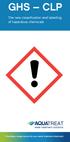 GHS CLP The new classification and labelling of hazardous chemicals ATREAT Providing a single source for your water treatment chemicals Dear customer The current European system for classification and
Bold Lavender & Camomile Liquitabs Safety Data Sheet according to Regulation (EC) No. 453/2010 Date of issue: 28/12/2011 Revision date: Version: 1.
 Date of issue: 28/12/2011 Revision date: Version: 1.0 SECTION 1: Identification of the substance/mixture and of the company/undertaking 1.1. Product identifier Chemical type Trade name Product code : Mixture
SAFETY DATA SHEET Revised edition no : 0 SDS/MSDS Date : 13 / 7 / 2012
 Page : 1 1. Identification of the substance/mixture and of the company/undertaking 1.1. Product identifier Trade name : ATE) AR/HPLC Product code : Identification of the product : 1-OCTANE SULFONIC ACID
Globally Harmonized System Pictogram Reference Table
 The following summarizes new label elements per the GHS classification guidelines. Each summary describes the previous label element compared to the new, and may include examples of the new elements. The
SAFETY DATA SHEET CLEENOL LIFT PEACH ORCHARD AIR FRESHENER
 Revision Date 30/03/2011 Revision 2 Supersedes date 18/06/2010 SAFETY DATA SHEET CLEENOL LIFT PEACH ORCHARD AIR FRESHENER SECTION 1: IDENTIFICATION OF THE SUBSTANCE/MIXTURE AND OF THE COMPANY/UNDERTAKING
Safety data sheet according to 1907/2006/EC, Article 31
 Page 1/6 SECTION 1: Identification of the substance/mixture and of the company/undertaking 1.1 Product identifier Article number: 10049297, 10049299 1.2 Relevant identified uses of the substance or mixture
The Biocidal Products Regulation. Latest developments
 The Biocidal Products Regulation Latest developments Eleventh Antimicrobial Workshop March 10-11, 2015 Hyatt Regency Crystal City Arlington, VA Pierre Choraine European Commission DG SANTE, Unit E.3 ECHA
CLP regulation & 2015 deadline for mixtures
 CLP regulation & 2015 deadline for mixtures CEFIC REACH Information and Experience Exchange Forum Zaventem, 18 December 2013 Maurits-Jan Prinz European Commission DG Enterprise & Industry Table of contents
SAFETY DATA SHEET CLEENOL LIFT GRAFFITI REMOVER
 Revision Date 13/07/2011 Revision 5 Supersedes date 13/07/2011 SAFETY DATA SHEET SECTION 1: IDENTIFICATION OF THE SUBSTANCE/MIXTURE AND OF THE COMPANY/UNDERTAKING 1.1. Product identifier Product name 1.2.
Safety data sheet according to 1907/2006/EC, Article 31
 Page 1/5 SECTION 1: Identification of the substance/mixture and of the company/undertaking 1.1 Product identifier 1.2 Relevant identified uses of the substance or mixture and uses advised against Application
REGULATION (EEC) No 2309/93
 REGULATION (EEC) No 2309/93 Council Regulation (EEC) No 2309/93 of 22 July 1993 laying down Community procedures for the authorization and supervision of medicinal products for human and veterinary use
REACH Practical Guide on Safe Use Information for Mixtures under REACH. The Lead Component Identification (LCID) Methodology
 REACH Practical Guide on Safe Use Information for Mixtures under REACH The Lead Component Identification (LCID) Methodology Final version 6.1 25 February 2016 This REACH Practical Guide on Safe Use Information
SAFETY DATA SHEET Revised edition no : 0 SDS/MSDS Date : 10 / 7 / 2012
 Page : 1 1. Identification of the substance/mixture and of the company/undertaking 1.1. Product identifier Trade name : T AR Product code : Identification of the product : 1,2-NAPHTHAQUINONE-4-SULFONIC
SAFETY DATA SHEET Revised edition no : 1 SDS/MSDS Date : 26 / 11 / 2012
 Page : 1 1. Identification of the substance/mixture and of the company/undertaking 1.1. Product identifier Trade name : Product code : 1.2. Relevant identified uses of the substance or mixture and uses
Date. Object: REACH Regulation N 1907/2006 1. Dear Supplier,
 Model letter for structuring communication between companies and upstream suppliers Pre-registration and registration of substances on their own, in preparations or in articles Letter to be adapted according
SAFETY DATA SHEET H.S.C. HARD SURFACE CLEANER
 SAFETY DATA SHEET SECTION 1: Identification of the substance/mixture and of the company/undertaking 1.1. Product identifier Product name Product number Internal identification A035 EV Janitorial - HSC
HAZARD COMMUNICATION & THE GLOBAL HARMONIZING SYSTEM EMPLOYEE TRAINING
 HAZARD COMMUNICATION & THE GLOBAL HARMONIZING SYSTEM EMPLOYEE TRAINING This easy-to-use Leader s Guide is provided to assist in conducting a successful presentation. Featured are: INTRODUCTION: A brief
Nordic Ecolabelling of Paper Products - Chemical Module
 rdic Ecolabelling of Paper Products - Chemical Module Version 2.3 22 June 2011 30 June 2016 rdic Ecolabelling Content The rdic Ecolabel modular system for paper products 3 What is rdic Ecolabelled paper?
European Regulation and Stainless Steel
 European Regulation and Stainless Steel Patricia Koundakjian Eurofer, Brussels, Belgium Introduction This paper addresses European health and environmental regulation as it applies to the product, stainless
SAFETY DATA SHEET Revised edition no : 0 SDS/MSDS Date : 12 / 7 / 2012
 Page : 1 1. Identification of the substance/mixture and of the company/undertaking 1.1. Product identifier Trade name : ODIUM Product code : Identification of the product : NICOTINAMIDE ADENINE DINUCLEOTIDE
SAFETY DATA SHEET. Section 1: Identification of the substance/mixture and of the company/undertaking. Section 2: Hazards identification
 Page: 1 Compilation date: 16/06/2015 Revision No: 2 Section 1: Identification of the substance/mixture and of the company/undertaking 1.1. Product identifier Product name: 1.2. Relevant identified uses
REACH Practical Guide on Exposure Assessment and Communication in the Supply Chains Part III: Mixtures under REACH
 REACH Practical Guide on Exposure Assessment and Communication in the Supply Chains Part III: Mixtures under REACH March 2010 Copyright Copyright of CEFIC (AISBL) and VCI e.v., reproduction is authorised,