
UNDERGRADUATE BUSINESS STUDENT HANDBOOK <mays.tamu.edu/upo>
|
|
|
- Bruce Skinner
- 10 years ago
- Views:
Transcription
1 UNDERGRADUATE BUSINESS STUDENT HANDBOOK <mays.tamu.edu/upo>

2

3 Welcome to Mays Business School! The purpose of the Undergraduate Business Student Handbook is to provide information and references you need to fulfill your responsibilities as a student in Mays Business School at Texas A&M University. You bear the responsibility for being fully acquainted with and complying with the rules, policies and requirements of Texas A&M University, Mays Business School and your degree program. You are advised to use this handbook, along with other important information sources, for guidance in the undergraduate business program. Scheduling regular meetings with an academic advisor is a good way to stay informed. TABLE OF CONTENTS Mays Academic Staff BS-Agribusiness CBK 29 Undergraduate Program Office 1 BS-Agribusiness Upper Level Entry 30 Department Advisors 2 BS-Agribusiness 31 Advisor & Student Responsibilities 3 Footnotes 32 A Typical Semester 4 Core Curriculum Elective Lists Academic Policies American History 33 Registration 5 Behavioral Science 33 Wait-List 5 Natural Science 34 Graduation Requirements 6 Humanities 35 Good Academic Standing 7 Visual & Performing Arts 37 Satisfactory Degree Progress 7 BBA International Elective 39 Academic Integrity 7 High-Impact Learning Resources Academic Rules & Definitions 8 Learning to Succeed for a Lifetime 42 Satisfactory/Unsatisfactory Grading 10 Undergraduate Career Services 43 Transfer Credit 11 Study Abroad 44 Tuition Rebate 12 Certificate Programs 45 Degree Requirements & Business Majors Cooperative Education 46 BBA Upper Level Entry 13 Internships 47 BBA Common Body of Knowledge 14 Special Programs 49 Accounting 15 Academic & Student Involvement 51 Business Honors 17 Additional Information Finance 19 Howdy Web Portal 52 Management 21 Handy Phone Numbers, Websites 53 Management Information Systems 23 Notes Page Marketing 25 Supply Chain Management While every effort has been made to make this handbook as complete and accurate as possible, changes may occur at any time in requirements, deadlines and curricula listed in the handbook. PUBLISHED 5/ Undergraduate Business Student Handbook Page i

4 UNDERGRADUATE PROGRAM OFFICE The Undergraduate Program Office (UPO) supports Mays Business School by recruiting, advising and mentoring undergraduate business students. Academic advising is provided for business students according to lower- or upper-level status. Lower-level business students (BUAD, BUAG) receive advising from Undergraduate Program Office academic advisors in 238 Wehner. Academic advisors and graduate assistants of the UPO are available to serve all business freshmen and sophomores. You are encouraged to meet regularly with an academic advisor. Although you are not assigned to a specific advisor, you may request to meet with the advisor of your choice. UNDERGRADUATE PROGRAM STAFF 238 Wehner Building Mr. Peter Drysdale, Director, [email protected] Dr. Linda Windle, Associate Director, [email protected] Mr. Patrick Williams, Assistant Director, [email protected] Ms. Mary Ann Ricca, Senior Academic Advisor II, [email protected] Ms. Sheryl Lampo, Senior Academic Advisor I, [email protected] Mr. Kyle Gammenthaler, Academic Advisor II, [email protected] Ms. Brittany Hammond, Academic Advisor II, [email protected] Ms. Ashley Corn, Academic Advisor I, [email protected] Mr. Carlos Gonzalez, Recruiter, [email protected] Ms. Linda Huckaby, Administrative Coordinator, [email protected] Ms. Jeanne Prestwood, Administrative Secretary, [email protected] Office Hours 8:00 a.m. to 5:00 p.m. Monday through Friday Appointments and Information: Walk-in Monday & Thursday 8:30 a.m. 11:30 a.m. First come, first served basis By Appointment Monday Friday Schedule in-person, 238 Wehner or call Communication with UPO Staff Always use your TAMU address when ing your academic advisor Always include your full name and TAMU UIN Allow at least 48 hours for a response Be respectful, courteous and professional, and be mindful of sensitive information Check your TAMU account on a daily basis. Important notices and reminders will be sent to your TAMU address you are responsible for this knowledge! TAMU is the official form of communication at Texas A&M University Undergraduate Business Student Handbook Page 1 of 53

5 DEPARTMENT MAJOR ACADEMIC ADVISORS Upper-level business students receive advising from academic advisors for their major (ACCT, AGBU, BHNR, FINC, MGMT, MISY, MKTG, SCMT). Refer to the following list for your upper-level major academic advisor. Accounting 460 Wehner, Ms. Casey Kyllonen 487D Wehner Ms. Carla Morales 487E Wehner ACCT Advising website, <mays.tamu.edu/acct> Agribusiness 238 Wehner, Ms. Mary Ann Ricca 238 Wehner Business Honors 340 Wehner, Mr. Eric Newman 340M Wehner Finance (Schedule appointments through mays.tamu.edu/finc/advising) 360 Wehner, Dr. Larry Callis 354 Wehner Ms. Brie Garcia 357 Wehner FINC Advising website, <mays.tamu.edu/finc/advising/> Management 420 Wehner, Ms. Kristi Mora 483 Wehner MGMT Advising website, <mays.tamu.edu/mgmt/mgmt-advising> Management Information Systems (MISY) 320 Wehner, Ms. Alison Pike 330C Wehner INFO Advising website, <mays.tamu.edu/info/student-services-office> Marketing 220 Wehner, Mr. Andrew Loring 242 Wehner Ms. Leslie Seipp 242 Wehner MKTG Advising website, <mays.tamu.edu/mktg/advising/> Supply Chain Management (SCMT) 320 Wehner, Dr. Sudarsan Rangan 330E Wehner INFO Advising website, <mays.tamu.edu/info/student-services-office> Undergraduate Business Student Handbook Page 2 of 53

6 STATEMENT ON ACADEMIC ADVISING ROLES AND RESPONSIBILITIES Vision At Texas A&M University, academic advising engages students beyond their own world view recognizing the art of possibility. Mission Academic advising is a collaboration between a student and an academic advisor. Through teaching and learning experiences, the student sets goals, acquires information and services, and makes decisions consistent with interests, goals, abilities and degree requirements. Mays Business School provides academic advising to business students according to lower- or upper-level admission status. Advisor Responsibilities Academic advisors assist students by helping to identify and assess alternatives and the consequences of decisions. Academic advising is a continuous process of clarification and evaluation. You can expect your advisors to Effectively communicate business degree and graduation requirements. Collaborate with you in developing your academic, personal and professional goals. Assist you in making academic decisions consistent with goals, interests and abilities. Listen carefully and respect your questions, concerns, and problems. Provide referrals to campus resources and services appropriate to your needs. Enforce university and business school policies to ensure the integrity of your degree. Sometimes say no to your requests or to present alternatives. Student Responsibilities Students are responsible for knowing their degree requirements, relevant rules, policies, and deadlines, and for consulting with their advisors and the degree evaluation system. Your advisors will expect you to Be respectful by being on time, prepared, and treating advisors and other students as you would wish to be treated. Keep records of your academic goals and progress. Take notes during advising meetings. Read all correspondence from Mays and the university and to act accordingly. Research department and college programs and courses. Understand the process for declaring your upper-level business major. Be open to developing and clarifying personal values and goals. Use campus resources to enhance your academic experience and develop personal and professional goals. Maintain up-to-date local, permanent addresses/phones information and emergency contacts in University record. Ultimately, you bear responsibility for seeking adequate academic advising, for knowing and meeting business degree requirements, for enrolling in appropriate courses to ensure timely progress toward degree and for making decisions consistent with your academic, personal and professional goals Undergraduate Business Student Handbook Page 3 of 53

7 A TYPICAL SEMESTER Before Make changes to schedule; Get moved in; Buy/order books; Pay tuition and fees Week 1 2 Add/Drop Classes until Friday 5 p.m.; Walk-in advising from 8 a.m. 5 p.m. in 238 Wehner Regular advising schedule resumes Walk-in Advising Monday & Thursday, 8:30 11:30 a.m. Appointment Call (979) or visit 238 Wehner 3, 4, 5 First round of exams; See advisor if you are struggling 6, 7, 8 Mid-term/Second round of exams; Start thinking about next semester 9 10, 11, 12 13, 14 Course schedule posted; Meet with an advisor if you have not yet Q-Drop Deadline (60th class day) Texas A&M permits 4 Q-drops during your undergraduate studies Deadline: 60th class day 1-hour courses do not count State of Texas permits 6 total drops during your undergraduate studies Drops at other state institutions count 1-hour courses do count Deadline to withdraw from University Third round of exams, Preregistration for next semester Last round of regular exams 15 Last Class Days; Open registration begins; Reading Days; Prepare for finals Finals Final Examinations for all students 10 Days after Grades reported; Verify good academic standing & satisfactory degree progress Undergraduate Business Student Handbook Page 4 of 53

8 REGISTRATION Registration for the fall and spring semesters is accomplished at several times. In the preceding fall and spring semester (during November and April), a preregistration period is held for currently enrolled students to register for the next semester. The Office of the Registrar sets individual preregistration start dates and times. Students find their preregistration start date/time using Registration Time Assignment in the Registration channel on My Record in Howdy. The Class Schedule is available using the Registration channel or the Registrar website, <registrar.tamu.edu/>. Additional registration information may be obtained from the Office of the Registrar. Academic advisors in the Undergraduate Program Office and upper-level major academic advisors offer preregistration advising. Registration Hold For a number of reasons a student may be blocked (a hold) from registration. Before attempting preregistration, check your Registration Status for holds in the Registration channel on My Record. If a hold is in effect the student will not be allowed to register. If you need help or assistance with registration, contact the Registration Help Desk, Monday through Friday, 8 a.m. to 5 p.m., at , or [email protected]. WAIT-LIST REGISTRATION PROCEDURES If you are unable to register in a course because no seats are available you may be able to request wait-list registration. Each department has its own rules about wait-list registration. Before requesting, meet with an academic advisor about schedule options. The Undergraduate Program Office does not handle wait-list requests. Students requesting wait-list registration into a Mays Business School course must follow rules, guidelines, and deadlines of the department offering the course: ACCT <mays.tamu.edu/acct/advising/> 487 Wehner ACCT Professional Program 487 Wehner BUSN 340 Wehner FINC <mays.tamu.edu/finc/advising/> 354 Wehner IBUS 230 Wehner ISYS <infoadvising.tamu.edu> 330 Wehner MGMT <mays.tamu.edu/mgmt/mgmt-advising> 483 Wehner MKTG <mays.tamu.edu/mktg/mktg-advising> 242 Wehner SCMT <infoadvising.tamu.edu> 330 Wehner A wait-list request grants a department permission to enroll you in the requested course if a seat becomes available. When you request wait-list registration you MUST check your student schedule through the end of the open registration period (the fifth class day of a fall or spring semester) to see whether or not your request has been approved Undergraduate Business Student Handbook Page 5 of 53

9 REQUIREMENTS FOR GRADUATION Degree requirements are catalog specific and listed in the Undergraduate Catalog and in Texas A&M University Student Rules, <student-rules.tamu.edu>. You are able to access a display of the degree program requirements using View Degree Evaluation from the Degree Evaluation channel in My Record on Howdy <howdy.tamu.edu>. You must satisfy Mays Business School grade point average (GPA) requirements as outlined in the following: Have a 2.0 GPA or better in all course work attempted at Texas A&M University. Have a 2.0 GPA or better in all courses in the major field taken at Texas A&M University. Have a 2.0 GPA or better in all courses in the Common Body of Knowledge (CBK)* taken at Texas A&M University. * For courses retaken, the highest grade earned will be used in calculating this GPR. This applies only to the CBK requirement. Grades transferred from other institutions are not used in calculating this average. With the exception of physical activity and General Elective requirements, business students must take all other course work to satisfy degree requirements for a letter grade. Business students must take two courses in their major that are designated as fulfilling a writing requirement (W). The requirement may be met by taking two W courses or one W course and one oral communication (C) course. These courses are major specific and taken as part of the student s upper-level coursework. In all cases, it is your responsibility to check your degree evaluation and to complete all academic requirements of your academic major. Residence Requirement A minimum of 36 semester hours of 300- and/or 400-level coursework must be successfully completed in residence at Texas A&M University. A minimum of 12 of these 36 semester hours must be in your major. Foreign Language Requirement Some proficiency in a foreign language is also required to graduate from Texas A&M University. This requirement can be met by: Completing two units (two full years) of high school coursework in the same foreign language; Completing two semesters (one full year) of coursework at the college level in the same foreign language; or Demonstrating proficiency in a foreign language by examination Undergraduate Business Student Handbook Page 6 of 53

10 STANDARD FOR GOOD ACADEMIC STANDING Mays Business School students have the obligation to remain at all times in good academic standing, which is defined as a minimum 2.0 cumulative GPA in all course work taken at Texas A&M. Business students whose cumulative GPA at Texas A&M falls below a 2.0 will be blocked from further registration and will be dropped from Mays Business School enrollment without probation. Students who are dropped from Mays Business School for not maintaining a minimum 2.0 cumulative GPA will only be readmitted after meeting change-of-curriculum requirements. Thus, some dropped students may not be eligible for future readmission into Mays Business School. GOOD ACADEMIC STANDING You must maintain your cumulative GPA at 2.0 or greater to continue enrollment in Mays Business School. STANDARD FOR SATISFACTORY DEGREE PROGRESS Mays Business School students have the obligation to make satisfactory progress toward completion of all degree requirements. A minimum standard to measure degree progress requires satisfactory completion of 75 percent of attempted course credit hours each academic year. Business students are expected to take course work that applies toward the student s intended upper level business major. DEGREE PROGRESS You are expected to complete no less than 75% of all attempted course credit hours each academic year. STANDARD FOR ACADEMIC INTEGRITY In addition to maintaining good academic standing and satisfactory degree progress, Mays Business School students have an obligation to uphold the Aggie Code of Honor. The Dean reserves the right to remove from the business school any student found to have committed an act of academic dishonesty. AGGIE HONOR CODE An Aggie does not lie, cheat or steal, or tolerate those who do Undergraduate Business Student Handbook Page 7 of 53

11 ACADEMIC RULES AND DEFINITIONS You are responsible for being fully acquainted with and to comply with Texas A&M University Student Rules. <student-rules.tamu.edu> 1. Last Day to Drop Courses with No Record or Add Courses. Drop: 5 th class day of a fall or spring semester. Add: 5 th class day of a fall or spring semester. Refer to the Academic Calendar, <registrar.tamu.edu/>, for the semester dates, including summer terms and 10-week summer semester. 2. Satisfactory/Unsatisfactory. With the exception of physical activity and general elective requirements, courses taken to satisfy degree requirements must be taken for letter grades. See page 10 for complete details and information about taking courses on a Satisfactory/Unsatisfactory (S/U) basis. 3. Q-Drop. A&M undergraduates are permitted a maximum of 4 Q-drops; however Texas law limits students to 6 dropped courses from all state institutions. Q-drops in 1-hour courses do not count in the Texas A&M limit of 4 but will be included in the State-mandated limit of 6 dropped courses. Refer to University Student Rules <student-rules.tamu.edu/>. Deadline to Q-drop is 60 th class day of a fall or spring semester, the 15 th class day of summer term or the 35 th day of a 10-week summer semester. Refer to the Academic Calendar, <registrar.tamu.edu/>, for dates. Courses taught on a shortened format or between regularly scheduled terms have proportional deadlines determined by the registrar s office. 4. Withdrawal. Deadline to withdraw from the University is 60 th class day of a fall or spring semester, the 15 th class day of summer term or the 35 th day of a 10-week summer semester. Refer to the Academic Calendar, <registrar.tamu.edu/>, for dates. Meet with an advisor first to discuss this option, 238 Wehner, Upper Level Entry in Mays Business School. Lower-level business (BUAD/BUAG) students apply for upper-level before the last class day of the semester before they expect to enter upper-level. See page 13 for complete details and information. 6. Transfer of Credit. Acceptance of transfer credit will generally be limited to those courses taught in the freshman and sophomore years at Texas A&M University. See pages for complete details and information. Business students are instructed to have all transfer course credit (including correspondence, dual enrollment and credit-by-exam) posted to their official record at Texas A&M University BEFORE the first class day of the graduating semester. 7. Public Speaking. You are instructed to take your required public speaking course in a classroom setting. When selecting direct equivalents use the Texas Common Course Numbering (TCCNS), < or the Transfer Course Equivalency link, <admissions.tamu.edu/freshmen/gettingin/requiredhscourses/dcredit.aspx>. COMM 101 Introduction to Speech will NOT fulfill the public speaking requirement Undergraduate Business Student Handbook Page 8 of 53

12 ACADEMIC RULES AND DEFINITIONS (Continued) 8. Repetition of Courses. Credit for a course can only be earned once, even if the course is repeated. Exceptions include KINE 199 or other special courses when designated. 9. Incomplete Grades. A temporary grade of I (Incomplete) at the end of a semester for extenuating circumstances. See Student Rules, <student-rules.tamu.edu> 11. Minors. Business students may seek and receive transcript recognition for a maximum of two minors. To declare a minor the student must: a. Obtain approval from the minor-granting department, program or college. b. Provide proof of minor approval to the department or major academic advisor and complete the Request for Minor Field of Study BBA Curricula. i. If a lower-level business (BUAD/BUAG) student, he/she is required to meet with the academic advisor for the intended upper-level major BEFORE returning the Request for Minor Field of Study BBA Curricula form to the Undergraduate Program Office. c. Declare no later than the date on which they apply for graduation. d. Once declared, minor requirements become graduation requirements. The minor is displayed on the transcript after graduation, but is not displayed on the diploma. 12. Distinguished Student. An undergraduate student who completes a semester schedule of at least 15 hours or a summer session schedule of at least 12 hours with no grade lower than C and with a grade point of not less than 3.5 for the semester or summer session. See Student Rules, 11. Distinguished Students, <studentrules.tamu.edu>, for complete details. 13. Dean s Honor Roll. An undergraduate student who completes a semester schedule of at least 15 hours or a summer session schedule of at least 12 hours with no grade lower than C and with a grade point of not less than 3.75 for the semester or summer session. See Student Rules, 11. Distinguished Students, <student-rules.tamu.edu>, for complete details. 14. Graduation with Honors. Requires a minimum of 60 semester hours at Texas A&M University preceding graduation. GPA in Texas A&M coursework must equal that required for the appropriate category of honors. Summa Cum Laude: 3.9 GPA or above. Magna Cum Laude: 3.7 through GPA. Cum Laude: 3.5 through GPA. 15. Prerequisites. It is the responsibility of the student to be sure that course prerequisites are met. Prerequisites must be listed in the Undergraduate Catalog or the Schedule of Classes. Failure to meet course prerequisites could result in a student s being dropped from the class. 16. Double Major. Business Honors majors (BHNR) may elect two major fields of study within the BBA degree. The first major must be BHNR. The BHNR student must satisfy all University and Business School requirements and complete all curriculum requirements for each major. This option leads to the granting of one BBA degree with two majors Undergraduate Business Student Handbook Page 9 of 53

13 TAKING COURSE WORK ON A SATISFACTORY/UNSATISFACTORY (S/U) BASIS Business students may take only General Elective courses, KINE 198 and KINE 199 on a Satisfactory/Unsatisfactory (SU) basis. All other course work in the business degree plan must be taken for a letter grade (GR). General Elective A student must decide AT THE TIME OF REGISTRATION whether to take a General Elective course for letter grade or SU. The fifth class day of a fall or spring semester is the deadline for making this decision. Refer to the Academic Calendar for summer terms and 10-week summer semester dates <registrar.tamu.edu/general/calendar.aspx>. Talk with an advisor before registering for a General Elective on an SU basis. KINE 198 Students have until the Q-drop deadline to decide whether to take KINE 198 for a GR or SU. The Detailed Student Schedule will indicate "Satisfactory/Unsatisfactory" if the grade mode is SU or Letter Grade if the grade mode is GR. Note: KINE 198 CANNOT BE REPEATED. KINE 199 Students MUST enroll in their first KINE 199 on an SU basis to fulfill the one credit hour KINE 199 core curriculum requirement. KINE 199 can be repeated unlimited times, and students have until the Q-drop deadline to decide whether to take a specific section of KINE 199 for a GR or SU. If taken for a GR, in Mays BBA degree plans it can only fulfill a General Elective requirement. Note: For BS-Agribusiness majors KINE 199 GR fulfills NO degree requirement. Use the Registration channel in My Record any time before the Q-drop deadline to confirm or update the grade mode of KINE 198 and KINE 199. Print a copy of your Detailed Student Schedule to verify grading mode accuracy. Certain other courses may be offered SU only and the grading status cannot be changed. Such courses may only be used to fulfill General Elective requirements in Mays BBA degree plans. When a student elects to take a course on an SU basis: 1. A grade of "Satisfactory" (S) will be given for grades of C and above. The hours associated with S grades shall not be included in GPA calculation, semester or cumulative. 2. A grade of "Unsatisfactory" (U) will be given for grades of D and F. The hours associated with U grades shall be included in GPA calculation, both semester and cumulative, and count the same as an F Undergraduate Business Student Handbook Page 10 of 53

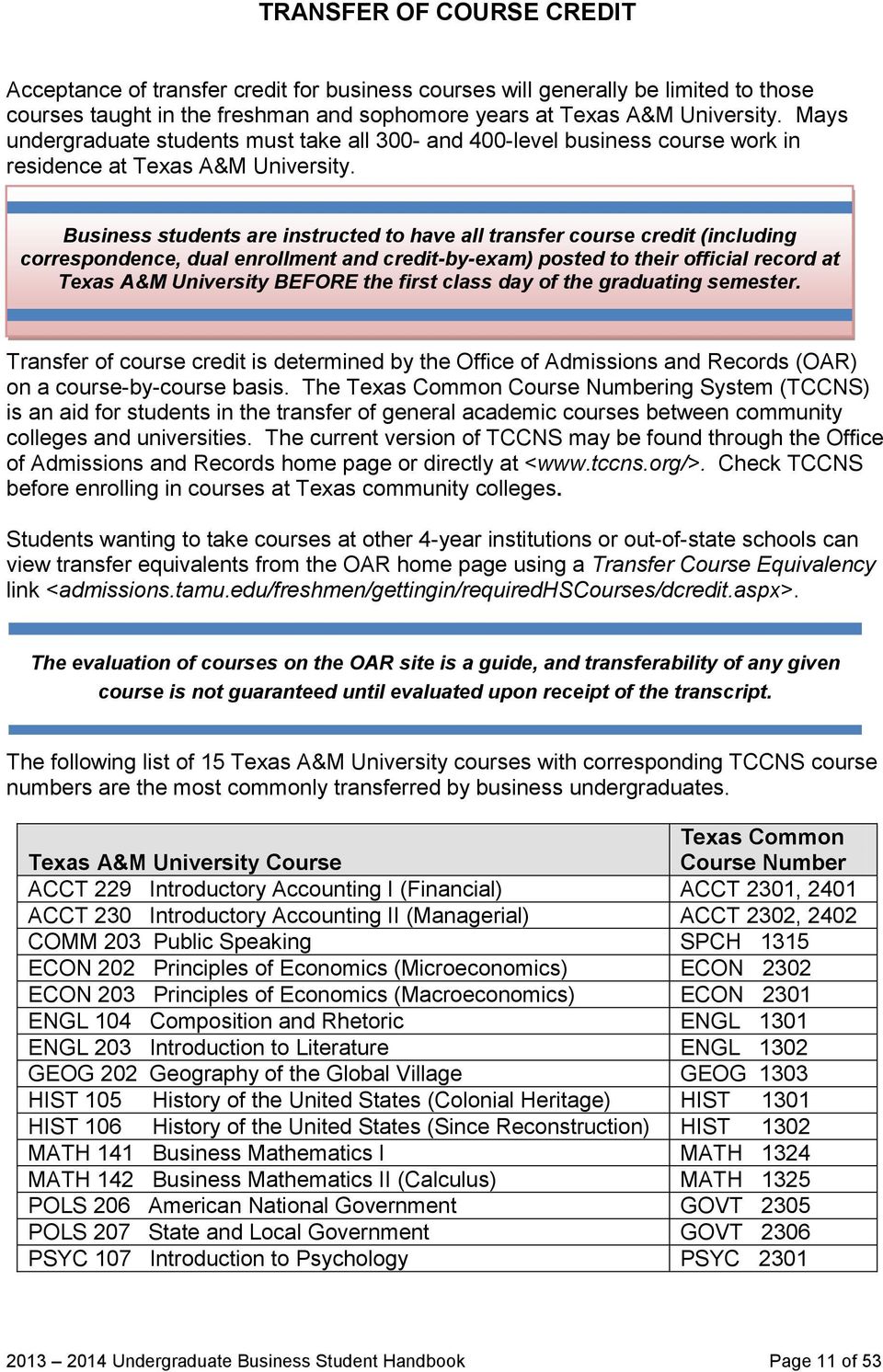
14 TRANSFER OF COURSE CREDIT Acceptance of transfer credit for business courses will generally be limited to those courses taught in the freshman and sophomore years at Texas A&M University. Mays undergraduate students must take all 300- and 400-level business course work in residence at Texas A&M University. Business students are instructed to have all transfer course credit (including correspondence, dual enrollment and credit-by-exam) posted to their official record at Texas A&M University BEFORE the first class day of the graduating semester. Transfer of course credit is determined by the Office of Admissions and Records (OAR) on a course-by-course basis. The Texas Common Course Numbering System (TCCNS) is an aid for students in the transfer of general academic courses between community colleges and universities. The current version of TCCNS may be found through the Office of Admissions and Records home page or directly at < Check TCCNS before enrolling in courses at Texas community colleges. Students wanting to take courses at other 4-year institutions or out-of-state schools can view transfer equivalents from the OAR home page using a Transfer Course Equivalency link <admissions.tamu.edu/freshmen/gettingin/requiredhscourses/dcredit.aspx>. The evaluation of courses on the OAR site is a guide, and transferability of any given course is not guaranteed until evaluated upon receipt of the transcript. The following list of 15 Texas A&M University courses with corresponding TCCNS course numbers are the most commonly transferred by business undergraduates. Texas Common Texas A&M University Course Course Number ACCT 229 Introductory Accounting I (Financial) ACCT 2301, 2401 ACCT 230 Introductory Accounting II (Managerial) ACCT 2302, 2402 COMM 203 Public Speaking SPCH 1315 ECON 202 Principles of Economics (Microeconomics) ECON 2302 ECON 203 Principles of Economics (Macroeconomics) ECON 2301 ENGL 104 Composition and Rhetoric ENGL 1301 ENGL 203 Introduction to Literature ENGL 1302 GEOG 202 Geography of the Global Village GEOG 1303 HIST 105 History of the United States (Colonial Heritage) HIST 1301 HIST 106 History of the United States (Since Reconstruction) HIST 1302 MATH 141 Business Mathematics I MATH 1324 MATH 142 Business Mathematics II (Calculus) MATH 1325 POLS 206 American National Government GOVT 2305 POLS 207 State and Local Government GOVT 2306 PSYC 107 Introduction to Psychology PSYC Undergraduate Business Student Handbook Page 11 of 53
15 TRANSFER OF COURSE CREDIT (Continued) Credit submitted for transfer must be on an official transcript received by the OAR from the registrar of the institution where the credit was earned. Credit for courses that transfer to Texas A&M University by equivalency are shown by A&M course number in the degree evaluation. Other courses transfer by title; degree evaluation will show only the course name from the other institution. In some cases these credits may be substituted for A&M credits through an adjustment request process. Materials from the course taken at another institution are required in the petitioning process. These materials include: 1. Course syllabus or professor s course outline. 2. Course description from the catalog of the institution that offered the course. 3. Title and table of contents of the textbook used in the course. 4. Other useful materials from the course, such as workbooks, tests, homework, reports, theme papers, class notes, quizzes, exams, memo from the professor. Meet with an academic advisor in the UPO, 238 Wehner, to petition course adjustment. Grade Point Average (GPA): Only grades in coursework, including repeated courses, which the student completes at Texas A&M University will be used in determining the student s A&M GPA. Transfer credit grades are not calculated into the A&M GPA; students receive transfer credit hours only. Credit may be transferred for work completed with grades of D or better if the grade is considered passing at the transfer institution. For additional information, contact the OAR, General Services Complex, 750 Agronomy Road, Suite 1601 in College Station, Texas, or by phone at TUITION REBATES FOR CERTAIN UNDERGRADUATES Certain undergraduate students who meet all of the predetermined state mandated requirements may be entitled to a $1,000 rebate upon completion of their first baccalaureate degree. Visit the Office of the Registrar website for a complete explanation of requirements, < Students must apply PRIOR to 5 p.m. on the Friday of commencement. Students desiring to qualify for tuition rebates are solely responsible for enrolling only in courses that will qualify them for the rebates. For questions, please contact: Office of the Registrar, State Policies Section, Texas A&M University, 750 Agronomy Road, Suite 1501, College Station, Texas, 77843, or [email protected] Undergraduate Business Student Handbook Page 12 of 53

16 UPPER LEVEL ENTRY REQUIREMENTS To be considered for upper-level (UL) entry into accounting, business honors, finance, management, management information systems, marketing, or supply chain management majors in Mays Business School, a business student must: Have junior classification (have passed at least 60 semester credit hours) Have satisfactorily completed the Big 8 courses MATH 141 MATH 142 Mathematics Business Mathematics I Business Mathematics II - Calculus Lower-Level Common Body of Knowledge ACCT 229 Introductory Accounting Financial ACCT 230 Introductory Accounting Managerial ECON 202 Principles of Economics Microeconomics ECON 203 Principles of Economics Macroeconomics ISYS 210 Fundamentals of Information Systems MGMT 211 Legal & Social Environment of Business Deadline to Apply Lower-level business (BUAD) students apply for UL before the last class day of the semester before they expect to enter UL. NOTE: To enter UL in the summer, you must have ALL requirements completed by the beginning of the first summer session. 1. Apply using the Upper Level Business Application in the Degree Evaluation channel in My Record on Howdy, <howdy.tamu.edu>, or in the UPO, 238 Wehner. 2. Preregister for UL business courses in the semester to which you have applied for UL admission. Students who fail to meet UL requirements, however, shall not be permitted to remain enrolled in UL business courses. APPLY FOR BBA UPPER-LEVEL ADMISSION BEFORE THE LAST CLASS DAY OF THE SEMESTER BEFORE YOU EXPECT TO ENTER UPPER-LEVEL. BBA UL entry requirements are MANDATORY. You must meet all requirements to enter upper level and enroll in 300/400 level business classes Undergraduate Business Student Handbook Page 13 of 53

17 BACHELOR OF BUSINESS ADMINISTRATION The degree of Bachelor of Business Administration (BBA) is offered in these seven majors: accounting, business honors, finance, management, management information systems, marketing, and supply chain management. Each requires a minimum of 120 semester credit hours of study. BBA COMMON BODY OF KNOWLEDGE Catalog (136) All BBA business majors are required to study fundamental theory and procedure in each of the basic business functions. The fundamental theory and procedure course work consists of 12 courses, for a total of 36 credit hours, and is referred to as the Common Body of Knowledge (CBK). Lower-Level Common Body of Knowledge (CBK) Credit Course Title Hours ACCT 229 Introductory Accounting Financial 3 ACCT 230 Introductory Accounting Managerial 3 ECON 202 Principles of Economics Microeconomics 3 ECON 203 Principles of Economics Macroeconomics 3 ISYS 210 Fundamentals of Information Systems 3 MGMT 211 Legal & Social Environment of Business 3 Upper-Level Common Body of Knowledge (CBK) Credit Course Title Hours FINC 341 Business Finance 3 MGMT 363 Managing People in Organizations 3 MGMT 466 Strategic Management 3 MKTG 321 Marketing 3 SCMT 303 Statistical Methods 3 SCMT 364 Operations Management Undergraduate Business Student Handbook Page 14 of 53

18 Students who wish to request wait-list registration into an ACCT class must do so with the Department of Accounting. Refer to < The UPO does not handle wait-list requests. Department Advisors: Department of Accounting Catalog (136) Ms. Casey Kyllonen 487D Wehner Ms. Carla Morales 487E Wehner <mays.tamu.edu/acct> CPA Examination requirements are set by the Texas State Board of Public Accountancy and change frequently. Updated approved course information is available at: < Students are encouraged to consult with their Accounting Advisor for additional information and advising about accounting course work required for the CPA Exam. The following courses are available in addition to the required accounting curriculum. The Department of Accounting determines availability. Courses may not be available each semester or summer session. Courses Terms Normally Offered ACCT 403 Energy Accounting Spring Only ACCT 408 Internal Auditing Fall only ACCT 410 Fraud Examination Spring only ACCT 426 Taxation of Low-Income Filers Spring only ACCT 445 International Accounting Spring, Summer only ACCT 447 Financial Statement Analysis Fall, Spring only ACCT 450 Accounting Ethics Spring, Summer only ACCT 484* Accounting Internship ACCT 485** Directed Studies ACCT 489*** Special Topics in *Application required and available online at <mays.tamu.edu/acct/advising/internships/>. **Requires approval of the department head and the student must obtain an Accounting Faculty Sponsor for the course ***ACCT 489 Requires approval of department head; not all ACCT 489 qualify for CPA eligible course work. Verify with an Accounting Advisor to ensure approval by the Texas State Board of Public Accountancy. Important Note: Accounting majors are advised to subscribe to the BBA Accounting listserv. To subscribe send an from your TAMU account to In the body type, Subscribe bba-acct-advising firstname lastname. Your TAMU is the only account authorized to receive mailings directly from the listserv. Revised 05/ Undergraduate Business Student Handbook Page 15 of 53

19 A TYPICAL SCHEDULE FOR BACHELOR OF BUSINESS ADMINISTRATION ACCOUNTING Catalog (136) Credit Hours Required CHECK YOUR DEGREE EVALUATION USING My Record FROM HOWDY <howdy.tamu.edu>. FRESHMAN YEAR: FALL HRS FRESHMAN YEAR: SPRING HRS SUMMER I HRS ENGL 104** (1*) 3 HUMANITIES ELECTIVE (7*) 3 MATH 141*** (2*) 3 MATH 142*** (2*) 3 HIST 105 (3,4*) 3 HIST 106 (3,4*) 3 NATURAL SCIENCE (5*) 4 NATURAL SCIENCE (5*) 4 PSYC 107 (6*) 3 KINE 198 HEALTH & FITNESS (8*) SOPHOMORE YEAR: FALL HRS SOPHOMORE YEAR: SPRING HRS SUMMER II HRS ACCT 229*** (CBK) 3 ACCT 230*** (CBK) 3 ECON 202*** (CBK) 3 ECON 203*** (CBK) 3 ISYS 210*** (CBK) 3 MGMT 211*** (CBK) 3 POLS 206 (4*) 3 POLS 207 (4*) 3 COMM 203 or 205 or VISUAL & PERF. ARTS ELECT. (9*) 3 15 KINE 199 (8*) Must be taken S/U 1 16 JUNIOR YEAR: FALL HRS JUNIOR YEAR: SPRING HRS SUMMER III HRS ACCT ACCT FINC 341 (CBK) 3 ACCT SCMT 303 (CBK) 3 SCMT 364 (CBK) 3 MKTG 321 (CBK) 3 MGMT 363 (CBK) 3 INTERNATIONAL ELECTIVE (10*) 3 ACCT 421 9XX (12*) SENIOR YEAR: FALL HRS SENIOR YEAR: SPRING HRS SUMMER IV HRS ACCT ACCT 407 9XX (12*) 3 ACCT MGMT 466 (CBK) 3 MGMT INTERNATIONAL ELECTIVE (10*) 3 GENERAL ELECTIVE (11*) 3 GENERAL ELECTIVE (11*) 3 GENERAL ELECTIVE (11*) 3 GENERAL ELECTIVE (11*) * Number refers to footnote number. Footnotes can be found on page 32. ** English 104 must be completed by the end of the Sophomore year or it cannot be taken at Texas A&M. *** These 8 classes must be successfully completed to be considered for entry into Upper Level. Students must be in Upper-Level to take shaded courses. Page 16 of 53

20 There is a No Forcing policy in effect for all Business Honors classes. Business Honors (BHNR) Catalog (136) Director: Ms. Kris Morley 340 Wehner [email protected] Academic Advisor: Mr. Eric Newman 340 Wehner [email protected] To pursue a BBA in Business Honors, selection through an application process is required. For more information, see <mays.tamu.edu/businesshonors>. FOUNDATION COURSES: BUSN 125H* Business Learning Community BUSN 205H Integrated Worklife Competencies MGMT 466H Strategic Management (MGMT 680 if enrolled in Professional Program) BUSN 484 Internship BUSINESS HONORS COURSES: Select 5 courses for a total of 15 hours: Select 6 hours of Honors Electives**: ACCT 229H Introductory Accounting Financial Honors course outside the business school ACCT 230H Introductory Accounting Managerial Honors credit earned through AP or IB scores ISYS 210H Fundamentals of Information Systems BUSN 403 Personal Competency Assessment MGMT 211H Legal & Social Environment of Business BUSN 485 Teaching BUSN 302 Course FINC 341H Business Finance Independent Study Course MGMT 363H The Management Process Research Course MGMT 450H International Environment of Business Additional Business Honors courses MKTG 321H Marketing Honors Contracted Course SCMT 303H Statistical Methods **For information and approval of courses, consult the Business Honors advisor. SCMT 364H Operations Management BUSINESS ELECTIVES (Select 5 courses for a total of 15 credit hours): Any 300- or 400- level business course (ACCT, FINC, IBUS, INFO, MGMT, MKTG) except FINC 341, 409; INFO 303, 309, 364; MGMT 309, 363, 466; MKTG 321, 409. At least one of these courses must be writing-designated (W). Select in consultation with a department academic advisor. OTHER REQUIREMENTS: The Business Honors Handbook lists other requirements of the BHNR major. The handbook is available at <mays.tamu.edu/businesshonors>. Double Major: Business Honors students can double major in one of the six other BBA business fields of study (accounting, finance, management, management information systems, marketing, and supply chain management) by selecting all 15 hours of Business Electives and the 11 hours of General Elective credits from one major. Triple majors are not allowed. *Students selected for BHNR as second semester freshmen: BUSN 101 will be substituted for BUSN 125. Students who have not completed BUSN 101 MUST enroll in BUSN 125 the fall semester of their sophomore year. Revised 05/ Undergraduate Business Student Handbook Page 17 of 53

21 A TYPICAL SCHEDULE FOR BACHELOR OF BUSINESS ADMINISTRATION BUSINESS HONORS Catalog (136) Credit Hours Required CHECK YOUR DEGREE EVALUATION USING My Record FROM HOWDY <howdy.tamu.edu>. FRESHMAN YEAR: FALL HRS FRESHMAN YEAR: SPRING HRS SUMMER I HRS ENGL 104** (1*) 3 HUMANITIES ELECTIVE (7*) 3 UMATH 141U*** (2*) 3 UMATH 142U*** (2*) 3 HIST 105 (3,4*) 3 HIST 106 (3,4*) 3 NATURAL SCIENCE (5*) 4 NATURAL SCIENCE (5*) 4 BUSN 125 2XX 3 KINE 198 HEALTH & FITNESS (8*) SOPHOMORE YEAR: FALL HRS SOPHOMORE YEAR: SPRING HRS SUMMER II HRS UACCT 229U*** (19*) (CBK) 3 UACCT 230U*** (19*) (CBK) 3 UECON 202U*** (CBK) 3 UECON 203U*** (CBK) 3 B0UISYS 210U*** (19*) (CBK) 3 UMGMT 211U*** (19*) (CBK) 3 POLS 206 (4*) 3 BUSN X (12*) 3 PSYC 107 (6*) 3 VISUAL & PERF. ARTS ELECT. (9*) 3 16 JUNIOR YEAR: FALL HRS JUNIOR YEAR: SPRING HRS SUMMER III HRS FINC 341 (19*) (CBK) 3 MGMT 363 (19*) (CBK) 3 MKTG 321 (19*) (CBK) 3 SCMT 364 (19*) (CBK) 3 SCMT 303 (19*) (CBK) 3 BUSINESS ELECTIVE (20*) 3 COMM 203 or 205 or BUSINESS ELECTIVE (20*) 3 INTERNATIONAL ELECTIVE (10*) 3 POLS 207 (4*) SENIOR YEAR: FALL HRS SENIOR YEAR: SPRING HRS SUMMER IV HRS BUSN MGMT 466 2XX (CBK) 3 BUSINESS ELECTIVE (20*) 3 BUSINESS ELECTIVE 9XX (12, 20*) 3 BUSINESS ELECTIVE (20*) 3 INTERNATIONAL ELECTIVE (10*) 3 GENERAL ELECTIVE (11*) 3 GENERAL ELECTIVE (11*) 3 GENERAL ELECTIVE (11*) 3 GENERAL ELECTIVE (11*) * Number refers to footnote number. Footnotes can be found on page 32. ** English 104 must be completed by the end of the Sophomore year or it cannot be taken at Texas A&M. *** These 8 classes must be successfully completed to be considered for entry into Upper Level. Students must be in Upper-Level to take shaded courses. Page 18 of 53
22 Student requests for registration in a full FINC course will be considered only for bona fide graduation emergencies. Direct inquiries to the Department of Finance advisor, 354 Wehner. The UPO does not handle wait-list requests. Department Advisors: Dr. Larry Callis Ms. Brie Garcia Department of Finance Catalog (136) <mays.tamu.edu/finc> 354 Wehner [email protected] 357 Wehner [email protected] The Finance Department strongly recommends the sequence of junior year course work as shown on A Typical Schedule for Bachelor of Business Administration Finance A grade of C or better in FINC 341 is required before attempting any further FINC courses. Additional prerequisites and recommended preparation may apply. FOUNDATION COURSES Terms Normally Offered FINC 341 Business Finance Fall, Spring, Summer FINC 350 Financial Ethics Fall, Spring, Summer FINC 421* Investment Analysis Fall, Spring, Summer FINC 434* Managerial Finance I Fall, Spring FINC 460 Money and Capital Markets Fall, Spring, Summer *Additional prerequisites of ACCT 315 or 327 with grade of C or better; SCMT 303 with grade of C or better. FINANCE (FINC) ELECTIVES** Terms Normally Offered FINC 368*** Trade Floor Dynamics Spring FINC 371 Real Estate Decision-Making Fall, Spring, Summer FINC 422**** Portfolio Management Fall, Spring FINC 423 Options and Financial Futures Fall, Spring FINC 424 Trading Risk Management Fall, Spring FINC 425 Portfolio Management Fall, Spring FINC 427**** Titans of Investing Fall, Spring FINC 428 Fixed Income Analysis Spring FINC 435 Managerial Finance II Spring FINC 443 Valuation Spring FINC 445 Funding International Business Fall, Spring, Summer FINC 447 Financial Statement Analysis Fall, Spring, Summer FINC 462***** Commercial Bank Management Spring FINC 466**** Wall Street, Inv. Banking & Markets Summer FINC 472 Real Estate Finance Spring FINC 473 Real Estate Appraisal Fall FINC 475 Real Estate Investment Analysis Fall FINC 485**** Problems Fall, Spring, Summer FINC 489**** Special Topics in (Varies) **Any 300- or 400-level Finance course except FINC 409, 478, and 484. ***Restricted to students in Trading, Risk, & Investments Program. ****May require application or approval of instructor. *****Restricted to students in Banking Certificate Program ACCT or FINC ELECTIVE (Select one course for a total of 3 credit hours): Any 300- or 400-level Accounting course except ACCT 315, 316, 327, or 328; or any 300- or 400-level Finance course except FINC 409, 478, and 484. NOTE: Before enrolling in ACCT 489, check with the Finance Advisor. IMPORTANT NOTE: Select courses based on consultation with Finance Advisor. Courses may on occasion not be available as listed. Check the Undergraduate Catalog and Schedule of Classes to verify offerings. Revised 05/ Undergraduate Business Student Handbook Page 19 of 53
23 A TYPICAL SCHEDULE FOR BACHELOR OF BUSINESS ADMINISTRATION FINANCE Catalog (136) Credit Hours Required CHECK YOUR DEGREE EVALUATION USING My Record FROM HOWDY <howdy.tamu.edu>. FRESHMAN YEAR: FALL HRS FRESHMAN YEAR: SPRING HRS SUMMER I HRS ENGL 104** (1*) 3 HUMANITIES ELECTIVE (7*) 3 MATH 141*** (2*) 3 MATH 142***(2*) 3 HIST 105 (3,4*) 3 HIST 106 (3,4*) 3 NATURAL SCIENCE (5*) 4 NATURAL SCIENCE (5*) 4 PSYC 107 (6*) 3 KINE 198 HEALTH & FITNESS (8*) SOPHOMORE YEAR: FALL HRS SOPHOMORE YEAR: SPRING HRS SUMMER II HRS ACCT 229*** (CBK) 3 ACCT 230*** (CBK) 3 ECON 202*** (CBK) 3 ECON 203*** (CBK) 3 ISYS 210*** (CBK) 3 MGMT 211*** (CBK) 3 POLS 206 (4*) 3 POLS 207 (4*) 3 COMM 203 or 205 or VISUAL & PERF. ARTS ELECT. (9*) 3 15 KINE 199 (8*) Must be taken S/U 1 16 JUNIOR YEAR: FALL HRS JUNIOR YEAR: SPRING HRS SUMMER III HRS ACCT 315 OR ACCT ACCT 316 OR ACCT FINC 341 (CBK) 3 FINC FINC 350 9XX (12*) 1 FINC MGMT 363 (CBK) 3 FINC 460 9XX (12*) 3 SCMT 303 (CBK) 3 INTERNATIONAL ELECTIVE (10*) SENIOR YEAR: FALL HRS SENIOR YEAR: SPRING HRS SUMMER IV HRS ACCT OR FINC ELECTIVE (13,14*) 3 FINC ELECTIVE (14*) 3 FINC ELECTIVE (14*) 3 FINC ELECTIVE (14*) 3 MKTG 321 (CBK) 3 MGMT 466 (CBK) 3 SCMT 364 (CBK) 3 INTERNATIONAL ELECTIVE (10*) 3 GENERAL ELECTIVE (11*) 3 GENERAL ELECTIVE (11*) * Number refers to footnote number. Footnotes can be found on page 32. ** English 104 must be completed by the end of the Sophomore year or it cannot be taken at Texas A&M. *** These 8 classes must be successfully completed before entering Upper Level. Students must be in Upper-Level to take shaded courses. Page 20 of 53
24 Students who wish to request enrollment in a full MGMT class must do so with the Department of Management. Refer to <mays.tamu.edu/mgmt/mgmt-advising>. The UPO does not handle wait-list requests. Department of Management Catalog (136) Department Advisor: Ms. Kristi Mora 483 Wehner [email protected] <mays.tamu.edu/mgmt> The following elective categories are part of the Management curriculum: MANAGEMENT (MGMT) ELECTIVES (Select 4 courses for a total of 12 credit hours*): The Department of Management determines availability of these courses. Courses may not be available each semester. MGMT 212 Business Law MGMT 372 Managing Organizational Behavior Prerequisite: MGMT 363 MGMT 424 Organizational Design, Change, and Development Prerequisite: MGMT 363 MGMT 425 Human Resource Selection Prerequisite: MGMT 373 MGMT 427 Human Resources Compensation Prerequisite: MGMT 373 MGMT 430 Employment Discrimination Law Prerequisite: Senior classification MGMT 435 Labor Law and Policy Prerequisite: Senior classification MGMT 440 Creativity and Innovation in Business Prerequisite: MGMT 363 MGMT 452 International Management Pre-/co-requisite: MGMT/IBUS 450 MGMT 460 Managing Projects Prerequisite: MGMT 363 MGMT 461 Entrepreneurship and New Ventures Prerequisite: Senior classification MGMT 464 Political Environment of Business Prerequisite: MGMT 363 & Senior classification MGMT 470 Small Business Management and Growth Prerequisite: Senior classification MGMT 475 Leadership Development Prerequisite: MGMT 363 MGMT 489 Special Topics in (selected 489 sections when available) BUSN 401 Business Fellows (requires admission to program) *At least one of the MGMT electives must be taken in a writing- (W) or communication- (C) designated format to complete the second W course requirement. MGMT majors are encouraged to gain work experience in their chosen field. With an approved internship, students may take MGMT 484 Management Internship and use those 3 hours as 1 of the 4 required management electives. For eligibility requirements, see <mays.tamu.edu/mgmt>. BUSINESS ELECTIVE (Select one course for a total of 3 credit hours): Any 300- or 400-level business course (ACCT, FINC, IBUS, ISYS, MKTG, SCMT) except MGMT ; ACCT ; FINC 341, 409, ; IBUS 450, 452, ; ISYS ; MKTG 321, 409, ; SCMT 303, 309, 364, ; SCMT 305, 336, or SCMT 345 if used to fulfill the data analysis elective. INTERNATIONAL ELECTIVES: MGMT majors are required to take MGMT/IBUS 450 as 3 of the 6 credit hours of international electives. REQUIRED COURSES in the Management curriculum include: MGMT 373, MGMT 439, ECON 322 or 323, and any one of ISYS 250, SCMT 305, 336, or 345 to fulfill the data analysis elective. IMPORTANT NOTE: Majors are advised to subscribe to the MGMT Advising listserv to learn of relevant information and opportunities for MGMT majors. To subscribe, send an to [email protected]. In the body, type SUBSCRIBE managementadvising firstname lastname. Revised 05/ Undergraduate Business Student Handbook Page 21 of 53
25 A TYPICAL SCHEDULE FOR BACHELOR OF BUSINESS ADMINISTRATION MANAGEMENT Catalog (136) Credit Hours Required CHECK YOUR DEGREE EVALUATION USING My Record FROM HOWDY <howdy.tamu.edu>. FRESHMAN YEAR: FALL HRS FRESHMAN YEAR: SPRING HRS SUMMER I HRS ENGL 104** (1*) 3 HUMANITIES ELECTIVE (7*) 3 MATH 141*** (2*) 3 MATH 142*** (2*) 3 HIST 105 (3,4*) 3 HIST 106 (3,4*) 3 NATURAL SCIENCE (5*) 4 NATURAL SCIENCE (5*) 4 PSYC 107 (6*) 3 KINE 198 HEALTH & FITNESS (8*) SOPHOMORE YEAR: FALL HRS SOPHOMORE YEAR: SPRING HRS SUMMER II HRS ACCT 229*** (CBK) 3 ACCT 230*** (CBK) 3 ECON 202*** (CBK) 3 ECON 203*** (CBK) 3 ISYS 210*** (CBK) 3 MGMT 211*** (CBK) 3 POLS 206 (4*) 3 POLS 207 (4*) 3 COMM 203 or 205 or VISUAL & PERF. ARTS ELECT. (9*) 3 15 KINE 199 (8*) Must be taken S/U 1 16 JUNIOR YEAR: FALL HRS JUNIOR YEAR: SPRING HRS SUMMER III HRS MGMT 363 (CBK) 3 FINC 341 (CBK) 3 MKTG 321 (CBK) 3 MGMT 373 9XX (12*) 3 INFO 364 (CBK) SCMT 303 (CBK) 3 MGMT 450 (10*) 3 ECON 322 OR SCMT 364 (CBK) 3 GENERAL ELECTIVE (11*) 3 GENERAL ELECTIVE (11*) SENIOR YEAR: FALL HRS SENIOR YEAR: SPRING HRS SUMMER IV HRS MGMT MGMT 466 (CBK) 3 DATA ANALYSIS ELECTIVE (24*) 3 MGMT ELECTIVE (16*) 3 MGMT ELECTIVE 9XX (12*, 16*) 3 MGMT ELECTIVE (16*) 3 MGMT ELECTIVE (16*) 3 INTERNATIONAL ELECTIVE (10*) 3 BUSINESS ELECTIVE (17*) 3 GENERAL ELECTIVE (11*) * Number refers to footnote number. Footnotes can be found on page 32. ** English 104 must be completed by the end of the Sophomore year or it cannot be taken at Texas A&M. *** These 8 classes must be successfully completed to be considered for entry into Upper Level. Students must be in Upper-Level to take shaded courses. Page 22 of 53
26 Students who wish to request enrollment in a full ISYS or SCMT class must do so with the Department of Information & Operations Management. Refer to <infoadvising.tamu.edu>. The UPO does not handle wait-list requests. Advising Document Only. Catalog changes & course decisions should be based on consultation with an advisor. Management Information Systems (MISY) Department of Information & Operations Management Catalog (136) Department Advisor: Ms. Alison Pike 330C Wehner [email protected] <mays.tamu.edu/info> FOUNDATION COURSES: ISYS 250 Business Programming Logic & Design Prerequisite: ISYS 210 ISYS 300 Business Communications I ISYS 310 Data Communications & Network-Based Systems Prerequisite: ISYS 210 ISYS 315 Database Management Systems Prerequisite: ISYS 250 ISYS 320 Business Systems Analysis & Design Prerequisite: ISYS 315 or concurrent enrollment ISYS 400 Business Communications II ISYS 410 Management of Info Systems Prerequisite: U4 in business or approval of instructor ISYS 415 Large-Scale Info Systems Project Prerequisites: ISYS 320, U4 or approval of instructor DIRECTED ELECTIVES (Select 2 courses for a total of 6 credit hours): Note: At least 3 hours (one course) must have an ISYS or SCMT prefix. Select courses based on consultation with your MIS advisor. A maximum of 3 hours of ISYS 485, 489 or BUSN 401 may be applied to the MISY degree plan with prior approval. GEOG 390 Principles of Geographic Info Systems Prerequisite: U3 or U4, approval of advisor ISYS 325 Business Object Oriented Programming with Java Prerequisite: ISYS 250 ISYS 420 Web Enabled Applications Prerequisite: ISYS 315 ISYS 425 Complex Business Application Design Prerequisite: ISYS 250 ISYS 460 E-Services Prerequisite: U4 in business or approval of instructor ISYS 485 Directed Studies Prerequisite: Admission to upper level and approval of instructor ISYS 489 Special Topics in Prerequisite: Admission to upper level and approval of instructor MGMT 439 Negotiations Prerequisite: MGMT 363 MGMT 460 Managing Projects Prerequisite: MGMT 363 MKTG 438 Strategic Internet Marketing Prerequisite: MKTG 321, U3 or U4 SCMT 335 Sourcing and Procurement Prerequisite: SCMT 364 with grade of C or better; SCMT 340 & SCMT 361 SCMT 340 Supply Chain Management Prerequisite: SCMT 364 with grade of C or better SCMT 345 Business Process Design Prerequisite: SCMT 364 with grade of C or better; SCMT 340 & SCMT 361 SCMT 361 Operations Planning & Control Prerequisite: SCMT 364 with grade of C or better or approval of instructor SCMT 465 Info Tech for Supply Chain Mgmt Prerequisite: SCMT 340 with grade of C or better; SCMT 361 SCMT 468 Enterprise Resource Planning Prerequisite: SCMT 364 Other courses with prior approval from the department academic advisor GENERAL ELECTIVE: Choose 3 or more courses for 9 hours credit. MISY majors are strongly encouraged to participate in a co-op or internship position. Contact the Experiential Education office in the Career Center for co-op information. For internships, use the Career Center, the Career Fair, and other departmental resources such as CMIS, <cmis.tamu.edu>, and the AITP student organization, <aitp.tamu.edu>, to find a participating company. COURSE AND CLASSIFICATION PREREQUISITES WILL BE ENFORCED This information is also available on the INFO Student Services Web site at <mays.tamu.edu/info/studentservices-office>. MISY majors are advised to regularly check the INFO Student Services Communications portal in elearning. Revised 05/ Undergraduate Business Student Handbook Page 23 of 53
27 A TYPICAL SCHEDULE FOR BACHELOR OF BUSINESS ADMINISTRATION MANAGEMENT INFORMATION SYSTEMS (MISY) Catalog (136) Credit Hours Required CHECK YOUR DEGREE EVALUATION USING My Record FROM HOWDY <howdy.tamu.edu>. FRESHMAN YEAR: FALL HRS FRESHMAN YEAR: SPRING HRS SUMMER I HRS ENGL 104** (1*) 3 HUMANITIES ELECTIVE (7*) 3 MATH 141*** (2*) 3 MATH 142*** (2*) 3 HIST 105 (3,4*) 3 HIST 106 (3,4*) 3 NATURAL SCIENCE (5*) 4 NATURAL SCIENCE (5*) 4 PSYC 107 (6*) 3 KINE 198 HEALTH & FITNESS (8*) SOPHOMORE YEAR: FALL HRS SOPHOMORE YEAR: SPRING HRS SUMMER II HRS ACCT 229*** (CBK) 3 ACCT 230*** (CBK) 3 ECON 202*** (CBK) 3 ECON 203*** (CBK) 3 ISYS 210*** (CBK) 3 ISYS VISUAL & PERF. ARTS ELECT. (9*) 3 MGMT 211*** (CBK) 3 POLS 206 (4*) 3 POLS 207 (4*) 3 15 KINE 199 (8*) Must be taken S/U 1 16 JUNIOR YEAR: FALL HRS JUNIOR YEAR: SPRING HRS SUMMER III HRS ISYS FINC 341 (CBK) 3 ISYS ISYS 300 9XX (12*) 1 SCMT 303 (CBK) 3 ISYS SCMT 364 (CBK) 3 ISYS 400 9XX (12*) 1 COMM 203 or 205 or MISY DIRECTED ELECTIVE (15*) 3 15 MKTG 321 (CBK) 3 14 SENIOR YEAR: FALL HRS SENIOR YEAR: SPRING HRS SUMMER IV HRS ISYS ISYS MISY DIRECTED ELECTIVE (15*) 3 MGMT 466 (CBK) 3 MGMT 363 (CBK) 3 INTERNATIONAL ELECTIVE (10*) 3 INTERNATIONAL ELECTIVE (10*) 3 GENERAL ELECTIVE (11*) 3 GENERAL ELECTIVE (11*) 3 GENERAL ELECTIVE (11*) * Number refers to footnote number. Footnotes can be found on page 32. ** English 104 must be completed by the end of the Sophomore year or it cannot be taken at Texas A&M. *** These 8 classes must be successfully completed to be considered for entry into Upper Level. Students must be in Upper-Level to take shaded courses. Page 24 of 53
28 Students who wish to request enrollment in a full MKTG class are directed to review the Department of Marketing s Wait List/Full Courses policy at <mays.tamu.edu/mktg/advising>. The UPO does not handle wait-list requests. Department of Marketing Catalog (136) Department Advisor: Mr. Andrew Loring 242 Wehner [email protected] Ms. Leslie Seipp 242 Wehner [email protected] <mays.tamu.edu/mktg> FOUNDATION COURSES (Required): Note: MKTG 321 is a prerequisite for all other MKTG courses. Additional prerequisites may apply. MKTG 322 Consumer Behavior MKTG 323 Marketing Research (Communication-designated) Prerequisite: MKTG 321 and INFO 303 MKTG 448 Marketing Management (Writing-designated) Prerequisite: MKTG 323 Note: MKTG 448 is limited to MKTG majors who are in their final semester of course work. It is offered every semester and at least one summer session. MARKETING (MKTG) ELECTIVES (Select 6 courses for a total of 18 credit hours): Select courses based on consultation with your Marketing Advisor. Courses may not be available each semester or summer session. A maximum of 6 hours of MKTG , MKTG , and BUSN 392* may be applied to Marketing degree plan. MKTG 325 Retailing Concepts & Policies MKTG 326 Strategic Retailing MKTG 335 Personal Selling MKTG 345 Alternative Media, Public Relations, and Sales Promotion MKTG 347 Advertising and Creative Marketing Communications MKTG 401 Global Marketing MKTG 402 International Marketing Study Abroad: Europe (Restrictions apply) MKTG 403 International Market Entry Strategies: Europe (available with MKTG 402 enrollment) MKTG 425 Retail Merchandising MKTG 426 Advanced Retail Case Competition MKTG 436 Sales Management MKTG 438 Strategic Internet Marketing MKTG 440 Services Marketing MKTG 442 Product Management MKTG 445 Advertising Account Planning MKTG 447 Advanced Advertising Case Competition MKTG 484 Marketing Internship (Restrictions apply) MKTG 485 Directed Studies (Restrictions apply) MKTG 489 Special Topics in (Additional prerequisites apply) *For BUSN 392 Cooperative Education in Business credit, please contact your Marketing Advisor. Revised 05/ Undergraduate Business Student Handbook Page 25 of 53
29 A TYPICAL SCHEDULE FOR BACHELOR OF BUSINESS ADMINISTRATION MARKETING Catalog (136) Credit Hours Required CHECK YOUR DEGREE EVALUATION USING My Record FROM HOWDY <howdy.tamu.edu>. FRESHMAN YEAR: FALL HRS FRESHMAN YEAR: SPRING HRS SUMMER I HRS ENGL 104** (1*) 3 HUMANITIES ELECTIVE (7*) 3 MATH 141*** (2*) 3 MATH 142*** (2*) 3 HIST 105 (3,4*) 3 HIST 106 (3,4*) 3 NATURAL SCIENCE (5*) 4 NATURAL SCIENCE (5*) 4 PSYC 107 (6*) 3 KINE 198 HEALTH & FITNESS (8*) SOPHOMORE YEAR: FALL HRS SOPHOMORE YEAR: SPRING HRS SUMMER II HRS ACCT 229*** (CBK) 3 ACCT 230*** (CBK) 3 ECON 202*** (CBK) 3 ECON 203*** (CBK) 3 ISYS 210*** (CBK) 3 MGMT 211*** (CBK) 3 POLS 206 (4*) 3 POLS 207 (4*) 3 COMM 203 or 205 OR VISUAL & PERF. ARTS ELECT. (9*) 3 15 KINE 199 (8*) Must be taken S/U 1 16 JUNIOR YEAR: FALL HRS JUNIOR YEAR: SPRING HRS SUMMER III HRS FINC 341 (CBK) 3 MKTG 323 9XX (12*) 3 MGMT 363 (CBK) 3 MKTG ELECTIVE (18*) 3 MKTG 321 (CBK) 3 MKTG ELECTIVE (18*) 3 SCMT 303 (CBK) 3 SCMT 364 (CBK) 3 GENERAL ELECTIVE (11*) 3 INTERNATIONAL ELECTIVE (10*) SENIOR YEAR: FALL HRS SENIOR YEAR: SPRING HRS SUMMER IV HRS MKTG MGMT 466 (CBK) 3 MKTG ELECTIVE (18*) 3 MKTG 448 9XX (12*) 3 MKTG ELECTIVE (18*) 3 MKTG ELECTIVE (18*) 3 MKTG ELECTIVE (18*) 3 INTERNATIONAL ELECTIVE (10*) 3 GENERAL ELECTIVE (11*) 3 GENERAL ELECTIVE (11*) * Number refers to footnote number. Footnotes can be found on page 32. ** English 104 must be completed by the end of the Sophomore year or it cannot be taken at Texas A&M. *** These 8 classes must be successfully completed to be considered for entry into Upper Level. Students must be in Upper-Level to take shaded courses. Page 26 of 53
30 Students who wish to request enrollment in a full ISYS or SCMT class must do so with the Department of Information & Operations Management. Refer to <infoadvising.tamu.edu>. The UPO does not handle wait-list requests. Advising Document Only. Catalog changes & course decisions should be based on consultation with an advisor. Supply Chain Management (SCMT) Department of Information & Operations Management Catalog (136) Department Advisor: Dr. Sudarsan Rangan 330E Wehner <mays.tamu.edu/info> [email protected] FOUNDATION COURSES: SCMT 300 Business Communications I SCMT 335 Sourcing and Procurement Prerequisite: SCMT 364 with grade of C or better; SCMT 340 & SCMT 361 SCMT 340 Supply Chain Management Prerequisite: SCMT 364 with grade of C or better SCMT 345 Business Process Design Prerequisite: SCMT 364 with grade of C or better; SCMT 340 & SCMT 361 SCMT 361 Operations Planning and Control Prerequisite: SCMT 364 with grade of C or better SCMT 400 Business Communications II SCMT 465 Info Tech for Supply Chain Mgmt Prerequisite: SCMT 340 with a grade of C or better; SCMT 361 DIRECTED ELECTIVES (Select 3 courses for a total of 9 credit hours): Note: At least 1 of the courses (3 hours) must have an ISYS or SCMT prefix. Select courses based on consultation with your Supply Chain Management advisor. A maximum of 3 hours of SCMT 485, 489 or BUSN 401 may be applied to the Supply Chain Management degree plan with prior approval. ACCT 329 Cost Management and Analysis Prerequisite: ACCT 315 or 327 with a grade of C or better ACCT 427 Accounting and Financial Info Systems Prerequisite: ACCT 327 with a grade of C or better ACCT 447 Financial Statement Analysis Prerequisite: ACCT 315 or 327; FINC 341 with a grade of C or better FINC 447 Financial Statement Analysis Prerequisite: FINC 341 with a grade of C or better, ACCT 315 or 327 ISYS 250 Business Programming Logic and Design Prerequisite: ISYS 210 ISYS 310 Data Communications & Network Based System Prerequisite: ISYS 210 ISYS 315 Database Management Systems Prerequisite: ISYS 250 ISYS 320 Business Systems Analysis & Design Prerequisites: ISYS 315 MGMT 212 Business Law Prerequisite: Sophomore classification MGMT 439 Negotiations Prerequisite: MGMT 363 MGMT 460 Managing Projects Prerequisite: MGMT 363 MGMT 461 Entrepreneurship and New Ventures Prerequisite: MGMT 363 MKTG 322 Buyer Behavior Prerequisite: MKTG 321 MKTG 442 Product Management Prerequisites: MKTG 321 SCMT 336 Decision Support Systems Prerequisite: SCMT 364 SCMT 468 Enterprise Resource Planning Prerequisite: SCMT 364 SCMT 485 Directed Studies Prerequisite: Approval of INFO Department Head SCMT 489 Special Topics Prerequisite: Approval of instructor and INFO Department Advisor Other courses with prior approval from the department academic advisor GENERAL ELECTIVE: Choose 3 or more courses for 9 hours credit. SCMT majors are strongly encouraged to participate in a co-op or internship position. Contact the Experiential Education office in the Career Center for co-op information. For internships, use the Career Center, the Career Fair, and other departmental resources such as CSCMP student organization, <cscmp.tamu.edu>, to find a participating company. COURSE AND CLASSIFICATION PREREQUISITES WILL BE ENFORCED This information is also available on the INFO Student Services Web site at <mays.tamu.edu/info/studentservices-office>. SCMT majors are advised to regularly check the INFO Student Services Communications portal in elearning. Revised 05/ Undergraduate Business Student Handbook Page 27 of 53
31 A TYPICAL SCHEDULE FOR BACHELOR OF BUSINESS ADMINISTRATION SUPPLY CHAIN MANAGEMENT (SCMT) Catalog (136) Credit Hours Required CHECK YOUR DEGREE EVALUATION USING My Record FROM HOWDY <howdy.tamu.edu>. FRESHMAN YEAR: FALL HRS FRESHMAN YEAR: SPRING HRS SUMMER I HRS ENGL 104** (1*) 3 HUMANITIES ELECTIVE (7*) 3 MATH 141*** (2*) 3 MATH 142*** (2*) 3 HIST 105 (3,4*) 3 HIST 106 (3,4*) 3 NATURAL SCIENCE (5*) 4 NATURAL SCIENCE (5*) 4 PSYC 107 (6*) 3 KINE 198 HEALTH & FITNESS (8*) SOPHOMORE YEAR: FALL HRS SOPHOMORE YEAR: SPRING HRS SUMMER II HRS ACCT 229*** (CBK) 3 ACCT 230*** (CBK) 3 ECON 202*** (CBK) 3 ECON 203*** (CBK) 3 ISYS 210*** (CBK) 3 MGMT 211*** (CBK) 3 POLS 206 (4*) 3 POLS 207 (4*) 3 COMM 203 or 205 or VISUAL & PERF. ARTS ELECT. (9*) 3 15 KINE 199 (8*) Must be taken S/U 1 16 JUNIOR YEAR: FALL HRS JUNIOR YEAR: SPRING HRS SUMMER III HRS MGMT 363 (CBK) 3 FINC 341 (CBK) 3 MKTG 321 (CBK) 3 SCMT SCMT 303 (CBK) 3 SCMT SCMT 364 (CBK) 3 SCMT DIRECTED ELECTIVE (15*) 3 GENERAL ELECTIVE (11*) 3 INTERNATIONAL ELECTIVE (10*) SENIOR YEAR: FALL HRS SENIOR YEAR: SPRING HRS SUMMER IV HRS SCMT 300 9XX (12*) 1 MGMT 466 (CBK) 3 SCMT SCMT SCMT SCMT DIRECTED ELECTIVE (15*) 3 SCMT 400 9XX (12*) 1 GENERAL ELECTIVE (11*) 3 SCMT DIRECTED ELECTIVE (15*) 3 INTERNATIONAL ELECTIVE (10*) 3 GENERAL ELECTIVE (11*) * Number refers to footnote number. Footnotes can be found on page 32. ** English 104 must be completed by the end of the Sophomore year or it cannot be taken at Texas A&M. *** These 8 classes must be successfully completed to be considered for entry into Upper Level. Students must be in Upper-Level to take shaded courses. Page 28 of 53
32 BACHELOR OF SCIENCE The degree of Bachelor of Science is offered in Agribusiness. The agribusiness program combines the common body of knowledge requirements of a degree in business with course work emphasizing the understanding of the unique institutional and managerial challenges facing agribusiness firms. BS AGRIBUSINESS COMMON BODY OF KNOWLEDGE Catalog (136) All BS agribusiness majors are required to study fundamental theory and procedure in each of the basic business functions. The fundamental theory and procedure course work consists of 13 courses, for a total of 37 credit hours, and is referred to as the Agribusiness Common Body of Knowledge (ACBK). Lower-Level Agribusiness Common Body of Knowledge (ACBK) Credit Course Title Hours ACCT 229 Introductory Accounting Financial 3 ACCT 230 Introductory Accounting Managerial 3 AGEC 217 Fundamentals of Ag Econ Analysis 3 ECON 202 Principles of Economics Microeconomics 3 ECON 203 Principles of Economics Macroeconomics 3 MGMT 211 Legal & Social Environment of Business 3 Upper-Level Agribusiness Common Body of Knowledge (ACBK) Credit Course Title Hours AGEC 440 Agribusiness Strategic Analysis 3 AGEC 481 Ethics in Agribusiness & Agricultural Economics 1 FINC 341 Business Finance 3 MGMT 363 Managing People in Organizations 3 MKTG 321 Marketing 3 SCMT 303 Statistical Methods 3 SCMT 364 Operations Management Undergraduate Business Student Handbook Page 29 of 53
33 BS AGRIBUSINESS UPPER LEVEL REQUIREMENTS To be considered for upper-level (UL) entry into the agribusiness major in Mays Business School a business student must: Have junior classification (have passed at least 60 semester credit hours) Have satisfactorily completed the following eight courses: MATH 141 MATH 142 Mathematics Business Mathematics I Business Mathematics II - Calculus Lower-Level Agribusiness Common Body of Knowledge ACCT 229 Introductory Accounting Financial ACCT 230 Introductory Accounting Managerial AGEC 217 Fundamentals of Agricultural Economics Analysis ECON 202 Principles of Economics Microeconomics ECON 203 Principles of Economics Macroeconomics MGMT 211 Legal & Social Environment of Business Deadline to Apply Lower-level agribusiness (BUAG) students apply for UL before the last class day of the semester before they expect to enter UL. NOTE: To enter UL in the summer, you must have ALL requirements completed by the beginning of the first summer session. 1. Apply using the Upper Level Business Application in the Degree Evaluation channel in the My Record tab on Howdy, <howdy.tamu.edu>, or in the UPO, 238 Wehner. 2. Preregister for UL business courses in the semester to which you have applied UL admission. Students who fail to meet UL requirements, however, shall not be permitted to remain enrolled in UL business courses. APPLY FOR BS AGRIBUSINESS UPPER-LEVEL ADMISSION BEFORE THE LAST CLASS DAY OF THE SEMESTER BEFORE YOU EXPECT TO ENTER UPPER-LEVEL. BS Agribusiness UL entry requirements are MANDATORY. You must meet all requirements to enter upper level and enroll in 300/400-level business classes Undergraduate Business Student Handbook Page 30 of 53
34 A TYPICAL SCHEDULE FOR BACHELOR OF SCIENCE AGRIBUSINESS Catalog (136) Credit Hours Required CHECK YOUR DEGREE EVALUATION USING My Record FROM HOWDY <howdy.tamu.edu. FRESHMAN YEAR: FALL HRS FRESHMAN YEAR: SPRING HRS SUMMER I HRS ENGL 104** (1*) 3 PSYC 107 (6*) 3 MATH 141*** (2*) 3 MATH 142*** (2*) 3 HIST 105 (3,4) 3 HIST 106 (3,4*) 3 NATURAL SCIENCE (5*) 4 NATURAL SCIENCE (5*) 4 AGEC KINE 198 HEALTH & FITNESS (8*) SOPHOMORE YEAR: FALL HRS SOPHOMORE YEAR: SPRING HRS SUMMER II HRS ACCT 229*** (ACBK) 3 ACCT 230*** (ACBK) 3 ECON 202*** (ACBK) 3 ECON 203*** (ACBK) 3 MGMT 211*** (ACBK) 3 AGEC 217 9XX*** (12*) (ACBK) 3 POLS 206 (4*) 3 POLS 207 (4*) 3 TECHNICAL AGRI. ELECTIVE (21*) 3 COMM 205 OR 243 (22*) 3 15 KINE 199 (8*) Must be taken S/U 1 16 JUNIOR YEAR: FALL HRS JUNIOR YEAR: SPRING HRS SUMMER III HRS AGEC AGEC FINC 341 (ACBK) 3 AGEC 429 9XX (12*) 3 MKTG 321 (ACBK) 3 SCMT 364 (ACBK) 3 MKTG 321 (ACBK) SCMT 303 (ACBK) 3 HUMANITIES ELECTIVE (7*) 3 ECON 322 OR INTERNATIONAL ELECTIVE (10*) SENIOR YEAR: FALL HRS SENIOR YEAR: SPRING HRS SUMMER IV HRS AGEC 431 9XX (12*) 3 AGEC AGEC 481 (ACBK) 1 AGEC 430 or FINC MGMT 363 (ACBK) 3 AGEC 440 (ACBK) 3 VISUAL & PERF. ARTS ELECT. (9*) 3 INTERNATIONAL ELECTIVE (10*) 3 GENERAL ELECTIVE (23*) 3 GENERAL ELECTIVE (23*) * Number refers to footnote number. Footnotes can be found on page 32. ** English 104 must be completed by the end of the Sophomore year or it cannot be taken at Texas A&M. *** These 8 classes must be successfully completed before entering Upper-Level. Students must be in Upper Level to take shaded courses. Page 31 of 53
35 FOOTNOTES FOR ALL CURRICULA 1. Enrollment restricted to students classified as freshman or sophomore (transfer hours included). 2. MATH 131, 147, 151, or 171 will be accepted in lieu of MATH 142. MATH 148, 152, 166, or 172 will be accepted in lieu of MATH Select from list of American History Electives, page 33; limited to 3 hours of Texas History. Most business students take HIST 105 and HIST For those students under ROTC contract, see section on Requirement in Political Science (Government) and History in the Undergraduate Catalog. 5. Select from list of Natural Science Electives, page Behavioral Science Elective to be selected from specific list of courses in Anthropology, Psychology, Sociology and Women s Studies, page 33. Students majoring in Management or Marketing must take PSYC Select from list of Humanities Electives, pages Kinesiology requirements are to be fulfilled by completing one KINE 198 Health and Fitness and one KINE 199 course. KINE 199 MUST be taken S/U. KINE 198 may be taken graded or S/U. Transfer students with fewer than 2 hours KINE credit must meet the KINE 198 requirement either by transfer of equivalent credit or by taking the course at Texas A&M. 9. Select from list of Visual and Performing Arts Electives, pages Select from International Electives list for business students, pages Six hours required. Management majors must take MGMT 450 as three of these required international elective hours. 11. General Electives are any courses offered for university credit. Students may register for elective courses on a graded or pass/fail basis (S/U). See page 10 for S/U grading information. Students whose high school transcript does not satisfy Texas A&M University s Foreign Language Graduation Requirement MUST complete a two-semester sequence of a foreign language. These credits earned will count toward the General Elective requirement. 12. Business students must take two (2) courses in their major that are designated as fulfilling the writing (W) requirement. The requirement may be met by taking two W-courses or one W-course and one oral communication (C) course. This course is an approved W- or C-course in the major. 13. Any 300- or 400-level Accounting or Finance course except ACCT 315, 316, 327, 328; FINC 409, 478 or 484. Check with the Finance advisor before enrolling in ACCT Any 300- or 400-level Finance course except FINC 409, 478, and MISY and SCMT majors select directed electives from lists located in the Undergraduate Program Office, 238 Wehner, or in the department advising office. Students desiring to use courses not listed must obtain prior approval from the department academic advisor. 16. Select from any MGMT course except required MGMT courses and MGMT 105, 209, 309. At least one of the MGMT electives must be taken in a writing- (W) or communication- (C) designated format to complete the second W course requirement. See footnote Any 300- or 400-level business course (ACCT, FINC, IBUS, ISYS, MKTG, SCMT) except MGMT ; ACCT ; FINC 341, 409, ; IBUS 450, 452, ; ISYS ; MKTG 321, 409, ; SCMT 303, 309, 364, ; SCMT 305, 336 or 345 if used to fulfill the data analysis elective. 18. Any MKTG course except required MKTG courses and MKTG 409. Consult with Marketing advisor for MKTG , BHNR majors are required to take 5 of the following 10 courses as Honors: ACCT 229, 230; FINC 341; ISYS 210; SCMT 303, 364; MGMT 211, 363, 450; MKTG Select from any 300-or 400-level business course (ACCT, FINC, IBUS, ISYS, MGMT, MKTG, SCMT) except FINC 341, 409; SCMT 303, 309, 364; MGMT 309, 363, 466; MKTG 321, 409. At least one of these courses must be writing- (W) or oral communication- (C) designated. Select in consultation with an academic advisor. 21. Three hours of technical agriculture electives to be selected from any course offered by the College of Ag & Life Science except 285, 484, 485, and AGEC courses. 22. Select Communication elective from AGJR 404, COMM 205, 243, ENGL 203, 235, 236, or Any Texas A&M or transfer course, except KINE 199, not used to meet other degree requirements. 24. Select from ISYS 250; SCMT 305, 336, or 345. Updated 05/ Undergraduate Business Student Handbook Page 32 of 53
36 AMERICAN HISTORY ELECTIVES To be a responsible citizen of the world it is necessary, first, to be a responsible citizen of one s own country and community. Business students must take HIST 105 or 106 or other courses in American and Texas history, except those courses pertaining solely to Texas history may not comprise more than 3 hours. Business students may make their American history selections from the following list of approved courses: HIST 105 History of the United States, through 1877 HIST 106 History of the United States, since 1877 HIST 226 History of Texas HIST 230 American Military History HIST 232 History of American Sea Power HIST 258 American Indian History Revised 05/13 BEHAVIORAL SCIENCE ELECTIVES As the human social environment becomes more complex, it is increasingly important for individuals to understand the nature and function of their social, political and economic institutions. Business students must take three (3) credit hours in a Behavioral Science subject from the following list of approved courses*: ANTH 201 ANTH 210 ANTH 225 ANTH 300 ANTH 314 ANTH 403 ANTH 404 Introduction to Anthropology Social and Cultural Anthropology Physical Anthropology Cultural Change and Development Agrarian Peasant Societies Primitive Religion Women and Culture PSYC ** Any course except 203, 204, 285, 485 SOCI Any course except 220, 285, 420, or 485 WGST 207 Introduction to Gender and Society WGST 316 Sociology of Gender WGST 317 Women in Politics WGST 404 Women and Culture WGST 424 Women and Work in Society WGST 462 Women and the Law * Individual Special Topic courses may be approved by the University for use in the Core Curriculum. **Students majoring in Management or Marketing must take PSYC 107. Revised 05/ Undergraduate Business Student Handbook Page 33 of 53
37 NATURAL SCIENCE ELECTIVES Knowledge and appreciation of science as a significant human activity, rather than merely a listing of results or collection of data, is acquired only by engaging in the activities of science. University Core Curriculum requires eight (8) credit hours of course work in Natural Sciences subjects as follows. At least four (4) hours must be selected from the following: ASTR 111 Overview of Modern Astronomy BIOL 101 Botany BIOL 107 Zoology BIOL 111 Introductory Biology I BIOL 113/ 123 Introductory Biology/ Introductory Biology Laboratory CHEM 101/ 111 Fundamentals of Chemistry/ Fundamentals of Chemistry Lab I CHEM 103/ 113 Structure and Bonding/ Physical & Chemical Principles CHEM 107/117 Gen. Chem. for Engineering/ Gen. Chem. for Engineering Lab GEOG 203 Planet Earth: Introduction to Earth Systems Science GEOG 213 Planet Earth Lab (1 credit lab) GEOL 101 Principles of Geology PHYS 201 College Physics PHYS 218 Mechanics Remaining hours to be selected from courses listed above or the following: ANTH 225 Biological Anthropology ASTR 101/ 102 Basic Astronomy/ Observational Astronomy ASTR 109/ 119 Big Bang and Black Holes/ Big Bang and Black Holes Laboratory ATMO 201/ 202 Atmospheric Science/ Atmospheric Science Laboratory BESC 201 Bio Environmental Sciences (3 credits) BIOL 112 Introductory Biology II CHEM 102/ 112 Fundamentals of Chemistry II/ Fundamentals of Chemistry Lab II CHEM 104/ 114 Chemistry of the Elements/ Qualitative Analysis CHEM 106/ 116 Molecular Science for Citizens/ Molecular Science for Cit. Lab CHEM 222/ 242 Elements of Organic & Biological Chem/ Elem Organic Chem Lab ENGR 101 Energy: Resources, Utilization and Importance to Society ENTO 322 Insects and Human Society (3 credits) ESSM 309 Forest Ecology (3 credits) GEOG 205 Environmental Change GEOL 106 Historical Geology GEOL 307 Dinosaur World GEOS 210 Climate Change GEOS 410 Global Change (3 credits) HORT 201/ 202 General Horticulture/ General Horticulture Laboratory OCNG 251/ 252 Oceanography/ Oceanography Laboratory PHYS 202 College Physics PHYS 208 Electricity and Optics RENR 205/ 215 Fundamentals of Ecology/ Fundamentals of Ecology Laboratory SCSC 105 World Food and Fiber Crops (3 credits) SCSC 301 Soil Science Revised 05/ Undergraduate Business Student Handbook Page 34 of 53
38 HUMANITIES ELECTIVES Knowledge of our culture and its ideals makes possible both social integration and self-realization. University Core Curriculum requires three (3) credit hours of course work in a Humanities subject. Acceptable courses* are: AFST 201 Introduction to Africana Studies AFST 204 Introduction to African-American Literature AFST 205 Introduction to Africana Literature AFST 300 Blacks in the United States, AFST 301 Blacks in the United States Since 1877 AFST 302 Gateway Course AFST 344 History of Africa to 1800 AFST 345 Modern Africa AFST 346 History of South Africa AFST 357 Out of Africa: The Black Diaspora and the Modern World AFST 401 Slavery in World History ANTH 202 ANTH 205 ANTH 301 ANTH 302 ANTH 303 ANTH 308 ANTH 313 ANTH 316 ANTH 317 ANTH 318 ANTH 350 ARCH 249 ARCH 250 ARCH 345 ARTS 149 ARTS 150 ARTS 350 CLAS 351 COMM 301 COMM 327 COMM 425 ENGL 203 ENGL 204 ENGL 205 ENGL 212 ENGL 221 Introduction to Archaeology Peoples and Cultures of World Indians of North America Archaeology of North America Archaeology of American SW Archaeology of Mesoamerica Historical Archaeology Nautical Archaeology Introduction to Biblical Archeology Nautical Archeology of the Americas Archaeology of the Old World Survey of World Architecture History I Survey of World Architecture History II History of Building Technology Art History Survey I Art History Survey II The Arts and Civilization Classical Mythology Rhetoric in Western Thought American Oratory Rhetoric of the Civil Rights Movement Introduction to Literature Introduction to African-American Literature Introduction to Africana Literature Shakespeare World Literature (pre-1500) Undergraduate Business Student Handbook Page 35 of 53
39 HUMANITIES ELECTIVES (Continued) ENGL 222 ENGL 227 ENGL 228 ENGL 231 ENGL 232 ENGL 235 ENGL 251 ENGL 330 ENGL 333 ENGL 334 ENGL 353 ENGL 354 ENGL 355 ENGL 360 ENGL 361 ENGL 362 ENGL 374 GEOG 202 GEOG 301 GEOG 305 GEOG 321 GEOG 323 World Literature (post-1500) American Literature: Colonial to American Renaissance American Literature: Civil War - Present Survey of English Literature I Survey of English Literature II Creative Writing Prose The Language of Film Arthurian Literature Gay and Lesbian Literature Science Fiction Present and Past History of Rhetoric Modern Rhetorical Theory The Rhetoric of Style Literature for Children Literature for Adolescents Hispanic Literature in the U.S. Women Writers Geography of the Global Village Geography of the United States Geography of Texas Geography of Africa Geography of Latin America HIST Any Course except 285, 485 HORT 203 HUMA 211 HUMA 213 HUMA 303 HUMA 304 LAND 240 LAND 340 LBAR 331 LBAR 332 LBAR 333 Floral Design Hebrew Scriptures New Testament Near Eastern Religions Indian and Oriental Religions History of Landscape Architecture Development of Landscape Architecture in North America Studies in European Civilization and Culture I Studies in European Civilization and Culture II Studies in Italian Civilization & Culture I MODL** Any MODL course except 285, 485 MUSC 200 MUSC 201 Topics in Music Music and the Human Experience PHIL Any course except 240, 285, 341, 342, or Undergraduate Business Student Handbook Page 36 of 53
40 HUMANITIES ELECTIVES (Continued) RELS 211 RELS 213 RELS 303 RELS 304 RELS 317 RELS 351 THAR 101 THAR 155 THAR 201 THAR 280 THAR 281 WGST 200 WGST 333 WGST 374 Hebrew Scriptures New Testament Near Eastern Religions Indian and Oriental Religions Introduction to Biblical Archaeology Classical Mythology Introduction to Western Theater History of Western Dress Introduction to World Theater History of Theater I History of Theater II Introduction to Women s Studies Gay and Lesbian Literature Women Writers * Individual Special Topic courses may be approved by the University for use in the Core Curriculum. ** or any course in the Department of Hispanic Studies or the Department of International Studies). If courses in MODL are used to fulfill the Humanities requirement, they must be in a different language than taken in high school or, if in the same language, at the 200-level or higher. For example, if the student took Spanish in high school, the student may not use SPAN 101 or 102 in satisfying the Humanities requirement. Revised 05/13 VISUAL AND PERFORMING ARTS ELECTIVES Knowledge of our culture and its ideals makes possible both social integration and selfrealization. University Core Curriculum requires three (3) credit hours of course work in a Visual and Performing Arts subject. Acceptable course are: ARCH 249 ARCH 250 ARTS 103 ARTS 111 ARTS 149 ARTS 150 ARTS 329 ARTS 330 ARTS 350 Survey of World Architecture History I Survey of World Architecture History II Design I Drawing I Art History Survey I Art History Survey II Texas Art History The Arts of America The Arts and Civilization Undergraduate Business Student Handbook Page 37 of 53
41 VISUAL AND PERFORMING ARTS ELECTIVES (Continued) CLAS 352 DCED 161 DCED 162 DCED 168 DCED 172 DCED 173 ENDS 101 ENDS 115 ENGL 212 ENGL 219 ENGL 251 FILM 251 HISP 352 HORT 203 Greek and Roman Drama Visual and Performing Arts Ballet II (2 credits) Visual and Performing Arts Ballet III (2 credits) Visual and Performing Arts Jazz Dance III (2 credits) Visual and Performing Arts Modern Dance II (2 credits) Visual and Performing Arts Modern Dance III (2 credits) Design Process Design Communication Foundations Shakespeare Literature and Other Arts The Language of Film Introduction to Film Analysis Hispanic Literature and Film Floral Design KINE Visual and Performing Arts (1 credit each; not repeatable) KINE 167 Visual and Performing Arts (1 credit each; not repeatable) KINE 169 Visual and Performing Arts (1 credit each; not repeatable) KINE Visual and Performing Arts (1 credit each; not repeatable) KINE 175 Gender Neutral Partnering (1 credit) LAND 240 MUSC 200 MUSC 201 MUSC 280 PERF 301 History of Landscape Architecture Topics in Music Music and the Human Experience Ensemble Performance Symphonic Band (1 credit; repeatable) Performance in World Cultures PHIL 330 Philosophy of Art PHIL 375 Philosophy of the Visual Media THAR 101 THAR 110 THAR 155 THAR 201 THAR 280 THAR 281 Introduction to Western Theater Acting I: Fundamentals History of Western Dress Introduction to World Theater History of the Theater I History of the Theater II Revised 05/ Undergraduate Business Student Handbook Page 38 of 53
42 INTERNATIONAL ELECTIVES The purpose of the international elective is to further the business student s knowledge of the contemporary world. Classes used to meet this requirement focus on cultural, political, and economic issues that impact today s business world. Business students must take six (6) hours of International electives from the following list of courses. (In the B.S. Agribusiness and B.B.A. curricula the 6 hours of approved international elective courses simultaneously fulfill the University s International and Cultural Diversity Core Curriculum requirement.) ACCT 445* AFST 345 AFST 346 AGEC 452 AGEC 453 ANTH 205 ANTH 300 ANTH 314 ARCH 458 COMM 335 ECON 320 ECON 324 ECON 330 EURO 323 EURO 443 EURO 444 EURO 447 FINC 445* FREN 301 FREN 322 FREN 323 FREN 336 FREN 418 FREN 425 GEOG 202 GEOG 311 GEOG 320 GEOG 321 GEOG 323 GEOG 325 GEOG 327 GEOG 402 GEOG 420 GERM 322 International Accounting Modern Africa History of South Africa International Trade and Agriculture International Agribusiness Marketing People and Cultures of the World Cultural Change and Development Agrarian Peasant Societies Cultural and Ethical Considerations for Global Practice Intercultural Communication Economic Development of Europe Comparative Economic Systems Economic Development Immigration and Ethnicity in Contemporary France Contemporary Russian Prose Russian Drama Russian Artistic Culture II: 1890 to Present Funding International Business French Culture and Civilization Survey of French Literature II Immigration and Ethnicity in Contemporary France Contemporary France Seminar in French Civilization French Film Geography of the Global Village Cultural Geography The Middle East Geography of Africa Geography of Latin America Geography of Europe Geography of South Asia Interpretation of Cultural Landscapes Geography of Terrorism German Culture and Civilization II Undergraduate Business Student Handbook Page 39 of 53
43 INTERNATIONAL ELECTIVES (Continued) HISP 352 HISP 362 HISP 363 Hispanic Literature and Film Hispanic Literature in the U.S. Borderlands: U.S. and Mexico HIST 210 Russian Civilization HIST 324 European Society in the Industrial Age HIST 336 Europe Since 1932 HIST 339 Eastern Europe Since 1453 HIST 342 Latin America Since 1810 HIST 345 Modern Africa HIST 346 History of South Africa HIST 348 Modern Middle East HIST 352 Modern East Asia HIST 355 Modern China HIST 356 Twentieth Century Japan HIST 402 Germany Since 1815 HIST 407 History of France Since 1815 HIST 412 Soviet Union 1917-Present HIST 439 Twentieth Century England HIST 440 Latin America Cultural and Intellectual History HIST 441 History of Mexico 1821-Present HIST 449 History of Brazil 1822-Present HIST 464 International Development Since 1918 HIST 477 Women in Modern European History IBUS 401* Global Marketing (cross-listed with MKTG 401) IBUS 402* International Marketing (cross-listed with MKTG 402) IBUS 403* International Market Entry Strategies (cross-listed with MKTG 403) IBUS 445* International Accounting (cross-listed with ACCT 445) IBUS 446* Funding International Business (cross-listed with FINC 445) IBUS 450* International Environment of Business (cross-listed with MGMT 450) IBUS 452* International Management (cross-listed with MGMT 452) IBUS 455* Asian Business Environment IBUS 456* European Integration & Business IBUS 457* Global Entrepreneurship (cross-listed with MGMT 457) IBUS 458* International Negotiations IBUS 459* Latin American Markets IBUS 460* Academy for Future International Leaders MGMT 450* International Environment of Business MGMT 452* International Management MGMT 457* Global Entrepreneurship MKTG 401* MKTG 402* MKTG 403* Global Marketing International Marketing International Market Entry Strategies Undergraduate Business Student Handbook Page 40 of 53
44 INTERNATIONAL ELECTIVES (Continued) MUSC 324 POLS 229 POLS 231 POLS 322 POLS 323 POLS 324 POLS 326 POLS 328 POLS 338 POLS 365 POLS 424 POLS 432 Music in World Cultures Introduction to Comparative Politics Introduction to World Politics Western European Government and Politics Political Systems of Latin America Third World Politics Government and Politics of Eastern Europe Globalization and Democracy Government and Politics of Former Soviet Union Asian Governments and Politics Comparative Government Institutions Politics of the European Union SOCI 325 International Business Behavior SOCI 329 Pacific Rim Business Behavior SOCI 423 Globalization and Social Change SPAN 312 SPAN 320 SPAN 410 SPAN 411 SPAN 412 SPAN 421 SPAN 450 SPMT 337 WGST 463 WGST 477 Hispanic Culture and Civilization 18 th Century to Present Introduction to Hispanic Literature Hispanic Film Contemporary Hispanic Society and Culture Hispanic Writers in the U.S. Spanish Language Poetry Contemporary Spanish and Spanish-American Literature International Sport Business Gender in Asia Women in Modern European History Additionally, courses taken abroad, which are conducted in another country by a TAMU faculty member, completed as part of an reciprocal education exchange program (REEP), or completed in another country through direct enrollment in another institution, can be used to satisfy the IE (and ICD) requirement. This includes credits earned through 285, 291, 485, 484, and 491 courses conducted abroad for which grades are determined by a TAMU faculty member. * must be admitted to UPPER-LEVEL in Mays Business School. Revised 05/ Undergraduate Business Student Handbook Page 41 of 53
45 LEARNING TO SUCCEED FOR A LIFETIME Texas A&M University s core values include excellence, integrity, leadership, loyalty, respect and selfless-service. The university is committed to providing high-impact learning experiences to all students at all levels, across the whole curriculum. Employers who recruit Mays Business School graduates have identified several core competencies of a successful business person. The business school offers multiple opportunities for business students to develop these core competencies, including: Portfolio Development Career Services Certificate Programs Internships Communication Lab Study Abroad Cooperative Education Professional Programs Core Competencies In your time at Mays Business School you will learn fundamental business principles and technical skills, but you will also learn to: Communicate effectively using written, spoken and visual media Solve problems, think critically, and make evidence-based decisions Lead yourself and others Work effectively in Teams or workgroups Think and act Ethically Manage yourself, resources and projects Create or find opportunities Portfolios A portfolio brings your résumé to life, showcasing who you are and how you work. It is a representation of who you are as a learner, leader, and aspiring business professional. Through creation of the portfolio, you discover your best self, reflect on your experiences and the core competencies, develop your personal brand, and plan for your ongoing professional development. The process helps with job interviews, and with business and personal relationships. For more information or to begin the portfolio process, go to 339 Wehner, call or [email protected]. Communication Lab The lab works with current business students to polish papers, résumés, presentations, and interviews. Consultants offer targeted, one-on-one feedback to strengthen each client s communication technique in preparation for the business world. To schedule appointments go to <mayscommlab.genbook.com>. For more information go to 339 Wehner, call or visit the website. <mays.tamu.edu/commlab> Undergraduate Business Student Handbook Page 42 of 53
46 BUSINESS UNDERGRADUATE CAREER SERVICES The Texas A&M Career Center, in collaboration with Mays Business School, has made the following services available to undergraduate business students seeking internships, co-op employment, and full-time employment after graduation: Career Advising: Get questions answered about the job search process including what you can do with your major, how to ace an interview, salary/offer negotiation, and more. Resume Review: Make sure your resume highlights your qualifications and presents your experience in a clear and concise format. Resume templates available at HireAggies.com. Walk-In Advising in 340AA Wehner: Monday & Thursday from 8:30 11:00 a.m. Daily Advising in 209 Koldus: from 8:30 11:00 a.m. & 1:30 4:00 p.m. Other Resources include: HireAggies.com: Create a profile, search job postings, and apply for positions. Additionally, you will find information on upcoming workshops, corporate informational sessions, career options, interview preparation and much more. Interview Preparation: Mock interviews are hosted by the Career Center every Fall and Spring and are conducted by corporate representatives. Additional practice is available through online programs and your Career Coordinator. Campus Recruiting: Over 2000 employers recruit on the Texas A&M campus during the Fall and Spring semesters. Take advantage of networking and interview opportunities to land your next job! Workshops: Each semester the Career Center holds numerous workshops on resume writing, social media best practices, Federal Employment, and Career Fair preparation in addition to Career Panels in multiple fields. JOB SEARCH REMINDERS Ethics Statement: Upon creating a profile on HireAggies.com, you are agreeing to the following: When I accept a job offer (including internships) in good faith, I will: 1. Stop all interviewing; 2. Notify, on a timely basis, all other employers actively recruiting me that I have accepted an employment offer; and 3. Fulfill my commitments in the job offer I have accepted, and not consider other offers of employment. If I need to cancel a scheduled interview, I will do so as soon as possible. If I cancel a Career Center interview the No Show and Late Cancellation Policy will be enforced. Please read the No Show/Late Cancellation Policy in the Documents Library under the Documents tab. I will request reimbursement for only reasonable and legitimate expenses by employers in the recruiting process. Consequences for failure to honor this code of ethics may include being blocked from using Hireaggies and Career Center resources, as well as informing your Department Head. Other ramifications may include a loss of opportunities for all students if an employer decides to stop recruiting Mays Business School and/or Texas A&M University students. Remember that your conduct while interacting with employers is not only a refection upon you, but also Mays Business School and Texas A&M University. If you have any questions during your job search, contact your Career Coordinator or anyone else at the Career Center. We are here to help you and are committed to your success. Lisa Burton, Career Coordinator for Mays Business School [email protected] 340AA Wehner, the Undergraduate Special Programs Suite. For appointments call Undergraduate Business Student Handbook Page 43 of 53
47 STUDY OR INTERN ABROAD Studying abroad is an enriching life experience that benefits the student, both personally and professionally. Students gain both academic and cultural experience that will change their perception of the United States, the world and the way business is conducted globally. The Center for International Business Studies (CIBS) offers the following study opportunities: Faculty-Led Exchange Field Trip Time Abroad: Summer 1 or 2 Dec Jan Fall or Spring May or June Length: 4-5 weeks 2 weeks (plus assignment due in Spring) 1-2 semesters 2 weeks (plus Spring course) Credits: 6 hours 3 hours 12 or 24 hours 3 hours Deadline: November 1 October 1 October 15 November 15 Requirements: 2.5 GPA; Upper-level 2.5 GPA 3.0 GPA; Upperlevel; Not last semester at TAMU 2.5 GPA; Instructor approval Faculty-Led Study Abroad Students travel with a Mays faculty member and select group of students to a foreign location for study in international business and culture/environment coursework. Programs also include company visits and cultural excursions. Reciprocal Exchange (REEP) Students experience complete immersion studying at a partner school for a semester or academic year. Mays REEP partnerships include universities in Austria, China, Denmark, France, Germany, India, The Netherlands, Norway, Spain, and Sweden. University-wide REEP partnerships include universities in Australia, Ecuador, France, Germany, Japan, Mexico, New Zealand, Singapore, South Korea, Switzerland, and United Kingdom. International Field Trips Students travel with a Mays faculty member to a foreign location for study following a semester course at TAMU. The international destination is an enhancement of what is learned during the course. Trip also includes company visits and cultural excursions. International Internships Students may pursue an international internship and receive IBUS 484 credit. The internship must be business-related and be no less than 6 weeks. Plan Ahead Plan early to take advantage of scholarships and to complete the study within the hours required. Meet with a business academic advisor about how course credits may apply. Attend a study abroad informational or meet with Katy Lane, Program Coordinator, at CIBS. More information To learn more about Mays programs and funding opportunities visit <mays.tamu.edu/cibs>. For university-wide programs, visit <studyabroad.tamu.edu>. Katy Lane, Program Coordinator Wehner [email protected] Open Advising Hours: Mon & Thu 8:30-11:30 a.m. or by Appointment Undergraduate Business Student Handbook Page 44 of 53
48 CERTIFICATE PROGRAMS Energy Accounting Certification The Energy Accounting Certificate offers Mays students seeking a BBA degree a chance to set themselves apart and find a place in an exciting, competitive industry that provides a wide variety of opportunities including international experiences. This program is designed to give students high impact learning experiences related to the energy industry. Program requirements are available on the Department of Accounting website, <mays.tamu.edu/acct/>. All requirements must be completed PRIOR TO graduation. The certificate program will be recognized on the transcript after graduation. Entrepreneurship Certification The Certificate in Entrepreneurial Leadership offers Mays students seeking a BBA or BS (Agribusiness) degree the opportunity to study entrepreneurship in a focused set of courses. Designed to develop competencies needed to successfully create and manage new ventures or to be a driver of innovation within existing enterprises, emphasis is placed on leadership in three areas: conceiving, exploiting, and managing opportunities. Program requirements are available on the Center for New Ventures & Entrepreneurship website, <cnve.tamu.edu>. All requirements must be completed PRIOR TO graduation. The certificate program will be recognized on the transcript after graduation. International Certifications Mays Business School offers three international certification programs. They are: International Business European Union Business Latin American Business Each program offers Mays BBA and BS (Agribusiness) students the opportunity to study international business, develop understanding of other cultures and language knowledge to meet global business challenges. Specific certificate requirements are available on the web at <mays.tamu.edu/cibs/>. Students are strongly encouraged to plan early and select courses based on consultation with a UPO academic advisor. All requirements for the specific program must be completed PRIOR TO graduation. The certificate program will be recognized on the transcript after graduation Undergraduate Business Student Handbook Page 45 of 53
49 CERTIFICATE PROGRAMS (Continued) Marketing Certifications The Department of Marketing offers three certificate programs. They are: Advertising Retailing Sales Each program offers BBA students the opportunity to focus on a concentrated course of study, participate in the designated student organization or competition, and gain experience in the selected area. Specific requirements for each certificate program may be found on the Department of Marketing website at <mays.tamu.edu/mktg/>. Students who want to earn one of these certifications must declare their intent with the Marketing advising office, Room 242 Wehner. More information is available at <mays.tamu.edu/mktg/advising/>. All requirements for the specific program must be completed PRIOR TO graduation. The certificate program will be recognized on the transcript after graduation. Not-for-Profit Certification The Certificate in Not-For-Profit Business offers Mays students seeking a BBA or BS (agribusiness) degree the ability to tailor their education towards a career of service. Program requirements may be found on the Undergraduate Program Office website at <mays.tamu.edu/upo/>. All requirements for the specific program must be completed PRIOR TO graduation. The certificate program will be recognized on the transcript after graduation. COOPERATIVE EDUCATION Cooperative education is designed to augment the academic program of study and is an excellent way to gain work experience, make professional contacts and earn a nice salary. The co-op student is eligible to participate in this program on completion of 45 credit hours, and must have a 2.5 GPA. For co-op information, contact the Co-op Office, 209 Koldus, , or the website at <careercenter.tamu.edu/>. Department advisors can also provide co-op information Undergraduate Business Student Handbook Page 46 of 53
50 INTERNSHIPS Accounting (ACCT) ACCT 484 Internship applies to the accounting curriculum as General Elective only. However, the Texas State Board of Public Accountancy* will apply ACCT 484 credit hours toward the additional accounting credit hours required to sit for the CPA exam provided that: the student performs accounting career development tasks, the student is supervised by a CPA, and the student returns to college studies for at least one semester after completion of the internship in order to have coursework opportunities to apply the skills that were developed on the internship. *To receive credit hours towards the CPA exam, Texas State Board of Public Accountancy requires that a student have 12 hours of upper level accounting course work before they go on their internship. BBA Accounting students who plan to intern should complete an application, available online at <mays.tamu.edu/acct/advising/internships/>. Contact a BBA Accounting advisor to help as you begin the application process. The application must be returned to a BBA Accounting advisor no later than five weeks prior to the beginning of the internship. Business Honors (BHNR) The BHNR curriculum requires 3 credits of BUSN 484 Internship. BHNR majors may use BUSN 484 Internship or substitute 484 Internship credit earned through another Mays department to fulfill this degree requirement. Eligibility consideration for the BUSN 484 Internship course requires the BHNR major to: Complete 60 hours prior to the start of the internship; Complete the Internship Application and gain approval before start of the internship; and Adhere to internship procedures and deadlines included in the course syllabus. BHNR students work with Kris Morley, director of Business Honors, to complete the internship requirements. Finance (FINC) FINC 484 Internship applies to the finance curriculum as General Elective only. Enrollment is restricted to FINC majors only with a cumulative GPA of 3.25 or better. Students planning to intern should complete an application, available from the FINC undergraduate advisor in 354 Wehner. Students must identify a FINC faculty member who is willing to supervise the internship. Completed applications must be submitted no later than five weeks prior to the beginning of the internship and require approval by the director of the B.B.A. Finance program. Internships for students in the Trading, Risk, and Investments Program (TRIP) and the Banking Certificate Program will be administered by Mr. L.R. Martindale, 360S Wehner, [email protected]. Contact Mr. Martindale to request FINC 484 registration Undergraduate Business Student Handbook Page 47 of 53
51 INTERNSHIPS (Continued) Management Information Systems (MISY) & Supply Chain Management (SCMT) An ISYS 484 or SCMT 484 Internship applies to the curriculum as General Elective credit. Internships are graded on a Satisfactory/Unsatisfactory (S/U) basis. MISY and SCMT majors should seek advice regarding an internship from their academic advisor in 330 Wehner. Students seeking an internship should attend the career fairs, work with the Texas A&M Career Center, and complete an internship application form at <mays.tamu.edu/info/current/internships/>. To apply for internship academic credit, the department requires that: The student obtain an Information & Operations Management (INFO) faculty member sponsor for the internship; An internship application form must be completed and signed by the student, faculty sponsor, internship advisor, and INFO Director of Student Services. The form can be obtained at <mays.tamu.edu/info/current/internships/>; and After signatures have been secured, the student will be registered in ISYS 484 OR SCMT 484 for General Elective credit. Management (MGMT) Management majors have the opportunity to earn three hours of academic credit toward Management Elective requirements through an approved internship. Eligibility consideration for the MGMT 484 Management Internship course requires the MGMT major to: Complete MGMT 363 prior to start of internship; Provide required documentation to Kristi Mora, internship instructor; Gain approval before start of internship; and Adhere to documentation and deadline requirements posted at <mays.tamu.edu/mgmt/mgmt-advising>. Students wishing to pursue the one hour MGMT 484 course for the Certificate in Entrepreneurial Leadership should contact the Center for New Ventures and Entrepreneurship, 430 Wehner. Marketing (MKTG) Marketing majors have the opportunity to earn three hours of academic credit toward Marketing Elective requirements through an approved internship and co-enrollment in MKTG 484. The Marketing Department does not place students in internships. Students seeking an internship should attend career fairs and work with the Texas A&M Career Center to secure their internship prior to the start of the semester. The MKTG 484 application is available at <mays.tamu.edu/mktg/advising/>. Eligibility consideration for the MKTG 484 Marketing Internship course requires the MKTG major to: Complete MKTG 321 prior to start of internship; Obtain a 300-hour internship that is to be completed during one semester; Apply for internship pre-approval and enrollment in MKTG 484 BEFORE the end of the Add/Drop period for the credit-earning semester Undergraduate Business Student Handbook Page 48 of 53
52 PROFESSIONAL PROGRAM The Professional Program (PPA) offered by the Department of Accounting is a two and one-half year program that offers a unique opportunity for successful and motivated students to develop superior credentials. Students enter the PPA at the start of the spring semester of their junior year. Upon completion of the program, students receive both a BBA in Accounting and a Master of Science (MS) in Accounting, Finance, Management, Management Information Systems, or Marketing. <mays.tamu.edu/acct/ppa/> Specialty Tracks Assurance Services/Information Management track develops skills students need to audit or consult with multinational corporations and financial institutions. Graduates receive an MS- Accounting degree. Tax Consulting and Financial Planning track emphasizes fundamental and contemporary aspects of tax in the current business environment. Graduates receive an MS-Accounting degree. Entrepreneurial Leadership track develops skills students need to successfully engage in conceiving, exploiting, and managing entrepreneurial opportunities. Graduates receive an MS- Accounting or MS-Management degree. Management Information Systems track develops skills students need to design and evaluate technology-based information systems. Graduates receive an MS-Management Information Systems degree. Financial Management track focuses on integrating accounting and finance. Graduates receive an MS-Finance degree. Marketing track allows students to specialize in e-commerce, marketing research, brand management, or consulting and services. Graduates receive an MS-Marketing degree. Admission to the Professional Program Applications to the PPA are accepted during the fall semester of a student s junior year, when an accounting major is taking ACCT 327 Financial Reporting I. The following factors are considered in the evaluation of applications: Achieved junior status Anticipate completing at least 90 credit hours before fall semester of senior year Grade Point Ratio (GPA) of 3.00 or higher for the last 30 semester hours Anticipated grade of B or higher for ACCT 327 Applicants who do not meet all of the above guidelines may be considered on an individual basis if extenuating circumstances exist and if the applicant exhibits potential for success in the program. Admission will be considered following an interview. Planning Ahead for Entry into the Program Students who plan to apply for the PPA should not take MGMT 212 Business Law or MGMT 466 Strategic Management as they will be replaced with specialized program courses. Admitted students receive scheduling advice through the PPA Office, 487 Wehner Undergraduate Business Student Handbook Page 49 of 53
53 MAYS BANKING PROGRAM The Banking Program is a flagship internship program in the Department of Finance designed to equip finance undergraduate students with the banking and finance skills needed to transition into the commercial banking industry. Banking Program students will benefit from: Guaranteed access to banking courses (one course taught by bankers) One paid summer commercial banking internship Contacts within a network of bankers Mentoring by bankers Social activities with student and banking participants Access to banking job opportunities Banking Program students have the option to apply for the Master of Finance (MSF) program. If accepted, they can graduate with both the BBA- and MS-Finance degrees. The Banking Program is competitive and a finance undergraduate must apply for acceptance in the fall semester of his/her junior year. For more information, visit the Mays Banking Program website, <mays.tamu.edu/banking/>, [email protected], or schedule an appointment through <mays.tamu.edu/finc/advising>. TRADING, RISK & INVESTMENTS PROGRAM The Trading, Risk & Investments Program (TRIP) is an internship program in the Department of Finance designed to prepare finance undergraduate students through classroom instruction and hands-on internship experiences for the fields of trading, investments and risk management. TRIP students will benefit from: Three paid markets related internships Opportunities to develop mentoring relationships with senior executives from advisory board member firms Guaranteed access to select coursework and programs Participation in a variety of markets related activities TRIP students have the option to apply for the Master of Finance (MSF) program. If accepted, they can graduate with both the BBA- and MS-Finance degrees. Applications to the TRIP are accepted from undergraduate business students during the fall semester. Admission is competitive. For more information, visit the TRIP website, <mays.tamu.edu/trip/>, [email protected] or schedule an appointment through <mays.tamu.edu/finc/advising>. MS IN MANAGEMENT INFORMATION SYSTEMS PROGRAM The Department of Information and Operations Management (INFO) is developing a 4+1 pathway to the Master of Science in Management Information Systems (MS-MIS) degree program for Mays undergraduates. Students selecting this program option will receive a BBA degree in four years and the MS-MIS in one additional year after the BBA. Interested business students MUST apply for this option during their junior year. Admitted students will receive scheduling advice from the MISY undergraduate advisor and MS-MIS advisor to create a five-year degree plan. For more information, Ted Boone, MS-MIS advisor, at [email protected] Undergraduate Business Student Handbook Page 50 of 53
54 ACADEMIC & STUDENT INVOLVEMENT RESOURCES Academic Success Center (ASC): The ASC s mission is to help all Aggies enhance their academic performance. The ASC is a collaboration between Academic Affairs and Student Affairs. The Center s holistic approach helps students identify roadblocks to academic success and ensures that all students have access to comprehensive resources. Learn more about ASC services online. <successcenter.tamu.edu> Business Career Fair: A BSC student-run, multi-day event. The fair provides an opportunity for company representatives to visit informally with students and identify candidates for immediate and future professional openings. Also, the fair is an opportunity for students to gain information about career possibilities. Learn more about the fair online. <bsc.tamu.edu/> Business Student Council (BSC): An organization of business student leaders, aimed at supporting their member organizations, serving the Mays Business School, and positively impacting Texas A&M University. Learn more about the BSC online. <bsc.tamu.edu/> Business Student Organizations: There are approximately 20 organizations of special interest to business students. Some are local chapters of national professional groups but most are related to a specific career interest. Learn more about business student organizations online. <bsc.tamu.edu/> Business Honors: Selection through an application process is required to join Business Honors and pursue a BBA in Business Honors. The major recognizes the importance and need for interdepartmental business course work to solve complex problems. For more information call or visit the website. <mays.tamu.edu/businesshonors> Mays Business Fellows: A premier undergraduate professional development program with excellence as its cornerstone. Admission is on a competitive basis. Upper-level students apply in the fall for this spring semester course, BUSN 401. For more information, call or visit the website. <mays.tamu.edu/fellows/> Professional Program: Admission to the program is by application during the fall semester of a student s junior year, when an accounting major is taking ACCT 327. For information, call or <mays.tamu.edu/acct/ppa>. Graduates earn a BBA in Accounting and a MS degree based on a specialty track. CPA Exam: Information is available at <mays.tamu.edu/acct/advising/>, from the Accounting BBA Advisor in 487 Wehner, and from the Texas State Board of Accountancy, 333 Guadalupe, Tower 3, Suite 900, Austin, Texas Phone < Professional School Advising (OPSA): The OPSA is the central location for Texas A&M University students who are seeking information about professional school including Law, Medical, Dental, Pharmacy and Physician Assistant. To make an appointment with an OPSA advisor, call Learn more about OPSA services onlne. <opsa.tamu.edu/> Student Counseling Service (SCS): The SCS provides a variety of services and programs including career counseling and testing, learning disability screenings, stress management & biofeedback training, short-term personal counseling and crisis intervention services. Learn more about SCS services online. <scs.tamu.edu> Undergraduate Business Student Handbook Page 51 of 53
55 HOWDY Howdy is a web portal that provides applicants, students, faculty and staff convenient access to Texas A&M University web services. It allows students to view and update Texas A&M information, access TAMU , and a variety of other web links. Howdy is available by going to <howdy.tamu.edu> and logging in using the assigned NetID. Access includes, but is not limited to, the following resources: My Record includes the following channels: Credit By Examination Registration Search Class Schedule Add or Drop Classes Registration Status (includes View Holds; Registration History) Registration Time Assignment My Schedule View My Schedule Final Exam Schedules Change Class/KINE Options Grades and Transcripts Grades Credit by Examination Official Transcript (Order Official Transcript) View Unofficial Transcript My Information Withhold Directory Information View/Update Contact Information (includes Addresses/Phones; Emergency) Degree Evaluation Application for Graduation View Degree Evaluation Excess Credit Hours Rule Upper Level Business Application Academic Resources Student Rules My Finances includes the following channels: Billing Tuition & Fees Pay My Tuition/Manage My Account Refunds Scholarships and Financial Aid Student Life includes the following channels: Parking and Transformation Student Involvement Purchase Optional Services Employment and Internships You are required to maintain up-to-date local, permanent addresses/phones information and emergency contacts in University record Undergraduate Business Student Handbook Page 52 of 53
56 HANDY PHONE NUMBERS & WEB SITES Phone Center/Department/Office Web Site (Area Code 979) Undergraduate Program Office (UPO) mays.tamu.edu/upo/ Academic Success Center (ASC) successcenter.tamu.edu/ Accounting (ACCT) mays.tamu.edu/acct/ Admissions Counseling admissions.tamu.edu/ Aggie Ring aggienetwork.com/ring/ Agribusiness (AGBU) mays.tamu.edu/upo/ Barnes & Noble Bookstore at Texas A&M tamu.bncollege.com/ Business Honors (BHNR) mays.tamu.edu/businesshonors/ Business Student Council (BSC) bsc.tamu.edu/ Career Center careercenter.tamu.edu/ Center for International Business (CIBS) mays.tamu.edu/cibs/ Communication Lab mays.tamu.edu/commlab Cooperative Education (Career Center) careercenter.tamu.edu/ Testing in Data & Research Services (DARS) dars.tamu.edu/ Degree Audit registrar.tamu.edu/ Disability Services disability.tamu.edu/ Honors and Undergraduate Research honors.tamu.edu/ Finance (FINC) mays.tamu.edu/finc/ Management (MGMT) mays.tamu.edu/mgmt/ Management Info Systems (MISY) mays.tamu.edu/info/ Marketing (MKTG) mays.tamu.edu/mktg/ Supply Chain Management (SCMT) mays.tamu.edu/info/ Mays Business Fellows mays.tamu.edu/fellows/ Professional School Advising (OPSA) opsa.tamu.edu/ Registrar registrar.tamu.edu/ Registration & Scheduling registrar.tamu.edu/ Scholarships & Financial Aid financialaid.tamu.edu/ Student Business Services (SBS) finance.tamu.edu/sbs/ Student Counseling Services (SCS) scs.tamu.edu/ Student Health Services shs.tamu.edu/ Student Locator Directory services.tamu.edu/directory-search/ Student Rules Information student-rules.tamu.edu/ Study Abroad studyabroad.tamu.edu/ Texas Success Initiative (TSI) newaggie.tamu.edu/ Transportation Services Parking transport.tamu.edu/ Transfer Admissions admissions.tamu.edu/ Texas A&M Undergraduate Catalog Texas Common Course Numbering System catalog.tamu.edu/ Undergraduate Business Student Handbook Page 53 of 53
57 NOTES The undergraduate program of Mays Business School at Texas A&M University is grateful for the generous support of the Association of Former Students.
58
UNDERGRADUATE BUSINESS STUDENT HANDBOOK. <mays.tamu.edu/academic-advising/>
 UNDERGRADUATE BUSINESS STUDENT HANDBOOK 2015 2016 Welcome to Mays Business School! The purpose of the Undergraduate Business Student Handbook is to provide information
UNDERGRADUATE BUSINESS STUDENT HANDBOOK. 2014-2015 <mays.tamu.edu/upo>
 UNDERGRADUATE BUSINESS STUDENT HANDBOOK 2014-2015 Welcome to Mays Business School! The purpose of the Undergraduate Business Student Handbook is to provide information and references
TEXAS A&M UNIVERSITY DEPARTMENT OF HEALTH & KINESIOLOGY B.S. DEGREE PLAN IN SPORT MANAGEMENT Internship Option (EDSM-SPI)
 TEXAS A&M UNIVERSITY DEPARTMENT OF HEALTH & KINESIOLOGY B.S. DEGREE PLAN IN SPORT MANAGEMENT Internship Option (EDSM-SPI) STUDENT (Last) (First) (MI) UIN# Writing Requirement SPMT 423 & SPMT 482 International
TEXAS A&M UNIVERSITY DEPARTMENT OF HEALTH & KINESIOLOGY B.S. DEGREE PLAN IN SPORT MANAGEMENT Non-Internship Option (EDSM-SPN)
 TEXAS A&M UNIVERSITY DEPARTMENT OF HEALTH & KINESIOLOGY B.S. DEGREE PLAN IN SPORT MANAGEMENT Non-Internship Option (EDSM-SPN) STUDENT (Last) (First) (MI) UIN# Writing Requirement SPMT 423 & SPMT 482 Foreign
John Cook School of Business http://slu.edu/x13227.xml
 John Cook School of Business http://slu.edu/x13227.xml The School of Business was founded in 1910 as a distinct unit of Saint Louis University, one of the first schools in the American West to provide
4. College of Business
 The University of Texas at San Antonio 1 4. College of Business Mission Statement The College of Business is dedicated to creating and sharing knowledge that enhances the translation of theory to practice.
SPORT MANAGEMENT DOUBLE MAJOR WITH MANAGEMENT, MARKETING OR OPERATIONS MANAGEMENT
 SPORT MANAGEMENT DOUBLE MAJOR WITH MANAGEMENT, MARKETING OR OPERATIONS MANAGEMENT CURRICULUM - Suggested Sequence for students admitted to the University as of Fall 2015 - Present First Semester Credits
MASTER OF ACCOUNTANCY PROGRAM Program Description
 MASTER OF ACCOUNTANCY PROGRAM Program Description The Master of Accountancy (MAcc) degree is designed to provide an opportunity for graduate study in accounting. The MAcc is intended to prepare professional
DOUBLE MAJOR MARKETING AND ENTREPRENEURSHIP & TECHNOLOGY INNOVATION
 DOUBLE MAJOR MARKETING AND ENTREPRENEURSHIP & TECHNOLOGY INNOVATION CURRICULUM Suggested sequence for students admitted as of Fall 2014- Present First Semester Credits Second Semester Credits FRESHMAN
College of Business. Role and Mission. Idaho Falls Programs. EITC/Idaho State University Program. Undergraduate Curriculum Learning Goals.
 2015-16 Idaho State University Undergraduate Catalog 1 College of Business Faculty Dean Thomas Ottaway, Ph.D. Associate Dean for Information Assurance Corey Schou, Ph.D. Associate Dean Joanne Tokle, Ph.D.
Katy ISD/HCC Dual Credit Program. A cooperative effort between Katy ISD and Houston Community College SPRING 2015
 Katy ISD/HCC Dual Credit Program A cooperative effort between Katy ISD and Houston Community College SPRING 2015 This presentation will be posted on the Katy ISD website. www.katyisd.org Departments GT
ACCOUNTING AND FINANCE DOUBLE MAJOR
 ACCOUNTING AND FINANCE DOUBLE MAJOR CURRICULUM Suggested sequence for students admitted as of Fall 2014 - Present First Semester Credits Second Semester Credits FRESHMAN YEAR Microeconomics, ECON 101*
2014-2015 PETITION/PROGRAM SHEET Degree: Bachelor of Arts Major: Liberal Arts, Elementary Teaching Concentration: Social Science
 14-15 PETITION/PROGRAM SHEET Degree: Bachelor of Arts Major: Liberal Arts, Elementary Teaching Concentration: Social Science About This Major... The Center for Teacher Education offers a comprehensive
ACCOUNTING. First Semester Credits Second Semester Credits FRESHMAN YEAR
 ACCOUNTING CURRICULUM Suggested sequence for students admitted to the University as of Fall 2012 - Present First Semester Credits Second Semester Credits FRESHMAN YEAR Microeconomics, ECON 151* 3 Critical
FINANCE AND FINANCIAL PLANNING DOUBLE MAJOR
 FINANCE AND FINANCIAL PLANNING DOUBLE MAJOR CURRICULUM - Suggested sequence for students admitted as of Fall 2014 - Present First Semester Credits Second Semester Credits FRESHMAN YEAR Microeconomics,
Katy ISD/HCC Dual Credit Program. A cooperative effort between Katy ISD and Houston Community College SPRING 2014
 Katy ISD/HCC Dual Credit Program A cooperative effort between Katy ISD and Houston Community College SPRING 2014 This presentation will be posted on the Katy ISD website. www.katyisd.org Departments GT
SCHOOL OF MANAGEMENT BUSINESS ADMINISTRATION MAJOR
 SCHOOL OF MANAGEMENT The mission of the School of Management is to prepare undergraduate business students for successful careers through a personalized, hands-on learning experience and positively impact
ADMISSION REQUIREMENTS AND PROCEDURES
 ADMISSION REQUIREMENTS AND PROCEDURES Changes to some admission requirements have occurred, edits are indicated below in red. Santa Fe University of Art and Design is an academically challenging institution
Masters Program Handbook
 Masters Program Handbook Last Edited: November, 2014 Table of Contents I. Overview and VCU Graduate Bulletin 1 II. Mandatory Orientation 2 III. Registration 2 A. VCU e-services 2 B. Advising Requirements
COLLEGE OF BUSINESS (124) MANAGEMENT (MGMT) FIRST THIRD SPECIALIZATIONS
 MAJOR REQUIREMENTS - 21 HOURS COLLEGE OF BUSINESS (124) MANAGEMENT (MGMT) FIRST THIRD SPECIALIZATIONS COURSE TITLE PREREQUISITE(S) MGMT 341 Organizational Behavior C min in ACCT/FIN/MGMT 208 MGMT 304;
College of Engineering, Architecture, and Computer Sciences POLICIES AND PROCEDURES
 College of Engineering, Architecture, and Computer Sciences POLICIES AND PROCEDURES Academic Progress Students should track their academic progress each semester using Degree Works. Students who have completed
DOUBLE MAJOR FINANCE AND SPORT MANAGEMENT
 DOUBLE MAJOR FINANCE AND SPORT MANAGEMENT FOR STUDENTS ADMITTED TO THE UNIVERSITY AS OF SEPTEMBER 2012 CURRICULUM - Suggested Sequence First Semester Credits Second Semester Credits FRESHMAN YEAR Microeconomics,
Academic Policies. Grading Guidelines
 Academic Policies Grading Guidelines Ashesi s grading system is modeled after University of Cape Coast as required by the National Accreditation Board. Student work is evaluated throughout the semester
Department of Educational Administration and Human Resource Development
 Department of Educational Administration and Human Resource Development Undergraduate Curriculum Committee Research Report 7-29-14 Committee members: Drs. Mike Beyerlein, Trez Jones, and Kelli Peck-Parrott
Texas A&M University -- College of Engineering -- Department of Computer Science & Engineering Undergraduate Degree Plan in Computer Science (CPSC)
 Texas A&M University -- College of Engineering -- Department of Computer Science & Engineering Undergraduate Degree Plan in Computer Science (CPSC) Valid for Fall 2014 Catalog (137) COMPUTER SCIENCE MATH
Application to Offer an Accelerated Master's Program
 Application to Offer an Accelerated Master's Program Originating Department: Belk College of Business Submitted by: Jennifer Troyer, Associate Dean for Research and Graduate Programs Date Submitted: March
MANAGEMENT INFORMATION SYSTEMS (MIS)
 MANAGEMENT INFORMATION SYSTEMS (MIS) CURRICULUM Suggested sequence for students admitted as of Fall 2014 Present First Semester Credits Second Semester Credits FRESHMAN YEAR Business Computing, MISY 160*
College of Education and Human Development
 College of Education and Human Development Undergraduate Student Handbook 2013-2014 http://mycehd.tamu.edu 2012-2013 College of Education and Human Development Undergraduate Student Handbook Page 1 Welcome
University of Toledo Catalog 2013 2014 COLLEGE OF ADULT AND LIFELONG LEARNING Rocket Hall 1300/Dean s Office Rocket Hall 1060, Main Campus
 COLLEGE OF ADULT AND LIFELONG LEARNING Rocket Hall 1300/Dean s Office Rocket Hall 1060, Main Campus Administration Dennis Lettman, Dean 419.530.3072 [email protected] Beth Gerasimiak, Senior Director
George Dean Johnson, Jr. College of Business & Economics
 George Dean Johnson, Jr. College of Business & Economics Accreditation Business programs are accredited by AACSB International The Association to Advance Collegiate Schools of Business (600 Emerson Road,
Graduate Programs Manual Shawnee State University
 Graduate Programs Manual Shawnee State University INTRODUCTION The following is a guide to graduate programs at Shawnee State University (SSU). SSU retains the right to change its course offerings, academic
BUSINESS ADMINISTRATION DEGREE PROGRAM (M.B.A.)
 BUSINESS ADMINISTRATION DEGREE PROGRAM (M.B.A.) The Master of Business Administration (M.B.A.) Degree Program is designed for individuals who find themselves at a point in their careers where continued
Missy Bender, Plano ISD Trustee
 Missy Bender, Plano ISD Trustee Missy Bender was elected to the Plano ISD Board of Trustees in May 2006 and re-elected in 2009. She is serving her third year as Secretary of the Board. Ms. Bender is the
Accountancy. 44 Credits
 Accountancy Wilma R. Dye, Ph.D. Associate Professor of Accountancy Dr. Wilma Dye received a doctorate in accounting from Texas Tech University and is an associate professor of accountancy. She specialized
APPROVED RULES OF THE COLLEGE OF ENGINEERING AND APPLIED SCIENCE UNIVERSITY OF COLORADO BOULDER
 APPROVED RULES OF THE COLLEGE OF ENGINEERING AND APPLIED SCIENCE UNIVERSITY OF COLORADO BOULDER Approved 5 February 2014 ARTICLE I. ORGANIZATION AND GOVERNANCE 1. The College of Engineering and Applied
Tuition and Fees 2014-2015. Academic and Registration Info
 Tuition and Fees 2014-2015 Academic and Registration Info North Idaho College 31 2014-2015 REGISTRATION Registration is the official process of enrolling in classes. NIC is on a 16-week Fall/Spring Semester,
Department of Accounting
 The University of Texas at San Antonio 1 Department of Mission Statement The mission of the Department of is to advance accounting knowledge and practice through excellence in accounting education, high-impact
International Business
 International Business Joint Five year B.A./M.S. International Business program B.A. International Spanish for the Professions, Department of Spanish and Portuguese University of Colorado at Boulder M.S.
General Information Academic Regulations 49
 General Information Academic Regulations 49 Academic Regulations Students are responsible for informing themselves of the academic regulations, requirements and policies set forth in this Bulletin and
Master of Accountancy Program (MAcc) new cycles begin each fall semester
 Accounting 1 Accounting Eric G. Press, Chairman Office: Alter Hall 448 215-204-8127 [email protected] www.fox.temple.edu/cms_academics/dept/accounting/ The program provides students with a broad general
ARTICULATION AGREEMENT BETWEEN JOHNSON COUNTY COMMUNITY COLLEGE AND NORTHWEST MISSOURI STATE UNIVERSITY
 ARTICULATION AGREEMENT BETWEEN JOHNSON COUNTY COMMUNITY COLLEGE AND NORTHWEST MISSOURI STATE UNIVERSITY AAS in Business Administration to BS in Business Management Northwest Catalog 2012-2014 OVERVIEW:
DOUBLE MAJOR AMONG MANAGEMENT, MARKETING & OPERATIONS MANAGEMENT
 DOUBLE MAJOR AMONG MANAGEMENT, MARKETING & OPERATIONS MANAGEMENT FOR STUDENTS ADMITTED TO THE UNIVERSITY AS OF SEPTEMBER 2011 CURRICULUM - Suggested Sequence First Semester Credits Second Semester Credits
DIVISION OF BUSINESS AND ECONOMICS
 2010-2011 ACADEMIC CATALOG DIVISION OF BUSINESS AND ECONOMICS DIVISION HEAD: DR. MOHSEN BAGNIED 95 AMERICAN UNIVERSITY of KUWAIT MAJOR DEGREE PROGRAMS The Division of Business and Economics oversees Bachelor
Undergraduate Degree Map for Completion in Four Years
 Page 1 of 6 Undergraduate Degree Map for Completion in Four Years College: College of Business Department: Marketing & International Business Name of Program: MARKETING Degree Designation: BS Emphasis/Concentration:
GUARANTEED ADMISSION AGREEMENT BETWEEN GEORGE MASON UNIVERSITY AND THE VIRGINIA COMMUNITY COLLEGE SYSTEM
 GUARANTEED ADMISSION AGREEMENT BETWEEN GEORGE MASON UNIVERSITY AND THE VIRGINIA COMMUNITY COLLEGE SYSTEM SECTION I: PURPOSE George Mason University (Mason) will guarantee admission to Virginia Community
Undergraduate Degree Map for Completion in Four Years
 Page 1 of 6 Undergraduate Degree Map for Completion in Four Years College: College of Business Department: Accounting and Business Law Name of Program: ACCOUNTING Degree Designation: BS Emphasis/Concentration:
Michael G. Foster School of Business Continuation Policy
 1 Michael G. Foster School of Business Continuation Policy The Michael G. Foster School of Business wants every student admitted to be successful in the program. At the same time, the Foster School is
2014-2015 PETITION/PROGRAM SHEET Degree: Bachelor of Arts Major: Criminal Justice
 14-15 PETITION/PROGRAM SHEET Degree: Bachelor of Arts Major: Criminal Justice About This Major... The Bachelor of Arts in Criminal Justice is designed to provide students interested in careers in the justice
SORRELL COLLEGE OF BUSINESS
 61 The Sorrell College of Business supports the Troy University mission by preparing our diverse student body to become ethical professionals equipped to compete in the global business environment. To
Students in the School of Business Administration are responsible for planning their own programs and for meeting degree requirements.
 SCHOOL OF BUSINESS ADMINISTRATION - UNDERGRADUATE www.bus.miami.edu INTRODUCTION The School of Business Administration offers courses leading to the degrees of Bachelor of Business Administration (BBA)
Academic Policy Series 1622.20A ATTACHMENT 2F ADD, CHANGE OR DELETE UNIT, PROGRAM REQUIREMENTS, OR ACADEMIC POLICIES
 Academic Policy Series 1622.20A ATTACHMENT 2F ADD, CHANGE OR DELETE UNIT, PROGRAM REQUIREMENTS, OR ACADEMIC POLICIES Complete this form consistent with the instructions in Academic Policy 1622.20. Use
Bachelor s/md Early Assurance Program
 Sophomore students who are interested in the medical, dental, veterinary and public health fields have the unique opportunity to enroll in one of Tufts' degree programs through special programs allowing
MANAGEMENT, MARKETING & OPERATIONS MANAGEMENT
 MANAGEMENT, MARKETING & OPERATIONS MANAGEMENT FOR STUDENTS ADMITTED TO THE UNIVERSITY AS OF SEPTEMBER 2006 CURRICULUM - Suggested Sequence First Semester Credits Second Semester Credits FRESHMAN YEAR Microeconomics,
BUSINESS, ACCOUNTING, AND ECONOMICS
 BUSINESS, ACCOUNTING, AND ECONOMICS The mission of the Trinity Christian College business department is to provide, within a Reformed Christian liberal arts context, a comprehensive foundation in business
ADVISING FAQ. I don t think I am going to get the required C- in my accounting class? What should I do?
 ADVISING FAQ ACADEMIC POLICIES AND PROCEDURES I don t think I am going to get the required C- in my accounting class? What should I do? First consider meeting with your instructor to go over your quizzes
ARTICULATION AGREEMENT Baltimore City Community College Associate of Science Degree in Business Administration. and
 ARTICULATION AGREEMENT Baltimore City Community College Associate of Science Degree in Business Administration and University of Baltimore Bachelor of Science in Business Administration (Specializations
ACCOUNTING MAJOR - BBA and MPA Degrees
 ACCOUNTING MAJOR - BBA and MPA Degrees * Not an official document. Refer to Advising Report for full requirements. Requirements may differ depending on date of admission. By following this plan you will
Academic Policies and Procedures
 Academic Policies and Procedures Academic policies can be changed at any time by the University of North Texas Health Science Center School of Public Health (UNTHSC-SPH). Students should review the Student
Academic Information. Academic Credit. Credit Earned at Carl Sandburg College. Credit for Courses Completed at Other Colleges and Universities
 Carl Sandburg College 1 Academic Information Academic Credit Credit Earned at Carl Sandburg College The unit of credit measure is the semester hour which approximates the effort expended in 50 minutes
ECONOMICS B.A. CURRICULUM - Suggested sequence for students admitted to the University as of Fall 2014 - Present
 ECONOMICS B.A. CURRICULUM - Suggested sequence for students admitted to the University as of Fall 2014 - Present First Semester Credits Second Semester Credits FRESHMAN YEAR Microeconomics, ECON 101* Critical
COLLEGE OF BUSINESS AND ECONOMICS
 COLLEGE OF BUSINESS AND ECONOMICS DEAN OF THE COLLEGE OF BUSINESS AND ECONOMICS OFFICE OF THE DEAN MISSION VALUES PROGRAMMATIC ACCREDITATION MAJOR DEGREE PROGRAMS MINORS DISCIPLINES (FIELDS OF STUDY) ACADEMIC
College of Business Administration
 College of Business Administration Dean, Stefanie Lenway Undergraduate Programs: Assistant Dean, Robin Brierton 1118 University Hall (UH) (312) 996-2700 Fax: (312) 413-4201 http://www.uic.edu/cba Undergraduate
About This Major... Bachelor of Arts: English Technical and Professional Writing 2006-2007 Program Sheet, Page 1 of 5 Posted 5/31/06
 06 07 PETITION/PROGRAM SHEET Degree: Bachelor of Arts Major: English Concentration: Technical and Professional Writing www.mesastate.edu/schools/shss/llc/english About This Major... The English Department
Undergraduate Degree Map for Completion in Four Years
 Page 1 of 6 Undergraduate Degree Map for Completion in Four Years College: College of Business Department: Marketing & International Business Name of Program: INTERNATIONAL BUSINESS Degree Designation:
Lewis College of Business LEWIS COLLEGE OF BUSINESS VISION STATEMENT LEWIS COLLEGE OF BUSINESS MISSION STATEMENT
 Lewis College of Business LEWIS COLLEGE OF BUSINESS VISION STATEMENT The Marshall University Elizabeth McDowell Lewis College of Business (LCOB) will be recognized as an exceptional educational value and
Dear Parents, We wish your student much success here at Bergen Community College and trust this information is helpful. Sincerely,
 Dear Parents, Making the transition from high school to college may be challenging and sometimes difficult. Students must adjust to new academic standards, make new friends, and make appropriate decisions
WELCOME TO BUSINESS AT UTSA
 WELCOME TO BUSINESS AT UTSA A GUIDE FOR FRESHMAN BUSINESS MAJORS prepared by the Business Advising Center College of Business University of Texas - San Antonio The Undergraduate Business Advising Center
GENERAL UNIVERSITY ACADEMIC INFORMATION
 GENERAL UNIVERSITY ACADEMIC INFORMATION STUDENT RESPONSIBILITIES UNIVERSITY DEGREE REQUIREMENTS ACADEMIC ADVISING ACADEMIC POLICIES Matriculation to the Undergraduate Degree Program Class Attendance Grading
REGULATIONS FOR THE DEGREE OF BACHELOR OF BUSINESS ADMINISTRATION / BACHELOR OF BUSINESS ADMINISTRATION IN ACCOUNTING AND FINANCE [BBA/BBA(Acc&Fin)]
![REGULATIONS FOR THE DEGREE OF BACHELOR OF BUSINESS ADMINISTRATION / BACHELOR OF BUSINESS ADMINISTRATION IN ACCOUNTING AND FINANCE [BBA/BBA(Acc&Fin)]](/thumbs/25/4903241.jpg "REGULATIONS FOR THE DEGREE OF BACHELOR OF BUSINESS ADMINISTRATION / BACHELOR OF BUSINESS ADMINISTRATION IN ACCOUNTING AND FINANCE [BBA/BBA(Acc&Fin)]") 442 REGULATIONS FOR THE DEGREE OF BACHELOR OF BUSINESS ADMINISTRATION / BACHELOR OF BUSINESS ADMINISTRATION IN ACCOUNTING AND FINANCE [BBA/BBA(Acc&Fin)] These regulations apply to students admitted to
442 REGULATIONS FOR THE DEGREE OF BACHELOR OF BUSINESS ADMINISTRATION / BACHELOR OF BUSINESS ADMINISTRATION IN ACCOUNTING AND FINANCE [BBA/BBA(Acc&Fin)] These regulations apply to students admitted to
Undergraduate Degree Map for Completion in Four Years
 Page 1 of 6 Undergraduate Degree Map for Completion in Four Years College: College of Business Department: Finance Name of Program: FINANCE Degree Designation: BS Emphasis/Concentration: FINA: INSTITUTIONAL
Bradley University. Transfer Work, Repeated and Incomplete Courses, and Placement Exams
 Bradley University Transfer Work, Repeated and Incomplete Courses, and Placement Exams 26 Transfer Work Students may at any time enroll in course work at another institution. For that work to transfer
Undergraduate Degree Map for Completion in Four Years
 Page 1 of 7 Undergraduate Degree Map for Completion in Four Years College: College of Business Department: Finance Name of Program: FINANCE Degree Designation: BS Emphasis/Concentration: FINANCE: GENERAL
FREQUENTLY ASKED QUESTIONS THE R. H. SMITH SCHOOL OF BUSINESS
 FREQUENTLY ASKED QUESTIONS THE R. H. SMITH SCHOOL OF BUSINESS USM Shady Grove Center (The Universities at Shady Grove) Smith School Undergraduate Studies Office 2013-2014 Student Services Questions: 1.
College of Liberal Arts. Dr. Christina Murphy, Dean Dr. Samuel L. Dameron, Associate Dean www.marshall.edu/cola [email protected]
 College of Liberal Arts Dr. Christina Murphy, Dean Dr. Samuel L. Dameron, Associate Dean www.marshall.edu/cola [email protected] MISSION OF THE COLLEGE The College of Liberal Arts is committed to excellence
Department of Computer Science Academic Policies
 Department of Computer Science Academic Policies January 2012 This manual describes the academic policies for the Master of Science Degree in Computer Science, Master of Science Degree in Computer Information
ARTICULATION AGREEMENT BETWEEN KANSAS CITY KANSAS COMMUNITY COLLEGE AND NORTHWEST MISSOURI STATE UNIVERSITY
 ARTICULATION AGREEMENT BETWEEN KANSAS CITY KANSAS COMMUNITY COLLEGE AND NORTHWEST MISSOURI STATE UNIVERSITY AS in Business to BS in Business Management Northwest Catalog 2012-2014 OVERVIEW: This formal
MONTCALM COMMUNITY COLLEGE FIRST AND SECOND YEAR: COMPLETION OF ASSOCIATE'S DEGREE AT MONTCALM COMMUNITY COLLEGE
 DAVENPORT UNIVERSITY - ACCOUNTING INFORMATION MANAGEMENT* BBA Degree Completion Transfer Guide 120 Semester Credit Hours Effective Fall 2007 - Summer 2008 MONTCALM COMMUNITY COLLEGE FIRST AND SECOND YEAR:
Credit Programs and Awards
 Credit Programs and Awards The college offers programs of instruction designed to meet a variety of educational and vocational needs of students. Students who wish to earn a baccalaureate degree may complete
School of Business Administration and Economics
 School of Business Administration and Economics Accreditation Business programs are accredited by The Association to Advance Collegiate Schools of Business (AACSB International). Vision The vision of the
Master of Professional Accountancy
 Master of Professional Accountancy Administrative Unit This degree is administered by the Office of Graduate Studies and Research through the faculty of the School of Business. Objectives The Master of
ACCOUNTING MAJOR REQUIREMENTS
 ACCOUNTING MAJOR Required Business Core (39 hours) Credit ECON 1041 Principles of Macroeconomics. ECON 1051 Principles of Microeconomics (ECON 1041). ECON 1011 Business Statistics (STAT 1772 OR equivalent).
Department of Computer Science Academic Policies
 Department of Computer Science Academic Policies Version 4 August 2008 This manual describes the academic policies for the Master of Science Degree in Computer Science, Master of Science Degree in Computer
Undergraduate Degree Map for Completion in Four Years
 Page 1 of 6 Undergraduate Degree Map for Completion in Four Years College: College of Business Department: Management Name of Program: MANAGEMENT Degree Designation: BS Emphasis/Concentration: MGMT: BUSINESS
EVALUATING STUDENT TRANSCRIPTS
 EVALUATING STUDENT TRANSCRIPTS SYMBOL ON TRANSCRIPT EXAMPLE MEANING % SPAN 1001% a grade followed by a % means the course was used to complete a high school course deficiency (College Preparatory Curriculum
effective spring 2014.
 NOVA students, please read: Please see the new George Mason University (Mason) Guaranteed Admission Agreement (GAA) signed 12/2/2013. Here are important points to be particularly aware of in the newly
CS135 Computer Science I Spring 2015
 CS135 Computer Science I Spring 2015 Instructor: Laura Pike Email: [email protected] Phone: 775-753-2288 Office: HTC 131 Office Hours: Monday 9:00 11:30 am Thursday 1:00-3:30 pm Textbooks: ISBN: 978-0470927137,
Admissions ADMISSION REQUIREMENTS
 Admissions Admission to Northwest University is granted to applicants meeting the University admissions requirements without regard to sex, race, color, age, national or ethnic origin, or physical disability.
Honors Program Student Handbook
 Honors Program Student Handbook NAU HONORS Cowden Learning Community Room 104 P.O. Box 5689 Flagstaff, AZ 86011-5689 (928) 523-3334 www.nau.edu/honors MISSION The mission of the Honors Program at Northern
BELLARMINE UNIVERSITY. W. Fielding Rubel School of Business <> Accounting Program THE ACCOUNTING PROGRAM AT BELLARMINE UNIVERSITY
 BELLARMINE UNIVERSITY W. Fielding Rubel School of Business Accounting Program THE ACCOUNTING PROGRAM AT BELLARMINE UNIVERSITY The core of the accounting program at Bellarmine University is a four-year,