
$63,310,000 LOUISIANA LOCAL GOVERNMENT ENVIRONMENTAL FACILITIES AND COMMUNITY DEVELOPMENT AUTHORITY
|
|
|
- Rudolph Wilcox
- 10 years ago
- Views:
Transcription
1 NEW ISSUE BOOK ENTRY ONLY Ratings: Unrated (See RATINGS herein) In the opinion of Butler Snow LLP, Bond Counsel, under existing law, (i) interest on the Series 2015A Bonds will be excludable from gross income of the holders thereof for purposes of federal income taxation, (ii) interest on the Series 2015A Bonds will not be a specific item of tax preference for purposes of the federal alternative minimum tax imposed on individuals and corporations, (iii) interest on the Series 2015A Bonds is not includable in determining adjusted current earnings for purposes of the federal alternative minimum tax imposed on corporations, and (iv) interest on the Series 2015A Bonds and the Taxable Series 2015B Bonds is exempt from all present taxes imposed by the State of Louisiana and any parish, municipality or other political subdivision of the State of Louisiana, all subject to the qualifications described herein under the heading TAX MATTERS. Interest on the Taxable Series 2015B Bonds is not excludable from gross income for federal income tax purposes. $63,310,000 LOUISIANA LOCAL GOVERNMENT ENVIRONMENTAL FACILITIES AND COMMUNITY DEVELOPMENT AUTHORITY Healthcare Facilities Revenue Refunding Bonds (St. James Place of Baton Rouge Project) consisting of $56,695,000 Series 2015A $6,615,000 Taxable Series 2015B Dates, Interest Rates, Prices or Yields, and Maturities Are Shown on the Inside of the Front Cover The Louisiana Local Government Environmental Facilities and Community Development Authority (the Issuer ) is issuing its Healthcare Facilities Revenue Refunding Bonds (St. James Place of Baton Rouge Project) Series 2015A and Taxable Series 2015B (the Bonds ) pursuant to Chapter 10-D of Title 33 of Louisiana Revised Statutes of 1950 (Louisiana Revised Statutes of 1950 Sections 33: through , inclusive), as amended (the Act ) and Chapter 14-A of Title 39 of the Louisiana Revised Statutes of 1950, as amended, under an Indenture of Trust (the Bond Indenture ) between the Issuer and Whitney Bank, as Bond Trustee (the Bond Trustee ). The proceeds of the Bonds will be loaned to St. James Place of Baton Rouge, a Louisiana non-profit corporation (the Obligor ), pursuant to a Loan Agreement (the Loan Agreement ) between the Issuer and the Obligor. The Obligor will use the proceeds of the Bonds, together with certain other moneys, to (i) redeem certain tax-exempt bonds issued by the Issuer for the Obligor, (ii) refinance certain bank notes, (iii) reimburse and finance capital expenditures at a senior living community known as St. James Place located in Baton Rouge, Louisiana (the Community ), (iv) pay a termination fee with respect to an interest rate swap, (v) pay certain deferred entrance fee refunds, (vi) fund a debt service reserve fund for the Bonds; and (vii) pay the cost of issuance of the Bonds. Except as described in this Official Statement, the Bonds and the interest payable thereon are limited obligations of the Issuer and are payable solely from and secured exclusively by the funds pledged thereto under the Bond Indenture, the payments to be made by the Obligor pursuant to the Loan Agreement, and the Note (as defined herein) issued by the Obligor under a Master Trust Indenture and Security Agreement, as supplemented by Supplement No. 1 to Master Trust Indenture (as supplemented, the Master Indenture ), each between the Obligor and Whitney Bank, as Master Trustee. The sources of payment of, and security for, the Bonds are more fully described in this Official Statement. The obligations of the Obligor under the Master Indenture are further secured under the terms of the Multiple Indebtedness Mortgage, Security Agreement and Assignment of Leases and Rents (the Mortgage ) dated as of February 1, 2015, between the Obligor and the Master Trustee. See SECURITY FOR THE BONDS Mortgage. The Bonds are subject to acceleration of maturity and optional and mandatory redemption, in whole or in part, prior to maturity at the prices and under the circumstances described herein. The Series 2015A Bonds when issued will be registered only in the name of Cede & Co., as registered owner and nominee of The Depository Trust Company, New York, New York ( DTC ). DTC will act as securities depository for the Series 2015A Bonds. Purchasers of the Series 2015A Bonds will not receive certificates representing their interest in the Series 2015 Bonds purchased. Ownership by the beneficial owners of the Series 2015A Bonds will be evidenced by book-entry only. Principal of and interest on the Series 2015A Bonds will be paid by the Bond Trustee to DTC, which in turn will remit such principal and interest to its participants for subsequent disbursement to the beneficial owners of the Series 2015A Bonds. As long as Cede & Co. is the registered owner as nominee of DTC, payments on the Series 2015A Bonds will be made to such registered owner, and disbursement of such payments will be the responsibility of DTC and its participants. See APPENDIX F Book-Entry Only System. An investment in the Bonds involves a certain degree of risk related to, among other things, the nature of the Obligor s business, the regulatory environment, and the provisions of the principal documents. A prospective Bondholder is advised to read SECURITY FOR THE BONDS and BONDHOLDERS RISKS herein for a discussion of certain risk factors that should be considered in connection with an investment in the Bonds. THE BONDS ARE LIMITED AND SPECIAL REVENUE OBLIGATIONS OF THE ISSUER AND DO NOT CONSTITUTE OR CREATE AN OBLIGATION, GENERAL OR SPECIAL, DEBT, LIABILITY OR MORAL OBLIGATION OF THE STATE OF LOUISIANA (THE STATE ) OR ANY AGENCY, BOARD OR POLITICAL SUBDIVISION THEREOF WITHIN THE MEANING OF ANY CONSTITUTIONAL OR STATUTORY PROVISIONS WHATSOEVER AND NEITHER THE FAITH OR CREDIT NOR THE TAXING POWER OF THE STATE OR OF ANY AGENCY, BOARD OR POLITIAL SUBDIVISION THEREOF IS PLEDGED TO THE PAYMENT OF THE PRINCIPAL OF, PREMIUM, IF ANY, OR THE INTEREST ON THE BONDS. THE BONDS ARE NOT A GENERAL OBLIGATION OF THE ISSUER (WHICH RECEIVES NO FUNDS FROM ANY TAX) BUT ARE A LIMITED AND SPECIAL REVENUE OBLIGATION OF THE ISSUER PAYABLE SOLELY FROM THE TRUST ESTATE, INCLUDING, WITHOUT LIMITATION, THE PAYMENTS MADE BY THE OBLIGOR PURSUANT TO THE LOAN AGREEMENT AND FROM ANY MONEYS RECEIVED BY THE BOND TRUSTEE UNDER THE BOND INDENTURE. THE ISSUER HAS NO POWER TO TAX. THE BONDS MAY BE TRANSFERRED BY THE REGISTERED OWNER THEREOF SOLELY TO (A) A BANK, REGISTERED INVESTMENT COMPANY, INSURANCE COMPANY OR OTHER ACCREDITED INVESTOR AS DEFINED IN RULE 501 OF REGULATION D OF THE UNITED STATES SECURITIES AND EXCHANGE COMMISSION OR A QUALIFIED INSTITUTIONAL BUYER AS DEFINED IN RULE 144A OF THE UNITED STATES SECURITIES AND EXCHANGE COMMISSION OR (B) A REGISTERED INVESTMENT ADVISOR PURCHASING THE BONDS FOR INCLUSION IN THE PORTFOLIO OF A REGISTERED INVESTMENT COMPANY ADVISED BY THE PURCHASER AND OVER WHOSE TRANSACTIONS THE PURCHASER HAS DISCRETIONARY POWER. UPON MEETING CERTAIN RATING REQUIREMENTS DESCRIBED HEREIN, THE ABOVE RESTRICTIONS WILL BE REMOVED. SEE NOTICE TO INVESTORS TRANSFER RESTRICTIONS HEREIN. The Bonds are being offered, subject to prior sale and withdrawal of such offer without notice, when, as and if issued by the Issuer and accepted by the Underwriter subject to the approving opinion of Butler Snow LLP, Baton Rouge, Louisiana, Bond Counsel. Certain legal matters will be passed upon for the Issuer by its counsel, Jones Walker LLP, Baton Rouge, Louisiana; for the Obligor by its special counsel, Kantrow Spaht Weaver and Blitzer (APLC), Baton Rouge, Louisiana and Kean Miller LLP, Baton Rouge, Louisiana; and for the Underwriter by its counsel, McCall, Parkhurst & Horton L.L.P., Dallas, Texas. It is expected that the Series 2015A Bonds will be available for delivery through the facilities of DTC, against payment therefor, on or about March 25, 2015 and the Taxable Series 2015B Bonds will be available for physical delivery, against payment therefor, on or about March 25, Official Statement dated March 4, 2015

2 THE SERIES 2015A BONDS Interest Accrues from Date of Delivery Due: November 15, as shown below The Series 2015A Bonds will be issuable in fully registered form without coupons in minimum denominations of $100,000 and any integral multiple of $5,000 in excess thereof. Interest on the Series 2015A Bonds will be payable on each May 15 and November 15 of each year, commencing on May 15, The Series 2015A Bonds will be subject to redemption prior to maturity, as more fully described herein. $56,695,000 Term Bonds $3,670, % Term Bond due November 15, 2025; Price to Yield 5.25%; CUSIP No.* H49 $1,250, % Term Bond due November 15, 2025; Price to Yield 5.25%; CUSIP No.* H80 $6,755, % Term Bond due November 15, 2030; Price C to Yield 5.75%; CUSIP No.* H56 $1,125, % Term Bond due November 15, 2030; Price to Yield 5.75%; CUSIP No.* H98 $10,535, % Term Bond due November 15, 2035; Price to Yield 6.00%; CUSIP No.* H64 $33,360, % Term Bond due November 15, 2045; Price to Yield 6.25%; CUSIP No.* H72 C Priced to result in the stated yield on the November 15, 2025 optional redemption date THE TAXABLE SERIES 2015B BONDS Interest Accrues from Date of Delivery Due: November 15, 2021 The Taxable Series 2015B Bonds will be issuable in fully registered form without coupons in minimum denominations of $100,000 and any integral multiple of $5,000 in excess thereof. Interest on the Taxable Series 2015B Bonds will be payable on February 15, May 15, August 15 and November 15 of each year, commencing on May 15, The Taxable Series 2015B Bonds will be subject to redemption prior to maturity, as more fully described herein. $6,615, % Term Bond due November 15, 2021; Not Reoffered * CUSIP is a registered trademark of the American Bankers Association. CUSIP data contained herein is provided by Standard & Poor s, CUSIP Service Bureau, a division of The McGraw Hill Companies, Inc. CUSIP numbers have been assigned by an independent company not affiliated with the Issuer, the Underwriter, or the Obligor, and are included solely for the convenience of the holders of the Bonds. Neither the Issuer nor the Underwriter nor the Obligor is responsible for the selection or uses of these CUSIP numbers, and no representation is made as to their correctness on the Bonds or as indicated above. The CUSIP number for a specific maturity is subject to being changed after the execution and delivery of the Bonds as a result of various subsequent actions including, but not limited to, a refunding in whole or in part of such maturity or as a result of the procurement of secondary market portfolio insurance or other similar enhancement by investors that is applicable to all or a portion of the Bonds.

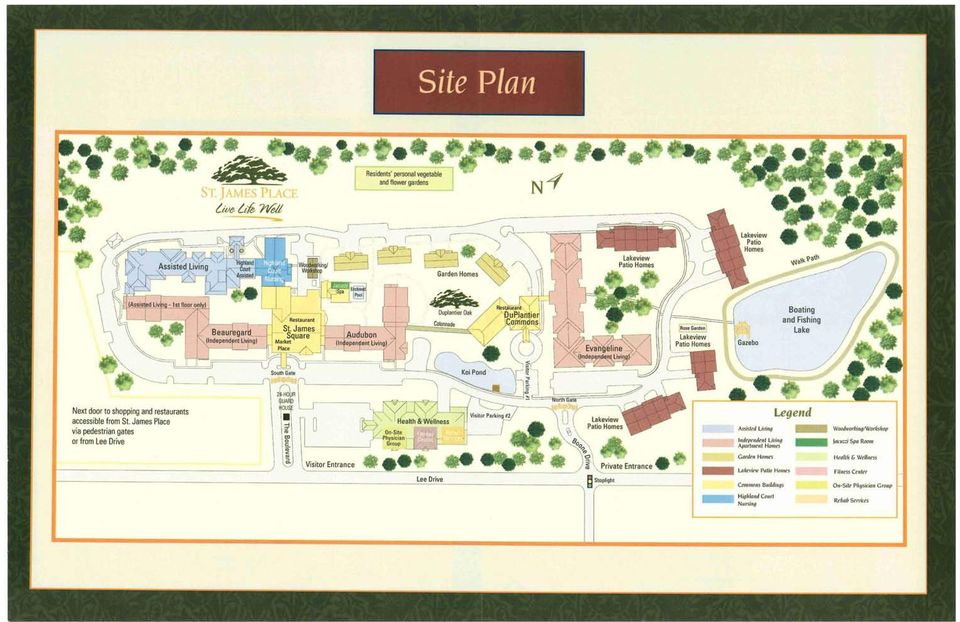
3 ST. JAMES PLACE OF BATON ROUGE

4
5

6 [THIS PAGE INTENTIONALLY LEFT BLANK]

7 NOTICE TO INVESTORS - TRANSFER RESTRICTIONS THE BONDS MAY BE ONLY OWNED BY, AND MAY BE TRANSFERRED BY THE REGISTERED OWNER THEREOF ONLY TO THE BONDS MAY BE TRANSFERRED BY THE REGISTERED OWNER THEREOF SOLELY TO (A) A BANK, REGISTERED INVESTMENT COMPANY, INSURANCE COMPANY OR OTHER ACCREDITED INVESTOR AS DEFINED IN RULE 501 OF REGULATION D OF THE UNITED STATES SECURITIES AND EXCHANGE COMMISSION OR A QUALIFIED INSTITUTIONAL BUYER AS DEFINED IN RULE 144A OF THE UNITED STATES SECURITIES AND EXCHANGE COMMISSION OR (B) A REGISTERED INVESTMENT ADVISOR PURCHASING THE BONDS FOR INCLUSION IN THE PORTFOLIO OF A REGISTERED INVESTMENT COMPANY ADVISED BY THE PURCHASER AND OVER WHOSE TRANSACTIONS THE PURCHASER HAS DISCRETIONARY POWER. IF THE PURCHASER IS A REGISTERED INVESTMENT ADVISOR, THE PURCHASER HAS SUCH KNOWLEDGE AND EXPERIENCE IN BUSINESS AND FINANCIAL MATTERS, INCLUDING THE ANALYSIS OF A PARTICIPATION IN THE PURCHASE OF SIMILAR INVESTMENTS, AS TO BE CAPABLE OF EVALUATING THE MERITS AND RISKS OF AN INVESTMENT IN THE BONDS ON THE BASIS OF INFORMATION AND REVIEW, AND THE INVESTMENT COMPANY FOR WHICH THE PURCHASER IS PURCHASING THE BONDS IS DULY AND VALIDLY ORGANIZED UNDER THE LAWS OF ITS JURISDICTION OF INCORPORATION OR ORGANIZATION AND CAN BEAR THE ECONOMIC RISK OF THE PURCHASE OF THE BONDS. THE ISSUER MAY REMOVE THE FOREGOING RESTRICTIONS WITHOUT NOTICE TO OR CONSENT OF ANY HOLDER. AT SUCH TIME AS THE OBLIGOR SHALL PROVIDE TO THE ISSUER AND THE BOND TRUSTEE WRITTEN EVIDENCE TO THE EFFECT THAT ANY RATING AGENCY THEN RATING THE BONDS HAS RATED THE BONDS IN ONE OF THE FOUR HIGHEST RATING CATEGORIES, THE AUTHORIZED DENOMINATIONS OF THE BONDS SHALL BE CHANGED TO DENOMINATIONS OF $5,000 OR ANY INTEGRAL MULTIPLE THEREOF, AND THE RESTRICTIONS ON OWNERSHIP AND TRANSFERABILITY SHALL BE LIFTED. REGARDING THE OFFICIAL STATEMENT No dealer, salesman or other person has been authorized to give any information or to make any representations other than those contained in this Official Statement, and if given or made, such information or representations must not be relied upon as having been authorized by the Obligor, the Issuer, or the Underwriter. The information set forth herein concerning the Obligor has been furnished by the Obligor and is believed to be reliable, but is not guaranteed as to accuracy or completeness by, and is not to be construed as a representation by, the Issuer or the Underwriter. This Official Statement does not constitute an offer to sell or a solicitation of an offer to buy any of the securities offered hereby in any state to any person to whom it is unlawful to make such offer in such state. Except where otherwise indicated, this Official Statement speaks as of the date hereof. The information and expressions of opinion herein are subject to change without notice and neither the delivery of this Official Statement nor any sale hereunder will under any circumstances create any implication that there has been no change in the affairs of the Obligor since the date hereof. EXCEPT FOR THE INFORMATION CONCERNING THE ISSUER IN THE SECTIONS HEREOF CAPTIONED THE ISSUER AND LITIGATION THE ISSUER, NONE OF THE INFORMATION IN THIS OFFICIAL STATEMENT HAS BEEN SUPPLIED OR VERIFIED BY THE ISSUER AND THE ISSUER MAKES NO REPRESENTATIONS OR WARRANTY, EXPRESS OR IMPLIED, AS TO THE ACCURACY OR COMPLETENESS OF SUCH INFORMATION. The Underwriter has provided the following sentence for inclusion in this Official Statement. The Underwriter has reviewed the information in this Official Statement in accordance with, and as part of, its responsibilities to investors under the federal securities laws as applied to the facts and circumstances of this transaction, but the Underwriter does not guarantee the accuracy or completeness of such information. The information contained in this Official Statement has been furnished by the Obligor, the Issuer, DTC and other sources that are believed to be reliable, but such information is not guaranteed as to accuracy or completeness by, and is not to be construed as a representation of, the Underwriter. The information and expressions of opinion herein are subject to change without notice, and neither the delivery of this Official Statement nor any sale made hereunder shall, under any circumstances, create any implication that there has been no change in the affairs of the parties referred to above since the date hereof. THE BONDS HAVE NOT BEEN REGISTERED UNDER THE SECURITIES ACT OF 1933, AS AMENDED, AND THE BOND INDENTURE, AND THE MASTER INDENTURE HAVE NOT BEEN QUALIFIED UNDER THE TRUST INDENTURE ACT OF 1939, AS AMENDED, IN RELIANCE UPON EXEMPTIONS CONTAINED IN SUCH ACTS. THE REGISTRATION OR QUALIFICATION OF THE BONDS IN ACCORDANCE WITH APPLICABLE PROVISIONS OF LAWS OF THE STATES IN WHICH BONDS HAVE BEEN REGISTERED OR QUALIFIED AND THE EXEMPTION FROM REGISTRATION OR QUALIFICATION IN OTHER STATES CANNOT BE REGARDED AS A RECOMMENDATION THEREOF. NEITHER THESE STATES NOR ANY OF THEIR AGENCIES HAVE PASSED UPON

8 THE MERITS OF THE BONDS OR THE ACCURACY OR COMPLETENESS OF THIS OFFICIAL STATEMENT. ANY REPRESENTATION TO THE CONTRARY MAY BE A CRIMINAL OFFENSE. IN CONNECTION WITH THIS OFFERING, THE UNDERWRITER MAY OVER ALLOT OR EFFECT TRANSACTIONS THAT STABILIZE OR MAINTAIN THE MARKET PRICE OF THE BONDS AT A LEVEL ABOVE THAT WHICH MIGHT OTHERWISE PREVAIL IN THE OPEN MARKET. SUCH STABILIZING, IF COMMENCED, MAY BE DISCONTINUED AT ANY TIME WITHOUT NOTICE. CAUTIONARY STATEMENT REGARDING FORWARD LOOKING STATEMENTS IN THIS OFFICIAL STATEMENT Certain statements included or incorporated by reference in this Official Statement constitute forward looking statements within the meaning of the United States Private Securities Litigation Reform Act of 1995, Section 21E of the United States Securities Exchange Act of 1934, as amended, and Section 27A of the United States Securities Act of 1933, as amended. Such statements are generally identifiable by the terminology used such as plan, expect, estimate, budget, project, forecast or other similar words. Such forward looking statements include, but are not limited to, certain statements contained in the information under the captions SUMMARY STATEMENT - Forecasted Financial Information of the Obligor and in APPENDIX A and APPENDIX C to this Official Statement. THE ACHIEVEMENT OF CERTAIN RESULTS OR OTHER EXPECTATIONS CONTAINED IN SUCH FORWARD LOOKING STATEMENTS INVOLVE KNOWN AND UNKNOWN RISKS, UNCERTAINTIES AND OTHER FACTORS THAT MAY CAUSE ACTUAL RESULTS, PERFORMANCE OR ACHIEVEMENTS DESCRIBED TO BE MATERIALLY DIFFERENT FROM ANY FUTURE RESULTS, PERFORMANCE OR ACHIEVEMENTS EXPRESSED OR IMPLIED BY SUCH FORWARD LOOKING STATEMENTS. THE OBLIGOR DOES NOT PLAN TO ISSUE ANY UPDATES OR REVISIONS TO THOSE FORWARD LOOKING STATEMENTS IF OR WHEN ITS EXPECTATIONS, OR EVENTS, CONDITIONS OR CIRCUMSTANCES ON WHICH SUCH STATEMENTS ARE BASED OCCUR.

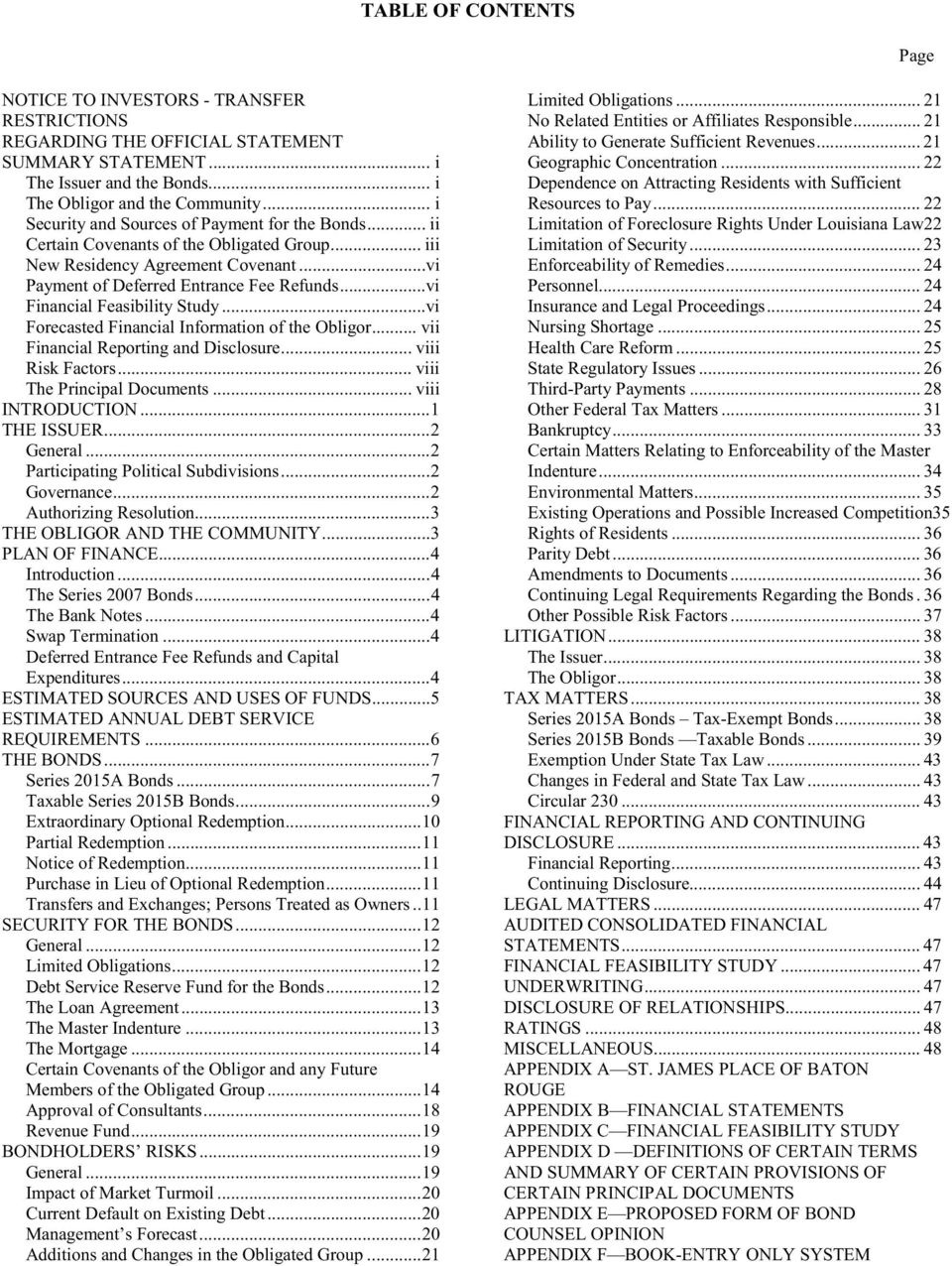
9 TABLE OF CONTENTS Page NOTICE TO INVESTORS - TRANSFER RESTRICTIONS REGARDING THE OFFICIAL STATEMENT SUMMARY STATEMENT... i The Issuer and the Bonds... i The Obligor and the Community... i Security and Sources of Payment for the Bonds... ii Certain Covenants of the Obligated Group... iii New Residency Agreement Covenant...vi Payment of Deferred Entrance Fee Refunds...vi Financial Feasibility Study...vi Forecasted Financial Information of the Obligor... vii Financial Reporting and Disclosure... viii Risk Factors... viii The Principal Documents... viii INTRODUCTION... 1 THE ISSUER... 2 General... 2 Participating Political Subdivisions... 2 Governance... 2 Authorizing Resolution... 3 THE OBLIGOR AND THE COMMUNITY... 3 PLAN OF FINANCE... 4 Introduction... 4 The Series 2007 Bonds... 4 The Bank Notes... 4 Swap Termination... 4 Deferred Entrance Fee Refunds and Capital Expenditures... 4 ESTIMATED SOURCES AND USES OF FUNDS... 5 ESTIMATED ANNUAL DEBT SERVICE REQUIREMENTS... 6 THE BONDS... 7 Series 2015A Bonds... 7 Taxable Series 2015B Bonds... 9 Extraordinary Optional Redemption Partial Redemption Notice of Redemption Purchase in Lieu of Optional Redemption Transfers and Exchanges; Persons Treated as Owners.. 11 SECURITY FOR THE BONDS General Limited Obligations Debt Service Reserve Fund for the Bonds The Loan Agreement The Master Indenture The Mortgage Certain Covenants of the Obligor and any Future Members of the Obligated Group Approval of Consultants Revenue Fund BONDHOLDERS RISKS General Impact of Market Turmoil Current Default on Existing Debt Management s Forecast Additions and Changes in the Obligated Group Limited Obligations No Related Entities or Affiliates Responsible Ability to Generate Sufficient Revenues Geographic Concentration Dependence on Attracting Residents with Sufficient Resources to Pay Limitation of Foreclosure Rights Under Louisiana Law22 Limitation of Security Enforceability of Remedies Personnel Insurance and Legal Proceedings Nursing Shortage Health Care Reform State Regulatory Issues Third-Party Payments Other Federal Tax Matters Bankruptcy Certain Matters Relating to Enforceability of the Master Indenture Environmental Matters Existing Operations and Possible Increased Competition35 Rights of Residents Parity Debt Amendments to Documents Continuing Legal Requirements Regarding the Bonds. 36 Other Possible Risk Factors LITIGATION The Issuer The Obligor TAX MATTERS Series 2015A Bonds Tax-Exempt Bonds Series 2015B Bonds Taxable Bonds Exemption Under State Tax Law Changes in Federal and State Tax Law Circular FINANCIAL REPORTING AND CONTINUING DISCLOSURE Financial Reporting Continuing Disclosure LEGAL MATTERS AUDITED CONSOLIDATED FINANCIAL STATEMENTS FINANCIAL FEASIBILITY STUDY UNDERWRITING DISCLOSURE OF RELATIONSHIPS RATINGS MISCELLANEOUS APPENDIX A ST. JAMES PLACE OF BATON ROUGE APPENDIX B FINANCIAL STATEMENTS APPENDIX C FINANCIAL FEASIBILITY STUDY APPENDIX D DEFINITIONS OF CERTAIN TERMS AND SUMMARY OF CERTAIN PROVISIONS OF CERTAIN PRINCIPAL DOCUMENTS APPENDIX E PROPOSED FORM OF BOND COUNSEL OPINION APPENDIX F BOOK-ENTRY ONLY SYSTEM
10 [THIS PAGE INTENTIONALLY LEFT BLANK]

11 SUMMARY STATEMENT The information set forth in this Summary Statement is subject in all respects to more complete information set forth elsewhere in this Official Statement, which should be read in its entirety. The offering of the Bonds to potential investors is made only by means of this entire Official Statement. No person is authorized to detach this Summary Statement from this Official Statement or otherwise to use it without this entire Official Statement. For the definitions of certain words and terms used in this Summary Statement, see DEFINITIONS OF CERTAIN TERMS in APPENDIX D hereto. The Issuer and the Bonds The Louisiana Local Government Environmental Facilities and Community Development Authority (the Issuer ), a political subdivision of the State of Louisiana (the State ) created under the laws of the State pursuant to Chapter 10-D of Title 33 of the Louisiana Revised Statutes of 1950 (Section 33: through , inclusive), as amended (the Act ), is authorized by the Act and by Chapter 14-A of Title 39 of the Louisiana Revised Statutes of 1960, as amended (the Refunding Act ) to sell and deliver its bonds for the purpose of, among other things, financing and refinancing the cost of qualifying health facilities. The Issuer proposes to issue the Bonds pursuant to the Act, the Refunding Act and an Indenture of Trust dated as of February 1, 2015 (the Bond Indenture ) between the Issuer and Whitney Bank, as trustee (the Bond Trustee ). The proceeds of the Bonds will be loaned to St. James Place of Baton Rouge, a Louisiana non-profit corporation (the Obligor or the Obligated Group Representative ), pursuant to a Loan Agreement dated as of February 1, 2015 (the Loan Agreement ) between the Issuer and the Obligor and will be used, together with other available moneys described herein, to (i) redeem certain tax-exempt bonds issued by the Issuer for the Obligor, (ii) refinance certain bank notes, (iii) reimburse and finance capital expenditures at a senior living community known as St. James Place located in Baton Rouge, Louisiana (the Community ), (iv) pay a termination fee with respect to an interest rate swap, (v) pay certain deferred entrance fee refunds, (vi) fund a debt service reserve fund for the Bonds; and (vii) pay the cost of issuance of the Bonds. See THE OBLIGOR AND THE COMMUNITY, and ESTIMATED SOURCES AND USES OF FUNDS herein. THE BONDS ARE LIMITED AND SPECIAL REVENUE OBLIGATIONS OF THE ISSUER AND DO NOT CONSTITUTE OR CREATE AN OBLIGATION, GENERAL OR SPECIAL, DEBT, LIABILITY OR MORAL OBLIGATION OF THE STATE OR ANY AGENCY, BOARD OR POLITICAL SUBDIVISION THEREOF WITHIN THE MEANING OF ANY CONSTITUTIONAL OR STATUTORY PROVISIONS WHATSOEVER AND NEITHER THE FAITH OR CREDIT NOR THE TAXING POWER OF THE STATE OR OF ANY AGENCY, BOARD OR POLITIAL SUBDIVISION THEREOF IS PLEDGED TO THE PAYMENT OF THE PRINCIPAL OF, PREMIUM, IF ANY, OR THE INTEREST ON THE BONDS. THE BONDS ARE NOT A GENERAL OBLIGATION OF THE ISSUER (WHICH RECEIVES NO FUNDS FROM ANY TAX) BUT ARE A LIMITED AND SPECIAL REVENUE OBLIGATION OF THE ISSUER PAYABLE SOLELY FROM THE TRUST ESTATE, INCLUDING, WITHOUT LIMITATION, THE PAYMENTS MADE BY THE OBLIGOR PURSUANT TO THE LOAN AGREEMENT AND FROM ANY MONEYS RECEIVED BY THE BOND TRUSTEE UNDER THE BOND INDENTURE. THE ISSUER HAS NO POWER TO TAX. The Obligor and the Community The Obligor, a Louisiana non-profit corporation, was formed in March The Internal Revenue Service (the IRS ) issued a letter, effective as of August 14, 1980, stating its determination that the Obligor is a charitable organization described in Section 501(c)(3) of the Internal Revenue Code of 1986, as amended (the Code ), and is therefore exempt from federal income taxation under Section 501(a) of the Code. The Obligor operates a senior living community known as St. James Place of Baton Rouge in Baton Rouge, Louisiana (the Community ). The Community is located on approximately 50 acres of land in Baton Rouge, Louisiana located southeast of the main campus of Louisiana State University. Currently, the Community consists of (i) 225 independent living residences, of which there are 189 apartment and 36 cottages, (ii) 55 assisted living units, 15 of which are dedicated to memory care, (iii) 64 licensed nursing beds, (iv) 26 beds in a secured community for residents with more severe dementia, and (v) related common areas, amenities and recreational areas. The common areas include a fishing lake, -i-

12 a fitness center, an enclosed, heated swimming pool, a jacuzzi/whirlpool, two dining rooms, two auditoriums, a meditation chapel, a large center lounge/library, and other lounge areas. Security and Sources of Payment for the Bonds General. The Bonds will be issued under and will be equally and ratably secured under the Bond Indenture, pursuant to which the Issuer will assign and pledge to the Bond Trustee, (1) the hereinafter described Notes relating to the Bonds (the Notes ), (2) certain rights of the Issuer under the Loan Agreement, (3) the funds and accounts (excluding the Rebate Fund), including the money and investments in them, which the Bond Trustee holds under the terms of the Bond Indenture, and (4) such other property as may from time to time be pledged to the Bond Trustee as additional security for such Bonds or which may come into possession of the Bond Trustee pursuant to the terms of the Loan Agreement or the Notes. Pursuant to the Loan Agreement the Obligor has agreed to make loan payments sufficient, among other things, to pay in full when due all principal of, premium, if any, and interest on the Bonds and the administrative fees of the Bond Trustee, and, to make payments as required to restore any deficiencies in the debt service reserve fund. See SECURITY FOR THE BONDS - The Loan Agreement. See also THE LOAN AGREEMENT in APPENDIX D hereto. The obligation of the Obligor to repay the loan from the Issuer will be evidenced by the Notes of the Obligor, issued under and entitled to the benefit and security of a Master Trust Indenture and Security Agreement, as supplemented by Supplement No. 1 to Master Trust Indenture, each dated as of February 1, 2015 (as supplemented, the Master Indenture ), and each between the Obligor and Whitney Bank, as master trustee (the Master Trustee ). See SECURITY FOR THE BONDS - The Master Indenture. See also THE MASTER INDENTURE in APPENDIX D hereto. The Notes will constitute an unconditional promise by each Obligated Group Member (as defined herein) to pay amounts sufficient to pay principal of (whether at maturity, by acceleration or call for redemption) and premium, if any, and interest on the Bonds; and the Notes will be secured on a parity basis with any other Obligations hereafter issued under the Master Indenture, by a lien on and security interest in the Mortgaged Property granted to the Master Trustee pursuant to the Mortgage described below and a security interest in the Gross Revenues of the Obligated Group and the Funds established under the Master Indenture. Initially, the Obligor will be the only member of the Obligated Group. Mortgage. The obligations of the Obligor under the Master Indenture are further secured under the terms of the Multiple Indebtedness Mortgage, Security Agreement and Assignment of Leases and Rents dated as of February 1, 2015 (the Mortgage ), between the Obligor and the Master Trustee. Pursuant to the Mortgage, the obligations of the Obligor issued under the Master Indenture will be secured by a lien on the Community, including, without limitation, all buildings, structures, fixtures, additions, enlargements, extensions, improvements, modifications or repairs now or hereafter located thereon or therein. See SECURITY FOR THE BONDS The Mortgage. See also THE MORTGAGE in APPENDIX D hereto Pledge of Gross Revenues. In order to secure the payment of the principal of, premium, if any, and interest on the Notes, the Obligated Group Members will pledge, assign, confirm and grant a security interest unto the Master Trustee in the Gross Revenues of the Obligated Group Members as well as all moneys and securities from time to time held by the Master Trustee under the terms of the Master Indenture. Debt Service Reserve Fund. As additional security for the Bonds, separate accounts for each series of Bonds will be established in a debt service reserve fund (the Reserve Fund ) established pursuant to the Bond Indenture and will be funded from the proceeds of the Bonds. The reserve account for the Series 2015A Bonds is required to be funded in an amount equal to the Maximum Annual Debt Service on the Series 2015A Bonds outstanding. The reserve account for the Taxable Series 2015B Bonds is required to be funded in an amount equal to one year of interest on the Taxable Series 2015B Bonds. See SECURITY FOR THE BONDS - Reserve Fund. See also THE BOND INDENTURE in APPENDIX D hereto. -ii-

13 Certain Covenants of the Obligated Group Rate Covenant. The Master Indenture requires that if the Historical Debt Service Coverage Ratio of the Obligated Group for any Fiscal Year is less than 1.20:1, the Obligated Group Representative, at the Obligated Group s expense, will select a Consultant within 30 days following the calculation described herein to make recommendations with respect to the rates, fees and charges of the Members and the Obligated Group s methods of operation and other factors affecting its financial condition in order to increase the Historical Debt Service Coverage Ratio to at least 1.20:1 for the following Fiscal Year. Within 60 days of the actual engagement of any such Consultant, the Obligated Group Representative shall cause a copy of the Consultant's report and recommendations, if any, to be filed with each Member and each Required Information Recipient. Each Member shall follow each recommendation of the Consultant applicable to it to the extent feasible (as determined in the reasonable judgment of the Governing Body of the Obligated Group Representative) and permitted by law. This shall not be construed to prohibit any Member from serving indigent residents to the extent required for such Member to continue its qualification as a Tax Exempt Organization or from serving any other class or classes of residents without charge or at reduced rates so long as such service does not prevent the Obligated Group from satisfying the other requirements of this covenant. The Master Trustee shall not be obligated to require the Obligated Group to select a Consultant to make such recommendations if: (a) there is filed with the Master Trustee (who shall provide a copy to each Required Information Recipient) a written report addressed to them of a Consultant which contains an opinion of such Consultant that applicable laws or regulations have prevented the Obligated Group from generating Income Available for Debt Service during such Fiscal Year sufficient to meet the requirements of this Section, and such report is accompanied by a concurring opinion of Independent Counsel (acceptable to the Master Trustee) as to any conclusions of law supporting the opinion of such Consultant; (b) the report of such Consultant indicates that the rates charged by the Obligated Group are such that, in the opinion of the Consultant, the Obligated Group has generated the maximum amount of Revenues reasonably practicable given such laws or regulations; and (c) the Historical Debt Service Coverage Ratio of the Obligated Group for such Fiscal Year was at least 1.00:1. The Obligated Group shall not be required to cause the Consultant's report referred to in the preceding sentence to be prepared more frequently than once every two Fiscal Years if at the end of the first of such two Fiscal Years the Obligated Group provides to the Master Trustee (who shall provide a copy to each Related Bond Trustee) an opinion of Independent Counsel (acceptable to the Master Trustee) to the effect that the applicable laws and regulations underlying the Consultant's report delivered in respect of the previous Fiscal Year have not changed in any material way. If the Obligated Group fails to achieve a Historical Debt Service Coverage Ratio of 1.20:1 for any Fiscal Year, such failure shall not constitute an Event of Default under the Master Indenture if the Obligated Group takes all action necessary to comply with the procedures set forth above for preparing a report and adopting a plan and follows each recommendation contained in such report to the extent feasible (as determined in the reasonable judgment of the Governing Body of the Obligated Group Representative) and permitted by law. If the Obligated Group fails to achieve a Historical Debt Service Coverage Ratio of at least 1.00:1 for any Fiscal Year, such failure shall constitute an Event of Default under the Master Indenture. In the event that any Member of the Obligated Group incurs any Additional Indebtedness for any acquisition, construction, renovation or replacement project, the Debt Service Requirements on such Additional Indebtedness and the Revenues and Expenses relating to the project or projects financed with the proceeds of such Additional Indebtedness shall be excluded from the calculation of the Historical Debt Service Coverage Ratio of the Obligated Group until the first full Fiscal Year following the later of (i) the estimated completion of the acquisition, construction, renovation or replacement project being paid for with the proceeds of such Additional Indebtedness provided that such completion occurs no later than six months following the completion date for such project set forth in the Consultant's report described in (A) below, or (ii) the first full year in which Stable Occupancy is achieved in the case of construction, renovation or replacement of elderly housing facilities or nursing facilities financed with the proceeds of such Additional Indebtedness, which Stable Occupancy shall be projected in the report of the Consultant referred to in paragraph (A) below to occur no later than during the fourth full Fiscal Year following the incurrence of such Additional Indebtedness, or (iii) the end of the fourth full Fiscal Year after the incurrence of such Additional Indebtedness, if the following conditions are met: -iii-

14 (A) there is delivered to the Master Trustee a report or opinion of a Consultant to the effect that the Projected Debt Service Coverage Ratio for each of the first two full Fiscal Years following the later of (1) the estimated completion of the acquisition, construction, renovation or replacement being paid for with the proceeds of such Additional Indebtedness, or (2) the first full Fiscal Year following the year in which Stable Occupancy is achieved in the case of construction, renovation or replacement of elderly housing facilities or nursing facilities being financed with the proceeds of such Additional Indebtedness, which Stable Occupancy shall be projected to occur no later than during the fourth full Fiscal Year following the incurrence of such Additional Indebtedness, will be not less than 1.20:1 after giving effect to the incurrence of such Additional Indebtedness and the application of the proceeds thereof; provided, however, that in the event that a Consultant shall deliver a report to the Master Trustee to the effect that state or Federal laws or regulations or administrative interpretations of such laws or regulations then in existence do not permit or by their application make it impracticable for Members to produce the required ratio, then such ratio shall be reduced to the highest practicable ratio then permitted by such laws or regulations but in no event less than 1.00:1; provided, however, that in the event a Consultant's report is not required to incur such Additional Indebtedness, the Obligated Group may deliver an Officer's Certificate to the Master Trustee in lieu of the Consultant's report described in this subparagraph (A); and (B) there is delivered to the Master Trustee an Officer's Certificate on the date on which financial statements are required to be delivered to the Master Trustee until the first Fiscal Year in which the exclusion from the calculation of the Historical Debt Service Coverage Ratio no longer applies, calculating the Historical Debt Service Coverage Ratio of the Obligated Group at the end of each Fiscal Year, and demonstrating that such Historical Debt Service Coverage Ratio is not less than 1.00:1, such Historical Debt Service Coverage Ratio to be computed without taking into account (1) the Additional Indebtedness to be incurred if (x) the interest on such Additional Indebtedness during such period is funded from proceeds thereof or other funds of the Member then on hand and available therefor and (y) no principal of such Additional Indebtedness is payable during such period, and (2) the Revenues to be derived from the project to be financed from the proceeds of such Additional Indebtedness. See THE MASTER INDENTURE Rates and Charges in APPENDIX D hereto. For specific information regarding the process under the Master Indenture for selection of Consultants, see SECURITY FOR THE BONDS Approval of Consultants and APPENDIX D THE MASTER INDENTURE Approval of Consultants. Liquidity Covenant. The Master Indenture requires that the Obligated Group conducts its business so that on each June 30 and December 31 (each a Testing Date ) the Obligated Group shall have no less than the applicable amount of Days Cash on Hand as follows (the Liquidity Requirement ): Required Testing Date Days Cash on Hand June 30, 2015 and December 31, June 30, 2016 and December 31, June 30, 2017 and each Testing Date thereafter 150 If the Days Cash on Hand on any Testing Date is less than the Liquidity Requirement, the Obligated Group Representative is required, within 30 days after delivery of the Officer s Certificate disclosing such deficiency, to deliver an Officer s Certificate approved by a resolution of the Governing Body of the Obligated Group Representative to the Master Trustee setting forth in reasonable detail the reasons for such deficiency and adopting a specific plan setting forth steps to be taken designed to raise the level of the Days Cash on Hand to the Liquidity Requirement for future Testing Dates. If the Obligated Group has not raised the level of the Days Cash on Hand to the Liquidity Requirement by the next Testing Date following delivery of the Officer s Certificate required in the preceding paragraph, the Obligated Group Representative is required, within 30 days after receipt of the Officer s Certificate disclosing such deficiency, to select a Consultant to make recommendations with respect to the rates, fees and charges of the Obligated Group and the Obligated Group s methods of operation and other factors affecting its financial condition in order to raise the level of the Days Cash on Hand to the Liquidity Requirement for future Testing Dates. A copy of the Consultant s report and recommendations, if any, is required to be filed with each member and each Required Information Recipient within 60 days after the date such Consultant is actually engaged. Each Member of the Obligated Group is required to follow each recommendation of the Consultant to the extent feasible (as determined in the reasonable judgment of the Governing Body of the member) and permitted by law. -iv-

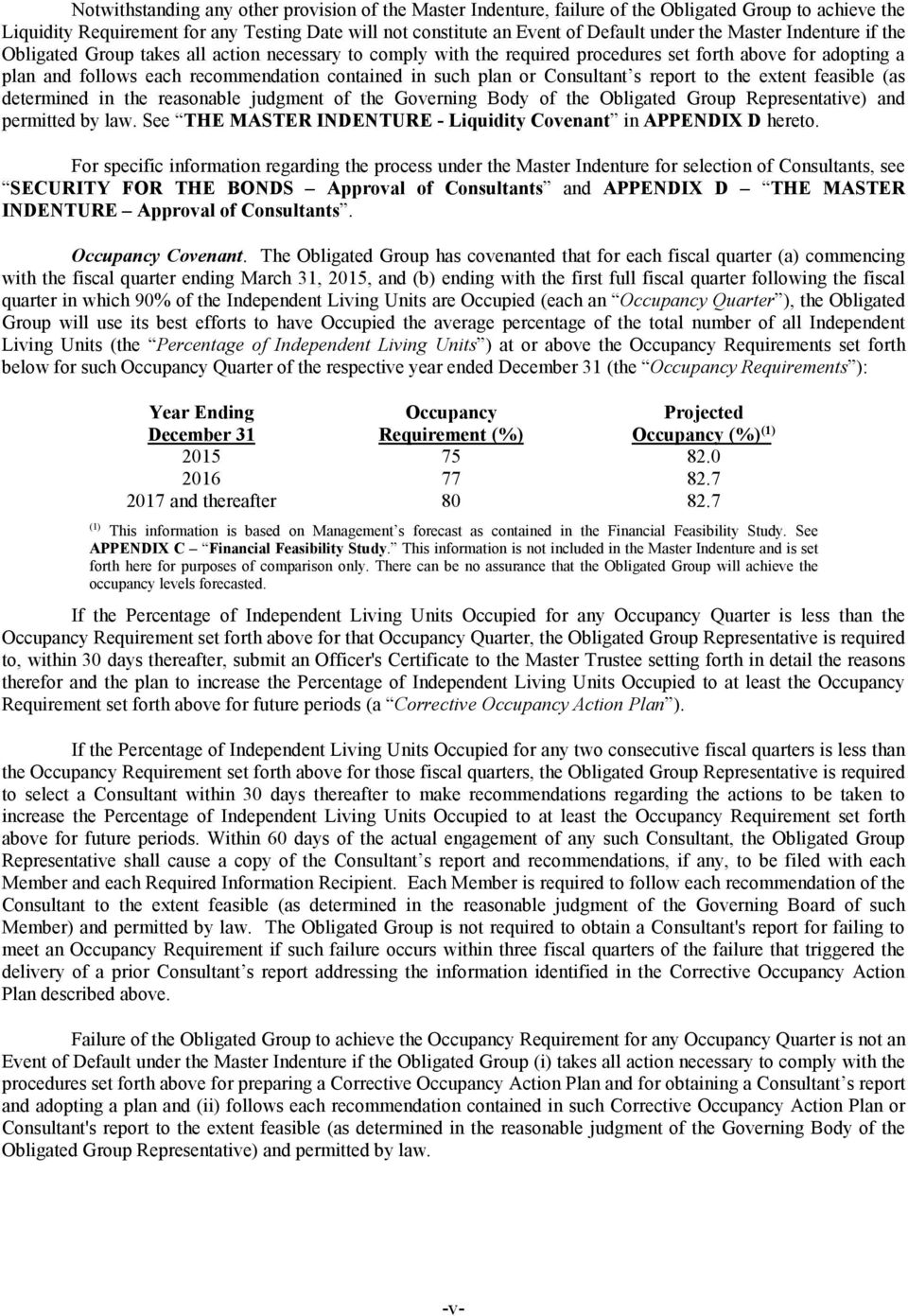
15 Notwithstanding any other provision of the Master Indenture, failure of the Obligated Group to achieve the Liquidity Requirement for any Testing Date will not constitute an Event of Default under the Master Indenture if the Obligated Group takes all action necessary to comply with the required procedures set forth above for adopting a plan and follows each recommendation contained in such plan or Consultant s report to the extent feasible (as determined in the reasonable judgment of the Governing Body of the Obligated Group Representative) and permitted by law. See THE MASTER INDENTURE - Liquidity Covenant in APPENDIX D hereto. For specific information regarding the process under the Master Indenture for selection of Consultants, see SECURITY FOR THE BONDS Approval of Consultants and APPENDIX D THE MASTER INDENTURE Approval of Consultants. Occupancy Covenant. The Obligated Group has covenanted that for each fiscal quarter (a) commencing with the fiscal quarter ending March 31, 2015, and (b) ending with the first full fiscal quarter following the fiscal quarter in which 90% of the Independent Living Units are Occupied (each an Occupancy Quarter ), the Obligated Group will use its best efforts to have Occupied the average percentage of the total number of all Independent Living Units (the Percentage of Independent Living Units ) at or above the Occupancy Requirements set forth below for such Occupancy Quarter of the respective year ended December 31 (the Occupancy Requirements ): Year Ending December 31 Occupancy Requirement (%) Projected Occupancy (%) (1) and thereafter (1) This information is based on Management s forecast as contained in the Financial Feasibility Study. See APPENDIX C Financial Feasibility Study. This information is not included in the Master Indenture and is set forth here for purposes of comparison only. There can be no assurance that the Obligated Group will achieve the occupancy levels forecasted. If the Percentage of Independent Living Units Occupied for any Occupancy Quarter is less than the Occupancy Requirement set forth above for that Occupancy Quarter, the Obligated Group Representative is required to, within 30 days thereafter, submit an Officer's Certificate to the Master Trustee setting forth in detail the reasons therefor and the plan to increase the Percentage of Independent Living Units Occupied to at least the Occupancy Requirement set forth above for future periods (a Corrective Occupancy Action Plan ). If the Percentage of Independent Living Units Occupied for any two consecutive fiscal quarters is less than the Occupancy Requirement set forth above for those fiscal quarters, the Obligated Group Representative is required to select a Consultant within 30 days thereafter to make recommendations regarding the actions to be taken to increase the Percentage of Independent Living Units Occupied to at least the Occupancy Requirement set forth above for future periods. Within 60 days of the actual engagement of any such Consultant, the Obligated Group Representative shall cause a copy of the Consultant s report and recommendations, if any, to be filed with each Member and each Required Information Recipient. Each Member is required to follow each recommendation of the Consultant to the extent feasible (as determined in the reasonable judgment of the Governing Board of such Member) and permitted by law. The Obligated Group is not required to obtain a Consultant's report for failing to meet an Occupancy Requirement if such failure occurs within three fiscal quarters of the failure that triggered the delivery of a prior Consultant s report addressing the information identified in the Corrective Occupancy Action Plan described above. Failure of the Obligated Group to achieve the Occupancy Requirement for any Occupancy Quarter is not an Event of Default under the Master Indenture if the Obligated Group (i) takes all action necessary to comply with the procedures set forth above for preparing a Corrective Occupancy Action Plan and for obtaining a Consultant s report and adopting a plan and (ii) follows each recommendation contained in such Corrective Occupancy Action Plan or Consultant's report to the extent feasible (as determined in the reasonable judgment of the Governing Body of the Obligated Group Representative) and permitted by law. -v-
16 New Residency Agreement Covenant Each Obligated Group Member covenants that for each fiscal period in each fiscal year set forth below (a) commencing with the three month period ending March 31, 2015, and (b) ending with the first full fiscal period following the fiscal quarter in which 90% of the Independent Living Units are Occupied, the Obligated Group will use its best efforts to enter into the aggregate number of new Residency Agreements for the applicable fiscal period shown in the table below (the New Residency Agreement Requirements ): Fiscal Period New Residency Agreement Requirement Three month period ending March 31, Six month period ending June 30, Nine month period ending September 30, The twelve month period ending on December 31, 2015 and each twelve month period ending on each March 31, June 30, September 30 and December 31 thereafter If the New Residency Agreement Requirement is not met for any fiscal period, the Obligated Group Representative is required to select a Consultant within 30 days thereafter to make recommendations regarding the actions to be taken to increase the number of New Residency Agreements to at least the New Residency Agreement Requirements for future periods. Within 60 days of the actual engagement of any such Consultant, the Obligated Group Representative shall cause a copy of the Consultant's report and recommendations, if any, to be filed with each Member and each Required Information Recipient. Each Member is required to follow each recommendation of the Consultant to the extent feasible (as determined in the reasonable judgment of the Governing Board of such Member) and permitted by law. The Obligated Group is not required to obtain a Consultant s report for failing to meet a New Residency Agreement Requirement if such failure occurs within three fiscal quarters of a prior failure to meet a New Residency Agreement Requirement. Failure of the Obligated Group to achieve the New Residency Agreement Requirement for any fiscal period is not an Event of Default under the Master Indenture if the Obligated Group (i) takes all action necessary to comply with the procedures set forth above for obtaining a Consultant's report and adopting a plan and (ii) follows each recommendation contained in such Consultant's report to the extent feasible (as determined in the reasonable judgment of the Governing Body of the Obligated Group Representative) and permitted by law. Payment of Deferred Entrance Fee Refunds The Members of the Obligated Group agree that so long as the Days Cash on Hand of the Obligated Group will not be less than 175 after making such payments, the Obligated Group Representative is required to pay Deferred Entrance Fee Refund Recipients the amount of any Deferred Entrance Fee Refunds that have been outstanding for at least 365 days. The Obligated Group shall make such payments to the Deferred Entrance Fee Refund Recipients in order from the longest deferral periods to the shortest. Deferred Entrance Fee Refund means a refund of Entrance Fees to Deferred Entrance Fee Refund Recipients. Deferred Entrance Fee Refund Recipient means a person who entered into a Residency Agreement and subsequently terminated such Residency Agreement and whose refund of Entrance Fees under the Residency Agreement has been deferred for at least 365 days after the date of termination. The payment of any Deferred Entrance Fee Refunds with respect to any termination of a Residency Agreement prior to January 1, 2015 will not be included in the calculation of the Historical Debt Service Coverage Ratio. Financial Feasibility Study CliftonLarsonAllen LLP, independent certified public accountants, has prepared a Financial Feasibility Study dated January 20, 2015 (the Financial Feasibility Study ), which is included as APPENDIX C hereto. The Financial Feasibility Study includes management of the Obligor s financial forecast of the Obligated Group for the three years ending December 31, As stated in the Financial Feasibility Study, there will usually be differences -vi- 20

17 between the forecasted data and actual results because events and circumstances frequently do not occur as expected, and those differences may be material. THE FINANCIAL FEASIBILITY STUDY SHOULD BE READ IN ITS ENTIRETY, INCLUDING MANAGEMENT S NOTES AND ASSUMPTIONS SET FORTH THEREIN. See APPENDIX C hereto. Forecasted Financial Information of the Obligor The table on the following page reflects the forecasted income available for debt service and other financial ratios for the years ending December 31, 2015, 2016, and 2017, and has been extracted from the Obligor s financial forecast included in the Financial Feasibility Study. For purposes of calculating debt service requirements in the table below, the Bonds are to be issued in the aggregate principal amount of $62,500,000 and to be issued at par with varying maturities over a term of 30 years with interest rates ranging from 4.75% to 6.25% per annum. Principal on the Bonds will be paid annually commencing November 15, 2015, with a final maturity on November 15, All amounts, except the ratios, are expressed in thousands of dollars. No assurance can be given that the assumed rates used in making the calculations in the following table will be achieved or maintained. For the Years Ending December 31, 2015, 2016, and 2017 (in thousands of dollars, except ratios and days) -vii-

18 The above table should be considered in conjunction with the entire Financial Feasibility Study in APPENDIX C to understand management of the Obligor s assumptions upon which the Financial Feasibility Study is based, including those assumptions relating to the average annual interest rates pertaining to the Bonds. There will usually be differences between the forecasted and actual results, because events and circumstances frequently do not occur as expected, and those differences may be material. Financial Reporting and Disclosure Financial Reporting. The Master Indenture requires that the Obligated Group Representative provide to each Required Information Recipient certain financial information on a quarterly and annual basis. For a description of the financial information required to be provided, see FINANCIAL REPORTING AND CONTINUING DISCLOSURE Financial Reporting herein. Continuing Disclosure. Given the sources of repayment for the Bonds and the Issuer s limited obligation in respect thereof, the Issuer has determined that its financial and operating data are not material to a decision to purchase, hold or sell the Bonds. Consequently, the Issuer will not provide any such information. The Obligor, however, has agreed to make certain financial information and operating data available to holders of the Bonds as described immediately above under the subcaption Financial Reporting. The Obligor has further agreed to provide certain financial information and operating data to information repositories. The Obligor is solely responsible for providing such disclosure, and the Issuer has no responsibility or liability to the holders of the Bonds or any other person for the making, monitoring or content of such disclosures. In addition, the Obligor will provide the Dissemination Agent and the Repositories, each as defined in the Continuing Disclosure Agreement, a copy of any information provided to Bondholders pursuant to the Master Indenture described above. See FINANCIAL REPORTING AND CONTINUING DISCLOSURE - Continuing Disclosure herein for further information. Risk Factors AN INVESTMENT IN THE BONDS INVOLVES A CERTAIN DEGREE OF RISK INCLUDING THOSE SET FORTH UNDER THE HEADING BONDHOLDERS RISK HEREIN. A PROSPECTIVE BONDHOLDER IS ADVISED TO READ THE BONDS, SECURITY FOR THE BONDS AND BONDHOLDERS RISK FOR A DISCUSSION OF CERTAIN RISK FACTORS WHICH SHOULD BE CONSIDERED IN CONNECTION WITH AN INVESTMENT IN THE BONDS. Careful consideration should be given to these risks and other risks described elsewhere in this Official Statement. Among other things, careful evaluation should be made of management of the Obligor s assumptions and rationale described in the Financial Feasibility Study, and certain factors that may adversely affect the ability of the Obligor or any future obligor to generate sufficient revenues to pay expenses of operation, including the principal of, premium, if any, and interest on the Bonds. The Principal Documents THE DESCRIPTIONS AND SUMMARIES OF VARIOUS DOCUMENTS SET FORTH IN THIS OFFICIAL STATEMENT, INCLUDING APPENDIX D, DO NOT PURPORT TO BE COMPREHENSIVE OR DEFINITIVE, AND REFERENCE IS MADE TO EACH DOCUMENT FOR COMPLETE DETAILS OF ALL TERMS AND CONDITIONS. ALL STATEMENTS HEREIN ARE QUALIFIED IN THEIR ENTIRETY BY THE TERMS OF EACH SUCH DOCUMENT. DURING THE PERIOD OF THE OFFERING, COPIES OF DRAFTS OF THE BONDS, THE BOND INDENTURE, THE LOAN AGREEMENT, THE NOTE, THE MASTER INDENTURE, THE MORTGAGE, AND THE CONTINUING DISCLOSURE AGREEMENT ARE AVAILABLE FROM THE UNDERWRITER, AND FOLLOWING DELIVERY OF THE BONDS, COPIES OF THE EXECUTED ORIGINALS THEREOF MAY BE EXAMINED AT THE PRINCIPAL CORPORATE TRUST OFFICE OF THE BOND TRUSTEE. [The remainder of this page is intentionally left blank] -viii-

19 OFFICIAL STATEMENT relating to the $63,310,000 LOUISIANA LOCAL GOVERNMENT ENVIRONMENTAL FACILITIES AND COMMUNITY DEVELOPMENT AUTHORITY Healthcare Facilities Revenue Refunding Bonds (St. James Place of Baton Rouge Project) $56,695,000 Series 2015A consisting of $6,615,000 Taxable Series 2015B INTRODUCTION Purpose of this Official Statement. This Official Statement, including the cover page and Appendices hereto, is provided to furnish information with respect to the issuance, sale and delivery by Louisiana Local Government Environmental Facilities and Community Development Authority (the Issuer ) of its Healthcare Facilities Revenue Refunding Bonds (St. James Place of Baton Rouge Project) Series 2015A (the Series 2015A Bonds ) and Taxable Series 2015B Bonds (the Taxable Series 2015B Bonds and together with the Series 2015A Bonds, the Bonds ). The Bonds are being issued pursuant to Chapter 10-D of Title 33 of the Louisiana Revised Statutes of 1950 (Louisiana Revised Statutes of 1950 Sections 33: through , inclusive), as amended (the Act ) and Chapter 14-A of Title 39 of the Louisiana Revised Statutes of 1950, as amended (the Refunding Act ), in conformity with the provisions, restrictions and limitations thereof and pursuant to the Indenture of Trust dated as of February 1, 2015 (the Bond Indenture ) between the Issuer and Whitney Bank, as bond trustee (the Bond Trustee ). Certain capitalized terms used herein are defined in DEFINITIONS OF CERTAIN TERMS in APPENDIX D hereto. The descriptions and summaries of various documents hereinafter set forth do not purport to be comprehensive or definitive, and reference is made to each document for the complete details of its terms and conditions. All statements herein are qualified in their entirety by reference to each document. Purpose of the Bonds. The proceeds of the Bonds will be loaned to St. James Place of Baton Rouge, a Louisiana non-profit corporation (the Obligor or the Obligated Group Representative ), pursuant to a Loan Agreement dated as of February 1, 2015 (the Loan Agreement ) between the Issuer and the Obligor and will be used, together with other available moneys described herein, to (i) redeem certain tax-exempt bonds issued by the Issuer for the Obligor, (ii) refinance certain bank notes, (iii) reimburse and finance capital expenditures at a senior living community known as St. James Place located in Baton Rouge, Louisiana (the Community ), (iv) pay a termination fee with respect to an interest rate swap, (v) pay certain deferred entrance fee refunds, (vi) fund a debt service reserve fund for the Bonds; and (vii) pay the cost of issuance of the Bonds. See PLAN OF FINANCE and ESTIMATED SOURCES AND USES OF FUNDS herein. Risk Factors. Certain risks are inherent in the successful construction and operation of facilities such as the Community on a basis such that sufficient cash will be available to pay interest on and to retire indebtedness. See BONDHOLDERS RISKS below for a discussion of certain of these risks. Security for the Bonds. The Bonds will be issued under and will be equally and ratably secured under the Bond Indenture, pursuant to which the Issuer will assign and pledge to the Bond Trustee, (1) the hereinafter described Notes relating to the Bonds (the Notes ), (2) certain rights of the Issuer under the Loan Agreement, (3) the funds and accounts (excluding the Rebate Fund), including the money and investments in them, which the Bond Trustee holds under the terms of the Bond Indenture, and (4) such other property as may from time to time be pledged to the Bond Trustee as additional security for such Bonds or which may come into possession of the Bond Trustee pursuant to the terms of the Loan Agreement or the Notes.
20 Pursuant to the Loan Agreement the Obligor has agreed to make loan payments sufficient, among other things, to pay in full when due all principal of, premium, if any, and interest on the Bonds and the administrative fees of the Bond Trustee, and, to make payments as required to restore any deficiencies in the debt service reserve fund. See SECURITY FOR THE BONDS - The Loan Agreement. See also THE LOAN AGREEMENT in APPENDIX D hereto. The obligation of the Obligor to repay the loan from the Issuer will be evidenced by the Notes of the Obligor, issued under and entitled to the benefit and security of a Master Trust Indenture and Security Agreement, as supplemented by Supplement No. 1 to Master Trust Indenture, each dated as of February 1, 2015 (as supplemented, the Master Indenture ), and each between the Obligor and Whitney Bank, as master trustee (the Master Trustee ). See SECURITY FOR THE BONDS - The Master Indenture. See also THE MASTER INDENTURE in APPENDIX D hereto. The Notes will constitute an unconditional promise by each Obligated Group Member to pay amounts sufficient to pay principal of (whether at maturity, by acceleration or call for redemption) and premium, if any, and interest on the Bonds; and the Notes will be secured on a parity basis with any other Obligations hereafter issued under the Master Indenture, by a lien on and security interest in the Mortgaged Property granted to the Master Trustee pursuant to the Mortgage described below and a security interest in the Gross Revenues of the Obligated Group and the Funds established under the Master Indenture. Initially, the Obligor will be the only member of the Obligated Group. The obligations of the Obligor under the Master Indenture are further secured under the terms of the Multiple Indebtedness Mortgage, Security Agreement and Assignment of Leases and Rents dated as of February 1, 2015 (the Mortgage ) between the Obligor and the Master Trustee. See SECURITY FOR THE BONDS The Mortgage. See also MORTGAGE in APPENDIX D hereto. General THE ISSUER The Louisiana Local Government Environmental Facilities and Community Development Authority (the Issuer ) is a political subdivision of the State of Louisiana, organized under the provisions of Chapter 10-D of Title 33 of the Louisiana Revised Statutes of 1950, as amended (La R.S. 33: through 33: ) (the Act ). The purpose of the Issuer is, among others enumerated in the Act, to assist in financing programs or loans to political subdivisions (as defined in the Act) in the State of Louisiana. In furtherance of its authorized powers and functions, the Issuer has the power, by virtue of the Act and the Refunding Act, to issue the Bonds, to loan the proceeds thereof to the Obligor and to secure the Bonds by a pledge of the amounts payable by the Obligor under the Loan Agreement. Participating Political Subdivisions Governance Any political subdivision of the State may participate as a member of the Issuer. The Issuer is governed by a Board of Directors whose membership is limited to those representatives of political subdivisions of the State maintaining membership in the Issuer (each a Participating Political Subdivision ) whose governing authorities have adopted a resolution indicating their intention to participate in the Issuer. Each Participating Political Subdivision may appoint a Director in accordance with the Act. Directors are appointed for two year terms and may be removed for just cause. Officers are elected by and from the ranks of the members of the Board of Directors and consist of a Chairman, Vice-Chairman and Secretary-Treasurer. Officers serve one year terms and may not be re-elected for successive terms in any one office. Pursuant to the Issuer s by-laws, the Board of Directors has established an Executive Committee (the Executive Committee ) and, in accordance with the Act, delegated certain duties and authorities to the Executive Committee. The Executive Committee consists of seven members, three of whom are the officers of the Issuer and serve as ex-officio members for as long as they remain officers of the Board of Directors. The remaining four members are elected at an annual meeting of the Board of Directors and serve as at-large members with one member elected for a term of one year, one member elected for a term of two years, one member elected for a term of three -2-

21 years and one member elected for a term of four years. An at-large member may not be re-elected to the Executive Committee as an at-large member and his successor shall be elected for a four year term. The Executive Committee is required to make an annual report to the Board of Directors at its annual meeting. Provision is made in the bylaws to make the minutes of all Executive Committee meetings available to members of the Board of Directors. The current members of the Executive Committee, their positions, terms of office and respective Participating Political Subdivision are as follows: Participating Present Committee Members Position Term Expires Political Subdivision Mayor Bill D. Aquilla Chairman December 31, 2015 Town of St. Francisville Ms. Mary S. Adams Vice Chairman December 31, 2016 Varnado Waterworks District Mr. Julian E. Dufreche Secretary/Treasurer December 31, 2015 Tangipahoa Parish Clerk of Court Mr. Mack Dellafosse Member December 31, 2015 Calcasieu Parish School Board Mayor David Camardelle Member December 31, 2016 Town of Grand Isle Mayor David C. Butler, II Member December 31, 2017 Town of Woodworth Mr. Lynn Austin Member December 31, 2018 City of Bossier City The address of the Issuer is 729 Spain Street, Baton Rouge, Louisiana The Executive Director of the Authority is Ty E. Carlos. Mr. Carlos received his degree in finance from Louisiana State University. He worked as a Vice President and Sales Executive for The Bank of New York Mellon Trust Company, N.A. He has served as Executive Director of the Authority since April of Authorizing Resolution The Bonds were authorized by resolutions adopted by the Executive Committee on December 11, 2014 and January 8, 2015, in an amount not to exceed $75,000,000. THE OBLIGOR AND THE COMMUNITY The Obligor, a Louisiana non-profit corporation, was formed in March The Internal Revenue Service (the IRS ) issued a letter, effective as of August 14, 1980, stating its determination that the Obligor is a charitable organization described in Section 501(c)(3) of the Internal Revenue Code of 1986, as amended (the Code ), and is therefore exempt from federal income taxation under Section 501(a) of the Code. The Obligor operates a senior living community known as St. James Place of Baton Rouge in Baton Rouge, Louisiana (the Community ). The Community is located on approximately 50 acres of land in Baton Rouge, Louisiana located southeast of the main campus of Louisiana State University. Currently, the Community consists of (i) 225 independent living residences, of which there are 189 apartment and 36 cottages, (ii) 55 assisted living units, 15 of which are dedicated to memory care, (iii) 64 licensed nursing beds, (iv) 26 beds in a secured community for residents with more severe dementia, and (v) related common areas, amenities and recreational areas. The common areas include a fishing lake, a fitness center, an enclosed, heated swimming pool, a Jacuzzi/whirlpool, two dining rooms, two auditoriums, a meditation chapel, a large center lounge/library, and other lounge areas. Additional information regarding the Obligor and its affiliates is included in APPENDIX A and APPENDIX C hereto. -3-
22 PLAN OF FINANCE Introduction In 2007, the Obligor refinanced its existing long-term debt with $ million in principal amount of variable rate bonds issued by the Issuer (the Series 2007 Bonds ) and secured by a Bank of America, N.A. ( Bank of America ) letter of credit. Contemporaneously with the issuance of the Series 2007 Bonds, St. James Place entered into an interest rate swap agreement (the Swap ) through the final maturity of the Series 2007 Bonds in In 2012, $19,122,203 of the Series 2007 Bonds was refinanced by a taxable term bank loan (the Bank Loan ) to St. James Place by Bank of America. The remaining $27.5 million in principal amount of the Series 2007 Bonds was purchased by Capital One Public Funding, LLC ( Capital One ) and is no longer secured by a letter of credit. The Series 2007 Bonds A portion of the proceeds of the Bonds will be used, together with other legally available funds, to currently refund the Series 2007 Bonds that are currently outstanding in the aggregate principal amount of $26,285,000. Such funds will be transferred to the trustee for the Series 2007 Bonds in an amount sufficient, without investment, to pay the redemption price of the Series 2007 Bonds on their expected redemption date of March 25, Such moneys will be deposited into the bond fund the Series 2007 Bonds and invested in U.S. treasury securities until the redemption date. The Bank Notes A portion of the proceeds of the Bonds will be used, together with other legally available funds, to pay and retire $19,081, in principal amount of the Bank Loan and other debt owed by the Obligor to the Bank of America and its affiliates pursuant to certain notes (the Bank Notes ). The Bank Notes are expected to be paid and retired on the date of delivery of the Bonds. Swap Termination The Obligor and the provider of the Swap have reached an agreement to terminate the Swap for a termination payment by the Obligor of $5.95 million which will be financed with proceeds of the Bonds. Deferred Entrance Fee Refunds and Capital Expenditures A portion of the proceeds of the Bonds will be used to pay outstanding Deferred Entrance Fee Refunds, to reimburse the Obligor for certain capital expenditures and to finance future capital expenditures made and to be made at the Community. [The remainder of this page is intentionally left blank] -4-
23 ESTIMATED SOURCES AND USES OF FUNDS The estimated sources and uses of funds in connection with the issuance of the Bonds and the refunding of the Prior Bonds are as follows: Taxable Series 2015A Series 2015B Total Sources of Funds Par Amount of Bonds $ 56,695,000 $ 6,615,000 $ 63,310,000 Plus: Original Issue Premium 206, ,202 Total Bond Proceeds 56,901,202 6,615,000 63,516,202 - Existing Trustee-Held Funds 1,715,888 1,715,888 Total Sources of Funds $ 58,617,090 $ 6,615,000 65,232,090 Uses of Funds Project Costs $ 2,534,634 $ 2,534,634 Redemption of Series 2007 Bonds 26,451,103 26,451,103 Repayment of Bank Loans 19,129,603 19,129,603 Payment of Deferred Entrance Fee Refunds 3,383,718 3,383,718 Termination of Interest Rate Swap 4,775,000 1,175,000 5,950,000 Deposit to the Reserve Fund (1) 4,592, ,900 4,989,750 Costs of Issuance (2) 1,133,900 1,659,382 2,793,282 Total Uses of Funds $ 58,617,090 $ 6,615,000 $ 65,232,090 (1) A Debt Service Reserve Fund will be established for the Series 2015A Bonds in an amount equal to Maximum Annual Debt Service on the Series 2015A Bonds. A Debt Service Reserve Fund will be established for the Taxable Series 2015B Bonds in an amount equal to one year's interest on the Series 2015B Bonds. (2) Management estimates, based on information from the Underwriter, that bond issuance costs would approximate this amount and would include legal fees, accounting fees, underwriter's fee, and other costs associated with the issuance of the Bonds. [The remainder of this page is intentionally left blank] -5-
24 ESTIMATED ANNUAL DEBT SERVICE REQUIREMENTS The following table sets forth the estimated amounts required for the payment of principal of the Bonds at maturity or by mandatory sinking fund redemption and for the payment of interest on the Bonds for each Bond Year ending November 15. Series 2015A Bonds Taxable Series 2015B Bonds Total Year Principal Interest Principal Interest Debt Service 2015 $ 2,207,082 $ 555,000 $ 246,300 $ 3,008, ,454, , ,400 4,663, ,454, , ,225 4,665, ,454, , ,825 4,664, ,454,563 1,035, ,975 4,664, ,454,563 1,095, ,525 4,661, ,454,563 1,170,000 44,250 4,668, ,135,000 3,454,563 4,589, ,200,000 3,392,850 4,592, ,260,000 3,327,600 4,587, ,325,000 3,259,138 4,584, ,400,000 3,187,088 4,587, ,480,000 3,103,575 4,583, ,570,000 3,015,288 4,585, ,665,000 2,921,625 4,586, ,765,000 2,822,325 4,587, ,870,000 2,717,100 4,587, ,980,000 2,604,900 4,584, ,100,000 2,486,100 4,586, ,225,000 2,360,100 4,585, ,360,000 2,226,600 4,586, ,500,000 2,085,000 4,585, ,660,000 1,928,750 4,588, ,825,000 1,762,500 4,587, ,000,000 1,585,938 4,585, ,190,000 1,398,438 4,588, ,385,000 1,199,063 4,584, ,600, ,500 4,587, ,825, ,500 4,587, ,060, ,438 4,583, ,315, ,688 4,584,688 $ 56,695,000 $ 76,316,119 $ 6,615,000 $ 1,447,500 $ 141,073,619 [The remainder of page is intentionally left blank] -6-
25 THE BONDS Specific information about the Bonds is contained below. Information about security for the Bonds is contained in SECURITY FOR THE BONDS. The Bonds provide that no recourse under any obligation, covenant or agreement contained in the Bond Indenture, or in any Bond, or under any judgment obtained against the Issuer or by the enforcement of any assessment or by any legal or equitable proceeding by virtue of any constitution or statute or otherwise or under any circumstances, under or independent of the Bond Indenture, will be had against any past, present or future director, incorporator, agent, representative, member, officer or employee of the Issuer or the Obligor, as such, either directly or through the Issuer or the Obligor, respectively, for the payment for or to the Issuer or for or to the registered owner of any Bond, whether by virtue of any constitution, statute or rule of law, or by the enforcement of any assessment or penalty, or otherwise, all such liability being by the acceptance of the Bonds and, as a material part of the consideration for the issue of the Bonds, expressly waived and released. So long as the Depository Trust Company acts as securities depository for the Series 2015A Bonds, as described in APPENDIX F hereto, all references herein to Owner, owner, Holder or holder of any Series 2015A Bonds or to Bondowner, Bondholder, bondowner or bondholder are deemed to refer to Cede & Co., as nominee for the Depository Trust Company, and not to Participants, Indirect Participants or Beneficial Owners (as defined herein). So long as the Series 2015A Bonds are registered in the name of Cede & Co., as nominee of the Depository Trust Company, principal of, premium, if any, and interest on the Series 2015A Bonds will be paid as described in APPENDIX F hereto. The following information is subject in its entirety to the provisions described in APPENDIX F hereto. Series 2015A Bonds General. The Series 2015A Bonds will be issued only in fully registered form without coupons in the denominations of $100,000 and any integral multiple of $5,000 in excess thereof. The Series 2015A Bonds will be dated their date of delivery, except as otherwise provided in the Bond Indenture. The Series 2015A Bonds will bear interest (based on a 360 day year of twelve 30 day months) at the rate set forth on the inside cover hereof, payable semiannually on May 15 and November 15 of each year, commencing May 15, 2015 (each an Interest Payment Date ), and mature on the dates set forth on the inside cover page hereof. In the event that the Series 2015A Bonds carry an Investment Grade Rating, the Issuer and the Trustee agree to cooperate with the Underwriter to order new CUSIP numbers and execute and deliver any other documents or certificates required by the Underwriter, the Trustee or DTC to permit the Series 2015A Bonds to be in Authorized Denominations of $5,000 and any integral multiple of $5,000 in excess thereof. Investment Grade Rating means a rating of the Series 2015A Bonds by any Rating Agency in one of the four highest rating categories assigned by such Rating Agency. On each Interest Payment Date, the interest on each Series 2015A Bond will be paid by (i) check or draft mailed to the Owner at his or her address as it appears on the bond register or at such other address as is furnished to the Bond Trustee in writing at the close of business on the last day of the calendar month (whether or not a business day) preceding each regularly scheduled Interest Payment Date (the Regular Record Date ), or (ii) by wire transfer of same day funds upon receipt by the Bond Trustee prior to the Regular Record Date of a written request by a registered owner of $1,000,000 or more in aggregate principal amount of Series 2015A Bonds. In the event of any default in the payment of interest due on such Interest Payment Date, defaulted interest will be payable to the person in whose name such Series 2015A Bond is registered at the close of business on a special record date (a Special Record Date ) established by the Bond Trustee for the payment of such defaulted interest established by notice mailed by the Bond Trustee to the Owners of such Series 2015A Bonds entitled to such notice not less than 10 days preceding such Special Record Date. -7-
26 Mandatory Sinking Fund Redemption. The Series 2015A Bonds are subject to mandatory sinking fund redemption from amounts deposited to the Principal Account of the Bond Fund by the Obligor, at a redemption price equal to the principal amount to be redeemed, plus accrued interest to the date fixed for redemption, on the dates and in the principal amounts on November 15 in each of the years and amounts as follows: The Series 2015A Bonds Maturing on November 15, 2025, and Bearing Interest at a Rate of 5.50% *Stated Maturity Year Amount 2022 $850, , , * 995,000 The Series 2015A Bonds Maturing on November 15, 2025, and Bearing Interest at a Rate of 5.25% *Stated Maturity Year Amount 2022 $285, , , * 330,000 The Series 2015A Bonds Maturing on November 15, 2030, and Bearing Interest at a Rate of 6.00% *Stated Maturity Year Amount 2026 $1,205, ,275, ,355, ,425, * 1,495,000 The Series 2015A Bonds Maturing on November 15, 2030, and Bearing Interest at a Rate of 5.75% *Stated Maturity Year Amount 2026 $195, , , , * 270,000 The Series 2015A Bonds Maturing on November 15, 2035 *Stated Maturity Year Amount 2031 $1,870, ,980, ,100, ,225, * 2,360,000-8-
27 The Series 2015A Bonds Maturing on November 15, 2045 *Stated Maturity Year Amount 2036 $2,500, ,660, ,825, ,000, ,190, ,385, ,600, ,825, ,060, * 4,315,000 The Obligor may reduce the principal amount of the Series 2015A Bonds of the maturity so required to be redeemed on any such date by the principal amount of the Series 2015A Bonds of such maturity either (i) purchased by or on behalf of the Obligor and surrendered to the Bond Trustee for cancellation not later than forty five days prior to the redemption date or (ii) redeemed other than through sinking fund redemption and cancelled by the Bond Trustee not later than forty five days prior to the redemption date, which in either case have not been previously made the basis for a reduction of the principal amount of the Series 2015A Bonds to be redeemed by operation of the sinking fund redemption. Optional Redemption. The Series 2015A Bonds maturing on and after November 15, 2030 are subject to optional redemption prior to maturity by the Issuer at the written direction of the Obligor, in whole or in part, on November 15, 2025 or on any date thereafter at a redemption price equal to the principal amount of the Series 2015A Bonds to be redeemed, together with accrued interest to the date of redemption. Taxable Series 2015B Bonds General. The Taxable Series 2015B Bonds will be issued only in fully registered form without coupons in the denominations of $100,000 and any integral multiple of $5,000 in excess thereof. The Taxable Series 2015B Bonds will be dated their date of delivery, except as otherwise provided in the Bond Indenture. The Taxable Series 2015B Bonds will bear interest (based on a 360 day year of twelve 30 day months) at the rate set forth on the inside cover hereof, payable quarterly on February 15, May 15, August 15 and November 15 of each year, commencing May 15, 2015, and mature on the dates set forth on the inside cover page hereof. In the event that the Taxable Series 2015B Bonds carry an Investment Grade Rating, the Issuer and the Trustee agree to cooperate with the Underwriter to execute and deliver any other documents or certificates required by the Underwriter or the Trustee to permit the Taxable Series 2015B Bonds to be in Authorized Denominations of $5,000 and any integral multiple of $5,000 in excess thereof. Investment Grade Rating means a rating of the Taxable Series 2015B Bonds by any Rating Agency in one of the four highest rating categories assigned by such Rating Agency. On each Interest Payment Date, the interest on each Taxable Series 2015B Bond will be paid by (i) check or draft mailed to the Owner at his or her address as it appears on the bond register or at such other address as is furnished to the Bond Trustee in writing at the close of business on the last day of the calendar month (whether or not a business day) preceding each regularly scheduled Interest Payment Date (the Regular Record Date ), or (ii) by wire transfer of same day funds upon receipt by the Bond Trustee prior to the Regular Record Date of a written request by a registered owner of $1,000,000 or more in aggregate principal amount of Taxable Series 2015B Bonds. In the event of any default in the payment of interest due on such Interest Payment Date, defaulted interest will be payable to the person in whose name such Taxable Series 2015B Bond is registered at the close of business on a special record date (a Special Record Date ) established by the Bond Trustee for the payment of such defaulted interest established by notice mailed by the Bond Trustee to the Owners of such Taxable Series 2015B Bonds entitled to such notice not less than 10 days preceding such Special Record Date. -9-
28 Mandatory Sinking Fund Redemption. The Taxable Series 2015B Bonds are subject to mandatory sinking fund redemption from amounts deposited to the Principal Account of the Bond Fund by the Obligor, at a redemption price equal to the principal amount to be redeemed, plus accrued interest to the date fixed for redemption, on the dates and in the principal amounts on the dates in each of the years and amounts as follows: Redemption Principal Redemption Principal Date Amount Date Amount May 15, 2015 $140,000 February 15, 2019 $255,000 August 15, ,000 May 15, ,000 November 15, ,000 August 15, ,000 February 15, ,000 November 15, ,000 May 15, ,000 February 15, ,000 August 15, ,000 May 15, ,000 November 15, ,000 August 15, ,000 February 15, ,000 November 15, ,000 May 15, ,000 February 15, ,000 August 15, ,000 May 15, ,000 November 15, ,000 August 15, ,000 February 15, ,000 November 15, 2021 * 300,000 May 15, ,000 August 15, ,000 November 15, ,000 *Stated Maturity The Obligor may reduce the principal amount of the Taxable Series 2015B Bonds of the maturity so required to be redeemed on any such date by the principal amount of the Taxable Series 2015B Bonds of such maturity either (i) purchased by or on behalf of the Obligor and surrendered to the Bond Trustee for cancellation not later than forty five days prior to the redemption date or (ii) redeemed other than through sinking fund redemption and cancelled by the Bond Trustee not later than forty five days prior to the redemption date, which in either case have not been previously made the basis for a reduction of the principal amount of the Taxable Series 2015B Bonds to be redeemed by operation of the sinking fund redemption. Optional Redemption. The Taxable Series 2015B Bonds are subject to optional redemption prior to maturity by the Issuer at the written direction of the Obligor, in whole or in part, on any date at a redemption price equal to the principal amount of the Taxable Series 2015B Bonds to be redeemed, together with accrued interest to the date of redemption. Extraordinary Optional Redemption The Bonds are subject to optional redemption by the Issuer at the direction of the Obligor, prior to their scheduled maturities, in whole or in part at a redemption price equal to the principal amount thereof plus accrued interest from the most recent interest payment date to the redemption date, on any date following the occurrence of any of the following events: (1) in case of damage or destruction to, or condemnation of, any property, plant, and equipment of any Obligated Group Member, only to the extent that net proceeds of insurance or condemnation award exceed the Threshold Amount (as defined in the Master Indenture), and the Obligor has determined not to use such net proceeds or award to repair, rebuild or replace such property, plant, and equipment; or (2) as a result of any changes in the Constitution or laws of the State of Louisiana or of the United States of America or of any legislative, executive, or administrative action (whether state or federal) or of any final decree, judgment, or order of any court or administrative body (whether state or federal), the obligations of the Obligor under the Loan Agreement have become, as established by an opinion of counsel, void or unenforceable in each case in any material respect in accordance with the intent and purpose of the parties as expressed in the Loan Agreement. -10-
29 Partial Redemption In the event that less than all of the Bonds of a series are to be redeemed, the Obligor may select the particular series and maturities to be redeemed. If less than all Bonds or portions thereof of a single series and maturity are to be redeemed, they will be selected by the Securities Depository or by lot in such manner as the Bond Trustee may determine. If a Bond is of a denomination larger than the minimum Authorized Denomination, a portion of such Bond may be redeemed, but Bonds will be redeemed only in the principal amount of an Authorized Denomination and no Bond may be redeemed in part if the principal amount to be outstanding following such partial redemption is not an Authorized Denomination. Notice of Redemption In case of every redemption, the Bond Trustee will cause notice of such redemption to be given by mailing by first class mail, postage prepaid, a copy of the redemption notice to the owners of the Bonds designated for redemption in whole or in part, at their addresses as the same will last appear upon the registration books, in each case not more than 60 nor less than 30 days prior to the redemption date. In addition, notice of redemption will be sent by first class or registered mail, return receipt requested, or by overnight delivery service (1) contemporaneously with such mailing: (A) to any owner of $1,000,000 or more in principal amount of Bonds and (B) to at least two or more information services of national recognition that disseminate redemption information with respect to municipal bonds; and (2) to any securities depository registered as such pursuant to the Securities Exchange Act of 1934, as amended, that is an owner of Bonds to be redeemed so that such notice is received at least two days prior to such mailing date. An additional notice of redemption will be given by certified mail, postage prepaid, mailed not less than 60 nor more than 90 days after the redemption date to any owner of Bonds selected for redemption that has not surrendered the Bonds called for redemption, at the address as the same will last appear upon the registration books. If at the time of mailing of notice of any optional redemption of all or a portion of the Bonds the Obligor shall not have deposited with the Bond Trustee moneys sufficient to redeem all of the Bonds called for redemption, such notice may state that it is conditional in that it is subject to the deposit of moneys with the Bond Trustee not later than the redemption date, and such notice shall be of no effect unless such moneys are so deposited. Failure to give any such notice, or any defect therein, will not affect the validity of any proceedings for the redemption of such Bonds. Purchase in Lieu of Optional Redemption In lieu of optionally redeeming the Bonds, the Bond Trustee shall, at the direction of the Obligor, use such funds otherwise available under the Bond Indenture for redemption of Bonds to purchase Bonds at a price not exceeding the redemption price then applicable. No notice of the purchase in lieu of redemption will be required to be given to Bondholders (other than the notice of redemption otherwise required for such Bonds). Transfers and Exchanges; Persons Treated as Owners The Bonds are fully transferable by the registered owner in person or by his or her duly authorized attorney on the registration books kept at the principal office of the Bond Trustee upon surrender of the Bond together with a duly executed written instrument of transfer satisfactory to the Bond Trustee. Upon such transfer a new fully registered Bond of authorized denomination or denominations for the same series, aggregate principal amount and maturity will be issued to the transferee in exchange therefor, all upon payment of the charges and subject to the terms and conditions set forth in the Bond Indenture. The Bond Trustee will not be required to transfer or exchange any Bond after the mailing of notice calling such Bond or any portion thereof for redemption has been given as herein provided, nor during the period beginning at the opening of business 15 days before the day of mailing by the Bond Trustee of a notice of prior redemption and ending at the close of business on the day of such mailing. -11-
30 The Issuer and the Bond Trustee may deem and treat the person in whose name the Bond is registered as the absolute owner hereof for the purpose of making payment (except to the extent otherwise provided hereinabove and in the Bond Indenture with respect to Regular and Special Record Dates for the payment of interest) and for all other purposes, and neither the Issuer nor the Bond Trustee will be affected by any notice to the contrary. General SECURITY FOR THE BONDS The Bonds will be issued under and will be equally and ratably secured under the Bond Indenture, pursuant to which the Issuer will assign and pledge to the Bond Trustee (1) the Notes, (2) certain rights of the Issuer under the Loan Agreement, (3) the funds and accounts (excluding the Rebate Fund), including the money and investments in such funds, which the Bond Trustee holds under the terms of the Bond Indenture, and (4) such other property as may from time to time be pledged to the Bond Trustee as additional security for such Bonds or which may come into possession of the Bond Trustee pursuant to the terms of the Loan Agreement or the Notes. The proceeds of the Bonds will be loaned to the Obligor, and the obligation of the Obligor to repay that loan will be evidenced by a promissory note of the Obligor issued pursuant to, and entitled to the benefit and security of, the Master Indenture. Limited Obligations The Bonds and the interest thereon are limited obligations of the Issuer, payable solely from and secured exclusively by certain payments to be made by the Obligor under the Loan Agreement and certain other funds held by the Bond Trustee under the Bond Indenture and not from any other fund or source of the Issuer. THE BONDS ARE LIMITED AND SPECIAL REVENUE OBLIGATIONS OF THE ISSUER AND DO NOT CONSTITUTE OR CREATE AN OBLIGATION, GENERAL OR SPECIAL, DEBT, LIABILITY OR MORAL OBLIGATION OF THE STATE OR ANY AGENCY, BOARD OR POLITICAL SUBDIVISION THEREOF WITHIN THE MEANING OF ANY CONSTITUTIONAL OR STATUTORY PROVISIONS WHATSOEVER AND NEITHER THE FAITH OR CREDIT NOR THE TAXING POWER OF THE STATE OR OF ANY AGENCY, BOARD OR POLITIAL SUBDIVISION THEREOF IS PLEDGED TO THE PAYMENT OF THE PRINCIPAL OF, PREMIUM, IF ANY, OR THE INTEREST ON THE BONDS. THE BONDS ARE NOT A GENERAL OBLIGATION OF THE ISSUER (WHICH RECEIVES NO FUNDS FROM ANY TAX) BUT ARE A LIMITED AND SPECIAL REVENUE OBLIGATION OF THE ISSUER PAYABLE SOLELY FROM THE TRUST ESTATE, INCLUDING, WITHOUT LIMITATION, THE PAYMENTS MADE BY THE OBLIGOR PURSUANT TO THE LOAN AGREEMENT AND FROM ANY MONEYS RECEIVED BY THE BOND TRUSTEE UNDER THE BOND INDENTURE. THE ISSUER HAS NO POWER TO TAX. Debt Service Reserve Fund for the Bonds The Bond Indenture creates and establishes with the Bond Trustee a Reserve Fund (the "Reserve Fund") with respect to the Bonds. Moneys on deposit in the separate accounts of the Reserve Fund will be used to provide a reserve for the payment of the principal of and interest on the related series of Bonds. See THE BOND INDENTURE Reserve Fund" in APPENDIX D hereto. The Bond Indenture creates within the Reserve Fund two separate Reserve Accounts: (i) the Series 2015A Reserve Account and (ii) the Taxable Series 2015B Reserve Account. Moneys on deposit in the Series 2015A Reserve Account will be used solely to provide a reserve for the payment of the principal of and interest on the Series 2015A Bonds. Moneys on deposit in the Taxable Series 2015B Reserve Account will be used solely to provide a reserve for the payment of the principal of and interest on the Taxable Series 2015B Bonds. Payments into the Reserve Fund. Pursuant to the Bond Indenture and the Loan Agreement, the Series 2015A Reserve Account is required to be funded in an amount equal to the Maximum Annual Debt Service on the Series 2015A Bonds (excluding the year of stated final maturity) and the Taxable Series 2015B Reserve Account is required to be funded in an amount equal to one year's interest in the Taxable Series 2015B Bonds. -12-
31 In addition to the deposits required by the Bond Indenture, there will be deposited into the appropriate Reserve Account of the Reserve Fund any Reserve Fund Obligations delivered by the Obligor to the Bond Trustee pursuant to the Loan Agreement. In addition, there will be deposited into the appropriate Reserve Account of the Reserve Fund all moneys required to be transferred thereto pursuant to the Bond Indenture, and all other moneys received by the Bond Trustee when accompanied by directions that such moneys are to be paid into such Reserve Account of the Reserve Fund. There will also be retained in each Reserve Account of the Reserve Fund all interest and other income received on investments of Reserve Fund moneys in such Reserve Account to the extent provided in the Bond Indenture. In the event the value of the Reserve Fund Obligations on deposit in any Reserve Account of the Reserve Fund is less than 90% of the Reserve Fund Requirement for such Reserve Account, the Obligor has agreed pursuant to the Loan Agreement to deposit additional Reserve Fund Obligations in an amount sufficient to satisfy the Reserve Fund Requirement for such Reserve Account, such amount to be deposited within 120 days of receipt of written notice from the Bond Trustee of such deficiency. Use of Moneys in the Reserve Fund. Except as provided in the Bond Indenture, moneys in each Reserve Account in the Reserve Fund will be used solely for the payment of the principal of and interest on Bonds of the related series in the event moneys in the Bond Fund are insufficient to make such payments when due, whether on an interest payment date, redemption date, maturity date, acceleration date or otherwise. Effect of Event of Default. Upon the occurrence of an Event of Default of which the Bond Trustee is deemed to have notice under the Bond Indenture and the election by the Bond Trustee of the remedy specified in the Bond Indenture, any Reserve Fund Obligations in the Reserve Fund will, subject to the provisions of the Bond Indenture, be transferred by the Bond Trustee to the Principal Account and applied in accordance with the provisions of the Bond Indenture. In the event of the redemption of any series of Bonds, any Reserve Fund Obligations on deposit in the applicable Reserve Account of the Reserve Fund in excess of the Reserve Fund Requirement on the Bonds of such series to be Outstanding immediately after such redemption may, subject to the provisions of the Bond Indenture, be transferred to the Principal Account and applied to the payment of the principal of the series of Bonds to be redeemed. On May 15 and November 15 in each year, any earnings on the Reserve Fund Obligations on deposit in a Reserve Account of the Reserve Fund that are in excess of the Reserve Fund Requirement for such Reserve Account will be transferred during the construction period for the Project into the Construction Fund created in connection with the issuance of Bonds for the Project or, if after the completion of such construction period, into the Interest Account of the Bond Fund for the Bonds. Remaining Funds. On the final maturity date or redemption date of any series of Bonds, any moneys in the related Reserve Account of the Reserve Fund relating to such series of Bonds may be used to pay the principal of, premium, if any, and interest on such series of Bonds on the final maturity date or redemption date of that series. The Loan Agreement Under the Loan Agreement, the Obligor is required duly and punctually to pay the principal of, premium, if any, and interest on the Bonds, and to make payments to the Bond Trustee to maintain the Reserve Fund at the required amount and to make certain other payments. See LOAN AGREEMENT in APPENDIX D hereto. The Master Indenture General. The Master Indenture is intended to provide assurance for the repayment of obligations entitled to its benefits by imposing financial and operating covenants which restrict the Obligor and any other future Obligated Group Members and by the appointment of the Master Trustee to enforce such covenants for the benefit of the holders of such obligations. The Notes are the only obligation presently entitled to the benefits of the Master Indenture. The holders of all obligations entitled to the benefit of the Master Indenture will be on a parity with respect to the benefits of the Master Indenture. Pursuant to the Master Indenture, the Obligor and any future Obligated Group Members have pledged and granted to the Master Trustee (a) a security interest in all personal property owned or hereafter acquired by the Obligated Group, (b) a security interest in all the Gross Revenues of the Obligated Group, with certain limited exceptions, (c) a security interest in the Funds established under the Master Indenture, and (d) a security interest in any other property from time to time subjected to the lien of the Master Indenture. See THE MASTER INDENTURE in APPENDIX D. -13-
32 The Notes will constitute joint and several obligations of each Obligated Group Member, and the Notes will be secured on a parity basis with any other Obligations hereafter issued under the Master Indenture by a lien on the trust estate pledged thereunder, which includes the Gross Revenues of the Obligated Group. The Obligor is the Sole Member of the Obligated Group. Currently, only the Obligor and the Master Trustee are parties to the Master Indenture, and the Obligor is the only Obligated Group Member. The Obligor and each Obligated Group Member that may be admitted in the future will be jointly and severally liable for the payment for all obligations entitled to the benefits of the Master Indenture and will be subject to the financial and operating covenants thereunder. See THE MASTER INDENTURE - Admission of Obligated Group Members and -Withdrawal of Obligated Group Members in APPENDIX D for a description of the limitations on admission and release of Obligated Group Members. The Mortgage The obligations of the Obligor under the Master Indenture are further secured under the terms of the Mortgage. Pursuant to the Mortgage, the obligations of the Obligor issued under the Master Indenture will be secured by a lien on the Mortgaged Property, including, without limitation, all buildings, structures, fixtures, additions, enlargements, extensions, improvements, modifications or repairs now or hereafter located thereon or therein. See THE MORTGAGE in APPENDIX D hereto Certain Covenants of the Obligor and any Future Members of the Obligated Group In addition to the covenants described below, the Master Indenture contains additional covenants relating to, among others, the maintenance of the Community s property, corporate existence, the maintenance of certain levels of insurance coverage, the incurrence of additional debt, the sale or lease of certain property, and permitted liens. For a full description of these and other covenants, see THE MASTER INDENTURE in APPENDIX D hereto. Rate Covenant. The Master Indenture requires that if the Historical Debt Service Coverage Ratio of the Obligated Group for any Fiscal Year is less than 1.20:1, the Obligated Group Representative, at the Obligated Group s expense, will select a Consultant within 30 days following the calculation described herein to make recommendations with respect to the rates, fees and charges of the Members and the Obligated Group s methods of operation and other factors affecting its financial condition in order to increase the Historical Debt Service Coverage Ratio to at least 1.20:1 for the following Fiscal Year. Within 60 days of the actual engagement of any such Consultant, the Obligated Group Representative shall cause a copy of the Consultant's report and recommendations, if any, to be filed with each Member and each Required Information Recipient. Each Member shall follow each recommendation of the Consultant applicable to it to the extent feasible (as determined in the reasonable judgment of the Governing Body of the Obligated Group Representative) and permitted by law. This shall not be construed to prohibit any Member from serving indigent residents to the extent required for such Member to continue its qualification as a Tax Exempt Organization or from serving any other class or classes of residents without charge or at reduced rates so long as such service does not prevent the Obligated Group from satisfying the other requirements of this covenant. The Master Trustee shall not be obligated to require the Obligated Group to select a Consultant to make such recommendations if: (a) there is filed with the Master Trustee (who shall provide a copy to each Required Information Recipient) a written report addressed to them of a Consultant which contains an opinion of such Consultant that applicable laws or regulations have prevented the Obligated Group from generating Income Available for Debt Service during such Fiscal Year sufficient to meet the requirements of this Section, and such report is accompanied by a concurring opinion of Independent Counsel (acceptable to the Master Trustee) as to any conclusions of law supporting the opinion of such Consultant; (b) the report of such Consultant indicates that the rates charged by the Obligated Group are such that, in the opinion of the Consultant, the Obligated Group has generated the maximum amount of Revenues reasonably practicable given such laws or regulations; and (c) the Historical Debt Service Coverage Ratio of the Obligated Group for such Fiscal Year was at least 1.00:1. The Obligated Group shall not be required to cause the Consultant's report referred to in the preceding sentence to be prepared more frequently than once every two Fiscal Years if at the end of the first of such two Fiscal Years the Obligated Group provides to the Master Trustee (who shall provide a copy to each Related Bond Trustee) an opinion -14-
33 of Independent Counsel (acceptable to the Master Trustee) to the effect that the applicable laws and regulations underlying the Consultant's report delivered in respect of the previous Fiscal Year have not changed in any material way. If the Obligated Group fails to achieve a Historical Debt Service Coverage Ratio of 1.20:1 for any Fiscal Year, such failure shall not constitute an Event of Default under the Master Indenture if the Obligated Group takes all action necessary to comply with the procedures set forth above for preparing a report and adopting a plan and follows each recommendation contained in such report to the extent feasible (as determined in the reasonable judgment of the Governing Body of the Obligated Group Representative) and permitted by law. If the Obligated Group fails to achieve a Historical Debt Service Coverage Ratio of at least 1.00:1 for any Fiscal Year, such failure shall constitute an Event of Default under the Master Indenture. In the event that any Member of the Obligated Group incurs any Additional Indebtedness for any acquisition, construction, renovation or replacement project, the Debt Service Requirements on such Additional Indebtedness and the Revenues and Expenses relating to the project or projects financed with the proceeds of such Additional Indebtedness shall be excluded from the calculation of the Historical Debt Service Coverage Ratio of the Obligated Group until the first full Fiscal Year following the later of (i) the estimated completion of the acquisition, construction, renovation or replacement project being paid for with the proceeds of such Additional Indebtedness provided that such completion occurs no later than six months following the completion date for such project set forth in the Consultant's report described in (A) below, or (ii) the first full year in which Stable Occupancy is achieved in the case of construction, renovation or replacement of elderly housing facilities or nursing facilities financed with the proceeds of such Additional Indebtedness, which Stable Occupancy shall be projected in the report of the Consultant referred to in paragraph (A) below to occur no later than during the fourth full Fiscal Year following the incurrence of such Additional Indebtedness, or (iii) the end of the fourth full Fiscal Year after the incurrence of such Additional Indebtedness, if the following conditions are met: (A) there is delivered to the Master Trustee a report or opinion of a Consultant to the effect that the Projected Debt Service Coverage Ratio for each of the first two full Fiscal Years following the later of (1) the estimated completion of the acquisition, construction, renovation or replacement being paid for with the proceeds of such Additional Indebtedness, or (2) the first full Fiscal Year following the year in which Stable Occupancy is achieved in the case of construction, renovation or replacement of elderly housing facilities or nursing facilities being financed with the proceeds of such Additional Indebtedness, which Stable Occupancy shall be projected to occur no later than during the fourth full Fiscal Year following the incurrence of such Additional Indebtedness, will be not less than 1.20:1 after giving effect to the incurrence of such Additional Indebtedness and the application of the proceeds thereof; provided, however, that in the event that a Consultant shall deliver a report to the Master Trustee to the effect that state or Federal laws or regulations or administrative interpretations of such laws or regulations then in existence do not permit or by their application make it impracticable for Members to produce the required ratio, then such ratio shall be reduced to the highest practicable ratio then permitted by such laws or regulations but in no event less than 1.00:1; provided, however, that in the event a Consultant's report is not required to incur such Additional Indebtedness, the Obligated Group may deliver an Officer's Certificate to the Master Trustee in lieu of the Consultant's report described in this subparagraph (A); and (B) there is delivered to the Master Trustee an Officer's Certificate on the date on which financial statements are required to be delivered to the Master Trustee until the first Fiscal Year in which the exclusion from the calculation of the Historical Debt Service Coverage Ratio no longer applies, calculating the Historical Debt Service Coverage Ratio of the Obligated Group at the end of each Fiscal Year, and demonstrating that such Historical Debt Service Coverage Ratio is not less than 1.00:1, such Historical Debt Service Coverage Ratio to be computed without taking into account (1) the Additional Indebtedness to be incurred if (x) the interest on such Additional Indebtedness during such period is funded from proceeds thereof or other funds of the Member then on hand and available therefor and (y) no principal of such Additional Indebtedness is payable during such period, and (2) the Revenues to be derived from the project to be financed from the proceeds of such Additional Indebtedness. See THE MASTER INDENTURE Rates and Charges in APPENDIX D hereto. For specific information regarding the process under the Master Indenture for selection of Consultants, see SECURITY FOR THE BONDS Approval of Consultants and APPENDIX D THE MASTER INDENTURE Approval of Consultants. -15-
34 Liquidity Covenant. The Master Indenture requires that the Obligated Group conducts its business so that on each June 30 and December 31 (each a Testing Date ) the Obligated Group shall have no less than the applicable amount of Days Cash on Hand as follows (the Liquidity Requirement ): Required Testing Date Days Cash on Hand June 30, 2015 and December 31, June 30, 2016 and December 31, June 30, 2017 and each Testing Date thereafter 150 If the Days Cash on Hand on any Testing Date is less than the Liquidity Requirement, the Obligated Group Representative is required, within 30 days after delivery of the Officer s Certificate disclosing such deficiency, to deliver an Officer s Certificate approved by a resolution of the Governing Body of the Obligated Group Representative to the Master Trustee setting forth in reasonable detail the reasons for such deficiency and adopting a specific plan setting forth steps to be taken designed to raise the level of the Days Cash on Hand to the Liquidity Requirement for future Testing Dates. If the Obligated Group has not raised the level of the Days Cash on Hand to the Liquidity Requirement by the next Testing Date following delivery of the Officer s Certificate required in the preceding paragraph, the Obligated Group Representative is required, within 30 days after receipt of the Officer s Certificate disclosing such deficiency, to select a Consultant to make recommendations with respect to the rates, fees and charges of the Obligated Group and the Obligated Group s methods of operation and other factors affecting its financial condition in order to raise the level of the Days Cash on Hand to the Liquidity Requirement for future Testing Dates. A copy of the Consultant s report and recommendations, if any, is required to be filed with each member and each Required Information Recipient within 60 days after the date such Consultant is actually engaged. Each Member of the Obligated Group is required to follow each recommendation of the Consultant to the extent feasible (as determined in the reasonable judgment of the Governing Body of the Member) and permitted by law. Notwithstanding any other provision of the Master Indenture, failure of the Obligated Group to achieve the Liquidity Requirement for any Testing Date will not constitute an Event of Default under the Master Indenture if the Obligated Group takes all action necessary to comply with the required procedures set forth above for adopting a plan and follows each recommendation contained in such plan or Consultant s report to the extent feasible (as determined in the reasonable judgment of the Governing Body of the Obligated Group Representative) and permitted by law. See THE MASTER INDENTURE - Liquidity Covenant in APPENDIX D hereto. For specific information regarding the process under the Master Indenture for selection of Consultants, see SECURITY FOR THE BONDS Approval of Consultants and APPENDIX D THE MASTER INDENTURE Approval of Consultants. Occupancy Covenant. The Obligated Group has covenanted that for each fiscal quarter (a) commencing with the fiscal quarter ending March 31, 2015, and (b) ending with the first full fiscal quarter following the fiscal quarter in which 90% of the Independent Living Units are Occupied (each an Occupancy Quarter ), the Obligated Group will use its best efforts to have Occupied the average percentage of the total number of all Independent Living Units (the Percentage of Independent Living Units ) at or above the Occupancy Requirements set forth below for such Occupancy Quarter of the respective years ended December 31 (the Occupancy Requirements ): Year Ending December 31 Occupancy Requirement (%) Projected Occupancy (%) (1) and thereafter (1) This information is based on Management s forecast as contained in the Financial Feasibility Study. See APPENDIX C Financial Feasibility Study. This information is not included in the Master Indenture and is set forth here for purposes of comparison only. There can be no assurance that the Obligated Group will achieve the occupancy levels forecasted. -16-
35 If the Percentage of Independent Living Units Occupied for any Occupancy Quarter is less than the Occupancy Requirement set forth above for that Occupancy Quarter, the Obligated Group Representative is required to, within 30 days thereafter, submit an Officer's Certificate to the Master Trustee setting forth in detail the reasons therefor and the plan to increase the Percentage of Independent Living Units Occupied to at least the Occupancy Requirement set forth above for future periods (a Corrective Occupancy Action Plan ). If the Percentage of Independent Living Units Occupied for any two consecutive fiscal quarters is less than the Occupancy Requirement set forth above for those fiscal quarters, the Obligated Group Representative is required to select a Consultant within 30 days thereafter to make recommendations regarding the actions to be taken to increase the Percentage of Independent Living Units Occupied to at least the Occupancy Requirement set forth above for future periods. Within 60 days of the actual engagement of any such Consultant, the Obligated Group Representative shall cause a copy of the Consultant s report and recommendations, if any, to be filed with each Member and each Required Information Recipient. Each Member is required to follow each recommendation of the Consultant to the extent feasible (as determined in the reasonable judgment of the Governing Board of such Member) and permitted by law. The Obligated Group is not required to obtain a Consultant's report for failing to meet an Occupancy Requirement if such failure occurs within three fiscal quarters of the failure that triggered the delivery of a prior Consultant s report addressing the information identified in the Corrective Occupancy Action Plan described above. Failure of the Obligated Group to achieve the Occupancy Requirement for any Occupancy Quarter is not an Event of Default under the Master Indenture if the Obligated Group (i) takes all action necessary to comply with the procedures set forth above for preparing a Corrective Occupancy Action Plan and for obtaining a Consultant s report and adopting a plan and (ii) follows each recommendation contained in such Corrective Occupancy Action Plan or Consultant's report to the extent feasible (as determined in the reasonable judgment of the Governing Body of the Obligated Group Representative) and permitted by law. New Residency Agreement Covenant. Each Obligated Group Member covenants that for each fiscal period in each fiscal year set forth below (a) commencing with the three month period ending March 31, 2015, and (b) ending with the first full fiscal period following the fiscal quarter in which 90% of the Independent Living Units are Occupied, the Obligated Group will use its best efforts to enter into the aggregate number of new Residency Agreements for the applicable fiscal period shown in the table below (the New Residency Agreement Requirements ): Fiscal Period New Residency Agreement Requirement Three month period ending March 31, Six month period ending June 30, Nine month period ending September 30, The twelve month period ending on December 31, 2015 and 20 each twelve month period ending on each March 31, June 30, September 30 and December 31 thereafter If the New Residency Agreement Requirement is not met for any fiscal period, the Obligated Group Representative is required to select a Consultant within 30 days thereafter to make recommendations regarding the actions to be taken to increase the number of New Residency Agreements to at least the New Residency Agreement Requirements for future periods. Within 60 days of the actual engagement of any such Consultant, the Obligated Group Representative shall cause a copy of the Consultant's report and recommendations, if any, to be filed with each Member and each Required Information Recipient. Each Member is required to follow each recommendation of the Consultant to the extent feasible (as determined in the reasonable judgment of the Governing Board of such Member) and permitted by law. The Obligated Group is not required to obtain a Consultant s report for failing to meet a New Residency Agreement Requirement if such failure occurs within three fiscal quarters of a prior failure to meet a New Residency Agreement Requirement. -17-
36 Failure of the Obligated Group to achieve the New Residency Agreement Requirement for any fiscal period is not an Event of Default under the Master Indenture if the Obligated Group (i) takes all action necessary to comply with the procedures set forth above for obtaining a Consultant's report and adopting a plan and (ii) follows each recommendation contained in such Consultant's report to the extent feasible (as determined in the reasonable judgment of the Governing Body of the Obligated Group Representative) and permitted by law. Payment of Deferred Entrance Fee Refunds. The Members of the Obligated Group agree that so long as the Days Cash on Hand of the Obligated Group will not be less than 175 after making such payments, the Obligated Group Representative shall pay Deferred Entrance Fee Refund Recipients the amount of any Deferred Entrance Fee Refunds that have been outstanding for at least 365 days. The Obligated Group shall make such payments to the Deferred Entrance Fee Refund Recipients in order from the longest deferral periods to the shortest. Deferred Entrance Fee Refund means a refund of Entrance Fees to Deferred Entrance Fee Refund Recipients. Deferred Entrance Fee Refund Recipient means a person who entered into a Residency Agreement and subsequently terminated such Residency Agreement and whose refund of Entrance Fees under the Residency Agreement has been deferred for at least 365 days after the date of termination. Rating Application. The Obligated Group Representative has covenanted that it will seek a rating of any Related Bonds from any Rating Agency each year after a determination is made by the Obligated Group Representative in consultation with B.C. Ziegler and Company (the Underwriter ) or other such qualified entity that an investment grade rating for such Related Bonds is reasonably attainable, until achievement of an investment grade rating, provided that if during any such year the Obligated Group Representative receives a preliminary indication from any Rating Agency that such Related Bonds will not be assigned an investment grade rating, the Obligated Group Representative shall withdraw its rating request for such year. Approval of Consultants The Master Indenture provides that if at any time the Members of the Obligated Group are required to engage a Consultant under the provisions of the Master Indenture (other than with respect to the calculations required by the provisions in the Master Indenture in connection with incurrence of additional indebtedness, and transfer of assets (see APPENDIX D THE MASTER INDENTURE Permitted Additional Indebtedness, and Sale or Lease of Property, ) and any determination of the Projected Rate under the Master Indenture to which the provisions of this section shall not apply), such Consultant shall be engaged in the manner as set forth below in this section. Upon selecting a Consultant as required under the provisions of the Master Indenture, the Obligated Group Representative will notify the Master Trustee of such selection. The Master Trustee is required to, as soon as practicable but in no case longer than five Business Days after receipt of notice, notify the holders of all Obligations outstanding under the Master Indenture of such selection. Such notice will (i) include the name of the Consultant and a brief description of the Consultant, (ii) state the reason that the Consultant is being engaged including a description of the covenant(s) of the Master Indenture that require the Consultant to be engaged, and (iii) state that the holder of the Obligation will be deemed to have consented to the selection of the Consultant named in such notice unless such Obligation holder submits an objection to the selected Consultant in writing (in a manner acceptable to the Master Trustee) to the Master Trustee within 15 days of the date that the notice is sent to the Obligations holders. No later than two Business Days after the end of the 15-day objection period, the Master Trustee is required to notify the Obligated Group of the number of objections. If 66.6% or more in aggregate principal amount of the holders of the outstanding Obligations have been deemed to have consented to the selection of the Consultant, the Obligated Group Representative is required to engage the Consultant within three Business Days. If 33.4% or more in aggregate principal amount of the owners of the Obligations outstanding have objected to the Consultant selected, the Obligated Group Representative shall select another Consultant which may be engaged upon compliance with the procedures described herein. -18-
37 For further information about the approval of Consultants, including the ability of owners to object to the selection of a Consultant, see APPENDIX D THE MASTER INDENTURE Approval of Consultants. Revenue Fund If an Event of Default under the Master Indenture occurs due to failure to pay any debt service on any Obligations when due and continues for a period of five days, each Obligated Group Member is required to deposit with the Master Trustee for deposit into the Revenue Fund all Gross Revenues of such Obligated Group Member (except to the extent otherwise provided by or inconsistent with any instrument creating any mortgage, lien, charge, encumbrance, pledge or other security interest granted, created, assumed, incurred or existing in accordance with the provisions of the Master Indenture) during each succeeding month, beginning on the first day thereof and on each day thereafter, until no payment default under the Master Indenture then exists. On the fifth Business Day preceding the end of each month in which any Obligated Group Member has made payments to the Master Trustee for deposit into the Revenue Fund, the Master Trustee will withdraw and pay or deposit from the amounts on deposit in the Revenue Fund the following amounts in the order indicated: FIRST, to the payment of all amounts due the Master Trustee under the Master Indenture; SECOND, to the payment of the amounts then due and unpaid upon the Obligations, other than Obligations constituting subordinated indebtedness, for principal (and premium, if any) and interest, in respect of which or for the benefit of which such money has been collected, ratably, without preference or priority of any kind, according to the amounts due and payable on such Obligations for principal (and premium, if any) and interest, respectively; THIRD, to the payment of the amounts then due and unpaid upon the Obligations constituting subordinated indebtedness for principal (and premium, if any) and interest, in respect of which or for the benefit of which such money has been collected, ratably, without preference or priority of any kind, according to the amounts due and payable on such Obligations for principal (and premium, if any) and interest, respectively; and General FOURTH, to the Obligated Group Representative. BONDHOLDERS RISKS The Bonds are special and limited obligations of the Issuer, payable solely from and secured exclusively by the funds pledged thereto, including the payments to be made by the Obligor under the Loan Agreement. PROSPECTIVE INVESTORS ARE ADVISED TO READ THE ENTIRE OFFICIAL STATEMENT, INCLUDING THE APPENDICES HERETO, AND SPECIAL REFERENCE IS MADE TO THE SECTION SECURITY FOR THE BONDS AND THIS SECTION FOR A DISCUSSION OF CERTAIN RISK FACTORS THAT SHOULD BE CONSIDERED IN CONNECTION WITH AN INVESTMENT IN THE BONDS. As described herein under the caption SECURITY FOR THE BONDS, except to the extent that the principal of, premium, if any, and interest on the Bonds may be payable from the proceeds thereof or investment income thereon or, under certain circumstances, proceeds of insurance, sale or condemnation awards or net amounts by recourse to the Obligated Group s facilities, such principal, premium and interest will be payable solely from amounts paid by the Obligor under the Loan Agreement or by the Obligated Group (currently consisting solely of the Obligor) under the Master Indenture. No representation or assurance is given or can be made that revenues will be realized by the Obligated Group (which in the context of this discussion of risk factors, should be understood to include the Obligor individually and together with future Members of the Obligated Group, if any) sufficient to ensure the payment of the principal and interest on the Bonds in the amounts and at the times required to pay debt service on each series of the Bonds when due. Neither the Underwriter nor the Issuer has made any independent investigation of the extent to which any such factors may have an adverse effect on the revenues of the Obligated Group. The ability of the -19-
38 Obligated Group to generate sufficient revenues may be impacted by a number of factors. Some, but not necessarily all of these risk factors are discussed in this section below; these risk factors should be considered by investors considering any purchase of the Bonds. Neither the Underwriter nor the Issuer has made any independent investigation of the extent to which any such factors may have an adverse effect on the revenues of the Obligated Group. Impact of Market Turmoil The economic turmoil of the past few years had severe negative repercussions upon the United States and global economies. This impact was particularly severe in the financial sector, prompting a number of banks and other financial institutions to seek additional capital, to merge, and, in some cases, to cease operating. The effects of this turmoil can still be seen in the scarcity of credit, lack of confidence in the financial sector, volatility in the financial markets, fluctuations in interest rates, reduced economic activity, increased business failures, high unemployment and increased consumer and business bankruptcies. The recent turmoil and any similar future market turmoil could affect the market and demand for the Bonds in addition to adversely affecting the value of any investments of the Obligor or any future Member of the Obligated Group. The current credit market conditions will cause the Obligor s ability to borrow to fund capital expenditures to be more limited and more expensive. The credit market situation has also caused a number of financial institutions to restrict lending, including the extension of liquidity and credit facilities. This has also resulted in the unwillingness of financial institutions to extend the term of existing liquidity facilities or credit facilities. Current Default on Existing Debt In December, 2013 the Obligor violated the debt service coverage ratio covenant in the documents relating to the Bank Loan and the Series 2007 Bonds. In response to this covenant violation, the Obligor engaged Alvarez and Marsal, an external operational consulting firm, as well as Hunsicker Senior Living Services, an external sales and marketing consultant. The Obligor acquired a waiver for all covenant violations through June 30, 2014, and negotiated certain new covenant terms going forward. The Obligor failed to meet the new Debt Service Coverage Ratio in July, 2014 due primarily to lack of Entrance Fee sales, continued occupancy challenges, and the underperforming Ancillary Businesses. The Obligor has entered into forbearance agreements with its lenders with respect to the most recent covenant defaults that expire on March 31, See APPENDIX A SELECTED FINANCIAL INFORMATION OF THE OBLIGATED GROUP Current Debt Structure Currently Existing Defaults. Management s Forecast The Obligor s financial forecast contained in the Financial Feasibility Study included in APPENDIX C hereto is based upon assumptions made by the management of the Obligor. As stated in such financial forecast, there will usually be differences between the forecasted and actual results, because events and circumstances frequently do not occur as expected, and those differences may be material. In addition, the financial forecast is only for the three years ending December 31, 2017, and consequently does not cover the whole period during which the Bonds may be outstanding. The Financial Feasibility Study should be read in its entirety, including management s notes and assumptions set forth therein. See APPENDIX C hereto. BECAUSE THERE IS NO ASSURANCE THAT ACTUAL EVENTS WILL CORRESPOND WITH THE ASSUMPTIONS MADE, NO GUARANTEE CAN BE MADE THAT MANAGEMENT S FINANCIAL FORECAST IN THE FINANCIAL FEASIBILITY STUDY WILL CORRESPOND WITH THE RESULTS ACTUALLY ACHIEVED IN THE FUTURE. ACTUAL OPERATING RESULTS MAY BE AFFECTED BY MANY UNCONTROLLABLE FACTORS, INCLUDING BUT NOT LIMITED TO INCREASED COSTS, LOWER THAN ANTICIPATED REVENUES, LOWER UNIT TURNOVER, EMPLOYEE RELATIONS, TAXES, GOVERNMENTAL CONTROLS, CHANGES IN APPLICABLE GOVERNMENTAL REGULATION, CHANGES IN DEMOGRAPHIC TRENDS, CHANGES IN THE RETIREMENT LIVING AND HEALTH CARE INDUSTRIES, AND GENERAL ECONOMIC CONDITIONS OR MANAGEMENT S FAILURE TO EXECUTE ITS PLANS. -20-
39 Additions and Changes in the Obligated Group The Master Indenture allows the Obligor, in certain circumstances, to add members to the Obligated Group. Although any entity that becomes an Obligated Group Member is required to guarantee or to assume joint and several liability for the Obligations issued under the Master Indenture, the enforceability of the guaranty or assumption may be limited under the Federal Bankruptcy Code or the Louisiana Uniform Fraudulent Transfer Act if the Obligated Group Member was insolvent or undercapitalized at the time of (or became insolvent or undercapitalized by reason of) the guaranty or assumption and did not receive reasonably equivalent value for the guaranty or assumption. When an entity becomes an Obligated Group Member, the allowable amount of debt which may be incurred under the Master Indenture by the Obligated Group Members may increase because the amount of such debt that the Obligated Group Members may incur is based on the historical or projected combined revenues of the Obligated Group Members. If an Obligated Group Member incurred additional debt based upon the revenues of another Obligated Group Member whose guaranty or assumption subsequently was held unenforceable, the interests of the owners of the Bonds would be diluted, because all outstanding debt then must be paid from a diminished, legally accessible flow of revenues. Limited Obligations THE BONDS ARE LIMITED AND SPECIAL REVENUE OBLIGATIONS OF THE ISSUER AND DO NOT CONSTITUTE OR CREATE AN OBLIGATION, GENERAL OR SPECIAL, DEBT, LIABILITY OR MORAL OBLIGATION OF THE STATE OR ANY AGENCY, BOARD OR POLITICAL SUBDIVISION THEREOF WITHIN THE MEANING OF ANY CONSTITUTIONAL OR STATUTORY PROVISIONS WHATSOEVER AND NEITHER THE FAITH OR CREDIT NOR THE TAXING POWER OF THE STATE OR OF ANY AGENCY, BOARD OR POLITIAL SUBDIVISION THEREOF IS PLEDGED TO THE PAYMENT OF THE PRINCIPAL OF, PREMIUM, IF ANY, OR THE INTEREST ON THE BONDS. THE BONDS ARE NOT A GENERAL OBLIGATION OF THE ISSUER (WHICH RECEIVES NO FUNDS FROM ANY TAX) BUT ARE A LIMITED AND SPECIAL REVENUE OBLIGATION OF THE ISSUER PAYABLE SOLELY FROM THE TRUST ESTATE, INCLUDING, WITHOUT LIMITATION, THE PAYMENTS MADE BY THE OBLIGOR PURSUANT TO THE LOAN AGREEMENT AND FROM ANY MONEYS RECEIVED BY THE BOND TRUSTEE UNDER THE BOND INDENTURE. THE ISSUER HAS NO POWER TO TAX. No Related Entities or Affiliates Responsible The Obligor is sponsored by the St. James Episcopal Church, Baton Rouge, Louisiana (the Church ), a Louisiana religious corporation. However, neither the Church nor any other related or affiliated entity of the Obligor or the Church has any obligation, direct or indirect, to make payment of principal and premium, if any, interest, or other required payment of any indebtedness of the Obligor or to pay the operating expenses of the Obligor. Ability to Generate Sufficient Revenues The Obligated Group Members abilities to generate sufficient revenues from the operation of the Community to make the required payments under the Loan Agreement sufficient to cover the principal of and interest on the Bonds or any Obligations issued from time to time in the future under the Master Indenture will be dependent upon, among other things, a number of factors, including the demand for the services provided by the Obligor, the abilities of residents of the Community to afford to pay its charges, the capabilities of management of the Obligor, the Obligor s ability to recruit qualified personnel, economic developments and population trends in the Baton Rouge area, competition from present and future providers of similar services, rates, costs, the continued availability of government, commercial insurance and other third party reimbursement programs, the effect of changes in accreditation standards or governmental regulations, the availability of adequate insurance coverage for the Community and the Obligated Group Members, lower unit turnover as a result of actuarial fluctuations and the ability of the Obligated Group Members to control expenses during periods of inflation and to increase other fees charged while maintaining the amount and quality of health services delivered. There can be no assurance that the -21-
40 Obligated Group Members revenues from operations will be sufficient to enable the Obligated Group to service its debt and meet its other obligations. Geographic Concentration The Community is located in the Baton Rouge, Louisiana. Accordingly, the occupancy rates in the Community may be adversely affected by regional and local economic conditions, competitive conditions, applicable local laws and regulations, and general real estate market conditions, including the supply and proximity of senior living communities in such area. Dependence on Attracting Residents with Sufficient Resources to Pay Approximately 64% of the Obligated Group Members gross resident service fee revenue from skilled nursing beds for the year ended December 31, 2013, were attributable to private pay sources. Inflation or other circumstances that adversely affect the ability of residents to pay for the Obligor s services could have a material adverse effect on the Obligor s business, financial condition, and results of operations. Limitation of Foreclosure Rights Under Louisiana Law The laws of Louisiana may limit the ability of the Master Trustee and the holders of the Bonds or the Notes to foreclose on the immovable (real) property collateral located in the state of Louisiana. Louisiana law governs the perfection, enforceability and foreclosure of mortgage liens against real property interests which secure debt obligations such as the Bonds and the Notes. These laws may impose procedural requirements for foreclosure different from and necessitating a longer time period for completion than the requirements for foreclosure of security interests in personal property. Governing laws may also limit the right to recover a deficiency following a foreclosure. Louisiana law generally prohibits self-help remedies following a mortgagor s default as being contrary to Louisiana public policy considerations. Louisiana also does not permit the exercise of default remedies under powers of sale. There are two primary remedies available to a secured mortgage lender following the mortgagor s default and acceleration of the underlying secured obligation: (1) ordinary collection actions; and (2) the commencement of an executory process foreclosure. The enforceability of rights of self-help and rights of extrajudicial dispossession are severely limited or prohibited under Louisiana law. Under Louisiana law, the use of certain remedies, such as self-help or extrajudicial dispossession, or the acceptance of a deed in lieu of foreclosure, by the mortgagee may result in the loss of the right of the mortgagee to seek a deficiency judgment with respect to such deficiency. In an ordinary action on a mortgage, the mortgagee may file an ordinary collection lawsuit against the mortgagor and obtain a final judgment for the amount of the secured indebtedness, with the judgment further recognizing the validity and enforceability of the mortgage. The mortgagee may then enforce its judgment by having the mortgaged property seized by the sheriff of the parish where the property is located under a writ of fieri facias and then sold at judicial sale after due advertisement and public notice. It is also possible to have the mortgaged property seized prior to judgment by use of prejudgment attachment or sequestration procedures. In the alternative, the mortgagee may foreclose against the mortgaged property under Louisiana executory process procedures. Executory process is a faster method of foreclosure authorized under Louisiana law. Following the mortgagor s default and the mortgagee s election to accelerate maturity of the underlying secured obligations, the mortgagee may file an executory process petition before a court of competent jurisdiction in the parish where the mortgaged property is located. After presenting a prima facia case, the mortgagee may obtain a court order or writ of seizure and sale directing the sheriff of a parish to seize the mortgaged property and then to sell the property at judicial sale after proper advertisement and public notice. The mortgagor is then notified of the property s seizure and has the opportunity within a specific time period to attempt to enjoin the foreclosure sale. The debt that is the subject of a Louisiana foreclosure will be deemed to be reduced or satisfied by the bid price, less the costs of sale and the amounts paid to discharge senior liens. -22-
41 Deficiencies are subject to the Louisiana Deficiency Judgment Act (La. R.S. 13:4106, et seq.). For a mortgagee to be entitled to collect a deficiency from the mortgagor, the mortgaged property must be sold at judicial sale with the benefit of appraisal for at least two-thirds of its appraised value. If no one bids two-thirds of the property s appraised value at the initial judicial sale, the mortgagee may elect to halt the sale and re-advertise the mortgaged property. The mortgaged property may then be sold at a second judicial sale for any amount, in which event the mortgagee must give the mortgagor credit in an amount equal to one-half of the property s appraised value. In order to collect a deficiency following a Louisiana executory process foreclosure, it is necessary for the mortgagee to file a separate ordinary collection lawsuit against the borrower before a court of competent jurisdiction and to obtain a final judgment for the deficiency amount. The effect of recordation of a mortgage will cease unless the mortgage is reinscribed by the filing of a signed, written notice of reinscription that meets the requirements of Louisiana Civil Code Art prior to the date which is ten years after the date of the mortgage (or if the mortgage describes the maturity of any obligation secured by such mortgage and any part of the described obligation matures nine years or more after the date of such mortgage, six years after the described maturity date). Each reinscription that is filed before the effect of recordation ceases will continue the effect of recordation in the mortgage records wherein the reinscription is filed for ten years from the date the notice of reinscription is filed. Limitation of Security If there is a default under the Master Indenture, the Master Trustee may take such action to enforce the Master Indenture as the Master Trustee deems appropriate, including to foreclose on the real property security granted pursuant to the Master Indenture and the Mortgage. All amounts collected upon foreclosure sale of the Mortgaged Property pursuant to the Master Indenture and the Mortgage are to be used to pay certain costs and expenses incurred by, or otherwise related to, the foreclosure, the performance of the Master Trustee, and then to pay amounts owed on the Obligations issued under the Master Indenture. The value of the Mortgaged Property will at all times be dependent upon many factors beyond the control of the Obligor, such as changes in general and local economic conditions, changes in the supply of or demand for competing properties in the same locality, and changes in real estate and zoning laws or other regulatory restrictions. A material change in any of these factors could materially change the value of the Mortgaged Property. Any weakened market conditions may also depress the value of the Mortgaged Property. Moreover, the Mortgaged Property is primarily composed of special purpose senior living facilities that may have substantially less or even no value if converted to other purposes. The value of the Mortgaged Property therefore is directly dependent on the economic viability of senior living providers in general and of services provided at the location of the Mortgaged Property in particular. Accordingly, the number of entities that would be interested in purchasing or leasing the Mortgaged Property might be limited and the value of the Mortgaged Property is likely to depreciate in the circumstances in which the Master Trustee may need to resort to the security afforded by the Master Indenture to protect the interests of Bondholders. Any reduction in the market value of the Mortgaged Property will adversely affect the security available to the Master Trustee. There is no assurance that the amount available upon foreclosure of the Mortgaged Property after the payment of foreclosure costs will be sufficient to pay the amounts owed by the Obligated Group on the Obligations. For the foregoing reasons, in the event of foreclosure, there can be no assurance that the Mortgaged Property could be sold at 100% of its then fair market value. In the event that the lien on the Mortgaged Property is foreclosed, then, in addition to the customary costs and expenses of operating and maintaining the Mortgaged Property, the party or parties succeeding to the interest of the Obligor in the Mortgaged Property (including the Master Trustee, if such party or parties were to acquire the interest of the Obligor in the Mortgaged Property) could be required to bear certain associated costs and expenses, which could include: the cost of complying with federal, state or other laws, ordinances and regulations related to the removal or remediation of certain hazardous or toxic substances; the cost of complying with laws, ordinances and regulations related to health and safety, and the continued use and occupancy of the Mortgaged Property, such as the Americans with Disabilities Act; and costs associated with the potential reconstruction or repair of the Mortgaged Property in the event of any casualty or condemnation. -23-
42 Enforceability of Remedies The remedies available upon an event of default under the Bond Indenture are in many respects dependent upon regulatory and judicial actions that are often subject to discretion and delay. Under existing law and judicial decisions the remedies provided for under the Bond Indenture may not be readily available or may be limited. The security interest in Gross Revenues granted by the Obligated Group Members to the Master Trustee pursuant to the Master Indenture may be affected by various matters, including (i) federal bankruptcy laws which could, among other things, preclude enforceability of the security interest as to Gross Revenues arising subsequent to the commencement of bankruptcy proceedings and limit such enforceability as to Gross Revenues arising prior to such commencement, to the extent a security interest therein would constitute a voidable preference, (ii) rights of third parties in cash, securities and instruments not in possession of the Master Trustee, including accounts and general intangibles converted to cash, (iii) rights arising in favor of the United States of America or any agency thereof, (iv) present or future prohibitions against assignment in any federal statutes or regulations, (v) constructive trusts, equitable liens or other rights impressed or conferred by any state or federal court in the exercise of its equitable jurisdiction and rights of donors of property, (vi) claims that might obtain priority if continuation statements are not filed in accordance with applicable laws, (vii) the rights of holders of prior perfected security interest in equipment and other goods owned by the Obligated Group Members and in the proceeds of sale of such property, (viii) statutory liens, and (ix) the rights of parties secured by Permitted Encumbrances (as defined in APPENDIX D). If an event of default does occur, it is uncertain that the Master Trustee could successfully obtain an adequate remedy at law or in equity on behalf of the owners of the Bonds. See THE MASTER INDENTURE Defaults and Remedies in APPENDIX D hereto. Personnel The Obligor employed approximately 244 full-time equivalent employees and approximately 368 employees total as of November 30, Management of the Obligor believes that its salary and benefits package is competitive with other comparable institutions in the respective areas in which the Obligor operates and that its employee relations are satisfactory. The health care industry has at times experienced a shortage of qualified health care personnel. The Obligor competes with other health care providers and with non-health care providers for both professional and nonprofessional employees. While the Obligor has been able to retain the services of an adequate number of qualified personnel to staff the Community appropriately and maintain its standards of quality care, there can be no assurance that continued shortages will not in the future affect its ability to attract and maintain an adequate staff of qualified health care personnel. A lack of qualified personnel could result in significant increases in labor costs or otherwise adversely affect its operating results. Insurance and Legal Proceedings The provision of personal and health care services entails an inherent risk of liability. In recent years, participants in the senior living and health care services industry have become subject to an increasing number of lawsuits alleging negligence, malpractice or related legal theories, many of which involve large claims and result in the incurrence of significant defense costs. The Obligor carries property and general liability insurance, professional liability insurance, and medical malpractice insurance coverage in amounts deemed adequate by management and consistent with other comparable institutions. However, there can be no assurance that any current or future claims will be covered by or will not exceed applicable insurance coverage. A claim against the Obligor not covered by, or in excess of, the Obligor s insurance could have a material adverse effect upon the Obligor. In addition, the Obligor s insurance policies must be renewed annually. Because the increased litigation in the retirement and nursing care business has resulted in increased insurance premiums and an increased difficulty in obtaining insurance at reasonable rates, there can be no assurance that insurance coverage will continue to be available to the Obligor at reasonable premiums, if at all. -24-
43 In accordance with certain provisions of Louisiana law, the Obligor is required to provide workers compensation benefits for employees for losses arising from job related injuries and the Obligor has elected to meet this obligation by securing insurance to insure against these risks. By purchasing such insurance, the Obligor insulates itself from suits by an injured employee in tort for damages which can significantly exceed the amounts the worker would be entitled to in workers compensation benefits. Should the Obligor elect not to subscribe to the workers compensation insurance in the future, the Obligor would be subject to penalties and may lose the exclusivity protection provided by the workers compensation scheme. The Obligor has agreed in the Master Indenture that it may choose to discontinue the purchase of statutory workers compensation insurance and selfinsure such liabilities provided its insurance consultant determines that such self-insurance is customary, adequate and prudent, but there is no assurance that any self-insurance reserve will be adequate to pay future liabilities to injured employees. One or a series of serious employee injuries could have a material adverse effect on the financial condition of the Obligor. In its role as an owner and operator of real properties, the Obligated Group may be subject to liability for investigating and remedying any hazardous substances that have come to be located on its real property, including any such substances that may have migrated off of its real property. In addition, the Obligated Group Members operations include the handling, use, storage and disposal of hazardous, infectious and toxic materials and wastes. Such handling, use or release by the Obligated Group Members may produce risks of damage to individuals, property or the environment; interruption of operations or increased costs; legal liability, damages, injunctions or fines, or the triggering of investigations, administrative proceedings, penalties or other government agency actions. There can be no assurance that the Obligor will not encounter such risks in the future, and such risks may result in material adverse consequences to the operations or financial condition of the Obligor. The Obligated Group Members are not aware of any environmental liability with respect to any of its properties that it believes would have a material adverse effect on the Obligated Group Members business, financial condition, or results of operations. The Obligated Group Members believe that their operations and the Community are in compliance in all material respects with all federal, state, and local laws, ordinances, and regulations regarding hazardous or toxic substances or petroleum products. No Member of the Obligated Group currently is a party to any legal proceeding that it believes would have a material adverse effect on its business, financial condition, or results of operations. Nursing Shortage The healthcare industry has experienced a shortage of nursing staff that has resulted in increased costs for healthcare providers due to the need to hire agency nursing personnel at higher rates. Even though the Obligor has not experienced this in recent history, if the nursing shortage were to impact the Obligor, it could possibly adversely affect the Obligor s operations or financial condition. Health Care Reform The enactment of the Patient Protection and Affordable Care Act and the Health Care and Education Reconciliation Act of 2010 (collectively, PPACA ) represents a significant reform of federal health care legislation. Additionally, Congress continues to consider the adoption of additional laws to modify several aspects of such legislation. PPACA is intended to bring about substantial changes to the delivery of health care services, the financing of health care costs, reimbursement to health care providers, and the legal obligations of health insurers, providers, and employers. The numerous provisions of PPACA are slated to take effect at specified times over approximately the next decade, and, therefore, the full consequences of the new laws on the health care industry will not be immediately realized. The ramifications of PPACA provisions may become apparent only as a result of regulatory interpretations promulgated during the implementation of the enacted laws. Portions of PPACA may also be limited or nullified as a result of legal challenges. Many PPACA provisions could have a significant impact on health care providers, including their operations and revenues, and such impact could be negative. For example, expanded health insurance coverage, in particular, could affect the composition of the population enrolled in various public and private health plans, potentially resulting in a capacity strain on provider networks or unanticipated service costs. PPACA attempts to increase competition among private health insurers by providing for transparent state insurance exchanges. PPACA -25-
44 also prevents private insurers from adjusting insurance premiums based on health status, gender, or other specified factors. Further, to offset the cost of expanded health care coverage and implementation of reform, PPACA includes cuts in Medicare reimbursement and increased taxes. Cost-cutting provisions will impact health care providers by reducing or eliminating reimbursement for failure to satisfy certain quality requirements and reduction of Medicare market basket updates. PPACA reduces payments for services to federally-insured patients because Congress expected that providers will realize savings in bad debt and charity care expenses, since they are expected to provide care to fewer uninsured patients as a result of mandated increases in insurance coverage. The constitutionality of certain PPACA provisions designed to expand health insurance coverage has been challenged. While the private insurance mandate was upheld by the Supreme Court, certain provisions of PPACA were found to be unconstitutional. There are still lawsuits pending that target parts of PPACA. Further, members of Congress continue to propose a repeal or amendment of PPACA, and there is no assurance that it will be implemented as initially adopted. It is difficult to predict the full impact of PPACA due to the law s complexity, lack of implementing regulations or interpretive guidance and gradual implementation, as well as an inability to foresee how states, businesses and individuals will respond to the choices afforded them by the law. The Obligor is therefore unable to predict the full impact of PPACA on it at this time. Health care providers are likely to be subjected to decreased reimbursement as a result of implementation of recommendations of the PPACA-created Independent Payment Advisory Board, whose directive is to reduce Medicare cost growth. The Board s recommended reductions would be automatically implemented unless Congress adopts alternative legislation that meets equivalent savings targets. PPACA provisions relating to skilled nursing facilities ( SNFs ) include requirements that facilities (i) make certain disclosures regarding ownership; (ii) implement compliance and ethics programs; and (iii) make certain disclosures regarding expenditures for wages and benefits for direct care staff. In addition, PPACA may affect SNF reimbursement through the creation of value-based purchasing payment and post-acute care payment bundling programs and may place limitations on SNF payments for health care acquired conditions. Investors are encouraged to review legislative, legal, and regulatory developments as they occur and to assess the elements and potential effects of the health care reform initiative as it evolves. State Regulatory Issues Continuing Care Retirement Community. Operation of the Community is subject to the requirements of the Louisiana Continuing Care Provider Registration and Disclosure Act, (La. R.S. 51:2171 et. seq.) (the CCPR Act ) and regulations promulgated thereunder. The CCPR Act requires, among other things, that any provider of continuing care, such as Obligor: (i) obtain and maintain a certificate of registration ( COR ) with the Louisiana Department of Health and Hospitals ( LDHH ); (ii) make available an initial disclosure statement (the Disclosure Statement ) containing material information with respect to such provider and the operation of the continuing care facility to be operated by such provider to each person with whom the provider shall enter into a contract to provide continuing care prior to the execution of the contract or at the time of or prior to the transfer of all or any portion of any application fee or the entrance fee to the provider on behalf of such person, whichever occurs first; (iii) file with LDHH within four months following the end of the provider s fiscal year an annual disclosure statement which shall contain any material changes in the information in the initial disclosure statement; (iv) include certain provisions in contracts for continuing care; and (v) for new construction, place any Entrance Fees for a residential living unit that are received by the provider prior to the date a resident is permitted to occupy a residential living unit in an escrow account, subject to release from escrow when certain financing commitments are received. The CCPR Act authorizes LDHH to revoke a registration, issue cease and desist orders and injunctions, and impose administrative fines for violations of the CCPR Act. Disclosure Statement. The CCPR Act requires the provider to make available the Disclosure Statement to a prospective resident of the Community (a Resident ), or the person with whom the provider shall enter into a contract to provide continuing care, at the time of the execution of the contract or prior to the transfer of all or any -26-
45 portion of any application fee or the entrance fee to the provider by or on behalf of a prospective resident, whichever occurs first. The Disclosure Statement shall contain the following information: (i) the name and business address of the provider and a statement of whether the provider is an individual, partnership, corporation or other legal entity; (ii) the name or names of the individuals who constitute the provider or, if the provider is a partnership, corporation, or other legal entity, the names of the officers, directors, trustees, or managing or general partners of the provider, and a description of each individual s duties on behalf of the provider; (iii) a description of the business experience of the persons named in parts (i) and (ii) above, together with certain background information and the identity of any businesses affiliated with such persons that the provider will employ to provide goods, services or other items of value; (iv) the name, business address and background information of any manager of the Community, together with a description of the method by which the manager was chosen; (v) a statement of the experience of the provider in operating continuing care facilities; (vi) a statement as to whether or not the provider is, or is affiliated with, a religious, charitable or other nonprofit organization and the extent to which it is exempt from the payment of federal income taxes; (vii) the location and description of the properties of the provider, both existing and proposed and to the extent possible, the estimated completion date or dates of construction; (viii) copy of the Residency Agreement and a description of all services furnished or proposed to be furnished by the provider under its continuing Residency Agreement; (ix) a description of all fees required of Residents, including the Entrance Fee and any periodic charges; (x) a description of the health and financial conditions required for an individual to be accepted as a Resident and to continue as a Resident once accepted; (xi) if the operation of the facility has not begun, a statement of the anticipated sources and application of funds used or to be used in the purchase or construction of the facility; and (xii) income statements for the three most recent fiscal years of the provider, or such shorter period of time as the provider shall have been in existence, and certified financial statements of the provider including a balance sheet and income statement for the most recent fiscal year, all prepared by a certified public accountant in accordance with generally accepted accounting principles. Providers entering into contracts for continuing care without first delivering the Disclosure Statement and providers making available a Disclosure Statement which makes an untrue statement or omits a material fact, if the provider, at the time of making the Disclosure Statement available, had actual knowledge of the misstatement or omission, are subject to administrative fees, issuance of a cease and desist order, or revocation of the COR. A continuing care provider is required to file LDHH within four months following the end of the provider s fiscal year an annual disclosure report reflecting any material differences between the annual Disclosure Statement and the initial Disclosure Statement. The provider shall make the annual Disclosure Statement available to all Residents and to prospective residents. In addition, the CCPR Act requires a provider to file an amendment to the current annual Disclosure Statement upon the occurrence of any material change in the information on documents contained in the current Disclosure Statement. Continuing Care Contracts. The CCPR Act sets forth certain provisions that are required to be contained in any continuing care contract such as the Obligor s Residency Agreement. These provisions relate generally to the disclosure of information to the Residents regarding the terms of such contracts, particularly with respect to the services to be provided; termination of the contract; notice prior to any change in fees or changes in scope of care or services; and the terms governing the refund of any portion of the Entrance Fee. The CCPR Act also provides that a Resident may rescind the contract within 30 days after executing the contract without penalty or forfeiture. A Resident may move into the Community before expiration of the 30-day period. Management believes that the Obligor is in compliance with the CCPR Act. If LDHH found the Obligor to not be in compliance with the CCPR Act, it could have a material adverse effect on the financial position of the Obligor. Assisted Living and Nursing Facility Licensing. The Obligor s current Assisted Living Community is licensed by LDHH. The Assisted Living Community opened in 1997 and is licensed as an Adult Residential Care Provider Level 4 ( ARCP ). The most recent survey was December 20, The current license is valid through July 31, The Community is surveyed by LDHH at its discretion, and the license is renewable annually. The Assisted Living Community is licensed for 77 units. The Obligor s existing nursing facilities opened in 2001 and are licensed by LDHH. The existing license is for 90 beds and is valid through December 31, The nursing facility is surveyed annually by a team from -27-
46 LDHH, the local Health Unit, and the State Fire Marshall. The current survey window is open from October, 2014 through April, All 64 nursing beds are Medicare certified. Louisiana currently has a moratorium on SNF beds licensure. Louisiana ARCPs may establish separate and distinct units to meet the needs of residents with Alzheimer s disease or related dementia. An ARCP that advertises or markets itself as an Alzheimer s Special Care Unit shall be subject to extra requirements, including: having written policies and procedures for the Alzheimer s/dementia Program that are retained by the administrative staff and are available to staff and to members of the public; providing special staff training; providing special services to the residents with Alzheimer s/dementia; providing a secured exterior area for residents to enjoy the outdoors in a secure manner. The Obligor maintains a 26 bed special unit that operates as an Alzheimer s Special Care Unit that is subject to such extra requirements. LDHH also conducts surveys of ARCPs and nursing facilities independent of its role as a CMS contractor, to ensure compliance with state licensing laws. Other than in 2013 the surveys in the Obligor s nursing facilities have generally been either deficiency-free or have resulted in minimal penalties. If LDHH finds deficiencies at the Community s licensed facilities, it may impose certain licensure penalties, including administrative (money) penalties and suspension or termination of the Community s license(s). CMS has the authority to impose penalties for survey deficiencies, including civil money penalties, denial of Medicare payment for new admissions, directed in-service training and, in egregious cases, termination of Medicare certification. Louisiana and the federal government, through several different agencies, also have the authority to impose civil and criminal penalties for wrongful or fraudulent billing for nursing care and for violation of the federal and state anti-kickback laws. The imposition of significant money penalties, the loss of licensure or Medicare certification, or the imposition of criminal or substantial civil money penalties or exclusion from the Medicare program may negatively impact revenues of the Obligor and could even limit its ability to continue operations. In 2013 CMS found deficiencies at the Community s licensed facilities, and imposed a penalty of $150,000. The Obligor has cured the deficiencies and considers its licensed facilities to be in compliance. The Obligor is subject to ongoing audits of its nursing facility billing practices. The audits of billing practices in the Obligor s operations have reflected appropriate billing practices. While the Obligor will use best efforts to assure that the operation of the Community will result in either deficiency-free surveys or the imposition of minimal penalties that would not negatively impact revenues of the Obligor, there can be no assurance that LDHH will not seek to impose substantial penalties as a result of the surveys and inspections of the Community s nursing facility. Third-Party Payments General. The health care industry in general is subject to regulation by a number of federal, state and local governmental agencies, including LDHH and CMS. As a result, the industry is sensitive to legislative changes in such programs and is affected by reductions in governmental spending for such programs. Congress has in the past enacted a number of provisions that affect health care providers, and additional legislative changes can be expected. Previous legislative actions have included limitation of payments to nursing homes under the Medicare program. Additional legislation dealing with nursing home revenues could be introduced that, if enacted, might have an adverse impact upon the revenues of the Obligor. The Obligor is currently certified for 64 Medicare skilled nursing beds. None of the Community s skilled nursing beds are certified for Medicaid. Medicare. Medicare is a federal insurance program that, among other things, provides reimbursement for nursing facility care in Medicare-certified facilities. Generally, a resident will qualify for Medicare reimbursement only if the resident s admission to the nursing home facility is immediately subsequent to the resident s three or more day stay at an acute care facility. Medicare reimbursement for nursing care is limited to a renewable 100-day period for each qualified resident. The Medicare SNF prospective payment system uses a resource classification system known as Resource Utilization Groups Version 4 ( RUG-IV ), which assigns a patient to a RUG group to determine a daily payment rate. Each RUG group consists of case mix indexes that reflect a patient s severity of illness and the services that a patient requires in the SNF. Fiscal year 2014 SNF prospective payment rates reflect a -28-
47 2.3 percent adjustment based on market basket index, reduced by a 0.5% multi-factor productivity adjustment. As a result, the CMS rule was expected to increase SNF prospective payment rates by 1.8% in fiscal year However, it is unclear what effect these provisions will have on the Obligor s Medicare reimbursement beyond the 2014 fiscal year at this time. The Fiscal Year 2015 federal budget proposes to reduce SNF Medicare payments by up to three percent beginning in 2018 for facilities with high rates of care-sensitive preventable readmissions. This proposal is intended to reduce payment for patients that are discharged from a hospital to a SNF and are subsequently readmitted to the hospital for conditions that could have been avoided. The Fiscal Year 2015 federal budget also proposes to implement an expanded value-based purchasing program that would include providers beyond those currently participating in value-based purchasing initiatives. The proposal would, in part, tie at least two percent of payments to quality and efficiency of care requirements for SNFs. Other future legislation, regulation or actions by the federal government are expected to continue the trend toward more limitations on reimbursement for long term care services. At present, no determination can be made concerning whether or in what form such legislation could be introduced and enacted into law. Similarly, the impact of future cost control programs and future regulations upon the Obligor s financial performance cannot be determined at this time. Medicare Reporting Requirements. Medicare regulations provide that all entities furnishing services for which payment may be made under Medicare are required to submit certain information to CMS. Persons who fail to submit the required information or who fail to report the information accurately and completely are subject to civil or criminal money penalties. As these requirements are numerous, technical and complex, there can be no assurance that the Obligor may not incur such penalties in the future. These penalties could have a material adverse effect on the Obligors revenues and/or its ability to operate. Government Health Program Regulations Governing Fraud and Abuse and Certain Referrals. Federal and state health care fraud and abuse laws generally regulate services furnished to beneficiaries of federal and state (including Medicare) and private health insurance plans, and they impose penalties for improper billing and other abuses. Under these laws, health care providers may be punished for billing for services that were not provided, not medically necessary, provided by an improper person, accompanied by an illegal inducement to use or not use another service or product, or billed in a manner that does not comply with applicable government requirements. Violations of these laws are punishable by a range of criminal, civil and administrative sanctions. If the Obligor violates one of the fraud and abuse laws, among other possible sanctions, federal or state authorities could recover amounts paid, exclude the Obligor from participation in the Medicare program, impose civil monetary penalties, and suspend Medicare payments. The federal government (and individuals acting on its behalf) have brought many investigations, prosecutions and civil enforcement actions under the fraud and abuse laws in recent years. In some cases, the scope of the fraud and abuse laws are so broad that they may result in liability for business transactions that are traditional or commonplace in the health care industry. There is an increasingly expanding and complex body of state and federal law, regulation and policy relating to relationships between providers of health care services to patients and potential referral sources such as, but not limited to, physicians. The federal and state illegal remuneration statutes and anti-kickback statutes applicable to Medicare, Medicaid, and all federal and state health care programs ( Government Programs ) prohibits the offer, payment, solicitation, or receipt of any remuneration, directly or indirectly, covertly or overtly, in cash or in kind, for (1) the referral of patients, or arranging for the referral of patients, for the provision of items or services for which payment may be made under the Government Programs; or (2) the purchase, lease or order, or arranging for the purchase, lease or order, of any good, facility, service or item for which payment may be made under the Government Programs. A violation of the illegal remuneration statute constitutes a felony criminal offense, and applicable sanctions include imprisonment of up to five years, fines up to $25,000 and exclusion from the Medicare program. The federal civil False Claims Act ( Civil FCA ) prohibits anyone from knowingly submitting a false, fictitious or fraudulent claim to the federal government. Violation of the Civil FCA can result in civil money penalties and fines, including treble damages. Private individuals may initiate actions on behalf of the federal government in lawsuits called qui tam actions. The plaintiffs, or whistleblowers, can recover significant amounts -29-
48 from the damages awarded to the government. In several cases, Civil FCA violations have been alleged solely on the existence of alleged kickback arrangements or violations of Section 1877 of the Social Security Act (commonly known as the Stark Law ), even in the absence of evidence that false claims had been submitted as a result of those arrangements. PPACA creates Civil FCA liability for knowingly failing to report and return an overpayment within a specified time. The federal criminal False Claims Act ( Criminal FCA ) prohibits the knowing and willful making of a false statement or misrepresentation of a material fact in submitting a claim to the government. Sanctions for violation of the Criminal FCA include imprisonment, fines, and exclusions. The Civil Monetary Penalties Law in part authorizes the government to impose money penalties against individuals and entities committing a variety of acts. For example, penalties may be imposed for the knowing presentation of claims that are (i) incorrectly coded for payment, (ii) for services that are known to be medically unnecessary, (iii) for services furnished by an excluded party, or (iv) otherwise false. An entity that offers remuneration to an individual that the entity knows is likely to induce the individual to receive care from a particular provider may also be fined. Moreover, the Obligor may not knowingly make a payment, directly or indirectly, to a physician as an inducement to reduce or limit services to Medicare patients under the physician s direct care. PPACA amended the Civil Monetary Penalties Law to authorize civil monetary penalties for a number of additional activities, including (i) knowingly making or using a false record or statement material to a false or fraudulent claim for payment; (ii) failing to grant the Office of Inspector General timely access for audits, investigations or evaluations; and (iii) failing to report and return a known overpayment within statutory time limits. Violations of the Civil Monetary Penalties Law can result in substantial civil money penalties plus three times the amount claimed. In addition to the anti-kickback and illegal remuneration statutes, the Stark Law imposes certain restrictions upon referring physicians and providers of certain designated health services, including long term care services, under the Medicare program. Subject to certain exceptions, the Stark Law provides that if a physician (or a family member of a physician) has a financial relationship with an entity (i) the physician may not make a referral to the entity for the furnishing of designated health services reimbursable under the Medicare program, and (ii) the entity may not bill for designated health services furnished pursuant to a prohibited referral. Entities and physicians committing an act in violation of the Stark Law are subject to civil money penalties and exclusion from the Medicare program. Mandated by PPACA, the recently published Medicare self-referral disclosure protocol is intended to allow providers to self-disclose actual or potential violations of the Stark Law. PPACA provides for discretion to reduce penalties for providers submitting a self-disclosure. As a result of the scarcity of case law interpreting the Stark Law, there can be no assurance that the Obligor will not be found in violation of the Stark Law or that self-disclosure of a potential violation would result in reduced penalties for the Obligor. The precise impact on the Obligor of any such violation and corresponding sanction cannot be predicted at this time, but would be negative if any such sanction is imposed. Sanctions could be applied in many situations where SNFs participate in joint ventures with entities that may be in a position to make referrals or to which SNFs may be in a position to make referrals, enter into personal service and management contracts, enter into space and equipment rental agreements, waive co-payments and deductibles, etc. Such sanctions could result in a material adverse effect on the financial position of the Obligor, exclusion from Government Programs, loss of license or disciplinary action by licensing agencies, and/or substantial civil monetary penalties. Management of the Obligor does not believe that it is involved in activities that pose a significant risk of sanctions under these referral laws. However, there can be no assurance that such challenge or investigation will not occur in the future. Audits. Most health care providers are audited for compliance with the requirements for participation in the Medicare program. If audits discover alleged overpayments, the Obligor could be required to pay a substantial rebate of prior years payments. The federal government contracts with third-party recovery auditors ( RACs ), on a contingent fee basis, to audit the propriety of payments to Medicare provider. CMS employs Zone Program Integrity Contractors to identify Medicare fraud and abuse. The Obligor has not received claims denials or been a party to settlement negotiations outside of the routine audit processes. Nevertheless, ultimate liability could exceed reserves, and any excess could be substantial. Medicare regulations also provide for withholding Medicare payment in certain circumstances, which could adversely affect the Obligor s cash flow. -30-
49 Privacy and Security Regulations. The privacy and security of patient medical records and other health information is subject to considerable regulation by the federal government. For example, the administrative simplification provisions of the federal Health Insurance Portability and Accountability Act of 1996 ( HIPAA ) mandate that health care providers transmit certain patient health information in accordance with Department of Health and Human Services standards and requirements. HIPAA mandates the adoption of federal privacy and security standards to protect the confidentiality of protected health information. Regulations designed to protect health information impose very complex procedures and operational requirements with which the Obligor is obligated to comply. Failure to protect the privacy and security of protected health information could result in damages or civil or criminal penalties. In addition, violations may increase operating expenses as necessary to notify affected individuals of privacy or security breaches, correct problems, comply with federal and state regulations, defend against potential claims and implement and maintain any additional requirements imposed by government action. Recent federal legislation altered rules regarding the use and disclosure of protected health information, extended certain HIPAA provisions to business associates, created new privacy and security breach notification requirements, and augmented enforcement capabilities and sanctions under HIPAA. Other Federal Tax Matters Possible Changes in Obligor s Tax Status. The possible modification or repeal of certain existing federal income or state tax laws or other loss by the Obligor of the present advantages of certain provisions of the federal income or state tax laws could materially and adversely affect the status of the Obligor and thereby the revenues of the Obligor. The Obligor has obtained a determination letter from the Internal Revenue Service to the effect that the Obligor is exempt from federal income taxation under Section 501(a) of the Code by virtue of being an organization described in Section 501(c)(3) of the Code. As an exempt organization, the Obligor is subject to a number of requirements affecting its operation. The failure of the Obligor to remain qualified as an exempt organization would affect the funds available to the Obligor for payments to be made under the Loan Agreement. Failure of the Obligor or the Issuer to comply with certain requirements of the Code, or adoption of amendments to the Code to restrict the use of tax-exempt bonds for facilities such as those being financed with proceeds of the Series 2015A Bonds, could cause interest on the Series 2015A Bonds to be included in the gross income of bondholders or former bondholders for federal income tax purposes. It is not possible to predict the scope or effect of future legislative or regulatory actions with respect to taxation of charitable organizations. There can be, however, no assurance that future changes in the laws and regulations of the federal, state or local governments will not materially and adversely affect the operations and revenues of the Obligor by requiring it to pay income taxes. Intermediate Sanctions. Section 4958 of the Code, provides the IRS with an intermediate tax enforcement tool to combat violations by tax-exempt organizations of the private inurement prohibition of the Code. Previous to the intermediate sanctions law, the IRS could punish such violations only through revocation of an entity s tax-exempt status. Intermediate sanctions may be imposed where there is an excess benefit transaction, defined to include a disqualified person (i.e., a director, officer or other related party) (1) engaging in a non-fair market value transaction with the tax-exempt organization; (2) receiving excessive compensation from the taxexempt organization; or (3) receiving payment in an arrangement that violates the private inurement proscription. A disqualified person who benefits from an excess benefit transaction will be subject to a first tier penalty excise tax equal to 25% of the amount of the excess benefit. Organizational managers who participate in an excess benefit transaction knowing it to be improper are subject to a first-tier penalty excise tax of 10% of the amount of the excess benefit, subject to a maximum penalty of $10,000. A second tier penalty excise tax of 200% of the amount of the excess benefit may be imposed on the disqualified person (but not the organizational manager) if the excess benefit transaction is not corrected in a specified time period. Bond Audit. IRS officials have stated that more resources will be allocated to audits of tax-exempt bonds in the charitable organization sector. The Series 2015A Bonds may be subject to audit, from time to time, by the IRS. The Obligor believes that the Series 2015A Bonds properly comply with applicable tax laws and regulations. In addition, Bond Counsel will render an opinion with respect to the tax-exempt status of the Series 2015A Bonds, as described under the heading TAX MATTERS. No ruling with respect to the tax-exempt status of the Series 2015A Bonds has been or will be sought from the IRS, however, and opinions of counsel are not binding on the IRS -31-
50 or the courts, and are not guarantees. There can be no assurance, therefore, that an audit of the Series 2015A Bonds will not adversely affect the Series 2015A Bonds. IRS Examination of Compensation Practices. In August 2004, the IRS announced a new enforcement effort to identify and halt abuses by tax-exempt organizations that pay excessive compensation and benefits to their officers and other insiders. The IRS announced that it would contact nearly 2,000 charities and foundations to seek more information about their compensation practices and procedures. In February 2009, the IRS issued its Hospital Compliance Project Final Report (the IRS Final Report ) based on its examination of such tax-exempt organizations. The IRS Final Report indicates that the IRS (i) will continue to heavily scrutinize executive compensation arrangements, practices and procedures and (ii) in certain circumstances, may conduct further investigations or impose fines on tax-exempt organizations. In February 2009, Senator Kohl, of the Senate s Special Committee on Aging, requested that the U.S. Government Accountability Office ( GAO ) study the finances, operations and governance of Continuing Care Retirement Communities ( CCRCs ). GAO s June 2010 report concluded that the decision to reside at a CCRC is not without risk. Moving to a CCRC generally involves a significant financial and emotional investment. Many older Americans sell their homes, which are often their primary assets, to pay the required fees, and, as a result, their ability to support themselves in the long run is inextricably tied to the long-term viability of their CCRC. Further, many CCRCs may be financially vulnerable during periods of economic decline such as the recent downturn that can result in tight real estate and credit markets. CCRC financial difficulties can lead to unexpected increases in residents monthly fees. And while CCRC bankruptcies or closures have been relatively rare, and residents have generally not been forced to leave in such cases, should a CCRC failure occur, it could cause residents to lose all or part of their entrance fee. Residents can also become dissatisfied if CCRC policies or operations fall short of residents expectations or there is a change in arrangements thought to be contractually guaranteed, such as charging residents for services that were previously free. Revision of IRS Form 990 for Tax-Exempt Organization. The IRS Form 990 is used by most 501(c)(3) not-for-profit organizations exempt from federal income taxation to submit information required by the federal government. On December 20, 2007, the IRS released a revised Form 990 that requires detailed public disclosure of compensation practices, corporate governance, loans to management and others, joint ventures and other types of transactions, political campaign activities, and other areas the IRS deems to be compliance risk areas. The revised form also requires the disclosure of a significantly greater amount of information on community benefit and establishes uniform standards for reporting of information relating to tax-exempt bonds, including compliance with the arbitrage rules and rules limiting private use of bond-financed facilities, including compliance with the safe harbor guidance in connection with management contracts and research contracts. The redesigned Form 990 is intended to result in enhanced transparency as to the operations of exempt organizations. It is also likely to result in enhanced enforcement, as the redesigned Form 990 will make detailed information on compliance risk areas available to the IRS and other stakeholders. Other Tax Status Issues. The IRS has also issued Revenue Rulings dealing specifically with the manner in which a facility providing residential services to the elderly must operate in order to maintain its exemption under Section 501(c)(3). Revenue Rulings and hold that, if otherwise qualified, a facility providing residential services to the elderly is exempt under Section 501(c)(3) if the organization (1) is dedicated to providing, and in fact provides or otherwise makes available services for, care and housing to aged individuals who otherwise would be unable to provide for themselves without hardship, (2) to the extent of its financial ability, renders services to all or a reasonable proportion of its residents at substantially below actual cost, and (3) renders services that minister to the needs of the elderly and relieve hardship or distress. Revenue Ruling holds that a facility providing residential services to the elderly may admit only those tenants who are able to pay full rental charges, provided that those charges are set at a level that is within the financial reach of a significant segment of the community s elderly persons, and that the organization is committed by established policy to maintaining persons as residents, even if they become unable to pay the monthly charges after being admitted to the facility. Other Legislation. Section 7872 of the Code (Treatment of Loans with Below Market Interest Rates), provides for, in certain circumstances, the imputation of interest income to a lender when the rate of interest charged by the lender is below prevailing market rates (as determined under a formula) or, even if the below market interest -32-
51 rate loan would otherwise be exempt from the provisions of Section 7872, when one of the principal purposes for such below market rate loan is the avoidance of federal income taxation. A refundable entrance fee payment made by a resident to certain continuing care facilities has been determined under Section 7872 to constitute a below market interest rate loan by the resident to the facility to the extent that the resident is not receiving a market rate of interest on the refundable portion of the entrance fee. Section 7872(h) provides a safe harbor exemption for certain types of refundable entrance fees. The statutory language of Section 7872 does not permit a conclusive determination as to whether the Residency Agreements come within the scope of the continuing care facility safe harbor or within the statute itself. Provided the Residency Agreement falls within the scope of Section 7872, the safe harbor exemption under Section 7872(h) is applicable (i) if such loan was made pursuant to a continuing care contract, (ii) if the resident (or the resident s spouse) has attained age 62 before the close of the year and (iii) irrespective of the amount of the loan by the resident (or the resident s spouse) to the continuing care facility. Section 425 of the Tax Relief and Health Care Act of 2006 amended Section 7872(h) to make the exemption for loans to qualifying care facilities permanent. Any determination of applicability of Section 7872 could have the effect of discouraging potential residents from becoming or remaining residents of the Community. Bankruptcy If the Obligor were to file a petition for relief under the Federal Bankruptcy Code, its revenues and certain of its accounts receivable and other property acquired after the filing (and under certain conditions some or all thereof acquired within 120 days prior to the filing) would not be subject to the security interests created under the Master Indenture. The filing would operate as an automatic stay of the commencement or continuation of any judicial or other proceeding against the Obligor and its property and as an automatic stay of any act or proceeding to enforce a lien upon its property. If the bankruptcy court so ordered, the Obligor s property, including its accounts receivable and proceeds thereof, could be used for the benefit of the Obligor despite the security interest of the Master Trustee therein, provided that adequate protection is given to the lienholder. In a bankruptcy proceeding, the petitioner could file a plan for the adjustment of its debts which modifies the rights of creditors generally, or any class of creditors, secured or unsecured. The plan, when confirmed by the court, binds all creditors who had notice or knowledge of the plan and discharges all claims against the debtor provided for in the plan. No plan may be confirmed unless, among other conditions, the plan is in the best interests of creditors, is feasible and has been accepted by each class of claims impaired thereunder. Each class of claims has accepted the plan if at least two-thirds in dollar amount and more than one-half in number of the allowed claims of the class that are voted with respect to the plan are cast in its favor. Even if the plan is not so accepted, it may be confirmed if the court finds that the plan is fair and equitable with respect to each class of non-accepting creditors impaired thereunder and does not discriminate unfairly in favor of junior creditors. Certain judicial decisions have cast doubt upon the right of a trustee, in the event of a health care facility s bankruptcy, to collect and retain for the benefit of bondholders portions of revenues consisting of Medicare and other governmental receivables. On April 20, 2005, the Healthcare Bankruptcy Bill was enacted (the Healthcare Bankruptcy Act ). The stated goal of the Healthcare Bankruptcy Act was to encourage healthcare companies to consider the patients rights and interests when administering their bankruptcy cases related to (1) disposal of patient records, (2) transferring patients to new facilities, (3) appointment of a patient ombudsman, and (4) exclusions of a debtor from Medicare and other federal healthcare programs. In the event of bankruptcy of the Obligor, there is no assurance that certain covenants, including tax covenants, contained in the Bond Indenture, the Loan Agreement, the Master Indenture and certain other documents would survive. Accordingly, the Obligor, as debtor in possession, or a bankruptcy trustee could take action that would adversely affect the exclusion of interest on the Bonds from gross income of the Owners for federal income tax purposes. -33-
52 Certain Matters Relating to Enforceability of the Master Indenture The obligations of the Obligor and any future Member of the Obligated Group under the Notes will be limited to the same extent as the obligations of debtors typically are affected by bankruptcy, insolvency and the application of general principles of creditors rights and as additionally described below. The accounts of the Obligor and any future Member of the Obligated Group will be combined for financial reporting purposes and will be used in determining whether various covenants and tests contained in the Master Indenture (including tests relating to the incurrence of Additional Indebtedness) are met, notwithstanding the uncertainties as to the enforceability of certain obligations of the Obligated Group contained in the Master Indenture which bear on the availability of the assets and revenues of the Obligated Group to pay debt service on Obligations, including the Note. The obligations described herein of the Obligated Group to make payments of debt service on Obligations issued under the Master Indenture (including transfers in connection with voluntary dissolution or liquidation) may not be enforceable to the extent (1) enforceability may be limited by applicable bankruptcy, moratorium, reorganization or similar laws affecting the enforcement of creditors rights and by general equitable principles and (2) such payments (a) are requested with respect to payments on any Obligations issued by a Member other than the member from which such payment is requested, issued for a purpose which is not consistent with the charitable purposes of the Member of the Obligated Group from which such payment is requested or issued for the benefit of a Member of the Obligated Group which is not a Tax-Exempt Organization; (b) are requested to be made from any moneys or assets which are donor-restricted or which are subject to a direct or express trust which does not permit the use of such moneys or assets for such a payment; (c) would result in the cessation or discontinuation of any material portion of the health care or related services previously provided by the Member of the Obligated Group from which such payment is requested; or (d) are requested to be made pursuant to any loan violating applicable usury laws. The extent to which the assets of any future Member of the Obligated Group may fall within the categories (b) and (c) above with respect to the Note cannot now be determined. The amount of such assets which could fall within such categories could be substantial. A Member of the Obligated Group may not be required to make any payment on any Obligation, or portion thereof, the proceeds of which were not loaned or otherwise disbursed to such Member of the Obligated Group to the extent that such payment would render such Member of the Obligated Group insolvent or which would conflict with or not be permitted by or which is subject to recovery for the benefit of other creditors of such Member of the Obligated Group under applicable laws. There is no clear precedent in the law as to whether such payments from a Member of the Obligated Group in order to pay debt service on the Note may be voided by a trustee in bankruptcy in the event of bankruptcy of a Member of the Obligated Group, or by third-party creditors in an action brought pursuant to Louisiana fraudulent conveyance statutes. Under the United States Bankruptcy Code, a trustee in bankruptcy and, under Louisiana fraudulent conveyance statutes and common law, a creditor of a related guarantor, may avoid any obligation incurred by a related guarantor if, among other bases therefor, (1) the guarantor has not received fair consideration or reasonably equivalent value in exchange for the guaranty and (2) the guaranty renders the guarantor insolvent, as defined in the United States Bankruptcy Code or Louisiana fraudulent conveyance statutes, or the guarantor is undercapitalized. Application by courts of the tests of insolvency, reasonably equivalent value and fair consideration has resulted in a conflicting body of case law. It is possible that, in an action to force a Member of the Obligated Group to pay debt service on an Obligation for which it was not the direct beneficiary, a court might not enforce such a payment in the event it is determined that such Member is analogous to a guarantor of the debt of the Obligated Group who directly benefited from the borrowing and that sufficient consideration for such Member s guaranty was not received and that the incurrence of such Obligation has rendered or will render the such Member insolvent. The effectiveness of the security interest in the Obligated Group s Gross Revenues granted in the Master Indenture may be limited by a number of factors, including: (i) present or future prohibitions against assignment contained in any applicable statutes or regulations; (ii) certain judicial decisions which cast doubt upon the right of the Master Trustee, in the event of the bankruptcy of any Member of the Obligated Group, to collect and retain accounts receivable from Medicare, Medicaid, general assistance and other governmental programs; (iii) commingling of the proceeds of Gross Revenues with other moneys of a Member of the Obligated Group not subject to the security interest in Gross Revenues; (iv) statutory liens; (v) rights arising in favor of the United States -34-
53 of America or any agency thereof; (vi) constructive trusts, equitable or other rights impressed or conferred by a federal or state court in the exercise of its equitable jurisdiction; (vii) federal bankruptcy laws which may affect the enforceability of the Mortgage or the security interest in the Gross Revenues of the Obligated Group which are earned by the Obligated Group within 90 days preceding or, in certain circumstances with respect to related corporations, within one year preceding and after any effectual institution of bankruptcy proceedings by or against a Member of the Obligated Group; (viii) rights of third parties in Gross Revenues converted to cash and not in the possession of the Master Trustee; and (ix) claims that might arise if appropriate financing or continuation statements are not filed in accordance with the Louisiana Uniform Commercial Code as from time to time in effect. Pursuant to the Master Indenture, each Member of the Obligated Group who pledges its Gross Revenues under the Master Indenture covenants and agrees that, if an Event of Default involving a failure to pay any installment of interest or principal on an Obligation should occur and be continuing, it will deposit daily the proceeds of its Gross Revenues. Such deposits will continue daily until such default is cured. It is unclear whether the covenant to deposit the proceeds of Gross Revenues with the Master Trustee is enforceable. In light of the foregoing and of questions as to limitations on the effectiveness of the security interest granted in such Gross Revenues, as described above, no opinion will be expressed by counsel to the Obligor as to enforceability of such covenant with respect to the required deposits. Environmental Matters Health care providers are subject to a wide variety of federal, state and local environmental and occupational health and safety laws and regulations which address, among other things, health care operations, facilities and properties owned or operated by health care providers. Among the type of regulatory requirements faced by health care providers are, (a) air and water quality control requirements, (b) waste management requirements, including medical waste disposal, (c) specific regulatory requirements applicable to asbestos, polychlorinated biphenyls and radioactive substances, (d) requirements for providing notice to employees and members of the public about hazardous materials handled by or located at the clinics, (e) requirements for training employees in the proper handling and management of hazardous materials and wastes and (f) other requirements. In its role as the owner and operator of properties or facilities, the Obligor may be subject to liability for investigating and remedying any hazardous substances that may have migrated off of its property. Typical health care operations include, but are not limited to, in various combinations, the handling, use, storage, transportation, disposal and discharge of hazardous, infectious, toxic, radioactive, flammable and other hazardous materials, wastes, pollutants or contaminants. As such, health care operations are particularly susceptible to the practical, financial and legal risks associated with compliance with such laws and regulations. Such risks may (a) result in damage to individuals, property or the environment, (b) interrupt operations and increase their cost, (c) result in legal liability, damages, injunctions or fines and (d) result in investigations, administrative proceedings, penalties or other governmental agency actions. There is no assurance that the Obligor will not encounter such risks in the future, and such risks may result in material adverse consequences to the operations or financial condition of the Obligor. The Obligor received Phase I Environment Site Assessments with respect to the Community in 2007 and 2015, each of which stated no evidence of any current recognized environmental conditions was found that would adversely impact the Community. At the present time management of the Obligor is not aware of any pending or threatened claim, investigation or enforcement action regarding such environmental issues which, if determined adversely to the Obligor, would have a material adverse effect on its operations or financial condition. Existing Operations and Possible Increased Competition The health care industry is highly competitive. The Obligor competes with a variety of other companies, many of which have greater financial and other resources and may be more established. Such competition may inhibit the extent to which the Obligor will be able to raise charges and maintain or increase admissions. Competing companies may offer newer or different centers or services and may thereby attract customers who are presently or -35-
54 potential customers of the Obligor s Community. The Obligor expects that it will face increasing levels of competition with respect to its operations and the services it provides. The Obligor also competes with health care and other businesses with respect to attracting and retaining nurses, technicians, aides, and other high quality professional and non-professional employees and managers. The Community is located in an area where other competitive facilities exist (see Competition, in APPENDIX A and in APPENDIX C) and it may face additional competition in the future as a result of the construction of new housing for the elderly or continuing care facilities or assisted living facilities in their primary market area. There may also arise in the future competition from other forms of housing for the elderly or nursing care facilities, some of which may be designed to offer similar services at lower prices. Rights of Residents The Obligor enters into Residency Agreements with its residents. For more information about the Residency Agreements. See RESIDENCY AGREEMENT in APPENDIX A hereto. Although these agreements give to each resident a contractual right to use space and not any ownership rights in the Community, in the event that a Bond Trustee or the holders of the Bonds seek to enforce any of the remedies provided by the Bond Indenture upon the occurrence of a default or the Master Trustee seeks to enforce remedies under the Mortgage or the Master Indenture, it is impossible to predict the resolution that a court might make of competing claims among the Master Trustee, the Bond Trustees, the Issuer or the holders of the Bonds and a resident of the Community who has fully or substantially complied with the terms and conditions of his or her Residency Agreement. Parity Debt The Master Indenture permits the Obligated Group Members to issue Obligations on a parity with the Notes. See DEFINITIONS OF CERTAIN TERMS AND SUMMARY OF CERTAIN PROVISIONS OF CERTAIN PRINCIPAL DOCUMENTS The Master Indenture in APPENDIX D. In the future the issuance of such Obligations could increase the Obligor s debt service and repayment requirements in a manner which would adversely affect the Obligated Group Members ability to make debt service payments on the Bonds. Amendments to Documents Certain amendments to the Master Indenture, the Bond Indenture, and the Loan Agreement may be made without notice to or the consent of the holders of the Bonds and other amendments may be made with the consent of the holders of a majority in aggregate principal amount of all outstanding Bonds. Such amendments could affect the security for the Bonds. Certain amendments, however, are not permitted without the consent of the holder of each outstanding Bond affected thereby, including (1) extensions in the stated maturity of the principal, or any installment of interest on, any Bond, or (2) any reduction in the principal amount of or interest on any Bond. See DEFINITIONS OF CERTAIN TERMS AND SUMMARY OF CERTAIN PROVISIONS OF CERTAIN PRINCIPAL DOCUMENTS The Master Indenture Amendments and Waivers; The Bond Indenture Supplemental Bond Indentures; The Loan Agreement Amendments, Changes and Modifications in APPENDIX D. Continuing Legal Requirements Regarding the Bonds In the event that the Issuer and the Obligated Group Members fail to comply with the requirements of the Code, interest on the Bonds may become includable in gross income for purposes of Federal income taxation retroactively to the date of issuance of the Bonds. The Bond Indenture does not contain any specific provision for acceleration or redemption of the Bonds if interest were to become includable in gross income for Federal income tax purposes nor does it provide that any additional interest will be paid to the owners of the Bonds. -36-
55 Other Possible Risk Factors The occurrence of any of the following events, or other unanticipated events, could adversely affect the operations of the Obligor and any future Member of the Obligated Group: (1) Inability to control increases in operating costs, including salaries, wages and fringe benefits, supplies and other expenses, given an inability to obtain corresponding increases in revenues from residents whose incomes will largely be fixed; (2) Unionization, employee strikes and other adverse labor actions which could result in a substantial increase in expenditures without a corresponding increase in revenues; (3) Adoption of other federal, state or local legislation or regulations having an adverse effect on the future operating or financial performance of the Obligor and any future Member of the Obligated Group; (4) A decline in the population, a change in the age composition of the population or a decline in the economic conditions of the Obligor s market area; (5) The cost and availability of energy; (6) Increased unemployment or other adverse economic conditions in the service areas of the Obligor and any future Member of the Obligated Group which would increase the proportion of patients who are unable to pay fully for the cost of their care; (7) Any increase in the quantity of indigent care provided which is mandated by law or required due to increased needs of the community in order to maintain the charitable status of the Obligor and any future Member of the Obligated Group; (8) Inflation or other adverse economic conditions; (9) Reinstatement or establishment of mandatory governmental wage, rent or price controls; (10) Changes in tax, pension, social security or other laws and regulations affecting the provisions of health care and other services to the elderly; (11) Changes in the tax laws and regulations eliminating or adversely impairing the value of the tax exemption afforded the Bonds; (12) Inability to control the diminution of patients assets or insurance coverage with the result that the patients charges are reimbursed from government reimbursement programs rather than private payments or funded from assets of the Obligor or any future Members of the Obligated Group; (13) Scientific and technological advances that could reduce demand for services offered by the Obligor and any future Members of the Obligated Group; (14) Cost and availability of any insurance, such as malpractice, fire, automobile and general comprehensive liability, that organizations such as the Obligor and any future Members of the Obligated Group generally carry; or (15) Hurricanes, tropical storms, or other acts of God that could negatively affect the economic viability of the Community. -37-
56 LITIGATION The Issuer There is not now pending or, to the knowledge of the Issuer, threatened any litigation against the Issuer restraining or enjoining the issuance or delivery of the Bonds, or questioning or affecting the validity of the Bonds or the proceedings or authority under which they are to be issued. Neither the creation, organization or existence, nor the title of the present members or other officers of the Issuer to their respective offices is being contested. There is no litigation pending or, to its knowledge, threatened which in any manner questions the right of the Issuer to enter into the Loan Agreement with the Obligor, to adopt the Resolution, or to secure the Bonds in the manner provided in the Bond Indenture, the Resolution, the Act and the Refunding Act. The Obligor Management of the Obligor is unaware of any pending or threatened actions that would materially and adversely affect the financial position of the Obligor. There is no litigation pending or, to its knowledge, threatened against the Obligor which in any manner questions the validity or enforceability of the Loan Agreement, the Master Indenture, the Note, or the transactions contemplated by the issuance of the Bonds. Series 2015A Bonds Tax-Exempt Bonds TAX MATTERS In the opinion of Bond Counsel, based upon an analysis of existing laws, regulations, rulings and court decisions, interest on the Series 2015A Bonds will be excludable from gross income for federal income tax purposes. Bond Counsel for the Series 2015A Bonds is also of the opinion that interest on the Series 2015A Bonds will not be a specific item of tax preference under Section 57 of the Internal Revenue Code of 1986, as amended (the Code ) for purposes of the federal individual and corporate alternative minimum taxes. Lastly, Bond Counsel is of the opinion that, interest on the Series 2015A Bonds is exempt from all present taxes imposed by the State of Louisiana and any parish, municipality or other political subdivision of the State of Louisiana. hereto. A copy of the opinion of Bond Counsel for the Series 2015A Bonds is set forth in APPENDIX E attached The Code imposes various restrictions, conditions, and requirements relating to the qualification of Series 2015A Bonds as so-called tax-exempt bonds. Both the Issuer and the Obligor have covenanted to comply with certain restrictions designed to ensure that interest on the Series 2015A Bonds will not be includable in gross income for federal income tax purposes. Failure to comply with these covenants could result in the Series 2015A Bonds not qualifying as tax-exempt bonds, and thus interest on the Series 2015A Bonds being includable in the gross income of the holders thereof for federal income tax purposes. Such failure to qualify and the resulting inclusion of interest could be required retroactively to the date of issuance of the Series 2015A Bonds. The opinion of Bond Counsel assumes compliance with these covenants. However, Bond Counsel has not undertaken to determine (or to inform any person) whether any actions taken (or not taken) or events occurring (or not occurring) after the date of issuance of the Series 2015A Bonds may adversely affect either the federal or Louisiana tax status of the Series 2015A Bonds. Certain requirements and procedures contained, or referred to, in the Bond Indenture, the Tax Agreement and other relevant documents may be changed and certain actions (including, without limitation, defeasance of the Series 2015A Bonds) may be taken or omitted under the circumstances and subject to the terms and conditions set forth in such documents. Bond Counsel expresses no opinion as to the Series 2015A Bonds or the interest thereon if any such change occurs or action is taken or omitted upon the advice or approval of bond counsel other than Butler Snow LLP. Although Bond Counsel for the Series 2015A Bonds is of the opinion that interest on the Series 2015A Bonds will be excludable from gross income for federal income tax purposes and exempt from all present taxes -38-
57 imposed by the State and any parish, municipality or other political subdivision of the State of Louisiana, as described above, the ownership or disposition of, or the accrual or receipt of interest on, the Series 2015A Bonds may otherwise affect a holder s federal, state or local tax liabilities. The nature and extent of these other tax consequences may depend upon the particular tax status of the holder or the holder s other items of income or deduction. Bond Counsel expresses no opinions regarding any tax consequences other than what is set forth in its opinion and each holder of the Series 2015A Bonds or potential holder is urged to consult with tax counsel with respect to the effects of purchasing, holding or disposing the Series 2015A Bonds on the tax liabilities of the individual or entity. For example, although Bond Counsel for the Series 2015A Bonds is of the opinion that interest on the Series 2015A Bonds is not a specific item of tax preference for the federal alternative minimum tax, corporations are required to include tax-exempt interest in determining adjusted current earnings under Section 56(c) of the Code, which may increase the amount of any alternative minimum tax owed. Receipt of tax-exempt interest, ownership or disposition of the Series 2015A Bonds may result in other collateral federal, state or local tax consequence for certain taxpayers. Such effects may include, without limitation, increasing the federal tax liability of certain foreign corporations subject to the branch profits tax imposed by Section 884 of the Code, increasing the federal tax liability of certain insurance companies, under Section 832 of the Code, increasing the federal tax liability and affecting the status of certain S Corporations subject to Sections 1362 and 1375 of the Code, increasing the federal tax liability of certain individual recipients of Social Security or the Railroad Retirement benefits under Section 86 of the Code and limiting the amount of the Earned Income Credit under Section 32 of the Code that might otherwise be available. Ownership of any of the Series 2015A Bonds may also result in the limitation of interest and certain other deductions for financial institutions and certain other taxpayers, pursuant to Section 265 of the Code. Finally, residence of the holder of the Series 2015A Bonds in a state other than Louisiana or being subject to tax in a state other than Louisiana may result in income or other tax liabilities being imposed by such states or their political subdivisions based on the interest or other income from the Series 2015A Bonds. Original Issue Premium. Acquisition Premium is the excess of the cost of an obligation over the stated redemption price of such obligation at maturity or, for obligations that have one or more earlier call dates, the amount payable at the next earliest call date. The Series 2015A Bonds that bear an interest rate that is higher than the yield (as shown on the maturity schedule on the inside cover page hereof), are being initially offered and sold to the public at an Acquisition Premium (the Premium Bonds ). For federal income tax purposes, the amount of Acquisition Premium on each obligation the interest on which is excludable from gross income for federal income tax purposes ( tax-exempt obligations ) must be amortized and will reduce the holder s adjusted basis in that obligation. However, no amount of amortized Acquisition Premium on tax-exempt obligations may be deducted in determining a holder s taxable income for federal income tax purposes. The amount of any Acquisition Premium paid on the Premium Bonds, or on any of the Series 2015A Bonds, that must be amortized during any period will be based on the constant yield method, using the original holder s basis in such obligations and compounding semiannually. This amount is amortized ratably over that semiannual period on a daily basis. Holders of any Series 2015A Bonds, including any Premium Bonds, purchased at an Acquisition Premium should consult their own tax advisors as to the actual effect of such Acquisition Premium with respect to their own tax situation and as to the treatment of Acquisition Premium for state tax purposes. Series 2015B Bonds Taxable Bonds General Matters. Bond Counsel is of the opinion that interest on the Taxable Series 2015B Bonds is included in gross income for federal income tax purposes. Bond Counsel has expressed no opinion regarding other federal tax consequences arising with respect to the Taxable Series 2015B Bonds. The following is a summary of certain anticipated federal income tax consequences of the purchase, ownership and disposition of the Taxable Series 2015B Bonds under the Code and the Regulations, and the judicial and administrative rulings and court decisions now in effect, all of which are subject to change or possible differing interpretations. The summary does not purport to address all aspects of federal income taxation that may affect particular investors in light of their individual circumstances, nor certain types of investors subject to special treatment under the federal income tax laws. Potential purchasers of the Taxable Series 2015B Bonds should -39-
58 consult their own tax advisors in determining the federal, state or local tax consequences to them of the purchase, holding and disposition of the Taxable Series 2015B Bonds. In general, interest paid on the Taxable Series 2015B Bonds, original issue discount, if any, and market discount, if any, will be treated as ordinary income to the owners of the Taxable Series 2015B Bonds, and principal payments (excluding the portion of such payments, if any, characterized as original issue discount or accrued market discount) will be treated as a return of capital. Original Issue Discount. If the Taxable Series 2015B Bonds are deemed to be issued with original issue discount, Section 1272 of the Code requires the current ratable inclusion in income of original issue discount greater than a specified de minimis amount using a constant yield method of accounting. In general, original issue discount is calculated, with regard to any accrual period, by applying the instrument s yield to its adjusted issue price at the beginning of the accrual period, reduced by any qualified stated interest allocable to the period. The aggregate original issue discount allocable to an accrual period is allocated to each day included in such period. The holder of a debt instrument must include in income the sum of the daily portions of original issue discount attributable to the number of days he owned the instrument. The legislative history of the original issue discount provisions indicates that the calculation and accrual of original issue discount should be based on the prepayment assumptions used by the parties in pricing the transaction. Owners of Taxable Series 2015B Bonds purchased at a discount should consult their tax advisors with respect to the determination and treatment of original issue discount accrued as of any date and with respect to the state and local tax consequences of owning such Taxable Series 2015B Bonds. Bond Premium. An investor that acquires a Taxable Series 2015B Bond for a cost greater than its remaining stated redemption price at maturity and holds such bond as a capital asset will be considered to have purchased such bond at a premium and, subject to prior election permitted by Section 171(c) of the Code, may generally amortize such premium under the constant yield method. Except as may be provided by regulation, amortized premium will be allocated among, and treated as an offset to, interest payments. The basis reduction requirements of Section 1016(a)(5) of the Code apply to amortizable bond premium that reduces interest payments under Section 171 of the Code. Bond premium is generally amortized over the bond s term using constant yield principles, based on the purchaser s yield to maturity. Investors of any Taxable Series 2015B Bond purchased with a bond premium should consult their own tax advisors as to the effect of such bond premium with respect to their own tax situation and as to the treatment of bond premium for state tax purposes. Market Discount. An investor that acquires a Taxable Series 2015B Bond for a price less than the adjusted issue price of such bond (or an investor who purchases a Taxable Series 2015B Bond in the initial offering at a price less than the issue price) may be subject to the market discount rules of Sections 1276 through 1278 of the Code. Under these sections and the principles applied by the Regulations, market discount means (a) in the case of a Taxable Series 2105B Bond originally issued at a discount, the amount by which the issue price of such bond, increased by all accrued original issue discount (as if held since the issue date), exceeds the initial tax basis of the owner therein, less any prior payments that did not constitute payments of qualified stated interest; and (b) in the case of a Taxable Series 2105B Bond not originally issued at a discount, the amount by which the stated redemption price of such bond at maturity exceeds the initial tax basis of the owner therein. Under Section 1276 of the Code, the owner of such a Taxable Series 2015B Bond will generally be required (i) to allocate each principal payment to accrued market discount not previously included in income and, upon sale or other disposition of the bond, to recognize the gain on such sale or disposition as ordinary income to the extent of such cumulative amount of accrued market discount as of the date of sale or other disposition of such a bond; or (ii) to elect to include such market discount in income currently as it accrues on all market discount instruments acquired by such owner on or after the first day of the taxable year to which such election applies. The Code authorizes the Treasury Department to issue regulations providing for the method for accruing market discount on debt instruments the principal of which is payable in more than one installment. Until such time as regulations are issued by the Treasury Department, certain rules described in the legislative history will apply. Under those rules, market discount will be included in income either (a) on a constant interest basis; or (b) in proportion to the accrual of stated interest or, in the case of a Taxable Series 2015B Bond with original issue discount, in proportion to the accrual of original issue discount. -40-
59 An owner of a Taxable Series 2015B Bond that acquired such bond at a market discount also may be required to defer, until the maturity date of such bond or its earlier disposition in a taxable transaction, the deduction of a portion of the amount of interest that the owner paid or accrued during the taxable year on indebtedness incurred or maintained to purchase or carry such bond in excess of the aggregate amount of interest (including original issue discount) includable in such owner s gross income for the taxable year with respect to such bond. The amount of such net interest expense deferred in a taxable year may not exceed the amount of market discount accrued on the Taxable Series 2015B Bond for the days during the taxable year on which the owner held such bond and, in general, would be deductible when such market discount is includable in income. The amount of any remaining deferred deduction is to be taken into account in the taxable year in which the Taxable Series 2015B Bond matures or is disposed of in a taxable transaction. In the case of a disposition in which gain or loss is not recognized in whole or in part, any remaining deferred deduction will be allowed to the extent gain is recognized on the disposition. This deferral rule does not apply if the owner elects to include such market discount in income currently as it accrues on all market discount obligations acquired by such owner in that taxable year or thereafter. Attention is called to the fact that Treasury regulations implementing the market discount rules have not yet been issued. Therefore, investors should consult their own tax advisors regarding the application of these rules as well as the advisability of making any of the elections with respect thereto. Unearned Income Medicare Contribution Tax. Pursuant to Section 1411 of the Code, as enacted by the Health Care and Education Reconciliation Act of 2010, an additional tax is imposed on individuals beginning January 1, The additional tax is 3.8% of the lesser of (i) net investment income (defined as gross income from interest, dividends, net gain from disposition of property not used in a trade or business, and certain other listed items of gross income), or (ii) the excess of modified adjusted gross income of the individual over $200,000 for unmarried individuals ($250,000 for married couples filing a joint return and a surviving spouse). Holders of the Taxable Series 2015B Bonds should consult with their tax advisor concerning this additional tax as it may apply to interest earned on the Taxable Series 2015B Bonds as well as gain on the sale of a Taxable Series 2015B Bond. Sales or Other Dispositions. If an owner of a Taxable Series 2015B Bond sells the bond, such person will recognize gain or loss equal to the difference between the amount realized on such sale and such owner s basis in such bond. Ordinarily, such gain or loss will be treated as a capital gain or loss. If the terms of a Taxable Series 2015B Bond were materially modified, in certain circumstances, a new debt obligation would be deemed created and exchanged for the prior obligation in a taxable transaction. Among the modifications that may be treated as material are those that relate to redemption provisions and, in the case of a nonrecourse obligation, those which involve the substitution of collateral. Each potential owner of a Taxable Series 2015B Bond should consult its own tax advisor concerning the circumstances in which such bond would be deemed reissued and the likely effects, if any, of such reissuance. Defeasance. The legal defeasance of the Taxable Series 2015B Bonds may result in a deemed sale or exchange of such bonds under certain circumstances. Owners of such Taxable Series 2015B Bonds should consult their tax advisors as to the federal income tax consequences of such a defeasance. Backup Withholding. An owner of a Taxable Series 2015B Bond may be subject to backup withholding at the applicable rate determined by statute with respect to interest paid with respect to the Taxable Series 2015B Bonds, if such owner, upon issuance of the Taxable Series 2015B Bonds, fails to provide to any person required to collect such information pursuant to Section 6049 of the Code with such owner s taxpayer identification number, furnishes an incorrect taxpayer identification number, fails to report interest, dividends or other reportable payments (as defined in the Code) properly, or, under certain circumstances, fails to provide such persons with a certified statement, under penalty of perjury, that such owner is not subject to backup withholding. Foreign Investors. An owner of a Taxable Series 2015B Bond that is not a United States person (as defined below) and is not subject to federal income tax as a result of any direct or indirect connection to the United States of America in addition to its ownership of a Taxable Series 2015B Bond will generally not be subject to United States income or withholding tax in respect of a payment on a Taxable Series 2015B Bond, provided that the owner complies to the extent necessary with certain identification requirements (including delivery of a statement, -41-
60 signed by the owner under penalties of perjury, certifying that such owner is not a United States person and providing the name and address of such owner). For this purpose the term United States person means a citizen or resident of the United States of America, a corporation, partnership or other entity created or organized in or under the laws of the United States of America or any political subdivision thereof, or an estate or trust whose income from sources within the United States of America is includable in gross income for United States of America income tax purposes regardless of its connection with the conduct of a trade or business within the United States of America. Except as explained in the preceding paragraph and subject to the provisions of any applicable tax treaty, a 30% United States withholding tax will apply to interest paid and original issue discount accruing on Taxable Series 2015B Bonds owned by foreign investors. In those instances in which payments of interest on the Taxable Series 2015B Bonds continue to be subject to withholding, special rules apply with respect to the withholding of tax on payments of interest on, or the sale or exchange of Taxable Series 2015B Bonds having original issue discount and held by foreign investors. Potential investors that are foreign persons should consult their own tax advisors regarding the specific tax consequences to them of owning a Taxable Series 2015B Bond. Tax-Exempt Investors. In general, an entity that is exempt from federal income tax under the provisions of Section 501 of the Code is subject to tax on its unrelated business taxable income. An unrelated trade or business is any trade or business that is not substantially related to the purpose that forms the basis for such entity s exemption. However, under the provisions of Section 512 of the Code, interest may be excluded from the calculation of unrelated business taxable income unless the obligation that gave rise to such interest is subject to acquisition indebtedness. Therefore, except to the extent any owner of a Taxable Series 2015B Bond incurs acquisition indebtedness with respect to such bond, interest paid or accrued with respect to such owner may be excluded by such tax-exempt owner from the calculation of unrelated business taxable income. Each potential tax-exempt holder of a Taxable Series 2015B Bond is urged to consult its own tax advisor regarding the application of these provisions. ERISA Considerations. The Employee Retirement Income Security Act of 1974, as amended ( ERISA ), imposes certain requirements on employee benefit plans (as defined in Section 3(3) of ERISA) subject to ERISA, including entities such as collective investment funds and separate accounts whose underlying assets include the assets of such plans (collectively, ERISA Plans ) and on those persons who are fiduciaries with respect to ERISA Plans. Investments by ERISA Plans are subject to ERISA s general fiduciary requirements, including the requirement of investment prudence and diversification and the requirement that an ERISA Plan s investments be made in accordance with the documents governing the ERISA Plan. The prudence of any investment by an ERISA Plan in the Series 2015B Bonds must be determined by the responsible fiduciary of the ERISA Plan by taking into account the ERISA Plan s particular circumstances and all of the facts and circumstances of the investment. Government and non-electing church plans are generally not subject to ERISA. However, such plans may be subject to similar or other restrictions under state or local law. In addition, ERISA and the Code generally prohibit certain transactions between an ERISA Plan or a qualified employee benefit plan under the Code and persons who, with respect to that plan, are fiduciaries or other parties in interest within the meaning of ERISA or disqualified persons within the meaning of the Code. In the absence of an applicable statutory, class or administrative exemption, transactions between an ERISA Plan and a party in interest with respect to an ERISA Plan, including the acquisition by one from the other of the Taxable Series 2015B Bonds could be viewed as violating those prohibitions. In addition, Section 4975 of the Code prohibits transactions between certain tax-favored vehicles such as Individual Retirement Accounts and disqualified persons. Section 503 of the Code includes similar restrictions with respect to governmental and church plans. In this regard, the Board or any dealer of the Taxable Series 2015B Bonds might be considered or might become a party in interest within the meaning of ERISA or a disqualified person within the meaning of the Code, with respect to an ERISA Plan or a plan or arrangement subject to Sections 4975 or 503 of the Code. Prohibited transactions within the meaning of ERISA and the Code may arise if the Taxable Series 2015B Bonds are acquired by such plans or arrangements with respect to which the Board or any dealer is a party in interest or disqualified person. In all events, fiduciaries of ERISA Plans and plans or arrangements subject to the above sections of the Code, in consultation with their advisors, should carefully consider the impact of ERISA and the Code on an investment in the Taxable Series 2015B Bonds. The sale of the Taxable Series 2015B Bonds to a plan is in no respect a representation by the Board or the Underwriters that such an investment meets the relevant legal -42-
61 requirements with respect to benefit plans generally or any particular plan. Any plan proposing to invest in the Taxable Series 2015B Bonds should consult with its counsel to confirm that such investment is permitted under the plan documents and will not result in a non-exempt prohibited transaction and will satisfy the other requirements of ERISA, the Code and other applicable law. Exemption Under State Tax Law Under the laws, regulations, rulings and judicial decisions in effect as of the date hereof, interest on the Bonds is exempt from all present taxes imposed by the State of Louisiana and any parish, municipality or other political subdivision of the State of Louisiana. Changes in Federal and State Tax Law From time to time, there are legislative proposals in the Congress and in the states that, if enacted, could alter or amend the federal and state tax matters referred to above or adversely affect the market value of the Bonds. It cannot be predicted whether or in what form any such proposal might be enacted or whether if enacted it would apply to bonds issued prior to enactment. In addition, regulatory actions are from time to time announced or proposed and litigation is threatened or commenced which, if implemented or concluded in a particular manner, could adversely affect the market value of the Bonds. It cannot be predicted whether any such regulatory action will be implemented, how any particular litigation or judicial action will be resolved, or whether the Bonds or the market value thereof would be impacted thereby. Purchasers of the Bonds should consult their tax advisors regarding any pending or proposed legislation, regulatory initiatives or litigation. The opinions expressed by Bond Counsel are based upon existing legislation and regulations as interpreted by relevant judicial and regulatory authorities as of the date of issuance and delivery of the onds and Bond Counsel has expressed no opinion as of any date subsequent thereto or with respect to any pending legislation, regulatory initiatives or litigation. Circular 230 THE FOREGOING DISCUSSION IN "TAX MATTERS" WAS NOT INTENDED OR WRITTEN BY BOND COUNSEL TO BE USED, AND IT CANNOT BE USED, FOR THE PURPOSE OF AVOIDING PENALTIES THAT MAY BE IMPOSED ON A HOLDER OF SERIES 2015B BONDS. THE FOREGOING DISCUSSION IN "TAX STATUS" WAS WRITTEN TO SUPPORT THE PROMOTION OR MARKETING OF THE SERIES 2015B BONDS. EACH PROSPECTIVE HOLDER OF THE SERIES 2015B BONDS SHOULD SEEK ADVICE BASED ON THE PROSPECTIVE HOLDER S PARTICULAR CIRCUMSTANCES FROM AN INDEPENDENT TAX ADVISOR. Financial Reporting FINANCIAL REPORTING AND CONTINUING DISCLOSURE The Master Indenture requires that the Obligated Group Representative provide to each Required Information Recipient, the following: 1) Quarterly unaudited financial statements of the Obligated Group as soon as practicable after they are available but in no event more than 45 days after the completion of each fiscal quarter, including a combined or combining statement of revenues and expenses and statement of cash flows of the Obligated Group during such period, a combined or combining balance sheet as of the end of each such fiscal quarter, and a calculation of Historical Debt Service Coverage Ratio, Days Cash on Hand, and Occupancy statistics (such Occupancy statistics to be similar in detail to those in Appendix A, including updated totals reflecting conversions of independent living units to assisted living units) for such fiscal quarter if required to be calculated by the Master Indenture and statistics for the amount and aging of outstanding Deferred Entrance Fee Refunds, turnover statistics for Independent Living Units and payor mix statistics as of the end of such fiscal quarter, all prepared in reasonable detail and certified, subject to year end adjustment, by an officer of the Obligated Group Representative. Such financial statements and calculations shall be accompanied by a comparison to the annual budget provided pursuant to subsection 3) below. -43-
62 If the Historical Debt Service Coverage Ratio of the Obligated Group for any Fiscal Year is less than 1.00:1 and Days Cash on Hand of the Obligated Group is less than the Liquidity Requirement for any Testing Date as provided in the Master Indenture, the Obligated Group will deliver the financial information and the calculations described in the above paragraph on a monthly basis within 45 days of the end of each month until the Historical Debt Service Coverage Ratio of the Obligated Group is at least 1.00:1 and Days Cash on Hand of the Obligated Group is at least equal to the Liquidity Requirement; 2) Within 150 days of the end of each Fiscal Year, an annual audited financial report of the Obligated Group prepared by a firm of certified public accountants, including a combined and an unaudited combining balance sheet as of the end of such Fiscal Year and a combined and an unaudited combining statement of cash flows for such Fiscal Year and a combined and an unaudited combining statement of revenues and expenses for such Fiscal Year, showing in each case in comparative form the financial figures for the preceding Fiscal Year, together with a separate written statement of the accountants preparing such report containing calculations of the Obligated Group's Historical Debt Service Coverage Ratio and Days Cash on Hand for said Fiscal Year and a statement that such accountants have no knowledge of any default under this Master Indenture insofar as it relates to accounting matters or to the Obligated Group's Historical Debt Service Coverage Ratio or the Liquidity Requirement, or if such accountants shall have obtained knowledge of any such default or defaults, they shall disclose in such statement the default or defaults and the nature thereof. 3) On or before the date of delivery of the financial reports referred to in paragraph 2) above, an Officer's Certificate of the Obligated Group Representative (A) stating that the Obligated Group is in compliance with all of the terms, provisions and conditions of the Master Indenture or, if not, specifying all such defaults and the nature thereof, (B) calculating and certifying the Historical Debt Service Coverage Ratio, Days Cash on Hand and Occupancy statistics for such Fiscal Year, as of the end of such Fiscal Year, (C) attaching a summary of the Obligated Group's annual operating and capital budget for the coming Fiscal Year and (D) reporting the number of stars awarded to the Obligated Group under the CMS Five-Star Quality Rating System. 4) On or before the date of delivery of the financial reports referred to in paragraphs 1) and 2) above, a management's discussion and analysis of results for the applicable fiscal period. 5) Copies of (A) any board approved revisions to the summary of the annual budget provided pursuant to paragraph 3) above, or (B) any correspondence to or from the Internal Revenue Service concerning the status of the Obligor as an organization described in Section 501(c)(3) of the Code or with respect to the tax exempt status of the Bonds, promptly upon receipt. 6) Upon the issuance of Additional Funded Indebtedness, a debt service schedule for all outstanding Funded Indebtedness. 7) Such additional information as the Master Trustee or any Related Bond Trustee may reasonably request concerning any Member in order to enable the Master Trustee or such Related Bond Trustee to determine whether the covenants, terms and provisions of the Master Indenture have been complied with by the Members and for that purpose all pertinent books, documents and vouchers relating to the business, affairs and Property (other than patient, donor and personnel records) of the Members shall, to the extent permitted by law, at all times during regular business hours be open to the inspection of such accountant or other agent (who may make copies of all or any part thereof) as shall from time to time be designated by the Master Trustee or such Related Bond Trustee. Continuing Disclosure General. Inasmuch as the Bonds are limited obligations of the Issuer, the Issuer has determined that no financial or operating data concerning it is material to any decision to purchase, hold or sell the Bonds, and the Issuer will not provide any such information. The Obligor has undertaken all responsibilities for any continuing disclosure to holders of the Bonds as described below, and the Issuer shall have no liability to the holders or any other person with respect to such disclosures. The Obligor has covenanted for the benefit of the holders of the Bonds and the Beneficial Owners (as hereinafter defined under this caption), pursuant to a Continuing Disclosure Certificate (the Disclosure Certificate ) to be executed and delivered by the Obligor, to provide or cause to be provided (i) each year, certain financial information and operating data relating to the Obligated Group (the Annual -44-
63 Report ) by not later than the date 150 days after the last day of the fiscal year of the Obligated Group, commencing with the Annual Report for the fiscal year ended December 31, 2014; provided, however, that if the audited financial statements of the Obligated Group are not available by such date, unaudited financial statements will be included in the Annual Report and audited financial statements will be provided when and if available; and (ii) timely notices of the occurrence of certain enumerated events, if material. Currently the fiscal year of the Obligated Group commences on January 1. Beneficial Owners means the beneficial owner of any Bond held in a book-entry only system. In addition, the Obligor will provide the Dissemination Agent and the Repositories, as defined in the Disclosure Certificate, a copy of any information provided pursuant to the Master Indenture as described above under the subcaption Financial Reporting (the Additional Information ). The Annual Report and the Additional Information will be filed by or on behalf of the Obligor and made available to holders of the Bonds through the Electronic Managed Market Access System ( EMMA ) ( the information repository of the Municipal Securities Rulemaking Board, to comply with Rule 15c2-12 (as amended from time to time the Rule ) of the Securities and Exchange Commission (the SEC ). These covenants have been made in order to assist the Underwriter and registered brokers, dealers and municipal securities dealers in complying with the requirements of the Rule. Notice of Certain Events. The Obligor covenants to provide, or cause to be provided, notice of the occurrence of any of the following events with respect to the Bonds in a timely manner and not more than ten Business Days after the occurrence of the event: (1) Principal and interest payment delinquencies; (2) Non-payment related defaults, if material; (3) Unscheduled draws on debt service reserves reflecting financial difficulties; (4) Unscheduled draws on credit enhancements reflecting financing difficulties; (5) Substitution of credit or liquidity providers, or their failure to perform; (6) Adverse tax opinions, the issuance by the Internal Revenue Service of proposed or final determinations of taxability, Notices of Proposed Issue (IRS Form 5701 TEB) or other material notices or determinations with respect to the tax status of the Bonds, or other material events affecting the tax status of the Bonds; (7) Modifications to rights of the owners of the Bonds, if material; (8) Bond calls, if material, and tender offers; (9) Defeasances; (10) Release, substitution, or sale of property securing repayment of the Bonds; (11) Rating changes; (12) Bankruptcy, insolvency, receivership, or similar event of the Obligor; (13) Consummation of a merger, consolidation, or acquisition involving the Obligor or the sale of all or substantially all of the assets of the Obligor, other than in the ordinary course of business, the entry into a definitive agreement to undertake such an action, or the termination of a definitive agreement relating to any such actions, other than pursuant to its terms, if material; and (14) Appointment of a successor or additional paying agent/registrar or the change of name of a paying agent/registrar, if material. -45-
64 For these purposes, any event described in the immediately preceding clause (12) is considered to occur when any of the following occur: the appointment of a receiver, fiscal agent, or similar officer for the Obligor in a proceeding under the United States Bankruptcy Code or in any other proceeding under state or federal law in which a court or governmental authority has assumed jurisdiction over substantially all of the assets or business of the Obligor, or if such jurisdiction has been assumed by leaving the existing governing body and officials or officers in possession but subject to the supervision and orders of a court or governmental authority, or the entry of an order confirming a plan of reorganization, arrangement, or liquidation by a court or governmental authority having supervision or jurisdiction over substantially all of the assets of business of the Obligor. Annual Report. The Annual Report will contain or incorporate by reference at least the following items: (a) The audited financial statements of the Obligated Group for the fiscal year ending immediately preceding the due date of the Annual Report; provided, however, that if such audited financial statements are not available by the deadline for filing the Annual Report, they shall be provided when and if available, and unaudited financial statements shall be included in the Annual Report. The financial statements shall be audited and prepared pursuant to accounting and reporting policies conforming in all material respects to generally accepted accounting principles. (b) The quantitative financial information and operation data with respect to the Obligated Group contained in APPENDIX A hereto, such information being the information contained under the following headings: THE COMMUNITY C Total Occupancy and SELECTED FINANCIAL INFORMATION OF THE OBLIGATED GROUP. The Obligor may modify from time to time the specific types of information provided to the extent necessary to conform to changes in legal requirements, provided that any such modification will be done in a manner consistent with the Rule and will not materially impair the interests of the Bondowners. Any or all of the items listed above may be included by specific reference to other documents which previously have been provided to each of the repositories described above or filed with the SEC. If the document included by reference is a final official statement, it must be available from the Municipal Securities Rulemaking Board. The Obligor shall clearly identify each such other document as included by reference. Failure to Comply. In the event of a failure of the Obligor to comply with any provision of the Disclosure Certificate, any owner of Bonds or Beneficial Owner may take such actions as may be necessary and appropriate, including seeking specific performance by court order, to cause the Obligor to comply with the obligations under the Disclosure Certificate. A failure to comply with the Disclosure Certificate shall not be deemed an Event of Default under the Bond Indenture. The sole remedy under the Disclosure Certificate in the event of any failure of the Obligor to comply with the Disclosure Certificate shall be an action to compel performance, and no person or entity shall be entitled to recover monetary damage thereunder under any circumstances. Amendment of the Disclosure Certificate. The provisions of the Disclosure Certificate, including but not limited to the provisions relating to the accounting principles pursuant to which the financial statements are prepared, may be amended as deemed appropriate by an authorized officer of the Obligor but any such amendment must be adopted procedurally and substantively in a manner consistent with the Rule, including any interpretation thereof made from time to time by the SEC. Such interpretations currently include the requirements that (a) the amendment may only be made in connection with a change in circumstances that arises from a change in legal requirements, change in law, or change in the identity, nature or status of the Obligated Group or the type of activities conducted thereby, (b) the undertaking, as amended, would have complied with the requirements of the Rule at the time of the primary offering of the Bonds, after taking into account any amendments or interpretations of the Rule, as well as any change in circumstances, and (c) the amendment does not materially impair the interests of Bondowners, as determined by parties unaffiliated with the Obligor (such as independent legal counsel). The foregoing interpretations may be changed in the future. Prior Undertakings. The Obligor has not been a party to any continuing disclosure agreement or undertaking required by the Rule during the last five years. -46-
65 LEGAL MATTERS Legal matters incident to the authorization, issuance and sale of the Bonds are subject to the unqualified approval of Bond Counsel. Butler Snow LLP has acted in the capacity as Bond Counsel for the purpose of rendering an opinion with respect to the authorization, issuance, delivery, legality and validity of the Bonds and the status of interest on the Bonds. Certain legal matters will be passed upon for the Obligor by Kantrow Spaht Weaver and Blitzer (APLC) and Kean Miller LLP, special counsel to the Obligor. Certain legal matters will be passed upon for the Issuer by Jones Walker LLP. Certain legal matters will be passed upon by McCall, Parkhurst & Horton L.L.P., counsel to the Underwriter, who may rely as to certain matters upon the opinions of the aforesaid counsel. The various legal opinions to be delivered concurrently with the delivery of the Bonds express the professional judgment of the attorneys rendering the opinions as to the legal issues explicitly addressed therein. In rendering a legal opinion, the attorney does not become an insurer or guarantor of the expression of professional judgment, of the transaction opined upon, or of the future performance of the parties to the transaction, nor does the rendering of an opinion guarantee the outcome of any legal dispute that may arise out of the transaction. AUDITED CONSOLIDATED FINANCIAL STATEMENTS The consolidated financial statements of St. James Place of Baton Rouge and its affiliate as of and for each of the three years in the three year period ended December 31, 2013, respectively, appearing in APPENDIX B hereto, have been audited by CliftonLarsonAllen LLP, independent certified public accountants, as set forth in their reports also appearing in APPENDIX B. FINANCIAL FEASIBILITY STUDY Management s financial forecast of three years ending December 31, 2017, included as part of the Financial Feasibility Study included in APPENDIX C hereto, has been examined by CliftonLarsonAllen LLP, independent certified public accountants, as stated in their report dated January 20, 2015 appearing in APPENDIX C. As stated in the Financial Feasibility Study, there will be differences between the forecasted data and actual results because events and circumstances frequently do not occur as expected, and those differences may be material. The Financial Feasibility Study should be read in its entirety, including Management s notes and assumptions set forth therein. UNDERWRITING The Bonds are being purchased by B.C. Ziegler and Company as Underwriter for a purchase price of $62,471, (representing the par amount of the Bonds plus net original issue premium of $206, and less an underwriting discount of $1,045,080.75) pursuant to a Bond Purchase Agreement, entered into by and between the Issuer and the Underwriter as approved by the Obligor (the Purchase Agreement ). The Obligor has agreed to indemnify the Underwriter and the Issuer against certain liabilities. The Underwriter reserves the right to join with dealers and other underwriters in offering the Bonds to the public. The obligations of the Underwriter to accept delivery of the Bonds are subject to various conditions contained in the Purchase Agreement. The Purchase Agreement provides that the Underwriter will purchase all of the Bonds if any Bonds are purchased. DISCLOSURE OF RELATIONSHIPS In connection with this financing, the Obligor will establish a Construction Fund, Reserve Fund, or other such account with the Bond Trustee that will hold net bond proceeds and various funds held by the Master Trustee that will be funded with funds provided for the benefit of the Expansion, in each case, until they are withdrawn and expended. Under the terms of the Bond Indenture and the Master Indenture, the Obligor may direct the Bond Trustee and/or the Master Trustee, respectively to invest some or all of the funds within the investment parameters established in the Bond Indenture or the Master Indenture, as applicable. The Obligor may engage Ziegler Capital Management LLC (a registered investment advisor with the Securities and Exchange Commission) ( ZCM ) to -47-
66 manage certain of the Obligor s funds in the future and ZCM would receive a fee for managing those assets. It is possible that the Obligor will elect to hire ZCM to direct the investment of additional funds from time to time. As of November 30, 2013, ZCM is no longer an affiliate of B.C. Ziegler and Company; provided, however, the parties have entered into a referral agreement through which referral fees may be paid. RATINGS THE BONDS ARE NOT RATED; THE OBLIGOR HAS NOT APPLIED TO ANY RATING SERVICE FOR A RATING OF THE BONDS AND NO APPLICATION FOR CREDIT ENHANCEMENT ON THE BONDS HAS BEEN MADE. MISCELLANEOUS The references herein to the Act, the Bond Indenture, the Loan Agreement, the Master Indenture and the Mortgage are brief summaries of certain provisions thereof. Such summaries do not purport to be complete and for full and complete statements of the provisions thereof reference is made to the Act, the Bond Indenture, Loan Agreement, the Master Indenture and the Mortgage. Copies of such documents are on file at the offices of the Underwriter and following the delivery of the Bonds will be on file at the offices of the Bond Trustee. All estimates and other statements in this Official Statement involving matters of opinion whether or not expressly so stated, are intended as such and not as representations of fact. Any statements in this Official Statement involving matters of opinion, whether or not expressly so stated, are intended as such and not as representations of fact. It is anticipated that CUSIP identification numbers will be printed on the Bonds, but neither the failure to print such numbers on any Bond nor any error in the printing of such numbers will constitute cause for a failure or refusal by the purchaser thereof to accept delivery of or pay for any Bonds. The attached APPENDICES A through F are integral parts of this Official Statement and must be read together with all of the foregoing statements. The Issuer has not participated in the preparation of this Official Statement and has not verified the accuracy of the information contained therein, other than the information respecting the Issuer contained under THE ISSUER and LITIGATION - The Issuer. The Issuer s approval of this Official Statement does not constitute approval of the information contained therein, other than that information relating to the Issuer, or a representation of the Issuer as to the completeness or accuracy of the information contained herein. The information assembled in this Official Statement has been supplied by the Obligor and other sources believed to be reliable, and, except for the statements under the heading THE ISSUER herein and information relating to the Issuer under the heading LITIGATION The Issuer, the Issuer makes no representations with respect to nor warrants the accuracy of such information. The Obligor has agreed to indemnify the Issuer and the Underwriter against certain liabilities relating to the Official Statement. -48-
67 APPENDIX A ST. JAMES PLACE OF BATON ROUGE
68 TABLE OF CONTENTS OVERVIEW... 1 General... 1 Mission... 1 History and Background... 1 Affiliates... 2 Recent Events... 2 GOVERNANCE AND MANAGEMENT... 3 Board of Directors... 3 Conflicts of Interest... 3 Related Party Transactions... 3 Certain Key Management Personnel... 4 Employees... 5 Medical Staff... 5 THE COMMUNITY... 6 Independent Living Units... 6 Assisted Living Community... 8 Health Care Community... 9 Total Occupancy Turnover Primary Market Area and Competition Marketing Program RESIDENCY AGREEMENTS General Types of Residency Agreements Admission Requirements Financial Assistance Nondiscrimination Fee Structure and Refund Options Termination by St. James Place Utilization of Residency Agreements REGULATION, LICENSURE AND MEMBERSHIP SELECTED FINANCIAL INFORMATION OF THE OBLIGATED GROUP Audited Financial Statements Unaudited Financial Statements of the Obligated Group (Without Ancillary Businesses and with Accounting Standard Adjustment) Current Debt Structure Historical Debt Service Coverage Days Cash on Hand Management Discussion of Financial Results Management Analysis INVESTMENT POLICY AND BUDGETING Asset Mix Budgeting INSURANCE LITIGATION A-i
69 General OVERVIEW St. James Place of Baton Rouge ( St. James Place ), a Louisiana nonprofit corporation, was established in March The Internal Revenue Service (the IRS ) issued a letter, dated August 14, 1980, stating its determination that St. James Place is a tax exempt organization as described under Section 501(c)(3) of the Internal Revenue Code (the Code ) and is not a private foundation within the meaning of Section 509(a) of the Code. Mission St. James Place operates a lifecare, entrance fee-based continuing care retirement community containing independent living, assisted living, memory care, and skilled nursing units located at 333 Lee Drive, Baton Rouge, Louisiana on a 50 acre campus approximately one mile from Louisiana State University (the Community ). St. James Place s mission is to enrich the lives of older adults through high quality programs and services to support successful aging, and its mission statement is to be a premier continuing care retirement community, providing the highest possible quality of life and health services, enabling older adults to age successfully, in the place they call home. Life Care Residents (hereinafter defined) are able to reside in the independent living units (the Independent Living Units ), consisting of Independent Living Apartments, Garden Homes, and Patio Homes, by entering into a residency agreement (the Life Care Residency Agreement ) that requires payment of an entrance fee (the Entrance Fee ) and a monthly service fee (the Monthly Service Fee ). Life Care Residency Agreements do not entitle Life Care Residents to an interest in the real estate or other property owned by St. James Place. Generally, payment of the Entrance Fee and Monthly Service Fees pursuant to a Life Care Residency Agreement entitles Life Care Residents to the use and privileges of the Community including assisted living, memory care, and nursing units. Alternatively, residents (the Non-Life Care Residents or Private Pay Residents ) may directly enter the assisted living, memory care, or nursing units, subject to availability, pursuant to a separate admissions agreement. History and Background In the late 1970 s, a group of parishioners of St. James Episcopal Church in Baton Rouge, Louisiana (the Church ) envisioned a full-service retirement community that would be seen as the first choice for active, successful aging. This community would offer a high quality lifestyle and a lifetime of enrichment satisfying a wide range of needs. The Church offered its sponsorship, and in 1980 St. James Place was organized. When the Community opened in 1983, it became the first continuing care retirement community in the state of Louisiana and consisted of two residential buildings (Audubon and Beauregard) connected by a main reception/common area with a dining venue and administrative offices (St. James Square). The Community originally consisted of 168 Independent Living Apartments, five sets of four independent living Garden Homes, and 60 nursing beds. The land on which the campus is located was once part of the Duplantier Plantation and has live oak trees, rolling terrain, wooded areas, two small bodies of water and a swimming pool. The majestic Duplantier Oak, St. James Place s branding image, is over 220 years old, and is the symbolic centerpiece of the Community, an example of strength, beauty, and character. In the late 1990 s St. James Place undertook several large renovation and expansion projects. The projects were completed by 2002 and included: Conversion of a portion of one floor of the original Independent Living Apartments in the Beauregard Building to 22 assisted living units Combination of original Independent Living Apartments to offer greater living square footage Construction of: - 25 new assisted living units in the Beauregard Building A-1
70 - new healthcare center building (the John B. Noland Health and Wellness Building ) with a fitness center, outpatient rehabilitation suite, administrative offices, employee café, physicians suite, library, two classrooms, multiple conference rooms and a salon (64 nursing beds, 48 private and 16 semi-private, located on the second and third floors) - new independent living apartment building (Evangeline) with 74 Independent Living Units - new independent living common areas and dining room - four additional groups of Garden Homes (20 Independent Living Units) Conversion of original nursing center to memory care area (26 private rooms) Due to increasing market demand for assisted living accommodations, during 2012 through 2014, St. James Place transitioned, and continues to transition, Independent Living Apartments on the second floor of the Beauregard Building into apartments that can accommodate both independent and assisted living residents. The apartment is considered independent or assisted depending on its current or most recent occupant. These transitions will continue with Independent Living Units on the third floor of the Beauregard Building that are currently vacant. Affiliates St. James Place Foundation, Inc. (the Foundation ), a support organization of St. James Place, was formed in April The IRS issued a letter, dated October 27, 1995, stating its determination that the Foundation is a tax exempt organization as described under Section 501(a) of the Internal Revenue Code as an organization described in Section 501(c)(3) of the Code. The Foundation s purpose is to provide financial resources for the charitable, scientific, educational and community activities of St. James Place and to further its mission of providing the highest possible quality of life to those it serves. The members of the Foundation board of directors are elected by the St. James Place Board of Directors. CCPF Foundation, Inc. ( CCPF ), a support organization of St. James Place, was formed in December, CCPF s purpose is to provide financial resources for the charitable, scientific, educational and community activities of St. James Place and to further its mission of providing the highest possible quality of life to those it serves. Members of the CCPF board of directors are appointed by the CCPF board of directors and approved by the St. James Place Board of Directors. CCPF currently has no assets and has not submitted an application to the IRS seeking a determination that CCPF is an organization described in Section 501(c)(3) of the Code. See GOVERNANCE AND MANAGEMENT Related Party Transactions Development Transaction. The Church, the Foundation and CCPF have no obligation, direct or indirect, to make any payment of principal, premium, if any, interest, or any other amount on any indebtedness of St. James Place or to pay the operating expenses of St. James Place or the Community. Recent Events Prior to 2012, St. James Place sole business was the operation of the Community. In 2012, St. James Place developed an internal companion/personal care department, and began researching other home and community based business lines in an effort to develop alternative sources of revenue. In January, 2013, St. James Place changed its name to Spiritas Senior Services, and began launching these various home and community based business lines. In 2014, St. James Place concluded that these business lines, other than the internal companion/personal care department (the Ancillary Businesses ), were requiring greater amounts of working capital and senior management support than had originally been expected. In addition, revised projections showed no immediate future benefit to the overall financial health of St. James Place. In November, 2014 the decision was made to terminate these Ancillary Businesses. Also in November 2014, use of the Spiritas Senior Services name was discontinued and the corporate entity returned to its original name of St. James Place of Baton Rouge. Termination of these Ancillary Businesses was complete by December 31, A-2
71 As a result, the services operated by St. James Place that remain effective as of January 1, 2015 are the retirement community services that existed prior to the development of the Ancillary Businesses. Board of Directors GOVERNANCE AND MANAGEMENT The Board of Directors of St. James Place (the Board ) governs the affairs of the organization. The Board meets on a bi-monthly basis and more often when necessary. Board members receive no compensation for their services. Pursuant to the Articles of Incorporation of St. James Place, the Board has six members who are appointed by the governing body of the Church and three members who are appointed by the Board. The Board members are divided into three classes so that approximately onethird of the members will reach the end of their respective terms each year. Officers of the Board serve three year terms with no term limits. In addition to the elected Board members, the Rector of the Church, the President of St. James Place and the immediate past Chairman of the Board are ex-officio voting members of the Board. There are currently two vacancies on the Board, and William C. Potter, the past Chairman of the Board, sits as an appointed member. A listing of the Board of Directors follows: Board of Directors Summary Board Expiration Member Current Name Occupation Since Term Nanette Noland, Chair President The Powell Group The Very Reverend J. Mark Holland, Vice-Chair Rector- St. James Episcopal Church 2004 Ex officio William C. Potter, Secretary CPA-Postlewaite/Netterville The Reverend Kenneth P. Ritter President/CEO St. James Place 2005 Ex officio Jay Noland Attorney and Real Estate Developer Randi Ellis Attorney John Smith Baton Rouge Businessman The Rt. Reverend Morris K. Thompson, Jr. Bishop of Diocese of Louisiana George Kurz Owner Commercial Real Estate Co Beau Box President/CEO Beau Box Real Estate * Ex officio Conflicts of Interest From time to time, St. James Place conducts business transactions with organizations or corporations with which one or more members of the Board may be affiliated. St. James Place has adopted a conflict of interest policy that requires that any transaction involving an actual or possible existence of a conflict of interest be disclosed to the Board. In addition to disclosure, the policy requires that additional specified steps be taken, as appropriate, to assure that the conflict does not impact objective deliberation of any vote. Related Party Transactions Powell Group Note. St. James Place is a party to a promissory note dated June 30, 2014 from it to The Powell Group LLC (the Powell Group ) in the amount of $1.6 million (the Powell Group Note ). The Powell Group Note is unsecured and is subordinate and junior to the Bank Loan and the Series 2007 Bonds (as hereafter defined). The Powell Group Note is expected to be amended and will bear interest at 2% per annum with a ten year term with interest only payable for the first five years. The Powell Group Note will remain outstanding and be subordinate and junior to the Series 2015 Bonds. St. A-3
72 James Place will be prohibited from making any payment on the Powell Group Note unless St. James Place certifies to the Master Trustee that (i) the Historical Debt Service Coverage Ratio of the Obligated Group (calculated in accordance with the terms of the Master Indenture and after giving effect to the proposed payment upon the Powell Group Note) would be at least 1.30 and (ii) the Days Cash on Hand of the Obligated Group (calculated in accordance with the terms of the Master Indenture and after giving effect to the proposed payment upon the Powell Group Note) would be at least 180. The President and controlling person of the Powell Group is Nanette Noland, Chairman of the Board. Seed Capital Loans. St. James Place is a party to three promissory notes from it to Nanette Noland (Chairman of the Board), John B. Noland (a former Board member) and the Church, respectively, each dated August 1, 2013, and each in the amount of $250,000 (the Seed Capital Notes ). The proceeds from the Seed Capital Notes were used to pay a portion of the startup costs for the Ancillary Businesses. Each of the Seed Capital Notes is unsecured and is subordinate and junior to the Bank Loan and the Series 2007 Bonds. Each of the Seed Capital Notes is expected to be amended and will bear interest at 2% per annum with a ten year term with interest only payable for the first five years. Each Seed Capital Note will remain outstanding and be subordinate and junior to the Series 2015 Bonds. St. James Place is prohibited from making any payment on any Seed Capital Note unless St. James Place certifies to the Master Trustee that (i) the Historical Debt Service Coverage Ratio of the Obligated Group (calculated in accordance with the terms of the Master Indenture and after giving effect to the proposed payment upon such Seed Capital Note) would be at least 1.30 and (ii) the Days Cash on Hand of the Obligated Group (calculated in accordance with the terms of the Master Indenture and after giving effect to the proposed payment upon such Seed Capital Note) would be at least 180. Development Transaction. On December 18, 2013, the Powell Group donated all of its membership interest in Brentwood Development Company, LLC ( Brentwood ) to CCPF. The sole asset of Brentwood was a partially developed town house development on less than five acres of land located in Baton Rouge, Louisiana (the Brentwood Development ). On September 5, 2014, CCPF returned the membership interest in Brentwood to the Powell Group and CCPF and the Powell Group rescinded the original donation. CCPF currently has no assets. The President and controlling person of the Powell Group is Nanette Noland, Chairman of the Board. Certain Key Management Personnel The Board relies on the Chief Executive Officer (appointed by the Board) and the professional management personnel employed by St. James Place for the management of the day-to-day operations of the Community. Certain key management personnel of the Community include the following: Thomas Farrell, Executive Vice President and Chief Operating Officer (Age 62), joined St. James Place in July, 2014 and brings extensive and diversified experience in the senior living, hospitality and resort industries to St. James Place. His senior living executive experience includes management of independent, assisted living and nursing care facilities, as well as continuing care retirement communities. Mr. Farrell also holds certification as a Certified Residential Care Facilities Administrator. Mr. Farrell provides vision, direction, management and executive leadership to all operational and sales areas of St. James Place and is responsible for overseeing the realignment of marketing strategies. Mr. Farrell serves on the Finance Committee and the St. James Place CCRC Advisory Committee and is responsible for assuring that the services delivered by St. James Place are consistent with the organization s mission and St. James Place s core values. Thom Melancon, Senior Vice President and Chief Financial Officer (Age 50), has over 20 years experience in the not-for-profit and healthcare industries, the past 13 years with St. James Place. He is responsible for executive oversight of Finance and Accounting and Information Systems. Mr. Melancon also serves as Budget Director, and manages the financial aspects of capital project efforts. In addition to serving as Senior VP & CFO, Mr. Melancon serves on the Finance Committee, and the St. James Place CCRC Advisory Committee. He is a former treasurer of the Association of Healthcare A-4
73 Internal Auditors, and his professional memberships include Louisiana Society of CPAs, Healthcare Financial Management Association, Leading Age and Leading Age Gulf States. Denette Morvant, VP Personnel (Age 53), oversees the areas of Human Resources comprised of recruitment, benefits, compensation, employee relations, training, and policy development. In addition, her oversight includes the areas of compliance, ethics, risk management, and employee safety. Denette s development of human resources processes, policies, and compliance management has laid the foundation for meeting the challenges of St. James Place. Her leadership has contributed to enhanced benefit programs, employee relations training for managers, and reduced turnover. Her experience includes over 19 years in Human Resources and 2 years in customer service management. Denette serves on the St. James Place CCRC Advisory Committee. Kim Tranmer, Director of Sales and Marketing (Age 51), joined St. James Place in September, 2014 and has more than 20 years of experience in senior housing sales and marketing. She specializes in all types of census challenged communities and start-ups. Over the past several years her focus has been primarily operationally challenged continuing care retirement communities. Her strengths are hiring, training and coaching sales team members to effectively sell to prospects, manage the community lead base and execute events. Additionally, she has participated in the creation of numerous marketing plans for continuing care retirement communities. The tactics in these plans have helped the communities to advance sales in the lead base and generate new leads. She has been successful with turnaround communities, giving them the tools needed for sustained success. She has been able to go into unknown markets and through her ability to educate and coach the team (new or existing) and execute on marketing plans, she has been able to show positive results. Employees As of November 30, 2014, St. James Place employed approximately full-time equivalent ( FTE ) employees, including 29.3 direct service FTEs for the Independent Living Units, 19.5 direct care FTEs in the Assisted Living Units, 49.5 direct care FTEs for Health Care, 18.1 direct care FTEs for the Highland Court Nursing Community, and in other general operations, services and management FTEs (including dining services, plant services, sales and marketing, development, finance, human resources, information systems, salon, fitness, transportation, pastoral, and administration). As of November 30, 2014, St. James Place employed a total of approximately 368 employees (both full-time and part-time), none of which is covered by a collective bargaining agreement. Medical Staff A licensed physician is retained on a contractual basis as the Medical Director at the Community. The Medical Director, together with the Administrator and Director of Nursing, is responsible for coordinating medical care at the Community. Although the Medical Director may be the primary physician for certain residents at the Community, all residents have the option of selecting their own primary physician. Physician services may be paid by the resident and/or responsible party, or by Medicare or other third parties. The Community also maintains contracts and agreements with therapists, dentists and other specialists to provide routine services to its residents. A-5
74 THE COMMUNITY St. James Place consists of 225 Independent Living Units, 36 of which are located in one-story Garden Homes and Patio Homes (collectively the Independent Living Community ). The assisted living community is comprised of 55 assisted living apartments (the Assisted Living Community ), 40 of which are traditional assisted living units (the Assisted Living Apartments ) and 15 of which are secured for residents with progressing stages of dementia (the Assisted Living Memory Support Units ). The nursing community has 90 licensed nursing home beds, all of which are certified for Medicare (the Health Care Community ), which consists of 64 skilled nursing beds (the Nursing Units ) and a 26- bed, secured community for residents with more severe dementia (the Highland Court Nursing Units ). The common area amenities include a fishing lake, a fitness center, an enclosed, heated swimming pool, a jacuzzi/whirlpool, two dining rooms, two auditoriums, a meditation chapel, a large central lounge/library, and many other lounge areas. The Community also has a full generator system that provides the entire campus with power if public utility provided power is interrupted. The current configuration of the Community is as follows: Level of Care Number of Units Independent Living Units Independent Living Community Audubon Building 62 Beauregard Building 53 Evangeline Building 74 Garden Homes 16 Patio Homes 20 Total Independent Living Units 225 Assisted Living Community Assisted Living Apartments 40 Assisted Living Memory Support Units 15 Health Care Community Nursing Units 64 Highland Court Nursing Units 26 Total 370 The 225 Independent Living Units are located in two distinct areas of the campus. The original area of the campus is referred to as the South Commons and includes the Audubon and Beauregard Buildings and the Garden Homes. The expanded area of the campus is referred to the North Commons and includes the Evangeline Building and the Patio Homes. The Audubon, Beauregard and Evangeline Buildings all consist of three-story configurations. The common areas include a fine dining restaurant (with a private dining room), buffet-style restaurant, an internet café, several living rooms and seating areas, a bar and lounge, health and fitness center, covered pool and jacuzzi/whirlpool, chapel, salon, card lounge, woodworking shop, billiards room, theater room, several libraries, two auditoriums, multiple courtyards, outdoor putting surface and shuffleboard court, a butterfly garden, camellia garden, koi pond, a lake with walking path and pier, and a wooded serenity path. Residents who meet certain physical, mental, and financial criteria may be offered a Life Care Residency Agreement. See RESIDENCY AGREEMENTS. A-6
75 The following schedule summarizes the unit types and approximate square footage of the Independent Living Units as well as the Entrance Fee and Monthly Service Fees for Independent Living Unit Fee Structure St. James Place of Baton Rouge Entrance Fee and Monthly Service Fee Schedule 2015 # of Units Sq. Ft. FULL LIFECARE Traditional Plan Entrance Fee FULL LIFECARE Refundable Plan Entrance Fee NO MEMORY CARE Traditional Plan Entrance Fee LONG TERM CARE & 365 Traditional Plan Entrance Fee ALL 2015 Monthly Service Fee Apartment Style AUDUBON/BEAUREGARD ILU CYPRESS (STUDIO) $134,000 $277,000 $103,000 $87,000 $2,128 IRIS (1BR) , , , ,000 2,357 IRIS DELUXE (1BRDX) , , , ,000 2,468 GARDENIA (2BR) , , , ,000 2,583 GARDENIA DELUXE (2BRDX) , , , ,000 2,693 ACADIAN 10 1, , , , ,000 3,005 AZALEA 4 1, , , , ,000 2,917 MAGNOLIA 4 1, , , , ,000 3,264 MAGNOLIA DX 3 1, , , , ,000 3,590 MAUREPAS 2 1, , , , ,000 3,353 PLANTATION 5 1, , , , ,000 3,634 PONCHARTRAIN 3 1, , , , ,000 3,874 TOTAL APARTMENTS 115 GARDEN HOMES ILU GARDEN HOME (GH) 12 1, , , , ,000 2,879 GARDEN HOME DELUXE (GHDX) 4 1, , , , ,000 3,020 TOTAL GARDEN HOMES 16 Second Person Fee 43,000 68,000 33,000 28,000 1,432 EVANGELINE APARTMENTS ILU ORLEANS (1 BR Classic) , , , ,000 2,923 ORLEANS CUSTOM (1BRCU) , , , ,000 3,109 ORLEANS W/DEN (1 BR/Den) 1 1, , , , ,000 3,293 LAFAYETTE (2 BR Classic) 2 1, , , , ,000 3,673 LAFAYETTE CUSTOM (2BRCU) 40 1, , , , ,000 3,857 LAFAYETTE GRANDE (2BRGR) 2 1, , , , ,000 4,043 LAFAYETTE GR W/DEN (2BRGR/Den) 10 1, , , , ,000 4,232 IBERIA (1 Br Brighton) 2 1, , , , ,000 3,293 IBERIA W/DEN (1 BR Den/Brighton) 2 1, , , , ,000 3,483 IBERIA GRANDE (2 BR Brighton) 2 1, , , , ,000 3,673 TOTAL APARTMENTS 74 PATIO HOMES ILU BIENVILLE PATIO (2 BR Custom/Lake) 14 1, , , , ,000 4,313 BIENVILLE PATIO GRANDE (2BRGR/Lake) 6 1, , , , ,000 4,498 TOTAL PATIO HOMES 20 Second Person Fee $44,000 $71,000 $34,000 $29,000 $1,515 TOTAL INDEPENDENT LIVING UNITS 225 Number of Current Contracts (includes seven 75% Refund Plans no longer offered) (includes 1 LTC Refund Plan no longer offered) Percent of Current Contracts 70.2% 20.4% 1.2% 8.2% 100.0% A-7
76 St. James Place rents out vacant Independent Living Units on a temporary basis. These rentals are on both an annual and month to month basis and the renter pays the Monthly Service Fee that would be paid by a Private Pay Resident for the unit. The renter will occasionally convert to a Life Care Residency Agreement and become a permanent Life Care Resident of the Community. As of November 30, 2014 there were nine Independent Living Units rented. Due to the increasing market demand for assisted living accommodations, as well as the increasing number of married prospects with different needs, the common areas and certain Independent Living Apartments on the second floor of the Beauregard Building are undergoing renovations that will permit assisted living occupancy. Currently, the common areas of two wings and six apartments have been renovated at a total cost of $521,000. St. James Place expects to continue renovating the second floor of the Beauregard Building and to do similar renovations to the third floor. Assisted Living Community The Assisted Living Community currently consists of 40 Assisted Living Apartments and 15 Assisted Living Memory Support Units located on the first floor of the Beauregard Building. As noted above, certain Independent Living Apartments in the Beauregard Building have been or will be renovated to allow for assisted living occupancy as well. The Assisted Living Apartments have been designed to foster the continued independence of residents who require varying amounts of assistance with activities of daily living. The Assisted Living Apartments are private, studio, one or two-bedroom apartments with kitchenettes and full baths and are furnished with many of the same amenities similar to the Independent Living Units, but do not include the kitchen range, dishwasher, or washer and dryer. The Assisted Living Apartment s common areas include a lobby, living room with fireplace, multipurpose area, two dining areas, screened porch and courtyard, country kitchen and administrative and support areas. The Assisted Living Memory Support Units are private studio suites with full baths and are furnished similar to the Assisted Living Apartments without the kitchenettes. The memory support units have secured access and have separate common areas that include a separate living room and courtyard. There is a separate entrance from a parking area to the Assisted Living Community as well as access from the Independent Living Units through building connections. Admission to the Assisted Living Community is provided for Life Care Residents of the Community in accordance with the terms of the Life Care Residency Agreement. See RESIDENCY AGREEMENTS. The Assisted Living Community is also available for occupancy by Private Pay Residents. Private Pay Residents move in pursuant to the terms of a separate private pay agreement on an as-available basis to the extent the units are not required to accommodate Life Care Residents of the Community. Private Pay Residents pay a higher monthly fee but no Entrance Fee and must contract separately for any health care services. [The Remainder of the Page Intentionally Left Blank] A-8
77 Summarized below is the pricing effective through December 31, 2015 for Private Pay Residents and the types of Assisted Living Apartment and Assisted Living Memory Support Units for the Assisted Living Community and approximate square footage of each unit type: Monthly Number Approximate Private Pay Assisted Living Community of Units Square Footage Service Fee Studio $3,905 One Bedroom Classic $4,647 One Bedroom Deluxe $5,015 Two Bedroom Classic $5,390 Two Bedroom Deluxe $5,954 Total Assisted Living Apartments 40 Memory Support Assisted Studio $5,326 Memory Support Assisted Studio Deluxe $5,598 Total Assisted Living Memory Support Units 15 Note: A second person fee would be one-half the Private Pay Service Fee. Health Care Community Nursing Units. The Nursing Units are located on the second and third levels of the John B. Noland Health and Wellness Building constructed as part of the expansion completed in The first floor of this building consist of a physicians clinic, a podiatrist office, a dentist office, fitness center, a salon, two classrooms, a café, a rehabilitation clinic, several administrative, service and support offices, a library and lounge/seating area. The Nursing Units consist of a total of 48 private nursing beds and 16 semi-private nursing beds. Each floor consists of two neighborhoods housing 12 private nursing beds and 4 semi-private nursing beds in each neighborhood. Each floor s common areas include two multipurpose rooms with access to balconies, two dining areas, administrative, service and support areas and laundry. Services provided for the Nursing Units include: daily laundry, housekeeping, meal preparation and nursing services. Nursing services are designed to provide the required assistance in the areas of daily living, including toileting, bathing, feeding, and ambulation assistance as appropriate. Licensed practical nurses and registered nurses provide assistance 24 hours per day with medication management, medical case management, and response to medical emergencies. Social and recreational programs are provided as well as the opportunity for residents to participate in hobbies and educational activities. Physical therapy, occupational therapy, and speech therapy are available for residents whose medical condition warrants such treatment. Admission to the Nursing Units is provided for Life Care Residents of the Community in accordance with the terms of the Life Care Residency Agreement. See RESIDENCY AGREEMENTS. Life Care Residents requiring a temporary stay in the Nursing Units retain their Independent Living Unit or Assisted Living Apartment, and are charged their Monthly Service Fee plus two additional daily meals and supplies. Temporary stays, however, are limited to 30 calendar days per year (older contracts may vary). The daily per diem rate for Private Pay Residents requiring nursing care in the Nursing Units is currently $190 for a semi-private room and $250 for a private room. A-9
78 All Nursing Unit beds are certified for Medicare but none are certified for Medicaid. Average payor mix based on gross patient revenues for the Nursing Unit beds for the fiscal years ended December 31, 2011, 2012 and 2013 and the eleven month period ended November 30, 2014 is shown in the table below: Fiscal Years Ended December 31 Eleven Months Ended November 30, (%) 2012(%) 2013(%) 11/30/2014(%) Life Care Resident Private Pay Resident Medicare Highland Court Nursing Units. The Highland Court Nursing Units consist of a 26-bed, secured dementia-care community located on the first floor of the Beauregard Building. The Highland Court Nursing Units have a separate dining area, living area, salon and spa, several service and support offices, an activity room and a lounge/seating area. Highland Court Nursing Unit residents receive basic nursing services similar to the Nursing Units, but also receive specialized programming. None of the Highland Court Nursing Unit beds provide for skilled care, and none are Medicare or Medicaid certified. Highland Court Nursing Units are available to Life Care Residents and Private Pay Residents only. Admission to the Highland Court Nursing Units is provided for Life Care Residents of the Community in accordance with the terms of the Life Care Residency Agreement. See RESIDENCY AGREEMENTS. The Highland Court Nursing Units daily per diem rate for Private Pay Care Residents is currently $250 for a private room. There are no semi-private rooms. Total Occupancy Average annual occupancy of the Community (including temporary rentals) for the fiscal years ended December 31, 2011, 2012 and 2013 and the eleven month period ended November 30, 2014 is shown in the table below: Fiscal Years Ended December 31 Eleven Months Ended November (%) 2012(%) 2013(%) 2014(%) Independent Living Units (Total) Audubon Building Beauregard Building Evangeline Building Garden Homes Patio Homes Assisted Living Apartments Assisted Living Memory Support Units Nursing Units Highland Court Nursing Community A-10
79 Turnover Turnover analysis for the fiscal years ended December 31, 2011, 2012, 2013 and 2014 is shown in the table below: Fiscal Years Ended December Beginning Independent Living Units New Independent Living Units Occupied Independent Living Units that became Unoccupied Ending Independent Living Units Occupied Ending Occupancy Percentage (1) 84% 80% 81% 77% (1) Occupancy at end of the period and does not include temporary rental of Independent Living Units. For average annual occupancy, see the table above in Total Occupancy. Primary Market Area and Competition A discussion of the Primary Market Area for St. James Place and its competition can be found in the Financial Feasibility Study attached to the Official Statement as APPENDIX C. Marketing Program St. James Place s fully integrated approach to marketing consists of both traditional and emerging digital strategies and cultivation events designed to entice both potential residents aged 70 and over and their adult child influencers to visit the Community for a consultative, personalized tour. Media advertising promotes an upscale resort lifestyle with which the Baton Rouge target market can identify. Direct mail targets those whose age and income level are qualified via a purchased list and those who currently reside in the Community s future resident database. Cultivation events continue to be the most efficient approach for future residents and their families to be introduced to lifecare and the Community. Event content strategically addresses a variety of interests important to older adults social, political, healthcare and intellectual, among others. Online marketing tactics continue to be designed to create sustained lead generation and a stronger competitive advantage. Specific tactics deployed or in development include, but are not limited to, advanced search engine optimization, Google local profile and reviews, link building, Google re-marketing, banner ads, pay per click, e-alerts, and online senior living directories. St. James Place utilizes Hunsicker Senior Living Services, a nationally recognized senior living sales and marketing firm, on a bid per project basis with respect to various marketing and advertising efforts. General St. James Place hired a new Director of Sales and Marketing in September, RESIDENCY AGREEMENTS St. James Place enters into a Life Care Residency Agreement with each Life Care Resident pursuant to which St. James Place provides such Life Care Resident with an Independent Living Unit in the Community for as long as he or she is able to occupy the unit and the services described below for the Life Care Resident s lifetime, subject to the right of St. James Place or the Life Care Resident to terminate the Life Care Residency Agreement in certain events. A-11
80 Types of Residency Agreements There are four different types of Life Care Residency Agreements, each offering different benefits as the resident moves from independent living into one of the care areas. As long as the resident lives in an Independent Living Unit, the services are the same across every contract type. Full Life Care benefit entitles the Life Care Resident to unlimited lifetime care in assisted living, basic nursing care, and/or memory care. This care will be provided for the same amount of Monthly Service Fee as the Life Care Resident is paying at the time of the move, plus a charge for two additional meals per day plus any supplies. The 90% Refund Plan is available only with the Full Life Care Residency Agreement. Of 226 Life Care Residency Agreements for existing Residents on November 30, 2014, approximately 203 were Full Life Care Residency Agreements. Of the 203 Full Life Care Residency Agreements, 28 were the 90% Refund Plan, three were the discontinued 75% Refund Plan and 172 were the Traditional Declining Balance Plan. No Memory Care option provides the Life Care Resident lifetime care for basic assisted living or basic nursing care, but excludes care in the Community s Assisted Living Memory Support Units or Highland Court Nursing Units. Memory care will be available, but at the private pay rate. The Entrance Fee is 23% less than the Full Life-Care benefit with the Traditional Declining Balance Plan. As of November 30, 2014 there were three No Memory Care Life Care Residency Agreements. Long-Term Care Insurance option is available to Life Care Residents who have long term care Insurance. The Entrance Fee is discounted 35% from the Full Life-Care benefit with the Traditional Declining Balance Plan. If the resident needs assisted living, basic nursing care, and/or memory care, he or she will pay 80% of the private pay rate and will seek reimbursement under the resident s long-term care insurance policy. As of November 30, 2014 there were approximately 19 Long-Term Care Life Care Residency Agreements plus one discontinued 90% Refund Plan Long-Term Care Life-Care Resident Agreement. 365 day care option provides coverage for assisted living, basic nursing care, and memory care, for a period limited to 365 cumulative days. If care is needed beyond that period, the Life Care Resident will pay the private pay rate. The Entrance Fee is 35% less than the Full Life-Care benefit with the Traditional Declining Balance Plan. Currently, there are no active 365 day Life Care Residency Agreements. Admission Requirements Eligibility. Any individual who will be 62 years old by the date of occupancy may make application to reside in the Community. All individuals eligible to make application will be afforded equal consideration. Physical. Each Life Care Resident must have sufficiently good health, as certified by a physician, to occupy his or her selected Independent Living Unit. The Life Care Resident reserves his or her selected Independent Living Unit by making a 10% deposit and executing a Deposit Agreement. If, in the interval between the execution of the Deposit Agreement and the execution of the Life Care Residency Agreement and payment of the Entrance Fee, the applicant s health status changes to the extent that the applicant would not be able to live independently, the applicant is not eligible to move in to the Community as a Life Care Resident without agreeing to secure the necessary supportive services at his or her own costs in order to safely live independently. Each Life Care Resident is responsible for disclosing any severe or chronic disorders. Financial. In addition to having adequate assets to pay the Entrance Fee, each Life Care Resident must possess the ability to pay his or her respective Monthly Service Fee. Also, each Life Care Resident must have sufficient monthly income after payment of the anticipated Monthly Service Fee to satisfy normal living expenses for goods and services not provided by the Community, which is evaluated on an A-12
81 individual basis, taking into account life expectancy, monthly income and total net worth, after payment of the Entrance Fee. Each Life Care Resident must show coverage under Medicare Parts A and B, or their equivalent. Each Life Care Resident is also encouraged to have a supplemental health insurance policy. Rescission. The Continuing Care Provider Registration and Disclosure Act provides that a Life Care Resident may rescind the contract without penalty or forfeiture within 30 days after executing the contract. Financial Assistance It is the declared policy of St. James Place that a Life Care Resident s occupancy shall not be terminated solely for the reason of financial inability of the Life Care Resident to pay the Monthly Service Fee, provided the Life Care Resident has applied to St. James Place for dispensation of the Monthly Service Fees and has established the facts which justify special consideration and dispensation by St. James Place. Such an application for special consideration and dispensation of the Monthly Service Fees may be granted by St. James Place provided such special treatment does not impair, in the sole opinion of St. James Place, the ability of the Community to operate on a sound financial basis. Facts to be considered in the granting of such special financial consideration and dispensation are the assets and income of the Life Care Resident, but are not limited to these matters. In the event of dispensation of Monthly Service Fees (whether total or in part) St. James Place may require that the Life Care Resident move to a smaller available Independent Living Unit, Assisted Living Unit or semi-private nursing bed with the lowest Monthly Service Fee, during the period of such dispensation. St. James Place provided $89,714, $64,686 and $32,840 in financial assistance to Life Care Residents in fiscal years 2011, 2012 and 2013, respectively, and $36,455 in the eleven months ended November 30, Nondiscrimination St. James Place is operated on a non-discriminatory basis, and provides the facilities and services described in the Life Care Residency Agreement to individuals without unlawful discrimination due to race, color, religion, gender, age, national origin, ancestry, disability or any other unlawful reason. Fee Structure and Refund Options St. James Place currently offers two types of Entrance Fee refund options: a Traditional Declining Balance Plan and a 90% Refund Plan. Under the Traditional Declining Balance Plan, the refund of the Entrance Fee will decline by 10% upon occupancy and 2% per month thereafter for forty-five months, during which time the Life Care Resident or his/her estate would receive a pro-rated refund if the Life Care Residency Agreement is terminated prior to the 45th month of occupancy. The Entrance Fee is initially recorded as unearned revenue on St. James Place s balance sheet, and amortized as revenue over the life expectancy of the Life Care Resident. As of November 30, 2014, St. James Place had approximately 194 active Traditional Declining Balance Plan Life Care Residency Agreements (consisting of 172 Full Life Care Traditional, two No Memory Care and 20 Long-Term Care Insurance) with approximately $20 million of unearned revenue remaining on the balance sheet. No refunds are pending under the Traditional Declining Balance Plan. Under the 90% Refund Plan, the refund of the Entrance Fee will decline by 4% upon occupancy and 1% per month thereafter for six months after which time the refund will be 90% of the Entrance Fee paid. The Entrance Fee under the 90% Refund Plan is approximately 70%-75% higher than the Traditional Declining Plan. The 90% Refund Plan Entrance Fee is initially recorded as unearned revenue on St. James Place s balance sheet, and only the non-refundable portion is amortized as revenue over the life expectancy of the Life Care Resident. As of November 30, 2014, St. James Place had forty-three 90% Refund Plan Full Life Care Residency Agreements, seven 75% Refund Plan Full Life Care Residency Agreements (no longer offered) and one 90% Refund Long-Term Care Insurance Residency Agreement (no longer offered) with approximately $13.2 million of unearned revenue remaining on its balance sheet. The refund due under the 90% Refund Plan shall be paid on the latter of the date of A-13
82 termination of the Life Care Residency Agreement or the date a new Refundable Entrance Fee has been received from a new Life Care Resident for a similar Independent Living Unit for which there is no prior Entrance Fee refund due. St. James Place has experienced a lower level of Life Care Residents entering into 90% Refund Plan Entrance Fee collections in recent years, and currently there are 19 Life Care Residents who have terminated their Life Care Residency Agreement and are awaiting satisfaction of the conditions under the Life Care Residency Agreement to receive such refunds. The total amount of refunds pending as of November 30, 2014 was approximately $4.2 million. In the event of double occupancy, no refund of any Entrance Fee will occur until the surviving Life Care Resident terminates the Life Care Residency Agreement and all conditions as outlined in the Life Care Residency Agreement are met. Termination by St. James Place St. James Place may terminate a Life Care Residency Agreement at any time for just cause, including: (i) any material misrepresentation or omission in connection with the making of the application for admission; (ii) failure to comply with the rules and regulations of the Community or creation of a situation detrimental to the health, safety or quiet enjoyment of the Community, other residents, or of the staff, (iii) willful mismanagement of assets or income needed for payment of Monthly Service Fees or failure to pay Entrance Fees or Monthly Service Fees in accordance with the Life Care Residency Agreement, (iv) breach of any other terms of the contract; or (v)(a) development of a dangerous or dangerously contagious disease; (v)(b) need for drug or alcohol rehabilitation or treatment for any other condition for which the Community is not licensed or for which care cannot be provided by the Community without a significant and unique expenditure, (v)(c) mental or physical impairment to a degree that the resident s continued presence in the Community is determined to be a threat to the health, safety, or welfare of the resident or of the Community or anyone in the Community, (vi) refusal by the resident or by the resident s representative to be transferred to the Assisted Living Community or the Health Care Community, or to any other facility that provides services not provided at the Community, once St. James Place has ultimately decided that the transfer is appropriate, or (vii) St. James Place determines that the resident is in need of memory support services and the resident, or the resident s representative, fails or refuses to transfer from the Community to another facility or location off the Community campus and fails or refuses to enter into an agreement with St. James Place for the provision of memory support services. Utilization of Residency Agreements The number of Life Care Residency Agreements in place for persons who were then currently residing in Independent Living Units as of December 31, 2011, 2012 and 2013 and as of November 30, 2014 is set forth in the table below: Type of Residency Agreement December 31 November Full Life Care Traditional Full Life Care 90% Refundable Full Life Care 75% Refundable (1) No Memory Care Long Term Care Insurance (2) Day Care Total (1) St. James Place no longer offers the Full Life Care 75% Refundable option. (2) One Long Term Care Insurance is a 90% Refundable option, which is no longer offered. A-14
83 REGULATION, LICENSURE AND MEMBERSHIP Operation of the Independent Living Community is subject to the requirements of the Louisiana Continuing Care Provider Registration and Disclosure Act and regulations promulgated thereunder. See BONDHOLDERS RISKS State Regulatory Issues Continuing Care Retirement Community in the Official Statement. The Assisted Living Community, the Health Care Community and the Highland Court Nursing Community are licensed by the Louisiana Department of Health and Hospitals ( LDHH ). See BONDHOLDERS RISKS State Regulatory Issues Assisted Living and Nursing Facility Licensing in the Official Statement. St. James Place presently holds all licenses necessary for the operation of its business. St. James Place is certified to participate in the Medicare program at the Health Care Community. St. James Place is a member of Leading Age and Leading Age Gulf States. SELECTED FINANCIAL INFORMATION OF THE OBLIGATED GROUP Audited Financial Statements St. James Place maintains its financial records on the basis of a fiscal year ending December 31. Consolidated financial statements of St. James Place and affiliates as of December 31, 2011, 2012 and 2013 are included as APPENDIX B to this Official Statement, all of which have been audited by CliftonLarson Allen LLP, independent certified public accountants. These audited financial statements reflect the operations and assets and liabilities of St. James Place and its affiliates, and include the results of operations and the assets and liabilities of the Ancillary Businesses. See OVERVIEW Recent Events in this APPENDIX A. In addition, these audited financial statements do not reflect adjustments to be made pursuant to Accounting Standard Update ( ASU ) , a new accounting standard that requires continuing care retirement communities to modify their accounting for Entrance Fees, which will be implemented by St. James Place for fiscal year Unaudited Financial Statements of the Obligated Group (Without Ancillary Businesses and with Accounting Standard Adjustment) The following summaries of the unaudited Balance Sheet, Statement of Operations and Statement of Cash Flows of the Obligated Group for the fiscal years ended December 31, 2011, 2012 and 2013 have been derived from the audited financial statements of St. James Place and its affiliates included as APPENDIX B to this Official Statement and for the eleven month periods ended November 30, 2013 and 2014 from the internal financial records of St. James Place. These unaudited financial statements do not include the operations or assets and liabilities of the affiliates of St. James Place and do not include the operations or assets and liabilities of the Ancillary Businesses. See OVERVIEW Affiliates and Recent Events in this APPENDIX A. These unaudited financial statements include all adjustments and eliminations that St. James Place considers necessary for a fair presentation of the operations and assets of St. James Place as the sole Obligated Group Member, after giving effect to the divestiture of the Ancillary Businesses. In order to present the divestiture of the Ancillary Businesses, Management s presentation includes a line item noted as Due to/from SJP/Spiritas. This amount is the offset to the divestiture of the Ancillary Businesses. It does not represent a receivable and Management does not anticipate any recovery relating to the divestiture of the Ancillary Businesses. In addition, the unaudited financial statements of the Obligated Group apply ASU , a new accounting standard that requires St. James Place to modify its accounting for Entrance Fees and which is effective for fiscal year A-15
84 SUMMARY BALANCE SHEET (unaudited) Fiscal Year Ended December 31, Eleven Months Ended November 30, ASSETS CURRENT ASSETS Cash and Cash Equivalents $ 6,513,478 $ 7,908,934 $ 3,561,926 $ 1,816,426 Current Portion of Assets Limited as to Use 442, , ,329 1,564,458 Accounts Receivable-Residents 8, , , ,524 Amounts Due from Third-Party Payers 147, , , ,669 Due to/from SJP/Spiritas - 58, ,790 1,945,661 Accounts Receivable-Entrance Fees - 70,200 1,241, ,775 Prepaid Expenses and Other Current Assets 792, , , ,267 Total Current Assets 7,904,324 9,037,839 6,906,470 7,149,780 PROPERTY AND EQUIPMENT, NET 45,240,933 45,719,565 44,746,442 43,995,963 ASSETS LIMITED AS TO USE Externally Restricted Under Bond Indenture Agreement (Held by Trustee) 2,532,191 1,682,238 1,692,353 1,693,488 Externally Restricted Under Residency Agreements (Held by Escrow Agent) 433, , ,329 1,564,458 2,965,907 1,999,649 2,009,682 3,257,946 Less: Amounts Available for Current Liabilities (442,561) (317,411) (317,329) (1,564,458) 2,523,346 1,682,238 1,692,353 1,693,488 INVESTMENTS 2,093,758 2,144,251 5,071,323 5,247,178 OTHER ASSETS Deferred Marketing Costs, Net 161,950 51, Complimentary Service Fees to Residents 39,051 28,021 20,337 14,721 Deferred Financing Costs, Net 846, , ,015 1,260,472 1,047,378 1,059, ,352 1,275,193 Total Assets $ 58,809,739 $ 59,643,355 $ 59,369,940 $ 59,361,602 LIABILITIES AND NET ASSETS (DEFICIT) CURRENT LIABILITIES Accounts Payable $ 962,770 $ 546,246 $ 539,225 $ 926,553 Accrued Interest Payable 146, , , ,525 Accrued Expenses and Other Liabilities 762,295 1,372,091 1,323, ,187 Current Portion of Long-Term Debt 870,000 1,278,861 1,212,796 1,925,399 Residential Living Deposits 96,850 29,750 29,750 95,540 Total Current Liabilities 2,837,981 3,410,930 3,289,938 3,948,204 LONG-TERM DEBT, NET OF CURRENT PORTION 46,110,000 46,729,101 46,266,277 45,965,673 DEPOSITS 145,850 85,155 69,702 83,364 FAIR VALUE OF INTEREST RATE SWAP AGREEMENT 13,889,113 13,585,693 7,883,016 10,060,150 ADVANCE FEE REFUND LIABILITY Refundable 13,032,959 13,056,351 13,004,971 13,389,251 Nonrefundable 20,649,081 19,701,259 21,190,250 20,866,061 33,682,040 32,757,610 34,195,221 34,255,311 Total Liabilities 96,664,984 96,568,489 91,704,154 94,312,702 NET ASSETS (DEFICIT) Unrestricted (37,887,150) (36,957,850) (32,367,781) (34,985,220) Temporarily Restricted 31,906 32,717 33,567 34,117 Permanently Restricted Total Net Assets (Deficit) (37,855,244) (36,925,133) (32,334,214) (34,951,103) Total Liabilities and Net Assets (Deficit) $ 58,809,739 $ 59,643,356 $ 59,369,940 $ 59,361,602 A-16
85 SUMMARY STATEMENT OF OPERATIONS (unaudited) Fiscal Years Ended December 31, Eleven Months Ended November 30, REVENUES, GAINS, AND OTHER SUPPORT Resident Services $ 7,389,390 $ 7,634,651 $ 7,693,069 $ 7,038,222 $ 7,174,888 Amortization of Entrance Fees 2,946,835 4,031,501 3,338,053 3,089,924 3,945,856 Health Care Community Services 4,348,381 4,350,298 4,501,720 4,136,553 4,535,195 Assisted Living Services 2,410,290 2,674,340 2,809,328 2,613,272 2,416,107 Highland Court Nursing 1,666,291 1,571,411 1,584,726 1,450,900 1,388,538 Home Companion Services - 259, , , ,948 Medication Management Senior Care Solution Catering ,457 23,350 6,813 Consulting Facility Management Companions Mississippi Region Contributions 1,038 94,877 14,435 15, Investment Income 49,114 38,602 29,933 21,792 66,636 Net Assets Released from Restrictions Total Revenues, Gains, and Other Support 18,811,339 20,655,033 20,738,784 19,043,929 20,437,236 EXPENSES Resident Services 5,681,444 6,107,427 7,212,159 6,583,629 7,031,769 Dining Services 2,685,068 2,806,952 2,977,501 2,702,366 2,963,026 Environmental Services 808, , , , ,691 Plant 2,022,810 2,009,683 2,180,001 2,000,678 2,093,372 General and Administrative 1,855,201 2,187,815 2,200,896 2,010,972 1,928,158 Marketing and Sales 706, , , , ,254 Depreciation and Amortization 2,619,073 2,670,929 2,720,408 2,495,712 2,552,485 Interest 2,449,365 2,589,876 2,728,535 2,498,744 2,458,980 Other/Restructuring ,008 Total Expenses 18,828,112 19,764,495 21,865,141 19,964,490 21,005,743 OPERATING INCOME (16,773) 890,538 (1,126,357) (920,561) (568,507) NON OPERATING INCOME (LOSS) Other Non-Operating Loss (79,872) (6,941) (153,120) (153,120) 17,946 Loss on Extinguishment of Debt - (336,972) Gain (Loss) on Disposal of Fixed Assets (2,081) (1,910) EXCESS OF REVENUES, GAINS, AND OTHER SUPPORT OVER EXPENSES (98,726) 544,715 (1,279,477) (1,073,681) (550,561) OTHER CHANGES IN UNRESTRICTED NET ASSETS (DEFICIT) Change in Unrealized Gains on Investments (16,678) 12, , , ,254 Change g in Unrealized Gain on Interest Rate Swap (6,548,473) 303,420 5,702,677 4,638,139 (2,177,134) Transfers to/from SJP from FND 34,300 68,252 43,545 43,545 - (6,530,851) 384,585 5,869,547 4,798,054 (2,066,880) CHANGE IN UNRESTRICTED NET ASSETS (DEFICIT) $ (6,629,577) $ 929,300 $ 4,590,070 $ 3,724,373 $ (2,617,441) EBITDA 15,814,352 16,490,053 17,356,363 15,916,818 16,424,489 13,759,674 14,503,690 16,416,198 14,970,034 15,994,278 2,054,678 1,986, , , ,211 A-17
86 SUMMARY STATEMENT OF CASH FLOW (unaudited) Fiscal Years Ended December 31, Eleven Months Ended November 30, CASH FLOWS FROM OPERATING ACTIVITIES Change in Net Assets (Deficit) (6,629,577) 929,300 4,590,070 3,724,373 (2,617,441) Adjustments to Reconcile Change in Net Assets (Deficit) to Net Cash Provided by Operating Activities: Depreciation 2,461,183 2,515,924 2,629,478 2,408,023 2,516,840 Amortization of Advertising and Marketing Costs 110, ,054 51,896 51,896 0 Proceeds from Entrance Fees and Deposits 3,901,383 4,150,521 4,020,512 3,735,612 5,449,125 Amortization of Unearned Entrance Fees (2,946,835) (4,031,501) (3,338,053) (3,089,924) (3,945,856) Amortization of Complimentary Service Fees 14,305 11,030 7,684 7,072 5,084 Amortization of Financing Costs 47,836 44,951 39,034 35,793 35,645 Loss on Extinguishment of Debt - 336, Realized (Gains) Losses on Investments (1,717) 2, (589) - Unrealized (Gains) Losses on Investments 16,678 (12,913) (123,325) (118,677) (110,254) Loss on Disposal of Fixed Assets 2,081 1, Change in Due to/from SSS - (58,426) (614,364) (497,180) (1,272,871) Change in Fair Value of Interest Rate Swap 6,548,473 (303,420) (5,702,677) (4,635,832) 2,177,134 Change in Operating Assets/Liabilities: Accounts Receivable 107,099 (144,233) (245,048) (315,661) (503,364) Prepaid Expenses and Other Assets 141,344 8,848 (177,413) (163,785) 96,676 Accounts Payable and Other Liabilities 459, ,344 (54,277) (628,997) 479,455 Net Cash Provided by Operating Activities 4,232,162 3,837,381 1,083, ,124 2,310,174 CASH FLOWS FROM INVESTING ACTIVITIES Acquisitions of Property and Equipment (1,342,917) (2,996,385) (1,656,355) (1,430,863) (1,766,359) Purchases of Investments, Net (43,500) (99,992) (2,960,382) (2,804,282) (51,158) Net Changes in Assets Limited as to Use (27,594) 899, , ,982 (1,404,286) Net Cash Used by Investing Activities (1,414,011) (2,196,710) (4,485,137) (3,950,163) (3,221,803) CASH FLOWS FROM FINANCING ACTIVITIES Refunds of Entrance Fees and Deposits (945,669) (758,086) (416,898) (416,898) (1,045,868) Payment of Financing Costs - (515,091) - - (200,000) Borrowings on Long-Term Debt and Notes Payable - 20,621, , ,000 1,600,000 Repayments of Long-Term Debt and Notes Payable (751,660) (19,593,734) (1,278,889) (1,255,046) (1,188,002) Net Cash Used by Financing Activities (1,697,329) (245,215) (945,787) (921,944) (833,870) CHANGE IN CASH AND CASH EQUIVALENTS 1,120,822 1,395,456 (4,347,008) (4,359,983) (1,745,500) Cash and Cash Equivalents - Beginning of Year 5,392,656 6,513,478 7,908,934 7,908,934 3,561,926 CASH AND CASH EQUIVALENTS - END OF YEAR 6,513,478 7,908,934 3,561,926 3,548,951 1,816,426 A-18
87 Current Debt Structure General. In 2007, St. James Place refinanced its existing Series 2004 Bonds with $ million in principal amount of variable rate bonds (the Series 2007 Bonds ) secured by a Bank of America, N.A. ( Bank of America ) letter of credit. Contemporaneously with the issuance of the Series 2007 Bonds, St. James Place entered into an interest rate swap agreement (the Swap ) through the final maturity of the Series 2007 Bonds in In 2012, $19,122,203 of the Series 2007 Bonds was refinanced by a taxable term bank loan (the Bank Loan ) to St. James Place by Bank of America. The remaining $27.5 million in principal amount of the Series 2007 Bonds was purchased by Capital One Public Funding, LLC ( Capital One ) and is no longer secured by a letter of credit. Both the Bank Loan and the outstanding Series 2007 Bonds are expected to be refinanced with proceeds of the Series 2015 Bonds. In addition, St. James Place and the provider of the Swap have reached an agreement to terminate the Swap for a termination payment by St. James Place of $5.95 million, which will be financed with proceeds of the Series 2015 Bonds. St. James Place also owes $1.6 million in principal on the Powell Group Note and $750,000 in principal on the Seed Capital Notes. Each of Powell Group Note and the Seed Capital Notes is expected to remain outstanding and to be subordinate and junior to the Series 2015 Bonds. St. James Place is prohibited from making any payment on any such notes unless St. James Place certifies to the Master Trustee that (i) the Historical Debt Service Coverage Ratio of the Obligated Group (calculated in accordance with the terms of the Master Indenture and after giving effect to the proposed payment upon such note) would be at least 1.30 and (ii) the Days Cash on Hand of the Obligated Group (calculated in accordance with the terms of the Master Indenture and after giving effect to the proposed payment upon such note) would be at least 180. See GOVERNANCE AND MANAGEMENT Related Party Transactions and APPENDIX C Financial Feasibility Study. Currently Existing Defaults. In December, 2013, St. James Place violated the debt service coverage ratio covenant in the documents relating to the Bank Loan and the Series 2007 Bonds (the Bank Documents ). In response to this covenant violation, St. James Place engaged Alvarez and Marsal, an external operational consulting firm, as well as Hunsicker Senior Living Services, an external sales and marketing consultant (the Consultants ). St. James Place acquired a waiver for all covenant violations through June 30, 2014, and negotiated certain new covenant terms going forward. In July, 2014, St. James Place failed to meet the new debt service coverage ratio requirement due primarily to lack of Independent Living Units sales and collection of Entrance Fees, continued occupancy challenges, and the under-performing Ancillary Businesses. St. James Place has entered into forbearance agreements with its lenders with respect to the most recent covenant defaults that expire on March 31, Historical Debt Service Coverage The following table presents the combined Income Available for Debt Service and Historical Debt Service for St. James Place for the fiscal years ended December 31, 2011, 2012, and 2013 and for the eleven months ended November 30, 2013 and The calculations in this table are based on the unaudited financial statements of the Obligated Group. See SELECTED FINANCIAL INFORMATION OF THE OBLIGATED GROUP Unaudited Financial Statements of the Obligated Group (Without Ancillary Businesses and with Accounting Standard Adjustment). A-19
88 HISTORICAL COVERAGE OF DEBT SERVICE Fiscal Year Ended December 31, Eleven Months Ended November Increase (Decrease) in Net Assets $ (6,629,577) $ 929,300 $ 4,590,070 $ 3,724,373 $ (2,617,441) Less: Earned Entrance Fees (2,946,835) (4,031,501) (3,338,053) (3,089,924) (3,945,856) Entrance Fee Refunds (945,669) (758,086) (416,898) (416,898) (1,045,868) Change in/transfer from Foundation (34,300) (68,252) (43,545) (43,545) 0 Untrealized Loss/(Gain) on Investments/Swap 6,565,151 (316,333) (5,826,002) (4,754,509) 2,066,880 Extraordinary Loss/(Gain) on Early Retirment of Debt 0 336, Plus: Charter Resident Comp. MSF Amortization 14,305 11,030 7,684 7,072 5,084 Entrance Fee Collections 3,901,383 4,150,521 4,020,512 3,735,612 5,449,125 Bad Debt Expense 6,863 6,841 19,910 4,609 3,872 Interest Expense 2,449,365 2,589,876 2,728,539 2,498,744 2,458,980 Depreciation & Amortization 2,619,073 2,670,929 2,720,408 2,495,712 2,552,485 Loss/(Gain) on Disposal of Fixed Assets 2,081 1, Income Available for Debt Service $ 5,001,840 $ 5,523,207 $ 4,462,625 $ 4,161,246 $ 4,927,261 Historical Debt Service Coverage Ratio Calculations: Principal Payments - Bonds/Term Loan 750, , , , ,678 Principal Payments - Generator Note 0 113, , , ,625 Interest on All Indebtedness 2,449,365 2,589,876 2,728,539 2,498,744 2,458,980 Historical Debt Service Requirement $ 3,199,365 $ 3,573,610 $ 4,007,428 $ 3,670,623 $ 3,570,283 Historical Debt Service Coverage Ratio Historical Debt Serv. Cov. Ratio - Revenues Only Debt Service Requirement on Series 2015 Bonds $ 4,668,813 $ 4,668,813 $ 4,668,813 $ 4,279,745 $ 4,279,745 Proforma Debt Service Coverage Ratio Proforma Debt Serv. Cov. Ratio - Revenues Only Days Cash on Hand The following table sets forth Days Cash on Hand for St. James Place as of December 31, 2011, 2012, and 2013 and November 30, The calculations in this table are based on the unaudited financial statements of the Obligated Group. See SELECTED FINANCIAL INFORMATION OF THE OBLIGATED GROUP Unaudited Financial Statements of the Obligated Group (Without Ancillary Businesses and with Accounting Standard Adjustment). DAYS CASH ON HAND December 31, November 30, Total Cash and Investments $ 8,588,370 $10,020,667 $ 8,476,485 $ 6,782,757 Total Cash Operating Expenses 16,202,176 17,086,725 19,124,823 18,449,386 (1) Total Daily Expenses 44,390 46,685 52,397 55,238 Days Cash on Hand (1) For the calculation of the Days Cash on Hand as of November 30, 2014, eleven month s worth of expenses is used. The totals are for the eleven month period beginning January 1, 2014 through November 30, A-20
89 Management Discussion of Financial Results The following discussion should be read in conjunction with the information contained in St. James Place Financial Statements and Independent Auditor s report, along with the notes contained therein. See APPENDIX B hereto. St. James Place generates the majority of its revenue from the Entrance Fees and Monthly Service Fees of its residents. St. James Place also generates non-operating revenues from contributions and investment income. As referenced in Unaudited Financial Status of the Obligated Group (Without Ancillary Businesses and Accounting Standard Adjustment), in July, 2012 FASB issued ASU stating that refundable entrance fees that are contingent upon reoccupancy but are not limited to the proceeds of reoccupancy should be accounted for as a liability. Prior to 2014, St. James Place recognized revenue related to refundable Entrance Fees as it was always assumed that the proceeds would exceed the refund. However, because this condition is not explicitly spelled out in the Life Care Residency Agreements, St. James Place is required to record the refundable Entrance Fee amount as a liability. Previously recognized revenue related to refundable Entrance Fees has been reversed and all fiscal years presented in APPENDIX A have been adjusted accordingly. Any adjustments to the audited financial statement balances related to ASU are referred to as ASU adjustments. Also, as mentioned in the Unaudited Financial Status of the Obligated Group (Without Ancillary Businesses and Accounting Standard Adjustment), these unaudited financial statements do not include the operations of the Ancillary Businesses. In order to remove the operating effects of the cost of the Ancillary Business from the unaudited financial statements presented in APPENDIX A, an intercompany receivable account (Due to/from St. James Place) was established on the balance sheet through which all operating activity related to the Ancillary Businesses would be processed. These adjustments are referred to as Ancillary Business adjustments. Management Analysis Eleven Months Ending November 30, 2014 Compared to Eleven Months Ending November 30, As of November 30, 2013, cumulative ASU adjustments were made to the November 30, 2013 unaudited financial statement balances increasing the Unearned Entrance Fee liability by $4,746,761. Of this amount, $367,746 was recognized as a reduction of 2013 Revenue as reported in the unaudited financial statement for November 30, Also, as noted above, several Ancillary Businesses were launched and others continued to develop throughout St. James Place continued to incur growing business development and operating costs that were exceeding revenue production. In August 2013, St. James Place borrowed $750,000 from three related parties through the Seed Capital Notes to assist with the funding of the Ancillary Businesses. An Ancillary Business adjustment of $497,180 has been made to the intercompany receivable account bringing the account balance to $555,606 at November 30, A corresponding reduction of Ancillary Business revenues of $27,924, and reductions of Resident Services expense of $106,048, General and Administrative expenses of $418,356, and Marketing and Sales of $700 has also been reflected in 2013 as of November 30. As of November 30, 2014, as it relates to ASU , St. James Place implemented the ASU effective January 1, 2014, so no ASU adjustment was required in In regard to the Ancillary Businesses, in late 2014, it became evident to management and the board that certain Ancillary Businesses were not going to benefit the organization in a timely fashion. This combined with the Debt Service Coverage Ratio violation as of December 31, 2013, and continued violations into 2014, refocused management s and the board s attention solely on the operations of the retirement community. St. James Place negotiated waivers and/or forbearances for all covenant violations, and began the process of refinancing its long-term debt. By November 30, 2014, all Ancillary Businesses, except one, were terminated. The final Ancillary Business was terminated in December Nonetheless, St. James A-21
90 Place continued to incur Ancillary Business costs throughout much of the year. As of November 30, 2014, an Ancillary Business adjustment of $1,272,871 has been made to the intercompany receivable account bringing the account balance to $1,945,661. A corresponding reduction of Ancillary Business revenues of $234,897, and reductions of Resident Services expense of $664,681, and General and Administrative expenses of $843,087 has also been reflected in 2014 as of November 30, After applying the aforementioned adjustment, the operating loss for St. James Place for the eleven months ended November 30, 2014 was $569,000, a $352,000 improvement from the eleven months ended November 30, This relates to a $1,393,000 increase in operating revenue offset by a $1,041,000 increase in operating expenses in 2014 over Despite continued occupancy challenges in 2014 in Independent Living, Resident Services revenue increased $137,000 over The Health Care Community occupancy and revenue increased significantly by $399,000, thanks in part to a programming shift of Highland Court Nursing residents into the Health Care Community, a move intended to place residents in the least restrictive environment. Additionally, in order to create a more vibrant memory care area in Assisted Living, several lowerfunctioning residents from Memory Care Assisted Living were transferred into Highland Court Nursing. The result was a decline in occupancy and revenue for both Memory Care Assisted and Highland Court Nursing of $197,000 and $62,000, respectively, but a boost to Health Care Center occupancy as previously mentioned. Memory Care Assisted Living occupancy has recovered to over 90% in early Highland Court Nursing occupancy continues to run approximately 85%. Health Care Community revenue growth is also attributable to a growing acuity of Medicare population resulting in a higher reimbursement than in The Home Companion Services utilization continued to grow in 2014 as revenue also grew by $248,000 in Also, St. James Place experienced a growth in Amortization of Entrance Fees revenue of $856,000. The increase in Amortization of Entrance Fees resulted primarily from an increase in Entrance Fee balances recognized into revenue related to 22 Life Care Residents discharged in 2014 compared to 17 Life Care Residents discharged in In conjunction with general inflationary increases, St. James Place incurred $272,000 in legal and professional expenses in response to certain debt covenant violations identified as Other/Restructuring expenses on the Statement of Operations. St. James Place violated the Debt Service Coverage Ratio as of December 31, 2013, and was required by the creditors to engage a consulting firm. St. James Place also missed the Debt Service Coverage Ratio requirement as of March 31, A consulting firm was engaged in April, 2014 and in June, 2014, St. James Place obtained waivers on the Debt Service Coverage Ratio violations as well as several other technical violations. St. James Place missed the newly required monthly Debt Service Coverage Ratio, but has entered into forbearance agreements with its lenders that expire on March 31, 2015 with respect to these violations as well as other technical violations. Resident Services expense growth of $448,000 is related to the continued growth of the Home Companion Services as well as increased costs related to the higher acuity Medicare population previously mentioned. The $261,000 increase in Dining Services relates to continued increase in food and beverage costs as well as labor in response to resident surveys. Also, an employee breakfast option was added to Dining Services offerings in 2014; this has since been terminated, and extreme Dining Services adjustments have been implemented to significantly reduce food and labor costs closer to industry standards. Menu options at lunch are now very limited and consist of lower-cost food items. Healthcare staff are expecting to assist in meal services thereby reducing labor related to waitstaff. Other aspects of the dining experience (timely service, friendliness of staff, etc.) are expected to compensate for the cost-conserving changes being implemented. The $103,000 increase in Environmental Services relates to the engagement of a third-party housekeeping services company. St. James Place chose to outsource the Environmental Services division in June, The contract has provided for improved performance as well as afterhours management coverage. Other changes in unrestricted net assets includes a $2,177,000 decline in the Swap valuation recognized in 2014 compared to a $4,638,000 recovery recognized in A-22
91 On an Earnings Before Interest, Taxes, Depreciation and Amortization (EBITDA) basis, EBITDA for the eleven months ended November 30, 2014 of $430,000 declined $517,000 from EBITDA for the eleven months ended November 30, 2013 of $947,000. EBITDA revenue grew 3%; however, EBITDA expenses increased 7%. See above for explanation of revenue and expense increases. Cash and cash equivalents declined $1,746,000 during the eleven months ended November 30, 2014 compared to a decline of $4,360,000 during the eleven months ended November 30, See above explanation of 2013 cash decline; the Ancillary Businesses contributed to a large decline in cash in St. James Place contracted 17 Entrance Fees totaling $4,600,000 in the eleven months ended November 30, 2014 compared to 18 Entrance Fees in the eleven months ended November 30, 2013 totaling $3,783,000. Of the 17 Entrance Fees contracted in 2014, eight Entrance Fees totaling $2,278,000 were contracted in October and November. Four more totaling $670,000 were closed in December, The recent sales success is attributable to the leadership changes and the acquisition of a sales consultant. A new Executive Director/COO was hired in July, 2014, a Sales and Marketing Director engaged in September, 2014, and Hunsicker Senior Living Consultants also engaged in September, As noted previously, St. James Place offers a Deferred Entrance Fee Plan (DEFP) which allows a residents to pay 34% of the total entrance fee, and pay the balance upon the sooner of the sale of the resident s former home, or one year. Net cash flow in 2014 included the collection of $978,000 of DEFPs contracted in 2013; no prior year DEFP balances were collected in Additionally, of the $4,600,000 contracted in the eleven months ended November 30, 2014, $598,000 remained deferred at November 30, 2014; of this amount $388,000 was collected in December Also, in December 2014, St. James Place collected $264,000 related to a 2013 DEFP. Only one DEFP for $210,000 remains outstanding at December 31, Fiscal Year 2013 Compared to Fiscal Year As noted above, cumulative ASU adjustments have been made to the 2012 audited financial statement balances that have increased the Unearned Entrance Fee liability by $4,379,015. Of this amount, $308,661 was recognized as a reduction of 2012 Revenue as reported in the audited financial statement for Also, a $58,426 Ancillary Business adjustment was made to the intercompany receivable account with a corresponding reduction to General and Administrative expenses as reported on the 2012 audited financial statements. In 2013, an ASU adjustment was made that increased the Unearned Entrance Fee liability by an additional $400,347 bringing the total adjustment from the audited financial statement balance to $4,779,362. The entire $400,347 was recognized as a reduction of 2013 Revenue. Several Ancillary Businesses were launched and others continued to develop throughout St. James Place continued to incur growing business development and operating costs that were exceeding revenue production. In August 2013, St. James Place borrowed $750,000 from three related parties through the Seed Capital Notes to assist with the funding of the Ancillary Businesses. A 2013 Ancillary Business adjustment of $614,364 has been made to the intercompany receivable account bringing the account balance to $672,790. A corresponding reduction of Ancillary Business revenues of $32,865, and reductions of Resident Services expense of $177,379, General and Administrative expenses of $469,150, and Marketing and Sales of $700 has also been reflected in After applying the aforementioned adjustments, the operating loss for St. James Place for the year ended December 31, 2013 was $1,126,000; a $2,017,000 decline from This is due to small growth in overall operating revenue of $84,000 combined with an increase in operating expenses of $2,101,000 over Despite occupancy challenges in 2013 in Independent Living, Health Care Community and Highland Court Nursing, residential revenue increased in all areas of campus in Independent Living occupancy and revenue was relatively stable from, increasing $58,000 in Assisted Living occupancy increased, continuing the effects of the renovation of the first floor of Beauregard, resulting in A-23
92 a revenue increase of $135,000. Both the Health Care Community and Highland Court Nursing occupancies declined in 2013, but continued shift in payor mix to the higher-reimbursing Medicare population, as well as rate increases, increased revenue by $151,000 and $13,000, respectively. Also, as the Home Companion Services utilization continued to grow, revenue also grew by $484,000 in The primary offset to the growth in operating revenue was a $693,000 decline in Amortization of Entrance Fees revenue. The decline in Amortization of Entrance Fees resulted primarily from a decrease in Entrance Fee balances recognized into revenue related to 17 Life Care Residents discharged in 2013 compared to 27 Life Care Residents discharged in In conjunction with general inflationary increases, St. James Place experienced an 11% growth in operating expenses in Significant increase related primarily to a $1,105,000 increase in Resident Services, a $392,000 increase in Marketing and Sales, a $171,000 increase in Dining Services, a $170,000 increase in Plant Services, and a $139,000 increase in Interest. The increases in Resident Services is largely attributable to the shift in payor mix to the higher-cost Medicare population in 2013 as described above, as well as the associated growing costs of the Home Companion Services, also described above. The increase in Marketing and Sales relates primarily to a major marketing campaign, including television, designed to bolster sales in 2013, as well as the 2012 sales and marketing consulting engagement absorbed by General and Administrative in The increase in Dining Services relates to continued increase in food and beverage costs as well as labor in response to resident surveys. Higher quality food and service remain areas of needed improvement in The increase in Plant Services expense related primarily to increases in utility costs in The increase in Interest Expense relates primarily to the refinanced terms acquired in September, 2012 as well as a full year of the additional interest related to a $1.5M loan in July, 2012 to fund the generator system project and the additional interest on the $750,000 Seed Capital Notes. Other changes in unrestricted net assets in 2013 included a $150,000 penalty assessed by the Centers for Medicare and Medicaid Services related to its January 2013 survey. St. James Place was re-surveyed in March, 2013 and determined to be in substantial compliance retroactive to January 18, 2013; no revenue was lost. A subsequent change in leadership was implemented, a nursing home consultant was engaged, and the January, 2014 survey was conducted without any major tags or penalties. Also, a $5,703,000 improvement in the Swap valuation was recognized in 2013 compared to a $303,000 recovery recognized in On an Earnings Before Interest, Taxes, Depreciation and Amortization (EBITDA) basis, 2013 s EBITDA of $940,000 declined $1,046,000 from 2012 s EBITDA of $1,986,000. EBITDA revenue grew 5%; however, EBITDA expenses increased 13%. Cash and cash equivalents declined in 2013 by $4,347,000 partially related to the decline in EBITDA, as well as the transfer of cash into investments of $2,784,000 in February, 2013 (see corresponding growth in Investments). St. James Place contracted 22 Entrance Fees totaling $5,152,000 in 2013 compared to 15 Entrance Fees in 2012 totaling $3,742,000. However, St. James Place offers a Deferred Entrance Fee Plan (DEFP) which allows a residents to pay 34% of the total Entrance Fee, and pay the balance upon the sooner of the sale of the resident s former home, or one year. There were no DEFP balances collected in 2013, however, net cash flow in 2012 included the collection of $401,000 of DEFPs contracted in Of the $5,152,000 contracted in 2013, $1,242,000 remained deferred/uncollected at December 31, This deferment of Entrance Fees contributed to the decline in Days Cash on Hand as well as the Debt Service Coverage Ratio violation at December 31, Fiscal Year 2012 Compared to Fiscal Year In 2011, an ASU adjustment was made that increased the Unearned Entrance Fee liability by $4,070,353. Of this amount, $131,840 was recognized as a reduction of 2011 Revenue, and $3,938,513 was posted directly to beginning Net Assets. As it relates to Ancillary Businesses, there was no activity in 2011 related to the Ancillary Businesses, and A-24
93 therefore, no Ancillary Business adjustments were made to the audited financial statement balances of In 2012, an ASU adjustment was made that increased the Unearned Entrance Fee liability by an additional $308,661 bringing the total adjustment from the audited financial statement balance to $4,379,015. The entire $308,661 was recognized as a reduction of 2012 Revenue. Also, as the Ancillary Businesses began to develop in late 2012, St. James Place began to incur business development costs (branding, marketing plan development, website development, collateral design, etc.). St. James Place engaged a local advertising agency to assist with the development of the Ancillary Businesses. Consequently, a $58,426 Ancillary Business adjustment was made to the intercompany receivable account with a corresponding reduction to General and Administrative expenses as reported on the audited financial statements. After applying the aforementioned adjustments, the operating income for St. James Place for the year ended December 31, 2012 was $891,000; a $907,000 improvement over This related to a $1,844,000 increase in operating revenue offset by a $936,000 increase in operating expenses in 2012 over The 10% increase in operating revenue is primarily related to a $1,085,000 increase in Amortization of Entrance Fees, a $245,000 increase in Resident Services revenue, a $264,000 increase in Assisted Living revenue, and a $259,000 increase in Home Companion Services revenue. The increase in Amortization of Entrance Fees resulted from an increase in entrance fee balances recognized into revenue related to 27 Life Care Residents discharged in 2012 compared to 21 Life Care Residents discharged in St. James Place realized increases in both Independent Living and Assisted Living occupancies in 2012 generating greater income in Resident Services and Assisted Living. Increase in Assisted Living occupancy and revenue was the result of the renovation of the first floor of the Beauregard building to permit Assisted Living. There were occupancy declines in both the Health Care Community and Highland Court Nursing. However, the revenue shift in payor mix to the higher-reimbursing Medicare population in 2012 offset the overall decline in census in the Health Care Community. Consequently, revenue for the Health Care Community remained relatively stable from 2011 to Highland Court Nursing realized a decline in revenue related to the decline in occupancy. Finally, St. James Place developed an internal companion/personal care department (Home Companion Services) in late 2012 which generated $259,000 of revenue. In conjunction with general inflationary increases, the 5% expense increase relates primarily to a $425,000 increase in Resident Services, a $332,000 increase in General and Administrative, a $140,000 increase in Interest, and a $121,000 increase in Dining Services offset by a $149,000 reduction in Marketing and Sales expense. The increases in Resident Services is partially attributable to the shift in payor mix to the higher-cost Medicare population in 2012 as described above, but is primarily driven by the associated costs of the Home Companion Services, also described above. The increase in General and Administrative relates partially to a consulting engagement in 2012 designed to evaluate the overall administration of sales and marketing. The related consulting expenses were absorbed by General and Administrative in 2012 with a corresponding decrease in Marketing and Sales expenses in Also, the increase in General and Administrative relates to the employment of a new CEO and the restructuring of executive management. The current President and CEO of St. James Place was employed on February 28, 2011 at a higher compensation package than the previous President and CEO. Part of the increase in General and Administrative expenses would be a full year of the new CEO s compensation in 2012 versus only 10 months in Also, prior to September 2011, executive management consisted of a CEO and CFO. After assessing the needs of the Community, as well as in anticipation of potential future growth in new business opportunities, two additional executive management positions were created, a Vice President of Administrative/Resident Services and a Vice President of Health Services. These positions were subsequently consolidated into one COO position in The increase in Interest Expense relates primarily to the refinanced terms acquired in September 2012 as well as the additional interest related to a A-25
94 $1.5M loan in July 2012 to fund the generator system project. The increase in Dining Services relates to increase in food and beverage costs as well as labor in response to the resident survey. Higher quality food and service were areas of needed improvement noted in Other changes in unrestricted net assets includes a $337,000 loss on the extinguishment of debt resulting from the refinancing effort completed in September 2012 and a $6,548,000 decline in the Swap valuation in 2011 compared to a $303,000 improvement recognized in On an Earnings Before Interest, Taxes, Depreciation and Amortization (EBITDA) basis, 2012 s EBITDA of $1,986,000 was comparable to 2011 s EBITDA of $2,055,000, with 4-5% growth in both EBITDA revenues and expenses. See the explanation of changes to revenue and expenses. The net change in cash and cash equivalents in 2012 of $1,395,000 represents a 25% increase over the change in St. James Place contracted 15 entrance fees in 2012 totaling $3,742,000 compared to 19 in 2011 totaling $4,003,000. However, St. James Place offers a Deferred Entrance Fee Plan (DEFP) which allows a resident to pay 34% of the total entrance fee, and pay the balance upon the sooner of the sale of the resident s former home, or one year. Net cash flow in 2012 included the collection of $401,000 of DEFPs contracted in 2011; and net cash flow in 2011 included the collection of $299,000 of DEFPs contracted in All of the $3,742,000 contracted in 2012 was collected by December 31, INVESTMENT POLICY AND BUDGETING Funds held under the Bond Indenture will be required to be invested in Permitted Investments (as defined in the Bond Indenture). All other funds held for investments are required to be invested according to St. James Place s Investment Policy Statement (the Investment Policy ) adopted by the Board s Finance Committee (the Finance Committee ), which policy may be modified from time to time and is routinely reviewed and reported to the Board. Asset Mix The investment fund is comprised of the asset classes listed in the table below, which also lists the minimum and maximum weightings of investments in the asset class. MINIMUM MAXIMUM ASSET CLASS WEIGHT WEIGHT Equity 0% 30% Fixed Income and Cash 55% 100% Alternative Assets 0% 15% Budgeting St. James Place manages its operations under a budgetary plan adopted annually by the Board. The Chief Financial Officer is responsible for preparing the operating and capital budgets after which they are reviewed by the Chief Executive Officer. The resulting budget plan is presented for review to the Finance Committee and after making any modifications the final budget is issued for approval and adopted by the Board. St. James Place s staff monitors financial performance on a monthly basis, comparing actual performance to budget. Significant variances are analyzed and corrective actions developed and implemented. The Finance Committee reviews and approves financial statements on a bi-monthly basis, and the financial statements are then presented to and accepted by the Board on a bi-monthly basis. A-26
95 INSURANCE St. James Place carries commercial insurance for a number of risks including building and contents at replacement cost, business interruption insurance, general and professional liability, and directors and officers insurance. Management believes its insurance coverage limits are in amounts not less than is customary for corporations engaged in the same or similar activities and are similarly situated and are adequate to protect its property and operations. LITIGATION From time to time there may be actions against St. James Place that arise in the ordinary course of business. As of the date of this Official Statement, Management is unaware of any pending or threatened actions that would materially and adversely affect the financial position of St. James Place. A-27
96 [THIS PAGE INTENTIONALLY LEFT BLANK]
97 APPENDIX B FINANCIAL STATEMENTS YEARS ENDED DECEMBER 31, 2013, 2012 AND 2011
98 [THIS PAGE INTENTIONALLY LEFT BLANK]
99 ST. JAMES PLACE OF BATON ROUGE AND ST. JAMES PLACE OF BATON ROUGE FOUNDATION, INC. CONSOLIDATED FINANCIAL STATEMENTS AND ACCOMPANYING INFORMATION YEARS ENDED DECEMBER 31, 2013 AND 2012
100 ST. JAMES PLACE OF BATON ROUGE AND ST. JAMES PLACE OF BATON ROUGE FOUNDATION, INC. TABLE OF CONTENTS YEARS ENDED DECEMBER 31, 2013 AND 2012 INDEPENDENT AUDITORS' REPORT 1 CONSOLIDATED FINANCIAL STATEMENTS CONSOLIDATED BALANCE SHEETS 3 CONSOLIDATED STATEMENTS OF OPERATIONS 5 CONSOLIDATED STATEMENTS OF CHANGES IN NET ASSETS (DEFICIT) 6 CONSOLIDATED STATEMENTS OF CASH FLOWS 7 NOTES TO CONSOLIDATED FINANCIAL STATEMENTS 8 INDEPENDENT AUDITORS' REPORT ON ACCOMPANYING INFORMATION 26 ACCOMPANYING INFORMATION CONSOLIDATING BALANCE SHEET CONSOLIDATING STATEMENT OF OPERATIONS CONSOLIDATING STATEMENT OF CHANGES IN NET ASSETS (DEFICIT) CONSOLIDATING BALANCE SHEET CONSOLIDATING STATEMENT OF OPERATIONS CONSOLIDATING STATEMENT OF CHANGES IN NET ASSETS (DEFICIT)
101 CliftonLarsonAllen LLP INDEPENDENT AUDITORS' REPORT The Boards of Directors St. James Place of Baton Rouge and St. James Place of Baton Rouge Foundation, Inc. Baton Rouge, Louisiana Report on the Consolidated Financial Statements We have audited the accompanying consolidated financial statements of St. James Place of Baton Rouges and St. James Place of Baton Rouge Foundation, Inc. (the Organization ), which comprise the consolidated balance sheets as of December 31, 2013 and 2012, and the related consolidated statements of operations, changes in net assets (deficit), and cash flows for the years then ended, and the related notes to the consolidated financial statements. Management s Responsibility for the Consolidated Financial Statements Management is responsible for the preparation and fair presentation of these consolidated financial statements in accordance with accounting principles generally accepted in the United States of America; this includes the design, implementation, and maintenance of internal control relevant to the preparation and fair presentation of financial statements that are free from material misstatement, whether due to fraud or error. Auditors Responsibility Our responsibility is to express an opinion on these consolidated financial statements based on our audits. We conducted our audits in accordance with auditing standards generally accepted in the United States of America. Those standards require that we plan and perform the audit to obtain reasonable assurance about whether the consolidated financial statements are free from material misstatement. An audit involves performing procedures to obtain audit evidence about the amounts and disclosures in the financial statements. The procedures selected depend on the auditors judgment, including the assessment of the risks of material misstatement of the financial statements, whether due to fraud or error. In making those risk assessments, the auditor considers internal control relevant to the entity s preparation and fair presentation of the financial statements in order to design audit procedures that are appropriate in the circumstances, but not for the purpose of expressing an opinion on the effectiveness of the entity s internal control. Accordingly, we express no such opinion. An audit also includes evaluating the appropriateness of accounting policies used and the reasonableness of significant accounting estimates made by management, as well as evaluating the overall presentation of the financial statements. We believe that the audit evidence we have obtained is sufficient and appropriate to provide a basis for our qualified audit opinion. (1)
102 Opinion In our opinion, the consolidated financial statements referred to above present fairly, in all material respects, the consolidated financial position of St. James Place of Baton Rouges and St. James Place of Baton Rouge Foundation, Inc. as of December 31, 2013 and 2012, and the consolidated results of their operations, changes in their net assets (deficit) and their cash flows for the years then ended in accordance with accounting principles generally accepted in the United States of America. Charlotte, North Carolina January 20, 2015 CliftonLarsonAllen LLP (2)
103 ST. JAMES PLACE OF BATON ROUGE AND ST. JAMES PLACE OF BATON ROUGE FOUNDATION, INC. CONSOLIDATED BALANCE SHEETS DECEMBER 31, 2013 AND 2012 ASSETS CURRENT ASSETS Cash and Cash Equivalents $ 3,577,719 $ 7,923,490 Current Portion of Assets Limited as to Use 317, ,411 Accounts Receivable-Residents (Net of Allowance for Uncollectible Accounts of Approximately $10,400 and $500 in 2013 and 2012, 189, ,681 Respectively) Amounts Due from Third-Party Payors (Net of Allowance for Uncollectible Accounts of Approximately $40,000 and $35,000 in 2013 and 2012, Respectively) 355, ,961 Due from Baton Rouge Area Foundation 818, ,722 Accounts Receivable-Entrance Fees 1,241,600 70,200 Prepaid Expenses and Other Current Assets 568, ,226 Total Current Assets 7,068,087 9,687,691 PROPERTY AND EQUIPMENT, NET 44,746,442 45,719,565 ASSETS LIMITED AS TO USE Externally Restricted Under Bond Indenture Agreement (Held by Trustee) 1,692,353 1,682,238 Externally Restricted Under Residency Agreements (Held by Escrow Agent) 317, ,411 2,009,682 1,999,649 Less: Amounts Available for Current Liabilities (317,329) (317,411) 1,692,353 1,682,238 INVESTMENTS 5,071,323 2,144,251 OTHER ASSETS Deferred Marketing Costs, Net - 51,896 Complimentary Service Fees to Residents 20,337 28,021 Deferred Financing Costs, Net 933, , ,352 1,059,462 Total Assets $ 59,531,557 $ 60,293,207 See accompanying Notes to Consolidated Financial Statements. (3)
104 LIABILITIES AND NET ASSETS (DEFICIT) CURRENT LIABILITIES Accounts Payable $ 539,225 $ 546,246 Accrued Interest Payable 185, ,982 Accrued Expenses and Other Liabilities 1,323,038 1,372,091 Current Portion of Long-Term Debt 1,212,796 1,278,861 Residential Living Deposits 29,750 29,750 Total Current Liabilities 3,289,938 3,410,930 LONG-TERM DEBT, NET OF CURRENT PORTION 46,266,277 46,729,101 DEPOSITS 69,702 85,155 FAIR VALUE OF INTEREST RATE SWAP AGREEMENT 7,883,016 13,585,693 ADVANCE FEE REFUND LIABILITY Refundable 8,225,609 8,677,336 Nonrefundable 21,190,250 19,701,259 29,415,859 28,378,595 Total Liabilities 86,924,792 92,189,474 NET ASSETS (DEFICIT) Unrestricted (27,892,467) (32,311,000) Temporarily Restricted 44,853 41,349 Permanently Restricted 454, ,384 Total Net Assets (Deficit) (27,393,235) (31,896,267) Total Liabilities and Net Assets (Deficit) $ 59,531,557 $ 60,293,207 (4)
105 ST. JAMES PLACE OF BATON ROUGE AND ST. JAMES PLACE OF BATON ROUGE FOUNDATION, INC. CONSOLIDATED STATEMENTS OF OPERATIONS YEARS ENDED DECEMBER 31, 2013 AND REVENUES, GAINS, AND OTHER SUPPORT Resident Services, including Amortization of Unearned Entrance Fees of Approximately $3,738,000 and $4,340,000 for 2013 and 2012, Respectively $ 11,431,469 $ 11,974,813 Health Care Community Services 4,501,720 4,350,298 Assisted Living Services 2,809,328 2,674,340 Highland Court Nursing 1,584,726 1,571,411 Home Companion Services 743, ,353 Medication Management 18,441 - Senior Care Solution 1,673 - Catering 24,457 - Consulting 12,751 - Contributions 78, ,404 Investment Income 53,683 49,195 Net Assets Released from Restrictions - 18,206 Total Revenues, Gains, and Other Support 21,260,037 21,044,020 EXPENSES Resident Services 7,389,538 6,107,427 Dining Services 2,977,501 2,806,952 Environmental Services 896, ,309 Plant 2,180,001 2,009,683 General and Administrative 2,670,046 2,246,241 Marketing and Sales 950, ,504 Depreciation and Amortization 2,720,408 2,670,929 Interest 2,728,535 2,589,876 Other 24,788 24,360 Total Expenses 22,537,158 19,847,281 OPERATING INCOME (LOSS) (1,277,121) 1,196,739 NON OPERATING INCOME (LOSS) Other Non-Operating Loss (153,120) (6,941) Loss on Extinguishment of Debt - (336,972) Gain (Loss) on Disposal of Fixed Assets - (1,910) EXCESS (DEFICIT) OF REVENUES, GAINS, AND OTHER SUPPORT OVER (UNDER) EXPENSES (1,430,241) 850,916 OTHER CHANGES IN UNRESTRICTED NET ASSETS (DEFICIT) Change in Unrealized Gains on Investments 146,097 43,519 Change in Unrealized Gain on Interest Rate Swap 5,702, ,420 CHANGE IN UNRESTRICTED NET ASSETS (DEFICIT) $ 4,418,533 $ 1,197,855 See accompanying Notes to Consolidated Financial Statements. (5)
106 ST. JAMES PLACE OF BATON ROUGE AND ST. JAMES PLACE OF BATON ROUGE FOUNDATION, INC. CONSOLIDATED STATEMENTS OF CHANGES IN NET ASSETS (DEFICIT) YEARS ENDED DECEMBER 31, 2013 AND UNRESTRICTED NET ASSETS (DEFICIT) Operating Income $ (1,277,121) $ 1,196,739 Other Non-Operating Loss (153,120) (6,941) Loss on Disposal of Fixed Assets - (1,910) Change in Unrealized Gains (Losses) on Investments 146,097 43,519 Loss on Extinguishment of Debt - (336,972) Change in Unrealized Loss on Interest Rate Swap 5,702, ,420 CHANGE IN UNRESTRICTED NET ASSETS (DEFICIT) 4,418,533 1,197,855 TEMPORARILY RESTRICTED NET ASSETS Investment Income 5,770 5,697 Net Assets Released from Restrictions - (18,206) Change in Unrealized Gains on Investments - 1,297 Other (2,266) (2,201) CHANGE IN TEMPORARILY RESTRICTED NET ASSETS 3,504 (13,413) PERMANENTLY RESTRICTED NET ASSETS Contributions 61,735 59,022 Investment Income 8,271 1,102 Change in Unrealized Gains (Losses) on Investments 10,989 16,387 CHANGE IN PERMANENTLY RESTRICTED NET ASSETS 80,995 76,511 CHANGE IN NET ASSETS 4,503,032 1,260,953 Net Assets (Deficit) - Beginning of Year (31,896,267) (33,157,220) NET ASSETS (DEFICIT) - END OF YEAR $ (27,393,235) $ (31,896,267) See accompanying Notes to Consolidated Financial Statements. (6)
107 ST. JAMES PLACE OF BATON ROUGE AND ST. JAMES PLACE OF BATON ROUGE FOUNDATION, INC. CONSOLIDATED STATEMENTS OF CASH FLOWS YEARS ENDED DECEMBER 31, 2013 AND CASH FLOWS FROM OPERATING ACTIVITIES Change in Net Assets (Deficit) $ 4,503,032 $ 1,260,953 Adjustments to Reconcile Change in Net Assets (Deficit) to Net Cash Provided by Operating Activities: Depreciation 2,629,478 2,515,924 Amortization of Advertising and Marketing Costs 51, ,054 Proceeds from Entrance Fees and Deposits 4,021,162 3,865,156 Amortization of Unearned Entrance Fees (3,738,400) (4,340,162) Amortization of Complimentary Service Fees 15,180 10,949 Amortization of Financing Costs 39,034 44,951 Loss on Extinguishment of Debt - 336,972 Realized Losses on Investments 399 2,020 Unrealized Losses on Investments 157,086 61,203 Loss on Disposal of Fixed Assets - 1,910 Change in Fair Value of Interest Rate Swap (5,702,677) (303,420) Change in Operating Assets/Liabilities: Accounts Receivable (245,048) (144,233) Prepaid Expenses and Other Assets (184,909) 339,450 Accounts Payable and Other Liabilities (54,927) 231,188 Net Cash Provided by Operating Activities 1,491,306 3,992,915 CASH FLOWS FROM INVESTING ACTIVITIES Acquisitions of Property and Equipment (1,656,355) (2,996,385) Net Changes in Due from Baton Rouge Area Foundation (124,892) (79,871) Purchases of Investments, Net (3,241,643) (174,919) Net Changes in Assets Limited as to Use 131, ,667 Net Cash Used by Investing Activities (4,891,290) (2,351,508) CASH FLOWS FROM FINANCING ACTIVITIES Refunds of Entrance Fees and Deposits (416,898) (758,086) Payment of Financing Costs - (515,091) Borrowings on Long-Term Debt and Notes Payable 750,000 20,621,696 Repayments of Long-Term Debt and Notes Payable (1,278,889) (19,593,734) Net Cash Used by Financing Activities (945,787) (245,215) CHANGE IN CASH AND CASH EQUIVALENTS (4,345,771) 1,396,192 Cash and Cash Equivalents - Beginning of Year 7,923,490 6,527,298 CASH AND CASH EQUIVALENTS - END OF YEAR $ 3,577,719 $ 7,923,490 SUPPLEMENTAL CASH FLOWS INFORMATION Cash Paid for Interest $ 2,731,554 $ 2,551,960 See accompanying Notes to Consolidated Financial Statements (7)
108 ST. JAMES PLACE OF BATON ROUGE AND ST. JAMES PLACE OF BATON ROUGE FOUNDATION, INC. NOTES TO CONSOLIDATED FINANCIAL STATEMENTS DECEMBER 31, 2013 AND 2012 NOTE 1 ORGANIZATION AND SUMMARY OF SIGNIFICANT ACCOUNTING POLICIES Organization St. James Place of Baton Rouge (the Organization ) is a nonprofit organization that principally provides housing, health care, and other related services to residents through the operation of a retirement community in Baton Rouge, Louisiana. St. James Place of Baton Rouge Foundation, Inc. (the Foundation ) is a separate nonprofit organization that is operated exclusively for the benefit of the Organization by assisting in fundraising and fund management; making grants, gifts, and other distributions to the Organization; and engaging in other activities that may benefit or further the purpose of the Organization. Consolidation The Organization elects all of the Foundation's Board of Directors and, therefore, is considered to have a majority voting interest in the Foundation's boards. As such, the Organization's consolidated financial statements include the accounts of the Foundation. All significant intercompany activity has been eliminated. Basis of Presentation Net assets and revenues, expenses, gains, and losses are classified based on the existence or absence of donor-imposed restrictions. Accordingly, net assets of the Organization and Foundation and changes therein are classified and reported as follows: Unrestricted net assets Net assets that are not subject to donor-imposed stipulations. Temporarily restricted net assets Net assets subject to donor-imposed stipulations that limit their use to a specific time period or purpose. Permanently restricted net assets Net assets subject to donor-imposed stipulations that they be maintained by the Organization or Foundation in perpetuity. Revenues are reported as increases in unrestricted net assets (deficit) unless use of the related assets is limited by donor-imposed restrictions. Donor-restricted contributions whose restrictions are met within the same year as received are reflected as unrestricted contributions in the accompanying consolidated financial statements. Expenses are reported as decreases in unrestricted net assets (deficit). (8)
109 ST. JAMES PLACE OF BATON ROUGE AND ST. JAMES PLACE OF BATON ROUGE FOUNDATION, INC. NOTES TO CONSOLIDATED FINANCIAL STATEMENTS DECEMBER 31, 2013 AND 2012 NOTE 1 ORGANIZATION AND SUMMARY OF SIGNIFICANT ACCOUNTING POLICIES (CONTINUED) Basis of Presentation (Continued) Contributions, including unconditional pledges, are recognized as revenues in the period the pledge is made. Conditional pledges are not recognized until they become unconditional, that is, when the conditions on which they depend are substantially met. Contributions of assets other than cash are recorded at their estimated fair value. The Organization reports gifts of property and equipment (or other long-lived assets) as unrestricted support unless explicit donor stipulations specify how the donated asset must be used. Gifts of long-lived assets with explicit restrictions that specify how the assets are to be used and gifts of cash or other assets that must be used to acquire long-lived assets are reported as restricted support. Absent explicit donor stipulations about how long those long-lived assets must be maintained, the Organization reports expirations of donor restrictions when the donated or acquired long-lived assets are placed in service. Use of Estimates The preparation of financial statements in conformity with accounting principles generally accepted in the United States of America requires management to make estimates and assumptions that affect the reported amounts of assets and liabilities and disclosure of contingent assets and liabilities at the date of the consolidated financial statements. Estimates also affect the reported amounts of revenues and expenses during the reporting period. Actual results could differ from those estimates. Cash and Cash Equivalents The Organization considers all highly liquid assets with a maturity of three months or less when purchased to be cash equivalents. Assets Limited as to Use Assets limited as to use primarily include assets held by trustee under the Bond Indenture Agreement, amounts restricted under residency agreements and assets either externally restricted by the donor or internally designated by the board. Amounts required to meet certain current liabilities of the Organization have been reclassified to current assets in the consolidated balance sheet (see Note 3). Assets limited as to use are recorded at fair market value. Property and Equipment Property and equipment are stated at historical cost. Donated property is recorded at its estimated fair market value at the date of receipt, which is then treated as cost. Additions, renewals, and betterments that extend the life of assets are capitalized. Maintenance and repair expenditures are expensed as incurred. Provisions for depreciation are computed using the straight-line method. (9)
110 ST. JAMES PLACE OF BATON ROUGE AND ST. JAMES PLACE OF BATON ROUGE FOUNDATION, INC. NOTES TO CONSOLIDATED FINANCIAL STATEMENTS DECEMBER 31, 2013 AND 2012 NOTE 1 ORGANIZATION AND SUMMARY OF SIGNIFICANT ACCOUNTING POLICIES (CONTINUED) Property and Equipment (Continued) Depreciation expense was approximately $2,629,000 and $2,516,000 in 2013 and 2012, respectively. When assets are retired or otherwise disposed of, the cost and related accumulated depreciation are removed from the accounts, and any resulting gains or losses are recognized during that period. Interest cost incurred on borrowed funds during the period of construction of capital assets is capitalized as a component of the cost of acquiring those assets. The general range of estimated lives for the Buildings and Land Improvements is as follows: Buildings and Improvements Furniture and Equipment years 3-15 years Investments Investments are carried at fair market value. The fair market value of marketable equity securities, bonds, mutual funds and other investments are based on quoted market prices. Realized gains and losses on the sale of investments are determined based on the cost of the specific investment sold, adjusted for any other-than-temporary declines in the value of investments. The Organization periodically evaluates whether any declines in the fair market value of investments are other-than-temporary. This evaluation consists of a review of several factors, including but not limited to: the length of time and extent that a security has been in an unrealized loss position; the existence of an event that would impair the issuer s future earnings potential; the near-term prospects for recovery of the fair market value of a security; and the intent and ability of the Organization to hold the security until the fair market value recovers. Unrealized losses that are deemed to be other-than-temporary are included in the accompanying statement of operations. Donated investments are recorded at their market value at the date of receipt, which is then treated as cost. Deferred Financing Costs Financing costs incurred in connection with the issuance of long-term debt are deferred and amortized over the term of the related indebtedness. Amortization expense was approximately $39,000 and $45,000 for the years ended December 31, 2013 and 2012, respectively. Deferred Marketing Costs Direct marketing costs have been incurred in the initial marketing of Continuing Care Resident Contracts. These costs are being amortized over the estimated life expectancy of the initial residents. Amortization expense was approximately $52,000 and $110,000 for the years ended December 31, 2013 and 2012, respectively. (10)
111 ST. JAMES PLACE OF BATON ROUGE AND ST. JAMES PLACE OF BATON ROUGE FOUNDATION, INC. NOTES TO CONSOLIDATED FINANCIAL STATEMENTS DECEMBER 31, 2013 AND 2012 NOTE 1 ORGANIZATION AND SUMMARY OF SIGNIFICANT ACCOUNTING POLICIES (CONTINUED) Unearned Entrance Fees Fees paid by residents upon entering into continuing care contracts, net of the refundable portions, are recorded as unearned entrance fees and amortized into income over the estimated remaining life expectancy of the residents, using the straight-line method. Refundable portions of entrance fees, payable only from re-occupancy proceeds, are recorded as unearned entrance fees and amortized into income over the estimated remaining life of the community, using the straight-line method. Obligation to Provide Future Services and Use of Facilities The Organization annually calculates the present value of the net cost of future services and the use of facilities to be provided to current residents and compares that amount with the balance of unearned entrance fees. If the present value of the net cost of future services and the uses of facilities exceeds the unearned entrance fees, a liability is recorded (obligation to provide future services and use of facilities) with a corresponding charge to income. This calculation did not result in a liability as of December 31, 2013 and Resident Services Revenue In addition to the amortization of entrance fees, resident services revenue includes monthly service fees from current residents based on the type of contract executed and apartment occupied. Health Care Community Revenues The Organization has agreements with third-party payors that provide for payments to the Organization at amounts different from its established rates. Amounts due from the Medicare program are reported in the consolidated balance sheet as amounts due from third-party payors. Payment arrangements include prospectively determined rates, reimbursed costs, discounted charges, and per diem payments. Health care community revenue is reported at the estimated net realizable amounts from residents, third-party payors, and others for services rendered. Operating and Performance Indicators The Organization s operations include all unrestricted revenue, gains, expenses, and losses for the reporting period related to its mission. Other activities not related to the Organization s primary mission are considered to be nonoperating. Non-operating gains and losses include loss on disposal of assets and other non-operating loss. Other changes in unrestricted net assets which are excluded from operating income and excess of revenues, gains and other support include the change in unrealized gains on investments, loss on extinguishment of debt, and change in fair value of interest rate swap. (11)
112 ST. JAMES PLACE OF BATON ROUGE AND ST. JAMES PLACE OF BATON ROUGE FOUNDATION, INC. NOTES TO CONSOLIDATED FINANCIAL STATEMENTS DECEMBER 31, 2013 AND 2012 NOTE 1 ORGANIZATION AND SUMMARY OF SIGNIFICANT ACCOUNTING POLICIES (CONTINUED) Income Taxes The Organization and the Foundation, have been recognized by the Internal Revenue Service as not-for-profit organizations as described in Section 501(c)(3) of the Internal Revenue Code and are exempt from Federal income taxes pursuant to Section 501(a) of the Internal Revenue Code. The Organization and the Foundation file as tax-exempt organizations. The tax years are open for examination by federal, state, and local authorities. Management is not aware of any activities that would jeopardize the tax-exempt status of the Organization and the Foundation. Management is not aware of any significant activities that are subject to tax on unrelated business income or excise or other taxes. Fair Value of Financial Instruments The Organization and the Foundation categorizes its assets and liabilities measured at fair value into a three-level hierarchy based on the priority of the inputs to the valuation technique used to determine fair value. The fair value hierarchy gives the highest priority to quoted prices in active markets for identical assets or liabilities (Level 1) and the lowest priority to unobservable inputs (Level 3). If the inputs used in the determination of the fair value measurement fall within different levels of the hierarchy, the categorization is based on the lowest level input that is significant to the fair value measurement. Assets and liabilities valued at fair value are categorized based on the inputs to the valuation techniques as follows: Level 1 Inputs that utilize quoted prices (unadjusted) in active markets for identical assets or liabilities that the Organization and the Foundation have the ability to access. Level 2 Inputs that include quoted prices for similar assets and liabilities in active markets and inputs that are observable for the asset or liability, either directly or indirectly, for substantially the full term of the financial instrument. Fair values for these instruments are estimated using pricing models, quoted prices of securities with similar characteristics, or discounted cash flows. Level 3 Inputs that are unobservable inputs for the asset or liability, which are typically based on the Organization s or the Foundation s own assumptions, as there is little, if any, related market activity. (12)
113 ST. JAMES PLACE OF BATON ROUGE AND ST. JAMES PLACE OF BATON ROUGE FOUNDATION, INC. NOTES TO CONSOLIDATED FINANCIAL STATEMENTS DECEMBER 31, 2013 AND 2012 NOTE 1 ORGANIZATION AND SUMMARY OF SIGNIFICANT ACCOUNTING POLICIES (CONTINUED) Fair Value of Financial Instruments (Continued) Subsequent to initial recognition, the Organization or the Foundation may re-measure the carrying value of assets and liabilities measured on a nonrecurring basis to fair value. Adjustments to fair value usually result when certain assets are impaired. Such assets are written down from their carrying amounts to their fair value. The Organization and the Foundation began applying the above measurement principles for nonfinancial assets and nonfinancial liabilities that are recognized or disclosed in the financial statements on a nonrecurring basis in the year beginning January 1, The Organization and Foundation also adopted the accounting standard that allows reporting certain financial instruments at fair value. This new standard allows entities the irrevocable option to elect fair value for the initial and subsequent measurement for certain financial assets and liabilities on an instrument-by-instrument basis. The Organization and Foundation have not elected to measure any existing financial instruments at fair value. However, they may elect to measure newly acquired financial instruments in the future. Fair value measurement is based upon quoted prices, if available. If quoted prices are not available, fair values are measured using independent pricing models or other model-based valuation techniques such as the present value of future cash flows, adjusted for the security s credit rating, prepayment assumptions, and other factors such as credit loss assumptions. Securities valued using Level 1 inputs include those traded on an active exchange, such as the New York Stock Exchange, as well as U.S. Treasury and other U.S. government and agency mortgage backed securities that are traded by dealers or brokers in active over-the-counter markets. Liabilities valued using Level 2 inputs include the Organization s interest rate swap agreement. The Organization and the Foundation do not have any securities that are valued using Level 3 inputs. Benevolent Support The Community has a benevolent assistance policy to identify residents who are unable to pay and uses certain funds designated for benevolent assistance to subsidize the charges for monthly fees and services provided to those residents. Such residents are identified based on financial information obtained from the resident and subsequent review and analysis. Since the Community does not charge the residents for services provided, estimated charges for benevolent assistance are not included in revenue. The Community has estimated its direct and indirect costs of providing benevolent assistance under its benevolent assistance policy. In order to estimate the cost of providing such care, management calculated a cost-to-charge ratio by comparing the cost to provide services to residents and amount charged to residents. The cost-to-charge ratio is applied to the charges foregone to calculate the estimated direct and indirect cost of providing benevolent assistance. Using this methodology, the Community has estimated the costs foregone for services under the Community s benevolent assistance policy to be approximately $30,000 and $58,200 for the years ended December 31, 2013 and 2012, respectively. (13)
114 ST. JAMES PLACE OF BATON ROUGE AND ST. JAMES PLACE OF BATON ROUGE FOUNDATION, INC. NOTES TO CONSOLIDATED FINANCIAL STATEMENTS DECEMBER 31, 2013 AND 2012 NOTE 1 ORGANIZATION AND SUMMARY OF SIGNIFICANT ACCOUNTING POLICIES (CONTINUED) Benevolent Support (Continued) The Community has not received any funds to subsidize the costs of providing benevolent assistance under its benevolent assistance policy for the years ended December 31, 2013 and Subsequent Events In preparing these financial statements, the Organization and the Foundation have evaluated events and transactions for potential recognition or disclosure through January 20, 2015, the date the financial statements were available to be issued. NOTE 2 PROPERTY AND EQUIPMENT A summary of property and equipment at December 31, 2013 and 2012 is as follows: Land $ 2,767,226 $ 2,767,226 Buildings and Improvements 66,185,361 65,938,830 Furniture and Equipment 12,771,626 11,539,491 81,724,213 80,245,547 Less: Accumulated Depreciation (37,265,442) (34,784,513) 44,458,771 45,461,034 Construction in Progress 287, ,531 Property and Equipment, Net $ 44,746,442 $ 45,719,565 Construction in progress at December 31, 2013 and 2012 is related to renovations of resident dwellings and various improvement projects in progress at year end. (14)
115 ST. JAMES PLACE OF BATON ROUGE AND ST. JAMES PLACE OF BATON ROUGE FOUNDATION, INC. NOTES TO CONSOLIDATED FINANCIAL STATEMENTS DECEMBER 31, 2013 AND 2012 NOTE 3 ASSETS LIMITED AS TO USE AND INVESTMENTS Assets limited as to use consist of the following at December 31, 2013 and 2012: Fair Market Fair Market Value Cost Value Cost Externally Restricted Under Bond Indenture (Held by Trustee) Cash and Cash Equivalents $ 1,692,353 $ 1,692,353 $ 1,682,238 $ 1,682,238 Externally Restricted Under Resident Agreement (Held by Escrow Agent) Cash and Cash Equivalents 317, , , ,411 $ 2,009,682 $ 2,009,682 $ 1,999,649 $ 1,999,649 The assets held by trustee for purposes defined under the bond indenture consist of cash, investments, and accrued interest and are summarized as follows at December 31, 2013 and 2012: Series 2007 Debt Service Reserve Fund $ 1,692,353 $ 1,682,238 Required for Current Liabilities - - Noncurrent Portion of Assets Held by Trustee $ 1,692,353 $ 1,682,238 Investments consisted of the following at December 31, 2013 and 2012: Fair Market Fair Market Value Cost Value Cost Cash and Cash Equivalents $ 193,365 $ 193,365 $ 171,163 $ 171,163 Mutual Funds 11,936 1,341 8, Stock 1,149, ,642 1,089,164 1,056,623 Fixed Income 1,690,648 1,691, U.S. Treasury 2,025,486 2,054, , ,460 $ 5,071,323 $ 4,922,230 $ 2,144,251 $ 2,118,067 (15)
116 ST. JAMES PLACE OF BATON ROUGE AND ST. JAMES PLACE OF BATON ROUGE FOUNDATION, INC. NOTES TO CONSOLIDATED FINANCIAL STATEMENTS DECEMBER 31, 2013 AND 2012 NOTE 3 ASSETS LIMITED AS TO USE AND INVESTMENTS (CONTINUED) Total investment return on cash and cash equivalents and assets limited as to use was comprised of the following for the years ended December 31, 2013 and 2012: CHANGE IN UNRESTRICTED NET ASSETS Interest and Dividends $ 54,082 $ 51,215 Realized Loss (399) (2,020) Unrealized Gain on Investments 146,097 43, ,780 92,714 CHANGE IN TEMPORARILY RESTRICTED NET ASSETS Interest and Dividends 5,770 5,615 Realized Gain - 82 Unrealized Gain on Investments - 1,297 5,770 6,994 CHANGE IN PERMANENTLY RESTRICTED NET ASSETS Realized Gain 8,271 1,102 Unrealized Gain on Investments 10,989 16,387 19,260 17,489 $ 224,810 $ 117,197 NOTE 4 DUE FROM BATON ROUGE AREA FOUNDATION Due from Baton Rouge Area Foundation ( BRAF ) includes funds held by BRAF on behalf of the Foundation. BRAF invests these funds according to certain diversification parameters required by the Foundation s management and include cash and equivalents, equity, fixed income and alternative investments. BRAF has the ability to liquidate investments held on the Foundation s behalf and distribute these funds upon request. Due from Baton Rouge Area Foundation is reported at net realizable value. Management estimates that all funds held by BRAF are collectible at December 31, 2013 and (16)
117 ST. JAMES PLACE OF BATON ROUGE AND ST. JAMES PLACE OF BATON ROUGE FOUNDATION, INC. NOTES TO CONSOLIDATED FINANCIAL STATEMENTS DECEMBER 31, 2013 AND 2012 NOTE 5 LONG-TERM DEBT The Organization's long-term debt at December 31, 2013 and 2012 consisted of the following: Series 2007A Bonds $ 26,965,000 $ 27,500,000 Term Loan 18,659,203 19,122,202 Equipment Security Note 1,104,870 1,385,760 Note Payable 250,000 - Related Party Long-Term Debt 500,000-47,479,073 48,007,962 Less: Current Portion (1,212,796) (1,278,861) $ 46,266,277 $ 46,729,101 In October 2007, The Louisiana Local Governmental Environmental Facilities and Community Development Authority (the Authority ) issued its $46,080,000 Healthcare Facilities Revenue Refunding Bonds (St. James Place of Baton Rouge Project) Series 2007A Bonds and the $3,000,000 Healthcare Facilities Taxable Revenue Refunding Bonds (St. James Place of Baton Rouge Project) Series 2007B Bonds (collectively, the Series 2007 Bonds ). The proceeds of the Series 2007 Bonds were used together with other available funds to refund all of the Authority s outstanding Series 2004 Bonds, refinance the promissory note, fund a debt service reserve fund for the Series 2007A Bonds, fund working capital and pay a portion of the costs of issuance of the Series 2007 Bonds. The Series 2007 Bonds are secured by the revenue, land, buildings and other community improvements. The Series 2007A Bonds bear interest at a rate set by the remarketing agent at the minimum rate necessary to sell the Series 2007A Bonds under prevailing market conditions and are due November 1, The Series 2007B Bonds were due November 1, 2014 and bear interest at the minimum rate necessary to sell the Series 2007B Bonds under prevailing market conditions. Interest rates averaged 0.19% and 0.31% for the Series 2007A and 0.60% and 0.66% for the Series 2007B Bonds for the years ended December 31, 2013 and 2012, respectively. The Organization has entered into an interest rate swap agreement to secure a fixed rate of interest on the Series 2007A Bonds (Note 12). Gross interest cost incurred totaled approximately $2,729,000 and $2,590,000 in 2013 and 2012, respectively. During 2013 and 2012, no interest expense was capitalized. Interest payments were approximately $2,732,000 and $2,552,000 in 2013 and 2012, respectively. (17)
118 ST. JAMES PLACE OF BATON ROUGE AND ST. JAMES PLACE OF BATON ROUGE FOUNDATION, INC. NOTES TO CONSOLIDATED FINANCIAL STATEMENTS DECEMBER 31, 2013 AND 2012 NOTE 5 LONG-TERM DEBT (CONTINUED) The variable portion of the Series 2007 Bonds was enhanced by an irrevocable letter of credit issued by a financial institution, evidenced by the Letter of Credit Agreement dated as of October 1, 2007 ( Letter of Credit Agreement ). The interest rates on these bonds were indexed to a current short-term market rate. In addition, a demand feature allows the bondholders to give a restricted period of time notification that requires the bonds to be remarketed at par value plus accrued interest. In the unlikely event remarketing fails, the Organization can draw upon an irrevocable letter of credit with a financial institution to repay the bondholders. The letter of credit expired on October 31, First Amendment to the Letter of Credit, dated May 24, 2010, requires repayment on any Liquidity Advance in equal monthly installments, commencing on the first Business Day of the thirteenth (13 th ) month immediately following the date of the Liquidity Advance. During the year ended December 31, 2012, the Organization entered into a bond purchase agreement with a financial institution to tender $27,500,000 of the variable portion of the Series 2007 Bonds. Under the terms of the bond purchase agreement, interest accrues at 67% of LIBOR plus 1.8% per annum and the Organization is required to make annual interest and principal payments, with any unpaid principal and interest due November 1, The bond purchase agreement is collateralized by all rights and interest in the property of the Organization. Also during the year ended December 31, 2012, the Organization entered into a term loan agreement with a financial institution to redeem $19,122,202 of the variable rate portion of the Series 2007 Bonds. Under the terms of the term loan agreement, interest accrues at LIBOR plus 2.25% per annum and the Organization is required to make annual interest and principal payments, with any unpaid principal and interest due September 11, The term loan is collateralized by all rights and interest in the property of the Organization. During the year ended December 31, 2012, the Organization entered into a note payable with a financial institution and received proceeds of $1,499,493. Under the terms of the note payable, the Organization is required to make monthly interest and principal payments with interest accruing at a fixed rate of 4.04%. Provisions of the bond indenture of trust and other loan agreements provide for certain operating and business restrictions and minimum financial ratios. As of December 31, 2013 and 2012, management believes the Organization was in compliance with these bond covenants or has received waivers for failed covenants from financial institutions holding the Organization s debt. During the year ended December 31, 2013, the Organization entered into two note payables with related parties totaling $500,000. These notes payable accrue interest at a rate of 2% with monthly interest and principal payments beginning August 1, These notes both mature in August (18)
119 ST. JAMES PLACE OF BATON ROUGE AND ST. JAMES PLACE OF BATON ROUGE FOUNDATION, INC. NOTES TO CONSOLIDATED FINANCIAL STATEMENTS DECEMBER 31, 2013 AND 2012 NOTE 5 LONG-TERM DEBT (CONTINUED) During the year ended December 31, 2013, the Organization entered into a note payable with an unrelated nonprofit organization. The note payable accrues interest at a variable rate of 30-day LIBOR plus 1.45% with monthly interest and principal payments beginning August 1, The note matures in August Scheduled principal payments on bonds payable for the next five years, taking into account the terms of the bond purchase agreements noted above, and in the aggregate at December 31, 2013 are as follows: Year Ended Amount 2014 $ 1,212, ,529, ,594, ,485, ,210 Thereafter 23,760,000 $ 47,479,073 NOTE 6 RESIDENCY AGREEMENTS Entrance fee deposits are amounts received from prospective residents. The amount of deposit is 10% of the entrance fee for each prospective resident apartment. These deposits are held in escrow and generally are refundable less an application fee after 30 days should the residence agreement be canceled before residency is established. The balance of the entrance fee is payable upon the resident's occupancy of the apartment. The Organization currently offers a traditional nonrefundable life-care contract and a 90% refundable life-care contract. Under the traditional contract, 10% of the gross entrance fee is forfeited upon the establishment of residency. Thereafter, 2% of the gross entrance fee is forfeited for each month or partial month of occupancy. Residents electing to terminate the agreement may receive the un-forfeited portion of the entrance fee paid, net of any amounts owed to the Organization. Under the 90% refundable contract, 4% of the gross entrance fee is forfeited upon the establishment of residency, and 1% per month for six months is forfeited thereafter. In addition, the Organization, upon termination of the residency agreement and the receipt of an entrance fee from a new resident on a comparable apartment for which there is no prior claim, will refund the former resident the greater of 90% of the total entrance fee paid or the un-forfeited portion of the entrance fee paid, net of any amounts owed to the Organization. (19)
120 ST. JAMES PLACE OF BATON ROUGE AND ST. JAMES PLACE OF BATON ROUGE FOUNDATION, INC. NOTES TO CONSOLIDATED FINANCIAL STATEMENTS DECEMBER 31, 2013 AND 2012 NOTE 6 RESIDENCY AGREEMENTS (CONTINUED) The gross amount of contractual refund obligations under refundable contracts was approximately $13,037,000 and $13,085,000 at December 31, 2013 and 2012, respectively. NOTE 7 TEMPORARILY RESTRICTED NET ASSETS Temporarily restricted net assets at December 31, 2013 and 2012 are available for the following purposes: Benevolent Needs of the Residents Fund $ 33,566 $ 32,716 Building and Grounds Improvement, Library Development, and Other Donor-Imposed Purposes 11,287 8,633 $ 44,853 $ 41,349 NOTE 8 PERMANENTLY RESTRICTED NET ASSETS The Organization s endowment was established by the donors for whom income is expendable to support the benevolent needs of residents and is included in the due from Baton Rouge Area Foundation account of the Organization. As required by the Generally Accepted Accounting Principles (GAAP), net assets associated with endowment funds are classified and reported based upon the existence or absence of donor-imposed restrictions. Interpretation of Relevant Law The State of Louisiana s Uniform Management of Institutional Funds Act (the Act) was effective in The Board of Directors of the Organization has interpreted the Act as requiring the preservation of the fair value of the original gift as of the gift date of the donorrestricted endowment funds absent explicit donor stipulations to the contrary. As a result of this interpretation, the Organization classifies as permanently restricted net assets (1) the original value of gifts donated to the permanent endowment, (2) the original value of subsequent gifts to the permanent endowment, and (3) accumulations to the permanent endowment made in accordance with the direction of the applicable donor gift instrument at the time the accumulation is added to the fund. Return Objectives and Risk Parameters Permanently restricted net assets are held and managed by BRAF. The Board of Directors has deemed the investment policies of BRAF to be prudent and consistent with those of the Foundation. (20)
121 ST. JAMES PLACE OF BATON ROUGE AND ST. JAMES PLACE OF BATON ROUGE FOUNDATION, INC. NOTES TO CONSOLIDATED FINANCIAL STATEMENTS DECEMBER 31, 2013 AND 2012 NOTE 8 PERMANENTLY RESTRICTED NET ASSETS (CONTINUED) Strategies Employed for Achieving Results To satisfy its long-term capital appreciation and expected results, the Organization relies on the investment strategy of the Baton Rouge Area Foundation as its return strategy in which investment returns are achieved through both capital appreciation (realized and unrealized) and current yield (interest and dividends). Spending Policy The Organization has a policy, based upon the intent of the donor-restricted endowed assets, to spend the earnings from the endowment fund for current operations to support the needs of benevolent residents. Permanently restricted net assets at December 31, 2013 and 2012 are restricted to: Investments to be Held in Perpetuity, the Income from Which is Expendable to Support the Needs of Benevolent Residents $ 454,379 $ 373,384 The following table summarizes endowment fund activity, including contributions, income earned, appropriations and deficiencies for the year ended December 31, 2013 and 2012: Unrestricted Temporarily Restricted Permanently Restricted Endowment Net Assets, December 31, 2011 $ - $ 6,173 $ 296,873 Year 2012 Activity: Contributions ,022 Interest Income, Net - 2,460 1,102 Unrealized Gain on Investments ,387 Endowment Net Assets, December 31, 2012 $ - $ 8,633 $ 373,384 Year 2013 Activity: Contributions $ - $ - $ 61,735 Interest Income, Net - 2,654 8,271 Unrealized Gain on Investments ,989 Endowment Net Assets, December 31, 2013 $ - $ 11,287 $ 454,379 (21)
122 ST. JAMES PLACE OF BATON ROUGE AND ST. JAMES PLACE OF BATON ROUGE FOUNDATION, INC. NOTES TO CONSOLIDATED FINANCIAL STATEMENTS DECEMBER 31, 2013 AND 2012 NOTE 9 CONCENTRATION OF CREDIT RISK The Organization from time to time has deposits in excess of Federal Depository Insurance limits. Management believes these financial institutions have strong credit ratings and that credit risk related to these deposits is minimal. The Organization also grants credit without collateral to its residents, some of who are insured under third-party payor agreements. The mix of receivables from residents and third-party payors was as follows at December 31: Medicare 33% 35% Private Pay 32% 47% Commercial Insurance 35% 18% Total 100% 100% NOTE 10 COMMITMENTS AND CONTINGENCIES Leases The Company leases office equipment under Operating Lease Agreements, which expire from 2013 to At December 31, 2013, the minimum future lease payments under these leases were as follows: Year Ending December 31, Amount 2014 $ 61, , , ,365 Total $ 192,187 Litigation The Organization is subject to legal proceedings and claims which arise in the course of providing health care services. The Organization maintains liability insurance coverage for claims made during the policy year. In management s opinion, adequate provision has been made for amounts expected to be paid under the policy s deductible limits for unasserted claims not covered by the policy and any other uninsured liability. Other The health care industry is subject to numerous laws and regulations of Federal, state, and local governments. These laws and regulations include, but are not necessarily limited to, matters such as licensure, accreditation, government health care program participation requirements, reimbursement for patient services, and Medicare and Medicaid fraud and abuse. Recently, government activity has increased with respect to investigations and allegations concerning possible violations of fraud and abuse statutes and regulations by health care providers. (22)
123 ST. JAMES PLACE OF BATON ROUGE AND ST. JAMES PLACE OF BATON ROUGE FOUNDATION, INC. NOTES TO CONSOLIDATED FINANCIAL STATEMENTS DECEMBER 31, 2013 AND 2012 NOTE 10 COMMITMENTS AND CONTINGENCIES (CONTINUED) Other (Continued) Violations of these laws and regulations could result in expulsion from Government Health Care Programs together with the imposition of significant fines and penalties, as well as significant repayments for patient services previously billed. NOTE 11 FUNCTIONAL EXPENSES The following is a summary of functional expenses for the years ended December 31, 2013 and 2012: Program Services $ 19,006,063 $ 17,132,666 General & Administrative 3,531,095 2,714,615 $ 22,537,158 $ 19,847,281 NOTE 12 INTEREST RATE SWAP AGREEMENT The Organization entered into an Interest Rate Swap Agreement to secure a fixed rate of interest on a predetermined amount of the outstanding principal of the Series 2007 Bonds (Note 5). The notional amount of the swap at December 31, 2013 and 2012 was $46,080,000. As of December 31, 2013, the Organization was receiving an interest rate of 0.11%, based on 67% of the monthly reset of the one-month Libor Rate, and paying a fixed rate of 3.758% under the swap agreement, which matures November 1, The Organization estimates the fair value of the swap agreement to approximate a $7,883,000 and $13,586,000 liability at December 31, 2013 and 2012, respectively. The fair value of the swap is estimated by discounting the difference between an estimate of the amounts of interest to be paid and an estimate of the amounts of interest to be received during the swap period. The Organization is exposed to credit loss in the amount of nonperformance by the counterparty to the interest rate swap agreement. However, the Organization does not anticipate non-performance by the counterparty. The Organization has not entered enter into derivative instruments for any purpose other than cash-flow hedging purposes, and does not hold instruments for speculative or investment purposes. An analysis on the effectiveness of the swap was not performed, causing the change in the fair value of the swap to be included in the changes in net assets. NOTE 13 FAIR VALUE MEASUREMENTS The Organization and the Foundation use fair value measurement to record fair value adjustments to certain assets and liabilities and to determine fair value disclosures. For additional information on how the Organization and the Foundation measures fair value, refer to Note 1 Organization and Summary of Significant Accounting Policies. (23)
124 ST. JAMES PLACE OF BATON ROUGE AND ST. JAMES PLACE OF BATON ROUGE FOUNDATION, INC. NOTES TO CONSOLIDATED FINANCIAL STATEMENTS DECEMBER 31, 2013 AND 2012 NOTE 13 FAIR VALUE MEASUREMENTS (CONTINUED) The following table presents the fair value hierarchy for the balances of the assets and liabilities of the Organization and the Foundation measured at fair value on a recurring basis as of December 31, 2013 and 2012: 2013 Level 1 Level 2 Level 3 Total Assets Mutual Funds $ 11,936 $ - $ - $ 11,936 Stock 1,149, ,149,888 U.S. Treasury 2,025, ,025,486 Total Assets Measured at Fair Value $ 3,187,310 $ - $ - $ 3,187,310 Liabilities Interest Rate Swap Agreement $ - $ 7,883,016 $ - $ 7,883,016 Total Liabilities Measured at Fair Value $ - $ 7,883,016 $ - $ 7,883, Level 1 Level 2 Level 3 Total Assets Mutual Funds $ 8,968 $ - $ - $ 8,968 Stock 1,089, ,089,164 U.S. Treasury 874, ,956 Total Assets Measured at Fair Value $ 1,973,088 $ - $ - $ 1,973,088 Liabilities Interest Rate Swap Agreement $ - $ 13,585,693 $ - $ 13,585,693 Total Liabilities Measured at Fair Value $ - $ 13,585,693 $ - $ 13,585,693 The carrying amounts of financial instruments, including cash and cash equivalents, accounts payable, and accrued expenses approximated their fair values at December 31, 2013 and Current and long-term debt carrying value approximates its fair value as the variable rate debt resets based upon current market demands. (24)
125 ST. JAMES PLACE OF BATON ROUGE AND ST. JAMES PLACE OF BATON ROUGE FOUNDATION, INC. NOTES TO CONSOLIDATED FINANCIAL STATEMENTS DECEMBER 31, 2013 AND 2012 NOTE 15 FUTURE ACCOUNTING AND REPORTING REQUIREMENTS In July 2012, the Financial Accounting Standards Board (FASB) issued Accounting Standards Update (ASU) Health Care Entities: Continuing Care Retirement Communities Refundable Advance Fees. The amendments in this ASU clarify that an entity should classify an advance fee as deferred revenue when a CCRC has a resident contract that provides for payment of the refundable advance fee upon reoccupancy by a subsequent resident, which is limited to the proceeds of reoccupancy by a subsequent resident. The amendments also clarify that refundable advance fees that are contingent upon reoccupancy by a subsequent resident but are not limited to the proceeds of reoccupancy should be accounted for and reported as a liability. The amendments in the ASU are effective December 31, Management has completed its evaluation of the estimated impact of the adoption of this standard and has estimated that it may decrease the Organization s net assets by approximately $5,000,000. NOTE 16 COMPLIANCE WITH FINANCIAL COVENANTS The accompanying financial statements have been prepared in conformity with generally accepted accounting principles, which contemplate continuation of the Organization as a going concern. The Organization failed certain financial and other non financial covenants; however, the Organization obtained waivers for these failed covenants, and modified certain covenants subsequent to year end. Management recognizes that the Organization must continue to monitor and comply with required covenants in order to prevent defaulting on the Organization s debt. NOTE 17 SUBSEQUENT EVENTS In December 2014, the Organization entered into Forbearance Agreements with its lenders that expire on March 31, These agreements forbear the lenders from exercising the rights and remedies available under the Organization s debt and derivative agreements. In January 2013, St. James Place of Baton Rouge changed its name to Spiritas Senior Services. In November 2014, the Organization elected to return to its original name of St. James Place of Baton Rouge. (25)
126 CliftonLarsonAllen LLP INDEPENDENT AUDITORS REPORT ON ACCOMPANYING INFORMATION The Boards of Directors St. James Place of Baton Rouge and St. James Place of Baton Rouge Foundation, Inc. Baton Rouge, Louisiana We have audited the consolidated financial statements of St. James Place of Baton Rouges and St. James Place of Baton Rouge Foundation, Inc. as of and for the years ended December 31, 2013 and 2012, and our report thereon dated January 20, 2015, which expressed an unmodified opinion on those consolidated financial statements, appears on page 1. Our audits were conducted for the purpose of forming an opinion on the consolidated financial statements as a whole. The consolidating information as listed under Accompanying Information on the table of contents is presented for purposes of additional analysis of the consolidated financial statements rather than to present the financial position, results of operations, and cash flows of the individual companies, and it is not a required part of the consolidated financial statements. Such information is the responsibility of management and was derived from and relates directly to the underlying accounting and other records used to prepare the consolidated financial statements. The consolidating information has been subjected to the auditing procedures applied in the audit of the consolidated financial statements and certain additional procedures, including comparing and reconciling such information directly to the underlying accounting and other records used to prepare the consolidated financial statements or to the consolidated financial statements themselves, and other additional procedures in accordance with auditing standards generally accepted in the United States of America. In our opinion, the consolidating information is fairly stated in all material respects in relation to the consolidated financial statements as a whole. Charlotte, North Carolina January 20, 2015 CliftonLarsonAllen LLP (26)
127 ST. JAMES PLACE OF BATON ROUGE AND ST. JAMES PLACE OF BATON ROUGE FOUNDATION, INC. CONSOLIDATING BALANCE SHEET DECEMBER 31, 2013 ASSETS SJP Foundation Eliminations Consolidated CURRENT ASSETS Cash and Cash Equivalents $ 3,561,926 $ 15,793 $ - $ 3,577,719 Current Portion of Assets Limited as to Use 317, ,329 Accounts Receivable-Residents (Net of Allowance for Uncollectible Accounts of Approximately $10,400) 189, ,011 Amounts Due from Third-Party Payers (Net of Allowance for Uncollectible Accounts of Approximately $40,000) 355, ,679 Due from Baton Rouge Area Foundation - 818, ,614 Accounts Receivable-Entrance Fees 1,241, ,241,600 Prepaid Expenses and Other Current Assets 568, ,135 Total Current Assets 6,233, ,407-7,068,087 PROPERTY AND EQUIPMENT, NET 44,746, ,746,442 ASSETS LIMITED AS TO USE Externally Restricted Under Bond Indenture Agreement (Held by Trustee) 1,692, ,692,353 Externally Restricted Under Residency Agreements (Held by Escrow Agent) 317, ,329 2,009, ,009,682 Less: Amounts Available for Current Liabilities (317,329) - - (317,329) 1,692, ,692,353 INVESTMENTS 5,071, ,071,323 Interest in Net Assets of St. James Place of Baton Rouge Foundation, Inc. 834,407 - (834,407) - OTHER ASSETS Complimentary Service Fees to Residents 20, ,337 Deferred Financing Costs, Net 933, , , ,352 Total Assets $ 59,531,557 $ 834,407 $ (834,407) $ 59,531,557 (27)
128 ST. JAMES PLACE OF BATON ROUGE AND ST. JAMES PLACE OF BATON ROUGE FOUNDATION, INC. CONSOLIDATING BALANCE SHEET (CONTINUED) DECEMBER 31, 2013 LIABILITIES AND NET ASSETS (DEFICIT) SJP Foundation Eliminations Consolidated CURRENT LIABILITIES Accounts Payable $ 539,225 $ - $ - $ 539,225 Accrued Interest Payable 185, ,129 Accrued Expenses and Other Liabilities 1,323, ,323,038 Current Portion of Long-Term Debt 1,212, ,212,796 Residential Living Deposits 29, ,750 Total Current Liabilities 3,289, ,289,938 LONG-TERM DEBT, NET OF CURRENT PORTION 46,266, ,266,277 DEPOSITS 69, ,702 FAIR VALUE OF INTEREST RATE SWAP AGREEMENT 7,883, ,883,016 ADVANCE FEE REFUND LIABILITY Refundable 8,225, ,225,609 Nonrefundable 21,190, ,190,250 29,415, ,415,859 Total Liabilities 86,924, ,924,792 NET ASSETS (DEFICIT) Unrestricted (27,892,467) 368,742 (368,742) (27,892,467) Temporarily Restricted 44,853 11,286 (11,286) 44,853 Permanently Restricted 454, ,379 (454,379) 454,379 Total Net Assets (Deficit) (27,393,235) 834,407 (834,407) (27,393,235) Total Liabilities and Net Assets (Deficit) $ 59,531,557 $ 834,407 $ (834,407) $ 59,531,557 (28)
129 ST. JAMES PLACE OF BATON ROUGE AND ST. JAMES PLACE OF BATON ROUGE FOUNDATION, INC. CONSOLIDATING STATEMENT OF OPERATIONS YEAR ENDED DECEMBER 31, 2013 SJP Foundation Eliminations Consolidated REVENUES, GAINS, AND OTHER SUPPORT Resident Services, Including Amortization of Unearned Entrance Fees of Approximately $3,738,000 $ 11,431,469 $ - $ - $ 11,431,469 Health Care Community Services 4,501, ,501,720 Assisted Living Services 2,809, ,809,328 Highland Court Nursing 1,584, ,584,726 Home Companion Services 743, ,063 Medication Management 18, ,441 Senior Care Solution 1, ,673 Catering 24, ,457 Consulting 12, ,751 Contributions 14,435 64,291-78,726 Investment Income 29,933 23,750-53,683 Total Revenues, Gains, and Other Support 21,171,996 88,041-21,260,037 EXPENSES Resident Services 7,389, ,389,538 Dining Services 2,977, ,977,501 Environmental Services 896, ,162 Plant 2,180, ,180,001 General and Administrative 2,670, ,670,046 Marketing and Sales 950, ,179 Depreciation and Amortization 2,720, ,720,408 Interest 2,728, ,728,535 Other - 24,788-24,788 Total Expenses 22,512,370 24,788-22,537,158 OPERATING INCOME (LOSS) (1,340,374) 63,253 - (1,277,121) NON OPERATING INCOME (LOSS) Other Non-Operating Losses (153,120) - - (153,120) EXCESS OF REVENUES, GAINS, AND OTHER SUPPORT OVER (UNDER) EXPENSES (1,493,494) 63,253 - (1,430,241) OTHER CHANGES IN UNRESTRICTED NET ASSETS (DEFICIT) Change in Unrealized Losses on Investments 123,325 22, ,097 Change in Unrealized Loss on Interest Rate Swap 5,702, ,702,677 Change in Interest in Net Assets of St. James Place of - Baton Rouge Foundation, Inc. 42,480 - (42,480) - Transfer to/from St. James Place of Baton Rouge Foundation, Inc. 43,545 (43,545) - - 5,912,027 (20,773) (42,480) 5,848,774 INCREASE (DECREASE) IN UNRESTRICTED NET ASSETS (DEFICIT) $ 4,418,533 $ 42,480 $ (42,480) $ 4,418,533 (29)
130 ST. JAMES PLACE OF BATON ROUGE AND ST. JAMES PLACE OF BATON ROUGE FOUNDATION, INC. CONSOLIDATING STATEMENT OF CHANGES IN NET ASSETS (DEFICIT) YEAR ENDED DECEMBER 31, 2013 SJP Foundation Eliminations Consolidated UNRESTRICTED NET ASSETS (DEFICIT) Operating Income (Loss) $ (1,340,374) $ 63,253 $ - $ (1,277,121) Other Non-Operating Loss (153,120) - - (153,120) Change in Unrealized Loss on Interest Rate Swap 5,702, ,702,677 Change in Unrealized Losses on Investments 123,325 22, ,097 Change in Interest in Net Assets of St. James Place of Baton Rouge Foundation, Inc. 42,480 - (42,480) - Transfer to/from St. James Place of Baton Rouge Foundation, Inc. 43,545 (43,545) - - CHANGE IN UNRESTRICTED NET ASSETS (DEFICIT) 4,418,533 42,480 (42,480) 4,418,533 TEMPORARILY RESTRICTED NET ASSETS Investment Income 850 4,920-5,770 Other - (2,266) - (2,266) Change in Interest in Net Assets of St. James Place of Baton Rouge Foundation, Inc. 2,654 - (2,654) - CHANGE IN TEMPORARILY RESTRICTED NET ASSETS 3,504 2,654 (2,654) 3,504 PERMANENTLY RESTRICTED NET ASSETS Contributions - 61,735-61,735 Investment Gain - 8,271-8,271 Unrealized Gains on Investments - 10,989-10,989 Change in Interest in Net Assets of St. James Place of Baton Rouge Foundation, Inc. 80,995 - (80,995) - CHANGE IN PERMANENTLY RESTRICTED NET ASSETS 80,995 80,995 (80,995) 80,995 CHANGE IN NET ASSETS 4,503, ,129 (126,129) 4,503,032 NET ASSETS (DEFICIT) - BEGINNING OF YEAR (31,896,267) 708,278 (708,278) (31,896,267) NET ASSETS (DEFICIT) - END OF YEAR $ (27,393,235) $ 834,407 $ (834,407) $ (27,393,235) (30)
131 ST. JAMES PLACE OF BATON ROUGE AND ST. JAMES PLACE OF BATON ROUGE FOUNDATION, INC. CONSOLIDATING BALANCE SHEET (CONTINUED) DECEMBER 31, 2012 ASSETS SJP Foundation Eliminations Consolidated CURRENT ASSETS Cash and Cash Equivalents $ 7,908,934 $ 14,556 $ - $ 7,923,490 Current Portion of Assets Limited as to Use 317, ,411 Accounts Receivable-Residents (Net of Allowance for Uncollectible Accounts of Approximately $17,000) 159, ,681 Amounts Due from Third-Party Payers (Net of Allowance for Uncollectible Accounts of Approximately $33,000) 139, ,961 Due from Baton Rouge Area Foundation - 693, ,722 Accounts Receivable-Entrance Fees 70, ,200 Prepaid Expenses and Other Current Assets 383, ,226 Total Current Assets 8,979, ,278-9,687,691 PROPERTY AND EQUIPMENT, NET 45,719, ,719,565 ASSETS LIMITED AS TO USE Externally Restricted Under Bond Indenture Agreement (Held by Trustee) 1,682, ,682,238 Externally Restricted Under Residency Agreements (Held by Escrow Agent) 317, ,411 1,999, ,999,649 Less: Amounts Available for Current Liabilities (317,411) - - (317,411) 1,682, ,682,238 INVESTMENTS 2,144, ,144,251 Interest in Net Assets of St. James Place of Baton Rouge Foundation, Inc. 708,278 - (708,278) - OTHER ASSETS Deferred Marketing Costs, Net 51, ,896 Complimentary Service Fees to Residents 28, ,021 Deferred Financing Costs, Net 979, ,545 1,059, ,059,462 Total Assets $ 60,293,207 $ 708,278 $ (708,278) $ 60,293,207 (31)
132 ST. JAMES PLACE OF BATON ROUGE AND ST. JAMES PLACE OF BATON ROUGE FOUNDATION, INC. CONSOLIDATING BALANCE SHEET (CONTINUED) DECEMBER 31, 2012 LIABILITIES AND NET ASSETS (DEFICIT) SJP Foundation Eliminations Consolidated CURRENT LIABILITIES Accounts Payable $ 546,246 $ - $ - $ 546,246 Accrued Interest Payable 183, ,982 Accrued Expenses and Other Liabilities 1,372, ,372,091 Current Portion of Long-Term Debt 1,278, ,278,861 Residential Living Deposits 29, ,750 Total Current Liabilities 3,410, ,410,930 LONG-TERM DEBT, NET OF CURRENT PORTION 46,729, ,729,101 DEPOSITS 85, ,155 FAIR VALUE OF INTEREST RATE SWAP AGREEMENT 13,585, ,585,693 UNEARNED ENTRANCE FEES Refundable 8,677, ,677,336 Nonrefundable 19,701, ,701,259 28,378, ,378,595 Total Liabilities 92,189, ,189,474 NET ASSETS (DEFICIT) Unrestricted (32,311,000) 326,262 (326,262) (32,311,000) Temporarily Restricted 41,349 8,632 (8,632) 41,349 Permanently Restricted 373, ,384 (373,384) 373,384 Total Net Assets (Deficit) (31,896,267) 708,278 (708,278) (31,896,267) Total Liabilities and Net Assets (Deficit) $ 60,293,207 $ 708,278 $ (708,278) $ 60,293,207 (32)
133 ST. JAMES PLACE OF BATON ROUGE AND ST. JAMES PLACE OF BATON ROUGE FOUNDATION, INC. CONSOLIDATING STATEMENT OF OPERATIONS YEAR ENDED DECEMBER 31, 2012 SJP Foundation Eliminations Consolidated REVENUES, GAINS, AND OTHER SUPPORT Resident Services, Including Amortization of Unearned Entrance Fees of Approximately $4,340,000 $ 11,974,813 $ - $ - $ 11,974,813 Health Care Community Services 4,350, ,350,298 Assisted Living Services 2,674, ,674,340 Highland Court Nursing 1,571, ,571,411 Home Companion Services 259, ,353 Contributions 94,877 51, ,404 Investment Income 38,602 10,593-49,195 Net Assets Released from Restrictions - 18,206-18,206 Total Revenues, Gains, and Other Support 20,963,694 80,326-21,044,020 EXPENSES Resident Services 6,107, ,107,427 Dining Services 2,806, ,806,952 Environmental Services 834, ,309 Plant 2,009, ,009,683 General and Administrative 2,246, ,246,241 Marketing and Sales 557, ,504 Depreciation and Amortization 2,670, ,670,929 Interest 2,589, ,589,876 Other - 24,360-24,360 Total Expenses 19,822,921 24,360-19,847,281 OPERATING INCOME 1,140,773 55,966-1,196,739 NON OPERATING INCOME (LOSS) Other Non-Operating Losses (6,941) - - (6,941) Loss on Extinguishment of Debt (336,972) (336,972) Loss on Disposal of Fixed Assets (1,910) - - (1,910) EXCESS OF REVENUES, GAINS, AND OTHER SUPPORT OVER EXPENSES 794,950 55, ,916 OTHER CHANGES IN UNRESTRICTED NET ASSETS (DEFICIT) Change in Unrealized Losses on Investments 12,913 30,606-43,519 Change in Unrealized Loss on Interest Rate Swap 303, ,420 Change in Interest in Net Assets of St. James Place of Baton Rouge Foundation, Inc. 18,320 - (18,320) - Transfer to/from St. James Place of Baton Rouge Foundation, Inc. 68,252 (68,252) ,905 (37,646) (18,320) 346,939 INCREASE (DECREASE) IN UNRESTRICTED NET ASSETS (DEFICIT) $ 1,197,855 $ 18,320 $ (18,320) $ 1,197,855 (33)
134 ST. JAMES PLACE OF BATON ROUGE AND ST. JAMES PLACE OF BATON ROUGE FOUNDATION, INC. CONSOLIDATING STATEMENT OF CHANGES IN NET ASSETS (DEFICIT) YEAR ENDED DECEMBER 31, 2012 SJP Foundation Eliminations Consolidated UNRESTRICTED NET ASSETS (DEFICIT) Operating Income $ 1,140,773 $ 55,966 $ - $ 1,196,739 Other Non-Operating Loss (6,941) - - (6,941) Loss on Disposal of Fixed Assets (1,910) - - (1,910) Change in Unrealized Loss on Interest Rate Swap 303, ,420 Change in Unrealized Losses on Investments 12,913 30,606-43,519 Change in Interest in Net Assets of St. James Place of Baton Rouge Foundation, Inc. 18,320 - (18,320) - Loss on Extinguishment of Debt (336,972) - - (336,972) Transfer to/from St. James Place of Baton Rouge Foundation, Inc. 68,252 (68,252) - - CHANGE IN UNRESTRICTED NET ASSETS (DEFICIT) 1,197,855 18,320 (18,320) 1,197,855 TEMPORARILY RESTRICTED NET ASSETS Contributions Investment Income 811 4,886-5,697 Net Assets Released from Restrictions - (18,206) - (18,206) Unrealized Gains on Investments - 1,297-1,297 Other - (2,201) - (2,201) Change in Interest in Net Assets of St. James Place of Baton Rouge Foundation, Inc. (14,224) - 14,224 - CHANGE IN TEMPORARILY RESTRICTED NET ASSETS (13,413) (14,224) 14,224 (13,413) PERMANENTLY RESTRICTED NET ASSETS Contributions - 59,022-59,022 Investment Gain - 1,102-1,102 Unrealized Gains on Investments - 16,387-16,387 Other Change in Interest in Net Assets of St. James Place of Baton Rouge Foundation, Inc. 76,511 - (76,511) - CHANGE IN PERMANENTLY RESTRICTED NET ASSETS 76,511 76,511 (76,511) 76,511 CHANGE IN NET ASSETS 1,260,953 80,607 (80,607) 1,260,953 Net Assets (Deficit) - Beginning of Year (33,157,220) 627,671 (627,671) (33,157,220) NET ASSETS (DEFICIT) - END OF YEAR $ (31,896,267) $ 708,278 $ (708,278) $ (31,896,267) (34)
135 ST. JAMES PLACE OF BATON ROUGE AND ST. JAMES PLACE OF BATON ROUGE FOUNDATION, INC. CONSOLIDATED FINANCIAL STATEMENTS AND SUPPLEMENTARY INFORMATION YEARS ENDED DECEMBER 31,2012 AND 2011
136 ST. JAMES PLACE OF BATON ROUGE AND ST. JAMES PLACE OF BATON ROUGE FOUNDATION, INC. TABLE OF CONTENTS YEARS ENDED DECEMBER 31,2012 AND 2011 INDEPENDENT AUDITORS' REPORT 1 CONSOLIDATED FINANCIAL STATEMENTS CONSOLIDATED BALANCE SHEETS CONSOLIDATED STATEMENTS OF OPERATIONS CONSOLIDATED STATEMENTS OF CHANGES IN NET ASSETS (DEFICIT) CONSOLIDATED STATEMENTS OF CASH FLOWS NOTES TO CONSOLIDATED FINANCIAL STATEMENTS INDEPENDENT AUDITORS' REPORT ON ACCOMPANYING INFORMATION SUPPLEMENTARY INFORMATION CONSOLIDATING BALANCE SHEET CONSOLIDATING STATEMENT OF OPERATIONS CONSOLIDATING STATEMENT OF CHANGES IN NET ASSETS (DEFICIT) CONSOLIDATING BALANCE SHEET CONSOLIDATING STATEMENT OF OPERATIONS CONSOLIDATING STATEMENT OF CHANGES IN NET ASSETS (DEFICIT)
137 Cl if ton LarsonAllen CliftonLarsonAllen LLP INDEPENDENT AUDITORS' REPORT The Boards of Directors St. James Place of Baton Rouge and St. James Place of Baton Rouge Foundation, Inc. Baton Rouge, Louisiana We have audited the accompanying consolidated financial statements of st. James Place of Baton Rouge and St. James Place of Baton Rouge Foundation, Inc. (the "Organization"), which comprise the consolidated balance sheets as of December 31, 2012 and 2011, and the related consolidated statements of operations and changes in net assets (deficit) and cash flows for the years then ended. Management's Responsibility for the Financial Statements Management is responsible for the preparation and fair presentation of these consolidated financial statements in accordance with accounting principles generally accepted in the United States of America; this includes the design, implementation, and maintenance of internal control relevant to the preparation and fair presentation of financial statements that are free from material misstatement, whether due to fraud or error. Auditors' Responsibility Our responsibility is to express an opinion on these consolidated financial statements based on our audits. We conducted our audits in accordance with auditing standards generally accepted in the United States of America. Those standards require that we plan and perform the audit to obtain reasonable assurance about whether the consolidated financial statements are free from material misstatement. An audit involves performing procedures to obtain audit evidence about the amounts and disclosures in the financial statements. The procedures selected depend on the auditors' judgment, including the assessment of the risks of material misstatement of the financial statements, whether due to fraud or error. In making those risk assessments, the auditor considers internal control relevant to the entity's preparation and fair presentation of the financial statements in order to design. audit procedures that are appropriate in the circumstances, but not for the purpose of expressing an opinion on the effectiveness of the entity's internal control. Accordingly, we express no such opinion. An audit also includes evaluating the appropriateness of accounting policies used and the reasonableness of significant accounting estimates made by management, as well as evaluating the overall presentation of the financial statements. We believe that the audit evidence we have obtained is sufficient and appropriate to provide a basis for our audit opinion. INTERNATIONAL An independent member of Nexia International (1 )
138 Opinion In our opinion, the consolidated financial statements referred to above present fairly, in all material respects, the consolidated balance sheets of St. James Place of Baton Rouge and St. James Place of Baton Rouge Foundation, Inc. as of December 31, 2012 and 2011, and the consolidated statements of operations, changes in net assets (deficit) and cash flows for the years then ended in conformity with accounting principles generally accepted in the United States of America. Charlotte, North Carolina April 22, 2013 ~~LL? CliftonLarsonAllen LLP (2)
139 ST. JAMES PLACE OF BATON ROUGE AND ST. JAMES PLACE OF BATON ROUGE FOUNDATION, INC. CONSOLIDATED BALANCE SHEETS DECEMBER 31, 2012 AND 2011 ASSETS CURRENT ASSETS Cash and Cash Equivalents Current Portion of Assets Limited as to Use Accounts Receivable-Residents (Net of Allowance for Uncollectible Accounts of approximately $500 and $17,000 in 2012 and 2011, respectively) Amounts Due from Third-Party Payors (Net of Allowance for Uncollectible Accounts of approximately $ 35,000 and $33,000 in 2012 and 2011, respectively) Due from Baton Rouge Area Foundation Prepaid Expenses and Other Current Assets Total Current Assets PROPERTY AND EQUIPMENT, NET ASSETS LIMITED AS TO USE Externally Restricted Under Bond Indenture Agreement (Held by Trustee) Externally Restricted Under Residency Agreements (Held by Escrow Agent) Less: Amounts Available for Current Liabilities INVESTMENTS OTHER ASSETS Deferred Marketing Costs, Net Complimentary Service Fees to Residents Deferred Financing Costs, Net 2012 $ 7,923, , , , , ,426 9,687,691 45,719,565 1,682, ,411 1,999,649 ~317,411} 1,682,238 2,144,251 51,896 28, ,545 1,059, $ 6,527, ,561 8, , , ,876 8,531,995 45,240,933 2,532, ,716 2,965,908 ~442,561} 2,523,347 2,093, ,950 39, ,377 1,047,378 Total Assets $ 60,293,207 $ 59,437,411 See accompanying Notes to Consolidated Financial Statements. (3)
140 LIABILITIES AND NET ASSETS (DEFICIT) CURRENT LIABILITIES Accounts Payable $ 546,246 $ 962,770 Accrued Interest Payable 183, ,066 Accrued Expenses and Other Liabilities 1,372, ,295 Current Portion of Long-Term Debt 1,278, ,000 Residential Living Deposits 29,750 96,850 Total Current Liabilities 3,410,930 2,837,981 LONG-TERM DEBT, NET OF CURRENT PORTION 46,729,101 46,110,000 DEPOSITS 85, ,850 FAIR VALUE OF INTEREST RATE SWAP AGREEMENT 13,585,693 13,889,113 ADVANCE FEE REFUND LIABILITY Refundable 8,677,336 8,962,606 Nonrefundable 19,701,259 20,649,081 28,378,595 29,611,687 Total Liabilities 92,189,474 92,594,631 NET ASSETS (DEFICIT) Unrestricted (32,311,000) (33,508,855) Temporarily Restricted 41,349 54,762 Permanently Restricted 373, ,873 Total Net Assets (Deficit) {31,896,267} {33,157,220} Total Liabilities and Net Assets (Deficit) $ 60,293,207 $ 59,437,411 (4)
141 S~JAMESPLACEOFBATONROUGEAND ST. JAMES PLACE OF BATON ROUGE FOUNDATION, INC. CONSOLIDATED STATEMENTS OF OPERATIONS YEARS ENDED DECEMBER 31,2012 AND 2011 REVENUES, GAINS, AND OTHER SUPPORT Resident Services, including Amortization of Unearned Entrance Fees of Approximately $4,340,000 and $3,100,000 for 2012 and 2011, Respectively Health Care Community Services Assisted living Services Highland Court Nursing Home Companion Services Contributions Investment Income Net Assets Released from Restrictions Total Revenues, Gains, and Other Support EXPENSES Resident Services Dining Services Environmental Services Plant General and Administrative Marketing and Sales Depreciation and Amortization Interest Other Total Expenses OPERATING INCOME NON OPERATING INCOME (LOSS) Other Non-Operating Loss Gain (Loss) on Disposal of Fixed Assets EXCESS OF REVENUES, GAINS, AND OTHER SUPPORT OVER EXPENSES OTHER CHANGES IN UNRESTRICTED NET ASSETS (DEFICIT) Change in Unrealized Gains (Losses) on Investments Loss on Extinguishment of Debt Change in Unrealized Loss on Interest Rate Swap CHANGE IN UNRESTRICTED NET ASSETS (DEFICIT) 2012 $ 11,974,813 4,350,298 2,674,340 1,571, , ,404 49,195 18,206 21,044,020 6,107,427 2,806, ,309 2,009,683 2,246, ,504 2,670,929 2,589,876 24,360 19,847,281 1,196,739 (6,941) (1,910) 1,187,888 43,519 (336,972) 303,420 $ 1,197, $ 10,468,065 4,348,381 2,410,290 1,666,291 51,674 58,971 29,350 19,033,022 5,681,444 2,685, ,241 2,022,810 1,855, ,910 2,619,073 2,449,365 1,119 18,829, ,791 (79,872) (2,081 ) 121,838 (18,260) (6,548,473) $ (6,444,895) See accompanying Notes to Consolidated Financial Statements. (5)
142 ST. JAMES PLACE OF BATON ROUGE AND ST. JAMES PLACE OF BATON ROUGE FOUNDATION, INC. CONSOLIDATED STATEMENTS OF CHANGES IN NET ASSETS (DEFICIT) YEARS ENDED DECEMBER 31,2012 AND 2011 UNRESTRICTED NET ASSETS (DEFICIT) Operating Income Other Non-Operating Loss Loss on Disposal of Fixed Assets Change in Unrealized Gains (Losses) on Investments Loss on Extinguishment of Debt Change in Unrealized Loss on Interest Rate Swap $ ,196,739 $ (6,941) (1,910) 43,519 (336,972) 303, ,791 (79,872) (2,081) (18,260) (6,548,473) CHANGE IN UNRESTRICTED NET ASSETS (DEFICIT) 1,197,855 (6,444,895) TEMPORARILY RESTRICTED NET ASSETS Contributions Investment Income Net Assets Released from Restrictions Change in Unrealized Losses on Investments Other CHANGE IN TEMPORARILY RESTRICTED NET ASSETS 5,697 (18,206) 1,297 {2,201 } (13,413) 6,250 5,188 (29,350) (216) {327l (18,455) PERMANENTLY RESTRICTED NET ASSETS Contributions Investment Income Change in Unrealized Gains (Losses) on Investments Other CHANGE IN PERMANENTLY RESTRICTED NET ASSETS 59,022 1,102 16,387 76, ,017 1,176 (4,413) P,408l 95,372 CHANGE IN NET ASSETS 1,260,953 (6,367,978) NET ASSETS (DEFICIT) - BEGINNING OF YEAR {33,157,220) (26,789,242) NET ASSETS (DEFICIT) - END OF YEAR $ (31,896,267) $ (33,157,220) See accompanying Notes to Consolidated Financial Statements. (6)
143 ST. JAMES PLACE OF BATON ROUGE AND ST. JAMES PLACE OF BATON ROUGE FOUNDATION, INC. CONSOLIDATED STATEMENTS OF CASH FLOWS YEARS ENDED DECEMBER 31,2012 AND 2011 CASH FLOWS FROM OPERATING ACTIVITIES Change in Net Assets (Deficit) Adjustments to Reconcile Change in Net Assets (Deficit) to Net Cash Provided by Operating Activities: Depreciation Amortization of Advertising and Marketing Costs Proceeds from Entrance Fees and Deposits Amortization of Unearned Entrance Fees Amortization of Complimentary Service Fees Amortization of Financing Costs Loss on Extinguishment of Debt Realized (Gains) Losses on Investments Unrealized (Gains) Losses on Investments Loss on Disposal of Fixed Assets Change in Fair Value of Interest Rate Swap Change in Operating Assets/Liabilities: Accounts Receivable Prepaid Expenses and Other Assets Accounts Payable and Other Liabilities Net Cash Provided by Operating Activities CASH FLOWS FROM INVESTING ACTIVITIES Acquisitions of Property and Equipment Net Changes in Due from Baton Rouge Area Foundation Purchases of Investments, Net Net Changes in Assets Limited as to Use Net Cash Used by Investing Activities CASH FLOWS FROM FINANCING ACTIVITIES Refunds of Entrance Fees and Deposits Payment of Financing Costs Borrowings on Long-Term Debt and Notes Payable Repayments of Long-Term Debt and Notes Payable Net Cash Used by Financing Activities CHANGE IN CASH AND CASH EQUIVALENTS Cash and Cash Equivalents - Beginning of Year CASH AND CASH EQUIVALENTS - END OF YEAR SUPPLEMENTAL CASH FLOWS INFORMATION Cash Paid for Interest 2012 $ 1,260,953 2,515, ,054 3,865,156 (4,340,162) 11,030 44, ,972 2,020 61,203 1,910 (303,420) (144,233) 339, ,188 3,992,915 (2,996,385) (79,871 ) (174,919) 899,667 (2,351,508) (758,086) (515,091) 20,621,696 {19,593,734} {245,215} 1,396,192 6,527,298 $ 7,923,490 $ 2,551, $ (6,367,978) 2,461, ,054 3,999,345 (3,078,675) 14,306 47,836 (1,717) (22,889) 2,081 6,548, ,099 39, ,455 4,322,354 (1,342,917) (127,067) (4,838) {27,594} (1,502,416) (945,669) {751,660} {1,697,329} 1,122,609 5,404,689 $ 6,527,298 $ 2,455,760 See accompanying Notes to Consolidated Financial Statements. (7)
144 ST. JAMES PLACE OF BATON ROUGE AND ST. JAMES PLACE OF BATON ROUGE FOUNDATION, INC. NOTES TO CONSOLIDATED FINANCIAL STATEMENTS DECEMBER 31, 2012 AND 2011 NOTE 1 ORGANIZATION AND SUMMARY OF SIGNIFICANT ACCOUNTING POLICIES Organization St. James Place of Baton Rouge (the "Organization") is a nonprofit organization that principally provides housing, health care, and other related services to residents through the operation of a retirement community in Baton Rouge, Louisiana. St. James Place of Baton Rouge Foundation, Inc. (the "Foundation") is a separate nonprofit organization that is operated exclusively for the benefit of the Organization by assisting in fundraising and fund management; making grants, gifts, and other distributions to the Organization; and engaging in other activities that may benefit or further the purpose of the Organization. In January 2013, the Organization formally changed their name to Spiritas Senior Services, Inc. Consolidation The Organization elects all of the Foundation's Board of Directors and, therefore, is considered to have a majority voting interest in the Foundation's board. As such, the Organization's consolidated financial statements include the accounts of the Foundation. All significant intercompany activity has been eliminated. Basis of Presentation Net assets and revenues, expenses, gains, and losses are classified based on the existence or absence of donor-imposed restrictions. Accordingly, net assets of the Organization and Foundation and changes therein are classified and reported as follows: Unrestricted net assets - Net assets that are not subject to donor-imposed stipulations. Temporarily restricted net assets - Net assets subject to donor-imposed stipulations that limit their use to a specific time period or purpose. Permanently restricted net assets - Net assets subject to donor-imposed stipulations that they be maintained by the Organization or Foundation in perpetuity. Revenues are reported as increases in unrestricted net assets (deficit) unless use of the related assets is limited by donor-imposed restrictions. Donor-restricted contributions whose restrictions are met within the same year as received are reflected as unrestricted contributions in the accompanying consolidated financial statements. Expenses are reported as decreases in unrestricted net assets (deficit). Contributions, including unconditional pledges, are recognized as revenues in the period the pledge is made. Conditional pledges are not recognized until they become unconditional, that is, when the conditions on which they depend are substantially met. Contributions of assets other than cash are recorded at their estimated fair value. (8)
145 ST. JAMES PLACE OF BATON ROUGE AND ST. JAMES PLACE OF BATON ROUGE FOUNDATION, INC. NOTES TO CONSOLIDATED FINANCIAL STATEMENTS DECEMBER 31,2012 AND 2011 NOTE 1 ORGANIZATION AND SUMMARY OF SIGNIFICANT ACCOUNTING POLICIES (CONTINUED) Basis of Presentation (Continued) The Organization and the Foundation report gifts of property and equipment (or other longlived assets) as unrestricted support unless explicit donor stipulations specify how the donated asset must be used. Gifts of long-lived assets with explicit restrictions that specify how the assets are to be used and gifts of cash or other assets that must be used to acquire long-lived assets are reported as restricted support. Absent explicit donor stipulations about how long those long-lived assets must be maintained, the Organization and the Foundation report expirations of donor restrictions when the donated or acquired long-lived assets are placed in service. Use of Estimates The preparation of financial statements in conformity with accounting principles generally accepted in the United States of America requires management to make estimates and assumptions that affect the reported amounts of assets and liabilities and disclosure of contingent assets and liabilities at the date of the consolidated financial statements. Estimates also affect the reported amounts of revenues and expenses during the reporting period. Actual results could differ from those estimates. Cash and Cash Equivalents The Organization considers all highly liquid assets with a maturity of three months or less when purchased to be cash equivalents. Assets Limited as to Use Assets limited as to use primarily include assets held by trustee under the Bond Indenture Agreement, amounts restricted under residency agreements and assets either externally restricted by the donor or internally designated by the board. Amounts required to meet certain current liabilities of the Organization have been reclassified to current assets in the consolidated balance sheet (see Note 3). Assets limited as to use are recorded at fair market value. Property and Equipment Property and equipment are stated at historical cost. Donated property is recorded at its estimated fair market value at the date of receipt, which is then treated as cost. Additions, renewals, and betterments that extend the life of assets are capitalized. Maintenance and repair expenditures are expensed as incurred. Provisions for depreciation are computed using the straight-line method, based on the following estimated useful lives. Depreciation expense was approximately $2,516,000 and $2,461,000 in 2012 and 2011, respectively. When assets are retired or otherwise disposed of, the cost and related accumulated depreciation are removed from the accounts, and any resulting gains or losses are recognized during that period. Interest cost incurred on borrowed funds during the period of construction of capital assets is capitalized as a component of the cost of acquiring those assets. (9)
146 ST. JAMES PLACE OF BATON ROUGE AND ST. JAMES PLACE OF BATON ROUGE FOUNDATION, INC. NOTES TO CONSOLIDATED FINANCIAL STATEMENTS DECEMBER 31, 2012 AND 2011 NOTE 1 ORGANIZATION AND SUMMARY OF SIGNIFICANT ACCOUNTING POLICIES (CONTINUED) Property and Equipment (Continued) The general range of estimated lives for the Buildings and Land Improvements is as follows: Buildings and Improvements Furniture and Equipment years 3-15 years Investments Investments are carried at fair market value. The fair market value of marketable equity securities, bonds, mutual funds and other investments are based on quoted market prices. Realized gains and losses on the sale of investments are determined based on the cost of the specific investment sold, adjusted for any other-than-temporary declines in the value of investments. The Organization periodically evaluates whether any declines in the fair market value of investments are other-than-temporary. This evaluation consists of a review of several factors, including but not limited to: the length of time and extent that a security has been in an unrealized loss position; the existence of an event that would impair the issuer's future earnings potential; the near-term prospects for recovery of the fair market value of a security; and the intent and ability of the Organization to hold the security until the fair market value recovers. Unrealized losses that are deemed to be other-than-temporary are included in the accompanying statement of operations. Donated investments are recorded at their market value at the date of receipt, which is then treated as cost. Deferred Financing Costs Financing costs incurred in connection with the issuance of long-term debt are deferred and amortized over the term of the related indebtedness. Amortization expense was approximately $45,000 and $48,000 for the years ended December 31, 2012 and 2011, respectively. Deferred Marketing Costs Direct marketing costs have been incurred in the initial marketing of Continuing Care Resident Contracts. These costs are being amortized over the estimated life expectancy of the initial residents. Amortization expense was approximately $110,000 for the years ended December 31,2012 and (10)
147 ST. JAMES PLACE OF BATON ROUGE AND ST. JAMES PLACE OF BATON ROUGE FOUNDATION, INC. NOTES TO CONSOLIDATED FINANCIAL STATEMENTS DECEMBER 31, 2012 AND 2011 NOTE 1 ORGANIZATION AND SUMMARY OF SIGNIFICANT ACCOUNTING POLICIES (CONTINUED) Unearned Entrance Fees Fees paid by residents upon entering into continuing care contracts, net of the refundable portions, are recorded as unearned entrance fees and amortized into income over the estimated remaining life expectancy of the residents, using the straight-line method. Refundable portions of entrance fees, payable only from re-occupancy proceeds, are recorded as unearned entrance fees and amortized into income over the estimated remaining life of the community, using the straight-line method. Obligation to Provide Future Services and Use of Facilities The Organization annually calculates the present value of the net cost of future services and the use of facilities to be provided to current residents and compares that amount with the balance of unearned entrance fees. If the present value of the net cost of future services and the uses of facilities exceeds the unearned entrance fees, a liability is recorded (obligation to provide future services and use of facilities) with a corresponding charge to income. This calculation did not result in a liability as of December 31, 2012 and Resident Services Revenue In addition to the amortization of entrance fees, resident services revenue includes monthly service fees from current residents based on the type of contract executed and apartment occupied. Health Care Community Revenues The Organization has agreements with third-party payors that provide for payments to the Organization at amounts different from its established rates. Amounts due from the Medicare program are reported in the consolidated balance sheet as amounts due from third-party payors. Payment arrangements include prospectively determined rates, reimbursed costs, discounted charges, and per diem payments. Health care community revenue is reported at the estimated net realizable amounts from residents, third-party payors, and others for services rendered. Operating and Performance Indicators The Organization's operations include all unrestricted revenue, gains, expenses, and losses for the reporting period related to its mission. Other activities not related to the Organization's primary mission are considered to be nonoperating. Non-operating gains and losses include loss on disposal of assets and gain on extinguishment of debt. Other changes in unrestricted net assets which are excluded from operating income include the change in unrealized gains on investments and change in fair value of interest rate swap. (11 )
148 ST. JAMES PLACE OF BATON ROUGE AND ST. JAMES PLACE OF BATON ROUGE FOUNDATION, INC. NOTES TO CONSOLIDATED FINANCIAL STATEMENTS DECEMBER 31, 2012 AND 2011 NOTE 1 ORGANIZATION AND SUMMARY OF SIGNIFICANT ACCOUNTING POLICIES (CONTINUED) Income Taxes Both the Organization and the Foundation have been recognized by the Internal Revenue Service as not-for-profit organizations as described in Section 501 (c)(3) of the Internal Revenue Code and are exempt from Federal income taxes pursuant to Section 501 (a) of the Internal Revenue Code. The Organization and the Foundation file as tax-exempt organizations. Should either status be challenged in the future, the tax years are open for examination by federal, state, and local authorities. Management is not aware of any activities that would jeopardize the tax-exempt status of the Organization and the Foundation. Management is not aware of any significant activities that are subject to tax on unrelated business income or excise or other taxes. Fair Value of Financial Instruments The Organization and the Foundation categorizes its assets and liabilities measured at fair value into a three-level hierarchy based on the priority of the inputs to the valuation technique used to determine fair value. The fair value hierarchy gives the highest priority to quoted prices in active markets for identical assets or liabilities (Level 1) and the lowest priority to unobservable inputs (Level 3). If the inputs used in the determination of the fair value measurement fall within different levels of the hierarchy, the categorization is based on the lowest level input that is significant to the fair value measurement. Assets and liabilities valued at fair value are categorized based on the inputs to the valuation techniques as follows: Level 1 - Inputs that utilize quoted prices (unadjusted) in active markets for identical assets or liabilities that the Organization of the Foundation has the ability to access. Level 2 - Inputs that include quoted prices for similar assets and liabilities in active markets and inputs that are observable for the asset or liability, either directly or indirectly, for substantially the full term of the financial instrument. Fair values for these instruments are estimated using pricing models, quoted prices of securities with similar characteristics, or discounted cash flows. Level 3 - Inputs that are unobservable inputs for the asset or liability, which are typically based on the Organization's or the Foundation's own assumptions, as there is little, if any, related market activity. (12)
149 ST. JAMES PLACE OF BATON ROUGE AND ST. JAMES PLACE OF BATON ROUGE FOUNDATION, INC. NOTES TO CONSOLIDATED FINANCIAL STATEMENTS DECEMBER 31,2012 AND 2011 NOTE 1 ORGANIZATION AND SUMMARY OF SIGNIFICANT ACCOUNTING POLICIES (CONTINUED) Fair Value of Financial Instruments (Continued) Subsequent to initial recognition, the Organization or the Foundation may re-measure the carrying value of assets and liabilities measured on a nonrecurring basis to fair value. Adjustments to fair value usually result when certain assets are impaired. Such assets are written down from their carrying amounts to their fair value. The Organization and the Foundation began applying the above measurement principles for nonfinancial assets and nonfinancial liabilities that are recognized or disclosed in the financial statements on a nonrecurring basis in the year beginning January 1, The Organization and Foundation also adopted the accounting standard that allows reporting certain financial instruments at fair value. This new standard allows entities the irrevocable option to elect fair value for the initial and subsequent measurement for certain financial assets and liabilities on an instrument-by-instrument basis. The Organization and Foundation have not elected to measure any existing financial instruments at fair value. However, they may elect to measure newly acquired financial instruments in the future. Fair value measurement is based upon quoted prices, if available. If quoted prices are not available, fair values are measured using independent pricing models or other model-based valuation techniques such as the present value of future cash flows, adjusted for the security's credit rating, prepayment assumptions, and other factors such as credit loss assumptions. Securities valued using Level 1 inputs include those traded on an active exchange, such as the New York Stock Exchange, as well as U.S. Treasury and other U.S. government and agency mortgage backed securities that are traded by dealers or brokers in active over-the-counter markets. Liabilities valued using Level 2 inputs include the Organization's interest rate swap agreement. The Organization and the Foundation do not have any securities that are valued using Level 3 inputs. Benevolent Support The Community has a benevolent assistance policy to identify residents who are unable to pay and uses certain funds designated for benevolent assistance to subsidize the charges for monthly fees and services provided to those residents. Such residents are identified based on financial information obtained from the resident and subsequent review and analysis. Since the Community does not charge the residents for services provided, estimated charges for benevolent assistance are not included in revenue. The Community has estimated its direct and indirect costs of providing benevolent assistance under its benevolent assistance policy. In order to estimate the cost of providing such care, management calculated a cost-to-charge ratio by comparing the cost to provide services to residents and amount charged to residents. The cost-to-charge ratio is applied to the charges foregone to calculate the estimated direct and indirect cost of providing benevolent assistance. Using this methodology, the Community has estimated the costs foregone for services under the Community's benevolent assistance policy to be approximately $58,200 and $77,800 for the years ended December 31, 2012 and 2011, respectively. (13)
150 ST. JAMES PLACE OF BATON ROUGE AND ST. JAMES PLACE OF BATON ROUGE FOUNDATION, INC. NOTES TO CONSOLIDATED FINANCIAL STATEMENTS DECEMBER 31,2012 AND 2011 NOTE 1 ORGANIZATION AND SUMMARY OF SIGNIFICANT ACCOUNTING POLICIES (CONTINUED) Benevolent Support (Continued) The Community has not received any funds to subsidize the costs of providing benevolent assistance under its benevolent assistance policy for the years ended December 31, 2012 and Subsequent Events In preparing these financial statements, the Organization and the Foundation has evaluated events and transactions for potential recognition or disclosure through April 22, 2013, the date the financial statements were available to be issued. NOTE 2 PROPERTY AND EQUIPMENT A summary of property and equipment at December 31, 2012 and 2011 is as follows: Land $ 2,767,226 $ 2,767,226 Buildings and Improvements 65,938,830 64,451,351 Furniture and Equipment 11,539,491 10,501,356 80,245,547 77,719,933 Less: Accumulated Depreciation {34,784,513} {32,769,505} 45,461,034 44,950,428 Construction in Progress 258, ,505 Property and Equipment, Net $ 45,719,565 $ 45,240,933 Construction in progress at December 31, 2012 and 2011 is related to renovations of resident dwellings and various improvement projects in progress at year end. (14)
151 ST. JAMES PLACE OF BATON ROUGE AND ST. JAMES PLACE OF BATON ROUGE FOUNDATION, INC. NOTES TO CONSOLIDATED FINANCIAL STATEMENTS DECEMBER 31, 2012 AND 2011 NOTE 3 ASSETS LIMITED AS TO USE AND INVESTMENTS Assets limited as to use consist of the following at December 31, 2012 and 2011: Fair Market Fair Market Value Cost Value Cost Externally Restricted Under Bond Indenture (Held by Trustee) Cash and Cash Equivalents $ 1,682,238 $1,682,238 $2,532,192 $ 2,532,192 Externally Restricted Under Resident Agreement (Held by Escrow Agent) Cash and Cash Equivalents 317, , , ,716 $ 1,999,649 $1,999,649 $2,965,908 $ 2,965,908 The assets held by trustee for purposes defined under the bond indenture consist of cash, investments, and accrued interest and are summarized as follows at December 31, 2012 and 2011: Bond Fund Interest Payment $ $ 8,844 Series 2007 Debt Service Reserve Fund 1,682,238 2,523,347 Total Assets Held by Trustee 1,682,238 2,532,191 Required for Current Liabilities {8,844} Noncurrent Portion of Assets Held by Trustee $ 1,682,238 $ 2,523,347 Investments consisted of the following at December 31, 2012 and 2011: Fair Market Fair Market Value Cost Value Cost Cash and Cash Equivalents $ 171,163 $ 171,163 $ 205,079 $ 205,079 Mutual Funds 8, , Fixed Income Bond Funds 1,089,164 1,056,623 1,051,192 1,043,411 US Treasury Bonds 874, , , ,291 $ 2,144,251 $2,118,067 $ 2,093,758 $ 2,080,400 (15)
152 ST. JAMES PLACE OF BATON ROUGE AND ST. JAMES PLACE OF BATON ROUGE FOUNDATION, INC. NOTES TO CONSOLIDATED FINANCIAL STATEMENTS DECEMBER 31,2012 AND 2011 NOTE 3 ASSETS LIMITED AS TO USE AND INVESTMENTS (CONTINUED) Total investment return on cash and cash equivalents and assets limited as to use was comprised of the following for the years ended December 31, 2012 and 2011: CHANGE IN UNRESTRICTED NET ASSETS Interest and Dividends $ 51,215 $ 57,254 Realized Gain (2,020) 1,717 Unrealized Gain (Loss) on Investments 43,519 {18,260} 92,714 40,711 CHANGE IN TEMPORARILY RESTRICTED NET ASSETS Interest and Dividends 5,615 4,802 Realized Gain Unrealized Gain (Loss) on Investments 1,297 {216} 6,994 4,972 CHANGE IN PERMANENTLY RESTRICTED NET ASSETS Realized Gain 1,102 1,176 Unrealized Gain (Loss) on Investments 16,387 {4,413} 17,489 {3,237} $ 117,197 $ 42,446 NOTE 4 DUE FROM BATON ROUGE AREA FOUNDATION Due from Baton Rouge Area Foundation ("BRAF") includes funds held by BRAF on behalf of the Foundation. BRAF invests these funds according to certain diversification parameters required by the Foundation's management and include cash and equivalents, equity, fixed income and alternative investments. BRAF has the ability to liquidate investments held on the Foundation's behalf and distribute these funds upon request. Due from Baton Rouge Area Foundation is reported at net realizable value. Management estimates that all funds held by BRAF are collectible at December 31, 2012 and (16)
153 ST. JAMES PLACE OF BATON ROUGE AND ST. JAMES PLACE OF BATON ROUGE FOUNDATION, INC. NOTES TO CONSOLIDATED FINANCIAL STATEMENTS DECEMBER 31, 2012 AND 2011 NOTE 5 LONG-TERM DEBT The Organization's long-term debt at December 31, 2012 and 2011 consisted of the following: Series 2007 A Bonds $ 27,500,000 $ 46,080,000 Series 2007B Bonds 900,000 Term Loan 19,122,202 Equipment Security Note 1,385,760 48,007,962 46,980,000 Less: Current Portion (1,278,861) (870,000) $ 46,729,101 $ 46,110,000 In October 2007, The Louisiana Local Governmental Environmental Facilities and Community Development Authority (the "Authority") issued its $46,080,000 Healthcare Facilities Revenue Refunding Bonds (St. James Place of Baton Rouge Project) Series 2007 A bonds and the $3,000,000 Healthcare Facilities Taxable Revenue Refunding Bonds (St. James Place of Baton Rouge Project) Series 2007B bonds (collectively, the "Series 2007 Bonds"). The proceeds of the Series 2007 Bonds were used together with other available funds to refund all of the Authority's outstanding Series 2004 Bonds, refinance the promissory note, fund a debt service reserve fund for the Series 2007 A Bonds, fund working capital and pay a portion of the costs of issuance of the Series 2007 Bonds. The Series 2007 Bonds are secured by the revenue, land, buildings and other community improvements. The Series 2007 A Bonds bear interest at a rate set by the remarketing agent at the minimum rate necessary to sell the 2007 A bonds under prevailing market conditions and are due November 1, The Series 2007B Bonds were due November 1, 2014, and bear interest at the minimum rate necessary to sell the 2007B bonds under prevailing market conditions. Interest rates averaged 0.31% and 0.23% for the Series 2007A and 0.66% and 0.62% for the Series 2007B Bonds for the years ended December 31, 2012 and 2011, respectively. The Organization has entered into an interest rate swap agreement to secure a fixed rate of interest on the Series 2007 A Bonds (Note 13). Gross interest cost incurred totaled approximately $2,590,000 and $2,449,000 in 2012 and 2011, respectively. During 2012 and 2011, no interest expense was capitalized. Interest payments were approximately $2,552,000 and $2,456,000 in 2012 and 2011, respectively. The variable portion of the Series 2007 Bonds was enhanced by an irrevocable letter of credit issued by a financial institution, evidenced by the Letter of Credit Agreement dated as of October 1, 2007 ("Letter of Credit Agreement"). The interest rates on these bonds were indexed to a current short-term market rate. (17)
154 ST. JAMES PLACE OF BATON ROUGE AND ST. JAMES PLACE OF BATON ROUGE FOUNDATION, INC. NOTES TO CONSOLIDATED FINANCIAL STATEMENTS DECEMBER 31,2012 AND 2011 NOTE 5 LONG-TERM DEBT (CONTINUED) In addition, a demand feature allows the bondholders to give a restricted period of time notification that requires the bonds to be remarketed at par value plus accrued interest. In the unlikely event remarketing fails, the Organization can draw upon an irrevocable letter of credit with a financial institution to repay the bondholders. The letter of credit expired on October 31, First Amendment to the Letter of Credit, dated May 24,2010, requires repayment on any Liquidity Advance in equal monthly installments, commencing on the first Business Day of the thirteenth (13 th ) month immediately following the date of the Liquidity Advance. During the year ended December 31, 2012, the Organization entered into bond purchase agreement with a financial institution to tender $27,500,000 of the variable portion of the Series 2007 Bonds. Under the terms of the bond purchase agreement, interest accrues at 67% of UBOR plus 1.8% per annum and the Organization is required to make annual interest and principal payments, with any unpaid principal and interest due November 1, Also during the year ended December 31, 2012, the Organization entered into a term loan agreement with a financial institution to redeem $19,122,202 of the variable rate portion of the Series 2007 Bonds. Under the terms of the term loan agreement, interest accrues at UBOR plus 2.25% per annum and the Organization is required to make annual interest and principal payments, with any unpaid principal and interest due September 11, During the year ended December 31, 2012, the Organization entered into a note payable with a financial institution and received proceeds of $1,499,493. Under the terms of the note payable, the Organization is required to make monthly interest and principal payments with interest accruing at a fixed rate of 4.04 percent. Provisions of the bond indenture of trust and other loan agreements provide for certain operating and business restrictions and minimum financial ratios. As of December 31, 2012, management believes the Organization was in compliance with these bond covenants. Scheduled principal payments on bonds payable for the next five years, taking into account the terms of the bond purchase agreements noted above, and in the aggregate at December 31,2012 are as follows: Year Ended Amount 2013 $ 1,278, ,340, ,402, ,469, ,051,240 Thereafter 24,465,000 $ 48,007,962 (18)
155 ST. JAMES PLACE OF BATON ROUGE AND ST. JAMES PLACE OF BATON ROUGE FOUNDATION, INC. NOTES TO CONSOLIDATED FINANCIAL STATEMENTS DECEMBER 31,2012 AND 2011 NOTE 6 RESIDENCY AGREEMENTS Entrance fee deposits are amounts received from prospective residents. The amount of deposit is 10% of the entrance fee for each prospective resident apartment. These deposits are held in escrow and generally are refundable less an application fee after 30 days should the residence agreement be canceled before residency is established. The balance of the entrance fee is payable upon the resident's occupancy of the apartment. The Organization currently offers a traditional nonrefundable life-care contract and a 90% refundable life-care contract. Under the traditional contract, 10% of the gross entrance fee is forfeited upon the establishment of residency. Thereafter, 2% of the gross entrance fee is forfeited for each month or partial month of occupancy. Residents electing to terminate the agreement may receive the un-forfeited portion of the entrance fee paid, net of any amounts owed to the Organization. Under the 90% refundable contract, 4% of the gross entrance fee is forfeited upon the establishment of residency, and 1 % per month for six months is forfeited thereafter. In addition, the Organization, upon termination of the residency agreement and the receipt of an entrance fee from a new resident on a comparable apartment for which there is no prior claim, will refund the former resident the greater of 90% of the total entrance fee paid or the un-forfeited portion of the entrance fee paid, net of any amounts owed to the Organization. The gross amount of contractual refund obligations under refundable contracts was approximately $13,085,000 and $13,107,000 at December 31, 2012 and 2011, respectively. NOTE 7 TEMPORARILY RESTRICTED NET ASSETS Temporarily restricted net assets at December 31, following purposes: Benevolent Needs of the Residents Fund Resident Memorial Fund Building and Grounds Improvement, Library Development, and Other Donor-Imposed Purposes 2012 and 2011 are available for the $ 32,716 $ 31,909 16,680 8,633 6,173 $ 41,349 $ 54,762 (19)
156 ST. JAMES PLACE OF BATON ROUGE AND ST. JAMES PLACE OF BATON ROUGE FOUNDATION, INC. NOTES TO CONSOLIDATED FINANCIAL STATEMENTS DECEMBER 31,2012 AND 2011 NOTE 8 PERMANENTLY RESTRICTED NET ASSETS The Organization's endowment was established by the donors for whom income is expendable to support the benevolent needs of residents and is included in the due from Baton Rouge Area Foundation account of the Organization. As required by the Generally Accepted Accounting Principles (GAAP), net assets associated with endowment funds are classified and reported based upon the existence or absence of donor-imposed restrictions. Interpretation of Relevant Law The State of Louisiana's Uniform Management of Institutional Funds Act (the Act) was effective in The Board of Directors of the Organization has interpreted the Act as requiring the preservation of the fair value of the original gift as of the gift date of the donorrestricted endowment funds absent explicit donor stipulations to the contrary. As a result of this interpretation, the Organization classifies as permanently restricted net assets (1) the original value of gifts donated to the permanent endowment, (2) the original value of subsequent gifts to the permanent endowment, and (3) accumulations to the permanent endowment made in accordance with the direction of the applicable donor gift instrument at the time the accumulation is added to the fund. Return Objectives and Risk Parameters Permanently restricted net assets are held and managed by BRAF, The Board of Directors has deemed the investment policies of BRAF to be prudent and consistent with those of the Foundation. Strategies Employed for Achieving Results To satisfy its long-term capital appreciation and expected results, the Organization relies on the investment strategy of the Baton Rouge Area Foundation as its return strategy in which investment returns are achieved through both capital appreciation (realized and unrealized) and current yield (interest and dividends). Spending Policy The Organization has a policy, based upon the intent of the donor-restricted endowed assets, to spend the earnings from the endowment fund for current operations to support the needs of benevolent residents. Permanently restricted net assets at December 31, 2012 and 2011 are restricted to: Investments to be Held in Perpetuity, the Income from Which is Expendable to Support the Needs of Benevolent Residents $ 373,384 $ 296,873 (20)
157 ST. JAMES PLACE OF BATON ROUGE AND ST. JAMES PLACE OF BATON ROUGE FOUNDATION, INC. NOTES TO CONSOLIDATED FINANCIAL STATEMENTS DECEMBER 31,2012 AND 2011 NOTE 8 PERMANENTLY RESTRICTED NET ASSETS (CONTINUED) The following table summarizes endowment fund activity, including contributions, income earned, appropriations and deficiencies for the year ended December 31,2012 and 2011: Temporarily Permanently Unrestricted Restricted Restricted Endowment Net Assets, December 31, 2010 $ $ 2,902 $ 201,501 Year 2011 Activity: Contributions Interest Income, Net Unrealized Losses on Investments Endowment Net Assets, December 31, 2011 =$====== Year 2012 Activity: Contributions $ Interest Income, Net Unrealized Gain on Investments Endowment Net Assets, December 31,2012 =$====== 100,017 3,271 (232) (4,413) $ 6,173 $ 296,873 $ $ 59,022 2,460 1,102 16,387 $ 8,633 $ 373,384 NOTE 9 CONCENTRATION OF CREDIT RISK The Organization from time to time has deposits in excess of Federal Depository Insurance limits. Management believes these financial institutions have strong credit ratings and that credit risk related to these deposits is minimal. The Organization also grants credit without collateral to its residents, some of who are insured under third-party payor agreements. The mix of receivables from residents and third-party payors was as follows at December 31: Medicare 35% 68% Private Pay 47% 10% Commercial Insurance 18% 22% Total 100% 100% (21)
158 ST. JAMES PLACE OF BATON ROUGE AND ST. JAMES PLACE OF BATON ROUGE FOUNDATION, INC. NOTES TO CONSOLIDATED FINANCIAL STATEMENTS DECEMBER 31, 2012 AND 2011 NOTE 10 COMMITMENTS AND CONTINGENCIES Leases The Company leases office equipment under Operating Lease Agreements, which expire from 2013 to At December 31, 2012, the minimum future lease payments under these leases were as follows: Year Ending December 31, Total $ $ Amount 61,560 54,887 45,375 30, ,187 Litigation The Organization is subject to legal proceedings and claims which arise in the course of providing health care services. The Organization maintains liability insurance coverage for claims made during the policy year. In management's opinion, adequate provision has been made for amounts expected to be paid under the policy's deductible limits for unasserted claims not covered by the policy and any other uninsured liability. Other The health care industry is subject to numerous laws and regulations of Federal, state, and local governments. These laws and regulations include, but are not necessarily limited to, matters such as licensure, accreditation, government health care program participation requirements, reimbursement for patient services, and Medicare and Medicaid fraud and abuse. Recently, government activity has increased with respect to investigations and allegations concerning possible violations of fraud and abuse statutes and regulations by health care providers. Violations of these laws and regulations could result in expulsion from Government Health Care Programs together with the imposition of significant fines and penalties, as well as significant repayments for patient services previously billed. NOTE 11 FUNCTIONAL EXPENSES The following is a summary of functional expenses for the years ended December 31, 2012 and2011: Program Services General & Administrative $ 17,132,666 2,714,615 $ 19,847,281 $ 16,267,120 2,562,111 $ 18,829,231 (22)
159 ST. JAMES PLACE OF BATON ROUGE AND ST. JAMES PLACE OF BATON ROUGE FOUNDATION, INC. NOTES TO CONSOLIDATED FINANCIAL STATEMENTS DECEMBER 31,2012 AND 2011 NOTE 12 INTEREST RATE SWAP AGREEMENT The Organization entered into an Interest Rate Swap Agreement to secure a fixed rate of interest on a predetermined amount of the outstanding principal of the Series 2007 Bonds (Note 5). The notional amount of the swap at December 31, 2012 and 2011 was $46,080,000. As of December 31, 2012, the Organization was receiving an interest rate of 0.18 percent, based on 67 percent of the monthly reset of the one-month Libor Rate, and paying a fixed rate of percent under the swap agreement, which matures November 1, The Organization estimates the fair value of the swap agreement to approximate a $13,585,000 liability at December 31, The fair value of the swap is estimated by discounting the difference between an estimate of the amounts of interest to be paid and an estimate of the amounts of interest to be received during the swap period. The Organization is exposed to credit loss in the amount of nonperformance by the counterparty to the interest rate swap agreement. However, the Organization does not anticipate nonperformance by the counterparty. The Organization has not designated this derivative as a hedging instrument for financial reporting purposes. NOTE 13 FAIR VALUE MEASUREMENTS The Organization and the Foundation use fair value measurement to record fair value adjustments to certain assets and liabilities and to determine fair value disclosures. For additional information on how the Organization and the Foundation measures fair value, refer to Note 1 - Organization and Summary of Significant Accounting Policies. (23)
160 ST. JAMES PLACE OF BATON ROUGE AND ST. JAMES PLACE OF BATON ROUGE FOUNDATION, INC. NOTES TO CONSOLIDATED FINANCIAL STATEMENTS DECEMBER 31,2012 AND 2011 NOTE 13 FAIR VALUE MEASUREMENTS (CONTINUED) The following table presents the fair value hierarchy for the balances of the assets and liabilities of the Organization and the Foundation measured at fair value on a recurring basis as of December 31, 2012 and 2011: 2012 Level 1 Level 2 Level 3 Total Assets Mutual Funds $ 8,968 $ $ $ 8,968 Fixed Income Bond Funds 1,089,164 1,089,164 US Treasury Bonds 874, ,956 Total Assets Measured at Fair Value $ 1,973,088 $ $ $ 1,973,088 Liabilities Interest Rate Swap Agreement $ $ 13,585,693 $ $ 13,585,693 Total Liabilities Measured at Fair Value $ $ 13,585,693 $ $ 13,585, Level 1 Level 2 Level 3 Total Assets Mutual Funds $ 7,743 $ $ $ 7,743 Fixed Income Bond Funds 1,051,192 1,051,192 US Treasury Bonds 829, ,744 Total Assets Measured at Fair Value $ 1,888,679 $ $ $ 1,888,679 Liabilities Interest Rate Swap Agreement $ $ 13,889,113 $ $ 13,889,113 Total Liabilities Measured at Fair Value $ $ 13,889,113 $ $ 13,889,113 The carrying amounts of financial instruments, including cash and cash equivalents, accounts payable, and accrued expenses approximated their fair values at December 31, 2012 and Current and long-term debt carrying value approximates its fair value as the variable rate debt resets based upon current market demands. NOTE 14 FUTURE ACCOUNTING AND REPORTING REQUIREMENTS In July 2012, the Financial Accounting Standards Board (FASB) issued Accounting Standards Update (ASU) "Health Care Entities: Continuing Care Retirement Communities - Refundable Advance Fees". The amendments in this ASU clarify that an entity should classify an advance fee as deferred revenue when a CCRC has a resident contract that provides for payment of the refundable advance fee upon reoccupancy by a subsequent resident, which is limited to the proceeds of reoccupancy by a subsequent resident. The amendments also clarify that refundable advance fees that are contingent upon reoccupancy by a subsequent resident but are not limited to the proceeds of reoccupancy should be accounted for and reported as a liability. (24)
161 ST. JAMES PLACE OF BATON ROUGE AND ST. JAMES PLACE OF BATON ROUGE FOUNDATION, INC. NOTES TO CONSOLIDATED FINANCIAL STATEMENTS DECEMBER 31, 2012 AND 2011 NOTE 14 FUTURE ACCOUNTING AND REPORTING REQUIREMENTS (CONTINUED) The amendments in the ASU are effective December 31, Management has not completed its evaluation of the impact of the adoption of this standard, but believes that it may have a material impact on the Organization's net assets (deficit). NOTE 15 SUBSEQUENT EVENTS In January 2013, the Organization formally changed their name to Spiritas Senior Services, Inc. (25)
162 Clifton LarsonAllen CliftonLarsonAllen LLP INDEPENDENT AUDITORS' REPORT ON ACCOMPANYING INFORMATION The Boards of Directors St. James Place of Baton Rouge and St. James Place of Baton Rouge Foundation, Inc. Baton Rouge, Louisiana We have audited the consolidated financial statements of St. James Place of Baton Rouge and St. James Place of Baton Rouge Foundation, Inc. and subsidiaries as of and for the years ended December 31, 2012 and 2011, and our report thereon dated April 22, 2013, which expressed an unmodified opinion on those financial statements, appears on page 1. Our audits were conducted for the purpose of forming an opinion on the consolidated financial statements as a whole. The consolidating information as listed under "Accompanying Information" on the table of contents is presented for purposes of additional analysis of the consolidated financial statements rather than to present the financial position, results of operations, and cash flows of the individual companies, and it is not a required part of the consolidated financial statements. Such information is the responsibility of management and was derived from and relates directly to the underlying accounting and other records used to prepare the consolidated financial statements. The consolidating information has been subjected to the auditing procedures applied in the audit of the consolidated financial statements and certain additional procedures, including comparing. and reconciling such information directly to the underlying accounting and other records used to prepare the consolidated financial statements or to the consolidated financial statements themselves, and other additional procedures in accordance with auditing standards generally accepted in the United States of America. In our opinion, the consolidating information is fairly stated in all material respects in relation to the consolidated financial statements as a whole. Charlotte, North Carolina April 22, 2013 ~~LL? CliftonLarsonAllen LLP (26) An independent member of Nexia International INTERNATION AL
163 ST. JAMES PLACE OF BATON ROUGE AND ST. JAMES PLACE OF BATON ROUGE FOUNDATION, INC. CONSOLIDATING BALANCE SHEET DECEMBER 31,2012 ASSETS SJP Foundation Eliminations Consolidated CURRENT ASSETS Cash and Cash Equivalents $ 7,908,934 $ 14,556 $ $ 7,923,490 Current Portion of Assets Limited as to Use 317, ,411 Accounts Receivable-Residents (Net of Allowance for Uncollectible Accounts of approximately $500) 159, ,681 Amounts Due from Third-Party Payers (Net of Allowance for Uncollectible Accounts of approximately $35,000) 139, ,961 Due from Baton Rouge Area Foundation 693, ,722 Prepaid Expenses and Other Current Assets 453, ,426 Total Current Assets 8,979, ,278 9,687,691 PROPERTY AND EQUIPMENT, NET 45,719,565 45,719,565 ASSETS LIMITED AS TO USE Externally Restricted Under Bond Indenture Agreement (Held by Trustee) 1,682,238 1,682,238 Externally Restricted Under Residency Agreements (Held by Escrow Agent) 317, ,411 1,999,649 1,999,649 Less: Amounts Available for Current Liabilities (317,411) (317,411) 1,682,238 1,682,238 INVESTMENTS 2,144,251 2,144,251 Interest in Net Assets of St. James Place of Baton Rouge Foundation, Inc. 708,278 (708,278) OTHER ASSETS Deferred Marketing Costs, Net 51,896 51,896 Complimentary Service Fees to Residents 28,021 28,021 Deferred Financing Costs, Net 979, ,545 1,059,462 1,059,462 Total Assets $ 60,293,207 $ 708,278 $ (708,278) $ 60,293,207 (27)
164 ST. JAMES PLACE OF BATON ROUGE AND ST. JAMES PLACE OF BATON ROUGE FOUNDATION, INC. CONSOLIDATING BALANCE SHEET (CONTINUED) DECEMBER 31, 2012 LIABILITIES AND NET ASSETS (DEFICIT) SJP Foundation Eliminations Consolidated CURRENT LIABILITIES Accounts Payable $ 546,246 $ $ $ 546,246 Accrued Interest Payable 183, ,982 Accrued Expenses and Other Liabilities 1,372,091 1,372,091 Current Portion of Long-Term Debt 1,278,861 1,278,861 Residential Living Deposits 29,750 29,750 Total Current Liabilities 3,410,930 3,410,930 LONG-TERM DEBT, NET OF CURRENT PORTION 46,729,101 46,729,101 DEPOSITS 85,155 85,155 FAIR VALUE OF INTEREST RATE SWAP AGREEMENT 13,585,693 13,585,693 ADVANCE FEE REFUND LIABILITY Refundable 8,677,336 8,677,336 Nonrefundable 19,701,259 19,701,259 28,378,595 28,378,595 Total Liabilities 92,189,474 92,189,474 NET ASSETS (DEFICIT) Unrestricted (32,311,000) 326,262 (326,262) (32,311,000) Temporarily Restricted 41,349 8,632 (8,632) 41,349 Permanently Restricted 373, ,384 (373,384) 373,384 Total Net Assets (Deficit) (31,896,267) 708,278 (708,278) (31,896,267) Total Liabilities and Net Assets (Deficit) $ 60,293,207 $ 708,278 $ (708,278) $ 60,293,207 (28)
165 ST. JAMES PLACE OF BATON ROUGE AND ST. JAMES PLACE OF BATON ROUGE FOUNDATION, INC. CONSOLIDATING STATEMENT OF OPERATIONS YEAR ENDED DECEMBER 31,2012 SJP Foundation Eliminations Consolidated REVENUES, GAINS, AND OTHER SUPPORT Resident Services, Including Amortization of Unearned Entrance Fees of Approximately $4,032,000 $ 11,974,813 $ $ $ 11,974,813 Health Care Community Services 4,350,298 4,350,298 Assisted Living Services 2,674,340 2,674,340 Highland Court Nursing 1,571,411 1,571,411 Home Companion Services 259, ,353 Contributions 94,877 51, ,404 Investment Income 38,602 10,593 49,195 Net Assets Released from Restrictions 18,206 18,206 Total Revenues, Gains, and Other Support 20,963,694 80,326 21,044,020 EXPENSES Resident Services 6,107,427 6,107,427 Dining Services 2,806,952 2,806,952 Environmental Services 834, ,309 Plant 2,009,683 2,009,683 General and Administrative 2,246,241 2,246,241 Marketing and Sales 557, ,504 Depreciation and Amortization 2,670,929 2,670,929 Interest 2,589,876 2,589,876 Other 24,360 24,360 Total Expenses 19,822,921 24,360 19,847,281 OPERATING INCOME 1,140,773 55,966 1,196,739 NON OPERATING INCOME (LOSS) Other Non-Operating Losses (6,941) (6,941) Loss on Disposal of Fixed Assets (1,910) (1,910) EXCESS OF REVENUES, GAINS, AND OTHER SUPPORT OVER EXPENSES 1,131,922 55,966 1,187,888 OTHER CHANGES IN UNRESTRICTED NET ASSETS (DEFICIT) Change in Unrealized Losses on Investments 12,913 30,606 43,519 Change in Unrealized Loss on Interest Rate Swap 303, ,420 Change in Interest in Net Assets of St. James Place of Baton Rouge Foundation, Inc. 18,320 (18,320) Loss on Extinguishment of Debt (336,972) (336,972) Transfer to/from st. James Place of Baton Rouge Foundation, Inc. 68,252 {68,252~ 65,933 {37, 6462 {18,3202 9,967 INCREASE (DECREASE) IN UNRESTRICTED NET ASSETS (DEFICIT) $ 1,197,855 $ 18,320 ~ (18,320) $ 1,197,855 (29)
166 ST. JAMES PLACE OF BATON ROUGE AND ST. JAMES PLACE OF BATON ROUGE FOUNDATION, INC. CONSOLIDATING STATEMENT OF CHANGES IN NET ASSETS (DEFICIT) YEAR ENDED DECEMBER 31,2012 SJP Foundation Eliminations Consolidated UNRESTRICTED NET ASSETS (DEFICIT) Operating Income $ 1,140,773 $ 55,966 $ $ 1,196,739 Other Non-Operating Loss (6,941) (6,941) Loss on Disposal of Fixed Assets (1,910) (1,910) Change in Unrealized Loss on Interest Rate Swap 303, ,420 Change in Unrealized Losses on Investments 12,913 30,606 43,519 Change in Interest in Net Assets of St. James Place of Baton Rouge Foundation, Inc. 18,320 (18,320) Loss on Extinguishment of Debt (336,972) (336,972) Transfer to/from St. James Place of Baton Rouge Foundation, Inc. 68,252 (68,252) CHANGE IN UNRESTRICTED NET ASSETS (DEFICIT) 1,197,855 18,320 (18,320) 1,197,855 TEMPORARILY RESTRICTED NET ASSETS Contributions Investment Income 811 4,886 5,697 Net Assets Released from Restrictions (18,206) (18,206) Unrealized Losses on Investments 1,297 1,297 Other (2,201) (2,201) Change in Interest in Net Assets of st. James Place of Baton Rouge Foundation, Inc. (14,224) 14,224 CHANGE IN TEMPORARILY RESTRICTED NET ASSETS (13,413) (14,224) 14,224 (13,413) PERMANENTLY RESTRICTED NET ASSETS Contributions 59,022 59,022 Investment Gain 1,102 1,102 Unrealized Losses on Investments 16,387 16,387 Other Change in Interest in Net Assets of st. James Place of Baton Rouge Foundation, Inc. 76,511 {76,511~ CHANGE IN PERMANENTLY RESTRICTED NET ASSETS L 76,511 {76,511~ 76,511 CHANGE IN NET ASSETS 1,260,953 80,607 (80,607) 1,260,953 NET ASSETS (DEFICIT) - BEGINNING OF YEAR {33, 157,220~ 627,671 {627,671~ (33,157,2202 NET ASSETS (DEFICIT) - END OF YEAR $ (31,896,267) $ 708,278 $ (708,278) $ (31,89~,267) (30)
167 ST. JAMES PLACE OF BATON ROUGE AND ST. JAMES PLACE OF BATON ROUGE FOUNDATION, INC. CONSOLIDATING BALANCE SHEET DECEMBER 31, 2011 ASSETS SJP Foundation Eliminations Consolidated CURRENT ASSETS Cash and Cash Equivalents $ 6,513,478 $ 13,820 $ $ 6,527,298 Current Portion of Assets Limited as to Use 442, ,561 Accounts Receivable-Residents (Net of Allowance for Uncollectible Accounts of approximately $17,000) 8,039 8,039 Amounts Due from Third-Party Payers (Net of Allowance for Uncollectible Accounts of approximately $33,000) 147, ,370 Due from Baton Rouge Area Foundation 613, ,851 Prepaid Expenses and Other Current Assets 792, ,876 Total Current Assets 7,904, ,671 8,531,995 PROPERTY AND EQUIPMENT, NET 45,240,933 45,240,933 ASSETS LIMITED AS TO USE Externally Restricted Under Bond Indenture Agreement (Held by Trustee) 2,532,192 2,532,192 Externally Restricted Under Residency Agreements (Held by Escrow Agent) 433, ,716 2,965,908 2,965,908 Less: Amounts Available for Current Liabilities (442,561) (442,561) 2,523,347 2,523,347 INVESTMENTS 2,093,758 2,093,758 Interest in Net Assets of St. James Place of Baton Rouge Foundation, Inc. 627,671 (627,671) OTHER ASSETS Deferred Marketing Costs, Net 161, ,950 Complimentary Service Fees to Residents 39,051 39,051 Deferred Financing Costs, Net 846, ,377 1,047,378 1,047,378 Total Assets $ 59,437,411 $ 627,671 $ (627,671) $ 59,437,411 (31)
168 ST. JAMES PLACE OF BATON ROUGE AND ST. JAMES PLACE OF BATON ROUGE FOUNDATION, INC. CONSOLIDATING BALANCE SHEET (CONTINUED) DECEMBER 31,2011 LIABILITIES AND NET ASSETS (DEFICIT) SJP Foundation Eliminations Consolidated CURRENT LIABILITIES Accounts Payable $ 962,770 $ $ $ 962,770 Accrued Interest Payable 146, ,066 Accrued Expenses and Other Liabilities 762, ,295 Current Portion of Long-Term Debt 870, ,000 Residential Living Deposits 96,850 96,850 Total Current Liabilities 2,837,981 2,837,981 LONG-TERM DEBT, NET OF CURRENT PORTION 46,110,000 46,110,000 DEPOSITS 145, ,850 FAIR VALUE OF INTEREST RATE SWAP AGREEMENT 13,889,113 13,889,113 UNEARNED ENTRANCE FEES Refundable 8,962,606 8,962,606 Nonrefundable 20,649,081 20,649,081 29,611,687 29,611,687 Total Liabilities 92,594,631 92,594,631 NET ASSETS (DEFICIT) Unrestricted (33,508,855) 307,942 (307,942) (33,508,855) Temporarily Restricted 54,762 22,856 (22,856) 54,762 Permanently Restricted 296, ,873 (296,873) 296,873 Total Net Assets (Deficit) (33,157,220) 627,671 (627,671) (33,157,220) Total Liabilities and Net Assets (Deficit) $ 59,437,411 $ 627,671 $ (627,67J) $ 59,437,411 (32)
169 ST. JAMES PLACE OF BATON ROUGE AND ST. JAMES PLACE OF BATON ROUGE FOUNDATION, INC. CONSOLIDATING STATEMENT OF OPERATIONS YEAR ENDED DECEMBER 31,2011 SJP Foundation Eliminations Consolidated REVENUES, GAINS, AND OTHER SUPPORT Resident Services, Including Amortization of Unearned Entrance Fees of Approximately $3,100,000 $ 10,468,065 $ $ $ 10,468,065 Health Care Community Services 4,348,381 4,348,381 Assisted Living Services 2,410,290 2,410,290 Highland Court Nursing 1,666,291 1,666,291 Contributions 1,038 50,636 51,674 Investment Income 49,114 9,857 58,971 Net Assets Released from Restrictions 29,350 29,350 Total Revenues, Gains, and Other Support 18,943,179 89,843 19,033,022 EXPENSES Resident Services 5,681,444 5,681,444 Dining Services 2,685,068 2,685,068 Environmental Services 808, ,241 Plant 2,022,810 2,022,810 General and Administrative 1,855,201 1,855,201 Marketing and Sales 706, ,910 Depreciation and Amortization 2,619,073 2,619,073 Interest 2,449,365 2,449,365 Other 1,119 1,119 Total Expenses 18,828,112 1,119 18,829,231 OPERATING INCOME 115,067 88, ,791 NON OPERATING INCOME (LOSS) Other Non-Operating Losses (79,872) (79,872) Loss on Disposal of Fixed Assets (2,081 ) (2,081) EXCESS OF REVENUES, GAINS, AND OTHER SUPPORT OVER EXPENSES 33,114 88, ,838 OTHER CHANGES IN UNRESTRICTED NET ASSETS (DEFICIT) Change in Unrealized Losses on Investments (16,678) (1,582) (18,260) Change in Unrealized Loss on Interest Rate Swap (6,548,473) (6,548,473) Change in Interest in Net Assets of St. James Place of Baton Rouge Foundation, Inc. 52,842 (52,842) Transfer to/from St. James Place of Baton Rouge Foundation, Inc. 34,300 {34,300} (6,478,009} {35,882} {52,842} {6,566,733} INCREASE (DECREASE) IN UNRESTRICTED NET ASSETS (DEFICIT) $ (6,444,895) $ 52,842 $ (52,842) $ (6,444,895) (33)
170 ST. JAMES PLACE OF BATON ROUGE AND ST. JAMES PLACE OF BATON ROUGE FOUNDATION, INC. CONSOLIDATING STATEMENT OF CHANGES IN NET ASSETS (DEFICIT) YEAR ENDED DECEMBER 31,2011 SJP Foundation Eliminations Consolidated UNRESTRICTED NET ASSETS (DEFICIT) Operating Income $ 115,067 $ 88,724 $ $ 203,791 Other Non-Operating Loss (79,872) (79,872) Loss on Disposal of Fixed Assets (2,081) (2,081) Change in Unrealized Loss on Interest Rate Swap (6,548,473) (6,548,473) Change in Unrealized Losses on Investments (16,678) (1,582) (18,260) Change in Interest in Net Assets of S1. James Place of Baton Rouge Foundation, Inc. 52,842 (52,842) Transfer to/from S1. James Place of Baton Rouge Foundation, Inc. 34,300 (34,300) CHANGE IN UNRESTRICTED NET ASSETS (DEFICIT) (6,444,895) 52,842 (52,842) (6,444,895) TEMPORARILY RESTRICTED NET ASSETS Contributions 6,250 6,250 Investment Income 905 4,283 5,188 Net Assets Released from Restrictions (29,350) (29,350) Unrealized Losses on Investments (216) (216) Other (327) (327) Change in Interest in Net Assets of S1. James Place of Baton Rouge Foundation, Inc. (19,360) 19,360 CHANGE IN TEMPORARILY RESTRICTED NET ASSETS (18,455) (19,360) 19,360 (18,455) PERMANENTLY RESTRICTED NET ASSETS Contributions 100, ,017 Investment Gain 1,176 1,176 Unrealized Losses on Investments (4,413) (4,413) Other (1,408) (1,408) Change in Interest in Net Assets of S1. James Place of Baton Rouge Foundation, Inc. 95,372 (95,372) Reclassification from Unrestricted Net Assets CHANGE IN PERMANENTLY RESTRICTED NET ASSETS 95,372 95,372 {95,372} 95,372 CHANGE IN NET ASSETS (6,367,978) 128,854 (128,854) (6,367,978) NET ASSETS (DEFICIT) - BEGINNING OF YEAR {26,789,242} 498,817 {498,817} {26,789,242} NET ASSETS (DEFICIT) - END OF YEAR $ {33,157,220) $ 627,671 $ (627,671) $ (33,157,220) (34)
171 APPENDIX C FINANCIAL FEASIBILITY STUDY
172 [THIS PAGE INTENTIONALLY LEFT BLANK]
173 ST. JAMES PLACE OF BATON ROUGE FINANCIAL FEASIBILITY STUDY FOR THE YEARS ENDING DECEMBER 31, 2015 THROUGH 2017
174 TABLE OF CONTENTS INDEPENDENT ACCOUNTANTS REPORT... C-1 FORECASTED STATEMENTS OF OPERATIONS AND CHANGES IN UNRESTRICTED NET DEFICITS FOR THE YEARS ENDING DECEMBER 31, 2015 THROUGH 2017 C-5 FORECASTED STATEMENTS OF CASH FLOWS FOR THE YEARS ENDING DECEMBER 31, 2015 THROUGH C-6 FORECASTED BALANCE SHEETS DECEMBER 31, 2015 THROUGH C-7 FORECASTED SCHEDULE OF FINANCIAL RATIOS FOR THE YEARS ENDING DECEMBER 31, 2015 THROUGH C-8 SUMMARY OF SIGNIFICANT FORECAST ASSUMPTIONS AND ACCOUNTING POLICIES: BACKGROUND INFORMATION... C-9 PLAN OF FINANCE... C-19 MARKET ASSESSMENT... C-21 SUMMARY OF SIGNIFICANT ACCOUNTING POLICIES... C-57 MANAGEMENT S BASIS FOR FORECAST OF REVENUES AND ADVANCE FEES... C-60 MANAGEMENT S BASIS FOR FORECAST OF EXPENSES... C-70 MANAGEMENT S BASIS FOR FORECAST OF OTHER ITEMS... C-72 SENSITIVITY FACTORS AND ANALYSES... C-77
175 CliftonLarsonAllen LLP CLAconnect.com Board of Directors St. James Place of Baton Rouge Baton Rouge, Louisiana INDEPENDENT ACCOUNTANTS REPORT We have prepared a financial feasibility study (the Study ) of the plans of St. James Place of Baton Rouge (the Company or the Obligated Group ) to refund the outstanding Louisiana Local Governmental Environmental Facilities and Community Development Authority (the Authority ) Healthcare Facilities Revenue Refunding Bonds (St. James Place of Baton Rouge Project) Series 2007A ( Series 2007A Bonds or Series 2007 Bonds ), to pay off the outstanding 2012 term loan with a financial institution ( 2012 Term Loan ), to pay off a 2012 note payable with a financial institution ( 2012 Equipment Security Note Payable ), to terminate and pay off an interest rate swap ( 2007 Interest Rate Swap ) that management entered into to secure a fixed rate of interest on the Series 2007 Bonds, to fund debt service reserve funds for the Series 2015 Bonds (defined hereinafter), to fund cost of issuance of the Series 2015 Bonds, and to fund certain future capital expenditures and to repay certain entrance fee refunds. St. James Place of Baton Rouge, a Louisiana nonprofit corporation, was established in March The Company principally provides housing, health care, and other related services to residents through the operations of a retirement community in Baton Rouge, Louisiana. The Company s Community (defined hereinafter) currently consists of 225 independent living apartments, 55 assisted living apartments, 15 of which are secured for residents with progressing stages of dementia, and 64- licensed nursing home beds, all of which are certified for Medicare skilled services and a 26-bed, secured community for residents with more severe dementia, collectively all referred to as the Community, or St. James Place. The Company offers two levels of dementia care, one within assisted living, which includes 15 studio units and one level of memory care within nursing care, which includes 26 private rooms. For purposes of the feasibility study, management of the Company is referred to as Management. The Study was undertaken to evaluate the ability of the Company to generate sufficient funds to meet its operating expenses, working capital needs, and other financial requirements, including the debt service requirements associated with the proposed issuance of the $63,310,000 Louisiana Local Government Environmental Facilities and Community Development Authority Healthcare Facilities Revenue Refunding Bonds (St. James Place of Baton Rouge Project) Series 2015 (the Series 2015 Bonds ) and the debt service requirements associated with its existing subordinated indebtedness. The Company s senior managing underwriter, B.C. Ziegler and Company (the Underwriter ), has indicated the following planned structure and terms of the Series 2015 Bonds: Series 2015 A: $4,920,000 of Term Bonds, with a final maturity of November 15, 2025, with mandatory annual sinking fund principal payments assumed to begin on November 15, 2022, bearing interest at an assumed annual interest yield (after accounting for bond premium) of 5.25% per annum. $7,880,000 of Term Bonds, with a final maturity of November 15, 2030, with mandatory annual sinking fund principal payments assumed to begin on November 15, 2026, bearing interest at an assumed annual interest yield (after accounting for bond premium) of 5.75% per annum. C-1
176 Board of Directors St. James Place of Baton Rouge Baton Rouge, Louisiana $10,535,000 of Term Bonds, with a final maturity of November 15, 2035, with mandatory annual sinking fund principal payments assumed to begin on November 15, 2031, bearing interest at an assumed annual interest of 6.00% per annum. $33,360,000 of Term Bonds, with a final maturity of November 15, 2045, with mandatory annual sinking fund principal payments assumed to begin on November 15, 2036, bearing interest at an assumed annual interest of 6.25% per annum. Taxable Series 2015B: $6,615,000 of Taxable Term Bonds, with a final maturity of November 15, 2021, with quarterly principal payments assumed to begin on May 15, 2015, and bearing interest at an assumed annual interest of 6.00% per annum. The Series 2015 A Bonds are assumed to be issued with a bond premium of approximately $206,000. Proceeds from the planned issuance of the Series 2015 Bonds and the release of certain trustee held funds related to the Series 2007 Bonds, are assumed to be used, among other things, to: Refund approximately $26,385,000 in principal amount and payment of accrued interest related to the Company s outstanding Series 2007A Bonds; Refund approximately $18,319,000 in principal amount and payment of accrued interest related to the Company s outstanding 2012 Term Loan; Refund approximately $763,000 in principal amount and payment of accrued interest related to the Company s outstanding 2012 Equipment Security Note Payable; Pay approximately $114,100 of accrued interest on the Series 2007A Bonds; 2012 Term Loan; and 2012 Equipment Security Note Payable; Pay $5,950,000 towards the termination and settlement due on the 2007 Interest Rate Swap; Fund or reimburse approximately $2,537,000 of capital expenditures of the Company; Fund approximately $3,384,000 of entrance fee refunds; Fund debt service reserve funds for the Series 2015 Bonds; and Pay certain issuance costs and other finance costs related to the Series 2015 Bonds. Our procedures included analysis of: The Company s objectives, timing, and financing; Management s assessment of the current and future demand for the Company s services, including consideration of: Economic and demographic characteristics of Management s defined primary market area; Locations, capacities, and comparable market information pertaining to other existing and planned facilities in the Company s primary market area; and Forecasted occupancy and utilization levels of the Company s facilities Management s estimated costs associated with the Company s annual capital budgets; Debt service requirements and estimated issuance costs associated with the Series 2015 Bonds and debt service requirements related to existing indebtedness; Staffing requirements, salaries and wages, related fringe benefits and other operating expenses of the Company; Anticipated entrance fees, monthly service fees, and per diem charges for the Company s residents Sources of other operating and non-operating revenues; and C-2
177 Board of Directors St. James Place of Baton Rouge Baton Rouge, Louisiana Revenue, expense, and volume/utilization relationships. Management has set forth its significant forecast assumptions upon which the accompanying forecasted financial statements are based in the Study in the section entitled, Summary of Significant Forecast Assumptions and Accounting Policies. These assumptions are integral and essential to an understanding of Management s forecasted financial statements. The accompanying financial forecast as of December 31, 2015, 2016, and 2017, and for each of the three years then ending (the Forecast Period ), is based upon assumptions provided by, or reviewed with, and approved by Management. The financial forecast includes the following forecasted financial statements of the Company: Forecasted Statements of Operations and Changes in Unrestricted Net Deficits; Forecasted Statements of Cash Flows; and Forecasted Balance Sheets. In addition, Management has summarized and included a Forecasted Schedule of Financial Ratios. We have examined the accompanying financial forecast. Management is responsible for its financial forecast. Our responsibility is to express an opinion on the forecast based on our examination. Our examination was conducted in accordance with attestation standards for an examination of a financial forecast established by the American Institute of Certified Public Accountants and, accordingly, included such procedures as we considered necessary to evaluate both the assumptions used by Management and the preparation and presentation of the forecast. We believe that our examination provides a reasonable basis for our opinion. Management s financial forecast has been prepared for the specific purpose of presenting the forecasted balance sheets, statements of operations and changes in unrestricted net deficits, and cash flows of St. James Place. This presentation is not intended to present the consolidated forecasted financial statements of St. James Place of Baton Rouge, since it excludes the St. James Place of Baton Rouge Foundation, Inc. Accordingly, the forecast is not intended to be a presentation in conformity with U.S. generally accepted accounting principles since it excludes certain support corporations. References herein to St. James Place exclude St. James Place of Baton Rouge Foundation, Inc., which would be required to be consolidated under U.S. generally accepted accounting principles. The accompanying forecast does not include the effects of accounting standards that have been issued but are not effective as of the date of the Study. As discussed on page C-9, this financial forecast takes into account circumstances that were not anticipated on January 20, 2015, the date a previous forecast was issued for the same Forecast Period, and that forecast should no longer be relied upon. We previously examined and, on January 20, 2015, reported on the previous forecast. Our report on that forecast is withdrawn and should no longer be relied upon for any purpose. Legislation and regulations at all levels of government have affected and may continue to affect the operations of retirement communities, including revenues and expenses of facilities, such as that of the Company. The forecast is based upon legislation and regulations currently in effect. If future legislation or regulations related to Company s operations are subsequently enacted, such legislation or regulations could have a material effect on future operations. A substantial number of prospective residents of the Company s independent living units are assumed to sell their current homes prior to occupancy or to meet other financial obligations under the residency agreement. If prospective residents encounter difficulties in selling their current home due to local or national economic conditions affecting the sale of residential real estate, there could be a delay in the remarketing of vacated units, which could have an adverse impact on the liquidity and revenues of the C-3
178 Board of Directors St. James Place of Baton Rouge Baton Rouge, Louisiana Company and the ability to provide for payment of the debt service associated with the Series 2015 Bonds. Management s financial forecast is based on the achievement of occupancy levels as determined by Management. We have not been engaged to evaluate the effectiveness of Management and we are not responsible for future marketing efforts and other Management actions upon which actual results will depend. The interest rates, principal payments, and other financing assumptions are described in the section entitled Summary of Significant Forecast Assumptions and Accounting Policies. If actual interest rates, principal payments, or funding requirements are different from those assumed, the amount of the Series 2015 Bonds, and associated debt service requirements would need to be adjusted, accordingly, from those indicated in the forecast. If such interest rates, principal payments, and funding requirements are lower than those assumed, such adjustments would not adversely affect the forecast. Our conclusions are presented below: The accompanying forecast indicates that sufficient funds could be generated to meet the Company s operating expenses, working capital needs, and other financial requirements, including the debt service requirements associated with the Series 2015 Bonds and other existing indebtedness during the Forecast Period. However, the achievement of any forecast is dependent upon future events, the occurrence of which cannot be assured. In our opinion, the accompanying financial forecast is presented in conformity with guidelines for presentation of a forecast established by the American Institute of Certified Public Accountants, and the underlying assumptions provide a reasonable basis for Management s financial forecast. However, usually there will be differences between the forecasted and actual results because events and circumstances frequently do not occur as expected, and those differences may be material. Sensitivity analyses of certain of Management s forecast assumptions and the potential impact on the Company s forecasted debt service coverage ratio and liquidity ratio is presented beginning on page C- 77 of the Summary of Significant Forecast Assumptions and Accounting Policies. Management has conducted these sensitivity analyses on its financial forecast which are presented for purposes of additional analysis and is not a required part of the financial forecast. These sensitivity analyses have not been subjected to procedures applied in the examination of the financial forecast and, accordingly, we express no opinion or any other form of assurance on it. We have no responsibility to update this Study for events and circumstances occurring after the date of this Study. CliftonLarsonAllen LLP Charlotte, North Carolina March 11, 2015 C-4
179 OPERATING REVENUES ST. JAMES PLACE OF BATON ROUGE FORECASTED STATEMENTS OF OPERATIONS AND CHANGES IN UNRESTRICTED NET DEFICITS FOR THE YEARS ENDING DECEMBER 31, (000s Omitted) Resident Services $ 7,909 $ 8,210 $ 8,457 Health Care Community Services 5,386 5,503 5,623 Assisted Living Services 3,168 3,269 3,331 Highland Court Nursing 1,635 1,698 1,766 Home Companion Services 1,130 1,164 1,199 Amortization of Advance Fees 4,000 4,120 4,244 Investment Income Other Income Total Operating Revenues 23,671 24,431 25,097 OPERATING EXPENSES Resident Services 8,692 8,953 9,221 Dining Services 3,042 3,133 3,227 Environmental Services 1,140 1,174 1,209 Plant 2,248 2,315 2,385 General and Administrative 2,247 2,314 2,384 Marketing and Sales Depreciation and Amortization 2,938 2,915 2,898 Interest 3,645 3,856 3,802 Other Total Operating Expenses 24,971 25,710 26,207 OPERATING LOSS (1,300) (1,279) (1,110) NON-OPERATING GAINS Gain on Refinancing 4, Total Non-Operating Gains 4, EXCESS (DEFICIT) OF REVENUES OVER EXPENSES AND CHANGE IN UNRESTRICTED NET DEFICITS 2,808 (1,279) (1,110) UNRESTRICTED NET DEFICITS - BEGINNING OF YEAR (38,460) (35,652) (36,931) UNRESTRICTED NET DEFICITS - END OF YEAR $ (35,652) $ (36,931) $ (38,041) See Summary of Significant Forecast Assumptions and Accounting Policies and Independent Accountants Report C-5
180 ST. JAMES PLACE OF BATON ROUGE FORECASTED STATEMENTS OF CASH FLOWS FOR THE YEARS ENDING DECEMBER 31, (000s Omitted) CASH FLOWS FROM OPERATING ACTIVITIES Excess (Deficit) of Revenues over Expenses and Change in Unrestricted Net Deficits $ 2,808 $ (1,279) $ (1,110) Non-Cash Items and Other Adjustments to Operations: Depreciation and Amortization 2,938 2,915 2,898 Gain on Refinancing (4,108) - - Amortization of Advance Fees (4,000) (4,120) (4,244) Amortization of Bond Premium (16) (16) (16) (Increase) Decrease in Operating Assets: Accounts Receivable, Residents 93 (5) (4) Accounts Receivable, Advance Fees Other Current Assets (219) (32) (27) Increase (Decrease) in Operating Liabilities: Accounts Payable Accrued Expenses (402) Accrued Interest Expense 228 (7) (7) Other Current Liabilities Advance Fees Payable (4,671) - - Net Cash Used by Operating Activities (6,814) (2,491) (2,454) CASH FLOWS FROM INVESTING ACTIVITIES Routine Purchases of Property and Equipment (1,550) (1,700) (1,950) (Increase) Decrease in Other Trustee Held Funds (3,296) - - Net Cash Used in Investing Activities (4,846) (1,700) (1,950) CASH FLOWS FROM FINANCING ACTIVITIES Payment of Financing Costs (2,790) - - Proceeds from Issuance of Series 2015 Bonds 63, Principal Payments on Long-Term Debt (555) (865) (920) Refunding of Existing Long Term Debt (45,517) - - Payment on Termination of Swap Agreement (5,950) - - Turnover Advance Fees, Net 5,635 5,968 6,307 Net Cash Provided by Financing Activities 14,339 5,103 5,387 INCREASE IN CASH AND CASH EQUIVALENTS 2, Cash and Cash Equivalents - Beginning 3,005 5,684 6,596 CASH AND CASH EQUIVALENTS - ENDING $ 5,684 $ 6,596 $ 7,579 SUPPLEMENTAL DISCLOSURE OF CASH FLOW INFORMATION Cash Paid for Interest $ 3,417 $ 3,863 $ 3,809 See Summary of Significant Forecast Assumptions and Accounting Policies and Independent Accountants Report C-6
181 ST. JAMES PLACE OF BATON ROUGE FORECASTED BALANCE SHEETS DECEMBER 31, (000s Omitted) ASSETS CURRENT ASSETS Cash and Cash Equivalents $ 5,684 $ 6,596 $ 7,579 Current Portion of Assets Limited as to Use Accounts Receivable - Residents Amounts due from Third-Party Payors Prepaid Expenses and Other Current Assets Total Current Assets 7,483 8,432 9,446 PROPERTY AND EQUIPMENT, NET 42,783 41,712 40,900 ASSETS LIMITED AS TO USE Externally Restricted Under Bond Indenture Agreement 4,990 4,990 4,990 Externally Restricted Under Residency Agreements Total Assets Limited as to Use 5,630 5,630 5,630 Less: Amounts Available for Current Liabilities (640) (640) (640) 4,990 4,990 4,990 INVESTMENTS 5,246 5,246 5,246 OTHER ASSETS Complimentary Service Fees to Residents Deferred Financing Costs, Net 2,660 2,522 2,386 Total Other Assets 2,666 2,522 2,386 Total Assets $ 63,168 $ 62,902 $ 62,968 LIABILITIES AND NET ASSETS CURRENT LIABILITIES Accounts Payable $ 852 $ 877 $ 904 Accrued Interest Payable Accrued Expenses and Other Liabilities Current Portion of Long-Term Debt Residential Living Deposits Total Current Liabilities 3,123 3,224 3,328 LONG-TERM DEBT, NET OF CURRENT PORTION 64,429 63,493 62,502 DEPOSITS FAIR VALUE OF INTEREST RATE SWAP AGREEMENT ADVANCE FEE REFUND LIABILITY Refundable 8,348 8,311 8,401 Nonrefundable 22,810 24,695 26,668 Total Advance Fee Refund Liability 31,158 33,006 35,069 Total Liabilities 98,786 99, ,975 NET DEFICITS Unrestricted (35,652) (36,931) (38,041) Temporarily Restricted Permanently Restricted Total Net Deficits (35,618) (36,897) (38,007) Total Liabilities and Net Deficits $ 63,168 $ 62,902 $ 62,968 See Summary of Significant Forecast Assumptions and Accounting Policies and Independent Accountants Report C-7
182 ST. JAMES PLACE OF BATON ROUGE FORECASTED SCHEDULE OF FINANCIAL RATIOS FOR THE YEARS ENDING DECEMBER 31, (000s Omitted, Except Ratios) HISTORICAL DEBT SERVICE COVERAGE RATIO EXCESS (DEFICIT) OF REVENUES OVER EXPENSES AND CHANGE IN UNRESTRICTED NET DEFICITS $ 2,808 $ (1,279) $ (1,110) NON-CASH ITEMS AND ADD-BACKS: Depreciation and Amortization 2,938 2,915 2,898 Amortization of Advance Fees (4,000) (4,120) (4,244) Gain on Refinancing (4,108) - - Interest Expense 3,645 3,856 3,802 Turnover Entrance Fees, Net (1) 5,635 5,968 6,307 INCOME AVAILABLE FOR DEBT SERVICE [A] $ 6,918 $ 7,340 $ 7,653 FORECASTED DEBT SERVICE REQUIREMENT (2) [B] $ 4,153 $ 4,674 $ 4,675 ANNUAL DEBT SERVICE COVERAGE RATIO [A / B] FORECASTED DEBT SERVICE REQUIREMENT INCLUSIVE OF SUBORDINATED DEBT (3) [C] $ 4,200 $ 4,721 $ 4,722 ANNUAL DEBT SERVICE COVERAGE RATIO [A / C] DAYS CASH ON HAND CASH AND CASH EQUIVALENTS $ 5,684 $ 6,596 $ 7,579 INVESTMENTS 5,246 5,246 5,246 TOTAL $ 10,930 $ 11,842 $ 12,825 OPERATING EXPENSES (4) $ 22,033 $ 22,795 $ 23,309 DAILY CASH OPERATING EXPENSES $ 60.4 $ 62.5 $ 63.9 NUMBER OF DAYS OF CASH ON HAND Notes: (1) Turnover Entrance Fees, Net is comprised of forecasted Entrance Fees receipts and refunds (See Table 44) from Independent Living Unit turnover. The payment of any refunds that have been deferred for at least 365 days after the date of contract termination have not been included in the calculation of the Historical Debt Service Coverage Ratio. (2) Forecasted debt service requirement excludes subordinated indebtedness. (3) Forecasted debt service requirement includes the subordinated indebtedness and is presented for informational purposes. (4) Operating expenses are equal to total forecasted operating expenses less depreciation and amortization expense. See Summary of Significant Forecast Assumptions and Accounting Policies and Independent Accountants Report C-8
183 SUMMARY OF SIGNIFICANT FORECAST ASSUMPTIONS AND ACCOUNTING POLICIES BACKGROUND INFORMATION Basis of Presentation The purpose of the financial feasibility study (the Study ) is to evaluate the ability of St. James Place of Baton Rouge (the Company, the Obligated Group, or St. James Place of Baton Rouge ), to meet the operating requirements, working capital requirements, and other financial requirements associated with operating St. James Place of Baton Rouge (as described in Table 1), and its plans to refund the existing Series 2007A Bonds, 2012 Term Note, 2012 Equipment Security Note Payable, terminate and pay off the 2007 Interest Rate Swap (as defined subsequently hereinafter), fund certain future capital expenditures, repay a portion of entrance fee refunds, including the debt service requirements associated with the proposed issuance of the $63,310,000 Louisiana Local Government Environmental Facilities and Community Development Authority Healthcare Facilities Revenue Refunding Bonds (St. James Place of Baton Rouge Project) Series 2015 (the Series 2015 Bonds ). The accompanying financial forecast for the years ending December 31, 2015, 2016, and 2017, and for each of the three years then ending (the Forecast Period ) presents, to the best of management s ( Management ) knowledge of the Company s expected results of operations, changes in net assets, cash flows, and financial position for the Forecast Period. Accordingly, the financial forecast reflects Management s judgment as of March 11, 2015, the date of this financial forecast, of its expected conditions and its expected course of action. The assumptions disclosed herein, while not all-inclusive, are those that Management believes are significant to its financial forecast. Furthermore, there will usually be differences between the forecasted and actual results, because events and circumstances frequently do not occur as expected, and those differences may be material. Management s financial forecast has been prepared for the specific purpose of presenting the forecasted balance sheets, statements of operations and changes in unrestricted net deficits and cash flows of St. James Place of Baton Rouge. This presentation is not intended to present the consolidated forecasted financial statements of St. James Place of Baton Rouge, which would include St. James Place of Baton Rouge Foundation, Inc. Accordingly, the forecast is not intended to be a presentation in conformity with U. S. generally accepted accounting principles since it excludes St. James Place of Baton Rouge Foundation, Inc. The accompanying financial forecast takes into account events and circumstances that were not anticipated at January 20, 2015, the date a previous forecast was issued for the same Forecast Period, and that forecast should no longer be relied upon. Management updated the previous forecast to reflect the following: Changes to the plan of finance based on the executed Bond Purchase Agreement for the Series 2015 Bonds; Changes to the sources and uses of funds related to the Series 2015 Bonds to reflect the use of bond proceeds to repay a portion of the refundable entrance fee liability; Changes to beginning balance sheet amounts; and Changes to the methodology utilized to calculate the annual debt service coverage ratio. Fundamental to the Study is the assumption that the operations of the Company will be competently and efficiently managed and its services professionally and consistently marketed. In addition, the validity of the financial forecast will decrease substantially in proportion to the time elapsed since its preparation. Management s financial forecast has been prepared in connection with the proposed issuance of the Series 2015 Bonds. Management does not intend to update its financial forecast of the Company subsequent to the issuance of this financial forecast, and, accordingly, there are risks inherent to referring to, or using, this financial forecast in the future as it may, and most likely will, become outdated. See Independent Accountants Examination Report C-9
184 SUMMARY OF SIGNIFICANT FORECAST ASSUMPTIONS AND ACCOUNTING POLICIES BACKGROUND INFORMATION (CONTINUED) Basis of Presentation (continued) The assumed interest rates, principal payments, financing assumptions, and assumptions pertaining to the forecasted revenue, expenses, and cash flows are described in the sections entitled, Summary of Significant Forecast Assumptions and Accounting Policies. If the actual interest rates, principal payments, funding requirements, or other financing assumptions related to the Series 2015 Bonds are different from those assumed, the principal amount of the Series 2015 Bonds, and associated debt service requirements would need to be adjusted, accordingly, from those indicated in the forecast. If interest rates, principal payments, and funding requirements are lower than those assumed, then such adjustments would not adversely affect the forecast. The Company St. James Place of Baton Rouge, a Louisiana nonprofit corporation, was established in March 1980 for the purpose of providing housing, health care, and other related services to residents through the operations of a retirement community in Baton Rouge, Louisiana. The Internal Revenue Service (the IRS ) issued a letter, dated August 14, 1980, stating its determination that the Company is a taxexempt organization as described under Section 501(c)(3) of the Internal Revenue Code of 1986, as amended (the Internal Revenue Code ) and is not a private foundation within the meaning of Section 509(a) of the Code. St. James Place of Baton Rouge Foundation, Inc. (the Foundation ), a support organization of St. James Place of Baton Rouge, was formed in April The Foundation s purpose is to provide financial resources for the charitable, scientific, educational and community activities of St. James Place (as defined hereinafter); to further its mission of providing the highest possible quality of life to those it serves. The IRS issued a letter, dated October 27, 1995, stating its determination that the Foundation is a tax exempt organization as described under Section 501(a) of the Internal Revenue Code as an organization described in Section 501(c)(3). The letter further determined that the Foundation is not a private foundation within the meaning of Section 509(a) of the Code. The Foundation is not part of the Obligated Group. In January 2013, the Company changed the corporate name to Spiritas Senior Services. The IRS issued a letter, dated April 1, 2013, confirming its determination that Spiritas Senior Services is a tax exempt organization as described under Section 501(c)(3) of the Internal Revenue Code and is not a private foundation within the meaning of Section 509(a) of the Code. In November 2014, the Company changed the corporate name to St. James Place of Baton Rouge, and on January 21, 2015, the IRS issued a letter confirming its determination that St. James Place of Baton Rouge is a tax exempt organization as described under Section 501(c)(3) of the Internal Revenue Code and is not a private foundation within the meaning of Section 509(a) of the Code. The Company operates a continuing care retirement community ( St. James Place, the Existing Campus, or the Community ) which consists of the following: See Independent Accountants Examination Report C-10
185 SUMMARY OF SIGNIFICANT FORECAST ASSUMPTIONS AND ACCOUNTING POLICIES BACKGROUND INFORMATION (CONTINUED) Table 1 St. James Place Existing Configuration Independent Living Units: South Commons 131 North Commons 94 Total Independent Living Units 225 Assisted Living Units: Standard Care 40 Memory Care 15 Total Assisted Living Units 55 Nursing Units: Standard Care 64 Memory Care 26 Total Nursing Units 90 Total Units 370 Source: Management See Independent Accountants Examination Report C-11
186 SUMMARY OF SIGNIFICANT FORECAST ASSUMPTIONS AND ACCOUNTING POLICIES BACKGROUND INFORMATION (CONTINUED) The Company (continued) St. James Place consists of 225 independent living apartments, 36 of which are located in one-story garden and patio units (collectively the Independent Living Units or IL ). The assisted living community is comprised of 55 assisted living apartments, 15 of which are secured for residents with progressing stages of dementia ( Highland Court Memory Care ), collectively the Assisted Living Units or AL. The nursing community has 90 licensed nursing home beds, all of which are certified for Medicare skilled services (the Nursing Units or SNF ) that includes a 26-bed, secured community for residents with more severe dementia (the Highland Court Memory Care Nursing, or HCN, or Memory Care Nursing ). Collectively, AL and SNF are defined as the Health Care Units. Independent Living Apartments The 225 Independent Living Apartments are located in two distinct areas of the campus. The original area of the campus is referred to as the South Commons and includes the Audubon and Beauregard Buildings. The expanded area of the campus is referred to as the North Commons and includes the Evangeline Building. The Audubon, Beauregard and Evangeline Buildings all are three-story buildings. The common areas include a fine dining restaurant (with a private dining room), buffet-style restaurant, an internet café, several living rooms and seating areas, a bar & lounge, health & fitness center, covered pool and Jacuzzi, chapel, beauty salon, card lounge, woodworking shop, billiards room, theater room, several libraries, two auditoriums, multiple courtyards, outdoor putting surface and shuffleboard court, a butterfly garden, camellia garden, koi pond, a lake with walking path and pier, and a wooded serenity path. The following tables present a summary of the number of Independent Living Units for St. James Place. Table 2 St. James Place South Commons Independent Living Units Unit/Bed Configuration Approx. Square Number of Unit Type Footage Units / Beds Cypress (Studio) Iris (1 BR) Iris Deluxe (1 BRDX) Gardenia (2 BR) Gardenia Deluxe (2 BRDX) Acadian 1, Azalea 1,020 4 Magnolia 1,238 4 Magnolia Dx 1,421 3 Maurepas 1,273 2 Plantation 1,491 5 Ponchartrain 1,583 3 Total Apartments 115 Garden Home (GH) 1, Garden Home Deluxe (GHDX) 1,008 4 Total Garden Homes 16 Total South Commons Units 131 Source: Management See Independent Accountants Examination Report C-12
187 SUMMARY OF SIGNIFICANT FORECAST ASSUMPTIONS AND ACCOUNTING POLICIES BACKGROUND INFORMATION (CONTINUED) Table 3 St. James Place North Commons Independent Living Units Unit/Bed Configuration Unit Type Approx. Square Footage Number of Units / Beds Orleans (1 BR Classic) Orleans Custom (1BRCU) Orleans w/den (1 BR/Den) 1,064 1 Lafayette (2 BR Classic) 1,127 2 Lafayette Custom (2 BRCU) 1, Lafayette Grande (2 BRGR) 1,394 2 Lafayette GR w/ Den (2 BRGR/Den) 1, Iberia (1 Br Brighton) 1,249 2 Iberia w/ Den (1 BR Den/Brighton) 1,212 2 Iberia Grande (2 BR Brighton) 1,358 2 Total Apartments 74 Bienville Patio (2 BR Custom/Lake) 1, Bienville Patio Grande (2 BRGR/Lake) 1,670 6 Total Garden Homes 20 Total North Commons Units 94 Source: Management Assisted Living Units The following tables present a summary of the number of assisted living units for St. James Place. Table 4 St. James Place Assisted Living Units Unit/Bed Configuration Approx. Square Unit Type Footage Number of Units / Beds Studio One Bedroom Classic One Bedroom Deluxe Two Bedroom Classic Two Bedroom Deluxe Total Assisted Living (Assisted Living Apartments) 40 Highland Court Assisted Studio Highland Court Assisted Studio Deluxe Total Highland Court Memory Care 15 Total Assisted Living Units 55 Source: Management See Independent Accountants Examination Report C-13
188 SUMMARY OF SIGNIFICANT FORECAST ASSUMPTIONS AND ACCOUNTING POLICIES BACKGROUND INFORMATION (CONTINUED) The Assisted Living Units currently consists of 40 assisted living apartments ( Assisted Living Apartments ) and 15 secured memory support units located on the first floor of the Beauregard Building. Independent Living Apartments on the second floor of the Beauregard Building are undergoing renovations that will allow for assisted living occupancy as well. The Assisted Living Apartments have been designed to foster the continued independence of Independent Living Unit residents who require varying amounts of assistance with activities of daily living. The Assisted Living Apartments (not including memory support units) are private, studio, one or two-bedroom apartments with kitchenettes and full baths and are furnished with many of the same amenities similar to the Independent Living Apartments, but do not include the kitchen range, dishwasher, or washer and dryer. The Assisted Living Unit s common areas include a lobby, living room with fireplace, multipurpose area, two dining areas, screened porch and courtyard, country kitchen and administrative and support areas. The Highland Court Memory Care includes private studio suites with full baths and are furnished similar to the Assisted Living Apartments without the kitchenettes. The memory support units have secured access and have separate common areas that include a separate living room and courtyard. Admission to the Assisted Living Units is provided for Independent Living Unit residents of St. James Place in accordance with the terms of the Residency Agreement (described hereinafter). The Assisted Living Units is also available for occupancy by persons other than Independent Living Unit residents of St. James Place ( Non-ILU Residents ). Non-ILU Residents move in pursuant to the terms of a separate private pay agreement on an as-available basis to the extent the units are not required to accommodate Independent Living Unit residents of St. James Place. Non-ILU Residents pay a higher monthly service fee but no entrance fee and must contract separately for any health care services. There is a separate entrance from a parking area to the Assisted Living Units as well as access from the Independent Living Units through building connections. Nursing Units The following tables present a summary of the number of Nursing Units for St. James Place. Table 5 St. James Place Nursing Units Unit/Bed Configuration Unit Type Approx. Square Footage Number of Units / Beds Private Semi-Private Total Standard Nursing (Standard Nursing) 64 Highland Court Memory Care Nursing Total Nursing Units 90 Source: Management The Nursing Units are located on the second and third levels of the John B. Noland Health and Wellness Building constructed as part of the expansion in the late 1990 s. The first floor of this building consist of a physician clinic, a podiatrist office, a dentist office, fitness center, a beauty salon, two classrooms, a café, a rehabilitation clinic, several administrative, service and support offices, a library and lounge/seating area. See Independent Accountants Examination Report C-14
189 SUMMARY OF SIGNIFICANT FORECAST ASSUMPTIONS AND ACCOUNTING POLICIES BACKGROUND INFORMATION (CONTINUED) The Nursing Units contain a total of 48 private nursing beds and 16 semi-private nursing beds (the Standard Nursing ). Each floor consists of two neighborhoods, housing 16 beds in each neighborhood. Each floor s common areas include two multipurpose rooms with access to balconies, two dining areas, administrative, service and support areas, and laundry. Services provided in Standard Nursing include daily laundry, housekeeping, meal preparation and nursing services. Nursing services are designed to provide the required assistance in the areas of daily living, including toileting, bathing, feeding, and ambulation assistance as appropriate. Licensed practical nurses and registered nurses provide assistance 24 hours per day with medication management, medical case management, and response to medical emergencies. Social and recreational programs are provided as well as the opportunity for residents to participate in hobbies and educational activities. Physical therapy, occupational therapy, and speech therapy are available for residents whose medical condition warrants such treatment. All Nursing Units beds are certified for Medicare but none are certified for Medicaid. Highland Court Memory Care Nursing The Highland Court Memory Care Nursing is a 26-bed, secured dementia-care community located on the first floor of the Beauregard Building. The Highland Court Memory Care Nursing consists of a dining area, living area, a salon & spa, several service and support offices, an activity room and a lounge/seating area. Highland Court Memory Care Nursing residents receive basic nursing services similar to Standard Nursing, but also receive specialized programming. None of the Highland Court Memory Care Nursing beds provide for skilled care and none are Medicare or Medicaid certified. Life Care Assisted Living Unit and Nursing Unit Residents For residents under the Residency Agreements (defined hereinafter), transfers to the Assisted Living Units or the Nursing Units are classified as either a temporary transfer or a permanent transfer. Residents under the Residency Agreement who transfer to the Assisted Living Units or the Nursing Units pay the following depending on the transfer classification: Temporary Transfer Residents continue to pay the independent living monthly fee plus the cost of meals provided not included in the monthly fee and other costs/supplies not reimbursed by third party payors. Temporary stays are limited to 30 calendar days per year (older contracts may vary). Permanent Transfer Upon permanent transfer to the Assisted Living Units, Standard Nursing Units, or the Highland Court Memory Care Nursing, the resident must give up his/her independent living unit. If the independent living unit is jointly occupied and one resident transfers to the Assisted Living Units, Nursing Units, or Highland Court Memory Care Nursing, each resident continues being charged the normal monthly fee that was in effect for his/her independent living unit. In addition, the costs of two additional daily meals and supplies will be charged to the resident in the Assisted Living Units, Nursing Units, or Highland Court Memory Care Nursing. The Nursing Units daily per diem rate for non-life care (Private Pay) residents requiring nursing care is currently $190 for a semi-private room and $250 for a private room. The Highland Court Memory Care Nursing daily per diem rate for non-life care (Private Pay) residents is currently $250 for a private room. There are no semi-private rooms. See Independent Accountants Examination Report C-15
190 SUMMARY OF SIGNIFICANT FORECAST ASSUMPTIONS AND ACCOUNTING POLICIES BACKGROUND INFORMATION (CONTINUED) Residency Agreements The Company offers four types of contracts. The contracts are: 90% Refundable Life Care contract - begins at 94% refundable, and amortizes 1% per month for six months, at which the contract will no longer amortize Traditional Life Care contract, Traditional No Memory Care contract, and Traditional LTC/365 Contract. These Traditional contracts begin at 90% refundable and amortize 2% each moth for 45 months, at which the contract is no longer refundable. All of these contracts are collectively referred to as the Residency Agreements. In order to be accepted for residency at the Company, prospective residents must complete an application, including disclosure of certain financial and medical information, and execute a Residency Agreement. At the time the Residency Agreement is signed, prospective residents pay a deposit equal to 10% of the total entrance fee for the independent living unit selected. The remaining 90% of the entrance fee deposit is payable no later than five (5) business days before the occupancy date. The Residency Agreement describes the following services, in addition to living accommodations, to be made available to residents for the entry fee and monthly service fee: dining services; use of common facilities; utilities; security and emergency alert system; mail services; scheduled transportation; social and recreational programs; real property taxes and insurance; wellness programming; medical director; maintenance, laundry and housekeeping services; home health care services; professional health services, such as physicians and therapists; personal care services in the adult home facility; nursing care services in the skilled nursing facility; and memory care services (under certain Residency Agreements) The Residency Agreements also contain detailed requirements concerning changes of accommodations, policies regarding subsequent changes in occupancy status, financial assistance, and resident rights. The Residency Agreements provide that the resident will have no ownership, beneficial or trust interest in the assets of the Company. The rights and privileges granted to the resident by the Residency Agreement do not include any right, title or interest in any part of the personal property, land, buildings, and improvements owned, leased, or administered by the Company. Nothing contained in the Residency Agreement shall be construed to create the relationship of landlord and tenant with the resident. See Independent Accountants Examination Report C-16
191 SUMMARY OF SIGNIFICANT FORECAST ASSUMPTIONS AND ACCOUNTING POLICIES BACKGROUND INFORMATION (CONTINUED) Termination by Resident Residents who terminate the Residency Agreement within 30 days of signing the agreement (the Rescission Period ) will receive a refund of the entrance fee deposit within a reasonable time period, not to exceed 60 days after St. James Place receives notice of the rescission. Residents who terminate the Residency Agreements more than 30 days after signing of the Residency Agreement, but prior to the occupancy date, the resident will be entitled to a refund of the entrance fee minus the following: (1) a processing fee of 2 percent of the entrance fee and (2) any costs incurred by St. James Place to prepare the residence for occupancy. St James Place will be relieved of any further obligations under the Residency Agreement. St. James Place will pay the refund due within 60 days after the date it receives written notice of the rescission. If, after the Residency Agreement is signed and before the occupancy date, the incoming resident dies or in the judgment of St. James Place, the incoming resident, or the resident s representative, the incoming resident becomes incapable (because of illness, injury, or other change in physical or mental capacity, or change in financial condition) of occupying the residence consistent with the health or financial requirements for being accepted for occupancy, the Resident Agreement shall be rescinded and St. James Place shall refund no later than 60 days after the rescission, all amounts paid, minus any costs specifically incurred by St. James Place. Residents may terminate at any time after occupancy has occurred with written advance notice of 60 days. Refund of Entrance Fees Refund of entrance fees due to residents who terminate the Residency Agreement are calculated and refunded as follows: 90% Refundable Life Care Contract In the event the Residency Agreement is terminated within the first six (6) months of occupancy; St. James Place will refund the Entrance Fee minus: (1) four (4%) percent administrative fee, and (2) one (1%) percent per month for each of the first six (6) months of occupancy. After the first six months of occupancy, St. James Place shall refund ninety percent (90%) of the Entrance Fee paid. St. James Place shall pay the resident refund after a new Entrance Fee has been received from a new resident for a comparable unit for which there is no prior claim for a 90% refund, the 30-day period of escrow deposit for new Entrance Fees has been satisfied, and all property has been removed. A comparable unit is defined as a residence with a 90% refund plan and an Entrance Fee equal to or greater in amount that the one to be refunded. Traditional 0% Refundable Contracts St. James Place has certain traditional 0% refundable contracts: (1) the Traditional 0% Refundable Contract, (2) the Traditional LTC/365 Contract, and (3) the Traditional No Memory Care Contract. Upon termination, St. James Place shall refund the amount of the Entrance Fee minus: (1) ten (10%) of the Entrance Fee, and (2) two (2%) percent for each month that the residence was occupied. After forty-five (45) months of occupancy, no amount of the Entrance Fee will be subject to a refund. Any refund due shall be made no later than ninety (90) days after written notice of termination has been received and the resident s property has been removed. As of December 31, 2014, St. James Place had seven (7) Seventy-Five Percent (75%) Refundable Contacts. This contract is not offered to incoming residents. See Independent Accountants Examination Report C-17
192 SUMMARY OF SIGNIFICANT FORECAST ASSUMPTIONS AND ACCOUNTING POLICIES BACKGROUND INFORMATION (CONTINUED) Termination by Company The Company may terminate a Residency Agreement at any time for just cause, including: (i) any material misrepresentation or omission in connection with the making of the application for admission; (ii) failure to comply with the rules and regulations of St. James Place or creation of a situation detrimental to the health, safety or quiet enjoyment of St. James Place, other residents, or of the staff, (iii) willful mismanagement of assets or income needed for payment of monthly fees or failure to pay entry or monthly fees in accordance with the Residency Agreement, (iv) breach of any other terms of the contract; or (v)(a) development of a dangerous or dangerously contagious disease; (v)(b) need for drug or alcohol rehabilitation or treatment for any other condition for which St. James Place is not licensed or for which care cannot be provided by St. James Place without a significant and unique expenditure, (v)(c) mental or physical impairment to a degree that the resident s continued presence in St. James Place is determined to be a threat to the health, safety, or welfare of the resident or of the St. James Place community or anyone in the community, or (vi) refusal by resident or by resident s representative to be transferred to the Assisted Living Center or the Health Care Center, or to any other facility that provides services not provided at St. James Place, once St. James Place has ultimately decided that the transfer is appropriate, or (vii) St. James Place determines that the resident is in need of Memory Care Center services and the resident, or resident s representative, fails or refuses to transfer from St. James Place to another facility or location off the St. James Place campus and fails or refuses to enter into an agreement with St. James Place for the provision of Memory Care Center Services. Written notice of termination for just cause shall be delivered with an effective date of 30 days of the notice, during which time the Resident shall have the opportunity to resolve the issue in accordance with the terms of the Residency Agreement. Such notice shall be expressly based upon a written statement of medical findings by physicians. Upon request, St. James Place may set a time, place and date for a scheduled meeting between the resident, resident s representative, and Management no later than 20 days after the notice of termination is used. The Company shall then fix an effective termination date which is reasonable in light of the circumstances. Decisions to terminate may be appealed under the terms of the Residency Agreement. Forecasted Utilization of Resident Agreements Management has forecasted the following mix of contract types for St. James Place: Table 6 Forecasted Utilization of Residency Agreements Forecasted Residency Agreements (1) : Percent Percent Percent Lifecare 90% Refundable 10% 10% 10% Traditional Lifecare 0% Refundable 80% 80% 80% LTC 365 Traditional 10% 10% 10% Source: Management Note: (1) Management also offers a No Memory Care Traditional Plan, although management has not forecasted any depositors to select this plan due to the fact that no sales of this plan have occurred in the two most recent fiscal years. See Independent Accountants Examination Report C-18
193 SUMMARY OF SIGNIFICANT FORECAST ASSUMPTIONS AND ACCOUNTING POLICIES PLAN OF FINANCE A summary of the forecasted sources and uses of funds for the Company s financing is provided in the following table. Table 7 Series 2015 Bonds Forecasted Sources and Uses of Funds (In Thousands) Series 2015A: Term Bonds due 2025 $ 4,920 (1) Term Bonds due ,880 (1) Term Bonds due ,535 (1) Term Bonds due ,360 (1) Taxable Series 2015B: Taxable Term Bond due ,615 (1) 63,310 Bond Premium 206 (2) Trustee Held Funds for Refunding 1,716 (3) Total sources of funds $ 65,232 Use of Funds Project Fund Deposits: Swap Termination $ 5,950 (4) Capital Expenditures (Reimbursement and Future) 2,537 (5) Refunding Escrow Deposits (Series 2007A Bonds, 2012 Term Loan, and Equipment Security Note Payable) 45,581 (6) Debt Service Reserve Funds 4,990 (7) Payment for Portion of Entrance Fee Liability 3,384 (8) Issuance Costs and Underwriter's Discount 2,790 (9) Total uses of funds $ 65,232 Source: Management and Underwriter Certain summaries, assumptions, rationale, and descriptions included in Management s financial forecast are more fully described in the financing related documents pertaining to the Series 2015 Bonds. For more detailed information regarding the proposed terms, conditions, debt service requirements, and any other requirements of the Series 2015 Bonds, all of the Series 2015 Bonds financing-related documents should be read in their entirety. C-19
194 SUMMARY OF SIGNIFICANT FORECAST ASSUMPTIONS AND ACCOUNTING POLICIES PLAN OF FINANCE (CONTINUED) Notes to Table 7: 1) The Company s underwriter, B.C. Ziegler and Company (the Underwriter ), has indicated that taxexempt and taxable term bond proceeds in the amount of $63,310,000 are estimated to be generated from the proposed issuance of the Series 2015 Bonds. The responsibility for payment of the debt service on the Series 2015 Bonds is solely that of the Company. The Company s Underwriter has indicated the following planned structure and terms of the Series 2015 Bonds: Series 2015 A: $4,920,000 of Term Bonds, with a final maturity of November 15, 2025, with mandatory annual sinking fund principal payments assumed to begin on November 15, 2022, bearing interest at an assumed annual interest yield (after accounting for bond premium) of 5.25% per annum. $7,880,000 of Term Bonds, with a final maturity of November 15, 2030, with mandatory annual sinking fund principal payments assumed to begin on November 15, 2026, bearing interest at an assumed annual interest yield (after accounting for bond premium) of 5.75% per annum. $10,535,000 of Term Bonds, with a final maturity of November 15, 2035, with mandatory annual sinking fund principal payments assumed to begin on November 15, 2031, bearing interest at an assumed annual interest of 6.00% per annum. $33,360,000 of Term Bonds, with a final maturity of November 15, 2045, with mandatory annual sinking fund principal payments assumed to begin on November 15, 2036, bearing interest at an assumed annual interest of 6.25% per annum. Taxable Series 2015B: $6,615,000 of Taxable Term Bonds, with a final maturity of November 15, 2021, with quarterly principal payments assumed to begin on May 15, 2015, and bearing interest at an assumed annual interest of 6.00% per annum. 2) The Series 2015A Bonds are assumed to be sold at a premium of $206,000. 3) Trustee held funds related to the Series 2007A Bonds are forecasted to be released upon the refunding of the Series 2007A Bonds. 4) Management has forecasted using approximately $5,950,000 as the settlement cost associated with the termination of the 2007 Interest Rate Swap. 5) Management has forecasted using approximately $2,537,000 of proceeds for reimbursable capital expenditures of approximately $1,000,000 and for future routine capital expenditures. 6) Represents the principal and accrued interest of the existing outstanding 2007A Bonds, 2012 Term Loan, and 2012 Equipment Security Note Payable that is planned to be refinanced from proceeds of the Series 2015 Bonds. 7) Management and the Underwriter estimate approximately $4,990,000 to be deposited into the debt service reserve funds related to the Series 2015 Bonds. 8) Over its course of operations, approximately $4,671,000 of refunds have accumulated that under the resident contracts are not required to be repaid until a similar unit is reoccupied and a similar entrance fee plan is received. Under its marketing efforts, Management has determined that it would be beneficial to fund these refunds. Bond proceeds of $3,384,000 are being utilized to repay a portion of these refunds. In addition, under the bond covenants, Management is able to utilize any cash in excess of 175 days to repay this liability. The debt service coverage covenant has been modified to allow the exclusion of these payments from the required calculations. 9) Management and the Underwriter estimate financing-related costs to approximate $2,790,000, which includes the Underwriter s discount, title insurance, legal, accounting, and other costs associated with the proposed issuance of the Series 2015 Bonds. C-20
195 SUMMARY OF SIGNIFICANT FORECAST ASSUMPTIONS AND ACCOUNTING POLICIES MARKET ASSESSMENT Management s assumptions for the future utilization of the Community were developed based on analysis of the following factors, which may affect the demand for the services: Site description and general area analysis; Defined primary market area ( PMA ) for the Community; Demographic and economic characteristics of Management s defined PMA; Estimated age and income qualified households within Management s defined PMA; Description and utilization of existing and proposed comparable retirement communities within Management s defined PMA; Penetration rates for retirement community services within Management s defined PMA; and Management s ability to market the Community. Site Analysis Site Description and Surrounding Land Use St. James Place is located in the Highlands/Perkins section of Baton Rouge (specifically in the East Baton Rouge Parish), Louisiana. The Community consists of 189 independent living apartments (2 of which were offline as of December 31, 2014), 36 cottages, 40 assisted living units, 15 memory care beds (AL level), 64 nursing beds and an additional 26 memory care beds for nursing residents. St. James Place is one of three (3) CCRC (Lifecare) communities in the state of Louisiana. The gated community is situated on a 52-acre campus and consists of several buildings, most of which are designated for independent living. The original sections built in 1983 include the Audubon and Beauregard buildings. In 2001, DuPlantier Commons, Evangeline and the Health and Wellness Center opened. The garden and patio homes were also built around this time. The Community includes a koi pond and a boating/fishing lake with walking path. There are two entrances to the Community. The main entrance has a 24-hour gate house and upon approach you are greeted and buzzed into the Community. The North Gate entrance is for residents only and they must have a key card in order to open the gate for entry. The main entrance is directly off of Lee Drive and faces a car wash and Tiger Express gas station. Just beyond the main entrance is a small strip mall called DuPlantier Place Shopping Center and it includes a Hallmark store, Papa John s Pizza, Snap Fitness, Allstate Insurance, H&R Block, dry cleaners and an itiger phone repair shop. There is also a pedestrian gate on the south side of the campus that provides access to a nearby Walmart and a Japanese restaurant. Just opposite the North Gate entrance is a general apartment complex called Place du Plantier. The nearby neighboring housing stock consists primarily of single family ranch-style homes situated off of a number of roads connecting to Lee Drive (between the intersections of Lee Drive with Perkins Road and Boone Drive), which is just north of the Community. North of Perkins Road, Lee Drive changes to College Drive and it is a highly commercial area. Similarly, south of St. James Place and extending to the intersection with Burbank Drive, the area is more commercial. The Community is easily accessible to and from Baton Rouge and surrounding towns, located approximately two miles from Interstate 10 and an additional mile to Interstate 12. C-21
196 SUMMARY OF SIGNIFICANT FORECAST ASSUMPTIONS AND ACCOUNTING POLICIES MARKET ASSESSMENT (CONTINUED) The following map depicts the location of the Community in the Baton Rouge area. Proximity to Health Care, Retail, Churches and Community Services The closest hospitals to the Community are Baton Rouge General Medical Center and Our Lady of the Lake, which are located approximately 3-4 miles from the Community. Other smaller clinics, physician practices and urgent care centers are also located close to the Community, specifically Concentra Urgent Care and the Baton Rouge Clinic, which provide access to physicians and diagnostic testing. Many residents reportedly see the Gerontologists at the Baton Rouge General Physician Offices located within the Community. The Community is close to a large number of retail stores, restaurants, churches, a post office and other community services. There are at least 10 churches of various denominations within two miles of the campus and the Baton Rouge Senior Center is located less than three miles away. Many public and private golf courses are also nearby. The Community is about 10 minutes away from Louisiana State University ( LSU ) and the campus offers an abundance of opportunities for residents, including football games, concerts, theater productions and educational offerings. Many residents are alumni or retired faculty/staff of LSU. C-22
197 SUMMARY OF SIGNIFICANT FORECAST ASSUMPTIONS AND ACCOUNTING POLICIES MARKET ASSESSMENT (CONTINUED) The following table provides a listing of the hospitals located near the Community with more than 50 beds: Table 8 Hospitals Near the Community Approximate Location Miles from Number of Hospital Name (City/ZIP Code) Community Hospital Type Beds Our Lady of the Lake Medical Center Baton Rouge, Short Term Acute Care 692 Baton Rouge General-Mid City Baton Rouge, Short Term Acute Care 466 Baton Rouge General-Bluebonnet Baton Rouge, Short Term Acute Care 76 Baton Rouge Rehabilitation Hospital Baton Rouge, Rehabilitation 81 Women's Hospital Baton Rouge, Short Term Acute Care 240 Source: American Hospital Directory, December, Primary Market Area Management defines the PMA for the Community s Independent Living, Assisted Living and Skilled Nursing Units as the geographic area from which the majority of the prospective residents are assumed to originate prior to occupancy. Based upon an analysis of the origin of current (as of August 29, 2014) and recently discharged Independent Living residents (discharged within the prior 3 year period), direct admissions (from outside of the Community) to Assisted Living as of August 29, 2014 and direct admissions (from outside of the Community) to Skilled Nursing as of August 29, 2014, Management has defined the PMA to be an area that encompasses 9 ZIP Codes. This area extends from the Community approximately 5 miles to the north, 4 to 8 miles to the south, 11 to 18 miles to the east, and 3 to 5 miles to the west. As detailed in the following table, the resident origin analysis indicates that 71.9% of current/recent Independent Living residents, 81.3% of direct admissions to Assisted Living and 67.9% of direct admissions to Skilled Nursing originated from this geographic area. C-23
198 SUMMARY OF SIGNIFICANT FORECAST ASSUMPTIONS AND ACCOUNTING POLICIES MARKET ASSESSMENT (CONTINUED) Table 9 Origin Analysis for Current/Recent Residents The following table lists the ZIP Codes and corresponding cities that make up the PMA. Table 10 PMA ZIP Codes and Cities/Localities ZIP Code City/Locality ZIP Code City/Locality Baton Rouge Baton Rouge Baton Rouge Baton Rouge Baton Rouge Baton Rouge Baton Rouge Prairieville Baton Rouge Source: Management C-24
199 SUMMARY OF SIGNIFICANT FORECAST ASSUMPTIONS AND ACCOUNTING POLICIES MARKET ASSESSMENT (CONTINUED) The following map depicts the Primary Market Area (PMA) and the location of the Community. C-25
200 SUMMARY OF SIGNIFICANT FORECAST ASSUMPTIONS AND ACCOUNTING POLICIES MARKET ASSESSMENT (CONTINUED) PMA Population Data The age distribution of the population in a geographic area is considered by Management to be a key factor in the determination of the area s retirement housing needs. Population data regarding numbers of elderly is presented in the following tables. The 2014 and 2019 data in the following tables are estimates and projections, respectively, provided by The Nielsen Company, a recognized provider of census demographic information. Table 11 Elderly Population Change for the PMA Average Compounded Percentage Change (Actual) (Actual) (Estimated) (Projected) 2000 to 2010 to 2014 to Population Population Population Population Total Population 243, , , , % 1.0% 0.9% Under Age , , , , % 0.6% 0.5% Age 65 to 74 Population 12,176 16,282 20,503 26, % 5.9% 5.4% Age 75 to 84 Population 8,648 9,417 9,887 11, % 1.2% 3.3% Age 85 & Over Population 2,898 4,420 4,707 4, % 1.6% 0.6% Total 65 & Over 23,722 30,119 35,097 43, % 3.9% 4.2% Total 75 & Over 11,546 13,837 14,594 16, % 1.3% 2.4% Sources: The Nielsen Company and U.S. Census Bureau The following table presents the percentage of total population by age group for the elderly population in the PMA, the State of Louisiana and the United States. Table 12 Percentage of Total Population by Age Cohort 2014 (Estimated) PMA Louisiana U.S. Age Cohort 65 & Over 12.0% 13.5% 14.2% 75 & Over 5.0% 5.6% 6.2% 85 & Over 1.6% 1.6% 1.9% 2019 (Projected) PMA Louisiana U.S. Age Cohort 65 & Over 14.1% 15.5% 16.2% 75 & Over 5.4% 6.1% 6.5% 85 & Over 1.6% 1.7% 1.9% Sources: The Nielsen Company and U.S. Census Bureau C-26
201 SUMMARY OF SIGNIFICANT FORECAST ASSUMPTIONS AND ACCOUNTING POLICIES MARKET ASSESSMENT (CONTINUED) Real Estate Trends Management has assumed that the majority of residents moving into the Independent Living Units will sell their current homes prior to relocating to the Community. The ability of potential residents to sell their homes in a timely fashion may have an impact on the occupancy level of the Community and may affect the ability of residents to pay the entrance fees, in some cases. The following table summarizes historical data on the number of homes sold, median sales price, and average days on the market for single-family homes sold for the ZIP Codes included in the PMA. Table 13 Single-Family Home Sales Trends in the PMA 2011 through August, 2014 ANNUAL DATA For the 8 Months Ended August 31, 2014 Number Median Average Number Median Average Number Median Average Number Median Average ZIP Homes Sales Days on Homes Sales Days on Homes Sales Days on Homes Sales Days on Code Sold Price Market Sold Price Market Sold Price Market Sold Price Market $ 191, $ 185, $ 207, $ 205, (1) 252 $ 234, $ 245, $ 260, $ 268, $ 309, $ 265, $ 267, $ 267, $ 235, $ 234, $ 255, $ 267, $ 138, $ 133, $ 142, $ 145, $ 154, $ 159, $ 170, $ 177, $ 200, $ 198, $ 210, $ 215, $ 187, $ 249, $ 204, $ 218, $ 209, $ 192, $ 195, $ 210, Total / Weighted Average 2,550 $ 209, ,000 $ 204, ,539 $ 211, ,426 $ 219, Source: Moving Station, September 25, Note: (1) Represents the ZIP Code in which the Community is located. C-27
202 SUMMARY OF SIGNIFICANT FORECAST ASSUMPTIONS AND ACCOUNTING POLICIES MARKET ASSESSMENT (CONTINUED) The following table summarizes the number of single-family homes sold from January 1, 2013 through December 31, 2013 and the 8 months ended August 31, 2014 within four price ranges for the ZIP Codes in the PMA. Table 14 Single-Family Home Sales, by Price, in the PMA January 1, 2013 through December 31, 2013 and the 8 Months Ended August 31, Annual Data Number of Homes Sold by ZIP Code TOTAL (1) Number % Closed Price: $150, , , % $300, , % $400, , % $500,000 and over % Total , % For the 8 Months Ended August 31, 2014 Number of Homes Sold by ZIP Code TOTAL (1) Number % Closed Price: $150, , , % $300, , % $400, , % $500,000 and over % Total , % Source: Moving Station, September 25, Note: (1) Represents the ZIP Code in which the Community is located. C-28
203 SUMMARY OF SIGNIFICANT FORECAST ASSUMPTIONS AND ACCOUNTING POLICIES MARKET ASSESSMENT (CONTINUED) Economy and Employment Information The following table summarizes the major employers in Baton Rouge. Table 15 Major Employers in Baton Rouge by Number of Employees September 2014 Major Employer Location Number of Employees Turner Industries Group Baton Rouge 9,700 East Baton Rouge Parish School District Baton Rouge 6,700 LSU System Baton Rouge 6,150 ExxonMobil Cororation Baton Rouge 5,938 Performance Contractors Baton Rouge 5,500 LA Department of Transportation and Development Baton Rouge 5,000 CB&I Baton Rouge 4,243 Our Lady of the Lake Regional Medical Center Baton Rouge 4,099 General Health System Management, Inc. Baton Rouge 4,000 Abmb-Hntb Joint Venture, LLC Baton Rouge 3,500 Baton Rouge General Medical Center Baton Rouge 3,000 Cajun Contractors Baton Rouge 2,000 Source: Baton Rouge Area Chamber of Commerce "Top Employers" September, C-29
204 SUMMARY OF SIGNIFICANT FORECAST ASSUMPTIONS AND ACCOUNTING POLICIES MARKET ASSESSMENT (CONTINUED) The following table summarizes employment by industry sector for the Baton Rouge area and the state of Louisiana as of June Table 16 Employment by Industry Sector May 2013 Baton Rouge Louisiana Major Occupational Group Employment % Employment % Office and Administrative Support 57, % 287, % Sales and Related 38, % 212, % Food Preparation and Serving Related 29, % 171, % Healthcare Practitioners and Technical 21, % 120, % Education, Training, and Library 19, % 106, % Transportation and Material Moving 23, % 149, % Management 16, % 79, % Construction and Extraction 30, % 116, % Business and Financial Operations 14, % 61, % Personal Care and Service 9, % 64, % Architecture and Engineering 9, % 34, % Production 22, % 117, % Installation, Maintenance, and Repair 19, % 100, % Building and Grounds Cleaning and Maintenance 10, % 57, % Healthcare Support 11, % 59, % Protective Service 11, % 55, % Computer and Mathematical 5, % 19, % Community and Social Service 4, % 24, % Arts, Design, Entertainment, Sports, and Media 4, % 18, % Life, Physical, and Social Science 2, % 10, % Legal 2, % 13, % Farming, Fishing, and Forestry % 3, % All Occupations (1) 366, % 1,885, % Source: United States Department of Labor, Bureau of Labor Statistics, May 2013 Occupational Employment and Wage Estimates, June, Notes: (1) The sum of the employment for each area may not total 100% for all occupations due to rounding estimates. The following table summarizes unemployment rate trends for Baton Rouge, the State of Louisiana, and the United States for 2011 through November C-30
205 SUMMARY OF SIGNIFICANT FORECAST ASSUMPTIONS AND ACCOUNTING POLICIES MARKET ASSESSMENT (CONTINUED) Table 17 Unemployment Rate Trends (1) Unemployment Rate (1) Period Baton Rouge Louisiana United States 2014 November 5.9% 6.3% 5.4% October 5.6% 5.0% 5.5% September 5.6% 6.1% 5.7% August 6.1% 6.4% 6.3% July 5.9% 6.2% 6.5% June 5.4% 5.7% 6.3% May 5.0% 5.3% 6.1% April 4.1% 4.3% 5.9% March 4.2% 4.5% 6.8% February 3.9% 4.2% 7.0% January 4.8% 5.1% 7.0% 2013 Annual Average 5.9% 6.2% 7.4% December 4.4% 4.7% 6.5% November 4.8% 5.0% 6.6% October 5.4% 5.7% 7.0% September 5.6% 6.0% 7.0% August 6.3% 6.6% 7.3% July 6.6% 6.8% 7.7% June 7.3% 7.4% 7.8% May 6.1% 6.3% 7.3% April 5.5% 5.8% 7.1% March 5.8% 6.1% 7.6% February 5.9% 6.2% 8.1% January 7.1% 7.3% 8.5% 2012 Annual Average 6.4% 6.5% 8.1% December 5.7% 5.9% 7.6% November 5.0% 5.2% 7.4% October 5.7% 5.9% 7.5% September 5.8% 6.1% 7.6% August 6.7% 6.8% 8.2% July 7.2% 7.2% 8.6% June 7.8% 7.7% 8.4% May 6.5% 6.5% 7.9% April 5.9% 6.0% 7.7% March February 6.5% 6.7% 6.5% 6.7% 8.4% 8.7% January 7.5% 7.5% 8.8% 2011 Annual Average 7.3% 7.2% 8.9% Source: U.S. Bureau of Labor Statistics, January (1) Data reflects rates not seasonally adjusted. C-31
206 SUMMARY OF SIGNIFICANT FORECAST ASSUMPTIONS AND ACCOUNTING POLICIES MARKET ASSESSMENT (CONTINUED) Independent Living Units Market Assessment Comparable Retirement Communities Comparable retirement communities may include several types of facilities. Continuing care retirement communities ( CCRC ) may offer life care, modified life care, fee-for-service, or rental contracts. Independent living residents generally have access to common area amenities, which often include a central dining room, a library, lounge areas, and other community areas. Various monthly service fee options often cover laundering the resident s flat linen, housekeeping services, maintenance, scheduled transportation, and one (or more) meals per day. The life care concept offers independent living housing and various levels of service and healthcare that provides for a resident s changing needs as he/she ages and begins to require a higher level of care. Life care arrangements typically include an entrance fee and a monthly service fee. In a life care facility, a resident may receive assisted living or nursing care at little or no extra charge beyond the monthly service fee paid in his/her independent living unit ( extensive contract or Type A contract). A modified life care facility typically offers a limited benefit for assisted living and nursing care services ( modified contract or Type B contract). Under Type B contracts, the community is obligated to provide residents with assisted living or nursing care services for a specified number of days at no extra charge and/or at rates that are discounted from those charged to those admitted from outside the CCRC. The fee-for-service community ( fee-for service contract or Type C contract) offers a variation of the typical life care concept. The general concept of continuing care is offered at a fee-for-service facility in various forms. For example, at some facilities, residents pay reduced entrance fees and must pay perdiem rates for assisted living and nursing care, while other facilities may offer priority, but not guaranteed admission to assisted living and nursing care services, and/or low or no entrance fees with higher monthly service fees. While healthcare is often provided in the service package for a fee-forservice senior care community, it is funded by the resident on an as-needed basis at current per diem rates. A rental retirement community offers independent living housing and may offer healthcare services, such as assisted living or nursing care. A resident is not required to pay an entrance fee. The resident generally signs a lease for the independent living unit selected and pays for various additional services utilized on a per diem basis. The resident may enter the community at various levels of care in a rental retirement community. Retirement communities offering an equity option involve the actual purchase of real estate or membership by the resident. This includes independent living condominiums and cooperatives. Healthcare services may be accessible in this type of senior housing on an optional basis. It is important to note that there are no comparable entrance fee communities in the PMA besides the Community. Furthermore, only the Community offers three levels of care (independent living, assisted living and nursing). For purposes of the analysis that follows, all rental communities have been included. C-32
207 SUMMARY OF SIGNIFICANT FORECAST ASSUMPTIONS AND ACCOUNTING POLICIES MARKET ASSESSMENT (CONTINUED) The following table presents a summary of the existing and planned independent living communities in the PMA. Table 18 Existing and Planned Independent Living Communities in the PMA Independent Living Year Opened Number of IL Units Occupancy The Community % Lake Sherwood Village % The Haven at Windermere (1) % Southside Gardens * Whealdon Estates % Williamsburg Senior Living 1987 (2) % Total IL Units in the PMA including the Community % (3) Planned Independent Living Long Farm Village 125 Total Planned Independent Living 125 Total Units Including Planned Units 854 Source: Management, telephone interviews, personal visits and/or other research conducted in June and December Notes: IL = Independent Living. * = Unable to obtain information from the facility. (1) The units at this facility are offered on an independent living or assisted living basis. The facility reports that approximately 80 units are currently utilized as independent living. (2) Facility was expanded in (3) Occupancy excludes those facilities that would not provide occupancy information. C-33
208 SUMMARY OF SIGNIFICANT FORECAST ASSUMPTIONS AND ACCOUNTING POLICIES MARKET ASSESSMENT (CONTINUED) The following map depicts the location of the Community and the other IL Communities in the PMA. The following table summarizes the Community and the other existing independent living communities in the PMA based on information from telephone interviews and other research completed during December C-34
209 SUMMARY OF SIGNIFICANT FORECAST ASSUMPTIONS AND ACCOUNTING POLICIES MARKET ASSESSMENT (CONTINUED) Table 19 Independent Living Communities in the PMA The Community St. James Place Lake Sherwood Village The Haven at Windermere Street address 333 Lee Drive 4101 Plaza Tower Dr YMCA Plaza Blvd. City/State/Zip code Baton Rouge LA Baton Rouge, LA Baton Rouge, LA Type of contract Entrance Fee Type A Rental (1) Rental (1) Levels of care IL/AL/MC/SNF IL IL/AL Owner/sponsor Spiritas/St. James Episcopal Privately owned/managed Privately owned/managed Non Profit/Profit Status Non Profit Profit Profit Year Opened 1983/ /2006 IL units: Studio apts. 1 * n/a One bedroom apts. 58 * * One bedroom/den apts. 3 n/a n/a Two bedroom apts. 115 * * Two bedroom/den 10 n/a n/a Homes/cottages/villas 36 n/a 0 Total IL units 223 (2) IL AL/MS AL NH beds IL square footage: Studio apts n/a One bedroom apts , One bedroom/den apts. 1,064 1,212 n/a n/a Two bedroom apts , Two bedroom/den 1,570 n/a n/a Homes/cottages/villas 1,008 1,670 n/a n/a IL monthly service fees: Studio apts. $2,072 $1,890 n/a One bedroom apts. $2,296 3,214 $2,180 $2,400 2,600 One bedroom/den apts. $3,214 3,400 n/a n/a Two bedroom apts. $2,518 3,783 $2,800 $2,900 3,100 Two bedroom/den $4,134 n/a n/a Homes/cottages/villas $2,808 4,395 n/a n/a IL second person fee $1,389 $450 $900 IL entrance fees: Studio apts. $126, ,000 n/a n/a One bedroom apts. $161, ,000 n/a n/a One bedroom/den apts. $250, ,000 n/a n/a Two bedroom apts. $235, ,000 n/a n/a Two bedroom/den $361, ,000 n/a n/a Homes/cottages/villas $259, ,000 n/a n/a IL second person fee $44,000 n/a n/a IL reported occupancy rate 82.0% 100.0% 100.0% Included in the monthly fee: Meals 1/day 2/day 2/day Housekeeping Weekly Weekly Weekly Linen service Weekly N/A Weekly Laundry service In unit/on site laundry Free on site laundry Free on site laundry Scheduled transportation Yes Yes Yes Utilities included All except phone/cable all except phone/electric all except phone/electric C-35
210 SUMMARY OF SIGNIFICANT FORECAST ASSUMPTIONS AND ACCOUNTING POLICIES MARKET ASSESSMENT (CONTINUED) Table 19 (continued) Independent Living Communities in the PMA Southside Gardens Whealdon Estates Williamsburg Senior Living Street address 4604 Perkins Road 8680 Jefferson Hwy 5445 Government St. City/State/Zip code Baton Rouge, LA Baton Rouge, LA Baton Rouge, LA Type of contract Rental (1) Rental Rental Levels of care IL/AL IL IL/AL Owner/sponsor Privately owned/managed Holiday Retirement Privately owned/managed Non Profit/Profit Status Profit Profit Profit Year Opened /expanded 1997 IL units: Studio apts. * * * One bedroom apts. * * * One bedroom/den apts. * n/a n/a Two bedroom apts. * * * Two bedroom/den n/a n/a n/a Homes/cottages/villas n/a n/a n/a Total IL units AL/MS NH beds IL square footage: Studio apts One bedroom apts. 523 * One bedroom/den apts n/a n/a Two bedroom apts (combo) 920 Two bedroom/den n/a n/a n/a Homes/cottages/villas n/a n/a n/a IL monthly service fees: Studio apts. $1,290 $1,950 $1,790 One bedroom apts. $1,950 $2,400 $2,135 One bedroom/den apts. $2,275 2,425 n/a n/a Two bedroom apts. $2,525 2,595 $3,800 $2,680 Two bedroom/den n/a n/a n/a Homes/cottages/villas n/a n/a n/a IL second person fee $400 $495 $400 IL entrance fees: Studio apts. n/a n/a n/a One bedroom apts. n/a n/a n/a One bedroom/den apts. n/a n/a n/a Two bedroom apts. n/a n/a n/a Two bedroom/den n/a n/a n/a Homes/cottages/villas n/a n/a n/a IL second person fee n/a n/a n/a IL reported occupancy rate * 95.0% 96.0% Included in the monthly fee: Meals 2/day 3/day 2/day Housekeeping Weekly Weekly Weekly Linen service Weekly Weekly Weekly Laundry service Free on site laundry Free on site laundry Free on site laundry Scheduled transportation Yes Yes Yes Utilities included all except phone/electric all except phone/cable all except phone/prem cable C-36
211 SUMMARY OF SIGNIFICANT FORECAST ASSUMPTIONS AND ACCOUNTING POLICIES MARKET ASSESSMENT (CONTINUED) Notes to Table 19: Source: Telephone interviews conducted in December * Unable to obtain information from the facility n/a Not applicable to this facility. IL = Independent Living AL = Assisted Living MS = Memory Support St. James Place Note: prices shown reflect the price ranges in the Traditional Plan for full lifecare. A 90% refundable plan is available, as well as a "no memory care" option and a LTC 365 Plan. (2) For purposes of this table, 223 units are reflected (as 2 units are currently out of service for a short period of time. Lake Sherwood Village (1) Reservation fee of $500; pet fee of $1,000. Southside Gardens (1) One time community fee of $500. The Haven at Windermere (1) Units at this facility are offered on an independent living or assisted living basis, however they curerntly reported 80 IL residents. Colonial Care Center This facility is truly focused on AL and SNF. There is a "level 1" for residents needing less care, but it's not for truly independent residents. Regency Place This SN facility formerly offer IL units, but has since discontinued them. Proposed Independent Living Developments Based upon telephone interviews with local planning agencies, interviews with management at existing retirement communities and other research, one new independent living community has been identified that is planned to be developed in the PMA. The developer, Russell Mosely is planning to develop a new senior living community called Long Farm Village on Barringer Foreman Road in Baton Rouge (between Airline and Jefferson Highways) in ZIP Code The community is part of a large master planned development with other housing, retail shops, office space and a hotel and will reportedly include 125 independent living units and 80 assisted living/memory care units. The project is expected to be constructed in phases over the next several years, reportedly starting with the assisted living/memory care component. Summary of Independent Living Units As shown on Table 18, there are a total of 727 (729 when including 2 units that are currently out of service at the Community) existing independent living units in the PMA (including the Community) and there are 125 planned independent living units in the PMA. The independent living units at the planned Long Farm Village will also reportedly be offered on a monthly rental basis. Estimated Eligible Households for Independent Living Services In order to qualify for residency in the Community s Independent Living Units, a prospective Life Care Resident generally must be at least 62 years of age (or if two prospective Life Care Residents only one must be age 62 or older) and demonstrate sufficient financial resources to pay the initial entrance fee, required monthly fees, and other expenses related to independent living services not provided in the Reservation Agreement. Additionally, Management anticipates that a prospective Life Care Resident must be able to live independently. Management anticipates establishing certain criteria to identify potential Life Care Residents who would be eligible to reside in one of the Independent Living Units at the Community. Management reported that an evaluation of the financial profile of a prospective Life Care Resident is completed by estimating his/her future income and expenditures based on reported assets and pre-tax income in order to assess the prospective Life Care Resident s ability to afford the entrance fee and monthly service fee at the Community. Furthermore, Management s analysis considers, on a case-bycase basis, the available assets of a prospective Life Care Resident and the ability of a prospective Life Care Resident to liquidate and use these assets in order to supplement income sources. C-37
212 SUMMARY OF SIGNIFICANT FORECAST ASSUMPTIONS AND ACCOUNTING POLICIES MARKET ASSESSMENT (CONTINUED) In addition to the services planned to be included in the monthly service fee, Management assumes that a Life Care Resident would incur certain other basic living expenses. Management evaluates the financial profile of each prospective Life Care Resident individually, however for purposes of its presentation of the market, Management estimates that a prospective Life Care Resident of the Independent Living Units should have an annual pre-tax income of at least 1.6 times the annualized monthly service fee and an asset level approximately 2.0 times the entrance fee to become a Life Care Resident of the Community. The following two annual household income scenarios are presented for purposes of estimating the number of income qualified households in the PMA: Annual household income of approximately $42,700 or more (in 2015) based upon the monthly fee of the smallest one bedroom apartment of the Independent Living Units at the Community; and Annual household income of approximately $73,500 or more (in 2015) based upon the weighted average monthly fee of the Independent Living Units at the Community and assuming approximately 30 percent of the units will be occupied as double occupancy units. Management has assumed that households with the following characteristics would be the most likely to consider residing at the Independent Living Units: Householders age 75 or older are assumed to fill approximately percent of the units; and Householders with annual household income of $42,700 or more (in 2015), assuming the minimum monthly service fee for the Independent Living Units, or householders with annual household income of $73,500 or more (in 2015) assuming the weighted average monthly service fee for the Independent Living Units and 30 percent double occupancy. The following table presents the household income distribution data in the PMA, as well as the calculated income eligible households for the Independent Living Units. The 2014 and 2019 data in the table are estimates as provided by The Nielsen Company. The following table also presents data for 2015 that has been interpolated from information provided by The Nielsen Company. C-38
213 SUMMARY OF SIGNIFICANT FORECAST ASSUMPTIONS AND ACCOUNTING POLICIES MARKET ASSESSMENT (CONTINUED) Table 20 Income Eligible Households in the PMA 2014 (Estimated) Age Range: & Over Total Total Households 12,960 6,560 3,035 22,555 Median Household Income $ 56,338 $ 35,469 $ 26,308 $ 46,228 Household Income: Less than $25,000 2,486 2,300 1,455 6,241 $25,000-34,999 1, ,772 $35,000-49,999 2,085 1, ,673 $50,000-74,999 2, ,312 $75,000-99,999 1, ,459 $100, ,999 1, ,608 $150, , $200,000 or More Households with $41,500 or more of income 8,220 2, ,950 Households with $71,400 or more of income 5,151 1, , (Interpolated) (1) Age Range: & Over Total Total Households 13,712 6,769 3,046 23,527 Median Household Income (1) $ 57,444 $ 35,911 $ 26,383 $ 47,227 Household Income: Less than $25,000 2,581 2,346 1,457 6,384 $25,000-34,999 1, ,847 $35,000-49,999 2,164 1, ,776 $50,000-74,999 2, ,445 $75,000-99,999 1, ,566 $100, ,999 2, ,842 $150, , $200,000 or More ,009 Households with $42,700 or more of income 8,614 2, ,357 Households with $73,500 or more of income 5,391 1, , (Projected) Age Range: & Over Total Total Households 16,723 7,608 3,093 27,424 Median Household Income $ 61,866 $ 37,681 $ 26,681 $ 51,188 Household Income: Less than $25,000 2,961 2,532 1,467 6,960 $25,000-34,999 1,628 1, ,146 $35,000-49,999 2,481 1, ,189 $50,000-74,999 2, ,978 $75,000-99,999 2, ,992 $100, ,999 2, ,778 $150, , $200,000 or More 1, ,507 Households with $48,100 or more of income 9,967 2, ,659 Households with $82,700 or more of income 6,264 1, ,229 Source: The Nielsen Company and Management Notes: (1) Interpolated data is based upon the 2014 and 2019 data provided by The Nielsen Company. C-39
214 SUMMARY OF SIGNIFICANT FORECAST ASSUMPTIONS AND ACCOUNTING POLICIES MARKET ASSESSMENT (CONTINUED) Penetration Analysis Independent Living Units Penetration rates are one measure of the degree to which the PMA might be either under-served or saturated. As penetration rates increase, independent living units may become more difficult to fill. However, higher penetration rates may not necessarily be an indication of the difficulty in achieving expected occupancy levels. Some markets may have a higher acceptance level for independent living housing options and may support higher penetration rates. These penetration rates should be considered in conjunction with each other and other market factors such as occupancy levels at existing communities within and near the PMA, the number of proposed facilities in the PMA, alternatives for potential Life Care Residents, and the proposed marketing plans and efforts of Management. Management has presented two penetration rate calculations as follows: The Gross Market Penetration rate is calculated by adding the total number of Independent Living Units of the Community to those of the comparable existing and proposed retirement communities within Management s defined PMA and dividing by the total number of age and income qualified households (households headed by individuals 75 years of age or older). The Net Market Penetration rate is calculated by adding the total number of Independent Living Units at the Community, number of units needed to be filled to achieve a 95 percent occupancy of the comparable existing and proposed retirement communities within Management s defined PMA, as well as the number of units becoming vacant due to resident attrition at the existing facilities and dividing by the total number of age and income qualified households (households headed by individuals 75 years of age or older). The following table presents a summary of these penetration rate calculations including all rental communities in the PMA: C-40
215 SUMMARY OF SIGNIFICANT FORECAST ASSUMPTIONS AND ACCOUNTING POLICIES MARKET ASSESSMENT (CONTINUED) Table 21 Independent Living Units Estimated Penetration Analysis 2015 Estimated Penetration Rates Gross Market Penetration Rate Analysis: Market Inventory of Independent Living Units in the PMA: Age 75-andover with Incomes of $42,700 and above Age 75-andover with Incomes of $73,500 and above The Community (1) Existing Units Planned Units Total Units Number of units assuming 70% of the residents of the Community originate from within the PMA at 83% occupancy, and assuming 70% of the residents at existing and planned comparable facilities originate from the PMA at 95% occupancy [a] Number of Age and Income Qualified Households (2) [b] 3,743 1,891 Gross Market Penetration Rate [a/b] 14.7% 29.0% Net Market Penetration Rate Analysis Total Unoccupied Independent Living Units within the PMA: Number of units at the Community assuming that 100% of the units will be filled by persons age 75 and over and that stabilized occupancy is achieved at 82.7% 4 4 Number of vacant units at existing comparable projects that need to be filled to achieve a 95% occupancy rate 0 0 Number of units at planned comparable projects assuming 95% stabilized occupancy Total existing units becoming available from resident attrition (3) Subtotal of units to be occupied assuming 70% of the Community units and 70.0% of existing and planned comparable units originate from the PMA [c] Number of Age and Income Qualified Households (2) 3,743 1,891 Less the number of occupied comparable independent living units Net Number of Age and Income Qualified Households [d] 3,071 1,219 Net Market Penetration Rate [c/d] 5.9% 14.8% Source: Management Notes: (1) There are 225 independent living units at the Community. It is assumed that 90% of the occupied units will be filled by persons age 75 and over. (2) Age and income qualified households from Table 20. (3) Represents the number of units becoming available (based on occupied units in the PMA) annually from resident attrition assuming a 13.1% attrition rate for entrance fee communities and a 22.9% attrition rate for rental communities from State of Seniors Housing 2012 report by the American Association of Homes and Services for the Aging, American Seniors Housing Association, Assisted Living Federation of America, National Center for Assisted Living and National Investment Center). C-41
216 SUMMARY OF SIGNIFICANT FORECAST ASSUMPTIONS AND ACCOUNTING POLICIES MARKET ASSESSMENT (CONTINUED) Description and Utilization of Assisted Living Services In Louisiana, Assisted Living Facilities are categorized as a Level 3 Adult Residential Care Facility that is licensed and regulated by the Louisiana Department of Health and Hospitals under Title 48, Chapter 88 of the Louisiana Administrative Code. According to the regulations, Assisted Living Facilities are defined as an Adult Residential Care Facility that provides room, board and personal care services, for compensation, to two (2) or more residents that reside in individual living units which contain a minimum of one room with a kitchenette and private bathroom. Effective April 26, 2012 through July 1, 2017 there is a moratorium on licensure of Level 4 Adult Residential Care Providers. This moratorium shall not apply to a provider which has received facility need approval from the Department on or before April 25, Adult Residential Care Providers that advertise or market themselves as an Alzheimer s Special Care Unit (ASCU) shall provide training in specialized care of residents who are diagnosed by a physician as having Alzheimer s/dementia to all licensed and unlicensed staff who provide direct care to such residents. Said training shall be provided in accordance with the provisions established in 6867 of the Adult Residential Care Providers Minimum Licensing Standards Dementia Training Requirements (LAC 48:I.6803, 6851 and 6867). Management has used the general industry term assisted living to describe facilities that provide services, including meals, housekeeping, medication management, assistance with activities of daily living, and general supervision. Facilities with a separate secured unit and specialized programs for residents with dementia (ASCU) are referred to as Memory Support housing. It should be noted that Management has included only those market-rate facilities with 16 or more beds in the analysis of existing comparable assisted living and memory support facilities in the PMA. Existing and Planned Assisted Living and Memory Support Facilities The following table summarizes the existing and planned assisted living and memory support facilities in the PMA. C-42
217 SUMMARY OF SIGNIFICANT FORECAST ASSUMPTIONS AND ACCOUNTING POLICIES MARKET ASSESSMENT (CONTINUED) Table 22 Assisted Living and Memory Support Facilities in the PMA Assisted Living Year Opened Number of Units Reported Ocupancy The Community/St. James Place % Amber Terrace % Colonial Care Retirement * 45 * The Haven at Windermere (1) % Southside Gardens % Sunrise at Siegen % Sunrise of Baton Rouge % Williamsburg Senior Living % Total Assisted Living Units/Average Occupancy % Memory Support The Community % Amber Terrace % Sunrise at Siegen % Sunrise of Baton Rouge % Total Memory Support Units/Average Occupancy % Total Assisted Living and Memory Support Units % Planned Assisted Living Units Garden View at Jones Creek Planned Long Farm Village Planned (2) Total Planned Assisted Living Units 128 Planned Memory Support Units Garden View at Jones Creek Planned Long Farm Village Planned 2015 * Total Planned Memory Support Units 24 (3) Total Units including Planned Units 720 Source: Telephone interviews and/or other research conducted in September * Unable to obtain information from the facility. n/a - Not applicable. (1) The units at this facility are offered on an independent living or assisted living basis. The facility reports that approximately 67 units are currently utilized as assisted living. (2) Total facility units - breakdown of assisted living and memory support units not known. (3) Does not include memory support units at Long Farm Village (included in total assisted living units). C-43
218 SUMMARY OF SIGNIFICANT FORECAST ASSUMPTIONS AND ACCOUNTING POLICIES MARKET ASSESSMENT (CONTINUED) The following map shows the location of the existing comparable assisted living communities in the PMA. The following table summarizes the Community and comparable existing assisted living facilities in the PMA based on information from telephone interviews and other research completed during September C-44
219 SUMMARY OF SIGNIFICANT FORECAST ASSUMPTIONS AND ACCOUNTING POLICIES MARKET ASSESSMENT (CONTINUED) Table 23 Assisted Living and Memory Support Facilities in the PMA The Community St. James Place Amber Terrace Colonial Care Retirement The Haven at Windermere (1) Street address 333 Lee Drive 8585 Summa Avenue Old Hammond Hwy YMCA Plaza Dr. City/State/Zip code Baton Rouge, LA Baton Rouge, LA Baton Rouge, LA Baton Rouge, LA Year opened * 2000 Number of beds: AL studios shared n/a n/a n/a n/a AL studios private 3 * * n/a AL one bedroom 37 * * 67 Total AL beds MS studios shared n/a n/a n/a n/a MS studios private n/a n/a MS one bedroom n/a n/a n/a n/a Total MS beds Total AL/MS Beds Square footage: AL studios shared n/a n/a n/a n/a AL studios private AL one bedroom 759 1, MS studios shared n/a n/a n/a n/a MS studios private n/a n/a MS one bedroom n/a n/a n/a n/a Monthly fees: AL studios shared n/a n/a n/a n/a AL studios private $3,905 $2,152 $2,020 $2,400 AL one bedroom $4,647 5,954 $2,310 2,572 $2,571 $3,100 MS studios shared n/a n/a n/a n/a MS studios private $5,326 5,598 $3,412 3,517 n/a n/a MS one bedroom n/a n/a n/a n/a AL Occ. % 89.0% 100.0% * 100.0% MS Occ. % * 97.0% n/a n/a Included in the monthly fee: Meals 3 meals/day 3 meals/day 3 meals/day 3 meals/day Housekeeping Weekly Weekly Weekly Weekly Linen service Weekly Weekly Weekly Weekly Laundry service AL Weekly Weekly Weekly Weekly Laundry service MS n/a n/a n/a Weekly Personal care AL Levels of Care (1) Levels of Care (1) Levels of Care (1) Levels of Care (2) Personal care MS Levels of Care (1) Levels of Care (1) n/a n/a C-45
220 SUMMARY OF SIGNIFICANT FORECAST ASSUMPTIONS AND ACCOUNTING POLICIES MARKET ASSESSMENT (CONTINUED) Table 23 (continued) Assisted Living and Memory Support Facilities in the PMA Southside Gardens Sunrise at Siegen Sunrise of Baton Rouge Williamsburg Senior Living Street address 4536 Perkins Road 9351 Siegen Lane 8502 Jefferson Hwy Government St. City/State/Zip code Baton Rouge, LA Baton Rouge, LA Baton Rouge, LA Baton Rouge, LA Year opened /1997 AL Number of beds: AL studios shared n/a * * n/a AL studios private * * * * AL one bedroom * * * * Total AL beds MS studios shared n/a * * n/a MS studios private n/a * * n/a MS one bedroom n/a * * n/a Total MS beds Total AL/MS Beds Square footage: AL studios shared n/a * * n/a AL studios private * 545 AL one bedroom * (2BR) MS studios shared n/a * * n/a MS studios private n/a 349 * n/a MS one bedroom n/a 473 * n/a Monthly fees: AL studios shared n/a $3,210 $3,210 n/a AL studios private $2,600 $3,990 $3,870 $2,795 AL one bedroom $2,800 3,350(1) $4,800 5,550 $4,350 5,790 $3,090 3,640 MS studios shared n/a $3,570 * n/a MS studios private n/a $4,410 * n/a MS one bedroom n/a $4,680 5,490 * n/a AL Occ. % 100.0% 100.0% 97.0% 100.0% MS Occ. % n/a 100.0% 97.0% n/a Included in the monthly fee: Meals 3 meals/day 3 meals/day 3 meals/day 3 meals/day Housekeeping Weekly Weekly Weekly 2x/week Linen service Weekly Weekly Weekly 2x/week Laundry service AL Weekly Weekly Weekly 2x/week Laundry service MS Weekly n/a Weekly n/a Personal care AL Levels of Care (1) Levels of Care (1) Levels of Care (1) All inclusive Personal care MS n/a Levels of Care (1) Levels of Care (1) n/a C-46
221 SUMMARY OF SIGNIFICANT FORECAST ASSUMPTIONS AND ACCOUNTING POLICIES MARKET ASSESSMENT (CONTINUED) Source: Telephone interviews conducted in September * Unable to obtain information from the facility. AL = Assisted Living; MS = Memory Support n/a = Not applicable to this facility. Notes: St. James Place (1) Direct admit rates are shown. There is also a 1x community fee = 2 month's rent. Base rates are shown; additional rates apply for medication management and "silhouette care." Level 1 = $800/month, level 2 = $1,100/month. Highland Court (memory care at SJP) has one additonal level of care = $1,450/month. Amber Terrace (1) There are 4 levels of care (one of which is for memory care). The "Leisure Level" prices are shown for AL. Colonial Care Center (1) Their real focus is on AL (and SNF). Prices shown are for level 2 (AL level of care). They offer a level 1 for residents needing less care, but they are not truly IL. There is also a level 3, which is their highest level of care: Studio $2,220; 1BR $2,771. The Haven at Windermere (1) Units at this facility are offered on an independent living or assisted living basis. The facility reports that 67 units are currently being utilized as assisted living. (2) There are 3 levels of care: level 1 = $30/day, level 2 = $45/day, level 3 = $60/day. They also charge a $2,000 deposit to reserve a unit. Southside Gardens (1) The base level plan ("Azalea") is shown here. 2nd person fee starts at $1,000 (is based on care level). price. The "Camellia" plan adds $300 to the base plan price. The "Magnolia" plan is $ higher than the base plan. The "Hibiscus" plan is $1,100 1,300 higher than the base plan price. Sunrise at Siegen (1) There are 3 levels of care for AL (AL Select, AL Plus and AL Plus Plus). In Memory care there are also 3 levels of care. Sunrise of Baton Rouge (1) There are 3 levels of care for AL (AL Select, AL Plus and AL Plus Plus). In Memory care there are also 3 levels of care. Planned Assisted Living and Memory Support Developments in the PMA Based upon telephone interviews with local planning agencies and interviews with management at existing retirement communities in the PMA, there are two new comparable assisted living facilities that are currently expected to be developed in the PMA as follows: Garden View at Jones Creek is a new family owned and operated facility that is planned for development on Jones Creek Road in Baton Rouge in ZIP Code The facility will reportedly include 48 assisted living units and 24 memory support units. City planning approval has been obtained for this facility. A new senior living community called Long Farm Village is planned for development on Barringer Foreman Road in Baton Rouge in ZIP Code The community is part of a large master planned development with other housing, retail shops, office space and a hotel and will reportedly include 125 independent living units and 80 assisted living/memory care units; although the number of each type of assisted living was not identified. The project is expected to be constructed in phases over the next several years, reportedly starting with the assisted living/memory care component. Summary of Assisted Living and Memory Support Units As shown on Table 22, there are 568 existing units in the PMA, consisting of 471 assisted living units and 97 memory support units. There are two new planned facilities in the PMA containing 128 assisted living units and 24 memory support units. The total number of existing and planned units in the PMA is 720. C-47
222 SUMMARY OF SIGNIFICANT FORECAST ASSUMPTIONS AND ACCOUNTING POLICIES MARKET ASSESSMENT (CONTINUED) Estimated Eligible Households for Assisted Living Services The increased size of the private-paying frail elderly market has attracted providers to develop new and creative options for caring for this population. Methodologies for projecting bed need or demand for assisted living vary. Research studies have identified impairment levels in activities of daily living ( ADL ) such as dressing, bathing, eating, toileting, mobility, and taking medications, as well as instrumental activities of daily living ( IADL ), such as meal preparation, home maintenance, shopping, and personal finance; all of which generally are often used to measure levels of functioning and estimate the care needs of a specific population. The decision by elderly persons to enter an assisted living facility to meet their needs for assistance often depends on alternatives available and is somewhat more discretionary than the decision to enter a nursing care facility. Population data and income statistics may be utilized to some extent to estimate the number of qualified households (age 75 and over) for assisted living services, yet should not be relied upon entirely as a measure of success for a facility. The amount of cross-subsidization that occurs between adult care givers (assumed to be those households aged 45-to-64 earning in excess of $100,000 annually) and their parents may also provide for additional financial assistance as a means for nonincome qualified seniors to afford this level of care. Additionally, non-income qualified seniors may have additional assets that could provide the financial means to afford this level of care. Thus, assisted living calculated estimated penetration rates, where relevant, and estimated market penetration rates are presented as a range between age-qualified households and age-and income-qualified households. Management anticipates that the prospective residents of its Assisted Living Units and Memory Support Units will generally meet the following profile prior to occupancy: 75 years of age or older; Living alone; and Requiring some assistance with ADLs and/or IADLs. Additionally, pre-tax income characteristics have been applied to estimate a range of market penetration rates for age and income qualified households. Management assumes that a prospective non-life Care Resident of the Assisted Living Units will have an annual pre-tax income of at least $69,300 or an annual income of $25,000 or more if they own their own home. This assumption allows those owning a home to be included as qualified households in light of the additional potential financial resources from the sales proceeds. The following table presents the household income distribution data in the PMA as well as the calculated income eligible households for the Assisted Living Units. The 2014 and 2019 data in the table are estimates as provided by The Nielsen Company. The following table also presents data for 2015 that has been interpolated from information provided by The Nielsen Company. C-48
223 SUMMARY OF SIGNIFICANT FORECAST ASSUMPTIONS AND ACCOUNTING POLICIES MARKET ASSESSMENT (CONTINUED) Table 24 Income Eligible Households in PMA 2014 (Estimated) Age Range: & Over Total Total Households 12,960 6,560 3,035 22,555 Median Household Income $ 56,338 $ 35,469 $ 26,308 $ 46,228 Household Income: Less than $25,000 2,486 2,300 1,455 6,241 $25,000-34,999 1, ,772 $35,000-49,999 2,085 1, ,673 $50,000-74,999 2, ,312 $75,000-99,999 1, ,459 $100, ,999 1, ,608 $150, , $200,000 or More Households with $24,300 or more of income 10,544 4,324 1,621 16,489 Households with $67,300 or more of income 5,513 1, , (Interpolated) (1) Age Range: & Over Total Total Households 13,712 6,769 3,046 23,527 Median Household Income (1) $ 57,444 $ 35,911 $ 26,383 $ 47,227 Household Income: Less than $25,000 2,581 2,346 1,457 6,384 $25,000-34,999 1, ,847 $35,000-49,999 2,164 1, ,776 $50,000-74,999 2, ,445 $75,000-99,999 1, ,566 $100, ,999 2, ,842 $150, , $200,000 or More ,009 Households with $25,000 or more of income 11,131 4,423 1,589 17,143 Households with $69,300 or more of income 5,779 1, , (Projected) Age Range: & Over Total Total Households 16,723 7,608 3,093 27,424 Median Household Income $ 61,866 $ 37,681 $ 26,681 $ 51,188 Household Income: Less than $25,000 2,961 2,532 1,467 6,960 $25,000-34,999 1,628 1, ,146 $35,000-49,999 2,481 1, ,189 $50,000-74,999 2, ,978 $75,000-99,999 2, ,992 $100, ,999 2, ,778 $150, , $200,000 or More 1, ,507 Households with $28,100 or more of income 13,257 4,752 1,479 19,488 Households with $78,000 or more of income 6,672 1, ,792 Source: The Nielsen Company and Management Notes: (1) Interpolated data is based upon the 2014 and 2019 data provided by The Nielsen Company. C-49
224 SUMMARY OF SIGNIFICANT FORECAST ASSUMPTIONS AND ACCOUNTING POLICIES MARKET ASSESSMENT (CONTINUED) The following table estimates the number of age and income qualified households that are living alone and estimated to require assistance with ADLs or IADLs within the PMA. The information is presented in Table 25 Estimated Number of Qualified Individuals in the PMA 2015 Notes: Estimated Age Qualified Households (1) Estimated Age, Income and Asset Qualified Households (2) Percentage Requiring Assistance (3) Percentage Living Alone (4) (1) Households with householders aged 75 years of age and older, from Table 24. Estimated Number of Age Qualified Individuals Estimated Number of Age and Income Asset Qualified Individuals 9,815 n/a 36.6% 36.2% 1,300 n/a n/a 5, % 36.2% n/a 662 Source: The Nielsen Company and Management (2) Households with householders aged 75 years of age and over with reported incomes of $25,000 and over if they own their homes (based on tenure data from the 2010 U.S. Census) plus all householders aged 75 years and older with reported incomes of $69,300 or more (from Table 24). (3) Percentage of persons aged 75 years of age and older estimated to need assistance with ADLs. Percentage is the weighted average based upon the number of qualified households age 75 to 84 and age 85 and over. From the National Center for Health Statistics, "Functional Limitations among Medicare Beneficiaries from the Medicare Current Beneficiary Survey, average for , May (4) Percentage of persons aged 75 years of age and older estimated to be living alone. Percentage is from the 2010 U.S. Census for the PMA. Assisted Living Estimated Penetration Rate Analysis Penetration rates are one measure of the degree to which the PMA might be either under-served or saturated. As penetration rates increase, assisted living units may become more difficult to fill. However, higher penetration rates may not necessarily be an indication of the difficulty in achieving expected occupancy levels. Some markets may have a higher acceptance level for assisted living housing options and may support higher penetration rates. These penetration rates should be considered in conjunction with each other and other market factors such as occupancy levels at existing comparable communities within and near the PMA, the number of proposed facilities in the PMA, and the proposed marketing plans and efforts of Management. The market penetration rate is presented as the percentage of the age-qualified individuals and ageand income-qualified individuals that Management assumes that the total market has absorbed (or must absorb) for the entire inventory of available units to achieve stabilized occupancy. The market penetration rate is calculated by dividing the number of comparable assisted living units within the PMA by the number of age-qualified individuals and the age-and income-qualified individuals within the PMA. C-50
225 SUMMARY OF SIGNIFICANT FORECAST ASSUMPTIONS AND ACCOUNTING POLICIES MARKET ASSESSMENT (CONTINUED) Table 26 Assisted Living Estimated Penetration Rate Analysis 2015 Estimated Penetration Rates Estimated Age Qualified Individuals Estimated Age and Income Qualified Individuals Market Penetration Rate Analysis: Market Inventory of Assisted Living Units in the PMA: The Community Existing comparable assisted living and memory support facilities Planned comparable assisted living and memory support facilities Total units at the Community and existing comparable facilities Number of units assuming 70% of Community residents originate from the PMA at 93% occupancy, and 70% of existing comparable residents originate from the PMA at 93% occupancy [a] Number of Qualified Individuals (1) 1, Plus the number of Qualified Individuals currently residing at exisiting comparable assisted living and memory support units in the PMA Total Qualified Individuals [b] 1,807 1,169 Market Penetration Rate - The Community and Existing Comparable Units [a/b] 20.5% 31.6% Number of Planned comparable units assuming 70% of residents will originate from the PMA at 93% occupancy [c] Total existing and planned units to be occupied in the PMA [a+c] [d] Market Penetration Rate - The Community, Existing Comparable and Planned Comparable Units [d/b] 26.0% 40.1% Source: Management Notes: (1) Number of qualified individuals from Table 25. Description and Profile of Nursing Facilities in the PMA In Louisiana, nursing homes are licensed and regulated by the Department of Health and Hospitals under Title 48 of the Louisiana Administrative Code. According to the regulations, a Nursing Home or Home is defined as a private home, institution, building, residence or other place serving two or more persons who are not related by blood or marriage to the operator, whether operated for profit or not, and including places operated by a political subdivision of the state of Louisiana, which undertakes, through ownership or management, to provide maintenance, personal care or nursing for persons, who, by reason of illness or physical infirmity or age, are unable to properly care for themselves. There are CON requirements for nursing homes in the state of Louisiana. There is also currently a moratorium in place for nursing homes in Louisiana. C-51
226 SUMMARY OF SIGNIFICANT FORECAST ASSUMPTIONS AND ACCOUNTING POLICIES MARKET ASSESSMENT (CONTINUED) The following map presents the location of the nursing facilities in the PMA. Nursing Facilities in the PMA Legend: The Community 1. Affinity Nursing & Rehab Center 12. Landmark of Baton Rouge 2. Baton Rouge General Medical Center 13. North Point Healthcare Center 3. Baton Rouge Heritage House II 14. Nottingham Regional Rehab Center 4. Capitol House Nursing & Rehab 15. Old Jefferson Community Care Center 5. The Care Center 16. Ollie Steele Burden Manor 6. Carrington Place of Baton Rouge 17. Our Lady of the Lake TCU 7. Colonial Care Retirement Center 18. Regency Place Nursing & Rehab 8. Flannery Oaks Guest House 19. Sage Rehab Institute 9. The Guest House 20. St. Clare Manor 10. Heritage Manor of Baton Rouge 21. Sterling Place 11. Jefferson Manor Nursing & Rehab The following table profiles the Community and the existing nursing facilities in the PMA based upon research conducted in September C-52
227 SUMMARY OF SIGNIFICANT FORECAST ASSUMPTIONS AND ACCOUNTING POLICIES MARKET ASSESSMENT (CONTINUED) Table 27 Nursing Care Facilities in the PMA Number Double Private of Room Room Beds in Current Rooms (Beds) Daily Daily Nursing Facility Service Occupancy by Type Rate Rate St. James Place % 74 (74) Private $190 $ Lee Drive 8 (16) Semi-Private Baton Rouge, LA Affinity Nursing & Rehab Center % 0 (0) Private $146 N/A 4005 North Blvd. 92 (184) Semi-Private Baton Rouge, LA Baton Rouge General Medical Center % 0 (0) Private (1) N/A 5550 Thomas Road 31 (62) Semi-Private Baton Rouge, LA Baton Rouge Heritage House II % 6 (6) Private $157 $ Wooddale Blvd. 62 (124) Semi-Private Baton Rouge, LA Capitol House Nursing & Rehab Center % 0 (0) Private $178 N/A Florida Blvd. 66 (132) Semi-Private Baton Rouge, LA The Care Center % 12 (12) Private $145 $ Florida Blvd. 34 (68) Semi-Private Baton Rouge, LA Carrington Place of Baton Rouge % * (*) Private $154 $ Summa Avenue * (*) Semi-Private Baton Rouge, LA Colonial Care Retirement Center % 5 (5) Private $150 $ Old Hammond Hwy. 40 (80) Semi-Private Baton Rouge, LA Flannery Oaks Guest House % 10 (10) Private $160 $ N. Flannery Road 60 (120) Semi-Private Baton Rouge, LA70815 The Guest House % 10 (10) Private $155 $ Florida Blvd. 67 (134) Semi-Private Baton Rouge, LA Heritage Manor of Baton Rouge % 16 (16) Private $160 $ Oxford Place 64 (128) Semi-Private Baton Rouge, LA North Point Healthcare Center % * (*) Private $155 $ North Blvd. * (*) Semi-Private Baton Rouge, LA Jefferson Manor Nursing & Rehab % 3 (3) Private $165 $ Jefferson Hwy. 60 (119) Semi-Private Baton Rouge, LA C-53
228 SUMMARY OF SIGNIFICANT FORECAST ASSUMPTIONS AND ACCOUNTING POLICIES MARKET ASSESSMENT (CONTINUED) Table 27 (continued) Nursing Care Facilities in the PMA Number Double Private of Room Room Beds in Current Rooms (Beds) Daily Daily Nursing Facility Service Occupancy by Type Rate Rate Landmark of Baton Rouge % 32 (32) Private $168 $ Oxford Place Drive 56 (112) Semi-Private Baton Rouge, LA Nottingham Regional Rehab Center % 4 (4) Private $163 $ Westfork 88 (172) Semi-Private Baton Rouge, LA Old Jefferson Community Care Center % 28 (28) Private $170 $ Baringer Foreman Rd. 54 (108) Semi-Private Baton Rouge, LA Ollie Steele Burden Manor % 22 (22) Private $163 $ Essen Lane 76 (152) Semi-Private Baton Rouge, LA Our Lady of the Lake TCU % 33 (33) Private N/A (1) 5000 Hennessy Blvd. 0 (0) Semi-Private Baton Rouge, LA Regency Place Nursing & Rehab Center % 10 (10) Private $158 $ Old Hammond Hwy. 55 (110) Semi-Private Baton Rouge, LA Sage Rehab Institute % 0 (0) Private (1) N/A 8000 Summa Avenue 15 (15) Semi-Private Baton Rouge, LA St. Clare Manor % 4 (4) Private $163 $ Bishop Ott Drive 106 (212) Semi-Private Baton Rouge, LA Sterling Place % 10 (10) Private $160 $ North Blvd. 75 (150) Semi-Private Baton Rouge, LA TOTAL/AVG. OCCUPANCY 2, % Notes: * Facility would not disclose or could not obtain information at the time of research. N/A - Not applicable (1) No private pay accepted. Source: Telephone interviews, and/or other research conducted in September, C-54
229 SUMMARY OF SIGNIFICANT FORECAST ASSUMPTIONS AND ACCOUNTING POLICIES MARKET ASSESSMENT (CONTINUED) The following table presents a summary of the proportion of Medicare, Medicaid and other payor sources at each of the nursing facilities in the PMA based upon Medicare cost report data Table 28 PMA Nursing Care Facilities Payor Mix Number of Patient Days Percentage of Total Days Facility Name Medicare Medicaid Other Total Medicare Medicaid Other St. James Place 4, ,490 19, % 0.0% 76.0% Affinity Nursing & Rehab Center 1,568 40,291 2,247 44, % 91.4% 5.1% Baton Rouge General Medical Center N/A N/A N/A N/A N/A N/A N/A Baton Rouge Heritage House II 2,142 30,469 2,303 34, % 87.3% 6.6% Capital House Nursing & Rehab Center 4,111 27,206 2,756 34, % 79.8% 8.1% The Care Center N/A N/A N/A N/A N/A N/A N/A Carrington Place of Baton Rouge 4,379 20,824 5,484 30, % 67.9% 17.9% Colonial Care Retirement Center 3,265 16,093 4,061 23, % 68.7% 17.3% Flannery Oaks Guest House 3,847 28,528 11,340 43, % 65.3% 25.9% The Guest House 2,724 35,475 4,392 42, % 83.3% 10.3% Heritage Manor of Baton Rouge 1,419 34,664 9,277 45, % 76.4% 20.5% North point Healthcare Center 3,249 13,886 1,947 19, % 72.8% 10.2% Jefferson Manor Nursing & Rehab 4,170 31,255 3,685 39, % 79.9% 9.4% Landmark of Baton Rouge 3,288 30,653 15,427 49, % 62.1% 31.2% Nottingham Regional Rehab Center 5,619 35,173 14,952 55, % 63.1% 26.8% Old Jefferson Community Care Center 4,756 22,979 17,686 45, % 50.6% 38.9% Ollie Steele Burden Manor 2, ,464 43, % 0.0% 94.4% Our Lady of the Lake TCU N/A N/A N/A N/A N/A N/A N/A Regency Place Nursing & Rehab Center 1,417 23,801 7,201 32, % 73.4% 22.2% Sage Rehab Institute 1, ,124 5, % 0.0% 61.7% St. Clare Manor 1,919 34,912 26,996 63, % 54.7% 42.3% Sterling Place 2,797 31,796 2,660 37, % 85.4% 7.1% Total/Average 59, , , , % 64.6% 27.0% Source: Patient days from Medicare Cost Report periods ending 12/31/13, September N/A - Cost Report Data not available. Planned Nursing Facility Developments in the PMA Based upon telephone interviews with local planning agencies and interviews with management at existing nursing facilities in the PMA, there are currently no planned nursing facilities in the PMA. Summary of Nursing Facility Beds Currently there are 2,772 nursing facility beds in service in the PMA, including the beds at the Community, with an overall average occupancy of 94.9 percent. C-55
230 SUMMARY OF SIGNIFICANT FORECAST ASSUMPTIONS AND ACCOUNTING POLICIES MARKET ASSESSMENT (CONTINUED) Ratio Analysis Nursing beds per thousand is a widely used statistic which allows comparison between areas that have different populations. The following table shows the number of total beds per 1,000 persons age 65 and over and age 85 and over for 2014 and 2019 for the PMA, Louisiana, and the United States. Table 29 Nursing Beds per 1, and SNF BEDS PER 1,000 Nursing Population (1) Age 65 + Age 85 + Facility Beds Age 65 + Age 85 + Beds/1,000 Beds/1,000 PMA 2,772 (2) 35,097 4, Louisiana 34,587 (3) 626,595 73, United States 1,662,697 (3) 45,157,410 5,972, SNF BEDS PER 1,000 Nursing Population (1) Age 65 + Age 85 + Facility Beds Age 65 + Age 85 + Beds/1,000 Beds/1,000 PMA 2,772 43,196 4, Louisiana 34,587 (3) 743,796 79, United States 1,662,697 (3) 53,278,626 6,338, Source: Management Notes: (1) Population data from The Nielsen Company. (2) The number of nursing facility beds in the PMA is from Table 27. (3) Total nursing home beds are based upon data from the American Health Care Association, "LTC Stats: Nursing Facility Operational Characteristics Report, June 2014 and represents total certified beds. C-56
231 SUMMARY OF SIGNIFICANT FORECAST ASSUMPTIONS AND ACCOUNTING POLICIES SUMMARY OF SIGNIFICANT ACCOUNTING POLICIES Basis of Accounting The Company s forecasted financial statements are presented using the accrual basis of accounting. Use of Estimates The preparation of the financial statements in accordance with accounting principles generally accepted in the United States of America requires management to make a number of estimates and assumptions relating to the reported amounts of assets and liabilities and disclosure of contingent assets and liabilities at the date of the financial statements and the reported amounts of revenues and expenses during the period. Significant items subject to such estimates and assumptions include valuation of derivative financial instruments, deferred revenue from entrance fees, and obligation to provide future services and use of facilities to current residents. Actual results could differ from those estimates. Cash and Cash Equivalents The Company considers cash and cash equivalents to include investments in highly liquid investments with original maturity dates of three months or less, excluding amounts that are limited as to use under the trust agreements, deposits and donor restricted amounts. The Company deposits cash in financial institutions. The balances are insured by the Federal Deposit Insurance Company ( FDIC ) up to certain limits. At times, cash in the bank may exceed FDIC limit insurable limits. Assets Limited as to Use Assets limited as to use primarily include assets held by trustees under loan agreements, amounts restricted under residency agreements and assets either externally restricted by the donor or internally designated by the board. Amounts required to meet certain current liabilities of the Company have been reclassified to current assets in the balance sheet. Assets limited as to use are recorded at fair market value. Accounts Receivable and Amounts Due from Third-Party Payors The Company provides an allowance for uncollectible accounts based on the allowance method using management s judgment. Residents are not required to provide collateral for the services rendered. Payment by residents or due from third-party payors for services is required upon receipt of an invoice. Accounts past due for more than 90 days are individually analyzed for collectability. Investments Investments are comprised of equity securities and debt securities and are measured at fair value in the balance sheets. Fair values are based on quoted market prices, if available, or estimated using quoted market prices for similar securities. Investment income, including interest and dividends, declines in market value deemed to be other than temporary and earnings on trustee held funds, are reported as investment income and included in the excess of revenue over expenses. The cost of substantially all securities sold is based on the specific identification method. Unrealized gains (losses) are excluded from the excess of revenue over expenses. Management does not forecast any unrealized gains (losses) during the Forecast Period. Declines in the market value of securities below cost that are deemed to be other-than-temporary result in a reduction in carrying amount to fair value. The impairment is charged to the excess of revenue over expenses and a new cost basis for the security is established. To determine whether impairment is other-than-temporary, the Company considers whether it has the ability and intent to hold the investment security until a market price recovery occurs. Evidence considered in this assessment includes the reason for the impairment, the severity and duration of the impairment, changes in market value subsequent to year end and the forecasted performance of the investment security. Management does not forecast any other-than-temporary decline during the Forecast Period. C-57
232 SUMMARY OF SIGNIFICANT FORECAST ASSUMPTIONS AND ACCOUNTING POLICIES SUMMARY OF SIGNIFICANT ACCOUNTING POLICIES (CONTINUED) Investments are exposed to various risks, such as interest rate, market and credit risks. Due to the risk associated with certain investments, it is reasonably possible that changes in the value of the investments will occur in the near term and that such changes could materially affect the amounts reported in the balance sheet. Property and Equipment Property and equipment are stated at historical cost. Donated property is recorded at its estimated fair market value at the date of receipt, which is then treated as cost. Additions, renewals, and betterments that extend the life of assets are capitalized. Maintenance and repair expenditures are expensed as incurred. Provisions for depreciation are computed using the straight-line method. When assets are retired or otherwise disposed of, the cost and related accumulated depreciation are removed from the accounts, and any resulting gains or losses are recognized during that period. Interest cost incurred on borrowed funds during the period of construction of capital assets is capitalized as a component of the cost of acquiring those assets. Estimated useful lives by asset category are as follows: buildings and improvements years and furniture and equipment 3-15 years. Deferred Financing Costs Deferred financing costs represent costs incurred in connection with issuance of the long-term debt and are being amortized on the straight-line method, a method which approximates to the effective interest rate method, over the term of the related indebtedness. Net Assets (Deficits) Net assets (deficits) are classified in three categories and reported as follows: Unrestricted - Those resources over which the Board of Trustees has discretionary control. Designated amounts represent those revenues that the Board has set aside for a particular purpose. Temporarily Restricted - Temporarily restricted net assets are net assets whose use has been limited by donors to a specific purpose. Gifts are reported as temporarily restricted support if they are received with donor stipulations that limit the use of the donated assets. Permanently Restricted - Those resources subject to a donor imposed restriction that will be maintained permanently by the Company. The Company has not forecasted any change in temporarily or permanently restricted net assets during the Forecast Period. Advance Fee Refund Liability Fees paid by residents upon entering into continuing care contracts, net of the refundable portions, are recorded as nonrefundable advance fee refund liability and amortized into income over the estimated remaining life expectancy of the residents, using the straight-line method. Refundable portions of entrance fees, payable only from re-occupancy proceeds, are recorded as refundable advance fee refund liability and are not amortized into income. Obligation to Provide Future Services and Use of Facilities The Organization annually calculates the present value of the net cost of future services and the use of facilities to be provided to current residents and compares that amount with the balance of unearned entrance fees. If the present value of the net cost of future services and the uses of facilities exceeds the advance fee refund liability, a liability is recorded (obligation to provide future services and use of facilities) with a corresponding charge to income. Management does not forecast an obligation to provide future services over the Forecast Period. The discount rate used to calculate the present value of the net costs was 5.5 percent. C-58
233 SUMMARY OF SIGNIFICANT FORECAST ASSUMPTIONS AND ACCOUNTING POLICIES SUMMARY OF SIGNIFICANT ACCOUNTING POLICIES (CONTINUED) Performance Indicator The Company s performance indicator is the excess (deficit) of revenues over expenses. Changes in unrestricted net assets (deficits) which are excluded from such amounts, consistent with industry practice, include unrealized gains (losses) on the investments and net assets released from restrictions provided for capital expenditures. For purposes of display, transactions deemed by management to be ongoing, major, or central to the provision of residential living and related health care services are reported as revenue or expenses. Peripheral or incidental transactions are reported as non-operating income (losses) and include realized gains on investments; gains (losses) on the disposal of property and equipment; loss on extinguishment of debt and other non-operating gains (losses). Income Taxes The Company is a not-for-profit organization as described in Section 501(c)(3) of the Internal Revenue Code and is exempt from federal income taxes pursuant to Section 501(a) of the Internal Revenue Code. The Company follows the provisions of the income tax standard regarding the recognition and measurement of uncertain tax positions. The application of these provisions has no impact on the Company s financial statements. Management is not aware of any activities that would jeopardize its tax-exempt status or of any activities that are subject to tax on unrelated business income or excise or other taxes. The tax returns for the years 2011 to 2014 are open to examination by federal and state authorities. Management is not aware of any activities that would jeopardize the tax-exempt status of the Company. Revenue Recognition Health service revenue provided from third-party payors and related accounts receivable are recorded at their estimated net realizable amounts. Revenue under third-party payor agreements is subject to audit, retroactive adjustment, and significant regulatory actions. Provisions for amounts due to or from third-party reimbursement agencies are provided in the period the related services are rendered. Differences between the estimated amounts accrued and interim and final settlements are reported in operations in the year of settlement. Laws and regulations governing Medicare and Medicaid programs are complex and subject to interpretation. It is reasonably possible that the recorded estimates will change in the near term. Third-party payors retain the right to review and propose adjustments to amounts recorded by the Company. In the opinion of management, actual adjustments, if any, will not be materially different from the amounts recorded. Approximately eleven percent of the Company s Operating Revenues is forecasted to be derived from Medicare during the Forecast Period. C-59
234 SUMMARY OF SIGNIFICANT FORECAST ASSUMPTIONS AND ACCOUNTING POLICIES MANAGEMENT S BASIS FOR FORECAST OF REVENUES AND ADVANCE FEES Resident Services Revenue Forecasted resident services revenue for the Company are primarily assumed to be generated from monthly service fees forecasted to be charged to residents and forecasted utilization of St. James Place. Management has forecasted resident service revenue based upon its historical operating experience and its plans for operating during the Forecast Period. Monthly Service Fee and Entrance Fee Pricing Management s monthly service fee and entrance fee pricing for St. James Place is shown on the following tables: Table 30 St. James Place South Community Forecasted Monthly Service Fee and Entrance Fee Pricing Full Life Care Contracts Entrance Fees Unit Type Number of Units Monthly Service Fee Traditional Plan Refundable (90%) Plan Traditional Plan - No Memory Care (1) Long Term Care & 365 Cypress (Studio) 1 $ 2,128 $ 134,000 $ 277,000 $ 103,000 $ 87,000 Iris (1 BR) 39 2, , , , ,000 Iris Deluxe (1 BRDX) 6 2, , , , ,000 Gardenia (2 BR) 20 2, , , , ,000 Gardenia Deluxe (2 BRDX) 18 2, , , , ,000 Acadian 10 3, , , , ,000 Azalea 4 2, , , , ,000 Magnolia 4 3, , , , ,000 Magnolia Dx 3 3, , , , ,000 Maurepas 2 3, , , , ,000 Plantation 5 3, , , , ,000 Ponchartrain 3 3, , , , ,000 Garden Home (GH) 12 2, , , , ,000 Garden Home Deluxe (GHDX) 4 3, , , , ,000 Second Person 1,432 43,000 68,000 33,000 28,000 Total / Weighted Average - South Community 131 $ 2,730 $ 243,985 $ 424,725 $ 199,481 $ 158,649 Source: Management Notes: (1) Management also offers a No Memory Care Traditional Plan, although management has not forecasted any depositors to select this plan due to the fact that no sales of this plan have occurred in the two most recent fiscal years. C-60
235 SUMMARY OF SIGNIFICANT FORECAST ASSUMPTIONS AND ACCOUNTING POLICIES MANAGEMENT S BASIS FOR FORECAST OF REVENUES AND ADVANCE FEES (CONTINUED) Table 31 St. James Place North Community Forecasted Monthly Service Fee and Entrance Fee Pricing Entrance Fees Full Life Care Contracts Unit Type Number of Units Monthly Service Fee Traditional Plan Refundable (90%) Plan Tradition Plan - No Memory Care (1) Long Term Care & 365 Orleans (1 BR Classic) 3 $ 2,923 $ 233,000 $ 382,000 $ 179,000 $ 151,000 Orleans Custom (1BRCU) 10 3, , , , ,000 Orleans w/den (1 BR/Den) 1 3, , , , ,000 Lafayette (2 BR Classic) 2 3, , , , ,000 Lafayette Custom (2 BRCU) 40 3, , , , ,000 Lafayette Grande (2 BRGR) 2 4, , , , ,000 Lafayette GR w/ Den (2 BRGR/Den) 10 4, , , , ,000 Iberia (1 Br Brighton) 2 3, , , , ,000 Iberia w/ Den (1 BR Den/Brighton) 2 3, , , , ,000 Iberia Grande (2 BR Brighton) 2 3, , , , ,000 Bienville Patio (2 BR Custom/Lake) 14 4, , , , ,000 Bienville Patio Grande (2 BRGR/Lake) 6 4, , , , ,000 Second Person 1,515 44,000 71,000 34,000 29,000 Total / Weighted Average - North Community 94 $ 3,867 $ 337,468 $ 564,596 $ 257,245 $ 217,181 Source: Management Notes: (1) Management also offers a No Memory Care Traditional Plan, although management has not forecasted any depositors to select this plan due to the fact that no sales of this plan have occurred in the two most recent fiscal years. Included in Management s forecast is rental income. Management has forecasted approximately 6 Independent Living Units will be rented on an annual basis during the Forecast Period. Rental income is approximately $237,000 on an annual basis during the Forecast Period. As a result of varying vacancies between the North Community and the South Community, as well as certain units being rented (no Entrance Fee), the weighted average monthly service fee as of December 31, 2014 was $3,075 for Independent Living. The following table summarizes the forecasted Assisted Living Units private rates of St. James Place for 2015: Table 32 St. James Place Forecasted Assisted Living Monthly Service Fee 2015 Private Rates Number of Monthly Units Service Fee Studio 3 $3,905 One Bedroom Classic 15 4,647 One Bedroom Deluxe 12 5,015 Two Bedroom Classic 1 5,390 Two Bedroom Deluxe 9 5,954 Total Assisted Living Weighted Average 40 $5,014 Highland Court Assisted Studio 13 $5,326 Highland Court Assisted Studio Deluxe 2 5,598 Total Highland Court Assisted Weighted Average 15 $5,362 Source: Management Notes: (1) The pricing shown in Tables 32 is for non-life care residents. C-61
236 SUMMARY OF SIGNIFICANT FORECAST ASSUMPTIONS AND ACCOUNTING POLICIES MANAGEMENT S BASIS FOR FORECAST OF REVENUES AND ADVANCE FEES (CONTINUED) Daily Rates Pricing The following table summarizes the historical and forecasted Standard Nursing daily rates of St. James Place: Table 33 St. James Place Historical and Forecasted Standard Nursing Daily Rates (Private Pay Rates) For the years ending December 31, Private Pay Historical: 2012 $ Forecasted: Source: Management Notes: (1) The pricing shown in Tables 33 is for non-life care residents. The following table summarizes the historical and forecasted Highland Court Memory Care Nursing daily rates of St. James Place: Table 34 St. James Place Historical and Forecasted Highland Court Memory Care Daily Rates (Private Pay Rates) For the years ending December 31, Private Pay Historical: 2012 $ Forecasted: Source: Management Notes: (1) The pricing shown in Tables 34 is for non-life care residents. C-62
237 SUMMARY OF SIGNIFICANT FORECAST ASSUMPTIONS AND ACCOUNTING POLICIES MANAGEMENT S BASIS FOR FORECAST OF REVENUES AND ADVANCE FEES (CONTINUED) The following table summarizes the forecasted annual rate increases during the Forecast Period: Table 35 St. James Place Forecasted Monthly Service Fee and Entrance Fee Annual Inflation Unit Type Independent Living Entrance Fees Increases (1) 2.0% 2.0% Independent Living Monthly Service Fee Increases (1) 3.0% 3.0% Assisted Living, Non-Enhanced Monthly Fee Increases (1) 2.0% 2.0% Assisted Living, Enhanced Monthly Fee Increases (1) 2.0% 2.0% Skilled Nursing Per Diem Increases (1) 2.0% 2.0% Skilled Nursing Medicare (1) 2.0% 2.0% Source: Management Notes: (1) The pricing shown in Tables 30, 31, and 32 are in 2015 dollars. The forecasted average monthly service fees for St. James Place s independent living units and assisted living units and the forecasted average daily rates for its nursing beds shown in the previous tables are forecasted by Management based upon its historical operating experience, current economic conditions, regulatory rate adjustments and assumed acuity and inflationary increases during the Forecast Period. Unanticipated events and circumstances will impact the actual rate increases, therefore, the operating results achieved over the Forecast Period will vary from the forecast and the variations may be material. C-63
238 SUMMARY OF SIGNIFICANT FORECAST ASSUMPTIONS AND ACCOUNTING POLICIES MANAGEMENT S BASIS FOR FORECAST OF REVENUES AND ADVANCE FEES (CONTINUED) Occupancy The following tables summarize the historical and forecasted independent living unit occupancies of St. James Place: Table 36 St. James Place North and South Community - Combined Historical and Forecasted Independent Living Units Occupancy For the years ending December 31, Historical: Forecasted: Average Number of Available Independent Living Units (1) Average Number of Occupied Units Average Percent Occupancy % % % % % % Source: Management Notes: (1) Certain Independent Living Units for St. James Place can be converted from Independent Living Units to Assisted Living Units depending upon the needs of the resident. As of December 31, 2014, St. James Place had 223 available units to residents. For purposes of the Study, unit configuration will be 225 available units. Management has forecasted the second person occupancy percentage of 20% of occupied existing independent living units for the North Community and 26% for the South Community during the Forecast Period based on the actuarial study from its actuary, CCRC Actuaries, LLC (the Actuary ). C-64
239 SUMMARY OF SIGNIFICANT FORECAST ASSUMPTIONS AND ACCOUNTING POLICIES MANAGEMENT S BASIS FOR FORECAST OF REVENUES AND ADVANCE FEES (CONTINUED) The following table summarizes the forecasted assisted living unit occupancy of St. James Place: Table 37 St. James Place Historical and Forecasted Assisted Living Units (includes Highland Court Memory Care) Occupancy Average Number of Available Assisted Living Units Average Number of Occupied Units Average Percent Occupancy For the years ending December 31, Historical: % % % Forecasted: % % % Source: Management The following table summarizes the historical and forecasted Standard Nursing occupancy of St. James Place: Table 38 St. James Place Historical and Forecasted Standard Nursing Occupancy Average Number of Available Standard Average Number of Average Percent For the years ending December 31, Nursing Units Occupied Units Occupancy Historical: % % % Forecasted: % % % Source: Management The following table summarizes the forecasted revenue mix for the Standard Nursing units of St. James Place: Source: Management Table 39 St. James Place Standard Nursing Revenue Mix Life Care Revenue 17% 17% 17% Private Pay Revenue 33% 33% 33% Medicare Revenue 50% 50% 50% 100% 100% 100% C-65
240 SUMMARY OF SIGNIFICANT FORECAST ASSUMPTIONS AND ACCOUNTING POLICIES MANAGEMENT S BASIS FOR FORECAST OF REVENUES AND ADVANCE FEES (CONTINUED) The following table summarizes the historical and forecasted Highland Court Memory Care Nursing occupancy of St. James Place: Table 40 St. James Place Historical and Forecasted Highland Court Memory Care Occupancy Average Number of Available Highland Court Memory Care Nursing Units Average Number of Occupied Units Average Percent Occupancy For the years ending December 31, Historical: % % % Forecasted: % % % Source: Management Occupancy of the assisted living units and nursing units is derived from residents transferring from independent living units and direct admissions. The following reflects Management s forecasted source of residents based on information from the Actuary: For the years ending December 31, Forecasted: Table 41 St. James Place Forecasted Assisted Living Occupancy- Internal Transfers Average Number of Occupeid Units Internal Transfers (1) Average Percent Occupancy by Internal Transfers % % % Source: Management and the Actuary Notes: (1): Reflects the anticipated number of independent living residents that would occupy the assisted living units based on information provided by the Actuary. C-66
241 SUMMARY OF SIGNIFICANT FORECAST ASSUMPTIONS AND ACCOUNTING POLICIES MANAGEMENT S BASIS FOR FORECAST OF REVENUES AND ADVANCE FEES (CONTINUED) For the years ending December 31, Forecasted: Table 42 St. James Place Forecasted Nursing Occupancy- Internal Transfers Average Number of Occupied Units (1) Internal Transfers (2) Average Percent Occupancy by Internal Transfers % % % Source: Management and the Actuary Notes: (1) The average number of occupied units noted above is both the Standard Nursing and Highland Court Memory Care Nursing combined for each of the respective fiscal years noted. (2) Reflects the anticipated number of independent living residents that would occupy the skilled nursing units based on information provided by the Actuary. Companion Services The Company operates a companion services program that offers a variety of services for residents at home that include: Companionship / Double Companionship Personal Care Wake-Up / Tuck In Services The following table presents Management s historical experience and forecasted volume for the companion services program. Table 43 St. James Place Historical and Forecasted Companion Services Utilization Source: Management For the years ending December 31, Hours of Care (1) Historical: , , ,596 Forcasted: , , ,576 Notes: (1) 2014 is based upon November 30, 2014 hours of care, annualized. C-67
242 SUMMARY OF SIGNIFICANT FORECAST ASSUMPTIONS AND ACCOUNTING POLICIES MANAGEMENT S BASIS FOR FORECAST OF REVENUES AND ADVANCE FEES (CONTINUED) Entrance Fees Management has forecasted entrance fee receipts and refunds from turnover based upon its historical experience and based on information provided by the Actuary. The following table presents a summary of the forecasted entrance fee receipts and refunds during the Forecast Period. Table 44 St. James Place Historical and Forecasted Entrance Fee Receipts and Refunds (In Thousands) Historical Forecasted Entrance fees receipts from unit turnover 3,820 5,192 6,098 $ 7,274 $ 7,615 $ 7,878 Entrance fees refunded from unit turnover (758) (417) (1,268) (1,639) (1,647) (1,571) Net entrance fees received $ 3,062 $ 4,775 $ 4,830 $ 5,635 $ 5,968 $ 6,307 Source: Management Entrance fee receipts, net of refunds, are based on the available units turning over, in addition to vacant units being filled. The following table presents Management s forecasted unit turnover. Table 45 St. James Place Historical and Forecasted Unit Turnover Historical Forecasted Unit Turnover Vacant Unit Fill Total Source: Management Over its course of operations, approximately $4,671,000 of refunds have accumulated that under the resident contracts are not required to be repaid until a similar unit is reoccupied and a similar entrance fee plan is received. Under its marketing efforts, Management has determined that it would be beneficial to fund these refunds. Bond proceeds of $3,384,000 are being utilized to repay a portion of these refunds. In addition, under the bond covenants, Management is able to utilize any cash in excess of 175 days to repay this liability. The debt service coverage covenant has been modified to allow the exclusion of these payments from the required calculations. The tables above exclude the advance repayment of these refunds. Other Revenue Management has forecasted other revenue for the Company to primarily include revenues from the marketplace, café, guest apartment rentals, and various other revenues. Management has forecasted other revenue of approximately $241,000 for the year ending December 31, 2015 based upon its historical operating experience, inflated by 3.0 percent per annum during the remainder of the Forecast Period. C-68
243 SUMMARY OF SIGNIFICANT FORECAST ASSUMPTIONS AND ACCOUNTING POLICIES MANAGEMENT S BASIS FOR FORECAST OF REVENUES AND ADVANCE FEES (CONTINUED) Interest Income Interest income consists of interest earned on available cash and cash equivalents, investments and assets limited as to use during the Forecast Period. The following table reflects Management s assumed realized interest earnings rates during the Forecast Period based upon historical earnings rates and current economic conditions. Table 46 Forecasted Interest Earning Rates Cash and Cash Equivalents 0.3% 0.3% 0.3% Investments 2.0% 2.0% 2.0% Assets Limited as to Use 2.0% 2.0% 2.0% Source: Management C-69
244 SUMMARY OF SIGNIFICANT FORECAST ASSUMPTIONS AND ACCOUNTING POLICIES MANAGEMENT S BASIS FOR FORECAST OF EXPENSES Operating Expenses Operating expenses have been forecasted to be recognized during the month incurred. Management has forecasted operating expenses based upon its historical experience operating the Company. Operating expenses are forecasted to increase at the inflation set forth below annually throughout the Forecast Period. Table 47 St. James Place Forecasted Expense Inflation Salary Expense Benefit Expense All Other Expenses (1) (1) (1) 3.0% 3.0% 3.0% 3.0% 3.0% 3.0% Source: Management Notes: (1) 2015 operating expenses are based on Management s 2015 budget. The specific basis for major expense items were formulated by Management and are discussed below. Salaries and Benefits Management has forecasted salaries and wages based upon its historical operating experience and expectations for servicing St. James Place. A full-time equivalent employee ( FTE ) is assumed to represent 2,080 hours of time paid annually. The following table presents a summary of forecasted FTEs and average hourly wage rates, by department, for the years ending December 31, 2015 through Table 48 Forecasted Staffing and Average Hourly Rates at St. James Place (In Full Time Equivalents) FTEs Hourly Wage FTEs Hourly Wage FTEs Hourly Wage General and Administrative 22.5 $ $ $ Health Services Companion Services Facility Services Food Services $ $ $ Source: Management Employee benefits and payroll taxes are assumed to include FICA, unemployment taxes, workers compensation, health insurance, and other miscellaneous benefits. These employee benefits and payroll taxes are forecasted by Management to approximate 20 to 21 percent of wages throughout the Forecast Period. C-70
245 SUMMARY OF SIGNIFICANT FORECAST ASSUMPTIONS AND ACCOUNTING POLICIES MANAGEMENT S BASIS FOR FORECAST OF EXPENSES (CONTINUED) Resident Services Non-salary costs in this department include Management s estimate of the costs of operating the Assisted Living Units, Nursing Units, and Highland Court Memory Care Nursing. These non-salary costs include costs for pharmacy, therapy, ancillary, lab supplies, equipment rental and other miscellaneous costs incurred in the provision of health care services. Management assumes that these costs would vary with changes in occupancy levels. Dining Services Non-salary related costs of the food services department include Management s estimate of the costs for raw food, contracted services, dietary supplies, equipment, linens and other such costs. Nutrition costs are forecasted to vary with changes in meal consumptions as a result changes in occupancy levels. Environmental Services Non-salary related costs of housekeeping and laundry services include Management s estimate of the costs for contract services, supplies, and other miscellaneous costs associated with providing housekeeping and laundry services to residents. Plant Services Non-salary related costs in this department include Management s estimate of the cost for electricity, water, sewer, gas, sanitation, service contracts, repairs, general maintenance, and operating supplies which Management assumes are primarily fixed in nature. General and Administrative Non-salary related costs of administration are forecasted to include Management s estimate of costs for professional fees, insurance, fundraising, supplies and other miscellaneous costs. Marketing and Sales Non-salary related costs of marketing and sales are forecasted to include Management s estimates of costs for advertising, print and online materials and website, contract services, professional fees, and other miscellaneous costs. Depreciation and Amortization Property and equipment are forecasted to be depreciated over their estimated useful lives by the straight-line method. Amortization expense is forecasted based on amortizing deferred financing costs related to the issuance of the Company s debt on the straight line method over the term of the debt. Interest Expense Interest expense is forecasted related to the debt service requirements of the Company s existing debt and the anticipated debt service requirements of the Series 2015 Bonds, as provided by the Underwriter. See long-term debt section subsequent for existing and forecasted debt held by the Company and its related interest expense. Other Expense Other expense is forecasted related to various miscellaneous items. Property Taxes Expense Management has not forecasted property taxes based on its historical experience. C-71
246 SUMMARY OF SIGNIFICANT FORECAST ASSUMPTIONS AND ACCOUNTING POLICIES MANAGEMENT S BASIS FOR FORECAST OF OTHER ITEMS Current Assets and Current Liabilities Cash and Cash Equivalents Cash and cash equivalent balances for the Forecast Period are based on the results of the Forecasted Statement of Cash Flows. Accounts Receivable - Residents Resident accounts receivable, net of an allowance for non-collectible accounts, is forecasted based on historical levels which is approximately 3 days of total resident revenues. Amounts Due from Third-Party Payors Amounts Due from Third-Party Payors, net of an allowance for non-collectible accounts, is forecasted based on historical levels which are approximately 4 days of total resident revenues. Prepaid Expenses and Other Current Assets Prepaid expenses and other current assets are forecasted based upon Management s estimate of 15 days of non-capital operating expenses (excluding depreciation, amortization, and interest) throughout the Forecast Period. Accounts Payable Accounts payable is forecasted based upon historical levels, which is approximately 17 days of noncapital operating expenses (excluding depreciation, amortization, and interest) throughout the Forecast Period. Accrued Interest Accrued interest is forecasted based upon the terms of the Series 2015 Bonds during the Forecast Period. Accrued Expenses and Other Liabilities Accrued expenses and other liabilities is forecasted at the historical level, which is approximately 18 days of non-capital operating expense (excluding depreciation, amortization, and interest) throughout the Forecast Period. Assets Limited as to Use Held by Trustee In general, the following funds are required to be maintained by trustees of the Company s Series 2015 Bonds (as defined subsequently hereinafter): Externally Restricted Under Bond Indenture Agreement The Company is required to maintain debt service reserve funds related to the Series 2015 Bonds. The debt service reserve funds are intended to be utilized should the Company not be able to meet its scheduled interest and principal payments. Management assumes no draw against the debt service reserve fund will be made during the Forecast Period. Held by the Company Externally Restricted Under Residency Agreements - Residential living deposits represent deposits on hand from residents during the waiting period (i.e. up to 30 days entrances fees can be rescinded, for example) as specified in their Residency Agreements. C-72
247 SUMMARY OF SIGNIFICANT FORECAST ASSUMPTIONS AND ACCOUNTING POLICIES MANAGEMENT S BASIS FOR FORECAST OF OTHER ITEMS (CONTINUED) Property and Equipment Property and equipment balances, net of accumulated depreciation, are forecasted based on historical balances, costs of project and routine property and equipment additions during the Forecast Period, reduced by estimated annual depreciation. The following table reflects project and routine capital additions during the Forecast Period. The Project As part of its ongoing modernization program, the Company anticipates funding, from bond proceeds, a number of small capital projects and other routine capital expenditures. These costs include continued modernization and beautification of certain buildings, which also includes initiatives to update lighting and sprinklers. Table 49 Forecasted Property and Equipment (In Thousands) Property and Equipment, Beginning, Net $ 44,033 $ 42,783 $ 41,712 Routine Additions 1,550 1,700 1,950 Depreciation Expense (2,800) (2,771) (2,762) Ending Property and Equipment, Net $ 42,783 $ 41,712 $ 40,900 Source: Management The following table reflects forecasted property and equipment, net, at December 31: Table 50 Forecasted Property and Equipment at December 31 (In Thousands) Land $ 2,767 $ 2,767 $ 2,767 Buildings and Improvements 67,889 69,285 70,886 Furniture and Equipment 14,705 15,009 15,358 85,361 87,061 89,011 Accumulated Depreciation (42,578) (45,349) (48,111) Property and Equipment, Net $ 42,783 $ 41,712 $ 40,900 Source: Management Long-Term Debt and Interest Expense Prior to the assumed issuance of the Series 2015 Bonds, the Company s long-term debt was related to the Series 2007A Bonds, the 2012 Term Note, the 2012 Equipment Security Note, and Other Notes Payables. The Company s long-term debt, as of December 31, 2014, is comprised of the following: C-73
248 SUMMARY OF SIGNIFICANT FORECAST ASSUMPTIONS AND ACCOUNTING POLICIES MANAGEMENT S BASIS FOR FORECAST OF OTHER ITEMS (CONTINUED) Existing Long-Term Debt The Company s existing outstanding long-term debt totaled approximately $47,866,000 at December 31, 2014, which was comprised of the following: $26,385,000 of Series 2007A Bonds In October 2007, The Louisiana Local Governmental Environmental Facilities and Community Development Authority (the Authority ) issues its $46,080,000 Healthcare Facilities Revenue Refunding Bonds (St. James Place of Baton Rouge Project) Series 2007A. The proceeds of the Series 2007 Bonds were used together with other available funds to refund all of the Authority s outstanding Series 2004 Bonds, refinance the promissory note, fund a debt service reserve fund for the Series 2007A Bonds, fund capital and pay a portion of the costs of issuance for the Series 2007 Bonds. The Series 2007 Bonds are secured by the revenue, land, buildings and other community improvements The Series 2007A Bonds bear interest at a rate set by the remarketing agent at the minimum rate necessary to sell the Series 2007A Bonds under prevailing market conditions and are due November 1, The Company has entered into an interest rate swap agreement to secure a fixed rate of interest on the Series 2007A Bonds (See 2007 Interest Rate Swap below). During the year ended December 31, 2012, the Company entered into a bond purchase agreement with a financial institution to tender $27,500,000 of the variable portion of the Series 2007 Bonds. Under the terms of the bond purchase agreement, interest accrues at 67% LIBOR plus 1.8% per annum and the Company is required to make annual interest and principal payments, with any unpaid principal and interest due November 1, The bond purchase agreement is collateralized by all rights and interest in the property of the Company. The Series 2007A Bonds are forecasted to be refunded with the proceeds of the Series 2015 Bonds. $18,319,000 of 2012 Term Loan During the year ended December 31, 2012, the Company entered into a term loan agreement with a financial institution to redeem $19,122,202 of the variable rate portion of the Series 2007 Bonds. Under the terms of the loan agreement, interest accrues at LIBOR plus 2.25% per annum and the Company is required to make annual interest and principal payments, with any unpaid principal and interest due September 11, The term loan is collateralized by all rights and interest in the property of the Company. The 2012 Term Loan is forecasted to be refunded with the proceeds of the Series 2015 Bonds. $812,000 of 2012 Equipment Security Note During the year ended December 31, 2012, the Company entered into a note payable with a financial institution and received proceeds of $1,499,493. Under the terms of the note payable, the Company is required to make monthly interest and principal payments with interest accruing at a fixed rate of 4.04%. The 2012 Equipment Securing Note is forecasted to be refunded with the proceeds of the Series 2015 Bonds. $2,350,000 of Other Notes Payables ( Subordinated Debt ) o During the year ended December 31, 2013, the Company entered into two notes payables with related parties totaling $500,000. These notes payable accrued interest at a rate of 2% with monthly interest and principal payments beginning August 1, These notes both mature in August o During the year ended December 31, 2013, the Company entered into a note payable with an unrelated nonprofit organization of $250,000. The note payable accrues interest at a variable rate of 30-day LIBOR plus 1.45% with monthly interest and principal payments beginning August 1, The note matures in August o During the year ended December 31, 2014, the Company entered into a note payable with an unrelated party of $1,600,000. The note payable accrues interest at a rate of 2% C-74
249 SUMMARY OF SIGNIFICANT FORECAST ASSUMPTIONS AND ACCOUNTING POLICIES MANAGEMENT S BASIS FOR FORECAST OF OTHER ITEMS (CONTINUED) with monthly interest and principal payments beginning August 1, This note matures in August of The lenders of the Other Notes Payable have individually agreed to amend their respective notes payable agreements, restructure the terms of their respective notes payable, and subordinate the debt, contingent upon the issuance of the Series 2015 Bonds. The terms of all of the amended notes is assumed to be as follows: a ten-year, 2.0% fixed interest rate note payable, interest only years one through five, principal and interest due in years six through ten, and a balloon payment due with the final payment. The table below is presented under the assumed restructured terms as described above. The following table presents a summary of the assumed annual principal payments for the Company s long-term indebtedness, which is presented on a December 31, fiscal year basis. Table 51 Schedule of Annual Principal Payments (In Thousands) Year Subordinated Debt Series 2015A Term Bonds (2025) Series 2015A Term Bonds (2030) Series 2015A Term Bonds (2035) Series 2015A Term Bonds (2045) Taxable Series 2015B Term Bonds (2021) Total 2015 $ - $ - $ - $ - $ - $ 555 $ ,035 1, ,095 1, ,170 1, , , , , ,410 1, ,670 Thereafter - 1,325 7,880 10,535 33,360-53,100 Total $ 2,350 $ 4,920 $ 7,880 $ 10,535 $ 33,360 $ 6,615 65,660 Source: Management Interest Rate Swap The Company entered into an Interest Rate Swap Agreement to secure a fixed rate of interest on a predetermined amount of the outstanding principal of the Series 2007 Bonds. As of December 31, 2014, the Company was receiving an interest rate of 0.16%, based on 67% of the monthly reset of the one-month LIBOR rate, and paying a fixed rate of 3.758% under the swap agreement, which matures November 1, The Company estimates the fair value of the swap agreement to approximate $11,561,000 at December 31, The fair value of the swap is estimated by discounting the difference between an estimate of the amounts of interest to be paid and an estimate of the amounts of interest to be received during the swap period. The Company is exposed to credit loss in the amount of nonperformance by the counterparty to the swap agreement. However, the Company does not anticipate non-performance by the counterparty. The Company forecasts terminating the Interest Rate Swap Agreement concurrent with the issuance of the Series 2015 Bonds and has forecasted borrowing funds of approximately $5,950,000 for the forecasted settlement. Management has negotiated a termination cost of approximately $5,950,000 for the Interest Rate Swap. C-75
250 SUMMARY OF SIGNIFICANT FORECAST ASSUMPTIONS AND ACCOUNTING POLICIES MANAGEMENT S BASIS FOR FORECAST OF OTHER ITEMS (CONTINUED) In addition to the forecasted gain of approximately $5,611,000 on the termination of the Swap, St. James Place has forecasted the write-off approximately $1,503,000 of issuance costs, net of accumulated amortization, associated with those debt instruments noted above that are forecasted to be refunded with proceeds of the Series 2015 Bonds. The net impact of the gain from the Swap termination and the write-off of prior issuance costs resulted in a net gain of approximately $4,108,000, as noted on the Forecasted Statements of Operations and Changes in Unrestricted Net Deficits. Advance Fees Payable The refund due under the 90% Refundable Life Care contract shall be paid on the later of the date of termination of the Residency Agreement or the date a new Refundable Entrance Fee has been received from a new life care resident for a similar Independent Living Unit for which there is no prior entrance fee refund due. St. James Place has experienced a scarcity of 90% Refundable Life Care contract collections in recent years, and therefore, as of December 31, 2014, there are 19 entrance fees totaling approximately $4.6 million awaiting conditions necessary to process the refund. Although a component of the advance fee refund liability, Management has presented this portion as advance fee payable in its forecast. As noted previously, Management has determined that it would be beneficial to fund these refunds in order to improve its marketing efforts. Bond proceeds of $3,384,000 are being utilized to repay a portion of these refunds. In addition, under the bond covenants, Management is able to utilize any cash in excess of 175 days to repay this liability. The debt service coverage covenant has been modified to allow the exclusion of these payments from the required calculations. Management has forecasted that the advance fee payable would be fully paid in C-76
251 SUMMARY OF SIGNIFICANT FORECAST ASSUMPTIONS AND ACCOUNTING POLICIES SENSITIVITY FACTORS AND ANALYSES The financial forecast was prepared based on assumptions made by Management concerning future operations of the Company. Various factors and conditions may occur which could adversely affect the forecast of the financial condition of the Company and its ability to meet debt service requirements. These factors may include, but may not be limited to, legislation and regulatory actions, changes in assumptions concerning occupancy, real estate market, rental rates, financing, construction costs, operating costs, occupancy variations due to increased competition from other senior housing facilities, and Management s failure to implement its marketing and or operational plans. Furthermore, Management prepared its forecast assuming that the Company obtains financing at rates and terms similar to those described herein, and the debt service requirements of the Series 2015 Bonds and other existing long-term obligations do not change during the Forecast Period. The analyses that follow should not be construed as reflecting the only significant assumptions presented in the forecast. The sensitivity analyses represent Management s analyses and have not been examined. The sensitivity analyses are not intended to be all-inclusive, and are presented for the purpose of demonstrating the significance of: Independent living Unit turnover occurring as forecasted, but Management reselling four less units than forecasted each year (Sensitivity One); Lower Independent Living Unit turnover than what has been forecasted (Sensitivity Two); An annual increase in operating expenses equal to one percent greater than what Management has forecasted without a corresponding increase in monthly services fees and other charge rates (Sensitivity Three); A one-percent decrease in overall occupancy, per annum (Sensitivity Four); and Break-even occupancy of St. James Place (Sensitivity Five). C-77
252 SUMMARY OF SIGNIFICANT FORECAST ASSUMPTIONS AND ACCOUNTING POLICIES SENSITIVITY FACTORS AND ANALYSES (CONTINUED) Sensitivity One Management s forecast relies, in part, on the successful reselling of units that become available due resident turnover in the Independent Living Units in order to achieve the forecasted Independent Living Unit occupancy. Sensitivity One was conducted to estimate the impact of a decrease in the number of Independent Living Units sales by four (4) units per annum from what Management has forecasted. The four (4) unit decrease in sales was applied each year beginning in 2015, thereby creating a cumulative impact on occupancy as well. Table 52 Sensitivity One As Forecasted: Historical Debt Service Coverage Ratio Days Cash on Hand Forecasted Unit Turnover Independent Living Unit Occupancy Percentage 82.0% 82.7% 82.7% Sensitivity 1: Historical Debt Service Coverage Ratio Days Cash on Hand Forecasted Unit Turnover Independent Living Unit Occupancy Percentage 80.2% 79.2% 77.4% Source: Management C-78
253 SUMMARY OF SIGNIFICANT FORECAST ASSUMPTIONS AND ACCOUNTING POLICIES SENSITIVITY FACTORS AND ANALYSES (CONTINUED) Sensitivity Two Management s forecast relies, in part, on the receipt of entrance fee receipts, net of refunds. Management has forecasted Independent Living Unit turnover based, in part, on information it has received from its Actuary. Sensitivity Two was conducted to estimate the impact of a decrease in the forecasted Independent Living Unit Turnover (four less each year) from what Management has forecasted. Table 53 Sensitivity Two As Forecasted: Historical Debt Service Coverage Ratio Days Cash on Hand Forecasted Unit Turnover Independent Living Unit Occupancy Percentage 82.0% 82.7% 82.7% Sensitivity 2: Historical Debt Service Coverage Ratio Days Cash on Hand Forecasted Unit Turnover Independent Living Unit Occupancy Percentage 82.0% 82.7% 82.7% Source: Management C-79
254 SUMMARY OF SIGNIFICANT FORECAST ASSUMPTIONS AND ACCOUNTING POLICIES SENSITIVITY FACTORS AND ANALYSES (CONTINUED) Sensitivity Three Sensitivity Three was conducted to estimate the impact of increases in operating expenses (excluding depreciation, amortization and interest expense) at one percent greater that what Management has forecasted without a corresponding increase in monthly service fees and other charge rates. This one percent increase was applied each year beginning in 2015, thereby creating a cumulative impact on operating expenses. Table 54 Sensitivity Three (In Thousands of Dollars, Except Ratios) As Forecasted: Historical Debt Service Coverage Ratio Days Cash on Hand Operating Expenses as Forecasted (Excludes depreciation, amortization, and interest) 18,388 18,939 19,507 Sensitivity 3: Historical Debt Service Coverage Ratio Days Cash on Hand Operating Expenses as Forecasted (Excludes depreciation, amortization, and interest) 18,469 19,208 19,978 Source: Management C-80
255 SUMMARY OF SIGNIFICANT FORECAST ASSUMPTIONS AND ACCOUNTING POLICIES SENSITIVITY FACTORS AND ANALYSES (CONTINUED) Sensitivity Four Management has forecasted occupancy as noted below. Sensitivity Four was conducted to estimate the impact of declines in occupancy of one percent each year during the Forecast Period. Table 55 Sensitivity Four As Forecasted: Historical Debt Service Coverage Ratio Days Cash on Hand Independent Living Unit Occupancy 82.0% 82.7% 82.7% Assisted Living Unit Occupancy 92.7% 94.5% 94.5% Standard Nursing Occupancy 93.8% 93.8% 93.8% Highland Court Memory Care Occupancy 92.3% 92.3% 92.3% Sensitivity 4: Historical Debt Service Coverage Ratio Days Cash on Hand Independent Living Unit Occupancy 81.0% 80.7% 79.7% Assisted Living Unit Occupancy 91.7% 92.5% 91.5% Standard Nursing Occupancy 92.8% 91.8% 90.8% Highland Court Memory Care Occupancy 91.3% 90.3% 89.3% Source: Management C-81
256 SUMMARY OF SIGNIFICANT FORECAST ASSUMPTIONS AND ACCOUNTING POLICIES SENSITIVITY FACTORS AND ANALYSES (CONTINUED) Sensitivity Five Sensitivity Five was conducted to estimate the breakeven occupancy of the Community. For purposes of this sensitivity, the breakeven occupancy has been defined as a 1.00x Historical Debt Service Coverage Ratio. Table 56 Sensitivity Five As Forecasted: Historical Debt Service Coverage Ratio Days Cash on Hand Independent Living Unit Occupancy 82.0% 82.7% 82.7% Assisted Living Unit Occupancy 92.7% 94.5% 94.5% Standard Nursing Occupancy 93.8% 93.8% 93.8% Highland Court Memory Care Occupancy 92.3% 92.3% 92.3% Sensitivity 5: Historical Debt Service Coverage Ratio Days Cash on Hand Independent Living Unit Occupancy 77.0% 73.7% 66.0% Assisted Living Unit Occupancy 87.7% 85.5% 77.8% Standard Nursing Occupancy 88.8% 84.8% 76.9% Highland Court Memory Care Occupancy 87.3% 83.3% 75.7% Source: Management C-82
257 APPENDIX D DEFINITIONS OF CERTAIN TERMS AND SUMMARY OF CERTAIN PROVISIONS OF CERTAIN PRINCIPAL DOCUMENTS
258 TABLE OF CONTENTS DEFINITION OF CERTAIN TERMS... 1 MASTER TRUST INDENTURE AND SECURITY AGREEMENT INDENTURE OF TRUST LOAN AGREEMENT MULTIPLE INDEBTEDNESS MORTGAGE, SECURITY AGREEMENT, AND ASSIGNMENT OF LEASES AND RENTS... 49
259 DEFINITION OF CERTAIN TERMS Summarized below are definitions of certain words and terms used in this Official Statement. Any documents referred to in the following definitions include any modifications, amendments or supplements thereto from time to time made in accordance with the provisions of such documents. Words and terms that are capitalized in this Official Statement, whether or not defined below or elsewhere herein, are qualified by reference to the meanings assigned in the Master Indenture, the Bond Indenture or the Loan Agreement, as applicable, unless a different meaning clearly appears from the context. Act means the Chapter 10-D of Title 33 of the Louisiana Revised Statutes of 1950, as amended (La. R.S. 33: through ), as amended from time to time. Additional Indebtedness means Indebtedness incurred by any Member subsequent to the issuance of the Series 2015 Note. Additional Obligation means any evidence of Indebtedness or evidence of any repayment obligation under any Interest Rate Agreement issued after the issuance of the Series 2015 Note, which is authorized to be issued by a Member pursuant to the Master Indenture which has been authenticated by the Master Trustee pursuant to the Master Indenture. Administration Expenses means the reasonable and necessary fees and expenses incurred by the Issuer pursuant to the Master Indenture and the Bond Indenture. Affiliate of any specified Person means any other Person directly or indirectly controlling or controlled by or under direct or indirect common control with such specified Person. For purposes of this definition, control when used with respect to any specified Person means the power to direct the policies of such Person, directly or indirectly, whether through the power to appoint and remove its directors, the ownership of voting securities, by contract, or otherwise; and the terms controlling and controlled have meanings correlative to the foregoing.; or when used in the Loan Agreement, with respect to any Person, any Person that directly or indirectly through one or more intermediaries, controls, is controlled by or is under common control with such first Person. A Person shall be deemed to control another Person for the purposes of this definition if such Person possesses, directly or indirectly, the power to direct, or cause the direction of, the management and policies of the second Person, whether through the ownership of voting securities, common directors, trustees or officers, by contract or otherwise. Authorized Denomination means the denomination of $100,000 or any integral multiple of $5,000 in excess thereof. Balloon Indebtedness means Funded Indebtedness of which 25% or more of the original principal thereof matures during any consecutive 12 month period, if such maturing principal amount is not required to be amortized below such percentage by mandatory redemption or prepayment prior to such 12 month period. Balloon Indebtedness does not include Indebtedness which otherwise would be classified under the Master Indenture as Put Indebtedness. Bond Fund means the Fund by that name established by the Bond Indenture. Bond Indenture means the Indenture of Trust of even date herewith relating to the Bonds between the Issuer and the Bond Trustee, including any indentures supplemental thereto made in conformity therewith. Bond Trustee means Whitney Bank, being the registrar, a paying agent and the trustee under the Bond Indenture, or any successor corporate trustee. Bondholder or owner of the Bonds mean the registered owner of any fully registered Bond. Bonds means the Series 2015A Bonds and the Series 2015B Bonds. Book Value, when used with respect to Property of a Member, means the value of such Property, net of accumulated depreciation and amortization, as reflected in the most recent audited financial statements of such Member that have been prepared in accordance with generally accepted accounting principles, and when used with respect to Property of all Members, means the aggregate of the values of such Property, net of accumulated D-1
260 depreciation and amortization, as reflected in the most recent audited combined financial statements of the Obligated Group prepared in accordance with generally accepted accounting principles, provided that such aggregate shall be calculated in such a manner that no portion of the value of any Property of any Member is included more than once. Capital Addition means any addition, improvements, extensions, alterations, relocations, enlargements, expansions, modifications or replacement of or to the Facilities. Capitalized Lease means any lease of real or personal property which, in accordance with generally accepted accounting principles, is required to be capitalized on the balance sheet of the lessee. Capitalized Rentals means, as of the date of determination, the amount at which the aggregate Net Rentals due and to become due under a Capitalized Lease under which a Person is a lessee would be reflected as a liability on a balance sheet of such Person. Cash and Investments means the sum of cash, cash equivalents, marketable securities of the Obligated Group Members, including without limitation board-designated assets, and any amounts on deposit in any operating reserve fund or working capital fund, but at all times excluding (a) trustee-held funds other than those described above in this definition, (b) funds restricted by the donor to a use that would not permit the use of such funds to pay expenses or debt service on Indebtedness of the Obligated Group and (c) any funds pledged or otherwise subject to a security interest for debt other than the Obligations, as shown on the most recent audited or unaudited financial statements of the Obligated Group. For the purposes of calculations hereunder, an Unrestricted Contribution from an Affiliate shall be treated as being made during the period of such calculation so long as the Unrestricted Contribution is made prior to the date the applicable certificate is required to be delivered with respect to such calculation. Code means the Internal Revenue Code of 1986, as amended from time to time and the corresponding provisions, if any, of any successor internal revenue laws of the United States. Commitment Indebtedness means the obligation of any Member to repay amounts disbursed pursuant to a commitment from a financial institution to refinance or purchase when due, when tendered or when required to be purchased (a) other Indebtedness of such Member, or (b) Indebtedness of a Person who is not a Member, which Indebtedness is guaranteed by a Guaranty of such Member or secured by or payable from amounts paid on Indebtedness of such Member, in either case which Indebtedness or Guaranty of such Member was incurred in accordance with the provisions of the Master Indenture, and the obligation of any Member to pay interest payable on amounts disbursed for such purposes, plus any fees, costs or expenses payable to such financial institution for, under or in connection with such commitment, in the event of disbursement pursuant to such commitment or in connection with enforcement thereof, including without limitation any penalties payable in the event of such enforcement. Completion Funded Indebtedness means any Funded Indebtedness for borrowed money: (a) incurred for the purpose of financing the completion of any Facilities or marketing or other pre-opening expenses of such Facilities with respect to which Funded Indebtedness has been incurred in accordance with the provisions hereof; and (b) with a principal amount not in excess of the amount which is required to provide completed and equipped Facilities of substantially the same type and scope contemplated at the time such prior Funded Indebtedness was originally incurred, to provide for Funded Interest during the period of construction, to provide any reserve fund relating to such Completion Funded Indebtedness and to pay the costs and expenses of issuing such Completion Funded Indebtedness. Construction Index means the most recent issue of the Dodge Construction Index for U.S. and Canadian Cities with reference to the city in which the subject property is located (or, if such Index is not available for such city, with reference to the city located closest geographically to the city in which the subject property is located), or, if such Index is no longer published or used by the federal government in measuring costs under Medicare or Medicaid programs, such other index which is certified to be comparable and appropriate by the Obligated Group Representative in an Officer s Certificate delivered to the Master Trustee and which other index is acceptable to the Master Trustee. D-2
261 Consultant means a professional consulting, accounting, marketing, investment banking or commercial banking firm or individual selected by the Obligated Group Representative having the skill and experience necessary to render the particular report required and having a favorable reputation for such skill and experience, which firm or individual does not control any Member of the Obligated Group or any Affiliate thereof and is not controlled by or under common control with any Member of the Obligated Group or an Affiliate thereof. Contributions means the aggregate amount of all contributions, grants, gifts, bequests and devises actually received in cash or marketable securities by any Person in the applicable fiscal year of such Person and any such contributions, grants, gifts, bequests and devises originally received in a form other than cash or marketable securities by any Person which are converted in such fiscal year to cash or marketable securities and deposited into the accounts of the Obligated Group. Cost of Issuance means all costs and expenses incurred by the Issuer or the Obligor in connection with the issuance and sale of the Bonds, including without limitation (i) reasonable fees and expenses of accountants, attorneys, engineers, and financial advisors, (ii) materials, supplies, and printing and engraving costs, (iii) recording and filing fees and (iv) rating agency fees. Credit Facility when used in the Master Indenture, means any Liquidity Facility, letter of credit, bond insurance policy, standby purchase agreement, guaranty, line of credit, surety bond or similar credit or liquidity facility securing any Indebtedness of any Obligated Group Member. Crossover Date means, with respect to Crossover Refunding Indebtedness, the date on which the principal portion of the Crossover Refunded Indebtedness is paid or redeemed, or on which it is anticipated that such principal portion will be paid or redeemed, from the proceeds of such Crossover Refunding Indebtedness. Crossover Refunded Indebtedness means Indebtedness of a Person refunded by Crossover Refunding Indebtedness. Crossover Refunding Indebtedness means Indebtedness of a Person issued for the purpose of refunding other Indebtedness of such Person if the proceeds of such Crossover Refunding Indebtedness are irrevocably deposited in escrow to secure the payment on the applicable Crossover Date of the Crossover Refunded Indebtedness and earnings on such escrow deposit are required to be applied to pay interest or principal on either or both of such Crossover Refunding Indebtedness or such Crossover Refunded Indebtedness until the Crossover Date. Current Value means (i) with respect to Property, Plant and Equipment: (a) the aggregate fair market value of such Property, Plant and Equipment as reflected in the most recent written report of an appraiser selected by the Obligated Group Representative and, in the case of real property, who is a member of the American Institute of Real Estate Appraisers (MAI), delivered to the Master Trustee (which report shall be dated not more than three years prior to the date as of which Current Value is to be calculated) increased or decreased by a percentage equal to the aggregate percentage increase or decrease in the Construction Index from the date of such report to the date as of which Current Value is to be calculated, minus the fair market value (as reflected in such most recent appraiser s report) of any Property, Plant and Equipment included in such report but disposed of since the last such report increased or decreased by a percentage equal to the aggregate percentage increase or decrease in the Construction Index from the date of such report to the date as of which Current Value is to be calculated; plus (b) the Book Value of any Property, Plant and Equipment acquired since the last such report increased or decreased by a percentage equal to the aggregate percentage increase or decrease in the Construction Index from the date of such acquisition to the date as of which Current Value is to be calculated, minus (c) the Book Value of any such Property, Plant and Equipment acquired since the last such report but disposed of; and (ii) with respect to any other Property, the fair market value of such Property. Days Cash on Hand means, as of the date of calculation, the amount determined by dividing (a) the amount of Cash and Investments on such date by (b) the quotient obtained by dividing Expenses (including interest on Indebtedness but excluding provisions for bad debt amortization, depreciation or any other non cash expenses) as shown on the most recent annual audited financial statements (or, with respect to any calculation of Days Cash on Hand as of June 30, 2015, on an annualized basis, calculated using the unaudited trailing six month financial statements for the period ending June 30, 2015, and as of each June 30 thereafter, as reflected in the unaudited trailing twelve month financial statements for the period ending such June 30, as derived from the quarterly financial statements delivered pursuant to the Master Indenture), by 365. D-3
262 Debt Service Requirements means, with respect to the period of time for which calculated, the aggregate of the payments required to be made during such period in respect of principal (whether at maturity, as a result of mandatory sinking fund redemption, mandatory prepayment or otherwise) and interest on outstanding Funded Indebtedness of each Person or a group of Persons with respect to which calculated; provided that: (a) the amount of such payments for a future period shall be calculated in accordance with the assumptions contained in Sections 4.16 and 4.17 hereof; (b) interest shall be excluded from the determination of the Debt Service Requirements to the extent that Funded Interest is available to pay such interest; (c) principal of Indebtedness shall be excluded from the determination of Debt Service Requirements to the extent that amounts are on deposit in an irrevocable escrow and such amounts (including, where appropriate, the earnings or other increment to accrue thereon) are required to be applied to pay such principal and such amounts so required to be applied are sufficient to pay such principal; (d) principal of Indebtedness due in its final year shall be excluded from the determination of Debt Service Requirements to the extent moneys were initially deposited and are on deposit as of the date of calculation in a debt service reserve fund which required that moneys on deposit in the debt service reserve fund be used to pay a principal payment in the final year of such Indebtedness, and except for the payment to be received from such debt service reserve fund, the Indebtedness would have had approximately level debt service; and (e) principal of and interest on Qualified Intermediate Term Indebtedness shall be excluded. Notwithstanding the foregoing, payments due on the Subordinated Notes are not included in the Debt Service Requirements. Defeasance Obligations means: (1) Direct obligations of the United States of America or obligations to the full and prompt payment of which the full faith and credit of the United States of America is pledged or evidences of ownership of proportionate interests in future interest and principal payments on such obligations held by a bank or trust company as custodian, under which the owner of the investment is the real party in interest and has the right to proceed directly and individually against the obligor on such obligations, and which underlying obligations are not available to satisfy any claim of the custodian or any Person claiming through the custodian or to whom the custodian may be obligated; and (2) Obligations issued or guaranteed by the following instrumentalities or agencies of the United States of America: (i) (ii) (iii) (iv) (v) (vi) (vii) (viii) Federal Home Loan Bank System; Export-Import Bank of the United States; Federal Financing Bank; Government National Mortgage Association; Farmers Home Administration; Federal Home Loan Mortgage Company; Federal Housing Administration; Federal National Mortgage Association; (ix) Any other agency or instrumentality of the United States of America created by an Act of Congress which is substantially similar to the foregoing in its legal relationship to the United States of America; and (3) Obligations described in Section 103(a) of the Code, provision for the payment of the principal of (and premium, if any) and interest on which shall have been made by the irrevocable deposit at least 123 days preceding the date of determination with a bank or trust company acting as a trustee or escrow agent for holders of such obligations of money, or obligations described in clause (1) above, the maturing principal of and interest on which, when due and payable, without reinvestment will provide money, sufficient to pay when due the principal of (and premium, if any) and interest on such obligations, and which money, or obligations described in clause (1) above, are not available to satisfy any other claim, including any claim of the trustee or escrow agent or any claim of any Person claiming through the trustee or escrow agent or any claim of any Person to whom the Person on whose behalf such irrevocable deposit was made, the trustee, or the escrow agent may be obligated, whether arising out of D-4
263 the insolvency of the Person on whose behalf such irrevocable deposit was made, the trustee or escrow agent or otherwise. Deferred Entrance Fee Refund means a refund of Entrance Fees to Deferred Entrance Fee Refund Recipients. Deferred Entrance Fee Refund Recipient means a person who entered into a Residency Agreement and subsequently terminated such Residency Agreement and whose refund of Entrance Fees under the Residency Agreement has been deferred for at least 365 days after the date of termination. Entrance Fees means fees, other than security deposits, monthly rentals or monthly service charges, paid to a Member by residents of Independent Living Units for the purpose of obtaining the right to reside in those Independent Living Units including any refundable resident deposits described in any lease or similar Residency Agreement with respect to those Independent Living Units, but shall not include any such amounts held in escrow or otherwise set aside pursuant to the requirements of any such agreement prior to the occupancy of the unit covered by such Residency Agreement or pursuant to any applicable provision of Louisiana law (which amounts shall be included if and when occupancy occurs and such set-aside is no longer required). Expenses means, for any period, the aggregate of all expenses calculated under generally accepted accounting principles, including without limitation any accrual for taxes, assessments and insurance, incurred by the Person or group of Persons involved during such period, but excluding (a) interest on Funded Indebtedness, (b) depreciation and amortization, (c) extraordinary expenses, losses on the sale of assets other than in the ordinary course of business and losses on the extinguishment of debt or termination of pension plans, (d) any expenses resulting from a forgiveness of or the establishment of reserves against Indebtedness of an Affiliate which does not constitute an extraordinary expense, (e) losses resulting from any reappraisal, revaluation or write down of assets other than bad debts, (f) non cash expenses or losses, (g) any expenses paid with proceeds of Related Bonds, (h) Deferred Entrance Fee Refunds with respect to any termination of a Residency Agreement prior to January 1, 2015, and (i) any development, marketing, operating, overhead or management fees that have been deferred from the year in which they were originally due. If such calculation of Expenses is being made with respect to the Obligated Group, any such expenses attributable to transactions between any Member and any other Member shall be excluded. Extendable Indebtedness means indebtedness which is repayable or subject to purchase at the option of the holder thereof prior to its stated maturity, but only to the extent of money available for the repayment or purchase therefore and not more frequently than once every year. Facilities means the retirement community and related elder care facilities owned by the Obligated Group Members located on the Premises in Baton Rouge, Louisiana, including any independent living units, assisted living units, memory care units, a health center including nursing beds, all necessary and useful furnishings, equipment and machinery, and such interests in land as may be necessary or suitable for the foregoing, including roads and rights of access, utilities and other necessary site preparation facilities. Federal Subsidy Payments means the direct payments made by the United States Department of Treasury or other federal governmental agency or entity authorized to make such payments to the issuer or conduit borrower for any Related Bonds which constitute Subsidy Bonds. Fiscal Year means any 12 month period beginning on January 1 of any calendar year and ending on December 31 of such calendar year, or such other consecutive 12 month period selected by the Obligated Group Representative as the fiscal year for the Members. Fitch means Fitch Inc., a corporation organized and existing under the laws of the State of Delaware, its successors and assigns, and if such corporation shall be dissolved or liquidated or shall no longer perform the functions of a securities rating agency, Fitch shall be deemed to refer to any other nationally recognized securities rating agency designated by the Obligated Group, with written notice to the Master Trustee. Funds means the Bond Fund and the Reserve Fund. Funded Indebtedness means, with respect to any Person, (a) all Indebtedness of such Person for money borrowed, credit extended, incurred or assumed which is not Short Term; (b) all Short Term Indebtedness incurred D-5
264 by the Person which is of the type described in the Master Indenture; (c) the Person s Guaranties of Indebtedness which are not Short Term (but including Guaranties of Short Term Indebtedness described in the Master Indenture; and (d) Capitalized Rentals under Capitalized Leases entered into by the Person; provided, however, that Indebtedness that could be described by more than one of the foregoing categories shall not in any case be considered more than once for the purpose of any calculation made pursuant to the Master Indenture. Funded Interest means amounts irrevocably deposited in an escrow or other trust account (other than a debt service reserve fund held under a Related Bond Indenture) to pay interest on Funded Indebtedness or Related Bonds and interest earned on such amounts to the extent such interest earned is required to be applied to pay interest on Funded Indebtedness or Related Bonds. Governing Body means, with respect to a Member, the board of directors, the board of trustees or similar group in which the right to exercise the powers of corporate directors or trustees is vested. Government Obligations means direct obligations of the United States of America or obligations the full and timely payment of the principal of and interest on which is unconditionally guaranteed by the United States of America. Gross Revenues means all receipts, revenues, rentals, income, insurance proceeds (including, without limitation, all Medicaid, Medicare and other third party payments), condemnation awards, Entrance Fees, Federal Subsidy Payments and other moneys received by or on behalf of any Obligated Group Member, including (without limitation) revenues derived from (a) the ownership, operation or leasing of any portion of the Facilities (including, without limitation, fees payable by or on behalf of residents of the Facilities) and all rights to receive the same (other than the right to receive Medicaid and Medicare payments), whether in the form of accounts, general intangibles or other rights, and the proceeds of such accounts, general intangibles and other rights, whether now existing or hereafter coming into existence or whether now owned or held or hereafter acquired, and (b) gifts, grants, bequests, donations and contributions heretofore or hereafter made that are legally available to meet any of the obligations of the Obligated Group Member incurred in the financing, operation, maintenance or repair of any portion of the Facilities; provided, however, that there shall be excluded from Gross Revenues (i) any amounts received by an Obligated Group Member as a billing agent for another entity, except for fees received for serving as billing agent, (ii) gifts, grants, bequests, donations and contributions to an Obligated Group Member heretofore or hereafter made, and the income and gains derived therefrom, which are specifically restricted by the donor or grantor to a particular purpose which is inconsistent with their use of payments required under the Master Indenture, (iii) any moneys received by any Obligated Group Member from prospective residents or commercial tenants in order to pay for customized improvements to those Independent Living Units or other areas of the Facilities to be occupied or leased to such residents or tenants, (iv) all deposits made pursuant to any residency or rental agreement to be held in escrow until construction of the Facilities is completed, a certificate of occupancy has been issued and appropriate licenses, if required, have been issued, and (v) all deposits and/or advance payments made in connection with any leases of the Independent Living Units and received prior to receipt of such certificate and licenses. Guaranty means all obligations of a Person guaranteeing, or in effect guaranteeing, any Indebtedness, dividend or other obligation of any Primary Obligor in any manner, whether directly or indirectly, including but not limited to obligations incurred through an agreement, contingent or otherwise, by such Person: (a) to purchase such Indebtedness or obligation or any Property constituting security therefor; (b) to advance or supply funds: (i) for the purchase or payment of such Indebtedness or obligation, or (ii) to maintain working capital or other balance sheet condition; (c) to purchase securities or other Property or services primarily for the purpose of assuring the owner of such Indebtedness or obligation of the ability of the Primary Obligor to make payment of the Indebtedness or obligation; or (d) otherwise to assure the owner of such Indebtedness or obligation against loss in respect thereof. Historical Debt Service Coverage Ratio means, for any period of time, the ratio consisting of a numerator equal to the amount determined by dividing Income Available for Debt Service for that period by the Debt Service Requirements for such period and a denominator of one; provided, however, that in calculating the Debt Service Requirements for such period (a) the principal amount of any Indebtedness included in such calculation which is paid during such period shall be excluded to the extent such principal amount is paid from the proceeds of other Indebtedness incurred in accordance with the provisions of the Master Indenture; and (b) to the extent an Interest Rate Agreement has been entered into in connection with any particular Indebtedness, the actual debt service paid after the effect of payments made to or received from the provider of the Interest Rate Agreement shall be used in the calculation. D-6
265 Historical Pro Forma Debt Service Coverage Ratio means, for any period of time, the ratio consisting of a numerator equal to the amount determined by dividing Income Available for Debt Service for that period by the Maximum Annual Debt Service Requirement for the Funded Indebtedness then outstanding (other than any Funded Indebtedness being refunded with the Funded Indebtedness then proposed to be issued) and the Funded Indebtedness then proposed to be issued and a denominator of one. Holder means a bearer of any Obligation issued in bearer form, and the registered owner of any Obligation issued in registered form. Income Available for Debt Service means for any period, the excess of Revenues over Expenses of the Person or group of Persons involved. Indebtedness means, for any Person, (a) all Guaranties by such Person, (b) all liabilities (exclusive of reserves such as those established for deferred taxes or litigation) recorded or required to be recorded as such on the audited financial statements of such Person in accordance with generally accepted accounting principles, and (c) all obligations for the payment of money incurred or assumed by such Person (i) due and payable in all events or (ii) if incurred or assumed primarily to assure the repayment of money borrowed or credit extended, due and payable upon the occurrence of a condition precedent or upon the performance of work, possession of Property as lessee, rendering of services by others or otherwise; provided that Indebtedness shall not include Indebtedness of one Member to another Member, any Guaranty by any Member of Indebtedness of any other Member, the joint and several liability of any Member on Indebtedness issued by another Member, Interest Rate Agreements, any Subordinated Indebtedness owed to an Affiliate of such Person evidencing an obligation to repay funds advanced or to pay fees owed to such Affiliate or any obligation to repay Entrance Fees and moneys deposited by patients or others with a Member as security for or as prepayment of the cost of patient care or any rights of residents of life care, elderly housing or similar facilities to endowment or similar funds deposited by or on behalf of such residents. Independent Living Units means the independent living units that are or become part of the Facilities. Initial Purchaser means B.C. Ziegler and Company, the initial purchaser of the Series 2015 Bonds. Initial Supplemental Indenture means Supplemental Indenture Number 1 dated as of February 1, 2015, between the Obligated Group Representative and the Master Trustee. Insurance Consultant means a person or firm who in the case of an individual is not an employee or officer of any Member and which, in the case of a firm, does not control any Member of the Obligated Group or any Affiliate thereof and is not controlled by or under common control with any Member of the Obligated Group or an Affiliate thereof, appointed by the Obligated Group Representative, qualified to survey risks and to recommend insurance coverage for continuing care retirement communities, nursing homes or health care facilities and services of the type involved, and having a favorable reputation for skill and experience in such surveys and such recommendations, and which may include a broker or agent with whom any Member transacts business. Interest Payment Date means (a) for the Series 2015A Bonds, each May 15 and November 15, commencing May 15, 2015, and (b) for the Taxable Series 2015B Bonds, each February 15, May 15, August 15 and November 15, commencing May 15, 2015 or in each case, if such day is not a business day, the immediately succeeding business day in the years during which the Bonds are Outstanding under the provisions of the Bond Indenture. Interest Rate Agreement means an interest rate exchange, hedge or similar agreement, expressly identified in an Officer s Certificate of the Obligated Group Representative delivered to the Master Trustee as being entered into in order to hedge the interest payable on all or a portion of any Indebtedness, which agreement may include, without limitation, an interest rate swap, a forward or futures contract or an option (e.g. a call, put, cap, floor or collar) and which agreement does not constitute an obligation to repay money borrowed, credit extended or the equivalent thereof. An Interest Rate Agreement shall not constitute Indebtedness under the Master Indenture. Investment Grade Rating means a rating of the Bonds by any Rating Agency in one of the four highest rating categories assigned by such Rating Agency. D-7
266 Lien means any mortgage, pledge or lease of, security interest in or lien, charge or encumbrance on any Property of the Person involved in favor of, or which secures any obligation to, any Person other than any Member, and any Capitalized Lease under which any Member is lessee and the lessor is not another Member. Liquidity Facility means a written commitment to provide money to purchase or retire any Indebtedness if (i) on the date of delivery of such Liquidity Facility, the unsecured Funded Indebtedness or claims paying ability of the provider of such Liquidity Facility or its parent holding company or other controlling entity is rated at least A by a least one of the Rating Agencies and (ii) as of any particular date of determination, no amount realized under such Liquidity Facility for the payment of the principal or the purchase or redemption price of such Indebtedness (exclusive of amounts realized for the payment of accrued interest on such Indebtedness) shall be required to be repaid by the obligor on such Funded Indebtedness for a period of at least one year. Liquidity Requirement has the meaning given such term under the caption MASTER INDENTURE AND SECURITY AGREEMENT- Liquidity Covenant herein. Master Indenture means the Master Trust Indenture and Security Agreement dated as of February 1, 2015, between the Obligor and the Master Trustee, including any supplements or amendments thereto and modifications thereof. Master Trustee means Whitney Bank, as trustee under the Master Indenture, and its successors as trustee thereunder. Maturity when used with respect to any Indebtedness means the date on which the principal of such Indebtedness or any installment thereof becomes due and payable as therein provided, whether at the Stated Maturity thereof or by declaration of acceleration, call for redemption, or otherwise. Maximum Annual Debt Service means an amount equal to the maximum principal and interest requirements (taking into account all mandatory sinking fund payments) due in any calendar year on the Bonds calculated in accordance with the provisions of the Master Indenture; provided, however, that principal of the Bonds in its final year shall be excluded from the determination of Maximum Annual Debt Service to the extent moneys are on deposit as of the date of calculation in the Reserve Fund. Mortgage means the Multiple Indebtedness Mortgage, Security Agreement, and Assignment of Leases and Rents, dated as of February 1, 2015 between the Obligated Group Representative and the Master Trustee. Obligation means any promissory note, guaranty, lease, contractual agreement to pay money or other obligation of any Obligated Group Member which is authenticated and delivered pursuant to the Master Indenture and which is entitled to the benefits of the Master Indenture. Obligor means St. James Place of Baton Rouge, a Louisiana nonprofit corporation, and any and all successors thereto in accordance with the Master Indenture. Occupied means an Independent Living Unit for which a Residency Agreement requiring the payment of an Entrance Fee has been executed, all related Entrance Fees have been paid in accordance with such Residency Agreement, and the occupant of such Independent Living Unit continues to permanently reside therein. For purposes of this definition, combined Independent Living Units are counted as the number of original individual units so continued. Outstanding when used with respect to Obligations means, as of the date of determination, all Obligations theretofore authenticated and delivered under the Master Indenture, except: (1) Obligations theretofore cancelled and delivered to the Master Trustee or delivered to the Master Trustee for cancellation; (2) Obligations for whose payment or redemption money (or Defeasance Obligations to the extent permitted by Section of the Master Indenture) shall have theretofore been deposited with the Master Trustee or any Paying Agent for such Obligations in trust for the Holders of such Obligations pursuant to the Master Indenture; provided, that, if such Obligations are to be redeemed, notice of such redemption has been duly given or D-8
267 waived pursuant to the Master Indenture or irrevocable provision for the giving of such notice satisfactory to the Master Trustee has been made pursuant to the Master Indenture; and (3) Obligations upon transfer of or in exchange for or in lieu of which other Obligations have been authenticated and delivered pursuant to the Master Indenture; provided, however, that in determining whether the Holders of the requisite principal amount of Outstanding Obligations have given any request, demand, authorization, direction, notice, consent, or waiver hereunder, Obligations owned by any Obligated Group Member or any Affiliate of any Obligated Group Member shall be disregarded and deemed not to be Outstanding, except that, in determining whether the Master Trustee shall be protected in relying upon any such request, demand, authorization, direction, notice, consent, or waiver, only Obligations that the Master Trustee knows to be so owned shall be so disregarded. Obligations so owned that have been pledged in good faith may be regarded as Outstanding if the pledgee establishes to the satisfaction of the Master Trustee the pledgee s right so to act with respect to such Obligations and that the pledgee is not an Obligated Group Member or an Affiliate of any Obligated Group Member. Permitted Encumbrances means the Master Indenture, any Related Loan Agreement, any Related Bond Indenture and, as of any particular date: (a) Liens arising by reason of good faith deposits with a Member in connection with tenders, leases of real estate, bids or contracts (other than contracts for the payment of money), deposits by any Member to secure public or statutory obligations, or to secure, or in lieu of, surety, stay or appeal bonds, and deposits as security for the payment of taxes or assessments or other similar charges; any Lien arising by reason of deposits with, or the giving of any form of security to, any governmental agency or any body created or approved by law or governmental regulation for any purpose at any time as required by law or governmental regulation as a condition to the transaction of any business or the exercise of any privilege or license, or to enable any Member to maintain self insurance or to participate in any funds established to cover any insurance risks or in connection with workers compensation, unemployment insurance, pensions or profit sharing plans or other social security plans or programs, or to share in the privileges or benefits required for corporations participating in such arrangements; (b) any Lien described in Exhibit A of the Master Indenture which is existing on the date of execution of the Master Indenture provided that no such Lien may be extended, renewed or modified to apply to any Property of a Member of the Obligated Group not subject to such Lien on such date, unless such Lien as so extended, renewed or modified otherwise qualifies as a Permitted Encumbrance; (c) Member; any Lien on the Property of any Member granted in favor of or securing Indebtedness to any other (d) the Master Indenture, the Mortgage, and any other Lien on Property if such Lien equally and ratably secures all of the Obligations and only the Obligations; (e) leases which relate to Property of the Obligated Group which is of a type that is customarily the subject of such leases, such as office space for physicians and educational institutions, food service facilities, gift shops, commercial, beauty shop, banking, radiology, other similar specialty services, pharmacy and similar departments or employee rental apartments; and any leases, licenses or similar rights to use Property where under a Member is lessee, licensee or the equivalent thereof upon fair and reasonable terms no less favorable to the lessee or licensee than would obtain in a comparable arm s length transaction; (f) Liens for taxes and special assessments which are not then delinquent, or if then delinquent are being contested in accordance with the Master Indenture; (g) utility, access and other easements and rights of way, restrictions, encumbrances and exceptions which do not materially interfere with or materially impair the operation of the Property affected thereby (or, if such Property is not being then operated, the operation for which it was designed or last modified); (h) any mechanic s, laborer s, materialman s, broker s, appraiser s, supplier s or vendor s Lien or right in respect thereof if payment is not yet due under the contract in question or has been due for less than 60 days, or if such Lien is being contested in accordance with the provisions of the Master Indenture; D-9
268 (i) such Liens, defects, irregularities of title and encroachments on adjoining property as normally exist with respect to property similar in character to the Property involved and which do not materially adversely affect the value of, or materially impair, the Property affected thereby for the purpose for which it was acquired or is held by the owner thereof; (j) zoning laws and similar restrictions which are not violated by the Property affected thereby; (k) statutory rights under Section 291, Title 42 of the United States Code, as a result of what are commonly known as Hill Burton grants, and similar rights under other federal statutes or statutes of the state in which the Property involved is located; (l) all right, title and interest of the state where the Property involved is located, municipalities and the public in and to tunnels, bridges and passageways over, under or upon a public way; (m) Liens on or in Property given, granted, bequeathed or devised by the owner thereof existing at the time of such gift, grant, bequest or devise, provided that (i) such Liens consist solely of restrictions on the use thereof or the income therefrom, or (ii) such Liens secure Indebtedness which is not assumed by any Member and such Liens attach solely to the Property (including the income therefrom) which is the subject of such gift, grant, bequest or devise; (n) Liens of or resulting from any judgment or award, the time for the appeal or petition for rehearing of which shall not have expired, or in respect of which any Member shall at any time in good faith be prosecuting an appeal or proceeding for a review and in respect of which a stay of execution pending such appeal or proceeding for review shall be in existence; (o) Liens on moneys deposited by patients or others with a Member as security for or as prepayment of the cost of patient care or any rights of residents of life care, elderly housing or similar facilities to endowment, prepayment or similar funds deposited by or on behalf of such residents; (p) Liens on Property due to rights of third party payors for recoupment of excess reimbursement paid; (q) any security interest in a rebate fund, any depreciation reserve, debt service or interest reserve, debt service or any similar fund established pursuant to the terms of any Supplement, Related Bond Indenture or Related Loan Agreement in favor of the Master Trustee, a Related Bond Trustee or the holder of the Indebtedness issued pursuant to such Supplement, Related Bond Indenture or Related Loan Agreement or the holder of any related Commitment Indebtedness; (r) any Lien on any Related Bond or any evidence of Indebtedness of any Member acquired by or on behalf of any Member which secures Commitment Indebtedness and only Commitment Indebtedness; (s) any Lien on Property acquired by a Member which Lien secures Indebtedness issued, incurred or assumed by any Member, in connection with and to effect such acquisition or existing Indebtedness which will remain outstanding after such acquisition which Lien encumbers Property other than Property that is pledged pursuant to Granting Clause Second of the Master Indenture, if in any such case the aggregate principal amount of such Indebtedness does not exceed the fair market value subject to such Lien as determined in good faith by the Governing Body of the Member; (t) Liens on accounts receivable arising as a result of the sale of such accounts receivable with or without recourse, provided that the principal amount of Indebtedness secured by any such Lien does not exceed the face amount of such accounts receivable sold; and (u) such Liens, covenants, conditions and restrictions, if any, which do not secure Indebtedness and which are other than those of the type referred to above, and which (i) in the case of Property owned by the Obligated Group on the date of execution of the Master Indenture, do not and will not, so far as can reasonably be foreseen, materially adversely affect the value of the Property currently affected thereby or materially impair the same, and (ii) in the case of any other Property, do not materially impair or materially interfere with the operation or usefulness thereof for the purpose for which such Property was acquired or is held by a Member. D-10
269 Permitted Investments means dollar denominated investments, to the extent permitted by law, in any of the following: (a) Government Obligations; (b) debt obligations which are (i) issued by any state or political subdivision thereof or any agency or instrumentality of such state or political subdivision, and (ii) at the time of purchase, rated by any Rating Agency in one of the two highest categories assigned by such Rating Agency (without regard to any refinement or gradation of rating category by numerical modifier or otherwise); (c) any bond, debenture, note, participation certificate or other similar obligation which is either (i) issued or guaranteed by the Federal National Mortgage Association, the Federal Home Loan Bank System, the Federal Home Loan Mortgage Corporation, the Federal Farm Credit Bank, or (ii) backed by the full faith and credit of the United States of America; (d) U.S. denominated deposit account, certificates of deposit and banker s acceptances with domestic commercial banks, including the Master Trustee or its affiliates, which have a rating on their short-term certificates of deposit on the date of purchase of A 1 by Standard & Poor s, F 1+ by Fitch or P 1 by Moody s, without regard to gradation, and which matures not more than 360 days after the date of purchase; (e) commercial paper which is rated at the time of purchase within the classification or higher, A 1 by Standard & Poor s, F 1+ by Fitch or P 1 by Moody s, without regard to gradation, and which matures not more than 270 days after the date of purchase; (f) bonds, notes, debentures or other evidences of indebtedness issued or guaranteed by a corporation which are, at the time of purchase, rated by any Rating Agency in any of the three highest rating categories (without regard to any refinement or gradation of rating category by numerical modifier or otherwise); (g) investment agreements with banks that at the time such agreement is executed are rated by any Rating Agency in one of the two highest rating categories assigned by such Rating Agency (without regard to any refinement or gradation of rating category by numerical modifier or otherwise) or investment agreements with non-bank financial institutions which, (1) all of the unsecured, direct long-term debt of either the non-banking financial institution or the related guarantor of such non-bank financial institution is rated by any Rating Agency at the time such agreement is executed in one of the two highest rating categories (without regard to any refinement or gradation of rating category by numerical modifier or otherwise) for obligations of that nature; or (2) if such non-bank financial institutions have no outstanding long-term debt that is rated, all of the short-term debt of either the non-banking financial institution or the related guarantor of such non-bank financial institution is rated by any Rating Agency in the highest rating category (without regard to any refinement or gradation of the rating category by numerical modifier or otherwise) assigned to short term indebtedness by such Rating Agency; provided that if at any time after purchase the provider of the investment agreement drops below the two highest rating categories assigned by such Rating Agency, the investment agreement must, within 30 days, either (1) be assigned to a provider rated in one of the two highest rating categories or (2) be secured by the provider with collateral securities the fair market value of which, in relation to the amount of the investment agreement including principal and interest, is equal to at least 102%; investment agreements with banks or non-bank financial institutions shall not be permitted if no rating is available with respect to debt of the investment agreement provider or the related guarantor of such provider; (h) repurchase agreements with respect to and secured by Government Obligations or by obligations described in clause (b) and (c) above, which agreements may be entered into with a bank (including without limitation the Bond Trustee or the Master Trustee), a trust company, financial services firm or a broker dealer which is a member of the Securities Investors Protection Corporation, provided that (i) the Master Trustee or a custodial agent of the Master Trustee has possession of the collateral and that the collateral is, to the knowledge of the Master Trustee, free and clear of third-party claims, (ii) a master repurchase agreement or specific written repurchase agreement governs the transaction, (iii) the collateral securities are valued no less frequently than monthly, and (iv) the fair market value of the collateral securities in relation to the amount of the repurchase obligation, including principal and interest, is equal to at least 103%, and (v) such obligations must be held in the custody of the Bond Trustee or the Master Trustee s agent; and D-11
270 (i) shares of a money market mutual fund or other collective investment fund registered under the federal Investment Company Act of 1940, whose shares are registered under the Securities Act of 1933, having assets of at least $100,000,000 and having a rating AAAm or AAAm-G by a Rating Agency, including money market mutual funds from which the Master Trustee or its affiliates derive a fee for investment advisory or other services to the fund. The Master Trustee shall be entitled to assume that any investment which at the time of purchase is a Permitted Investment remains a Permitted Investment thereafter, absent receipt of written notice or information to the contrary. To the extent such investment is no longer a Permitted Investment, the Obligated Group Representative shall promptly provide the Master Trustee written notice of such status and the Master Trustee shall proceed to invest such amounts pursuant to the Master Indenture. Person means any individual, corporation, partnership, limited liability company, firm, joint venture, association, joint stock company, trust, unincorporated organization, or government or any agency or political subdivision thereof or any other entity. Powell Group Note means that certain amended and restated note executed by the Obligor evidencing the principal and outstanding interest of the loan from The Powell Group, L.L.C., originally dated as of June 30, 2014 in the original principal amount of $1,600,000. Premises means the portion of the Mortgaged Property that is real property. Primary Obligor means the Person who is primarily obligated on an obligation which is guaranteed by another Person. Prior Indebtedness means (i) the Issuer s Healthcare Facilities Revenue Refunding Bonds (St. James Place of Baton Rouge Project) Series 2007A, (ii) the Obligor s term loan from Bank of America dated as of September 11, 2012 in the original aggregate principal amount of $19,122,203 (iii) the equipment note of the Obligor from Banc of America Leasing & Capital LLC dated as of July 26, 2012 and (iv) the Obligor s interest rate swap agreement with Morgan Stanley. Project means the Obligor s existing continuing care retirement community located in Baton Rouge, Louisiana, as more fully described in Exhibit A attached to the Master Indenture. Projected Debt Service Coverage Ratio means, for any future period, the ratio consisting of a numerator equal to the amount determined by dividing the projected Income Available for Debt Service for that period by the Maximum Annual Debt Service Requirement for the Funded Indebtedness expected to be outstanding during such period and a denominator of one. Projected Rate means the projected yield at par of an obligation as set forth in the report of a Consultant. Such report shall state that in determining the Projected Rate such Consultant reviewed the yield evaluations at par of not less than three obligations (or such lesser number as the Consultant shall deem appropriate, but in no event less than one) selected by such Consultant, the interest on which is entitled to the exemption from federal income tax afforded by Section 103(a) of the Code or any successor thereto (or, if it is not expected that it will be reasonably possible to issue such tax exempt obligations, or if the interest on the Indebtedness for which the Projected Rate is being calculated is not entitled to such exemption, then obligations the interest on which is subject to federal income taxation) which obligations such Consultant states in its report are reasonable comparators for utilizing in developing such Projected Rate and which obligations: (i) were outstanding on a date selected by the Consultant which date so selected occurred during the 90 day period preceding the date of the calculation utilizing the Projected Rate in question, (ii) to the extent practicable, are obligations of Persons engaged in operations similar to those of the Obligated Group and having a credit rating similar to that of the Obligated Group, (iii) are not entitled to the benefits of any credit enhancement (including without limitation any letter or line of credit or insurance policy) if the obligation for which the Projected Rate is being determined is not benefited by any credit enhancement, and (iv) to the extent practicable, have a remaining term and amortization schedule substantially the same as the obligation with respect to which such Projected Rate is being developed. Project Fund means that special fund established in the name of the Issuer with the Bond Trustee pursuant to the Bond Indenture. D-12
271 Property means any and all rights, titles and interests in and to any and all property, whether real or personal, tangible (including cash) or intangible, wherever situated and whether now owned or hereafter acquired by a Person. Property, Plant and Equipment means all Property of each Member which is classified as property, plant and equipment under generally accepted accounting principles. Put Date means (a) any date on which an owner of Put Indebtedness may elect to have such Put Indebtedness paid, purchased or redeemed by or on behalf of the underlying obligor prior to its stated maturity date or (b) any date on which Put Indebtedness is required to be paid, purchased or redeemed from the owner by or on behalf of the underlying obligor (other than at the option of the owner) prior to its stated maturity date, other than pursuant to any mandatory sinking fund or other similar fund or other than by reason of acceleration upon the occurrence of an event of default. Put Indebtedness means Indebtedness which is (a) payable or required to be purchased or redeemed by or on behalf of the underlying obligor, at the option of the owner thereof, prior to its stated maturity date or (b) payable or required to be purchased or redeemed from the owner by or on behalf of the underlying obligor (other than at the option of the owner) prior to its stated maturity date, other than pursuant to any mandatory sinking fund or other similar fund or other than by reason of acceleration upon the occurrence of an event of default. Qualifying Intermediate Term Indebtedness shall mean any Indebtedness that (a) matures not more than seven years from the date of its issuance or incurrence and is issued or incurred to finance Facilities for the Obligor, and (b) will, according to an Officer s Certificate of the Obligated Group Representative, be used to finance facilities the initial Entrance Fees for which (based solely on prospective residents from whom the Obligor has received a deposit of at least 10% of the projected initial Entrance Fee of such resident) will be sufficient to generate an amount of funds equal to the aggregate of the principal amount of such Qualifying Intermediate Term Indebtedness and all interest to accrue thereon through the projected date on which such Qualifying Intermediate Term Indebtedness is to be paid in full (excluding Funded Interest on such Qualifying Intermediate Term Indebtedness). Rating Agency means Moody s, Standard & Poor s or Fitch. Related Bond Indenture means any indenture, bond resolution or other comparable instrument pursuant to which a series of Related Bonds is issued. Related Bond Trustee means the trustee and its successor in the trust created under any Related Bond Indenture. Related Bonds means the revenue bonds or other obligations issued by any state, territory or possession of the United States or any municipal corporation or political subdivision formed under the laws thereof or any constituted authority or agency or instrumentality of any of the foregoing empowered to issue obligations on behalf thereof ( governmental issuer ), pursuant to a single Related Bond Indenture, the proceeds of which are loaned or otherwise made available to any Obligated Group Member in consideration of the execution, authentication and delivery of an Obligation to or for the order of such governmental issuer. Related Loan Agreement means any loan agreement, financing agreement, credit agreement or other comparable instrument entered into in connection with a series of Related Bonds. Required Information Recipient means the Master Trustee, each Related Bond Trustee, the Initial Purchaser, all nationally recognized municipal securities information repositories and any state information repository for the State of Louisiana identified by the Securities and Exchange Commission, and all Bondholders who hold $500,000 or more of Related Bonds and request such reports in writing (which written request shall include a certification as to such ownership). Reserve Fund Requirement means (i) with respect to the Series 2015A Bonds, an amount equal to Maximum Annual Debt Service on the Series 2015A Bonds and (ii) with respect to the Series 2015B Bonds, an amount equal to 12 months of interest expense on the Series 2015B Bonds. Revenue Fund means the Revenue Fund created by the Master Indenture. D-13
272 Revenues means, for any period, (a) in the case of any Person providing health care services and/or senior living services, the sum of (i) net patient service revenues and resident service revenues plus (ii) other operating revenues, plus (iii) non operating revenues (other than Contributions, income derived from the sale of assets not in the ordinary course of business, any gain from the extinguishment of debt or other extraordinary item, earnings which constitute Funded Interest or earnings on amounts which are irrevocably deposited in escrow to pay the principal of or interest on Indebtedness, but including investment income), plus (iv) Unrestricted Contributions, plus (v) Entrance Fees received minus (A) Entrance Fees amortized during such Fiscal Year and (B) Entrance Fees refunded to residents, plus (vi) payments received from any Affiliate of an Obligated Group Member, plus (vii) any Federal Subsidy Payments; and (b) in the case of any other Person, gross revenues less sale discounts and sale returns and allowances, as determined in accordance with generally accepted accounting principles; but excluding in either case (i) any unrealized gain or loss resulting from changes in the valuation of investment securities or unrealized changes in the value of derivative investments, (ii) any gains on the sale or other disposition of fixed or capital assets not in the ordinary course, (iii) earnings resulting from any reappraisal, revaluation or write up of fixed or capital assets, (iv) any revenue recognized from deferred revenue relative to Entrance Fees, and (v) insurance (other than business interruption) and condemnation proceeds; provided, however, that if such calculation is being made with respect to the Obligated Group, such calculation shall be made in such a manner so as to exclude any revenues attributable to transactions between any Member and any other Member. For purposes of calculations under the Master Indenture, an Unrestricted Contribution from an Affiliate shall be treated as being made during the period of such calculation so long as the Unrestricted Contribution is made prior to the date the applicable certificate is required to be delivered with respect to such calculation. Seed Capital Notes means those certain amended and restated promissory notes executed by the Obligor evidencing the principal and outstanding interest of the loans originally dated August 1, 2013 from (i) John Noland and Virginia B. Noland in the original principal amount of $250,000, (ii) Nanette Noland in the original principal amount of $250,000 and (iii) St. James Episcopal Church of Baton Rouge, Louisiana in the original principal amount of $250,000. Series 2015A Bonds means Louisiana Local Government Environmental Facilities and Community Development Authority Healthcare Facilities Revenue Refunding Bonds (St. James Place of Baton Rouge Project) Series 2015A. Series 2015B Bonds means Louisiana Local Government Environmental Facilities and Community Development Authority Taxable Healthcare Facilities Revenue Refunding Bonds (St. James Place of Baton Rouge Project) Series 2015B. Series 2015 Bonds means, collectively, (i) the Louisiana Local Government Environmental Facilities and Community Development Authority Healthcare Facilities Revenue Refunding Bonds (St. James Place of Baton Rouge Project) Series 2015A and (ii) the Louisiana Local Government Environmental Facilities and Community Development Authority Taxable Healthcare Facilities Revenue Refunding Bonds (St. James Place of Baton Rouge Project) Series 2015B. Series 2015 Notes means the initial Obligations issued under the Master Indenture. Short Term, when used in connection with Indebtedness, means having an original maturity less than or equal to one year and not renewable at the option of the debtor for a term greater than one year beyond the date of original issuance. Stable Occupancy in connection with the incurrence of Additional Indebtedness for any Capital Addition, shall have the meaning given such term in the Supplement relating to such Additional Indebtedness. Standard & Poor s means Standard & Poor s Financial Services LLC, a division of The McGraw-Hill Companies, Inc., a corporation organized and existing under the laws of the State of New York, its successors and assigns, and, if such corporation shall be dissolved or liquidated or shall no longer perform the functions of a securities rating agency, Standard & Poor s shall be deemed to refer to any other nationally recognized securities rating agency designated by the Obligated Group Representative, with written notice to the Master Trustee. Stated Maturity when used with respect to any Indebtedness or any installment of interest thereon means any date specified in the instrument evidencing such Indebtedness or such installment of interest as a fixed date on D-14
273 which the principal of such Indebtedness or any installment thereof or the fixed date on which such installment of interest is due and payable. Subordinated Indebtedness means any promissory note, guaranty, lease, contractual agreement to pay money or other obligation the terms of the documents providing for the issuance of which expressly provide that all payments on such Subordinated Indebtedness shall be subordinated to the timely payment of all Obligations, whether currently Outstanding or subsequently issued. Subordinated Notes means the Powell Group Note and the Seed Capital Note. Subsidy Bonds means any Related Bonds for which the issuer or conduit borrower is entitled to receive Federal Subsidy Payments directly from the United States Department of Treasury or other federal governmental agency or entity authorized to make such payments under the Code. Supplement means an indenture supplemental to, and authorized and executed pursuant to the terms of, the Master Indenture. Supplemental Indenture means the Supplemental Indenture Number 1, dated as of February 1, 2015, by the Obligor executed and delivered to the Master Trustee, supplemental to the Master Indenture, providing for the issuance of the Notes. Tax Agreement means the Tax Regulatory Agreement and No-Arbitrage Certificate by and among the Issuer, the Bond Trustee and the Obligor dated as of February 1, 2015 with respect to the Series 2015A Bonds. Tax Exempt Organization means a Person organized under the laws of the United States of America or any state thereof that is exempt from federal income taxes under Section 501(a) of the Code as an organization described in Section 501(c)(3) of the Code, or corresponding provisions of federal income tax laws from time to time in effect. Threshold Amount means the greater of (a) 3% of Book Value or, at the option of the Obligated Group Representative, the Current Value of the Property, Plant and Equipment of the Obligated Group or (b) $1,000,000 plus an amount equal to $1,000,000 multiplied by a percentage equal to the aggregate percentage increase or decrease in the Construction Index from its level as of January 1, Trust Estate means, with respect to the Master Indenture, the Property of the Obligated Group Members pledged to the Master Trustee as security for the payment of the Obligations, including without limitation the revenue, accounts receivable and Gross Revenues of the Obligated Group Members, subject to certain restrictions; the right, title and interest of the Obligated Group Members in the Premises; the right, title and interest of the Obligated Group in any personal property located on the Premises; amounts on deposit from time to time in the funds and accounts established under the Master Indenture; and such other property that may in the future be pledged as additional security. Unrestricted Contributions means Contributions which are not restricted in any way that would prevent their application to the payment of debt service on Indebtedness of the Person receiving such Contributions. D-15
274 MASTER TRUST INDENTURE AND SECURITY AGREEMENT The following is a summary of certain provisions of the Master Indenture. The summary does not purport to be complete and is qualified in its entirety by reference to the Master Indenture. Revenue Fund. In addition to the description of the provisions stated below, for a description of the provisions pertaining to the Revenue Fund, see the caption, SECURITY FOR THE BONDS - Revenue Fund in the Official Statement. Money in the Revenue Fund, together with investments thereof and income therefrom is to be held in trust and applied solely as provided in the Master Indenture. Except as otherwise provided in the Master Indenture, each Obligated Group Member is entitled to full possession and use of its Gross Revenues. Investment of Funds. Moneys held in any fund or account established under the Master Indenture as required to be invested by the Master Trustee in Permitted Investments upon the receipt of an Obligated Group Representative Request (upon which the Master Trustee is entitled to rely). Any such investments shall be held by or under the control of the Master Trustee and shall mature, or be redeemable at the option of the Master Trustee at such times as it is anticipated that moneys from the particular fund will be required for the purposes of the Master Indenture. For the purpose of any investment or reinvestment under the Master Indenture, investments shall be deemed to mature at the earliest date on which the obligor is, on demand, obligated to pay a fixed sum in discharge of the whole of such obligation. Any Permitted Investments may be purchased from or sold to the Master Trustee or any of its respective affiliates. Title to Trust Estate. The Obligor covenants that it has good and defeasible title to the Trust Estate free and clear of any liens, charges, encumbrances, security interests and adverse claims except encumbrances permitted by the Master Indenture. The Obligor represents that it has the right to grant a security interest in the Trust Estate to the Master Trustee and will warrant and defend, the title and the security interest of the Master Indenture as a valid and enforceable security interest therein, in accordance with the terms of the Master Indenture. Payment of Principal, Premium and Interest. The Obligated Group Representative will duly and punctually pay the principal of (and premium, if any) and interest on the Obligations in accordance with their terms and the Master Indenture. Each Obligated Group Member jointly and severally unconditionally guarantees the full and timely payment of the principal of, premium, if any, and interest on all Outstanding Obligations which such Person has not created or otherwise made (and on which such Person is not otherwise primarily liable) in accordance with the terms thereof and the Master Indenture, whether at Stated Maturity, declaration of acceleration, call for redemption or otherwise. Payment of Taxes and Other Claims. Each Obligated Group Member will pay or discharge or cause to be paid or discharged before the same shall become delinquent, (1) all taxes, assessments, and other governmental charges lawfully levied or assessed or imposed upon it or upon its income, profits, or property, and (2) all lawful claims for labor, materials, and supplies which, if unpaid, might by law become a lien upon its property; provided, however, that no such Person shall be required to pay and discharge or cause to be paid and discharged any such tax, assessment, governmental charge, or claim to the extent that the amount, applicability, or validity thereof shall currently be contested in good faith by appropriate proceedings and such Person shall have established and shall maintain adequate reserves on its books for the payment of the same. Maintenance of Properties. Each Obligated Group Member will cause all its properties used or useful in the conduct of its business to be maintained and kept in good condition, repair, and working order and supplied with all necessary equipment, ordinary wear and tear, casualty, condemnation, and acts of God excepted. Each Obligated Group Member will cause to be made all necessary repairs, renewals, replacements, betterments, and improvements thereof, all as in the judgment of the Obligated Group Representative may be necessary so that the business carried on in connection therewith may be properly and advantageously conducted at all times; provided, however, that nothing in this section shall prevent any such Person from discontinuing the operation and maintenance of any of its properties if such discontinuance is, in the judgment of such Person (and in the opinion of the Governing Body of D-16
275 such Person if the property involved is any substantial part of the properties of such Person taken in the aggregate), desirable in the conduct of its business and not disadvantageous in any material respect to the Holders of the Obligations. Additions to Facilities. Any additions, improvements and extensions to the Facilities and repairs, renewals and replacements thereof, including (without limitation) any capital improvements, shall upon their acquisition become part of the Facilities. Insurance. Each Member shall maintain, or cause to be maintained at its sole cost and expense, insurance with respect to its Property, the operation thereof and its business against such casualties, contingencies and risks (including but not limited to public liability and employee dishonesty) and in amounts not less than is customary in the case of corporations engaged in the same or similar activities and similarly situated and as is adequate to protect its Property and operations, in the amounts and for the purposes specified in the Master Indenture. Rates and Charges. Each Member covenants and agrees to operate all of its Facilities on a revenue producing basis and to charge such fees and rates for its Facilities and services and to exercise such skill and diligence, including obtaining payment for services provided, as to provide income from its Property together with other available funds sufficient to pay promptly all payments of principal and interest on its Indebtedness, all expenses of operation, maintenance and repair of its Property and all other payments required to be made by it hereunder to the extent permitted by law. Each Member further covenants and agrees that it will from time to time as often as necessary and to the extent permitted by law, revise its rates, fees and charges in such manner as may be necessary or proper to comply with the provisions of this paragraph. The Members covenant and agree that the Obligated Group Representative will calculate the Historical Debt Service Coverage Ratio of the Obligated Group for each Fiscal Year and will deliver a copy of such calculation to the Persons specified in the Master Indenture. If the Historical Debt Service Coverage Ratio of the Obligated Group for any Fiscal Year is less than 1.20:1, the Obligated Group Representative, at the Obligated Group s expense, shall select a Consultant within 30 days following the calculation described herein to make recommendations with respect to the rates, fees and charges of the Members and the Obligated Group s methods of operation and other factors affecting its financial condition in order to increase such Historical Debt Service Coverage Ratio to at least 1.20:1 for the following Fiscal Year. Within 60 days of the actual engagement of a Consultant, the Obligated Group Representative will cause a copy of the Consultant s report and recommendations, if any, is required to be filed with each Member and each Required Information Recipient. Each Member shall follow each recommendation of the Consultant applicable to it to the extent feasible (as determined in the reasonable judgment of the Governing Body of the Obligated Group Representative) and permitted by law. These paragraphs shall not be construed to prohibit any Member from serving indigent patients to the extent required for such Member to continue its qualification as a Tax Exempt Organization or from serving any other class or classes of patients without charge or at reduced rates so long as such service does not prevent the Obligated Group from satisfying the other requirements of these paragraphs. The foregoing provisions notwithstanding, if the Historical Debt Service Coverage Ratio of the Obligated Group for any Fiscal Year does not meet the levels required above, the Obligated Group Representative shall not be required to select a Consultant to make such recommendations if: (a) there is filed with the Master Trustee (who shall provide a copy to each Required Information Recipient) a written report of a Consultant which contains an opinion of such Consultant that applicable laws or regulations have prevented the Obligated Group from generating Income Available for Debt Service during such Fiscal Year sufficient to meet the requirements of this section, and, if requested by the Master Trustee, such report is accompanied by a concurring opinion of Independent Counsel (acceptable to the Master Trustee) as to any conclusions of law supporting the opinion of such Consultant; (b) the report of such Consultant indicates that the rates charged by the Obligated Group are such that, in the opinion of the Consultant, the Obligated Group has generated the maximum amount of Revenues reasonably practicable given such laws or regulations; and (c) the Historical Debt Service Coverage Ratio of the Obligated Group for such Fiscal Year was at least 1.00:1. The Obligated Group shall not be required to cause the Consultant s report referred to in the preceding sentence to be prepared more frequently than once every two Fiscal Years if at the end of the first of such two Fiscal Years the Obligated Group provides to the Master Trustee (who shall provide a copy to each Related D-17
276 Bond Trustee) an opinion of Independent Counsel (acceptable to the Master Trustee) to the effect that the applicable laws and regulations underlying the Consultant s report delivered in respect of the previous Fiscal Year have not changed in any material way. If the Obligated Group fails to achieve a Historical Debt Service Coverage Ratio of 1.20:1 for any Fiscal Year, such failure shall not constitute an Event of Default under the Master Indenture if the Obligated Group takes all action necessary to comply with the procedures set forth above for preparing a report and adopting a plan and follows each recommendation contained in such report to the extent feasible (as determined in the reasonable judgment of the Governing Body of the Obligated Group Representative) and permitted by law. If the Obligated Group fails to achieve a Historical Debt Service Coverage Ratio of at least 1.00:1 for any Fiscal Year, such failure shall constitute an Event of Default under the Master Indenture. Notwithstanding any other provisions of the Master Indenture, in the event that any Member of the Obligated Group incurs any Additional Indebtedness for any acquisition, construction, renovation or replacement project, the Debt Service Requirements on such Additional Indebtedness and the Revenues and Expenses relating to the project or projects financed with the proceeds of such Additional Indebtedness shall be excluded from the calculation of the Historical Debt Service Coverage Ratio of the Obligated Group for the purposes of complying with the Master Indenture until the first full Fiscal Year following the later of (i) the estimated completion of the acquisition, construction, renovation or replacement project being paid for with the proceeds of such Additional Indebtedness provided that such completion occurs no later than six months following the completion date for such project set forth in the Consultant s report described in (A) below, or (ii) the first full year in which Stable Occupancy is achieved in the case of construction, renovation or replacement of elderly housing facilities or nursing facilities financed with the proceeds of such Additional Indebtedness, which Stable Occupancy shall be projected in the report of the Consultant referred to in paragraph (A) below to occur no later than during the fourth full Fiscal Year following the incurrence of such Additional Indebtedness, or (iii) the end of the fourth full Fiscal Year after the incurrence of such Additional Indebtedness, if the following conditions are met: (A) there is delivered to the Master Trustee a report or opinion of a Consultant to the effect that the Projected Debt Service Coverage Ratio for each of the first two full Fiscal Years following the later of (1) the estimated completion of the acquisition, construction, renovation or replacement being paid for with the proceeds of such Additional Indebtedness, or (2) the first full Fiscal Year following the year in which Stable Occupancy is achieved in the case of construction, renovation or replacement of elderly housing facilities or nursing facilities being financed with the proceeds of such Additional Indebtedness, which Stable Occupancy shall be projected to occur no later than during the fourth full Fiscal Year following the incurrence of such Additional Indebtedness, will be not less than 1.20:1 after giving effect to the incurrence of such Additional Indebtedness and the application of the proceeds thereof; provided, however, that in the event that a Consultant shall deliver a report to the Master Trustee to the effect that state or Federal laws or regulations or administrative interpretations of such laws or regulations then in existence do not permit or by their application make it impracticable for Members to produce the required ratio, then such ratio shall be reduced to the highest practicable ratio then permitted by such laws or regulations but in no event less than 1.00:1; provided, however, that in the event a Consultant s report is not required to incur such Additional Indebtedness, the Obligated Group may deliver an Officer s Certificate to the Master Trustee in lieu of the Consultant s report described in this subparagraph (A); and (B) there is delivered to the Master Trustee an Officer s Certificate on the date on which financial statements are required to be delivered to the Master Trustee pursuant to Section 4.15 hereof until the first Fiscal Year in which the exclusion from the calculation of the Historical Debt Service Coverage Ratio no longer applies, calculating the Historical Debt Service Coverage Ratio of the Obligated Group at the end of each Fiscal Year, and demonstrating that such Historical Debt Service Coverage Ratio is not less than 1.00:1, such Historical Debt Service Coverage Ratio to be computed without taking into account (1) the Additional Indebtedness to be incurred if (x) the interest on such Additional Indebtedness during such period is funded from proceeds thereof or other funds of the Member then on hand and available therefor and (y) no principal of such Additional Indebtedness is payable during such period, and (2) the Revenues to be derived from the project to be financed from the proceeds of such Additional Indebtedness. D-18
277 Damage or Destruction. Each Member agrees to notify the Master Trustee immediately in the case of the destruction of its Facilities or any portion thereof as a result of fire or other casualty, or any damage to such Facilities or portion thereof as a result of fire or other casualty, the Net Proceeds of which are estimated to exceed the Threshold Amount. If such Net Proceeds do not exceed the Threshold Amount, such Net Proceeds may be paid directly to the Member suffering such casualty or loss. The Members covenant that they will expend or contract to expend an amount not less than the amount of any such Net Proceeds within 24 months after receipt thereof to (i) repair, replace or restore the damaged or destroyed facilities, (ii)acquire or construct additional capital assets for any one or more Members, or (iii) repay the principal portion of any Indebtedness incurred by any one or more Members of the Obligated Group to acquire or construct capital assets or refinance Indebtedness incurred for such purpose. In the event such Net Proceeds exceed the Threshold Amount, the Member suffering such casualty or loss shall within 12 months after the date on which the Net Proceeds are finally determined, elect by written notice to the Master Trustee one of the following three options: (a) Option A Repair and Restoration. To replace, repair, reconstruct, restore or improve any of the Facilities of the Obligated Group or acquire additional Facilities for the Obligated Group or repay Indebtedness incurred for any such purpose pending the receipt of such Net Proceeds. Net Proceeds are required to be deposited with the Master Trustee until required to be disbursed to the Member upon satisfaction of certain conditions specified in the Master Indenture. In the event such Member shall elect Option A, the Member will complete the replacement, repair, reconstruction, restoration, improvement and acquisition of the Facilities, whether or not the Net Proceeds of insurance received for such purposes are sufficient to pay for the same. (b) Option B Prepayment of Obligations. To have and apply such Net Proceeds to the prepayment of Obligations. (c) Option C Partial Restoration and Partial Prepayment of Obligations. To have a portion of such Net Proceeds applied as set forth in subparagraph (a) above and a portion applied as set forth in subparagraph (b) above. Condemnation. The Master Trustee shall cooperate fully with the Members in the handling and conduct of any prospective or pending condemnation proceedings with respect to their Facilities or any part thereof. Each Member hereby irrevocably assigns to the Master Trustee, as its interests may appear, all right, title and interest of such Member in and to any Net Proceeds of any award, compensation or damages payable in connection with any such condemnation or taking, or payment received in a sale transaction consummated under threat of condemnation (any such award, compensation, damages or payment being hereinafter referred to as an award ), which exceeds the Threshold Amount. Such Net Proceeds shall be initially paid to the Master Trustee for disbursement or use as hereinafter provided. If such Net Proceeds do not exceed the Threshold Amount, such Net Proceeds may be paid to the Member in question. The Members covenant that they will expend or contract to expend an amount not less than the amount of any such Net Proceeds within 24 months of the receipt thereof to (i) restore, replace or repair the condemned Facilities, (ii) acquire or construct additional capital assets, or (iii) repay the principal portion of Indebtedness incurred by one or more Members of the Obligated Group to acquire or construct capital assets or to refinance Indebtedness incurred for such purpose. In the event such Net Proceeds exceed the Threshold Amount, the Member in question shall within 12 months after the date on which the Net Proceeds are finally determined elect by written notice of such election to the Master Trustee one of the following three options: (a) Option A Repairs and Improvements. To use the Net Proceeds for restoration or replacement of or repairs and improvements to Facilities of the Obligated Group or the acquisition of additional Facilities for the Obligated Group or the repayment of Indebtedness incurred for any such purpose pending the receipt of such Net Proceeds. Net Proceeds are required to be deposited with the Master Trustee and disbursed to the Member upon satisfaction of the conditions specified in the Master Indenture. D-19
278 (b) Option B Prepayment of Obligations. To have and to direct the Master Trustee to apply such Net Proceeds to the prepayment of the Obligations on a pro rata basis among all Obligations Outstanding. (c) Option C Partial Restoration and Partial Prepayment of Obligations. To have a portion of such Net Proceeds applied as set forth in subparagraph (a) above and a portion of the Net Proceeds applied as set forth in subparagraph (b) above. Other Provisions with Respect to Net Proceeds. Net Proceeds received by the Master Trustee are required to be deposited in a special trust account and be invested or reinvested as directed in writing by the Obligated Group Representative in Permitted Investments subject to any Member s right to receive the same pursuant to the Master Indenture. Any portion of Net Proceeds not used to repair, restore or make improvements to Facilities will be used to prepay Obligations on a pro rata basis among all Obligations Outstanding. Financial Statements, Etc. The Members covenant to keep or cause to be kept proper books of records and accounts in which full, true and correct entries will be made of all dealings or transactions of or in relation to the business and affairs of the Obligated Group in accordance with generally accepted principles of accounting consistently applied except as may be disclosed in the notes to the audited financial statements. To the extent that generally accepted accounting principles would require consolidation of certain financial information of entities which are not Members of the Obligated Group with financial information of one or more Members, consolidated financial statements prepared in accordance with generally accepted accounting principles which include information with respect to entities which are not Members of the Obligated Group may be delivered in satisfaction of the requirements of this paragraph so long as: (i) supplemental information in sufficient detail to separately identify the information with respect to the Members of the Obligated Group is delivered to the Required Information Recipients with the audited financial statements; (ii) such supplemental information has been subjected to the auditing procedures applied in the audit of the consolidated financial statements delivered to the Required Information Recipients and, in the opinion of the accountant, is fairly stated in all material respects in relation to the consolidated financial statements taken as a whole; and (iii) such supplemental information is used for the purposes hereof or for any agreement, document or certificate executed and delivered in connection or pursuant to the Master Indenture. For additional information regarding Financial Statements and Related Matters, see the caption, FINANCIAL REPORTING AND CONTINUING DISCLOSURE - Financial Reporting in the Official Statement. Within 10 days after its receipt thereof, the Obligated Group Representative will file with the Required Information Recipients a copy of each Consultant s report or counsel s opinion required to be prepared under the terms of the Master Indenture. The Obligated Group Representative will give prompt written notice of a change of accountants by the Obligated Group to the Master Trustee and each Related Bond Trustee. The notice shall state (i) the effective date of such change; (ii) whether there were any unresolved disagreements with the former accountants on any matter of accounting principles or practices, financial statement disclosure, or auditing scope or procedure, which the accountants claimed would have caused them to refer to the disagreement in a report on the disputed matter, if it was not resolved to their satisfaction; and (iii) such additional information relating thereto as such Related Bond Trustee or the Master Trustee may reasonably request. Each Member will permit the Master Trustee or any such Related Bond Trustee (or such Persons as they may designate) to visit and inspect its Property and to discuss the affairs, finances and accounts of the Obligated Group with its officers and independent accountants, all at such reasonable times and locations and as often as the Master Trustee or such Related Bond Trustee may reasonably desire. The Obligated Group Representative may designate a different Fiscal Year for the Members of the Obligated Group by delivering a notice to the Master Trustee designating such new Fiscal Year and whether or not there will be any interim fiscal period (the Interim Period ) of a duration of greater than or less than 12 months preceding such new Fiscal Year. The Members will furnish to the Master Trustee and each Related Bond Trustee, as soon as practicable, but in no event more than 120 days after the last day of such Interim Period, a financial report D-20
279 for such Interim Period certified by a firm of nationally or regionally recognized independent certified public accountants selected by the Obligated Group Representative covering the operations of the Obligated Group for such Interim Period and containing a combined balance sheet as of the end of such Interim Period and a combined statement of changes in fund balances and changes in financial position for such Interim Period and a combined statement of revenues and expenses for such Interim Period, showing in each case in comparative form the financial figures for the comparable period in the preceding Fiscal Year, together with a separate written statement of the accountants preparing such report containing a calculation of the Obligated Group s Historical Debt Service Coverage Ratio for the Interim Period and a statement that such accountants have obtained no knowledge of any default by any Member in the fulfillment of any of the terms, covenants, provisions or conditions of the Master Indenture, or if such accountants shall have obtained knowledge of any such default or defaults, they shall disclose in such statement the default or defaults and the nature thereof (but such accountants shall not be liable directly or indirectly to anyone for failure to obtain knowledge of any default). Delivery of such reports, information and documents described in this section to the Master Trustee is for informational purposes only, and the Master Trustee s receipt thereof will not constitute notice to it of any information contained therein or determinable from information contained therein, including compliance by the Obligated Group or the Members with any of its or their covenants under the Master Indenture, as to which the Master Trustee is entitled to rely exclusively on Officer s Certificates. Permitted Additional Indebtedness. So long as any Obligations are outstanding, the Obligated Group will not incur any Additional Indebtedness (whether or not incurred through the issuance of Additional Obligations) other than: (a) Funded Indebtedness, if prior to incurrence thereof or, if such Funded Indebtedness was incurred in accordance with another subsection of this section and any Member wishes to have such Indebtedness classified as having been issued under this subsection (a), prior to such classification, there is delivered to the Master Trustee: (b) an Officer s Certificate to the effect that for the most recent Fiscal Year for which audited financial statements have been filed with the Master Trustee as required by the Indenture, the Historical Pro Forma Debt Service Coverage Ratio of the Obligated Group was not less than 1.20:1; or (c) an Officer s Certificate to the effect that for the most recent Fiscal Year for which audited financial statements have been filed with the Master Trustee as required under the Indenture, the Historical Debt Service Coverage Ratio of the Obligated Group was not less than 1.20:1; and (B) a written report of a Consultant (prepared in accordance with industry standards) to the effect that the estimated Projected Debt Service Coverage Ratio of the Obligated Group will be not less than 1.25:1 for each of the first two full Fiscal Years following the later of (1) the estimated completion of the development, marketing, acquisition, construction, renovation or replacement being paid for with the proceeds of such additional Funded Indebtedness or (2) the first full Fiscal Year following the maximum level of occupancy in the case of construction, renovation or replacement of elderly housing facilities being financed with the proceeds of such additional Funded Indebtedness, provided that the maximum level of occupancy is projected to occur no later than during the fourth full Fiscal Year following the incurrence of such Funded Indebtedness or (3) the incurrence of Funded Indebtedness for other purposes; provided that such report shall include forecast balance sheets, statements of revenues and expenses and statements of changes in financial position for such Fiscal Year and a statement of the relevant assumptions upon which such forecasted statements are based, which financial statements must indicate that sufficient revenues and cash flow could be generated to pay the operating expenses of the Obligated Group s proposed and existing facilities and the debt service on the Obligated Group s other existing Indebtedness during such Fiscal Year. (d) Completion Funded Indebtedness in an amount of no more than 10% of the Funded Indebtedness originally incurred to finance the construction of the Facilities, if there is delivered to the Master Trustee: (i) an Officer s Certificate of the Member for whose benefit such Indebtedness is being issued stating that at the time the original Funded Indebtedness for the Facilities to be completed was incurred, such Member had reason to believe that the proceeds of such Funded Indebtedness together with other moneys then expected to be available would provide sufficient moneys for the completion of such Facilities, (ii) a statement of an independent architect or an expert setting forth the amount estimated to be needed to complete the Facilities, and (iii) an Officer s Certificate of D-21
280 such Member stating that the proceeds of such Completion Funded Indebtedness to be applied to the completion of the Facilities, together with a reasonable estimate of investment income to be earned on such proceeds and available to pay such costs, the amount of moneys, if any, committed to such completion from available cash or marketable securities and reasonably estimated earnings thereon, enumerated loans from Affiliates or bank loans (including letters or lines of credit) and federal or state grants reasonably expected to be available, will be in an amount not less than the amount set forth in the statement of an independent architect or other expert, as the case may be, referred to in (ii). (e) Funded Indebtedness for the purpose of refunding (whether in advance or otherwise, including without limitation refunding through the issuance of Crossover Refunding Indebtedness) any outstanding Funded Indebtedness if prior to the incurrence thereof an Officer s Certificate of a Member is delivered to the Master Trustee stating that, taking into account the issuance of the proposed Funded Indebtedness and the application of the proceeds thereof and any other funds available to be applied to such refunding, the Maximum Annual Debt Service Requirement of the Obligated Group will not be increased by more than 10%, provided that if only a portion of any outstanding Funded Indebtedness is being refunded, such Officer s Certificate shall state that under such assumptions the Maximum Annual Debt Service Requirement of the Obligated Group will not be increased. (f) Short Term Indebtedness (other than accounts payable under subsection (h) hereof), in a total principal amount which at the time incurred does not, together with the principal amount of all other such Short Term Indebtedness of the Obligated Group then outstanding under this subsection (d) but excluding the principal payable on all Funded Indebtedness during the next succeeding 12 months and also excluding such principal to the extent that amounts are on deposit in an irrevocable escrow and such amounts (including, where appropriate, the earnings or other increments to accrue thereon) are required to be applied to pay such principal and such amounts so required to be applied are sufficient to pay such principal, exceed 10% of the Revenues of the Obligated Group for the most recent Fiscal Year for which financial statements reported upon by independent certified public accountants are available; provided, however, that for a period of 20 consecutive calendar days in each Fiscal Year the total amount of such Short Term Indebtedness of the Obligated Group outstanding under this subsection (d) shall be not more than 5% of the Revenues of the Obligated Group during the preceding Fiscal Year plus such additional amount as the Obligated Group Representative certifies in an Officer s Certificate is (A) attributable to Short Term Indebtedness incurred to offset a temporary delay in the receipt of funds due from third party payors and (B) in the minimum amount reasonably practicable taking into account such delay. For the purposes of this subsection, Short Term Indebtedness shall not include overdrafts to banks to the extent there are immediately available funds of the Obligated Group sufficient to pay such overdrafts and such overdrafts are incurred and corrected in the normal course of business. (g) Balloon Indebtedness if: (i) (A) there is in effect at the time such Balloon Indebtedness is incurred a binding commitment (including without limitation letters or lines of credit or insurance) which may be subject only to commercially reasonable contingencies by a financial institution or bond insurer or surety generally regarded as responsible, to provide financing sufficient to pay the principal amount of such Balloon Indebtedness coming due in each consecutive 12 month period in which 25% or more of the original principal amount of such Balloon Indebtedness comes due; and (B) the conditions set forth in subsection (a) are met for any Fiscal Year in which 25% or more of the original principal amount of such Balloon Indebtedness comes due when it is assumed that (1) the portion of Balloon Indebtedness coming due in such Fiscal Year matures over 30 years from the date of issuance of the Balloon Indebtedness, bears interest on the unpaid balance at the Projected Rate and is payable on a level annual debt service basis over a period of no more than 30 years or (2) the portion of Balloon Indebtedness coming due in such Fiscal Year matures according to its actual principal amortization schedule, bears interest on the unpaid balance at the Projected Rate, but this subsection (2) shall only be used if the amortization of all Indebtedness of the Obligated Group outstanding, when the Balloon Indebtedness debt service being calculated is calculated according to this subsection (e), varies no more 10% per year; or D-22
281 (ii) the aggregate principal amount of all Balloon Indebtedness issued pursuant to this subsection (e) does not exceed 10% of the Revenues of the Obligated Group for the most recent Fiscal Year for which financial statements reported upon by independent certified public accountants are available, and the total amount of all Indebtedness outstanding which was issued pursuant to the provisions of this subsection (e)(ii), and subsections (d), (f)(iii), (l) and (n) shall not exceed 15% of the Revenues of the Obligated Group for the most recent Fiscal Year for which financial statements reported on by independent certified public accountants are available; or (iii) the Balloon Indebtedness to be incurred has a remaining term of five years or greater beginning in such fiscal year, and (1) the Member incurring such Balloon Indebtedness establishes in an Officer s Certificate filed with the Master Trustee an amortization schedule for such Balloon Indebtedness, which amortization schedule shall provide for payments of principal and interest for each Fiscal Year that are not less than the amounts required to make any actual payments required to be made in such Fiscal Year by the terms of such Balloon Indebtedness; (2) such Member agrees in such Officer s Certificate to deposit each Fiscal Year with a bank or trust company (pursuant to an agreement between such Member and such bank or trust company) the amount of principal shown on such amortization schedule net of any amount of principal actually paid on such Balloon Indebtedness during such Fiscal Year (other than from amounts on deposit with such bank or trust company) which deposit shall be made prior to any such required actual payment during such Fiscal Year if the amounts so on deposit are intended to be the source of such actual payments; and (3) the conditions described in subsection (a) above are met with respect to such Balloon Indebtedness when it is assumed that such Balloon Indebtedness is actually payable in accordance with such amortization schedule. (h) Put Indebtedness if: (iv) the amount of such Put Indebtedness does not exceed 10% of the Revenues of the Obligated Group for the most recent Fiscal Year for which financial statements reported upon by independent certified public accountants are available and the conditions set forth in subsection (a) above are met with respect to such Put Indebtedness when it is assumed that (A) such Put Indebtedness bears interest at the Projected Rate and is payable on a level annual debt service basis over a period of no more than 30 years commencing with the next succeeding Put Date, or (B) such Put Indebtedness bears interest at the Projected Rate and is payable according to its actual principal amortization schedule, but this subsection (i) shall only be used if the debt service of all Indebtedness of the Obligated Group outstanding, when the Put Indebtedness debt service being calculated is calculated according to this subsection (i), varies no more than 10% per year; (v) (A) there is in effect at any time such Put Indebtedness is incurred a binding commitment (including without limitation letters or lines of credit or insurance) which may be subject only to commercially reasonable contingencies by a financial institution or bond insurer or surety generally regarded as responsible, to provide financing sufficient to pay the principal amount of such Put Indebtedness on any Put Date, and (B) the conditions set forth in subsection (a) are met for any Fiscal Year in which 25% or more of the original principal amount of such Put Indebtedness may come due when it is assumed that (1) the portion of Put Indebtedness which may come due in such Fiscal Year matures over 30 years from the date of issuance of the Put Indebtedness, bears interest on the unpaid balance at the Projected Rate and is payable on a level annual debt service basis over a period of no more than 30 years or (2) the portion of Put Indebtedness which may come due in such Fiscal Year matures according to its actual principal amortization schedule, bears interest on the unpaid balance at the Projected Rate, but this subsection (ii) shall only be used if the amortization of all Indebtedness of the Obligated Group outstanding, when the Put Indebtedness debt service being calculated is calculated according to this subsection (ii), varies more 10% per year; or D-23
282 (vi) the aggregate principal amount of all Put Indebtedness issued pursuant to this subsection (f) does not exceed 10% of the Revenues of the Obligated Group for the most recent Fiscal Year for which financial statements reported on by independent certified public accountants are available, and the total amount of all Indebtedness outstanding which was issued pursuant to the provisions of this subsection (f)(iii), and subsections (d), (e)(ii), (l) and (n) shall not exceed 15% of the Revenues of the Obligated Group for the most recent Fiscal Year for which financial statements reported on by independent certified public accountants are available. (i) Liabilities for contributions to self insurance or shared or pooled risk insurance programs required or permitted to be maintained under the Master Indenture. (j) Indebtedness consisting of accounts payable incurred in the ordinary course of business or other Indebtedness not incurred or assumed primarily to assure the repayment of money borrowed or credit extended which Indebtedness is incurred in the ordinary course of business. (k) Indebtedness incurred in connection with a sale or pledge of accounts receivable with or without recourse by any Member consisting of an obligation to repurchase all or a portion of such accounts receivable upon certain conditions, provided that the principal amount of such Indebtedness permitted hereby shall not exceed the aggregate sale price of such accounts receivable received by such Member. (l) Non Recourse Indebtedness, without limit. (m) Extendable Indebtedness if the conditions set forth in subsection (a) above are met when it is assumed that (i) such Indebtedness bears interest at the Projected Rate and is amortized on a level debt service basis over a term equal to the remaining term of the Extendable Indebtedness, or (ii) such Extendable Indebtedness bears interest at the Projected Rate and is payable according to its actual principal amortization schedule, but only if the debt service of all Indebtedness of the Obligated Group outstanding, when the Extendable Indebtedness debt service being calculated is calculated according to this subsection (ii), varies no more than 10% per year. (n) (o) Subordinated Indebtedness, without limit. Commitment Indebtedness, without limit. (p) Indebtedness the principal amount of which at the time incurred, together with the aggregate principal amount of all other Indebtedness then outstanding which was issued pursuant to the provisions of this subsection (n) and which has not been subsequently reclassified as having been issued under another subsection of this section, does not exceed 10% of the Revenues of the Obligated Group for the latest preceding Fiscal Year for which financial statements reported upon by independent certified public accountants are available; provided, however, that the total amount of all Indebtedness outstanding which was issued pursuant to the provisions of subsections (d), (e)(ii), (f)(iii), (l) and this subsection (n) shall not exceed 15% of the Revenues of the Obligated Group for the most recent Fiscal Year for which financial statements reported on by independent certified public accountants are available. Various types of Indebtedness may be incurred under any of the above referenced subsections with respect to which the tests set forth in such subsection are met and need not be incurred under only a subsection specifically referring to such type of Indebtedness (e.g., Balloon Indebtedness and Put Indebtedness may be incurred under subsection (a) above if the tests therein are satisfied). Indebtedness of the type permitted to be incurred under subsection (h) above will not be allowed to become overdue for a period in excess of that which is ordinary for similar institutions without being contested in good faith and by appropriate proceedings. Prior to, or as soon as reasonably practicable after, the incurrence of Indebtedness by such Member for money borrowed or credit extended, or the equivalent thereof, after the date of issuance of the Series 2015 Note, it will deliver to the Master Trustee an Officer's Certificate which identifies the Indebtedness incurred, identifies the subsection of the Master Indenture pursuant to which such Indebtedness was incurred, demonstrates compliance with the provisions of such subsection and attaches a copy of the instrument evidencing such Indebtedness; provided, D-24
283 however, that this requirement shall not apply to Indebtedness incurred pursuant to subsection (g) or (h) of this section. Prior to incurring Additional Indebtedness for money borrowed from or credit extended by entities other than Related Issuers, sellers of real or personal property for purchase money debt, lessors of such property or banks or other institutional lenders, it will provide the Master Trustee with an opinion of Independent Counsel acceptable to the Master Trustee to the effect that, to such Counsel's knowledge, such Member has complied in all material respects with all applicable state and federal laws regarding the sale of securities in connection with the incurrence of such Additional Indebtedness (including the issuance of any securities or other evidences of indebtedness in connection therewith) and such Counsel has no reason to believe that a right of rescission under such laws exists on the part of the entities to which such Additional Indebtedness is to be incurred. The Members of the Obligated Group may not incur any Additional Indebtedness the proceeds of which will be used for the acquisition of real Property or the construction of any Facilities unless the right, title and interest in any assets to be financed or refinanced with the proceeds of such Additional Indebtedness and the real estate upon which such assets will be located have been mortgaged and assigned to the Master Trustee pursuant to a mortgage in substantially the form of the Mortgage and such assets and real estate are not subject to any other Lien except for Permitted Encumbrances. Calculation of Debt Service and Debt Service Coverage. The various calculations of the amount of Indebtedness of a Person, the amortization schedule of such Indebtedness and the debt service payable with respect to such Indebtedness required under certain provisions of the Master Indenture shall be made in a manner consistent with that described in Permitted Additional Indebtedness above and in this section. In the case of Balloon or Put Indebtedness issued pursuant to subsection (b), (e), (f) or (n) of Permitted Additional Indebtedness, unless such Indebtedness is reclassified pursuant to this section as having been issued pursuant to another subsection of Permitted Additional Indebtedness, the amortization schedule of such Indebtedness and the debt service payable with respect to such Indebtedness for future periods shall be calculated on the assumption that such Indebtedness is being issued simultaneously with such calculation. With respect to Put Indebtedness, if the option of the holder to require that such Indebtedness be paid, purchased or redeemed prior to its stated maturity date, or if the requirement that such Indebtedness be paid, purchased or redeemed prior to its stated maturity date (other than at the option of such holder and other than pursuant to any mandatory sinking fund or any similar fund), has expired or lapsed as of the date of calculation, such Put Indebtedness shall be deemed payable in accordance with its terms. In determining the amount of debt service payable on Indebtedness in the course of the various calculations required under certain provisions of the Master Indenture, if the terms of the Indebtedness being considered are such that interest thereon for any future period of time is expressed to be calculated at a varying rate per annum, a formula rate or a fixed rate per annum based on a varying index, then for the purpose of making such determination of debt service, interest on such Indebtedness for such period (the Determination Period ) shall be computed by assuming that the rate of interest applicable to the Determination Period is equal to the average of the rate of interest (calculated in the manner in which the rate of interest for the Determination Period is expressed to be calculated) which was in effect on the last date of each of the 12 full calendar months immediately preceding the month in which such calculation is made; provided that if the index or other basis for calculating such interest was not in existence for at least 12 full calendar months next preceding the date of calculation, the rate of interest for such period shall be deemed to be the average rate of interest that was in effect on the last day of each full calendar month next preceding the date of calculation; and if the average rate of interest borne by such Indebtedness for such shorter period cannot be calculated, the rate of interest for such period shall be deemed to be the Projected Rate. No debt service shall be deemed payable upon the exercise by a holder of Extendable Indebtedness of the option to tender such Indebtedness for payment. Obligations issued to secure Indebtedness permitted to be incurred under Permitted Additional Indebtedness shall not be treated as Additional Indebtedness. In the case of Indebtedness related to any Subsidy Bonds, debt service payable shall be computed net of Federal Subsidy Payments scheduled to be received by the issuer of such Subsidy Bonds or the Obligor in connection with such Subsidy Bonds during the applicable time period. D-25
284 No debt service shall be deemed payable with respect to Commitment Indebtedness until such time as funding occurs under the commitment which gave rise to such Commitment Indebtedness. From and after such funding, the amount of such debt service shall be calculated in accordance with the actual amount required to be repaid on such Commitment Indebtedness and the actual interest rate and amortization schedule applicable thereto. No Additional Indebtedness shall be deemed to arise when any funding occurs under any such commitment or any such commitment is renewed upon terms which provide for substantially the same terms of repayment of amounts disbursed pursuant to such commitment as obtained prior to such renewal. In addition, no Additional Indebtedness shall be deemed to arise when Indebtedness which bears interest at a variable rate of interest is converted to Indebtedness which bears interest at a fixed rate or the method of computing the variable rate on such Indebtedness is changed or the terms upon which Indebtedness, if Put Indebtedness, may be or is required to be tendered for purchase are changed, if such conversion or change is in accordance with the provisions applicable to such variable rate Indebtedness or Put Indebtedness in effect immediately prior to such conversion or change. Balloon Indebtedness incurred as provided under subsection (b) or (n) of Permitted Additional Indebtedness, unless reclassified pursuant to this section, shall be deemed to be payable in accordance with the assumptions set forth in subsection (e)(i)(b) of Permitted Additional Indebtedness. Put Indebtedness incurred as provided under subsection (b) or (n) of Additional Permitted Indebtedness, unless reclassified pursuant to this section, shall be deemed to be payable in accordance with the assumptions set forth in subsection (f)(i) of Permitted Additional Indebtedness. For the purpose of determining whether any particular Guaranty may be incurred, it shall be assumed that 100% of the Indebtedness guaranteed is Funded Indebtedness of the guarantor under such Guaranty. For the purpose of calculating any historical Debt Service Requirements, the guarantor s Debt Service Requirements under a Guaranty shall be deemed to be the actual amount paid on such Guaranty by the guarantor. For any other purpose, a guarantor shall be considered liable only for 20% of the annual debt service requirement on the Indebtedness guaranteed; provided, however, if the guarantor has been required by reason of its guaranty to make a payment in respect of such Indebtedness within the immediately preceding 24 months, the guarantor shall be considered liable for 100% of the annual debt service requirement on the Indebtedness guaranteed. For purposes of the various calculations required under the Master Indenture for Capitalized Leases, the Capitalized Rentals under a Capitalized Lease at the time of such calculation shall be deemed to be the principal payable thereon. Each Member may elect to have Indebtedness issued pursuant to one provision of Permitted Additional Indebtedness, including without limitation subsection (n) of Permitted Additional Indebtedness, reclassified as having been incurred under another provision of Permitted Additional Indebtedness by demonstrating compliance with such other provision on the assumption that such Indebtedness is being reissued on the date of delivery of the materials required to be delivered under such other provision including the certification of any applicable Projected Rate. From and after such demonstration, such Indebtedness shall be deemed to have been incurred under the provision with respect to which such compliance has been demonstrated until any subsequent reclassification of such Indebtedness. Anything herein to the contrary notwithstanding, any portion of any Indebtedness of any Member for which an Interest Rate Agreement has been obtained by such Member shall be deemed to bear interest for the period of time that such Interest Rate Agreement is in effect at a net rate which takes into account the interest payments made by such Member on such Indebtedness and the payments made or received by such Member on such Interest Rate Agreement; provided that the long term credit rating of the provider of such Interest Rate Agreement (or any guarantor thereof) is in one of the three highest rating categories of any Rating Agency (without regard to any refinements of gradation of rating category by numerical modifier or otherwise) or is at least as high as that of the Obligated Group. In addition, so long as any Indebtedness is deemed to bear interest at a rate taking into account an Interest Rate Agreement, any payments made by a Member on such Interest Rate Agreement shall be excluded from Expenses and any payments received by a Member on such Interest Rate Agreement shall be excluded from Revenues, in each case, for all purposes of the Master Indenture. Sale or Lease of Property. Each Member agrees that it will not sell, lease, donate, transfer or otherwise dispose (including without limitation any involuntary disposition) of Property unless the Obligated Group D-26
285 Representative determines that the Property has been sold, leased, donated, transferred or otherwise disposed of in one or more of the following transfers or other dispositions of Property: (a) (b) In return for other Property of equal or greater value and usefulness; In the ordinary course of business upon fair and reasonable terms; (c) To any Person, if prior to such sale, lease or other disposition there is delivered to the Master Trustee an Officer s Certificate of a Member stating that, in the judgment of the signer, such Property has, or within the next succeeding 24 calendar months is reasonably expected to, become inadequate, obsolete, worn out, unsuitable, unprofitable, undesirable or unnecessary and the sale, lease or other disposition thereof will not impair the structural soundness, efficiency or economic value of the remaining Property; (d) From a Member to another Member provided that no portion of any Facilities financed with proceeds of any Related Bonds may be transferred by the Obligor to any other Member unless the Bond Trustee has received an opinion of nationally recognized bond counsel to the effect that such transfer will not adversely affect (i) the validity of such Related Bonds or (ii) with respect to any Related Bonds the interest on which is tax-exempt, the exclusion of interest on such Related Bonds from the gross income of the owners thereof for federal income tax purposes; (e) Upon fair and reasonable terms no less favorable to the Member than would be obtained in a comparable arm s length transaction; (f) The Property sold, leased, donated, transferred or otherwise disposed of does not, for any consecutive 12 month period, exceed 3% of the total Book Value or, at the option of the Obligated Group Representative, the Current Value of all Property of the Obligated Group and (i) the Historical Debt Service Coverage Ratio was not less than 1.30:1 for the last Fiscal Year for which audited financial statements have been delivered to the Master Trustee; provided that if such transfer is of cash or investments, then in calculating the Historical Debt Service Coverage Ratio for purposes of such transfer, the Income Available for Debt Service will be reduced by one year s estimated interest earnings attributable the moneys to be used for such transfer using, at the option of the Obligated Group Representative, either the current budgeted investment rate, or the actual average investment rate on the transferred funds, as certified in an Officer<s Certificate, and (ii) as of the end of the last fiscal quarter for which financial statements have been delivered to the Master Trustee as required under the Master Indenture, the Obligated Group had not less than 180 Days Cash on Hand after giving effect to the transaction. If the Historical Debt Service Coverage Ratio as calculated above is not less than 1.30:1, the foregoing percentage of the total Book Value or Current Value may be increased as follows under the following conditions: (A) to 5%, if Days Cash on Hand would not be less than 200 after the effect of such sale, lease or disposition of assets; or (B) to 7.5%, if Days Cash on Hand would not be less than 300 after the effect of such sale, lease or disposition of assets; or (C) to 10%, if Days Cash on Hand would not be less than 400 after the effect of such sale, lease or disposition of assets; and (g) To any Person if such Property consists solely of assets which are specifically restricted by the donor or grantor to a particular purpose which is inconsistent with their use for payment on the Obligations. For purposes of this section, payments by the Obligated Group of any development, marketing, operating, or other subordinated fees that have been deferred from the year in which they were originally due as a result of subordination will not be treated as a disposition of Property. In connection with any sale, lease or other disposition of Property, to the extent the Member of the Obligated Group receives Property in return for such sale, lease or disposition, the Property which is sold, leased or disposed of shall be treated, for purposes of the provisions of this section, as having been transferred in satisfaction of the provisions of subsection (a) above to the extent of the fair market value of the Property received by the D-27
286 Member of the Obligated Group. The Member shall be required, however, to satisfy the conditions contained in one of the other provisions of this section with respect to the remaining value of such Property in excess of the fair market value of the Property received by the Member in return therefor prior to any such sale, lease or other disposition. Each Member further agrees that it will not sell, lease, donate or otherwise dispose of Property (A) which could reasonably be expected at the time of such sale, lease, donation or disposition to result in a reduction of the Historical Debt Service Coverage Ratio for the Obligated Group such that the Master Trustee would be obligated to require the Obligated Group to retain a Consultant pursuant to the Master Indenture, or (B) if a Consultant has been retained in the circumstances described in the Master Indenture, such action, in the opinion of such Consultant, will have an adverse effect on the Income Available for Debt Service of the Obligated Group. The rendering of any service, the making of any loan or gift, the extension of any credit or any other transaction, with any Affiliate shall be permitted if there is compliance with any of paragraphs above or if such transaction is pursuant to the reasonable requirements of such Member s activities and upon fair and reasonable terms no less favorable to it than would obtain in a comparable arm s length transaction with a person not an Affiliate. Upon Request of the Obligated Group Representative accompanied by an Officer s Certificate and an Opinion of Counsel to the effect that the conditions precedent for the disposition of such property set forth in the Master Indenture (other than the condition precedent set forth in (d) above) have been satisfied, the rights, title, liens, security interests and assignments granted in the Master Indenture shall cease, determine and be void as to such property only and the lien of the Master Indenture shall be released by the Master Trustee as to such property in due form at the expense of the Obligated Group Members. Liens on Property. (a) Each Member covenants that it will not create or permit to be created or remain and, at its cost and expense, promptly discharge or terminate all Liens on its Property or any part thereof which are not Permitted Encumbrances. (b) Subsection (a) notwithstanding, a Lien on Property of any Member securing Indebtedness shall be classified a Permitted Encumbrance (as provided in clause (b) of the definition thereof) and therefore be permitted if: (i) such Lien secures Non Recourse Indebtedness; or (ii) (A) after giving effect to such Lien and all other Liens classified as Permitted Encumbrances under this subsection (ii)(a), the Book Value or, at the option of the Obligated Group Representative, the Current Value of the Property of the Obligated Group which is Encumbered is not more than 2% of the value of all of the Property of the Obligated Group (calculated on the same basis as the value of the Encumbered Property) and (b) the conditions described in subparagraph (a) under Permitted Additional Indebtedness above are met for allowing the incurrence of one dollar of additional Funded Indebtedness. Liquidity Covenant. The Obligated Group covenants that it will calculate the Days Cash on Hand of the Obligated Group as of June 30 and December 31 of each Fiscal Year (each such date being a Testing Date ). The Obligated Group shall deliver an Officer's Certificate setting forth such calculation as of June 30 to the Master Trustee not less than 45 days after such June 30, and include such calculation as of December 31 in the Officer's Certificate delivered pursuant to the Master Indenture. Each Obligated Group Member is required to conduct its business so that on each Testing Date, the Obligated Group shall have no less than 125 Days Cash on Hand as of June 30 and December 31, 2015, 140 Days Cash on Hand as of June 30 and December 31, 2016 and 150 Days Cash on Hand as of June 30, 2017 and thereafter (the Liquidity Requirement ). If the amount of Days Cash on Hand as of any Testing Date is less than the Liquidity Requirement, the Obligated Group Representative shall, within 30 days after delivery of the Officer s Certificate disclosing such deficiency, deliver an Officer s Certificate approved by a resolution of the Governing Body of the Obligated Group Representative to the Master Trustee setting forth in reasonable detail the reasons for such deficiency and adopting a D-28
287 specific plan setting forth steps to be taken designed to raise the level of Days Cash on Hand to the Liquidity Requirement for future Testing Dates. If the Obligated Group has not raised the level of Days Cash on Hand to the Liquidity Requirement by the next Testing Date immediately subsequent to delivery of the Officer s Certificate required in the preceding paragraph, the Obligated Group Representative shall, within 30 days after receipt of the Officer s Certificate disclosing such deficiency, select a Consultant to make recommendations with respect to the rates, fees and charges of the Obligated Group and the Obligated Group s methods of operation and other factors affecting its financial condition in order to increase Days Cash on Hand to the Liquidity Requirement for future Testing Dates. A copy of the Consultant s report and recommendations, if any, shall be filed with each Member and each Required Information Recipient within 60 days after the date such Consultant is actually engaged. Each Member of the Obligated Group shall follow each recommendation of the Consultant applicable to it to the extent feasible (as determined in the reasonable judgment of the Governing Body of the Member) and permitted by law. Notwithstanding any other provision of the Master Indenture, failure of the Obligated Group to achieve the required Liquidity Requirement for any Testing Date shall not constitute an Event of Default under the Master Indenture if the Obligated Group takes all action necessary to comply with the procedures set forth above for adopting a plan and follows each recommendation contained in such plan or Consultant's report to the extent feasible (as determined in the reasonable judgment of the Governing Body of the Obligated Group Representative) and permitted by law. Occupancy Covenant for Existing Living Units. Each Obligated Group Member covenants that for each fiscal quarter (a) commencing with the fiscal quarter ending March 31, 2015, and (b) ending with the first full fiscal quarter following the fiscal quarter in which 90% of the Independent Living Units are Occupied (each an Occupancy Quarter ), the Obligated Group will use its best efforts to have Occupied the average percentage of the total number of all Independent Living Units (the Percentage of Independent Living Units ) at or above the Occupancy Requirements set forth below for such Occupancy Quarter (the Occupancy Requirements ) of the respective year ended December 31: Year Ended December 31 Quarter Quarterly Occupancy Requirement (%) % % 2017 and thereafter 80% If the Percentage of Independent Living Units Occupied for any Occupancy Quarter is less than the Occupancy Requirement set forth above for that Occupancy Quarter, the Obligated Group Representative is required to, within 30 days thereafter, submit an Officer's Certificate to the Master Trustee setting forth in detail the reasons therefor and the plan to increase the Percentage of Independent Living Units Occupied to at least the Occupancy Requirement set forth above for future periods (a Corrective Occupancy Action Plan ). If the Percentage of Independent Living Units Occupied for any two consecutive fiscal quarters is less than the Occupancy Requirement set forth above for those fiscal quarters, the Obligated Group Representative is required to select a Consultant within 30 days thereafter to make recommendations regarding the actions to be taken to increase the Percentage of Independent Living Units Occupied to at least the Occupancy Requirement set forth above for future periods. Within 60 days of the actual engagement of any such Consultant, the Obligated Group Representative shall cause a copy of the Consultant's report and recommendations, if any, to be filed with each Member and each Required Information Recipient. Each Member is required to follow each recommendation of the Consultant to the extent feasible (as determined in the reasonable judgment of the Governing Board of such Member) and permitted by law. The Obligated Group is not required to obtain a Consultant's report for failing to meet an Occupancy Requirement if such failure occurs within three fiscal quarters of the failure that triggered the delivery of a prior Consultant s report addressing the information identified in the Corrective Occupancy Action Plan described above. D-29
288 Failure of the Obligated Group to achieve the Occupancy Requirement for any Occupancy Quarter is not an Event of Default under the Master Indenture if the Obligated Group (i) takes all action necessary to comply with the procedures set forth above for preparing a Corrective Occupancy Action Plan and for obtaining a Consultant's report and adopting a plan and (ii) follows each recommendation contained in such Corrective Occupancy Action Plan or Consultant's report to the extent feasible (as determined in the reasonable judgment of the Governing Body of the Obligated Group Representative) and permitted by law. Actuarial Study. Commencing with the Fiscal Year ending December 31, 2015, and at least once every three Fiscal Years thereafter, the Obligated Group Representative, at the Obligated Group s expense, shall provide a management summary of the actuarial study described below to each Member and each Required Information Recipient. The actuarial study shall be prepared by a Consultant and include (a) the amount, if any, of the Obligated Group s obligations to provide services under the Residency Agreements anticipated to be in excess of those that could be satisfied using the rates, fees and charges for the Project then in effect, and (b) recommendations, if any, with respect to the rates, fees and charges of the Members and the Obligated Group s methods of operation and other factors affecting its financial condition in order to enable the Obligated Group to satisfy such obligations. Each Member shall follow each recommendation of the Consultant applicable to it to the extent feasible (as determined in the reasonable judgment of the Governing Body of the Obligated Group Representative) and permitted by law. New Residency Agreement Covenant. Each Obligated Group Member covenants that for each fiscal period in each fiscal year set forth below (a) commencing with the three month period ending March 31, 2015, and (b) ending with the first full fiscal period following the fiscal quarter in which 90% of the Independent Living Units are Occupied, the Obligated Group will use its best efforts to enter into the aggregate number of new Residency Agreements for the applicable fiscal period shown in the table below (the New Residency Agreement Requirements ): New Residency Agreement Fiscal Period Requirement Three month period ending March 31, Six month period ending June 30, Nine month period ending September 30, The twelve month period ending on December 31, 2015 and 20 each twelve month period ending on each March 31, June 30, September 30 and December 31 thereafter If the New Residency Agreement Requirement is not met for any fiscal period, the Obligated Group Representative is required to select a Consultant within 30 days thereafter to make recommendations regarding the actions to be taken to increase the number of New Residency Agreements to at least the New Residency Agreement Requirements for future periods. Within 60 days of the actual engagement of any such Consultant, the Obligated Group Representative shall cause a copy of the Consultant's report and recommendations, if any, to be filed with each Member and each Required Information Recipient. Each Member is required to follow each recommendation of the Consultant to the extent feasible (as determined in the reasonable judgment of the Governing Board of such Member) and permitted by law. The Obligated Group is not required to obtain a Consultant s report for failing to meet a New Residency Agreement Requirement if such failure occurs within three fiscal quarters of a prior failure to meet a New Residency Agreement Requirement. Failure of the Obligated Group to achieve the New Residency Agreement Requirement for any fiscal period is not an Event of Default under the Master Indenture if the Obligated Group (i) takes all action necessary to comply with the procedures set forth above for obtaining a Consultant's report and adopting a plan and (ii) follows each recommendation contained in such Consultant's report to the extent feasible (as determined in the reasonable judgment of the Governing Body of the Obligated Group Representative) and permitted by law. Payment of Deferred Entrance Fee Refunds. The Members of the Obligated Group agree that so long as the Days Cash on Hand of the Obligated Group will not be less than 175 after making such payments, the Obligated Group Representative shall pay Deferred Entrance Fee Refund Recipients the amount of any Deferred Entrance Fee D-30
289 Refunds that have been outstanding for at least 365 days. The Obligated Group shall make such payments to the Deferred Entrance Fee Refund Recipients in order from the longest deferral periods to the shortest. Approval of Consultants. If at any time the Members of the Obligated Group are required to engage a Consultant under the provisions of the Master Indenture (other than with respect to the calculations required with respect to incurrence of Funded Indebtedness, the investment rate used in connection with certain dispositions of property, any determination of the Projected Rate hereunder or any periodic actuarial report, as to which this provision shall not apply), such Consultant shall be engaged in the manner set forth below. Upon selecting a Consultant as required under the provisions of the Master Indenture, the Obligated Group Representative will notify the Master Trustee of such selection. The Master Trustee shall, as soon as practicable but in no case longer than five Business Days after receipt of notice, notify the holders of all Obligations outstanding under the Master Indenture of such selection. Such notice shall (i) include the name of the Consultant and a brief description of the Consultant, (ii) state the reason that the Consultant is being engaged including a description of the covenant(s) of the Master Indenture that require the Consultant to be engaged, and (iii) state that the holder of the Obligation will be deemed to have consented to the selection of the Consultant named in such notice unless such Obligation holder submits an objection to the selected Consultant in writing (in a manner acceptable to the Master Trustee) to the Master Trustee within 15 days of the date that the notice is sent to the Obligations holders. No later than two Business Days after the end of the 15-day objection period, the Master Trustee shall notify the Obligated Group of the number of objections. If 66.6% or more in aggregate principal amount of the holders of the outstanding Obligations have been deemed to have consented to the selection of the Consultant or have not responded to the request for consent, the Obligated Group Representative shall engage the Consultant within three Business Days. If more than 33.4% in aggregate principal amount of the owners of the Obligations outstanding have objected to the Consultant selected, the Obligated Group Representative shall select another Consultant which may be engaged upon compliance with these procedures. When the Master Trustee notifies the holders of Obligations of such selection, the Master Trustee will also request any Related Bond Trustee to send a notice containing the information required by subparagraph (b) above to the owners of all of the Related Bonds outstanding. Such Related Bond Trustee shall, as the owner of an Obligation securing such Related Bonds, consent or object to the selection of the Consultant in accordance with the response of the owners of such Related Bonds. If 66.6% or more in aggregate principal amount of the owners of the Related Bonds have been deemed to have consented to the selection of the Consultant or have not responded to the request for consent, the Obligated Group Representative shall engage the Consultant within three Business Days. If more than 33.4% in aggregate principal amount of the owners of the Related Bonds outstanding have objected to the Consultant selected, the Obligated Group Representative shall select another Consultant which may be engaged upon compliance with these procedures. The 15-day notice period described above may be extended by the Master Trustee in order to permit each Related Bond Trustee to give the owners of the Related Bonds 15 days to respond to the notice given by the Related Bond Trustee. By acceptance of an Obligation securing any Related Bonds, the Related Bond Trustee agrees to comply with these provisions. Rating Application. The Obligated Group Representative covenants that it will seek a rating of any Related Bonds from any Rating Agency each year after a determination is made by the Obligated Group Representative in consultation with the Initial Purchaser or such other qualified entity that an investment grade rating for such Related Bonds is reasonably obtainable, until achievement of an investment grade rating, provided that if during any such year the Obligated Group Representative receives a preliminary indication from such Rating Agency that such Related Bonds will not be assigned an investment grade rating, the Obligated Group Representative shall withdraw any request for such year to have such Rating Agency assign a rating to such Related Bonds. Consolidation, Merger, Conveyance and Transfer. (a) Each Member agrees that it will not merge into, or consolidate with, one or more corporations which are not Members, or allow one or more of such corporations to merge into it, or sell or convey all or substantially all of its Property to any Person who is not a Member, unless: D-31
290 (i) Any successor corporation to such Member (including without limitation any purchaser of all or substantially all the Property of such Member) is a corporation organized and existing under the laws of the United States of America or a state thereof and shall execute and deliver to the Master Trustee an appropriate instrument, satisfactory to the Master Trustee, containing the agreement of such successor corporation to assume, jointly and severally, the due and punctual payment of the principal of, premium, if any, and interest on all Obligations according to their tenor and the due and punctual performance and observance of all the covenants and conditions of the Master Indenture to be kept and performed by such Member; (ii) Immediately after such merger or consolidation, or such sale or conveyance, no Member would be in default in the performance or observance of any covenant or condition of any Related Loan Agreement or the Master Indenture; (iii) Assuming that any Indebtedness of any successor or acquiring corporation is Indebtedness of such Member and that the Revenues and Expenses of the Member for such most recent Fiscal Year include the Revenues and Expenses of such other corporation (A) immediately after such merger or consolidation, sale or conveyance, the Historical Pro Forma Debt Service Coverage Ratio of the Obligated Group for the most recent Fiscal Year for which financial statements that have been reported upon by independent certified public accountants are available would be not less than 1.20:1 or that such Historical Pro Forma Debt Service Coverage Ratio of the Obligated Group is greater than the Historical Debt Service Coverage Ratio of the Obligated Group was for such Fiscal Year prior to such merger or consolidation, sale or conveyance and (B) immediately after such merger or consolidation, sale or conveyance, the Obligated Group would be in compliance with the Liquidity Requirement of the Master Indenture for the most recent quarter after adjustment for the change or that such calculation of Days Cash on Hand of the Obligated Group is greater than such calculation would be immediately prior to such merger or consolidation, sale or conveyance; and (iv) If all amounts due or to become due on all Related Bonds have not been fully paid to the holders thereof or fully provided for, there shall be delivered to the Master Trustee an Opinion of Bond Counsel to the effect that under then existing law the consummation of such merger, consolidation, sale or conveyance would not adversely affect the validity of such Related Bonds or the exemption otherwise available from federal or state income taxation of interest payable on such Related Bonds. (b) In case of any such consolidation, merger, sale or conveyance and upon any such assumption by the successor corporation, such successor corporation shall succeed to and be substituted for its predecessor, with the same effect as if it had been named herein as such Member. Each successor, assignee, surviving, resulting or transferee corporation of a Member must agree to become, and satisfy the conditions described under Admission of Obligated Group Members below to becoming, a Member of the Obligated Group prior to any such succession, assignment or other change in such Member s corporate status. Any successor corporation to such Member thereupon may cause to be signed and may issue in its own name Obligations hereunder and the predecessor corporation shall be released from its obligations hereunder and under any Obligations, if such predecessor corporation shall have conveyed all Property owned by it (or all such Property shall be deemed conveyed by operation of law) to such successor corporation. All Obligations so issued by such successor corporation under the Master Indenture shall in all respects have the same legal rank and benefit under the Master Indenture as Obligations theretofore or thereafter issued in accordance with the terms of the Master Indenture as though all of such Obligations had been issued hereunder by such prior Member without any such consolidation, merger, sale or conveyance having occurred. (c) In case of any such consolidation, merger, sale or conveyance such changes in phraseology and form (but not in substance) may be made in Obligations thereafter to be issued as may be appropriate. (d) The Master Trustee may rely upon an opinion of Independent Counsel as conclusive evidence that any such consolidation, merger, sale or conveyance, and any such assumption, complies with the provisions of the Master Indenture caption and that it is proper for the Master Trustee under the provisions of the Master Indenture to join in the execution of any instrument required to be executed and delivered by the Master Trustee. D-32
291 Admission of Obligated Group Members. Any other Person may become a Member of the Obligated Group if: (a) Such Person is a business entity; (b) Such Person shall execute and deliver to the Master Trustee a Supplement in a form acceptable to the Master Trustee which shall be executed by the Master Trustee and the Obligated Group Representative, containing the agreement of such Person (i) to become a Member of the Obligated Group and thereby to become subject to compliance with all provisions of the Master Indenture and (ii) unconditionally and irrevocably (subject to the right of such Person to cease its status as a Member of the Obligated Group pursuant to the terms and conditions described under Withdrawal of Obligated Group Members below) to jointly and severally make payments upon each Obligation; (c) The Obligated Group Representative and each Member shall have approved the admission of such Person to the Obligated Group; and (d) The Master Trustee shall have received (i) an Officer s Certificate of the Obligated Group Representative which (A) demonstrates that (1) immediately upon such Person becoming a Member of the Obligated Group, the Historical Pro Forma Debt Service Coverage Ratio of the Obligated Group for the most recent Fiscal Year for which financial statements that have been reported upon by independent certified public accountants are available, after adjustment for the addition of the new Member, would be not less than 1.20:1, or that such Historical Pro Forma Debt Service Coverage Ratio of the Obligated Group with such Person is greater than the Historical Debt Service Coverage Ratio of the Obligated Group was for such Fiscal Year without such Person becoming a Member of the Obligated Group, and (2) immediately upon such Person becoming a Member of the Obligated Group, the Obligated Group would be in compliance with the Liquidity Requirement based on the most recent quarterly financial statements delivered to the Master Trustee or that such calculation of Days Cash on Hand of the Obligated Group is greater than such calculation would be without such Person becoming a Member of the Obligated Group; (B) states that prior to and immediately after such Person becoming a Member of the Obligated Group, no event of default exists hereunder and no event shall have occurred which with the passage of time or the giving of notice, or both, would become such an event of default; and (c) prior to and immediately after such Person becoming a Member of the Obligated Group, the Members would not be in default in the performance or observance of any covenant or condition to be performed or observed under the Master Indenture; (ii) an opinion of Independent Counsel in form and substance acceptable to the Master Trustee to the effect that (x) the instrument described in subparagraph (b) above has been duly authorized, executed and delivered and constitutes a legal, valid and binding agreement of such Person, enforceable in accordance with its terms, subject to customary exceptions for bankruptcy, insolvency and other laws generally affecting enforcement of creditors= rights and application of general principles of equity and (y) the addition of such Person to the Obligated Group will not adversely affect the status as a Tax Exempt Organization of any Member which otherwise has such status; (iii) evidence from each Rating Agency then maintaining a rating on any series of Related Bonds to the effect that the admission of such Person to the Obligated Group will not result in a lower rating on such series of Related Bonds; (iv) if all amounts due or to become due on all Related Bonds have not been paid to the holders thereof and provision for such payment has not been made in such manner as to have resulted in the defeasance of all Related Bond Indentures, an Opinion of Bond Counsel to the effect that under then existing law the consummation of such transaction would not adversely affect the validity of any Related Bond or any exemption from federal or state income taxation of interest payable on such Bond otherwise entitled to such exemption; provided that in making the calculation called for by subsection (d)(i) above, (x) there shall be excluded from Revenues any Revenues generated by Property of such Person transferred or otherwise disposed of by such Person since the beginning of the Fiscal Year during which such Person s entry into the Obligated Group occurs and (y) there shall be excluded from Expenses any Expenses related to Property of such Person transferred or otherwise disposed of by such Person since the beginning of the Fiscal Year during which such Person s entry into the Obligated Group occurs. Each successor, assignee, surviving, resulting or transferee entity of a Member must agree to become, and satisfy the above described conditions to becoming, a Member of the Obligated Group prior to any such succession, assignment or other change in such Member s corporate status. D-33
292 Obligated Group Members. Upon any Person s becoming an Obligated Group Member in accordance with the Master Indenture: (a) the Master Trustee may pursue any remedies consequent upon an Event of Default against any Obligated Group Member, or all of them, without notice to, demand upon or joinder of (and without in any way releasing) any of the others, or against any one or more or all of them at the same time or at different times; (b) any right of contribution or right acquired by subrogation by any Obligated Group Member against any other Obligated Group Member arising out of the payment of Indebtedness shall be subordinated to the rights of the Master Trustee and the Holders of Obligations; and (c) each Obligated Group Member shall designate the Obligated Group Representative as its attorney in fact with full power of substitution to perform, satisfy, and discharge every obligation, covenant, duty or liability to be performed on the part of the Obligated Group Member under the Master Indenture. Withdrawal of Obligated Group Members. Each Member covenants that it will not take any action, corporate or otherwise, which would cause it or any successor thereto into which it is merged or consolidated under the terms of the Master Indenture to cease to be a Member of the Obligated Group unless: (a) prior to cessation of such status, there is delivered to the Master Trustee an Opinion of Bond Counsel to the effect that, under then existing law, the cessation by the Member of its status as a Member will not adversely affect the validity of any Related Bond or any exemption from federal or state income taxation of interest payable thereon to which such Bond would otherwise be entitled; (b) prior to the cessation of such status, there is delivered to the Master Trustee an Officer s Certificate of the Obligated Group Representative to the effect that: (i) (A) immediately after such cessation the Historical Pro Forma Debt Service Coverage Ratio of the Obligated Group for the most recent Fiscal Year for which financial statements that have been reported upon by independent certified public accountants are available, after adjustment for the removal of the Member, would be not less than 1.20:1 or that such Historical Pro Forma Debt Service Coverage Ratio of the Obligated Group is greater than the Historical Debt Service Coverage Ratio of the Obligated Group was for such Fiscal Year prior to such cessation and (B) immediately after such cessation, the Obligated Group would be in compliance with the Liquidity Requirement for the most recent quarter after adjustment for the removal of the Member, or that such calculation of Days Cash on Hand of the Obligated Group is greater than such calculation would be immediately prior to such cessation; (ii) prior to and immediately after such cessation, no event of default exists hereunder and no event shall have occurred which with the passage of time or the giving of notice, or both, would become such an event of default; (iii) evidence from each Rating Agency then maintaining a rating on any series of Related Bonds to the effect that the withdrawal of such Person from the Obligated Group will not result in a lower rating on such series of Related Bonds; and (iv) prior to and immediately after such cessation, the Members would not be in default in the performance or observance of any covenant or condition to be performed or observed under the Master Indenture; (c) prior to such cessation there is delivered to the Master Trustee an opinion of Independent Counsel (which Counsel and opinion are acceptable to the Master Trustee) to the effect that the cessation by such Member of its status as a Member will not adversely affect the status as a Tax Exempt Organization of any Member which otherwise has such status; (d) prior to such cessation of such status there is delivered to the Master Trustee evidence from each Rating Agency then maintaining a rating on any series of Related Bonds to the effect that the cessation of such status will not result in a lower rating on such series of Related Bonds; and (e) (e) prior to cessation of such status, the Obligated Group Representative and each Member, consents in writing to the withdrawal by such Member. Successor Obligated Group Representative. St. James Place of Baton Rouge, shall serve as the Obligated Group Representative until such time as St. James Place of Baton Rouge, either (i) withdraws from the Obligated Group in accordance with the Master Indenture or (ii) delivers to the Master Trustee its resignation as the D-34
293 Obligated Group Representative. St. James Place of Baton Rouge covenants to fulfill all of the duties of the Obligated Group Representative under the Master Indenture. St. James Place of Baton Rouge agrees that it shall not withdraw from the Obligated Group or resign as Obligated Group Representative until St. James Place of Baton Rouge, has appointed another Obligated Group Representative and such successor Obligated Group Representative has accepted its duties in writing. Each Obligated Group Member by becoming an Obligated Group Member acknowledges that the Obligated Group Representative has certain powers and duties under the Master Indenture and authorizes the Obligated Group Representative to exercise such powers and carry out such duties. Events of Default. Each of the following events constitutes an Event of Default under the Master Indenture whatever the reason for such Event of Default and whether it is voluntary or involuntary or occurred by operation of law or pursuant to or in compliance with any judgment, decree or order of any court or any order, rule or regulation of any administrative or governmental body: (a) default in the payment of the principal of (or premium, if any), or interest on any Obligation when due and payable at Maturity and the continuance of such default beyond the period of grace, if any, provided in the instrument creating such Obligation; or (b) any Obligated Group Member fails to observe or perform any other covenant or agreement (other than a covenant or agreement whose performance or observance is described in this section) on the part of such Person contained in the Master Indenture for a period of 45 days after the date of written notice of such failure, has been given to the Obligated Group Representative by the Master Trustee, or to the Obligated Group Representative and the Master Trustee by the Holders of at least 25% in aggregate principal amount of the Obligations then Outstanding; provided that if any such default can be cured by such Obligated Group Member but cannot be cured within the 45 day curative period described above, it will not constitute an Event of Default if corrective action is instituted by such Obligated Group Member within such 45 day period and diligently pursued until the default is corrected; or (c) a decree or order by a court having jurisdiction in the premises has been entered adjudging any Obligated Group Member a bankrupt or insolvent, or approving as properly filed a petition seeking reorganization or arrangement of any Obligated Group Member under the Federal Bankruptcy Code or any other similar applicable Federal or State law, and such decree or order has continued undischarged and unstayed for a period of 90 days; or a decree or order of a court having jurisdiction in the premises for the appointment of a receiver or trustee or assignee in bankruptcy or insolvency of any Obligated Group Member or of its property, or for the winding up or liquidation of its affairs, has been entered, and such decree or order remained in force undischarged and unstayed for a period of 90 days; or (d) any Obligated Group Member has instituted proceedings to be adjudicated a voluntary bankrupt, or has consented to the institution of a bankruptcy proceeding against it, or has filed a petition or answer or consent seeking reorganization or arrangement under the Federal Bankruptcy Code or any other similar applicable Federal or state law, or has consented to the filing of any such petition, or has consented to the appointment of a receiver or trustee or assignee in bankruptcy or insolvency of it or of its Property, or has made assignment for the benefit of creditors, or has admitted in writing its inability to pay its debts generally as they become due, or action has been taken by the Governing Body of any Obligated Group Member in furtherance of any of the aforesaid purposes; or (e) any Obligated Group Member has failed to pay or make provision for payment of any recourse Indebtedness (other than Subordinated Indebtedness owed to an Affiliate of such Obligated Group Member) having a principal balance of not less than $100,000 and the continuance of such failure beyond the period of grace therein provided, if any; or (f) the Master Trustee has received written notice of an event of default, as therein defined, under any instrument under which Obligations may be incurred or secured, or under the Reimbursement Agreement, or under any Related Bond Indenture occurs and is continuing beyond the applicable period of grace, if any; or (g) an event of default, as defined in the Mortgage, has occurred and is continuing beyond the applicable period of grace, if any. D-35
294 Acceleration of Maturity; Rescission and Annulment. If an Event of Default occurs and is continuing, then the Master Trustee or the Holders of not less than 25% in principal amount of the Outstanding Obligations (or, in the case of any Event of Default described in subparagraph (f) above resulting in the loss of any exclusion from gross income of interest on, or the invalidity of, any Debt secured by a pledge of Obligations, the Holders of not less than 25% in principal amount of the Outstanding Obligations of the affected series) may declare the principal of all the Obligations to be due and payable immediately, by written notice to the Obligated Group Representative and all Holders of Obligations (and to the Master Trustee if given by the Holders of Obligations), and upon any such declaration such principal becomes immediately due and payable. At any time after such a declaration of acceleration has been made and before a judgment or decree for payment of the money due has been obtained by the Master Trustee, the Holders of a majority in principal amount of the Outstanding Obligations, by written notice to the Obligated Group Representative and the Master Trustee, may rescind and annul such declaration and its consequences if (1) one or more Obligated Group Members has paid or deposited with the Master Trustee a sum sufficient to pay: (A) all overdue installments of interest on all Obligations, (B) the principal of (and premium, if any, on) any Obligations which have become due otherwise than by declaration of acceleration and interest thereon at the rate borne by the Obligations, and (C) all sums paid or advanced by the Master Trustee under the Master Indenture and the reasonable compensation, expenses, disbursements and advances of the Master Trustee, its agents and counsel; and (2) all Events of Default, other than the nonpayment of the principal of Obligations which have become due solely by such acceleration, have been cured or waved as provided in the Master Indenture. No such rescission shall affect any subsequent default or impair any right consequent thereon. Collection of Indebtedness and Suits for Enforcement by Master Trustee. The Obligated Group Members covenant (subject to any notice and grace periods contained in the Master Indenture) that if: (1) default is made in the payment of any installment of interest on any Obligation when such interest becomes due and payable, or (2) default is made in the payment of the principal of (or premium, if any, on) any Obligation at the maturity thereof, each Obligated Group Member will, upon demand of the Master Trustee, pay to it, for the benefit of the Holders of such Obligations and coupons, the whole amount then due and payable on such Obligations and coupons for principal (and premium, if any) and interest, with interest at the rate borne by the Obligations upon the overdue principal (and premium, if any); and, in addition, such further amount to cover the costs and expenses of collection, including the reasonable compensation, expenses, disbursements and advances of the Master Trustee, its agents and counsel. If the Obligated Group Members fail to pay any of the foregoing amounts forthwith upon demand, the Master Trustee, in its own name and as trustee of an express trust, may institute a judicial proceeding for the collection of the sums so due and unpaid, and may prosecute such proceeding to judgment or final decree, and may enforce the same against the Obligated Group Members or any other obligor upon the Obligations and collect the moneys adjudged or decreed to be payable in the manner provided by law out of the property of the Obligated Group Members or any other obligor upon the Obligations, wherever situated. If an Event of Default occurs and is continuing, the Master Trustee may in its discretion proceed to protect and enforce its rights and the rights of the Holders of Obligations by such appropriate judicial proceedings as the Master Trustee shall deem most effectual to protect and enforce any such rights, whether for the specific enforcement D-36
295 of any covenant or agreement in the Master Indenture or in aid of the exercise of any power granted herein, or to enforce any other proper remedy. If an Event of Default occurs and is continuing, the Master Trustee, as the beneficiary under the Mortgage, may in its discretion proceed to enforce its rights and seek any remedies available to it under the Mortgage. Application of Money Collected. Any money collected by the Master Trustee pursuant to the Master Indenture or under the Mortgage, and any proceeds of any sale (after deducting the costs and expenses of such sale, including a reasonable compensation to the Master Trustee, its agents and counsel, and any taxes, assessments, or liens prior to the lien of the Master Indenture, except any thereof subject to which such sale shall have been made), whether made under any power of sale granted by the Master Indenture or pursuant to judicial proceedings, together with, in the case of any entry or sale as otherwise provided in the Master Indenture, any other sums then held by the Master Trustee as part of the Trust Estate, shall be deposited in the Revenue Fund created by the Master Indenture, shall be applied in the order specified in the Master Indenture, at the date or dates fixed by the Master Trustee and, in case of the distribution of such money on account of principal (or premium, if any), upon presentation of the Obligations and the notation thereon of the payment if only partially paid and upon surrender thereof if fully paid. In the event the Master Trustee incurs expenses or renders services in any proceedings which result from the occurrence or continuance of an Event of Default under the Master Indenture, or from the occurrence of any event which, by virtue of the passage of time, would become such Event of Default, the expenses so incurred and compensation for services so rendered are intended to constitute expenses of administration under the United States Bankruptcy Code or equivalent law. Limitation on Suits. No Holder of any Obligation has any right to institute any proceeding, judicial or otherwise, with respect to the Master Indenture, or for the appointment of a receiver or trustee, or for any other remedy unless: (a) such Holder has previously given written notice to the Master Trustee of a continuing Event of Default; (b) the Holders of not less than 25% in principal amount of the Outstanding Obligations have made written request to the Master Trustee to institute proceedings in respect of such Event of Default in its own name as Master Trustee; (c) such Holder or Holders have offered to the Master Trustee indemnity satisfactory to it against the costs, expenses and liabilities to be incurred in compliance with such request; (d) the Master Trustee for 60 days after its receipt of such notice, request and offer of indemnity has failed to institute any such proceeding; and (e) no direction inconsistent with such written request has been given to the Master Trustee during such 60 day period by the Holders of a majority in principal amount of the Outstanding Obligations; it being understood and intended that no one or more Holders of Obligations shall have any right in any manner whatever by virtue of, or by availing of, any provision of the Master Indenture to affect, disturb or prejudice the rights of any other Holders of Obligations, or to obtain or to seek to obtain priority or preference over any other Holders or to enforce any right under the Master Indenture, except in the manner provided in the Master Indenture and for the equal and ratable benefit of all the Holders of Obligations. Control by Holders of Obligations. Holders of a majority in principal amount of the Outstanding Obligations have the right to direct the time, method and place of conducting any proceeding for any remedy available to the Master Trustee or exercising any trust or power conferred on the Master Trustee, provided that: (i) such direction does not conflict with any rule of law or with the Master Indenture, (ii) the Master Trustee may take any other action deemed proper by the Master Trustee which is not inconsistent with such direction; and D-37
296 (iii) the Master Trustee shall not be required to act on any direction given to it until indemnity is provided to it by such Holders. (iv) Consolidation, Merger, Conveyance and Transfer. Duties and Liabilities of the Master Trustee. The Master Indenture contains various limitations on the liability of the Master Trustee. The Master Trustee is not liable for any error of judgment made in good faith, unless the Master Trustee was negligent in ascertaining the pertinent facts. The Master Trustee is not liable for any action taken or omitted to be taken by it in good faith in accordance with the direction of the holders of a majority in principal amount of the Outstanding Obligations relating to the time, method, and place of conducting any proceeding for any remedy available to the Master Trustee, or exercising any trust or power conferred upon the Master Trustee, under the Master Indenture. No provision of the Master Indenture requires the Master Trustee to expend or risk its own funds or otherwise incur any financial liability in the performance of its duties under the Master Indenture, if it has reasonable grounds for believing that repayment of such funds or adequate indemnity against such risk or liability is not reasonably assured. In the absence of bad faith on its part, and the Master Trustee may conclusively rely, as to the truth of statements and the correctness of the opinions expressed therein, upon certificates or opinions furnished to the Master Trustee and conforming to the requirements of the Master Indenture; but in the case of any such certificates or opinions which are specifically required by the Master Indenture to be furnished to the Master Trustee, the Master Trustee is under a duty to examine these certificates or opinions for conformity to the requirements of the Master Indenture. Every provision of the Master Indenture relating to the conduct or affecting the liability or affording protection to the Master Trustee is subject to this section. Resignation or Removal of the Master Trustee; Appointment of Successor. No resignation or removal of the Master Trustee and no appointment of a successor Master Trustee pursuant to the Master Indenture becomes effective until the acceptance of appointment by the successor Master Trustee under the Master Indenture. The Master Trustee may resign at any time by giving written notice to the Obligated Group Representative. If an instrument of acceptance by a successor Master Trustee has not been delivered to the Master Trustee within 30 days after the Master Trustee gives notice of resignation, the resigning Master Trustee may petition a court of competent jurisdiction for the appointment of a successor Master Trustee. The Master Trustee may be removed (i) if no Event of Default has occurred and is continuing under the Master Indenture, then by act of the Obligated Group Representative and (ii) at any time by the Holders of a majority in principal amount of the Outstanding Obligations. In addition, the Master Trustee may be removed by the Obligated Group Representative or (upon the petition of any Holder of an Obligation who has been a bona fide Holder thereof for at least 6 months) by a court of competent jurisdiction, if at any time the Master Trustee ceases to be eligible under the Master Indenture and fails to resign after written request by the Obligated Group Representative, or any Holder of a Obligation, or the Master Trustee becomes incapable of acting or is adjudged a bankrupt or insolvent or a receiver of the Master Trustee or of its property is appointed or any public official takes charge or control of the Master Trustee or of its property or affairs for the purpose of rehabilitation, conservation or liquidation. If the Master Trustee resigns, is removed, or becomes incapable of acting, or if a vacancy occurs in the office of Master Trustee for any cause, the Obligated Group Representative is required promptly to appoint a successor Master Trustee. If, within one year after such resignation, removal, or incapability, or the occurrence of such vacancy, a successor Master Trustee is appointed by the Holders of a majority in principal amount of the Outstanding Obligations, the successor Master Trustee so appointed will supersede the successor Master Trustee appointed by the Obligated Group Representative. If no successor Master Trustee has been appointed by the Obligated Group Representative or the Holders of Obligations, any Holder of an Obligation who has been a bona fide Holder for at least 6 months may petition any court of competent jurisdiction for the appointment of a successor Master Trustee. The Obligated Group Representative is required to mail notice of each resignation and each removal of the Master Trustee and each appointment of a successor Master Trustee to the registered Holders of Obligations as their names and addresses appear in the books of the Obligation Register. Each notice must include the name and address of the designated corporate trust office of the successor Master Trustee. D-38
297 Supplements Without Consent of Holders of Obligations. (a) Without the consent of the Holders of any Obligations, each Obligated Group Member, when authorized by a Board Resolution, and the Master Trustee at any time may enter into one or more Supplements to the Master Indenture for any of the following purposes: (i) to evidence the succession of another Person to an Obligated Group Member, or successive successions, and the assumption by the successor Person of the covenants, agreements and obligations of an Obligated Group Member pursuant to the Master Indenture or additions to, or withdrawals from, membership in the Obligated Group in accordance with the provisions of the Master Indenture; (ii) to add to the covenants of the Obligated Group Members for the benefit of the Holders of Obligations, or to surrender any right or power in the Master Indenture conferred upon the Obligated Group Members or to add to the Events of Default enumerated in the Master Indenture; (iii) to cure any ambiguity or to correct or supplement any provision in the Master Indenture that may be inconsistent with any other provision in the Master Indenture, or to make any other provision with respect to matters or questions arising under the Master Indenture that is not inconsistent with the Master Indenture provided such action does not adversely affect the interests of the Holders of Obligations; (iv) to modify or supplement the Master Indenture in such manner as may be necessary or appropriate to qualify the Master Indenture under the Trust Indenture Act of 1939 as then amended, or under any similar Federal or State statute or regulation including provisions whereby the Master Trustee accepts such powers, duties, conditions and restrictions in the Master Indenture and the Obligated Group Members undertake such covenants, conditions or restrictions additional to those contained in the Master Indenture as would be necessary or appropriate so to qualify the Master Indenture; provided, however, that nothing in the Master Indenture will be deemed to authorize inclusion in the Master Indenture or in any Supplement provisions referred to in Section 316(a)(2) of the said Trust Indenture Act or any corresponding provision provided for in any similar statute hereafter in effect; (v) Indenture; to create and provide for the issuance of Obligations as permitted under the Master (vi) to increase or maintain any credit rating assigned to any Series of Related Bonds by a Rating Agency so long as no Obligation issued under the Master Indenture is secured on a basis senior to other Obligations; (vii) to specify and determine matters necessary or desirable for the incorporation of any future rules and regulations with respect to Subsidy Bonds; (viii) to permit the financial statements required therein to more accurately reflect the financial position and operations of the Obligated Group; and (ix) to make any amendment to any provision of the Master Indenture or to any Supplement which is only applicable to Obligations issued thereafter or which will not apply so long as any Obligation then Outstanding remains Outstanding. Supplements with Consent of Holders of Obligations. With the consent of the Holders of not less than a majority in principal amount of the Outstanding Obligations, by Act of said Holders delivered to the Obligated Group Representative and the Master Trustee, each Obligated Group Member, when authorized by a Board Resolution, and the Master Trustee may enter into Supplements for the purpose of adding any provisions to or changing in any manner or eliminating any of the provisions of the Master Indenture or of modifying in any manner the rights of the Holders of the Obligations under the Master Indenture; provided, however, that no such Supplement shall, without the consent of the Holder of each Outstanding Obligation affected thereby, (i) change the Stated Maturity of the principal of, or any installment of interest on (or any mandatory redemption date for, any Obligations, or reduce the principal amount thereof or the interest thereon or any premium payable upon the redemption thereof, or change any Place of Payment where, or D-39
298 the coin or currency in which, any Obligations or the interest thereon is payable, or impair the right to institute suit for the enforcement of any such payment on or after the Stated Maturity thereof (or, in the case of redemption, on or after the redemption date), or (ii) reduce the percentage in principal amount of the Outstanding Obligations, the consent of whose Holders is required for any such Supplement, or the consent of whose Holders is required for any waiver (of compliance with certain provisions of the Master Indenture or certain defaults thereunder and their consequences) provided for in the Master Indenture, or (iii) modify any of the provisions of this paragraph or certain other provisions as described in the Master Indenture, except to increase any such percentage or to provide that certain other provisions of the Master Indenture cannot be modified or waived without the consent of the Holder of each Obligation affected thereby. It is not necessary for any Act of Holders of Obligations under this paragraph to approve the particular form of any proposed Supplement, but it will be sufficient if such Act approves the substance thereof. Execution of Supplements. In executing, or accepting the additional trusts created by, any Supplement permitted by the Master Indenture, the Master Trustee is entitled to receive, and is fully protected in relying upon, an Opinion of Counsel stating that the execution of such Supplement is authorized or permitted by the Master Indenture. The Master Trustee may, but is not (except to the extent required by the Master Indenture) obligated to, enter into any such supplemental indenture which affects the Master Trustee s own rights, duties or immunities under the Master Indenture or otherwise. Satisfaction and Discharge of Master Indenture. (a) If at any time the Obligated Group Members have paid or caused to be paid the principal of (and premium, if any) and interest on all the Obligations Outstanding under the Master Indenture, as and when the same have become due and payable, and if the Obligated Group Members have also paid or provided for the payment of all other sums payable under the Master Indenture by each Obligated Group Member, then the Master Indenture will cease to be of further effect (except as to (i) rights of registration of transfer and exchange, (ii) substitution of mutilated, defaced, or apparently destroyed, lost or stolen Obligations, (iii) rights of Holders to receive payments of principal thereof (and premium, if any) and interest thereon and remaining obligations of the Obligated Group Members to make mandatory sinking fund payments, (iv) the rights, remaining obligations, if any, and immunities of the Master Trustee under the Master Indenture and (v) the rights of the Holders as beneficiaries of the Master Indenture with respect to the property so deposited with the Master Trustee payable to all or any of them) and the Master Trustee, on the Obligated Group Representative s Request accompanied by an Officer s Certificate and an Opinion of Counsel and at the cost and expense of the Obligated Group Representative, shall execute proper instruments acknowledging satisfaction of and discharge the Master Indenture. (b) The Obligations will be deemed to have been paid if (a) (i) in case of Obligations to be redeemed on any date prior to their Stated Maturity, the Obligated Group Representative, by Obligated Group Representative Request, has given to the Master Trustee in satisfactory form its irrevocable instructions to give notice of redemption of such Obligations, (ii) there has been deposited with the Master Trustee either money sufficient, or Defeasance Obligations the principal of and the interest on which will provide money sufficient without reinvestment (as established by an Officer s Certificate delivered to the Master Trustee accompanied by a report of an Independent Accountant setting forth the calculations upon which such Officer s Certificate is based), to pay when due the principal of (and premium, if any), and interest due and to become due on such Obligations (in the case of Obligations related to any Subsidy Bonds, without regard to Federal Subsidy Payments) on and prior to the redemption date or Stated Maturity thereof, as the case may be, and (iii) in the event such Obligations are not by their terms subject to redemption within the next 45 days, the Obligated Group Representative, by Obligated Group Representative Request, must have given the Master Trustee in satisfactory form its irrevocable instructions to give a notice to the Holders of such Obligations that the deposit required by (ii) above has been made with the Master Trustee and that such Obligations are deemed to have been paid in accordance with this paragraph and stating such maturity or redemption date upon which money is to be available for the payment of the principal of (and premium, if any), and interest on such Obligations (in the case of Obligations related to any Subsidy Bonds, without regard to D-40
299 Federal Subsidy Payments) or (b) such Obligations are delivered to the Master Trustee by the Related Bond Trustee together with instructions from the Obligated Group Representative directing the Master Trustee to retire and cancel such Obligations. D-41
300 INDENTURE OF TRUST The following is a summary of certain provisions of the Bond Indenture. Such summary does not purport to be complete and is qualified in its entirety by reference to the Bond Indenture. General. The Issuer and the Bond Trustee will execute the Bond Indenture under which the Bonds are being issued. Under the Bond Indenture, the Issuer pledges, conveys, and assigns to the Bond Trustee all of its right and interest in (a) any Note delivered pursuant to the Loan Agreement, (b) the Loan Agreement (except for certain rights to payment of expenses and indemnification), (c) amounts on deposit in the Bond Fund, Reserve Fund and Project Fund held under the Bond Indenture subject to the terms thereof, and (d) any and all property which may from time to time be held or pledged as security for the Bonds pursuant to the terms of the Bond Indenture. The Bond Indenture creates a Bond Fund, Reserve Fund, Cost of Issuance Fund and Project Fund, each of which is to be held by the Bond Trustee and the Rebate Fund, which is not assigned to the Bond Trustee as part of the trust estate. The Bonds issued under the Bond Indenture in accordance with the requirements of the Bond Indenture are equally and ratably secured thereunder without preference, priority or distinction, are payable solely from the revenues and other security pledged to the payment thereof in the Bond Indenture, do not constitute an indebtedness of the Issuer within the meaning of any state constitutional provision or statutory limitation and will never constitute or give rise to a pecuniary liability of the Issuer. Bond Fund. The Bond Fund contains the Principal Account or the Interest Account. Moneys on deposit in the Principal Account are to be used to pay the principal of and premium, if any, on the Bonds when due and payable. Moneys on deposit in the Interest Account are to be used to pay interest on the Bonds. There will be deposited in the respective accounts of the Bond Fund all accrued interest received from the sale of the Bonds to the initial purchasers thereof, all payments made on the Notes, all moneys required to be transferred to the Bond Fund from the Reserve Fund, all other moneys required to be deposited therein pursuant to the Loan Agreement, and all other moneys received by the Bond Trustee when accompanied by directions that such moneys are to be deposited in the Bond Fund. Income from the investment of moneys on deposit in the Principal Account or the Interest Account is to be deposited into the respective Principal Account or Interest Account. The Issuer covenants to cause to be deposited to the Principal Account or Interest Account from the revenues and receipts derived from the Loan Agreement amounts sufficient to pay debt service on the Bonds when due. Moneys on deposit in the Principal Account or the Interest Account may be used solely for the payment of principal of, premium, if any, and interest on the Bonds on a pro rata basis. Project Fund. Moneys in the Project Fund will be used to pay Costs of the Project, including Deferred Entrance Fee Refunds. Reserve Fund. The Reserve Fund contains two separate Reserve Accounts: (i) the Series 2015A Reserve Account (ii) the and (iii) the Series 2015B Reserve Account. The Series 2014 Reserve Accounts will be funded on the Closing Date from the proceeds of the applicable series of Series 2015 Bonds. Except as provided otherwise in the Bond Indenture, moneys in each Reserve Account in the Reserve Fund are to be used solely for the payment of the principal of and interest on the applicable series of Series 2015 Bonds in the event moneys in the Bond Fund and the Funded Interest Account are insufficient to make such payments when due, whether on an interest payment date, redemption date, maturity date, acceleration date or otherwise; provided that moneys on deposit in a Reserve Account of the Reserve Fund shall be used only to make such payments with respect to the related series of Bonds. Upon the occurrence of an Event of Default under the Bond Indenture and a declaration by the Bond Trustee that the principal of and interest on the Series 2015 Bonds is immediately due and payable, any Reserve Fund Obligations in the related Reserve Account will be deposited to the Principal Account and applied in accordance with the provisions of the Bond Indenture. In the event of the redemption of any series of Bonds, any Reserve Fund Obligations on deposit in the applicable Reserve Account in excess of the Reserve Fund Requirement on the Series 2015 Bonds of such series to be Outstanding immediately after such redemption will be deposited to the Principal Account and applied to the payment of the principal of the series of Series 2015 Bonds to be redeemed. On May 15 and November 15 in each year, any earnings on the Reserve Fund Obligations on deposit in a Reserve Account of the Reserve Fund that are in excess of the Reserve Fund Requirement will be deposited during the D-42
301 construction period for any Project into the Funded Interest Account of the Construction Fund created in connection with the issuance of Series 2015 Bonds for such Project or, if after the completion of such construction period, into the Interest Account of the Bond Fund. Moneys in a Reserve Account on the final date of maturity of the related series of Series 2015 Bonds may be used to pay the principal of and interest on such series of Series 2015 Bonds on such final maturity date. In the event any moneys in any Reserve Account of the Reserve Fund are transferred to the Bond Fund to make up a deficiency in the Principal Account or Interest Account on any payment date for the applicable series of Series 2015 Bonds, except if such moneys are transferred due to the redemption of all such Series 2015 Bonds, the Obligated Group Representative has agreed, pursuant to the Loan Agreement, to deposit additional Reserve Fund Obligations in an amount sufficient to satisfy the Reserve Fund Requirement for such Reserve Account, such amount to be deposited in no more than 12 equal consecutive monthly installments, the first installment to be made within seven months of such transfer or receipt of written notice from the Bond Trustee of a deficiency. In the event the value of the Reserve Fund Obligations deposited into any Reserve Account of the Reserve Fund is less than 90% of the Reserve Fund Requirement for such Reserve Account, the Obligated Group Representative has agreed, pursuant to the Loan Agreement, to deposit additional Reserve Fund Obligations in an amount sufficient to satisfy such Reserve Fund Requirement, such amount to be deposited within 120 days of receipt of written notice from the Bond Trustee of such deficiency. If at any time moneys in a Reserve Account of the Reserve Fund are sufficient to pay the principal or redemption price of all Bonds of the related series, the Bond Trustee may use the moneys on deposit in the Reserve Fund to pay such principal or redemption price of such related series of Series 2015 Bonds. Rebate Fund. Based on a report prepared annually by a nationally recognized independent consultant, the Obligor shall cause to be deposited into the Rebate Fund any amounts required to assure compliance with the Code. The Rebate Fund and any moneys on deposit therein are not subject to the lien of the Bond Indenture. Cost of Issuance Fund. The Bond Trustee will disburse moneys in the Cost of Issuance Fund for payment of Cost of Issuance upon compliance with procedures set forth in the Loan Agreement. Excess amounts remaining in the Cost of Issuance Fund will be transferred to the Bond Fund. Investment and Valuation of Funds. The moneys held by the Bond Trustee in the Bond Fund, Cost of Issuance Fund, Project Fund or Reserve Fund under the Bond Indenture, at the written request and direction of the Obligor, may be invested by the Bond Trustee only in Permitted Investments to the extent permitted by law. Assets in each fund will be valued at market value as of each May 15 and November 15 by the Bond Trustee in accordance with the normal valuation procedures of the Bond Trustee. Repayment to the Obligor from the Funds. Any amounts remaining in the Bond Fund or Reserve Fund after payment in full of the Bonds (or after making provision for such payment), payment of the fees and expenses of the Bond Trustee and the Paying Agents (including attorneys fees, if any), the Administration Expenses, and all other amounts required to be paid under the Bond Indenture and under the Loan Agreement, are required to be paid to the Obligor. Arbitrage. The Issuer has agreed to observe certain covenants with respect to the use of the proceeds of the Bonds to assure that the exclusion of the interest on the Series 2015A Bonds from the gross income of the owners thereof for federal income tax purposes is not adversely affected. Failure by the Issuer to comply with such covenants may cause the interest on the Series 2015A Bonds to become includable in gross income of the owners of the Series 2015 Bonds. Events of Defaults. Each of the following events is defined in the Bond Indenture as an Event of Default : (a) Default in the payment of the principal of or premium, if any, on any Bond when the same shall become due and payable, whether at the stated maturity thereof, or upon proceedings for redemption or as required by the sinking fund provisions or otherwise. D-43
302 (b) and payable. Default in the payment of any installment of interest on any Bond when the same shall become due (c) Declaration under the Master Indenture that the principal of, and accrued interest on, any Obligation issued thereunder is immediately due and payable. (d) Failure by the Issuer in the performance or observance of any other of the covenants, agreements or conditions on its part in the Bond Indenture or in the Bonds contained, which failure shall continue for a period of 60 days after written notice specifying such failure and requesting that it be remedied, is given to the Issuer and the Obligor by the Bond Trustee or to the Issuer, the Obligor and to the Bond Trustee by the owners of not less than 25% in principal amount of the Bonds Outstanding; provided that such failure is the result of the failure of the Obligor to perform its obligations under the Agreement. Remedies on Default. Upon the occurrence of an Event of Default under the Bond Indenture, the Bond Trustee shall, in the event the payments on any Note have been accelerated by the Master Trustee, by notice in writing given to the Issuer and the Obligor, declare all the Bonds immediately due and payable and shall give notice of such acceleration to owners of the Outstanding Bonds. In addition, upon the occurrence of an Event of Default the Bond Trustee may proceed to pursue any available remedy by suit, at law or in equity, to enforce the covenants and agreements provided in the Bond Indenture. If any Event of Default has occurred, the Bond Trustee may be required by the owners of at least 25% in aggregate principal amount of the Bonds then Outstanding to exercise one or more of the remedies specified in the Bond Indenture as the Bond Trustee shall deem most expedient, provided the Bond Trustee is indemnified as provided in the Bond Indenture. The owners of a majority in aggregate principal amount of the Bonds Outstanding shall have the right, at any time, to the extent permitted by law, in accordance with the procedures specified in the Bond Indenture, to direct the time, method and place of conducting all proceedings to be taken in connection with the enforcement of the terms and conditions of the Bond Indenture or for the appointment of a receiver, subject to the limitations set forth in the Bond Indenture. No Owner of any Bond has the right to institute any suit, action or proceeding for the enforcement of the Bond Indenture or the appointment of a receiver unless a default has occurred of which the Bond Trustee has notice, as more specifically provided in the Bond Indenture, the Bond Trustee has failed to proceed within a reasonable time after having been (i) requested to institute such suit, action or proceeding by the owners of a majority of the aggregate principal amount of the Bonds Outstanding and (ii) offered reasonable indemnity against the costs and liabilities to be incurred. Nothing in the Bond Indenture shall, however, affect or impair the right of any owner of Bonds to enforce the payment of the principal of, premium, if any, or interest on any Bond at and after the maturity thereof, or the obligation of the Issuer to pay the principal of, premium, if any, and interest on each of the Bonds to the respective owners of the Bonds at the time and place, from the source and in the manner herein, and in the Bonds expressed. The Bond Indenture provides that any moneys collected by the Bond Trustee pursuant to the provisions thereof conferring remedies on default, after payment of the expenses of the collection proceedings, shall be deposited in the Bond Fund, to be applied ratably towards all payments due on the Bonds Outstanding, in the priority and to the Persons as more fully provided in the Bond Indenture. Waiver of Events of Default. The Bond Trustee may, in its discretion, waive any Event of Default under the Bond Indenture and its consequences and is required to do so upon the written request of the owners of a majority in aggregate principal amount of Outstanding Bonds; provided, however, that the Bond Trustee may not waive an Event of Default described in subparagraph (a) under Events of Default above without the written consent of the owners of all of the Bonds then Outstanding, subject to the further limitations of the Bond Indenture. Discharge of the Bond Indenture. When the Bonds become due and payable and the whole amount of the principal of, premium, if any, and interest due and payable upon all of such Bonds has been paid, or provision has been made for such payment, together with the payment of all other sums payable under the Bond Indenture (including but not limited to the fees and expenses of the Bond Trustee and any Paying Agent, in accordance with the D-44
303 provisions of the Bond Indenture), the right, title and interest of the Bond Trustee in and to the trust estate and all covenants, agreements and other obligations of the Issuer to the Bondholders cease, terminate, and become void and are discharged and satisfied. In such event, upon the written request of the Issuer or of the Obligor, and upon receipt of an Opinion of Counsel to the effect that all conditions precedent in the Bond Indenture relating to the satisfaction and discharge of the Bond Indenture have been complied with, the Bond Trustee will (i) execute such documents as may be reasonably required by the Issuer, and (ii) subject to the provisions of the Bond Indenture, turn over to the Obligor any surplus in the Bond Fund and the Reserve Fund. All Outstanding Bonds of any one or more series will, prior to the maturity or redemption date thereof, be deemed to have been paid if (i) in the case where such Bonds are to be redeemed on any date prior to their maturity, the Obligor has given to the Bond Trustee irrevocable written instructions to give notice of redemption of such Bonds on said redemption date, (ii) there has been deposited with the Bond Trustee (or another depository) either moneys in an amount sufficient or Government Obligations which do not contain provisions permitting the redemption thereof at the option of the issuer, or any other Person other than the holder thereof, the principal of and the interest on which when due, and without any reinvestment thereof, will provide moneys which, together with the moneys, if any, deposited with or held by the Bond Trustee or any Paying Agent at the same time (including the Bond Fund and the Reserve Fund), are sufficient in the opinion of an independent certified public accountant, to pay when due the principal of, premium, if any, and interest due and to become due on such Bonds on or prior to the redemption date or maturity date thereof, as the case may be, and (iii) in the event the Bonds are not subject to redemption within the next 45 days, the Obligor has given to the Bond Trustee irrevocable written instructions to give, as soon as practicable, a notice to the owners of such Bonds that the deposit required by (ii) above has been made with the Bond Trustee (or another depository) and that such Bonds are deemed to have been paid and stating the maturity or redemption date upon which moneys are to be available for the payment of the principal of, premium, if any, and interest on such Bonds. Supplemental Indentures and Amendments to the Loan Agreement. Without the consent of, or notice to, the Bondholders, the Issuer and the Bond Trustee may at any time enter into supplemental bond indentures which (a) add covenants and agreements to the Bond Indenture for the protection or benefit of the Bondholders, (b) cure any ambiguity or cure, correct or supplement any defect or inconsistent provision in the Bond Indenture or for any other purpose, if such supplement does not adversely affect the interests of the owners of the Bonds, (c) make subject to the Bond Indenture additional revenues, properties, or collateral, (d) qualify the Bond Indenture under the Trust Bond Indenture Act of 1939, if such is required in the Opinion of Counsel, (e) satisfy the requirements of any rating agency, and (f) maintain the extent to which the interest on the Series 2015A Bonds is not includable in the gross income of the recipients thereof, if in the opinion of Bond Counsel such supplemental indenture or agreement is necessary. With the consent of the owners of at least a majority of the aggregate principal amount of the Bonds of any particular series then Outstanding and affected thereby, the Issuer and the Bond Trustee may enter into supplemental bond indentures for any other purpose except that no supplemental bond indenture shall, without the consent of the owners of all of the Bonds Outstanding, (a) permit an extension of the maturity of, or a reduction of the aggregate principal amount of, or a reduction of the rate of, or an extension of the time of payment of, interest on, or a reduction of a premium payable upon any redemption of, any Bond, (b) deprive any owner of a Bond Outstanding of the lien created by the Bond Indenture (other than as originally permitted thereby), (c) give privilege or priority to any Bond or Bonds, over any other Bond, or (d) reduce the aggregate principal amount of the Bonds required for consent to any supplemental bond indenture. The Issuer and the Bond Trustee will not, without the consent of or notice to the Bondholders, consent to any amendment, change, or modification of the Agreement as may be required (i) as may be required by the provisions thereof or the Bond Indenture, (ii) to cure an ambiguity or formal defeat or omission, (iii) to satisfy any requirements imposed by a rating agency if necessary to maintain the then current rating on the Bonds, (iv) to maintain the extent to which the interest on the Series 2015A Bonds is not includable in the gross income of the recipients thereof, if in the opinion of Bond Counsel such amendment is necessary and (v) in connection with any other change therein which does not adversely affect the Bond Trustee or the owners of the Bonds. Bond Trustee. The Bond Trustee has agreed to perform the duties imposed on it under the Bond Indenture and to use the same degree of care and skill as a prudent Person would exercise or use under the circumstances in the conduct of his or her own affairs. Under the Bond Indenture, the Bond Trustee is not answerable for the exercise of its rights under the Bond Indenture other than for its negligence or willful misconduct. D-45
304 Prior to taking any action under the Bond Indenture, the Bond Trustee may require satisfactory indemnity against any liabilities which it may incur and which are not due to its negligence or willful misconduct. The Bond Indenture establishes procedures for the resignation or removal of the Bond Trustee and the appointment of a successor by the owners of at least a majority of the aggregate principal amount of the Bonds Outstanding or, if no event of default has occurred and is continuing under the Bond Indenture, by an instrument in writing executed by the Obligated Group Representative. The Issuer agrees to pay, but solely from funds provided by the Obligor, the fees and expenses of the Bond Trustee and each Paying Agent. As security for the performance of the Issuer under this section, the Bond Trustee is secured by a lien subject and subordinate to the Bonds, in the case of money held in the Reserve Fund, and otherwise prior to the Bonds, and for payment of the expenses and reimbursements due under the Bond Indenture, the Bond Trustee has the right to apply any trust funds held by it unless held or required to be held in the Reserve Fund. D-46
305 LOAN AGREEMENT The following is a summary of certain provisions of the Loan Agreement. Such summary does not purport to be complete and is qualified in its entirety by reference to the Loan Agreement. General. The proceeds of sale of the Series 2015 Bonds will be loaned to the Obligor to provide for the financing and refinancing of the acquisition, construction or installation of health facilities. Concurrently with the sale and delivery of the Bonds, the Issuer and the Obligor will execute the Loan Agreement and the Obligor will execute and deliver to the Bond Trustee the Notes in principal amounts equal to the aggregate principal amounts of the Bonds. On the Closing Date for the Bonds, the Issuer will cause the proceeds from the sale of the Bonds to be deposited to the applicable funds and accounts held under the Bond Indenture. Anything to the contrary in the Loan Agreement notwithstanding, the Obligor shall make loan payments with respect to the Bonds in accordance with the Bond Indenture and the Loan Agreement directly to the Bond Trustee for deposit in the appropriate account of the Bond Fund: (a) (i) on March 15, 2015 and on the first day thereafter of each month to and including May 15, 2015, one-half of the interest due on May 15, 2015, and (ii) on the first day of each month thereafter, one-sixth of the interest due on the next Interest Payment Date; and (b) beginning on March 15, 2015 and on the first day of each month thereafter, one-eighth of the principal on the Outstanding Series 2015 Bonds due on the next date on which such principal is due, and (c) on the date on which any principal of, premium, if any or interest on any Bond is payable, an amount sufficient to cause the amount available in the Bond Fund for payment of such amounts to equal the amount due with respect to such Bond on such date. Other Obligations. The Obligor agrees to pay the reasonable and necessary fees and charges of the Bond Trustee and any Paying Agents. The Obligor also agrees to pay the reasonable expenses of the Issuer in connection with the issuance of the Bonds. The Obligor will indemnify the Issuer against certain liabilities with respect to the Project and the Bonds. Obligations of the Obligor Unconditional. The obligations of the Obligor to make the payments required pursuant to the Loan Agreement and the Notes are absolute and unconditional. Until such time as the principal of, premium, if any, and interest on the Bonds have been fully paid or provision for the payment thereof has been made in accordance with the Bond Indenture, the Obligor will not suspend or discontinue any payments pursuant to the Notes, for any cause. Tax Covenants. The Obligor has agreed to comply with certain covenants to assure that the exclusion of the interest on the Tax Exempt Bonds from the gross income of the owners of the Tax Exempt Bonds for federal income tax purposes is not adversely affected. Failure by the Obligor to comply with such covenants may cause the interest on the Tax Exempt Bonds to become includable in the gross income of the owners thereof. Assignment and Leasing by Obligor. The Loan Agreement may be assigned, and all or any portion of the Project may be leased by the Obligor without the consent of either the Issuer or the Bond Trustee, provided that each of the following conditions is complied with: (a) No assignment or leasing will relieve the Obligor from primary liability for any of its obligations under the Loan Agreement, and in the event of any such assignment or leasing the Obligor will continue to remain primarily liable for payment of the loan payments and other payments specified in the Loan Agreement and for performance and observance of the other covenants and agreements contained in the Loan Agreement; provided that if (i) the Obligor withdraws from the Obligated Group (as defined in the Master Indenture) and is released from its obligations on the Notes by the Master Trustee pursuant to the Master Indenture and (ii) the Loan Agreement has been assigned to a remaining member of the Obligated Group in accordance with the Loan Agreement, the Obligor shall also be released from its liability for its obligations under the D-47
306 Loan Agreement, including payment of the loan payments and other payments specified in the Loan Agreement and the performance and observance of the other covenants and agreements contained herein; (b) the assignee or lessee shall assume in writing the obligations of the Obligor under the Loan Agreement to the extent of the interest assigned or leased, provided that the provisions of this paragraph shall not apply to a lease of a portion of the Project or an operating contract for the performance by others of Obligor or medical services on or in connection with the Project, or any part thereof; and (c) the Obligor shall, within 30 days after the delivery thereof, furnish or cause to be furnished to the Issuer and the Bond Trustee a true and complete copy of each such assumption of obligations and assignment or lease of the Project, as the case may be. Failure to Perform Covenants; Remedies. Upon failure of the Obligor to pay when due any payment (other than payment on any Note, which default shall have no grace period) required to be made under the Loan Agreement or to observe and perform any covenant, condition or agreement on its part to be observed or performed in the Loan Agreement, and continuation of such failure for a period of 60 days after written notice, specifying such failure and requesting that it be remedied, is given to the Obligor by the Issuer or the Bond Trustee, the Issuer or the Bond Trustee shall have the following remedies: (a) by mandamus, or other suit, action or proceeding at law or in equity, enforce all rights of the Issuer, and require the Obligor to carry out any agreements with or for the benefit of the Bondholders and to enforce performance and observance of any duty, obligation, agreement or covenant of the Obligor under the Act or the Loan Agreement; or (b) for the Issuer; or by action or suit in equity require the Obligor to account as if it were the trustee of an express trust (c) by action or suit in equity enjoin any acts or things which may be unlawful or in violation of the rights of the Issuer; or (d) upon the filing of a suit or other commencement of judicial proceedings to enforce the rights of the Bond Trustee and the Bondholders, have appointed a receiver or receivers of the trust estate upon a showing of good cause with such powers as the court making such appointment may confer. Amendments, Changes and Modifications. Except as otherwise provided in the Loan Agreement or the Bond Indenture, the Loan Agreement may not be amended, changed, modified, altered or terminated without consent of the Bond Trustee. See INDENTURE OF TRUST - Supplemental Indentures and Amendments to the Loan Agreement herein. Option to Prepay Notes. Subject to the terms and conditions in and pursuant to the terms of the Loan Agreement, the Obligor may exercise its option to prepay all or any portion of its payments due under the Notes by depositing with the Bond Trustee an amount of money or Government Obligations the principal of and interest on which when due, will be sufficient to pay the debt service on Outstanding Bonds when due. The exercise of such option will not be cause for redemption of Bonds unless such redemption is permitted under the provisions of the Bond Indenture and the Obligor specifies a redemption date. Indemnification. Pursuant to the provisions of the Loan Agreement, the Obligor has agreed to release, indemnify and hold harmless the Issuer and its respective officers, directors, commissioners, officials, consultants, servants and employees, and any successor to any such Persons. D-48
307 MULTIPLE INDEBTEDNESS MORTGAGE, SECURITY AGREEMENT, AND ASSIGNMENT OF LEASES AND RENTS The following is a summary of certain provisions of the Mortgage. The summary does not purport to be complete and is qualified in its entirety by reference to the Mortgage. General. The Obligor will grant a lien and security interest in the Mortgaged Property to the Master Trustee to secure the payment of the principal of (and premium, if any) and interest on the Obligations for the equal and proportionate benefit and security of the Holders from time to time of all the Obligations, subject to the Permitted Encumbrances. Definitions. Summarized below are certain additional words and terms used in the Mortgage. CCRC Act means the Louisiana Continuing Care Provider Registration and Disclosure Act (La. R.S. 51:2171 et seq.) and any regulations promulgated pursuant thereto governing the ownership and operation of facilities such as the Facilities. Collateral means, collectively, (i) all Property, (ii) all fixtures in, on, or attached to the Property, (iii) all Proceeds and products of all or any of the preceding, and (iv) all Leases and Rents. Facilities means continuing care retirement community and related facilities owned by Mortgagor located in the City of Baton Rouge, Louisiana, including any independent living units, assisted living units, a skilled nursing center including nursing beds, all necessary and useful furnishings, equipment and machinery, and such interests in land as may be necessary or suitable for the foregoing, including roads and rights of access, utilities and other necessary site preparation facilities. Fixtures has the meaning set forth in the UCC. Mortgagor means St. James Place of Baton Rouge. Mortgaged Property means all of the immovable and movable property and incorporeal rights covered by and subject to the Mortgage from time to time, including the Property and the Collateral. Mortgagee means Whitney Bank. Proceeds means all cash and non-cash proceeds of, and all other profits, rentals or receipts, in whatever form, arising from the collection, sale, lease, exchange, assignment, licensing or other disposition of, or realization upon, the Collateral, including, without limitation, all claims of Mortgagor against third parties for loss of, damage to or destruction of, or for proceeds payable under, or unearned premiums with respect to, policies of insurance in respect of, any Property and any condemnation or requisition payments with respect to any Property, and including proceeds of all such proceeds, in each case whether now existing or hereafter arising. Residency Agreement means each and every contract, including without limitation any reservation agreement or residency agreement, as amended from time to time, between Mortgagor and a resident of the Facilities giving the resident certain rights of occupancy in the Facilities, including, without limitation, residential units, assisted living units, skilled nursing beds or memory care (dementia) beds and providing for certain services to such resident. Resident means the past, present or future occupant of a residential unit, assisted living unit skilled nursing beds or memory care (dementia) beds in the Facilities. UCC means the Uniform Commercial Code, Commercial Laws-Secured Transactions (Louisiana Revised Statutes 10:9-101 through 9-710) in the State of Louisiana, as amended from time to time; provided that if by reason of mandatory provisions of law, the perfection or the effect of perfection or non-perfection of the security interests in any Property is governed by the Uniform Commercial Code as in effect in a jurisdiction other than Louisiana, UCC means the Uniform Commercial Code as in effect in such other jurisdiction for purposes of the provisions hereof relating to such perfection or effect of perfection or non-perfection. D-49
308 Grant of Mortgage. In order to secure the Indebtedness, Mortgagor does mortgage, pledge, affect, hypothecate and grant a continuing security interest in, to inure to the use and benefit of the Mortgagee, Mortgagor s continuing care retirement community and related facilities owned by the Mortgagor and located in Baton Rouge, Louisiana, including any independent living units, assisted living units, a skilled nursing center including memory care beds, all necessary and useful furnishings, equipment and machinery, and such interests in land as may be necessary or suitable for the foregoing, including roads and rights of access, utilities and other necessary site preparation facilities, including the real (immovable) property situated in the City of Baton Rouge, Louisiana described in Exhibit A attached to the Mortgage. All of the foregoing immovable and movable property and incorporeal rights covered by and subject to the Mortgage are collectively referred to as the Property. Assignment of Leases and Rents. To the extent permitted under the Residency Agreements and the CCRC Act, in order to secure the full and punctual payment and performance of all present and future Indebtedness, up to the Maximum Amount (defined below), Mortgagor assigns and pledges to the Mortgagee, and grants a continuing security interest in all of Mortgagor s right, title and interest in and to (i) all leases or subleases affecting the Property or any part thereof, whether now existing or hereafter arising, together with any and all renewals, extensions or modifications thereof (the Leases ) and (ii) all rentals, incomes, profits, security deposits and other sums due or becoming due under the Leases (the Rents ). The pledge of Leases and Rents in the Mortgage is granted in accordance with and subject to the provisions of La. R.S. 9:4401. Maximum Amount. The maximum amount of the Indebtedness that may be outstanding at any time and from time to time that the Mortgage secures, including without limitation as a mortgage, as a collateral assignment and as a security agreement, including all principal, interest and any expenses incurred by the Mortgagee and all other amounts included within the Indebtedness, up to $100,000,000 (the Maximum Amount ). Additional Indebtedness. If additional indebtedness is incurred that is permitted by the Master Indenture and is issued on parity with the prior existing Indebtedness, the Mortgagor and the Mortgagee will execute an amendment to the Mortgage to confirm the inclusion of such additional indebtedness with the Indebtedness secured by the Mortgage on a parity basis. Title to Mortgaged Property. Mortgagor represents and warrants that it has good and merchantable title to the Mortgaged Property, free of all liens and encumbrances except as permitted by the Master Indenture. Events of Default. The occurrence of an Event of Default (as defined in the Master Indenture) will be considered an Event of Default as that term is used in the Mortgage Remedies. Upon the occurrence of any Event of Default, the Mortgagee may take such action, without notice or demand, as it deems advisable to protect and enforce its rights against Mortgagor and in and to the Mortgaged Property, all in accordance with the Master Indenture, including, but not limited to, the following actions, each of which may be pursued concurrently or otherwise, at such time and in such order as the Mortgagee may determine, in its sole discretion, without impairing or otherwise affecting the other rights and remedies of the Mortgagee: (i) institute proceedings for the complete foreclosure of the Mortgage in which case the Mortgaged Property may be sold for cash or upon credit in one or more parcels under ordinary or executory process, at the Mortgagee s sole option, and with or without appraisement, appraisement being expressly waived; or (ii) institute an action, suit or proceeding in equity for the specific performance of any covenant, condition or agreement contained in the Mortgage; or (iii) recover judgment on the Master Indenture either before, during or after any proceedings for the enforcement of the Mortgage; or (iv) apply for the appointment of a trustee, receiver, liquidator or conservator of the Mortgaged Property, without regard for the adequacy of the security for the Indebtedness and without regard for the solvency of Mortgagor or of any person, firm or other entity liable for the payment of the Indebtedness; or D-50
309 (v) sell the Collateral or any part thereof at public or private sale, for cash, upon credit or for future delivery, at such price or prices as the Mortgagee may deem satisfactory, and in connection with any such sale, Mortgagor hereby specifically waives all rights of redemption, stay or appraisal which it has or may have under any law now existing or hereafter adopted and agrees that 30 days prior written notice of the time and place of any such sale or other intended disposition of any of the Collateral constitutes reasonable notification within the meaning of Section of the UCC, except that shorter or no notice shall be reasonable as to any Collateral which is perishable or threatens to decline speedily in value or is of a type customarily sold on a recognized market; or (vi) pursue such other remedies as the Mortgagee may have under applicable law, including, without limitation, as a secured party under the UCC. The proceeds or avails of any sale made under or by virtue of the Mortgage, together with any other sums which then may be held by the Mortgagee under the Mortgage, whether under the provisions of the Mortgage or otherwise, shall be applied in such manner as provided in the Master Indenture. The Mortgagee may bid for and acquire the Mortgaged Property or any part thereof and in lieu of paying cash therefor may make settlement for the purchase price by crediting upon the Indebtedness the net sales price after deducting therefrom the expenses of the sale and the costs of the action and any other sums which the Mortgagee is authorized to deduct under the Mortgage. The Mortgagee may proceed under the Mortgage solely as to the immovable property interests, or solely as to the movable property interests, or as to both the immovable and movable property interests in accordance with its rights and remedies in respect of the immovable property interests. The Mortgagee, in the Mortgagee s sole discretion, may require, as a prerequisite to the commencement of any proceeding with respect to the Mortgaged Property that it be provided evidence reasonably satisfactory to the Mortgagee that the Mortgaged Property is not contaminated by hazardous substances or, if it is, that the Mortgagee will not incur any liability as a result of such proceeding. The Mortgagee shall have the authority to use and expend the Mortgaged Property to (i) conduct environmental assessments, audits, and site monitoring to determine compliance with any environmental laws thereunder, (ii) take all appropriate remedial action to contain, clean up or remove any environmental hazard including a spill, release, discharge or contamination, either on its own accord or in response to an actual or threatened violation of any environmental laws thereunder, (iii) institute legal proceedings concerning environmental damage or contest or settle proceedings brought by any local, state or federal agency litigant; (iv) comply with any local, state or federal agency order or court order directing an assessment, abatement or cleanup of any hazardous substances; (v) employ agents, consultants and legal counsel to assist to perform the above undertakings or actions; or (vi) exercise any other right or remedy provided in the Mortgage. The Mortgagee shall not be personally liable to the Mortgagor or any other person for any decrease in value of the Mortgaged Property by reason of Mortgagee s compliance with any environmental laws, specifically including any reporting requirement under any such requirements. Neither the acceptance by the Mortgagee of the Mortgaged Property nor failure by the Mortgagee to inspect the Mortgaged Property shall be deemed to create any inference as to whether or not there is or may be liability under any environmental laws with respect to such Mortgaged Property. The Mortgagee shall be under no obligation to institute any suit, or take any remedial proceeding under the Mortgage, or to enter any appearance in or in any way defend against any suit, in which it may be a defendant, or to take any steps in the enforcement of any rights and powers under the Mortgage until it shall be indemnified to its satisfaction against any and all costs and expenses, outlays and counsel fees and other reasonable disbursements, or against all liability. D-51
310 Upon the occurrence and continuance of an event of default, before taking any foreclosure action or any action which may subject the Mortgagee to liability under any environmental law, statute, regulation or similar requirement relating to the environment, the Mortgagee may require that a satisfactory indemnity bond, indemnity or environmental impairment insurance be furnished for the payment or reimbursement of all expenses to which it may be put and to protect it against all liability resulting from any claims, judgments, damages, losses, penalties, fines, liabilities (including strict liability) and expenses which may result from such foreclosure or other action. Environmental Indemnity. Mortgagor will defend, indemnify and hold Mortgagee and its directors, officers, agents and employees harmless from and against all claims, demands, causes of action, liabilities, losses, costs and expenses (including, without limitation, costs of suit, reasonable attorneys fees and fees of expert witnesses) arising from or in connection with various events detailed in the Mortgage. Confession of Judgment. For purposes of foreclosure under Louisiana executory process procedures, Mortgagor acknowledges and confesses judgment in favor of Mortgagee for the full amount of the Indebtedness. Keeper. In the event the Mortgaged Property, or any part thereof, is seized as an incident to an action for the recognition or enforcement of the Mortgage by executory process, ordinary process, sequestration, writ of fieri facias or otherwise, Mortgagor and the Mortgagee agree that the court issuing any such order shall, if petitioned for by Mortgagee, direct the applicable sheriff to appoint as a keeper of the Mortgaged Property, the Mortgagee or any agent designated by Mortgagee or any person named by the Mortgagee at the time such seizure is effected. Waivers. Mortgagor waives in favor of the Mortgagee, any and all exemptions of seizure or otherwise to which Mortgagor is or may be entitled under the constitution and statutes of the State of Louisiana insofar as the Mortgaged Property is concerned. Rights of Residents under Residency Agreements. Except as may otherwise be provided in the Master Indenture, the exercise of a Resident s rights under a Residency Agreement shall not be affected or disturbed by a foreclosure or sale of the Mortgaged Property. In the event the Mortgagee or any party claiming by, through, or under the Mortgagee, acquires possession or title to the Facilities through foreclosure, sale or otherwise, then for so long as such party has possession or title to the Facilities, such party will use reasonable efforts to comply with the covenants of the Mortgagor contained in the Residency Agreements and shall comply with the CCRC Act. Amendment. Neither the Mortgage nor any provisions hereof may be changed, waived, discharged or terminated orally or in any manner other than by an authentic instrument in writing signed by the party against whom enforcement of the change, waiver, discharge or termination is sought. Successors and Assigns. All covenants and agreements contained by or on behalf of Mortgagor in the Mortgage shall bind its successors and assigns, and shall inure to the benefit of the Mortgagee and its successors and assigns. All covenants and agreements contained in the Mortgage and all liens and security interests created by the Mortgage shall inure to any assignee or transferee of the Indebtedness, and in the case of any assignment or transfer of the Indebtedness, the assignee or transferee shall be deemed to be the secured party under the Mortgage. Future Advances. For purposes of Louisiana Civil Code article 3298, La. R.S. 9:4401 and other applicable law, the Mortgagor has been granted to secure the present and future Indebtedness that may be outstanding at any time and from time to time, up to the Maximum Amount, of whatever nature and kind, whatsoever. Upon payment of all sums secured by the Mortgagor, Mortgagee shall release the Mortgage. Mortgagor shall pay Mortgagee s reasonable costs incurred in releasing the Mortgage. D-52
311 APPENDIX E PROPOSED FORM OF BOND COUNSEL OPINION
312 [THIS PAGE INTENTIONALLY LEFT BLANK]
313 March 25, 2015 Louisiana Local Government Environmental Facilities and Community Development Authority Baton Rouge, Louisiana RE: $56,695,000 Louisiana Local Government Environmental Facilities and Community Development Authority Healthcare Facilities Revenue Refunding Bonds (St. James Place of Baton Rouge Project) Series 2015A (the Series 2015A Bonds ) Ladies and Gentlemen: $6,615,000 Louisiana Local Government Environmental Facilities and Community Development Authority Healthcare Facilities Taxable Revenue Refunding Bonds (St. James Place of Baton Rouge Project) Series 2015B (the Series 2015B Bonds and collectively with the Series 2015A Bonds, the Bonds ) We are acting as bond counsel to the Louisiana Local Government Environmental Facilities and Community Development Authority in connection with the issuance of the above captioned Bonds. In such capacity, we have examined such law, certified proceedings, and other documents as we have deemed necessary to render this opinion. The Bonds are issued pursuant to the Chapter 10-D of Title 33 of the Louisiana Revised Statutes of 1950, as amended (La. R.S. 33: through , as amended (the Act ), Chapter 14-A of Title 39 of the Louisiana Revised Statutes of 1950, as amended (the Refunding Act ) and resolutions of the Executive Committee of the Board of Directors of the Issuer (the Bond Resolution ). The Bonds are being issued under a Indenture of Trust, dated as of February 1, 2015 (the Bond Indenture ) between the Issuer and Whitney Bank, as trustee (the Bond Trustee ). The Issuer and St. James Place of Baton Rouge, Inc. (the Obligor ), have entered into a Loan Agreement, dated as of February 1, 2015 (the Loan Agreement ), pursuant to which the Obligor has agreed to pay to the Issuer such loan payments as will always be sufficient to pay the principal of, premium, if any, and interest on the Bonds as the same become due. As security for the payment of the Bonds, the Issuer has assigned to the Bond Trustee under the Bond Indenture and pledged to the payment of the Bonds, all right, title and interest of the Issuer in and to the Trust Estate, as such term is defined in the Bond Indenture. Reference is hereby made to an opinion of Kean Miller LLP, Baton Rouge, Louisiana, dated the date hereof, relating, among other matters, to the status of the Obligor as an exempt organization described in Section 501(c)(3) of the Internal Revenue Code of 1986, as amended (the Code ). As to questions of fact material to our opinion, we have relied upon (a) representations of the Issuer and the Obligor, (b) certified proceedings and other certifications of public officials furnished to us, and (c) certifications furnished to us by or on behalf of the Obligor (including certifications made in the Tax Regulatory Agreement and No-Arbitrage Certificate, dated the date of issuance of the Bonds, among the Issuer, the Obligor and the Bond Trustee, which are material to Paragraph 4 below), without undertaking to verify the same by independent investigation. In our capacity as Bond Counsel, we have not been engaged or undertaken to express and we do not express any opinion (other than as may be expressly set forth herein) with respect to (a) the legal existence or the due authorization, execution, or delivery by or enforcement against the Obligors of any instrument or agreement in connection with the projects financed with the proceeds of the Bonds (the Project ) or the E-1
314 Louisiana Local Government Environmental Facilities and Community Development Authority February 25, 2015 Page 2 Bonds, (b) title to the Project or compliance with zoning, land use, and related laws, (c) the status of any lien or matter of record or security interest purported to be created in connection with the foregoing, (d) the accuracy, completeness, or sufficiency of the official statement relating to the Bonds dated March 4, 2015 (the Official Statement ) (except to the extent stated in our supplemental opinion addressed solely to B.C. Ziegler & Co., Inc. dated the date hereof) or any other offering material relating to the Bonds or (e) the financial condition or capabilities of the Issuer or the Obligor. Based upon the foregoing, and subject to the qualifications stated below, we are of the opinion, as of the date hereof and under existing statutes, regulations, rulings, and court decisions, that: 1. The Issuer is a political subdivision created pursuant to the law of the State of Louisiana with the power and authority to (a) adopt the Bond Resolution and perform the agreements on its part contained therein, (b) issue, sell, and deliver the Bonds and use the proceeds thereof upon the terms and conditions and for the purposes set forth in the Loan Agreement and in the Bond Indenture, (c) enter into and perform its obligations under the Loan Agreement and the Bond Indenture, and (d) create the assignment, pledge, and security interest under the Bond Indenture in favor of the owners of the Bonds. 2. The Bond Resolution has been duly adopted by the Issuer, and the Loan Agreement and the Bond Indenture have been duly authorized, executed, and delivered by the Issuer and constitute valid and binding obligations of the Issuer enforceable upon the Issuer. The Bond Indenture creates a valid lien on the Trust Estate. 3. The Bonds (a) have been duly authorized, executed, and issued by the Issuer and delivered to the Bond Trustee for authentication and (b) are valid and binding special or limited obligations of the Issuer payable solely from the Trust Estate. 4. Under the laws, regulations, rulings and judicial decisions in effect as of the date hereof, interest on the Series 2015A Bonds is excludible from gross income for federal income tax purposes. Furthermore, interest on the Series 2015A Bonds will not be treated as a specific item of tax preference, under Section 57(a)(5) of the Code, in computing the alternative minimum tax for individuals and corporations. In rendering the opinions in this paragraph, we have assumed continuing compliance with certain covenants made by the Issuer and the Obligor designed to meet the requirements of Section 103 of the Code. Failure to company with such covenants may cause interest on the Series 2015A Bonds to be includable in gross income retroactively to the date of the issuance of the Series 2015A Bonds. 5. Under the laws, regulations, rulings and judicial decisions in effect as of the date hereof, interest on the Bonds is exempt from all present taxes imposed by the State of Louisiana and any parish, municipality or other political subdivision of the State of Louisiana. Except as expressly stated above, we express no opinion as to any other federal or any other state income tax consequences of acquiring, carrying, owning, or disposing of the Bonds. Owners of the Bonds should consult their tax advisors as to the applicability of any collateral tax consequences of ownership of the E-2
315 Louisiana Local Government Environmental Facilities and Community Development Authority February 25, 2015 Page 3 Bonds, which may include purchase at a market discount or at a premium, taxation upon sale, redemption, or other disposition, and various withholding requirements. It is to be understood that the rights of the owners of the Bonds and the enforceability of the Bonds, the Bond Indenture, and the Loan Agreement may be limited by bankruptcy, insolvency, reorganization, moratorium, and other similar laws affecting creditors rights generally and by equitable principles, whether considered at law or in equity. This opinion is given as of the date hereof and we assume no obligation to update, revise, or supplement this opinion to reflect any facts or circumstances that may hereafter come to our attention or any changes in law that may hereafter occur. Very truly yours, E-3
316 [THIS PAGE INTENTIONALLY LEFT BLANK]
317 APPENDIX F BOOK-ENTRY ONLY SYSTEM
318 [THIS PAGE INTENTIONALLY LEFT BLANK]
319 BOOK-ENTRY ONLY SYSTEM This section describes how ownership of the Series 2015A Bonds is to be transferred and how the principal of, premium, if any, and interest on the Series 2015A Bonds are to be paid to and credited by DTC while the Series 2015A Bonds are registered in its nominee name. The information in this section concerning DTC and the Book- Entry Only System has been provided by DTC for use in disclosure documents such as this Official Statement. The Issuer believes the source of such information to be reliable, but takes no responsibility for the accuracy or completeness thereof. The Issuer cannot and does not give any assurance that (1) DTC will distribute payments of debt service on the Series 2015A Bonds, or redemption or other notices, to DTC Participants, (2) DTC Participants or others will distribute debt service payments paid to DTC or its nominee (as the registered owner of the Series 2015A Bonds), or redemption or other notices, to the Beneficial Owners, or that they will do so on a timely basis, or (3) DTC will serve and act in the manner described in this Official Statement. The current rules applicable to DTC are on file with the Securities and Exchange Commission, and the current procedures of DTC to be followed in dealing with DTC Participants are on file with DTC. DTC will act as securities depository for the Series 2015A Bonds. The Series 2015A Bonds will be issued as fully-registered securities registered in the name of Cede & Co. (DTC s partnership nominee) or such other name as may be requested by an authorized representative of DTC. One fully-registered Series 2015A Bond will be issued for each maturity of the Series 2015A Bonds, each in the aggregate principal amount of such maturity, and will be deposited with DTC. DTC, the world s largest securities depository, is a limited-purpose trust company organized under the New York Banking Law, a banking organization within the meaning of the New York Banking Law, a member of the Federal Reserve System, a clearing corporation within the meaning of the New York Uniform Commercial Code, and a clearing agency registered pursuant to the provisions of Section 17A of the Securities Exchange Act of DTC holds and provides asset servicing for over 3.5 million issues of U.S. and non-u.s. equity issues, corporate and municipal debt issues, and money market instruments (from over 100 countries) that DTC s participants ( Direct Participants ) deposit with DTC. DTC also facilitates the post-trade settlement among Direct Participants of sales and other securities transactions in deposited securities, through electronic computerized bookentry transfers and pledges between Direct Participants accounts. This eliminates the need for physical movement of securities certificates. Direct Participants include both U.S. and non-u.s. securities brokers and dealers, banks, trust companies, clearing corporations, and certain other organizations. DTC is a wholly-owned subsidiary of The Depository Trust & Clearing Authority ( DTCC ). DTCC is the holding company for DTC, National Securities Clearing Corporation, and Fixed Income Clearing Corporation, all of which are registered clearing agencies. DTCC is owned by the users of its regulated subsidiaries. Access to the DTC system is also available to others such as both U.S. and non-u.s. securities brokers and dealers, banks, trust companies, and clearing corporations that clear through or maintain a custodial relationship with a Direct Participant, either directly or indirectly ( Indirect Participants ). DTC has Standard & Poor s highest rating: AAA. The DTC Rules applicable to its Participants are on file with the Securities and Exchange Commission. More information about DTC can be found at and Purchases of Series 2015A Bonds under the DTC system must be made by or through Direct Participants, which will receive a credit for the Series 2015A Bonds on DTC s records. The ownership interest of each actual purchaser of each Series 2015A Bond ( Beneficial Owner ) is in turn to be recorded on the Direct and Indirect Participants records. Beneficial Owners will not receive written confirmation from DTC of their purchase. Beneficial Owners are, however, expected to receive written confirmations providing details of the transaction, as well as periodic statements of their holdings, from the Direct or Indirect Participant through which the Beneficial Owner entered into the transaction. Transfers of ownership interests in the Series 2015A Bonds are to be accomplished by entries made on the books of Direct and Indirect Participants acting on behalf of Beneficial Owners. Beneficial Owners will not receive certificates representing their ownership interests in Series 2015A Bonds, except in the event that use of the book-entry system for the Series 2015A Bonds is discontinued. To facilitate subsequent transfers, all Series 2015A Bonds deposited by Direct Participants with DTC are registered in the name of DTC s partnership nominee, Cede & Co., or such other name as may be requested by an F-1
320 authorized representative of DTC. The deposit of Series 2015A Bonds with DTC and their registration in the name of Cede & Co. or such other DTC nominee do not effect any change in beneficial ownership. DTC has no knowledge of the actual Beneficial Owners of the Series 2015A Bonds; DTC s records reflect only the identity of the Direct Participants to whose accounts such Series 2015A Bonds are credited, which may or may not be the Beneficial Owners. The Direct and Indirect Participants will remain responsible for keeping account of their holdings on behalf of their customers. Conveyance of notices and other communications by DTC to Direct Participants, by Direct Participants to Indirect Participants, and by Direct Participants and Indirect Participants to Beneficial Owners will be governed by arrangements among them, subject to any statutory or regulatory requirements as may be in effect from time to time. Beneficial Owners of the Series 2015A Bonds may wish to take certain steps to augment the transmission to them of notices of significant events with respect to the Series 2015A Bonds, such as redemptions, tenders, defaults, and proposed amendments to the Indenture. For example, Beneficial Owners of Series 2015A Bonds may wish to ascertain that the nominee holding the Series 2015A Bonds for their benefit has agreed to obtain and transmit notices to Beneficial Owners. In the alternative, Beneficial Owners may wish to provide their names and addresses to the Paying Agent/Registrar and request that copies of notices be provided directly to them. Redemption notices shall be sent to DTC. If less than all of the Series 2015A Bonds within an issue are being redeemed, DTC s practice is to determine by lot the amount of the interest of each Direct Participant in such issue to be redeemed. Neither DTC nor Cede & Co. (nor any other DTC nominee) will consent or vote with respect to the Series 2015A Bonds unless authorized by a Direct Participant in accordance with DTC s MMI Procedures. Under its usual procedures, DTC mails an Omnibus Proxy to the Issuer as soon as possible after the record date. The Omnibus Proxy assigns Cede & Co. s consenting or voting rights to those Direct Participants to whose accounts the Series 2015A Bonds are credited on the record date (identified in a listing attached to the Omnibus Proxy). Principal and interest payments and redemption proceeds on the Series 2015A Bonds will be made to Cede & Co., or such other nominee as may be requested by an authorized representative of DTC. DTC s practice is to credit Direct Participants accounts upon DTC s receipt of funds and corresponding detail information from the Issuer or the Paying Agent/Registrar, on payable date in accordance with their respective holdings shown on DTC s records. Payments by Participants to Beneficial Owners will be governed by standing instructions and customary practices, as is the case with securities held for the accounts of customers in bearer form or registered in street name, and will be the responsibility of such Participant and not of DTC nor its nominee, the Paying Agent/Registrar, or the Issuer, subject to any statutory or regulatory requirements as may be in effect from time to time. Payment of redemption proceeds, distributions, and dividend payments to Cede & Co. (or such other nominee as may be requested by an authorized representative of DTC) is the responsibility of the Issuer or the Paying Agent/Registrar, disbursement of such payments to Direct Participants will be the responsibility of DTC, and disbursement of such payments to the Beneficial Owners will be the responsibility of Direct and Indirect Participants. DTC may discontinue providing its services as depository with respect to the Series 2015A Bonds at any time by giving reasonable notice to the Issuer or the Paying Agent/Registrar. Under such circumstances, in the event that a successor depository is not obtained, Series 2015A Bond certificates are required to be printed and delivered. The Issuer may decide to discontinue use of the system of book-entry only transfers through DTC (or a successor securities depository). In that event, Series 2015A Bond certificates will be printed and delivered to DTC. Use of Certain Terms in Other Sections of this Official Statement In reading this Official Statement it should be understood that while the Series 2015A Bonds are in the Book-Entry Only System, references in other sections of this Official Statement to registered owners should be read to include the person for which the Participant acquires an interest in the Series 2015A Bonds, but (i) all rights of ownership must be exercised through DTC and the Book-Entry Only System, and (ii) except as described above, notices that are to be given to registered owners under the Indentures will be given only to DTC. F-2
321 Information concerning DTC and the Book-Entry Only System has been obtained from DTC and is not guaranteed as to accuracy or completeness by, and is not to be construed as a representation by the Issuer or the Underwriter. Effect of Termination of Book-Entry Only System In the event that the Book-Entry Only System is discontinued by DTC or the use of the Book-Entry Only System is discontinued by the Issuer, the following provisions will be applicable to the Series 2015A Bonds. The Series 2015A Bonds may be exchanged for an equal aggregate principal amount of the Series 2015A Bonds in authorized denominations and of the same maturity upon surrender thereof at the principal office for payment of the Bond Trustee. The transfer of any Series 2015A Bond may be registered on the books maintained by the Bond Trustee for such purpose only upon the surrender of such Series 2015A Bond to the Bond Trustee with a duly executed assignment in form satisfactory to the Bond Trustee. For every exchange or transfer of registration of Series 2015A Bonds, the Bond Trustee and the Issuer may make a charge sufficient to reimburse them for any tax or other governmental charge required to be paid with respect to such exchange or registration of transfer. The Issuer shall pay the fee, if any, charged by the Bond Trustee for the transfer or exchange. The Bond Trustee will not be required to transfer or exchange any Series 2015A Bond after its selection for redemption. The Issuer and the Bond Trustee may treat the person in whose name a Series 2015A Bond is registered as the absolute owner thereof for all purposes, whether such Series 2015A Bond is overdue or not, including for the purpose of receiving payment of, or on account of, the principal of, premium, if any, and interest on, such Series 2015A Bond. Limitations For so long as the Series 2015A Bonds are registered in the name of DTC or its nominee, Cede & Co., the Issuer and the Bond Trustee will recognize only DTC or its nominee, Cede & Co., as the registered owner of the Series 2015A Bonds for all purposes, including payments, notices and voting. Under the Bond Indenture, payments made by the Bond Trustee to DTC or its nominee will satisfy the Issuer s respective obligations under the Bond Indenture and the Obligor s respective obligations under the Loan Agreement to the extent of the payments so made. None of the Issuer, the Underwriter nor the Bond Trustee will have any responsibility or obligation with respect to (i) the accuracy of the records of DTC, its nominee or any DTC Participant or Indirect Participant with respect to any beneficial ownership interest in any Series 2015A Bond, (ii) the delivery to any DTC Participant or Indirect Participant or any other Person, other than an owner, as shown in the Bond Register, of any notice with respect to any Series 2015A Bond including, without limitation, any notice of redemption, tender, purchase or any event that would or could give rise to a tender or purchase right or option with respect to any Series 2015A Bond, (iii) the payment to any DTC Participant or Indirect Participant or any other Person, other than an owner, as shown in the Bond Register, of any amount with respect to the principal of, premium, if any, or interest on, or the purchase price of, any Series 2015A Bond or (iv) any consent given by DTC as registered owner. Prior to any discontinuation of the book-entry only system described above, the Issuer and the Bond Trustee may treat DTC as, and deem DTC to be, the absolute owner of the Series 2015A Bonds for all purposes whatsoever, including, without limitation, (i) the payment of principal of, premium, if any, and interest on the Series 2015A Bonds, (ii) giving notices of redemption and other matters with respect to the Series 2015A Bonds, (iii) registering transfers with respect to the Series 2015A Bonds, and (iv) the selection of Series 2015A Bonds for redemption. F-3
322 [THIS PAGE INTENTIONALLY LEFT BLANK]
323
324 LOUISIANA LOCAL GOVERNMENT ENVIRONMENTAL FACILITIES AND COMMUNITY DEVELOPMENT AUTHORITY Healthcare Facilities Revenue Refunding Bonds (St. James Place of Baton Rouge Project)
PRELIMINARY OFFICIAL STATEMENT DATED MARCH 28, 2013 Ratings: Fitch: Moodys: S&P:
 This is a Preliminary Official Statement and the information contained herein is subject to completion and amendment in a final Official Statement. Under no circumstances shall this Preliminary Official
$40,694,000* IOWA STUDENT LOAN LIQUIDITY CORPORATION
 This Preliminary Official Statement and the information contained herein are subject to completion or amendment. Under no circumstances shall this Preliminary Official Statement constitute an offer to
$9,490,000 MISSISSIPPI DEVELOPMENT BANK SPECIAL OBLIGATION BONDS, SERIES 2009A (HARRISON COUNTY, MISSISSIPPI HIGHWAY CONSTRUCTION PROJECT)
 TWO NEW ISSUES - BOOK-ENTRY ONLY OFFICIAL STATEMENT RATINGS: Moody s: A1 S&P: AA- (See RATINGS herein) In the opinion of Butler, Snow, O Mara, Stevens & Cannada, PLLC, Jackson, Mississippi, Bond Counsel,
Citigroup BOOK-ENTRY ONLY
 NEW ISSUE BOOK-ENTRY ONLY RATINGS: (See RATINGS herein) In the opinion of Kutak Rock LLP, Bond Counsel, under existing laws, regulations, rulings and judicial decisions and assuming the accuracy of certain
MERCHANT CAPITAL, L.L.C.
 This Preliminary Official Statement and the information contained herein are subject to completion and amendment without notice. The Series 2007 Bonds may not be sold nor may offers to buy be accepted
NOTICE OF SALE TOWN OF WOODBURY ORANGE COUNTY, NEW YORK. $500,000 BOND ANTICIPATION NOTES FOR LAND ACQUISITION 2015 (The Note )
 NOTICE OF SALE TOWN OF WOODBURY ORANGE COUNTY, NEW YORK $500,000 BOND ANTICIPATION NOTES FOR LAND ACQUISITION 2015 (The Note ) SALE DATE: July 30, 2015 TELEPHONE: (631) 331-8888 TIME: 11:00 A.M. FACSIMILE:
FIRST SOUTHWEST COMPANY
 This Preliminary Official Statement and the information contained herein are subject to completion or amendment. These securities may not be sold nor may offers to buy be accepted prior to the time the
2 Be it enacted by the People of the State of Illinois, 4 Section 1. Short title. This Act may be cited as the
 SB49 Enrolled LRB9201970MWcd 1 AN ACT concerning home mortgages. 2 Be it enacted by the People of the State of Illinois, 3 represented in the General Assembly: 4 Section 1. Short title. This Act may be
NOTICE OF INTENT TO SELL $9,900,000 ROCHESTER COMMUNITY SCHOOL BUILDING CORPORATION FIRST MORTGAGE BONDS, SERIES 2015
 APPENDIX i NOTICE OF INTENT TO SELL $9,900,000 ROCHESTER COMMUNITY SCHOOL BUILDING CORPORATION FIRST MORTGAGE BONDS, SERIES 2015 Upon not less than twenty-four (24) hours notice given by telephone by
GOLDMAN, SACHS & CO.
 NEW ISSUE BOOK-ENTRY ONLY Fitch: A+ Moody s: A1 Standard & Poor s: AA- See RATINGS herein $152,925,000 NEW JERSEY HEALTH CARE FACILITIES FINANCING AUTHORITY STATE CONTRACT BONDS (Hospital Asset Transformation
Davenport & Company LLC Financial Advisor
 PRELIMINARY OFFICIAL STATEMENT DATED JANUARY 22, 2016 THIS PRELIMINARY OFFICIAL STATEMENT AND THE INFORMATION CONTAINED HEREIN ARE SUBJECT TO COMPLETION OR AMENDMENT IN A FINAL OFFICIAL STATEMENT. Under
$189,885,000* PALM BEACH COUNTY HEALTH FACILITIES AUTHORITY REVENUE BONDS
 This Preliminary Official Statement and information contained herein are subject to change, completion or amendment without notice. These securities may not be sold nor may offers to buy be accepted prior
BOND ORDINANCE NO. 16-2015
 BOND ORDINANCE NO. 16-2015 AN ORDINANCE OF THE CITY COUNCIL OF THE CITY OF ELIZABETHTOWN, KENTUCKY, AUTHORIZING AND APPROVING THE ISSUANCE OF GENERAL OBLIGATION REFUNDING BONDS, SERIES OF 2015 IN A PRINCIPAL
$26,035,000* NORTHERN KENTUCKY WATER DISTRICT REFUNDING REVENUE BONDS, 2013 SERIES B
 This Preliminary Official Statement and information contained herein are subject to change, completion or amendment without notice. These securities may not be sold nor may an offer to buy be accepted
NOTICE OF BOND SALE $30,000,000 FLORIDA GULF COAST UNIVERSITY FINANCING CORPORATION
 NOTICE OF BOND SALE $30,000,000 FLORIDA GULF COAST UNIVERSITY FINANCING CORPORATION consisting of $30,000,000 Capital Improvement Revenue Bonds, Series 2013A (Housing Project) NOTICE IS HEREBY GIVEN that
$18,345,000* County of Pitt, North Carolina General Obligation Community College Bonds Series 2015
 Notice of Sale and Bid Form Note: Bonds are to be awarded on a True Interest Cost (TIC) basis as described herein. No bid for fewer than all of the bonds offered or for less than 100% of the aggregate
$252,545,000 NEW JERSEY HEALTH CARE FACILITIES FINANCING AUTHORITY STATE CONTRACT BONDS (Hospital Asset Transformation Program) Series 2008A
 Fitch: A+ Moody s: A1 Standard & Poor s: AA- NEW ISSUE BOOK-ENTRY ONLY (SEE RATINGS HEREIN) In the opinion of McManimon & Scotland, L.L.C., Bond Counsel to the Authority, under existing law and assuming
CHAPTER 42 WATER REVENUE BONDS
 Page 1 CHAPTER 42 WATER REVENUE BONDS AN ORDINANCE TO PROVIDE FOR THE ISSUANCE AND SALE OF WATER SUPPLY SYSTEM REVENUE BONDS OF THE CITY OF LAPEER FOR THE PURPOSE OF CONSTRUCTING IMPROVEMENTS, REPAIRS,
City of Portland, Oregon $84,975,000 First Lien Water System Revenue Bonds 2014 Series A
 This Official Statement has been prepared to provide information on the 2014 Series A Bonds. Selected information presented on this cover page is for quick reference only for the convenience of the users.
Date of Sale: Wednesday, September 2, 2015 Moody s Investors Service Aa2 Between 9:45 and 10:00 A.M., C.D.T. (Open Speer Auction) Official Statement
 New Issue Investment Rating: Date of Sale: Wednesday, September 2, 2015 Moody s Investors Service Aa2 Between 9:45 and 10:00 A.M., C.D.T. (Open Speer Auction) Official Statement Subject to compliance by
SIXTEENTH SUPPLEMENTAL INDENTURE OF TRUST. Dated as of December 1, 2014 BETWEEN SOUTH DAKOTA HEALTH AND EDUCATIONAL FACILITIES AUTHORITY AND
 Draft of 11/3//2014 SIXTEENTH SUPPLEMENTAL INDENTURE OF TRUST Dated as of December 1, 2014 BETWEEN SOUTH DAKOTA HEALTH AND EDUCATIONAL FACILITIES AUTHORITY AND THE FIRST NATIONAL BANK IN SIOUX FALLS As
$100,000,000 UPMC TAXABLE REVENUE BONDS SERIES 2011B
 NEW ISSUE BOOK ENTRY ONLY $100,000,000 UPMC TAXABLE REVENUE BONDS SERIES 2011B RATINGS: Moody s: Aa3 S&P: A+ Fitch: AA- (See RATINGS herein.) In the opinion of Bond Counsel, interest on the 2011B Bonds
LLC Operating Agreement With Corporate Structure (Delaware)
 LLC Operating Agreement With Corporate Structure (Delaware) Document 1080B www.leaplaw.com Access to this document and the LeapLaw web site is provided with the understanding that neither LeapLaw Inc.
NOTICE OF SALE ALABAMA PUBLIC SCHOOL AND COLLEGE AUTHORITY
 NOTICE OF SALE ALABAMA PUBLIC SCHOOL AND COLLEGE AUTHORITY $554,520,000 * Capital Improvement Refunding Bonds, Series 2014-B Dated the Date of Initial Delivery ALABAMA PUBLIC SCHOOL AND COLLEGE AUTHORITY
Section I. Introduction
 Section I. Introduction Purpose and Overview In its publication entitled Best Practice Debt Management Policy, the Government Finance Officers Association (GFOA) states that Debt management policies are
BUFFALO MUNICIPAL WATER FINANCE AUTHORITY $46,655,000 Water System Revenue Refunding Bonds, Series 2015-A
 NEW ISSUE Book-Entry-Only RATINGS: (See Ratings herein) In the opinion of Underberg & Kessler LLP, Bond Counsel, under existing statutes and court decisions and assuming continuing compliance by the Authority
APPENDIX IV-10 FORM HUD 1731 - PROSPECTUS GINNIE MAE I MORTGAGE-BACKED SECURITIES (CONSTRUCTION AND PERMANENT LOAN SECURITIES)
 GINNIE MAE 5500.3, REV. 1 APPENDIX IV-10 FORM HUD 1731 - PROSPECTUS GINNIE MAE I MORTGAGE-BACKED SECURITIES (CONSTRUCTION AND PERMANENT LOAN SECURITIES) Applicability: Purpose: Prepared by: Prepared in:
Daily Income Fund Retail Class Shares ( Retail Shares )
 Daily Income Fund Retail Class Shares ( Retail Shares ) Money Market Portfolio Ticker Symbol: DRTXX U.S. Treasury Portfolio No Ticker Symbol U.S. Government Portfolio Ticker Symbol: DREXX Municipal Portfolio
OFFICIAL NOTICE OF SALE
 OFFICIAL NOTICE OF SALE $3,500,000 REUNION RANCH WATER CONTROL AND IMPROVEMENT DISTRICT (A Political Subdivision of the State of Texas Located in Hays County, Texas) UNLIMITED TAX BONDS, SERIES 2015 Selling
WEST BASIN MUNICIPAL WATER DISTRICT Debt Management Policy Administrative Code Exhibit G January 2015
 1.0 Purpose The purpose of this Debt Management Policy ( Policy ) is to establish parameters and provide guidance as to the issuance, management, continuing evaluation of and reporting on all debt obligations.
BIDS DUE MONDAY, FEBRUARY 2, 2016, AT 10:00 AM, CST
 This Preliminary Official Statement and the information contained herein are subject to completion or amendment. These securities may not be sold nor may offers to buy be accepted prior to the time the
NOTICE OF SALE COUNTY OF PASSAIC, NEW JERSEY $3,000,000 BONDS CONSISTING OF
 NOTICE OF SALE COUNTY OF PASSAIC, NEW JERSEY $3,000,000 BONDS CONSISTING OF $1,500,000 COUNTY COLLEGE BONDS, SERIES 2016A AND $1,500,000 COUNTY COLLEGE BONDS, SERIES 2016B (COUNTY COLLEGE BOND ACT, P.L.
RELEVANT GOVT CODE AND ED CODE SECTIONS FOR SCHOOL DIST GO BONDS
 RELEVANT GOVT CODE AND ED CODE SECTIONS FOR SCHOOL DIST GO BONDS Issues of particular interest to Treasurer-Tax Collectors are highlighted in blue Added comments are highlighted in Yellow GOVERNMENT CODE
LIMITED OFFERING MEMORANDUM
 NEW ISSUE Book-Entry Only LIMITED OFFERING MEMORANDUM RATING: NOT APPLIED FOR In the opinion of Peck, Shaffer & Williams, A Division of Dinsmore & Shohl LLP, under existing laws, regulations, rulings and
ARCH CAPITAL ADVISORS
 ARCH CAPITAL ADVISORS TERM SHEET Mezzanine Debt This term sheet does not constitute an offer and is solely for discussion purposes. This term sheet shall not be construed as creating any obligations on
NOW, THEREFORE, BE IT ORDAINED BY THE GOVERNING BODY OF THE CITY OF WICHITA, KANSAS, AS FOLLOWS:
 ORDINANCE NO. 50-096 AN ORDINANCE AUTHORIZING AND PROVIDING FOR THE ISSUANCE OF WATER AND SEWER UTILITY REVENUE BONDS, SERIES 2015C, OF THE CITY OF WICHITA, KANSAS; MAKING CERTAIN COVENANTS AND AGREEMENTS
CERTIFICATE OF DESIGNATION OF TERMS OF NON-CUMULATIVE CONVERTIBLE SERIES 2004-1 PREFERRED STOCK
 CERTIFICATE OF DESIGNATION OF TERMS OF NON-CUMULATIVE CONVERTIBLE SERIES 2004-1 PREFERRED STOCK 1. Designation, Par Value and Number of Shares. The designation of the series of preferred stock of the Federal
CONTRIBUTION AGREEMENT of INCROWD ALABAMA FUND I, LLC
 CONTRIBUTION AGREEMENT of INCROWD ALABAMA FUND I, LLC INSTRUCTIONS TO INVESTORS EACH PROSPECTIVE INVESTOR IN INCROWD ALABAMA FUND I, LLC (THE COMPANY ) SHOULD EXAMINE THE SUITABILITY OF THIS TYPE OF INVESTMENT
(LABOR HOUSING LOAN AND GRANT TO A NONPROFIT CORPORATION)
 Form RD 3560-41 ` FORM APPROVED (02-05) OMB NO 0575-0189 (LABOR HOUSING LOAN AND GRANT TO A NONPROFIT CORPORATION) LOAN AND GRANT RESOLUTION OF, 20 RESOLUTION OF THE BOARD OF DIRECTORS OF PROVIDING FOR
SPEER FINANCIAL, INC. INDEPENDENT MUNICIPAL ADVISORS
 INDEPENDENT MUNICIPAL ADVISORS TO: FROM: RE: Purchasers of General Obligation Bonds David F. Phillips, Speer Financial Inc. Chicago Ridge Park District, DATE: October 16, 2015 Bid Packet The enclosed materials
CHAPTER 102. BE IT ENACTED by the Senate and General Assembly of the State of New Jersey:
 CHAPTER 102 AN ACT authorizing the financing of the cost of State capital construction projects, including stem cell research facilities, life sciences research facilities and biomedical research facilities,
RESOLUTION TO BORROW AGAINST ANTICIPATED DELINQUENT 2013 REAL PROPERTY TAXES
 RESOLUTION TO BORROW AGAINST ANTICIPATED DELINQUENT 2013 REAL PROPERTY TAXES At a regular meeting of the Board of Commissioners of the County of Washtenaw, State of Michigan, held at Ann Arbor, Michigan,
Daily Income Fund Retail Class Shares ( Retail Shares )
 Daily Income Fund Retail Class Shares ( Retail Shares ) Money Market Portfolio Ticker Symbol: DRTXX U.S. Treasury Portfolio No Ticker Symbol U.S. Government Portfolio Ticker Symbol: DREXX Municipal Portfolio
Puerto Rico Sales Tax Financing Corporation $737,046,992.35 Sales Tax Revenue Bonds, Series 2008A
 NEW ISSUE BOOK-ENTRY ONLY See BOOK-ENTRY ONLY SYSTEM In the opinion of Hawkins Delafield & Wood LLP, Bond Counsel to the Corporation, under the provisions of the Acts of Congress now in force, and under
General. Scope. Objectives. The objective of the Policy is to ensure prudent debt management practices that include:
 General This Policy (the Policy ) establishes conditions for the use of debt and creates procedures and policies designed to manage the Alamo Community College District s (the College District ) obligations
FINANCE AND AUDIT COMMITTEE OF THE UTILITY DEBT SECURITIZATION AUTHORITY MINUTES OF THE 5 TH MEETING HELD ON JULY 28, 2015 IN UNIONDALE, NY
 FINANCE AND AUDIT COMMITTEE OF THE UTILITY DEBT SECURITIZATION AUTHORITY MINUTES OF THE 5 TH MEETING HELD ON JULY 28, 2015 IN UNIONDALE, NY The Finance and Audit Committee (the Committee ) of the Utility
COMMERCIAL PROPERTY ASSESSED CLEAN ENERGY ( C-PACE ) AGREEMENT
 COMMERCIAL PROPERTY ASSESSED CLEAN ENERGY ( C-PACE ) AGREEMENT THIS AGREEMENT is made and entered into as of the day of, 2014, by and between [TOWN NAME BOLD CAPS], CONNECTICUT, a municipal corporation
Caterpillar Financial Services Corporation PowerNotes With Maturities of 9 Months or More from Date of Issue
 PROSPECTUS SUPPLEMENT TO PROSPECTUS DATED APRIL 7, 2011 Caterpillar Financial Services Corporation PowerNotes With Maturities of 9 Months or More from Date of Issue We plan to offer and sell notes with
Chapter 32 Utah Interlocal Financing Authority Act
 Chapter 32 Utah Interlocal Financing Authority Act 11-32-1 Short title. (1) This chapter shall be known as the "Utah Interlocal Financing Authority Act." (2) All bonds issued pursuant to authority of this
Chapter 25 Utah Residential Rehabilitation Act
 Chapter 25 Utah Residential Rehabilitation Act 11-25-1 Short title. This act shall be known and may be cited as the "Utah Residential Rehabilitation Act." 11-25-2 Legislative findings -- Liberal construction.
$900,000,000 Nissan Master Owner Trust Receivables
 Prospectus Supplement (To accompanying Prospectus dated January 26, 2015) $900,000,000 Nissan Master Owner Trust Receivables Issuing Entity Nissan Wholesale Receivables Corporation II, Nissan Motor Acceptance
Honorable Bill Lockyer Treasurer of the State of California
 NEW ISSUE BOOK-ENTRY ONLY RATINGS (See Ratings herein): Moody s: Aa1 Standard & Poor s: AAA NT OF WATER OF C A LIF ES N IA A ST TE RE UR C SO DEPARTM E In the opinion of Orrick, Herrington & Sutcliffe
the outstanding Principal Amount plus any accrued and unpaid interest under this
 NEITHER THIS NOTE NOR THE SECURITIES ISSUABLE UPON CONVERSION HEREOF HAVE BEEN REGISTERED UNDER THE SECURITIES ACT OF 1933, AS AMENDED, OR ANY APPLICABLE STATE SECURITIES LAW, AND NO INTEREST HEREIN OR
$74,105,000* COUNTY OF YORK (Commonwealth of Pennsylvania) General Obligation Floating Rate Notes, Series of 2015
 This Preliminary Official Statement and the information herein are subject to completion or amendment. Under no circumstances shall this Preliminary Official Statement constitute an offer to sell or the
NOTICE OF SALE. $3,000,000 COUNTY OF GLOUCESTER, NEW JERSEY COUNTY COLLEGE BONDS, SERIES 2016 (Book-Entry-Only) (Non-Callable)
 NOTICE OF SALE $3,000,000 COUNTY OF GLOUCESTER, NEW JERSEY COUNTY COLLEGE BONDS, SERIES 2016 (Book-Entry-Only) (Non-Callable) ELECTRONIC PROPOSALS will be received via the BiDCOMP /Parity Electronic Competitive
UNITED STATES SECURITIES AND EXCHANGE COMMISSION Washington, D.C. 20549 FORM S-11
 UNITED STATES SECURITIES AND EXCHANGE COMMISSION Washington, D.C. 20549 FORM S-11 OMB APPROVAL OMB Number: 3235-0067 Expires: September 30, 2017 Estimated average burden hours per response 779 FOR REGISTRATION
CMBX TRANSACTIONS STANDARD TERMS SUPPLEMENT (published on March 7, 2006 and amended and restated as of May 16, 2006) 1
 CMBX TRANSACTIONS STANDARD TERMS SUPPLEMENT (published on March 7, 2006 and amended and restated as of May 16, 2006) 1 This CMBX Transactions Standard Terms Supplement (the CMBX Standard Terms ) hereby
$4,090,000 TOWN OF ESTILL, SOUTH CAROLINA Waterworks and Sewer System Refunding and Improvement Revenue Bonds, Series 2016
 NEW ISSUE; BOOK ENTRY ONLY RATING: S&P: BBB BANK QUALIFIED (See RATING herein) In the opinion of Bond Counsel, under existing statutes, regulations, rulings and judicial decisions and assuming continuing
Loan Agreement (Short Form)
 Loan Agreement (Short Form) Document 2050A Access to this document and the LeapLaw web site is provided with the understanding that neither LeapLaw Inc. nor any of the providers of information that appear
BROKER AGREEMENT. NOW THEREFORE, in consideration of promises, covenants and agreements hereinafter contain, the parties agree as follows:
 THIS AGREEMENT is entered into in the State of California this day of 2006, between Crestline Funding Corporation, hereinafter referred to as Crestline Funding, and, hereinafter referred to as Broker.
Reverse Mortgage Specialist
 ADVISOR/LENDER APPLICANT ASSISTANCE AGREEMENT This ADVISOR/LENDER APPLICANT ASSISTANCE AGREEMENT (the Agreement ) is made this day of, 200_ by and between Oaktree Funding Corporation, a California Corporation
STATE OF WEST VIRGINIA HIGHER EDUCATION POLICY COMMISSION
 STATE OF WEST VIRGINIA HIGHER EDUCATION POLICY COMMISSION REVENUE REFUNDING BONDS (HIGHER EDUCATION FACILITIES), COMBINED SPECIAL-PURPOSE FINANCIAL STATEMENTS - MODIFIED CASH Years Ended CliftonLarsonAllen
Your rights will expire on October 30, 2015 unless extended.
 DIVIDEND AND INCOME FUND 11 Hanover Square New York, NY 10005 September 28, 2015 Re: Rights Offering. Prompt action is requested. Dear Fellow Shareholder: Your rights will expire on October 30, 2015 unless
CN - 1 $50,000 (YOUR COMPANY NAME HERE) CONVERTIBLE SUBORDINATED PROMISSORY NOTE
 THIS NOTE HAS NOT BEEN REGISTERED UNDER THE SECURITIES ACT OF 1933, AS AMENDED, NOR UNDER ANY STATE SECURITIES LAW AND MAY NOT BE PLEDGED, SOLD, ASSIGNED OR TRANSFERRED UNLESS (I) A REGISTRATION STATEMENT
Chase Issuance Trust. Chase Bank USA, National Association
 Prospectus dated August 8, 2011 Chase Issuance Trust Issuing Entity Chase Bank USA, National Association Sponsor, Depositor, Originator, Administrator and Servicer The issuing entity You should consider
Prepared by Jennifer Lockwood, Associate Research Analyst July 21, 2015 15FS020
 FACT SHEET W Y O M I N G L E G I S L A T I V E S E R V I C E O F F I C E Prepared by Jennifer Lockwood, Associate Research Analyst July 21, 2015 15FS020 BONDING AUTHORITY PROVISIONS Table 1, below, displays
ADMINISTRATIVE REGULATION AR: 6.03 DATE APPROVED September 10, 2002 ORIGINATING DEPARTMENT:
 ADMINISTRATIVE REGULATION AR: 6.03 DATE APPROVED September 10, 2002 SUBJECT: ORIGINATING DEPARTMENT: Debt Management Policy Office of Management & Budget Page 1 of 8 I. PURPOSE: The County recognizes the
$41,170,000 CITY OF SUFFOLK, VIRGINIA General Obligation and Refunding Bonds, Series 2015
 NEW ISSUE BOOK ENTRY ONLY RATINGS: MOODY'S: Aa1 STANDARD & POOR'S: AAA FITCH: AAA (SEE "RATINGS" HEREIN) In the opinion of Bond Counsel, under current law and assuming the compliance with certain covenants
STATE BOARD OF REGENTS OF THE STATE OF UTAH STUDENT LOAN PURCHASE PROGRAM An Enterprise Fund of the State of Utah
 An Enterprise Fund of the State of Utah Financial Statements AN ENTERPRISE FUND OF THE STATE OF UTAH FOR THE NINE MONTHS ENDED MARCH 31, 2011 TABLE OF CONTENTS Page MANAGEMENT S REPORT 1 FINANCIAL STATEMENTS: