
TREASURY INSPECTOR GENERAL FOR TAX ADMINISTRATION
|
|
|
- Brenda Norman
- 10 years ago
- Views:
Transcription
1 TREASURY INSPECTOR GENERAL FOR TAX ADMINISTRATION Processes Are Needed to Link Third-Party Payers and Employers to Reduce Risks Related to Employment Tax Fraud March 2, 2015 Reference Number: This report has cleared the Treasury Inspector General for Tax Administration disclosure review process and information determined to be restricted from public release has been redacted from this document. Phone Number / Address / [email protected] Website /

2 HIGHLIGHTS PROCESSES ARE NEEDED TO LINK THIRD-PARTY PAYERS AND EMPLOYERS TO REDUCE RISKS RELATED TO EMPLOYMENT TAX FRAUD Highlights Final Report issued on March 2, 2015 Highlights of Reference Number: to the Internal Revenue Service Commissioners for the Small Business/Self-Employed Division and the Wage and Investment Division. IMPACT ON TAXPAYERS Employers can appoint or enter into an agreement with a third party to take over some or all of the employer s Federal employment tax withholding, tax return preparation, reporting, and tax payment responsibilities. Approximately 40 percent of small firms use a third-party payer for tasks ranging from paying employees to Federal employment taxes. There are four common types of third-party payer arrangements: Payroll Service Provider (PSP), Reporting Agent, Section 3504 Agent, and Professional Employer Organization (PEO). WHY TIGTA DID THE AUDIT Third-party payer arrangements usually work as intended; however, there have been instances in which third-party payers receive funds from employers for payment of payroll taxes, but they have not remitted those taxes to the IRS. This causes significant problems for employers because the funds have been expended but the taxes are still due. TIGTA evaluated whether controls are adequate to protect the taxpayer s and Government s interests when third-party payroll providers are not compliant with payment and filing requirements. WHAT TIGTA FOUND Processes still have not been established to link employers with all third-party payers. Of the four most common types of third-party payer arrangements, only Reporting Agents and Section 3504 Agents are required to submit an authorization form that discloses the relationship between an employer and a third-party payer. The IRS does not require a similar authorization for employers that use a PSP or a PEO. The inability of the IRS to identify employers that use the services of a PEO is a concern TIGTA raised in prior reports. In addition, authorization forms are not always accurately processed. Our review of 85 agent authorization forms processed in Calendar Year 2013 identified 11 forms with errors. Because of these errors, authorizations provided by employers to their Reporting Agents were incorrectly reflected in IRS systems. Finally, the IRS has not established an effective process to ensure that indicators are accurately assigned to Section 3504 Agent and employer tax accounts. Our review of the tax accounts associated with Section 3504 Agents filing 78 Forms 2678, Employer/Payer Appointment of Agent, identified 13 that contained erroneous indicators. The errors incorrectly identified Section 3504 Agents as employers and vice versa. WHAT TIGTA RECOMMENDED TIGTA recommended that the IRS partner with the Bureau of the Fiscal Service to develop a plan to use the Electronic Federal Tax Payment System to link a PSP with an employer; establish a program in which employers can inform the IRS of the PEOs they authorize to file and pay employment taxes; require those PEOs with a service agreement to attach a Schedule R (Form 941), Allocation Schedule for Aggregate Form 941 Filers, to employment tax returns; and, develop processes and procedures to ensure authorization information and Section 3504 Agent indicators are accurate. The IRS agreed with three of TIGTA s five recommendations and partially agreed with two. The IRS is working on establishing the voluntary certification program for PEOs that was enacted into law in December While the voluntary certification program will link PEOs that certify to employers, it will have no effect on PEOs that do not certify. The IRS will continue to be unable to readily identify noncompliance with payment and filing requirements on the part of these non-certifying PEOs.

3 DEPARTMENT OF THE TREASURY WASHINGTON, D.C TREASURY INSPECTOR GENERAL FOR TAX ADMINISTRATION March 2, 2015 MEMORANDUM FOR COMMISSIONER, SMALL BUSINESS/SELF-EMPLOYED DIVISION COMMISSIONER, WAGE AND INVESTMENT DIVISION FROM: SUBJECT: Michael E. McKenney Deputy Inspector General for Audit Final Audit Report Processes Are Needed to Link Third-Party Payers and Employers (Audit # ) This report presents the results of our review to determine whether controls are adequate to protect the taxpayer s and Government s interests when third-party payroll providers are not compliant with payment and filing requirements. This audit was included in our Fiscal Year 2014 Annual Audit Plan and addresses the major management challenge of Tax Compliance Initiatives. Management s complete response to the draft report is included as Appendix VII. Copies of this report are also being sent to the Internal Revenue Service managers affected by the report recommendations. If you have any questions, please contact me or Russell P. Martin, Acting Assistant Inspector General for Audit (Returns Processing and Account Services).

4 Table of Contents Background... Page 1 Results of Review... Page 4 Processes Still Have Not Been Established to Link Employers With All Third-Party Payers... Page 4 Recommendation 1:... Page 12 Recommendations 2 and 3:... Page 13 Authorization Forms Are Not Always Accurately Processed... Page 14 Recommendation 4:... Page 15 Processes Are Not Effective to Ensure That Indicators Are Accurately Assigned to Section 3504 Agent and Employer Tax Accounts... Page 15 Recommendation 5:... Page 16 Recently Enacted Legislation Will Ensure That Employers Are Notified of Address Changes... Page 17 Appendices Appendix I Detailed Objective, Scope, and Methodology... Page 19 Appendix II Major Contributors to This Report... Page 23 Appendix III Report Distribution List... Page 24 Appendix IV Form 8655, Reporting Agent Authorization... Page 25 Appendix V Form 2678, Employer/Payer Appointment of Agent... Page 26 Appendix VI Schedule R (Form 941): Allocation Schedule for Aggregate Form 941 Filers... Page 28 Appendix VII Management s Response to the Draft Report... Page 30

5 Abbreviations BRTF Business Return Transaction File EFTPS Electronic Federal Tax Payment System EIN IRS PEO PSP RAF TIGTA Employer Identification Number Internal Revenue Service Professional Employer Organization Payroll Service Provider Reporting Agents File Treasury Inspector General for Tax Administration

6 Background Employers are generally required by law to withhold employment taxes from wages paid to their employees and to report and submit the taxes withheld. Employment tax includes Federal income tax, Social Security and Medicare tax, and Federal unemployment taxes. An employer reports Federal taxes to the Internal Revenue Service (IRS) on Form 940, Employer s Annual Federal Unemployment (FUTA) Tax Return; Form 941, Employer s QUARTERLY Federal Tax Return; Form 943, Employer s Annual Federal Tax Return for Agricultural Employees; or Form 944, Employer s ANNUAL Federal Tax Return. Employers 1 can appoint or enter into an agreement with a third party to take over some or all of the employer s Federal employment tax withholding, tax return preparation, reporting, and tax payment responsibilities. A survey completed by the National Small Business Association 2 found that approximately 40 percent of small firms 3 use a third-party payer for tasks ranging from paying employees to Federal employment taxes. There are four types of third-party payer arrangements that are the most common: 4 Payroll Service Provider (PSP) A PSP typically prepares employment tax returns for signature by the employer and processes the withholding, deposit, and payment of associated employment taxes. An employer s use of a PSP does not relieve the employer from its responsibility of ensuring that all of its Federal employment tax responsibilities are met. Reporting Agent A Reporting Agent is a type of PSP. An employer and a third party file Form 8655, 5 Reporting Agent Authorization, with the IRS to designate a PSP as a Reporting Agent. An employer may authorize a Reporting Agent to sign and file certain tax returns. The Reporting Agent files separate employment tax returns for each employer and may also deposit and pay taxes on the employer s behalf. 1 For the purpose of this report, we will use the term employer to designate the client or business being represented by the third-party payer. 2 National Small Business Association, 2012 Small Business Taxation Survey (Apr. 2012). The National Small Business Association is a national nonprofit membership organization representing all sectors and industries of the U.S. economy from retail to trade to technology and advocates on their behalf before the Executive Branch, the Small Business Administration, Congress, and State regulatory and legislative bodies. 3 Small firms are independently owned and operated, and depending on the industry, size standard is based on the average number of employees for the preceding 12 months or on sales volume averaged over a three-year period. 4 The Internal Revenue Manual defines other third-party arrangements to include Temporary Staffing Service; Section 3401(d)(1) Employer; and Section 3505 Lender, Surety, or Other Person. 5 Form 8655 can be transmitted to the IRS electronically or via paper, fax, or mail. See Appendix IV. Page 1

7 Section 3504 Agent An employer and a third party file Form 2678, 6 Employer/Payer Appointment of Agent, with the IRS to authorize the third party as a Section 3504 Agent of the employer. Under Section of the Internal Revenue Code, an agent performs acts such as withholding, reporting, and paying of employment taxes. Professional Employer Organization (PEO) A PEO, sometimes referred to as an employee leasing organization, enters into an agreement with an employer to perform some or all of the employment tax withholding, reporting, and payment activities related to workers performing services for the employer. Figure 1 provides roles and responsibilities for third-party payer arrangements. Figure 1: Third-Party Payer Arrangements Roles and Responsibilities Third-Party Payer Arrangement Filing Employment Tax Return Paying Employment Tax Who is Liable? - Filing and Payment of Tax PSP Return signed by the employer and filed under the employer s Employer Identification Number (EIN). Tax paid under the employer s EIN. Employer is solely liable for timely filing and payment of tax. Reporting Agent Return is signed by the Reporting Agent and filed under the employer s EIN. Tax paid under the employer s EIN. Employer is solely liable for timely filing and payment of tax. Section 3504 Agent Aggregate return is filed under the Section 3504 Agent s EIN for all employers using the agent. Aggregate tax paid under the Section 3504 Agent s EIN. Both the employer and the Section 3504 Agent are liable for timely filing and payment of tax. PEO Aggregate return is filed under the PEO s EIN for all employers using the PEO. Aggregate tax paid under the PEO s EIN. Source: Internal Revenue Manual, IRS s Third-Party Arrangement Chart. Employer is solely liable for timely filing and payment of tax. 8 6 Form 2678 is only available in paper format requiring manual entry of the employer/agent transactions that designate Section 3504 Agent authorization on the Master File. See Appendix V. 7 I.R.C Use of a PEO does not relieve an employer from its employment tax obligations. A PEO typically does not exhibit the degree of direction and control over workers providing services to the employer and, thus, is not liable for the employment tax liability. Page 2

8 Figure 2 provides estimates of the number of different types of third-party payers. Figure 2: Number of Third-Party Payers Third-Party Payer Arrangement Number of Third-Party Arrangements PSP Number not tracked by the IRS 9 Reporting Agent 21,000 Section 3504 Agent 18,047 PEO Source: IRS Reporting Agents File Project Narrative (Reporting Agents), Treasury Inspector General for Tax Administration (TIGTA) analysis of the IRS s appointed Section 3504 Agents data (3504 Agents), and the National Association of Professional Employer Organizations, as reported on its website (PEOs). This review was performed at the Cincinnati Submission Processing Center in Cincinnati, Ohio, and the Ogden Submission Processing Center and the Accounts Management function in Ogden, Utah. The review was also performed with information obtained from the Wage and Investment Division Headquarters in Atlanta, Georgia, and the Small Business/Self-Employed Division Headquarters in Lanham, Maryland, during the period August 2013 through September We conducted this performance audit in accordance with generally accepted government auditing standards. Those standards require that we plan and perform the audit to obtain sufficient, appropriate evidence to provide a reasonable basis for our findings and conclusions based on our audit objective. We believe that the evidence obtained provides a reasonable basis for our findings and conclusions based on our audit objective. Detailed information on our audit objective, scope, and methodology is presented in Appendix I. Major contributors to the report are listed in Appendix II. 9 While the IRS does not track the number of PSPs, a 2012 National Small Business Association survey reported that the PSPs that are members of the National Payroll Reporting Consortium represented 1.4 million employers with more than 35 million employees, exceeding one-third of the private sector workforce. Page 3

9 Results of Review Processes Still Have Not Been Established to Link Employers With All Third-Party Payers Of the four most common types of third-party payer arrangements, the IRS only requires that Reporting Agents and Section 3504 Agents submit an authorization form that discloses the relationship between an employer and a third-party payer. The IRS does not require a similar authorization for employers that use a PSP nor does the IRS track or document the relationships between the PSPs and the employers they represent. The IRS also does not require a PEO to submit an authorization form disclosing the employers for whom it provides tax filing and employment tax payment services. Although the IRS does not have a way to link employers with a PSP, the risk of an employer not being aware of filing or payment improprieties on the part of the PSP is not as significant as it is for those employers that enter into a relationship with a PEO. For example, when employers use the services of a PSP, their employment taxes are filed and paid under the EIN of the employer. In contrast, employers that use the service of a PEO are not associated with the tax returns and payments that a PEO makes on their behalf. The inability of the IRS to identify employers that use the services of a PEO is a concern we previously raised in September 2007 and September 2011 reports. 10 A targeted outreach strategy was developed to communicate risks related to certain types of third-party payer arrangements Recognizing the potential risks associated with certain types of third-party payer arrangements, the IRS developed a targeted outreach strategy. This includes conducting outreach sessions with IRS employees and external stakeholders (such as industry groups). Key messages outlined in its communication to employers about third-party payers include: Exercising normal business care and prudence in selecting third-party payer arrangements. For example, checking references or the Better Business Bureau. 10 TIGTA, Ref. No , Improvements Have Been Made to Monitor Employers That Use Professional Employer Organizations, but More Can Be Done pp (Sept. 2007) and TIGTA, Ref. No , Affordable Care Act: Efforts to Implement the Small Business Health Care Tax Credit Were Mostly Successful, but Some Improvements Are Needed p. 25 (Sept. 2011). Page 4

10 Continuing to remain responsible for ensuring compliance with tax responsibilities, including timely filing of returns and payment of taxes when using the services of a third-party payer. Enrolling in the Electronic Federal Tax Payment System (EFTPS), 11 which can be used to monitor payments made on an employer s behalf. It should be noted that the ability to monitor payments via the EFTPS is only possible for those employers whose payments are submitted using their EIN, i.e., those through PSPs and Reporting Agents. Refraining from substituting a third-party payer s address as the employer address of record. When there are issues with a taxpayer s account, the IRS sends correspondence to the employer at the address of record, which is generally the address that posted from the most recently filed tax return. If an employer substitutes the address with the third-party payer address, it will prevent the employer from being informed when issues arise with its tax account, i.e., nonfiling and/or nonpayment of employment taxes. Processes and procedures are being developed to link employers with a PSP IRS management explained they are developing processes and procedures to link a PSP to an employer through the EFTPS. The IRS s plan is to develop programming within the EFTPS that will link a PSP to an employer after the enrollment process is successfully completed by the PSP. This information will be verified against the IRS s tax records. Once the employers are verified as legitimate, the PSP will receive approval to use the EFTPS. IRS management explained that they are in the process of submitting this proposal to the Bureau of the Fiscal Service, 12 the owner of the EFTPS. The IRS anticipates sending the proposal by June 15, However, an implementation date is dependent upon the Bureau of the Fiscal Service s approval, available funding, and other priorities. IRS management believes that once the modifications to the EFTPS are made, this will provide an effective way to link employers to the PSPs. Deficiencies still remain with the ability to link employers with the PEOs The IRS is still unable to link employers with the PEOs. Actions taken in response to prior TIGTA reviews have not adequately addressed the risks associated with employers that use the services of a PEO. Prior TIGTA reviews identified concerns with the IRS s inability to identify businesses that use the services of a PEO. For example: In September 2007, 13 we reported that current regulations do not protect employers when 11 A free service for making electronic tax deposits, available online or by telephone, provided by the Department of Treasury. It is quick, secure, and 99.9 percent accurate. 12 The Bureau of the Fiscal Service was formed from the consolidation of the Financial Management Service and the Bureau of the Public Debt. 13 TIGTA, Ref. No , Improvements Have Been Made to Monitor Employers That Use Professional Employer Organizations, but More Can Be Done (Sept. 2007). Page 5

11 the PEOs default on paying employment taxes. In many States, the PEOs are required to provide a financial instrument to protect the State and the employer against loss. However, the Federal Government currently does not require bonding 14 of the PEOs. In September 2011, 15 we again reported that the IRS was unable to identify employers that use the services of a PEO, as well as when employers terminate the use of those services. We recommended that the IRS should track PEO relationships by inputting cross-referenced EINs on the employer business tax accounts. The previously reported deficiencies still exist. Although IRS management agreed to each of the five following recommendations from our prior reports, to date, actions taken by the IRS have not adequately addressed the deficiencies we reported. Figure 3 provides a summary of the recommendations included in our prior reports, agreed upon corrective action, and the status of corrective actions taken to date. Figure 3: Summary of TIGTA s Prior Recommendations and the IRS s Corrective Actions Concerning the PEOs TIGTA, Ref. No , Improvements Have Been Made to Monitor Employers That Use Professional Employer Organizations, but More Can Be Done (Sept. 2007) TIGTA Recommendation IRS Response Status of Corrective Action Taken The IRS should work with the Office of Tax Policy in the Department of the Treasury to consider a legislative proposal requiring all current and future PEOs to meet the requirements for becoming certified. 16 The IRS agreed to work with the Office of Tax Policy in the Department of the Treasury to consider a legislative proposal applicable to the PEOs, including certification and bonding requirements. The IRS closed this corrective action as completed noting that a legislative proposal was submitted to the Office of Tax Policy in In February 2008, the Department of Treasury submitted a proposal to set forth standards clarifying when the PEOs can be held liable for employment taxes. In March 2014, regulations were issued which partly addressed this matter. 14 A three-party agreement that legally binds together a principal who needs the bond, an obligee who requires the bond, and a surety company that sells the bond. The bond guarantees the principal will act in accordance with certain laws. If the principal fails to perform in this manner, the bond will cover resulting damages or losses. 15 TIGTA, Ref. No , Affordable Care Act: Efforts to Implement the Small Business Health Care Tax Credit Were Mostly Successful, but Some Improvements Are Needed (Sept. 2011). 16 To be certified by the IRS, a PEO would be required to meet certain financial and other standards, including having no criminal record, having no unpaid taxes, and posting a bond up to $1,000,000 for the payment of employment taxes. Page 6

12 TIGTA, Ref. No , Improvements Have Been Made to Monitor Employers That Use Professional Employer Organizations, but More Can Be Done (Sept. 2007) TIGTA Recommendation IRS Response Status of Corrective Action Taken The IRS should work with the The IRS agreed to work with the The IRS closed this corrective Department of the Treasury to Department of the Treasury to action as completed noting that explore all options, including use of explore all options to establish the Form 2678 was revised and the revised Form 2678, to accurate links between the PEOs systemic changes were made to establish accurate links between and their employers. This may link employers to Section 3504 the PEOs and their employers. include use of the revised Form 2678 or a similar form. Agents on Form The IRS initially indicated it would evaluate implementing a schedule that would also link the tax liabilities and deposits of the PEOs and their employers. However, the IRS subsequently stated that the PEOs do not consider themselves as agents and, therefore, are not required to file Form The IRS noted that even if required, it has no enforcement tool to compel the PEOs to file one. The IRS should fully implement the proposal that Form 941 require attachment of a specific schedule filed by a PEO that will list every taxpayer on whose behalf the PEO is filing. The IRS should ensure that outreach efforts are adequate to sufficiently inform employers of the potential risks of using a PEO. The IRS agreed to explore a proposal for the PEOs to list every employer whose wages the organization is reporting. The IRS will work to develop a mechanism requiring this information. The IRS agreed to develop an outreach initiative to small business and industry groups to provide a key message and talking points which address employment tax obligations when the services of a PEO are used. The IRS closed this corrective action as completed noting that a legislative proposal was submitted to require the PEOs to file a schedule that lists employers associated with their aggregate Form 941. However, this proposal has yet to be enacted. The IRS completed this recommendation in The IRS developed a communications plan that informs employers of the risks and responsibilities associated with entering into a third-party payer arrangement. The IRS has conducted outreach sessions with its employees and externally, e.g., the IRS Tax Forum, industry groups, etc. Page 7

13 TIGTA, Ref. No , Affordable Care Act: Efforts to Implement the Small Business Health Care Tax Credit Were Mostly Successful, but Some Improvements Are Needed p. 25 (Sep. 2011) TIGTA Recommendation IRS Response Status of Corrective Action Taken The IRS should track PEO The IRS agreed to revise affected The IRS closed this relationships by inputting form instructions to require recommendation as completed cross-referenced EINs on the reporting that will closely track noting that a cross-referenced employer business tax accounts. relationships between businesses and the PEOs. Source: Analysis of recommendations and corrective actions from prior TIGTA reports. EIN line was added to Form 8941, Credit for Small Employer Health Insurance Premiums. However, the IRS is only using this information to track compliance with the PEOs making payments for the credit. No cross-referenced EIN is required for the filing of the employment tax returns. Legislation would be needed to set forth requirements for PEO certification IRS management acknowledged that there continue to be challenges with their ability to link employers with the PEOs. Although IRS management previously agreed to take corrective action to address deficiencies identified in our prior reports, the IRS has no authority to require certification of a PEO. The IRS has proposed legislation that provides for joint and several liability 17 of employers and their PEOs. The IRS noted that each year since Fiscal Year 2007, it has included a legislative proposal in the Department of the Treasury s Greenbook 18 seeking to implement standards clarifying when the PEOs can be held liable for the Federal employment taxes for those employers that use their services. The IRS believes that legislation is needed to define when a PEO is liable for unpaid Federal employment taxes. Members of Congress introduced legislation in July to amend the Internal Revenue Code to clarify the employment tax treatment and reporting of wages paid by the PEOs. This bill was re-introduced in November This latest legislation set forth IRS certification requirements for the PEOs, including financial review and reporting requirements. The proposed legislation also requires a PEO to post a bond each year, up to $1 million, to guarantee payment of employment taxes. These proposals have not been enacted. 17 Joint and several liability means that each party is legally responsible for the entire tax liability. 18 A compilation of revenue proposals. 19 H.R. 2466, Small Business Efficiency Act of H.R. 3581, Small Business Efficiency Act. Page 8

14 A recently issued Internal Revenue Bulletin provides clarification that both the PEO and the employer are jointly liable for the filing and payment of employment taxes in those situations in which a service agreement 21 exists. On April 14, 2014, the IRS issued Internal Revenue Bulletin , which contained final regulations under Section 3504 of the Internal Revenue Code, Designation of Payor to Perform Acts Required of an Employer. The final regulations clarify the employment tax obligations of a third party (payor) when the payor enters into a service agreement with an employer which includes the payor filing returns and paying taxes on behalf of the employer. Under the final regulations, both the employer and the payor are liable for the employer s employment tax obligations. PEO authorization is needed that is similar to the authorization required for Reporting Agents and Section 3504 Agents The IRS maintains that, under existing laws and regulations, it cannot require the PEOs to complete authorization forms similar to those completed by Reporting Agents and Section 3504 Agents. According to the IRS, a PEO is not defined by the Internal Revenue Code for purposes of Federal tax law. As a result, there is no law that requires a PEO to operate its business in a particular way. Further, the PEO business model is to market itself as either the company employing or co-employing the individuals working as employees. As such, the PEO would not voluntarily file Form 2678 to become an agent of an employer. In contrast, the Internal Revenue Code specifically provides that returns may be signed for a taxpayer by a duly authorized agent, 22 i.e., a Reporting Agent, or by a fiduciary, agent, or other person who has the control of, receives, or pays the wages of an employee or group of employees, to perform certain specified acts required of employers, 23 i.e., a Section 3504 Agent. For example: Reporting Agents complete Form 8655, which authorizes the Reporting Agent to sign and file tax returns; make deposits and payments; receive copies of tax information, notices, etc.; and provide information to the IRS. Completing the Form 8655, the employer is authorizing the Reporting Agent to complete certain actions and obtain confidential tax information that it otherwise would not. Once approved, the agent s authorization is updated on the Reporting Agents File (RAF). 24 The RAF interfaces with 21 A written or oral agreement to which the payor a) asserts it is the employer, b) pays wages or compensation to individuals for services performed, and c) assumes responsibility to collect, report, and pay any employment taxes with respect to the wages or compensation paid. 22 I.R.C (a) I.R.C The RAF contains authorizations by business taxpayers designating a third-party representative to receive information for business returns filed by the taxpayer as well as correspondence. The taxpayer may also designate a third party to make Federal tax deposits and payments on behalf of the business. Some businesses are required by law to file electronic payments and therefore, their third party must be recorded on the RAF. Page 9

15 the IRS s Master File 25 to update the indicators on the employer s tax account that show the tax forms and types of payments that the Reporting Agent is authorized to file for the employer. The Reporting Agent s authorization becomes effective on the beginning date indicated on the Form The Reporting Agent can revoke its authorization by sending in a copy of the previously executed Form 8655 and writing revoke across the top. The Section 3504 Agent is also required to obtain authorization from the IRS. The employer and the party it wants to authorize as a Section 3504 Agent complete the Form 2678 that authorizes the Section 3504 Agent to file tax returns and make deposits and payments on behalf of the employer. The IRS reviews the Form 2678 for completeness and then enters the required transactions on the Master File. When the employer s and agent s tax accounts on Master File have been updated with the appropriate transactions, the IRS sends a letter notifying the Section 3504 Agent that its request has been approved. The authorization becomes effective once approved by the IRS and remains in effect until revoked, which is completed by sending in a new Form 2678 to indicate revocation. Without some form of authorization similar to that for Reporting Agents and Section 3504 Agents, the IRS will continue to be unable to readily identify noncompliance with payment and filing requirements on the part of the PEOs. Requiring PEO authorizations would provide the IRS with the ability to link the PEOs with the employers they represent and would allow the IRS to be more proactive in identifying potential noncompliance of the PEOs in filing and paying taxes on behalf of employers. When we raised this concern, the IRS responded that a PEO does not consider itself as an agent but rather the employer. As such, the IRS does not believe it can require PEO agent authorizations. Notwithstanding, the IRS could provide employers with the ability to authorize/designate a PEO. This would allow an employer to be notified when the PEO does not comply with tax filing and payment requirements on the employer s behalf. Because the PEOs use their own EINs when filing tax returns on behalf of employers, the IRS would also need the ability to determine which employers are being included on the PEOs Forms 941 similar to the information listed on a Schedule R (Form 941): Allocation Schedule for Aggregate Form 941 Filers. This would allow the IRS to identify which portion of the wages and employment taxes reported on the PEO s return are attributable to each individual employer and to identify potential filing and payment noncompliance. IRS management stated that, in order for the IRS to require the PEOs to include Schedule R (Form 941) with their Form 941, legislation would be needed to establish that employers and the PEOs are jointly and severally liable for the filing and payment of employment taxes. As such, 25 The IRS database that stores various types of taxpayer account information. This database includes individual, business, and employee plans and exempt organizations data. Page 10

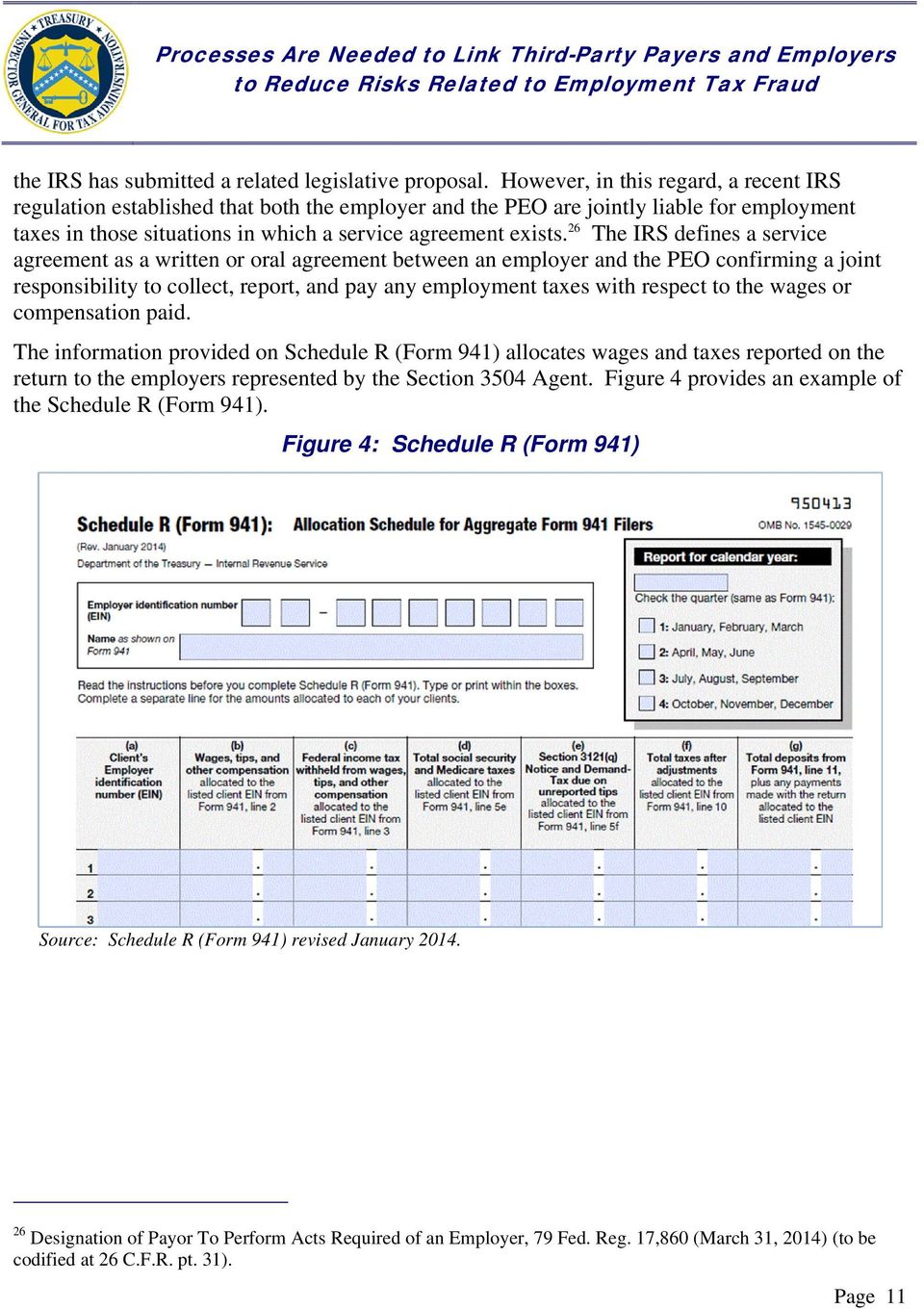
16 the IRS has submitted a related legislative proposal. However, in this regard, a recent IRS regulation established that both the employer and the PEO are jointly liable for employment taxes in those situations in which a service agreement exists. 26 The IRS defines a service agreement as a written or oral agreement between an employer and the PEO confirming a joint responsibility to collect, report, and pay any employment taxes with respect to the wages or compensation paid. The information provided on Schedule R (Form 941) allocates wages and taxes reported on the return to the employers represented by the Section 3504 Agent. Figure 4 provides an example of the Schedule R (Form 941). Figure 4: Schedule R (Form 941) Source: Schedule R (Form 941) revised January Designation of Payor To Perform Acts Required of an Employer, 79 Fed. Reg. 17,860 (March 31, 2014) (to be codified at 26 C.F.R. pt. 31). Page 11
17 Cases involving diversion of employment tax funds indicate that steps are needed to reduce this risk Third-party payer arrangements usually work as intended; however, there have been instances in which third-party payers receive funds from employers for payment of payroll taxes, but they have not remitted those taxes to the IRS. This causes significant problems for employers because the funds have been expended but the taxes are still due. Between Fiscal Years 2007 and 2012, because of the IRS s recommendations, the Department of Justice criminally prosecuted at least 24 owners of different types of third-party payers that collected about $300 million in employment taxes from thousands of client employers and did not pay the funds over to the IRS. 27 The IRS continues to identify the PEOs involved in the diversion of employment tax funds. For example: In February 2014, three individuals in San Antonio, Texas, were sentenced to prison and ordered to pay millions in restitution for their roles in a $133 million employment tax fraud scheme. The individuals participated in a scheme in which they stole more than $133 million through the PEOs they operated. The three individuals diverted the funds that should have been used to pay employment taxes for their personal use. In June 2013, in Greeneville, Tennessee, an individual was sentenced to 36 months in prison, three years of supervised release, and ordered to pay more than $2.5 million in restitution. This individual formed a PEO, employing 500 individuals for 23 employer companies. During a 17-month period, this individual calculated and collected the correct amount of withholding and payroll taxes, but reported and paid a much smaller amount to the IRS and the Social Security Administration. This individual pocketed more than $2.5 million paid by his employer companies and the employees. 28 Recommendations The Commissioner, Small Business/Self-Employed Division, should: Recommendation 1: Partner with the Bureau of the Fiscal Service on the development of a formal plan that includes action items, system requirements, time frames, etc. for the implementation of the process to use the EFTPS to link the PSPs with the employers that use their services. Management s Response: The IRS agreed with this recommendation. The IRS has discussed with officials from the Bureau of the Fiscal Service the feasibility of using the EFTPS to link the PSPs with the employers that use their services. The IRS is continuing these discussions with the Bureau of the Fiscal Service and the IRS will determine 27 National Taxpayer Advocate, 2012 Annual Report to Congress. 28 These case examples were located on the IRS s website and were from public record documents on file in the courts within the judicial district where the cases were prosecuted. Page 12

18 whether it has the resources to implement such a process. If the IRS can implement a process, it will work with the Bureau of the Fiscal Service on the development of a formal implementation plan. Recommendation 2: Establish a program in which employers can inform the IRS of the PEOs that they authorize/designate for filing and payment of employment taxes (similar to the procedures for those employers using the services of a Reporting Agent and Section 3504 Agent). Once in place, ensure that tax account records are updated to reflect this information. Management s Response: The IRS partially agreed with this recommendation. The IRS is working on establishing the voluntary certification program that was enacted into law as Internal Revenue Code Section 3511 in December The IRS does not currently have the budget or resources to establish a compliance program that is outside the scope of newly enacted Section 3511, i.e., for the PEOs that choose not to be certified. However, if a PEO chooses not to be certified as provided in the new Internal Revenue Code Section 3511, the PEO will fall under the designated agent provisions of Treasury Regulation Office of Audit Comment: While establishing the voluntary certification program will help for those PEOs that choose to certify, it will have no effect on the PEOs that do not certify. The IRS will continue to be unable to readily identify noncompliance with payment and filing requirements on the part of these non-certifying PEOs. Recommendation 3: Require those PEOs with a service agreement to attach a Schedule R (Form 941) to their Form 941 tax return listing the employers on whose behalf the PEOs are filing. Management s Response: The IRS partially agreed with this recommendation. The new legislation does not address any reporting or recordkeeping requirements of the PEOs that do not become certified PEOs. If a PEO chooses not to be certified as provided in Internal Revenue Code Section 3511, the PEO will fall under the designated agent provisions of Treasury Regulation The IRS does not have the authority or ability to require the PEOs to attach a Schedule R (Form 941) to their Form 941 tax return listing the employers on whose behalf the PEO is filing. Office of Audit Comment: Although Treasury Regulation establishes joint liability when a service agreement exists, without the Schedule R (Form 941) information, the IRS will continue to be unable to link a PEO with each individual employer. As a result, the IRS will continue to be unable to proactively identify noncompliance with payment and filing requirements on the part of the PEOs. Page 13

19 Authorization Forms Are Not Always Accurately Processed Our review of 85 Form 8655 agent authorization forms 29 processed in Calendar Year 2013 identified 11 forms (13 percent) with errors in which the information on the authorization forms differed from the information input to the IRS s systems. For example, on three authorization forms, the employer did not provide the agent with authorization to disclose tax information, yet IRS systems inaccurately reflected that these agents had this authorization. This means that if an IRS employee responsible for answering taxpayer inquiries received a call from an agent inquiring about one of these employers, the IRS employee would see the employer provided authorization to discuss the tax account with the agent. Figure 5 summarizes the types of errors we identified for these 11 authorization forms. Figure 5: Errors on Agent Authorization Forms Description of Error Number of Forms With Errors IRS system was incorrectly updated to provide 4 authorization to disclose tax information to Reporting Agent or provide authorization for Reporting Agent to make employment tax payments. Employer tax account was not updated to reflect Reporting Agent authorization. The RAF was not updated to include the Reporting Agent that filed a Form Total 11 Source: TIGTA analysis of Form 8655 sample. IRS management indicated that the errors we identified likely occurred because the authorization forms are manually input by IRS employees. When information from agent authorization forms is not entered into the IRS s systems correctly, the IRS employees who rely on these data may unknowingly make an unauthorized disclosure of confidential tax information Our systematic random sample of 85 Forms 8655 was selected using a random start of 933 and a skip interval of 2,400 from a population of approximately 204,000. Based upon the sample, we estimate the error exception rate for the Form 8655 population to be percent (11/85). The precision for our estimate of the error exception rate is 7.18 percent at the 95 percent confidence level. Thus, we are 95 percent confident that the true error exception rate for the population is between 5.76 percent (12.94 percent percent) and percent (12.94 percent percent). We are also 95 percent confident that the true number of error exceptions for the population is between 11,760 and 41,040. Page 14

20 Recommendation Recommendation 4: The Commissioner, Wage and Investment Division, should develop processes and procedures to ensure that Form 8655 authorization information captured in the IRS s systems is accurate, and correct the errors associated with the 11 Forms 8655 we identified. Management s Response: The IRS agreed with this recommendation. The IRS issued a Servicewide Electronic Research Program Alert on December 4, 2014, to reinforce the procedural requirements for processing Form 8655 and will coordinate with affected stakeholders to explore systemic or procedural changes that may result in improved accuracy of posted data. The errors identified have been corrected. Processes Are Not Effective to Ensure That Indicators Are Accurately Assigned to Section 3504 Agent and Employer Tax Accounts Our review identified that the IRS has not established an effective process to ensure that indicators are accurately assigned to Section 3504 Agent and employer tax accounts. Review of the tax accounts associated with Section 3504 Agents filing 78 Forms 2678 during the period January 2, 2013, to December 7, 2013, 30 identified 13 (17 percent) that contained erroneous indicators. For example, eight indicators were erroneously added to the employer tax account that should have been input to the Section 3504 Agent s tax account. This means that the employer would be erroneously identified as being the Section 3504 Agent. The remaining five indicators were erroneously input to a Section 3504 Agent s tax account. This means that the Section 3504 Agent would be erroneously identified by the IRS as the employer. IRS procedures require employees processing Forms 2678 to input an indicator on the Section 3504 Agent s tax account to identify the entity as a Section 3504 Agent and to input an indicator on the tax account of the employer that specifies the responsibilities assigned to a Section 3504 Agent. Figure 6 lists the indicators that can be assigned to an agent or employer tax account. 30 Our systematic random sample of 78 Forms 2678 was selected using a random start of 97 and a skip interval of 636 from a population of 49,600. We selected a systematic random sample to ensure that the sample results could be projected to the population. Based upon the sample, we estimate the error exception rate for the Form 2678 population to be percent (13/78). The precision for our estimate of the error exception rate is 8.32 percent at the 95 percent confidence level. Thus, we are 95 percent confident that the true error exception rate for the population is between 8.35 percent (16.67 percent percent) and percent (16.67 percent percent). We are also 95 percent confident that the true number of error exceptions for the population is between 4,141 and 12,392. Page 15

21 Action Code Figure 6: Action Codes (Indicators) Used for Section 3504 Agents or Employers 31 Description of Action Code Input to the Section 3504 Agent s tax account and identifies an employer s appointment of a Section 3504 Agent. Input to the employer s tax account and indicates that the Section 3504 Agent pays all employment tax for home health care employers. Input to the employer s tax account and indicates that the Section 3504 Agent pays all employment tax for employers (not home health care). Input to the employer s tax account and indicates that the Section 3504 Agent is paying all tax for employers Form 945, 32 CT-1, 33 or CT-2 34 filing requirement codes. Input to the employer s tax account and indicates that the Section 3504 Agent is paying some of the employment tax for employers. Source: IRS Processing Codes and Information (Document 6209) and IRS Product Catalog Information. IRS management indicated that the erroneous indicators were caused by employee processing errors. The accuracy of these indicators is key to the IRS s ability to identify Section 3504 Agents and the employers they represent. In addition, these indicators identify specific actions that an employer authorizes on the part of a Section 3504 Agent. When indicators are not accurate, IRS employees who rely on them can unknowingly make an unauthorized disclosure of confidential tax information. Recommendation Recommendation 5: The Commissioner, Wage and Investment Division, should develop processes and procedures to ensure that employees processing Forms 2678 accurately assign indicators to both Section 3504 Agent tax accounts and associated employer tax accounts, 31 These action codes are used with Transaction Code 971. A transaction code is used on taxpayer accounts to perform different actions based on the action code. 32 Payers of nonpayroll payments use Form 945, Annual Return of Withheld Federal Income Tax, to report income tax withheld. 33 Form CT-1, Employer s Annual Railroad Retirement Tax Return, is used to report and pay railroad retirement taxes (including Additional Medicare Tax) imposed on compensation paid to railroad employees. 34 Form CT-2, Employee Representative s Quarterly Railroad Tax Return, is used to report railroad retirement taxes (including Additional Medicare Tax) imposed on compensation received by employee representatives. Page 16
22 including correcting the errors associated with the 13 Forms 2678 we identified as having inaccurate information. Management s Response: The IRS agreed with this recommendation. The IRS issued a Servicewide Electronic Research Program Alert 14A0447 on November 4, 2014, regarding Internal Revenue Manual , Business Master File Account Numbers, to reinforce the procedural requirements for processing Form The errors identified have been corrected. Recently Enacted Legislation Will Ensure That Employers Are Notified of Address Changes Our review identified 1,609 Reporting Agents who filed 28,635 Tax Year 2012 Forms 941 in which the Forms 941 listed the address of the Reporting Agent rather than the address of the employer. In each of these instances, the employer was not notified by the IRS that its address was replaced with the address of the Reporting Agent. The replacement of the employer address with the Reporting Agent s address commonly results from the filing of a Form 941 with the Reporting Agent s address. When the tax return is processed, the address from the 941 tax return, i.e., Reporting Agent s address, is automatically updated on the employer tax account if different from the existing address. Subsequently, the employer will no longer receive notices or other types of correspondence from the IRS alerting it of items such as that its employment taxes were not paid. Congress recognized the risk of potential improprieties when an employer s address is changed based on the filing of a tax return without notification to the employer. As such, Congress passed legislation requiring the IRS to notify employers of address changes. The Consolidated Appropriations Act of under Title I, Section 106, states that: The Internal Revenue Service shall issue a notice of confirmation of any address change relating to an employer making employment tax payments, and such notice shall be sent to both the employer s former and new address and an officer or employee of the Internal Revenue Service shall give special consideration to an offer-in-compromise from a taxpayer who has been the victim of fraud by a third-party payroll tax preparer. Notices will be sent to the employer s former and new address when implementation of the legislation is complete. The issuance of dual address change notices will affect all employers with an open employment tax filing requirement. The IRS is in the process of implementing these changes. The IRS created a team that has drafted notice language, which is currently undergoing review and approval. In addition, the team submitted a work request to make the necessary changes to the IRS s computer systems. Once implementation of these initiatives is complete, the IRS plans to develop a communication plan to notify the business community of 35 Pub. L. No , 128 Stat. 5 (2014). Page 17
23 the impact of the legislative changes from the Consolidated Appropriations Act of The IRS stated that it will begin issuing the dual notices on January 23, Page 18
24 Detailed Objective, Scope, and Methodology Appendix I Our overall objective was to determine whether controls are adequate to protect the taxpayer s and Government s interests when third-party payroll providers are not compliant with payment and filing requirements. To accomplish our objective, we: I. Evaluated the effectiveness of the IRS outreach strategy to inform businesses of the risks involved when using third-party payroll providers and the processes that should be followed to reduce those risks. II. A. Evaluated IRS communication materials available to inform the business community about the risks and processes associated with outsourcing payroll duties to third-party payroll providers. B. Determined the status of the proposed IRS Regulation under Section 3504 of the Internal Revenue Code and how the IRS plans to communicate the impact of these changes to the business community. C. Determined the status of the proposed legislation (Small Business Payroll Protection Act of 2013) 1 and passed legislation (Consolidated Appropriations Act of 2014) 2 and how the IRS plans to notify the business community of the impact of these legislative changes. Assessed the effectiveness of IRS controls to identify and monitor the compliance of third-party payroll providers. A. Reviewed prior TIGTA 3 and Taxpayer Advocate Service reports to determine the status of prior recommendations and corrective actions pertaining to the monitoring and compliance of third-party payroll providers. B. Reviewed Internal Revenue Manual instructions and met with the IRS to identify the processes and procedures the IRS has established to ensure that payroll providers are compliant in filing and paying employment taxes on behalf of the employer companies they represent. 1 S. 900, 113 th Cong. ( ). 2 Pub. L. No , 128 Stat. 5 (2014). 3 TIGTA, Ref. No , Improvements Have Been Made to Monitor Employers That Use Professional Employer Organizations, but More Can Be Done (Sept. 2007) and TIGTA, Ref. No , Affordable Care Act: Efforts to Implement the Small Business Health Care Tax Credit Were Mostly Successful, but Some Improvements Are Needed (Sept. 2011). Page 19
25 III. C. Determined the effect on both the IRS and taxpayers when a process does not exist for identifying and monitoring the compliance of payroll providers. Evaluated the effectiveness of the IRS s controls over processing Form 8655, Reporting Agent Authorization, and Form 2678, Employer/Payer Appointment of Agent. A. Identified the processes and procedures that the IRS has established for processing Forms 8655 and B. Participated in a walkthrough at the Cincinnati and Ogden Accounts Management functions and the Cincinnati and Ogden Entity functions to identify the processes established for processing Forms 8655 and C. Selected a systematic random sample of 85 Forms 8655 from a population of 204,000 forms processed in Calendar Year 2013 to determine whether the information from the forms was accurately processed to the RAF, 4 and whether the information was accurately processed to the taxpayer/employer Business Master File 5 entity modules 6 on the Master File. 7 Our systematic random sample of 85 Forms 8655 was selected using a random start of 933 and a skip interval of 2,400. A systematic random sample, a probability sampling technique, was used because the IRS does not maintain an electronic list to track each form. The population of approximately 204,000 Forms 8655 was stored by the IRS in 85 boxes. Thus, a simple random sample was not feasible. We selected a systematic random sample to ensure that the sample results could be projected to the population. Based upon the sample, we estimate the error exception rate for the Form 8655 population to be percent (11/85). The precision for our estimate of the error exception rate is 7.18 percent at the 95 percent confidence level. Thus, we are 95 percent confident that the true error exception rate for the population is between 5.76 percent (12.94 percent percent) and percent (12.94 percent percent). We are also 95 percent confident that the true number of error exceptions for the population is between 11,760 and 41,040. The contracted statistician assisted with developing the sampling plan for Forms The RAF contains authorizations by business taxpayers designating a third-party representative to receive information for business returns filed by the taxpayer as well as correspondence. The taxpayer may also designate a third-party to make Federal tax deposits and payments on behalf of the business. Some businesses are required by law to file electronic payments and, therefore, their third party must be recorded on the RAF. 5 The IRS database that consists of Federal tax-related transactions and accounts for businesses. These include employment taxes, income taxes on businesses, and excise taxes. 6 The entity module is the portion of the Master File record that identifies the taxpayer. It contains the taxpayer s name, address, RAF Indicators, and other information. 7 The IRS database that stores various types of taxpayer account information. This database includes individual, business, and employee plans and exempt organizations data. Page 20
26 IV. D. Selected a systematic random sample of 78 Forms 2678 from a population of 49,600 forms processed in Calendar Year 2013 to determine whether the information from the forms was accurately processed to both the Section 3504 Agent and taxpayer/employer Business Master File entity modules on the Master File. Our systematic random sample of 78 Forms 2678 was selected using a random start of 97 and a skip interval of 636. A systematic random sample, a probability sampling technique, was used because the IRS does not maintain an electronic list to track each form. The population of approximately 49,600 Forms 2678 was stored by the IRS in 50 boxes. Thus, a simple random sample was not feasible. We selected a systematic random sample to ensure that the sample results could be projected to the population. Based upon the sample, we estimate the error exception rate for the Form 2678 population to be percent (13/78). The precision for our estimate of the error exception rate is 8.32 percent at the 95 percent confidence level. Thus, we are 95 percent confident that the true error exception rate for the population is between 8.35 percent (16.67 percent percent) and percent (16.67 percent percent). We are also 95 percent confident that the true number of error exceptions for the population is between 4,141 and 12,392. The contracted statistician assisted with developing the sampling plan for Forms Evaluated the effectiveness of the IRS s controls for processing address changes submitted by third-party payroll providers. A. Interviewed IRS officials regarding actions taken to implement recommendations that appear in the Information Reporting Program Advisory Committee s 2013 report. B. Determined whether taxpayer addresses are being improperly changed to the address of the payroll provider representing them. 1. Obtained Reporting Agent addresses from the RAF. 2. Obtained a file of Forms 941, Employer s QUARTERLY Federal Tax Return, filed for taxpayers using Reporting Agents in Tax Year on the Business Return Transaction File (BRTF) 9 for Processing Years , 2013, and 2014 through March 20, We validated the accuracy of the data by comparing a randomly selected sample of 30 Forms 941 on the BRTF to the IRS information residing on the Integrated Data Retrieval System A 12-month accounting period for keeping records on income and expenses used as the basis for calculating the annual taxes due. For most individual taxpayers, the tax year is synonymous with the calendar year. 9 The BRTF programs receive business tax return data, reformat and post returns to the Return Transaction File, and do periodic file maintenance. 10 Processing year is the calendar year in which the tax return was processed by the IRS. 11 IRS computer system capable of retrieving or updating stored information. It works in conjunction with a taxpayer s account records. Page 21
27 3. Matched the Reporting Agent addresses on the RAF to the addresses listed on the Forms 941 filed for taxpayers using Reporting Agents. 4. For any addresses changed from the taxpayer s address to the agent s address, determined if there was a legitimate reason for the change (change of address requested by the taxpayer, Power of Attorney, etc.). Internal controls methodology Internal controls relate to management s plans, methods, and procedures used to meet their mission, goals, and objectives. Internal controls include the processes and procedures for planning, organizing, directing, and controlling program operations. They include the systems for measuring, reporting, and monitoring program performance. We determined that the following internal controls were relevant to our audit objective: the IRS s processes and procedures for processing agent authorization forms and monitoring the compliance of third-party payroll providers. We evaluated these controls by interviewing management and analysts, conducting walkthroughs of processing operations, reviewing samples of agent authorization forms, performing analyses of Schedules R (Form 941): Allocation Schedule for Aggregate Form 941 Filers, and examining independent reports, legislation, regulations, and instructions. Page 22
28 Major Contributors to This Report Appendix II Russell P. Martin, Acting Assistant Inspector General for Audit (Returns Processing and Account Services) Diana Tengesdal, Acting Director Larry Madsen, Audit Manager Gwendolyn Gilboy, Lead Auditor Van Warmke, Senior Auditor Jack Laney, Auditor Nathan Smith, Auditor Ngan Tang, Auditor Page 23
29 Report Distribution List Appendix III Commissioner C Office of the Commissioner Attn: Chief of Staff C Deputy Commissioner for Operations Support OS Deputy Commissioner for Services and Enforcement SE Chief Technology Officer OS:CTO Deputy Commissioner, Small Business/Self-Employed Division SE:S Deputy Commissioner, Wage and Investment Division SE:W Director, Customer Account Services, Wage and Investment Division SE:W:CAS Director, Specialty Programs, Small Business/Self-Employed Division SE:S:SP Director, Communications and Stakeholder Outreach, Small Business/Self-Employed Division SE:S:COSS:CSO Director, Submission Processing, Wage and Investment Division SE:W:CAS:SP Deputy Director, Submission Processing, Wage and Investment Division SE:W:CAS:SP:D Field Director, Submission Processing (Cincinnati), Wage and Investment Division SE:W:CAS:SP:C Field Director, Submission Processing (Ogden), Wage and Investment Division SE:W:CAS:SP:O Chief Counsel CC National Taxpayer Advocate TA Director, Office of Legislative Affairs CL:LA Director, Office of Program Evaluation and Risk Analysis RAS:O Office of Internal Control OS:CFO:CPIC:IC Audit Liaisons: Chief, Program Evaluation and Improvement, Wage and Investment Division SE:W:S:PEI Director, Communications and Stakeholder Outreach, Small Business/Self-Employed Division SE:S:COSS:CSO Page 24
30 Form 8655, Reporting Agent Authorization Appendix IV Page 25
31 Appendix V Form 2678, Employer/Payer Appointment of Agent Page 26
32 Page 27
33 Appendix VI Schedule R (Form 941): Allocation Schedule for Aggregate Form 941 Filers Page 28
34 Page 29
35 Appendix VII Management s Response to the Draft Report Page 30
36 Page 31
37 Page 32
38 Page 33
39 Page 34
TREASURY INSPECTOR GENERAL FOR TAX ADMINISTRATION
 TREASURY INSPECTOR GENERAL FOR TAX ADMINISTRATION Many Taxpayers Are Still Not Complying With Noncash Charitable Contribution Reporting Requirements December 20, 2012 Reference Number: 2013-40-009 This
TREASURY INSPECTOR GENERAL FOR TAX ADMINISTRATION
 TREASURY INSPECTOR GENERAL FOR TAX ADMINISTRATION The External Leads Program Results in the Recovery of Erroneously Issued Tax Refunds; However, Improvements Are Needed to Ensure That Leads Are Timely
TREASURY INSPECTOR GENERAL FOR TAX ADMINISTRATION
 TREASURY INSPECTOR GENERAL FOR TAX ADMINISTRATION Procedures Need to Be Updated to Ensure Proper Determinations of Tax Relief for Taxpayers Affected by Disasters February 16, 2012 Reference Number: 2012-40-015
TREASURY INSPECTOR GENERAL FOR TAX ADMINISTRATION
 TREASURY INSPECTOR GENERAL FOR TAX ADMINISTRATION Results of the 2015 Filing Season August 31, 2015 Reference Number: 2015-40-080 This report has cleared the Treasury Inspector General for Tax Administration
TREASURY INSPECTOR GENERAL FOR TAX ADMINISTRATION
 TREASURY INSPECTOR GENERAL FOR TAX ADMINISTRATION Fiscal Year 2015 Statutory Review of Restrictions on Directly Contacting Taxpayers July 7, 2015 Reference Number: 2015-30-061 This report has cleared the
TREASURY INSPECTOR GENERAL FOR TAX ADMINISTRATION
 TREASURY INSPECTOR GENERAL FOR TAX ADMINISTRATION Improvements Are Needed to Better Ensure That Refunds Claimed on Potentially Fraudulent Tax Returns Are Not Erroneously Released November 12, 2015 Reference
News Release Date: 8/2/13
 Cross References FS-2013-9, July 17, 2013 News Release Date: 8/2/13 Tips for Employers Who Outsource Payroll Duties Many employers outsource their payroll and related tax duties to third-party payers such
TREASURY INSPECTOR GENERAL FOR TAX ADMINISTRATION
 TREASURY INSPECTOR GENERAL FOR TAX ADMINISTRATION Affordable Care Act: Tracking of Health Insurance Reform Implementation Fund Costs Could Be Improved September 18, 2013 Reference Number: 2013-13-115 This
TREASURY INSPECTOR GENERAL FOR TAX ADMINISTRATION
 TREASURY INSPECTOR GENERAL FOR TAX ADMINISTRATION The Affordable Care Act: Processes Have Been Implemented to Administer the Patient-Centered Outcomes Research Fee, but Controls Need Improvement to Ensure
TREASURY INSPECTOR GENERAL FOR TAX ADMINISTRATION
 TREASURY INSPECTOR GENERAL FOR TAX ADMINISTRATION Some Tax-Exempt Organizations Have July 3, 2014 Reference Number: 2014-10-012 This report has cleared the Treasury Inspector General for Tax Administration
TREASURY INSPECTOR GENERAL FOR TAX ADMINISTRATION
 TREASURY INSPECTOR GENERAL FOR TAX ADMINISTRATION Fiscal Year 2015 Statutory Review of Compliance With Legal Guidelines When Issuing Levies June 18, 2015 Reference Number: 2015-30-058 This report has cleared
TREASURY INSPECTOR GENERAL FOR TAX ADMINISTRATION
 TREASURY INSPECTOR GENERAL FOR TAX ADMINISTRATION The Office of Disclosure Continued to Improve Compliance With the Freedom of Information Act Requirements August 29, 2008 Reference Number: 2008-30-164
New York Professional Employer Act
 New York State Department of Labor Article 31 New York Professional Employer Act ART 31 (06/14) ARTICLE 31 NEW YORK PROFESSIONAL EMPLOYER ACT Section 915. Short title. 916. Definitions. 917. Continuing
TREASURY INSPECTOR GENERAL FOR TAX ADMINISTRATION
 TREASURY INSPECTOR GENERAL FOR TAX ADMINISTRATION Direct Debit Installment Agreement Procedures Addressing Taxpayer Defaults Can Be Improved February 5, 2016 Reference Number: 2016-30-011 This report has
TREASURY INSPECTOR GENERAL FOR TAX ADMINISTRATION
 TREASURY INSPECTOR GENERAL FOR TAX ADMINISTRATION Revenue Officers Took Appropriate Levy Actions but Face Challenges and Delays Bringing Taxpayers Into Compliance November 21, 2011 Reference Number: 2012-30-007
TREASURY INSPECTOR GENERAL FOR TAX ADMINISTRATION
 TREASURY INSPECTOR GENERAL FOR TAX ADMINISTRATION Improvements Can Be Made to Educate and Notify Taxpayers of Required Minimum Distribution Requirements From Individual Retirement Arrangements May 29,
This notice provides that Internal Revenue Service (IRS) Form 8922, Third-Party
 Reporting Sick Pay Paid by Third Parties Notice 2015-6 PURPOSE This notice provides that Internal Revenue Service (IRS) Form 8922, Third-Party Sick Pay Recap, must be used by third parties and employers
TREASURY INSPECTOR GENERAL FOR TAX ADMINISTRATION
 TREASURY INSPECTOR GENERAL FOR TAX ADMINISTRATION All Individual Tax Returns Filed Electronically in the 2013 Filing Season Were Processed Using the Modernized e-file System September 27, 2013 Reference
Enrolled Copy H.B. 29
 1 PROFESSIONAL EMPLOYER ORGANIZATION 2 RELATED AMENDMENTS 3 2007 GENERAL SESSION 4 STATE OF UTAH 5 Chief Sponsor: James A. Dunnigan 6 Senate Sponsor: Curtis S. Bramble 7 8 LONG TITLE 9 General Description:
How To Write A Report On The Recovery Act Of 2009
 TREASURY INSPECTOR GENERAL FOR TAX ADMINISTRATION RECOVERY ACT Initial Published Guidance for American Recovery and Reinvestment Act of 2009 Bonds Was Complete, Accurate, and Consistent March 16, 2010
Company DBA: Company Legal Name: Company Federal EIN: Company State Unemployment ID Number:
 ChoicePay PAYROLL Service Agreement Company DBA: Company Legal Name: Company Federal EIN: Company State Unemployment ID Number: Company is A: Sole Proprietorship Limited Partnership General Partnership
TREASURY INSPECTOR GENERAL FOR TAX ADMINISTRATION
 TREASURY INSPECTOR GENERAL FOR TAX ADMINISTRATION Accounting and Controls Need to Be Improved for Excess Collections December 15, 2015 Reference Number: 2016-30-005 This report has cleared the Treasury
HOUSE BILL No. 2087. By Committee on Insurance 1-26. AN ACT enacting the Kansas professional employer organization licensing
 Session of 00 HOUSE BILL No. 0 By Committee on Insurance - 0 0 AN ACT enacting the Kansas professional employer organization licensing act. Be it enacted by the Legislature of the State of Kansas: Section.
SUMMARY: This document contains temporary regulations that. authorize the Secretary of the Treasury to accept payment of
 [4830-01-u] DEPARTMENT OF THE TREASURY Internal Revenue Service 26 CFR Part 301 [TD 8793] RIN 1545-AW38 Payment by Credit Card and Debit Card AGENCY: Internal Revenue Service (IRS), Treasury. ACTION: Temporary
TREASURY INSPECTOR GENERAL FOR TAX ADMINISTRATION
 TREASURY INSPECTOR GENERAL FOR TAX ADMINISTRATION Preparer Tax Identification Numbers Are Not Revoked for Unsuitable Tax Return Preparers August 27, 2015 Reference Number: 2015-40-075 This report has cleared
How To Audit A Federal Contractor
 TREASURY INSPECTOR GENERAL FOR TAX ADMINISTRATION Contractor Employees Have August 30, 2013 Reference Number: 2013-10-082 This report has cleared the Treasury Inspector General for Tax Administration disclosure
TREASURY INSPECTOR GENERAL FOR TAX ADMINISTRATION
 TREASURY INSPECTOR GENERAL FOR TAX ADMINISTRATION Suspended E-File Providers Were Not Adequately Assisted With Reinstatement of Electronic Filing Privileges July 10, 2007 Reference Number: 2007-40-114
TREASURY INSPECTOR GENERAL FOR TAX ADMINISTRATION
 TREASURY INSPECTOR GENERAL FOR TAX ADMINISTRATION Millions of Dollars in Potentially Improper Claims for the Qualified Retirement Savings Contributions Credit Are Not Pursued March 26, 2014 Reference Number:
TREASURY INSPECTOR GENERAL FOR TAX ADMINISTRATION
 TREASURY INSPECTOR GENERAL FOR TAX ADMINISTRATION The Impact of the Frontline Leader Readiness Program on Succession Planning Should Be Determined March 15, 2011 Reference Number: 2011-10-015 This report
DESCRIPTION OF H.R. 3832, THE STOLEN IDENTITY REFUND FRAUD PREVENTION ACT OF 2015
 DESCRIPTION OF H.R. 3832, THE STOLEN IDENTITY REFUND FRAUD PREVENTION ACT OF 2015 Scheduled for Markup by the HOUSE COMMITTEE ON WAYS AND MEANS on April 28, 2016 Prepared by the Staff of the JOINT COMMITTEE
TREASURY INSPECTOR GENERAL FOR TAX ADMINISTRATION
 TREASURY INSPECTOR GENERAL FOR TAX ADMINISTRATION There Are Billions of Dollars in July 19, 2012 Reference Number: 2012-42-080 This report has cleared the Treasury Inspector General for Tax Administration
$&71R SENATE BILL NO. 1105 (SUBSTITUTE FOR SENATE BILL 812 BY SENATOR SCHEDLER)
 Regular Session, 2001 $&71R SENATE BILL NO. 1105 (SUBSTITUTE FOR SENATE BILL 812 BY SENATOR SCHEDLER) BY SENATOR SCHEDLER AN ACT To enact Part XXV of Chapter 1 of Title 22 of the Louisiana Revised Statutes
TREASURY INSPECTOR GENERAL FOR TAX ADMINISTRATION
 TREASURY INSPECTOR GENERAL FOR TAX ADMINISTRATION The Internal Revenue Service September 14, 2010 Reference Number: 2010-10-115 This report has cleared the Treasury Inspector General for Tax Administration
TREASURY INSPECTOR GENERAL FOR TAX ADMINISTRATION
 TREASURY INSPECTOR GENERAL FOR TAX ADMINISTRATION Management Oversight of the Small Business/Self-Employed Division s Fuel Compliance Fleet Card Program Should Be Strengthened September 27, 2011 Reference
ASSEMBLY BILL No. 2570
 AMENDED IN SENATE JULY, 0 AMENDED IN SENATE JUNE, 0 california legislature 00 regular session ASSEMBLY BILL No. 0 Introduced by Assembly Member Ma February, 0 An act to add Section 0. to the Unemployment
TREASURY INSPECTOR GENERAL FOR TAX ADMINISTRATION
 TREASURY INSPECTOR GENERAL FOR TAX ADMINISTRATION The Correspondence Audit Selection August 27, 2013 Reference Number: 2013-30-077 This report has cleared the Treasury Inspector General for Tax Administration
TREASURY INSPECTOR GENERAL FOR TAX ADMINISTRATION
 TREASURY INSPECTOR GENERAL FOR TAX ADMINISTRATION Identity Protection Personal Identification Numbers Are Not Provided to All Eligible Taxpayers September 24, 2014 Reference Number: 2014-40-086 This report
TREASURY INSPECTOR GENERAL FOR TAX ADMINISTRATION
 TREASURY INSPECTOR GENERAL FOR TAX ADMINISTRATION Federal Guidelines Do Not Prohibit the Awarding of Contracts to Contractors With Delinquent Tax Liabilities September 28, 2010 Reference Number: 2010-30-120
April 2004. Reference Number: 2004-40-088
 Information Is Needed to Determine the Effect the Wage and Investment Division Research Program Has on Improving Customer Service and Voluntary Compliance April 2004 Reference Number: 2004-40-088 This
TREASURY INSPECTOR GENERAL FOR TAX ADMINISTRATION
 TREASURY INSPECTOR GENERAL FOR TAX ADMINISTRATION Inappropriate Criteria Were Used to May 14, 2013 Reference Number: 2013-10-053 This report has cleared the Treasury Inspector General for Tax Administration
How To Improve Mainframe Software Asset Management
 TREASURY INSPECTOR GENERAL FOR TAX ADMINISTRATION The Internal Revenue Service Should Improve Mainframe Software Asset Management February 20, 2014 Reference Number: 2014-20-002 This report has cleared
4123-17-15 Professional employer organizations.
 4123-17-15 Professional employer organizations. (A) Definitions. As used in rules 4123-17-15 to 4123-17-15.7 of the Administrative Code: (1) "Professional employer organization" or "PEO" has the same meaning
WHITE PAPER. Human Resources Outsourcing. Legislation and Legal Issues on Staff Leasing and Professional Employer Organizations
 WHITE PAPER Human Resources Outsourcing Legislation and Legal Issues on Staff Leasing and Professional Employer Organizations Bierce & Kenerson, P.C. 2002 What is a "PEO"? Generically, a PEO acts as the
The General Assembly of the Commonwealth of Pennsylvania hereby enacts as follows: CHAPTER 1 PRELIMINARY PROVISIONS
 PROFESSIONAL EMPLOYER ORGANIZATION ACT Act of Jul. 5, 2012, P.L. 946, No. 102 An Act Cl. 77 Providing for professional employer organizations. TABLE OF CONTENTS Chapter 1. Section 101. Section 102. Section
ATTACHMENT D CHARTER SCHOOLS IN MICHIGAN
 ATTACHMENT D CHARTER SCHOOLS IN MICHIGAN Introduction In December of 1993, Michigan became the ninth state to pass charter school legislation. The current charter school statute applicable to this RFP
Application for Extension of Time To File an Exempt Organization Return
 Form 8868 (Rev. January 2014) Department of the Treasury Internal Revenue Service for Extension of Time To File an Exempt Organization File a separate application for each return. Information about Form
Offer in Compromise (Doubt as to Liability)
 Form 656-L Offer in Compromise (Doubt as to Liability) CONTENTS What you need to know...2 Important information...2 Form 656-L...5 IRS contact information If you have questions about qualifying for an
CHAPTER 267. BE IT ENACTED by the Senate and General Assembly of the State of New Jersey:
 CHAPTER 267 AN ACT concerning third party administrators of health benefits plans and third party billing services and supplementing Title 17B of the New Jersey Statutes. BE IT ENACTED by the Senate and
TREASURY INSPECTOR GENERAL FOR TAX ADMINISTRATION
 TREASURY INSPECTOR GENERAL FOR TAX ADMINISTRATION Annual Audit Plan Fiscal Year 2012 Fiscal Year 2012 Annual Audit Plan Table of Contents Message from the Deputy Inspector General for Audit...1 The Mission
Applies only to discounted stock rights exercised during 2006.
 Part III Administrative, Procedural, and Miscellaneous Compliance Resolution Program for Employees Other than Corporate Insiders for Additional 2006 Taxes Arising Under 409A due to the Exercise of Stock