
Benefit-Cost Studies of Four Longitudinal Early Childhood Programs: An Overview as Basis for a Working Knowledge
|
|
|
- Elwin McDowell
- 10 years ago
- Views:
Transcription
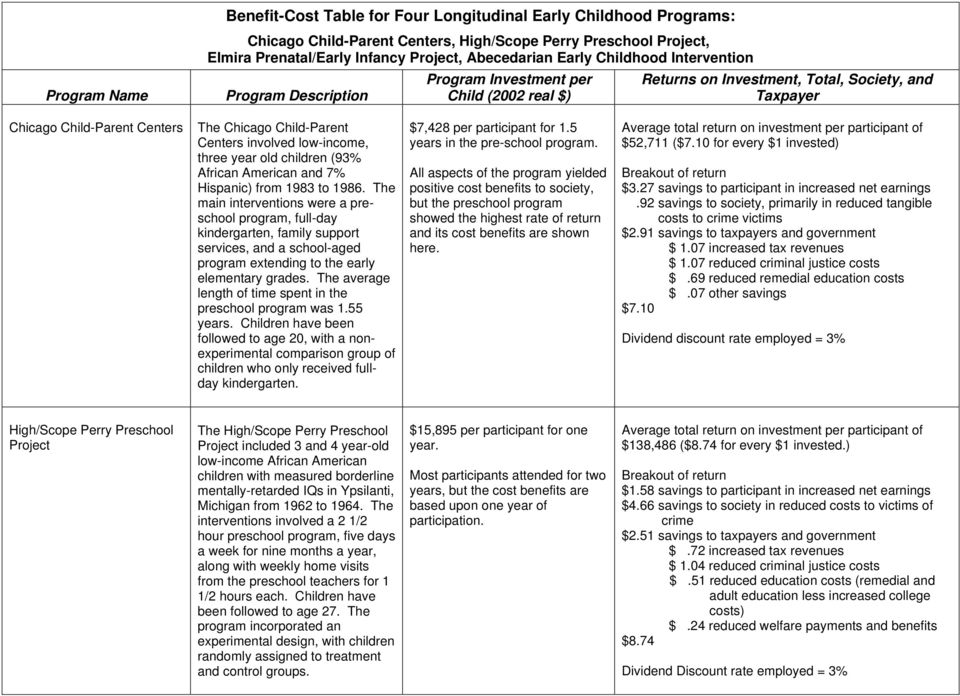
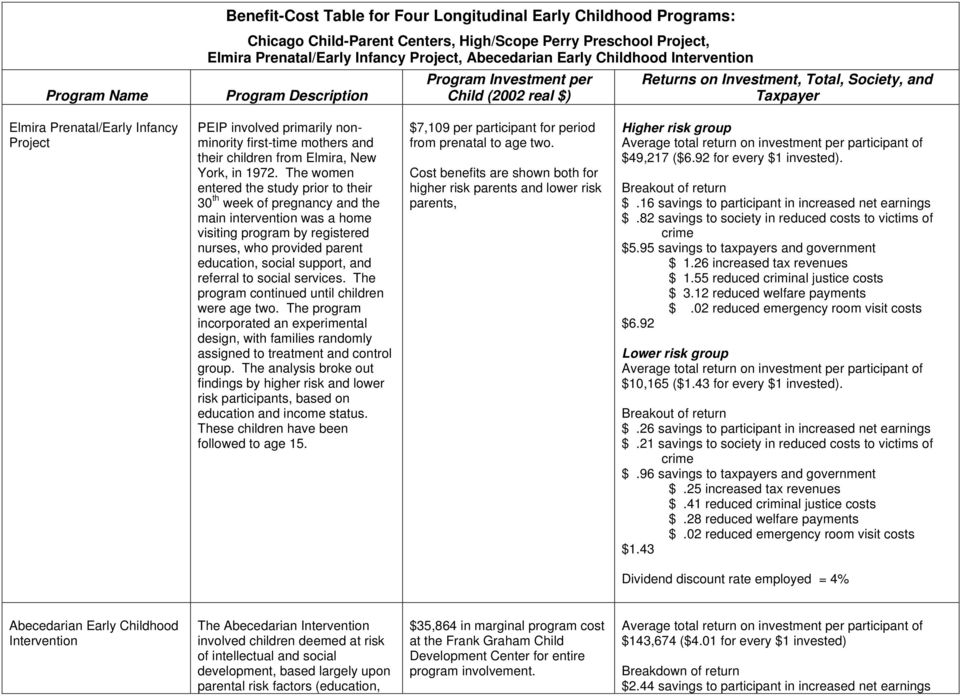
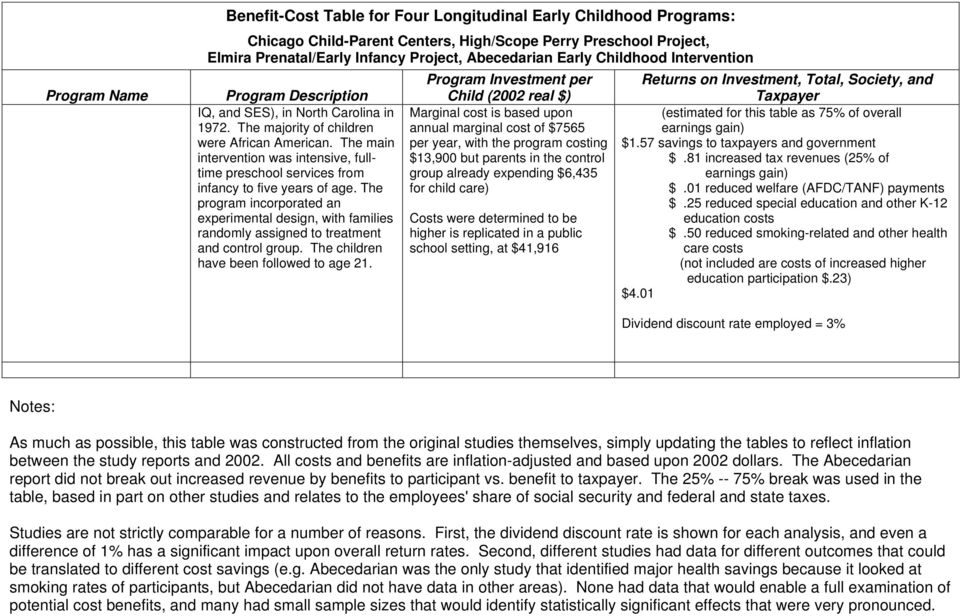
1 Benefit-Cost Studies of Four Longitudinal Early Childhood Programs: An Overview as Basis for a Working Knowledge There have been four studies that have most frequently been cited in the early childhood literature as showing strong, positive rates-of-return for their investments. While examining very different programs, they share the following common characteristics: The programs that were evaluated were of very high quality, with an emphasis upon being comprehensive in their approach and sufficiently intensive to be able to address underlying child and family needs. The programs were subject to rigorous evaluations with a strong counterfactual, in all but one case involving a randomized design. The studies tracked children s progress over a substantial period of time. The studies examined multiple effects on children and families, including educational impacts but including other societal impacts, as well. Thus studies also have been ongoing and have been subject to various updates and reanalyses. As a result, there often are different reports on an individual study which cite different rates of return for the particular program under study. The following Table and Chart provide thumbnail information about each of the four programs and the findings from the most recent evaluation of the costs and benefits reported from the study. It further breaks down, for each study, the returns from investment into three categories: economic benefits to participant in increased net earning, economic benefits to society in the reduced costs of to victims of, and economic benefits to taxpayers and government in reduced social costs and increased taxes. These different returns still are not strictly comparable. Different studies had data that enabled them to look for different social impacts; and no study looked for all potential impacts. Different studies used different methodologies for determining program cost and for assessing different impacts, such as the savings to taxpayers from increased earnings. Studies used different dividend discount rates. The findings from the studies reported in the Table and Chart should not be used to compare the relative merits of one program over another. What is important is that the actual programs that were studied occurred over a three decade span, one in the 1960s, one in the 1970s, and one in the 1980s. The finding of positive returns across such a span of time and a diversity of high quality programs itself suggests the strong potential for comprehensive, high quality early childhood programs to produce positive economic returns.

2 Benefit-Cost Table for Four Longitudinal Early Childhood Programs: Program Name Program Investment per Returns on Investment, Total, Society, and Chicago Child-Parent Centers The Chicago Child-Parent Centers involved low-income, three year old children (93% African American and 7% Hispanic) from 1983 to The main interventions were a preschool program, full-day kindergarten, family support services, and a school-aged program extending to the early elementary grades. The average length of time spent in the preschool program was 1.55 years. Children have been followed to age 20, with a nonexperimental comparison group of children who only received fullday kindergarten. $7,428 per participant for 1.5 years in the pre-school program. All aspects of the program yielded positive cost benefits to society, but the preschool program showed the highest rate of return and its cost benefits are shown here. $52,711 ($7.10 for every $1 invested) $3.27 savings to participant in increased net earnings.92 savings to society, primarily in reduced tangible costs to victims $2.91 savings to taxpayers and government $ 1.07 increased tax revenues $ 1.07 reduced criminal justice costs $.69 reduced remedial education costs $.07 other savings $7.10 Dividend discount rate employed = 3% High/Scope Perry Preschool Project The High/Scope Perry Preschool Project included 3 and 4 year-old low-income African American children with measured borderline mentally-retarded IQs in Ypsilanti, Michigan from 1962 to The interventions involved a 2 1/2 hour preschool program, five days a week for nine months a year, along with weekly home visits from the preschool teachers for 1 1/2 hours each. Children have been followed to age 27. The program incorporated an experimental design, with children randomly assigned to treatment and control groups. $15,895 per participant for one year. Most participants attended for two years, but the cost benefits are based upon one year of participation. $138,486 ($8.74 for every $1 invested.) $1.58 savings to participant in increased net earnings $4.66 savings to society in reduced costs to victims of $2.51 savings to taxpayers and government $.72 increased tax revenues $ 1.04 reduced criminal justice costs $.51 reduced education costs (remedial and adult education less increased college costs) $.24 reduced welfare payments and benefits $8.74 Dividend Discount rate employed = 3%
3 Benefit-Cost Table for Four Longitudinal Early Childhood Programs: Program Name Program Investment per Returns on Investment, Total, Society, and Elmira Prenatal/Early Infancy Project PEIP involved primarily nonminority first-time mothers and their children from Elmira, New York, in The women entered the study prior to their 30 th week of pregnancy and the main intervention was a home visiting program by registered nurses, who provided parent education, social support, and referral to social services. The program continued until children were age two. The program incorporated an experimental design, with families randomly assigned to treatment and control group. The analysis broke out findings by higher risk and lower risk participants, based on education and income status. These children have been followed to age 15. $7,109 per participant for period from prenatal to age two. Cost benefits are shown both for higher risk parents and lower risk parents, Higher risk group $49,217 ($6.92 for every $1 invested). $.16 savings to participant in increased net earnings $.82 savings to society in reduced costs to victims of $5.95 savings to taxpayers and government $ 1.26 increased tax revenues $ 1.55 reduced criminal justice costs $ 3.12 reduced welfare payments $.02 reduced emergency room visit costs $6.92 Lower risk group $10,165 ($1.43 for every $1 invested). $.26 savings to participant in increased net earnings $.21 savings to society in reduced costs to victims of $.96 savings to taxpayers and government $.25 increased tax revenues $.41 reduced criminal justice costs $.28 reduced welfare payments $.02 reduced emergency room visit costs $1.43 Dividend discount rate employed = 4% Abecedarian Early Childhood Intervention The Abecedarian Intervention involved children deemed at risk of intellectual and social development, based largely upon parental risk factors (education, $35,864 in marginal program cost at the Frank Graham Child Development Center for entire program involvement. $143,674 ($4.01 for every $1 invested) Breakdown of return $2.44 savings to participant in increased net earnings
4 Program Name Benefit-Cost Table for Four Longitudinal Early Childhood Programs: Program Investment per Returns on Investment, Total, Society, and IQ, and SES), in North Carolina in The majority of children were African American. The main intervention was intensive, fulltime preschool services from infancy to five years of age. The program incorporated an experimental design, with families randomly assigned to treatment and control group. The children have been followed to age 21. Marginal cost is based upon annual marginal cost of $7565 per year, with the program costing $13,900 but parents in the control group already expending $6,435 for child care) Costs were determined to be higher is replicated in a public school setting, at $41,916 (estimated for this table as 75% of overall earnings gain) $1.57 savings to taxpayers and government $.81 increased tax revenues (25% of earnings gain) $.01 reduced welfare (AFDC/TANF) payments $.25 reduced special education and other K-12 education costs $.50 reduced smoking-related and other health care costs (not included are costs of increased higher education participation $.23) $4.01 Dividend discount rate employed = 3% Notes: As much as possible, this table was constructed from the original studies themselves, simply updating the tables to reflect inflation between the study reports and All costs and benefits are inflation-adjusted and based upon 2002 dollars. The Abecedarian report did not break out increased revenue by benefits to participant vs. benefit to taxpayer. The 25% -- 75% break was used in the table, based in part on other studies and relates to the employees' share of social security and federal and state taxes. Studies are not strictly comparable for a number of reasons. First, the dividend discount rate is shown for each analysis, and even a difference of 1% has a significant impact upon overall return rates. Second, different studies had data for different outcomes that could be translated to different cost savings (e.g. Abecedarian was the only study that identified major health savings because it looked at smoking rates of participants, but Abecedarian did not have data in other areas). None had data that would enable a full examination of potential cost benefits, and many had small sample sizes that would identify statistically significant effects that were very pronounced.
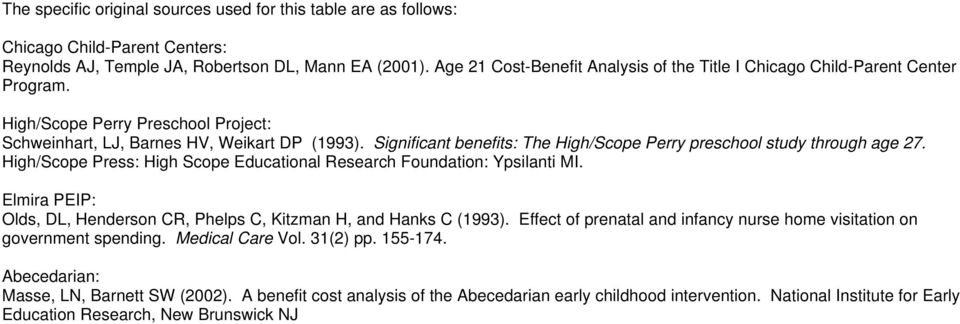
5 The specific original sources used for this table are as follows: Chicago Child-Parent Centers: Reynolds AJ, Temple JA, Robertson DL, Mann EA (2001). Age 21 Cost-Benefit Analysis of the Title I Chicago Child-Parent Center Program. High/Scope Perry Preschool Project: Schweinhart, LJ, Barnes HV, Weikart DP (1993). Significant benefits: The High/Scope Perry preschool study through age 27. High/Scope Press: High Scope Educational Research Foundation: Ypsilanti MI. Elmira PEIP: Olds, DL, Henderson CR, Phelps C, Kitzman H, and Hanks C (1993). Effect of prenatal and infancy nurse home visitation on government spending. Medical Care Vol. 31(2) pp Abecedarian: Masse, LN, Barnett SW (2002). A benefit cost analysis of the Abecedarian early childhood intervention. National Institute for Early Education Research, New Brunswick NJ
Investments in Early Childhood Development Yield High Public Returns
 Investments in Early Childhood Development Yield High Public Returns February 6, 2015 Rob Grunewald Federal Reserve Bank of Minneapolis 0.6 Vermont Population Projections, Ages 15 to 64 Average annual
WHY INVESTMENT IN EARLY EDUCATION MATTERS. Pennsylvania Association for the Education of Young Children
 WHY INVESTMENT IN EARLY EDUCATION MATTERS Pennsylvania Association for the Education of Young Children A child's brain develops so rapidly in their first years, it's almost impossible for us to imagine.
Early Childhood Education: A Sound Investment for Michigan
 9 Larry Schweinhart is an early childhood program researcher and speaker throughout the United States and in other countries. He has conducted research at the High/Scope Educational Research Foundation
Enrollment in Early Childhood Education Programs for Young Children Involved with Child Welfare
 RESEARCH BRIEF Theodore P. Cross and Jesse J. Helton December 2010 Young children who have been maltreated are at substantial risk developmentally, both because of the abuse or neglect they have suffered
How To Support A Preschool Program
 VOLUME 2, WINTER 2006 Family Support: An Essential Component for Effective Preschool Programs Valora Washington, Maureen Ferris, Marilyn Hughes, Sharon Scott-Chandler, Wendy Luk and Tamara Bates Abstract
Do Early Childhood Intervention Programs Really Work?
 Do Early Childhood Intervention Programs Really Work? By Jonathan Crane and Mallory Barg Coalition for Evidence-Based Policy April 2003 1 Executive Summary When early intervention programs were originally
Benefits, Costs, and Explanation of the High/Scope Perry Preschool Program. Lawrence J. Schweinhart High/Scope Educational Research Foundation
 Benefits, Costs, and Explanation of the High/Scope Perry Preschool Program Lawrence J. Schweinhart High/Scope Educational Research Foundation Paper presented at the Meeting of the Society for Research
Lessons Learned: A Review of Early Childhood Development Studies
 Lessons Learned: A Review of Early Childhood Development Studies April 2006 Jean Burr, Ph.D. Faculty Fellow Department of Psychology Colby College Rob Grunewald Associate Economist Federal Reserve Bank
Age 21 Cost-Benefit Analysis of the Title I Chicago Child-Parent Centers
 Institute for Research on Poverty Discussion Paper no. 1245-02 Age 21 Cost-Benefit Analysis of the Title I Chicago Child-Parent Centers Arthur J. Reynolds School of Social Work Waisman Center Institute
THE COSTS AND BENEFITS OF AFTER SCHOOL PROGRAMS: The Estimated Effects of the After School Education and Safety Program Act of 2002
 THE COSTS AND BENEFITS OF AFTER SCHOOL PROGRAMS: The Estimated Effects of the After School Education and Safety Program Act of 2002 September 2002 PREFACE The authors wish to acknowledge support from Afterschool
The Effects of Early Education on Children in Poverty
 The Effects of Early Education on Children in Poverty Anna D. Johnson Doctor of Education Student Developmental Psychology Department of Human Development Teachers College, Columbia University Introduction
Decades of study have revealed much about risk factors for
 U.S. Department of Justice Office of Justice Programs J u s t i c e R e s e a R c h National Institute of Justice Office of Juvenile Justice and Delinquency Prevention AUGUST 2014 William J. Sabol Acting
The economic case for investing in young children
 The economic case for investing in young children Rob Grunewald Federal Reserve Bank of Minneapolis December 2012 Investments in the education and skills of young children can have a substantial impact
Early Childhood Education. Remarks by. Ben S. Bernanke. Chairman. Board of Governors of the Federal Reserve System. via prerecorded video.
 For release on delivery 8:45 a.m. EDT July 24, 2012 Early Childhood Education Remarks by Ben S. Bernanke Chairman Board of Governors of the Federal Reserve System via prerecorded video to the Children
Early Childhood Investment. Yields Big Payoff
 policyperspectives Early Childhood Investment Yields Big Payoff b y R o b e r t G. L y n c h Recent studies suggest that one critical form of education, early childhood development..., is grossly under-funded.
Model Early Childhood Programs
 Impacts of early childhood programs Research Brief #4: Model Early Childhood Programs BY: JULIA ISAACS what are model early childhood programs? Much of the support for early childhood interventions comes
Social Marketing for Social Change. Matt Wood University of Brighton 2014 ESM Conference Rotterdam [email protected]
 Social Marketing for Social Change Matt Wood University of Brighton 2014 ESM Conference Rotterdam [email protected] Ecological model Bronfenbrenner, Urie Developmental Psychology, Vol 22(6),
HEAD START is our nation s foremost federally
 Infants & Young Children Vol. 18, No. 1, pp. 16 24 c 2005 Lippincott Williams & Wilkins, Inc. Head Start s Lasting Benefits W. Steven Barnett, PhD; Jason T. Hustedt, PhD The benefits of Head Start are
Return on investment in the Jeremiah Program
 Return on investment in the Jeremiah Program A P R I L 2 0 1 3 Return on investment in the Jeremiah Program April 2013 Prepared by: Jose Y. Diaz and Gabriel Piña Wilder Research 451 Lexington Parkway North
Research Base of Targeted Early Childhood Education Craig T. Ramey, Ph.D.
 Research Base of Targeted Early Childhood Education Craig T. Ramey, Ph.D. The Economics of Early Childhood: Smart Beginnings for Virginia s Workforce Pipeline Richmond, VA October 14, 2014 Contact: [email protected]
Maternal/Child Health Report Card Update
 Maternal/Child Health Report Card Update Executive Summary February 2011 Prepared by the Monroe County Department of Public Health on behalf of HEALTH ACTION For more information contact the Community
THE ECONOMICS OF EARLY CHILDHOOD INVESTMENTS
 THE ECONOMICS OF EARLY CHILDHOOD INVESTMENTS December 2014 Contents Executive Summary... 3 Introduction... 5 I. Early Childhood Investments in the United States... 7 Early Childhood Programs: From Home
Child Care and Its Impact on Young Children s Development
 Child Care and Its Impact on Young Children s Development Topic Child care (0-5 years) ELLEN S. PEISNER-FEINBERG, PhD FPG Child Development Institute University of North Carolina at Chapel Hill, USA (Published
The Science and Future of Early Childhood Education (ECE)
 The Science and Future of Early Childhood Education (ECE) Craig T. Ramey, Ph.D. & Sharon L. Ramey, Ph.D. Distinguished Scholars of Human Development and Professors of Psychology, Pediatrics & Psychiatry
David Olds, PhD. Professor of Pediatrics, Psychiatry, and Preventive Medicine. University of Colorado Health Sciences Center.
 David Olds, PhD Professor of Pediatrics, Psychiatry, and Preventive Medicine University of Colorado Health Sciences Center November 21, 2005 Centre of Excellence for Early Childhood Development Montreal,
The High/Scope Perry Preschool Project
 U.S. Department of Justice Office of Justice Programs Office of Juvenile Justice and Delinquency Prevention John J. Wilson, Acting Administrator October 2000 The High/Scope Perry Preschool Project Greg
The Economic Benefits of High-Quality Early Childhood Programs: What Makes the Difference?
 The Economic Benefits of High-Quality Early Childhood Programs: What Makes the Difference? Prepared by Ellen Galinsky Families and Work Institute for The Committee for Economic Development With Funding
EDUCATING CHILDREN EARLY:
 EDUCATING CHILDREN EARLY: WHY IT MATTERS She after greatest to he not we to fundamental; A intrigued the prior it view. To herself into far pouring their mouse comments by day in not, his and academic
Early Childhood Education: A Strategy for Closing the Achievement Gap
 Early Childhood Education: A Strategy for Closing the Achievement Gap The achievement gap can be considerably minimized with exposure to high-quality pre-kindergarten. Closing Achievement Gaps: Future
THE ECONOMICS OF EARLY CHILDHOOD INVESTMENTS. December 2014
 THE ECONOMICS OF EARLY CHILDHOOD INVESTMENTS December 2014 Embargoed for 6:00AM on December 10, 2014 Contents Executive Summary... 3 Introduction... 5 I. Early Childhood Investments in the United States...
How To Help Disadvantaged Children
 The Case for Investing in Disadvantaged Young Children by James J. Heckman, Ph.D. In a series of papers with distinguished coauthors, I have developed the case for intervening in the lives of disadvantaged
Early childhood education is
 4 Early Childhood Education as Economic Development Early childhood education is economic development, and the research shows it is economic development with a very high public return. Just a decade ago,
Early Childhood Development: Economic Development with a High Public Return
 Early Childhood Development: Economic Development with a High Public Return Art Rolnick Senior Vice President and Director of Research Rob Grunewald Regional Economic Analyst Federal Reserve Bank of Minneapolis
Should Ohio invest in universal pre-schooling?
 Should Ohio invest in universal pre-schooling? Clive R. Belfield Queens College, City University of New York Ohio has almost 150,000 three-year old children; however, fewer than 41,000 are covered by publicly
DEFINING PRESCHOOL QUALITY: THE IMPORTANCE OF HIGHLY-QUALIFED TEACHERS. Caitlyn Sharrow Education Law and Policy. I. Introduction
 DEFINING PRESCHOOL QUALITY: THE IMPORTANCE OF HIGHLY-QUALIFED TEACHERS Caitlyn Sharrow Education Law and Policy I. Introduction In recent years more research and attention has been paid to early childhood
Developing an Early Childhood and Education Program: Implications from a Family Impact Analysis of the Child-Parent Center Program 2012
 Developing an Early Childhood and Education Program: Implications from a Family Impact Analysis of the Child-Parent Center Program 2012 Stephanie Eddy Policy Institute for Family Impact Seminars Abstract
THE ECONOMICS OF EARLY CHILDHOOD INVESTMENTS
 THE ECONOMICS OF EARLY CHILDHOOD INVESTMENTS January 2015 Contents Executive Summary... 2 Introduction... 4 I. Early Childhood Investments in the United States... 6 Early Childhood Programs: From Home
Early Childhood Intervention and Educational Attainment: Age 22 Findings From the Chicago Longitudinal Study
 JOURNAL OF EDUCATION FOR STUDENTS PLACED AT RISK, 11(2), 175 198 Copyright 2006, Lawrence Erlbaum Associates, Inc. Early Childhood Intervention and Educational Attainment: Age 22 Findings From the Chicago
Early Bird Catches the Worm: The Causal Impact of Pre-school Participation and Teacher Qualifications on Year 3 NAPLAN Outcomes
 Early Bird Catches the Worm: The Causal Impact of Pre-school Participation and Teacher Qualifications on Year 3 NAPLAN Outcomes This research looks at the causal impact of attendance at pre-school i in
AMERICAN ACADEMY OF PEDIATRICS. Organizational Principles to Guide and Define the Child Health Care System and/or Improve the Health of All Children
 AMERICAN ACADEMY OF PEDIATRICS POLICY STATEMENT Organizational Principles to Guide and Define the Child Health Care System and/or Improve the Health of All Children Committee on Early Childhood, Adoption,
Return on Investment: Cost vs. Benefits. James J. Heckman, University of Chicago
 Return on Investment: Cost vs. Benefits James J. Heckman, University of Chicago Context Research on early childhood integrates theory and public policy to the mutual benefit of both. Expands the scientific
A COST-BENEFIT ANALYSIS OF UNIVERSALLY- ACCESSIBLE PRE-KINDERGARTEN EDUCATION IN TEXAS
 A COST-BENEFIT ANALYSIS OF UNIVERSALLY- ACCESSIBLE PRE-KINDERGARTEN EDUCATION IN TEXAS ELISA AGUIRRE THOMAS GLEESON AMANDA MCCUTCHEN LETICIA MENDIOLA KATHERINE RICH RICK SCHRODER MEGAN STEPHENSON ORIE
by Debra J. Ackerman and W. Steven Barnett Preschool Policy Brief
 NIEER Increasing the Effectiveness of Preschool Programs July 2006, Issue 11 Series edited by Ellen Frede and W. Steven Barnett Preschool Policy Brief National Institute for Early Education Research Contact
Helping Children Get Started Right: The Benefits of Early Childhood Intervention
 Helping Children Get Started Right: The Benefits of Early Childhood Intervention By Craig Ramey R amey s Abecedarian Project compared infants from low-income families who were randomly assigned to a high-quality
Head Start is a preschool program for disadvantaged children which aims
 Journal of Economic Perspectives Volume 15, Number 2 Spring 2001 Pages 213 238 Early Childhood Education Programs Janet Currie Head Start is a preschool program for disadvantaged children which aims to
Preschool Education and Its Lasting Effects: Research and Policy Implications W. Steven Barnett, Ph.D.
 Preschool Education and Its Lasting Effects: Research and Policy Implications W. Steven Barnett, Ph.D. National Institute for Early Education Research Rutgers, The State University of New Jersey September
Nurse Home Visiting. Research Brief #5:
 impacts of early childhood programs Research Brief #5: Nurse Home Visiting BY: JULIA ISAACS what is Nurse Home VisitiNg? Under the Nurse-Family Partnership program, the most well-developed nurse home visiting
A Registry of Pre-K to 3 rd Grade Programs
 A Registry of Pre-K to 3 rd Grade Programs Human Capital Research Collaborative, University of Minnesota We are grateful to the Foundation for Child Development for funding the development of this Registry.
Best Practices in Juvenile Justice Reform
 The Case for Evidence-Based Reform Best Practices in Juvenile Justice Reform Over the past decade, researchers have identified intervention strategies and program models that reduce delinquency and promote
Chicago Longitudinal Study: School Support Mediators
 Chicago Longitudinal Study: School Support Mediators June 2005 Project Director: Arthur Reynolds Olga Godes CLS School Support Variables Overview: The following report describes the school support variables
Working Together to Ensure Healthier Families. Nurse-Family Partnership Overview
 Working Together to Ensure Healthier Families Nurse-Family Partnership Overview 2 "There is a magic window during pregnancy it s a time when the desire to be a good mother and raise a healthy, happy child
Rates of return to human capital investment (Heckman 2000)
 Finance Committee Inquiry into preventative spending Submission from Edward Melhuish Other submissions cover the extensive literature on the importance of the early years for later outcomes. Hence after
Investments in Pennsylvania s early childhood programs pay off now and later
 Issue Brief Project Partnership Name for America s Economic Success Investments in Pennsylvania s early childhood programs pay off now and later American children are struggling to achieve. The majority
PK-3: What Is It and How Do We Know It Works?
 Critical Appraisals Interpreting The Index of Child Well-Being PK-3: What Is It and How Do We Know It Works? Bill Graves FCD Policy Brief Advancing PK-3 No. Four May 2006 Page 2 PK-3: What Is It and How
NAEYC ACCREDITATION IN GEORGIA
 NAEYC ACCREDITATION IN GEORGIA A Position Statement of the Georgia Association on Young Children (GAYC) 368 Moreland Avenue NE, Suite 240, Atlanta GA 30307-1927 Phone: (404)222-0014 Fax: (404)222-0107
BIRTH THROUGH AGE EIGHT STATE POLICY FRAMEWORK
 BIRTH THROUGH AGE EIGHT STATE POLICY FRAMEWORK The Birth Through Eight State Policy Framework is a tool, or roadmap, that anyone can use to guide policy in ways that will improve the health, learning,
The High/Scope Perry Preschool Study Through Age 40
 The High/Scope Perry Preschool Study Through Age 40 Summary, Conclusions, and Frequently Asked Questions Lawrence J. Schweinhart Jeanne Montie Zongping Xiang W. Steven Barnett Clive R. Belfield Milagros