
Tentative Action Plan
|
|
|
- Lucas Ross
- 10 years ago
- Views:
Transcription
1 Republic of Serbia Ministry of Science and Environmental Protection Serbia and Montenegro Tentative Action Plan Draft 1 Belgrade, September 2005

2 Tentative Action Plan - Draft 1 Section 1 and 2 Information Society Development Strategic Priorities and Initiatives Strategic priority: Perform E-Readiness Assessment Study international ICT-related indices. Evaluate availability of data and institutional capacities. Develop organizational framework and provide resources. Assess the current strategic information systems projects. Study social aspects of information systems development. To learn and evaluate candidate indices for adoption. To define capacity development needs and sources needed for regularly performing assessments. To enable timely and regularly performing assessments and widely publicizing results. To enable defining broad objectives and description of each system, order-ofmagnitude investment cost, and financing strategy. To provide the framework for effective information systems development and use. 2

3 Strategic priority: Develop sectoral E-Strategies Develop Guidelines for Sectoral ICT Policy and Planning Propose plans for sectoral E-Strategies. Propose TORs for each Ministry ICT strategy. Organize work groups and develop strategies To introduce sound methodological approach To mobilize and organize stakeholders to actively participate in strategy development To increase the efficiency and effectiveness of strategic process To review sectoral development strategies and the role of ICT recognized so far. To assess readiness, knowledge and resources needed. To enable efficient and effective use of ICT resources for resolving priorities. Strategic priority: Integrate ICT in sustainable development Develop environmental information system To increse the quality, efficiency and accountability of decision-making processes through applications that systematically use environmental information. Develop national spatial data infrastructure To reduce the costs of developing geographic information systems and improve the access to geospatial data. Promote the further development of the European Environment Information and To effectively participate in the EEA and to enable comparative analysis amongst all 3

4 Observation Network (EIONET) for the collection, monitoring and reporting of environmental data compatible with ongoing networks in Europe, in particular with the EEA countries. Section 3 Institutional Framework for the Information Society Development Develop the legal framework for the new Institutions regarding Information Society Development. Establish the Government Center for Information Society Establish the Information Society Committee To develop the adequate legal framework for the establishment of the new Institutions for the Information Society Development in close consultations of all key Government institutions: Office of Prime Minister, Ministry of Public Administration and Local Self-Government and the Republic Secretariat for Legislation. To establish Cabinet level state body responsible for Information society development and capable for implementation of the National Strategy for an Information society and future development in this area. To establish Information Society Committee to provide a framework for collective consideration of and decisions on major policy issues and issues of significant public interest in the field of Information Society. It should consider and 4

5 Assess the current status within the Governmental bodies Establish Information Society Council Enable intensive consultations with key stakeholders in the process of defining the institutional framework regarding the Information society forum. Establish the Information Society Forum in close cooperation of all stakeholders in the country monitor implementation of national Information Society policy and strategy as well as remove barriers and minimize risks in their implementation. To undertake the assessment of the current status regarding the Information society and in particular egovenrment initiatives within the Public Administration and the development of the TOR for the egovenrment departments within Ministries headed by Assistant Ministers responsible for cooperation and coordination in the area of the Information society development and egovernment. To establishment the Information Society Council responsible for e-government which should drive forward a national egovernment strategy for creating favorable environment for ebusiness and edemocracy by modernizing public administration. To secure the support of the stakeholders in the county through the process of intensive consultations in relation to defining of the new institutional framework for the Information Society Forum. To establish the Information Society Forum the independent institution which would be responsible to create the dialog based on consensus between stakeholders in the country regarding all future challenges in the area of the Information society. 5

6 Section 4 E-Legislative Strategic priority: Create legislative framework for information society Create and adapt set of lows concerning human rights. Ratify and implement the Council of Europe convention on Cyber Crime Create and adapt set of lows concerning e-government Create and adapt set of lows concerning electronic commerce, contracts and electronic transactions Adopt and implement intellectual property legislation on copyrights, patents, software Create and adapt set of lows concerning electronic communications and media To protect personal (private) data and enable access to public data. To create and pass the regulations governing the mechanisms of international cooperation in identifying and preventing criminal offences related to computer crime. To provide legal framework for electronic public services and wide use of ICT in the government. To develop and implement electronic business in line with common practices and regulations with legally valid, binding and enforceable transactions and e- payment. To meet modern standards and recommendations in prevention of breaches of recognised copyrights and patents at home and abroad. To pave the way to active engagement by all competent institutions in the creation of an open and competitive electronic communications and media market. 6

7 Section 5 Telecommunication Infrastructure Strategic priority: Develop access to ICT infrastructure Increase private sector-led competition. Establish a regulatory framework. Develop universal access. To bring improvements in telephone coverage, reduced cost of calls, and more reliable services. To attract private investment in ICT infrastructure. To secure service to less well-to-do communities. Section 6 e-government Strategic priority: Plan and organize e-government development Establish institutional framework for e- Government Create detailed e-government development plan To establish an institutional framework responsible for overall development of e- Government based on recommendations form this strategic document. (in relation to the Information Society Institutional Framework and Public Administration reform process) To synthesize the e-government architecture as an integral information 7

8 Develop e-government Standards system and adopt five-year timeframe temporal and resource strategic development plan. To define an interoperability framework which sets out the government s technical policies and specifications for achieving interoperability across the public sector, as well standards for development processes (i.e. development methodology) covering the whole life-cycle of key e-government components. Definition of progress indicators are also part of this development methodology. Strategic priority: Create an environment for e-gov development Develop relevant e-gov legal framework Build ICT infrastructure for e-government Build security infrastructure (PKI) To provide legal framework (e.g. Electronic Government Act) which will address legal issues regarding electronic public services and wide use of ICT in the government. (in relation to the e- Legislation framework, see section 3). To build modern digital telecommunication network needed for realization of integrated public services and provide cheap and fast internet connections for citizens businesses. To define and build mechanisms that would provide privacy protection of citizens, make electronic transactions safe 8

9 Introduce e-payment methods Build human capacities Promote e-government in media and rise trust in e-government (see section 4). To define and introduce payment methods which would enable integration of electronic services across different organizations within public sector. To attract ICT experts and enhance ICT skills of civil service servants. To rise awareness and understanding of e-government in order to provide wider participation of citizens and businesses. Strategic priority: Develop of e-gov services Create Pilot Project of integrated e-gov services Reengineer and standardize administrative procedures Develop Data services and infrastructure components To prove the e-government concept and establish best practice through realization of a fairly complex public service which requires participation of both central and local government institutions. To define, reorganize (rationalize) and standardize administrative procedures through which citizens and businesses satisfy their needs and exercise their rights at all levels of the government. Also, to establish an institutional mechanism for continual and sustainable improvement of administrative procedures. To provide access to global databases and central registries and enable electronic interactions in order to execute 9

10 Develop G2C, G2B and G2G interactive services administrative processes across the public sector. To define an interoperability framework which sets out the government s technical policies and specifications for achieving interoperability across the public sector, as well standards for development processes (i.e. development methodology) covering the whole life-cycle of key e-government components. Section 7 E-Education Strategic priority: Make citizens equal members of information society Educate citizens for basic ICT skills according to national computer literacy standards compatible with ECDL Introduce post-education and long-life learning concepts To make citizens computer literate and enable them to use ICT in everyday activities. To enable citizens to stay knowledgeable and workers competitive in the permanent changing information society. Strategic priority: Build educational system adapted to the needs of information society Adapt of educational curricula to the needs To modernize educational curricula at all 10

11 of the information society Build human capacities for teaching Provide ICT resources for modern education levels to adequately meet needs of information society, especially to enhance abilities for critical thinking, cooperative work in problem solving environments, use of modern ICT tools, etc. To enable teachers to deliver modernized educational curricula using modern teaching methods based on ICT. To support modernized educational curricula, provide schools access to the internet, enable open and distance learning, usage of e-learning methods and tools. Strategic priority: Foster research and development Promote innovations and technological development using instruments such as transfer technology centres, incubators, scientific parks, innovative centres, etc. Foster collaboration with research institutions from development countries and participation in EU and international research projects Entrust major national development initiatives, such as e-government, to the national companies and academic and research institutions Increase competitiveness, foster development of SMEs, and overall development of the national research organizations. To strengthen national research capacities, improve quality of research, enhance knowledge and skills of researchers and prevent brain drain To support R&D and enable the national companies and research institutions to gain proficiency, experiences and references needed for competition on the global market. 11

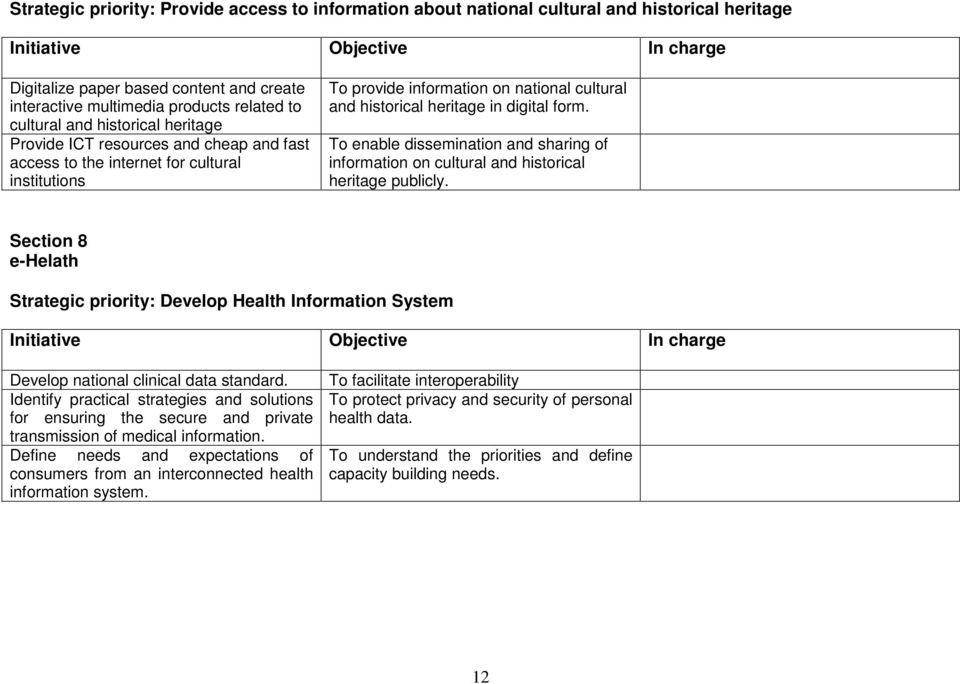
12 Strategic priority: Provide access to information about national cultural and historical heritage Digitalize paper based content and create interactive multimedia products related to cultural and historical heritage Provide ICT resources and cheap and fast access to the internet for cultural institutions To provide information on national cultural and historical heritage in digital form. To enable dissemination and sharing of information on cultural and historical heritage publicly. Section 8 e-helath Strategic priority: Develop Health Information System Develop national clinical data standard. To facilitate interoperability Identify practical strategies and solutions for ensuring the secure and private transmission of medical information. Define needs and expectations of consumers from an interconnected health information system. To protect privacy and security of personal health data. To understand the priorities and define capacity building needs. 12
13 Section 9 e-business Strategic priority: Create an environment for e- business Set up coordinating committee responsible for e-business within a government level body for Information Society Prepare a strategy for the creation of an e- business enabling framework Create enabling digital infrastructure for e- business Foster deregulation and stronger competition in telecommunication sector Create and implement relevant laws for e- business practice Boost consumer confidence in e- commerce in partnership with consumer groups and industry To enable relevant private/public sector players to coordinate development of e- Business in line with European and international standards and practices. To map the current state of e-business in the country- analysis of the e- readiness of Serbia for e-business. To identify the conditions, gaps, and obstacles, for implementation of e- business. To create detailed e-business development plan. To extend and upgrade the backbone communications network, using latest digital, broadband technology wherever possible. To provide affordable access to telephone and Internet services for small business players. To provide legal framework which will address legal issues regarding e- Business. (see section 3). To promote alternative dispute resolution, trust makes and effective codes of conduct by working with stakeholders to develop general 13

14 principals and by creating appropriate initiatives (eeurope+). To transpose into Serbian legislation the Directive 97/7/es on the Protection of Consumers in respect to Distance Contracts and Directive 2000/31/EC on Electronic Commerce in the section dealing with consumer protection. Strategic priority: Facilitate business processes and accept international standards Reengineer business procedures Harmonize national electronic basic trade and transport documents with international standards Introduce the Single Window approach to foreign trade To define, reorganize (rationalize) and standardize business procedures To create a common set of basic trade and transport documents, in alignment with EU, UN, WCO and ISO standards, though engagement experts from the national standardization institutions within GLB. To simplify e-business through adoption of standards in the documentation. To simplify inclusion of SMS into the e- business given that one part of the preconditions for this inclusion would have been solved in advance. To create the systems for single, electronic submission of trade and transport data for both nationals and foreigners. 14

15 Strategic priority: Support the enterprise sector for e-business implementation Stimulate companies, and especially small and medium enterprises to introduce modern e-business practices Create the stimulating tax environment for e-commerce Build awareness of benefits of wide use if ICT in business processes Train managers and executives in areas of management and ICT Increase competitiveness, foster development of SMS and overall development of the domestic market by introduction of promotional and stimulation measures of government, such as: elimination of VAT for ICT products, introduction of an accelerate depreciation rate for ICT products, making available of various suitable credits for ICT equipment for SMS and start-up businesses. To accept the Taxation Framework Conditions, developed by the OECD, which means to set out the taxation principles, which should apply to e- commerce and e-business based on neutrality, efficiency, certainty, simplicity, effectiveness, fairness and flexibility. To adopt EU directive on electronic invoicing as well as a directive and a regulation on VAT on digital supplies. To develop awareness programmes for smaller businesses and general business sector to adopt and wide implement ICT in manufacturing and other business processes to increase effectiveness, efficiency and productivity. To enhance advanced management skills through work-related training. 15

16 Create guidelines and mechanisms for private-public partnership in e-business development Create web portal on which information about e-business operators in Serbia would be placed Include information on Serbian companies on international online directories Include Serbian companies in international organizations and business forums To pay attention to general basic ICT skills in schools and high-level specialist skills. To initiate and enable coordination and cooperation between specific industrial sectors and the government how to optimally use ICT in order to increase their performance and competitiveness. To make available simple access to basic information of the e-business operators and to open business subjects towards Internet. To make available information on Serbian companies in online databases. To expand global understanding of new business concepts and improve use of business models. Section 10 Development of ICT business Sector Strategic priority: Develop software development strategy Review strategic information systems status Review domestic software companies experience and results Review literature on world s software needs To learn organizational, professional and motivational aspects. To assess Serbian software capacity. To assess the export opportunities and challenges for domestic software industry. 16

17 Develop the organizational framework for Strategy development Create strategy and promote results. To create opportunity for domestic experts involvement and cooperation with foreign consultants. To encourage computer scientist and software developers to live in Serbia. Section 11 Others Strategic priority: Ensure the relevance of National Information Society Development strategy within regional and European Context Participate actively in Stability Pact esee Initiative Participate actively in bsee Initiative Participate actively in regional projects Participate actively in international Information Society Development initiatives and plans such as: the eeurope programme, UN/CEFACT, UNCTAD, etc To realise in practice all obligation accepted by signing esee Agenda for Development of Information Society and to cooperate in creating esee Agenda+. To support development of broadband infrastructure by regional cooperation and to implement signed MOU. To get best practices experiences, knowhow and support through regional cooperation. To get best practices experiences, knowhow and support through European and international cooperation. 17

18 Strategic priority: Monitor information society development in Serbia (benchmark process) Include benchmark indicators in national statistics in line with European accepted indicators Monitor and examine the Strategy itself, objectives and outputs To develop information society monitoring system in line with European standards and to make available collection of actual data on information society development in Serbia. To get regular reports on IS Strategy implementation and proposals of possible corrections of goals and activities. 18

Harmonizing cyberlaws and regulations: the experience of the East African Community CTO Cybersecurity Forum 2013 26 April 2013 Yaoundé, Cameroon
 Harmonizing cyberlaws and regulations: the experience of the East African Community CTO Cybersecurity Forum 2013 26 April 2013 Yaoundé, Cameroon Cécile Barayre Programme Manager, E-Commerce and Law Reform,
NATIONAL INFORMATION AND COMMUNICATION TECHNOLOGIES STRATEGY FOR THE DEVELOPMENT OF THE REPUBLIC OF AZERBAIJAN (2003-2012)
 NATIONAL INFORMATION AND COMMUNICATION TECHNOLOGIES STRATEGY FOR THE DEVELOPMENT OF THE REPUBLIC OF AZERBAIJAN (2003-2012) Science and technologies are developing very fast. That s why we in Azerbaijan
Draft Е GOVERNANCE DEVELOPMENT STRATEGY 2014 2020 IN THE REPUBLIC OF BULGARIA
 Draft Е GOVERNANCE DEVELOPMENT STRATEGY 2014 2020 IN THE REPUBLIC OF BULGARIA Table of Contents INTRODUCTION... 3 1. CURRENT STATE ANALYSIS... 5 2. VISION OF THE E GOVERNANCE IN THE REPUBLIC OF BULGARIA...
Okinawa Charter on Global Information Society
 Okinawa Charter on Global Information Society 1. Information and Communications Technology (IT) is one of the most potent forces in shaping the twenty-first century. Its revolutionary impact affects the
National. icr Policy
 National icr Policy TABLE OF CONTENTS Forward Acknowledgements 1. Principles...1 1.0 Introduction...1 1.1 Vision...2 1.2 Mission...2 1.3 Policy Context...2 2. Policy Objectives...4 2.1 ICT Infrastructure...4
TELECOMMUNICATIONS SERVICE PROVIDERS ASSOCIATION OF KENYA
 TELECOMMUNICATIONS SERVICE PROVIDERS ASSOCIATION OF KENYA (TESPOK) BACKGROUND TESPOK is a professional, non-profit organization representing the interests of telecommunication service providers in Kenya.
Cybersecurity Governance
 AfriSIG 2014 Cybersecurity Governance Pria.za.africa Encoding Cybersecurity Norms and Principles Issues, Developments and Approaches Cybersecurity Governance Political Will and Leadership Institutional
Public Administration Reform Process In Macedonia: Between Politics And Good Governance
 Public Administration Reform Process In Macedonia: Between Politics And Good Governance Branko Dimeski Assistant Professor, Department of Administration and Management Information Systems, St. Kliment
(DRAFT)( 2 ) MOTION FOR A RESOLUTION
 05 Motions for resolutions, and other B8 documents 05_09. Motions to wind up debate on statements by other institutions: Rule 123(2) Cover page EUROPEAN PARLIAMENT 2014 2019 Plenary sitting [.2014] B[8-/2014](
E-commerce and Development Key Trends and Issues
 E-commerce and Development Key Trends and Issues Torbjörn Fredriksson Chief, ICT Analysis Section UNCTAD, Division on Technology and Logistics ([email protected]) Workshop on E-Commerce,
Faculty of Organizational Sciences
 Faculty of Organizational Sciences Management EC TS: 60/ L anguage of instruc tion: Serbian/ degree: M A S TER The Master s degree study program of Management is the continuation of undergraduate studies
Electronic Document Management as the Basis for E-government Services
 Electronic Document Management as the Basis for E-government Services Robert Kelemen Varaždin County, Franjevački trg 7, Varaždin, Croatia E-mail: [email protected] Renata Mekovec
Canada 2017! A Digital Nation Focus on ICT
 Canada 2017! A Digital Nation Focus on ICT Growing Canada s Prosperity Used for Ministerial Briefing www.itac.ca Page 1 Introduction ICT & Canada s prosperity Importance of ICT to Canada s prosperity:
UNITED NATIONS ECONOMIC COMMISSION FOR EUROPE
 UNITED NATIONS ECONOMIC COMMISSION FOR EUROPE United Nations Centre for Trade Facilitation and Electronic Business (UN/CEFACT) MOBILE BUSINESS Developing Guiding Principles, measures and good practice
Agenda 1. Introduction and Background:
 National ICT Policy & Licensing Public Consultations NIUE Agenda 1. Introduction and Background: for the Pacific and for Niue 2. What has been completed for Niue? Draft National ICT Policy Draft Report
How To Improve The Finnish Public Sector Information Resources
 Memorandum VM040:00/2013 885/00.01.00.01/2013 1 (11) 19.10.2015 Public Sector ICT Ministry of Finance Anne Kauhanen-Simanainen Margit Suurhasko Mikael Vakkari Open Data Policy in the Finnish Government
Achieving the creative economy and citizens happiness through informatization
 National IT Policy Group e-government Group ICT Service Policy Division Achieving the creative economy and citizens happiness through informatization Smart Network Division Digital Culture Division Digital
Cyber Security Recommendations October 29, 2002
 Cyber Security Recommendations October 29, 2002 Leading Co-Chair (Asia/Oceania) Co-Chair (Americas) Co-Chair (Europe/Africa) Dr. Hiroki Arakawa Executive Vice President NTT Data Corporation Richard Brown
Draft WGIG Issues Paper on E-Commerce
 Draft WGIG Issues Paper on E-Commerce This paper is a 'draft working paper' reflecting the preliminary findings of the drafting team. It has been subject to review by all WGIG members, but it does not
Powering Up the Network: A Report on Small Business Use of E-business Solutions in Canada
 Powering Up the Network: A Report on Small Business Use of E-business Solutions in Canada February 2010 Overview Canada is a world leader in many areas: energy, natural resources and the financial services
ESTABLISHING A LEGAL FRAMEWORK FOR INTERNATIONAL TRADE SINGLE WINDOW
 UNITED NATIONS ECONOMIC COMMISSION FOR EUROPE ESTABLISHING A LEGAL FRAMEWORK FOR INTERNATIONAL TRADE SINGLE WINDOW RECOMMENDATION No. 35, FIRST edition, adopted by the United Nations Centre for Trade Facilitation
Expert Meeting on CYBERLAWS AND REGULATIONS FOR ENHANCING E-COMMERCE: INCLUDING CASE STUDIES AND LESSONS LEARNED. 25-27 March 2015
 Expert Meeting on CYBERLAWS AND REGULATIONS FOR ENHANCING E-COMMERCE: INCLUDING CASE STUDIES AND LESSONS LEARNED 25-27 March 2015 Global E-commerce and Cyberlaw Developments By Torbjörn Fredriksson UNCTAD
Draft Resolution on Science, technology and innovation for development
 Draft Resolution on Science, technology and innovation for development The Economic and Social Council, Recognizing the role of the Commission on Science and Technology for Development as the United Nations
EUROPEAN ECONOMIC AREA JOINT PARLIAMENTARY COMMITTEE. REPORT on E-Commerce and EEA legislation
 EUROPEAN ECONOMIC AREA 30 November 2000 Brussels JOINT PARLIAMENTARY COMMITTEE REPORT on E-Commerce and EEA legislation Co-rapporteurs: Ms. Marjo Matikainen-Kallstöm (EPP-ED, Finland) Mr. Vilhjálmur Egilsson
H2020-LEIT-ICT WP2016-17 ICT 14, 15, 17,18. Big Data PPP
 H2020-LEIT-ICT WP2016-17 ICT 14, 15, 17,18 Big Data PPP H2020-LEIT-ICT-2016 ICT 14 Big Data PPP: cross-sectorial and cross-lingual data integration and experimentation (IA) - Budget 27 M ICT 15 Big Data
Overview of e-asean Initiative
 Overview of e-asean Initiative Pichet Durongkaveroj Chairman e-asean Working Group ITU Workshop on Creating Trust in Critical Network Infrastructures 20-22 May 2002 Seoul 1 Coverage Background Implementing
COMMISSION STAFF WORKING DOCUMENT. Report on the Implementation of the Communication 'Unleashing the Potential of Cloud Computing in Europe'
 EUROPEAN COMMISSION Brussels, 2.7.2014 SWD(2014) 214 final COMMISSION STAFF WORKING DOCUMENT Report on the Implementation of the Communication 'Unleashing the Potential of Cloud Computing in Europe' Accompanying
DEVELOPMENT OF ICT AND INNOVATIONS IN GEORGIA
 MINISTRY OF ECONOMY AND SUSTAINABLE DEVELOPMENT OF GEORGIA GEORGIA S INNOVATION AND TECHNOLOGY AGENCY DEVELOPMENT OF ICT AND INNOVATIONS IN GEORGIA Priorities and Projects IRAKLI KASHIBADZE Chairman,,
STRATEGIC PLAN 2013/2014 TO 2015/2016
 STRATEGIC PLAN 2013/2014 TO 2015/2016 1. WCO Strategic Plan Introduction 1. The purpose of this document is to present the WCO Strategic Plan that was approved by the Council in June 2013 for the years
GLOBAL BUSINESS DIALOGUE ON ELECTRONIC COMMERCE CYBER SECURITY AND CYBER CRIME SEPTEMBER 26, 2000. CEO EDS Corporation
 GLOBAL BUSINESS DIALOGUE ON ELECTRONIC COMMERCE CYBER SECURITY AND CYBER CRIME SEPTEMBER 26, 2000 Issue Chair: Issue Sherpa: Dick Brown CEO EDS Corporation Bill Poulos EDS Corporation Tel: (202) 637-6708
H2020-LEIT-ICT WP2016-17. Big Data PPP
 H2020-LEIT-ICT WP2016-17 Big Data PPP H2020-LEIT-ICT-2016 ICT 14 Big Data PPP: cross-sectorial and cross-lingual data integration and experimentation (IA) - Budget 27 M ICT 15 Big Data PPP: large scale
Application of Data Protection Concepts to Cloud Computing
 Application of Data Protection Concepts to Cloud Computing By Denitza Toptchiyska Abstract: The fast technological development and growing use of cloud computing services require implementation of effective
USAID Business Enabling Project in Serbia Scope of Work for Consultant Technical Assistance to the Ministry of Finance and Economy
 USAID Business Enabling Project in Serbia Scope of Work for Consultant Technical Assistance to the Ministry of Finance and Economy About the Project The Serbia Business Enabling Project ( BEP ) is a five-year
STRATEGY FOR GENERATING ON LINE CURRICULUM CONTENT FOR AUSTRALIAN SCHOOLS
 STRATEGY FOR GENERATING ON LINE CURRICULUM CONTENT FOR AUSTRALIAN SCHOOLS Background This paper has been prepared for CESCEO and MCEETYA by Curriculum Corporation in consultation with Education.Au, Department
FRAMEWORK FOR ADVANCING TRANSATLANTIC ECONOMIC INTEGRATION BETWEEN THE EUROPEAN UNION AND THE UNITED STATES OF AMERICA
 FRAMEWORK FOR ADVANCING TRANSATLANTIC ECONOMIC INTEGRATION BETWEEN THE EUROPEAN UNION AND THE UNITED STATES OF AMERICA We, leaders of the European Union and the United States of America: Believing that
Towards a Cloud of Public Services
 Towards a Cloud of Public Services Public administrations are often organised in silos: monolithic architecture models make it difficult to re-use services for the development of new applications. What
EUROPEAN CHARTER FOR SMALL ENTERPRISES
 EUROPEAN CHARTER FOR SMALL ENTERPRISES Small enterprises are the backbone of the European economy. They are a key source of jobs and a breeding ground for business ideas. Europe s efforts to usher in the
INVITATION TO TENDER E-COMERCE PROMOTION WEB SITE
 Belgrade, 18 August 2015 INVITATION TO TENDER E-COMERCE PROMOTION WEB SITE CONTRACT OBJECTIVES & EXPECTED RESULTS Background to the Project Project Title: e-business Development Project No.: EuropeAid/133836/C/SER/RS
COMMUNIQUE. AFRICAN ICT MINISTERIAL ROUND-TABLE ON 42 nd MEETING OF ICANN. Hotel Méridien Dakar, SENEGAL. 21 Octobre 2011
 COMMISSION DE L UNION AFRICAINE REPUBLIQUE DU SENEGAL ---------------- MINISTERE DE LA COMMUNICATION, DES TELECOMMUNICATIONS ET DES TECHNOLOGIES DE L INFORMATION ET DE LA COMMUNICATION AFRICAN ICT MINISTERIAL
COMMITTEE ON STANDARDS AND TECHNICAL REGULATIONS (98/34 COMMITTEE)
 EUROPEAN COMMISSION ENTERPRISE AND INDUSTRY DIRECTORATE-GENERAL Regulatory Policy Standardisation Brussels, 9 th November 2005 Doc.: 34/2005 Rev. 1 EN COMMITTEE ON STANDARDS AND TECHNICAL REGULATIONS (98/34
COMMUNICATION FROM THE COMMISSION TO THE EUROPEAN PARLIAMENT, THE COUNCIL, THE EUROPEAN ECONOMIC AND SOCIAL COMMITTEE AND THE COMMITTEE OF THE REGIONS
 EUROPEAN COMMISSION Brussels, 19.4.2016 COM(2016) 179 final COMMUNICATION FROM THE COMMISSION TO THE EUROPEAN PARLIAMENT, THE COUNCIL, THE EUROPEAN ECONOMIC AND SOCIAL COMMITTEE AND THE COMMITTEE OF THE
Regulatory Impact Analysis on the legal and institutional framework for the electronic signature I. INTRODUCTION TITLE:
 TITLE: Regulatory Impact Analysis on the legal and institutional framework for the electronic signature ADMINISTRATIVE BODY: Ministry of Transport and Communication of Bosnia and Herzegovina (BiH) in cooperation
Presented at the Public-Private Dialogue 2015 Workshop (Copenhagen, March 10-13, 2015)
 Macedonian E-Gov Solution For Public Consultation In The Legislative Process-A National Platform For Sustainable PPD Based On Regulatory Impact Assessment Transparency Principles by Gordana Gapikj-Dimitrovska,
STRATEGY FOR IMPLEMENTATION OF ELECTRONIC HEALTHCARE IN BULGARIA
 REPUBLIC OF BULGARIA MINISTRY OF HEALTH STRATEGY FOR IMPLEMENTATION OF ELECTRONIC HEALTHCARE IN BULGARIA TABLE OF CONTENTS І. Introduction 1 ІІ. Definition of ehealth 2 ІІІ. Legal frame 3 1. National Legal
Regulatory Impact Assessment (RIA) in Montenegro
 - Towards Better Regulation Regulatory Impact Assessment (RIA) in Montenegro SUMMARY: As a candidate country for joining the European Union, Montenegro has the obligation to harmonize its overall legislation
ELEFTHO : Supporting Business Incubators & technology parks.
 ELEFTHO : Supporting Business Incubators & technology parks. Region of Central Macedonia Task Page 1 of 14 Contents Description of policy... 3 Name of the policy... 3 Responsible body... 3 Implementation
National Cyber Security Policy -2013
 National Cyber Security Policy -2013 Preamble 1. Cyberspace 1 is a complex environment consisting of interactions between people, software and services, supported by worldwide distribution of information
ACTION PLAN FOR LITHUANIAN PARTICIPATION IN THE INTERNATIONAL INITIATIVE OPEN GOVERNMENT PARTNERSHIP
 OFFICE OF THE GOVERNMENT OF THE REPUBLIC OF LITHUANIA ACTION PLAN FOR LITHUANIAN PARTICIPATION IN THE INTERNATIONAL INITIATIVE OPEN GOVERNMENT PARTNERSHIP April 2014 Vilnius 1 INTRODUCTION Significance
Council of the European Union Brussels, 4 July 2014 (OR. en) Mr Uwe CORSEPIUS, Secretary-General of the Council of the European Union
 Council of the European Union Brussels, 4 July 2014 (OR. en) 11603/14 ADD 1 COVER NOTE From: date of receipt: 2 July 2014 To: No. Cion doc.: Subject: RECH 323 TELECOM 140 MI 521 DATAPROTECT 100 COMPET
Strengthening the Research Effort means Strengthening the Role of Universities
 EUA Response to the EC Communication: Science and technology, the key to Europe s future Guidelines for future European Union policy to support research. I. The policy context 1. The 7 th Framework Programme
Mutual legal recognition of electronic communications and electronic signatures and paperless trade facilitation: challenges and opportunities
 Mutual legal recognition of electronic communications and electronic signatures and paperless trade facilitation: challenges and opportunities Luca Castellani Secretary, Working Group IV (Electronic Commerce)
IGF Policy Options for Connecting the Next Billion
 Introduction IGF Policy Options for Connecting the Next Billion - A Synthesis - More than three billion people will be connected to the Internet by the end of 2015. This is by all standards a great achievement,
E-government models E-democracy
 E-government models E-democracy PAF 6406 Govt. Tech. Applications G2C applications Information Dissemination Static/ dynamic web pages; documents Online data Citizen Services provision Licenses; Government
CEN and CENELEC response to the EC Consultation on Standards in the Digital Single Market: setting priorities and ensuring delivery January 2016
 CEN Identification number in the EC register: 63623305522-13 CENELEC Identification number in the EC register: 58258552517-56 CEN and CENELEC response to the EC Consultation on Standards in the Digital
Assisting Economic Transition: An RIA Strategy for Developing Countries
 Assisting Economic Transition: An RIA Strategy for Developing Countries Scott Jacobs, Managing Director Jacobs and Associates At the Conference on REGULATORY IMPACT ASSESSMENT: STRENGTHENING REGULATION
ICT trends and challenges for research in Serbia and possibilities for cooperation with other countries
 ICT trends and challenges for research in Serbia and possibilities for cooperation with other countries Mirjana Ivanović, Zoran Budimac, Živana Komlenov, Gordana Rakić Department of Mathematics and Informatics
Terms of Reference: Consultancy Firm. Selection #1019083
 Terms of Reference: Consultancy Firm Selection #1019083 Support for Broadband Competitiveness Program in Eastern Europe, South Caucasus and Central Asia (ECA) Trust Fund: TF071399 Creating Sustainable
The Danish Cyber and Information Security Strategy
 February 2015 The Danish Cyber and Information Security Strategy 1. Introduction In December 2014 the Government presented a National Cyber and Information Security Strategy containing 27 government initiatives
Dr. Vangelis OUZOUNIS Senior Expert Security Policies ENISA. [email protected]
 Dr. Vangelis OUZOUNIS Senior Expert Security Policies ENISA [email protected] 5 th German Anti-Spam Summit Koeln, 5 th of Sept. 2007 www.enisa.europa.eu 1 Agenda NIS a Challenge for the
Position Paper e-regulation
 Position Paper e-regulation Ecommerce Europe s Proposal for Sustainable Growth of E-commerce in Europe www.ecommerce-europe.eu POSITION PAPER 3 Table of contents 1 Introduction 4 5.1.4 Harmonisation and
Digital signature and e-government: legal framework and opportunities. Raúl Rubio Baker & McKenzie
 Digital signature and e-government: legal framework and opportunities Raúl Rubio Baker & McKenzie e-government concept Utilization of Information and Communication Technologies (ICTs) to improve and/or
Financial Sector Master Plan Phase III
 Financial Sector Master Plan Phase III The Bank of Thailand (BOT) in cooperation with the Ministry of Finance (MOF) has set the goals and strategic directions for financial sector development through the
COMESA Guidelines on Free and Open Source Software (FOSS)
 COMESA Guidelines on Free and Open Source Software (FOSS) Introduction The COMESA Guidelines on Free and Open Source Software are a follow-up to the COMESA Regional FOSS Framework of 2009 whose main objective
How To Respect The Agreement On Trade In Cyberspace
 CHAPTER 14 ELECTRONIC COMMERCE Article 14.1: Definitions For the purposes of this Chapter: computing facilities means computer servers and storage devices for processing or storing information for commercial
PROPOSAL 20. Resolution 130 of Marrakesh on the role of ITU in information and communication network security
 PROPOSAL 20 Resolution 130 of Marrakesh on the role of ITU in information and network security Submitted by the following Member States: Germany (Federal Republic of), Austria, Belarus (Republic of), Bulgaria
GOVERNMENT OF THE REPUBLIC OF LITHUANIA
 GOVERNMENT OF THE REPUBLIC OF LITHUANIA RESOLUTION NO 796 of 29 June 2011 ON THE APPROVAL OF THE PROGRAMME FOR THE DEVELOPMENT OF ELECTRONIC INFORMATION SECURITY (CYBER-SECURITY) FOR 20112019 Vilnius For
Dialogue between the Government and stakeholders a crucial factor for improving Business Environment
 Dialogue between the Government and stakeholders a crucial factor for improving Business Environment Anrijs Matīss Deputy State Secretary Ministry of Economics of the Republic of Latvia Brivibas street
COMMUNIQUÉ ON PRINCIPLES FOR INTERNET POLICY-MAKING OECD HIGH LEVEL MEETING ON THE INTERNET ECONOMY,
 COMMUNIQUÉ ON PRINCIPLES FOR INTERNET POLICY-MAKING OECD HIGH LEVEL MEETING ON THE INTERNET ECONOMY, 28-29 JUNE 2011 The Seoul Declaration on the Future of the Internet Economy adopted at the 2008 OECD
Success through partnership
 Success through partnership Achieving a national vision for ICT in schools Strategic Plan to guide the implementation of the Digital Education Revolution initiative and related initiatives 5 August 2008
Proposal for a DIRECTIVE OF THE EUROPEAN PARLIAMENT AND OF THE COUNCIL. on electronic invoicing in public procurement. (Text with EEA relevance)
 EUROPEAN COMMISSION Brussels, 26.6.2013 COM(2013) 449 final 2013/0213 (COD) Proposal for a DIRECTIVE OF THE EUROPEAN PARLIAMENT AND OF THE COUNCIL on electronic invoicing in public procurement (Text with
Submission to Standing Senate Committee on the Environment, Communications and the Arts on the adequacy of protections for the privacy of Australians
 Submission to Standing Senate Committee on the Environment, Communications and the Arts on the adequacy of protections for the privacy of Australians online August 2010 1 1. Introduction The Australian
CEN-CENELEC reply to the European Commission's Public Consultation on demand-side policies to spur European industrial innovations in a global market
 CEN Identification number in the EC register: 63623305522-13 CENELEC Identification number in the EC register: 58258552517-56 CEN-CENELEC reply to the European Commission's Public Consultation on demand-side
BROADBAND ROLLOUT AND THE REGULATORY AND INFRASTRUCTURAL CHALLENGES
 DEPARTMENT OF COMMUNICATIONS REPUBLIC OF SOUTH AFRICA WORKSHOP ON ELECTRONIC COMMERCE GENEVA, 17-18 JUNE 2013 Organised under the auspices of the WTO Council for Trade in Services BROADBAND ROLLOUT AND
1. BACKGROUND. Terms of Reference. Background
 GOVERNMENT OF SAINT VINCENT AND THE GRENADINES Caribbean Regional Communications Infrastructure Project TERMS OF REFERENCE FOR CONSULTING SERVICES For the Design of a National Broadband Network SVG CARCIP
Launch of ECDL Syllabus 5.0 The Global Standard for Digital Literacy
 Launch of ECDL Syllabus 5.0 The Global Standard for Digital Literacy Damien O Sullivan Ceo ECDL Foundation Introduction ECDL ICDL European Computer Driving Licence International Computer Driving Licence
Screening report Turkey
 13 February 2006 Screening report Turkey Chapter 26 Education and Culture Date of screening meetings: Explanatory meeting: 26 October 2005 Bilateral meeting: 16 November 2005 1 I. CHAPTER CONTENT The areas
Information and Communication Technology (ICT) Development in the Philippines
 (An Update Report) Information and Communication Technology (ICT) Development in the Philippines Presentor: Assistant Secretary Cecilia V. Reyes Department of Transportation and Communications Philippines
Unlocking the Potential of E commerce for Developing Countries
 Unlocking the Potential of E commerce for Developing Countries SESSION # 3 Cécile BARAYRE Economic Affairs Officer ICT Analysis Section, UNCTAD Unlocking the Potential of E-commerce for Developing Countries
Ministerie van Toerisme, Economische Zaken, Verkeer en Telecommunicatie Ministry of Tourism, Economic Affairs, Transport and Telecommunication
 SME Policy Framework for St. Maarten May, 2014 Department of Economic Affairs, Transportation & P. 1 of 16 TABLE OF CONTENTS 1. Introduction 2. SME Developments in St. Maarten 2.1 Definition 2.2 Government